...NOT IN THISDAY STYLE? THEN YOU’RE NOT IN STYLE TR
UT H
& RE A S O
N
SUNDAY, SEPTEMBER 13, 2026
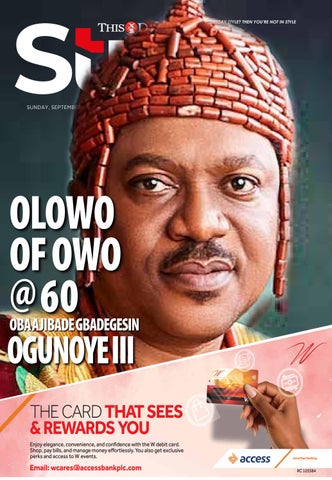
OLOWO OF OWO @ 60
OBA AJIBADE GBADEGESIN
OGUNOYE III
THE CARD THAT SEES & REWARDS YOU Enjoy elegance, convenience, and confidence with the W debit card. Shop, pay bills, and manage money effortlessly. You also get exclusive perks and access to W events.
Email: wcares®accessbankplc.com
♦ access
1
more than banking
RC 125384
Sunday, September 13, 2026 Vol. 22, No. 11443
Sunday, September 13, 2026 Vol. 22, No. 11443
EDITOR’S LETTER
COVER NOTE
TWO SIDES Elegance
of
FINE JEWELLERY
One Language.
Infinite Expressions. EXECUTIVE EDITOR
14
14
W
hen Oba Ajibade Gbadegesin Ogunoye III became the 32nd Olowo of Owo, his ascension was remarkable for one reason: it was without rancour, a first for a kingdom where transitions to the throne had historically been turbulent. Born on July 6, 1966, into the Elewuokun royal dynasty, the son of the late Oba Adekola Ogunoye II and Olori Adenike Yeyesa Ogunoye had built a life in public service long before becoming king
Lifestyle & Fashion
4
10 The 4C Hair Guide: What Your Natural Hair Actually Needs
3
The Beauty Hortcuts We Need To Stop Taking
4
The New Rules of Friendship in the Digital Age
5
Make Your Wardrobe Feel New Again
6
What Makes an Outfit Look Expensive? 8 Details That Make the Difference
8
Interview: Wana Udobang, The Wordsmith!
10
How to Survive the Aso-Ebi Economy Without Going Broke
18
WARIF Survivor Stories: From Silence to Strength.
20
Opinion: How much skin is too much skin?
21
Movie Review: Why The Colours of Fire Struggles to Spark.
2
22
S yle TR
UT H
& RE A SO
N
EXECUTIVE EDITOR KONYE NWABOGOR 08111847087
DEPUTY EXECUTIVE EDITOR OLUFUNKE BABS-KUFEJI 08111847086
ASSISTANT EDITOR YINKA OLATUNBOSUN CONTRIBUTOR EBIYEKON DORCAS DIO DIRECTOR, PRINT PRODUCTION CHUKS ONWUDINJO
22
Printed by Ups Digitals Ltd, Abuja; 08057025005; info@upsdigitals.com
Keeping Up With Everything
I
s it me, or is friendship a funny thing these days? You know, you can be perfectly fine with someone in real life and still have the internet convinced otherwise because you missed a birthday post, didn’t repost an achievement or haven’t appeared in each other’s pictures lately. Crazy isn’t it ? Social media has certainly added another layer. There is the friendship itself, and then there is the version everyone else gets to see. Sometimes the two match; sometimes they don’t. I have learnt not to read too much into either. We are all grown, life is full, and people will not always show up in exactly the way we expect them to. A little grace, I think, keeps good friendships going much longer than keeping score ever will. There is more of that conversation in The New Rules of Friendship in the Digital Age. Read it and see how many of the new “rules” you recognise. Now, from what we choose to show of our relationships to what we choose to show of ourselves, apparently, we are showing quite a lot. Funke Babs-Kufeji asks How Much Skin Is Too Much Skin? and it is a timely question. Fashion has always pushed boundaries, but those boundaries seem to have shifted considerably. Sheer is sheerer, cut-outs are bolder and some red-carpet looks leave so little to the imagination that I sometimes wonder: is semi-nudity simply part of fashion now? I don’t necessarily think there has to be one answer. What one woman considers sexy, another considers too much, and personal style should have room for both. Still, it is interesting to watch our collective definition of “revealing” change almost in real time. Funke gets into it in this issue. While we are on clothes, can we talk about the increasingly elaborate business of getting dressed to go somewhere? Ladies, you know the drill. An invitation arrives and before you have even decided whether you really want to go, there is aso-ebi to buy, a tailor to call and an entire beauty schedule beginning to form in your head. Weddings have always been an occasion to dress up, but the scale has changed. Looking good has become a production, and a rather expensive one at that. At what point do you decide that you don’t have to participate in every part of it? That you can repeat a shoe, skip the new bag, do your own makeup or, heaven forbid, decline the aso-ebi altogether? How to Survive the AsoEbi Economy Without Going Broke is our very practical contribution to that conversation. Anyway, enough from me. How is September treating you? It is my favourite month, so I am in a particularly good mood and hoping the month gives me every reason to stay there. I hope it is being good to you too. I hope you are well, finding time for yourself and surrounded by people who make life a little easier. Have a lovely week, enjoy the issue and be good to yourselves.
Elegance has no single expression. From the timeless luminosity of pearls and diamonds to the warmth of sculpted gold, fine jewellery celebrates individuality in all its forms. Every jewel tells a different story. Classic or contemporary, subtle or statement-making, discover fine jewellery that is distinctly, unmistakably yours.
Panthère De Cartier Watch Medium Model, Quartz Movement, Yellow Gold, Diamonds
Ferre Gold and Diamonds Concentric Hoop Earrings
Ferre Multi-Layered Gold & Diamonds Necklace
Yoko London South Sea Pearl & Diamond Ring
Yoko London Multilayered Pearl And Diamond Choker Necklace Chopard Happy Sport Oval Steel Diamond
Ferre Ruby & Diamonds Earrings
08077092196
visit us:
Ferre White Pearl And Ruby Bracelet
Love,
@thisdaystyle |
@thisdaystyleon | www.thisdaystyle.ng
P O LO F I N E J E W E L L E RY, T h e Pa l m s S h o p p i n g M a l l , 1 B I S Way, O n i r u , L a g o s , N i g e r i a | + 2 3 4 ( 0 ) 7 074 5 6 8 0 6 3
3
Sunday, September 13, 2026 Vol. 22, No. 11443
Sunday, September 13, 2026 Vol. 22, No. 11443
foundation, powder, sunscreen, sweat and everything else from the day are still sitting on your face. Make the nighttime routine easy enough that tiredness isn’t an excuse. Remove your makeup, cleanse properly and moisturise. It doesn’t need to become a 30-minute ritual. Sometimes five minutes at the bathroom sink is all your skin is asking for.
Being Rough With Your Hair
THE BEAUTY HORTCUTS WE NEED TO STOP TAKING There are certain beauty shortcuts most of us know we shouldn’t take but do anyway. Skipping sunscreen because you’re already late. Adding another layer of gel instead of washing your hair. Attacking a knot with a comb because proper detangling will take too long. Or getting home after a long night and deciding that removing your makeup is a problem for the morning. Once in a while, none of this feels particularly serious. The problem is when the shortcut becomes the routine. We spend good money on skincare, hair products, makeup and salon appointments, then sometimes undo all that effort by cutting corners in the places that actually matter. The answer isn’t necessarily a longer beauty routine. It is knowing which shortcuts are harmless and which ones eventually show. By Funke Babs-Kufeji
Skipping the Skincare Steps That Matter You don’t need a ten-step skincare routine every morning, but there are some basics worth making time for. Proper cleansing, moisturising and sunscreen will do far more for your skin than an overcrowded bathroom shelf of products you use inconsistently. Sunscreen is probably one of the easiest things to skip, especially on mornings when you’re rushing or assume you don’t need it because you will be indoors for most of the day. But skincare is really about
4
Hair is often where impatience does the most damage. We pull at knots, detangle too aggressively, turn up the heat because we need it dry quickly or pull everything into a tight style because there isn’t time to figure out anything else. For Black hair, whether natural or relaxed, repeatedly taking these shortcuts can eventually show in dryness and breakage. Give yourself enough time to detangle properly, keep your hair moisturised and be sensible with heat. The irony is that the few minutes you save
by being rough with your hair can eventually turn into months spent trying to get it healthy again.
Piling Products on Instead of Washing Your Hair We’ve all had those days when the solution to yesterday’s hair product is simply today’s hair product. A little more oil. More gel. Edge control. Spray. Something to make the previous something look slightly better. At some point, your hair simply needs washing, and your scalp needs cleaning. Product buildup can leave hair looking dull and weighed down, which often sends us reaching for yet another product to fix it. Sometimes the best thing you can do is stop adding and start again with clean hair.
Rushing Beauty Appointments
This is another shortcut we don’t always think about. We squeeze a manicure into a lunch break, arrive late for a hair appointment and still expect to leave at the original time, or book a beauty treatment when we know we have somewhere else to be immediately afterwards. Then we spend the entire appointment checking the time and asking, “How much longer?” Some things simply cannot be rushed. If you know a particular hairstyle takes hours, give it the hours. If you only have 45 minutes, perhaps that is not the afternoon for an elaborate nail appointment. Allowing enough time means your stylist, nail technician, or beautician can actually do the job you are paying them to do.
THE NEW RULES OF FRIENDSHIP IN THE DIGITAL AGE Friendship has become surprisingly complicated. Your friend hasn’t replied to your WhatsApp message since Tuesday but has watched every one of your Stories. You forget the birthday post, and suddenly there are questions. Then there are blue ticks, group chats, Close Friends lists and those suspicious WhatsApp Status updates that seem directed at somebody. The digital age has made staying connected easier, but it has also created new ways to misunderstand each other and measure friendship. So, while the fundamentals haven’t changed, perhaps the rules need a little updating. Here are eight worth remembering. By Bakare Mariam
1. Don’t Take Every Late Reply Personally
A message left unanswered for a few hours, or even a day, doesn’t automatically mean something is wrong. People have work, families, responsibilities and days when they simply don’t want to talk. Good friendships need enough breathing room for life to happen. But context matters. There is a difference between a friend who replies late and one who consistently disappears, only to resurface when they need something.
2. Keep Some Things Off the Internet Not every good moment needs to be posted, and every disagreement certainly doesn’t need a cryptic caption. Friendships need privacy too. Ask before sharing personal pictures or news, and resist the temptation to turn disagreements into WhatsApp Status updates or Instagram Stories. Some things are better resolved between the people involved.
3. Don’t Make Their Success About You
consistency. A simple routine you can actually stick to will always make more sense than an elaborate one you only manage when you have time.
A promotion, engagement, new business, fabulous holiday, or new house can sometimes trigger comparison, especially when social media makes everybody else’s life seem to be moving at top speed. Your friend’s win doesn’t diminish yours. Celebrate people you care about without immediately measuring their progress against your own. Friendship shouldn’t become a competition nobody admits they’re participating in.
Going to Bed Without Taking Off Your Makeup
4. If It’s About Them, Talk to Them
You get home late, sit on the bed for what was supposed to be five minutes, and suddenly removing your makeup feels like an enormous undertaking. So you convince yourself that one night won’t hurt. And perhaps one night won’t. But regularly sleeping in makeup can leave your skin congested and irritated, particularly when
STEPHANIE COKER AND OSAS IGHODARO
We all know the posts: the quote about “knowing your worth,” the suspicious meme, the caption clearly written for one person to see. If your friend has upset you, talk to your friend. Indirect posts may attract plenty of “Are you okay?” messages, but they rarely solve the actual problem. Sometimes
the old-fashioned direct conversation still wins.
love differently, and the most meaningful ways aren’t always visible online.
5. Stop Keeping a Friendship 6. Give Friendships Room to Scorecard Change
You posted her birthday on your The friend you spoke to every day feed; she only put yours on at 25 may be someone you speak WhatsApp Status. You bought to twice a month at 35. Careers the bigger gift. You attended her change, people marry, children event; she missed yours. You arrive, friends relocate, and always seem to call first. priorities shift. Reciprocity matters, but friendship Less communication doesn’t isn’t an accounting exercise. always mean less affection. Look at the overall relationship Some friendships simply develop rather than keeping records of a different rhythm. And yes, every gesture. People show sometimes people genuinely grow
apart. That doesn’t automatically make everything that came before it fake.
7. Remember to Be Friends Offline Send the memes. Keep the group chat alive. Tag each other in ridiculous Reels. But also make the lunch date, pick up the phone and show up when it matters. Because with all our new ways of staying connected, it is surprisingly easy to forget that being constantly updated on someone’s life isn’t quite the same as being in it.
5
TR
UT H
& RE A SO
N
Sunday, September 13, 2026 Vol. 22, No. 11443
Sunday, September 13, 2026 Vol. 22, No. 11443
By Mariam Bakare
MAKE YOUR WARDROBE FEEL NEW AGAIN
1. Break Up the Set
That trouser suit doesn’t always have to travel together. Neither does the matching two-piece you bought as one outfit. Wear the blazer with jeans, the trousers with a fitted T-shirt or the skirt from a co-ord with a completely different shirt. Matching sets are particularly useful because you’re often sitting on several outfits without realising it.
2. Take Your Evening Clothes Out During the Day
The sequinned skirt waiting patiently for December? Try it with a white shirt and flat sandals. That silky evening top can work with denim. A dramatic dress might suddenly feel less formal under an oversized blazer. Changing the context of a piece is one of the easiest ways to rediscover it. Clothes don’t know what time it is.
There comes a point when even a wardrobe full of clothes can feel like there is absolutely nothing to wear. You’ve worn the dress exactly the same way three times, those trousers always come with that shirt, and you can already predict which shoes you’ll reach for next. Before you start adding things to your cart, though, look again. Sometimes your wardrobe isn’t tired; your combinations are. The quickest way to make old clothes feel new is to stop wearing them the way you always have. Here are seven styling tricks worth trying before your next shopping trip.
IBRA
3. Change the Proportions
If you’ve always worn your oversized shirt loose, tuck it into a high waist. Wear a cropped jacket over the long dress you usually wear alone. Try the wideleg trousers with a close-fitting top instead of your usual loose blouse. Often, it isn’t the individual clothes that feel dated. It’s the silhouette you’ve become accustomed to creating with them.
4. Let One Piece Do a Different Job
A button-down shirt can become a light jacket over a tank. A long dress can look like a skirt when worn under a sweater or shirt. A scarf can move from your neck to your waist, handbag or hair. Even a cardigan can be worn backwards if the cut allows it. The fun begins when you stop treating every item according to the description it had when you bought it.
5. Change the Shoe Before You Change the Outfit
Shoes have enormous power over how clothes read. The same midi dress can look completely different with trainers, loafers, barely-there heels or boots. Before declaring an outfit boring, try it with the shoe you would least naturally pair with it. That little bit of contrast is often what makes an old combination interesting again.
6. Steal From Another Section of Your Wardrobe
Your clothes don’t need to remain in their assigned categories. Work shirts can come out at weekends. Holiday pieces can enter your everyday wardrobe. A beach cover-up might work over trousers, while the oversized men’s shirt you usually travel in could look brilliant with a pencil skirt and heels.The more rigidly you categorise clothes, the fewer outfits you think you own.
7. Photograph Your New Combinations
This sounds less fashionable than the other tips, but it works. Spend an afternoon trying combinations you wouldn’t normally wear and photograph the good ones. You’ll gradually build your own little outfit library for mornings when your imagination refuses to cooperate. You may also discover that the “new” outfit you’ve been looking for has been hanging in your wardrobe all along. OSAS IGHODARO
6
UCHE NWANDISON
POWEDE AWUJO
OLIVIA
NKESI ENYIOHA
7
Sunday, September 13, 2026 Vol. 22, No. 11443
Sunday, September 13, 2026 Vol. 22, No. 11443
WHAT MAKES AN
mood of an outfit. Pay attention to toe shapes, heel proportions and condition. Sometimes, swapping a chunky shoe for something sleeker is all an outfit needs.
OUTFIT
LOOK EXPENSIVE?
6. The Right Underwear Is Invisible Styling
A beautiful dress can look completely different depending on what sits underneath it. A bra that changes the position of the bust, a visible panty line, or underwear cutting across the body can alter the intended silhouette. Good underwear isn’t about squeezing yourself into shapewear. It is about giving the clothes the right foundation.
8 DETAILS THAT MAKE THE DIFFERENCE
7. Remove One Thing
This may be the cheapest styling trick of all. Put the outfit together, then look again. Does it need the necklace, the earrings, and the belt? Does the dramatic dress also need the dramatic shoe? Sometimes removing one element gives everything else more importance. Luxury often has space around it.
You can wear head-to-toe designer and still not look particularly expensive. You can also wear something relatively affordable and have people convinced otherwise. That is because our eyes don’t see price tags; they pick up on other clues. Some are obvious, but the more interesting ones aren’t. It could be the length of a trouser, the absence of a logo, an unusual colour combination or simply the fact that nothing about the outfit is trying too hard. Before spending more money on clothes, these are the details worth knowing. By Mariam Bakare
1. The Fabric Has to Behave Well
A fabric can give an outfit away before anything else does. Watch how it moves rather than simply how it feels on the hanger. Does it skim the body or cling to every bump? Does it have enough weight to hold its shape? Does it suddenly become transparent in daylight? This is particularly worth checking with satin, linen, jersey and lightercoloured fabrics. Sometimes the better-looking choice isn’t the most expensive one, but the one that falls beautifully.
2. The Length Can Change the Entire Outfit
A few centimetres can make an extraordinary difference. Trousers pooling awkwardly around the ankle, sleeves covering half the hand or a jacket ending at an unflattering point can make good
8
clothes look wrong. This is where alterations become interesting. Don’t just take things in. Experiment with hems, sleeve lengths and where garments finish on your body.
8. Mix Your Price Points
3. Expensive Doesn’t Always Mean Perfectly Matched
Matching your shoes to your bag to your belt can look polished, but it can also feel predictable. Some of the chicest outfits work because the colours aren’t obvious companions: chocolate brown with pale blue, burgundy with pink, navy with black or olive with cream. An unexpected but intelligent colour combination can make very ordinary pieces suddenly look much more sophisticated.
4. Logos Can Have the Opposite Effect
A designer logo tells us what something cost. It doesn’t necessarily make the entire outfit
FLORENTINA AGU
Ironically, trying to make every element look obviously expensive can make an outfit less interesting. A beautiful bag with a white men’s shirt. Vintage jewellery with a contemporary dress. Tailored trousers with a simple tank. A great shoe with denim you’ve owned for years. The strongest wardrobes aren’t necessarily built from equally expensive pieces. They’re built by knowing where quality matters and where it doesn’t.
look expensive. When several recognisable brands are competing for attention, the effect can become more about displaying labels than personal style. Let one piece speak if you want it to. The rest doesn’t have to introduce itself.
5. Shoes Carry More Weight Than We Think You can get away with an inexpensive T-shirt much more easily than tired shoes. Footwear sits at the end of the silhouette, so its shape can completely alter the
IFEOMA WILLIAMS MAY
ENIOLA ABOLARIN
9
TR
UT H
& RE A SO
N
Sunday, September 13, 2026 Vol. 22, No. 11443
wana
UDOBANG THE WORDSMITH!
Sunday, September 13, 2026 Vol. 22, No. 11443
W
ana Udobang—with the moniker Wana Wana—is a powerhouse across African media and visual storytelling. Breezily, she moves through poetry, journalism, documentary filmmaking, performance art, and broadcasting. Few storytellers hold space for human emotion quite like Wana Udobang. Whether commanding the airwaves as a former radio host, delivering devastatingly honest spoken word on global stages, or building multidisciplinary gallery installations, Udobang sits at an intersection of radical vulnerability, cultural commentary, and artistic liberation. Her four spoken word poetry albums have taken her on stages across Africa, Europe, the Middle East, and the United States. Wana has been awarded the Ama Ata Aidoo Fellowship at Northwestern University and the Camargo Foundation Fellowship. Her journalism, documentaries, essays, and cultural commentary appear across The Guardian, Observer, CNN, BBC, Al Jazeera, and Roads & Kingdoms. As an institutional consultant, she designs methodologies that transform how global museums and foundations engage with public memory and inclusive practice. Her portfolio includes the Zayed National Museum, the Deutsches Museum, the Übersee-Museum, and Fonds Soziokultur, alongside the NEO Lab Fellowship at the Museum für Kunst und Gewerbe (MK&G) Hamburg. Her curatorial works and public art interventions include Dirty Laundry, Stripped, Who We Are When the Glory Is Gone, Between a Prayer and a Song, and the recipemapped food-ways series Reclaiming the Tongue. Wana also curates the archival project Culture Diaries and facilitates The Comfort Food Storytelling Workshop which uses food memory to tell new stories. The award-winning writer tells Yinka Olatunbosun how the power of change lies in words that move to action.
By Yinka Olatunbosun You are a powerful voice in the Nigerian literary space and in the media. What motivated you towards this career path? From a young age, I always felt strongly about speaking up about the collective experiences of what was happening to people around me, particularly the lives of women I observed. As I grew older, I also found writing and creating cathartic for me. All these reasons fueled my interest and passion for work in both literature and media. You poured your personal trauma and vulnerability into spoken word albums like Dirty Laundry, In Memory Of Forgetting, Transcendence and Dissonance. How did you convince yourself that you were ready to share those in public performance? A lot of my work documents what I call both personal and collective histories. In many ways, I find that writing poems is an act of sense- or meaning-making. I don’t come to it thinking I just want to vomit things, but rather, I am trying to understand and make sense of the systems that cause these traumas and fractures. Then, hopefully, it can be the beginning of what follows, whether that’s healing or repair. But most importantly, making albums about many of these subjects and performing them to an audience becomes an invitation into that process of interrogation and sense-making. It also becomes a collective invitation into vulnerability. In many ways, each work is a different stage of interrogation rather than a convincing self. How do you know whether your poetry is for the stage or should remain on the page? I don’t ever think deeply about that or consider it at all. I write, utilising all the elements of form, language and storytelling as techniques to produce what I hope is a good poem. I also enjoy the sonic qualities of language that give the work music during a performance. My goal is to write a great poem that tells the story in the best possible way. How has your background in broadcast journalism and documentary filmmaking inspired the narrative style of your poetic works? Those backgrounds certainly help me think about story structure. What story am I trying to tell, what is the best way or form to tell it, and how does it start,
10
develop, and end? All of this comes from my journalism background. They help you keep things tight, work with constraints and help you think of the temperature undulating throughout a poem. Your poetry has addressed grief, memory, and womanhood. What does the process of writing reveal to you about healing? Writing really helps you confront your humanness. It is very much an act of interrogation and excavation. You find yourself peeling layers to the core. Being human can be fragile. Fragility teaches you about tenderness and time. So, healing and repair always require tenderness and time. You’ve been a prominent advocate for body autonomy and self-acceptance, pushing against narrow beauty standards. What were the critical shifts in your personal journey toward loving your body? I often say we don’t live in a vacuum; we exist in relation to the world, and the world places and imposes its own criteria on our bodies, even though most of the time it has nothing to do with us. The most important thing I find is genuinely knowing and believing you are inherently valuable as a human being, not because of the kind of body you have or what it can do. Then, I know there are far more interesting things about you. Then, finally, practice liking yourself, and hopefully you will develop a better relationship with it over time. How we feel about our bodies can oscillate from time to time. The goal is to move toward neutrality and joy. Someday, it is a functional tool, and some days it is embodied, pleasurable and excitable. Honestly, your body is only a fraction of all the incredible things you are and possess. How do you distinguish between genuine self-love and the commercialised version of “body positivity” that dominates digital and wellness culture today? Perhaps one is always trying to sell you something over the other. Love in general can also be quiet and embodied. It is the ways you care for yourself, the values you hold about how you treat yourself and how others treat you. It is the way you speak about yourself even when no one is there; it is the choices and decisions you make. It is not letting others’ projections limit your sense of possibility or interrupt your joy. It really comes through in how you move through the world. It is always a performance or captured in a slideshow. Your personal style, interior aesthetics, and storytelling reflect a deliberate focus on beauty and comfort. What does living intentionally mean to you on an everyday basis? Living intentionally for me is just living fully. Like you pointed out, I like beauty and comfort, but I also love ease and joy. I really want everyone who comes into my orbit to catch that energy too. I think the world always requires us. I want my life to feel relaxed and released from expectations. I don’t just like to carry that feeling; I find it reflects how I move through the world. I quite enjoy beautiful things that feel effortless and organic. As a multidisciplinary creative, what boundaries have you set to prevent burning out? I am great at project management and very structured as well. This means I am not overworked. I am also someone who thinks and plans my life holistically. When I plan, write, and design my ambitions or goals, I think about the tangible and intangible. How I want to feel matters just as much; it gives the goals substance. I also rest a lot. I sleep well, spend time with friends and family, and make time to enjoy other people’s art and other art as replenishment. I never want to become a productivity machine. You have lived and exhibited across different cities globally. How does changing your physical environment influence your writing voice and sense of identity? It doesn’t at all. We all share similar feelings and emotions as human beings, but they are just manifested through different stories. Different spaces and environments expand my artistic practice, evolve my craft, but they don’t really change the core of my voice or identity. But I am also open to growth, new ideas, new ways of being and doing as a person. My well of curiosity is unending, and however that moves me artistically, I think it is a good thing. If you were to curate a “toolkit for emotional survival” for young African women navigating body image, creative ambition, and self-worth, what core practices would be in it? Interrogate and disassemble who you have been told to be. Know and understand who you are and are becoming. Value what you have created. Keep expanding and take good care of yourself. Just know that you are a co-creator of the life you live. Move through this world with a sense of agency. Your poetic work is in the permanent collection of the Museum of West African Arts (MOWAA). How does being a culturally relevant figure shape your everyday habits? Do you still hunger for more despite your accomplishments? I find my hunger is more connected to curiosity, learning, growing and impact as much as it is to ambition/accomplishment. I am always curious about what my art can do, where it can take me, the ways and spaces in which it can iterate itself. For me, that feeling is unending, and it governs my habits and decision-making daily.
11
Sunday, September 13, 2026 Vol. 22, No. 11443
Sunday, September 13, 2026 Vol. 22, No. 11443
Enjoy elegance, convenience and confidence with the W debit card. Shop, pay bills and manage money effortlessly. You also get exclusive perks and access to W events
12
13
UT H
& RE A SO
N
COVER
Sunday, September 13, 2026 Vol. 22, No. 11443
THE OLOWO OF OWO @ 60
OBA AJIBADE GBADEGESIN
OGUNOYE III
Sunday, September 13, 2026 Vol. 22, No. 11443
COVER
TR
BEYOND THE CROWN
W
BY YINKA OLATUNBOSUN
hen Oba Ajibade Gbadegesin Ogunoye III became the 32nd Olowo of Owo, his ascension was remarkable for one reason: it was without rancour, a first for a kingdom where transitions to the throne had historically been turbulent. Born on July 6, 1966, into the Elewuokun royal dynasty, the son of the late Oba Adekola Ogunoye II and Olori Adenike Yeyesa Ogunoye had built a life in public service long before becoming king. Educated at Government Primary School and Owo High School, he went on to earn a degree in Religious Studies from Ondo State University, now Ekiti State University, a Master’s in Public Administration and an LL.B from Adekunle Ajasin University. He subsequently attended the Nigerian Law School and was called to the Nigerian Bar. His career in the Ondo State civil service saw him serve across several ministries, including as Director of Finance, before rising to Permanent Secretary. Following the passing of Oba Folagbade Olateru Olagbegi III, he was unanimously selected by the Owo kingmakers, stepped down from the civil service and received his Staff of Office on December 14, 2019. Today, his reign is focused on preserving Owo’s culture, strengthening peace and advancing the kingdom socially and economically. In this conversation with Yinka Olatunbosun, the Olowo opens up the rich repository of history and cultural stories that comes with occupying one of Nigeria’s ancient royal stools. Your Imperial Majesty, you have just turned 60, and the last seven years alone have taken you from a distinguished career in public service to the throne of your ancestors. When you look back at your life at this milestone, what surprises you most about the journey? Having just celebrated my 60th birthday, I thank God for keeping me to this day and for placing me on the throne of my forefathers. Before my ascension to the throne in 2019, I was a career officer; a top government official as a permanent secretary. At that time, in 2019, I still believed I could add value to public life. But this opportunity came as a result of my predecessor’s demise, so it was a surprise. Although I knew one day I would be the King of Owo, I didn’t expect it then. When the opportunity came, I took it. Within me, I knew that I would add value to the kingdom and to the throne of Owo. The past seven years have really confirmed it. That is the only surprise for me. I thought it would be years after my retirement. I give God the opportunity to give me the glory for life at 60 and going forward, and to be the primary ruler of Owo. You were a lawyer, administrator and senior civil servant long before you became king. What was Ajibade Ogunoye like before the crown—and what parts of that man have you refused to let the throne change? As a lawyer and administrator in the public service in Ondo State, I used the opportunity to build friendships and relationships. Everything I learned in the course of practice allowed me to relate well with everyone that I had cause to meet. Everything hinges on my job performance, and I ensure that humanity is served. Through that, I was able to make friends here and there, and I leveraged the relationships I established because of my desire for the throne; I was a jolly good fellow, and I comported myself well. People saw in me
14
15
Sunday, September 13, 2026 Vol. 22, No. 11443
visitors from across Nigeria come to celebrate with us. We have introduced youth cultural programmes as part of the activities because the festival lasts almost a month. We have introduced the Oronsen beauty pageant, football competitions, and traditional wrestling, now repackaged to include other elements. The experience as a whole has been very appealing to the younger ones. The festival is now globally known.
the ability, humility, comportment and capability to add value to anything that I deal with. My friends, right from the beginning when I was a young man, before I even joined the civil service, I have maintained my relationships. And everything has been very rewarding. To this day, I leverage those relationships to serve humanity. I never let the position get to my head so much that I couldn’t relate freely to everyone I’ve been with over the years. That said, leadership must come with responsibility and composure because it is an opportunity that must be well used to cater for the larger majority of the kingdom and that I have been able to do.
Owo has extraordinary cultural assets—from Igogo and Ulabi to its ancient terracottas, ivory works and other antiquities, many of which are known far beyond Nigeria. Do you dream of an Owo where people travel from around the world specifically to experience its history, perhaps through a world-class museum or cultural centre? What would it take to make that happen? Owo is noted for other festivals such as the kolanut festival and the ero festival, which is a retirement festival. We have another festival which we are repackaging now. To be called Ogwaloko. Owo is the centre of arts, terra cotta, ivory, woodwork, and history, as well as modern blacksmithing. Over the years, Owo has evolved into a place of industry. We have a unique clothing system exclusive to the Owo people. Our forefathers developed it over the years. I have been working hard to package our cultural endowments to attract global tourists. Now, I am working to establish a centre that is still under development and evolving, where our cultural endowments can be exhibited in a mini museum in the palace. We have a national museum within the Global Palace here, which has been a great centre to visit, and people have been coming from across the world. After we complete our hall of fame, it will be another centre of cultural attraction where people can learn more about our heritage. Owo is a famous and well-established kingdom with its own standing army. The majority of our youths are trained in warfare.
You succeeded your father, Oba Adekola Ogunoye II, and became the 32nd Olowo of Owo. What did you learn from watching him as both a father and a king, and what have you consciously chosen to do differently in your own reign? My father late Adekola Ogunoye II was the 30th Olowo of Owo. He reigned between 1968 and 1993. I succeeded the late Oba Olateru-Olagbegi III, and ever since, the throne has been very interesting.When my father was on the throne, between 1968 and 1993, I learnt a lot from him. I was two years old when my father ascended the throne in 1968. I was brought to the palace, and for the period I was brought to the throne, for almost 25 years, I was virtually with him. I never knew any life outside the palace. I attended my primary and secondary schools in Owo. It was only during my university days that I went outside of Owo. Whenever we had holidays, I would return to Owo to be with him. I learnt a lot from him. I learnt about the culture and tradition of Owo; how my father comported himself while on the throne; how he took the affairs of his people to heart and provided solutions; how royalty works; and how I could promote the kingdom. My father was culture personified. He was such a loving father to me and a loving king to his people. He was generally accessible and compassionate in the affairs of Owo. Those qualities I learnt and imbibed. They have been helping me to be the leader of my people and their affairs have always been my affairs. Whenever any problem arises, I go out of my way to proffer solutions. I see myself as the face of the kingdom wherever I go. In the course of it. I exhibit the cultures and traditions of my people. Even through my educational achievement and exposure, I have realised that a society without culture and tradition is not worth its existence. That’s why I take the culture and tradition of my people seriously, not only to preserve it but to promote it for global recognition. Today, we have a festival called the Igogo Festival that is globally acclaimed. The festival has been there for more than 600 years. Since my ascension, I have promoted it globally. It is a festival that developed naturally, and every September we celebrate it; I am its face. I promote it so that global tourists can come and experience it. I am adding value to what I received from my forefathers.
One of the difficult questions for every custodian of tradition is how much to modernise. As Olowo, where do you draw the line between making Owo’s culture accessible to the world and protecting traditions that were never intended to become tourist attractions? Owo has been a great centre of traditions in various forms. We are known for it. We revel in it. We are proud of it, and we will do everything to continually protect it. As we expose our culture and tradition to modernism, we are very conscious of protecting everything that we have so that we don’t lose it to modern influence. The people of Owo are very conservative in their culture and tradition. We protect what we have from unnecessary influence. And we are proud of what we have. We don’t joke with it. All the people of Owo know this. We do whatever it is within our means to protect our culture and tradition against unnecessary influence. We call it the West’s desire to make sure the younger ones know our values and orientation. We are conscious of it and we protect it from unnecessary western influences.
You spent almost two decades working within government and rose to the rank of Permanent Secretary. Kingship, however, comes with a very different kind of authority. Has your background in law and public administration made you a different kind of traditional ruler? My experience in public service exposed me to what I should do in the course of my kingship. I was an administrator, bureaucrat and lawyer. That enabled me to be well-equipped for that task ahead. The experiences I have garnered have been a big plus. There are traditional administrations of a kingdom. They have unique features comparable to Western ideas. The difference is that the traditional setting then never had means of writing. Aside from that, all features of modern-day governance are well-grounded in traditional institutions. When the British first came to Yoruba land, they marvelled at what they met on the ground. The administrative structure of the Yoruba kingdom was comparable to those of the West. Some of us with Western education now combine that knowledge with tradition to provide robust leadership. The Igogo Festival is perhaps Owo’s most famous cultural celebration, but beyond the spectacle, costumes and festivities is a deeply sacred tradition. What does Igogo truly mean to the people of Owo, especially to a younger generation that may experience it very differently from their grandparents? Igogo festival is truly the greatest cultural endowment of the Igogo people
of Owo. The festival started over 600 years ago during the reign of the ninth Olowo of Owo. Every year, we collectively celebrate the festival. It showcases the culture of owo and expresses our culture and tradition at its best. It is expressed in costumes, sacrifices, prayers, dance, songs and musical instrumentation. Dressing and relationships. It is a culture that establishes the family union. At the festival, a good number of our people come home to celebrate. It is a very important festival to the people of Owo. It is based on our experiences and what really happened in Owo Kingdom and Queen Oronsen. Other queens who were already in the palace became jealous, especially when they discovered the taboos of Queen Oronsen. The other queens deliberately flouted her taboos, which made the Queen leave the palace in annoyance. She entered the forest group, where she disappeared. The king sent a team of men to rescue Queen Oronse but she refused. That’s the back story. Our effort is to promote tourism through the festival to attract global cultural tourists from across the world. We are now seeing
Sport is clearly close to your heart, and football in particular has an extraordinary ability to bring young people together. Beyond the Olowo Football Cup, how would you like to see Owo turn its sporting talent into genuine professional opportunities for young people? Could sport also become part of the answer to youth violence, cultism and other social problems? I think sports will positively impact our youths’ careers if they use the sporting facilities available to them. They can make it a way of life or even develop their future career around it. As a result, we packaged the Olowo football competition, now rechristened the Oba Ajibade Gbadegesin Ogunoye III Football Competition. It runs annually, and the final takes place during the I Hegogo festival. The final will be in September. We have been discovering talents. Football serves as a major unifier for young people. What is your vision for local grassroots tournaments like the Olowo Football Cup in channelling youth energy into professional sports? It is a means of redirecting our youths from cultism, violence and other social vices. Instead of doing negative things, they direct their energy to football, scrabble, monopoly, and we are thinking of reintroducing lawn tennis. Table tennis is already part of it. For us, it is about total sport development
in Owo so that talents can develop. We want to have a football club in Owo, and God willing, we will make that happen in due course. Our youths are being exposed to sports as a means of livelihood. All we do is ensure we have peace in Owo. We thank God for what we are able to achieve in that direction. Our youths greatly appreciate what we do. You are a traditional ruler, but you also operate in very modern spaces, including your role as Chancellor of the Federal University of Science and Technology, Babura. Do you ever find these worlds at odds with each other, or has moving between them actually changed your idea of what traditional leadership should look like today? As a traditional ruler and a chancellor of a Nigerian university, nothing hurts in delivering on both responsibilities. There is no clash of interest. Traditional institutions are about service to the people, about responsibility. The society is well run and well-ordered. Both responsibilities work together without clash. The public sees the ceremonies, chiefs, visitors and grandeur of the palace, but probably very little of the burden that comes with the crown. What has been the most difficult adjustment from being a private citizen to becoming a king whose time and attention belong, in many ways, to his people? What people see in kingship is the ceremony, the people who come around, the grandeur of the palace, the reverence of the chiefs and the like. Deep down it is a great responsibility. A great sacrifice, and it is very demanding of the crown. As a person who later has the responsibility of being on the throne, such a person must be ready to serve and must be ready to serve himself. Before ascending the throne, based on my experience, I knew the demands of being a king from my father’s example. As a king, you are no longer a man of your own again. Much more is expected of you. People who must revere you must see you as above board, exemplary in character, and a leader people can run to. Your palace must always be open whenever you are in town to attend to the needs of the people. There is no king without the people. The essence of being a king is to serve the people. And when you do manage to escape the demands of the throne, what does Alayeluwa do for fun? What music do you listen to, what sports do you follow, where do you like to travel—and are there still simple things from your pre-palace life that you insist on doing? I don’t get to escape. My work is demanding. Whenever I am, I make sure I attend to the demands of my throne—no time for leisure. But if the opportunity comes to have fun, I take it. I am a lover of music. I listen to any genre: traditional, Western, religious music, on television and in the car. I played football in my younger days, and to this day, I still watch football, especially the foreign clubs that have Nigerians on their team. I follow the local clubs in Nigeria like the Sunshine Club of Akure. That is the only club I can call mine. At 60, what do you know about life, leadership and people that you wish the 40-year-old Ajibade Ogunoye had known? You have been a scholar, lawyer, civil servant, husband, father and now king. Of all these identities, which has taught you the most about yourself? My life experiences over the last 60 years have been deep. What comes to life is that everything is in the hands of the Creator. Accomplishments in life are not necessarily in the hands of an individual. Everything is divinely ordered. Some highly educated people may not achieve much in life. My take is that inordinate desires should be limited. The greatest achievement is to provide for the needy and to make sure we add value so those who don’t have the means can enjoy life as well. You may have excess money but not be able to eat more than once a day. It is when the resources are not there that you would want to eat. When I hear people embezzle millions in Nigeria, I wonder what you want to do with it? Even the children that you leave the property for may not necessarily need it. The children will equally find their means of survival. And some have turned such resources to negative use. We need to caution our desires for material wealth. If we are so conscious of that. Whoever has the means should support the needy. Finally, Owo has had 32 Olowos, each leaving his own chapter in a history that stretches back centuries. When your own chapter is written, what do you hope will distinguish the reign of Oba Ajibade Gbadegesin Ogunoye III? I am the 32nd Olowo who has ever ruled in this kingdom. Owo has been blessed with successive monarchs who are powerful and outstanding. We have had great kings. I will make my own impact positively, and I will be reckoned with. I thank God for life and the opportunity to serve my people. We are blessed with agriculture, and we desire to add value through agro-processing. A time will come when this kingdom will be a centre of agricultural processing. I give God the glory, and I want to see Owo rise and continue to rise.
COVER
COVER
Sunday, September 13, 2026 Vol. 22, No. 11443
Sunday, September 13, 2026 Vol. 22, No. 11443 Sunday, September 13, 2026 Vol. 22, No. 11443
Sunday, September 13, 2026 Vol. 22, No. 11443 Sunday, September 13, 2026 Vol. 22, No. 11443
By Oghenekeno Akpoili
HOW TO SURVIVE THE
1. Calculate the Outfit, Not Just the Fabric
ASO-EBI
That ₦300,000 lace isn’t a ₦300,000 decision. Before paying, mentally add tailoring. Does the style you’re considering require extra fabric, beading, feathers, stones or hand embellishment? Will you need a particular bra or shapewear underneath it? Does it demand shoes you don’t own? Are you booking gele and makeup? The real price of aso-ebi is what it costs to get you from folded fabric to wedding-ready.
ECONOMY
2. Choose a Style With a Second Life
WITHOUT GOING BROKE
Getting dressed for a Nigerian wedding has never exactly been a low-effort affair. There has always been the fabric to buy, the tailor to chase, the gele appointment to book and the inevitable lastminute search for the right shoes and bag. But somewhere along the way, what used to be a fun fashion ritual became a rather expensive one. These days, aso-ebi at some weddings can cost anywhere from N250,000 to N1 million, depending on the fabric and the crowd. And that is before your tailor has touched it. Add sewing, embellishments, hair, makeup, gele, accessories, transport and a wedding gift, and one invitation can take a very respectable bite out of your bank account. If you’re a celebrity or public figure, you may also need to consider photography, video, and content creation because, for better or worse, the look now has a life beyond the wedding. Of course, none of this has stopped us from showing up. We still want the lace, the pictures and the dance-floor moment. We just need to become a little smarter about what all that fabulousness is costing us. So how do you survive the aso-ebi economy and still look like you came to play?
If you’re spending serious money on fabric and tailoring, ask your designer one important question: how will I wear this again? A dramatic blouse can later work with plain trousers. A lace skirt can be separated from its corset. Detachable sleeves, trains, overskirts and embellishments can turn a wedding showstopper into something considerably simpler afterwards. Designing for the wedding and for life after the wedding is far smarter than creating another beautiful outfit condemned to the back of the wardrobe.
3. Build a Wedding-Guest Accessories Wardrobe
You don’t need a new bag and shoes every Saturday. Invest over time in a small rotation of evening bags, metallic or neutral shoes, statement earrings and jewellery that can move between different colours of aso-ebi. The same gold clutch might attend ten weddings without anybody caring. This is where cost-per-wear should be doing some serious work.
4. Swap the Expensive Extras INI DIMA OKOJIE
Your best friend’s wardrobe may contain exactly the bag your outfit needs. Borrow bags, jewellery, fascinators
and even shoes if you’re lucky enough to share a size. A group of friends can effectively create a much larger occasion wardrobe by swapping pieces rather than everyone buying versions of the same things. Nobody needs to know the Bottega has joint custody.
5. Be Strategic About Glam
Hair, makeup and gele can easily become another substantial part of the bill, particularly when you’re booking sought-after professionals. Decide where professional help will make the biggest difference. If you can do your own makeup well, perhaps you only book gele. If your hairstyle already works with the outfit, don’t invent another appointment because it’s wedding Saturday. Save the full glam team for the occasions where you genuinely want the full production.
6. If You’re Paying for Content, Plan the Content
For celebrities, influencers and publicfacing guests, a major wedding can function almost like a redcarpet appearance. That may mean professional photographs, video, detail shots and Reels before you’ve even left home. If you’re paying for that, don’t treat it as an afterthought. Decide what you actually need. Can one creator shoot both stills and video? Can several looks be photographed during one booking? Do you really need a photographer and videographer for every wedding? If content is part of your brand, it is a business expense worth planning. If it isn’t, find the friend with the best iPhone and excellent patience.
7. Repeat the Outfit — But Change the Story
Aso-ebi is particularly difficult to repeat because the styling tends to be so specific. So dismantle the original look. Lose the gele. Change the hair. Separate the skirt and blouse. Remove detachable details. Wear different shoes. Take an elaborate piece that originally attended a traditional wedding and make it considerably quieter for a dinner or another celebration. The aim isn’t to disguise the fact that you’ve worn it before. It’s to prove the outfit has more than one idea in it.
8. And Yes, Sometimes Skip the Aso-Ebi
Not every invitation requires buying the fabric. There will be weddings where being part of the aso-ebi is meaningful: family, close friends, people whose big day you genuinely want to participate in fully. But if your calendar is packed, prioritise. Wear a beautiful dress you already own where the dress code allows. Buy the fabric for the weddings that matter most. Send a thoughtful gift when you cannot attend.
18 18
VANESSA AMADI
NIGERIAN WEDDING CEREMONY ASO EBI
L-R TSHIAMO MBEHA, THATO MBEHA, TLOTLO MBEHA
19 19
Sunday, September 13, 2026 Vol. 22, No. 11443
Sunday, September 13, 2026 Vol. 22, No. 11443
THE
SURVIV
OPI NION
R
@thisdaystyle |
BY DR. KEMI DASILVA-IBRU AND GLORIA JOACQUIM
WARIF SURVIVOR STORIES
Dear Reader, Welcome to the WARIF Survivor Stories Series, a monthly feature where stories of survivors of rape and sexual violence are shared to motivate and encourage survivors to speak their truth without the fear of judgment or stigmatisation and to educate the public on the sheer magnitude of this problem in our society. The Women at Risk International Foundation (WARIF) is a non-profit organisation set up in response to the extremely high incidence of rape, sexual violence, and human trafficking of young girls and women in our society. WARIF is tackling this issue through a holistic approach that covers health, education, and community service initiatives. WARIF aids survivors of rape and sexual violence through the WARIF Centre - a haven where trained professionals are present full-time, 6 days a week, including public holidays, to offer immediate medical care, forensic medical examinations, psychosocial counselling, and welfare services which include shelter, legal aid, and vocational skills training. These services are provided FREE of charge to any survivor who walks into the Centre.
FROM SILENCE TO STRENGTH. I was born and raised in Lagos, Nigeria, although my family is originally from the northern part of the country. I am the firstborn in a family of seven—my parents and my five younger siblings. For a long time, I carried a secret I didn’t know how to tell anyone. It started when I was just 11 years old. At that age, my parents employed a religious cleric to teach my younger sister and me Arabic at home. His name was “Alfa Kundus.” He would come to our house to teach us while my parents were away at work. I remember the first time he abused me. What began as an ordinary lesson quickly became something I could not understand as a child. Alfa Kudus brought out his phone and played a pornographic video. As the video played, he began touching my breasts and caressing my body and raped me. I was only 11. I did not understand why an adult who was supposed to teach and protect me was doing these things to me. I was frightened, confused, and helpless. After several thrusts, he ejaculated. At the time, I did not understand what the whitish, slippery substance was. I only learned much later that it was semen. Sadly, that was not the last time. Whenever Alfa Kundus came to teach us, he would rape me each time. I became more afraid and felt trapped. He made sure I understood that I was not supposed to tell anyone. He threatened to kill me if I ever spoke about what he was doing to me. He also told me that if my parents found out, they would die mysteriously. Those threats terrified me. So I kept quiet. I was just a child carrying a secret that was far too heavy for me to carry. I was afraid of what he might do to me, but I was also deeply afraid for my younger sister. I wondered if he would hurt her too. I had no idea how to ask for help. I only knew that something terrible was happening to me, and I was too scared to tell anyone. Two years later, the abuse took an even more horrific turn. The same cleric began placing me on his lap, pulling my clothes apart, and raping me. He would rape me repeatedly whenever he came to tutor us in Islamic studies. It happened so many times that I eventually lost count of the number of times he raped me. I endured the pain and the fear in silence, partly because I believed I was protecting my younger sister. In my young and frightened mind, I thought that if I continued allowing him to abuse me, he would leave my baby sister alone. I thought I could somehow shield her by becoming his victim. As I grew older, I finally summoned the courage to tell my mother. She, in turn, told my father. I had hoped that, at last, someone would believe me. I hoped my nightmare would finally come to an end. Instead, my parents did not believe me. They were deeply devoted to their religious beliefs, and they warned me never to defame the character of a wellrespected religious leader, a family man, and a highly respected figure in society. Those were their exact words. Their response broke my heart. The people I had trusted to protect me had chosen to protect the reputation of the man who was destroying me. From that moment, I became irritated by anything associated with religion or religious leaders. I made a vow to myself that once I was old enough to leave my parents’ home, I would stay away from anything that reminded me of religion. But until then, the abuse continued. I continued to endure the painful rape experiences, living with constant anxiety, insomnia, and fear of the man I knew I would have to face again. I constantly wondered when it would all end. Some days, the pain became so overwhelming that I thought about taking my own life. I nursed those thoughts several times, and even now, I do not know how I found the strength to keep going. Then, during the final year of my secondary education, a small ray of hope appeared. Despite everything I had been through, I sat for my WAEC and JAMB examinations and passed with excellent results. To me, it felt like a miracle. I had struggled academically for years, not because I lacked intelligence—I knew I was brilliant—but because the abuse and trauma I was living with had deeply affected my ability to concentrate and perform well in school. So, when I gained admission at the age of 19 to study Pharmacy at one of Nigeria’s prestigious universities, my joy was beyond words. For the first time in a long while, I saw a way out. I left home proudly for the university and told my parents that I would no longer participate in any lessons organised by the cleric. They agreed, perhaps because of the allegations I had made against him earlier. Although I was finally away from him, I soon realised that the abuse had left deep wounds inside me. It affected the way I related to men. I struggled to build positive friendships or relationships with male figures because, in my mind, I saw them all as potential predators—men waiting for an opportunity to harm or exploit women. The early exposure to sexual abuse left me with insecurities that I still struggle with. Even now, as I approach the end of my university education, I am still learning how to deal with the effects of what happened to me. Then came another event that brought the past crashing back into my life. During the last Ileya celebration, my parents hosted members of our extended family who had travelled from different parts of Nigeria and abroad to celebrate with us. The house was full of people, laughter, and celebration. Food was abundant: local, continental, and international dishes, and everyone seemed to be having a wonderful time. We were enjoying ourselves so much that we did not realise how late it had become. As night fell, some relatives who lived within the city began saying their goodbyes and thanking my parents for being wonderful hosts. Those who had travelled from outside the city were given rooms in the house so they could spend the night and leave the following day. I was exhausted.
20
After the long day, I went to my room, showered, and prepared to sleep. I do not know how long I had been asleep when I suddenly felt a heavy weight on my body. I opened my eyes. And there he was. It was Alfa Kundus—the same man who had abused me throughout my childhood. He was naked and on top of me. For a moment, everything felt unreal. Then, fear and shock gave way to instinct. I pushed him away and screamed for help. My parents and siblings rushed into my room. They froze when they saw what was happening. He had been allowed to spend the night in our home because he had told my parents that he wanted to say a special prayer for our family. At that moment, the image they had held of him as a respected religious leader, a family man, and a highly respected member of society was shattered before their eyes. My mother broke down. My parents immediately reported the incident to the police, and he was arrested. When we returned home, my parents asked me to forgive them for not believing me years earlier. But there was another painful truth waiting to come to light. My younger sister finally opened up. She revealed that after I left for the university, the same man had begun raping her too. The very thing I had spent years fearing had happened. Despite everything I had endured in the hope of protecting her, he had eventually turned his attention to her. She also revealed that he had taken her to a slum where she underwent abortions after becoming pregnant by him on two occasions. My sister and I were referred to the WARIF Centre through the police, and that marked the beginning of our healing journey. For the first time, we received the kind of support we desperately needed. We were given free medical examinations, psychosocial counselling, and follow-up care. The counselling sessions became an important part of my healing. They were eye-opening and helped me begin to understand something I had struggled with for years: none of what happened to me was my fault. My counsellor encouraged me to believe in myself again. She taught me to appreciate myself, to recognise my strength, and to be grateful that I had survived those dreadful and horrific years. Eight years. Eight years of continuous sexual abuse. For so long, those years had defined my life. But slowly, I began to understand they didn’t have to define my future. Today, my goal is to practise self-care, celebrate myself more, and take my healing journey one step at a time, just as my counsellor taught me. I also attended group therapy sessions at WARIF, where I met other survivors of sexual abuse. We shared our experiences, bonded with one another, and learned new coping mechanisms. For the first time, I realised that I was not alone. I found a community of people who understood pain, survival, healing, and the difficult journey of rebuilding one’s life. They became part of my support system, and I am deeply grateful to the staff and management of WARIF for helping provide that support. Meanwhile, justice eventually came. The cleric was found guilty of the crimes committed against other survivors and me. During the case, other people he had raped over the years also came forward to testify against him. In the end, he was sentenced to life imprisonment. Today, I am back at school and in my final year. My academic performance has improved tremendously compared to the years when I was silently carrying the weight of abuse and trauma. I am hopeful of graduating with a First Class. My younger sister is also moving forward. She is currently preparing for her WAEC examinations. Our journey has not been easy, and healing does not happen overnight. There are still difficult days, painful memories, and moments when the past feels closer than I would like. But I am no longer the frightened 11-year-old girl who believed she had to suffer in silence. I survived. My sister survived. And today, we are learning to live again. I am learning to love myself, believe in myself, and look forward to the life ahead. My past is a part of my story, but it is no longer the only thing that defines who I am. I am a survivor. And I am still healing, still growing, and still moving forward—one step at a time. Thank you to the management and staff of WARIF for helping me find hope again and for giving my life a new meaning. * Real name of the Survivor changed for confidentiality Dear Survivor, please know that you are not alone, and it is not your fault. Help is available. If you have been raped or know someone who has, please visit us at: The WARIF Centre 6, Turton Street, off Thorburn Avenue, Sabo, Yaba, or call our 24-hour confidential helpline on 0800-92100009.
A
@thisdaystyleon |
www.thisdaystyle.ng
BY FUNKE-BABS KUFEJI
fter more than 20 years working in fashion, I thought I had seen just about everything. I have watched hemlines go up and come back down, underwear become outerwear, clothes get tighter, looser, smaller and bigger, and trends we once laughed at return years later with new names and younger fans. Very little shocks me anymore. But every now and then, I see an outfit and find myself wondering: how much skin is actually too much skin? Before anyone accuses me of becoming an oldfashioned fashion aunty, hear me out. I am not suggesting women should cover themselves from neck to ankle. I love sexy clothes. I love a good neckline, a beautiful backless dress, a daring slit and clothes that celebrate the body. Fashion should be fun. It should let us experiment, flirt a little, take risks, and occasionally wear something our mothers would never have approved of. But surely there is still a line between sexy and simply showing everything? These days, that line seems to be getting harder to find. A plunging neckline comes with a thigh-high slit and a completely open back. Sheer dresses arrive with almost nothing underneath. Micro-minis are so micro that sitting down becomes an engineering exercise. And sometimes you look at an outfit and wonder whether removing one more piece of fabric would technically make any difference. Perhaps social media has changed the way we dress. Clothes no longer compete only for attention in a room; they compete on Instagram, TikTok, and every red carpet page waiting to post the most talked-about look of the night. And when attention is the prize, subtlety is at a disadvantage. But this is where I think we may be losing something important: context. The question should not always be, Can I wear this? Sometimes it should be, Where am I wearing this to? A barely-there dress at a beach party in Mykonos is one thing. The same dress at somebody’s traditional wedding is another. A tiny crop top and shorts at a music festival make perfect sense. At a funeral? Perhaps not. Even the sexiest outfit can feel wrong when it enters the
wrong room. And weddings have become particularly interesting. I have seen guests in dresses with necklines down to the waist, slits almost meeting those necklines halfway, and dresses so short the wearer spends the entire evening pulling them down. At that point, are you actually enjoying the outfit or managing it? Then there’s the gym, where activewear has become fashion in its own right. Leggings, sports bras, fitted shorts and bodysuits are practical, comfortable and designed for movement. But some gym looks now seem less concerned with working out than making sure every curve is visible from every possible angle. Again, wear what makes you happy, but I reserve the right to occasionally wonder where gym wear ends and exhibition begins. Men are not entirely innocent either. Sagging trousers have been around forever, but there are moments when I see more boxer shorts than trousers and wonder which item I am actually supposed to be looking at. What I don’t want this conversation to become is an excuse to police people’s bodies, especially women’s. Adults should be able to choose what they wear without strangers deciding that exposed skin says something about their character. A short dress does not tell you anything about a woman’s morals, intelligence or values. But believing in freedom of choice doesn’t mean we can no longer talk about taste. And perhaps taste is really the conversation I am trying to have. Some of the sexiest women I have ever seen were not wearing the least amount of clothing in the room. Their clothes fitted beautifully. There was one unexpected flash of skin. A low back. A strong neckline. A slit that appeared when they walked. You noticed the woman first and the dress second. That, to me, is far more seductive than putting everything on display at once. Maybe after 20 years in fashion, my eye has become more particular. I still love a daring look. I still believe fashion should push boundaries, and I certainly don’t want everybody suddenly dressing like they are headed to a board meeting. But I do miss the art of leaving something to the imagination. So again, how much skin is too much skin? I suspect the answer changes depending on who is wearing it, where they are going and how they carry it. But if your neckline, slit, open back, sheer panel, and micro hemline are all fighting for attention at the same time, perhaps one of them could take the evening off.
HOW MUCH SKIN IS TOO MUCH SKIN?
21
Sunday, September 13, 2026 Vol. 22, No. 11443
Sunday, September 13, 2026 Vol. 22, No. 11443
MOVIE REVIEW
DIRECTOR AND SCRIPT WRITER NIYI AKINMOLAYAN
FEMI BRANCH AS ABIFARIN
WHY THE COLOURS OF FIRE STRUGGLES TO SPARK 22
By Yinka Olatunbosun
W
hen a movie director has a reputation for making good movies with great stories, it’s natural to anticipate his work with a faster pulse. The recent Netflix release, Colours of Fire, stirred strong
GABRIEL AFOLAYAN AS BADERO
emotions with its fiery aesthetics on arrival. Directed and written by Niyi Akinmolayan, Colours of Fire (produced by Anthill Studios in collaboration with FilmOne Studios and Imuetinyan Productions) is a high-concept fantasy epic blending myth, romance, political intrigue, and world-building. Still, the movie is another cinematic reference point on how Nollywood still struggles between visual evolution and story depth. The cinematography is bedazzling. But often, the way a story is told and how it ends determines how well it was done. Set in an ancient fictional world, Colours of Fire centres on a deep-seated rivalry between two factions: the Blue Tribe and the Red Tribe. The Blue Tribe, practitioners of sacred blue magic called Elu and masters of fabric dyeing, live in harmony under the belief that blue is the ultimate sign of divine favour. However, peace collapses when red emerges—a colour stigmatised by rumours of dark magic and disorder. Fear reaches a boiling point when reports circulate of a mythical, terrifying beast named Agedengbe terrorising the populace. Convinced the monster is a weapon of the Red Tribe, the Blue Tribe sends Akinbode (Uzor Arukwe), a disciplined warrior trained from childhood on a singular mission: to hunt down the threat and restore order. Akinbode proves to be a man of strategy and perhaps weakness. He falls under the spell of Moremi (Osas Ighodaro) and does the unimaginable. Through the passion, he sees through the rivalry and empathy kicks in. Akinbode and Moremi seek to end the generational feud dividing their people and devise a peace mission that blows up in their faces. The revelation that unravels brings the movie to its desired happy ending. Akinmolayan’s films are known for their grand scale and visual flair, and Colours of Fire is no exception. The production design is heavy on traditional fabrics and histo-cultural allusion. The costume styling is contemporary, with styles that are partly westernised. Relying heavily on experimental technology—blending computer-generated imagery (CGI), animation sequences, and AI-assisted elements to craft its mystical setting —Akinmolaran reimagines cultural narratives, though not without flaws in delivery. The lead characters, both non-yorubas, were not adapted to embody the cultural image they project through the use of indigenous language. While other actors spoke English with some Yoruba, the lead actors did not speak Yoruba at all, which would have been a way to cement their roles. They delivered the storytelling but didn’t convince the audience of their Yoruba ancestry through language. When these visual choices land, they create arresting imagery: breathtaking ritual dances, theatrical set pieces, and grand landscapes that push the scope of African fantasy cinema. Also, introducing green-screen environments and AI-generated visuals made several scenes feel disconnected from the live-action performers. Rather than enhancing the illusion, these VFX shortcuts actually pull the viewer out of the story. Uzor Arukwe gives a grounded performance as Akinbode, balancing warrior intensity with the vulnerability of a man watching his worldviews shatter. Performing alongside the legendary Femi Branch, Mercy Aigbe and Ibrahim Chatta, Gabriel Afolayan proves to be a sterling performer, with the right anger level, fencing skills and emotional fidelity. The film’s major shortfall is its narrative pacing. Thankfully, you can fast-forward through it. Some scenes were unnecessarily long, stalling dramatic momentum. Colours of Fire is undoubtedly a daring project that showcases Nollywood’s relentless technical courage. Niyi Akinmolayan deserves his flowers for pushing past standard storytelling templates to build an Afrofusion fantasy world. While it ends up being a film that is overbuilt and underwritten, its visual splendour, cultural richness, and thematic ambitions make it a notable milestone for Nigerian cinema.
IBRAHIM CHATTA AS BABA AGBA
MERCY AIGBE AS EFUNSETAN
OSAS IGHODARO AS MOREMI
UZOR ARUKWE AS AKINBODE
23
䜀氀漀 愀猀琀愀 䴀 欀 氀 吀愀 ⸀ 搀 攀 搀 愀 漀 氀 刀攀 ℀ 䈀攀琀琀攀爀℀℀ Sunday, September 13, 2026 Vol. 22, No. 11443
爀 攀 最 䈀椀最
一䔀嘀䔀刀 匀䔀吀吀䰀䔀 䘀伀刀 䰀䔀匀匀 24