OPEC Oil Output Slips in November Amid Nigeria's Production Decline
Emmanuel Addeh in Abuja
Oil output from the Organisation of Petroleum Exporting Countries (OPEC)
edged lower in November, despite an agreement to raise production for the month, due to outages in some member nations.
OPEC pumped 28.40 million barrels per day last month, down 30,000 bpd from October's total, the survey showed, with Nigeria and Iraq
recording the largest declines, a Reuters report showed.
The survey aims to track supply to the market and is based on flow data from
financial group LSEG, information from other companies that track flows, such as Kpler, and information provided by sources at
oil companies, OPEC and consultants.
OPEC+, comprising OPEC and allies including Russia,
All seven governorship aspirants disqualified by the Osun State All Progressives Congress (APC) screening
committee yesterday rejected the decision, describing it as the “biggest joke of the year.” The development reflected
the deepening
APC Governors Back Tinubu, Declare Full Confidence in President’s Security Drive
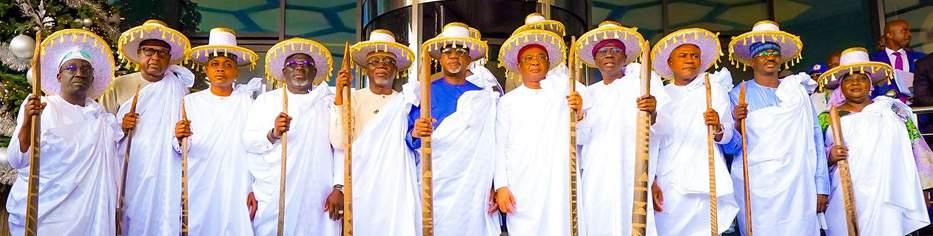
PROGRESSIVE GOVERNORS…
Adedayo Akinwale in Abuja and Yinka Kolawole in Osogbo
Blue Economy
former Osun State Governor,
L-R: Governors: Monday Okpebholo (Edo); Biodoun Oyebanji (Ekiti); Usman Ododo (Kogi); Sheriff Oborevwori (Delta); Lucky Aiyedatiwa (Ondo); Dapo Abiodun (Ogun); Hope Uzodimma (Imo); Babajide Sanwo-Olu (Lagos); Peter Mbah (Enugu); Ahmad Aliyu (Sokoto); and Deputy Governor of Kaduna State, Dr. Hadiza Sabuwa Balarabe, during the
Eko Hotels and Suites, Victoria Island, Lagos…yesterday
CAC Announces January Clampdown on Unregistered PoS Operators to Curb Fraud
James Emejo in Abuja
The Corporate Affairs Commission (CAC) has issued a stern warning to Point-of-Sale (PoS) operators nationwide, announcing a general enforcement campaign against businesses operating without proper registration.
In a statement issued yesterday on its Instagram page, the commission said it had observed an increase in
the number of PoS operators running without registration.
The CAC had earlier threatened a clampdown on PoS operators' activities in 2024, a move the operators opposed.
In its latest statement, the CAC said the rising number of unregistered PoS operators was a clear violation of the Companies and Allied Matters Act 2020, as well as the Central Bank of Nigeria’s Agent Banking Regulations.
The CAC accused some fintech companies of enabling this trend by onboarding unregistered agents, a practice it described as reckless and dangerous to Nigeria’s financial system.
It warned that such activities expose millions of Nigerians, including small business owners and rural communities, to economic and investment risks.
The commission stated that beginning January 1, 2026,
no PoS operator would be allowed to conduct business in Nigeria without completing full CAC registration.
“Effective 1 January 2026, no PoS operator will be allowed to operate without CAC registration. Security agencies will enforce nationwide compliance. Unregistered PoS terminals will be seized or shut down by security officials.
“Fintechs enabling illegal operations will be placed on
the watchlist and reported to the CBN. All operators are advised to regularise immediately. Compliance is mandatory,” the statement read in part.
Recently, it was reported that the Chairman of the House of Representatives Ad hoc committee on the Economic, Regulatory and Security Implications of Cryptocurrency Adoption and PoS Operations in Nigeria, Olufemi Bamisile, expressed concern over the
APC GOVERNORS BACK TINUBU, DECLARE FULL CONFIDENCE IN PRESIDENT’S SECURITY DRIVE
Segun James
All governors of the ruling All Progressives Congress (APC) have passed a vote of confidence in President Bola Tinubu’s administration, as well as support for his Renewed Hope Agenda and re-election in 2027.
The governors, under the aegis of the Progressive Governors Forum (PGF), threw their weight behind the recent re-engineering of the national security architecture by Tinubu, noting that the safety of citizens’ lives and property remains a non-negotiable obligation of the government. They also called on Nigerians to remain calm in the face of the insecurity challenge, as governments are taking holistic measures to address it.
Governor Babajide SanwoOlu hosted the meeting held in Lagos.
The forum, led by the Governor of Imo State, Senator Hope Uzodimma, issued a communiqué at the end of the meeting, reiterating its confidence in Nigeria’s future as a united, peaceful, and prosperous country.
Members of the Forum, during the meeting, reviewed the security situation across the country, expressing appreciation to President Tinubu for what they called “improved coordination” between Federal, state, and local security structures, as well as the courage and sacrifices of security agencies and community volunteers.
The APC governors hailed the president’s handling of
has slowed the pace of its monthly output increases amid concerns of a supply glut. Many members are running close to capacity limits and some are tasked with extra cuts to compensate for earlier overproduction, limiting the impact of further increases.
Under an agreement by eight OPEC+ members covering November output, the five of them that are OPEC members - Algeria, Iraq, Kuwait, Saudi Arabia and the UAE - were to raise output by 85,000 bpd before
security challenges, noting that the re-engineering of the country's security architecture was in order.
Reading the communiqué, Governor Uzodimma said the PGF resolved to support the president’s effort by continuing to strengthen community-based security initiatives, intelligence gathering, conflict-prevention mechanisms, and support for victims of violence and disaster.
The communiqué read: “The Forum reviewed the security situation across the country and expressed appreciation for the improved coordination between federal, state, and local security structures, as well as the courage and sacrifices of security agencies and community volunteers. We then resolved to strengthen the regional security architecture in all the member states.
“The Forum commended Mr. President for the ongoing re-engineering in the security architecture of the country. Governors reiterated that the safety of lives and property remains a non-negotiable obligation of government. We resolved to continue strengthening communitybased security initiatives, intelligence gathering, and conflict-prevention mechanisms, while supporting victims of violence and disaster.”
PGF undertook a review of the country's political, economic, and social environment, noting that reforms must focus on improving lives, protecting citizens’ dignity, and expanding opportunities for Nigerians.
The forum hailed the president on his commitment
the effect of compensation cuts totalling 140,000 bpd for Iraq and the UAE.
The survey showed that the actual increase by the five was 40,000 bpd.
Iraq posted lower exports, according to data and sources in the survey, due to pipeline maintenance.
In Nigeria, a fire on the Yoho production platform and its resulting shutdown helped lower shipments.
Estimates of output in Iraq and the UAE varied widely, with many outside sources
to stabilising the economy and laying the foundations of sustainable growth through the Renewed Hope Agenda.
Uzodimma said:
“Recognising the temporary burdens that accompany necessary macro-economic reforms, the Forum reviewed the state of the economy and the cost-of-living pressures being experienced by citizens.
“Governors acknowledged the resilience and patience of Nigerians and expressed deep appreciation for the sacrifices being made in the collective interest of a stronger and more inclusive economy.
“We resolved to intensify state-level interventions in areas such as food production and distribution, support to small and medium-scale enterprises, youth employment, social protection for the poorest and most vulnerable, and targeted relief for workers and low-income households.
“The progressive governors are committed to working closely with Federal institutions and local governments to ensure that things keep improving, that no group is left behind, and that the gains of reforms continue to translate into visible improvements in the quality of life of the people.”
The forum noted the critical importance of infrastructure, urban renewal, and rural development in driving productivity, attracting investment, and improving living standards.
The governors commended Lagos State, notably, for its pioneering role in transport reforms, urban regeneration,
putting the countries' output higher than the countries themselves.
While the Reuters survey and data provided by OPEC's secondary sources showed they are pumping close to the quotas, other estimates, such as those of the International Energy Agency (IEA), said they are pumping significantly higher volumes.
Meanwhile, oil prices edged up nearly 1 per cent to a twoweek high at the weekend on increasing expectations that the U.S. Federal Reserve will cut
and innovative financing models, and agreed to deepen peer-learning and inter-state collaboration in these areas.
The PGF resolved to scale up investments in roads, housing, public transport, water and sanitation, digital connectivity, and climateresilient infrastructure, with a focus on inclusion and access for all communities.
It emphasised that infrastructure must be designed and delivered in a manner that is socially just, environmentally responsible, and responsive to the needs of the youth, women, persons with disabilities, and other often-marginalised groups.
Uzodimma said: “The Forum reiterated that effective local governance is central to delivering the Renewed Hope Agenda at the grassroots. Governors resolved to deepen reforms aimed at improving transparency, accountability, and service delivery in local government administration, within the framework of the Constitution and in partnership with relevant stakeholders.
“We agreed to expand platforms for citizen engagement, including town hall meetings, consultation with traditional and religious leaders, civil society, labour, professional bodies, youth, and women's groups.
“The Forum affirmed that listening to the people, explaining government policies clearly, and adjusting implementation strategies based on feedback are essential to building trust and sustaining democratic legitimacy.”
interest rates next week, which could boost economic growth and energy demand, as well as geopolitical uncertainty that could limit supplies from Russia and Venezuela.
Brent futures rose 49 cents, or 0.8 per cent, to settle at $63.75 per barrel, while U.S. West Texas Intermediate (WTI) crude rose 41 cents, or 0.7 per cent, to settle at $60.08.
Those were the highest closes for both crude benchmarks since November 18. For the week, Brent was up about 1 per cent and WTI was up
increasing fraud linked to PoS operations and the infiltration of unlicensed crypto-related activities in the sector.
The lawmaker said his committee had received multiple reports of unprofiled agents, cloned terminals, anonymous transactions, and weak Know-Your-Customer practices, which he warned are putting Nigerians at serious risk of financial loss, cybercrime, and security breaches.
The forum also reiterated its unwavering loyalty to the APC, commending the party's leadership for its efforts to strengthen internal democracy, discipline, reconciliation, and inclusiveness.
The governors pledged to continue playing a stabilising role within the party while ensuring the APC remained focused on delivering on its mandate.
“The forum reaffirmed its full support for President Bola Ahmed Tinubu's Renewed Hope Agenda and the policies of APC governments at all levels. PGF emphasised that Progressive Governors see themselves as trustees of the people's mandate and as a committee of leaders jointly responsible for translating the aspirations of Nigerians into tangible social and economic outcomes across the federation.”
The forum underscored the importance of social cohesion, inter-faith harmony and interethnic understanding, urging leaders to use their voices and platforms to promote unity, moderation and respect, while isolating criminality and hate speech in all its forms.
Speaking during the closing session of the two-day meeting, Sanwo-Olu described their deliberations as a reaffirmation of loyalty to the APC and commitment to President Bola Tinubu’s Renewed Hope Agenda.
He said he was grateful that all governors created time to participate fully in the meeting, adding that the depth of discussions reflected their
about 3 per cent, marking a second straight weekly gain for both contracts.
Investors digested a U.S. inflation report and recalibrated expectations for the Fed to reduce rates at its December 9-10 meeting. U.S. consumer spending increased moderately in September after three straight months of solid gains, suggesting a loss of momentum in the economy at the end of the third quarter as a lackluster labor market and the rising cost of living curbed demand.
Traders have been pricing in
dedication to strengthening governance.
“I want to sincerely thank my colleagues for staying through more than 12 hours of rigorous discussions.
“It is never easy, but you all showed exceptional commitment to the progress of our nation,” he said.
The governor praised the unity displayed by the governors, saying their solidarity and cultural representation sent a strong signal of harmony.
“You came prepared, you represented your states beautifully, and Lagos is proud to host you.
“People back home will ask you for this cultural experience because you truly showed what unity in diversity means,” he said.
Sanwo-Olu announced that Lagos would host its first cultural festival in nearly a decade, on December 27, promising an event that would showcase the state’s heritage.
“This year, about 10,000 of our people will proudly wear the festival uniform.
“We are excited to revive this tradition and grandly celebrate our culture,” the governor said. He commended the governors for dedication to improving the welfare of Nigerians.
“For the past 12 hours, we have asked ourselves tough questions: How do we better the lives of our people?
”How do we support our president and strengthen our country by supporting the national agenda?”
an 87 per cent chance that the Fed will lower borrowing costs by 25 basis points next week, according to CME Group's FedWatch Tool. Separately, top Chinese and U.S. officials held a call on Friday to discuss trade, including ongoing efforts to implement an agreement to their trade war.
U.S. President Donald Trump said he will meet with the leaders of Mexico and Canada to discuss trade issues on Friday after they gathered in Washington for the 2026 World Cup draw.
DIPLOMATIC VISIT…
L-R:
Too Much Visibility of Military in Internal Security Not Good for Democracy, Ex-IG, Ehindero Warns
The former Inspector General of Police, Mr. Sunday Ehindero, has expressed strong reservations over the persistent deployment of the military in internal security operations, explaining that excessive visibility of military personnel is unhealthy for democracy.
He advised the federal government to restrict the military to its statutory mandate of protecting the nation’s territorial integrity.
He further recommended that the military be deployed to secure the nation’s porous borders in order to prevent transnational criminal elements from entering the
country through land borders.
While commending President Bola Tinubu for the recent changes in service chiefs, the appointment of a new Minister of Defence, and the nomination of ambassadors, Ehindaro called for a total recalibration of the nation’s security architecture.
Speaking at the unveiling of two biographies of former Inspector General of Police, Usman Alkali Baba, titled: ‘Giant Footprints and A Policeman Personified,’ Ehindero said: “I would say, lastly, that the security architecture of this country needs to be recalibrated. With apologies to the military that is here, too much military visibility in a democracy is
NAF Pilots Survive as Trainer Jet Crashes in Niger
Linus Aleke in Abuja
Two Nigerian Air Force (NAF) Alpha Jet pilots narrowly escaped death yesterday after safely ejecting from their aircraft following an in-flight emergency during a post-inspection functional check flight at the NAF Base in Kainji, Niger State.
The pilots were said to have expertly manoeuvred the jet away from populated areas before ejecting, a decision that prevented civilian casualties.
NAF spokesperson, Air Commodore Ehimen Ejodame, who confirmed the incident in a statement, said the aircraft developed an emergency shortly after take-off, prompting the pilots to act swiftly and with remarkable composure.
“They expertly manoeuvred the aircraft away from populated areas before executing a safe ejection,”
he said.
Ejodame revealed that the two pilots are currently undergoing routine medical evaluation at a NAF health facility.
He said the Chief of Air Staff (CAS), Air Marshal Sunday Aneke, praised the pilots for their courage, discipline and sound judgement, which prevented loss of life.
“He has also directed the immediate constitution of a Board of Inquiry to investigate the incident,” he said.
Ejodame reassures the public of NAF’s unwavering commitment to stringent safety standards and operational excellence.
“The NAF remains dedicated to safeguarding its personnel while protecting the lives and property of citizens in line with its constitutional mandate,” he said.
not good.
“We should praise them for the work they are doing. They are doing a marvellous job. It is not their fault. They should concentrate more on our borders to prevent these miscreants from coming into the country.
“And that is what our Constitution says: territorial integrity must be maintained and protected.”
He added, “The recent steps taken by the government are not only opinion-oriented but indicate
that the government is a listening one.
“I refer to the recent change in service chiefs, the appointment of ambassadors, and the intended recruitment of 30,000 policemen and 20,000 military personnel.
“Even though I regret that no policeman was mentioned as an ambassador, retired or serving. I remember that AIG Abubakar from Gombe served as an ambassador.
“For the last 30 years of my life, I have been against the establishment of State
Police. I said we were not ready. However, this time, when I saw the deal for this establishment, with checks and balances on the powers of governors, I embraced it.”
Earlier, the immediate past Inspector General of Police, Usman Alkali Baba, applauded President Bola Tinubu for ordering the withdrawal of police officers attached to undeserving personalities.
He said: “I am profoundly grateful to President Bola Ahmed Tinubu for his
consistent action directed at restoring the dwindling police primacy in the internal security architecture.
“The recent Presidential Order again made this manifest on the withdrawal of police personnel attached to undeserving personalities.
“As far as my memory serves me, this is the first time that such an order will emanate directly from a sitting president. We tried to do it as IGs, but we could not make it happen. Let us see how this one will work.”
Shettima: Governance Must Deliver Grassroots Prosperity for All Nigerian Households
Launches N1bn family business grant initiative in Akwa Ibom
Deji Elumoye in Abuja
Vice President Kashim Shettima has launched a N1billion naira family-based business grant initiative in Ukanafun/Oruk Anam Federal Constituency of Akwa Ibom State, describing the programme as a model for translating democratic promises into tangible economic empowerment at the grassroots level.
Speaking at the launch of the Renewed Hope/ARISE Agenda grant programme yesterday, Shettima noted that sustainable national development requires empowering citizens to become active participants in economic reconstruction.
"There is greater honour in empowering a man to create than in offering him a fleeting
According to him, the administration of President Bola Tinubu is committed to interventions that directly uplift households and stimulate inclusive growth.
Nenadi Usman Bloc
gift. True empowerment endures because it teaches the mind to search for its own doors, its own pathways, and its own opportunities," the vice president said.
The initiative, conceived by the member representing Unyime Idem of Ukanafun/ Oruk Anam Federal Constituency in the House of Representatives, Hon Unyime Idem, provides seed capital directly to families to establish or expand small enterprises.
Moves
Shettima said the
programme exemplifies President Tinubu's Renewed Hope Agenda priorities, which include economic empowerment, job creation, support for micro, small and medium enterprises, poverty reduction, and expanded social protection.
He said: "This gathering aligns with the principle that democracy works when the dividends promised by us reach families at the grassroots, uplift our communities, and expand opportunities for all.
to Reorganise LP, Files State Lists with INEC, Begins Mass Registration
Chuks Okocha in Abuja
The Labour Party’s long-running internal restructuring took a decisive step forward yesterday as the faction led by Senator Nenadi Usman submitted to the Independent National Electoral Commission a fresh list of Interim State Working Committees covering 32 states and the Federal Capital
Territory. The move, delivered to the commission on December 6, follows the party’s constitution and the resolutions adopted at its Statutory National Executive Committee meeting in Abuja last July. This gathering sought to steady the ship after months of turbulence.
In a statement issued by the Interim National Publicity
Secretary, Ife Salako, the party disclosed that the lists for Ondo, Ekiti, Niger, and Kwara were still being harmonised. Local frictions in these states, Salako explained, required “further internal engagements,” and members were encouraged to stay patient as leaders work through the lingering disagreements that had slowed consensus.
The submission to INEC is part of a broader reset within the party as it races to rebuild its organisational muscle ahead of the 2027 general election. To that end, the Labour Party has also formally notified the commission of the constitution of a National Steering Committee on Membership Revalidation and New Registration.
Linus Aleke in Abuja
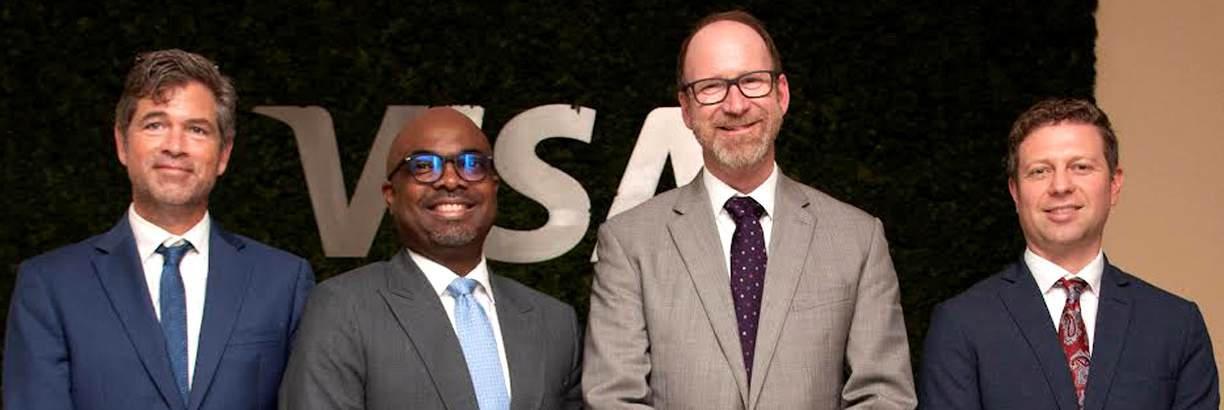
Political and Economic Chief, US Consulate General, Lagos, Nigeria, Mr. Mike Ervin; Vice-President/Cluster Head, Visa West Africa, Mr. Andrew Uaboi; US Consul General, Mr. Rick Swart; and Commercial Attaché, US and Foreign Commercial Service, Mr. Blake Murray, during Swart’s visit to Visa West Africa in Lagos…recently
with FirstGem Loan
Calling on all female go-getters, whether you’re building your dream or ready to level up, this offer is made just for you.
Benefits:
Affordable interest rate of 9%
Convenient & easy repayment structure
Zero collateral required
Don’t have a FirstBank account?
No worries! Just provide your 1-year bank statement
Scan here to know more.
Terms and conditions apply!
KEEP THE AWARDS COMING…
Emefiele, Malami, Buratai Deny Terrorism Financing Allegations, Say
Wale Igbintade
Former Governor of the Central Bank of Nigeria (CBN), Mr. Godwin Emefiele; former Attorney-General of the Federation and Minister of Justice, Abubakar Malami (SAN); and former Chief of Army Staff, Lt.-General Tukur Buratai (rtd), have all dismissed insinuations that they are connected to terrorism financing.
While Emefiele described the allegation as reckless, mischievous, and entirely fabricated, Malami said it was baseless, misleading, and politically motivated, and Buratai said it was fabricated. An online news platform had on Friday mentioned the names of the trio in connection with allegations of terrorism financing and “links” to persons described as terror suspects or alleged
financiers.
In a statement, Emefiele said the report was designed to malign his name and mislead the public.
He insisted that he had never, whether in office or in his private life, engaged in any activity remotely connected to terrorism or actions that could undermine national security.
“The allegation is baseless, misleading, and crafted purely
Claim Fabricated
to sow confusion for motives best known to its authors and their sponsors,” he said.
“The fight against terrorism is too important to be trivialised by irresponsible reporting, and Nigerians deserve better than such reckless misinformation,” the former CBN boss stated.
He maintained that “there is no scintilla of truth” in the report, stressing that it was the handiwork of “misguided
Ndume Urges Tinubu to Withdraw Ambassadorial List, Says It Breaches Federal Character Principle
Sunday Aborisade in Abuja
Ahead of this week’s Senate screening of the 65 ambassadorial nominees appointed by President Bola Tinubu, Senator representing Borno South, Ali Ndume, has appealed to the president to withdraw the list, insisting it breaches the federal character principle.
Ndume, a former Senate Leader and Chief Whip,
argued that the allocation of nominees across states and geopolitical zones falls short of the constitutional requirement for fair representation in the federal government.
In a statement issued in Abuja, the lawmaker warned that allowing the list to pass could deepen ethnic suspicion at a time when the administration should be consolidating national unity.
He highlighted disparities in the distribution of nominees, noting that while some states have 3 or 4 slots, others have none. He also cited the inclusion of Senator Adamu Garba Talba from Yobe, who reportedly died in July.
“The entire North-east state has seven nominees in the list. Further checks revealed that the South-west geo-political zone has 15
nominees, while North-west and South-east have 13 and 9, respectively.
North-central region has 10 nominees in the list of career and non-career ambassadorial nominees, while South-south parades 12 nominees,” Ndume said. He warned that such imbalances could heighten tensions and undermine Section 14(3) of the Constitution.
Police Deploy Special Team to Enforce Tinubu’s Ban on VIP Escorts
The Nigeria Police Force (NPF) has deployed a Special Enforcement Team to ensure full compliance with President Bola Tinubu’s directive prohibiting the use of police personnel for Very Important Persons’(VIPs) escort and guard duties. In a statement released yesterday via the Force’s X handle, the Force Public Relations Officer, CSP Benjamin
Hundeyin, said the team commenced a statewide monitoring operation in Lagos on December 6, 2025, beginning at about 10:00 am. He disclosed that the exercise covered key locations, including the Lekki-Ikoyi Link Bridge, the domestic wing of the Murtala Muhammed International Airport, and other strategic points across the state.
Hundeyin said the monitoring revealed
“satisfactory and commendable” adherence to the presidential order, noting that no cases of unauthorised deployment of police escorts were observed and no arrests were made.
The statement added, “The Inspector-General of Police, IGP Kayode Adeolu Egbetokun, Ph.D., NPM, reiterates the Force’s commitment to the full implementation of the presidential directive. The Nigeria Police Force remains
resolute in redeploying its personnel to core policing duties aimed at enhancing general security, crime prevention, and the protection of lives and property across the country.”
Hundeyin assured the public that the policy would continue nationwide “without fear or favour” and urged citizens to support efforts to build a more efficient, professional, and people-centered policing system.
elements driven by despicable motives.”
While urging the public to disregard the story in its entirety, Emefiele also cautioned media organisations against publishing unverified claims without evidence or due diligence.
Also, Malami, in his statement, described the claim as “unfounded, unfair and contrary to both my record in public office and objective facts.”
The AGF stressed that he had never been accused, invited, interrogated, or investigated by any security, law-enforcement, or intelligence agency within or outside Nigeria
on terrorism financing or any related offence.
On his part, Buratai, in a statement signed yesterday on his behalf by the former Army spokesperson, Brig.-General Sani Kukasheka Usman (rtd), said the insinuation was also inconsistent with facts, and fundamentally at odds with his values and lifelong commitment to defending the country against terrorism. Buratai, who is also a former Ambassador to the Benin Republic, described such allegations as “false, unfounded, mischievous, and amount to a smear campaign deliberately designed to tarnish his name and reputation.”
Use Money for Rolls-Royce to Build Industries Instead, Dangote Tells Luxury Car Owners
Sunday Ehigiator
The President of Dangote Group, Aliko Dangote, has urged wealthy Nigerians to divert funds spent on luxury items such as Rolls-Royce cars and private jets into building industries that can boost job creation and stimulate economic growth.
In a recent interview clip shared online, Dangote lamented the growing culture of extravagant spending among the elite, saying the country’s development depends on local investors taking responsibility.
“If you have money to buy a Rolls-Royce, you should take that money and go put up an industry in your locality or any part of the country where there is a need,” Dangote said.
“It pains me sometimes when I go to the local airport, whether it is here or Lagos.
You even find a parking lot
— everybody has a private jet. Those private jets should be in industries so we can create jobs.”
Dangote noted that Nigeria’s rapidly growing population demanded urgent action from both the government and the private sector.
“Some people do not know the population of the country as we speak, but the growth rate is 7.8 million babies in a year. We have to deliver many things like power and infrastructure,” he said.
Despite describing taxation as heavy, the African richest man maintained that businesses must meet their obligations to support the nation’s development.
“For a company like ours, the tax that we pay is too much, but we do not mind, because if you open a company in this country, the number one shareholder is the government,” he said.
Linus Aleke in Abuja
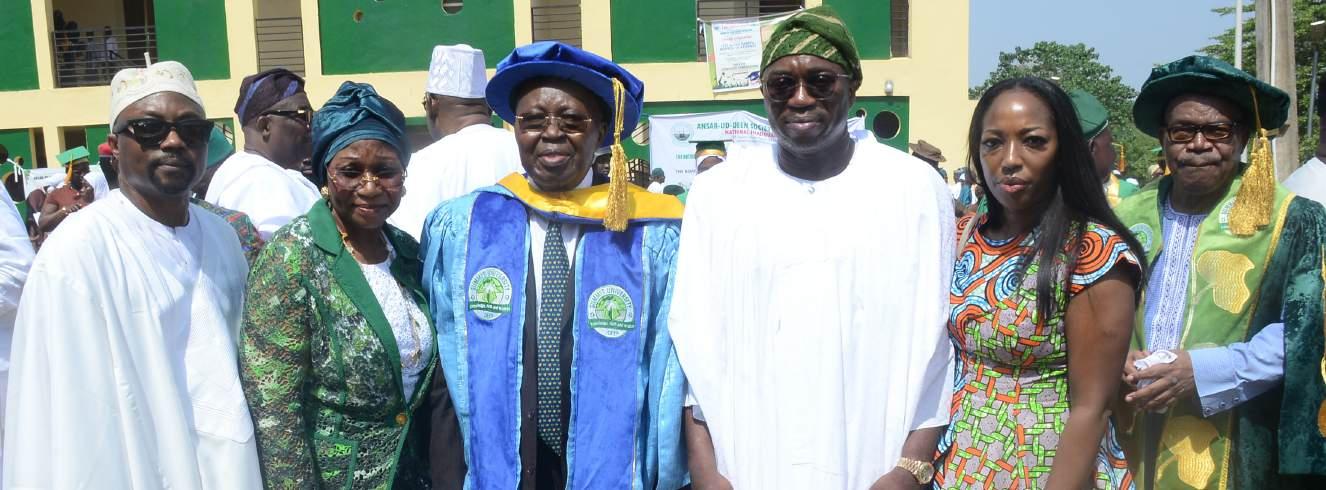
L-R: Mr. Adeniyi Makanjuola; Wife of the Awardee, Alhaja Lateefat Yoyinsola Makanjuola; Awardee and Chairman, Caverton Offshore Support Group, Dr. Aderemi Makanjuola; Chief Executive Officer of COSG, Mr. Olabode Makanjuola; his wife, Mrs. Moyo Makanjuola; and Pro-Chancellor/Chairman, Governing Council, Summit University, Offa, Alhaji Rafiu Adisa Ebiti, during the conferment of Honorary Doctorate on Makanjuola at the fifth and sixth Combined Convocation of Summit University, Offa, Kwara State... yesterday .
AREWA CONSULTATIVE YOUTH MOVEMENT
6th December, 2025
PRESS STATEMENT
Ar ewa Consulta tive Youth Movement leadership joins Calls for For ensic Investiga tion of F1RS, RHIDF, Zack Adedeji, Demands FIRS Chair man's Tempor ar y Step-Aside over unconstitutional activities, joins Dec 15th Action
The Arewa Youth Movement (AYM) wishes to lend its voice to the growing national concer n regarding the F ederal Inland Revenue Ser vice (FIRS) and the conduct of its Chair man, Mr. Zacc h Adedeji. In recent weeks, m ultiple allegations and troubling questions have emerged concer ning his unexplained lifestyle patter ns and the processes surrounding the disbursement of taxpayers' funds under his stewardship.
While we ac knowledge that all allegations remain subject to verication, the gravity of the issues raised and their- implications for public tr ust demand an immediate and thorough forensic investigation by relevant anti-corr uption and oversight institutions.
As responsible stakeholders committed to transparenc y, accountability, and good gover nance, the Arewa Youth Movement hereby calls for Mr. Adedeji to step aside temporarily to allow an unhindered and credible investigative process. This step is necessary not only to protect the integrity of the ofce he occupies but also to restore condence among Nigerians who rightfully expect the highest standards from those managing the nation's revenue.
Our position does not presume guilt. Rather, it reinforces the principle that public ofce holders m ust be above suspicion and willing to subject themselves to scr utiny whenever legitimate concer ns arise.
In the coming days, after fur ther consultations, the Arewa Youth Movement shall proceed with a for mal Vote of No Condence should these concer ns remain unaddressed or if appropriate steps are not taken by the authorities.
Nigeria deser ves institutions built on transparenc y and leaders whose actions strengthen-not under mine-public tr ust. We stand r mly on the side of accountability and national interest.
Malom Kabiru Yusuf Arewa Consultative youth Movement President.
Editor: Festus Akanbi
08038588469 Email:festus.akanbi@thisdaylive.com
Inside the Senate’s Fierce Battle Over Nigeria’s Sugar Drink Tax
The nation’s push to overhaul its sugarsweetened beverage tax has exploded into a high-stakes national tussle, pitting urgent health warnings against the survival anxieties of a battered manufacturing sector, writes Festus Akanbi
ThemoodintheNationalAssembly has shifted in recent weeks, sharpening into a combative, data-laden contest over one of Nigeria’s most consequential fiscal health proposals in years: the restructuring of the sugarsweetened beverage (SSb) tax.
What began as a routine amendment to the Customs and Excise Tariff (Consolidation) Act has swelled into a national referendum on the boundaries of taxation, the economics of survival in a distressed manufacturing climate, and the urgent public-health warnings surrounding Nigerians’ changing diets.
Consultations behind closed-door consultations and in public hearings that drew huge crowds, senators, ministers, manufacturers, doctors, economists, and civil-society actors wrestled with the central question: should Nigeria replace the flat N10per-litre excise with a percentage-based levy of at least 20 per cent of retail price, as recommended by the World Health Organisation? The proposed regime would also, for the first time, earmark a portion of the revenue for health-promotion programmes that have long been starved of funding.
The Senate’s Joint committees on Finance and Customs and Excise opened the floor, and the arguments that followed showed the depth of the divide. Health advocates anchored their case on epidemiological trends that they say have reached an inflection point. Manufacturers countered with economic data that paints a picture of an industry staggering under the weight of inflationary shocks, currency volatility, energy crises, and consecutive rounds of tax escalation.
Rising Health Conditions
For supporters, the stakes are clear. Noncommunicable diseases, once a footnote in Nigeria’s health profile, now account for roughly 29 per cent of all deaths, according to global health estimates, with obesity, diabetes, and cardiovascular conditions rising steadily across urban and semi-urban communities.
Sugary beverages, they argue, have become one of the cheapest, most widely consumed vectors of excess sugar, especially among low-income households and young people. According to the Federal ministry of Health, consumption of SSbs has expanded significantly in the past decade, coinciding with a rise in preventable lifestyle diseases that impose heavy financial burdens on families and on the national health budget.
Some brands of sugar-rich beverages
but opponents of the bill insist that the conversation cannot be divorced from Nigeria’s brutal macroeconomic realities. The manufacturers Association of Nigeria (mAN) entered the hearing with pointed reservations. Its representative, mr. Adeyemi Folorunsho, argued that the health narrative exaggerates Nigeria’s sugar-consumption profile.
Using per-capita consumption comparisons, he said Nigerians consume far less sugar, less than 10 kilograms per person annually, relative to countries where SSb taxation has proven more impactful, some of which exceed 30 kilograms per capita. On that basis, he warned, a steep retail-price tax would miss its health target while crippling a sector that employs thousands and drives a long value chain spanning packaging, logistics, distribution, and petty retail. beyondconsumptiondata,mANpointed to the cascading pressures already weighing on producers. Factory-input costs, according to industry submissions, have risen by an estimated 40 to 60 per cent in the last year alone, driven by energy tariffs, diesel inflation, foreign-exchange constraints, and higher logistics costs. beverage prices, manufacturers noted, have already climbed by 200 to 300 per cent since 2021 due to successive excise adjustments and rising operating expenses. Another tax shock, they warned, could push companies to scale down production or exit the market entirely.
The Abuja chamber of commerce and Industry bolstered its economic argument with employment figures. Up to 1.5 million jobs, both formal and informal, are linked to the SSb industry, including bottling plant workers, suppliers, transporters, wholesalers, street vendors, and kiosk operators. In a climate where market confidence is fragile and credit costs are rising, AccI President, Dr. emeka Obegolu, urged caution, arguing that poorly sequenced taxation risked driving more businesses underground or into insolvency.
Deepening Uncertainty among Investors
The centre for the Promotion of Private enterprise added a procedural critique to the mix. Its director, Dr. muda Yusuf,
questioned why the review was being driven by the health ministry rather than the finance ministry, which traditionally coordinates exciserate policy.
He warned that a sector-targeted tax without broader inter-ministerial alignment could deepen uncertainty among local and foreign investors at a time when the manufacturing sector is already shrinking in real terms. The group urged senators to consider alternative interventions, such as improved food labelling, national fitness campaigns, and industry-led sugar-reduction reformulations, rather than relying on taxation as a blunt behavioural-change instrument.
Opponents also noted that sugar consumption in Nigeria extends beyond beverages to bread, pastries, baby food, confectionery, and carbohydrate-dense staples. Singling out SSbs, they said, created an inequitable policy landscape that risked distorting competition while failing to address the broader dietary drivers of disease.
Yet, as the debate broadened, the health lobby mounted a forceful, data-grounded push of its own. The minister of Health, Prof. Ali Pate, positioned the bill within a national health-security framework. He noted that while the N10 per litre tax introduced in 2021 had initial promise, runaway inflation, now hovering in the 20 to 30 per cent band, has eroded its deterrent value and diminished its fiscal relevance. A soda that once sold for N150 now retails between N300 and N450, rendering the fixed levy ineffective. by WHO standards, only a retail price tax of at least 20 per cent has a measurable impact on consumption and industry reformulation.
Pate stressed that part of the SSb revenue would be earmarked for preventive care, an investment he described as critical in a country where outof-pocket spending accounts for more than 70 per cent of total health expenditure. With noncommunicable diseases now costing Nigerian households billions in treatment expenses every year, he argued that the tax reform is less about penalising consumers and more about securing long-term health financing. civil-society organisations reinforced the point with even more aggressive recommendations. corporate Accountability and Public Participation Africa urged senators to adopt a 50 per cent retail price tax, or, at a minimum, the 20 per cent WHO benchmark.
cAPPA referenced global studies indicating that substantial SSb taxes can reduce consumption by up to 24 per cent within two years, while
incentivising producers to reformulate products with lower sugar content. The organisation also advocated the creation of a national monitoring and evaluation task force to ensure transparency, track health outcomes, and adjust rates based on evidence.
The Diabetes Association of Nigeria added urgency to the discourse. With national diabetes prevalence now estimated at around seven per cent, and with treatment costs rising, the association argued that the fiscal measure was overdue.
Far from shrinking revenue, it said, a percentage-based tax could grow SSb tax proceeds by up to 200 per cent, funds that could be redirected into preventive screening, education campaigns, and non-communicable disease clinics nationwide.
Inside the hearing room, lawmakers listened keenly, though subtle cues suggested where the pendulum might tilt. A representative of the Senate President, Senator Adeniyi Adegbomire, described the reform as a “strategic health investment” rather than a conventional excise revision.
While emphasising that the intention was not to compound economic hardship, he argued that Nigeria could not continue operating on outdated fiscal structures that no longer align with either monetary or health realities.
The Ministry of Finance offered cautious endorsement, reminding senators that the president retains statutory authority to vary rates, but confirming that a more exhaustive review of SSb and alcoholic-beverage taxes is underway.
The clash, at its core, is a familiar one: the tension between industrial continuity and societal well-being. manufacturers warn that the proposed levy could threaten jobs, shrink output, and dampen competitiveness in a period of economic fragility. Health advocates counter that the cost of inaction is far steeper, measured not in factory closures, but in rising morbidity, household medical bankruptcies, and the long-term fiscal strain of an overburdened health-care system.
both sides cite data. both invoke global precedents. both warn of unintended consequences. And both accuse the other of overlooking the bigger picture.
As the Senate moves towards harmonising the competing proposals, the question remains whether Nigeria can strike a middle ground, one that preserves industrial viability while confronting a public-health crisis that grows more visible by the day.
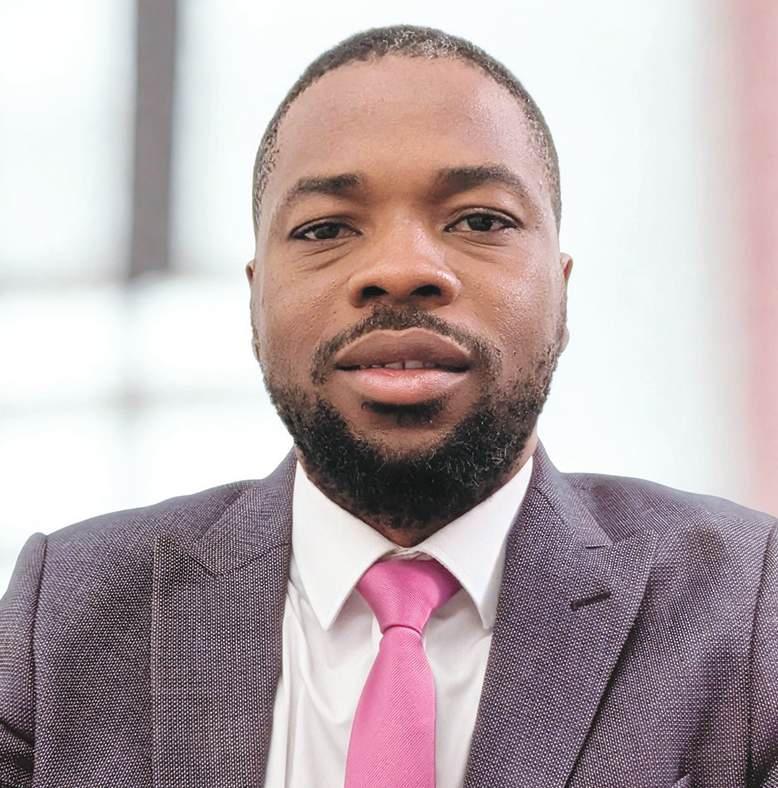
Samuel Ngadi:
AI is Not a Job-stealing Robot, It’s a Force Multiplier
Samuel Ngadi is a Customer Success Leader with 15 years of experience bridging technology and financial markets across EMEA, including the UK, Nigeria, and Ghana. He has driven the adoption of institutional trading and analytics platforms at Thomson Reuters (FXall), Refinitiv, London Stock Exchange Group, and Moody’s Analytics—supporting banks and financial institutions through currency-trading system launches and market-data rollouts. Ngadi specialises in translating complex software platforms into operational value for traders, analysts, and portfolio managers. In this interview with THISDAY, he says his focus is on unlocking access for Nigeria’s informal economy through AI and data-driven innovation, bridging the gap between untapped entrepreneurs and the formal economy
You’ve built a career that spans Nigeria, the UK, and the wider EMEA region.Howwouldyou describetheimportance ofyourworkinhelping financialinstitutionsrun efficiently?
Customer success in financial markets is about collapsing the distance between software capability and user value. My work bridges traders, portfolio managers, and analysts - all the professionals that rely on financial technology - with the tools they need to make faster, sharper decisions. Markets run on data access, workflow automation, and trust. By ensuring seamless adoption of platforms and technologies, I’ve helped institutions accelerate decision-making, eliminate operational friction, and stay competitive. It’s not abstract; it directly translates to better capital allocation, improved spreads, and institutional resilience. Technology is only valuable if it effectively reaches the trading floor or financial markets. Lookingbackatyourearlyexperiences, what key moments or influences pushed youtowardsolvingsignificantchallenges intechnologyandfinancialservicesystems?
Meeting Phil Weisberg back in 2012 and understanding FXall’s disruption of institutional FX trading showed me that technology reshapes power dynamics in markets. When Thomson Reuters, a company I worked for, acquired FXall in 2012, it proved that scale wins. Reading the book Flash Boys by Michael Lewis crystallised something crucial: microsecond variations in technology translate to real economic effects. Locally, watching NAFEX’s launch in 2017—and the CBN’s adoption/unification of it as the official rate in 2021 felt pivotal; it basically ‘platformed’ the parallel market, drove transparency, and ended off-system transacting. What these three events have in common is that they showed me in different ways how software systems don’t just improve efficiency; they democratize market access.”
Growth mindset and curiosity. Technology evolved from on-site systems to cloud platforms, but the core challenge remains: helping humans adapt. I’ve learned to embrace change and enjoy the learning journey, and I’m always looking to understand ‘why’. That curiosity extends to the technology users: their anxiety about new workflows is real and valid. When we deployed Matching or migrated platforms, I stayed obsessively close to the floor. Enjoying the learning process means treating each rollout as a master class in organisational behaviour, which keeps me ahead and effective. People sense authenticity; they would follow leaders who are genuinely learning too.
includingcurrency-tradingsystems and market-data platforms. What didleadingsuchimpactfulprojects teachyouaboutmanagingcomplex technologyinitiativesinAfrica?
Firstly, I learned to adapt global best practices to local realities—respecting Nigeria’s regulatory nuance while leveraging EMEA playbooks. Onesize-fits-all fails in Africa. Secondly, product launching is 20% technology and 80% ecosystem alignment. My active participation in the roll-out of currency-trading systems in Nigeria and Ghana some years ago taught me that you cannot simply activate a platform. You must build a tripartite partnership: the vendor (product), the users (banks/ treasurers), and the regulator (CBN). Physical presence matters in a digital world. Banks need confidence that audit trails are clean, compliance is assured, and the central bank approves. Success, especially in Africa, requires early and continuous stakeholder buy-in.
What major technology problem inNigeriahaveyoufeltpersonally driventohelpimproveortransform? There is a data desert around activi-
ties in the informal economy. For example, Nigeria’s informal economy accounts for 60-70% of GDP, yet remains very opaque. This is the financial system’s blind spot and biggest whitespace. While formal-sector data gaps are closing, access to credible information on SMEs, traders, and household enterprises remains fragmented. For example, many Banks and many financial lenders today still reject viable borrowers simply because they lack collateral or formal financials. That inefficiency costs the real economy.
You’ve helped organisations adopt AI-powered tools for more intelligent decision-making.Whatdoyouthinkpeople misunderstandmostaboutAI’spotential inAfrica?
AI is not a job-stealing robot; it’s high time we saw it as a force multiplier. The misconception is that GenerativeAI will replace professionals. The reality is Human + AI is a winning formula. Agentic AI technologies have raised the bar, but they amplify human judgment rather than replace it. In Africa, our opportunity is not using AI for writing emails, it’s leveraging Predictive AI to address whitespace challenges like credit scoring the unbanked, Pattern Recognition for detecting fraud, and so on. But the main bottleneck is
not AI capability; it is our data infrastructure. Build solid data systems first; AI becomes the dividend you harvest from that investment. Havingworkedcloselywithinstitutions acrossotherpartsofAfrica,Europeandthe MiddleEast,howdoyouseeNigeria’sdigital progresscomparedtoglobalstandards?What standsouttoyou?
Direct comparison is unfair and lacks context. Nigeria leads Africa materially in mobile adoption, payment innovation, and tech talent. Yet we lag the UK on capital markets depth. Our NIBSS and instant transfers perform better than many international systems; yet post-trade settlement remains fragmented. The elephant in the room that we need to address to start bridging is not talent or vision; it’s legacy operational infrastructure. Our youthful, mobile-first population and our untapped potential are all major advantages too. So I don’t believe we’re trailing per se; we’re just unevenly developed. But that’s an opportunity, not a deficit.
I see the role of regulators as farmers, not gatekeepers. They should continue to encourage the sustainable digitisation of workflows and promote standardisation. Expand Regulatory Sandboxes for new asset classes, not bans. One of the most significant opportunities is encouraging data-sharing agreements between regulated entities. That transparency unlocks many possibilities, such as reducing fraud and deepening markets.
Many people fear that AI will replace jobs.Basedonyourexperience,howshould professionalsandorganisationsinAfricabe preparingforthefutureofwork?
AI will automate processing; humans must make their own judgment. Analysts used to spend 80% of their time cleaning data in Excel; today, that is changing. AI will handle that. Professionals should become translators and AI Usage strategists — people who interpret AI outputs for business strategy, ethics, and risk. The future belongs to those who can combine technical literacy with human judgment and ethical reasoning. Organisations must retrain relentlessly. Those resisting change may not survive.
Some of our biggest challenges on the continent are infrastructure, access to credit, and poverty. Bridging the formal and informal economies will unlock billions in dormant capital for entrepreneurs, traders, and household enterprises. This is transformative because it’s not sci-fi; it’s solvable today with the data available. Access to technology is the cornerstone of economic inclusion in Africa.
• Ngadi
As the world marks International Civil Aviation Day today, Captain evarest nnaji highlights what air turbulence means
It’s turbulent but not Dangerous aVIatIon lInKs as a CatalYst For groWtH
Nigeria’s aviation network is good for the economy, and a bridge between the country’s diverse regions and beyond, reckons DanIel oCHonMa
Nigeria’s expanding international aviation network is emerging as one of the most powerful levers for economic transformation and national cohesion. The recent upgrade of Victor Attah Airport in Uyo to full international status, alongside existing hubs in Lagos, Abuja, Kano, Port Harcourt, Maiduguri, and Enugu, signals a shift away from over-reliance on a single gateway and toward a more balanced distribution of global connectivity.
This evolution creates opportunities that extend far beyond aviation itself, touching agriculture, trade, tourism, diaspora engagement, and infrastructure development.
The economic potential is clear. Regional airports bring international markets closer to local producers, enabling direct exports of crops, textiles, and processed goods without the bottlenecks of Lagos. Leather from Kano, palm oil from the South East, and vegetables from the Middle Belt can now move more efficiently to Europe, North Africa, and beyond. To realize this, agro export processing zones should be established near key airports, with certification and packaging facilities that meet global standards. A “farm to flight” initiative linking cooperatives directly to cargo hubs would ensure that rural producers participate in global value chains.
Tourism is another sector poised for growth. Nigeria’s cultural and natural heritage is vast, but international visitors often struggle to access it. With multiple entry points, curated tourism corridors can be developed: Uyo to Calabar and Arochukwu, Enugu to Nsukka and Onitsha, Kano to Zaria and Kaduna. Airport tourism desks offering packages, combined with airline partnerships to market destinations abroad, would allow Nigeria to showcase its diversity. Visitors flying into Port Harcourt could be offered itineraries that include Niger Delta cultural festivals and the Obudu Cattle Ranch, while those arriving in Enugu could explore Igbo heritage sites.
Logistics and trade will benefit from airports serving as distribution hubs. Warehousing, cold storage, and bonded facilities near airports can transform them into regional logistics parks, integrated with road and rail networks. SMEs in Aba, for example, could export textiles through Port Harcourt International Airport, while Kano’s leather industry could scale exports via its northern hub. Incentives for logistics firms to establish feeder hubs across zones would ensure that the benefits reach smaller businesses.
Education and professional mobility are also enhanced. Direct flights make it easier for students to access universities abroad and for Nigerian institutions to host international conferences. Abuja’s connectivity can be leveraged to build academic partnerships with European and American universities, while Enugu and Uyo can serve as gateways for exchange programs.
Perhaps the most profound impact lies in diaspora engagement. Multiple international gateways reduce the barriers to homecomings, encouraging diaspora communities to invest in real estate, energy, and local enterprises. Diaspora investment forums tied to each hub, “Invest Kano,” “Invest Enugu,” “Invest Uyo”, could channel remittances into structured ventures. Diaspora bonds linked to airport infrastructure projects would provide a mechanism for long-term investment, while
dedicated real estate zones near airports could attract capital from abroad. Infrastructure development will be both a driver and a beneficiary of this transformation. Aviation upgrades demand improved roads, rail links, ICT, and energy supply. Prioritizing feeder roads to airports, expanding renewable energy projects to power airport cities, and deploying ICT hubs near gateways will create multiplier effects across the economy. The Abuja airport rail link is already demonstrating how connectivity can reduce congestion and boost commerce; similar projects should be replicated elsewhere.
The broader national impact is cohesion. By distributing international gateways across regions, Nigeria reduces perceptions of marginalization and ensures that every zone has access to global markets. Enugu strengthens South East integration; Port Harcourt connects the Niger Delta; Kano anchors the North West; Maiduguri links the North East; Lagos remains the financial hub; Abuja consolidates the North Central; and Uyo bridges the South South and South East. Emerging hubs in Cross River and Ogun will further spread opportunities. This balanced distribution fosters inclusion, diversifies tourism flows, integrates diaspora communities, and strengthens unity.
To achieve these outcomes, the federal government must develop a national aviation strategy that integrates airports with road, rail, and ICT infrastructure. In contrast, state governments position their economies to benefit from proximity to hubs. The private sector should invest in logistics parks, agro processing facilities, and hospitality ventures, while diaspora networks channel remittances into structured investment vehicles. Civil society has a role in promoting cultural heritage branding to attract international visitors.
Nigeria’s aviation network is more than infrastructure; it is a catalyst for transformation. By turning airports into engines of agro exports, tourism, logistics, diaspora investment, and infrastructure growth, the country can achieve both economic prosperity and national cohesion. The challenge now is to act decisively, ensuring that every region, from Kano to Lagos, Enugu to Port Harcourt, Abuja to Uyo to Maiduguri, shares in the opportunities that global connectivity brings. This is how aviation can become the bridge between Nigeria’s diverse regions and the wider world, uniting the nation through shared prosperity.
Ochonma, a chartered banker, public affairs analyst, and founder of the Forum for Global Nigerian Professionals, can be reached at Dan. ochonma@gmail.com
As we mark International Civil Aviation Day, it is important to reinforce the fact that aviation remains the most reliable, effective, efficient and safest mode of transportation in the world. Air turbulence may feel uncomfortable, but it is a normal part of flight—one for which aircraft are designed, and pilots are expertly trained.
Air Turbulence remains one of the most misunderstood aspects of air travel. For many passengers, any sudden movement in flight can trigger anxiety. Yet, within the aviation industry, Air turbulence is wellstudied, well-managed, and—contrary to public perception—rarely a threat to the safety of an aircraft.
What Causes Air turbulence?
Air turbulence is caused by rough air pockets encountered during a flight. Rough air pockets are derived from air with poor molecules. When an air pocket contains rich air molecules, the sky is clear and devoid of clouds. Clouds form when atmospheric conditions in a section of the sky collect or attract interference components in the form of moisture, mist, fog, smog, steam, dew, condensation, convection, haze, vapour, etc.
The introduction of any or more of these elements into the atmosphere reduces the molecules in the air and creates visible air pockets known as clouds. Clouds, when formed by the earlier mentioned interference components, then have poor air molecules which, in turn, will not be strong enough to warrant the smooth flow of rich air over an aircraft’s airfoils (wings), thereby causing turbulence.
When clouds form, they contour into different shapes and structures, giving them divergent patterns. Different clouds are named after their shapes and strengths, such as Stratus, Stratocumulus, Cumulonimbus, Nimbostratus, Altostratus, Altocumulus, Cirrus, Cirrostratus etc.
A more troublesome source of air turbulence in flight is thunderstorms.
Thunderstorm is a weather system that includes lightning, thunder, heavy rain, strong winds, and sometimes hail. It can form from large towering cumulonimbus clouds, and can also form rapidly over adiabatic temperature change rate in rising unstable air.
There are four main types of thunderstorms; light, moderate, severe and extreme thunderstorms.
Severe and extreme thunderstorms appear scary and worrisome, but aircraft do not fly through them. Pilots and air traffic controllers avoid them using Radar, Weather reports and Satellite data.
There is also the Clear Air Turbulence (CAT) that can form at any altitude, high or low. CAT has no visible pattern. Therefore, pilots can run into CAT without adequate preparation or forewarning, causing sudden jolting turbulence in flight. But the industry has developed a mechanism known as PIREP which enables the first pilot to encounter CAT, to make a certain immediate pattern of report, letting other aircraft in the route or region to prepare for it.
Aircraft design capability:
Modern aircraft are structurally designed to handle very well all forms of possible air turbulence.
Air turbulence is caused by rough air pockets encountered during a flight. Rough air pockets are derived from air with poor molecules. When an air pocket contains rich air molecules, the sky is clear and devoid of clouds. Clouds form when atmospheric conditions in a section of the sky collect or attract interference components in the form of moisture, mist, fog, smog, steam, dew, condensation, convection, haze, vapour, etc.
Each aircraft model’s wing-structure, at design stage, underwent a benchtest usually stronger than anything such aircraft can ever encounter in real bad weather flight conditions before certification by FAA and or EASA for commercial production and use. This certification is a without-which such model will never fly in America or European airspace, and by extension, the world over.
So, your aircraft may shake, dip, rock and rattle in flight, but will never fall off the sky due to air turbulence. In addition, pilots are trained to navigate air turbulence safely.
How do passengers handle air turbulence?
Realistically the main danger passengers can encounter in air turbulence is the sudden jolts that can cause people to fall, or hit their heads on cabin consoles. Another danger can result in movement within the cabin which can move the center of gravity (CG) limit of the aircraft, depending on the size of aircraft and amount of movement. Such movements can affect pilots control input and judgment causing the aircraft not to respond the way the pilot had mastered it.
But all this can be completely avoided by simply ensuring you are seated with your seatbelt fastened.
So, stay calm, keep your seatbelt fastened, the aircraft is built to withstand it, is the rule of thumb.
So next time your flight encounters turbulence or rough patch of air, remember: It may be turbulent, but it is not dangerous.
Captain Nnaji is both FAA (USA) and NCAA (Nigeria) licensed pilot, and the Group Chairman of OAS Helicopters, a leading conglomerate in Nigeria’s oil and gas aviation sector, as well as an astute businessman and philanthropist.
Styles of Unconstitutional Changes of Government in Africa: The Special Case of Guinea Bissau
The word ‘unconstitutional,’ is, on the one hand, a derivative of the prefix ‘un’, formulated in 1734 and meaning ‘not,’ and, ‘constitution,’ which is coined from a Latin word, ‘constitutus,’ meaning ‘set up,’ or ‘established.’ On the other hand, ‘constitutional’ is also a derivative of ‘constitutus’ and the suffix ‘– ion,’ meaning an act, state, or condition. Etymologically, ‘constitutional’ is about the fundamental or foundational rules or regulations governing the establishment of government and political governance, while ‘unconstitutional’ refers to ‘not established’ or ‘not in accordance with’ the established rules. In this regard, what are the established rules governing how to change government in Africa? When is a change of government unconstitutional? In which ways are the styles of change of government in Europe or America different from the styles of changing government in Africa?
Grosso modo, a change of government can take place in several ways. There is the method of evolutionary shift. There was also the time when there was no democracy and welfare states and the time they came into being. The shifting from predemocracy states to democracy is one style in itself. Secondly, transformation events also enable a change of government. The advent of perestroika (restructuring) and glasnost (openness) in the former Soviet Union prompted changes in government thereafter. The same is true of the beginning of the end of Cold War on 9 November, 1989. End of apartheid in South Africa prompted a fundamental change of government in South Africa in 1994. And also true enough is the democratisation fever introduced by French president, François Mitterrand at the La Baule Franco-African Summit in 2000. President Mitterrand subjected French development aid to democratic governance, implying that all the military dictators could not be eligible for development aid. Additionally, feudalism and monarchies have paved ways for new governments.
In contemporary times, election has been prioritised over the old methods. Even under democratic elections, there are still the methods of proportional representation and coalition-building. Thus, the shift from the feudal systems to nation-states, and then to republics and constitutional monarchies, and above all to what currently and generally exists, constitutional democracies, is what is creating concerns for the future of Africa.
Unconstitutional Changes of Government in Africa
By unconstitutional changes of government in Africa, we simply mean whatever transgresses, or is antithetical to the Constitution of any given country inAfrica. The explication of such unconstitutional changes cannot but first require a preliminary explanation of what the constitution or the agreement or treaty provides for. In other words, there cannot be an infraction or a breach without knowing about what is breached. In this regard, we first provide an exegesis of the relevant constitutional rules and regulations at the level of the African Union and the ECOWAS.
At the level of the African Union, the African Charter on Democracy, Elections and Governance (ACDEG) was done. The ACDEG is a binding treaty done in 2007 to promote shared democratic values among the Member States. The treaty which entered into force in 2012, places emphasis on constitutional supremacy, implying that no law or regulation shall be superior to the Constitution of the land. The conduct and management of political governance shall be consistent with the national constitution and the rule of law.
Asecond point of emphasis is the condemnation and unwanted unconstitutional change of government in Africa. Coups are unwanted. So are mercenary interventions. Rather than exchange of government by manu militari, regular and fair elections are preferred and promoted. Civilian control is now the fashion being generally promoted. The sermons of public accountability and transparency, as well as separation of powers, human rights and freedoms are given special priority. To underscore the seriousness of the zero tolerance for unconstitutional changes of government, the AU Peace and Security Council (PSC) was put in place to
implement whatever sanctions may be adopted against any government that comes to power illegally.
The African Union has five-in-one framework for the conduct and management of good governance, and particularly in the prevention of unconstitutional change of government. The first is the 18 July 2002 Document AHG/235 (XXXVIII) Annex 1. The document is on the New Partnership for Africa’s Development (NEPAD)’s ‘Declaration on Democracy, Political, Economic and Corporate Governance.’ The Declaration was a foundational document by which African leaders committed themselves to good governance, rule of law, transparency and accountability in order to promote integration, eradicate poverty and foster development in various ramifications.
In fulfilment of the commitment, a six-point action plan was also adopted. Three of the action plans that are quite relevant to the promotion of democracy are: ensuring that the respective national constitutions reflect the democratic ethos and provide for demonstrably accountability governance; promoting political representation, thus providing for all citizens to participate in the political process in a free and fair political environment; and enforcing strict adherence to the position of the African Union on unconstitutional changes of government and other decisions of the continental organisation aimed at promoting democracy, good governance, peace and security.
Without doubt, the Declaration was a complement to the many earlier OAU documents on how to uphold rule of law and good governance. For examples, there are the Lagos Plan of Action and the Final Act of Lagos (1980); the Declaration on the Political and Socio-Economic Situation in Africa and the Fundamental
Since 1980, there have been more than ten coups, either attempted, failed, or successful, but there has been only one elected president that has completed a full term in office. President Embaló is the only president that has had a successful completion of his presidential tenure and he still wants to be placed on record to be the first to be re-elected. Most unfortunately again, he adopted several policies that made his re-election impossible. The policies also explain why he organised his Bojúu bojúu coup. Without doubt, it is a Bojúu bojúu because majority of the 28-member government, put in place by the President of the Transitional Republic, Gen. Horta Inta-a, are allies of the self-ousted president. The implication of this is that the Embaló administration simply did not want the opposition to accede to power. If it was truly a coup against Embaló and his men, there cannot be any good reason to seek the reappointment of his allies in government. More important, President Embaló is a democratico-dictator because, under the pretext of a failed coup in 2023, he suspended the parliament, which is opposition-dominated and has been ruling since 2023 by decrees. Again, before the 2025 election, President Embaló was faced with a legitimacy crisis as the opposition had accused him of governing beyond his tenure which came to an end in February 2025. Unlike several coups in Africa whose declared objectives are to better protect the country against insurgencies or fixing bad governance, the November 26 coup is a self-made coup to simply cover up election defeat, which we have called bojú bojú coup or hide-and-seek politics.
Changes Taking Place in the World (1990); the 1991 Abuja Treaty Establishing the African Economic Community; the 1993 Cairo Declaration Establishing the Mechanism for Conflict Prevention, Management and Resolution; the Framework for an OAU Response to Unconstitutional Changes of Government (adopted at the 2000 OAU Summit in Lomé; etc.
The second framework is the Constitutive Act of the African Union. In its Article 4(P), unconstitutional change of government is prohibited as a core principle and has been largely defined to include coups d’état, rebel takeovers, mercenary intervention, constitutional manipulation of elections in order to prolong stay in power or win election, refusal to transfer power after free and fair elections, etc. Apart from this, the principle also provides for sanctionary measures, such as prevention of the Government of Member States that came to power through UCG from participating in the activities of the AU. More interestingly, the Protocol establishing the Peace and Security Council (PSC) placed a great emphasis on the prohibition of UCG in its Article 7(g) while the 2007 Addis Ababa Charter redefined UCG to include seeking to retain power unconstitutionally.
The third framework is theAU Protocol on Democracy, Elections, and Governance, which was done on June 27, 2007 and entered into force on February 15, 2012. In the preamble of the Protocol, the AU leaders sought ‘to entrench in the Continent a political culture of change of power based on the holding of regular, free, fair and transparent elections conducted by competent, independent and impartial national electoral bodies. In this regard, Article 2(4) of the Protocol ‘prohibit, reject and condemn unconstitutional change of government in any Member State as a serious threat to stability, peace, security and development.’ In fact, Article 23 under Chapter 8 on Sanctions in Cases of Unconstitutional Change of Government clearly explains what constitutes an unconstitutional change of government.
As provided in Article 23, ‘any putsch or coup d’état against a democratically-elected government (1); any intervention by mercenaries to replace a democratically-elected government; any replacement of a democratically-elected government by armed dissidents or rebels, any refusal by an incumbent to relinquish power to the winning party or candidate after free, fair and regular elections; or any amendment or revision of the constitution or legal instruments which is an infringement on the principles of democratic change of government’ constitute an unconstitutional change of government in Africa. Put differently, any forceful attempt to oust an unelected government in power is not an unconstitutional change of government. If an elected president tries to prolong his or her stay in power, it is unconstitutional and therefore unacceptable.
The fourth framework is the Protocol Relating to the Establishment of the AU Peace and Security Council, which enforces zero policy in regard to unconstitutional change of government through condemnations, sanctions and diplomatic interventions. Additionally, there is the New Partnership forAfrica’s Development (NEPAD)’s ‘Declaration on Democracy, Political, Economic and Corporate Governance. In essence, all the five frameworks above are targeted at good governance, protection of human rights and rule of law, as well as evolvement of democratic culture. Under normal circumstance, there shouldn’t have been good basis for coup-making if there is any sincere compliance with the different frameworks by AU Member States.
The Case of Guinea Bissau
The coup in Guinea Bissau is quite interesting because of its controversial character. In other words, was there any coup in Guinea Bissau? Can it be rightly argued that there was a coup in Guinea Bissau? This question is germane because the AU definitional criteria of what constitutes an unconstitutional change of government are basically any forceful act to replace an elected government, even if the election had been fraudulent ab initio. Another criterion is the role of an incumbent government or president. The incumbent leader must have not manipulated the constitution or must have not lost election and be seeking to stay in power through manoeuvers. We observe here that none of the definitional criteria by the AU fits into the type of the 2025 coup in Guinea Bissau. The style of the coup appears unprecedented. Let us first provide a panoramic view of existing styles of coup-making in Africa before particularising that of Guinea Bissau.
The first style and dynamic of coup making in Africa is selfgiving reasons for the coup. Coup plotters often give the same or similar excuses for their coup. They include deep-seated reasons like poor governance, corruption, economic hardship, weak or fragile democratic institutions, national interest concerns, people’s support, geo-political and anti-colonial considerations, allegations of nepotism and internal tensions within the military.
A second style is the manifestation of gun-fire, generally heard near presidential palaces, forceful arrest of the incumbent president, followed by his incarceration, and announcement by the coupists of a change of power. Borders, land and air, are often closed. Advice is often given to the people to stay calm while a curfew is imposed. In most cases, there is always a spokesperson. The ring leaders always stay quiet until formation of a new government
•Sissoco Embaló
Editor, Editorial Page PETER ISHAKA
Email peter.ishaka@thisdaylive.com
THE BANE OF STATE-OWNED AIRLINES
The airlines are drains on scarce resources
Since President Bola Ahmed Tinubu removed fuel subsidy at the inception of his administration, each of the 36 states and 774 local government areas has been receiving humongous funds from the Federation Account Allocation Committee (FAAC). Rather than invest the money on things that will advance public good, some of the states have embarked on vanity projects. After establishing airports that are not viable and dumping them on the federal government, there seems to be a new competition among governors in the high-risk airline business. Yet many of these highly indebted-states are yet to meet the primary requirement of their citizens, like the provision of potable water, good hospitals, schools, and road infrastructure.
These airlines are being established for the comfort of the political elite and other VIPs whose trips to those states cannot generate enough revenue to sustain their operations
This trend was pioneered by Akwa Ibom State with the establishment of Ibom Air which started flight operations in 2019. This was closely followed by neighbouring Cross River which established Cally Air in July 2021. Within the last one year, Enugu, Ogun and Ebonyi States have also established their own airlines. Out of these, only Ibom Air has an Air Operator Certificate (AOC). And it is for a reason. Akwa Ibom State had a long-term vision in aviation development. It was a dream started by the first elected governor of the state in the fourth republic, Obong Victor Attah, who laid a road map for the establishment of an airport, which was completed by his predecessor, now Senate President, Godswill Akpabio. Udom Gabriel Emmanuel, who succeeded Akpabio, brought the airline into fruition. This longterm vision culminated in the establishment of Maintenance, Repair and Overhaul (MRO) facility for aircraft checks, and the training of the indigenes as engineers, pilots, airport technical management personnel and acquisition of other aviation skills. This is the only state that seemed prepared to go into aviation business, and appears to be doing well. This is different from what other states are now doing.
There are indications that after some of these
SUNDAY NEWSPAPER
editor DAviDSoN iRiEkpEN
deputy editors FESTUS AkANBi, EJioFoR ALikE
Managing director ENioLA BELLo
deputy Managing director iSRAEL iwEgBU
chairMan editorial Board oLUSEgUN ADENiYi
editor nation s capital iYoBoSA UwUgiAREN the oMBudsMan kAYoDE koMoLAFE
THISDAY NEWSPAPERS LIMITED
editor-in-chief/chairMan NDUkA oBAigBENA
group executive directors ENioLA BELLo, kAYoDE koMoLAFE iSRAEL iwEgBU
divisional directors SHAkA MoMoDU, pETER iwEgBU ANTHoNY ogEDENgBE
deputy divisional director oJogUN viCToR DANBoYi snr. associate director ERiC oJEH
associate director pATRiCk EiMiUHi controllers ABiMBoLA TAiwo UCHENNA DiBiAgwU, NDUkA MoSERi
director, printing production CHUkS oNwUDiNJo to send eMail: first name.surname@thisdaylive.com
states had built their own airports, it dawned on them that the facility would become grossly underutilised, knowing they cannot attract commercial airlines. They thereafter decided to establish their own airlines. Ebonyi State built an airport that obviously does not have commercial value. The same with Bayelsa State, which does not have a business community that could travel through the airport. Ogun State’s Gateway Airport has the challenge of proximity to Nigeria’s busiest airport in Lagos. Cross River State is developing its tourism destinations like Obudu Cattle Ranch, Tinapa, the business rendezvous and the annual Calabar Carnival which has become a global attraction. But this is a yearly event, which does not justify any investment in airline business.
For all practical purposes, these airlines are being established for the comfort of the political elite and other VIPs whose regular trips to those states cannot generate enough revenue to sustain their operations. Hence, they are monuments to waste. Airline operation is capital intensive. For the states to sustain the airlines, they must regularly allocate funds for their operations, and this will be a huge drain on scarce resources. Nigerians may benefit from the fact that the foray of states into airline business will provide more aircraft to the air travel market and make more seats available to the travelling public. But the main challenge remains the sustainability of such a business. Airlines business is not only risky but has minimal rewards. Even some of the biggest airlines generate revenues without profit for years. In such a precarious situation, how many states can continue to fund these airlines, especially when governors come and go? Besides, every airline must go through the process of recertification, retraining and maintenance of its aircraft. Will these states be able to fund all these in the long-term?
Governors should prioritise projects that will benefit most of their citizens, not ones for the comfort of a few.
Letters in response to specific publications in THiSDAY should be brief(150-200 words) and straight to the point. interested readers may send such letters along with their contact details to opinion@thisdaylive.com. we also welcome comments and opinions on topical local, national and international issues provided they are well-written and should also not be longer than (950- 1000 words). They should be sent to opinion@thisdaylive. com along with the email address and phone numbers of the writer
LETTERS
THE GOVERNOR BAUCHI NEEDS IN 2027
As the 2027 general election draws nearer, a plethora of politicians have indicated interest in the exalted seat of the Bauchi State governor. High wire politicking has begun across all the political parties just as the jostle for the governorship tickets is already at top gear. Thus, behind the curtain alignments and counter alignments have characterised the state’s political firmament. This will reach its climax next year at primary elections when delegates will cast ballots to pick governorship flag bearers for all the political parties. And while all this is going on, the good people of Bauchi State must not only watch but also remain vigilant and alive to their civic responsibilities of carefully and meticulously observing political
developments as they unfold, so that when the general election comes, the electorate will make informed decisions. It is a matter of so much importance for Bauchi State to get for itself a governor who is not only a technocratpolitician, but also one who is sincere and beyond mere rhetoric, committed to repositioning the pearl of tourism to greater heights.
Bauchi needs a governor who understands that leadership is a responsibility that must be effectively discharged. One who sees that a leader is a problem solver and not a pharaoh of sort who rules to please themselves. Bauchi deserves a leader who sees themselves as a public servant and therefore ever willing to listen to the cries of everyone
so that in unity and togetherness, the challenges of education, health, security, food insufficiency, poverty and unemployment as well as corruption will be dealt with ruthlessly and permanently.
By 2027, Bauchi State should begin it’s journey to industrialisation, which is the height of development. The state has a vast arable land suitable for the production of crops and rearing of animals at commercial scale. Harnessing this potential will see to it that food security is enhanced and raw materials for industries such as Zaki Flour and Bauchi Meat Factory will be readily available for production. Also, efforts need to be put to see to the resuscitation
of the moribund Bauchi Fertilizer Company, Bauchi Furniture Company, Alind Nigeria, Styer Nigeria, Misau Ceramics and a host of the other state owned factories that are grounded. Achieving this will see the state bounce back to life and thrive both economically and socially. There will be employment and the state will internally generate revenue more than it has ever done in the past. This means there will be abundant funds to execute developmental projects in such a way that the yearnings and aspirations of the good people of Bauchi State will be met.
Mukhtar Jarmajo, Misau, Bauchi State
Few lives leave chroniclers in lasting awe, but that of the founder of the Doyin Group of Companies, Prince Samuel Adedoyin’s does. As Adebayo Adeoye reveals, his story is stitched with grit and grace.
How Samuel Adedoyin Turned 48 pounds into Billions
The saying “When life gives you lemons, make lemonade” rings especially true in the life of Prince Samuel Adedoyin, founder of the Doyin Group of Companies. Stories of people who rise above adversity are not uncommon, but Adedoyin’s journey stands apart. It is a life so unlikely and compelling that it continues to intrigue even the most seasoned chroniclers.
Born on December 4, 1935, into the humblest of beginnings, Adedoyin’s story is stitched with grit and grace. His parents, Solomon Adedoyin Olaosebikan and Rachel Oni, were peasant farmers, good-hearted, hardworking, but poor.
His childhood was framed not by toys or comfort but by scarcity: shoes were a rarity, and hunger was a constant companion.
“I didn’t wear shoes until Standard Two. And in those days, only the first son was allowed to go to school,” he recounted in a recent encounter.
Although he was born in Lagos State, he was later taken back to his hometown, Agbamu in Kwara State, where he started his primary school education. However, he only made it to Primary Four before poverty closed the doors.
While many children were still
was poor. The situation wasn’t palatable at all.”
Those who crossed his path easily knew that he was restless and ambitious. He was always hankering after an opportunity to rewrite his story and turn his misfortune inside out. So what did he do?
His father’s divorce from his mother became the final push. Deeply attached to her, he knew he could not continue living under his father’s roof. A wild idea soon took hold of him: he wanted to escape. He resolved not to go to another town but England!
That thought became the genesis of the most audacious episodes of his life.
He slipped onto a ship as a stowaway, hoping to smuggle himself to the United Kingdom. But the dream collapsed in Takoradi, Ghana, where he was arrested.
Out of desperation, he begged an immigration officer named Mr. Koffi to save him. Miraculously, the officer took him in as a steward.
Asked why he made such an impulsive decision, he revealed that he feared his no-nonsense father would do the worst to him, hence he took his destiny into his own hands.
A few months later, the weight of working as a steward began to take a toll on him, so he again begged his boss to set him free. Luckily, Koffi obliged his humble request and handed him a princely sum of £2.
With it, he began selling padlocks and door hinges on the streets. Fate soon introduced him to a vendor of the Ashanti Pioneer, and that encounter opened doors: accommodation, a job, and a network. Slowly, survival began to look like progress.
Through all the highs and lows, Adedoyin’s spirit remained unbroken. If anything, adversity only refined his humanity. He became one of Nigeria’s most committed philanthropists—funding scholarships, building institutions, and transforming countless lives across Kwara State and beyond. As fate would have it, many of his beneficiaries have risen to national prominence today.
Recently, he donated a state-ofthe-art ICT building to Lagos State University, a testament to his belief that education changes destinies.
When asked to share the secret of his rise to fame despite the daunting challenges of his early years, he responded with a broad smile, “God has been kind to me. I have gone through some personal learning, practices, and experiences. So when I put all my situations into a text, or think back, I have to thank God for what He has done in my life. No matter who you are in life, you will experience some ups and downs.
“There was a time I could not eat or feed. You are here interviewing me at 90, without any defects. So, what complaint do I have to give to God? If I summarise everything, all I have is to thank God for the overall blessings and where I have reached.
“If you are a Christian, you will know that nothing is difficult for God to do. People said times were hard then, too, but God Almighty, who knows everything from everything, made some of us very successful, and it is still happening. No matter what you do in life, without His grace, it is nothing. I think life is by luck, God’s guidance, and blessings.
“God has been so kind to me in life. I feel highly privileged. The only way I can show my gratitude to Him is to use my resources to support the underprivileged. This I intend to do for the rest of my life.”
shielded by love and innocence, young Samuel was already working—taking menial jobs after school to support his family and, at times, to survive. Farming, the dominant occupation in Agbamu, never excited him.
“If I wanted to further my education, I would have had to go to Offa to complete elementary school before proceeding to college,” he revealed. “That was the dream of many of us, but it only remained a dream. Offa Grammar School was very popular then, and it was the school people went to before proceeding to the university.”
The billionaire businessman and philanthropist did not hide his disgust for the early exposure to farming foisted on him by fate. In his account, it was a boring life that revolved around using hoes and cutlasses and going to the farm without shoes. Though he admitted that farming was his community’s occupation, he desperately needed a break from it.
“From the beginning, I knew I wasn’t going to do it for too long. I was considered by many as a lazy boy because I showed little or no interest in farming. I was a fragile boy. Again, we hardly fed from the little proceeds we derived from this peasant farming. My father was a polygamist and had several children. I was underfed because my father
When he eventually returned to Nigeria, it was with renewed purpose. In 1949, with a £46 loan from Standard Bank (now First Bank), he founded his first business: Jekoyemikale Oluwa and Brothers—translated as “Let me enjoy God’s blessings till the end of my life.” It was a name that would prove prophetic.
Adedoyin took a giant leap of faith. From a small corner on Dosunmu Street, Lagos, he traded umbrellas, imported bags, ballpoint pens—anything honest that could bring profit. Within a few years, he bought the shop he once rented, then more properties, then even more. His rise was swift but never reckless.
By 1968, he launched the conglomerate that would define his legacy: Doyin Group of Companies, now an industrial empire with subsidiaries spanning automobiles, manufacturing, property, and retail.
But like all other successful businessmen, he is not insulated from the vagaries of business. The respected industrialist became somewhat emotional when he recounted the liquidation of his bank, City Express Bank, by the Nigeria Deposit Insurance Corporation (NDIC). He intoned, “I regret investing in banking. But in life, there cannot be success all round.”
He sermonised that trusting and believing in God is the surest way to a fulfilled life, adding that “one should be closer to God. Some people don’t believe in the power of God and His supremacy over our lives. God has allowed me to believe in Him right from the beginning, which I still do. I think this is the backbone of my success. I think everybody should put God first in everything he or she want to do. And if one believes absolutely in Him, there will be no going back.”
Even though he is 90, Adedoyin is as sharp as ever. He attends long business meetings, signs cheques without glasses, and carries himself with the agility and clarity of a man decades younger.
When asked how he maintains such vitality, he fixed his gaze on the interviewer and offered a philosophy as simple as it is profound:
“Drink right, eat right, and do everything in the right way!”
But is this all there is to his good looks?
“Before, it was God who helped me. But now, I eat according to medical directives. I wouldn’t say that was all that saved my life. It’s God who saved my life. But I know it is good to eat right, drink right, and do everything right.”
Adedoyin’s journey is a testament to resilience, faith, and an unyielding belief that one’s beginning does not determine one’s end. From a barefoot boy in Agbamu to a business titan shaping lives and industries, his story is, in every sense, the Nigerian dream lived, survived, and mastered.
Adedoyin
HighLife
Abdulkabir Aliu: The Quiet Flame at 51
Some men announce their arrival with noise; others adjust the world with a quieter kind of heat.
Abdulkabir Aliu turns 51 inside that second category. He leads Matrix Energy Group, guiding its expansion across petroleum trading, logistics, shipping, LPG distribution, and fertiliser blending, and still keeping a profile that barely rises above a murmur.
As far back as 2014, Aliu’s company already held a place among Nigeria’s top 100 businesses. The achievement reflected the habits he cultivated early: discipline from a degree in Metallurgical and Materials Engineering; clarity from years spent learning the energy and finance sectors; patience from watching how markets reward steadiness.
More recently, his public service deepened that trajectory. As a member of the Presidential Economic Coordination Council, he contributed to discussions that shaped national policy. President Bola Tinubu praised his skill in restructuring parts of the energy sector.
His foundation extends that instinct to the margins. Kidney complexes rose in Maiduguri and at OAUTHC. More than 4,000 students received scholarships. Women gained skills and capital for small businesses. Rural health centres reopened with fresh supplies. Beneficiaries rarely knew the donor. Because Aliu prefers it that way.
With this man, even controversy meets restraint. For example, when some unpalatable allegations surfaced, they fizzled after a presidential panel review. His company argued that quality remained its standard. He returned to his routines and refused to amplify the noise. His fuel stations continued selling at normal rates during scarcity. The gesture carried more meaning than any press statement.
A simple theme ran through that particular story: substance moved ahead of display. Leadership expressed itself through fair pricing, quiet philanthropy, and a company built to outlast cycles. The man behind it all kept his distance from applause.
51 offers an easy metaphor with Aliu. Flames can roar or glow, but it is usually the quiet ones that burn longer.
Julian Osula tells friends that luxury begins in the mind. The statement sounds ordinarily poetic until observers notice that it really is what shapes his empire.
Osula runs Julian’s Luxury in Lagos, the dealership that grants Nigeria direct access to brands like Richard Mille and Chopard. The business grew from earlier ventures that ranged from banking to supplying naval spare parts, each step revealing his instinct for high-stakes precision.
His role now carries a different weight. Nigeria’s affluent class wants authenticity; the global market offers endless imitations. Osula fills the gap by acting as a trusted gatekeeper, curating watches, jewellery, and cars with the care of someone defending a national archive.
with KAYoDe ALFreD 08116759807, E-mail:
...Amazing
lifestyles
of
Nigeria’s rich and famous Abuja Makes Its Case to the Oil World
Abuja’s oil campaign enters a new phase as the government opens bidding for 50 exploration blocks. Gbenga Komolafe’s announcement from London signalled more than routine bureaucracy; it showed Abuja pushing hard to bring investors back into a sector that has struggled to regain momentum.
The commission set out bold targets: attract $10 billion in fresh capital, add 2 billion barrels to reserves, and revive exploration across frontier basins. By framing the process as fully digital and compliant with the Petroleum Industry Act, the Nigerian Upstream Petroleum Regulatory Commission (NUPRC) sought to convince operators that Nigeria could finally deliver consistency.
Officials supported the pitch with evidence. Seismic data were reprocessed to give clearer geological insight, removing uncertainties that previously stalled decisions. Production rose to 1.7-plus million barrels per day this year, with a recent peak of around 1.8 million. These indicators were used to show
that the environment had started to stabilise.
International oil companies responded. Shell increased its stake in the Bonga field to 65 per cent, signalling a deeper commitment to Nigerian deepwater. TotalEnergies brought Chevron into two offshore blocks to share risk and open new prospects. These movements strengthened Abuja’s claim that investor confidence was returning.
The government is not localising its campaign. It is planning a Lagos pre-bid conference on December 17, followed by roadshows in Dubai and Singapore next year. Abuja wants to shape the global perception of Nigeria as a viable upstream destination after years of uncertainty and stalled projects.
Yet the public is reading the moment differently.
Many Nigerians welcome the possibility of new jobs, improved gas supply, and infrastructure growth. At the same time, they are questioning whether revenue from the new round would bypass elite capture. Environmental risk remains central, especially for communities familiar with spills and degraded land.
Igho Sanomi: A Billionaire, 2,000 Children, and One December Afternoon
The season usually reveals people in unexpected ways. Igho Sanomi planned to greet it through a party without velvet ropes on December 7: a Christmas celebration for 2,000 orphans and vulnerable children in Abuja. The invitation came from GIPLC and Taleveras, stamped for City Park in Wuse II. Sunday.
The scale said something about the host. Sanomi built Taleveras into one of Africa’s prominent energy traders; his reach extended from Lagos to Dubai, from gas terminals to shipping routes. Wealth arrived early for him. Influence followed. By 40, he occupied the rare air reserved for the continent’s youngest billionaires.
Yet generosity became its own calling card. His foundations sent aid to flood zones in Nigeria and medical funds to cancer researchers abroad. They supported victims of conflict in South Sudan. Awards gathered around him: a Martin Luther King Legacy honour, an honorary citizenship from Georgia. Philanthropy offered him a gentler legacy than oil deals ever could
The Abuja event fit this pattern. A Christmas party for children with no safety net carried a quiet argument about responsibility in a country where private wealth frequently avoids public duty. Food, games, music; the design pointed to joy rather than spectacle. GIPLC’s long work with vulnerable children lent it structure. Sanomi’s story also carries shadows. His rise in the oil sector brought scrutiny. Crude swap contracts from the Jonathan era drew investigators in Nigeria and abroad. Critics tagged him with political labels he rejected. Debt disputes spilled into foreign courts, where jets and properties became bargaining chips. Success and controversy travelled together.
A party for 2,000 children may not resolve those contradictions, but it certainly offers something smaller yet more enduring: a reminder that power can choose tenderness. That choice is seldom headline material. It arrives instead in parks, on quiet Sundays, when children gather for a celebration designed with them in mind.
The season has many languages. This one speaks in laughter.
Fresh News from Remi Makanjuola’s Caverton Group
Someone at Falomo Jetty whispered that Lagos might soon glide instead of roar. The remark came as a sleek white vessel hummed across the water with a silence that startled even regular commuters.
The craft is the Electric Omibus. Caverton Marine, a subsidiary of Remi Makanjuola’s Caverton Group, unveiled it during a week of demonstrations attended by regulators, partners, and curious officials. It is Nigeria’s first fully electric passenger ferry; a 30-seater built from fibre-reinforced plastic and powered only by dual electric motors fed by modular lithium batteries.
Caverton says the ferry is more than a shiny experiment. It is part of a strategy to reset the company’s earnings after years of pressure in the offshore support market. Early financial reports suggest momentum is returning. Management cites the Electric Omibus as proof that Nigerian firms can craft technology suited to local realities.
The environmental stakes are clear. Diesel ferries stain Lagos skies with soot and fuel spills.
Electric propulsion offers zero emissions, quieter journeys, and lower lifetime maintenance. It also eliminates the fire risks tied to petrol-powered boats. In a city where safety concerns shadow every commute, the shift carries real weight.
The Lagos State Government sees the vessel as a link in a larger transport puzzle. Road congestion steals hours from the city each day. Water routes provide relief. The state has already commissioned Caverton to produce a fleet of ferries. The electric upgrade signals a pivot toward cleaner mobility embedded in local manufacturing.
Local production is also an active plus. Caverton’s marine yard handled the assembly in partnership with Explomar Energy Technology from Suzhou. This mix of indigenous skill and foreign engineering points to jobs, supply chains, and a nascent green marine sector. It hints at the industrial future Lagos generally imagines yet rarely touches.
Makanjuola himself has spent decades building air and sea infrastructure for Nigeria,
Julian Osula … Nigeria’s Guardian of Luxury
The work protects taste, status, and the value of every purchase. His credibility took decades to build.
The man worked in First City Merchant Bank and Alpha Merchant Bank before striking out on his own in 1991 to start a gift-item company. By 2011, he launched StipleGate, a boutique for high-end watches. That experiment became the foundation for Julian’s Luxury in 2013, the brand that cemented his place in Nigeria’s upper tier of commerce.
The shift from banker to arbiter of taste sounds improbable until you consider his long training in discretion. His clients, from celebrities to executives,
from helicopter fleets to maintenance hubs. His philanthropy expands the picture: lecture halls, medical labs, and years guiding security initiatives. These threads make the Electric Omibus feel less like a novelty and more like a continuation of a
centres on trust rather than metal or stone. Osula’s life certainly mirrors his inventory. He collects Brabus trucks, Lamborghinis, and precision timepieces, but presents them with an elegance that keeps ostentation at bay. The lifestyle feeds the brand: he understands luxury because he lives it with deliberation rather than noise. His influence extends into Europe, where he invests in real estate and hospitality. These ventures amplify his network and deepen his understanding of global standards, which he brings home through his Lagos showroom.
Nigeria’s appetite for the extraordinary continues to expand, and Osula’s role grows with it. The country may debate politics, power, or policy; however, when the elite want certainty in a world full of replicas, they find their way to him.
osula
Aliu
Sanomi
Makanjuola
Komolafe
A visitor driving through Ogun these days often wonders when the state decided to reinvent itself. The question hangs in the air
Dapo Abiodun is Making Ogun the Gate of Development in Nigeria
each time another construction site interrupts the roadside scenery. Something deliberate is unfolding.
Prince Dapo Abiodun, governor since 2019 and chair of the Southern Governors’ Forum, has been steering this transformation. He presented a N1.67 trillion budget for 2026 in early December, a plan titled Sustainable Legacy that places infrastructure and education at the top of the ledger. His administration calls its framework ISEYA: roads, schools, health, farms, and jobs.
The ambition gains meaning when seen through geography. Ogun sits on Lagos’s flank, holding the industrial spillover that powers Nigeria’s southwest. Abiodun argues that for the state to serve this role effectively, mobility must be modern. The Ijebu Ode to Epe corridor has already improved access, and new work on Atan to Agbara aims to support a major manufacturing axis.
Air travel shapes the next chapter. The Gateway International Airport is nearing
Florence Ajimobi: Big Smile on Her Face Again
Florence Ajimobi says little in public these days, but the corners of her mouth betray a story of resilience. After years of scrutiny, public spats, and private grief, she seems to have found a rhythm between loss and recognition.
She is the former First Lady of Oyo State and the widow of Senator Abiola Ajimobi. On November 29, 2025, President Bola Tinubu nominated her as a non-career Ambassador of the Federal Republic of Nigeria, one among 32 names forwarded to the Senate. The nomination awaits confirmation.
The journey here has been turbulent. After her husband died in 2020, disputes with the Oyo State Government over his care and burial made headlines. Heated exchanges with Deputy Governor Rauf Olaniyan and disagreements over Agodi versus Oluyole burial sites played out under public eyes. Each episode tested her resolve.
Even her personal life entered the spotlight. Excerpts from her memoir revealed intimate challenges, including her discovery of her late husband’s extramarital affairs. Media coverage
magnified these moments, layering grief with public judgment. Through it all, she maintained a composure few could muster.
Today, the nomination signals a new chapter, positioning her to represent Nigeria abroad, elevating her profile from state-level First Lady to a national envoy. Political leaders from Oyo and beyond have praised the move, seeing it as both recognition and validation of her perseverance.
She continues her local initiatives. The Senator Abiola Ajimobi Resource Centre carries on programs in education, civic engagement, and community development, with a midDecember event set to honour her late husband’s legacy. Her presence there blends activism with tribute, a dual rhythm of memory and action.
Her smile now carries layers: remembrance of struggle, acknowledgement of triumph, and the quiet pride of a woman whose agency has been reclaimed. It is both personal and symbolic, a face lifted above controversy, grief, and public speculation.
completion and is pitched as an aerotropolis. The idea is simple: a city that rises around an airport, drawing logistics firms, light industries, and service clusters. Supporters call it a leap toward multimodal transport. Investors like the clarity.
Land reform and business regulations form another pillar. Registration processes have been digitised, agencies have been nudged toward transparency, and tax incentives have attracted new factories. State officials claim the internal revenue and GDP have quadrupled under Abiodun’s watch. Analysts typically cite safety in Ogun as a hidden advantage that keeps this momentum steady.
Ogun is building a network that relies on highways, air routes, industrial clusters, and an education system designed to supply talent. If the model holds, the state may soon find itself shaping the future it once waited for.
Made in Heaven … The Olugbodis Celebrate 35th Wedding
Thirty-five years ago, Tunji Olugbodi could not afford a honeymoon. He remembers this without embarrassment; he offers it like a punchline wrapped in gratitude. The memory has aged into something brighter: proof that foundations matter more than frills.
He is the Executive Vice Chairman and Group CEO of Verdant Zeal Group, a communications enterprise he launched in 2007. His wife, Biyi, is the quiet pillar normally credited with giving the marriage its steadiness. They celebrate their 35th anniversary this week, a milestone he marked with a tribute that called her the best decision of his life.
Their story has grown beyond domestic devotion. Both received chieftaincy titles in June 2025: Asiwaju and Yeye Asiwaju of Ara Kingdom in Osun State. The honours reward their community work and confirm their place in a civic landscape that sees service as the truest status symbol.
The success of Verdant Zeal shows Tunji’s instinct for reinvention. He left a senior role at Prima Garnet to start the company and
built it into a multi-venture hub spanning advertising, events, and travel. Global platforms like the World Economic Forum and the University of Cambridge have hosted him. However, he usually tells younger entrepreneurs that a career expands only when the home stays anchored.
That anchor has a name. Associates describe Biyi as the dependable partner whose calm steadies his constant motion. She manages the home front with precision, offering the quiet infrastructure that allows his professional world to stretch without snapping. Their partnership mirrors the values he repeats again and again: strong families build strong societies.
The marriage has endured pressures common to high-paced careers. Their resilience is stitched into small details: faith, shared routines, and a willingness to grow at similar speeds. The absence of an early honeymoon has become a symbol of what they chose instead, which was commitment
Tunde Ajayi: The Mind Working Tirelessly in Protecting Our Environment
Someone once joked that Lagos never sleeps because its generators refuse to rest. The line lingers each time the city’s air turns heavy, which is regularly. It is within this restless atmosphere that Dr. Tunde Ajayi has built his mission.
He leads the Lagos State Environmental Protection Agency. Governor Babajide SanwoOlu appointed him in 2023 to steer a city famous for ambition and equally famous for smoke. His mandate is simple in writing and complex in practice: protect public health through stronger environmental governance.
His signature has been evidence. Real-time air quality monitors now sit in neighbourhoods across the city. They feed data into dashboards that guide policy. These tools allow his team to move from hunches to measurable trends. Pollution becomes something they can track, map, and confront.
Enforcement gives the science its teeth. Hotels, bakeries, factories, and prayer houses have been sealed for crossing environmental
lines. His critics say the actions feel dramatic. Supporters see a consistent message: rules exist for a reason. The visibility of these shutdowns has pulled public attention toward issues once ignored.
Ajayi’s range extends beyond the streets of Lagos. He appears at regional and global forums where climate resilience and the blue economy dominate the agenda. His advocacy time and again circles back to a single idea: research achieves little until it shapes the lives of ordinary people. He argues that environmental justice requires translation, not abstraction.
His career bridges academia, public health, and administration. That combination explains his push for data-driven systems. It also explains projects like the Lagos Carbon Market, which sits at the intersection of climate finance and state-level governance. The idea is bold: create incentives for cleaner practices within Africa’s most commercially active city.
Communities respond to Ajayi’s presence because he tends to show up in person. He
joins monitoring teams, speaks to residents, and treats public communication as part of regulation. These habits fuel the perception of a man in constant motion.
Normally, stories like this begin with a simple complaint: must beauty always arrive in a container from Shanghai. To which Kiki Okewale answers with machinery, colour, and a refusal to accept the old order.
Okewale’s intervention and genius unfold through Fabric Printing Global, the venture she positions as a local antidote to Nigeria’s reliance on imported textiles. The company delivers digital printing across silk, chiffon, polycotton, and organza. It creates a supply chain that keeps money and expertise within the country.
The stakes are clear. Imported fabrics push designers into constant battles with exchange rates and long shipping delays. By anchoring production in Nigeria, Okewale softens those pressures and opens room for profit, speed, and experimentation. Young creators then gain the freedom to work with confidence rather than wait for a shipment stuck at port.
She also reshapes the idea of exclusivity. Against market shelves overflowing with repeated patterns that dilute brand identity, Okewale offers a system where designers, wedding groups, and emerging brands can produce their own prints. Every motif becomes a signature rather than a shared inconvenience.
Technology sits at the centre of the shift. Digital tools convert sketches into vivid fabrics, allowing designers to test ideas that once stayed trapped in notebooks. Okewale calls it turning imagination into art; many of her students describe it as turning possibility into momentum.
Her influence stretches beyond production lines. Through the Blings and Blanks Academy, she trains thousands in sublimation and rhinestone techniques. The academy operates as a quiet equaliser: people arrive unsure; they leave with skills that can seed a business. Women, in particular, find a practical path to independence through work once dismissed as fringe.
Okewale’s wider career deepens the impact. She runs House of Plush Exclusive, shows collections in Dubai and Bangkok, and earns her title as the Queen of Blings. She understands the industry’s bottlenecks because she faces them daily. Her fashion school and foundation reflect a belief that creativity and economic mobility can rise together.
The transformation builds steadily, print by print and class by class. It suggests that Nigeria’s next fashion leap may come from a Lagos studio rather than a distant factory.
Abiodun
Okewale
Ajimobi
Ajayi
Olugbodi
p resident Tinubu’s Ambassadorial l
When the list of ambassadorial nominees came out, the first thing that came to my mind was that this is what we call ‘Do your worst’ list.
In Shomolu, when you are the area “alagbara,” you will just be doing anyhow, and if people complain, you tell them to “do your worst.” Because of your position, people will just mutter under their breath and go on with their lives.
That is exactly what this President Tinubu’s ambassadorial list seems to be saying. So, the whole world is shouting that for two years, we did not have diplomatic representation all over the globe. This was unthinkable, especially without very high-level consular representation in the five
major capitals of the world.
The effect hit us like a very bad pie in our face when President Trump came with his “disgraceful” comment, and the cry for representation now reached an emergency scale.
President Tinubu, in direct response, now releases this? Mbok, that list has more than annoyed the whole of Nigeria. The list, like that pardon list, was just an exercise in “taking your countrymen for granted.”
Come and see the market men and women on that list. Almost everybody except maybe the career diplomats has one k-leg or the other. But with the kind of Senate that we have, it will be “take a bow” as
usual.
We are facing an existential threat from an erratic Trump, and that list is what we are sending to that country? That list more than ever shows President Tinubu’s outlook towards governance and his approach towards the electorate. I tell you, na real ‘do your worst’ time we dey, I tell you. If there was any fear of repercussion, even the mildest of it - that is a rejection at the level of the National Assembly, we will not see that kind of list with the characters it contains, but as nothing can happen na, we just send a list filled with “miscreants” and dare anything to happen.
This Baba Tinubu is the man, the real McCoy, I tell you.
Mbok, let me leave Tinubu and his train wreck and excite myself with something very positive. As I write, I am nestled in one big room at the Best Western Hotel in Asaba, where I have come to visit the highly respected Asagba of Asaba, Prof Epiphany Azinge, SAN. If you have been following the news, you would have noticed that he just celebrated his first year on the throne, and as such, the air of festivity is still around him and the palace. It was my oga, Chief Henry Okolo, who made it happen. If by now, you do not know that I am staging a play on Asaba this December, then you would have to remove your brain and wash it very well with soap and put it back. Anyway, what I saw at the palace left me speechless and almost in tears. The great Asagba rolled out the red carpet o. As things were unfolding, tears started welling up in my eyes. Little Ibibio virgin boy like me? Seven fully attired highranking chiefs, the full complement of media team and an Asagba in full royal robes. Oh my God, it was just too much for me as I stood there looking quite confused.
Before His Majesty walked in, the protocol people had taken me through a quick tutorial of how to greet, respond and even sit.
The Asagba is a very handsome man with smooth skin. He walked in regally and sat on his throne. They went through all the ceremonies that needed to be done and asked me to speak. They warned me
that it was not an interactive session, so I must be as exhaustive as I can be, and I spoke o. Even though my voice was shaking, you people will be so proud of me.
When it was the turn of His Majesty to speak, you begin to see why he is today one of the most respected royal fathers in the country. His diction, his carriage, his charisma, his depth? Mbok, what would you expect from a Prof of Law and a SAN and a well-exposed, distinguished gentleman?
Asaba people really open eye go market. They seem to understand what is needed in choosing royal representation. The immediate past King was also as regal. He, too, was a professor and carried the throne with so much dignity and applause.
My visit was really eye-opening and impactful. Thank you so much, His Royal Majesty, for receiving me. I am sorry to say that as I left, I snuck one small kola nut and put it in my pocket so I can sell it to any Asaba man in Lagos and say – have a piece of kola nut that your King bit. I hope these tax people will not come and tax my income on that sale o. Kai.
goDSwIll AkpABIo: A rAre SHow oF BrIllIANce
It is very possible that Elder Akpabio must have eaten very well-made afang and doused it with a good glass of palm wine because during the last sitting of the Senate, the man showed a rare glimpse of brilliance. One senator had suggested that
General Chris Musa, who was up to be appointed Defence Minister, should do the usual – take a bow and go. Akpabio will have none of that as he screamed – how can he take a bow with 200 children in the bush? How can he take a bow with what is going on in the country? Please let him talk to us ooooo. He cannot take a bow oooo mbok.
I was very proud of my town’s man o. He did not end it there, when another loony senator asked the General, “I hope you know the difference between your former office as Chief of Defence Staff and now Minister of Defence,” Akpabio chipped in – you will go and teach him na. Akpabio was having none of that, and true, we cannot be taking the insecurity situation in the country with levity when almost half of the country is under siege. See what is happening in Kwara, it is now a case of today we catch them, tomorrow we release them, and next tomorrow, we catch them again. And someone has the guts to say that the Defence Minister should just take a bow. Take a bow to where? Mbok, whatever Akpabio ate or whoever he climbed before coming to the Senate that morning, he should continue because the man really acted like a real Senate President for once. Kudos Akpaneka.
MUYIwA Ige: HowAreYoU, MY FrIeND?
How are you, my friend? I can only just imagine what will be going through my
paddy’s head as he watches this drama of the absurd going on. The man in his own lifetime has sat down and watched very meticulously how all those allegedly involved in his father’s gruesome murder were totally rehabilitated. Some have become senators, and now another one is going for the governorship of the same state he comes from.
My people, let’s not make a joke of this matter, as it goes straight into the fabric of our demented society. An Attorney General, the nation’s number one law officer, is taken down just like that after his guards had magically just gone to eat, and to date, nobody has been crucified for that national disgrace. Today, all the suspects are not only alive and well but are now senators and prospective governors in this same country.
E reach to take the law into your hands, since the law is the one giving these people the lubricant to do vile things to your backside.
I am just putting myself in Muyiwa’s shoes and wondering just how I would feel. There can be no - turn the other cheek - in this matter, as I would have had no other cheek to turn. Disgraceful. Very disgraceful.
SegUN Awolowo: wHAT Are FrIeNDS For
During the week, a very elegant service of songs and tribute night was organised for Mr. Segun Awolowo, who passed recently after an illness. As expected, the crème de la crème converged in white and paid glowing tributes to one of the sanest, people-
HrM epIpHANY AzINge – BrIllIANce AND roYAlTY IMBUeD
Akpabio
Tinubu
Azinge
Awolowo
Ige
friendly and highly concerned Nigerians that I have ever met. Prof. Osinbajo and his beautiful wife, Dolapo, who is Segun’s cousin, were there. I saw Governor Dapo Abiodun, who was busy with one big laptop, making me wonder just what he was typing during that solemn occasion. As I knew that I would lampoon him, I decided to be very sure of my facts before I take him out. Someone very close to him said that he was typing his tribute, and as such, I should leave him. Well, that made it worse. What is in a tribute to a genuine friend that you will carry a whole laptop, almost as big as your head and sit on your lap, and type out as people spoke and cried. Anyway, that is his own, let me continue, joor. Kola Adeshina, as usual, gave a huge speech. Segun Awolowo Jnr’s speech was touching and made me cry; the sisters and their husbands also spoke very glowingly, and Teni’s homily was captivating and touching. But the glowing theme of the night was the strength of genuine friendship, and this is where Otunba Bimbo Ashiru, Jide Coker and Lanre Tejuoso stood up to be men. Even the doctor talked about their bond and the way they stood beside their great friend. From hospital vigils to running around for Segun to consoling his mother and Nigerians to arranging such a beautiful tribute session, the trio redefined the bonds of friendship. They showed that true friendship goes beyond the owambe thingy and runs deep with the themes of loyalty, abiding love and eternal bonding being the main vehicles.
Well done, guys, you have made me consider taking out an audit of my friends because I would like friends like you around me in this Nigeria of today.
Segun has gone to sleep, and in this last show of clairvoyance, he has taught us what it means to have true friends. Sleep well, egbon mi.
eNoUgH of p-SqUAre’S UNNeceSSArY DISAgreemeNTS
I really can’t differentiate them. The other day, I saw one at Amaju’s birthday party with dreadlocks. I took pictures with him, but didn’t ask which of the twins he was. I also saw Jude, who is at the centre of the wahala I have said it before that these three are a total embarrassment to their families, clan and Nigeria. Such immense talents, but going about life like stark illiterates.
As a result, Peter, one of the twins, had taken his brothers to court, claiming that they had stolen huge sums from the family business.
Jude was arrested, put in prison, and I am just looking at these people. Now I wonder what will prompt me to arrest my big-headed brother, Bernard, in this life. Let me give you a brief overview. One of my brothers, who was working with Shell at the time, gave me N20million to invest. I was then a high-flying investment banker, and I lost the money. The boy cannot ask me for the money. He will just be looking at me, and I, too, will be looking at him.
Then one day, his wife asked my mother to intervene, and my mother shouted, “Don’t you know that they are brothers? You want to create bad blood between them?” That ended the conversation. I eventually paid back, but nobody dared call the police on me.
Maybe if their parents were alive, this
moving train of shame could have been aborted. How a brother will watch his brother thrown into prison and dragged all over the media on a matter such as this beats me, I swear. Now the babanla shame of it allEFCC last week said they are not aware of any fictional account, nor have any evidence of monies leaving the account. Even though the matter is still ongoing in court, the case is just unnecessary. So it’s looking like someone is just dragging his bloodline in the mud for nothing. The only palpable reason I can give for this, is illiteracy and
unnecessary disagreement. I hear they are graduates, but those two I saw at Amaju’s didn’t sound or look like people who are sound or understand corporate governance and basic bookkeeping, and instead of them to engage professionals to handle their books, they decided to go the way of the Alaba trader and see what it got them.
bADArU AbUbAkAr: THe growINg HeAlTH epIDemIc
These people should be looking for another “fabu” because this one about health reasons is not working again.
2bAbA: A legeND
DemYSTIfIeD
They say that the lion is the king of the jungle. Whoever said that na big mumu. In the jungle, the king, or should I say queen, is a woman. Anybody who doesn’t fear women will die a very painful death after having been castrated.
Before the women defenders and women themselves come at me, because they say I hate women, which is very preposterous, because I am an affirmed polygamist - they should go and carry their member Natasha oooo. How do you cause the arrest of a legend? You slap legend, pour legend spit, scratch his body and now make legend forget the lyrics to his evergreen song, ‘African Queen.’
Now legend is not looking or sounding like legend again o. Legend is looking like a cat that has been poured water on its head. The clip in which he came out to beg everybody to “ceasefire” was an exercise on how not to marry the wrong woman.
2Baba’s life is at risk, and his family needs to step in and do something before we start to do tribute night. A
man cannot be going through this level of trauma without something giving. They will say, as you lay your bed…… I no gree. Once they have opened their legs, very few men can turn their back. People like me do not know how to resist, but we used to go in with prayers. Oh Lord, you know you made me a man, and you made me weak when it comes to things of the open thighs, as I am about to dive in, kindly guide and protect me, because only you can save me from the hands of this barracuda if she decides to devour me. That is the prayer that I used to pray very silently before I take the plunge, and that is the prayer that I beg all men to be praying before you put your head in between those beautiful legs. See, the dangers of unbridled womanising go beyond STDs. I tell you if you lick the wrong “thing,” you will see HIV and beg for it to catch you. I swear you will beg for hepatitis instead of the ravages of a Delilah, the type our Legend seems to have gotten himself entangled with. He needs prayers. Thank you.
Everybody who is either sacked or wants to resign will be saying it’s for health reasons. Na lie. We no longer believe. Even that tall mullato who was the spokesperson also said he was going for health reasons. He didn’t say which health challenge o. He sha just went.
This Baba, too, after performing so poorly, losing many Nigerians and coordinating a force with weak morale and ending it up with “rumours” of a coup, now comes and says that he has health challenges. Which yeye health challenges? You were either asked to resign, or the shame of your performance or your rumoured alliances has driven you away, and you are now coming to say that it is health grounds.
In Nigeria, nobody resigns on health grounds, but instead will use the system as a giant HMO to take care of themselves. Shebi our Bubu did it, and passed a few months after he left office, when the federal HMO was no longer under his command. This Badaru person has done his own and thankfully gone to take his place in the dustbin of history. He should just spare us the idiocy of a lame excuse; we may be lethargic, but we are certainly not dumb. Thanks.
AmAjU pINNIck: A grAcIoUS celebrATIoN
The influential football man, Amaju, wanted to try me the other day. I was hearing everywhere that it was his birthday and he was having an open house. Amaju’s open house is legendary, I tell you, as everything flows. Anyway, I decided not to call him and wait to see if he will dare to look for my trouble by not inviting me. That is how I waited till the night before, and Amaju never called me o. So in panic, I chatted him up and said, “Amaju, send me your profile, you have been nominated into the power list of the most powerful Nigerians under football.” The man sent the profile and my invite. As he is known for, Amaju pulls a quality crowd. I met one man whom I have always respected all my life, Timi Alaibe, there. Timi has been a legendary figure in the socioeconomic milieu that is the Southsouth, and I have been following him, albeit from afar, since his days at the NDDC and when Amaju said, you know Duke of Shomolu and Timi said yes na, I discussed him with Tony Elumelu the other day… piss catch me.
Well, the party was rich in assortment, and a lot of great people like Gabriela Ogbechie, Bovi the comedian, Ojy Okpe of the ARISE TV, Yomi Casuals, the huge fashion designer and the rest were in attendance.
Then, as I was about to leave, I called Amaju aside and said, “Bro, I have a problem,” and he frowned, thinking I wanted to borrow money. I said, “I dey go see Asagba, and they advise make I bring whiskey, and as I dey earn below minimum wage as poor writer, help me with one of these bottles even if na opened one, I go use cello tape tie am back.”
Amaju no waste time o, he just gave me a “Glen 22 years”, and as I asked the price, I started to confuse – should I sell and buy land in Ukanfon or should I be a principled man and still gift the Asagba. Kai, confusion. Happy birthday, bro.
With 2026 Budget, Uba Sani Advances
Kaduna’s Renewal and Transformation
In a political era often marked by performative declarations and fragile commitments, Kaduna State has in the last two and a half years carved out a reputation for purposeful governance, methodical execution, and measurable impact. central to this transformation is the moral clarity and administrative steadiness of Governor Uba Sani, particularly his disciplined pursuit of security, equity, prosperity, and transparency. His presentation of the 2026 budget estimate to the Kaduna State House of Assembly, an event framed not merely as a constitutional ritual but as an act of visionary stewardship, has reaffirmed a leadership ethos grounded in prudence, ambition, and the unyielding conviction that government exists to build human dignity and expand opportunity.
The governor’s articulation of the fiscal blueprint was as sober as it was stirring. In his words, “This document is more than an annual fiscal outline; it is a carefully constructed roadmap for consolidating the economic renewal, social inclusion, and infrastructural transformation we have pursued since as- suming office.” That single line captured the essence of the moment: this is not a budget designed to impress; it is one designed to endure, to deepen, to solidify. It is a budget that seeks to move Kaduna State past the threshold of initial reforms into a new phase of durably institutionalised progress.
The Kaduna State 2026 budget proposal, totaling 1985,915,136,574.60, embodies a delicate balance between prudence and ambition. This equilibrium is intentional. It is not the product of political theater but the outcome of broad consultations: citizens, civil society, traditional institutions, develop- ment partners, the private sector, and the Legislature itself participated in shaping it. Indeed, in the Governor’s deliberate opening, he emphasized that the participatory process helped ensure that the budget “reflects the genuine needs and expectations of communities across the State.” It is rare to find a subnational administration that consistently matches its rhetoric of inclusion with such practical frameworks for joint decision-making. Kaduna has become one of the exceptions.
The budget’s bold allocation pattern: 71% to capital expenditure and 29% to recurrent expenditure, reveals a government intent on building for future generations rather than merely managing the present. It is a continuation of an agenda that has in two and a half years already shifted Kaduna’s developmental trajectory. Where some governments erect structures as symbolic gestures, the Sani administration has conceptualised infrastructure as a civic responsibility, a lever for economic dignity, and an instrument of long-term societal reshaping.
Kaduna’s transformation has been anchored on a pillar that predates every other aspiration: security. No reform, no infrastructure, no investment agenda can thrive without safety. Over the past year, the government has undertaken a multi- dimensional approach; working with federal forces, supplying logistics and intelligence support, strengthening community engagement structures, and deploying what is now generally known as the Kaduna Peace model. Through these interventions, markets have been reopened, farmlands reclaimed, schools restored, and social life gradually returned to communities long held hostage by insecurity. Yet, in the Governor’s own sober reflection, progress is encouraging but incomplete; the forces that threaten peace evolve continuously, and governance must adapt just as Infrastructuredynamically. has been the second great pillar; visible, expansive, and transformative. Across Phases I and II of the roads Development Initiative, Kaduna is undertaking one of the most ambitious road construction programmes in its history: 140 road projects
covering 1,335 kilometres. Sixty-four of these are already complete. but beyond the physical measurements, these corridors of asphalt and concrete are corridors of hope, reweaving the social and economic fabric of the state. roads are connecting farms to markets, villages to cities, and Kaduna’s economy to the accelerating commerce of the wider Northern region.
Public transportation has similarly entered a bold new era. The Kaduna bus rapid Transit (KbrT) system, an unprecedented partnership with the Agence Française de Développement, is the first of its scale in Northern Nigeria. Its 24-km dedicated corridor, cNG-powered buses, modern terminals, and large-scale job creation promise not only mobility efficiency but also environmental responsibility.
The project was beset by delays in its earliest stage, yet the government pressed forward, and implementation is now accelerating.
The new Interstate bus Terminal at Kakuri, already 75% complete, stands as a forward-looking effort to eliminate illegal parks, enhance security, and streamline travel. Over 200 bus stops are under construction, and the rationalisation of parks; from Sobawa to Tafa to Maraban Jos, reflects a government intent on converting chaotic urban habits into orderly civic systems. The proposed light rail project, resurrecting the historic rigachikun–Sabon Tasha corridor and linking millennium city to rigasa in Phase II, suggests that Kaduna’s transportation evolution is only just beginning.
The rural sphere has not been ne- glected; indeed, it has emerged as a central stage for renewal. Over 500,000 hectares of abandoned farmland have been reclaimed, displaced farmers are returning, and rural markets are humming once again. These changes speak to a vision that recognises rural
Kaduna not as peripheral territory but as the backbone of the state’s economic resilience. No investment yields as far-reaching a return as education, and this administration has embraced that understanding with uncommon scale. In 2025 alone, 535 schools were reopened, 736 classrooms constructed, 1,220 renovated, 595 VIP toilets built, 165 boreholes installed, and over 33,000 teachers trained. more than 10,000 out-of-school children found their way back into classrooms, supported by the 40% reduction in tuition across state-owned tertiary institutions. The expansion of “Teaching at the Right Level” now benefits 373,000 learners, while new vocational centres, bilingual schools, and the basic education School in Tudun biri mark a fresh reimagining of foundational learning. This is not an administration treating education as a box to tick; it is one viewing it as the bedrock of future prosperity.
Healthcare has experienced similar revitalisation. The upgrading of all 255 Primary Health centres to Level 2 standard, arguably the most comprehensive PHc overhaul by any Nigerian state, signals a structural approach to community health. General hospitals are being reconstructed across the state, and the newly commissioned 300-bed bola Ahmed Tinubu Specialist Hospital stands as the most modern health facility in Kaduna. Health workers have received improved welfare through full cONmeSS and cONHeSS implementation, while emergency services under KADSemSAS have been upgraded. The government has even allocated N1 billion to expand health insurance coverage for vulnerable groups. These developments collectively indicate a philosophy that sees healthcare not as expenditure but as investment in human capital.
In perhaps the most astonishing transformation of all, agriculture, long destined to remain the backbone of Kaduna’s economy, has been revitalised with unprecedented scale. Fertilizer distribution reached more than 900 truckloads, provided free-of-charge to smallholder farmers, while commercial farmers now access subsidized fertilizer to
stabilise production costs. Investment in agriculture has risen by nearly 5,000% in just two years. The $510 million Special Agro-Industrial Processing Zone is firmly positioning Kaduna as the agricultural engine room of Northern Nigeria, while the Agricultural Quality Assurance centre promises to unlock regional and global markets through quality certification. In a state as large and diverse as Kaduna, such agricultural investments do not simply strengthen food security; they reposition the entire economy.
climate action, too, has found an institutional home. The finalisation of the Kaduna State Food and Nutrition Policy, the launch of the multisectoral Nutrition Plan (2026–2030), and the adoption of a state-wide Climate Action Policy reflect a government conscious of long-term planetary and human vulnerabilities. The Uba Sani administration clearly understands that development is meaningless if it is not sustainable.
Social welfare has been strengthened with direct support reaching more than 150,000 vulnerable households, and programmes for disability inclusion, women’s empowerment, and youth development are expanding. Underpinning these efforts is a commitment to justice and fairness; one that ensures no community is marginalised and no demographic forgotten.
Data-driven governance has become a defining characteristic of the state’s administration, with surveys in agriculture, poverty, health, education, and economic performance guiding policy and expenditure decisions. Kaduna’s commitment to transparency is reflected in its global recognition under the Open Government Partnership; standing as the only subnational entity in Nigeria fully implementing OGP commitments. Debt discipline has been equally exemplary: no new loans have been contracted since Governor Sani assumed office, and N114.9 billion has been paid in debt service without compromising essential services.
The 2026 budget therefore emerges not merely as a set of numbers but as the crystallisation of a coherent, far-sighted vision. It allocates resources to the sectors that matter most: education (25%), Infrastructure and rural Transformation (25%), Health (15%), Agriculture (11%), Security (6%), Social Development (5%), and climate Action (4%), with the remaining funds supporting governance and reforms. Yet amid these large-scale commitments, the administration has taken care to empower the smallest units of democracy: every one of the 255 wards has been allocated N100 million for projects chosen by the communities themselves. This is participatory budgeting at a scale unparalleled in the country.
As the governor declared, “The 2026 Budget is an affirmation of our shared commitment to rebuild, reform, and reposition Kaduna State.” And in a final gesture of civic solidarity, he urged all stakeholders to remain united, remarking that the task ahead requires unwavering cooperation.
In its totality, the 2026 budget is a testa- ment to what purposeful governance can achieve. It is a reaffirmation that Kaduna State is not merely moving forward; it is moving forward with thoughtfulness, with discipline, and with a reverence for the future. It is the embodiment of an administration determined to ensure that progress is not episodic but permanent; not selective but inclusive; not symbolic but structural. And in this resolve, one finds the clearest evidence that Kaduna is not only being transformed: it is being redefined.
Governor Uba Sani has therefore offered not just a budget but a covenant; not just projections but promises backed by performance. As Kaduna looks towards 2026 and beyond, it does so with the confidence that leadership; steady, humane, and visionary, remains firmly on course.
Throughquietobservationandcarefulcomposition, Gbolahan olanipekun captures moments in which human presence and ancestral memory intersect, revealing layers of emotion and cultural resonance. okechukwu Uwaezuoke writes
There is a subtle insistence in Gbolahan Olanipekun’s “The Optimist” that immediately arrests the eye. A lone fisherman glides across a sheet of untroubled water in his narrow canoe, and the image lingers—not because of spectacle or dramatised heroism, nor because it indulges in quiet sentimentality—but because of the calm authority in the suggested movement. The fisherman’s paddle cuts the water with steady purpose, yet the horizon remains unmoved, indifferent. In that tension—between motion and stillness—Olanipekun hints at what the title suggests: optimism not as triumph, but as persistence.
Olanipekun, founder of Dr OLAart Photography and the creative anchor of OLAart Gallery, has spent over a decade developing a visual language that bridges lived experience with ancestral insight. His imagery fuses the raw intensity of human existence with the inherent wisdom of the natural world, producing works that pulse with contemporary curiosity while remaining firmly rooted in African heritage. It is this duality—restless yet grounded—that gives his work its rare elegance. Each photograph is composed with a sensitivity that almost feels musical: rhythm, memory, and emotion coexisting in a single, lingering pulse that stays with the viewer long after the initial glance.
The assuredness in Olanipekun’s work stems not only from compositional skill but from a deep understanding that culture is not a relic to be archived; it is living, insisting on its own relevance. This sensibility is evident in “Echoes of the Drum”, where the frame vibrates with a quiet urgency. Through Olanipekun’s lens, the drum ceases to be a mere object; it becomes metaphor, lineage, and history transmitted through rhythm. One can almost feel the beat before the image fully registers in the mind. The photograph does not request attention politely—it claims it, pulling the viewer into a rhythm both ancient and immediate, intimate and expansive.
In “Heritage Unveiled”, Olanipekun shifts his focus to the human body as both canvas and archive. A woman confronts the lens with quiet defiance. Her tribal marks are not decoration; they are chronicles etched into her life, identity inscribed upon flesh. Olanipekun’s restraint is deliberate: he does not speak for her, nor impose narrative convenience. Instead, he allows her presence to unfold, commanding attention with unadorned authority. The photograph, in its stillness, becomes an act of witnessing—a meditation on selfhood, endurance, and dignity. Meanwhile, “Midnight Muse”, swathed in darkness, unfolds as a study in nocturnal intimacy. A woman’s bare ebony torso, suspended between night and revelation, is contrasted against the stark whiteness of her loincloth, creating a tension that feels private yet profound. There is a poetic stillness here—a sense that what is revealed need not shout to be felt. By contrast, “Nature’s Flow” returns the viewer to the earth, tracing the dialogue between human form and
landscape. Organic colours and fluid gestures evoke the body’s ancient conversation with its environment, achieving a harmony that feels elemental and timeless. The natural world here is no mere backdrop; it is a collaborator, shaping meaning as much as it is shaped.
The series’ tempo shifts with “Fierce Woman”, where strength manifests as presence rather than posturing. The subject, her face half-concealed by foliage, gazes outward with unflinching self-awareness. She does not merely occupy the frame; she asserts it, transforming portraiture into encounter. Her defiance is measured yet magnetic, radiating a quiet strength that commands attention without aggression.Alongside “Echoes of the Drum”, these two aforementioned works featured in a group exhibition at Circular ArtSpace, Bristol, UK—a gallery devoted to nurturing emerging and under-represented artists—from May 10 to June 1. The venue’s commitment to accessibility and community offered an apt stage for Olanipekun’s work, allowing the visual and emotional layers of each piece to breathe.
“Redemption”, yet another work, presents hands tugging at opposite ends of a cloth—one from above, the other from below—in a silent, almost ritualistic struggle. Its spiritually evocative title frames the tension inherent in emerging from self-created darkness. Here, the tug of the cloth becomes a metaphor for the private labour of growth—the unseen, painstaking process that precedes outward transformation. The image hums with introspection, suggesting that real change unfolds gradually, almost imperceptibly, within the self before it manifests in the world. It is a quiet homage to perseverance, a meditation on the alchemy of effort, will, and eventual deliverance.
“Undiluted Love” interrogates tradition and its constraints, particularly on women. The piece balances critique with tenderness, exploring the tension between societal expectation and personal desire. Love here is not abstracted into ideal; it is considered, navigated, and expanded—evolution portrayed as an accumulation of understanding rather than rupture.
The series reaches its conceptual apex in” Oju Aye”, Yoruba for “Eye of the World.” The globe itself becomes a luminous iris, cradled by a darkened hand, watching and witnessing. The image interrogates power, responsibility, and moral awareness, posing an unsettling question: in a universe where nothing escapes notice, how does one act with integrity? The composition is stark yet tender, monumental yet intimate, asking the viewer to consider the gaze of the world upon them, and the responsibility embedded in every action.
Across the series, Olanipekun orchestrates a rhythm of stillness and movement, intimacy and universality. Each photograph is not merely to be seen; it is to be felt. The images pulse with life, memory, and ancestral knowledge, carrying a quiet insistence beyond the gallery walls. What makes Olanipekun’s vision compelling is not simply technical mastery, though it is considerable, nor the surface beauty of his compositions. It is the patient attention to
subtle experience, the way each image bridges the private and the collective, the present and the inherited past.
There is a lyrical quality in Olanipekun’s work, a sensitivity to rhythm, gesture, and light that allows even a single frame to carry narrative weight. Whether through the steady paddle of a lone fisherman, the defiant gaze of a woman, or the resonating metaphor of the drum, the artist—who works both in London, UK, and Epe, Lagos—engages the viewer in an unspoken dialogue. Each piece invites reflection, prompting viewers to consider not only what they see but also how they witness, how they carry forward memory, and how they navigate presence and responsibility in the world.
In Olanipekun’s hands, photography becomes more than representation. It is philosophy, poetics, and meditation rolled into one frame. The work hums with continuity and rhythm, a quiet insistence that, despite the stillness of water or the weight of tradition, human perseverance, curiosity, and connection remain inexhaustible. His vision is contemporary and timeless, African in its grounding, universal in its reach, and singular in its eloquence.
In the end, the effect is cumulative. Each photograph accrues meaning, emotion, and resonance until the viewer is left with more
than aesthetic appreciation; one is left with an embodied experience. Through this delicate interplay of form, concept, and feeling, Olanipekun’s work asserts itself—not as spectacle, not as ornament, but as a tribute to the persistence, depth, and quiet brilliance of human existence.
Olanipekun
The Optimist
Redemption
As Light Dims on Moses Oso
For over two decades, the Laughter Foundation International Ministry (LFIM) stood as a sanctuary of hope for couples grappling with infertility, waiting mothers carrying fragile prayers, and singles believing God for marital settlement. At its heart was its founder, Pastor Moses Oso, a man known for his compassion and mentorship. As he was laid to Mother Earth recently, tributes poured in from the many lives he touched, Sunday Ehigiator reports
On the solemn afternoon of November 23, 2025, in Lagos, under a sky softened by the harmattan haze, thousands gathered to bid farewell to a man whose life was defined not by titles, wealth, or public acclaim, but by the sound of laughter; laughter restored, laughter renewed, laughter resurrected in homes that once knew only silence.
Pastor Moses Oso, fondly known across continents as ‘Daddy of a Million Babies’, was laid to rest, but the echoes of his influence remained vibrantly alive through the children, families, and destinies transformed by his obedience to a divine mandate.
For more than two decades, the Laughter Foundation International Ministry (LFIM) stood as a sanctuary of hope for couples grappling with infertility, waiting mothers carrying fragile prayers, and singles believing God for marital settlement.
At its centre was Pastor Oso, a man who, despite a quiet demeanour and a simple lifestyle, ignited a movement that transcended religious boundaries and geographical borders. He died at the age of 63 after a brief illness.
Among those in attendance at his burial were the General Overseer of Mountain of Fire and Miracles Ministries, Dr. Daniel Olukoya, represented by the Regional Overseer, Pastor Kehinde Abiona; the wife of the General Overseer of the Redeemed Christian Church of God, Pastor Foluke Adeboye, represented by Rev. Mrs. Adebimpe Adelaja; Chairman of the Pentecostal Fellowship of Nigeria, Kosofe Province, Pastor Joshua Olaoye; Provost of the RCCG Christian Bible College, Pastor Rotimi Alaba; and clerics from Gospel Faith Mission International.
Also present were Muslim clerics, led by the Chief Imam of Salaudeen Memorial Central Mosque, Lagos, Imam Semiu Tiamiyu.
Delivering the sermon, Abiona urged the congregation to keep their grief brief and reflect on the certainty of death and the need for readiness.
“This is a wake-up call for you to be prepared and ready for death. Everything we do after his demise, he knows nothing about it,” Abiona said.
He noted that death was a passage to eternity and stated that Oso lived a fulfilled life. Testimonies shared by members and guests, he added, were proof of the impact he made.
But to understand why Oso’s passing on November 3, 2025, sent shockwaves of grief across Nigeria, the United Kingdom, Ghana, the United States, and countless corners of the world, one must go back to the beginning; long before the testimonies, the packed vigils, the global crusades, and the children dedicated on altars built from answered prayers.
The Making of a Missionary of Hope
Born on June 11, 1962, to the family of the late Pa Lawrence and Madam Christiana Oso of Ibefun in Ogun State, Oso grew up in the warmth of a humble, hardworking family. His childhood was defined by discipline, community, and faith; values that followed him into adulthood.
His early education took him to Lagos City College in Sabo, Yaba, where friends recall a young man who was reserved yet firm, unassuming yet remarkably focused.
Later, at Auchi Polytechnic, where he obtained his Higher National Diploma in Accounting, he was known as the dependable one; always ready to help, always available to pray, always carrying a sense of purpose that his peers could not quite explain.
After his National Youth Service, he joined the National Headquarters of the Gospel Faith Mission International (GOFAMINT) in Ibadan as Chief Accountant.
To many, it was the beginning of a stable
professional career. But to him, it was merely a waiting room for a greater assignment; one that would take years of quiet preparation, deep spiritual encounters, and unexpected battles to fully unfold.
The Encounter
The turning point came in 1997. His wife, Dorcas, was expecting one of their children when complications threatened the pregnancy. Pastor Oso did what he always did; he prayed. But this time, the prayer room became an altar of encounter. The Lord, he later recounted, revealed to him a mandate that would define the rest of his life: “to pray for pregnancies, safe deliveries, and the fruit of the womb for families waiting on God.”
It was an instruction that seemed simple, yet radical. It required courage, sacrifice and faith. Many ministers shrink back from callings that demand such a heavy emotional toll. But Pastor Oso embraced it wholeheartedly. Not because it was easy, but because he knew what barrenness felt like. He had seen the tears of waiting mothers, held the hands of fathers who silently battled shame and fear and experienced the pain firsthand.
And so, out of one family’s struggle emerged a global mandate.
Birth of a Ministry of Laughter
In the late 1990s, Laughter Foundation International Ministry (LFIM) began not as a
cathedral or a megachurch, but as a gathering of faith, with a handful of believers in search of hope. Word spread quickly; first across Nigeria, the globally. Before long, stories of miraculous conceptions became too numerous to count. Families who had waited for years returned with babies wrapped in blankets of answered prayers. Couples who had exhausted medical options came weeping with gratitude. Many who had been mocked or written off found new identity and restoration.
It was in these testimonies that the moniker ‘Daddy of a Million Babies’ was born. For Oso, these were not just babies to him. They were proof that God still intervenes in the affairs of men. There were signs that faith can uproot tears and reminders that impossibilities bow before persistence.
A PhilanthropistCompassionate
Though known globally for miracles of conception, Pastor Oso’s compassion extended far beyond the altar of childbearing. He was a quiet philanthropist.
Under his leadership, LFIM sponsored the education of brilliant students, supported schools through inter-house sports competitions, donated materials to improve learning environments, and facilitated community welfare initiatives across Lagos. Many beneficiaries never knew the source of the generosity. He preferred anonymity, the
satisfaction of seeing others flourish without attaching his name to their breakthroughs.
Even within public service circles in Lagos, he was respected as a stabilising force, one that encouraged safety, responsibility, and social well-being. Behind the pulpit, Pastor Oso was first a husband and father; a role he cherished deeply. His wife, Dorcas, described him as a man who poured himself out completely for God and people.
“You stopped so suddenly, with your task unfinished,” she said in her emotional tribute. “Your dedication to people was deeply sacrificial. Your love remains fresh in my heart. I love you, but God loves you most.”
Their marriage, spanning decades, was built on partnership, faith, and mutual commitment. Together, they raised five children, now thriving adults, who carry pieces of his wisdom, discipline, and resilience.
His firstborn, Paul, captured the essence of his father’s quiet strength: “You were a giver. You showed your love in ways that were uniquely yours. Even when we didn’t see eye-to-eye, I never doubted your care. You documented everything. Now I understand; you were trying to honour life.” His daughter Hannah remembered him as her “rock,” the steady presence who made sure they lacked nothing, who prayed, encouraged, and corrected with love.
To his siblings, Pastor Oso was more than the first son. He was a father figure. Pastor Oluwatoyin Oso, his sister, shared how he stepped into a paternal role after their father died, teaching her to pray, fast, and grow spiritually.
“He left a vacuum only God can fill,” she wrote. “You showed me unwavering love, a love too deep and precious to be measured. To me, you were not just a brother; you were a father, a guide, and my spiritual mentor. You taught me how to pray with endurance, how to embark on long, purposeful fasts, and how to feed my spirit with edifying Christian books; an investment you made with so much passion and care.”
His brother, Dr Femi Oso, spoke from a place of raw grief: “You came, you saw, and you conquered. Through thick and thin, you supported and gave me hope when I was at a low ebb in life. I will miss you, ‘boda mi’.”
And then there were the members, millions across the world, who experienced God through him. One of them, Deaconess Funmi Komolafe, who spoke on behalf of her family, captured the sentiment of countless families: “How can I forget how God used you to break the yoke of barrenness in my marriage. The anointing that God gave you made us parents today.
“The anointing not only made people fruitful, but it healed many, it delivered many from demonic spirits. You were so compassionate and kind to many. Thank you for putting laughter into many homes with the anointing of the Holy Spirit. Goodnight, Daddy of a million babies.”
A Ministry Without Borders
Unlike many preachers of his generation, Pastor Oso’s ministry was not defined by flamboyance, politics, or wealth. His calling was specific, focused, and deeply spiritual.
Waiting mothers found a father in him. Waiting fathers found a brother in him. Waiting families found a counsellor in him.
His services, whether in Lagos or the UK, were characterised by fervent prayer, simple messages of faith, and an atmosphere charged with expectation. Many testified that his words carried unusual authority, not because of theological complexity, but because they were spoken from a place of sincere compassion and lived experience.
In Ibefun, his hometown, community elders described him as a pillar. In Lagos, worshippers described him as a father. Across Africa, families described him as an instrument of divine remembrance. But one thing they all agreed on is that Oso, the man who brought laughter and hope to millions across the world, lived a mattered life.
Late pastor Moses Oso
L-r: The late pastor Moses Oso children; fifth child Gabriel, 3rd child elijah, his wife pastor Mrs. Dorcas, second child Hannah, fourth child, Mary; and firstborn paul, during the funeral service on Saturday. photo: Daniel Ayantoye
IN THE ARENA
FG’s Laudable Adoption of English for Teaching
With over 500 indigenous languages spoken in Nigeria, the recent federal government’s decision to cancel the use of mother tougue for teaching in schools across the country has shown that it is committed to an education system where no child is disadvantaged by language, Davidson Iriekpen writes
The Nigerian Academy of education (NAe) last week called on the federal government to reverse its recent decision to suspend the use of indigenous languages as the language of instruction at foundational levels of schooling.
In a position paper submitted to the Minister of education, Dr. Tunji Alausa, on November 25, the academy argued that overwhelming evidence supports early education in indigenous languages, which it said improves learning outcomes, strengthens cultural identity, and promotes inclusive national development.
In a statement signed by NAe president, emeritus professor Olugbemiro Jegede and Secretary-General, professor Chris Chukwurah, they maintained that research, including historic programmes such as the Ife Six-Year project and the recent bilingual education studies, “shows that pupils taught first in their native languages perform better academically, even in english, than those introduced prematurely to foreign-language instruction.”
The academy insisted that poor performance in public examinations, often cited as justification, cannot be attributed to mother tongue instruction, which ends at primary four. It emphasised that no empirical data supported the claims that indigenous language teaching has undermined educational outcomes in the past 15 years.
while calling for the immediate reinstatement of the policy, the academy urged the government to “strengthen implementation through teacher training, improved learning materials, stakeholder engagement, and regular evidence-based reviews.”
It was at the 2025 Language in education International Conference, organised by the British Council in Abuja, that Dr. Alausa announced the scrapping of indigenous languages as the medium of instruction in Nigerian schools, reinstating english Language as the primary language for teaching and learning from pre-primary to tertiary levels.
The now-defunct programme was launched by former Minister of education, Adamu Adamu, who had argued that children learnt more effectively in their mother tongue. At the time, Adamu argued that pupils grasped concepts more readily when taught in “their own mother tongue”.
But speaking at the conference, Alausa noted that english Language serves as a unifying tool across Nigeria’s diverse linguistic landscape, providing students with wider access to global knowledge, technology, and international opportunities.
The minister attributed the decision to a data showing poor academic performance in areas where mother-tongue instruction had been emphasised such as the west African examinations Council (wAeC), the National examinations Council (NeCO), and the Joint Admissions and Matriculation Board (JAMB). He
explained that while preserving indigenous languages remains important for cultural identity, having english as the primary language enhances comprehension, learning outcomes, and global competitiveness. He therefore directed teachers to prioritise english as the medium of instruction.
“Using the mother tongue language in Nigeria for the past 15 years has literally destroyed education in certain regions. we have to talk about evidence, not emotions. The national policy on language has been cancelled. english now stands as the medium of instruction across all levels of education,” he said.
The minister highlighted regional linguistic disparities, saying, “exams are conducted in english, but we taught these kids through their mother tongue. In Borno State, the mother tongue is Hausa, but many speak Kanuri. In Lagos, areas like Ajegunle have predominantly Southeastern populations, but 90 per cent of teachers are from the South-west. This diversity requires a unified approach to language instruction.”
The cancellation of the policy has drawn a mixed response from educationists, analysts and parents. while some hailed it, saying that the implementation was problematic and contributed to falling standards, others, however, argued that the policy was abandoned prematurely.
Many Nigerians need to understand that cancelling mother-tongue does not mean that Yoruba, Hausa, Igbo and other languages will not be taught as subjects in schools. However, since Nigeria is an english-speaking
country and it is a universal language, it is only proper for it to be adopted for teaching.
“It is unimaginable for primary and secondary schools to use mother-tongues to teach students, while wAeC, NOCO and JAMB will use english to set questions for them in the final examinations.
“Besides, those opposing the federal government’s decision need to know that when applying to study abroad, many Nigerians are made to undertake tests on proficiency in english not mother-tongue,” an educationist told THISDAY in confidence.
Despite high enrolment, 37 million of the 50.7 million children aged seven to 14 still cannot read a simple sentence, and learning outcomes remain unacceptably low.
By primary 6, only 39 per cent can read at the expected level, and just 35 per cent demonstrate basic numeracy, meaning three out of four learners do not have the foundational skills needed to progress, learn, or compete globally. The crisis is uneven across the country.
This demonstrates that Nigeria’s children are facing a severe and uneven learning crisis, with some regions lagging far behind in both literacy and numeracy. The gap between schooling and actual learning reflects a system-wide decline in education quality.
For instance, a recent UNICeF data in 2023 evealed that the North-west bears the largest burden with a literacy rate of 9.4 per cent and Numeracy rate of 8.3 per cent rating, followed by the North-east with 12 per cent and 10.7 per cent respectively.
p OLITICAL NOT e S
Besides, North-central has a literacy and numeracy rates of 24.3 per cent and 22.7 per cent respectively, while the South-west has 45.8 per cent and 46.7 per cent rates. The South-east has the highest literacy and numeracy rates at 55.8 per cent and 52 per cent, while the South-south has 37 per cent and 34 per cent respectively.
The language policy review is one component of this broader effort, designed to help children learn effectively. It is not the sole focus but one of many measures aimed at ensuring children acquire real learning and foundational skills, equipping them with a competitive advantage for future success.
Nigeria’s National policy on education (Npe 1977, 1981, 1998, 2004, 2007 and 2013) articulates that the mothertongueorlanguageoftheimmediatecommunity should be the language of instruction in pre-primary and lower primary education. This policy framework is theoretically sound, rooted in constructivist principles and aligned with international best practices. However, gaps in implementation remain substantial.
Besides, with over 500 indigenous languages spoken, Nigeria is one of the most linguistically diverse countries in the world and has english as an official language. while this richness offers cultural strength, it presents operational complexity in educational planning. For example, a teacher posted or employed to public and private schools in the Northern part of Nigeria who cannot speak the local language cannot implement the policy of using the mother tongue. Likewise, someone from the North, east or South posted to any of the regions will not be able to teach the learners in that regard.
Another example is the learners themselves who come from different backgrounds and converge in the same class. It will be difficult to use the mother tongue of that area to teach them. If mother tongue is used, then there will be no inclusivity thereby depriving other students from learning.
Meaningful learning begins with understanding. whether it is a girl in Sokoto, a boy in Borno, a nomadic child in plateau, or learners in rivers, ekiti, or enugu, education in a language they comprehend builds confidence, dignity, and agency. Thoughtful english-medium instruction ensures all learners can engage with the curriculum, perform in national examinations, and access jobs and opportunities fairly, reducing linguistic or regional exclusion. Nigeria must be committed to an education system where no child is disadvantaged by language, supported by political will, partnerships, funding, and regional collaboration.
what the federal government needs to do going forward, is to review and harmonise existing language-in-education policies across federal, state, and local levels. This includes a clear roadmap for the use of the english language through basic and secondary levels.
presidency’s Needless Vilification of Obasanjo
ThePresidencylastweekcriticisedformerPresident Olusegun Obasanjo for his recent position on the nation’ssecuritycrisis,sayingthattheformerpresident lacksthecredibilitytocriticisePresidentBolaTinubu’s administrationovertheworseningsecuritysituation in the country.
In a statement signed by the Special Adviser to the President on Media and Public Communication, SundayDare,itassertedthatthefoundationofterrorism and extremist violence in Nigeria was laid during Obasanjo’s tenure.
Speaking penultimate Friday at the Plateau State UnityChristmasCarolsinJos,Obasanjosaidgiventhe availabletechnologytoday–drones,Nigeriaoughtto be engaged in the business of taking terrorists and banditsout,notnegotiatingwiththemorapologising
to Nigerians for their violent activities. He called on the federal government to take decisive action against bandits and terrorists as well as embrace international assistance to confront escalating insecurity.
Theelderstatesmanaskedthefederalgovernment tostopapologisingandnegotiatingwithterrorists.He added that Nigerians have the right to seek foreign interventionwhenthegovernmenthasfailedtoprotect its citizens.
Responding,thePresidencylampoonedObasanjo for his comment that President Tinubu should seek foreign help if he is unable to address the challenges, adding that calling for Nigeria to subcontract its internal security to foreign governments is not an act of statesmanship.
ThePresidencyaccusedObasanjo’sadministration of allowing terrorism to take root by failing to take early action.
It is unfortunate that the presidency is still in denial and indeed unfair for it to heap gratuitous insults on Obasanjo for offering an innocuous advice on how to address the insecurity ravaging the country.
Thequestiontoaskis:Whatdidtheformerpresident say that warranted the unnecessary vilification? Is the country not overwhelmed by insecurity today? Was Nigeria this insecure when Obasanjo was in power from 1999 to 2007?
Thisisnotthetimetobethrowingtantrumsorinsults at anyone that is courageous enough to volunteer suggestions. It is time for all hands to be on deck to tackle the problem.
Alausa
Obasanjo
BRIEFING NOTES
As Pressure Mounts on Matawalle to Resign
Will the Minister of State for Defence, Bello Matawalle, bow to the popular pressure on him to resign his appointment to enable President Bola Tinubu rejig the country’s security architecture with more competent hands, following last Monday’s resignation of the Minister of Defence, Mohammed Badaru Abubakar, or wait to be shown the way out? ejiofor Alike asks
In what many Nigerians believe was part of President Bola Tinubu’s strategies to tackle the nationwide insecurity, the Minister of Defence, Mohammed Badaru Abubakar resigned on Monday and was promptly replaced by the immediate past Chief of Defence Staff, Gen. Christopher Musa.
The 63-year-old former governor of Jigawa State claimed he resigned on health grounds, according to the Presidency.
However, there were strong indications that he was asked to resign on account of poor performance.
Just last week, the Office of the UN High Commissioner for Human Rights reported that at least 402 people, mostly schoolchildren, had been kidnapped under Badaru’s watch since the middle of November.
Since insecurity worsened around the country, there had been calls for the sack of Badaru, and the Minister of State for Defence, Bello Matawalle.
The agitation for Badaru’s sack intensified after his recent interview with BBC Hausa Service where he exposed his incompetence to the international community with an embarrassing claim that the Nigerian Air Force (NAF) cannot smoke out terrorists because some hideouts are too thick for bombs to penetrate.
In the interview, Badaru reportedly said: “It is true that their whereabouts are known, but they are people you cannot attack, or they are in the forests where our bombs cannot reach them.
“I assure you that our soldiers are working day and night to see how they can deal with this.”
For the former minister to make a ridiculous claim that northern Nigeria, which is located in Savanna vegetation and woodlands, has notorious forests that provide total cover for terrorists, also showed the level of hypocrisy of some officials saddled with the responsibility of fighting insecurity.
The fact that the former minister did not know that there are bombs that penetrate concrete bunkers, as demonstrated by the United States when it attacked Iranian nuclear sites earlier this year, was also evidence of his ignorance and incompetence.
A defence minister who does not know that there are fuel-air explosives for clearing forests, and heat signature sensors for detecting human presence in very difficult terrains where the eye cannot penetrate, is not fit to be a security adviser to even a local government chairman.
Due to his poor record of performance, many are of the view that the resignation claim was a ploy by President Tinubu to give him soft landing and appoint him to head a
less sensitive ministry.
With Badaru’s replacement by Musa, the calls have shifted to Matawalle’s resignation.
The former Zamfara State governor is always in the news over an allegation that he had ties with the bandits terrorising Zamfara State and other parts of the North-west.
Prominent among his accusers is his successor, Governor Dauda Lawal.
Under his watch as the governor of Zamfara State, a notorious leader of bandits terrorising the state and other parts of the North-west, Ado Aleru, was turbaned as Sarkin Fulani (Chief of Fulanis) of Yandoto Emirate under Tsafe Local Government Area (LGA) of the state by the Emir of Yandoto Daji Emirate, Aliyu Garba Marafa, on July 16, 2022.
The occasion came barely two years after the Katsina State Police Command had declared the terrorist leader wanted and placed a N5 million bounty on him.
Following a public outcry, Matawalle suspended the monarch.
As Nigerians were awaiting the prosecution of the emir to serve as a deterrent to others, the state government announced his reinstatement in April 2023, claiming that the traditional title was conferred on the bandit as part of peace building efforts between the bandit and banditry-affected communities in Tsafe and Gusau Local Government Areas, which include Yandoto town.
Many believed that the emir could not have conferred the title on a wanted terrorist without the backing of the state government.
Matawalle’s suspicious handling of banditry continued to fuel speculations of his alleged links with them.
Though the minister and his supporters had on many occasions debunked this weighty allegation, his critics have remained unrelenting in their claim.
In a video, the most dreaded bandit leader in the North-West, Bello Turji, had accused the minister of being responsible for the escalation of banditry in the North-west when he was governor of the state.
“Any person living in Shinkafi, Zurmi, and Isa (Sokoto State) cannot deny this claim. There is
a particular group of bandits whom the former governor pampered. I chased the group from Shinkafi; I killed their leader, Dudu, for peace to reign in Shinkafi. The group had 200 arms, but the governor later hosted them (Dudu’s boys) at the Government House,” he explained.
In November 2023, the state Commissioner for Budget and Planning, Abdulmalik Gajam, had in an interview published in a national daily, claimed that Matawalle distributed Hilux vans to bandits as governor.
The governor himself also later alleged that the minister was fully involved in banditry when he was the state governor.
“If I were him, I would resign and face all the allegations against me. And that would have been more honourable because from all the information we’re getting, my predecessor was fully involved in some of these banditry issues.
“Typical is the fact that there was a permanent secretary; when his children were abducted, it was unfortunate that he had to pay ransom through the government house.
“And it was also very clear based on all the allegations that bandits were being kept at the government house,” the governor said during a television interview.
The governor also claimed that he had reported Matawalle to the National Security Adviser (NSA), Mallam Nuhu Ribadu, and President Bola Tinubu.
Matawalle’s critics renewed the calls for his resignation last week after an old video of him resurfaced online, showing him making remarks that appeared to justify the actions of some bandits.
The footage, originally aired by Channels TV in 2021, captured Matawalle — then governor — speaking to journalists at the State House in Abuja, following a meeting with former President Muhammadu Buhari. Responding to questions about persistent bandit attacks in Zamfara, Matawalle argued that “not all of them are criminals.”
“Not all of them are criminals. If you investigate what is happening, and what made them take the laws into their own hands, some of them, sometimes were cheated by so-called vigilante groups.
“They normally go to their settlements and destroy property and take their animals. They did not have anyone to speak with, so sometimes, they went for revenge. When the vigilante group attacks them, they go for reprisals. That is exactly what happened,” Matawalle said at the time.
The clip re-emerged online shortly after Badaru’s resignation.
Will Matawalle toe the honourable path or wait and be disgraced out of office?
Is Sanwo-Olu against Decentralisation of Seaports?
The Delta State Governor’s Senior Special Assistant on Media, Mr. Ossai Success, recently expressed his disappointment with Lagos State Governor, Babajide Sanwo-Olu’s senior special assistant on transportation and logistics, Mr. Adekoya Hassan, over his comments against the decision of the Nigeria Ports Authority (NPA) to extend operations to other ports in the country.
Specifically, Hassan had in a statement recently faulted NPA’s decision to extend operational focus from Lagos ports to the Warri Port Complex.
Many Nigerians, including Success, had expressed their disappointment with Hassan for his comment.
Success added that NPA’s decision to extend operational focus from Lagos ports to the Warri Port Complex will support regional economic de-
velopment and diversification and in best interest of the country.
He said the decision will create huge job opportunities in Warri, and also help achieve cost reduction and enhanced competitiveness for businesses.
Most importantly, he said it will also reduce port traffic in Lagos, easing urban pressure, adding that fewer trucks on roads means lower congestion and improved quality of life for residents.
Does Hassan’s position represent the position of his principal, Sanwo-Olu? Does he want other ports in Nigeria to die so that only Lagos State will survive economically? Is he happy with the urban pressure and traffic congestion in Lagos?
Even if there is no traffic gridlock in Lagos, does he prefer only Lagos to grow while other
states die?
It is the mindset of the likes of Hassan, which is filled with unhealthy regional rivalry that is dragging Nigeria down as a nation.
Extending maritime activities across multiple ports will curb smuggling, piracy and other criminal activities that thrive in congested Lagos ports.
The move aligns with NPA’s idea of dispersing traffic to reduce delays and lower logistics costs.
Moreso as its data shows, Warri and Koko ports are now handling about 45 vessels monthly, with vessel turnaround time dropping to 2.9 days and waiting time under two days.
This is an indication of improved efficiency that takes pressure off Lagos. It shows that dispersing traffic can reduce delays, lower logistics costs and curb inflation.
Matawalle
Sanwo-Olu
THE GREAT ALUMNI…
Nigeria Must Come First in Your Career Progression, COAS Charges Officers, Soldiers
John Shiklam in Kaduna
The Chief of Army Staff (COAS), Lieutenant General Waidi Shaibu, yesterday charged officers and soldiers of the Nigerian Army to place the nation above every personal consideration as the Army commissioned 250 new officers from the Executive Commission Course 2/2025 at the Jaji Military Cantonment.
Addressing the passing-out cadets at the Nigerian Army School of Infantry Parade Ground, Shaibu described their commissioning as a milestone earned through sacrifice, resilience, and unwavering commitment to national service.
He reminded the new officers that they were now full
stakeholders in safeguarding Nigeria’s sovereignty and must be guided at all times by the principle that “Nigeria must come first” in every action and decision throughout their careers.
Many of the officers, he noted, would soon be deployed to operational theatres where their courage, discipline, and training would be tested. He urged them to draw on the knowledge, skills, and values instilled in them, while remaining focused and adaptable.
The COAS assured them that they would never face challenges alone, stressing that the Nigerian Army officers’ corps is built on camaraderie, loyalty, and shared commitment
Stop Lying, Present Your Evidence to Court, Not Social Media, Akpabio Tells Natasha
Sunday Aborisade in Abuja
Senate President, Senator Godswill Akpabio, yesterday called on Senator Natasha Akpoti-Uduaghan to present evidence to substantiate her allegation of sexual harassment against him.
Akpabio, in a statement by his media aide, Jackson Udom, titled: ‘Setting the record straight on the defamation case involving Senator Natasha Akpoti-Uduaghan’, said: “On 5 December 2025, Senator Natasha Akpoti-Uduaghan again resorted to social media to claim incorrectly and misleadingly that His Excellency, the President of the Senate, Distinguished Senator Godswill Akpabio, had only just filed a multibillion-naira defamation suit against her over her unfounded allegations of sexual misconduct.
“These allegations, as the public is well aware, have
never been supported by a single shred of evidence before the Senate Committee or before any competent authority.
“For the avoidance of doubt, the facts are transparent, verifiable, and already before the court.
“Following Senator AkpotiUduaghan’s grave and unsubstantiated accusations capable of inflicting severe reputational damage, Senator Akpabio exercised his constitutional right to seek legal redress.
“The suit was filed over three months ago. Routine administrative processes and the standard judicial procedures temporarily delayed its progress.
Upon the resumption of judicial activity on the file, several attempts were made by the court’s bailiff to serve Senator Akpoti-Uduaghan with the originating processes personally.
to the fatherland. He urged them to uphold these values as they prepare for the realities of command.
Shaibu emphasized sound judgment, strategic planning, and responsibility, warning that leadership carries both consequences and rewards.
“Always have a plan. A bad plan is better than none,” he told the new officers.
He reiterated the Army’s dedication to improving
personnel welfare and supporting their career development, urging them to pursue continuous professional growth in line with his vision of a more adaptable, combatready, and resilient force.
The Army chief also reaffirmed the military's unwavering subordination to democratic authority, describing respect for constitutional governance as the foundation of
professionalism. He charged all personnel to be proud defenders of democracy and remain apolitical in the discharge of their duties.
Shaibu commended the Commandant of the Nigerian Army School of Infantry, Maj.-Gen. Frank Etim and his team for successfully shaping the cadets into officers ready for field operations. He also expressed gratitude to President Bola Ahmed Tinubu
for his sustained support of the Army. Earlier, Maj.-Gen. Etim highlighted that the course, which commenced on 6 September 2025, was deliberately structured to instill leadership, physical fitness, integrity, and loyalty. The cadets were also trained in counter-terrorism and counterinsurgency tactics to prepare them for current operational challenges.
To Avert Liquidation, Dantata & Sawoe Clears $1.4 Million of Dangote’s Project Debt
Festus Akanbi
In a last-minute move to forestall liquidation, Dantata & Sawoe Construction Company Limited has reportedly paid in full a $1.4 million debt owed to Zutari Consulting Nigeria Limited, related to subcontract works at the Dangote Fertiliser Plant in Lekki, Lagos.
The full settlement, disclosed in a motion on notice filed before the Federal High Court, Abuja, on December 4, 2025, follows
a court order that signalled the company’s imminent winding-up.
The development follows Justice Mohammed Umar’s earlier grant of Zutari Consulting’s request for the appointment of a liquidator, noting that Dantata & Sawoe had repeatedly failed to settle the debt despite being given ample opportunity.
The court, according to Nairametrics yesterday, had also approved the publication of a winding-up petition in two national newspapers,
heightening pressure on the construction giant.
According to the company’s lawyer, I. Otim, Dantata & Sawoe has now fully discharged the arbitral award debt to the petitioner and has filed an appeal, warning that continued execution of the court’s liquidation orders could create an irreversible situation.
The company has also undertaken to provide security for costs and is seeking orders to stay execution of the December
3, 2025, court rulings and to vacate or discharge the liquidators' appointment.
Affidavits filed by the Head of Litigation and Insurance, John Dalam, showed evidence of several credit transfers to Zutari Consulting, with debit alerts attached as Exhibit D2 series.
Dalam stressed that further execution of the liquidation order would inflict “irreparable harm” on the company and urged the court to grant a stay in the interest of justice.
I Won’t Be ‘Silent Bystander’ to Human Rights Abuses, Pope Leo Declares
Pope Leo XIV told new ambassadors to the Holy See yesterday that the Vatican would not be a “silent bystander” to human rights abuses worldwide.
The comments are one of the clearest yet in revealing the philosophy of the US pope, who was elected head of the world’s Catholics in May following the death of Pope Francis. “I wish to reaffirm that the Holy See will not be a silent bystander to the
grave disparities, injustices, and fundamental human rights violations in our global community, which is increasingly more fractured and conflict-prone,” he told the group of 13 ambassadors.
The Holy See is the governing body of the Church led by the pope, who has spiritual authority over 1.4 billion Catholics.
The diplomacy of the Holy See, the pontiff said, was “consistently directed toward serving the good
of humanity, especially by appealing to consciences and by remaining attentive to the voices of those who are poor, in vulnerable situations or pushed to the margins of society”.
With his focus on inequality, Leo is building on the priorities of his predecessor, Francis, who championed the rights of migrants and other vulnerable populations during his pontificate.
Leo — who spent nearly
20 years as a missionary in Peru — has spoken up against the treatment of migrants in the United States under President Donald Trump, last month calling it “extremely disrespectful”.
The new ambassadors accredited on Saturday and welcomed by an audience within the Vatican were from Uzbekistan, Moldova, Bahrain, Sri Lanka, Pakistan, Liberia, Thailand, Lesotho, South Africa, Fiji, Micronesia, Latvia, and Finland.
L-R: Secretary, Association of Nigeria Law School Class '83, Mr. Abayomi Oyelola; Principal Partner, Yusuf O. Ali & Co. Ghalib Chambers, Professor Yusuf Ali (SAN); Chairman, Board of Directors of Oando Plc, Ademola Akinrele (SAN); Vice Chairman, Class '83, Mrs. Meek Agoro; and Chairman, ANLS Class 83/Founder of Bonita's Legal Practitioners, Obidi Ume, during the ANLS Class '83 Post Call 42 Years Anniversary in Victoria Island Lagos ...yesterday KUNLE OGUNFUYI
HANGING OUT FOR DINNER...
Threatens court action
The Peoples Democratic Party (PDP) has described the recent defection of Rivers State House of Assembly members to the All Progressives Congress (APC)
as the actions of “political puppets” undermining democratic progress.
In a statement signed by National Publicity Secretary, Ini Ememobong, the party stated that the recent defection was not the first
by the assembly members, alleging that they acted under the orders of a paymaster.
“We have seen on various media platforms news of the redefection of some members of the Rivers State House of Assembly, who, for a
second time, announced their defection from our party. We recall that they had done so earlier, only to recant later. These are people whom the world is aware are doing the bidding of their paymaster
and demigod.
Former military President, General Ibrahim Babangida (rtd), has urged Northern leaders to reclaim the region’s core values of humility, unity and service, warning that rising insecurity and socioeconomic challenges threaten its stability and development.
His message, delivered by Colonel Lawal Gwadabe at the second Hassan Katsina Memorial Conference, stressed the need for renewed purpose as the region battles mounting socio-economic and security challenges.
Adegboyega Oyetola.
The seven-man panel, led by Mr. Obinna Uzor, had on Friday disqualified seven of the nine aspirants vying for the party’s ticket ahead of the December 13 shadow election.
Besides Omisore, others affected were the immediate past Deputy Governor Benedict Olugboyega Alabi; Dotun Babayemi; Akin Ogunbiyi; Senator Babajide Omoworare; Kunle Adegoke (SAN); and Babatunde Hareter Oralusi.
The committee cited failure to meet nomination requirements under Articles 9.3(i), 31.2(ii) of the APC Constitution, and Paragraph 6(c) of the party’s guidelines. In its 6-page report, the panel cleared only Hon. Mulikat Adeola Jimoh and Asiwaju Munirudeen Bola Oyebamiji, stating that they
Babangida said the legacy of General Hassan should “rekindle our nostalgia for the development of Arewa” and “galvanize our current leaders for action, to reverse the challenges that is militating against the overall socio-economic development of Northern Nigeria.”
He praised the organisers for “showcasing the sacrifices of our past leaders particularly now that our country is grappling with numerous development challenges.”
had fulfilled the regulatory requirements under the party rules and the Electoral Act.
At a joint press conference after submitting their appeals, Omisore called the disqualification a politically motivated move, alleging that the screening panel chairman faced “intense pressure from powerful interests” aiming to sideline leading aspirants in favour of a preferred candidate allegedly supported by the presidency.
The aggrieved aspirants accused party insiders of attempting to manipulate the process and impose their preferred candidate on the contest.
“This report is the joke of 2025,” he declared. “People have taken partisanship beyond politics. The committee wrote
He described General Hassan as a towering moral figure, noting that he “was an embodiment of great humility… just, humane, temperate and very sincere.” As Chief of Army Staff, Babangida recalled, he was “dignified and commanding,” shaping the careers of many who still uphold his values.
“The effects of that mentorship is the lasting example that is still with us today. We cherish and remember him always,” he
three contradictory reports: one to the secretary, one to the leadership, and another to someone else. Even as we speak, none of us has received anything officially. They told us the Villa wanted their candidate.”
The former APC national secretary alleged that the screening chairman personally informed aspirants that specific figures were pushing for the disqualification of all major contenders to pave the way for a favoured aspirant.
“The chairman told us from day one that phone calls were coming from everywhere,” he said. “He told us outright that ‘they want to disqualify all of you because their candidate is from the Villa.’ So, what happened is not surprising.”
According to Omisore,
added.
Babangida stressed that General Hassan’s compassion for the poor and his pursuit of educational reform remain relevant today.
The late general, he said, “devoted all his time post-military service to be their voices and to fight for their education and emancipation,” championing the transformation of the Almajiri system so children could “benefit from a modern Quranic education with its secular counterpart.”
“The members of the Rivers State House of Assembly have, by their actions since they assumed office, shown that they are political puppets and a clog in the wheels of democratic progress. They will go down in history as enemies of democracy and those who made a mockery of the legislature. So the easiest way to describe their action is a defection from APC to APC,” the party said in the statement.
The PDP further disclosed plans to initiate legal proceedings to reclaim the mandates of the defected lawmakers, citing provisions of the 1999 Constitution (as amended).
“Consequently, the PDP will take legal steps to activate the provision of the Constitution of the Federal Republic of Nigeria (1999 as amended) to recover the mandate gained
under the banner of our party, which these people have now ignobly and surreptitiously switched to another platform,” the statement read.
Ememobong urged all PDP members in Rivers State to remain faithful and steadfast, assuring that the party was already taking steps to rebuild along “the path of inclusiveness, fairness, and equity.”
Amid Rising Insecurity, Babangida Calls for Northern Reawakening Your Defection to APC Undermines Democratic Progress, PDP Tells Rivers Lawmakers
“We urge all party members in Rivers State to remain faithful and resolute, as efforts are underway to rebuild the party along the path of inclusiveness, fairness, and equity,” he stated.
The defection was announced on Friday when Speaker Martin Amaewhule led 16 other Rivers State lawmakers to join the APC. They cited the deepening and intractable crisis within the PDP as their reason for switching parties during a plenary session.
DISQUALIFICATIONS, BLAME OYETOLA
the entire two-day screening exercise was a procedural mess.
He noted that, at the time of addressing reporters, none of the disqualified aspirants was aware of the specific allegations against them, nor had they been provided evidence of non-compliance.
“What are the accusations? We have not seen anything,” he said. “Even our letters were not delivered to us. How do you disqualify people without giving them the basis?”
His words: “It is quite unfortunate that people have taken partisanship beyond politics. We are aware that the panel members have two or three reports. The one taken to the secretariat was not the original report. As we speak today, none of us has seen their report, and we were
disqualified.
“But you can know from our pedigree that the disqualification was not the right word to use for us because we are germane in this thing. We are the veterans! You can see for yourself that where you have disqualified people like us in any contest, where do we go from there?”
He added: “The party is pointing at failure, and the chairman of the panel told us that Minister Gboyega Oyetola called him that they must disqualify all of us because he wants his lackey, his poster boy, Oyebamiji.”
“But I asked them, what are the allegations, because we have not seen any. We have not been written. So, what are the bases of the disqualification? You said we did not have
nominators, five per local government. Nevertheless, the law says, he who alleges must prove. They should have used another method to disqualify us.
“As a person, I look forward to good things in my life. The NWC, in its own wisdom, has the party's membership list, and we have over 13,000 party members who are financiers. Furthermore, all of us aspirants are guilty of the same thing, the same system, the same way. That is the issue, and it calls for caution.”
The governorship hopeful faulted the committee’s claim that most aspirants failed to meet the nomination threshold.
Citing his own Senatorial zone, Omisore noted that the Ife zone alone had over 230,000 valid party members.
Chuks Okocha in Abuja
L-R: Chief Executive Officer, Oshite Kitchens, Mrs Blessing Okogbue; Chief Executive Officer, Megaphaze Mercantile Limited, Mrs. Chidinma Onyekwere; Manager, Zenith Bank, Pen Cinema Branch, Mrs. Uche Anayo-Nwosu; Chief Executive Officer, HNC Professional Services, Lady Hilda Nkor; Station Manager, LN247 TV Network, Lagos, Mr. Emenike Agu; Chief Executive Officer, Jesibryan Entertainment, Mrs. Nkiru Morgan Nwamba; and Chief Executive Officer, Full Page Communications Limited, Chief Ingram Osigwe, at the end of the year dinner of ABSU Legends at Dovers Hotels, Ikeja… yesterday
OSUN 2026: CRACKS IN APC AS OMISORE, OTHERS FAULT
they did to President Goodluck Jonathan” so that they can win the next elections. It seems to me that every Nigerian has a theory on the matter. Some theories sound frolicsome but it is what it is.
Aside from the theories on the streets and inside the Ubers, there have been claims by government officials that cannot be waved aside just like that. Governor Nasir Idris of Kebbi state, speaking on the abduction of 25 students of Government Girls’ Comprehensive Secondary School, Maga, said openly that the military was informed of the impending attack but troops were withdrawn just before the bandits struck. He said soldiers left the school around 3am and the bandits struck 45 minutes later. “We provided intelligence reports. We alerted them. So, who gave the order for troops to withdraw at that critical hour?” Idris said. The military has not responded to this allegation, except I missed it.
Senator Idris Wase also alleged that Boko Haram members and other criminals were recruited into the armed forces. “Former (house) chairman of defence, and my very good friend, (Muktar Aliyu) Betara, will bear me witness that we had moments in time when, in the process of recruitment, Boko Haram were found on the army list,” Wase said on the floor of the national assembly, broadcast on TV. A few days later, he was countered by Gen Lucky Irabor, former chief of defence staff, who denied the allegation. “How could it be? Where people got that impression, I cannot tell,” he said. But should Wase be saying such on TV or sharing the information with the appropriate authorities?
WAITING FOR OBI
All eyes are now on Mr Peter Obi on his next political move. While the major politicians behind the African Democratic Congress (ADC) have officially joined the party, the former presidential candidate of the Labour Party is not eager to get on board despite repeatedly giving assurances. “We can’t just say, ‘Oh, we don’t like what these people are doing. Let them go.’ If they go, what is the alternative? We’ve done that in 2015: ‘Let this man just go,’ and he went. So, we now have to be clear. What are we getting?” he asked rhetorically, maintaining he is not desperate to be president. But does that mean he can agree to be running mate to Alhaji Atiku Abubakar, the likely ADC candidate? Intriguing.
The Uber driver’s question refreshed my memory. After the Chibok abductions of April 2014, theories were being peddled effortlessly by all sides. I recall asking a presidential aide what really happened and he told me: “Don’t mind (Kashim) Shettima (then-Borno governor, now vice-president). When he is tired of playing politics, he will bring those girls from where he is hiding them.” To him, the abductions were stage-managed to embarrass Jonathan. Theories were not one-sided though: there were those who said Jonathan unleashed insecurity on the north-east because it was an opposition stronghold. They said he didn’t want 2015 elections to hold there. It is what it is.
Admiral Murtala Nyako, as governor of Adamawa state, said something similar at a meeting between northern Muslim governors and Ms Susan Rice, then-US national security advisor, as well as other American officials at the White House on March 18, 2014. Nyako said Jonathan was behind Boko Haram, that his government was supplying arms to Boko Haram to perpetuate the conflict in the north in order to reduce their voting power ahead of his re-election bid. He did not back down despite facing impeachment proceedings obviously orchestrated from Abuja. There are those who believe the US played a key role in Jonathan’s ouster and are hoping history would repeat itself.
Indeed, Nyako even wrote a well-publicised letter to northern governors in 2014. He said: “Clearly the victims of the Administration’s evil-mindedness are substantially Northern Nigerians. The Administration is bent on
bringing wars in the North between Muslims and Christians and within them and between one ethnic group and another or others in various communities in the region. Cases of mass murders by its bloody minded killers and cut-throats are well known, but it attributes the killings to so-called Boko-Haram.” He said young girls and boys had been kidnapped by “clearly organised militia in the last few years and kidnapping is now a random affair all over the far North”.
Nyako said these organised kidnappers “must have the backing of the Federal administration for them to move about freely with abducted children just as those who convey ammunition and explosives from the Ports to the safe-houses of so-called Boko Haram in the North”. He repeated the claims he made in the US that arms and ammunition were being supplied to Boko Haram by air. For all his efforts, though, Nyako was impeached. But his conspiracy theory outlasted him. Also, along the line, Gen Muhammadu Buhari was alleged to be the brain behind Boko Haram. They said he was a religious fanatic who was trying to use the terrorists to chase Jonathan out of power in 2015.
Lt Gen Azubuike Ihejirika, as chief of army staff from 2010 to 2014, was at a time accused of being the brain behind Boko Haram. They said he was the one supplying them with arms and ammunition because as an Igbo, he had an unfinished business: to destroy northern Nigeria in revenge for the civil war of 1967-70. Ihejirika, who was the first Igbo since 1966 to attain the position of army chief, had to head for the courts to defend his name as the allegations became a staple
And Four Other Things…
DEFENCE TO ATTACK
Less than six weeks after he was retired as the chief of defence staff (CDS), Gen Chris Musa has been appointed minister of defence by President Bola Tinubu. I was genuinely confused, to be frank. We thought his retirement and the appointment of new service chiefs was in reaction to the growing insecurity in the land and that the president was about to breathe a new life into securing the nation. But I am now being told by those who should know that Musa had a lot of “brilliant ideas” as CDS but he could not implement because of the political hierarchy. I’m told he will now have all the political power and authority he needs to chart a policy direction for the security sector. Amen.
LISTLESS LIST
Pardon me if I am sounding cynical, but this must be one of the most underwhelming ambassadorial lists I have seen in my life. In the first place, it is such a big shame that we went for two years without appointing substantive ambassadors and high commissioners — whatever reason we might have. It is not done. It does not show a country that is serious about its place in the international community and global affairs. Something is definitely wrong with our understanding of priorities in the modern world. And when the ambassadorial list finally came out, I could not believe my eyes when I saw the names of some of the nominees. This is what happens when politics is priority in all things. Disgrace.
INSIGHTS FROM NIGERIA’S SUBNATIONAL FISCAL REFORM
A new report by the World Bank looks at the story of SFTAS beyond the numbers and project objectives, and tries to tease out insights from this unique experiment in subnational fiscal reforms in a federal system and in a big and diverse country. The learning review is titled “Fiscal Governance Reform in Nigeria: Lessons from the State Fiscal Transparency, Accountability and Sustainability Programme” and was prepared by Deborah Isser and Diane Zovighian. The report, which was discussed at a hybrid event on Monday, explores what worked or didn’t work well with SFTAS and why. Combining quantitative and qualitative measures, the report provides a more nuanced view of the experiment. SFTAS resulted in marked changes in the overall behaviour of states in terms of their finances. The pictures before and after SFTAS are clear opposites. This is a very good development. The states raced, among others, to publish their budgets, audits, budget implementation reports and to set up procurement and debt management agencies. They were also able to bump up their domestic resource mobilisation. “IGR increased in nominal terms, with average share of IGR in total revenues, rising from 19.6% in 2017 to 29.2% in 2022,” the report said. However, there were issues about the quality of disclosure and perfunctory implementation (what Matt Andrew and others term isomorphic mimicry) and how limited capacity and political considerations constrained the impact of the programme. Equally evident was the wide variation among the 36 states in terms of what they prioritised and sustained. The authors tried to unpack the reason behind these variations. They identified five factors and a few takeaways. The factors are economic, political, normative, process, and institutional. Some of these factors
should be obvious while some seemed to have surprised the managers of the programme (but maybe not some of us). In the obvious column includes the realisation that states that were hard-pressed financially had more incentives to embrace a cash-for-results programme than those better resourced, that the existence and participation of the NGF Secretariat helped to smoothen things, that states with prior experience with difficult reforms easily adjusted, that vested interests exercised some kind of veto power, and that governors not facing stiff opposition or immediate re-election are better positioned to take on interventions likely to disrupt established patronage systems.
On the surprising side is the validation of the value of non-monetary levers. Even oilproducing and other relatively well-off states jumped on the SFTAS bandwagon not just because COVID-19 equalised misery but also because of peer pressure or the need by the governors to be positively perceived as reformers or modernisers. The managers also seemed surprised by the shrewd disposition of some governors. Passing laws ended up being ‘low risk-high reward’ ventures for some, as the state legislators, unsurprisingly, are mostly in the big pockets of the state governors. Besides, passing laws and implementing them faithfully are two different things. Also, governors were eager to embrace and sustain reforms that limited the control and powers of others, but not their own. This should be a no-brainer, really.
There is a lot from the SFTAS experiment and the learning review that should help in deepening current and future reform efforts. I will highlight a few of these and conclude. One, incentives work. Humans, it is said, respond to incentives. But incentives can also be perverse
for the Nigerian media. It must have been a very harrowing experience for him — a general being accused of waging war against his own country. Sometimes, it is difficult to make sense of these theories. It is what it is.
In 2020, the late Dr Obadiah Mailafia, a former deputy governor of the Central Bank of Nigeria (CBN) and a Christian from southern Kaduna, said that a northern governor was the commander of Boko Haram. He did not name the governor. “We have met with some of their high commanders, they have sat down with us not once, not twice,” he said in a viral interview. “They told us that one of the northern governors is the commander of Boko Haram in Nigeria. Boko Haram and the bandits are one and the same. During this lockdown, their planes were moving up and down as if there was no lockdown.” Mailafia was invited by the DSS to substantiate his claims. He couldn’t but he apologised. Conspiracy theories could be damaging, distractive and destructive, yet my core argument remains that it is the job of the government to secure Nigeria, whether or not these allegations are true. If there is sabotage, squash it. If there is corruption, crush it. If it is politics, puncture it. However, we must know that conspiracy theories and conjectures are not harmless. I will say our failure to reason together and unite against these common enemies is one of the reasons why insecurity festered and reached this frightening level. Still, the government must do its job diligently. Nigerians deserve to sleep and snore with eyes closed. Like the market woman, I want Tinubu to bring insecurity down.
NO COMMENT
The crisis in the Peoples Democratic Party (PDP) is far from over: the combatants have been busy expelling one member or the other. The faction led by Mallam Kabiru Turaki has expelled Chief Nyesom Wike and his loyalists: Ayodele Fayose, Samuel Anyanwu, Umar Bature, Mao Ohuabunwa, and Dan Orbih, among five others. The Wike faction has, in kind, expelled Governors Dauda Lawal (Zamfara State), Bala Mohammed (Bauchi) and Seyi Makinde (Oyo), and the rest. But the Turaki faction is providing more entertainment with the issuance of “expulsion certificates” to Wike and co. I’m curious: will there be a presentation ceremony? Will it be broadcast live on ARISE? Hahahaha.
or can create unintended consequences. The task then is to structure the right set of incentives and pay close attention to actors’ perception of risks and rewards. Two, well-designed and thoughtfully-implemented interventions serve as tools that constrain arbitrariness and strengthen the hands of those charged with implementing reforms. Some commissioners thus had better room for manoeuvre because of the principles that the state government had signed on to. Three, politics shapes the disposition of the authorisers and the other actors in the reform space. It is sorely important to understand the political context under which the actors operate, and their political leverage, commitments and vulnerabilities. A major takeaway of the authors of the review is that “fiscal governance is inherently political.” I will amend that by saying that all public sector reforms are primarily political. Reforms are actually more political than technical.
The fourth point I want to highlight is that good ideas travel and stick when properly aided. This leads me to my last point. The authors of the learning review indicated that “systemic accountability is slow to emerge” from SFTAS and that “the road to accountability is long and convoluted” despite clear progress on fiscal transparency indicators. This is the area where all those who work in the openness space need to do more thinking and more work. Most of the interventions under SFTAS revolve around greater disclosure of the finances and processes of state governments. This is an affirmation of the belief that sunshine remains the best disinfectant. But in a way, the SFTAS experience deeply illustrates the limits of the transparency paradigm.
The underlying assumption is that such
regular disclosures would empower citizens and civic actors with the information necessary for them to actively hold duty-bearers to account. But fiscal data literacy is generally low in the country, more so at the subnational level. Also, institutions of public accountability, such as the auditor-general and the legislature, are largely weak in the states. This further reinforces the point that the link between transparency and accountability cannot be assumed to be automatic, and may actually be tenuous. Transparency has intrinsic value, but transparency is more valuable if it is instrumental. Transparency cannot be for its sake—it should lead to accountability, good governance and shared prosperity. But it may not necessarily do so.
In the particular instance of SFTAS, how valuable is the disclosure of states’ budgets, audits, budget implementation and other reports if the citizens and the civic groups do not even understand what they are looking at and do not have the skills to analyse and use the information to ask reasonable questions and make effective demand about resource allocation and governance processes? It is also unlikely that transparency mechanisms would be sustained if citizens do not put a high premium on them. What are citizens and civic groups doing with the fiscal data that the states continue to push out?
The point is not that the disclosure regime is pointless. No. The point is that SFTAS and other such reform efforts would stand a higher chance of sustained success if they incorporate deliberate attempt to enhance the knowledge, the capacity and the agency of the people in the use of technical data. There has been a narrow, almost exclusive, focus on the supply side of reforms. We need a more expansive approach, for the demand side is equally important.
INAUGURATION OF A NEW DIOCESE…
Fubara: Tinubu’s Favour Returned Me as Governor
Blessing Ibunge in Port Harcourt
Rivers State Governor, Siminalayi Fubara, has said God’s grace and President Bola Tinubu’s intervention restored him to office after what he described as a six-month suspension and an emergency rule declared by the President.
Fubara spoke yesterday during the combined 37th and 38th convocation of the Rivers State University, NkpoluOroworukwo, Port Harcourt. Responding to the challenges of the university and the requests presented by its management, the governor said most of the issues would not have arisen if democracy had not been “interrupted” in the state.
He said, “You all know what happened in the life of our administration. It is only by the special grace of God, the special
Insecurity:
favour from Mr. President, that we are standing here still as the ones presiding over the affairs of Rivers State.
“So, I assure you that now that we are back with the support of all stakeholders, we will resume our responsibilities and ensure that every complaint mentioned here will be addressed.”
Fubara reaffirmed his administration’s commitment to fulfilling its funding obligations to the university as part of efforts to strengthen the education sector in the state.
He said his government would prioritise closing infrastructural gaps, improving security, and enhancing staff and student welfare. He added that satellite campuses outside Port Harcourt, especially those facing operational challenges, would receive accelerated attention in 2026.
Navy Recruits 1,962 Ratings
extremism.
The Nigerian Navy yesterday completed the recruitment of 1,962 ratings to support ongoing joint military operations across the country.
The Chief of Naval Staff, Vice Adm. Idi Abbas, inducted the sailors at the Batch 37 Passing Out Parade of the Nigerian Navy Basic Training School (NNBTS), Onne, in Rivers.
He said that the new ratings would be used on warships to combat oil theft and sea piracy, adding, “They will also support ground forces in counter-insurgency and other security operations.”
“Over the years, NNBTS has upheld its mandate of transforming qualified civilians into skilled and competent ratings for the Nigerian Navy.
“The recruitment of 1,962 ratings comes at a time when our nation is facing a range of security threats, including maritime crime, terrorism, banditry, kidnapping, and violent
“The recruitment became necessary to secure our country and its maritime environment, and it is also to promote economic prosperity,” he said.
Abbas stated that the recruits underwent six months of training, which was a key element of the navy’s capacity-building programme designed to develop, maintain, and sustain forces capable of addressing threats.
He noted that NNBTS, established in 1975, has so far trained no fewer than 27,506 personnel.
He announced that the school’s training curriculum had recently been upgraded to include combat swimming, field-craft, and visit, board, search, and seizure drills.
“They participated in onboard drills, live-firing sessions, and outdoor exercises to bridge the gap between theoretical knowledge and practical skills.
“The structure of training was reconfigured to address emerging security challenges, which have remained volatile and complex,” he said.
“We will continue to fulfill our financial obligations to the university, ensuring improved infrastructure as well as the security and welfare of staff and students. Education remains the most vital investment for national development,” Fubara said.
The governor praised the growth of the university and commended its commitment to quality education, intellectual
development and leadership training aligned with the state’s and nation’s development needs.
He urged the university leadership to intensify research and innovation efforts, noting their importance in addressing socio-economic challenges in the state and across Nigeria.
Fubara congratulated the 13,242 graduates who earned degrees, diplomas and certificates during
the combined convocation, and expressed appreciation to parents, guardians, the Governing Council and staff for supporting the students’ academic journey.
He encouraged the graduates to take advantage of emerging opportunities in the state and the country’s improving economic landscape, urging them to embrace entrepreneurship and creative problem-solving.
Earlier, the Vice-Chancellor, Prof. Isaac Zeb-Obipi, expressed delight at presiding over his first convocation since his appointment by Governor Fubara on March 6, 2025. He highlighted progress made under his administration, including securing accommodation for 40,000 students and obtaining full accreditation for all programmes despite significant obstacles.
Ex-PDP Spokesman, Kola Ologbondiyan, Resigns Amid Wave of Defections
Chuks Okocha in Abuja
The Peoples Democratic Party suffered yet another high-profile departure yesterday as its former National Publicity Secretary, Kola Ologbondiyan, announced his resignation, capping what has been one of the most turbulent years in the party’s history.
Ologbondiyan made his exit public in a post on X, attaching
a letter dated December 5, 2025, addressed to the Chairman of Okekoko Ward 09 in Kabba/ Bunu Local Government Area of Kogi State, where he formally notified the party of his withdrawal.
In the letter, titled “Notification of Membership Withdrawal,” the former PDP spokesman said he had undertaken a personal review of his involvement in the party and arrived at the decision
that it was time to leave. He cited personal reasons for his departure, writing that it had become “imperative” to end his membership. He also used the opportunity to thank the PDP leadership for the platform it had given him over the years, noting that serving the party and the country through its structures remained an honour.
Ologbondiyan’s resignation
is the latest in a cascade of defections that has rattled the party throughout 2025, a year analysts say has tested the PDP’s resilience more than any other since its formation 27 years ago. Internal ruptures, bitter leadership contests, and shifting political alliances ahead of the 2027 general election have triggered exits across its national, state, and legislative ranks.
Police Declare Benue Safe for Festive Period
George Okoh in Makurdi
The Benue State Police Command has assured the public that the state is safe for residents and visitors during the festive period.
The state Commissioner of Police, Emenari Ifeanyi, made this known at the weekend, stating that security had been strengthened across the state to prevent any untoward incidents.
He also added that police personnel have been stationed at several schools across the state,
with particular attention on girls’ schools.
“The IGP has already given directives to the commissioners of police in the country to make sure that schools and worship centres, including our mosques, are secured.
Even before then, we had posted security personnel at all public schools in the state, especially the girls’ schools.
“As we speak now, we have put permanent security men there, while in other schools,
we have deployed our men to carry out routine patrols and asked the principals to have police telephone numbers, so that if anything happens, they would call the police immediately for necessary action.
“We have also organised a programme to train both teachers and students on what to do if anything happens, especially getting in contact with the police, so we have our schools properly covered.”
On the upcoming Yuletide celebrations, Mr. Ifeanyi added that proactive measures are in place to maintain safety across the state.
“Members of my management team have been posted to the hinterland, and all the other commands are being manned by deputy commissioners and assistant commissioners, apart from the other commanders on the ground with tactical teams to all the troubled areas.
FG Clarifies Subject Selection in Senior Secondary Schools’ Curriculum
Kuni Tyessi in Abuja
The federal government has clarified issues surrounding subject selection under the revised Senior Secondary School Curriculum as registration for the West African Examinations Council (WAEC) continues.
In a statement issued yesterday, the Minister of Education, Dr. Tunji Alausa, and the Minister of State for Education, Sa’id Suwaiba
Ahmad, said there is no restriction or exclusion attached to the choice of any approved subject.
“All subjects remain fully open for students to choose from, provided such choices are properly guided by the school authority, parents or a certified school counsellor,” the ministers said.
They explained that science students may select subjects classified under the social sci-
ences or arts, while students in the arts and social sciences may also choose subjects traditionally grouped under the sciences.
According to them, the curriculum is designed to be flexible, student-centred and supportive of diverse academic interests and career pathways.
On Information and Communication Technology (ICT), the ministers clarified that the subject has been renamed digital
technology. They stressed that the change is “purely in nomenclature and does not alter the curriculum content,” adding that students who previously offered ICT are fully eligible to sit for Digital Technology during registration and examinations.
The ministry also addressed concerns about trade subjects, noting that six have been identified and approved under the curriculum.
Blessing Ibunge in Port Harcourt
L-R: Bishop of Kwoi Anglican Diocese, Rt. Rev Paul Zamani; Chancellor of the Lagos Southwest Diocese, Mrs. Modupe Akinwande; Bishop of Lagos Southwest Diocese, Rt. Rev Ebenezer Ajayi Adewole, and his wife, Mercy, during the inauguration of the Lagos Southwest Anglican Diocese in Festac Town, Lagos…recently.
ENGAGEMENTS
In Defence of Tinubu’s Ambassadors
Public reaction to the belated release of President Tinubu’s list of ambassadors designate has been uniformly negative. Some people feel insulted by the caliber of nominees. Others feel belittled that minimals are being chosen to represent a country that boasts some of the best and brightest citizens. Yet others find the political payback in most of the nominees rather cheap and opportunistic at the expense of the higher national interest. But, in my view, most of the opposition is wrong headed.
The President has a right to nominate and appoint whoever he thinks can best advance his agenda and showcasewhateverheconsidershisvisionandpolicy perspective.Theambassadorialnomineesmaybehis friends, partisan sympathizers, janitors or mechanic.
I do not expect the president to nominate or appoint his enemies to represent his government and the country abroad. not his enemies, to represent his government abroad.
The reservations already expressed by a cross section of the public range from partisan bad blood, plain jealousy to altruistic national value correctness. People have expressed reservations about the president nominating or appointing his choristers, partisan affiliates and a handful of anonymous and inconsequentialelements.Partofthenaiveargument is that some of these nominees do not represent the bestofNigeria.Thisargumentanditssupportinglogic is false. Choosing political appointees is not exactly an examination for excellence or the composition of the best footballers in the nation. It is an exercise in a president’s prerogative of choice governed by his personal and partisan interests and preferences. He and his party alone know and can decide what they want to showcase to the world where these nominees will eventually end up.
One reservation is a legitimate entitlement of the public as an electorate. It is worrisome that it has taken the threat and bluster of Mr. Donald Trump to remind Mr. Tinubu that he has spent almost 3 years in office without ambassadors anywhere in the world. When Trump struck, there was no one to make the night calls or diplomatic networking for Nigeria in Washington. There was no one to sniff out Trump’s body language before he pronounced on the ‘ Christian genocide’ matter. We responded only after the event.
There was speculation that the delay was to allow the president time to reduce and restructure Nigeria’sdiplomaticfootprintsabroad.Manythought we had no business having so many embassies even in inconsequential countries. But not quite!The lists of nominees indicates the same multitude as usual. This innocuous crowd will be posted out to places as farflungasBeninandBelarus, KuwaitandKazakhstan whether or not Nigeria has substantial presence or interests in those places.
The more charitable sympathizers of the administration even said Mr. Tinubu was waiting to save up enough funds to pay the bills of our many foreign missions. And yet the same government has mounted the pulpit many times to announce that it has been awash with cash after the withdrawal of all major subsidies and the imposition of a myriad taxes. Clearly, the only obvious explanation for this scandalous delay is crass incompetence and a basic lack of diplomatic common sense.
Let’s be fair to Tinubu. His right to nominate and appoint as he deems fit is inalienable. Heads of Governmentsappointtheirfriendsandsympathizers to represent their country at any given moment. We cannot expect a President to appoint his adversaries to represent him and his government abroad. Theimageofanycountryatanygiventimereflects the personal identity and values of the incumbent leadership. Presidents appoint their like -minds, even look alikes, friends and sympathizers to represent and project their vision and values abroad. To that extent, the list of prospective ambassadors so far releasedbyTinubufallintoplaceaspoliticallycorrect. We can categorize them.
First,Tinubu has rewarded those who enabled his political ascendancy. Primary among these is Prof. Mahmoud Yakubu, the immediate past Chairman of INEC. It was Mahmoud who presided over the engineering of the INEC electoral machinery during the 2023 election that most observers condemned as a sham and a fraud. Prior to the tidying up of most complications and irregularities in the field, he hastily announced Tinubu as winner of the presidential election even as there was still widespread doubt as to the real winner. With less than 35% of votes cast, Tinubu became president of 230 million Nigerians with over 80 million registered voters. The public is thereforerighttointerpretProf.Mahmoud’snomina-
tion as plainly and simply a political payback. For those in doubt as to the role of INEC in the emergence of Tinubu as winner of the 2023 election, Mahmoud’s nomination is perhaps enough definitive answer.
Secondly, a select choir of political harlots have spent the better part of two and half years energetically validating and unconditionally defending the Tinubu administration.The likes of Femi Fani-Kayode andRenoOmokrihaveconsistentlyspewed nauseating validations of Tinubu’s policies and every move. The masses may be dying of hunger; every item of living cost may have been taxed beyond the sky; the machinery of government may have literally ground to a halt with all public systems and services comatose. It does not matter to Omokri and Fani-Kayode for as long as Akpabio, Wike and Umahi can cruise around with endless motorcades promoting Tinubu’s “renewed hope” rhetoric. For Fani-Kayode, Omokri,Bwalaandtheirlike,theadversityof NigeriansissignthattheTinubugovernment is working!
Within this shameful choir of cracked vinyl records, Mr. Omokri stands miserably alone in singular notoriety. An unrepentant mendicant, he casually insults his superiors and elders with impunity. He abuses Atiku, Peter Obi, El-Rufai and others with senseless abandon. His ethnocentrism knows no bounds especially against the Igbos. Selective bigotry comes naturally to his unschooled empty head. Until they announced him as being from Bayelsa, no one really knew he was from that distinguished state. Before then, very few knew what swampy bush hamlet or dinghy crevice he emanated from. The much that was known of him is that he had served President Jonathan in some servile capacity as a presidential minionandlaterasaprofessionalmendicant and blackmailer.
Beyond regime choristers and dubious election enablers , Tinubu has also nominated partisan faithfuls. First in this category are the Wike converts. These are the ex- governors of the PDP states- the formerG5-peoplewhocarryPDPpartycards
at night but don APC badges in the day. They are converts into the Tinubu praise worship ensemble.
The rest of the partisan nominees are a bunch of anonymous and previously unknown political wannabes. Some are offspring or mistresses of prominent political animals who are being compensated. Some of these may have emanated from the numerous lobbyists or hungry scavengers and hustlers swarming the corridors of the Villa.
Letusgivesomecreditnonetheless.Inthebatchof ambassadors designate perhaps only a few citizens with commendable service records to their credit.
Some of these few have the requisite experience, credibility and stature to represent a country of our stature. These worthy citizens may have been included to confer credibility and respectability to the despicable bunch.
Even if the Tinubu ambassadorial designates were the most credible collection of Nigerians, their collective impact will only reflect the quality of the government at home. Ambassadors are at best sales persons of their nation. As a salesman, an ambassador cannot market what he does not have in his home country. Our new ambassadors will have to market our nation as it presently is. Ambassadors do not invent the nation they represent. Our nation today is a defective product. These nominees are being appointed at a bad time in the history of our country. What they may be going out to defend and market is defective through and through.
Today’s Nigeria is worse than a mixed basket of rotten tomatoes and eggs in one.The state is failing. Our security is precarious and dysfunctional. Our peopleareindismay,despair,disarrayandthoroughly frightened. Life is very hard. The number of Nigerians who still believe in the future of the country has dwindled to a trickle. Our external image and reputation have further tumbled to an all -time low. Nigerians abroad are now more ashamed of their nationality. More and more of them are regressing to their ethnic identities, hence the increased wave of separatist sentiments.
Sure, the nominees will all likely be confirmed except there are condemned criminals, habitual wife beaters and proven pedophiles among them. Even the Senate that will Confirm the nominees is no more than a Conclave of Infamy. Some bad guys are called upon to confirm a few bad Nigerians.They are likely to merely tell the nominees to ‘bow and go’! Those who opposes any
nominee will simply be told to “Go to court”! Above all, the ambassadorial nominees tacitly reflect the image of the current leadership of the countrytheyaregoingtorepresent.Atanygiventime, anationreflectstheimageandperceptionofitsleader. Today’s US is Trump writ large. “America First” has degenerated to “Trump and Family Alone”.TheTrump presidency is now synonymous with intolerance, political vendetta, creeping autocracy, incoherent policies, rabid anti- immigration, camouflaged racism and mostly foolish governance.
Today,onlyafewNigerianscanconfidently saythey know Mr.Tinubu well enough.They are left guessing. Some see him as a pragmatist, political godfather with a streak of Machiavellism. Most see him as a political entrepreneur, a hybrid between an astute political animal and a business tycoon. Others see him more as a Yoruba ethnic bigot in the Villa. Yet others see him as a fake Muslim. Worse still, many ordinary Nigerians ask for his real parentage, educational qualification and source of humongous wealth. The more discerning ask for his general intellectual preparednessforthehighpoliticalofficeheisholding. Tinubu is the quintessential question mark president! The nation and its current leadership are the products that the new ambassadors are going to market. It is therefore best that the choice of new ambassadors reflect this reality. It is therefore best that the new ambassadors are reflective of thegovernmentandpresidentthatisappointingthem. The new ambassadors are going to. Be ambassadors of Nigeria and of Tinubu himself. Like begets like.
ThoseNigerianswhodesiresaint-likeambassadors shouldthereforewaituntilthepeopleelectaNigerian Pope or Nigerian philosopher king as president.Then and only then can we place a moral barometer and scale of excellence on the path of nominees for public office.
For now, we need to emplace ambassadors in different world capitals. Our people are many scattered all around the world some with very urgent life- threatening needs. Even as glorified ‘welfare officers’, let us post these ambassadors. But we must fund them in a dignified way to ensure that the ambassadors and High Commissioners do not themselves become objects of pitiful charity at their posts.
At a time like this, no one should envy the ambassador designates. It is an invitation to another two years of anonymity and political castration.
•Tinubu
LEARNED SILK AFFAIR...
SIMO N KOLAWOLE
simon.kolawole@thisdaylive.com,
Insecurity and Plenty Conspiracy Theories
At the dawn of the new democratic order in 1999, Channels TV did a vox pop asking Nigerians their expectations from the incoming Olusegun Obasanjo administration. One market woman said: “I want Obasanjo to bring the economy down!” You can laugh all you want, but she knew what she was saying — even though her diction was unsophisticated. To her, the “economy” meant “prices of goods and services”. Things were expensive and she wanted them to become affordable. What she meant, effectively, was for Obasanjo to bring down the “prices of goods and services”. She must have been disappointed as prices kept going up. And 26 years after, prices are still heading for the skies.
In my previous article, ‘Where Nnamdi Kanu Missed a Trick’, I suggested that the majority of Nigerians — Muslims, Christians, northerners, southerners — are more concerned about food, shelter, clothing, jobs, roads, healthcare and security than balkanisation and secession by stealth. Do not take my word for it: randomly
stop Nigerians on the streets and ask them the things that are dear to their hearts. I bet those are the items you are most likely to find on their lists. I do this all the time. I talk to
security guards, taxi drivers, okada riders, food vendors, bricklayers, and carpenters, among others. Actually, sampling the opinions of everyday Nigerians is a hobby for me. I learn a lot from it.
On the other hand, you have the powerful opinion leaders and political elite who have a different agenda and set a different tone for public discourse. They saturate the airwaves with their toxic agenda, mainly because they have the platform, the capacity and the incentive to push their scheme even to the uttermost parts of the earth. They are all over the media, both traditional and social, promoting their divisive agenda with half-truths and outright lies, preying on the innocence and ignorance of their fans and followers. Ordinary Nigerians are the victims of the manipulation. Much damage is being done to our nationhood and I often wonder if we can ever recover from the malady.
Meanwhile, I recently got into an interesting discussion with an Uber driver. I had asked him his thoughts on the insecurity plaguing the nation and he swore that the heightened
kidnappings and attacks were stage-managed to discredit the government so that US President Donald Trump could help unseat President Bola Tinubu. As with conspiracy theorists, there are facts and questions they work with. The driver asked: why are suddenly fresh attacks on churches and a Christian school by the bandits? He alleged that they were orchestrated to prove that there is Christian persecution in Nigeria and that Trump should invade the country “guns-a-blazing” as he had threatened weeks ago.
I told him there are so many conspiracy theories in town that I myself do not know what to believe any longer. One theory says the entire insecurity situation is the handiwork of the government itself, to siphon funds under the subhead of “security”. Another one says the military hierarchy is making too much blood money from the insecurity and will not want it to end anytime soon. Another says some politicians are desperate for power in 2027 and want to make the country ungovernable “like
Insights from Nigeria’s Subnational Fiscal Reform
The World Bank, at the request of the Federal Government, implemented a programme between 2018 and 2022 designed to nudge cash-strapped Nigerian states to embrace some good practices in public financial management. Termed the States’ Fiscal Transparency, Accountability and Sustainability (SFTAS) programme, the intervention offers enduring and transferable lessons on the technical and political dimensions of governance reforms. It also underscores the possibilities and the constraints that those interested in change must embrace and navigate. It is thus a useful case study.
SFTAS was in total a $1.5 billion programme. Basically, it was a loan that the Federal Government took from the World Bank, which was then disbursed as grants to the states when they met some pre-agreed milestones. Administered by the World Bank, SFTAS focussed on four domains of public finance: fiscal transparency and accountability, domestic resource mobilisation, efficiency of public expenditure, and debt
management and sustainability.
Each of these four domains had key results areas, such as the publication of annual budgets, citizen budgets and accountability reports, budget implementation reports, audited financial statements, quarterly debt reports and debt sustainability analyses, and domestic expenditure arrears; the passage of procurement laws and debt legislations; the adoption of treasury single accounts, e-procurement, contract transparency, biometric registration of civil servants, and consolidated revenue codes; and increase in internally generated revenue and decrease in debt stock. These key result areas were further broken into 22 disbursement-linked indicators (DLIs) that must be met for the states to earn the grants.
SFTAS, by various accounts, was a successful programme. By the time it ended in 2022, all the 36 states had fully participated, receiving grants ranging from $16.3 million to $56.9 million. In fact, the states earned $159.9 million more than what was allocated as grants. It can be argued that maybe the states were simply jumping at the
cheques or that the targets were not too much of a stretch. But this will be both untrue and unfair. The states actually put in the work, with a good dose of healthy competition on display.
Some of the good practices have lingered beyond the lifespan of SFTAS. For example, most states continue to dutifully publish their Budget Implementation Reports (BIRs). Almost all the states have released their BIRs for the third quarter of 2025. Interestingly, the most current BIR by the Federal Government is for Q4 of 2024 (and even that is provisional because there is still no full view of the performance of the 2024 federal budget). To think that it was the same FG that a few years ago was trying to nudge the states towards good disclosure and reporting practices.
On the whole, SFTAS moved the needle in many areas, normalised some best practices, and increased visibility of the finances of states. It was a good use of money. Even at today’s exchange rate, the entire $1.5 billion disbursed over a five-year to the 36 states is roughly N2.25 trillion. This comes to an average
of N12.5 billion per state per year, lower than the average monthly amount that states receive unconditionally from FAAC. Given the immediate and continuing impact of SFTAS, the approach taken is much better than giving unconditional grants or grants to the states. The cheques that the states got were tied to the achievement of key milestones. SFTAS was born at a time that the states were struggling with the two episodes of economic recessions triggered by the plunge in oil prices/ production and the COVID-19 global pandemic. The Federal Government was far from being in fine fettle itself, but it had more flexibility as a sovereign. Conditional grants from a loan the Federal Government took afforded it the opportunity to play a grandfatherly role and to shape outcome beyond the constraints imposed by our federal arrangement as, under normal circumstances, the FG cannot dictate to states. It was thus a good use of incentives and leverage.
Tinubu
L-R: Principal, Pinheiro LP, Dr Kemi Pinheiro (SAN); Partner, Pinheiro LP, Mr Chukwudi Enebeli (SAN); President, Nigerian Maritime Lawyers Association, Mr Mike Igbokwe (SAN); General Counsel, Quantum Zenith Group, Mr Emeka Anyaeji; Senior Partner, KENNA, Prof Fabian Ajogwu (SAN); Principal, Toyin Pinheiro & Co, C. O. Toyin Pinheiro (SAN); Associate, KENNA, Ms Chiamaka Anakua; and Senior Associate, KENNA, Mr Damilola Raji, at the 2025 KENNA Litigation Forum in Lagos...recently