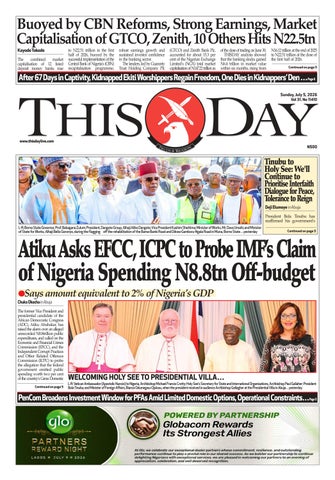
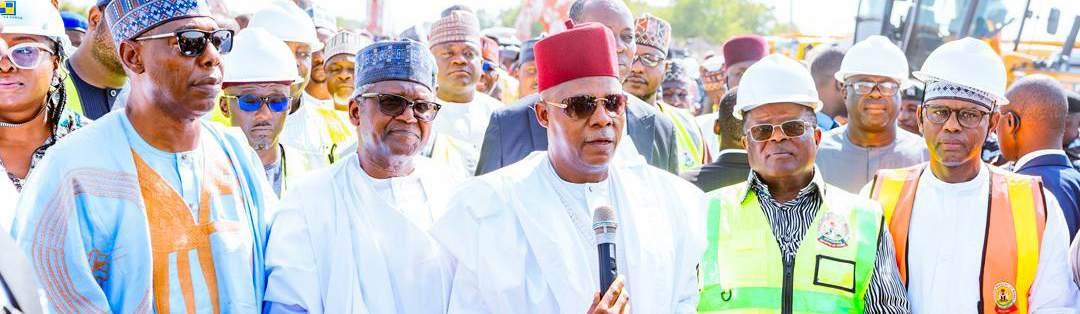
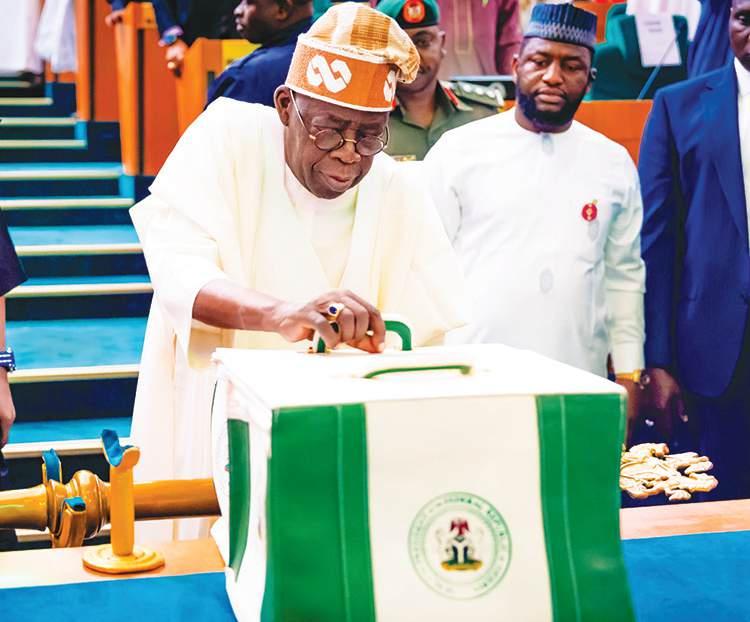
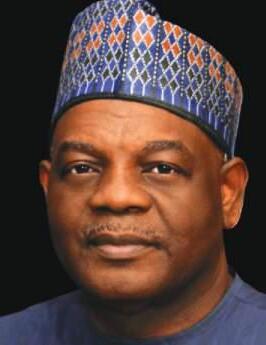
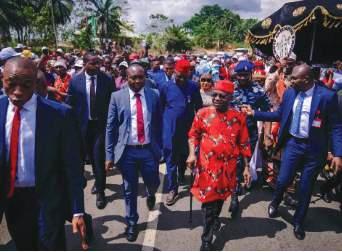
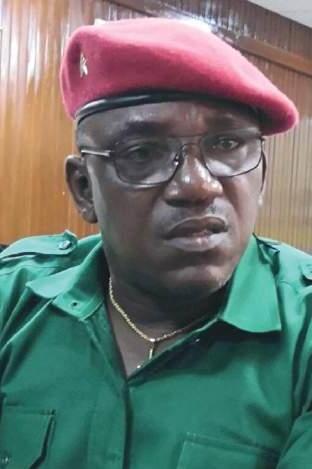
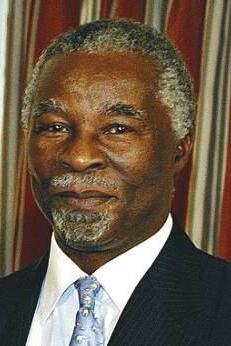
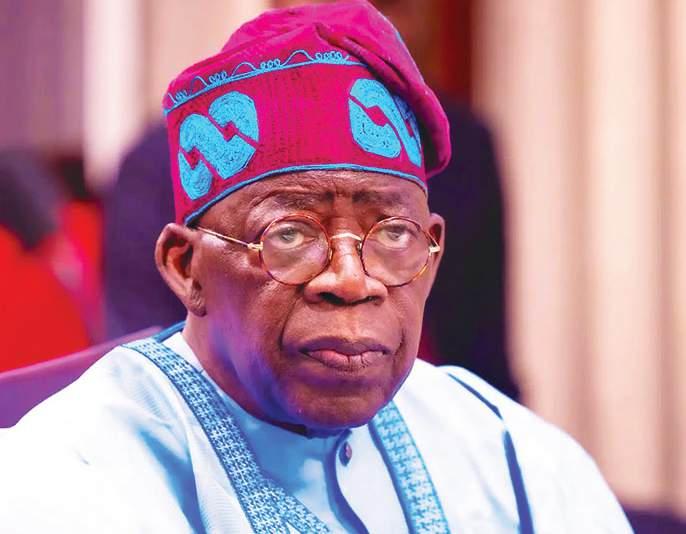
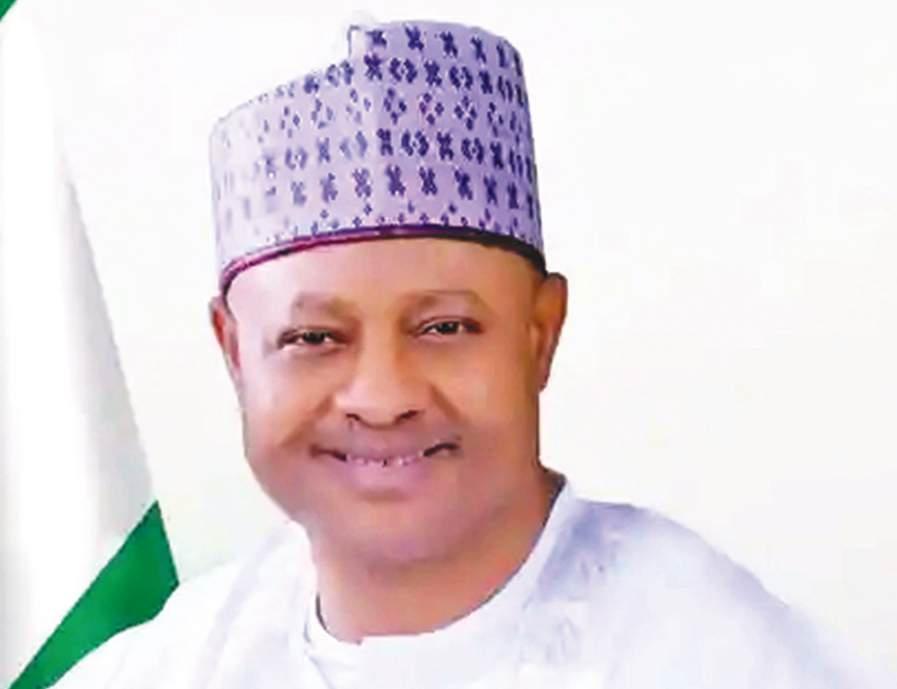
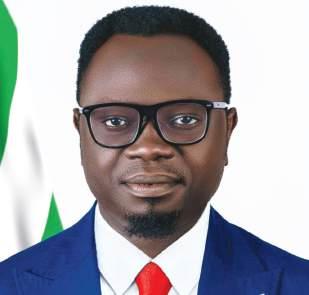
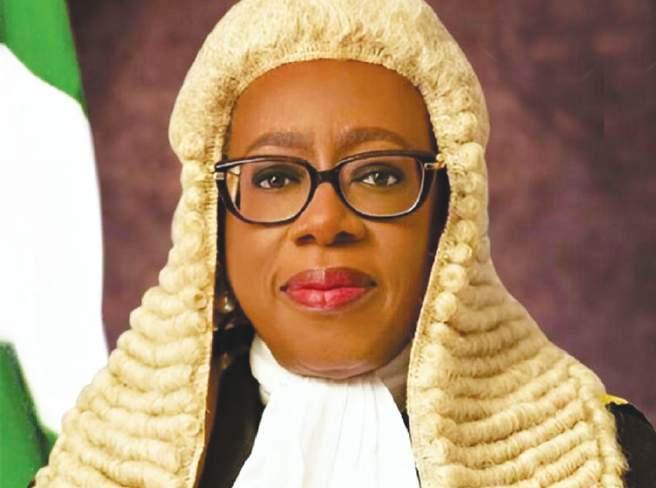
L-R: Borno State Governor, Prof. Babagana Zulum; President, Dangote Group, Alhaji Aliko Dangote; Vice President Kashim Shettima; Minister of Works, Mr. Dave Umahi; and Minister of State for Works, Alhaji Bello Goronyo, during the flagging off the rehabilitation of the Bama-Banki Road and Dikwa-Gamboru-Ngala Road in Muna, Borno State…yesterday
Asks
of Nigeria Spending
Chuks Okocha in Abuja
former Vice President and presidential candidate of the African Democratic Congress (ADC), Atiku Abubakar, has raised the alarm over an alleged unrecorded N8.8trillion public expenditures, and called on the Economic and Financial Crimes Commission (EFCC), and the Independent Corrupt Practices and Other Related Offences Commission (ICPC) to probe the allegation that the federal government omitted public spending worth two per cent of the country's Gross Domestic
Elumoye in Abuja
Bola Tinubu has reaffirmed his government's
PenCom Broadens Investment Window
The National Pension Commission (PenCom) has extended its regulatory forbearance, allowing Pension Fund Administrators (PFAs) to invest pension assets in a broader range of securities issued by the parent companies of their respective Pension Fund Custodians (PFCs).
Production (GDP) from recent budgets.
Atiku claimed the amount was in the International Monetary Fund (IMF) report published on July 1, 2026.
According to the former vice president, the IMF report revealed that President Bola Tinubu-led administration failed to record public expenditures amounting to approximately two per cent of Nigeria's Gross Domestic Product (GDP) in recent official budgets.
Atiku, who said he viewed this revelation with the gravest alarm, called upon all Nigerians - the media, civil society, the National Assembly, and every democratic institution in the country - to set aside every distraction and direct their full attention to what he described as the most consequential act of fiscal impunity in Nigeria's
commitment to prioritising interfaith dialogue and promoting peace, harmony, and tolerance among Nigeria’s diverse religious communities.
The president, who made this known yesterday while receiving in audience the Secretary for Relations with States and International Organisations of the Holy See, Archbishop Paul Gallagher, at his residence in Abuja, declared: "My administration will continue to work on religious harmony among all faiths.
"Our Bishops and religious
The rally underscores renewed investor appetite for banking stocks, following the CBN's recapitalisation exercise, which prompted lenders to raise fresh capital exceeding trillions of naira and strengthen their balance sheets ahead of the new minimum capital requirements.
The sector also benefited from strong full-year 2025 financial results and resilient first-quarter 2026 earnings, which strengthened confidence among both domestic and foreign institutional investors.
GTCO retained its position as Nigeria's most valuable banking stock, closing the first half of the year with a market capitalisation
Specifically, PenCom announced a 24-month extension of its regulatory forbearance to allow PFAs to invest in a broader range of securities issued by the parent companies or HoldCos of their respective PFCs.
PenCom said the extension reflected prevailing market realities, including operational constraints and the limited availability of quality investable
recent democratic history.
“At the current valuation of Nigeria's economy at approximately N441.5 trillion, this figure translates to a staggering N8.8 trillion in public funds spent entirely outside the statutory framework of Nigeria's official budget documents, unaccounted for, unaudited, and hidden from the Nigerian people,'' Atiku said in a statement issued yesterday.
Atiku noted that the claim was contained in the IMF's latest Article IV consultation, articulated by its resident representative in Nigeria, Christian Ebeke.
He alleged that this staggering discrepancy arose from largescale government projects executed off-budget entirely.
''Let us be absolutely clear about what this means: The Tinubu administration
leaders have been doing a great deal. Please tell them to continue the good work they are doing. Let them continue to preach peace and tolerance. We cannot have an excess of that."
Tinubu said interfaith dialogue was the only path to addressing the country's security challenges.
He told the archbishop that he had a long and cordial relationship with the Catholic Church, especially during his time as governor in Lagos State, adding that he strongly supported the Church's contributions to
of N4.57 trillion, compared with N3.3 trillion at the end of 2025.
Its share price appreciated by 37.8 per cent year-to-date, rising from N90.70 to N125 per share.
The group reported a profit before tax of N302.9 billion in the first quarter of 2026, supported by a 17.5 per cent growth in interest income and a 7.1 per cent increase in fee income.
Its loan book expanded by 1.3 per cent to N3.17 trillion, while customer deposits rose by 6.3 per cent to N13.69 trillion during the period.
Zenith Bank followed closely with a market value of N4.52 trillion, up sharply from N2.54 trillion at the close of 2025.
instruments in the domestic market.
The move was aimed at expanding investment opportunities while maintaining stringent safeguards to protect contributors' funds.
The commission, in a circular dated July 3, 2026, and signed by its Director, Surveillance Department, AM Saleem, which was addressed to licensed Pension Fund
is awarding multi-trillion naira contracts, moving massive public capital, and commissioning infrastructure projects entirely beyond the reach of the Auditor-General, the nation's procurement laws, and the legitimate oversight of the National Assembly.
''It is a parallel fiscal universe, one governed by executive whim, shielded from the constitutional accountability that the Nigerian people are owed.'', the former vice president said.
Among other submissions, Atiku recommended that “the Economic and Financial Crimes Commission, the Independent Corrupt Practices and Other Related Offences Commission, and every relevant law enforcement and anti-corruption agency must open formal investigations into both the unrecorded expenditures and
education and health.
The president said this belief led him to prioritise returning mission schools to religious institutions as soon as he became governor.
The schools were taken over during the previous military administrations.
His words: “I appreciate the Pope. It was an honour for me to lead the Nigerian delegation to his inauguration as Pope Leo XIV. It was a moment of history. I see his efforts all over the world to promote World Peace. We need his spiritual engagement, as millions
The bank posted a profit before tax of N360.92 billion for the first quarter, representing a three per cent increase over the N350.82 billion recorded in the corresponding period of 2025.
GTCO and Zenith Bank also reinforced their reputation as dividend-paying stocks after rewarding shareholders with total dividends of N10 and N12.76 per share, respectively, for the 2025 financial year.
Stanbic IBTC Holdings Plc and First Holdco Plc remained the only other banking groups with market capitalisations exceeding N2 trillion.
Stanbic IBTC's valuation climbed to N2.59 trillion from
Operators (PFOs), further stated that the temporary regulatory relief would remain in force for 24 months.
According to the commission, widening the eligible investment universe would provide PFAs with greater portfolio flexibility, improve diversification and enhance their ability to generate optimal risk-adjusted returns in line with their fiduciary
the unlawful deductions from state allocations, independent of any political direction from the Presidency.”
responsibilities to Retirement Savings Account (RSA) holders.
However, PenCom stressed that the extension of the forbearance did not constitute a relaxation of investment discipline, insisting that every investment involving custodian-related entities must meet the same fiduciary standards applicable to all pension investments.
It emphasised that the mere
He explained that ''This conduct follows a pattern that is unmistakably familiar to anyone who has studied the fiscal governance of Lagos State under Bola Ahmed Tinubu as Governor. For years, Tinubu operated what has become widely known as the Alpha Beta arrangement, a revenue management structure under which between 10 and 30 percent of Lagos State's internally generated revenue disappeared into private pockets before it was ever captured in the official budget. Revenues were siphoned at the point of collection, before they could be subjected to legislative appropriation, public scrutiny, or statutory accountability.
around the world look up to him. I look forward to receiving him in Nigeria.
“I understand the roles that the Catholic Church has been playing in expanding the frontiers of education, health and humanitarianism in Nigeria. It means a lot to us in Nigeria, and the country is benefiting from it.
“We are also doing a lot to guarantee freedom of worship. As you may be aware, my wife is a pastor at an evangelical church. This downplays the religious connotation that the religious controversy in our country
N1.59 trillion at the end of last year, while First Holdco advanced to N2.55 trillion from N2.01 trillion over the same period.
Stanbic IBTC delivered one of the strongest quarterly performances in the sector, reporting a 40.3 per cent increase in profit after tax to N114.9 billion in the first quarter. The performance was driven largely by a sharp turnaround in trading income, which moved from a N7 billion loss in the corresponding period of 2025 to a N55.2 billion gain. Total income rose by 31.1 per cent to N266.1 billion, while total assets expanded by 12.5 per cent to N9.7 trillion.
Ecobank Transnational
''The money vanished upstream, and what arrived in the treasury was already a fraction of what Lagosians had paid.
''What the IMF has now documented at the federal level is that same Lagos playbook, replicated at national scale and with national consequences. The man who perfected the art of the off-budget economy in Lagos has brought that "Beta" form to Abuja, and 220 million Nigerians are paying the price.''
According to Atiku, ''This shadow economy does not operate only through unrecorded expenditures. It also operates through illegal extractions. We draw the attention of Nigerians to the N800 billion that has been illegally deducted from the statutory allocations of state
might have taken.”
The president assured his guest that the Nigerian military had made significant progress in recent times and remained committed to sustaining these achievements, recognising that a single incident could undermine previous gains.
He stated that more resources were being allocated to security, with intensified surveillance, particularly in previously ungoverned areas.
Tinubu assured the archbishop that his government was also investing in the youth to
Incorporated (ETI), United Bank for Africa Plc (UBA), Access Holdings Plc, Fidelity Bank Plc and Wema Bank Plc also maintained market capitalisations above the N1 trillion threshold.
As at June 30, ETI's market value stood at N1.73 trillion, followed by UBA at N1.69 trillion, Access Holdings at N1.19 trillion, Fidelity Bank at N1.16 trillion and Wema Bank at N1.04 trillion.
FCMB Group closed the first half of the year with a market capitalisation of N682.63 billion.
At the same time, Sterling Financial Holdings Company Plc and Jaiz Bank Plc recorded market values of N403.91 billion
relationship between a security issuer and a pension fund custodian must never confer preferential treatment. The commission further directed that all transactions must be conducted strictly on an arm's-length basis and on prevailing market terms, warning that governance safeguards alone cannot eliminate correlation and contagion risks.
governments, funds belonging to the federating units of this republic, unlawfully withheld and diverted without the authorisation of the National Assembly, without a court order, and without any constitutional basis whatsoever''.
Atiku said that state governments across Nigeria under the aegis of the Progressives Governors Forum have had their allocations raided to fund projects and purposes that have never been disclosed to the Nigerian public. Atiku said, ''We state clearly and without equivocation that this N800 billion, combined with the N8.8 trillion in unrecorded federal expenditures, points unmistakably to the construction of a massive, multi-source political war chest being assembled ahead of the 2027 general election.”
prevent their exploitation by terrorists and reduce vulnerability to radicalisation. Earlier, Archbishop Gallagher said he was in Nigeria for the 50th anniversary of the establishment of relations between the Federal Republic of Nigeria and the Holy See, noting that Nigeria was very strategic to the Catholic Church because of its vibrant Catholic community. He also conveyed Pope Leo XIV’s appreciation for President Tinubu’s presence at
and N370.63 billion respectively. Capital market analysts attributed the sustained rally in banking stocks to the successful execution of the CBN recapitalisation programme, stronger corporate fundamentals and improving profitability across the industry. They noted that the combination of enhanced capital buffers, resilient earnings and attractive dividend payouts has continued to position banking equities among the most soughtafter stocks on the Nigerian Exchange, with investors expected to maintain strong interest in the sector through the second half of the year.
Ndubuisi Francis and James Emejo in Abuja
AGING WITH GRACE…
After 67 Days in Captivity, Kidnapped Ekiti Worshippers Regain Freedom, One Dies in Kidnappers’ Den
Kidnappers collected N25.5m ransom, 150 litres of petrol, five bags of rice, say community sources Oyebanji orders free medical care for victims
Gbenga Sodeinde in Ado-Ekiti
The worshippers abducted during an attack on a Christ Apostolic Church in Eda Oniyo, Ilejemeje Local Government Area (LGA) of Ekiti State on April 28, 2026, have regained their freedom.
However, one of the victims, a woman, died while in the custody of the kidnappers.
Though the Ekiti State Police Command said the victims were rescued through coordinated security operations, community sources disclosed that the kidnappers collected N25.5
million ransom, 150 litres of petrol, five bags of rice, cartons of noodles and other food items before releasing their victims.
The freed victims are currently receiving treatment at the Ekiti State University Teaching Hospital (EKSUTH), Ado-Ekiti, at the expense of
the state government.
The victims were kidnapped when gunmen invaded the Christ Apostolic Church in Eda Oniyo, a border community between Ekiti and Kwara states, during an evening service.
The attackers shot the pastor before abducting 16
worshippers, including women and children, and marched them into the forest.
Sources in the community said the abductors initially moved the victims through forests into neighbouring Kwara State.
for the people that came back home,” he said.
Dada said the victims were initially taken to the General Hospital in Iye Ekiti before being transferred to EKSUTH for comprehensive medical care.
NiMet Issues Flood Alert as Peak Rains Begin, Says Lagos, Sokoto,
Kasim Sumaina in Abuja
The Nigerian Meteorological Agency (NiMet) has issued a probable flash-flood risk alert from July 1 to 10, 2026, warning that intensified rainfall at the onset of the peak rainy season could trigger flash flooding across 27 states. According to the NiMet advisory, widespread rainfall experienced across many parts of the country in June had left soils heavily saturated, significantly reducing their capacity to absorb additional rainwater.
As a result, low-lying communities, urban centres, coastal areas, and locations with
Imo,
24 Others Face High Risk from July 1
poor drainage were expected to face an elevated risk of flooding over the coming days.
The advisory noted that the states identified as being most vulnerable include Taraba, Sokoto, Borno, Zamfara, Kebbi, Katsina, Kaduna, Nasarawa, Plateau, Adamawa, Kwara, Kogi, Oyo, Ogun, Lagos, Osun, Ekiti, Delta, Edo, Abia, Imo, Anambra, Enugu, Akwa Ibom, Cross River, Rivers and Bayelsa.
NiMet warned that the anticipated heavy rainfall could lead to localised flash floods, particularly in flood-prone communities and densely populated urban areas.
Other potential impacts, the
agency stated, include traffic congestion, road closures, transport disruptions, temporary electricity and telecommunications outages, reduced visibility affecting motorists and aviation operations, waterlogging of farmlands with possible crop losses, and damage to roads, bridges, drainage infrastructure and other public facilities.
It also cautioned that stagnant floodwaters could increase the risk of waterborne diseases in affected communities if proper sanitation measures are not maintained.
To minimise the impact of possible flooding, the agency urged residents to monitor official weather forecasts and
flash flood advisories, keep drains and waterways free of refuse, secure loose outdoor objects, and avoid walking or driving through flooded roads.
It emphasised that early preparedness, public awareness and prompt action remain critical to reducing the risks and impacts associated with flash flooding during the peak of the 2026 rainy season.
However, it called on State Emergency Management Agencies (SEMAs), the National Emergency Management Agency (NEMA), local authorities, community leaders, and other stakeholders to strengthen preparedness and emergency response efforts.
The kidnappers initially demanded a N1billion ransom, but later reduced it to N50million.
Although the community reportedly raised and paid N10.5million alongside other items demanded by the abductors, the victims remained in captivity.
Community sources disclosed that the kidnappers later collected additional N10million, 150 litres of petrol, five bags of rice, cartons of noodles and other food items before releasing their victims.
Confirming the victims’ release yesterday, the Chairman of Ilejemeje LGA, Alaba Dada, lamented the death of one of the captives.
“I am so happy, and I am sad also. I am happy that they released the kidnapped persons. We lost one woman among them; that is what makes me sad. But we appreciate God
“Their condition is bad; they cannot walk; they are injured; the kidnappers beat them. They said they had not eaten for over a week. But we thank God for their release,” he said.
A community leader, Ayodele Oni, described the victims’ release as a huge relief after weeks of anxiety.
Confirming the development in a statement yesterday, the Police Public Relations Officer in Ekiti State, SP Sunday Abutu, said the rescue of the victims followed sustained intelligence-led operations involving the police, military, other security agencies, the Amotekun Corps, local hunters and the Ekiti State Government.
“The rescued victims have since been taken to the hospital for medical examination and treatment to ascertain their health condition and ensure they receive adequate medical care,” the PPRO stated.
Obi: Nigeria’s Worsening Hunger Crisis a Reflection of Leadership Failure, Not Food Shortage
Sunday Aborisade in Abuja
The presidential candidate of the Nigeria Democratic Congress (NDC) in the 2027 general election, Mr.Peter Obi, has blamed what he described as incompetent and irresponsible leadership for the worsening food crisis in northern Nigeria. He argued that the situation
was avoidable in view of the region’s vast agricultural potential.
Reacting to a recent warning by the World Food Programme (WFP) over rising hunger in northern Nigeria, Obi said yesterday that it was unacceptable that the country’s major food-producing region had become the epicentre of a deepening food emergency.
He maintained that the crisis was driven by insecurity and poor governance rather than a lack of natural resources.
The former Anambra State governor said more than 17 million people across nine northern states were facing crisis-level hunger, while over 35 million Nigerians could be at risk during the current lean season.
He described reports that more than 10,000 residents of Borno State had entered catastrophic hunger conditions as a national failure, insisting that Nigeria should not rank among the world’s hungriest nations considering its vast fertile land.
Obi identified insecurity and farmers' inability to access their farmlands as
the major structural causes of the crisis, noting that banditry and insurgency had displaced farming communities and severely affected food production.
He argued that securing agricultural corridors was essential to addressing the country’s food insecurity.
He also criticised what he described as the government’s
reliance on superficial measures that failed to improve agricultural productivity or rural infrastructure, calling instead for policies that remove barriers to farming and promote agro-industrial development. According to him, Nigeria must urgently shift its focus from consumption to production to tackle hunger and poverty.
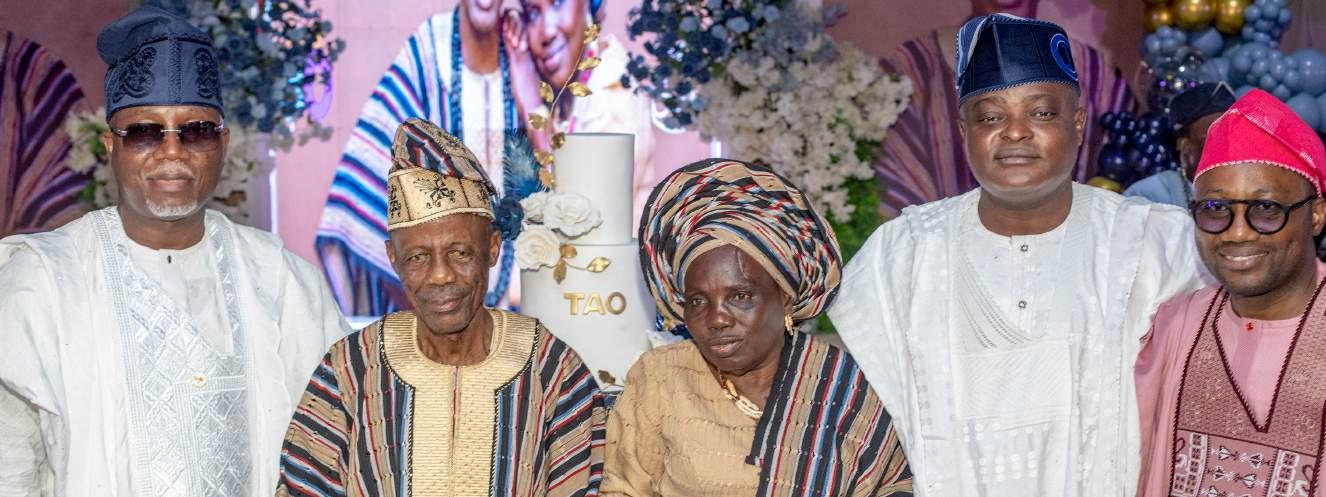
L-R: Ondo State Governor, Mr. Lucky Aiyedatiwa; celebrant, Special Apostle Titus Aremu Ogunseye; his wife, Oluranyi; Speaker of the Lagos State House of Assembly, Hon. Mudashiru Obasa; and Son of the celebrant, Damilola Ogunseye, during Apostle Ogunseye's 80th birthday thanksgiving reception, at Agidingbi, Lagos …yesterday
PHOTO: KUNLE OGUNFUYI
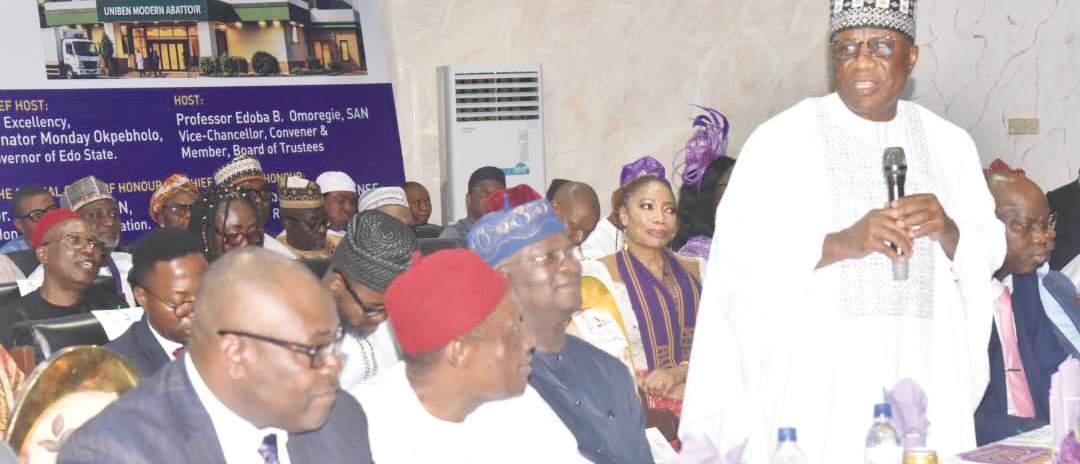
LAUNCHING UNIBEN TRUST DEVELOPMENT FUND…
L-R: Vice Chancellor, University of Benin, Professor Edoba Omoregie, SAN; Representative of the Minister of Education and Vice Chancellor, National University of Science and Technology, Abuja, Prof. Joe Ahaneku; former Governor of Lagos State and Chairman of the occasion, Mr. Babatunde Raji Fashola, SAN; and Minister of Regional Development, Mr. Abubakar Momoh, during the launch of the N100billion University of Benin Trust Development Fund (UNIBEN-TDF) at the Main Auditorium, University of Benin, Ugbowo Campus, Benin-City…yesterday
Mourners Chant for Revenge at Khamenei’s Days-long Funeral
Iran yesterday officially began several days of public funeral ceremonies for her slain Supreme Leader, Ayatollah Ali Khamenei, and as thousands gathered to pay their respects, mourners at the Grand Mosalla prayer complex in the Iranian capital beat their chests and chanted for revenge. However, indirect negotiations
between the United States and Tehran have gathered fresh momentum, despite a temporary suspension for Khamenei’s funeral, with both sides indicating cautious optimism. Meanwhile, military tensions, diplomatic disagreements and disruptions to global shipping continued to threaten the fragile peace process.
This is just as Tehran yesterday warned the United Kingdom
and France against deploying military assets to the Strait of Hormuz after both governments announced they were prepared to support a multinational mission to safeguard freedom of navigation.
US President Donald Trump and Israeli Prime Minister Benjamin Netanyahu have also agreed to meet soon in Washington DC to discuss regional security and other
bilateral issues, despite their differences on ways to resolve the Iranian issue.
Iran remained on high security alert as it yesterday officially began several days of public funeral ceremonies for Khamenei.
As thousands gathered to pay their respects, mourners at the Grand Mosalla prayer complex in the Iranian capital beat their chests and chanted for revenge.
An estimated 15 to 20 million
IPI Nigeria, CPJ Demand Immediate Release of Journalist, Stanley Ugagbe, from Detention
Chuks Okocha in Abuja
The International Press Institute (IPI Nigeria) and the Committee to Protect Journalists (CPJ) have urged security operatives to immediately release Stanley Ugagbe, a journalist working with Secret Reporters.
Ugagbe was reportedly taken into custody shortly after Secret Reporters, the online news platform where he works, published an investigative report.
In a statement jointly signed by its Secretary, Ahmed I.
Shekarau, and Legal Adviser/ Chair, Advocacy Committee, Tobi Soniyi, IPI Nigeria said it received the report on the journalist's detention with deep concern.
“According to available reports, four unidentified men abducted the journalist from his residence in Abuja on Wednesday.
“The Publisher and Editor-inChief of Secret Reporters, Fejiro Oliver, alleged that officers of the Nigeria Police Force carried out the operation while Ugagbe was returning home from an
official training programme.” the statement said.
According to Oliver, the operatives took the reporter to his house in Jikwoyi where they seized his official laptop and mobile phone before whisking him away to an unknown destination.
“Our lawyer and editor, alongside a senior reporter, searched the former SARS facility, the FCT Police Command and the Force Headquarters without finding him. Another reporter visited the Jikwoyi and Karu police
stations to determine whether the officers involved had documented their operation, but found no such record. They also checked the detention facilities at both stations, and he was not there.” Oliver said.
The IPI wondered why security agencies could resort to what it called unlawful arrests of journalists at a time when the country was battling serious security challenges, calling on President Tinubu to direct relevant security agencies to produce the journalist immediately.
Kogi Recovers 1,000 Rustled Livestock in Sustained Offensive against Bandits, Other Criminal Elements
Ibrahim Oyawale in
The Kogi State Government, in joint operations with the Nigerian Army, security agencies, and local vigilantes, has recovered about 1,000 rustled livestock in a sustained offensive against bandits in the state.
The Commissioner for Information and Communications, Kingsley
Fanwo, disclosed this in a statement issued yesterday in Lokoja, the state capital. Fanwo said the offensive targeted remnants of the late bandit kingpin, Kachalla Ibrahim Battijo, and other cattle-rustling syndicates operating within the state and across the North Central region.
He said the recovery was made possible by credible and timely intelligence acted
upon by the 12 Brigade of the Nigerian Army, Hybrid Forces from the Office of the National Security Adviser (ONSA), the Department of State Services (DSS, the Police, local vigilante and hunters.
According to Fanwo, over 200 of the recovered animals were traced to the criminal network of the late Battijo. In contrast, the remaining livestock were recovered from
other armed bandits engaged in cattle rustling across Kogi and neighbouring states.
He said the criminals had attempted to move the stolen livestock through Kogi for sale.
“The intelligence revealed that the criminal groups planned to sell the rustled livestock to raise funds for procurement of arms, food supplies and other logistics,” Fanwo stated.
people, alongside foreign dignitaries and religious leaders, were expected to take part in the ceremonies which will last for several days. Delegations from Hamas and Hezbollah joined the mourning on Friday, while others arrived yesterday.
Thousands of mourners, largely dressed in black, gathered at Tehran’s Imam Khomeini Grand Mosque as the multi-day funeral entered its first public phase yesterday.
Senior Iranian officials, including President Masoud Pezeshkian, Foreign Minister Abbas Araghchi and parliamentary speaker Mohammad Bagher Ghalibaf, attended the ceremonies alongside foreign dignitaries from across the Middle East, Asia, Africa and Eastern Europe.
The heightened security reflects concerns over possible attacks against senior Iranian officials gathering publicly during the
ceremonies, particularly after Israeli Defence Minister Israel Katz recently suggested that Khamenei’s successor remained “marked for death.”
Meanwhile, Trump and Netanyahu have agreed to meet soon in the US to discuss regional security and other bilateral issues, despite their differences on ways to resolve the Iranian issue.
Netanyahu could visit the White House as early as next week, Trump told Axios yesterday, adding that the prime minister “knows who the boss is” in their relationship.
The latest diplomatic developments came just days after representatives from Washington and Tehran concluded another round of indirect talks in Doha, Qatar, where mediators described the discussions as constructive, despite deep disagreements over Iran’s nuclear program and regional security.
FG Demands Compensation over Death of Nigerian Trader, Detention of Six Citizens in Ivorian Prison
Michael Olugbode in Abuja
The federal government has demanded a full investigation into the detention of six Nigerian traders in Côte d’Ivoire and the death of one of them, Usama Murtala, while seeking compensation for his family and the return of property allegedly seized from the victims.
According to the minister, the six traders were detained without charge or trial. They were released only following diplomatic interventions by the Ministry of Foreign Affairs and sustained engagement by the Nigerian Embassy in Côte d’Ivoire.
“We requested to know why the Nigerian Embassy in Côte d’Ivoire was not informed of their arrest and detention, which delayed the necessary diplomatic intervention that might have saved the life of the deceased,” she added.
The Minister of Foreign Affairs, Bianca OdumegwuOjukwu, disclosed this yesterday in an update posted on X, revealing that she met with the Ambassador of Côte d’Ivoire to Nigeria, Ambassador Kalilou Traore, to seek explanations over the circumstances surrounding the arrest, detention and subsequent death of the Nigerian trader.
Lokoja
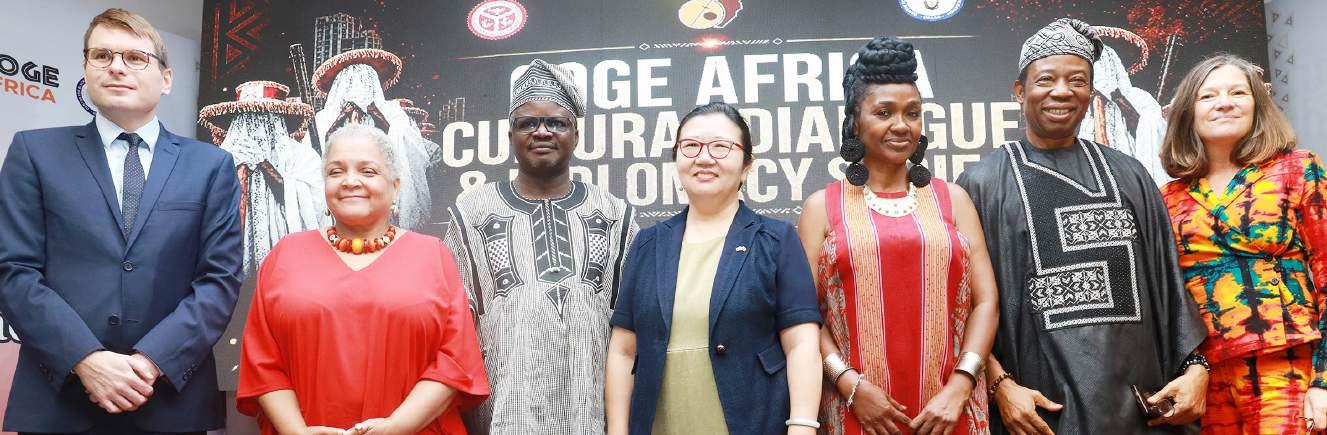
STRENGTHENING CULTURE AND DIPLOMACY…
Turaki-led PDP Pacifies Aspirants over Lack of Access to INEC Code, Says Faction Still in Court
The Interim National Working Committee (NWC) of the Peoples Democratic Party (PDP) led by Tanimu Turaki (SAN) has asked aspirants from the party that were not given the Independent National Electoral Commission’s (INEC) Access Codes to register and upload their nominations as candidates to remain calm, as the matter was still in court.
The PDP faction further urged the aspirants who were threatening to drag the interim NWC to the Economic and Financial Crimes Commission (EFCC) for deceiving them to recall the party’s experience in Plateau State where the Court of Appeal upturned the victory of the already elected members of both the National Assembly and state assembly.
Some members of the party who purchased the
nomination forms from the Turaki-led PDP NWC were threatening to drag the NWC to the EFCC for knowing that they were not the recognised and legitimate PDP and yet sold forms to them.
The group known as "Concerned PDP Aspirants" claimed it was fraudulent, knowing full well they were on a wild goose chase.
According to the petition, "We spent hundreds of millions
of Naira in purchasing the nomination forms and expression of interest forms as well as the necessary publicity expenses and other logistics funding.
"We want the INWC led by Tanimu Turaki to address our concerns on this matter, else we seek redress in the necessary arms of security agencies, including the EFCC ", the one-page petition stated. INEC released the access
INEC Extends CVR by Two Weeks, Introduces Self-service for First-timers
The ongoing Continuous Voter Registration exercise ahead of the 2027 general election has been extended by two weeks, the Independent National Electoral Commission (INEC) has said.
National Commissioner and Chairman of the Inform and Voter Education Committee, Mallam Mohammed Haruna, disclosed this in a statement, saying the exercise, which was supposed to end on July 10, has been extended to Sunday, July 26, 2026.
In addition, the commission announced the introduction of a self-service online registration
option for eligible first-time voters, to take effect from Wednesday, July 8, 2026.
Haruna said the extension followed a review of the exercise and feedback received from the Commission’s State Offices, political parties, civil society organisations, and other stakeholders.
The National Commissioner noted that the CVR exercise commenced on 18th August 2025 and was originally scheduled to end on 10th July 2026, adding that the extension was designed to provide an additional opportunity for eligible citizens who have yet
to register to be included in the Register of Voters ahead of future electoral activities.
He explained that the new service would be available through the commission’s dedicated CVR portal, cvr. inecnigeria.org, where a step-by-step guide has also been provided.
He said the self-service option would enable eligible citizens to initiate and complete their voter registration, including biometric capture, using their personal devices without visiting an INEC office.
Haruna said the system
incorporates identity verification, biometric validation, and backend integrity checks to preserve the credibility and accuracy of the National Register of Voters.
The commission urged eligible Nigerians who have yet to register to take advantage of the extended window and the new registration technology.
Haruna reiterated INEC’s commitment to a credible, inclusive, and accessible voter registration process, and to the continued use of technology to improve citizens’ experience in the electoral process.
Xenophobic Attacks: ‘Show Us Drug Dens of Nigerians,’ S’Africa Tells FG, Rejects Compensation Demand
Sunday Ehigiator
South Africa has rejected Nigeria’s plan to seek compensation for properties abandoned by Nigerians fleeing recent xenophobic attacks, urging the federal government to reveal the drug dens of Nigerians to enable the South African government to clean up its country.
In rejecting the calls for
compensation for Nigerian citizens, whose properties were left behind, following their evacuation from the country, the South African government insisted that only legally registered assets can be recognised.
The evacuations were triggered by renewed xenophobic violence against African migrants in South Africa.
Last week, the Acting Nigerian High Commissioner to South Africa, Alexander Temitope Ajayi, said the federal government would seek compensation for businesses and properties abandoned by Nigerians returning from South Africa under its voluntary evacuation programme.
Ajayi added that the government had already
begun compiling records of businesses and properties left behind by returnees.
The envoy explained that returnees had been instructed to provide detailed information about their abandoned assets before departing South Africa.
He said the information would form the basis of discussions with the South African authorities on possible compensation.
codes to its portal last week to the PDP led by Abdulrahman Mohammed.
By implication, it is the candidates that registered with the Nyesom Wike-based party that are recognised by the election management body.
The Court of Appeal sitting in Abuja in 2023 sacked 11 Peoples Democratic Party (PDP) lawmakers in the Plateau State House of Assembly in a similar matter.
In a unanimous decision, the panel led by Justice Okon Abang held that all the sacked lawmakers scored wasted votes during the March 2023 general election because their party lacked structure.
But speaking with THISDAY
yesterday, the National Publicity Secretary of the Turaki-led PDP NWC, Ini Emeombong, urged the aspirants to be calm, stating that the matter was still in court.
According to Emeombong, "This matter is still in court. They should be calm.
"They should bear in mind the recent situation in Plateau State in a similar matter concerning our party. This matter is still in court. It is a pre-election matter. "We are happy with the processes of the matter in court. Victory will be served at the end of the day. INEC is aware of the processes," Emeombong stated.
NESG: Business Growth Slows as High Operating Costs, Credit Constraints Weigh on Firms
James Emejo in Abuja
Nigeria's business environment remained in expansion territory in June 2026. Still, the pace of growth slowed considerably as businesses grappled with high operating costs, limited access to credit, poor infrastructure, and persistent insecurity.
According to Nairametrics, the latest Business Confidence Monitor (BCM) released by the Nigerian Economic Summit Group (NESG) showed that the Current Business Performance Index held steady at 104.6 points in June, unchanged from May. However, the figure was significantly lower than the 113.6 points recorded in June 2025, indicating that although business growth continued, the momentum weakened over the past year.
The report revealed a mixed performance
across sectors, with manufacturing, agriculture, non-manufacturing and trade remaining in expansion, while the services sector slipped into contraction.
According to the NESG, key business indicators, including production, customer demand, operating profit, financial performance, supply orders, cash flow, employment and access to credit, all remained positive during the month. However, investment, exports and inventory accumulation continued to weaken, reflecting lingering caution among businesses.
"The NESG Business Confidence Monitor Current Business Performance Index remained unchanged at 104.6 points relative to May 2026, but this represents a marked decline from the 113.6 points recorded in June 2025," the report stated.
Chuks Okocha in Abuja
L-R: Deputy Head of Mission, British Deputy High Commission, Lagos, Mr. Simon Field; Moderator, Aduke Gomez; Consul General of Burkina Faso in Nigeria, Mr. Maxime Bengaly; Consul General, People's Republic of China in Lagos, Ms. Yan Yuqing; Founders, Goge Africa, Nneka Isaac-Moses; her Husband, Isaac; and Consul General of Denmark, Jette Bjerrum, during the Goge Africa Cultural dialogue and diplomacy series 2026 in Lagos...recently
PHOTO: ABIODUN AJALA
LATEST COUPLE IN TOWN…
FG Flags Off N137bn Borno Roads to Reopen Trade Corridors, Boost Security
Infrastructure critical to post-insurgency recovery, regional commerce, says Shettima
Deji Elumoye in Abuja
The federal government yesterday flagged off the rehabilitation of the Bama-Banki Road and the Dikwa-GamboruNgala Road in Borno State, describing the projects as strategic investments aimed at reopening critical trade corridors, strengthening security operations and accelerating post-insurgency economic recovery across the North-east.
Performing the ceremony on
behalf of President Bola Tinubu, Vice President Kashim Shettima said the projects underscore the administration’s commitment to restoring mobility, rebuilding economic confidence and reconnecting communities devastated by years of insurgency and infrastructural neglect.
He said the two road corridors would enhance crossborder trade with neighbouring countries, improve agricultural activities and widen the
operational reach of security agencies across the region.
According to a statement issued by Senior Special Assistant to the President on Media and Communications, Office of the Vice President, Stanley Nkwocha, Shettima said road infrastructure remains indispensable to economic growth and lasting peace, stressing that poor road networks continue to impose enormous costs on businesses, households and communities.
“Roads are the live wire of our commercial engagements. They determine whether the farmer reaches the market, the trader reaches the customer, the child reaches school, the patient reaches care, and security agencies reach communities in time,” Shettima said.
He noted that President Tinubu had made infrastructure development a central priority of his administration because bad roads slow commerce, increase food prices, isolate communities,
WHO Raises Alarm as Bundibugyo Ebola Death Toll Hits 454, Outbreak Spreads in Congo
Onyebuchi
Ezigbo in Abuja
The World Health Organisation (WHO) has raised alarm over a rapidly escalating outbreak of Bundibugyo virus disease (BVD). This deadly Ebola strain has killed 454 people and infected 1,481 others in the Democratic Republic of Congo and Uganda, fuelling fears of a broader regional health crisis.
WHO said the outbreak, driven by sustained transmission in Congo’s conflict-ridden eastern provinces, was evolving rapidly and posed a severe threat to neighbouring countries
TINUBU TO HOLY
due to cross-border movement, fragile health systems and humanitarian crises.
According to the update, “As of July 1, Congo had recorded 1,460 confirmed infections and 452 deaths, with health officials warning that the disease continues to spread into new health zones.”
Uganda has reported 20 confirmed cases and two deaths, while France confirmed an imported case involving a doctor who returned from Congo after treating infected patients.
“This outbreak is expanding
at a dangerous pace, particularly in areas affected by insecurity and displacement.
“The conditions on the ground are creating major barriers to surveillance and response, increasing the risk of undetected transmission,” WHO said in its latest update.
Health authorities said the latest figures represented a steep increase of 564 new infections and 220 deaths in less than two weeks, underlining the scale and speed of the crisis.
It reported that the epicentre remained Ituri Province, where
more than 91 per cent of all cases have been recorded.
Major hotspots include Bunia, Rwampara and Mongbwalu.
“Alarmingly, 102 healthcare workers have also been infected, with 25 deaths among them, a development experts say reflects the dangerous gaps in infection prevention and control,” the report noted.
WHO said that over 10,800 contacts are currently being monitored in Congo, while Uganda has completed surveillance of over 800 contacts, with no new cases reported since June 21.
SEE: WE'LL CONTINUE TO PRIORITISE INTERFAITH DIALOGUE FOR PEACE, TOLERANCE TO REIGN
his inauguration and shared his impressions of Veritas University, established by the Catholic community in Abuja, noting its remarkable progress.
The archbishop described Nigeria as the heart of Africa and home to some of the most successful activities of Bishops on the
continent and commended President Tinubu’s efforts in promoting peace, particularly through military initiatives, and encouraged continued dedication. He also expressed appreciation to the Nigerian government for facilitating visas for bishops and for its responsiveness to the Church’s various needs.
Gallagher informed President Tinubu that he looked forward to receiving the Nigerian Ambassador to the Holy See in a few weeks and assured him that this visit would be the first of several special visits from the Holy See.
Accompanying Archbishop Gallagher were H.E.
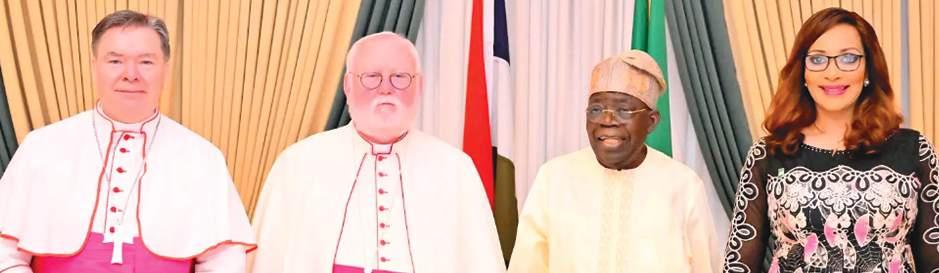
Archbishop Michael F. Crotty, Apostolic Nuncio to Nigeria; Rev. Monsignor Suman Paul Anthony, Official of the Secretariat of State – Section for Relations with States and International Organisations; and Rev. Monsignor Patarne Koyassambia-Kozondo, First Secretary, Apostolic Nunciature in Nigeria.
discourage investment and weaken local economies.
The vice president observed that road rehabilitation in the North-east should be viewed not only as an economic intervention but also as a vital security measure, explaining that damaged roads hamper the movement of both civilians and security personnel.
“Bad roads are also a security risk. A corridor that is difficult for citizens to travel is equally difficult for security personnel to patrol and protect,” he stated.
Shettima described the Bama-Banki corridor as a route of immense strategic importance, adding that the Dikwa-Gamboru-Ngala Road is equally critical to reconnecting communities and restoring public confidence across Borno State.
He disclosed that the projects would include bridges, drainage systems, safety facilities and reinforced concrete pavement designed to ensure durability, stronger supervision and value for public funds.
The vice president commended Borno State Governor Babagana Umara Zulum for placing infrastructure at the centre of the state’s reconstruction efforts, saying the partnership between the federal government and the state government demonstrates what can be achieved when institutions collaborate in the public interest.
He also praised the Minister of Works, David Umahi, the Minister of State for Works, Bello Muhammad Goronyo, and the Borno State Commissioner for Works and Housing, Adam Bukar Balarabe, for advancing the projects.
Assuring residents of Bama, Banki, Dikwa, Gamboru-Ngala
and neighbouring communities, Shettima pledged that the federal government would ensure the projects are completed.
“Promises acquire meaning when citizens can drive on the roads, move their goods, reach their families, and live with greater security,” he said. He added that the federal government would continue working with the state government, contractors, host communities and relevant institutions to ensure the roads become corridors of commerce, security and renewed confidence.
Earlier, Governor Zulum described infrastructure as the foundation of socioeconomic development, saying completion of the roads would stimulate economic activities in Borno State and strengthen trade with Chad, Cameroon and the Niger Republic.
The governor thanked President Tinubu for his commitment to the peace, security and development of the North-east, pledging stronger electoral support for the President in next year’s election.
Zulum also expressed appreciation to the Dangote Group for supporting the state with schools, healthcare facilities, food items valued at over N2 billion and an additional N1.5 billion donated to the National Emergency Management Agency for flood victims in Borno.
Minister of Works, David Umahi disclosed that the two road projects, originally awarded in 2021 for over N55 billion, are now valued at over N70 billion for the Bama-Banki Road and N67 billion for Phase One of the Dikwa-Gamboru Road.
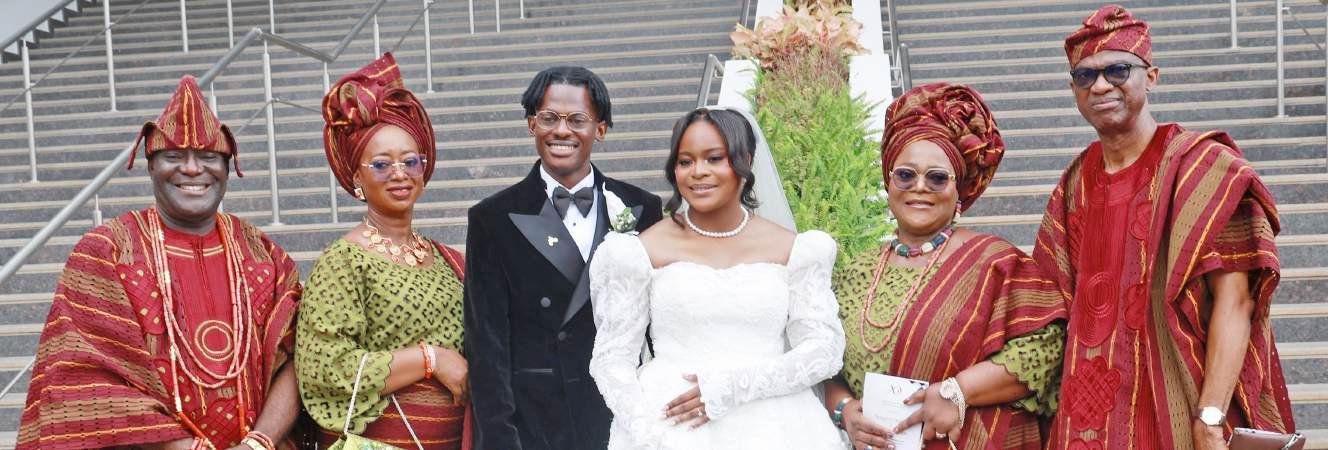
L-R: Father of the bride, Prince Gabriel Bondefaiye-Owope; Mother of the groom, Mrs. Adenike Onikute; Newlyweds, Opeyemi Onikute and his wife, Aderewa (nee Owope); mother of the bride, Mrs. Olubunmi BondefaiyeOwope; and Groom's Father, Mr. Yinka Onikute, shortly after the Solemnisation of holy matrimony between Opeyemi Onikute and Aderewa Owope at The Citadel Global Community Church, Oregun Lagos…yesterday
Army Chief Seeks AI, Technology-driven Security Strategy to Tackle Emerging Threats
Blessing Ibunge in Port Harcourt
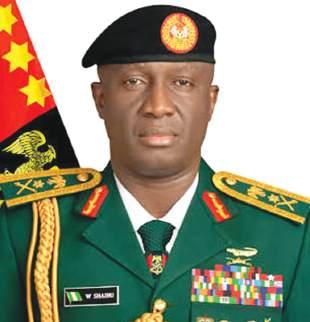
The Chief of Army Staff (COAS), Lieutenant General Waidi Shaibu, has called for a technology-driven and peoplecentred approach to addressing Nigeria’s evolving security challenges, stressing that the Nigerian Army must embrace innovation, professionalism and stronger collaboration to protect the country effectively.
Speaking at the Nigerian Army Day Celebration (NADCEL) 2026 Lecture and Award Ceremony in Port Harcourt yesterday, Shaibu said the changing nature of security threats required fresh perspectives, adaptive strategies and
the deployment of emerging technologies, including artificial intelligence (AI), unmanned aerial systems and data analytics.
The lecture, themed, “Protecting the People and the Dynamics of Nigeria’s National Security: Way Forward for the Nigerian Army,” featured former Chief of Army Staff and former Chief of Defence Staff, General Martin Luther Agwai (rtd.), as the guest speaker.
Shaibu said Nigeria’s security environment had become increasingly complex, with threats ranging from insurgency, terrorism and banditry to cyber warfare, transnational organised crime and resource-based conflicts.
Forvis Mazars, FNCCI Host CFO
Luncheon in Lagos to Unlock AfCFTA and Africa’s Growth Potential
A leading global professional services firm, Forvis Mazars, in collaboration with The Franco-Nigerian Chamber of Commerce and Industry (FNCCI), convened top finance executives, policymakers, and industry experts Tuesday for the sixth annual CFO Luncheon Series to deliberate on cross-border growth strategies across the continent.
The high-level event, themed “Trade Policy, AfCFTA and the C-Suite’s Growth Agenda,” centered on how the African Continental Free Trade Area (AfCFTA) is shifting corporate finance paradigms, restructuring supply chains, and opening new avenues for regional investment.
Opening the event, Laurent Favier, the Consul General of France in Lagos, pointed to the rapidly shifting dynamics of global commerce.
Favier emphasized that the AfCFTA represents a historic
gateway for businesses to deepen regional integration and spark long-term, sustainable economic growth.
Delivering his special address, Uhabia Ojike, Country Leader of Forvis Mazars in Nigeria, highlighted the realities facing businesses in today’s rapidly evolving economic landscape, characterised by currency pressures, fiscal reforms, regulatory shifts and changing global trade patterns. Despite these challenges, he pointed to the African Continental Free Trade Area (AfCFTA) as a catalyst for expanded regional trade, increased cross-border collaboration and long-term economic growth.
He underscored the need for organisations to move beyond merely reacting to change, urging leaders to build agile and resilient businesses capable of adapting to uncertainty while capitalising on new opportunities.
According to him, regional instability in the Lake Chad Basin, the Sahel and the Gulf of Guinea, alongside emerging global trends such as cyber operations, space-based competition and artificial intelligence, continued to shape the country’s security landscape.
He said: “Given our rapidly evolving security landscape, which continues to present increasingly complex and dynamic threats, there is an urgent need for fresh perspec-
tives, innovative strategies and adaptive approaches to safeguard the lives, property and well-being of the Nigerian people.
“We face asymmetric threats ranging from insurgency, banditry, and terrorism to cyber warfare, transnational organised crimes, and resourcedriven conflicts. The proliferation of arms, porous borders, and the manipulation of ethnic and religious sentiments have further complicated
our security environment.
“These regional dynamics, coupled with global shifts in the character of warfare such as cyber operations, spacebased competitions, and the increasing use of artificial intelligence and unmanned security systems involving malign influence operations, require the Nigerian Army to continuously learn, adapt, and innovate at all levels.”
The Army Chief noted that the Nigerian Army had
continued to respond through adaptive strategies, including stronger joint operations with other security agencies, enhanced intelligence gathering, expanded community engagement and investments in modern technology and capacity building.
He said the Army had also intensified both kinetic and non-kinetic operations to disrupt criminal activities, restore peace and build public confidence across affected communities.
MPC Member Urges CBN to Drive Down Lending Rates after Banks’ Recapitalisation
The Central Bank of Nigeria (CBN) has been urged to take further measures to ensure that the successful recapitalisation of the banking sector translates into lower lending rates for businesses and households, amid concerns that borrowing costs remain prohibitively high despite stronger bank balance sheets.
The recommendation was made by a member of the Monetary Policy Committee (MPC), Professor Murtala Sabo Sagagi, in his
FG Sets
Kuni
personal statement following the committee’s 305th meeting, in which he argued that the benefits of the recapitalisation exercise must extend beyond stronger financial institutions to improved access to affordable credit for the real economy.
Nairametrics reported that Sagagi observed that although the banking sector has become more resilient following the recapitalisation programme, structural deficiencies continue to weaken the transmission of monetary policy to lending rates.
Three-year Cycle for
Tyessi in Abuja
The federal government has said it will institutionalise the National Learning Assessment (NLA) every three years as part of efforts to tackle learning poverty and improve the quality of education across the country.
The Minister of Education, Dr. Tunji Alausa, disclosed this yestarday in Abuja after monitoring the ongoing 2026 National Learning Assessment in selected public and private schools in the FCT.
The minister visited Govern-
He urged the apex bank to intensify its oversight of the banking industry to ensure that improvements in liquidity and capital strength are reflected in lending conditions.
“The CBN should closely monitor the extent to which banking sector improvements and the current policy stance are being transmitted into affordable lending rates for households and businesses,” he said.
According to him, persistent structural bottlenecks, including high risk premiums and limited
penetration of credit bureaux, continue to undermine the effectiveness of monetary policy in lowering borrowing costs. He called for targeted macroprudential measures to address these constraints and improve the flow of credit to productive sectors of the economy.
Sagagi also advised the CBN to remain vigilant as banks adjust to their enlarged capital bases, warning that the post-recapitalisation environment could pose fresh risks to financial stability.
Nationwide Learning Tests, Eyes Data to Fix Education Gaps
ment Secondary School (GSS), Kuje; Junior Secondary School (JSS), Kuje Central; and Topaz Model School, Kuje, to assess the exercise.
Alausa said the assessment, which covers Primary Three, Primary Five, JSS Two and Senior Secondary School (SSS) Two pupils and students, was designed to evaluate literacy, numeracy and cognitive skills.
He said the exercise would henceforth be conducted every three years, adding that the Universal Basic Education Commission (UBEC) had been
directed to make budgetary provision for it from 2029.
“The importance of learning assessment is that we need to know the kind of education we are giving our pupils and students at the primary, junior secondary and senior secondary levels to determine whether they are actually learning.
“It is a standard tool that helps us evaluate the quality of education being delivered across different school levels.
“The last assessment was conducted in 2023 by UBEC, while the previous one was held
in 2019 by the Federal Ministry of Education. Going forward, it will become a routine exercise every three years,” he said. The minister said the assessment had become necessary in view of Nigeria’s learning poverty challenge, noting that available data showed millions of children could not read ageappropriate texts by the age of 10. According to him, previous reports indicated that more than 42 million Nigerian children were classified as learning poor, although the figure was based on earlier data.
Festus Akanbi
SAVOuRING SWEET FREEDOM…
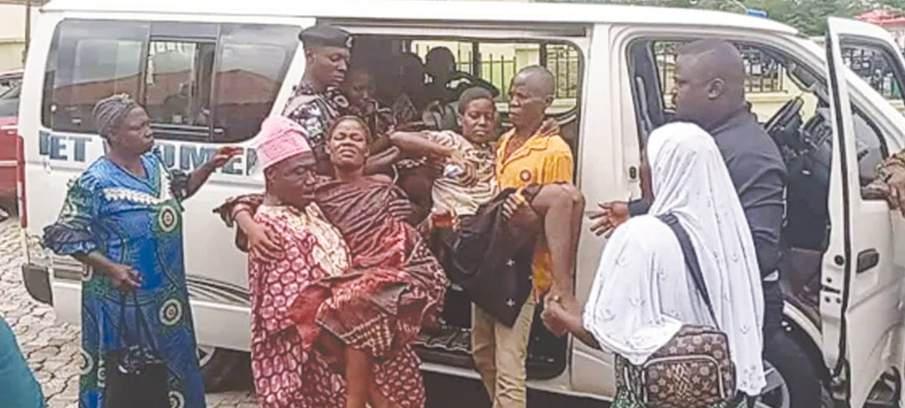
Some of the 16 worshippers of Christ Apostolic Church in Eda Oniyo, Ilejemeje Local Government Area of Ekiti State who regained their freedom after 67 days in captivity in Ado-Ekiti…yesterday
Curious Matters Arising on the PFIPC Saga
Iindependently searched Nigeria’s budget documents from 2019 to the present. Here is what I found about the PFIPC scandal that nobody is talking about. The name did not come from nowhere.
Everyone is focused on Adeyemi the man. Nobody has gone back to ask where the name “Presidential Economic Advisory Council” actually came from. I did. And the answer changes this entire story.
The Presidential Economic Advisory Council is not a Tinubu creation. Tinubu’s economic body is called the Presidential Economic Coordination Council. He established it in March 2024, inaugurated it in July 2024, and chairs it himself alongside Dangote, Elumelu, the Senate President and the Governors Forum Chairman. It has a different name, a different structure and a different budget code.
The Presidential Economic Advisory Council is a creation of Buhari. Buhari established it in September 2019 to replace the Economic Management Team that Osinbajo was heading. It had real named members. Prof. Doyin Salami as chairman. Charles Soludo. Bismark Rewane. Eight economists reporting directly to the president with a defined mandate and a legal institutional identity.
When Tinubu came in and created the PECC in 2024, the Buhari-era PEAC was never formally dissolved. No gazette removing it. No Budget Office circular revoking its institutional identity. It simply went dormant. But dormant in Nigeria’s government system is not the same as deleted.
That dormant status is exactly what was exploited.
What the Budget Documents Actually Show I searched the 2024 Appropriation Act. The Presidential Economic Advisory Council does not appear. Budget code 0111062001 is not there. I searched the 2025 Appropriation Act. The Presidential Economic Advisory Council does not appear. Budget code 0111062001 is not there either.
I checked the 2026 Appropriation Act, signed by President Tinubu on April 17, 2026. Budget code 0111062001 appears for the first time, on pages 50 and 51, listed as: “Presidential Economic Advisory Council / Presidential Foreign Intervention Promotion Council”. Total allocation: N1,302,978,784. Personnel costs: N802,978,783, including N573 million in salaries. Overhead: N200,000,001. Capital: N300,000,000 under Research and Development.
The capital allocation is broken down into ten specific programme lines. N182.5 million for logistics for the World Investment Summit 2026. A Harvard Program on Negotiation. A Certified Investment Management Analyst course. A WTO trade negotiations course. Strategic investment management training. Negotiation and leadership courses.
This is not a vague placeholder. This is a detailed, populated budget submission with ten line items written in correct budget language by someone who knows how budget submissions are prepared.
This code was not carried forward by Buhari. It did not exist in 2024 or 2025. It was created fresh and inserted into the 2026 budget during the September to December 2025 preparation window. The same window in which Adeyemi was arrested in October 2025 and charged in November 2025.
The Borrowed Name and Why It Was Chosen
This is the dot nobody has connected publicly. Whoever inserted budget code 0111062001 did not invent the name “Presidential Economic Advisory Council” out of thin air. They borrowed it from a real Buhari-era body with an institutional history, former members, and a legitimate place in the record of government advisory structures. A budget reviewer seeing that name would not immediately flag it as suspicious. It sounds like something that exists. Because something by that name did exist. Under a previous president. That is the specific function the Buhari-era PEAC served in this operation. Not as an active siphoning vehicle across multiple budget years. The evidence does not show that. What it shows is that its dormant name was used as
camouflage for a fresh 2026 insertion. Familiar enough to pass review. Obscure enough that most reviewers would not immediately know whether it was still active under the current administration or not.
This is research, not forgery. Whoever did this knew enough about the history of Nigerian presidential advisory structures to identify a dormant body whose name could be reactivated without triggering immediate scrutiny. That knowledge does not exist in the general public. It exists within a specific group of people with institutional memory of how government advisory bodies are named, coded, and tracked within the Budget Office system. And one more thing. The Presidency’s July 1 statement called both the PEAC and the PFIPC fictitious entities. But the PEAC was not technically fictitious. Adding PFIPC made it so. It was a real body of the Buhari administration. The name was real. The history was real. The exploitation of that history is what is new.
The Civil Servants and the OAGF Trail Premium Times’ reporting, based on
court documents, adds the most specific layer to this story, and it needs to be read carefully.
In April 2025, Adeyemi wrote to the Accountant General of the Federation on PFIPC letterhead, requesting the deployment of staff to fill five vacancies, including a Principal Accountant, Accountant I, Principal Auditor, Senior Auditor, and Auditor I. He also wrote a separate letter requesting the transfer of two named staff from the Office of the Chief Economic Adviser to the President.
The OAGF processed that request. On August 28, 2025, three senior civil servants were officially posted to the PFIPC. Their names are in court documents. Ojo Victor, 55, Assistant Chief Accountant. Omeh Amarachukwu, 40, internal auditor. Wakili Saidu, 45, audit department. Their posting letter was published on the OAGF’s own website.
They collected their letters and presented themselves to Adeyemi on September 1. He told them to resume on September 8. They did. They were shown to a shared open office. They were never given any assignments. Never given any documentation. Never briefed on any mandate.
Ojo Victor’s statement to police: “I have not been documented, and no schedule has been given to me since my assumption, which I find very strange.”
Wakili Saidu: “Since then, there has been
no correspondence between me and the DG.” Omeh Amarachukwu: “I only go to work once a week, the reason being that we have nothing to do since we were posted there.”
All three said independently that they had never heard of the agency before seeing their names in the posting letter. The OAGF processed a staff deployment request from a fake agency, published the posting letter on their own website, and sent three senior civil servants to sit in an empty office for weeks.
Nobody at the OAGF called the SGF’s office to ask if this agency was real before processing that request.
The Full Picture and the Questions That Remain
Let us put the confirmed timeline together.
September 2019: Buhari creates the Presidential Economic Advisory Council with real members and a legal mandate.
March 2024: Tinubu creates the Presidential Economic Coordination Council, effectively superseding the PEAC. The PEAC is never formally dissolved.
April 2025: Adeyemi writes to the OAGF on PFIPC letterhead requesting civil servant deployments. The OAGF processes the request.
May 2025: Adeyemi meets Deputy Speaker Benjamin Kalu at the National Assembly. Voice of Nigeria, Vanguard and Punch cover it as a legitimate government engagement.
June 2025: Adeyemi receives a Chinese investment delegation and announces a Nigeria-China bilateral investment platform.
August 28, 2025: Three OAGF civil servants are officially posted to the PFIPC. Their posting letter appears on the OAGF website.
September 2025: Adeyemi visits EFCC Chairman Ola Olukoyede. A joint statement is issued. He also briefs NERC on the World Investment Summit.
September to December 2025: During the same budget preparation window, budget code 0111062001, titled Presidential Economic Advisory Council/Presidential Foreign Intervention Promotion Council, is included in the 2026 executive budget bill, with an allocation of N1.3 billion and ten specific programme lines.
October 10, 2025: Adeyemi hosts foreign ambassadors at Wells Carlton Hotel, Asokoro, without the Foreign Affairs Ministry’s knowledge. October 17, 2025: Chief of Staff petitions DSS and Police. October 22, 2025: Dolapo Babatunde Tanimola, the man Adeyemi says helped him procure the forged appointment letter, dies in a fire at Kachi Hotel in Utako. There is no independent news report of this fire. The only place it exists in the public record is inside the Presidency’s statement. October 27, 2025: Adeyemi is arrested. November 27, 2025: Eight-count charge filed at the Federal High Court. Two co-defendants identified only as Femi and Anu remain at large. December 19, 2025: President Tinubu presents the 2026 Appropriation Bill to NASS. Budget code 0111062001 is already inside it. April 17, 2026: President Tinubu signs the 2026 Appropriation Act into law. Budget code 0111062001 with N1.3 billion survives every review stage. The questions that remain unanswered.
Who specifically submitted the budget proposal for code 0111062001 and through which MDA desk? Who at the OAGF approved the staff deployment request without verifying the agency’s legal existence? Who at the Federal Secretariat allocated office space without cross-checking the SGF’s register. Who at NITDA issued a .gov.ng domain to an unregistered agency. What the GIFMIS expenditure records show for code 0111062001 in 2026. Who Femi and Anu are and why their full names have not been published despite being co-defendants in an active federal case
Adeyemi goes to court on July 27. That court process needs to answer all of the above, not just the eight counts against one man. The borrowed name of a dormant Buhari-era body. A brand-new budget code created during the same months as the suspect’s prosecution. A key witness dead in a fire with no press coverage. Three civil servants sitting in an empty office. A .gov.ng domain nobody has explained. And a N1.3 billion budget line in a signed presidential document.
This is not the profile of a lone con artist with a forged letter.
• Bello writes from Lagos
Enitan Bello
Gbajabiamila
Adeyemi
Nigeria's Budget Balancing Act
Can Nigeria's record 2026 budget deliver as the second half of the year begins? Festus Akanbi examines BudgIT's analysis and the tough questions it raises
When President Bola Ahmed Tinubu signed the N68.32 trillion Appropriation Act for 2026 into law, Nigeria crossed another fiscal milestone. Never before has the country approved a budget of such magnitude. The record spending plan reflects the government's determination to sustain economic reforms, expand infrastructure, strengthen security, and stimulate growth. Yet beneath its impressive size lies a more fundamental question: can Nigeria realistically finance its most ambitious budget ever?
That question has increasingly occupied economists, development experts, and fiscal transparency advocates. Among the most vocal is BudgIT, the civic technology organisation renowned for scrutinising public finances. Its assessment raises concerns not about the desirability of higher public investment but about the credibility of the assumptions underpinning the fiscal framework. According to the organisation, the budget exposes a widening disconnect between government ambition and fiscal reality.
The figures illustrate the challenge. While total expenditure is projected at ₦ 68.32 trillion, expected revenue is N36.87 trillion, leaving a financing gap of N31.45 trillion. In effect, projected revenues can finance only 53.9 per cent of planned expenditure, meaning almost one out of every two naira government intends to spend must come from borrowing and other deficit-financing sources. The projected fiscal deficit amounts to about 6.4 per cent of Gross Domestic Product, more than double the 3 per cent ceiling prescribed by the Fiscal Responsibility Act.
Fiscal deficits are not unusual, particularly in developing economies pursuing growthenhancing investments. What distinguishes Nigeria's position is that the imbalance has become increasingly structural rather than cyclical. Successive budgets have relied on optimistic revenue projections that ultimately fall short, forcing government either to borrow more than anticipated or delay capital projects.
Historical performance reinforces these concerns. Government revenue has consistently underperformed budget estimates over the past decade. Even in 2025, collections during the first half of the year lagged behind projections, raising fresh questions about the realism of official forecasts. Against that backdrop, BudgIT argues that the projected N36.87 trillion revenue target for 2026 deserves closer scrutiny, particularly as much of it depends on stronger oil receipts and improved non-oil tax collection.
Oil remains the largest source of uncertainty. The budget assumes production of 1.84 million barrels per day at a benchmark price of $64.85 per barrel. While the price assumption appears conservative, sustaining production at that level remains difficult given recurring pipeline vandalism, crude theft and operational constraints. Even modest shortfalls in production or international prices could create significant revenue gaps.
The government expects the recently introduced tax reforms to strengthen non-oil revenue and reduce dependence on crude exports. The reforms seek to improve compliance, modernize tax administration, and broaden the tax base through digitalization. Yet analysts caution that institutional reforms rarely produce immediate gains. Administrative readiness, taxpayer confidence, enforcement capacity and easier compliance will ultimately determine whether projected revenues materialise.
The growing debt burden further complicates the outlook. Debt servicing
alone is projected at N15.81 trillion, consuming almost 43 percent of expected revenue before the government spends a naira on salaries, infrastructure, education, or healthcare. By the end of 2025, Nigeria's total public debt had risen to about N159.28 trillion, reflecting years of persistent fiscal deficits.
Earlier this year, the President also sought legislative approval for an additional $6 billion in external borrowing to support implementation of the 2026 budget.
For many economists, these figures do not necessarily imply that borrowing is unsustainable. Rather, they highlight the need to ensure that debt finances productive investments that can expand the economy and generate future revenues. Where borrowed funds are efficiently invested in infrastructure, energy, transport and human capital, they can strengthen long-term fiscal sustainability. Where implementation falls short, however, debt accumulates faster than the economy's capacity to service it. If revenue assumptions dominate one side of the debate, expenditure priorities define the other. The 2026 budget allocates N32.28 trillion, or 47.1 per cent of total spending, to capital expenditure, the highest proportion in recent years. The allocation signals government's commitment to infrastructure-led growth through investments in roads, power, agriculture and healthcare. Recurrent non-debt expenditure stands at N15.4 trillion, while statutory transfers amount to N4.79 trillion.
The emphasis on capital spending marks a notable departure from
earlier budgets, where recurrent expenditure dominated allocations. Between 2023 and 2026, capital expenditure increased from about 27 per cent to more than 47 per cent of total spending. Yet allocations alone do not guarantee development outcomes. Nigeria's long-standing challenge has been translating appropriations into completed projects.
BudgIT argues that budget performance should be measured not by appropriations but by releases and implementation. Historically, capital projects have suffered delayed releases, procurement bottlenecks, and incomplete execution. The organisation therefore advocates stronger legislative oversight, greater transparency in the release of funds, and more rigorous monitoring of project implementation to ensure value for money.
Concerns also persist over sectoral priorities. Education, healthcare, science and technology, and women's development continue to receive allocations that fall below internationally recognized benchmarks. At a time of rising poverty, youth unemployment and widening human capital deficits, many analysts argue that greater investment in education and health may ultimately generate stronger long-term economic returns than physical infrastructure alone.
The government's revenue diversification strategy relies heavily on newly enacted tax reforms intended to improve compliance and broaden the tax base without increasing the Value Added Tax rate. If effectively implemented, the reforms could gradually improve Nigeria's tax-to-GDP ratio, which remains among the lowest in Africa. However, legislation alone cannot transform revenue performance.
The broader economic environment further complicates the outlook. Although recent reforms have improved foreign exchange liquidity and strengthened investor confidence, inflation continues to erode household
purchasing power while poverty remains widespread. According to development estimates cited by BudgIT, more than six in every 10 Nigerians now live below the poverty line, increasing pressure on the government to ensure that fiscal policy delivers tangible improvements in living standards.
The fiscal challenge therefore extends beyond balancing revenue and expenditure. It is fundamentally about credibility. Investors need confidence that revenue targets are achievable. Development partners want assurance that borrowed funds will finance productive investments. Citizens expect visible improvements in infrastructure, education, healthcare, security and employment that justify continued fiscal expansion.
For this reason, BudgIT has urged the National Assembly to subject future budgets to more rigorous scrutiny through mandatory revenue assessments, sensitivity analyses of oil price and production assumptions, regular mid-year budget reviews and stronger oversight of implementing agencies. Such measures, it argues, would strengthen fiscal discipline and reduce the risk of widening deficits.
Ultimately, the 2026 budget is both an expression of ambition and a test of execution. Its unprecedented size reflects the government's determination to accelerate economic reforms and development. Yet its success will depend not on its recordbreaking value but on whether projected revenues materialise, borrowed funds are prudently managed and approved projects are fully implemented. Nigeria has demonstrated before that large budgets do not automatically translate into improved public services or stronger economic outcomes. The true measure of the 2026 Appropriation Act will therefore lie in government's ability to convert fiscal ambition into measurable improvements in infrastructure, human capital and economic opportunity.
President Tinubu at the presentation of the 2026 budget to the National Assembly on December 19, 2025
Sonny Echono canvassed clear guidelines for leadership selection in federal universities, writes TUNDE OLUSUNLE
ECHONO’S RESEARCH-BASED RECIPE FOR IMPROVING VARSITY GOVERNANCE
IIt was most appropriate that the University of Abuja, which has since been renamed Yakubu Gowon University, chose for the inaugural public lecture series on research findings of its Leadership and Governance Centre, a topic which devolved from its recent experiences in leadership succession. In the aftermath of the completion of the five-year tenure of Abdulrasheed Na’Allah as Vice-Chancellor of the institution mid-2024, the university would go through the next year and half, without a substantive chief executive. In the twilight of his tenure as Vice-Chancellor, Na’Allah was indeed taken to court by some academics in the institution, over an internal council election. Aisha Sani Maikudi, and Mathew Adamu, both professors in the institution, took their turns to steer the ship of system, while the federal government, proprietor of the university, shopped for Na’Allah’s replacement. Such was the level of leadership unsettledness which engulfed the university for a near two-year stretch, threatening the gains of preexisting stability.
The reconstitution of the Governing Council of the institution by President Bola Tinubu, May 27, 2025, which witnessed the installation of Dr Olanrewaju Tejuoso, a member of the 8th Nigerian Senate, between 2015 and 2019 as Pro-Chancellor and Chairman of Council, breathed a new air into the institution. Tejuoso who had hitherto served in a similar capacity at the University of Lagos, moved swiftly to restore order in the drifting foremost tertiary institution in the nation’s capital. By November 7, 2025, the Council had identified Hakeem Babatunde Fawehinmi, 56, a Professor of Clinical Anatomy and Biomedical Anthropology, who was Vice-Chancellor of the Nigerian-British University, Oke-Ikpe, Aba, Abia State, as the new chief executive of the university. He took over from Adamu during the 2025 yuletide and has striven to engender rapprochement and cohesiveness amongst various groups and interests in the academic community, and refocus the citadel to its core concerns of learning and research.
Only a handful of technocrats or administrators, perhaps, will be as well informed, competent and authorial to speak on the gamut of education and administration in Nigeria today, as Sonny Togo Echono, the multi-sided professional and systems expert. True, he trained as an architect and once led the umbrella national body of the specialty. The last decade of his life and career has been one of wholesale immersion in educational governance and administration. Before his appointment as Executive Secretary of the Tertiary Education Trust Fund, (TETFUND), by erstwhile President Muhammadu Buhari in 2022, Echono’s last five years as Federal Permanent Secretary beginning from 2017, was spent in the Federal Ministry of Education. He had barely caught his breath in retirement after a most eventful 35 years in public service, when further national duty beckoned. Into the fifth year at the headship of TETFUND, his tenure has overseen some of the most profound reforms and developments in the nation’s tertiary institution ecosystem.
Thursday June 18, 2026, Echono took to the lectern at the University of Abuja to speak to the subject “Leadership Selection Process and Governance of Federal Universities in Nigeria,” within the three decades stretching from 1993 to 2024. It was the premiere edition of a series which would see graduate doctoral researchers, share the findings of their interrogations with the broader society. His presentation established a nexus between leadership selection process and governance outcomes in federal universities in Nigeria. Of the 312 universities accredited by the National
Universities Commission, (NUC), at least a quarter, 80 that is, are owned by the federal government, with enrolment figures running into millions of students. It is therefore a very critical segment of the nation’s educational superstructure in the production of educated, trained and skilled manpower, to drive various subsets of the diverse socioeconomy.
Echono noted that whereas Nigeria had one of Africa’s most developed university systems at independence in 1960, standards fell over the years owing to a plethora of factors. Second Republic politics, he observed, indeed engendered ethnicity and a lowering of the lofty standards which previously characterised the recruitment process for university leadership, in the years Nigeria competed with its peers in the Commonwealth and the world at large. With such parochialism, according to Echono, came deepening localisation, ethnic and religious bigotry, declining academic and research outputs and a growing perception of irrelevance. These have collectively pushed Nigeria down the pyramid of educational advancement where it pathetically ranks 23 in Africa and 191 globally.
Leadership selection process in federal universities has been tainted by nepotism, corruption, violence, resort to spiritism, violence, trauma, even the manipulation of extant university regulations. Poor university governance, Echono posited, has manifested in falling academic standards and quality, frequent disruptions in academic calendar occasioned by industrial actions, the brain drain syndrome which has cost Nigeria some of its most prized human assets, and reduced global competitiveness. It is common knowledge that the veracity of Nigerian university degrees had been questioned by foreign institutions and prospective Nigerian postgraduate students subjected to prescribed tests and examinations, whereas academic transcripts once sufficed. Nigeria once produced some of the finest, most iconic university administrators ever and indeed exported expertise to other countries. There were the Kenneth Onwuka Dikes, Eni Njokus, Saburi Biobakus, JF AdeAjayis, Tekena Tamunos, Adamu Baikies, Oladipo Olujimi Akinkugbes, Iya Abubakars, Grace Alele-Williams, Afolabi Toyes, Adeoye Adeniyis, and so on who could hold their own against the best administrators from Oxford or Harvard or MIT. Donald Ekong was the pioneer Vice-chancellor of the University of The Gambia, (UTG), between 1999 and 2005; and more recently, Ahmed Adamu was appointed the foundation Vice-Chancellor of the University of Education of The Gambia.
Public institutions need young talents, but they are not interested, writes CHIOMA BRIGHT-UHARA
NIGERIA’S PUBLIC SERVICE DILEMMA
Idid not grow up planning to care about public service. My parents were public servants, and while I watched them show up for their careers with dedication, that path simply did not feel like mine. When I was thinking about my future, other options felt more exciting, more dynamic, more aligned with the kind of impact I wanted to make. I made my choice and moved on.
It was only much later in my career, working closely with public institutions through my role at the Aig-Imoukhuede Foundation, that I began to understand what I had not seen before. Public service is not a background feature of national development; it is the foundation of it. That realisation changed how I think, and it also made me wonder how many young Nigerians are where I once was, not indifferent to impact, but simply unable to see public service as a place where impact lives.
The data suggests quite a few. A 2021 study on public service perception by young and middle-aged Nigerians found that they view public service negatively, both in how it operates and what it offers. Final year undergraduates were the most pessimistic group of all. Ask a room of young Nigerian graduates where they want to build their careers, and you will hear entrepreneurship, tech, and the private sector. Public service rarely comes up. When it does, it is usually with a qualifier.
The reasons for this are not hard to find. Many young Nigerians have grown up around stories of bureaucracy, delays, and frustration. Those who have had direct experience with public institutions, through the National Youth Service Corps or simply as citizens trying to access services, do not always leave with their optimism intact. For a generation that moves fast and expects results, a system that appears to move slowly and reward patience over performance is not an easy sell.
But there is something important that this narrative misses. Institutions do not change only through sweeping, visible reform. Much of what actually moves them forward happens quietly, through incremental improvements made by people working steadily on the inside.
The perception that nothing changes in public service is partly true, but it is also partly a story we tell ourselves because the changes that do happen are rarely the ones that make the news.
The challenge, then, is not only structural. It is also about belief.
What We Lose When Talent Walks Away Nigeria’s public institutions exist to deliver education, healthcare, infrastructure, and essential services to millions of people. When talented young people consistently choose to build their careers elsewhere, those institutions lose something they cannot easily replace: fresh thinking, high expectations, and the energy of people who still believe things can be different.
Over time, this creates a quiet but serious problem. Systems designed to serve a young,
dynamic population end up shaped by fewer and fewer young voices. The gap between who builds public institutions and who those institutions are meant to serve keeps widening. And the consequences show up not in policy documents but in people’s daily lives, in how long they wait, how much they receive, and how much they trust the state to show up for them.
The loudest stories about Nigeria’s public sector are stories of dysfunction. But they are not the whole story. Across public institutions, there are officials doing work that rarely attracts attention. Improving data systems, streamlining service delivery, reducing friction, and finding ways to make things work better within systems that were not always built for efficiency. These people exist, and their work is real. It simply does not travel as far as the stories of what is broken.
This matters because the narrative shapes the pipeline. If the only stories young people hear about public service are stories of stagnation, the most ambitious among them will continue to look elsewhere, and the institutions that need new energy will continue without it.
This is part of what drives our work at the Aig-Imoukhuede Foundation. We invest in strengthening public servants, building their skills, their confidence, and their capacity for systems-level thinking, so that government institutions can perform better and deliver more for citizens. It is not glamorous work in the way that launching a startup is, but over time, it is the kind of work that changes what public service looks and feels like from the inside. When institutions function better and produce results that people can actually see, they become more credible. They become spaces that ambitious, capable young people can imagine themselves in.
If we want stronger public institutions in ten years, we need young people today who still believe those institutions are worth their talent. That means more than encouraging people to serve; it means showing them, with evidence and with stories, that public service is a place where committed people make real differences.
When young people turn away from public service, they are not turning away from impact. They are turning away from a system they believe is too difficult to change. The work of shifting that perception is not just a communications challenge. It is a governance challenge. It requires institutions that demonstrably improve, public servants whose contributions are visible, and a sustained effort to tell a fuller, more honest story about what public service in Nigeria actually looks like.
Olusunle, PhD, Fellow of the Association of Nigerian Authors, (FANA), teaches Creative Writing at the University of Abuja
Editor, Editorial Page PETER ISHAKA
Email peter.ishaka@thisdaylive.com
ADEYEMI-GBAJABIAMILA CONTROVERSY:
LET’S hAVE fuLL TRANSpARENCY, pLEASE
This colourful tale deserves a thorough investigation
The escalating controversy over a “fake” federal government agency is unhelpful to the current administration of President Bola Tinubu and the country’s collective reputation. In fact, it is a massively damaging issue with grave implications for public and global perception of the integrity of Nigerian institutions, and the credibility of systems and processes, especially at the highest level of government in the country. Coming at a period the administration is engaged in critical economic reforms and international initiatives that require the confidence of investors, development partners and the Nigerian public, there is need for more transparency on the issue.
The idea that a federal government parastatal, as confirmed by the presidency, can be invented out of thin air by a “scammer” and that the entity can proceed to exercise its invented mandate publicly for months, issuing statements, engaging top government officials and international partners, operating from government premises, securing public servants and even appearing in the federal budget without detection suggests that there may be more to this story.
accommodation within the Federal Secretariat? How were public officers deployed to it from the Office of the Accountant General of the Federation? How did it transact official business with ministries, departments and agencies as well as with foreign entities on behalf of Nigeria over several months without anyone raising the alarm until late 2025? How did it obtain a government domain account? How was it able to open multiple bank accounts with the CBN? These, and many more, are legitimate questions that deserve credible answers, not dismissive explanations.
The administration should treat this as more than a public relations challenge. It is a test of its commitment to transparency and institutional integrity
The facts that have emerged in the public space since Prince Adeniyi Adeyemi Mathew surfaced with allegations against the Chief of Staff to the President, Mr Femi Gbajabiamila, underscore the gravity of what is now a full-blown public scandal. Adeyemi alleged that Gbajabiamila was connected with his ‘appointment’ and made financial demands. Presidential spokesman, Mr Bayo Onanuga, has dismissed the allegations while describing Adeyemi as an impostor who is already facing criminal charges for forgery, impersonation and related offences. The presidency insists that neither the Presidential Foreign Intervention Promotion Council nor the Presidential Economic Advisory Council exist.
Ordinarily, that should have settled the matter. Instead, it has raised even more troubling questions. If a private individual can carve out chunks of authority and con his way into acceptance by heads of critical government institutions, then something is tragically wrong. From available records, Adeyemi was able to access the Central Bank of Nigeria (CBN), National Assembly, Economic
SUNDAY NEWSPAPER
editor DAviDSoN iriekpeN
deputy editors FeSTUS AkANBi eJioFor ALike Managing director eNioLA BeLLo
deputy Managing director iSrAeL iwegBU
chairMan editorial Board oLUSegUN ADeNiYi
editor nation s capital iYoBoSA UwUgiAreN the oMBudsMan kAYoDe koMoLAFe
THISDAY NEWSPAPERS LIMITED
editor-in-chief/chairMan NDUkA oBAigBeNA group executive directors eNioLA BeLLo, kAYoDe koMoLAFe, iSrAeL iwegBU divisional directors SHAkA MoMoDU, peTer iwegBU ANTHoNY ogeDeNgBe deputy divisional director oJogUN viCTor DANBoYi
director, printing production CHUkS oNwUDiNJo to send eMail: first name.surname@thisdaylive.com
and Financial Crimes Commission (EFCC), Office of the Secretary to the Government of the Federation and several important institutions. Besides, there are worrying gaps in the accounts of both Adeyemi’s colourful story and the presidency’s defence of Gbajabiamila.
If, as the presidency maintains, the agency never existed, how did it find its way into the 2026 Appropriation Act with a budgetary allocation exceeding N1.3 billion? How did it obtain office
Indeed, available reports suggest that the allegedly fictitious agency functioned with many of the outward attributes of a legitimate government institution. Whether this resulted from an elaborate criminal conspiracy, gross institutional negligence or collusion by insiders is precisely what an independent investigation must establish. Merely branding someone a charlatan does not adequately explain how multiple safeguards across the public service apparently failed simultaneously. Trust in government is already fragile, and any official effort that appears evasive will only deepen public cynicism.
We urge the Tinubu administration to treat this as more than a public relations challenge. It is a test of its commitment to transparency and institutional integrity. In his statement last week, Adeyemi accused the presidency of shrouding the entire saga in “a cloud of public misrepresentation, institutional denial, and deliberate attempts to silence legitimate questions that concern a matter of public interest.”
That is a weighty statement that demands nothing less than a thorough, independent investigation and a transparent public accounting of the facts. On this controversy, Nigerians deserve to know who authorised what, who benefited, who looked the other way and how such an extraordinary situation was allowed to develop. That process should be followed by firm action against anyone found culpable, irrespective of status or office. Only then can confidence be restored, institutional credibility protected, and the right lessons learnt.
ALEX OTTI
A Genuine Staying Power in Abia
Unlike many politicians who built their careers within party structures, Alex Otti entered government after decades in the financial sector, rising to Group Managing Director of Diamond Bank. Vanessa Obioha examines whether the Abia State Governor is attempting to chart a different course ahead of the 2027 elections.
Nigerian politics has a rich history of bankers who left the revolving doors of the banking halls for the swivelling chairs of politics. Alex Otti, the governor of Abia State, falls into this category.
It is generally expected that bankers should be more disciplined in public offices. After all, they spend years managing balance sheets, assessing risks, allocating resources and making difficult financial decisions. The assumption is that these skills should translate seamlessly into governance.
It is against this backdrop that Otti’s tenure as governor of Abia is attracting attention.
Unlike many politicians who built their careers within party structures, Otti entered government after decades in the financial sector, rising to Group Managing Director of Diamond Bank. When he resigned from the bank in 2014 to pursue his ambition to become governor, many saw it as another banker seeking to test his management credentials in politics.
More than a decade later, and three years into his administration, the question is no longer whether Otti can win elections. It is whether the qualities that earned him success in banking are helping him deliver the kind of governance Abians have long demanded.
Otti’s emergence as the governor of Abia State is unique in many ways. First, he was able to wrestle the state from the grips of the Peoples Democratic Party (PDP), which had been in power for more than two decades. Secondly, and perhaps the most important, is his perseverance. Twice, he contested for the governorship without success, even when the odds appeared to favour him; the political establishment stood in his way. The third time proved to be a charm for him as he defeated the PDP candidate Okey Ahiwe in the 2023 polls.
His victory was greeted with fanfare. Across Umuahia, Aba, Arochukwu and Ohafia, the people came out in droves, singing and dancing not only for his victory but also the end of PDP’s rule in the state. Expectations were understandably high, with many questioning if his victory would translate to the desired change.
To a large extent, Otti has continued to prove his critics wrong. This shows in his approach to governance through the lens of investment and returns. Rather than focusing solely on short-term political wins, his administration has prioritised projects such as power, digital connectivity and transportation infrastructure—investments that could generate long-term economic benefits for the state.
One example of this long-term approach is his administration’s push for aviation infrastructure. During the unveiling of two Boeing 737-800NG aircraft acquired for the proposed Abia airline, Otti received praise from the Minister of Aviation and Aerospace Development, Festus Keyamo, for pursuing a more ambitious vision for the state’s aviation sector. According to Keyamo, while the federal government had initially considered establishing an airstrip in Abia, discussions with the state government led to plans for a more expansive airport project through a partnership arrangement. The project remains under development but reflects Otti’s preference for pursuing large-scale infrastructure initiatives. The aeroplanes were also named after the late literary icon and author of ‘Things Fall Apart,’ Professor Chinua Achebe, and the Obi of Onitsha, Igwe Alfred Achebe.
What has also attracted attention is Otti’s willingness to work with the federal government despite belonging to a different political party. Although he previously belonged to the All Progressives Congress (APC), he won the governorship under the Labour Party and has remained in the party despite the wave of defections that has characterised the nation’s political landscape ahead of the 2027 elections.
This pragmatic approach has earned him commendation from members of the federal administration. During visits to the state as part of the Renewed Hope Media National Tour, presidential
Dr. Alex Otti, the pride of Abia, the pride of Nigeria, is God-sent at this time to rebuild Abia, to rebuild Aba for us. You know that Aba used to be number one in Nigeria, in enterprise, commerce, industry, and creativity
officials praised his collaborative stance, particularly in areas where federal and state cooperation is required to deliver projects and services to citizens.
Also, Otti’s administration has focused on addressing one of the biggest constraints to economic growth in Abia: electricity.
A major development in this regard is the operation of Geometric Power, the integrated power project serving Aba and the surrounding communities. The project, funded partly by Afreximbank, has significantly improved electricity supply in the area and is widely regarded as one of Nigeria’s most innovative power initiatives. Unlike conventional arrangements, the Geometric Power project combines generation and distribution within a single ecosystem, enabling it to supply electricity directly to its designated service areas.
The Geometric Power project remains good news for businesses and manufacturers in Aba, where energy costs have historically constituted a substantial portion of operating expenses. The resulting impact on industrial activity could prove transformative for the state’s economy in the long term.
For a state that was the least in the delivery of democracy dividends since 1999 owing to maladministration, the people have begun to enjoy better infrastructure in all spheres. He has transformed Aba, the commercial nerve centre of the South-east, Umuahia, the state capital and other local government areas in the state.
Technology and digital inclusion
constitute another area of focus. In a bid to improve connectivity and drive financial inclusion, the state government recently entered into a partnership with MTN Nigeria to achieve comprehensive voice and data coverage across the state. The initiative is expected to expand digital access to underserved communities and strengthen economic participation.
The administration is also investing in human capital development. Through programmes such as TechRise, young people are being equipped with skills in information technology, artificial intelligence and data analytics. These initiatives are designed not only to enhance employability but also to prepare Abia’s youth for opportunities in the digital economy.
Otti has frequently described himself as a governor committed to serving the people, and his administration is seeking to institutionalise that philosophy. He has never slacked in doing this. Plans are underway to establish a citizens’ engagement centre that will facilitate communication between residents and government agencies through a technology-driven feedback system. Beyond improving responsiveness, the centre is expected to function as a data hub for policy evaluation and evidencebased decision-making.
Similar interventions have been recorded in healthcare, education and other sectors where the administration has sought to improve service delivery and public infrastructure.
Despite his transformational imprints, challenges remain. Otti still contends with economic headwinds, rising public
expectations and the need to ensure that ongoing projects are completed and sustained. However, public sentiment is largely favourable.
Perhaps this explains the recent clamour for his re-election in the upcoming elections. About 500 traditional rulers in Abia have endorsed him for a second term in office, declaring that he remains their preferred candidate for the 2027 governorship election. Even in the opposition, an APC chieftain, Senator Emma Nwaka, said that Otti’s transformation of Aba cannot be dismissed, and he is throwing his weight behind him.
Three years into his administration, Otti appears to be making a compelling case for the value of private-sector experience in public office. While it is still too early to deliver a definitive verdict on his legacy, the visible changes across key sectors have helped distinguish him from many banker-politicians who came before him.
With the way he has transformed Abia State, the people are solidly behind him beyond 2027. They have in unionism assured him massive support and votes in 2027 for him to fully accomplish his development agenda.
Otti has received many accolades from eminent Nigerians for developmental strides in the state. Lot of his people literally worship for all he has done in the state in the last three years.
Recently, one of the most revered kings in the South-east, Obi of Onitsha, Igwe Alfred Nnaemeka Achebe, described Otti as God-sent, saying he is not just the pride of Abia, but Nigeria as a whole. The revered Igbo traditional ruler and corporate titan noted that Abia, indeed Aba, people, are known for their resilience and entrepreneurial spirit, pointing out that since the assumption of office by Governor Otti, things have started to change for the better for the state.
“It is a thing of great joy for me to be in Abia State today with you. Dr. Alex Otti, the pride of Abia, the pride of Nigeria, is God-sent at this time to rebuild Abia, to rebuild Aba for us. You know that Aba used to be number one in Nigeria, in enterprise, commerce, industry, and creativity.
“I have every confidence in him because we have worked together for many, many years. He is a man of his word. He will do more than he has done already. So, let’s continue to pray for him, for strength, and good health, to continue in his work,” Igwe Achebe implored the ecstatic crowd that milled around.
people’s governor
HighLife
Adeleke’s Fight to Stay Governor of Osun
Ademola Adeleke is the Governor of Osun State and a man currently fighting on several fronts at once to keep his job.
Adeleke won the governorship on the PDP platform in 2022. When a national leadership crisis tore the PDP apart, he left and adopted the Accord Party as his vehicle for re-election. The August 15, 2026, election is now weeks away.
The APC’s candidate against him is Bola Oyebamiji, presented as a financial expert, and the party is pressing every lever available to push Adeleke out before the polls.
The most serious attack is legal. A Federal High Court recently ordered INEC to deregister five parties, including the Accord Party. The APC argues that this ruling removes Adeleke from the ballot entirely.
Adeleke’s team is not accepting that. They point to an existing Court of Appeal order that placed a stay of proceedings on the matter, and they have launched his campaign publicly, insisting appellate courts will overturn the lower court’s decision. The legal battle is live and unresolved.
The APC also argues that Adeleke, by leaving the PDP, has lost his grassroots infrastructure. He counters that with support from the Nigerian Labour Congress, trade unions, and civil servants who have backed him, independent of party structures.
At the local government level, his administration has already moved. New LG elections were conducted, replacing APC chairmen whose tenure extensions courts had declared unconstitutional. The opposition read that as an attempt to control the electoral machinery on the ground.
Adeleke’s campaign has also reported localised violence and called on the Inspector General of Police to intervene, accusing the APC of using intimidation tactics ahead of the vote.
With weeks to polling day, the legal question around the Accord Party’s status remains the most dangerous variable. Everything else, Adeleke appears ready to fight through.
Bimbo Ashiru‘s Commendable Score Card
Not many people get handed a sleeping giant and manage to wake it up.
Otunba Bimbo Ashiru, former Ogun State Commissioner for Commerce, did exactly that when he became Group Chairman of Odu’a Investment Company Limited in June 2022.
Odu’a is the commercial vehicle of the six South-west states: Lagos, Ogun, Oyo, Osun, Ondo, and Ekiti. When Ashiru arrived, some intelligent observers described the group as “asset rich, cash poor,” meaning it had land, buildings, and subsidiaries but was not converting any of it into serious money.
Four years later, the numbers tell a different story.
Profit before tax hit a record N23.58 billion. Revenue grew 78% in 2025 alone, jumping from N11.34 billion to N20.22 billion. The credit rating agency Agusto & Co. upgraded the group from A+ to Aa-, a signal to investors that the institution had become genuinely bankable.
Ashiru also made Odu’a legible for the first time. The group’s first-ever fully
consolidated financial statements, covering both the parent company and all subsidiaries, were produced under his watch. That kind of transparency does not sound dramatic, but for investors and lenders, it changes everything.
The physical transformation was equally visible. The soft-spoken man oversaw the revival of the Premier Hotel in Ibadan, commissioned by the presidency as a regional tourism anchor. He launched phase one of the Westlink Iconic Villa. He merged the group’s scattered real estate holdings under Wemabod Limited, making it one of Nigeria’s larger property outfits. He also took Odu’a into oil and gas through a joint venture license for the BITA Marginal Field.
During his tenure, Lagos State formally joined as a shareholder, a long-overdue structural expansion. Dividends of over N1.37 billion were distributed to the owner states between 2022 and 2024.
Ashiru handed over to Dr. Tola Kasali in June 2026. He remains on the board until 2028. Because of the strong foundation he has laid, the group has the audacity to have as its next target (by 2030) N1 trillion in assets.
Sade Michael-Adenuga: The Daughter Who Learned the Right Lessons
Dr. Mike Adenuga built Globacom from scratch, laid the GLO-1 submarine cable across the Atlantic, and built Conoil into a
major petroleum company. He did it quietly, without the noise most billionaires generate. And while many, brash and easily enticed by fame, have taken to mould themselves into passable caricatures of him, it is his daughter, Sade, who has clearly taken careful notes and, perhaps unknowingly, arrived at the likeness of her father.
Sade Michael-Adenuga, who just turned 31 on June 30, serves as Group Executive Director of the Mike Adenuga Group. If you think that her portfolio is light because of her age, think again. She manages million-dollar international corporate partnerships, multimillion-naira real estate assets, and operational contracts across fintech, customer care, and business development.
Her father is known for structuring airtight, complex deals himself rather than delegating the thinking. Sade brings the same instinct but with a formal legal foundation behind it. She holds an LLB with Honours from the University of Reading in the UK and is a certified Barrister and Solicitor of the Supreme
Court of Nigeria.
That training shows in how she operates. People within the group describe her as exacting, detail-oriented, and quietly demanding of high standards, attributes that anyone who has observed her father at work would recognise immediately.
She has also built outside the family empire. She founded QuickLaw, a legal tech platform designed to make legal services more accessible. For a young executive who could easily have sat comfortably inside inherited infrastructure, building something independently says something about how she sees herself.
When her father was named Entrepreneur of the Decade at THISDAY Awards, it was Sade who received it on his behalf. Which goes to show how much he trusts her, maybe even expects her to surpass him one of these days.
The Adenuga name carries weight immense enough to sink an average person. But Sade, by training, is no average person. Rather than simply carrying the name, by all indications, she is earning it.
How Akume Used Abuja to Humble Alia in Benue
Governor Hyacinth Alia of Benue State thought he had won because his candidates swept the APC National Assembly primaries in May, defeating the loyalists of Senator George Akume, the Secretary to the Government of the Federation (SGF). The results were announced, and the race looked settled. Then Abuja intervened.
The APC’s National Working Committee overturned the primary results entirely, replacing seven of Alia’s winning candidates with Akume’s preferred incumbents and submitting the revised list to the Independent National Electoral Commission (INEC).
To understand why the echoes of this turnaround have been getting louder and louder, it is important to capture the nucleus of the matter. Akume is one of the most powerful political figures in Benue, a veteran senator and current SGF serving directly under President Bola Tinubu. It was Akume who sponsored Alia’s transition from Catholic priesthood to Government House in 2023.
The alliance did not survive Alia’s inauguration. The governor blocked
When Herbert Wigwe, the founder and CEO of Access Holdings, died in a helicopter crash in California in February 2024, the institution he built faced its most dangerous moment. The person asked to hold it together was Bolaji Agbede.
Agbede had joined Access Bank in 2003, climbed steadily through the ranks, led human resources from 2010 to 2022, and became the founding Executive Director for Business Support.
As Acting Group CEO, she steered one of Africa’s largest banking groups through grief, market anxiety, and institutional uncertainty. The board later commended her for stabilising the organisation during that volatile stretch. She held the role until Innocent Ike was confirmed
Akume’s cabinet nominees, shut out his candidate for Speaker of the State Assembly, and built his own independent structure. By early 2026, the two men were running parallel APC executives in the same state.
During the May peace talks, Akume argued that President Tinubu wanted automatic tickets for incumbent lawmakers to ensure party stability. Alia rejected the idea and pushed for direct primaries, confident local votes would end the incumbents’ careers. His candidates won those primaries convincingly.
The NWC simply set aside those results after reviewing appeals from Akume’s camp.
The final INEC list splits tickets 7-7 between both factions, so Alia retains some ground—if one can ignore the damaging optics. After all, with his locally won primaries erased by a committee in Abuja, one lesson for those coming after him is that proximity to the presidency can outweigh control of a state. Whether it should be able to do so is another matter entirely.
Regardless, displaced candidates have threatened to go to court. More pressingly
The Woman Who Held Access Bank Together, Then Walked Away Quietly
as substantive GMD and CEO in August 2025.
On June 30, 2026, after 21 years with the group, she retired from the board.
The question her exit has quietly provoked is worth sitting with.
Agbede occupied one of the most consequential seats in African banking at one of its most defining moments, yet she leaves without a strong public identity. There are as many memorable speeches as there are signature initiatives that bear her name in
for Alia, his own second-term endorsement from the party is now an open question.
public memory—near zero.
Some read that as a failure of visibility, an opportunity missed to inspire young Nigerian women watching from the outside. Others argue she made a deliberate choice: put the institution first, keep the noise down, let the work speak.
Both things can be true. Agbede may have stabilised Access Holdings precisely because she refused to make the transition about herself. And that choice may also have cost her a legacy she deserved.
Inside the bank, she was described as a “quiet dragon lady.” Someone whose presence was felt without being announced. Outside it, most Nigerians know her name but little else. For a woman who held that much responsibility, that gap is something to think about.
Micheal-Adenuga
Ashiru
Adeleke
Akume
Agbede
Fake Agency: let’s Arrest the Fraudster
This Gbaja matter has gotten Nigerians in different stitches. Well, that was how this funny former minister who dresses like a South African coal miner, now wrote a long piece on the saga and sent it out. He was fearless as usual and wrote his full names and without protecting himself with the ‘allegedly’ cover that we all do to avoid any legal obstacle or the Dele Farotimi’s type of walaha.
I had also written my own mind on the matter, but used ‘allegedly’ to cover the whole writeup so that I wouldn’t end up scribbling in a prison cell - Duke was here.
Then, one mischievous person took Mr. Dalung’s write-up, removed his name and put - Duke of Shomolu and posted it, and it flew. People were sending it to me and commenting on my boldness, and I was screaming - I didn’t write it ooo.
Now this episode has come with a positive and a negative.
The negative first: If anyone feels defamed or sufficiently annoyed, they will come for me, and there would be no way I would have been able to defend myself because I do not have any watermark or any of that on my essays. That is how DSS people will now be following me to the toilet, and I assure you that by the time they smell my- you know what, they will never take that assignment again.
Now the positive: Whoever looked at the former minister and felt that his well-written treatise could fly better and with more credibility with my name as author, made my head swell sha. So as people were sending it to me, I was smiling when I knew that I was playing with fire.
Anyways, I sent out a disclaimer begging my political enemies not to push me into the fire o. I am not an activist like Sowore, who goes to prison as often as a very hardworking whore changes customers. Me, I love my freedom, afang and my life. Don’t go and push me oo because if they ever come for me, the cry I will cry for them ehn, Obafemi Awolowo will wake
Na wa o. This is the only thing I can say about this matter. Why Mr. Gbaja, fresh from his huge Surulere victory, was targeted by this “omoluabi” beats my imagination. At first, I thought it was a beer parlour gist when I saw the report. Thinking it was fake news, I ignored it, and then the thing started circulating all the WhatsApp groups that I belong to.
Apparently, one bleached Yoruba man has alleged that Desmond Elliot’s conqueror asked for a bribe of N600 million to give him a federal appointment. He even went further to state that he paid N400 million and owed N200 million. According to him, he was not only given the job, but he was also given an office, staff and a CBN account after passing through the National Assembly. According to him ooo – mbok Sowore is still in the toilet under DSS guards for “misyarning” so I cannot come and risk
TemI pOpOOlA: A mOmeNTINTIme
Something strange is happening in the market o. By market, I mean the stock exchange o, not the kuli kuli one o. So the Market has transitioned to a t+1 settlement – for those of you who do not know what this means, it simply means that if you trade on the market, settlement will be one day after, as opposed to the two days before. When we were trading that year, it was t+4. This development was expected to drive greater confidence, push more fluidity and increasingly boost profitability, but one international body that is very influential thinks otherwise. Kai, they immediately sent out a notice that they would pull back Nigeria’s certification, which would have pushed us to frontier market status because, according to them, this would make our market “pre-funded.”
I don’t know the meaning of prefunded in this matter, but I will ask Mohammed Garuba, a very brilliant investment banker. When he explains it to me, I will come back and tell you guys.
But for a market that threw up about N3 trillion from the last banking capitalisation exercise and also one that its ASE have been beating all benchmarks, these FTSE people must reconsider this classification promptly. To be continued. Thank you.
THAmbO mbekI: A STATeSmAN IN DeNIAl
It’s like this man just woke up from slumber, or he has a huge dose of – I have forgotten that sickness that used to make people forget things. Shebi I just saw a clip of him complaining that Africans are ganging up against South Africa at the World Cup. He specifically mentioned the match between Mexico and his xenophobic country.
As he was talking, I was just looking at this man. No be this one dey come beg for money in Nigeria when the Boers were showing them pepper. At least, he is still alive to remind his dumb compatriots of how we stood behind them. Instead of joining voices with the few sensible ones in his country, he is coming to
all of that with an unguarded statement o. Anyway, he further alleged that after the initial allocation was made, Gbaja now came back to allegedly ask for 40% of the funds and he “yari” - yari is the slang in Shomolu for “spark”.
Well, Gbaja has allegedly come out to claim that there is no such institution and that his office, which is the office of the Chief of Staff, cannot even issue that kind of a letter. This made the man “yari” the more, and he came out spitting fireOh, are you saying the CBN, National Assembly, office of the Head of Service are incompetent to have passed me, opened an account and given me money?
It is at this point that my favourite Daddy Bayo Onanuga entered the matter – Oh, this person is sick, he alleged and continued – this person “misled the CBN.”
Mbok, how is it so easy to mislead a
lament about a match.
They are even lucky that Nigeria did not qualify, and as such, a lot of Nigerian fans stayed off; if not, they would have scattered their fans with hoopla and yabis. What is even in that South Africa? Nothing o. Even the big buttocks of their women that used to interest us, we have them here in Ukanafon.
Me, I dislike those people now, call me anything, I don’t mind. I really have no interest in South Africa or their people. They can come and carry their MTN. We will build a bigger and better network. What is it, enough is enough. Rubbish.
AkIN AbAYOmI: A cONcerNINg SITUATION
The report says that Nigeria has recorded about 120,000 fresh cases of HIV, with Lagos at 10,000 being the highest. Our fear of HIV has receded with the advent of more potent and more dangerous illnesses that will kill in hours or days. Ebola is threatening, and COVID came and harvested and this drove people away from the fear of HIV to face the more potent death.
These figures that the government wants us to be panicking about are what COVID was taking in weeks. Ten thousand out of a population of 20 million? That is nothing na, and again, another reason why people are not taking it seriously is the fact that with lifestyle discipline, it can mostly be checked as against the other ones that come from the air or from something as simple as a hug.
That said, this is not to say that we should not take it seriously because if left unchecked, it can spike and lead to major public health issues.
HIV and its cousin AIDS are two very dangerous illnesses that can be contracted through sexual intercourse, sharing of blood and from mother to child. With protective sex, care in sharing blood and its allied instruments, and with all the novel preventive initiatives, we should be able to
whole CBN? Mbok, who is in charge of our foreign reserves o? I hope it is not this CBN o because if they can be so easily misled by this man, who should be a treasurer of NURTW, then our foreign reserves, which are just growing, are not safe o.
This is my fear o, not all these he said/ she said that Gbaja has once again gotten himself into.
In all of these, nobody has carried DSS to pursue this man, nobody has sued him yet for defamation and criminal intent, apart from his alleged claim of attempted assassination and the assassination of his bag man. The man will be somewhere in Ijebu at one owambe party this weekend, while those who just call Emperor “criminal” on social media are receiving N200 million bail.
This too will pass away, but my advice for Gbaja is to be “beware the ides of March” inevitable. That is all. Thank you.
roll it back effectively, if not eliminate it. Two things are driving this upsurge - opening lifestyle and cost of protection. Lagosians today have grown wild with all sorts of open sexuality. From same sex engagements, trysts, and infidelity, Lagosians have turned sex into a hobby. Everybody and anybody is at it very freely and cheaply. It’s madness. Try to get a room at any hotel in Lagos on a Friday, and you will see what I am saying. Drugs, alcohol binges, numbing senses, making people “loose guard” and then finally the economy. As the economy is making things tighter, prostitution and its allied services are also pulling in more recruits. The second major thing is the cost of condoms. We have moved from distributing free condoms to seeing condoms selling for the same price as a small bag of rice. Asking people to buy condoms at N6,000 a pack is asking for too much in this economy, as people ignore it, say the Lord’s prayers and plunge. The government has to renew its messaging and push very vigorously to roll back the incidence of HIV and AIDS. Na beg. Thank you.
ezekIel ADAmU: ONe TOO mUcH
My brother is looking like over doing this thing o. So he stumbled on celebrity boxing and cashed out with the last Portable/Carter Efe imbroglio. We have not even rested; he is bringing back Charles Okocha and Portable again. The whole thing is beginning to look one kind as the noise is drowning out real boxing. I see that he has been pushing the Chris Eubank Jnr fight, but the market seems to be only interested in the caricature fight between two loud-mouthed comedians.
Celebrity boxing is a novelty that can come just before a main bout to drive traffic, but moving it mainstream and making it the main bout while the real fight is now the opener is killing the sport.
Ezekiel is my friend, and when he starts taking my calls again, I will tell him to his face. If he is not happy, we can both climb the ring and slug it out. Kai, I don run o.
ITwAS SOlOmON DAlUNg, NOT me
up from his grave to stand surety for me.
Dalung
mbeki popoola
Azing
gbajabiamila
TribuTe
A Tribute to Prince Nazir Ado Ibrahim
Femi Fani-Kayode
My dearest brother Prince Nazir Ado Ibrahim of the Royal House of the Atta’s in Ebiraland, Kogi State has passed and it has hit me hard. We grew up together, shared an eventful and rich childhood with many remarkable experiences and went through thick and thin together for 60 years!
I thought we would grow old together and share the memories of our childhood whilst in retirement. I thought we would comfort each other in old age whilst the world quietly passed us by. I thought so much and planned so much but alas you are gone! You were one in a million brother. Always putting smiles on everyone’s faces.
I remember the days of Atta Lodge in Yaba, Lagos, your dear father, the late Ohinoyi of Ebiraland, His Royal Majesty Dr. Abdulrahman Ado Ibrahim’s private house, where we all used to meet with friends and have a great time in the late 1970s and early 1980s.
I remember our days in the United Kingdom, at my apartment in Pier House, Chelsea, my fathers “Tower House” in Temple Gardens, Brighton and your father’s massive mansion in Belgrade Square, Belgravia. I remember the days of Lagos Polo Club, Ikoyi Club and Apapa Club where we used to gather and move around in our fearsome and daring “gang” of wild and adventurous friends! I remember the boxing and karate lessons we used to have and what a great warrior and courageous fighter you were.
I remember how we were at JB’ s house in a place called Bourdillon near the National Stadium in Surulere, Lagos and police raided the place! I remember how we fought back to back and shoulder to shoulder together against our assailants whenever either of us was attacked or threatened.
We never lost brother and they never had us down! That is what made our relationship so special. Nothing and no-one could come between us.
We spoke a strange language to one another and we communicated in code and with our eyes. We walked the dark side together and, by the grace of God, we both survived. I remember how we learnt to ride horses together and play polo and how we used to both love marking the streets and treading the paths of the rougher sides of old Lagos in flashy cars whilst flexing our hard and crazy muscles.
I remember the rivalries we all had over the girls, I remember the fights with the white boys and the locals, I remember the squabbles we all used to have over the most insignificant things, I remember the love that our band of brothers shared, I remember the numerous controversies we got into, I remember the numerous punishments that we jointly faced from our respective parents for our many wild outings and I remember how we used to go to night clubs like Legends, Tramp, Main Squeeze, Monkberrys and others in London, Studio 54 and Xenon in New York and Princes in Federal Palace Hotel Lagos which was owned by the Dan Princwill brothers.
I remember visiting you in a place called Geneva in upstate New York where you went to University and how we drove to meet our brother Des Braithwaite in a place called Syracuse, where he was at University, again in upstate New York! I remember your Porsche 928 S and his and mine and I remember how, in the various cities in the world, the police would stop and ask us how we could afford such cars at such a young age.
We laughed them to scorn because they did not know who and what we were and more often than not we served them with hot words and left them with teary eyes and red faces! That was in the early-1970s to the mid-1980s and my goodness we had fun!
Do you remember the wild teenage years that we shared? Do you remember when we stormed the home of the Adeyeye brothers in large numbers in the dead of the night in a strange place called Catford for daring to make a pass at one of our girlfriends? Do you remember Layeni Fagbayi, Tonye Amachree and those we fondly called the Kentucky Fried Chicken gang? Do you remember that pretty, tall, slim, wild white girl with long and jet black hair from the Kings road that refused to leave my apartment? Do you remember Glenn “the shady character” in Sloane Square and Etan “the fixer” in Hampstead?
Do you remember the Good Earth Chinese Restaurant on the Kings Road, Mr. Chows in Knightsbridge, the White Elephant on the River on the banks of the Thames and in front of Dolphin Square and Mumtaz, London’s best Indian restaurant in St. Johns Wood, all four of where we used to wine, dine and make merry whenever you flew into London from the United States?
Do you remember the Horn of Plenty, that beautiful restaurant in the beautiful English countryside of
Devon and do you remember Sloopy’s, the nightclub in Brighton where the Swedish, Norwegian and Danish female students used to flock?
Do you remember Peter Noble, Bertie Wilkins and Charles Draycott, colleagues of mine at Brighton College in the early 1970’s with whom we used to have so much fun and such good times whenever you were in town?
Do you remember the West Pier, the Palace Pier, the Devil’s Dyke, the Pavilion, the Grand Hotel and the Seven Dials in Brighton and the charm and warmth of that beautiful seaside town on the southern coast of England in the summer?
Do you remember Brighton beach and the sound of its beautiful white seagulls as they flew above the water? Do you remember the long hard pink candy that was known as Brighton Rock? Do you remember your older brother Azad’s beautiful mews house behind your fathers mansion in Belgrave Square? Do you remember the wild parties we had there and do you remember Jackie, his beautiful and caring wife, who at least attempted to keep us on the straight and narrow?
Do you remember when I first went into politics in 1988 and set up the September Club and how you told me that it was a great idea even when others attempted to dissuade me? Do you remember Tim Espir with whom I was at Harrow School and who later brought one of the worlds largest commodity companies to do business in Nigeria? Do you remember how well you got on with him and the long discussions you and him had about the prospects of doing business together in Nigeria?
Do you remember Simon Loopuit, my dearest and closest English friend, with whom I was at Kelly College, with whom I spent much of my time with in London and who eventually founded, established and led one of the United Kingdom’s most successful companies called Vox Gen and, years later, established, founded and led another called Trust Hub.
Do you remember how the two of you exchanged ideas and discussed your dreams and aspirations for your respective futures? Do you remember the Indian Azad Shivdasani who we spent time with at the Lagos Polo Club and who brought his huge company called Inlaks to Nigeria? Do you remember Julio, the kind-hearted doorman at the Dorchester Hotel in Mayfair, who was always so happy to see us and who we used to give huge tips?
Do you remember the brilliant, highly respected, much loved, eccentric and colorful English epicurean and bon vivant, Mr. Robert Bairamian, my affable and kind Headmaster at Holmewood House School, whose father Sir Vahe Bairamian had been a High Court Judge in Nigeria during the colonial era, who taught me classics and latin whilst at Holmewood, who later became my guardian in the United Kingdom and who taught you, me and the
children of so many other Nigerian elites so much about the challenges, intricacies and complexities of associating and mingling with the children of British High Society?
Do you remember us going to Lords Cricket ground in St. Johns Wood to watch the annual Eton versus Harrow cricket match and how we always used to cheer on my old school Harrow? Do you remember how you used to accompany me to Twickenham to watch the annual Oxford versus Cambridge Rugby match and how, in solidarity, we wore the white and light blue colors of Cambridge University together and cheered on our team? Do you remember your successful forays into the oil and gas business under the guidance of your brilliant, innovative and extremely successful father?
All these conjured and resurrected memories of the good, the bad and the ugly paint a childhood that was filled with vitality, colour, adventure and mixed experiences and fortunes. And, to be sure, each and every one of them was priceless. Beautiful memories: yet this is all we have. These are the only things that will follow our precious souls into eternity where not even our earthly bodies can go.
Long after we are buried and our flesh returns to dust those memories shall remain embedded in the inner recesses of our spirits and souls reminding us of who and what we once were and when we grieved, when we sorrowed, when we were enraged or when we loved and were filled with that peace which passeth all understanding and the sheer and utter bliss of immeasurable and inexplicable joy.
Ours was a blessed generation of fertile, well-educated, enlightened, exposed and brilliant minds and a beautiful bouquet of sophisticated and refined souls. We were the best of the best and the brightest of the brightest mostly destined for notable achievements in our chosen fields of human endeavour.
We lived life to the fullest with Azad your older brother (who your father named the Royal Palace in Okene after), Des Braithwaite, Kunle Braithwaite, Tonye Amachree, Deremi Ajidahun, the late Layeni Fagbayi, the late Gbegi Ojora, the late Dapo Ojora, the late Oscar Ibru, Gregg Mbadiwe, Gbolahun Sanyaolu, Ade Adetona, the late Ike Monu, Yusuf Tuggar, the late Kole Fisher, my older brother the late Rotimi Fani-Kayode, Obi Nwandu, Femi Gbajabiamilla, Wole Atunrase, Eddie Otudeko, Alimi Abdulrazak, Rahman Abdulrazak, the late Peter Appio, the late Segun Awolowo, Bukola Saraki, Kojo Williams, the late Gigi Williams, Baba Dantata, the late Sani Dangote, the late Bello Dangote, Mohammed Gobir, Femi Otedola, the late Demola Fagbayi, Olu Adewunmi, Bayo Amusan, Tayo Amusan, Jojo Dawodu, Folabi Ajidahun, Folabi Caxton Martins, Kola Oke, my cousin the late Segun Sowunmi, Wole Sanyaolu, Kio Amachree, Yinka Rhodes, Tunde Folawiyo, the late Ibrahim Kojo Claude-Enin, Deinde Edu, Koye Edu,
Deji Adebiyi, Tolani Shasanya, Laja Shasanya, the late Kunle Alakija, the late Baba Alakija, Patrick Mbu, Dayo Akinkugbe, Yinka Akinkugbe, the late Bimbo Ogunbanjo, the late Toksy Wiliams, the late Abba Kyari, Mofe Atake, Fafaa Princewill, Otoks Princewill, Terry Waya, Niyi Adebayo, Sola Adebayo, Wale Babalakin, Muktar Shinkafi, Tokunboh Ogunbanjo, Joseph Onoh, Yemi Adefarasin, the late Abayomi Kolaosho, Nduka Obaigbena, Chike Ogeah, Deolu Adefarasin, John Nwanchukwu, Michael Prest, Kola Kareem, Sam Iwuajokwu, the late Kabiru Jibril, Gbolahun Animashaun, the late Roland Nicole, the late Tunde Lipede and so many others who I cannot mention due to space constraints.
Later in the 1980s you became my in-law after I married your beautiful cousin Saratu ‘Baby’ Atta, who was the daughter of your Uncle, the late Governor Adamu Atta of the old Kwara State. She and I have a beautiful daughter called Folake who you used to dote over with such affection and who you had a soft spot for when she was a baby.
So much happened since that time but through it all you and I loved each other in the same way that Achilles and Patrocholus loved one another. Always watching each others backs and standing up for one another, often fighting over small matters and always coming back together again. Sadly we did not spend much time together in the last few years and were only in touch from time to time but when I heard of your passing something broke in me. I realised that you were literally the living symbol of my lost childhood and the rallying point and star of those of us that grew up with you and loved you. You were the bridge between the North and the South: who spoke Yoruba better than I did but who was proud of his noble Ebira Northern heritage and his Royal roots.
You were also the bridge between the children of the elites who went to the best schools from a very young age in England and those who went to the very best schools from a young age in Nigeria. We fought gang wars between the two groups in those days whenever we came home for holidays from abroad at the parties we used to meet and the various social clubs we all belonged to but you brought us all together.
Ours was a generation of love and brotherhood which can never be matched or replaced. We were rich, we were powerful, we were healthy. We were what the French describe as the “creme de la creme” of high society and we didn’t have a care in the world! We lived life to the fullest, we had it all, we saw it all, we watched each other’s backs and accepted each other as we were.
Those were the days when brotherhood meant something. Those were the days when loyalty was everything. Those were the days when secrets were kept and brother stood for brother no matter what! Those were the days when we took pride in who we were and in being Nigerians. Those were the days when we, as a people and generation, bowed to no-one, never backed down from a challenge and had it all.
Those were the days we rocked London, New York, Paris, Athens, Cannes, Marbella, Malaga, Nassau, Monte Carlo, St. Tropez, St. Moritz, Juan Le Pins, Acapulco and much of the world without a care and with no apology, spending as if there were no tomorrow!
We were tough, proud, wealthy, healthy, strong, respected and feared young Nigerian men who had everything that we could ever want and we moved together like a pack of young wild lions.
Those were the days my brother and we thought they would never end. Those were the days when our parents would worry about us and our futures and we would exchange notes and share jokes behind their backs and make a mockery of their fears.
Then came adulthood with all its challenges and responsibilities and I believe that we all kept the flag flying and acquitted ourselves well. Outside of that our nation changed and the carefree days of joy and abundance for all came to an end as the fortunes of our beloved Nigeria dwindled.
•Chief Fani-Kayode, a former Minister of Culture and Tourism, a former Minister of Aviation, a former Senior Special Assistant on Public Affairs and Spokesman of President Olusegun Obasanjo, Nigeria’s Ambassador-Designate to South Africa, the Sadaukin Shinkafi, the Wakilin Doka Potiskum, the Otunba Joga Orile, the Aare Ajagunla of Otun Ekiti and a legal practitioner
Ibrahim
A Life Spent Opening Doors
With the passing of Olaseinde Odimayo, Nigerian art has lost one of its indispensable behind-the-scenes builders, a man who devoted a lifetime to connecting artists with collectors, vision with patronage, and talent with opportunity. Okechukwu Uwaezuoke writes
Who among those gathered last December to celebrate Olaseinde Odimayo’s 75th birthday could have imagined that the occasion would feel, only a few months later, like a farewell?
The gathering brought together collectors, gallery owners, artists, curators, friends and admirers, all paying tribute to a man whose influence on Nigerian art was immense, even if much of his work happened behind the scenes. Odimayo was not an artist. He was one of those indispensable figures without whom artists often struggle to find their audience.
His passing on June 17 closes a chapter that stretches back to a time when there was hardly an art market to speak of in Nigeria.
Artists occupy centre stage. Dealers rarely do. Yet anyone familiar with the evolution of Nigeria’s art ecosystem knows how much it owes to figures like Odimayo. For decades, he moved quietly between studios, galleries and collectors’ homes, introducing people to artists they might otherwise never have encountered and persuading professionals that living with art was worth the investment.
Talking to Odimayo was often like opening an archive. He seemed to remember everything: exhibitions long forgotten, collectors who bought works before anyone knew the artists’ names, and paintings that had passed through several hands before finding their way into important collections.
His fascination with art began early. Family members recalled that, as a child growing up in Lagos, he was constantly making things with his hands. He fashioned paper boats and sailed them through rain-filled gutters, carefully storing them afterwards in shoeboxes. He also carved miniature replicas of the passenger ferries owned by his father, John Feyisara Odimayo, whose entrepreneurial exploits were already well known in Lagos.
Yet art dealing was hardly an obvious destination. After earning a degree in German from the University of Ibadan, he entered the corporate world and prospered, eventually becoming managing director of a company owned by his elder brother.
Then he walked away from it.
His decision to pursue a future in art baffled many around him. Nigeria’s art market was still in its infancy. Galleries were few, collectors fewer, and there was no established path for becoming an art dealer.
His elder brother advised caution. Odimayo chose otherwise.
“I let my heart lead me,” he would later say.
A defining moment came in 1982 when he met Folabi Kofo Abayomi. The two men discovered a shared passion and soon developed a routine. On Fridays, they visited artists’ studios across Lagos, talking, observing and learning. What they encountered was a recurring problem. Artists knew how to make art. Reaching collectors was another matter entirely.
Their response was the nowhistoric Treasure House Salon Show of April 1982. Modest in scale but significant in impact, it arrived at a time when Lagos had lost several important galleries and opportunities for artists were shrinking. The exhibition demonstrated that there was still an audience for Nigerian art and that new collectors could be cultivated.
The years that followed required perseverance. There were few precedents to follow and even fewer mentors. Odimayo travelled, read extensively, sought advice wherever he could find it and gradually taught himself the business. He once described his generation of dealers as pioneers thrown into deep water without knowing how to swim.
In time, Treasure House Gallery became one of the country’s most respected art institutions. Through it, Odimayo organised exhibitions, advised collectors, promoted artists and documented important collections. He worked closely with artists such as Ben Enwonwu and Ben Osawe and helped place significant works in collections that would later become landmarks of Nigerian cultural life.
Yet the work for which he may be remembered most rarely made headlines.Long before collecting African art acquired the prestige it enjoys today, he spent years persuading bankers, industrialists and professionals to buy Nigerian art. Many collectors who later assembled important collections began with a purchase encouraged by Odimayo. Collection by collection, relationship by relationship, he helped build the patronage network upon which much of today’s Nigerian art world rests. He was equally passionate about
traditional African art and often argued that Africans themselves must play a greater role in preserving their cultural heritage. For him, collecting was never merely an act of acquisition; it was also an act of stewardship.
Those who knew him invariably speak of his generosity. Younger dealers sought his advice. Artists called him for guidance. Many people who benefited from his help never appeared in newspaper stories about Nigerian art, yet they remember the introductions he made, the opportunities he created and the encouragement that arrived precisely when it was needed.
Odimayo, whose remains were laid to rest at Grailland, Iju Hills, Lagos, belonged to a generation that helped build the infrastructure
of Nigeria’s art world from the ground up.
For more than four decades, he travelled the uncertain road of art dealing in Lagos with conviction and quiet determination. Nigerian art is richer for it. Long after his passing, his influence will remain embedded in the collections he helped shape, the artists he championed, and the market he helped build. Few art dealers leave behind a visible body of work. Odimayo left something else: a network of relationships and opportunities that will continue to resonate throughout the Nigerian art landscape for years to come.
Meanwhile, the local art community is planning a night of tributes in his honour on Wednesday, July 15, from 4 p.m. to 8 p.m. at Harbour Point Event Centre, Victoria Island, Lagos.
Odimayo at a section of his art gallery
A 1998, 3ft 11in Ben Osawe wood sculpture in his collection
Odimayo
Uba Sani’s Unapologetic Endorsement of Tinubu
Mahmud Abdulazeez Ibrahim
Public debate performs one of democracy’s noblest functions when it interrogates ideas with sincerity and subjects public policy to rigorous examination. Democratic societies grow stronger when citizens and commentators challenge assumptions, test arguments, and demand accountability from those entrusted with leadership.
However, the quality of public discourse diminishes when interpretation gives way to distortion and political prejudice assumes the place of honest analysis. At such moments, facts become casualties, context is stripped away, and arguments are reconstructed to fit predetermined conclusions.
This appears to be precisely what happened in the recent attempts to reinterpret Governor Uba Sani’s interview on ARISE NEWS. The Governor of Kaduna’s comments were neither vague nor capable of multiple meanings. His argument was direct and unambiguous: President Bola Ahmed Tinubu’s reform agenda is producing measurable and transformative outcomes across Nigeria and, perhaps more significantly, Northern Nigeria has emerged as one of its major beneficiaries.
To suggest otherwise is to advance an argument increasingly difficult to sustain in the face of available evidence.
Recently, a writer operating under the name Muhammed Bello Doka (a name many suspect masks a top opposition political interest from Northern Nigeria) made a rather unsuccessful attempt to distort and strip of context the substance and essence of responses given by Governor Sani during his interview with Mr. Charles Aniagolu, anchor of the widely watched ARISE Television programme, Prime Time.
In responding to a range of questions during the interview, Governor Sani presented a compelling case that contemporary Nigeria, and Northern Nigeria in particular, is increasingly benefiting from the far-reaching reform initiatives of President Bola Ahmed Tinubu. In underscoring his argument, Governor Sani maintained that President Tinubu’s interventions and reform efforts have produced outcomes of such significance that, in several critical respects, he has accomplished what no previous president has achieved in Nigeria, at least in recent times. Governor Sani’s relationship with President Tinubu is not rooted in transient political convenience or contemporary alignments. It is a relationship forged through shared experiences during Nigeria’s democratic struggle, when both men stood alongside others in opposition to military authoritarianism and in defence of democratic values. Reflecting on that period, Governor Sani observed: “During those years through platforms such as the Campaign for Democracy and the broader coalition of pro-democracy forces, he (President Bola Ahmed Tinubu) consistently provided strategic support to activists and democratic movements confronting repression.”
He further stated: “We found in him not merely an ally but a dependable partner in the pursuit of a more democratic and inclusive Nigeria.”
These observations are important not merely because they reveal personal history, but because they illuminate a broader principle: leadership often displays continuity across decades. The values, instincts, and strategic orientation that individuals exhibit during difficult periods frequently shape the quality of governance they later provide.
The more important issue, however, is not the historical relationship between the two men but whether Governor Sani’s assessment of President Tinubu’s administration reflects reality. The evidence strongly suggests that it does.
For decades, Northern Nigeria faced persistent challenges that repeatedly constrained economic and social development. Despite possessing enormous agricultural capacity, demographic advantages and strategic geographic importance, much of the region struggled under the weight of infrastructural deficiencies. Roads deteriorated. Transport systems weakened. Economic linkages suffered. Investments moved slowly and opportunities remained constrained.
Under President Tinubu, significant efforts have been made, and are furiously on-going to alter this reality.
The reconstruction of the strategic Abuja–Kaduna–Zaria–Kano Dual Carriageway is one such example. This road corridor represents far more than a transportation project. It serves as a major economic gateway linking populations, facilitating trade, connecting agricultural communities to markets, and supporting broader commercial activities across Northern Nigeria. Infrastructure of this nature influences productivity and competitiveness because roads do not merely connect locations; they connect possibilities.
Governor Sani, typically ever so blunt and forthright, disclosed during the interview, that Kaduna State, like many other states in Northern Nigeria, has experienced interventions from the federal government under President Bola Ahmed Tinubu, whose significance extends beyond immediate construction activity.
Among the most consequential is the approval of the 50-kilometre Kaduna Light Rail Corridor, only the second project of its kind in Nigeria after Lagos.
The approval by the Federal Executive Council of ₦1 trillion for this initiative represents not merely financial commitment but confidence in Kaduna’s long-term economic and urban future.
Similarly, the approval of the 122-kilometre Kaduna–Birnin Gwari Road at a cost of N178 billion addresses a challenge that had remained unresolved for decades. These interventions are significant because they strengthen mobility, improve access, support commerce and contribute to
regional integration.
Beyond physical infrastructure, Governor Sani, in the interview, also pointed to President Tinubu’s broader commitment to national cohesion and support for sub-national governments. As Governor of Kaduna State, he noted that he had witnessed firsthand the President’s willingness to provide support during critical moments, particularly in efforts aimed at strengthening security and promoting peace in states confronting complex challenges.
Critics frequently argue that discussions of infrastructure and development become less meaningful where insecurity persists. The argument often appears compelling at first glance but becomes considerably weaker under closer examination.
No serious observer disputes the magnitude of Nigeria’s security challenges. These problems were inherited over many years and are deeply rooted in social, economic and structural conditions. Yet it would be intellectually dishonest to ignore the substantial efforts currently being undertaken to address them.
Governor Sani’s own experience in Kaduna offers useful insight into a broader philosophy increasingly reflected in contemporary thinking about security management. Security, he repeatedly argues, cannot be understood merely as the absence of violence. Peace without opportunity remains fragile; security without inclusion remains temporary; stability without development remains vulnerable.
This understanding informed the Kaduna Peace Model under his administration. Security meetings became institutionalised. Intelligence collaboration deepened. Community leaders, traditional institutions, youth organisations and religious authorities became active participants in conflict prevention and peace-building efforts.
The results have been encouraging. Schools previously closed because of insecurity reopened. Rural economic activities gradually returned. Community trust improved and social inclusion became an instrument for stability rather than a political slogan.
There is also an important national dimension to this conversation. Governor Sani recently described the constitutional reform process surrounding state police as a deeply significant development, observing that it represented more than a constitutional adjustment; it constituted an important step towards building a safer and more secure nation. These words carry unusual significance because they come from someone who advocated these reforms long before they became politically convenient.
Equally important is the question of human capital development. Governor Sani has consistently argued that enduring prosperity cannot emerge solely through investments in roads, bridges and physical structures. Sustainable development ultimately depends on investments in people. This conviction has shaped governance priorities in Kaduna State.
Healthcare reforms have remained central to that agenda. The administration upgraded all 255 Primary Healthcare Centres to Level II status and commenced the establishment of 23
Primary Healthcare Centres of Excellence across local government areas. Investments were also directed toward improving emergency response systems, expanding health personnel and strengthening healthcare infrastructure.
Education has received equally significant attention. Contrary to claims suggesting deteriorating educational outcomes, Kaduna State has aggressively pursued interventions aimed at expanding educational access and reducing the number of out-of-school children.
Within three years, the number of out-of-school children reportedly declined from over 550,000 to under 190,000. The administration has built and renovated hundreds of schools while recruiting additional teachers to strengthen educational delivery. Through his administration’s Reaching Out-ofSchool Children Project, Kaduna has also initiated the construction of 102 additional schools and the renovation of 170 learning centres across all 23 local government areas, with deliberate attention to girls, adolescents and children with disabilities.
Agriculture has similarly occupied a central place within Kaduna’s development strategy. Budgetary allocation to agriculture now exceeds N74 billion, representing approximately 14 percent of the State budget, surpassing the Malabo Declaration benchmark. Through the Tallafin Noma Programme, more than 900 truckloads of fertiliser have been distributed across Kaduna’s local government areas.
None of these interventions emerged in isolation. States increasingly possess greater fiscal capacity and stronger opportunities for development because broader federal reforms under President Bola Ahmed Tinubu, have altered economic realities and strengthened sub-national possibilities.
This perhaps explains Governor Sani’s central argument that President Tinubu has empowered states to think more boldly, act more decisively and pursue development more aggressively than previously possible.
Reasonable individuals may disagree over aspects of implementation. Democracies require disagreement. They require scrutiny and competing perspectives. But disagreement should not require the dismissal of evidence or the reconstruction of reality.
The broader truth remains increasingly difficult to ignore. Nigeria is undergoing structural reform whose consequences extend beyond immediate political cycles. Such reforms are rarely painless. History repeatedly demonstrates that major transitions often produce temporary discomfort before yielding more durable outcomes.
The more relevant question therefore is not whether challenges remain. They certainly do. The more important question is whether the nation is moving toward a stronger foundation.
Increasingly, the evidence suggests that it is. Governor Sani’s conclusion therefore appears less like political sentiment and more like an assessment supported by observable realities.
On this point, he is right: President Bola Ahmed Tinubu is indeed reworking Nigeria.
Dr. Ibrahim, a Developmental Economist and University Teacher, writes from Zaria. He can be reached at: mmazeez@gmail.com
Tinubu
Sani
IN THE ARENA
Era of Questionable Judgements
With the kind of incongruous decisions and “rascality” emanating from the courts in recent months, judicial analysts believe that an urgent intervention by the National Judicial Council has become imperative to prevent justice for sale, Davidson Iriekpen writes
Less than a week after the Court of Appeal lambasted Justice Peter Lifu of the Federal High Court in Abuja for ordering the Independent National Electoral Commission (INEC) to deregister five opposition political parties, Justice Isah Dashen of the Federal High Court sitting in Lokoja has set aside its earlier judgment directing the same INEC to register the Nigeria Democratic Congress (NDC) as a political party, effectively nullifying all actions taken pursuant to the ruling.
In a dramatic U-turn, Justice Dashen, who delivered the ruling penultimate Friday, held that his December 10, 2025, judgment adversely affected the rights of the Peace Movement Party (PMP), which was not joined as a party in the suit despite claiming ownership of the logo relied upon in obtaining the judgment.
The judge held that the judgment did not take into consideration other parties in the suit and ordered that the commission withdraw the registration pending review of the judgment. He held that all relevant parties must be heard before any substantive decision can be made in the matter. He also observed that certain facts were suppressed in the earlier proceedings, which justified the decision to set aside the judgment.
The judgment ordered that the substantive suit be commenced afresh, with INEC, PMP, and the NDC as parties to the case.
Recall that in December 2025, the NDC, as an association, complained of INEC’s refusal to register it as a political party, and then proceeded to the Federal High Court. The court, after hearing the arguments, upheld the party’s constitutional right to freedom of association under the Constitution. It consequently compelled INEC to register the party, an order the commission complied with.
Immediately the judgment was delivered by Justice Dashen, it set tongues wagging with many raising a plethora of questions: Can a judge, under any guise, review his or her own judgment, thereby ending up sitting as an appellate court over his/her own judgment? Why did the PMP not go to the Court of Appeal when the judgment was against it?
Ordinarily, once a court, especially a court of first instance, delivers its judgment, it is said to have performed its duty and exhausted its powers over
Justice Kekere-Ekun
that matter.
This is why analysts have argued that a court is not supposed to review its own judgment except in extreme circumstances, such as where it acted without jurisdiction; where a party to the suit was not properly served; or where the judgment was obtained by fraud. They noted that none of these circumstances existed to justify Justice Dashen reviewing his own judgment.
More worthy to note is the fact that PMP was not a party to the suit that earlier birthed the judgment of the court on December 10, 2025. It was the NDC that brought an action against INEC strictly on its administrative decision. At that point, the PMP did not apply to be joined in the suit.
Many are wondering why Justice Dashen did not direct that the PMP be joined as a necessary party to the suit if he had reasoned that their presence was so important ab initio, and why did they have to wait for over six months before bringing such an application?
A legal expert, Ekene Aninze, said the action of Justice Dashen raised serious questions about the limits of judicial powers and the sanctity of final judgments. He wondered what it would have taken the judge to reopen the case
if he so desired, without disturbing the substance of his earlier judgment that was properly given.
He stated that the best thing the PMP could have done was to apply as an interested party in the appeal, and not to approach the court through the windows of review.
“They know that if INEC, being the only party to the suit, decides to appeal the judgment now, it will naturally raise suspicion,” he said.
Also, human rights lawyer and Senior Advocate of Nigeria (SAN), Femi Falana, in his reaction, faulted the court’s decision to set aside its earlier judgment, insisting that a judge lacks the power to overturn his or her own final decision. He maintained that once a court has delivered a judgment or made a final order, the judge becomes functus officio—a legal doctrine which bars a court from revisiting or reversing its own final determination except in limited circumstances provided by law.
According to the senior lawyer, any party dissatisfied with such a judgment ought to challenge it before a higher court rather than asking the same judge to reverse his own decision. He also argued that all actions taken pursuant to the earlier judgment remain
POLITICAL NOTES
legally valid and cannot be invalidated retrospectively by the same court.
The ruling may have again added to the growing list of judicial rascality of judges in recent times. It is for this reason that analysts have argued that when the history of the Fourth Republic is told in future, the ignoble role played by the judiciary will receive major spots.
In less than two decades, the judiciary have transitioned from being a beacon of hope for democratic sustenance to becoming, arguably, the greatest threat to democracy. Judicial recklessness and the growing interference of the judiciary in political matters are undermining Nigeria’s democratic principles. Furthermore, it has allowed itself to be hijacked and weaponised by politicians for their selfish interests and to the detriment of the country.
Instead of delivering judgments that restore public confidence in the judiciary and strengthen Nigeria's electoral process, some judges, influenced through manipulation, external pressure, or compromised integrity, issue incoherent and contradictory verdicts.
This is why the National Judicial Council (NJC) needs to urgently intervene in instances of "judicial rascality" in controversial rulings delivered by lower courts. Though the council regularly investigates and disciplines judicial misconduct, observers argue that stiffer and more immediate penalties—such as outright dismissal—are needed to permanently deter the growing trend of lower courts acting outside the constitutional hierarchy.
The judiciary must not be allowed to undermine Nigeria’s democratic process. The time to stop judicial rascality in the polity is now. The NJC must take decisive action to restore public trust in the judiciary.
It is against this backdrop that the presidential candidate of the NDC, Peter Obi, while delivering a keynote speech at the memorial of late Justice Anthony Aniagolu in Enugu, recently, said the judiciary was the biggest threat to the nation’s democracy — and not the electoral umpire. He said justice in Nigeria does not only “goes to the highest bidder”, but has become “commodified.”
“Nigeria has become a country where anything goes. There is no rule of law, and there is almost no judiciary. Because the judiciary has become commercialised and depends on how much one pays, it has become difficult to get true justice in the judiciary,” he said.
Laudable Reform of NYSC Scheme
The decision by the federal government to reform the National Youth Service Corps (NYSC) and reposition the scheme for greater efficiency really needs to be commended. For many, it is long overdue.
The Minister of Youth Development, Ayodele Olawande, while briefing journalists after the weekly FEC meeting, said while the government would maintain the scheme’s one-year duration, it would now introduce skills-based training for greater efficiency.
Other reforms, according to him, include digitalisation and change of leadership structure from military to civilians, among other measures to reposition the scheme for national development.
He listed some of the proposed changes to include risk-sensitive deployments, skills-based primary assignments
that aligned with academic background and career pathways, and a redesigned six-week orientation programme with a stronger focus on leadership, entrepreneurship, digital skills and specialised career streams.
Olawande added that there would be improved camp standards through a national grading and certification system and a new graduation ceremony to replace the Passing Out Parade, as well as a redesigned NYSC uniform that reflects professionalism and national pride.
The Special Adviser to the president on Policy Coordination, Hadiza Bala-Usman, said specialised cohorts, including a proposed digital corps, may undergo additional training to obtain professional certifications before deployment, improving employability and prospects for self-employment.
She noted that the scheme would remain a civilian-led scheme while the military will continue to provide security for corps members. One of the criticisms addressed in these new changes include the deployment of graduates to states experiencing security challenges.
The reform has been commended by many analysts and observers who have described it as long overdue. In recent years, the NYSC established in 1973, has faced several criticisms, with many Nigerians calling for it to be scrapped, noting it has outlived its usefulness.
Another major criticism of the scheme is that despite the military training they undergo during orientation, they are not automatically recruited into any of the security and paramilitary organisations in the country.
Olawande
BRIEFINGNOTES
From Ghost Workers to 'Ghost' Agency
The inclusion of the Presidential Foreign Intervention Promotion Council, an agency the presidency claimed did not exist, in the 2026 Appropriation Act, has questioned the integrity of Nigeria’s annual budgets and has also shown that the level of corruption in the country has gone beyond the era of ghost workers syndrome to an era of "ghost" government agency, Ejiofor Alike reports
Nigerians recently witnessed another drama, which further portrayed the country as unserious, with the discovery of the Presidential Foreign Intervention Promotion Council (PFIPC), a non-existent federal government agency in the 2026 Appropriation Act.
The supposedly non-existent agency had operated from a physical office space at the Federal Secretariat, and maintained a Treasury Single Account (TSA) with the Central Bank of Nigeria (CBN).
The Presidency itself confirmed that the agency operated 34 bank accounts, with nine opened in the names of the fictitious agencies, known as the FCT Investment Promotion Agency and the Public Private Partnership (FIPA-APP), and the FCT Investment Promotion Act.
The Presidency claimed that the director general of the agency, Prince Adeniyi Adeyemi Matthew, forged his appointment letter and all the documents he used to create and run the agency.
However, many Nigerians found it difficult to believe that a non-existent agency could enjoy such recognition without the collusion of top political actors and bureaucrats at the highest level of government.
The bubble burst for the agency and its promoters when President Bola Tinubu’s Chief of Staff (CoS), Mr. Femi Gbajabiamiala, disowned the organisation and warned the "unsuspecting public" to note that such an agency "does not exist under this administration and no appointment has been made in that regard.”
But in a swift reaction, Prince Adeniyi Adeyemi Matthew faulted Gbajabiamila for denying the existence of the PFIPC and the Presidential Economic Advisory Council (PEAC), and called for an independent investigation into the activities of the two agencies.
Addressing a press conference, Adeniyi argued that if the PFIPC did not exist, as stated in the disclaimer, the government should explain how references to the agencies allegedly appeared on pages 50 and 51 of the 2026 Appropriation Act.
He further alleged that the dispute between himself and the Chief of Staff stemmed from their interactions regarding the agencies’ proposed take-off grant.
While claiming that he had survived assassination attempts and also called for an investigation into the death of one Babatunde Tanimola, whom he described as an intermediary between himself and the Chief of Staff.
To back his claims, Adeyemi pointed out that the “non-existent” council was explicitly captured on pages 50 and 51 of the 2026 budget with a total allocation of N1,302,978,784, with recurrent expenditure
Matthew
standing at N1,002,978,784 and capital expenditure at N300,000,000.
Other items in the budget include salaries, N573,260,187; allowances and social contributions, N229,718,596; Logistics for World Investment Summit 2026, N182,500,000; and Strategic Investment Negotiations, N11,000,000.
Adeyemi also made an unsubstantiated claim that his relationship with Gbajabiamila soured after he refused to part with a 48% kickback from an alleged N27.3 billion take-off grant meant for the agency.
His revelations prompted the former Vice President and presidential candidate of the African Democratic Congress (ADC), Atiku Abubakar, to call for Gbajabiamila’s immediate suspension by President Bola Tinubu over the allegations.
But the Presidency, in a statement issued last Wednesday by the Presidential spokesperson, Bayo Onanuga, defended Gbajabiamila and accused Adeyemi of peddling lies.
According to the statement, Gbajabiamila, had on October 17, in a letter, asked the Department of State Services (DSS) and the police to probe the activities of "fraudsters and imposters" forging appointment
letters purportedly from his office.
Onanuga revealed that the police arrested Adeyemi in Abuja on October 27, 2025, and recovered forged documents during searches of his office and residence.
Onanuga stated that the police had on November 27, 2025, filed an eight-count criminal charge against Adeyemi and two accomplices at the Federal High Court in Abuja.
Onanuga said Adeyemi is expected to appear in court on July 27, 2026.
The presidential spokesperson had also added that Adeyemi told the police that one Dolapo Babatunde Tanimola assisted him in procuring the fake appointment letter.
“Following his claim, the police went after the said Tanimola. The police found that Tanimola died in a fire incident at Kachi Hotel in Abuja on 22 October, five days before Adeyemi’s arrest,” Onanuga said.
However, in contrast to claims that the council was a ghost entity, records showed that Adeyemi had actively operated as the director general, holding high-level institutional engagements with various government stakeholders.
For instance, he had led a delegation to the Economic and Financial Crimes Commission (EFCC) headquarters to collaborate on balancing anti-corruption fights with attracting Foreign Direct Investment (FDI), where he was officially received by EFCC Chairman,
NOTES FOR FILE
Ola Olukoyede.
Adeyemi also met with the Nigerian Electricity Regulatory Commission (NERC) to brief them on the upcoming World Investment Summit. He had also hosted a delegation from the China Investment Business Development Commission (CIBDC) to discuss establishing the co-owned Nigeria-China Investment Group.
The Cable also reported that the federal government granted a waiver to the controversial agency to recruit 300 members of staff in August 2025.
According to the report, the Director, Organisation Design and Development, in the Office of the Head of the Civil Service of the Federation, Mimi Abu, conveyed the government’s approval for recruitment in a letter dated August 7, 2025
The two-page letter conveying the waiver was copied to the Office of the Secretary to the Government of the Federation (SGF), yet the Presidency described the agency as non-existent.
Meanwhile, Atiku has declared that the Presidency’s attempt to explain away the scandal had exposed a government held hostage by fraudsters operating from within the very institutions established to protect the Nigerian state.
In a fresh statement issued last Thursday by his Senior Special Assistant on Public Communication, Phrank Shaibu, the former vice president said Onanuga's response was not a defence of the government but a public confession of institutional collapse.
Atiku argued that the official explanation wanted Nigerians to believe that one private citizen single-handedly forged presidential documents, impersonated senior government officials, established an office inside the Federal Secretariat, opened dozens of bank accounts bearing government identities, hosted foreign ambassadors without diplomatic clearance and embedded a phantom agency into the machinery of government without any insider assistance.
“If the agency was fictitious, who prepared the budget estimates bearing its name? Which ministry submitted them? Which officials defended those estimates before the National Assembly? Which committees scrutinised them? Which lawmakers approved them? Who inserted the allocation into the Appropriation Bill? And ultimately, who signed that budget into law?” he asked.
“A government that cannot protect the integrity of its own budget cannot be trusted with the destiny of over 200 million Nigerians,” he added.
This scandal has exposed the frauds in Nigeria’s annual budgets.
It has also shown that the level of corruption in Nigeria's public offices has gone beyond the era of padding the government’s payroll with ghost workers to the era of padding budgets with “ghost” government agencies.
Soldiers’ Criminal Invasion of Students’ Hostels at UNIOSUN
Why did soldiers from the Nigerian Army Depot in Osogbo, Osun State, leave their base to behave like criminals by invading the off-campus hostels housing students of the University of Osun (UNIOSUN)?
This is one question Army authorities have to answer when they conclude their investigation on the issue.
According to the school authorities, the incident occurred last Monday night.
The soldiers also allegedly abused the students and carted away mobile phones belonging to the students.
The spokesperson of the university, Ademola Adesoji, alleged that more than 20 students were directly affected during the criminal invasion,
claiming the soldiers assaulted both male and female students. He further alleged that some female students were stripped and subjected to indecent touching by the soldiers.
According to him, two students sustained injuries that required hospital treatment, although one of them had been discharged on Tuesday morning. He also alleged that the soldiers seized more than 60 electronic devices, including mobile phones, from the students during the raid.
Soldiers exist to protect all citizens and any conduct that falls short of that mandate is unacceptable. Luckily the National Association of Nigerian Students (NANS), South-west Zone D is involved to ensure their colleagues get justice.
The Army authorities must not cover up the
case. Those involved must be fished out and dealt with. The Nigerian Army should review the training programme of recruits to avoid this bestial behaviour which is common among newly-recruited soldiers. While reacting to the allegations, the Nigerian Army said it had commenced an investigation into the incident. In a statement issued by the Public Relations Officer of the Depot, Major Yahaya Ibrahim, the army said the Commandant had ordered a comprehensive investigation to establish the facts surrounding the allegations and ensure that any personnel found culpable would be held accountable. If the actions of the soldiers do not reflect the values, training and professionalism expected of its personnel as claimed by Ibrahim, the Army should bring all those involved to justice.
General Shaibu
CiCero/issues
Beyond Akara/Roasted Corn: A Case for IyaAlakara
Iyobosa Uwugiaren writes that in encouraging Nigerians, especially women and young people, to engage in small businesses such as frying akara or roasting corn, the First Lady, Senator Oluremi Tinubu, touched a nerve in a nation weighed down by economic hardship. Critics saw the comment as lowering the aspirations of educated Nigerians who have invested years in acquiring university degrees. Yet, beyond the emotional reactions and political interpretations lies a reality that has defined Nigerian society for decades
When the First Lady, Senator Oluremi Tinubu, recently encouraged Nigerians to embrace small businesses such as frying akara and roasting corn, as legitimate means of earning a daily living, her remarks quickly sparked widespread reactions. Within hours, social media was awash with sarcasm, criticism, and heated political debate. The conversation gained further momentum when President Bola Ahmed Tinubu, speaking at a media function at the Presidential Villa on Thursday night, jokingly introduced his wife as "Iya Alakara"—a respected mother who makes and sells akara.
To some, the comment was interpreted as an admission that her husband, President Bola Ahmed Tinubu-led government had failed to provide meaningful jobs. Others viewed it as an attempt to lower the aspirations of Nigerian youths who have spent years acquiring formal education.
Yet, underneath the noise of social media lies a deeper and bitter truth that many Nigerians know all too well. For millions of families across the country, businesses as modest as frying akara, roasting corn, selling pap, hawking vegetables or processing local farm produce have not only sustained households but have also produced university graduates, successful professionals and respected community leaders.
Public affairs commentors argue that sometimes, in our eagerness to score political points, we overlook realities that have defined Nigerian society for generations.
Across Nigeria's diverse cultures and regions, the story is remarkably similar. From Urhonigbe in Edo State to Ikare-Akoko in Ondo State, from Mbano in Imo State to rural communities across Kano, Katsina, Bauchi, Borno and Kaduna, countless children have gone through primary school, secondary school and university because their mothers woke before dawn to fry akara. Others were trained through the proceeds of roasted corn, groundnuts, bean cakes, local snacks, petty trading or food vending.
These are not romantic tales from a distant past. They remain the experiences of millions of Nigerians today. Long before the phrase "entrepreneurship" became fashionable in government policies and university curricula, Nigerian women had been practising it day after day.
They borrowed small amounts of money from cooperative societies or friends; they bought beans in local markets or salt; they lit charcoal stoves before sunrise; they sold breakfast to workers rushing to offices; they returned home with enough profit to pay school fees, settle hospital bills and feed their families.
Many lawyers, engineers, professors, doctors, journalists, judges and senior civil servants proudly acknowledge that they are children of market women and roadside food vendors. Their stories are testimonies that dignity has never depended on the size of one's business.
Indeed, there is hardly any Nigerian who cannot recall a neighbour, aunt, sisters, grandmother or family friend whose modest food business became the financial backbone of an entire household. This is why reducing the First Lady's statement to mere political rhetoric or social media content misses its bigger context.
To be sure, no rational person would argue that frying akara should replace government responsibility to create jobs, improve infrastructure or grow the economy. Government must continue to pursue policies that attract investment, create employment and expand economic opportunities; move millions of Nigerians out of poverty. Indeed, Nigerians deserve an economy where graduates have multiple career options and decent-paying jobs. But acknowledging that reality does not invalidate another equally important truth—that small businesses remain one of the strongest pillars of economic survival in developing countries.
Nigeria's informal sector accounts for a significant share of employment. According
to the latest data from the National Bureau of Statistics, about 92–93% of employed Nigerians work in informal employment. This means that only around 7–8% of employed people are in formal employment.
Employment in the informal sector (excluding some categories or using enterprise-based definitions): Some recent studies, such as the Jobberman Nigeria report produced with the Mastercard Foundation, estimate that 76.7% of Nigeria's workforce is employed in the informal sector. Millions of citizens work outside formal payroll systems. They are artisans, traders, transport operators, food vendors, mechanics, farmers and
countless others, whose daily efforts keep local economies alive. Without them, many communities would simply grind to a halt.
Even in many developed countries often cited as models of economic prosperity, governments actively encourage small enterprises. Family-owned bakeries, food trucks, coffee shops, neighbourhood grocery stores and street food businesses are recognised as important contributors to local economies. Such ventures are not considered symbols of failure but examples of enterprise. Politics outside, Nigeria should not be different.
The irony is that many of those mocking akara businesses today probably buy breakfast from
roadside vendors on their way to work. Office workers, bankers, journalists, students, traders and even top public officials patronise these businesses every morning. The same akara that attracts online ridicule has quietly financed school fees, paid rent, built houses and supported entire families. There is honour in honest labour. This principle cuts across every religion, culture and civilisation. Work, no matter how modest, remains preferable to idleness or criminality. That is why countless parents across Nigeria have encouraged their children to learn practical skills alongside formal education.
The country's current economic realities also demand a shift in mindset. White-collar jobs alone cannot absorb the millions of graduates entering the labour market each year. Around the world, entrepreneurship has become an essential part of economic resilience. Many successful Nigerian entrepreneurs started from remarkably modest beginnings.
Some began by selling food; others traded farm produce; some repaired shoes; others sold recharge cards. The size of today's business does not determine tomorrow's success.
Perhaps the unfortunate aspect of the controversy is how social media often strips comments of context. A single sentence can become detached from a wider conversation and quickly transformed into a political weapon. In such environments, distinction disappears, and outrage becomes more valuable than understanding.
Public figures should certainly choose their words carefully, particularly during periods of economic hardship and toxic political environment. Nigerians are experiencing inflation, unemployment and declining purchasing power. Understandably, emotions run high. But fairness also requires that citizens interpret statements or comments within reasonable context rather than through the lens of political hostility alone.
The First Lady's remarks can reasonably be understood as encouraging self-reliance, resilience and entrepreneurship—not as dismissing the legitimate aspirations of educated Nigerians. There is no contradiction between encouraging enterprise and demanding better governance. Both can exist simultaneously. Citizens can insist on improved economic policies while also recognising the dignity of productive work. In fact, history teaches that some of the world's strongest economies were built upon thriving small and medium-sized enterprises.
When students take graduation photographs, few remember the countless mornings spent over a frying pan. But the akara made the degree possible; Nigeria owes an enormous debt to these women; they may not appear on newspaper covers or social media platforms. They may never receive national honours.
Yet they have educated generations of professionals who now occupy boardrooms, newsrooms, lecture halls, courtrooms, hospitals and government offices. Their contributions deserve celebration, not ridicule. As public discourse continues around the First Lady's comments, perhaps this is an opportunity for national reflection.
Instead of mocking humble beginnings, Nigeria should celebrate enterprise in all its forms. Instead of looking down on small businesses, policymakers should make them easier to operate by improving access to credit, electricity, roads, security and modern equipment. Instead of dismissing roadside entrepreneurs, financial institutions should find innovative ways to support their growth.
The conversation should therefore move beyond social media outrage. It should focus on how Nigeria can empower millions already engaged in informal businesses while simultaneously creating more formal employment opportunities. The woman frying akara today deserves affordable loans, stable electricity and secure markets.
The graduate seeking employment deserves an expanding economy that rewards education and innovation. The farmer roasting corn deserves better rural roads and storage facilities. The young entrepreneur deserves access to capital. These aspirations complement one another.
Mrs. Remi Tinubu
InternatIonal Nigeria-South African Relations: Beyond Misogyny and Misandrists, Afrophobia and Nigerianophobia
Relationship between Nigeria and South Africa is largely governed since 1960 by the conflicting foreign policies on Africa of both countries. Nigeria considered Africa as the cornerstone of her foreign policy from 1960 through 1976, and as centerpiece as from 1976 until 2026. It was in May 2026 at the inauguration of Nigeria’s Ambassadors-designate that Africa ceased to be the centerpiece of Nigeria’s foreign policy and when Nigeria and Nigerians became the new foreign policy thrust and centerpiece of Nigeria’s foreign policy.
Apartheid was the main dynamic for the choice of Africa as cornerstone and centerpiece. Nigeria considered that whatever happens to any black or African person anywhere in the world was also a direct happening to every Nigerian. Consequently, every Nigerian was required to fight whoever was fighting Africans and Nigerians. Apartheid explains why Nigeria formulated an exception to the principle of non-intervention as provided for in Article 2(7) of the UN Charter. Dr Jaja Wachukwu, then Nigeria’s Minister of External Affairs, made it clear in 1963 that under no circumstance should apartheid be considered a domestic affair of any country and that Nigerians and the Government of Nigeria owed it a responsibility to declare a total war on apartheid.
In the same vein, Nigeria made it clear to the United Nations that Nigeria could not close her eyes to the brutal killing of President Sylvanus Olympio of Togo under the pretext of non-interference in the domestic affairs of another sovereign country. In the eyes of the then Prime Minister Abubakar Tafawa Balewa, President Olympio was a very good friend of Nigeria and therefore Nigeria had the duty to interfere and intervene to save a friend of Nigeria when in trouble. And true enough, the holder of a Nigerian passport was openly and specifically required to fight apartheid with whatever arms available to him or her. This instruction was contained in the inner back cover of the then standard Nigerian passport in the early 1970s. Most unfortunately, most modern-day South Africans are completely ignorant of these verifiable hard facts. It is against this background that South Africa’s Nigerianophobia should first be understood.
Nigeria-South African Relations
Nigeria’s foreign policy objectives at the time of independence included the promotion of the rights of all black people and all those still under the colonial yoke. The objective also included the promotion of African integration and active support for African unity. Consequently, South Africa could not but be a major issue in Nigeria’s foreign policy strategic calculations.
On the basis of Africa as cornerstone of Nigeria’s foreign policy, Nigeria strained economic, diplomatic and cultural ties with apartheid South Africa from 1960 to 1994. In other words, there were no direct investments, trade or commerce. South Africa was considered the main enemy of Nigeria until 1994 when South Africa was finally liberated from the chuckles of racial separation or apartheid. South Africans of today never knew that Nigeria put in place in 1960 the National Committee Against Apartheid (NACAP) and the Southern Africa Relief Fund in 1976 under the military administration of General Olusegun Obasanjo. Nigeria was on record to have incurred not less than $60 billion cumulatively to implement the doctrine of whatever happens to blacks in South Africa was also a happening to all Nigerians wherever they may be.
Imagine how radio and television guest discussants can publicly suggest that Nigeria’s engagement in the anti-apartheid struggle was mainly because of economic motivational purposes. How can anyone rightly think that Nigeria’s involvement was transactional? When did Nigeria become another European or American country that frequently take much delight in war-making because of the need for strategic relevance?
When Brigadier-General Buba Marwa was Nigeria’s High Commissioner to South Africa, he drew the attention of the Government of Nigeria to the radio and television discussion programme, laying emphasis on the implications. When Ambassador Gbenga Ashiru was Nigeria’s Foreign Minister, the issue was taken up with the Government of South Africa. South Africa’s explanation was that not many South Africans knew much about Nigeria’s great efforts. Unbelievable, but reportedly true. Why did South Africans not know much about Nigeria’s commitment? Nigeria was said to have been relating mainly with the international wing of the African National Congress and not with the national wing. Could this also explain why Streets are not named after Nigeria or Nigerian leaders? Professor Alaba Ogunsanwo already drew national
attention to this lacuna when he was Nigeria’s High Commissioner to Botswana and Ambassador to Belgium? Most unfortunately, most of the members of the international wing of the African National Congress with whom Nigeria related have passed on. There are, at best, few of them still alive. The implication of this situational reality is that Nigeria now owes it as an urgent desideratum to place on record her contributions to the anti-apartheid struggle in all ramifications for posterity. This is one major reason why the general public should give active support to the initiative of the Achievers University’s Institute of Diplomatic Practice, Culture, and Language Development is working on the documentation of the relationship.
Apartheid was about white supremacy and racial segregation. All African countries combatted apartheid. There were the Frontline States in the struggle against apartheid: Angola, Botswana, Mozambique, Tanzania, Zambia, Zimbabwe, as well as Lesotho and Swaziland (now Eswatini) whose economies largely depended on South Africa by then. Nigeria, though not territorially contiguous with South Africa, was also given the official recognition as one of the Frontline States in the 1970s and 1980s in order to show global and African appreciation of Nigeria’s role in the anti-apartheid struggle. As frontline states, safe spaces, training camps diplomatic support were given by the Frontline States.
When black South Africans regained in 1994 freedom from their apartheid masters at the end of the Cold War, relationship with Nigeria and South Africans began to blossom. The establishment of a Bi-National Commission in 1999 largely contributed to the growth of South African companies in Nigeria. The meeting of President Bola Ahmed Tinubu (PBAT) and President Cyril Ramaphosa on 18 September, 2023 on the sidelines of the United Nations General Assembly in New York, appears to have also contributed to the expansion of South African businesses in Nigeria. Both leaders pledged to deepen their cooperation within the framework of the African Continental Free Trade Association. Thus, the
relationship has been quite good at the level of government-to-government, but this is not true at the level of people-to-people.
To an extent, there have been claims that several South African women love Nigerian men and vice versa, but this has not prevented the increasing Nigerianophobia. It has therefore become necessary to put the understanding of South Africa’s Afrophobia and Nigerianophobia in context if Africa is to have any meaningful future.
When apartheid was said to have been thrown into the dustbin of history with the election of Dr. Nelson Mandela in 1994, relationship between South Africa and Nigeria was largely built around Nigerian and South African leaders and less on people-to-people. As noted above, when Nigeria was deeply engaged in the anti-apartheid struggle, Nigeria was said to be more engaged with the international wing of the African National Congress and hardly with the national wing of the party at the home level in South Africa. The lack of relationship with the home-level ANC largely prompted Nigerianophobia, especially in terms of misogyny and misandrists.
In other words, at the level of governments and businesses, there is nothing like Nigerianophobia which appears to exist mainly at the level of people to people. Ben Ezeamalu has put it rightly: ‘Nigeria and South Africa may be having a cordial relationship at a country-to-country level, but the story is entirely different when it comes to the citizens of the two countries. A history of mutual suspicion and xenophobia has defined the relationship between both countries’ nationals.’ And most disturbingly, ‘since August 2000 when two Nigerians were among seven Africans killed in the Cape flats in Cape Town, attacks on Nigerians have become a norm in the country. Between February 2000 and ‘February 2017, at least 116 Nigerians were reported killed in South Africa xenophobic attacks.’ In this regard, Nigerianophobia appears to have given birth to Afrophobia because it existed before it. Nigerians are the main targets of South Africa’s xenophobia and Nigerianophobia.
Nigerianophobia as Dynamic of Afrophobia, 1994-2026
Three main issues informed the birth of Nigerianophobia: regional leadership rivalry, permanent membership of the UN Security Council, and affluence of Nigerians in South Africa. First on regional leadership rivalry, observers and policy makers on both sides always pretend that there is nothing like rivalry, and therefore completely ignoring that the relationship is largely characterized by friendly enmity. There have been more manifestations of misunderstandings than cooperation. There are many conflicts of interest. For instance, both countries want to play effective leadership roles in Africa without any pretense.
South Africa is well noted for its largest GDP highly industrialised economy while Nigeria is noted for its biggest population and biggest arable land in Africa. South Africa was first internationally recognized as having the biggest economy and it enjoyed the status geo-politically, especially in terms of membership of international organisations. When Nigeria rebased its economy in 2014 to become the biggest economy in Africa, rivalry became a subject of economic inquiry. The rebasing made both countries to be identified as Africa’s economic powerhouse.’ In the making of the BRICS, South Africa was invited but Nigeria was not. South Africa is a member of the BRICS by kind invitation and accession while Nigeria is a member of the BRICS by negotiated partnership and accession. The rivalry between Nigerian Afrobeats and South African Amapiano in the global music scene, and particularly the global popularity of Nigeria’s Nollywood, in comparison with South African cinema is another object and subject of rivalry, if not envy.
The struggle for a Permanent Seat on the UNSC, with or without veto power, is another major dynamic for Nigerianophobia. The current Permanent Five (P-5) of the United Nations Security Council (UNSC) were not on the permanent membership of the UNSC on the basis of regional representation but mainly on self-recognition as Nuclear Weapons States. If it were to be on the basis of regional representation, there cannot be a good basis for France and the United Kingdom to have belonged to the UNSC at the same time as they both come from the same region of the world.
In fact, the conditions for new permanent membership of the UNSC are hardly talked about unlike it is for non-permanent membership. Non-permanent members of the UNSC are elected for two years on the basis of equitable geographical representation and contributions to the maintenance of international peace and security. They must also secure a two-third majority vote of the members present and voting at the UNGA. More importantly, the ten non-permanent seats are always shared among five regional groups: Africa Group (3 seats), Asia-Pacific Group (2 seats), Eastern European Group (1 seat), Latin American and Caribbean Group GRULAC) (2 seats), and Western European and others Group (WEOG, 2 seats). Thus membership must always reflect regional representation. A potential member must have significantly contributed to the United Nations’ efforts at peacekeeping operations or now peace support operations, and must not be indebted to the UN in terms of assessed dues to the UN. However, the story is different from that of permanent membership. The politics of and the struggle for a permanent seat has been interesting.
Permanent membership of the UNSC is statutory. It is provided for in Article 23 of the UN Charter: only Republic of China, Republic of France, Union of Soviet Socialist Republics (USSR, now Russia as successor), United Kingdom of Great Britain, and the United States of America are recognized as Permanent Members. Most unfortunately, none of the Permanent-5 wants any change to this Article 23. Any change requires an amendment and the provisions of Articles 108 and 109 of the UN Charter are not helpful because of the requirement of consensus of the P-5 before any amendment to the Charter can be possible.
Ramaphosa
BACKPAGE CONTINUATION
OVERSIGHT GAPS AND PFIPC’S ROYAL MESS
have happened after approval by the Office of the Accountant General of the Federation (OAGF), which is a laborious, six-step process involving due diligence by OAGF, issuance of signatory forms, forwarding of request to and documentation (including biometric capture) at CBN. By virtue of a story in The Cable, an online newspaper, we can also confirm that PEAC/PFIPC got a waiver from the Office of the Head of Service on 7th August 2025, “based on the 2025 approved establishment position of the agency” to employ 300 staff, including 10 directors and 20 assistant directors. We also know that the institution operated from an office at the Federal Secretariat in Abuja, which it could not have assigned to itself.
There are many valid questions that should have been asked in the various processes, checks and controls built around budget allocation (proposal, defence and approval), accounts opening at the CBN, employment waiver approval and office assignment. The questions should not just be about whether the FEAC/PFIPC is validly created but whether it is necessary at all and the conditions that should be met for it to draw money directly or indirectly from the public purse. These questions were not asked either because those who should have asked them stood to benefit or chose to defer to higher authorities or were in on the game.
To start with, there should be a process for creating a government institution, including presidential committees. Needless to say, the president has enormous powers in a presidential system, and can literally create and abolish any public institutions. But this enormous power should be well documented in reals of paperwork, including originating memos providing the rationale, approvals, conveyance and public announcement. Also, there is usually a central institution for issuing appointment letters for government appointees at a certain level. Government is a paperwork factory, and government is defined by processes, sometimes convoluted and annoying but intended to provide safeguards against whims and abuses.
The problem though is that not all paperwork is visible to everyone and not all established protocols are always adhered to. If, for example, it is said that the president wants something done or it is assumed that the president wants something done, there is no way for those down the ladder to crosscheck or confirm. But this does not mean that civil servants do whatever they are told to do or just do whatever they think political higher-ups want done. The
bureaucracy exists not just to carry out orders but also to guide and advise the political authorities and gatekeep government processes. However, most bureaucrats are too eager to please or too keen to stay at their juicy posts (instead of being sent to the Siberia) or just content with protecting themselves with written direction. Even when there is good faith, the information lacuna and the subservient mindset create a gap that can be exploited by those with nefarious agenda.
A critical question that should have been asked, especially at the Budget Office of the Federation, by the Permanent Secretary, State House (who is operationally responsible for the budget of the Presidency) and most importantly at the National Assembly is why an organisation named Presidential Foreign Intervention Promotion Council is needed at all and deserving of budgetary allocation. Ordinarily, any institution not backed by law should not be able to draw money from the budget. But there are probably many non-statutory institutions receiving money directly and indirectly from the public purse. The famous Orosanye Report flagged this anomaly many years ago. But the anomaly did not end, and the fact that this bad practice has been normalised over time most likely made it easy for PFIPC to get a pass.
Beyond the issue of legal backing, there is the not-so-small issue of what the purpose of PFIPC is and whether it amounts to a duplication of an existing institution. Maybe foreign intervention promotion has a meaning, but it is not obvious. If all those on the executive side were unable or unlikely to ask what the agency stands for and what it is supposed to do, those on the legislative side have no excuse for not asking. When it suits them, our legislators like reminding the rest of us that they have constitutional backing to exercise the power of the purse, and that they can add to or remove from or even reject executive proposals. PFIPC is one valid instance to turn down executive proposal in its entirety.
To be passed, the budget of PFIPC would have been defended before committees of both the House of Representatives and the Senate. So, did our legislators ask why we need a budget-funded presidential council on foreign intervention promotion? Did they ask what foreign intervention promotion really means? Did they see the terms of reference or the functions of the council and were they really convinced that the agency was both necessary and deserving of scarce public funds? It will
be good to know which committees passed the PEAC/PFIPC budget and see reports of their proceedings.
Were members of the committees bothered about how the operation of PFIPC could impinge on the mandate of the Nigerian Investment Promotion Commission (NIPC), a statutory body that was created in 1995 and came on stream in 1997? It is possible our legislators asked these questions but I am yet to come across any such reports, and budget defence at the committee level is usually covered by the press. It is worth noting that most committees have members across party lines. There is no public reports of our legislators, including those from the opposition, asking these questions, even if just to posture or grandstand. Rather, the National Assembly approved N1.3 billion for PEAC/PFIPC, a nebulous agency, and just slightly higher (N1.5 billion) for NIPC, an agency statutorily charged with investment promotion (both domestic and foreign), investment facilitation, and investor protection and support.
The twinning of PEAC with PFIPC should have been another flag for our legislators. President Muhammadu Buhari created the Presidential Economic Advisory Council (PEAC) on 16th September 2019 and inaugurated it on 9th October 2019. The PEAC was led by Dr. Doyin Salami (who later became the Chief Economic Adviser to the President) and the council was made up of eight seasoned economists, including Professor Charles Soludo, Professor Ode Ojowu, Dr. Iyabo Masha, and Dr. Mohammed Sagagi. Membership of PEAC lapsed with the end of the Buhari administration. So, does the budget for PEAC/PFIPC indicate the resuscitation of PEAC? What is the relationship between economic advisory council and foreign intervention promotion council? Who are the members of these council(s) and what are their professional antecedents and personal pedigree? Are the two agencies the same or separate? Is the allocation for one or the two of them? What is the rationale for having a budget code for co-joined institutions tagged as PEAC/PFIPC?
Asking these questions could have helped to surface a few things. It can be argued that these questions might be above the paygrade of most civil servants who are processing supposed approvals. But they are legitimate and valid questions for the legislators. The legislative arm of government is empowered by the constitution to act as a counterforce to the executive arm. And the budget defence process presents the most profound opportunity not
only for the exercise of all legislative powers but also for checks and balance, especially in a presidential system. However, when you have parliamentarians who are too pliant, who see budget defence, approval and oversight as great opportunities for transaction and extraction, and who go to a great length to diminish the integrity of the budgeting process, not a few things would fall through the cracks.
Another major question that should have been asked at different points is why a new agency would need 300 staff members. Assuming that PEAC/PFIPC has a reason to exist alongside NIPC, why would it need 300 staff to do whatever that its job is? For context, NIPC has a total of 158 staff on its staff nominal roll as at 25th August 2025, based on detailed information proactively disclosed on its website (https://nipc.gov.ng/publications/ nipc-staff-nominal-roll). This, by the way, is a statutory institution that has been in existence since 1997. The Office of the Head of Service, which gave PEAC/PFIPC the waiver to employ 300 staff members of different cadres, should have asked why a new agency needs so many staff members? The budget office that included N803 million as allocation for personnel for this new agency in the proposed budget and the National Assembly that approved the same should have asked why a new agency would need 300 hands at take-off.
I can wager that the reason no eyebrow was raised about that magical number is because so many interests have been factored into it. The way things go in our public service, almost anyone who exercises some form of oversight, who provides any form of favour or who needs to be pleased would have been promised some slots. This is how we end up with bloated workforce and agencies with overlapping functions. At the root of this very sad episode is how a majority of our politicians, bureaucrats and even citizens see public office as the place you go to help yourself and those close to you. When those assigned to enforce controls are so consumed with how to extract benefits for themselves and those close to them, checks will become checkpoints that will be leveraged for personal ends.
There are many factors at play in this utterly shameful saga, but it is the pervasive prebendal mindset that has made a royal mess of institutionalised checks. And beyond establishing infractions, meting out punishments and strengthening checks, changing this deeply entrenched mindset about public office and public resources is where the real, and the most difficult, work is.
AKARA AND KULIKULI: WHY EMPOWERING WOMEN AT THE GRASSROOTS IS REAL ECONOMIC POLICY
would burn from the smoke, and customers complained the akara was too oily,” she told me. Through the programme, she received a stainless-steel gas fryer with an oil filtration unit and sealed packaging.
“Now I fry faster, use less oil, and supply three hostels in Gwarimpa in Abuja. My daily profit went from N2,800 to N7,500. I paid WAEC fees for my last daughter without borrowing.”
Two stalls away, Aisha Mohammed, 32, processes kulikuli. She previously sold in transparent nylons and lost stock to moisture. RHI linked her to NAFDAC training and provided a manual grinder and heat sealer. “They taught us labelling and expiry dates,” she said. “Now my kulikuli is in two supermarkets in Jabi, Abuja, and one school canteen. A woman from London even ordered 30 packs for her family. I never thought kulikuli could go abroad.”
These are not outliers. They are the point. For too long, economic policy in Nigeria has looked upward - to big contracts, big
oil, big tech - while ignoring the woman who fries akara at 4 a.m. and uses reused oil because she cannot afford a filter. The First Lady’s RHI programme meets that woman where she is and, in doing so, gives true meaning to inclusion. Through RHI, beneficiaries receive stainless steel equipment, hygiene and packaging training, support for NAFDAC certification, and linkage to microcredit and off-takers. The goal is simple: move from the roadside to registered sellers; from subsistence to scale.
Critics call this demeaning. But poverty is actually what demeans, and demeaning is pretending that dignity only exists in a suit, a shirt and a tie, in a white-collar job. Dignity is giving a woman a safer fryer, a branded package, and a supermarket contract. Dignity is increasing her daily profit from N3,000 to N8,000 without her working longer hours. That is what the pilot phases of the empowerment programme in several states have already shown – 40-60% income growth in under three months.
There is also a cultural dimension here that should not be ignored. Nigeria’s grandmothers built the informal economy long before “SME” became a buzzword. To dismiss akara is to dismiss them. The First Lady, a former teacher and three-term Senator, is using her office to bring visibility, capital, dignity and respect to the work that was previously invisible.
It’s important to note that RHI is just as committed to funding STEM scholarships, tech hubs, and “white-collar” opportunities for our daughters. The initiative has supported interventions in healthcare, agriculture, education, ICT training and social investment programmes. The First Lady has donated huge sums of money to help in tackling tuberculosis, breast cancer interventions and address malnutrition.
RHI also engages in programmes, from scholarships to support for female artisans and PWDs.
However, development is not mutually exclusive. A nation develops on two lanes: the highway of big infrastructure and the footpaths
of small capital. Ignore the footpaths, and half the population may never reach the highway.
To those who impute political motive to the programme, wouldn’t it be wise if they showed us the All Progressives Congress membership card required to benefit? RHI works through market associations, women leaders, and NGOs across party lines. The measure of public service should be impact, not party colour.
Nigeria will not be rebuilt only in Lagos or Abuja boardrooms. It will also be rebuilt in Oja-Oba, Mile 12, Alakija, Wuse, Maraba and Oluwo markets – wherever a woman turns beans and groundnuts into income.
Senator Tinubu is not asking women to stay in the kitchen. She is asking Nigerians to enter the kitchen — upgrade it, finance it, and turn it into a business. That is not trivial. That is economic inclusion. It is a noble course of action. And it is worth defending.
*Rahman is Senior Special Assistant to President Tinubu on Media and Special Duties.
EngagEmEnts
2027: APC and Nigeria’s ‘Carry Go’ Democracy
The saving grace of the demo- cratic state is the prospect of positive change through periodic elections. For those who live in a democracy, the classical belief is that the next election offers the populace a chance to change their lot for the better by trooping out to queue at polling boots. Change for the better is the central hunger that drives the popular appeal of democracy and its accompany- ing periodic rituals. We are at the cusp of what should be a democratic change for a better life. But what looms large in the political horizon is a pseudo one party autocracy about to re-anoint itself intoInbuiltpower. in the anticipation of positive change in democracy is a series of opti- mistic expectations: one, that the elections would be free and fair. Two, that electoral agencies would be honest, reliable and accurate. Three, the will and wishes of the people will be reflected in the outcome of the election ritual. Four, that all parties would be given a fair chance to take a fair shot at power and leadership. But often, especially in Africa and Nigeria in particular, change never comes because these optimistic projections crash on the altar of political bad manners. Old habits do not change and the old order stubbornly persists. Dreams turn into nightmares and messiahs graduate into ogres and mindless tyrants rise from the ashes of collective desires.
In Nigeria, democratic elections end up as referendums on the incumbent. It is hardly ever about changing the cast. It is an arranged plebiscite on whether the incumbent should continue or exit. More often, they persist and succeed themselves in more frightening guise. Such outcomes often run counter to the expectations and hopes of the people. Parties that have literally ruined the nation arrange their comeback. Useless leaders renew their mandates and coin new phrases and slogans to market their ambition.
The electoral umpire announces outcomes that perpetuate the rule of the miscreants that appointed them. The agony of the masses is prolonged. Season after elec- tion season, the same parties perpetuate themselves in power and increase their stranglehold on power and their burden on the backs of the stranded people. Democracy becomes a prison house in which the people are locked up and the keys thrown into the sea of autocratic ambition.
Democracy becomes an end in itself, a mere catch phrase whose benefits are repeated endlessly often by illiterate and ignorant power buffoons. Desperate masses grope for an exit from a bondage in the name of democracy. In search of salva- tion people become advocates of endless protests, senseless coups or relapse into the national pool of superstition. God will change the bad rulers and save his people from bondage!
As we approach the transition year of 2027, the optimism that the transition year will usher in what the incumbent calls ‘renewed hope’ is dimming by the day. The ruling party has tightened its vice grip on the levers of state power. A party that supervised the cannibalization of the Nigerian state under the infamous Buhari betrayal has now increased its hold by commandeering the unquestioning loyalty of no less than 30 of the 36 states and still counting. Is it fear of opposing an autocratic leviathan? Is it the uncertainty of falling off the lush gravy train? Or just political laziness and fear of risk taking? Why would the majority of state governors who supposedly stood and won elections on their own buckle under the pressure of an incumbent party that has failed the nation? Nigeria’s embrace with democracy is indeed weighed down by these many questions and puzzles.
The prospect that the lapses of the ruling APC would naturally breed an opposition platforms to articulate alternative possibili-
ties has been literally decimated by the crude machinations of the ruling party and its power nabobs and numerous minions. The political model that governs the business of the APC is straight from the antiquity of political methods. It is the politics of winner take all. It is the ancient creed of the ruling party that stands alone after demolishing other parties contending for power. This footprint is evident in the serial demolition of opposition parties and platforms by paid agents of the all-conquering APC.
Opposition parties have either been infiltrated by bribed agents of the ruling party or disorganized by judicial blackmail and transac- tional judgments. Hardly in any other democracy on earth has the judiciary transformed so readily and quickly into an unregistered political party which however su- perintends the registration of other legitimate political parties. In only a few places in the world has the judiciary been given such free rein to demolish the political process and its supporting structures. The architecture of democracy is hinged on the existence of vibrant and constitutionally protected political parties. To use the judiciary, an arm of government, to devastate parties is to use the political weight of the incumbent state to destabilize the very foundations of democracy. Thereafter, what is left is democracy is a mere manner of speaking and a hoax devoid of life and content.
The political opposition has failed to graduate from a conclave of chatter boxes and noise makers into a credible political force. Our opposition political collective have not defined their ideological or policy divergence from the rud-
derless APC. They have neither defined what they are opposed to nor what they are positing as the opposition agenda. All we hear are sporadic shots at bits and pieces of missteps by the ruling party. It seems that all our oppositions politicians do is wait for Tinubu and. His rabble to step on a banana peel and then take them on. Thereafter, they go back to sleep until the next fall.
It remains embarrassing that the opposi- tion collective itself has hardly displayed any seriousness of intention or purpose. When Chief Obafemi Awolowo made a career of opposition politics, he used to float an opposition policy framework, an opposition annual budget, an opposition sectoral template on virtually every social isse-education, infrastructure, health etc. But, these days, all it requires to don the tag ‘opposition’ is to disagree with Tinubu without saying why.
Our current opposition is led by ele- ments who are merely defined by the tag of presidential ambition. The have all placed their personal ambition to be president over and above the national interest, if they even understand what that interest is. In the process, opposition leaders have reflexively fled or decamped to inconsequential parties for as long as they are guaranteed the presidential ticket. The naïve assumption is that any opposition leader or collection of leaders that manage to corner the ticket of any inconsequential party is automatically going to replace Tinubu in Aso Rock.
As a result, the public has virtually no opposition platform to hoist its frustration on. People are left to hang their frustra- tion on futility or relapse to the Nigeria’s natural superstition that somehow, the nation’s problems would be solved by divine intervention. “This too shall pass”!
On their part, the people are in disarray. Somehow, the current reign of adversity has split the loyalty of the people and their expectation of what democracy
should deliver in 2027. The majority of the hungry and deprived are hoping that 2027 would alleviate their suffering with an improved economy that can at least guarantee one meal a day. People living in areas overwhelmed by insecurity and the prospect of imminent death from violent terrorists and bandits are hoping that some government will happen that can guarantee safety of life even if that life is devoid of material and economic security. Those of us who are more high- minded are anxious that democracy restores the unity and integrity of the Nigerian state so that people can live in freedom devoid of fear.
Ironically, these expectations hardly ap- peal to the politicians who are now hustling to run and be elected. For the present breed of APC type politicians, democracy is an empty notion of entitlement. The feel that the people owe them the votes. They either get it willingly or they buy the votes in public bazaars at the polling station. The concomitant responsibility to deliver good governance and ensure a country that works for all Nigerians becomes tangential. Politics becomes a lucrative occupation, an industry that delivers material and financial benefits.
The current mood of the ruling APC, the open desire to marginalize other parties and drown opposing voices flies in the face of genuine democracy. Genuine multi partyism and a diversity of voices is the minimum irreducible requirement of a democracy.
The ongoing APC-inspired scheme is suspicious. A rampaging ruling party is in the process of confronting the nation with a foregone outcome. A presidential election in which the ruling party and its disastrous candidate emerges tops with 85% of votes cast and the remaining inconsequential parties share the rest of the votes among themselves is an outcome that now stares us in the face. It has happened elsewhere in Africa. Cameroun. Rwanda. Equatorial Guinea and more.
Yilwatda
Ounahi Double Ends Canada’s World Cup Adventure as Morocco Book Quarter Final Berth
Co-hosts Canada’s FIFA World Cup 2026 adventure came to a end yesterday in Houston as Azzedine Ounahi’s second-half double and a late Soufiane Rahimi goal sent Morocco through to the quarterfinals for a second straight tournament.
The Atlas Lions made history as Africa’s first semi-finalists at Qatar 2022 and after shrugging off a slow start with a strong second-half showing here, they can now look forward to a Boston quarter-final on 9 July against the winners of the France-Paraguay tie.
For Canada, a nation whose footballers had never won a World Cup match before this tournament, there will be great pride in their run to the last 16 alongside the pain of this defeat.
Canada had the better of the first period, starting with impressive energy and intensity, pressing high and forcing several corners. It was no surprise they created the first significant chance when, capitalising on a loose ball out of Morocco’s defence, Ali Ahmed fed Tani Oluwaseyi and he span superbly away from Redouane Halhal to put himself clean through on goal. He shot low but Yassine Bounou, Morocco’s Canada-born goalkeeper, saved with his left foot.
Mohamed Ouahbi’s team could not find their rhythm and their discomfort grew with the departure after 22 minutes of Ismael Saibari, their leading
scorer in this tournament, with an apparent muscle injury, Rahimi taking his place.
In Saibari’s absence, midfielder Ounahi stepped up to make the difference, opening the scoring soon after the restart through a well-worked deadball routine. From the right, Achraf Hakimi played the ball across the face of the box where, from the D, Ounahi swept a terrific first-time shot past the diving Maxime Crepeau and inside the left post.
Morocco had won all seven matches in which Ounahi had scored previously and history was repeated here as the Atlas Lions raised their game and Canada’s levels dropped in the second period. Although Tajon Buchanan tested Bounou with a low drive, Ounahi made sure of Morocco’s success by burying a shot high into the roof of the net from Brahim Diaz’s lay-off following a counter-attack. His first-ever World Cup goals were the first brace by an African player in the knockout rounds since Senegal’s Henri Camara scored twice against Sweden in 2002.
Rahimi headed against the crossbar but wouldn’t be denied a goal of his own, latching on to a Diaz through ball and finishing smartly to amplify the scoreline in added time.
Morocco have made it to backto-back World Cup quarter-finals, becoming the first African nation to grace the last eight more than once. It did not come as a surprise that
Ounahi wss voted the Superior Player of the Match.
“I think we did an amazing tournament. Until the half-time of this game we were outstanding. Everybody back home should be very proud. We felt we could have won this game especially in the first half. We were on top of them, we were fighting, we were creating chances, our set-pieces were on point. But from a set-piece we let that slip and then obviously we want to go after it and we got hurt on transi-
France Beat Stubborn Paraguay to Set Morocco Q’final Clash
World Cup favourites France were made to sweat to book their quarter-final place but Kylian Mbappe’s second-half penalty proved enough to help them past a resolute Paraguay in Philadelphia.
Paraguay limited the twotime winners to very few chances until substitute Desire Doue was fouled inside the box by Brighton’s Diego Gomez and referee Ilgiz Tantashev pointed to the spot after a video assistant referee (VAR) intervention.
Mbappe took the penalty and sent Orlando Gill the wrong way to ensure France’s progress, as he drew level with Argentina great Lionel Messi on seven goals in the tournament’s Golden Boot race.
The last-16 tie kicked off in extreme heat, with temperatures soaring to 38C, but it appeared to be no deterrent for France, who dominated possession from the start.
However, a disciplined Paraguay defence proved difficult to break down and that frustration was evident in the 36th minute when Mbappe lashed out after a foul on him by Andres Cubas.
Gustavo Alfaro’s side, who upset Germany on penalties in the last 32, defended resolutely during a cagey first half that ended goalless and with neither side registering a shot on target.
France showed greater urgency after the break and finally forced Gill into a save through Manu Kone’s effort from distance in the 54th minute - their first on target.
But it was not until Doue replaced Bradley Barcola on the left wing that Les Bleus found the moment they had been searching for.
The 21-year-old Paris St-Germain forward drove into the box four minutes after coming on and danced past a Paraguay defender before Gomez stuck out a leg to bring him down, allowing Mbappe to seal France’s place among
the final eight.
This knockout tie pitted two sides at opposite ends of the footballing spectrum.
France’s attack, which has been at its free-flowing best in this tournament, came up against a Paraguay side that tried to disrupt their rhythm with physicality and defensive organisation.
And breaking them down proved a difficult task for Didier Deschamps’ men in a contest which became only the third World Cup knockout tie since 1966 to not have a first-half shot on target.
But once again it was Mbappe who delivered the decisive moment - this time to send Les Bleus into the last eight and the South Americans packing.
The France captain kept his composure from the penalty spot, after some brilliant footwork from Doue to draw the foul, in a contest where France were frustrated not only by Paraguay’s stubbornness but also a series of refereeing calls that did not go their way.
tions,” Canada midfielder, Stephen Eustacquio, said. In his reaction, Morocco Coach, Mohamed Ouahbi said: “We are very happy. It’s a World Cup match and these are difficult games with teams playing for their lives. We reacted very well in the second half in the second balls and the duels. I have to recognise that Canada were impressive – they played a top match. It was no surprise for us but in the second half we were able to profit from the space they left
us – that was the key.”
Speaking tobeIN Sports, Morocco’s two-goal hero, Ounahi said, “I’m really happy to have scored today. It wasn’t easy for us. We saw that Canada caused us problems, especially in the first half. This match will help us grow. We’ve seen that no game is easy in this competition, but the most important thing is that we’re through.”
Morocco now awaits the winner of France versus Paraguay for what is expected to be a cracker.
Increased Security at England’s Hotel Amidst Boos from Mexican Fans on Arrival
England were booed as they arrived at their Mexico City hotel to prepare for their World Cup last-16 game against Mexico.
England face the tournament cohosts on Sunday (01:00 BST, Monday).
There is increased security at England’s hotel after Ecuador, whom Mexico played in the last 32 in Mexico City, lodged a noise complaint with Fifa.
Ecuador players were deliberately kept awake by local supporters, who used loudspeakers, horns and motorcycles outside the team hotel late at night.
Mexico went on to win 2-0.
Serie A New Boys VeneziaTarget Super Eagles Forward, Dele-Bashiru
Lazio midfielder Fisayo Dele-Bashiru has attracted interest from Serie A, as Venezia are reportedly considering making a move.
The Manchester City academy product joined the Biancocelesti in the summer of 2024 following a brief yet positive Turkish experience at Hatayspor. While neither Marco Baroni nor Maurizio Sarri has been able to unlock the Nigerian’s best version, he has managed to show occasional flashes of brilliance over the past two years. He has delivered seven goals and four assists in his 57 Lazio appearances.
At this stage, the Italian capital side could be open to cashing in on the 25-year-old, whose
contract will expire in the summer of 2028.
According to Lazio insider Damiano Er Faina, Venezia are keeping tabs on Dele-Bashiru. The Venetians returned to the Italian top flight after winning the Serie B title, and they’re working on bolstering their ranks to avoid another immediate drop
The Arancioneroverdi have already signed a midfielder from Lazio this summer in the shape of Toma Basic. While the Croatian moved to the Floating City on a free transfer after closing the door on Claudio Lotito’s last-gasp attempt to offer him a renewal, Venezia would have to negotiate a deal with the Lazio patron for Dele-Bashiru.
Ecuador stayed in the Westin Hotel and England wanted to keep their location undisclosed, but there were concerns that the location would be leaked.
Hundreds of locals were waiting outside their hotel as the team coach arrived on Friday, with some chanting “Mexico” and others booing.
Members of Mexico’s National Guard lined the entrance to England’s hotel, while police officers in riot gear stood next to barriers on the road outside the hotel.
England arrived two days before the game as Fifa rules for this stage of the tournament state that teams must hold a part-open training session in the local area the day before the game.
Their preparations were disrupted on Friday by a chaotic five-and-a-halfhour period in which it emerged that Fifa was considering bringing the match forward by six hours because of forecast storms.
Two goals hero, Azzedine Ounahi celebrates with his Morocco team-mates
TIME FOR PRAISE AND WORSHIP…
WAZIRI ADIO
Oversight Gaps and PFIPC’s Royal Mess
Whichever way it is looked at and whichever way it is finally resolved, the scandal around an ungainly-named presidential council is a monumental mess. There should be adequate checks and controls in place to nip this sordid saga in the bud and to spare the current administration and the whole country the needless blushes. These checks and controls are still there and are institutionalised, backed by processes, circulars, laws and even the constitution.
But they failed, not because they are weak by design or intent but because they were neutralised by the patronage cum subservient character of our politics and public administration. The disgrace was avoidable but it is inevitable in a way. There are probably countless other such matters that are not yet in the open, and there
are likely to be more in the future unless we understand why established protocols failed in this instance and we make a conscious and
concerted effort to address them.
Based on my experience working in government as the head of a federal agency, I have my theory about what probably happened concerning the Presidential Foreign Intervention Promotion Council (PFIPC). But I do not intend to go into the weeds of the PFIPC issue or namecheck anyone because the matter is sub-judice. We should all allow the courts to do their job. In addition to that, it will be important for the government to undertake an open and thorough investigation to track what went wrong and where, and ensure that identified administrative gaps are blocked and that all those involved, actively and passively, face the music. This is a serious issue, deserving of more than the treatment it has received thus far.
My intervention will focus on a few of the things we know already and identify where and why existing protocols failed. For now, we know
that the Presidential Economic Advisory Council/ Presidential Foreign Intervention Promotion Council was allocated N1.3 billion in the 2026 federal budget. This allocation was both in the proposed budget and the approved budget. So, there was a budgetary provision for PEAC/ PFIPC under Budget Code 0111062001 and budget line18 under the budget of the Presidency and it was not one of the usual insertions or additions at the National Assembly. In fact, the budget was passed as it was proposed. This can be ascertained by comparing pages 50 and 51 of the 2026 Appropriation Bill with pages 33 to 35 of the 2026 Appropriation Act. We also know that the council opened accounts at the Central Bank of Nigeria (CBN) as required of all government institutions after the full implementation of the Treasury Single Account (TSA). The PFIPC accounts at CBN could only
Akara and Kulikuli: Why Empowering Women at the Grassroots is Real Economic Policy
In recent weeks, Nigeria’s First Lady, Senator Oluremi Tinubu, has come under attack for her Akara and Kulikuli Women Empowerment Programme under the Renewed Hope Initiative. The criticism ranges from the downright cynical to the patronising: “Why akara?” “Is this all women deserve?” “Is it not a political stunt?” Such questions miss the point. Those raising the questions mistake symbolism for substance and mock the very women who keep Nigeria’s economy running before sunrise.
Speaking with State House Correspondents after the 2nd Quarter meeting of the RHI with wives of state governors at the Presidential Villa, Abuja, on June 23, 2026, the First Lady
had cited akara, kulikuli, and roasted corn as businesses that do not require much money, noting that the money given out to women under her RHI empowerment programme was not a loan, but a grant.
Let us be clear on what the RHI programme actually is – and what it is not. It is not a photo-op session seeking validation with frying pans on display. It is a deliberate effort to formalise, finance, and scale the businesses of millions of Nigerian women who already work in the informal food-processing sector. Akara and kulikuli are not “small” trades. They are MSMEs. They employ millions, feed millions, and fund school fees, rent, and healthcare in nearly every Nigerian community from
Ilobu to Ilorin.
Knowing she meant well, spoke rightly, that the RHI empowerment programme is well-intentioned and properly targeted, and that those criticising her akara and kulikuli talk were merely hoping to use the reference as fodder for 2027 politics, the First Lady doubled down on her June 2 remarks and defended the comments. Inaugurating the newly completed Abubakar Maje Haruna Hall at the Emir of Hadejia’s Palace last Monday during her visit to Jigawa State, the First Lady said: “I know they have been talking. I said akara; it’s not only akara. We also have tomato, boli, pepper and vegetable sellers in the market. We will continue to empower them. I know
all those who are affected will appreciate it, and we are not intimidated by all those wrong reports.”
On that occasion, Senator Tinubu extended RHI grants to 2000 petty traders in Jigawa, with each of the beneficiaries receiving N50,000 to recapitalise their businesses.
I recently saw the benefit of this RHI support firsthand at Wuse Market in Abuja during my encounter with a 47-year-old trader named Mama Blessing Ojo. She had sold akara at the same corner for 10 years, she narrated. Before RHI, she fried in several batches using a charcoal stove and reused oil. “My chest
Adeniyi Adeyemi has been accused of forgery and disowned by the presidency
Continued on page 53
L-R: Ekiti State Governor, Mr. Biodun Oyebanji; his wife, Olayemi; and State Deputy Governor, Mrs. Monisade Afuye; during the June edition of the monthly Evening of Praise and Worship programme at Jibowu Hall, Government House, Ado-Ekiti...recently