Yilwatda Clarifies APC’s Position on Rivers, Confirms Fubara as the Party’s Leader I’ll be buried politically if Fubara wins second term, says Wike Chuks Okocha and Olawale Ajimotokan in Abuja
In line with the practice of the All Progressives Congress (APC), the National Chairman
of the party, Prof. Nentawe Yilwatda, has declared Governor Siminalayi Fubara
as the leader of the party in Rivers State. Yilwatda also pledged to
support Fubara’s second-term bid if he wins the party’s primaries.
The
APC
chairman's
Continued on page 5
Banks' Recapitalisation Raises GTCO, Zenith, UBA, 10 Others' Market Cap to N16.14tn in 2025… Page 6 Sunday, January 4, 2026 Vol 30. No 11228
www.thisdaylive.com TR
UT H
& RE A S O
N500
N
Kwankwaso: I'll Only Join Any Party If I'm Offered Presidential or VP Ticket Says Gov Yusuf’s planned defection an act of betrayal Crisis may hit ADC over Atiku, Obi, others’ ambition
Chuks Okocha in Abuja and Ahmad Sorondinki in Kano
The national leader of the New
Nigeria People’s Party (NNPP), Rabiu Musa Kwankwaso, yesterday gave conditions for his defection to another
political party, saying that he can only defect if he is offered the presidential or vice-presidential ticket for the
2027 general election. Kwankwaso described Kano State Governor Abba Yusuf’s planned defection to the All
Progressives Congress (APC) as an act of betrayal. However, there are strong indications that the defection
of the former Labour Party (LP) presidential candidate,
Continued on page 5
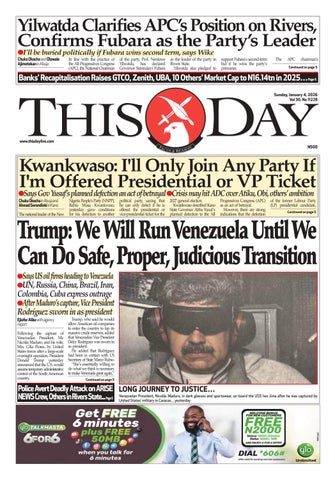
Trump: We Will RunVenezuela Until We Can Do Safe, Proper, Judicious Transition Says US oil firms heading to Venezuela UN, Russia, China, Brazil, Iran, Colombia, Cuba express outrage After Maduro’s capture, Vice President Rodríguez sworn in as president Ejiofor Alike with agency report
Trump, who said he would allow American oil companies to enter the country to tap its Following the capture of massive crude reserves, added Venezuelan President, Mr. that Venezuelan Vice President Nicolás Maduro, and his wife, Delcy Rodríguez was sworn in Mrs. Cilia Flores, by United as president. He added that Rodríguez States forces after a large-scale overnight operation, President had been in contact with US Donald Trump yesterday Secretary of State Marco Rubio. “She’s essentially willing to announced that the U.S. would do what we think is necessary assume temporary administrative control of the South American to make Venezuela great again,” country. Continued on page 5
Police Avert Deadly Attack on ARISE LONG JOURNEY TO JUSTICE… President, Nicolás Maduro, in dark glasses and sportswear, on board the USS Iwo Jima after he was captured by NEWS Crew, Others in Rivers State... Page5 Venezuelan United States’ military in Caracas…yesterday
2
sUNDAY, JANUARY 4, 2026 • T H I S D AY
SUNDAY, JANUARY 4 , 2026 • T H I S D AY
3
4
sUNDAY, JANUARY 4, 2026 • T H I S D AY
5
JANUARY 4, 2026 • T H I S DAY, T H E S U N DAY N E W S PA P E R
NEWS
Police Avert Deadly Attack on ARISE NEWS Crew, Others in Rivers State
Blessing Ibunge in Port Harcourt
Blessing Ibunge in Port Harcourt The prompt response of the operatives of the Rivers State Police Command averted a near deadly attack by armed youths on the ARISE NEWS crew on Friday night, THISDAY has learnt. THISDAY gathered that the suspected political thugs, fully armed, invaded a hotel
in Orazi axis of Obio/Akpor Local Government Area (LGA) of the state and disrupted a live interview of the television station. It was learnt that the ARISE NEWS crew were conducting the interview with a former Commissioner for Employment Generation and Empowerment in the state, Dr. Leloonu Nwibubasa, when the thugs invaded the hotel premises and disrupted the interview. The thugs, it was further
gathered, forced the live interview to end abruptly, and forcefully seized the camera and other equipment belonging to the media house. An eyewitness, who pleaded anonymity, explained that Nwibubasa, who is an associate of former Vice President Atiku Abubakar, was speaking on the political issues in the state when a man suspected to be a guest at the hotel allegedly called the thugs on phone.
The source, who said the thugs invaded the hotel at about 9:15pm, disclosed that both the commissioner and the ARISE NEWS cameraman escaped by the whiskers. The source also revealed that the angry thugs who were fierce looking, claimed that the interview, which they claimed was against a prominent political leader in the area, shouldn't be conducted in their town. The witness narrated:
"They were chanting in their local language (Ikwerre) that they would not allow such interviews on their land. They were forcing doors open searching for the former commissioner and the ARISE NEWS guys. "The workers in the hotel started running helter-skelter. They later got to the spot where the interview was being held and started threatening the former commissioner and the ARISE
NEWS crew to discontinue the interview and forced them to stop," the witness added. Narrating his ordeal, the reporter with the ARISE NEWS, Mr. Andy Omano, who narrowly escaped the attack, said: "At that point, I called the police control room and also put a call across to some of my colleagues. The police responded and said they were on their way to the hotel.
TRUMP: WE WILL RUN VENEZUELA UNTIL WE CAN DO SAFE, PROPER, JUDICIOUS TRANSITION Trump said. President Maduro and his wife, Flores, have been indicted in the Southern District of New York on drug-trafficking charges. After a barrage of missile strikes, the US military in the early morning hours of yesterday captured the couple. While the United Nations, Russia, China, Brazil, Iran, Cuba, and Colombia have expressed outrage at the US invasion of Venezuela, Germany and Italy said they were monitoring the situation. Spain, however, has offered to mediate in the crisis.
Announcing the capture of Maduro in his Truth Social post, Trump said: “The United States of America has successfully carried out a large-scale strike against Venezuela and its leader, President Nicolas Maduro, who has been, along with his wife, captured and flown out of the country. “This operation was done in conjunction with US Law Enforcement—details to follow. There will be a News Conference today at 11 A.M. at Mar-a-Lago. Thank you for your attention to this matter!” The US military operation led
to explosions rocking Caracas, the Venezuelan capital, in the early hours of yesterday. Speaking later at a press conference held yesterday evening at his Mar-a-Lago residence in Palm Beach, Florida, Trump said the US would run Venezuela until it can “do a safe, proper and judicious transition.” He also said the US would be running the country “with a group” and “designating various people,” without providing details. “We are going to run the country until we can do a safe, proper, and judicious transition,”
he said. According to him, the Venezuela operation “was one of the most stunning, effective and powerful displays of the American military.” “Not a single American service member was killed, and not a single piece of American equipment was lost, many helicopters, many planes, many people involved in that fight,” Trump also said. The US president said he would allow American oil companies to head into Venezuela to tap its massive crude reserves.
“We’re going to have our very large United States oil companies, the biggest anywhere in the world, go in, spend billions of dollars, fix the badly broken infrastructure, the oil infrastructure, and start making money for the country,” Trump told the press conference. Trump also said, “The embargo on all Venezuelan oil remains in full effect.” Trump also warned other political and military figures in Venezuela, saying that “what happened to Maduro can happen to them.” Venezuela has been under US
KWANKWASO: I'LL ONLY JOIN ANY PARTY IF I'M OFFERED PRESIDENTIAL OR VP TICKET
Mr. Peter Obi, to the African Democratic Congress (ADC) may lead to a clash among the party's presidential aspirants, potentially plunging the party into crisis. With his formal defection to ADC last week, Obi is set to contest the party’s presidential ticket with former Vice President Atiku Abubakar and former Rivers State governor, Rotimi Amaechi. While it is not clear whether the former governor of Kaduna State, Mallam Nasir El-Rufai, is eyeing the ADC presidential ticket, there was an indication last week that the ex-governor of Kano State, Kwankwaso, who is also nursing presidential ambitions, might join the party. Kwankwaso, who was the presidential candidate of the NNPP in the 2023 general election, however, stated that he can only defect to any political party if he is offered the presidential or vice-presidential ticket.
Addressing NNPP’s supporters at his Miller Road residence in Kano yesterday, the former governor explained that he is always ready to accept an offer from any political party, given his political trajectory over the past four decades. He stated that his supporters, spread across the country, would only allow him to consider offers for the presidential or vice-presidential ticket. Kwankwaso recounted that the APC leadership invited him to join the party, but he declined the offer because there was no solid proposal that would benefit him and his supporters. He said: "According to our Kwankwasiyya political ideology, our top priority is to assist the poor and the youth by providing employment opportunities for Nigerians, improving educational standards, ensuring economic prosperity, enhancing the healthcare system, and boosting agriculture."
Speaking on the recent move by Kano State Governor Abba Kabir Yusuf to join the APC, Kwankwaso revealed that the governor has not consulted him or given any tangible reason for his planned defection. He described the planned defection as a shock to the NNPC leadership and its members. “ This is a lesson to all of us. We thought everyone had understood. We never expected betrayal. “The most painful thing is that after everything we did to rescue Kano from Ganduje and the APC, you have now handed the governorship back to him free of charge.” Kwankwaso further explained: “As you also heard, they were supposed to decamp on Monday. I also heard that it has now been postponed. “We want to give you an assignment: continue praying for them. Secondly, if any of
you are in contact with them, tell them to stop,” he said.
Party’s Flag Bearer Will Emerge Through Presidential Convention, Says Abdullahi While Atiku, Kwankwaso, and Obi contested the 2023 presidential election with President Bola Tinubu, the former Rivers State governor contested the APC presidential ticket with the current president. Atiku, Obi, and Amaechi had vowed to contest the 2027 presidential election, with each insisting that he would not step down for a consensus candidate. THISDAY gathered that the uncompromising stance of the presidential aspirants might plunge the party into crisis. Besides, a former presidential candidate of the party, Dumebi Kachukwu, and a House of Representatives member, Leke
Joseph Abejide, are currently in court challenging the takeover of the party by the David Mark-led leadership. These court actions, many feared, could also create a severe crisis in the party ahead of the 2027 general election. However, ADC stated yesterday that only the outcome of the party’s presidential convention would determine who would fly the party's presidential ticket, adding that there would be no preferential treatment for anyone. The National Publicity Secretary of ADC, Mallam Bolaji Abdullahi, told THISDAY that there would be no preferential treatment. He clarified that only the presidential convention would determine the party's presidential candidate. According to him, “the coming national convention of the party is not for the election of the presidential candidate of the
YILWATDA CLARIFIES APC’S POSITION ON RIVERS, CONFIRMS FUBARA AS THE PARTY’S LEADER
confirmation came as the Minister of the Federal Capital Territory (FCT), Nyesom Wike, declared that his political career will suffer irreparable damage if Fubara secures a second term in office. Speaking in a television interview over the weekend, Yilwatda explained that it is the APC's practice to recognise serving governors as party leaders in their respective states. He, however, emphasised that Governor Fubara must work with other stakeholders to ensure inclusion and effective
coordination within the party. This comes amid the renewed political tension between Governor Fubara and the Minister of the Federal Capital Territory (FCT), Nyesom Wike, over a leadership position in the state. In December, after defecting to the APC, Fubara declared himself the party's leader in the state after being presented with the party card bearing 001. But Wike had dismissed the governor’s stance, saying the governor’s 001 status applies to only his ward and not the state.
However, Yilwatda has confirmed the governor as the ruling party’s leader in the state. “Governor Fubara is the leader of the APC in Rivers State, but he would need to coordinate with every other person in the state,” Yilwatda said. In all states, the state governors lead the parties in their respective states. In APC, we give them that privilege, but we also ask the governors to ensure inclusion — to coordinate and carry everyone along.”
Responding to questions of whether the party would support Fubara if he wants to run for a second term in office, the APC national chairman drew parallels with similar instances in other states, citing the example of Ekiti State, where the sitting governor had to go through the party’s primary process like any other aspirant before emerging as the flagbearer. “We did primaries in Ekiti State, and the governor contested with others before he emerged as the APC candidate.
The same rule applies to every state — even Governor Fubara will have to go through the normal process if he seeks the ticket,” he noted. Yilwatda also made it clear that discussions concerning the party’s affairs in Rivers State will be held with Governor Fubara, not Wike, who remains a member of the Peoples Democratic Party (PDP). “If we are discussing elections, we will not be discussing with Nyesom Wike. He is not a member of our party,”
oil sanctions since 2019. The Chairman of the Joint Chiefs of Staff, Gen. Dan Caine, said the military mission involved “more than 150 aircraft launching across the western hemisphere in political coordination, all coming together in time and place to layer effects for a single purpose, to get an interdiction force into downtown Caracas, while maintaining the element of tactical surprise.” Trump had repeatedly warned that the US was preparing to take fresh action against alleged Continued on page 10
party.” Abdullahi said that the Markled party remains the only ADC recognised by the Independent National Electoral Commission (INEC). He insisted that Kachukwu was expelled before the assumption of office by the Mark-led National Working Committee (NWC). Speaking in an exclusive interview with THISDAY, Abdullahi said, “For clarity, the February state congresses and national convention are to fill all executive arms and to ratify all the elections and decisions so far made by the David Mark-led executive." According to him, ''we are aware of the presidential interests of some members of the party; this one is not for the election of our presidential candidate. When we get to that bridge, we shall cross the bridge, but we have no preferred person '' Yilwatda stated. “We will be discussing with Siminalayi Fubara because he is a member of the All Progressives Congress right now.” When asked whether Wike still influences APC politics in Rivers State, the party chairman dismissed the idea, insisting that his focus remains on APC members, not individuals outside the fold. “I think we are overflogging what we don’t need to overflog,” he said. Continued online
6
T H I S DAY, T H E S U N DAY N E W S PA P E R • JANUARY 4, 2026
NEWS
ROYAL VISIT TO HIS EXCELLENCY…
L-R: Former Deputy Governor of Borno State, Ali Abubakar Jatau; Governor Babagana Zulum; Ooni of Ife, Oba Adeyeye Enitan Ogunwusi, Ojaja II: and renowned businessman, Alhaji Muhammadu Indimi, during the Ooni’s visit to Government House, Maiduguri…weekend
Banks' Recapitalisation Raises GTCO, Zenith, UBA, 10 Others' Market Cap to N16.14tn in 2025
Kayode Tokede
The market capitalisation of Guaranty Trust Holding Company Plc (GTCO), Zenith Bank Plc, United Bank for Africa Plc (UBA), and 10 other listed banks rose to N16.14 trillion in 2025, buoyed by the Central Bank of Nigeria’s (CBN) ongoing banking sector recapitalisation exercise, which has a deadline of March 2026. This represents an increase of about 86.8 per cent, or N7.5 trillion, over the combined market capitalisation of N8.64 trillion recorded by the 13 banks on the Nigerian Exchange Limited (NGX) in 2024. The N16.14 trillion valuation implies that banking stocks
accounted for an estimated 16.23 per cent of the total market capitalisation of all listed equities on the NGX, which stood at N99.38 trillion in 2025. Some of the 13 banks are GTCO, Zenith Bank, UBA, Access Holdings Plc, Stanbic IBTC Holdings Plc, Ecobank Transnational Incorporated (ETI), Fidelity Bank Plc, Sterling Financial Holdings Company Plc, Wema Bank Plc, FCMB Group Plc, Jaiz Bank Plc, and Unity Bank Plc. A breakdown of the figures showed that GTCO emerged as the most capitalised banking stock, with market capitalisation rising to N3.3 trillion in 2025 from N1.68 trillion in 2024. Zenith Bank
Anthony Joshua Escaped Death after Swapping Seats, Says Report, Friends’ Funeral Holds Today in London British-Nigerian former World Boxing Champion, Anthony Joshua, narrowly avoided death in a Monday car crash after he swapped from the front to the back seat of a Lexus SUV, according to a revelation made Friday by his driver’s lawyer. This is as the Janaza (funeral) prayer service for Sina Ghami and Abdul Latif Kevin Ayodele, Joshua’s close friends, who died in the accident, is scheduled to take place today, January 4, 2026. The accident, which occurred on a busy Lagos– Ibadan expressway, killed two of Joshua’s friends, Ayodele Kelvin Olu (36), a Nigerian-British citizen, and Gami Sina (36), a British citizen, and injured others, including the boxing champion. Joshua’s driver, Kayode Adeniyi (46), who has been remanded in custody, faces four
charges, including dangerous and negligent driving, and driving without a valid licence. The driver’s lawyer, Olalekan Abiodun, told the Daily Mail that Joshua initially sat in the front seat but moved to the back at the driver’s request. “My client has pleaded not guilty, and what happened was an accident. I haven’t had a chance to speak with him yet, but I understand he says the brakes did not work. “I also understand that the journey started in Lagos and that initially Anthony had got into the front seat, but the driver asked him to swap seats. “He did this because Anthony is a big fellow, and he couldn’t see the wing mirror properly; so, he asked him to move, and he sat behind the driver. From what I understand, Latif was in front and then changed seats with Anthony.”
followed with N2.54 trillion, up from N1.43 trillion in the preceding year. UBA closed the year with N1.71 trillion, up from N1.16 trillion. Stanbic IBTC Holdings, the only banking stock to close 2025 at N100 per share, saw its market capitalisation rise to N1.59 trillion from N746.32 billion in 2024. Access Holdings ended 2025 with a market capitalisation of N1.12 trillion, compared with N847.75 billion the previous year. ETI’s market capitalisation
rose to N994.34 billion in 2025 from N513.8 billion in 2024, while Fidelity Bank recorded N954.03 billion, up from N560.21 billion. Wema Bank posted one of the most substantial gains, with market capitalisation rising sharply to N818.43 billion from N195.01 billion. FCMB Group’s market capitalisation increased to N515.4 billion in 2025 from N186.15 billion in 2024. Sterling Financial Holdings Company rose to N367.4 billion from N161.23 billion,
while Jaiz Bank ended 2025 with N202.88 billion, up from N133.77 billion. Unity Bank’s market capitalisation remained flat at N17.65 billion. The strong performance of banking stocks helped push the NGX Banking Index to a record 39.77 per cent gain in 2025, significantly higher than the 23.23 per cent gain in 2024, reflecting heightened investor confidence, primarily driven by recapitalisation reforms. Most of the banks have tapped the Nigerian capital market to meet the March
2026 recapitalisation deadline set by the CBN. The directive, announced in March 2024, requires commercial banks with international licences to raise their minimum capital base to N500 billion, while national and regional banks must meet thresholds of N200 billion and N50 billion, respectively. According to the CBN governor, Mr. Olayemi Cardoso, about 27 banks have raised capital so far, with 16 already fully meeting the new regulatory requirements.
Asaba to Honour Distinguished Sons, Daughters With Chieftaincy Title Sunday Ehigiator
The ancient city of Asaba has taken another step in recognising excellence and service, as the Asagba of Asaba, His Royal Majesty, Prof. Epiphany Chigbogu Azinge, has announced the nomination of 20 distinguished sons and daughters of the kingdom for the prestigious Olinzele Ahaba chieftaincy title. The nominations were contained in an official letter issued by the Asagba’s Palace, Jesus Saves, dated January 1,
2026. The document, signed by the revered monarch, stated that the nominations were included in his New Year's message to the people of Asaba. According to the letter, the nominees were selected in recognition of their contributions to the growth, development, and prestige of Asaba, both within and outside the kingdom. The conferment of the Olinzele title, the palace noted, remains subject to the fulfillment of all stipulated
traditional and administrative requirements. Those nominated for the highly respected title include: Ogbueshi Louis Edozien, Ogbueshi Adizua Eluaka, Ogbueshi Albert Adaba, Ogbueshi Dr. Ify Uraih, Mr. Emma Odiaka, Ogbueshi Ken Ogodugu, Ogbueshi Dr. Harrold Azinge, Ogbueshi Jaja Isichei, Ogbueshi Dr. Chris Ojeh, and Ogbueshi Godfrey Ogodugu. Others are Prof. Mrs. Etuna Mbah, Ogbueshi Chike Ogeah, Ogbueshi Tony Ndah,
Ogbueshi Hon. Ngozi Okolie, Ogbueshi Hon. Shedrack Rapu, Hon. Barr. Bridget Anyafulu, Ogbueshi Ephraim Okotcha, Ogbueshi Dr. Jude Richard Keshi, Ogbueshi Dili Biosah, and Ogbueshi Obiora Nwanze. The palace explained that all nominees are expected to undergo a formal screening process in line with Asaba customs and traditions. It added that the chieftaincy titles can only be conferred at the pleasure of His Royal Majesty and at a time to be determined in 2027.
Again, Gunmen Invade Plateau Village, Kill Seven, Injure Others Yemi Kosoko in Jose
Gunmen attacked a village in Plateau State’s Qua’an-Pan Local Government Area (LGA), killing seven people and injuring several others on Friday night. Eyewitnesses in Jos, the state capital, said yesterday that the incident occurred in Bong village, Doemak District, where the assailants launched a house-to-house attack, targeting women, children,
and the elderly. Residents described the attackers as heavily armed, while survivors reported that the victims were mostly those who could not escape in time. A native of the local government council, Mr. Lawrence Dogari, confirmed the attack, saying, “For now, I can confirm to you that over seven persons have been killed, while some persons are still missing.” The Director of Press and
Publicity to the Executive Chairman of Qua’an-Pan Local Government Council, Danaan Cletus Sylvanus, also confirmed the incident, stating that the number of fatalities could not be ascertained at the moment. “The council boss, Hon. Christopher Audu Manship, is condemning the attack on innocent persons and is collaborating with security operatives to ensure that the culprits are arrested,”
Sylvanus said, adding that the council chairman promised to provide updates as more information becomes available. The spokesman for the state Police Command, Alabo Alfred, did not answer several calls on his mobile phone when contacted by our correspondent for comment on the issue. The attack on Friday is the latest in a series of killings carried out by gunmen in Plateau villages in recent times.
7
JANUARY 4, 2026 • T H I S DAY, T H E S U N DAY N E W S PA P E R
NEWS
WE SHARE IN YOUR GRIEFS…
L-R: Chief Executive Officer, Mike & Associates, Chief Mike Nwosu; Chairman/CEO, Choba Industries Nigeria Limited, Owelle Chukwudi Ofoedu; Chairman/CEO, Jombo Nigeria Agencies Limited, Chief Joel Munonye; Chief Executive Officer, FA Onwuachu and Sons Nigeria Limited, Chief Fabian Onwuachu; Son of the deceased and Managing Director of Al-Tinez Pharm Nigeria Limited, Mr. Steve Okoronkwo; and representative of Obi of Akokwa, Prince Nnamdi Okoli, during condolence visit of Akokwa Cabinet Chiefs to Okoronkwo after the burial of his mother at Akokwa, Ideato North LGA, Imo State…weekend
House Releases Tax Reforms Acts for Scrutiny to Address Discrepancy Controversy
Adedayo Akinwale in Abuja
The House of Representatives has released the four tax reform Acts recently signed into law by President Bola Tinubu, following public controversy over alleged alterations to the nation’s tax laws. The decision comes amid concerns raised on the floor of the House regarding discrepancies between versions of the tax laws in circulation and the Acts as passed by the National Assembly. The Speaker of the House, Hon Tajudeen Abbas, in concurrence with the President of the Senate, Godswill Akpabio yesterday, directed the immediate release of the Certified True Copies (CTC) of the laws, including the endorsement and assent pages signed by the President, to enable public reference and verification. The released legislations are the Nigeria Tax Act, 2025; the Nigeria Tax Administration Act, 2025; the National Revenue Service (Establishment) Act, 2025; and the Joint Revenue
Board (Establishment) Act, 2025. The controversy erupted during plenary when Sokoto lawmaker, Abdussamad Dasuki raised a point of privilege, drawing the attention of the House to what he described as inconsistencies between certain versions of the newly enacted tax laws circulating in the public domain and the texts debated and passed by the National Assembly. Dasuki warned that the circulation of such versions, if left unaddressed, could undermine public confidence in the legislative process and the integrity of the laws. Following his intervention, the House resolved to investigate the matter, prompting the Speaker to order an internal verification of the Acts and the public release of the certified versions to clarify the situation and dispel doubts over the authenticity of the laws. In a statement issued yesterday, the House spokesman, Mr. Akin Rotimi, said the decision to release the Acts signed by President
Tinubu “underscores the Speaker’s long-standing commitment to transparency, legislative integrity, and public confidence in the law-making process.” The statement read in part, “The attention of the House was drawn to the existence of inconsistent versions of the tax laws in circulation after a vigilant Honourable member identified discrepancies, raised the alarm, and formally reported the matter to the House on a point of privilege. “Acting promptly, the Speaker ordered an internal verification and the immediate public release of the certified Acts to eliminate doubt, restore clarity, and protect the sanctity of the legislative record. “From the initiation of the tax reform process through extensive stakeholder consultations, committee scrutiny, rigorous clauseby-clause consideration, robust plenary debates, and eventual passage, Speaker Abbas has provided firm and steady leadership to ensure that the reforms were
evidence-based, inclusive, and aligned with Nigeria’s fiscal realities and development priorities. Throughout the process, the Speaker consistently emphasised that tax reform must be anchored on clarity, fairness, and strict adherence to constitutional and parliamentary procedure. “The four Acts released are the Nigeria Tax Act, 2025, the Nigeria Tax Administration Act, 2025, the National Revenue Service (Establishment) Act, 2025 and the Joint Revenue Board (Establishment) Act, 2025. “These landmark legislations constitute the backbone of Nigeria’s contemporary tax reform architecture, designed to modernise revenue administration, improve compliance, reduce inefficiencies, eliminate duplications, and strengthen fiscal coordination across the federation.” According to the statement, the Speaker, in directing the release of the certified Acts, reassured Nigerians that the National Assembly remains an institution guided by due
Nigeria’s Future Won’t Be Handed over to Mediocrity, Impunity, Misrule, Gbenga Hashim Insists Chuks Okocha in Abuja
Former presidential candidate Dr. Gbenga Hashim has declared that surrender is not an option, insisting that Nigeria’s future should not be handed over to mediocrity, impunity, and misrule, despite the nation’s deepening political, economic, and security challenges. Hashim made the declaration in Abuja during a North-central zonal meeting of the Gbenga Hashim Solidarity
Movement, which brought together state coordinators from across the region. Addressing the gathering, Hashim said Nigeria’s current realities demand steadfast leadership, organised civic engagement, and citizens who are willing to remain involved rather than retreat into apathy or despair. He warned that abandoning the country would amount to handing its future over to mediocrity, impunity, and misrule.
According to him, national renewal requires discipline, clarity of purpose, and sustained grassroots organisation, stressing that meaningful change is never accidental but the product of deliberate and collective effort. He urged coordinators to deepen community-level engagement while remaining anchored to the core values of accountability, justice, and national unity. The meeting reviewed the state of the movement
across the North-central zone, assessed ongoing mobilisation efforts, and agreed on strategies to strengthen coordination and expand the movement’s reach within the region. Coordinators in attendance reaffirmed their commitment to the vision of a Nigeria governed by competence, integrity, and inclusiveness, pledging to intensify grassroots organisation and political education across their respective states.
process and proper recordkeeping. “In directing the release of the certified Acts, the Speaker reassured Nigerians that the National Assembly remains an institution of records, guided by clearly defined rules, precedents, archival systems, and verification processes that safeguard the authenticity of every law enacted.” Rotimi also quoted the Speaker as saying, “The National Assembly is an institution built on records, procedure, and institutional memory. Every bill, every amendment, and every Act follows a traceable constitutional and parliamentary pathway. Once a law is passed and
assented to, its integrity is preserved through certification and custody by the legislature. There is no ambiguity about what constitutes the law.” The Speaker, on behalf of the House, assured Nigerians that the only authentic and authoritative versions of the four tax Acts are those certified and released by the National Assembly. “Members of the public, institutions, professionals, and stakeholders are therefore advised to disregard and discountenance any other documents or versions in circulation that are not certified by the National Assembly, as such materials do not form part of the official legislative record.
Resident Doctors Threaten to Resume Strike January 12 Onyebuchi Ezigbo in Abuja The Nigerian Association of Resident Doctors (NARD) has announced plans to resume its Total Industrial and Clinical Services (TICS) 2.0 nationwide from January 12, 2026, following the outcome of its Emergency National Executive Council (E-NEC) meeting held on January 2, 2026. In an update issued after the meeting, the association, through its president, Dr. Mohammed Suleiman, explained that the decision was reached in response to the continued failure of relevant authorities to fully implement agreements reached on doctors’ welfare and conditions of service. According to the resolution, the resumed action, tagged “No Implementation, No Going Back, will commence at exactly 12:00 am on
Monday, January 12, 2026. Ahead of this, NARD directed the presidents of its 91 centres across the country to convene congresses and subsequently address the media. The association plans to hold 91 separate press conferences nationwide within a seven-day window to raise public awareness of its grievances. It also announced a schedule of centre-based protests from January 12 to January 16, 2026, to be followed by regional protests coordinated by caucus leaders. A nationwide protest is also to be organised by the NARD National Officers’ Committee (NOC). NARD stressed that any suspension of TICS 2.0 would only be considered after the full implementation of its minimum demands.
8
T H I S DAY, T H E S U N DAY N E W S PA P E R • JANUARY 4, 2026
NEWS
UNITING FOR AKWA IBOM…
L-R: Secretary to the Akwa lbom State Government, Enobong Uwah; Senator Effiong Bob; Chief Asam Asam; Akwa Ibom State Governor, Pastor Umo Eno; President of the Senate, Senator Godswill Akpabio; and Chairman of All Progressives Congress, Akwa Ibom State, Stephen Ntukekpo, during the new year visit of the state governor to the Senate President in Uyo …yesterday
Shettima: Investment in Education Never a Gamble, But Conscious Plan for Better Future Kashim Ibrahim varsity installs Ooni as chancellor
Deji Elumoye in Abuja
Vice President Kashim Shettima has stated that there is no investment in the education sector that is a gamble, insisting that the sector remains a deliberate commitment to securing a better future for Nigeria. He also described education as the most powerful tool for development, economic empowerment, and societal liberation. Speaking yesterday during the combined convocation ceremonies of Kashim Ibrahim University in Borno State, where a total of 2,294 students
graduated across three academic sessions - 2022/2023, 2023/2024 and 2024/2025 - the Vice President urged the graduating students to see themselves as ambassadors of integrity, service, and excellence. He stated that their conduct would define the reputation of the institution. “No investment in education is ever a gamble. It is a conscious plan for a better, more secure future. “Wherever life takes you, you carry the name and values of Kashim Ibrahim University. You must shun ethical shortcuts and moral compromise,” he explained.
Karimi: National Assembly Will Back Tinubu on Recovery of Trillions of Naira Stolen LG Funds
The Chairman of the Senate Committee on Services, Senator Sunday Steve Karimi, has stated that the National Assembly fully supports President Bola Tinubu’s call for practical and unfettered financial autonomy for local government councils. Karimi, who represents the Kogi West Senatorial Zone, said the parliament would enact relevant laws to ensure strict compliance with the Supreme Court’s judgment on fiscal autonomy for the third tier of government. Karimi, who spoke while hosting his constituents during the yuletide break, recalled the landmark July 25, 2024, ruling of the Supreme Court, which directed the seamless federal allocation of funds to the 774 councils. He quoted the judgment as saying that "state governors' control over local government resources is unconstitutional, while also voiding caretaker
committees as illegal." Senator Karimi observed that the judgment aimed to "strengthen grassroots democracy and governance by ensuring that allocations go directly to elected officials, without state interference." He recalled that the ruling's overall aim is also to improve service delivery at the critical local government level of the governance pyramid. Karimi observed that, despite this explicit declaration by the highest court in the land, some states have continued to disregard and disrespect the ruling. According to Karimi, "cognisant of the errant conduct of some state governors on the issue, President Tinubu warned at the recent National Executive Committee meeting of the All Progressives Congress (APC) a fortnight ago, that he may be compelled to issue an Executive Order to whip defaulting governors into line."
Shettima pointed out that Borno State and its government understand the consequences of neglecting education, having endured years of disruption caused by insurgency. “Borno has paid a heavy price for the years education was disrupted. Yet, the people chose resilience over despair and learning over loss,” he said. Describing the graduates
as pioneers of the university, the Vice President reminded them that history has placed a special responsibility on their shoulders. “You are the first torchbearers of this institution. History will judge this university by what you become and how you conduct yourselves." He commended the academic and administrative leadership
of the institution, including its pioneer Vice-Chancellor, current management, lecturers, and staff, for laying what he termed “a solid foundation for learning in the heart of the North-east.” He praised Borno State Governor, Prof. Babagana Zulum, describing him as “a leader whose vision turned an idea into an enduring
institution.” “This convocation is proof that true leadership measures power by the number of lives it enlightens,” he maintained, just as he applauded the university's Pro-Chancellor and Chairman of the Governing Council, Alhaji Muhammadu Indimi, for his commitment to the state, even at the height of the Boko Haram insurgency.
Joint Task Force Names Shariff Umar as Coordinator of Suicide Bombing Network in North-east
Linus Aleke in Abuja
Troops of Joint Task Force in the North-east ‘Operation HADIN KAI’ (OPHK) have recorded a breakthrough in their counter-terrorism operations with the identification of Shariff Umar as the principal coordinator of suicide bombing activities responsible for recent attacks within the region. The same military operation on Friday uncovered a significant cache of high-
calibre ammunition in the Bulumkutu Railway general area of Maiduguri metropolis, reinforcing the effectiveness of ongoing intelligence-driven security operations across the theatre. These were disclosed by the Media Information Officer, Joint Task Force North East ‘Operation HADIN KAI’, Lt. Col. Sani Uba, in a statement issued yesterday in Maiduguri. The statement said the identification of Umar as the principal coordinator of suicide
bombing activities, “followed intelligence-led cordon-andsearch operations conducted at the Kalmari area of Maiduguri on 31 December 2025, during which 14 suspects linked to suicide bombing activities were arrested. Subsequent detailed identification and investigative processes established the structure, roles, and operational linkages of the terror cell. “During the investigation, a suspected suicide bomber currently in custody, Ibrahim
Muhammad, unequivocally identified Shariff Umar (also known as Yusuf) as the ringleader and coordinator of the terror network. “According to consistent and corroborated statements, Shariff Umar was responsible for recruiting, preparing, directing, and dispatching suicide bombers to assigned targets, as well as coordinating logistics and delivery of Improvised Explosive Device (IED) components.
2027: Saraki Free to Rejoin APC Whenever He Deems Fit, Says Party Chieftain, Ex-envoy Hammed Shittu in Ilorin
Ahead of the 2027 general election, a former Nigerian Ambassador to Cameroon and chieftain of the All Progressives Congress (APC) in Kwara State, Ambassador Femi Abodunrin, has said that the former Senate President, Dr. Bukola Saraki, is free to rejoin the ruling party whenever he deems fit. Earlier in the week, a former Minister of National Planning and Director-General
of the Nigerian Institute of Democracy and Legislative Studies (NILDS), Prof. Olarenwaju Sulaiman, said on a radio programme in Ilorin that Saraki was a member of the APC in Abuja. At the same time, he is a leader of the Peoples Democratic Party (PDP) in Kwara State. However, some PDP leaders in the state challenged Sulaiman to provide evidence of the comments made against Saraki. The state PDP Director of Planning and Strategy, Mallam
Ibrahim Olayinka Otukoko, and the Kwara Central senatorial chairman of the PDP, Alhaji Isiaka Owolabi, while speaking with journalists in Ilorin, stated that "Saraki remains a committed and recognised leader of the PDP in Kwara, nationally and beyond". They therefore urged PDP members across the state to ignore distractions and remain focused on grassroots mobilisation ahead of the 2027 general elections. However, in a chat with
journalists yesterday in Offa, the headquarters of Offa Local Government Area (LGA) of the state, Ambassador Abodunrin said Saraki had no inhibitions about returning to the APC, either at the national or state level. "Nobody can stop him from rejoining the party. “Saraki is a founding member of the APC. We all witnessed how he was brutally chased out of the party, despite his sacrifices and investments.
SUNDAY, JANUARY 4 , 2026 • T H I S D AY
9
10
T H I S DAY, T H E S U N DAY N E W S PA P E R • JANUARY 4, 2026
NEWS
THE JOY OF MOTHERHOOD...
L-R: The Bride, Mrs. Tamarakile Nwokedi; Mother of the Groom, Mrs. Winifred Nwokedi; and Groom, Mr. Chuba Nwokedi, during the traditional wedding of the couple in Lagos…recently
Niger Orders Schools in Unsecured Places to Remain Closed, Gives Conditions for Reopening of Others Laleye Dipo in Minna
The state government, however, set conditions for reopening others next Monday. All the schools were closed about six weeks ago following the attack and abduction of 230 pupils, students, and teachers from the St Mary's Catholic
Primary Secondary School in Papiri Agwara Local Government Area (LGA) last October. The Commissioner for Basic Education, Dr. Hadiza Asabe Mohammed, in a statement at the weekend, directed the schools reopening to take place
from January 12, saying the government took the action "after a careful security assessment and extensive communication with the relevant security agencies, in line with the governor's unwavering commitment to safeguarding lives.” The government action,
she added, "is to ensure uninterrupted access to The Niger State Government quality education for all has ordered all private and children in Niger State." public schools located in Mohammed revealed unsafe and unsecured areas that "for transparency and in the state to remain closed effective coordination, until they are assessed as the Ministry of Basic and safe by the relevant security Secondary Education will agencies. release the list of both private and public schools to be reopened on Monday, TRUMP: WE WILL RUN VENEZUELA UNTIL WE CAN DO SAFE, PROPER, January 12, 2026.” JUDICIOUS TRANSITION Among the conditions given for the reopening of drug trafficking networks in courts.” capital. act of armed aggression against the schools is that "all private Venezuela, saying strikes on Bondi said the Maduros Venezuela.” land would begin soon. would face charges in New UN, Russia, China, “The pretexts used to justify and public day and boarding In October 2025, Trump said York Federal Court on Iran, Brazil, Colombia, such actions are untenable. schools located in unsafe he had authorised the Central existing “Narco-Terrorism Cuba Express Outrage Ideological hostility has and unsecured areas in the Intelligence Agency (CIA) to Conspiracy, Cocaine Importation triumphed over businesslike interim should remain closed until they are assessed as operate inside Venezuela to curb Conspiracy” charges. In his reaction, the United pragmatism,” it added. safe by the relevant security the illegal flow of migrants and Brazil’s President, Luiz Nations Secretary-General, agencies. drugs from the South American Venezuela Deploying Antonio Guterres, said he Inacio Lula da Silva, equally The conditions also country. condemned the US action, all Missile Capabilities was “deeply alarmed” after Last December, he said: “It for Comprehensive saying it crossed “an Washington’s strikes on would be smart for (Maduro)” Defence, Says Defence unacceptable line.” Venezuela. to step down, and he has also Minister, Lopez Lula also called for a UN spokesman Stephane said that the Venezuelan leader’s Dujarric said in a statement “vigorous” response from “days are numbered.” Meanwhile, Venezuela has that Guterres was “deeply the United Nations, adding Michael Olugbode in Abuja The US recently seized two stated that it would launch a alarmed” after Washington’s that Brazil remains open oil tankers off the Venezuelan “massive deployment of all land, strikes on Venezuela, saying it to promoting dialogue and The Ooni of Ife, His Imperial coast, launching strikes on air, naval, riverine and missile could “constitute a dangerous cooperation. Majesty, Oba Adeyeye Enitan more than 30 boats the Trump capabilities… for comprehensive precedent.” Iran, which has close links Ogunwusi, Ojaja II, has administration alleged were defence.” The UN chief is “deeply with oil-rich Venezuela, said described Borno State Governor, ferrying drugs. concerned that the rules of it “strongly condemns the US Professor Babagana Umara It accused the US of hitting It had pointedly accused residential areas in a wave of international law have not military attack on Venezuela Zulum, as a true reformer Maduro of drug trafficking and strikes. been respected,” Dujarric said, and a flagrant violation of the and a beacon of transformative working with gangs designated The “invading” US forces adding that Guterres “calls country’s national sovereignty leadership. as terrorist organisations. The monarch made the have desecrated our soil, going on all actors in Venezuela to and territorial integrity”. However, Maduro has so far as to strike, using missiles engage in inclusive dialogue, Colombian President Gustavo commendation at the weekend repeatedly denied the allegations. and rockets fired from their in full respect of human rights Petro called it an “assault on in Maiduguri during a private Maduro had attempted to combat helicopters, in residential and the rule of law.” the sovereignty” of Latin meeting with the governor at engage with Trump, offering areas populated by civilians,” China has also condemned America, which would lead the Government House. cooperation on fighting drug Venezuela’s Defence Minister, the US military operation to a humanitarian crisis. Ooni, who is the Chairman of trafficking and illegal migration. Vladimir Padrino Lopez, said against Venezuela, describing Cuba, a traditional regional the Southern Nigeria Traditional On Christmas Eve, Trump in a video statement shared on the action as a grave violation ally, denounced what it called Rulers Council (SNTRC), was in warned that if he “plays tough, social media. “state terrorism against the the Borno State capital to attend of international law. it’ll be the last time he’ll ever brave Venezuelan people,” the combined convocation In an official statement He said authorities were be able to play tough”. yesterday, the according to a statement by ceremony of the state-owned gathering “information on issued After the capture, the Trump the injured and dead” in Chinese government said: President Miguel Diaz-Canel. Kashim Ibrahim University, administration said Maduro and Washington’s “vile and “Such hegemonic acts of However, Spain has offered to Maiduguri. his wife would face “the full cowardly attack”. the United States seriously mediate in the crisis to broker He expressed deep wrath of American justice” According to Lopez, violate international law and a negotiated, peaceful solution. admiration for Governor under drug and terrorism residential areas were hit Venezuela’s sovereignty, and “Spain calls for de-escalation Zulum’s commitment to charges. and restraint,” the foreign rebuilding Borno State, stating, threaten peace and security in the area of Fuerte Tiuna, US Attorney General Pamela Venezuela’s largest military in Latin America and the ministry said in a statement, “I like what you are doing; I Bondi posted on X that Maduro complex, situated in the south Caribbean region. China firmly adding it was “ready to help am very proud of you. I want and his wife “will soon face the of Caracas, as well as in the opposes it,” the statement said. in the search for a democratic, to come closer to you. I have full wrath of American justice states of Miranda, Aragua, Russia has also condemned negotiated, and peaceful solution been a fan of yours for a long on American soil in American and La Guaira around the the US military action as “an for the country.” time, and you are a role model
include the mandatory opening of the register for all returning students, and the compiled lists must be sent to the ministry one week after resumption to ensure proper monitoring and documentation. Local government chairmen are also directed to support the reopening process in their respective councils by ensuring adequate security presence within and around the school premises. According to the statement, all stakeholders were enjoined to strictly adhere to the directives in the collective interest of peace, stability, safety, and the sustainable educational development of Niger State.
Ooni Lauds Zulum’s Leadership Style, Vows to Attract Investors to Borno
to many young people in this country.” The monarch added, “You have proven to everybody that you are genuinely a reformer. A lot of us are watching you; we support everything you do. “You have always been passionate about Maiduguri, and I always say to myself, 'What is in Maiduguri that you are so passionate about?' But today I came to Maiduguri, and I now see why you are always running back. I felt it when I came here. Borno is a beautiful state.” The Ooni also gave a brief historical account of the ancient ties between the Kanuri and Yoruba people. He cited deeprooted historical and bloodlines connecting the two great ethnic nationalities. He said, “For me, as a traditional ruler from Ife, the Kanuris are our cousins; we are blood relatives, very strongly as in very, very strongly. I am a history student, and I have met our link and affiliation.
SUNDAY, JANUARY 4 , 2026 • T H I S D AY
11
12
sUNDAY, JANUARY 4, 2026 • T H I S D AY
SUNDAY, JANUARY 4 , 2026 • T H I S D AY
13
14
sUNDAY, JANUARY 4, 2026 • T H I S D AY
SUNDAY, JANUARY 4 , 2026 • T H I S D AY
15
16
T H I S D AY, T h e S U N D AY N e w s pa p e r JANUARY 4, 2026
news
END OF YEAR GETTOGETHER…
President, Oshodi High School 1996 Set and Deputy Director, News, ARISE NEWS, Mr. Ohi Odial (fifth right back row), and members of class during their annual end of the year party in Lagos…recently
ADC: NNPC Debt Waiver Unconstitutional, Enough to Warrant Tinubu’s Impeachment Chuks Okocha in Abuja The African Democratic Congress (ADC) has criticised President Bola Tinubu for granting a debt waiver to the Nigerian National Petroleum Company Limited (NNPC), saying the action was unconstitutional and sufficient to warrant the president’s impeachment. The opposition coalition further accused President Tinubu of repeated constitutional violations, arguing that the debt waiver alone was sufficient to warrant his impeachment. President Tinubu approved the cancellation of a significant portion of NNPC’s outstanding debts, including N7.6 trillion owed to the Federation Account. The decision has elicited reactions, with Civil Society Organisations (CSOs) and legal practitioners characterising it as an assault on transparency and fiscal discipline, and as an
abuse of public trust. In a statement signed by its National Publicity Secretary, Mallam Bolaji Abdullahi, the ADC alleged that the writeoff was carried out without legislative approval, raising concerns that the action violated the provisions of the Nigerian Constitution. “According to official documents presented to the Federation Account Allocation Committee (FAAC), the President approved the removal from the Federation Account books of approximately $1.42 billion (USD) and N5.57 trillion (NGN) in legacy NNPC debt following a reconciliation of records with regulators. This directive covers outstanding liabilities accumulated up to 31 December 2024,” the ADC said. The statement, shared on X yesterday, added, “The ADC is especially concerned
Mbah: Enugu’ll Witness Visible Transformation in 2026, Consolidate on Gains Already Made
Emmanuel Ugwu-Nwogo in Enugu
Enugu State Governor, Mr. Peter Mbah, has promised to consolidate the gains already made across the state’s economy and drive accelerated development in 2026. He gave the assurance in his New Year broadcast to the people and residents of Enugu that his administration would not rest on its oars in deepening development across the state. Mbah also described 2026 as a year of quantum leap for the people of Enugu State, maintaining that “our optimism is not abstract, but grounded in the concrete work we have done. “In 2026, life in Enugu will change in ever more visible and practical ways,” he said. The governor listed projects
and programmes that would be implemented to bring about the promised visible transformation in 2026. He said: “Every urban road across our cities will be paved and upgraded with proper drainage and walkways, with many also receiving new streetlights to improve safety. “Projects like the 9th Mile 24/7 water scheme, the planned Ajali Scheme revamp, and Oji River will continue to push clean water directly into more homes across Enugu. “All 260 Smart Schools will open fully, offering digital learning, science labs, renewable power, and a free daily meal to more than 300,000 children. “In every one of our 260 wards, a fully equipped Primary Healthcare Centre will open, staffed and powered to deliver genuine care when it is needed most.
that nearly 96 per cent of the dollar- denominated legacy obligations and 88 per cent of the naira-denominated legacy balances were written off by executive directive. This write-off was made without legislative or parliamentary approval and without apparent constitutional authority. “This purported justification of ‘reconciliation’ cannot lawfully override the constitutional re-
quirements for revenue sharing. The action effectively removes longstanding liabilities from public accounts, but at the cost of reducing the revenue base constitutionally distributable to states and local governments. “It is important to emphasise that executive action cannot override the Constitution. Under Section 162 of the 1999 Constitution (as amended), all revenues due to the Federation,
including oil sector receipts and related obligations, must be paid into the Federation Account and shared among the federal, state, and local governments.” The ADC insisted that the President lacks constitutional authority to cancel revenue accruing to the Federation Account unilaterally. “The Federation Account is not subject to executive
discretion; no President, including this one, has the unilateral authority to cancel constitutionally due revenues, and any cancellation that reduces revenue due to the states and local governments without legislative authority is unconstitutional,” it said. The opposition coalition insisted that the debt waiver alone was sufficient to warrant impeachment.
Linus Aleke in Abuja
based on actionable intelligence on terrorist movement, hideouts, and logistics, with NAF aircraft engaging identified enclaves, routes, and assembly areas to deny the groups freedom of action. He said in the North-east theatre, NAF aircraft carried out precision strikes on terrorist hideouts at Abirma and Chiralia in the Timbuktu Triangle, following sustained surveillance that confirmed the presence of facilities linked to improvised explosive device (IED) production and attack planning. According to him, the strikes
destroyed the targeted structures, with multiple secondary explosions observed, indicating the destruction of explosive stockpiles and logistics. Ejodame added that further interdiction missions at Guva in the Mandara Mountains dismantled additional terrorist storage and coordination points, significantly weakening the groups’ capacity to regroup or mount attacks. He said the operations were extended to the North-west, where NAF aircraft struck terrorist elements around Karaduwa Giginya Na in Matazu Local Government Area (LGA) of Katsina State. The NAF spokesman said
the terrorists, who were tracked moving in large motorcycle convoys, were engaged at a forested convergence point, leading to the neutralisation of several fighters, destruction of multiple motorcycles, and recovery of assorted weapons. He said the sustained air operations underscored the NAF’s resolve to support joint forces on the ground and dismantle terrorist networks across the country. Ejodame assured Nigerians that the NAF would continue to conduct precision air operations to protect civilians and support national efforts to restore peace and security.
NAF Sustains Airstrikes Ground Operations of Terrorists in North-east, North-west The Nigerian Air Force (NAF) has sustained a series of intelligencedriven air interdiction operations across the North-east and Northwest, neutralising terrorist elements and degrading their logistics and operational networks. The Director of Public Relations and Information, NAF, Air Commodore Ehimen Ejodame, said in a statement yesterday that the operations were conducted between January 1 and January 2 under Operations HADIN KAI and FASAN YAMMA Sector 2. Ejodame said the air strikes were
Concerns Heighten as Kidnappers Demand N450m for Release of Abducted Kwara Monarch, Son, Others
Kidnappers holding a traditional ruler in Kwara State, the Oniwo of Aafin, Oba Simeon Olaonipekun, his son, and other abducted residents have demanded a total ransom of N450 million for their release, heightening concerns over the worsening security situation in the state. Sources confirmed over the weekend that the abductors were demanding N150million for the release of the monarch and his son, Olaolu, a serving member of the National Youth Service Corps (NYSC), while an additional N300million has been demanded for the release of eight residents abducted from Adanla-Irese, a suburb of Igbaja in Ifelodun Local Government
Area (LGA). The Coordinator of the Kwara South Joint Community Security Watch Network, Olaitan Oyin-Zubair, confirmed the development, noting that ransom negotiations had begun for both sets of abductees. “Only two days ago, the kidnappers demanded N300 million for the release of the Adanla abductees. Today, they demanded N150 million for the monarch and his son,” he said. The monarch was abducted on December 31, 2025, when gunmen reportedly stormed the royal palace in Aafin community, Ile-Ire district of Ifelodun LGA, at about 8 pm. Eyewitness accounts indicated
that about eight armed men invaded the palace, firing sporadically and forcing entry into the building. “They broke down the doors with their guns and demanded to see the monarch and his wife,” a family source said. During the attack, the monarch’s wife, Felicia Olaonipekun, was shot in the arm and later taken to a hospital for treatment. The attackers subsequently abducted the monarch and his son, while the local vigilante group was reportedly overwhelmed. According to sources, only two vigilante members were on duty at the time of the attack and were unable to confront the heavily armed assailants.
In a related incident, suspected bandits had earlier, on Friday, December 26, 2025, invaded the Adanla community in Ifelodun LGA, abducting eight residents during a late evening raid. Residents said the attackers stormed the agrarian community around 7 pm, firing sporadically as they moved from house to house, forcing residents to comply. As of press time, the Kwara State Police Command had not issued an official statement regarding the ransom demands. Residents and community leaders have continued to appeal to both state and federal authorities to intensify security operations and ensure the safe release of all abducted victims.
T H I S D AY, Th e S U N D AY N e w S PA P e r JANUARY 4, 2026
BUSINESS
17 Editor: Festus Akanbi 08038588469 Email: festus.akanbi@thisdaylive.com
CBN Headquarters, Abuja
Reforms Meet Politics in a High-stakes Economic Year
Nigeria reached 2026 at a delicate crossroads, balancing hard-won economic stabilisation against the rising pull of pre-election politics. Inflation has eased, the naira has steadied, and reforms are moving from design to execution, yet campaign spending and fiscal pressures are already gathering force. This is a year when budgets, markets, and institutions will be tested simultaneously. How policy discipline holds under political strain will shape business assurance and economic outcomes well beyond 2026, writes Festus Akanbi
N
igeria entered 2026 with two powerful currents. One is the momentum of economic reforms that, after years of distortion, have begun to restore a measure of stability to prices, the exchange rate, and investor confidence. The other is the unmistakable pull of politics, as preparations for the 2027 general elections start early and inject money, tension, and urgency into every corner of the economy. The interaction between these two forces will shape business conditions sector by sector, producing a year that is unlikely to be calm, but also far from directionless. At the macro level, the economy is emerging from a bruising adjustment phase. By the end of 2025, inflation had slowed markedly from its early-year highs, the naira had settled into a more predictable trading range, and business confidence had begun to recover. Independent forecasts from institutions such as the Centre for the Promotion of Private Enterprise suggest that gross domestic product growth could accelerate to around four to four-and-a-half per cent in 2026, driven mainly by services and supported by improved conditions in non-oil sectors. This transition from stabilisation to growth, however, will unfold under tight fiscal conditions and growing political pressure to spend.
of weak execution and repeated capital project rollovers. The government has framed it as a consolidation budget, signalling an intention to end the cycle in which projects are endlessly reapproved without funding. Yet the constraints are severe. Debt service alone is projected to absorb more than N15 trillion, reflecting a public debt stock of about N152.4 trillion by mid-2025. This burden limits the amount of fiscal stimulus that can realistically be delivered, even as political activity intensifies and demands for visible projects multiply. The credibility of the 2026 budget will
Banking Sector Recapitalisation The banking sector enters this period in a stronger position than it has been in years. By 2026, the recapitalisation programme initiated by the Central Bank is expected to be fully concluded, leaving banks with thicker capital buffers and greater capacity to absorb shocks. This new regime is designed not only to enhance stability but also to support larger-scale lending to infrastructure, manufacturing, and energy Continued on page 18
Implementing New Tax Regime
Fiscal Policy Fiscal policy will sit at the heart of this tension. The N58.18 trillion federal budget for 2026 is designed as a corrective measure after years
therefore depend less on its size than on its effective implementation. Roads, power projects, and security-related infrastructure are expected to receive priority because they offer both economic payoffs and political visibility. At the same time, the administration has placed unusual emphasis on digitising revenue collection, tightening remittances from government-owned enterprises, and enforcing performance targets across ministries and agencies. If these measures are effective, they could improve cash flow for capital projects and gradually reduce the gap between appropriations and outcomes. This gap has long undermined Nigeria’s fiscal planning.
Edun
Overlaying the budget is the most ambitious overhaul of the tax system in decades. On January 1, 2026, the Nigeria Tax Act and the Nigeria Tax Administration Act are scheduled to take effect, reshaping the taxation of income, consumption, and corporate profits. The reforms are explicitly redistributive. The majority of salaried workers are expected to see their personal income tax liabilities eliminated or sharply reduced. At the same time, almost all small businesses will be exempt from corporate income tax, value-added tax, and withholding tax. Large corporations, by contrast, will operate under lower headline rates but face stricter compliance and a broader tax net.
Adedeji
T H I S D AY, Th e S U N D AY N e w S PA P e r JANUARY 4, 2026
18
BUSINESS Reforms Meet Politics in a High-stakes Economic Year projects. As inflation eases and interest rates potentially begin a gradual decline, credit demand is likely to increase, thereby improving banks’ asset quality and profitability. At the same time, regulation will become more exacting. Banks will operate under tighter supervision, more rigorous provisioning standards, and closer scrutiny of foreign-currency exposures. Those that successfully raise capital and adapt to the new framework will be better positioned to expand digital services, finance large projects, and compete regionally. Weaker institutions may be pushed toward consolidation or niche strategies. Overall, the sector’s trajectory in 2026 points to cautious expansion rather than exuberance, with growth concentrated in areas aligned with government spending and consumer recovery.
will not be evenly distributed, and risks will remain, particularly from election-related spending, oil price volatility, and security challenges. Yet the combination of fiscal reform, tax restructuring, financial sector strengthening, and targeted infrastructure investment provides a foundation for cautious optimism. For businesses and investors, success in 2026 will depend on understanding how politics and policy intersect, and on positioning within sectors where reform momentum and market demand reinforce each other rather than collide.
Umahi
Business Environment
Infrastructure
For the business environment, the implications are significant. Reduced tax pressure on households is likely to support consumer demand at a time when real incomes are still recovering from inflation shocks. Small and medium-sized enterprises should benefit from improved cash flow and reduced administrative friction, which could encourage formalisation and expansion. For larger firms, particularly those in consumer goods, telecommunications, banking, and energy, the reforms underscore the importance of transparency, data integrity, and tax planning. Politically, the reforms will be tested in an election-tinged environment, where resistance from affected interests could complicate enforcement. Economically, however, they represent an apparent attempt to rebalance growth away from a narrow tax base and toward broader participation.
Infrastructure, more broadly, will be a significant area of activity. Road construction, including high-profile coastal projects, is expected to require substantial capital investment. These investments aim to ease logistics bottlenecks, improve port evacuation, and reduce transport costs, all of which weigh heavily on competitiveness. Progress will be uneven, reflecting funding constraints and execution capacity, but the construction and materials sectors are likely to benefit from sustained public works activity through 2026.
Oduwole
Monetary Policy Monetary conditions in 2026 will be shaped as much by politics as by policy. Election cycles in Nigeria are traditionally associated with heavy cash spending, increased imports, and heightened foreign exchange demand. These dynamics can generate short-term inflationary pressure and strain the currency. Yet the starting point for 2026 is stronger than in previous cycles. The naira has traded within a relatively narrow band since mid-2025, and foreign reserves have been more stable. Analysts broadly expect the currency to hover around the mid-N1,400s to the dollar, assuming oil receipts hold up and portfolio inflows continue.
Emomotimi Cardoso
Capital Market Capital markets could experience a defining moment if planned listings by major entities, such as Dangote Group companies and the Nigerian National Petroleum Company Limited, materialise. Together, these listings have the potential to dramatically expand market capitalisation, deepen liquidity, and attract long-term domestic and foreign investors. For pension funds and asset managers, they would offer rare large-scale investment opportunities in sectors that dominate the real economy. The timing and structure of these listings will be closely watched as signals of the government’s commitment to market transparency and reform.
Energy Sector Energy will remain one of the most consequential sectors of the year, particularly the downstream oil market. The resolution of long-running disputes over petrol supply and pricing, particularly between the Dangote Refinery and fuel importers, is set to redefine market structure. The planned implementation of a 15 per cent import duty on fuel imports is intended to tilt the balance decisively toward domestic refining. If enforced consistently, this policy will reduce foreign exchange outflows, improve Nigeria’s trade balance, and strengthen the commercial viability of local refineries.
Campaign Funding The risk lies in the second half of the year, when campaign spending typically accelerates. Large political expenditures on logistics, media, and patronage often leak into the foreign exchange market, either directly or indirectly. Managing this pressure without reversing the gains of monetary stabilisation will be one of the Central Bank’s most complex tasks. Excessive tightening could choke credit and undermine growth, while insufficient tightening could reignite volatility. The balance struck in 2026 will have consequences for investment sentiment well beyond the election cycle.
Dangote
Kyari
Power
Agriculture
Electricity is another sector where gradual structural change is reshaping outcomes. The decentralisation of power generation and distribution has afforded state governments greater scope to pursue embedded generation, solar projects, and mini-grids. In 2026, these subnational initiatives are expected to play an increasing role in supporting industrial clusters, agro-processing zones, and digital services. While the national grid will continue to face challenges as it did in previous years, the spread of localised solutions is reducing the effective power deficit for parts of the economy, with positive implications for productivity and investment.
Agriculture remains both a pillar and a vulnerability. It contributes more than 30 per cent of GDP and employs a large share of the workforce, yet its growth has been constrained by insecurity, low productivity, and weak logistics. A sustained crackdown on banditry and rural violence would have immediate economic benefits, improving food supply, moderating inflation, and boosting rural incomes. In 2026, agro-processing, storage, and distribution are likely to outperform primary production unless security conditions improve significantly.
Adelabu
Pricing Tension
Technology Technology stands out as a sector relatively insulated from political cycles. The accelerated adoption of artificial intelligence across banking, telecommunications, logistics, and retail is expected to drive efficiency gains and the development of new business models. Digital and social commerce will continue to expand, supported by Nigeria’s youthful population and improvements in payment infrastructure. Firms that invest in automation, data analytics, and AI-driven customer engagement are likely to gain competitive advantages, while laggards face rising costs and declining relevance. Taken together, these dynamics suggest that 2026 will be a year of managed complexity rather than dramatic reversal. Growth
Tijani
In the short term, there may be pricing tensions as the market adjusts to new cost structures. Over the medium term, however, increased domestic refining capacity is likely to reduce the risk of supply disruptions and improve energy security. The success of this transition will depend on regulatory clarity, logistics efficiency, and refiners’ ability to operate at scale without political interference. The older state-owned refineries in Port Harcourt, Warri, and Kaduna occupy a more uncertain space. Despite ongoing rehabilitation efforts, their output has remained inconsistent. In 2026, they are unlikely to regain a central role in fuel supply. Instead, their economic relevance will hinge on whether governance reforms can turn them into commercially run assets rather than perpetual fiscal drains. Without such reforms, they will remain peripheral in an energy landscape increasingly dominated by private players.
Sunday 4 January, 2026 Vol 30 No 11186
T H I S D AY MONDAY MARCH 14, 2022
OPI NION
opinion@thisdaylive.com
www.thisdaylive.com
HAPPY BIRTHDAY, AMINU TAMBUWAL ADE EBIMOMI pays tribute to Tambuwal, politician and former Speaker of the House of Representatives, at 60
See Page 20
NIGERIA’S REDESIGNATION AS CPC After initial differences on terms, Nigeria and the United States reached an agreement to hunt down the terrorists, writes to HAFIZ BAKARE
See Page 20
EDITORIAL RECKLESS DRIVING AND ROAD TRAFFIC CRASHES
See Page 45
119
BETWEEN FEDERAL GOVERNMENT REVENUE AND THE FEDERATION ACCOUNT
P
TEMITOPE AJAYI clarifies some misconceptions, arguing that no government has all the money it needs
ublic debate on government finances in Nigeria is once again clouded by confusion, little knowledge, and deliberate misrepresentation. At the centre of the current controversy is a misunderstanding of the distinction between total revenue generated by government agencies and the portion that actually belongs to the federal government. The confusion has been amplified by commentators who should know better and by a media ecosystem increasingly driven by noise rather than nuance. As a result, statements by President Bola Tinubu on revenue performance and remarks by the Minister of Finance and Coordinating Minister of the Economy, Mr Wale Edun, have been wrongly framed as contradictory, when in fact they address two entirely different fiscal realities. There is a deliberate effort by some individuals to muddy the waters by feeding the public with misleading information. One wonders why anyone would take pleasure in unleashing such information warfare on the public. Regrettably, it appears the mainstream media, which should help frame rational and meaningful public discourse, increasingly relies on social media for stories. They appear more interested in amplifying popular sentiments, even when wrong or absurd, for clicks and views rather than clarity. The situation is even worse on television and radio, where self-styled experts are given ample airtime to spread ignorance. These individuals parade themselves as public affairs analysts, often lacking the requisite expertise. Last September, President Tinubu said the federal government had achieved its non-oil revenue target for 2025 by August. He made this statement during a meeting with members of the defunct Congress for Progressive Change (CPC) and The Buhari Organisation (TBO), led by former governor of Nasarawa State, Senator Tanko Al-Makura. By August, the Nigeria Revenue Service had collected over 22 trillion in taxes, while the Nigeria Customs Service had generated over 5 trillion. The NNPC also reported several trillions of naira in remittances to the government. These figures did not even include receipts from other revenue-generating agencies such as the Nigerian Ports Authority (NPA), the Nigerian Maritime Administration and Safety Agency (NIMASA), the Nigerian Communications Commission (NCC), and others. However, during a public hearing at the National Assembly late last year, Edun said the federal government could not fund its capital budget adequately because it did not have enough money. Some analysts and opposition figures, due to their poor understanding of the minister’s statement, seized on it as a talking point to misinform Nigerians. In reality, President Tinubu was correct, and
Minister Edun did not contradict him. Here are the facts: President Tinubu was right to say revenue targets were met, as revenue-generating agencies exceeded their 2025 targets. Meeting revenue targets does not mean a government has all the money it needs. No government in the world, including the wealthiest nations, has all the money it needs. This is why most governments run deficits. A deficit is the gap between revenue and expenditure, which is usually financed through borrowing and other nonrevenue sources. Nigeria’s situation is like that of a man who needs 10 million annually to meet his personal and family obligations but earns 3 million. If he sets a target to increase his income to 6 million and succeeds, he has met his target but still falls short of his needs. All revenues generated by agencies such as the Nigeria Revenue Service, NNPC, NIMASA, NPA, Customs, NCC, NMDPRA, and NUPRC are paid into the Federation Account. The money in the Federation Account does not belong solely to the federal government. It is a pool from which the federal government, state, and local governments receive their statutory allocations. When Mr. Edun spoke about 10 trillion as federal government revenue in 2025, he was referring to the federal government’s share from the Federation Account— the actual money available for federal spending. The money being spent by the 36 states, the FCT, and the 774 local governments is primarily derived from the Federation
Account through monthly FAAC allocations, as stipulated by the 1999 Constitution (as amended). Apart from Lagos State, Rivers State, the Federal Capital Territory and possibly two other states, over 90 per cent of the revenue of 32 states and the 774 local governments comes from their share of the Federation Account. The internally generated revenue of many states and local governments, as reflected in their 2026 budget proposals, is less than 10 percent of their planned expenditure for the year. It, therefore, the federally collected revenues into the federation account that the entire machinery of the three levels of government essentially run on. It is very important that this distinction is made for a better public understanding of how our government is funded. While it is the job of the opposition and civil society to criticise and hold the government accountable, the media must act as the buffer and guardrails in promoting honest and open public conversations. The media as the watchdog and moral compass of the society should frame national debate in a way that the public is properly educated and enlightened. A well-informed citizenry is essential to sustaining democracy and promoting good governance. Democracy is endangered when charlatans are given unhindered access to microphones to ventilate falsehoods and misrepresent facts. Ajayi is Senior Special Assistant to President Tinubu on Media and Publicity
20
T H I S D AY SUNDAY january 4, 2026
HAPPY BIRTHDAY, AMINU TAMBUWAL
ADE EBIMOMI pays tribute to Tambuwal, politician and former Speaker of the House of Representatives, at 60
I
n 2011, Aminu Waziri Tambuwal happened upon our national consciousness when he won, against all compounding and confounding odds, the seat of the Speaker of the House of Representatives in the 10th Assembly. And for four years, Tambuwal fought for and achieved what an ideal separation of power is—as intended by the framers of our Constitution. When he picked the Sokoto State gubernatorial form in 2015, not a few national political observers believed he had more than a very good chance at winning the election, and that he would perform well in office. And he did. His eight years in Sokoto State remains a reference point for the people. As Tambuwal therefore clocks 60 this coming Saturday, many events are being lined up by friends and associates for the big occasion both in Sokoto and Abuja where he is back to the legislature as a Senator. Born on 10th January 1966 and a lawyer by profession, Tambuwal started working at the National Assembly from the inception of the current democratic dispensation in 1999 when he was employed as a Special Assistant on Legislative Matters to then Senate Leader, Abdullahi Wali. Those four years (1999 to 2003) proved to be a solid foundation for Tambuwal’s later political career. The experience exposed him to the nuances of leadership as exemplified in his ability to work with men and women across political and religious divides while also teaching him how important it was for leaders to jettison their differences for the common good. In 2003, Tambuwal contested and won a seat in the House of Representatives. As a lawmaker, Tambuwal brought his prior experiences as a teacher, lawyer and legislative assistant to bear on lawmaking. Even though he was not a household name at this point, Tambuwal was quietly working and achieving quite a range of legislative successes, which led to being elected by his peers as the Minority Leader of the House in 2005 and Deputy Chief Whip in 2007. He was also a member of various House Committees, including the Rules and Business, Communications, Judiciary, Inter-Parliamentary, and Water Resources. Tambuwal’s ability to bring competing groups to work together earned him the sobriquet, ‘the Consensus Builder’. This attribute would come in handy when he contested the Speakership during his third term in the House in 2011. He defeated, rather convincingly, the candidate anointed by both his party and presidency, Hon. Mulikat Akande-Adeola, with 252 votes to 90. And throughout his tenure as Speaker, his integrity, knowledge of parliamentary procedures, and ability to build consensus made him an asset to the House and garnered for him the support needed to succeed. But this success wasn’t without its pitfalls and challenges. Several efforts were made to impeach Speaker Tambuwal but the respect he had earned across party lines, his knowledge of the inner workings of legislative processes and well-known ability to build bridges across political divides, helped him to survive all these moves. Tambuwal’s ability to navigate the many traps and obstacles put on his way to serve his full term as House Speaker derived mainly from, and gave credence to, the premium he placed on national interest over partisanship conviction. The landmark successes he recorded during his Speakership were largely the results of his strength of character, a trait that helped align his vision with the will of his fellow legislators rather than party directives.
His period of leadership remains, even up till this day, the only time in the Fourth Republic that the House of Representatives was able to remain truly independent of the Executive branch—just as the framers of our Constitution intended it. Tambuwal’s House was never at any time a rubberstamp to the Executive, an achievement that not too many other presiding officers can lay claim to under the current dispensation. As governor of Sokoto between 2015 and 2023, Tambuwal made positive impacts on the lives of the people of his state. For eight years, he prioritized healthcare, infrastructure and education, particularly girl-child education while increasing school enrolment by over 100,000 pupils between 2016 and 2020. His integrity and transparency earned his administration several commendations and financial grants from the World Bank under the State Fiscal Transparency, Accountability and Sustainability (SFTAS) programme. Tambuwal was also committed to the welfare of the poor and the needy, bringing his renowned empathy and compassion to play. Between 2015 and 2023, the administration’s economic reforms focused on boosting agriculture, empowering local enterprises, and improving the business environment. Some of the reforms and key initiatives Tambuwal embarked upon included support for MSMEs which led to the establishment of Sokoto Small and Medium Enterprises Development Agency (SSMEDA). The administration provided a N2 billion matching fund with the Bank of Industry (BoI), and a N1 billion in noninterest soft loans to traders and artisans. Other key initiatives of the administration included the creation of an ‘Ease of Doing Business’ structure to provide a conducive environment for commerce to thrive, reforms in the agricultural sector, including cooperation with private firms such as OCP Africa for a fertilizer blending plant, and Dangote for a rice mill, human capital investment, significant infrastructure investment, and fiscal transparency. However, Tambuwal’s administration didn’t start and end with introducing key economic reforms and embarking on wideranging development initiatives. Shortly after he was inaugurated, he actually sought to streamline government processes and protocols and to recover lost and/ or stolen government properties including monies, in order to set the state back on the right foot. He also launched the exercise to rid the Sokoto State civil service of ghost workers. His investments in infrastructure in critical sectors of the state were the bedrock of his administration’s success. Ebimomi is an Abuja-based public affairs commentator
After initial differences on terms, Nigeria and the United States reached an agreement to hunt down the terrorists, writes to HAFIZ BAKARE
NIGERIA’S REDESIGNATION AS CPC
I
In October 2025, the redesignation of Nigeria as a Country of Particular Concern (CPC) by the Trump administration sparked significant debate regarding its tone and intent. Nigeria and the United States subsequently found common ground to collaborate on the airstrike which took place on Christmas Day 2025. This collaboration was a direct result of diplomatic engagement that followed significant Nigerian and international reservations about President Donald Trump’s initial communication, which many saw as threatening and misinformed. The primary reservations regarding President Trump’s communication redesignating Nigeria as a “Country of Particular Concern” on October 31, 2025, focused on its inappropriate tone, selective framing of the security crisis as purely religious persecution, and a perceived threat to Nigerian sovereignty. The Nigerian government, led by President Bola Tinubu, strongly refuted the U.S. characterization that Christianity faced an “existential threat,” stating it did not reflect the country’s reality or values. Officials stressed that violence affected citizens of all faiths, including Muslims, and was tied to broader issues like terrorism, resource conflicts, and governance challenges. Many Nigerians, including ethnic organisations and diplomats, viewed Trump’s subsequent threat of potential U.S. military intervention (“guns-a-blazing”) as an insult to national sovereignty and a dangerous oversimplification that could exacerbate sectarian tensions. Nigeria’s initial, more assertive diplomatic response was soon replaced with a toned-down version to deescalate tensions, highlighting internal government deliberation on how to manage the diplomatic friction. Analysts and some U.S. lawmakers argued that framing Nigeria’s complex security landscape in narrow religious terms was counterproductive and distracted from the wider problem of tackling jihadist violence and widespread insecurity affecting everyone. Trump’s rhetoric, including threats to enter the country “guns-a-blazing” and instructions to the “Department of War” to prepare for action, was seen as inflammatory and a violation of diplomatic decorum. Some observers viewed the move as an attempt to appeal to Trump’s domestic religious base in the U.S. rather than a nuanced foreign policy effort. A visiting bipartisan delegation of U.S. Congress members later clarified that the CPC designation was intended to foster reforms through dialogue and partnership, not military force, dismissing any plans for U.S. troops on the ground. Experts urged the U.S. to use its leverage to pursue a broader, more nuanced approach to religious freedom that acknowledged Nigeria’s complex, multi-layered crises rather than a single-issue focus. The two countries did find common ground, leading to a collaborative operation. The U.S. airstrikes on December 25, 2025, targeting ISIS in Sokoto State, were conducted in coordination with and with the approval of Nigerian authorities. Nigerian Foreign Minister Yusuf Tuggar confirmed that President Tinubu gave the “go ahead” for the
operation after discussions with U.S. Secretary of State Marco Rubio. U.S. Africa Command (AFRICOM) and the Nigerian government officially described it as a “collaborative effort” and “precision strike operation”. Nigeria provided intelligence and strategic coordination, while AFRICOM carried out the kinetic action at the request of the Nigerian government. While collaboration was confirmed, a slight divergence remained in the public framing. President Trump’s statements emphasized targeting those “persecuting Christians”, while Nigerian officials stressed the operation was about general counterterrorism and ensuring the safety of all innocent civilians, irrespective of religion. Have the reservations been addressed? Yes, the initial reservations have been addressed to a reasonable extent through ongoing dialogue and practical security cooperation. The shift from Trump’s initial threats of unilateral military action to a coordinated operation with Nigerian consent indicates successful diplomatic de-escalation. Following a high-level meeting in Washington, D.C., in November 2025, both nations agreed to a non-binding cooperation framework and the creation of a Joint Working Group to unify their approach to counter-terrorism and civilian protection. Since late November 2025, the U.S. has conducted daily intelligence-gathering flights over Nigeria using contractor-operated aircraft to monitor militant movements and support Nigerian tactical operations. High-level engagement and bipartisan congressional visits have helped clarify the U.S. intent as partnership and capacity-building rather than “punishment” or “invasion”. The incident has spurred more concrete actions from the Nigerian government, including a declaration of a nationwide security emergency and planned recruitment of more police officers, demonstrating a commitment to addressing security concerns internally. National Counter Terrorism Centre (NCTC) Strategic Plan: In November 2025, Nigeria unveiled its Strategic Plan 2025–2030, which prioritizes bilateral cooperation with the U.S. to enhance intelligence analysis and modernize Nigeria’s security architecture. However, a few Nigerians still have sovereignty concerns despite the collaboration while the fundamental disagreement over whether the violence constitutes “religious persecution” or “regional insecurity” persists, with the U.S. administration and Nigerian government continuing to use different language to describe the same conflict. Overall, both nations ultimately chose pragmatism, leveraging the moment of diplomatic tension to reinforce their shared interest in counterterrorism, ensuring the bilateral relationship remains a strong, albeit complicated, partnership.
Bakare is a consultant and former bank chief executive
45
T H I S D AY SUNDAY january 4, 2026
EDITORIAL
Editor, Editorial Page PETER ISHAKA Email peter.ishaka@thisdaylive.com
RECKLESS DRIVING AND ROAD TRAFFIC CRASHES
W
Regulators must do more to stem the carnage on the roads
hile reporting that no fewer than 3,400 people died in road traffic crashes (RTC) across the country between January and September 2025, the Federal Road Safety Corps (FRSC), Corps Marshal Shehu Mohammed, last October located most of these accidents in reckless driving. “Apparently, driver behaviour is a fundamental element in determining safety on our highways,” Mohammed said at the time. “It is expected that the 2025 end-of-year campaign will create the needed awareness and sensitisation for drivers to take up the issue of safety more seriously.” With many accidents recorded during the period, it is obvious the message was lost on most road users in the country. Following the accident that claimed the lives of two friends of former Heavyweight boxing champion, Anthony Joshua last Monday, the Ogun State Police Command has arraigned in court the 47-year-old driver of the ill-fated Lexus SUV. The vehicle, according to the FRSC, was “travelling beyond the legally prescribed speed limit on the corridor” and “lost control during an overtaking manoeuvre” leading to the accident. “The primary causes of the crash, being excessive speed and wrongful overtaking, constitute serious traffic violations and remain among the leading causes of fatal road crashes on Nigerian highways.” We commiserate with Anthony Joshua and the families of his deceased friends. But, as in this case, RTC becomes news only when prominent citizens are involved, or casualty figures in specific incidents are high. Yet, there’s hardly a day when some families would not be thrown into mourning because of these road accidents that claim thousands of lives every year. In fact, multiple road crashes on New Year’s Day in Lagos and Ogun States claimed no fewer than 12 lives, while dozens have died in the past week with over-speeding cited as the major cause. More unfortunate is that victims are often people in the prime of their productive years. The issue of speed has long been identified by the World Health Organisation (WHO) as a key factor
in road traffic injuries, influencing both the risk of a crash as well as the severity of the injuries that result from crashes. In fact, WHO and the Global Road Safety Partnership, in its publication, ‘Speed Management: Road Safety Manual for Decision Makers and Practitioners’ recommended that speed limits be introduced in every country as part of the global strategy to cut down road fatalities. Not only has Nigeria yet to come to terms with that prescription, speed limit violation is a predominant challenge to collective efforts to stem the tide of avoidable crashes on our highways. Excessive speeding decreases driver’s response time in an emergency and may increase the risk of a crash. It equally reduces their ability to manoeuvre safely on the road and extends the distance necessary to stop a vehicle. This is because the higher the speed of a vehicle, the shorter the time a driver must stop and avoid a crash. Speed also contributes to the severity of the impact when a collision does occur. For car occupants in a crash with an impact speed of 80km/hr for instance, the likelihood of death is 20 times what it would have been at an impact speed of 30km/ hr. A reckless driving culture occasioned by excessive speed, making calls or texting on cell phones while on the wheel, drunk driving and poorly maintained vehicles combine to make Nigerian roads a theatre of blood. In Abuja and major cities across the country, it is also a common sight for children of the high and mighty to pull all kinds of stunts with their very expensive cars with which they threaten the lives of other road users. But they are not alone. We live in a country where convoys of public officials and other ‘big men’ do not obey traffic rules. Besides, in a statusobsessed society, it is not only public officials who drive in convoys, politicians, businessmen, clerics, musicians, and just about anybody with enough cash to buy many vehicles, including Hilux, and could pay to hire security personnel, also do. To put an end to these avoidable tragedies, we enjoin all road traffic management officials to be more alive to their responsibilities.
A reckless driving culture occasioned by excessive speed, making calls or texting on cell phones while on the wheel, drunk driving and poorly maintained vehicles combine to make Nigerian roads a theatre of blood S U N DAY N E W S PA P E R editor davidson iriekpen Deputy Editors FESTUS AKANBI, EJIOFOR ALIKE Managing DirecTOr Eniola Bello Deputy Managing Director Israel Iwegbu Chairman Editorial Board Olusegun Adeniyi EDITOR NATION’S CAPITAL IYOBOSA UWUGIAREN THE OMBUDSMAN KAYODE KOMOLAFE
T H I S DAY N E W S PA P E R S L I M I T E D Editor-in-Chief/Chairman Nduka Obaigbena Group Executive Directors Eniola Bello, Kayode Komolafe, Israel Iwegbu Divisional Directors SHAKA MOMODU, peter Iwegbu, ANTHONY OGEDENGBE DEPUTY DIVISIONAL Director OJOGUN VICTOR DANBOYI snr. associate Director eric ojeh Associate Director Patrick Eimiuhi CONTROLLERS ABIMBOLA TAIWO, UCHENNA DIBIAGWU, NDUKA MOSERI DIRECTOR, printing production CHUKS ONWUDINJO TO SEND Email: first name.surname@thisdaylive.com
Letters to the Editor
Letters in response to specific publications in THISDAY should be brief(150-200 words) and straight to the point. Interested readers may send such letters along with their contact details to opinion@thisdaylive.com. We also welcome comments and opinions on topical local, national and international issues provided they are well-written and should also not be longer than (950- 1000 words). They should be sent to opinion@thisdaylive. com along with the email address and phone numbers of the writer
LETTERS
POWER STRUGGLE AND KANO’S GAME OF THRONES
Kano’s political landscape is currently charged with speculation over Governor Abba Yusuf’s possible defection from the New Nigeria Peoples Party (NNPP) to the All Progressives Congress (APC). The development has exposed deep political fault lines, particularly between the governor and Senator Rabiu Musa Kwankwaso, the national leader of the NNPP and architect of the Kwankwasiyya movement. Although Kwankwaso played a decisive role in installing Abba Yusuf as governor, their relationship has since deteriorated. What initially appeared as a strong political alliance has gradually transformed into a contest for control and independence. Governor Yusuf’s reported move toward the APC is widely interpreted as an attempt to free himself from Kwankwaso’s political dominance. Even before the recent effort to reclaim political power by its perceived rightful owner, there were widespread insinuations that the relationship between the political godfather and godson was strained, despite public assurances from both camps that all was well.
The governor’s reported plan to defect to the ruling party has met stiff resistance from the NNPP’s state leadership and its national leader, Senator Kwankwaso. This has ignited internal divisions within the party, particularly between loyalists of the governor and adherents of the Kwankwasiyya movement. Following the emergence of reports about the governor’s intention to defect, claims and counterclaims surfaced suggesting that he was acting with Kwankwaso’s consent. Those who believed this narrative made a serious miscalculation. Political indicators clearly show that this is not a coordinated strategy, but rather a deep-rooted political conflict— one reminiscent of a father–son power struggle. From a rational political perspective, the situation reflects an intense battle for supremacy: a clear attempt by the Governor of Kano State to reclaim the political throne from the leader of the Kwankwasiyya movement, Senator Rabiu Musa Kwankwaso. All signs suggest that Governor Yusuf’s move is aimed at securing absolute control and liberating himself from total submission to Kwankwaso’s
authority. In response, the NNPP’s national leader has intensified efforts to consolidate loyalty among federal and state lawmakers, local government chairmen, and party structures. Kwankwaso’s reaction has been firm, though largely defensive. Addressing party loyalists, Kwankwaso reportedly acknowledged that the governor was on his way to the APC and stated that anyone who wished to follow him was free to do so. He reminded them that their electoral victory was achieved by divine grace, asking rhetorically: “Will the God who gave us power in 2023 not still be there in 2027?” Kwankwaso has denied any involvement in defection plans, reaffirmed his loyalty to the NNPP and its ideology, and warned supporters against what he described as “betrayal.” However, developments on the ground suggest otherwise. Several local government chairmen, along with state and federal lawmakers, appear to be aligning with the governor’s camp. In anticipation of his defection and in a bid to strengthen his political base, Governor Yusuf is
reportedly working behind the scenes to secure the support of National Assembly members, NNPP legislators in the State House of Assembly, and local government council chairmen. Although the governor’s office has yet to issue an official statement since reports of the planned defection emerged, the body language of key government officials suggests that the process is already underway and that it is only a matter of time. So far, only ample member of the administration has publicly endorsed the governor’s planned defection. Sources also indicate that a significant number of local government chairmen, executive council members, state and National Assembly members, and other have already joined the defection train. Most Kwankwasiyya movement members are youths. Where were they when Kwankwaso parted ways with Hamisu Musa, Musa Gwadabe, and Dauda Dangalan? Kwankwaso rose under mentorship before charting his own course.
Abba Dukawa, Kano
46
THISDAY, The SUNday Newspaper •January 4, 2026
Tribute
Kudos as Erudite Scholar, Bolaji Akinyemi, Turns 84 Unity devoted to African debt (1987). Aside from his official public service as Director-General of NIIA and as the Minister of External Affairs, Professor Akinyemi has also creditably served the public in other sectors, including professional settings, the general public, and leadership sectors as an elder statesman and a leader of thought, not only for Nigeria, his country, but also for Africa and the world. He has, for example, served Nigeria as a member of the Presidential Electoral Reform Committee and as the Vice-Chairman of the highly-acclaimed 2014 National Constitutional Conference. Additionally, he is the Chairman of the National Think Tank, a prestigious role for men and women of ideas in national leadership.
Olufemi Sodeinde
A
s Professor Bolaji Akinyemi, one of Nigeria’s most renowned political scientists and international relations experts, marks his 84th birthday on January 4, 2026, his family, friends, associates, leaders, and the global community will gather in various groups to celebrate his distinguished career. A leader of thought with rare courage and style, Akinyemi is not only known and respected by the elite and the leadership class, but also recognised as a defender of Nigeria’s interests and those of her ordinary citizens. To them, he is that erudite revolutionary in a bow-tie, who speaks the minds of ordinary Nigerians even when he sits at the high table with the great and mighty men and women that manage the intricate relationships and interests of competing nations of the world. He is the spokesman of the people and his nation that will not blink an eyelid to join the oppressed on the battlefield if and when it comes to that. He demonstrated this when he left his beloved country during its dark political moments. Even then, his voice and courage did not falter. He spoke to the world as Nigeria’s conscience. His convictions, especially the passionate way he expresses them, have given him a unique reputation as a leader of thought with a bold vision for Nigeria’s image and stature on the global stage. This high diplomatic stature was first nurtured by his dynamic leadership of the Nigerian Institute of International Affairs (NIIA) for over a decade. There, Professor Akinyemi helped build a robust and highly respected international relations for Nigeria, positioning it as a giant in Africa. This giant has its independent mind and authentic vision for real greatness. He envisioned and led aggressive foreign relations policy initiatives to position Nigeria as a leader in Africa and a highly independent and authentic voice on the global stage. An accomplished scholar, Akinyemi was born in Ilesa, Osun State. He attended Igbobi College, Yaba, from 1955 until 1959, Christ’s School Ado-Ekiti from 1960 to 1961, Temple University, Philadelphia, Pennsylvania, United States, from 1962 to 1964, Fletcher School of Law and Diplomacy, Tufts University, Medford, Massachusetts, US, 1964 to 1966, and Trinity College, Oxford University, England, from 1966 until 1969.
Foreign Relations Policy Incubator
Professor Akinyemi was a Senior Lecturer in Political Science at the University of Ibadan in 1975 when he was identified and appointed Director-General of NIIA, Lagos, by General Murtala Muhammed’s military government. He was not yet 40 years old at the time. Since then, he has proven to be not just a distinguished academic of international repute but also a practical incubator of foreign relations, poised to write his country’s name on the global map. It is to the credit of his versatility and depth that Akinyemi remained in the hot seat as Director General of NIIA for over a decade, serving several military Heads of State and Presidents of Nigeria. After the military government of the late General Muhammed appointed him, he served in the seat under General Olusegun Obasanjo’s military government and also served President Shehu Shagari’s civilian government before returning to the classroom at the University of Lagos. His boldness and passion helped illuminate and confirm to the world the existence of Nigeria’s robust foreign relations initiatives, the giant of Africa. In 1985, he was appointed the Minister of External Affairs under President Ibrahim
Diplomat With a Mission
Professor Akinyemi is a diplomat with a mission. Part of his mission is to position Nigeria as Africa’s giant and to demonstrate its capacity to incubate original foreign relations initiatives that will contribute positively to global diplomacy. Some of the numerous national and international assignments the erudite professor carried out in his hectic public life include: He was a Member of the International Institute of Strategic Studies Committee on Regional Security Studies; He is also a member of the United Nations Group of Experts on Disarmament and Development.
Elder Statesman
Prof. Akinyemi Babangida’s administration. As it was during his tenure as the Director-General of NIIA, his tenure as the Minister of External Affairs was marked by bold, high-profile foreign relations initiatives that, to say the least, left an enduring global impact. His ideas not only gave Nigeria a new and bold foreign policy direction but also drew the attention of powerful nations worldwide to Nigeria and its capabilities. Informed foreign policy analysts today say, for example, that some conservative superpower nations became concerned at that time that Nigeria, if not tamed and or closely watched, may emerge as a significant global player in the field with an independent mind and firm foreign relations objectives that may ultimately pose a threat to their interests. During this time, Akinyemi, for example, conceived the idea of what he termed ‘Concert of Medium Powers.’ As articulately enunciated, this bold concept “sought to bring together the world’s medium powers for the purpose of using their collective bargaining power to mediate disputes within the international system.” Of course, the fate of this revolutionary initiative today is a testimony to what Professor Akinyemi, its brainchild, must have faced in the hands of conservative superpower nations ever ready to suppress rival moves. Unfortunately, some of Professor Akinyemi’s local colleagues and critics failed to recognise his quiet yet pungent revolutionary initiatives for what they truly are. Another significant legacy Akinyemi left as Nigeria’s Minister of External Affairs was his creation
of the Technical Aid Corps, an innovation the world can only liken to the US Peace Corps. An informed commentator described it as “a foreign policy tool that complements direct financial aid from Nigeria to ACP countries through skills exchange towards strengthening international understanding and cooperation.” Also commenting on this initiative, Dr. Desmond Freeman, an international relations researcher on Africa, said: “Technical Aid Corps is a product of a fertile mind, compassionate enough to contemplate international relations in the realm of state cooperation through aid. “Professor Bolaji Akinyemi, who incubated it when he served Nigeria as a Minister of External Affairs, left a legacy that has truly elevated African diplomacy beyond the ordinary,” he said. One thing Akinyemi’s colleagues and critics agree on today is that during his tenure as Director General of NIIA and as the Minister of External Affairs, he honestly and passionately led a vibrant team that helped to shape the nation’s foreign policy and international relations, through what they call “his initiative of the concept of dialogue.” In his position as Minister of External Affairs, Akinyemi headed numerous Nigerian delegations. Among the delegations he headed were his country’s delegations to the United Nations General Assembly Session (1985), the Organisation of African Unity, Council of Ministers Session (1986), the Non–Aligned Foreign Ministers Conference (1986), the United Nations General Assembly Annual Session (1986), the United Nations General Assembly Special Session on the Critical Economic Situation in Africa (1986), the Budget Session of the Council of Ministers of the Organisation of African Unity (1987), the Ordinary Session of the Council of Ministers of the Organisation of African Unity (1987), the United Nations General Assembly Session (1987), and to the Extra–Ordinary Session of the Council of Ministers of the Organisation of African
Professor Akinyemi is a Commander of the Federal Republic (CFR) of Nigeria, a leader who has made significant contributions to the intellectual leadership of Nigeria and Africa. He was a Member of the Uwais Committee on Electoral Reforms in Nigeria, constituted by President Musa Yar’Adua’s democratically elected civilian government. He was also the Co-Chairman of President Goodluck Jonathan’s National Conference.
Scholar and Man of Ideas
In academic and professional settings, Professor Akinyemi is a Fellow of the Centre for International Studies at the University of Cambridge, England, and a Fellow of the Nigerian Institute of International Affairs. A prolific author with about thirteen books, monographs and over 40 articles published in national and international academic journals, the excellent academic has served as a Visiting Professor to numerous reputable institutions, including: the Graduate Institute of International Studies, Geneva, Universities of Nairobi, California and St. John’s College, Cambridge, professor of political science at the University of Lagos, from 1983 until 1985. Professor Akinyemi founded the Academy of International Affairs. Highly cerebral, he is a voice to reckon with in the academic and diplomatic worlds. When one speaks, even the very best listens. As we celebrate Professor Akinyemi’s 84th birthday, it is essential to note that his deep-rooted interest in the political survival and development of his country, Nigeria, and his primary use of foreign relations skills are firmly rooted in his heritage. Though Oxford-trained, Akinyemi has never forgotten that he is the son of a politically progressive father and a mother with international links. He has clearly taken after his heritage in his pursuit of progressive politics, as epitomized by his father, a staunch member of the Action Group (AG). His father, James Akinyemi, was a teacher, school principal, priest, and politician. He was a staunch member of the AG and served as a Member of the House of Representatives during Nigeria’s First Republic. It is this progressive heritage that Professor Akinyemi has upheld beyond Nigeria and Africa. He is happily married to Mrs. Rowena Jane Viney Akinyemi, and they have children and grandchildren.
T H IS D AY, Th e SU N D AY N e w s pa p e r JANUARY 4, 2026
47
Glitz focus
Why New Year’s Resolutions Still Matter A New Year’s Resolution can feel quaint or cliché, but it is an effective way to reflect, plan, and nudge ourselves towards the kind of year we hope for, writes Vanessa Obioha
M
aking New Year’s Resolutions sometimes seems outdated, like what our grandparents used to do before chaos became part of our daily lives. Who needs to make those rules when you are going to break them anyway? Absolutely not needed, especially after Detty December. So yes, it’s easy to dismiss the whole idea. But before you do, pause for a moment and think about it again. Maybe the issue isn’t making resolutions, but the way we approach them. Maybe it’s because we do it mechanically. After all, everyone else is doing it, and not because we actually need to. The truth is that most of us want to be better in some way. While it’s true that you don’t have to wait for the fireworks of a new year to change your life, it is still worthwhile to take time to reflect on how you want the year to work out. This goes beyond prophetic sayings and personal affirmations. It is about being intentional. Here are a few ways to make better resolutions for the new year.
Reflect on the Past Year
Sit down. Take a breather. Think about the year that just ended. What worked? What didn’t? What areas of your life need attention?
Really taking time to reflect gives clarity, and clarity gives direction.
Go Beyond Intentions:
Planning is harmless. Necessary, even. What usually makes it feel like a waste of time is when it’s confused with intention. You may want to save more money or quit a bad habit, but without a clear and realistic plan, that intention won’t go far. If you want to stop drinking, for instance, saying “I will quit drinking” is not enough. Think about what actually needs to change. Maybe it means avoiding the lounge where you always end up drinking too much. Maybe it means finding other ways to spend weekends with friends that don’t revolve around bars, say, working on a project, volunteering, or simply doing something more meaningful together. It’s also important to plan for failure. Things don’t always go as expected. Have an alternative. If one approach doesn’t work, what’s the next step? That way, you’re less likely to give up completely.
Appreciate Every Step
Life changes are not magical. They require our patience. Progress is sometimes slow and maybe messy. You can be doing everything right and still fall off track. When that happens, be kind to yourself, but don’t get comfortable. Avoid complacency at all costs. Appreciate the small wins. Let progress matter more than perfection.
New Year’s Resolutions
And finally, don’t stop trying. If you fail today, try again tomorrow. Be persistent. At the end of the year, you’ll take stock again.
For now, start each day with this simple question from Heather Small’s ‘Proud’: What have you done today to make you feel proud?
St. Ives Hospital Closes 2025 with African Royalty Party
Chairman, St Ives Dr Babatunde Okewale and wife Kiki
St. Ives Hospital, a leading fertility and family health institution in Nigeria, brought its 2025 activities to a close with a year-end party that celebrated staff commitment, cultural pride and institutional growth. The event, held on Sunday, December 14, 2025, at the Rotary Hall, GRA, Ikeja, gathered staff members from the hospital’s various branches, management and members of the Board of Directors. Guests arrived in elaborate African royalty-themed outfits, turning the venue into a colourful display of traditional elegance. Proceedings began in the afternoon with an opening prayer, setting a
reflective tone for a year the hospital described as significant for both service delivery and internal growth. A series of interactive activities followed, with the Master of Ceremonies leading games and engagements aimed at encouraging relaxation and camaraderie among staff. Entertainment featured performances by different hospital branches, including Christmas carols, drama sketches and spoken-word pieces. The presentations highlighted teamwork and creativity, drawing applause from attendees throughout the programme. The celebration also included a raffle draw, where participants won assorted gifts, adding
a lighter, festive edge to the gathering. One of the key moments of the event was the awards and recognition segment, during which staff members were honoured for exceptional performance and dedication. Awards were presented across clinical and administrative categories, acknowledging contributions made over the course of the year. Some of the recipients of the Best Employee and Best Team Player awards include Rachel Inetiabor (Ikeja branch), Ifunanya Okehie (Akowonjo branch), Anthonia Effiong (Festac branch), Ochomma Chioma (Ikoyi branch) and Tolu Justin (Abeokuta).
Foundation Launches to Empower Youths, Women in Ajegunle Vanessa Obioha
A
Germany-based Nigerian philanthropist, Joy Orude, has launched the JK El Roi Foundation to empower youths and women in Ajegunle, Ajeromi-Ifelodun Local Government Area of Lagos State. The foundation was unveiled during the festive season with a medical outreach programme that offered free medical tests
and basic healthcare services to underprivileged residents of the community. Speaking at the launch, Orude said the foundation was created to provide opportunities for vulnerable individuals, with a particular focus on removing children from the streets and supporting access to education and skills acquisition. “We want to take kids off the streets. Some of them are interested in learning new skills, while others need support to return to school because their parents cannot afford the cost of education,” she said. “We are working closely with their parents to make this possible.” Orude, who grew up in Ajegunle, described the initiative as a personal commitment to restoring hope among
Founder Joy Orude with kids at Foundation launch young people in the community. She said the foundation represents a long-held vision to give back to her roots. “It is a dream come true. I first shared this vision over 25 years ago, and today it has become a reality,” she said. She added that the foundation, with the
support of her husband, plans to implement empowerment projects three times annually. As part of activities marking the launch, food items were also distributed to residents, with assurances of additional programmes in the coming months.
A
Glitterati TR
UT H
& R E A SO
N
04.01.2026
WEEKLY PULL - 0UT
EDITED BY: VANESSA OBIOHA/vanessa.obioha@thisdaylive.com.
Creative Industry: The Road Ahead What will the creative industry look like in 2026? Key industry players share their insights and predictions on critical issues, suggesting a decisive shift from the conventional, as creativity and technology interweave with policy and infrastructure to reshape the industry. Vanessa Obioha reports
49
T H I S D AY, Th e S U N D AY N e w S PA P e r JANUARY 4, 2026
COVER
CREATIVE INDUSTRY: THE ROAD AHEAD performance spaces that can take large protect African IP, serve regional and diaspora Infrastructure, Capital the audiences and trigger business for the hospitality markets, and adopt diversified revenue models and Policy Coherence industry in these places are nonexistent. Now beyond subscriptions. that we have a pool of proven talent in music, film and theatre, the infrastructure to facilitate their engagement with audiences across the country is our critical next step. These are economic enablers, not vanity projects, and will only scale through clear public–private partnership frameworks. I am aware that the Ministry of the Creative Economy announced an infrastructure development plan a couple of years ago. I am hopeful that 2026 will be the year we begin to see those plans become a reality. On the digital side, indigenous streaming platforms remain critical, not as replicas of Netflix, Disney, YouTube or any of the global players, but as culturally focused businesses that
I believe that in 2026, the real questions surrounding growth in the broader creative economy will centre on the three important pillars of infrastructure, capital, and policy coherence. We need a deliberate national strategy to develop experiential, built-for-purpose, highcapacity cultural infrastructure across key cities in Nigeria. Rebuilding the National Theatre is a start. Now we need theatres, concert halls, exhibition and event spaces of the same magnitude in places like Port Harcourt, Calabar, Kano, Enugu, Uyo, Kaduna, etc. A Burna Boy, Davido, or Asake concert tour in Nigeria is still a practical impossibility because
Animation, AI and Gaming The year 2026 will be a blast! The signs are everywhere in plain sight. In the animation space to begin with, for instance, major projects like ‘Secrets of the Multiverse,’ which took off in 2025, point to what lies ahead: many more projects, and quite daring ones at that. Expect to see a major shift in the business of creativity, especially with the prospects of the Creative Economic
Development Fund (CEDF) now in play. The same would apply to traditional Nollywood films. There’s bound to be bigger leaps and stronger collaborations in the first two quarters, which might not circulate in the mainstream media initially. With a more stable economy, the third quarter might witness major milestones and earth-rattling announcements. The gaming industry won’t be left out as it’s expected to gain significant traction. And with the advent of AI, we are
Blessing Amidu Animation Filmmaker
In 2026, expect to see more global hits from regional genres like Afrobeats, with artists like Fimi, oSH AMO, and Zaylevelten pushing creative boundaries. The industry’s worth is projected to
Nigeria’s creative economy is moving into a harder, more serious phase. The next chapter will not be judged by buzz, premieres, or celebrity, but by jobs created, forex earned, and enterprises sustained. Inflation, FX pressure, and youth unemployment will force every sector to justify itself in measurable economic terms. What many miss is that the creative economy is already embedded in Nigeria’s strongest GDP engines. Information and Communication contributes over 14% of nominal GDP, while Arts, Entertainment and Recreation recorded nearly 46% year-on-year growth in 2024. The question is no longer whether creativity matters, but whether we can industrialise it. The shift ahead is clear: from celebrity-led to infrastructure-led. The winners will not only be those who produce hits, but those who build pipelines; skills, studios, post-production, IP protection, financing, and distribution. “Culture creates attention. Infrastructure creates wealth.”
Femi Odugbemi Filmmaker and Voting Member of the Academy of Motion Picture Arts and Sciences (AMPAS)
likely to see many remarkable attempts at filmmaking, feature-length projects particularly, with AI increasingly used as a standard tool in the creative process. Who knows? We might just see one in cinemas in 2026. Finally, the last quarter of 2026 is bound to be very loud across the creative space, steering into an even more adventurous 2027.
Revenue Growth, Afrofuturism and Eco-conscious Music
Job Creation, FOREX and Sustained Enterprise
Most urgently, the industry needs a stronger business support and regulatory framework. With the new tax system the federal government has designed, creative SMEs and production companies risk being constrained too early. A time-bound, incentive-led, tax-free incubation window for creative SMEs is essential if we want formalisation, growth, job creation, and long-term tax contribution. 2026 can be a pivotal year for our creative economy. If we can just get the foundational support systems right, the creativity will do the rest.
By 2026, the most valuable currency in the creative sector will be production reliability; speed, quality assurance, and predictable delivery across animation, post-production, VFX, sound, and virtual production. This is the difference between creative brands and creative industries. AI will not replace Nigerian creators; it will replace undisciplined workflows. Studios that adopt AI for pre-visualisation, localisation, editing assistance, and asset management will cut costs and scale output. “AI doesn’t kill creativity. It punishes chaos.” Animation and post-production will quietly become Nigeria’s strongest export formats, because they travel across languages and cultures better than live action, if craft and standards are industrialised. Distribution will fragment further, but that fragmentation creates leverage: Free Ad-Supported Streaming Television (FAST) channels, YouTube ecosystems, telco bundles, diaspora platforms, and regional broadcasters will open new monetisation lanes beyond traditional streamers. Capital, however, will grow stricter. Financing will become structured, not romantic. Investors will demand governance, escrow discipline, completion
Micro-Drama Genre, Tax Incentives and Rebates One of the key trends I see for 2026 is the introduction of the micro-drama genre and format in the content space. Even if it doesn’t necessarily take off significantly in 2026, I believe its introduction in Nigeria and across Africa is likely to happen in the coming months. I really believe that it is going to be the next big thing. Which, if it does take off, will create a new space for both writers behind and in front of the camera because it is a completely different new skill set to be able to write and
surpass N1.5 trillion ($1 billion) by 2033, driven by live performances (65.7% of revenue) and streaming royalties (30.1%). Key trends to watch include the continued dominance of Afrobeats, with artists like Burna Boy, Tems, and Davido winning international awards. AI integration is also expected to rise, streamlining music production, mixing, and mastering, and democratizing access for independent artists. As climate change remains a pressing global concern, eco-conscious music
practices are projected to gain traction. From solar-powered stages and carbonoffset concerts to biodegradable merch, sustainability is becoming an integral part of how music is produced, performed, and consumed. Afrofuturism is also set to take centre stage, as artists increasingly blend traditional African instrumentation with electronic production. Pretty Okafor PMAN President
guarantees, and clear revenue waterfalls. “Capital follows structure, not sentiment.” IP ownership will be the central battlefield. Creators who lack legal and commercial architecture will lose their upside, no matter how viral their work becomes. At the same time, states will increasingly deploy the creative economy as an investment tool; jobs, tourism, urban renewal, and national identity, but only where security, permitting, and incentives are credible. The true breakout advantage is talent industrialisation: scaled training tied directly to real production demand, not isolated masterclasses. This is how Nigeria can become Africa’s creative services backbone: the place where African stories are finished, packaged, and exported to the world. “Nigeria has proven it can create culture. The next test is whether it can manufacture creative value at scale.” That is the work ahead, and it is a systems problem, not a popularity contest. Linus Idahosa Creative Entrepreneur and Founder, Del-York
shoot micro-drama effectively, the way the Chinese have been able to utilise that format. Hopefully, it will also begin to lay the foundation for more high-end crossover content. That possibility, however, depends on whether platforms like Canal+ in Africa are willing to invest more in high-quality content that perhaps can travel across regions and borders. But that’s speculative; they have to say that it’s something they are willing to do. Perhaps the change in ownership might bring a certain level of change in the kind of content coming out of Africa, if it also charts a new direction. Otherwise, there is little point in a change of ownership if there is
no corresponding change in direction, content quality, and the opening up of new markets. That remains a hope. YouTube as a content space will continue to grow, not just globally but particularly here in Nigeria and Africa. My hope for 2026 really is that we’ll see more government fiscal policies that help to aid the creative industry in Nigeria, to see how it is seen as part of the trade mix, and we can start having discussions like tax incentives and rebates to help it grow. Fabian Adeoye Lojede Actor, Filmmaker and Creative Entrepreneur
50
HighLife
T H I S D AY, T h e S U N D AY N e w s pa p e r JANUARY 4, 2026
with Kayode ALFRED 08116759807, E-mail: kayflex2@yahoo.com
...Amazing lifestyles of Nigeria’s rich and famous
Jumoke Akindele’s Declaration for Ondo South and Her Chances Allen Onyema’s 2026 Playbook for an African Hub With politics in Ondo South, there’s no time for sentiment. When seats open, calculations begin. The vacancy emerged after Senator Jimoh Ibrahim received confirmation as an ambassador-designate. Within hours, Jumoke Akindele issued a formal notice of intent, signalling consultations toward contesting the senatorial seat under the All Progressives Congress. Her declaration leaned heavily on continuity. She praised Ibrahim’s tenure, acknowledged party leadership, and framed her interest as protection of existing gains, recognising that Ondo South politics rewards stability when transitions appear orderly. Akindele’s résumé carries weight. She served as Speaker of the Ondo State House of Assembly from 2015 to 2018, becoming the first woman to hold that position. Before then, she chaired the House Committee on Education and represented Okitipupa Constituency II. Her roots also shape the arithmetic. Akindele hails from Okitipupa, the same local government area as the outgoing senator. Within district power-sharing norms, that
coincidence strengthens her case for continuity rather than rotation. Supporters emphasise gender representation. Because the Nigerian Senate remains overwhelmingly male, advocates argue that Ondo State could set a regional marker by sending a woman with proven legislative experience to the upper chamber. Party alignment works in her favour, too. Akindele operates firmly within the APC structure and publicly aligns with Governor Lucky Aiyedatiwa’s leadership and President Tinubu’s Renewed Hope agenda. However, there are still some challenges. Other aspirants eye the seat, some from different local governments, others questioning whether continuity should override broader inclusion. Primaries rarely respect consensus once ambition enters the room. Gender bias also lingers. Nigerian politics still tests female candidates more harshly, especially in Senate races that demand resources, alliances, and endurance across sprawling districts. Akindele’s chances rest on three levers: party endorsement, local unity, and turnout discipline. She brings experience, symbolism,
Akindele
and geography. The question is whether those assets convert into votes when consultations harden into ballots. Ondo South voters will soon decide if continuity feels safe or stale. The declaration opened the door. The contest will decide who walks through it.
Tayo Amusan: Quiet Influence, Global Business Impact
Onyema
From February 2, 2026, Air Peace will shift all its regional African flights from night operations to daytime services, according to reports. The adjustment sounds simple. In practice, it redraws how Lagos connects to Africa and how Nigeria’s largest carrier wants to compete. The facts are straightforward: Air Peace, founded in 2013 and chaired by Allen Onyema, plans to run its regional network entirely in daylight hours. The airline says the aim is fewer delays, easier connections, and more predictable travel across West and Central Africa. The timing aligns with expansion. Before the end of the first quarter of 2026, Air Peace plans to add routes to Douala, Libreville, Kinshasa, Conakry, Bamako and Johannesburg. The focus is Africa-toAfrica travel, routed through Lagos as a central hub. Daytime flights allow tighter scheduling. Domestic arrivals can feed regional departures; regional flights can return in time for night-long-haul services. For Air Peace, this supports existing routes to London and the recently launched Lagos to São Paulo service. Scale gives the plan weight. Air Peace operates about 37 aircraft, including Boeing 737s, Boeing 777s, Airbus A320S and Embraer jets. Eight more aircraft are on order, pushing the fleet toward 40 and reinforcing its position as West Africa’s largest carrier. Infrastructure is part of the story. Construction began in September on a maintenance, repair and overhaul facility in Lagos. The airline estimates up to 50,000 jobs over time. If delivered, it reduces dependence on foreign maintenance and keeps costs closer to home. There are policy shifts, too. From January 1, 2026, Air Peace plans stricter rules against unruly passenger behaviour, including possible legal action. Onyema has also warned that taxes and operating costs could push economy fares toward N1 million without relief. Beyond aviation math sits Onyema’s long-running argument. Africa travels too often through Europe to reach itself. By tightening schedules and widening routes, Air Peace wants Lagos to behave like a continental junction, not a terminal.
Amusan
Some of Nigeria’s biggest commercial shifts arrive without press conferences. They simply appear, fully formed, and stay. Tayo Amusan sits behind many of those shifts. Born in Ogun State in 1957, trained in
business administration in Atlanta, he founded the Persianas Group in 1990. His name rarely trends. His projects, however, redraw markets. The clearest example came in 2004 with The Palms Shopping Mall. It was Nigeria’s first international-standard mall, changing how retail space worked and how global brands viewed Lagos. Amusan’s style relies on patience. Shoprite entered Nigeria as an anchor tenant under Persianas management and stayed for over 15 years. In 2021, Ketron Investment Limited acquired Shoprite’s Nigerian operations outright, shifting a continental retail giant into local ownership. That acquisition mattered beyond symbolism, showing that Nigerian capital could manage scale, supply chains, and consumer trust at levels once assumed foreign. The stores stayed open, shelves stocked, and expansion continued under local control. Retail followed property. Through Persianas Retail, managed by Amusan, global brands such as Puma, Lacoste, Hugo Boss, and Max entered Nigeria with consistent standards.
The effect was subtle: pricing discipline, better store design, and rising consumer expectations. Amusan’s reach now extends into entertainment. In 2024, he led a consortium with Live Nation and Oak View Group to begin a $100 million, 12,000-capacity purpose-built arena in Lagos. International finance has taken note. Persianas projects have attracted indicative backing of up to $124 million from the International Finance Corporation and other global funds. That confidence rests on execution, occupancy rates, and steady returns rather than hype. Within boardrooms, Amusan remains active. He chairs Resourcery Limited and sits on boards including African Paints Nigeria Limited and Southern Petroleum Limited. The pattern holds: sectors change quietly, balance sheets speak loudly. Nigeria’s business story normally celebrates loud disruptors. Amusan offers another model: long horizons, global partners, local control. Influence does not always announce itself. Sometimes it builds malls, fills shelves, books concerts, and lets the results do the talking.
Elumelu, Seplat, and the Price of Owning the Oil Some deals announce themselves by size alone. Others matter because of who is finally holding the pen. Late December delivered both. Barely two weeks after raising $750 million from Afreximbank, Heirs Energies quietly acquired a 20.07 per cent stake in Seplat Energy Plc for just under $500 million. By year’s end, Tony Elumelu had become Seplat’s largest shareholder. The transaction reportedly closed on December 30, after market hours. Heirs Energies bought 120.4 million ordinary shares from Maurel & Prom at £3.05 per share, valuing the deal at $496 million. The French firm exited fully, ending a founding relationship that dated back more than a decade.
Seplat is no marginal asset. The company operates across the Niger Delta, is listed in Lagos and London, and holds 2P reserves of over one billion barrels of oil equivalent. As of October 2025, production stood at 135,600 barrels per day, with its market value sitting around N3.2 trillion. International oil companies have been trimming Nigerian exposure, selling onshore and shallow-water assets. Local firms have been buying, though rarely at this scale and with this balance sheet. This deal ranks among the largest locally driven oil and gas investments on the continent. Elumelu framed the purchase as a long-term wager on African ownership and governance. The language
fits his Africapitalism thesis, though the mechanics are equally telling. The deal was backed by African lenders, including Afreximbank and the Africa Finance Corporation, rather than offshore capital alone. Maurel & Prom receives $248 million upfront, with the balance due within 30 days and secured by a letter of credit. A further $10 million may follow, tied to Seplat’s share performance. For the seller, it was a clean exit. For the buyer, it was a consolidation move. Heirs Energies already operates OML 17, producing over 50,000 barrels of oil daily and significant gas volumes that feed Nigeria’s power sector. Combined with Transcorp Power, Elumelu’s
Elumelu
energy footprint now spans extraction to electricity.
John Obayuwana and the Rise of Polo Limited as Nigeria’s Luxury Powerhouse
Obayuwana
Many grass-to-grace stories have been told about individuals in Nigeria, but few about the individual lifting an entire
industry. Such is the case for this Lagos watch repair shop that grew a nation’s taste John Obayuwana founded Polo Limited in 1987, selling Swiss timepieces when few locally cared for them. Thirtyeight years later, Polo is Nigeria’s undisputed luxury gatekeeper. Currently, informed commentators argue that it represents over 25 global maisons, from Rolex and Cartier to Gucci and Saint Laurent. Its state-of-the-art Lagos service centre is staffed by Swiss-trained horologists. This is no simple retail story. Obayuwana operates on a principle: beauty and craftsmanship are essential to nationbuilding. He received the Swiss Learning Excellence Award, a first for any African,
for his fidelity to precision. His temerity paved the way. In 2014, the man in question launched Polo Avenue, expanding into fashion. In 2025, he hosted global CEOs like Piaget’s Benjamin Comar, ratifying Nigeria’s place on the luxury map. Industry recognition followed. Obayuwana was named Luxury Personality of the Decade in March 2025. His company, Polo, was named Luxury Brand of the Decade. These awards were a vindication of his long-held vision. Now comes the crescendo. In 2026, Polo opens its landmark Abuja flagship, poised to be the largest luxury store in Africa. This move is a massive wager on Nigerian affluence and the continent’s luxury future.
T H I S D AY, T h e S U N D AY N e w s pa p e r JANUARY 4, 2026
51
HIGHLIFE
Oyebanji Courting Ekiti’s Ex-governors to Strengthen Governance
Oyebanji
Governor Biodun Oyebanji regularly visits his predecessors. He doesn’t just call; he shows up at their doors, seeking advice. In Nigerian politics, this is less common courtesy than a quiet revolution. Since taking office in 2022, Oyebanji has pulled off a surprising feat. He has won the full backing of every living former Ekiti governor for his 2026 re-election bid. The lineup includes opposition leader Ayo Fayose, who now says he supports him “without apology.” His secret is a deliberate style he calls “Omoluabi,” a Yoruba ideal stressing good character. He completed projects started by his predecessor, Kayode Fayemi, like the state airport. He consults the former leaders constantly, treating them as a council of elders rather than rivals. The endorsements are potent. Otunba Niyi Adebayo praises his diligence. Segun Oni calls his leadership a model. Fayemi, his political
mentor, goes further, calling Oyebanji his “greatest achievement.” This united front is a powerful shield against political challengers. Of course, whispers follow. Some critics suggest loyalties are secured with more than respect, hinting at shared benefits. Oyebanji waves this away. The peace and progress in the state, he says, are proof enough of a shared purpose. His history explains the tactic. Oyebanji was part of the committee that created Ekiti State in 1994. He served as an adviser to its first governor. He knows the state’s political family tree by heart, and now he’s mending its broken branches. The result is a new kind of political peace in Ekiti. By honouring the past, Oyebanji has not been overshadowed by it. He has, instead, made himself the central pillar holding the entire structure together. In a game of thrones, he has built a roundtable.
How Governor Sanwo-Olu Emerged as the Poster Boy of Governors Governor Babajide Sanwo-Olu builds like he’s running out of time. The way he’s going about it, rather than it just changing, the skyline in Lagos is being rewritten, concrete chapter by concrete chapter. Elected in 2019, Sanwo-Olu has pursued a simple, brutal formula: build big, build fast, and build to last. His T.H.E.M.E.S+ agenda has unleashed a parade of “legacy-grade” projects designed to solve decades-old problems. The scale is difficult to fathom. His crown jewels are the rails. Lagos now operates two metro lines, a feat no other African state can claim. The Blue Line stretches westward, the Red Line increases capacity, and a new Green Line is a behemoth N1.05 trillion project on the drawing board. He has made trains a vernacular part of Lagos life. The road network receives a similar onslaught. The iconic Opebi-Mende-Ojota Link Bridge, set to open in 2026, is a 3.89km contraption designed to defeat legendary traffic. Concrete pours over the Lekki-Epe Expressway; partnerships extend highways down the coast.
His ambition has a human face. He will open the largest children’s hospital in SubSaharan Africa and a 500-bed psychiatric facility. In schools, he has distributed over 450,000 e-learning devices. This isn’t just policy; it’s a deliberate scaffolding for the future. Even culture and food security get the grand treatment. A 40-foot Eyo Monument now stands guard at a cultural centre. The massive Imota Rice Mill churns out tons of grain, backed by a N500 billion food fund. For 2026, he proposed a N4.237 trillion “Budget of Shared Prosperity.” The goal is to finalise Lagos’s transformation into a smart megacity. The budget is less a plan than a manifesto in spreadsheet form. Sanwo-Olu’s genius is one of spectacle. He understands that in a nation of broken promises, a finished bridge is the most powerful rhetoric. He has turned infrastructure into a compelling political language. While others talk about legacy, he lays the foundation for it. In the noisy, chaotic arena of Nigerian politics, Governor Sanwo-Olu has
Tinubu
Seyi Tinubu Gradually Stepping Into the Light
Sanwo-Olu
discovered a potent silence: the quiet hum of a departing train.
Umar Abdullahi and the Quiet Rewriting of Corporate Reward
Abdullahi
When property developers end the year, they never do so by handing over keys. Umar Abdullahi did exactly that, and the gesture said more about how he runs Cosgrove than
any brochure ever could. In December 2025, the Abuja-based real estate entrepreneur approved N4 billion worth of company-owned properties for staff. The announcement came during Cosgrove Investment Limited’s annual retreat in Abuja, where management reviewed performance and plans for the year ahead. Selected employees received completed homes as rewards for loyalty and contribution. According to Abdullahi, it symbolises longterm security for workers, not a festive bonus. Company statements described it as shared ownership, a way to tie individual commitment to the company’s growth as Cosgrove expands across Nigeria. The retreat itself was forward-looking. Executives reviewed operations, organisational structure, and delivery timelines. Priorities for 2026 included faster project execution, clearer accountability, and tighter customer service standards across departments. Cosgrove’s business model explains part of the confidence. The privately held firm develops
premium residential and commercial properties, with a strong focus on smart homes. Its estates integrate automation for security, energy management, and remote control systems. That technology angle has set the company apart. Abdullahi is widely credited with introducing smart estate concepts into Nigeria’s mainstream housing market, earning Cosgrove repeated industry recognition as a smart city developer. His path here was indirect. Abdullahi began in corporate banking, later becoming a pioneer managing director at Brains and Hammers, where he oversaw thousands of housing units. He founded Cosgrove after eight years, carrying a developer’s instincts shaped by finance discipline. The scale has grown quickly. Cosgrove projects in Abuja have sold out within months, sometimes before construction began. The company now lists expansion plans across Jigawa, Kano, Lagos, and Ondo, spanning housing and road infrastructure.
Cracks Widen Between Abubakar Suleiman and Bukola Saraki The political air in Ilorin is thick with the sound of a friendship breaking. What was once a quiet alliance now echoes with public accusations and bitter radio waves. Prof. Abubakar Suleiman, Director General of NILDS, and former Senate President Bukola Saraki are now reportedly locked in a verbal feud that became public in December 2025. Suleiman used a Yoruba radio programme to launch a broadside against his former benefactor. He made a serious charge: that Saraki, while publicly leading the opposition PDP in Kwara State, is secretly working for the ruling APC in Abuja. Suleiman called this “political duplicity.” He has since positioned himself as a wholly committed APC man. This attack did not go unanswered. Saraki’s aides and PDP loyalists fired back quickly. They dismissed Suleiman’s claims as “baseless utterances.” They suggested he was nursing a personal grudge, using the airwaves to settle a private score. The history makes this fallout a spectacle. Saraki is widely acknowledged as the architect
of Suleiman’s career. He helped secure Suleiman’s ministerial confirmation in 2014 and facilitated his appointment to lead NILDS in 2019. That debt is now publicly denied. Suleiman now actively distances himself from that past. In his view, his current stance is one of principle, not betrayal. He presents himself as a critic of the “Saraki dynasty,” aligning firmly with the state’s current APC power structure. For his part, Saraki appears focused on the future. He is working to rebuild the PDP, hosting youth summits and planning for the 2027 elections. The noise from his former ally seems to be a distraction he is trying to transcend. Their split is more than personal; it’s a fault line. It represents the fierce battle for control of Kwara’s political narrative. Once, they were partners in shaping it. Now, they are rival authors writing conflicting chapters. The relationship has undergone a complete inversion. The patron has become the target. The beneficiary has become the accuser. But this is hardly surprising because in Nigerian politics, yesterday’s kingmaker can quickly become tomorrow’s most formidable opponent
Suleiman
Saraki
Seyi Tinubu’s journey from the periphery to the political foreground has followed the path of power announcing itself quietly, yet its presence feels ineluctable. Using no campaign posters, the man has steadily flitted into view. An entrepreneur and lawyer, Seyi had become by 2026 one of the nation’s most visible figures without a formal office. The son of President Bola Tinubu, he is a fixture between Lagos and Abuja, with a schedule that now regularly spans the country. His ascent is measured in protocol. Throughout 2025 and early 2026, tours of Kaduna, Kano, and Adamawa saw him greeted by governors and senior officials. At security parades, he has taken salutes, a duty traditionally reserved for the head of state. This visibility fuels speculation. Unconfirmed reports persistently link him to influence over high-level appointments. The pattern suggests a form of de facto power, built on access, trust, and constant proximity. Now, attention has sharpened on Lagos. With Governor Babajide Sanwo-Olu’s term ending, Seyi’s name circulates as a potential successor for 2027. He has received endorsements from youth coalitions, and the Minister for Youth Development has publicly called him “prepared.” Through initiatives like STEP, Seyi has channelled grants, tech training, and sports tournaments into direct youth engagement. Supporters see this as an efficacious model, building a loyalty meant to outlast any single election. Moreover, Seyi’s business background anchors the profile. As head of a major outdoor advertising firm, he understands branding and the power of repetition. Criticisms, however, have tracked his rise. Concerns about dynasty have hardened into open fulminations from figures like Atiku Abubakar and Wole Soyinka, who have criticised the heavy security detail that now surrounds him. A pivotal moment came in December 2025, when the Alaafin of Oyo conferred on him the title Okanlomo of Yorubaland. The honour added a layer of traditional, almost numinous legitimacy, expanding his cultural capital across the Southwest. The true essence—the haecceity—of Seyi’s rise may lie in this very ambiguity. He operates in the lacuna between formal office and real influence, a space where Nigeria’s next political class is already learning to stand.
52
T H I S D AY, T h e S U N D AY N e w s pa p e r JANUARY 4, 2026
Adebayo Adeoye bayoolunla@gmail.com; 08054680651
Society Watch
Wike vs Makinde: Who Blinks First?
A Memorable School Reunion
There are two things no one can take away from you: your education and your memories. Ijebu Jesa Grammar School Old Students Association recently gathered to mark the 70th anniversary of their alma mater. And yes, they celebrated in style while creating new memories during a week-long fanfare, full of unforgettable, heartwarming and emotional moments. The week-long celebration, which began on Tuesday, December 3, featured a series of activities and climaxed on Saturday with a grand finale filled with glitz and glamour. Old students, dressed in elegant traditional attire, converged on the school premises to commission several landmark projects executed by the association under the leadership of the immediate-past President, Professor Kolawole Kazeem. The Elegboro of Ijebu Jesa, Oba Moses Agunsoye (Abikehin Ekun Agunsoye II), commended the old students for their dedication and commitment to giving back to the institution that shaped them. Oba Agunsoye, himself an alumnus of the school, applauded the association for upholding and promoting the legacy of excellence for which the school is known. Delivering the anniversary lecture, titled ‘Building the Culture of Learning and Character From the Base’, Professor Julius Abiola Ademokoya emphasised that secondary school education is the bedrock of character formation. Projects commissioned during the celebration included an indoor sports hall, a sick bay, solar-powered street lights, a multipurpose basketball court and a newly constructed perimeter fence, all donated by the old students. The atmosphere was filled with joy as distinguished old students, both living and departed, were honoured for their contributions to the association and the school’s development. As revealed by Mrs. Oluremi Adebayo, the Global PRO of the association, the Paramount Ruler of Ijesaland, Owá Obòkun Adimula, H.I.M. Clement Adesuyi Hastrup, who also received an award, praised the alumni for their commitment to the school. Pa Jaiyeoba, one of the school’s pioneer graduates, and Chief Joshua Olufunsho, a former teacher, both testified that Ijebu Jesa Grammar School has produced outstanding individuals who continue to make significant contributions to society.
The ongoing feud between Nyesom Wike, Minister of the Federal Capital Territory and his once close ally, Governor Seyi Makinde of Oyo State, is no doubt an interesting dimension and a confirmation of the flexibility of politics. Only a few years ago, the two were strongly united in a common cause of ensuring that political power returned to the South after the expiration of the tenure of former president Muhammadu Buhari, a northerner, in 2023. In the buildup to the 2023 presidential election, Makinde and Wike were part of the G5 governors of the People’s Democratic Party (PDP) that refused to back Atiku Abubakar’s presidential bid. They lived up to their promise as they worked against the candidate of their party and ensured that power indeed returned to the South, with President Bola Tinubu of the All Progressives Congress (APC) winning the election. After that feat, nothing less than an impregnable union was expected of the G5, after all, the ‘soup is done’, and it should,
expectedly, be time for feasting. But that was not the case. The fire of camaraderie that glowed brightly ahead of the election dimmed so much that it eventually blacked out. The cause of their feud remains unknown. The war between Wike and Makinde reached its crescendo when Makinde’s faction held a national convention on December 12, 2025, in Ibadan, and elected Kabiru Turaki (SAN) as National Chairman, and expelled Wike and Fayose from the party. In a tit-for-tat, the Wike group also expelled Makinde, Bala Mohammed of Bauchi State, Dauda Lawal of Zamfara State and several other leaders. The war, however, took a new turn when the Oyo governor threw a bomb by opening a can of worms that got Wike infuriated. Not one to run away from a battle, Wike shot back at Makinde in an end-ofyear media briefing in Rivers State, saying Makinde was a liar and frustrated, among other unprintable names.
Wike
Makinde
Growing Influence of Mudashiru Obasa
Obasa
If there is one name that has remained a recurrent decimal in Lagos State’s political climate in the last decade, it is that of Rt.
When Orji Uzoh Kalu Brightened the Christmas of His Constituents Senator Orji Uzoh Kalu stands as a sturdy mirror of success and benevolence. Renowned not only as a businessman and serial entrepreneur, and politician, but also as a devoted philanthropist, he embodies a life philosophy grounded in the principles of giving back to his community. This ethos, deeply rooted in all faiths’ teachings that emphasise cheerful giving, has shaped his actions and commitment to philanthropy over the years. His impact is profoundly felt, as countless individuals who seek his assistance often emerge from their
Hon. Mudashiru Obasa, the speaker of the Lagos State House of Assembly. Obasa is not a man that history will allow to be dismissed lightly. Love him or loathe him, one truth stands unshaken: he is a political survivor. And in our clime, survival is never accidental. Nothing illustrates this better than the dramatic episode that briefly removed him as Speaker while he was abroad. To his opponents, it looked like a perfectly choreographed coup, well-timed, legally framed and decisively executed. The belief was that the hatchet job had been done, and done for good. But Lagos politics has always had little patience for premature victory dances. While many people thought that was the end of his 10-year tenure as speaker, he returned and hit his detractors like thunder. Of course, that was possible
with the backing of those who matter at the Presidency, and by what many still describe as political sorcery, uncanny, unsettling, yet deeply instructive. The explanation offered was the familiar refrain of “maintaining order” and preventing future instability. That single episode explains the almost unnerving confidence that now defines him. Then came another move that left even hardened observers stunned: the emergence of his son as Chairman of Agege Local Government, Abdul Obasa. The precision was surgical. The outcome, inevitable. Resistance evaporated. What many swore would never happen happened, and nothing could be done about it. Over the years, he has said it often that it is his inalienable right to aspire to the highest office in Lagos State if he so chooses. Not a boast, but a declaration of belief. Perhaps even of readiness.
struggles empowered and hopeful, their spirits lifted by his unwavering support. The senator who represents Abia North Senatorial District in the red chamber ensured broad smiles on the faces of his people during the Yuletide season as he gave out cash and food items to thousands of them to ease the pains of Nigeria’s prevalent economic hardship. Beyond the Christmas outreach, Senator Kalu has been widely acknowledged for his long-standing philanthropic interventions across Abia North and other parts of the state. Over the years, he has supported education through scholarships, classroom construction, and the donation of learning materials to schools. The lawmaker has also played a visible role in healthcare delivery, facilitating medical outreaches, hospital equipment donations, and assistance to patients requiring urgent medical care. These efforts, observers note, have complemented government initiatives in underserved rural areas. In addition, Senator Kalu has been credited with various empowerment programmes aimed at youths and women, including skills
Kalu
acquisition, financial support for small businesses, and community infrastructure projects such as road rehabilitation and water schemes.
Habeeb Okunola Receives Prestigious Philanthropist Award
Habeeb
In a momentous ceremony held at the CINI Holdings office in Ikoyi, High Chief Habeeb Olalekan Okunola was honoured with an Award of Excellence from the City of Brampton, Canada. This recognition is a testament to his exceptional contributions to philanthropy, empowerment, and entrepreneurial development in Nigeria, underscoring the profound impact he has had on countless lives. Representing the Mayor of Brampton was His Lordship Mayor Patrick Brown, and a formal delegation led by Mr Richard Forward, the Senior Manager of the Financial Advisory Budget Office for the City of Brampton. During the presentation event, the delegation underscored the city’s commitment to fostering international partnerships with influential leaders like Chief Okunola, known for his generous spirit and dedication to uplifting those in need. The award celebrated High Chief Habeeb’s extensive philanthropic endeavours, particularly
through his Habeeb Okunola Foundation, which has significantly transformed the lives of individuals in various communities. Along with the award, Chief Okunola received a formal letter sealed by Mayor Brown that expressly commended his commitment to economic development, community advancement, and his unwavering support for the recently concluded African Made Economic Growth Initiative (AMEGI) in Canada. In a significant gesture of ongoing collaboration, Mayor Brown extended a formal invitation to High Chief Habeeb to participate in next year’s AMEGI event, which will be hosted by the City of Brampton. This pivotal event aims to strengthen economic ties, empower one thousand women, and celebrate the rich contributions of the African diaspora to Canadian society.
53
T H I S D AY, T h e S U N D AY N e w s pa p e r JANUARY 4, 2026
Loud Whispers
with Joseph Edgar (09095325791)
Adetoun Exposes Dapo Abiodun’s Under-performance His Excellency is in big trouble. This kind of trouble is like the one you get when you step on a column of soldier ants. They will crawl all over your body, stinging you all over, and no matter how hard you swat them, they keep pestering you. This is the situation Governor Dapo Abiodun of Ogun State seems to have found himself in on this Anthony Joshua matter. The very influential and fearless blogger, Adetoun made a serious statement on the back of the tragic incident, which saw a world boxing champion involved in a dastardly road accident. Joshua’s accident cost him the lives of his two close buddies. His strained body was hoisted into a police truck and beamed worldwide, including on CNN and Sky News. This was bad press for the governor and his state, but the most damaging was the sentence from Adetoun, who happens to be my friend and sister. “There is no ambulance in Ogun State,”
Abiodun
she stated. The statement was like a precision Tomahawk cruise missile, which hit dirt and threw Abiodun up as an underperforming governor. Now here is where our leaders keep missing it. You get unserious advice from “party men” whom you have appointed instead of serious professionals to handle your strategic and crisis communications. Instead of remaining silent and pushing for serious reforms in emergency handling and health response systems, the state government released a statement where they showed us hundreds of ambulances, accused Adetoun of criminal defamation, and literally questioned her credibility. Immediately I saw the release, I just put my hands on my head and screamed “Dapooo!” What kind of statement was that?. You have all of these ambulances, and not even one was on sight during the accident. No single
Ogun indigene has seen the ambulances in action? Abi na “AI” ambulance? My people, Adetoun’s response was devastating. She abused the living daylight out of the governor, daring him, poking him and verbally slapping him. She said she has handled over 100 cases in Ogun and has never seen a single ambulance. She even told us of how she used to call Sanwo-Olu to bring an ambulance to Ogun to help her and others, and dropped the clinger of how Abiodun once sent “Keke Marwa” to come and evacuate an accident victim. My people, there is a reason President Bola Tinubu once called this person ‘Eleyi’, and that is what we are seeing as the man has carried his “eleyiness” to the world stage with Joshua’s sad accident. Reports show that about 76 accidents have happened on that stretch in the last few months, and none of them have seen an ambulance. Kai, Dapo should have just kept quiet, I tell you.
Don Pedro Obaseki- Long Live the King I have said it o, before they come to Shomolu and drag me out of a brothel, strip me naked and drag me on my knees to Bini to the Palace to dump me. You know when I first saw the harrowing pictures of the respected Don Pedro in his undergarments, the first thing that came to my head was, what if it was me wey no dey wear underwear? Kai. They said he had gone to London to deliver a speech and ended it with Edo people will live long instead of the King will live long. The assault meted out to him was traumatic and shameful. But the real shame is on the Bini nation, from the very top to the bottom. For a society that was built on respect, hierarchy and strong traditions to descend to this point really beats me. The Palace sent out a statement
dissociating itself from the act but stopped short of arresting the “thugs” that we all saw with our “koro koro” eyes, making their statement look one kind. Those people took Dr. Obaseki to the palace and handed him over to the palace chiefs in white. So, the palace must act out of honour, identify those people and hand them over to the authorities if we are to believe their position. The Obaseki family have also come out in understandable anger and said that they would most likely pursue the legal route for justice. My people, real fear is catching me o, if someone can be so treated for wishing his people long life, then make people like me that have “loose guard” mouth avoid Benin for now o because I cannot imagine being beaten up, stripped naked and dragged on my knees by a group of miscreants.
If this treatment can be meted out to a man like Dr. Obaseki, who has done so much for the Bini people culturally and comes from such an illustrious family, then imagine what they will do to a poor, Coca-Cola-drinking orphan who mistakenly says “Long live the people” instead of “Long live the King.” My relations with the Bini people are hereby suspended until justice is done to Dr. Obaseki. Till then, make una no talk, call me for anything. I no get una power. It’s On the March Again for Wike For a man whose pretensions to power begin and end with Rivers State, I will say his confidence level na wa. This man can only speak in Rivers out of the 36 states, yet he carries around as if he is a kingmaker. The thing with our people is that we do not even know how to call people’s bluffs. If not that President Tinubu is overtly confident
about his chances in 2027, why wouldn’t he call this one’s bluff, especially as his actions continue to negatively affect the image of the administration? If he is not abusing a soldier or revoking C of Os on a whim, he is in Rivers declaring that every Rivers man must smell his fart to survive. This Wike is the best example of the collapse of our institutions, processes and strong electoral mores, or how can one man seek to determine the fate of millions, whether they like it or not? It’s now the norm in our society, and this is the main reason for voter apathy. Today, Rivers’ people are not drinking water because of one man and his stooge, who is trying to be a man. They have beaten, humiliated, and suspended him, and he still came back only to defect and rightfully so. The ones who have a strong chain on his balls have said to him – sing all the “on your mandate we shall stand” that you can
Obaseki
Wike
Obi
Uzodimma
54
T H I S D AY, T h e S U N D AY N e w s pa p e r JANUARY 4, 2026
sing, you will still not make it. Imagine the last disgrace for Fubara if, at the end of the day, he doesn’t get a second term, even after all this backside licking, and if we all know Wike’s trajectory very well, Fubara is toast. Simple. Nigeria will definitely wake up one day, and, in this generation, I am 100% very sure of that, we will wake up. Thank you. Dere Otubu’s Transaction and Party of the Year At the end of last year, Dere oversaw a massive transaction that ran into billions. The Eko Disco transaction was one of the transformational transactions that marked the end of last year. The transaction saw the change of ownership of what has been adjudged the biggest power distribution company in the country, and Dere, as former Chairman, was in the thick of it all, and this is why I made sure I secured the much sought-after invites to his annual end-of-year party The Otubu’s end-of-year party is usually the party to end social activities in elite Nigeria, and invitations to the party are usually one of the most coveted in Nigeria. Well, I asked, and Dere sent not only one invite but two. That is how I entered the Parkview venue of the party and straight into the bowels of corporate powers. Dere Otubu has, for a long time, been a central figure in corporate Nigeria with a strong interest in such powerhouses as the aforementioned - Eko Disco, Zenith Bank and Access Bank, amongst others Dere is one of those least talked about but significantly effective players who continue to contribute very robustly to our socio-economic development. Many people are unaware that he is a Baba Aladura. Make me keep quiet on that side for now Well done, my oga. Peter Obi: A Very Dark Horse I will be supporting Peter Obi this time around simply because I love to stand with the underdog. He is clearly the underdog in this story, not with all governors except three moving to APC, making the President as strong as ever. That is, if Donald Trump looks the other way and the electoral system and the judiciary remain at the status quo, you will agree that Mr. Obi is even worse than an underdog. But as a romantic who loves fairy tales, there is nothing wrong with wishing for another David and Goliath story. Shebi you people know that I was once a Sunday school teacher in my father’s church in Shomolu, and one of my most favourite stories was the one where David used one stone to finish the giant Goliath. What Obi will be facing is not just one Goliath but two. Yes o, Atiku is another internal Goliath. That one will not agree now for us to know how to move. He will now allow us to dissipate energy fighting him internally before going to face Nebuchadnezzar. Anyway, the God that allowed us to defeat Goliath in Lagos is still alive and well, so there is hope. But if the inevitable occurs and we fail, then I think it’s time for a final retirement. Let the games begin. Hope Uzodimma: A Snub Too Much I don’t really like this Baba. The other day, I decided to get his picture so that I could make a caricature of him for Maddtimes. That was how I was seated at the lounge in the famous Eko Hotel in Lagos, and he walked
in. I immediately recognised him, you cannot miss his head; it was huge, but he was taller than what you see on TV and read on blogs. He had, as expected, his aides and security around him, and I was with my daughter Zara. So, I decided to show my daughter that I know people too. I said to her that that is the governor of Imo State. Do you
know him? You know as Gen Z, she did not have a clue. I said oya, follow me, let me go and greet him and then introduce you to him, so you meet your first-ever governor. I thought I was dealing with SanwoOlu. Sanwo-Olu will not only greet you but will also grab your phone and help you take a better selfie. And if he is
Akume
Zaynab George Akume: An Unexpected Union
Now I know why madam did not give me her phone numbers. She was most likely already betrothed to Egbon George. I saw her at a party in Ikoyi a few months ago. Kai, she was beautiful. Her skin, the smoothness of alabaster, and her eyes were like green rubies from the Mediterranean. I immediately made my move. “Hello, Princess, my name is Joseph Edgar, and I am the Duke of Shomolu.” She looked up, smiled at me and said, “Oh, nice to meet you.” Her smile gave me goose pimples and confidence. “I once wrote about you in my column in THISDAY during your wahala with the tall one that used to wear a white bathrobe and carry one long stick and have some people with shaven hair walk around him, blow, trumpet as he arrives.” She smiled again. “Oh, thank you so much. Even though I didn’t see it, still, thank you.” By this time, my confidence was now 100%. I told myself, Kai, she likes me. She is even looking me up and down. Then I continued. “I am also a theatre producer, and I have done so many plays. In fact, Chief Obasanjo and Prof Osinbajo are my personal friends. Let me show you
pictures.” She laughed some more, and I died. Kai, I was going to bag the most beautiful woman in my life, so I moved for the kill “Can I have your numbers so that I can call you later during the week so we can go for drinks?” “NO.” I didn’t hear it the first time. I thought maybe she was responding to the waiter who was beside me with cocktails. So, I asked the second time, mbok, give me your number and she responded: “Mr. Duke or whatever you call yourself, no, I’m not giving you my number.” I did not know how I walked back to my table with Duchess eyeing me. I blamed Duchess; maybe it was her jealousy that made the princess say no. You know how women can be territorial, Anyway, I have just seen reports of her new wedding — after hooking up with a rich pedigree of billionaires — to the SGF, George Akume, and it dawned on me that it was not Duchess’s juju but that I was very far from her criteria of a partner – if you get what I mean. I wish the happy couple a long and very healthy marital life. Thank you.
truly in a good mood, that is, if Tinubu has replied to his text, he will tell Michael to give you something. But this one na real aje okuta ma mo mi. I stood from afar and said, “Your Excellency, may I approach?” like I have done for all dignitaries, even far bigger ones like President Jonathan and Obasanjo. He should have just declined that distance, but then he said Come. I was happy and beckoned Zara to follow me. I got close and said, “Your Excellency, can I take a picture with you and my daughter?” and Ogbeni looked me up and down and said, “NO.” Na two things pain me in this matter – the way he looked at me like I just came out of the cesspool, and the fact that I got this snub in front of my little daughter, who would no longer see me as a superstar. Your Excellency, that snub really pain me o. Kai, if I were an Imo State indigene, I would have begged my whole village to declare you persona non grata. Kai. Why na. Kai, I did not ask for a contract or review of that Supreme Court judgment. Na just picture o. See as you disgrace me. Kai. Segun Awolowo: Honoured on Stage Iconic Segun Awolowo has been buried in a flood of praises and tributes. Well, I decided to wait for my stage play on Chief Ebenezer Obey to do my own tribute. I got his bosom friend, Otunba Bimbo Ashiru, the GMD of Odu’a Group, to speak glowingly about Segun in a backdrop of pictures, murals and caricatures of Segun in his work with us. Otunba delivered one of the most inspirational tributes of all time. At some point, he broke down in tears as he spoke very warmly about Segun. The lights in the MUSON Hall went black as tears enveloped the over 400 people seated. Segun was a very strong supporter of our work. He followed us to London, opened doors for us, and even put me on a federal government delegation to Dubai. Segun’s loss is Heaven’s gain, and that is what we will use to continually console the aburos that he has left behind. Rest well, egbon mi. Lady Otitoju: From the Farm to the Great Beyond Lady Otitoju is the late wife of media man and former ARISE TV analyst, Sir Kayode Otitoju. Sir Otitoju was also a former Commissioner of Information in Ekiti. Lady Otitoju was a passionate farmer who had formed the Lekki Farms in Lekki, Lagos. Her entrepreneurial pursuit ran into some turbulence with some Lagos State institutions, and she relocated the farms to Ibadan. One day, while on the farms, she suddenly felt dizzy and decided to drive herself to the hospital in Ibadan. According to Sir Otitoju, the hospital, in its bid to give her an intravenous solution, allegedly cut off her arteries, and she bled to death. Mbok, what can be that painful? A woman driving herself to the hospital and now immediately becoming a statistic of what could go wrong in our healthcare delivery system. For now, we will focus on giving her the best dignified funeral, and after that, we will face not only the authorities but also those who licensed them. Sir Kayode, please remain strong. We are with you. Kai, very painful.
ARTS & REVIEW THISDAY, The Sunday Newspaper • JUNE 24 2012
A
publication
4. 1. 2026
From Sound to Structure, Nigeria’s Arts Industry Finds Its Economic Spine This year, Nigeria’s arts and culture ecosystem is expected to move decisively from a phase of cultural exportation into one of economic institutionalisation. Yinka Olatunbosun writes
T
he groundwork for this shift was laid in late 2024 and throughout 2025 with the establishment of the Creative and Tourism Infrastructure Corporation (CTIC). Already, this initiative is bearing fruit, repositioning the creative economy as a projected $7.23 trillion contributor to national GDP. The arts are no longer merely expressive—they are becoming structural. In music, ceilings continue to shatter as the next generation of Afrobeats artists attains remarkable global competitiveness. While ovations grow louder, critical discourse is gradually evolving beyond the promotion of the “Big 3”—Wizkid, Burna Boy, and Davido—to a more inclusive recognition of trailblazing women such as Tiwa Savage, Yemi Alade, Waje, and Omawumi. Meanwhile, Asake, Ayra Starr, Tems, Rema, and Omah Lay are laying new foundations through unprecedented performances and international collaborations. The much-publicised Asake–Wizkid creative alliance is also widely expected to deliver defining hits in the year ahead. One of Afrobeats’ most promising voices, Oxlade—whose career briefly faltered after the 2022 sex-tape controversy—has staged a quiet but powerful redemption. His orchestral duet with French singer Tayc, performed with the Symphonic Orchestra, became a goosebumps-inducing moment that propelled “Kulosa” to renewed global acclaim and reaffirmed his artistic credibility. While Burna Boy and Ayra Starr continue to dominate international charts, 2026 is poised to witness the rise of “Fusion-Street” artists such as Mavo, Jamz FR, oSHAMO, and Reehaa, who are blending indigenous rhythms with global trap and electronic textures. The Grammys will once again ignite debate as Afrobeats and Amapiano artists vie for the Best African Music Performance Award. Will Burna Boy clinch another win despite ongoing controversies? Will Davido and Omah Lay triumph with a blockbuster collaboration? Could Ayra Starr finally be rewarded for her
A scene from last year's Ake Arts and Book
The Renewed Hope Pavilion
A typical Durbar scene
consistency and artistic growth? Or will South Africa’s Tyla take the crown once more and brace for inevitable online backlash from Nigerian fans? Time, as ever, will decide. Beyond music, 2026 will mark the tangible rise of “Creative Cities.” The federal government’s “Motherland 2025” initiative has entered its operational phase, with projects such as the Renewed Hope Creative City and the Abuja
Creative City becoming functional hubs for film production, fashion design, and digital arts. In the visual arts, museum revitalisation is gaining momentum. The National Gallery of Art (NGA) is prioritising cross-border mobility by launching digital pathways that allow Nigerian artists to sell directly to international markets, bypassing traditional intermediaries. The art market is increasingly “phygital,” merging physical exhibitions with digital experiences. Artificial Intelligence is being deployed for heritage restoration and the
digital archiving of endangered indigenous languages, while Lagos-based galleries are adopting VR technology to enable global collectors to walk through exhibitions in real time. Short-form video platforms—TikTok, Instagram Reels, and YouTube Shorts—will remain dominant, reflecting Nigerians’ enduring appetite for storytelling and drama. Live shopping during streams is also gaining traction. Creators and brands are increasingly using AI for ideation, scripting, editing, and content personalisation at scale, favouring hybrid models that combine machine efficiency with human creativity and oversight. In literary arts, digital platforms, audiobooks, and social media—particularly TikTok—are transforming content dissemination among a tech-savvy youth demographic. AI tools are being embraced for translation and content personalisation, while publishers push for authentic Nigerian narratives that reflect the country’s cultural plurality. The Nigeria Picture Book Project, for instance, aims to produce 100 high-quality children’s books by 2027, ensuring relatable storytelling for young readers. Publishers such as Cassava Republic Press continue to foreground indigenous voices. Major cultural events will anchor the year. The 5th Lagos Biennial, themed The Museum of Things Unseen, runs from October 17 to December 18, convening Nigerian and international artists and curators. The EnjoyNigeria Expo and Festival (ENEXFEST) holds in Abuja from February 13 to 15, showcasing arts, fashion, food, music, and innovation. The Hadiza Ibrahim Aliyu Schools Festival (HIASFEST)—arguably Africa’s largest teen arts festival—returns to Minna, Niger State, from January 14 to 17 for its eighth edition. Other highlights include Lagos Fringe, Lagos Book and Arts Festival (LABAF), Ake Arts and Book Festival, and iREP Documentary Film Festival. Azure Xperience, billed as Africa’s largest Afrobeats artist showcase, is slated for July 24 in Lagos. TOZALI – Africa Fashion and Cultural Week holds in Abuja on November 27, while the Wear Africa Expo and Exhibition takes place on April 7. Beyond contemporary showcases, Nigeria’s traditional festivals remain vital cultural engines. These include Osun-Osogbo, Eyo, Argungu Fishing Festival, Ofala, Ojude Oba, LagosPhoto Biennale, the New Yam Festival, and the Durbar Festival, set for March. The equestrian spectacles in Kano, Dutse, and Kazaure are recording unprecedented international interest, driven by new “ancestral link” programmes targeting the African diaspora. The conclusion of Nigerian Modernism at London’s Tate Modern in May may also trigger a symbolic “homecoming” exhibition of modern masterpieces in Lagos or Abuja. As synergies between Afrobeats, visual arts, fashion, film, and digital storytelling deepen, Nigerian art is set to consolidate its presence at major international biennales, auctions, and museums—attracting significant investment. With this expansion comes growing demand for expertise: art and fashion critics, curators, stylists, and cultural managers will be increasingly sought after as the creative sector asserts itself as a formidable economic driver, boosting tourism and generating new employment opportunities.
editor okechukwu uwaezuoke/ okechukwu.uwaezuoke@thisdaylive.com
THISDAY, The SUNday Newspaper •January 4, 2026
56
ARTS & REVIEW\\Potpourri
Table Aesthetics
T
Jess Castellote
he past days have been full of special meals with family and friends. In between them, I have beenreadingYurikoSaito'sbook EverydayAesthetics, and it has changed how I now see the folded napkins, the carefully arranged platters, the way a bowl of pepper soup has been positioned and served, the way a big chicken was served whole for us to carve it. We tend to think of aesthetics as something that happens in museums or special places where beauty is the whole point. But Saito argues that our everyday aesthetic choices, the ones we make in kitchens and at dining tables, matter just as much. Maybe more, because we live with them daily, and because they say something about how we see each other. There is something particular about the way food presentation was approached in a couple of meals that drove this home for me. It was not just about the food tasting good, but the attention to how things looked, how the table felt and the whole experience unfolded. The way dishes are arranged, the choice of serving bowls, even how drinks are poured. These things can be done perfunctorily or with care. The aesthetic attention was not decoration added on top of hospitality. It was hospitality itself, made visible. There is a reason most of us prefer a table rather than being handed plates to balance on our laps.
DISCOURSE When eating a meal while seated on a couch, I immediately face a physical awkwardness that undermines the whole experience. Where does the glass go when you need both hands? How do you use a napkin gracefully when clutching a plate? At a table, movements can be fluid and
considered. You can set down your fork, take a sip, dab your mouth with a napkin, all with an ease that is impossible when precariously managing everything in your hands. The table provides the stable surface that allows the aesthetics of dining to emerge—the rhythm of eating, the ability to engage in conversation, the dignity of using utensils properly. Reading Saito's book has helped me see that
everyday aesthetic practices can carry moral weight. When we arrange a table with care, we are showing respect and consideration. We are saying, through our choices, "you matter to me." Ameal thrown together carelessly, plates slapped down without thought, communicate something else entirely. Indifference, mostly. There is a common misconception that table aesthetics is primarily a matter of money—expensive plates, elaborate flower centrepieces, extravagant cutlery and costly ingredients. But this misses the point entirely. All of us have been to homes where the plates did not match exactly, where the tablecloth, if any, was simple, where the meal was modest but beautifully presented. The aesthetic attention was still unmistakable. Someone had ironed that tablecloth, had arranged those ordinary plates thoughtfully, had garnished a simple dish with care. Somebody had taken care of details. What matters is not the price tag but the attention given, the effort made to present things beautifully with whatever means are available. A bowl of rice and stew can be served carelessly or with genuine care—and guests feel the difference immediately. Caring is itself a moral act, or as Simone Weil would say, attention is a form of giving. I have just learnt that there is a Japanese concept called omotenashi—wholehearted hospitality— that captures this. In a Japanese tea ceremony, every element is considered, from the seasonal flowers to the angle at which the tea bowl is turned. These are ways of showing you have thought about your guest's experience, that you have made this moment for them. But care and attentiveness are not limited to Japan. • Castellote, PhD is the Director. YSMA. Pan-Atlantic University
Reliving the National Theatre’s Celebration of Creativity
T
Yinka Olatunbosun he National Theatre, Lagos, came alive early last month as it hosted the 6th edition of the annual National Theatre Festival of Unity (NATFU), a two-daycelebrationthatblended culture, heritage, contemporary performances, and youth creativity. Held from December 6 to 7 at the EntranceALawn of the National Theatre in Iganmu, last year’s festival ran with the theme, “The Return: Back to Our Roots, Forward to the Future.” For two days, audiences were treated to lively cultural displays, spoken word sessions, contemporary dance, live music and several community-driven activities designed to highlight Nigeria’s diversity. According to the organisers, the theme was designed to reflect a return to heritage while imagining a stronger, united future. It also served as a call to honour ancestral legacies while building a contemporary cultural space that includes new voices. “Our roots ground us, and our future inspires us,” the organisers noted. “Together, let’s embrace the return of our stories and the promise of a shared destiny.” The General Manager and CEO, National Theatre
FESTIVAL (now Wole Soyinka Centre for Culture and Creative Arts), Mrs. Tola Akerele said the Festival of Unity remains a platform for national bonding. “We are a country of diverse tribes and languages, but also interesting cultures,” she said. “The idea is to use culture as a tool to unite Nigerians irrespective of age and tribe.” Akerele explained that this year’s programme introduced more contemporary elements and youthful participation. “It’s younger, more energetic and more innovative,” she said. “You’re going to have contemporary dance companies, spoken word, music and emerging performers.” She expressed appreciation to Sterling Bank for sponsoring the event, adding that the support helped amplify the festival’s vision. The festival, she noted, deliberately featured young performers because the country itself is youthful. “Nigeria is young, 60 percent of the population is under 30,” she said. “Many of the dancers and artists you see here are young. They are part of the creative future we are building.” Likewise, Chief HenryAmarachi Ndubisi, Director
of Marketing at the National Theatre said the festival has grown remarkably since inception. “This year’s event is top-notch. When we look at where we started, it shows that we are truly moving forward,” he said. Ndubisi emphasised that NATFU is also a talentdiscovery platform that aims to groom future cultural icons. “We want to use it to discover talents—people who will become the next celebrated Nigerian artists,” he said. Alex Njoko, Special Assistant to the GM/CEO National Theatre said the festival reflects unity across ethnic groups. “We are showcasing diversity from Igbo to Hausa to Yoruba to Benin and beyond,” he said. “It brings family, culture, old and young together.” The event was sponsored by Sterling Bank Limited, whose tents and brand presence were visible throughout the festival grounds. While speaking on behalf of the Managing Director of Sterling Bank, Donatus Kpako, who is the Chief Marketing Officer, said the bank was proud to support such a unifying cultural event. “This is a different kind of experience for us and for families here,” he said, describing the festival as an opportunity to promote unity and peace. For the two days, visitors enjoyed traditional games including ayo and stack-card games, alongside craft
A drummer performing at the event activity corners, Nigerian delicacies, and cultural showcases. The festival featured Segun Adefila’s band, the National Troupe alongside young musicians, cultural dancers including groups from Chocolate City and other artistic collectives.
Detty December Fest Marks Lagos’ Redefinition of Year-End Music Culture
T
Yinka Olatunbosun
Gunna on stage with Wizkid
he just-concluded Detty December Fest was a memorable delivery of a month-long cultural and musical celebration at Ilubirin, Lagos, from December 7 to 29. With four highlight days, the season culminated in a series of high-energy performances that assembled global stars, top African talents, and hundreds of fans together in what will now become one of the most anticipated end-of-year festivals on the continent. The festival, headlined by international artists such as Busta Rhymes and Gunna, featured Afrobeats’ greats namely Wizkid, Tiwa Savage, Shenseea, Phyno, Fave, Juma Jux, Qing Madi, Diamond Platnumz and more. This edition was a rare mixture of seasoned artists called the OGs and newcomers, some of whom were making their debut appearances
FESTIVAL before Nigerian audiences. Clad in Nigerianthemed costume, Juma Jux’s dramatic stage entrance was a critically acclaimed performance while nostalgia was evoked when the incredible MI and a few of his contemporaries stormed the stage to reclaim his hip-hop sovereignty. From the outset, Detty December Fest stunned audiences with an opening spectacle featuring Aerial Ballerinas that set a theatrical tone for the month’s programming. The grand opening night’s lineup included high-calibre performances from Nigerian icons Wande Coal, Young Jonn, Ice Prince, Darey, Fola, Shoday, and Jerry Shaffer. The festival also partnered with the Federal Ministry of Art and Culture, with Minister Hannatu Musa Musawa recognising Detty December Fest as a defining contributor to Nigeria’s cultural ecosystem, highlighting
its role in strengthening the country’s global creative presence and attracting holiday tourism. Reflecting on the festival’s success, Deola Art Alade, Founder & Group CEO of Livespot360, highlighted the city’s enthusiasm for live music and cultural celebration: “This year showed that the appetite for Detty December Fest is real. Ilubirin proved Lagos is ready for a world-class December experience, and this is only the beginning.” Darey Art Alade, Co-founder and Chief Creative Officer, added insight on the creative vision behind the festival: “We set out to create a festival that feels true to Lagos. One that is fresh and exciting. The response from the artists and fans tells us we got it right.” Detty December Fest 2025 set a new standard for live entertainment in Lagos while building on the cultural momentum that has positioned Detty December as a key driver of entertainment, tourism, and economic activity for Lagos each year.
57
T H I S D AY, Th e S U N D AY N e w S PA P e r JANUARY 4, 2026
CICERO
Editor: Ejiofor Alike SMS: 08066066268 Email: ejiofor.alike@thisdaylive.com
OUTLOOK FOR 2026
Trump
Tinubu
As the year preceding the 2027 general election, 2026 is set to be a politically charged year, as issues ranging from insecurity and the judiciary to political will define the direction of Nigeria’s next leadership. US and Nigeria’s Security Cooperation
its involvement by conducting intelligence, surveillance and reconnaissance (ISR) missions over the North-east, focusing on militant activity in the Sambisa Forest.
H
Forest Guards as Game Changer in Fight against Insecurity?
ow Nigeria and the United States sustain their cooperation in the fight against terrorism will play a significant role in shaping the country’s security outlook in 2026. On December 25, 2025, the United States military carried out precision airstrikes on terrorist targets in Nigeria’s North-West, following security coordination between both countries. Ahead of the mission, the United States President Donald Trump had threatened to come into Nigeria ‘guns blazing’ to destroy Islamic terrorists, who have been killing Nigerian Christians in their thousands in the past few years. His remarks followed an earlier decision by the US to designate Nigeria as a “country of particular concern” (CPC) over alleged violations of religious freedom, which he described as posing an “existential threat” to Christianity. Although the Nigerian government rejected these claims, Trump, in collaboration with Nigerian authorities, authorised the US military to carry out airstrikes targeting ISIS-linked militants in the North-western state of Sokoto. Following what Trump described as a successful operation, reports indicate that the U.S. has expanded
With the nationwide insecurity worsening in 2025 with attacks on military facilities and civilian population, including the return of mass abductions of students by bandits and terrorists, 7,000 youths completed an intensive three-month training programme as Nigerian Forest Guards last December in Borno, Sokoto, Yobe, Adamawa, Niger, Kwara, and Kebbi states. The National Security Adviser (NSA), Mallam Nuhu Ribadu, stated that they would guard the ungoverned forests and also support the efforts of security agencies to checkmate perpetrators of insecurity. With the overwhelming security threats which have overstretched the military, police and other conventional security agencies across the country, the Forest Guards are expected to change the game in the fight against insecurity in 2026. Continued on page 58
Ribadu
T H I S D AY, Th e S U N D AY N e w S PA P e r JANUARY 4, 2026
58
CICERO OUTLOOK FOR 2026
Fubara
Wike
Focus as Political Crisis Looms in Rivers
All Eyes on INEC in Osun, Ekiti Governorship Elections
Despite the return of peace to Rivers State following President Bola Tinubu’s declaration of a state of emergency and the suspension of Governor Siminalayi Fubara, his deputy, Prof. Ngozi Nma Odu, and members of the State House of Assembly from March 18 to September 17, 2025, the Minister of Federal Capital Territory (FCT), Nyesom Wike and the state lawmakers, who are his loyalists have returned in a renewed battle for political supremacy in the state. Barely three months after Fubara and the lawmakers returned to office after the end of the emergency rule, the political gladiators in the state are singing war songs, indicating the resumption of hostilities. Wike is believed to have been unsettled by Fubara’s defection to the All Progressives Congress (APC), which many believe would guarantee him a second term, which the FCT minister has vehemently opposed. Apparently referring to the governor, Wike recently warned that joining the APC or openly professing loyalty to President Tinubu does not automatically guarantee a second-term ticket. Also referring to Fubara’s purported promise to run for only one term, Wike insisted that agreements and promises made must be honoured. On their part, state lawmakers last Tuesday rejected a N100,000 “Christmas gift” allegedly credited to their accounts based on the governor’s directive, describing the transfer as unlawful and unsolicited. This fresh development in Wike’s camp is an indication of another brewing political crisis in the state in 2026.
On assumption of office, the Chairman of the Independent National Electoral Commission (NEC), Prof. Joash Amupitan (SAN), declared that elections would be so credible under his watch that losers would congratulate winners. Amupitan matched his words with actions with the commission’s fair, free and credible conduct of the November 8, 2025, governorship election in Anambra State. The apparent neutrality of President Bola Tinubu and the ruling APC also facilitated the INEC boss’s ability to conduct the election transparently. The commission, under the previous leadership, destroyed the credibility of many previous elections by deploying partisan Resident Electoral Commissioners (RECs) to manipulate the process for the emergence of pre-determined winners against the wishes of the helpless voters. In many previous governorship elections, compromised INEC officials and security agents bowed to the pressure mounted by governors who flooded the affected states to deliver their party’s candidates. These INEC officials stayed at the commission’s offices overnight, doctoring the results, while the agents of political parties were forcefully dispersed with teargas by security agents and asked to return the following morning for collation of the doctored results. But under Amupitan, over 90 per cent of the results of the Anambra election were already uploaded on INEC’s portal as early as 8 pm, while collation continued into the night and early morning hours in a very transparent manner until the final results were declared. The question now is: Will the APC-led government and other political parties allow the commission a free hand to achieve the same feat in the governorship elections in Ekiti and Osun states coming up on July 20 and August 8, 2026, respectively?
Despite the denial by the Minister of Information and National Orientation, Mohammed Idris, it has continued to create political tension ahead of the 2027 polls. The APC-led federal government was also accused of having a hand in the leadership crises in the major opposition parties. Currently, both the PDP and the Labour Party (LP) have two factions each at the national level. The opposition parties had alleged that President Tinubu and the ruling party were behind the destabilisation of the opposition parties. This will further raise the country’s political temperature in 2026 as the next general election approaches.
Focus on the Judiciary 2026 will be an interesting year for the judiciary. No doubt all eyes will be on the all-important arm of government due to the heightened political activities that will be witnessed in the country. Not only would political parties conduct their primaries, but there will also be disagreements and disgruntlements from party faithful that could force many to proceed to court. A precursor to this was the conflicting orders witnessed last year by Nigerians over a contentious convention of the Peoples Democratic Party (PDP). The National Judicial Council (NJC) must breathe down on judges of the Federal and State Courts; otherwise, they will make the 2027 elections a mockery. Moreover, Nigerians would not want to see a repetition of the biased judgments delivered by the courts in the cases filed to challenge Ahmad Lawan and Godswill Akpabio, who, after their failed presidential bids, immediately switched to the Senate.
Charged Political Atmosphere Ahead of 2027 Elections
Amupitan
With the 2027 general election approaching, Nigeria’s political atmosphere will be charged in 2026. The gale of defections from the opposition parties to the ruling APC in 2025 had raised concerns over Nigeria’s descent into a one-party state. The chieftains of the opposition parties had accused the ruling APC of using the Economic and Financial Crimes Commission (EFCC) and other instruments of the state to coerce governors and other elected officials in opposition parties to defect to APC. A document was recently circulated in the media, alleging the establishment of a multi-agency task force by the APC-led federal government for a purported programme called ‘Arrest, Detain, Prosecute for Very Important Persons’ (ADP4VIP). The document claimed that a task force comprising the EFCC, the Independent Corrupt Practices and Other Related Offences Commission (ICPC), and the Nigerian Financial Intelligence Unit (NFIU) is plotting to target prominent opposition figures aggressively without due process.
Justice Kekere-Ekun
THISDAY, The SUNday Newspaper •January 4, 2026
59
INTERNATIoNAL
Contemporary Governance in Africa: Thinking African But Acting with International Mentality
L
et us begin the New Year 2026 with some deeper reflections on why Africa and its peoples are a problem unto themselves, and particularly why they have sagacious minds and their sagacity has not and cannot be translated into concrete development. In the late 1950s and early 1960s, one song we were taught in the primary school was ‘wherever you go, wherever you may be, do not say ‘yes,’ when you mean to say No.’ In other words, you must know what you want to say before saying it. It is not cultured to say things with unintended meanings. In the use of the word, ‘yes’, it can be used to imply both negative and positive meanings. If a sentence is already used to imply a negative connotation, answering yes to it can imply confirmation. In contemporary African foreign relations, leaders often say yes when they mean to say No. They say no when yes is intended. In fact, they often behave contrarily to their publicly-declared policy decision. They think African but always act internationally which largely explains why they are also generally taken for granted in international politics. For example, the world has been variously categorised for different purposes. The typology of Pew is for data analysis while that of the US State Department is for political groupings and that of the AP World History is for historical study. But whatever is the rationale for the categorisation, Africa is generally identified as an entity either as a whole region or as a continent. And true enough,African leaders contested the United Nations’ categorisation of Africa as a region. The whole world is variously categorised:Africa (NorthernAfrica, Sub-SaharanAfrica, Western Africa, Eastern Africa, Central/middle, and Southern Africa); Americas (North America, Latin America, and Caribbean which comprises Caribbean, CentralAmerica, and SouthAmerica);Asia (EastAsia, SoutheastAsia, SouthAsia, CentralAsia, WesternAsia, also considered as Middle East); Europe (Eastern, Northern, Southern, and Western Europe); Oceania (Australia, New Zealand, Melanesia, Micronesia, Polynesia); Arctic and Antarctica; etc. In essence, Africa is generally considered as a region, in spite of the carving out of Sub-Saharan Africa as a region of its own. In this regard, how is a ‘region’ a problem in governance?
Governance and Exercise of Sovereignty
From the foregoing analysis of what constitutes a region of the world, what does ‘Africa’ mean to the people and governments of Africa, especially in light of the incapacity of African leaders to implement its policies? What does it mean in light of lack of political will and excessive dependence on external powers? We strongly believe that African leaders hardly walk their talks, which is most unfortunate. African leaders think African but act extra-African. The most guilty country in thinking African but acting with international mentality is Nigeria, especially if we consider the fact that it was in Nigeria that the 1980 Lagos Plan of Action and the 1991 Abuja Treaty Establishing the African Economic Community were done. Both the Plan and the Treaty had the rapid development of Africa as one of the major objectives of African leaders. It is because of this that the Abuja Treaty specifically divided Africa into five main regions in its Article 1(d) and that Article 1(e) for carving out a sub-region from any of the regions so created. Consequently, it is expected that policy writers and makers, leaders, and public servants would be made to keep themselves abreast of current African and international developments. However,This has generally not been so. Media professionals are also induced into error by frequently referring to West Africa as a sub-region instead of a region. When media professionals follow the instructions given internationally and begin to teach Africans contrarily to what the African leaders have prescribed, why should people complain about underdevelopment inAfrica? African leaders agreed that, in order to fast-track integration in Africa, the continent should be divided into five regions: West, North, Central, East, and Southern. Why areAfrican scholars and media professionals still referring to West Africa as a sub-region? They cannot be promoting internationalism to the detriment of African interests.
with
Bola A. Akinterinwa Telephone : 0807-688-2846
e-mail: bolyttag@yahoo.com
•Maadu Bio The notion of a region can be confusing at the level of West Africa, as there has to be a distinction between West Africa region and the ECOWAS region. With the withdrawal of Mauritania’s membershipfromtheECOWAS,ECOWASregiondoesnotinclude Mauritania any longer. Whenever one is discussing about West Africa, one is necessarily referring to the ECOWAS and Mauritania, even though Mauritania has purportedly joined the North Africa region with its membership of the Maghreb Union. The notion of West Africa region is further made complex with the carving out of the Alliance of Sahel States from the ECOWAS region to form a sub-region as defined by Article 1(e) of the 1991 Abuja Treaty. In his inaugural presidential speech on 29th May, 2023 President Bola Ahmed Tinubu (PBAT) noted as follows: ‘the crisis in Sudan and the turn from democracy by several nations in our immediate neighbourhood are of pressing concern. As such, my primary foreign policy objective must be the peace and stability of West African sub-region (emphasis mine) and the African continent.’ With this statement, there is no disputing the fact that PBAT and his speech writers are advancers of the international definitional school and not of the Abuja school of thought. Why should the leader of Nigeria that played host to both the Lagos Plan ofAction and theAbuja Treaty be the one refusing to promote the redefinition of Africa from the perspectives of African leaders? In the same inaugural speech, PBAT noted further that ‘as we contain threats to peace, we shall also retool our foreign policy to more actively lead the regional and continental quest for collective prosperity.’ This further statement shows the confusion as to what is regional quest and continental quest for collective prosperity. Regional and continental are the same from the perspective of the United Nations. At the level of the African Union (AU), regional is not the same as continental.This is one manifestation of how African leaders carelesslyandconsciouslyunderminethegrowthanddevelopment of the continent of Africa. If a decision is taken continentally, then all public institutions in all the Member States ought to ensure
If some criminals are not good for the United States and the United Kingdom, why are they considered good for Africa, good for Rwanda and Eswatini? Is the Euro-American thinking not that of ‘giving money to African leaders and they accept to sell their birth-rights?’ The mere consideration by the UK and the U.S. of relocating unwanted convicted criminals, refugees, foreigners, etc., to Africa is very sadist in design, satanic in implementation, wickedly myopic as a policy, and politically injurious in the long run. The African leaders that accept the unwanted criminals are major obstacles to African unity and integration. Do the African leaders not know that the new wave of recolonization is by technologizing? Can they not also see the emerging meaninglessness of African Unity? When African scholars came up with their own definition of security by underscoring human security to the detriment of state security, and when they argued that there is no country in the world that is not developing, the global institutions simply set aside their politics of First, Second, and Third, Worlds. They now talk about low and middle income countries to describe the hitherto Third World countries. However, the so-called Third World to which the whole of Africa has been classified only simply and always acquiesce to international manipulations and Africa happily follows. This is most unfortunate. Promoting AU Agenda 2063 within the framework of such a dependentist mentality is unacceptable. In 2026, Africa should stop accepting ridiculous development aid and start to seek self-help from within
“
“
Vie Internationale
compliance at the levels of public governance, media practitioners, and civil society organisations. In 2001, the ECOWAS signed the Protocol on Democracy and Good Governance to prevent military coups and promote rule of law, human rights, and justice. Additionally, in 2007, the African Union came up with the African Charter on Democracy, Elections and Governance (ACDEG) which vehemently prohibits unconstitutional change of government, and promotes rule of law, and democratic values. The AU and the ECOWAS say they have zero tolerance for coup-making in Africa. However, the same AU has a double standard approach at the level of implementation of its own protocol. How do we explain the fact that the coupists in Mali, Guinea Conakry, Sudan, Burkina Faso, Niger, and Gabon were sanctioned for reasons of unconstitutional changes of government and Zimbabwe in 2017 and Republic of Chad in 2021, both of which were guilty of the same unconstitutional changes of government, were given a soft landing? Put differently, for how long will African leaders prevent African interests to prevail over extra-African interests in the development of Africa? ThemeaninglessnessoftheAfricanPeaceandSecurityArchitecture (Peace and Security Council, AU Commission, Continental Early Warning System (CEWS), African Standby Force (ASF), Peace Fund, and Regional Mechanisms (RECs/RMs) is to the extent that African leaders cannot jointly mobilise all African soldiers to contain terrorism or contain civil wars in the continent. They prefer to rely individually on foreign alliance. The African Union promotes the principle of subsidiarity in ensuring regional security in the continent. However, the regional organisations have not always been able to act jointly. Individually, members hide under national sovereignty to seek foreign help. At the end of the day, it is self-mockery. How do we explain the fact that, in 2016, the African Union launched as its theme ‘Silencing the Guns: Creating Conducive Conditions forAfricans Development’ by 2020 and the policy failed and had to be repackaged with 2030 as a new deadline? What guarantees are there that all guns will be silenced in 2030 with the way African leaders still behave? The ‘Silencing the Guns’ (STG) is an initiative under AU Agenda 2063 to end civil wars, prevent genocide, stop gender-based violence, reduce the proliferation of small arms and light weapons, and improve political stability. In Guinea Bissau, the new style of coup-making is no longer by soldiers. It is the elected president of the country that initiates the coup. In Benin Republic, the story is different but the problem remainsthesame.Theelectedpresident,PatriceGuillaumeAthanase Talon, has a major problem of poor governance and dictatorial democracy and his second-term tenure expires in April 2026. This means that he is no longer eligible to contest. However, a coup d’état was organised to remove him on Sunday, 7th December, 2025. If the issue is about democratic election or electoral politics, why not wait until April 2026 to remove President Talon? Withoutwhiffofdoubt,Africanleadershavebeenaidingandabetting constitutional coups by keeping silent during the manipulations of national constitutions. The manipulation of the Constitutions in Uganda, Cameroon and Togo are cases in point. How do we explain the fact that the AU is no longer having the mediation credibility in Africa? In other words, why should the warring factions in the Ethiopian civil war in Tigray reject the mediation of the African Union? Can the location of the headquarters of the AU in Addis Ababa be sufficient a reason for rejectingAU mediation? The point is that the AU is perceived and believed to have partisan attitude which should not be. The AU cannot be respected by keeping silent in the face of gross 2015 human rights abuses in Burundi and violations in the Democratic Republic of Congo. Without jot of exaggeration, the non-seriousness of purpose of African leaders is best explained at the level of economic governance. Economic observers have suggested that only about 15% of all decisions taken since 2001 have been fully enacted at the level of the AU Member States. Why sing the song of African Economic Community and preach the sermon of theAfrican Continental Free Trade Areas, but refuse to take decisive steps to grow intra-Africa trade which is put at about 15%? MostAfrican countries still place priority on trade with Europe? Rationalisations are given that all African countries are basically primary producers and therefore do not have many products to exchange.Mostunfortunate!WhatpreventstheAUfrompromoting inter-African universities research on how to stop the recidivist financialdependenceonEurope?Whyreplacefinancialdependence on Euro-American with another form of independence? Decisions are taken supra-nationally but implementation at the national level is often impeded by the right of sovereignty. Can this problem be addressed in 2026?
Thinking African and Acting Internationally
The wayAfrican leaders behave in their various organisations can be compared and contrasted with some Multinational Corporations (MNCs), especially in terms of business failures and successes. In her analysis of the six steps that can lead with a global mind set, Charlene Solomon, the President of the RW3 CultureWizard, noted onApril 27, 2021, that ‘global companies with above-average levels of diversity outperform their counterparts,’ not only because ‘their leaders embedded inclusive practices within their company culture,’ but also because ‘effective leadership requires more than diverse teams and inclusive practices.’ Read full article online - www.thisdaylive.com
THISDAY, The SUNday Newspaper •January 4, 2026
60
ENGAGEMENTS
with ChidiAmuta e-mail:chidi.amuta@gmail.com
Biodun Jeyifo: A Radical Humanist at 80
T
omorrow in Lagos, scholars and intellectual expeditioners will gather to honour and celebrate a most unique and outstanding Nigerian intellectual. Prof. Biodun Jeyifo (BJ) , easily one of Nigeria’s most outstanding humanities intellectuals, turns 80 tomorrow. Jeyifo , fondly called BJ by his colleagues and students alike is concurrently Emeritus professor of English and African literature at Cornell University and African and African American Studies at Harvard University. The roll call of his former students both in Nigeria and in the best universities in virtually every continent reads like a telephone book, an A -list of successful people in diverse fields in Nigeria, the United States and Europe especially . But by far the most important landmarks in BJ’s career are the early stages of his career as a teacher, intellectual gadfly, trade unionist and socio political catalyst at the University of Ife (now Obafemi Awolowo University). With a first class honours degree in the literary arts from the university of Ibadan and later a Ph. D from New York university u Dee the supervision of Richard Schechner , BJ came to lead an intellectual and ideological revolution at the university of Ife(now OAU) in the late 1970s and 1980s. From his station in the Department of Literature in English, BJ’s radical sociological approach to the study and teaching of literature marked a decisive shift in a literature curriculum that was originally informed by the bourgeois liberal formalist tradition of the Ibadan British classical school. In that school, literature was a self justifying enterprise that could be created, consumed and taught independent of the society that informs it and gives both the writer and his art life. Literary criticism in turn was literally a closed cult of scholarly devotees. In contrast, BJ came to Ife with a fierce advocacy of manifestly radical Marxist approach to the study and teaching of literature. The key axioms of this new catechism included the recognition of literature as social practice, the need for social commitment in the work of the writer and the imperative of ideological commitment in the literary enterprise. These were the canons of a new pedagogy in literary studies and BJ led the charge with full chest . Other likeminded generation of younger scholars and students were to enroll as the years went by. This radical departure from the norm endeared him to the students and frightened faculty whose careers had been built on decades of idealistic intellection and cultic enclosure. BJ’s radical departure was founded on an existing ferment of political division based on the existing capitalism versus communism divide of the Cold War era. Throughout Africa and parts of the Third World, a certain anti imperialist sentiment was the hallmark of a growing opposition to capitalism and its ideological domination of economic and intellectual realities of the world. As a teacher of literature, BJ was marked out not only by the ideological departure of his pedagogy but by the rig out of his scholarship. He was deep, insightful and thorough. He was hard working and painstaking. I joined the Department of Literature in English in this environment of an ideological ferment and turning point. As an apprentice academic, I was also a graduate student. For my MA thesis on the works of the Ghanaian novelist Ayi Kwei Armah, BJ was a natural choice of supervisor. His classes were thorough and learned. His sense of work was arduous. He tasked his graduate students not to consider any literary works taxing. He got us to read and analyze texts like James Joyce’s Ulysses and Tolstoy’s War and Peace which are some of the largest creative times in world literature. You completed any of BJ’s graduate courses not only informed but better educated and more learned. For me as an apprentice scholar and teacher, BJ’s rigorous teaching and research method had an indirect impact on me in my lectures and tutorials. In the process, the constituency of younger Marxist scholars and radical students continued to expand. The sociological thrust of the new pedagogy resonated directly with our
Jeyifo immediate socio economic conditions. Literature and literary criticism were reconnected to our social experience and could find relevance in the struggle to liberate the masses from their class e enemies. When I later enrolled for a Ph.D, again BJ was my supervisor. The course work was grueling, often consisting of marathon 3-hour lectures at a time on theory of literature or research methods.Through it all, he was a trusted guardian as I ploughed through the vast body of literature inspired by the Nigerian civil war to produce a thesis which both Professors Emmanuel Obiechina and AbIola Irele (now both late) as my External Examiners agreed was an original contribution to African literary scholarship especially a then emerging Nigerian national literature. I must confess that the theoretical foundations for my book, The Theory of African Literature, were laid as a result of my tutelage under BJ. I owe him a good deal of my knowledge and grounding in literary theory. This is partly why it was a privilege to ask BJ, then at Harvard, to write an updated foreword for a new reprint of the book after it had been in circulation and on the reading lists of graduate programs around the world for over three decades. As a scholar, BJ was naturally combative in defending his intellectual and ideological turf. At a point ,Wole Soyinka came to see BJ’s ideological revolt and growing followership as a threat to his reputation . In his Inaugural Lecture “The Critic and Society: Barthes, Leftocracy and Other Mythologies” ,Soyinka took a consistent hostile swipe at BJ and the devotees of the new Marxist school of literary scholars and critics. BJ was subsequently to enter several rebuttals in articles and books especially his seminal The Truthful Lie. As a member of the Ife campus community, BJ was engaged in the affairs of the university. He led many protests for accountability in the administration
of the university. He once led an opposition to a frivolous foreign trip by an Ife delegation under then Vice Chancellor, Professor Cyril Onwumechili. He complemented his deep academic work of research and teaching at Ife with an active hands-on role as an executive of in the ASUU, the perennial national union of university teachers. In the course of this commitment, BJ traversed the length and breadth of the country in his trade mark weather beaten Volkswagen Beetle car , doubling often as driver and sometimes a minor faults mechanic. He was actively involved in all the struggles of ASUU against the military despotisms of the time. It is crucial to point out that he was engaged in these struggles not for personal gains but in the national interest defined as the greatest good of the greatest majority. For BJ, the common good was the egalitarian aspirations of the masses whom he saw as the victims of colonial plunder and post colonial betrayal. A man of simple taste and unpretentious manners, BJ has remained the quintessential man of honest ways and means and epitome of a disciplined lifestyle. He was content with his old VW Beetle. Not for him the garish materialism and ostentation of the Nigerian elite. Not for him the lavish indulgence in wasteful manners and tastes. Instead, he has always made do with a simple adire outfit or a pair of jeans and green combat khaki top perhaps as tributes to Fidel Castro and Che Guevara. It was from BJ and my experience of harsh adversity during the civil war that I learnt that the most durable pair of sandals you could use for years is made of slices roughly cut from disused motor tyres and thick slices of rubber straps! There was a certain aesthetic sensibility about BJ’s sense of fashion. It lay in the perception of class struggle as a total war in which the vanguard were persons whose external presentation did not suggest any resemblance of bourgeois opulence. There was an inherent beauty in the profound scholar who was also an embodiment of the simplicity of the masses. It was the beauty of Fidel Castro’s perennial green khaki battle fatigue or Yassir Arafat’s perpetual khaki combat gear. Some Nigerian class rebels and labour union ‘combatants’ like
the lateTai Solarin and Adams Oshiomhole were to adopt the simple khaki gear as a perennial sign of revolt against the values of the oppressors of the masses. Beneath the ruggedly strict and disciplined socialist academic persona lies hidden what I consider BJ’s enduring virtue. Beyond being my most impactful teacher, I have over the years found BJ an abiding friend and unfailing personal advocate. Underneath his rugged mien lies a very intensely humanistic core. His empathy is spontaneous just as his solidarity is abiding and longstanding. BJ’s strength as a person is his embodiment of the attributes of humanism in a broadly Renaissance sense by avoiding extremes. He is ideological without being an ideologue, assertive without being a demagogue and a devotee of known political schools while avoiding being doctrinaire. Yet he remains a highly accomplished scholar while remaining modest and unassuming. Neither arrogant nor pompous, BJ never seeks to frighten nor intimidate let alone deliberately impress. And coming from a national culture that thrives on empty noise making and bluster by ignorant people, BJ stands out as a humanist in the finest tradition. He retains the essence of humanism even in his scholarship -profound knowledge and self-evident mastery of his discipline Above all, BJ is intensely human. Observing his enviable relationship with his family one was moved to see a certain admirable duality in his personality. When in the midst of my graduate studies I fell in love and decided to get married, I sought BJ’s counsel. He gave his nod and lent his support. On an epic journey from Ife to Osogbo to seek the consent of my future father in law. BJ volunteered to accompany me along with another colleague from the department. We rode in BJ’s battle -tested VW Beetle. After a difficult meeting we were seen off by our host who, on seeing our mode of transport, cursed us lavishly for bringing him the bad news of future poverty. Many people attain distinction in their chosen careers. But few are the men and women of distinction who become institutions in their chosen fields by dint of sheer grit and hardwork. BJ belongs in that select formation of self made virtual geniuses.
61
THISDAY, The SUNday Newspaper •January 4, 2026
CICERO/features
ICT training
A mini Stadium
Provision of potable water
Distribution of vehicles
Leadership Legacy in Theodore Orji’s Lineage Years after they left power, the legacy former Governor of Abia State, Theodore Orji, and his son, who is also a former Speaker of the state House of Assembly, Chinedum Orji, left behind is still indelible in the minds of the people, Wale Igbintade writes
T
housandsofyouthsinAbiaStatewho passionately support the political leadership of former Governor Theodore Ahamefule Orji and that of his first son, Rt. Hon Chinedum Enyinnaya Orji long after the two have left offices as state governor and Speaker of the Abia State House of Assembly respectively, have revealed the secret bond that unites them with the Orjis. “Former GovernorTheodore Orji’s leadership style was focused on human capital development. He intentionally picked the majority of us, sons and daughters of the extreme poor, and he empowered us to be productive citizens. “He emerged as the political leader of our state, Abia, at a time when the majority of us youths from extremely poor backgrounds were roaming the streets, jobless, hopeless and confused. “Without demanding any form of guarantee or recommendation from any rich uncle or leader, he trained us in different trades and funded our start ups. Today, those poor youths he raised from the streets are now confident employers of labour and leaders in some small communities and sectors. “Today, we are financially independent and better informed. We symbolise what constitutes good governance for our people. We therefore cannot forget where we are coming from. The practical transformation in our stories and realities explain our passionate support for the political leadership of the Orjis,” says Madubuko Ifeonu, a beneficiary of Ochendo Youth Foundation, who today owns both a computer and information technology training company and a fast growing inter-city transport company. Speaking in an interview conducted in Aba, Abia State, Ifeonu said the passionate support the Orjis still enjoy today in Abia Central and the entire state derives directly from “the selfless way they empowered people who did not have godfathers or any way of paying them back. “I can tell you that if not for the way the then Governor Orji adopted us as his children and empowered us selflessly, the majority of us would have ended
up in the streets as pick pockets, criminals or useless elements. He saw beyond our poverty and youthful rudeness. He saw our potential and he nurtured us to become what we are today,” Ifeonu said. He added rather passionately, “even when our original mentor left office as the state governor, his first son, who emerged the leader and later Speaker of Abia State House of Assembly, adopted and perfected the initiative of his father in the critical area of youth employment and human capital development.” Explaining Hon Chinedum Orji’s role in nurturing what political analysts today refer to as the political structure of the Orjis and how it could today be the very anchor of their political party, the All Progressive Congress (APC) in Abia Central Senatorial District and in the entire Abia State and beyond, Chief Uwakwe Onuama, the Managing Director of Wukaz Industries, Aba, said: “It was Rt Hon. Chinedum Orji that took me away from the streets and empowered me to become an industrialist. I did not pay a dime. I had no influential guarantor that recommended me. He just picked me and changed my life. “It is not only me that the Orjis empowered. They picked us from all parts of Abia State - youths, most of whom had been written off by uncles, community leaders and even family, as touts or useless boys and girls. “Even when his father left office as governor, Hon Chinedum Orji brought us under his DirectTouch Initiative Programme and taught us different skills and trades.We learnt how to repair phones, produce soap, snacks, shoes, paints, detergents, insect killers and many other things that helped to keep us busy, useful and productive. “The initiative did not stop at teaching us trades and skills, it taught us how to manage resources and businesses even
as they funded our start ups. “You can see that the Orjis, under their youth empowerment initiatives, did not just play politics. No!They started what I call ‘a solid rebirth’ - a rebirth that has long survived and is spreading fast in all the nooksandcranniesof Abia State,”ChiefOnuomasaid. Asked if the beneficiaries of the Orjis youth empowerment initiatives were retained as a group and if so, how the group is being organised, Onuoma said: “No! We were never retained as a group. As I said earlier, while gathering and empowering the youths, it was not essentially a political game. It was governance, not politics. They set out simply to empowerhelplessAbiayouths;tocreateemployment and to reduce crime rate. “As you can see, they succeeded in raising a group of independent youths, who today are employers of labour and leaders of our society. “But though this initiative was never a political scheme, nobody can deny the socio-economic and political gains of this beautiful initiative. Nomatterhowpoliticalopponentstrytode-market the Orjis, we stand as incontrovertible evidence that they gave Abia good governance and should be supported to continue to offer political leadership in Abia State. Mrs. Oluebube Agwu, the Proprietress of Bube Beauty Home, who was also a proud beneficiary of Chinedum Orji’s Direct Touch Initiative Programme said: “Until I benefitted from the Direct Touch Initiative Programme, I languished in my village here in Abia State as a girl who knew nothing except to go to farm and to fight whoever insults her. Yes, I could fight then but this wonderful initiative saw the possibilities of exploiting the fighting spirit for entrepreneurial profit. “I studied total beauty concepts there, including business management. At the end of the training, start up funding was given to me just like that “Today, I have beauty outlets in Aba, Umuahia and Ohafia with each of them employing at least five staff members. Each of the outlets also has tens of young boys and girls learning the trade. “My story is also the story of many other young men and ladies who were empowered like me by
the Orjis and who are today trying to train and empower others. Do I need to tell you that given what they did for me and by extension to numerous others who we mentor today, the least we can do for the Orjis is to support them as our leaders and to tell the world that we are beneficiaries of good governance the Orjis offered Ndi Abia.” Mrs. Agwu added: “Beyond politics, you can easily see that former Governor Theodore Ahamefule Orji’s unique focus on the needs of poor youths in the state and his son, Rt Hon Chinedum Enyinnaya Orji’s Direct Touch Initiative Programme proved to be very practical and strategic. Through them, thousandsofus, Abiayouths, havebeenempowered and transformed. “To us, beneficiaries of this initiative, and to the millions of other people we have impacted on, good governance requires education of the youths, mentorship and social support to the poor and the helpless, creation of employment opportunities for all. “The Orjis tried to give us these and through their efforts, they today enjoy massive grassroots love and support that cannot be bought,” Mrs. Agwu said. She added: “Besides entrepreneurial empowerment and scholarship for formal education, other ways the Orjis employed to empower Abia youths include specialised training in information and computer technology (ICT) and in strategic promotion of sports. They built and renovated stadiums and other sporting facilities in the cities and rural communities in Abia State. “To physically engage youths, they sponsored sporting competitions and promoted the careers of sportsmen and women in the state. Today, we, the beneficiaries of these noble initiatives have become part of a new generation of confident Abia youth elite making waves in ICT, sports, entertainment, trade, industry, and the larger economic world. “We represent fruits of good governance as made available by the Orjis,” she said. They may have left office some years back, the legacy they left behind still remain indelible in the heart of many indigenes they empowered and nurtured.
62
T H I S DAY, T H E S U N DAY N E W S PA P E R • JANUARY 4, 2026
B AC K PAG E C O N T I N UAT I O N REFLECTING ON THE ANTHONY JOSHUA CRASH of the rescue operations by concerned passers-by, the first thing that came to mind was the lack of basic understanding of first aid for victims in emergencies. Joshua did not seem to be bleeding externally, but he could have been bleeding internally. That is a more serious situation. But the way he was handled could have worsened the situation. Moreover, he was kept at the scene for far too long. That again raises the question of our response to emergencies. I am not blaming the public-spirited individuals who instantly came to their rescue. That is what we are as Nigerians — emergencies bring out the humanity in us. We naturally want to help disaster victims, even though miscreants will be busy trying to steal any valuables they can find at the scene. That is not too strange in a society with sharp divides in quality of life, where poverty has damaged the brains of millions. And for those who genuinely want to help, the constraint is usually that hospitals may turn down the victims, either for fear of police trouble or because of who will pay the bills if the victims die. These are real challenges. But my point here is that even for those who want to help, how much understanding do they have about first aid for victims? This, I think, is an important training citizens need to receive. I need the training myself. It could help save someone’s life someday. Before the arrival of emergency services, citizens should be able to provide some basic, appropriate support to accident victims. This may not apply in the Joshua situation since
it appeared his friends died instantly. But it could help in other situations that are bound to occur at other times. We must begin to consider first aid treatment training for individuals, specially those who are likely to encounter emergencies in their line of duty. On federal highways, the first responders are supposed to be the Federal Road Safety Corps (FRSC). I am not too sure how quickly they got to the scene since they are often on patrol. I also don’t know how well equipped their ambulances and personnel are to handle situations of this nature. However, the video I saw showed Joshua at the back of a patrol vehicle and there was so much delay in ferrying him to a hospital for treatment. Anything could have happened. The FRSC later issued a statement saying they responded promptly. In any case, were they alerted on time? Do citizens even have or know how to use the hotlines for emergencies? That is another challenge we must address. When President Ibrahim Babangida set up the FRSC in 1988 under the leadership of Prof Wole Soyinka, it started out very well, particularly in speed management. I recall that they used to have hand-held speed radars and regularly arrested motorists for speeding. I am not aware if they still use radars. It is time for the federal and state governments to enforce speed controls. My theory has always been that most fatal accidents are caused by speeding — which makes it difficult to brake
effectively when facing danger. If speed is modest, most accidents will not result in loss of lives, in my opinion. We must modernise and engage with technology in this age and time. We are far behind. We must also talk about these trailers. In this particular incident though, it is not established that the trailer was at fault. It was parked by the road side. I doubt we have hard shoulders on the highways where faulty vehicles are parked for safety, and I do not know yet if this trailer broke down or not. I do not know how long it had been parked there. But, generally, I have serious problems with drivers of heavy-duty vehicles in Nigeria. They need a total re-orientation on driving and parking. They often drive on the wrong lane, abandon their trucks in the middle of the road in the event of breakdowns, and often bully other motorists because of the size advantage. This requires regulatory attention. While I was thankful that Joshua survived the crash, I was overwhelmed with sadness on learning that his friends died. From what I heard, they were sitting on the right side of the car while Joshua was on the left, behind the driver. That was what saved him. While Joshua himself would be grateful that he is alive, he may nurture the trauma for a while. Seeing your closest friends and associates crushed to death is a traumatic picture that can haunt anyone for life. Joshua may be struck by the survivor’s guilt — that intense distress from surviving a horrific event where others died, making one feel undeserving of life. Survivor’s guilt can come
with depression, anxiety, flashbacks, anger, etc. It is also sad that this would happen to a guy like Joshua, who — though British — is very proud of his Nigerian heritage and celebrates Nigeria around the world. He is like our ambassador. He never says anything bad about Nigeria under the guise of “speaking the truth”. He visits the country quite regularly without any incidents. If not for the crash, nobody would have known he was in the country, except those in his circle. For such a decent and loveable chap to experience this tragedy on a visit to his beloved roots is so heartbreaking. And the naysayers are having a ball. We can only hope that this tragedy will not discourage other global icons with Nigerian roots from visiting home. I extend my condolences to the families of the dead. May they be comforted in this hour of sorrow and pain. May Joshua heal physically and mentally and find a way of immortalising his departed mates. It is not going to be easy, but he must now face life with all the courage left in him. I also want to celebrate the people who came to the aid of the victims and extracted them from the wreckage. We judge Nigerians as bad based on the behaviour of a few, but we see the good side from time to time. Finally, I appeal to the government at all levels to make response to accidents and emergencies a core focus of governance. Efforts should be invested in improving speed and quality of response.
And Four Other Things… TASKING REFORMS Of all the comments made so far on the controversial tax reforms, I find the position of Dr Zacch Adedeji, chairman of the Nigeria Revenue Service (NRS), to be the most realistic. “We will need a minimum of five years to stabilise it,” he said at a church service on Thursday. A lot of good and bad things have been said about the reforms (beside the serious allegation of doctoring which is still being investigated) but my understanding of a major shift in public policy is that it can always be fine-tuned along the way: by administrative means, legislative amendment and judicial pronouncements. Citizens just have to be active about it. It is a new era that will come with its challenges. Inevitable.
MOUNTAIN TO CLIMB Pastor Chris Okafor of the Mountain of Liberation and Miracles Ministries has finally stepped down from pastoral duties following multiple allegations of sexual misconduct.This, I believe, is more honourable. Some pastors who were accused of similar misconduct in the past shamelessly remained adamant and engaged social media influencers with hefty budgets to shame their victims. The Bible says God resists the proud and gives grace to the humble. There are higher standards expected of the clergy, but in real life they are as human as the rest of us. The difference, in the end, is the humility to confess their sins, seek forgiveness, and strive to live above board. Contrition.
UBA SANI AT 55 May I say 55 hearty cheers to Mallam Uba Sani, governor of Kaduna state, who marked his 55th birthday on the last day of 2025. I’ve known Sani for decades. I have watched him transform from being a pro-democracy activist to a businessman and a politician — first as an appointee of President Olusegun Obasanjo before Governor Nasir el-Rufai made him his political adviser. From there, he became a senator. When he told me he wanted to be governor, I was very uncomfortable: Kaduna is one of the most difficult states to manage because of its discordant diversity. I am, therefore, amazed that Sani has managed to build peace and harmony in the state. Happy birthday to him. Impressive.
NO COMMENT General Mamady Doumbouya has been “elected” president of Guinea, four years after he overthrew a democratically elected government. For those not familiar with “militocracy” in Africa, this is how it works. Citizens kickstart it by complaining that democracy is not working. The military then takes advantage and stages a coup — of course, to the applause of the people. Soldiers most often perform worse than civilians. After some years, the dictator announces a transition to democracy to become “legit”. He stops all strong opponents from contesting, after which he will be elected president, initially for a fixed term. Then, he becomes life president. There you have it! Hahahaha.
of government, and created opportunities for local and foreign investors and some big businesses. The main strategy of ADC, individually and collectively, appears to be to drum up the failings of the Tinubu administration. This should be expected. ADC’s leaders and spokespersons go to great length to attack anything and everything, sometimes taking contradictory or strange positions, probably sold on the idea that constantly attacking APC is enough to signal depth and seriousness as an opposition party. Initially, that worked, then the novelty wore off. While most Nigerians know what ADC is against (which is Tinubu), very few know exactly what ADC stands for. The coalition is yet to shed the tag of being a collection of mostly displaced and disgruntled politicians who want to settle scores and who are itching to be back in power and reckoning. Beyond nicely-crafted press releases in response to Tinubu’s policies, actions and gaffes, ADC has not been able to offer a clear and compelling vision of society that will make it credible alternative, compensate for the clear weakness of its political structure and enhance its mass appeal. It is not clear what ADC’s ideological leaning is or what its approach to governance will be. Even its slogan, as slogans go, is weak and unremarkable. The fourth challenge is thus the failure of ADC till date to move beyond what some call a paper or press release party—a party adept at grabbing headlines and reposts—to a party of ideas and imagination. For example, what is ADC’s position on key economic and security challenges of the day, what will it do differently, and how? What will be its policy preferences and directions? The lingering economic and security challenges should have been seized upon by a political party intent on showing that it is prepared to be a more beneficial alternative to Nigerians. If ADC is still at its formative stage, what about those aspiring to be president on its platform? What are their specific policy positions on these issues? If most of them cannot genuinely posture as being new or different, at least they should be able to offer practical and smart ideas that they can even brand in case they are concerned that the incumbent and others may steal their ideas. The risk of ADC being undifferentiated or hiding under lame slogans and even lamer excuses (like the vacuous and technically incorrect “Nigeria is becoming a one-party state”) is
that a sizeable number of Nigerians might just prefer to stick with the Tinubu that they know than the opposition that they don’t really know. The fifth challenge for the opposition is that incumbency has not fully degraded Tinubu’s potential political advantage. Being in power has surely exposed his weaknesses and earned him some handicaps. But his vulnerability might be exaggerated, especially if that happens to be the main plank of the opposition campaign. If the economy starts to turn the corner in a way that positively impacts the average person from his third year, Tinubu may actually stand to benefit from what many critics, myself included, had described as a rash approach to reforms. His big bang approach, rather than the wellsequenced, gradualist approach that most of us favour, may suddenly look inspired and many people might want to give him a second chance to see through what he started. Besides, there is the small matter of how access to state apparatus enhances the chance of an incumbent in a developing country anchored on patronage politics. This is not absolute as we saw with Jonathan in 2015. But it can be argued that the Tinubu of 2027 may actually be stronger electorally than the Tinubu that just limped past the post in 2023 when he was not an incumbent and when some in his own party were either indifferent to him or even worked actively against him. 2023 was an open election in the sense that no incumbent was on the ballot. 2027 is likely to be a different proposition: the leading machine politician of his generation is running for as an incumbent. Does this mean that Tinubu is home and dry were the election to hold today? Not necessarily. It only goes to show that it won’t be a cakewalk for either party. Things can change rapidly in politics. Just one unknown or unforeseen factor can reset the field. We have a whole year between now and the next elections. That is a very long time in politics, an arena where even a day can make a world of difference. ADC has enough time to scale the challenges identified here and even others that may pop up along the line. But it is also enough time for its challenges to compound. Similarly, it is adequate time for Tinubu to consolidate or lose what has been identified as his edge. Politically, the year 2026 will be filled with twists and turns. It will be an interesting year.
2027: OPPOSITION STILL HAS IT ALL TO DO ticket is his to lose. It is in response to the sticky nature of north-south alternation of power that some of the potential presidential aspirants from the south, Obi and Mr. Rotimi Amaechi, have been promising to do only one term if elected president. The one-term promise, even from Atiku, is neither believable nor practical. No one can stop a sitting president from running for another term. The only southerner who can credibly promise to do one term is former President Goodluck Jonathan who will be constitutionally barred. He was warming up to run but seemed to have developed cold feet the moment his state governor decamped to the ruling party. The majority of the political leaders from the core north, especially those with age on their side, are likely to do a deal with Tinubu or just use the coalition to position themselves ahead of 2031. Northern voters, who are likely to be the kingmaker in the next election, may just be minded to play it safe too. The best hope of the opposition is that the alternation of power doesn’t really matter to Nigerians, that it is just a ruse erected by the political elite, or that even if it is not a ruse, there are instances when voters are willing to set it aside, and that 2027 is one of such few instances. This position will be put to test next year. There is another key feature of our electoral politics that will be put to test next year. This is the role of political structures in electoral outcomes in Nigeria. This is the third challenge the opposition will need to overcome. A common refrain in the opposition camp anytime a governor and other elected officials in a state decamp to the ruling party is that the election would be determined by the people not the governors. Their claim is not without basis: Obi resuscitated an obscure Labour Party (LP) and got 6.1 million votes in 2023 and Buhari started a new party, the Congress for Progressive Change (CPC), barely a year to the election and had 12.2 million votes in 2011. This shows that an individual with widespread appeal can go far. But nearly is never enough. The idea of opposition leaders coalescing in ADC itself is an acknowledgment of the primacy of structure in our electoral politics. To stand a good chance of gaining power, a political party must be able to assemble a winning coalition and the requisite spread. This was what gave the National Party of Nigeria (NPN) the edge in the competitive field of 1979. Having
a national structure was why PDP dominated the political landscape for 16 years from 1999 to 2015. It was also the reason why APC was able to dislodge PDP in 2015 when Buhari’s regular 12 million votes got the extra he needed to get over the line. ADC, at best, is still a coalition of leading politicians, and mostly ex this and that. It does not yet boast of the heft of a winning coalition that APC offered in 2014. It might be worth remembering that APC was a coalition of three legacy parties and breakaway factions of two other parties and that it had 14 governors and a significant number of state and federal legislators in its fold when it took on and subdued the PDP behemoth in the 2015 polls. Both ADC and APC, interestingly, are playing the coalition game. Despite the pretence of one of them, the two parties are trying to assemble a structure that can guarantee victory. Politicians are defecting both ways, though at a much higher rate and prominence in one direction, while one set of defections is publicly narrativized as patriotic and the other as evil. As at today, APC is light years ahead in this battle of coalitions. From being in control of 20 states after the 2023 elections, APC now has 28 to 29 of the 36 states in its corner and has absolute majority in the National Assembly. This definitely doesn’t mean that Tinubu will get the highest votes in all the 29 APC-ruled states. But such a spread should count for something. The ADC folks believe it would not count for much. According to some of them, they don’t think a majority of hurting Nigerians will be “foolish enough to vote for Tinubu”. This thesis will also be tested in the next election. The ADC leaders seem to be operating under the impression that Nigerians are so universally fed up with Tinubu that most of them would vote for anyone but the incumbent. We were at that point in 2015, but it is doubtful we are back there at the moment. To be sure, every election is a referendum on the incumbent. And many Nigerians, for different reasons, have bones to pick with Tinubu. He has alienated some of the powerful people and sections who helped him to power in 2023. Most of his appointments have sectional tint. And his fiscal and monetary reforms have unleashed untold hardship on a majority of Nigerians, even though these reforms have also stabilised the economy, expanded the fiscal headspace for all tiers
63
THISDAY, The SUNday Newspaper •January 4, 2026
SundaySports
Edited by: Duro Ikhazuagbe email:Duro.Ikhazuagbe@thisdaylive.com
Fisayo Dele-Bashiru (left) trying to get pass a Uganda defender during the AFCON 2025 Round of 16 clash with Nigeria in Morocco...recently. Now, Chelle has locked out content creators from revealing Super Eagles game plans to opponents
Chelle Locks out Content Creators from Eagles Training in Morocco Insists: “Our tactics must be protected and not be allowed to leak out”
A
Duro Ikhazuagbe head of Monday’s crucial AFCON 2025 Round of 16 clash with Mozambique’s Mambas, Nigeria’s Head Coach, Eric Chelle, has activated strict disciplinary
AFCON 2025: NIGERIA V MOZAMBIQUE procedures around the Super Eagles at their base in Fes, Morocco. To prevent team’s game-plan from getting leaked, Chelle yesterday told reporter in Fes that he has banned content creators from having access to Eagles as well as to training ground for the next three days.
“There’s absolutely a ban on content creators for now,” began the Franco-Malian tactician. He insisted that Super Eagles tactics must be protected from opponents. “Our tactics must be protected and not be allowed to leak out,” Eric Chelle thundered in the midst of mostly Nigeria journal-
ists covering the tournament in Morocco. “No content creator will be allowed coverage of our training to avoid leaking our tactics to opponents, until after three days,” stressed Chelle who is desirous of making history with the three-time African champions in Morocco.
Also speaking on his selection as Coach of CAF’s Team XI of the Group Stage of theAFCON 2025, Chelle was unfazed by the honour. He said: “I am happy about this recognition. But I will like to give the credit to my backroom staff who work tirelessly to make the team function. This development is a good motivation for me, the players and the entire squad.
Chelle however have his eyes on the big picture instead of personal achievements. “However, this is not why we are here. We are here for something bigger and better (winning theAFCON). We will not get ahead of ourselves and think we are the best. We will continue to work hard and stay focused for every match as it comes,” he concluded with optimism.
Ola Aina Returns to Action as 10-Man Mali Edge Tunisia in Shootouts to Reach Q’finals RESULTS Senegal 3-1 Sudan Gueye double fires Senegal through also Forest Slump at Villa Park Mali 1-1 Tunisia
I
njured Super Eagles defender, Ola Aina, was on starting line up yesterday as he returned from injury for Nottingham Forest that fell 3-1 atAston Villa on Saturday Aina posted a decent outing for the 69 minutes he was on the pitch. He was rated 6.1 points by Sofascoreon this first Premier League game since August. The hamstring injury he suffered on Super Eagles duty against Bafana Bafana in SouthAfrica in a 2026 World Cup qualifier kept him out of the 2025 AFCON ongoing in Morocco. Aina’s Nigerian international teammate, Taiwo Awoniyi, was an unused substitute in the game. Ollie Watkins however continued his revival asAston Villa bounced back from defeat to
punish careless Nottingham Forest. The England striker’s fourth goal in three games helped earn Villa an 11th straight home win - their best run in 36 years - the perfect response to the loss at Arsenal four days ago. JohnMcGinn’sdoublehelped Villa move up to second in the Premier League and 12 points clear of fifth-placed Chelsea, despite Morgan Gibbs-White pulling a goal back. The hosts added to Forest’s woes as they suffered a fourth straight league defeat for the first time in over two years, part of a run which saw Steve Cooper sacked. Sean Dyche’s men are four points above the relegation zone and travel to third-bottom West Ham on Tuesday for a crucial reunion with former manager Nuno Espirito Santo.
T
en-man Mali defeated Tunisia 3-2 in penalty shootouts last night to advance to the quarter finals of the 2025 Africa Cup of Nations in Morocco. Regulation and added time had deadlocked 1-1 after 120 minutes for the game to drag into penalty shootouts.
But it was the men from Bamako, playing with one man short that triumphed in the lottery game of penalties. Mali’s troubles began early. In the 26th minute, Woyo Coulibaly was sent off with a red card, forcing the team to play with 10 men for over 90 minutes. Despite the setback, Mali held their ground and even domi-
nated possession, finishing with 72% of the ball. Tunisia took the lead in the 88th minute through Firas Chaouat, who headed in a cross from Elias Saad. But Mali responded quickly. In added time, Yassine Meriah conceded a penalty with a handball, and Lassine Sinayoko converted from the spot in the 90+6 minute to level the score.
Mali progress to quarterfinals after 3-2 penalty shootouts TODAY Morocco v Tanzania S’Africa v Cameroon
Anthony Joshua Returns to the UK after Fatal Crash in Nigeria
F
ormerworldheavyweightchampion Anthony Joshua has flown back to the UK after a fatal car crash that killed two of his close friends in Nigeria. The 36-year-old was a passenger in a Lexus SUV that collided with a stationary truck on a major expressway near Lagos on Monday. Joshua’s close friends and team members Sina Ghami and Latif “Latz” Ayodele died in the crash. Their funerals will take place
at a London mosque on Sunday. Joshua was taken to hospital and was discharged on Wednesday. Driver Adeniyi Mobolaji Kayode, 46, was charged at Sagamu Magistrates’ Court on Friday. Police sources told the BBCthe charges included causing death by dangerous driving. The defendant was granted bail of 5m naira (£2,578) and remanded pending his bail conditions being met. The case has been adjourned until 20 January.
Joshua, who was born in Watford, has family roots in Sagamu - a town in Ogun state, near the crash site. The 2012 Olympic champion was on his way to visit relatives for New Year celebrations in the town at the time of the collision, a family member told the BBC. The boxer had been spending time in Nigeria after his recent victory over American YouTuber-turned-boxer Jake Paul on 19 December.
Price: N500
JANUARY 4, 2026 • T H I S DAY, T H E S U N DAY N E W S PA P E R
BACK PAGE LEAD PHOTOGRAPH
INTER-FAITH THANKSGIVING SERVICE...
L-R: Ekiti State Governor, Mr. Biodun Oyebanji; his wife, Dr. Olayemi Oyebanji; Deputy Governor, Mrs. Monisade Afuye; Speaker, Ekiti State House of Assembly, Hon. Adeoye Aribasoye; and his wife, Adenike; at the 2026 Inter-faith Thanksgiving Service marking the first working day of the year in Ado-Ekiti...Friday
SIMONKOLAWOLE Reflecting on the Anthony Joshua Crash SIMONKOLAWOLELIVE!
simon.kolawole@thisdaylive.com, sms: 0805 500 1961
W
hen news broke that Anthony Joshua, a former world boxing champion, was involved in a crash on the Lagos-Ibadan expressway, many things went through my head simultaneously. Was he driving? Was he speeding? Did a trailer ram into his car? Was he trying to avoid a pothole? My head was spinning. The initial stories were confusing. When I went on social media, some said his car rammed into a trailer parked in the middle of the road. Some blamed “bad roads” and celebrated that Nigeria had finally “happened” to Joshua. The naysayers rejoiced probably not because they hated him but they saw the tragedy as another golden opportunity to promote their “Nigeria is finished” campaign. As the details began to emerge hours later, the picture became clearer, if not completely clear. A trailer was parked by the road side on the three-lane road, not in the middle of it. The Lexus SUV in which Joshua and his close friends, Sani Ghami and Latif “Latz” Ayodele, were riding collided with the trailer. But what went wrong? Did the car have a tyre blow-out? Did the brake fail? Was the driver trying to overtake a vehicle on the wrong side and
Joshua
suddenly saw the parked trailer? Was he driving under the influence (DUI)? Was he sleeping on the wheel? One thing I suspect seriously is that the car was speeding above the limit. The image of
WAZIRIADIO
the wreckage offers significant insight into this. The official reaction to the tragedy has been swift — the driver, Adeniyi Mobolaji Kayode, has been charged to court by the police on four counts: dangerous driving causing death, reckless and negligent driving, driving without due care and attention, and driving without a valid driver’s licence. Kayode was granted bail for N5 million. The punishment, if found guilty, is life imprisonment for manslaughter. This sort of criminal trial is not uncommon when drivers cause deaths, but this is a high-profile case and that is why it is in the news. The driver’s son claims it was brake failure that caused the crash, although we will be forced to wonder how he came to that finding on his own. The Joshua crash is not your typical story of how dangerous Nigerian roads can be. From all indications, the driver has a lot of questions to answer on this one. The conventional story would be for a driver to ram into a stationary heavy-duty truck in the middle of the road. Only God knows how many Nigerians have been killed in this manner. Too many to count. A famous one was in 1991 when Chief Ben Osi Umunna, a UK-based Nigerian philanthropist and businessman who was on the boards of Rangers International Football Club of Enugu and Queens
Park Rangers of London, rammed into a trailer on Enugu-Onitsha road. He died instantly. These tragic things happen from time to time. May I also add that accidents happen everywhere in the world, so I am not suggesting that these tragic events are peculiar to us. Just last year, Liverpool player, Diogo “Jota” Silva, and his brother, Andre, died instantly in a car crash in Zamora, Spain, while apparently speeding. José Antonio Reyes, the Spanish footballer who played for Arsenal of England and Sevilla of Spain, died along with his cousin, Jonathan, in a car accident in 2019. Paul Walker, known for playing Brian O’Conner in the Fast & Furious franchise, died in a car crash along with his friend, Roger Rodas, in Los Angeles in 2013. The fact is that tragic accidents happen every day all over the world, and famous people are not immune. While Nigeria may not have the world’s worst statistics in terms of road accident fatalities, the Joshua crash raises a number of questions both directly and indirectly — and we can only hope that policy makers will pay close attention and learn something from the tragedy. When I saw the videos Continued on page 62
GUEST COLUMNIST
2027: Opposition Still Has It All to Do
T
he sober highpoint of the 2023 presidential poll is that a divided opposition delivered victory to Asiwaju Bola Tinubu. Close to two-thirds of the electorate voted against Tinubu, who secured just 37% of the valid votes, the lowest share of votes recorded by an elected president since 1999. Scoring a minority of the votes did not stop Tinubu from becoming the president because Nigeria operates a first-past-the-post system backstopped with a spread requirement. This is just as it did not stop Alhaji Shehu Shagari from becoming the president 44 years earlier when he polled just 34% of the votes in the 1979 presidential election, Nigeria’s first and most competitive presidential poll till date. Rousing themselves from an initial bout of denial, key opposition figures invested much of 2025 in assembling a united front to confront Tinubu in 2027. Their plan is to prevent a repeat of the strange electoral arithmetic of 2023 and 1979. They have made some progress. After flirting with a few options, they adopted the African Democratic Congress (ADC) as the opposition coalition platform last July. There and then, ADC transformed into the most vocal opposition party
in the country. Its interim executive has been hard at work trying to erect or activate structures across the country. Its regular statements have magnified its presence and put the ruling party on its toes. Prominent opposition leaders, especially Alhaji Atiku Abubakar and Mr. Peter Obi who were both presidential candidates in 2023, officially decamped to ADC on 24th November and 31st December respectively. It is possible that Dr. Rabiu Musa Kwankwaso, also a presidential candidate in 2023, may join the ADC train. It is also possible, probable even, that the rump of the disappearing Peoples Democratic Party (PDP), once Nigeria’s dominant political party, may collapse into the ADC coalition or be in alliance with ADC for the 2027 elections. It may even get better. The followers of the opposition candidates may opt to forget the past and turn their swords against the common enemy, the strange bedfellows within the coalition may just relearn that in politics the only permanent thing is interest, and ADC may emerge from the selection of its flagbearer not only unscathed but also as one strong, united family. If things work out this way, a super coalition will
emerge to take on the incumbent in 2027. But does this best-case scenario mean that the opposition is on course to creating an electoral upset next year? Not necessarily. It only guarantees an interesting two-way contest. The opposition pines for a repeat of 2015, when the All Progressives Congress (APC) defeated the PDP, the first time that a ruling party was dislodged from power in Nigeria. ADC’s plan is to do to APC in 2027 what APC did to PDP in 2015. For this to happen, forming a super and united coalition can only be the first step. The opposition still has it all to do. Today, I will discuss five challenges that I think a united opposition still needs to overcome to stand a real fighting chance. The first challenge is the need to overcome the lure of convenient assumptions. There are three key assumptions that leaders of the opposition seem to find comfort in: that a united opposition platform automatically confers on the flagbearer of ADC the total votes that Atiku, Obi and Kwankwaso scored in 2023; that Nigerians are so fed up with Tinubu and his policies to the extent that they will choose, in a heartbeat, whoever the opposition puts forward against him; and that the only way Tinubu can win
in 2027 is by rigging. While these assumptions may provide comfort, they are political non sequiturs and they miss the complexity and dynamism of electoral politics. To start with, our elections do not lend themselves to such neat arithmetic. Voters choose based on the options before them and factor in the context of the contest. As contexts change, voter choice cannot be taken as constant or frozen. It will thus be critical for the opposition to overcome easy assumptions that lead to complacency and create costly blind spots. The second challenge is how the opposition handles the consensus about alternation of power between the north and the south. This is one elite bargain of the 4th Republic that seems to have found deep resonance with the larger electorate. Going by the logic of this consensus, the presidency should stay in the south till 2031 when it returns to the north for unbroken eight years. This consensus doesn’t favour the opposition coalition at the moment. It is an open secret that Atiku is going to run to be the ADC flagbearer and, from all indications, the Continued on page 62
Printed and Published in Lagos by THISDAY Newspapers Limited. Lagos: 35 Creek Road, Apapa, Lagos. Abuja: Plot 1, Sector Centre B, Jabi Business District, Solomon Lar Way, Jabi North East, Abuja . All Correspondence to P.O. Box 54749, Ikoyi, Lagos. EMAIL: editor@thisdaylive.com, info@thisdaylive.com. TELEPHONE Lagos: 0802 2924721-2, 08022924485. Abuja: Tel: 08155555292, 08155555929 24/7 ADVERTISING HOT LINES: 0811 181 3085, 0811 181 3086, 0811 181 3087, 0811 181 3088, 0811 181 3089, 0811 181 3090. ENQUIRIES & BOOKING: adsbooking@thisdaylive.com. (ISSN: 1117-871X).