NNPC's April Revenue Jumps 79% to N4.97trn, Profit Climbs to
Crude oil output rises to 1.68m bpd, gas production stable at 7.73bn scf/d Statutory remittances hit N3.71tn in four months
Emmanuel Addeh in Abuja The Nigerian National Petroleum Company Limited (NNPC) recorded an improvement in its financial and operational performance in April 2026, with revenue rising by more than 79.2 per cent month-on-month to N4.971 trillion, driven largely
Anxiety as Appeal Court Sacks Wike-backed
Nigerian Governors to Tinubu: Consider Increasing Minimum Wage to N100,000
The Nigeria Governors' Forum (NGF) has asked President Bola Tinubu to consider increasing the national minimum wage from N70,000 to N100,000. Chairman of NGF and Kwara
State Governor, AbdulRahman AbdulRazaq, made the call on Friday night during a meeting between Tinubu and state
governors at the president's residence in Lagos. AbdulRazaq also revealed that governors deployed
security agencies across all states and convened emergency security council meetings ahead of President Tinubu's 2023 fuel subsidy removal, having been convinced that the policy would
2027: PDP, NDC, APM Affirm
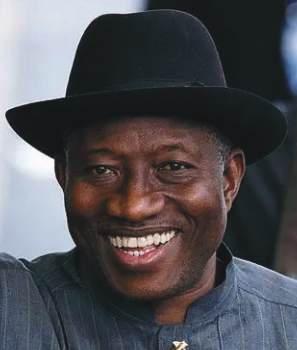
Jonathan,
Obi, Makinde as Presidential Candidates
Former president declared candidate in absentia Obi vows to tackle insecurity, poor governance, hunger, unemployment Makinde pledges to rebuild Nigeria through reforms, transparent governance, people-centred leadership
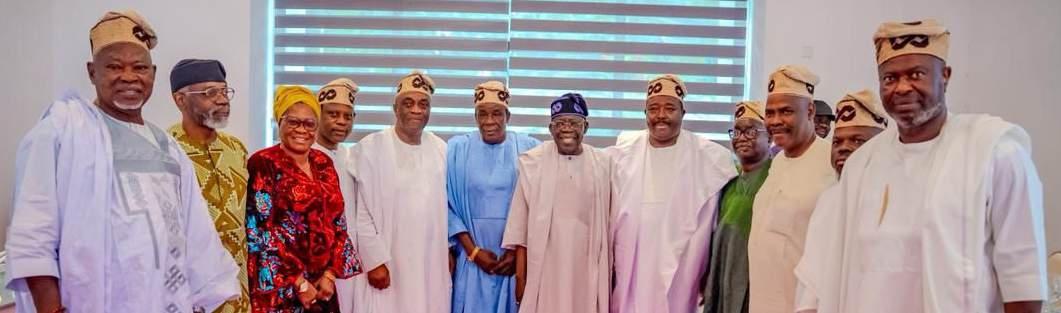
A SHOW OF SOLIDARITY AHEAD OF 2027…
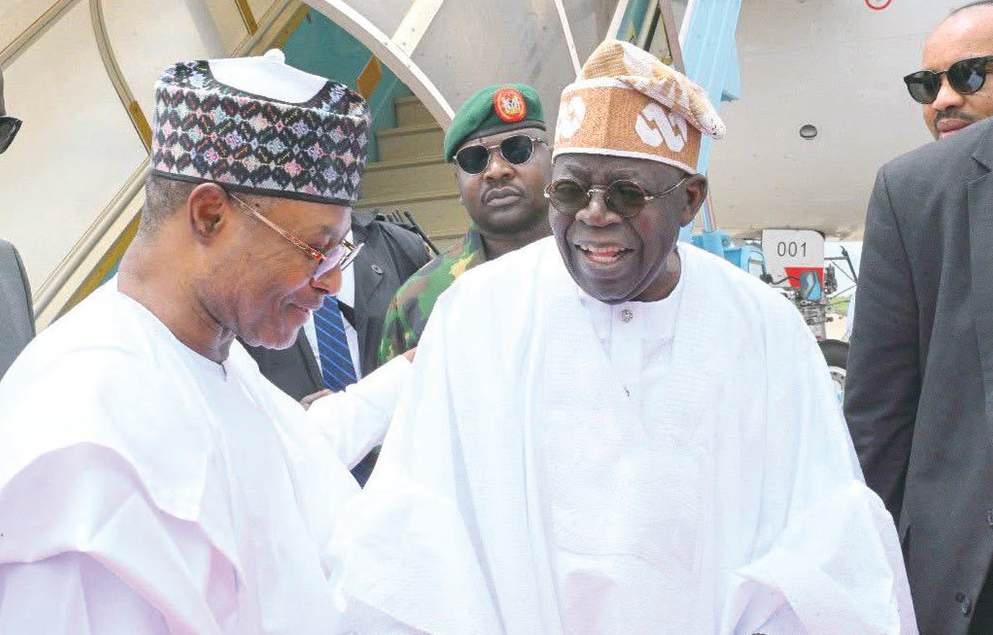
President Bola Tinubu; Oyo State APC governorship candidate, Senator Sharafadeen Alli; former Deputy Governor,
APC leader, Alhaji Fatai Ibikunle; Hon. Soji Adedeji; and Mr. Gbenga Olayeni, when President Tinubu received the candidates in Lagos…yesterday
L-R: All Progressive Congress chieftain, Senator Ayo Adeseun; Chief of Staff to the President, Hon. Femi Gbajabiamila; Oyo North Senatorial candidate, Mrs. Hannah Ogunesan; Oyo South Senatorial candidate, Remi Oseni; Oyo Central, Yunus Akintunde; State APC Chairman, Chief Moses Alake;
Iyiola Oladokun;
CBN: External Reserves Rise to $49.34bn as Naira Holds Firm Amid Stable Market Conditions
Says $2.34bn spent on food imports in 2025 despite decline in forex demand
Festus Akanbi
Nigeria's external reserves have continued their upward trajectory, rising to $49.34 billion as the naira remained largely stable against the United States dollar, reinforcing investor confidence in the country's foreign exchange market reforms and external sector outlook,
according to the latest data released by the Central Bank of Nigeria (CBN). This is just as the apex bank revealed that Nigeria spent approximately $2.34 billion on food imports in 2025, underscoring the country's continued dependence on foreign food supplies despite a modest decline in foreign-
exchange demand for food imports.
The latest report released by the CBN showed that the nation's gross official foreign reserves increased by $359.84 million week-on-week, climbing from $48.98 billion recorded at the close of the previous week to $49.34 billion as of May 26, 2026.
The sustained growth in reserves reflected improving external liquidity conditions and underscored the gains from recent efforts by monetary authorities to strengthen foreign exchange market stability.
Analysts attributed the increase largely to steady inflows from crude oil exports, supported by relatively stable
production levels and improved earnings from Nigeria's oil sector.
The development, they noted, has continued to bolster the country's external buffers and enhance its ability to meet international obligations.
The latest increase in reserves comes at a time when the CBN is intensifying reforms aimed at deepening liquidity in the foreign exchange market, narrowing exchange rate distortions and improving investor confidence. Market operators said the growing reserves position provides a stronger cushion against external shocks while supporting the apex bank's capacity to manage market pressures and sustain confidence in the naira.
Chuks Okocha, Sunday Aborisade in Abuja and Kemi Olaitan in Ibadan
Despite having its original venue sealed, a faction of the Peoples Democratic Party (PDP) led by Tanimu Turaki yesterday declared former President Goodluck Jonathan as its presidential candidate for the 2027 general election.
Similarly, a former governor of Anambra State, Mr. Peter Obi, and Governor Seyi Makinde of Oyo State also yesterday formally accepted their nominations as the 2027 presidential candidates of the Nigeria Democratic Congress
trigger widespread riots, adding, however, that not a single protest occurred.
The president hosted some governors at his residence in Ikoyi to celebrate Sallah and mark the third anniversary of his administration.
AbdulRazaq, who disclosed this in a video posted on his Facebook yesterday, noted that the proposal for a N100,000 minimum wage was driven by inflation, the rising cost of living, and mounting financial pressure on Nigerian workers.
The Kwara State governor commended Tinubu's "courage" for removing the petrol subsidy.
The NGF chairman said only 1% of politicians could make such tough decisions.
by higher crude oil production.
Specifically, data released yesterday, including the NNPC Monthly Report Summary for April 2026, showed that the national oil company raised its monthly revenue to N4.971 trillion in April, up from N2.774 trillion in March.
The revenue growth was accompanied by a substantial rise in profitability, with Profit After Tax (PAT) increasing from N276 billion in March to N481 billion in April. The N205 billion increase translated into a 74.3 percent month-on-month growth, according to a THISDAY analysis.
According to the report, total statutory payments to the federation this year also rose significantly, climbing from
(NDC) and the Allied People's Movement (APM), respectively.
The decision of the Turaki-led PDP was taken at a special national convention held at the faction's national secretariat in Area 10, Garki, Abuja.
The group had planned to hold a special national convention at the A-Class Event Centre in Wuse 2. Still, it moved its activities to its operational office in Garki after security operatives sealed off the venue.
Jonathan was not present at the event where his nomination was formally ratified.
However, his Certificate of Return was received on his behalf by Hon. Fred Agbedi,
The Kwara State governor said state governments had anticipated that Nigerians would stage protests against the subsidy removal.
AbdulRazaq disclosed that governors had mobilised security agencies in anticipation of public pushback.
"We were expecting serious riots, because there were riots — #EndBadGovernance riots — even before then and for lesser issues," the Kwara governor said.
"Well, lo and behold, we spent money and mobilised the security agencies to secure the states. Lo and behold, on that day, nothing happened. There were no riots or protests anywhere.
N2.888 trillion as of March to N3.714 trillion in April, an increase of N826 billion, or 28.6 per cent.
Operationally, NNPC posted higher crude oil and condensate production in April, with average daily output rising to 1.68 million barrels per day (mbpd), up from 1.56 mbpd in March. The increase of 120,000 barrels per day represented a 7.7 per cent improvement and marked one of the strongest production performances recorded by the company in recent months.
A breakdown of the production figures showed that crude oil accounted for approximately 1.43 million bpd, while condensate production contributed about 0.25 million
a member of the House of Representatives representing the Sagbama/Ekeremor Federal Constituency of Bayelsa.
Addressing party members and supporters outside the barricaded venue, Turaki accused unnamed political interests of attempting to undermine democracy through intimidation and abuse of power.
"No matter how highly opinionated they may be about themselves, or no matter how they think that they can use their positions to thwart democracy, we want to tell them that Nigeria is bigger than anybody and any group of persons," he stated. He urged party members to
"I think the nation was shocked by the audacity of Mr. President to implement that serious policy. Today, we've benefited immensely from that policy.
"I can say as a matter of fact, in my own state, when we get the FAAC allocation, after paying salaries, we're left with N100 or N200 million," the governor said.
AbdulRazaq said states were no longer borrowing money and issuing bonds to raise funds for salaries and projects.
According to him, state governments were engaging with the federal government and organized labor to agree on a wage structure that would balance workers' welfare with
bpd during the month under consideration.
The improvement reversed some of the production constraints experienced earlier in the year. It strengthened hopes that Nigeria could continue its gradual recovery towards higher crude output levels before the end of the year.
The NNPC data showed that the company's April performance was supported by improved facility uptime and ongoing programmes to boost production efficiency. Upstream pipeline availability increased from 76 percent in March to 79 per cent in April, reflecting a 3.95 per cent improvement.
The report noted, however, that output was still affected by the delayed restart of the
remain peaceful, insisting that political disagreements should be resolved through elections rather than violence.
"We will not fight. The time of fighting will come when we meet at the polls. We will meet you there, we'll fight you there, we'll defeat you there, and then we will pin you down on the ground," he said.
Turaki also defended the faction's decision to proceed with the convention despite not being recognised by the Independent National Electoral Commission (INEC), arguing that the Supreme Court and Appeal Court's judgments and the PDP's constitution backed
fiscal sustainability.
"State governments recognise the urgent need to improve workers' welfare in response to the current economic realities facing Nigerians," AbdulRazaq said.
The NGF chairman added that consultations were ongoing to ensure that any new wage regime would not place excessive financial strain on states.
"We are actively engaging with the federal government and organised labour to arrive at a wage structure that is fair to workers and sustainable for government finances," he stated.
He explained that the discussions focused on striking
Trans Niger Pipeline (TNP) following the completion of turnaround maintenance, as well as other facility integrity issues in some assets.
"Month-on-month production performance was driven largely by improved facilities uptime. April performance was, however, impacted by the delayed start-up of Trans Ramos Pipeline (TRP) post completion of Turn Around Maintenance due to identified leaks and other facility integrity issues in some assets," the NNPC data showed.
Despite those challenges, production levels remained above March levels, underscoring the impact of recovery efforts across upstream operations.
Besides, gas production
its actions.
He added that INEC had been notified of the meeting and expressed confidence that the commission would eventually validate the process.
Also speaking, a founding member of the PDP and Chairman of the convention, Prof. Jerry Gana, described the sealing of the venue as a setback for democracy.
The convention subsequently ratified Jonathan's candidature after a motion moved by the Chairman of the PDP State Chairmen Forum and Edo State PDP Chairman, Tony Aziegbemi, and seconded by former Minister of Aviation,
a balance between enhancing workers' purchasing power and preserving governments' ability to deliver critical public services and infrastructure projects.
"The goal is to improve the living conditions of workers while ensuring that states can continue to meet their obligations and sustain development projects that directly impact citizens," he said.
He noted that while workers deserved better remuneration, policymakers must also consider the fiscal realities confronting subnational governments.
The governor added that most states now pay a minimum wage of N100,000 — as opposed to the N70,000 national statutory minimum
remained largely stable, with the NNPC reporting an average of 7,730 million standard cubic feet per day (mmscf/d) in April, compared with 7,731 mmscf/d in March.
Although the figure represented a marginal decline of just 1 million cubic feet per day, effectively flat at about 0.01 percent, it demonstrated strong gas output levels amid ongoing operational challenges.
Average gas sales were 5,044 mmscf/d in April, compared with 5,059 mmscf/d in March.
Also, the April report highlighted continued progress on strategic gas infrastructure projects considered critical to Nigeria's long-term energy security and industrialisation plans.
NDC Affirms Obi as Presidential Candidate
Obi has also accepted his nomination as the NDC's standard-bearer for the 2027 general election, declaring that "a New Nigeria is Possible" and promising far-reaching reforms to address insecurity, poverty, unemployment and poor governance.
Speaking at a special national convention in Abuja where party
Continued on page 10
wage.
"I am urging your excellency, let's have a discussion on moving the minimum wage to a minimum of 100,000," he said.
"We know we'll get support from you as we go ahead to implement that."
In June 2024, Tinubu approved the increase of the minimum wage from N30,000 to N70,000 after assenting to the national minimum wage legislation.
The legislation provides for a review of the minimum wage every three years.
The previous N30,000 minimum wage was approved by former President Muhammadu Buhari in 2019.
On the Ajaokuta-KadunaKano (AKK) Gas Pipeline project, the NNPC said collaboration with stakeholders continued to advance construction and installation activities, with the project recording 94 per cent completion in April, up from 93 per cent in March. Similarly, the OB3 gas pipeline project maintained a 96 percent completion rate in April, unchanged from March. An area that declined was the availability of NNPC Retail petrol stations nationwide. The report showed that petrol availability fell from 56 per cent in March to 54 per cent in April, representing a decline of about 3.6 per cent. The company did not provide detailed reasons for the reduction.
Mohammed Sanusi Dagash. A voice vote adopted the motion.
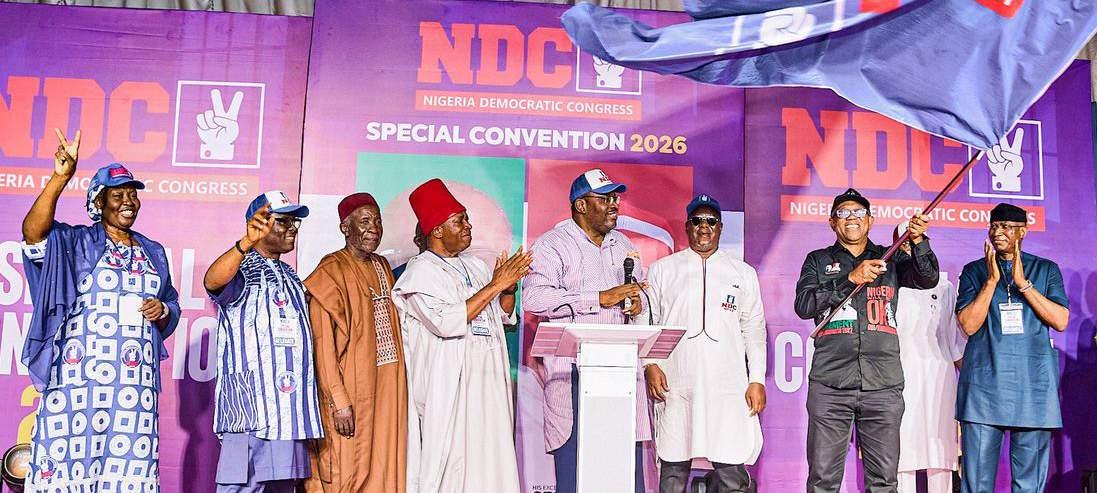
UNVEILING 2027 PRESIDENTIAL CANDIDATE…
Banking Stocks’ Rally Pushes Market Value of Zenith Bank, GTCO, 10 Others to N25.1tn in Five Months
The confidence of investors in Nigeria's banking sector has continued to grow as the combined market capitalisation of 12 listed Deposit Money Banks (DMBs) surged to N25.1 trillion between December 31, 2025, and May 2026, driven by the Central Bank of Nigeria's (CBN) recapitalisation programme, robust earnings performance and sustained demand from both domestic and foreign investors.
The remarkable rally, which has transformed banking stocks into some of the most sought-after
assets on the Nigerian Exchange Limited (NGX), reflected growing market confidence in the sector's resilience, profitability, and long-term growth prospects.
Data compiled by THISDAY showed that the combined market value of the 12 banks climbed by N9 trillion, or 55.8 per cent, between December 31, 2025, and May 29, 2026, from N16.12 trillion at the close of last year to N25.1 trillion.
The impressive performance comes as lenders continue to strengthen their capital bases in response to the CBN's ongoing recapitalisation exercise, which has seen
banks raise trillions of naira in fresh equity from investors eager to tap into the sector's growth story.
At the centre of the rally is Zenith Bank Plc, which has emerged as the most valuable banking stock on the Exchange. Its share price appreciated by 112 percent year-to-date, closing in May at N131.10 per share and lifting its market capitalisation to N5.38 trillion, up from N2.54 trillion at the end of 2025.
Closely behind is Guaranty Trust Holding Company Plc (GTCO), whose market value rose from N3.3 trillion to N5.01 trillion over the same period, cementing its position
as one of the market's most valuable financial institutions.
Analysts attributed the strong valuation growth recorded by both banks to their consistent profitability, strong capital positions, attractive dividend policies, and ability to deliver superior returns to shareholders.
For the 2025 financial year, Zenith Bank rewarded shareholders with a total dividend of N12.76 per share, while GTCO paid N10 per share, reinforcing their reputation as dependable dividend-paying stocks and strengthening investor appetite for their shares.
The earnings momentum has also remained strong.
Zenith Bank reported a profit before tax of N360.92 billion in the first quarter of 2026, representing a three per cent increase over the N350.82 billion posted in the corresponding period of 2025.
GTCO, on its part, delivered a profit before tax
of N302.9 billion, supported by strong growth in its core earnings lines. Interest income rose by 17.5 per cent year-on-year, while fee income increased by 7.1 per cent, reflecting the group's ability to sustain earnings growth despite a challenging operating environment.
W'Bank, IMF, WTO, Others Meet over US, Iran War, Say Conflict Affecting Most Vulnerable Countries
Ndubuisi Francis in Abuja
Tinubu Focused on Having His Way or Destroying Nigeria’s
Chuks Okocha in Abuja
The presidential candidate of the African Democratic Congress (ADC) and former Vice President Atiku Abubakar, has raised the alarm that President Bola Tinubu was focused on either having his way in the 2027 presidential election or destroying Nigeria’s democracy.
Atiku raised the alarm while reacting to what he described as the authoritarian action of the Minister of the Federal Capital Territory (FCT), Nysom Wike, in denying the Peoples Democratic Party (PDP) access to a public event centre in Abuja for the affirmation of its presidential candidate.
The ADC presidential
flagbearer said in a statement signed by his Media Office yesterday that the action of the minister to repress the PDP was reprehensible and a further manifestation of Tinubu’s tactic to frustrate political opposition ahead of the 2027 polls.
“The action of Minister Wike to deny the PDP the opportunity from holding an event in line with its constitutional rights, represents a blatant abuse of the party’s rights and an unacceptable infringement on the freedom of association and peaceful assembly as guaranteed by the 1999 Constitution of the Federal Republic of Nigeria (as amended).
“Private and public facilities in the Federal Capital Territory
Democracy
or indeed anywhere in the country exist to serve all Nigerians irrespective of their political affiliation. The minister’s refusal to allow a legitimate political activity to hold in such a venue is not only discriminatory but also a clear demonstration of partisan interference by the Tinubu’s administration.
“We have seen a pattern of political interference through public institutions aimed at weakening opposition parties under the current administration.
“We have also seen, by the case under reference with the PDP, ditto the ADC during its national convention held in April, that the Tinubu
government is literally pushing political opposition out of space.
“It was under the same leadership of Wike in the FCT that a sponsored faction of the ADC had a public event a few days ago with no one threatening them.
“This sets a dangerous precedent that undermines Nigeria’s democracy, the rule of law and the integrity of our elections.
“This high-handed action is consistent with President Bola Tinubu’s emerging pattern of deploying state institutions and resources to frustrate political opposition and weaken the democratic process in the build-up to the 2027 presidential election.
Heads of the World Bank, International Monetary Fund (IMF), World Trade Organisation (WTO), and the International Energy Agency (IEA) at the weekend met in Washington D.C., United States of America, to assess the conflict in the Middle East, with a warning that the war was generating substantial and highly asymmetric impacts on energy supplies, food security, and economic activity across countries and regions.
They noted that while the global economy continued to show resilience, the effects of the conflict were disproportionately affecting the most vulnerable countries through higher fuel and fertiliser prices, increased uncertainty, and risks to jobs and livelihoods.
In a joint statement signed by the World Bank President, Ajay Banga; IMF Managing Director, Kristalina Georgieva;
WTO Director General, Dr. Ngozi Okonjo-Iweala; and the Executive Director of IEA, Dr. Fatih Birol, the multilateral agencies said they were tracking and analysing measures taken by governments to address the economic impact of the conflict, with a view to promoting transparency, sharing lessons, and identifying emerging risks.
The statement said, “The war in the Middle East is generating substantial and highly asymmetric impacts on energy supplies, food security, and economic activity across countries and regions.
"While the global economy continues to show resilience, the effects of the conflict are disproportionately affecting the most vulnerable countries through higher fuel and fertiliser prices, increased uncertainty, and risks to jobs and livelihoods. Higher fertilizer prices are of particular concern as many countries enter the planting season.
Kayode Tokede
L-R: National Women Leader of Nigeria Democratic Congress, Dudu Manuga; National Secretary of NDC, Mr Ikenna Morgan; Chieftain of NDC, Buba Galadima; Senator representing Anambra Central, Victor Umeh; National Leader of NDC, Senator Seriake Dickson; National Chairman, Senator Cleophas Moses; Presidential candidate of the party, Mr Peter Obi; and chieftain of the party, Senator Ovie Omo-Agege, at the party’s convention where Obi was unanimously elected in Abuja… yesterday
Anxiety as Appeal Court Sacks
Wike-backed APC Exco in Rivers
Blessing Ibunge in Port Harcourt
An Appeal Court sitting in Port Harcourt, Rivers State capital, has upheld the judgment of the Rivers State High Court nullifying the congresses that produced the Tony Okocha-led executive of the All Progressives Congress (APC) in the state.
But in a swift reaction to the judgment, the Publicity Secretary of APC under the leadership of Okocha, Chibike Ikenga, urged
party members not to panic, stressing that the facts of the judgment were deliberately misrepresented.
Dismissing the appeal filed by Okocha and members of his executive as registered in Suit No. CA/PH/523/2024, which seeks to overturn a lower court’s decision on the party's leadership, the appellate court struck out the suit and ordered the parties back to the State High Court. It would be recalled that
on December 20, 2024, Justice Obomanu of the Rivers State High Court nullified the APC congresses conducted in the state, ruling that the process that produced Okocha and other executive members was invalid.
Meanwhile, in a ruling delivered by Justice Elfreida Oluwayemisi Williams-Dawodu of the Court of Appeal, Port Harcourt Division, on Friday, the court upheld the judgment of the High Court, thereby affirming
the nullification of the congresses. THISDAY observed that the judgment was delivered via Zoom.
The court upheld the sack of the Okocha-led executive. It nullified all actions taken on behalf of the APC in Rivers State by the dissolved executive between December 20, 2024, and the date of the ruling.
However, the Publicity Secretary of the Okocha-led APC in the state, Ikenga, has urged party members to remain calm,
Amupitan Leads INEC Delegation to South Korea's International Election Observation Programme
The Chairman of the Independent National Electoral Commission (INEC), Prof. Joash Amupitan, has led a delegation to the opening ceremony of the International Election Observation Programme (IEOP) for the Nationwide Simultaneous Local Elections currently taking place in the Republic of Korea from May 29 to June 5, 2026.
INEC’s Director of Voter Education and Publicity, Mrs. Victoria Eta-Messi, in a statement issued yesterday, said the IEOP, organised by the South Korean National Election Commission (NEC), was formally opened yesterday, May 30, 2026, in Seoul.
She explained that the event would bring together election management bodies, election experts, and international observers from across the world to observe and exchange knowledge on the conduct of
local government elections in South Korea.
The INEC chairman was accompanied by National Commissioner, Mrs. May Agbamuche-Mbu; the Chief Technical Adviser to the Chairman, Prof. Dimis Mai-Lafia; and the Director of Training, Dr. Binta Kasim Mohammed.
Eta-Messi added that during the program, the INEC team observed early voting operations at a polling center in Mia-dong, Gangbuk-gu,
Seoul, gaining firsthand insight into South Korea's electoral processes and procedures.
She noted that the delegation's participation was expected to further deepen the commission's understanding of emerging trends and global best practices in election administration, international observation, and electoral governance, in line with the commission's ongoing commitment to strengthening Nigeria's democratic institutions.
The Dangote Petroleum Refinery and Petrochemicals has announced a fresh reduction in the ex-depot prices of Premium Motor Spirit (PMS), better known as petrol, and Automotive Gas Oil (AGO), popularly known as diesel, reinforcing
its commitment to making refined petroleum products more affordable and supporting economic activities across Nigeria. Under the latest price adjustment, the refinery reduced the ex-depot price of PMS, to N1,250 per litre from N1,275 per litre, while the price of diesel was cut
to N1,700 per litre from N1,800 per litre.
The price review comes amid the refinery’s continued efforts to improve supply efficiency, deepen domestic refining, and provide cost relief to consumers and businesses that depend heavily on petroleum products for transportation,
power generation and industrial operations.
Since commencing operations, the 650,000-barrel-per-day refinery has increasingly supplied the domestic market with refined products to eliminate the country's dependence on imported fuels.
saying the facts of the judgment were deliberately misrepresented. According to Ikenga, the circumstances and facts of the judgment were misrepresented by those who lacked in-depth knowledge of what transpired in the court.
The party's scribe, in a statement made available to journalists in Port Harcourt yesterday, said, "There is no threat to the status of the EXCO pending full trial. Our Lawyers will study the full judgment and advise on the next step."
He explained, "Today (Friday), the Court of Appeal, Port Harcourt Division, delivered its judgment in an Interlocutory appeal (APPEAL NO: CA/ PH/523/2024: APC & ANOR.
V. OKWU JOEBROWN NDIKE filed by the All Progressives Congress (APC) challenging the jurisdiction of the High Court to dabble into the internal/domestic affairs of the party, the Interim Order made by the High Court directing the parties to “maintain status quo,” and also challenging the competence of the suit before the Rivers State High Court.
"The Court of Appeal struck out the appeal and directed the parties to return to the Rivers State High Court for the hearing of the substantive case.
"The Court of Appeal, with all due respect, predicated its decision on the wrong assumption that the appeal relates to the just concluded Local Government Area and Ward Elections in Rivers State, and therefore held that an appeal touching on the issue of Local Government Area Council and Ward Elections must terminate at the Rivers State High Court," he said.
Ikenga disclosed that they
had applied for a copy of the judgment, assuring that "Once a copy of the judgment is made available, our lawyers will advise us on the next line of action."
He added that "For the avoidance of doubt, this judgment delivered today has nothing to do with the State Congress wherein Chief Tony Okocha and other members of the APC State Executive Council were elected. The case involving the State Congress and the Executive members elected thereat, Suit No. PHC/3805/2024: Charles Enyidia & ORS VS APC was dismissed on 23rd March, 2026."
Also in his reaction, a leading counsel for the Respondent in the Appeal suit, Mr Emenike Ebete, noted that the judgment was delivered via Zoom, stressing that the court struck out the appeal filed by Okocha-led APC against the ex parte order to maintain status quo by the lower court in favour of Emeka Beke-led APC leadership in the State. Ebete expressed: "The judgment was via Zoom. We were sent a link for the judgment by 243. So we were on Zoom, and the judge appealed the bar's judgment. Not only our own, but the bar's judgment.
"He appealed that the issue was filed by Tony Okocha, against the Order of Obomamu that nullified the congresses that were conducted on why the matter was discussed. Now, you know, before those congresses were conducted, the court gave an ex parte order restraining them from conducting those congresses. They disobeyed the court's order and went ahead, conducting the local government, the state, and all congresses.
Ejiofor Alike
Adedayo Akinwale in Abuja
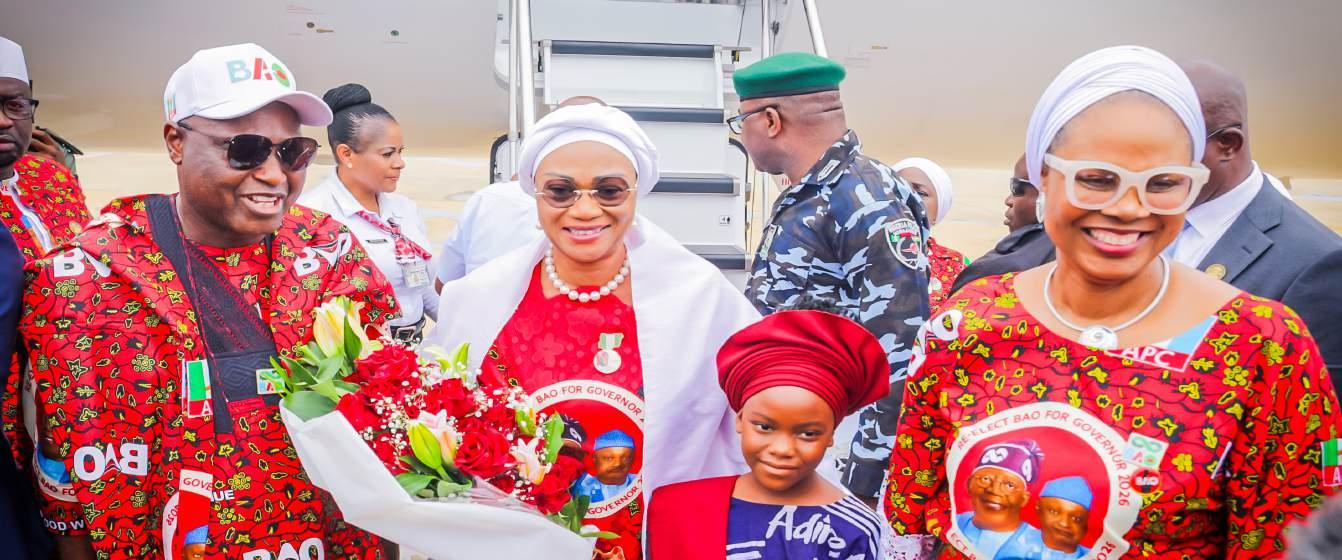
L-R: Ekiti State Governor, Mr. Biodun Oyebanji; First Lady, Senator Oluremi Tinubu; Flower girl, Oluwatamilore Oyeniyi; and wife of the governor, Dr. Olayemi Oyebanji, during the First Lady's arrival at Ekiti Airport, Ado-Ekiti for a one-day working visit to the state ...yesterday
WE SHARE IN YOUR GRIEF…
US Acknowledges Violence in Nigeria Not Driven By Religion Alone, Says 1.3m Displaced in Middle Belt
Sunday Ehigiator
The United States Commission on International Religious Freedom (USCIRF) has acknowledged that violent attacks by Fulani militants in Nigeria were not driven by religion alone but by overlapping motives.
In a May 2026 report titled ‘Non-state Violators of Religious Freedom in Nigeria: Fulani Militants,’
the US also acknowledged that the violence affected both Christians and Muslims.
While stating that 1.3 million Nigerians were displaced in the Middle Belt, the report added that while Christian communities have frequently come under assault, Muslim communities have also suffered killings, kidnappings, and attacks on religious sites.
The US report examined the role of Fulani militant groups
in worsening religious freedom conditions in Nigeria and the response of government authorities.
According to the report, “armed actors from a Fulani ethnic background have perpetrated some of the most visible and deadly attacks on religious communities—often but not exclusively against Christians—in Nigeria.”
The report stressed that violent attacks have affected
followers of both religions, saying: “Fulani assailants have not spared Muslims, raiding herders’ cattle and violently attacking non-Fulani Muslim communities.”
It added that many militants have also “targeted Christian communities in the Middle Belt and, increasingly, the South, burning homes and churches as well as kidnapping, raping, and murdering.”
ADC Declares El-Rufai Prisoner of Conscience, Demands Immediate Release
Chuks Okocha in Abuja
The National Executive Committee (NEC) of the African Democratic Congress (ADC) has declared former Kaduna State governor, Nasir El-Rufai, a prisoner of conscience and called for his immediate release.
The declaration came as the party’s 101st NEC meeting approved a series of key decisions ahead of the 2027 general elections, including the ratification of
its primaries, an extension of the tenure of its National Working Committee (NWC), and the constitution of caretaker committees across its structures nationwide.
The resolutions were contained in a communiqué signed by the ADC National Publicity Secretary, Mallam Bolaji Abdullahi, at the end of the meeting.
“The NEC recognises Mallam Nasiru El-Rufai as a prisoner of conscience and calls for his immediate
Sanwo-Olu Leads APC
Governor Babajide Sanwo-Olu of Lagos State yesterday led the All Progressives Congress (APC) candidates for the state House of Assembly on a traditional Sallah homage to President Bola Tinubu at his Lagos residence.
Speaking after leading the party’s 40 House of Assembly flag-bearers, alongside party leaders and the deputy governor, on a traditional Sallah homage to the president, the governor
release,” the communiqué stated.
Beyond the call for ElRufai’s release, the meeting also endorsed the outcome of the party’s primaries for elective offices across the country, while excluding contests still facing appeals or yet to be concluded.
According to the communiqué, “NEC approved the results of all recently conducted primaries for State Houses of Assembly, the National Assembly,
State Governors, and the Presidential elections; except those with pending appeals as at May 29, 2026, and those yet to be concluded.
“NEC approved the extension of the tenure of the National Working Committee (NWC) for a period of 12 months from the expiry of their current tenure.”
The party also approved the constitution of caretaker committees at the zonal, state, local government, and ward levels for a period of one year.
USCIRF said violence by Fulani militants had become one of the deadliest sources of insecurity affecting religious communities in the country.
“Violence by Fulani militants caused the highest number of deaths among all religious communities in Nigeria over the last year as compared to attacks by organised insurgent groups and criminal gangs,” the report stated.
The commission further revealed that militant attacks and land invasions had displaced at least 1.3 million Nigerians in the Middle Belt.
“These Fulani militant attacks, among those of other actors, have forced at least 1.3 million people in the Middle Belt off their land and into overcrowded, unsanitary, and unsafe conditions in displacement camps,” it said.
The report also maintained that attacks had sometimes been deliberately timed around Christian holidays to increase fear and psychological trauma.
“Militant actors have often carried out operations during Christian holidays such as Christmas or Easter to maximize the psychological
impact further, terrifying those communities from gathering to celebrate or worship,” USCIRF said.
The report cited multiple attacks in Plateau, Benue, Kaduna, Niger and Zamfara states involving killings, kidnappings and violent raids on churches, mosques and rural communities.
However, the commission warned against simplistic interpretations of the violence as being driven solely by religion, noting that environmental, economic, and criminal factors also play major roles.
It noted that while some observers viewed the attacks as part of “a concerted campaign of outright genocide against non-Muslims, especially Christians,” others pointed to land competition, poverty and environmental pressures.
“In fact, multiple and overlapping factors, including religion in many cases, likely spur Fulani militants to attack communities or individuals,” the report said.
USCIRF added that regardless of motivation, the consequences remain severe for both religious groups.
Flag Bearers to Tinubu, Pledges Grassroots Mobilisation
stated that the lawmakers have pledged to intensify grassroots mobilization ahead of the 2027 elections.
The News Agency of Nigeria (NAN) reported that Sanwo-Olu said the visit provided an opportunity for the candidates to interact with the president and receive guidance on leadership, service and party loyalty.
According to him, Tinubu encouraged the candidates to remain focused on delivering the dividends of democracy and maintaining close contact
with their constituents.
“This is another solid visit to Mr. President, who graciously opened his residence to us.
“We came with the governorship flag bearer, the deputy governor, party leaders and, more importantly, the 40 men and women who emerged as our party’s flag bearers for the Lagos State House of Assembly,” he said.
Sanwo-Olu said the candidates expressed appreciation to Tinubu for his leadership and assured
him of their commitment to promoting the achievements of both the federal government and the state government
He said the candidates also pledged to work diligently in their constituencies and sustain public support for the APC.
According to him, the candidates were advised to unite party members at the grassroots and engage all stakeholders in their respective constituencies.
“They have given their commitment and assured the president that they will
go back to their constituencies, work across the board, and ensure that people see the real dividends of democracy.
“They have also assured him that they will do the work and justify the confidence reposed in them,” he said.
Sanwo-Olu said the party would not take electoral victory for granted despite its strong support base in the state.
He stressed the need for continuous engagement with voters and reconciliation among party members after
the primaries.
“As candidates of the party, they have a responsibility to close ranks and reach out to everyone, including those who contested against them.
“We will not take anything for granted. We want to hit the ground running and ensure that every constituent is carried along,” he said.
The governor added that the party would provide the candidates with necessary support, data, and structures to strengthen their campaigns across the state.
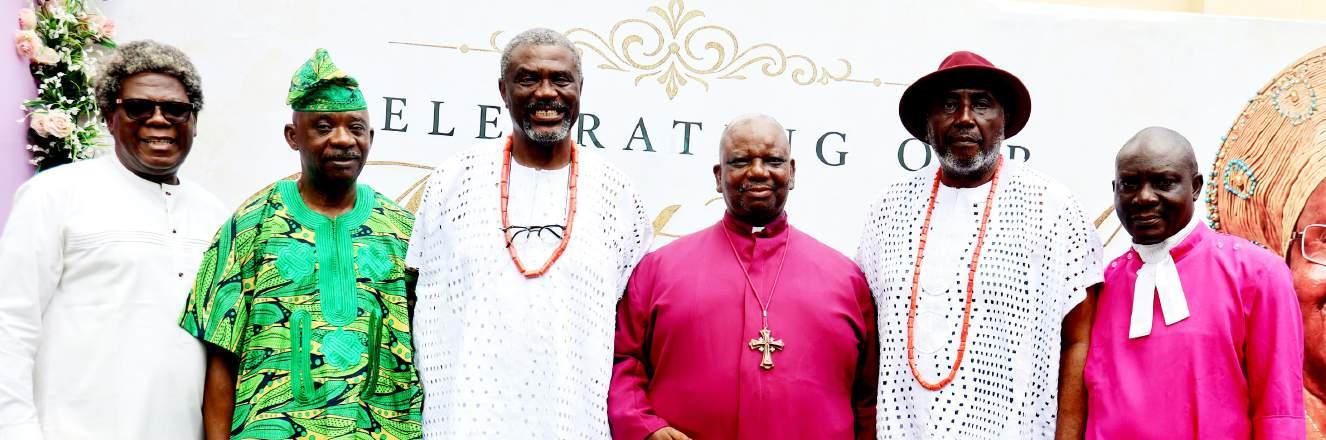
L-R: Pastor, LightHouse Church Lagos, Debo Pala; Pastor, Faith Family Bible Church, Lagos, David Aboderin; Son of the Deceased, Mr. Peter Isibor; Archbishop of Aba Province, Anglican Diocese, Most Rev. Isaac Chijioke Nwaobia; first son of deceased, Mr. Francis Isibor; and Bishop Jacob Adeyemi of Seasoned Bible Church, Agiliti, Lagos, at funeral service of the late Mrs. Patience Eyimuche Isibor and dedication of Patience House in Agbor, Delta State…Friday
Governor Seyi Makinde of Oyo State has assured the families of pupils and teachers abducted in communities around Oriire Local Government Area that his administration will do everything possible within the ambit of the law to secure their safe release.
The governor gave the assurance yesterday during a visit to Ahoro-Esiele community, where he met with affected families, community leaders, and residents at the open field of L.A. Basic School.
The visit came amid growing anxiety over the abduction of primary school pupils and their teachers.
Addressing the gathering,
the governor said the state government shared the pain and concerns of the families and remained fully committed to ensuring the victims’ safe return.
“I understand the pain and anxiety that many of you are experiencing at this moment. As your government, we share your concerns, and we are fully committed to securing the safe return of our children and their teachers,” he said.
Makinde explained that security agencies and law enforcement commanders had been working tirelessly since the incident occurred, with continuous reviews of rescue strategies to achieve the best possible outcome. He disclosed that he and
security chiefs had been holding regular meetings, sometimes late into the night, to coordinate efforts aimed at rescuing the victims.
“Please believe in me. I have not been sleeping well myself. Together with the service commanders, we meet twice every day, one in the morning and one at night, sometimes until 10 or 11 p.m.,” he said.
The governor stressed that the abductors were dangerous and unpredictable, making it impossible to disclose certain operational details to the public.
He noted that while some people might feel authorities were not doing enough, security agencies were carefully managing the situation to avoid putting
innocent lives at risk.
“The people we are dealing with are dangerous and unpredictable. Because this is an ongoing security operation, there are certain details I cannot disclose. However, I want to assure you that every available resource is being deployed to secure the release of the victims,” he stated.
Makinde also urged residents and Nigerians not to politicise the incident or engage in blame games involving the state, federal, or local governments.
According to him, the priority should be the safe rescue of the abducted children and teachers.
“This is not the time to trade blame between the state government, the federal
government, local governments, or any other institution. This is a time for unity. Let us come together with one purpose: to rescue our children and their teachers safely,” he said.
Several relatives of the abducted victims appealed to the governor not to relent in the rescue efforts.
Prof. Wole Alamu, husband of the abducted school principal and Dean of Renewable Natural Resources at Ladoke Akintola University of Technology (LAUTECH), Iseyin Campus, broke down in tears while appealing to Governor Makinde, to intensify efforts to secure the release of his wife and other kidnapped victims in the state.
delegates affirmed him as the NDC presidential candidate, Obi said the 2027 election would be about rescuing Nigeria from its current challenges and restoring hope to millions of citizens.
Addressing party leaders, representatives of the INEC, delegates and supporters from across the country, Obi said his acceptance of the nomination was driven by a commitment to rebuilding national unity, strengthening democratic institutions and placing the country on the path of sustainable development.
"It concerns the essence of our nation and the future of our children. It is about rekindling hope for millions who have faced adversity yet remain committed to Nigeria," he said.
According to him, businesses were struggling, communities were suffering, and many Nigerians had lost confidence in governance. Still, he insisted that the country's situation was reversible through visionary leadership and collective action.
Obi identified national unity as the foundation for rebuilding
the country, warning that Nigeria could not make meaningful progress while divided along ethnic, religious, and regional lines.
He said the country's diversity should be harnessed as a strength rather than exploited as a source of conflict.
"We should build bridges where others erect barriers, replace mistrust with confidence, division with understanding, and resentment with a collective purpose," he stated.
On insecurity, Obi pledged to deploy an intelligence-driven and technology-enhanced security architecture that would strengthen security institutions, improve coordination among agencies and address the root causes of insecurity, including poverty, unemployment and marginalisation.
Turning to healthcare, Obi described the condition of primary healthcare facilities as unacceptable and pledged to more than double health insurance coverage within four years and increase healthcare funding significantly.
According to him, every ward in the country would have access to a functional, properly managed primary healthcare center, and at least half of Nigeria's estimated 30,000 primary healthcare centers would become fully operational before the end of his tenure.
Obi also promised massive investments in education, describing human capital development as the bedrock of national transformation.
On agriculture and food security, Obi argued that the country's abundant arable land should make it one of the world's leading food producers rather than one grappling with severe hunger.
The former governor promised to shift the economy from consumption to production through aggressive investments in agriculture and rural development.
In the energy sector, Obi pledged to address the country's chronic power deficit, describing electricity as a critical driver of industrialisation and economic
development.
He promised to increase electricity generation and distribution by at least 10,000 megawatts within four years.
Makinde Accepts Nomination as APM Presidential Candidate
Makinde has also formally joined the 2027 presidential race by accepting his nomination as the APM's presidential candidate, pledging to rebuild Nigeria through practical reforms, transparent governance, and people-centered leadership.
The event, held in Ibadan, the Oyo State capital, drew political stakeholders, party leaders, delegates, and coalition partners from across the country, including representatives of the PDP and other allied groups under the emerging "Reset Nigeria Movement".
Makinde, in his acceptance speech, said his ambition was not driven by personal interest but by the urgent need to restore hope and rebuild confidence in Nigeria.
The governor said Nigeria possessed the resources and capacity to overcome its challenges through honest leadership and practical reforms that directly impact citizens.
"I believe that we possess the capacity to rebuild our economy through honesty, discipline, and practical reforms. When I speak of practical reforms, I mean reforms that directly improve the lives of ordinary Nigerians," he said.
Makinde promised comprehensive reforms in the oil and gas sector, insisting that Nigerians must benefit from the country's vast natural resources.
"Nigerians must benefit from the fact that we are an oil-producing nation, just as citizens of other resourceproducing countries benefit from their natural wealth," he said.
He added, "The NNPC must be reformed into a lean, efficient, and commercially driven institution through proper corporate restructuring, stronger partnerships, and institutional reforms."
On food security, the
passionately with the governor to ensure that rescue operations were not abandoned or delayed.
Visibly distressed, he said the captivity of his wife had become deeply painful, especially with reports that abductees were being forced to appear in distress videos circulating online.
“My wife is the one being used to make the videos that are being circulated. It is very disheartening and depressing,” he said in Yoruba, breaking down in tears.
Another resident, Mrs. Funmilayo Ojo, revealed that four of her grandchildren and her son’s wife were among those abducted, while other community members described the incident as the first of its kind in the area.
presidential candidate said no nation blessed with abundant resources should allow its citizens to suffer from hunger.
"It is unacceptable that a nation blessed with abundant resources still has millions of citizens going to bed hungry," he stated.
Makinde stressed that his campaign would focus on competence and solutions rather than empty promises.
He said, "I do not stand before you promising miracles. I am an engineer, not a miracle worker. What I promise is leadership that listens, leadership that learns, leadership that acts, and leadership that understands that the true purpose of government is to improve the lives of ordinary citizens," Makinde added.
Earlier, Bauchi State Governor, Senator Bala Mohammed, represented by his deputy, Mohammed Auwal Jatau, led a high-powered delegation from the North-east to endorse Makinde's candidacy, describing him as the leader Nigeria needs at a critical moment in its history.
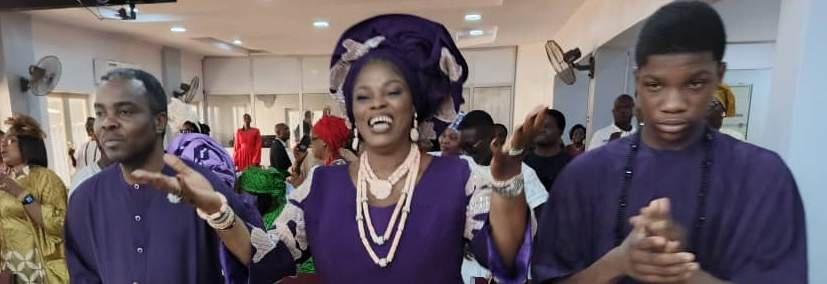
Husband of the celebrant, Pastor Akinfolami Akinrimisi; Celebrant, Mrs. Temilola Oluwakemi Akinrimisi; and son, Oluwadamilola Akinrimisi during a thanksgiving service to mark Mrs. Akinrimisi 50th birthday anniversary at the RCCG, Morning Star Parish, Anthony, Lagos… recently
NNPC, Dangote and the Battle Over Nigeria’s Fuel Future
As public refineries struggle, the NNPC-Dangote legal war is reshaping Nigeria’s downstream oil sector, writes Festus Akanbi
As public refineries remain largely dormant, the legal confrontation between the Nigerian National Petroleum Company Limited (NNPCL) and the Dangote Petroleum Refinery is rapidly becoming a defining moment for Nigeria’s industrial policy, energy security and investment climate.
At the centre of the dispute is Dangote Refinery’s challenge to fuel import licences issued by the Nigerian Midstream and Downstream Petroleum Regulatory Authority (NMDPRA) to rival marketers. The refinery argues that continued importation undermines local refining capacity and runs counter to the spirit of the Petroleum Industry Act (PIA), which encourages backward integration and domestic production.
NNPCL, however, warned the Federal High Court in Lagos that restricting imports could expose Nigeria to supply disruptions, fuel shortages and potential monopoly risks. Yet many observers find it difficult to reconcile the national oil company’s legal position with its continued ownership of the Dangote Refinery project.
The contradiction has become more pronounced because NNPCL’s refineries in Port Harcourt, Warri and Kaduna have failed to deliver sustainable production despite billions of dollars committed to rehabilitation. Industry data indicate that over $3.1 billion was spent on refinery repairs, including $1.5 billion for Port Harcourt, $897.6 million for Warri, and $740.7 million for Kaduna. Yet the facilities remain largely ineffective.
Against this backdrop, the 650,000-barrels-per-day Dangote Refinery has dramatically reshaped Nigeria’s downstream petroleum sector. The facility reportedly supplied nearly 80 per cent of Nigeria’s petrol consumption in April 2026 after reaching full operational capacity earlier this year.
For decades, Nigeria remained trapped in the paradox of being Africa’s largest crude oil producer while relying heavily on imported refined products. That dependence created a multi-trillion-naira import ecosystem that consistently exerted pressure on foreign exchange reserves, fuel subsidies, and the naira itself.
Former President of the Organised Private Sector of Nigeria and former President of the Nigerian Association of Chambers of Commerce, Industry, Mines and Agriculture (NACCIMA), Dele Oye, believes the refinery has disrupted that old structure in ways capable of transforming the economy.
According to Oye, Nigeria spent about N15.42 trillion on petrol imports in 2024 alone, describing the figure as evidence of structural weakness in the country’s energy architecture. He argued that local refining through Dangote could save the country over N15 trillion annually while generating up to $11 billion yearly in foreign exchange
through exports of refined petroleum products.
He maintained that reliance on domestic refining would reduce pressure on the naira, improve macroeconomic stability and strengthen Nigeria’s balance of payments.
In one of the strongest criticisms of NNPCL’s position, Oye said maintaining import licences despite existing domestic refining capacity amounted to “penalising the player who built the stadium while rewarding those who merely show up to play.”
He rejected claims that the Dangote Refinery represents a monopoly threat, insisting instead that the project symbolises economic sovereignty and industrial self-reliance. According to him, Nigeria’s energy future should be built on domestic production rather than dependence on foreign refineries.
Built at an estimated cost of $20 billion, the refinery processes 650,000 barrels of crude daily and reportedly produces about 53.6 million litres of petrol and 23.6 million litres of diesel each day. It has also begun exporting refined products, including jet fuel, diesel and petrol, to markets across Africa, Europe, Asia and the Americas.
Supporters of the refinery argue that exposing such a massive investment to unrestricted competition from foreign-supported refiners could discourage future industrial investments in Nigeria.
Their concerns stem partly from the structural advantages foreign refiners enjoy. International refiners typically access cheaper financing, state-backed infrastructure and lower logistics costs. By contrast, Dangote Refinery was forced to construct its own deep seaport, roads, power systems and storage facilities while operating within Nigeria’s high-interest-rate environment.
Energy economist Kelvin Emmanuel recently warned that Nigeria risks repeating policy mistakes that contributed to the collapse of local industries such as textiles and tyre manufacturing if domestic refining is prematurely exposed to uncontrolled reliance on imports.
The Manufacturers Association of Nigeria (MAN) has repeatedly linked import dependency to the collapse of local industries and the loss of millions of jobs over the years. Analysts fear the petroleum downstream sector could suffer similar consequences if local refining investments are not strategically protected.
Supporters of the Dangote Refinery also point to Section 317 of the Petroleum Industry Act, which encourages backward integration and the development of local refining. They argue that imports should serve only as temporary supplements when domestic supply proves insufficient.
However, in court filings, NNPCL argued that the Dangote Refinery has not produced independently verified evidence demonstrating that it can consistently meet nationwide fuel demand without disruptions. According to NNPCL, energy security extends beyond refining capacity to include storage infrastructure, distribution networks,
haulage systems, and strategic fuel reserves.
Some downstream operators, including the Petroleum Products Retail Outlets Owners Association of Nigeria and the Independent Petroleum Marketers Association of Nigeria, have supported the continuation of imports, insisting that competition remains necessary to stabilise prices and reduce supply vulnerabilities.
However, Dangote’s supporters counter that the downstream sector remains heavily regulated by the NMDPRA, making it difficult for any single operator to dictate market outcomes. They also argue that the real monopoly in Nigeria’s fuel market historically existed during the decades when fuel importation was dominated largely by NNPCL itself.
Beyond the legal arguments, analysts say the larger issue is investor confidence and policy consistency.
The Dangote Refinery is regarded as one of Africa’s biggest private industrial investments. Consequently, the public legal confrontation between the refinery and a government-owned shareholder raises difficult questions about Nigeria’s investment environment at a time when the country desperately needs fresh capital inflows.
Investor concerns have intensified as the Dangote Refinery reportedly prepares for a public listing around September 2026. Industry sources estimate pre-IPO interest at nearly $2 billion, while projected valuations range between $40 billion and $50 billion.
Analysts warn that uncertainty surrounding import policies, crude supply arrangements, and market access rules could weaken investor confidence in the project and in Nigeria generally.
During a recent visit to the Dangote Refinery, NNPCL Group Chief Executive Officer, Bashir Ojulari, described the partnership as essential for achieving domestic energy sufficiency, industrial growth and operational synergy.
That earlier show of cooperation now contrasts sharply with the adversarial tone adopted in court.
For Nigeria, the implications of the dispute extend far beyond a single refinery or legal battle. The country still spends substantial foreign exchange on imports of refined petroleum products despite being one of Africa’s leading crude oil producers.
At its core, the controversy raises difficult questions about how Nigeria intends to balance market competition with industrial protection. It also forces policymakers to confront a larger issue: can Nigeria genuinely pursue economic nationalism while exposing its largest domestic industrial investments to unrestricted foreign competition?
The Federal High Court may eventually settle the legal issues. But the broader economic and policy debate triggered by the NNPCL-Dangote confrontation could shape Nigeria’s industrial future far more profoundly than the lawsuit itself.
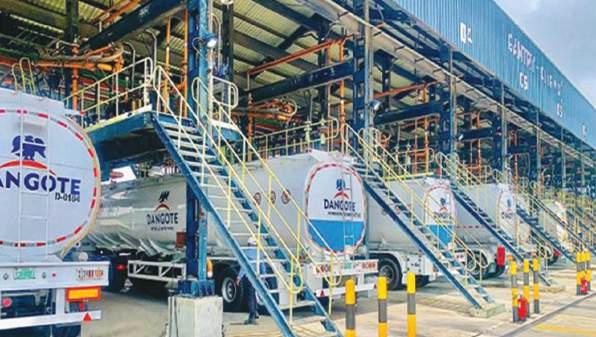
Dangote Tankers
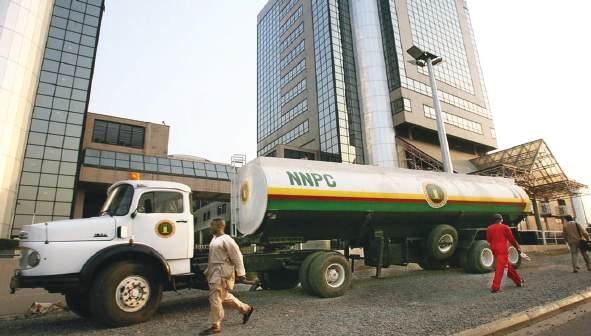
NNPC Tankers
Banditry, Empty Farms and Looming Food Shock
With farmers fleeing attacks, fears are growing over food shortages and rising living costs, writes Festus Akanbi
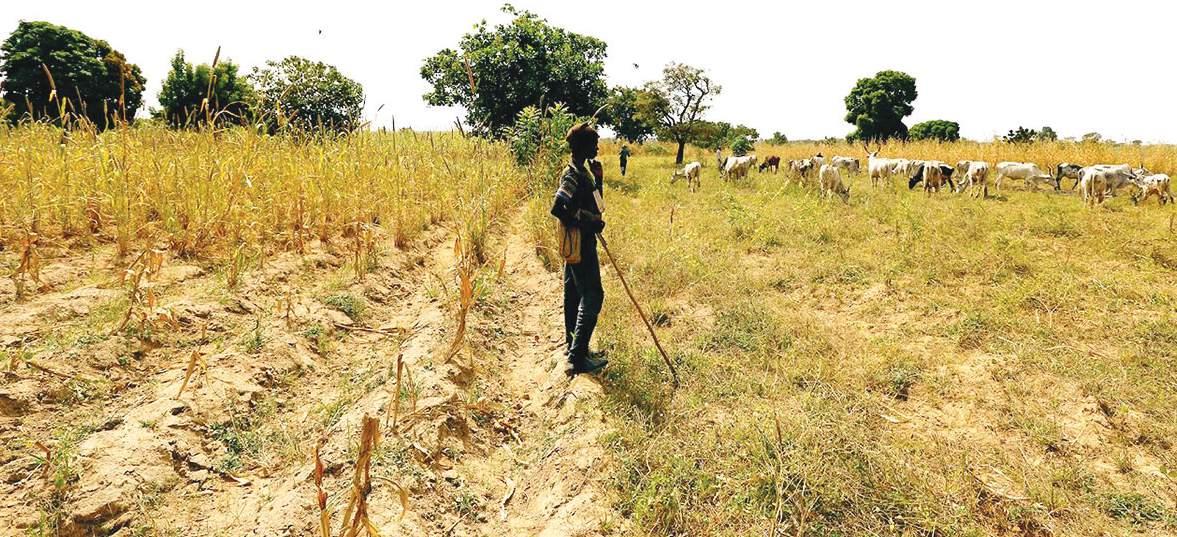
What should ordinarily be Nigeria’s season of hope is rapidly turning into a season of fear. Across vast farming belts stretching from Benue and Niger to Oyo, Ondo, and Ekiti, the sound of cutlasses and tractors is gradually being replaced by gunshots, kidnappings, and hurried migration from villages once known for agricultural abundance.
Nigeria’s deepening insecurity crisis is no longer merely a humanitarian tragedy; it is fast becoming one of the gravest threats to national food security, economic stability, and social cohesion in decades.
The warning signs are already visible. According to data from Nigeria’s National Bureau of Statistics (NBS), food inflation stood above 40 per cent for much of 2024 before moderating slightly in recent months, remaining one of the strongest drivers of the country’s cost-of-living crisis. Yet analysts fear the worst may still lie ahead because the current danger is not driven merely by exchange rate pressures or fuel costs, but by the physical abandonment of farms themselves.
The scale of violence devastating Nigeria’s agricultural communities has become staggering. Since the Boko Haram insurgency erupted in 2009, over 35,000 people are estimated to have been killed in the North-east, while millions have been displaced. Beyond insurgency, armed banditry and farmer-herder conflicts have widened the theatre of violence across Zamfara, Kaduna, Katsina, Niger, Plateau and Benue states.
According to data from SBM Intelligence and other conflict trackers, thousands of Nigerians are kidnapped yearly, with rural dwellers and farmers forming a significant proportion of victims.
The economic losses are equally devastating. A report by the United Nations Development Programme (UNDP) estimated that insurgency in the North-east alone had cost Nigeria over $100 billion in destroyed infrastructure, lost productivity, and humanitarian damages over
the years.
The Nigerian Economic Summit Group had earlier warned that insecurity was costing Nigeria billions of naira annually due to disrupted agricultural activities, reduced investment, and declining rural productivity.
What now alarms economists and security experts is the dangerous southward spread of these threats. Traditionally, the South-west was regarded as relatively insulated from the insurgency ravaging northern Nigeria. That perception is fading rapidly. Recent attacks and growing fears in parts of Oyo, Ondo, Ogun, Ekiti, and Kwara have unsettled farming communities and triggered widespread anxiety among rural populations.
The implications are enormous because the South-west remains one of Nigeria’s most strategic agricultural and commercial zones. The region is a major producer of cassava, cocoa, maize, yams, rice, oil palm, and plantain.
Ondo alone contributes significantly to Nigeria’s cocoa output, while Oyo and Ogun remain critical food baskets supplying urban markets across Lagos and neighbouring states.
Yet many farmers are now retreating from distant farmland into safer, less productive areas near towns and villages. Others have stopped farming altogether.
In parts of Benue, long regarded as the “Food Basket of the Nation,” entire communities have reportedly been deserted after repeated attacks by armed groups. Similar fears are emerging in parts of Niger and Kogi states, where transporters increasingly avoid certain routes unless security escorts are provided.
The consequences for food prices are already becoming severe. In several northern and central markets, the prices of beans, rice, yams, and maize have surged over the past two years. Traders cite insecurity, transport risks, and reduced harvests as major causes. In some communities, transport operators now impose “risk charges” before entering volatile rural corridors.
The Food and Agriculture Organisation (FAO) has repeatedly warned that conflict remains one of the biggest threats to agricultural productivity in sub-Saharan Africa. Nigeria
now appears trapped within that dangerous cycle where insecurity reduces food production, food shortages fuel inflation, inflation worsens poverty, and poverty in turn creates fertile ground for criminal recruitment and social instability.
Agriculture still contributes roughly 22 to 25 per cent of Nigeria’s Gross Domestic Product and employs more than one-third of the labour force. The sector, therefore, represents far more than food production alone; it is the economic lifeline of millions of rural households. Any prolonged disruption to farming activities inevitably leads to lower incomes, rising unemployment, and weaker national growth.
Even more worrying is the long-term structural damage insecurity may inflict on Nigeria’s agricultural future. Young people who witness killings and kidnappings in farming communities are increasingly abandoning agriculture altogether.
Rural-to-urban migration is accelerating as families relocate to cities perceived to be safer. Unfortunately, urban centres already struggling with unemployment, inflation, and infrastructure pressure can scarcely absorb fresh waves of displaced populations.
Analysts also fear growing insecurity could discourage both local and foreign agricultural investments. Large-scale mechanised farming requires long-term confidence, stable logistics, and predictable security conditions. No serious investor commits billions into farmlands where workers risk abduction or death. This reality threatens federal government efforts to diversify the economy away from dependence on crude oil.
The wider implications for the Nigerian economy are profound. Lagos alone reportedly contributes between 22 and 30 per cent of Nigeria’s GDP and accounts for over 80 per cent of Nigeria’s external trade flows. Sustained instability across the South-west corridor could therefore disrupt not only food supply chains but also broader commercial activities linking ports, markets, and manufacturing hubs.
Unfortunately, many stakeholders believe Nigeria’s security response remains largely reactive instead of preventive. Security operations often intensify only after deadly attacks have
occurred. Rural communities frequently complain about delayed responses, inadequate policing, and poor intelligence gathering.
There is also growing frustration over the continued weakness of forest surveillance across vast ungoverned spaces now exploited by criminal gangs and insurgent networks.
In the South-west, pressure is mounting on governors to strengthen Amotekun, improve inter-state intelligence sharing, and support community-based security initiatives.
However, critics argue that local security outfits remain underfunded relative to the scale of the threat confronting them.
Beyond kinetic responses, experts insist that Nigeria must address the socio-economic roots of insecurity. Widespread youth unemployment, rural poverty, porous borders, and weak governance structures continue to fuel criminality.
Security cannot be sustained merely through military deployments without parallel investments in education, jobs, rural infrastructure, and social welfare.
Experts said the government must also urgently prioritize protecting farming communities during the planting and harvest seasons. Safe farming corridors, enhanced aerial surveillance, rapid-response units, and stronger collaboration between federal and state authorities have become critical.
Equally important is the need for justice and accountability. Communities repeatedly attacked without consequences for perpetrators gradually lose faith in the state itself.
Nigeria stands today at a dangerous crossroads. Empty farms during the rainy season may ultimately leave markets empty months later. A nation already battling inflation, poverty, and weak purchasing power cannot afford another major food supply shock. The current crisis is therefore not merely about insecurity in remote villages; it is about the future stability of Africa’s largest economy. Unless decisive action is taken quickly, Nigeria may soon discover that the most dangerous harvest from insecurity is not only death in rural communities, but hunger across the entire nation.
Abandoned farmland
www.thisdaylive.com
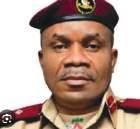
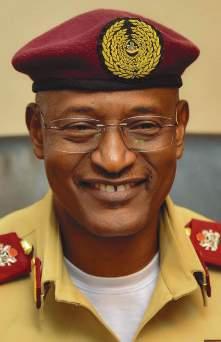
REPOSITIONING FRSC FOR A SAFER NIGERIA OSONDU
OHAERI writes on the remarkable transformation of the FRSC by Shehu Mohammed since his appointment
See Page 20
2027 AND THE BATTLE FOR POWER
Nigeria cannot afford another election poisoned by fear and division, writes SAMUEL AKPOBOME
OROVWUJE
See Page 20
opinion@thisdaylive.com
Government must do more to secure and protect the people, writes
TERRORIST’S ‘TEST TRANSMISSION’ IN THE SOUTHWEST
This year, the Children’s Day and the Eid Al-dha festival was celebrated on the same day. While the former is used to engender and protect the welfare of children, the latter (Festival of the sacrifice) is to honour the act of willingness of prophet Ibrahim who wanted to sacrifice his son in obedience to God’s command. But God is kind. He realized that children are not animals that should be slaughtered. Hence, animal was used to replace Ishmael who would have been slaughtered. God values children’s lives. Do we? How do we protect our children and show them that we are capable of protecting and nurturing them rightly? As I struggle with the answers to these questions, I remembered the 46 children and seven teachers Ahoro-Esiele/ Yawota in Oriire local government area of Oyo state on 16 May 2026. They had planned their day to learn but were captured and coerced into the forests. The agrarian community went into confusion as automatic rifles bellowed into their hearing. A teacher who tried to escape was shot dead. The Okada owner who would not trade his means of survival with the terrorists was not spared for daring to challenge the jihadists. The terrorists came prepared and must have been lurking around the community for a while. As combined forces trailed the marauders, they sacrificed the mathematics teacher, Michael Oyedokun in the most gruesome way designed to halt their chase and forced captives to do videos where they pleaded with the government to jettison kinetic approach but embrace non-kinetic negotiation strategy so that they could make it out of the forest alive.
The 2026 global terrorism index explains the gravity of what battles us. According to the data, the Islamic State (IS) and its affiliates remained the deadliest terrorist organisations in 2025. The four deadliest terrorist organisations were IS, Jamaat Nusrat Al-Islam wal Muslimeen (JNIM), Tehrik-e-Taliban Pakistan (TTP), and al-Shabaab. All of them accounted for 70 percent (3,869) of terrorism fatalities. Terrorism remains highly concentrated. Just under 70 per cent of deaths from terrorism occurred in only five countries: Pakistan, Burkina Faso, Nigeria, Niger, and the Democratic Republic of the Congo (DRC). Six of the ten countries most impacted by terrorism are in sub-Saharan Africa which is now the epicenter of terrorism. Nigeria recorded the largest increase in 2025. Islamic State West Africa Province (ISWAP) and Boko Haram were responsible for 80 per cent of all terrorism deaths in the country. To show the magnitude of those who attacked us, the Defence Headquarters linked them Bokoharam JAS. They are not ordinary criminals. Why did army forces conduct aerial bombardments without adequate ground clearance operation? A well-coordinated ground clearance operation would have ensured that those fleeing bombardments in the north would have been killed and not allowed free mobility elsewhere. Unfortunately, these terrorists had enough time to move with their armory.
The mobility of terror to the southwest region is a test-transmission by terror groups. The first attack was at Owo massacre on June 5 at St. Francis Catholic Church, Ondo State. It was during the celebration of the Pentecost when
they struck. By the time they finished, no fewer than 40 people were massacred and many were injured. Those arrested in connection with the massacre are still awaiting judgment five years after. Ondo State government stood up to the challenge under the leadership of late Governor Rotimi Akeredolu (SAN). Amotekun and their collaborators went into the forests and ordered illegal occupants out. They arrested and chased others away. But criminals only retreated. They went back to relaunch. They created terror routes through the northcentral axis, killing, abducting and sacking communities in Kwara State. As people desert communities, terrorists occupy them and to push further in their expansionist agenda. The border community to that axis is Oriire Local Government, Ogbomoso in Esinele community. The terrorists are mapping vulnerable communities in their routes! Certainly, all is not well with the land governed by the Jagaban of Borgu, President Bola Tinubu. Nigerians are held captive by their leaders (dealers) and this includes those who reportedly invited terror groups into the country. Corrupt leaders kidnap collective resources that should have been used to develop health, education and power infrastructure. Billions of naira are stolen in a land where youths remain largely unemployed. Poverty envelopes the land and disillusionment cover the faces of the masses. The economy grows on paper but not manifest in their lives. Governments abandon the rural areas. Terrorists see rural communities as under-protected and vulnerable. They feast on them.
Governor Seyi Makinde deserves commendation for prompt mobilization of interagency forces. Kudos to our gallant security men who have encircled the terrorists. The captives are now used as human shield. This has slowed down rescue operations even as the terrorists have opened communication with government to negotiate.
We need to understand how they operate to be able to prepare prevention and containment
strategies. Studies have shown that terrorists and bandits attacks take place early in the morning or late in the night and in remote and isolated places. These are times of the day when people have lowered their guard. The people of the southwest expect a coordinated response from their governors, supported by the federal government. The lives of Nigerians must matter and must not be traded on the altar of politics. President Bola Tinubu must demonstrate political willingness to fully wipe out jihadists and halt their expansion. The armed forces have said that they have the capacity to end terrorism. Government should allow them to work. No economy can grow when there is insecurity. No tourist will visit a country that allows dozens of her people to be captured, tortured, killed and forced to rescue themselves with ransom in a country with governments.
At the regional level, the nature of threat is changing and calls for review of strategies. Southwest Governors must collaborate, cooperate and coordinate security operation due to geographical contiguity. They must fund sustained clearance operations of southwest forests to destroy criminal occupants and their hideouts, and their fish out their collaborators in communities. Communities must be trained to detect, collect, process and communicate intelligence information. Traditional rulers need to activate their community watch, conduct threat analysis and monitor suspicious movement around their communities. Market men and women should be able to sense dangers when strangers or a community member make exceptionally high purchase of food items. We must not allow terrorists to work with criminals who live among us. They cannot settle down in our region once we break their supply routes.
OSONDU OHAERI writes on the remarkable transformation of the FRSC by Shehu Mohammed since his appointment
Nigeria cannot afford another election poisoned by fear and division, writes SAMUEL AKPOBOME OROVWUJE
2027 AND THE BATTLE FOR POWER REPOSITIONING FRSC FOR A SAFER NIGERIA
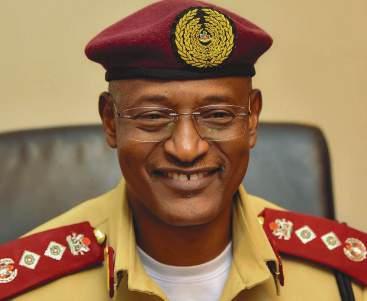
The Federal Road Safety Corps (FRSC) is undergoing one of the most strategic institutional transformations in its history. At the centre of that transition is the Corps Marshal Shehu Mohammed, whose leadership is steadily redefining operational efficiency, institutional discipline, digital enforcement and public engagement within Nigeria’s lead road safety management agency.
In a country where road transportation remains central to commerce, mobility and national integration, the responsibility placed on the FRSC is enormous. Every festive season, millions of Nigerians travel across highways often burdened by traffic congestion, reckless driving, infrastructural challenges and emergency incidents.
Yet, amid these realities, the FRSC under Shehu Mohammed has continued to pursue a reform-driven agenda aimed at repositioning the Corps as a more professional, technologydriven and citizen-focused institution.
The nationwide Eid el-Kabir special patrol operations provided a clear insight into that vision. With over 30,000 Regular and Special Marshals deployed nationwide between May 25 and May 31, 2026, the exercise goes beyond routine festive traffic management. It reflects a broader operational philosophy anchored on preparedness, rapid emergency response, strategic enforcement and interagency collaboration.
The deployment includes patrol vehicles, ambulances, tow trucks, bikes, radar guns and breathalysers strategically positioned across critical corridors such as AbujaKaduna-Kano, Sagamu-Mowe-Lagos and Akwanga-Lafia-Makurdi, among other highrisk routes. Mobile courts have equally been activated to ensure speedy prosecution of traffic offenders, while rescue teams remain on 24-hour stand-by to respond to trafficrelated emergencies.
For many observers, the scale and coordination of the operation reinforce the growing perception that FRSC is evolving from a conventional traffic enforcement agency into a modern road safety management institution with expanding operational sophistication.
That transformation, however, did not emerge overnight.
Since assuming office, Shehu Mohammed has consistently projected a leadership philosophy centred on professionalism, discipline, digital innovation, institutional reforms and personnel development. His policy direction reflects a clear understanding that contemporary road safety administration extends beyond check points and patrols.
Under his leadership, the Corps has intensified digital transformation initiatives, strengthened strategic partnerships, expanded public enlightenment campaigns and reinforced internal accountability mechanisms. FRSC has continued to deploy technology-driven solutions, including enhanced crash data management systems, biometric driver licensing processes and improved traffic information dissemination through the National Traffic Radio 107.1FM and other media platforms.
Perhaps more significantly, the Corps Marshal has repeatedly emphasised that operational effectiveness must be matched with ethical conduct and professionalism among personnel. Earlier in 2026, he declared the year one of “renewed commitment, professionalism and improved service delivery,” while warning officers against extortion, abuse of authority and unethical conduct.
That message has been reinforced through commendation and reward systems designed to recognise integrity and professionalism within the Corps, a move many analysts believe is gradually strengthening public confidence and institutional credibility.
Beyond enforcement, Mohammed appears equally committed to institutional sustainability through human capital development.
The recent strategic leadership training organised for 305 senior officers nationwide underscores an administration investing heavily in operational co-ordination, adaptive leadership and mentorship culture. The programme, designed for Chief Route Commanders and Assistant Corps Commanders, focused on emotional intelligence, operational judgment and modern traffic management realities.
In a rapidly changing mobility environment characterised by urban congestion, increasing vehicle population and rising public expectations, such investments in leadership development are essential. The Federal Road Safety Corps’ leadership itself acknowledges that conventional enforcement methods alone can no longer address Nigeria’s evolving road safety challenges.
Another defining feature of the current administration is its collaborative approach to governance. The Corps has continued to deepen co-operation with the Nigeria Police Force, Nigeria Security and Civil Defence Corps, military formations, emergency responders and other stakeholders to strengthen traffic management and emergency response mechanisms nationwide.
Recent engagements between the FRSC and the National Identity Management Commission (NIMC) also reflect growing efforts towards data harmonisation and technology integration as tools for improving road safety administration and national security coordination.
Indeed, the FRSC remains one of Nigeria’s most visible public institutions with nationwide operational reach. Since its establishment in 1988, the corps has evolved through different reform phases into the country’s foremost road safety management organisation.
What appears evident under Shehu Mohammed’s leadership is a deliberate effort to consolidate previous gains while introducing a more structured blend of operational enforcement, digital modernisation, personnel discipline and institutional partnerships.
His recent visit to the RS7 Zonal Command Headquarters in Abuja, the last command where he served before his appointment as Corps Marshal carried symbolic significance. It reflected a leader reconnecting with the operational roots of the institution while boosting morale among frontline personnel.
Nigeria is gradually approaching another defining political season. Campaign posters will soon flood our streets.
Party slogans will dominate radio jingles. Social media will become a battleground of accusations, propaganda, and emotional manipulation. Yet, beneath the excitement of democratic participation lies a growing danger that many Nigerians already recognize: the normalization of hate speech in partisan politics.
The danger is not merely that politicians insult one another. Democracy can survive disagreement. What democracy struggles to survive is the deliberate weaponization of ethnicity, religion, region, and identity in pursuit of political victory.
Over the years, Nigerian elections have increasingly reflected this disturbing pattern.
Political parties and their supporters often frame elections not as contests of ideas, but as battles for ethnic survival. Opponents are no longer criticized simply for poor policies; they are portrayed as enemies of a tribe, a religion, or an entire region. Once politics reaches that point, voters stop listening with reason and begin reacting with fear.
The tragedy is that Nigeria has walked this road before.
Scholars of Nigerian politics have repeatedly warned about the connection between hate speech and electoral violence. Political scientist Christian Ezeibe argues that hate speech played a significant role in election violence during the 2011, 2015, and 2019 elections. His research showed that inflammatory rhetoric deepened political intolerance and encouraged violence among supporters.
The evidence is visible in our recent history. After the 2011 presidential election, parts of northern Nigeria erupted in violence that claimed hundreds of lives. Churches, homes, and public buildings were destroyed. Many innocent Nigerians paid the price for poisonous political rhetoric spread during campaigns. Politicians moved on; ordinary citizens buried their dead.
The 2015 elections were celebrated globally because an incumbent president conceded defeat peacefully. Yet beneath that success was a deeply divisive campaign atmosphere. Religious and regional sentiments were heavily exploited. Nigerians were pressured to vote not necessarily based on competence, but on where candidates came from and what faith they professed.
Then came the 2023 elections. Social media transformed political communication into something far more aggressive and personal. Facebook, WhatsApp, TikTok, and X became channels for tribal insults, fake news, and dangerous stereotypes. Entire ethnic groups were profiled because of political preferences. In Lagos, political tensions during the governorship election exposed how quickly ethnic rhetoric could poison public trust. Recent academic studies observed that divisive language significantly
shaped voter behaviour and heightened social hostility during the elections. What makes hate speech particularly dangerous is that it often disguises itself as political passion. Many supporters do not realize when they have crossed the line from advocacy into incitement. They believe they are defending their preferred party, while unknowingly weakening national unity. History offers sobering lessons. Rwanda’s 1994 genocide did not begin with weapons. It began with words. Radio broadcasts repeatedly portrayed fellow citizens as enemies and threats. Over time, hateful language normalized violence. The same pattern appeared in Nazi Germany, where propaganda systematically dehumanized Jews before persecution escalated into mass murder.
Nigeria is not Rwanda, and Nigerians are not destined for such catastrophe. But societies do not collapse overnight. They deteriorate gradually when hateful rhetoric becomes acceptable in public life.
One of the greatest disappointments in Nigerian politics is the conduct of many political elites themselves. Rather than calming tensions, some politicians deliberately exploit divisions because they understand the emotional power of identity politics. They know that an unemployed young man can be persuaded more easily through ethnic anger than through economic policy. Fear mobilizes faster than facts. This is why party structures must bear responsibility for the tone of political discourse. Political parties cannot publicly preach peace while secretly encouraging supporters to spread hostility online. They cannot condemn violence while benefiting from inflammatory propaganda. The challenge extends beyond politicians. Media organizations also face serious moral questions. Television stations and radio programs increasingly host partisan commentators who thrive on sensationalism. Some presenters amplify unverified claims simply because controversy attracts audiences. Social media influencers, desperate for attention and engagement, spread divisive content without considering its consequences.
A recent study on political communication during the 2023 elections found that hate speech on digital platforms deepened voter fear, mistrust, and political polarization. This is especially dangerous in a country already struggling with insecurity, economic hardship, and weak national cohesion.
At this point, the conversation must move beyond moral appeals into the realm of law and institutional responsibility. Nigeria already possesses fragments of a regulatory framework against hate speech, but enforcement remains weak, inconsistent, and often politicized.
Orovwuje is public affairs analyst and founder, Humanitarian Care for Displaced Persons, Lagos. orovwuje50@gmail .com
DCC Ohaeri is the Corps Public Education Officer, FRSC Headquarters, Abuja.
Editor, Editorial Page PETER ISHAKA
Email peter.ishaka@thisdaylive.com
THREE YEARS OF TINUBU ADMINISTRATION
The authorities must do more to make the country much more livable
The administration of President Bola Tinubu on Friday marked three years since inauguration. Just as Nigerians marked 27 years of unbroken civil rule in the country. Quite naturally, there were congratulatory messages from supporters of the president on what is clearly a milestone moment. In a four-year presidency, the first three years symbolise the end of effective governance. The remaining year (as we have seen in recent weeks) is spent mostly in transitional politics, and navigating the trenches of democratic succession. It is therefore appropriate that the public mind identifies the character, achievements and possible legacies of the presidency in question. Although President Tinubu has given himself a pass mark, the verdict of Afenifere (Yoruba socio-cultural group) and that of the opposition political parties are not as generous.
In the idiom of the Tinubu administration, the last three years have been a period of reform in critical sectors of the economy. The twin pillars of that reform were the removal of subsidy on petroleum products and the liberalisation (or floating) of the foreign exchange (FX) market. While the improvement in macro indicators is yet to translate to relief for most Nigerians in cost of living crisis, there is an obvious shift in external reserves, foreign trade, foreign direct investment and foreign portfolio investment flows, and Gross Domestic Product (GDP) growth. Under the previous administration of the late President Muhammadu Buhari, Nigeria had been living a lie, borrowing from the Central Bank of Nigeria (CBN), including to pay salaries.
astronomically. Food inflation and attendant food prices have escalated in the last three years. Hunger has emerged as a feature of most communities, and the vocabulary of every day speech. Other living costs like transportation, healthcare and utility tariffs have also jumped.
Meanwhile, all the tiers of government (774 local government areas, 36 states and federal) have been receiving more funds from the federation account. It is arguable whether the additional revenue has been matched by improved investment in infrastructure and social services. Borrowings by the federal and some state governments have recently increased. Nigeria is now among the five most indebted nations of the world. While the exchange rate may have stabilised at its present high levels, importers and consumers continue to lament that domestic prices remain high with depressed demand and erratic supply of goods and services.
The last three years have witnessed a deterioration in the nation’s internal security balance sheet. Banditry, kidnapping, mass abductions especially of school children have escalated in many parts of the country
SUNDAY NEWSPAPER
editor DAviDSoN iriekpeN
deputy editors FeSTUS AkANBi eJioFor ALike
Managing director eNioLA BeLLo
deputy Managing director iSrAeL iwegBU
chairMan editorial Board oLUSegUN ADeNiYi
editor nation s capital iYoBoSA UwUgiAreN the oMBudsMan kAYoDe koMoLAFe
Some observers have argued that the reforms initiated by Tinubu have set the economy on a more realistic trajectory.
Administration officials also insist that the current sacrifices and deprivations are the prices of growing a more competitive market economy. However, while we concede that Tinubu may have taken tough but necessary decisions, even the most ardent adherents of the administration would admit that their ripple effects have been adverse on living conditions of ordinary Nigerians. The pump prices of gasoline, diesel, and aviation fuel have shot up
THISDAY NEWSPAPERS LIMITED
editor-in-chief/chairMan NDUkA oBAigBeNA
group executive directors eNioLA BeLLo, kAYoDe koMoLAFe, iSrAeL iwegBU divisional directors SHAkA MoMoDU, peTer iwegBU ANTHoNY ogeDeNgBe deputy divisional director oJogUN viCTor DANBoYi snr. associate director eriC oJeH
associate director pATriCk eiMiUHi
controllers ABiMBoLA TAiwo UCHeNNA DiBiAgwU, NDUkA MoSeri director, printing production CHUkS oNwUDiNJo to send eMail: first name.surname@thisdaylive.com
In an audacious moment during his campaign before the 2023 general election, Tinubu had told Nigerians not to vote for his re-election if he was unable to deliver stable electricity. The jury is now out as to whether he has fulfilled the pledge. But over and above the situation in the power sector, the last three years have witnessed a deterioration in the nation’s internal security balance sheet. Banditry, kidnapping, mass abductions especially of school children and large scale inter communal killings have escalated in many parts of the country. Efforts to curb these tragedies have not yielded the desired results. However, a recent collaboration between Nigerian and the United States armed forces against Boko Haram and the Islamic State West Africa Province (ISWAP) in the northern precincts has badly dented activities of the insurgents in areas bordering the Sahel. It is hoped that this effort will be sustained and taken to the hinterland where the internal insecurity situation has made the country a largely unsafe place to live.
As the president therefore ramps up his first-term tenure while seeking re-election, he must enunciate a more compassionate and people friendly agenda, going forward.
Letters in response to specific publications in THiSDAY should be brief(150-200 words) and straight to the point. interested readers may send such letters along with their contact details to opinion@thisdaylive.com. we also welcome comments and opinions on topical local, national and international issues provided they are well-written and should also not be longer than (950- 1000 words). They should be sent to opinion@thisdaylive. com along with the email address and phone numbers of the writer
LETTERS
JAFARU SANI, ASHIRU AND KADUNA ADC PRIMARIES
Alhaji Jafaru Sani was hyped as the inheritor of Malam Nasir El Rufai’s political dynasty, but he has turned out to be a disappointment. He was at various times a permanent secretary, Commissioner of Local Government and headed other sensitive committees during the El Rufai administration. Jafaru was in charge of the primaries where aspirants were disqualified as being “unsuitable” even before delegates cast their votes.
So, when El- Rufai started to nurse the idea of denying Governor Uba Sani a second term, all eyes were on Jafaru Sani as the heir apparent or “Governor in Waiting”. In fact, the man followed the former Governor to SDP and when Malam was frustrated out of the party, he went to ADC with him.
Besides, Jafaru was always in court every time El- Rufai was arraigned. He was always beside Bello El-Rufai when the legislator is making a case for his father’s release in press conferences. However, instead of reaching out to the electorate and party members for support, Jafaru was waiting to be anointed. In fact, El- Rufai made him think that his coronation as Kaduna State Governor in 2027 was just a matter of time. The man was made to believe that he will be the ADC gubernatorial candidate on a platter of gold. With this mindset, the man was busy carrying on as “Governor” even before primaries were conducted. Reports indicated that he was even holding court in his house, where potential cabinet members have started lobbying to be
Commissioners!
In contrast, Alhaji Isa Ashiru saw an opportunity and cashed in on it. With a better structure, having defected to ADC with a chunk of his PDP supporters, and a name recognition, Ashiru soon became the candidate to beat. However, Jafaru was still living in his own bubble, believing that El -Rufai’s magic wand will make him clinch the party’s ticket. When that illusion disappeared and reality sank in, the former Commissioner of Local Government still nursed the dream of riding on El -Rufai’s name to victory. Alas, Ashiru trounced him at the ADC primaries which held recently and the entire support base of El- Rufai has been in disarray after the polls. Most supporters are blaming El- Rufai
for not standing firm for Jafaru Sani. According to them, Malam made a mistake for choosing a political paper weight who has little electoral value. Owing to Jafaru Sani’s lackadaisical handling of the entire contest, almost all of Malam’s candidates crashed at the primaries. In one fell swoop, Ashiru who is an outsider, has seized ADC in Kaduna State as most of his candidates have coasted to victory. The irony is that El-Rufai’s camp which prides itself as more learned in policy formulation and governance, will now be led by someone whom they have low regard for. What El- Rufai has done to Jafaru is the ultimate betrayal of trust and everything that he has worked for has gone with the wind.
Muktar Mohammed, Kaduna
Reflections on Uba Sani’s Three years of Transformational Leadership in Kaduna
Three years ago, when Senator Uba Sani was sworn in as Governor of Kaduna State on May 29, 2023, he inherited a state facing challenges far beyond the ordinary demands of governance. Kaduna was weighed down by insecurity, fiscal pressures, economic disruption, and deep social divisions.
Banditry, kidnapping, and violent attacks had become recurring threats across many communities. Thousands of farmers had abandoned their fields, rural economies were struggling, and public confidence in government had diminished. Yet beyond these visible problems lay an even greater challenge: the erosion of trust among the people.
Years of ethno-religious tensions had left deep scars on Kaduna’s social fabric. Communities increasingly retreated into identities defined by ethnicity, religion, and geography. Political discourse often deepened divisions rather than building consensus. In many respects, Kaduna appeared trapped in a cycle of insecurity, mistrust, and uncertainty.
Many expected the new governor to spend his tenure explaining away inherited difficulties. Others predicted years of political recrimination and blame. Instead, Uba Sani chose a different path. He refused to become a prisoner of circumstance and embraced the harder task of rebuilding confidence and restoring hope.
Rather than dwelling on the failures of the past, he focused on the possibilities of the future. Rather than governing through resentment, he pursued reconciliation. Rather than exploiting existing divisions, he sought to heal them.
His governing philosophy was captured in a statement that has since become synonymous with his administration: “We chose dialogue over division, inclusion over exclusion, compassion over bitterness, and service over propaganda.” Few political declarations have been reflected more consistently in governance outcomes.
Three years later, Kaduna’s transformation is visible not only in physical infrastructure but also in the renewed confidence of its people. Indeed, Governor Uba Sani’s greatest achievement may not be measured solely in roads, hospitals, or budgetary statistics. It may be found in the restoration of trust and the rebuilding of social harmony across one of Nigeria’s most diverse states.
When he assumed office, Kaduna remained burdened by longstanding ethno-religious fault lines. The old divisions between communities often shaped public perception and political engagement.
Uba Sani consciously rejected that trajectory.
“My dear people, Kaduna State belongs to all of us. Our diversity is not a weakness; it is our greatest strength,” he declared.
Those words were more than political rhetoric; they became a governing principle. Across the state, development projects, social investments, and public interventions increasingly reflected a deliberate commitment to fairness and inclusivity. Communities that once felt excluded now see themselves as stakeholders in a common future.
The long-standing and politically charged divide between Kaduna North and Southern Kaduna has gradually lost some of its potency because the administration has consistently promoted what may be described as the politics of belonging. Inclusion has replaced exclusion as a central theme of governance.
This philosophy is perhaps most evident in the administration’s approach to security.
At the beginning of his tenure, insecurity represented one of Kaduna’s greatest challenges. Entire communities lived in fear. Agricultural activities declined. Markets suffered disruptions, and schools struggled to operate in affected areas.
Governor Sani understood that while security operations were necessary, sustainable peace required more than military action alone. Lasting stability, he argued, must rest on justice, fairness, opportunity, and mutual respect.
Working closely with security agencies, traditional institutions, religious leaders, and local stakeholders, the administration adopted a multidimensional peace-building strategy that addressed both security threats and their underlying causes. This gave birth to the phenomenal Kaduna Peace Model.
The results have been significant. Communities previously affected by violence are gradually regaining confidence. Farmers have returned to their fields, markets are thriving again, and schools that once
faced disruptions have reopened. Across many parts of Kaduna, a sense of normalcy has returned.
The same commitment to long-term stability has shaped the administration’s management of public finances.
When Governor Sani assumed office, Kaduna faced substantial debt obligations that constrained development. The politically convenient option would have been to borrow more and postpone difficult decisions. Instead, the administration embraced fiscal discipline, structural reforms, and prudent financial management.
Through these measures, Kaduna reportedly repaid more than ₦90 billion in inherited obligations without contracting new loans.
This achievement reflects a quality often overlooked in public leadership: restraint.
Effective governance is not simply about spending; it is about making sustainable choices. It requires balancing present demands with future responsibilities and prioritizing long-term stability over short-term popularity.
This culture of prudence has also strengthened transparency and accountability.
Kaduna has emerged as one of Nigeria’s leading states in governance reforms, earning national recognition for transparency and public accountability.
The administration’s emphasis on institutional governance has improved investor confidence, enhanced revenue collection, and strengthened public trust in government processes. Through reforms, digital innovation, and expanded revenue administration, Kaduna has significantly improved internally generated revenue, reducing dependence on external sources and creating a stronger foundation for sustainable development.
Agriculture has also become a cornerstone of the administration’s economic agenda. Throughout history, prosperous societies have understood that food security is inseparable from economic security. Governor Uba Sani has repositioned agriculture from the margins of public policy to the centre of development planning.
When he assumed office, agriculture received only a small fraction of the state budget. Today, allocation to the sector exceeds ₦74 billion, representing about 14 percent of the budget and surpassing the Malabo
Declaration benchmark.
Through the Tallafin Noma programme, thousands of farmers have received improved seeds, fertilizers, agrochemicals, and mechanization support. More than 900 trucks of fertilizer have reportedly been distributed across the state’s 23 local government areas.
The administration’s vision extends beyond increasing farm output. Through the Special AgroIndustrial Processing Zone initiative and other strategic partnerships, Kaduna is positioning itself as a major hub for agricultural processing, value addition, and exports. The establishment of the African Quality Assurance Centre further strengthens efforts to ensure that local products meet international standards.
Equally significant has been the administration’s investment in human capital development. Governor Sani recognizes that the future belongs not merely to societies rich in natural resources but to those that invest in knowledge, skills, and innovation. This understanding explains the priority given to education.
With more than 25 per cent of the state budget consistently allocated to education, Kaduna has surpassed many international benchmarks. Schools have been built and upgraded, teachers recruited and trained, and learning opportunities expanded across the state.
One of the most notable outcomes has been the reduction in the number of out-of-school children in the state. This progress is critical because education remains one of the most powerful tools for breaking cycles of poverty and exclusion.
Beyond basic education, the administration has taken steps to prepare young people for the demands of a rapidly changing global economy. The establishment of Institutes of Vocational Training and Skills Development in Rigachikun, Samaru Kataf, and Soba reflects a forward-looking approach that emphasizes digital technology, renewable energy, technical skills, and entrepreneurship.
Infrastructure development has been another defining feature of the administration’s first three years.
Under Governor Uba Sani, approximately 150 road projects covering about 1,345 kilometres have been initiated across Kaduna’s 23 local government areas. This represents a significant shift in the distribution of infrastructure development.
Perhaps more importantly, every local government area is now experiencing either completed or ongoing road projects. Communities that previously saw little government presence are increasingly connected to economic opportunities through improved transport networks.
Among the flagship projects are the 35-kilometre Gadan Gayan-Gwaraji-Kujama Road and the ongoing Bagoma-Gagumi Road in Birnin Gwari, alongside numerous township roads, bridges, and rural access routes designed to support commerce and agricultural productivity.
The administration has also launched one of the most ambitious urban transportation initiatives in Northern Nigeria: the Kaduna Bus Rapid Transit (KBRT) system. The project is expected to improve mobility, reduce congestion, and support sustainable urban development.
Complementing the KBRT initiative is the construction of the Southern Terminal and plans for the Kaduna Light Rail Transit system, which enjoys Federal Government support. Together, these projects reflect a long-term vision of Kaduna as a modern transportation and commercial hub.
In the health sector, the administration has pursued an equally ambitious agenda.
Kaduna became the first state in Nigeria to upgrade all 255 Primary Healthcare Centres to Level II status, significantly improving access to healthcare services in both urban and rural communities.
The government has also embarked on the rehabilitation and equipping of general hospitals across the state while completing the long-abandoned 300-bed Specialist Hospital project initiated more than 16 years ago. These investments are strengthening healthcare delivery and expanding access to quality medical services.
Taken together, these achievements illustrate a broader philosophy of governance rooted in inclusion, accountability, prudence, and service.
This helps explain why Governor Uba Sani continues to enjoy growing political support across different sections of the state. His leadership has been defined less by political spectacle and more by steady, measurable progress.
When he accepted his recent endorsement for another term by all the registered members of the ruling APC in the state, he described it not as a personal victory but as a renewed covenant with the people of Kaduna State. That description captures the essence of his administration.
Three years after inheriting a state burdened by insecurity, social fragmentation, and fiscal strain, Uba Sani has succeeded in changing not only Kaduna’s condition but also its mood.
That, perhaps, is the true meaning of transformational leadership. And that is the enduring significance of Uba Sani’s first three years in office.
•Saliu, a journalist resides in Kawo, Kaduna
Tahir Ahmad Saliu
Governor Sani (left), and Tinubu
AdA or A Umeoji Stewarding Zenith into the Future
Tomorrow, June 1, 2026, marks two years since Dame Adaora Umeoji assumed office as the Group Managing Director and Chief Executive Officer of Zenith Bank Plc, becoming the first woman to lead one of Nigeria’s most profitable financial institutions. But beyond the symbolism of breaking a historic glass ceiling, Umeoji leadership is rooted in people, purpose and global ambition. Vanessa Obioha profiles the banking amazon
Stewarding Zenith into the Future
When Zenith Bank announced Dame Adaora Umeoji as its new Group Managing Director in 2024, the appointment carried historic weight. Not only was she the first woman to lead the banking giant, she was also a product of the institution itself — rising from junior staff to the highest office through decades of discipline, institutional memory and strategic execution.
The finance world responded with laudatory remarks. Many young women saw in her emergence the possibility of their own ambitions taking shape in industries long dominated by men. But for Umeoji, the significance of her appointment appears to lie less in the title of “first female GMD” and more in the responsibility that comes with leading one of Africa’s most formidable banks through a rapidly evolving financial landscape.
By the end of her first year in office, the numbers had begun to speak loudly. Zenith Bank’s full-year 2024 financial results revealed an extraordinary 86 per cent growth in gross earnings, driven largely by a 138 per cent surge in interest income and an expanded loan book. Profit before tax climbed to N1.3 trillion, while profit after tax crossed the N1 trillion mark, representing a 52.5 per cent increase year-on-year. Total assets rose by approximately 47 per cent to N30 trillion, while customer deposits increased to N22 trillion, reflecting growing confidence among customers and investors alike. In dollar terms, the bank posted a robust profit of $671 million in 2024.
The momentum continued in 2025. Gross earnings rose six per cent to N4.19 trillion, anchored by a 35 per cent jump in interest income to N3.7 trillion. Net interest income grew by 53 per cent to N2.6 trillion. That growth, according to Umeoji, was made possible by the strategic expansion of the bank’s interest-earning assets and disciplined loan pricing aligned to risk and market conditions.
“And it was achieved against a tough backdrop, with the Monetary Policy Rate at 27.5 per cent for most of the year before easing to 27 per cent in September, and the Cash Reserve Ratio at 50 per cent for Deposit Money Banks through most of the period,” she said in an interview with The Will Downtown.
The bank’s total dividend for the 2025 financial year stood at N10 per ordinary share, comprising an interim dividend of N1.25 and a final dividend of N8.75, double the N5 paid in 2024. Loans also grew by 9 per cent to N12.04 trillion, supporting critical sectors such as manufacturing, agriculture and trade.
“Those are the sectors that create jobs for Nigerians. We kept depositors’ money safe, with customer deposits at N24.47 trillion, and the bank itself remained very strong. Our Capital Adequacy Ratio closed 2025 at 25 per cent and our Liquidity Ratio at 71 per cent, both well above what regulators require.”
The bank’s non-performing loan ratio also improved, further reinforcing investor confidence in Zenith’s risk management structure.
Beyond the impressive balance sheets, Umeoji’s leadership reflects a broader vision for the bank. She is particularly passionate about supporting small and medium-scale enterprises, which she describes as “the heartbeat of Nigeria’s economy,” while also deepening digital innovation to make banking faster, simpler and more accessible to everyday Nigerians.
Under her leadership, Zenith Bank reached another historic milestone, becoming the first Nigerian bank to surpass a N5 trillion market capitalisation, supported by sustained profitability and strong investor confidence.
Also, the bank led Nigeria’s export financing with 32.31% of all NXP transactions nationwide.
For Umeoji, however, sustaining profitability is less about aggressive expansion and more about balance — growing high-yield assets while maintaining strong liquidity, disciplined risk management and long-term institutional stability.
Apart from the balance sheets, Umeoji is leading the bank in expanding
its footprints across the world. It has established its presence in Paris, France; Manchester, UK, and just last April, the GMD was in Abidjan, Ivory Coast to open its branch in the West African country. The bank is now preparing for a possible listing on the London Stock Exchange in 2027, a move Umeoji believes would further position Zenith as a truly global financial institution.
“The real victory, for me, lies in the rerating of our identity. It would mean aligning our governance and operational standards with leading global banking peers, while deepening our capacity to facilitate high-value trade between Africa and the United Kingdom.”
In the area of digital banking, Zenith continues to strengthen its technology infrastructure, not simply to improve customer experience, but also to build trust and reliability in an increasingly digital financial ecosystem.
But Zenith’s Bank intervention doesn’t end in the banking halls. In sports, the bank has maintained a visible presence, particularly women’s basketball, where it remains the sole sponsor of the annual national women’s basketball league. The bank also sponsors the Delta State Principals Cup and Headmasters Cup.
Hosting the D’Tigress team earlier in the year in Abuja, Umeoji reiterated the bank’s commitment to sports development.
“We are always deliberate with our dealings with sports. We are committed to do it again in the New Year. We are proud of what we are doing and we will do more.”
Perhaps, in many ways, Umeoji’s journey into leadership appears almost
preordained. Her first name, Adaora — loosely translated in Igbo as “ first daughter of the community” — reflects a sense of responsibility larger than self. Her leadership style equally mirrors values deeply rooted in discipline, service and purpose, principles she says have kept her grounded throughout her career.
Armed with academic qualifications spanning sociology, accounting and management, she joined Zenith Bank as a junior employee and steadily rose through the ranks through consistency, competence and strategic insight.
But leadership, for Umeoji, is ultimately about stewardship — and stewardship comes with pressure. She acknowledges the weight of being the first woman in such a role but insists that the responsibility demands greater intentionality rather than symbolism.
“Being first simply means I have to be twice as deliberate: deliberate about building strong succession pipelines for both women and men; deliberate about meritocracy, so that no one ever doubts why anyone sits at the table; and deliberate about proving that diversity strengthens, rather than weakens, commercial outcomes.”
This, to her, is what being first truly means. It is about widening it for others while ensuring the institution she leads remains strong enough to outlive the moment.
Umeoji
Umeoji
HighLife
Aisha Babangida and Service
Beyond Status
Aisha Babangida inherited a famous name but chose to build something deeper. As the eldest daughter of former Military President Ibrahim Babangida and the late First Lady Maryam Babangida, she could have rested on legacy. Instead, she has spent over two decades turning privilege into purpose.
Erelu Aisha’s work began in 2002 with the Tasnim Foundation, providing academic scholarships to young girls in underserved communities and building rural schools. She then stepped up as Chairperson of the Better Life Program for the African Rural Woman(BLPRW), modernising her mother’s iconic initiative into a professional NGO that now manages over 250 health, educational and agricultural projects across the continent.
But Aisha understood that empowerment requires more than charity. It requires access to capital. In April 2016, she founded Egwafin Microfinance Bank, a dedicated financial institution designed to extend microloans and credit to female traders and smallscale farmers who have no collateral for traditional banking. The bank has opened doors that banks had kept shut.
In 2018, she launched the Women Enterprise Alliance, a platform that has grown to support over 4,700 businesses across all 36 Nigerian states through capital investment, digital marketing training, and mentorship. Her efforts earned her the Crans Montana Forum Gold Medal in Brussels in 2019, an international honour recognising her commitment to the economic advancement of African women.
In December 2024, she spearheaded a N5 million educational grant through BLPARW, delivering critical funding and learning materials directly to orphans and vulnerable children in Abuja.
Behind the titles and awards is a woman described by those close to her as humble, empathetic, and generous. She also carries a quiet personal responsibility: following her mother’s passing, she has taken up the mantle of caring for her father in Minna, representing him at major national functions.
Erelu Aisha has proven that true influence is not measured by wealth or status alone. It is measured by the lives touched, the businesses funded, the children educated, and the hope restored.
...Amazing lifestyles of Nigeria’s rich and famous
Goodluck Jonathan: Nigerians Deserve Clarity, Not Silence on 2027 Ambition
As Nigeria’s political atmosphere gradually gathers momentum ahead of the 2027 general elections, one name continues to echo quietly but persistently across the corridors of power, media conversations, and public discourse: former President Goodluck Jonathan. Yet, despite the growing speculation surrounding his possible political return, the former Nigerian leader has maintained an almost studied silence, leaving many Nigerians uncertain, curious, and increasingly uneasy.
In politics, silence is rarely empty. It often speaks louder than declarations. And in Jonathan’s case, his refusal to categorically define his position on the 2027 presidency has become a subject of national intrigue.
Across party lines and regional interests, conversations about the former president’s political future continue to deepen. Supporters see him as a stabilising figure with democratic credentials and international goodwill. Critics, however, argue that Nigeria cannot afford prolonged political ambiguity at a time when the nation urgently requires
In the grand tapestry of Nigeria’s corporate evolution, certain names stand out not merely for wealth or influence, but for the enduring values they represent. Among such distinguished figures is Dr. Gabriel Ogbechie, a consummate businessman, visionary entrepreneur and respected oil magnate whose remarkable journey continues to inspire admiration across boardrooms, industries and generations.
As he turns 60, family, friends, associates and admirers celebrate not only the passage of time, but the enduring legacy of a man whose life has become synonymous with excellence, enterprise and impact.
clarity, direction, and decisive leadership.
What makes the uncertainty even more compelling is Jonathan’s unique place in Nigeria’s democratic history. As a former president who conceded defeat peacefully in 2015, he earned global respect and etched his name into the annals of democratic statesmanship. Since leaving office, he has cultivated the image of a calm elder statesman, frequently engaged in peace missions, electoral mediation, and diplomatic interventions across Africa.
Yet, back home, the political speculation refuses to fade.
Within sections of the political elite, there are persistent whispers that influential blocs are quietly testing the waters for a Jonathan comeback. Others believe strategic forces within the nation’s power structure see him as a possible consensus figure capable of easing Nigeria’s widening political and regional tensions. But while the permutations continue behind closed doors, the Nigerian public remains largely in the dark.
That silence is beginning to raise important questions.
At a time when political actors are gradually
positioning themselves for 2027, many Nigerians believe Jonathan owes the nation a measure of clarity.
Whether he intends to run or remain above partisan politics, a straightforward position would help calm mounting speculation and reduce unnecessary political distractions.
Celebrating Gabriel Ogbechie’s Enduring Legacy
For six remarkable decades, Dr. Ogbechie has embodied the rare combination of strategic brilliance and human compassion. In an era where business success is often measured solely by numbers, he has consistently demonstrated that true greatness lies in the ability to build institutions, empower people and create lasting value for society.
Through discipline, foresight and unwavering dedication, he has carved a respected niche for himself within Nigeria’s energy sector and beyond, emerging as one of the nation’s most influential industrialists.
As the founder and driving force behind Rainoil Limited, Dr Ogbechie transformed a bold vision into that of one of Nigeria’s foremost indigenous oil and gas companies. Under his leadership, the company grew from modest beginnings into a formidable enterprise with a nationwide footprint, contributing significantly to energy distribution, employment generation and economic development. Yet beyond the impressive corporate achievements lies the story of a leader whose integrity, resilience and strategic mindset have earned him enduring respect within the business community.
What distinguishes Dr. Ogbechie is not merely the success he has attained, but the dignity and humility with which he carries it. Despite occupying enviable heights in business and industry, he remains deeply committed to
Olanipekun, Oyetibo Leave Lasting Imprints in Ekiti and Ondo
In a society where titles, wealth and influence too often measure greatness, two distinguished legal luminaries have once again reminded Nigerians that true legacy is defined by service to humanity. Renowned Senior Advocates of Nigeria, Chief Wole Olanipekun and Chief Tayo Oyetibo, have etched their names deeper into the hearts of their people through remarkable acts of philanthropy aimed at uplifting communities and strengthening institutions.
For Olanipekun, former President of the Nigerian Bar Association, philanthropy has always walked hand in hand with excellence. His recent donation of the Newcruse Mother and Child Maternity Complex to the people of Ikere-Ekiti stands as a monumental testament to his enduring commitment to humanity and community development.
The ultra-modern maternity complex is more than a building of bricks and mortar; it is a sanctuary of hope for expectant mothers, newborns and vulnerable families within Ikere-Ekiti and its surrounding communities. At a time when maternal and child healthcare remains a major concern across many parts of Nigeria, Olanipekun’s intervention reflects compassion anchored in foresight and responsibility.
Beyond its physical structure, the maternity
complex symbolises dignity, care and a profound investment in the future generation. It is a gift that will continue to save lives long after the applause fades.
In the same spirit of giving and institutional advancement, Oyetibo has reinforced his enduring commitment to the legal profession with the donation of the Tayo Oyetibo Bar Centre to the Ondo Branch of the Nigerian Bar Association.
The magnificent edifice represents far more than a physical structure; it is an investment in the future of legal practice, mentorship and intellectual engagement within the legal community. As one of Nigeria’s most accomplished legal practitioners, Oyetibo’s gesture reflects his belief in strengthening the very institution that shaped his remarkable journey at the Bar.
For members of the NBA in Ondo, the Bar Centre is expected to serve as a hub for professional interaction, legal discourse, continuing education and administrative activities. It is a development that will undoubtedly elevate the standard of professional engagement within the branch while inspiring younger lawyers to embrace excellence and service.
Indeed, the parallel acts of generosity by Olanipekun and Oyetibo beautifully
uplifting others, mentoring young entrepreneurs and supporting initiatives that advance education, social welfare and community development.
At 60, Dr. Ogbechie stands as a symbol of perseverance and visionary leadership in a rapidly changing world. His life story reflects the power of courage, innovation and consistency — virtues that continue to inspire emerging business leaders across Nigeria and Africa. Through economic uncertainties, industry shifts and national challenges, he has remained steadfast, proving that sustainable success is built on character, competence and an unyielding commitment to excellence.
This milestone birthday is therefore more than a celebration of age; it is a tribute to a legacy painstakingly built through decades of hard work, sacrifice and uncommon determination. It is a moment to honour a man whose influence extends far beyond the energy sector into the broader landscape of national development and corporate leadership.
As tributes pour in from across the country and beyond, one truth remains evident: Dr. Gabriel Ogbechie’s legacy is firmly etched in the annals of Nigerian enterprise. His journey continues to illuminate the path for future generations, reminding them that greatness is not achieved overnight, but cultivated through vision, integrity and purposeful leadership.
illustrate how influence can be transformed into impact. Though operating in different spheres of intervention — healthcare and legal infrastructure — both men share a common philosophy: that success becomes meaningful only when it leaves society better than it met it.
Erelu
ogbechie
Jonathan
Babangida
olanipekun
For decades, General T.Y. Danjuma has been the ultimate kingmaker in Taraba State politics. His influence shaped governors; his network decided winners. But the kingmaker just watched his nephew enter the race, and the message is unmistakable: the family wants its seat back.
Hon. David Dinshiya, Danjuma’s nephew, has officially declared for the 2027 Taraba governorship race under the PDP
Nephew Strikes Back: Danjuma’s Family Moves to Reclaim Taraba
banner. The announcement came at a public gathering in Jalingo, following extensive consultations with traditional rulers, youth bodies and party stakeholders. His campaign message is that Taraba “must and will do better.”
The drama lies in what is unsaid. Governor Agbu Kefas, the man currently occupying the Government House, was once a beneficiary of Danjuma’s political machinery. But Kefas recently defected from the PDP to the APC, taking the entire state apparatus with him. In one move, he shifted Taraba’s political centre of gravity. Dinshiya’s entry is widely interpreted as the Danjuma family’s direct counterpunch, an attempt to reclaim the mandate that party loyalists believe was stolen.
Adding fuel to the fire is the rumour of a broken gentleman’s agreement. Political circles are buzzing with speculation that Kefas initially agreed to
Why Ijebuland Still Waits for a New Awujale
For nearly a year, the throne of the Awujale of Ijebuland has remained empty. Oba Sikiru Adetona, who ruled for 65 years, passed away in July 2025. His departure left behind a legacy of stability. What followed has been anything but stable.
The Ogun State Government placed an indefinite suspension on the selection process, citing security concerns, public order risks, and a flood of petitions. This is the second time the government has stepped in. The first attempt in December 2025 was scrapped over statutory procedural errors. Now, the kingmakers and royal families simply wait.
At the centre of public attention stands Prince Abimbola Onabanjo. At 45 years old, he is a businessman and philanthropist from the Fusengbuwa Ruling House, which is next in rotation to present the new monarch. Supporters see him as a bridge between tradition and modern leadership. His recent meeting with President Bola Tinubu has further amplified conversations around his candidacy.
But the path is crowded.
The Fusengbuwa Ruling House produced 95 aspirants for a single throne. The family attempted to narrow the field by enforcing a seven-generation genealogical verification
a single term to maintain a delicate zonal balance between the region’s ethnic and geographic factions. Whether such an agreement ever existed, Dinshiya’s early and aggressive campaign launch signals that the opposition is not waiting to find out. They are moving now.
Dinshiya is also capitalising on genuine public frustration. His campaign directly attacks the current administration for widespread youth unemployment, decaying rural roads and underfunded healthcare. By pairing his family’s massive philanthropic reputation with an anti-incumbency message, he poses a serious threat to the APC’s hold on the state.
This is no longer a routine election. It is a proxy war between a billionaire elder statesman and the governor who stepped out from under his shadow. Taraba politics has just entered a very interesting season.
form, essentially weeding out those who could not prove their lineage. Meanwhile, the rival Fidipote Ruling House has petitioned the government, arguing that Fusengbuwa missed its legal submission window and should forfeit its turn.
The crisis deepened when the Ogun State Police Command summoned nine kingmakers for allegedly accepting bribes to influence the selection. The traditional chiefs have denied the allegations, calling them distractions. Fuji icon KWAM 1 also threw his hat into the ring, but the Fusengbuwa Ruling House rejected his candidacy. His court injunction to stop the installation process was dismissed.
For the people of Ijebuland, the prolonged vacancy is more than a political drama. After all, providing cultural leadership, settling disputes, and driving community development, the Awujale stool is one of the most respected traditional institutions in Nigeria. Therefore, an empty throne creates an institutional void.
The Fusengbuwa Ruling House has appealed to Governor Dapo Abiodun to lift the embargo. For now, the answer remains no. And Ijebuland waits.
How Prince Eludoyin is Shaping Nigeria’s Security and Power
In Nigeria’s power corridors, the most influential figures are seldom the ones standing at the podium. Sometimes they are the ones shaping decisions quietly from the shadows. Prince EOC Eludoyin, chairman of Paragon Holdings, has mastered that art. A longtime associate of President Bola Tinubu, he has steadily consolidated influence across the oil industry, political circles and the nation’s security apparatus.
Eludoyin’s reach became visible in early 2025. He acted as the primary architect behind appointing Bayo Ojulari to head NNPCL, outmanoeuvring rival candidates backed by other billionaire power brokers. That victory cemented his position as one of Tinubu’s most influential confidants.
But his expansion into security has drawn even more attention. Eludoyin successfully lobbied for the appointment of his relative, Famadewa, as special adviser on internal security. Within Abuja’s power corridors,
Imagine being a lawmaker for years, knowing the chambers, the committees, which hands to shake and which backs to pat. Then one primary election comes along, and the party tells said lawmaker to pack their bags.
This is exactly what happened to 14
Famadewa is now viewed as a top candidate to eventually succeed Nuhu Ribadu as National Security Adviser or replace Interior Minister Olubunmi Tunji-Ojo, who plans to step down to run for governor of Ondo State.
Eludoyin argues that economic strain directly drives social unrest and national insecurity. He uses his personal access to over 20 world leaders to lobby for international debt relief for developing nations. He is also spearheading a private sector initiative to attract over $10 billion in foreign direct investment from Chinese multinationals, explicitly tying infrastructure and manufacturing partnerships to stabilising Nigeria’s economy and neutralising security vulnerabilities.
For supporters, Eludoyin represents a private-sector actor capable of connecting political leadership with operational efficiency. Critics warn that the growing role of businessmen within sensitive state structures raises questions about transparency and
accountability. Either way, his influence is undeniable. In Africa’s largest democracy, the man behind the curtain is becoming harder to ignore.
How Lagos APC Just Changed Its Political Future
sitting members of the Lagos State House of Assembly. They lost. And not in a general election, in their own party’s primary.
The official list released by the Lagos APC Chapter reads like a political obituary. The affected members include Majority Leader Noheem Adams, Chief Whip Fatai Mojeed, Deputy Chief Whip Setonji David, and popular actor-turned-lawmaker Desmond Elliot. In total, 14 incumbents were denied renomination; two others chose to step aside; only 24 survived.
What caused this bloodbath? The answer traces back to 2025, when a failed attempt to unseat Speaker Mudashiru Obasa created fractures that never healed. In the silent but unforgiving tradition of Lagos political strategy, where loyalty became the ultimate currency, and perceived rebellion carried consequences, the primaries served as a battlefield where those loyalties were
directly renegotiated or punished. Even deep-rooted familial ties to the party’s elite could not guarantee survival. Gbolahan Ogunleye, son of a prominent member of the Governance Advisory Council (GAC), was soundly defeated. In other words, no one is untouchable.
Behind the upheaval seems to lie a larger strategy. The party leadership is systematically clearing out senior incumbents to accommodate a younger generation of politicians. With Deputy Governor Obafemi Hamzat heavily positioned for the governorship in 2027, creating a synchronised, strictly loyal legislative structure is imperative. The old power brokers had to go. But there is a risk. Experts analyse that some may quietly sabotage, while others may defect to opposition parties. Whichever the case and outcome, the Lagos APC has just remodelled itself. Now it must survive its own transformation.
The Quiet Power of Igho Sanomi at 51
There are two ways to measure a billionaire’s birthday. One counts the zeros on the balance sheet; the other counts the lives touched, the children saved, the hope restored. Igho Sanomi turned 51 on May 17, 2026. By either measure, the man has built something worth celebrating.
Sanomi founded Taleveras Group, building it into a multi-billion-dollar energy trading firm. That is the story told in boardrooms and business publications, an impressive one. But the quieter story unfolds in hospital wards, flooded villages and schoolrooms where children once had no chance.
In 2023, his Dickens Sanomi Foundation helped raise and disburse over N100 million for children battling life-threatening medical conditions, including heart surgeries, cancer treatments, and tumour removals. Families drowning in medical bills received phone calls saying a billionaire they had never met was paying for their child to live. That is not corporate social responsibility. That is grace with a chequebook. His philanthropy crosses borders. Through collaborations with the Bobby Moore Fund and Cancer Research UK, Sanomi has helped mobilise millions of dollars toward bowel and prostate cancer research. When floods devastated Delta and Bayelsa States, his foundation launched “Project Rescue 10,000,” providing food, shelter and healthcare to thousands of displaced families. He sent humanitarian supplies to South Sudan during its civil conflict because, for him, suffering has no nationality.
Education remains another pillar. Since 2012, his initiatives have supported students across Nigeria through scholarships, essay competitions and mentorship programs. Young Africans who might have slipped through the cracks have found ladders instead.
Forbes honoured him with the “Best of Africa Leading Philanthropist Award.” The citation mentioned his humanitarian impact across the continent. What the citation could not capture is the sound of a mother receiving news that her child’s surgery is paid for. That sound is the real award.
At 51, Sanomi has done something unusual with his fortune. He has proven that a billion dollars can either build taller fences or longer tables. He chose the table. And that choice has transformed more lives than any oil deal ever could.
Danjuma
Sanomi
Onabanjo
prince eludoyin
Hamzat
Dear paul Adefarasin, w hich Nigeria is Dead?
Did you all see the ADC primary results?
Even my driver would have polled better if he had contested.
At times, one would be thinking what these politicians smoke, this one in particular. Apparently, since President Tinubu said ‘Emilokan,’ every politician has taken that mantra, or how else do we explain why this one sef would think he would have a chance?
It is very clear that the tiniest chance he would have is to be Atikus’s running mate, pray that that one does one term, or even two, and then use that platform to emerge as president.
Can Rotimi Amaechi even win me in a free and fair contest in this country? Can he even win Rivers State that Nyesom Wike has appropriated to himself? Rotimi is a lightweight who was appointed Minister of Transport under a lacklustre regime. Apart from the railways, he did nothing but pander to the ego of one of the most useless administrations ever.
These people dance only to the drunken sounds of their own discordant tunes. They drunkenly cause obstruction to the building of a credible opposition that
He thinks I don’t like him. That’s what I have gleaned from his associates. But who won’t like such a dashing and goodlooking man?
And this is the problem. Paul represents the very best of elite finery. The ones that don’t know how to suffer or are not interested in suffering.
Coming from a rich pedigree as he regularly extols, the goings on in the system have now begun to concern him, especially when he looks at how much it would take him to fly his usual business class now compared to previous times.
Plucking his eyes from his calculator, he screams at his congregation: “Nigeria is dead.” He continues to show his adeptness in lifestyle calculation. “How much is N1 billion?” He queries his wannabes.
They open their mouths in awe. “My father’s salary was N18,000 in the 80s, and that was money. Today, the naira is nothing, and Nigeria is dead.”
Coming from a man who is not producing anything but perches at the near top of a crumbling termitarium and
would save this country. They will be splitting votes, causing distractions and generally, directly and indirectly, lending themselves to our oppressors as they continue to engender terrible governance on us.
N800 billion is said to have been mismanaged, joblessness, insecurity, and all sorts of malaise and these jokers, plus Mr. Jonathan, are running around causing more confusion than we need. Is it so much to ask that these twiddles stand clear, and let’s give Tinubu a fight for his broom? Can’t they let us throw up a truly acceptable candidate that even if Tinubu wins, he will know that he suffered for the victory, as against this one, where he will just walk over everybody and be singing “le kan si” and be doing us anyhow.
This ADC’s primary result, anyway, is very clear in its messaging - just go. Oga, just go and let us see road, abeg.
BolA TINUBU’S weIgHT loSe AND New NATIoNAl eTHoS
Is President Tinubu mocking us? We are talking about weight loss from real hunger and he too just came down from his 150 motorcade to also be talking
feeding off the labour of drones who slave to feed him, we can only smile.
Nigeria is anything but dead, Mr. Paul. He perhaps has never heard of Martin Luther King Jnr., or Desmond Tutu, or even the various Catholic Priests who, tired of the shenanigans, jumped into the space to attempt a change.
His own is to climb on his golden mantle and cry like a toy soldier that Nigeria is dead, so that others can sacrifice their limbs and life to repair it for him and his ilk.
Nigeria, my brother, is far from dead. Nigeria is a growing concern, making global headways in strategic sectors like oil and gas, agriculture, sports, entertainment and the rest. A dead country is attracting massive international investments in those areas. A dead country is pulling in $25 billion annually in diaspora receipts, a dead country now has a N3 trillion entertainment industry, a dead country is slowly reversing medical tourism, and a dead country has produced the largest pool of ethnic medical personnel in that his favourite country, America.
about his own weight loss. No nau. The weight loss we are talking about is the one from real life hunger where we are doing 0-1-0 eating formula or 0-0-0 that millions have adopted for days. People are really not eating o, the suffering is huge and cascading and growing by the day. That is what is causing our own weight loss.
Your own will be probably from worrying about Obi and Atiku or from the fallout of all the City Boys losing their primaries and that kind of thing.
So let’s get it straight, the two weight losses are from two very distinct causes. Yours is kinda temporary and will soon be over once 2027 is over but ours is looking like it is never ending o if something drastic does not change.
So my dear Mr. President, do not joke with our weight loss oo. I really beg you because a hungry man is truly an angry man. Mbok just leave us alone with our weight loss and focus on other things and you will be ok. Thank you.
leAve vDM AloNe VDM, the influential social activist, has cried out. The man took presidential spokesman Bayo Onanuga to the
Nigeria is far from dead, but has a weak leadership with no vision, and this is what the spineless pastor cannot point out.
Nigeria is dead. Who killed it? If the pastor cannot tell us who killed it, then he should go and sit down in his Gucci pants and let us focus on our pain.
What we see here is the frustration of our elites, seeing that it is increasingly becoming more difficult to maintain the hedonistic lifestyle they are used to, hence their sad and shameful cry for rebate in the midst of the worst poverty trap we are facing since independence.
People like these are the main issue with our push for salvation. They wail like annoying babies, and once their nannies stick the stopper in their mouths, they keep quiet.
Let’s not be distracted by the wailing of this ‘spoilt child’ and remain focused on the battle ahead.
2027 should be a watershed, even if we lose, we will sha know that we tried as we prepare for another round. Thanks. Come and beat me.
cleaners, calling him “stupid” and even posting the true definition of the word so there is no mistaking what he was trying to label the baba. He went on to abuse the living daylight of the man and said he was going to change his ticket so he could come back to Nigeria earlier than planned and dared them “to come try carry me.” You see, it is this kind of activism that I cannot do. The fear of being locked up used to make me calm down o, otherwise, with the kinds of things that are happening in this country, if I say everything that is in my mind, they will do a Mandela on me.
But let’s remain focused. What is happening with VDM and Uncle Bayo? They say he has been spreading a fake voice note of President Tinubu, allegedly begging Obi to do something. The accusation is that VDM is the one using his huge leverage to push the message, and Mr. Bayo, in his characteristic manner, asked that the full weight of the law be thrown at VDM.
VDM has abused his “papa and mama,” and even said he will not even bless them with a denial and that this is all calculated to shut him down because of his vitriolic attacks on the President, his policy, his
roTIMI AMAecHI: A BAlD ATTeMpT
Tinubu
Amaechi vDM
Amachree
Adefarasin
family and everything else.
Well, for me, I think Mr. Bayo should leave VDM alone. This is election season; worse things will happen, this is just the beginning. Even your side has and will throw out worse things, so I don’t understand the sensitivity on this matter. Something so fleeting that the next sex tape will erase from public attention that you, a whole Bayo, are doing “agbaya” things and rushing after a “boy” that looks like he has not taken a bath in days. Mbok, go and focus on the Oyo students and stop looking for people to bully, abeg. It’s too early in the morning. Thank you.
KIo AMAcHree: A Self-proMoTINg cHAMpIoN or Hero of DeMocrAcY?
Before this one writes one sentence, he will tell us how his grandfather was there when Lord Lugard was making love to Flora Shaw, and how that one witnessed how Flora screamed “the Niger Area” in the throes of an orgasm, thereby birthing this geographical expression called Nigeria.
My people, this is a new style of activism o. Every article starts with “My grandfather is… my father is... my mother… Mbok, the thing is tiring that it takes all of my strength to go through the biography before I now go to the depth of his submission.
One thing that I give this padi is his depth. The man knows his onions as he attacks the Tinubus with facts that come from verifiable references, complete with file number, dates, and even the weather on the day the report was made. It’s like he truly is on a mission, as I hear that he fires over seven articles per day using Facebook as his platform. The man is gaining traction as his writings are being shared by millions.
This is where Uncle Bayo should be focused right now, as the man is going at the hearts of a critical section of the society – elites with unadulterated information. He needs to be qualitatively countered and not by that mere scrooge you people sent. It did not take him a second to demolish him.
This Kio man is looking like he can singlehandedly change the narrative of Emilokan o. Kai, his writings are sweet and very easy to read. What is helping the Tinubu side is that his penchant for using the first paragraph to tell us how his grandfather took a “shit” at Queen Elizabeth’s favourite toilet in 1936 bores his readers. If he can just slow down with all that self-promotion, then Tinubu has much more than VDM and all these “tata” activists in his hands to deal with. What he would be facing would be a well-trained, well-prepared propagandist that can move institutions and people’s minds against the empire. Fear is catching me o. Kai.
JoSepH eDgAr: DefeNDer of THe weAKeNeD MAN
Hmmm, as I speak, I have been kicked out of the other room, ending just three months of solace after being banished for over seven years. So many women have “blocked” me, and a lot more have hissed at me on the streets, and it’s very ok. So I had gone on my sister Ruth Osime’s very popular show and declared “nothing like side chick,” and that clip went viral. Millions shared it, and the thing ran throughout last weekend. I was both the most admired man and the most vile and hated man in Nigeria. Women abused the living daylight of me, and men in their muted praise carefully whispered their support, begging me not to mention their names. See, my position is very clear, and I still stand by it – men are weakened and cowardly in the war of the sexes. They have been beaten to the point of submission that women now run homes and are making decisions with
DoNAlD DUKe: MY
eNDorSeMeNT, MY wISH
“Your cartoon will soon be out.” That was me to the latest entrant in the presidential race, the brilliant and handsome Mr. Donald Duke. Mr. Duke has just emerged as the presidential flagbearer for the PRP. The last man who carried that flag was my other brother, Kola Abiola, and today, my brother, who I hear loves afang like me, is the latest pusher of this dream.
Like everything Nigerian, people are wondering how and why. The road seems closed. We have a mercurial giant in full strength, a disenchanted voting population, and a lacklustre democratic institution pushing a malaise-riddled process, so how will an idealist and visionary like Mr. Duke hope to make a dent?
Well, this is exactly why he is an idealist. Idealists do not see paved, smooth roads; they float with ideas seeking fertile minds to ingest. So far, Nigerians, riddled with poverty and all the challenges that make us Nigerians, have failed to open their mouths to ingest the ideas that should provide succour for
them. The suffering has made us seek that loaf of bread that would satiate us momentarily, leaving us to hunger and thirst for the next meal, which is dutifully dropped on our parched tongues like thirstdriven maniacs suddenly stumbling on a mirage that they think is a God-blessed oasis.
I believe in Donald simply because I am a worse idealist and political purist. As I write, I see no road to the presidency for Donald, but miracles have happened and still can happen. Goliath was stoned down by a pellet. No harm in dreaming, pushing, standing and taking a stance, even if for history that we stood and said “enough” at this time, then you will see the major victory.
Let me wish Mr. Duke my full endorsement and that of the millions who are willing to work for a better Nigeria. Mr. Duke, stay focused, stay strong, and stay consistent. You never can tell my egbon, you just never can tell. What you owe us is an aggressive push, and leave the rest to fate and destiny. We just might laugh. Kai.
our “mumufied” men, just nodding their heads and afterwards, go to bars to watch football to drown their sorrows. Now it’s the reign of women, they control thought, give direction, and generally just go around traumatising men. How can you frown at polygamy? Polygamy o. What is wrong with that? Then a woman sleeps with another man on her matrimonial bed, and the women are shouting good for him. They are hailing the woman, and the men are there looking like fools. The husband reacts by muting and ignoring the woman, and the whole women are abusing him, “king of malice.” If he goes violent, they will arrest and jail him. Now he goes quiet, and you are abusing him.
Men are not a serious bunch; they have lost their erections and are just “mumu” pawns on the chessboard of life controlled by women who are basically just confused about their positioning in life, hence the social instability that we are now facing as a society. Me? I am crazy and will not stand that rubbish. Any man who can, marry more women. Any man who has been emasculated in his home, fight and get back your position. The man is the lion and must remain so, no matter the allure of sex, which is a potent weapon in this fight. If you can’t hold yourself, adopt “self-love,” use your hand, get your relief and face the battle squarely. Let’s take back this power. Enough.
MAgNUS oNYIbe: HAppY NUpTIAlS Yes o, my brother Magnus, the prolific writer and essayist is in nuptial mode but tarry, before you now start thinking it is him that is getting married again on the back of my war cry that there is nothing like side chick.
It is his lovely daughter Sopuluchukwu who is getting married to handsome Toluwalahe.
I hear that Magnus had plans for super brilliant Sopu – mbok let me call her that - to go for her PhD but this Tolu came and swept her off her feet. But before giving consent, he requested that she be allowed to do the doctorate and the couple quickly agreed.
Magnus these days is truly a very happy man and you can see from his writings that he is now using big big English as a potential grandfather na.
I remain quite happy for the Onyibes especially for my dear sister and friend, Hellen, who has been Magnus’ spare rib for decades. Congrats once again and I wish the new couple a God filled nuptials. Thanks.
ADebAYo ADelAbU: A DefeAT foreTolD
The prophet had told him to buy over N100 million worth of candles. Instead of doing that, he went to fire a petition. Me, I already know that you cannot play with the “Lord” like that and not see the consequences. The figures that came out of the APC primaries in Oyo were so humiliating that shame was catching me for him.
He has cried wolf and is attempting to appeal, but for me, if he does not retrace his footsteps and go and buy those candles, there is no way forward. He must not only buy the candles, but he must go to the white garment church and get those pretty young damsels with perky breasts in sheer gowns. He must make them go into a trance-like motion. You know that kind of trance that will make them jump and start shouting “eliiii, eliiii.” He should then invite me to come and watch. This must go on overnight. Just 20 of such ladies, all full bosom, light-skinned with no blemish and no jewellery. Then and only then, you may have a chance. But if you fail to heed this my prophecy, then you will be facing band A failure. Thus says the Lord, this is a message from the mountain top in Shomolu. I have spoken. Eliiiiiiiiii.
Great Ogboru and the Governorship Mirage
For decades, the name Great Ogboru has remained synonymous with political persistence in Delta State. If resilience in the face of repeated electoral disappointments were to earn medals, the Delta-born businessman and politician would undoubtedly rank among the most decorated in Nigeria’s democratic journey. Little wonder political watchers often joke that if there were a prize for the nation’s longest governorship contestant, Ogboru would have long secured it. In fact, one might jokingly suggest that the Guinness World Records should cast a glance in his direction.
Yet, for the man fondly called the “People’s General,” the governorship ambition has remained more of an elusive dream than a political reality.
Since the return of democracy in 1999, Ogboru has consistently positioned himself as one of the strongest opposition figures in Delta politics, relentlessly chasing the state’s top seat. In 2003, he made his first serious attempt under the platform of the Alliance for Democracy. Though hopeful and buoyed by growing support, victory slipped through his fingers.
Not one to surrender easily, he returned in 2007, this time under the banner of the Democratic People’s Party, mounting what many considered a formidable challenge. Again, the outcome did not favour him. In 2011, he remained undeterred, taking another shot at the coveted office, only for destiny to once again deny him the keys to Government House.
But if there is one thing Ogboru understands well, it is the art of political survival. Like many seasoned Nigerian politicians whose optimism rarely fades, he refused to bow to defeat. In 2019, he once more entered the race, reportedly committing enormous financial resources in what allies described as a determined push for victory. Yet, despite the momentum and goodwill in certain quarters, the governorship dream remained frustratingly out of reach.
By 2023, many had assumed the business mogul had quietly shelved an ambition that had consumed decades, energy, and considerable personal fortune. Political associates reportedly urged him to focus on other interests, believing the governorship pursuit had become a costly political gamble.
However, just when many thought the curtain had finally fallen, Ogboru staged what could best be described as a dramatic comeback. The veteran politician has now secured the governorship ticket of the African Democratic Congress (ADC) for the 2027 election in Delta State.
As the political drums begin to sound once again, the question echoing across Delta’s political landscape remains simple: will 2027 finally crown Great Ogboru’s decades-long quest, or will the elusive dream continue to slip through his grasp?
Adebayo Adelabu: The Pain of Another Deferred Dream
For Adebayo Adelabu, the road to Agodi Government House has once again proved steep, winding and painfully elusive. The former Minister of Power, stylishly charismatic and deeply rooted in Oyo’s political establishment, had hoped that 2026 would finally become the year destiny smiled kindly on his long-cherished governorship ambition. But fate, it seems, has chosen another script.
When Adelabu tendered his resignation as Minister of Power last month, many within political and elite circles interpreted the move as the clearest indication yet that he was prepared to stake everything for Oyo State’s top job. Abuja, with all its glittering privileges and corridors of influence, was momentarily set aside for a more personal and enduring pursuit — governing the state that has remained central to his political aspirations for years.
For the man fondly called “Penkelemesi,” it was expected to be a triumphant homecoming.
The calculations appeared politically sound. He had name recognition, federal visibility, loyal supporters, a pedigree difficult to ignore, a heavy political war chest and more significantly, many believed his stewardship at the federal level would strengthen his bargaining power within the ruling All Progressives Congress, APC.
But politics, particularly in Oyo, has a way of humbling even the most confident contenders.
At the APC governorship primary, Adelabu’s aspiration met an abrupt halt. Senator Sharafadeen Alli emerged victorious, leaving the former minister to confront once again the disappointment of a dream deferred. For a politician who has invested years, political capital and immense personal energy into the governorship race, the setback was undoubtedly profound.
Still, close associates insist this may not be the final chapter in Adelabu’s political odyssey. Grandson of the legendary Ibadan political icon, Adegoke Adelabu, he carries a political heritage
too weighty to abandon casually. Those familiar with his temperament describe him as resilient, strategic and unlikely to disappear from the political landscape anytime soon.
The question now resonating loudly in Oyo’s political climate is: What’s the next move for Adelabu?
Other Side of emir of Kano, Muhammadu Sanusi II
For Olori Adedoyin-Alao, life in recent years has taken on the shimmer of a wellwoven tapestry—each thread marked by achievement, grace, and what many around her describe as unmistakable divine favour.
The elegant daughter of billionaire businessman, Prince Adedoyin, and wife to Oba Olusola Alao, Olugbon of Ile Igbon, appears to be in a particularly radiant season of her life, with milestones that have drawn admiration from both close associates and far admirers within and beyond royal circles.
Only recently, she added another feather to her already distinguished cap when she earned a Doctor of Philosophy (PhD) in Business Administration from the University of Lagos. For many, the academic feat is not just another certificate, but a powerful statement of discipline, resilience, and intellectual pursuit, especially for a woman balancing royal responsibilities and family life. The achievement has since continued to attract glowing tributes from family members, friends, and well-wishers who see her as a symbol of quiet determination and elegance.
But there lies an even more emotionally compelling chapter of her journey. About five years ago, she made headlines within close social circles when she welcomed a set of twins at the age of 59—a development that many described in hushed tones as
Emir of Kano, His Royal Majesty Muhammadu Sanusi II, remains one of the most intellectually formidable figures in Nigeria’s public life. A distinguished banker, economic thinker, and traditional ruler, the Kanoborn technocrat has continued to command admiration for his discipline, reformist outlook, and rare blend of scholarship and public service.
Beyond the austerity of central banking and the gravitas of his royal stool, Sanusi is said to harbour a surprisingly relatable passion — football, and more specifically, English football.
Society Watch gathered that the former apex bank chief is a long-standing admirer of Arsenal, a loyalty that has endured for decades despite his demanding professional and traditional responsibilities. Those familiar with his private interests describe him as a quiet but devoted supporter of the North London club, often keeping pace with its fortunes even amidst tight schedules and official engagements.
Though he rarely indulges in public displays of fandom, insiders note that Sanusi’s connection to the club runs deeper than casual interest. He is believed to enjoy occasional access to premium matchday experiences. It was further gathered that the former CBN governor recently acknowledged Arsenal’s success in English football in a modest but symbolic manner. According to sources, he marked the occasion with a small celebration featuring a cake designed in the club’s distinctive red and white colours. In many ways, this softer dimension of Sanusi’s personality contrasts with his widely known image as a stern reformist and outspoken public intellectual. It reveals instead a man capable of balance — one who moves effortlessly between the rigour of economic policy, the traditions of royalty, and the quiet pleasures of sport.
For Olori Adedoyin-Alao,
a Season of Joy
extraordinary, even miraculous. It was an event that not only strengthened the family bond but also deepened the aura of gratitude that now surrounds her personal story.
Perhaps it is for this reason that those who know her would not be surprised to see her dance freely at celebrations, in the manner of biblical rejoicing, unbothered by protocol or restraint. Life, for her, has been a blend of trials and triumphs, of seasons that tested and seasons that restored.
Recently, in a gathering said to have been organised to celebrate the birthday of her beloved twins, close sources describe a vibrant atmosphere filled with glamour, warmth, and carefully curated elegance. Family, friends, and associates were reportedly in attendance, sharing in a moment that reflected both joy and deep gratitude.
Adebayo Moves early as SDp positions for 2027 presidential race
As the political atmosphere gradually gathers momentum ahead of the 2027 general elections, one politician who appears unwilling to remain in the shadows while others shape the narrative is Prince Adewole Adebayo.
The former presidential candidate of the Social Democratic Party (SDP) has moved decisively to stake an early claim in the unfolding political season, with his party formally submitting his name to the Independent National Electoral Commission (INEC) as its presidential candidate for the next election cycle.
Though largely procedural, the move has already sparked conversations within political circles,
as observers interpret it as a strategic signal of the SDP’s readiness to establish an early foothold in what is expected to be another highly competitive presidential contest.
The decision followed the party’s national convention and presidential primary held on May 9, 2026, in Bauchi, where Adebayo emerged as the sole aspirant for the party’s top ticket. The convention, held at the iconic Abubakar Tafawa Balewa Stadium, reportedly proceeded seamlessly, with delegates and party faithful overwhelmingly endorsing his candidacy.
In a formal correspondence addressed to INEC and signed by
the party’s National Secretary, Dr. Olu Agunloye, the SDP officially communicated the emergence of Adebayo as its presidential standard bearer for the 2027 election.
For Adebayo, the development represents a return to familiar political terrain. Having flown the SDP flag during the 2023 presidential election, his re-emergence on the national stage had been widely anticipated, particularly after indications emerged that he would face no opposition at the Bauchi primary. With this early move, the SDP appears eager to signal the seriousness of its purpose, while Adebayo once again positions himself as a contender in Nigeria’s political landscape.
Adelabu
Ogboru
Sanusi
Adebayo
When Berlin Saw Lagos Through Lady’s Neon Charged Vision
Fresh from its Sundance triumph, Olive Nwosu’s Lady arrived at the Berlinale with mounting anticipation and left as one of the festival’s most electrifying portraits of survival, sisterhood, and contemporary Lagos. Yinka Olatunbosun writes
The lights dimmed inside Berlin’s iconic Zoo Palast theatre during the 76th Berlin International Film Festival, and almost instantly the audience was swept into the restless, neon-lit current of Lagos nightlife. Fresh from Sundance, where it received the World Cinema Dramatic Special Jury Award for Acting Ensemble, Lady arrived in the Berlinale Panorama section buoyed by the kind of acclaim that can inflate expectations before a film even begins. Yet British-Nigerian director Olive Nwosu’s feature moved with the confidence of a work unconcerned with hype. It did not merely screen in Berlin — it electrified the room.
What unfolded was a vivid, emotionally layered portrait of survival, intimacy, and female solidarity set against the turbulence of modern Lagos. Lady captivated critics and festival audiences alike with its intoxicating atmosphere, political undercurrents, and deeply humane storytelling.
At the centre of the film is Lady herself, portrayed with remarkable restraint and quiet intensity by Jessica Gabriel’s Ujah. In many ways, Lady mirrors the city she moves through: resilient, exhausted, wary, but still capable of unexpected tenderness. Lagos is presented as a city stretched thin by fuel scarcity, subsidy cuts, economic uncertainty, and simmering political frustration. Yet Nwosu refuses to reduce it to a landscape of suffering. Even in its harshest moments, Lagos remains magnetic — noisy, chaotic, seductive, and impossible to fully abandon.
Lady survives as one of the few female taxi drivers operating within a heavily male environment. Her days are shaped by routine caution. She keeps an emotional distance from the casual misogyny of her colleagues, quietly checks in on elderly neighbours, and obsessively saves money for a future in Freetown, Sierra Leone, where she imagines another version of herself might still exist. Whether she truly believes escape can heal her wounds remains uncertain. Lagos, after all, has a way of holding on to people.
The fragile order of her life is disrupted when her childhood friend Pinky (Amanda Oruh) reappears in a blaze of colour and energy. Pinky now works as a sex worker, and her flamboyant pimp, Fine Boy (Bucci Franklin), needs a dependable driver to transport his crew of glamorous, sharp-tongued women through the city’s dangerous nocturnal economy. Reluctantly drawn into their orbit, Lady soon finds her
taxi transformed into a moving refuge for a fiercely bonded sisterhood.
One of the film’s greatest strengths lies in the way Nwosu avoids the bleak social realism through which African stories are so often filtered in Western cinema. Working alongside cinematographer Alana Mejia Gonzalez, she renders Lagos in rich, expressionistic tones. Neon pinks shimmer against deep blues and amber streetlights, while traffic-clogged highways and hidden nightclubs pulse with restless energy. The film often moves with the suspenseful momentum of a nocturnal thriller.
Music courses through Lady like a bloodstream. Ollie Mayo’s hypnotic Afro-jazz score blends effortlessly with contemporary tracks by Little Simz and Obongjayar, while the rebellious spirit of Fela Kuti hovers over the film’s emotional and political texture. Equally vital is the dialogue, spoken largely in Nigerian Pidgin English. Nwosu treats language not simply as communication, but as living street poetry — rhythmic, coded, funny, and intensely authentic.
By the time Lady reached Berlin, the film already carried significant momentum from Sundance. In Berlin, however, the chemistry that earned the ensemble its earlier recognition became even more palpable, both on screen and during the cast’s warmly received red-carpet appearances.
What gives the performances their emotional power is the level of care embedded in the production process itself. Holding degrees in both filmmaking and psychology, Nwosu approached the film’s difficult themes — including exploitation, violence, and childhood trauma — through a carefully developed trauma-informed framework.
“We worked with a psychologist from the beginning… and two intimacy coordinators to design a process where the women felt safe and completely respected,” Nwosu explained during a post-screening discussion. “We were building a real protective bond.”
That sense of trust becomes visible in every interaction between the women. The suspicion and judgment Lady initially directs toward Pinky, Sugar (Tinuade Jemisey), and the others slowly gives way to something far more moving: a messy, protective, deeply felt solidarity.
As political unrest intensifies across the city, mirroring Lady’s own emotional fractures, the film steadily builds toward a powerful climax. Nwosu skillfully connects the broader struggle against corruption and social instability to Lady’s private confrontation with abandonment, shame, and self-worth.
Nwosu
A scene from the film
Another scene from the film
Ultimately, Lady argues that freedom cannot simply be found by crossing borders or starting over elsewhere. Real liberation, the film suggests, emerges through self-acceptance and through the communities people build together in order to survive.
By the time the credits rolled in Berlin, one thing felt undeniable: Olive Nwosu had delivered far more than an impressive debut feature. With Lady, she announced herself as one of the most compelling new voices in contemporary global cinema.
ARTS & REVIEW/Festival
Ojude Oba 2026: Heritage, Counterculture, Sophistication at Its Best
Yinka Olatunbosun
As the crowd converged on the famous palace forecourt, the message was clear: the soul of Ijebuland remains as vibrant and resilient as ever. On Friday May 29, Ijebu Ode was fired up with an energy that felt both timeless and remarkably modern. This year's edition of Ojude Oba Festival swiftly transformed the streets into a breathtaking kaleidoscope of colours, sound and ethnic pride.
Expectedly, the fashion at this year’s festival was arguably impeccable; a masterclass in Nigerian elegance. As the various Regberegbe (age-grade) groups processed toward the Awujale Palace, the air shimmered with the texture of fine lace, hand-woven Aso-Oke, and opulent brocades.
Each age group sought to outshine the last. One could spot the Gbobaniyi group moving with rhythmic grace, their uniforms a testament to coordinated luxury, dripping in gold jewelry and intricate beadwork. Not to be outdone, the Gbobakeye cohorts dazzled with vibrant gele (head-ties) and matching fans, their fashion choices a bold statement of communal identity. The men, resplendent in their tailored agbada sets, moved alongside the women in a display that bridged the gap between heritage and high-fashion editorial.
Security was notably robust, thousands of security personnel—including specialised SWAT teams and surveillance units—deployed to ensure the safety of the massive influx of tourists, celebrities, and locals. The atmosphere remained electric rather than chaotic; the familiar, rhythmic thrum of talking drums acted as the heartbeat of the crowd, guiding the flow of the procession toward the palace forecourt.
This year’s festival carried a heavy, historical weight, as it marked the first celebration since the passing of the revered monarch, Awujale of Ijebuland, Oba Sikiru Kayode Adetona.
Ogun State Governor, Prince Dapo Abiodun, spoke movingly of the late monarch and the festival’s enduring significance:
"This year's Ojude-Oba Festival carries profound significance. It is the first celebration since the glorious transition of our revered monarch, Oba Sikiru Adetona, whose remarkable reign shaped and transformed the institution of traditional rulership in Nigeria. We are building a state that honours its heritage because culture is not only our identity, but also a source of social cohesion and economic opportunity."
Cultural figures and organizers also emphasized the event’s evolution. Chief Olu Okubadejo, Chairman of the Planning Committee, highlighted the festival as a "celebration of unity and continuity," while cultural observers noted the shift in perception.
As the last of the horse riders performed their precision displays in front of the palace, it was clear that the legacy of the late Awujale remains alive, carried forward by a generation that views their culture not as a relic, but as their most vibrant form of expression.
The air was thick—a heady, intoxicating cocktail of roasting suya, spilled stout, the scent of expensive perfumes, and the rhythmic, thunderous pulse of talking drums that seemed to beat directly against the ribs of every spectator.
Again, King of Steeze
The festival reached a fever pitch of excitement with the arrival of Farooq Oreagba—the man widely celebrated as the “King of Steeze”— who made his triumphant return to the festival grounds. While social media was ablaze with footage of his signature dramatic entrance on horseback, his appearance served as a powerful reminder of how modern icons are revitalizing ancient traditions. His son stole the heart of young ladies, especially content creators who took pictures while milking the moments with the dashing “Prince of Steeze” on the horse. Riding into the arena with his characteristic poise, Oreagba did not disappoint. Dressed in a crisp, regal embroidered white agbada paired with a striking purple cap and his trademark dark aviator shades, he commanded the attention of the thousands gathered. His composure, despite the deafening cheers of the crowd, solidified his status as the festival's most
anticipated "spectacle."
Observers noted that his presence this year felt even more significant; his ability to blend the solemnity of the festival with a contemporary "drip" has turned the annual procession into what many online are calling the "Steeze Olympics." For many, his attendance—featuring his signature calm demeanor and the small detail of holding a cigarette while managing his horse—represented a bridge between the reverence of old-world customs and the bold, unapologetic expression of modern Nigerian culture.
Counter-Culture Moment
Nicknamed Mama Steeze, she sat perched on a carved wooden stool under the shade of a vibrant, striped canopy, seemingly detached from the frantic energy surrounding her. Her iro and buba were of the finest, most intricate hand-woven Aso-Oke, shimmering with threads of gold that caught the noon sun. But it wasn’t her regal attire, or even the heavy, ornate coral beads draped around her neck, that held everyone's attention. It was a cigar.
It was long, dark, and hand-rolled, held between fingers adorned with thick, vintage gold rings. She didn’t hold it like a nervous smoker; she held it with the casual authority of a matriarch. As the procession of a neighboring horse-riding family thundered
past, their caparisoned stallions kicking up clouds of dust, she didn't blink. She simply took a slow, deliberate drag, held the smoke for a heartbeat, and exhaled a thin, steady plume of grey that vanished into the humid air.
The woman with the cigar turned her head slowly. Her face was a landscape of experience—deep, elegant lines etched by decades of Ijebu history. She didn't scold, but her smile was sharp and knowing. She didn't put the cigar out. Instead, she tapped the ash rhythmically against the edge of her stool, perfectly in time with the distant, frenetic bata drums.
A group of tourists, cameras swinging from their necks, hesitated a few feet away, captivated by the juxtaposition. She was a living bridge—the refined tradition of the Ijebu nobility fused with an unyielding, smoke-wreathed defiance that felt timeless.
As the royal procession approached, the trumpets blared, and the crowd surged forward in a wave of praise-singing. She remained still. She adjusted her posture, drew deeply once more from the cigar, and looked out across the sea of people with the calm, satisfied gaze of a woman who had seen sixty years of Ojude Oba and knew exactly how to make it her own. She wasn't just observing the festival; in that moment, beneath the haze of her cigar, she was the festival—unapologetic, enduring, and beautifully, uniquely Ijebu.
Mama Steeze made a counter-culture statement at the festival winning backlash and admiration simultaneously from online commenters. Her singular action was provocative, arousing fierce
debates around femininity, public smoking and double standards in societal expectations.
Mama Steeze was a living bridge—the refined tradition of the Ijebu nobility fused with an unyielding, smoke-wreathed defiance that felt familiar yet very strange.
This was Ojude Oba, the grandest cultural display in Ijebu, and among the throngs of colorfully dressed Regbe-Regbe groups, one figure had effectively stopped the flow of the crowd passing by.
A Collective Celebration of Cultural Preservation
Seyi Tinubu was among the prominent dignitaries who attended the festival. His arrival at the event, alongside Ogun State Governor Dapo Abiodun and other notable figures such as the Minister of Art, Culture, Tourism and the Creative Economy, Hannatu Musawa, was one of the highlights of the celebration. Reports noted that his entry generated excitement among the young attendees, who cheered as he made his way into the festival venue.
Former President, Chief Olusegun Obasanjo’s presence was quite significant. He had seen the nation transform, yet here, in the dust and the drums of the palace square, the ancient lines of respect and identity held firm.
For the youths, the festival has become an aspirational platform where heritage is worn as a badge of honor. The festival has transcended local boundaries, becoming a global digital event that showcases the sophistication of Yoruba culture, not just Ijebu indigenes.
• Farook Oreagba • Mama Steeze
• A view of some Ijebu women (Regberegbe) at the festival booth
•Ogun State Governor, Prince Dapo Abiodun (middle) flanked by illustrious Ijebu men at the Ojude Oba Festival, 2026
IN THE ARENA
Who’s Funding Crises in Opposition Parties?
Despite the apparent financial limitations of the renegade factions in opposition political parties to sustain the endless lawsuits over leadership disputes in these parties, they have continued to fuel crises, raising questions on who is bankrolling them, Davidson Iriekpen writes
The African Democratic Congress (ADC) faction led by its 2023 presidential candidate, Dumebi Kachikwu, last Sunday held a National Convention in Abuja where he was picked as its sole presidential candidate ahead of the 2027 general election.
Despite not being monitored by officials of the Independent National Electoral Commission (INEC), the convention witnessed an impressive crowd, including the Electoral Committee Chairman and Benue State party chairman, Elias Adikwu, who announced Kachikwu’s adoption.
Before formally adopting Kachikwu as its presidential candidate, the faction purportedly dissolved the Senator David Mark-led National Working Committee (NWC) and elected its members of the NWC led by Abdulkadir Bashir.
Recall that a Federal High Court had dismissed the same Kachikwu’s suit challenging the leadership of the Mark-led faction of the party. According to the suit filed against INEC, ADC, Chief Ralph Nwosu, Senator Mark, and Rauf Aregbesola, the 2nd to the fifth defendants are not authentic members of the party.
In her ruling, Justice Joyce Abdulmalik stressed that the issue of membership and leadership of a political party is voluntary, and as such any aggrieved person should employ the internal mechanism of the party to resolve such grievances, or at best, opt out and join other parties. She maintained that cases bordering on party membership and leadership areKachikwunon-justiciable. is the first of the two members of the party who have gone to court to challenge the Mark-led ADC. The other is Nafiu Bala Gombe whose case is still pending.
While the Mark-led ADC had often denounced Kachikwu as a dismissed member of the party, it said Gombe consented to the handing over of the party to them.
Despite this, both Kachikwu and Gombe have continued to deploy massive human and material resources in courts, filing endless suits, holding meetings, including a convention, leaving many Nigerians to wonder how they get the resources to sustain their fights in view of their apparent financial limitations to sustain such operations.
With about eight months to the 2027 general election, Nigeria’s opposition landscape appears increasingly fractured, disorganised and strategically weakened
by the activities of renegade factions
Across the major platforms — Peoples Democratic Party (PDP), Labour Party (LP), ADC, New Nigeria People’s Party (NNPP), Social Democratic Party (SDP) and Accord — leadership tussles, and structural weaknesses continue to erode their capacity to mount a credible challenge against the ruling All Progressives Congress (APC).
While the APC and President Bola Tinubu are enjoying an overwhelming popularity typically associated with incumbency, the absence of a cohesive and credible opposition capable of exploiting the current insecurity and hardship in the country to challenge the APC, could ultimately clear the path for the ruling party’s continued hold on power.
A comparative look at the opposition’s current state against the coordinated coalition and merger that birthed the ruling APC between 2013 and 2015 underscores why 2027 may not produce the 2015 upset.
Currently, the PDP, once Africa’s dominant ruling party, remains mired in prolonged internal crises, including leadership tussles over the National Secretary position, deep divisions between camps loyal to former Rivers State governor Nyesom Wike and Oyo State governor Seyi Makinde, as well as unresolved zoning controversies ahead of 2027. The party’s inability to enforce discipline or reconcile aggrieved blocs has weakened its national cohesion.
The LP, which surged to national prominence in the 2023 elections on the back of Peter Obi’s candidacy, has also been engulfed in internal wrangling, leadership disputes and factional claims
led by Julius Abure.
Abure, a former National Chairman of the party, despite being sacked by the Supreme Court, has rejected the verdict and commenced fresh suits at the Federal High Court, Court of Appeal and even the Supreme Court.
Without resolving its leadership crisis, stemming defections and building a coherent national structure, the LP risks entering the 2027 elections fragmented and weakened.
Beyond the leadership tussle, defections have further exposed the party’s instability. Within a short period, the LP has witnessed the exit of over 20 lawmakers, many aligning with the APC. These defections reflect declining confidence in the party’s structure and its capacity to sustain political relevance beyond electoral cycles.
Similarly, the NNPP, which made notable inroads in 2023, particularly in Kano State, has drifted into political limbo. Its structure has been severely disrupted by the exit of key figures, including Kano State governor Abba Yusuf’s alignment with the APC, alongside the defection of the party’s national leader, Rabiu Kwankwaso.
Smaller parties such as the SDP and Accord continue to grapple with limited national structures, leadership inconsistencies and minimal electoral impact.
Many opposition stakeholders on various occasions have accused the APC, President Tinubu and his allies of being responsible for their predicaments, alleging the use of state institutions and legal instruments to destabilise them.
They also accused INEC and the courts
POLITICAL NOTES
of taking sides with the ruling party to destabilise them, and called on the international community to take note of alleged attempts by the APC to undermine opposition parties ahead of the elections.
Nigerians recently heard the president’s Chief of Staff, Mr. Femi Gbajabiamila, in a viral video, publicly promising to support an ADC member to “scatter” the party.
Oyo State Governor, Seyi Makinde also revealed how the Minister of the FCT, Nyesom Wike, allegedly promised Tinubu that he would down the PDP for him in 2027.
At the centre of the dispute is INEC’s interpretation of the Court of Appeal directive on status quo ante bellum, which it relied upon to withdraw recognition of the Mark-led NEC. The decision created a leadership vacuum and exposed the commission’s bias towards opposition political parties.
Opposition leaders including Atiku Abubakar and Peter Obi have consistently alleged that the ruling APC is actively funding and sponsoring factions within opposition parties to destabilise them and push Nigeria toward a one-party state.
Also, former Governor Nasir El-Rufai of Kaduna State had accused the President Tinubu government of orchestrating and funding the prevailing crises in opposition parties, including LP, PDP, and NNPP.
“The crisis that is facing the Labour Party is contrived and funded by the government of the day. Everyone knows it. Jumping from one court to another is all designed to distract the party leadership from focusing on its own functions. The same thing is happening in the PDP. Even in the NNPP. There are people that have been resourced to go and cause problems in the NNPP,” El-Rufai declared.
The Movement for Credible Elections (MCE), led by Wale Okunniyi, alleged that the APC is manipulating democratic institutions to advance what it described as a “one-man rule agenda,” calling for the resignation of INEC leadership.
However, the APC’s National Publicity Secretary, Felix Morka, on many occasions, dismissed the allegations, describing the crises rocking the opposition parties as self-inflicted.
As the elections draw near, it is hoped that INEC and the courts will take decisive steps to end the crises rocking political parties in order for them to participate in the polls. Continuous crises in the political parties weaken and threaten democracy.
Xenophobic Attacks: Where’s Bianca Ojukwu?
Many Nigerians were surprised recently when the presidential candidate National Democratic Congress (NDC) in the 2027 election, Mr. Peter Obi, visited Nigerians in South Africa and officials of South African government in the wake of renewed hostilities on immigrants, including Nigerians, by South African citizens.
The visit sought to address the current aggression against other Africans in South Africa sponsored by non-government actors who attack, kill, molest and destroy properties of immigrants.
During the visit, Obi also had the audience of several South African authorities and ministers to broker peace. Those he met specifically were: Mr. Leon Schreiber, the South African Minister of Home Affairs and a prominent figure in the Democratic Alliance; Mr. Velenkosini
Hlabisa, the Minister of Cooperative Governance and Traditional Affairs and leader of the Inkatha Freedom Party (IFP); and Mr. Gayton McKenzie, the Minister of Sports, Arts and Culture and leader of the Patriotic Alliance (PA).
At the end, he said they had “productive and candid conversations, focusing on the current challenges that affect both countries—particularly those related to migration, economic strains, youth unemployment, security issues, and the rising tensions faced by African foreigners in South Africa.”
The legitimate questions to ask are: Is Obi the President of Nigeria, Vice President or Minister of Foreign Affairs? Why is it that it is Obi that embarked on this mission?
Many would have thought that by now, the president or vice president, or at least the Minister of Foreign Affairs, Bianca Odumegwu-Ojukwu would have gone to South Africa to intervene on the crisis. Instead, the Ministry of Foreign Affairs issued an insensitivity statement saying that some persons interested in returning from South Africa would be responsible for the cost of their return trip to Nigeria.
The silence of the top political leaders on the attacks on Nigerians in South Africa has again vindicated those who claimed that the Nigerian government attaches the lowest value to the ordinary citizens of the country. Is it not a shame that Ghana has successfully evacuated her citizens from South African and nothing has been heard from the Nigerian government?
Justice Kekere-Ekun
Amupitan
Bianca Ojukwu
BRIEFINGNOTES
As Atiku Clinches ADC Presidential Ticket
In line with analysts’ prediction, former Vice President Atiku Abubakar was on Wednesday announced the winner of the presidential ticket of the African Democratic Congress for the 2027 general election, the fourth time he won a presidential ticket since 2007 when he contested the presidential election on the platform of the Action Congress. Will Atiku realise the ambition he has been nursing since 1993, when he contested the presidential primaries of the Social Democratic Party? Ejiofor Alike asks
Former Vice President Atiku Abubakar was last Wednesday announced winner of the presidential ticket of the African Democratic Congress (ADC) after he polled 1,846,379 votes to defeat his closest rival, former Minister of Transportation, Chibuike Amaechi, who scored 540,117 votes to come second.
An economist, Mohammed Hayatu-Deen, came a distant third with 177,120 votes.
Atiku’s victory in the presidential primaries of the ADC is not the first time he emerged as the presidential candidate of a major opposition party.
The former vice president was the presidential candidate of the Action Congress in the 2007 presidential election.
However, he came third after the late President Umaru Musa Yar’Adua of the PDP, who emerged victorious and the late President Muhammadu Buhari of the All Nigerian Peoples Party (ANPP), who came second.
Atiku was also the presidential candidate of the PDP during the 2019 presidential election, but he lost to then incumbent President Buhari of the All Progressives Congress (APC).
In 2022, he was again elected as the PDP presidential candidate for the 2023 general election after he defeated the then Governor Nyesom Wike of Rivers State in the primaries.
But he lost to the candidate of the ruling APC, Bola Tinubu.
Though he contested the presidential election three times - 2007, 2019 and 2023 - his political opponents taunted him as a serial contestant for vying for the presidency a record six times between 1993 and 2023.
In 1993, he contested the presidential ticket of the Social Democratic Party (SDP) with the late Chief Moshood Abiola and Ambassador Baba Gana Kingibe but came third after Abiola who won the ticket and Kingibe, who came second.
In 2011, he contested the presidential primaries of the PDP but lost to the then incumbent President Goodluck Jonathan.
In 2014, he contested the presidential primaries of the APC for the 2015 general election but lost to Buhari.
Atiku has a reputation of opposing the second term bid of any incumbent president who belonged to the same political party as him.
It is on record that he challenged Jonathan who belonged to the same PDP with him for the party’s ticket in 2011. He also left Buhari’s APC to challenge his second term bid in the 2019 general election.
His current entry into the 2027 presidential race on the platform of the ADC will mark the seventh attempt Atiku would be vying for the presidency since 1993.
With his victory in the ADC presidential primaries, analysts say the 2023 presidential experience is about to be relieved, as he will again slug it out with Tinubu of the APC and Peter Obi of the Nigeria Democratic Congress (NDC), in the 2027 presidential election, in what analysts believe will be another three-horse race.
In his acceptance speech, Atiku described ADC as a great party “built through hard work, immense sacrifices and compromises, guided by our determination to rescue our country’s democracy, which is facing its greatest threat since the return to democratic rule in 1999.”
But analysts believe that with the failure of the opposition parties to form one strong coalition as the opposition parties did in 2014 to challenge the then ruling PDP, Tinubu and the APC are already coasting home to victory ahead of the 2027 polls.
With a fragmented opposition that will likely split the votes against the APC into more than two, the ruling APC is well positioned to win the 2027 presidential race as it won with minority votes of less than 37 per cent in 2023.
Contrary to his claims of the opposition coalition making sacrifices and compromise, the leading opposition figures in the ADC - himself, Obi, Rabiu Musa Kwankwaso, and Amaechi - had refused to make sacrifices and compromise due to their personal ambitions.
The development forced Obi and Kwankwaso to defect to NDC, leaving Atiku and Amaechi in ADC.
Again, while the Mark-led ADC is still contending with the Dumebi Kachikwu-led faction of the party, a fresh crisis is still looming within the Mark’s faction following the rejection of the results of the primaries by Amaechi.
Reacting to Atiku’s victory in a statement he issued last Tuesday, the former transportation minister alleged widespread voter disenfranchisement, manipulation and serious electoral malpractice during the exercise, insisting that the results announced were “concocted” and did not reflect the will of party members.
He accused some party officials of undermining the integrity of the exercise through what he described as coordinated irregularities capable of damaging the credibility of the party ahead of the 2027 general elections.
Following Amaechi’s outburst, Atiku initiated reconciliatory moves to pacify him with a visit to his Abuja residence last Thursday.
Announcing the visit on his X handle, Atiku also hinted that there would be a second leg to the visit.
Atiku’s visit to Amaechi is believed to be part of the move to present a unified front against the ruling APC as the former vice president can’t risk leaving the former Rivers State governor disgruntled, considering the damage done to his 2023 presidential ambition by Wike, who remained inconsolable after
NOTES FOR FILE
the former vice president defeated him in the 2022 PDP presidential primaries.
Though the outcome of the visit still remains a matter of conjecture, analysts say Amaechi will likely be offered the vice-presidential ticket to avert Atiku’s experience in Wike’s hands.
But the question is: Will Amaechi make a U-turn and accept the “concocted” results of the ADC presidential primaries and become part of the purported fraud if he is offered the vice-presidential ticket?
The former Rivers State governor had also in December 2025 dismissed suggestions that he might run as a vice-presidential candidate with Atiku, or be part of any joint presidential ticket in the 2027 elections.
Amaechi declared that he was running for the presidency and would not be a running mate to anybody.
He was reacting to Atiku’s political ally and media entrepreneur, Dele Momodu, who had suggested that Atiku might consider the former Rivers State governor if Obi declined to run with him.
Having won the ADC ticket, Atiku’s presidential ambition is still facing formidable hurdles – fractured opposition that will split votes in favour of the ruling APC, increasing popularity of Obi and Kwankwaso’s NDC, threats by the Kachikwu-led faction of the ADC, and the Amaechi factor.
Will the former vice president run back to Dubai as he was accused of doing in the previous election seasons after winning the ticket of a party or will he hit the ground running, deploying enormous human and material resources to realise his age-long ambition, knowing full well that 2027 is his last chance?
The Hypocrisy of Silence on Oyo Abduction
Three weeks have passed since the abduction of pupils and teachers from the LA Primary School and Community Grammar School in Oyo State by terrorists and efforts to rescue them by the federal government have not yielded any result.
Many Nigerians who witnessed President Bola Tinubu’s condemnations of the abduction of the Chibok girls cannot believe that abductions of school children are happening under his watch.
When the Chibok girls were abducted in Borno State in 2014 under the then President Goodluck Jonathan, President Tinubu’s voice was one of the loudest in the media space, as the then leader of the main opposition party against Jonathan’s government.
His party, the Action Congress of Nigeria (ACN) and later the All Progressives Congress (APC), and
its spokesman, Lai Mohammed, used derogatory and abusive words to describe Jonathan’s government – clueless, ineffective, and inefficient.
They also claimed that Nigeria was on auto-pilot.
In fact, Tinubu called for Jonathan’s resignation.
But under the APC’s administration, terrorists have been abducting and killing people, including in places that were very safe under Jonathan’s government.
Unfortunately, those whose voices were the loudest during the Chibok incident are curiously silent.
After the abduction of the teachers and students in Oyo State, some have suggested that Nigerians should blame Governor Seyi Makinde and the local government chairman.
Someone even said Makinde should be replaced
with a sole administrator by the president since he was distracted by his presidential ambition. But there was no angry word that was not thrown at Jonathan’s government by the agents of the APC who exploited insecurity to sack the PDP.
However, these same actors did not raise their voice when insecurity heightened under President Muhammadu Buhari from 2015 to 2023.
They did not raise their voice against Buhari during the Owo massacre in Ondo State, because Buhari was a member of the APC.
They have also not condemned Tinubu’s administration over the recent abduction in Oyo State and the massive spread of terrorism to South-west through Kwara and Kogi states.
Their silence is the height of hypocrisy.
Atiku’
Tinubu
InternatIonal Regionalism as a Tool of Global Governance and Development: The Case of a Divided Africa
Governance is the art of government. Government is the institution while governance is about how the institution functions. It is about system of rules, structures, especially decision-making, processes, accountability, management of resources and information to build public trust. In terms of typology, there are three main types: public sector governance, which deals with the management of resources, delivery of services, and enforcement of rule of law by Government. The second type is corporate governance, which is about business involving the direction and control of companies in the balancing of interests of shareholders, customers, suppliers, and customers. The third category is global governance.
Global governance is about the application of international rules, conduct and management of processes, and administration of institutions in order to maintain global peace and security. The rules, processes, and institutions are not centralized and are basically tools for the management of global affairs, such as climate change, human rights, peace and security, economic security, etc. Global governance is sometimes referred to as ‘governance without government,’ and, therefore, largely relies on cooperation, rather than on any supranational government. Global governance is not at all state-centric and is mostly concerned with questions that transcend national borders.
More concernedly, in addition to the state-, or nation-state, actors, there are also international organisations, such as the United Nations (UN), African Union (AU), Economic Community of West African States (ECOWAS), European Union (EU), World Trade Organization (WTO), World Health Organisation (WHO) which deals with health crises, International Monetary Fund (IMF) which deals with financial management. There are also the non-governmental organisations and multinational corporations.
Thus, global governance is complex and challenged by problems of power imbalance, lack of, or poor enforcement mechanisms, coupled with increasing nationalism. In spite of its consideration as inefficient and pro-market, as well as not responding to the concerns of the needy, there is no disputing the fact that global governance still helps in controlling, if not, in preventing international chaos. It is in an attempt to ensure efficient global governance that the idea of regionalism was promoted and considered a possible and potent mechanism in ensuring good global governance.
Regionalism and Global Governance
The study by Timo Behr (Research Fellow at the Finnish Institute of International Affairs, FIIA) and Juha Jokela (Programme Director of the European Union research programme at the FIIA), on Regionalism and Global Governance: The Emerging Agenda, has provided a summary of an expanded analytical definition of regionalism beyond the scope given by Joseph Nye. Nye defined regionalism purely from the perspective of geographical contiguity. As he put it in 1968, ‘a region consists of ‘a limited number of states linked by a geographical relationship and by a degree of mutual interdependence.’ More important, he said a region is the ‘formation of interstate associations or groups on the basis of regions.’
From the work of Behr and Jokela, both of the Institut Jacques Delors (Notre Europe) founded in 1996 as a European Think Tank, the definienda go beyond geography to include intensive economic, political, and cultural interactions, shared political values and perceptions, as well as ideational character of regions. Grosso modo, the consideration of regionalism as a potent tool for the conduct and management of international questions led to its promotion in international relations to the extent that both concepts have sometimes become intertwined. Put differently, regional organisations are main pillars of modern international system. They complement global institutions by helping to manage international problems at the regional levels. They are also important actors in global governance. Their operations are multi-layered. Their growth prompted the redefinition and emergence of what is now called new regionalism. The old regionalism was trade-focused in essence, while modern regionalism is new and multifaceted as from 1990. New regionalism underscores political security, normative institution-building, and social questions.
What is important to note here is the differentiation between regionalism and regionalization: regionalism concerns ‘intergovernmental top-down, political and usually highly institutionalized practices,’ regionalization is about the ‘societal, bottom-up and often economically-driven process that is in constant flux,’ in the words of Behr and Jokela.
Even though regionalism and regionalization are sometimes interchangeably used, it is important to note that there is a strong linkage between regionalism and global governance: there is the first linkage and argument that a single state is incapable of handling complex international issue. Consequently, such issue requires collective international intervention, which may also require going to the extent of negotiating an international treaty on the issue. The popular thinking is that, through a strengthened regional cooperation, most nations can jointly and effectively solve economic, political, security, and environmental problems than by acting single-handedly. In essence, regionalism is an effective instrument for the promotion of global governance. Besides, with a well-structured regional integration, peace, prosperity, as well as global influence can always be fostered.
For example, one main objective of the UN is the maintenance of international peace and security. The achievement of this objective in Africa has been largely helped by the AU, in general, and the ECOWAS, in particular, in the area of maintenance of continental stability and regional peacekeeping. In the same vein, while the EU serves as a model for comprehensive political and economic integration, the Association of Southeast Asian Nations (ASEAN) underscores regional diplomatic and economic cohesion. Thus, regionalism involves many pursuits and stages. It begins with the establishment of Free Trade Area (FTA), Customs Union (CU), and then to Common Market (CM), Economic Union, and ultimately to
In this regard as well, Yaroslav Lissovolik has noted in his Regionalism in Global Governance: Exploring New Pathways, published in 2019, that there is neither vertical nor horizontal connectivity between regional organisations and global institutions. As he put it, ‘regionalism is a force that has largely eluded regulation from the multilateral international organisations, while at the same time taking on ever greater authority in driving economic integration blocs and the global organisations. Additionally, Lissovolik has it that ‘aside from the low degree of vertical connectivity with global institutions, there is also a lack of horizontal coordination among regional economic blocs, which hampers the implementation regional/continental integration projects.’
What really does regionalism and global governance mean in Africa? The main purpose of specially promoting both regionalism and regionalization in Africa, and particularly for signing the 1991 Abuja Treaty Establishing the African Economic Community and dividing Africa into five regions is continental integration, continental unity with the expectation of being able to speak with one voice. Today, can South Africa come out to seek nomination to represent Africa at the UN Security Council? This is most doubtful. Can there be really people-to-people direct relationships in the face of this developing hostilities? Can Africa really stand in the face of the emerging new American world order? Can Africa speak with one voice? How do we explain some Francophone countries rejecting France and France quickly shifted to the Anglophones and France was friendly accepted? The warm reception of France in Kenya encouraged President Macron to boast of the attendance of Nigeria’s President Bola Ahmed Tinubu. Without any whiff of doubt, Africans should begin to learn and avoid being divided against themselves. Africans should learn how to be Africans and authentic in the mania of Joseph Mobutu Seseko. They should not befriend foreigners in order to spite their African counterparts and countries. Doing so is nothing more than accepting to be divided and accepting recolonization by technology and investment partnerships.
Divided Africa and Development
Disunity of people of Africa began with the arbitrary partitioning of land and people of Africa during the 1884-1885 colonial Scramble for Africa. The Scramble completely disregarded ethnic, linguistic, and cultural boundaries, as the European colonialists only used longitudes and latitudes in dividing Africa into spheres of influence. One major problem of the Scramble is its outcome of ethnic tension and political instability. Civil conflicts and economic disparities have not at all helped collective development. The Scramble unnecessarily forced different ethnic groups into single nation, thereby fostering competition, rather than sustaining unity.
President Emmanuel Macron told Africans while in Kenya that if colonization was responsible for Africa’s setback before independence, other reasons cannot but be now responsible for the non-change in status. He cannot be more correct. However, if during the same summit held in Kenya, he still had the effrontery to advise in the mania of a colonial master, telling his audience not to make noise or disrespect guests, this simply means that his colonial garment is yet to be thrown into the garbage of history.
Another manifestation of disunity and development setback is the ethno-religious division that have led to civil wars. Many countries are at war with one another. Somalia has not known peace for decades. So has the Democratic Republic of Congo. Disunity in these countries has not only hindered economic growth and development, but has also empowered foreign countries to have a free hand to exploit Africa’s resources, as well as interfere and intervene in the domestic affairs of sovereign African states. Sudan began to witness peace when South Sudan was carved out from it. But the fragile peace has been thrown into the dustbin of history. Sudan is therefore still in trouble. Africa’s shame and problem has been to the extent that African leaders have to accept unwanted convicted criminals from the United States and Europe. Eswatini and Rwanda are cases in point. They accepted some convicted people in exchange for a paltry sum of money. What type of leaders are there in Africa of today, accepting people declared unwanted in foreign countries? Is it presidential poverty or the people’s poverty that explains national impoverishment for accepting foreign convicted people? Indeed very shameful! Africa of today is challenged by critical development setbacks, ranging from deepening politics of Afrophobia and disintegration, on the one hand, to the gospel of African unity and integration, on the other. The politics of xenophobia, and particularly afrophobia, not to mention Nigerianophobia, cannot be consistent with the spirit of African unity, African oneness or with African integration. They are directly conflicting and only worsen Africa’s development setbacks. And true enough, Africa’s development setbacks are most disturbing. They are about political instability in various nooks and crannies of Africa. They are about economic stagnation, which is largely derived from political chicanery, me-tooism, institutional corruption, environmental degradation, and social challenges. In Africa, democracy is no more an asset or legacy, but a heavy burden dividing the people of Africa in an unprecedented manner. Coups d’état in Africa from the 1960s until the 2020s were largely prompted by perceptions and allegations of poor governance, corruption, and political selfishness on the part of government officials and politicians. The story is different today. The reasons for forceful change of government in Africa are no more majorly internally-driven but external-driven.
Read full article online on www. thisdaylive.com
Tinubu
LET THERE BE WaTER IN CROSS RIVER…
Accord Party, Labour Party Unveil Presidential Candidates
Ahead of the deadline for political parties to submit the names of their presidential candidates, the Accord Party has affirmed and ratified business development entrepreneur, Gbenga Olawepo-Hassim as its presidential candidate for January 2027 general election
Also, the court-recognised Labour Party (LP) has formally presented Dr. Chibuzo Okereke as its presidential candidate for the 2027 Presidential Election.
This is just as the National Youth Leader of the Julius Abure-led faction of the LP, Prince Kennedy Ahanotu, yesterday emerged as the consensus presidential candidate
of the faction of the party for the 2027 presidential election.
Olawepo-Hassim and Okereke emerged following a broad-based consensus among Accord party and LP members.
According to Accord Party, the affirmation and eventual ratification took place across the 36 states and the Federal Capital Territory (FCT).
Olawepo-Hassim in his response to his presidential ratification said, “I am deeply humbled by this vote of confidence and grateful to Almighty God for His grace and guidance throughout this journey. To God be the glory!”
Olawepo-Hassim, a former presidential aspirant of the Peoples Democratic Party (PDP), was also in the formative age of the PDP, its Deputy National
Publicity Secretary and a student union activist
He was unanimously ratified across the states and Abuja.
For the Labour Party, Okereke was a governance expert, policy strategist and reform advocate.
According to Ken Asogwa, Dr. Okereke has built an impressive reputation as one of Nigeria’s leading voices on public policy, legislative governance and institutional development.
Okereke is the President of
ERGAF-AFRICA Legislative Governance Innovation and Policy Hub, a foremost policy and legislative research institution, and serves as legislative consultant to key committees and ranking members of the National Assembly.
He is also a Resident Lecturer in the Department of Public Policy and Administration, Miva Open University, Abuja, where he contributes to the development of the next generation of
public sector leaders and policy professionals.
Meanwhile, the National Youth Leader of the LP, Prince Ahanotu, has emerged as the consensus presidential candidate of the Abure-led faction of the party.
The 42-year-old party stalwart was adopted at the faction’s presidential, governorship and House of Representatives primaries held in Abuja.
The development comes amid the lingering leadership crisis
within the Labour Party. The LP has been embroiled in a prolonged leadership tussle involving the Abure-led National Working Committee and a rival camp backed by prominent party figures, including Abia State Governor, Alex Otti.
In his acceptance speech, Ahanotu pledged to work towards uniting the party and strengthening its structures ahead of the next general election.
Wike: Tinubu is Rivers’ Only Option in 2027 Presidential Election
ajimotokan
Abia State Governor, Dr. Alex Otti, yesterday emerged the governorship candidate of Labour Party (LP) for the 2027 governorship election in the state.
Otti was affirmed the governorship candidate at the end of the party’s primary election held across the 184 electoral wards of the state, having polled 368,213 votes to clinch the ticket.
The governor went into the primary election unopposed.
The Returning Officer for the Abia State LP governorship primary, Mrs. Oluchi Opara, announced the outcome at the Collation Centre held at the International Conference Centre, Umuahia.
The primary election witnessed large turnout of delegates and was monitored by the Independent National Electoral Commission (INEC), election observers and security agencies.
In the Senate primaries, Enyinnaya Abaribe won the ticket for Abia South, Ogba David Onuoha (Bourdex)
clinched that of Abia North, while Darlington Nwokocha got the ticket for Abia Central.
Receiving his Certificate of Return, Governor Otti expressed joy that the LP primaries in the state were peaceful and rancour-free.
“On behalf of all the Abia LP candidates, I will like to accept this nomination. I accept it because I know that we still have a lot, collectively, to deliver to Abia State and, of co course, Nigeria,” he said.
He noted that the primaries were hitch-free because the leaders were proactive. “All disagreements that could have happened had been dealt with even before today, that’s why we had a very smooth primary across board and I want to thank our leaders who sat down here in the last several weeks, trying to resolve problems and disagreements between aspirants that led to consensus candidates emerging in virtually every Constituency. I can’t thank you enough,” the Governor said.
He, therefore, challenged all LP candidates to work hard to secure victory for the party in the state during the 2027 elections.
The Minister of the Federal Capital Territory (FCT), Mr Nyesom Wike has affirmed that Rivers State has no choice but to support President Bola Tinubu’s aspiration in 2027, for the unprecedented federal appointments and developmental projects enjoyed by the state under the current administration.
He made the declaration yesterday in Port Harcourt during a luncheon organised by the Rainbow Coalition in honour of candidates participating in the forthcoming governorship, National Assembly and state Assembly elections in the state.
Wike tasked residents of the state to compare the benefits the state had received under previous administrations with what it had gained in less than three years of the Tinubu’s administration.
The former Rivers State governor challenged the indigenes of the state to appreciate the President for recognising and rewarding the state.
Wike said: “From 2023 to now, compare what Rivers State has benefited under this administration with what it got under previous governments. Look at the appointments and opportunities that have come to Rivers State. Compare them and tell yourselves the truth.
“President Tinubu has shown so much appreciation to Rivers people. We have no choice but to
continue supporting him”.
He urged supporters to focus on grassroots mobilisation rather than media appearances, stressing that elections were won at polling units.
“Television will not give you votes. What gives votes is going to your polling units, your wards and your local governments. Deliver your polling unit, deliver your ward and deliver your local government,” he said.
Wike also expressed confidence in the political strength of the Rainbow Coalition, declaring that the group would dominate future elections in the state.
He also described the people of the state as peace-loving and admonished against moves to destabilise Rivers State, saying the
state would resist forces seeking to undermine its interests.
Wike appeased aggrieved politicians to retrace their steps and work with the coalition, assuring them that there was room for reconciliation and unity.
“I am using this opportunity to forgive everybody. Come back home sincerely and let us work together for the progress of Rivers State,” he said.
The former governor maintained that leadership should be determined by competence and commitment to the welfare of the people rather than ethnicity or religious considerations, saying “It does not matter where a leader comes from. What matters is that the person will not make us regret supporting him”.
UDUS to Host Media Conference on Artificial Intelligence, National Development
Wale Igbintade
Usmanu Danfodiyo University, Sokoto (UDUS) is set to host its maiden International Media Conference from June 7 to 10, 2026, bringing together leading media scholars, researchers and communication experts from across the world to deliberate on the growing impact of artificial intelligence on national development.
The four-day conference, organised by the Department of Mass Communication of the Faculty of Social Sciences, marks a significant milestone
for the institution, coming five years after the establishment and accreditation of the department.
According to a statement issued by the Chairman of the Organising Committee, Dr. Dantani Aliyu Sokoto, the conference will hold at the university’s main campus in Sokoto under the leadership of the Vice-Chancellor, Professor Bashir Garba.
The conference is themed, ‘Media and National Development in the Era of Artificial Intelligence,’ a subject the organisers said reflects the urgent need for developing nations to engage with emerging technologies and avoid being left
behind in the rapidly evolving global digital landscape.
The event is expected to attract renowned academics, media practitioners and researchers from Nigeria and beyond, creating a platform for intellectual exchange on the opportunities and challenges presented by artificial intelligence in journalism, communication, governance and national development.
One of the major highlights of the conference will be the keynote address to be delivered by Professor Kehbuma Langmia of Howard University, Washington, D.C., United States.
Langmia, a distinguished media scholar and double Fulbright Scholar, is expected to provide insights into the changing dynamics of media practice and communication scholarship in the age of artificial intelligence.
The pre-conference lecture will be delivered by Professor Fatma ElSayed, a respected media scholar from Cairo University, Egypt. Her presentation is expected to set the tone for discussions on the role of media institutions and communication professionals in navigating the opportunities and ethical concerns associated with emerging technologies.
Chuks Okocha in Abuja
Boniface Okoro in Umuahia
2027: LP Affirms Alex Otti as Governorship Candidate in Abia
Olawale
in Abuja and Blessing Ibunge in Port Harcourt
L-R: Special Adviser on Water Resources, Cross River State, Hon. Charles Okon Ekpe; Managing Director, Cross River State Water Board Limited, Chief Godwin Nyiam; SSG, Cross River State, Prof. Anthony Owan Enoh; Deputy Governor, Peter Odey; Managing Director, Agua Global Services Limited, Mr. Lucky Igberaese; GMD, Core Trust and Investment Limited, Mr. Ayo Taire; Managing Director, Core Trust and Investment Limited, Mr. Adolphus Aletor; and Managing Partner, Andrias and Co, Mr. Olumide Oyewole, during the signing ceremony of the PPP Concession Agreement between CRSG and Agua Global Services Limited for the upgrade of State Water Board Limited in Calabar…recently
aUGUST VISITOR…
L-R: Columnist and Professor of Journalism and Emerging Media, Kennesaw
Xenophobia: Police Warn against Reprisal Attacks on South African Nationals, Businesses
The Nigeria Police Force has cautioned members of the public against carrying out reprisal attacks on South African nationals, businesses, diplomatic facilities and other interests in Nigeria following reports of xenophobic attacks on Nigerians in South Africa.
The warning comes amid growing public concern over the reported incidents and fears that tensions could trigger retaliatory actions within Nigeria.
Providing an update on measures being taken to address the situation, police authorities stated: “After the Joint Intelligence Board Meeting on 18 May 2026, chaired by the National Security Adviser, security and intelligence agencies conducted a comprehensive review to assess security implications and determine necessary
response measures.”
In a statement by the Force Public Relations Officer, DCP Anthony Placid, the Nigeria Police Force assured Nigerians that there is no cause for alarm, noting that the Federal Government is actively engaging relevant authorities and stakeholders through diplomatic, intelligence, and security channels to resolve the situation peacefully and safeguard the interests of Nigerians both at home and abroad.
While acknowledging public concerns over the attacks on Nigerians in South Africa, the Force stressed that citizens must not resort to self-help or take the law into their own hands. It warned that reprisal attacks, violence, intimidation, destruction of property, hate speech, or any action capable of threatening public peace and national security are
Kano Gov Yusuf Will Serve Only One Term, Says His Former Deputy, Gwarzo
ahmad Sorondinki in Kano
The immediate past Deputy Governor of Kano State, Aminu Abdussalam Gwarzo, has declared that Governor Abba Yusuf will serve only one term in office.
Gwarzo, who is the governorship candidate of the National Democratic Congress (NDC) in Kano, vowed to unseat the incumbent in the 2027 general election.
Addressing supporters during affirmation of his candidacy, Gwarzo reaffirmed the Kwankwasiyya and Kano people’s resolve to take his former boss to cleaners at the polls.
According to him, the decision to limit Yusuf to a single term was based on what he described as “failure of governance and disconnect from the people.”
He accused the current administration of not meeting the expectations of Kano residents, particularly in areas
of provision of water, security, economic empowerment, and youth engagement.
“2027 is one term for Yusuf, and I will take him to the cleaners politically,” Gwarzo stated, signaling the start of early politicking in the state.
“We are the followers of Madugu. We are here, and we continue to pray day and night. By the will of Allah, this government will be defeated in a single stroke,” Gwarzo said The NDC flagbearer maintained that his supporters remained united and committed to what he described as a mission to bring a new direction to Kano State.
He added that the growing enthusiasm among members of the Kwankwasiyya movement was a reflection of the widespread confidence that political change was achievable through democratic means.
unlawful and will not be tolerated.
The police further emphasised that Nigeria remains a country governed by the rule of law and that all persons lawfully residing within its borders, regardless of nationality, are entitled to protection under the law. Consequently, any attempt to target South African nationals, diplomatic facilities, businesses, or other lawful interests in Nigeria would be regarded as a criminal act and treated in accordance with extant laws.
The Force also urged members of the public to refrain from spreading unverified, inflammatory, or inciting information, particularly on social media platforms. According to the statement, the circulation of false or provocative content could heighten tensions, undermine public order, and complicate ongoing diplomatic efforts aimed at resolving the situation.
“To forestall any breakdown of law and order, the Nigeria Police Force, working in collaboration
with other security and intelligence agencies, has strengthened security measures and increased surveillance around critical national assets, foreign missions, and other strategic locations across the country. Adequate deployments, it added, have been made to ensure the protection of lives and property,” the statement said.
Reaffirming its commitment to maintaining peace and security, the Force assured the public that it remains fully dedicated to protecting lives and property,
preserving public order, and safeguarding national security. Nigerians were encouraged to remain calm, law-abiding, vigilant, and to continue their lawful activities without fear.
The Nigeria Police Force expressed appreciation for the cooperation and understanding of citizens and reassured the public that relevant government institutions are actively managing the situation in the interest of national security and international relations.
Again, Bandits Abduct Retired Major General, Wife in Katsina
Francis Sardauna in Katsina
Barely 15 months after bandits abducted a former DirectorGeneral of the National Youth Service Corps (NYSC), retired Brigadier -General Maharazu Tsiga in Katsina State, bandits operating along Matazu axis of the state yesterday abducted Major General Rabe Abubakar (rtd.), and his wife.
According to a security source, Abubakar, who was Director of Defence Information, was travelling to Katsina for
Ejiofor alike
In a move to commemorate President Bola Tinubu’s third year in office and his commitment to clean energy, the Chief Executive Officer of Portland Gas Limited, Folajimi Muhammed, in collaboration with Midstream and Downstream Gas Infrastructure Fund (MDGIF), has set up a 96,000 Standard Cubic Metre (SCM) capacity gas daughter station at Ojota in Lagos State.
Speaking during the inauguration of the Compressed Natural Gas (CNG) station in Lagos on Friday, Muhammed explained that the mother station would have a capacity of close to 5
a wedding when the armed men struck, yesterday.
His driver was said to have escaped with gunshot injury but the retired General and his wife were whisked into the forest
In a video circulating on social media, the vehicle in which the victims were travelling was seen parked inside Matazu Divisional Police Headquarters.
Journalists who visited the area spotted at least two gunshot holes on the body of
the red Peugeot 504 car.
Tsiga, a former DirectorGeneral of the NYSC, spent 56 days in captivity.
Katsina has been a hotspot for crime despite several efforts to restore normalcy.
On Friday, bandits raided Kiliya village in Dutsinma Local Government Area of Katsina, killing at least 16 people.
The tragic incident occurred after residents concluded Juma’at prayers and were gathered in celebration of the Eid-el-Kabir festivities.
A resident, who spoke on condition of anonymity, said he was among villagers relaxing after prayers when bandits rode into the area, triggering panic among residents.
“People started running when they saw them, but the gunmen ordered everyone to stop.”
“Moments later, they went towards a mechanic’s house and suddenly began shooting at residents and passersby,” Channels TV quoted him as having said.
million standard cubic feet per day (SCF/D).
He said, “What we have here is an above-ground 96,000 SCM facility. The mother station is going to have 5 million SCF/D. For here now, what we have is 96,000 SCM, which means we can fill close to 12 of these trucks. So, each truck is about 6,000 SCM. We can do 9,600 SCM per cycle.
“Currently we are sourcing our gas from a third party, which is why we call it a virtual pipeline. We pick it up from a mother station. Now, the other part of the yard, as you can see, is empty. We are going to tap straight from the pipeline — the AKK pipeline, which is the gas link pipeline.
“So, we become our own suppliers. We can now start to supply people who need gas. By virtue of that, rather than buying again, we will supply our daughter stations directly with gas.
“The opening of new stations will reduce the time people spend queuing up right now. The more stations we open, the better it is for us. It makes gas more available. As we speak, we’ve opened here. We’ve opened in Kubwa. We have a mini station in Otukpo, and we’re going to do one in Gwagwalada as well.
“So far, we’re close to about $4 million invested, both here and in the Abuja project. We have one to two stations operational, and
two more to go. The next one to become operational will be the mother station and the second LCNG station in Gwagwalada.”
Recalling how the project was funded, he said, “I had to bring my mother’s will to show documentation — that’s how much documentation was required from us. It was very rigorous. As a matter of fact, we had to ensure that we showed commitment.
“At the time we accessed their funds, it was mainly for expansion or to recoup part of the funds already invested. We had to showcase that we were ready to do this first, and then they saw that as proof that we were ready.
Linus aleke in Abuja
State University, Prof. Farooq Kperogi; Deputy Vice Chancellor, Administration, Baze University, Dr. Atiku Saleh; HoD, Mass Communication, Dr. Bisi Ogunmusire; and Vice Chancellor, Prof. Abiodun Adeniyi, when Prof. Kperogi visited the Baze University in Abuja…recently
EngagEmEnts
Gowon at the Barber’s Shop
In times when our national conversation becomes too heated, fuzzy and bogged in intractable controversy, I prefer to take matters to the barber’s shop at Ikeja Bus Stop. That is my definition of the Public Square. In that place, fact, fiction and faction meet and mix in a noisy chaos in search of consensus and truth. In this place of ultimate democracy, all “men” are deemed equal and all speakers enjoy a freedom that is unknown in the world outside the shop. There is order and equality in freedom of speech as each viewpoint enjoys free rein at its time and slot. All manner of ‘experts’ crawl out from unknown places to share their experience and ‘know how’ in a quest for the ‘know why’ of our shared experience. The gathering of veterans of sundry backgrounds testify to a national pool of human capital that we never realize abounds here. We are many. We are diverse. Our wealth of experience and exposures are nearly as robust as we are many.
In the last couple of days, respected elder statesman and warrior, General Yakubu Gowon, has qualified to enter our favourite barber’s shop arena if only to clarify where he stands on the turbulent chapter of our national history that he presided over. The man led us into war and out of it with all the bruises, tears, blood and sighs. Hardly any other Nigerian alive made that many orphans and widows in one life time. Indeed, it is Forty Guns for the great general, a man of war that also graduated into an emblem of difficult peace. The man has just published his memoirs which many had given up hope on. Many Nigerians had rightfully given up hope on this much needed memoir owing to the passage of time, nearly sixty decades to be precise. But the man has done it. Since then, the national billboard of quarrels, controversy, banter, insults and uneducated debates has been aflame with noise. Many have queried Gowon’s facts, disputed his honesty of intention and even his right to disturb the peace of the sleeping nation by opening what many have called ‘old wounds’. But the wounds of the heart and memory are never old. They bleed forever for as long as there are survivors and their children, grand children and great grand children. In fact, ‘old wounds’ are the roots of fresh hurts and new wars all over the world. See how many times Israel has gone to war since after the holocaust of the 1940s Second World War because of the ‘old wounds’ of the holocaust and its many aftermaths. In many ways, Gowon helped create a war, led the nation to fight and end it. In other places, Gowon would be a deity, an oracle, a human shrine or a human museum piece. But here, the man has refused to fade into the darkening horizon of a life already lived to the fullest overtime. So, the release of his memoir. “My Life of Duty and Allegiance” has offered Nigerians a point of diversion into a bad past at a time of political katakata. Forget Tinubu. Ignore Atiku. Don’t even border with Peter Obi. Let Mr. Jonathan run as fast as he wants in no particular direction. Let us face backwards, to past years of war, anger and hate. Nigeria’s pursuit of the future through democracy leads from backwards, from the years of hurt and hate, of anger and angst and of blood, tears and sorrow. In order to pursue future happiness, Nigerians like to be hurt, to look at each other in anger and hurl insults and abuses at one another. We like to call each other nasty names in order t face the future. We are a people of yesterday, drenched in the tears that flowed freely at different points in our history. So, enter Mr. Gowon just when we were all going to be drowned by the cacophony of the political market place. His book is about hate and reconciliation, war and the pursuit of troubled peace, division and reunification. It is about discord and concord, sinning and forgiveness. It is above all about mistakes made, errors committed and honest wickedness.
The social media is awash with “Gowonimania”. I am not so sure that a 92-year old man who ruled in the time of black and white television and analogue radio was quite prepared for this torrent of digitalized abuses and insults by mostly people who should be his great grandchildren. But here we are. Those who live for as long as Gowon has done must be ready for the consequences of living through so many transitions.
gowon
So, when I get to the barber’s shop, I am full of mixed feelings as to the people of the shop want to converse about. While waiting for an unintended haircut, I listen for the most current tale in town. There is mostly silence. As I walk in, someone heaves a sigh of relief. “At least doctor is here. He may give us something to brighten our day.” It is a hope that I could ignite conversation to relieve the veil of silence and brighten the visage of an increasingly depressing reality.
People are tired of agonizing over the price of a loaf of bread, a cup of rice, a liter of petrol to fuel “I pass my neighbour”, or the bus fare from Oshodi to Obalende. The things that now afflict us are beyond words. Even the vibrant world of the barber’s shop is struck by an epidemic of silence. The hardship of the times overwhelms the usually noisy and loud Nigerian character.
I walk in and settle down. “Ah, doctor, have you read this Gowon book?” I affirm my familiarity with the new book and express worry that I am still trying to grapple with the dividing lines between truth and lies, fact and fiction, memory and revision in the new book. Unconsciously, I had opened a dam of interest. Suddenly, nearly everyone in the shop has a viewpoint on the contents of the new book. But alas, most had not seen let alone read a copy of the book. But all seemed primed to argue about its contents and disagree or even exchange blows on some issues raised in the book. The book is about war, killings, divisive peace and deeply rooted causes of present inequalities.
I try to give a balanced view of the narrative of the new book. I try to drive the point that in matters of war and peace, a sense of balance demands a sense of equanimity from both victors and the vanquished. Someone said they should ignore me because I am a combination of the “trouble with Nigeria”- an academic egg head who is also a Nigerian journalist. We are the people who rationalize everything and try to balance the unbalanced reality of our nation. I raise a voice of protest for
my calling and profession. But no one has time for me. Then more customers enter the barber shop. Both the audience and cast of debaters swells.
An elderly professor customer of the shop comes in to trim his grey beard. He is predictably clutching a copy of Gowon’s new book. His face lit up when he discovers we are arguing and shouting over controversial aspects of the Gowon book. People quieten down as they prepare to listen to the professor.
He disarms us with his initial observations. “A memoir written and published nearly sixty years after leaving office must be about something bigger than setting the records straight.” He insists that a memoir that long in coming is ‘an opportunistic intervention’. Most of the actors are dead. Most of those in a position to disagree with the facts portrayed were either not born or infants at the time of the drama. “No honest autobiographer writes to argue with himself or with the dead. It means the writer is shy to have active engagement.
A memoir that comes out that late is usually 70% revision, 20% fact and 10% fiction.” The professor has destabilized us!
The professor drew parallels from elsewhere to enlighten us further. It was Abraham Lincoln who ended the civil war in America by signing the Emancipation of slaves into law and ending the military part of the war. After his assassination, Andrew Johnson took over and liquidated the Confederate forces. “Imagine Lincoln, if he survived, publishing his memoirs sixty years after!” Gowon was toppled in 1975. From then till now, Nigeria would have had 13 presidents at an average of 4 years each. And he is just now publishing his memoirs? Haba! Gowon is a mischief maker, an author is confusion.
Someone in the now crowded barber’s shop screamed at the professor’s distant and esoteric historical references. We do not need to go as far as America to see how belated this memoir is. Gowon is an opportunistic old man in search of cool retirement cash!
Many voices joined the debate which had now degenerated into a rowdy shouting match. There were too many questions that Gowon either left unanswered or glossed over. Ojukwu is dead and would have been in a better position to respond to Gowon from the Biafran side. Most active Biafran officers have died or are now too old and poor to summon a response
to Gowon. Phillip Effiong is dead. Alexander Madiebo is also gone. Tim Onwuatuegwu is no more. ‘Hannibal’ Achuzia is dead as well. The survivor combatants from the Nigerian side are either too old or too compromised to respond to their former commander in chief. Obasanjo has said so much of nothing substantial over the years. Babangida has avoided Gowon’s side of the tale, having restored the man’s military ranks in spite of his overthrow.
Other voices rose in the shop. Questions climbed over each other with scarcely any answers. “If Gowon was conciliatory towards the Igbos, why did he hedge on the Aburi Accord which would have granted limited confederal sovereignty to the East?” What was the content of the joint submission by Federal Permanent secretaries to Gowon on the Aburi Accord which led to his reneging on the accord and instead opted to create a 12 state structure thereby scuttling the confederal aspirations of Ojukwu and the traumatized eastern population.
More questions still flowed as the shop broke into a lively cacophony of voices. It was as though something had touched the raw nerves of previous injuries. “Who instructed Chief Awolowo to order the payment of a uniform miserly stipend of twenty pounds to all Igbos who had accounts before the war but did not operate them in the war years?” This policy was one of mass impoverishment of the Igbos after the war and a crippling of the economy of the region for many years afterwards.
If indeed there was a genuine desire to reintegrate the Igbos back into the commanding heights of the Nigerian economy, what was the essence of promulgating the Indigenization Decree so soon after the war when hardly any Igbo business person had more than the paltry twenty pounds handed out to them after the war? The Decree incorporated Nigerian paid up ownership of leading businesses into the board of directors of companies operating in Nigeria. I tried to chip in some words for poor Gowon now on the crucifixion cross. After all, when Ojukwu died, he wrote a moving tribute in salute. But what does that matter? Saluting a dead antagonist whose courage and Oxford English elocution you feared means nothing. Sixty years after the war, a good number of ex-Nigerian soldiers who fought for Biafra but were promised conciliatory arrears of remunerations have died without receiving a dime even till this moment! What does it mean to be so loved and left to die in instalments?
Another angry and shrill female voice rose from the now crowded shop floor. Some people had been attracted by the commotion of voices into the shop over and above its normal capacity of clients and service personnel. Some were angry. Most were aggrieved about a collective injury they heard about in the Gowon book. Most of them had not felt the hurt directly but learnt of them from their parents and older relations in the war zones.
A woman raised her voice above the commotion. “I thought there was something called the Geneva Convention that was supposed to guide the behavior of combatants in a war situation? Who ordered the complete blockade of Biafra, including the blockage of humanitarian relief supplies? Why was there no humanitarian relief corridor into Biafra. Who was the commander in chief that ordered the regular bombing of relief planes flying supplies into Biafra? Above all, why did it become necessary to fly plane loads of orphaned Biafran kids to places like Gabon and Cote d’Ivoire for safety instead of being sent to safe zones in Nigeria? Most of these children belong to the “lost generation” of Biafran children who never returned to Nigeria after the war.” The woman was now unstoppable.
A man who had sat quietly at one corner of the barber shop all along finally decided to join the loud debate. He was elderly. He looked healthy probably from regular physical exercise. His eyes were blood shot. He seemed to harbor an inner bitterness which the passage of time had not wiped away. He cleared his throat and began: “Jack Gowon was my commander in various locations before he became head of state. I also fought in the war and was present among the troops both during the first coup and the counter coup. I wish I could interrogate Jack Gowon on the pile of lies in his book…
SundaySPORTS
PSG Beat Arsenal 4-3 on Penalties to Join Europe’s Elite Back-to-back Champions League Winners
Arsenal yesterday suffered heartbreak in the Champions League final in Budapest as they were beaten 4-3 on penalties by PSG after a tense 1-1 draw in 120 minutes.
It was set to be a historic evening for whoever won the coveted trophy - Arsenal looking for their first Champions League title 20 years on from their last final appearance, while PSG were aiming to defend the title they won last summer.
It was however Paris St-Germain that underlined their status as one of European football’s greatest ever teams by becoming only the second club to retain the Champions League.
Their nervy 4-3 win on penalties over Arsenal backed up their 5-0 win over Inter Milan in Munich 12 months ago.
In doing so they became the first side to successfully defend their title since Real Madrid’s three-peat from 2016 to 2018, and only the second to do it in the Champions League era - 1993 onwards.
Indeed, across the competition’s 71-year history PSG are just the 10th club to win successive titles.
All 10 of the outfield players who started PSG’s win over Arsenal, also started their victory over Inter Milan.
Only goalkeeper Matvey Safonov was new, in for Gianluigi Donnarumma who was signed by
Manchester City last summer.
Over the past two years Luis Enrique’s team have dominated almost all competitions they have competed in.
Since the start of last season they have won eight of the 10 trophies available to them - only missing out on last summer’s Club World Cup and this campaign’s French Cup.
If they continue their dominance next season PSG could become just the fifth side to win three successive Champions League/European Cup titles.
But they still have a way to go to break Real Madrid’s record of five European Cups in a row between 1956 and 1960.
“Tonight PSG have made history,” said European football journalist Julien Laurens on BBC Radio 5 Live.
“This PSG team will be talked about as one of the greatest of all time.”
Laurens said PSG’s second Champions League crown “puts them in another dimension”.
The French champions also scored the most goals (45) and recorded the highest average possession (60.5%) in this season’s competition.
Laurens added to BBC Radio 5 Live: “Now they are in the conversation with those great teams.
Pep [Guardiola] never did it with [Lionel] Messi and Barcelona, or with Manchester City either.
“If you win one it’s great, one and you are happy. But back-to-back is a different story.”
Super Eagles Spank Reggae Boyz 3-0 to Retain Unity Cup
With all eyes on Budapest and the Champions League final, there was a trophy to be won in south London, the Unity Cup, and the Super Eagles of Nigeria retained their crown with a comfortable win at The Valley yesterday.
The final, played at The Valley in Charlton, London, saw the threetime African champions extend their dominant record in the competition, defeating the Reggae Boyz in a repeat of last year’s final.
Alhassan Yusuf’s brace and Terem Moffi’s header sealed the dominant win as Nigeria have now claimed all four editions of the Unity Cup since its inception, having previously lifted the trophy in 2002, 2004, 2025, and now 2026.
Head coach Eric Chelle made only one change to the side that defeated Zimbabwe 2-0 in the semifinal on Tuesday. Rafiu Durosinmi was introduced into the starting lineup to partner Terem Moffi and Femi Azeez in attack, while Philip Otele was dropped from the squad.
Jamaica, on the other hand, booked their place in the final after defeating India 2-0 in the other semifinal, with goals from Courtney Clarke and Kaheim Dixon.
Nigeria, wearing their white away kit, made the perfect start and took the lead after just three minutes. A long throw into the Jamaican penalty area caused confusion in the de-
fence, and while goalkeeper Coniah Boyce-Clarke managed to parry the initial effort, Alhassan Yusuf reacted quickest to fire home the rebound and put the Super Eagles ahead.
The early goal allowed Nigeria to settle into the match and dictate proceedings. They controlled the tempo as Jamaica struggled to find a way through.
Nigeria continued to dominate for much of the first half, even though clear-cut scoring opportunities were limited. Moffi remained a constant threat with his movement and caused problems for the Jamaican defence throughout the opening period.
The Super Eagles comfortably carried their one-goal advantage into halftime, having controlled most aspects of the game.
The second half picked up where the first left off, with Nigeria firmly in control of the game. However, they were given a brief scare when Dixon went down following a challenge from Arthur Okonkwo, but the referee waved away penalty appeals.
The incident appeared to spark the Super Eagles into life, and they doubled their advantage in the 59th minute. Azeez showed excellent footwork to beat his marker before delivering a pinpoint cross for Moffi to head home.
Azeez continued to be a constant threat and won a free kick on the edge of the box after he was brought down, but his attempt was well saved by Boyce-Clarke.
Liverpool Sack Slot After Two Seasons, Approach Iraola
Head coach Arne Slot has been sacked by Liverpool after two seasons in charge.
The Dutchman, 47, guided the Reds to their 20th league title in his debut season but they have struggled during his second year, finishing fifth in the Premier League.
Recently departed Bournemouth boss Andoni Iraola is the leading contender to replace Slot.
The club have approached the Spaniard to discuss the role.
Ethiopians Lema Alemu Mamo and Silnat Pitwe emerged champions of the elite men and women’s categories of the 2026 Okpekpe International 10km Road Race in Okpekpe, a Edo State yesterday.
Mamo took the men’s title and the top prize of $15,000 with a time of 29 mins 37 secs.
His compatriot, Arage Getehn clocked 29 mins 39 secs to settle for the silver and the $8,000 prize money for the men’s second position.
Kenya runner, Maxon Kipngetich hit the finish line in 29 mins 58 secs to place third and was presented with the consolation $5,000.
In the women’s category, Silnat Pitwe reigned unchallenged, reaching the finish line in 34 mins 18 secs. She also received the same prize money as Mamo. Another Ethiopian , Mahait Kasahwu (34.19) was second while Kenyan Fridah Ndinda (34.50) was third. They equally received $8,000 and $5,000
Despite still qualifying for next season’s Champions League, Liverpool finished with 60 points - their lowest tally since the 2015-16 campaign and 25 points behind champions Arsenal.
“That this was a difficult decision for us to make as a club goes without saying. The contribution Arne has made to Liverpool FC in the time that he has been with us has been significant, meaningful and - most importantly of all to supporters and ourselves - successful,” Liverpool’s owners Fenway Sports Group (FSG) said in a statement.
respectively for the second and third positions.
For the Nigerian categories, it was dominated by Plateau runners with Raymond Iliya Gyang retaining the title he won at the last edition in 2024. Raymond clocked 30.29. Boyi James (30.40) and Sunday Rotshak (30.44) placed second and third.
The high point of the ceremony was the increase of the prize money for the
PSG players celebrating their Champions League victory over Arsenal in Budapest yesterday
L-R: MD, OceanWave Limited, Peter Dunia; Second place winner, Arage Getehn of Ethiopia; Minister of Niger Delta Development, Engr. Abubakar Momoh; Winner, Lema Alemu Mamo of Ethiopia; DG, National Institute for Sports, Rt Hon. Phillip Shaibu and the third place winner, Kenya’s Maxon Kipngetich on the podium shortly after receiving their prizes at the 11th Okpekpe International 10km Road Race in Okpekpe, Edo State on Saturday
Duro Ikhazuagbe
Patience Dalyop (36.42), Abuso Rose Thomas (36.51) and Vivian Nenyitwe (37.40) placed first, second and third respectively.
Nigerian categories by the Managing Director of Ocean Wave Limited, Peter Dunia.
SEMINAR ON ENHANCING EFFICIENCY…
L-R: Director, Legal Department Nigeria Deposit Insurance Corporation, Mr. Femi Kushimo; Judge of the Federal High Court, Justice Rita Ofili-Ajumogobia; Administrator, National Judicial Institute, Justice Babatunde Adejumo; Administrative Judge, Federal High Court, Lagos Division, Justice Olayinka Faji; Executive Director, Corporate Services, NDIC, Mrs. Emily Osuji; Chairman, Council of Legal Education, Chief Emeka Ngige, and Judge of the Federal High Court, Justice Mohammed Garba Umah, at the 2026 sensitization seminar for judges of the Federal High Court organised by the National Judicial Institute in Lagos…. recently
Here we go again: the next presidential election is set to be a re-enactment of the 2023 fixture. It was a three-way fight involving Candidates Bola Ahmed Tinubu of the All Progressives Congress (APC), Atiku Abubakar of the Peoples Democratic Party (PDP), and Peter Obi of the Labour Party — with an honourable mention of Dr Rabiu Musa Kwankwaso of the New Nigeria Peoples Party (NNPP). The trio are back as presidential candidates in 2027, with Tinubu still of the APC, while Atiku is now of the African Democratic Congress (ADC), and Obi of the National Democratic Congress (NDC) — and Kwankwaso has teamed up with Obi and is poised to be his vice-presidential candidate.
I cannot pretend to be surprised by the 2027 presidential fixture. In August 2025, I wrote, in an article entitled ‘Looking Like Tinubu vs Atiku vs Obi Again’, that Tinubu would pick the APC ticket (really, that was a no-brainer) but added: “It also looks certain that Atiku will pick the ticket of the African Democratic Congress (ADC), where opposition figures are coalescing. Mr Peter Obi, who put up an incredible performance in 2023, is still weighing his options. Should he leave the Labour Party for the ADC? Does he stand a chance of getting the ADC ticket? The elephant in the room, though, is: should he accept to be running mate to Atiku again?” Obi left for the ADC but later moved to the NDC.
The picture is fairly clear now, but there may yet be another candidate on the ballot: Dr Goodluck Jonathan, former president. I still don’t understand his game, but a faction of the PDP led by Mallam Kabiru Turaki, his former minister of special duties, has picked him as its own flag bearer and he has not openly dissociated himself from the drama, despite the best efforts of some of his well-wishers. The other PDP, marshalled by Chief Nyesom Wike, Tinubu’s FCT minister, has picked Senator Sandy Onor as its own candidate. I never heard the name before now. One Stanley Osifo also ran against Tinubu in the APC. We play too much in this country, but it may be good for our mental health.
While the APC primary was devoid of drama, the ADC was slightly spicy. Atiku, predictably, won the primary, polling 1,846,370 votes. Rt Hon Rotimi Amaechi came second with 504,117 — a figure he described as “concocted” and promptly rejected. Mr Mohammed Hayatu-Deen polled 177,120 votes — a tally he also rejected. Amaechi and Hayatu-Deen boycotted the announcement of the result by the ADC leadership. Obi did not go through any primary election — he was simply screened and announced as the candidate, with no other aspirants in the NDC. Obi has never hidden his aversion to primary elections: he believes he has street popularity and moneybags might not let him get the ticket.
Many things I believe about our beloved Nigeria and fellow Nigerians were confirmed during the primaries. One, some of us are deluded about the solutions to our problems. On countless occasions, I have heard say: “Open ballot system is the best way to curb irregularities”. Some even call it “Option
Tinubu
A4”. For the record, Option A4, which the electoral commission experimented with in the 1993 presidential election, was a system in which aspirants had to contest via four-level primaries — ward, council, state and national — to become party flagbearers. That meant every state produced a presidential candidate for the national convention, where the ultimate flagbearer was then elected.
The primaries we just witnessed churned out amazing figures. Tinubu got 10,999,162 votes from APC members alone, whereas he polled 8,794,726 in the 2023 election when the general public voted. Wonderful. In the ADC primary, we saw videos on social media showing an unbelievable counting technology, mostly astronomical. The counter would jump from 100 to 200. Some who had been counted in front of the line would go and queue to be counted again and again. So, how has the open ballot system curbed irregularities? Amaechi was very brutal in his comment, alleging widespread disenfranchisement and rigging. Yet open ballot was supposed to be the super antidote to rigging!
Two, I have confirmed again that we only consider an election rigged when we are not the principal beneficiaries. As long as the outcome favours us, it is the best election since Adam and Eve! I watched the videos of the comical counting of votes and was amused how people were bantering and laughing when party officials were jumping from 100 to 200 and 400 in their comical counting. It was fun to almost all of them in the queues. I have a feeling that some of those counted as voting for other candidates were prearranged to create the impression of a contest. We would travel to any length to condone the manipulation of elections as long as we are the beneficiaries. All is fair in war, right?
Three, we blame the Independent National Electoral Commission (INEC) or its chairman for all our electoral maleficence, but the commission was a mere observer in these primaries. The parties conducted the elections themselves. We saw the joke of the counting and the gigantic figures from many remote parts of the country. If the parties cannot be
transparent and honest within themselves, what do we expect when it comes to a general election? Even elections conducted by student unions and road transport workers are often disputed and violent, leading to court cases. Yet, we have managed to convince ourselves that INEC is the only obstacle to democracy in our beloved Nigeria.
Four, I also confirmed, yet again, that those promising to rescue our democracy may not be better than those they want to rescue us from. We are living witnesses to how the APC came to power in 2015 by promising to rescue our democracy. Here we are! And now, the ADC and NDC are promising to rescue our democracy from the current rescuers. I am here laughing in Yagba, having witnessed how the newly anointed rescuers are manhandling democracy. It seems the saints are not better than the sinners. The party primaries have been filled with lamentations of imposition, intimidation, violence, subversion, and impunity. Is this how they want to rescue our democracy and move Nigeria forward?
A party like the NDC is not even hiding its politics of imposition. It has shown so far that internal democracy is not in its character. Many NDC aspirants across the country, including the FCT, are complaining that they were unfairly edged out. Names of candidates are announced without any legitimate process. For instance, Dr Rabiu Musa Kwankwaso, the presumptive vice-presidential candidate of the party, randomly announced that Comrade Aminu Abdussalam Gwarzo had been “selected” as the Kano gubernatorial candidate. By the way, I have nothing against consensus candidacy as long as it is indeed a consensus and not a product of impunity from the rescuers.
Overall, our craze for super solutions may not solve our problems if we do not change ourselves from deep within. We always think the problem is the systems, rules and laws — and the solution is to have more rules and more laws. We lose sight of the fundamental fact: that the problem is actually the person in the mirror. We always amend electoral laws and propose technological innovations, wholly forgetting that a system does not run itself. It is humans that run the system and apply the laws. If they conspire to undermine the process, we cannot blame the system. As the arms dealer in James Bond’s ‘The Man with the Golden Gun’ said: “Bullets do not kill. It is the finger that pulls the trigger.”
Many countries do not have half the technological and legal safeguards we have put in place for credible elections, yet their elections are more credible. The UK, for instance, does not use BVAS or IReV. No restriction of movement. No thumbprinting. No deployment of police. No redeployment of police commissioners. You walk into a polling station, identify your name on the register with a government-issued ID, collect the ballot paper, go to a barely covered cubicle and vote with a pen or pencil. But you walk away knowing that your vote will count. But in Nigeria, we think open ballot or IReV is what will do the magic. Hopefully, we will one day accept that we are missing the point.
And Four Other Things…
SAVE OUR SOULS
I have been so disheartened by the Ogbomoso school kidnappings. All I want to hear is that the pupils and their teachers have been released and reunited with their families. The brutal killing of one of the teachers by the terrorists for their propaganda video was apparently to raise the stakes. And to think this has been happening regularly in northern Nigeria for the past 12 years! Same day of the Ogbomoso incident, 42 people, including 32 pupils and toddlers, were kidnapped in Borno state. I will keep saying this: whatever the government is doing to protect Nigerians against bandits and terrorists is clearly not working well. We need a total rethink. Nigerians deserve better protection. Distressing.
TIME WASTING
A federal high court in Abuja on Tuesday dismissed a lawsuit challenging the eligibility of Dr Goodluck Jonathan to contest in the 2027 presidential election. Justice Peter Lifu fined the plaintiff, Mr Johnmary Jideobi, N20 million for abuse of court process. Two courts had already ruled on this issue, determining that amendments to the constitution do not take retroactive effect. This same lawyer filed a lawsuit in 2022 seeking to declare Alhaji Atiku Abubakar, a former vice-president of Nigeria, as a Cameroonian who was ineligible to contest in the 2023 presidential election. While I am okay with the hefty fine, I wish there was a stricter penalty for abuse of court process. Irritating.
BURKINA
SUFFER
I hope the Nigerian fans of Captain Ibrahim Traoré, the Burkina Faso dictator, are following the latest developments? He has just banned L’union Générale des Étudiants Burkinabè (UGEB), the country’s largest student union, for “glorifying terrorism” because they complained about insecurity. Traoré has done very well with his propaganda of African nationalism, replacing French “imperialists” with Russian overlords and saturating social media with imaginations of how he has turned Burkina Faso to heaven, but those who live in the country tell stories of torture and enforced disappearances. May I advise those Nigerians celebrating him to relocate to Burkina Faso to enjoy his paradise? Delusion.
NO COMMENT
Prof Isa Pantami, former minister of communications and digital economy, was on Tuesday suddenly announced as the governorship candidate of the PDP in Gombe state in a move that shocked both his fans and foes. Pantami was a member of the APC for ages but recently defected from the party when he met a brick wall in his bid for the party’s ticket. Other aspirants in the PDP are complaining bitterly that he was imposed on the party as he did not go through screening, describing his candidature as “political jamboree” and a “clear act of injustice”. A video has surfaced on social media showing the Islamic cleric passionately cursing the PDP in 2014. Fellow Nigerians, it is all politics! Hahahaha…