Ndubuisi Francis in Abuja Gross Federation Account Allocation Committee (FAAC) revenue in the first half of
in Half-year 2026
N12.59 trillion, or 67 per cent of aggregate revenue generated in the reference
period, according to a report released at the weekend by Agora Policy. The
Abuja
Again, Obasanjo Hits Atiku, Says He Regrets Choosing Him as Vice President
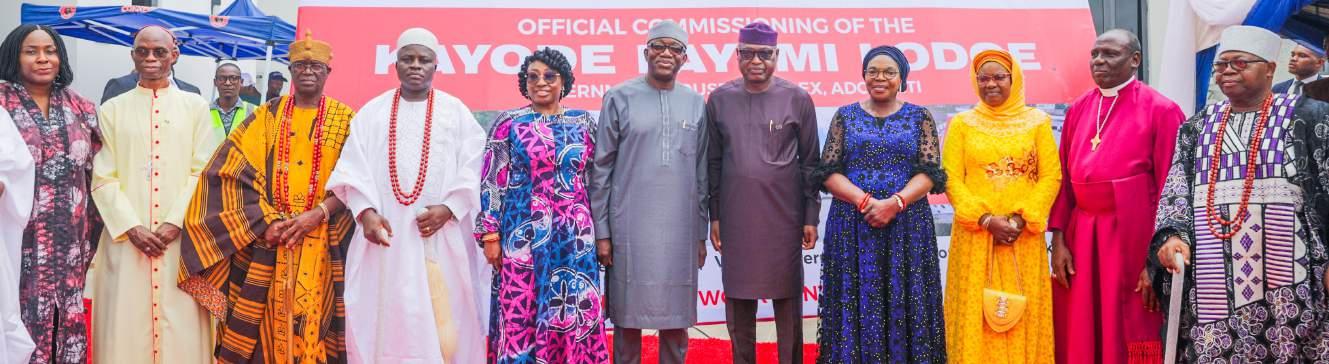
IMMORTALISING KAYODE FAYEMI…
L-R: Ekiti State Head of Service, Dr. Folakemi Olomojobi; Bishop, Ekiti Catholic Diocese, Most Rev’d Felix Ajakaiye; Olupole of Ipole-Iloro, Oba Babatola Oladele; Onisan of Isan-Ekiti, Oba Gabriel Adejuwon; former First Lady, Erelu Bisi Fayemi; Special Guest of Honour/former Governor of Ekiti State, Dr. Kayode Fayemi; Governor Biodun Oyebanji; Deputy Governor, Mrs. Monisade Afuye; Secretary to the State Government, Prof. Habibat Adubiaro; Bishop, Ekiti Anglican Diocese, Rt. Rev Olusola Ajayi; and Chairman, Ekiti State Traditional Rulers Council/ Ogoga of Ikere-Ekiti, Oba Adu Adejimi Alagbado; during the inauguration of The Kayode Fayemi Lodge at Government House Complex, Ado-Ekiti…Friday




Presidency Tackles Onaiyekan on Tinubu Administration’s Desperation Claims over 2027
President bent on winning the 2027
Chuks Okocha in Abuja
The Presidency yesterday tackled the Archbishop Emeritus of the Catholic Diocese of Abuja, Cardinal John Onaiyekan, on his accusation that President Bola Tinubu’s administration was bent on winning the 2027 elections by all means.
Speaking during an interview on ARISE NEWS’ Prime Time program on Friday
Ejiofor Alike, Sunday Ehigiator in Lagos and Chuks Okocha in Abuja
The strained relationship between former President Olusegun Obasanjo and former Vice President Atiku Abubakar has deteriorated further with the former president again stating that picking Atiku as his running mate in the 1999 presidential election was the greatest mistake he made while in office.
Obasanjo’s latest scathing remark about Atiku was not the first time he would make such a comment about his former deputy.
Meanwhile, Atiku, who is the presidential candidate of the
night, Cardinal Onaiyekan had expressed concern over what he described as the federal government’s apparent determination to retain Tinubu in power in the 2027 general election at all costs.
Onaiyekan claimed that Tinubu rejected the Catholic Bishops’ Conference of Nigeria’s assessment of the economy and insecurity when the bishops met the President at the State House,
African Democratic Congress (ADC) in the 2027 general election, yesterday stated that no amount of bitterness would erase either the constitutional stand he took against the infamous third-term agenda or the pivotal role he played in Obasanjo's personal and political journey, insisting that he chose Nigeria and democracy over his former boss.
Obasanjo had in June 2022 told students from select secondary schools who participated in the final of the National Exhibition and Awards organised by Students for the Advancement of Global Entrepreneurship (SAGE) in Abeokuta, Ogun State that
Abuja, on July 28.
But in a swift response, the Special Adviser to President Tinubu on Media and Public Communications, Daniel Bwala, faulted Cardinal Onaiyekan over his comments on the economy and insecurity, stressing that the cleric was speaking for Catholics and not all Christians.
Cardinal John Onaiyekan accused those around President Tinubu of painting a “rosy
picking Atiku as his deputy was one of the many genuine mistakes he made in the course of his public life.
The two statesmen had also recently engaged in a verbal war over an allegation by Obasanjo that Atiku bribed a former Speaker of the House of Representatives, the late Hon. Ghali Umar Na’Abba, with N5 million to get him removed from office as president before the 2003 elections.
The former president made the latest scathing remark on Friday during a fireside chat with veteran entertainer and activist, Charles Oputa, popularly known as Charly Boy, in Lagos.
picture” of the country for him, contrary to the true state of the nation.
The respected cleric warned that unless Nigeria strengthens its electoral process, the outcome of future elections may not truly reflect the will of the people.
Onaiyekan said there were growing fears that the current administration was leveraging incumbency to undermine the credibility of the electoral
The occasion was the unveiling of Charly Boy’s foundation and his memoir, ‘999: A Memoir in Tribute to Late Justice Chukwudifu Oputa.’
A video of the event was posted on iWitnessLive TV’s YouTube channel.
Obasanjo, who was responding to a question on the biggest mistake he made as president, said no active leader could claim to have served without making mistakes, and described his choice of vice president as one he would not repeat.
“What I have found in my own life is that what could have been all my life… mistakes that could have been fatal, God had
process.
According to him, although President Tinubu had repeatedly maintained that the Independent National Electoral Commission (INEC) was neutral, many Nigerians still had concerns about the commission's neutrality and whether the electoral body could conduct elections that were completely free and fair.
“We’re worried about the
taken care of them for me,” Obasanjo said.
When Charly Boy asked the former president to name one mistake, Obasanjo replied, “Mistake when I was in government. The man I picked as my running mate, my number two — if I had known him as I came to know him later, I would not have picked him.”
When Charly Boy sought clarification on whether he was referring to Atiku, Obasanjo replied, “My vice president. I don’t know what name you want to give him, but my vice president, I mean that.”
fact that President Tinubu’s administration is bent on winning the 2027 elections by all means,” the cleric said. He added that the government has enormous powers at its disposal. He warned that those powers could be used in ways that might prevent the votes of ordinary Nigerians from counting, even if the election itself appears free and fair.
He insisted that, in retrospect, he would not have chosen Atiku as his deputy.
“Of course, what I know about him later — well, thank God — because God did not allow his actions and reactions to overwhelm me, or to divert my own focus from Nigeria, or to harm Nigeria even,” he said.
“And there’s no bitterness, because he did things he believed he should do, and God did the things God had to do, which enabled me to achieve what I was able to achieve.”
Obasanjo also reflected on the Nigerian Civil War, rejecting suggestions that it amounted to genocide and insisting that the military campaign was aimed at
Continued on page 9
INEC RELEASES TINUBU, ATIKU, OBI, 16 OTHER PRESIDENTIAL CANDIDATES’ NAMES, PARTICULARS
presidential candidates were also displayed in line with the revised timetable and schedule of activities for the 2027 general election.
While Vice President Kashim Shettima is Tinubu’s running mate, the former Minister of Transportation, Mr. Rotimi Amaechi, and the former governor of Kano State, Senator Rabiu Kwankwaso, are Atiku and Obi’s running mates, respectively.
The display, contained in Form EC9, is a statutory requirement under Section 29(3) of the Electoral Act, 2026, which mandates INEC to publish candidates’ particulars within 21 days of receipt.
Others are Adenuga Sunday (Boot Party), Memeh Samuel (DLA), Nwanyanwu Daniel Danerechukwu (ZLP), Okereke Sunday Chibuzor (LP), and Okereke Iken Esther (NRM), Abbas-Bin Aliyu (ADP), Dikwa Suleiman Mohammed (NNPP), Adebayo Adewole Ebenezer (SDP), Seyi Makinde (APM), and Yusuf Kabiru (APP).
However, the name of former President Goodluck Jonathan, nominated by the Tanimu Turaki faction of the PDP, was completely missing from the list of candidates published by the commission. Also missing from the list is the name of Gbenga Olawepo
The list of presidential candidates published by the commission includes Tinubu (APC), Atiku (ADC), Obi (NDC), Senator Sandy Onor (PDP), Omoyele Sowore (AAC), Donald Duke (PRP), Okwori Ada Elizabeth Frederick (NDP), Chukwu Anita Zugwai (YPP), and Rufai Adekunle Omoaje (AA).
N6.13 trillion (33 per cent) was deducted for savings, interventions, refunds, transfers, and collection costs.
The report showed that Lagos State remained the largest recipient of Gross FAAC allocations in the first half of 2026, receiving N477.05 billion, while Nasarawa State received the least at N72.78 billion.
According to the report, statutory revenue remained the dominant source of FAAC receipts, contributing N13.95 trillion - equivalent to 75 per cent of the total gross revenue. In comparison, Value Added
Tax (VAT) accounted for N4.77 trillion (25 per cent).
The N12.59 trillion total distributable revenue and augmentation for the first half of 2026 was shared across the three tiers of government.
Available figures showed that year-on-year distributable revenue rose by 24.4 per cent from N10.12 trillion in H1 2025 to N12.59 trillion in H1 2026.
Over the same period, FAAC deductions declined by 16 per cent, falling from N7.30 trillion in the first half of 2025 to N6.13 trillion in the corresponding period of 2026.
Hashim, who claimed to be the candidate of the Accord party.
The party had announced that it has no presidential candidate because none of its members met the nomination deadline.
The list also includes the vice-presidential candidates, including Shettima for APC, Amaechi (ADC), Kwankwaso (NDC), Shehu Hussaini (AA), Egbeola Olawale Mertins (YPP), Ike Chinazam (ADP), Mustapha Usman Turaki (Boot Party), Balogun Alex (DLA), Chikwuemeka Uchenna Anthony (NDP), Magashi Haruna Garba (AAC), Umaru Babangida (PDP), and Konto Hajja Bintu (LP).
Others are Hassan Khalid (ZLP), Samuel Magdalene Gali (NRM), Abubakar Isah (NNPP), Buba Musa (PRP), Bugaje Usman Mohammed
However, of the N12.59 trillion distributable revenue in the first half of 2026, the federal government received N4.57 trillion, the 36 states shared N4.47 trillion, while the 774 local government councils received N3.13 trillion.
A total of N864.89 billion or 13 per cent derivation allocation went to oil-producing states. Also, the distribution of Gross FAAC revenue shifted in favour of the federal government in the first half of 2026. Unlike the corresponding period of 2025, when the 36 states collectively received a slightly
(SDP), Ibrahim Adamu Bala (APM), and Ofordile Peace Egobia (APP).
The details of the candidates, including their academic records and the schools they attended, with dates, as submitted to INEC, were released ahead of the official August 19, 2026, commencement of political campaigns for the presidential election.
The copies of Tinubu’s Form EC9, which also contain academic records of candidates, showed Tinubu has a Bachelor of Science degree in Business Administration from Chicago State University, United States, in 1979.
As expected, there was no information regarding the Primary and Secondary schools he attended.
Also, as part of the
larger share of distributable FAAC allocations than the federal government, the federal government regained the top spot in H1 2026.
In H1 2025, the states received a combined N3.43 trillion, marginally exceeding the federal government's N3.39 trillion.
But a further breakdown of the N6.13 trillion deducted for savings, interventions, refunds, transfers, and the cost of collection showed that Savings and Interventions accounted for the largest share, at N2.30 trillion and N2.14 trillion,
information he made available to INEC, he served in the National Youth Service Corps (NYSC) between December 1982 and November 1983.
The president’s personal information section listed his date of birth as March 29, 1952, and his age as 74.
Also, the particulars of Shettima showed that he attended Lamisula I Primary School between 1972 and 1978.
He obtained his West African Examinations Council result at Government Secondary School, Potiskum, in June 1983.
Shettima graduated from the University of Maiduguri, where he bagged a SecondClass Upper Division degree in Agriculture in August 1989.
He obtained a Master of Science in Agricultural Economics from the University of Ibadan.
respectively.
These two accounted for the bulk of deductions made during the half-year period; refunds totaled N714.51 billion, while the Cost of Collection stood at N665.48 billion.
Transfers, at N311.84 billion, were the smallest deduction in the review period.
It also emerged from the report that between the first half of 2021 and the first half of 2026, gross FAAC revenue increased significantly by 323 per cent from N4.43 trillion to N18.72 trillion.
The N18.72 trillion generated
Similarly, Atiku obtained an FSLC in 1954 and a WASC certificate in 1961, and earned his Master's in International Relations from Anglia Ruskin University in 2020.
Obi attended St. Augustine’s Primary School in Anambra in 1973 before proceeding to Christ the King's College, where he obtained his WASC in 1978. He was awarded a Bachelor of Arts in Philosophy by the University of Nigeria, Nsukka, in 1984.
Former Cross River State governor Duke said he graduated from Ahmadu Bello University with a bachelor’s degree in law. At the same time, civil rights activist Omoyele Sowore submitted that he has a master’s degree in public administration from The Trustees of Columbia University in New York.
in just the first six months of 2026 exceeded the entire gross FAAC revenue recorded in 2021, 2022, and 2023 in nominal terms.
Also significant is that the N18.72 trillion generated between January and June 2026 accounted for 52 per cent of the N35.81 trillion in gross FAAC revenue recorded for the whole of 2025.
"If this trend of revenue performance continues in the second half of the year, the gross FAAC revenue for 2026 may exceed that of 2025," Agora Policy observed.
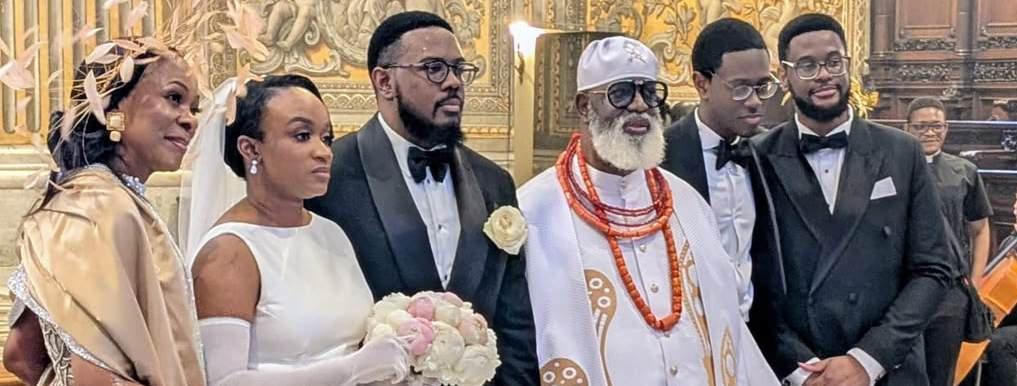
CONGRATULATIONS TO NEWEST COUPLE…
Amupitan: 14 Political Parties will Participate in August 15 Osun Gubernatorial Election
Raises concerns over reports of threats, violence
The Chairman of the Independent Electoral Commission (INEC), Prof. Joash Amupitan, yesterday said 14 political parties would compete in the August 15 governorship election in Osun State.
He has also raised concerns over several reports of violence and threats, saying that insecurity is a direct assault on the sanctity of the ballot.
Speaking at an interactive session with media executives on the election at the INEC office in Osogbo, Amupitan said 32,000 members of the
National Youth Service Corps (NYSC) would be recruited via the sanitised INECPRES portal.
This is as the state chapter of the Accord Party has urged the commission to urgently review the configuration of the BVAS machines and correct anomalies noticed at yesterday’s mock
voting exercise.
Amupitan pointed out that the total number of registered voters stood at 2,339,233, in 3,763 polling units across 320 wards and 30 local government areas (LGAs).
Earlier yesterday, the INEC Chairman led a high-level delegation, including national
commissioners, the Resident Electoral Commissioner (REC), and directors, technical teams, and other senior officials, on an extensive field-level inspection of the ongoing Mock Accreditation Exercise across selected polling units in the state's three senatorial districts.
Voter Accreditation System (BVAS) demonstrated optimal field resilience."
He said on average, it took between 30 seconds and two minutes to successfully verify a voter using either their fingerprints or facial recognition.
Other African Countries
US to Impose $20,000 Visa Bond on Nigeria,
Embassy cautions Nigerians against using AI-edited passport photos
Ejiofor Alike
The United States has finalised a plan that will compel Nigerians and other African business and tourist visa applicants to deposit up to $20,000 to guarantee they will depart America at the expiration of their stay, citing rising visa overstays and poor information-sharing by several countries on the continent.
The rule, which takes effect on Monday, August 3, 2026,
establishes a permanent Visa Bond Program following the pilot phase that began in August 2025.
This is even as the US Mission in Nigeria has cautioned Nigerians against using AI-edited passport photos for visa applications, saying it will not accept photos that are edited or filtered.
Meanwhile, the Department of State said the new rule on a $20,000 bond, published yesterday, was aimed at
tackling the hundreds of thousands of non-immigrant visitors who remain in the US beyond their authorized period.
According to the department, the policy targets applicants from countries “with high overstay rates, deficient information sharing, insufficient identity verification and criminal records, and that need improvement in the area of screening and vetting and the security of travel and civil documents.”
It linked the policy to Executive Order 14159, “Protecting the American People Against Invasion,” which directs the Treasury, State and Homeland Security departments to strengthen bond administration under US immigration law.
During the pilot phase, 50 countries were added, and all qualified B-1/B-2 applicants were required to deposit up to $15,000, as deemed necessary by the consular officers.
South-west ADC Leaders Demand Removal of Aregbesola as Interim National Secretary
Some leaders of the African Democratic Congress (ADC) in the South-west have asked the party’s national leadership to immediately remove Rauf Aregbesola as Interim National Secretary, accusing him of brazen constitutional violations that are threatening the party ahead of 2027.
The leaders, in a petition dated July 28, 2026, signed by party officials in the
states across the zone and addressed to the National Chairman, Senator David Mark, said they resolved during an emergency meeting in Ibadan, Oyo State capital that Aregbesola’s conduct had plunged the ADC into avoidable crises.
The letter, signed by Ogun State ADC Secretary, Olusoji Adebiyi; Osun State Acting Chairman, Abideen Okanlawon; Osun State
Youth Leader, Adesola Akitunde; Oyo State factional ADC Chairman, Yinka Olona; Oyo State ADC member, Adebimpe Adelowo; Ekiti State ADC Chairman, Ilesanmi Olaiya, among others, was copied to the National Working Committee (NWC), National Executive Committee (NEC), the party’s 2027 presidential candidate, the vice-presidential candidate,
and the National Legal Adviser.
The chairmen alleged that Aregbesola created a parallel structure across South-west states under the name “Omoluabi Progressive” and began parading officers of the splinter group as legitimate ADC executives from the ward to the state level, asserting that this directly contravenes the ADC constitution.
Selected polling units were visited to ascertain the functionality of the Bimodal Voter Accreditation System (BVAS).
According to Amupitan, "the mock accreditation exercise is the quality assurance protocol. It is designed to stress-test our technological infrastructure under real-world field conditions before the actual election. We monitored two key metrics. The speed of accreditation: The Bimodal
"The dual-authentication nature of the BVAS has significantly minimised the instances of non-verification, which was one of our primary goals."
The chairman emphasized that, to ensure any sudden field failure is instantly neutralized, the commission has provisioned an upgraded pool of backup BVAS devices assigned to dedicated technical support engineers in every Registration Area (Ward).
Military Foils Abduction Plot in Borno, Rescues 31 as ISWAP Commander’s Wife, Son Surrender to Troops
Linus Aleke in Abuja
Troops of Operation Hadin Kai (OPHK) have foiled an attempted mass abduction by Boko Haram/ISWAP terrorists and rescued 31 civilians during a swift military operation along the Buratai–Kamuya Road in Biu Local Government Area (LGA) of Borno State.
Acting Media Information Officer of OPHK, Capt. Mohammed Goni disclosed this in a statement yesterday, saying the operation underscored the military’s growing reliance on real-time intelligence and rapid-response capabilities to counter insurgent attacks.
Goni said troops of the 135 Special Forces Battalion at Dutsen Kura detected the terrorists at about 3:45 p. m.
Acting on the intelligence, the battalion immediately deployed a Quick Response Force, which pursued the terrorists towards the Mangari-Dora general area.
“The troops made contact with the insurgents and engaged them with effective fire, compelling the terrorists to abandon the abducted civilians and the four civilian vehicles before fleeing into the surrounding bush in disarray.
All 31 abducted civilians were rescued unharmed, while the four civilian vehicles were recovered intact,” Goni said.
He added that troops subsequently secured the area and carried out follow- up exploitation operations to prevent the insurgents from regrouping, with no further contact recorded.
Yinka Kolawole in Osogbo
L-R: Mother of the Groom, Lady Oghogho Osula; Couple, Ngozi and Ephraim Osula; Father of the groom and Chief Executive Officer, Julian Luxury, Prince Julian Osula; Groom’s brothers, Elliot Osula; and Edmund Osula, at the wedding of the couple at the Chapel of the Choir Saint Peter’s Basilica, Vatican City Rome…recently
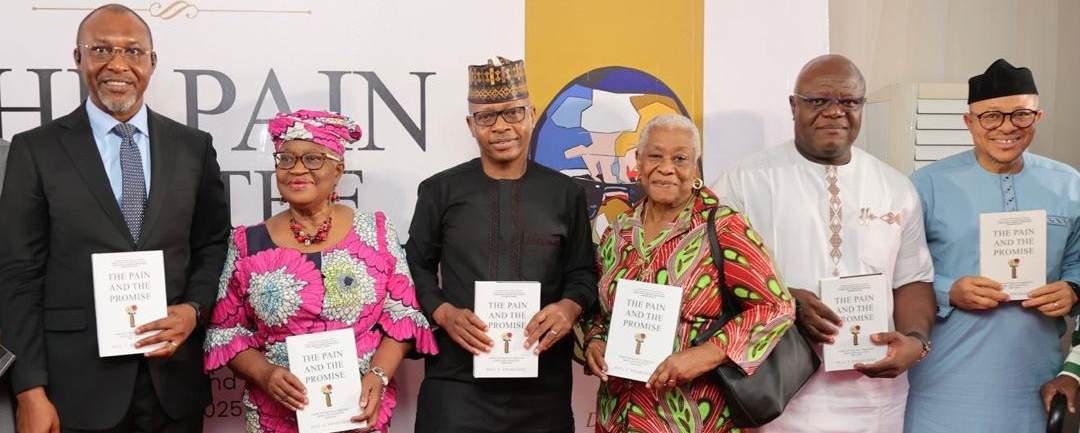
EXPANDING THE FRONTIER OF KNOWLEDGE…
L-R: Chairman of the occasion and former Minister of Aviation, Mr. Osita Chidoka; Special guest of honour and Director General, World Trade Organisation, Dr. Ngozi Okonjo-Iweala; Author of the book and member, THISDAY Editorial Board, Mr. Paul C. Nwabuikwu; retired federal Permanent Secretary, Dr Timiebi Koripamo-Agarry; Book Reviewer and Vice Chancellor, Baze University, Abuja, Prof. Abiodun Adeniyi; and the Author’s brother, Mr. Chris Nwabuikwu, at the launch of The Pain And The Promise, in Abuja…recently
Wike: Fubara's Biggest Mistake Was Attempting to Build His Own Political Structure Too Early
Ibunge in Port
The Minister of the Federal Capital Territory (FCT), Nyesom Wike, has said the biggest mistakes made by his successor, Governor Siminalayi Fubara of Rivers State, were trying to do things alone and
attempting to build his own political structure too early after assuming office.
Wike said it was shocking that Fubara began building his political structure barely 100 days into office.
He said the development clearly showed that the governor undermined those
who supported him and the political structure that brought him to power.
Wike stated this during a special media chat held in Port Harcourt, the Rivers State capital, yesterday.
The FCT minister said that while leaving office as governor, he had laid a solid
foundation which he wanted Fubara to build on so that the state could gradually catch up with Lagos State in terms of infrastructure, but little did he know that the latter had his own plans.
Wike said he initiated the multi-billion-naira Port Harcourt Ring Road
project linking several local government areas, which had already commenced before he handed over to the incumbent governor, describing it as a legacy project he conceived.
He said he built 12 flyovers, all of which were commissioned while he was still governor of the oil-rich state, adding that they improved the infrastructure and aesthetics of Port Harcourt, the state capital, and its environs.
you have to be careful. Some want you to succeed and make a name for yourself. The opportunity you have been given is not available to everyone. Some are unhappy and don't want you there, so please be very careful.
The Ministry of Foreign Affairs has said that their host countries have accepted 65 of the 69 Nigerian ambassadors appointed by President Bola Tinubu.
In a statement issued yesterday, the ministry’s spokesperson, Kimiebi Ebienfa, said the 65 accepted ambassadors represented a 97 per cent acceptance rate.
Ebienfa attributed the two outstanding appointments
to Grace Bent, ambassadordesignate nominee for Togo, declining the offer, and to Mohammed Mahmud Lele, ambassador-designate for Algeria, who died in April.
Lele died on April 19 in Ankara, Turkey, after a protracted illness.
Ebienfa said the replacement process was ongoing.
The spokesperson did not disclose the other two countries where the
appointments remain pending.
Ebienfa said “assurances have been received from the two friendly countries that their consent would be given in due course,” adding that the diplomatic process is progressing “smoothly and successfully”.
“The Ministry of Foreign Affairs wishes to assure Nigerians and the international stakeholders that it is actively engaging the relevant
authorities in the two countries and is confident that the outstanding Agreements will be conveyed in due course,” the statement reads.
The spokesperson added that the majority of ambassadors have since arrived in their host countries and presented their letters of credence, commencing their representational duties as Nigeria’s principal envoys.
Oriire Abduction: Judicial Commission Invites Memoranda from Public
The Judicial Commission of Enquiry established by the Oyo State Government to investigate and determine the circumstances surrounding the abduction of schoolchildren and teachers in the Esinele and Yawota communities of Oriire Local Government Area (LGA) of the state has called on members of the public with relevant information to submit written memoranda to the commission.
This announcement was contained in a public notice signed by the commission’s Secretary, Mrs. Olamide Sandra Tella.
According to the notice, memoranda should include any relevant information, facts, evidence, or materials relating to the abduction, covering, where applicable: “The circumstances leading to and surrounding the incident; the circumstances of the abduction and subsequent developments; information on the security
situation before, during, and after the incident; any acts, omissions, or circumstances that may have contributed to the occurrence; the response of relevant authorities, institutions, communities, or individuals to the incident; and Recommendations considered appropriate for preventing a recurrence of similar incidents.”
The notice further stated that persons submitting memoranda should provide their full names, contact details, and
any supporting documents or materials, where applicable.
“All memoranda should be addressed to: The Secretary, Judicial Commission of Enquiry into the Abduction of Students and Teachers in Esinele and Yawota Communities, Oriire Local Government Area, Oyo State.”
According to the commission, submissions may be made physically at the commission’s Secretariat, while all memoranda must be submitted on or before August 14, 2026.
While noting that politicians must be meticulous in their dealings, Wike said Fubara's mistake had further widened the development gap he sought to bridge between Lagos and Rivers states.
Wike stated, "In politics,
"Remember, before I handed over to Governor Fubara, we did a church service, and I did say that you have been elected. In a few days, you will be sworn in. Now what do you want to achieve? See where I have stopped. My thinking is that we do need to compete with Lagos. We have laid the foundation; he (Fubara) should be able to continue from there; we will give you all the necessary support."
Uzodimma, Barau Convene Strategic Meeting of APC Council Ahead of August 15 Osun Governorship Poll
Sunday Aborisade in Abuja
The National Campaign Council set up by the All Progressives Congress (APC) for the forthcoming Osun State governorship election has summoned an emergency meeting as the ruling party intensifies preparations ahead of the August 15 poll.
The meeting, scheduled for Monday, August 3, 2026, is expected to bring together all members of the campaign council for what party leaders described as a crucial strategy session to strengthen the APC's final push before the election.
According to a statement issued yesterday by the Campaign Council, the meeting will be held at the Kano State Governor's Lodge, 30 Jose Marti
Street, Asokoro, Abuja, by 3:00 p.m.
The National Campaign Council is chaired by the Governor of Imo State and Chairman of the APC Governors' Forum, Senator Hope Uzodimma. At the same time, the Deputy President of the Senate, Senator Jibrin Barau, serves as the secretary.
The invitation directed all members of the council to attend the meeting, signaling the importance the party attaches to the final phase of its campaign in Osun State.
Part of the notice read: "All Members of the National Campaign Council of the All Progressives Congress (APC) for the Osun State Governorship Election are invited to the meeting of the council."
Blessing
Harcourt
Kemi Olaitan in Ibadan
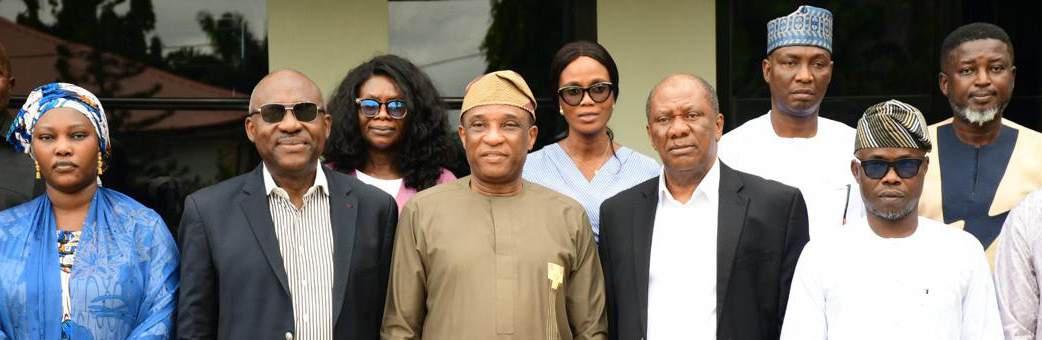
ELECTRICITY CONSUMERS’ PROTECTION ON THEIR MINDS…
L-R: Executive Commissioner, Corporate Services, Federal Competition and Consumer Protection Commission, Hajia Ummasalma Ishiaku Rabiu; Executive Commissioner (Operations), FCCPC, Mr. Louis Odion; Head, Mergers and Acquisition, FCCPC Mrs. Eme Ojugo; CEO/Executive Vice Chairman, FCCPC, Mr. Tunji Bello; Representative of Department of Consumer Affairs, Lagos State Electricity Regulatory Commission, Mrs. Titilayo Amodu; CEO, Imo State Electricity Regulatory Commission, Mr. Bede Opara; General Manager, Kogi Electricity Regulatory Commission, Mr. Suleiman Isah; CEO, Kogi Electricity Regulatory Commission, Mr. Ibrahim Sunday; and Head, Consumer Affairs, Lagos State Electricity Regulatory Commission, Mr. Harrison Osagiede, during a stakeholders’ engagement hosted by FCCPC for Nigerian Electricity Regulatory Commission and State Electricity Regulatory commissions in Abuja …weekend.
At Jang’s 80th Birthday, Shettima Tasks Nigerians to Eschew Ethnic Profiling, Religious Hatred, Retaliatory Violence
Vice President Kashim Shettima yesterday charged Nigerians to reject ethnic profiling, religious hatred, misinformation and retaliatory violence in order to build a secure, inclusive and prosperous federation.
Shettima also canvassed a renewed national covenant on peace, insisting that peace is a shared responsibility between government, community leaders
and the citizens.
Shettima made the call in Jos, the Plateau State capital, during the 80th birthday anniversary and public presentation of the autobiography of former Plateau State Governor, Senator Jonah David Jang.
According to him: “A people at peace is the highest achievement of any government, because peace is the soil in which every other blessing grows."
The Vice President, who
conveyed the goodwill and prayers of President Bola Tinubu to the celebrant, reaffirmed the administration’s commitment to a Nigeria where security would support economic opportunity and every citizen would feel at home in every part of the country. Shettima stressed that sustainable development cannot take root in an atmosphere of fear, insecurity and distrust, noting that the economic fortunes of communities and states in Nigeria
are closely connected.
He said: “No community flourishes in isolation. Prosperity cannot survive where fear reigns. A farmer in Riyom depends upon peace beyond his village. A trader in Jos depends upon roads that run through the towns of other men. The confidence of one state is the security of another."
Describing Plateau State as “Nigeria in miniature,” the Vice President said the state’s diversity, aspirations, difficulties
US Condemns Killing of 30 People in Kaduna, Moore Urges End to Middle Belt Violence
The United States has condemned the early morning attack of July 27 on a village in Kaduna State that reportedly left at least 30 people dead, including children, as a US lawmaker urged President Bola Tinubu to do more to end violence in Nigeria’s Middle Belt.
In a statement on X, the US Bureau of African Affairs said Washington “condemns the early morning July 27 attack on a village in Nigeria’s Kaduna State that reportedly killed at least 30 people, including children.”
“We express our deepest condolences to the loved ones of the deceased. We will continue to urge the Government of Nigeria to address rampant violence against Christians in the Middle Belt,” the bureau stated.
Reacting to the incident, US Representative Riley Moore described the news from the Middle Belt as “terrible.”
He commended progress made under the joint US-Nigeria security agreement in the North but said more must be done in the Middle Belt.
“President Tinubu must do more to address the violence in the Middle Belt, including securing the safe return of this seminarian,” Moore posted on X, referring to Seminarian Kelvin Ochai, kidnapped in Benue State.
The lawmaker did not provide further details on the circumstances of the seminarian’s abduction.
The July 27 attack is the latest in a series of violent incidents that have plagued communities in Kaduna and other Middle Belt states in recent years. The region, which sits between Nigeria’s predominantly Muslim
North and Christian South, has witnessed recurring clashes often linked to banditry, kidnapping, and communal conflict.
Last year, the US and Nigeria activated a security cooperation framework aimed at intelligence sharing, training, and counterterrorism support. US officials have repeatedly cited that agreement when noting gains against insurgency in the North-east.
However, rights groups and US officials have continued to raise concerns about attacks on farming communities and places of worship in the Middle Belt.
After 10-day Operation, Army Rescues Kidnapped Lieutenant Colonel, Civilian in Enugu
Arinze Gideon in Enugu
Troops of the Nigerian Army have rescued a kidnapped senior military officer, Lt. Col. Ofor Amobi, and a civilian, Mr Ikechukwu Onwuanra, after a 10-day joint search-and-rescue operation in Enugu State.
This is contained in a military operational report made available to the News Agency of Nigeria (NAN) yesterday in Abuja.
The military said the victims
were rescued in the early hours of Friday, following sustained pressure on their abductors.
The military said troops from Sector 1 of Operation UDO KA, comprising personnel from the 82 Division Garrison, 103 Battalion (Reinforced), the Nigerian Navy Special Boat Service, and the 197 Special Forces Battalion, carried out the operation.
It said the troops, led by the Commander, 82 Division Garrison, conducted intensive
searches across the Inyi, Awlaw, and Akpugo-Eze forests and communities in the Oji River Local Government Area (LGA) of Enugu State.
According to the report, troops received intelligence from the Divisional Police Officer (DPO) of Inyi Division at about 2:00 a.m. on Friday on the whereabouts of the victims.
It said the troops immediately launched a fighting patrol to the location where the victims
were found abandoned at the edge of a forest in Inyi.
The military said both victims had sustained gunshot wounds and were rescued before being evacuated to the 82 Division Medical Hospital for treatment and medical evaluation.
It added that preliminary interrogation revealed the victims had been blindfolded, transported to an unknown location and later abandoned within a forest along the EnuguAnambra border.
and recovery reflect the wider national experience.
According to him, whatever strengthens peace and development in the Plateau contributes to the stability of the entire federation, while any setback in the state points to the unfinished work of national reconciliation.
“Plateau State is Nigeria in miniature. Its dreams are the dreams of Nigeria. Its struggles are the struggles of Nigeria. Its complexity is the complexity of Nigeria. Its fears are the fears of Nigeria. Its grief is the grief of Nigeria. Its recovery is the recovery of Nigeria,” he stated.
Shettima condemned attempts to associate individual criminal conduct with entire ethnic, religious or regional communities, warning that collective blame enables criminals to deepen divisions beyond the immediate harm caused by their actions.
According to him: “No criminal represents his origin, his ethnic group, his religion, his language, his ancestry, his village or the innocent people who bear his surname. Crime has no tribe. Violence has no religion. Murder carries no mandate from any community."
He averred that when innocent people are condemned for crimes committed by others, the perpetrator succeeds twice by taking a life and destroying the trust among those left behind.
“He destroys a life, and then he poisons the fellowship of those left behind. This is the lesson the rest of Nigeria must learn."
The Vice President acknowledged that Plateau had endured years of violence perpetrated by criminals who invested in chaos, disrupted farming, weakened commercial activities and attempted to replace neighbourliness with suspicion.
NCPC Lifts Ban on Christian Pilgrimage to Israel
The Executive Secretary of the Nigerian Christian Pilgrim Commission, Bishop Prof. Stephen Adegbite, has announced the lifting of the ban on Christian pilgrimage to Israel.
The ban was suspended by the commission in February this year following the commencement of the US-Israel-Iran conflict.
Bishop Adegbite made the declaration at the Wailing Wall in Jerusalem yesterday, according to a statement by the commission’s Director, Media and Public Relations, Celestine Toruka.
“I promised everyone that I will be here to see what is happening in the Holy Land. I have been here in the last three days. The Holy Land is peaceful. Jerusalem is at peace and will continue to be at peace.
“The ban on Christian
Pilgrimage from Nigeria to Israel is hereby lifted from today”, the Executive Secretary said. He explained that the lifting of the ban will only permit pilgrims from Nigeria to travel through the Ben Gurion International Airport in Tel Aviv, Israel.
He noted that Jordan was not safe at the moment and the Commission could not take such a risk.
Bishop Adegbite stressed that Jerusalem is a chosen nation and that everyone who sets foot in the Promised Land of Jerusalem shall be blessed, and every prayer offered in Jerusalem shall be answered.
The NCPC helmsman further reiterated that all pilgrims who have travelled have returned safely, and the 2026 pilgrimage exercise will not be an exception, as “the Lord has always been our shield and buckler.”
Deji Elumoye in Abuja
Chuks Okocha in Abuja
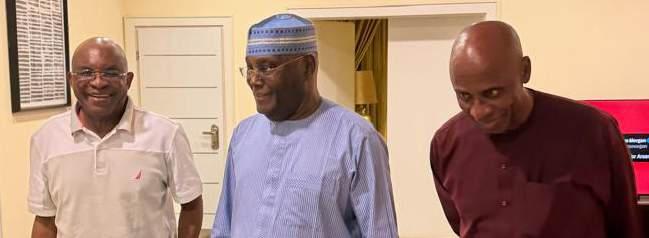
STRATEGIC MEETING…
2027: Atiku, Kashim Imam Inaugurate State Campaign Coordinators, Target 20m Votes
I'm not contesting for office privileges says Ex-VP Rallies young Nigerians against vote-buying, others
Chuks Okocha in Abuja
Former Vice President, Atiku Abubakar, in company of his prominent political ally, Kashim Imam and founding National Chairman of the African Democratic Congress (ADC), Chief Ralph Nwosu, have inaugurated state coordinators for the RiseUpNaija Movement (RUN), asking the group to work towards mobilizing up to 20 millions votes for the presidential candidate of the ADC.
This is coming as the former VP declared that he is not seeking office for its privileges but to see a country "capable of becoming - a nation where leadership is accountable, institutions are strong, opportunities are abundant and every citizen, regardless of background, has a fair chance to succeed."
Speaking yesterday in Abuja at the RiseUpNaija Movement (RUN) leadership retreat, Atiku urged the youths to participate
actively, refuse to sell their votes and defend the process, adding that "If millions of young Nigerians participate peacefully, vote responsibly and defend the integrity of the process, no amount of money can overcome the collective will of the people."
The RISE UP NAIJA Movement comprises of young men and women from the ruling All Progressives Congress (APC), Peoples Democratic Party (PDP), Labour Party (LP), New Nigeria Peoples Party (NNPP), among
others.
The former vice president told the youthful large gathering that he has spent the better part of his life fighting for democracy, justice and the progress of Nigeria, adding that time has given him experience, but it has not diminished his conviction.
"The fire that inspired me as a young student activist still burns today because every day I see millions of young Nigerians denied opportunities that should have been theirs.
"I stand before you today not merely as a former Vice President or an elder statesman, but as a lifelong democrat who has never stopped believing that Nigeria can become the great nation its people deserve."
Speaking on the role of young Nigerians in building a new democratic country, Atiku said: "The current political establishment often looks at young Nigerians and sees a restless population to be managed, manipulated or
AGAIN, OBASANJO HITS ATIKU, SAYS HE REGRETS CHOOSING HIM AS VICE PRESIDENT
preserving the country’s unity.
“The civil war was traumatic to all Nigerians. It hurt some maybe a little bit harder than others, depending on where, but the civil war was bad for all Nigerians,” he said.
According to him, he took deliberate steps during the war to minimise civilian casualties, citing the recapture of Owerri as an example.
“I did not drop a single bomb inside Owerri, because it would be destructive — it would have killed innocent civilians. I dropped my bombs short of Owerri and beyond Owerri, to warn people that we are coming home,” he said.
I Chose Nigeria, Democracy over Obasanjo, Says Former VP
Responding to Obasanjo's latest attack on him, Atiku described the former president’s public outburst against him as yet another failed attempt to rewrite history, stressing that no amount of bitterness will erase either the constitutional stand he took against the third-term agenda or the pivotal role he played in Obasanjo's personal and political journey.
In a statement issued by
his Senior Special Assistant on Public Communication, Phrank Shaibu, Atiku said he watched the former president's interview with profound sadness, not anger, because it reflected the disposition of a man who allowed personal resentment to cloud historical truth.
Atiku said the genesis of Obasanjo's hostility towards him was well known to Nigerians.
"I am proud that I stood against the third-term agenda. I am proud that I stood by the Constitution of the Federal Republic of Nigeria. I have no apology whatsoever for frustrating every attempt to subvert our democracy for personal ambition," Atiku said.
"If Chief Obasanjo's bitterness stems from my refusal to support an unconstitutional third term, then I wear that resentment as a badge of honour. No individual, regardless of his status or accomplishments, is bigger than the Federal Republic of Nigeria. The Constitution is supreme, and I chose Nigeria over personal loyalty," he added.
The former vice president noted that the struggle against the third-term agenda was never about two individuals but about preserving Nigeria's constitutional democracy for future generations.
"The Nigerian people won that battle. Democracy won that battle.
History has already delivered its verdict."
He said it was therefore unfortunate that the same man whose unconstitutional ambition was resisted sought to sit in judgment over those who defended the Constitution.
Atiku said it was particularly instructive that barely 24 hours before Obasanjo's latest outburst, the Director-General of the World Trade Organisation (WTO), Dr. Ngozi Okonjo-Iweala, publicly paid glowing tribute to the economic management team he led, describing it as "the best Nigeria has ever had."
"Whether or not the timing is merely coincidental is for Nigerians to judge. What is beyond dispute, however, is that while distinguished Nigerians who served at the highest levels continue to acknowledge my contributions to one of Nigeria's most successful periods of economic management, Chief Obasanjo appears determined to diminish them."
"Chief Obasanjo may choose not to appreciate my role in building one of Nigeria's most prosperous economic eras, but history has been far kinder. The record speaks for itself, and so do the testimonies of those who worked closely with that administration."
Atiku further stated that
Nigerians also deserve to remember the other side of history which Chief Obasanjo conveniently omits.
"History records that while Chief Obasanjo was in prison, I stood firmly by him. I supported his family, worked tirelessly with other patriots for his release and never wavered in my belief that he deserved his freedom."
"When he eventually regained his freedom, he had little to his name. I received him, clothed him, ensured he was properly cared for and extended every support necessary to help him regain his footing. Beyond that, I mobilised political structures, built alliances and made enormous personal and political sacrifices that culminated in his emergence as President of the Federal Republic of Nigeria."
Stop the
Bitterness,
It’s Costing You, Amerijoye Tells Obasanjo
In a related development, the Director-General of The Narrative Force, Aare Amerijoye DOT.B, has urged Obasanjo to put aside what he described as lingering bitterness towards Atiku, warning that such resentment could ultimately damage the former leader’s legacy more than it could affect his former deputy.
Amerijoye made the appeal in an open letter titled, ‘Baba, This Bitterness is Costing You More Than It Is Costing Atiku’, which was a response to Obasanjo’s July 23, 2026 letter to former Ogun State governor, Olusegun Osoba, where the former president reportedly revisited allegations against Atiku.
Questioning the timing of the letter, Amerijoye argued that it was no coincidence that the allegations resurfaced as the country prepares for another presidential election.
“You chose the eve of a presidential election year. You chose the season when Atiku Abubakar is the candidate of the African Democratic Congress. A letter to Osoba does not need Atiku. That Atiku is in it at all tells us who the letter was really written for,” he stated.
He maintained that historical records showed Atiku played a decisive role in Obasanjo’s emergence as president in 1999, insisting that the former vice president voluntarily stepped aside to support Obasanjo’s candidacy and later declined to challenge him for the presidency in 2003.
“Before he ever became your deputy, Atiku Abubakar chose not to pursue a presidential ambition he could legitimately have pursued. Instead, he
mobilised only during elections.
“I see something entirely different; I see the greatest national asset Nigeria has ever produced; I see innovators building world-class businesses from laptops and mobile phones; I see young farmers feeding communities despite enormous odds; I see creators, engineers, doctors, teachers, entrepreneurs, artisans and professionals proving every day that the Nigerian spirit cannot be defeated.
threw his weight behind your candidacy and helped rally support for you.”
The Narrative Force chief further argued that Atiku financed the Peoples Democratic Party (PDP) in its formative years, mobilised political support across the country, assembled key members of Obasanjo’s campaign organisation and persuaded influential stakeholders to back his presidential bid.
“He was an organiser, financier, strategist, negotiator and coalition builder whose contributions were instrumental to your emergence as President in 1999. History cannot be rewritten.”
Amerijoye also rejected allegations that Atiku plotted against Obasanjo while serving as vice president, noting that despite investigations conducted during the Obasanjo administration, no court convicted the former vice president of any wrongdoing.
“You probed him. You set your agencies on him. You built a case to keep him off the ballot in 2007, and the Supreme Court restored his name. After all of it, there was no conviction.”
He further criticised the former president for relying on claims allegedly made by deceased individuals without making documentary evidence public.
L-R: National Chairman of the African Democratic Congress, Senator David Mark; ADC presidential candidate, Atiku Abubakar; and his running mate, Hon. Rotimi Amaechi, after a closed door meeting in Abuja…yesterday
SEEKING STRATEGIC COLLABORATION…
CBN Mops Up N7.18tn in July as Liquidity
Tightening Persists Despite Fewer OMO Auctions
Festus Akanbi
The Central Bank of Nigeria (CBN) mopped up N7.18 trillion from the financial system through Open Market Operations (OMO) auctions in July, maintaining its tight monetary stance despite a sharp reduction in the number of auctions held that month.
The July liquidity withdrawal represented a 48.6 per cent decline from the N13.96 trillion sterilised in June, largely reflecting the CBN’s decision to hold only three OMO auctions, compared with seven in the preceding month.
However, the lower monthly total masked a shift in strategy, as the apex bank relied on fewer but significantly larger auctions to absorb excess liquidity.
An analysis of OMO auction results reported by Nairametrics yesterday showed that the CBN conducted auctions on July 13, July 14 and July 28, raising a cumulative N7.18 trillion.
By contrast, seven auctions held on June 2, 8, 11, 22, 23, 29 and 30 accounted for the record N13.96 trillion sterilised during that month.
The report showed that June witnessed an aggressive and
sustained liquidity management campaign, with the CBN offering N600 billion at each of the seven auctions, for a total of N4.2 trillion. Investor demand remained exceptionally strong, with the subscriptions reaching approximately N15.27 trillion, while the apex bank allotted N13.96 trillion, representing about 91.4 per cent of total bids received.
The June 2 auction attracted the highest demand of the month, recording subscriptions of N2.15 trillion, out of which N2.01 trillion was allotted.
The June 8 sale posted the weakest demand, although subscriptions still stood at N1.73 trillion, with N1.51 trillion allotted.
The month ended with backto-back auctions on June 29 and June 30. The June 29 exercise generated one of the strongest investor responses, while the June 30 auction was oversubscribed by more than three times the amount offered, resulting in an allotment of N1.52 trillion.
Overall, June recorded an average oversubscription ratio of 3.16 times the amount offered.
Although July featured fewer auctions, each exercise attracted substantially larger investor par-
UNIBEN Holds First Annual Federalism Lecture
The first annual federalism lecture, organised by the recently established Centre for Federalism and Democratic Studies, University of Benin, is to hold on Wednesday, August 5, 2026.
The lecture, according to the Deputy Registrar and PRO of the university, Dr. Benedicta Ehanire, would be delivered by a seasoned academic, administrator and Director General, Nigerian Institute of International Affairs (NIIA)
and former Vice Chancellor, Igbinedion University, Okada, Professor Eghosa Osaghae. The lecture, titled: “Federalism: the Paradigm of a Turning Centre”, is expected to draw personalities from the academia, government and other spheres.
Ehanire said the Vice Chancellor of the university, Professor Edoba B. Omoregie, SAN, who instituted the lecture, would preside at the event.
ticipation.
The CBN maintained its N600 billion offer size at each auction, bringing the total amount offered to N1.8 trillion, but average subscriptions rose to roughly four times the amount on offer.
The July 28 auction emerged as the most significant exercise during the review period, with
the CBN allotting N3.5 trillion, making it the largest single OMO sale recorded so far this year. Demand continued to be driven largely by the 127-day tenor, which dominated subscriptions throughout June and remained the preferred instrument in July. At the July 13 auction alone, the tenor attracted bids worth N1.854 trillion.
Stop rates during the period remained elevated, ranging from 20.39 per cent to 22.65 per cent. As in previous auctions, shorter-dated instruments cleared at higher rates than longer-tenor bills, reflecting sustained investor appetite for shortterm yields amid the prevailing high-interest-rate environment.
The auction pattern indicates two distinct liquidity management approaches by the apex bank. While June relied on frequent market interventions spread throughout the month to withdraw liquidity, July achieved the same objective through fewer but much larger operations, signaling a more concentrated approach to liquidity sterilisation.
Tinubu: I Will Continue to Guarantee Freedom of Religion
Peter Uzoho
President Bola Tinubu has reaffirmed his administration’s continued commitment to guaranteeing freedom of religion as entrenched in the 1999 Constitution of the Federal Republic of Nigeria, as amended.
President Tínubu stated this at the commissioning of the Ansar-Ud-Deen Society of Nigeria (ADSN) National Headquarters (Hassanat Abebi Okunnu House), in Surulere, Lagos.
The president, who was represented by the Attorney General of the Federation and the Minister of Justice, Lateef Fagbemi (SAN), said: “The gov-
ernment under my watch will continue to guarantee freedom of religion, while encouraging religious organisations to promote tolerance, peaceful coexistence, and national unity.”
“Government alone cannot build the nation of our dreams. It requires strong partnerships with faith-based organisations that share the vision of building an enlightened, disciplined, and compassionate society. The Ansar-Ud-Deen Society has consistently demonstrated that religious organisations remain indispensable partners in national development,” he stated.
President Tínubu lauded the donor of the Secretariat, Alhaji Femi Okunnu, for immortalising his
late mother through the construction of the facility, describing the project as a lasting act of faith and generosity that will continue to serve humanity for generations.
Describing the late Alhaja Okunnu, President Tínubu said: “Looking at the accomplishments and impeccable reputation of her children, we need no further evidence that she was a woman of faith, noble character, discipline, and uncommon wisdom.”
Deputy Governor of Lagos State, Dr Kadiri Hamzat, urged ADSN to preserve the organisation’s founding ideals by promoting education, moral values and righteous living, describing knowledge as the greatest asset for national development.
who lauded the pioneer of ADSN said they helped change the narrative at a time when many Muslim children were discouraged from pursuing Western education by establishing schools and encouraging learning, adding that present generations continue to benefit from those efforts.
He said: Sadly, one of the greatest challenges confronting our society today is the erosion of our values. We hear young people saying, “Education is a scam.” Others glorify ignorance and reject the pursuit of knowledge. Our Islamic educational institutions must confront this dangerous trend because no nation can develop if its citizens are not properly educated.”
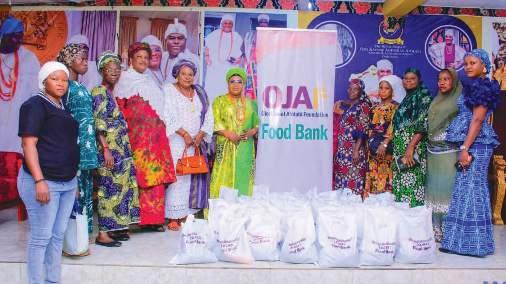
Olori Janet Afolabi Brings Hope to Families Through Food Bank Outreach
Olori Janet Afolabi, Queen of Apomu Kingdom has once again extended a helping hand to the needy in Apomu. Through her Food Bank, Olori Afolabi shared food items to many people in the community especially vulnerable women and children.
Speaking during the event Olori Afolabi said she organised the program to provide essential food items to households facing economic challenges. According to her the outreach was borne out of her commitment to ensure that no child or family in Apomu goes to ned hungry.” No child
should go to bed hungry. No child should remain awake because hunger has made him or her unable to sleep”
Beneficiaries expressed appreciation, describing the gesture as timely.
Christiana Akinlabu, the Otun Iyalode of Apomu, a Senior Palace Chief said the initiative reflects Olori Afolabi’s unwavering passion to serve humanity and her belief that access to food is a basic necessity that should be denied anyone especially children.
The Food Bank Outreach
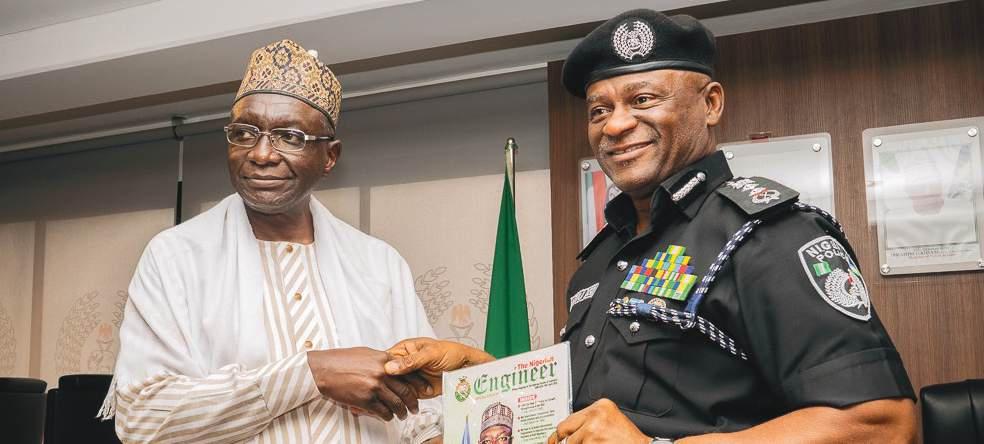
Hamzat
President, Nigerian Society of Engineers, Mr. Ali Alimasuya Rabiu (left), and Inspector General of Police, Mr. Olatunji Rilwan Disu, during Rabiu’s courtesy visit to the IG at Force Headquarters, Abuja…recently
underscores Olori Afolabi’s enduring commitment to humanitarian service and community development.

APC National Campaign Council for the Osun State Governorship Election
Invitation to the meeting of the Members of the Council
All Members of the National Campaign Council of the All Progressives Congress (APC) for the Osun State Governorship Election are invited to the meeting of the council scheduled to hold as follows:
Date: Monday, August 3, 2026
Venue: Kano State Governor’s Lodge, 30 Jose Marti Street, Asokoro, Abuja.
Time: 3:00 p.m Signed:
Chairman of the Council
Senator Hope Uzodinma, CON, Governor of Imo State and Chairman APC Governors’ Forum
Secretary of the Council
Senator Barau I. Jibrin, CFR, PhD, FCNA Deputy President of the Senate





POLITY
Strengthening Electoral Institutions: Pathways to Free, Fair, and Peaceful Elections in 2027
“The ballot is stronger than the bullet.”- Abraham Lincoln, 16th President of the United States, set the tone for the importance of a free, fair and peaceful election. It is a great honour to join this distinguished gathering for the public presentation of SHADOWS: Protest Essays on Africa’s Most Consequential Country (1999-2023). I thank the organisers for the invitation to speak on “Strengthening Electoral Institutions: Pathways to Free, Fair, and Peaceful Elections in 2027.” Few subjects are more relevant to Nigeria’s democratic future, and few occasions provide a better setting for such a conversation than the launch of a book that reflects on nearly a quarter of a century of our democratic experience. I warmly congratulate the author, Mr. Eniola Bello, on producing a work of remarkable breadth and enduring value. Throughout his distinguished career as a journalist and editor, he has consistently used the written word to interrogate public policy, challenge complacency and stimulate informed debate. SHADOWS is a worthy continuation of that tradition. Across more than 900 pages, the two volumes document Nigeria’s political journey from the return to constitutional rule in 1999 to 2023, capturing the events, personalities, institutions and controversies that have shaped the country’s democratic development.
I also commend Cable Books and Cable Media & Publishing Limited for investing in a publication of this scale. At a time when public discourse is often compressed into headlines and social media posts, serious books remain indispensable. They preserve institutional memory, provide historical context and encourage careful reflection. Democracies thrive when citizens understand not only current events but also the processes that produced them. Works such as this help to build that understanding.
The title SHADOWS is particularly apt. Every democracy has moments of achievement and moments of disappointment. Progress is rarely linear, and no democratic system is free from setbacks. Nigeria’s experience reflects this reality. Since the beginning of the Fourth Republic, we have sustained constitutional government, witnessed peaceful transfers of power, strengthened electoral laws and broadened civic participation. At the same time, we have confronted difficult questions about governance, accountability, insecurity, corruption, political financing, electoral malpractice and the internal workings of political parties. These challenges deserve honest examination, for they offer lessons that can strengthen our institutions and improve democratic practice.
The themes explored in these volumes bear directly on today’s discussion. Elections do not take place in isolation. While the Electoral Management Bodies play a pivotal role in ensuring free, fair and peaceful elections, the credibility of the process is also influenced by the quality of political leadership, the conduct of political parties, the independence of the judiciary, the professionalism of the media, the vigilance of civil society and the confidence that citizens place in public institutions. The health of a democracy is, therefore, reflected in the strength of this wider institutional framework. Realising the role of these institutions in the electoral process, the Inter-Parliamentary Council at its 154th session in Paris on 26 March 1994 recognised that:
“... the establishment and strengthening of democratic processes and institutions is the common responsibility of governments, the electorate and organized political forces, that periodic and genuine elections are a necessary and indispensable element of sustained efforts to protect the rights and interests of the governed and that, as a matter of practical experience, the right of everyone to take part in the government of his or her country is a crucial factor in the effective enjoyment by all of human rights and fundamental freedoms”.
As Nigeria prepares for the 2027 general election, we have an opportunity to draw on the lessons of the past while looking ahead with purpose. Democratic progress cannot be taken for granted. It depends on institutions that command public confidence, respect the rule of law and adapt to changing circumstances without compromising their integrity. Strengthening those institutions is one of the surest ways of safeguarding the credibility of our elections and the stability of our constitutional democracy.
It is against that background that I invite us to reflect on the reforms, partnerships and shared responsibilities that will help Nigeria conduct elections that are free, fair, peaceful and widely accepted.
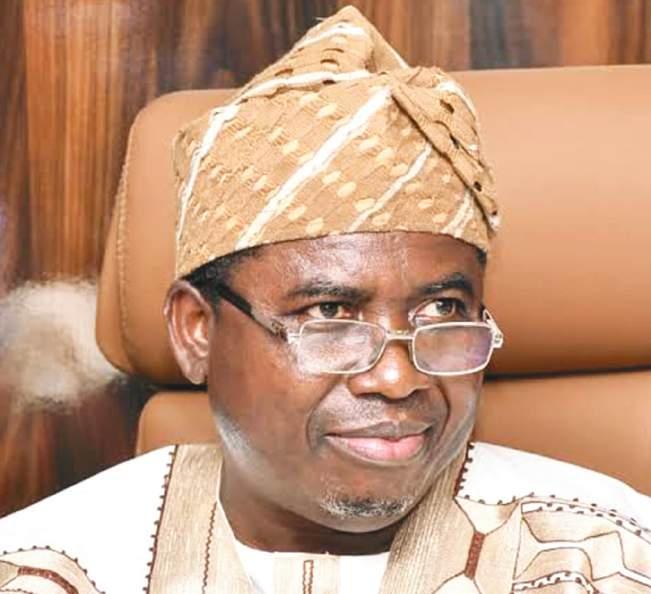
Amupitan
Nigeria’s Democratic Journey (1999-2023)
Nigeria’s return to democratic rule on 29 May 1999 marked a decisive turning point in our constitutional history. It ended a prolonged period of military intervention and restored a system of government founded on popular sovereignty, constitutionalism and the rule of law. More than two decades later, the Fourth Republic remains the longest uninterrupted period of democratic governance since independence. That continuity is a significant national achievement and a testament to the resilience of the Nigerian people and their commitment to constitutional government despite all the challenges associated with it.
The democratic journey since 1999 has been characterised by steady institutional growth, valuable lessons and persistent challenges. Every election has tested the capacity of our institutions and prompted reforms designed to improve the electoral process. Over time, election administration has evolved from a system heavily dependent on manual procedures to one that increasingly relies on technology for voter registration, accreditation and other critical aspects of election management. While technology has not resolved every difficulty, it has enhanced transparency, improved efficiency and strengthened public confidence in many aspects of the electoral process.
Nigeria has also recorded important constitutional milestones. The peaceful transfer of presidential power between political parties in 2015 demonstrated that electoral competition, rather than unconstitutional change of government, had become the accepted route to political leadership. Subsequent transitions at both the national and state levels have reinforced that democratic culture and affirmed the principle that political authority derives from the freely expressed will of the electorate. The legislature has made notable contributions to this progress through successive reforms of the country’s electoral laws. These reforms have refined voter registration procedures, strengthened the regulation of political parties, improved transparency in election administration and clarified mechanisms for resolving electoral disputes. The Electoral Act 2026 represents another stage in that continuing effort to adapt our legal framework to emerging realities and the lessons of previous elections.
The judiciary has likewise played a defining role in Nigeria’s democratic development. Through its interpretation of constitutional and electoral provisions, the courts have shaped the country’s electoral jurisprudence and reinforced legal standards governing elections. Judicial intervention has often protected the integrity of the democratic process. At the same time, the increasing volume of election-related litigation reminds us that the ultimate objective should be an electoral system whose credibility reduces the need for prolonged pre- and post-election disputes.
Civil society organisations, election observers, the media and development partners have also become indispensable participants in Nigeria’s democratic enterprise. Their work in voter education, election observation, policy advocacy and public enlightenment has broadened participation and strengthened accountability. Elections are no longer viewed as the exclusive responsibility of the electoral management body. They are recognised as a national undertaking requiring cooperation among institutions, political actors and citizens. Yet the record is not without its shortcomings. Electoral violence, vote buying, weak internal democracy within political parties, incumbency factor, the growing influence of money in politics and identity-based mobilisation continue to test the strength of our democratic institutions. Public concern about governance, corruption and insecurity has also affected confidence in the political process. These realities underscore an important lesson, which is that regular elections, by themselves, do not guarantee democratic consolidation. Democracy is strengthened when elections are credible, institutions are respected and public office is exercised with accountability.
The history captured in SHADOWS reflects both the progress Nigeria has made and the work that remains unfinished. It reminds us that democracy is sustained through continuous reform rather than periodic celebration. Each electoral cycle should leave our institutions stronger, our laws more responsive and our democratic culture more deeply rooted. As preparations gather momentum for the 2027 General Election, our focus should be on preserving the gains already made while addressing the weaknesses that continue to undermine public confidence. That task begins with a clear appreciation of why strong electoral institutions are indispensable to democratic governance.
Strengthening Electoral Institutions as the Foundation of Democratic Consolidation
One lesson stands out from the experience of democracies across the world. It is the fact enduring democracies are built on enduring institutions. Constitutions may define the rules of governance and elections may determine who holds public office, but institutions give practical effect to those constitutional ideals. They provide continuity across political administrations, uphold the rule of law and ensure that public authority is exercised within established legal boundaries. Where institutions are respected, democracy acquires stability. Where they are weak or compromised, democratic progress becomes uncertain. This is especially true of electoral institutions. They are entrusted with protecting one of the most fundamental rights in a democracy, which is the right of citizens to choose those who govern them. Their authority rests not on political popularity but on public
confidence in their impartiality, professionalism and fidelity to the law. Every stage of the electoral process, from voter registration and candidate nomination to polling, collation and dispute resolution, depends on institutions that inspire trust. Without that trust, even elections that are competently conducted may struggle to command public acceptance.
When we speak of electoral institutions, our attention often turns immediately to the Independent National Electoral Commission. INEC occupies a central place in Nigeria’s democratic architecture, but it is only one part of a much larger system. The credibility of elections depends on the interaction of several institutions, each performing a distinct constitutional role. The National Assembly provides the legal framework within which elections are conducted. Political parties recruit members, formulate policies and present candidates for elective office. The judiciary interprets electoral laws and resolves disputes that arise before and after elections. Security agencies protect voters, election officials and electoral materials. The media informs the public and promotes informed debate, while civil society organisations contribute through voter education, election observation and advocacy for electoral reform. Traditional and religious leaders also have considerable influence in promoting peaceful participation and discouraging violence within their communities.
Powers, Functions and Independence of the Commission INEC occupies a pivotal position in Nigeria’s constitutional democracy. It is the institution entrusted with translating the sovereign will of the people into legitimate political authority through the conduct of free, fair and credible elections. The commission is a constitutional institution established to safeguard the integrity of the electoral process, promote political participation and ensure that democratic governance is founded on the freely expressed will of the electorate. The quality of Nigeria’s democracy is therefore closely linked to the effectiveness, impartiality and independence with which INEC discharges its constitutional mandate.
The Constitution of the Federal Republic of Nigeria 1999 establishes INEC as one of the Federal Executive Bodies under section 153(1)(f), while paragraph 15 to the Third Schedule to the Constitution sets out its principal functions and powers. These include organising, undertaking and supervising elections to the offices of the President and Vice-President, Governors and Deputy Governors, and to the membership of the National Assembly and the Houses of Assembly of the States, including FCT Area Council elections; registering and regulating political parties in accordance with constitutional and statutory provisions; monitoring the organisation and operation of political parties, including their finances; arranging for the annual examination and auditing of the funds and accounts of political parties; conducting voter registration and maintaining the national register of voters; delimiting electoral constituencies and revising them in accordance with constitutional requirements; promoting voter education; carrying out electoral research; and performing such other functions as may be conferred upon it by an Act of the National Assembly.
These constitutional responsibilities are reinforced and elaborated by the Electoral Act 2026, which confers additional powers relating to election planning, deployment of election technology, regulation of electoral processes and the issuance of regulations, guidelines and manuals necessary for the effective conduct of elections.
Recognising that electoral management bodies can only discharge these responsibilities effectively where they are insulated from undue political influence, the Constitution and electoral laws incorporate several safeguards designed to preserve the institutional independence of INEC. The commission is established directly by the Constitution rather than by ordinary legislation, thereby giving it constitutional status/flavour and protecting it from arbitrary abolition or restructuring. The Chairman and National Commissioners are appointed by the President, in consultation with the Council of States, subject to confirmation by the Senate- section 154- while the Resident Electoral Commissioners are similarly appointed through a constitutionally prescribed process. Their tenure and conditions of service are protected by law, and they may only be removed in accordance with the constitutional procedure applicable to holders of public offices established by the Constitution.
In addition, in line with section 160 of the Constitution, the powers to make its own rules or otherwise regulate its own procedure shall not be subject to the approval or control of the President. In the same vein, in exercising its power to make appointments or to exercise disciplinary control over persons, section 158(1) of the Constitution states that the Independent National Electoral Commission shall not be subject to the direction
Professor Joash O. Amupitan, SAN
Strengthening Electoral Institutions: Pathways to Free, Fair, and Peaceful Elections in 2027
or control of any other authority or person.
Institutional independence is further reinforced through financial autonomy. Section 81(3) of the Constitution provides that the expenditure of INEC charged upon the Consolidated Revenue Fund of the Federation shall be paid directly to the Commission, thereby reducing the possibility of financial control being used as an instrument of political influence. Administrative independence is equally reflected in the Commission’s authority to appoint and discipline its own staff, formulate regulations and guidelines for the conduct of elections, and take operational decisions relating to voter registration, election management, results administration and other electoral activities without external direction or interference, subject only to the Constitution and the law.
The Electoral Act 2026 further strengthens the commission’s operational autonomy by recognising its authority to issue regulations, guidelines and manuals for the effective implementation of the Act. These instruments have enabled the commission to introduce significant innovations, including the Bimodal Voter Accreditation System (BVAS), the INEC Result Viewing Portal (IReV), enhanced procedures for voter accreditation, electronic transmission and management of election results, and improved transparency in election administration. These reforms demonstrate that institutional independence is not an abstract constitutional ideal, but a practical necessity for innovation, professionalism and public confidence in the electoral process.
Nevertheless, constitutional guarantees alone cannot secure institutional independence. The effectiveness of an electoral management body ultimately depends on respect for the rule of law, political restraint by all stakeholders, adequate and timely funding, professional competence, security of tenure for electoral officials, judicial fidelity to constitutional principles, and sustained public confidence in the impartiality of the institution. Strengthening INEC therefore requires more than preserving its formal legal independence; it requires cultivating an electoral environment in which the Commission can perform its constitutional responsibilities free from intimidation, partisan pressure or undue interference and proper funding while remaining fully accountable to the Constitution and the Nigerian people.
No single institution can guarantee credible elections in isolation. The strength of the electoral process lies in the effectiveness of the entire governance framework and the willingness of other relevant institutions to perform their respective responsibilities with integrity and mutual respect. Strengthening electoral institutions, therefore, is not a project directed at INEC alone. It calls for sustained investment in institutional capacity, professional competence, ethical leadership and effective coordination across the electoral landscape. It also demands respect for constitutional boundaries and the independence of public institutions. Electoral bodies must be allowed to discharge their responsibilities without improper interference, just as other institutions must faithfully carry out their own constitutional mandates.
Public confidence deserves particular attention. Elections are unlike most governmental activities because their outcomes require acceptance by both those who win and those who lose. Such acceptance depends largely on confidence in the fairness of the process. Trust cannot be secured through legislation alone; it is earned through consistency, transparency and adherence to established procedures. Every decision made by an electoral institution must therefore withstand both legal scrutiny and public examination. Strong electoral institutions also contribute to national development in ways that extend beyond the conduct of elections. Credible elections confer legitimacy on governments, making it easier for them to govern effectively, pursue long-term policies and unite citizens around shared national objectives. By contrast, disputed elections often result in prolonged litigation, political tension and uncertainty that can weaken public institutions and discourage economic activity. Electoral integrity is therefore closely linked to political stability, social cohesion and sustainable development.
As Nigeria prepares for another general election, our attention should extend beyond the fortunes of individual candidates and political parties. Elections come and go, and new political alliances evolve. Institutions, however, endure. They preserve democratic continuity, protect constitutional order and provide the framework within which political competition takes place. The central task before us is to strengthen those institutions so that every Nigerian can approach the 2027 General Election with confidence that the process will be transparent, professionally managed and worthy of public trust. Before considering the reforms required to achieve that objective, we must first examine the principal challenges confronting Nigeria’s electoral system today. Emerging Threats to Electoral Integrity Ahead of the 2027 General Election
As preparations for the 2027 General Election gather
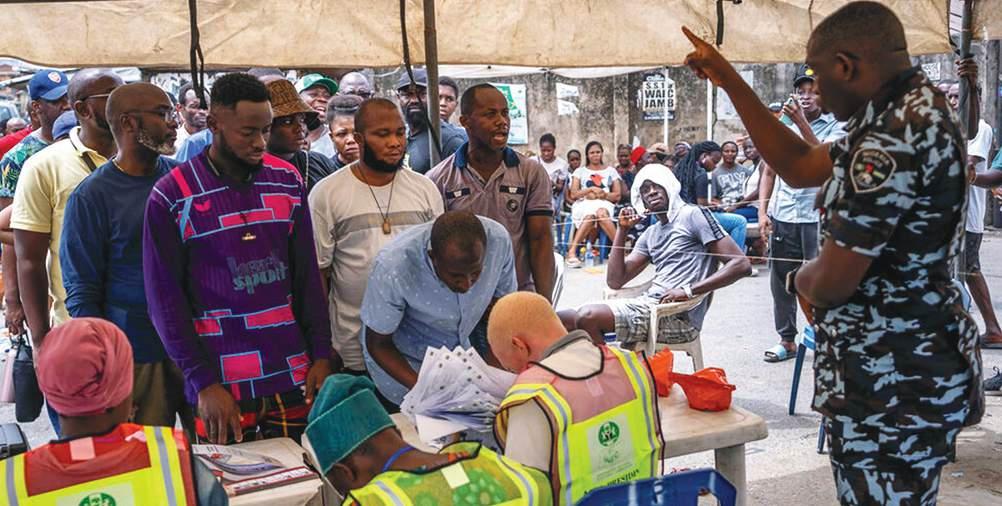
momentum, it is worth recognising that Nigeria’s electoral environment continues to evolve. The reforms introduced over the years have strengthened the legal and institutional framework for elections, yet fresh challenges have emerged alongside longstanding concerns. Some originate within the political process itself; others are products of technological change and the rapidly changing information environment. Addressing them requires vigilance, foresight and a shared commitment to protecting the integrity of our democracy.
•Internal Party Democracy: One of the most persistent concerns is the quality of internal democracy within political parties. Political parties are the gateway to elective office, and the credibility of any election is influenced by the manner in which candidates emerge. Where party primaries are characterised by imposition, opaque procedures or disregard for established rules, disputes are almost inevitable. Many election-related court cases have their roots in disagreements that arise long before the first ballot is cast. Political parties strengthen democracy when they uphold their own constitutions, conduct transparent primaries and give members a genuine voice in selecting candidates.
•Monetisation of Politics: The growing influence of money in politics presents another serious challenge. Vote buying and the abuse of campaign finance distort democratic competition by shifting attention away from ideas and public service. Elections should be decided by the informed choices of citizens, not by the financial strength of candidates or political organisations. Effective regulation of political finance, strict enforcement of existing laws and greater transparency in campaign expenditure remain essential if public confidence is to be preserved.
•Electoral Violence: Although recent elections have shown encouraging improvements in several parts of the country, incidents of intimidation, attacks on election officials, destruction of electoral materials and clashes between political supporters still occur. Such acts discourage participation, undermine confidence and deny citizens the opportunity to exercise their constitutional rights freely. Peaceful elections demand responsible conduct from every stakeholder, political parties, candidates, security agencies, community leaders and citizens alike.
•Misuse of Digital Technology: Social media has expanded opportunities for civic engagement and public debate, but it has also become a vehicle for disinformation, misinformation and deliberate attempts to manipulate public opinion. Artificial intelligence has added a new dimension to this problem through the creation of convincing fabricated images, audio recordings and videos. These “deepfakes” can spread rapidly, damage reputations, inflame political tensions and erode confidence in the electoral process before the truth has an opportunity to prevail. Protecting elections in the digital age therefore requires more than safeguarding polling units and election materials. It also requires protecting the information environment. Electoral institutions, media organisations, technology companies, civil society groups and fact-checking organisations must work together to identify false narratives promptly and provide accurate information to the public. At the same time, citizens need the skills to distinguish verified information from deliberate falsehoods. Digital literacy has become an important component of civic education.
•Increasing Judicialisation of Politics: The courts remain
indispensable guardians of constitutional democracy, and every citizen has the right to seek legal redress where necessary. Yet the health of an electoral system should not be measured by the volume of litigation it generates. Elections should be conducted in a manner that leaves little room for avoidable disputes. Greater compliance with electoral laws, transparent administration and stronger internal democracy within political parties will help reduce unnecessary litigation and reinforce public confidence in electoral outcomes.
•Public Trust Issues: Electoral institutions derive their constitutional authority from the law, but their effectiveness depends on the confidence of the people they serve. Confidence is built over time through consistency, openness and impartiality. It is weakened by uncertainty, poor communication, delayed decisions or perceptions of unequal treatment. Every institution involved in the electoral process must therefore recognise that public trust is one of democracy’s most valuable assets and one that must be carefully protected.
These challenges are substantial, but they are not unique to Nigeria, nor are they beyond our capacity to address. Democracies across the world continue to adapt to changing political and technological realities. Nigeria can do the same. The task before us is to translate experience into reform and ensure that the 2027 General Election reflects the highest standards of electoral administration and democratic practice. That calls for practical measures, sustained cooperation and a clear vision of the future we seek to build.
Pathways to Free, Fair and Peaceful Elections in 2027
The challenges confronting Nigeria’s electoral system should not breed pessimism. They should sharpen our resolve. Every democratic society encounters moments that test the strength of its institutions. What distinguishes successful democracies is their willingness to learn from experience and translate those lessons into meaningful reform. As Nigeria prepares for the 2027 General Election, our objective is to build an electoral process that inspires confidence before, during and after the polls. The following constitute major pathways to electoral success:
•Faithful Implementation of the Legal Framework Governing Elections: This is the starting point. Nigeria has continued to refine its electoral laws to address emerging realities and improve the conduct of elections. The Electoral Act 2026 represents another important milestone in that process. Yet legislation, however well drafted, can achieve little without consistent application. Compliance with the law must be expected of every stakeholder, whether electoral officials, political parties, candidates or security agencies. Electoral offences must attract appropriate sanctions, campaign finance rules must be enforced and political parties must comply with statutory requirements governing their internal administration. Respect for the law remains the strongest safeguard against arbitrariness and impunity.
• Perserving the independence and professional capacity of INEC: The Commission’s constitutional responsibility places it at the centre of Nigeria’s democratic process, and public confidence in elections is closely linked to confidence in the institution that administers them. That confidence is strengthened through careful planning, operational efficiency, continuous staff
development, sound logistics and transparent engagement with stakeholders. An electoral management body must remain responsive to changing circumstances while maintaining the impartiality that defines its constitutional role.
• Entrenchment of Internal Party Democracy: The quality of elections is equally influenced by the conduct of political parties. Democracy cannot flourish where internal party processes are opaque or exclusionary. Candidate selection should be guided by transparent procedures and respect for party rules rather than the influence of money or political patronage. Parties that resolve disputes fairly, encourage participation and promote issue-based politics contribute to a healthier democratic culture. Strengthening political parties is therefore an investment in the credibility of elections themselves.
• Continued Adoption of Technology: Technology will continue to shape the future of election administration. Innovations have improved voter registration, accreditation and other aspects of the electoral process, making elections more efficient and transparent. Even so, technology is only as reliable as the systems that support it. Public confidence requires rigorous testing, effective cybersecurity, contingency planning and clear communication with voters. Every technological innovation should make the electoral process easier to understand and easier to trust.
• Attention of the Digital Information Environment: Elections are increasingly influenced by the speed with which information travels across digital platforms. False narratives, manipulated content and the misuse of artificial intelligence can distort public perception and heighten political tension. Responding to these challenges calls for collaboration among electoral institutions, media organisations, technology companies, academic institutions and civil society. Public communication must be timely, accurate and accessible, while civic education should equip citizens to question doubtful content and rely on verified sources of information.
• Strengthening Security Architecture: Every eligible voter should be able to cast a ballot without intimidation or fear. Election officials must perform their duties in safety, and electoral materials must be protected throughout the process. This calls for well-trained security personnel who understand both their legal responsibilities and the importance of neutrality in electoral operations. Cooperation among the security agencies has improved considerably over the years and should continue to be strengthened in the period leading to the 2027 General Election.
• Promotion of Civic Education: An informed electorate is another pillar of electoral integrity. Civic education should extend beyond explaining voting procedures. It should encourage respect for democratic values, tolerance of differing political opinions and an appreciation of the responsibilities that accompany citizenship. Young people deserve particular attention because they represent a significant proportion of Nigeria’s voting population and will shape the future of our democracy. Equal emphasis should be placed on removing barriers that limit the participation of women and persons with disabilities. A democracy that broadens participation is stronger, more representative and more resilient.
Voters at a polling booth

A REWARD FOR EXCELLENCE
Chinedu Okediashi’s bounteous reward for winning the World Spelling Bee Championship in China sends an unmistakable message, writes EMMANUEL OLUCHI
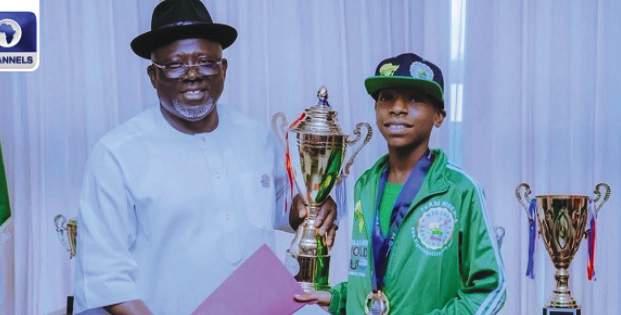
Leadership is often measured by the monuments a government erects, the roads it constructs, or the bridges it commissions. Yet, history repeatedly teaches that the greatest legacy of any administration is not found in concrete and steel but in the quality of human beings it nurtures. Nations that dominate the global economy today did not arrive there merely by investing in infrastructure alone; they invested first in people.
This is the philosophy that is driving Governor Sheriff Oborevwori’s administration in Delta State. His recent decision to reward Master Great Chinedu Okediashi with ₦20 million after the young Delta prodigy emerged winner of the prestigious World Spelling Bee Championship in China is more than a generous financial gesture. It is a powerful statement of priorities. It sends an unmistakable message that excellence will be recognised, diligence rewarded, and education celebrated.
More importantly, it reinforces Governor Oborevwori’s growing reputation as a leader who governs by example, a governor who genuinely cares about the aspirations, welfare and future of his people.
Modern governance demands a careful balance between physical development and human development. Roads facilitate movement. Hospitals preserve lives. Water projects improve sanitation. But education shapes the minds that will sustain all these investments. Governor Oborevwori understands this reality.
Receiving the World Spelling Bee trophy at Government House in Asaba, the governor made one profound observation that captures his philosophy of governance. “We don’t play with education in Delta State because it is the greatest legacy anyone can give to a child. Wealth can disappear, but education remains with you throughout your lifetime.”
Few statements better capture the enduring value of education. Money can be spent. Property can be destroyed. Political offices come and go. But knowledge remains one possession that cannot be confiscated. By rewarding academic excellence so generously, the governor has demonstrated that his administration regards educational achievement as a strategic investment rather than a ceremonial accomplishment.
The ₦20 million reward to Master Okediashi extends far beyond one exceptional student. It speaks to every pupil sitting in classrooms across Delta State. It tells every child that hard work pays. It assures parents that education remains the surest pathway to opportunity. It encourages teachers that their sacrifices are recognised. It reminds schools that excellence attracts recognition.
This reward sends perhaps the strongest signal any government can communicate, that intellectual achievement deserves the same celebration often reserved for sporting success or political accomplishment.
Young people emulate what society celebrates. When governments celebrate scholarship, more children aspire to become
scholars. When excellence receives public recognition, mediocrity gradually loses its attraction. That is precisely the cultural shift Delta State needs.
Governor Oborevwori’s remarks during the presentation ceremony reflected more than excitement over an international victory. They demonstrated a broader vision. He recalled how Delta State had previously produced members of Nigeria’s victorious team at the World Schools Debate Championship in Doha, Qatar.
That achievement was not isolated. Neither is this latest triumph in China. Rather, they represent a consistent pattern. Delta State has increasingly become a factory for academic excellence. Such consistency rarely happens by accident.
It is usually the product of deliberate government policy, sustained investment and institutional support. The governor’s assertion that “our investment in education is working” is therefore supported by growing evidence.
International victories do not emerge overnight. They result from years of preparation, quality teaching, supportive parents, motivated schools and enabling government policies.
Perhaps the most touching aspect of the ceremony was Governor Oborevwori’s recognition of the student’s parents. While many leaders might have focused exclusively on the student, the governor expressed disappointment that the parents were absent.
He acknowledged that they deserved equal recognition for raising a child capable of conquering the global stage. That simple gesture speaks volumes. It reflects empathy. It reflects appreciation for family values.
Great leaders understand that behind every successful child stands a family whose sacrifices often remain unseen. By recognising the parents, Governor Oborevwori demonstrated emotional intelligence that extends beyond politics.
The governor’s generosity did not stop with the student. He equally announced government support for Madonna International School, where the young champion received his education.
That decision is equally significant. Successful education systems depend not only on rewarding individual brilliance but also on strengthening institutions that consistently produce excellence. Schools require encouragement. Teachers require motivation. Educational institutions require partnership.
By extending support to the school, Governor Oborevwori acknowledged that academic excellence is a collective achievement. The institution that nurtured greatness deserves recognition alongside the student who attained it. Such holistic thinking reflects mature governance.
Across the developed world, governments increasingly recognise education as the engine of economic transformation. Singapore built its economy through education. South Korea invested heavily in human capital before becoming a technological giant.
FELIX OLADEJI argues that economic reform needs more than good policy
THE POLITICS OF PUBLIC TRUST
The recent reflections by Ngozi Okonjo-Iweala on how Nigeria secured the landmark Paris Club debt relief offer more than a historical account of one of the country’s most significant economic achievements. Speaking at the public presentation of The Pain and the Promise, she argued that the success of the reforms that culminated in Nigeria’s debt relief depended not only on sound economic policy but also on deliberate public communication that helped citizens understand the difficult choices government was making. Her remarks reopen an important debate about the relationship between economic reform, political legitimacy, and democratic governance.
Public discussion of economic reform often concentrates on policy design. Governments debate fiscal rules, debt restructuring, exchange rate adjustments, subsidy reforms, taxation, and public expenditure. Far less attention is devoted to the political conditions that determine whether technically sound reforms survive long enough to produce meaningful results. Yet economic policy does not operate in an institutional vacuum. In democratic societies, reforms require citizens to accept short-term costs in anticipation of longer-term benefits. That process depends as much on trust, transparency, and communication as it does on technical competence.
Nigeria’s Paris Club debt relief illustrates this relationship. Before the agreement reached in 2005, Nigeria carried an external debt burden accumulated over decades, much of it inherited from successive military administrations. The eventual settlement eliminated approximately $30 billion in Paris Club obligations through a combination of debt cancellation and negotiated repayment, significantly improving Nigeria’s fiscal position.Achieving that outcome, however, required more than successful international negotiations. It demanded domestic reforms that imposed difficult adjustments on government institutions and required public understanding of why those sacrifices were necessary.
Okonjo-Iweala’s observation therefore deserves closer attention because it challenges a common assumption within public administration. Reform is often presented as a technical exercise carried out by economists, financial experts, and policymakers. Communication is treated as an afterthought, something reserved for public relations once decisions have already been made. Her account suggests a different understanding. Communication was not merely explaining reform after implementation; it was itself part of the reform architecture.
This distinction has wider implications for governance across Africa. Many governments continue to confront difficult structural reforms involving debt sustainability, energy transitions, tax reforms, inflation management, and fiscal consolidation. International financial institutions frequently emphasise macroeconomic adjustment while domestic political debates focus on the immediate social costs borne by citizens. The resulting gap between policy objectives and public perception often undermines reform before its long-term effects become visible.
Political scientists have long argued that the effectiveness of public policy depends not only on state capacity but also on political legitimacy. Governments possessing the legal authority to implement reform may nevertheless struggle where citizens perceive policies as opaque, inconsistent, or unfair. In such circumstances, resistance emerges not necessarily because reforms are economically unsound but because governments fail to build sufficient public confidence in the rationale behind them.
Nigeria’s recent reform experience illustrates this tension. Policies affecting fuel subsidies, exchange rates, taxation, and public expenditure have generated intense public debate, often reflecting deeper concerns about trust in public institutions rather than disagreement over economic theory alone. Citizens frequently ask whether sacrifices are being distributed fairly, whether institutions remain accountable, and whether promised long-term gains will genuinely materialise. These questions cannot
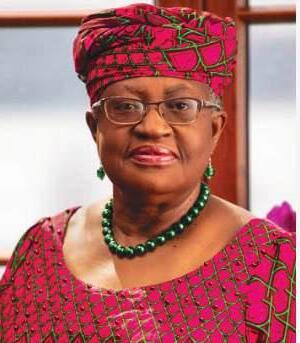
be answered solely through economic models; they require political credibility. Communication therefore performs several governance functions simultaneously. It reduces information asymmetry between governments and citizens. It explains tradeoffs inherent in complex policy decisions. It strengthens institutional transparency by allowing citizens to understand how reforms fit within broader national development strategies. Most importantly, it creates opportunities for democratic consent rather than administrative imposition. Yet communication should not be mistaken for political messaging or propaganda. Public trust cannot be manufactured through media campaigns alone. Effective communication depends upon consistency between official narratives and observable government behaviour. Citizens evaluate not simply what governments say but whether policy implementation reflects the principles being communicated. Transparency without accountability quickly loses credibility. The broader lesson extends beyond debt relief. Contemporary governance increasingly requires governments to manage complex policy transitions involving climate adaptation, digital regulation, healthcare reform, energy security, and fiscal sustainability. Each of these policy domains involves technical complexity that may not be immediately accessible to the general public. The challenge for democratic governance therefore lies not merely in producing effective policy but in developing institutions capable of communicating policy honestly, consistently, and transparently. International experience reinforces this conclusion. Countries that have successfully implemented difficult economic reforms often combine technical competence with sustained public engagement. Governments invest not only in designing reform packages but also in explaining objectives, acknowledging costs, responding to criticism, and maintaining dialogue with citizens throughout implementation. Economic success depends as much on institutional trust as on financial calculations. Okonjo-Iweala’s reflections ultimately invite a broader reconsideration of how reform itself is understood. The enduring legacy of the Paris Club negotiations may not lie only in the debt relief secured but also in the recognition that democratic reform requires persuasion alongside policy. Technical expertise remains indispensable, but expertise alone rarely generates public legitimacy.
As governments across Africa confront increasingly difficult economic choices amid rising debt, fiscal pressures, and global uncertainty, the lesson remains timely. Successful reform is not simply about designing better economic policies. It is about building sufficient public trust to sustain those policies through inevitable periods of
is an incoming Ph.D. researcher in African literature, ecocriticism,
Oladeji
Steeling Nigeria's Future or Repeating Old Mistakes?
Efforts to revive Ajaokuta Steel have begun. However, the question is: will this revival deliver industrial growth, or repeat an expensive history? Festus Akanbi writes
The federal government's renewed determination to revive the Ajaokuta Steel Company has once again reignited one of Nigeria's longest-running industrial debates. For over four decades, Ajaokuta has embodied both the country's industrial ambitions and the frustrations of failed policy execution. Today, buoyed by a proposed $2 billion Chinese-backed investment, renewed investor interest and the implementation of the National Industrial Policy (NIP), the Tinubu administration believes the steel complex could finally become the backbone of Nigeria's industrial transformation.
Yet, amid the optimism, economists and industry analysts are urging caution, warning that unless the revival is anchored on private capital, sound governance and commercial discipline, Ajaokuta could become another expensive fiscal burden, much like Nigeria's state-owned refineries before private investment reshaped the downstream petroleum sector.
The economic case for reviving Ajaokuta is compelling. Steel is the foundation of industrialisation, supplying critical inputs for construction, transport, power, automobile manufacturing, defence and engineering.
Nigeria currently requires about 10 million metric tonnes of steel annually but produces only about 1.2 million metric tonnes, most of it from recycled scrap rather than primary steel production. The huge supply gap leaves manufacturers heavily dependent on imports, exposing them to exchange-rate volatility and worsening the country's trade deficit.
Government officials believe a functional Ajaokuta would reverse that trend. The Minister of State for Industry, Senator John Enoh, recently stressed that "there is no meaningful industrialisation without steel," noting that the administration was engaging with international investors as part of a broader industrial strategy aimed at raising industry's contribution to Gross Domestic Product (GDP) to 25 per cent by 2030.
The National Industrial Policy is expected to deepen manufacturing, promote value addition, create jobs, and support President Bola Tinubu's ambition to build a $1 trillion economy.
Nigeria's abundant mineral resources further strengthen the investment proposition. The National Steel Raw Materials Exploration Agency (NSRMEA) estimates that the country possesses about three billion tonnes of iron ore reserves capable of supplying Ajaokuta

when it is fully operational. Itakpe iron ore remains the flagship deposit, while limestone and coal deposits across several states provide the raw materials needed for an integrated steel industry.
The potential economic benefits extend beyond steel production. A revived Ajaokuta could stimulate mining, rail transportation, fabrication, engineering services and manufacturing while creating thousands of direct and indirect jobs. It would also conserve foreign exchange currently spent on imported steel and encourage technology transfer through the proposed training of Nigerian engineers in China.
Under the financing model being negotiated, Chinese investors would provide approximately $2 billion to rehabilitate and expand the complex under a production-sharing arrangement, allowing Nigeria to retain ownership while limiting direct fiscal exposure.
Yet the enthusiasm is tempered by painful historical experience. Since construction began in 1979 and commissioning followed in 1984, successive administrations have spent billions of dollars on Ajaokuta without producing
commercial steel. Policy reversals, concession disputes, legal battles, inadequate maintenance and political interference combined to leave one of Africa's largest industrial projects largely dormant for more than 40 years.
That history explains why many economists fear another cycle of wasted public resources. Their concerns have been reinforced by Nigeria's experience with its state-owned refineries. Despite repeated rehabilitation programs costing billions of dollars across several administrations, the Port Harcourt, Warri and Kaduna refineries struggled to achieve sustainable commercial operations, highlighting the limitations of government ownership and management of capital-intensive enterprises.
The Centre for the Promotion of Private Enterprise (CPPE) argues that Ajaokuta must not follow the same path. The organisation warns against committing scarce public funds to the rehabilitation or operation of commercial enterprises at a time when debt service consumes a substantial portion of government revenue and infrastructure deficits remain enormous.
Instead, it advocates a public-private equity partnership in which the government contributes existing assets, while private investors provide capital, technology, operational expertise, and
corporate governance.
According to CPPE Chief Executive Officer, Dr. Muda Yusuf, the government should focus on providing reliable infrastructure, macroeconomic stability, and effective regulation, while private investors manage productive assets.
The organisation also insists that Ajaokuta requires a comprehensive technical, financial and commercial audit before any investment proceeds, arguing that governance failures, obsolete technology, weak commercial orientation and political interference must first be addressed.
Industry experts have identified additional challenges. Although Nigeria is widely believed to possess vast iron ore deposits, investors require verified geological data rather than estimated reserves. The distinction between probable and proven reserves is critical because long-term investment decisions depend on commercially bankable geological information.
Reliable exploration, laboratory testing and resource verification therefore remain essential to attracting credible investors.
Infrastructure poses another hurdle. Steel production requires stable electricity, efficient rail transport, functional ports and integrated logistics. Government officials acknowledge that reviving Ajaokuta will require upgrading the Itakpe-Ajaokuta-Warri rail corridor, improving road connectivity, and modernizing Warri Port to support the efficient movement of raw materials and finished products.
Ultimately, few disagree that Nigeria needs a functional steel industry to support industrialisation, employment and economic diversification. The real question is whether the country has learnt from decades of costly policy failures. If the proposed productionsharing arrangement attracts credible investors, strengthens corporate governance, integrates the steel value chain and insulates the project from political interference, Ajaokuta could finally deliver the industrial revolution envisioned over four decades ago.
But if past governance failures persist, the ambitious revival could become yet another costly experiment, reinforcing the lessons from Nigeria's long and expensive attempts to revive its state-owned refineries rather than transforming the country's industrial landscape.
Ajaokuta Steel
Iron steel

Editor, Editorial Page PETER ISHAKA
Email peter.ishaka@thisdaylive.com
ISSUES IN NEW ARMY FORMATIONS
The recent announcement of the creation of four new divisions for the Nigerian Army reflects an attempt to enhance the capacity of the military in its fight to combat insecurity across the country. The decision followed an earlier presidential approval for the Army to recruit 28,000 new soldiers. But while these measures have been applauded by some people, others have expressed reservations about the ability of government to muster and provide funds required to implement the directive. The concerns stem from the fact that existing army divisions are poorly equipped and operate below minimum acceptable capacity. While enlistment in the military is a national sacrifice, it is not a suicide mission. Their personnel must be given the tools to fight. The argument therefore is that the resources to be expended on the newly established divisions could have been directed at raising the combat efficiency of the existing divisions in terms of manpower, weapons, arms and ammunition as well as fighting vehicles.
The armed forces and the police must be provided with tools to secure the nation The welfare of the military deserves attention. Wellmotivated soldiers are focused even under pressure
However, we do not query the motive behind the creation of new formations. It arises from the need to have the military spread across the country to ease and quicken response to attacks and dominate many of the ungoverned spaces that provide haven for bandits, insurgents and other criminal groups. But if this objective is to be achieved, the government would need to invest massively in equipping both the new and old establishments. The recruitment of new soldiers comes with other serious demands. They must be fully kitted and equipped in addition to provision of decent accommodation and other logistics requirements for their training and future deployment. Likewise, the welfare of the military deserves attention. Well- motivated soldiers are focused even under pressure. There is no point increasing the size of the military only to have a bunch of poorly paid soldiers who could end up as a nuisance to the society.
It is important that the government also extends the new focus to the other services as well as the police. As of today, the two major rivers that flow into the country through Kebbi and Taraba States are left unpatrolled. On the western corridor,
SUNDAY NEWSPAPER
editor DAviDSoN iriekpeN
deputy editors FeSTUS AkANBi eJioFor ALike
Managing director eNioLA BeLLo
deputy Managing director iSrAeL iweGBU
chairMan editorial Board oLUSeGUN ADeNiYi
editor nation s capital iYoBoSA UwUGiAreN the oMBudsMan kAYoDe koMoLAFe
THISDAY NEWSPAPERS LIMITED
editor-in-chief/chairMan NDUkA oBAiGBeNA
group executive directors eNioLA BeLLo, kAYoDe koMoLAFe, iSrAeL iweGBU divisional directors SHAkA MoMoDU, peTer iweGBU ANTHoNY oGeDeNGBe deputy divisional director oJoGUN viCTor DANBoYi snr. associate director eriC oJeH associate director pATriCk eiMiUHi controllers ABiMBoLA TAiwo UCHeNNA DiBiAGwU, NDUkA MoSeri director, printing production CHUkS oNwUDiNJo to send eMail: first name.surname@thisdaylive.com
this is constantly exploited by bandits to cross southwards and infiltrate Kwara, Kogi, Oyo and other neighbouring states. We therefore call on President Bola Tinubu to, as a matter of urgency, give marching orders to the Nigerian Navy to establish outposts with constant patrolling of the Rivers Niger and Benue from their entry points into Nigeria down to the confluence point in Lokoja.
In his inauguration speech on 29th May 2023, the president had promised to make security a top priority and to “effectively tackle this menace, we shall reform both our security doctrine and its architecture.” In his ‘Democracy Day’ announcement on June 12, the president also announced that the Nigeria Police Force (NPF) will recruit additional 50,000 personnel to strengthen its manpower. But translating these declarations into practical measures will require more commitment and hard work. We subscribe to strengthening the police to be effective and efficient – both in terms of its professionalism and structure, so that it sustains the capacity to carry out its constitutional responsibility of maintaining law and order.
Notwithstanding the potential pitfalls that have been highlighted by various stakeholders, we believe that the merits of having state police far outweigh its demerits, and the constitution should be amended to reflect that reality. While hoping that the National Assembly, working with the Conference of Speakers of the 36 Houses of Assembly that has already endorsed the idea would put in the necessary safeguards, we align ourselves with the strong view that the country is overdue for the establishment of state police.
Overall, while we endorse the idea of new army formations and recruiting more soldiers, we need to change our concept of national security to a more dynamic one. Our strategies must keep abreast of the sophistication in the methods of the agents of insecurity. Violent persons and groups by whatever nomenclature cannot be allowed to continue challenging state authority with such frequency. The entire doctrinal pillars of our national security are overdue for a drastic revision.
Letters in response to specific publications in THiSDAY should be brief(150-200 words) and straight to the point. interested readers may send such letters along with their contact details to opinion@thisdaylive.com. we also welcome comments and opinions on topical local, national and international issues provided they are well-written and should also not be longer than (950- 1000 words). They should be sent to opinion@thisdaylive. com along with the email address and phone numbers of the writer Letters to the Editor
LETTERS
The NaTioNal MiNiMuM Wage aNd The illusioN of higher Wages
When the Minister of Finance and Coordinating Minister of the Economy explained that savings from the removal of fuel and foreign exchange subsidies had been used to fund debt servicing, the new national minimum wage, student loans and other government obligations, he addressed an important public concern. However, while the explanation accounts for where much of the fiscal savings went, it does not fully answer another question Nigerians continue to ask: Is the Nigerian worker actually better off?
The national minimum wage rose from 30,000 to 70,000, increasing the government’s wage bill by about 133 per cent. From a fiscal standpoint, that represents a significant commitment. Yet, what matters to workers is not the amount printed on a payslip but what that income can buy.
During roughly the same period, the official exchange rate moved from about 460 to approximately 1,400 per US dollar— an increase of about 204 per cent. In an import-dependent economy like Nigeria, this depreciation significantly increased the cost of fuel, food, medicines, machinery and other essential goods, reducing the purchasing power of households. Ironically, the same exchange-rate movement strengthened government finances. Since Nigeria earns a substantial portion of its oil revenue in US dollars, every dollar now converts into far more naira. At 460/$, US$1 billion yielded about 460 billion. At 1,400/$, the same revenue generates roughly 1.4 trillion—an increase of about 204 per cent in naira revenue. This suggests that while subsidy removal undoubtedly created fiscal space, exchangerate liberalisation also substantially expanded the government’s spending
capacity. Consequently, attributing the implementation of the new minimum wage mainly to subsidy savings does not fully capture the broader fiscal picture.
The experience for households has been very different. Before the reforms, petrol sold for about 198 per litre. Before recent global oil market pressures, pump prices had broadly stabilised around 800 per litre; an increase of approximately 304 per cent. The higher cost of fuel pushed up transportation expenses, which filtered through to food, housing, healthcare and other essential goods. As a result, much of the nominal increase in wages has been eroded by inflation and the rising cost of living.
This is not an argument against economic reforms or higher wages. Rather, it underscores the need to judge reforms by improvements in real
incomes and purchasing power, not merely by higher nominal salaries or larger government expenditure. Economic reforms achieve their true purpose only when they improve the lives of ordinary citizens. Strengthening workers’ welfare through lower inflation, better public transportation, affordable housing and higher productivity is not just social policy—it is sound economic policy. Workers with stronger purchasing power are more productive, businesses benefit from stronger consumer demand, and the nation enjoys greater economic growth, social stability and security. Ultimately, the real measure of reform is not how much government spends, but how much better Nigerians live.
Susan Fajana-Thomas: Growing Up in Nigeria Shaped My Political Journey in the UK
Celebrating 16 years in public office in the United Kingdom, Susan Fajana-Thomas, a former Nigerian broadcaster, discusses her political journey and the lessons she has learnt in this encounter with Vanessa Obioha
Recently, British-Nigerian politician Susan FajanaThomas marked 16 years in public office with a thanksgiving service in the United Kingdom.
Originally from AdoEkiti, she moved to Britain more than three decades ago after working as a broadcaster with the Nigerian Television Authority (NTA). Since then, she has served as Civic Mayor of Hackney, led several community organisations, and in 2023 received an OBE from King Charles III for her contributions to local government and gender equality. She was also named the UN-UK Women’s Community Champion for her global efforts to end violence against women and girls.
For Fajana-Thomas, becoming a female politician in the UK has been both rewarding and challenging.
“As a British-Nigerian woman, I had to navigate not only the usual demands of political life but also the additional barriers that come with being a woman, an immigrant and a person of African heritage without a British accent,” she said, adding that entering politics requires resilience, confidence and a strong connection with the community.
“I had to work hard to earn trust, build relationships and demonstrate that I understood local concerns and could deliver meaningful results. There were occasions when I faced prejudice, stereotyping, racism and the feeling that I had to prove myself more than others. Balancing public service with family and personal responsibilities also brought its own pressures.”
However, Fajana-Thomas noted that the UK also provides democratic structures and opportunities for people from diverse backgrounds to participate in and lead.
“Through perseverance, community engagement and the support of my party, colleagues and residents, I was privileged to serve as a councillor for 16 years, to become Civic Mayor and to hold a Cabinet position.”
Reflecting on her journey so far, the politician said she never envisaged becoming an active player in the UK’s politics.
“My focus at the time was broadcasting and using the media to inform, educate and give people a voice,” she said. “However, looking back, I can see that the foundations were already being laid. Broadcasting taught me how to communicate, listen to different perspectives and understand the concerns of ordinary people. I have always been a community person, influenced by my dad and by my involvement in the work of some of the programmes launched by the then Nigeria First Lady, Maryam Babangida, to improve the lives of women.”
Her decision to enter politics, she said, grew naturally from her commitment to community service and a desire to influence decisions rather than merely comment on them.
“What began as a commitment to serve my local community eventually led to 16 years as a councillor, including serving as Civic Mayor and Cabinet Member.”
She credits her time in Nigeria with helping her political journey in the UK.
“Growing up and beginning my professional life in Nigeria prepared me in many ways for my political journey in the UK. Nigeria taught me resilience, resourcefulness and the importance of community. I witnessed social and economic inequalities, the challenges faced by women and young people, and the determination of ordinary Nigerians to succeed despite difficult circumstances.”
Her father also played a significant role.
“My father’s work as an educationist, philanthropist and activist deeply shaped my values. Through his commitment to education and community development, I learned early on the importance of service, advocacy and using one’s position to uplift others.

His example instilled in me a strong sense of responsibility and discipline, and a lifelong belief in the power of education to transform lives. Watching him support others selflessly also strengthened my passion for social justice
and community empowerment.”
Given her political life in the UK, Fajana-Thomas is also open to serving in Nigerian politics if an opportunity arose.
“Nigeria remains an important part
of my identity, and I believe the experience I gained during 16 years in British local government could contribute positively to the country’s development.”
Should that opportunity come, she hopes to serve in the National Assembly, “where I could help shape policies affecting women and girls, community safety, youth development, social welfare and good governance.”
Her experience and skills, she believes, would help her serve with integrity.
The politician is equally concerned about the underrepresentation of women in politics in Nigeria. Although she acknowledges that women’s underrepresentation in politics is a global challenge—the UN estimates that women make up just 27.4 per cent of parliamentarians worldwide—Nigeria’s figure of 4.2 per cent in the House of Representatives remains deeply concerning.
The kind of encouragement FajanaThomas envisioned for Nigerian female politicians goes beyond rhetoric.
“Women need political education, mentoring, campaign funding, supportive networks and fair opportunities within political parties. They must also be protected from intimidation, violence, discrimination and personal attacks, all of which discourage capable women from seeking office. They also need mentorship from other women in leadership positions”
Looking back on her 16 years in public office, Fajana-Thomas says she remains most grateful for the trust the people of Stoke Newington and Hackney placed in her. Public service, she says, has been about listening to residents, representing their concerns and helping improve lives. It is a commitment she hopes to continue, wherever the next chapter of her political journey takes her.
Clearview Launches CALM Clinic to Promote Safe Aesthetic Medicine
Vanessa Obioha
Clearview Hospital has launched the Clearview Aesthetics and Lifestyle Medicine (CALM) Clinic, a specialist practice that combines medical aesthetics and lifestyle medicine to provide evidencebased treatment for skin, hair and age-related conditions.
Located in Lekki, Lagos, the clinic offers diagnosis and treatment for a range of skin and hair conditions, including acne, pigmentation disorders, scarring, hair loss and signs of ageing, while incorporating lifestyle medicine into patient care.
Speaking at the launch, the clinic’s Medical Director, Dr. Chidimma Ajayi, said the clinic was established on the understanding that many aesthetic concerns have underlying medical causes and should be managed by qualified healthcare professionals.
“Medical aesthetics is more than cosmetic enhancement. Many skin and hair conditions require proper medical evaluation and treatment. At CALM Clinic, we combine our understanding of anatomy, physiology, pharmacology and disease processes with the latest evidence-based aesthetic treatments to ensure our clients receive safe, effective and personalised care,” said Ajayi
She explained that the clinic is founded on the belief that good health underpins lasting beauty, with nutrition, sleep, stress management, preventive healthcare and healthy living forming an integral part of every treatment plan.
often overlook important factors such as nutrition, hormonal imbalances, chronic stress and underlying medical conditions.
By integrating lifestyle medicine with medical aesthetics, she said, the clinic aims to provide more comprehensive care while ensuring that cosmetic treatments do not come at the expense of overall health.
Every patient undergoes a comprehensive clinical assessment before treatment, with procedures guided by scientific evidence, ethical medical practice and established safety standards. The clinic also provides patients with education on treatment options and expected outcomes to support informed decision-making.
Recognising the growing demand for quality aesthetic care, Ajayi said the clinic is committed to making its services accessible to a broader segment of the population through treatment options across different price ranges without compromising safety or quality.
“We believe that medical aesthetics should not be exclusive to celebrities or the affluent. Everyone deserves access to safe, ethical and effective aesthetic care delivered by qualified medical professionals,” Ajayi further explained. The hospital said the launch of CALM Clinic forms part of its broader commitment to expanding specialist healthcare services while promoting safer, evidence-based aesthetic medicine in Nigeria.
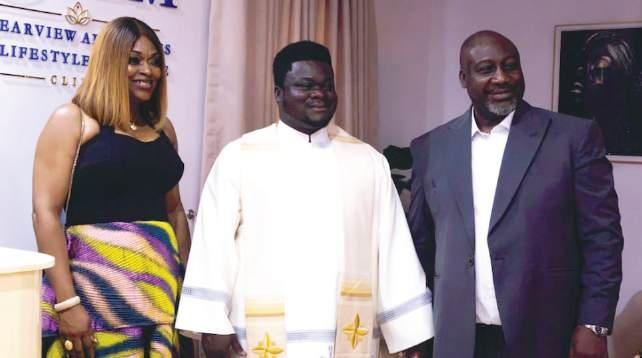
According to Ajayi, the clinic was inspired by the growing number of people seeking youthful, healthy
fragmented approaches that
skin through
rev Fr Anthony Onyemma, priest-in-residence of the Catholic Church of the Divine Mercy; flanked by Dr Kunle Ajayi, Founder and Managing Director of Clearview Hospital; and Dr (Mrs) Chidimma Ajayi, Medical Director of the CALM Clinic at the launch of the clinic.
Fajana-Thomas
True Leadership Through a Nightmare: Fatai Buhari and the Ori-Ire Saga
Sceptics and truth-twisters, typically, have been at work since the victims of the Ori-Ire saga returned from a 56-day captivity on Friday, July 10, 2026. Marginal followers of the developments which culminated in the eventual release of the abductees who were severed from their nuclear families, aboriginal communities and the larger Nigerian family have engaged in needless rhetoric. It been about whether the 44 who made it back after the traumatic ordeal, were actually rescued by the Nigerian security forces, or “released” by their captors.
There is a Yoruba adage which says omo’de o mo Oogun, oun’pe l’efo, which translates as “the child who doesn’t know the defining features of potent herbs, labels it regular vegetable.” Yet another Yoruba proverb says Eni ti Sango ba toju e wole ko ni na won bu Oba Koso, meaning “he who witnesses firsthand, the terrifying power of a force, deity or authority, will not join non-initiates in disrespecting or making light of it.”
Very sadly, Nigeria’s educational institu- tions have become soft targets as part of the insecurity ogre which has festered particularly in the past decade and half. From Chibok in Borno State, to Dapchi in Yobe; from Maga in Kebbi State, to Papiri in Niger through the years, the nation’s psychological and emotional temperatures have been serially aggravated with each mass seizure of vulnerable, innocent teenagers and toddlers from the premises of the learning and boarding environments. It was the same consternation which greeted the abduction of 46 staff and students of various schools in Ahoro-Esinle and Yawota communities in Ori-Ire local government area of Oyo State on Friday May 15, 2026, even as they set their sights on a weekend of rejuvenation after a busy week.
Despite public apprehension about the possibility of the return of the abductees anytime soon, against the backdrop of recent experiences in the management of similar incidents, government and non-governmental bodies at various levels seemed poised to make the Ori-Ire impasse a different scenario. Multi-departmental teams of professionals from the nation’s security complex, including the Nigeria Army, Airforce, Navy, Police, Department of State Services, the Nigeria Civil Defence and Security Corps, the Office of the National Security Adviser, and so on, were activated, under the leadership of the General Officer Commanding the 2nd Division of the Nigerian Army, Ibadan, Major-General Chinedu Ralph Nnebeife. They were complemented by the Oyo State chapter of the Western Nigeria Security Network, (WNSN), popularly known as Amotekun, local vigilantes and hunters.
Yoruba self-determination activist, Sunday Igboho, equally deployed his security outfit, iru ekun (tail of the lion), to join in comb- ing the 2,800 square kilometre radius of the Oyo National Park, whose luminous size effortlessly swallows the 2,500 square kilometre span of coastal Lagos State. Periodic reassurances to a despairing populace, came from Oluseyi Abiodun Makinde, Governor of Oyo State, who has barely savoured the comfort of his mattress and duvet, since the beginning of the ordeal, easily the most testy challenge of his political career.
Questions were asked about the whereabouts of the multibillion naira security drones procured by his administration, which would have come handy within that period of grave anxiety. Such was the national and international concern and attention, which the Ori-Ire epic generated.
Doubters and sniggerers would do well to interrogate the contributions of Abdulfatai Omotayo Buhari, Senator representing Oyo North District and one unsung patriot who stayed true and through the Ori-Ire conundrum with his people. They would understand better that the synergised 56- day operation which culminated in the safe
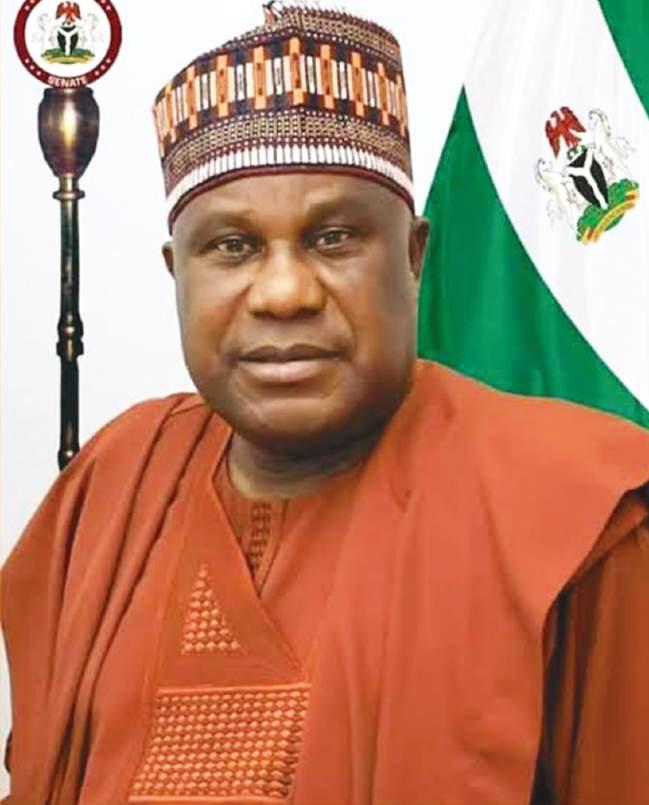
return of the Ori-Ire 44 was not at all a tea party.
But for the imperative of regular attendance and participation at plenary sittings in the national assembly, Buhari was almost, always within the precincts of Ogbomoso and Ori-Ire, the the- atre of the abduction and rescue operations. I have noted in an earlier treatise that the federal government delegation which visited the distressed communities in the early weeks of the incident, met Buhari on ground, identifying the affected families and pacifying them at their lowest moments. He was no newcomer to the people. They have been his constituents for the better part of the last two decades, beginning from the years he spoke for them in the House of Representatives between 2003 and 2007. Within a month of the incident, Buhari was back in Ori-Ire, to reassure his constituents that their pains were continually shared the government and that their cherished ones will return safe and sound.
Specifically, Buhari spent qual- ity time with Lateef Oyewole Alamu, Professor of Forest Resources Management at the Ladoke Akintola University, (LAUTECH), Ogbomoso, whose wife, Rachael Folake Alamu, Principal of the Community High School, Ahoro-Esinle, was one of those abducted on May 15. It was an instructively down- to-earth visit, the type expected of genuine representatives of the people, many of whom disappear into the comfort and opulence of their offices, abandoning their constituents once they are voted
intoFrompositions.
his desk in Abuja and his assign- ments at various destinations across the country, Buhari kept in touch, on an hourly basis, with his people at home, Governor Makinde, and on-field commanders on the rescue mission, filtering progress reports. Nothing better underscores Buhari’s rooted- ness to Ogbomoso and its environs where the kidnapping took place than the fact that the same day, Friday, July 10, 2026, when the captives were released, he was concluding a three-day training and empowerment programme for 150 of his people, in Ogbomoso!
In collaboration with the National Board for Technology Incubation (NBTI) Senator Buhari initiated a series of skills reengineering programmes for women and youths, beginning from Saki sub-zone the week before, which was to continue in Iseyin area, the following week. He went beyond entrusting the programme solely to consultants, opting to fully participate, in-person, even if it meant shuttling hither and thither.
ARISE NEWS ace news anchor, Charles Aniagolu, most appropriately described Buhari as “one of the strongest and most consistent voices throughout the crisis,” when he spoke with him after the national ordeal. Buhari who witnessed the regular movements of troops of various hues past Ogbomoso his hometown while the rescue mission lasted, applauded the professionalism and commitment of the nation’s security forces, which re-echoed the yeomanry of Nigerian troops during the Liberian and Sierra Leonean upheavals of the 1990s and early 2000s. He spoke of about the discreet role of intelligence gathering, and the wholesale containment, by the military, of the major accesses and exits into the voluptuous Oyo National Park where the captives were held for nearly two months.
According to him, the northern, southern, eastern end western exits through Igboho,
Igbeti, Sepeteri and Esinele, abutting the park, were effectively cordoned. There was thus no escape route for the criminals. Buhari’s words are corroborated by Mohammed Ngoshe, a retired Assistant Director-General of the Department of State Services who said in an interview on Channels Television, that the terrorists released their victims after being surrounded by security forces who mounted severe pressure on them. That was a major part of the strategy which yielded eventual success on Friday, July 10, 2026. Buhari, who received guests in his Og- bomoso home after the jummat service of Friday July 10, 2026, including Professor Alamu, noted that the tweet from presidential media adviser, Bayo Onanuga, at about 5pm of the same day conveying the news of the liberation of the Ori-Ire abductees, was one of the happiest days in his whole life. He joined in celebrating the development and drove the 109 kilometre, two-hour distance to Ibadan, the Oyo State capital, through nightfall, where the freed captives were admitted into the military hospital for as- sessment and immediate stabilisation. He joined Makinde in settling in their distressed and famished compatriots, over who they had jointly agonised through several weeks. Buhari who left the hospital at about 2am, was back again at 11am, to ascertain the convalescence of his people, grateful many were stable enough to have their first real meals after weeks of incarceration and malnourishment.
General Nnebeife, who doubles as the Force Commander, Operation Fasan Yama Sector 3, an internal security operation of the Nigerian Army, spoke about the peculiar difficulty of the vegetation in the rainforest of the Oyo National Park. Swathes and stretches of the landmass are virtually impenetrable by sunlight, nay by aircraft and drones, which made target identification difficult, and added a layer of complexity to the rescue plan. This called for utmost restraint and regular review of strategy to ensure that no abductee’s life was lost in the event of a firefight. With the identification and arrest of close family members of the bandits in a cross-country raid by security operatives across several states in the North, and the relaying of these realities to them, they were compelled to be as civil as possible with those they were holding.
While the kidnappers eliminated two teachers, Michael Olugbade Oyedokun and John Olaleye as part of their initial efforts to force government into a nego- tiation, the security services equally lost personnel including the 28-year-old Felix Ademe Isaac, an Army Lieutenant. Police Sergeant John Abena Jerome and Army Private Silas Musa, also paid the supreme price, even as Lance Corporal Adamu Hus- sein is recuperating from injuries sustained during the operation. A number of the marauders were neutralised and eight of them arrested by Nigerian security services. For the further enlightenment of scoffers therefore, the coordinated, multi-service operation, was in no way an outdoor camp by the “boys scout movement.”
The quantum empathy he demonstrated, the sincerity of his identification with his people when they despaired the most, when their morale was at its utmost nadir, recommends Senator Abdulfatai Buhari’s example to his colleagues, serving and prospective, and indeed everyone paid to serve our country by we taxpayers. Overindulged on our commonwealth, many in his position would have sought momentary escape to the posh, plush comfort of their foreign addresses, while the heart-wrenching Ori-Ire saga lasted, distilling updates from their home-based aides. At best, such people would have stayed glued to the relative insulation of the nation’s capital, in the false name of “doing the job for which they were elected.” Buhari demonstrated practical leadership when it mattered most.
• Olusunle, PhD, Fellow of the Association of Nigerian Authors (FANA), teaches creative writing at the University of Abuja
Senator Abdulfatai Buhari
Tunde Olusunle
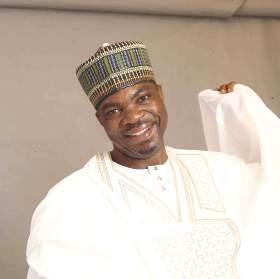
Ez E ki E l
AdA mu Reinventing
Boxing in Nigeria
From travelling the world with his father to experience major sporting events as a child to building one of Nigeria’s most influential boxing platforms, Dr. Ezekiel Adamu is proving that conviction - not hope - can change the course of a sport. Vanessa Obioha writes
The first thing you’d learn about Dr. Ezekiel Adamu, the Chief Executive Officer of Balmoral Group and owner of Chaos in the Ring, is that he has little patience for the phrase “I hope.” Mention it, and he winces. To him, hope is no substitute for conviction. He prefers certainty, decisiveness and action over words that, in his view, often mask hesitation or absolve people of responsibility.
The lesson came quickly during our virtual interview. In the course of our conversation, I casually used the phrase “I hope.” His media adviser, Latasha Ngwube, immediately interjected. “We don’t use that phrase around him,” she said. Adamu smiled.
It is easy to understand why he refrains from the phrase. Throughout his career, Adamu has ventured into spaces many people only dream of entering.
Born into a family steeped in sports - his father is a former sports administrator in Nigeria, while his younger brother is the current General Secretary of CAF - Adamu developed an early fascination with sporting events. As a child, he travelled to major sporting events with his father, but what captivated him most was the transformation of spaces. He marvelled at how an ordinary road or open field could become the centre of a global sporting spectacle, only to return to its original state once the event was over and the structures dismantled.
Therefore, when he returned to Nigeria after graduating from the University of Bedfordshire, where he studied Computer Science, he interned briefly at Dowell Schlumberger in Nigeria before he founded the Balmoral Group. From being a fixture at festivals, fairs and weddings, Balmoral has grown into one of the country’s most recognisable event brands.
These days, however, the Group is increasingly associated with boxing. Sport, it turned out, has always been Adamu’s first love right from those early days attending sporting events.
“I remember going to Athens for the Olympic Games and my father used to tell me that football is his business, but boxing was his first love. We went to a boxing fight, and I was captivated by how everything unfolded,” he recalled.
That feeling from the pugilists in the ring stayed with him. So while he used the events and venues to build a brand, his love for sports never waned. “I built Balmoral events to a certain level. So I thought, let me go back to my first love, which was sports. So, we started doing a lot of viewing centres, and a lot of activation for football events.”
Then, in 2024, as British-Nigerian boxer Anthony Joshua prepared to face British boxer Daniel Dubois, Adamu saw an opportunity.
“I called my team and told them ‘Let’s do something experiential for boxing, like a boxing film centre,’ and they found it interesting.”
Reinventing Boxing in Nigeria
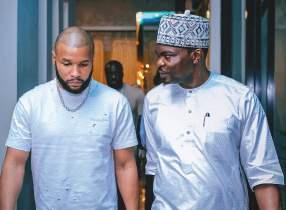
They immediately rolled up their sleeves and got to work.
For one who has a knack for creating immersive events, Adamu had a particular vision on how the event should feel.
“I’m a very experiential person. I love to create,” he said, describing how he wanted the event to feel like a Las Vegas fight night. “We wanted to actually have professional boxers come and fight as well, so that when Joshua’s fight starts, we would bring the screens down.” But something unexpected happened that evening.
“The talent I saw on display was even better than the talent I was watching on TV. And from that day, I think boxing got me.”
Through Balmoral Promotions and its Chaos in the Ring series, Adamu has helped breathe new life into a sport that had been struggling for mainstream attention in Nigeria.
The problem, he insisted, has never been talent.
“We don’t have a talent problem. There is an abundance of boxing talent. If you look at the landscape of heavyweight boxing globally, you will find out that about 70 per cent are either Nigerians or people of African
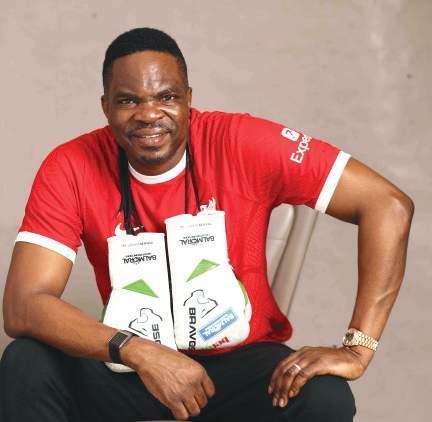
descent. What we have is a platform issue.”
For him, the real challenge lies in building a sustainable industry—one with the right structures, commercial opportunities and pathways for athletes. He cites the cumbersome process of obtaining boxing licences as one example of the systemic hurdles facing the sport.
He admitted that he did not fully appreciate the complexity of boxing promotion until he entered the industry. But rather than waiting for someone else to fix the problems, he set about finding solutions.
He came up with a couple of winning formulas, such as broadening boxing’s appeal.
“We brought in the influencers because they would give us eyeballs. The first influencer fight we did was Portable and Charles Okocha, which was great. And then we did Portable and Speed Darlington, which was also amazing. The strategy is to use the influencers to bring the eyeballs to the game, and then use the professionals to keep them watching.”
The strategy worked.
“The last event we did, I think, is the highest, if not globally, because we had almost two billion views across all social platforms, and about 4.2 billion impressions across all social platforms.”
Visibility, he believes, is everything.
“I’m also not one to take the easy way out. I felt that the best way for us to showcase boxing is to go to the highest level, and who is the biggest platform when it comes to boxing? Da-Zone (DAZN) is the global home of boxing.”
Determined to secure that level of exposure, Adamu immersed himself in the international boxing circuit.
“I met with a lot of big stakeholders in boxing. I got to meet DAZN, and they wanted to see what we’re doing in Africa. When they saw the level of production we’re doing, they were interested.”
After observing Balmoral’s events over several editions, DAZN came on board as a partner, giving Nigerian boxing unprecedented international exposure.
“To be honest with you, when I started boxing, I used to look at DAZN
like a dream,” he shared. “It was like a dream for me. So having them already is super exciting. And recently, we found out that Netflix Live also got into boxing, so we are also speaking with them. We are speaking with the biggest platforms in the world. They understand the power of Africa. They understand the talent that Africa has and they see us doing things the right way.”
The boxing ecosystem in Nigeria, as he sees it, deals with talent development, media, streaming platforms and betting integration. Overall, he wants Nigerian boxers to earn purses comparable to those of their international counterparts. According to him, elite fighters can now earn as much as US$300,000 for a single fight night.
His ambitions also have an international dimension. Balmoral has begun attracting globally recognised fighters to Nigeria. Recently, British professional boxer Chris Eubank Jr. visited the country and was received by President Bola Tinubu through arrangements facilitated by Balmoral Group. Adamu also believes that if Anthony Joshua ever chooses to fight in Nigeria, his organisation is well positioned to host the bout.
“We reversed the old order completely because before now, athletes had to travel abroad to gain visibility. Today, they can achieve that visibility from Nigeria. In fact, we now have international fighters looking for opportunities to fight here.”
Storytelling has also helped in bringing the audience. Chaos in the Ring events blend boxing with celebrity culture, music and entertainment, attracting audiences beyond traditional fight fans and encouraging investors who might otherwise have overlooked the sport.
In fact, he admitted that his DM is often inundated with requests from celebrities hoping to settle their rivalries in the ring.
“Sometimes my kids tell me that their friends warn them not to annoy them because they’ll ask me to put them in the ring,” he laughed.
The way he sees boxing growth in Nigeria, it is the new form of entertainment. He recalled how his well-heeled guests at the last December event had a swell time, saying they preferred the boxing event to other entertainment shows.
“Boxing is an elite sport and has everything. Music, storytelling, fashion, everything is there.” Adamu is very clear on his vision with boxing.
“I’m not here to just create fights. What we are doing is building a proper boxing ecosystem,” he said.
And he has no interest in hoping it happens.
Adamu (right), and Chris eubank Jr.
HighLife
Opeyemi Bamidele’s
Inspiring Journey at 63
Senator Michael Opeyemi Bamidele turned 63 on July 29, and the occasion invited more than a routine birthday acknowledgement. The Senate Majority Leader of the 10th National Assembly has built a public life long enough and consistent enough to be examined seriously.
He began in the trenches. As a student, Bamidele led the National Association of Nigerian Students and was arrested multiple times by military authorities during Nigeria’s pro-democracy struggles. He has remained in the same progressive political family, from AD through AC, ACN, and into APC, without the ideological drift that has defined so many of his contemporaries.
That consistency would mean little without the rest of the record. On June 1, 2018, an assassination attempt in Ado-Ekiti left bullets lodged in his abdomen. He survived, returned to politics, and by most accounts never pursued retribution against those responsible. Colleagues have cited that response as the clearest window into who he actually is.
In the 10th Senate, he has served as the chief floor manager for executive legislation, directing the passage or amendment of over 108 laws since 2023. He helped steer the Student Loan Act and the Tax Reform Bills through a chamber that required patience and persuasion rather than force. Senate stability during this period is partly attributed to his temperament.
His relationship with President Bola Tinubu dates back to 1992, when he served as an aide. That loyalty, sustained through years when Tinubu’s political standing was uncertain, is viewed less as opportunism and more as principle.
The constituency record fills in the rest: more than 50 roads and 12 mini-stadiums across Ekiti Central, ICU facilities at five hospitals, thousands of solar streetlights, and the establishment of FUTES-Iyin Ekiti with federal funding secured through his legislative efforts.
He holds both the Nigerian and New York Bar certifications, was made a Life Bencher in 2025, and carries the national honour of Commander of the Order of the Niger.
At 63, the career speaks for itself.
with KAYoDe ALFreD 08116759807, E-mail: kayflex2@yahoo.com
...Amazing lifestyles of Nigeria’s rich and famous
When Nations Seek Patrons: Why France is Knocking on Mike Adenuga’s Door Again
France is back at Mike Adenuga’s door. According to the latest reports, President Emmanuel Macron’s team is negotiating with the Nigerian billionaire to finance a new Institut Français in Abuja, with Macron expected to personally lay the foundation stone during a state visit later this year.
The ask makes sense once you understand the template. Adenuga already fully funded the Mike Adenuga Centre in Ikoyi, home to Alliance Française Lagos, a cultural landmark France now wants replicated in the capital without waiting for public funding to materialise.
This is the most recent evidence of a growing reality for Western diplomacy across the continent. With state budgets under pressure and traditional foreign policy facing friction, France needs efficient ways to sustain its cultural presence. Relying on an influential local partner allows Paris to move quickly and secure instant local backing without getting bogged down in foreign ministry bureaucracy.
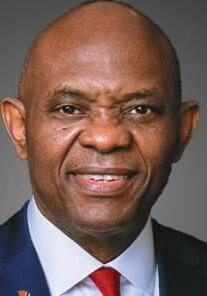
Tony Elumelu built Heirs Holdings and United Bank for Africa (UBA) into a pan-African financial network, guided by his Africapitalism philosophy — the conviction that private enterprise, rather
Why Adenuga specifically?
Their bond runs deeper than one building. In 2018, Macron made him Commander of the French Legion of Honour. His businesses, Globacom and Conoil, are threaded through French firms like Eutelsat, Nokia Alcatel-Lucent and TotalEnergies. Macron even calls him every birthday.
None of this ties to state contracts or dependency. Adenuga’s empire is Nigerianrooted, and his relationship with Paris was earned through consistent, understated giving rather than commercial leverage, which is precisely what makes France’s trust in him unusual.
A global power choosing a private Nigerian businessman to help build a national cultural institution is a rare acknowledgement of credibility built over decades. For Adenuga, known for avoiding interviews and front pages despite an estimated $6.5 billion fortune, this quiet influence fits his pattern of impact without noise.
Reports suggest that the billionaire is close to accepting, and Macron intends to proceed with the ceremony regardless of the final funding structure.
Tony Elumelu: The Banker Poised to Plant Nigeria’s Financial Flag in Europe
than aid, should drive the continent’s development. Now his ambitions stretch into Europe.
Elumelu is on the verge of securing a full banking licence in France, which would upgrade UBA’s Paris office into a full-service operation anchoring the bank’s entire European Union presence.
The plan is brilliant. Paris connects UBA to 11 Francophone African countries it already serves, strengthens trade finance between Europe and Africa, and opens a channel for mobilising diaspora wealth, building on the wholesale banking base UBA already runs successfully in London.
Elumelu’s move has all of its pillars sitting on a sharp commercial strategy. According to experts, by securing a footprint inside the European Union, UBA can clear euro-denominated trade directly, cutting settlement costs for African businesses. It bypasses postBrexit constraints in London, turning Paris into a direct bridge for capital
flows between European investors and high-growth Francophone markets.
He has already made real headway. Elumelu signed a cooperation agreement alongside President Emmanuel Macron and Finance Minister Antoine Armand, and awaits final approval from France’s banking regulator, the ACPR, to complete the transition.
Macron has also appointed him to lead the Africa France Impact Coalition, a platform pairing African entrepreneurs directly with French political and business leaders.
Beyond banking, his foundation has partnered with the European Union on a €20 million initiative supporting over 2,500 women-led African startups, work that earned him Belgium’s Order of Leopold.
By all accounts, it is not simply banking expansion that Elumelu is doing. He is positioning Nigerian finance at the centre of Africa-Europe trade, one regulatory approval at a time.
Why Osun’s Governorship Gladiators are Courting Omisore as a Political Kingmaker
Senator Iyiola Omisore is not on the ballot for the August 15 governorship election in Osun State. He does not need to be. In a contest where every voting bloc is important, and every alliance could prove decisive, candidates from across party lines have been making their way to Omisore is a former two-term senator and ex-National Secretary of the APC. Once a serious governorship contender himself, he has evolved into something the political class often finds more useful: a kingmaker. The reasons candidates want him are not mysterious. There are three, and each is concrete.
The first is Ife land. Omisore commands fierce grassroots loyalty across the four local governments of Ife Central, Ife East, Ife North, and Ife South. In close elections, the candidate who carries Ife tends to carry Osun. Omisore can either deliver or deny that bloc, which makes him the single most consequential non-candidate in the race.
The second is the 2018 precedent, which he created himself. When that year’s governorship election was
declared inconclusive, Omisore held the deciding votes as a third-party candidate. He formed a coalition with the APC and directed those votes toward Gboyega Oyetola, who won. From that moment, his kingmaker credentials were not theoretical. They were proven in a real election with real stakes.
The third is institutional reach. His network runs from Osun’s ward councils to the presidency in Abuja. He has financial resources, an organised campaign structure, and relationships within APC national leadership that newer candidates cannot replicate. Any aspirant who secures his support gains not just votes but infrastructure.
The APC has already drafted him into its 276-member National Campaign Council for the 2026 election. With incumbent Governor Ademola Adeleke commanding significant popularity, the race is competitive enough that every advantage counts.
In that kind of contest, Omisore has surpassed the icon of a footnote, fully and completely settling himself within the category of a factor.
omisore
elumelu
Adenuga
Bamidele
Uba Sani’s Running Mate Choice and the Politics of Inclusion
Kaduna State is Nigeria compressed into a single geography, carrying the country’s full weight of religious diversity, ethnic complexity and political tension, and every major political decision made there echoes far beyond its borders.
On July 28, 2026, Governor Uba Sani announced Jerry Adams, a Christian from Southern Kaduna, as his running mate for the 2027 governorship election. Adams currently serves as Executive Chairman of the Kaduna State Internal Revenue Service, bringing administrative credentials to a ticket that is also making a pointed statement about representation.
The decision restores something Kaduna had maintained without interruption from 1999 to 2019: a faith-balanced governorship ticket. Muslim governors paired with Christian deputies, Christian governors with Muslim ones, through administrations spanning Ahmed Makarfi, Patrick Yakowa, Mukhtar Ramalan Yero and others. The arrangement was never written into law, but it functioned as an unspoken covenant.
Former Governor Nasir El-Rufai ended it in 2019, fielding a Muslim-Muslim ticket.
Uba Sani, who succeeded El-Rufai, carried the same arrangement through his 2023 campaign. The consequences were felt most sharply in Southern Kaduna, where Christian communities voiced sustained frustration over their exclusion from the state’s highest offices.
Sani’s announcement acknowledged as much directly. He stated that Kaduna had learned difficult lessons about the costs of division and exclusion, framing the Adams nomination as a step toward reconciliation rather than mere electoral arithmetic.
Whether the choice is read as sincere conviction or strategic positioning depends on the observer. A gesture rooted in political calculation can still produce genuine social good if it holds. The real measure will come in the governance that follows any electoral victory: whether Southern Kaduna sees security improvements, economic investment and equitable attention alongside its symbolic seat at the table.
Adams is a credible choice on his own terms, but a deputy governorship is only as meaningful as the administration it sits within.
Oshiomhole’s Call for Prudence in Nigeria’s Road Revolution
Senator Adams Oshiomhole has built a reputation across decades for saying, loudly and on record, what many of his colleagues choose to leave unsaid. His latest intervention is no different and, this time, concerns something every Nigerian who has driven between cities understands immediately.
Oshiomhole’s concern, expressed on the Senate floor, was that the Federal Minister of Works was seeking approval for 20 new road projects while existing highways across the country remained in dangerous disrepair. Oshiomhole argued that the minister needed to be guided, that the logic of construction without maintenance was the wrong sequence.
Roads in Nigeria carry more than physical things; they determine whether a farmer’s produce reaches a market before it spoils, whether a sick person reaches a hospital in time, whether a child travels safely to school each morning. When those roads collapse and stay collapsed while fresh ones are announced elsewhere, the grievance is not abstract.
The senator representing Edo North has a record that gives his words on Oshiomhole
public accountability a particular texture. During a Senate committee probe into the Nigerian National Petroleum Company Limited, he declared the NNPCL a “house of thieves” after an unaccounted sum of N210 trillion surfaced. When Senate leadership distanced itself from that wording, he held his position publicly.
He went on live television to allege that signatures were forged on a committee report used to suspend Senator Natasha Akpoti-Uduaghan. He challenged his own colleagues in mid-2026 for attempting to amend Senate Standing Rules in ways he called “immoral.” He also stated publicly that the APC’s pre-2023 naira redesign policy had deliberately hurt ordinary Nigerians, a frank admission that few inside the ruling party were willing to make.
Critics have lots of bones to pick with the good senator. What is harder to dispute is that on roads, as on oil money and forged signatures, Oshiomhole tends to say the quiet part out loud. In a legislature where silence is often the safer political choice, that impulse alone is worth noting.
The Amupitan Question: Osun’s Governorship Election as the Ultimate Test of Integrity and Legacy
When Professor Joash Amupitan arrived in Osun State last week, it was not for a routine inspection. Rather, he came carrying a question that has followed him since he was sworn in as INEC Chairman: can a man appointed by a sitting president remain genuinely neutral when that president’s party is on the ballot?
Amupitan was appointed by President Bola Tinubu, a fact his critics have never allowed him to forget. For them, the appointment itself is the first line of a story that ends in compromised elections. He has spent his tenure pushing back against that narrative, and the August 15 governorship election in Osun is where that pushback faces its most visible test.
Three specific controversies have sharpened the scrutiny around him.
In April 2026, critics alleged he operated a personal X account that had shared pro-APC content. He denied owning any social media account,
calling the claims fabrications designed to undermine his office. More recently, the African Democratic Congress raised an alarm about a voter importation scheme, accusing INEC officials of facilitating the registration of voters from APC-controlled states including Lagos, Oyo, and Ondo in Osun ahead of the poll.
Amupitan has not retreated from those allegations. At a stakeholders’ meeting in Osogbo on July 28, he stated plainly that INEC has no preferred candidate and that the commission’s only loyalty is to the Constitution. He commissioned a new INEC Decides Studio for transparent result transmission and personally inspected the secure storage facility for BVAS accreditation machines.
Whether those steps satisfy his critics will depend less on the preparations and more on what happens on election day itself. Osun’s incumbent, Governor Ademola Adeleke of the PDP, commands genuine popularity, which means any outcome that defies the polls will face immediate interrogation.
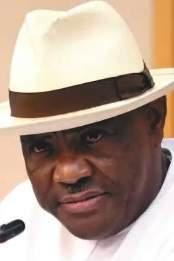
Nyesom Wike stood before journalists recently and said that Governor Siminalayi Fubara had corrected his mistakes by returning to the political family that brought him to power. He added that both men would now support President Bola Ahmed Tinubu’s re-election as a united front.
For anyone who followed the Rivers State crisis closely, the statement landed with the weight of everything it did not say. Wike is the FCT Minister and the political godfather who engineered Fubara’s rise to the governorship of Rivers State. The two men then spent the better part of two years in open warfare, a conflict that triggered a state of emergency, cabinet dissolutions, and sustained instability in one of Nigeria’s most economically critical states. The feud, once believed to be a misunderstanding, turned out to be a full-scale power struggle over who controlled Rivers after Wike left Government House.
According to some observers, the clearest evidence that the reconciliation that followed was not a meeting of equals was that Fubara returned to the table on terms that Wike largely dictated. He agreed to serve out his current term without seeking a second one in 2027. He ceded the power to nominate all 23 local government chairpersons to Wike. He publicly endorsed Wike’s preferred candidate, Kingsley Chinda, for the 2027 governorship. He also settled outstanding allowances owed to the 27 pro-Wike lawmakers, who then withdrew their impeachment proceedings against him.
For context, Rivers is one of Nigeria’s most voter-rich and economically significant states, home to the oil infrastructure that underpins the national economy. Leaving it in political chaos heading into 2027 is not an option any federal government can afford. A united Rivers APC, with Wike’s grassroots machinery and Fubara’s state resources pointing in the same direction, is worth far more to a re-election campaign than either man fighting alone.
Although Wike called it a correction of mistakes, experts want the rest of us to consider whether the arithmetic might be telling a cleaner story.
Amupitan
Sani
Aliko Dangote: more Than One Third
This South African copycat has not rested in stealing our afrobeat and winning global awards; she now wants to come to the source to rub insult on our injury. In this heat of xenophobic attacks, she now wants to come to Lagos to do a show in December.
You know some things just amaze you. Like when you see a rat calling out an elephant to a fight. The elephant would be very foolish to rush at the rat considering its size against its opponent. The best thing for the elephant to do is to first calm down, sit back and ask a very simple question – what is giving this rat the confidence?
We should be asking what exactly is the purpose of this show in Lagos and what is giving her this confidence before we react?
After years of increasingly alarming murder, harassment, rape and injustice to our people, all with the alleged complicity of its citizens and authorities, this person now wakes up and decides to come and sing in this country. If this is not adding pepper

Alhaji’s daughter has just announced that he would be donating about one third of his fabulous wealth to charity. In a report monitored in Lagos, the daughter was quoted by a foreign journal as saying that about $11.7billion, which represents exactly one third of his net worth of about $35billion, will go into a foundation, with a focus solely on health and education.
You see, this is what I was saying the other time when an Ekiti man went to donate billions to a foreign university. I had said that at the level of certain kinds of wealth, society expects a different kind of responsibility, as the wealth will no longer be seen as “private”. For my efforts, na police they used to pursue me. I ended up being dragged to the man to beg.
My brother Alhaji seems to understand this principle with this very fantastic move. He not only ceded the amount, but has built a brilliant structure
to our injury, me I don’t know. There should be no confusion about this one; the concert should be banned.
President Tinubu has finally fired a very strong salvo by refusing to meet any official from that country, and that should direct our national response to that rogue nation. All they have are women with big bums, and that is the only reason why I am still looking at them with one eye. But even at that, what do they have that we don’t have in Shomolu? They should just “getat.” Thank you.
COlONel
AbDUSSAlAm UDe: COUrAge UNDer fIre
I have received this report of the assassination of this gallant officer with mixed feelings. First, they said the man died “fighting.” The fact that he was outnumbered did not stop him from fighting to the end. We have been told that this officer ran into an ambush on his way from work and that he resisted very forcefully the attempt to kidnap him, fighting for dear life and country and in the end, he was shot.
that would see to the efficient and transparent use of the funds. Sometimes, someone will be thinking that this Alhaji is not even African in the way he does his things. The man is not only blessed with extra excellent “trader sense,” but he is also gifted with the humility to not only surround himself with the best of advisers, but he is also imbued with the commonsense of listening to better advice. This explains why he is where he is today.
No Nigerian man get this kind of sense, I tell you. Normally, it is to flaunt it, build mansions like the one an Imo State Senator went to build and disturb us like the “Igbo billionaires” used to shout “money na water” all over the place.
Alhaji has shown the responsible way to utilise true wealth, and this has inspired me to do the same.
I have calculated my total net worth,
My mixed feelings come from the fact that I was excited that, for once, one soldier gave the “idiots” a true fight, showing them what it is to be a soldier in the true sense of the word, but then again, my sorrow for the loss of life of this very gallant and obviously super patriotic Nigerian. We are at war o. Anyone who is not open to that is in a huge dose of denial. This war is not like the civil war that killed millions of people. This war is on the streets, on our farms, in our villages, in our homes, and the enemy has infiltrated our very core to the point we are no longer sure who to trust anymore. From our drivers, lovers, neighbours, colleagues, even our leaders, we are no longer sure who can suddenly turn against us and hit us badly. Nobody is safe; from school children to soldiers, teachers, men of God, fathers, mothers, etc. Thankfully, this present government has started recording some victories like the Oyo own and we must build on that and also on the sacrifices of patriots like Col. Ude to land decisive blows on our enemies. We
and I have arrived at the tidy sum of N12.6m. This figure is significantly more, just that I cannot add one three-bedroom flat in Ogba because I have used it as collateral to collect a loan from one Micro Finance Bank to publish my Maddtimes Coffee table book.
Now I have called a meeting of my immediate family to discuss the possibility of reserving 30% like Dangote for philanthropy and to appoint my daughter Chantal as the executor, exactly as Dangote has done. But unlike Dangote’s daughter, Chantal has blocked me and has stopped taking my calls the moment she heard of the plans. My other children, when I call, they will be doing “hello, hello, hello,” like the network is not letting me hear them.
Mbok, Alhaji, can you send me your advisers, because I must do this thing by fire, by force? Thank you.
must not fall into despair and fear. We must fight like Ude and push back very aggressively against the enemy. Nigeria is our country, and it will not be brought to its knees by the enemy. It will not.
JUlIAN OSUlA: wITH lOve frOm rOme
A lot of people do not know that this luxury merchant, Julian, is the great-great-grandson of an Oba of Benin and also the great-great-greatgrandson of an Olu of Itsekiri. This is why he moves in a regal form and carries himself with positive aristocracy.
During the week, he sent me a signal for his 60th all the way from Rome, where he had gone to celebrate his children’s wedding. His son, after a superlative traditional marriage, flew all the way to Rome to solemnise the union. Come and see the wedding pictures in the Vatican, the pomp and pageantry and the fact that I think the Pope even sent a message to the young couple.
Julian continues to be a corner post in Nigeria’s luxury market, purveying
TYlA: wHAT AN INSUlT
Tyla Osula
Dangote
exquisite brands to the well-heeled. His passion for his business and zest for life and his wholesome philanthropy give him a unique perch in national consciousness. Happy birthday, my egbon, and God will continue to bless you so, so much.
Dr. AlImI AbDUl-rAzAq SUperlATIve lIfe
I would like to send a 70th birthday celebration to another great Nigerian. Dr. Alimi Abdul-Razaq is the elder brother of my favourite Governor. Dr. Alimi Abdul-Razaq of Kwara State, who has done well in life.
A quick look at his profile shows a truly distinguished Nigerian. Well read and a prominent legal practitioner who has argued cases and contributed powerfully to national jurisprudence.
Currently, he is a member of the body of benchers who has had over four decades of post–call experience. He holds a PhD in Law and is a Fellow of the Chartered Institute of Arbitrators. His accomplishments and milestones are just too much to mention in this piece. Let me just wish Oga a happy 70th and also wish him many more fruitful years in service to the nation and humanity. Thanks.
OmOwUNmI ISAAc: I’m NOT HIS mUmmY
This one is funny as hell. Apparently, the Ondo State Commissioner for Finance has taken over 30 APC leaders to court for inferring that she is the mother of the governor because of her alleged overbearing influence over His Excellency.
Let me risk being added to the suit and just say that even from Shomolu, I can see where that inference is coming from. Immediately I saw the report, I went searching for “mummy” picture; I saw it, and I could tell where the interference was coming from.
The mummy looked very matronly with a no-nonsense look. Kai, we all have dealt with these types in school, offices, churches and the rest. They are usually very strict, fearless and controlling. They even have more power than Oga o. In some cases, when you go and meet Oga, he will say, “oya, you sef know wetin dey, go see her. If she gree, I will gree.” Kai. I have met plenty like this –overbearing, intolerant and sometimes overtly principled and imbued with self-importance, that passing through them can be very herculean.
So I understand where this whole issue is coming from. Well, the case is in court, and I cannot really comment on it, but to use it as a trigger to discuss the issue in very general terms as it applies to many institutions and organisations in this country.
Well, Mummy, in true form, has also not taken kindly to that aversion and has sued for defamation even though I don’t see the defamation. But I am not a lawyer so I cannot really say. Whatever the case is, I think His Excellency, if he can under the circumstances, wade in before Mummy decimates a whole generation of APC leaders in his state because of a touched ego. Na wa.
KAYODe fADAHUNSI: A DATe wITH HISTOrY
With over N500 billion in closed transactions and a valuation that continues to impress, this my brother Kayode Fadahunsi is listing by introducing his phenomenally successful investment banking
institution. According to a report the firm AVA Capital just released, they are doing this to ramp up corporate governance, deepen engagement with stakeholders and allow Nigerians to also participate in what they have built.
So, by the time you read this, Kayode would have rung the bell at the super brilliant NGX and his firm, which started as a dream and powerful vision, would have been listed on the
main bourse of the NGX. Sitting with Kayode the other day in his Oniru office – which even looks like one of those campuses in Silicon Valley - I could see the glint of achievement in his eyes as he announced that this is just the beginning. “Edgar, I want to list six companies on the exchange. I want to create wealth for this nation, intervene in business and guide others to the same economic
SANI AbAcHA: A revISeD verSION
There is no way that version from Amachree would not go unanswered. Amachree, the retired Deputy Director of DSS, had in a very colourful narration in his book told us how the late dictator choked and passed on while on top of a pharmacist. Let me quickly digress o. That “dying” on top of a woman is real o.
Kai, most men have come near that thing o. When you are on top, especially if it’s a light-skinned, full-bodied partner and she is edging you on like a football coach. It is hard to stop even when the harbinger of death looms.
Well, from Amachree’s position, Oga did not know when to stop. The thing was too “sweet”, and from there all the things that Diya and co could not do, this pharmacist succeeded in less
than three minutes. She stood up, cleaned up and calmly walked away, ending an era of madness.
Well, Abacha’s supporters have debunked that story, calling it a lie. They deny that Oga could not have gone that way, and for emphasis, have told us many colourful stories of his demise. The one that really caught my attention was the one that said it was through a handshake at the airport when he was seeing off Yasser Arafat. Another said he had liver issues and was already on heavy medication. Yet another one said he didn’t take his asthma inhaler with him and got an attack and passed. Well, for me, what I have learnt from the whole thing is – no matter how sweet, know when to say enough. Just stand up, greet your partner and catch your breath. Thank you.
fulfilment.”
Kayode will do it o. This 50-year-old has a date with history and don’t joke with him o, he will do it oooo, I swear. Kai.
prImATe AYODele: Seer ON rAmpAge
This one is hewn from a dodgy pedigree. Nigerians, since the 70s, have been dogged by all these kinds of people who parley intelligent guesses and give out predictions from the Lord. Some of the prophecies hit the bull’s eye while plenty just miss the mark and flounder away like Saddam Hussein’s Scud missiles. Thankfully, we have been relieved of most of these prophecies, but this present Primate seems to have the monopoly of the national stage, and he is not calming down as he continues to throw out the prophecies like ejaculation from a starved sailor. From Oyo State where he ran into turbulence, being accused of seeking millions for prayers – don’t even know how that one ended –through national issues, his love and dislike for President Tinubu, to global issues, this Primate is really enjoying his stay in the sun.
I am usually afraid of these people, especially the ones that say “This year, five governors will die, one person in Shomolu will die, and three stockbrokers will have gonorrhea.” The thing used to fear me ehnn.
One had stopped me in Shomolu and said I would not live to the end of that year. My mother arrested him and got him to sign an undertaking that nothing would happen to me that year. Thankfully for him, the only thing that happened was me escaping death by whiskers when the popular brothel, Juliet Hotel in Shomolu, collapsed and killed a lot of people just after I had left the place. Anyway, this job of prophesying does no good to anyone. When it is fatal leads to fear; when it is positive drives laziness, but most of the time, it’s all just hogwash and intelligent guesses.
Mbok, it is my friend Theo that asked me to write this one o, so if there is any repercussion like a fatal prophecy, it should be directed to him and not me o. Na beg.
mAgNUS ONYIbe: STATe pOlIce ON HIS mIND
This restless intellectual has come again o. Now, now, now, he has quickly written a book on the imperatives of state police, an issue that I have not taken a position on just yet. He sent me a blurb on the book and said very succinctly: “Edgar, this book will better dimension the issues, especially on the back of the growing insecurity in the country.” He said that the Oyo kidnapping has more than brought home the need for state police.
The book will be launched in Abuja, and the former AIG of Police, Tunji Alapini, who wrote the foreword, would be there, and the Vice President of Nigeria, Kashim Shettima, would launch the Book. Magnus is becoming more and more engaged in contemporary Nigerian issues with his books, analyses and essays, positioning him as a main arrowhead of the emerging intellectual framework of our country.
I have asked for a copy of the book, and the bobo sent me a soft copy. I just dey look am. Me, that will give him my 538-paged coffee-table book, e come dey send me soft copy, imagine.
Abacha
Polity
With His Running-Mate Nominee, Uba Sani Deepens Inclusive Governance, Unity and Peace in Kaduna
Abu Ibrahim Abdulkarim
Politics occasionally rises above the arithmetic of elections to become a profound moral statement. Such moments transcend the immediate contest for power and redefine the language of leadership itself. Governor Uba Sani’s nomination of Comrade Jerry Adams as his running mate for the 2027 governorship election is one such defining moment. More than the selection of a deputy governorship candidate, it is a deliberate reaffirmation of a governing philosophy that has consistently sought to replace suspicion with trust, exclusion with inclusion, and division with shared citizenship.
In a state whose history has often been punctuated by painful episodes of ethno- religious conflict and mutual distrust, symbolism matters. Leadership choices matter even more. Kaduna has travelled a long and difficult road, bearing the scars of crises that fractured communities, weakened confidence and slowed development. Every major political decision is therefore weighed not merely for its electoral implications but for what it says about the future direction of one of Nigeria’s most diverse states.
Governor Sani appears fully conscious of that history. His declaration accompanying the nomination was both reflective and aspirational. “This decision is far greater than the selection of a deputy governorship candidate. It is a reaffirmation of the values that have guided our administration since I took the oath of office on 29 May 2023; the values of inclusion, justice, fairness, equity and the unwavering conviction that every citizen of Kaduna State deserves a genuine sense of belonging.”
Those words deserve careful attention. They reveal that the nomination was not conceived merely as a political calculation but as an extension of an administrative philosophy that has defined the present government from its inception. Indeed, the announcement appears to deepen a trajectory that has increasingly characterised the Uba Sani administration; one that places peace-building, balanced development and inclusive governance at the centre of public policy.
The choice of Mr. Jerry Adams is par- ticularly significant because it resonates with Kaduna’s enduring quest for healing and reconciliation. A respected Christian leader from Southern Kaduna, Adams represents a region that has historically sought greater inclusion within the state’s political architecture. His emergence therefore carries a symbolism that extends well beyond personal accomplishment. It communicates the reassuring message that leadership opportunities remain open to merit, competence and character irrespective of religious affiliation or geographical origin.
That symbolism becomes even more compelling when viewed against Kaduna’s recent political history. For years, debates surrounding representation often mirrored wider anxieties about equity, fairness and belonging. Governor Sani’s decision projects a different narrative; one in which diversity is embraced as a strategic advantage rather than managed as a political inconvenience.
Perhaps the most profound sentence in the governor’s address was this: “Kaduna is a remarkable state, blessed with extraordinary diversity of faiths, ethnicities and cultures. That diversity is not a burden; it is our greatest strength.”
Few statements better capture the essence of democratic leadership in a plural society. Diversity has often been weaponised across Nigeria. Governor Sani proposes instead that it should become the foundation upon which enduring peace and shared prosperity are built. It is a philosophy that rejects zero-sum politics and embraces the higher ideal that every community must possess an equal stake in the state’s collective future. Importantly, this nomination does not stand in isolation. It reflects a governance
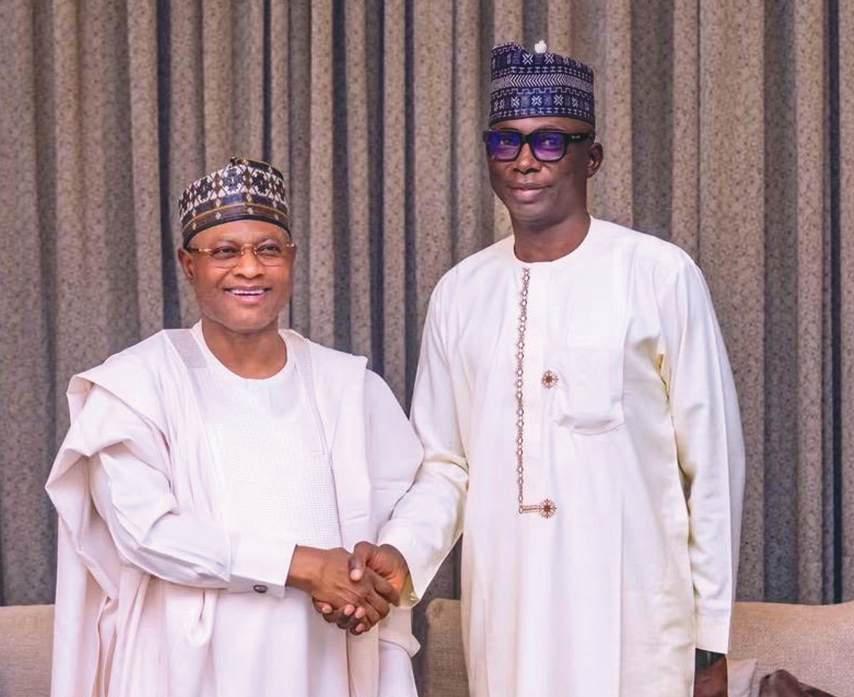
approach that has consistently emphasised equitable development across all 23 local government areas of the state. Investments in roads, healthcare, education, agriculture, water supply and rural infrastructure have repeatedly been presented by the administration as instruments of social justice as much as developmental policy. The underlying principle has remained constant: no community should be left behind.
The administration has equally demonstrated that security extends beyond military deployments. Sustainable peace requires dialogue, inclusion, justice and confidence in public institutions. Traditional rulers, religious leaders, women, youth organisations and civil society have increasingly become partners in conflict pre- vention and peace-building. As security gradually improved across several communities, farming resumed, businesses reopened and hope slowly displaced fear. These developments reinforce an important truth: societies become secure not only when violence is suppressed but when citizens genuinely believe they belong.
Governor Sani acknowledged this reality when he observed that “lasting peace is built not only by security measures but by fairness, inclusion and equal opportunity.” That statement encapsulates what many now know and identify as the Kaduna’s Peace Model; a philosophy that links security directly with justice andEquallydevelopment.noteworthy is the personality chosen to advance this vision. Comrade Jerry Adams arrives with credentials that extend well beyond politics. As Executive Chairman of the Kaduna State
Internal Revenue Service, he has earned national recognition for strengthening institutional efficiency, improving internally generated revenue through technology and transparency, and enhancing public confidence in tax administration. Under his stewardship, Kaduna expanded its fiscal capacity at a period when many sub-national governments struggled with economic uncertainty. Stronger revenues translated into greater capacity for invest- ments in education, healthcare, infrastructure, agriculture and social protection.
Yet perhaps Adams’ greatest qualification lies beyond administrative competence. Throughout his public career, he has consistently projected moderation, bridge- building and consensus. His reputation as a calm institutional reformer complements
Governor Sani’s own emphasis on dialogue over confrontation and reconciliation over division. It is therefore unsurprising that the governor described him as “a man of integrity, humility and quiet strength” who believes that “Kaduna’s diversity must always unite us rather than divide us.”
Leadership is ultimately measured not only by policies but by the signals leaders deliberately send to society. Political appoint- ments often become declarations of intent.
By nominating a Christian from Southern Kaduna as his running mate, Governor Sani has chosen to reinforce the message that inclusion is not merely campaign rhetoric but an organising principle of governance.
Predictably, political observers will analyse the electoral implications of the decision. Such discussions are inevitable within democratic competition. Yet to reduce this nomination solely to electoral strategy would be to overlook its broader significance. Some decisions carry moral weight beyond politics. They reassure anxious communities. They restore confidence among previously alienated citizens. They strengthen the architecture of trust upon which peaceful societies are built.
The governor himself articulated this larger vision with admirable clarity: “As we look towards 2027, I invite every son
and daughter of Kaduna State to see this moment not through the narrow prism of religion, ethnicity or geography, but through the broader vision of the Kaduna we are building together; a Kaduna where every child can dream without fear, every com- munity can flourish, every faith is respected and every citizen has an equal stake in our common future.”
Those words may ultimately define the enduring legacy of this announcement. They invite Kaduna citizens to imagine politics not as perpetual competition between identities but as collaborative nation-building within the state. They challenge long-standing assumptions about exclusion while affirm- ing that justice, fairness and merit remain compatible with political leadership.
No society emerges from decades of mistrust overnight. Peace is cultivated patiently through courageous decisions, equitable governance and sustained dia- logue. Inclusive politics alone cannot solve every challenge confronting Kaduna, but it undoubtedly creates the atmosphere within which lasting solutions become possible.
History often remembers leaders less for the offices they occupied than for the bridges they built. Governor Sani’s nomination of Comrade Jerry Adams appears intended as one such bridge; a bridge across regions, across faiths, across old suspicions and toward a more cohesive future.
If the past was too often defined by the politics of difference, this moment offers Kaduna an opportunity to be defined instead by the politics of common purpose. In choos- ing inclusion over exclusion, partnership over polarisation and unity over division, Governor Sani has not merely nominated a running mate. He has reinforced a governing philosophy that seeks to make every citizen feel seen, valued and represented.
For a state whose greatest strength has always been the richness of its diversity, that may well prove to be the most consequential political statement of all.
Abdulkarim, a freelance journalist, lives in Malali, Kaduna
Governor Sani and the deputy governor nominee, Adams

From Lagos, a Glimpse of LIMCAF’s Emerging Artistic Voices
The Lagos regional exhibition of LIMCAF offers an early glimpse of the young artists who could shape the future of Nigerian contemporary art. Okechukwu Uwaezuoke reports
Mingling with a gathering largely made up of artists under 35 at Thought Pyramid Art Centre on Norman Williams Street in southwest Ikoyi, Lagos, often evokes a familiar sensation—a kind of déjà vu. The faces and works may change, but the energy remains recognisable: young artists testing ideas, seeking recognition and competing for space in an increasingly crowded visual arts landscape.
That feeling was palpable on the late Saturday afternoon of July 25, when the Lagos edition of the Life in My City Art Festival, popularly known as LIMCAF, opened at the gallery. The exhibition brought together works by emerging artists vying for places among the finalists of one of Nigeria’s most enduring platforms for young creative talent, one whose influence is increasingly extending beyond the country’s borders.
The regional exhibitions represent the next stage of LIMCAF’s annual programme following the close of submissions on May 31. This year, 830 entries from artists across Nigeria are being presented across 18 designated centres. From these regional exhibitions, the top 100 works will be selected for the grand finale exhibition in Enugu, scheduled for October 24 to 31. The festival’s awards ceremony will follow on October 31 at the International Conference Centre of the Institute of Management and Technology, Enugu. With its 20th anniversary approaching, LIMCAF enters its 19th edition under the theme Open Letter. The festival has also announced a prize pool exceeding ₦50 million, making this year’s edition one of its most ambitious. Since its establishment in 2007, LIMCAF has grown into one of Nigeria’s most consistent platforms for discovering and encouraging young artists. Only one edition was not held: the pandemic-disrupted year of 2020, when COVID-19 forced the cancellation of public events.
The Lagos exhibition was officially opened by LIMCAF Artistic Director Dr Ayo Adewunmi and coordinated by the festival’s Lagos representative, Okechukwu Eze. The opening ceremony included remarks from Thought Pyramid Art Centre director Ovie Omatshola and curator Adetiloye Jekami, among others.
The exhibition itself reflected the range of approaches increasingly visible among young Nigerian artists. Paintings dominated the selection, but photographs and sculptures also featured, offering glimpses into the concerns occupying this generation: identity,
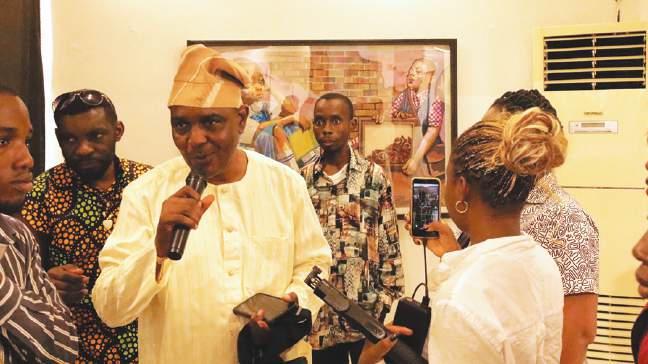
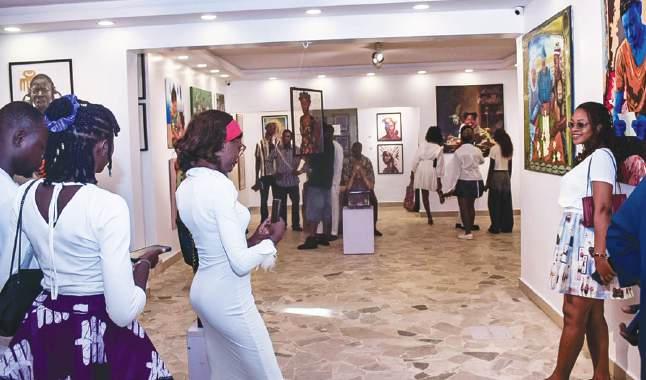
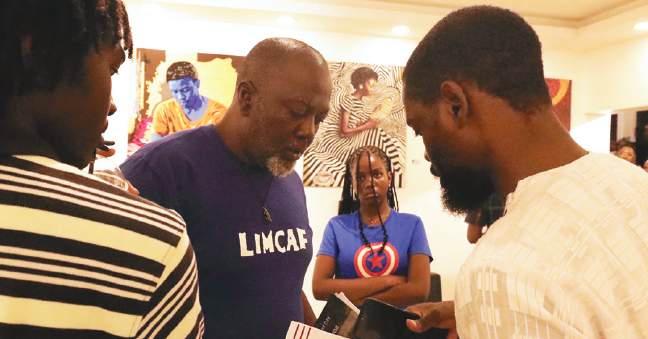
memory, social realities, personal experience and the changing conditions of contemporary life. From the Lagos selection, eight works are expected to advance to the final exhibition in Enugu. As is often the case with themed exhibitions, the relationship between artwork and theme was uneven.
Some works engaged deeply with the idea of Open Letter, while others appeared to have been adjusted to fit the framework rather than emerging naturally from it. This tension is not new. Over the years, some voices within the festival have questioned whether LIMCAF might be better served by abandoning
thematic restrictions altogether. Yet removing the theme would introduce another challenge: how to create a meaningful conversation among hundreds of works produced by artists working from vastly different experiences.
Themes, at their best, provide a point of departure rather than a set of instructions. They create common ground from which artists can respond in unexpected ways. The challenge is to avoid merely illustrating an idea and instead allow the theme to provoke deeper artistic questions.
As the flagship programme of the Nigeria-registered non-profit Life in My City Art Foundation, LIMCAF has always been about more than competition. Its broader mission is to create opportunities for young artists while expanding access to art education and public engagement. This year’s theme encourages reflection on human choices, individual responsibility and the power of communities to effect change. That commitment extends beyond the annual competition. Outreach programmes for schoolchildren and young people living with disabilities sit alongside residency and mentorship initiatives, including a six-week programme for selected artists that began on July 1. Such efforts acknowledge that sustaining artistic careers requires more than prize money; it depends on nurturing skills, professional networks and confidence.
At the centre of the competition is the Elder K. U. Kalu Grand Prize for Young Artist of the Year, worth the naira equivalent of $2,000, alongside awards recognising excellence across different media, including the Capt. Everest Odengene Nnaji Prize for Best Painting and the Tayo Adenaike Prize for Best Watercolour.
LIMCAF’s continued survival is itself an achievement. Many cultural initiatives begin with enthusiasm only to lose momentum. Its longevity has depended on a succession of partners, sponsors and benefactors, among them the Alliance Française network in Nigeria, the Institut Français, the French Embassy, Rocana Nigeria Limited, Honeywell Group, FBN Holdings and Thought Pyramid Art Centre, together with prize donors such as the Justice Anthony Aniagolu family, Professor El Anatsui and Engr. Gesi Asamaowei.
Perhaps the clearest measure of LIMCAF’s importance is the growth in participation since its founding. The increasing number of artists submitting works each year reflects both the expansion of Nigeria’s creative community and the need for platforms capable of identifying and supporting new voices. Many former overall and category winners have gone on to establish successful careers, often acknowledging the festival as an important early opportunity.
The Nigerian art scene has changed significantly since LIMCAF began in 2007. The country now enjoys greater international visibility, a stronger gallery ecosystem and a growing network of collectors. Yet emerging artists still face familiar obstacles: limited institutional support, economic pressures and the difficulty of sustaining a professional practice. Platforms such as LIMCAF matter because they provide not only recognition but also a sense of possibility.
Launched modestly by Rocana Nigeria Limited founder Robert Orji, LIMCAF has grown into a national institution within Nigeria’s visual arts landscape. As it approaches its 20th anniversary next year, its significance lies not only in the artists it rewards but also in the generations of practitioners it has encouraged. Its greatest contribution may be the belief it has helped sustain—that young artists, given the opportunity, can shape the future of Nigerian art.
Dr Ayo Adewunmi addressing the participants at the exhibition opening
A section of the exhibition hall on the opening day
The LIMCAF Lagos coordinator, Okechukwu Eze (centre) confers with Thought Pyramid Art Centre's curator, Adetiloye Jekami (right) and an artist
ARTS & REVIEW/Books
Shadows of a Troubled Republic (II)
SHADOWS:
ProtestEssaysonAfrica’sMostConsequentialCountry(1999–2023),Volumes1and 2byEniolaBello,CableBooks,Lagos,2026
Okey Ikechukwu
Overview of Volume 2
The second volume of Shadows completes a project that was halfway completed after 468 pages, and which got rounded up in the 460 pages of the second volume. The front matter of repeats Kukah’s Foreword and the author’s Introduction. This is consistent with the two-volume structure, and also rhymes with the “shadow” metaphor governing the project.
This collection is the more varied of the two books, as it goes beyond the single long “Governance” section of the first volume, to track party intrigue, godfatherism, PDP and APC succession battles, and presidential elections from the late Abacha transition through the 2023 Tinubu victory.
The collection moves from essays on Nigeria’s retired military rulers, religious and ethnic tension, Boko Haram, and the moral character of public life, to a handful of essays from the author’s reporting trips to Japan, China, and a Chicago visit tied to Tinubu at the time. It showcases tribute with an obituary-style and anniversary essays on figures like Abiola, Bola Ige, and Pope John Paul II, before closing with a first-person Epilogue recounting the author’s own encounters inside Nigerian Government Houses across several states.
Like in Volume 1, the essays are also dated and arranged chronologically within each section; closing with an Acknowledgement after a name index.
Observations
Consistency
of Political Narratives
Readers of Volume 1 will recognize the same rhetorical toolkit in the Politics section of this volume. Anaphora, rhetorical-question cascades, and the use of extended metaphor as an organizing device are now applied to party primaries, godfather disputes, and succession battles rather than presidential administrations in this volume. In the essay “Grandmasters of the Game” and ”2023 and the Tinubu Conundrum”, we see a tracking of the mechanics of power transfer within a party. We also see how the dynamics of zoning arrangements, delegate arithmetic, and backroom deal-making determine outcomes that are later dressed up as democratic choices. The element of institutional dysfunction mentioned in Volume 1 also presents itself here as elections change faces, but without changing the underlying principle of subversion.
Wider-Range Focus
It is in this volume that we see the author’s full range of colours as a writer on display. The essays on politics retain the same brisk, editorializing voice we have in Volume 1. The Society and Travel section shows a more reflective, sometimes gentler, author who is even willing to let a scene or a piece of dialogue carry the argument without throwing in a direct commentary.
In “A Night in a Japanese Home,” we find an account of a homestay in Hiroshima during a press junket, as warm, purely observational travel writing. It is free of the polemical register that dominates the writer’s political essays. This was a welcome change of pace that shows that the author is capable of enjoying the evening breeze without complaining about the wind speed.
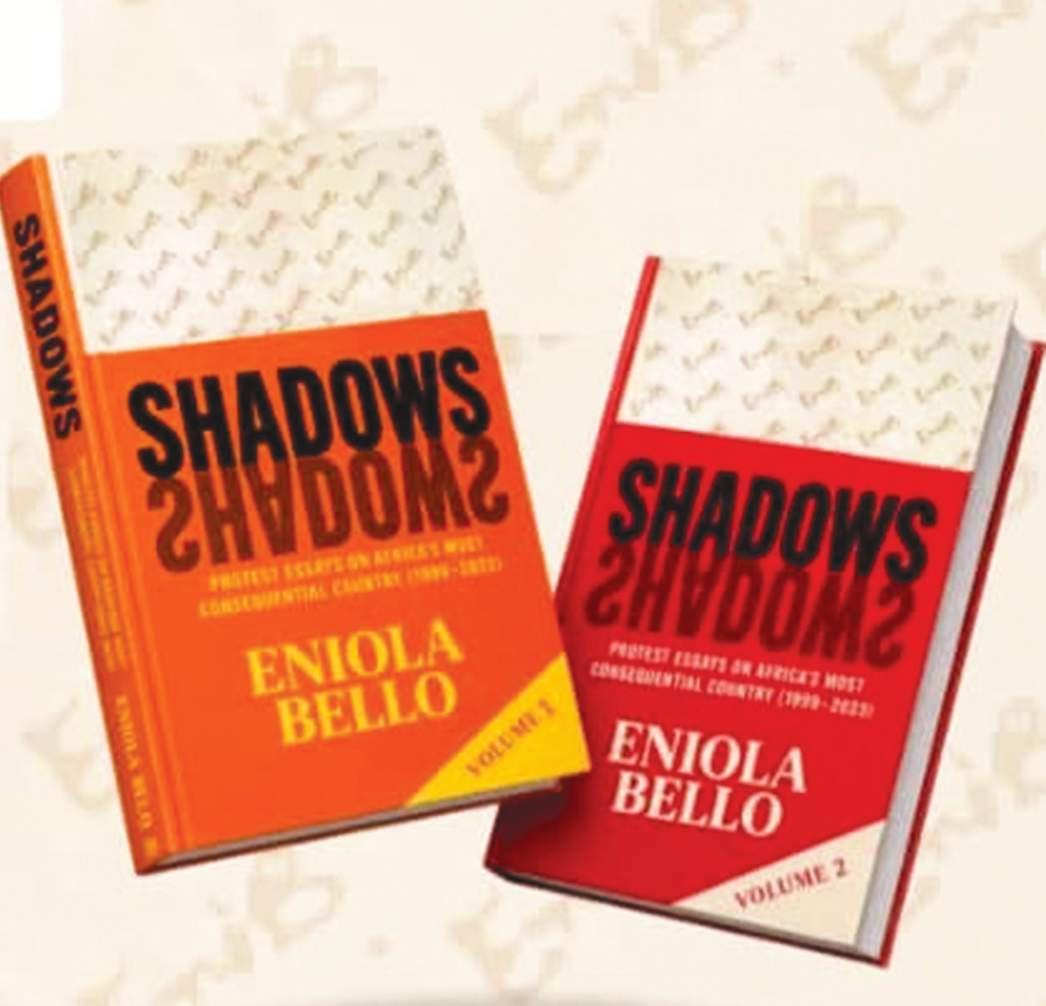
Book Review
versation” (April 2000) shows it to be one of the collection’s most inventive piece. It is an imagined afterlife, staged entirely as dialogue, in a phone call between the late Chief MKO Abiola and the late General Sani Abacha. Here, Abiola needles his former jailer about his fate, making this departure from the straight op-ed form used almost everywhere else in both volumes a welcome respite. The result is a stronger emotional impact, which a conventional essay on the same subject would not have had; giving the reader a varied the reading experience of the 900-plus combined pages.
Profiling the Epilogue
Looking at “Notes from Government Houses”, a first-person memoir of the transactional, and often degrading, culture the author witnessed around Nigerian governors on official visits, especially of how young women from local universities were paraded for state guests, night-outs bankrolled by public office. It portrayed an endemic casual corruption of hospitality that
marks the piece as one of the strongest essays in the twin-volume work.
It is also as candid and self-implicating as a writing could be. Perhaps without knowing it, the writer includes his own discomfort and complicity as an observer rather, while convinced that he is writing only about others. Put together, the author’s sentiments and the sordid reality it depicts retroactively sharpen some essays in the Politics-section, wherein the same governors are presented in different contexts.
Structure and Thematization
The four distinct sections of Volume 2 appear to offer more textural variety than Volume 1. Though the sections are uneven in size, with Politics running to roughly 250 pages, while the Travel section captures only five essays. We note in this review that particular pieces in the Politics section could have been accommodated in the Society section; and that some could actually have come under Tribute, rather than Society.
Further Observations
A reader moving from Politics into Society may struggle to see why, say, essays on Babangida’s culpability for June 12 sits in the Society, rather than the Politics section, or why some Tribute
pieces (the Abiola essay, in particular) overlap significantly with material already covered in Politics. A future edition of the book would require a short editorial note, explaining the sorting principle.
Final Submission
Whereas Volume 2 seems to be the stronger of the two books because of its variety, with the political essays extending Volume 1’s central argument about institutional dysfunction, the two together give a fuller picture of the scope of the author’s works. The “Telephone Conversation” experiment and the Government Houses epilogue are easily the two most memorable pieces across both volumes, showing us a writer with more range than the bulk of the political columns, taken alone. When read as the second half of a single project, Volume 2 rewards patience, because some of its best material not found on the periphery.
I invite us to celebrate this remarkable chronicling of a critical aspect of our national history by a master wordsmith who has bestrode the Nigerian journalism landscape with deep concern, uncontrived candour and genuine patriotism. The two volumes should find their way into every university library, as well as the book shelves of every serious media practitioner within and outside Nigeria.
IN THE ARENA
Osun Guber: Amupitan Faces Biggest Test Yet
With the Osun State governorship election just two weeks away, concerns over possible violence have heightened, but the credibility of the poll will depend largely on how the Independent National Electoral Commission and the security agencies conduct themselves, Davidson Iriekpen writes
On August 15, 2026, the people of Osun State will head to the polls to elect a governor who will oversee the state's affairs for the next four years.
The main contenders are the incumbent governor, Ademola Adeleke, who recently defected from the Peoples Democratic Party (PDP) to the Accord Party; Munirudeen Bola Oyebamiji of the All Progressives Congress (APC), who enjoys the backing of the Minister of Marine and Blue Economy, Adegboyega Oyetola; and Najeem Salaam of the African Democratic Congress (ADC), a loyalist of former Governor Rauf Aregbesola.
Many analysts see the election not only as the last off-cycle governorship poll before the 2027 general election, but as a major test of the electoral security framework and the ability of state institutions to guarantee peaceful and credible elections.
The responsibility of conducting the poll rests squarely with the new Chairman of the Independent National Electoral Commission (INEC), Professor Joash Amupitan. The election will not only test his capacity to conduct a free, fair and credible election, but showcase how he handles the much-awaited 2027 polls.
Since he assumed office, Amupitan has only conducted three major elections – the Anambra and Ekiti governorship elections as well as the Federal Capital Territory (FCT) council polls. He also conducted a few supplementary elections to fill vacant seats in the National Assembly and Houses of Assembly across the country.
While the INEC chairman received commendations for the Anambra and Ekiti governorship elections, largely due to the absence of formidable opposition to the incumbent Governors Chukwuma Soludo and Biodun Oyebanji, he was heavily criticised for the FCT council polls, where the commission's performance was adjudged abysmal.
With the Osun governorship election just two weeks away, all eyes are already on Amupitan's INEC to see whether the commission will be able to live up to Nigerians' expectations, especially with the tension that has already enveloped the state.
The outcome is expected to reflect President Bola Tinubu's influence in the South-west geopolitical zone, the growing opposition profile of Rauf Aregbesola, and the electoral strength of Governor Adeleke.
When these concerns are viewed alongside the fact that most off-cycle elections conducted under President Tinubu, especially in Kogi, Imo, Ondo and Edo states, and the FCT councils were heavily criticised for irregularities, confidence in the prospect of a free and fair election begins to wane.
With the state's local government allocations from the Federation Account already withheld by the APC-led federal government as part of a secret plot to frustrate Governor Adeleke, and reports of violence spreading across the state, analysts warn that if INEC and the security agencies are not firm, there could be disruptions to the electoral process.
Already, the Accord Party is alleging that over 60 of its members have been arrested in the state and detained in Abuja and Nasarawa State.
Besides, there are fears that the election may be undermined following the attack on INEC officials by gunmen in Odo-Otin Local Government Area, in a string of violent clashes that have left residents dead in recent weeks.
The gunmen were said to have made away with three packs of Permanent Voter Cards (PVCs) awaiting distribution to their owners.
But INEC said it was awaiting
a police report on the attack before deciding on the next course of action, including whether the stolen PVCs would be reprinted ahead of the election.
Speaking on the incident, the Chief Press Secretary to the INEC Chairman, Adedayo Oketola, said preliminary investigations showed that some Bimodal Voter Accreditation System (BVAS) devices were also stolen during the attack.
Oketola stressed that the number of stolen devices was insignificant and would neither disrupt nor compromise the election.
"Nobody can use another person's PVC to vote in an election in Nigeria again. The era of ghost voters is gone. With BVAS, you must tender your PVC and undergo biometric authentication," he said.
The Election Observation Hub, under the European Union Support to Democratic Governance in Nigeria Phase II (EU-SDGN II), had also raised concerns over security threats, misinformation and the exclusion of vulnerable groups ahead of the election. Presenting the Hub's Pre-Election Assessment Report
POLITICAL NOTES
in Osogbo last Monday, the coalition described the poll as a critical test of Nigeria's electoral institutions ahead of the 2027 general election.
The Election Observation Hub which comprises seven civil society organisations participating in the EU-SDGN II programme, namely Yiaga Africa, The Kukah Centre, the International Press Centre (IPC), CEMESO, ElectHER, the Nigeria Women Trust Fund (NWTF) and TAF Africa, identified 13 of the state’s 30 local government areas as high-risk flashpoints due to politically motivated killings, violent attacks and heightened political tension. The affected areas include Osogbo, Irewole, Boripe, Obokun, Ife North, Ife Central and parts of Ijesaland.
The coalition further questioned public confidence in the neutrality of security agencies, particularly the Nigeria Police Force, following allegations of partisanship during the local government crisis. It recommended intelligence-led deployment of security personnel to identified flashpoints and urged security agencies to demonstrate professionalism, political neutrality and strict adherence to the rule of law.
The Hub also called on INEC to ensure timely deployment of election materials and transparent collation of results, while urging security agencies to protect voters, journalists and election officials.
Nigerians are carefully watching. Amupitan has to change the narrative, with the Osun election serving as his biggest test yet.
At every forum, he has vowed to uphold the integrity of Nigeria's electoral process, describing it as "non-negotiable."
During his Senate screening in October 2025, he said that under his watch, losers would congratulate winners after elections and promised to demonstrate his commitment to credible polls in every election.
Also, while addressing participants at the 56th Annual Conference of Nigerian Association of Law Teachers (NALT) in Abuja recently, the INEC boss equally said elections must be won and lost at the polling units, adding the country could no longer afford a situation where the courts would continue to decide winners of elections.
Now is the time for him to demonstrate that. Nigerians do not want to see or hear the regular complaints – late arrival of election officials to their polling booths, failure of BVAS machines, mutilated result sheets and pre-result sheets.
How the commission and the security agencies conduct themselves on August 15 will not only determine the credibility of the poll but also instill public confidence ahead of the 2027 general election. INEC must use the election to guard against voter apathy in 2027 by ensuring that votes count.
Big Relief for ADC and Other Parties
Five opposition political parties were last week heaved a sigh of relief when the Abuja Division of the Court of Appeal set aside the June 15, 2026 perverse judgement delivered by Justice Peter Lifu of the Federal High Court ordering the Independent National Electoral Commission (INEC) to deregister them ahead of the 2027 elections.
The appellate court specifically declared the judgement that ordered INEC to deregister the parties “null and void”.
Recall that Justice Lifu of the Federal High Court sitting in Abuja, had ordered the electoral body to deregister the party over its performance after the 2023 general elections.
However, the political parties, including ADC, the Action Peoples Party (APP), Action Alliance (AA), Accord Party (AP), and the Zenith Labour Party (ZLP) sought nullification of the Federal High Court judgment.
The appellate court, while describing the judgement “a nullity” held that “what the learned trial court did amount to judicial impertinence or what the Supreme Court called judicial insubordination.”
It added that the judgment of the trial judge was perverse.
The three-man panel of the appellate court presided over by Justice Abba Mohammed, in a unanimous decision, held that the trial court had no judicial power to hear the case initially. They noted that the trial court was wrong to have proceeded with the delivery of the judgment despite the order of the court of appeal directing a stay of proceedings which includes the delivery of the judgement.
The court also noted that the 1st respondent had no locus standi to institute the action in the first place.
It added that evidence before the court clearly shows
a compliance with Section 225A of the Constitution of the Federal Republic of Nigeria 1999 (as Amended).
What this judgement has taught the likes of Justice Lifu is that they should respect the hierarchy of courts.
The judgement has also taught them not to be overzealous or allow themselves to be used by politicians for their selfish motives.
What is sad is that despite the reprimands judges of the trial courts have received from superior courts, they still get promoted to continue with their perverse judgements at the higher courts.
The judiciary has to be careful of the likes of Justice Lifu. They can set the country on fire. Imagine delivering this kind of judgement at a superior court where it cannot be appealed.
Amupitan
Tsoho
BRIEFINGNOTES
Shettima, Governors' Unwarranted Trip to Benin Republic
For Vice President Kashim Shettima and six governors to visit the Glo-Djigbé Industrial Zone, near Cotonou in the Republic of Benin, to understudy their agro-industrial model, shows how Nigeria's ratings in agriculture and other indices of good governance have dropped to abysmally low levels due to the mismanagement of the country’s abundant natural resources by successive governments, Ejiofor Alike reports
It was quite shocking to many Nigerians when news broke last week that six governors visited the Glo-Djigbé Industrial Zone (GDIZ), in the Republic of Benin, and pledged to replicate the country’s state-level agro-industrial zones in their respective states.
Many believe that a country that prides itself as Africa's largest economy should have reserved such a trip for relevant officials and agencies in the state and Federal Ministries of Agriculture, and not the vice president and the governors.
The governors, who were led on the visit by Vice President Kashim Shettima, had also vowed to adapt GDIZ model to revive textiles, process farm produce and create job opportunities.
Nigeria was already an agricultural giant in the 1950s and third-largest textile giant in Africa in the 1970s, operating about 180 textile mills.
Unfortunately, the country has slumped to the level where it is understudying the Republic of Benin’s agricultural and textile models, as part of the efforts to establish agro-industrial processing hubs, and revive domestic manufacturing.
Before Nigeria gained Independence in 1960, the three regional governments had recorded giant strides in agriculture, which was the mainstay of their economies.
When Action Group (AG) was formed by the late Chief Obafemi Awolowo in 1951, agriculture was one of its top cardinal programmes.
Reports had it that school children in the old Western Region sang a Yoruba song every morning, which was translated “Farming is the occupation in our land …. Any education without hoe is incomplete.”
Western Regional government was also said to have allocated different parts of the region, depending on the type of soil, for different types of cash and food crops.
According to reports, the Remo areas in Ogun State were designated for rubbers and cola nuts; Ijebu designated for forestry and palm trees; Yelwa designated for cassava, maize, rice and other cereal crops; while crops such as Cocoa trees were planted in the forest areas of the present Oyo, Ondo, Ekiti, and Osun states.
Proceeds from Cocoa were used to fund free education in the region, and also build
the University of Ife, now Obafemi Awolowo University, Ile-Ife in Osun State; Cocoa House in Ibadan, which was West Africa’s first skyscraper; Premier Hotel in Ibadan; Liberty Stadium, also in Ibadan; and other gigantic projects in the region.
In the old Eastern Region, many Nigerians still cite the agro-industrial revolution of Dr. Michael Okpara in the 1950s and 1960s, which made the region one of the fastest growing economies in the world, alongside the four Asian Tigers - Hong Kong, Taiwan, Singapore and South Korea.
Before the discovery of crude oil in commercial quantities, which led to the neglect of agriculture, farm settlements, plantations, cattle ranches and other livestock ventures were the source of the revenue, which Okpara used to transform the region into an industrial and manufacturing hub.
For instance, Aba in the present Abia State, was a manufacturing and commercial hub; Emene in Enugu State hosted asbestos factory; a cement factory was established at Nkalagu in the present Ebonyi State; Trans Amadi Industrial Layout was built in Port Harcourt; while the University of Nigeria, Nsukka (UNN) was established in the present Enugu State.
Hotel Presidential was also built in Port Harcourt and Enugu, among other projects.
In the old Northern Region under the late Premier, Sir Ahmadu Bello, agriculture was the backbone of the textile industries that made Nigeria to rank the third-largest textile giant in Africa, operating about 180 mills.
The Ahmadu Bello University in Zaria (ABU) in the present Kaduna State; the Bank of the North; the Kaduna Textiles Limited established in 1957; and the Hamdala Hotel in Kaduna, were all built with proceeds from agriculture.
Nigerians still remember the famous ‘Groundnut Pyramids’ in Kano.
It was therefore shocking that the vice president and governors in the same country that made these accomplishments in agriculture in the
1950s and 1960s could embark on a trip to Benin Republic to inspect an area, where cotton, cashew nuts, soyabeans and other agricultural commodities are processed into finished and semi-finished products.
Governor AbdulRahman AbdulRazaq of Kwara State did not hide the shameful fact that the governors went to understudy the Republic of Benin’s models when he described the visit as an African peerlearning mission intended to help Nigerian states avoid costly mistakes and adopt tested industrial practices.
“We previously visited Ethiopia to study what they had done, and we are now in Benin Republic to learn from both the challenges and the successes of this industrial zone.
“We have examined the cotton, cashew and soybean value chains. What we have seen has been a tremendous success, and we will take these lessons back to Nigeria as we implement our own projects", AbdulRasaq stated.
Also speaking, Jigawa State Governor Umar Namadi said the industrial zone had provided useful lessons for his state’s efforts to add value to agricultural production under Nigeria’s Special Agro-Industrial Processing Zones Programme.
On his part, Zamfara State Governor, Dauda Lawal, subtly reminded Nigerians that the country was once a textile giant.
He said the visit revived memories of the once-thriving textile industry in his state, where factories, cotton ginneries and oil mills previously employed thousands of people.
He said: “My father was one of the owners of the Zamfara Textile Industry.
“At one point, the factory operated three shifts, with about 2,000 workers on each shift. Zamfara also had about 23 ginneries
NOTES FOR FILE
and an oil mill, where even cotton seeds were converted into oil.”
Also, Governor Hope Uzodimma of Imo State said: “If this model is properly adapted in Nigeria, with every state building around its comparative advantage, we will create the prosperity and employment opportunities our people need.”
Katsina State Governor, Dikko Umar Radda, said the production systems at GDIZ could be reproduced in Nigerian states with strong agricultural value chains.
Speaking also on the lesson they learnt from the trip, the Plateau State Governor, Caleb Mutfwang, stated that "the lesson is that this kind of success requires intentionality.”
Many Nigerians believe that relevant officials of the ministries of agriculture should have embarked on the trip to preserve Nigeria's honour in the global community.
Analysts noted that for the vice president and six state governors to embark on this trip to a country that was far behind Nigeria in agriculture in the 1960s shows how Nigeria's rating on agriculture and other indices of good governance has dropped due to the mismanagement of the country's abundant human and natural resources by successive administrations.
Some years ago, after visiting Songhai Farm founded in 1985 by Father Godfrey Nzamujo in Porto-Novo, the same Benin Republic, some state governors adopted the model for integrated farming scheme to boost food production in Nigeria.
Years after, many Nigerians have not seen the impact of the visits. Even some states which started to replicate model, have since abandoned it. This is why they are hoping that the recent visit to GDIZ is not turned into another jamboree.
Colonel Ude: Another Gallant Army Officer Taken Down
It was another sad day last Monday when the news broke that a serving colonel of the Nigerian Army had been killed while his wife was shot in an attack on their residence near Abuja.
The slain officer, Colonel Abdussalam Ude, was attacked shortly after returning to his home in Kurudu District of the nation’s capital, on Monday evening. His driver and security guard also sustained gunshot wounds during the assault.
Citing security sources, PRNigeria said the attackers attempted to abduct the officer but met stiff resistance. After failing to take him away, the assailants allegedly shot the officer multiple times before fleeing the scene.
His wife, driver and security guard, who were caught in the attack, were rushed to hospital and
were receiving treatment for varying degrees of gunshot injuries.
The killing has sent shockwaves through military circles, coming at a time Colonel Ude was preparing for his promotion to the rank of Brigadier General.
An indigene of Enugu State, the late officer served in several strategic intelligence and counter-terrorism roles within the Armed Forces.
Colleagues described him as a courageous and highly respected intelligence officer whose dedication to duty earned him widespread admiration within the military.
Besides the fact that the killing has renewed concerns over attacks on serving and retired military officers in Abuja and other parts of the country, the killing of a senior military officer by gunmen right inside his
residence, also shows how unsafe the country has become for both ordinary and privileged Nigerians.
It is particularly worse for military personnel. They are not safe on the battlefront; they are not safe at home and they are safe in retirement.
The incident comes about two years after retired Brigadier General Uwem Harold Udokwere was killed by armed men who invaded his residence in the Lokogoma area of Abuja while he was defending his family. The attackers reportedly escaped with his firearm and other valuables.
The federal government has to seriously come up with a strategy on how to end the incessant killings in the country. In the last one week, over 70 people have been killed across the country. Nigerians cannot continued to leave in fear.
General Shaibu
Shettima
AbdulRasaq
CiCero/issues
As Demolition of Properties Tears Nwobodo, Wife, Kinsman Apart, Polarises Enugu Community
Uneasy calm has enveloped Nkanuland in Enugu State following the demolition of buildings belonging to a prominent indigene of the area and Lagos-based businessman, Dr Basil Ogbuanu, allegedly on the orders of the wife of the former Governor of old Anambra State, Chief Jim Nwobodo, Mrs Patricia Nwobodo, writes Ejiofor Alike
Tension has enveloped Nkanuland in Enugu State as prominent indigenes of the area are sharply divided over the demolition of buildings belonging to a Lagosbased businessman and investor, Dr. Basil Ogbuanu, inside an Estate at the Independent Layout, Enugu. Ogbuanu reportedly bought the plots of land from Linkana Hotels Limited, in which the former governor of old Anambra State, Senator Jim Nwobodo and his wife, Mrs. Patricia Mgbenyere Nwobodo, are listed as directors.
The Lagos-based entrepreneur reportedly made payments in October and November 2022 and claimed that the former governor and his wife acknowledged payments and signed the necessary documents.
According to the documents sighted by THISDAY, before Ogbuanu began the construction of the buildings on the said Plots R/18, R/19, R/21 and R/22, he had fully paid the Nwobodos for the said plots "in good faith, honesty, and upon furnished consideration to the vendor".
Ogbuanu also told an Enugu State High Court that while the construction of the duplexes was ongoing on the land, Mrs. Nwobodo “invaded" the site on January 16 and 17, 2026 and carried out "illegal, malicious destruction" of his nearly completed buildings.
However, in a separate suit filed by Mrs Nwobodo at an Enugu State High Court in March 2026, after the demolition of the buildings, the wife of the former governor claimed that Ogbuanu, through his lawyer, “deceitfully paid money to me in respect of a plot of land within my Estate.”
According to her, “I have always been ready and willing to refund the money paid by the defendant but he has refused to collect the same.”
When contacted by THISDAY to respond to the allegations against her, Mrs Nwobodo declined to comment, explaining that as a very senior lawyer, she knows that it is subjudice to comment on three or four cases already pending in different courts.
“But just to correct a mischievous and misleading falsehood. My husband and I have nothing to do with demolition. This is the much I can say for you to be aware of the character of the man who you are dealing with,” Mrs Nwobodo added.
It was learnt that Ogbuanu has refused to be refunded by Mrs Nwobodo, insisting that he was given all the necessary land sale documents by the Nwobodos and also received all the appropriate
building approvals from the relevant ministry of the Enugu State Government, particularly the Enugu Capital Territory Development Authority (ECTDA) for the construction of the buildings.
He also dragged the Nwobodos and their three firms - Linkana Hotels Limited, Millennium Construction & Estate Developers Limited, and Moss Island Limited, to court, seeking N5.8billion compensation for the demolition of his buildings.
Before he instituted the suit, prominent indigenes of Nkanuland had sought to intervene in the matter.
It was however, gathered that after reviewing the facts of the case, these prominent individuals, most of whom were politicians, later withdrew due to political pressure as they feared that their political future in the state might be jeopardised by such an intervention.
This development has led to an uneasy calm in the area. Ogbuanu had also written a petition against Mrs Nwobodo, who is a lawyer, to the Nigerian Bar Association (NBA) headquarters in Abuja.
In the petition dated June 25, 2026, the
businessman accused her of “professional misconduct, land sale fraud, fraudulent misrepresentation, infamous conduct such that will bring the legal profession into disrepute in flagrant violation of Rules 1, 30, 47 (1), and Rule 55 (1) of the Rules of Professional Conduct for Legal Practitioners.”
THISDAY gathered that due to the wrong signals the demolition might send to investors that Enugu State is not safe for investments in real estates and other businesses, the state House of Assembly had also intervened following a petition by the Lagos-based businessman.
Investigation revealed that before the demolition, Ogbuanu wrote a petition to the Speaker of the Enugu State House of Assembly, Hon. Uche Callistus Ugwu, who subsequently referred the matter to the House Committee on Enugu Capital Territory Development Authority (ECTDA) for investigation.
The petition, it was learnt, arose after the ECTDA had issued what Ogbuanu had described as a controversial “stop work” order to him, despite having secured valid building approvals from the same agency.
THISDAY gathered from sources close to the state lawmakers that when the House committee invited all relevant parties, including the petitioner, officials of the ECTDA, the Town Planning Office, and the Office of the Surveyor-General, the ECTDA
could not provide any substantive explanation for halting construction on a project that had already received official approval.
According to the sources, as the committee’s investigation was ongoing, earth-moving equipment was moved to the site and the four-unit semi-detached duplexes that were approximately 90 per cent completed, were demolished, despite pleas to allow the removal of expensive materials stored within the buildings.
It was also gathered that after the demolition, the members of the House Committee on ECTDA, under the chairmanship of Hon. Chima Obieze, were said to have visited the residence of Chief Nwobodo and his wife on March 8, 2026, to hear their side of the matter.
According to a source privy to the outcome of the visit, Senator Nwobodo and his wife claimed that although they had received payment from Ogbuanu for the land, they had not finalised title documentation and were still in the process of perfecting their registration with the Enugu State Ministry of Lands.
The source also stated that they further told the committee that they were misled into signing title documents and that Ogbuanu commenced construction without their consent.
Mrs. Nwobodo was also said to have alleged that she was unlawfully detained during a visit to the estate by individuals associated with the petitioner.
However, investigation revealed that this detention claim was already the subject of ongoing criminal proceedings in a court and falls outside the Committee’s jurisdiction.
The source close to the lawmakers added that when questioned about the destruction of the duplexes, Mrs. Nwobodo reportedly deflected attention away from the demolition, insisting instead that focus be placed on her alleged detention inside the estate.
Though the committee’s report did not see the light of the day due to alleged political pressure on the embers, a source close to the committee stated that the lawmakers established that Ogbuanu lawfully purchased the land, perfected his title, and obtained valid building approval from the ECTDA, prior to commencing construction.
The members also established that the demolition was carried out without any legal authorization, as no court order was obtained, and no state government agency vested with the authority to execute such action claimed responsibility for the demolition.
The members of the committee were also said to have described the demolition as a clear case of malicious damage and a resort to self-help, in flagrant disregard of due process and the rule of law.
The committee members were also said to have faulted Mrs Nwobodo’s insistence on refunding the petitioner’s original payment for the land, describing it as unjust and inequitable, particularly in light of the significant appreciation in property value and the extensive development already undertaken by the petitioner.
The source explained that many members of the committee had wanted the Enugu State Executive Council to intervene, to avoid setting a dangerous precedent, where powerful individuals can arbitrarily override legal processes and undermine citizens’ confidence in the security of businesses and property ownership in the state.
When contacted by THISDAY to confirm the position of the committee on the dispute and also explain why the committee did not release the report of their investigation, the Chairman of the Committee, Hon. Obieze, who is also a lawyer, told THISDAY that he was not authorized to speak to the press about the report without the permission of the Speaker.
“I am not allowed to speak to the press about the report without the express approval of the Speaker,” he said.
THISDAY gathered that when political pressure stalled the release of the committee’s findings, Ogbuanu dragged the Nwobodos to an Enugu State High Court, presided over by Justice C.C Ani, seeking N5.8billion in damages from the Nwobodos.
As the court adjourned proceedings to October 22, 2026, all eyes are on the court to deliver justice that will strengthen investor confidence in Enugu State.
Governor Mbah
Mrs Nwobodo
InternatIonal Beyond Time and Space in Diplomacy: Ambassador Jaiyeola Joseph Lewu at 80
The beauty of diplomatic autobiographies is not simply because they are written by one-self, but primarily because they are authored by Ambassadors, High Commissioners, High Representatives, Papal Nuncios, Pro-nuncios, envoys, and Foreign Service Officers who all provide insider perspectives on various global questions, crises, conflicts, and peace negotiations, especially those in which they have been involved. Diplomatic memoirs are good primary sources for academic research. Memoirs retell high-stakes political disagreements. They remind of the behindthe-scenes negotiations risks to, and disruption of their family life.
Internationally speaking, there are many notable autobiographies and memoirs. There are the Lessons from the Edge: A Memoir, by Marie Yovanovitch, a former U.S. ambassador to Kyrgyzstan, Armenia, and Ukraine. She was removed as a result of political disinformation campaign. This explains why her memoirs, published in March 2022, was best-selling. There are also the cases of An Accidental Diplomat: My Years in the Irish Foreign Service, 19871995, published in June 2001 by Eamon Delaney; Michelle Obama’s Becoming; published in 2018; Maya Angelou’s I know Why the Caged Bird Sings, published in 2009; and Nelson Mandela’s Long Walk to Freedom, published in December 1994.
Nationally, in Nigeria, there are the memoirs of Amb. Oladele Akadiri, entitled Diplomacy, World Peace and Security, published in 2003; Amb. Peter Layi Oyedele’s My Life Adventure: Memoirs of a Diplomat, published in 2010; Amb. Femi George’s From Rookie to Mandarin: The Memoirs of a Second Generation Diplomat, published in 2012; Amb. Oladapo Olusola Fafowora’s Lest I forget: Memoirs of a Nigerian Career Diplomat, published in 2013; Amb. Olusola Sanu’s Audacity on the Bound: A Diplomatic Odyssey, published in 2016; Amb. Abdul Rimdap’s Confidence in Diplomacy: Defending Nigeria at Home and Abroad, published in 2018; International Diplomacy and Palace Politics: The Memoirs of an African Prince, published in 2011 and authored by Amb. Abdullahi Atta; Amb. M. K. Ibrahim’s With Heart and Might, published in 2022; Humility in Diplomacy: Autobiography of Ambassador Bello Husseini Kazaure, published in 2023; Amb. Tayo Ogunsulire’s Citizen, Diplomat, Banker: The Autobiography of Ambassador Omotayo Ogunsulire, published in 2026; and Amb. Enny Onobu’s Fragments of Time, published in 2026.
Time and Space in Diplomacy
Time and Space are two inseparable definienda of diplomacy as an art and as science. Diplomats work with time in a given space. Time and space are companions of diplomats and they all go pari passu. It is the intellectual dimension that differentiates a diplomatist from a diplomat. There was the time the usage of diplomatist in classical diplomacy was in vogue. In contemporary times, the 1961 Vienna convention adopted the notion of ‘diplomats.’ The basic functions of a diplomat are representational, protective, and promotive. Functions of a diplomatist go beyond those of a diplomat. They include intellection processes and diplomatic inquiries, coupled with questions-raising written memoirs.
And true enough, the year 2026 appears to be the lead year when diplomacy is given a pontification or articulation. First, President Bola Ahmed Tinubu (PBAT) availed himself of the opportunity of the induction of the new Ambassadors-designate to put a stop to Africa being the centerpiece of Nigeria’s foreign policy. Originally, Africa was cornerstone from 1960 to 1976 and centerpiece from 1976 through May 2026. Since May 2026, Africa is no more the centerpiece but Nigeria and Nigerians, hence we talk about Nigerianocentricism, defined by the diplomacy of 4-Ds.
Put differently, in terms of foreign policy concentricism, there has been a further shift from Professor Ibrahim Agboola Gambari’s operationalization-defined 4-concentric circles to Ambassador Oluyemi Adeniji’s constructive and beneficial concentricism. Today, under PBAT, it is Nigerianocentricism in which there is now only one circle for all Nigerians. If we follow the logic of Professor Gambari, Nigerians in Nigeria and the immediate neighbourhood cannot but be the innermost circle. Those in West Africa will be in the second circle; those in Africa will be in the third circle, while the rest of the world without Africa will be in the outermost circle. By implication, Nigerians in the innermost circle are most important and therefore warrant priority attention before other Nigerians in other circles. With PBAT’s Nigerianocentricism, policy-making is no longer limited by

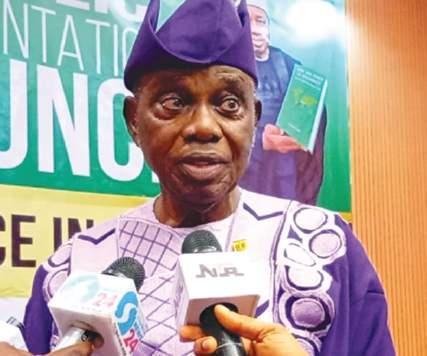
time and space. Wherever Nigerians are found and at any time of need, foreign policy response of diplomatic protection and protection of the national interest remain the challenges to address.
Secondly, in 2026 alone, there have been three diplomatic memoirs: those of Ambassadors Onobu and Lewu, already publicly presented, as well as that of Ambassador Ogunsulire, which is forthcoming and which has the potential to shape the understanding of Nigeria’s roles in and current understanding of the 1960 crises in the Congo. On 28 July, Ambassador Jaiyeola Joseph Lewu’s Time and Space in Diplomacy: The Memoirs of a Diplomatist, published by Bolytag International Publishers in Ile-Oluji, Ondo State, was presented at the Tafawa Balewa House in Abuja.
While Ambassador Onobu’s memoirs focused on fragmentation of time, Ambassador Lewu addressed the linkages between time and space in diplomacy. What impact has time on the life of Ambassadors Onobu and Lewu? How has space shaped the life of Ambassador Lewu? Ambassador Lewu’s memoirs is quite interesting in this regard. The memoirs has a pagination of 393 pp. without the preliminaries and 432 pp. with the preliminary pages. It was presented, as noted above, to the public on Tuesday, 28th July, 2026 at the Tafawa Balewa House, Conference Hall, as from 10.00 a.m. It has three editions: limp, hard back, and jacketed.
Without whiff of doubt, understanding a book review can be difficult or understood out of context because of the nuances in expectations. For instance, academics expect to hear the extent to which there has been any scientific value. Book vendors are interested in the extent of marketability of the book. Those reading for pleasure ask for experiential lessons and extent of simplicity of language of expression. More important, what is the extent of the author’s correct interpretation of events? In the same vein, has the book reviewer a correct understanding of the book under review. Did the reviewer put himself in the same shoes as the author? A book review, like any journal article review, is a tough exercise and challenge. A review or revoir in French can have a non-technical and technical meaning. In its non-technical sense and as an intransitive
Whatevaluationandrecommendation?Withoutanyjotofgainsaying,itisabookofallthetime thatshouldbereadtimeandovertime,becauseitteachesthefearofGodinmanyways:needfor humility,pietyandself-discipline,dintofhardwork,andparticularlyhowtomanagetimeandspace, notonlyintheconductofdiplomacy,butparticularlyduringdiplomaticgatherings.Ambassador Lewuaddressedhownottoquarrelwhenonesucceedsacolleaguewhorefusestogiveahandover note.Hesaid,intheeventofnohandovernote,thereshouldbesanction.Hesuggestedaminimum offouryearsofstayfordiplomatsservingatmultilateralposts.Manpowerdevelopment,healsoposited,isadesideratuminlightofthegrowingimpactofartificialintelligence.Hesaidinter-ministerial coordinationisasinequanontopreventdiplomatsfromnegotiatingfromthepositionofignorance asNigerianmissionshardlyknowabouthappeningsinotherMinistrieswhentheyrelatewith foreigncountries.Moreimportantly,AmbassadorLewuraisedtherecidivistquestionofpoorfunding ofthediplomaticmissions.ManypoorerAfricancountriesdevoteabout5%oftheirnationalbudget todiplomacy,butNigeriaonlyearmarkslessthan1.5%ofitsbudget.HebelievesthatNigeriashould notengageinadiplomacyofpenuryorindiplomacyconductedindeficit.Heinsistedontheneedto alwaysreckonwiththepoliticalandeconomicreportsfrommissionsratherthansimplyfilingthem away.Andmostimportantly,whatAmbassadorLewutriedtoimpactistheneedforgoodmanagementoftimeandnon-abuseofspace.However,therewaslittleornorespectfortimeandspacein boththepresentationofthebookandcelebrationofAmbassadorLewuat80eventhough‘Timeand Space’aretwocriticaldefiniendafortheconductandmanagementofdiplomacy

verb, a review can have seven different meanings: Examine again; Look at or study again; Look back upon, as in a memory; Think of retrospectively; To go over, as a manuscript, so as to correct defect; To make an inspection of, especially formally; and To write or make a critical review of, as a new book. In its technical sense, the legal and journalism frameworks clearly illustrate the technicality (vide the New International Websters Comprehensive Dictionary of the English Language, 2010 edition, p.1078) (vide the New International Websters Comprehensive Dictionary of the English Language, 2010 edition, p.1078).
In the legal parlance, a review means to examine or to determine the legality or correctness, as in the case of rulings or judgments of a lower court versus a higher court. Technically, it is a judicial revision by a superior court of the order or decree of a subordinate court. Similarly, in journalism, it is to write a review for a magazine. Besides, a review is a second, repeated, or new view, a retrospective survey, or examination. It is a critical study or examination, an article or essay containing a critical examination or discussion. It is also a periodical devoted to essays in criticisms and on general subjects. It is a formal or official inspection or view. In essence, a review is an article or essay containing a critical examination or discussion, a periodical devoted to essays in criticisms and on general subjects, a formal or official inspection or view.
On the basis of the foregoing, the main features of a review are retrospection, examination, study, criticism, correction, improvement, and a new view. To be able to respond to these challenges, a good reviewer should always seek to engage in correct interpretation and presentation of facts. In doing this, a ‘review conceptual approach’ can be adopted by a book reviewer: This enables an analytical and objectivity of purpose of a book review, rather than seeking to be a reviewer criticizing on a completely different parallel lines that never meet.
Grosso modo, it is generally agreed that a standard book review format cannot but include an introduction, summary, critical analysis, and a conclusion. But of what purpose does a critical analysis serve in the context of an autobiography? None, Interpretations of reported events can vary but no one can know better the understanding of an issue in which an autobiographers is personally involved. This is in spite of the psychology of human differences. This is why we have personally adopted a review conceptual approach.
In this regard, the word review, has two main functional challenges: examination and result. The examination is explained by the first three letters: R, E, and V while the result is explained by the other three letters: I, E, W. Put differently, a REVIEW simply means: R: Read the Book; E: Examine the sources, logical consistency of data in the various chapters, especially the organograms, tables, etc.; V: Verify the extent of scientificity of arguments put forward in the book; I: Inform this august audience and the generality of the public; E: Engage the author in the determination of extent of his contribution to existing knowledge; and W: What recommendation? Based on this, Ambassador Lewu’s memoirs is printed on a white 70 grams MF Bond Paper. It is printed in 12 point size Times New Roman in terms of font size. Thus, it is therefore quite legible and friendly to the eyes. In terms of size of the book, it is 9’’x 6’’ and therefore quite handy. The style of presentation is not technical. It is written in plain English language and not ordinarily by a diplomat, but by a diplomatist. A diplomat is as defined in the 1961 Vienna Convention on Diplomatic Relations. A diplomatist, etymologically, is a diplomat with additional very sagacious mind that combines today’s Vienna Convention definition with intellection and critical thinking
Some Truths about Diplomacy
How many diplomats are diplomatists in Nigeria and even in the whole world? What is diplomacy really about? One truth about diplomacy was given by Ambassador Ignatius Olisemeka in his “Good Night, Ambassador Olujimi Jolaoso (1925-2016) published in The Guardian (Lagos) on 2 November 2016. As Ambassador Olisemeka put it: ‘the only word that can adequately capture this personage is “elegance. Olu Jolaoso is the epitome of elegance. Elegant in looks, in style, in taste, in manners, in conduct, and in character.’ Ambassador Olisemeka could not have been more correct. A diplomat and a diplomatist must combine elegance in various ramifications with his or her functional duties. Ambassador Lewu’s memoirs reflects this characteristic.
As said earlier, Time and Space in Diplomacy is chapterised into 14 and has a pagination of 393 without the preliminary pages, and 432 with the preliminary pages. In the preliminary pages of the book, Ambassador Lewu provided in the preface a background to his sojourn in multilateral relations which began in 1973 in Addis Ababa. A Trustee and Foundation President of the Association of Retired Career Ambassadors of Nigeria (ARCAN), Ambassador Oladapo Olusola Fafowora, wrote the foreword and noted that the perception of the diplomatic service as that of just living a comfortable live abroad, wining and dining in ornate offices is wrong. As he put it, it “is a gross misconception of the diplomatic service as it is more than that.” Ambassador Lewu expressed his profound gratitude to many notable people, including Ambassadors Fafowora, Azikiwe, Kayode Shinkaiye, Martin Uhomoibhi, Chuka Udedibia, Professors Olatunji Dare and Olu Obafemi. More important, Ambassador Lewu explicated in the introduction to the memoirs the originating dynamics of his diplomatic career, such as discipline, industry, courage, probity, integrity, and the fear of God.
Read full article online on www. thisdaylive.com
Ambassador Jaiyeola Lewu
EngagEmEnts
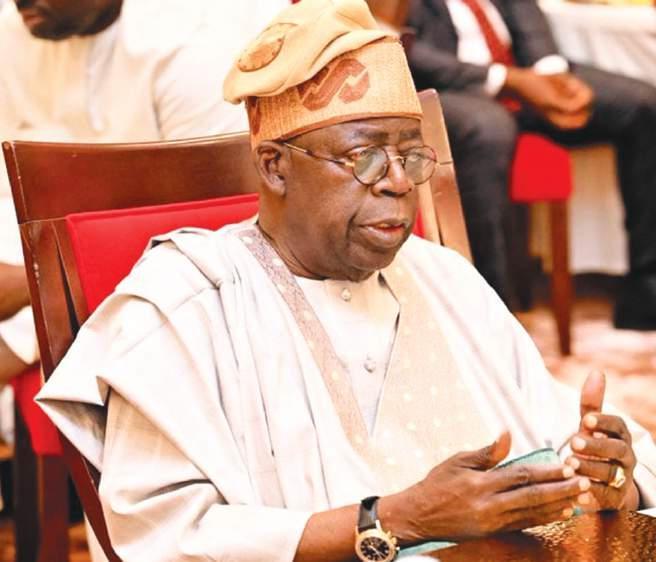
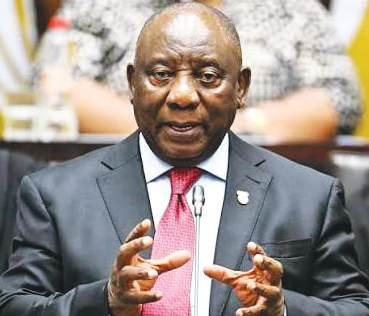
Neutralising South Africa’s Xenophobic Excesses
Nelson Mandela must be churning in his resting place. An exem- plary life lived and a myth cre- ated on a dream and a vision is now literally re- duced to ashes. The rainbow nation with prosperity for all races as a vision has been badly damaged . Its previously thriving post-apartheid economy is now literally in coma with frequent power outages, labour unrest and the return of racial divide and violence. Irate mobs are back on the prowl.
Donald Trump, America’s rascally President has frequently cited the return of racial violence to South Africa to buttress his mostly unfounded charges of discrimina- tion against whites in South Africa.
More directly relevant, South Af- rica has in recent months witnessed a wave of xenophobic mob protests and attacks against other Africans who have since come to settle and regard South Africa as home. Hun- dreds of thousands of these Africans have been chased out of South Africa by angry mobs of black South Africans were. Ostensibly, these mob attacks are motivated by immigration concerns. It is strange state that resorts to mob violence to enforce immigration restrictions.
Of specific relevance to us is the series of violence and crude treatment that has been meted out against Nigerians as a select group. Hundreds of thousands of Nigerians settled in South African for decades have been hounded from their homes and businesses. Property acquired over the years have been dispossessed. Businesses that have for long been thriving and provid- ing employment and livelihood to South Africans have been torched and sacked suddenly. Admittedly, efforts by Nigerian authorities to evacuate these unfortunate Nigeri- ans has been less than impressive if not outrightly incompetent.
This dastardly treatment of fellow Africans by South African mobs with the tacit and obvious collusion of the government in Pretoria is, in every way, a subversion of the
history of the country. Africa sacrificed to end Apartheid in South Africa. For decades, how to end apartheid was the cardinal foreign policy thrust of most African countries. Countries with the resources even located far away like Nigeria were branded “front line states” in the battle against the last vestiges of apartheid. It is in this spirit of continental solidarity that many Africans migrated to the newly independent and democratic South Africa. The rainbow nation welcomed all and sundry as it freed its economy from the stranglehold of apartheid and white domination of the economy. The sacrifice of fellow Africans was never lost on successive regimes in South Africa. Mandela upheld it. Mbeki kept faith. So did Motlan- the and Jacob Zuma before the present unravelling under Cyril Ramaphosa. Nigerians in SA- traders, property owners, small to medium
For Nigeria, the recent treatment of Nigerian citizens in South Africa does not show sufficient appreciation of the coun- try’s contribution to South Africa’s democracy and freedom.
Nigerian owned busi- nesses have been shut down and looted by irate mobs, people who have for decades made South Africa their home have been forcefully evicted from their homes, assaulted, visited with violence and rendered homeless and hopeless. And to observe the cavalier attitude of the South African government over these months is even more disheartening. Calls for more treatmentcompassionate and minimal
compensation have fallen on deaf ears.
The jobs lost, the businesses closed, the opportunities shut and the services lost will invariably lead to a hemorrhage of the South African economy. There is hardly evidence that the local South African black population understand the long term damage they have done to their economy. It is doubtful that they have the entrepreneurial capacity and energy of the Nige- rians and other Africans they have rudely hounded out. In the months and years ahead, the South African economy is likely to tank and shrink, further worsening the plight of the national economy.
The recent xenophobic assault on Nigerians in South Africa has led to calls for retaliatory measures by Nigerian authorities. Such calls may not fully understand the dif- ferential nature of the presence of Nigerians in South Africa or vice versa. Nigerians were mostly in ‘’South Africa as small to medium scale business operators- car dealers, restaurant owners, shop owners and general traders. An anti immigrant assault on them was bound to root them out in huge numbers without huge consequences for the Nigerian economy.
On the contrary, South Africa is present in Nigeria mostly in the form of huge corporations like telecommunications, banks, entertainment networks and super market chains, often employing hundreds of thousands of Nigerians and rendering very strategic services across the Nigerian stretch. More importantly, the South African multinationals operating in Nigeria make very huge tax payments to the Nigerian government, making their presence crucial to the Nigerian economy which is still in dire need of foreign direct investment. Promi- nent South African players in the Nigerian market include Shoprite, MTN, Stanbic/IBTC, DSTV etc.
Nigeria cannot afford to hound out and expel these huge South African companies from Nigeria without dire consequences for our economy and people. Many jobs will be lost. Tax revenue will be lost.
Strategic entertainment and financial services will be disrupted.
However, the command and control of South African businesses in Nigeria can be partially decapitated. Nigeria can limit the number of senior South African managers that these companies send to manage their affairs in Nigeria. This may not amount to outright nationalization but a considerable loss of control by South Africa. Towards a resolution of the relationship hiatus between the two countries, diplomacy could play a role. But one- sided adversity does not help diplomatic exchange. The South African economy is now creaky and troubled. Nigeria is also in bad form as well. Economic adversity has led to popular dis- quiet and political uncertainty.
But we are in a new world ruled by the selfishness of nations fueled by migration pressures and anti -immigration violence.
The pull of African brotherhood is strained by the pressure of national survival. Isolationism. Has suddenly become an attractive option for nations under the pressure of migrant invasion. Mob rule has overwhelmed rational governance and the muscle of parties in power. Under these forces, the strength of governments has withered consider- ably.The apparent face -off between Nigeria and South Africa calls for a different type of diplomacy. The imperative is for retributive economic diplomacy, diplomacy guided by the national economic interest and the welfare of our citizens wherever they may be on earth. The protection of our citizens as carriers of our economic interests has become paramount. Our over $25 billion annual home remittances from the Nigerian diaspora boils down to our people working and doing business around the world and sending money home for welfare and development. It does not look like the current Nigerian has thought deeply about the options open to Nigeria in relating with South Africa in the aftermath of this xenophobia outrage.
tinubu
Ramaphosa
SundaySPORTS
Team Nigeria Wins 10 Gold Medals as Curtain Falls on 2026 C’wealth Games Today
One less than Birmingham 2022, but with
Team Nigeria ended the 2026 Commonwealth Games in Glasgow, Scotland last night with 10 gold, seven silver and five bronze medals, one gold less than the country’s outing at the Birmingham edition four years ago.
Against all expectations, Nigeria won only one gold medal from the four projected on final day of competition as the quartet of Favour Ashe, Kanyinsola Ajayi, Nicholas Fakorede and Udodi Onwuzurike’s best of 38.12 secs in the men’s 4x100m relay fetched a bronze. Canada that was disqualified for Nigeria to step up to silver won their protest to reclaim the silver. Australia won gold in 38.07 seconds, just 0.05 seconds ahead of Nigeria.
In the women’s final, Nigeria finished sixth in 43.74 seconds. Jamaica claimed gold in 42.65secs, Canada took silver in 42.76 seconds, while Trinidad and Tobago secured bronze with a season’s best of 43.07 seconds.
The biggest disappointment of the final day of the track & field events of Glasgow 2026 for Team Nigeria was the bronze that the quartet of Ezekiel Nathaniel, Patience Okon-George, Samuel Ogazi and Ella Onojuvwevwo got. The anchor leg, Onojuvwevwo gassed out when it
mattered most, few meters to the finish line. She made the tactical error of out pacing the leaders but could not sustain the strength to continue to the finish line, Elsewhere, Ruth Usoro won silver for Nigeria in the women’s long jump. Her very first jump produced a wind-assisted leap of 6.87m to secure her place on the podium.
England’s Jazmin Sawyers won gold with 6.93m, while Australia’s Brooke Buschkuehl claimed bronze with 6.80m.
Earlier, Nigeria’s Samuel Ogazi lived up to his status as world No.1 in the quarter-mile this year by storming home in 44.25 seconds to claim Men’s 400m gold - his first senior medal of the track & field event of the 2026 Commonwealth Games ending today in Glasgow, Scotland.
The 20-year-old Nigerian quarter-miler who was finalist two years ago at the Paris 2024 Olympic Games, left his rivals trailing to cross the line 0.57secs clear of defending champion, Jereem Richards of Trinidad and Tobago (44.82secs), while South Africa’s Zakithi Nene picked the consolatory bronze with 45.21secs.
Before the race, Ogazi was the clear favourite for the gold medal, following his extraordinary outdoor season. He few months back erased Innocent Egbunike’s 44.17secs long-standing 400m national record with a new 44.02secs.
IGP Disu Hails Nathaniel over 400m Hurdles Gold Medal Feat in Glasgow 2026
The InspectorGeneral of Police, Olatunji Disu, has congratulated Police officer, Ezekiel Nathaniel, following his historic gold medal triumph at the Commonwealth Games in Glasgow, Scotland.
In a statement yesterday, the IGP praised the outstanding performance of Nathaniel who is a corporal in the Nigeria Police force.
Nathaniel made the nation proud after winning the gold medal in the men’s 400m hurdles at the Glasgow 2026 Games.
In his reaction, the InspectorGeneral of Police Disu, described Nathaniel’s achievement as a defining moment for the Nigeria Police Force, stressing that it reflects the immense potential
of police officers who combine dedicated public service with excellence in sports.
He noted that the gold medal triumph has opened a new chapter of inspiration, proving that with discipline, determination, and institutional support, officers can attain global sporting success while serving the nation.
“On behalf of the Nigeria Police Force, I congratulate Corporal Ezekiel Nathaniel on his historic gold medal win in the 400m hurdles at the 2026 Commonwealth Games,”
“You have shown the world that our officers excel both in service and in sport. The Nigeria Police Force is proud of you and celebrates this outstanding achievement, which has brought honour to the Force and to our great nation.” Disu concluded.

Super Falcons Beat Zambia 1-0
2027 World Cup Qualifying Hopes
After surprisingly losing 2–3 to Malawi in their opening Group C game of the 2026 Women’s Africa Cup of Nations in Morocco, the Super Falcons needed to respond in their second match against Zambia. The 10time African champions did just that with a slim 1–0 win against the Copper Queens to keep their quarter-final qualification hopes alive.
A goal scored by veteran striker Asisat Oshoala was all the Falcons needed to ensure victory, despite playing a large portion of the game one player short after center-back Oluwatosin Demehin was shown a straight red card. Head coach Justin Madugu
actually made five changes to the side that started against Malawi, bringing in Michelle Alozie, Rofiat Imuran, Uchenna Kanu, Deborah Abiodun, and Asisat Oshoala. That decision paid off. In the 8th minute of the match, the Al-Hilal forward put the ball into the back of the net after a clinical press, forcing it past Zambia’s goalkeeper, Hazel Nali. Nigeria’s night took a difficult turn in the first half when Demehin was initially shown a yellow card for a challenge. Following a VAR consultation, the referee upgraded the punishment, handing the Galatasaray defender a straight red card and sending her off. Despite being down to 10 players, the record champions held on tightly to their slender lead.
Madugu adjusted his tactics in the second half, pulling off Oshoala for Chinwendu Ihezuo to maintain defensive stability. Zambia threw numbers forward late into the game, but the Super Falcons’ defense remained resolute. The final whistle eventually sparked celebrations as goalkeeper Chiamaka Nnadozie and her team secured the vital three points. With Malawi leading Group C on 6 points, Nigeria’s upcoming match against Egypt remains crucial for securing safe passage into the knockout phase.
Uefa, Concacaf Slam Leadership in FIFA Amidst Growing Pressure on Infantino
Gianni Infantino’s leadership of Fifa has been publicly questioned by football’s governing bodies in Europe, North and Central America and the Caribbean.
Uefa and Concacaf both released statements on Saturday criticising the leadership at the world governing body after Infantino said Fifa would no longer proceed with the proposal to sell stakes in their competitions to private investors.
Uefa, which governs European football, welcomed the decision to withdraw the plan, describing it as a “victory for the whole game”.
The body accused of Infantino of failing to deliver on promises, quoting a speech he gave when campaigning to become Fifa president in 2016.
Concacaf, which oversees football in North, Central America and the Caribbean, followed Uefa in criticising the
plans, saying “unity had prevailed” and that the proposals were a “symptom of leadership that has stopped putting football first”.
“This recent unilateral and egregious act of poor governance and leadership follows a pattern of missteps and similar behaviour. A full review of this leadership must now take place,” a Concacaf statement read.
Unlike Uefa, Concacaf did not mention Infantino by name.
The fallout from the plans means Infantino is now under immense pressure as he seeks re-election for a fourth term as president at the Fifa Congress in March.
Uefa were the first major governing body to react to Infantino’s decision to drop the investment plans, saying the Swiss had failed to deliver on his promises.
“The current Fifa leadership has not only lost Uefa’s confidence but also that of many other members of the football family,” Uefa’s statement read.
Samuel Ogazi won Nigeria’s only gold medal in the men’s 400m on the final day of the track & field events of the 2026 Commonwealth Games ending today in Glasgow, Scotland
is hard to rebuild in four years what was destroyed across decades. But, as I often say, we just must be sure we are facing the right direction day by day. Now, to the second issue: Obi says it is impossible to attain uninterrupted power supply within four years. I find this scary — and this has nothing to do with him. President Olusegun Obasanjo was in office for eight years. He could not fix the sector. President Umaru Musa Yar’Adua was there or thereabouts for three years, same story. President Goodluck Jonathan held the fort for five years, no dice. President Muhammadu Buhari did not change the story in eight years. President Bola Tinubu has been in charge for three years and here we are. And Obi is now saying uninterrupted power cannot be assured by 2031 if he were elected president in 2027. What is so special about this sector?
It is not as if we are currently at ground zero. We have the power plants with unutilised capacities. We have the transmission lines that cover the entire country. We have the distribution facilities in virtually every community. Why should it take forever to fix the sector and end outages once and for all? Why can’t we improve on what we have on the ground and ramp up supply within four years? Even if Nigeria did not have electricity at all in 1999 — as in, not a single cable laid or pole hoisted — is 27 years not enough to have built all the infrastructure from scratch, with every village electrified and power supply uninterrupted, given the billions of dollars we have been sinking into the sector?
I travel quite a lot and I have to confess
BALANCING ACT
Governor Uba Sani of Kaduna state has named Mr Jerry Adams, the executive chairman of the Kaduna State Internal Revenue Service (KADIRS), as his running mate. Normally, this is no headline. However, religious balancing in the delicately poised state has been on the ropes since 2019 when then-governor Nasir el-Rufai decided to go with a Muslim-Muslim ticket. Unlike at the national level where fielding a northern Christian as running mate could pose an electoral risk, Kaduna state had no justification to abandon its religious balancing. Even though Muslim-Muslim tickets won the last two elections, the political tension has been obvious. I commend Sani for playing good politics. Inclusion.
that I have not been to any country where power outages are near as frequent as in Nigeria. Even small West African countries enjoy stable power, at least in their major cities. South Africa lapsed into a severe power crisis a few years ago but tackled the issue in no time. So why is Nigeria so different? I wish I had the answers. Industry experts will explain and explain but there is no evidence. As Obi himself once jokingly told me, “Ghanaians don’t know how many megawatts their country is producing. All they know is that they flip their switch and the light comes on. When ordinary people begin to discuss megawatts, then something is terribly wrong.”
In fairness to Obasanjo, he tried to address the power issue during his second term. He launched the power sector reforms in 2005. Under his government, the federal government built new power plants for the first time in decades: Geregu, Papalanto, Alaoji and Omotoso. But many of the contracts were awarded apparently with the funding of the 2007 elections in mind, so due diligence and proper planning were bypassed in many cases. In fact, we were building power plants without thinking of how they would get gas supply. Such was the indecent haste. There was the scandalous case of Alaoji: the bridge leading to the site was not strong enough to bear the weight of the turbine.
On assuming office in 2007, Yar’Adua, who had vowed during his campaign to declare emergency in the power sector, put all Obasanjo’s projects on hold in order to probe the contracts. He had campaigned on the promise of promoting transparency,
rule of law and due process. The turbines were rotting away at the ports while “rule of law” was making newspaper headlines, and we spent the next two years arguing over whether or not Obasanjo did the right thing by unilaterally spending savings from the excess crude account on the projects. By the time Yar’Adua asked contractors to resume work, the ship had sailed. We had lost precious time in what was a national emergency.
The Nigerian factor also came into play: many communities devised schemes to stall the projects by trying to extort the contractors over the right of way for gas pipelines and transmission lines. Suddenly, new houses started springing up on corridors for which the right of way had been secured and compensation fully paid. Some communities demanded fresh compensation. Some youths claimed the initial payments were for the elders; they wanted their own. It was another battle for the national cake. After many years, the issues were resolved and the projects were completed, but the privatisation by the Jonathan administration was a total mess. We are paying the price till today.
Thanks largely to Obasanjo’s “illegal” use of excess crude savings, our generation capacity improved significantly. We can now produce over 10,000mw. This is still insufficient for a country of 230 million people, but when you realise that we were stuck at 3,000mw for decades while our needs were exploding, then the improved capacity should make sense. Sadly, the national grid — old, tired and deficient — cannot handle more than 5,000mw. It is like you have an estate that requires
And Four Other Things…
POLICE AND POLITICS
Two weeks to the Osun governorship election, key leaders of the Accord Party, the ruling party in the state, are in trouble. Alhaji Teslim Igbalaiye, secretary to the state government, was arrested by the police for “vote-buying” — although the election is still two weeks away. This must be some record. Governor Ademola Adeleke has alleged that over 60 leaders of the party were arrested by the police and transferred to prisons in Abuja and Nasarawa. It is very clear that those using the police in Osun state have unfettered access to federal powers — and do I need to say they are the APC leaders? People say this abuse will stop if we have state police, but should the police be partisan at all? Sad.
CARDINAL ONAIYEKAN’S ABUSE OF CLERICAL PRIVILEGE
regularly. That was certainly not the reality in many states from around 2014. Even about four years ago, 27 state governments struggled to meet even their most basic obligations. Many of those civil servants and pensioners are themselves parishioners in Catholic churches.
They know, from lived experience rather than official pronouncements, that there has been real relief in the regular payment of salaries and pensions. While this does not erase the discomfort many Nigerians still face, it is wrong to dismiss or ignore those improvements casually.
So when President Tinubu reminded the bishops of these facts during the meeting, he was not, as Cardinal Onaiyekan later suggested, being aloof or dismissive. He was presenting evidence to support his argument that the country is not standing still. A disagreement over facts should not be interpreted as arrogance.
The same applies to security. The bishops declared that Nigeria is bleeding. The President thinks otherwise. President Tinubu did not deny the seriousness of the security situation. Rather, he acknowledged the challenge while outlining the gains recorded by the Armed Forces and intelligence agencies
across different theatres of operation.
As Commander-in-Chief, he receives operational briefings, intelligence assessments, and battlefield reports unavailable to the general public. The bishops, like other Nigerians, rely largely on media reports and public information. That does not make the president infallible, but it does mean he possesses information unavailable to the generality of the people. It is, therefore, legitimate for him to argue that the overall picture is more nuanced than newspaper headlines sometimes suggest.
Cardinal Onaiyekan’s ARISE NEWS interview also reflected a familiar error that many ideological and professional critics make. They often assume that only critics speak truth to power, while everyone around a leader is either unwilling or incapable of doing so. It is an attractive narrative, but it is rarely true.
What truth does anyone really need to tell President Tinubu that he does not already know? As president, he has multiple channels for feeling the pulse of the country. He reads an average of 10 newspapers every day. He watches television, including discussion programmes, to gauge public opinion. He receives daily security, social,
70 HEARTY CHEERS
Dr Muhammed Alimi AbdulRazaq, founder of the Bridge House College, Lagos, clocked 70 on Friday. The first time I met him, as I recall, was when I went to interview his father, the late Alhaji AGF AbdulRazaq, ahead of his own birthday in 2004. Dr AbdulRazaq was later appointed the executive commissioner for legal, licensing and enforcement at the newly established Nigerian Electricity Regulatory Commission (NERC). The celebrated promoter of knowledge holds a PhD in law from the University of Hull, UK. The Mutawali of Ilorin Emirate has endowed the AGF AbdulRazaq Professorial Chair in Public Law at the University of Ilorin. Here is to more fulfilling decades ahead. Cheers!
and economic intelligence reports from various arms of government, reports that are prepared for decision-making and are not sugar-coated. In a meeting earlier in the week, he still referenced a very harsh and largely uninformed opinion piece written by Dr Chidi Amuta in his last Sunday Thisday Newspaper column.
Beyond that, he has friends and associates embedded in the social fabric of the country, drawn from different regions, professions, and political persuasions, who serve as informal sounding boards. Against that background, the suggestion that President Tinubu somehow needs only the Catholic Bishops to acquaint him with the truth is an overreach. They are an important constituency, but they are by no means the exclusive custodians of the national mood or the nation’s conscience.
To assume that criticism delivered publicly is the only form of truth-telling is to misunderstand how government works. Presidents are exposed daily to competing advice, conflicting intelligence, uncomfortable assessments, and hard realities. Presidents are constantly confronted with information, much of it unpleasant. The real question is not whether they know the truth but
100kVA and you have generators that can produce just 50kVA — but you can only send 25kVA to the houses. Many GenCos are now dealing with managing idle turbines that were engineered to be active 24/7. Meanwhile, the DisCos themselves are not investing enough to improve distribution, which is the end point at which Nigerians can enjoy power supply. Their inefficiency might have stemmed from the misconception before privatisation that power would be as lucrative as telecoms. On the other hand, the tariffs do not cover the costs while energy theft and unsettled bills remain a headache. What the DisCos have done in recent years is to divert available power to “Band A” customers who pay cost-reflective tariffs. Every single thing seems complicated in the power sector. This does not mean the sector is beyond redemption but we can see that the problems are not just technical. Charging cost-reflective tariffs across the board may be an obviously logical step, but will that not send another shock to the system — like the removal of petrol subsidy? Leaders are faced with these tough choices all the time. The problems and challenges facing the Federal Republic of Nigeria are not just technical. They are deeply cultural and highly political. And when the development problems of a country are entangled in a cultural and political web, they cannot be solved with rhetoric. It will take more than poetry to untangle the web. I, nonetheless, concede that it is election season and politicians must promise us heaven and earth. But some of us stopped being gullible ages ago.
NO COMMENT
Mr Shamseldeen Ogunjimi, accountantgeneral of the federation, has added one more embarrassing dimension to the Presidential Foreign Intervention Promotion Council (PFIPC) scandal. He said Prince Adeniyi Adeyemi, the socalled DG of the council, hijacked a letter sent to the State House that could have revealed the PFIPC documents were forged. Did you hear that? The office of the accountant-general of the federation (OAGF) sent a letter to the federation’s seat of power and it was hijacked? Who was the courier? Who signed for delivery? If OAGF’s letter to the almighty State House could be so easily hijacked, then how many other hijacked letters didn’t make the news at all? Hahahaha…
what choices they make in response to it.
The Catholic Bishops discharged what they considered their moral obligation by presenting their concerns to the president. President Tinubu, for his part, accorded them respect by granting them an audience and responding to every issue they raised. That exchange reflected the civility expected in a constitutional democracy.
Reciprocity should have dictated that the confidentiality and dignity of that engagement be preserved. As such, it was inappropriate for one of the participants to emerge almost immediately on national television to provide his own version of what was essentially a private conversation with the president. Clerical office carries privileges, but it also imposes obligations. Among the qualities the Scriptures require of bishops are temperance, maturity, self-restraint, and the wisdom to remain above needless public controversy. Those virtues become even more important when dealing with matters of state. Public influence should be exercised with discretion, not by converting privileged access into a platform for post-meeting commentary.
•Ajayi is Senior Special Assistant to President Tinubu on Media and Publicity
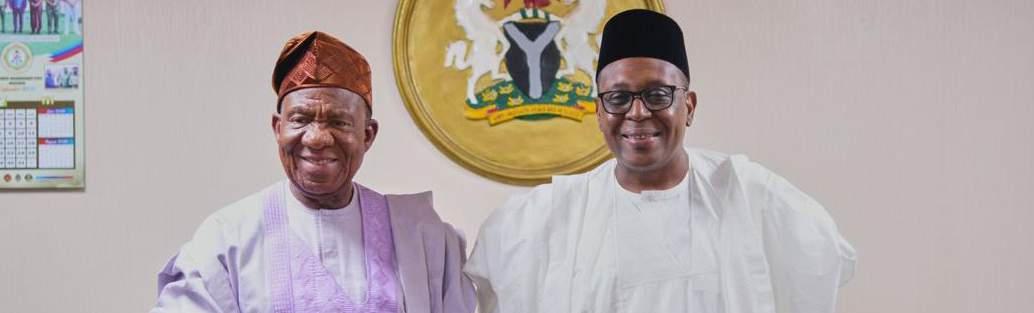
Obi and the Damning Nigerian Reality
Mr Peter Obi, presidential candidate of the Nigeria Democratic Party (NDC), was a guest of Seun Okinbaloye on Channels TV last week. He spoke on a wide range of topics as the race for Aso Rock in 2027 gathers energy and momentum. The aspect that jumped at me was the power crisis. While vowing to address the problem if elected president, Obi said uninterrupted power supply is not possible in four years. This hit me in two ways. The first was his seeming admission that there are no quick fixes to Nigeria’s problems, even though that is not what voters want to hear. The second is the intractability in fixing the power sector since we started experiencing blackouts in the mid-1970s.
I am generally an optimist — a “Naijaoptimist”, if you will — but I am also
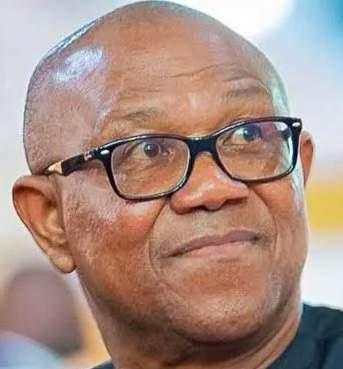
We left too many reforms and adjustments too late. For too long, we lacked focus. We kept taking one step forward and two steps backward for decades, particularly since this democratic order berthed in 1999. Nigeria is not irredeemable but even with the best of presidents and the best of intentions, we need to manage our expectations of a magical turnaround. It will take more than one president and one term to turn Nigeria around. Unpopular opinion but that is the naked reality. Typically, election seasons are when politicians talk a good game. They promise to eradicate all the mosquitos and cockroaches and threaten to turn Nigeria into Dubai and Paris combined. But when they get the job, the story begins to change. We were all witnesses to the poetic campaign of the APC in their quest for power in 2015. You would think that by 2016, every Nigerian road would have been paved,
every poor citizen saved, every hospital refurbished, every school distinguished, and every terrorist extinguished. When they eventually got hold of power and words needed to be translated to action, they started stammering and saying the PDP destroyed Nigeria “for 16 years”. It seems Obi and his supporters are borrowing from the APC-style El Dorado promises. Obi says he needs just four years to “change” Nigeria. Wow! That is quite a commitment to make. He is either grossly underestimating Nigeria’s hydra-headed challenges or maybe he possesses an amazing capacity to turn stone to bread. It is comforting that Obi is now admitting that at least one thing cannot change in four years. His fans may not like it but it was also needed to jolt them to reality. I repeat: Nigeria will not change overnight. It
Continued on page 61
Cardinal Onaiyekan’s Abuse of Clerical Privilege
There is something fundamentally inappropriate about Cardinal John Onaiyekan granting a television interview to offer his own account and interpretation of what transpired during the private meeting between the Catholic Bishops’ Conference of Nigeria and President Bola Tinubu. It is, in my view, an abuse of clerical privilege.
The bishops requested an audience with the president. He granted the audience graciously. They presented, as was their right, a catalogue of the country’s economic, social, and security challenges as they saw them. Except for their grudging acknowledgement of the benefits of NELFUND, they were dismissive of the other great things done by the administration. The bishops were notably acerbic in their submission, but the president listened to them patiently and responded.
That should ordinarily have been where the matter rested. None of the issues raised by the bishops is beyond scrutiny or rebuttal. Their assessment is neither scripture nor an article of faith. It is a perspective, and perspectives can be challenged with facts and evidence.
President Tinubu did exactly that, responding point by point to the issues they raised. On the bishops’ demand for the return of schools to their owners, the president was surprised that such an issue could be tabled before him, as it is a matter for the states to resolve, in line with our constitution. So, he asked the bishops to take the matter to the governors and reminded them he returned mission schools in Lagos State when he was governor.
The president argued that the bishops’ characterisation of the country’s current condition was incomplete and, in several respects, inaccurate. He pointed to measurable
progress on the economic, social, and security fronts. He did not pretend that Nigeria’s problems had disappeared. He acknowledged that significant economic and security challenges remain. His point was that the country has emerged from “a dark tunnel”, that his administration has laid the foundations for recovery and that the next phase is to ensure the greatest number of Nigerians feels the gains.
What the clerics often overlook in these interventions is that governing a country is fundamentally different from shepherding a church. In a democracy, every interest group, including the Catholic Church, has every right to demand more from government. That is part of democratic engagement.
But the president of a nation of more than 200 million people is required to make difficult choices every single day. Those choices involve competing interests, limited resources, and imperfect options. They will
inevitably disappoint some constituencies. There is no president, whether Tinubu or whoever succeeds him, who can wave a magic wand and make Nigeria’s accumulated problems disappear overnight. It is easy to compile a list of national problems. It is far more difficult to acknowledge the disasters that have been averted. Whatever anyone thinks of President Tinubu’s policies, it is impossible to ignore the fiscal crisis he inherited and the measures taken to pull the country away from the edge of a financial cliff. Even the bishops themselves should recognise that one tangible consequence has been the restoration of greater fiscal stability across many states.
Countless civil servants and pensioners who, for years, endured unpaid salaries and pensions are now receiving them more
Prof. Muhammad Ali Pate, during Ikpea’s courtesy visit to the