FGN Bond Subscriptions Hit N9.04tn as Investors’ Appetite for Government Securities Soars
Kayode Tokede
Despite a moderation in yields across some maturities, investors’ appetite for Federal
Government of Nigeria (FGN) bonds remained exceptionally strong in the first half of 2026, with total subscriptions rising to N9.04 trillion, more than
doubling the N4.37 trillion recorded in the corresponding period of 2025.
THISDAY's findings showed that the remarkable
demand was driven largely by institutional investors, particularly Pension Fund Administrators (PFAs), banks, and insurance companies,
which continued to favour the safety of sovereign securities and the opportunity to lock in relatively attractive returns amid an uncertain
The sustained oversubscription also reflects Continued on page 5
Iran Accuses US of Violating Peace Deal as Fresh Strikes Threaten Middle East Ceasefire
Sunday Ehigiator
Iran yesterday condemned what it described as American attacks on its territory, saying the US military strikes on missile and drone storage sites, as well as coastal
radar installations, breached the memorandum of understanding that halted weeks of hostilities.
In a separate diplomatic development, Israel and Lebanon on Friday signed a US-brokered framework agreement intended to advance peace along their shared front. The renewed violence followed US accusations that
More Condemnations Trail NDC
Deregistration Ruling, INEC Awaits
Atiku: Ruling exposes Tinubu's desperation to impose one-party system ADC alleges coordinated attempt to weaken opposition parties Falana warns against threat to multi-party democracy, says judge cannot reverse own judgment
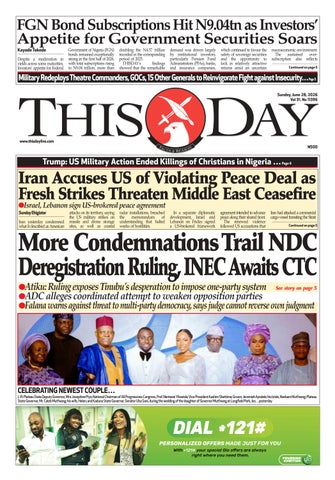
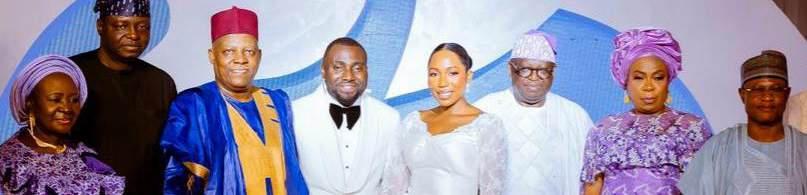
CELEBRATING NEWEST COUPLE…
L-R: Plateau State Deputy Governor, Mrs. Josephine Piyo; National Chairman of All Progressives Congress, Prof. Nentawe Yilwatda; Vice-President Kashim Shettima; Groom, Jeremiah Ayodele; his bride, Nanbam Mutfwang; Plateau State Governor, Mr. Caleb Mutfwang; his wife, Helen; and Kaduna State Governor, Senator Uba Sani, during the wedding of the daughter of Governor Mutfwang at Longfield Park, Jos…yesterday
Military Redeploys Theatre Commanders, GOCs, 15 Other Generals to Reinvigorate Fight against Insecurity
The Chief of Army Staff (COAS), Lieutenant General Waidi Shaibu, has redeployed theatre commanders, General Officers Commanding (GOCs), and 15 other generals in a strategic shake-up aimed at reinvigorating the Nigerian Army's fight against terrorism, banditry, kidnapping, and other emerging security threats nationwide.
This is just as Shaibu has expressed confidence that more than 8,000 newly trained soldiers
Chuks Okocha, Adedayo Akinwale in Abuja, and Wale Igbintade in Lagos
The decision of the Federal High Court sitting in Lokoja, the Kogi State capital, to set aside its earlier judgment recognising the Nigeria Democratic Coalition (NDC), yesterday continued to receive widespread condemnation.
The presiding judge, Justice Isah Dashen, on Friday set aside the earlier judgment directing the Independent National Electoral Commission (INEC) to register the NDC as a political party.
Reacting, the electoral umpire yesterday said it was awaiting the Certified True Copy (CTC) of the court's ruling.
of Hormuz earlier in the week, an allegation Tehran has not acknowledged.
The latest escalation has heightened concerns about security in one of the world’s most strategic shipping lanes, even as both sides continue negotiations toward a broader, permanent settlement.
The US Central Command (CENTCOM) said its military operation targeted Iranian missile and drone storage facilities and coastal surveillance positions in response to what it called “unwarranted aggression against commercial shipping by Iranian forces” that “clearly violated the ceasefire.”
However, Iran insisted the American operation itself represented the first breach of the truce.
investors' confidence in the federal government's ability to honour its debt obligations, even as the Debt Management Office (DMO) continued its strategy of reopening existing bonds to deepen the domestic debt market and finance the country's widening fiscal deficit amid limited access to external funding.
An analysis of FGN bond auction results obtained by THISDAY showed that the
would significantly strengthen ongoing military operations and contribute to restoring lasting peace and improving security across Nigeria.
The extensive redeployment, which affects key operational, command, training, and staff appointments, forms part of the Army's ongoing efforts to enhance operational effectiveness, strengthen national security, and consolidate its capacity to tackle evolving security challenges. According to a statement by the Acting Director of
But a former Vice President and presidential candidate of the African Democratic Congress (ADC), Atiku Abubakar, and his party, as well as human rights lawyer and Senior Advocate of Nigeria (SAN), Mr. Femi Falana, have condemned Friday's court ruling directing INEC to deregister NDC.
On his part, Atedo Peterside, an investment banker and economist, has declared that judicial rascality can be stopped not just by relying on Appeal Courts to overturn "obnoxious judgements" but also through disciplinary actions.
A top INEC official, who preferred anonymity, told THISDAY yesterday that the
“These brutal attacks, which targeted Iranian coastal surveillance facilities, are a blatant violation” of the memorandum of understanding that ended the war, the Iranian Foreign Ministry said in a statement.
Iran’s Revolutionary Guards Corps later announced retaliatory strikes against US military positions in the Gulf region, warning that any further attacks would trigger a much stronger response.
The Guards said they had targeted American sites “in retaliation”. They warned that “if the aggression is repeated, our response will be broader than this,” according to a statement carried by Iranian state television on Telegram. The conflict also spilled into
DMO offered bonds worth N4.95 trillion during the first six months of 2026, representing a 6.2 per cent increase over the N4.66 trillion offered in the corresponding period last year. However, actual allotments stood at approximately N4.8 trillion, representing a remarkable 159.5 per cent increase over the N1.85 trillion raised in the first half of 2025.
The year's first auction, held in January, witnessed
Army Public Relations, Colonel Appolonia Anele, the appointments involve field commanders, commandants of military institutions, and principal staff officers at Army Headquarters.
In the new postings, Major General WM Dangana has been appointed General Officer Commanding (GOC), 3 Division, Nigerian Army, and Commander, Joint Task Force (JTF), Operation Enduring Peace, replacing Major General EF Oyinlola.
commission would respond accordingly upon receiving the CTC.
"We have not received the CTC of the judgment delivered on Friday, June 26, 2026, by the Federal High Court sitting in Lokoja, which set aside an earlier order concerning the registration of the Nigeria Democratic Congress.
"Whenever we receive the CTC, we will react accordingly," the official said.
Atiku: Ruling Exposes Tinubu's Desperation to Impose
One-party System
Condemning the court ruling,
neighbouring Bahrain, whose Foreign Ministry said several Iranian drones targeted the country yesterday.
Bahrain condemned the attacks, accusing Tehran of “sabotaging peace efforts” aimed at stabilising the region following the recent ceasefire.
CENTCOM described the latest military operation as “a powerful response to yesterday’s attack on a commercial ship that was transiting the Strait of Hormuz.”
US President Donald Trump had earlier denounced what he described as an Iranian drone strike on the vessel.
“This is a foolish violation of our ceasefire agreement,” Trump said.
Vice President JD Vance also warned Tehran against further
overwhelming investor interest as the DMO reopened the February 2031, February 2034, and January 2035 bonds with a combined offer of N900 billion. Investors submitted bids worth N2.25 trillion, prompting the DMO to allot N1.68 trillion at stop rates of 17.62 per cent, 17.50 per cent and 17.52 per cent, respectively.
Investor appetite strengthened further in February when the DMO
Major General EI Okoro takes over as GOC, 6 Division, Nigerian Army, and Land Component Commander, Joint Task Force South-South, Operation Delta Safe, replacing Major General EE Emekah.
Also, Major General JR Lar has been appointed Commander, Army Headquarters Garrison, while Brigadier General OM Oyekola assumes office as Acting Military Secretary (Army).
Brigadier General I Waziri retains his position as Chief of Staff to the COAS.
Atiku described the attempt to deregister the NDC through judicial means as evidence of President Bola Tinubu's desperate determination to impose a de facto one-party system in Nigeria, against the democratic wishes and aspirations of Nigerians.
Atiku said there was a sinister plot to weaken opposition parties to help Tinubu have his way in the 2027 election.
According to Atiku, the participation of citizens in a free, fair, and credible poll is the soul of democracy, and any attempt to stifle such freedom of choice could trigger chaos and anarchy.
"Nigerians are now seeing
military action, writing on X that “violence will be met with violence” if Iran launches additional attacks.
Despite the heightened tensions, commercial shipping has continued through the Strait of Hormuz, although Iran has warned vessels not to enter or leave the Gulf without its authorisation. Some ships have reportedly continued using alternative routes outside those approved by Tehran.
Oil markets, however, have remained relatively calm, with prices falling on expectations that shipping through the Strait of Hormuz, which handles roughly one-fifth of global oil and gas exports, will continue despite the latest military exchanges.
Meanwhile, Israel and
reopened the August 2030, May 2033, and February 2034 bonds, offering N800 billion in total.
Total subscriptions climbed to about N2.69 trillion, although only N524.28 billion was allotted. The stop rate on the February 2034 bond declined sharply by 200 basis points to 15.50 per cent, reflecting easing yields.
Demand moderated in March as the DMO
As part of efforts to strengthen operational leadership and improve force readiness, Brigadier General IB Buhari has been appointed Commander, Headquarters 63 Brigade. In comparison, Brigadier General K Rabiu takes command of Headquarters 31 Artillery Brigade.
Major General SA Emmanuel has been named Commander, Nigerian Army Space Command, reinforcing the Army's growing emphasis on emerging domains of warfare and technology-
the true colours of President Tinubu, who pretends to be a democrat, but his body language and the sinister activities of his agents contradict his mouthed commitment to free and fair elections."
He urged Tinubu to take a leaf from the late President Muhammadu Buhari, who, despite being a retired military officer-turned-politician, never deregistered any opposition party.
Atiku also added that former President Goodluck Jonathan lived by a non-violent mantra that political ambition should not be worth the blood of any citizen.
"If you're truly popular and
Lebanon have signed a USbrokered framework agreement intended to advance peace along their shared front.
The agreement, reached after five rounds of negotiations in Washington, provides for Lebanese troops to gradually assume control of two areas currently occupied by Israeli forces while outlining a process aimed at disarming Hezbollah.
Speaking during the signing ceremony in Washington, US Secretary of State Marco Rubio said the trilateral agreement “begins to put in place a framework for lasting peace and security.”
Israeli Prime Minister Benjamin Netanyahu welcomed the agreement, describing it as a strategic victory over Iran.
Under the framework, he
reopened the August 2030, June 2032, and May 2033 bonds, offering N750 billion in total. Total subscriptions reached N931.5 billion, while allotments amounted to N485.5 billion. Stop rates on the June 2032 and May 2033 bonds rose by 41 basis points and 90 basis points to 16.15 per cent and 16.64 per cent, respectively, while the August 2030 bond closed at 16 per cent.
driven security operations. Major General O Adegbe has also been appointed Director of Intelligence and Security at Defence Headquarters. The reshuffle also covers key appointments in professional military education and institutional development.
Major General KE Chigbu has been appointed Deputy Commandant of the National Defence College, while Major General SD Makolo becomes Commandant of the Nigerian Army Armour School.
your policies have positively bettered the lives of the citizens, you shouldn't be afraid of a free and fair competition," Atiku reminded Tinubu.
"Tinubu cannot be a champion of democracy under military dictatorship and now become the worst enemy of everything that democracy stands for."
"You can't attempt to rule the people against their will and still pretend that you're committed to free and fair elections in 2027," Atiku stated.
The former vice president also advised judges "to resist being used by dishonorable politicians who are bent on destroying the
Continued on page 8
said, Lebanese forces would return to two pilot areas in southern Lebanon while Israeli troops would remain inside a designated security zone until Hezbollah is disarmed. He added that displaced civilians would not be allowed to return immediately.
Lebanese President Joseph Aoun described the agreement as a “first step” toward enabling displaced residents to return home “under the sovereignty of the Lebanese state.”
However, supporters of the Iran-backed Hezbollah movement staged protests in Beirut on Friday night, arguing that the agreement undermined efforts to secure a broader regional settlement tied to ongoing US-Iran negotiations.
The April auction maintained the positive momentum, attracting bids of N948 billion against an offer of N700 billion across the August 2030, June 2032, and January 2035 bonds. Demand remained concentrated at the longer end of the yield curve as investors continued to seek higher returns in the prevailing tight monetary
Linus Aleke in Abuja
HONOURING AKOKWA CHRISTIAN ELITES…
L-R:
In Major Crackdown, Lagos, Ogun Joint Police Task Force Arrests 92 Suspects, Rescues Five
Chiemelie Ezeobi
As part of the launch of a sustained crackdown on violent crimes in Lagos and Ogun states, the police joint taskforce from the two states, under Operation Kósàyè, at the weekend arrested 92 suspected criminals, and rescued five kidnap victims.
The operation also led to the killing of four suspected kidnappers and the dismantling
of criminal camps hidden inside the Iperu Forest.
The coordinated operation also led to the recovery of AK-47 rifles, pump action guns, locally-made pistols, ammunition, mobile phones and other communication gadgets.
Launching the operation at the Police Training College, Iperu Remo, Ogun State, the state Commissioner of Police, Bode Ojajuni, said Operation Kósàyè, a Yoruba expression
meaning "there is no hiding place," was initiated by the Inspector General of Police (IG) Olatunji Disu, to flush kidnappers, armed robbers and other violent criminals out of forests and border communities linking both states.
He said the operation covers communities stretching from Kara and the Long Bridge through Sagamu, Ogere and Ijebu Ode to adjoining border communities in Ikorodu and
Epe.
"Operation Kósàyè is designed to reclaim our forests, dismantle criminal camps and restore security across communities stretching from Kara and the Long Bridge through Sagamu, Ogere and Ijebu Ode to adjoining border communities in Ikorodu and Epe.
"Identified flashpoints have been cleared. Illegal shanties used by criminals have been
INEC Shifts Release of Access Codes to Political Parties to Monday
Chuks Okocha in Abuja
The Independent National Electoral Commission (INEC) has shifted the date for the release of the access code to political parties to Monday, June 29, to enable them to upload the names of their nominated candidates for the 2027 general election.
INEC had planned to release the access code on Friday, June 26, but sources from the commission and political parties said the release was shifted to
Monday to ensure a smooth uploading of the access code.
The commission had earlier released the necessary nomination forms to the political parties.
According to an INEC source, ''what is outstanding now is for the political parties to upload all the various forms to the access code when it is released to them. The political parties have been given the forms that would be filled, but the access code on where it would be uploaded has not
been released until Monday."
THISDAY gathered that the Peoples Democratic Party (PDP) presented certificates of return to the duly nominated candidates on Wednesday and issued them the necessary INEC forms.
At the presentation of the certificates of return, the PDP, led by Abdulrahman Mohammed, ratified the outcomes of all primaries for the election of presidential, gubernatorial, senatorial, House of Representatives, and State
Houses of Assembly candidates for the 2027 general election.
It was gathered that, at the same time, each candidate also received the INEC Nomination Forms with a directive to return the completed nomination forms within 72 hours to enable the party to start uploading them to the INEC Nomination portal.
The portal opens for Presidential and National Assembly filings. Parties upload Forms EC9 and EC9A-E online.
Trump: US Military Action Ended Killings of Christians in Nigeria
Sunday Ehigiator
United States President, Donald Trump, has said his recently authorised missile strikes in Nigeria saved the Christian population in the country.
Trump made the remark over the weekend during an event in Washington, where he spoke about his administration’s security operations and efforts to combat terrorism in different parts of the world.
According to the US President, American intervention in Nigeria played a major role in halting attacks allegedly targeted at Christian communities, particularly in areas affected by insurgency and violent extremist activities.
“As you know, we recently struck Nigeria and largely ended the slaughter of great Christian populations,” he said.
“They have a great Christian population. They were being butchered… butchered.
Thousands and thousands of people were being killed, children, women, old people, just being slaughtered, hacked to death.”
Trump claimed the operation deterred further terror attacks in Nigeria.
“They know that if they go further, the attack will be far greater and that they don’t want to really get involved anymore,” he said.
“You know, we hit them very hard. We knocked out
their leader. We knocked out their second leader and their third leader.”
Trump juxtaposed the operation in Nigeria with US military action in Iran.
“It sounds a little bit like Iran, actually. It’s all about a different cause that we have to do because we cannot let Iran have a nuclear weapon. Can’t let it happen,” he said.
The US president said his administration intends to protect Christians worldwide.
Kidnap Victims
dismantled, while several suspects have been arrested.
"We are here to reassure residents and dispel the fear and rumours deliberately being spread by kidnappers. As I speak to you, there is no Nigerian currently being held captive by kidnappers in either Lagos or Ogun State.
"You will recall the recent kidnapping incident along the Ijebu Ode corridor. Acting on the directive of the Inspector General of Police, operatives of Operation Kósàyè moved into the forest and successfully rescued all five victims. They are here with us today.
"During that operation, four kidnappers were neutralised and another four arrested. In addition, 84 other criminal
suspects were apprehended in separate operations during the forest clearance across Lagos and Ogun states.”
On his part, the Lagos State Commissioner of Police, Fatai Tijani, said the operation had already yielded significant results with the destruction of criminal camps concealed in forests along the LagosOgun border, where criminal gangs had established bases to launch attacks on motorists and residents.
Tijani attributed the early success of the exercise to the leadership of the Inspector General of Police and the support of Lagos State Governor, Babajide Sanwo Olu, and his counterpart in Ogun State, Dapo Abiodun.
NCDC Intensifies Measures against Ebola as Nigeria Strengthens Border Surveillance
Onyebuchi Ezigbo in Abuja
The Nigeria Centre for Disease Control and Prevention (NCDC) has said it has intensified preparedness measures against Ebola Virus Disease (EVD), despite there being no confirmed case in Nigeria.
The Director-General of NCDC, Dr. Olajide Idris, disclosed this at the weekend during the 15th Expanded Ministerial Oversight Committee (MOC) Meeting in Abuja.
Idris said the agency had activated surveillance systems, strengthened coordination with relevant agencies, and assessed treatment and laboratory infrastructure to enhance national preparedness.
He said that although the Presidential Ebola Task Force was reconstituted only
recently, response activities had commenced before its inaugural meeting.
“The task force has only met once, but we did not wait for its reconstitution because we started working immediately after the outbreak was reported,” he said. Idris said NCDC was collaborating with Port Health Services, aviation authorities, the Nigeria Immigration Service, and the Nigeria Customs Service to strengthen surveillance at points of entry. According to him, the initial focus is on five states with international airports to improve the screening of inbound travellers.
He said the Federal Ministry of Health and Social Welfare had issued entry protocols requiring travellers arriving in Nigeria to complete health declaration forms before arrival.
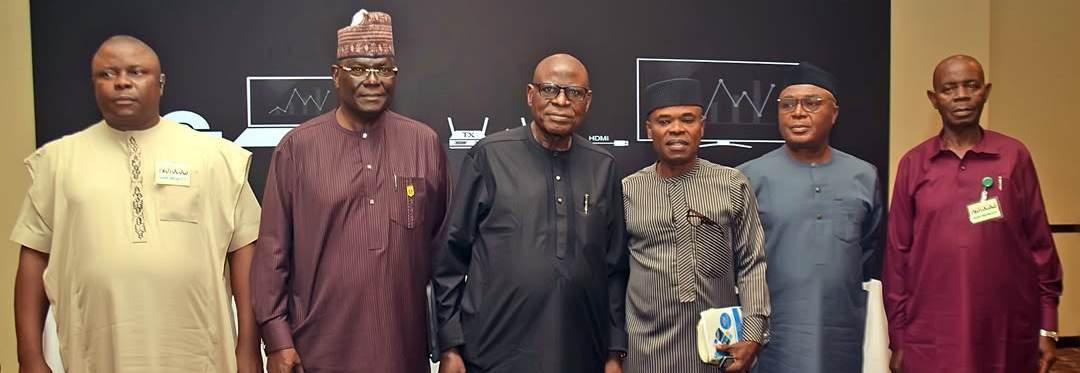
Chief Executive Officer, Strategic Star Limited and Prayer Coordinator, Akokwa Christian Elites, Lagos Chapter, Mr. Emeka Onyeje; Guest Speaker and Security Consultant, DIG Marvel Akpoyibo (rtd.); President, Akokwa Christian Elites and CEO, O.C Hexagon Nigeria Limited, Mr. Clifford Onyeje, Coordinator, Setfree Prison Fellowship, Onyeze Victor David, Financial Secretary, Akokwa Christian Elites, Lagos Chapter, Mr. Austin Eze; and Outreach Director, Akokwa Christian Elites, Lagos Chapter, Mr. Charles Anusionwu, at the 2026 Akokwa Eminent Persons’ Dinner at the Sheraton Hotels and Towers, Ikeja, Lagos…recently
PROMOTING AFRICAN MUSIC AND CREATIVITY…
Shettima: MSMEs Creating Prosperity, Improving Living Conditions of Nigerians Under Tinubu’s Reforms
Deji Elumoye in Abuja
Vice President Kashim Shettima has declared that the administration of President Bola Tinubu is building a sustainable, enterprise-led Nigeria, where MSMEs are improving livelihoods through the prosperity that is created in targeted infrastructure projects, business-support grants, and economic reforms.
Shettima, who spoke yesterday in Abuja during the 8th National MSME Awards, noted that the administration is building an entire ecosystem that nurtures innovation, provides essential infrastructure, and removes barriers that have historically held back small businesses in Nigeria.
Represented by Deputy Chief of Staff to the President,
Senator Ibrahim Hassan Hadejia, the Vice President urged winners of the awards and every Nigerian entrepreneur to keep building, assuring them of government's support.
"Nigeria needs your ideas, your jobs, and your leadership. I have no doubt that the federal government, along with state governments and our privatesector partners, will continue to build an enterprise-led nation where creativity is rewarded, small businesses grow into conglomerates, and prosperity is shared by all," he declared.
Shettima described small businesses as the engine room of the country, noting that they improve the livelihoods of the citizens and transform communities through the prosperity they create.
"Ninety per cent of all
Nigerian businesses are MSMEs. They are the largest employers of labour in this country, providing jobs for over 60 million of our people. Through bold and innovative ideas, and through sweat and courage, our MSMEs are improving the livelihoods of Nigerians and transforming our communities through the prosperity they create," he explained.
Outlining some of the successes recorded so far, Shettima said since 2023, the Expanded National MSME Clinics have partnered with state governments to bring the clinics across all six geo-political zones.
He said the Clinics enabled small business owners to engage directly with regulatory agencies, financial institutions, and business support
organisations, while receiving on-the-spot solutions to their challenges.
According to him: "We have institutionalised 21 state-of-the-art Shared Infrastructure Facilities, providing affordable access to high-speed internet, modern machinery, and collaborative spaces, from digital hubs for our tech innovators to shared production spaces for our fashion designers, and these hubs have supported the creation of 650,000 jobs.
"On the question of financial access, we have moved with deliberate force. Through the N75 billion MSME Intervention Fund and the N50 billion Presidential Conditional Grant Scheme, we have expanded the pool of capital available to our enterprises. Through the Development Bank of
Afreximbank Names Olowononi Southern Africa Chief
James Emejo in Abuja
The African Export-Import Bank (Afreximbank) has appointed Peter Adeshola Olowononi as Director of Regional Operations for Southern Africa, effective May 1.
Olowononi replaces Humphrey Nwugo, who has moved to a similar role in East Africa.
The Southern Africa region covers 13 countries: Zimbabwe, Angola, Botswana, Eswatini, Madagascar, Malawi, Mauritius, Mozambique, Namibia, Lesotho, Seychelles, South Africa and Zambia.
The regional offices are in Zimbabwe.
Prior to his appointment, Olowononi served as Director for Client Relations in Anglophone West Africa, covering Nigeria, Ghana,
Liberia, Sierra Leone, The Gambia, São Tomé and Príncipe, and Cape Verde.
In that role, he managed risk assets exceeding US$12 billion and revenue of more than US$1 billion
He played a key role in expanding Afreximbank’s Anglophone West Africa balance sheet by over US$10 billion between 2015 and 2025 and was involved in financing major projects, including the Dangote Refinery and Petrochemical Complex, fertiliser plants, and infrastructure upgrades such as the expansion of the Federal Ocean Terminal in Onne.
Olowononi also supported healthcare and road projects in Sierra Leone, Liberia and The Gambia, and led financing interventions across Nigeria’s upstream, midstream and downstream oil and gas
sectors.
“He led Afreximbank’s strategic financing in support of the upstream, midstream and downstream oil and gas sector in Nigeria and is widely acknowledged as a leading subject matter expert,” the bank said in a statement.
It added that he structured trade finance in support of intra-African trade in cement, as well as leading cocoa traders and processors in Ghana and Nigeria.
He also supported the implementation of Afreximbank interventions through commercial banks, central banks and ministries of finance, helping them navigate the 2018 commodity price crisis, the COVID-19 pandemic and the impact of the Russia-Ukraine conflict.
Olowononi joined Afreximbank in 2015 as
manager for business development, Anglophone West Africa.
He has more than 20 years of banking experience and has structured transactions and extended credit across the oil and gas, manufacturing, maritime, aviation and financial services sectors worth more than US$20 billion over the past decade.
Nigeria, we have disbursed N874 billion to approximately 751,000 women and youth led MSMEs.
"We have provided over N394.88 billion in financing to export-oriented enterprises through the Nigerian ExportImport Bank. And under the Skill-Up Artisans programme, we have trained over 165,000 artisans and equipped them
with the resources to flourish."
On the book launched at the event titled, "Building Nigeria, Empowering MSMEs: A Compendium of the Federal Government's Initiatives and Interventions for Nigerian MSME Growth," the Vice President explained that many of the administration's efforts to support MSMEs are carefully documented in it.
FG: Nigeria Faces Shortage of 122,696 Primary Healthcare Workers
Requires N4.55bn to fill PHC vacancies
Onyebuchi Ezigbo in Abuja
The federal government has said it needs three years to recruit the 122,696 health workers needed to fill vacant positions in Primary Health Care (PHC) facilities across 26 states nationwide.
It also said it requires an estimated N4.55 billion over the period to fill the vacancies.
The Human Resource for Health and Project Management
Lead at the Sector-Wide Approach (SWAp) Coordination Office, Zaiyanatu Umar, disclosed this at the weekend in Abuja during the 15th Expanded Ministerial Oversight Committee meeting on national healthcare implementation.
Umar said the estimate followed an analysis of baseline data submitted by 26 verified states that self-reported their staffing levels against the Primary Health Care Minimum Staffing Standards during the SWAp recruitment assessment exercise.
“The baseline data received from SWAp was based on the recruitment tool that was developed.
“This was majorly to push forth on the HOPE-GOV 5.2 Disbursement-Linked Indicator
(DLI), which spoke around ensuring a quality healthcare workforce and availability across the different levels,” she said.
The World Bank-supported HOPE-GOV Programme rewards states for improving governance, financial management, and service delivery across Primary Health Care and basic education systems nationwide.
Under Disbursement-Linked Indicator 5.2, participating states focus on recruiting, mapping, and deploying essential Primary Health Care workers to underserved communities, thereby strengthening equitable access to quality healthcare services across Nigeria.
She said assessments showed that 220,755 Primary Health Care positions were required across participating states, but only 98,059 were occupied, leaving 122,696 vacancies requiring urgent recruitment to improve healthcare delivery nationwide.
Umar added that participating states averaged 7.5 Primary Health Care workers per 10,000 population, while 55.6 per cent of required staffing positions were vacant across the surveyed facilities.
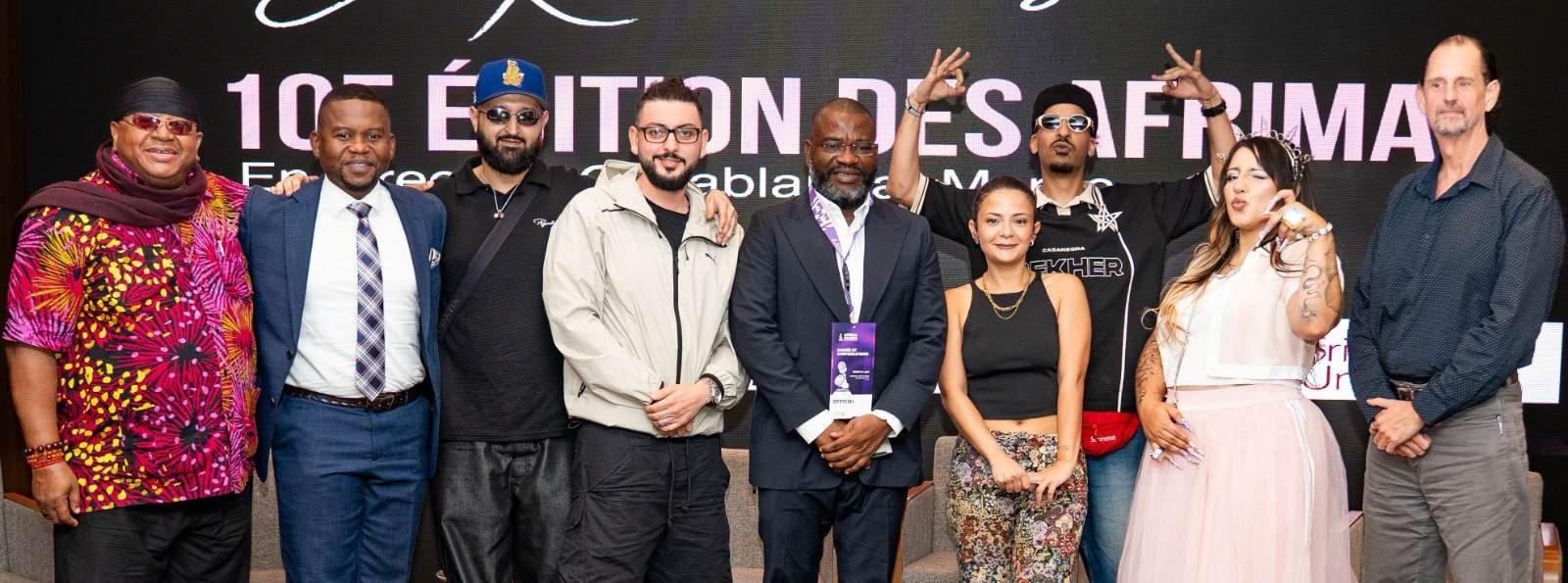
L-R: Associate Producer and Jury-in-Charge of the International Jury, All Africa Music Awards (AFRIMA), Olisa Adibua; AFRIMA Regional Director for Central Africa, Nde Ndifonka; Moroccan Music Producer Oldy; Artiste Manager, Tayze; President and Executive Producer, AFRIMA, Mike Dada; Moroccan On-Air-Personality and Conference Host, Latis; Renowned Moroccan Rapper, Young Loun; Moroccan Rapper, Khtek; and AFRIMA Regional Director for Eastern Africa, Mike Strano, during the Road to 10th AFRIMA Music Business Summit in Casablanca…recently
Olowononi
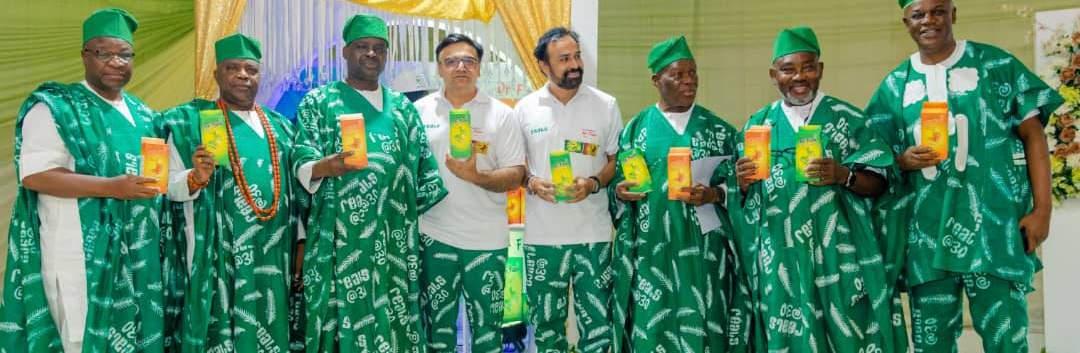
THIRTY HEARTY CHEERS TO REALS…
L-R: Chairman, Board of Directors, Pharmaceutical Company Limited, Dr. Akin Ogunbiyi; Board Member, Akogun Lanre Adesuyi; Group Managing Director, Ade Popoola; Managing Director, Halewood, Mr. Krutin Chaturvedi; Head, International Business, Halewood, Mr. Rajesh Kumar Yadav; Board Member, Pharmaceutical Company Limited, Dr. Peter Nmadu; Reals Pharmaceutical Company Secretary, Mr Ise'Oluwa Johnson; and Sales and Marketing Director, Reals Pharmaceutical, Kunle Adesoye, at the 30th anniversary of Reals Pharmaceutical Company Limited in Lagos…recently
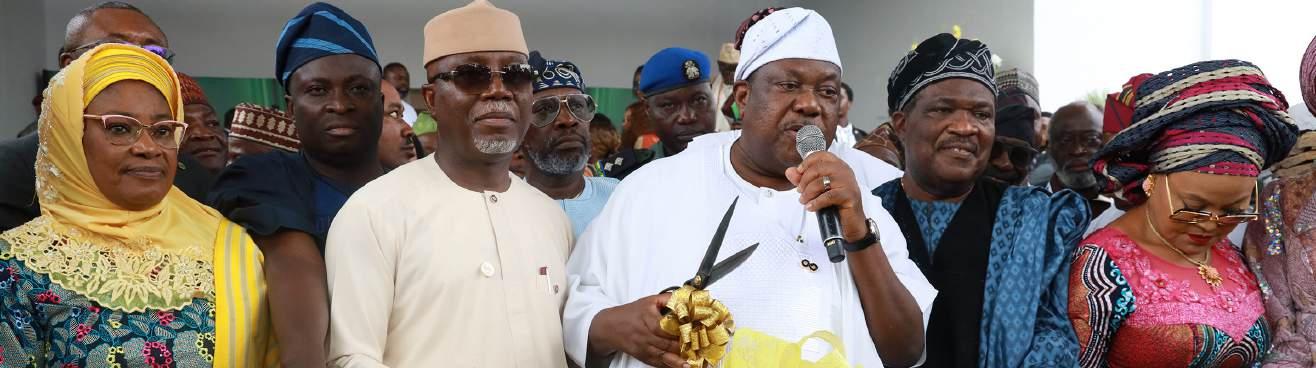
At 154-bed Premier Hotel Inauguration, Tinubu Seeks Rebirth of National Assets Nationwide
Kemi Olaitan in Ibadan
President Bola Tinubu has emphasised the need to revive national assets nationwide to complement the present administration's efforts in infrastructure development and sectoral growth.
Tinubu, while leading other dignitaries at the commissioning of the first phase of the hotel in
Ibadan on Thursday, said the remodelled 154-bed Premier Hotel was a pointer to the preservation of the country’s heritage in conformity with global standards in the tourism and hospitality sector.
“The transformation and modernisation of this facility remind us that heritage should not be abandoned to the passage of time. Rather,
it should be preserved, renewed, and adapted to meet contemporary realities.
‘In many ways, this project mirrors the rebirth of other iconic national assets across our country. It similarly demonstrates that our past can serve as a foundation upon which we build a stronger future.”
Tinubu added that the
visionary leadership of the old Western Region had understood that sustainable development required long-term thinking, strategic investment, and collective action.
He said this prompted Odua Conglomerate to construct the Premier Hotel and other projects.
Tinubu said the hospitality and tourism industry has
Naval Chief Charges Personnel to Support Democracy, Demonstrate Dedication to Duty
Linus Aleke in Abuja
The Chief of Naval Staff (CNS), Vice Admiral Idi Abbas, has charged officers and ratings of the Nigerian Navy to remain steadfast in their dedication to duty and to offer unwavering support to Nigeria’s democracy and constituted authority.
He also cautioned personnel against any conduct that could
hard-earned democracy in the country."
Atiku argued that the unchecked excesses of some judges, who allowed themselves to become judicial swords in the hands of politicians, should be checked.
ADC Alleges Coordinated Attempt to Weaken Opposition Parties
On its part, the ADC alleged a coordinated attempt to weaken opposition parties ahead of the forthcoming general election, warning that Nigeria risks sliding into a one-party state if what it described as the "growing assault on democracy" is not checked.
In a statement issued yesterday by its National Publicity Secretary, Bolaji Abdullahi, the party expressed concern over what it called a succession of legal and
bring the service into disrepute, assuring them that the Nigerian Navy would continue to provide the necessary support to enable optimal performance in their respective assignments.
The charge was delivered during the 2026 Second Quarter Route March held at the Naval Base, Admiralty Estate, Asokoro, Abuja.
The CNS, represented by the
administrative actions targeting opposition parties, insisting that the trend poses a grave threat to constitutional democracy.
"The cumulative effect of these attacks is unmistakable: They weaken the opposition, narrow the democratic space, and strengthen the hands of those already in power. This is not how a healthy democracy functions," the statement read in part.
According to the ADC, the controversy surrounding the NDC goes beyond the fortunes of a single political party and strikes at the heart of Nigeria's democratic system.
"When opposition parties are persistently distracted by manufactured controversies and prolonged legal uncertainty, the real casualty is the Nigerian people's right to choose among credible political alternatives
Chief of Communication and Information Technology, Rear Admiral Samiu Adepegba, said the exercise was designed to enhance both the physical and mental alertness of personnel in response to the evolving demands of contemporary security operations, while also strengthening esprit de corps among personnel and sister security agencies.
freely," the party said.
Falana Warns against Threat to Multi-party Democracy, Says Judge Cannot Reverse Own Judgment
Also reacting, Falana faulted the court's ruling, insisting that a judge lacks the power to overturn his or her own final decision.
Falana maintained that once a court has delivered a judgment or made a final order, the judge becomes functus officio. This legal doctrine bars a court from revisiting or reversing its own final determination except in limited circumstances provided by law.
According to him, any party dissatisfied with such a judgment ought to challenge it before a higher court rather than asking
He stated: "I enjoin you to continue to be professional in the conduct of your duties and day-to-day activities. Furthermore, I encourage you not to engage in any act that could bring the Service into disrepute in the course of your duty. The Nigerian Navy will continue to support you by providing all that is required to function optimally in your
the same judge to reverse his own decision.
The senior lawyer also argued that all actions taken pursuant to the earlier judgment remain legally valid and cannot be invalidated retrospectively by the same court.
He specifically maintained that the primary elections conducted by the NDC under the authority of the earlier judgment cannot, in law, be set aside through the subsequent ruling.
"All the actions taken pursuant to the earlier order of the judge are deemed proper in law. The court cannot retrospectively set aside the primary elections of the NDC," he added.
Falana also expressed concern about what he described as a disturbing trend within the Federal High Court, alleging that certain judicial decisions threaten Nigeria's multi-party
become a global enterprise in terms of employment generation and boosting Gross Domestic Product (GDP).
“With our population and the size of our economy, growth opportunities abound in Nigeria. That is exactly why hospitality and tourism occupy a strategic place under the diversification policy of the Renewed Hope Agenda.
Aattract tourists and investors but also to drive economic growth, job creation, foreign exchange earnings, cultural diplomacy, and urban renewal.
“Nigeria possesses enormous tourism potential, from our cultural heritage and historical sites to our creative industries, festivals, natural attractions, and vibrancy,” he added.
In his address, the Oyo State Governor, Seyi Makinde, who the Secretary represented to the State Government, Prof. Musibau Babatunde, described the project as a major milestone in restoring
democratic system.
He alleged that some judges of the Federal High Court were taking actions that could reduce Nigeria to a one-party state by facilitating the deregistration of opposition political parties. At the same time, the ruling All Progressives Congress (APC) remained unaffected.
Peterside Recommends Sanctions against Judicial Rascality
Meanwhile, investment banker and economist Peterside has said that judicial rascality can be stopped not just by relying on appeal courts to overturn "obnoxious judgements" but also through disciplinary action.
The banker's statement was in response to Senator Sola Akinyede's X post about the Federal High Court's ruling
one of Nigeria’s most iconic hospitality establishments.
“Premier Hotel Ibadan is more than just a hotel. It is a symbol of our collective history. This landmark has occupied a special place in the social, economic, and cultural development of the state and the entire South-West region,” the governor stated.
Lagos State Governor Babajide Sanwo-Olu, represented by the Secretary to the State Government, Bimbola Salu-Hundeyin, said the redevelopment demonstrated how heritage preservation and economic modernisation could complement each other.
“Today’s reopening is not merely the commissioning of a renovated facility; it is a renewed hope. It is a statement of intent, one that demonstrates that heritage preservation and economic modernisation are complementary pillars of sustainable development,” the governor added.
on the NDC's deregistration. "Sad. Judicial systems are not sustained by the corrective powers of their appellate system, but by judicial decency & integrity. Until the CJN enforces these qualities, the Nigerian Judiciary will continue on its journey of self-destruction, igniting the truncation of our democracy," Akinyede, a former Ekiti South lawmaker, had written.
In his reaction, Peterside, founder of Stanbic IBTC Bank Plc, applauded Akinyede, saying, "Well said @SolaA63524. The cure for Judicial Rascality is disciplinary action. Glossing over rascality whilst relying on Appeal Courts alone to overturn obnoxious judgements encourages more judges to go into the lucrative business of delivering procurable obnoxious judgements."
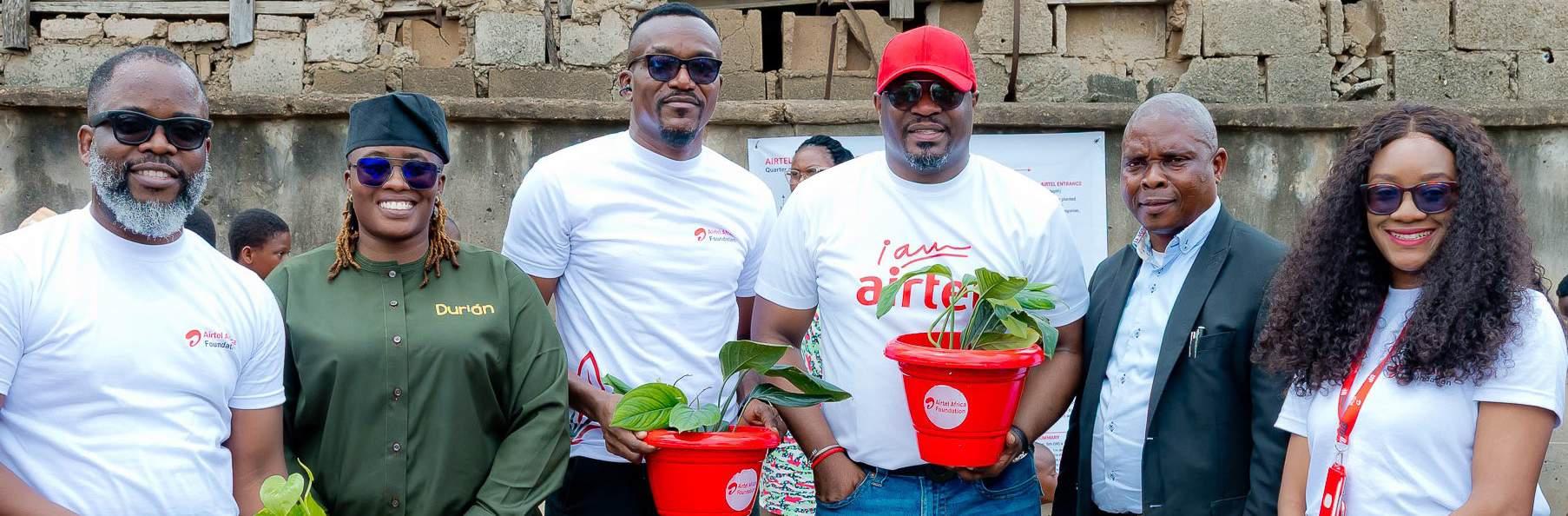
ISSUES OF THE ENVIRONMENT.…
L-R: Head of Public Relations, Airtel Nigeria, Sam Adeoye; Founder and Global Executive Director, Durian Nigeria, Tony Joy; Head of Finance, Project Management Office, Airtel Africa Foundation, Temitope Fatai; Director, Corporate Communications and CSR, Airtel Nigeria, Femi Adeniran; Headteacher, St. George's UNA Primary School, Iyana Ipaja, Lagos, an Airtel-adopted School, Olaoye Johnson Akinloye; and CSR Lead, Airtel Nigeria, Victoria Ndu, at the launch of the Airtel Green Garden Initiative in commemoration of World Environment Day 2026 in Lagos…recently
EU, ECOWAS Woo Investors, Position Nigeria as Gateway to African Market
Say Nigeria is an economic powerhouse
Wale Igbintade
The European Union (EU) and the Economic Community of West African States (ECOWAS) have positioned Nigeria as a strategic gateway to regional and continental markets, urging investors to capitalise on the country’s vast economic potential and expanding trade opportunities.
The call was made at the 10th Nigeria–EU Business Forum in Lagos, where government officials, investors, development partners and business leaders from Nigeria and Europe gathered to strengthen commercial ties and
advance sustainable investment.
Delivering a video message, the High Representative of the European Union for Foreign Affairs and Security Policy and Vice-President of the European Commission, Kaja Kallas, described Nigeria as an economic powerhouse and one of the EU’s most important partners in Africa.
“The choice to come to Nigeria was no coincidence. Nigeria is an economic powerhouse on the African continent and an important partner for the EU today,” she said.
She encouraged European businesses to expand their
investments in Nigeria, describing the country as an attractive destination with enormous growth potential.
Kallas noted that the speed with which the Business Forum was convened after her recent visit to Nigeria underscored the determination of both European and Nigerian businesses to strengthen commercial partnerships and unlock new investment opportunities.
Speaking on behalf of the President of the ECOWAS Commission, Dr Omar Alieu Touray, the Commission’s Director of Trade, Kolawole Sofola, said the Nigeria–EU partnership had
evolved beyond conventional trade in goods into broader economic cooperation aimed at driving regional development.
He said the ECOWAS market and the African Continental Free Trade Area (AfCFTA) provide investors with access to more than 400 million consumers across West Africa and over 1.4 billion people across the African continent.
Sofola urged investors to see Lagos as more than a business destination, describing the city as a strategic entry point into the wider African market.
He identified agro-processing, energy, manufacturing and the
Gombe LG Polls: APC Sweeps All Seats
Segun Awofadeji in Bauchi
The All Progressives Congress (APC) has emerged victorious in all the 24 chairmanship seats and 240 councillorship positions contested in yesterday’s local government elections in Gombe State.
Chairman of the Gombe State Independent Electoral Commission (GOSIEC), Abdullahi Garba Talasse, who announced the results on Saturday in Gombe, declared that the ruling party won in all the local government councils and Local Council Development
environment, with the 10-year bond accounting for the bulk of subscriptions.
Activity slowed somewhat in May when the DMO reopened the January 2035 and April 2037 bonds, offering N600 billion. Total subscriptions stood at N516.15 billion, while allotments amounted to N334.53 billion. The stop
Areas (LCDAs) where elections were conducted. Talasse described the successful conduct of elections in the newly created LCDAs as a milestone in the state’s democratic development, noting that Gombe had expanded from 11 local government councils with 114 councillors to 24 councils and LCDAs with 240 councillors. He said the commission worked closely with the State House of Assembly to secure the legal backing required for elections to be held in the LCDAs.
rate on the January 2035 bond rose by 41 basis points to 17 per cent, while the April 2037 bond closed at 17.04 percent. Demand rebounded strongly in June as the DMO doubled its offer to N1.2 trillion by reopening the January 2035 and April 2037 bonds. Investors subscribed to N1.41 trillion, with the DMO allotting N1.22
“We did not struggle for the enabling law in vain. Today, we have successfully conducted elections across the 24 councils and LCDAs, which is a significant achievement for the state,” he said.
The GOSIEC chairman attributed the poor showing of opposition parties to their limited participation in the polls.
According to him, the African Congress (AC) fielded candidates in only three chairmanship contests, while the Democratic Liberation Alliance (DLA) contested in
trillion. Stop rates increased significantly to 18.34 per cent and 18.35 per cent, respectively, reflecting changing expectations regarding inflation and interest rates.
Auction data showed that demand remained strongest for longer-dated securities, while shorter-tenor instruments, particularly the five-year bond,
six councils.
He added that the New Nigeria People’s Movement (NRM), Youth Party (YP) and Zenith Labour Party (ZLP) each sponsored candidates in three chairmanship elections.
For councillorship positions, Talasse said AC contested in eight wards, while DLA, NRM, YP and ZLP each fielded candidates in 11 wards.
“That explains why some parties recorded zero votes in several areas because they did not participate across all the councils and wards,” he said.
attracted relatively weaker interest. Bid rates ranging from 15 per cent to 22.60 per cent also underscored divergent market expectations regarding inflation, monetary policy, and the future direction of interest rates.
Market operators attributed the robust demand to institutional investors'
digital economy as priority sectors offering significant investment opportunities, while highlighting the European Union’s support for regional infrastructure and trade facilitation.
According to him, the Abidjan–Lagos Corridor project under the EU’s Global Gateway strategy demonstrates the bloc’s commitment to promoting sustainable investment,
improving regional connectivity and boosting intra-African trade. The forum, held under the theme “Enhancing Sustainable Investment Together,” brought together policymakers, financial institutions, development partners and private sector leaders to explore new investment opportunities and strengthen business collaboration between Nigeria and Europe.
Alia Condemns Killing of MACBAN Chairman, Police Launch Manhunt for Killers
George Okoh in Makurdi
Benue State Governor, Hyacinth Alia, has expressed deep shock and sadness over the reported killing of the state Chairman of the Miyetti Allah Cattle Breeders Association of Nigeria (MACBAN), Alhaji Ardo Risku and his friend by unidentified gunmen in Otukpo.
The governor’s remarks came as police in the state said they had launched a manhunt for Risku’s killers.
He said the heinous act came at a particularly sensitive time when the state was witnessing a significant return to peace and stability across the various local government areas.
The governor said the incident was not only a
preference for risk-free assets.
PFAs, in particular, continued to dominate the bond market, seeking stable long-term investments that could match their liabilities while preserving capital.
An investment banker and stockbroker, Mr. Tajudeen Olayinka, noted that the auctions reflected the competing
tragedy to the state but a direct attempt to undermine the hard-earned peace and the atmosphere of reconciliation that his administration worked tirelessly to foster.
"It is deeply regrettable that this unfortunate incident occurred shortly after a security meeting," the governor added. He emphasised that the killing of any community leader or peace advocate was a blow to the ongoing dialogue between various stakeholders in the state.
The governor issued a clear and firm directive to all relevant security agencies to launch a thorough and transparent investigation immediately to uncover the circumstances surrounding the killing.
interests of investors and the government. According to him, "Investors naturally seek higher returns on new issuances, while the government is equally determined to avoid excessive borrowing costs. The final pricing, therefore, reflects a balance between these two objectives."
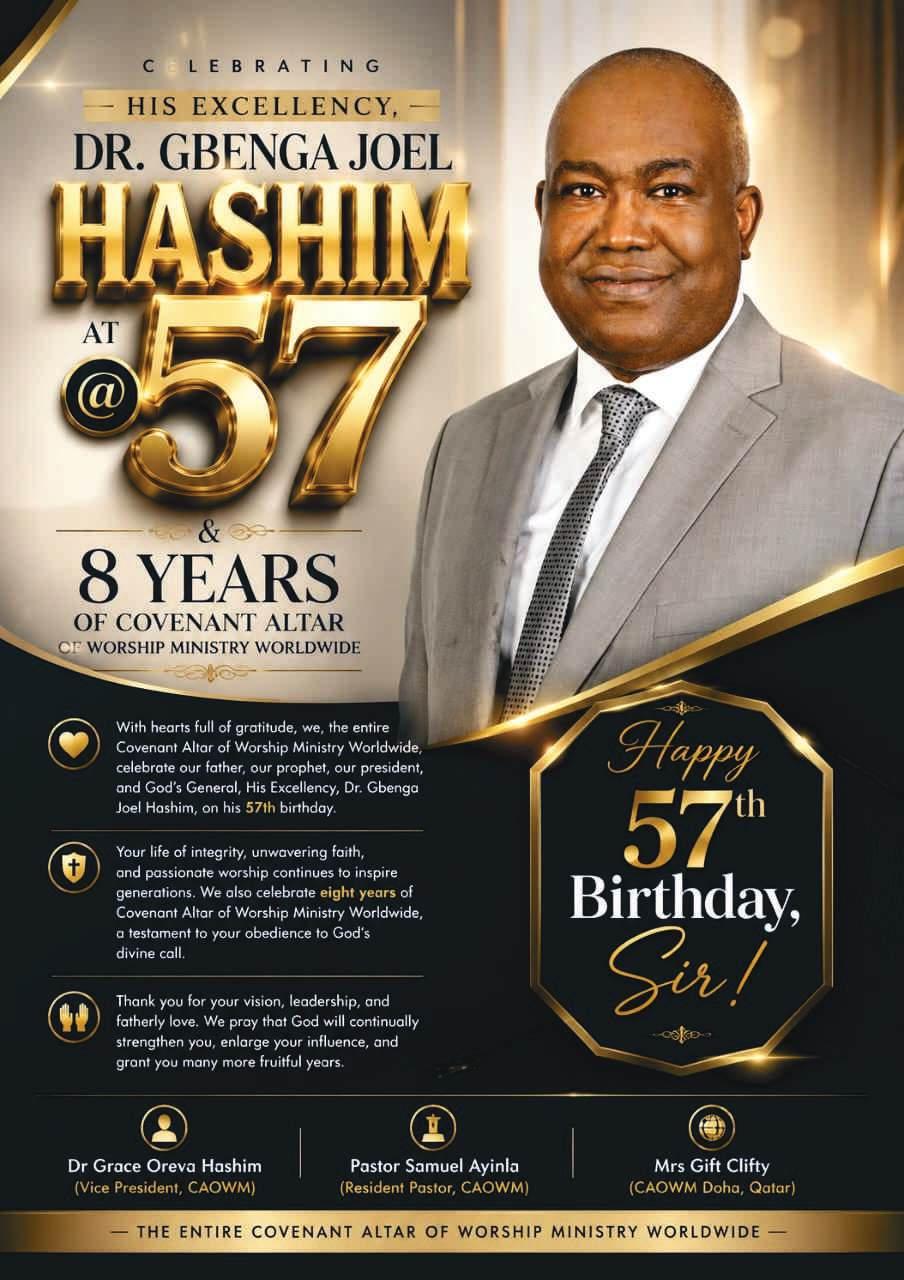
COVENANT ALTAR OF WORSHIP MINISTRY (A .K.A UPPER ROOM ASSEMBLY)
COVENANT ALTAR OF WORSHIP MINISTRY (A .K.A UPPER ROOM ASSEMBLY)
DR. GBENGA JOEL
8 YEARS
OF COVENANT ALTAR OF WORSHIP MINISTRY WORLDWIDE
With hear ts full of g ratitude, we, the entire Covenant Altar of Wor ship Ministr y Wor ld wide, celebrate our father, our prophet, our president, and God’s General, His Excellency, Dr. Gbenga Joel Hashim, on his 57th bir thday.
Your life of integ rity, unwavering faith, and passionate worship continues to inspire g enerations. We also celebrate eight years of Covenant Altar of Worship Ministr y Worldwide, a testament to your obedience to God’s divine call.
T hank you for your vision, leadership, and fatherly love. We pray that God will continually strengthen you, enlarg e your influence, and g rant you many more fr uitful years — THE ENTIRE COVENANT ALTAR OF WORSHIP MINISTRY WORLDWIDE —
Dr Gr ace Or eva Hashim (Vice President, CAOWM)
Pastor Samuel Ayinla (Resident Pastor, CAOWM)
Mrs Gift Clifty (CAOWM Doha, Qa tar)
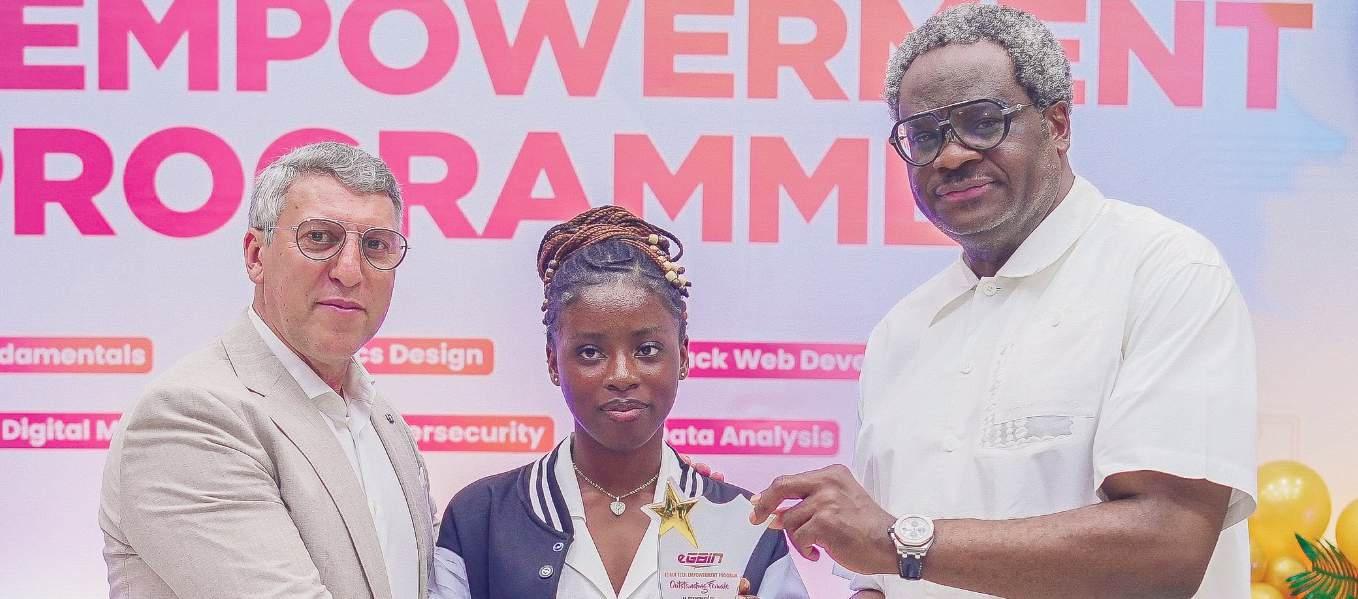
PROMOTInG DIGITAL SKILLS AMOnG YOuTHS…
L-R: Chief Executive Officer, Egbin Power, Mr Mokhtar Bounour; Overall Best Graduand/Most Outstanding Female, Dina Anjolaoluwa, and Group Managing Director of Sahara
the presentation of awards to graduands of Egbin Power Tech Empowerment Programme, held at the Bright Gyimah Innovation Centre, Powerfields Schools, Egbin Power in Ikorodu, Lagos…recently
At Gov Mutfwang’s Daughter’s Wedding, Shettima Urges Plateau Stakeholders to Build Bridges
Deji elumoye in Abuja
Vice President Kashim Shettima, yesterday graced the wedding reception of Nanbam Mutfwang, daughter of Plateau State Governor Caleb Mutfwang, who was married to Jeremiah Ayodele, spotlighting the unifying power of the marriage institution and how it can be leveraged to transform the state into an economic powerhouse.
Shettima who represented President Bola Tinubu at the wedding ceremony, said the union, which brings together the North and the South, symbolises that what binds Nigerians together far outweighs whatever seeks to divide the nation.
“We need to build bridges; we need to embrace one another. Challenges bring forth the character of leaders,” he said at the wedding reception held at Lang Field, Barkin Ladi Road, Jos.
The vice president noted that while Plateau faces challenges, they are not insurmountable, especially with the right calibre of leadership.
He expressed delight at the presence of stakeholders, describing them as the movers and shakers of Plateau politics.
Shettima called on the people of Plateau, irrespective of their political affiliations, religious persuasions, tribal identities or sectional backgrounds to unite.
“We can transform Plateau into an economic powerhouse,” the vice president said, adding that though the beautiful city faces challenges that threaten to make it a depressed economy, stakeholders in Jos have the capacity to change the narrative and add value.
He urged the people to unite and live together as brothers.
On his part, Governor Muftwang expressed delight at the presence of the Vice President and conveyed his appreciation for the goodwill of President Tinubu.
He also thanked the federal government for its sustained progressive reforms in enhancing security in the state and the country at large, saying “we must continue to forge ahead with hope.”
Dignitaries at the event included Governors of Borno and Kaduna states, Prof. Babagana Umara Zulum and Uba Sani; Minister of Defence, General Christopher Musa (rtd.); his Humanitarian Affairs and Poverty Reduction counterpart, Dr. Bernard Mohammed Doro; National Chairman of the All Progressives Congress (APC), Professor Nentawe Yilwatda; former Deputy Speaker of the House of Representatives, Hon. Idris Wase; Director-General (DG) of the National Institute for Policy and Strategic Studies (NIPSS),
Kemi Olaitan in Ibadan
The Oyo State Government yesterday lifted the curfew imposed on 10 local government areas following the recent kidnapping incident in Oriire.
The government, in a statement issued by the Commissioner for Information, Prince Dotun Oyelade, said residents can now resume their normal activities, while it expressed appreciation for the cooperation and understanding of the people in the affected areas. Oyelade added that the government is closely monitoring the security situation and reassured residents that efforts are ongoing to bring the kidnapping episode to an end. It would be recalled that the government initially imposed a 16-hour curfew on the affected communities before extending it with an additional one-day curfew on Thursday.
Kuru, Professor Ayo Omotayo; among other top stakeholders at the federal and state levels.
Earlier in the day, the vice president was in Kaduna State where he attended the wedding fatiha of Salihu Bello (Sudais) and
Amina Abubakar Abdullahi (Walidah).
The solemnization involving the family of his longtime friend, Abubakar Abdullahi Attajiri, took place at the Sultan Bello Mosque, Kaduna.
Borno State Governor, Babagana Zulum served as wali (guardian) for the bride, Amina Abubakar Abdullahi, while Kaduna State Governor, Uba Sani stood in for the groom, Salihu Bello, during the marriage ceremony.
Shettima who was received by Governor Sani upon arrival was accompanied by his wife, H Nana Shettima; Governor Zulum; former Minister of Transportation, Sai’du Ahmed Alkali, as well as some top aides and government officials.
Egbin Power Graduates First Set of Beneficiaries of Tech Empowerment Programme in Lagos
ejiofor Alike
Egbin Power Plc has graduated the first cohort of its Tech Empowerment Programme, marking a significant milestone in its commitment to equipping young people in its host communities with in-demand digital skills.
The Tech Empowerment Programme is part of Egbin Power’s Personal Corporate Social Responsibility (PCSR) initiatives designed to provide young people in Egbin, Ijede and Ipakan areas of Lagos State with access to digital skills that can improve employability, foster entrepreneurship, and create new
economic opportunities.
The Tech Empowerment Programme delivered structured training across key areas including ICT fundamentals, graphic design, full-stack web development, digital marketing, cybersecurity and data analytics.
At the graduation ceremony, held at the Bright Gyimah Innovation Centre at Powerfields Schools, Egbin Power, Ikorodu, Lagos, 24 graduands were honoured for successfully completing the six-month intensive training programme.
In his goodwill message at the graduation ceremony, the Group Managing Director of Sahara
Power Group, Mr. Kola Adesina, commended the graduands for their resilience and dedication, noting that their success represents a critical step toward building digitally empowered communities. He encouraged the graduands to be curious and ready to advance current technologies to make them better, cheaper and faster. “The world is evolving rapidly, and digital skills are at the heart of that transformation. I encourage you to train your mind, commit to continuous improvement, and use the knowledge you have acquired to create value — not just for yourselves, but for your communities and the world at
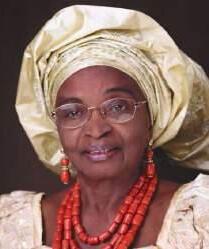
Emma Okah Announces Death of Mother at 95, Unveils Funeral Plans
Former Rivers State Commissioner for Information and Communications, Dr. Emma Okah, has announced the death of his mother, Mrs. Comfort Adanwo Okah, popularly known as “Mama Dubai Arab,” who passed away at the age of 95.
In a formal notification issued to family members, friends, associates, and the public, Dr. Okah disclosed that the matriarch died peacefully on June 6, 2026, following a brief age-related illness.
The late Mrs. Okah, née AjokuIgwe, was described as a woman of exceptional courage, compassion, fairness, and unwavering faith whose life was dedicated to service, community development, and the advancement of others.
According to the statement
signed by Dr. Okah on behalf of the Okah and Ajoku-Igwe families, the deceased remained committed throughout her lifetime to education, selfimprovement, public service, politics, and the welfare of people within and outside her immediate family circle.
“Mama Dubai was a woman of exemplary courage, compassion, fairness, and deep faith who believed strongly in education, self-improvement, and service to others,” the statement noted.
The family further described her as a disciplined, fearless, industrious, and independentminded woman who contributed significantly to the growth of her community and maintained relationships without bitterness.
Beyond her family responsibilities, Mrs. Okah was recognised as a respected community leader who played a key role in mobilising and coordinating women in her community.
Her commitment to Christianity, particularly the Anglican faith, was evident in her active support for the establishment of the King of Kings Anglican Church in Omopo, Elele Town, Ikwerre Local Government Area of Rivers State.
Fondly referred to as the family’s “Prayer Warrior,” she remained devoted to God and His Word until her final days, the family said.
The funeral programme released by the family indicates that a Service of Songs will be held on Tuesday, July 21, 2026,
large,” Adesina said.
On his part, the Chief Executive Officer of Egbin Power, Mokhtar Bounour, reaffirmed the company’s commitment to inclusive and sustainable development, emphasising that the programme reflects its broader responsibility beyond electricity generation.
“At Egbin Power, we believe that empowering young people is one of the most impactful ways to drive sustainable development, and we are confident that these graduands will apply the skills acquired to make a lasting impact across the digital landscape,” he said.
is scheduled for Saturday, July 25, 2026, at St.
9
Power Group, Mr Kola Adesina, during
at the Rivers State Ecumenical Centre on Abonnema Wharf Road, Port Harcourt, beginning at 4 p.m. The funeral service
James Anglican Church, Elele Town, Ikwerre Local Government Area, commencing at
a.m. Late Okah
Bounour the take to novative that socio-economic development.
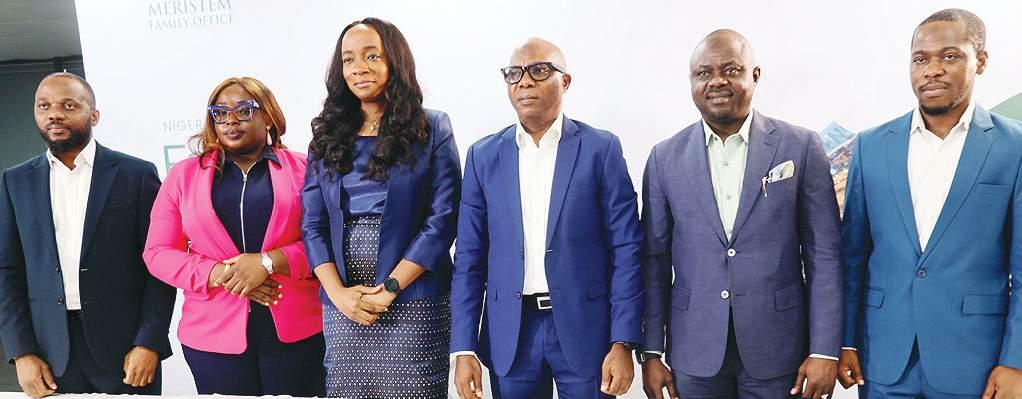
LAunCHInG FAMILY WeALTH RePORT…
3,238
Injured as Venezuela’s Earthquakes Death Toll Hits
The death toll from the earthquakes in Venezuela has risen to at least 1,430 people, the President of the country’s National Assembly, Jorge Rodríguez, said on Saturday.
CNN reports that Rodríguez also disclosed that at least 3,238 people have been injured, and 3,142 families have lost their homes.
The lawmaker added that the country had experienced at least 430 aftershocks in the wake of the two main earthquakes.
The twin, magnitude 7.2 and 7.5 quakes, hit the South American country on Wednesday, devastating the coastal area around La Guaira.
With a scarcity of government rescue teams, Venezuelans have
become desperate in the hardest-hit areas, digging through rubble with their hands, while aid agencies warned that the critical 72-hour survival window was closing fast.
CNN further reports that a senior official in the administration of President Donald Trump said there are “great communications right now with the interim authorities” in Venezuela on both the political and military side in the wake of the devastating earthquakes.
“We have a unique relationship, obviously, with the interim authorities, and we’re working very closely with them to address the needs, to get the logistics up and running,” the official told reporters on Saturday morning.
Furniture Should Serve Practical Purpose Beyond Aesthetics, Says Aryville CEO
The Chief Executive Officer of Aryville International, Mr. Stephen Nwutube, has emphasised the need for furniture to deliver functionality alongside visual appeal, saying they should serve a practical purpose beyond aesthetics.
Nwutube made the remark following the launch of the company’s new bespoke furniture collection, developed to meet the growing demand for customised furniture solutions in homes and commercial spaces.
According to the company, the collection was designed for clients seeking furniture tailored to specific environments, reflecting a shift away from mass-produced products toward more personalised interior solutions.
“Furniture should do more than occupy space — it should serve it,” Nwutube said, adding that the company’s design philosophy prioritizes comfort, functionality and usability.
Aryville International said the collection comprises custom-made furniture pieces produced locally using selected materials and finishing components.
The company noted that the products undergo quality control procedures throughout the manufacturing process.
The firm also observed a growing preference among consumers for furniture that combines visual appeal with long-term functionality, as homeowners and businesses increasingly seek furnishings suited to their individual needs and available spaces.
Industry stakeholders have linked the rising demand for bespoke furniture to changing consumer tastes, with more buyers opting for personalized designs that reflect their lifestyle and interior preferences.
Aryville International said the new collection is available for custom orders and project collaborations.
The official said as of Saturday morning, one of the runways at Simón Bolívar International Airport near Caracas was operational, allowing an increase in assistance, and credited this to US coordination with the interim Venezuelan government. The other runway remains “completely cracked and inoperable,” they noted.
“Mobile hospitals are arriving today, the US is working to get more Starlink terminals to Venezuela, and a further surge of humanitarian supplies is planned, the official said. Two 80-person US search and rescue teams have helped find survivors in the rubble,” they added.
Asked about reports of restricted access to some of the hardest hit
1,430
areas, the official suggested it was a communication issue that “a big coordination problem has obviously been the airfields.”
“You’ve got a lot of different groups from all around the world trying to land at the same airfield, you know, trying to get a picture of what air assets are open, trying to get limited ground logistics to get over there, so that’s something that you deal with in every single one of these situations,” they said. The official also said the USS Fort Lauderdale “is now in position, and so we’re able to airlift people to use the medical facilities as necessary on that vessel, and to use it to do command and control on logistics, and to use their airlift.”
Ondo Socio-cultural Group Congratulates Obamuyi on Appointment as VC of AAU, Commends Aiyedatiwa
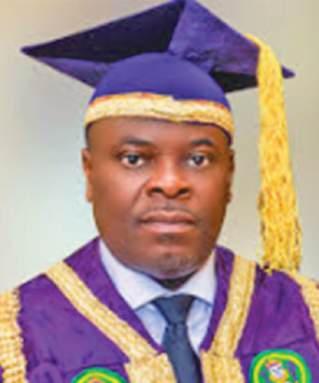
The Ilaje Development Summit Group (IDSG) in Ondo State has congratulated Prof. Tomola Obamuyi on his appointment as the Vice Chancellor of Adekunle Ajasin University (AAU), describing the appointment as a well-deserved recognition of a distinguished academic career defined by scholarship, integrity, visionary leadership, and unwavering commitment to the advancement of higher education.
In a statement signed by its President and Executive Administrator, Rev. Adesola
Adebawo, the socio-cultural group also commended Governor of Ondo State, Lucky Aiyedatiwa, for entrusting the leadership of one of the state’s foremost institutions to an accomplished scholar whose career has consistently exemplified academic excellence, sound judgment, and principled leadership.
According to the statement, Professor Obamuyi’s emergence as Vice Chancellor “is a fitting reward for decades of intellectual distinction, exemplary leadership, professional excellence, and
dedicated service to academia. We are delighted that his wealth of experience and impeccable credentials have been recognised through this important national assignment.”
“This appointment reflects a commendable commitment by the Ondo State Government to merit, capacity, and excellence in institutional governance. It inspires confidence that our higher education system will continue to benefit from competent leadership capable of driving innovation, strengthening academic standards, expanding
research, and positioning our universities for greater national and global relevance,” the statement explained.
IDSG expressed confidence that under Obamuyi’s stewardship, Adekunle Ajasin University will consolidate its reputation as a centre of academic excellence by deepening research, fostering innovation, promoting quality teaching, strengthening industry partnerships, and producing graduates equipped to contribute meaningfully to national development and global competitiveness.
Kano Committed to Tinubu’s Re-election in 2027, Says Governor Yusuf, Allocates Plots of Land to Aides
Ahmad Sorondinki in Kano
Kano State Governor, Abba Yusuf, yesterday said that his administration was fully committed to delivering victory for President Bola Tinubu and the All Progressives Congress (APC) in the 2027 general election.
Yusuf stated this during an interactive session with elected and appointed government officials at the Coronation Hall, Government House, Kano.
According to a statement issued by his spokesperson, Sunusi Bature Dawakin Tofa, the governor said Kano would mobilise overwhelming support for Tinubu’s re-election bid.
“Kano State is fully committed to ensuring victory for the APC
at all levels in the 2027 general election. We will lead the country in delivering overwhelming votes for President Bola Ahmed Tinubu because we believe in the leadership and vision of this administration,” Yusuf said.
The governor directed all political appointees who had yet to register as members of the APC to do so immediately, saying every government official must identify with the ruling party and contribute to strengthening its structures across the state.
“If you are serving in this administration and you have not registered as a member of the APC, you should do so immediately.
“Every elected and appointed official must actively participate
in building and strengthening the party ahead of the 2027 elections,” he said.
He reaffirmed his administration’s resolve to secure victory for the APC in the presidential, governorship, National Assembly, State Assembly, and local government elections.
“As a government, we remain committed to ensuring that the APC records victory at every level. Our responsibility goes beyond governance; we must also consolidate the party’s strength at the grassroots,” he added.
As part of efforts to motivate political office holders, the governor approved the allocation of plots of land to more than 300 political aides, including Senior
Special Assistants, Special Assistants, Senior Special Reporters, Special Reporters, and Personal Assistants.
He also approved the payment of N100,000 to each beneficiary.
Speaking at the meeting, the Speaker of the Kano State House of Assembly, Ismail Falgore, said the APC had every reason to market President Tinubu’s achievements to the people of the state.
“We owe nobody an apology for marketing the achievements of President Bola Ahmed Tinubu. The people deserve to know what the President is doing, just as they can see the impact of constituency projects being executed with the support of Governor Abba Kabir Yusuf,” Falgore said.
L–R: Managing Director, Meristem Wealth Management Limited, Taiwo Yusuf; Managing Director, Meristem Registrars and Probate Services Limited, Nkechi Okoye; Managing Director, Meristem Family Office, Kemi Ojenik; Group Managing Director, Meristem Securities Limited, Sulaiman Adedokun; Managing Director, Meristem Stockbrokers Limited. Saheed Bashir; and Managing Director, Meristem Capital Limited, Rasaki Salawu, at the launch of the inaugural Nigeria Family Wealth Report by Meristem Family Office, a subsidiary of Meristem Securities Limited in Lagos….yesterday…
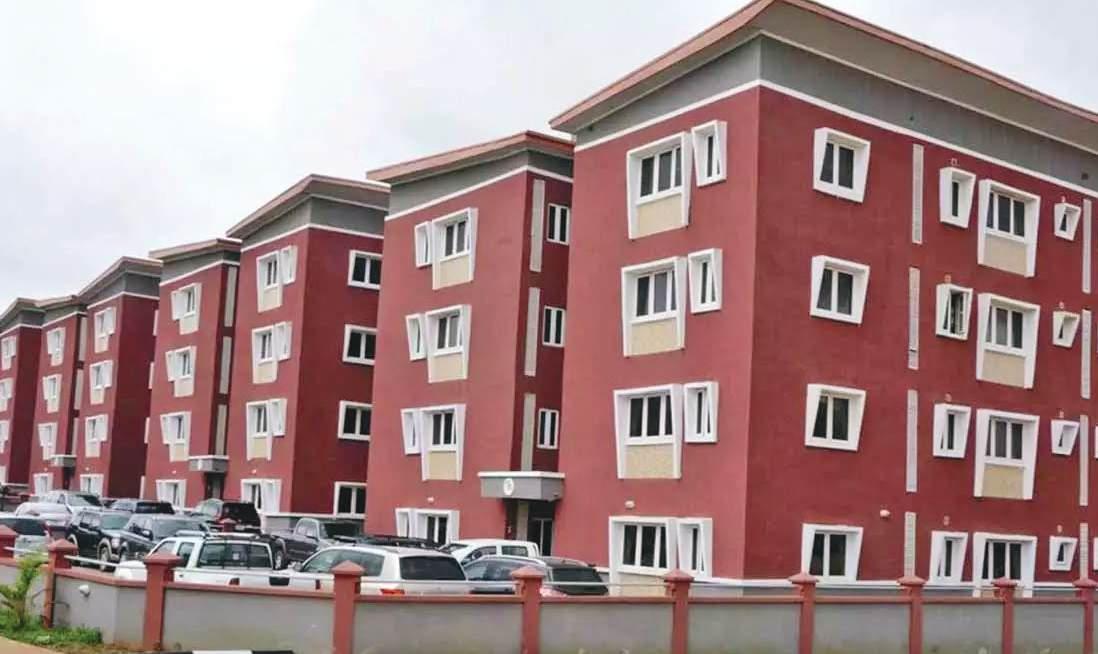
Nigeria’s Housing Emergency: When Shelter Becomes a Luxury
Nigeria's housing crisis is forcing workers into offices, vehicles, and overcrowded shelters as soaring rents widen the gap between incomes and the cost of living, Festus Akanbi reports
For millions of Nigerians, the struggle for survival no longer ends with finding food, paying school fees, or affording transportation. It now extends to securing a roof over their heads. Across Lagos, Abuja, Port Harcourt, Kano, Ibadan and other urban centres, rent has risen so sharply that even workers with steady incomes are finding themselves trapped between homelessness and financial ruin.
What was once a housing challenge has evolved into a full-scale social and economic emergency.
The figures paint a grim picture. Nigeria's housing deficit is estimated at between 15 million and 28 million units, depending on the methodology adopted. The Federal Ministry of Housing and Urban Development recently disclosed that about 15.2 million housing units in the country are structurally inadequate, lacking acceptable standards of safety, infrastructure, habitability, and access to basic services.
Yet behind the statistics are painful human stories.
In Lagos, a self-contained apartment that rented for between N250,000 and N400,000 just three years ago now attracts between N700,000 and N1.5 million, and more, in many locations. Two-bedroom apartments that previously cost less than N1 million annually now command between N2 million and N6 million in several middle-income neighbourhoods. Similar trends are evident in Abuja, Port Harcourt, and Ogun State communities serving as residential extensions of Lagos.
The consequence is devastating. Many households now spend between 40 and 70 per cent of their annual income on accommodation, far above the United Nations affordability benchmark of 30 per cent. For workers earning the new national minimum wage of N70,000 monthly, the situation is particularly dire. Annual earnings of N840,000 can barely cover the cost of a modest apartment in many urban centres, leaving little or nothing for transportation, food, healthcare and education.
The result is a growing population of Nigerians making heartbreaking compromises.
Some have relocated to distant suburbs, spending several hours commuting daily. Others live in overcrowded rooms shared by multiple families. Increasingly, workers sleep in offices, shops, workshops, vehicles, and unfinished buildings because the cost of commuting exceeds what they can afford.
Professor Timothy Nubi of the Centre for Housing and Sustainable Development at the University of Lagos recently highlighted an alarming reality: university lecturers, once considered comfortably middle-class professionals, are now reportedly sleeping in their offices due to soaring rents and transportation costs.
This is perhaps the clearest indication of how deeply the crisis has penetrated Nigerian society.
The housing emergency is not merely a consequence of rising demand. It is the product of several interconnected structural failures.
Rapid urbanisation remains a major factor. Nigeria's population is projected to exceed 400 million within the next three
A
decades, while cities such as Lagos continue to attract thousands of migrants weekly. Demand for housing continues to outpace supply.
At the same time, construction costs have soared dramatically. Cement prices have climbed above N10,000 per bag in many locations. At the same time, steel, roofing sheets, electrical fittings, and finishing materials have become significantly more expensive due to inflation and exchange-rate pressures. Developers now face much higher costs than they did only a few years ago.
According to the National Bureau of Statistics, headline inflation has remained elevated despite recent moderation. Combined with currency depreciation and high interest rates, these conditions have made housing development increasingly expensive.
The mortgage system has also failed to provide meaningful support. Mortgage penetration in Nigeria remains among the lowest globally. Most commercial mortgage facilities carry interest rates beyond the reach of average earners. Consequently, home ownership remains an impossible dream for the vast majority of citizens.
Land administration presents another obstacle. Obtaining land titles, Certificates of Occupancy, and development approvals remains cumbersome, costly, and time-consuming in many states. Developers frequently complain about multiple taxes, regulatory bottlenecks, and unofficial charges that ultimately increase housing
costs.
The consequences extend far beyond the housing sector.
Economists warn that excessive housing costs reduce disposable income and weaken consumer spending. When households spend most of their earnings on rent, they have less money available for education, healthcare, transportation, retail purchases, and productive investments.
The housing crisis is therefore contributing to the erosion of Nigeria's middle class.
World Bank data indicate that poverty levels have worsened in recent years. At the same time, projections suggest millions more Nigerians could fall below the poverty line if living costs continue to outpace income growth. Housing affordability has become one of the most visible manifestations of this broader economic strain.
The crisis also carries serious productivity implications. Workers who spend four to six hours commuting daily from distant suburbs inevitably suffer fatigue, reduced efficiency, and declining quality of life. Businesses bear the indirect costs through lower productivity and increased employee turnover.
Furthermore, growing homelessness and overcrowding create public health risks. Informal settlements lacking sanitation, water, and waste management services expose residents to disease outbreaks and environmental hazards.
Successive governments have launched ambitious housing programmes, including the Federal Low-Cost Housing Scheme of the 1970s, the Shagari Housing Programme of the early 1980s, the National Housing Programme and the Family Homes Fund. While some achievements have been recorded, delivery has consistently fallen far short of demand.
The Family Homes Fund, for example, has reportedly delivered more than 15,000 units across several states. While commendable, such numbers barely scratch the surface of
a deficit that runs into the millions.
Addressing the crisis requires a more comprehensive approach.
First, the government must significantly increase investment in social and affordable housing. Countries that successfully reduced housing shortages did so through sustained public intervention targeted at low- and middle-income earners.
Second, land administration reforms are essential. Digitising title registration, simplifying approval processes, and reducing transaction costs would encourage privatesector participation and lower development expenses.
Third, mortgage financing must become more accessible. Long-term, single-digit-interest mortgage products are necessary if ordinary Nigerians are to transition from perpetual tenancy to homeownership.
Fourth, incentives should be provided for developers focusing on affordable housing rather than exclusively targeting luxury segments of the market. Tax reliefs, infrastructure support, and access to low-cost finance could encourage such investments. Finally, tenancy laws require stronger enforcement. Excessive agency fees, multiple years of demands for advance rent, and arbitrary rent increases continue to place enormous burdens on tenants.
Nigeria's housing crisis is no longer merely about buildings. It is about dignity, productivity, social stability, and economic inclusion. It is about families forced to choose between shelter and survival. It is about workers sleeping in vehicles while contributing to the economy during the day.
Until housing becomes affordable for ordinary Nigerians once again, the promise of inclusive growth will remain incomplete. The country's economic recovery may be measured in macroeconomic indicators. However, for millions of citizens, the true test lies in a far simpler question: can they still afford a place to call home?
housing project in Lagos
KWARA’S POLITICAL UNDERDOG
Is Araba writing a different script? asks ABDULKAREEM RAMMADAN-AKEREBIATA
As the contest over who succeeds Governor AbdulRahman AbdulRazaq intensifies within the All Progressives Congress (APC), one figure appears to be charting a markedly different political course.
While the state’s political conversation has been dominated by reports of resistance from a group of governorship aspirants to the perceived emergence of Speaker Saliu Danladi as the governor’s preferred successor, Engr. Femi Sanni, popularly known as Araba, has conspicuously stayed away from both camps.
In a season of endorsements, counterendorsements and internal power struggles, Araba has chosen another strategy: selling himself directly to party members and ordinary Kwarans rather than becoming a visible actor in the unfolding succession battle.
That approach has made him something of an underdog.
Political underdogs are often overlooked because they lack the backing of entrenched structures. Yet history shows that such politicians can sometimes redefine political contests by appealing beyond the established camps.
What makes Araba’s seeming underdog status particularly intriguing is the political pedigree that underpins his journey. Unlike many aspirants whose public profile has largely evolved around government appointments or contemporary political structures, his supporters point to roots in the progressive democratic movement that predate the current political order.
Until recently, only a small circle of former NADECO chieftains reportedly knew that Araba was among those who quietly financed the pro-democracy struggle while living in exile during the military era. His role remained largely outside public attention until recent disclosures brought that chapter of his political history into wider focus.
His long-standing attachment to progressive politics also resurfaced during the current succession process. His 2003 House of Representatives contest on the platform of the Alliance for Democracy (AD), one of the political traditions that later merged into today’s APC, surprised many within Kwara’s political circles and reinforced the impression that his political journey has been shaped by ideological continuity as much as electoral ambition.
That background also situates Araba within the broader progressive family that has, over the years, been championed
nationally by President Bola Ahmed Tinubu. While the President has repeatedly emphasised party supremacy, internal democracy and the importance of allowing party processes to run their course, Araba’s own campaign has similarly focused on consultations with delegates and grassroots members rather than public alignment with any of the contending camps.
It is this combination of political history and current positioning that has prompted some observers to draw comparisons—not in terms of political ideology or identical circumstances—but in terms of political resilience and independence, with the late C.O. Adebayo, whose political journey was often characterised by persistence and an ability to remain relevant outside dominant power blocs.
Whether that comparison ultimately proves justified remains to be seen.
Unlike many aspirants whose names have featured prominently in the ongoing dispute over succession within the APC, Araba has not publicly aligned himself either with those challenging the alleged consensus around Danladi or with those perceived to be promoting it. Instead, he has consistently projected himself as a bridge-builder focused on consultations across Kwara’s three senatorial districts.
Rather than joining the public contest over who enjoys the governor’s blessing, Araba seems determined to allow party members to judge him on his own credentials.
Whether that strategy succeeds will depend on several factors, including how much influence the party structure ultimately exerts over the primary process and whether grassroots consultations can translate into national leadership support.
Still, neutrality carries its own political advantages.
Should the current divisions within the APC deepen, a candidate who has avoided open confrontation with either side could emerge as an acceptable compromise for different blocs within the party.
For now, Araba remains one of the very few aspirants whose political capital lies less in factional alignment than in the perception that he represents a fresh alternative anchored in a long association with progressive politics.
That does not make him the favourite.
But it may explain why some have begun to describe him as Kwara’s political underdog.
And in politics, underdogs have a habit of becoming serious contenders when established calculations begin to shift.
BISI FAKAYODE pays tribute to Olawepo-Hashim, a man of exceptional courage
HAPPY BIRTHDAY,
There are relationships born of circumstance, and there are those ordained by divine providence. My friendship and association with Gbenga Olawepo- Hashim, unquestionably belong to the latter. As he celebrates another year of God’s abundant grace on June 28, 2026, I consider it a rare privilege to pay tribute to a man whose life has remained a shining testament to courage, patriotism, compassion, unwavering faith and selfless service to humanity.
Reflecting on the many decades of our friendship, my heart overflows with gratitude to Almighty God for the privilege of knowing Dr. Gbenga Olawepo- Hashim. Ours is far more than a political association; it is a friendship founded on shared convictions, mutual trust and an enduring commitment to justice, equity and the progress of Nigeria. It is a relationship that has profoundly shaped my life and significantly influenced my journey in public service.
My association with Gbenga OlawepoHashim predates the historic June 12 prodemocracy struggle. We first met during the military administration of General Ibrahim Badamasi Babangida, when I served as Chairman of the Nigeria Labour Congress (NLC), Kwara State Council. Even as a young man, he had already distinguished himself as a fearless pro-democracy activist who detested injustice, oppression and every form of marginalisation.
Whenever the rights of ordinary Nigerians were threatened, he stood resolutely on the side of truth, fairness and justice, regardless of the personal consequences.
What drew us together was our shared conviction that leadership is fundamentally about service. We believed that society can only flourish where justice prevails, the rule of law is upheld and every citizen is given equal opportunity to realise his or her potential. Those common ideals transformed what began as an acquaintance into a lifelong friendship.
Ironically, I never envisioned a career in politics. My years in the labour movement had left me with the impression that politics was largely an arena dominated by deception and self-interest, where promises were rarely fulfilled. It was Olawepo- Hashim who patiently challenged that perception. He convinced me that politics, when guided by integrity, vision and compassion, remains one of the noblest platforms for serving humanity.
His confidence in my abilities extended far beyond words. Rather than merely encouraging me, he deliberately created opportunities for me to make meaningful contributions to society. Through the mutual trust and confidence we shared, he introduced me to active politics. In 1998, I was appointed State Secretary of the Peoples Democratic Party (PDP) in Kwara State. That appointment became the foundation upon which my political career was built, eventually leading to my emergence as Chairman of
Irepodun Local Government Area. Looking back today, I remain convinced that these milestones might never have been achieved without his mentorship, encouragement and unwavering belief in my potential.
Beyond my personal experience lies an even greater story. Gbenga Olawepo -Hashim remains one of the foremost architects of modern democratic politics in Kwara State. At a time when many doubted the viability of opposition politics, he demonstrated exceptional courage by investing his time, energy and personal resources in building and strengthening the Peoples Democratic Party in the state. Today, many respected political leaders and public office holders are direct or indirect beneficiaries of the political structures, mentorship and leadership philosophy he helped to establish. His contributions to democratic development remain indelible.
Yet politics tells only part of his remarkable story.
One of Olawepo- Hashim’s greatest virtues is his extraordinary compassion for humanity. He is a philanthropist in the truest sense of the word. Over the years, he has quietly transformed countless lives by supporting education, facilitating employment opportunities, empowering young entrepreneurs, assisting widows and vulnerable families, and opening doors for deserving Nigerians without seeking recognition or reward. His generosity transcends ethnic, religious and political boundaries. On countless occasions, he has willingly sacrificed his own comfort simply to put smiles on the faces of others. It is therefore no surprise that many across Nigeria proudly regard him as a benefactor, mentor and father figure.
For us in Igbomina land, Olawepo- Hashim occupies a unique and honoured place in our history. Though he has never occupied elective political office, he has consistently deployed his vast network, influence and goodwill to advance the interests of the Igbomina people. Through his interventions, numerous sons and daughters of Igbomina have secured political appointments, employment opportunities, scholarships and various forms of empowerment. His commitment has never been motivated by personal gain but by a genuine desire to see others succeed.
Perhaps one of the most remarkable aspects of his personality is the richness of his heritage. His father hailed from Kebbi State in Northern Nigeria, his mother was from Ogbomoso in Oyo State, while he was nurtured during his formative years by an Igbomina family.
Sir Fakayode is President Egbe Omo Igbomina
Mr Akerebiata is an Ilorin based political economist, social commentator and an influencer.
Editor, Editorial Page PETER ISHAKA
Email peter.ishaka@thisdaylive.com
MATTERS ARISING FROM EKITI STATE POLLS
The Ekiti election bodes well for democracy
In the just concluded Ekiti State Governorship election, the Independent National Electoral Commission (INEC) acquitted itself fairly credibly. The recording and electronic upload of results was prompt and free from the usual flip flops. The completion of the entire process and announcement of final results was also prompt and with little acrimony so far. The same pattern was observed in the six (federal and state) legislative byelections conducted by the Commission across five geo-political zones in the country.
At the end, voters exercised their franchise largely without disruption. The police and other law enforcement agencies did their work professionally. Election materials were deployed on time to polling units while INEC officials were also responsive to duty as they followed established protocols for accreditation and voting, contributing to the general orderly process. The Bimodal Voter Accreditation System (BVAS) came into good reckoning. In the Ekiti gubernatorial election, except for glitches in a few locations where accreditation was delayed, the BVAS worked at an optimal level. Perhaps even more notable was the uploading of polling unit results to the INEC Result Viewing Portal (IReV) which progressed admirably well. According to reports, over 85 per cent of polling unit results were uploaded by 7:30pm on Election Day.
government.
Quite troubling too were incidents of voter inducement recorded during the election. It is unfortunate that vote buying has become a dominant variable in our elections, even with all its negative impact on the country’s democratic space. Indeed, Yiaga Africa, a civic observer during the elections, raised red flags over widespread vote-buying, stressing that while election administration has improved, “vote buying and management lapses remain serious threats to Nigeria’s electoral integrity.” And despite the posturing by the opposition, all the parties were deeply involved, according to most reports.
The relative success of the Ekiti governorship election points more to the bright prospects for Nigerian democracy
However, while we congratulate the re-elected Biodun Oyebanji who secured a decisive victory across the 16 local government areas thus becoming the first governor to win back-to-back in the state, the election has raised once again familiar concerns about the current state of our democracy. As in many recent elections and by-elections, voter turnout was low, at about 30 per cent of registered and accredited voters. This low turnout is a factor of increasing alienation of voters and rising distrust of government and the capacity of democracy to enthrone responsible and accountable governance. The rancorous partisan atmosphere has also left the electorate more confused and less interested in the ritual of voting. In Ekiti, barely 385,000 people voted among almost one million registered voters, a dismal trend that has for long underlined our electoral process across the country. The trend raises salient questions about the essence of
SUNDAY NEWSPAPER
editor DAviDSoN iriEkpEN
deputy editors FESTUS AkANBi, EJioFor ALikE
Managing director ENioLA BELLo
deputy Managing director iSrAEL iwEgBU
chairMan editorial Board oLUSEgUN ADENiYi
editor nation s capital iYoBoSA UwUgiArEN the oMBudsMan kAYoDE koMoLAFE
THISDAY NEWSPAPERS LIMITED
editor-in-chief/chairMan NDUkA oBAigBENA
group executive directors ENioLA BELLo, kAYoDE koMoLAFE iSrAEL iwEgBU
divisional directors SHAkA MoMoDU, pETEr iwEgBU ANTHoNY ogEDENgBE
deputy divisional director oJogUN viCTor DANBoYi snr. associate director EriC oJEH associate director pATriCk EiMiUHi controllers ABiMBoLA TAiwo UCHENNA DiBiAgwU, NDUkA MoSEri director, printing production CHUkS oNwUDiNJo to send eMail: first name.surname@thisdaylive.com
This disturbing trend needs to be tackled by law enforcement agencies so as to ensure that politicians do not exploit mass poverty to transform democratic mandate into a merchandise available to the highest bidder. But all factors considered, there is little doubt about the outcome of the election. It was pleasing to notice less acrimony among the political elite of Ekiti in the run up to the election. This factor may have contributed to the peaceful atmosphere before and after the election. What INEC must recognise is that Ekiti is in a regional environment where there is little contestation of the geopolitical and predictable partisan leaning of the populace.
As we therefore move gradually towards the 2027 general election, there should be strict compliance to electoral regulations by all the political actors. It is also important for security agencies to plot strategies on how to deter vote buying. In addition, INEC should be on top of issues that could undermine public confidence in the electoral institutions. For instance, the commission will do well to come clean on the controversy surrounding the unauthorised exposure of the voter registration details of a citizen on social media by a partisan public official. Culprits must be identified and brought to justice.
Overall, the relative success of the Ekiti governorship election points more to the bright prospects for Nigerian democracy. The challenge is to isolate and multiply the positives and use them to make the 2027 general election. That is perhaps the only way to restore public confidence in our electoral process.
Letters in response to specific publications in THiSDAY should be brief(150-200 words) and straight to the point. interested readers may send such letters along with their contact details to opinion@thisdaylive.com. we also welcome comments and opinions on topical local, national and international issues provided they are well-written and should also not be longer than (950- 1000 words). They should be sent to opinion@thisdaylive. com along with the email address and phone numbers of the writer
LETTERS
THE FIRST LADY WAS MISUNDERSTOOD
The recent criticism of Nigeria’s First Lady, Senator Oluremi Tinubu, over her comments encouraging small-scale businesses offers an important lesson in public communication. In my view, her remarks have been widely misunderstood. She was promoting entrepreneurship, not belittling the economic challenges facing Nigerians. There is dignity in honest work. Across Nigeria, many successful professionals, entrepreneurs and families were sustained or educated through the proceeds of selling akara, roasted corn, kuli-kuli and other small businesses. Even today, countless Nigerians earn a decent living from such ventures. Encouraging entrepreneurship, especially at a time when paid employment is limited, is both practical and commendable.
However, leadership communication is about more than having a good message. It is about knowing what to say, how to say it, when to say it, and the most appropriate medium through which to say it. These four elements often determine whether a message inspires people or generates unnecessary controversy.
The First Lady occupies one of the most visible positions in the country. Every word she speaks is scrutinised, interpreted and amplified. During difficult economic times, citizens naturally assess public statements against their daily realities. A message intended to encourage self-reliance can therefore be perceived differently if it is not framed with sufficient empathy and context.
This is why experienced media and public relations professionals are indispensable.
Their role goes beyond writing speeches. They help shape messages, anticipate public reactions, advise on timing, and recommend the most effective communication channels. In public life, preparation is not a luxury; it is a necessity.
There is also an old communication principle that leaders should never ignore: less is more. Not every thought needs to be expressed publicly, and not every issue requires an immediate response. Carefully chosen words, delivered at the right time and in the right setting, are often more powerful than spontaneous remarks that can easily be misunderstood.
The lesson extends beyond the First Lady. It applies to presidents, governors, ministers, lawmakers, business executives and religious leaders. In today’s digital world, a single sentence can dominate
the news cycle within minutes, while later explanations rarely receive the same attention.
The debate surrounding the First Lady’s remarks should not discourage the promotion of entrepreneurship. Nigeria needs more entrepreneurs, innovators and small business owners. What it does remind us is that good intentions alone are not enough. Effective leadership requires effective communication.
Ultimately, success in public communication depends not only on what is said, but also on how, when, and where it is said. For those who occupy positions of national influence, words are powerful assets. Used wisely, they build confidence, inspire action and strengthen public trust.
Aguolu Kenechukwu,
From medicine to boardrooms, from marathon tracks to the hallowed spaces of legacy-building, Dr. Awele Elumelu at 56 remains a gentle fire whose warmth touches everything and everyone within her orbit, writes Lanre Alfred
Living a Life of Impact
To write about Dr. Awele Elumelu is to write about a woman who transcends categories. Physician. Entrepreneur. Philanthropist. Wellness advocate. Wife. Mother. Mentor. Each title tells only part of the story. Together, they reveal a life lived with uncommon intentionality and purpose.
With unfaltering resolve and an abiding conviction that medicine must transcend diagnosis and treatment, Dr. Elumelu has devoted herself to restoring dignity to healthcare. She entered the sector not merely as a practitioner but as a believer—believing in Africa’s promise, in the resilience of its people, and in the transformative power of accessible healthcare.
She was born in Lagos on June 23, 1970. She attended Queen’s College, Lagos, and graduated with a Bachelor of Medicine and Bachelor of Surgery (MBBS) degrees from the University of Benin. She has practised medicine in both Nigeria and the United Kingdom, including at the Lagos University Teaching Hospital and Granthan and District Hospital.
She is chairperson of Avon Healthcare Limited (Avon HMO) and Avon Medical Practice. In these roles, she has overseen health insurance and clinic operations designed to increase access to medical services in Nigeria.
AVON Medical was born not from convenience but necessity. It emerged from her determination to confront glaring gaps in healthcare delivery and replace despair with possibility. Founded in 2009 with a modest worksite clinic, it was driven by an audacious dream: to create a healthcare system that would not discriminate based on privilege, income or circumstance.
As she would later reflect: “We started to fill a vacuum. To offer what was absent. To heal where systems were broken.”
What began as a single clinic has blossomed into a thriving healthcare ecosystem encompassing hospitals, diagnostic centres, dialysis facilities, paediatric services and health insurance solutions through AVON HMO. Yet beyond the impressive infrastructure lies something far more profound—a philosophy rooted in compassion and inclusion.
Today, AVON Medical stands as a testament to what becomes possible when vision meets commitment. In a society where the gulf between the wealthy and the vulnerable often appears insurmountable, it serves as a sanctuary where dignity is preserved, and humanity is honoured.
Dr. Elumelu understands the scale of Africa’s healthcare challenge. The statistics remain sobering.
“Only about 3% of global health workers serve Africa,” she noted. “And in Nigeria alone, the gap in available and qualified doctors, beds, and equipment reflects a system under pressure.”
For many, such realities inspire concern. For Awele, they inspire action.
With Africa bearing a disproportionate burden of global disease while possessing only a fraction of the resources needed to combat it, she understood early on that
concern alone would never suffice. There had to be structures, institutions and access.
This conviction aligns naturally with Africapitalism—the philosophy championed by her husband, Tony Elumelu, and embraced wholeheartedly by her. It is the belief that Africa’s private sector must become a catalyst for development by investing in solutions that generate both economic value and social impact.
Healthcare is sometimes viewed as a matter of charity or government responsibility. Dr. Elumelu sees it differently. “Healthcare is an investment in the continent’s most valuable resource: our people.” And because people matter, she believes investment must be patient.
“You don’t expect returns in six months or even two years. You invest because people matter. Because life matters.”
Those words reveal the essence of her philosophy. They explain why AVON Medical has become far more than a business venture. It is a mission. A calling. A deliberate effort to leave the healthcare landscape better than she found it.
Yet there is another side to Dr. Elumelu’s remarkable story—one measured not in hospital wards or boardroom decisions, but in miles conquered and finish lines crossed. If healthcare reveals her compassion, marathon running reveals her character.
What began during the lockdown period of 2020 as a simple commitment to personal wellness has evolved into an extraordinary journey of endurance and self-discovery. Since then, she has conquered some of the world’s most prestigious marathons, including London, Berlin, New York, Chicago, Tokyo and Sydney.
For many, a marathon is simply a race. For Awele, it is a philosophy. It is a declaration that discipline matters, resilience can be cultivated, and limitations are often invitations to grow.
Reflecting on her journey after conquering Tokyo, she said: “What started as a simple lockdown hobby in 2020 has turned into an incredibly rewarding journey. Having the support of my friends and family, cheering me on today, screaming, tracking my distance covered virtually, and encouraging me, made it even more lovely! Thank you to everyone who has followed along.”
The statement captures her humility. Despite completing some of the world’s most demanding races, she remains focused not on personal glory but on gratitude. Indeed, marathon running is more than a pastime for Dr. Elumelu. It is a discipline. A culture of resilience. A commitment to becoming stronger in body, mind and spirit.
Each race mirrors the broader journey of life itself. There are moments of exhilaration and moments of fatigue. There are stretches where the finish line feels impossibly distant. Yet progress belongs to those who keep moving. Behind this formidable marathoner stands one of her greatest supporters—her husband.
Their partnership remains one of the
most admired in contemporary Africa because it rests not merely on shared success but on shared purpose. Together, they have built businesses, raised a family and cultivated a relationship defined by mutual respect and unwavering encouragement.
The story of a couple is often told in fragments— moments of laughter, fleeting gestures, quiet sacrifices hidden from public view. Yet when the story belongs to Awele and Tony, those fragments coalesce into something larger: a living testament to devotion, partnership and grace.
Together, they reveal a truth larger than sport: that marriage itself is a marathon. It demands endurance, rhythm, sacrifice and companionship. At times one runs ahead; at other times one slows down to steady the other. But the beauty lies not in who leads, but in arriving at the finish line together.
At 56, Dr. Elumelu stands as living proof that significance is greater than success and that impact outlives achievement.
Her story can be read in the hospitals she has built, the lives she has touched, the marathons she has completed and the family she continues to nurture with love and purpose. Fortune, fitness and philanthropy may define the visible contours of her remarkable life, but beneath them all lies something even more enduring: character.
And so, as another June unfolds and the years gather gently around her, Elumelu remains what she has always been—a quiet force,
healing presence and a shining testament to the extraordinary possibilities of a life devoted to others.
The elumelus
What’s Next for Bayo Adelabu?
Bayo Adelabu resigned as Minister of Power in April 2026. He wanted to run for governor of Oyo State. He had done it and lost before. He was about to lose again. But he did not know because only hindsight is 20/20.
The APC primary on May 22 delivered a landslide. And while Senator Sarafadeen Alli won with 578,143 votes, Adelabu managed 19,193.
Adelabu cried foul immediately, alleging that election officials wrote arbitrary figures and held voting hours before the scheduled time. He said the process was rigged. But several weeks later, he has not said what he will do next.
This is not his first loss. In 2019, he ran for governor as the APC candidate. Seyi Makinde beat him: 515,621 votes to 357,982. Adelabu won only five local governments.
In 2023, he lost the APC primary to Teslim Folarin. He defected to the Accord Party to stay on the ballot. He finished a distant third. President Bola Tinubu later brought him back as Minister of Power.
Now he is out of office and out of the race. Therefore, onlookers across Oyo State are asking, “ What now?
Some say he will stay in the APC, rebuild his structure, and wait for another opportunity. Others say he has defected before and could do it again. After all, Nigerian politics has seen stranger comebacks.
Adelabu has been silent since the defeat. He has not addressed his supporters publicly, nor has he indicated whether he will accept the result or challenge it further.
Still, his political brand remains recognisable, with a loyal support base and a name that carries weight in Oyo politics. But while those assets do not disappear after one loss, they do become harder to deploy.
Ganduje’s Long Fall from the Top of Kano Politics
There was a time when Abdullahi Ganduje did not need to share power in Kano, being first governor, then APC National Chairman; the undisputed face of party authority in the state.
Ganduje’s resignation as National Chairman in June 2025 was the first real crack. It cost him control over party primaries and structures nationwide, the kind of influence that decides who gets nominated for what, everywhere in the country. What followed was a soft landing, the chairmanship of the FAAN governing board, a role that keeps him inside government without giving him any of the leverage he once held.
Back home in Kano, the picture is not as put-together. Senator Barau Jibrin, now Deputy Senate President, outranks him in raw political terms. He is the highest elected officeholder Kano currently has in Abuja. Loyalists have noticed, and many have shifted accordingly. A ceasefire between the
two men was briefly held, then collapsed by February 2026, with both factions holding separate, competing meetings in Kano Municipal.
Then Ibrahim Shekarau returned to the APC in April, bringing his own G-7 following with him. Shekarau and Barau previously fought Ganduje’s leadership together in 2022. Their reunion inside the same party now means Ganduje is no longer the man in charge.
Adding to the pressure, Ganduje is currently standing trial alongside seven others over alleged misappropriation of public funds, a case adjourned to October 14, 2026. He still shuttles between Abuja and Kano, still holds consultations, and still appears in headlines.
But where before the headlines described him as a commander of states and destinies, they now pitch him as a sun in piteous decline. From governor to chairman to factional player contested by his own former allies, Ganduje’s apparent slide is a long one.
Jidayi Ijudigal: The Trader Now Mining Nigeria’s Future
Jidayi Ijudigal was once just a commodity trader. Today, the same man runs Hasetins Commodities and Viettals LLC, and he is fast becoming one of Nigeria’s most talked-about figures in critical minerals mining.
The biggest project of Ijudigal is a $400 million rare-earth and critical-metals plant in Uke, Nasarawa State. Set to become Africa’s largest facility of its kind once fully built, the plant already processes 6,000 metric tonnes yearly. Construction is underway to push that to 18,000 tonnes, a scale with a global weight as countries seek mineral sources outside China.
Beyond Nasarawa, Ijudigal holds about 22 mining licences across central and northern Nigeria. If analysts are to be believed, he is chasing tin, lithium, tantalum, coltan, tungsten, and rare earths, the materials behind EV batteries, smartphones, and defence technology.
He works alongside family members and Ellen Batzel, an American extractive-sector
lawyer and investor who holds minority stakes in his ventures. That partnership has opened doors in Washington.
Ijudigal credits Nigeria’s reformed mining licensing system and the new “mining marshals” deployed under Minister Dele Alake for giving him confidence to commit this much capital locally.
Rather than exporting raw ore like Nigeria has done for decades, his model processes minerals at home before they leave the country, adding value before export, not after. The Nasarawa project alone is projected to create over 10,000 jobs and train local artisanal miners directly. Logistics will run on airfreight out of Abuja, not slow seaports.
The US Embassy and several American investment groups are already circling, hoping to secure off-take agreements once full production begins. For a man who started out trading, that is a long way to have come.
Fayose, the Mogaji, and a Throne That Must Stay Untouched
A political quarrel in Oyo State has crossed into territory many Ibadan indigenes consider sacred. Former Ekiti Governor Ayodele Fayose has dragged the Olubadan throne into his feud with Governor Seyi Makinde.
Based on the latest intelligence from the ‘Land of Honour and Integrity,’ Fayose accused Makinde of dismantling his political structure within the PDP’s South-west chapter. He claimed, first in April and again recently, that Makinde is secretly plotting to dethrone the Olubadan, Oba Rashidi Ladoja.
Both the governor’s office and the Olubadan’s palace have firmly denied this. In their estimation, the allegation is not only baseless; it is one with no connection to anything happening between the state government and the monarchy.
Expectedly, that denial has not stopped the backlash. Chief Olawale Oladoja, Mogaji of the Akinsola Family, issued a sharp warning to Fayose. He described the comments as reckless and
Professor Dayo Faduyile was sworn in as Senator for Ondo South on June 24, 2026, with Senate President Godswill Akpabio administering the oath. The seat became vacant when Jimoh Ibrahim was appointed Nigeria’s Permanent Representative to the United Nations. Thus, Faduyile’s debut is a hard act to follow.
Faduyile won the by-election with 68,474 votes. A Professor of Pathology and former National President of the Nigerian Medical Association, he previously served as Special Adviser on Health Matters to the Ondo State Governor.
Ibrahim is a businessman, lawyer, billionaire mogul, and former member
demanded that Fayose leave Olubadan out of his “dirty politics.”
The Central Council of Ibadan Indigenes backed him fully. The council warned that Fayose’s remarks were inflammatory enough to “set Ibadan on fire” if left unchecked.
If readers wonder at the vehemency of these responses, it helps to note that the anger stems from what the Olubadan represents. The throne is considered a father figure to everyone in Ibadan, regardless of party. Suggesting a sitting governor wants it gone is no small accusation.
For many locals, there is a deeper sting. Fayose often calls Ibadan his place of origin. Using its monarchy as a political weapon, they argue, looks less like opposition politics and more like betrayal of home.
As the feud with Makinde continues, Ibadan’s position on the matter appears surprisingly consistent and strong: that politics will pass, but the Olubadan stool must remain untouched by it. Fayose
Dayo Faduyile’s Senate Debut
of the 10th Senate. He combined intellectual depth with an unmistakable flair for national discourse. His tenure elevated Ondo South’s profile.
The question is whether Faduyile can match that legacy.
To be sure, Faduyile brings advantages, starting with credentials that command respect. His years in the medical profession earned him a reputation for discipline, diligence, and integrity. His network within professional and policy circles provides a strong foundation.
His calm and methodical approach could offer a refreshing style of representation. But matching Ibrahim will require more than credentials. Constituents demand tangible dividends: infrastructure, healthcare, youth employment, and economic empowerment. They expect legislative visibility, advocacy, and the ability to attract development projects. History has shown that successors thrive when they respect the achievements of their predecessors while introducing fresh ideas. The people of Ondo South watch with anticipation.
Ijudigal
Ganduje
Adelabu
Faduyile
Senator Solomon Adeola (alias Yayi) has built a reputation on the ground. Across Ogun State, his name is associated with scholarships, vocational training, financial support for small businesses, and community development projects. Thousands of beneficiaries have received something more than money: a pathway to self-reliance. Now he is the APC
Yayi’s Governorship: A Record of Empowerment Meets a Historic Ticket
consensus governorship candidate for 2027.
Governor Dapo Abiodun formally unveiled Yayi following six months of strategic negotiations involving President Bola Tinubu and elder statesman Chief Olusegun Osoba. The endorsement was later formalised with a primary victory: 304,055 votes.
The man’s candidacy is simply historic. Ogun West Senatorial District has never produced a governor. Yayi is the first serious attempt to break that jinx. His running mate is Kudirat Adegunwa-Balogun, a former local government boss, adding regional balance to the ticket.
Yayi serves as Chairman of the Senate Committee on Appropriations. Having spent years in legislative administration, public finance, and governance, supporters argue that his record of empowerment demonstrates what he could do as governor. They point to interventions that enabled families to expand businesses, artisans to access tools, and students to afford education.
He has also moved quickly to consolidate
Muiz Banire’s Next Chapter
Dr. Muiz Banire is joining the board of Julius Berger Nigeria Plc. The appointment, which takes effect July 1, 2026, was approved by the company’s directors and disclosed to the Nigerian Exchange Limited, marking the lawyer’s next chapter.
Banire is a Senior Advocate of Nigeria. Holding master’s and doctoral degrees in law from the University of Lagos, specialising in Property Law, he founded M.A. Banire & Associates, his legal practice. He is currently Pro-Chancellor of the University of Uyo and holds the national honour of Officer of the Order of the Niger.
His public service record is extensive. He served as a three-term Commissioner in Lagos State: Special Duties in 1999, Transport from 2000 to 2007, and Environment from 2007 to 2011. He also served as National Legal Adviser of the APC and chaired the Governing Board of AMCON in 2018. All these pitch him forward as Julius Berger’s treasure-find.
Julius Berger is one of Nigeria’s foremost engineering and construction companies. It
reported N41 billion in Profit Before Tax in the 2025 financial year. The company is expanding into West African markets, including a new branch in the Republic of Benin.
Even though Banire’s role as a Non-Executive Director will focus on oversight, advisory, and policy formulation rather than daily management, his legal expertise is expected to strengthen corporate governance, ensure regulatory compliance, and mitigate legal bottlenecks.
He arrives at a time when investors and stakeholders increasingly demand accountability and strategic foresight. His understanding of policy frameworks, stakeholder engagement, and institutional leadership is expected to provide valuable perspectives as Julius Berger navigates new opportunities and emerging challenges.
His appointment is part of a broader strategy to strengthen board diversity and governance structures. Alongside Banire, Mrs. Chinazo Okoye was also appointed as an Alternate Director.
When BUA Rice Returned, So
BUA Rice returned to Nigerian supermarket shelves this year. Many consumers saw another brand. Within the company, the re-launch also highlighted a familiar surname.
Isyaku Rabiu oversaw the re-entry. He is the son of AbdulSamad Rabiu, founder of BUA Group and Nigeria’s second-richest man. The younger Rabiu was appointed Chief Officer of Global Procurement and Strategic Operations at BUA Foods in January 2026.
He also established a 40-metric-tonne-perhour animal feed mill and deployed proprietary digital platforms to track consumer behaviour and distribution across BUA Foods. His equity stakes across BUA Foods and BUA Cement are valued well over N115 billion.
The rice relaunch follows years of dormancy in that segment. BUA had focused on sugar, flour, pasta, and edible oils. The return drew positive reactions from consumers who welcomed another player in the staple grain market.
BUA Foods reported full-year 2025 revenue of N1.77 trillion. Profit after tax rose 14 per cent.
support. He secured public endorsements from former rivals, including Hon. Gboyega Isiaka and the Believe Movement. During consultations in Ogun Waterside, he directed contractors to mobilise within 24 hours to address multi-year electricity blackouts. He has also pledged to make Ogun an oilproducing state by exploring Tongeji Island and fast-tracking the OlokolaDeep Seaport. Yayi’s approach to leadership has prioritised people-centred development. He has built a formidable connection with the grassroots through consistent acts of empowerment and community engagement.
Whether that goodwill translates into electoral victory remains to be seen. But across Ogun State, the conversation is about a leader whose record has inspired confidence, no longer simply about politics. The question now is whether the man who empowered thousands can become the governor who inspires millions.
For a company whose legacy is deeply intertwined with Nigeria’s infrastructure development story, the addition of Banire shows a commitment to excellence and long-term value creation. He brings credibility, insight, and the kind of independent judgment that boards need.
Did a Familiar Surname
A Parcel, Two Bullets, and
a Bank Chief’s Security Scare
A dispatch rider arrived at Olusegun Alebiosu’s Lagos home on May 7. He handed over an unmarked parcel marked “Confidential.” A security guard received it only for it to be revealed later that inside the parcel were two rounds of 7.62mm live ammunition.
Alebiosu is the Managing Director and CEO of First Bank of Nigeria. He was permanently confirmed in that role under Chairman Femi Otedola and is the arrowhead for the bank even as it continued through its intense restructuring.
Perhaps the caution derived from the exercise contributed to Alebiosu’s quick action of alerting the police immediately after receiving the parcel.
According to reports, the Lagos State Police Command has launched a full investigation.
Commissioner Tijani Fatai confirmed that detectives are pursuing multiple leads, though no arrests have been made. Plus, Alebiosu has reportedly provided investigators with names of individuals he personally suspects. The police are verifying those leads.
It might be unrelated, but in March 2026, First Bank triggered nationwide outrage after abruptly logging off and firing over 1,000 longterm contract workers. Affected staff were locked out of their workspaces mid-shift on Employee Appreciation Day. Around 100 senior executives were also forced out between late 2024 and early 2026.
The bank has also written off N748 billion in legacy bad loans as part of a cost-cutting drive. Tightening credit controls and hunting down chronic debtors may have created enemies with resources and resentment.
Sending military-grade rifle rounds is a
Wale Edun turned 70 on April 20, 2026, the day he submitted his resignation. He had been Minister of Finance and Coordinating Minister of the Economy. He was removed in a cabinet reshuffle; the official reason was health. The real story, according to insiders, was more complicated. Edun reportedly had a heated exchange with President Bola Tinubu during a Federal Executive Council meeting. The disagreement was over economic strategy, it was said. It was not a small argument, it was later said. It fractured a relationship that had lasted decades, it is now believed.
Dividend per share climbed 115 per cent to N28. In the first quarter of 2026, profit after tax rose another 14 per cent to N142.32 billion.
At the 2026 annual general meeting, shareholders singled out the older Rabiu’s decision to give approximately N30 billion to 510 long-serving employees. They described it as evidence of a business translating private enterprise into public benefit.
Across Nigeria’s corporate landscape, similar transitions are unfolding. Aliko Dangote is positioning his three daughters, while Mike Adenuga has placed three daughters at the highest levels of Globacom and Conoil. Even as Tony Elumelu is grooming his oldest daughter through disciplined financial training, Razaq Okoya seems to be putting his younger children through hands-on factory training.
For the Rabius, the rice relaunch is like a flag for something beyond market share. At BUA Foods, a new generation is already making decisions that affect what Nigerians eat.
classic underworld tactic. Normally, it comes across as a life-threatening warning without leaving a paper trail. In Alebiosu’s case, no written demand accompanied the parcel, which makes the motive harder to read.
Edun had also contradicted the Presidency’s optimistic economic metrics. After the administration declared certain revenue goals had been met, Edun exposed a N30 trillion revenue shortfall. Surely, it is not the kind of public discrepancy that goes unnoticed.
It is interesting that months before his removal, the Presidency had already begun stripping him of core fiscal powers, from revenue generation to domestic debt management and customs oversight, all reassigned to junior ministers. He was effectively being sidelined before he was replaced.
The man’s legacy is debated. His supporters credit him with stabilising the macroeconomic environment, like foreign reserves rising past $40 billion and GDP growth climbing from two per cent to over four per cent. Critics, on the other hand, associate his tenure with the cost-of-living crisis, fuel price hikes, and soaring inflation. The floating of the naira and subsidy removals happened under his watch.
Edun is not making statements. He has completely stepped away from public life. He is resting at his home in Abuja, focused on his health. Plus, he holds no government title or consultative role. He has fully concluded his handover protocols.
The silence is notable because Edun was never a quiet figure. He was always in the room, always weighing in on economic policy. Now he is not in any room. For a man of his experience, that quiet is itself a story. What comes next is unclear. What is clear is that he is no longer in a hurry to be anywhere.
Edun and the Silence After Power
Yayi
edun
rabiu
Alebiosu
Banire
omoyele Sowore: who is Afraid of the Activist?
SUNDAY IgboHo: Two HoUrS To MIDNIgHT
I, in particular, was waiting breathlessly for this one. The insecurity had once again reached his doorstep, and in response, he said he was waiting for permission to act. This self-styled defender of Yorubaland has, more than most, caused a lot of distraction and disunity among Nigerians. His proclamations seek to distance his Yoruba people from the unity we so much envisage for our country. His notoriety was not only borne out of his loud, short-sighted activism but also on carefully propagated “powers.” So when he came out and asked for permission to “enter the matter,” some of us, though not liking him, secretly wished that he would be granted, and he would solve this problem. Perhaps, from there, he would be drafted to the other 30 school children and their teachers, and after that, he would be appointed Chief of Defence Staff with the full mandate of ending this malaise nationwide.
That was how my brother ran into his shrine and gave the marauders “two hours” to release the pregnant woman or else. My people, at the time of writing, which is a clear four days after, the victims are still in the
If you have not seen the clip making the rounds of Sowore, the activist, trying to go to the toilet at the court, and the DSS agents crowding him, better go and look for it.
It is what we call in literature comical irony. It is both laughable and serious. The activist was remanded in prison for allegedly calling President Tinubu a criminal. The criminality of this offence, me I don’t see o, but that is not my business for now.
My issue today is the way the DSS agents attached to Mr. Sowore behaved, as if they had in their custody the main man that is behind all the terror and insecurity in the country. They were armed
forest with their captors, according to reports that I have been monitoring. In a normal clime, this would have totally demystified the man, but not in ours, as he would just do as if nothing happened and move on to the next item on the agenda. Don’t let me say much on this matter as it remains quite sensitive and painful, so I will just ignore this character and pray that the authorities really gain ground as they attempt to release not only these sets but all Nigerians presently in captivity. God, please hear our prayers.
bAYo oNANUgA: A SAINT IN ToTAl DeNIAl
I caught a glimpse of this Baba’s conversation with the iconic Charles Aniagolu on ARISE NEWS recently. He looked good, sha. Baba don go sew cloth, and that is where it ended for me. His submissions showed that he was either in total denial or was so detached from reality that he seemed to be living in a space balloon. Two things he said – the insecurity thing is not like that o. That the media was making it look as if Nigeria is under siege. The host now asked if he could travel by road from some parts of the North-east to the North-central, and he answered glibly that, in fact,
to the teeth, complete with masks and heavy weaponry. They first rushed him out of the court before attempting to join him in the toilet so he wouldn’t jump into it and flush himself away.
Na wa, is the only thing I can say. As I was looking at the clip, what came to mind was the story of King Herod – hope he was the one o, I never read Bible in 20 years - and the baby Jesus. Remember, they predicted that a king would rise from somewhere and take him out, and that the King had already been born in Nazareth. King Herod immediately summoned his troops to find him, and
someone just came to his office from that road.
The second thing he said was that he didn’t see the so-called hunger that we were crying about o. That the whole thing started when he and his principal went somewhere on Lagos Island, and one urchin shouted, “We are hungry,” and since then, it latched on.
This is why I am doing a quick masterclass on Crisis Management and Reputational Management because these so-called spokesmen just worsen things for their principals. These two statements would have, in a normal clime, led to events that could possibly bring down the government. You see, the issue for a spokesman is how to walk the thin line between defending a principal while still holding the hands of a harassed population. Outright lies, denials and pushing mischievous narratives don’t just do it for a classic spokesperson.
Anybody who knows him should tell him about the masterclass, especially the fact that it will have Lord Galvin, former British Prime Minister Theresa May’s spokesperson, in attendance, and this would go a long way in prepping him up for the rougher days ahead.
people were aghast at all the fuss over an innocent baby in the manger. A baby that did not even suckle at the breast milk.
That is what this Sowore thing is beginning to look like. See small Sowore with the funny hairstyle, and with followers not up to 20, and his only weapon is his mouth and courage. All he does is to gather newsmen and just shout expletives, and his six followers will be shouting “Revolution Now,” and be singing “solidarity forever” – na him we dey carry all these force and be pursuing? It’s like there is a prediction somewhere we don’t know o. We can only be watching. Kai.
Please, I will be giving him the offer tuition-free as my own contribution to national development. Uncle Bayo, let’s go to school.
KINg CHArleS: I AwAIT MY TUrN Your Majesty, I write to you as a loyal subject and member of the Commonwealth of Nations. It has come to my distressing notice that you have been changing your Prime Ministers much more than a drunken whore changes her partners. In the last few years, you have had six, with one spending just 29 days. It seems you may not have found the magic wand of your mother, who reigned with stability and oversaw a nice stream of brilliant Prime Ministers. Your nation seems to have lost the magic that gave us such renowned Prime Ministers like Margaret Thatcher and the ancient Winston Churchill. What you seem to be producing are wimp-like figures, like that one with the rough blond hair that will be riding a bicycle to go and buy a sandwich by the roadside. I am really worried because if you continue this way, you just might allow that Kemi to come and emerge as Prime Minister and at that point, it will be over for Great Britain as the Great would be permanently erased. Britain is not only a superpower
Igboho Charles onanuga
oyebanji
Sowore
but a very critical player in the international scene, and this seeming unseriousness is affecting its ability to serve as a checkmate to the madness that Trump America is throwing into global politics. It is in this regard that I offer myself as the next Prime Minister of the United Kingdom if this new one also runs away. I have no real experience in governance of a state like yours, but I will come with the sincerity of purpose, which is never to resign and hold tight so that “our Commonwealth” will at least have a Prime Minister who will stay till Prince William’s first son marries a black South African.
I will be sending my full résumé for your kind consideration, even as I state my readiness to meet with Your Majesty to discuss very succinctly my plans of making Britain great again. Thank you.
AYo FAYo S e: A Co NFUSIN g Move Mbok, is Ayo now an Oyo man because all he seems to be shouting now is Oyo, Oyo, Oyo. In fact, the Ekiti State elections that just ended, he didn’t make a whimper, but the Oyo matter seems to be his main focus these days. They say he has declared war in Oyo and has vowed to fight Seyi Makinde, the Oyo Governor, to the “end”.
My people, I am confused o. What exactly did Makinde do to Fayose that has made him so bitter as to forget his own state and focus on another state? This kind of bitterness can only come when you walk in on a friend “doing some things to your favourite “side chick” in a dark room. Yes, because one Oyo man did the same to me while I was at the University of Ibadan. I can never forget. My girlfriend and I walked in on them at the Love Garden – if you attended the University of Ibadan, you would know the Love Garden. That place that is between Theatre Arts and SUG. That was where I saw Banji kissing my baby with hot, slobbery kisses.
I vowed to kill him and hate him till this day, 40 years later. Banji was also an Oyo man, so I am thinking that maybe that is what could have happened between Ayo and Seyi that is leading to this kind thing. Only time will tell; we are all here, and God will keep us all alive.
g over N or B I o DUN oY e BANJI : A DAT e w ITH H ISTorY
My brother, Governor Oyebanji, has been declared the winner by a landslide in the recently concluded elections in Ekiti. In fact, observers have adjudged the elections as rancour-free, peaceful and orderly. Others have called it a different kind of name, alleging the usual malpractices.
But when I looked at the figures, something else caught my attention. He was voted by less than 12% of the total adult population of Ekiti. With a total adult population of about 2.6 million, only about 370,000 voted for him, and about 80,000 voted for the PDP candidate. To be fair to him, Ekiti has always been riddled with voter apathy since its creation. No election has polled up to 500,000 voters. This danger is blinded to the government and its officials, if I am to judge from the conversation I had with two top officials of the government after I raised the issue in an essay.
They talked about the distance from the hamlets to polling
stations, talked about the nature of the people and other such possible reasons. The fact of the matter is that with 86% of the voting population staying off, it throws up a major fault line that Mr Oyebanji in his second term must work assiduously to close.
Thankfully, I really do believe in his abilities and his sincerity, and as such, will support him as he commences his historic second term. I really do wish not only him but the whole of Ekiti, my adopted state, very well as they commence
this new dispensation. Thanks.
C H r ISTIAN o r o NA l D o v S lI o N el
Me SSI : wHAT IS M Y Co NC er N ?
Are we serious people? I waltzed into a serious office the other day and met the Ogas debating very ferociously who was the GOAT between Ronaldo and Messi. See these people o. Of all the things that are doing us in this Nigeria, it is who is better between these two people that should be our problem. Today in Nigeria, everywhere you go, it is this argument taking over
gB AgBoolA: A rIpplINg
eFFeCT oN pAYMeNTS
I have written many times about this young man on these pages, and that is because he is doing some great things. I know football will not allow a lot of you reading this column to focus on other things, so I will reintroduce GB to you.
GB is the founder and main driver of the $3.3billion valued Flutterwave. The young man has built from scratch a world-beating institution out of Kingsway Road in Ikoyi that major global players are struggling to have a piece of the cake.
We have just seen reports that a giant tech player, Ripples, has taken a strategic stake in Flutterwave, thereby opening it up to alternative coin-driven payments.
GB is my friend and brother, and when you meet him, you
will not believe that this is the bobo who is quietly doing all of these. The other day, I had a meeting with his team –Flutterwave is a major sponsor of Obey and Zik, two Nigerian plays coming up in London this August – and in that meeting, we had his staff dial in from London, Accra, Nigeria and Kenya. As they were talking to me, I was just marvelling at the international component of the team. Their discipline and focus-based discussion leaning to a symbiotic and robust presentation. I swear I was weak o.
GB has just delivered to the world a truly Nigerian export, and he is doing it with such penetrative elegance and mien of a visionary who works without noise. Kai. Well done, bro.
from the fight among Nigerians in the British Premiership.
Once you enter the office, the first thing they will ask you is – Are you Arsenal? Even in my house, Alvin will say Dad, I am Manchester United and Zara will be screaming Arsenal. Nigeria is gone o. Police, Army, Senators, unemployed, bus drivers, almost everybody is taking sides between Ronaldo and Messi, like this would solve our myriad of problems or pay staff salaries that I do not know how to pay. Oya, ask me about Cristiano or Messi and let me answer you. I dare you to ask me. Just stop me on the roadside and ask me that stupid question, and see if DSS will not lend you one of those masked men to remove my hands from your neck. Ronaldo ko, Asiwaju ni.
IToHAN BArlow: MAkINg HAY IN THe SUN
Let me quickly send my heartfelt congratulations to my sister and friend, Itohan Barlow. Itohan is the Senior Vice President of worldrenowned Rolling Stone Magazine. Over the weekend, they organised a huge award ceremony that saw both international and local stars emerge to celebrate. Such huge stars like Tiwa Savage, D’banj and a host of others graced the occasion, which crisscrossed the whole gamut of culture. It was an elegant event which brought together elements from the arts, film and music and which once again threw the Nigerian factor on the world stage. Itohan is not new to headlining such wonderful global moving events while carrying the Nigerian flag. She recently won “an honourable mention for Nigeria at the London Biennale.” Itohan, with these strides, is gradually warming herself into the hallowed halls of the most powerful and influential. Well done, girl.
BolAJI ADewUMI: THe SolDIer AT ABBeY
Abbey Mortgage is an old time mortgage banking institution which used to be owned and ran by the legendary Mrs. Okwechime. The bank for decades led at the front of the mortgage banking business in our nation, then fell into sad times.
The came Bolaji Adewumi, a young but extremely brilliant banker who trained to be a soldier. He and his team achieved what is being hailed in strategic quarters as the fastest turnaround in the system by declaring profits, I think the first year of taking over.
Bolaji has had a different kind of trajectory unlike most bankers. He attended the famed Nigerian Military School Zaria where he was imbued with fine military ethics and values including the overriding ethos of never say die, amongst others.
It is with these ethos that has been able to build one of the most remarkable success stories in the industry. Little wonder the CBN did not waste time in sending them a new licence which would enable them commence commercial banking business.
This is the worst kept secret in the world as Abbey Mortgage under Bolaji and his smart team made up of the valiant Dipo who is an Executive Director and Toyin who is reputed to be one of the most brilliant in the space are now poised to drive value with this new platform. Already, the development is being hailed as the first quoted firm to have moved from mortgage to commercial at the NGX and it is because of the resilience of the gatekeeper, Bolaji that the system seems to be berthing this major milestone.
Agboola
Adekunle Gold, Kayla Oniwo, Tobi Bakre Lit up Knorr Jollof Festival
Stories by Vanessa Obioha
It was another jollof-filled celebration last weekend as Knorr, the seasoning brand, drew hundreds of Lagosians to Muri Okunola Park on Victoria Island for the fourth edition of the Knorr Jollof Festival. Not even the threat of rain could keep the crowd away from what is gradually becoming a fixture on Nigeria’s culinary festival calendar.
True to its name, the festival showcased different interpretations of jollof rice, one of Nigeria’s most celebrated dishes and a key ambassador of the country’s cuisine on the global stage. Chefs displayed their culinary skills at various booths, serving up distinct flavours that left attendees eager to recreate the recipes at home.
The atmosphere was further enlivened by Nollywood actors Tobi Bakre and media personality Kayla Oniwo, who engaged the crowd as they danced to music from the DJ booths and watched live cooking demonstrations by the chefs.
While food remained the main attraction, this year’s edition featured a wider range of activities designed to create a more immersive experience. Attendees participated in interactive food games, with winners receiving prizes. The Fuji Dome, inspired by Adekunle Gold’s latest album, offered a themed photo experience, while silent disco booths allowed guests to enjoy the album through wireless headphones. There was also the Gist and Jollof podcast studio hosted by Taymesan, while the Knorr Herbs and Spice Garden gave visitors an opportunity
to explore Nigeria’s rich culinary heritage. The children were not left out, as a section was dedicated to them to have fun.
According to Damilola Dania, Foods Demand Creation Lead at Unilever Nigeria Plc, the additions were intentional.
“This year, we wanted to go beyond the plate by creating an experience where food, music, art and culture come together in a way that feels authentic and deeply Nigerian,” she said.
The festival also marked the launch of Knorr Smokey Party Jollof Tomato Seasoning Powder. Made with sun-dried tomatoes, thyme, bay leaves and a blend of spices, the seasoning is designed to help consumers recreate the rich, smoky flavour traditionally associated with professionally prepared party jollof.
Explaining the thinking behind the product, Dexter Adeola, Foods Marketing Innovation & EWA Strategy Lead at Unilever, said:
“Party jollof holds a special place in Nigerian culture. It’s the flavour people remember from weddings, celebrations and family gatherings. With Knorr Smokey Party Jollof Seasoning, we’re helping consumers bring that iconic party jollof experience into their homes more easily than ever before. By working closely with party caterers and chefs, gaining insight into what makes their jollof so memorable, we have created a product that delivers that beloved smoky taste consistently and conveniently.”
The festival reached its climax when Adekunle Gold took to the stage, treating the audience to a medley of his hit songs and bringing the celebration to a fitting close.
New Novelas+ Channel Brings Avenida Brasil, Doménica Montero, More Telenovelas to DStv,
MultiChoice,
a CANAL+ company, is expanding its telenovela offering with the launch of Novelas+, a dedicated channel bringing some of the world’s most popular soap operas to DStv and GOtv subscribers in Nigeria.
Launching on July 1 in English and Portuguese, the channel will showcase productions from Latin America, Turkey, the United States and Portugal, offering viewers a daily lineup of romance, family drama, revenge and intrigue.
Leading the launch slate is the acclaimed Brazilian hit ‘Avenida Brasil,’ starring Débora Falabella as a young woman seeking revenge after being abandoned as a child, with Adriana
Esteves playing one of television’s most memorable villains.
Also premiering is the Turkish romantic comedy Be My Sunshine, featuring Ayça Ayin Turan and Alp Navruz, while Mexican actress Angelique Boyer headlines the 2025 remake of the classic Doménica Montero. Turkish drama fans can also look forward to Sin and Roses, starring Murat Yıldırım and Cemre Baysel in a story of betrayal, secrets and shattered lives.
The channel will air four telenovelas every weekday, with fresh episodes from Monday to Friday, promising viewers a steady stream of emotionally charged stories centred on love, passion, rivalry and
DELSU Nursing Student Wins Brand-New Car at MTN Live It 100
Joyce Obarakpor, a 200-level Nursing Science student of Delta State University (DELSU), Abraka, had imagined herself winning a prize before attending MTN’s Live It 100 on Campus activation. By the end of the three-day event, that imagination had become reality as she drove home in a brand-new car.
Obarakpor emerged the winner during the raffle draw that climaxed the activation, sparking loud cheers from thousands of students gathered at Campus 3 of the university. Overwhelmed with emotion, she dedicated the win to her mother. “My mum is going to be very excited because she has sacrificed so much to make sure my siblings and I go to school. I just want to say thank you to MTN. I’m very happy and very excited,” she said.
The activation, held from June 17 to 19, transformed the campus into a hub of games, entertainment, interactive experiences and prize giveaways, drawing thousands of students over the
three days.
Speaking at the grand finale, Senior Manager, Segment Marketing (Youth, Women and Teens), MTN Nigeria, Temilolu Salako, said the initiative reflects the company’s commitment to supporting young Nigerians beyond providing connectivity.
“MTN Pulse is an impactful campus initiative created to celebrate and support young people.
We want students to have opportunities to learn, connect, showcase their talents and enjoy memorable experiences while on campus,” he said, adding that the programme continues to expand across tertiary institutions nationwide.
The university management also commended the initiative. Representing the Vice Chancellor, the Dean of Students’ Affairs, Prof. Vincent Efebeh, described it as a valuable contribution to student welfare, noting that it gave students an opportunity to relax, interact and recharge outside the classroom.
Students’ Union Government President, Comrade Kingsley Dumuje, said the programme resonated strongly with students by combining entertainment, engagement and meaningful
revenge.
The launch builds on the success of Novelas TV, now rebranded as Novelas+, which has become the mostwatched television channel in Frenchspeaking Africa.
According to Atinuke Babatunde, Executive Head, Content and West Africa Channels at MultiChoice Nigeria, the new channel reflects the enduring popularity of telenovelas among Nigerian viewers.
“Nigerian audiences have long had a strong affinity for emotionally rich telenovelas,” she said. “We are delighted to bring all the compelling flavours of these global series to viewers, carefully curated and localised for our Nigerian audiences.”
experiential activities across tertiary institutions in Nigeria.
Adekunle Gold at Knorr Jollof Festival
Obarakpor (m) receiving her prize
Débora Falabella plays Nina in Avenida Brasil
When Obscurity Starts Passing for Depth
Moffat Takadiwa’s installation at Art Basel—painstakingly assembled from the debris of consumer culture—reflects both contemporary ingenuity and how far art has moved from immediate aesthetic force. Okechukwu Uwaezuoke argues
Among the works that drew attention at the just-concluded Art Basel—judging by SMO Contemporary’s Instagram feed—was Zimbabwean-born Moffat Takadiwa’s “The Water Vessels”. Takadiwa’s approach is by now familiar: he gathers the discarded remnants of consumer life—keyboard keys, bottle tops, toothbrushes and plastic fragments—and arranges them into dense, wall-filling compositions where material excess is corralled into meticulous order.
Speaking of Art Basel, its flagship fair in Switzerland took place, as usual, at Messe Basel from June 18 to June 21. The fair brought together 290 galleries from 43 countries, alongside the monumental Unlimited installations and Parcours presentations. Few fairs carry comparable weight. With editions in Paris and Miami Beach, it operates as a key circuit point in the global art market.
Seen up close, Takadiwa’s work holds its attention differently. The labour is undeniable; the patience it demands is evident. A viewer easily discerns the hours upon hours of sorting, arranging, fixing. There is something almost obsessive in the way the fragments are arranged into surfaces that shimmer with accumulation. It explains why the work moves easily through biennales and fairs: it holds the
eye without resistance.
Still, one wonders: What exactly is being asked of the viewer here, beyond recognition of skill? At what point did the act of transformation itself become sufficient justification for artistic value? The answer lies less in Takadiwa’s work than in a broader tendency across contemporary art.
Over time, aesthetics has slipped down the hierarchy of concerns. Beauty, balance, even pleasure—once central to the encounter with art—now often feel secondary, if not irrelevant. In their place stands explanation: theory, context, frameworks and statements. Increasingly, works are not expected to stand on their own; interpretation arrives with them, like an escort.
About a decade ago, this writer described the Turner Prize as “a Pandora’s box of oddities.” Harsh, perhaps, but the misgivings have not gone away. The prize had drifted too far from aesthetic pleasure, favouring provocation wrapped in intellectual justification.
Helen Marten’s 2016 winning work—a dense assemblage of found objects and sculptural debris—seemed to confirm the Turner Prize’s established pattern. From Hirst to Ofili to Creed, the prize increasingly celebrated works that favoured explanation over immediate engagement.
Over time, it hardened into a norm. The contemporary circuit— prizes, fairs, biennales—often treats obscurity as depth. Critics gather around selected works with reverent caution, as though in the presence of something sacred. Meanwhile, the viewer is expected to decode rather than feel.
So the logic takes hold: garbage becomes sculpture, silence becomes music, absence becomes presence— and confusion begins to pass for depth.
To be fair, art has never been static. It has always stretched, broken rules, and tested materials. Without that restlessness, it would have stagnated long ago. But there is a difference between expanding form and replacing it with argument.
At its core, art begins in something that lies beyond the intellectual, though many contemporary theorists prefer not to admit it. It begins with pressure—an inner necessity to give shape to what is felt or seen. Form follows that pressure. Increasingly,
though, the sequence is reversed: the idea arrives first, fully formed, and the materials are then used to illustrate it.
Something is lost in that reversal. It is not intelligence or craft—often both are abundant—but connection. That unspoken moment when a work meets the viewer without needing translation. Instead, admiration replaces response. One respects the idea without being moved by the object.
The contemporary system rarely pauses to consider this gap. Museums, fairs, biennales and auction houses now form a tightly interlocked circuit where novelty quickly becomes value. The more
unfamiliar the language, the more readily it is assumed to be profound. Complexity becomes authority.
In a climate that turns viewers into the pretentious courtiers of Hans Christian Andersen’s The Emperor’s New Clothes, hesitation feels almost improper. Who would admit they stood before a celebrated work and felt nothing? Who would suggest that complexity is not the same as depth?
Yet the question persists. Despite all reinvention, art still depends on something older and more elemental: the ability to carry lived experience into form. Without that, it becomes cleverness arranged for display—polished, portable, and oddly hollow.
This is not a dismissal of Takadiwa, whose discipline and inventiveness are evident. His work shows how far contemporary practice can go within its current expectations. The concern lies less in the work than in the ecosystem that rewards and interprets it.
Meanwhile, Art Basel and its kindred art events will continue to do what they do best: circulate names, consolidate reputations, and decide what counts as attentionworthy. There will always be another installation built from recycled matter, another carefully constructed conceptual frame, another wave of consensus about what matters this season.
But beneath the noise, art still has the same task: to make something visible in a way that feels true. When that slips too far from view.
The Water Vessels by Moffat Takadiwa
Moffat Takadiwa beside his work
The Water Vessels (detail)
United States’ New Colonization versus Africa’s Strategic Autonomy in Disunity: What Future?
Colonisation, in its classical sense, now belongs to the garbage of history but it is being re-clothed with technology and show of power by the United States.
The Israelo-American war on Iran clearly illustrates this point. President Donald Trump is telling the whole world that America is not simply the policeman of the world but also that America has more determinedly come to govern the world on the basis of ‘America First’ and ‘Make America Great Again.’ This policy of ‘America First’ and ‘Make America Great Again’ unnecessarily makes the rest of the world secondary in all U.S. strategic calculations. The U.S. is also recolonizing the world with the use of sophisticated modern technology as shown by the 2026 Israelo-American war on Iran.
The United States’ new colonization is manifested by manu militari. It is transactional in character and does not allow for foreign competition with the United States. Any resistance to the U.S. policy is jettisoned by coercion. For example, President Donald Trump did not approve the issuance of U.S. visa to the award-winning Somali referee, Omar Abdulkadir Artan, and thus preventing him to officiate in the 2026 World Cup. The Palestinian Football Association president, Jibril Rajoub, suffered the same fate. In fact, the Palestinian Authority President Mahmoud Abbas, and other 80 Palestinian officials, were denied visa to attend the UNGA under the pretext of national security. Whereas the United Nations in New York, as an Assembly of international diplomatic missions, has the status of extraterritoriality.
And true enough, the U.S. wants to reassert its political mainmise on the world, but the Chinese are resisting it and preparing strenuously to replace the U.S. as the new global leader. The U.S. policy of ‘America First’ and ‘Make America Great Again’ is vehemently opposed to this. In the same vein, and more importantly, Africa does not want re-colonisation but it is not in the position to avoid recolonization by high technology. Africa is only promoting the quest for strategic autonomy in various ramifications. Thus, the world is witnessing U.S recolonization attempts and Africa’s resistance through the promotion of strategic autonomy. Manifestations of U.S. Neo-Colonisation
The first manifestation of U.S. neo-colonisation is expressed in the very person of Donald Trump as President of the United States. He sees the goodness and greatness of the United States through himself. What America should be is as understood, seen, and defined by him. In the eyes of Donald Trump, even though his popularity rating has declined to only 36%, the Joe Biden administration was a ‘total disaster’ in his eyes. With the re-election of Donald Trump, ‘America is back’ and is ‘in the golden age.’ Trump has said that he had rescued a ‘dead country,’ the United States, in less than two years (edition.cnn.com).
If the United States was dead and has now been resuscitated by Donald Trump, what should we mean by the resurrection of the United States in international politics? We contend here that it is simply recolonisation in a new form, which is about foreign policy by coercion and use of threats of manu militari. It is about the removal of security threats in the United States to money-induced willing African countries that accept what is unwanted in America. It is about the disregard for international law, particularly in the area of non-intervention in the domestic affairs of other sovereign states. More interestingly, it is about making policy declarations of braggadocio to threaten less powerful countries.
Let us, for example, look at the U.S.-Kenyan relationship in which Donald Trump wants to use Kenya as an instrument of U.S foreign policy projection. Last week, Kenya played host to serious political tension and heightened spread of Ebola outbreak. The politics of the spread is more problematic than the impact of the spread because the Kenyan government had to suspend the construction of a US-supported Ebola facility as a result of a local backlash. Put differently, Kenyans are saying that their country is not ‘an American colony.’ They therefore vehemently rejected the location in their country of the U.S.-funded isolation ward for Americans exposed to Ebola abroad.
The opposition to the U.S.-supported Ebola facility is understandable from the perspective that the outbreak of Ebola is about 1,500 miles away and bringing the Americans from far away Democratic Republic of Congo (DRC) or from neigbouring Uganda can lead to importation of Ebola to Kenya. The issue to address here is why the choice of Kenya? Why the opposition? Is Kenya no more the new replacement for the Francophone West African countries that have declared opposition to neo-colonialism and France unwanted in their countries? Why is Donald Trump seeking a special protection for Americans in another country
rather than making all the Americans abroad to come together in the DRC to combat the pandemic? Are the people in the DRC not also qualified to be specially protected in the country? Is it not possibly because of the U.S. perception of the incapability of the DRC to effectively contain the spread of Ebola that efforts are being made to provide a special facility in Kenya? Is it not also possibly because the U.S. is foreseeing that there will not be an immediate end to epidemics and pandemics in Africa that a special hub is being contemplated for general use?
Most unfortunately, the Kenyan president, William Ruto, might have considered the fact of Kenya’s $1.6 billion health deal with the United States in setting aside a Kenyan court order to stop the construction of the isolation ward for Americans exposed to Ebola in the DRC. In this regard, we believe that Africa’s problem is here evident: The United States is engaging in a new form of recolonization and Africa is being made the first testing-epicenter of the agenda. Whatever is unwanted in Europe and America, Africa is persuaded and corrupted to accept it. From Rwanda, through Eswatini, to Sudan, unwanted convicted criminals in Europe and America are spreading in Africa in exchange for hard currency. Unbelievable but true: it is an exchange of money not for industrialization, but for maintaining the convicts, and by so doing, enabling financial public corruption and embezzlement by leaders.
What makes the United States that is not on record to be a classical colonialist think it is fit to be a new philosopher king in Kenya? Why will any reasonable African leader reject a court order in order to satisfy the needs of a foreign country and not the interest of his own people? Europeans underscore the protection of their own interests to the detriment of other foreign interests. But Africans cannot be said to have understood their own problems, not to say underscoring their own interests. After all, it was even a Kenyan academic, James Ngugi, who told us in his Weep Not Child published in 1964 that a White man is always a White man but a Black man is never a Black man. He rejected his name, James,
and began to answer Ngugi wa Thiong’o in order to show the beauty of his African personality. He changed from writing his novels in English language to writing them in his native Gikuyu language. This was a good manifestation of self-decolonization by example.
Most unfortunately, however, President Ruto appears to have now presented himself as a promoter of United States’ new policy and instrument of recolonization. For instance, while a French doctor, who reportedly was infected by Ebola while treating Ebola patients in the DRC, had to return to France, his home country, the United States opted to transfer Americans yet to be affected by the pandemic in the DRC to Kenya, and not to the United States. What prevents the Americans that have been exposed to Ebola not flown to the United States where very sophisticated healthcare system exists? This is a reflection of imperialistic tendency.
Secondly, aggression is another instrument of U.S. attempt at recolonization in global politics. U.S. aggression in Venezuela and Iran is a good illustration of this observation. It is on record that, in an attempt to contain the influence of China in Venezuela, as well as control its vast oil reserves that have been internationally proven to be the largest in the world, President Donald Trump aggressed Venezuela in January 2026. The abduction by use of military force of President Nicolás Maduro and his wife, Cilia Flores, allegedly for controversial drug purposes, cannot be justified under international law, except in the case of self-defence. In fact, the self-defence must be in response to an initial military aggression, which was not the case in the context of Venezuela.
Iran was also a victim of American aggression from 28 February 2026 through 17 June 2026 during which Iranian nuclear sites, government officials and leading physicists were bombed and killed in US-Israeli airstrikes. Iran was not the first aggressor. The United States and Israel were the first attackers. They started the war, the battles have been suspended, but there is no certainty about how the war could be permanently ended because of America First policy.
Sudan is fraught with humanitarian crisis. What future? The unwanted Afrophobia in South Africa continues to generate more debates and disunity in the country. The Government of South Africa is not on the same page with the people of South Africa who want all immigrant foreigners to leave their country, a situation that has prompted many countries like Ghana, Nigeria, Malawi and Mozambique to evacuate their citizens. How do we reconcile African leaders’ sermons of continental integration and unity, on the one hand, and aiding and abetting disunity, on the other hand? Government is unable to make South African citizens stop their xenophobic and particularly Afrophobic tendencies. This inability only facilitates recolonization of Africa by whoever is interested to do so. However, some radicalizing countries are currently showing more concerns about the need to liberate Africa from every jot of neo-colonial and imperialistic oppression.
Africa’s Strategic Autonomy in Disunity
A current illustration of the quest for strategic autonomy in Africa is the issue of Starlink, the world’s most advanced international satellite-technology company, in Namibia. The Communications Regulatory Authority of Namibia (CRAN) has refused to license the Starlink, which is an American international communications company, to operate legally in Namibia. This is because the law regulating communications business clearly stipulates that any international company or multinational corporation that wants to operate in Namibia must accept only 49% equity participation while Namibians must have the rest, 51%. Starlink is American owned, consequently, it is an international company and, therefore, cannot be allowed to operate on the basis of 100% equity share.
When the Starlink attempted in March 2026 to appeal against the rejection of its application for license, the CRAN denied the various appeals by the Starlink, especially because the Starlink did not file a reconsideration appeal within the stipulated time. Even if the Starlink had filed its reconsideration appeal within the time required, there was nothing to suggest that the appeal would have been accepted because of the existing law. And perhaps most importantly, there is the fear of Namibia that its national security cannot but be threatened as a result of the possible centralization of strategic telecommunications infrastructure located outside of Namibia.
Put differently and interrogatively, who is going to control the data collected from Namibia if it is not Elon Musk? Will it not be the same Elon Musk who was born in South Africa and seen as a man with an apartheid mentality? He is also seen as a close friend of Donald Trump. When will Starlink not be used against Namibian interest if the national interest of the United States is at stake? Big telecommunications companies, like the MTC, are all complying with the Namibian regulation. Why should that of Starlink be different if it is not for a new hegemonic and imperialistic agenda?
Whatever is the case, Starlink has become an instrument of threats to national disunity in Namibia because the Starlink provides a high-speed satellite internet in which Namibians are most interested. The Namibian government, on the contrary, is most interested not only in creating more jobs for Namibians, but also in particularly protecting national sovereignty and avoiding national security implications. This is why the Namibian government has rejected the 624 appeals challenging the non-licensing of Starlink. Comparatively, while President Ruto of Kenya is pro-America to the detriment of Kenya, Namibians are re-affirming their beauty as Africanist Namibians. They are underscoring the protection of their national interest and trying to address the implications of Starlink’s possible insecurity linkages in the foreseeable future. Even if the Starlink were to agree to the requirement of only 49% equity share, Namibia is not likely to be able to still prevent the use of data collected from Namibians to the advantage of the U.S. as wanted by Elon Musk. This is why Africa needs to sit down and engage in more critical thinking regarding its future. Read
Trump
08066066268
IN THE ARENA
Judges’ Mansions that Threaten Judicial Autonomy
The recent completion of 40 housing units for judges in Abuja has reignited debate over the separation of powers, with many questioning whether the executive branch's funding of such lavish accommodations for members of the judiciary is consistent with the principle of judicial independence, Davidson Iriekpen writes
The media was abuzz recently with news of the inauguration of official mansions for judges of the Court of Appeal, the Federal High Court, and the Federal Capital Territory (FCT) High Court in Abuja by the Minister of the FCT, Mr. Nyesom Wike, with many analysts questioning the appropriateness of the projects.
While the initiative aims to boost judicial welfare, security, and independence by removing judges from vulnerable rental areas, critics have argued that it could create perceptions of undue influence on the judiciary and compromise its perceived neutrality by tying judges to political benefactors.
The provision of standard official residences is globally acceptable for top judicial officers. However, the specific implementation— characterised by political fanfare and massive executive involvement—remains a subject of intense public concern.
Officials of the Federal Capital Development Authority (FCDA) said the project comprises 20 duplexes for judges of the FCT High Court, 10 for judges of the Federal High Court, and another 10 for justices of the Court of Appeal.
Each residence is a seven-bedroom duplex equipped with luxury features, including private swimming pools, home theatres, staff quarters, and advanced security systems.
Proponents, including President Bola Tinubu and the Chief Justice of Nigeria, Justice Kudirat Kekere-Ekun, have maintained that befitting housing and secure environments would give judges peace of mind to interpret the law fairly.
Specifically, Justice Kekere-Ekun praised the initiative as a milestone in supporting the judiciary’s welfare, emphasising that the homes would provide judges with the peace and security needed to perform their duties effectively.
Also, supporters of the initiative and other government officials insist the criticism is misplaced. They argue that providing adequate accommodation for judges is a standard government responsibility and aligns with the constitutional role of the FCT administration in supporting all three arms of government.
According to them, several judges reportedly lived in rented apartments and guest houses, a situation authorities say posed security risks and could undermine judicial independence.
Even the FCT minister, Wike, has dismissed criticism that the residences are excessive, insisting that providing secure and dignified living conditions for judges is essential to strengthening the rule of law and protecting the integrity of the judicial system.
He denied claims that the construction of homes for judges in Abuja is intended to influence the judiciary politically, adding that the housing project is not his personal
initiative but rather part of a welfare package introduced by President Tinubu in 2024 to ensure the judiciary's independence.
However, the scale and luxury of the houses have triggered intense reactions from a crosssection of Nigerians, with many comparing them to the deplorable conditions in which teachers and medical doctors live in the same Abuja.
This, they stressed, comes amid persistent economic pressure across the country, with rising food prices and widespread hardship affecting millions of households.
They also pointed out that high-profile, politicised fanfare around the housing projects creates the perception that the bench is beholden to political power and, as such, erodes public confidence in the judiciary.
A human rights lawyer, Femi Falana (SAN), condemned the houses for judges, arguing that it is wrong for the executive to give gifts to the members of the judiciary, especially judges. He said this is why the judiciary's autonomy has been constitutionalised, adding that judges have no business going to the executive to buy them cars and houses.
“Because you are a minister of the federal government, like a state governor, your budget is limited to the affairs of the FCT. So, you cannot, as the head of the FCT, be dishing out gifts of cars and houses to judges in the Federal High Court, the Appeal Court, and the Supreme Court.
“Number two, you have cases before these courts, on the theory of equality before the court, you cannot be seen to be giving cars
or houses to the judges who are going to determine your cases.”
A Senior Advocate of Nigeria, who spoke to THISDAY on condition of anonymity, argued that, as an independent arm of government, the judiciary should be properly funded, like the other two arms of government, to provide vehicles and houses for judges.
“The judiciary is supposed to be on the first line charge, like other arms of government, to be able to address all that the judges and other officials need. Giving them cars and houses by the executive arm of the government will definitely compromise them and erode judicial integrity,” he said.
Recently, the President of the Nigerian Bar Association (NBA), Afam Osigwe (SAN), faulted state governors and the executive branch for publicly gifting houses and cars to judges. He argued that this practice compromises judicial independence.
Osigwe maintained that the judiciary's operational needs—including courtrooms and staff quarters—should be fully funded through an independent budget, not at the political mercy of governors. He warned that publicly presenting vehicles or homes makes judges beholden to political figures, and erodes public trust in the judiciary's ability to remain impartial, especially when providers have cases pending in court.
The NBA president emphasised that the judiciary must be financially autonomous, insisting that judges' official needs, including transportation and housing, should be adequately covered by proper, independent
POLITICAL NOTES
budgetary allocations rather than executive handouts.
“It is concerning to us that the governors would do things for the judiciary as if they were doing them a favour. Often, it’s annoying to see some governors talk about how ‘Oh, I give cars to my judges,’ or even invite the judges to a public presentation of vehicles or other materials to members of the judiciary.
“The judiciary should be an independent part of government and should not be demeaned or reduced to a point where members of the judiciary should be given handouts as if a favour was being done to them,” Osigwe stressed.
Another human rights activist, Samson Adaku, in a series of social media posts accused the government of prioritising the welfare of judges while ordinary Nigerians struggle to survive. He argued that similar housing support is not provided for other critical professionals, such as doctors and teachers, raising questions about the government’s broader spending priorities.
On his part, the Human Rights Writers Association of Nigeria (HURIWA) has described it as an act of “egregious corruption” and a violation of judicial independence. In a statement, its Director, Emmanuel Onwobiko, stressed that as an independent arm of government, the judiciary should not be financially indebted to the executive, which controls public resources.
The group also said the move could compromise the impartiality of the courts, especially in cases involving the government.
Alison-Madueke: Lessons for Nigerian Judiciary, EFCC
There is so much the Nigerian judiciary and the Economic and Financial Crimes Commission (EFCC) can learn from the recent trial and acquittal of former Minister of Petroleum Resources, Diezani Alison-Madueke, by London's Southwark Crown Court. Alison-Madueke served as minister from 2010 to 2015. Following the defeat of President Goodluck Jonathan's administration by Muhammadu Buhari in the 2015 presidential election, allegations of corruption were levelled against her, and she subsequently relocated to the United Kingdom.
She was first arrested in London in October 2015 but was granted bail while the UK National Crime Agency (NCA) carried out extensive investigations into the allegations against her.
In January 2026, she was finally charged to stand trial on a six-count charge of bribery and conspiracy
to commit bribery.
Prosecutors alleged that she received more than £100,000 in cash, luxury accommodation, chauffeurdriven vehicles, private jet flights and other benefits in exchange for awarding lucrative oil and gas contracts, among other charges.
Also accused alongside her were Doye Agama, who appeared in court via video link and Olatimbo Ayinde, who was present in the dock.
The trial proceeded without significant interruptions and, on June 17, 2026, the jury returned unanimous not-guilty verdicts for all defendants, bringing the lengthy NCA investigation to an unsuccessful conclusion.
One lesson for the Nigerian judiciary lies in the speed and consistency with which the proceedings were conducted. Once the trial commenced, it progressed without the frequent adjournments that often characterise
high-profile cases in Nigeria. Within six months of the filing of charges, the matter had been concluded and judgment delivered.
Before Alison-Madueke was arraigned, the NCA spent years conducting investigations and gathering evidence. Throughout that period, there were no media trials or highly publicised raids or arrests, nor were multiple charges filed before the investigation had run its course. Though the NCA lost the case, all it filed was a six-count charge. If it were the EFCC, it would be a lengthy and bogus charge sheet.
Furthermore, while on bail, Alison-Madueke was free to move about unlike in Nigeria where the EFCC would have detained her or procure a Magistrate Court’s order to keep her in detention indefinitely.
The anti-corruption agency needs to wake up and take prosecution serious here.
Justice Kekere-Eku
Wike
Olukoyede
BRIEFINGNOTES
Troops' Belated Rescue of Rabe's Wife
With the increasing use of military and police uniforms by terrorists and other criminal elements in Nigeria, the various security and intelligence agencies should unravel the ownership and potential users of the 47 sacks of military camouflage uniforms intercepted recently by the Lagos State Police Command, and should not treat the seizure like other previous cases where the wealthy owners of illegally imported arms and ammunition, and their potential users, were not made public, Ejiofor Alike writes
Who are the real owners and potential users of the military camouflage uniforms intercepted recently by the Lagos State Police Command?
If the uniforms contained in 47 sacks, alongside 80 cartons of suspected illicit substances, were brought into the country through the ports, how did they escape the eagle eyes of the various government agencies at the ports?
These are some of the questions investigators must unravel in the coming weeks as the Lagos State Police Command launched investigations to determine the source of the uniforms and drugs.
The interception of these items came amid growing concerns over the increasing use of military and police-grade uniforms by terrorists and other criminal elements across the country.
In Nigeria today, it is difficult to distinguish genuine soldiers and policemen from fake ones due to the proliferation of fake military and police uniforms, which are imported into the country.
With Nigeria's porous borders, foreigners as well as arms and ammunition, are illegally brought into the country to cause mayhem.
Security officials at Nigeria's sea and land borders collude with importers and smugglers to bring various grades of weapons and illicit drugs that are fuelling insecurity in the country.
Even when these illegal items are intercepted by the relevant agencies, only the errand boys are made to face justice, while the wealthy individuals behind their importation are shielded from the law.
On several occasions, security agencies seize imported items while their wealthy owners are allowed to go scot-free to continue the illegal and unpatriotic business.
That's why the interception of the 47 sacks of military uniforms and the drugs should not be treated like previous seizures of illicit drugs and arms where the real owners, as well as their destinations and potential users, were not publicly disclosed.
In what it described as a major intelligence-led operation in the Surulere area of Lagos State, the state police command intercepted these items in its renewed war against crimes in the state.
The state Commissioner of Police, Fatai Tijani, announced this feat while addressing journalists at the command headquarters in Ikeja last Tuesday.
According to the CP, three suspects were apprehended on Saturday night penltimate week with an unregistered MAN diesel truck loaded with military camouflage uniforms and cartons of substances suspected to be illicit drugs.
Many believe that the arrested suspects are mere errand boys.
The CP also explained that preliminary investigations revealed that the truck was heading to the South-east.
However, more intelligence-based investigations
should unravel the real owners and potential users of the uniforms and not just the destination.
While there is increasing use of military and police uniforms by terrorists, many Nigerian politicians are also notorious for using thugs in military and police uniforms to intimidate their political opponents and perpetrate violence during elections.
This is why the determination of actual owners and potential users is very important in view of the fact that the 2027 general election is approaching.
While CP Tijani and his officers and men deserve accolades for the victory they recorded in recent weeks in the ongoing war against insecurity, his promise to investigate the crime should not be the last Nigerians would hear of the intercepted items.
Some weeks ago, the Nigeria Customs Service (NCS) made a similar claim that the luxury bus conveying military camouflage uniforms and illicit drugs it seized along the Sagamu-Ore-Benin Expressway, was also heading towards the South-east.
However, the NCS has not revealed the identities of the wealthy owners and potential users of the items.
It is this lack of painstaking investigation to track and expose the real owners and users of imported arms, and illicit
drugs that encourages the importation of these items into the country.
On the efforts being made to curb the influx of illegal aliens into the country, the Lagos CP also announced the arrest of foreign nationals during a separate operation on Lagos Island.
He said the suspects comprised 14 citizens of Chad, nine from Burkina Faso, four from Benin Republic, four Malians, two Togolese, two Cameroonians and one Guinean.
According to him, many of those arrested were unable to provide satisfactory explanations about their activities in Nigeria.
Illegal aliens and criminal elements from neighbouring countries troop into Nigeria because they speak the same languages with many Nigerian ethnic groups.
Indeed, Nigeria is a breeding ground for illegal aliens and unauthorised weapons.
In July 2024, the NCS intercepted nine containers bearing offensive items, including arms, ammunition, illicit drugs and second-hand clothes with a total duty paid value of N13.915 billion at Onne Port in Rivers State.
One of the containers, a 40-footer with numbers: MAEU165396, which originated from Turkey, contained 844 units of rifles and 112,500 pieces of live ammunition with a total duty-paid value of N4.171 billion.
The seizure of the 844 rifles and 112,500 pieces of live ammunition was not the first time NCS recorded a major victory against the influx of arms into the country.
The interception of 661 pump action rifles
NOTES
FOR FILE
imported from Turkey at Apapa Port in Lagos State on January 22, 2017 was also another major achievement by the NCS.
The container, which was cleared at the port with the aid of two compromised NCS officers, was on its way to an unknown destination before it was intercepted at the Mile 2-Apapa Expressway by the operatives of the FOU Ikeja.
The NCS had declared two of its officers –Abdulahi I., an assistant superintendent of customs (ASC), with service number 44483, and ACIC Odiba Inah, with service number 133386, wanted over the incident.
On September 6, 2017, the NCS intercepted 1,570 pump action rifles at Terminal B1, of the Tincan Island Port, Lagos.
Barely 48 hours after the seizure of the 844 rifles in July 2024, the NCS intercepted a cache of arms and ammunition valued at N270 million at the Murtala Muhammed Airport (MMA) in Lagos.
The 55 pieces of unassembled Jojef Magnum (Tomahawk) semi-automatic shotgun, which were intercepted at the cargo section of the MMA, were also imported from Turkey.
While the police and the NCS deserve commendation for their efforts, they need to collaborate with the Department of State Services (DSS), and other agencies to establish the actual destination, potential distributors and end users of imported weapons and uniforms, so as to expose these criminal networks and bring the perpetrators to justice.
That’s the only way to curb the influx of the main drivers of insecurity into the country.
Enough of Mob Killings in Nigeria
Last week, the family of Malama Ummulkhair, an Islamiyya school teacher who was in a most barbaric manner lynched and burnt by a mob on a false accusation of child theft in Maraban Jos, Igabi Local Government Area of Kaduna State, recounted her final moments.
Some residents had accused Ummukhair, a mother of four, of attempting to steal children while on her way to attend an Islamic lecture last Sunday afternoon. The allegation quickly spread, drawing a large crowd that attacked her before security operatives intervened and took her into protective custody at a nearby police station.
However, the situation later escalated as hundreds of angry youths and residents reportedly besieged the police station and demanded she be handed over to them. It was learnt that despite efforts by security personnel to restore order, the mob
eventually overpowered the officers and set her ablaze.
This is definitely one mob killing too many especially when such allegations are always false or wrong accusations.
Amnesty International condemned the incident, describing it as a horrific act of mob violence and called on the authorities to investigate the allegations that police officers handed the victim over to the mob.
According to the group, the incident reflected a broader failure by authorities to protect lives. The organisation lamented that it is appalling that mob violence is gradually becoming the norm, saying it is largely meted out based on suspicion, rumour or hearsay.
As it is usually the case, the Kaduna State Police Command has said more than 80 suspects
have been arrested in connection with the killing. According to the police, investigation had already shown that the victim was wrongly accused. It vowed that those responsible for the killing would face justice.
It was laughable for the police to say that they were overpowered by the people when the woman was already in their custody. Nigerians have heard similar excuses many in the past without proper actions.
Surprisingly, the Kaduna State Government, which has a responsibility to protect lives and property, has remained silent on the issue. To avoid a recurrence, the authorities should ensure that those responsible are brought to justice. The primitive mob justice system in Nigeria must stop.
IG, Tunji Disu
DSS DG, Tosin Ajaji
Uba Sani
Happy Birthday to My Dear Friend and Brother
Happy birthday to my dear friend and brother Hon. Femi Gbajabiamilla, the Chief of Staff to President Bola Ahmed Tinubu and the former Speaker of the Federal House of Representatives.
We grew up together with the likes of Folabie Caxton Martins, Wole Atunrase (both of whom lived just round the corner from you in Surulere), Deremie Ajidahun and so many others in those heady yet great days of the 1970’s and 1980’s in Lagos and London and have been closer than brothers for at least 50 years.
In all that time you have never let me or any of us down and you have always displayed nothing but loyalty and sincerity to those you grew up with and your childhood friends.
I remember your scathing criticism of the late and great Chief Bola Ige when you and I first started politics in 1990 and after he ran down the concept of “newbreed politicians” which the Government of that day introduced and promoted.
I remember the day you came back from America in 2004 with your beautiful wife, Saa, after many years of living abroad and your visit to President Olusegun Obasanjo at the Villa to tell him that you and her were back and that you would be living in Abuja.
I remember the restaurant and bar you and madame opened in Abuja a few years later where all those that mattered used to gather and make merry.
I remember when you were first elected into the House of Representatives and, even though we belonged to different political parties at the time, how elated I and all your other old friends and brothers were that you had won.
I remember watching the great loyalty and commitment you displayed to President
L-r: Gbajabiamila, Fani-Kayode and ribadu
Bola Ahmed Tinubu from 1993, through the NADECO days, through the time he was Governor of Lagos state and up until the time he was elected president and how you stuck with him through thick and thin.
I remember the unadulterated and rare display of love you always displayed and still display towards your dear mother, our Mama (who was my late mother’s friend and a great politician in
her own right) and towards your dear wife.
These are memories that I have of you and few know that behind your sometimes stern and officious look lies a very soft, kind and caring heart.
I remember the great and fiery speech you made at my 47th birthday dinner party at in Lagos in 2007 when I was Minister of Aviation and how you spoke so well of me whilst at the
same time and in the same speech you courageously criticised the president and government that I served!
I remember the equally fiery speech I made at your birthday dinner party a few years later in Abuja in 2011 when you were a member of the House of Representatives and just after the election of our old friend, Hon. Aminu Tambuwal as the Speaker of the House.
I remember saying on that day that your time would come to be Speaker and to go to even greater heights in our nation and my words proved to be prophetic.
Most important of all I remember your sheer humanity and your extraordinary courage when it comes to speaking your mind and the bitter truth even to your closest friends.
You are a profoundly good man Femi and you know that I am not one that speaks lightly or is given to paying compliments unless I mean them.
Most importantly you have done a great job in public office and in service to our country over the years and I marvel about how far we have come together and how far you have gone.
We both grew up in Lagos and today we are neighbours in Maitama, Abuja! Whoever thought that this would be? God has been good to us all.
I have no doubt that there is still so much more that lies ahead for you my brother and, as always, my prayers are for and with you.
May God grant you many more years of peace, joy, good health, prosperity and service to our fatherland and may He continue to lead, guide and protect you and yours.
You have done us proud and by God’s grace you shall continue to go from strength to strength.
Have a great day my brother and know that you are loved, cherished and appreciated by many.
• Fani-Kayode is a former Minister of Aviation
A New Dawn at UNIBEN with Edoba Omoregie
“Taken together, these achievements reveal a leadership driven by innovation, strategic planning, and institutional development. They demonstrate a commitment not merely to managing a university but to transforming it into a modern centre of excellence capable of competing with the best institutions in Africa and beyond”
In the life of every great institution, there comes a defining moment when visionary leadership meets opportunity and transforms challenges into progress.
At the University of Benin (UNIBEN), that moment appears to be unfolding under the stewardship of the Vice-Chancellor, Prof. Bright Edoba Omoregie, Senior Advocate of Nigeria (SAN), whose administration has embarked on a series of bold initiatives that are steadily redefining the landscape of one of Nigeria’s foremost universities.
From infrastructure renewal to academic expansion, from environmental transformation to student welfare, the University of Benin is witnessing a remarkable wave of development that is attracting attention within and beyond the nation’s higher education sector.
One of the most innovative interventions introduced by the Vice-Chancellor is the deployment of solar-powered tricycles to provide shuttle services within the expansive Ugbowo Campus.
The initiative is designed to offer affordable and environmentally friendly transportation for students, while also promoting sustainable energy solutions. In a period when transportation costs continue to rise, the project demonstrates a leadership that is sensitive to the welfare of students.
Perhaps, even more ambitious is the proposed launching of the ₦100 Billion University of Benin Trust Development Fund, which will
take place on the 4th of July 2026, a visionary initiative aimed at mobilizing resources for academic excellence, infrastructural development, research advancement, and the welfare of staff and students.
The fund represents a strategic effort to position the institution for long-term growth and competitiveness in an increasingly challenging higher education environment.
The administration has also recorded a historic milestone with the matriculation of postgraduate students, a development that symbolizes the growing importance of advanced studies and research in the university’s academic agenda.
The event reflects a renewed commitment to strengthening postgraduate education and enhancing the institution’s research profile. Infrastructure development has equally remained a major focus.
The commissioning of the ultra-modern Faculty of Social Sciences Car Park has added value to the university’s physical environment
while addressing practical concerns relating to accessibility and convenience. It stands as another testament to the administration’s determination to improve facilities across the institution.
Visitors to the University of Benin today cannot fail to notice a significant transformation in the campus environment.
The university has taken on a new look characterized by improved sanitation, cleanliness, and environmental orderliness. Well-maintained surroundings now complement the institution’s academic reputation, creating a more conducive atmosphere for teaching, learning, and research.
The issue of power supply, a persistent challenge in many Nigerian institutions, has also witnessed remarkable improvement. Constant electricity across the campus has enhanced academic activities, administrative efficiency, and the overall quality of campus life. The availability of stable power has become one of the administration’s most appreciated achievements.
Equally noteworthy is the atmosphere of peace and stability currently prevailing within the university community. Industrial harmony, administrative calmness, and a conducive learning environment have become defining features of the institution under Prof. Omoregie’s leadership. Such stability is essential for academic productivity and institutional progress.
The National Universities Commission (NUC) has approved six new full time programmes at the undergraduate and postgraduate levels for UNIBEN effective from 2026/2027
Academic Session, among them are Bachelor of Speech Language Therapy and Bachelor of Occupational Therapy.
These programmes are expected to broaden academic opportunities, attract new students, and strengthen the university’s relevance in addressing emerging national and global challenges.
Another success story is the rebranding of UNIBEN Pure Water, which has earned recognition as one of the best in Nigeria. Beyond serving the needs of the university community, the product has become a symbol of quality, innovation, and institutional enterprise.
A particularly strategic innovation is the establishment of the UNIBEN Block Factory, conceived as an extension of the Department of Civil Engineering in the Faculty of Engineering. The factory serves as a practical training platform where students can acquire experience in construction technology, complementing their classroom knowledge. With the capacity to produce approximately 1,000 blocks daily, the factory is positioned to support construction projects across both the Ugbowo and Ekenwan campuses. It reflects a forward-looking approach that combines academic training with entrepreneurial and production-oriented activities. By ensuring that blocks required for university construction projects are sourced internally, the initiative also promotes self-sufficiency and cost efficiency.
Taken together, these achievements reveal a leadership driven by innovation, strategic planning, and institutional development. They demonstrate a commitment not merely to managing a university but to transforming it into a modern centre of excellence capable of competing with the best institutions in Africa and beyond.
As the University of Benin continues on this path of renewal, many stakeholders believe that the foundations being laid today will yield lasting benefits for future generations of students, scholars, and administrators.
Under Prof. Bright Edoba Omoregie, the university appears to be charting a new course—one defined by progress, innovation, stability, and an unwavering pursuit of excellence.
The story of today’s UNIBEN is therefore not merely about projects and programmes; it is about a vision that is steadily becoming reality. It is a story of transformation, and at the centre of that transformation stands a Vice-Chancellor determined to leave the institution stronger, more competitive, and better prepared for the future.
• Professor Iduemre, PhD, writes from the Department of Sociology and Anthropology Faculty of Social Sciences, University of Benin, Benin City, Nigeria.
Femi Fani-Kayode
Ochuko Iduemre
UNIBeN VC, prof. Omoregie
Polity
State Police: The Vindication of Governor Uba Sani
Jubril Abdullah
History often moves in paradoxes. The ideas that first provoke resistance frequently become the principles that later command consensus.
The voices once dismissed as inconvenient or premature often return as prophetic echoes when reality catches up with vision. Across democracies and through the long arc of institutional evolution, transformative reforms have rarely emerged from convenience; they have emerged from persistence. Nigeria now stands at such a moment.
A profound political and constitutional threshold is being crossed. A longstanding jinx is being broken. Nigeria appears finally on the verge of embracing state policing and decentralising a security structure that for decades has struggled under the immense burden of securing a vast, complex and diverse federation. The significance of this moment cannot be overstated.
The Senate’s passage of the constitutional amendment bill establishing state police, following earlier approval by the House of Representatives, is not merely another legislative event in Abuja’s crowded political calendar. It represents one of the most consequential institutional reforms in Nigeria’s democratic history. But history demands honesty. Major national transformations do not emerge from nowhere. Behind every moment of arrival lie years of preparation, advocacy, intellectual labour and political courage.
If Nigeria is now approaching the destination of state policing, then Senator Uba Sani, the current Governor of Kaduna State, deserves recognition as one of the principal architects who first drew the map. Today perhaps constitutes the ultimate vindication of Governor Uba Sani.
Long before state police became fashionable; long before governors, policy experts and political leaders found common ground around the idea; long before consensus replaced suspicion, Uba Sani stood among a small but determined corps of reformers insisting that Nigeria’s security architecture had become dangerously disconnected from contemporary realities.
As senator in the 9th National Assembly, Uba Sani did not merely participate in debates surrounding state police. He moved beyond rhetoric into architecture. He recognised something fundamental: successful reforms are not built on slogans; they are built on systems.
Accordingly, he engineered a comprehensive legislative framework aimed at altering the 1999 Constitution and redesigning Nigeria’s policing structure to align with federal realities. The Constitution Alteration Bill (SB.592) sought to establish state police forces and State Police Service Commissions while redefining federal supervisory mechanisms. The Police Service Commission Act (Repeal and Re-Enactment) Bill (SB.594) clarified disciplinary jurisdictions and institutional mandates. The Nigerian Police Act (Amendment) Bill (SB.593) outlined operational structures for state policing, while the State Police Service Commission (Establishment) Bill (SB.595) established oversight and disciplinary frameworks.
Taken together, these were not isolated legislative curiosities floating independently through parliamentary procedure. They represented a coherent ecosystem. They anticipated criticism before criticism arrived, addressed practical questions before implementation challenges emerged, and recognised that decentralisation without regulation risks disorder while reform without accountability invites abuse.
The tragedy at the time was not that the ideas lacked merit. The tragedy was that political courage lagged behind legislative imagination. Though the bills progressed significantly, they eventually stalled at the Joint Committee on Constitutional Amendment. They became casualties not of conceptual weakness but of insufficient political will.
Yet history possesses a curious habit of returning to unfinished business. What once seemed controversial now appears increasingly inevitable. It got to a point when President Bola Ahmed Tinubu led the charge himself and openly urged constitutional amendments creating a legal framework for state police. The National Economic Council also, albeit shockingly, witnessed all thirty-six governors align behind the proposal. Both chambers of the National Assembly have now moved significantly toward institutionalising the idea.
Vindication rarely arrives with fanfare. Often, it arrives quietly through the adoption
of yesterday’s unpopular truths.
Governor Sani’s advocacy has consistently rested on a simple but powerful proposition: a federated republic requires a federated security architecture. As he once argued with characteristic clarity: “Nigeria requires a security architecture that is more responsive, more rooted in communities, and better equipped to confront the complex realities of local threats with urgency and precision.”
That statement captures perhaps the central weakness of the current structure. Nigeria today remains one of the world’s largest federations, yet policing remains almost entirely centralised. Such an arrangement increasingly appears out of step with demographic realities and contemporary security threats.
Governor Sani repeatedly grounded his argument in practical realities rather than political sentiment. As he observed: “In Nigeria today, we have less than 250,000 military personnel and less than 400,000 police personnel in the whole country.”
The implication is obvious. Numbers matter. Geography matters. Capacity matters. He expanded the point with even greater urgency: “There are some parts of Nigeria you move about 100 kilometres, even 200 kilometres, without seeing security personnel, yet people live in those places.”
That observation strikes at the centre of Nigeria’s security dilemma. Who protects such communities? Who gathers intelligence there? Who responds when violence erupts?
For years, insecurity across various parts of the country has exposed the limits of over-centralisation. Terrorism, banditry, kidnapping, communal violence and organised criminality have repeatedly demonstrated that no single command structure, however well-intentioned, can effectively supervise every locality from distant administrative centres.
Governor Sani repeatedly argued that effective policing depends upon proximity and local understanding. As he explained: “You take a police personnel from Akwa Ibom and take him to Birnin Gwari in Kaduna; it will take him a lot of time to understand the terrain.”
This is not an argument against national unity. It is an argument for operational efficiency. Security is often deeply local before it becomes national. Language, culture, geography and social relationships frequently determine the quality of intelligence and speed of
response.
Critics of state police have long raised concerns about abuse by State Governors. Many feared that state police would become instruments of political intimidation. Yet Senator Uba Sani confronted such anxieties directly and repeatedly.
As he insisted, “Most of the people peddling the falsehood have not read the clause in the bill.” He further explained: “Every clause in this bill has a safeguard.”
Indeed, the approved constitutional alterations appear remarkably responsive to these concerns. Under the emerging framework, State Governors may appoint Commissioners of Police, but removal procedures remain insulated through institutional safeguards. State police cannot lawfully be deployed against critics, opposition parties or groups merely because they disagree with government. Federal intervention mechanisms remain available where abuse occurs.
While leaving the hallowed Chambers of the Senate where he had personally observed the voting by Senators for the establishment of State Police Services, Gov. Uba Sani explained the philosophy behind these protections succinctly.
“People should endevour to read the law, the clauses in the Bill have made provisions for safeguards. A Governor can appoint the Commissioner of Police, but he cannot sack him,” he said in a media chat.
Those words reveal the sophistication of the legislative thinking behind the initiative. The debate was never between centralisation and chaos. The debate was always between smart decentralisation and inefficient over-centralisation.
Nigeria itself already demonstrates this contradiction. Across the South-West exists Amotekun. Across the South-East emerged Ebube Agu. Various forms of local security arrangements operate across Northern Nigeria. Necessity itself forced decentralisation long ago.
Yet Gov. Uba Sani identified a crucial weakness within these informal structures. As he noted that, “Vigilance services cannot do much in the dangerous and sophisticated war against bandits and terrorists.” He added with characteristic bluntness: “You are just pushing them to death sentence.”
The point was difficult to dispute. Asking lightly equipped community groups to confront heavily armed insurgents often amounts to deploying courage against superior firepower. Hence his insistence that constitutional reform must replace improvisation.
The significance of this moment for Governor Uba Sani extends beyond legislative foresight because his advocacy did not remain confined to Senate chambers. Upon assuming office as Governor of Kaduna State, he sought to operationalise many of the principles he had long championed.
Security meetings became institutionalised.
Intelligence collaboration deepened. Community leaders, religious authorities, youth organisations and traditional institutions became active participants in conflict management and peace-building. The broader philosophy linked security with development.
Schools previously shut by insecurity reopened. Rural economic activities gradually returned. Community trust improved. Social inclusion became a strategic tool of stability rather than merely a political slogan.
Importantly, Uba Sani has repeatedly argued that security cannot be understood simply as the absence of violence. He insists that peace without opportunity remains fragile; security without inclusion remains temporary and that stability without development remains vulnerable.
Perhaps this explains why he described the current constitutional reform in deeply national terms when he recently returned to the Senate Chamber to witness deliberations on state police. “There is a deep sense of fulfilment in seeing a reform that many of us championed with conviction now gathering meaningful momentum.”
He continued: “This proposed reform represents more than a constitutional adjustment; it is an important step towards building a safer and more secure nation.”
Those words carry unusual significance because they come from someone who pursued the cause long before political winds shifted in its favour. There is also a lesson here for public life. Too often, politics rewards immediate applause over long-term thinking. Too often, difficult reforms are postponed because consensus appears inconvenient. Yet enduring institutional change frequently begins with individuals willing to defend ideas before those ideas become popular.
Years ago, when Uba Sani sponsored these proposals in the Senate, he did not know he would become Governor of Kaduna State. He pursued them because he believed Nigeria’s future security depended upon them.
Today many who once questioned the idea now stand among its advocates. History often rewards those willing to see tomorrow before others can. Nigeria appears finally ready to embrace an idea whose time has come. And when future generations write the story of how the nation transformed its security architecture, they may conclude that the movement toward state policing did not truly begin in 2026.
It began years earlier, when a senator named Uba Sani saw a future many had not yet imagined, and possessed the courage, conviction and legislative craftsmanship to begin building it. Today, that future appears closer than ever.
And in that unfolding national story lies perhaps the ultimate vindication of Governor Sani.
• Jubril Abdullah, a Freelance Journalist, resides in Kawo, Kaduna.
Sani
SundaySPORTS
Croatia Beat Ghana 2-1 to Book Knockout Stage
Nikola Vlasic scored a late header as Croatia booked their place in the World Cup last 32 with victory over already-qualified Ghana in Philadelphia.
Zlatko Dalic’s side needed to avoid defeat against the Black Stars to be sure of a place in the knockout stages, but Vlasic’s effort seven minutes from time ensured they qualified as runners-up to England – who beat Panama in Group L’s other game.
Nikola Vlasic scored a late header as Croatia booked their place in the World Cup last 32 with victory over alreadyqualified Ghana in Philadelphia.
Zlatko Dalic’s side needed to avoid defeat against the Black Stars to be sure of a place in the knockout stages, but Vlasic’s effort seven minutes from time ensured they qualified as runners-up to England – who beat Panama in Group L’s other game.
Ghana defender Derrick Luckassen had cancelled out Petar Sucic’s
RESULTS
Panama 0
stunning first-half opener in the 73rd minute, but the Black Stars were unable to hold on for a point and will now head into the last 32 as one of the best third-placed sides.
Croatia’s victory also ended Scotland’s faint hopes of qualifying for the knockout stages.
Finalists in 2018 and semi-finalists four years later, Croatia carried the greater threat in the first half and went close to taking the lead on 17 minutes, when Vlasic’s long-range drive grazed the outside of goalkeeper Benjamin Asare’s right-hand post.
But Dalic’s team took a richly deserved lead when Inter Milan midfielder Sucic collected Mateo Kovacic’s pass before arrowing a low, right-footed drive through Luckassen’s legs and into the bottom corner.
Manchester City winger Antoine Semenyo dragged a low shot narrowly wide of the far post late in the first half, but it would have been a scarcely deserved equaliser for Carlos Quieroz’s side, who failed to muster a first-half shot on target for the third game in succession.
However, the Black Stars appeared revitalised by the half-time introduction of Leicester City winger Abdul Fatawu, who flashed a powerful shot narrowly over the bar early in
the second half.
Ghana were rewarded for their improved second-half showing when Luckassen headed home Ernest Nuamah’s delivery – a goal which was awarded by the video assistant referee following a near four-minute check for offside. Kwasi Sibo was in an offside position from Nuamah’s cross, but on-field official Drew Fischer eventually in-
Bellingham Inspires England to Top Group L
Kane now Three Lions all-time Mundial goalscorer
Harry Kane became England’s all-time World Cup goalscorer but it was Jude Bellingham who inspired Thomas Tuchel’s side to top spot in Group L as he grabbed a goal and an assist to secure a 2-0 victory over Panama.
After a sluggish first half at MetLife Stadium, in which Panama caused England plenty of problems on the counter-attack, Bellingham took control of the game and proved to be the difference maker as he broke the deadlock with a smart finish (62) before teeing up Harry Kane (67) as he went out on his own as the Three Lions’ leading scorer at World Cups.
Bellingham’s performance impressed Sky Sports’ Gary Neville. “Bellingham is an absolute
superstar and our best player in this game by a mile,” Neville said on ITV. “He is the one player who looks in-form, he looks fresh, he’s sharp and playing at the level you would expect.
While England, who were already guaranteed of a place in the knockout phase following Friday’s fixtures, dominated the ball in the first half, they struggled in the final third. With Croatia leading Ghana 1-0 and heading for top spot in the group, the pressure was on for Tuchel’s side to deliver after the break.
Not for the first time in his England career, it was Bellingham who delivered, poking home Bukayo Saka’s corner to find the breakthrough that was so desperately needed.
The
Egypt Ready to Face Anybody in Round of 32, Says Coach Hassan
A 1-1 draw against IR Iran was enough to secure a place in the knockout stage for the first time in Egypt’s history
The milestone was achieved through deter- mination, driven by a united group and their coach, Hossam Hassan, who has been widely praised by the Egyptian public.
Hassan, reflecting on a historic night in Seattle, said “We’re proud to have gone unbeaten in the group stage, even though it was tough, as I’ve said since the beginning. It’s an honour to progress to the next round. I’d like to thank my players because they’ve brought immense joy to our fans.
“We’re ready to face anyone,” added the coach. “We’re capable of playing our brand of football
South-East Basketball Getting New Life with Court, Championships
Baßsketball in the South East has continued to show growth and development with every passing month in the last few years.
It was indeed a full weekend of activities from June 5 to 7, 2026, for many young basketballers scattered across the South East region of Nigeria. There is something ironic about this part of the country when it comes to the game of basketball.
At best, the East had always served as a good scouting place for players, but without major clubs and events, the outlook is changing with visible programmes that have aligned them with the other sections of the country.
Ugo Udezue, who represents the region on the board of the Nigeria Basketball Federation, is pushing hard to create activities that can produce young players and truly qualified coaches over the years. Udezue returned from the USA to set up the African Basketball League, which successfully ran on the continent. The ABL, later known as the Continental Basketball League, is truly the blueprint for whatever league is being played on the continent cur- rently. The idea was to give the Africa-based professional basketballers greater opportunities.
The drive now is to give the South East a breath of life.
Through the weekend of June 5, Ebonyi State took a significant step in its sports development drive as it hosted the maiden South-East Regional Basketball Championship, hailed as a landmark event for youth empowerment and talent discovery. One of the major highlights of this basketball fiesta is the commissioning of a new basketball court built and donated by Ugo Udezue.
Speaking at the event on behalf of Governor Francis Og- bonna Nwifuru, the Commissioner for Youth Development and Sports, Richard Idike, said the competition marked the first time Ebonyi was hosting a regional basketball tournament of such magnitude.
A major highlight of the event was the commissioning of the newly constructed Hon. Richard Idike Basketball Court. Idike praised the NBBF President, Engr. Musa Kida for his contributions to the development of the game in Nigeria, and also commended the South-East representative on the NBBF board, Udezue, for his role in bringing the tournament and the new basketball facility to fruition.
He noted that, “The championship goes beyond com-
petition, providing a platform for regional integration, friendship, and the discovery of future stars capable of representing Nigeria.
Coach Kingsley Auchu (popularly known as Coach Saucer) believes a good court is what the young players in the Abakaliki area lack.
and adapting while respecting every opponent. We won’t fear anyone. The World Cup is a unique competition and, of course, we’ll have to take on strong sides. We’re prepared for every scenario. Anything is possible in football.”
One of the heroes behind the achievement, who brilliantly saved a first-half penalty from Mehdi Taremi spoke to FIFA. “This is a dream for us,” he explained. “We’re so grateful to have qualified. It was such a tough game, but we knew how difficult this group would be. All our matches have been tricky so far. What matters is that we’ve got through, which is what we wanted. We know we’ve made history, so we’re very proud. It’s an incredible feeling which is hard to put into words.”
Yusuf Retains Prime Atlantic Squash Double Crown
Quadri Yusuf successfully defended his titles in the Under-19 and Senior Men’s categories of the Prime Atlantic Squash Tournament,overcomingGiwaintwogrippingfive-setfinalstocompletearemarkable double for the second consecutive year.
YusufdefeatedGiwa3-2inboththeU-19 and Senior Men’s finals, replicating the feat he achieved during the 2025 edition of the tournament.
In the women’s U-19 final, Loveth Balogun edged Zainab Ishola 3-2 in a closely contested encounter, while defending champion Rofiat Abdulazeez maintained her dominance in the Senior Women’s category with a convincing 3-0 victory over Misturah Durosinlorun.
Speaking after his triumph, Yusuf described the victories as special, noting thatdefendingbothtitleswasmoredifficult
Davidhall International College, Lagos, Ado Grammar School Win MILO Western Conference Title
The road to the 26th MILO Basketball Championship National Finals reached asignificantmilestonewiththeconclusionof theWesternConference,thefourthandfinal regionalconferenceofthechampionship.Theconference sawAdo Grammar School, Ekiti State, and Davidhall InternationalCollege,LagosState,emergechampions in the girls’ and boys’ categories respectively, securing the final places at the national finals.
For26years,MILOhasremainedcommittedtoyouth development through school sports, using basketball asaplatformtoinspirediscipline,teamwork,resilience andconfidenceamongyoungpeople. This year, over 13,000 schools applied to participate in the MILO
Basketball Championship nationwide, reflecting the continued growth and impact of the platform. Nine schools in each category competed with passion and determinationforthefinalavailableplaces in the championship finale. In the girls’ category,Ado Grammar School, Ekiti State, secured a hard-fought 53–49 victory over Lanreleke Academy, Osun State. Thewinmarksasignificantachievementfortheschool as it qualifies for the National Finals for the first time.
Intheboys’category,DavidhallInternationalCollege, LagosState,defeatedGod’sBlessingsComprehensive College, Oyo State, in a thrilling final, emerging champions with an 82–81 victory to secure their place at the National Finals.
than winning them for the first time.
“I’m very happy to win both categories again. It shows that the hard work and sacrifices throughout the year have paid off.
“Winning once can be difficult, but defending the titles is even harder because everyone wants to beat you.
Giwa pushed me to my limits in both finals and I had to stay focused from beginning to end.
“Whatmakesthisvictorymoresatisfying is seeing how much we have all improved.
“The level of squash keeps rising every yearandthatisgoodforthesportinNigeria,” he said.
ReflectingonhisrivalrywithGiwa,Yusuf saidbothplayershadmaturedsignificantly since their fierce battles at the 2025 edition.
“Lastyearwaslikeabattlefield.Wewere younger and more emotional. This year, we showed more maturity, respect and composure on the court.
“We both understand the game better now. We fought hard for every point, but we remained professional throughout. I think that is a positive sign for Nigerian squash,” Yusuf added.
A disappointed but gracious Giwa acknowledged Yusuf’s superiority on the day while expressing determination to return stronger.
“It hurts to lose both finals after coming so close. I gave everything I had and unfortunately it was not enough.
“However, I will take the positives from this experience. Playing in two finals has shown me that I am improving and I believe my time will come. I congratulate Yusuf and I will continue working hard,” Giwa said.
formed the crowd that the Ghana number eight was not interfering with play when the cross was struck and gave the goal.
momentum appeared to be with Ghana as the game entered the final 10 minutes, but Vlasic nodded home Luka Modric’s delivery to earn Croatia their second Group L victory.
Nikola Vlasic scored the winner for Croatia in Philadelphia
Ugo Udezue
A BOOST TO HOSPITALITY AND TOURISM…
L-R: Secretary to the Ekiti State Government (SSG), Prof. Abibat Adubiaro; SSG to the Oyo State Government Prof. Musibau Babatunde; Ondo State Governor, Mr. Lucky Aiyedatiwa; Group Director, Odu’a Investment Company Limited and Chairman Planning Committee, Mr. Seni Adio, SAN; Secretary to the Federal Government of the Federation, Senator George Akume; Chairman, Odu’a Investment Company Limited, Otunba Bimbo Ashiru; and SSG to the Lagos State Government, Mrs. Abimbola Salu-Hundeyin, during the inauguration of the newly remodelled and redeveloped Premier Hotel in Ibadan, Oyo State...recently
SIMO N KOLAWOLE
simon.kolawole@thisdaylive.com, sms: 0805 500 1961 – Read full story on page 8
The State of Policing in Nigeria
My office is located somewhere in the Alausa axis of Ikeja, Lagos state, so I find myself driving around the state’s seat of power regularly in search of my daily 2k. One day on Nurudeen Olowopopo Way, the traffic lights stopped us. The car in front of me ended up on a zebra crossing. Two men dressed in grey uniform appeared from nowhere and started talking to the driver. Before you could say Jack, one of them had opened the door and jumped into the car. As the traffic lights released us, they led the driver and the car away. I shook my head and muttered: “Another collection of uniformed officers.” I later learnt they were members of the Lagos State Neighbourhood Safety Corps (LNSC). I started thinking: how many uniformed officers does an average Lagos motorist encounter every day? We have the regular police with checkpoints everywhere. We also have unusual police officers in mufti and balaclavas. Sometimes, the way they dress makes you wonder if they are robbers. We come across officers of the Federal Road Safety Commission (FRSC). They, at times, waylay motorists at street corners. We also have officers of the Lagos State Traffic Management Authority (LASTMA). I used to see VIO officers too. Not sure I have seen them recently. We also have military officers on joint patrols at strategic places. All these come at a cost to motorists, especially commercial drivers.
Fasten your seat belt: a fresh collection of uniformed officers is on the way. The states are closer than ever to having their own police forces. We will have the federal police on the one hand and the state police on the other. In May 2024, speakers of the 36 state assemblies announced their support for the proposal. The National Assembly has now approved an amendment to the 1999 Constitution. The deal is almost done. Only 24 of the 36 states are required to endorse it by a simple majority of their assemblies. All that will be needed thereafter is for President Bola Tinubu to sign the dotted line. He has been an advocate of state police for decades. No need to guess if he will give his assent.
Why do we need state police? One recurring argument is that every state should police itself. It is argued that without state police, we are not practising “true federalism” and that we are simply running a unitary system. The US is usually cited as the example of a federation where policing is national and subnational. Another argument is that our police, as currently structured, cannot function efficiently because of centralised bureaucracy. With state police, governors will indeed be the chief security officers of their states and will be in control of policing in their domains, including recruitment, appointment and funding. They will, in theory, have no say in operational matters. People have also argued that Nigeria is too large,
Tinubu
both in landmass and population, to be policed from Abuja. The current state of insecurity — terrorism, insurgency, banditry, kidnapping for ransom and the like — is blamed by some campaigners on the policing structure. It is said that introducing another level of policing controlled by the states themselves will go a long way in tackling the intractable state of things. In all pro-state police arguments, one unmissable theme is that the Nigeria Police Force, also known as NPF, has failed to secure the nation effectively and efficiently. And the major reason, as it is often argued, is that it is too centralised to cater for our security needs.
These arguments are not entirely new. I wrote on the subnational police issue two years ago, quoting broadly from the book, ‘The Police in Modern Nigeria, 1861-1965: Origins, Development, and Role’, authored by Prof Tekena Tamuno, the former vice-chancellor of the University of Ibadan who died in 2015. Hon S. Akinola, representing Ijesha (Western region) in the Federal House of Representatives, proposed ethnicity-based policing during a legislative debate in 1955. He wanted police officers to be deployed along ethnic and linguistic lines across the country. In other words, Igbo officers would police Igbo land, Yoruba would police Yoruba territories, and Hausa would police Hausa domains.
Akinola also proposed that police should be regionalised and placed under a “Regional Authority” rather than being “remotely controlled by the big man in Lagos” — in reference to the inspector-general of police. Lagos was the federal capital at the time. This proposal was under the limited self-rule that Nigeria enjoyed pre-Independence. Chief Obafemi Awolowo, premier of the Western region from 1954-60, was particularly piqued that while the constitution vested him with the responsibility of maintaining law and order in his domain, he was denied the power to manage its policing. He warned that the federal government could become “authoritarian”
under that policing structure.
Instructively, the Western and Northern regions had local police which operated only at the local government level and did not bear arms. In 1955, members representing Asaba, Warri and Benin in the Western House of Assembly complained about the partisan activities of local police in areas not under the control of Awolowo’s Action Group. The opposition Northern Elements Progressive Union (NEPU) also opposed regional police at the 1958 constitutional conference based on its experience in the north. The Willink Commission opposed it as well, and its report was adopted by the conference. The military take-over of 1966 effectively ended all forms of local policing and centralised everything.
Where do I stand on state police? Much as I strongly accept that we need to significantly improve internal security, I have always opposed the campaign for state police because I fear possible use and abuse by governors. My principal witness is the state electoral commissions which conduct local government elections. I don’t know of many states where opposition parties win council elections, except there is a special “underground” arrangement. If a state has an APC governor, the headline after council elections is usually: “APC wins all councils”. If it is PDP, it is usually: “PDP clears all LGAs”. State police in the hands of governors may just be a headache for the opposition in their domains.
But someone once countered my argument by saying even governors use the federal police against their political opponents. That is true. Moreover, federal government also uses the police against political opponents, including governors. That is also true. Therefore, whether federal or state, the police are still subject to misuse and abuse. I have no counterargument to that. Nevertheless, I am not convinced that guardrails will prevent abuse. By law, the IGP is not supposed to take operational instructions from the Nigerian president. But is that the case? We have guardrails against human rights abuses, bribery, corruption, conflict of interest and every bad thing. How well do they work?
Still, there is no need to kick against the pricks: state police is an idea whose time has come. There is no stopping it. I believe we have gone past the stage of debating the desirability of state police. The critical political consensus that was stalling it has now been secured. And if state police would help reduce insecurity by just 10 percent, that would be a gain. The real challenge is: how do we make it work for Nigerians? What are we going to do differently in terms of recruitment, welfare, training and operational efficiency? What sort of technology are we going to adopt to achieve the best possible results? How are we going to make sure the guardrails against political abuse do not fail?
And Four Other Things…
LOGO IMBROGLIO
A federal high court sitting in Lokoja, Kogi state, has curiously ordered the deregistration of the Nigeria Democratic Congress (NDC) because of a complaint by the unregistered Peace Movement Party (PMP). The association claimed its V-sign symbol was stolen by the NDC and that INEC should not have registered the party. I do not, for the life of me, think a party should lose its registration because of a logo. That looks reckless in my view. NDC’s argument is that PMP is an unregistered party but the issue here seems to be intellectual property. Instead of allowing this controversy to drag on unnecessarily, the NDC can design a different logo and shame the devil, isn’t it? Sorted.
STARMER STYMIED
British politics can be brutal at times. After two years in office, Prime Minister Keir Starmer has been forced to fall on his own sword following a groundswell of rebellion against him in the Labour Party. Mr Andy Burnham, his rival, is waiting in the wings to take over in a matter of weeks. Starmer led the party to a landslide victory in the 2024 general election and the economy is not faring badly, but his stock has been falling with the rise of the anti-immigration Reform Party. The Labour Party was thoroughly whipped in the May council polls. Then Starmer could not come clean on his decision to appoint Mr Peter Mandelson as ambassador to the US last year amid damaging allegations. Ruthless.
TUNJI BELLO AT 65
Mr Olatunji Bello, chief executive officer and executive vice chairman of the Federal Competition and Consumer Protection Commission (FCCPC), will be 65 on Wednesday. I can’t believe it is already five years since we celebrated his 60th birthday with a book of tributes. How time flies! The political scientist, lawyer, environmentalist and — not forgetting — accomplished journalist has always made his mark wherever he has set foot. Meanwhile, he is a longsuffering supporter of Arsenal FC, which means he also deserves my felicitation that his favourite club finally won the English Premier League after what looked like 1,000 years of trying and failing. Double congratulations. Cheers!
NO COMMENT
There is an interesting development in the pipeline. Primate Babatunde Ayodele, who spends most of his time prophesying on politics, recently said Mr Peter Obi, presidential candidate of the Nigeria Democratic Congress (NDC), would be betrayed by Dr Rabiu Musa Kwankwaso, his running mate. Kwankwaso was so furious that he threatened to file a N10 billion defamation suit against Ayodele. But the primate has come up with a fascinating response: “I wish to state clearly that the purpose of my prophecies has never been to defame, malign, or attack anyone’s personality. I only speak based on what I receive from the throne of God.” Will he produce his witness to testify in court? Hahahaha.