At Ibadan Summit, Opposition Parties Unveil Plans to Field One Presidential Candidate in 2027
Demand INEC chairman’s resignation Ask electoral umpire to extend deadline for party primaries to end of July
Kemi Olaitan in Ibadan
As part of their renewed determination to wrestle power from President Bola Tinubu and the All Progressives Congress
(APC), the major opposition parties, at a historic national summit held yesterday in Ibadan,
Tuggar Declares Interest in 2027
Oyo State capital, announced plans to field one presidential candidate in the 2027 general
The opposition
made the
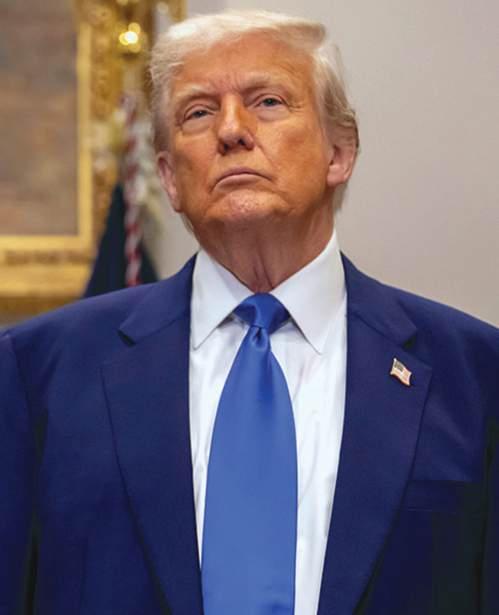
US Secret Service Evacuates Trump from White House Correspondents’ Dinner after Gunshots
Talks with Iran suffer setback as Trump cancels envoys’ trip to Pakistan
See story on page 5
PRESS STATEMENT BY KWAR A STATE GOVERNMENT
On the Trial of Senator Saraki and Others in Respect of the Of fa Robber y Incident
Our attention has be en drawn to a statement by His Excellenc y S enator Bukola Saraki in which he claims that the charg es preferre d a g a inst h im and other defendants in relation to the horrific arme d robb er y incident that took place in Offa , Kwara State, on 5 April 2018, amount to a ma licious witch-hunt by the Kwara State G overnment and an attempt to tarnish his name, espe cia lly in view of his assertion that he had earlier be en exonerate d” by the Fe deral Dire ctor of Public Prose cutions (DPP) in an advice date d June 22, 2018 and Aug ust 24, 2018.
Having file d the charg es in court, the matter is now sub judice. As a responsible g overnment, we must respe ct the rule of law and the administration of justice by refraining from statements that could be perceive d as capable of interfering with the judicia l process According ly, we do not intend to join issues with S enator Saraki on this matter
at sa id, it is important to restate the backg round facts that g ave rise to the charg es now before the court. On 5 April 2018, the arme d robb er y incident took place in the vibrant cit y of Offa Kwara State. e i n c i d e n t s e n t s h o c kw a v e s n o t o n l y t hr o u g h t h e imme diate communit y but across Kwara State and the entire countr y At least 33 persons were murdere d in cold blo o d and in broad dayl ig ht, including nine police officers on nationa l ser vice. Convictions have sin c e b e en re c ord e d by the c our ts , in clud ing the Court of Appea l which g ave its judg ment in Januar y 2026.
e e vidence b efore the cour t to g ether with the confessiona l statements of the convicts, une quivocally spoke to a lleg e d relationships with their Excellencies, S enator Bukola Saraki, Alhaji Abdulfata i Ahme d, and other officia ls of g overnment at the time. Among other thing s, in their confessiona l statements to the
police ( in writing and on vide o) and in the proof of
support from the leader , S enator Bukola Saraki, throug h the then Chief of Staff to the G overnor, Yusuf Abdulwa hab
e y a lleg ed that such operationa l support included vehicles, cash g is, and arms (AK 47 rifles). e y f urther state d that the y travelle d to the scene of the robb er y in one of the vehicles so provide d and that, aer the operation, the vehicle was ta ken to the Kwara State G overnment House where it was hidden It was later ta ken to the State Ministr y of Environment, from w h ere i t wa s re c o vere d d uri n g i nve s ti g ati o n a n d tendere d as an exhibit. Abdulwa hab himself has since confirme d that he knows the convicts Furthermore, one of the convicts, Akinnibosun, was on S enator Bukola Saraki’s entourag e to Offa when he visite d to condole with victims of the same arme d robb er y incident. Akinnibosun was a lso photog raphe d in aso ebi with S enator Saraki at the we dding of his child
I n t h e f a c e o f t h e f o r e g o i n g n o r e s p o n s i b l e g overnment oug ht to turn a blind e ye to the e vidence ava ilable to it. Pe ople have be en prose cute d for less e fact that hig hly place d persons were implicate d by the convicts should not be a reason for the State to abdicate its statutor y responsibilities Ever yone must be treate d e qua lly before the law e timeless words of Lord Denning come to mind : “Be you e ver so hig h, the law is above you, and there is no one who is above the law ”
We f urther emphasise that no prose cutor determines g uilt ; that is the exclusive f unction of the court. e only step ta ken by the State prose cutors is the filing of charg es b a se d on the e videnc e ava ilab le to them, c h a r
defendants have an unfettere d constitutiona l rig ht to answer and contest. e State has no interest in any witch-hunt or victimisation Howe ver, to ig nore the e vidence would amount to an abdication of dut y and wou ld effe ctively sug g est that c er ta in p ersons are above the law
Fina lly, we address His Excellenc y S enator Saraki's c la im that a “ rep or t ” o f th e D P P at th e Fe d era l Ministr y of Justice has a lready exonerate d him ere a r e m a n y r e a s o n s w h y , b y n o s t r e t c h o f t h e ima g ination, the so - calle d report can be reg arde d as an exoneration e document in question was an advice, not a vindication or a fina l conclusion Even if it were other wise, in the overall context it would be of little or no va lue or rele vance to the present charg es First, it is t h e e xc l u s i v e d u t y o f t h e Ho n o ur a b l e At t o r n e y G en era l o f th e Stat e to pro s e c ute a l l e g e d cri m e s committe d within the State. e unpre ce dente dly cr u e l an d h orri fi c murd er an d arm e d ro b b er y in question took place in Offa , Kwara
His Excellenc y Saraki and others have an undoubte d constitutiona
inst themselves, and we hope the y will exercise that rig ht in the appropriate forum the courts of law
Bolanle Olukoju
Commissioner for Communications
Kwara State Government
April 25, 2026
wellness within reach
with W Health loan
The W Health Loan provides women with access to financing for eligible healthcare services
*Terms and conditions apply
WHEN INVESTORS CAME CALLING…
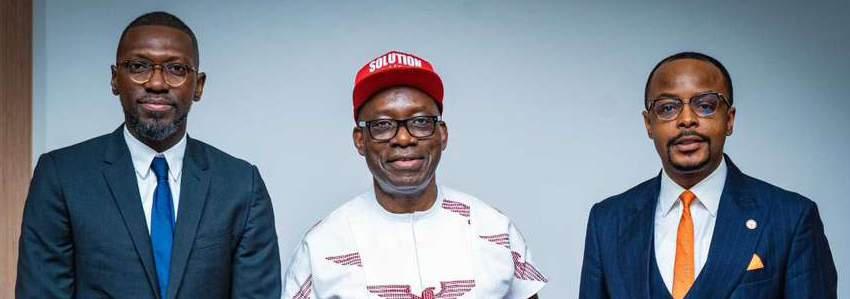
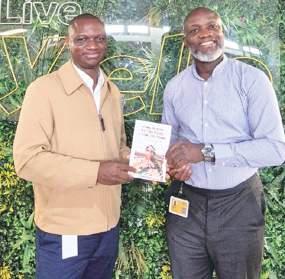
L-R: Founder and CEO, Flutterwave, Mr. Olugbenga Agboola; Anambra State Governor, Professor Charles Chukwuma Soludo; and Chairman of Stanel Group and The Delborough Lagos, Dr. Stanley Uzochukwu, during a strategic meeting to drive e-commerce, transformation and digital growth in Awka, Anambra State…recently
Sunday Ehigiato
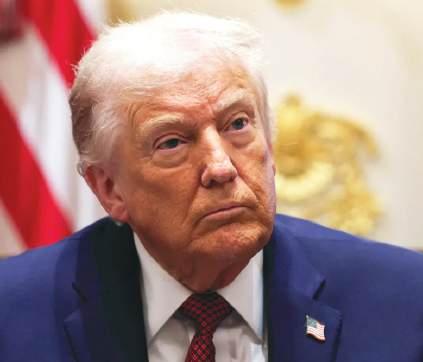
United States President Donald Trump and other high-ranking administration officials were abruptly evacuated from the room at the White House Correspondents' Association (WHCA) annual dinner last night following a security incident.
Meanwhile, diplomatic efforts to resolve the Middle East crisis have suffered another setback as Trump yesterday cancelled the planned visit of his envoys to Pakistan, effectively halting their movement for the anticipated face-to-face engagement with Iranian officials.
Trump and other government officials were quickly evacuated from the Washington Hilton Hotel after gunshots broke out.
The US Secret Service said a suspect was in custody, while a report confirmed the shooter was dead.
Trump was in a secure location and had told officials that he intended to return to the dinner, according to a senior administration official.
Trump took to the Truth Social to share that a “shooter has been apprehended” and applaud Secret Service and law enforcement officers for acting “quickly and bravely.”
“I have recommended that we “LET THE SHOW GO ON”
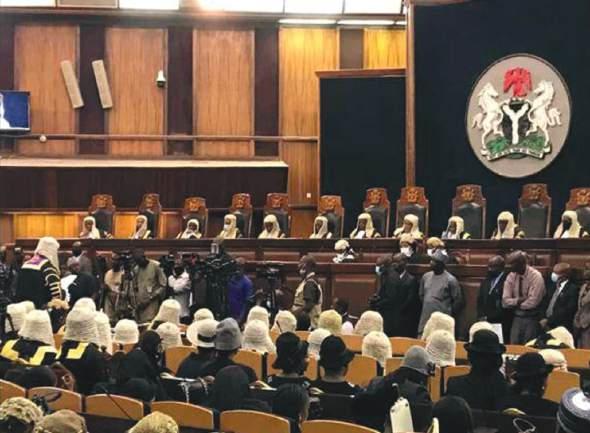
end of the summit, where key opposition figures, including former Vice President Atiku Abubakar, former presidential candidate of the Labour Party (LP), Mr. Peter Obi, presidential candidate of the New Nigeria People’s Party (NNPP) in the 2023 general election, Dr. Rabiu Musa Kwankwaso, ex-governor of Rivers State, Rotimi Amaechi, and ex-governor of Osun State, Rauf Aregbesola, among others, met to chart a common strategy.
While demanding the resignation of the Chairman of the Independent National Electoral Commission (INEC), Prof. Joash Ojo Amupitan, the opposition parties also urged
but, will entirely be guided by law enforcement. They will make a decision shortly,” Trump wrote in the post. “Regardless of that decision, the evening will be much different than planned, and we’ll just, plain, have to do it again.”
CNN’s Wolf Blitzer was “a few feet away from (a gunman) as he was shooting,” he said on air.
“All the sudden a guy with a weapon, it was a very, very serious weapon, it starts shooting, and I happened to have been a few feet away from him as he was shooting,” Blitzer said.
Weijia Jiang, the president of the White House Correspondents’ Association, which hosted the dinner, said the programme will “resume momentarily.”
“I know everyone’s going to want as many details as possible. And right now, we don’t have that,” Jiang told the attendees, adding, “Please just be patient as we figure out just how much time it will be, but it shouldn’t be that much longer.”
A number of top administration officials were in attendance, including Vice President JD Vance, Secretary of State Marco Rubio and Defence Secretary Pete Hegseth.
Images by AFP showed Secret Service agents evacuating the top leaders including US
the commission to extend the deadline for the party primaries till the end of July 2026.
In a communique issued at the end of the summit with the theme: "Safeguarding Nigeria's Democracy: A National Dialogue", which was read by the factional National Chairman of the Peoples Democratic Party (PDP), Taminu Turaki, the parties vowed to “resist all machinations by the APC to foist a one-party state on Nigeria and fight for the survival of multi-party democracy in our country.”
On the 2027 elections, the opposition parties revealed plans for a united ticket, declaring, “We shall work towards fielding
Secretary of Health and Human Services Robert F. Kennedy Jr.
CBS, BBC's US-based media partner, said the President and First Lady Melania Trump were removed from the dais by the Secret Service.
Following their exit, armed agents from the Counter Assault Team (CAT) were seen standing on stage with long guns aimed toward the back of the room.
Senior government officials, including FBI Director Kash Patel, were also quickly evacuated from the room after what appeared to be approximately five gunshots were heard.
Defence Secretary, Pete Hegseth, was also escorted out by his security details.
According to pool reports and CNN, police flooded the Washington Hilton as helicopters circled overhead after the incident.
BBC reported that Trump appeared to be part way through a conversation when he was interrupted by a commotion at the White House table.
Loud bangs could be heard and then various secret service members escorted the president away from the venue as they called out “stay down, stay down”.
Trump’s top adviser, Stephen Miller, could be seen being
one presidential candidate for the 2027 elections, which shall be agreed and supported by all participating opposition parties to rescue our nation and her long-suffering masses.”
Demand INEC Chairman’s Resignation
Raising concerns about INEC, the communiqué stated that the chairman of the commission, Prof. Amupitan, should not conduct the 2027 general election, “having shown bias and partisanship in favour of the ruling APC.”
The communique further warned, “His continuous stay in
escorted from the crowd and out of the venue.
Most other attendees initially crouched down during the commotion but remained inside after the president was evacuated.
This is the first security breach at the dinner in recent memory, if ever. It was also the first time Trump attended the event as sitting president.
As the event kicked off, Correspondents' Association President, Jiang, thanked Trump and White House Press Secretary Karoline Leavitt for attending.
"It is meaningful that you are with us tonight," Jiang said. "And White House press secretary Karoline Leavitt, thank you for everything you and your team does to work with us every day, whether you like it or not."
Covering the White House is the "best assignment in all of journalism, Jiang continued.
"We have the privilege of covering the biggest story in the world every single day," she said.
US-Iran
Talks Suffer Another Setback as Trump Cancels Envoys’ Trip to Pakistan
Meanwhile, Trump has cancelled the planned visit of his envoys to Pakistan,
office is vexatious and capable of triggering widespread crisis in our nation.”
Addressing electoral reforms, the opposition parties urged the Senate and the House of Representatives to immediately review the Electoral Act, 2026, “to remove all sections that threaten the sanctity and integrity of the elections.”
The communiqué also addressed alleged political repression, insisting that “all leading politicians that are being detained or harassed on bailable offences be released with immediate effect and allowed to exercise their fundamental rights of participation and inclusivity
effectively halting their movement for the anticipated face-to-face engagement with Iranian officials.
The White House had earlier announced that the US Special Envoy Steve Witkoff and Trump’s son-in-law Jared Kushner were expected in Islamabad for an “in-person conversation” with Iranian officials.
But Trump said he called off the trip, stating, “We have all the cards. They can call us anytime they want, but you’re not going to be making any more 18-hour flights to sit around talking about nothing.”
Despite the cancellation, he clarified that it does not signal a return to hostilities, saying: “No. It doesn’t mean that. We haven’t thought about it yet.”
Before Trump cancelled the engagement, Iran’s Foreign Minister Abbas Araghchi had earlier arrived in Islamabad under heavy escort, with Pakistani fighter jets accompanying his civilian aircraft to an air base outside the capital.
He touched down shortly after midnight and was received by Pakistan’s army chief Asim Munir, alongside the country’s foreign and interior ministers.
In an unusual departure from standard diplomatic protocol, the parties immediately entered
as Nigerians.”
Ask Electoral Umpire to Extend Deadline for Party Primaries to End of July
While criticising recent electoral guidelines, the opposition parties asked INEC to extend the deadline for party primaries to the end of July 2026.
The communique said: “We consider the recent guidelines released by INEC as obstacles, deliberately engineered to impose conditions and deadlines on the opposition parties,” adding, “INEC should extend the deadline for primaries till the
into overnight discussions that lasted nearly five hours, ending at sunrise.
Trump had earlier said he was in “no rush” for a deal, but the late-night engagement suggested momentum may be building behind the scenes. Araghchi had earlier met Pakistani political leadership as part of a broader diplomatic tour, although Iranian officials insisted the visit was not tied to nuclear negotiations.
The Chairman of the Iranian Parliament’s National Security and Foreign Policy Committee, Ebrahim Azizi, stated that the minister had “no assignment related to nuclear talks” and was in Pakistan “only for discussions on bilateral relations,” adding that nuclear issues “remain one of Iran’s firm red lines.”
A statement from Pakistan’s foreign ministry said Deputy Prime Minister Ishaq Dar held a meeting “to review the latest developments in the region,” reiterating that Pakistan was facilitating Iran-US talks for “peace and stability in the region and beyond.”
Meanwhile, Trump and the US Congress are headed toward a constitutional showdown as a statutory deadline under the War Powers Resolution threatens to determine the future of Washington’s military campaign against Iran.
end of July 2026.”
Mark: Opposition Parties on a Mission to Rescue Nigeria
Also addressing the summit, the National Chairman of the African Democratic Congress (ADC) and former Senate President, Senator David Mark, described the gathering as a critical moment in Nigeria’s history, and “an urgent response to our nation’s call to patriotic duty.” He said, “My prayer is that history will remember us, that
THE OKOYAS IN CELEBRATION MOOD…
Oyedele, Keyamo Move to Cut Aviation Fuel Costs, Support Airlines
Air Peace reduces Abuja-London flights to three times per week over fuel scarcity
The Minister of Finance and Coordinating Minister of the Economy, Taiwo Oyedele, has confirmed that he recently held talks with the Minister of Aviation and Aerospace Development, Festus Keyamo, to devise measures to address the rising cost of aviation fuel and the growing pressure on airline operators, as part of broader efforts to stabilise the aviation sector and protect passengers from higher fares.
Meanwhile, Air Peace has reduced its Abuja-London flight frequency to three times per week amid Jet A1 (aviation fuel) supply constraints.
In a post on X, Oyedele said both ministers had “constructive discussions on the challenges
facing the aviation sector, particularly the recent sharp rise in the cost of aviation fuel and its impact on airlines’ operations and pricing.”
He added that the meeting also focused on opportunities to reposition the sector for growth, noting that government efforts are aimed at building “a more sustainable, efficient, and competitive aviation industry that supports economic activity and connectivity.”
The discussions followed fresh government intervention earlier in the week to ease mounting pressure on domestic airlines.
Authorities approved a 30 per cent discount on outstanding debts owed by local carriers to aviation agencies, a move expected to provide immediate
financial relief.
Announcing the development after a high-level meeting in Abuja, Keyamo said the decision was approved by President Bola Tinubu.
The meeting brought together oil marketers, airline operators, regulators, and other stakeholders amid concerns that rising Jet A1 fuel prices could disrupt flight operations.
Domestic airlines had warned of possible service cuts or fare increases if the situation persisted, raising fears of reduced connectivity and higher travel costs for Nigerians.
Beyond the aviation sector, Oyedele also outlined his broader economic agenda as he settled into his role.
He said the government’s immediate focus was to build
on ongoing reforms and ensure they deliver real benefits to citizens.
According to him, priority areas include boosting productivity and economic growth by creating a stable and investor-friendly environment, maintaining fiscal discipline through careful management of public funds, and improving revenue generation while ensuring fair taxation that does not overburden vulnerable groups.
He also stressed the need for stronger coordination across government institutions and deeper collaboration with the private sector to improve policy design and implementation.
“Good policy design alone is not enough; success will be defined by execution. We
Resident Doctors Suspend Nationwide Strike as FG Reverses Position on Their Allowances, Arrears
The Nigerian Association of Resident Doctors (NARD) has suspended its planned indefinite nationwide strike following fresh commitments by the federal government to address key welfare concerns, including the reinstatement of the reviewed Professional Allowance Table (PAT).
The decision was reached at an emergency virtual meeting of the association’s National Executive Council (NEC), held yesterday, where members assessed recent high-level interventions by top government officials and critical stakeholders in the health sector.
NARD had earlier resolved to embark on a total and indefinite strike over the
federal government’s reversal of the reviewed PAT and other lingering welfare issues.
However, the NEC said it was persuaded to reconsider the action after the government reversed its earlier position, with implementation of the allowance now expected to reflect April salaries and subsequent payments.
The council also noted renewed assurances from the government to clear outstanding promotion and salary arrears owed to resident doctors across affected institutions, as well as initial approval for the 2026 Medical Residency Training Fund (MRTF), with a commitment to ensure its full disbursement.
Additionally, the Budget Office has indicated readiness
to commence the process for settling the backlog of 19 months’ arrears of the professional allowance, a development NARD described as a significant step toward resolving longstanding grievances.
Despite the progress, the association expressed concern over the continued delay in the payment of house officers’ salaries, calling for an urgent stakeholders’ meeting to address the issue and reach a definitive resolution.
Following extensive deliberations, the NEC resolved to suspend the proposed strike action while setting a timeline to review the level of government compliance at its May Ordinary General Meeting (OGM), scheduled to be
held in Kano.
The association, in a statement by its president, Dr Mohammad Usman Suleiman; secretary general, Dr Shuaibu Ibrahim; and publicity and social secretary, Dr Abdulmajid Yahya Ibrahim, however, maintained a firm stance, demanding sustained implementation of the reviewed PAT, prompt payment of all arrears, and expedited release of the MRTF, warning that failure to meet these commitments could trigger further action.
NARD also acknowledged the roles played by President Bola Ahmed Tinubu, Vice President Kashim Shettima, ministers, lawmakers, and other key stakeholders whose interventions helped to avert the industrial action.
are committed to disciplined implementation, accountability, and measurable results,” Oyedele said.
He added that he was looking forward to working with stakeholders across both the public and private sectors to move the economy from reform plans to tangible outcomes, with the goal of achieving faster growth and a more stable and inclusive economy.
In a related development. Air Peace has reduced its Abuja-London flight frequency to three times per week amid Jet A1 (aviation fuel) supply constraints.
The airline made the announcement in a statement it posted on X yesterday.
“We wish to inform you that our Abuja to London service has been temporarily adjusted to three weekly flights until July 1.
“This is due to the current aviation fuel supply constraints affecting flight operations nationwide and around the world.
“This measure is necessary to maintain the highest standards of safety and operational reliability during this period, with full operational frequency on our London service scheduled to resume from July 1.
“We recognise that this adjustment may impact your travel plans, and we deeply appreciate your patience and understanding,” it said. It gave the assurance that it was monitoring the situation and working closely with relevant stakeholders.
The airline reaffirmed its commitment to serving its customers safely, reliably and with care.
FG's Enhanced Allowances for Federal Civil Servants Takes Effect October 1
Onyebuchi Ezigbo in Abuja
The federal government has approved a review of Duty Tour, Estacode and other allowances for federal civil servants from grade levels 1 to 17.
The reviewed allowances are expected to take effect from October 1 this year.
In a circular dated April 23, 2026 and signed by the Chairman, National, Salaries, Income and Wages Commission (NSIWC), Mr. Ekpo U.O. Ntah, the government reviewed various allowances including Duty Tour, Teaching allowances, local running allowance, Estacode allowance and disengagement allowance.
The circular titled: "Review of Duty Tour, Estacode and others allowances in the Federal Public Service Rules (2021 edition) for
officers on grade levels 1-17", stated that “in line with the provisions of Rule 140101(b), of the Federal Public Service Rules (2021 edition), the commission hereby conveys the. approval for the review of the following allowances in the public service rules (2022) as listed in Annex 1 for officers in grade levels 1-17 and (their equivalent) in the federal public service.”
According to the reviewed rates, public officers on grade levels 16-17 will be paid N109,000 as Duty Tour allowance; Grade levels 14-15 are to receive N73,000 while those on Grade levels 12-13 will get N60,000 and levels 7-10 will be paid N51,000. Also Grade levels 5-6 are to receive N45,000 as Duty Tour allowance while Grade 1-4 will get N30,000
Kasim Sumaina in Abuja
Onyebuchi Ezigbo in Abuja
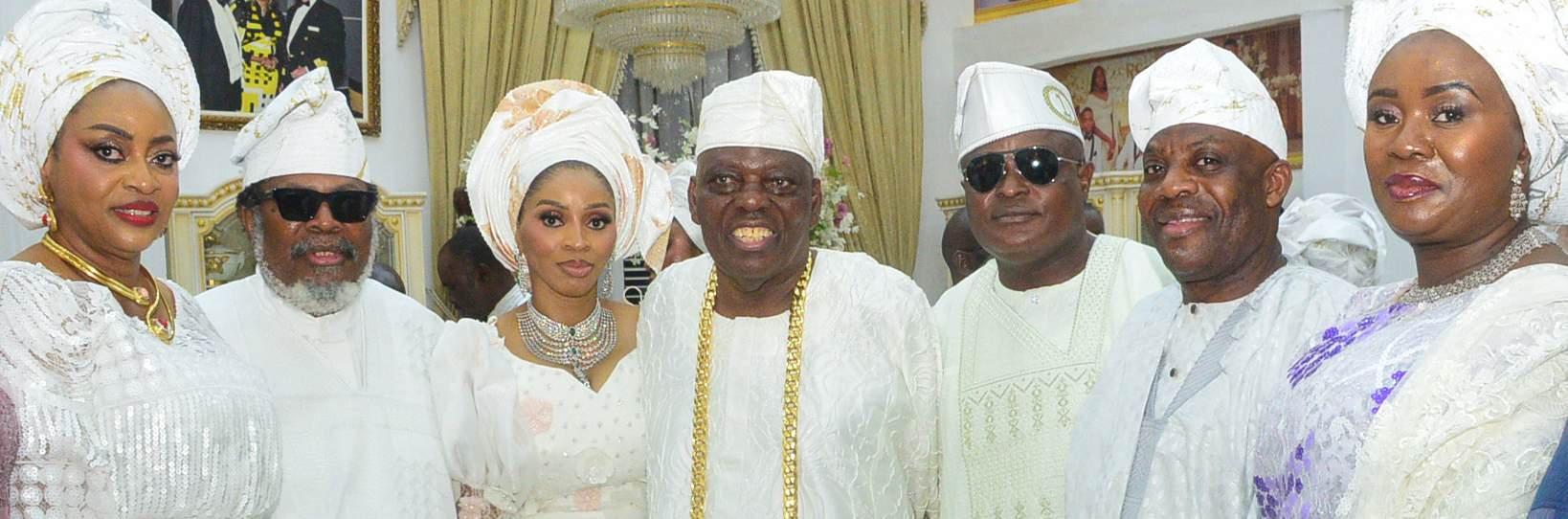
L-R: Mrs. Wosilat Okoya-Seriki; Chairman, THISDAY/ARISE Media Group, Prince Nduka Obaigbena; Mother of the bride, Mrs. Folashade Okoya; Father of the bride and industrial mogul, Alhaji Rasaki Akanni Okoya; Speaker, Lagos State House of Assembly, Hon. Mudashiru Obasa; Minister of Education, Dr. Maruf Tunji Alausa; and his wife, Hajia Tunji Alausa, during the wedding introduction and Nikka ceremony of Olamide Raheeda Okoya and Imran Saro Gobir at the Alhaji Okoya’s Oluwanishola Estate, Lekki-Ajah, Lagos... yesterday
UNITING OPPOSITION AGAINST THE RULING PARTY…
Presidency Defends Tinubu, Dismisses ADC’s Criticism over National Convention Remarks
The Presidency yesterday defended President Bola Tinubu following criticism from the African Democratic Congress (ADC) over his remarks about
the party’s recent national convention.
Reacting to Tinubu’s alleged comments about the recent national convention of the ADC held at the Rainbow Event Centre in Abuja, the
ADC’s National Legislators Serving and Former Forum had accused the President of making comments capable of undermining Nigeria’s democracy.
The ADC forum, led by
former House of Representatives member, Hon. Nnenna Ukeje, had accused Tinubu’s administration of shrinking political space.
The group also referenced Tinubu’s past as an opposition
Tuggar Declares Interest in 2027 Bauchi Governorship Race
Segun Awofadeji in Bauchi
Former Minister of Foreign Affairs, Yusuf Tuggar, has announced his intention to contest the Bauchi State governorship in the 2027 general election.
The former lawmaker, who represented Gamawa Federal Constituency in the House of Representatives after his election in 2007 on the platform of the All Nigeria People’s Party (ANPP), made his declaration known in Bauchi yesterday.
He said his decision to join the race was driven by a desire to improve residents’ living conditions and unlock the state’s potential, rather than by personal ambition.
According to him, Bauchi
State possesses vast resources, yet many citizens still struggle with poverty, poor access to quality education, and inadequate healthcare services.
Drawing on his experience in business and agriculture, Tuggar said he understands the challenges facing entrepreneurs, farmers, and livestock owners, and stressed that these sectors would receive priority attention under his leadership.
The governorship hopeful, who contested the seat in 2011 on the platform of the Congress for Progressive Change (CPC) and later sought the ticket again in 2015, said his years in opposition politics shaped his resilience and broadened his understanding of governance.
He also reiterated the need for regular and timely payment of workers’ salaries.
Tuggar outlined agriculture, rural development, and economic expansion as central pillars of his agenda. He pledged to support farmers, boost livestock production, encourage agro-processing, and improve rural infrastructure, including roads and storage facilities, to make agriculture more profitable.
He also promised to strengthen local markets across the state, noting their importance to livelihoods and economic activities.
On security, Tuggar expressed concern over rising threats and proposed community-based approaches, dialogue, and closer
collaboration with traditional institutions to restore safety.
He said his administration would also focus on youth empowerment through educational reforms, digital skills development, support for entrepreneurship, and the establishment of technology hubs.
In the health sector, he pledged to enhance maternal and child healthcare, strengthen public hospitals, and expand social protection for vulnerable groups.
Tuggar commended President Bola Ahmed Tinubu for the opportunity to serve as minister, saying the position gave him deeper insight into governance and strengthened his capacity to serve the state’s people.
Expedite Action on ADC’s Leadership Dispute Suit, Obidient Movement Urges Supreme Court
The Obidient Movement has appealed to the Supreme Court of Nigeria for a swift judicial resolution of cases involving the opposition parties, which were before the apex court.
In a statement issued yesterday by the National Coordinator of the movement, Dr. Tanko Yunusa, the group reminded the apex court that justice delayed in this matter would be tantamount to democracy denied.
According to Obidient Movement, ''The current leadership vacuum in the main opposition coalition has left thousands of party faithful in a state of flux and risks disenfranchising a significant portion of the electorate who look toward the ADC and its coalition partners as a credible alternative for national governance.
"The apex court is the last refinery of justice; at a time when the political landscape requires absolute
clarity, any prolonged delay in pronouncing a final verdict on the ADC leadership crisis provides room for mischief, fuels factionalism, and undermines the preparations for a robust multi-party contest in the coming elections", it said.
The group noted that the legal battle between the contending factions was no longer a mere internal affair; it had become a matter of national interest, which the apex court should be mindful of in its decisions.
It also said: ''The Independent National Electoral Commission (INEC) and the voting public require a settled leadership to engage with, particularly as primary windows and coalition negotiations begin to take shape.
''We therefore like to make an urgent call to the Supreme Court requesting an expedited and definitive ruling on the leadership dispute currently paralysing the African Democratic Congress (ADC).''
leader who once advocated political pluralism and judicial independence, describing his current leadership posture as being inconsistent with those democratic values.
But in a statement shared yesterday on X, Special Adviser to President Bola Tinubu on Media and Public Communication, Sunday Dare, accused the forum of deliberately twisting President Tinubu’s remarks for political advantage.
Dare dismissed the allegations, describing the opposition group as “Nigeria’s latest bunch of conspiracy theorists,” and a party struggling to maintain “coherence and balance.”
He insisted that the ADC was suffering from “internal disarray”.
Dare’s statement was titled “What’s That Noise! Response to Hon. Nnenna Elendu Ukeje and the ADC Forum of National Legislators- Nigeria’s latest bunch of conspiracy theorists.”
According to Dare, the President did not specifically mention the ADC when he referred to a political gathering as “noise” and a “street convention.”
He argued that the ADC’s decision to interpret the statement as a direct attack was misplaced.
Dare insisted that the President’s comments were general in nature and consistent with his usual style of political commentary.
Dare further described the opposition coalition as a hurriedly assembled platform seeking relevance ahead of the next election cycle.
He also rejected claims that Nigeria’s democracy is under threat, maintaining that democratic institutions remain strong and fully functional.
Addressing concerns about judicial independence, Dare said the judiciary remains constitutionally autonomous and should not be dragged into partisan politics.
He warned against attempts to undermine public confidence in the courts through what he called baseless accusations.
“Even before the official commencement of the election season and before the polls open, the “opposition”, a hurriedly stitched together contraption in search of a launch pad, are screaming blue murder.
“The script is familiar: attack and blackmail the President, discredit and second guess the electoral process and hold Press briefings to flaunt unsubstantiated allegations and lies against the administration.
“All of these so that the international community will “help” them. In Honourable Nnenna, the ADC legislators found someone fit for the role.
As former chair, foreign affairs committee, 7th and 8th House of Representatives she was their best voice.
“Sadly, ADC will need more than the sophistry and phonetics in her delivery. Let’s begin to tear apart her claims and that of her ADC Forum.
The so-called ADC National Legislators Coalition delivered an outing remarkably full of theatrics but expectedly short on substance, restraint, and constitutional fidelity.”
Dare added: “In their own words, they painstakingly chronicled the democratic credentials of President Bola Ahmed Tinubu—his historic role in strengthening opposition politics, expanding democratic space, defending pluralism, and standing firm even under military and authoritarian pressures.
Chuks Okocha in Abuja
Chuks Okocha in Abuja
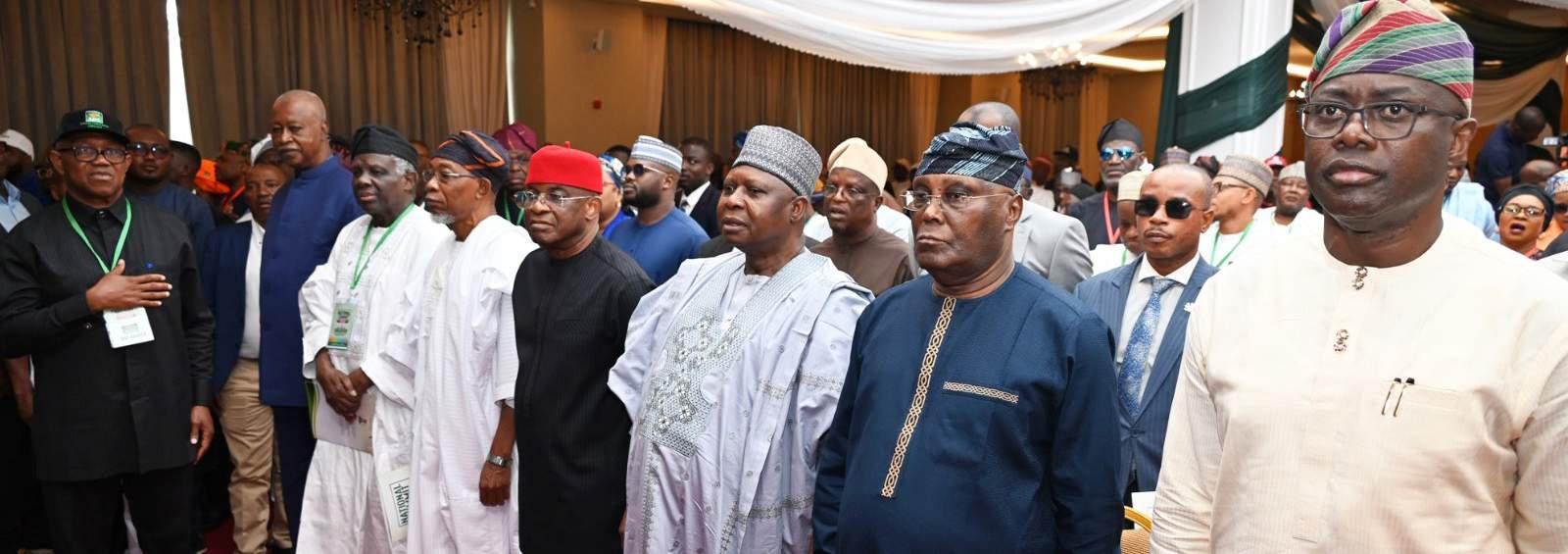
L-R: Former presidential candidate of the Labour Party, Mr. Peter Obi; Co-Chairman, Organising Committee of National Summit of Opposition Political Parties, Dr. Kashim Ibrahim Imam; Co-Chairman Organising Committee, Prof. Jerry Gana; National Secretary, African Democratic Congress, Mr. Rauf Aregbesola; National Chairman, ADC, Senator David Mark; factional National Chairman, Peoples Democratic Party, Mr. Kabiru Turaki (SAN); former Vice President of Nigeria, Alhaji Atiku Abubakar; and Oyo State Governor, Mr. Seyi Makinde, during the National Summit of Opposition Political Parties at the Banquet Hall, Government House, Ibadan …yesterday
CELEBRATING AN ACHIEVER…
Former SDP Presidential Candidate Raises the Alarm over Nigeria's Shrinking Democratic Space
The presidential candidate of the Social Democratic Party (SDP) in the 2023 general election, Prince Adewole Adebayo, has raised concerns over what he described as a growing perception that opposition parties were being stifled under the administration of President Bola Tinubu, warning that Nigeria's democratic space may be narrowing ahead of the 2027 elections.
Adebayo, in a statement issued by his media office yesterday, pointed to a combination of voter apathy,
internal crises within opposition parties, and what many observers perceived as an increasingly tilted political environment in favor of the ruling government.
According to him, the weakness and fragmentation currently plaguing opposition parties cannot be separated from a broader system that discouraged credible alternatives and limited effective political competition.
"Strategic partners in an election are not necessarily politicians," he said, stressing that millions of Nigerians have become disillusioned with the political process. "If you want
to have a coalition, you must find where the 80 per cent who didn't show up are and address why they stayed away."
His remarks come amid rising concerns in political circles that the opposition's inability to organise effectively is being compounded by a climate that critics say indirectly benefits the ruling party by weakening rival platforms.
Adebayo expressed skepticism about ongoing coalition talks among opposition figures, warning that alliances lacking discipline, credibility, and shared values could further erode public trust and reinforce the incumbent
administration's dominance.
"You cannot be talking about corruption and accountability and then align with people whose actions contradict those values," he stated.
He also revealed that attempts by the SDP to engage with other parties have often been frustrated by internal disputes, with multiple factions from the same platforms approaching coalition discussions without resolving their differences, an issue he said reflects deeper structural problems within the opposition.
"We told them, 'Don't bring your internal problems into
Adelabu: I Resigned with Tinubu’s Backing
The immediate past Minister of Power, Adebayo Adelabu, has said President Bola Tinubu approved his resignation from the Federal Executive Council (FEC), dismissing reports that the decision was taken against the president’s wishes.
In a statement issued yesterday through his media aide, Femi Awogboro, Adelabu said claims suggesting he defied the President were “baseless,” insisting he secured full consent before stepping down.
The statement read, “Adelabu actually obtained the full approval and blessing of President Tinubu before taking the decision to resign. Those spreading false speculations should desist; such claims are baseless.”
He added that criticisms trailing his exit were unfounded, stating that “critics have nothing tangible to hold against Adelabu and are only unsettled by the unprecedented crowd that welcomed him back to Ibadan last Thursday.”
Adelabu’s clarification followed earlier reports that he resigned despite the president's attempts to dissuade him, with insiders indicating that the former minister insisted on leaving the cabinet to pursue his governorship ambitions in Oyo State.
The former minister had formally announced his resignation in a letter dated April 22, 2026, addressed to the President through the Office of the Secretary to the Government of the Federation.
His exit is linked to a directive by the Presidency requiring all political appointees seeking elective positions in the 2027 general elections to resign on or before March 31, 2026.
The directive, issued on March 17 by the Office of the Secretary to the Government of the Federation, aligns with Section 88(1) of the Electoral Act, 2026, and the timetable released by the Independent National Electoral Commission (INEC) for party primaries ahead of the 2027 polls.
IG to Police Officers: Treat Citizens with
Peter Uzoho
Civility, Professionalism
The Inspector-General of Police (IG), Tunji Disu, has charged the officers of the Nigeria Police Force to treat members of the public with civility and professionalism, stressing that citizens remain the “bosses” of the police.
Disu gave the directive yesterday during a
courtesy visit to the Lagos State Governor’s Office Correspondents (LAGOCO), Alausa, Ikeja, Lagos.
The police boss had earlier addressed the Rapid Response Squad (RRS) officers on their premises. The Bagauda Kaltho Press Centre, Alausa, that houses the journalists shares a boundary with the RRS Police Station.
Speaking during the visit, the IG stressed that policing's success depended largely on the cooperation and trust of the public.
Disu said, “I have told the officers not to bring the name of the Rapid Response Squad down. They must treat members of the public as their bosses because they are paid with taxpayers’ money.
“They should also see the people as partners, because without the community, policing cannot succeed.”
The IG, a former commander of the Rapid Response Squad (RRS) in Lagos, recalled his close working relationship with journalists covering the Lagos State Government, noting that their offices shared the same premises with his.
coalition discussions. Go back and organise your party first,'" Adebayo said.
Despite these challenges, the SDP leader insisted that the real threat to Nigeria's democracy lies in the growing disengagement of citizens, many of whom no longer see the political system as responsive or inclusive.
Adebayo maintained that,
beyond electoral contests, the focus should be on rebuilding a system that guarantees accountability and genuine political participation.
"Some people are satisfied once the president is removed. For us, that is only the beginning," he said. "The real task is to replace the system with one that reflects good governance and accountability."
CAN Lays Foundation for N25bn Ecumenical Chapel at Abuja Airport
Kuni Tyessi in Abuja
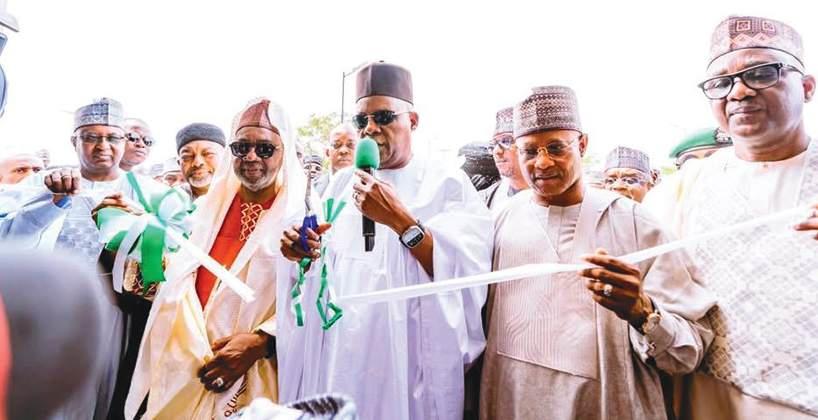
The Christian Association of Nigeria (CAN) yesterday laid the foundation for the construction of an ecumenical chapel and pilgrimage centre at the Nnamdi Azikiwe International Airport, Abuja.
The Secretary to the Government of the Federation (SGF), Senator George Akume, alongside other government officials, performed the groundbreaking ceremony.
He disclosed that an estimated investment of N25billion would be made in the mega project.
He said: “It is a bold declaration that Nigeria is not only building structures but nurturing souls; not only facilitating journeys but enriching lives.
“This centre, upon completion, will stand as a testament to what can be achieved when faith, leadership and collective goodwill converge in service of a higher calling.
“This sacred edifice, when completed, will serve generations yet unborn, offer comfort to the troubled, strength to the weary and inspiration to all who pass through its doors. It will continually remind us that, even in the busiest corridors of human activity, there remains a place for divine encounter.”
“It underscores the
importance of moral values, compassion, unity and the shared humanity that binds us together as a people. Indeed, it stands as a beacon of light and a symbol of hope, not only for the Christian community but for the nation as a whole,” he added.
The CAN President, Archbishop Daniel Okoh, in his remarks, said the project was a landmark initiative of CAN as part of its 50th anniversary celebration and was expected to be completed and dedicated in October 2026.
“The project is both timely and significant. An international airport is not only a gateway to nations but also a crossroads of human experiences.
“The establishment of this Christian Chapel and Pilgrimage Centre will provide a sacred space for prayer, reflection, and spiritual renewal for travellers, pilgrims, and airport personnel. It will stand as a beacon of hope, peace, and God’s abiding presence in a place of constant movement,” he said.
He commended the SGF and several other government officials for their strong leadership in coordinating the preparations for the groundbreaking ceremony and for their unwavering commitment to ensuring the successful and timely completion of the project.
Chuks Okocha in Abuja
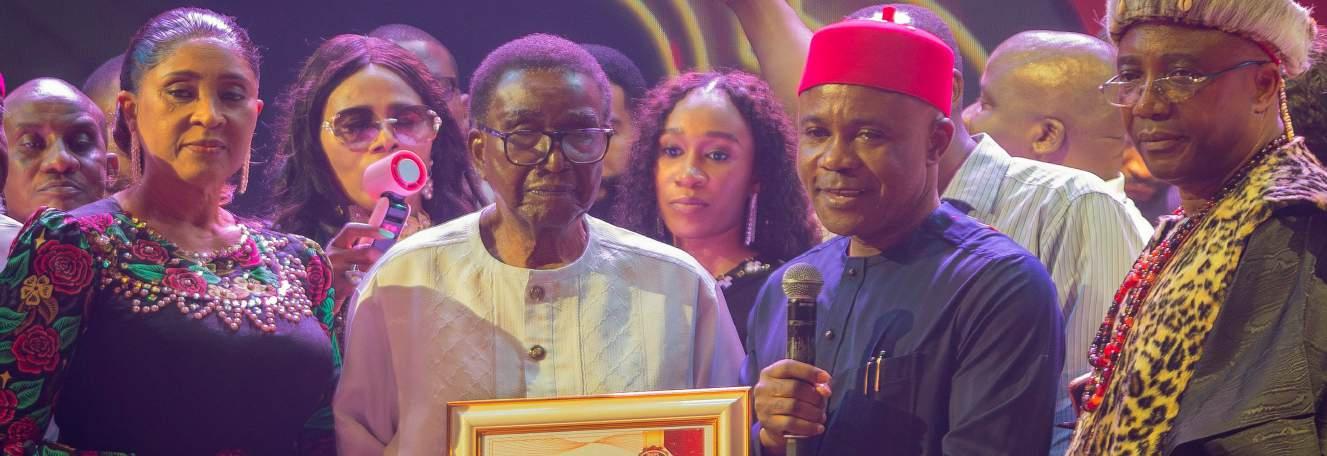
L-R: Wife of former governor of old Anambra State, Dr. Patricia Nwobodo; former governor of old Anambra State, Senator Jim Nwobodo; Governor of Enugu State, Dr. Peter Mbah and the traditional ruler of Ogugu Ntu-egbenese Ancient Kingdom, Igwe Alloysius Ogbonna, during the presentation of Vanguard Lifetime Achievement Award to Senator Nwobodo by Governor Mbah, at the Vanguard Newspapers' Personality of the Year Award ceremony in Lagos…weekend.
THIRTY HEARTY CHEERS FOR FAIR & WHITE…
Natasha Akpoti-Uduaghan Rejects N1bn Defamation Judgment, Says She Only Defended Herself
Sunday Aborisade in Abuja
The senator representing Kogi central in the National Assembly, Natasha AkpotiUduaghan, has rejected the judgment of the state High Court sitting in Lokoja, which ordered her to pay N1 billion in damages to a former governor of the state, Yahaya Bello, over her defamatory remarks against the former governor.
verdict would be challenged at the Court of Appeal.
She said that the lower court’s
In a judgment delivered last Thursday by Justice A.S. Ibrahim, the court ruled that Akpoti-Uduaghan should pay N1 billion in damages to Bello
over her defamatory comments.
The suit, marked HCL/16/2023, arose from remarks made by AkpotiUduaghan during an appearance on television on November 4, 2022, where she
INEC Recognises Gabam-led SDP, Uploads Names of NWC Members on Commission’s Website
Adedayo Akinwale in Abuja
After a prolonged leadership crisis, the Independent National Electoral Commission (INEC) has formally recognised the Shehu Gabam-led National Working Committee (NWC) of the Social Democratic Party (SDP).
The electoral body updated its official website to reflect the development, listing the leadership structure of the opposition party with a bold
when the nation cried out to be rescued, we answered. When children went to bed hungry, we answered, when proud, hardworking citizens were turned to beggars; we answered.”
While raising alarm over insecurity, Mark stated, “Across the length and breadth of our country, insecurity has become a defining feature of daily life. Nigeria faces a historic challenge.”
Citing grim statistics, he added, “In 2025 alone, Nigeria recorded more than 12,000 conflict-related deaths. Nigeria is now ranked 4th in the global terrorism index. At least 15 Nigerians are killed daily, while about 19 people are abducted.”
He criticised the government’s response, saying: “We are a nation that is constantly in mourning, yet the APC-led government is behaving as if all is well,” accusing it of
inscription that reads "By Court Order" in front of the names of members of the executive except the National Secretary.
The commission on its website named Gabam as the National Chairman, while Dr. Olu Agunloye was listed as National Secretary.
Other NWC members of the party as published on INEC’s website included: National Treasurer, Hajia Maggie Mariam and National Legal Adviser,
being “preoccupied with election matters and politics of self-succession.”
On democracy, Mark warned: “The essence of democracy is to provide the people with a choice. However, the ruling party has done everything to deny the people of Nigeria this very right to seek an alternative.”
Questioning the credibility of INEC, he said: “When the referee clearly and proudly wears the jersey of one of the teams, then the legitimacy of the entire process is undermined,” adding that Nigerians had lost confidence in the commission.
Makinde Raises the Alarm over Threats to Democracy
In his remarks, the host governor, Seyi Makinde, warned that Nigeria’s democracy was facing a gradual erosion due to the weakening of opposition
Aderemi Abimbola.
Recall that the Court of Appeal, Abuja Division, affirmed Gabam as the authentic National Chairman of the party.
In a unanimous judgment delivered on March 27, 2026, a three-member panel of justices ruled on an appeal marked: CA/ABJ/CV/126/2026, filed by aggrieved party member, Fayemi Babatunde.
According to the Certified True Copy (CTC) of the judgment,
parties.
He stated, “Across Nigeria today, we are witnessing a level of political concentration that should concern all of us. Taken together, they point to a pattern where the space for real political competition is disappearing.”
He cautioned that democracy “is not destroyed overnight,” but “weakened step by step,” stressing that “when opposition becomes ineffective, democracy itself begins to lose meaning.”
Makinde drew attention to the “Operation Wetie” violence that rocked the South-west in the mid-1960s to caution against one-party domination in the country.
He emphasised that democracy must be defined by “the existence of real alternatives” and warned that without this, “what we have may still be called democracy, but it will no longer function as one.”
the appellant had challenged the validity of the Ekiti State governorship primary, arguing that the party leadership that conducted the exercise lacked legitimacy and the legal authority to constitute an Electoral Committee.
The appellant specifically faulted the NWC led by Dr. Sadiq Gombe, describing it as illegally constituted and in violation of the party’s constitution and the Electoral Act.
The governor warned, “For those that are carrying on as if there’s no tomorrow, they should remember that ‘operation wetie’ started from here. This is the same Wild Wild West.
“Back in 1950, this city hosted a conversation that helped shape Nigeria’s constitutional future. Those discussions were not perfect, but necessary. They were driven by a recognition that the structure of the nation was a deliberately built, protected, and well-necessary debated. In many ways, this gathering carries the same responsibility.
“There are open efforts to consolidate legislative control under one party. At the same time, opposition parties are increasingly entangled in internal crises and legal battles, raising serious questions about their ability to function effectively.
“This is not something that we should treat lightly. I don’t
responded to allegations made against her by Bello.
The judge ruled that the statements, in which Bello was described as a “murderer, killer, perpetrator of evil acts, and a terror to the people of Kogi State,” were defamatory and not justified.
The court resolved the issues formulated for determination in favour of the claimant, Bello.
The judge also issued a perpetual injunction restraining Akpoti-Uduaghan, her agents or associates from making further defamatory remarks against Bello on television or radio.
Responding to the verdict, Akpoti-Uduaghan said the televised remarks were a direct response to “grievous accusations” of terrorism levelled against her by the ex-governor.
“I went on national television to debunk the allegations made
want to think saboteurs are here. Because democracy is not destroyed overnight, it is weakened step by step until people begin to feel it no longer works for them,” he said.
“When opposition becomes ineffective, democracy itself loses meaning. Democracy is not defined by the success of one party; it is defined by the existence of real alternatives. By the ability of citizens to choose.”
The governor clarified the intent of the summit, saying, “It is not a gang-up against one man, and it is not about individual ambitions to be president. It is about the collective ambition of the Nigerian people to have a democracy properly defined.”
Makinde, however, warned that “Democracy without opposition is not democracy; it is a slow drift toward a one-party State. And Nigeria must not make that drift,” urging
against me,” she said.
“I was accused of terrorism, and I had every right to defend myself before the Nigerian public.
“If there is anybody to be accused of terrorism, it should be Yahaya Bello and not me,” she explained. Akpoti-Uduaghan added that the court failed to consider the evidence she presented in support of her claims.
“I reject this judgment in totality,” she said.
“We presented enough evidence before the court to justify our position, but it is clear that these were not properly evaluated,” she added.
She drew attention to the security situation in Kogi State during Bello’s stint as governor, alleging that many families were still grieving from losses suffered during the period.
stakeholders to “think clearly, speak honestly, and act with a sense of responsibility that goes beyond party lines.”
The renowned political economist and strategist, Prof. Pat Utomi, in his intervention, painted a stark picture of the country’s economic hardship, using a personal experience to illustrate the widening gap between living costs and citizens’ income.
He said, “Let me begin with a simple experience from yesterday. I set out to buy fuel, and by the time I was done, I had spent nearly N250,000 just to fill my tank.
“At the same time, I came across a report showing that a large percentage of Nigerians live on less than N100,000 a month. That contrast is not just troubling; it is absurd. If that doesn’t reveal something fundamentally broken in our system, then nothing will.”
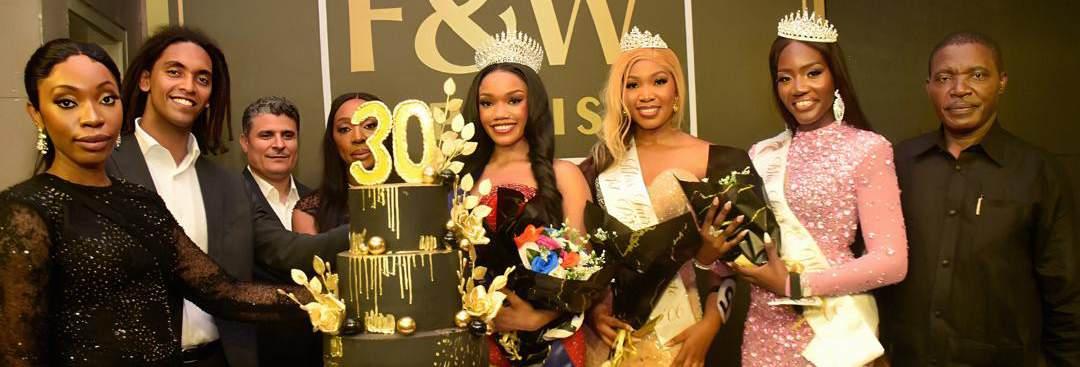
L-R: Director Fair & White Nigeria, Miss Ogonna Chibueze; Director, Labo Derma France, Mr. Olivier Tancogne: Key Distributor, Fair & White Cameroon, Mr. Kassem Ayad; Director, Fair & White Nigeria, Lady Chinyere Chibueze; Miss Fair & White 2026, Cherish Faith Nwakanma; First Runner up, Nzeako Chiamaka; Second Runner up, Uju Mbaegbu; and Chairman, Fair & White Nigeria, Sir Patrick Chibueze, at the 30th year celebrations of Fair & white in Nigeria and Miss Fair & White Pageant held at the Civic Centre, Victoria Island, Lagos… Friday night.
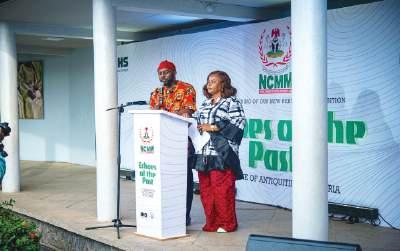
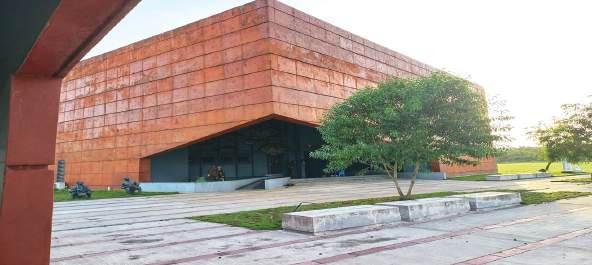
IHS Nigeria Renovates National Museum in L agos, Reinforcing the Company 's Commitment to Cultural Preservation
In a significant stride toward sustainable infrastructure and cultural preservation, leading communications infrastructure company,
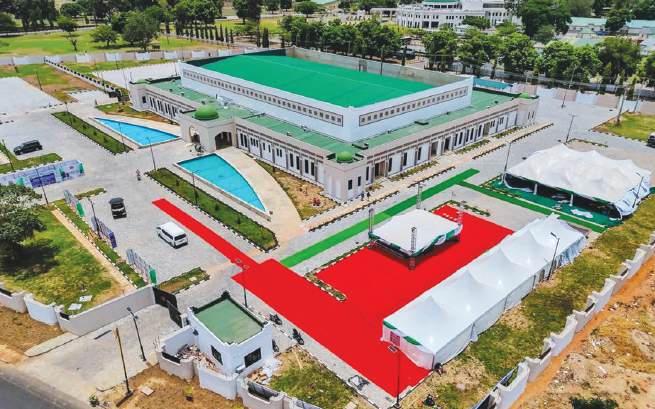
IHS Nigeria, in partnership with the National Commission for Museums and Monuments (NCMM), has successfully refurbished and upgraded the National Museum, Onikan, Lagos.
The intervention encompassed major structural restoration works, modernized electrical systems and environmental landscaping. It also included, enhanced interior finishes, and improved external works, collectively elevating the museum's functionality, safety, and long-term artefact preservation capacity
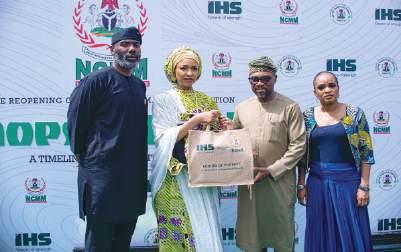
Commissioned on Saturday,11 April 2026, by the Honourable Minister of Arts, Culture, Tourism & Creative Economy, Barrister Hannatu Musa Musawa, the revitalized museum stands as a testament to IHS Nigeria's dedication to protecting the nation's heritage while delivering impactful, future-focused infrastructure solutions.
Here is a photo speak of the colorful historic event.
L-R: VP, Group Audit and Risk, IHS Nigeria, Temitope Yusuff, Director-General, NCMM, Olugbile Holloway, Honorable Minister of Arts, Culture, Tourism and the Creative Economy, Hannatu Musawa, SVP & Chief Corporate Services Officer, IHS Nigeria, Dapo Otunla, Chief Financial Officer, IHS Nigeria, Seye Dosunmu; and Director, Financial Planning & Analysis, IHS Nigeria, Zainab Olisamah.
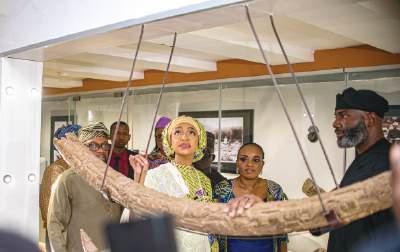
The Honorable Minister, Hannatu Musawa expressing her delight at the transformation of the museum’s main gallery
From Left: DG, National Commission for Museums and Monuments, Olugbile Holloway and the Honorable Minister of Arts, Culture, Tourism and the Creative Economy, Hannatu Musawa being presented with branded gift items by the Senior Vice President and Chief Corporate Services Officer, IHS Nigeria Limited, Dapo Otunla and Director, Sustainability, IHS Nigeria, Titilope Oguntuga.
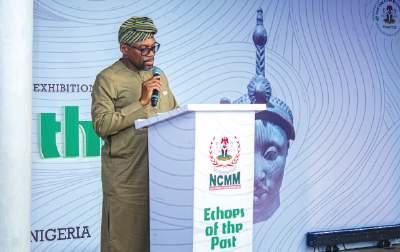
Dapo Otunla, Senior Vice President and Chief Corporate Services Officer, IHS Nigeria, delivering his Opening Remarks at the occasion
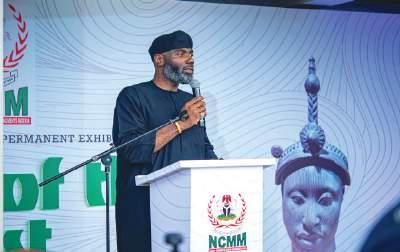
Director General, National Commission for Museums and Monuments (NCMM), Olugbile Holloway giving the Welcome Remarks at the ceremony
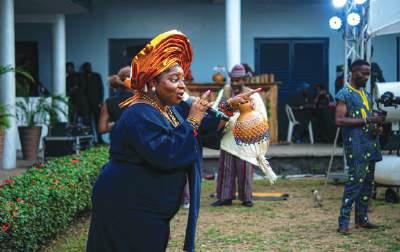
Guests enjoying the cultural performance after their tour of the museum.
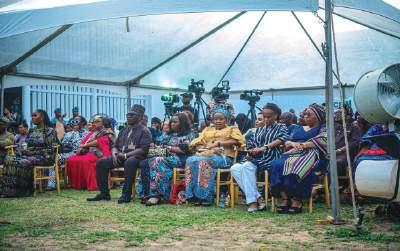
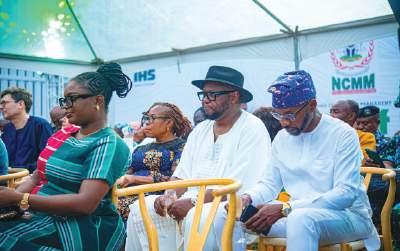
Cross section of guests at the event.
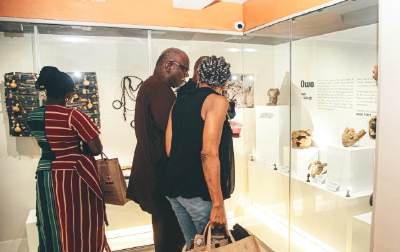
Guests admiring the artefacts at the museum.
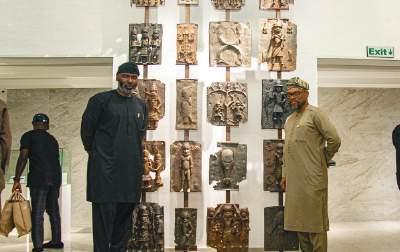
DG, National Commission for Museums and Monuments, Olugbile Holloway and SVP & Chief Corporate Services Officer IHS Nigeria, Dapo Otunla with one of the Benin Bronze pieces in the museum.
Entertainer, Dr Debbie Ohiri performing at the commissioning ceremony
Director, Corporate Communications, IHS Nigeria, Sylva Ifedigbo and co-host Toyin Lanihun of the National Commission for Museums and Monuments welcoming guests to the event.
The DG of NCMM, Olugbile Holloway and IHS Executives taking the Honorable Minister of Arts, Culture, Tourism and the Creative Economy, Hannatu Musawa on a tour of the newly renovated museum gallery
CELEBRATING NEWEST COUPLE…
EFCC Threatens to Prosecute Content Creators over Use of Commission’s Name, Logo Without Approval
The Economic and Financial Crimes Commission (EFCC) has warned content creators to stop using its name, and logo in skits and other media productions without written approval.
In a video message posted yesterday on X, the commission said many skits misrepresented its values and standard operating procedures.
EFCC stated that it had not authorised any such use, adding that it did not endorse, sponsor, or approve any comedy, drama or online content that used its identity
without written consent.
“It has come to the attention of the Economic and Financial Crimes Commission that some individuals and content creators are using the name, logo and likeness of EFCC in skits and other media content.
“Many of these skits misrepresent our values and standard operating procedures. We wish to inform the general public that the EFCC has not authorised any such use.”
The agency added, “The EFCC does not endorse, sponsor or approve any
FG Initiates Data-driven Social Investment Programmes to Track Poverty Relief Results
Kuni Tyessi in Abuja
The federal government is pushing major reforms to make Nigeria’s social investment programmes more transparent, data-driven, and results-focused.
Speaking in Kwara State yesterday about the “One Humanitarian – One Poverty Response System” (OHOPRS) initiative, the Minister of Humanitarian Affairs and Poverty Reduction, Dr. Bernard M. Doro, said the programme had reached a significant number of households across multiple phases.
He said with programme on board, interventions must be connected, tracked, and structured towards a clear outcome, while noting that support must lead somewhere and must move people forward.
According to him, “In the first tranche, 183,186 households were supported. In the second tranche, 139,812 households received support, 852 households benefited.
“The total disbursement across these three tranches stands at N11,482,020,000.
“It is important to state clearly that these figures should not be aggregated as entirely separate sets of beneficiaries,” he explained. Doro further stated that the direction was directly linked to the nation’s poverty exit strategy. which had been further strengthened to ensure that every intervention contributed to a defined pathway out of poverty.
“We are strengthening the system to ensure that interventions such as livelihood support, training, and cooperative structures are not only delivered, but are aligned towards measurable outcomes.
“It is not just a programme, but a graduation system—one that ensures beneficiaries move from support to stability, and ultimately exit poverty with dignity. To our beneficiaries, your voices matter and will shape what comes next. Let me reiterate that this programme is entirely free, and any request for payment must be reported immediately.”
comedy, drama or online content that uses our identity without written consent.”
The agency directed the public to immediately cease using its name, logo, uniforms or any identifying
elements in skits or promotional content without prior approval.
It warned that violators will be prosecuted.
“Therefore, the public is hereby advised to cease
and desist from using our name, logo, uniforms or any identifying elements in skits or promotional content without prior written approval. Be warned, all who violate these instructions shall be
prosecuted.”
The commission had earlier raised concerns over the rising cases of impersonation and fake sting operations by people posing as its officers.
Continental Hotels’Niyi Agoro Named Among Africa’sTop 15 HR Leaders
The Cluster Director of Human Resources at Continental Hotels Group, Niyi Agoro, has been named one of the Top 15 Hotelier HR Leaders in Africa for the first quarter (Q1) of 2026 by Hotelier Africa under its Leadership Awards.
Continental Hotels Group manages the iconic Continental Hotels in Lagos and Abuja.
The award recognises senior executives advancing human resource leadership across Af-
rica’s hospitality sector through innovation, strategic alignment, and institutional impact.
Agoro’s selection reflects a career built on integrating human capital strategy with broader business objectives. His approach emphasizes agile organizational cultures, robust performance frameworks, and the positioning of talent as a core driver of business success.
His influence extends beyond traditional HR into strategic
advisory, directly shaping service quality, employee engagement, and overall business performance.
Reacting to the honour, Agoro expressed appreciation to Hotelier Africa, describing the recognition as both humbling and motivating.
“It motivates me to continue advancing transformative HR practices that empower people, strengthen institutions, and elevate industry standards
across the continent,” he said.
The Q1 2026 list highlights professionals building resilient talent ecosystems that support sustainable growth and operational resilience, as the hospitality sector faces talent mobility, digital transformation, and evolving guest expectations.
The recognition also affirms the growing importance of HR leadership in achieving institutional excellence.
Nasarawa Governorship: I Won’t Step Down for Wadada, Says Haruna
Chuks Okocha in Abuja
Despite the endorsement of Senator Ahmed Aliyu Wadada by Governor Abdullahi Sule, a former Executive Vice Chairman of the National Agency for Science and Engineering Infrastructure (NASENI), Prof. Mohammed Sani Haruna, has said he will contest All Progressives Congress (APC) primaries in Nasarawa State.
He said he won’t step down for Wadada after stakeholders’ backing.
Haruna made this known at a consultative meeting in Keffi with stakeholders and support groups drawn from the three senatorial zones, where he sought their direction on whether to proceed with his ambition or step down.
He told the gathering that his decision would be guided by the outcome of the consultation.
“If you are resolved that we shall accept the verdict and withdraw from this struggle, I will vote ‘aye. If the decision of this meeting is that we shall go to the primaries, that is not my problem. That is the essence of
this meeting,” he said.
The party leaders, after deliberations across the zones, eventually resolved that he should remain in the race and test his popularity at the party’s primaries.
The former EVC said his approach was informed by the need to carry along those who had supported his political structure over time.
He said: “When the government announced its decision, the aspirants in this forum agreed that we will consult our supporters and critical stakeholders and then take a unanimous decision. That is the reason why you did not hear from me.
“Your verdict has determined our next line of action and I hereby accept to contest the primaries and we will be having our rally on Wednesday”.
Defending his right to contest, and citing his role in the formation and growth of the ruling party, he said, “I provided financial support to the Congress for Progressive Change and the establishment of the party. Some chairmen and officials are alive to attest to how we supported
the establishment of party offices across local governments.
“I started my APC from the national. If this forum succeeds, even if I am not the governor, I should celebrate it because it is my initiative,” he said.
Haruna also referenced the ongoing succession debate, arguing that earlier expectations around a preferred successor had not been met.
“We gave a blanket cheque that the governor could select anyone among those that would have our support based on certain expectation, but the situation
has changed,” he said. He said his decision to consult stakeholders was also informed by their contributions to his political structure.
“We are not disobedient to constitutional authority. We are in the party and we are working for its success. If the primaries are free, fair and transparent, we will accept whatever Allah has decided as the verdict,” he said. The stakeholders were emphatic, urging him to proceed to the primaries, citing zoning equity and his record in public service.
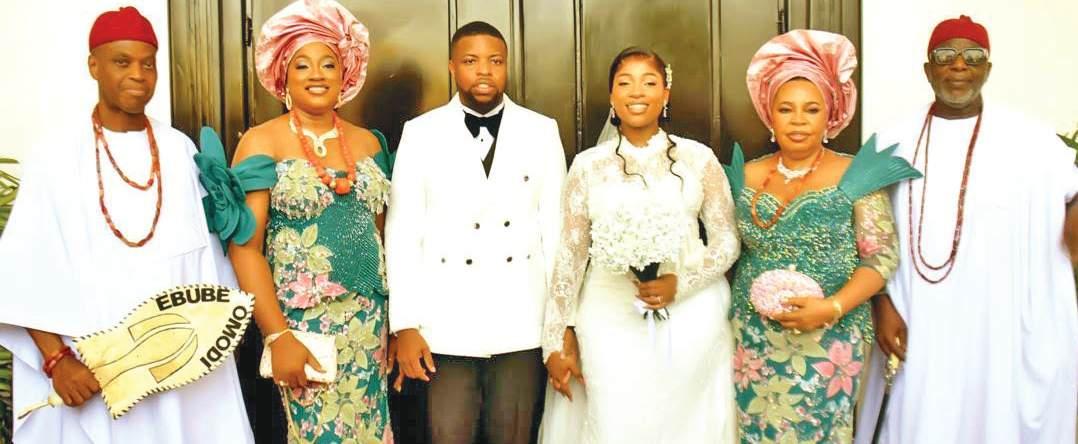
L-R: Father of the groom, Chief Frank Mourah; Mother of the bride, Mrs. Nkiru Okeke; the newly wed, Franklin and Isabel Mourah; Mother of the groom, Lady Victoria Mourah; and Father of the bride and CEO, Juderingo Commercial Enterprises Limited, Dr. Juderingo Okeke, at the marriage ceremony of the couple at Catholic Church of Assumption, Falomo, Ikoyi... yesterday
As AFC Summit Reignites Nigeria’s Funding Debate
Nigeria’s renewed push for value-addition highlights the real gap: not capital, but its use, an argument reinforced by the Africa Finance Corporation at its last summit in Nairobi, Kenya. Festus Akanbi reports
Nigeria’s latest push to force more local processing of raw materials before export has brought an old problem back into sharp focus: the country cannot continue to ship out value and then borrow heavily to import jobs, technology, and finished products.
In November 2025, the federal government said it planned to require at least 30 per cent value addition before raw materials could be exported, describing the move as a major step towards industrialisation. Minister of Innovation, Science and Technology, Kingsley Udeh, said the idea was to ensure that Nigeria’s natural wealth is not exported in its rawest form, but processed enough to deepen local content, expand manufacturing, and create jobs. He cited an example, arguing that the country should produce lithium concentrate or lithium salt at home rather than merely exporting ore.
Analysts said that policy direction is important, but on its own, it will not solve the problem. Local processing requires power, transport, storage, industrial parks, logistics, patient capital, and policy stability. In simple terms, Nigeria cannot preach value addition while starving its industry of the infrastructure that enables it. This is where the debate at the Africa Finance Corporation’s The Africa We Build summit in Nairobi, last week, becomes relevant to Nigeria’s immediate choices. AFC’s latest infrastructure report says Africa’s problem is no longer the total absence of capital. Rather, it is the failure to channel available savings into productive assets at scale.
According to the AFC, Africa’s non-bank domestic capital pools now exceed $2 trillion, above the roughly $1.7 trillion in cumulative external flows recorded between 2014 and 2024, while Reuters, citing the same report, said the broader domestic capital stock across the continent is above $4 trillion.
For Nigeria, that finding is particularly significant. The country is not operating in a capital desert. The pension industry alone had grown to about N29.4 trillion by February 2026, according to PenCom data reported by Proshare, while reports indicate that the regulator was already seeking to diversify the country’s retirement savings
toward infrastructure and private equity because too much of the fund remains parked in government debt. Reuters said roughly 60 percent of the fund was invested in government securities and less than 10 percent in corporate securities.
That is the contradiction at the heart of Nigeria’s development struggle. The country needs roads, rail, power, gas pipelines, mineral processing plants, ports, and industrial corridors, yet large domestic savings still prefer the safety of treasury instruments. This is why AFC President and Chief Executive, Samaila Zubairu, argued in Nairobi that the issue is not whether the building blocks exist, but “how they are brought together.” His broader point was that Africa already has capital, energy resources, transport routes, digital possibilities, and industrial inputs, but lacks the systems that connect them into investable, scalable outcomes. That diagnosis speaks directly to Nigeria, where disconnected infrastructure has often left assets stranded rather than fostering industrial ecosystems.
The case against raw export is also getting stronger because the old model is becoming more expensive.
At the summit, Aliko Dangote put it bluntly: Africa exports raw materials, and imports finished goods, and in doing so “exports jobs and imports unemployment.” That line captures Nigeria’s dilemma. A country that exports crude, minerals, and agricultural produce with limited local transformation loses the higher-value stages of production to other economies.
Udeh’s 30 per cent value-addition plan is therefore not just a trade measure; it is an attempt to retain more of the value chain within Nigeria. But that ambition will succeed only if financing shifts from short-term
comfort to long-term productive use.
Dangote also warned that Africa had made “serious mistakes” by relying too heavily on foreign investors. Kenyan President, William Ruto, made the same point from another angle when he said countries must use their own resources to develop themselves and stop speaking only about potential.
Their shared message aligns with present-day Nigerian realities. The federal government’s 2026 budget projected a deficit of 4.28 percent of GDP, while debt service remained high at N15.52 trillion. That means fiscal space is limited, and public finance alone cannot carry the infrastructure burden.
The scale of that burden is huge. Reuters reported in 2025 that Nigeria’s infrastructure deficit could reach $878 billion by 2040. The same report noted that PenCom was looking for commercially viable infrastructure vehicles because the economy needs higher-yield assets and better real-sector outcomes. Nigeria’s power crisis alone shows what underinvestment costs: Reuters reported in December 2024 that frequent grid failures and weak infrastructure were costing the economy about $29 billion annually.
This is why AFC’s role matters. AFC’s Senior Vice President and Head of Capital Mobilisation and Partnerships, Mohammed Abdul-Razaq, said about 90 per cent of infrastructure projects in Africa fail at the development stage. His point was that many projects die before they become bankable because they lack early-stage capital for feasibility, technical, and environmental work.
He cited Segilola Gold in Osun State as an example of how AFC helps de-risk projects from concept to commercial operation. The corporation has also been involved in Nigeria’s domestic dollar bond market: the federal government said its first domestic dollar bond raised more than $900 million after heavy subscription. In contrast, the Ministry of Finance later said the offer had initially targeted $500 million
and was oversubscribed by 180 per cent, with AFC acting as the global coordinator.
Analysts believe that the transaction is important because it proves a larger point Abdul-Razaq made: if the right instruments are created, domestic capital can respond.
Nigeria also has an institutional model in InfraCredit, which provides guarantees for local-currency infrastructure financing and helps make projects more attractive to pension funds and other investors. Reports say that PenCom is pressing for more suitable vehicles and broader instruments to safely unlock this kind of investment.
The way forward, then, is becoming clearer. Speakers at the AFC summit argued that Nigeria needs to discourage the export of raw materials not merely by law, but by making local processing commercially possible.
That means stable power, better freight links, industrial clusters, deeper gas infrastructure, and financial structures that reduce risk for long-term investors. It also means stronger guarantees, better project preparation, and clearer regulation so pension and insurance funds can participate without reckless exposure.
AFC argues that Africa’s savings must be intermediated better; Nigeria’s argument should now be that those savings must be matched deliberately to industrial policy.
The real test is execution. Nigeria already knows what happens when raw materials are exported cheaply and finished goods are imported at high cost. It also knows that waiting endlessly for foreign capital has delivered too little.
The country now has a policy signal on value addition, a growing pool of domestic savings, evidence that local investors can absorb large instruments, and an AFC framework built around de-risking and scale. The task is no longer to complain about what Nigeria lacks. It is to connect capital, infrastructure, and industry quickly enough to keep more value at home.
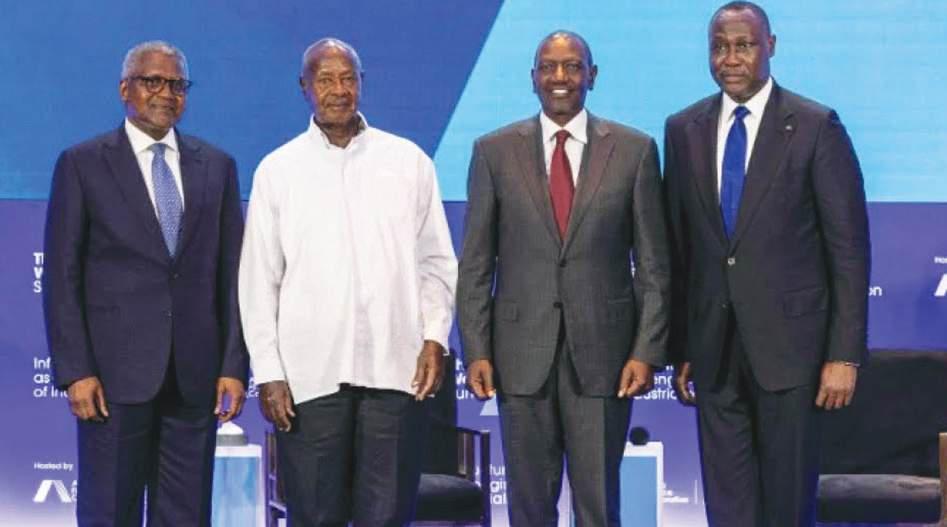
L-R: President, Dangote Group, Aliko Dangote; Uganda’s President, Yoweri Museveni; and Kenya’s President, William Ruto, at the inaugural Africa We Build Summit, Organised by Africa Finance Organisation, in Nairobi, Kenya, last week.
IATF2027: Africans Return to Lagos 50 Years After
Africa’s big five economies have continued to host the Intra-African Trade Fair (IATF) in rotation. With Egypt, South Africa, Algeria, and now Nigeria, the circle needs one more nation to make the privileged class. With the signing of the hosting agreement between Nigeria and the IATF promoters a few weeks ago, Lagos2027 has arrived in Africa’s biggest economic city centre, as the continent returns to Lagos 50 years after FESTAC77, this time for economic integration. Nik Ogbulie writes
The historic signing ceremony for the hosting of IATF2027 in Lagos has calmed the anxiety of many Nigerians who were worried after four sessions of the event had moved from North Africa to South Africa, then back to North Africa, without Nigeria expressing any thought over the period. Indication after the signing expressed bold optimism that the silence over the last four years was not a sign of withdrawal from the common pursuit of the African economic integration dream but a seeming strategy to enable the country put its acts together in view of overwhelming domestic pressure which must be tamed for the country to deliver in such a way that explains its usually very big role in everything Africa. The country is known to have set performance records when elected to host African events. It did so during the Black and African Festival of Arts and Culture (FESTAC), for which the IATF27 venue was built in Lagos some 50 years ago. It has hosted the All-African Games, Commonwealth Games (COJA), and many other global conferences, and has emerged with records still unsurpassed by many host nations many years after.
The expressions on the faces of many eminent Nigerians after the signing further underscored that the country had waited for this event and would have been pleased if the hosting had come while their own son, Professor Benedict Oramah, held sway for ten eventful years. Nigerians at the event are inclined to liken the IATF to World Bank Meetings, to the extent that the venue has been specially laid out, with side attractions created to begin to paint the picture of an event’s eminence, which many Nigerians believe will add significantly to the continent’s economic opportunities. Before this signing, concerns have been raised about venues, given that Nigeria has never developed extensive open spaces for exhibitions. What would look like the biggest and best of such an infrastructure, which the military administration also developed, was privatized by the federal government and later leased to individuals and partly to the Lagos State government. However, the apex banking association, the Chartered Institute of Bankers of Nigeria (CIBN), provided relief to the Nigerian government by renovating the dilapidated National Theatre for a substantial sum. The theatre’s artistic marvel and the structure’s central location will raise the country’s profile. Over the next two years to the event, there is no doubt that a lot will change in a state that is richer than all the West African countries combined, excluding Nigeria. It is obvious that nagging issues like traffic gridlock, youth restiveness would be softened by the full ambiance of the coasts, lagoons, fine hotels, and great nightlife, which will offer participants the real chance to take a second look at Nigerian jollof and other spicy delicacies that have offered visitors
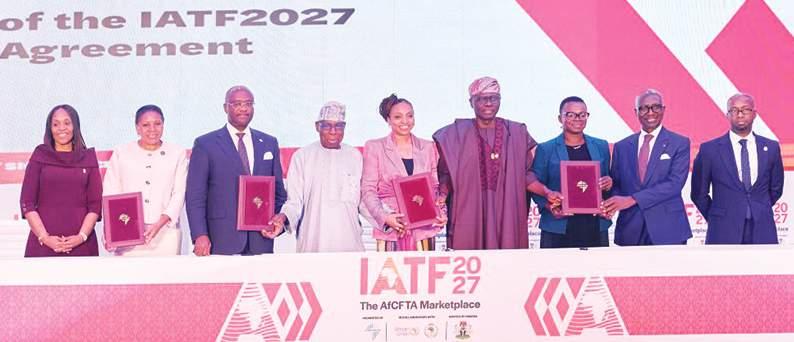
L-R: Executive Vice President, Intra-African Trade & Export Development, Afreximbank, Kanayo Awani; Commissioner for Economic Development, Trade, Tourism, Industry and Minerals, African Union Commission, Francisca Tatchouop Belobe; President and Chairman of the Board of Directors of Afreximbank, Dr. George Elombi; Chair, IATF, Chief Olusegun Obasanjo; Minister for Industry, Trade, and Investment, Dr. Jumoke Oduwole; Governor of Lagos State, Babajide Sanwo-Olu; Director Partnerships and Private Sector AFCFTA, Cynthia Gnassingbe; Deputy Chair, IATF Lois Ekra; and Head, Banking Legal Services, Afreximbank, Joseph Ifebunandu, during the Intra-African Trade Fair 2027 (IATF2027) Host signing ceremony in Lagos...recently
the glue in Nigeria.
As many stakeholders of the new Africa Economic Integration gathered in Lagos, the very busy metropolis which does not sleep is already agog and busy finding more ways of making the event excellent and enduring to the extent that the African promoters may begin to mull a back-toback hosting, especially when seen from the point of view deals and participations; the major determinants of the gains of the event as noted by the African community. With about 250 million people, a significant number of foreigners, and substantial foreign investment, what the organizers have been finding across the continent would have been considered ready in Nigeria. The proximity of transportation to every West African country makes IATF2027 an attractive event for the about 18 predominantly agricultural countries with a strong record of creative opportunities, which makes the ECOWAS nations the largest participants in the CANEX industry of the IATF project. Suffice it to say that the African coastline is replete with merchants whose commercial interests and reach extend only within the confines of African demand and have found IATF the most affordable outreach, offering them the opportunity to explore the muchtalked-about regional and intra-African trade in its real application.
Take it or leave it: the Nigerian landscape has long been seen as home to all Ecowas countries, which is why a good number of fabrics seen in Nigeria are mix-grill, acceptable within the very rich Nigerian communities. This has become a channel for trade escalation, operating only within the confines of
poor rural communities, which are limited by geography and commercial opportunities.
The promoters should expect a very large amount of space for organization for this project. I see a situation where attendance will be twice the number of visitors in Durban, South Africa, in 2021, while deal sizes will be thrice those recorded in Algeria in 2025. This is a conservative estimate of the business size expected in Nigeria.
Everything looks fine for Lagos2027, but the severe traffic gridlock that will confront IATF head-on will be slightly higher than in Algiers2025. Visitors will enjoy robust tourism benefits if they are confined to Lagos. After all, Lagos is larger than Algiers and Durban. Lovers of the sea breeze will have nice experiences to take home, while night honchos will definitely enjoy the indaba. Lagos, no doubt, offers one the serenity of well-thought-out business plans and a sense of purpose.
“Agog” was the description, as the imposing architecture hosted about 2000 guests who were eagerly looking forward to the November 5-11, 2027, exposition, with IATF preparing to make its debut in West Africa after Côte d’Ivoire’s false hosting in 2021. In its usual iconic event presentation and management, Afreximbank set up the venue to look like a life ceremony, reminiscent of the four editions held in Cairo (2018), Durban (2021), Cairo again (2023), and Algiers (2025).
In his usual enthusiasm, the Chairman of the IATF Advisory Council, Chief Olusegun Obasanjo, did not hide his feelings about the world celebrating Africa’s integration efforts in an edifice he built some 50 years ago as the military Head of State of Nigeria.
Fifty years later, the venue remains the only landmark venue for classic events in Nigeria, underscoring his foresight in development and material management. He noted that, “today’s signing implies a Renewed continental spirit... When I was being conducted round, I remembered some 50 years ago....”
He noted that the venue has historical significance because it is where African Heads of State signed a remarkable Economic Development Charter, which still forms part of what Afreximbank and its partners are leveraging today to chart the continent’s future. He congratulated President Bola Tinubu, Funke Oduwole, Nigeria’s Trade and Investment Minister, and Lagos State Governor, Sanwo-Olu, along with all members of the Nigerian government, for getting this done.
Obasanjo sought a successful IATF27 and asked that the country must endeavor to orchestrate the kind of development Africa wants through a unified market towards the Africa we want. “I extend my profound optimism and with confidence that IATF27 will surpass all that has been done,” he noted. He claimed this is an assurance given by the Nigerian Minister of Trade and Investment to the Council.
CBN, Union Bank and Bad Faith
Recently, two articles were published in multiple media outlets, both print and digital, about Union Bank of Nigerian (UBN) and the recent Federal High Court judgment.
One was entitled: “Union Bank: How controversial transactions led to CBN takeover”, while the other was entitled “Audit links multi-billion naira abuse to old Union Bank management”.
As a lawyer, I naturally became curious as both articles were published at the same time in different newspapers by two different authors. However, the contents were almost identical. I doubt it is a coincidence. Or maybe, both authors had a telepathic subliminal connection that psychologists across the world will need to study. As we think about this journalistic miracle, let us unpack the facts of the matter.
In any case, what were these articles about if not to woodhink and deceive the public? The articles were written even when the Central Bank of Nigeria (CBN) which the judgment was against has filed an appeal against the judgment. So why the attempts to misrepresent facts?
A judgment by the Federal High Court (FHC) nullified the sacking of the former Board and Management of UBN by the CBN and declared the CBN’s actions were in bad faith. This is a landmark judgement. Furthermore, the judgement instructed the CBN to immediately restore the sacked Board and Management and also awarded $190 million to the shareholders. The CBN immediately responded by filing an appeal and requested for a “Stay of execution”. For the appeal, the CBN sacked some of its lawyers and appointed over 15 SANs.
I felt professionally compelled to fully grasp the issues that warranted this judgement and subsequent reaction. I obtained and read the 110-page Certified True Copy (CTC) of the FHC judgement and here is what I elicited:
Firstly, Titan Trust Bank (TTB), established in 2018 by TGI group via two subsidiary entities, Luxis International and Magna International, acquired UBN in 2022 from Atlas Mara and Union Global Partners Ltd, both UK based private equity groups (UBN’s owners on record).
I found this interesting as the general belief was CBN and AMCON sold UBN to TTB. The second discovery was TTB funded this acquisition using a mixture of equity from TGI and a loan from Afrexim Bank.
In the court records, there are documents that showed that immediately after acquiring UBN, TTB commenced the process of merging both banks and also sought CBN’s approval to create a Holding Company (HoldCo) similar to First HoldCo Plc and Access Holdings Plc. This HoldCo was to own the merged TTB/UBN entities and also take over the Afrexim acquisition loan. According to the court documents, by December 2023, CBN approved the merger but did not approve the HoldCo.
The shareholders argued this is the reason the Afrexim loan remained in the books of the merged bank. But in last week’s articles, this loan was weaponised to justify the sack of the Board.
In the case author of the articles were not thoroughly briefed on how the crisis started, it stemmed from the CBN’s January 2024 intervention, when it dissolved the boards and management of Union Bank, citing “regulatory non-compliance, corporate governance failure, disregarding the conditions under which their licenses were granted, and involvement in activities that pose a threat to financial stability”.
At the time, the apex bank cited provisions of BOFIA, including non-compliance with licensing conditions, threats to financial stability, failure to adhere to regulatory directives, and undercapitalisation. It subsequently appointed interim management teams and initiated recapitalisation and restructuring programmes as part of broader regulatory interventions in
the banking sector.
The Federal High Court set aside the actions of the CBN on various grounds, including denial of the Union Bank’s directors their right to fair hearing.
On the issue of fair hearing, the court held that the applicants’ fundamental rights were breached, noting that they were sanctioned without being allowed to respond to allegations arising from a purported special examination of the bank.
The judge found that the applicants’ shareholding was reduced from 100 per cent to 40 per cent and that they were excluded from participating in the recapitalisation exercise without legal justification, describing the actions as indicative of bad faith.
Although the CBN defended its intervention as part of its prudential oversight, citing severe financial distress at the bank—including a negative capital adequacy ratio, a capital shortfall exceeding N224 billion, and a high non-performing loan ratio—the court held that such regulatory powers must be exercised strictly within the confines of the law.
On jurisdiction, the court ruled that Section 51 of BOFIA does not shield the CBN from judicial review where it acts outside its statutory powers. It also held that the actions of the CBN-appointed board were subject to review, describing them as agents of the CBN. It went further to dismiss procedural objections raised by the respondents, holding that the applicable rules of court were directory and not sufficient to defeat the suit.
The court also found that the applicants suffered a “continuing
injury,” noting their exclusion from management and decision-making processes between January 2024 and December 2025.
On damages, the court acknowledged that the respondents admitted the applicants invested $190 million in the bank but declined to award additional claims in the absence of oral evidence.
For many observers and industry players, the red flag was how can you approve a merger today and sack the Board tomorrow? The judge asked the same question in his judgement. Another red flag was a few weeks after taking over, the CBN appointed Managing Director wrote to the CBN stating that she had put the HoldCo process “on hold until further notice”. To me, this appears like a classic case of setting up a robbery operation and tipping off the police at the same time.
The forensic report described in the recent articles implied that the Afrexim loan was the genesis of CBN’s actions. But from what I have read, I can only conclude that the loan remained in the books of the bank because the CBN refused to approve the HoldCo or the numerous requests by the shareholders to pay down the loan. In any event, there was no evidence in any court submission by the CBN, written or verbal, that showed UBN was a threat to financial system stability.
This takes me to Page 104 and 105 of the judgement, where it explicitly states the CBN did not submit any “examination report” to the court as evidence to support its actions. The judge said the CBN could not conduct a Special Examination “in the air” buttressing the claim by the former Board of Directors that there was no special examination of the bank at the material time.
Another interesting issue I came across in my review was the CBN’s attempt to sell 60% of the bank without the knowledge or approval of the existing shareholders.
On page 105 of the judgement report, the judge said this action showed “bad faith”
and “breach” of shareholders “fundamental rights”.
After thoroughly reviewing the court documents, in my professional and objective opinion, I do think there is more to CBN’s action than meets the eye. I am left with more questions than answers.
Why did the CBN not conduct the mandatory and legally required examination before sacking the UBN Board led by Mr. Farouk Mohammed Gumel? Why were the forensics conducted after the dissolution of the Board and not before? Conducting forensics after the fact and using it as the basis for regulatory intervention is the same as putting the cart before the horse. In fact, how did a confidential forensic report of the CBN end up in the newspapers at a time the Apex Bank was seeking to reassure the public that the bank was safe?
Why did CBN try to forcefully dilute the core shareholders? Why did the CBNappointed Board withdraw the application to set up a HoldCo?
Interestingly, I checked the audited financials of UBN and discovered that the bank was profitable as at December 2023, and could not therefore have been a bank going down the hill at the time of the CBN intervention in January 2024.
This was the biggest indication that there was more to this ‘regulatory intervention’ than the CBN is willing to tell the public. In view of these observations, my final question is, whether this is an act of someone actually trying to take over the bank through the back door?
I will conclude by quoting page 103 of the judgment where the judge said “Bad faith cannot be seen with the eyes. It can only be inferred from the facts of the case.”
As it stands, subject to appeal, the court’s opinion is that the CBN’s actions were made in bad faith and breached the rules of natural justice.
•Fokorede is a lawyer based in Lagos
Wale Fakorede
Cardoso
www.thisdaylive.com
WHAT IF THE ELECTORAL UMPIRE IS PARTISAN? AYODELE OKUNFOLAMI argues for the decentralisation of INEC
See Page 20 PUTTING ENTREPRENEURS AT THE CENTRE OF GOVERNMENT AGENDA Government should create the enabling environment for small businesses to thrive, writes SEUN AWOGBENLE
See Page 20
As a young man, I was not streetwise; to be candid, I was naive. And, to compound matters, I even looked foolish, as one friend bluntly told me. The result was that my peers easily took advantage of me and often made me the butt of their jokes. Many of them also assumed, without any basis, that they were more intelligent than I was. All of this – together with my poor family background –made me less assertive and therefore an easy target for bullying and humiliation.
Even as I grew older, I still found myself vulnerable to bullying from a number of friends and colleagues, both older and younger –though bullying of a different kind: intellectual bullying. For instance, some friends who had spent only three years as undergraduates at the University of Ibadan – with no further contact thereafter – would presume to lecture me on the academic life and culture of the very institution where I spent more than 30 years teaching and conducting research. To this day, they show no hesitation in imposing their views and judgments on me, even in matters naturally within my professional purview and in which I possessed far greater knowledge.
So, at the celebration of my 80th birthday earlier this year (2026), one of my friends sought to explain to my colleagues and wellwishers who had gathered to rejoice with me, the circumstances of my birth and why there was no record of the exact date I was born –almost as though the blame rested with me. It was, of course, genuinely intended as a joke. Despite my discomfort, I joined in the laughter, determined not to allow anything to diminish the joy of the occasion.
I arrived at the celebration that morning carrying a heavy burden of challenges on my shoulders – some personal, others shared collectively with fellow Nigerians. On the way, I was confronted by one of the harsher consequences of the removal of fuel subsidies early in the administration of Bola Ahmed Tinubu, as the cost of filling my car tank had risen from N80,000 to N120,000. Yet, despite that irritation, the joy of attaining 80 years of age in good health could not be extinguished. Nor would I allow the astronomical rise in the daily cost of living to diminish that spiritual uplift.
But the distress went deeper than that. As the birthday celebration unfolded – with speeches, tributes, recollections, and jokes – it dawned on me that many of my invited guests, who would dearly have loved to attend, were unable to do so. They had been practically overwhelmed by the devastating hardships inflicted on the population by the current Government.
Invitees who managed to come had – apart from the focus of the occasion – different stories to tell. Among them were workers whose monthly take-home pay could not sustain them for more than a few days; artisans unable to afford transportation in search of work; entrepreneurs – small, medium, and large-scale – driven out of business by harsh economic conditions; tenants unable to meet their rent obligations; parents incapable of paying school fees; and, of course, nearly all of them struggling to feed themselves and their
opinion@thisdaylive.com
families.
Normally, even in a depressed economic system such as ours, there remains the hope of a brighter future and the possibility that conditions will improve. In our present situation, however, that hope is swiftly undermined by the troubling speculation that our future has, in effect, been mortgaged through the forward sale of Nigeria’s oil reserves – the primary source of national income – purportedly to secure shortterm liquidity.
For the ordinary citizen who may not fully grasp what this means, it is that a substantial portion of our crude oil production for the next 10 to 20 years has been sold and paid for in advance, and that the oil will be drawn from the reserves buried beneath the soil of the Niger Delta, including Isokoland and other parts of the country. The information is that a previous Government had already received full payment upfront from foreign buyers. If this is true, the implication is strikingly stark: it means that we have sold our future, plain and simple. And, given Nigeria’s troubled history of mismanagement, there is the grave fear that such funds may already have been stolen, may currently be looted, or may yet be misappropriated by those with privileged access.
Although not partisan in the true sense of the word, I have been a friend to many politicians; unavoidably sympathetic to political ideologies and causes – and, indeed, always intrigued by the interplay of political forces. I do not think Aristotle was wrong when he described man as a “political animal”, meaning that as human beings, we are always an integral part of society and its interactions. That is the fact of social life: anybody may decide to ignore politics, but nobody can escape its impact.
One of the correlates of this social reality is that, whether partisan or non-partisan, every human being possesses some sense of what is normal, what is abnormal, and even that which is bizarre in politics. Such, for instance, is the present state of the Nigerian political landscape. By definition, politics is an activity through which conflicting
interests are negotiated and resolved. Yet, over the past one or two years, political alignments and realignments in Nigeria have been marked by massive movements toward a single political party, presumably with common interests. It is not the movements themselves that are troubling, but the motive driving them. Adams Oshiomhole has told us in plain language what defection to All Progressives Congress entails. Though shameful and disheartening, this appalling situation is still not enough to diminish the joy of being 80.
Troubling as political defections may be, they are not the ugliest aspect of Nigerian politics. The ugliest lies in the conduct of elections and their processes – especially the adjudication of electoral disputes by the judiciary. As everyone knows, even a primary school child in Nigeria might mockingly tell you to “go to court,” with utter disregard for due process. This reflects a judicial system widely perceived to operate on a cash-and-carry basis, with a high premium placed on foreign currencies – a stark indication of how low the nation has sunk in matters of electoral adjudication.
I am told that for the men and women who work in the Nigerian judiciary, periods of national elections are like harvest seasons. Of course, those at the lower echelon of the system – junior lawyers and judges – may not reap as much as the “ogas at the top”: Senior Advocates of Nigeria (SANs) and Supreme Court Justices, who have increasingly become the ultimate arbiters of who wins or loses major elections in the country.
Sadly, much of what transpires between the nation’s politicians and the judiciary is also reflected in other sectors of Nigerian life – in religious institutions (churches, mosques, shrines), universities, the civil service, the private sector, among artisans, and even among market men and women. So, where does one begin to purge such a system, and where does one end?
As the celebrations gradually drew to a close and guests began departing for their various destinations, the issue of insecurity came sharply to mind. Unlike the good old days, when people could travel long distances by road both day and night, no one dares to take such risks anymore. To do so is to openly tempt bandits, kidnappers, armed robbers, terrorists, and other highway predators.
In spite of the growing adversities in Nigeria, I have not allowed pessimism to intrude into my life. I am encouraged by the many young men and women who remain full of hope for the future of Nigeria. I also feel reassured and, indeed, consoled by the numerous blessings that God has bestowed on this nation in general, and on me in particular. As the African adage says, it is the living who experience hardship and hunger. So, in spite of it all, the beauty of life at 80 remains undiminished.
Sogolo, who turned 80 on 4 January 2026, is an Emeritus Professor who has taught and conducted research in Philosophy for over five decades – first at University of Ibadan and currently at National Open University of Nigeria. He also served as a member of the Editorial Board of The Guardian Newspapers in the 1980s and 1990s.
What iF the eLectoRaL umpiRe is paRtisan?
AYODELE OKUNFOLAMI argues for the decentralisation of INEC
On the eye of the storm is the Chairman of the Independent National Electoral Commission, Professor Joash Ojo Amupitan, SAN. Actually, whoever sits in Plot 436 Zambezi Crescent, Maitama of the electoral body sits on an electric chair. This shouldn’t be but elections in Nigeria are almost like civil wars. I can’t forget my earliest assignment with INEC in 2007 where the presence of armoured tanks and military personnel in the local government in which I was posted were seen everywhere. I asked severally if elections is a civil exercise or a military one.
The neutrality of INEC chairs has always been called to question because people have queried why a president, who has partisan interests, should be the one to nominate the head of the election management body. It is like the CEO of Rangers FC choosing the referee in a match between his team and Shooting Stars. Albeit the ref exercises his duties with utmost professionalism, there would be suspicions of bias.
I won’t immediately call for the Nigerian president to be striped of the powers to appoint the electoral umpire. We have a Commander-in-Chief who has the powers to make hundreds of other appointments from ambassadors to ministers to heads of departments and agencies. So why take away one from him?
The judiciary, police, security agencies, anti-corruption agencies and even the Central Bank where sensitive materials for elections are kept all have critical roles in elections yet the president is given powers to appoint their respective heads, so why single out INEC? Even a nongovernmental body like the National Union of Road Transport Workers have an impact on how elections go. And if we then go as far as seizing the presidential powers to appoint heads of those agencies are we not just existing for elections? Have we reduced our citizenship to election commodities? If the president doesn’t have powers to make some appointments, won’t we have weakened that office? What happens when we have a Pharoah that knows Joseph and we have whittled all the powers from him to do us good just because of our fears of the past? How will the non-partisanship of the body that picks the electoral boss be sustained overtime if the appointment of the persons that make up an independent board is devoid of politics? How are we going to pick this jury any different from how we pick persons into the National Assembly?
What we should have as a bumper sticker is that we can’t have democracy without politicians no matter how we pretend. Therefore, almost everything about us will have political shades to it. The president appoints a Central Bank governor, for example, that would be aligned to his economic and fiscal policy temperament. This in no way takes away the monetary independence of the reserve bank. Recently, President Tinubu appointed Tunji Disu as the Inspector General of Police, with the task of getting state police going. Don’t forget, Tinubu has been known to be championing state police long before he got into office. What this reminds us of is that elections have consequences. Presidents will always appoint people that support their temperaments across board to push their personal philosophies, perspectives and programmes. So, what makes it different from electing a dictator? Checks and balances.
It is these checks and balances that the Constitution foresaw that makes it mandatory for the INEC Chairman nominee to go through the Council of States and the National Assembly. The Council of States consists of former Presidents/Heads of State, former Chief Justices of Nigeria, the President of the Senate, the Speaker of the House of Representatives, all State Governors, and the
Attorney General. These are elder statesmen who should rise above political, ethnic, religious and other considerations. While the National Assembly serves as the nation’s town hall. In addition to this two-factor authentication system, we have political parties, civil society organisations, election observers, media and the public to ensure INEC and its operations are independent and neutral in its affairs. Adding another wrinkle. Each state has a Resident Electoral Commissioner who had been nominated by a governor. Just as the president nominates the chairman, the 36 state governors nominate supposed technocrats to serve in INEC. Correspondingly, each geopolitical zone is each represented in the leadership of the Commission by two National Commissioners. These geopolitical representations in appointments, although under the delegation and supervision of the Chairman, serve not only for fair depictions, but also as oversights to the civil service staffed Commission. So, with all these supposed vigilances on INEC, why the fuse for Amupitan to resign? Unfortunately, this National Assembly, that should serve as the chief check to the executive arm, is today a rubber stamp. In fact, the Senate President in an INEC-unrelated public event defended Amupitan’s partisan tweet. When did Senator Godswill Akpabio become Amupitan’s spokesman? Akpabio, Tinubu’s Special Assistant on social media and other APC stalwarts have been playing the devil’s advocate for a tweet Amupitan himself denies ownership of. How ironic. That Amupitan’s imagemakers responded to the call for his resignation following that tweet 22 hours after a presidential aide response gives the wrong optics. Changing the date for the general elections, postponement of the revalidation of the voters’ register, skewed interpretation of a lower court’s ruling on ADC’s leadership and now this affirmative tweet to a bigotedly coloured partisan social media post in so short a time in office, all portray a man who speaks the shibboleths of the ruling party. Funnily, the netizens that had traced his digital footprints linking that X account to him have already started sending transport money into his Opay’s account for him to leave that office. I join my voice to those, home and abroad, calling for his resignation, not because he would conduct a biased election or because he has ulterior motives, but because perception shapes trust. Public confidence has been completely undermined. Amupitan is cumulatively losing confidence with the Nigerian electorate. Besides the infamous glitch of the last presidential elections, Amupitan’s predecessor, Professor Mahmood Yakubu, did his best to do his assignment above board even as far as redeploying the then niece to the former president from heading the National Collation Centre after public outcry and rerouting sensitive materials away from the CBN following Godwin Emefiele’s involvement in partisan politics. Those and others by the then Yakubu-led INEC was to get the optics right and give the electorate faith in the process unlike Amupitan’s INEC that became a judge in its own sake, exonerating their boss. How absurd.
akinyemi ifetuga is of the view that the people of Ogun East will benefit more from Dapo Abiodun as their representative in the Senate in 2027
abioDun: LegisLative
The nation is fast inching toward the 2027 general election,and there’s a predictable transition that is unfolding. Some of the second-term governors are already repositioning for seats in the National Assembly as their natural retirement home. They are seeking to convert executive visibility into legislative relevance.
Outgoing Ogun State Governor, Mr. Dapo Abiodun, is among them. He is aiming to replace the incumbent senatorand one of his predecessors, Otunba Gbenga Daniel, in Ogun East.
Yet, beneath this ambition lies a question that cannot be glossed over: does executive experience automatically translate into legislative competence? Evidently, it does not.
Unarguably, governance at the executive level is defined by control over budgets, projects and administrative machinery. The legislature, however, operates differently.
It demands influence without direct control, effectiveness without execution and results shaped through lawmaking, oversight and negotiation. The transition is not automatic; it must be earned.
On paper, Ogun State’s fiscal priorities appear robust. Budgets running into hundreds of billions of naira consistently highlight infrastructure and healthcare. But budgets are declarations; governance is delivery.
Regrettably, across Ogun East, especially in rural and semi-urban areas, the outcomes tell a more complicated story. Road networks remain uneven, limiting mobility, slowing emergency response, and constraining economic activity.
Infrastructure, in this sense, is not just a development yardstick, it is the backbone of every other system. Where it is weak, everything else falters.
Illustratively, nowhere is this more evident than in Dapo Abiodun’s emergency healthcare logistics. The state’s use of tricycles as response vehicles has been presented as innovation. In reality, it reflects something more troubling: an adjustment to limitations rather than a resolution of them.
Emergency response is not an area for compromise. It depends on speed, coordination and capacity. Improvisation may be necessary in the short term, but when it becomes a sustained approach, it signals a deeper policy problem and questions leadership capacity.
This is the crux of the matter. The issue is not the presence of interim solutions, but their normalisation. For a state with consistent capital allocations to infrastructure, the expectation is clear, progress toward durable, scalable systems. When that progress is replaced by adaptation, questions about policy direction become unavoidable.
Policy direction is ultimately a reflection of policy thinking. It is also the one competency that meaningfully connects executive governance with legislative responsibility.
Where governance consistently adapts to constraints instead of eliminating them, it suggests a leadership model focused more on coping than solving. The people of Ogun East deserve better. The senatorial district, has, in the past shown that it understands this distinction. The election of Gbenga Daniel in 2023 was rooted in his tangible record as governor. That decision set a precedent: executive performance must provide credible evidence for legislative trust. That precedent now demands consistency. After seven years in office, the questions are straightforward. Has infrastructure in Ogun State expanded in a way that measurably improves access? Has healthcare delivery become more reliable and better coordinated? Has governance moved from stopgap responses to system-building? These questions go beyond politics. They speak to governing philosophy. Yet their answer is no.
What emerges, on closer inspection, is not a lack of activity, but a pattern, one of serial adaptation, where responses are shaped by existing limitations rather than designed to eliminate them.
That distinction is decisive. The Senate is not a chamber for managing constraints; it is a platform for addressing them through legislation and oversight. Seven years is more than enough time to demonstrate direction. For Ogun East, the choice ahead is therefore not about familiarity or mere political continuity, but about capacity – whether the record on ground reflects the depth required for national responsibility. Ultimately, it is not a contest of names, but of evidence. The Senate does not reward motion. It it is a reward method. And it is in that difference that this election will be decided.
Ifetuga writes from Ijebu Ife in Ogun State
Okunfolami writes from Festac, Lagos
Editor, Editorial Page PETER ISHAKA
Email peter.ishaka@thisdaylive.com
EL-RUFAI AND THE RULE OF LAW
The trial of El-Rufai should be done according to the dictates of the law
Since former Kaduna State Governor, Nasir el-Rufai, voluntarily honoured an invitation by the Economic and Financial Crimes Commission (EFCC) on 16 February 2026, his ordeal has been attracting public interest. The Independent Corrupt Practices Commission (ICPC) took him from the EFCC custody after two days and has since held him in detention. Red flags began to be raised when it took more than 30 days before the ICPC charged him to court, and the concerns around the El-Rufai matter are only growing. The offences for which he has been arraigned are bailable, to start with. If others facing the same allegations can be granted bail, there is no justification for holding El-Rufai in perpetuity. It is also not right or fair to wage a lawfare against him as it now appears to be the case.
Already, El-Rufai has clocked over 70 days in detention, during which he has been making the rounds of the courts in pursuit of bail, but seems no closer to regaining liberty. It is a sordid state of affairs when judicial processes are deemed to be manipulated by executive agencies to deny citizens’ liberty. Subjecting a defendant to prolonged pretrial detention violates our laws which are based on the presumption of innocence to everyone brought before the courts. Our laws also frown at the arrest and detention of suspected persons before investigation. In plain terms, this is what the ICPC has inflicted on El-Rufai.
do so before two courts: the Federal High Court, Kaduna, and the Kaduna State High Court. Yet ElRufai’s arraignment in both courts has not brought him closer to liberty. On 21 April, the Kaduna State High Court denied him bail. Just a week after the Federal High Court, Kaduna, had granted him bail. Without prejudice to whatever case the state may have against El-Rufai, the defiance of due process and fundamental rights in this case is disturbing. Tossing El-Rufai from the State Security Service (SSS) to EFCC and back to ICPC looks more like an orchestrated political ping pong, raising questions as to the interest promoting the linkage of these state institutions around just one citizen.
The courts are regarded as the home of justice and the upholders of the fundamental rights of citizens. But the courts have in this case shown that the practice is to adjourn for weeks to hear bail applications and to rule on them
SUNDAY NEWSPAPER
editor DAvIDSoN IRIekPeN
deputy editors FeSTUS AkANBI, eJIoFoR ALIke
Managing director eNIoLA BeLLo
deputy Managing director ISRAeL IwegBU
chairMan editorial Board oLUSegUN ADeNIYI
While holding El-Rufai, the ICPC has tried every trick in the book to prolong his detention. The commission initially obtained a 14-day remand order under oath, undertaking to charge him to court within the duration of that order. That order expired without charges being filed. Rather, the ICPC went to secure another remand warrant. In the interval, the ICPC claimed in court documents to have recovered wiretapping equipment from El-Rufai’s residence. While the constitution grants a right to silence, the ICPC treated El-Rufai’s assertion of that constitutional right as evidence of non-cooperation and publicised it as one of their justifications for keeping him in custody.
When the ICPC finally filed charges against ElRufai towards the end of March 2026, it chose to
editor nation s capital IYoBoSA UwUgIAReN the oMBudsMan kAYoDe koMoLAFe
THISDAY NEWSPAPERS LIMITED
editor-in-chief/chairMan NDUkA oBAIgBeNA
group executive directors eNIoLA BeLLo, kAYoDe koMoLAFe, ISRAeL IwegBU
divisional directors SHAkA MoMoDU, PeTeR IwegBU ANTHoNY ogeDeNgBe
deputy divisional director oJogUN vICToR DANBoYI snr. associate director eRIC oJeH
associate director PATRICk eIMIUHI
controllers ABIMBoLA TAIwo UCHeNNA DIBIAgwU, NDUkA MoSeRI director, printing production CHUkS oNwUDINJo to send eMail: first name.surname@thisdaylive.com
The El-Rufai saga also focuses attention on the judiciary, especially the surprising levity with which applications for bail are treated. The courts are regarded as the home of justice and the upholders of the fundamental rights of citizens. But the courts have in this case shown that the practice is to adjourn for weeks to hear bail applications and to rule on them. Our courts should demonstrate a timely concern for the freedom of citizens. The courts should also not be indifferent when an individual is being recycled across courts by prosecutors who wish to use the process of arraignment and bail application to extend that individual’s time in custody and constrain their ability to defend themselves. It is also curious that journalists would be barred from the coverage of a civil trial.
Ours should not be a country where the enjoyment of constitutional protections for liberty and due process by any citizen should depend on whether or not that person is liked, especially by those in authority. In the run up to the 2027 elections, our judiciary must strive even harder to be seen as rising above petty politics in the discharge of its functions. It is a concerning matter whenever the rights of any citizen are wantonly abused. The heavy air of politics in the ongoing ordeal of Nasir el-Rufai is a danger to the credibility of our national institutions. ElRufai is entitled to fair treatment. And he should be given one.
Letters in response to specific publications in THISDAY should be brief(150-200 words) and straight to the point. Interested readers may send such letters along with their contact details to opinion@thisdaylive.com. we also welcome comments and opinions on topical local, national and international issues provided they are well-written and should also not be longer than (950- 1000 words). They should be sent to opinion@thisdaylive. com along with the email address and phone numbers of the writer
LETTERS
LOOPHOLES IN THE NEW ELECTORAL LAW
The Electoral Act 2026, birthed from the controversial 2025 Bill, is being celebrated by the ruling APC establishment as a masterstroke of modernization.
In reality, it is a sophisticated Trojan Horse—a legislative framework meticulously designed to provide a veneer of legality to what could be the most coordinated electoral heist in the nation’s history.
Under the guise of resolving litigations early and embracing digital biometrics, the current administration has built a labyrinth of loopholes that essentially disenfranchises the voter before they even reach the polling unit.
On paper, the 2026 Act makes electronic transmission of results
mandatory. However, the devil is in the semantics. By failing to use the absolute, non-negotiable language of “shall” consistently across Section 60, the law leaves a back door wide open.
Civil society groups have already flagged this deliberate confusion. In 2027, when “technical glitches” inevitably strike in opposition strongholds, the law will allow for a retreat into manual collation—the dark room where figures are inflated, and the will of the people is buried.
The pivot away from the Permanent Voter Card (PVC) toward a purely biometric-reliant system is a classic case of voter suppression masked as progress. By making the physical card optional, the APC government has placed absolute power in the
hands of the BVAS operators and polling officials.. Without a physical card as a receipt of rights, any voter can be turned away under the pretext of “system failure” or “biometric mismatch,” with no tangible proof of their attempt to vote. This is not innovation; it is the strategic creation of “blind spots” in our franchise. The most insidious “reform” is the six-month deadline for electoral litigations. While the nation groaned under prolonged court cases in the past, the 2026 Act’s solution is a “justice-by-deadline” trap. By forcing complex, multi-state fraud cases to conclude before inauguration, the law ensures that high-level rigging—which takes
time to investigate and prove—will be dismissed simply because the clock ran out. It effectively grants a “rigging license” to anyone who can stall a court case for 180 days.
The foundation of any fair contest is an independent umpire. Yet, the 2026 Act stubbornly preserves the President’s power to appoint INEC Commissioners. We are entering 2027 with a referee appointed by one of the players.
Without an independent vetting body or the implementation of the long-sought Justice Uwais Report, INEC remains a subsidiary of the Presidency, rather than a guardian of the Republic.
Erasmus Ikhide, ikhideluckyerasmus@
In Kaduna’s New Banquet Hall, Uba Sani Partners NIPR to Recast Nigeria’s Image
There are moments in the life of a polity when governance rises above routine administration and acquires a deeper symbolic resonance. Tuesday, April 21, 2026, in Kaduna, was one such moment; an occasion where structure became statement and public leadership found expression through deliberate, purposeful action. At the centre of this convergence stood Governor Uba Sani, whose administration continues to project a steady, reform-oriented vision for the state.
The inauguration of the new Banquet Hall at Sir Kashim Ibrahim House was, in immediate terms, the unveiling of a major public facility. Yet its broader significance lies in what it represents: a space intentionally designed not just for ceremonial use, but as a platform for engagement, policy dialogue, and institutional interaction. It reflects an understanding that governance today requires environments that can convene diverse actors: government officials, private sector leaders, civil society, and development partners, in pursuit of shared objectives.
Set on 2.7 hectares and covering about 5,000 square metres, the Banquet Hall embodies both scale and restraint. Its capacity, accommodating between 800 and 1,000 guests in banquet format and up to 1,300 in theatre arrangement, signals readiness for large-scale gatherings. However, the significance of the structure lies less in its size than in the intentionality of its design.
The facility integrates multiple meeting rooms, a conference suite, and a dedicated Governor’s Office, ensuring that governance functions can proceed seamlessly alongside formal events. Supporting infrastructure; including modern kitchens, service areas, and security systems aligned with global standards, further underscores a design philosophy anchored in efficiency and purpose. The result is a space where aesthetics and functionality are balanced, and where every element contributes to a coherent operational vision.
Naming the hall after Brigadier General Abba Kyari (rtd), a former Military Governor of the old North Central State, adds a historical dimension to the project. This decision reflects a deliberate effort to connect present initiatives with past leadership legacies, reinforcing continuity in governance. It also underscores the importance of institutional memory in shaping contemporary public administration.
The Banquet Hall’s significance became more evident as it hosted key events of the 3rd Nigerian Institute of Public Relations Week (Croc City 2026), organised by the Nigerian Institute of Public Relations. The theme,“Food Security: From Policy Paper to Plate – The Imperative of Public Relations”, captured a central challenge in Nigeria’s development landscape: translating policy intentions into measurable outcomes. By hosting this event, Kaduna positioned itself as both a venue and a participant in a national conversation about governance, communication, and development. In a context where public trust is often shaped by perception as much as by performance,
the role of communication becomes critical. Policies must not only be well designed; they must also be clearly articulated, widely understood, and consistently implemented.
The presence of His Excellency, Vice President Kashim Shettima, GCON, added national weight to the occasion. In his remarks, he framed the Banquet Hall as more than a physical structure, describing it as evidence of what disciplined leadership can achieve. This perspective situates the project within a broader narrative of governance reform and institutional strengthening.
Infrastructure, when guided by purpose, serves functions beyond its physical utility. It becomes a signal of intent, projecting confidence and inviting engagement. The Banquet Hall exemplifies this dynamic, acting as both a venue for dialogue and a symbol of Kaduna’s developmental aspirations.
The NIPR Week extended beyond formal sessions to include strategic engagements aimed at strengthening governance and social cohesion. A key highlight was the Kaduna State Traditional Rulers Strategic Forum, led by the Emir of Zazzau, HRH Amb. Ahmad Nuhu Bamalli. The forum introduced the “Kaduna Peace Model,” which positions traditional institutions as active participants in communication and conflict resolution efforts.
Another important component was the High-Level Government Communication Workshop, which focused on enhancing internal coordination and improving the clarity of public messaging. In an era where misinformation can spread rapidly, the ability of government institutions to communicate effectively is essential for maintaining credibility and trust.
An extensive project tour for NIPR leadership further complemented the week’s activities. Participants visited key facilities, including the Command and Control Centre of the Kaduna State Vigilance Service and the Emergency Call Centre. These visits offered firsthand insight into ongoing reforms and helped to contextualise discussions
about governance and security.
Perceptions of insecurity in Kaduna were also addressed during the event. Chief Yomi BadejoOkusanya, Chairman of the NIPR Week Planning Committee, noted that such perceptions are often exaggerated. According to him, the reality observed during the visit; marked by relative stability and hospitality, contrasts with narratives that dominate public discourse. This highlights the importance of direct engagement in shaping accurate perceptions.
These observations are particularly relevant given Kaduna’s recent history, which has included periods of security challenges and social tension. The ability of the state to host a major national event reflects efforts to stabilise the environment, strengthen institutions, and rebuild public confidence.
Participants from the public relations community offered balanced perspectives, acknowledging both progress and remaining challenges. Their insights underscored the importance of professional communication in bridging the gap between perception and reality, and in supporting governance processes.
The intersection of infrastructure and discourse is central to understanding the significance of this moment. The Banquet Hall represents an investment in physical space, while the NIPR Week represents an investment in ideas and communication. Together, they illustrate a governance approach that recognises the interdependence of policy, infrastructure, and public engagement.
Governor Sani’s keynote address reinforced this perspective, particularly in relation to food security. He emphasised that effective policy must move beyond documentation to implementation, reaching farmers, markets, and households. Communication, in this context, is essential for ensuring that policies achieve their intended impact.
Kaduna’s agricultural strategy provides a practical example. The sector has been prioritised through increased funding and targeted interventions aimed at improving productivity. Smallholder farmers have received support in the form of inputs, mechanisation,
and access to resources, contributing to enhanced agricultural output.
Efforts to expand fertiliser distribution and irrigation infrastructure are enabling more consistent farming cycles, while cooperative-based livestock programmes are improving resilience. These initiatives reflect a coordinated approach to agricultural development.
The administration has also demonstrated responsiveness to sector-specific challenges. In response to ginger crop losses caused by blight, targeted support was provided to affected farmers, helping to restore livelihoods and maintain confidence in the sector.
Beyond primary production, Kaduna is pursuing agro-industrialisation through initiatives such as Special Agro-Industrial Processing Zones and quality assurance systems. These efforts aim to integrate the state into broader value chains, supporting economic diversification and long-term food security.
Inclusion remains a central element of this strategy. Financial integration programmes are expanding access to credit and insurance, while infrastructure investments in roads and logistics are improving market connectivity. Communication continues to play a key role in ensuring that these initiatives are accessible and effective.
Vice President Kashim Shettima highlighted the importance of public relations in this context, describing it as a bridge between policy and impact. In an environment characterised by rapid information flow, the ability to communicate clearly and consistently is essential for effective governance.
This perspective elevates public relations as a critical component of national development. Kaduna’s hosting of the NIPR Week reflects a strategic alignment with this understanding, positioning the state as an active participant in shaping conversations about governance and communication in Nigeria.
The recognition accorded to Governor Sani, as a Fellow of the Institute and an Ambassador for the World Public Relations Forum, during the event, according to the NIPR’s President, Dr. Ike Neliaku, followed a thorough assessment of Senator Sani’s record of governance. His leadership, Dr. Neliaku observed, has been characterised by an emphasis on both performance and perception, acknowledging that effective governance requires attention to both substance and communication.
As the events concluded, the significance of the moment became clearer. The Banquet Hall stands as a lasting asset, while the discussions it hosted continue to inform ongoing policy and governance processes. Together, they represent a convergence of infrastructure, ideas, and leadership.
In this context, the Banquet Hall is more than a building. It is a platform for dialogue, a symbol of institutional confidence, and a reflection of a governance philosophy that values clarity, inclusion, and purpose. Through this initiative, Governor Sani has contributed to shaping a narrative of renewal: one that positions Kaduna as both a participant in and a contributor to Nigeria’s broader development journey.
• Ibrahim Jibo Yusuf, a member of the Nigerian Institute of Public Relations, resides in Kawo, Kaduna.
The New Brig Abba Kyari Banquet Hall, Kashim Ibrahim House, Kaduna
Vice President Kashim Shettima cutting the tape to inauguration the new Banquet Hall
Gov. Uba Sani being conferred with the Fellowship of NIPR by the Institute’s President, Dr Ike Neliaku at the Kaduna conference
Ibrahim Jibo Yusuf
PersPective
Livestreams of IP and Sports
In the mission of raising awareness on the role of intellectual property (IP), World Intellectual Property Organisation (WIPO) once again beams its searchlight on the ubiquitous world of sports, and its intersection with IP. The theme “IP and Sports: Ready, Set, Innovate’ marks World IP Day 2026 and requires us to review the often overlooked IP-Sports dynamics and the pivotal role of IP in the modern world of sports. Within a short span of time, sports theme has recurred in recent annals of World IP Day. In 2019, the global community marked World IP Day with the theme “Reach for Gold: IP and Sports’, a testament to this dynamic that has defined human existence since time immemorial. Nigeria, a reputable sporting nation, joins the rest of WIPO member states in celebrating the creative and unifying power of sports as an integral part of our everyday life and integrating it within its IP consciousness.
While the universality of IP has always found connection with every human endeavour, with sports, the intersection is increasingly evident. As livestreams of the world’s sporting talents remain constantly visible and their contributions to society truly indelible, IP conveniently integrates into sport’s legal and economic infrastructures, contributing significantly to the optimisation of the creative energies within the world of sports.
The theme weaves together the intersection of IP and sports and how IP has become the singular tool for the promotion and exploitation of the creative and innovative attributes of sports, not only for the benefit of sports men and women across the world but also for a whole range of value captured by the activities of all those who participate in sports including promoters, managers, professional clubs, sports federations, businesses and the public at large. For the most part, anywhere there is creativity and innovation, IP is always present and uniquely transformative. Coming from the origins of culture and innovation, the character of sports is not permanently locked in the spectacles of competitions and entertainment. Today, the recent evolution of sports has been shaped by three developments, namely, commercialisation, technology and unmitigated innovation.
These developments have rapidly transformed sports into a multibillion-dollar industry in the heart of the global economy, providing employment, generating revenue, attracting investment and tourism, and contributing to national and global GDP, with IP central to the shift. By current estimate, the sports economy, comprising professional sports, associated rights, sporting brands and infrastructure, generates $2.3 trillion in annual revenues, about 2% of global GDP, representing a major global economic driver and is projected to reach $3.7 trillion by 2030 and almost $9 trillion mark by 2050. The multiplier effect extends to various dependent industries such as fashion, tourism, entertainment, games, food and more. As a key factor influencing creativity, innovation and economic development, the role of IP in sports is now indispensable.
The commercial value of IP manifests in various ways through different streams of income that accrue for the benefit of sportsmen and women, their representatives, governing bodies, media, allied businesses and associated professional services. Major sports events such as the FIFA World Cup, Olympics, World Athletics, Grand Slams, Golf Tournaments, Formula One, United States’ NFL, NBA, the different continental meetings, and others at professional, highcompetition as well as amateur levels, have become economic engines through commercialisation and exploitation of rights. This trend has continued to showcase the value of IP in the sports industry in today’s economy. Consequently, sports are now assets defined by property and media rights, and IP-driven. Beyond strictly legal rights, IP acts
as a commercial tool that enhances industry and market performance by providing new revenue streams to unlock the wealth of sporting talents. IP rights are exploited primarily through the image rights of players, broadcast and streaming rights in the licensing of live broadcast, merchandising and branding, including designs and patents for sports equipment manufacturers, among others. This has remained the model for the commercial success of some of the major sports leagues in the world and transformed the industry into a driver of economic growth.
For example, when our sporting talents, whether in soccer, basketball, athletics, golf, and other sports, earn huge fees for their creative talents on and off the field of play; when governing bodies and media organisations license rights for broadcasting and streaming to the public; when brand owners engage talents to market and endorse their products and brands, when manufacturers invent and produce new and innovative designs of sports equipment, it is IP reshaping and delivering the gains of sporting abilities and enterprise. The streams of income engendered by IP rights have helped spurn the creation of wealth, sustained the development of talents and rapid transformation of the sports industry to what it has become today globally.
Even more, this theme is instructive as the FIFA World Cup, the world’s biggest sporting event, takes place this year in the USA, Canada and Mexico, with over 5 billion
global viewership and projected to reach $10.9 billion in revenue with broadcasting rights exceeding $4.2 billion. This year is expected to surpass Qatar’s 2022 $7.57 billion and over $3.43 billion in revenue and broadcasting rights respectively, the highest rights-income in World Cup’s history. The model for commercial success remains the same – IP, a success underpinned by far-reaching global, social, cultural and political significance that further reinforces the interaction of IP and sport. The use of IP rights to generate revenue, license rights, advertise and brand, innovate, and promote new enterprises across industries, including fashion, tourism, entertainment, gaming, food, and more, continues to reposition the sports economy as a significant contributor to economic growth.
IP legal frameworks have evolved to define and balance the rights and commercial interests of athletes, teams, and sponsors. However, in Nigeria, the commercial benefit of sports has not been sufficiently exploited. While the key to this arrangement lies in the utilisation of IP, existing IP laws which provide the enabling legal and regulatory frameworks to commercialise through the different rights granted by law alongside the potential streams of income are available to the sporting talents. In recent years, Nigeria’s emerging IP law and policy ecosystem has recorded notable developments that have proved important to the sustenance of creative and innovative endeavours that can support the sports and dependent industries.
For example, the current copyright regime ensures an enhanced enabling framework for the protection and enforcement of rights, inclusive of the digital environment, and enables the community of sports men and women to gain more control over their talents and personal brands. With the Copyright Act 2022, the Business Facilitation Act 2021 with its consequential amendments as it relates to Trademarks, and more recently, the Nigeria Intellectual Property
Policy and Strategy 2025 (NIPPS), the path to major shifts in the protection, management and regulation of IPRs that would inure to the benefit of the different categories of right owners has never been more defined especially in the current fast-paced digital and knowledge-driven economy.
With clear objectives, implementation strategies, monitoring and enforcement mechanisms, including IP generation and commercialisation, among others, the NIPPS, in particular, presents an extensive and defining framework in the emerging reform of Nigeria’s IP governance and its application across sectors. These developments no doubt will bring the promise of IP to the community of creators and right owners, including the sports men and women who should enjoy the fruits of their labour in the sports arena and beyond.
Given that the full emergence of Nigeria’s sports industry is heavily dependent on rapid commercialisation and increased investment, this theme should remind our sports administrators, professionals and stakeholders of the importance of IP as a strategic instrument for developing a vibrant sports economy. Part of the future of Nigerian IP ecosystem for the different sectors such as sports and connected industries is the dynamic leveraging of IP in harnessing sporting talents and bringing home the benefits of IP rights in industry practices and transactions.
As IP occupies a front row at the world’s major sports and media centres and board rooms, this theme therefore reawakens the sports community beyond the thrills of winning laurels and also to the role of IP in fostering an enabling environment for more sporting talents to thrive and for the transformation of sports industry as an economic powerhouse.
Professor Adewopo SAN is a former Director-General of Nigerian Copyright Commission (NCC).
Adebambo Adewopo
Prof. Adewopo
Rescripting Global Movie Industry Funa Maduka
On the strength of her years at Netflix shaping international film strategy, the film executive, Funa Maduka, keeps her focus on stronger scripts as a
Funa Maduka: Rescripting Global Movie Industry
When news broke of Funa Maduka’s latest venture—a funded development incubator for screenwriters in the Global South - the response was immediate as if everyone had been anticipating her next move.
Congratulations poured in across social media, with one LinkedIn user describing her as “a force to reckon with” and “a true creative genius.”
The comment section is filled with similar accolades and the post has since drawn hundreds of reactions and dozens of reposts.
When I caught up with Maduka recently, she laughed off the attention, though the anticipation was hardly surprising.
“I go to screenings, panels or film festivals and people are always asking, ‘what are you up to now? What are you doing?’ There was that curiosity and I wanted to make what I wanted to do next count in a way and matter for me.”
That curiosity has followed Maduka for years. She spent nearly six years at Netflix, joining in 2014 during a pivotal phase of its global expansion. As Director of International Original Films, she worked closely with both established and emerging filmmakers, helping shape the platform’s international film strategy across more than 100 countries.
Her acquisitions contributed to Netflix’s first major film nominations at the Golden Globes (Divines) and the Academy Awards (On Body and Soul). She was subsequently invited to join the Academy of Motion Picture Arts and Sciences as a voting member. Beyond her executive work, she is also credited with writing, producing and directing Waiting for Hassana, the first Nigerian film to premiere at the Sundance Film Festival. In 2023, she returned to Sundance as a juror.
Her new project, Palmtrees, was announced earlier this month with a call for applications. The screenplay development incubator will select between eight and 10 writers from Africa, the Middle East, Latin America, South Asia, Southeast Asia, the Caribbean and Oceania, supporting them in developing feature-length genre screenplays. The project is being developed in collaboration with Neon, the American independent film production and distribution company.
For Maduka, the name Palmtrees is deeply personal. Her first name, Funa, is a short form of Ifunanya, and means love in Igbo.
“I love trees,” she explained. “It was a pastime of mine when I was a kid. I loved climbing trees, and that followed me into adulthood. When I thought about the regions I want to work with, I wondered what tree grows across all of them. The palm tree is present in Latin America, the Middle East, and the Caribbean.”
But the symbolism runs deeper. For Maduka, the palm tree also represents life in regions too often defined by poverty, war and famine.
“And then you have this beautiful symbol of life in the palm tree,” she noted. “And so, it sort of links back to what I think about stories from these regions as well, that there are beautiful talents there. So, the symbolism worked for me, and that’s why our tagline is where palm trees grow.”
It is perhaps inevitable that Maduka’s focus would return to screenwriting, given her years working closely with filmmakers. Her time at Netflix, she said, revealed a critical gap.
“The work of a creative executive is a laundry list of things to do. And I realised that when I would get a pitch or a project from one of these markets, it wasn’t necessarily that the idea wasn’t there, because I would read it. But I always thought if I had more time with this writer, I could really get this to where it needed to be.”
What is often missing, she noted, is time—time for writers to develop their ideas beyond the initial spark.
“I do feel like the time required is not something that we’re talking about. You know,
like a couple of weeks to send them off to go figure it out for themselves, and then they come back with a better script.”
That sustained attention to craft sits at the core of Palmtrees. Selected writers will undergo intensive one-on-one development with story analysts and will be
compensated throughout the programme, which will culminate in a three-week in-person residency.
Maduka does not underestimate the demands of screenwriting, a process she herself has experienced both as an executive and a creator.
“It is one thing to have a concept or an idea, and then it is another to figure out plot construction, dialogue, and to nail the landing. It comes with so much work and rewrite after rewrite and discipline.”
The challenge is compounded, she added, by the limited number of film schools across many of these regions. In her view, the Global South remains underrepresented in the global film industry, and stronger screenplays could help shift that balance.
“My thesis is that it needs stronger screenplays, really wellwritten screenplays. We have to make them undeniable. I’m not ignoring that there are other factors, but this is the one thing I can confidently lend my expertise to right now. It is also one of the more unglamorous, arduous and loneliest parts of the equation, but my team and I are willing to roll up our sleeves and do it.”
Palmtrees, she stressed, is
about building a stronger culture of writing and also a way of helping writers generally whom she believes have not been getting enough support.
“I believe that story is the blueprint. If you think about it like a building, if the blueprint isn’t strong, there will be vulnerabilities in the structure.”
The focus for now, she reiterated, remains in early-stage development.
“We are very much focused on screenwriting development, and that is very intentional for us. We don’t want to be distracted by other things, at least not at this early stage.”
Bringing the conversation back home, Maduka said she is impressed by the increasing attention to visual storytelling, particularly in the use of locations. Sometimes, they are nostalgic and other times they are revealing.
“I really love seeing Nigerian filmmakers expand the geographic scope of our country,” she said. “Which is why I really hope for more stability and investment in our natural resources because it is a really beautiful country. When the storytelling landscape is broadened in that way, it does increase national pride and curiosity.”
“I love what filmmakers are doing to remind us of the beauty of our country.”
The recent appointment of Jamil Mohammed Abubakar as Managing Director for Infrastructure and Logistics at Dangote Group offers more than a routine boardroom reshuffle; it provides a compelling glimpse into the future of Africa’s largest industrial empire.
Aliko Dangote, a man whose name has become synonymous with ambition, scale, and execution, for decades, has built a conglomerate that stretches across cement, sugar, salt, and now, oil refining. Yet, as with all enduring institutions, the question of continuity looms large.
Abubakar’s elevation is, in many ways, symbolic. A former aviation insider with a disciplined background in public service, his transition “from air to land” into a critical operational role underscores a deliberate broadening of expertise. Infrastructure and logistics remain the lifeblood of the Dangote empire, where supply chains, transportation networks, and operational efficiency dictate profitability and scale.
By entrusting this strategic portfolio to Abubakar, Dangote signals confidence not just in familial loyalty, but in cultivated competence. It is a move that blends trust with responsibility, an essential formula in family-influenced corporate systems where legacy and leadership must coexist without friction.
More subtly, the appointment reflects a succession philosophy rooted in gradual immersion rather than abrupt transition. Rather than a sudden handover, Dangote appears to be building a cadre of trusted insiders, individuals who understand the DNA of the business while being groomed for higher responsibility.
This approach mirrors global best practices among enduring family-led conglomerates, where leadership is not inherited overnight but earned through exposure, performance, and strategic positioning. In this context, Abubakar’s new role becomes less about title and more about trajectory.
Critics may view such appointments through the narrow lens of nepotism, but that interpretation often overlooks the complexity of legacy businesses. The real test lies not in the relationship, but in the results. If performance aligns with expectation, the narrative quickly shifts from favouritism to foresight.
For Dangote Group, the stakes are too high for sentiment to outweigh strategy. With multi-billion-dollar investments and continental influence, leadership decisions must ultimately serve the enterprise’s long-term stability.
As the conglomerate continues to expand, particularly with its refinery ambitions reshaping Africa’s energy landscape, the need for a resilient and well-prepared leadership structure becomes even more pressing.
In Jamil Abubakar’s ascent, we may well be witnessing the early chapters of a carefully orchestrated succession blueprint that seeks to ensure the Dangote legacy not only endures but evolves.
...Amazing lifestyles of Nigeria’s rich and famous
On-Air and Unfiltered: Melaye Declares an ‘Empty Edge’ Over Tinubu
It is one of those uncontestable facts that whenever Dino Melaye speaks, the delivery usually lands before the detail. His latest appearance followed that pattern.
On live television, Melaye declared he would defeat President Bola Tinubu in a free and fair election. The claim was bold, clear, and designed to travel.
He went further. He described the president as deeply unpopular and suggested the system now leans toward control rather than contest. He also criticised the visibility of the president’s son, Seyi, in public affairs. Each point came quickly, with little pause for evidence or elaboration.
For many viewers, this was classic Melaye, the man who has built a reputation on performance as much as politics. From Senate confrontations to campaign-stage mimicry, his style relies on energy, humour, and
confrontation. It draws attention, though it often leaves questions behind.
His recent record adds another layer. He has not secured major electoral wins in recent cycles. His movement across party lines and shifting alliances has also raised doubts about consistency. These are factors an ordinary observer cannot ignore when weighing his confidence.
Still, criticism of the current administration does not sit in a vacuum. Nigerians face real economic pressure, and public frustration is visible. Any opposition voice that speaks to that mood will find an audience, even if the messenger divides opinion.
The president, for his part, carries the burden of office. Leadership attracts scrutiny, especially when outcomes fall short of expectations. If nothing else stands up to judge him, certainly his decisions on the economy, governance style, and political appointments are already in the queue.
So the moment sits somewhere between theatre
and message. Melaye’s words entertain and provoke. They also test how far rhetoric can travel without structure behind it.
A New Chapter Beckons as Yusuf Buhari Moves Toward 2027 Parliamentary Race
Yusuf Buhari has stepped into the open. After years away from partisan politics, the son of Nigeria’s late former president now seeks a seat in the House of Representatives. His target is the Sandamu/Daura/ Mai’Adua constituency in Katsina State. The platform is the APC; the message is simply that he wants to serve.
The move carries weight because of his name. For many in the North-West, Buhari still stands for discipline and public service. Supporters see Yusuf as a continuation of that image. They speak of legacy, but also of renewal. A younger figure, they argue, can carry familiar values into a new political cycle. His early steps show planning. He has begun consultations with party leaders and paid visits to key figures in the state. Some local stakeholders have already signalled support. These gestures matter in a system where alliances often shape outcomes before voters are involved.
Yet the reaction is mixed. Yusuf built his public image on privacy. During his father’s presidency, he
What’s Adelabu is Banking on to Secure APC’s Oyo Gubernatorial Ticket?
Bayo Adelabu is trying again. His bid for the APC ticket in Oyo State seems to rest on the simple claim that experience has prepared him, and this time should end differently.
Inside the party, Adelabu’s strategy leans on structure. He is working through ward leaders, lawmakers, and key blocs. Endorsements from several APC House of Representatives members show early traction. In a party where internal deals shape outcomes, that matters.
He also pushes a message of readiness. Two previous contests, he argues, have taught him how to manage pressure and competition. He frames his ambition in personal terms, echoing the familiar “it is my turn” line that has gained ground in Nigerian politics.
His strongest card remains his economic background. And to be fair, as a former deputy governor of the Central Bank, he does
come across as a steady hand. His team points to power sector figures under his watch to support that claim, despite public complaints about supply.
The harder task lies outside party rooms. Many voters still see him as distant, which is normal since Oyo politics rewards visibility and connection. If credentials alone helped, Adelabu might have it in the bag. Alas, they rarely decide elections on their own.
But kudos to the man. He has begun to adjust, with more public appearances and more direct language, appealing to party unity, all clear indications that he is attempting to close that gap. He has also asked critics within the party to move on, promising an inclusive approach.
The larger contest still looms. Seyi Makinde is a strong influence, even though his tenure is winding down. Any candidate linked to his structure will carry weight.
rarely spoke or appeared in political spaces. That quiet past now contrasts with the demands of an election campaign because voters will expect visibility, positions, and engagement.
There is also tension within the party. Not everyone welcomes his candidacy. Some see the early endorsements as an attempt to impose a candidate. Others raise a broader concern about political inheritance. They ask whether name recognition should carry more weight than open competition. Surely, Yusuf must define himself beyond his surname. That means showing a grasp of local issues and offering clear plans for representation. It also means navigating party politics without deepening existing divides.
For now, his entry has reset the conversation in Katsina. It introduces a familiar name into a fresh contest. What follows will depend on how he turns recognition into trust and interest into votes.
Hannatu Musawa entered office with a clear brief and high expectations. As Minister of Art, Culture, Tourism and the Creative Economy, she was handed sectors that shape identity and earn revenue. As early signals pointed to ambition, international engagements followed, and partnerships were announced, with tones that suggested movement. Then, as months passed, the questions grew sharper.
Industry players ask what has changed beyond the announcements. They want to see projects on the ground, not just plans on paper. Because her space is one driven by talent and investment, delays are actually costly.
In all fairness, Musawa’s recent activities show effort. A tourism agreement in Plateau aims to reposition key sites, plus engagements at global forums that place Nigeria in wider conversations. Consultations around cultural institutions also suggest awareness of internal gaps. These
steps show intent, but they remain early markers for stakeholders who now look for outcomes they can measure.
The concerns extend beyond delivery. Communication has become part of the issue. Creative professionals want timelines that are clear, targets that are defined, and engagement that is open. How can investors be expected to commit capital when uncertainty is the order of the day?
There is also the weight of public scrutiny. A lingering debate over her NYSC status still trails her tenure. Online reactions to public appearances, including criticism over luxury accessories, show how quickly perception can shift—and is shifting against her.
Still, none of this closes the door for Musawa. The elegant lady’s portfolio remains one of Nigeria’s most promising. Film, music, tourism and heritage already carry global interest. With clear priorities and steady execution, results can still follow.
Buhari
Melaye
Jamil
Adelabu
Adelabu’s path depends on two tests. He must secure the ticket. Then he must prove he can turn party strength into public trust.
Musawa
Bimbo Ashiru’s Strategic Transformation at Odu’a Investment Company
If other people are announcing change with noise, Otunba Bimbo Ashiru stands differently. Since taking charge of Odu’a Investment Company Limited in 2022, he has worked through balance sheets, assets and structure, aiming to restore a legacy company to steady growth. The progress march is on, with revenue edged up and profits following both meekly and aggressively.
Odu’a sits on history. Owned by the SouthWest states, it holds assets built over decades. Knowing that such institutions often struggle to adapt, Ashiru has approached this with discipline, focusing on value. That choice is what is influencing decisions across the group.
One area stands out: asset use. Properties once treated as fixed holdings are now viewed as tools for growth. Through its real estate arm, the company is pushing new housing and warehousing projects. Partnerships are under review, while old assets are being reworked to yield stronger returns. The approach is careful but
Beyond the Shine: Why the Moment Isn’t Golden for Timipre Sylva
For a man who once held the petroleum brief of Africa’s largest oil producer, Timipre Sylva has spent early 2026 in a place far from the corridors of power: the crosshairs of the law. The former Bayelsa governor is now a fugitive, and the shine of his political career has dulled into the grey of an Interpol manhunt.
The federal government has formally charged Sylva with treason, terrorism financing and money laundering in connection with an alleged plot to overthrow President Bola Tinubu’s administration. A 13-count charge filed before a Federal High Court in Abuja lists the former minister as “still at large,” while six other suspects (including a retired major general and a navy captain) face trial.
Prosecutors say the conspiracy involved levying war against the state and concealing knowledge of treason. Two of the accused, Bukar Kashim Goni and Abdulkadir Sani, are also alleged to have retained sums of N50 million
The Indimi name has long stood for oil wealth and quiet philanthropy in northern Nigeria. But instead of the family’s current chapter being written in boardrooms or charity galas, it is being carved into court filings.
Muhammadu Indimi’s twin daughters, Ameena and Zara, have won a $43.5 million judgment against his company, Oriental Energy Resources. Now they are fighting
and N2 million, respectively, from a suspicious business entity, funds investigators link to terrorism financing.
Sylva’s legal nightmare did not begin with coup allegations. The EFCC had already declared him wanted in November 2025 over a $14.8 million fraud case tied to the Niger Delta. Now, intelligence reports suggest he may have played a financier’s role in the alleged coup plot, with funds reportedly routed through Bureau de Change channels.
His family and political associates have kept quiet. But the government has activated Interpol to extradite him. While human rights lawyer Malachy Ugwummadi has praised the decision to pursue a fair trial rather than extrajudicial action, the reality for Sylva is grim: a former governor, wanted by two agencies, accused of trying to unseat a democratically elected president.
Even his political base in Bayelsa has begun to shift. Governor Douye Diri has consolidated
firm.
Financial signals support the shift. Profit before tax reached nearly N2 billion in 2023. Dividends to shareholders have continued without break. An improved credit rating has opened doors to larger funding. If these are not dramatic leaps that show direction, nothing applies.
Inside the firm, governance and accountability now carry weight. And because organisational moves are more deliberate and tighter, decisions move through clearer channels. Plus, the foundation focused on health, education and youth programs extending the company’s reach beyond profit and tying the business closer to the region it serves.
Ashiru’s style remains steady. Grand tours are as absent as loud claims. Yet the pieces of assets, capital, and culture are moving. Over time, such changes are certain to outlast the headlines that never came.
support in Sylva’s absence. The golden moment, if it ever existed, has passed. What remains is the cold arithmetic of power and the long arm of the state.
The Indimi Family Feud: $43.5m, a Missing $30m and a Dynasty Divided
to collect it, and the battle has pulled in four tier-one Nigerian banks.
The dispute dates back to 2015. The sisters say they each held a five per cent equity stake in Oriental Energy, entitling them to a share of a $435 million dividend pool. They claim those stakes were reduced to about 0.6 per cent each without their consent.
Oriental Energy counters that the daughters voluntarily transferred their shares and received settlement payments totalling several million dollars. Justice N.E. Maha of the Federal High Court in Abuja believed the sisters, ordering Oriental to pay $43.51 million plus 10 per cent annual interest.
That was January 2026. In February, Justice P.O. Lifu issued a garnishee order, directing Stanbic IBTC, GTBank, Access Bank and Zenith Bank to freeze all Oriental Energy accounts nationwide. Access and Zenith apparently complied. GTBank allegedly failed to disclose two accounts holding substantial funds. But the sharpest
accusation landed on Stanbic IBTC.
The sisters allege the bank allowed approximately $30 million to move out of Oriental Energy’s accounts after the freeze order was served, then claimed in its affidavit that Oriental was indebted to it by N900 million and disclosed no accounts at all.
At a March 13 hearing, plaintiff counsel put the allegations formally before the court. The sisters’ filings described conduct pointing to possible collusion aimed at frustrating the enforcement of a valid judgment. The court adjourned until April 16 to allow the banks to respond to potential contempt proceedings.
Oriental Energy has appealed the January judgment and applied to set aside the garnishee order. A stay of execution would pause everything. But for now, the Indimi family’s private war is very public, and the question is no longer who is right but who will blink.
Abdulkabir Aliu’s Matrix Energy Set to Transform Nigeria’s Lubricant Market
It is no news that Abdulkabir Aliu does not announce himself loudly. In an industry of big talkers, he has built Matrix Energy from a small 2005 startup into one of Nigeria’s top 100 businesses by 2014. Colleagues call his goals “ambitions of mad people.” Now he is proving them right again.
Matrix Energy is launching Matrix Lubricants, a premium engine oil that marks the company’s shift from petroleum trading into full integration. The move is an industrial one.
Matrix Petrochem Limited, a subsidiary, completed an Integrated Manufacturing and Service Centre in Port Harcourt in 2023, complete with a Lube Oil Blending Plant and a Grease Production Plant. The product range covers automotive oils, industrial fluids, marine lubricants and specialty greases developed in collaboration with JetLube of the United Kingdom. To describe it briefly, this is local manufacturing with global technology. Aliu, a metallurgical and materials
engineer by training, brings technical precision to a sector often ruled by commerce alone.
His philosophy is quality over profit, a statement that sounds naive until you see the balance sheet of a man who sits on the Presidential Economic Coordination Council. He has already moved into LPG and fertilisers, reducing Nigeria’s reliance on imports. Lubricants are the next logical step.
Matrix Lubricants promises superior engine protection and enhanced efficiency for modern engines, designed for African roads and weather. The official rollout is weeks away, with strategic expansion already mapped across key African markets. For Matrix Energy, which has long been known for petroleum marketing, this is the moment it becomes a fully integrated energy company.
Aliu’s sense of duty matches his business drive. He has funded kidney treatment centres in Maiduguri and Ile-Ife and awarded over 4,000 scholarships. But the engine oil is a statement, not charity. A quiet storm is finally turning the lubricant market on its head.
Kayode Ajulo’s Mission to Rank Ondo’s Justice System Among Nigeria’s Finest
In Ondo State, the Ministry of Justice has stopped being a passive bureaucratic appendage and started becoming a benchmark. The man holding the pen on that transformation is Dr. Kayode Ajulo, SAN, the Attorney General and Commissioner for Justice, who has quietly turned a routine government office into the top-performing ministry in the state, according to the 2025 Performance Scorecard from the Institute for Governance and Leadership Accountability.
That ranking emerged not from loud speeches but from an eightpoint agenda that Ajulo rolled out with the precision of someone who has spent decades inside the logic of the law. Access to justice, uniform enforcement, obedience to court orders, and welfare for law officers are the factors that actually hold up a system. He also created the Office of People Defender to protect vulnerable citizens, demonstrating his belief in a justice system interested in the poor, not just the powerful.
What about infrastructure? The ongoing construction of a Judiciary Village named after the late Governor Akeredolu will bring ultra-modern courtrooms and administrative hubs to the state. But the quiet revolution may be digital: an electronic legal library, a criminal records database, and automated court processes that promise to unclog a creaky wheel.
Results are already visible. The backlog of cases in Ondo’s judiciary has dropped by 18 per cent. Six new High Court judges have been appointed, the first such expansion since 1976. More than 270 young lawyers now serve as volunteer legal aides, gaining experience while helping to clear dockets. Ajulo also pushed through an Anti-Land Grabbing Law and a task force to tackle property disputes, a persistent headache in the state.
None of this makes for dramatic television. Then again, drama is not the assignment.
Ajulo seems invested in building a justice system that works for people who cannot afford to wait years for resolution. Clearly, the man understands that excellence in this field is not measured by press releases but by backlogs cleared, judges appointed, and the quiet confidence of a citizen who believes the court might actually hear her case.
Ashiru
Ajulo
Sylva
Aliu
Indimi
femi Araba Sanni: New kid on the block
wAle eDUN: CANDle IN THe wIND
The flame was blown off Wale’s wind during the week. His resignation/sack was announced, and Oyedele was immediately promoted to succeed him. Well, this is no news to very close watchers of the government, as his removal has long been expected. There have been many reasons given for his removal, the most prevalent being the rough encounter he had at the National Assembly and his contradiction of Mr. President on the Revenue Performance of the Government.
Another reason was his inability to pay contractors who dutifully placed a coffin at his office and started signing a condolence register.
Whatever the reason, this departure signposts the end of a professional relationship that has spanned decades. Only God knows what their discussions would have been underground throughout this period.
SeNATor GbeNGA DANIel: I Am TAkING SIDeS
The other day, I saw Senator
I met with this elegant politician at the serene Ikoyi club recently. He spoke passionately about his plans and vision for the state. Femi just submitted his “letter of intent” to run for the governorship of Kwara State under the APC. The challenge, however, is that he doesn’t seem to be having the support of critical forces within the state, at least not just yet. That support seems to have been shared between the current Speaker of the State House of Assembly and one man they call Bob.
But he remains undaunted as he is very confident that he alone among the forerunners has the depth, capacity and shared vision to continue with the works of the incumbent, my favourite Governor Abdulrahman AbdulRasaq.
Even though Kwara seems to be going through a lot these days, especially with the current surge in insecurity, the incumbent, also known as Uncle AA, has been able to push one very striking infrastructural development in
Gbenga Daniel in a coaster bus singing Ijebu songs after they had stopped him from attending an APC Caucus meeting, where it looked like they were going to replace him as senator.
He sang so well that one was almost risking advising him to try that career when all else had failed in politics. Senator Daniel must be going through the roughest patch in his political life. With his buildings being demolished, with personal and public humiliations up and down, all culminating with the police debarring him from holding meetings with his supporters.
You know this APC, the good thing about them is that the way they show other people is the way they show themselves. In this fight, nobody is talking about transparent democratic processes ooo, all we are seeing is manhandling, thuggery and diabolical moves.
Every outgoing governor wants to be a senator, me I don’t know why. Even the ones that cannot speak English well and have never seen the constitution in their lives want to sha go to the Senate.
the state. He plans to turn the state into a conference hub and has built allied infrastructure. He seems to be making progress with this, as youths from all over 10 states have been flocking to take advantage. Furthermore, unlike in the past, when only four airlines flew into Ilorin, driving in traffic and supporting the assertion that sleepy Ilorin is gradually joining Abuja and other such states as a business Mecca.
The fear is that, if succession is not carefully planned, these achievements may not be sustained and here is why Femi seems to be looking like the man of the moment.
Femi is said to have worked very closely with AA, understudying him and gaining very strong insights as to how he works and how he has been able to deliver on his mandate, and this is why some very critical voices in Kwara and the Presidency seem to be moving towards Femi as a credible successor to the super-performing Uncle AA.
Well, we can only just watch and wait. I wish him luck on this. Thanks.
Gbenga did the same, and now Abiodun wants it just like every other governor in the country has done, and nothing must stop Abiodun o, not even a Daniel whose relationship with Asiwaju, I hear, is far tighter than that of Abiodun.
What is happening to Daniel is a shame, and anybody can come and beat me for saying that. If one person is resorting to using state resources to bully someone of Daniel’s stature, then you can imagine what would happen to another visionary aspirant who just wants to serve Nigeria.
CoUp ploT: pleA for fAIr HeArING
Treason is a very serious offence, and that is why a lot of people used to mind their business when it is discussed. We just saw some people arraigned for plotting to topple President Tinubu, and they have been remanded to the DSS.
Then I saw the clip of the wife of one of those men crying. It was so touching as she lamented that she and her kids had not seen their
father and husband for six months, and that Nigeria should come and help her save her husband.
You see, I used to tell people that when you want to enter trouble, choose the trouble well. Entering this kind of trouble is not the kind that one would wish for their worst enemy. Coup and treason are not troubles that one should ever think of entering. These ones have entered, and they must really thank their stars that this happened during a civilian government, because if it were a military government, we would just be hearing of their plot after they had been shot, and Madam would not be crying for us to save her husband but pleading that they release his toe for her to go and bury.
Thankfully, the Tinubu administration has taken them to a properly constituted court, unlike the military, which will hurriedly assemble six soldiers with school certificates and give them people’s lives to try.
The courts have asked that they be remanded, given access to legal defence, good medicals, and
edun Daniel el-rufai
Tinubu Araba
generally treated humanely. This is the beauty of democracy, even as we pray that the subsequent trials will be free and fair.
So, madam, stop crying and work to build a strong legal team for your husband so that he can legally plead his case. If he does it, he will come home to you and your children, but if he cannot prove his case…. I am sorry o because no matter the terrible government, it is our government and no single individual reserves the right to attempt to topple it, no matter what.
If the government vexes you too much as it is vexing us so, you go and campaign and do election. These soldiers will never learn this basic truth. It’s not as if they are even attempting this for our sake o, it’s for their pockets and for their wives to be doing first lady ooo. This is a lesson we should all learn, if you don’t like the government, carry a placard or become a candidate. Carrying a gun is a nono. We will not beg. Simple.
NASIr el-rUfAI: STAY STroNg, Keep fIT
Na wa oooo. They say they have refused my brother Nasir El-Rufai bail, and he is to be remanded till June. Mbok, immediately I read this, my mind went to Yahaya Bello, who, after running around like a housewife trying to cover her nakedness from a randy husband, finally emerged in court and was granted bail almost immediately.
They say El-Rufai, as a former governor, would risk investigations and would be a flight risk. As such, he must be remanded. I read a report that his defence team did not come out to oppose the prosecution on some of the points raised, and as such, he had to remain in jail.
This is why Sowore, who is gradually becoming the conscience of the nation and is taken very seriously by Nigerians, has labelled this “lawfare.” According to him, this is when we use the law to fight our battles unjustly.
Bail, I hear, is a constitutional right, and as long as it’s not treason or murder, one should get it easily.
But then again, one bird whispered that the fear of El-Rufai is the beginning of wisdom in this election season, and maybe that is why he is being kept out of circulation.
Now, before anybody comes to beat me, please note that it was a bird that whispered that to my ears and that even though I sympathise with El-Rufai, I may not necessarily share those sentiments. The whole thing is looking one kind sha with this bail refusal.
One day, we shall be free, not sure if it will happen in our generation’s lifetime, but it will definitely happen. Thank you.
YIbo KoKo: TAKINg SeKI globAl Yibo, for those of you who do not know him, is the exponent of SEKI. Seki is a very colourful dance drama from Rivers State that he has been taking all over the world. Mbok, you should see this show. I have seen it before at the Eko Hotel when Heritage Bank sponsored it. Kai, the magic, the colours, and
the beautiful dance and costumes, complete with mirrors, are a marvel to watch.
That is how Yibo took the ensemble to Los Angeles, and the legendary Lionel Ritchie was left with his mouth wide open. I have the video, if you see the way Ritchie opened his mouth, ehnn, if he did that in Lagos, fly will enter.
But do you blame him? I have never in my entire life seen such work of beauty. The choreography is out of this world. It is no wonder that Yibo has no energy left to do any other thing but this Seki.
The dance is something else, and I really do wish he would bring it back to Lagos for us to see it once again. Well done, bro, but how did you get visa for all these people in this Trump era? Well done.
mICHAel jACKSoN lIveS oN
Mbok, like most people of my generation, I am a crazy Michael Jackson fan, so you will all pardon me. So, you can imagine the wild expectation towards his upcoming biopic, ‘Michael.’ I even know the date it is landing in Nigeria –April 22, Monday. I am going to be
femI gbAjAbIAmIlA: leT’S ‘SCATTer’
The other day, people were roasting this Gbaja for advising his friend to stay in ADC and “scatter” them. The clip of him making that statement went viral, and Nigerians at their emotional best scattered him o. The yabis were too much, and his fashionable wife was not spared. She is a very easy target with her quirky dress style and waiflike looks.
Anyways, I watched the video to be sure that it was not AI or fake news and didn’t see anything wrong with that tactic.
Why would you be praying for your opposition to remain strong and robust in a battle of this nature? Gbaja, for once, did not say anything wrong. If I were in his shoes, I would do the same thing – I would encourage members of the opposition party to “scatter the damn thing” so that it would save me time and resources during the campaign.
What the opposition should also be doing is to look for disgruntled elements in APC to also “scatter” the place too.
THem
By scatter, in my own dictionary, is not through violent means o but pseudo-democratic means of causing distractions and that kind of thing.
In politics, it is a mischievous strategy, but it is deployed globally to very effective use. By Gbaja’s admission, then, we begin to get official confirmation as to why LP, PDP, and now ADC will continue to have kwashiorkor because maybe Gbaja’s people are “scattering” the places o.
See PDP, the thing has been hit by Ebola since even LP is now looking like somebody with measles and the latest ADC is suffering from gonorrhoea, and you say we have opposition parties?
Mbok, let us also look into the 70% disgruntled APC members and also build a counterforce that will also “scatter”. It may be when they have all scattered themselves, a more robust nationalistic force will emerge because if you ask me, all of them, from APC to PDP to LP, are all leprosy children of the same father. Come and beat me.
among the very first to go see the movie at the cinema.
Mbok, Michael was baddddd. Kai, if you see me doing his steps those days in Command Secondary School, you will run, na one of those things that made me fail form four three times so tey dem come drive me out of the school.
I knew all of his songs, and my favourite was ‘She is Out of My Life.’ The man was literally crying when he did the song, and I was thinking that he had truly lost a babe. The next one was the one he did with Paul McCartney, ‘The Girl is Mine.’ Kai, I used to sing that song from morning till night.
I cannot forget the day he died. I was in my tiny flat in Shomolu that night, and the Duchess, as usual, was in the room. I was still serving my four-year ban from sex for daring to have a child out of the marriage, so I was banished to the couch in the living room, and suddenly, CNN went into breaking news – Michael Jackson is being reported dead, but we are awaiting confirmation - I screamed so loud that the whole Shomolu came out.
Died ke, me that I am waiting for his last concert ‘This is It.’ Died bawo? Mbok, you people should wake him up o.
That is how he did not wake up, and the man died with over one billion people watching his tribute ceremony.
Kai, the man was a classic. We used to have one Igbo Michael Jackson in Shomolu. The guy had bleached skin like Michael, had his hair in wet curls and dressed in Aba-made Michael Jackson attire. He was taller than Michael but was skinny and a perfect copy. When you work past him and call him by his Igbo name, Eke, he will not answer you, but by the time you say Michael, he will jump and make one Michael’s move. He was perfect o and the whole Shomolu knew him.
So when Michael died, we all assembled in his house to console him. He hadn’t even heard – he no get CNN, we were the Ajebutters that had “Dish”, so we told him, and he screamed.
The next day, he had a full Michael Jackson concert with a giant tape recorder, and the place was full as he did one move after the other. Only God knows where Aba-made Michael Jackson is now, but the world still celebrates the icon, and I am here waiting to go see the movie, which I hear is a thriller. Kai.
ToNY elUmelU: mY CoNDoleNCeS
Let me quickly send my condolences to Mr. Elumelu and family for the recent loss of their father, Chief Ogbue. I saw the clips of the funeral service, and as usual, it was dope. Everything looked well, and the reception was handled by spirited Flavour, who serenaded the couple, who danced as if they were dancing at their wedding.
Anyways, Papa must have lived a good life, as can be shown in his legacy and testament. Kindly accept my condolences once again. Thank you.
Zaynab Otiti-Obanor Celebrates Birthday in the Service of Others
In a revealing departure from the glittering norm that often accompanies birthdays, Zaynab Otiti-Obanor marked her special day last Sunday, April 22, not with pomp and ceremony, but with acts of compassion that spoke louder than any chandelier would.
The revered queen chose to celebrate with the needy — an embodiment of a philosophy she has long lived by: generosity as a lifelong vocation, not a seasonal gesture.
Witnesses describe a birthday celebration carried out with practical deeds and heartfelt warmth. Food items, essential supplies, and care were distributed to vulnerable communities, turning a private milestone into a public blessing. Yet, it wasn’t merely material aid that distinguished the day; it was the quiet, resolute outreach —the listening, the reassuring words, the embrace that offered a sense of dignity and hope to those who often go unheard.
In her view, wealth is truly measured by a generous spirit that multiplies when shared. Nothing embodies this better than her latest act of birthday philanthropy.
Part of the day’s narrative lay in how the beneficiaries perceived it. For many, her presence mattered, just as much as the items she distributed. The warmth of a personal conversation, a moment of reassurance, and a simple acknowledgement of their humanity offered a form of wealth that cannot be weighed in currency.
It was, attendees noted, an affirmation of hope and restoration of dignity—an experience as meaningful as any formal gift.
As she steps into another year, the queen is celebrated, not only for public service, but for the example she sets — one that invites others to extend a hand to the vulnerable, to listen with intent, and to allow kindness to guide their actions.
When it comes to blending influence with intimacy, few do it with the quiet mastery of Tony Elumelu.
The celebrated banker and Chairman of Heirs Holdings, known for his commanding presence in boardrooms and across Africa’s economic landscape, recently revealed a more personal side.
In a display that has since become the talk of society circles, Elumelu pulled out all the stops to honour his late father-in-law, Chief Israel Ogbue, delivering a farewell that was as dignified as it was unforgettable. It was not merely a ceremony; it was a carefully curated celebration of life, legacy, and lineage — woven together with cultural richness and understated grandeur.
From the moment proceedings commenced, it was evident that no detail had been left to chance. The atmosphere was imbued with solemn elegance, as guests from across the country — captains of industry, political heavyweights, and cultural icons — gathered to pay their respects.
Yet, beyond the glittering assembly, what stood out most was the authenticity of the moment. This was not about spectacle for its own sake; it was about honour, about paying tribute in a manner befitting a patriarch whose life had clearly touched many.
Guests could not help but note the seamless fusion of tradition and modern sophistication. The rites reflected deep cultural roots, executed with precision and grace, while the overall ambience bore the unmistakable imprint of Elumelu’s refined taste. It was a balance that spoke volumes.
For those who know him beyond headlines and high finance, this gesture came as no surprise. Elumelu has long been a firm believer in the primacy of family, often emphasising that true success is measured not only in enterprise but in the strength of one’s personal bonds. In this moment of loss, he embodied that philosophy fully, standing as both a pillar of support and a gracious host.
The battle for Ogun East Senatorial District is fast shaping into one of the most riveting political spectacles in the state’s recent history.
At the heart of this unfolding drama is a former governor of the state, Gbenga Daniel, the suave, calculating senator whose political
Will Atiku Abubakar finally trim the expansive wings of a lifelong ambition, or will fate once again deny him the ultimate prize? This is the big question echoing across Nigeria’s political landscape as the countdown to 2027 gradually begins.
Without doubt, the former vice-president is a war veteran and decorated general, particularly when the discussion centres on Nigerian politics. But he himself will most likely agree that the present battle is the most challenging of his political career.
Of course, there is no denying the fact that Atiku remains one of the most colourful, influential, and formidable figures in Nigerian politics. A veteran of the game, his political journey has been defined by resilience, strategic reinvention, and an unyielding belief in his presidential destiny.
His network of bridges, built over the years, stretches far and wide across the federation. His grassroots appeal remains strong, and his financial war chest is often described in hushed, almost mythical tones.
Yet the very ambition that defines him has also proven to be his greatest undoing.
Since his first serious presidential foray during the aborted 1993 presidential election era—after emerging in the primaries of 1992—Atiku has relentlessly pursued the presidency. Election after election, platform after platform, he has remained
For a man who once sat comfortably at the commanding heights of legislative power, the current political weather around Ovie Omo-Agege has turned markedly turbulent. Since his bruising outing in the 2023 general election, the former Deputy Senate President has found himself in a relentless battle — not just to reclaim relevance, but to preserve the very structure that once defined his political dominance in Delta State. If defeat at the polls rattled his camp, the political earthquake triggered by the defection of Governor Sheriff Oborevwori to the ruling All Progressives Congress has fractured it. The move, as audacious as it was strategic, has effectively redrawn the map of power within the state, leaving Omo-Agege’s once formidable machinery exposed to internal tremors and shifting loyalties.
Clash of Titans in Ogun e ast as Daniel, Abiodun Lock Horns
architecture in Ogun East remains as formidable as ever.
A man of quiet confidence and deep-rooted connections, Daniel is no stranger to high-stakes contests. Having built a loyal base that cuts across the district, he appears poised, watching the game unfold with the calm of a strategist who knows the terrain like the back of his hand.
Enter Dapo Abiodun, the incumbent governor of Ogun State, whose interest in the same senatorial seat has added a layer of intrigue — and tension — to the political atmosphere.
Urbane, methodical, and backed by the weight of incumbency, Abiodun is said to be leaving little to chance, quietly mobilising support and testing the waters with calculated precision.
In the salons of Abeokuta and the inner circles of Ogun’s political elite, the question is whispered with a mix of curiosity and anticipation: will Daniel hold the line and secure his turf, or will Abiodun, with the full weight of executive influence, stage a dramatic takeover?
Sources within the political circuit hint at subtle manoeuvres and behind-the-scenes
in the arena, undeterred by repeated setbacks that would have ended many other political careers. From his days as vice president under Olusegun Obasanjo, to his multiple presidential bids across
alignments, as both camps work the levers of power in what is increasingly becoming a chessboard of shifting loyalties.
For Daniel, it is about consolidation and preserving a carefully nurtured empire. For Abiodun, it is a defining move—one that could extend his political relevance beyond the governorship.
Last week Tuesday, the battle took a turn, which some sources described as a dangerous twist, when Daniel was locked out of a meeting for the stakeholders in Ogun East Senatorial District. At the meeting, Abiodun was endorsed by the stakeholders as the APC senatorial candidate. The action was, however, described by a source as ‘political rascality’. Society Watch gathered that Daniel advised his supporters to ignore the “so-called endorsement” as he is still much in the race.
As the tempo rises and the stakes get bigger, Ogun East stands on the brink of a political duel that promises not just fireworks, but a redefinition of power dynamics in the Gateway State.
different political parties, Atiku’s story is one of persistence bordering on defiance. For him, the presidency is not merely a position; it is a lifelong mission.
But time, as they say, is the ultimate arbiter. As Nigeria inches closer to the 2027 elections, age is no longer a silent factor in the equation. The political terrain is also evolving, with a new generation of actors, shifting alliances, and an increasingly unpredictable electorate redefining the rules of engagement.
This reality appears not lost on the former vice president. Those close to him suggest that he is approaching this next cycle with a renewed sense of urgency— perhaps even finality.
There is a palpable understanding that 2027 may represent his last realistic shot at the presidency, still, the question lingers: can experience, structure, and sheer determination overcome the weight of history and the burden of previous defeats? Or will Atiku’s long-held dream remain just that— a dream, forever pursued but never attained?
Omo-Agege in the Eye of the Gathering Storm
In the new order, Oborevwori’s entry has not merely strengthened the APC— it has redefined its leadership hierarchy in Delta. For Omo-Agege, who once stood as the rallying point of opposition politics in the state, the recalibration is both personal and political. His long-anticipated return bid under the APC banner for 2027 now faces an uncertain path, complicated by emerging power blocs and competing interests. Yet, in true political fashion, survival instincts are kicking in. Within party circles, quiet permutations are underway. Whispers suggest a strategic olive branch — a senatorial ticket for Delta Central — designed to return Omo-Agege to the Nigerian Senate. But what appears, on the surface, as reconciliation is already
stirring controversy beneath.
Key stakeholders are pushing back, wary of what they describe as a “compensation candidacy.” For them, the sanctity of internal democracy must not be sacrificed on the altar of political appeasement. The call is growing louder: throw the race open, test popularity, and let the strongest contender emerge. Amid the uncertainty, one reality remains clear — Omo-Agege is fighting to keep his legacy alive. In the unforgiving theatre of Delta politics, relevance is the currency, and public office its most potent validation. Securing a seat would not only stabilise his base but also position him strategically for the longer game that stretches toward 2031.
Otiti-Obanor
Abiodun
Abubakar
Omo-Agege
A Tale of Two Jazz Musicians and One Promoter
Before Afrobeat, jazz was a defiant art of Black expression— and in today’s algorithmic age, Yinka Olatunbosun explores its evolution in Nigeria through conversations with Dede Mabiakwu, Duro Ikujenyo and Ayoola Shadare
Dede Mabiaku
Dede Mabiaku—actor, jazz–Afrobeat musician and former Egypt 80 band member—embodies the classic “triple threat,” with a career shaped early by music and performance.
From his secondary school days as a chorister to his time in university bands at Jos and Benin, where he studied theatre arts, music remained central to his artistic identity. During his National Youth Service in Owerri, he worked with a recording company and formed a band, before moving to Lagos to pursue stage and television acting with the Nigerian Television Authority—despite his parents’ preference for a career in architecture.
His introduction to jazz began at home, where his father played standards on the organ, and deepened through friends with rich collections. But it was Jazz 38, the Ikoyi venue run by Tunde and Fran Kuboye, that proved pivotal. There, Mabiaku encountered live jazz culture and the lingering presence of Fela Kuti, who often performed standard jazz in his early years. Frequent visits led to performances, and eventually to a life-changing meeting with Fela himself.
“That handshake—I still feel it,” Mabiaku recalls of their first encounter, a moment that marked the beginning of his journey into Kalakuta and a deeper commitment to music as a form of resistance and expression.
For Mabiaku, jazz is inherently African—exported, reshaped in America, and later reabsorbed into forms like Afrobeat. Yet he laments the erosion of discipline in today’s music industry. Where earlier generations underwent rigorous training, mentorship and ethical grounding, he argues that social media and technology have prioritised speed and visibility over craft and patience.
Surrounded by images of Fela in his home, Mabiaku remains deeply influenced by the legend. “Fela is not dead. Fela lives on,” he says, holding onto a personal photograph gifted to him—one he guards with quiet reverence.
Duro Ikujenyo
Duro Ikujenyo, jazz–Afrobeat musician and former Egypt 80 band member known for his masterful piano work, traces his musical journey through a long apprenticeship in both jazz and Fela Kuti’s evolving soundscape. He first met Fela in London while still a student, a connection that later developed into a lasting musical association.
Reflecting on Fela’s artistic evolution, Ikujenyo recalls that after returning from London, Fela initially played classical music, then highlife and jazz—partly under the guidance of his mother, who believed highlife was essential for survival in Nigeria. His later exposure to American musicians and Sandra Izsadore, however, reshaped his direction. Realising he could not compete directly within American jazz traditions, and working with limited backing musicians, Fela simplified his approach, eventually creating what became Afrobeat.
In the 1960s and 70s, Ikujenyo notes, jazz exposure in Nigeria was rare but influential. Broadcaster and critic Benson Idonije’s “Just Jazz” programme on FRCN served as a key archive for aspiring musicians like himself, who recorded and studied it diligently. There were also early jazz spaces such as The Floating Boat at Marina, where Fela occasionally took musicians, while Navy Captain Wole Bucknor supported musicianship training that included study abroad.
While working at the Ministry of Petroleum Resources, Ikujenyo pursued formal music studies at the Royal School of Music in London between 1974 and 1978, later joining Fela’s ensemble after the 1978 Berlin tour, where many musicians defected. By 1979, he had become lead pianist in Egypt 80.
He describes Fela’s harmonic language as deeply rooted in jazz, beginning with minor 7th chords that pushed him to study standards by Charlie Parker and Miles Davis. This exploration eventually led him to form his own band and perform at venues like the Sheraton in the 1990s.
For Ikujenyo, jazz originates in the spirituals of enslaved Africans and was later popularised—often by others—though its essence remains intact. In Nigeria today, he sees its decline as tied to limited music education, lack of instrumental training among contemporary artists, and minimal institutional support. To counter this loss, he has begun scoring and archiving over 100 highlife songs to preserve musical memory for future generations. “One of my friends sent me a song Fela did some 45 years ago. Even Yeni (Fela’s daughter) didn’t remember,” he says.
Ayoola Shadare
Ayoola Shadare, music promoter and founder of the Lagos International Jazz Festival, brings a global perspective to Nigeria’s jazz culture, shaped by extensive exposure to jazz scenes in Europe and South Africa, where the genre is institutionally supported and culturally embedded.
In Nigeria, he observes, jazz remains largely a fringe genre—often labelled “elitist” or “matured mind music”—enjoyed when available but not yet structured into a mainstream cultural movement. While the country boasts world-class, highly trained musicians, Shadare argues that jazz here functions more as a passion-driven ecosystem than a fully developed industry.
His early encounters with the genre were shaped by key spaces such as Jazz 38, Jazzville, Jazzhole, Scotch Bonnet and Turaka, as well as the contributions of figures like Ben Ufeli (Bufly), who helped sustain its visibility. Over time, he notes, jazz in Nigeria has begun to evolve beyond purist boundaries, increasingly blending with Afrobeat, Highlife and Soul to reach new audiences. For him, the goal is not to preserve jazz as a static tradition, but to reposition it as a living, adaptive part of Nigeria’s sonic identity.
A turning point came 21 years ago when he attended the Cape Town International Jazz Festival and met its founder, the late Rashid Lombard. Inspired, he created the Lagos International Jazz Festival. Sustaining it, however, has been challenging—particularly due to limited corporate sponsorship, high costs linked to currency fluctuations, inconsistent infrastructure, weak tourism alignment, and the need for long-term audience development for a genre that resists instant gratification.
While acknowledging Afrobeats’ global dominance, Shadare sees opportunity in collaboration rather than competition. Through initiatives like Planet Afrobeats, LIJF and NAIJAZZ, he highlights the shared musical DNA between genres, noting that jazz’s improvisational core permeates Afrobeats and other Nigerian styles.
For him, jazz may not dominate the mainstream, but its influence is foundational—shaping musicianship, enriching hybrid forms, and quietly underpinning much of contemporary Nigerian music, from Highlife and Fuji to Afropop and Afrobeats itself.
Mabiaku
Ikujenyo
Shadare
Transcending the Notion of Art as Spectacle
In recent decades, the category of spectacle has become a near-default way of describing the public life of art. Exhibitions promise immersive experiences; works are designed to be photographed and shared; attention, rather than contemplation, has become the measure of success. Those of us working in a museum navigate this tension every day. We need to attract visitors in an artworld that counts its value in attendance figures, shares and likes. The pressure to draw larger crowds tilts naturally toward immediacy: impressive displays, event-like exhibitions, experiences designed to grip quickly and reward the smartphone camera. Yet institutions tied to universities — like the Yemisi Shyllon Museum of Art at Pan-Atlantic University — or sustained by a public mission, still have the possibility of a different path. We can give works space to breathe, offer interpretation that guides without overwhelming, and allow for silence and slow looking. We need not reject bold gestures or genuine delight before a work of art. We need only remember that astonishment and patience can coexist, and that the deepest responses to art often require both.
This brings to mind Roger Scruton’s book Culture Counts, in which he argues that high culture is sustained by practices of judgment, discrimination, and transmission all of which
DISCOURSE
presuppose patience, learning, and a reverence for form. Against this background, spectacle looks less like a neutral mode of presentation and more like a symptom of cultural decline. Scruton’s defence of beauty is also a defence of time. Beauty, as he sees it, calls the viewer to linger, to return, to allow meaning to unfold gradually. Spectacle, by contrast, is consumable: it satisfies instantly and exhausts itself just as quickly, treating viewers as restless and distractible rather than as people capable of real attention
and judgment. The cultural danger is not that art becomes popular, but that it abandons the ambition to mean anything beyond the moment of impact. Works designed primarily to shock or provoke rarely outlast the context that produced them. Once the controversy fades, little remains. Spectacle accelerates cultural amnesia, replacing heritage with novelty and memory with sensation. I have written before about the importance of silence in the experience of the visual arts. A painting, or a wall of colour, or a single fall of light can hold the attention so completely that plans, worries, even time itself recede. It happens only in front of great works, but
it does happen. Anyone who has stood for some time before Velázquez’s Las Meninas in the Prado, or any of Rembrandt’s self-portraits scattered through the museums of Europe, or spent time before one of Bellini’s Madonnas at the Galleria dell’Accademia in Venice, knows exactly what I mean. But there is no need to travel so far. Close to home, we also have works of extraordinary beauty, meaning and quality. When we approach them, we may enter the room expecting intellectual interest. But, if we give them time, something in us may be quietly rearranged by the time we leave. For decades, a strand of criticism has regarded such moments with suspicion. If beauty or sheer presence overwhelms, the viewer is said to have surrendered too readily, seduced into passivity, complicit in spectacle rather than engaged in critique. The warning, traceable to Guy Debord’s The Society of the Spectacle (1967), is familiar: deep feeling risks manipulation; genuine response should keep its distance. I do not find that view convincing. The most enduring works of art have frequently been spectacular. The Sistine ceiling was painted to inundate the senses until the divine felt almost tangible. The great rose windows of Gothic cathedrals do not invite detachment but awe and a lifting of the heart. Rothko’s dark fields rarely prompt analysis at first sight; they ask for stillness.
Olumide Onadipe Reinvents Materiality at SOTO Gallery
Outside his Ijegun studio, Olumide Onadipe comes across as a philosopher. Every sentence holds a deeper meaning while he seems to peer into one’s mind. This multidisciplinary artist is set to demystify the world of his works with his next solo exhibition holding at SOTO Gallery, Ikoyi. Titled “The Earth Holds Our Names,” the exhibition which opened on April 19 runs till May 31st. In this show, Onadipe takes a deep dive into the relationship between materiality, memory, and by accident- environmental consciousness. Known for his “inventive sculptural language,” Onadipe transforms every day, often discarded materials into complex, tactile forms.
A prominent figure in the contemporary Nigerian art scene, recognised for his ability to blur the lines between painting and sculpture, Onadipe often uses intense heat to manipulate plastics (such as polythene bags) into organic, textured installations and wall hangings. His work frequently addresses the “clash between people
GALLERY
and commodities,” reflecting on consumerism and the Nigerian experience.
For instance in Eko Bridge, the artist presents more than just an echo of infrastructure; it becomes a metaphor for connection- a joining of worlds that could have remained apart. The braided structure of Eko Bridge becomes a metaphysical crossing between these dimensions. Its woven lines echo pathways (Inà), suggesting continuity, circulation, and return. The work, invariably, pays homage to feminine energy presenting it as sacred. The figure becomes a living portal, a vessel through which ancestral presence, memory, and destiny take form.
Onadipe reveals a series titled “It is Green on the other side” which explores migration, with a particular focus on the Japa phenomenon, a growing reality that continues to drain Nigeria of the skilled and qualified individuals vital to shaping its future. Drawn from Yoruba parlance, ‘Japa’ loosely translates to “escape,” suggesting the urgency leaving unfavourable socio-economic challenges to seek opportunities abroad. The series raises critical questions about
loss, ambition, survival, and identity, presenting migration not just as a physical relocation, but as a complex and deeply personal journey. While the dream of opportunity outside the shores remains deeply compelling, this series turns its attention to its darker underside: the extreme risks and harrowing realities faced by those who pursue migration through perilous, unofficial routes marked by exploitation, disillusionment, trafficking, forced labour and sometimes death.
In Opá Àse (Staff of Authority), Onadipe
Owning the Narrative in Public Relations
In the dynamic and ever-evolving field of public relations and strategic communications, the ability to navigate change, harness influence, and drive meaningful engagement is more critical than ever.
This collection of essays by Godfrey Adejumoh is a profound exploration of these themes, offering both seasoned professionals and newcomers a roadmap to understanding and excelling in this complex landscape.
Having known Godfrey for many years, both as a close friend and a respected colleague, I have had the privilege of witnessing his journey and the remarkable impact he has made in the field of communications. His dedication to the craft and his insightful approach to the challenges we face are evident in every chapter of this book. Godfrey’s work is not just a reflection of his expertise but also a testament to his passion for advancing the practice of public relations.
Each chapter in this collection delves into critical aspects of PR practice, from the intricacies of crisis
management and the nuances of stakeholder engagement to the transformative power of technology and the strategic role of leadership. Godfrey’s ability to distill complex concepts into actionable strategies is a hallmark of his writing, providing readers with practical guidance that can be applied to real-world scenarios.
One of the central themes of this book is the concept of influence as the currency of a PR practitioner. Godfrey eloquently argues that influence is a blend of knowledge, experience, and strategic insight, enabling communications professionals to shape perceptions, manage reputations, and contribute to organizational success. This perspective is particularly resonant in today’s fast-paced, VUCA (Volatile, Uncertain, Complex, and Ambiguous) world, where the ability to adapt and lead is paramount.
Godfrey’s exploration of the role of technology in PR is both timely and insightful. He highlights how advancements such as social media, artificial intelligence, and machine learning are reshaping the
industry, offering new opportunities for engagement and innovation. His emphasis on embracing these changes and leveraging them to enhance communication strategies is a call to action for practitioners to stay ahead of the curve and remain relevant in an ever-changing environment.
The book also addresses the critical importance of strategic communications in nation-building and leadership. Through thoughtful analysis and realworld examples, Godfrey illustrates how effective communication can inspire hope, foster unity, and drive positive change. His reflections on the role of government spokespersons and the balance between journalism and PR practice offer valuable insights into the complexities of managing public communication in a political context.
As you journey through these chapters, you will find a wealth of knowledge and practical insights that will enhance your understanding and effectiveness as a communicator. Whether you are navigating a crisis, building stakeholder relationships, or positioning a CEO, Godfrey’s guidance will serve as a vital resource in your professional toolkit.
It is with great pleasure that I recommend this
examines the symbols of authority associated with the Yoruba King, Oba, highlighting Opá Àse as the staff of sacred power. Traditionally linked to divine authority and leadership, the staff is seen here as both an object and a symbol of the throne, an instrument through which power is expressed and responsibility is shared. The work reflects on the weight of leadership within a modern democratic consciousness, where power ultimately resides with the community, and the Oba becomes both bearer and servant of that shared will.
collection to professional colleagues, PR and communication scholars, students and general interest readers; knowing it will serve as an invaluable resource for practitioners and leaders alike. Godfrey’s work is a beacon for those seeking to lead and thrive in the dynamic world of public relations.
• Aina is the Senior Manager, External Relations at MTN Nigeria.
Yemisi Shyllon Museum, Pan Atlantic University
• Castellote, PhD, is the director, Yemisi Shyllon Museum of Art. Pan-Atlantic University
Funso Aina
Aina (right) with the author
Yinka Olatunbosun
Jess Castellote
SMS: 08066066268
IN THE ARENA
NBC: Between Regulation and Strangulation of Press Freedom
The new directive by the National Broadcasting Commission against anchors and presenters on private television and radio stations, appears to be an attempt to shield public officials from scrutiny, Davidson Iriekpen writes
About three weeks after it failed to secure a Court of Appeal judgment to impose fines on broadcast stations across the country, the National Broadcasting Commission (NBC), last week warned that presenters who expressed opinions as facts and bullied guests would henceforth be sanctioned.
In a statement, the commission raised concern over what it described as a growing lack of professionalism among anchors and presenters, warning that violations of the Nigeria Broadcasting Code would attract sanctions.
“Broadcast platforms are increasingly being deployed in ways that depart from their core obligation to inform the public with accuracy, balance, and professionalism,” the statement said.
The commission added that the trend included presenters expressing personal opinions as facts, failing to give equal representation to opposing views, and allowing inflammatory or divisive content on programmes, stressing that such actions violated the code’s provisions requiring accuracy, professionalism, and responsible conduct.
It added that some anchors and presenters deviated from professional standards by denying fair hearing to opposing views and compromising neutrality during broadcasts.
The NBC warned that such conduct contravened the code’s provisions, which required presenters to remain impartial and ensure that all sides of issues of public interest were fairly represented.
“Henceforth, any anchor or presenter found to have expressed personal opinion as fact, bullied or intimidated a guest, denied fair hearing to opposing views, or otherwise compromised neutrality, shall be deemed to have committed a Class B breach,” the commission said.
It also raised concerns over the increasing use of broadcast platforms by political actors to air divisive, inflammatory, and unsubstantiated content, and reiterated that broadcasters would bear full editorial responsibility for all content aired, including during live programs, adding that such responsibility cannot be transferred to guests.
As the country moves toward 2027, a critical electoral period, the NBC urged broadcasters to ensure responsible discourse, noting that the airwaves must not “amplify tension or propagate misinformation” but remain platforms
Information Minister, Idris
for credible information and national cohesion.
Indeed, the commission is justified in its warning against the use of broadcast platforms by political actors to air divisive, inflammatory, and unsubstantiated content.
Nigerians are increasingly being divided along ethnic, religious and political lines by political actors who use such divisive rhetoric to win elections and advance their political careers.
However, evidence abound showing that the NBC has been making efforts to unjustifiably gag broadcasting stations for some time.
On two occasions, it had imposed fines of N500,000 and N5 million on some stations.
Specifically on March 1, 2019, it announced that it had imposed a fine of N500,000 each on 45 broadcast stations for alleged contraventions of the Nigeria Broadcasting Code.
A media civil society organisation, Media Rights Agenda (MRA), challenged the commission’s powers to impose fines in court by approaching the Federal High Court in Abuja to challenge the decision.
After hearing the case, the presiding judge, Justice James Omotosho, in his judgment set aside the fines. He ruled that fines are sanctions imposed on a person who has been found guilty of a criminal offence.
Justice Omotosho added that under the law in Nigeria, only courts of law are empowered to impose sanctions
for criminal offences. He noted that the commission’s action violated the Nigerian Constitution because NBC “is neither a court nor a judicial tribunal to make pronouncements on the guilt of broadcast stations notwithstanding what the NBC Code says.”
The judge thereafter gave an order of perpetual injunction restraining the commission from imposing the fines henceforth on broadcast stations in the country.Displeased with the Federal High Court judgment, the NBC proceeded to the Court of Appeal. It asked the appellate court to overturn the lower court’s judgment.
But in a unanimous decision delivered by Justice Oyebiola Oyewumi on behalf of a three-member panel, the appellate court affirmed the earlier ruling of the lower court.
It ruled that NBC’s appeal lacked merit and consequently dismissed it.
Still not satisfied, the commission came up with another ploy. But this time, it has attracted more opprobrium to itself, with many Nigerians and civil society organisations criticising its decision.
While Section 22 of the 1999 Constitution mandates that the press, radio, television, and other agencies of mass media must at all times be free to uphold the fundamental objectives of the state and ensure accountability of the government to the people, Section 39 guarantees every person’s right to freedom of expression, including freedom
POLITICAL NOTES
to hold opinions and to receive/impart ideas without interference.
No doubt government officials and their supporters are uncomfortable with the way and manner presenters on private television and radio stations subject public office holders to public scrutiny on their programmes.
While government functionaries use NTA, FRCN, and state media daily to dispute, ridicule, and delegitimise the opposition, without sanction, it is threatening private anchors with heavy penalties for perceived bias.
This is why many analysts feel that NBC’s latest directive is a ploy to gag private anchors of private television and radio stations, and stop them from scrutinising public officials.
For instance, Amnesty International has strongly condemned the directive, saying that it is authoritarian and unconstitutional. In a statement signed by its Executive Director, Isa Sanusi, the body argued that the commission has no power or right to tell journalists how to do their job. It stated that broadcasters must continue doing their job fiercely and independently without fear.
The body advised the federal government to stop using the NBC in an unrelenting quest to silence journalists and the media organisations that are crucial to ensuring an independent and diverse media space that fulfills people’s right to information.
On their part, both the Nigerian Guild of Editors (NGE) and the Nigeria Union of Journalists (NUJ) have condemned the NBC’s threat, calling it a direct assault on press freedom, and a veiled attempt to gag the media and institutionalise censorship respectively.
In a statement by NGE’s President, Eze Anaba and General Secretary, Onuoha Ukeh, they said the move was “dangerous and injurious to journalism” and would undermine editorial independence and democratic accountability.
While Guild acknowledged the NBC’s stated goal of promoting professionalism, it warned that the commission’s “vague and broadly worded” threat was open to abuse. It added that such ambiguity could be “selectively applied or misinterpreted” to target journalists doing legitimate work.
The NUJ National Secretary, Achike Chude, said the NBC’s position on anchors expressing personal opinions and its push for a crisis-free presentation style amounted to “direct interference in the internal editorial processes of independent media houses.”
How Gbajabiamila Vindicated Opposition Political Parties
The Chief of Staff to the President, Hon. Femi Gbajabiamila, may have finally confirmed the speculations – that the crises in the opposition political parties were fuelled by the agents of the federal government.
In a viral video making the rounds on social media, Gbajabiamila was seen telling the African Democratic Congress (ADC) member representing Yagba Federal Constituency of Kogi State, Leke Abejide, to remain in the embattled opposition party and “scatter” it.
He was said to have made the remarks in Abuja during Abejide’s wedding anniversary, where he openly advised the lawmaker to ignore calls by former Kogi State governor, Yahaya Bello, to defect from ADC to the ruling All Progressives Congress (APC).
The chief of staff further urged Abejide to align
with the self-acclaimed national chairman of ADC, Nafiu Bala Gombe.
Gombe is currently challenging the David Mark-led leadership of ADC in court.
Addressing Abejide, Gbajabiamila said: “I know you to be a committed party man, a fighter who does not like to be cheated.”
“My charge to you is to stay in that same ADC. Fight them. Scatter them. Hold on to your party, ADC. Do not allow them. We like what you are doing. Continue.”
Gbajabiamila added: “Don’t let the former governor say that you should come and join the APC. Stay in the ADC. Win your election in the ADC as you will. Bring Gombe. We will support him. Bring him. Do
the right thing. You are a fighter. Do the right thing.
“Nobody can come and take your party away from you. A party that you’ve been to for years with your sweat and your money and everything. No. Continue. Good luck in court,” Gbajabiamila added. Many Nigerians had always suspected that the crises in the Peoples Democratic Party (PDP), Labour Party and the ADC are all sponsored by the ruling All Progressives Congress (APC).
But the ruling party has denied the allegation and asked the opposition parties to go and put their houses in order and stop blaming it.
Many Nigerians believe that Gbajabiamila’s revelation vindicated the opposition parties.
Gbajabiamila
BRIEFINGNOTES
All Eyes on Supreme Court over PDP, ADC Crises
As the Supreme Court reserves judgments in the protracted leadership disputes in the Peoples Democratic Party and the African Democratic Congress, many Nigerians are wondering if the judgments of the apex court could promote a strong multi-party democracy or encourage the perceived slide to a one-party state,
Ejiofor Alike reports
Following last Wednesday’s announcement by the Supreme Court, that it had reserved judgments in the appeals filed by the two major opposition parties - the Peoples Democratic Party (PDP) and the African Democratic Congress (ADC) - over their leadership disputes, the key promoters of these parties and their supporters are now waiting with bated breath.
A five-member panel of justices of the apex court had made the announcement shortly after lawyers representing parties in the disputes adopted their processes as their briefs of argument for and against the appeals.
While the loyalists of the Minister of the Federal Capital Territory (FCT), Nyesom Wike, and the critical stakeholders in the PDP led by Oyo State Governor ‘Seyi Makinde are battling for the control of the party, a former Senate President, Senator David Mark and a former Deputy National Chairman of the ADC, Hon. Nafiu Bala Gombe, are both laying claim to the national championship of the party.
PDP’s legal battle arose from the conduct of the party’s national convention in Ibadan last year, which produced the Tanimu Turaki-led national executive.
Austin Nwachukwu and two other PDP chieftains had dragged the Ambassador Iliya Damagum-led national executive before Justice James Omotosho, over alleged non-compliance with the party’s guidelines as well as the Electoral Act in the conduct of the PDP convention.
In another suit, a former governor of Jigawa State, Sule Lamido, had dragged the party before Justice Peter Lifu of the same Federal High Court, to challenge his exclusion from the convention.
Justices Omotosho and Lifu had ordered the PDP not to hold the convention but the main opposition party went ahead with the convention, relying on a go-ahead order by an Oyo State High Court.
Consequently, the Court of Appeal nullified the Ibadan convention and recognised the faction of the party led by Wike’s loyalists.
The Turaki-led PDP had approached the apex court to challenge the judgement of
the Court of Appeal.
PDP’s lawyer, Chief Chris Uche (SAN), had urged the apex court to set aside the two judgements and hold that the lower courts erred in assuming jurisdiction in the internal matters of PDP.
In the case of the ADC, the leadership crisis escalated after the Independent National Electoral Commission (INEC) derecognised Mark’s leadership of the party, which it had initially endorsed.
INEC’s decision, which the commission claimed, was based on the order of the Court of Appeal, fuelled allegations that the commission was being used by the agents of the ruling All Progressives Congress (APC) to destabilise the opposition party and deny major opposition figures the platform to challenge President Bola Tinubu in the 2027 general election.
The same allegation was made against the courts for recognising Wike’s faction, which is perceived to be pro-APC and pro-Tinubu.
With Wike in control of the authentic faction of the PDP, there are strong speculations that the party will not field a formidable candidate that can wrestle power from Tinubu in 2027.
For ADC, though INEC did not recognise Gombe as the national chairman of the party, some of his backers are believed to be pro-APC elements working for Tinubu.
Again, by removing Mark and exposing the party without any leadership, INEC is believed to be deliberately weakening the party’s capacity to challenge Tinubu in 2027.
Consequently, Jibrin Okutepa (SAN), who represented Mark, at the Supreme Court, had urged the apex court to allow the Turaki-led PDP’s appeal, insisting that the apex court had in a March 21, 2025 judgement put an end to the issue before the court, when it held, “No court has jurisdiction to entertain cases bordering on internal affairs of political parties.”
Okutepa urged the apex court to allow the appeal and hold that the trial court lacked the jurisdiction to entertain a suit bordering on ADC’s internal matters.
But Robert Emukpero, (SAN), who represented the first respondent, Gombe,
Supreme Court of Nigeria
urged the apex court to reject the appeal and affirm the judgement of the lower court, which held that the case of the appellant was premature and dismissed it.
After taking arguments from all parties, Justice Mohammed Garba, who presided over the proceedings, announced that judgement was reserved to a date that would be communicated to parties.
As the apex court reserves judgments on the two political parties, many Nigerians are wondering if the judgments could favour a strong multi-party democracy or enhance the current perceived slide to one-party state.
With the APC currently controlling 32 states, many Nigerians had raised the alarm that the country was drifting to one-party state, a claim which the APC had debunked.
The lack of virile opposition that could hold the ruling APC to account in line with the tenets of democracy, has strengthened the fear of a one-party state.
Analysts believe that with Wike in control of the recognised faction of the PDP, the main opposition party is now an appendage of the APC.
With the minister’s strong backing of Tinubu’s second term bid, there is the fear that the PDP will also back Tinubu in the presidential race.
Political analysts predict that the APC will also take over the control of the ADC and frustrate the presidential ambition of the leading opposition figures if the party is handed over to Gombe by the courts.
As Nigerians await the judgements of
NOTES FOR FILE
the apex court in the leadership disputes, a worrisome trend is this perceived alliance between the agents of the ruling APC and the minority factions in both political parties.
Wike, who is working for the APC government, is the leader of the minority but court-recognised faction of the PDP.
Similarly, the ADC member representing Yagba Federal Constituency of Kogi State, Leke Abejide, who is aligning with Gombe in the battle to wrestle power from Mark, is a strong ally of the Chief of Staff to the President, Hon. Femi Gbajabiamila.
Speaking in Abuja during Abejide’s wedding anniversary, held recently, Gbajabiamila had pledged to support Gombe to “scatter” the ADC.
While encouraging Abejide to continue to “scatter” the ADC, Gbajabiamila told the lawmaker to also bring Gombe to him for support.
Gbajabiamila’s comment is an indication that the agents of the APC are backing Gombe’s bid to wrestle power from Mark so that both the PDP and the ADC will be under APC’s control.
Will the Supreme Court’s judgements hand over the control of the two major opposition parties to the agents of the APC who are masquerading as opposition figures or strengthen the capacity of the opposition parties to challenge the ruling APC in the interest of the country’s democracy?
Leading opposition figures, whose presidential ambition is at stake, and many other Nigerians are waiting for the answer with bated breath.
Abure’s Journey to Political Wilderness
Now that the Court of Appeal in Abuja has dismissed the appeal filed by Julius Abure challenging the leadership of the Labour Party, can he move on with his life or accept to be used by the enemies of democracy to act as agent destabilisation?
The appellate court, in a unanimous judgment delivered by a three-member panel of Justices, affirmed the earlier decision of the lower court.
On January 21, 2026, Justice Peter Lifu of the Federal High Court, Abuja, reaffirmed the earlier judgment of the Supreme Court that removed Abure as the National Chairman of the Labour Party and directed the Independent National Electoral Commission (INEC) to recognise Senator Nenadi Usman as the legitimate leader of the party, to the exclusion of all others.
Dissatisfied with that decision, Abure approached the Court of Appeal in suit No. CA/ABJ/CV/255/2026 – Barr. Julius Abure & Anor v. Nenadi Esther Usman & 3 Ors – seeking to overturn the judgment of the lower court.
In the lead judgment delivered by Justice Oyejoju Oyewumi, with Justices A. B. Mohammed and Eberechi Suzzette Nyesom-Wike concurring, the appellate court affirmed the decision of the Federal High Court.
The court held that the Supreme Court had, April 4, 2025, conclusively settled the leadership dispute within the Labour Party when it nullified the convention that purportedly returned Abure as National Chairman.
The appellate court agreed with the trial court that the constitution of the Caretaker Committee of the
Labour Party, headed by Usman, was a doctrine of necessity needed to provide leadership in the party when there appeared to be a vacuum.
It strongly criticised Abure for abuse of court process and for engaging in forum shopping on a matter already decided by the Supreme Court, and for persisting in laying claim to the leadership of the party despite the clear and unambiguous pronouncement of the apex court.
It was good that the court imposed a cost of N10million against him for wasting the time of the courts on this matter.
Since he has decided to proceed to the Supreme Court, it is hoped that the apex court would impose heavy fines on him for engaging in endless litigation over a matter the apex court had decided.
Abure
CiCero/issues
Military Officers: Waiting for Fagbemi’s Action
The judgment of the Court of Appeal in Abuja, which recently affirmed the reinstatement of 455 retired police officers should serve as an opportunity for the Attorney General of the Federation and Minister of Justice, Lateef Fagbemi (SAN) to put a stop to the culture of not obeying court orders by the police and armed forces after unjustly terminating the services of their personnel, Davidson Iriekpen writes
The decision of the Court of Appeal in Abuja, which last week affirmed the reinstatement of 455 retired police officers has sent shock waves across other security agencies that have been unjustifiably dismissing their personnel.
The impunity has almost become the norm in the Army, Navy, Air Force, police and the Nigerian Immigration Service (NIS).
In its decision, the court dismissed an appeal filed by the Police Service Commission (PSC) challenging the judgment of the National Industrial Court, which nullified the retirement of 455 senior police officers.
The appellate court, in appeal No. CA/ ABJ/PRE/ROA/CV/1829MI/2025 between the Police Service Commission and ACP Chinedu Ambrose Emengaha and eight others, upheld the earlier decision of the lower court, which set aside what it described as the illegal and forceful retirement of the officers.
The National Industrial Court, in its judgment delivered on September 30, 2025, by Justice R.B. Haastrup, had ordered the immediate reinstatement of the affected officers, alongside the payment of their salaries and allowances.
Dissatisfied with the ruling, the PSC and the police leadership filed separate appeals before the Court of Appeal.
However, in its judgment, a three-member panel of the appellate court comprising Justices Okorowo, Banjoko and Okon Abang dismissed the commission’s appeal, thereby affirming the decision of the National Industrial Court in its entirety.
The ruling came weeks after the same court, on March 16, 2026, struck out a separate appeal filed by the Inspector-General of Police and the Force Secretary in respect of the same matter, describing it as frivolous.
The dispute arose following the decision of the Police Service Commission, in conjunction with the former Inspector General of Police, Kayode Egbetokun, to retire 455 senior officers on January 31, 2025.
The development had sparked controversy within the Nigeria Police Force, with critics alleging that the retirements were carried out without lawful justification. Among those affected were senior officers, including AIG Idowu Owohunwa, AIG Ben Igwe and DCP Simon Lough, among others.
The aggrieved officers subsequently approached the National Industrial Court in suit No. NICN/ABJ/28/2025, seeking redress over what they termed their unlawful retirement. In its ruling, the trial court granted all the reliefs sought by the officers and ordered their reinstatement, a decision that has now been affirmed by the appellate court.
Many analysts have likened the judgment to the one secured by seven of the 38 army officers retired unjustly by the Nigerian Army during the era of impunity that characterised the past administration and the refusal of the army authorities to comply with court rulings.
The 38 senior officers were forced to retire by the army on June 9, 2016. The unjust retirement affected nine major generals, 11 brigadier generals, seven colonels and 11 lieutenant colonels. The news of their retirement on June 9, 2016, sent shockwaves across the nation.
The then spokesman of the Nigerian Army then, Brig. Gen SK Usman had declared that the officers were compulsorily retired on “disciplinary grounds, serious offences.’’
The “serious offences,” according to the army authorities included partisanship during
the general election of 2015, involvement in arms procurement fraud and jeopardising national security. The then Minister of Defence, Brig. Gen Mansur Dan-Alli (rtd.) and the former Chief of Army Staff, Lt. General Tukur Buratai (rtd.) corroborated Usman’s statement, claiming falsely that due process and fair hearing were granted to all the officers who were purportedly found guilty by a competent legal procedure.
However, it did not take long for the mischief and falsehoods to be exposed as Nigerians later realised that the 38 officers were not queried, charged, tried or found guilty of any offence, let alone appearing before any court-martial.
When it became evident that the army acted illegally, the National Industrial Court (NIC) ordered the reinstatement of the affected persons, who had gone to the court to challenge the act of injustice.
But the authorities have continued to defy the court’s order.
Many of the officers who felt the Army breached its extant rules and regulations in carrying out the retirements, took their grievances to the courts to clear their names, after they had appealed to the then President Muhammadu Buhari for his intervention, but no response came from the presidency or the army.
The officers who got judgments against the Army are Maj. Gen. Ijioma, Brig Gen Saad, Cols Nwankwo, Hassan and Suleiman as well as Lt. Cols Thomas Arigbe, A.S. Muhammed, Dazang and Mohammed.
One other officer obtained a resolution of the National Assembly ordering his reinstatement.
Some of the officers who are still in their 40s are hoping that the authorities would carefully look into their cases in the interest of justice to continue to offer their military service to the country.
On June 28, 2022, Col. Danladi Hassan’s solicitors submitted a letter on his behalf to the office of the then Minister of Defence, Maj. Gen. Bashir Magashi (rtd.), urging him to prevail on the army to obey the court orders that declared the retirement of their client illegal. The solicitors reminded Magashi that on January 25, 2022, they had forwarded to his office the judgment of the National Industrial Court that set aside the compulsory retirement of Hassan.
The letter had also noted that Hassan had been subjected to extreme hardship, and emotional and psychological trauma for
not less than six years and still counting “in disregard of a subsisting and valid judgment of the National Industrial Court, affirmed by the Court of Appeal ordering our client’s reinstatement and payment of his salaries and allowances.”
In 2018, the army first suffered a defeat at the Abuja National Industrial Court in a suit filed by Hassan seeking N1billion as damages to void his compulsory retirement. The court vindicated the colonel and nullified the untimely retirement by the army.
The trial judge, Sanusi Kado, had ruled that the Nigerian Army failed to convince the court about the disciplinary grounds for the compulsory retirement of Hassan. The army authorities, including the Nigerian Army Council, the Chief of Army Staff, and the Armed Forces Council, decided to appeal against the decision of the Industrial Court.
In December 2021, however, Justice Stephen Adah, reading the lead judgment of the three-member Appeal Court panel vindicated Hassan again by ruling that the appellants lacked merit in their suit.
The court also noted that “it was in that respect that the court now held that the compulsory retirement of the claimant was declared null and void; letter of compulsory retirement also set aside and he was ordered to be reinstated and a letter issued to that effect, reinstating him into the Nigerian Army with all rights and privileges”.
Several years later, the arbitrary manner they were sacked has remained a ghost haunting the force.
In delivering his judgment on February 5, 2020, in Col. M. A. Sulaiman v Nigerian Army and others, Justice Sanusi Kado corroborated the officers’ arguments, insisting that the “compulsory retirement of the claimant (Col MA Sulaiman), is hereby declared null and void.”
Other judgments followed a similar pattern with the judges denouncing the actions of the Nigerian Army against the officers and ordering their immediate reinstatement, promotion and payment of all their entitlements.
In February, the Attorney General of the Federation and Minister of Justice, Mr. Lateef Fagbami (SAN) directed the ComptrollerGeneral of the Nigerian Immigration Service (NIS), Mrs. Kemi Nanna-Nandap, to comply with a subsisting judgment of the National Industrial Court of Nigeria (NICN) compelling the NIS to recall Daniel Makolo, an officer it unlawfully disengaged.
The AGF was responding to a letter from the NIS’ Comptroller-General requesting “legal guidance” on how to address the issue.
In his letter, now filed along with a fresh suit before the NICN, the NIS’ Comptroller-General was cautioned about the consequences of failing to obey a court’s judgment.
Lawyers to the army officers have severally written to the AGF for the army authorities to reinstate the officers in the interest of justice and fairness and in particular to rectify their service records as they have proved their innocence in court.
Illegal and arbitrary retirements are a recurring decimal in Nigeria’s security agencies.
The AGF has to intervene and ensure that the rule of law is maintained and not flagrantly disobeyed by the heads of security agencies. As the Chief Law Office of the country, the AGF has a sworn duty to ensure the rights of any Nigerian, be it civilian, police or army are not violated.
Now that the courts have ordered the reinstatement of the military and police officers, it is the duty of the Chief Law Officer to ensure that justice is served.
He should ensure that the judgment of the court is duly implemented to clear the names of those affected.
After all, Nigeria won’t be the first country to reinstate officers unjustly sacked.
In a remarkable milestone for the Indian Army, Colonel Shrikant Prasad Purohit was recently cleared for promotion to the rank of Brigadier, becoming only the second officer in the force’s history to achieve the elevation without having commanded a unit at the colonel level.
This exceptional decision came after a prolonged 17-year ordeal that saw Colonel Purohit, an officer from the Military Intelligence Corps, navigate serious legal challenges, including his implication in the 2008 Malegaon blast case. He was acquitted by a special court in July 2025 due to insufficient evidence, paving the way for his reinstatement and career progression.
Colonel Purohit, who was commissioned into the Maratha Light Infantry in 1994 and later served in counter-terrorism operations in Jammu and Kashmir, had risen to Lieutenant Colonel before his arrest in November 2008. He spent nearly nine years in custody before being granted bail and was promoted to full Colonel in September 2025 following his acquittal.
Fagbemi
General Oluyode
General Shaibu
DONALD, ‘Disgrace of New American Leadership Doctrine’: TRUMP, ‘The Recklessness of Untamed and Misguided Policy
AYoruba proverbial saying has it that “Ilé l’anwò ki a tó s’omo l’oruko,’ meaning ‘it is the home that is considered before naming a new child.’ Consequently, every Yoruba name has an original meaning. Home, in this regard, can be a reflection of family tree or the challenges encountered at the time of birth of a child. For example, my name ‘Akin’ refers to a very courageous, perseverant, brave and bold person. My family name, ‘Akinterinwa,’ is derived from ‘Akin’ and ‘Terinwa,’ which means ‘Akin is from Erin’ a town. ‘Akinterinwa’ therefore means a brave and bold man… from Erin. But I am a citizen of Ile-Oluji in Ondo State by ius soli and by ius sanguinis. This is in spite of the fact that the early generations of Akinterinwa family who left ‘Erin’ settled in Ile-Oluji and Ondo city.
Unlike the Yoruba tradition of naming culture, Europeans and Americans have different naming cultures. Spain and Portugal use two surnames, first, father’s and then, mother’s. Generation, Godparent influence, and Saint Names are the naming factors. Iceland largely underscores naming after grandparents while in Eastern Europe and Balkans naming includes patronymic elements that are coined from the father’s name. Eastern Europeans have the culture of not naming their children after living relatives. In the U.S., naming is regulated: Many States limit the number of characters that can be used for reasons of official record keeping. Some States also ban the use of obscenity, numerical digits, or pictograms.
More interestingly, Wikipedia has noted that ‘in 2013, Tennessee judge Lu Ann Ballew ruled that a baby boy named Messiah must change his name to Martin, saying “it’s a title that has only been earned by one person, Jesus Christ.’ Even though the court judgment was later overturned, President Donald Trump is not only presenting himself as the Messiah of the U.S. but has disgracefully circulated a video in which he presented himself as the new Jesus Christ. This prompted global condemnation, especially from the Catholic and Protestant churches. Donald Trump is thus living according to his interpreted name: Donald as ‘Disgrace of Notorious and Lawless Doctrine’ and Trump as ‘The Ruins of Misguided Policy.’ Why does Donald Trump not have any respect for people, and even for the Pope of the Catholic Church?
DONALD: Disgrace of Notorious and Lawless Doctrine
Political governance under President Donald Trump is guided by the doctrine of ‘America First’ (AF) and ‘Make America Great Again’ (MAGA). AF is more concerning at the external level than at the domestic level. At the external level. AF is about competition with rivals of America. It is about the refusal to accept the subjection of the conduct and management of international political governance to the whims and caprices of the U.S. With the policy of AF, non-acceptance of the whims and caprices of the U.S. carries a modicum of sanctions against recalcitrants: withdrawal of U.S. membership of ‘enemy’ international organisations, non-payment of assessed dues to some international organisations, etc. As good and patriotic as the doctrine of AF may be, it has generally been challenged differently by rivals of the U.S. The universally-acknowledged good image of the United States has been soiled.
As regards MAGA, its implementation is by manu militari, as illustrated by the Israelo-U.S. war of aggression on Iran. The launching on 28 February, 2026 of Operation Epic Fury by the U.S is much concerning. The operation was carried out in collaboration with Prime Minister Benjamin Netanyahu of Israel who described his own operation as ‘Operation Roaring Lion’ which was personally given by him. The set objectives of the operations were the destruction of Iran’s nuclear infrastructure, naval facilities, and missile sites. The destruction of military infrastructure, in itself, was condemnable because the rationale for it was driven by fear of Iran developing nuclear capability over which both the U.S. and Israel may not eventually have control. However, and most unfortunately too, the destruction did not stop at the level of military assets. It also included the brutal killings of perceived leaders and intellectuals responsible for ‘Making Iran Great Again’ (MIGA). Iran had earlier been attacked by the U.S and Israel and kept under severe international sanctions but Iran survived the hostility. This prompted the second aggression of 28 February, 2026 in which more than 40 government officials were targeted and killed in a special raid on the
residence of the Supreme Leader, Ali Khamenei. Several leading physicists were specially targeted and killed.
In the eyes of Donald Trump, the destruction of military arsenals and killing of people is ‘justice for the people of Iran’ as well as for ‘all great Americans’ that had been killed by Iranian leaders considered as ‘thugs.’ As noted in “A World Divided: Global Reactions to the Iran War,” published in the India’s World of April 6, 2026, Donald Trump told the Iranian public as follows: ‘seize control of your destiny. Take over your government. It will be yours to take.’ This is an unnecessary interference in the political governance of Iran and one reason why Donald Trump’s AF and MAGA are disgraceful in implementation, notorious in design, and lawless a doctrine in outcome. This act is not in any way a surprise: the U.S. and Israel had no due regard for international humanitarian law that compels all Member States of the international community not to target civilians and internationally-protected people for killing. Hospitals, educational institutions, non-combatants, etc. are legally and internationally protected. However, they were indiscriminately killed. This cannot be helpful to any good image-making for a surviving super-power.
And perhaps more disturbingly, the US is on record to have been signing critical international agreements but have not always ratified them. In 1996, US signed the nuclear weapons non-proliferation treaty but never ratified it. The implication is that the U.S. is not obligated by the nuclear weapons non-proliferation agreement. The same is true of the Rome Statute governing the International Criminal Court (ICC). The ICC does not prosecute States but individuals. It is a court of last resort. In this regard, what beauty is there for the United States refusing to accept the Rome Statute but is compelled to be lobbying signatories to be able to protect U.S. soldiers accused of war crimes? What is the meaning of not ratifying the nuclear non-proliferation treaty but asking others to comply with the same treaty?
The policy attitude of Israel under Prime Minister Benjamin Netanyahu is more notorious than AF and MAGA, especially in relationship to the
war with Iran. At the Israeli domestic level, the battles with Iran have only temporarily come to an end, but the war is still far from being concluded. The fruits of intellectual capability in Iran have not been destroyed. What have been destroyed are products of the intellectual capability. Even if the perceived physicists responsible for the manufacture of the destroyed military arsenals have been killed, it cannot but be a matter of time for a new generation of physicists to emerge. For as long as Israel is opposed to the UN recommendation of a Two-State solution, Israel should be permanently prepared to live under fear, especially that the likelihood of another Donald Trump that will buy into Israeli genocidal machinations for the purposes of self-survival, is not likely in the next century.
It should be remembered that it took decades of Israeli monitoring of uranium enrichment in Iran without being able to stop the enrichment. True enough, Netanyahu has been warning about Iranian nuclear weapon development since 1995. Netanyahu said in 1995 that Iran would have a nuclear bomb within 3 to 5 years. He noted in 1996 that the clock was running out; and, in 2006, that Iran was capable of producing 26 nuclear bombs. In 2012, Netanyahu told the UNGA that Iran was 6 months from having a nuclear weapon. In 2015, he said Iran was weeks away from a nuclear arsenal and needed to be bombed immediately. In 2018, Netanyahu reiterated the same warning; and in 2025, he said Iran could produce a nuclear weapon in a very short time. How short is the time: weeks, months, or years? In the thinking of Netanyahu, it cannot be a matter of years but weeks, not to say months. The fear that if Iran is not forcefully and immediately neutralised on time, Israel’s hegemony in the region, and particularly its opposition to the establishment of a Palestinian State next to it as a contiguous neighbour, might be easily thrown into the garbage of history. This largely explains the need to mount pressure on Donald Trump to accept to launch the pre-emptive attack on Iran on 28 February 2026.
The pre-emptive aggression has come and gone but the aftermath has become more complex to manage than the conduct and management of war strategies. It now requires more battles to ensure Iran gets to table. Donald Trump is currently singing the songs of victory but has not bothered to ask himself at what cost, and particularly, asking how much it will cost to keep Iran permanently at bay. The situational reality as of today is that the hitherto international respect for the U.S. has drastically declined. The traditional allies of the U.S. are turning their back on American. TRUMP is ‘The Ruining of a Misguided Policy.’ Donald has become synonymous with ‘Disgrace of New American Leadership Doctrine,’ while Trump ow means ‘The Recklessness of Untamed and Misguided Politics.’
TRUMP: The Recklessness of Untamed and Misguided Policy
At the U.S. domestic level, there is the reported blatant refusal of some U.S. Generals to comply with the war directives of President Donald Trump to engage on total blockade of the Strait of Hormuz. The Generals reportedly re-interpreted the directive as a non-targeted interdiction of specific vessels and a complete shutdown of the waterway. They talk about re-interpreting the order and mutiny and came out with a war plan, quite different from that of Donald Trump.
In this regard, instead of stopping all vessels trading with Iran regardless of their origin, the Generals opted to arrest only vessels originating from Iran, in the strong belief that President Trump is not making rational decision and not operating with a cognitive judgement. They not only noted that his decisions are increasingly reflecting decline in rational decision-making, but also that his instruction is unworkable, especially that the U.S. blockade is about 300 kilometres from the coastlines of Iran. The long distance makes it possible for Iranian vessels to unload and still transfer its goods to another vessel, as well as change the bills of laden and go elsewhere, especially to UAE, to offload. In fact, the Generals think that President Trump cannot be trusted anymore to give sound military orders. And inquisitively enough, what does President Trump want by instructing that U.S. nuclear bombs be tested? Does he want to try another Hiroshima and Nagasaki in Iran? Without any jot of exaggeration, any nuclear weapons test in Iran cannot but be the commencement of a Third World War which all Americans will have to carry as a heavy burden but which their necks may not be able to carry.
At the international level, the AF and MAGA are good in design but reckless and ruinous in implementation. A first comprehensive manifestation of the ruin was given by the Travel Guides & Travelogues (vide www. travelandtourworld.com) on April 18, 2026: escalation of maritime tensions; flight disruptions, airport restrictions, and closure of key airports in the region; serious repatriation challenges of stranded nationals; restricted airspace difficult evacuation of citizens; more than 400,000 French to be evacuated in the region; Italy similarly had about 50,000 citizens to be evacuated; blockade of the Strait of Hormuz by the U.S., after Iran had ended its own blockade following the Islamabad ceasefire accord; disruption of the passage of 20% crude oil and energy, etc.
A second manifestation of the AF and MAGA in the United Kingdom is the controversy surrounding the closure of the Foreign Office Unit which had been tracking breaches of international law by Israel in Gaza and Lebanon under the pretext of seeking to cut down on the overseas aid budget to 0.3% of gross national income. The problem is not simply about the need to cut down on spending, but the twin problem of respecting or not respecting international law, on the one hand, and why the closure of the Foreign Service Unit at this material time, on the other hand.
Trump
ABDULRAZAQ VS SARAKI: THE REMATCH
Although Mrs Khairat Gwadabe-AbdulRazaq was a senator from 1999-2003 (and in the FCT, not Ilorin), the Sarakis had won virtually all the political battles since 1979. The age-old rivalry finally swung in favour of the AbdulRazaqs as the Otoge revolution also swept out Saraki from the senate, even as a sitting senate president. For the first time since 1979, the Sarakis no longer called the shots in Kwara politics. It made national headlines.
In 2023, Saraki tried to stage a comeback by supporting Alhaji Shuaib Yaman Abdullahi, from Kwara North, as the PDP governorship candidate, but AbdulRazaq was re-elected by a comfortable margin, polling 273,424 votes as against Abdullahi’s 155,490. Many believed Saraki was only testing the waters to gauge if his political influence still had some spark. In fairness, his candidate did not do badly given the fact that he was contesting against an incumbent. After all, Atunwa got less in 2019. Now that the 2027 elections are approaching at full speed, some serious recalibration is going on in the battle for the soul of Kwara politics by the AbdulRazaqs and the Sarakis. Please come with me.
Here is some useful background on the political settings of Kwara’s three senatorial districts. Kwara Central, where Ilorin, the capital city, is located, controls about 40 percent of the votes.
OPPOSITION’S POSITION
I was quite impressed that the opposition parties held a summit in Ibadan, Oyo state, on Saturday as part of forging a united front ahead of the general election. Maybe I will start taking them more seriously now. All I had been hearing since 2023 is that the 2027 elections have been rigged already. What serious politicians go into an election announcing that they had already been defeated? The right thing to do is strategise and fight it out. No retreat, no surrender. I was, however, disappointed hearing Governor Seyi Makinde of Oyo state glorify the tragic “Operation Wetie” of the first republic which led to the death of innocent people. No Nigerian politician is worth dying for. Irresponsible.
Since 1999, it has produced all but one governor (Ahmed, Kwara South). Kwara North is home to the state’s minority groups such as Nupe, Bariba, Bokobaru and Fulani who feel closer to the core north than the rest of the state. Kwara South is made up purely of Yoruba subgroups such as Igbomina, Ibolo and Ekiti. While AbdulRazaq reportedly favours a candidate from Kwara North, some powerful figures in the APC are said to be supporting the “Yoruba agenda” — which means zoning to Kwara South.
Now, this is where the intrigue becomes more thrilling. If APC goes for Kwara North or South, Saraki will smell blood. The PDP can decide to field a candidate from Kwara Central and pick a running mate from North or South as a countermove, like a game of chess. This may give the APC a big fight. The ruling party could decide to field a candidate from Kwara Central again in order to neutralise Saraki, but the “Yoruba Agenda” would end up in the mud as Kwara South may revolt against APC — and that means doing anti-party. As things stand, it is the APC that has the biggest issues in its hands. My sense is that Saraki saw this opening and is already strategising to reverse “Otoge” after eight years.
Why do I think so? Saraki has been openly taking a swipe at AbdulRazaq’s stewardship.
With the state at the receiving end of banditry and terrorism, Saraki’s aide, Alhaji Yusuph Olaniyonu, issued a statement that was very critical of AbdulRazaq. “It is laughable that a state governor whose people were massacred in Oke Ode waited five days before visiting the community,” Saraki was quoted as saying. Mr Bashir Adigun, AbdulRazaq’s spokesman, fired back. “Instead of offering condolences to victims of criminal attacks, Saraki has chosen to play cheap politics with human lives — a shameful display of insensitivity. Insecurity is a national scourge, not peculiar to Kwara state,” he said. While we are at it, the Kwara government has filed a 20-count charge against Saraki and Ahmed, Saraki’s successor and former ally, over allegations of arming the robbers in the Offa bank heist. The charges were filed at the Kwara state high court, Ilorin, on April 9, 2026. The robbery — one of the most gruesome in Nigeria’s history — was carried out in four commercial banks in Offa on April 4, 2018, leading to the death of 33 people. The allegation, which Saraki has always denied, is that he and Ahmed supplied arms to the robbers. A sitting senate president and governor, with virtually unlimited access to public funds, would supply arms to rob banks — and in Offa of all places? Really?
Saraki has fired back, saying it is “dirty politics
And Four Other Things…
FACT OR OPINION?
The National Broadcasting Commission (NBC) recently issued a warning to broadcasters against breaching their code of practice. The NBC said: “Henceforth, any anchor or presenter found to have expressed PERSONAL OPINION AS FACT (my emphasis)… shall be deemed to have committed a Class B breach.”
The commission has been roundly condemned and accused of saying presenters should not express personal opinion, whereas the key phrase is “as fact”. Fact is sacred, opinion is free. That is what we were taught in journalism school. This aspect has been tactically ignored by the critics. Globally, expressing personal opinion as fact is treated as misinformation and unprofessional. Fact.
FACTS AND FICTION ABOUT FAAC DEDUCTIONS
is the difference between Gross FAAC Revenue and FAAC Deductions. The number and value of these deductions have been growing over time, but deductions do not happen before FAAC, they do not amount to diversions or a hidden spending system or stealing, and the portions deducted do not just evaporate into thin air. All the deductions are discussed and approved at FAAC, where the commissioners of finance represent their states and the LGAs within their states (LGAs are not represented at FAAC).
For further context, the deductions at FAAC at the moment fall into five broad categories. The first category is costs of collection, which go to the Nigeria Revenue Service (NRS), the Nigeria Customs Service (NCS) and the Nigerian Upstream Petroleum Regulatory Commission (NUPRC). I have taken issues with this approach, but costs of collection are backed by the establishment acts of these agencies or related laws. The second category is the money put aside for the rainy day, which can be FAAC deductions saved in Excess Crude Account (ECA), non-oil savings account, or transferred to the Nigeria Sovereign Investment Agency (NSIA), our own sovereign wealth fund. A good insurance measure against revenue volatility, the savings are either backed by law or are products of political consensus. The third category is transfers, which would include legislated or approved transfers to organisations such as RMAFC, the North East Development Commission (NEDC) and the Midstream and Downstream Gas Infrastructure Fund (MDGIF), which now accrues to the federation by virtue of EO9 and is currently being escrowed. The fourth category is for strategic projects that the FG and states agree that all tiers of government should jointly fund, usually recommended at the National Economic Council (NEC) and implemented by either the Federal Government or the states. Called interventions, this category includes provisions for arms or special allowances for the military and the still unclear Renewed Hope Ward Development Programme. The last category is for refunds, which mostly go to states for past underpayments. Details of all the deductions are published in the FAAC communique of each
month. This is a public document. Apart from the portions saved or sequestered, all these deductions go to state governments or federal agencies, and the beneficiaries only get their allocations after FAAC’s decision, not before. So, anyone saying federation revenues get deducted before FAAC needs to bring themselves up to date about how FAAC works. Also, the money does not vanish. Questions can, and should, be asked about the quantum and the application of these deductions, but all the deductions can be traced back to their ultimate beneficiaries. (The recalculation, which we have done before, will understandably show FG at a disadvantage.)
Analysis by Agora Policy shows that refunds (which go mostly to the states) constituted 54.1% of FAAC deductions in 2024; while interventions (shared almost evenly sometimes between FG and states) amounted to 24.7%; savings got 9.2%; costs of collection received 7.7%; and transfers got 4.3%. The picture changed, but only slightly, in 2025. The share of deductions that went to refunds and interventions reduced to 40.5% and 22.9% respectively; while savings increased to 19.7%, costs of collection to 10.2% and transfers to 6.7%. Based on the analysis of the absolute numbers by Agora Policy, 47.3% of deductions went to refunds alone in 2024 and 2025. This is not illegal or a diversion of federation revenues. It is FG paying for past infractions. Also, the allocations did not vanish. Most of the refunds, legitimately, went to states. Now, back to the World Bank. The bank made two important points in its report and presentation. (By the way, I attended the launch of the report on 7th April 2026 in Abuja and I have hard and soft copies of the report.) The first point made by the World Bank is that FAAC deductions have been growing in absolute and relative terms. According to the bank, FAAC deductions grew from N6.22 trillion in 2023 to N13.38 trillion in 2024, then to N14.93 trillion in 2025, which add up to N34.54 trillion in three years and account for N41.13% of the gross FAAC revenue of N83.97 trillion. The bank went further to show that the deductions are material, amounting to 2-3.6% of GDP in the years under review. Some people did some
TO UNCLE SHOLA AT 70
On April 20, 1956, God gave Ilesa an illustrious son and Nigerian journalism a giant. He was named Shola Oshunkeye. Uncle Shola is as kind and humble as God makes them and you are never going to find many human beings who are better than him, and he carries himself with grace. He was the CNN MultiChoice African Journalist of the Year 2006. He does not look like someone who just clocked 70. You would swear he is in his late 50s or early 60s.
On Thursday, he presented his book, ‘Byline & Backbone: A Lifetime of Big and Impactful Stories’ to celebrate his platinum jubilee at the Nigerian Institute of Journalism (NIJ), Ogba, Lagos state. Here is to more decades ahead, sir. Felicitations!
simple calculations and arrived at the N34.54 trillion deductions for three years constituting 41.13% of gross revenues, then concluded it was iron-cast evidence of crime. As if that was not bad enough, they falsely attributed the accusation to the World Bank. This is extreme bad form. The second point made by the World Bank is about the huge sums allocated to some federal agencies as collection costs, earmarks and transfers, which rose from N1.88 trillion in 2023 to N2.63 trillion in 2024, then to N4.18 trillion in 2025, which can be attributed more to devaluation and not to extra effort (as some of these agencies receive a fixed percentage of the revenue they collect on behalf of the federation). The bank also shows that the average FAAC allocations to these few MDAs are higher than the average FAAC allocations to the 36 states and the total FAAC allocations to these few MDAs dwarfed the individual budget allocations to “major social and growth-oriented federal ministries” such as the ministries of education, health, and works. The bank acknowledges EO9 is a necessary corrective measure in this regard, but calls on government to take the reform further by reviewing cost-of-collection and earmark arrangements for some agencies like NRS and RMAFC (I once flagged on this page how based on a new earmark, RMAFC’s budget rose from N3.27 billion in 2024 to N105.14 billion in 2025, an increase of 3115%). These are important points that do not need to be polluted with manufactured attributions.
I will conclude with some old and new points about FAAC deductions. The first is the need to end special funding arrangements (collection costs, earmarks, retained IGRs) of some of the agencies that the World Bank mentioned and other MDAs, especially GOEs. The special funding arrangement for these super agencies inexorably leads to misallocation, distraction, capture and waste (one agency budgeted N50 billion for ‘welfare’ as a one-line item in 2024). We should fund all government agencies well, but according to their established needs, not with a fixed percentage of revenues collected; and all MDAs should come under one comprehensive and fully disaggregated budget passed at the same time. Based on a FEC
taken too far and too low”. He said the robbery was designed under the Muhammadu Buhari administration “with the connivance of some individuals from Kwara State as an instrument of blackmail to seize political power from our group in 2019... The case was investigated by the police team from the office of the Inspector General of Police. However, following the investigation, in two separate legal advice dated June 22nd, 2018, and August 23rd, 2018, the Director of Public Prosecution (DPP) in the Office of the Attorney General of the Federation (AGF) stated that there was no evidence directly or indirectly linking me to the robbery incident”.
Actually, four suspects were charged to court by the state government in 2018, and they were convicted. Their appeal failed. The case is now before the Supreme Court. Saraki linked the latest development to his TV interview. He said: “Suddenly, the governor woke up after I granted my interview (where I commented on the insecurity in the state) and thought he could resurrect these baseless charges against his two predecessors.” But is there a different police report to warrant a fresh criminal charge? We don’t know yet. My interest is not in the court case, though. I have bought my popcorn ahead of the heavyweight rematch in 2027. Let’s hope it will be a “Thrilla in Kwara”.
NO COMMENT
Wars have consequences, don’t they? Both intended and unintended. When US President Donald Trump, in collaboration with Israel, decided to launch an “obliteration” war (or shall we say “military operations”) against Iran, did it cross your mind that it could lead to an increase in world population and possible explosion of sexually transmitted infections? Karex, world’s largest condom makers, just alerted us that prices will rise by at least 30 per cent owing to supply chain disruptions, increased cost of raw materials, and logistical issues arising from the Trump War. As if paying higher prices for petrol, gas and groceries is not enough. Welcome to the world of unwanted children. Hahahaha…
approval, Mr. Olawale Edun, Minister of Finance until last week, was working on this and other ways to optimise government revenue. It is important to take this forward, which may include some interim and lasting measures like changing some laws. Two, some deductions, such as savings, should be encouraged and be further formalised. There is a challenge in Section 162 of the constitution, even when the operators find a way around it. A constitutional amendment will be necessary. We need to have a structured and unincumbered mechanism for saving in moments of boom in preparation for the inevitable bust of commodity cycle and for the coming generation. The third issue is the need for proper transparency and accountability measures on the interventions deemed as national and strategic (including security) that are funded through FAAC and allocated to FG and states. It is possible they are being faithfully executed by all parties, but it is also possible they are not. Following the money and demanding accountability are more useful than just screaming diversion or theft for headlines or for politics. Four and related, the approval process for these interventions, especially at NEC, needs to be more robust and transparently communicated.
My last point is about how refunds have become an albatross for the FG. Many may not know this, but Federal Government’s share of FAAC is plummeting at a time increasing revenue, and it could have been worse but for the magnanimity of the states. FAAC refunds explain this anomaly of FG getting a shrinking share of a growing pie. This administration is paying for the bad behaviour of past administrations which wrongly monopolised federation revenues (cue: NLNG dividends) and used money belonging to the collective to meet its own obligations (like paying off what was largely its own debt). In the overall interest of the country, we need a central government that is buoyant enough to fulfil its responsibilities and come to the aid of the sub-national governments, if need be. While it is necessary to improve the headroom for the central government, it will also be important for the FG to stop doing what could further emasculate it in the form of refunds down the line.
EngagEmEnts
The Pope Versus the ‘King’
United States President Donald Trump seems intent on fulfilling a self-appointed tragic destiny. Every step he takes to avoid being thought weak is leading him towards the inevitability of a disgraceful end and an apocalyptic legacy. Worse still, every step he has taken to show strength has deepened his descent into the abyss of despicable authoritarianism. The world thinks the man is weak, confused, a drawback to America and a danger to the world as we have come to know it. A man trapped in the web of power can hardly find solace in statesmanship or diplomacy because he has made war and the reckless show of military strength the sole business of his powerful office. Just check: he has helped Israel to assassinate Islam’s Supreme Leader of Iran in the holy week of Ramadam. He has invaded Venezuela and kidnapped its authoritarian president. He has incapacitated a harmless Cuba and returned its populace to Medieval conditions. In recent days, he shifted attention to an unrelenting insults of the Christian Pope.
Habitually condescending towards every other world leader, Mr. Trump has placed himself above all earthly dominions. He now seems to want to rise to contest the supremacy of ambassadors of every divinity. Anyone who accuses him of displaying all the attributes of a tyrant will not be too far off the mark. His absolutist mentality is troublesomely veering far from the rational and normal.
In the White House, he plays God. At cabinet meetings or his numerous rambling briefings or audiences with visiting world leaders, his cabinet secretaries, advisers and other courtiers are kept standing literally in awe of their egocentric overlord while he endlessly rambles in illogical lie infested tirades. A president who was elected on the basis of the world’s showpiece democratic constitution has spent nearly two years behaving like a Medieval king, prompting stunned Americans to stage intermittent “No King” protests in over 3,000 cities and towns.
Very recently, he briefly donned the costume of Jesus Christ in a controversial social media post that put his mental health open to serious question. To crown it all, he has engaged in an open quarrel with the Pope, the Christian God’s only ambassador on earth from time immemorial. No president or world leader is on record as having challenged the authority of the Pope on any subject let alone openly quarreling with the pontiff in discourteous language. He has blasphemously claimed that Pope Leo was chosen because he (Trump) is in the White House.
The Pope’s sin is to have criticized the fundamental morality of his Iran war and the multiple human rights abuses Trump has committed in collaboration with Israel’s Binyamin Netanyahu. Both men have committed multiple war crimes in the prosecution of the unprovoked wars in Iran, Lebanon and Gaza. The International Court of Justice has already convicted Netanyahu for human rights violations and severally declared him wanted. But Trump insists that the Pope is “weak on crime”, bad for his rabid immigration and war mongering foreign policy. He and his minions would rather that the Pope restricts his public utterances to matters of morality and spirituality and leave the political field for Trump and his like.
The Pope has contested this rhetorical confinement of his otherwise universal moral authority, insisting, of course, that war and the conduct of international affairs involving the loss of lives and the unleashing of humanitarian catastrophes are fundamental moral transgressions of the laws of God. Who else is better positioned to caution the leaders of humanity about war and peace and the wanton destruction of God’s work? This first American Pope in history is not one to shy away from controversy and principled assertions. He has said it again and again that he is not afraid of the tyrant in the White House.
The public relations -obsessed Trump is perhaps troubled by his abysmal approval ratings vis- a- vis the very popular Pope among Catholics in America and both Christians and Muslims worldwide. Having assisted Israel to assassinate Iran’s Supreme Leader, perhaps the Pope is now the only remaining beacon of power standing between Trump and the universal acclaim of God! A president who started out parading himself as the liberator of Christians in distress all over the world is now antagonising the prime symbol of institutionalised Christianity, the Pope himself.
To both the Pope and other world leaders, Trump
speaks with the irritating arrogance of a typical tyrant and supremacist leader. He has assumed the leadership of the nations he has conquered or frightened. From his recent utterances, he is now at once the President of the United States, Israel and Venezuela , even Cuba and still counting. His appetite for conquest is limitless just as his desire to appropriate the spoils of war from oil and gas to rare earth minerals is unequalled even in the history of his imperialist nation.
In a classic demonstration of his might over right doctrine, Trump keeps brandishing the supremacy of the US military over all other powers on earth. He is therefore at war with literally every nation on earth. He has invaded and kidnapped the president of Venezuela, taking away an instant war chest of 50 million barrels of oil that his invading forces found loaded in a vessel at the point of conquest. He has invaded Iran, killed its Supreme Leader in the middle of the Ramadan fast. He has threatened to take all the oil and treasures of the Iranian state that he can cart away as spoils of war. Threats against Greenland, Canada and Mexico have only been muted by his more weighty meddlings.
His supremacist mindset unfortunately recognizes one color: White. His exclusionary concept of America defines the US as white America. His pet slogan of “America First” follows from his isolationist and supremacist assumptions. It is an absolutism that initially emboldened him to impose stifling tariffs on virtually all nations of the world. It took a ruling of the US Supreme Court to rule him out of order and convert those illegal tariff collections into debts owed to the various nations who now have to press for a refund along the line. His concept of power is an extremist and conservative right wing absolutism with a constant primitive “might is right” hallucination.
In Trump’s mind, the leader of the most powerful nation on earth might as well be the most powerful human being on earth. There is only one step left for him to ascend to celestial divine heights, to attain divine heights by assaulting and toppling everything that conveys the supremacy of God. So, he has chosen to insult and harangue the Pope. He has also posted an image of himself clad in the costume of Jesus Christ only to cowardly pull it down claiming he was mimicking a doctor which he could never be with his dismal academic records as an undergraduate.
Trump’s spat with the Pope resonates with his earlier expressed supremacy of personal morality over the morality imposed by international law and the global rules -based order. His present quarrel with the Pope is therefore a confrontation long foreseen and foretold.
After his invasion of Venezuela and threat on Cuba, he was asked what could check his
power mongering escapades and military adventurism, he responded: “It is only my own morality.” Not even the moral code of organized religion appeals to Trump as a restraining moral force. Perhaps his guiding morality is the code of pirates (summary execution of occupants of drug boats at sea!) and free- lance criminals!
But his is the typical moral insensitivity of every tyrant, undeterred by constitutional constraints. It is a morality that can only be self -defining and self-justifying. It is a morality of depravity, of tyrannical insensitivity to group feelings and long established norms of civil order and international law. It is the moral recklessness of a leader who launched a war on a Moslem nation in the holy week of Ramadan His moral insensitivity is mirrored in the behaviour and utterances of his principal lieutenants. Pete Hegseth, his adolescent war hound equated the plight of a rescued pilot whose plane was shot down over Iran to the passion of Christ and the resurrection. He equated the plight of the rescued pilot to the resurrection of Christ over a three day period, not minding that such an analogy could weaponize the Iran attack into a religious war in a part of the world where the battle of civilizations overwhelms the clash of national interest.
There is something very troubling about the moral implications of Trump’s brand of right wing conservatism. It is also threatening the very foundations of American civilization and culture. The dictum “in God we trust” is so cardinal to the American ideal that that is imprinted on every dollar bill. It implies the supremacy of Christianity in everything American has tried to do in the world. America’s soft power, the assistance to WHO, USAID and other aid agencies were informed by the deeper humanism of the American Christian ethos which Mr. Trump has since overturned and reversed. To seek to overturn that moral order in pursuit of earthly dominance is to overturn the puritan moral departure that informed the foundation of the New World. Worse of all, Mr. Trump has placed nothing on the agenda to replace the moral order he is subverting. Perhaps anarchy is his moral replacement. Yet he keeps reverting to a Christian order by either public reading the Bible to a tv audience or preaching to Christian audiences in places like Nigeria where he wants illiterate masses to see him as a savior of Christians who are ostensibly being persecuted and murdered.
Whether or not Mr. Trump and his devotees believe it , the global appeal of the United States as a global power has always been its delicate balance of military strength and overwhelming compassion towards the afflicted. This balance is the morality of America’s supreme power. Power without morality is a return to the Hobbesian brutishness of nature. Might as right is to wield authority without restraint which is authoritarianism. Absolutism is power without legal or constitutional constraint. Trump’s systematic thrashing of institutions has reduced America’s treasured democracy to a laughable banana republic despotism.
This is where I encounter a great contradiction in the overall perception of Donald Trump by my Nigerian compatriots. The southern Christian elite tend to see in Trump a redeeming almost messianic figure who will overturn the hegemony political order of an Islamic northern political elite and replace it with a certain fictive reversal of the rampaging Jihadists order. The current indiscriminate killings of poor Nigerians all over the country by their equally poor and ignorant compatriots will hopefully be assuaged by Trump in his empty pro- Christian showmanship.
This misperception was so widespread among Nigerians that when US forces bombed an uninhabited arid savannah location in Sokoto, the strike was hailed as the onset of the redeeming mission. But no marauding jihadist zealots were killed. Neither were any captive Christian worshippers rescued. Christians hailed the symbolic strike while Muslims screamed abomination.
Since then, Trump’s interest in Nigeria has relapsed into the usual US national interests in oil and gas. The usual scare mongering travel advisories have since returned. Nigeria’s serial insecurity has since resumed its bloody march as badly trained and ill-equipped soldiers and greedy politicians exchange blames over a growing avoidable national disaster.
Hubris is when an earthly sovereign also aspires to celestial pre-eminence. A king pretending to be or behaving like God or a god is an abomination in every faith and culture. Donald Trump, does not seem to be quite content with the awesome power of the President of the United States. He seems to want more and behaves like a godling who neither respects international law nor the limits placed by the distance between God and man in the cosmic order.
In the old world, it used to be the task of the Pope to anoint kings and assure them of divine blessing! In the Medieval world, a worldly leader who commits the heinous hubris of assuming divine manners and powers would qualify for only one thing: to be burnt at the stakes for blasphemous infidelity.
Pope Leo XIV trump
Tinubu Felicitates Nigerian-American Basketball Star, Ejimofor Anosike over Feat in China
Deji Elumoye in abuja
President Bola Tinubu has felicitated Nigerian-American basketball star, Ejimofor Anosike of China’s Hong Kong Bulls for his outstanding performance in the 2026 National Basketball League Championship.
Anosike not only led his team to victory as the NBL Champions, but also earned the prestigious Finals Most Valuable Player (MVP) award, the Best International Player award, and the Slam Dunk Champion title.
The President, in a release issued on Saturday by his Adviser on Information and Strategy, Bayo Onanuga, said Anosike’s achievements demonstrate his exceptional talent, discipline, and resilience.
Tinubu noted that his success on the international stage brings pride and honour to Nigeria and serves as an inspiration to young athletes across the country and the African continent.
According to the President : “Anosike’s accomplishments reflect the growing global impact of Nigerians in sports and underscore the importance of continued investment in youth development and sporting excellence.
“I commend him for not allowing his successes on the international stage to overshadow his sense of patriotism, as evidenced by the passion he exhibits as a member of Nigeria’s men’s basketball team, D’Tigers.
“I wish the basketball star continued success in his career and even greater milestones in the years ahead”.
Madrid, Arsenal, Other European Giants to Scout Osimhen in Istanbul Derby
Super Eagles striker, Victor Osimhen will be the center of attraction when Galatasaray faces Fenerbahce in the highly anticipated Istanbul derby today.
The two of Turkish football’s titans— Galatasaray and Fenerbahce—take to the pitch for a pivotal Süper Lig clash. Aside from the deep-rooted rivalry and rich history, the stakes are immense: the winner of this fixture could very well determine the trajectory of the league title race.
Entering the match, only four points separate the two sides. Galatasaray currently sits at the summit with 71 points, while Fenerbahce follows closely in second place with 67.
Both squads boast immense quality. The Yellow Canaries feature a roster of international stars, while Galatasaray counters with a brilliant lineup including Gabriel Sara, Lucas Torreira, Mauro Icardi, and, of course, Nigerian superstar Osimhen. On current form, the 27-year-old striker is arguably the best player on the pitch.
However, in the last 24 hours, doubts emerged regarding Osimhen’s participation. This is because Fenerbahce filed an appeal with the Turkish Football Federation (TFF), raising concerns about the Nigerian’s protective arm gear and its potential hazard to other players.
The gear was specially designed to protect his forearm following a fracture sustained against Liverpool last month. However, the TFF has ruled in favor of the striker, dismissing
Fenerbahce’s appeal and granting Osimhen permission to wear the protector. Consequently, the former Napoli star is expected to start and lead the Cimbom attack.
According to a report by Onedio, several of Europe’s elite clubs—including Arsenal, Barcelona, Bayern Munich, Real Madrid, and Juventus—have made scouting reservations at Rams Park.
While Osimhen has been linked to these heavyweights in the past without a deal materializing, this heightened scouting presence suggests a formal move could be imminent this summer.
Galatasaray spent a Turkish-record €70 million to secure the Super Eagles talisman last year. Any club looking to prize him away will likely need to table an offer north of €100 million. For now, however, Osimhen’s focus will remain securing a victory in front of the home fans to all but guarantee the Süper Lig title.
Chukwueze, Bassey Boosts Fulham Push for European Finish with Win over Aston Villa
Super Eagles stars Samuel Chukwueze and Calvin Bassey were both in action for Fulham during their gameweek 34 clash against Aston Villa yesterday as The Cottagers secured a hard-fought 1-0 victory, ending a run of two games without a win to strengthened their push for an European finish.
Ryan Sessegnon got the decisive goal few minutes before halftime, finishing off a rebound, as Fulham recorded their 14th league win of the season.
Fulham went into the game without influential Super Eagles midfielder Alex Iwobi, who missed out due to an injury sustained in last weekend’s draw with Brentford.
Meanwhile, Chukwueze and Bassey were involved from the start as the West London club pushed closer to a possible return to European football for the first time since the 2011–12 season.
Fulham started on the front foot and created the better chances early on. Chukwueze nearly made his mark in the 25th minute, but his effort was well saved by Aston Villa goalkeeper Emiliano Martínez.
The breakthrough came just before halftime when Sessegnon reacted quickest to slot home a rebound after Martínez had denied
Super Eagles Defender, Fernandez Plays Down Rangers Exit Speculation
Rangers centre-back Emmanuel Fernandez has played down speculation linking him with a departure from Ibrox in the summer transfer window, insisting that he is focused on winning the Premiership title this season.
Fernandez’s impressive performances have not gone unnoticed, with the likes of Arsenal, West Ham United and Feyenoord credited with an interest in the Nigeria international.
The 24-year-old has enhanced his reputation as a prolific defender, recording six goals in 28 appearances this season and also finding the back
of the net on his full debut for Nigeria.
Fernandez’s rise has been remarkable, considering he was featuring for Peterborough United in the third tier of English football less than a year ago.
Speaking at a press conference ahead of Rangers’ upcoming fixture against Motherwell, Fernandez made it clear that external noise has not distracted him.
“I don’t really read into stuff like that. I just like to focus on the job I’m doing here. If there’s noise going on, I am happy for the noise, it’s a great achievement, I guess, something that you can look to knowing that you are doing well,” Fernandez told reporters.
Ta header from Raúl Jiménez, giving the hosts a deserved lead going into the break. Fulham thought they had doubled their advantage in the second half through Timothy Castagne, but the
goal was ruled out for a foul in the buildup. Aston Villa pushed late on in search of an equalizer, but Fulham held tight to secure a hard-fought win that keeps their European hopes alive.
Arsenal Regain Premier League Top Spot, Beat Newcastle 1-0
After suffering back-to-back losses
Arsenal regained their place at the top of the Premier League as Eberechi
Eze’s first-half strike was enough for the Gunners to beat Newcastle in a hard-fought match at the Emirates Stadium.
Mikel Arteta’s side had dropped to second place for the first time since October after Manchester City’s win against Burnley in midweek had seen them go top of the table on goal difference.
Arsenal started the game well and took the lead in the ninth minute through Eze after a well-worked short corner.
The England international was passed the ball on the edge of the box by Kai Havertz and curled an excellent
he 2026 O’jez Ladder table tennis tournament served off to a bright start at the Ikeja Country Club table tennis section on Wednesday with over 300 players vying for honours.
Exclusive only to members of the table tennis section, the tournament offers an opportunity for members of the club to showcase their table tennis prowess and also battle for points to determine the top 20 players in the club’s ranking system.
According to Akeem Lekan Alli-Balogun, secretary of the table tennis section, there has been a record entry and the tournament had to
TITLE RACE
strike into the top corner.
Newcastle had chances of their own through William Osula, Bruno Guimaraes and Sandro Tonali but could not find a way to score in the first half.
Eddie Howe introduced Yoanne Wissa and Harvey Barnes after the break as the away side chased an equaliser.
And Wissa missed a golden opportunity late on to level the match as Newcastle were defeated for the fourth league match in a row.
The win moves Arsenal three points clear at the top of the Premier League having played a game more than titlerivals Manchester City.
The only negative of the day for the Gunners was that both Havertz and Eze had to be substituted with injury.
be stretched for two weeks.
“We began the competition on Wednesday, members have been here playing, it is a tournament we all eagerly look forward to participating in.
“The prestige to be in the top 20 ranking and have your name on the board is a prime motivation for players,” said Mr. Alli Balogun.
The tournament is in different men and women categories, which is determined according to playing prowess and age. There is the League one for top rated players, League two for moderate players, the veterans (55-65) and super veterans categories (65-80)
Anosike in action for Bulls. Inset... posing with his MVP Award
SEND-OFF DINNER…
L-R: Director General, Nigerian Law School, Dr. Gbemisola Odusote; immediate past Secretary, Council of Legal Education, Mrs. Elizabeth Max-Uba: former Director General, Nigerian Law School, Prof. Olanrewaju Onadeko (SAN); Mrs Onadeko; Attorney-General of the Federation and Minister of Justice, Prince Lateef Fagbemi (SAN); Chairman, Council of Legal Education, Chief Emeka Ngige (SAN); immediate past Director General, Nigerian Law School, Prof. Isa Hayatu Chiroma (SAN); and Mrs. Chiroma, at the send-off dinner held in honour of Profs Onadeko, Chiroma and Mrs. Max-Uba, in Abuja…recently
Have you been following recent events in Kwara state? You don’t know what you are missing. As the 2027 elections draw near, the north-central state is shaping up for another round of the unfinished heavyweight bout between Mr AbdulRahman AbdulRazaq and Dr Bukola Saraki. I can bet my laptop that both men will throw everything, including the kitchen sink, into the ring. Jabs are already being thrown here and there, and I think we will see uppercuts in the months ahead. I am not ruling out a few blows below the belt. Already, the state government has exhumed the Offa robbery case of April 2018 and Saraki is expected to be arraigned in court soon. Call it third world politics if you so wish.
Folorunsho AbdulRazaq ( “AGF”), the first lawyer from northern Nigeria, was the foremost politician from Ilorin in the first republic. He was the legal adviser to the Northern Peoples Congress (NPC), the party that controlled federal power. In 1967, AGF was in the committee that recommended the creation of 12 states — of which Kwara was one. He became commissioner for finance. But with the politics of the second republic, the late Dr Abubakar Olusola Saraki, a major backer of the ruling National Party of Nigeria (NPN), became the new heavyweight from Ilorin. He was the senate leader.
(APP) candidate and he won. In 2003, AbdulRahman, Alimi’s brother, looked set to be the PDP candidate but Saraki defected to the party and Bukola, the son, got the ticket and went on to unseat Lawal. In 2011, AbdulRahman ran for governorship as the Congress for Progressive Change (CPC) flagbearer and lost to Mallam AbdulFatah Ahmed, Bukola’s man. In 2015, AbdulRahman and Bukola jostled for the Kwara Central senatorial seat, but Bukola won again and became senate president. That was the state of play until 2019 when the “Otoge” (“enough is enough”) movement displaced the Sarakis from power. Kwarans rejected Mallam Razak Atunwa, Bukola’s candidate, and voted for AbdulRazaq. It was a major political earthquake. The AbdulRazaqs and the Sarakis have quite a history between them. The late Alhaji AbdulGaniyu
Fast-forward to 1999. Dr Alimi Abdulrazaq, AGF’s eldest son, was the governorship candidate of the Peoples Democratic Party (PDP), but Saraki fielded Alhaji Mohammed Lawal as the All Peoples Party
Continued on page 61
In the last two weeks, some sections of the Nigerian press and social media have sizzled with stories and commentaries that the World Bank claimed a whopping N34 trillion was diverted or stolen from the Federation Account between 2023 and 2025. Some leading politicians, not unexpectedly, have piled in. But the World Bank could not have said what is being widely attributed to it, and in fact did not make that claim. What the bank did in its latest report on Nigeria is to underscore a point that some of us have been making for some time: the need to abandon the use of commissions and earmarks for funding some federal agencies.
There are other legitimate issues around the size, the content and the application of the deductions
by the Federation Account Allocation Committee (FAAC). I have repeatedly written about some of these issues on this page and Agora Policy has always highlighted some of these issues in its regular dissection of monthly FAAC disbursements. I will restate some of them towards the end of this piece. However, it is important to state upfront that claiming that FAAC deductions are done before the revenues hit the Federation Account or that the growing deductions amount to diversions or stealing of federation revenues or that the money just vanishes amounts to taking too much liberty with words. And that is me being very charitable. I will provide a quick background simply to illustrate why the claims falsely attributed to the World Bank do not add up. Section 162 of the 1999
Constitution mandates that all federation revenues must be paid into the Federation Account. All revenue-collection agencies have federation subaccounts at the Central Bank of Nigeria (CBN). Post-TSA, it is thus unlikely that federation revenues would be paid into accounts outside of the CBN and not visible to FAAC. The only exception was the national oil company, which used to withhold 30% of PSC profit oil as its management fee and transfer another 30% of the same for the fund for frontier exploration. But this has been corrected by a February 2026 executive order.
Revenues accruing to the Federation Account are shared according to vertical and horizontal formulas recommended by the Revenue Mobilisation, Allocation and Fiscal Commission (RMAFC) and
passed into law by the National Assembly. FAAC, created by law and composed of representatives of federal and state governments, meets monthly to review accruals to and approve disbursements from the Federation Account. FAAC receives monthly reports from the revenue-collection agencies, the national oil company, and CBN. It deliberates on all these through its sub-committees and at plenary, then decides on who gets what according to extant sharing formulas, statutory obligations, and agreed commitments.
It is not all revenues that accrue to the Federation Account that are shared, and this is not new. What gets shared, called Distributable FAAC Revenue,