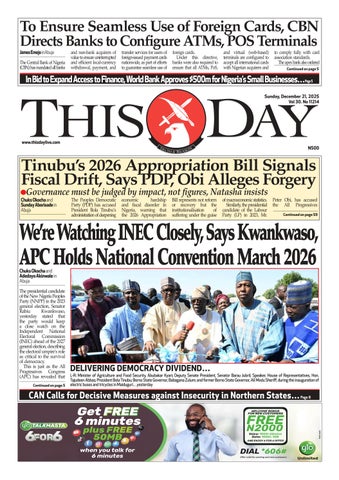
To Ensure Seamless Use of Foreign Cards, CBN Directs Banks to Configure ATMs, POS Terminals James Emejo in Abuja
The Central Bank of Nigeria (CBN) has mandated all banks
and non-bank acquirers of value to ensure uninterrupted and efficient local-currency withdrawal, payment, and
transfer services for users of foreign-issued payment cards nationwide, as part of efforts to guarantee seamless use of
foreign cards. Under this directive, banks were also required to ensure that all ATMs, PoS,
and virtual (web-based) terminals are configured to accept all international cards with Nigerian acquirers and
to comply fully with card association standards. The apex bank also ordered Continued on page 5
In Bid to Expand Access to Finance, World Bank Approves $500m for Nigeria’s Small Businesses…Page 5 Sunday, December 21, 2025 Vol 30. No 11214
www.thisdaylive.com TR
UT H
& RE A S O
N500
N
Tinubu’s 2026 Appropriation Bill Signals Fiscal Drift, Says PDP, Obi Alleges Forgery Governance must be judged by impact, not figures, Natasha insists
Chuks Okocha and Sunday Aborisade in Abuja
The Peoples Democratic Party (PDP) has accused President Bola Tinubu’s administration of deepening
economic hardship and fiscal disorder in Nigeria, warning that the 2026 Appropriation
Bill represents not reform or recovery but the institutionalisation of suffering under the guise
of macroeconomic statistics. Similarly, the presidential candidate of the Labour Party (LP) in 2023, Mr.
Peter Obi, has accused the All Progressives Continued on page 59
We’re Watching INEC Closely, Says Kwankwaso, APC Holds National Convention March 2026 Chuks Okocha and Adedayo Akinwale in Abuja
The presidential candidate of the New Nigeria Peoples Party (NNPP) in the 2023 general election, Senator Rabiu Kwankwaso, yesterday stated that the party would keep a close watch on the Independent National Electoral Commission (INEC) ahead of the 2027 general election, describing the electoral umpire’s role as critical to the survival of democracy. This is just as the All Progressives Congress (APC) has revealed that L-R: Minister of Agriculture and Food Security, Abubakar Kyari; Deputy Senate President, Senator Barau Jubril; Speaker, House of Representatives, Hon.
DELIVERING DEMOCRACY DIVIDEND…
Continued on page 5
Tajudeen Abbas; President Bola Tinubu; Borno State Governor, Babagana Zulum; and former Borno State Governor, Ali Modu Sheriff, during the inauguration of electric buses and tricycles in Maiduguri…yesterday
CAN Calls for Decisive Measures against Insecurity in Northern States… Page 8
DIAL *606#
Offer valid for existing and new customers
2
sUNDAY, DECEMBER 21, 2025 • T H I S D AY
sUNDAY, DECEMBER 21, 2025 • T H I S D AY
3
4
sUNDAY, DECEMBER 21, 2025 • T H I S D AY
5
DECEMBER 21, 2025 • T H I S DAY, T H E S U N DAY N E W S PA P E R
NEWS
In Bid to Expand Access to Finance, World Bank Approves $500m for Nigeria’s Small Businesses Ndubuisi Francis in Abuja
The World Bank has approved a $500 million financing package for Nigeria under the Fostering Inclusive Finance for MSMEs in Nigeria (FINCLUDE) project. The package comprises a $400 million
International Bank for Reconstruction and Development (IBRD) loan and a $100 million International Development Association (IDA) credit, to be implemented by the Development Bank of Nigeria (DBN), with credit guarantees provided through DBN’s subsidiary, Impact Credit Guarantee Limited (ICGL).
Both IBRD and IDA are members of the World Bank Group. FINCLUDE is designed to address constraints faced by micro, small, and medium enterprises (MSMEs) in Nigeria Despite MSMEs forming the backbone of Nigeria’s economy—accounting for most businesses, nearly half of gross domestic
product (GDP), and a large share of jobs —they face long-standing barriers to formal finance. Fewer than one in 20 MSMEs have access to bank credit; loans are often short-term and costly; and collateral requirements exclude many viable firms. Wo m e n - l e d enterprises, which make up a substantial
portion of MSMEs, are disproportionately affected, facing higher rejection rates and limited tailored products. Agribusinesses, central to food security and rural livelihoods, similarly struggle to obtain more extended‑tenor financing for equipment, processing, storage, and logistics. FINCLUDE is designed to
address these constraints by expanding access to affordable, longer-term finance and tailored solutions for segments with the most significant development impact. In his remarks, the World Bank Country Director for Nigeria, Mathew Verghis, said: “FINCLUDE is about jobs, opportunity, and inclusion.
WE’RE WATCHING INEC CLOSELY, SAYS KWANKWASO, APC HOLDS NATIONAL CONVENTION MARCH 2026
its national convention would hold from March 25 to 28, 2026. Kwankwaso spoke in Abuja at the NNPP national convention, shortly after newly re-elected party executives took their oath of office, in the presence of INEC representatives, party leaders, and delegates from across the country. Also, Kano State Governor, Abba Yusuf, warned against internal exclusion that could weaken the NNPP's base. The NNPP national leader congratulated INEC on the appointment of its new national chairman, Prof. Joash Amupitan, while stressing that public confidence in elections depends mainly on the commission’s conduct. He said, “Let me thank all of you, especially those who came from far. I also
want to appreciate the INEC representatives here today and, through you, congratulate the newly appointed National Chairman of the commission, Prof Joash Amupitan. “I want to say so far so good, we are keeping our eyes on INEC because its job is so critical that it can make or mar democracy in this country. Thank you for coming, and we look forward to an even better relationship between INEC and, of course, our party. “I want to assure you that the leadership of the NNPP at all levels will continue to do whatever it takes to ensure that this party grows from strength to strength. Let me also thank the Governor of Kano State for supporting this party over these years.” The convention, which
ratified decisions of the party’s National Executive Committee (NEC) and elected members of the National Working Committee (NWC), comes as the NNPP intensifies preparations for the 2027 polls after its breakout performance in the 2023 general election.
Gov Yusuf Seeks Inclusiveness, Fairness as NNPP Elects National Officers Speaking at the convention, Kano State Governor Abdullahi Umar Ganduje described the gathering as a turning point for the party and warned against internal exclusion that could weaken its base. “This convention is just not another gathering. It
is a defining moment for our party. It is a moment to reflect on where we are coming from. To examine where we stand today and to boldly chart our future. “In future political engagements, I call on all leaders at every level to promote inclusiveness and fairness. No ward, state, zone, or group should feel marginalised. Women and youth, who form the backbone of our population, must be fully included, not just in words but in action. “Distinguished delegates, no political party can succeed without unity. Parties that stand divided fall weakened. When every member feels valued, the party grows stronger. When every voice is heard, the party becomes more resilient,” he urged. In his acceptance speech,
the re-elected National Chairman, Dr Ajuji Ahmed, said the party had drawn lessons from the last general election and was determined to work harder ahead of 2027. “All eyes are on our great party to point the way forward for sustainable democracy and development in Nigeria. NNPP is known for its strict compliance with internal democracy. “We have learned from the 2023 general election and will work harder for the 2027 general election. Nigerians look up to the NNPP to chart the way forward for our dear nation. We must live up to their expectations. Together we will restore genuine democracy in Nigeria,” he said. Also speaking, Secretary of the Board of Trustees,
Hon. Buba Galadima, said the party’s strength lies in its grassroots acceptability rather than reliance on political heavyweights. “We congratulate the chairman of INEC as the national leader of our party, as the national leader of our party earlier did. The NNPP does not rely on big names. We rely on the acceptability and ability of our people at all levels, whom we owe a duty to thank for keeping the flag of our party flying. “Secondly, I want to use this opportunity to thank our National Leader for accepting the burden of responsibility of running a political party. I want to say, as a party administrator for the last 47 years, it is not easy for any individual to run a national political party like the NNPP,” he argued.
TO ENSURE SEAMLESS USE OF FOREIGN CARDS, CBN DIRECTS BANKS TO CONFIGURE ATMS, POS TERMINALS banks to implement multifactor authentication for all withdrawals and online transactions exceeding $200 per day, $500 per week, and $1,000 per month (or its equivalent). It disclosed these in a circular addressed to all banks and other financial institutions on the seamless use of foreign cards. The circular was signed by the Director, Financial Policy and Regulation Department, Dr. Rita Sike. The apex bank said the directive was in furtherance of ongoing efforts to facilitate access to funds and enhance convenience, security, and the user experience for diasporans and tourists using foreign cards. ATMs and PoS are required to hold appropriate certifications and, where needed, undergo recertification to ensure
seamless processing of card transactions. They must possess appropriate certifications and, where necessary, recertifications to ensure seamless processing of card transactions, the central bank added. The CBN said banks must maintain system availability to ensure seamless, uninterrupted transaction processing. With respect to ATM cash withdrawals, banks are required to ensure compliance with approved cash withdrawal limits. The circular stressed that financial institutions must "Clearly communicate the applicable exchange rate, which shall be market-driven and based on the prevailing official rate, as well as other associated charges to users", adding that "transactions should only be completed
after the user has accepted the terms with evidence obtained". The apex bank also directed the banks to "maintain sufficient liquidity position to settle transactions, settle transactions for the merchant in local currency (Naira), implement transaction monitoring to detect unusual patterns in the use of foreign cards across all terminals, strengthen know-yourcustomer and anti-money laundering controls for merchants handling foreign card payments" and "require their merchants to ensure that all their copies of card-present transaction receipts are properly signed and to request for valid identity documents where a transaction appears suspicious." The circular further requested banks to "report
suspicious transactions to the Nigeria Financial Intelligence Unit in line with extant regulations, recalibrate fraud-monitoring systems to minimise false declines on legitimate foreign card transactions, ensure that card acceptance devices are equipped with an option for contactless payments for low-value transactions. "Resolve consumer complaints from these transactions within the approved timelines, as escalations to CBN will attract appropriate sanctions." The apex bank also directed that acquirers "implement and maintain robust, auditable chargeback management processes aligned with applicable card-scheme rules and CBN guidelines, including but not limited to timely case intake, evidence collation, refund execution, and post-incident analytics."
With respect to ATM cash withdrawal transactions, the CBN directed that acquirers must ensure compliance with approved cash withdrawal limits and clearly communicate the applicable exchange rate, which shall be market-driven and based on the prevailing official rate, as well as any associated charges to users. According to the CBN, transactions should be completed only after the user has accepted the terms and provided the required evidence. The CBN also requires acquirers to maintain sufficient liquidity to settle transactions. They (acquirers) are to "settle transactions for the merchant in local currency (Naira), implement transaction monitoring to detect unusual patterns in the use of foreign cards across all terminals, strengthen know-your-
customer and anti-money laundering controls for merchants handling foreign card payments.” Acquirers are also directed to "require their merchants to ensure that all their copies of card-present transaction receipts are properly signed and to request for valid identity documents where a transaction appears suspicious, report suspicious transactions to the Nigeria Financial Intelligence Unit in line with extant regulations, recalibrate fraud-monitoring systems to minimise false declines on legitimate foreign card transactions, ensure that card acceptance devices are equipped with option for contactless payments for low value transactions, resolve consumer complaints from these transactions within the approved timelines as escalations to CBN will attract appropriate sanctions."
6
T H I S DAY, T H E S U N DAY N E W S PA P E R • DECEMBER 21, 2025
NEWS
WELCOME HOME, MR PRESIDENT…
Lagos State Governor, Mr. Babajide Sanwo-Olu (left), receiving President Bola Tinubu, at the Murtala Muhammed Airport when the president arrived to spend the end-of-year holidays in Lagos…yesterday
ADC, More Federal Lawmakers Demand Suspension of Gazetted Tax Laws over Alleged Discrepancies
Chuks Okocha in Abuja
of Representatives, Hon. Abdulsammad Dasuki (PDP Sokoto), raised a matter of privilege on the floor of the House last Wednesday, alleging discrepancies between the tax laws passed by the National Assembly and the versions subsequently gazetted and made available to the public. Under Order Six, Rule Two of the House Rules, on a Point of Privilege, Dasuki told the House that his legislative privilege had been breached, insisting that the content of the tax laws as
gazetted did not reflect what lawmakers had debated, voted on, and passed on the floor of the House. Presiding over the plenary, the Speaker, Tajudeen Abbas, constituted a seven-member ad hoc committee to investigate discrepancies between the tax bills passed and the versions later assented to and gazetted.
Avoid Indomie Vegetable Noodles, NAFDAC Warns
The United States Government has temporarily halted the processing of green card and citizenship applications filed by Nigerians and nationals of other countries newly added to the US travel ban. The suspension affects legal immigration applications processed by U.S. Citizenship and Immigration Services (USCIS) and primarily targets immigrants from selected African and Asian
The African Democratic Congress (ADC) and two members of the House of Representatives - Hon. Muhammad Bello Fagge, representing Fagge Federal Constituency of Kano State, and Hon. Yusuf Shitu Galambi, representing Gwaram Federal Constituency in Jigawa State - have called for the immediate suspension of the tax laws, scheduled to take effect on January 1, 2026. A member of the House
The National Agency for Food and Drugs Administration and Control (NAFDAC) has issued a public alert over the recall of Indomie Vegetable Flavour Noodles following the discovery of undeclared milk and eggs allergens, which pose serious health risks to consumers with allergies or intolerances. Announcing the recall in a Public Alert No. 041/2025, dated December 18, 2025, the agency disclosed that the recall notice was issued by Rappel Conso of France, the French food safety authority, after laboratory findings confirmed the presence of the allergens not listed on the product label. NAFDAC said the
recall affects all batches of the Indomie Vegetable Flavour noodles, with a best-before date of February 6, 2026, even as the country of origin was not stated in the recall notice. The statement reads in part: “The National Agency for Food and Drugs Administration and Control (NAFDAC) is informing the public that the French Authority (Rappel Conso of France) issued a notice regarding a recall of Indomie brand Noodles Vegetable Flavour product. “This recall is due to the presence of undeclared allergens, specifically milk and eggs, which may pose a significant health risk to consumers with allergies or intolerances.
Reacting to the development in a statement issued by its National Publicity Secretary, Mallam Bolaji Abdullahi, ADC yesterday warned that tampering with a piece of legislation after the National Assembly had passed it was an indication that President Bola Tinubu desires to concentrate all powers onto himself.
The opposition party demanded the immediate suspension of the tax laws to allow the legislature to determine the extent of alleged forgery inserted by the Tinubu administration and to take the necessary corrective actions. It also called for a public inquiry to investigate the circumstances surrounding the criminal alterations of
a duly passed law, and to ensure that perpetrators are brought to justice. The ADC said it has reviewed various reports that confirm doubts that the tax laws passed by the National Assembly and signed into law by President Tinubu contain substantial forgery of key provisions not in the original law passed by the legislature.
Trump Bans Nigerians, Others from US Citizenship, Green Card Applications countries. Many of those affected are already lawfully residing in the United States and were seeking to adjust their immigration status or become U.S. citizens. Earlier in December, the Trump administration directed USCIS to freeze all immigration petitions, including applications for permanent residency and citizenship, for nationals of 19 countries covered by the June travel ban. The decision followed
the Thanksgiving week shooting of two National Guard soldiers in Washington, D.C., an attack allegedly carried out by an Afghan national. Following the incident, the administration also suspended decisions on asylum cases handled by USCIS and halted processing of all immigration and visa applications for Afghans. On Tuesday, President Donald Trump expanded the travel ban to include
20 additional countries, entirely barring entry from five nations and partially restricting travel from 15 others. A US official, who spoke to CBS News on Friday on condition of anonymity, said USCIS has now extended the suspension of immigration cases to cover nationals of the newly added countries. The full travel ban applies to Burkina Faso, Mali, Niger, South Sudan, and Syria.
Tinubu Arrives Lagos for End-of-year Holidays President Bola Tinubu yesterday arrived in Lagos State to spend the end-of-year holidays following official visits to Borno and Bauchi states. The president was received at the presidential wing of the Murtala Muhammed International Airport in Lagos by
Governor Babajide SanwoOlu, government officials and chieftains of the All Progressives Congress. Tinubu departed Abuja yesterday on a three-state tour. In Borno State, he inaugurated projects executed by the state government under
Governor Babagana Zulum in collaboration with the federal government. While in Maiduguri, the president also attended the wedding ceremony of Sadeeq Sheriff, son of former Borno State Governor and Senator, Ali Modu Sheriff, and his bride, Hadiza Kam Salem.
From Borno, Tinubu proceeded to Bauchi State, where he paid a condolence visit to the state government and the family of Sheikh Dahiru Bauchi, the late renowned Islamic cleric and leader of the Tijjaniyya Muslim Brotherhood, who died on November 27.
sUNDAY, DECEMBER 21, 2025 • T H I S D AY
7
8
T H I S DAY, T H E S U N DAY N E W S PA P E R • DECEMBER 21, 2025
NEWS
STRENGTHENING STRATEGIC COLLABORATION…
L-R: Head of Marketing, Polo Limited, Chika Nnadozie; Area Sales Manager, Montblanc, Middle East and Africa, Adam Cohen; and Head of Commercial, Polo Limited, Olamoniso Nduka, during Adam's official visit to Nigeria at the Montblanc Boutique in Lekki, Lagos...recently
CAN Calls for Decisive Measures against Insecurity in Northern States Tambuwal seeks global support for Nigeria
John Shiklam in Kaduna and Onuminya Innocent in Sokoto
The Christian Association of Nigeria (CAN) in the 19 Northern states and the Federal Capital Territory (FCT) has appealed to President Bola Tinubu and the northern governors to take urgent, decisive steps
to protect lives and property during the Christmas season and beyond. This is consistent with a former governor of Sokoto State and ex-Speaker of the House of Representatives, Senator Aminu Tambuwal, who has described Nigeria’s current security situation as “very concerning and alarming,” warning political
leaders and the international community against politicising the country’s deepening insecurity. In a statement issued yesterday, the Chairman of Northern CAN, Rev. Yakubu Pam, expressed concerns over the renewed activities of bandits, terrorists, and other criminal groups in parts of the north.
He said the Christmas season, which should be marked by peace and goodwill, is being overshadowed by fear arising from persistent insecurity across Northern Nigeria. “The Yuletide season ushers in a period of spiritual reflection, peace, and goodwill across
Benin Republic Detains Ex-defence Minister over Foiled Coup The Republic of Benin yesterday placed former defence minister and prominent opposition politician, Candide Azannai, in pre-trial detention as part of an investigation into the West African country’s failed early December coup. According to an AFP journalist, Azannai was accused of plotting against the state and incitement to rebellion, after being arrested last week at his
party’s headquarters in Cotonou in the wake of the attempted takeover. The detention of the prominent opposition figure, who condemned the coup, is the latest in the wake of the foiled takeover, after some 30 people, mostly soldiers, were jailed Tuesday on treason grounds. Soldiers announced on national television on December 7 that they had
toppled President Patrice Talon, but loyalist army forces swiftly defeated the coup plotters with the help of the Nigerian Air Force (NAF). Several people were killed in the attempted uprising, while some of the mutineers, including alleged coup leader Lieutenant-Colonel Pascal Tigri, remained on the run. After several hours of questioning at Benin’s
anti-terrorism court, Azannai was escorted away at dawn by police before being taken into custody, an AFP reporter saw. While Talon has been praised for spurring economic growth, critics accuse the president of creeping authoritarianism in a country once praised for its democracy. At the same time, in recent years, Benin has been hit by jihadist violence in the north.
Fire Guts Section of FIRS Office in Abuja, No Casualties Recorded Festus Akanbi
A fire outbreak yesterday partially gutted one of the offices of the Federal Inland Revenue Service (FIRS) in Abuja, causing damage to several offices but leaving no casualties. The incident occurred in the early hours of December 20, 2025, at the FIRS office located at No. 15 Sokode Crescent, Wuse Zone 5, where the fire reportedly started on the fourth floor
of the multi-storey building. According to a statement from the Technical Assistant in charge of Print Media to the FIRS Chairman, Sikiru Akinola, the fire was first noticed by on-duty security personnel, who immediately raised the alarm and activated internal emergency response procedures. Their prompt action, coupled with the swift intervention of the Federal Capital Territory (FCT) Fire Service and other
emergency responders, ensured that the blaze was quickly contained and prevented from spreading to different floors of the building. Although no lives were lost in the incident, FIRS confirmed that several offices on the affected floor sustained varying degrees of damage. At the same time, adjoining sections of the building were protected from the fire.
Preliminary assessments indicate a possible electrical fault as the cause of the fire, though the Service said a comprehensive investigation has commenced to determine the exact circumstances surrounding the incident. In the meantime, FIRS disclosed that it is reviewing and strengthening its internal safety, electrical, and fire-prevention protocols to mitigate against future occurrences.
the world as the world celebrates this occasion; I wish to call on President Bola Tinubu, governors of the northern states and the FCT minister to take urgent, visible, and decisive steps to guarantee the safety of lives and property during the celebrations and beyond", Pam said. According to him, the appeal is against the background of “persistent and deeply troubling security challenges confronting the nation in recent times, particularly the escalating activities of bandits, terrorists, and other
criminal groups across many parts of Northern Nigeria.” Pam noted that insecurity has continued to “create an atmosphere of fear and uncertainty, significantly affecting the confidence of citizens, especially Christian faithful, who now find it increasingly difficult to travel freely and congregate for worship during this sacred period.” The CAN chairman said information available to Northern CAN shows that many Christians are reconsidering travel plans due to fear for their lives.
Fubara’s Defection Excites Odili, Says Rivers will Benefit More from Centre Blessing Ibunge in Port Harcourt
The defection of Rivers State Governor, Siminalayi Fubara, from the Peoples Democratic Party (PDP) to the All Progressives Congress (APC) has continued to attract commendations across the state. Reacting to the governor’s decision, a former state governor, Dr. Peter Odili, described the move as timely and beneficial, saying it would enhance the state's overall development. Odili said the defection effectively aligns Rivers State with the federal government, a development he described as “perfect,” noting that the state stands to gain more from the centre. The former governor
made the remarks at the weekend during the eighth Founders’ Day and 5th Convocation ceremony of the PAMO University of Medical Sciences, Port Harcourt. Odili, the institution's founder and Pro-Chancellor, lauded Governor Fubara for his investments in education and the health sector, particularly in primary healthcare, which he said aligns with President Bola Ahmed Tinubu's health sector reforms. “With what you have done as our governor, the attention you have paid to education and health is highly commendable. I am sure no state in Nigeria can boast of the quality of zonal hospitals you have built,” he said.
sUNDAY, DECEMBER 21, 2025 • T H I S D AY
9
10
T H I S DAY, T H E S U N DAY N E W S PA P E R • DECEMBER 21, 2025
NEWS
INSPIRING THE YOUTHS…
Group Managing Director, Arco Group, Mr. Alfred Okoigun (5th right), flanked by some of the National Youth Service Corps members during the Arco Group walkathon initiative put together by the company to inspire and empower youths for leadership roles in Lagos...recently ABIODUN AJALA
Oditah Warns Against Nigeria’s Two-speed Justice System Where Political Disputes are Fast-tracked Wale Igbintade
A Senior Advocate of Nigeria (SAN) and distinguished legal scholar, Fidelis Oditah KC, has raised the alarm that Nigeria operates a two-speed justice system in which political and electoral disputes are fasttracked. At the same time, ordinary citizens are left to languish in protracted litigation. Oditah said Nigeria’s justice system is sliding into systemic paralysis as courts increasingly prioritise electoral and
political cases at the expense of socio-economic justice, a trend he said is undermining investment, eroding public confidence, and weakening democratic governance. The leading commercial lawyer and arbitrator raised the alarm in a detailed keynote address delivered recently in Lagos at an event marking the 40th anniversary of his Call to the Nigerian Bar. Oditah, a member of the Nigerian Law School Class of 1985, titled his lecture “Judicial Gridlock and the Adverse Implications of
Air Chief: Rigorous Training Deliberate to Prepare Recruits for Military Realities Linus Aleke in Abuja
The Chief of the Air Staff (CAS), Air Marshal Sunday Kelvin Aneke, has said that the rigorous physical, mental and other demands of the military training programme were deliberately designed to prepare recruits for the realities of military service. Aneke made the remarks yesterday during the Passing Out Parade of Basic Military Training Course (BMTC) 45/2025. A statement by the Director of Public Relations and Information of the Nigerian Air Force (NAF), Air Commodore Ehimen Ejodame, said the graduation of 1,296
recruits marked their transition from civilian life into trained airmen and airwomen of the NAF. The CAS urged the new personnel to uphold discipline, teamwork and a strong sense of duty, while expressing gratitude to their families for the support that contributed to their successful completion of the course. Reviewing the parade, Aneke described the event as “a defining milestone for both the graduates and the Service,” stressing that the operational effectiveness of NAF depends on the quality, discipline and professionalism of its personnel.
Prioritising Electoral Justice Above Socio-Economic Justice.” In his address, he delivered a sweeping critique of Nigeria’s civil and criminal justice system, characterizing it as gridlocked, overly technical, and increasingly detached from the lived realities of ordinary
Nigerians. According to him, courts are overwhelmed by chronic delays, weak institutional capacity, and a deeply entrenched culture of procedural formalism that frustrates the timely resolution of disputes. “Cases remain in court for 20 to 30 years,” Oditah said, noting that litigants
frequently die before judgments are delivered. “Our problem is no longer access to justice but exit from justice,” he added. He cited the protracted land dispute of Okafor v Nweke as a stark illustration of judicial failure. The case, which
commenced at the Onitsha High Court in 1955, was not concluded until January 2025—70 years later —without a determination on the merits, after the Supreme Court dismissed the appeal on technical grounds concerning the execution of court documents.
FG, US Sign $2bn MoU to Strengthen Bilateral Cooperation on Infectious Diseases
Onyebuchi Ezigbo in Abuja
The federal government of Nigeria and the United States government have signed a landmark technical Memorandum of Understanding (MoU) to strengthen bilateral cooperation and funding for the early detection and prevention of emerging and existing infectious diseases in Nigeria, including HIV/
AIDS and tuberculosis. Under the MoU, over five years, from April 2026 to December 2030, the United States government will provide nearly $2 billion in grants. Nigeria said it is developing a plan to allocate at least six per cent of the annual federal and state domestic budgets to health, expected to mobilise nearly $3 billion for health over the same period.
A statement from the Federal Ministry of Health and Social Welfare said the MoU also covers enhancing disease surveillance systems; strengthening and safety procedures for pathogen sample collection, transport, storage, testing, and disposal; primary care; financial protection; and the provision of technical support, among other objectives. The MoU is aligned with
Nigeria’s drive toward selfreliance, aiming to reduce dependence on external aid to 0% by 2030. Under the framework, Nigeria plans to increase its health sector spending as a share of the national budget, while funding from the United States government is expected to decline. This approach reflects a strategic pivot towards trade- and investment-based partnerships.
EU Reaffirms Commitment to Nigeria’s Creative Industry, Short Film Competition Draws 537 Entries Michael Olugbode in Abuja
The European Union (EU) has reaffirmed its strong commitment to youth empowerment, cultural exchange, and the growth of Nigeria’s creative industry, as the EU Ambassador to Nigeria and ECOWAS, Gautier Mignot, celebrated emerging
filmmakers at the grand finale of the EU Short Film Competition held during the 2025 Zuma International Film Festival in Abuja. Speaking at the event, Mignot said the EU remained committed to supporting platforms that nurture young talent, amplify African stories, and strengthen cultural cooperation between
Europe and Nigeria through film and the creative arts. The competition, a significant highlight of the 2025 Zuma International Film Festival, received 537 short film submissions following a nationwide call for entries launched on September 5, 2025. Submissions officially closed on November 10,
2025, marking one of the highest participation levels in the initiative's history. A professional fivemember screening committee constituted by High-Definition Film Studio reviewed all submissions based on established criteria and shortlisted 15 outstanding films for screening at the grand finale.
sUNDAY, DECEMBER 21, 2025 • T H I S D AY
11
12
sUNDAY, DECEMBER 21, 2025 • T H I S D AY
sUNDAY, DECEMBER 21, 2025 • T H I S D AY
13
14
sUNDAY, DECEMBER 21, 2025 • T H I S D AY
sUNDAY, DECEMBER 21, 2025 • T H I S D AY
15
16
sUNDAY, DECEMBER 21, 2025 • T H I S D AY
sUNDAY, DECEMBER 21, 2025 • T H I S D AY
17
THISDAY, The SUNday Newspaper •December 21, 2025
18
Business
Editor: Festus Akanbi 08038588469 Email:festus.akanbi@thisdaylive.com
Reshaping SME Landscape with Women Focused Finance
In a challenging economic climate, women-led businesses are emerging as one of Nigeria’s most resilient growth drivers, often thriving despite limited access to finance. The 2025 FSDH WIBI Summit showed how targeted, gender-intentional capital is unlocking its full economic potential, L-R: CEO, Wavelength Growth Partners, and recipient- Inspirational Investor Award, Taba Peterside; Senior Vice President, FSDH writes Festus Akanbi
I
n Nigeria’s ever-shifting economic landscape, the most profound signals of transformation are often found far from policy documents and fiscal charts. They are visible in factory floors run by women, in agribusiness ventures led by determined female founders, in digital startups built from living rooms, and in creative studios exporting Nigerian stories to the world. Across sectors, women-led enterprises are no longer emerging quietly; they are asserting influence, driving employment, and redefining value creation. Yet this progress is unfolding alongside a persistent contradiction. While women are among Nigeria’s most active entrepreneurs, they remain disproportionately excluded from the financial systems needed to scale their ambitions. This imbalance between energy and access, potential and capital has become more pronounced as Nigeria navigates inflationary pressures, currency volatility, and a tightening credit environment. It was against this backdrop that the 2025 edition of the FSDH Women in Business Initiative (WIBI) Summit convened in Lagos, offering not just inspiration but a serious examination of how intentional, gender-responsive capital can accelerate growth, unlock resilience, and shape the future of Nigeria’s SME economy. The Expanding Female Economy Nigeria’s story of female entrepreneurship is exceptional by global standards. Mastercard’s 2025 Empowerment for All report finds that 83 per cent of Nigerian women consider themselves entrepreneurs, well above the 51 per cent average across Eastern Europe, the Middle East, and Africa. This statistic alone captures a national reality: women are building businesses at scale, across manufacturing, agriculture, retail, technology, logistics, and the creative economy. Yet participation has not translated into proportional access to finance. Only about 23 per cent of women-owned businesses in Nigeria have access to formal MSME credit. According to the African Development Bank Group, women entrepreneurs across Africa face a combined financing gap of approximately $42 billion. The implication is stark: women are starting businesses in record numbers, but are being structurally constrained at the point where growth should begin. The consequences ripple through households and communities. Women entrepreneurs are more likely to reinvest profits into education, healthcare, and social welfare. They often serve as financial anchors for extended families and generate employment
Asset Management, Margaret Agbonlahor; MD/CEO. FSDH Merchant Bank, Bukola Smith, Chief Financial Officer, FSDH Asset Management, Funmilayo Oletubo, and Veteran Actor and Keynote Speaker, Joke Silva at the micro- and small-enterprise levels. When their businesses stagnate due to a lack of capital, the cost is not just individual; it is national. Closing this gap, therefore, is not merely a question of equity; it is an economic imperative. As policymakers and economists increasingly acknowledge, inclusive finance is essential to productivity, resilience, and long-term growth. WIBI: A Model for Gender-responsive Finance FSDH Merchant Bank has positioned itself at the centre of this conversation through the Women in Business Initiative, which, over five years, has evolved into a comprehensive platform for supporting women-led enterprises. The 2025 WIBI Summit marked a defining moment, highlighting how deliberate financial design can translate into measurable impact. At the heart of WIBI’s success is access to capital that reflects business realities. Over the past five years, FSDH has disbursed more than N3 billion (over $3.9 million) to women-owned enterprises. This financing has not been one-size-fits-all. Instead, it has included long-term loans with flexible repayment structures, working capital facilities for liquidity management, and short-term collateral-free credit for businesses without fixed assets. These achievements have been underpinned by strategic partnerships with institutions such as the Bank of Industry, IFC’s gender-focused investment programmes, the AGF AFAWA Guarantee, and WEAV Capital. By blending capital and sharing risk, these collaborations enable FSDH to extend credit on more favourable terms, reaching enterprises that traditional banking typically excludes. What emerges is a model that balances commercial discipline with developmental intent, demonstrating that gender-focused finance is not charity, but smart economics. Beyond Capital: Building Entrepreneurial Readiness FSDH’s approach recognises a critical truth: finance alone does not build sustainable enterprises. Without skills, governance structures, and market access, capital can become a temporary solution rather than a
catalyst for growth. WIBI has therefore embedded capacity building into its core strategy. Through partnerships with the Enterprise Development Centre, IFC, WEAV Capital, and other development organisations, WIBI has delivered structured training, mentorship, and accelerator programmes to women entrepreneurs nationwide. Initiatives such as the Women Business Impact Programme, the Female Founders Growth Programme, and the WIBI Coaching Programme have equipped more than 500 women-led SMEs with skills in financial management, investor readiness, leadership development, and business model refinement. Beyond these programmes, over 2,000 women have participated in WIBI-led summits, masterclasses, and coaching cohorts. These platforms do more than transfer knowledge; they create networks, foster peer learning, and build confidence, often the most underestimated ingredient in enterprise growth. Sector exhibitions and market-connect events further enhance visibility, enabling women-led businesses to attract customers, forge partnerships, and access new markets. The result is an ecosystem in which capital and capability reinforce each other, creating enterprises positioned for longevity rather than mere survival. The Creative Economy Takes Centre Stage One of the most compelling discussions at the 2025 summit focused on Nigeria’s creative economy, a sector valued at over $7 billion and expanding rapidly globally. Film, music, fashion, digital content, and the performing arts have become cultural exports, with women playing pivotal roles as producers, designers, directors, and digital entrepreneurs. Despite its growth, the creative sector remains misunderstood by traditional finance. Irregular cash flows, project-based income, and informal revenue structures often lead lenders to classify it as high risk. For women creatives, this translates into limited access to patient capital and growth financing. Veteran actress and producer Joke Silva, delivering the keynote address, articulated this challenge with clarity. She emphasised the need for deeper skills development, structured industry pathways, and financing models that recognise royalties, licensing, and intellectual property as legitimate assets. Her intervention echoed a broader consensus: the creative economy cannot reach its full potential without financial products designed around its unique dynamics. FSDH’s commitment to developing creative-
sector financing models ahead of 2026 reflects an understanding that future economic growth will increasingly come from non-traditional sectors, and that women will be central to that expansion. Why Gender-Focused Finance Matters Now In a period of economic uncertainty, genderfocused finance sits at the intersection of recovery and competitiveness. Research consistently shows that women-led enterprises record higher repayment rates and demonstrate substantial social impact. According to the International Monetary Fund, closing gender gaps in economic participation could boost Nigeria’s GDP by up to 23 per cent. Targeted capital for women is therefore not a development footnote; it is a macroeconomic strategy. When financial institutions design products that reflect women’s business realities, the outcomes are tangible: stronger enterprises, faster job creation, improved household resilience, and diversified economic growth. WIBI’s track record provides empirical evidence of this logic. Aligning finance with capacity and context illustrates how inclusion can be both impactful and sustainable. The Road Ahead While FSDH’s achievements through WIBI are significant, they also highlight how much remains to be done. The next phase will require scaling gender-intentional financial products, expanding partnerships with investors and development organisations, and deepening sector-specific financing across agribusiness, healthcare, digital commerce, and the creative economy. Data will play a crucial role in this evolution, tracking performance, measuring impact, and guiding more innovative interventions. Accelerator programmes must also expand to meet the growing pipeline of women entrepreneurs ready to scale. Nigeria’s female economy is already in motion, defined by resilience, ambition, and innovation. From farms and factories to tech hubs and creative studios, women are reshaping the contours of enterprise. As institutions like FSDH continue to broaden access to capital, capability, and community, the prospect of women-led businesses driving Nigeria’s next decade of growth becomes not just plausible but inevitable. If inclusive finance and intentional policy remain priorities, history may well record that Nigeria’s most transformative economic chapter was powered by women whose potential was finally matched with capital that believed in their vision.
19
T H I S D AY SUNDAY DECEMBER 21 2025
The joining of APC by Caleb Mutfwang is an expected homecoming, writes YAKUBU DATI
ON THE RIGHT PATH
ISSUES IN THE NORTH-WEST DEVELOPMENT COMMISSION
The protracted delay in releasing the take-off grant has confined the Commission to preparatory activities, argues ABDULRASHID SANI GIMI
T T
he announcement by National Chairman of the All Progressives Congress (APC), Prof Nentawe Yilwatda, that Governor Caleb Mutfwang of Plateau State has officially joined the ruling party at the party’s 14th national caucus meeting in Abuja on Thursday, has ended months of speculations. It has confirmed what we all know to be necessary for the further development of Plateau State: that the state has to eschew politics of sentiments to be in the mainstream of Nigeria’s politics. Presenting a bigger picture of the development, the APC National Chairman who is also from Plateau State, said with the defection of Gov Mutfwang, the entire North Central is now governed by the APC. This is both true and revealing that a sense of cohesion with like minds has been enabled to be consolidated. As an indigene of Plateau State I cannot but say Eureka to this development with the epiphany that my state has realigned not just with the center but with its siblings in the North Central zone giving our dear state a stronger identification and sense of belonging. The North-Central occupies a strategic space in Nigeria’s power map. Frequently courted during elections, it however struggles to convert relevance into sustained Federal attention. In 1983 under the 2nd Republic, Plateau was the only state that chose to be different in party affiliation with its closest neighbours as Benue, Bauchi, Gongola and Kaduna all belonged to the ruling party at the center. But the consequences were glaring as there was no synergy between the state and the center to complement the drive of our father, Chief Solomon Lar who would have achieved much more with the support of the party at the center. Before last Thursday when Mutfwang defected, Plateau reminiscent of the old order, was the only odd one out with Benue, Kwara; Niger; Nasarawa and Kogi all belonging to the ruling party. The defection of the governor is therefore a homecoming of sorts. Many other states have since found out that alignment with the centre presents Renewed Hope and this action by Gov Mutfwang while definitely aligning Plateau with the ruling party at the federal level, will unlock greater access to resources, accelerate development projects, and fosters national policy influence. The realignment is also laden with the prospects of reducing partisan friction while enabling smoother governance and faster implementation of infrastructure and
security initiatives. Former Ebonyi governor Dave Umahi, Cross River’s Ben Ayade, and Zamfara’s Bello Matawalle have keyed into this idea for the greater benefit of their states while Delta and Akwa Ibom, are already enjoying low hanging fruits. No doubt, alignment with the center especially for a leader like President Bola Ahmed Tinubu provides political comfort to deepen more development buoyed by leadership capacity and strategic negotiation. Defections also consolidate power as governors rarely move alone; they do so with their legislators, commissioners, local government officials, etc., which is a plus for the ruling party as this strengthens its position ahead of 2027. There are definitely going to be challenges occasioned by this action as some would feel it would dampen their influence on the party. But such considerations are selfish and not forward looking. Gov Mutfwang will therefore face the challenge of uniting other members with those who are moving to the APC with him as there are entrenched party factions and rival ambitions. Plateau’s APC, long in opposition, carries its own internal tensions hence success for the party will require discipline, inclusion, and strategic clarity to gain from federal alignment and stabilise governance. The good thing is that with the alignment, the cooperation of notable party leaders in the state like Hon Idris Ahmed Wase ,the Deputy Speaker of the 9th Assembly will be secured to give APC the needed push to navigate the political landmines. In a region long sensitive to political neglect, Gov Mutfwang must show objectivity to build confidence and obliterate voter cynicism. Plateau, and the North-Central more broadly, need more than strategic party alignment. They require leadership that converts political moves into tangible outcomes: improved security, infrastructure, and economic opportunity. Governor Mutfwang now faces the challenge of turning political repositioning into tangible results. For Plateau citizens, the defection is more than a political story—it is a chance for meaningful progress and stronger representation in the North-Central’s evolving political landscape. The trajectory to redesign the North-Central, a region historically pivotal yet politically peripheral rests on the shoulders of the governor. All hands must be on deck to support this lawyer, social engineer and former local government chairman to change the narrative. Yakubudati@gmail.com
he North-West Development Commission (NWDC) was established to address one of Nigeria’s most pronounced developmental disparities. Encompassing seven states, 186 local government areas, and serving over 54 million people, the North-West represents nearly a quarter of the nation’s population. It is also the region most afflicted by insecurity, poverty, educational deprivation, climate pressures, and youth unemployment. In this context, the NWDC transcends the remit of a conventional intervention agency, functioning as a stabilisation mechanism whose effectiveness has direct implications for both the North-West and Nigeria’s broader stability, prosperity, and cohesion. Almost a year after the appointment of its board, the Commission has yet to attain full operational momentum. Oversight engagements with a joint committee of the National Assembly revealed persistent internal governance tensions that have impeded progress. The Managing Director and Chief Executive Officer, Professor Shehu Abdullahi Ma’aji, disclosed ongoing disputes regarding statutory responsibilities between the Board and Management. These disagreements have constrained decision-making and delayed the execution of essential initiatives. Although such frictions are not unusual during the early stages of new public bodies, they should not obscure a more pressing concern: the non-release of the Commission’s take-off grant. Without this critical financial foundation, the NWDC remains structurally limited in translating its statutory mandate into tangible and measurable developmental outcomes. During oversight proceedings, the National Assembly emphasised the vital importance of the Commission’s mission. Lawmakers noted that the North-West bears a disproportionate share of Nigeria’s development challenges, including the highest numbers of out-of-school children, widespread banditry, kidnapping, drug abuse, arms proliferation, and environmental degradation. These challenges are not abstract; they are lived realities that disrupt livelihoods, displace communities, and escalate security expenditures. The NWDC was established in 2024 specifically to tackle these complex and interconnected challenges. Its mandate is deliberately expansive, covering security, agriculture, education, infrastructure, health, youth and women empowerment, ecology, and mining. The Commission’s approved budget, with roughly 75 per cent allocated to capital projects, demonstrates a commitment to action over bureaucratic inertia. Yet budgetary approval alone, without timely disbursement, represents legislative intention without practical implementation. The Managing Director has underscored the foundational work already undertaken. These include engagement with state governors, participation in national and international development forums, the establishment of functional organisational structures, and partnerships with major development institutions such as the World Bank, African Development Bank, Islamic Development Bank, UNDP, JICA, GIZ, and the United Kingdom’s Foreign, Commonwealth and Development Office. Strategic initiatives, including the creation of a North-West Investment Company and the development of power, transport, and commodity exchange platforms, reflect foresight and readiness to deliver. Nonetheless, strategic frameworks and partnerships cannot replace execution. Roads cannot be constructed, schools rehabilitated, security infrastructure deployed, nor agricultural productivity enhanced without
adequate funding. The protracted delay in releasing the take-off grant has confined the Commission to preparatory activities, reinforcing the perception that visibility has taken precedence over tangible impact. The urgency of disbursing the takeoff grant extends beyond administrative convenience; it is a matter of national interest. The North-West functions as Nigeria’s agricultural backbone, and instability in the region undermines national food security. Insecurity diverts federal security resources, while educational deprivation contributes to chronic unemployment and social fragility. Financial empowerment of the NWDC is not a regional concession but a strategic instrument of prudent national risk management. Furthermore, the release of the grant would enhance accountability. Access to funds would enable the establishment of clear performance benchmarks, enforceable timelines, and meaningful legislative oversight. Continued withholding, by contrast, obscures responsibility and allows underperformance to be attributed to structural limitations rather than managerial competence.The National Assembly has made it clear that the Commission’s grace period has elapsed. Lawmakers have clarified statutory roles, mediated disputes, and issued explicit warnings. It is now incumbent upon the executive branch to complement legislative oversight with financial enablement. Addressing governance challenges and releasing the take-off grant must proceed simultaneously, as development imperatives cannot wait for administrative perfection. Equally critical is managerial cohesion. Harmonious collaboration between the Board and Management is indispensable for accelerating decision-making, optimising resource deployment, and delivering measurable results. Disunity at the top will only prolong delays, undermine public confidence, and restrict the Commission’s capacity to fulfil its mandate. The administration deserves commendation for establishing regional development commissions as instruments of inclusive growth. To consolidate this vision, legislation must now be matched with execution. The immediate release of the NWDC take-off grant, combined with strengthened managerial cohesion, would signal seriousness of purpose, restore public confidence, and enable the Commission to transition decisively from strategic planning to tangible developmental outcomes. Ultimately, the success of the NWDC will be measured not by the sophistication of its strategies but by the improvements in the lives of those it serves.
Dr Gimi writes from Kaduna State
c t a n
20
sUNDAY, DECEMBER 21, 2025 • T H I S D AY
45
46
T H I S D AY SUNDAY DECEMBER 21 2025
EDITORIAL
Editor, Editorial Page PETER ISHAKA Email peter.ishaka@thisdaylive.com
AS AFCON BEGINS IN MOROCCO…
A
It is an opportunity for the Super Eagles to redeem their image
s the 35th Africa Cup of Nations (AfCON) kicks off today in Morocco featuring 24 countries, the tournament highlights how football remains a powerful and unifying force. Held biannually since inception in 1957, AfCON has been used to celebrate the continent while offering a purely African content to what is universally recognised as the ‘beautiful game’. We therefore hope that this tournament, like the previous ones, will offer quality entertainment. After failing to qualify for the 2026 FIFA World Cup, this tournament also presents another opportunity for the Super Eagles to redeem themselves by giving Nigerians something to cheer at the end. Nigeria has won the trophy three times (1980, 1994 and 2013) and narrowly lost the last edition in Côte d’Ivoire in the final against the host nation. That Silver was the fifth that the Super Eagles would pick up in the tournament after similarly been beaten in four previous finals: Same Abidjan in 1984, Maroc ‘88, Algiers ‘90 and Lagos, 2000. The Super Eagles have also won bronze on eight occasions in 1976, 1978, 1992, 2002, 2004, 2006, 2010 and 2019. But perhaps the biggest reason why all eyes are on the Super Eagles is the absence of Nigeria from the 2026 global football fiesta. Missing two World Cups back-to-back have become very bitter pills for Nigerian fans to swallow. After the Super Eagles failed against Ghana in Abuja to qualify for Qatar 2022 World Cup, nobody expected Nigerians to once again return to the heartache of becoming onlookers in a global football showpiece, given the talents that abound in the country. But it has happened again this year, despite the lifeline provided with the deduction of points from Benin Republic. Besides, after finishing as runners up in the 2023 AfCON tournament in Côte d’Ivoire, winning the trophy in Morocco should be the ideal thing. It is perhaps the only thing that can pacify Nigerians whose country will not be going to the USA, Canada and Mexico for the 2026 Mundial. The Super Eagles will start their campaign against Taifa Stars of Tanzania on Tuesday in Fes,
the Moroccan City. They will play their next clash with Tunisia’s Carthage Eagles before concluding the Group C games with the Cranes of Uganda. The players cannot afford to underrate both Tanzania and Uganda because of their lower rankings in continental football. They must take lessons from how Benin Republic, Rwanda, Zimbabwe and Lesotho outshone them during the 2026 FIFA World Cup qualification matches. Tunisia may be ranked 40th, two steps below Nigeria, but the Carthage Eagles are ambitious and want another victory since winning at home in 2004. Uganda, on the other hand, have their Belgian Coach, Paul Put as bedrock. He’s vastly experienced in African football having also coached other teams in the continent. While they may not have achieved anything since finishing as runners up in 1978, the Ugandan Cranes proved during the World Cup qualifiers that they are no pushovers. After finishing behind South Africa as runners up in their AfCON qualifiers, the Cranes are hoping to recapture past glory in African football. Same for the Tanzanians whose resilience saw them finish behind DR Congo on the road to this tournament. The special place of AfCON in the international football calendar is quite unique. The tournament predates the Euro-Championship and is reputed for yielding the stage to some of the best players that showcase their trade all over the world. While we implore the Super Eagles to make our country proud at the tournament, it is noteworthy that of all affiliated members of international football association that participate in all FIFA and CAF organised tournaments, our country is always the object of ridicule before, during and after most tournaments because of the way the Nigeria Football Federation (NFF) conducts their affairs. In the management of travels, accommodation and match bonus, everything must be done to avert another emblem of shame this time. For the players, the greatest honour is to defend the Nigerian national flag on behalf of millions of their compatriots. We wish the Super Eagles the best in Morocco.
For the players, the greatest honour is to defend the Nigerian national flag on behalf of millions of their compatriots S U N DAY N E W S PA P E R editor davidson iriekpen Deputy Editors FESTUS AKANBI, EJIOFOR ALIKE Managing DirecTOr Eniola Bello Deputy Managing Director Israel Iwegbu Chairman Editorial Board Olusegun Adeniyi EDITOR NATION’S CAPITAL IYOBOSA UWUGIAREN THE OMBUDSMAN KAYODE KOMOLAFE
T H I S DAY N E W S PA P E R S L I M I T E D Editor-in-Chief/Chairman Nduka Obaigbena Group Executive Directors Eniola Bello, Kayode Komolafe, Israel Iwegbu Divisional Directors SHAKA MOMODU, peter Iwegbu, ANTHONY OGEDENGBE DEPUTY DIVISIONAL Director OJOGUN VICTOR DANBOYI snr. associate Director eric ojeh Associate Director Patrick Eimiuhi CONTROLLERS ABIMBOLA TAIWO, UCHENNA DIBIAGWU, NDUKA MOSERI DIRECTOR, printing production CHUKS ONWUDINJO TO SEND Email: first name.surname@thisdaylive.com
Letters to the Editor
Letters in response to specific publications in THISDAY should be brief(150-200 words) and straight to the point. Interested readers may send such letters along with their contact details to opinion@thisdaylive.com. We also welcome comments and opinions on topical local, national and international issues provided they are well-written and should also not be longer than (950- 1000 words). They should be sent to opinion@thisdaylive. com along with the email address and phone numbers of the writer
LETTERS
WHY CORRUPT PUBLIC OFFICIALS SHOULD BE PROSECUTED
Nigeria has for decades been bedevilled by the cankerworm of corruption, largely driven by public office holders at both the state and national levels. The consequences are visible everywhere: failing infrastructure, poor public services, rising poverty, and deep public distrust in government. Corruption has not only slowed national development but has also weakened the moral fabric of governance. Funds appropriated for education, healthcare, roads, security, and social welfare often end up in private bank accounts, while the intended beneficiaries are left stranded. Even more troubling is the fact that many of these diversions occur with little or no consequence for those responsible. The absence of consistent prosecution has emboldened corrupt officials and reinforced a dangerous culture of impunity. Over the years, the Economic and Financial Crimes Commission (EFCC) and the Independent Corrupt Practices and Other
Related Offences Commission (ICPC) have been on the trail of a limited number of these officials, yet with minimal success. While arrests and investigations are occasionally announced, convictions remain rare, prolonged, or completely abandoned. Meanwhile, the country continues to bleed economically and socially. Numerous allegations have been reported against serving public officials over the years, some backed by clear evidence. Conventional media and social media platforms have at various times exposed documents, recordings, and financial trails implicating individuals in serious acts of corruption. Despite the public availability of such evidence, decisive action is often absent. More concerning is the tendency of antigraft agencies to overlook these allegations, particularly when the individuals involved are close to the powers that be. Selective enforcement has become a defining weakness
in Nigeria’s anti-corruption fight. When political protection overrides justice, the credibility of institutions meant to safeguard public interest is severely undermined. The most disturbing trend is the practice of forcing alleged corrupt officials to resign quietly, after which nothing is heard about their prosecution. This pattern has repeated itself over the years and continues to this day. Resignation has effectively become an escape route, allowing individuals to avoid accountability while retaining the proceeds of alleged crimes. Nigeria has witnessed ministers and heads of ministries, departments, and agencies accused of corruption, forgery, and abuse of office stepping down without facing trial. Such outcomes send a wrong message to the public and to other officials still in office: that corruption carries little risk as long as one is politically connected. If the fight against corruption is to be taken
seriously, President Bola Tinubu must match his public declarations with concrete action. He should ensure that anti-graft agencies investigate and prosecute any official found wanting, regardless of status or political ties. It is equally unfortunate that these agencies, along with security institutions, appear to wait for presidential directives before performing their statutory duties. The fight against corruption must not be selective or targeted solely at opposition figures. It must cut across all political divides and reach everyone involved in looting public resources. Nigeria cannot move forward while corruption thrives within government. The nation must be decisively purged of corrupt public officials if transparency, accountability, and genuine development are to be achieved.
Tochukwu Jimo Obi, Obosi Anambra State
T H I S D AY, T h e S U N D AY N e w s pa p e r DECEMBER 21, 2025
47
Glitz focus
Lagos: Is It Detty or Greedy December?
Vanessa Obioha
A
few days ago, reality TV star Laura Ikeji raised the alarm over how businesses are hiking prices under the guise of the festive season, popularly dubbed ‘Detty December.’ In a viral clip, Ikeji lamented that her hairdresser, who braided her hair for 70,000 before she left Nigeria, now wants to charge 200,000 for the same hairstyle to her friend, simply because the client is an IJGB (“I just got back”), a term used for members of the diaspora returning home for the holidays. Ikeji’s outcry echoes a growing list of grievances associated with Detty December. While the term has evolved into a cultural phenomenon that many in the diaspora eagerly anticipate, it is increasingly becoming a minting machine for Nigerian businesses keen to milk seasonal demand. As early as August, the hum of Detty December begins. Airfares start to climb, event centres are snapped up, and even when venues are available, customers often have to pay through their nose. By the first week of December, the rave is in full swing. E-hailing services like Uber and Bolt jack up fares astronomically. A trip from Surulere to Ikeja, which typically costs between N6,000 and N7,000, can easily double depending on the time of day and surge pricing. The tailoring business tells a similar story. While it is understandable that rates increase during December due to heavy workloads, some tailors have taken advantage of the Detty
December frenzy to raise prices to unreasonable levels. For diasporans opting for short-let apartments, the experience is hardly any easier. Some are forced to pay close to N3 million for a two-week stay, an amount equivalent to the annual rent for a twobedroom apartment in parts of Lagos. In fact, almost every business tied to the festive season appears to cash in aggressively, prompting many Nigerians to cry foul. Detty December emerged in the pre-COVID era, at a time when Afrobeats was gaining global traction and conversations around Nigeria’s creative economy were gathering momentum. Flagship events sprang up around the Yuletide season—from Access Bank’s Born in Africa Festival to Livespot X by Darey Art Alade and his wife, and the curated concerts by the consortium XChange 100. Although COVID stalled activities briefly, by 2023 the Detty December rave had returned in full force, expanding beyond music to include theatre productions, art and fashion shows. Last year alone, the Lagos State Government reportedly generated over $71.6 million from tourism, hospitality and entertainment tied to Detty December. Traditionally, the festive season was a major household event. Many families saved toward December celebrations from as early as January, while others factored it into their budgets later in the year. Today, however, economic strain and insecurity have dampened the mood. The rising cost of living and food inflation are forcing more households to hold on to their savings rather than splurge on celebrations. Although Detty December festivities cut across several states, Lagos has firmly positioned itself as the epicentre. Beyond its status as a cultural and commercial hub, insecurity in parts of the South-
Crowd at a concert
east has led many to remain in Lagos, where crime rates are perceived to be lower. Yet, this relative safety comes at a steep cost if visitors and residents alike feel constantly exploited. The danger is that unchecked greed could eventually discourage diasporans from returning home at all. As Ikeji rightly noted, they too are simply individuals trying to make a living abroad. This concern was equally shared by the National President of the Association of Tourism Practitioners of Nigeria (ATPN),
Prince Femi Fadina, who warned against the unsustainable exploitation of the Detty December brand. “If we don’t fix the fundamentals, Detty December will soon become a cautionary tale of how a generation allowed greed to suffocate a billion-dollar seasonal economy before it ever matured,” he cautioned. The question now is whether Nigeria will protect Detty December as a cultural asset, or allow it to be priced beyond the reach of the people it was meant to welcome home.
Trish O Celebrates 18 Years with Classics and Diamonds
To mark her 18th anniversary, Trish O Couture pooled the cream of society to the Mikano Centre in Victoria Island, Lagos, last Sunday, where elegance, legacy and new beginnings intertwined. The anniversary saw the launch of Lady Trish Diamonds as well as the unveiling of the anniversary collection themed “Classics Across All Seasons.” After nearly two decades of dressing Nigeria’s most discerning women, the brand’s move into fine jewellery felt both timely and inevitable. “We already create high-end luxury apparel for women of class and distinction,” explained the brand’s CEO, Lady Trish Onumonu. “Jewellery, especially fine diamonds, simply completes the story.” The launch was introduced as a Luminous New Beginning. “This is not a blind step,” Onumonu emphasised. “We are walking into this with clarity, experience and purpose.” From sourcing exceptional gemstones across the globe to crafting pieces of enduring value, the diamond
Lady Trish (2nd right) on the runway
line mirrors the same level of service and exclusivity that Trish O Couture is known for. Conceived years ago and deeply personal in its origins, Lady Trish Diamonds arrives as a passion-led evolution of the
Trish O universe. At the heart of both brands is a shared ethos: quality without compromise. The Trish O woman is well-travelled, style-conscious and deeply appreciative of craftsmanship. As such, couture and
diamonds work effortlessly together. “It’s like adorning an already beautiful Christmas tree with the right ornaments,” Onumonu noted, an analogy that felt especially apt as models glided down the runway in impeccably tailored pieces, paired with refined sparkle. The anniversary collection was a curated edit of Trish O’s most enduring silhouettes, reimagined classics drawn from 18 years of design evolution. The collection told a cohesive story of growth, from early beginnings to present-day mastery. Each look reflected improved finesse, sharper finishing and a confident design language that can rival global luxury houses. With over 60 exquisite designs spanning the anniversary showcase, every piece was treated as a statement—carefully edited to tell a story of evolution. For Lady Trish, the journey mirrors life itself: what is present at the beginning eventually reveals itself in full form. Marking 18 years in the industry is a milestone she does not take lightly. “Eighteen years is adulthood,” she reflected. “We’ve been refined by experience, challenged by change, and strengthened by grace.”
A November to Remember for Whisky Lovers in Lagos
Last November, Lagos became the stage for an extraordinary whisky celebration as Glenmorangie invited trade partners, enthusiasts, and friends of the house to three days of immersive experiences. From November 24 to 26, the city buzzed with tastings, masterclasses, and culinary journeys designed to showcase the artistry behind every bottle. Guests were first treated to the ongoing digital series “Inspired by Orange”, featuring Alex Ash’s evocative photography, complemented by a three-course menu by Chef Wu and bespoke cocktails by mixologist Berg Baboyan. Every detail, from aromas to visuals, reflected Glenmorangie’s signature elegance. The event also highlighted Glenmorangie’s dedication to trade education. Over 150 bartenders, mixologists, and industry partners attended “Train the Trainer”
masterclasses at Radisson Blu, Ikeja, and The Art Hotel, VI. Guided by Sean Oliver and the global team, attendees explored the whisky-making heritage of Tain, Scotland, and experienced the craft behind each expression through tasting sessions that teased out aroma, flavour, and story. The celebrations reached a peak with an exclusive rooftop dinner at the Moët Hennessy Penthouse, Ikoyi. Against the Lagos skyline, guests, including Dare Art Alade, Wale Ojo, Fola Davids, and Uti Nwachukwu, wandered through Alex Ash’s immersive art exhibition “The Valley of Tranquillity”, inspired by Glenmorangie’s iconic orange. Chef Wu’s inventive dishes were paired with the brand’s distinguished range—from The Original 12 to Infinita 18 and Signet—while Berg Baboyan’s cocktails added a final flourish to each course. The week concluded with a spirited tasting at Booze NG, bringing together trade partners and celebrities, including BBNaija stars Mide
L-R: Head of Exports, Middle East & Africa, Sean Oliver, Marketing Director, Moet Hennessy, Osato Evbuomwan, Global Brand Development Manager, Kritika Sahni, General Manager, Moet Hennessy, Adeleye Adeniji, and Nana Fischer, Consumer Experience Marketing Manager, Moet Hennessy.
Iwasokun, Kolapo Omotoso, and Shaun Okojie, in a celebration of flavour, creativity, and camaraderie. Through these experiences, Glenmorangie reaffirmed its place in Nigeria’s whisky
culture, blending education, artistry, and conviviality in every pour. For enthusiasts eager to continue the journey, the brand’s digital platforms remain the gateway to the world of extraordinary whisky.
A
weekly pull-out
21.12.2025
Ali Baba
The Undeniable Power of Humour
Being in Ali Baba’s presence requires a sense of appreciation for humour. Far from being a casual affair for this pioneering stand-up comedian, Ali Baba talks comedy just about the same way others talk about power, with care and consciousness of what it can reveal and unsettle. Vanessa Obioha had a recent encounter with the veteran comedian who wears multiple hats, writes about his philosophy and while maintaining a die-hard power in an ever-changing industry. edited by: VANESSA OBIOHA/vanessa.obioha@thisdaylive.com.
T H I S D AY, T h e S U N D AY N e w s pa p e r DECEMBER 21, 2025
49
COVER
The Undeniable Power of Humour
O
Akpobome
n the day the veteran comedian Atunyota Alleluya Akpobome, better known as Ali Baba, was finally available for an interview, Lagos tested my sense of humour. It rained heavily, as it often does in Lagos, slowing traffic on Ahmadu Bello Way to a crawl on the way to Eko Hotels and Suites, our meeting place on Victoria Island. I ended up arriving thirty minutes late. If the irony amused him, Ali Baba did not say. He waited patiently in his car until I
arrived. He did not joke about the delay. He understandably accepted my apology. That restraint would stay with me. To be in Ali Baba’s presence is to understand that humour, for him, is not a casual affair. He speaks about comedy the way others talk about power, carefully aware of what it can reveal and what it can unsettle. It is not just about provoking laughter for a few seconds. It is rather about what that laughter says about the people laughing. “Comedy is the truth you tell when people’s mouths are open,” he said.
Laughter, the Delta State-born comedian believes, is a social reflex. What people laugh at, and what they are willing to accept as humour, reveals their maturity. In this sense, the comedian becomes both a mirror and a measure, testing boundaries and reflecting society back to itself. “The role of a comedian goes beyond entertainment,” he said. “A comedian is a social critic, an activist. He uses his platform — whether on stage, in drawing or other creative forms to interrogate society.” He illustrated this with examples drawn from history. During the military regime of Ibrahim Babangida, Ali Baba recalled, the former head of state once teased the inspector general of police over his inability to capture the notorious bandit Lawrence Anini, who terrorised Benin City in the 1980s. The joke worked because it spoke to a shared reality, one that the public already understood. That belief also shapes how he sees other creative forms. Musicians, he insisted, are often comedians in disguise. Fela AnikulapoKuti, whom many remember primarily as a political firebrand, was also deeply funny, he said. “If you attended his Yabis Night, you would know,” Ali Baba said. “You hear it in his lyrics.” He counts Timi Dakolo, Kizz Daniel, the late Sound Sultan, Innocent ‘2Baba’ Idibia, Prince Nico Mbarga, and others among the funniest people he knows—sometimes funnier, he added pointedly, than practising comedians. Tunji Alapini, the retired Assistant Inspector General of Police (AIG) and the founder of Nigeria’s premier lottery and gaming company, Baba Ijebu, Kessington Adebutu, also made his list of funny people. Perhaps, this clarity about comedy’s role may explain Ali Baba’s unusual staying power in an industry that constantly reinvents itself. When he ventured into standup comedy in the late 1980s, the genre was still rare. Comedy was largely confined to master-of-ceremonies duties or supporting roles on variety shows. There were familiar names like Bisi Olatilo, Patrick Doyle, among others, and Ali Baba appeared on some of their programmes. But few imagined comedy as a full-time profession. He, , did. Undeterred by the rarity of his kind, at a time when others treated humour as a side gig, Ali Baba was committed fully to it. It was a decision that would slowly position him as the industry’s go-to name, not only for corporate events, but eventually for presidential dinners. Nowadays, when people talk about stand-up comedy, they see him. Ali Baba was famously the only comedian who could joke openly about Obasanjo without consequence. Others who tried were quickly reminded of the limits of humour. His relationship with former president and military head of state Olusegun Obasanjo remains one of the most striking illustrations of comedy’s reach in Nigeria’s power corridors. Their relationship, he told me, went beyond performance as our conversation was laced with generous mentions of the former president. He described himself, half-jokingly, as Obasanjo’s “court jester” during the former president’s tenure. “It got to a point where Baba became like my Chief Marketing Officer,” he recalled. “If he was invited somewhere and the engagement lasted more than a day, he would insist on a presidential dinner, and that I must be invited.” Obasanjo’s appreciation of Ali Baba’s comedy, he believes, came from exposure to a different register of humour than the one he encountered during his military years. More importantly, he said, the former president possessed a sense of humour that outpaced those around him. “He scaled it up,” Ali Baba noted. “That’s why governors and presidents began inviting comedians to their events.” Presidents Muhammadu Buhari and Bola Tinubu, he added, also possess an oftenoverlooked sense of humour. “Humour,” Ali Baba said, “is what douses the strength and potency of a harsh situation.” That philosophy extends beyond Nigeria. Ali Baba places comedy within a longer Black tradition of survival and resistance. During the transatlantic slave trade, he argued, humour became a rare avenue for expression. “Only those who could make their masters laugh were allowed to speak,” he said. “That was how comedy became a form of freedom.” As enslaved Africans carried storytelling
traditions into new worlds, those narratives evolved. “Most of the storytellers taken out of Africa,” he said, “were the ones who created stand-up comedy.” Today, he pointed out, Black stand-up comedians are among the highest-paid entertainers globally. Waxing philosophical, he said: “Laughter is a very strong tool that you can use to strengthen people. A professor of behavioural science once said that, to understand the people, find out the things they laugh about, and when you listen to comedians in any environment, you can tell how the people’s minds and maturity have gotten through what they laugh about.” As he spoke, his air of assurance filled the room. That could only come from years of reading rooms and measuring response. He is the kind who quickly observes his audience and times himself precisely, delivering jokes that endure without resorting to recklessness or cruelty. With the comedy industry constantly changing, thanks to seismic shifts in technology and taste, Ali Baba’s influence is still relevant. He does not join the bandwagon that undermines the digital skit makers today, although he pointed out that skit-making is not entirely new. “It is what Mr Bean and Charlie Chaplin used to do then,” he said. What has changed, he acknowledged, is scale and speed. During the COVID-19 lockdowns, skit-making exploded. For Ali Baba, this was inevitable. “The humour that people churn out every time does not just satisfy the person who tells them. It helps a lot of people go through their trying moments,” he said. “That’s why it boomed.” “The truth is that,” he added, “it’s impossible to go through life without a sense of humour.” He is equally firm in rejecting the stereotype of comedians as unserious. “That era is gone,” he said. “Look at Ukraine. The president was a comedian.” Ali Baba’s own résumé supports the point. Beyond comedy, he has worked in advertising, spoken across professional platforms, written scripts, acted in films, consulted for businesses and engaged actively in policy conversations. Under the Buhari administration, his appointment as chairman of the Creative Industry Committee contributed to the renovation of the National Theatre, now renamed the Wole Soyinka Centre for Culture and Creative Arts. He has also served as a political strategist, often behind the scenes. Empowerment, however, remains central to his legacy. Through his Spontaneity show (now rested), Ali Baba has rewarded emerging talents with cash prizes and cars. “I started the Spontaneity show because I knew that spontaneity is the holy grail of comedy. The best comedian is not the one who prepares his jokes. No, he is the one who is spontaneous. Once you give him the mic, he can reel out jokes. A comedian is only as good as his last joke.” His talk show, Alibaba Seriously, now in its second season, reflects a similar intentionality. Unlike conventional late-night formats, the programme airs on weekends, allowing it to absorb the week’s events and reach audiences beyond Nigeria. The response, he said, has been strong enough to prompt viewers to resubscribe to cable platforms just to watch. Perhaps his most ambitious empowerment platform is the annual January 1st concert, a part celebration, part social intervention. A potpourri of sorts, the event has honoured first-class graduates, funded IVF treatments, supported entrepreneurs and even staged mock elections to spark civic conversations. One year, Ali Baba recalled, a hypeman won the competition and left with ₦3 million, only to receive an additional ₦10 million from audience members moved by his performance. “It’s really not about laughter anymore, it’s about impact.” His upcoming January 1st concert will focus on pageantry. “The pageantry is to promote the people who are into modelling and bodybuilding. There will be no makeup; come as you are. The people will decide.” A whopping sum of N2.5 million will be given to the winner in each category. As we rounded off our discussion, I inquired about his choice to expand his family last year when he and his wife, Mary, welcomed triplets. “My triplets came as a result of an empty nest. The youngest of the children was already going to boarding school, and Madam thought the house was getting empty. I love children.” Giving back, he emphasised, is not optional. Over the years, his quiet philanthropy has included paying rents, settling school fees and supporting people in ways that often surprise even him. As he puts it: “If your success doesn’t make other people successful, you have failed.”
50
HighLife Julius Rone: The Businessman to Watch Out for in 2026
Rone
Big projects announce themselves quietly. Where steel arrives offshore, schedules tighten, and conversations shift from promises to measurements, that is where Julius Rone now stands. Rone is the Group Managing Director of UTM Offshore Limited and the force behind Nigeria’s first indigenous Floating Liquefied Natural Gas facility, sited off Akwa Ibom. The project targets 2.8 million tons of LNG yearly. No Nigerian company has led such an effort before. His reputation as the country’s Gas King rests less on branding than on sequencing. While others debated policy, Rone chased permits, partners, and money. In 2024, Afreximbank approved a $350 million loan, anchoring a broader $5 billion financing plan. That funding unlocked momentum. Licenses followed. Final Investment Decision moved from ambition to expectation. By 2026, the project will enter its loudest phase: engineering, procurement, construction, installation, and commissioning. In other words, steel goes into water. Rone’s FLNG aims to supply a quarter of domestic LPG demand. About 500,000 tons. Is it possible to ignore such a person? Not when his project reframes gas as infrastructure. Not when every milestone announcement becomes a signal to investors watching indigenous capacity. Not when partnerships are amplifying the stakes, involving Japanese, French, and British engineering giants. Really, execution in 2026 will decide whether Nigerianled offshore gas feels normal or exceptional. Rone’s backstory explains his patience. Born in Delta State, shaped by time in OMPADEC and NDDC, he understands state machinery and its limits. His OFR honour reflects contribution, while his reputation for settling obligations reflects character. That mix matters. Plus, Rone’s insistence on personal accountability, even when debts were not his, travels fast in boardrooms. Also, his philanthropy fills the margins, covering education and healthcare. So, watch 2026 closely.
T H I S D AY, T h e S U N D AY N e w s pa p e r DECEMBER 21, 2025
with Kayode ALFRED 08116759807, E-mail: kayflex2@yahoo.com
...Amazing lifestyles of Nigeria’s rich and famous
Awele Elumelu Checks In
When hotels experience revolutions, they usually change linen, upgrade menus, and refresh lobbies. Then, occasionally, they change the chair. On January 1, 2026, Transcorp Hotels Plc hands its board to Dr. Awele Elumelu. The appointment places a medical doctor and healthcare entrepreneur at the helm of Nigeria’s most politically-fluent hotel brand. Awele’s résumé reads like a study in quiet accumulation. She founded Avon Healthcare, built Avon Medical Practice into a national clinic network, chairs Heirs Insurance Brokers, and sits as a founding director of Heirs Holdings. At present, she owns 5.1 per cent of Transcorp Plc. That stake matters. At roughly $15 million, it is more a signal of conviction than courtesy. So Awele at the top is simply capital taking responsibility. Usually, Nigerian hotels increasingly chase revenue within aspects like wellness retreats, medical tourism, long-stay corporate clients, and conferences that require stamina as much as chandeliers. Awele brings a healthcare lens
to that shift, speaking fluently about systems, prevention, and endurance. To expect too much from her is not a problem. This is the woman who has run seven marathons. So, the ambitious language of the company fits in well with her. It also makes sense that her husband, Tony, speaks of redefining hospitality through wellness and innovation. In practice, that could mean hotels that sell longevity alongside luxury, something guaranteed now that his wife is at the helm. The timing is deliberate. Hotel operators face thinner margins, rising costs, and clients who demand experience with purpose. Abuja’s Hilton must now compete with private clubs, destination venues, and hybrid spaces that blur work, leisure, and health. This is the background to Awele’s entrance, with medicine having her about outcomes, insurance about risk, and investment about patience. By year’s end, guests may still notice the same chandeliers, the same lobby buzz, the same security choreography. The real change will sit higher, quieter, and longer-term.
Elumelu
NNPC Stakes: When the State Lets Go of the Steering Wheel
Ojulari
Oil usually leaves Nigeria quietly. This time, it is the state that is stepping aside. President Bola Tinubu has approved the Nigerian National Petroleum Company Limited (NNPC) to sell parts of its oil
blocks, a decision that sounds technical and feels political. For the informed, as Nigeria seems starved of capital, the move reads like a calculated loosening of grip. The facts: NNPC plans to sell about 35 per cent of its stakes in several onshore joint ventures, including blocks operated with Oando, Seplat, and Renaissance Africa Energy. A British bank has been hired, and the current timeline points to early 2026. This divestment sits beside a wider push. The upstream regulator has launched a 50-block licensing round, hoping to attract $10 billion in new investment. Together, both efforts aim to lift production and revive a sector that has lost its swagger. The logic rests on arithmetic. Reducing NNPC’s dominant stakes and ownership shifts operational control to private partners who can move faster, raise money easier, and drill without waiting for budget cycles. Advertised benefits include the addition of 400,000 barrels per day; freeing of public funds
for roads, schools, and power; steadier revenue, calmer markets; and jobs across fields and service chains. However, sceptical hands are raised. Even as oil unions worry about job security, critics are asking who buys, at what price, and under what terms. Then, the issue of signal arises because the sale suggests the state now sees itself less as an operator and more as a referee. Critics further argue that oil wealth rarely fixes everything it touches. Yet, inertia carries its own cost. Declining production, rising debt, and idle assets create slow crises that feel normal until they break. Therefore, optimistic commentators are quick to state that this all fits into Tinubu’s broader economic posture of attracting capital, tolerating risk, and accepting political heat. Essentially, by approving the sale, Tinubu has chosen motion over comfort. The wells may stay underground, yet ownership is already shifting. In Nigeria’s oil story, that shift could matter as much as the barrels themselves.
How Jimi Benson Turned Representation into Routine Care Christmas arrived early for 420 children from Ikorodu who, not gathering at a rally or a town hall, went shopping with Babajimi Benson. On December 15, 2025, Benson hosted top pupils from public primary schools across Ikorodu Federal Constituency at the Sinomart Mall in Victoria Island. Selection followed grades alone: Primary One through Six, Best in class, Best in school. The day included a cinema outing, shopping vouchers, and a full meal. Teachers came along and received recognition. And the message was clearly that academic effort earned access, attention, and public acknowledgement, which fits Benson’s pattern as a member of the House of Representatives who has built his public work around steady social interventions through the iCare Foundation.
The iCare FoodBank, known locally as Apo Anu, distributes monthly food packs, including rice, beans, staples, to vulnerable families. The program has run for more than eight years, quietly absorbing economic shocks households face. Education anchors another stream. Benson has built 28 classroom blocks, set up ICT centres, and organised reward programs for high-performing students. Some rewards look like the December outing; others look like tuition relief and training. Skills development follows close behind, with some constituents attending annual vocational programs with the Armed Forces Resettlement Centre, and others receiving solar installation training. 50 participants a year even travel to China for fully funded technical seminars. Startup Ikorodu has become a
Benson
passageway for entrepreneurship, being an avenue for the provision of seed support and mentorship. Healthcare and infrastructure complete the picture: an 80-bed Mother and Child Hospital in Imota, and over 65 roads facilitated across the constituency.
When Titans Collide: Dangote, Farouk, and Nigeria’s Energy Nerves
Farouk
There’s a way power struggles in Nigeria begin. This one opened on live television, with a billionaire asking how a civil servant pays Swiss school fees. On December 15, 2025, Aliko Dangote went on ARISE NEWS Channel and accused Farouk Ahmed, head of the Nigerian Midstream and Downstream Petroleum Regulatory Authority (NMDPRA), of corruption. The claim was blunt: over $5 million spent on schooling four children in Switzerland. Dangote argued that a government salary cannot reasonably stretch to elite European boarding schools. He contrasted it with families in Ahmed’s home state struggling to raise N100,000 for school
fees. The allegation landed inside a wider regulatory quarrel. Dangote has long accused the authority Ahmed leads of frustrating local refining. His refinery can meet domestic petrol demand. Yet import licenses for billions of litres were approved for early 2026. To the informed, the fight has history. In 2024, Ahmed questioned the quality of diesel from the Dangote Refinery, citing sulfur content. Independent tests later cleared the product. The episode lingered, feeding mutual suspicion and public theatrics. This time, the stage widened with Dangote petitioning the ICPC, asking for a formal probe into Ahmed’s assets. The commission confirmed receipt, and the House of Representatives voiced
support, echoing earlier concerns about regulatory conduct. Ahmed responded with restraint. Reportedly, he dismissed the accusations as spurious and declined public exchanges. His defence rests on due process, investigations, and institutional calm rather than televised rebuttals. Meanwhile, pump prices have started to ease, helped by refinery price cuts. That irony makes the moment sharper: as Nigerians pay slightly less for fuel, two powerful men argue over who truly serves the public interest. The drama may end in reports and resolutions. Its real legacy lies elsewhere: a reminder that Nigeria’s hardest energy problem is neither crude nor capacity. Rather, it is trust, scarce and expensive, like Swiss school fees.
T H I S D AY, T h e S U N D AY N e w s pa p e r DECEMBER 21, 2025
Loud Whispers
Dangote
A Legacy in Total Chaos Muhammadu Buhari prophetically was reported to have warned his aides to be careful as they move, because they will be answerable for their actions after their term. They apparently did not listen. As I write, his ministers and other aides are facing over N3 trillion in cumulated fraud and money laundering charges. These people just went to town on the back of the man’s seeming lack of capacity to grapple with the expectations of his high office. His eight years were in fact, the years of the locust. He was standing there blindfolded, proclaiming his integrity while his people were busy just stealing us dry. Allegations following Malami are so mind-numbing that one would be tempted to ask if Buhari was under a spell that he could not see these things. His famous “I belong to nobody” statement was just a vacuous attestation to his simple-mindedness and lack of qualification for the huge responsibility that he was saddled with. That was why he just turned our Treasury into an HMO for his medical health, while his people took the other side to just carve out large portions of the cake for themselves, cronies and families. We say we don’t talk ill of the dead, so I will not say much on this Buhari person, but let me just quickly state that the man no try at all. Kai.
Malami
51 with Joseph Edgar (09095325791)
From Cola Wars to Dangote Wars You must have heard of the Cola Wars. Well, we are firmly into what I will call the Dangote Wars. Since Alhaji berthed his $20billion refinery, he has known no peace. It is one wahala or the other. From the Lagos State Government land issue, to employment of only Indians, to the NLC protest, and so much more. Last week, however, he went in for the last fight. He called a press conference and announced that one Farouk has been paying over $5million as school fees for his five children in one European country. He did not stop at that o, he went ahead to submit a petition to that effect to the ICPC, daring the man to face him. While at it, he slashed the pump
Aisha Buhari: A No Nonsense Being More bad news is coming out of the Buhari camp for Nigerians. I have just seen a report on the exquisitely beautiful widow of the late former President Buhari, saying that she plans not to remarry. This news hit me like a bolt out of the blue, making me reel. Mbok, just when someone was considering mapping out a very detailed proposal that would include plans for Middle East vacations, spa trips, afang exploration jaunts to Uyo and building of statues in her favour, she now throws this kind of cold water on my parade. Mummy has reportedly said that she will focus on her grandchildren and also do more of her philanthropy and travel more. I am asking from my base in Shomolu: what kind of boring plans are those when we can do a lot more exciting things together? Well, the truth of the matter is that what will be will be and if destiny has a hand, there is nothing anybody, not even her, can do. Aisha Buhari was a very independent-minded First Lady who brooked no nonsense. She made appropriate noises and today, with what is happening at the EFCC, she appears to have been vindicated. She had shouted that a cabal had held her hubby to ransom and that he did not even know these people. These are the same people today that we are hearing of these mind blogging
Buhari
price of fuel, leaving competitors grappling with losses estimated at over N100 billion, and threatened to double his fleet of trucks from 4,000 to 8,000, promising “fire for fire.” Me, I don’t like that truck own sha, because that would mean total “capture” of the sector as distribution would be firmly in his hands. It would seem as if we just created another godfather in Nigeria, which will not be too good, as we are still wrestling with the “agbado” godfather in Aso Rock. Anyway, we Nigerians in the short term are deriving benefits from this struggle – fuel price is coming down, scarcity has disappeared and this should impact transport and food costs. No wonder inflation has
dropped to about 14%. While we were still grappling with all of these, the sudden resignation of Farouk and one other person hit the airwaves showing that Alhaji has won round one. For me, I am not quite as elated with all of these as would be expected. Rather, I see an ominous dark cloud on the horizon. I do not really need that prophet that used to ask for N150million trumpets to see that, although in the short to mid-term, we would be basking in the dividends of his struggle. The spectre that we just may be exchanging task masters in the long run is refusing to leave me. Make we still dey watch – as we say it in Shomolu. The game just began. Thank you.
and other miscreants are using our army to do “tumbo, tumbo,” he too wants to start. He did not see how we entered Benin Republic and in less than four hours, quelled that insurrection. Our army’s problem is internal; it is clearly not the one that a Boy Scout would be walking around with camouflage and daring us. If he had kept those soldiers for another two days, nothing would have saved that his poverty-stricken Ibrahim Traore and 11 Nigerian country, not even Russia or any superpower that would have run to Soldiers his aid. God just saved this one for eventually releasing the 11 Nigerian God just gave him sense abi he did not hear that we just bought 24 soldiers he was keeping. Reports, fighter jets from Italy? We would as I write, show that he has finally have just used him to test-run the released our soldiers who were on planes. their way to Portugal. Something Mbok, let this be a warning to any happened to their plane and they other tiny African country being made an emergency landing in his ruled by Boy Scouts that Nigeria is country. still the main African superpower You see, when a strong man has and that they should not try been shamed, every “tambolo” themselves because bandits are would now be trying themselves. giving us a wallop. We still have the Shebi this one has seen the way most powerful fighting force on the bandits have been using us to play Ludo, he too with his ugly red beret continent and have full capacity in modern warfare. It is just the tactics and dirty brown uniform now to fight bandits that we are lacking, wanted to try us by holding down but face-to-face combat capability, we our soldiers. will scatter any country in Africa ooo. He is very lucky that he has done the needful; if not, President Tinubu Abi, Bola, let’s just send one bomb to would have just taken Prof Soyinka’s his capital just to show him what we can do so that next time, if he sees any advice and sent just half of Seyi Nigerian plane, he will quickly return Tinubu’s bodyguards to go and it o. This finger he put in our eye is scatter his country, which is not as big as Shomolu. Because kidnappers paining me too much. Kai. “theft” that they had carried out under his watch. Today, Nigerians are just waking up to the reality of her cry, and it is her beauty and boldness that has made me develop a – you know what- for her. We remain hopeful and in prayers on this, my – you know what - as we never can tell because as long as the sea never dries, anything can happen. Thanks.
Traore
THISDAY, The SUNday Newspaper •December 21, 2025
52
Empowerment
Building a Data Powered Civil Service for a Stronger Nation: The Pivotage Consulting Approach
N
igeria is at a critical moment in the evolution of its public institutions. The demands on government are complex, resources are finite, and citizens expect a standard of service delivery that reflects transparency, efficiency, and competence. Strengthening the workforce that drives public governance is no longer a policy aspiration. It is an economic necessity. This is why the ongoing personnel audit and skills gap analysis (PASGA) exercise of the Office of the Head of Civil Service of the Federation represents one of the most consequential administrative reforms in recent years. As one of the 15 indigenous companies currently supporting the project, Pivotage Consulting is privileged to play a direct role in helping the federal government improve the integrity of its human capital systems. Pivotage Consulting is responsible for the verification covering more than 7,000 Federal Civil Service personnel across multiple colleges and regions in the country, which constitutes approximately 12 percent of the total personnel being audited in this phase of the exercise. It is a responsibility that reflects trust, proven experience, and professional capacity on a reform of national scope. We acknowledge and appreciate the commitment and leadership of the Presidency, the Head of the Civil Service of the Federation, the Permanent Secretary of the Ministry of Education, and other agencies whose support has enabled this project. We also recognise the work of the fourteen other organisations collaborating across the field. National transformation succeeds when institutions align and execute with shared purpose. While this assignment is significant in scope, it is not a new terrain for Pivotage. In our nine years of operations, this becomes our second large scale Government audit engagement. The first being Project P.E.W, the Job Audit and workforce restructuring initiative commissioned by the Osun State Government in 2018 covering 40,575 employees across 104 Ministries, Departments and Agencies. That exercise focused on Productivity, Efficiency and Welfare across the entire state monthly wage structure. It remains one of the earliest and most extensive data driven workforce audits conducted by a private sector firm in Nigeria at the time. Our approach to public sector workforce reform follows a clear sequence: verification of personnel data, structuring of roles and skills, and optimisation of deployment and wage systems. This methodology has guided engagements from Osun State to the current federal exercise. Our experience across these projects has shown one clear truth: strong nations are built on strong institutions, and strong institutions are built on accurate data and transparent systems. A modern Civil Service must be digitised, structured, and properly verified. It must be able to account for its workforce, optimise its wage bill,
Verification ongoing
and align its personnel to national priorities. As the CEO of Pivotage Consulting, Doyin Gbajabiamila always emphasises, “the future of public sector performance is data-native, the future of workforce effectiveness is measurable, and national development will be defined by how well we build the systems that run the country.” The work being undertaken today reinforces that principle and demonstrates the institutional capacity within the Nigerian private sector to support Government reform at scale. This is the mission that continues to drive Pivotage Consulting. We remain focused on partnering with government to build a better public service workforce through rigorous analytics, structured talent systems, and operational excellence. With the right data, the right strategy and the right execution, Nigeria can strengthen its institutional foundation and build a civil service that delivers value to citizens and deepens national competitiveness. As we approach our 10th anniversary in January 2026, the opportunity to contribute to reforms of this scale is both a responsibility and a validation. Our record of delivery shows that Nigerian firms can design solutions at global standards and drive transformation, not just manage outsourcing. Pivotage Consulting which can be reached on info@ pivotageconsulting.com, remains committed to this work.
Representatives of Pivotage Consulting and the 15 consortium with the Office of the Head of Civil Service of the Federation (OHCSF)
Members of the office of the Osun State Head of Service (2018), including the CEO, Pivotage Consulting - Mrs Doyin Gbajabiamila, her team, and members of the P.A.C. consortium
ARTS & REVIEW THISDAY, The Sunday Newspaper • JUNE 24 2012
A
publication
One of the festival's exhibitions at Space 1699, Victoria Island, Lagos
21. 12. 2025
A view of another exhibition at Pier Harbour by SRS, Victoria Island, Lagos
With ARTFrikanity, Lagos Finds Its Festive Pulse An art festival moves with quiet authority through Lagos’s December frenzy, turning four venues into arenas where African art asserts its audacity and enduring allure. Okechukwu Uwaezuoke reports
A
larger-than-life Dotun Popoola metal-scrap sculpture—a 180-inch bust ofaNativeAmericanwarrior crowned with a feathered headdress—holds court at the centre of the open-air venue, flanked by two wooden canoes dense with carved motifs, their oars propped beside plastic gasoline kegs. Eccentric yet absorbing, the paired canoe installation, “The Root” I and II, is the work of Badagry-based Kamal Atiku, a collision of past and present where craftsmanship nudges audacious imagination. The venue, tucked away from a busy thoroughfare in leafy, upmarket Victoria Island, Lagos, is Space 1699, one of four sites—alongside Babalakin and Co., Pier Harbour by SRS, and The Lagos Motor Boat Club—hosting the month-long ARTFrikanity Art Festival from December 1 to 28. The festival steps into the season’s frenzy without fireworks or fuss, arriving as Lagos, almost legendary for its appetite for spectacle, leans into Detty December, a choreography of lights, sounds, and fleeting pleasures that linger longafterthespotlighthasmovedon.Anticipation thickens the air, traffic develops its own rhythm, and everyone seems headed somewhere that matters—even if they can’t say where—setting an ideal stage forARTFrikanity, which coaxingly asks art lovers to slow down, look properly, and shed a few lazy assumptions. Here, African art is not novelty or favour; it is seasoned, resilient, and resolutely unwilling to be underestimated. ARTFrikanity is not the kind of festival that announces itself from the rooftops, and it doesn’t need to. Organised by OM234, it understands that real authority rarely raises its voice. What it offers instead is a month-long soft launch that feels deliberate, measured, quietly assured—the cultural equivalent of arriving impeccably dressed just as the conversation begins to get interesting—its pulse driven by the sheer range of voices gathered under one banner. And that range matters. Rather than a tidy chorus, the festival releases a polyphony of styles, temperaments, and preoccupations—a roll call of contemporary African creativity in all its unruly glory. Consider Dotun Popoola’s 114-inch bust of coiled dreadlocks doubling as a crown: a warrior assembled from metal scraps and wood, its coarse dynamismfindingcounterpointinIfeanyiAnene’s balletic oils—“Effigy in Magenta” (2025), “No.
A view of the exhibition at Babalakin and Co corporate building, Victoria Island, Lagos
2 on Lake Yellow” (2024), and “Tiffany Blue” (2024)—floating figures that soften muscularity with colour, poise, and measured calm. Fidelis Odogwu’s welded-metal “The Synergy of the Sea” (2024) introduces restless complexity: an octopus whose tentacles curl tightly around a rimless wheel, only to yield to Bunmi Babatunde’s “Aremo” (2022), an 82-inch ebony wood sculpture whose simplicity is less austere than assured. These works refuse easy harmony,preferringfrictionthatkeepsthefestival alert, alive, and insistently contemporary. The conversation widens. Eguasa Omodamwen’s “In the Wild” (2023), a 72-inch iroko sculpture, asserts grotesque conceptuality, obtrusive and insistent, as though negotiating its exit from the forest. Nearby, Edosa Ogiugo’s “Equestrian Spirit” (2021), oil on canvas, 60 by 84 inches, exudes controlled energy, poised motion revealing draughtsmanship that commands attention. Tosin Toromade’s acrylics—“Peace Offering” (2025) and “My Strength” (2025)—offer a measured pause, balancing spectacle and introspection. The equestrian narrative begun in the former, where a figure clutches a red balloon, finds quiet denouement in the latter: a solitary balloon-holder beside a tired horse, performance ended, emotional residue lingering. Olisa Nwadiogbu’s “Okeifie” (2025), a monumental disc of upcycled aluminium cans and car paint, seduces with sheen before revealing accumulated labour beneath. At the opposite
end, “Idejiogwugwu” (2025), his towering totem pole of engraved plastic, drums, metals, bells, and copper wire, its wooden base embedded with coins, reads like a ledger rewritten for a restless present. Scale shifts again in Kamal Atiku’s “Minopo Drum” I and II (2023), twin wood sculptures standing 72 inches tall, their ritual presence extending his interest in objects as vessels of memory rather than mere form—a quieter counterweight to Nwadiogbu’s visual excess. Luke Osaro’s bronzes deepen the historical current. “The Woman King” (2024) rises 80 inches, resoluteandunflinching,while“MangbetuBride” (2024) and “The Queen Mother (Queen Idia)” (2025) command reverence rather than court it. By contrast, Emeka Udemba’s “Fraternity of Hope” (2024), an expansive acrylic and mixedmedia canvas, is firmly anchored in the present. Resembling a family photograph, it seethes with symbolism, hinting at political yearning and collective memory just beneath the surface. Taken together, these works make Space 1699 feel less like a venue than a living argument—about history and reinvention, weight and grace, noise and restraint. Nothing here strains for harmony; the interest lies in the frictions, and ARTFrikanity lets them stand. The festival becomes impossible to ignore once aficionados take in other names in its roster: Abiodun Olaku, BomaJoe-Jim,ChimaOlugbengaEnwezor,Chinze Ojobo, Duke Asidere, Edgar Imomoh, Enotie
Ogbebor, Eric Tomnyuy, Ezekiel Osifeso, Francis Tchiakpe, Freda Kesa, Gerry Nnubia, Ibrahim Cisse, Jerry Buhari, John Madu, King Kolaiah, Luke Osaro, Marius Dansou, Mary-Jane Ohobu, Onyinye Ezennia, Orlu Ozangeobuoma, Peter Elungat, Rafiy Okefolahan, Sam Ovraiti, Sara Jacobs Majekodunmi, Simhle Plaatjies, Steve Ekpenisi, Tony Jagas, Tony Nsofor, Uchay Joel Chima—and the towering presence of guest artist Bruce Onobrakpeya. ARTFrikanity unfolds across four distinct moods. Babalakin and Co. exudes elegance and credibility, framing African art as serious, investable, and culturally weighty. Space 1699 roots visitors in tradition, showing forms, symbols, and materials as living languages shaping contemporary creativity. Pier Harbour by SRS opens the floor to modern expressions, from intimate storytelling to bold, monumental statements. The Lagos Motor Boat Club completes the circuit, turning the festival into a social stage where collectors, enthusiasts, and visitors converge—reminding all that art thrives in presence as much as on walls. Its achievement lies as much in what ARTFrikanity avoids. No frantic over-curation, no desperate explanations.Art is trusted to provoke, seduce, unsettle, and linger. The venues function less as containers than moods, inviting movement, double-takes, quiet arguments, fleeting love affairs with individual works, and hauntings that persist days later. ARTFrikanityunderstandsthatartisnotsolitary. It thrives on proximity, conversation, and gentle friction. By stretching across formal and social spaces, it escapes the sterile hush of the white cube, replacing it with something porous, warm, alive—art to think about deeply and discuss over a drink without guilt. Calling it a soft launch feels mischievous. What unfolds in December is both showcase and declaration.ARTFrikanity lays foundations, tests rhythms, and builds confidence—not just for artists and collectors but for audiences encountering these practices for the first time. It meets seasonal returnees and visitors with substance rather than spectacle, generous rather than performative. By month’s end,ARTFrikanity will have done something quietly radical. It will have carved space—physical, intellectual, emotional—for African art on its own terms. No drumrolls, no borrowed gravitas. Just confidence, clarity, and the unmistakable sense that this is only the beginning.
editor okechukwu uwaezuoke/ okechukwu.uwaezuoke@thisdaylive.com
THISDAY, The SUNday Newspaper •December 21, 2025
54
ARTS & REVIEW\\Potpourri
Light and the Christmas Aesthetic
F
Jess Castellote very season, every big celebration, every community has its own look and feel, its own aesthetic character. Over time, colours, textures, light, visual symbols, become like a signature. Christmas is no exception. Above all, it is a religious celebration, rooted in a story that has shaped cultures for centuries; but it also carries its own unmistakable visual language. Long before December 25 arrives, its colours, lights, and symbols start showing up and we just know that Christmas is coming. These elements do not replace its spiritual meaning, but they give the season a unique character—one that is immediately recognizable wherever it appears. Passing through the decorated streets of Victoria Island, I have found myself thinking about this, about how Christmas announces itself visually. Already in November, we began to see familiar things: strings of lights over doorways, evergreen branches, red and gold ornaments, rope lighting covering walls and fences, maybe a plastic reindeer guarding a gate. The details shift with climate and culture, but one thing keeps returning: light. In some places far from Nigeria, Christmas arrives with falling snow and long winter nights. Here in Lagos, it comes with harmattan’s pale skies and warm, dusty evenings. Yet wherever it appears, light is the part of the season that shapes everything else. That is not accidental. It's something passed down. Christmas has its own visual grammar. It has a way of turning ordinary spaces into something slightlycharmed.Thewholemoodbeginswithsmall glimmers—strings of bulbs, candles, stars—soft light that makes a room or space feel welcoming. Around that glow gather the usual Christmas colours: reds and greens, golds and silvers. Nature slips in through wreaths, bits of greenery, berries,
DISCOURSE flowers. Religious imagery appears quietly—a Nativity scene on a shelf, an angel, the guiding star of the wise men. Together with ornaments, ribbons, and decorated trees, these pieces create an atmosphere that is both festive and welcoming. This is the Christmas aesthetic: a visual language almost everyone recognizes. And running through every version of it is light—not just decoration but meaning made visible. Centuries before Christ’s birth, the prophet Isaiah wrote, “The people walking in darkness have seen a great light.” At the heart of Christmas lies a story about light entering darkness: a Child born in obscurity, a star announcing the news. In Christian tradition, Christ is “the Light of the world,” and the Nativity story is full of images of illumination—the
star guiding the wise men, light breaking into night. So, when we light candles or hang Christmas lights, we are not only decorating. We are leaning into a metaphor, making a small statement that light persists even when darkness seems thicker, that redemption is possible, a reminder that speaks to most of us, whatever our beliefs. Christmas lights have held this symbolic weight for a long time. That’s why the lights feel right even here in Lagos, where nobody’s ever seen snow and December nights are still warm. The first strings of bulbs blinking alongAjoseAdeogun Street in early November, near where I live, in early November carry the same weight as the ones on a snowy street inStockholm.Thebackdropisdifferent—harmattan haze instead of flurries, sweating in traffic instead of shivering—but the instinct is the same: we need to brighten things up. This adaptability is part of the charm. A plastic tree in an air-conditioned Lagos home looks nothing like one in a Berlin suburb,
YABATECH, Ecobank Unveil Lagos Pop-up Museum
I
Yinka Olatunbosun
n an attempt to push art beyond the walls of galleries and into public consciousness, Ecobank Nigeria and the Yaba Art Museum of Yaba College of Technology (YABATECH) have jointly launched the inaugural Lagos Pop-up Museum, an expansive citywide programme running from now until February 10, 2026 at Ecobank Pan African Centre, Lagos. The project, preceded by a press conference at Ecobank’s Lagos headquarters on Tuesday, November 11 was opened on November 8. Positioned as a dynamic cultural platform with exhibitions, performances, workshops, innovation labs, and community engagement sessions, the Lagos Pop-up Museum aims to engage a broad demographic through art, interdisciplinary learning, history, and public interaction. With support from the Yaba College of Technology’s departments, national cultural institutions, community partners, and international cultural bodies, the initiative seeks to bridge the gap between the town and gown: fusing academic knowledge with civic consciousness while deepening cultural dialogue in the city.
MUSEUM Representing the Managing Director of Ecobank Nigeria, Bolaji Lawal, the bank’s Head of SMEs and Collaborations, Omoboye Odu, described the collaboration as a natural fit, reinforcing the bank’s investment in Africa’s creative economy. “When art meets innovation and banking provides the glue, magic happens,” she said. “The Lagos Pop-up Museum is not your regular art show. It is a cultural experience designed to engage everyone from art lovers to curious minds. This initiative will unfold like a Netflix series, with exhibitions, workshops, performances and artist talks.” She added that the partnership aligns with Ecobank’s CSR priorities in education, innovation, sustainability and African identity. “As a pan-African bank, we believe in platforms that nurture collaboration, entrepreneurship and cultural exchange. Art is an investment, and a powerful driver of unity, innovation and economic growth.” The initiative also supports Yaba Art Museum’s celebrated “Gown to Town” agenda, which moves classroom creativity into real-world public spaces. The Art Organising Coordinator of the Yaba
Images of the museum Art Museum, Dr. Adeola Balogun, stated that the pop-up museum is only one part of a larger cultural programme running till February 2026. Dr. Balogun, who also represented Yaba College of Technology’s Rector, Dr. Ibraheem Adedotun Abdul, noted that the project has been months in
yet both speak the same visual language. Iamnotespeciallyinterestedindiscussingwhether Nigerian Christmas aesthetics are “authentic” compared to the pictures on Christmas cards from Europe. What interests me is how light works as a visual language across such different environments. What does it actually do? It shifts the atmosphere of a place, even briefly. It lifts the eye. It signals celebration, hope, and the return of light—whether that’s literal or symbolic. In Scandinavia, where December daylight barely exists, Christmas lights began as a practical need that slowly became something poetic. In Nigeria, where daylight is generous and reliable, lights have a different meaning. They speak of abundance, of deliberate radiance, of marking a spiritual moment with colour and brightness. Yet both are recognisably Christmas. Nigerian Christmas lights are rarely subtle or understated. Like many things here, we favour saturation: gold that gleams, deep greens, rich reds. Bulbs blink in complicated sequences. Some compounds outline entire buildings in rope light until they look like wrapped parcels. Last year I saw a 10-metre tree made entirely of blue LEDs that kept changing pattern; from a distance, it looked like a column of captured lightning. The lights appearing on Lagos streets each November aren’t mere imitation. It is Christmas speaking with a Lagos accent, using the same grammar of light in a way that fits our rhythm. Harmattan—cooler, dustier, signalling a shift—serves as our atmospheric backdrop the way winter serves northern traditions. The early appearance of lights simply acknowledges that seasons behave differently here, and that the aesthetic can adjust without losing its character.
• Castellote, PhD is the Director. YSMA. Pan-Atlantic University Read full Article online - www.thisdaylive.com
the making: “In the arts world, when you work quietly in your studio, a time comes when the work must be served to the public. We have reached that stage. We need the public, and we need the media, because this project belongs to the community.” A key component of the exhibition is its Art Adoption scheme, which links art appreciation with micro-philanthropy for student support. Balogun clarified that the process is transparent, he said, “It is strictly first-come, first-served, based on the official list of students in need. The museum does not handle any money. Ecobank and the YabaTech Bursary Department manage all funds directly.” Each artwork carries a minimum adoption value of N100,000, representing the cost of sponsoring one student for a session. Donors may give more, but not less. “If 500 artworks are adopted but 1,000 students are on the list, only the first 500 will benefit,” he explained, stressing the programme’s fairness and simplicity.” Curatorial Director, Yaba Art Museum, Dr. Odun Orimolade, underscored the museum’s commitment to cultural revival, restitution of knowledge, and reconnecting young Nigerians with their heritage. “What we are celebrating is information about lost knowledge, forgotten histories, and things we must unlearn and relearn to understand who we truly are,” she said.
MOWAA’s Failure to Launch Was Rigged from the Start
M
Ayodeji Rotinwa
“Monument to the Restitution of the Mind and Soul” mixed media, 2024, one of the works currently on display at the now shuttered MOWAA.
uch has been published about the protests that indefinitely postponed the public opening of the Museum of West African Art (MOWAA) in Benin City, Nigeria, in November. But what many outlets have neglected to question about this ‘dispute over ownership of Benin bronzes’, as The Guardian incorrectly summarized the situation, is that this fallout was years in the making, inevitable and, at its heart, really about money. The idea for MOWAA was first proposed by former Edo state governor Godwin Obaseki in 2020 as part of a plan to establish Benin City as a cultural landmark in Nigeria. Directed by Nigerian financier
MUSEUM and businessman Phillip Ihenacho, the museum had to prove to its foreign backers that it would be a world-class institution, by their standards, and a befitting home for the Benin Bronzes that some of those very same donors previously plundered. (No matter, of course, that those standards include those of institutions like the British Museum in London, from which over 2,000 items were stolen in the last 20 years.) The MOWAAproject was initially successful. Millions of dollars were raised to fund it, from institutions including the Mellon Foundation and the British Museum, as well as the German, French and Edo governments. However, in March 2023, Nigeria’s then president, Muhammadu Buhari, spoiled the party when his government issued a declaration
giving the Oba of Benin, Ewuare II, ownership and custody of any repatriated bronzes. This is not what the neocolonial European and US donors wanted (or had paid for). But the declaration was the Nigerian government’s way of calling time on a growing rift between the governor, who wanted the bronzes at MOWAA,andtheOba,whowantedthemreturnedto him.As relations broke down, the Oba would accuse Obaseki of a dupe: of raising money from European donors in his ancestors’ name to found a museum for the bronzes that he had no right to display. This rift forms the backdrop to the protests today, as the former governor – whose legacy seems bound to MOWAA – and the Oba remain in a standoff. It seems to me that the debacle is really about who gets to have control of the donor money, as the Oba’s adherents – who chanted his name as they protested at MOWAA’s preview event – believe that the funds raised on the premise of building a museum for the bronzes should be turned over to his authority.
sUNDAY, DECEMBER 21, 2025 • T H I S D AY
55
56
THISDAY, The SUNday Newspaper •December 21, 2025
INTERNATIoNAL
Lack of Political Will to do the Needful as Bane of Good Governance in Nigeria: AUO and US Plaidoyers
T
he culture of always doing the needful is not part of political governance in Nigeria, whereas seeking to always do the needful is precisely what is godly. Not doing what is needful is sinful. As told in the Holy Bible in James 4:17, ‘whoever knows the right thing to do and fails to do it, for him it is a sin.’ This is an omission of duty that is sinful. It is not different from the Parable of Jesus Christ in the context of the Good Samaritan: the priest and the Levite knew quite well that they should provide assistance to the injured man on the road but they simply passed by, ignoring the injured, while the Samaritan stopped to help and historically became the Good Samaritan. Thus, it is better not to have an understanding of what is good and be free from sin of omission than having knowledge and then be guilty of hindering the Will of God. In fact, Genesis 4:7 also says that God told Cain about his sin of omission thus: ‘if you do what is right, will you not be accepted? But if you do not do what is right, sin is crouching at your door.’ Is sin not couching at the door steps of the Government of Nigeria as of today? In Nigeria, there is lack of political will to always do the needful, not because Government has little or no knowledge of the good things to be done but because of officious selfishness. Government does nothing in the face of needful things. As a result of this, political governance has been largely predicated on sin of omission, and which, in the eyes of God, is not acceptable. Not until the Government and people of Nigeria accept to do what is good, God’s favour will continue to be far-fetched and things cannot but also continue to fall apart in Nigeria. This is precisely the critical message given by Professor Bode Ayorinde, Pro-Chancellor of the Achievers University, Owo (AUO), and the conditionality reportedly given by the United States to Nigeria in order to avoid a gun-a-blazing intervention in Nigeria.
AUO’s Message: Show Political Will
The Achievers University, Owo (AUO), in the words of the outgoing Chancellor of the AUO, Rt. Hon. Yakubu Dogara, CFR, at the 15th Convocation and 18th Anniversary of the University on Saturday, 13th December, 2025, “was founded on an audacious vision to produce graduates not only of unmatched academic competence but of moral fortitude, ingenuity, and the courage to transform society.’ As such, the Chancellor called on all the 2025 graduands ‘to uphold the noble name of the University, to be unwavering ambassadors of integrity in a society in desperate need of principled leadership, to innovate in a rapidly evolving world, and to provide solutions to the pressing challenges facing our nation and the world.’ There are two points of emphasis in this statement: the need for the graduands to have the determination or political will to be unwavering ambassadors of integrity and a principled leader. Secondly, the Chancellor wants the graduands to be innovator and solution provider in a constantly evolving world. This translates to preparing the graduands to begin to evolve the culture of showing political will to do what is good, to do what is needful. True, political will is yet to exist. At the level of current political governance, the challenge is that there is lack of political will to do what is good and needful. The interlocution of the Pro-Chancellor, Professor Bode Ayorinde, is particularly noteworthy and thought-provoking in this regard. In his speech, entitled “Rethinking Taxation in the Education Sector: Why Educational Institutions Should Not be Taxed,” Professor Ayorinde drew attention to the counter-productive implications of the 2025 Nigerian tax reforms. As he put it, ‘2% of the development levy as it is described goes to TETFUND, an organisation that, since inception, has restricted and continues to restrict its funding activities to public higher institutions only. By this development, students of private institutions are to be taxed in order to fund public institutions.’ Professor Ayorinde sees this development as unfair and has given five reasons to justify the unacceptability of the taxation
with
Bola A. Akinterinwa Telephone : 0807-688-2846
e-mail: bolyttag@yahoo.com
• Ayorinde
• Trump
of private institutions in a polity that is claiming fairness and justice. As further posited, ‘education should never be taxed. Instead, it should be supported, subsidised, and incentivised as a critical sector for national transformation..’ for reasons not far-fetched: education is a public good and not a business enterprise to be taxed; private universities are established not for profit-making in the commercial sense, but to complement government efforts and to help close the admission gap; private higher institutions shoulder responsibilities that government itself cannot meet.’ Consequently, in the eyes of Professor Ayorinde, ‘to tax education therefore is to stop scholarship and free tuition in some of our programme and to increase the tuition of fastselling programmes, thereby stopping many aspiring students yearning for knowledge from accessing quality education.’ Under normal circumstance, this type of plaidoyer is selfexplanatory because of the very convincing negative implications of having to tax private higher educational institutions. For instance, both public and private educational institutions are producing graduates for the public service. Both graduates will indiscriminately join the National Youth Service Corps (NYSC). Many privately-trained graduates meet their fiancés or life partners during the NYSC year. All tertiary institutions are required to engage in research and development and with emphasis on technology creativity. It is, at best, very myopic not to consider how to promote competitiveness between and among public and private tertiary institutions for purposes of national development. If there is any good reason to tax tertiary institutions, it should not be selective and discriminatory. This is why the plaidoyer of Professor Ayorinde is quite commendable. It is also for the same reason that all tertiary institutions, public and private, should unite to prioritise national educational interest, to promote education as a uniting factor for a true nation-building. If education is universally treated non-taxable, why is that of Nigeria different? How do we reconcile seeking world-class universities and at the same time denying them support? As rightly pointed out by Professor Ayorinde, ‘education generates public value, Universities produce engineers, doctors, teachers, scientists, entrepreneurs, and leaders… Taxing education will discourage investment
As we already noted in the beginning, the culture of always doing the needful is not part of political governance in Nigeria, and that seeking to always do the needful is what is godly and not doing what is needful is sinful as told in the Holy Bible in James 4:17. In this regard, reasons for lack of political will to always do the needful can be a resultant from conflict of national or self-interest, incapacity, power dynamics and domestic constraints. This means that lack of politic will is not ordinarily the absence of desire to do the needful, but essentially the outcome of cost-benefit calculations by state actors who prefer to underscore immediate and tangible national gains to the detriment of collective global objectives. This is why the plaidoyers of Professor Bode Ayorinde of the Achievers University, Owo and those of the United States of President Donald Trump are particularly thought-provoking. The US has reportedly given Nigeria an ultimatum to comply regarding the release of an American citizen serving a prison term in Nigeria and putting an end to Christian genocide not later than February 2026. What should the Tinubu administration do? Professor Ayorinde does not want private tertiary educational institutions to pay tax. Should privately-owned tertiary institutions be made to pay tax? If they pay tax, why should public tertiary institutions be made to benefit from the taxes paid by private universities that are prevented from TETFUND? This year’s Christmas cannot but also be a time for more sober reflexion on US policy of guns-a blazing intervention and future of taxation in Nigeria.
“
“
Vie Internationale
in education, investors interested in establishing schools… Also, taxing education will contradict National Development Goals. No nation can industrialise without investing heavily in education. Taxation undermines research, innovation, and knowledge production.’ Is it that Government is unaware of the foregoing valid points? Is it that Government does not know that privately-owned tertiary institutions contribute in no small measure to GDP? Government does know but the political will to do what is right is just not there. This is why Government is on daily basis engaging in sinful acts as if it is drinking holy water. Grosso modo, lack of political will is a frequent occurrence in international relations and the reasons are also not far-fetched. For instance, Nigeria took active part in the debate on funding of containment of the impact of climate change during the COP held in Copenhagen. It was Nigeria’s Chief Ojo Maduekwe, then Foreign Minister, that led the debate on behalf of Africa. Even though pledges were freely made to meaningfully contribute to the funding, powerful industry lobbies, economic costs, conscious delays in the implementation of global agreements have made the fulfilment of the pledges impossible. Also in Nigeria, and in Brazil where there are anti-corruption efforts and laws passed, there is lack of political will to enforce doing what is needful. The same is true at the level of humanitarian crises. Many are the calls for greater integration within regional organisations but member states refuse to implement inclusive policies for refugees and displaced persons. They are treated more as a temporary burden. Without any whiff of doubt, lack of political will can be largely predicated by many factors: leaders focus on immediate political gains to the detriment of long-term, costly reforms. There is no disputing the fact that powerful groups often resist changes that threaten their influence or wealth. Conflict of interest between national and global interests is another major reason for lack of political will to do what is good and needful. For instance, while President Donald Trump’s policy of ‘America First’ and ‘Make America Great Again’ have the potential to undermine international cooperation, the policy of first protecting national sovereignty in any Member State of the UN cannot but also be to the detriment of colonial exploitation of national resources by other former colonial masters. Why should France accept collaboration with anyone in this regard, and why should the Alliance of Sahel States accept to be closely associated with France and its western allies? In Nigeria, and without doubt, lack of political will to fund education at the level of private tertiary institutions is largely a resultant of limited intellection, analytical myopia, and unnecessary political chicanery. True enough, the TETFund replaced the Education Tax Act Cap.E4 Laws of the Federation of Nigeria, 2004 and the Education Trust Fund Act No. 17, 2003. As such, the TETFUND (Tertiary Education Trust Fund) has been charged with imposing, managing and disbursing tax to public tertiary institutions in Nigeria. It is within the context of its responsibility that it has called for submission of papers for the TETFAIR 2026. The deadline for submission was December 1, 2025 and the eligibility for participation was restricted to lecturers, researchers or technologists from a TETFund Beneficiary University, Polytechnic or College of Education. If it is not intellection myopia, how can Government believe that research and development inquiry can be rightly limited to public institutions? There are private universities that are internationally rated higher than public universities. Research is better carried out collaboratively as a joint venture by public and private universities. If private institutions are taxed and the taxes are to be diverted to promotion of research in the same private institutions by way of policy direction, it can be more sagacious, creative and productive.
US Plaidoyers: Fight Terror or Guns-a-blazing Intervention
Americans have clearly made the lack of political will to do the needful in Nigeria a new issue in Nigeria’s foreign policy. This is made crystal clear when Nigeria’s National Security Adviser, Mallam Nuhu Ribadu, led a ten-man Nigerian delegation to Washington, United States. The delegation was made up of Bianca Ojukwu, Minister of State for Foreign Affairs; Kayode Egbetokun, Inspector Generl of Police; Chief Lateef Olasunkanmi Fagbemi, SAN, Attorney-General of the Federation; General Olufemi Olatunbosun Oluyede, Chief of Defence staff; Lt. Gen. EAP Undiendeye, Chief of Defence Intelligence; Ms Idayat Hassan, Special Adviser to ONSA; Ambassador Ibrahim Babani, Director of Foreign Relations, ONSA; Ambassador Nuru Biu, Acting CDA, Embassy of Nigeria; and Paul Alabi of the Political and Economic Section, Embassy of Nigeria. The purpose of the meeting was to go and argue contrarily to the allegations of genocide against Christians in Nigeria. Mallam Ribadu and his team first met with Congressman Riley M. Moore and the meeting reportedly allowed for a frank, honest, and productive discussion. The delegation also met with the Secretary of War, Pete Hegseth, at the Pentagon on November 20, 2025. Discussion focused on how to stop the violence against Christians in Nigeria and the need for Nigeria to demonstrate commitment and take urgent action to stop the violence. Read full article online - www.thisdaylive.com
57
THISDAY, The SUNday Newspaper •December 21, 2025
CiCERO
Editor: Ejiofor Alike SMS: 08066066268 email:ejiofor.alike@thisdaylive.com
IN THE ARENA
Time to Move against Terror Financiers The military’s nationwide onslaught against terrorists must be complemented by the prosecution of their financiers, and the disruption of their funding sources to curb the scale of their nefarious activities, Davidson Iriekpen writes
T
he rise and continued spread of terrorism in Nigeria have been accentuated by the important role played by finance. As of the last count, over six terrorist organisations operate in the country. While the country has been contending with Boko Haram and Islamic State of West Africa Province (ISWAP) terrorist groups for over 15 years in the North-east geopolitical zone, a new group, Mahmuda, has come up in the North-central states of Kwara and Niger. In parts of the North-west, the Lakurawa and Ansaru groups have gained notoriety, killing people and rustling cattle. There is also al-Shabaab, whose members invaded Owo town in Ondo State and massacred over 40 worshippers. Their base is Kogi State. The Indigenous People of Biafra (IPOB) in the South-east, which was proscribed by the federal government in 2017, is yet to be decimated. Though it started as a secession movement, it turned violent when the founders established a militant wing called Eastern Security Network (ESN) that unleashed mayhem in the region. In all of these, there are marauding bandits who pose a significant security threat. Over the years, what used to be episodic attacks have evolved into a sustained campaign of abductions, village raids and highway banditry that expose deep cracks in the country’s ability to protect its people. This widespread instability has caused the displacement of entire communities, with farmlands and highways turned into danger zones. For travellers, road journeys that once represented adventure now evoke dread. For many families, each day brings news of abductions, raids, and killings. Many have argued that the group of people terrorising Nigerians and their organisations will not survive for long without finance because terrorism is an expensive venture, which requires constant funding for its sustenance. They stated that while the armed forces are carrying out their onslaught against the terrorists causing the country pain, it should be backed with the prosecution of their financiers. They argued that cutting off the source of funding for the terrorists would go a long way in eradicating the magnitude of their attacks. In the past, criminals relied on easilysourced crude implements such as daggers and knives. Today, they use sophisticated weapons for their operations. Though it has been repeatedly argued that cutting off the source of terror financing may not completely eradicate terrorism, it will definitely affect the frequency and magnitude
Minister of Defence, General Musa (rtd) of attacks undertaken by terrorist groups. What is most important is that behind these violent groups are sponsors who fund, coordinate, or politically shield criminal networks. Their identities remain shrouded in secrecy. Terrorism financing allegations in Nigeria often involve powerful political or business elites. Officials have consistently acknowledged that the terrorists operate with financial and political backing. Security agencies also maintain intelligence reports pointing to specific financiers. Despite this, the identities of the sponsors remain largely withheld from the public. At least two serving lawmakers were linked to terrorism-related cases. Both denied the allegations. In 2011, the senator representing Borno South, Ali Ndume, was linked with terrorism. Ndume, who has been a lawmaker for over two decades, was tried for six years on charges of terrorism financing at the Federal High Court in Abuja. The offence, according to the federal government, contravened sections 3, 4, and 7 of the Terrorism Prevention Act of 2011. On July 4, 2017, the court dismissed the case on the grounds that the federal government could not provide evidence to link him with the allegation. In 2024, Bauchi State Governor Bala Mohammed submitted a petition to the presidency,
accusing Bauchi South Senator Umar Buba of sponsoring bandits. Many groups defended the senator, arguing that the accusation was politically motivated. Regardless of the motive for the accusations, the matter was never investigated by any of the security agencies or the Senate. Former Governor of Zamfara State and incumbent senator representing Zamfara West, Abdulaziz Yari, has repeatedly been accused of illegal mining activities in the state, operations that intelligence reports suggest help fuel banditry. Though he has denied the allegations, no agency has ever investigated his alleged involvement. The immediate past governor of Zamfara State and current Minister of State for Defence, Bello Matawalle, had also been linked to terror groups by some officials of the incumbent government in the state. He has repeatedly denied this allegation but no agency has investigated the allegation. It is not surprising that those in government have failed to expose them in order not to destabilise political alliances, threaten campaign financing sources, trigger internal retaliation, and implicate others. Terrorism in Nigeria is financed through a diverse range of criminal activities and illicit revenue streams, utilising both formal and informal financial channels. Key sources of funding for groups like Boko Haram and ISWAP include kidnapping for ransom, extortion
P O L I T I CA L N OT E S
and illegal taxation, illegal mining, external support and donations and criminal activities such as bank robberies, cattle rustling, arms smuggling and drug trafficking. Northern governors and traditional rulers who met in Kaduna recently unanimously called for the suspension of all mining activities in the North for six months. The leaders argued that illegal mining has become a major driver of insecurity and urged President Bola Tinubu to direct the Minister of Solid Minerals to halt all exploration activities and subject all mining licences to revalidation in consultation with state governors. They said artisanal and illegal mining operations must be contained to cut off key sources of funding and logistics for criminal groups. In April 2021, the United Arab Emirates (UAE) authorities assisted Nigeria to identify 400 terror financiers. They were never publicly investigated or prosecuted. Surprisingly, till date, Nigeria is still shielding them. A former Minister of Justice and AttorneyGeneral of the Federation and Minister of Justice, Abubakar Malami, who served in the Muhammadu Buhari administration, had pledged to reveal the identities of financiers of terrorism in Nigeria. He never did so before the administration left office in May 2023. Before then, six Nigerians - Abubakar Ado Musa, Salihu Yusuf Adamu, Bashir Ali Yusuf, Mohammed Ibrahim Isa, Ibrahim Ali Alhasan and Surajo Abubakar Muhammad were promptly arrested, put on trial and convicted for terrorism financing in Nigeria. While Adamu received a life sentence, Surajo and others were slammed with 10-year jail terms each. Nigeria cannot remain a country where terrorists will invade a community and wipe out the residents and disappear into the air. The failure of the government to prosecute suspected terrorists, bandits and their sponsors has helped to embolden them to carry out more attacks. While addressing newsmen after a closed-door meeting with a United States’ Congressman and its Ambassador to Nigeria, Richard Mills Jr., penultimate week in Abuja, the Attorney-General of the Federation (AGF) and Minister of Justice, Mr. Lateef Fagbemi (SAN), had said the federal government has secured 860 convictions in terrorism trials between 2017 and 2025, while also recording 891 discharges of suspects in the same period. How this was achieved without the full knowledge of Nigerians is surprising to many. Terrorism financing should not be allowed to continue. Nigerians deserve to be safe, and it is the responsibility of the federal and state governments to protect the lives and property of the people in any form.
Supreme Court’s Open-ended Judgment on Osun LG Funds
Justice Kekere-Ekun
It is only in Nigeria that the Supreme Court will deliver judgment and instead of one party rejoicing, both parties are rejoicing. This is exactly what happened recently when the apex court delivered judgment in the suit filed by the Osun State government against the Attorney General of the Federation and Minister of Justice over the withholding of the allocations due to local governments in the state. The Governor Ademola Adeleke-led state government urged the Supreme Court to compel the federal government to release all seized funds and to stop what it described as “an unconstitutional and arbitrary seizure” of local government revenues. In a split decision of six justices to one, the court struck out the suit, saying the Osun State Attorney
General and Commissioner for Justice has no legal right to have instituted the case on behalf of the 30 local governments in the state. It held that those who won the local government election and were inaugurated are the right persons who can sue and be sued directly. Justice Mohammed Idris who read the lead judgment, held that the federal government was wrong in withholding the local government fund, adding that the action was in breach of the 1999 Constitution.The court ruled that the federal government improperly seized funds and urged it to ensure that the funds are directly allocated to local government accounts. ItdismissedtheAGF’scontemptallegationsagainst the Osun State government, adding that he was in more contempt than the state by not paying the
funds as required by law. Justice Idris, however, said that since there was no evidence that the Osun Attorney General was briefed by the local governments, he ought not to have filed the case on their behalf. Sinceafterthejudgmentwasdelivered,bothparties have been jubilating, claiming victory. Meanwhile, the allocations are still being withheld. Though the court held that the federal government was wrong to have withheld the allocations, the fact that the suit was struck out is making the APC in the state to jubilate. The purpose of going to court has been defeated. Elsewhere, courts settle cases and bring disputes to a permanent closure. In Nigeria, court judgments complicate disputes and make mockery of them.
58
THISDAY, The SUNday Newspaper •December 21, 2025
BRIEFINGNOTES Malami and the Transience of Power
After endorsing the illegal removal of a serving Chief Justice of Nigeria, raiding of judges’ homes at night by the operatives of the Department of State Services, and disobedience to court orders, a former Attorney General of the Federation and Minister of Justice, Abubakar Malami, is crying persecution over his court-ordered detention, Ejiofor Alike reports
W
hat is happening currently to a former Attorney General of the Federation and Minister of Justice, Abubakar Malami (SAN), who has been in the custody of the Economic and Financial Crimes Commission (EFCC) since December 8, has again confirmed the transience of power. For eight years, Malami bestrode Nigeria’s legal system as an accuser, the prosecutor and a judge, under the administration of former President Muhammadu Buhari. The former Chief Law Officer of the Federation openly disrespected court orders, endorsed the illegal removal of a serving Chief Justice of Nigeria, Justice Walter Onnoghen; approved the raiding of judges’ homes at midnight by the operatives of the Department of State Services (DSS), and turned a blind eye to the unlawful detention of Nigerians. Speaking in November 2016 when he appeared before an ad hoc committee of the House of Representatives at the National Assembly, Malami told the Nigerian judiciary that he was yet to recover from the raid of the homes of some judges at ungodly hours by the operatives of the DSS on October 7, 2016, that his office gave backing to the raid. The committee, which was chaired by Hon. Garba Dhatti, was investigating all cases of invasion of property and arrests of persons by the DSS from May 2015. The former AGF did not cite any court order that authorised the DSS operation. However, one of the affected Federal High Court judges, Justice Adeniyi Ademola, had described his arrest as a ‘vendetta and revenge’ by Malami, saying that he once ordered Malami’s detention for alleged professional misconduct. In an October 11, 2016 report he submitted to the then Chief Justice of Nigeria, Justice Mahmud Mohammed, Ademola narrated how 45 DSS operatives invaded his residence and ‘abducted’ him. He said the DSS operatives broke his front door and the door to his living room, which gave him the initial impression that they were armed robbers. “After some minutes, I heard the door fall to the ground and about 15 minutes also, some people began to hit my living room door. This movement continued for about at least an hour, then I heard footsteps on my staircase and these unknown persons finally reached my bedroom door,” he narrated. Ademola was vindicated in April 2017 by a High Court of the Federal Capital Territory (FCT), which discharged him of all 18-count charges of fraud brought against him; his wife, Olabowale,
Malami who was a former Head of Service in Lagos State, and a senior lawyer, Joe Agi (SAN). The former AGF, who authorised the illegal and violent raid on judges’ homes, had last Wednesday, protested the lawful search on his premises in Abuja and Kebbi in Kebbi State, his home state, by the operatives of the EFCC. Contrary to the impression he created, the EFCC said its operatives merely conducted a lawful search for its ongoing investigation of the former minister, unlike the DSS operatives who broke into the homes of judges at ungodly hours like bandits. During his Senate screening for reappointment as minister in July 2019, Malami, who also arrogated the judicial powers of the higher courts to himself, had told the federal lawmakers that he deliberately disobeyed some court orders in the interest of the public. He was responding to the then Senate Minority Leader, Eyinnaya Abaribe, who asked him why he decided to disobey court orders by refusing to release persons who
had been granted bail by competent courts of jurisdiction. His disobedience to court orders had provoked the ire of several rights groups both locally and internationally. A former National Security Adviser (NSA), Col. Sambo Dasuki (rtd), the leader of the Islamic Movement of Nigeria, Sheikh Ibraheem El-Zakzaky, and the Convener of #RevolutionNow and Publisher of Sahara Reporters, Omoyele Sowore were some of his numerous victims. Malami was obviously acting on the script of his boss, former President Buhari who claimed at the Nigerian Bar Association (NBA) conference in 2018 that rule of law can be suspended for the sake of national security. The embattled former AGF also backed Buhari’s illegal removal of the serving CJN, Justice Onnoghen on January 25, 2019, about 29 days to the 2019 presidential election. Buhari suspended Onnoghen from office as the CJN and swore-in Justice Tanko Muhammad, who many Nigerians claimed was the most incompetent CJNs since the return to democracy in 2019. Onnoghen’s removal contravened the Nigerian Constitution, which provides that a Supreme
Court judge can only be removed from office by two-thirds of the Senate. Buhari relied on illegal orders granted by the Umar Danladi-led Code of Conduct Tribunal (CCT), an asset compliance agency under the control of the president. In a kangaroo CCT judgment delivered on April 18, 2019, Umar convicted Onnoghen on the charge of false asset declaration in a bid to permanently get him out of Buhari and Malami’s way as CJN. But the Court of Appeal, Abuja division, in November 2024, overturned Onnoghen’s conviction by the Danladi’s tribunal, after he had lost his position as CJN prematurely and unlawfully. It is ironic that the same Malami, who supervised over all these alleged illegalities has been accusing the EFCC of persecution because he was asked to account for the Abacha loot recovered under Buhari’s administration. EFCC invited Malami in a most honourable and dignified manner, unlike Buhari’s DSS, which invaded judges at midnight, broke their doors and ‘abducted’ them. Malami’s detention was also based on a valid order of an FCT High Court, unlike the judges who were clamped into detention arbitrarily. Reacting to Malami’s claim that the EFCC was acting political script in its dealings with him, a former Chairman of the National Human Rights Commission (NHRC), Prof. Chidi Odinkalu, in a post on X last Sunday, described the former AGF as a “grubby, vexatiously political Attorney-General” during his tenure. He added that if the former AGF now believes the EFCC is politicised, he should remember that “they’re following what he taught them.” Contrary to the former minister’s allegation of persecution by the EFCC, an FCT High Court in Abuja, presided over by Justice Babangida Hassan, last Thursday affirmed the legality of the commission’s action and rejected a bail application filed by the former AGF against the commission. Malami, through his lead counsel, Dr. Suliman Hassan (SAN), had approached the court seeking his release on bail from EFCC custody, insisting that his detention was illegal and without proper justification. But the EFCC’s counsel, Chief J.S. Okutepa (SAN), informed the court that the commission was holding Malami under a valid remand order issued by Justice S.C. Oriji of an FCT High Court. In his ruling, Justice Hassan held that Malami was lawfully detained by the Remand Order of the court. With all that is playing out, many feel that Malami’s sins as AGF many have caught up with him.
Notes for File
Police’s Desperation to Enforce Tinted-glass Permit
Egbetokun
The leadership of Nigerian Bar Association (NBA) and the police high command are currently locking hornsovertheForceHeadquarters’plantocommence enforcement of tinted-glass permits on January 2, 2026. While the NBA lampooned the force for allegedly waving the judicial process on the matter aside, the policemaintainedthatatnopointdidanycourtorder ittostoptheenforcement,nordiditreceiveanycourt papers. The police had in October suspended the enforcementoftinted-glasspermits,sayingtheconsideration was done on compassionate grounds to ensure that motorists apply. The suspension came after the NBA, through its SectiononPublicInterestandDevelopmentLaw(NBASPIDEL),institutedanactionbeforetheFederalHigh
Court, Abuja, in Suit No: FHC/ABJ/CS/1821/2025 on September 2, 2025. Reactingtotheannouncementmadebythepolice regarding the January 2 enforcement, the NBA, in a statement by its President, Afam Osigwe (SAN), described the move by the police as “executive recklessness”. He revealed that the payment proceeds from the policygodirectlyintoaprivatebankaccount(PARKWAY PROJECTSwithAccountNo:4001017918)instead of theTreasury Single Account. Osigwesaidthisraisedseriousconcernsoftransparency and corruption, and that the move would add to themultiplicityoftaxesandtaxingagenciesinNigeria, aswellasthehighcorporatetaxburdenonbusinesses. ButtheForceSpokesman,BenjaminHundeyin,while briefing journalists last week insisted that no court
orderedthepolicenottocommencetheenforcement of the tinted-glass permit nationwide. HundeyinwassilentontheOctober3,2025order of a Federal High Court,Warri Division, directing parties to maintain the status quo in Suit No: FHC/WR/ CS/103/2025betweenJohnAikpokpo-Martinsv.IGP. The order restrained the police from enforcing the policy pending the determination of a motion for interlocutory injunction. ThepermitpolicyunderminesNigeria’staxreforms, which will come into effect in January 2026. What makes the policy very bad is that it brazenly nullifies already issued permits for same cars, while thepurportedrequirementforrenewalofthepermits has no legal basis. Many have alleged that the desperate bid for the enforcement is to enrich certain persons.
59
DECEMBER 21, 2025 • T H I S DAY, T H E S U N DAY N E W S PA P E R
NEWS
COURTESY CALL ON ORANGE GROUP BOSS…
L-R: Chief Executive Officer, Julian’s Luxury, Julian Osamede Osula; Abbot General of the Order of Cistercians of the Strict Observance, Dom Bernardus Peeters; Chairman, Orange Group, Sir Tony Ezenna; Chief Executive Officer, Legacy Auto Limited, Chief Okey Ezeibe; and Chief Executive Officer, Embassy Pharm Limited, Mr. Nnamdi Obi, after courtesy call by the Abbot General at the residence of Sir Ezenna in Ikoyi, Lagos…yesterday
COAS: Soldiers’ Welfare Non-negotiable, Central to Operational Effectiveness, Stability Charges 3,391 recruited soldiers to uphold discipline
Linus Aleke in Abuja and Kemi Olaitan in Ibadan The Chief of Army Staff (COAS), Lieutenant General Waidi Shaibu, has reaffirmed the Nigerian Army’s commitment to prioritising the welfare, dignity and post-service security of its officers and soldiers, describing personnel's well-being
as central to operational effectiveness and long-term institutional stability. Shaibu has also charged 3,391 newly recruited soldiers of the Nigerian Army to uphold the highest standards of discipline, professionalism and patriotism as they begin their careers in military service. He spoke in Ibadan,
Oyo State, where he inaugurated a 60-unit Affordable Home Ownership Option for All Soldiers (AHOOAS) Housing Estate, alongside a Post-Service Housing Development Limited (PHDL) shopping complex at Akobo. He said the housing initiative was a concrete demonstration of the
Army’s resolve to match welfare pledges with tangible action, stressing that sustained investment in personnel welfare remained critical to motivation, efficiency in service and stability after retirement. Describing the projects as a practical expression of the Army’s “Soldier First” philosophy, the COAS
noted that access to decent and affordable housing is vital to troop morale, operational efficiency and a secure transition into post-service life. According to him, the
Marwa: FG’s New Drug Test Policy for Schools will Cut Down Illicit Substance Abuse
Michael Olugbode in Abuja
Bandits, Other Criminals will Not Find It Easy in The Chairman/Chief Officer of FCT in 2026, Says Guards Brigade Commander Executive the National Drug Law
Deji Elumoje in Abuja
The Commander, Guards Brigade, Nigerian Army, Brig. Gen. Adebisi Onasanya has warned that bandits and criminal elements operating in the Federal Capital Territory (FCT) and its environs will face sustained, intensified military pressure in 2026. Onasanya stated that the area would not be
conducive to criminal activity. He gave the assurance yesterday in Abuja, while speaking with journalists during the Guards Brigade’s annual ascent of Aso Rock, an exercise marking the conclusion of the formation’s training year. Onasanya said the ascent, an annual tradition of the Guards Brigade, was designed
to test physical fitness, endurance, and cohesion among troops, while also serving as a platform to review operational activities and prepare for the coming year. According to him, the year 2025 was particularly demanding for the Brigade due to increased operational engagements beyond its traditional role of
protecting the President. “In addition to our core responsibility of protecting the President, this year has been very challenging because of the increase in security demands within our area of responsibility. “However, it has also been enriching because we were able to ensure that the Guards Brigade's area of responsibility remained safe.
Enforcement Agency (NDLEA), Brig. Gen. Buba Marwa (rtd.) has said that the newlylaunched drug test policy for schools in Nigeria will discourage illicit substance abuse by young Nigerians, especially those aspiring for higher education. Marwa stated this over the weekend when he received the Vice Chancellor of Taraba
TINUBU’S 2026 APPROPRIATION BILL SIGNALS FISCAL DRIFT, SAYS PDP, OBI ALLEGES FORGERY
Congress (APC)-led federal government of allegedly overseeing the fabrication of laws following the presentation of the 2026 national budget proposal. This is just as the senator representing Kogi Central, Natasha Akpoti-Uduaghan, insisted that governance must be judged by impact, not figures, and cautioned that the historic N58.18 trillion bill will amount to little unless it translates into tangible improvements in the lives of ordinary
Nigerians. In a statement released by PDP’s National Publicity Secretary, Comrade Ini Ememobong, the opposition party dismissed the president’s “Budget of Consolidation, Renewed Resilience and Shared Prosperity” as a public relations exercise disconnected from economic realities faced by most Nigerians. President Tinubu, while presenting the 2026 Appropriation Bill before
the National Assembly, cited a 3.98 per cent Gross Domestic Product (GDP) growth rate as proof of economic stabilisation. According to the PDP, headline growth numbers have failed to arrest worsening poverty, hunger, and rising living costs. It referenced the 2025 World Bank Poverty and Equity Brief, which estimates that over 30.9 per cent of Nigerians live below the international extreme poverty line, arguing that
this exposes the hollowness of official optimism. The opposition political party further criticised the government for failing to disclose the sectors driving the reported growth or identify beneficiaries, noting that growth without transparency raises serious questions about inclusiveness and sustainability. It contrasted the current performance with the 6.87 per cent growth recorded in 2013 under the last PDP-
AHOOAS scheme was deliberately designed to ensure soldiers retire with dignity, supported by the opportunity to own homes in locations of their choice.
led federal government, which it said was driven by productive non-oil sectors such as agriculture and trade, rather than consumption shocks and fiscal improvisation. “Celebrating a 3.98 per cent growth rate amid record hunger, inflationary pressure, and collapsing purchasing power amounts to governing by abstraction,” the party said. On security, the PDP acknowledged the increased budgetary allocation but
State University, Professor Sunday Bako, who led a team of his management staff to seek a partnership with the anti-narcotics agency in the fight against substance abuse and illicit drug trafficking. The NDLEA boss said: “We’re glad to work and partner with you, your university, and the Taraba State government on this matter, and it’s a good thing that what you’re doing aligns with the new national policy for tertiary institutions that includes compulsory and random drug integrity tests for students. warned that security spending without reform, oversight, and execution has become a recurring failure of Tinubu’s administration. It argued that budgetary figures have not translated into battlefield advantage, improved intelligence, or adequate welfare for personnel, even as criminal non-state actors reportedly possess superior weaponry in several theatres of conflict. Continued online
60
T H I S D AY, T h e S U N D AY N e w s pa p e r DECEMBER 21, 2025
news
PRODUCT PROMOTION…
L-R: Scientific Officer, Federal Competition and Consumer Protection Commission, Adegboyega Michael; Brand Manager, Pasta, Golden Penny Foods Limited, Abiola Akinrole; Associate Marketing Director, Core Categories, Golden Penny Foods Limited, Foluke Makinde; Brand Manager, Ball Foods, Golden Penny Foods Limited, Caius Johnson-Bez; at the ninth raffle draw of the Golden Penny 65th Anniversary Buy & Win Golden Promotion in Lagos…recently
SDP Hails Supreme Court Verdict, Says Ruling Reinforces Party Autonomy Chuks Okocha in Abuja The opposition Social Democratic Party (SDP) has welcomed the Supreme Court judgment fining the Independent National Electoral Commission (INEC) N2 million for interfering in the party’s internal affairs, describing the ruling as a significant boost for multiparty democracy and the rule of law. The apex court on Friday dismissed an appeal filed by INEC challenging the leadership of the SDP, thereby upholding earlier judgments in favour of the party. INEC had approached the Supreme Court to overturn the October 17 judgment of the Court of Appeal, Abuja Division, which affirmed a Federal High Court ruling compelling the electoral body to recognise and include SDP candidates in by-elections conducted across 12 states.
Former presidential candidate of the party and lead counsel in the suit, Prince Adewole Adebayo, told journalists that the verdict serves as a strong warning to the electoral body to stay clear of matters strictly within the jurisdiction of political parties. Adebayo insisted that the SDP has no leadership crisis, maintaining that the recognised national officers, including the Acting National Chairman, Professor Sadiq Umar Abubakar; National Secretary, Dr. Olu Agunloye; and members of the National Working Committee (NWC), remain validly in office. He recalled that the dispute began after the party appointed an acting chairman who wrote to INEC to nominate candidates, a move the commission rejected while engaging with a chairman who had already been
Our Diversity is Our Strength, Says Kaduna Gov, Sani Kaduna State Governor, Uba Sani, has said his administration’s commitment to building a state where diversity remains a source of strength and where every citizen can pursue a life of dignity and opportunity. The governor stated this yesterday while serving as chief host at the 50th anniversary celebration of the Nigeria Aid Group of Islam (NAGI), Jama’atu Nasril Islam. Sani said his vision for Kaduna State was anchored on unity, peace and sustainable development, adding that this commitment has guided his administration’s prioritisation of security and restoration of public confidence. According to him, improved security has enabled free movement across communities that were once plagued by fear. The governor commended the vision of the founding fathers of the Aid Group, including the late Sultan of Sokoto, Sir Abubakar III; the late Emir of Katsina, Sir Usman Nagogo; the late Sheikh Abubakar Gummi; and Shattiman Katsina, Alhaji Muhammadu Ali Kaita. He said, “The founders understood with rare clarity that the strength of faith is measured not only by devotion, but by service
to humanity. “For five decades, this organisation has upheld that principle by advancing education, healthcare, social welfare and community development, touching lives across religious, ethnic and social lines.” Sani also stated that the role of the Nigeria Aid Group of Islam, alongside sister aid groups, in the coordination of Hajj operations remained a symbol of discipline, unity and organisational excellence. “Over the years, the group has evolved into a professional institution distinguished by its work in advocacy, public awareness and disaster management,” he added. The governor recalled that his administration had established three Institutes of Vocational Training and Skills Development. According to him, they train about 32,000 youths annually and equip them with skills for productive futures. He thanked the leadership of the Aid Group for honouring him as its Patron and for the Award of Excellence bestowed on him, describing the recognition as a collective acknowledgment of compassion, inclusion and development rather than a personal distinction.
removed. According to Adebayo, courts at all levels were unanimous that INEC lacked the authority to question or override the party’s internal decisions. He noted that the Court of Appeal had earlier upheld the SDP’s right to restructure its leadership and authorised the acting chairman to act for the party, a position now affirmed by the Supreme Court.
While acknowledging that taxpayers would ultimately bear the fine, Adebayo said it remains a necessary reminder that no institution has the authority to destabilise opposition parties. Reacting separately, the Acting National Chairman of the SDP, Professor Sadiq Umar Abubakar Gombe, described the judgment as a landmark ruling that strengthens Nigeria’s democratic process.
Speaking to journalists at the party’s secretariat in Abuja, Gombe said the Supreme Court verdict reaffirmed the principle that party constitutions, not external interference, must guide party administration. He called on INEC to fully comply with the judgment by recognising the authority of the SDP National Working Committee and disengaging from suspended or expelled members.
Gombe also urged INEC to remove the name of the party’s former National Chairman, Alhaji Shehu Musa Gabam, from its records, insisting that the Supreme Court ruling has conclusively settled all leadership issues. He expressed optimism that the decision would reset relations between INEC and political parties, promoting respect, fairness, and due process as the country moves towards the 2027 general election.
Despite Macroeconomic Headwinds, Conoil Maintains Steady Growth Conoil Plc has closed the 2024 financial year on a confident note, announcing a proposed dividend payout of N2.428 billion to shareholders. The dividend, set at 350 kobo per 50 kobo ordinary share, was presented at the company’s 55th Annual General Meeting held on Friday, reinforcing Conoil’s steady performance in a demanding operating environment. Speaking at the meeting, the Chairman of the Dr. Mike Adenuga Jnr, described the year as one shaped by significant economic pressure across Nigeria’s business landscape. High inflation, exchange rate instability, infrastructural challenges, and the transition following fuel subsidy removal created added strain on businesses and consumers
alike. Despite these conditions, Conoil Plc recorded a strong financial performance, supported by disciplined management and clear strategic focus. Revenue rose by 60.5 per cent, increasing from N201.4 billion in the previous year to N323.1 billion in 2024. Total assets grew by 18 per cent to N114.9 billion, while shareholders’ funds increased by 19.1 per cent to N39.5 billion. The company also strengthened its financialpositionbyreducingborrowings by 10 per cent, bringing liabilities down from N32 billion to N28.7 billion. According to Adenuga, this improvement reflects careful financial planning and a deliberate approach to cost management and operational efficiency. He emphasised that Conoil’s
progress continues to be driven by its people, noting the dedication, competence, and innovative capacity of the workforce. The company remains committed to investing in its employees, creating a work environment that supports growth, fairness, and professional development. Reaffirming its governance standards, the Chairman stated that Conoil operates in full compliance with the Nigerian Code of Corporate Governance 2018. He added that transparency, accountability, and ethical business practices remain central to the Company’s operations. Conoil also sustained its social investment initiatives, supporting development within its host communities. Looking ahead, the company expressed measured optimism as
economic reforms progress and new opportunities emerge across both oil and non-oil sectors. Plans are in place to strengthen its presence in core product categories, expand its lubricants and LPG businesses, and enhance its aviation fuel supply infrastructure to remain competitive in a deregulated downstream market. The chairman concluded by thanking shareholders, customers, employees, and business partners for their continued trust and support. He reaffirmed Conoil Plc’s commitment to disciplined execution, innovation, and long-term value creation, noting that the company remains firmly positioned to sustain growth and deliver consistent performance across its operations.
Tinubu Renames Bauchi Varsity after Late Sheikh Dahiru Bauchi Segun Awofadeji in Bauchi President Bola Tinubu has renamed the Federal University of Medical Sciences, Azare, Bauchi State, after the late renowned Islamic scholar, Sheikh Dahiru Usman Bauchi. The President announced the decision yesterday during a condolence visit to the family of the cleric at his country home in Bauchi. According to Tinubu, the renaming is to immortalise the late Islamic scholar and his contributions to humanity and religious scholarship. “From today onward, I announce this change of name to immortalise him. The Federal University of Medical Sciences,
Azare, Bauchi State, will from today be known as Sheikh Dahiru Usman Bauchi University. May God bless his memory,” the President said. Describing the death of the cleric as a “great national loss,” Tinubu noted that Sheikh Dahiru Bauchi’s life was marked by humility, selfless service, and unwavering dedication to the propagation of Islam and peace. He prayed for Allah’s mercy upon the soul of the late scholar and for his admission into Jannatul Firdaus. The president also prayed for strength for the family of Sheikh Dahiru Bauchi, as well as the government and people of Bauchi State, to bear the loss, while urging Nigerians to continue to
pray for peace and unity across the country. Responding on behalf of the family, the eldest son of the late cleric, Sheikh Ibrahim Usman Bauchi, thanked Tinubu for the condolence visit, prayers, and the honour bestowed on their father. He also thanked the Bauchi State Governor, Senator Bala Mohammed, for his continued support of the family. In his remarks, Governor Mohammed thanked the President for honouring the family of the late cleric and Bauchi State at large, describing the gesture as a recognition of Sheikh Dahiru Bauchi’s enduring legacy. Tinubu was accompanied by the Speaker of the House of
Representatives, Tajudeen Abbas; the Governor of Yobe State, Mai Mala Buni; and Seyi Tinubu, among other top government officials. The President arrived at the Sir Abubakar Tafawa Balewa International Airport, Bauchi, at about 4:09 p.m., where he was received with a guard of honour by the Nigerian Air Force (NAF). He was received at the airport by Governor Mohammed, the Governor of Plateau State, Caleb Mutfwang; the Coordinating Minister of Health and Social Welfare, Prof. Ali Pate; the Minister of Foreign Affairs, Yusuf Tuggar; and the Senator representing Bauchi South Senatorial District, Shehu Buba.
61
THISDAY, The SUNday Newspaper •December 21, 2025
PERSPECTIVE
Reflections in the Christmas Prism: Embracing Paradox and Sovereignty
Isaac Megbolugbe
A
sIreflectonthetruemeaning of Christmas, I am struck by the paradoxes that surround us. The incarnation of God in the person of Jesus Christ defines the purpose and meaning of Christmas, yet human history and constructs have shaped the season into a whirlwind of commercialism, gift-giving, and merry-making. The birth of Jesus, whenever it occurred, represents a moment of divine intrusion into human history, where the eternal God, who is love, entered the fabric of humanity to plot our redemption. The early Christian leaders incorporated existing pagan traditions and festivals, such as Saturnalia and Yule, into the celebration of Christmas, making Christianity more appealing to pagans. This process, known as syncretism, allowed early Christians to maintain some familiar customs while adopting new Christian practices. As a result, Christmas evolved into a holiday with a mix of Christian and pre-Christian elements. The intersection of paradox and sovereignty can be liked to a prism.Aprism refracts light, creating a spectrum of colors that seem contradictory at first glance. Yet, it’s precisely this intersection of light and prism that produces the majestic display of colors. Similarly, God’s sovereignty takes the paradoxes of human experience – the contradictions, the complexities – and refracts them, revealing a deeper, more beautiful truth. The paradox of Christmas is that it has become a celebration with multiple layers, each with its own narrative. There’s the narrative of God’s love, demonstrated in the gift of Jesus Christ, and there’s the narrative of human tradition and cultural expression. These narratives coexist, sometimes in tension, yet they converge to create a rich tapestry that speaks to human experience. Throughout history, humanity has grappled with the concept of governance, often seeking to assert its independence from God’s authority. The monarchical systems of the past, where kings and emperors claimed divine right to rule, are a relic of this desire for self-governance. However, the Gospel of Jesus Christ has emerged as the only exclusive faith that promises and guarantees redemption for humanity. As we navigate the complexities of the modern world, we are reminded that true governance begins with the surrender of our lives to the Lordship of Jesus Christ. It is only through the Gospel that we can find true freedom, forgiveness, and a sense of purpose that transcends the fleeting nature of human existence. The fate of humanity, from individuals to global conglomerates, now hinges on the response to the Gospel of Jesus Christ. It is the only pathway to God’s redemption, offering a way for humanity to reconcile with its Creator and experience true freedom, purpose, and fulfillment. In the end, the Christmas paradox is not just a puzzle to be solved; it’s an invitation to encounter the living God, who entered human history to redeem us. As we celebrate Christmas, may we be reminded of the unchanging truth of God’s redemptive plan, and may our festivities reflect our surrender to His sovereignty. May the beauty of the Christmas prism – with all its complexities and contradictions – lead us to a deeper understanding of God’s love and sovereignty, and may we be transformed by the power of the Gospel. Unpacking the Complexity of Christmas Aparadox is a statement or situation that seems to be contradictory, yet may reveal a deeper truth. It’s a tension between two opposing ideas, a seeming contradiction that can be perplexing and even disturbing. But it’s precisely this tension that creates a sense of mystery, inviting us to explore and seek understanding. The Christmas Paradox The Christmas paradox is a prime example of this phenomenon. On one hand, Christmas is a celebration of God’s love, demonstrated in the gift of Jesus Christ. It’s a time when Christians around the world commemorate the birth of Jesus, the Son of God, who came to earth to save humanity from sin and its consequences. On the other hand, Christmas has also become
Christmas decorations a celebration of human tradition and cultural expression. It’s a time for family gatherings, gift-giving, and festive decorations, often with little or no reference to the original purpose of the holiday. These two narratives coexist, sometimes in tension, yet they converge to create a rich tapestry that speaks to the human experience. The Christmas paradox is that it has become a celebration with multiple layers, each with its own story to tell. The Layers of Christmas There are several layers to the Christmas narrative, each with its own unique characteristics. Layer Description The Spiritual Layer: Celebrates the birth of Jesus Christ, the Son of God, and the redemption He brings The Cultural Layer: Encompasses the traditions and customs associated with Christmas, such as gift-giving and festive decorations The Family Layer:Atime for family gatherings, reunions, and creating memories The Commercial Layer: A time for shopping, marketing, and consumerism Each of these layers contributes to the complexity of the Christmas paradox, making it a celebration that is both sacred and secular, joyful and stressful, simple and complex. The Tension and Beauty The tension between these layers can be uncomfortable at times, but it’s precisely this tension that creates the beauty of Christmas. It’s a reminder that life is complex, and that our experiences are multifaceted and often contradictory. The Christmas paradox teaches us that truth is not always straightforward, and that mystery is a fundamental aspect of the human experience. It invites us to explore the depths of God’s love, while also acknowledging the complexities and imperfections of human culture. Conclusion The Christmas paradox is a reminder that life is full of paradoxes, and that these paradoxes can be a source of growth, insight, and beauty. As we navigate the complexities of the holiday season, may we be drawn to the One who is the Light of the World, and may His light shine through us, illuminating the darkness and bringing hope to a world in need. The Prism of God’s Sovereignty: Refracting Paradox, Revealing Truth The intersection of paradox and sovereignty is a mysterious and awe-inspiring reality that has
captivated the hearts of believers and seekers alike. Like a prism that refracts light, creating a spectrum of colors that seem contradictory at first glance, God’s sovereignty takes the paradoxes of human experience and refracts them, revealing a deeper, more beautiful truth.
and love, even when we don’t understand the complexities of life. It means that we can approach life with a sense of awe and wonder, knowing that God’s sovereignty is the underlying reality that brings coherence and beauty to all that we experience.
The Nature of Paradox Aparadox is a statement or situation that seems to be contradictory, yet may reveal a deeper truth. It’s a tension between two opposing ideas, a seeming contradiction that can be perplexing and even disturbing. But it’s precisely this tension that creates a sense of mystery, inviting us to explore and seek understanding. In the realm of human experience, paradoxes abound. Joy and sorrow, hope and despair, life and death – these are just a few examples of the paradoxes that we encounter every day. And yet, it’s precisely these paradoxes that reveal the complexity and depth of human existence.
Conclusion The prism of God’s sovereignty is a powerful reminder of the majesty and mystery of our God. It’s an invitation to bring our paradoxes, our complexities, and our uncertainties to the One who refracts them, revealing a deeper, more beautiful truth. As we navigate the complexities of life, may we be drawn to the One who is the Light of the World, and may His light shine through us, illuminating the darkness and bringing hope to a world in need.
The Prism of God’s Sovereignty Like a prism, God’s sovereignty takes the paradoxes of human experience and refracts them, creating a majestic display of colors that reveal a deeper, more beautiful truth. The prism doesn’t eliminate the paradox; rather, it redeems it, showcasing the majesty of God’s character. This metaphor acknowledges the tension and mystery inherent in the paradox, while affirming God’s sovereignty as the underlying reality that brings coherence and beauty to the complexities of life. It’s a reminder that God’s ways are not our ways, and that His thoughts are higher than our thoughts. Refracting Paradox, Revealing Truth When we bring the paradoxes of human experience through the prism of God’s sovereignty, we begin to see a deeper, more beautiful truth. We see that: • God’s weakness is stronger than human strength (1 Corinthians 1:25) • His foolishness is wiser than human wisdom (1 Corinthians 1:25) • His love is stronger than death (Song of Solomon 8:6) • His power is made perfect in weakness (2 Corinthians 12:9) These paradoxes, and many more like them, are refracted through the prism of God’s sovereignty, revealing a God who is majestic, loving, and sovereign over all. Implication for Our Lives So, what does this mean for our lives? It means that we can trust God’s sovereignty, even in the midst of paradox and uncertainty. It means that we can surrender to His goodness
Embracing the Paradox, Experiencing God’s Sovereignty As we navigate the complexities of the Christmas paradox, we are reminded that God’s sovereignty is not diminished by the contradictions and tensions that surround us. Rather, it is precisely in the midst of these paradoxes that God’s sovereignty is revealed, bringing redemption and flourishing to humanity. The intersection of God’s sovereignty and the Christmas paradox is a beautiful reminder that our lives are not defined by simplicity or clarity, but by the complexities and mysteries of God’s love. It’s a call to surrender our need for control and understanding, and to trust in the One who is sovereign over all. As we celebrate Christmas, may we be drawn to the beauty of the paradox, and may it lead us to a deeper understanding of God’s love and redemption. May we experience the joy, peace, and hope that comes from embracing the paradox, and may our lives be a reflection of God’s sovereignty and love. In the words of theApostle Paul, “For God has not given us a spirit of fear, but of power, love, and a sound mind” (2 Timothy 1:7). May we claim this promise, and may our lives be a testament to the beauty and power of God’s sovereignty in the midst of paradox and uncertainty. As Isaac reflects on his journey, he invites you to join him in embracing the paradox, and experiencing the beauty of God’s sovereignty in your own life. May we together be transformed by the power of the Gospel, and may our lives reflect God’s love and redemption to a world in need. •Megbolugbe is a Director of GIVA Ministries International.
THISDAY, The SUNday Newspaper •December 21, 2025
62
ENGAGEMENTS
with ChidiAmuta e-mail:chidi.amuta@gmail.com
Trump of Wars O n the matter of war and peace, US President Donald Trump is an ambiguous creature. His large ego craves recognition and celebration as a global peace maker. But his basic psychology is unrepentantly belligerent. He wants to be adored as a messiah of peace and feared as a fierce man of war to be dreaded. The pursuit of peace through indiscriminate shooting at perceived adversaries; that would seem to be Trump’s new doctrine of American power. He and his garrulous Defense Secretary , Pete Hegseth, have since renamed the Department as Department ofWar, a travesty of time -honoured tradition. The actions of the department have since then been dictated by an endless appetite for wars and unnecessary fights. In similar vein, the US Institute for Peace at the North East corner of the National Mall in Washington has a new name pasted on its front wall: Donald J. Trump! In spite of his penchant for war and threats of violence, Mr. Trump still retains a huge appetite for accolades as a peace pontiff. It is so bad that on the occasion of the World Cup draws in New York, FIFA played into his huge ego. The FIFA President Mr. Infantino hurriedly invented a previously unheard of ‘Peace Prize’ for him in the run up to the 2026 World Cup taking place in the United States, Mexico and Canada. It was merely a smart gimmick to ensure Trump’s commitment to a successful and secure World Cup. Poor Mr. Infantino. He now has to face an enquiry for trading with the FIFA brand to buy Trump’s goodwill. Only recently, the newly renamed Institute of Peace inWashingtonTrump’s choice of venue for a ‘peace’ agreement between Rwanda and the Democratic Republic of the Congo to end their long running war over territory and resources. For him, the sum of the agreement was as he stated: ‘everybody will make a lot of money’! It was all a transactional session, all about ‘peace for rare earth minerals’. The two leaders could not hide their animosity or disdain for such open mercantilism but managed to sit through it in regard for the United States and its dramatic president. Both men refused to shake hands after the signing ceremony. Thus, in spite of his pretensions and egotistical grandstanding, Trump remains an incurable war monger and an unrepentant merchant of violence. I have a village wisdom that captures the Trump Syndrome in its rural nakedness. When a village mad man spends all his days loading a Dane gun and sharpening machetes, he is likely to kill someone sooner or later. In less than a year in the White House, Mr. Trump has spoken as much about his hunger for the Nobel Prize for Peace as he has mouthed threats for multiple invasions. He had even fired more shots at innocent people and perceived adversariesashehasassuagedangrynations.He has relentlessly threatened nations from Mexico to Venezuela , from South Africa to Nigeria. He has directly bombed Iran’s nuclear facilities. He has armed Israel to literally decimate the Palestinians of Gaza, bomb Lebanon . Has activated a piracy campaign against narcotics traders in the Caribbeans by shooting at sight boats on the sea sometimes without proof of their culpability. He has activated an unrelenting war process against Venezuela. Trump’s commitment is to a ‘peace that passes all understanding’. He frequently boasts about having ended eight wars in less than a year of returning to the White House. Most of the ‘wars’ he claims to have resolved or ended are either little known or mere phantom conflicts and outright fiction. These include the one between Egypt and Ethiopia which never existed as a violent outbreak or between Kosovo and Serbia, India and Pakistani where both parties have said Trump played no role in negotiating their cease fire. Of these wars, two expose Trump’s bogus claims. In spite of a Trump ordered cease fire between Israel and its Arab neighbours and victims, Israel has continued to strike and kill innocent civilians in Gaza, Lebanon and even
•Tinubu Syria. Peace with the dead seems to be the guiding doctrine of the Trump plan in the Middle East. In the Russian -Ukraine war, a Trump authored peace plan literally hands Ukraine’s sovereignty to Russia on a platter of cash. Trump wants to make money from Ukraine’s rare earth minerals, huge reconstruction contracts and interest on repayments of ‘loans’ given to Ukraine as military assistance from the beginning of the war. Ukraine and Europe have seen through the ruse hence the peace negotiations are stuck. On the contrary, this obsession with ‘peace’ is countered by the actions and utterances of Mr. Pete Hegseth. For the past couple of months, the adolescent and unguarded Defense Secretary has amassed the largest armada of war tools anywhere in the world around the Caribbeans, in the direct vicinity of Venezuela. Ahead of a real ground offensive, Hegseth has ordered nearly two dozen strikes on boats in Venezuelan waters targeting alleged narcotics traffickers. Since the strikes exterminated all the occupants of the suspect vessels, there is no way of determining the culpability of the dead for the alleged crimes. Only recently after a second strike on survivors of one such strike did it occur to political America that many innocent people may have been executed in this wild show of shameful and deranged show of strength. One such victim was said to be an innocent fisherman aboard one of the boats. Another two survivors of another strike were probably innocent victims with no evil intent but they were still killed in a second strike at the same vessel. Dead people do not testify before Congress! Speculations as to whether the US will launch a ground attack onVenezuela are foolish. The attack will come with
foreseeable outcomes. Maduro will be ousted and replaced with the leader of opposition. This is mostly about regime change under the pretense of defense of democracy. An untidy regime change will come. Trump will try to do what America is incompetent at- establishing a regime to replace what it destroys. Iraq, Libya, Afghanistan, Vietnam, are you there? America will invade Venezuela. It will not be in pursuit of any high minded ideals. It will not be because Maduro is a communist. It will not even be because Venezuela accounts for the highest quantity of narcotics coming into the US to meet a huge local demand. It won’t even be because Mr. Maduro is a drug baron himself like a few other Latin American dictators. America will invade Venezuela in exercise of a re-invented right of might doctrine. The American war machine will be used gain direct and uncontrolled access to the Venezuela’s vast oil and gas resources with no international accountability. Iraq suffered the same fate during the first Gulf war. Oil field experts and thieves were embedded with American advancing troops. The US wanted to extend the same self-help approach to Kuwait’s oil to pay itself for coming to its aid against Saddam Hussein’s invading Iraqis. The Kuwaitis were wiser. They asked America for a bill for their help. It came to $18 billion. The Kuwaitis wrote the cheque and thanked the ‘liberators’. Matters closed. Relations returned to normal diplomatic format. In addition to the interest in free oil and gas in Venezuela,Trumpwantstoadvancethefrontiers of belligerent foreign relations. He probably intends to divert the attention of his domestic audience with numerous escapades abroad. He wants to frighten as many weak nations as possible either through military bluster, tariff harassment or psychological intimidation. It failed flat with South Africa. It is likely to fail with Nigeria. It could work in places like Venezuela who are directly in America’s backyard. The mindset that enabled Hegseth to rename the department of Defense as Ministry of War belongs in antiquity, the era of might is all right.
The danger is that this toxic and roguish approach to foreign relations is ancient and will not find adherents in today’s world. Many nations are wiser. Even more are enlightened. Still more are armed and have cultivated allies that will come to their aid if attacked or intimidated. In the long run, this retrogressive foreign relations may erode America’s international credibility and status as a beacon of benevolent strength. Soft power is already gone with the scrapping of agencies like USAID and the elimination of contributions to the WHO. Trumpism is a disruptive philosophy without a philosopher. It has literally obliterated America’s global identity as a bastion of freedom and a resort for people and nations in search of protection and humanism. A new world is here. China has slipped into the driving seat. An aggressive and ambitious Russia led by an equally power greedy leader is up in arms. Only a kinder, gentler and more strategic America can reclaim its own shattered global pre-eminence. The rest of the world may be forced into a belligerent mode and psychology. Even those countries that used to depend on their alliance with America for defense are now arming themselves and thinking anew. Arms spending is increasing. In the wake of the Ukraine war, Europe is re-arming. But less money will go to social spending as nations prioritize defense over domestics. Misery will increase and poverty will spread among nations. America’s massive anti-immigration drive will complement its appetite for war to create an even more unstable global environment. It remains an open question whether Donald Trump’s war mongering doctrine of power through strength alone can frighten the world into an uneasy peace. If his doctrine and its operative strategy renews America’s diminished pre-eminence, the ensuing peace and quiet will likely be the peace of the graveyard. If on the contrary Mr. Trump’s bellicose posturing and transactionism leads to more wars and regional instability around the world, America’s long standing global mission will have been betrayed by one disruptive presidency.
63
THISDAY, The SUNday Newspaper •December 21, 2025
SundaySports
Edited by: Duro Ikhazuagbe email:Duro.Ikhazuagbe@thisdaylive.com
Davido Sets the Stage as Hosts Morocco to Kickstart against Comoros Tonight AFCON 2025
H
Duro Ikhazuagbe osts Morocco will officially kickstart the 2025 Africa Cup of Nations (AFCON) against Comoros inside the iconic Crown Prince Moulay El Hassan Stadium in Rabat today from 8pm local time. It is the first time that Morocco will be returning to host the continental football showpiece since 1988 when Cameroon’s Indomitable Lions defeated the Super Eagles in a controversial manner to pick the trophy. The Atlas Lions have only won the trophy once and that was as hosts in 1976 when they defeated Guinea in the final to win their only AFCON title to date. The closest that they have come to winning the trophy was in 2004 when they finished as runners up. They have just one bronze also. Of course, the Moroccans have moved on to become the first country in Africa to reach the semi final of the World Cup in Qatar, the Atlas Lions have not hidden their intentions to host and win this tournament. They showed this determination when they breezed through the AFCON 2025 qualifiers without dropping a point. They won all six matches. They are now unbeaten since August, and that includes winning the FIFA Arab Cup in Qatar last Thursday. The
Atlas Lions have not been beaten on home soil since 2009! However, will Morocco be able to emulate last hosts Côte d’Ivoire who ended the jinx of past hosts or co-hosts not winning the trophy since Egypt 2006? Undoubtedly, tonight’s opponents Comoros pose no threat to the hosts. Comoros are enjoying their trip to Morocco for their second appearance at the AFCON. They lost in the Round of 16 in the 2021 edition. The Coelacanths are definitely going to struggle against a more compact Moroccan side brimming with experience and skill. Comoros will be more than fulfilled, defeated by a slim margin by the hosts. Before the first whistle is blown today, Morocco will set the mood of what to expect at this edition of AFCON with a musical concert last night. Nigeria’s Music Icon, David Adeleke (aka Davido) took the centre stage when Morocco opened the AFCON festivities with a major concert at the OLM Souissi Fan Zone in Rabat. Davido was in company with French Montana and a star-studded cast of African and international artistes. According to CAF, TotalErnegies and Moroccan officials, it was designed to transform the buildup to AFCON 2025 into a celebration of African culture, creativity and youth. Davido’s presence provided a strong Nigerian and Afrobeats signature.
Morocco’s Atlas Lions ranked 11th globally will open their AFCON 2025 campaign against Comoros tonight
CAF Moves AFCON to Four-year Cycle from 2028
P
resident of the Confederation of African Football (CAF), Dr Patrice Motsepe, on Saturday confirmed that the Africa Cup of Nations (AFCON) will move to a four-year cycle from 2028. Speaking on the eve of the 2025 edition of the tournament in Morocco, Motsepe said the current two-year cycle of the AFCON will end with the 2027 edition already awarded to joint host of Kenya, Uganda and Tanzania in East Africa.
The CAF Boss stressed that there are plans to increase the prize money from USD7million USD10 million for AFCON winners. Motsepe also hinted of plans to introduce anAfrican Nations League, which is expected to be held annually from 2029. “We have the most exciting new structure for African football,” Motsepe stressed of the new plan to revitalize African football. According to the schedule of the 2025 edition, hosts Morocco will. Kickstart the tournament
against Comoros on Sunday Inside he Prince MoulayAbdellah Stadium in Rabat. AFCON is widely regarded as the continent’s flagship football event, and the shift in format may be viewed by some as a response to pressure from European clubs, which have often raised concerns about the tournament’s timing. For this edition, clubs were permitted to retain their players until December 15, just a week before the competition begins on December 21. The scheduling of AFCON
has been a recurring challenge in recent years. The last three editions were rescheduled, with the 2021 tournament played in 2022 due to infrastructure delays in Cameroon, and the 2023 edition moved to early 2024 for similar reasons in Cote d’Ivoire. CAF had previously attempted to shift the tournament from its traditional January to February window to June and July, but only the 2019 edition in Egypt was held during that period, with extreme heat affecting performances.
A Broken Jaw and a 6th Round Oliseh Defends Maduka Okoye’s Absence from Eagles in Morocco KO is AJ’s Christmas Gift to Paul
F
ormer heavyweight champion Anthony Joshua delivered a dose of reality to Jake Paul on Friday night (Saturday morning in Nigeria) with a savage sixthround knockout in Miami that left the social-mediastar-turned-prizefighter nursing a suspected broken jaw. Paul managed to evade the heavily favoured Briton through a lacklustre first four rounds before Joshua found his range, knocking his opponent down twice in the fifth round and finishing him off with a devastating right hand in the sixth. “It took a little bit longer than expected, but the right hand finally found its destination,” said Joshua, who was returning to the ring after a 15-month layoff. “Jake Paul has done really well tonight. I want to give him his props. He got up time and time again. It wasn’t easy in there for him, but he kept trying to find a way.
“It takes a real man to do that… but he came up against a real fighter tonight.” After the bout, which was carried live to Netflix’s approximately 300 million subscribers, Joshua called out long-time rival Tyson Fury. “If you’re a real bad man, don’t do all that talking, ‘AJ this, AJ that,’ let’s see you in the ring and talk with your fists,” he said. Paul, who stepped up from cruiserweight for the bout, has brought a new audience to boxing through his fights and his promotion company, Most Valuable Promotions. However, he was no match for Joshua’s size, strength, and experience. “I think my jaw is broken,” Paul said before spitting out blood. “It’s definitely broke but man, that was good. A nice little ass-whooping from one of the best to ever do it … I’m going to come back and get a world championship belt at some point.”
F
ormer Super Eagles Captain, Sunday Oliseh, has defended Maduka Okoye who refused to turn up for Nigeria at theAfrica Cup of Nations starting in Morocco today. The Udinese goalkeeper who was initially included in Eric Chelle’s 54-man provisional squad was omitted from the final 28-man team for the AFCON. It was later learnt that Okoye wanted confirmation from the coach that he will not leave his club in Italy and go to Morocco to play second fiddle to any other goalkeeper in the team. Speaking yesterday on his Sunday Oliseh’s Global Football Show, the former Juventus midfielder insisted that Maduka Okoye is not to be blamed for demanding to be Number 1 goalkeeper of the Super Eagles. “The goalkeeper, they are a different race. The goalkeeper is a totally different species. It’s a different race,” began the former Borussia Dortmund midfielder Oliseh, who led the Super Eagles to three World Cup tournaments and an AFCON title, revealed that the Udinese goalkeeper is not to be blamed, stating the position gets a different treatment away from outfield players. “The way you manage the goalkeeper is not the way they manage players. Goalkeepers must know in advance whether they will play or not. That is how it’s going to be. “Going specifically now to Okoye, the last game he played for Nigeria, I remember this boy being torn into bits online, television,
Maduka Okoye...gets Sunday Oliseh backing for demanding not to be benchwarmer at AFCON 2025 everywhere. “He was so much destroyed that I remember looking at it and saying, If this boy were my son. I will tell him now, go and stop playing. Just go make your life again. Forget it. “Now, if you look at it from the man’s point of view, Okoye is now at Udinese.
He is doing very well. He’s now finally got his act back together. “That is why we (Nigeria) invited him, that is why he’s even on the list of being invited. Because he has now worked himself back up, you know, and people did not even look at it that as, at the time Okoye was keeping for Nigeria, the defence was not really what it was, so he was a lot exposed, and of course he made some errors too, but he was exposed.” Given the competitive nature of the goalkeeping area, Oliseh stressed that it was possible that Maduka Okoye may not get back the number 1 shirt at his club after AFCON. “Now, having fought himself back to this point. His coming now to play at the AFCON at a time when the league is still on in Europe means that he will be losing his place at Udinese. “If this player now comes to the Super Eagles and you don’t play him. Once again, you destroy this man because what happens is that now he will not play here. “He will go back to his club. God forbid the goalkeeper who took his place has done well in a few games. “They will not tell him, sorry, you went for AFCON, now you sit on the bench. The man is tied down. “So that is why it’s not the goalkeepers, we tell the goalkeepers in advance, you’re going to keep, because they have a special way of working.
Price: N500
DECEMBER 21, 2025 • T H I S DAY, T H E S U N DAY N E W S PA P E R
BACK PAGE LEAD PHOTOGRAPH
CONGRATULATIONS TO NEW MONARCH… L-R: Paramount Head Iju/Jack Group of War Canoe & Chieftaincy Houses of Abonnema, Dr. Tammy Wenike Danagogo Jack; Paramount Head of Oruwari-Briggs War Canoe Houses, Chief Dumo Lulu-
Briggs; Chief Executive Officer, Westpaq Engineering, Chief-elect Samuel Biokpo Diminas; and Amanyanabo of Abonnema, King Disrael Gbobo Bob-Manuel II, during the chieftaincy presentation and installation ceremony of Diminas as Alabo at The Iju Jack Memorial Hall, Abonnema, Rivers State...yesterday KUNLE OGUNFUYI
SIMONKOLAWOLE SIMONKOLAWOLELIVE!
simon.kolawole@thisdaylive.com, sms: 0805 500 1961
And Four Is Our Democracy Truly in Danger? Other Things…
A
fter reading my article on the failed coup in Benin Republic, a friend sent me a series of chats via WhatsApp. He wrote: “As much as I agree with your piece on military rule, African presidents are shrinking the democratic space in most countries. Even before the coup, most of President Patrice Talon’s opponents were in jail. It is even worse in Tanzania. In Nigeria, opposition is free to operate but the judiciary is practically dead. When they say ‘go to court’, they know what they are saying. You cripple the opposition. You appropriate the judiciary. The National Assembly is turned to a rubber stamp. The security agencies are clearly an extension of the ruling party’s enforcement team.” Because I was taking a walk, I sent a one-liner: “My own is: is the military an option?” He replied: “That has always been my confusion: WHAT THEN IS THE OPTION?” I replied in capital letters as well: “MORE DEMOCRACY.” The solution to less democracy is more democracy. Because both of us lived under military rule, I decided to tease him: “Do you prefer Abacha to Tinubu?” He said: “Nooo. But that is not it. I love my freedom and I so much CHERISH democracy. But an average African leader is never ready to play by democratic rules. Honestly, I won’t join in celebrating military takeover. Not at my age (55). But we just have to strengthen this democracy. It is too flawed.” I agree with him in toto. I found the discussion interesting. I momentarily halted my walk so I could engage more with him. He said: “The critical question is this: why do people cheer when the military takes over?” I said it is because they are gullible. “Citizens celebrated when the military seized power in Burkina Faso and Mali. Are they still celebrating?” I asked, recalling: “We celebrated when the military took over in 1983, didn’t we?” It took us a few years to realise that the problem we were battling with under President Shehu Shagari was not democracy — and military rule was not the solution. We thought life was hard under democracy only to realise sooner than later than “we ain’t seen nothing yet”.
Tinubu
As I continued my walk, I ruminated over the discussion with my friend, whom I met at THISDAY in 1997. We always discuss Nigeria (and football). He is so passionate about this country. He is very critical of the state of the nation, but also fair-minded. He commends what he thinks is right and condemns what he believes is wrong. He is not the type that never sees anything good in Nigeria. He is not a rabble rouser or the typical clout chaser you find on social media. Therefore, when he says he is extremely worried about the fate of democracy in Nigeria, it is not because he is on anybody’s payroll or promoting someone’s agenda. He is genuinely worried that our democracy is falling off. Off the top of my head, there are certain characteristics I easily associate with democracy. One, credible elections. Every eligible citizen must be free to participate in the process, and the conduct must be fair, even if not perfect — perfection, after all, is an ideal. Two, rule of law. No person or institution is above the law, and the courts must be obeyed. Three, human rights. A citizen has fundamental rights and enjoys the basic freedoms — speech, movement, association, thought, etc — as long as the rights of others are not infringed upon. Four, competitive elections. Citizens must have options at the polls. That is why a multiparty system is a standard measurement of democracy. For democracy to function properly, some conditions are essential. One, the
judiciary must be independent. Justice can only be done when it is not unduly influenced or manipulated. Two, there must be checks and balances, accountability and transparency. The legislature must not be a rubber stamp. The executive arm must be held accountable by all, including the judiciary, the legislature and the citizens who may organise as civil society groups. Three, citizens must cultivate a democratic culture. They must respect other people’s right to choose the parties and candidates they prefer. They must accept the outcomes of elections and judicial processes. Some people are sore losers. My friend’s greatest concern about our democracy revolves around the mass defection to the All Progressives Congress (APC) and the questionable judgments by the judiciary on political matters. The rate at which politicians, governors in particular, are defecting to the ruling party is menacing. We may end up with over 30 governors in the APC before the presidential election. The Peoples Democratic Party (PDP), which used to be a behemoth, is fast becoming a carcass. The African Democratic Congress (ADC) — which some major opposition figures have adopted as the alternative to the APC and PDP — is yet to test its electoral strength but at least it remains a viable option. In my opinion, democracy cannot be exciting when almost everybody belongs to one party. The beauty is the variety — the options available to the people and the competition that this should engender. Why then are so many politicians flocking to the APC? It may be linked to my friend’s second fear — that the judiciary has been emasculated. With the PDP crisis, members are unsure of the faction the courts will recognise. That means their candidature in the coming elections may be nullified. The courts have been more than a disinterested party in our democracy; judges are installing governors and lawmakers. Since the APC is crisis-free, it is a safer vehicle for politicians. NOTE: Read full article online on www.thisdaylive.com
PROMOTION BONANZA There was widespread objection, both in the military and civilian circles, when it emerged that Col Nurudeen Yusuf, ADC to President Bola Tinubu, was to be decorated as a brigadier-general — less than a year after his last promotion. I cannot see any justification for it. I am happy that the president saw reason and retreated. If this had gone ahead, it could have caused transgenerational damage to the military establishment. Yusuf’s rapid promotion would have been somehow justifiable if he had commanded a theatre that liberated Borno state from terrorists. But you move from lieutenant colonel to colonel and to brigadier in two years just for standing behind the president? Wonderful. VISA BAN Finally, we are itching towards a total US visa ban. On Tuesday, Nigeria was added to the list of countries placed on “partial visa restrictions”. Previously, President Donald Trump had unilaterally revoked the reciprocal five-year visa agreement to the applause of some Nigerians. Then the “Christian genocide” campaign was ramped up, and we are now under restrictions. If we finally get a full ban, it will be a big political victory for the campaigners. But, in the meantime, we need to know that it is mostly ordinary Nigerians, including ardent Trump fans, that will be affected by the latest visa restrictions. The A1/A2/A3 visa category for government officials is not affected. Not yet. Absurd.. TAINTED PERMIT We are back to the issue of “status quo” again. In legal terms, returning to status quo used to mean no party should do anything that will affect the core matter in dispute. But when President Olusegun Obasanjo engineered the illegal removal of Governor Rashidi Ladoja of Oyo state in 2005 and the court said all parties should maintain status quo, the government said the impeachment was the “status quo” that should be maintained.The Supreme Court eventually returned Ladoja to office. Now a court has ruled that status quo should be maintained in the legal tussle over the tinted glass permit. Police authorities have said status quo means the enforcement should continue. Nigeria!. NO COMMENT The Nigeria Football Federation (NFF) has petitioned FIFA, alleging that DR Congo fielded ineligible players during the World Cup playoffs. The NFF accused Congo of deceiving FIFA into clearing players for its national team despite their status contravening the country’s citizenship laws. Our plan is clear: if we can’t qualify on the ball, we can make it in the boardroom. If we manage to get Congo technically disqualified, we will still have to beat Iraq in the intercontinental playoffs in March 2026 before we can make it to the World Cup proper. I want to suggest that the NFF should start digging for dirt on Iraq in case they also defeat us. We can say they used Iranians, not Iraqis. Hahahaha.
Printed and Published in Lagos by THISDAY Newspapers Limited. Lagos: 35 Creek Road, Apapa, Lagos. Abuja: Plot 1, Sector Centre B, Jabi Business District, Solomon Lar Way, Jabi North East, Abuja . All Correspondence to P.O. Box 54749, Ikoyi, Lagos. EMAIL: editor@thisdaylive.com, info@thisdaylive.com. TELEPHONE Lagos: 0802 2924721-2, 08022924485. Abuja: Tel: 08155555292, 08155555929 24/7 ADVERTISING HOT LINES: 0811 181 3085, 0811 181 3086, 0811 181 3087, 0811 181 3088, 0811 181 3089, 0811 181 3090. ENQUIRIES & BOOKING: adsbooking@thisdaylive.com. (ISSN: 1117-871X).