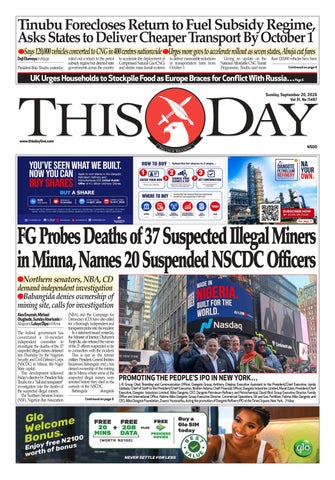
Tinubu Forecloses Return to Fuel Subsidy Regime, Asks States to Deliver Cheaper Transport By October 1 Says 120,000 vehicles converted to CNG in 400 centres nationwide Urges more govs to accelerate rollout as seven states, Abuja cut fares
Deji Elumoye in Abuja
President Bola Tinubu yesterday
ruled out a return to the petrol subsidy regime but directed state governments across the country
to accelerate the deployment of Compressed Natural Gas (CNG) and electric mass transit systems
to deliver measurable reductions in transportation fares from October 1.
Giving an update on the National Affordable CNG Transit Programme, Tinubu said more
than 120,000 vehicles have been Continued on page 6
UK Urges Households to Stockpile Food as Europe Braces for Conflict With Russia… Page 6 Sunday, September 20, 2026 Vol 31. No 11487
www.thisdaylive.com TR
UT H
& RE A S O
N
N500
See page 5
FG Probes Deaths of 37 Suspected Illegal Miners in Minna, Names 20 Suspended NSCDC Officers Northern senators, NBA, CD demand independent investigation Babangida denies ownership of mining site, calls for investigation Alex Enumah, Michael Olugbode, Sunday Aborisade in Abuja and Laleye Dipo in Minna The federal government has constituted a 10-member independent committee to investigate the deaths of the 37 suspected illegal miners detained last Thursday by the Nigerian Security and Civil Defence Corps (NSCDC) in Minna, the Niger State capital. This development followed Friday’s directive by President Bola Tinubu for a “full and transparent” investigation into the deaths of the suspected illegal miners. The Northern Senators Forum (NSF), Nigerian Bar Association
(NBA) and the Campaign for Democracy (CD) have also called for a thorough, independent and transparent probe into the incident. In a statement issued yesterday, the Minister of Interior, Olubunmi Tunji-Ojo, also released the names of the 21 officers suspended so far in connection with the incident. This is just as the former military President, General Ibrahim Badamasi Babangida (rtd.), has denied ownership of the mining site in Minna where some of the suspected illegal miners were arrested before they died in the custody of the NSCDC. Babangida alongside Continued on page 6
PROMOTING THE PEOPLE'S IPO IN NEW YORK…
L-R: Group Chief, Branding and Communication Officer, Dangote Group, Anthony Chiejina; Executive Assistant to the President/Chief Executive, Jamilu Giddado; Chief of Staff to the President/Chief Executive, Ibrahim Adamu; Chief Financial Officer, Dangote Industries Limited, Murat Eden; President/Chief Executive, Dangote Industries Limited, Aliko Dangote; CEO, Dangote Petroleum Refinery and Petrochemical, David Bird; Group Executive Director, Family Office and International Office, Halima Aliko Dangote; Group Executive Director, Commercial Operations, Oil and Gas, Fertiliser, Fatima Aliko Dangote; and CEO, Aliko Dangote Foundation, Zouera Youssoufou, during the promotion of Dangote Refinery IPO at the Times Square, New York…Friday
2
SUNday, SEPTEMBER 20, 2026 • T H I S D AY
SUNDAY, SEPTEMBER 20, 2026 • T H I S D AY
3
SUNday, SEPTEMBER 20, 2026 • T H I S D AY
4
Pay for Dangote Refinery Shares through Access Bank
ooer price
Please read the Prospectus on ipo.dangote.com and, where in doubt, consult your stockbroker, fund/portfolio managers, accountant, banker, solicitor or any other professional adviser registered by the SEC for guidance before subscribing. Payment does not guarantee or automatically result in the allotment of shares. Allotment is subject to the applicable terms and conditions.
Multiple channels. One opportunity.
Scan for:
• Risk Disclosures • Terms & Conditions • FAQs
07030000000
SUNDAY, SEPTEMBER 20, 2026 • T H I S D AY
5
6
T H I S DAY, T H E S U N DAY N E W S PA P E R • SEPTEMBER 20, 2026
NEWS
Tax Ombud: Multiple Taxes, Levies, Charges Hurting Nigerian Businesses Urges authorities to simplify digital tax administration, uphold taxpayers’ rights
Festus Akanbi, Dike Onwuamaeze and Kayode Tokede
The Tax Ombud and Chief Executive of the Office of the Tax Ombud, Dr John Nwabueze, has raised concerns over the cumulative burden of multiple taxes, levies, fees and charges on Nigerian businesses, warning that duplication and competing demands from different authorities were increasing the cost and complexity of doing business in the country.
Nwabueze raised the concerns yesterday at the 36th annual conference of the Finance Correspondents Association of Nigeria (FICAN), held in Lagos. Represented by his Chief of Staff, Dr Pete Iwegbu, Nwabueze, in a speech titled “Building Taxpayer Confidence and Trust in Nigeria’s Tax Reform Agenda,” said Nigeria could not build a sustainable revenue system by focusing solely on what citizens and businesses were required to pay.
He stressed that stakeholders must also address why businesses should trust the system through which they paid taxes and levies to the government. According to him, the need for businesses to trust the system was where tax reform, recapitalisation and the fintech revolution converged. “Each represents a dimension of economic transformation. Yet, their long-term success depends on confidence—in institutions, rules, technology and the fairness
of the system,” he said. Nwabueze noted that the four Tax Acts enacted in 2025 were designed to modernise revenue administration, establish clearer legal frameworks and improve coordination among tax-related institutions. He added that the federal government issued transition guidelines to facilitate implementation and clarify the move from the previous tax regime to the new framework. He, however, questioned whether small business owners
understood their obligations, whether companies could determine which taxes, levies and charges legitimately applied to them, and whether taxpayers could obtain timely responses when assessments or administrative decisions were disputed. “And, perhaps most importantly, does the taxpayers believe that the system will treat them fairly? These are not merely administrative questions; they are questions of economic confidence,” he said.
According to him, revenue growth and taxpayer confidence should not be regarded as competing objectives, stressing that stakeholders collectively had a responsibility to ensure the reforms produced tangible improvements in administration, clarity and fairness. Nwabueze maintained that taxpayers’ rights and responsibilities were inseparable, adding that citizens and businesses had a legitimate obligation to pay all lawfully imposed taxes.
UK Urges Households to Stockpile Food as Europe Braces for Conflict With Russia UK revives ‘war book’, tells citizens to prepare for severe disruption from war, cyberattacks, extreme weather Polish PM warns Russia may test NATO with ‘accidental’ drone, missile strikes Germany steps up civil defence, military preparedness amid Russian threat
Sunday Ehigiator The United Kingdom has urged households to keep stocks of food and drinking water at home in preparations for severe national disruption, including the possibility of war, cyberattacks and extreme weather, amid mounting concerns across Europe over Russia’s confrontation with the West. The advice, reported by the BBC and other British media, was part of a wider national resilience campaign intended to ensure households could cope during major emergencies. The UK government has also
begun work on a new version of its so-called “war book”, a contingency planning document that had not been substantially updated for decades. Poland’s Prime Minister, Donald Tusk, told lawmakers yesterday that intelligence from NATO allies, Ukraine and Polish sources indicated that Russia could attempt hybrid drone and missile attacks against countries supporting Ukraine. Meanwhile, Germany’s defence leadership has also called for a faster expansion of the country’s armed forces in response to the perceived Russian threat, alleging that Moscow was
increasing its military capacity and using hybrid methods to destabilise Western societies. Although the British government did not say that war with Russia was imminent, the preparation for emergencies was due to serious warnings from European officials about Russian military activity, cyber operations, sabotage and potential attacks on NATO territory. Britain’s Chief of the Defence Staff, Sir Richard Knighton, reportedly described the current security environment as the “most dangerous” period of his 35-year military career. The UK government’s
preparedness campaign was designed to cover a range of emergencies, not war alone. But explicitly including conflict, alongside cyberattacks and hostile-state activity, brought renewed public attention to the possibility that Britain could be affected by a wider European conflict. The British preparedness drive followed a warning by Western intelligence officials that Russia could be laying administrative groundwork for a new troop mobilisation following its parliamentary elections. Russia’s three-day parliamentary election began
on Friday and is scheduled to conclude today (Sunday). Ukrainian President Volodymyr Zelenskyy had previously claimed that Russia could seek to add hundreds of thousands of troops to its military after the election. Russian President Vladimir Putin, however, dismissed speculation about a new mobilisation as “nonsense”. Western officials have also expressed concern that any additional Russian manpower could eventually be deployed beyond Ukraine, including along Russia’s western frontier with NATO.
The concerns have been compounded by a series of alleged Russian-linked cyber, sabotage and other hybrid operations across Europe. In Poland, Prime Minister Donald Tusk told lawmakers yesterday that intelligence from NATO allies indicated that Russia could attempt hybrid drone and missile attacks against countries supporting Ukraine. Tusk said the attacks could deliberately be presented as accidents to test the alliance’s response and weaken support for invoking NATO’s collectivedefence mechanism.
FG PROBES DEATHS OF 37 SUSPECTED ILLEGAL MINERS IN MINNA, NAMES 20 SUSPENDED NSCDC OFFICERS
former Head of State, General Abdulsalami Abubakar (rtd), also called for thorough and extensive investigations into the deaths of the 37 suspected illegal miners. The National Human Rights Commission (NHRC) has also commenced a preliminary investigation into the incident. On Thursday, the NSCDC said it arrested the suspects during operations conducted on September 15 and 16 around Lt. Gen. Mohammed Inuwa Wushishi Estate in Minna.
The NSCDC commandant in Niger State, Suberu Aniviye, had claimed in a statement that “scores of the detained suspects were found dead in the early hours of Thursday following a suspected outbreak of disease”. Following the development, the federal government suspended him and ordered a full investigation into the circumstances surrounding the deaths. Tunji-Ojo directed the suspension of all officers involved in the incident pending the
conclusion of the independent committee’s investigation. “The minister directed the committee to determine responsibility, complicity, negligence, and misconduct, and to recommend appropriate action, compensation where applicable, and measures to prevent a recurrence,” the statement reads. The minister also warned that “any attempt to destroy or conceal evidence, intimidate witnesses or obstruct the investigation will be treated as a serious offence.”
A retired deputy directorgeneral of the Department of State Services (DSS), Jonathan Kure, chairs the committee. In contrast, former director-general of the Nigeria Law School Isa Hayatu Chiroma will serve as secretary. Other members include retired Assistant Inspector-General of Police (AIG) Hosea Karma; former chief medical director of the University of Ilorin Teaching Hospital, Olayinka Buhari; a representative of the
Minna Emirate Council; and a representative of the Niger State government. Also on the list are National Secretary of Miners Association of Nigeria, Liman Sulaiman; human rights lawyer, Deji Adeyanju; Zainab Suleiman Okino of Blueprint Newspaper; and a public affairs analyst, George Agbakahi. The full list of the officers so far suspended, in addition to the Niger State NSCDC Commandant, are: Officer-in-Charge (O/C)
Station Guard, SC Usman Isah Ndamaka; Station Guard, ASCI Hassan Mohammed; Station Guard, CCA Bala Mohammed; Arresting Officer/O/C Investigation, CSC Oluwadare Sunday; Arresting Officer, DCC Obafemi Elvis; Arresting Officer, CSC Annas Shitto Lamino; O/C Legal, ACC Stephen Tsado; and HOD INT/INV, DCC Philip Ajayi. Others are: Day/Night Duty Officer, ASCI Alhassan Continued on page 10
TINUBU FORECLOSES RETURN TO FUEL SUBSIDY REGIME, ASKS STATES TO DELIVER CHEAPER TRANSPORT BY OCTOBER 1
converted to CNG, with over 400 certified conversion centres and more than 90 CNG refuelling stations now operating across the country. "At a time like this, our answer cannot be to return to the ruinous petrol subsidy regime that consumed trillions of naira and left our economy exposed to every movement in international oil prices, as some have suggested." According to him, "Disruptions to global energy supplies are once again pressuring petrol and diesel prices and increasing transportation costs worldwide.
"Nigeria cannot control events in global energy markets. But as a gas-rich nation, we can reduce our exposure. That is what we have been doing. "Over the last three years, my administration has deliberately invested in building a CNG transportation ecosystem across Nigeria. Today, more than 120,000 vehicles have been converted; we have over 400 certified conversion centres and more than 90 CNG refuelling stations across the country, and these figures are increasing daily,” Tinubu explained. Tinubu also tasked state
governments to work towards delivering cheaper transportation to commuters by October this year. He disclosed that on August 27, 2026, he met with the governors of all 36 states, during which they agreed on a clear objective to provide cheaper transportation for Nigerians by October. According to him, "From October 1, more Nigerians should begin to see measurable reductions in transportation costs. "We subsequently established an implementation committee for the National Affordable
CNG Transit Programme under the auspices of the Nigeria Governors’ Forum, chaired by Governor AbdulRahman AbdulRazaq. "I am aware of the considerable work already underway by the committee, PI-CNG & EV, the States, and other critical stakeholders to identify priority transport corridors, determine appropriate interventions, and put the necessary arrangements in place. This work has become even more urgent amid the current global energy crisis." He further emphasised that the country must accelerate the
cheaper alternatives being built at home. "It is reassuring to see the movement spreading. Edo already has 50 CNG buses in active service. Kano has converted more than 1,000 commercial vehicles while rapidly expanding its conversion and refuelling network. Delta, Kwara and Lagos states are expanding CNG-supported transport services, while Akwa Ibom has taken delivery of 50 CNG buses ahead of commercial operations. "I encourage every State to maintain the momentum
towards October 1. Work with transport unions and commercial operators. Support conversion and fleet deployment. Facilitate the infrastructure required. Above all, ensure that savings from cheaper energy reach Nigerian citizens through lower fares,” Tinubu added. He promised that the federal government would continue to support the scaling of CNG infrastructure and access, expand conversion capacity, and create the enabling environment for states, transport operators, manufacturers and private investors to participate.
7
SEPTEMBER 20, 2026 • T H I S DAY, T H E S U N DAY N E W S PA P E R
NEWS
WE SHARE IN YOUR GRIEF…
L-R: Former Governor of Ogun State; Chief Olusegun Osoba; daughter-in-law of the deceased, Mrs. Olufadeke Mustapha; son of the deceased, Chief Bode Mustapha; Ogun State Governor; Prince Dapo Abiodun; and the Ogun State governorship candidate of the All Progressives Congress; Senator Solomon Olamilekan Adeola, during fidau prayer held in honour of Alhaja Amudalat Mustapha, mother of Chief Mustapha in Abeokuta…yesterday.
Presidency, SEC Unveil Plans to Mobilise Domestic Savings for $1 Trillion Economy Shettima to endorse 10-year Capital Market Master Plan
Deji Elumoye in Abuja
The Presidency and the Securities and Exchange Commission (SEC) have unveiled plans to deepen
Nigeria’s capital market and mobilise domestic savings in a bold move to support President Bola Tinubu's $1 trillion economic growth target. While SEC is to introduce a
National Savings Scheme backed by tax incentives, Vice President Kashim Shettima is expected to endorse the Nigerian Capital Market Master Plan 2.0, a 10-year strategic framework
for the development of the market, as part of the initiative. The initiatives will feature prominently at the Capital Market Conversation scheduled for October 19, 2026, at the State
Amupitan: Gombe, Kano, Bauchi, Delta By-elections Offered Vital Lessons for General Election Adedayo Akinwale in Abuja
The Chairman of the Independent National Electoral Commission (INEC), Prof. Joash Amupitan, has described yesterday's legislative by-elections held across Gombe, Kano, Bauchi, and Delta states as crucial operational benchmarks for testing the nation’s electoral infrastructure ahead of the 2027 polls. Speaking yesterday while presiding over operations at the commission’s National Situation Room at its Headquarters in Abuja, Amupitan emphasised that no electoral contest should be dismissed as trivial or routine.
Amupitan, in a statement issued yesterday by his Chief Press Secretary, Adedayo Oketola, said the commission conducted four key legislative by-elections in the Gombe/Kwami/Funakaye Federal Constituency in Gombe State, Dawakin Kudu State Constituency in Kano State, Sakwa and Disina State Constituencies in Bauchi State and Udu State Constituency in Delta State. Amupitan asserted that every off-cycle poll served as an important dress rehearsal for nationwide elections. He noted: “These four byelections provide indispensable operational lessons for the
commission as we systematically chart our roadmap toward the 2027 general election. “We must resist the temptation to view any exercise as merely an ordinary by-election. Every election is a critical component of our broader preparations for the 2027 general election, allowing us to continuously audit our logistics framework, stress-test our technological deployment, and evaluate administrative field readiness.” The INEC chairman, accompanied by national commissioners and senior management officials, monitored the by-elections as operational reports arrived from the field.
Amupitan reassured Nigerians of the commission’s resolve to uphold electoral integrity, noting that operational bottlenecks encountered before polling were swiftly identified and resolved. He added: “Our primary mandate in the Situation Room is monitoring and proactive crisis resolution. Whatever administrative or field challenges arose before the day of the elections, the commission was able to nip them in the bud effectively. “We remain committed to refining our processes so that every subsequent exercise reflects higher standards of efficiency and public confidence.”
NMDPRA Decries N1,500 Petrol, Says Pricing Governed By Unrestricted Free Market Provisions in PIA
Emmanuel Addeh in Abuja
The Nigerian Midstream and Downstream Petroleum Regulatory Authority (NMDPRA) yesterday explained that pricing of petroleum products in the downstream petroleum sector was governed by the unrestricted free market provisions of the Petroleum Industry Act (PIA). The agency, while acknowledging the financial pressure caused by the recent increase in the price of petrol, said its mandate was to regulate the market, protect consumers and
ensure fair competition rather than administratively determine prices. The NMDPRA, in a statement in Abuja, stated that section 205(1) of the PIA 2021 provides that wholesale and retail prices of petroleum products shall be based on unrestricted free market pricing conditions. In recent times, petrol prices have surged to as much as N1,500 per litre across several regions of Nigeria, stemming primarily from a sharp rally in global crude oil benchmarks, which have traded past $100
per barrel. This latest price hike has intensified pressure on Nigerian households and commercial enterprises, prompting calls from labour unions for targeted government interventions. Transporters in major commercial hubs have responded by raising public transit fares by 30 to 50 per cent, directly translating into higher food transport costs and increased inflationary pressure. But, according to the NMDPRA, sections 205(2) to (4) limited government intervention
in petroleum pricing to exceptional circumstances where there was formal evidence of a 'declared market failure', noting that no such market failure has been declared. It stated that Section 216 of the PIA empowers it to prevent anticompetitive practices, price-fixing and abuse of market dominance. The NMDPRA said it was nevertheless sensitive to the difficulties arising from the recent increase in petrol prices, particularly for households, transport workers and businesses across the country.
House, Abuja. The Presidency and SEC disclosed this weekend during a strategic partnership meeting in Abuja ahead of the event, which is expected to attract local and international investors, capital market operators, listed companies, market infrastructure institutions, policymakers and other stakeholders. Speaking during the briefing, the Technical Adviser to the President on Economic and Financial Inclusion (Office of the Vice President), Dr Nurudeen Abubakar Zauro, said the administration regarded a deeper capital market as critical to mobilising capital, broadening investment opportunities, and strengthening financial inclusion. Zauro said the October conversation would allow stakeholders to review developments in the sector and identify measures for further growth. “It is no longer news that the capital market of Nigeria has been doing very well, especially under Mr President, with all the reforms that are ongoing to make Nigeria an investorfriendly environment,” he said. According to him, the event would also provide an opportunity to “celebrate our very own success stories within the capital market and democratise access to the market.” Zauro noted that financial inclusion should go beyond opening bank or investment accounts, stressing the need to ensure ordinary Nigerians can access financial and economic opportunities and participate in investment. The initiative, Zauro said, was aligned with Tinubu’s Renewed Hope Agenda and
the administration’s $1 trillion economic target. “The whole conversation on that day is deepening the sector to achieve the $1 trillion economy target set by Mr President, and that aligns with his Renewed Hope Agenda." Also speaking, DirectorGeneral of the SEC, Dr Emomotimi Agama, said the National Savings Scheme was designed to give Nigerians an opportunity to save and invest their savings for the future. “The National Savings Scheme, principally, is an inclusion tool wherein every Nigerian is allowed to save, and such savings will now be invested for the future,” Agama explained. He said the scheme would include tax incentives, adding that the initiative aligned with the Federal Government’s wider fiscal reforms. According to him, the tax reliefs for citizens below specified income thresholds would leave low-income earners with more disposable income and potentially increase their capacity to save and invest. The SEC DG also announced that Shettima would endorse the Nigerian Capital Market Master Plan 2.0 at the October 19 event. He described the document as a 10-year strategic framework that would guide market development and establish measurable indicators to assess performance. “The Nigerian Capital Market Master Plan 2.0 is a 10-year master plan that provides the direction of the market, understanding that the capital market is the barometer of the economy,” he said.
8
T H I S DAY, T H E S U N DAY N E W S PA P E R • SEPTEMBER 20, 2026
NEWS
SOUTH-WEST DEVELOPMENT ON THEIR MINDS…
L-R: Managing Director/CEO, South West Development Commission, Dr. Charles Akinola; Senate Leader, Senator Opeyemi Bamidele; Ekiti State Governor, Mr. Biodun Oyebanji; and Board Chairman, SWDC, Senator Olubunmi Adetunmbi, during a meeting in Abuja...recently
High Flood to Hit Lagos, Delta, 13 Other States in Seven Days, FG Warns, Urges Residents to Relocate
Kasim Sumaina in Abuja
The federal government has said a seven-day high flood will hit Imo, Cross River, Lagos and 12 other states, and warned the residents of the affected areas to relocate. The Director General (DG) and Chief Executive Officer
of the Nigeria Hydrological Service Agency (NiHSA), Mr. Umar Mohammed, made the disclosure at the weekend in a National Flood Advisory, saying the flood is expected to occur from September 19 to 25, 2026. Mohammed said schools, healthcare facilities, markets, farms and religious buildings,
among others, will be affected. He also called on affected state governments to urgently move their people to safer and higher ground ahead of the flooding. He said, “High riverine flood risk forecast for the next 7 days across Imo, Cross River and 13 other states. Rising river stages are expected to cause flooding.
“Communities on the floodplain should prepare to move to higher ground. Stations: Obubra on the Cross River, Itigidi on the Cross River, and Epento on the Cross River.” According to the advisory, several communities and critical facilities across the affected states are exposed to the risk
Jehovah’s Witnesses’ Governing Board Announces Adjustment to Blood Transfusion Policy
Onyebuchi Ezigbo in Abuja
The Governing Body of Jehovah’s Witnesses has announced that members can now decide whether to accept or donate the four main components of blood based on their personal conscience. The organisation made this known in a statement issued by its World Headquarters in Warwick, New York, and made available on its website on Friday. According to the statement, “the decision to accept red cells, white cells, plasma or platelets from another person’s blood is a matter of personal conscience.”
It added that “each Witness must decide whether or not to donate blood for the clearly expressed purpose of providing components or fractions for use by another person.” However, the organisation said its position on whole-blood transfusion had not changed. “The long-standing refusal of whole-blood transfusions on religious grounds, a core teaching based on the command to ‘abstain from blood’ (Acts 15:20), is unchanged,” the statement said. International spokesman for Jehovah’s Witnesses at the organisation’s World
Headquarters, Paul Gillies, said, “Blood remains sacred to Jehovah’s Witnesses, who continue to regard life and blood as precious gifts from God. “We recognise that medical decisions involving blood components are a matter of conscience between each Witness and their God, Jehovah.” The organisation said the adjustment “follows earlier updates regarding blood fractions and the use of one’s own blood during medical procedures.” It added, “Since the Bible does not comment on such decisions, they are a matter of individual conscience. That same reasoning
has now been extended to the four main components of blood.” On medical care, the statement said, “Jehovah’s Witnesses love life and want the best available medical care. They do not practise faith healing, and they seek out doctors who can provide effective treatment in accord with their wishes, values and beliefs.” Gillies said local congregations would not interfere in members’ personal decisions. “Congregations do not involve themselves in personal decisions that rest with the individual conscience. We will continue to respect and support the personal decisions of our fellow believers.
FATF Raises Global Alarm on Money Laundering, Fraud Risks in Gaming, Gambling Says e-wallets, mobile money, virtual assets, vulnerable to risks
Ndubuisi Francis in Abuja
Global anti-money laundering watchdog, Financial Action Task Force (FATF), has raised the alarm about criminal abuse associated with the gaming and gambling sectors, warning countries that criminals used gambling platforms for money laundering and smurfing transactions.
In a new report, FATF said new risk indicators helped identify suspicious activity and disrupt criminal abuse, alerting countries on how to spot abuse of the gaming and gambling sectors, including criminals using gambling platforms to move money without actually gambling, making multiple small transactions (smurfing) to avoid
detection and unusually large or coordinated bets on events flagged for possible competition manipulation. The Paris-based organisation explained that technological innovation created complex ecosystems for regulators and law enforcement, adding that illegal gambling markets rivalled legal ones, offering anonymity
to criminals. The analysis by the FATF identified new opportunities for criminal abuse in the gaming and gambling sectors, following an increase in market size globally, a rise in the use of online platforms, and as payment methods allowed rapid, anonymous transactions across borders.
of flooding. In Imo State, the affected local government areas are Aboh-Mba, Ahizu-Mb, Ehime-Mb, Ezinihit, Ideato No, Ihitte/U and Ikeduru. The agency identified 958 communities, 1,022 schools, 553 healthcare facilities, 161 markets and 198 religious buildings as exposed to the flood risk. In Cross River, the affected local government areas include Abi, Akamkpa, Akpabuyo, Biase, Calabar, Calabar South, Ikom and Obubra. NiHSA listed 2,471 communities, 703 schools, 344 healthcare facilities, 145 markets, 453 religious buildings and 854 hectares of farmland as exposed. The agency also identified Abakaliki, Afikpo, Afikpo South, Ebonyi, Ezza North and Ezza as affected local government areas in Ebonyi State, with 2,574 communities, 1,064 schools, 422 healthcare facilities, 480 markets,
629 religious buildings and 1,882 hectares of farmland exposed. In Benue State, Buruku, Gboko, Guma, Katsina-Ala, Logo and Ukum are among the affected local government areas. The exposure includes 303 communities, 100 schools, 48 healthcare facilities, 32 markets, 151 religious buildings and 55 hectares of farmland. For Anambra State, the affected areas include Aguata, Anambra East, Anambra West, Anaocha, Awka North, Awka South and Ayamelum. The advisory put the number of exposed communities at 1,314, with 1,308 schools, 1,089 healthcare facilities, 280 markets, 610 religious buildings and 1,529 hectares of farmland also at risk. In Akwa Ibom, the affected local government areas are Abak, Eket, Etinan, Ibeno, Ibesikpo Asutan, Ibiono Ibom, Ika and Ikono.
Over 17,000 People Still Missing in North-east, Says ICRC
Chuks Okocha in Abuja
Despite the operational successes recorded by the Armed Forces of Nigeria (AFN) in the war against insurgency, the International Committee of the Red Cross (ICRC) has revealed that over 17,000 people displaced by the activities of Boko Haram terrorists across North-east, Nigeria were still missing. The ICRC spokesperson, Aliyu Dawobe, disclosed this in Lagos at the end of a two-day training for journalists on humanitarian reporting. Dawobe said the figure was initially over 24,000, but was reduced to over
17,000 because the ICRC had lost contact with some of the affected families. He, however, explained that as part of its humanitarian services, the ICRC was making efforts to trace the missing persons and reunite them with their respective families. “Crisis in the North-east has been ongoing for over 16 years. Millions of people are in need of food. Over three million children from the affected families are malnourished. “A lot of people have been separated from their loved ones for over 10 years. A lot of people have been displaced in the region,” he said.
9
SEPTEMBER 20, 2026 • T H I S DAY, T H E S U N DAY N E W S PA P E R
NEWS
WELCOME TO THE LORD’S VINEYARD…
L-R: Vicar-General, Lagos Catholic Archdiocese, Right Reverend Monsignor John Aniagwu; Vicar, Ikeja Region, Very Reverend Father, Anthony Fadairo; Catholic Archbishop of Lagos, Most Reverend Dr. Alfred Adewale Martins; Parish Priest of Catholic Church of the Ascension, Ikeja, Reverend Father Jerome Omoregie; and Chancellor, Lagos Catholic Archdiocese, Monsignor Anthony Obanla, during the ordination of six new priests and 14 Deacons for the Lagos Catholic Archdiocese in Ikeja, Lagos...recently
Presidency to Atiku: Take Your Economic Blueprint to Campaign Trail, Tinubu Will Remain Focused on Reforms Keyamo, Dare fault former VP for referring to Tinubu as ‘Bola’
Chuks Okocha in Abuja
The Presidency yesterday told the presidential candidate of the African Democratic Congress (ADC), Alhaji Atiku Abubakar, to take his economic proposals to Nigerians on the campaign trail rather than attempt to dictate how President Bola
Ahmed Tinubu should govern the country. Special Adviser to the President on Media and Public Communication, Dr. Sunday Dare, who made the assertion, also faulted the former Vice President for repeatedly referring to President Tinubu simply as “Bola” during his
press briefing in Abuja on Friday. The Minister of Aviation and Aerospace Development, Mr Festus Keyamo, has also criticised Atiku for repeatedly referring to the President by his first name. Keyamo said Atiku’s reference to the President as
“Bola” was disrespectful and failed to accord the office of the President the dignity he said it deserved. Similarly, Dare, in a reaction posted on his verified X handle, @SundayDareSD, described Atiku’s intervention as “unsolicited homework”, arguing that the ADC candidate
Masari and I Rejected N650m Offer to Back Obasanjo’s Third Term, Says Farouq Aliyu Chuks Okocha in Abuja
The last has definitely not been heard on the purported third term ambition of former President Olusegun Obasanjo as a former Minority Leader of the House of Representatives, Farouq Aliyu, has disclosed how he rejected the N250 million offered to him to support the third term agenda of former President Olusegun Obasanjo. He said the Speaker of the House of Representatives at the time, Aminu Masari, also rejected the sum of N400 million
to support the bid. The third term agenda was one of the most controversial issues that characterised the administration of Obasanjo, who was president between 1999 and 2007. In May 2006, the National Assembly rejected a bill that sought to amend Nigeria’s constitution, which would have allowed Obasanjo run for a third successive term in office. The former president has repeatedly denied that he sought a third term in office.
Speaking during during the ‘Naija Unfiltered’ podcast, published via YouTube on Friday, Aliyu insisted that Obasanjo’s third term agenda was real. According to him, during discussions about the third term agenda, Nuhu Ribadu, who was the chairman of the Economic and Financial Crimes Commission (EFCC), asked him to come to Abuja for a meeting with Obasanjo. Aliyu said he initially rejected Ribadu’s request but later accepted to meet with Obasanjo.
The former lawmaker said when he went to Abuja, he discussed the third term agenda and insisted that the move would not be successful. He added that he was offered N250 million by someone Ribadu asked him to meet with. Aliyu, however, did not mention the name of the person during the interview. He added that Masari rejected the sum of N400 million to support the third term bid, while lawmakers were offered a minimum of N50 million to support the agenda.
Catholic Bishops Demand End to Insecurity, Poverty
Yinka Kolawole inOsogbo
The Catholic Bishops Conference of Nigeria (CBCN) has called for an end to insecurity, poverty and what it described as bad governance, saying violence, poor infrastructure and economic hardship continue to undermine the wellbeing of Nigerians. The bishops also outlined measures ahead of the 2027 general election and declared December 8, 2026, as a special National Day of Prayer and fasting for the success of the
elections. The bishops made their positions known in a communiqué issued at the end of their Second Plenary Meeting, held at Our Lady and St Kizito Pastoral Centre, Oke-Gada, Ede, Osun State, from September 10 to 18, 2026. The communique signed by the CBCN President and Archbishop of Kaduna, Most Rev. Matthew Man-Oso Ndagoso, and the CBCN Secretary and Bishop of Abeokuta Diocese, Most Rev. Peter Olukayode Odetoyinbo,
which was read during the Holy Mass, lamented that worsening killings and attacks have been slowing down the people’s lives and nation’s economy. The Second Plenary Meeting of the CBCN hosted by the Catholic Diocese of Osogbo held at Our Lady and St. Kizito Pastoral Centre, Oke-Gada, Ede, Osun State between September 10 and 18, 2026. While appreciating the positive efforts governments and citizens were making in keeping the nation united despite all odds,
the bishops, however, regretted that insecurity, poverty, poor infrastructure, bad governance, and assault on human dignity have continued to ravage the country and its citizens. On insecurity, the CBCN recognised the move by the government to decentralise the police system to tackle insecurity in the nation, but at the same time, requested that such a reorganisation should be deployed for the common good rather than for personal, ethnic, political and religious interests
should concentrate on selling his programmes to the electorate ahead of the 2027 presidential election. Atiku had on Friday called on President Tinubu to take immediate measures to reduce petrol prices, arguing that the experience of petrol subsidy removal should not be repeated in the power sector. But Dare rejected Atiku’s approach, saying opposition politics did not confer on a presidential candidate the authority to issue directives to an incumbent President. “Alhaji Atiku Abubakar convened a press conference in Abuja and chose, once again, to address the President of the Federal Republic as ‘Bola.’
He issued instructions. He dictated a truncated timetable. He presumed to tell a sitting President how governance should be run in the last months of a mandate already given by the Nigerian people. “That is not opposition. It is insolence”, Dare said. According to the presidential aide, Atiku should channel his policy propositions towards persuading voters rather than presenting them as instructions to the Tinubu administration. “It is election season. If Alhaji Atiku has a message for Nigerians, the proper place for it is the campaign trail, not a briefing room from which he talks down to the Head of State”, he said.
Police, NSCDC Strengthen Security in Oyo over ISWAP Attack Alert
Kemi Olaitan in Ibadan
The Oyo State Police Command, Nigeria Security and Civil Defence Corps (NSCDC) and other security agencies have strengthened security measures across the state following a recent alert over an alleged plan by the Islamic State West Africa Province (ISWAP) to attack public institutions. The state police command said, in line with the directive by the authorities of the Nigeria Police Force, it had intensified intelligence-led surveillance, targeted visibility patrols and operational readiness around identified vulnerable locations. It identified the locations to include: Schools, places of worship, NYSC facilities and
other public spaces across the state. The state Police Public Relations Officer, Ayanlade Olayinka, said the measures were being complemented by enhanced intelligence sharing and coordination among sister security agencies to ensure emerging threats were identified early and appropriate action taken. He said the command had also recently launched the Safe School Initiative in collaboration with the Police Community Relations Committee (PCRC). According to him, the initiative was aimed at strengthening the earlywarning and communitybased intelligence system, while enhancing the safety and security of schools and other vulnerable institutions.
10
T H I S DAY, T H E S U N DAY N E W S PA P E R • SEPTEMBER 20, 2026
NEWS
LEARNING LESSONS FOR 2027…
L-R: National Commissioners, Independent National Electoral Commission, Mrs. May Agbamuche-Mbu; Prof. Rhoda Gumus; Chairman, Prof. Joash Amupitan (SAN); and National Commissioner, Malam Mohammed Haruna, during the monitoring of multi-state by-elections in the Situation Room in Abuja ... yesterday
Otti Rules Out Senatorial Ambition, Promises to Quit Politics in 2031, Says Successor to Emerge on Merit
Boniface Okoro in Umuahia
The Abia State Governor, Dr. Alex Otti, has declared that he will quit active politics after completing his tenure in 2031, ruling out a bid for the Senate and expressing his desire to see younger people take up leadership roles. The governor also said that leadership succession should be based on identifying the most suitable person for the job, rather than perpetuating a “sit-tight” culture, adding that his successor would emerge by merit. Otti made these known at the weekend, while receiving the 2023 governorship candidate of the Social Democratic Party (SDP), Dr. Ngozika Gladys, and her supporters, who defected to the Labour Party (LP), in Umuahia, Abia State. The governor said his priority was to leave behind a legacy of good governance and facilitate the emergence of a successor who would improve on his administration’s achievements. “What I can assure you is that by the time I’m done, the person that will succeed me will
be better than me,” Otti said. He stated that he was determined to give younger Nigerians an opportunity to assume leadership rather than remain in politics indefinitely. “Once I finish this one, I will retire. I want the young people to take over. We should stop this sit-tight system,” he said. He disclosed that he would not seek to control the state’s politics from outside government as a godfather, insisting that the choice of his successor should be based on collective consideration of the available candidates. He further stated that he had no interest in contesting for the Senate after leaving office, stressing that his attention remained on implementing his administration’s mandate. Otti said: “The most important thing you can give a people is good governance. “And once people test good governance, it will be very difficult for them to allow you to take them back. “So, if you are afraid that we will go back to Egypt, it will never happen and what I
can assure you is that, by the time I’m done, the person who will succeed me will be better than me. “I don’t want to be a godfather and I don’t tolerate godfathers.
“We will all sit down, look at everybody and say, who is the best person for this job and then all of us will agree and we will campaign for him. “He will win and we will take a back seat.”
On the pace of development in the state, Otti said his administration had adopted a strategic approach by addressing critical areas in phases, given the extent of the challenges confronting the state.
NAHCON Rejects Alleged Diversion of 5,000 Hajj 2027 Slots The National Hajj Commission of Nigeria (NAHCON) has rejected allegations of diversion of 5,000 Hajj slots for the 2027 pilgrimage, describing the claims as unfounded and urging stakeholders to distinguish between verifiable facts and speculation. The commission was reacting to a report published by THISDAY Newspaper titled, “Hajj 2027: Private Operators Demand Probe of Diverted 5,000 Slots,” as well as concerns reportedly raised by some private Hajj tour operators over the allocation of slots. In a rejoinder signed by the
Head of the Information and Publications Division, Shafii Sani Mohammed, the commission said no evidence had been presented to establish that the disputed allocation violated Saudi Arabian Hajj regulations, NAHCON guidelines or any established policy governing Hajj operations in Nigeria. The commission also questioned the identity and standing of the individuals described in the report as “Concerned Private Travel Operators,” noting that their anonymity made it difficult for the public to determine their interests, credibility or relationship
to the allocation process. According to NAHCON, Nigeria’s approved allocation for the 2027 Hajj is 50,000 slots, comprising 35,000 slots for the states and the Federal Capital Territory (FCT), and 15,000 slots for duly licensed private Hajj tour operators. The commission said the 15,000 private-sector slots were allocated to licensed tour operators operating under seven approved lead companies in accordance with Nigerian regulatory requirements and the guidelines of the Kingdom of Saudi Arabia.
FG PROBES DEATHS OF 37 SUSPECTED ILLEGAL MINERS IN MINNA, NAMES 20 SUSPENDED NSCDC OFFICERS Mohammed; Guard Duty, IC Abdullahi Sale; Guard Duty, IC Mohammed Sonfada; Guard Duty, CAI Liman Abubakar; Guard Duty, CAI Bala Usman; Guard Duty, IC Mohammed Jiya; Guard Duty, DSC Isah Suleiman; Guard Duty, CAI Ahmed Wushishi; Guard Duty, IC Sale Adamu; Guard Duty, IC Haruna Mohammed; Guard Duty, ASCI Aliyu Sallah; and Guard Duty, CAI Isah Sanusi. Meanwhile, NHRC has also commenced a preliminary investigation into the incident. Executive Secretary of the NHRC, Mr Tony Ojukwu, condemned the incident and expressed concern over the loss of lives in state custody, particularly as the precise cause of death remains subject to investigation. According to the commission,
the bodies of the deceased were deposited at the General Hospital, Minna, for medical examination, while security authorities have initiated separate investigations. Ojukwu, in a statement issued by the organisation’s Director, Corporate Affairs and External Linkages, Fatimah Mohammed, directed the Commission’s preliminary investigation to establish the circumstances leading to the deaths. He also called for an independent forensic autopsy and the preservation of all relevant evidence. He further stressed that the investigations already ordered by the Minister of Interior and the NSCDC must be conducted transparently, thoroughly and in accordance with international standards
“This is just about 39 months. Everything cannot be done in one day, particularly in a place that has been badly managed in the last 24 years. It takes a lot of time, resources and planning,” the governor said.
governing investigations into potentially unlawful deaths in custody. “Citizens who are arrested on suspicion by law enforcement agents are by law expected to enjoy the full complement of their fundamental human rights in accordance with national and international human rights instruments,” Ojukwu said.
Northern Senators, NBA, CD Demand Independent Probe Meanwhile, the Northern Senators Forum (NSF) has demanded an immediate, transparent and independent investigation into the incident. The senators also called for independent autopsies on all the victims. They demanded that anyone found culpable
of criminal negligence, unlawful detention, reckless conduct or any deliberate act that contributed to the deaths should be prosecuted, irrespective of rank or position. The Chairman of the Northern Senators Forum, Senator Abdulaziz Musa Yar’adua, in a statement issued yesterday, said the circumstances surrounding the deaths were “deeply disturbing and unacceptable." He stressed that no Nigerian should lose his life in the custody of an agency established to protect lives and property. The senators also demanded answers to questions surrounding the alleged distress calls, including when they were made, who heard them and what action was taken before the deaths occurred.
The President of the NBA, Mrs Oyinkansola Badejo-Okusanya (SAN), has also called for a thorough, independent and transparent investigation into the deaths of the 37 suspected miners. The association said it had deliberately refrained from reaching conclusions on the cause of the deaths pending the outcome of investigations, stressing that the incident required evidence-based findings. The NBA said the prompt response by the authorities was commendable but stressed that the credibility of the process would depend on the independence and thoroughness of the investigations. “The true measure of the response will ultimately not be the speed with which investigations are announced, but rather the independence and thoroughness
NAHCON further stated that the companies participating in the 2027 Hajj and Umrah operations are incorporated and registered with the Corporate Affairs Commission and other relevant government agencies. The companies, it added, had undergone the required regulatory processes and were licensed by NAHCON to operate during the 2027 season. The commission maintained that the operators remain subject to the same regulatory requirements, sanctions and disciplinary measures applicable to all licensed Hajj operators. with which they are conducted, the transparency with which their findings are made known, and the accountability that follows from those findings,” it said. The association also called for an investigation into wider illegal mining operations, including those who may have owned, financed, controlled, or profited from the activities. Similarly, the CD has called on the National Security Adviser (NSA), Mallam Nuhu Ribadu, and other senior security officials to institute an independent investigation into the incident. The group also called for the immediate suspension of the NSCDC Controller-General, pending the outcome of the investigation, arguing that such a step would help ensure the credibility and independence of the probe.
SUNDAY, SEPTEMBER 20, 2026 • T H I S D AY
11
12
T H I S D AY, T H E S U N D AY N E W S PA P E R SEPTEMBER 20, 2026
NEWS
THIRTY-THREE HEARTY CHEERS…
L-R: Independent Non-Executive Director, Presco Plc, Mr. Ademola Adebise; Chairman, Presco Plc, Mr. Rasheed Olakanmi Sarumi; Managing Director and Chief Executive Officer, Presco Plc, Mr. Reji George; and Non-Executive Director and Group Chief Executive Officer, SIAT Group, Mr. Adewale Arikawe, during the 33rd Annual General Meeting of Presco PLC held in Lagos…recently.
NDC Disowns OK Movement PCC, Refers Ugulu to Disciplinary Panel
• Says only NWC can constitute, announce campaign council Sunday Aborisade in Abuja
The Nigeria Democratic Congress (NDC) has dissociated itself from a purported Presidential Campaign Council (PCC) announced under the platform of the “OK Movement”, declaring that only the party’s leadership has the authority to constitute and announce its campaign council. The party also said it had referred Mr. John Ugulu, who was credited with the announcement, to its appropriate disciplinary organ over what it described as his alleged disregard for party authority. In a statement signed electronically by the National Chairman of the NDC, Senator Cleopas Moses, yesterday, the party said the purported announcement did not emanate from its leadership and should therefore be disregarded by members of the public and the media. The development comes as political parties and support groups intensify preparations for the 2027 general election and the NDC continues to organise its campaign structures. The party stressed that its candidates were contesting the elections on the platform of the NDC and were therefore subject to its authority and disciplinary procedures. “All candidates of the party must appreciate that they are not running as independent candidates. They are products of the party and remain subject to the authority and discipline of the party,” the statement
said. It added that “only the party’s leadership can constitute and announce a Presidential Campaign Council.” The NDC consequently directed that no individual, candidate or support group should constitute or announce any campaign council, structure or organ in the name of the party without prior approval from the National Working Committee (NWC). “Henceforth, no individual or group is authorised to announce, constitute, or publish any campaign council, structure, or organ in the name of the party without prior approval from the National Working Committee,” it said. The party, however, acknowledged the contributions of support groups working for its political objectives, saying it remained open to collaboration with such organisations. According to the NDC, support groups identifying with its mission were welcome to continue their activities, provided they did not present themselves as alternative or parallel structures of the party. “The party recognises and deeply appreciates the contributions of all support groups and encourages their continued support. We welcome even more support groups who identify with our mission to rescue Nigeria,” the statement added. The NDC also appealed to members and support groups with grievances
to use the party’s internal mechanisms for resolving disputes rather than making public statements that could affect the party. Part of the statement read, “We expect a stop to unnecessary attacks against the party on whose platform our candidates are running.
“If there are any differences or grievances, support groups and members are advised to refer such matters to the party through appropriate internal channels for resolution rather than resorting to public attacks.” On the action against Ugulu, the party said his
referral followed the purported PCC announcement as well as what it described as his conduct during the party’s primary election in Lagos State. The NDC said it was “constrained to enforce disciplinary measures” against him and referred him to the
appropriate disciplinary organ “for necessary action in line with the provisions of the party’s constitution.” The party said it remained focused on what it described as an issue-based campaign and its objective of building what it called a “New Nigeria that is possible.”
Makinde Has Nothing in About Years in Office, Says Sharafadeen Alli
The Senator Sharafadeen Alli Campaign Organisation has questioned the engineering credential of Governor Seyi Makinde, wondering why he claimed to have studied electrical engineering but wasted over N250billion to power streetlights in Oyo State with diesel-guzzling generators. A statement by Senator Sharafadeen Alli Campaign Organization yesterday condemned the embarrassing culture of waste, poor planning and misplaced priorities that have become the hallmark of Makinde’s wasteful administration in the state. The campaign organisation, through its Head, Media and
Publicity, Bisi Oladele, was reacting to Makinde’s statement on Friday where he described Sharafadeen Alli as a lawyer who has never entered the courtroom. “It is a tragic irony that Governor Makinde, who studied electrical engineering, cannot devise a sustainable electricity solution for the streetlights installed with about N400 billion of state funds by his government. “Instead, the administration continues to power them with fuel-guzzling generators—an outdated, expensive and environmentally harmful arrangement funded from the public purse. “At a time when modern cities
are embracing solar-powered and energy-efficient streetlighting systems, Oyo State remains trapped in the age of diesel generators under the supervision of an electrical engineer. It is more embarrassingly illogical given the fact that his predecessor undertook the same project with solar system. “If not for the prime purpose of enriching self, cronies and deliberately wasting Oyo State funds, why will Governor Makinde destroy the solar infrastructures and electric poles installed by his predecessor instead of repairing and upgrading them to higher solar grade? To worsen the case, Makinde’s
streetlight project has become dysfunctional, as load-shedding has become the only way a few of the project operate. “This raises serious questions about the governor’s competence, priorities and commitment to prudent management of taxpayers’ money. Should we judge Governor Makinde’s claim as an electrical engineer by his streetlight project, the answer is obvious to all. “Equally disturbing is the reported failure of the renovated Lekan Salami Stadium, Adamasingba, Ibadan to secure CAF approval for Shooting Stars Sports Club to host a continental fixture.
Onwuneme Accuses Ogbonna of Weaponising Ethnicity Against Otti Wale Igbintade A chieftain of the Labour Party and youth advocate, Engr. Nwabueze Onwuneme, has accused Chief Charles Ogbonna of attempting to exploit ethnic sentiments in his criticism of Abia State Governor, Mr Alex Otti. Onwuneme, in a statement issued on September 17, 2026, described what
he called Ogbonna’s latest intervention against the Otti administration as an attempt to stir division in the state, urging him to substantiate his allegations rather than resort to what he characterised as inflammatory rhetoric. He said Ogbonna was entitled to criticise Otti and pursue his political interests, but should provide evidence to support any serious allegations
against the governor and his administration. According to him, Ogbonna should not drag the people of Ngwa into a political dispute or attempt to use ethnic sentiments as a basis for opposition to the administration. Onwuneme also questioned what he described as Ogbonna’s present posture as a defender of Ngwa interests, alleging that Ogbonna’s publicly reported political position
before the 2023 governorship election included opposition to the return of the governorship to the Ngwa bloc. He further referred to what he described as the “much-publicised libation episode” surrounding the controversy. “Ndi Ngwa are not political pawns. They are discerning people who can remember yesterday and judge today for themselves,” Onwuneme said.
SUNDAY, SEPTEMBER 20, 2026 • T H I S D AY
13
T H I S D AY, T H E S U N D AY N E W S PA P E R SEPTEMBER 20, 2026
14
NEWS
CAPACITY BUILDING …
A German technical dog handler, Mr. Andreas Roscher (right), during the training of some officials of the National Drug Law Enforcement Agency at the agency’s Canine Unit Facility in Lagos…yesterday
Tax Debate: Much Higher Tax on SSBs Not Same as Effective Health Policy •Proposes SSB tax based on beverage’s sugar content Dike Onwuamaeze
As the National Assembly continues work on the Customs, Excise and Tariff Amendment (CETA) Bill in the Non-Alcoholic Drinks (NAD) sector, a report by ThinkBusiness Africa (TBA) has warned that “a much higher tax on sugar-sweetened beverages is not the same thing as an effective health policy.” The TBA gave this warning in its report dated September 2026 and titled “CETA Bill: Will
a Bigger Sugar Tax Improve Nigerians’ Health — or Simply Make Life More Expensive?” The report stated that the CETA amendment would introduce an ad valorem tax that could potentially increase the effective tax burden on SSB products to N130 per litre from the current N10 per litre. The TBA said that the “central issue is not whether Nigeria should care about excessive sugar consumption. It should. “The question is: Will impos-
NDLEA Dogs Get German Upgrade for Drug Detection Operations Michael Olugbode in Abuja The National Drug Law Enforcement Agency (NDLEA) has intensified efforts to strengthen its ability to detect concealed narcotics at Nigeria’s entry points, putting its canine handlers through specialised retraining by German technical experts. The refresher course, organised in collaboration with Germany’s Bundeskriminalamt (BKA), focused on improving the ability of NDLEA handlers and their service dogs to detect narcotics and respond effectively to increasingly sophisticated methods employed by drug traffickers. The training was conducted at the NDLEA Canine Unit Facility in Lagos by two German technical dog-handling experts, Andreas Roscher and Jacqueline Shüler. According to a press statement by the spokesman of the anti-narcotics agency, Femi Babafemi, 11 personnel from the Canine Unit, comprising the unit commander, two veterinary doctors and eight dog handlers, participated in the exercise alongside their service dogs. Five additional NDLEA officers from commands in Lagos who
had expressed interest in joining the Canine Unit also participated. He noted that rather than being limited to classroom instruction, the exercise included practical simulations at some of the country’s busiest aviation and maritime facilities, including the Murtala Muhammed International Airport (MMIA) baggage hall, APM Terminals Apapa and the MMIA NAHCO export shed. The participants were trained in advanced obedience and control, narcotics detection, scent imprinting and search patterns, as well as the safe deployment of canine assets during high-risk operations. The exercise is significant to the agency’s interdiction efforts as traffickers increasingly resort to sophisticated concealment methods to move illicit drugs through airports, seaports and land borders. Chairman/Chief Executive Officer of the NDLEA, Brig. Gen. Buba Marwa (rtd.), said the training underscored the agency’s determination to maintain a highly skilled workforce capable of responding to evolving drug-trafficking techniques.
ing a substantially higher tax on SSBs deliver meaningful improvements in obesity, diabetes and hypertension — and are those potential benefits sufficient to justify the economic and administrative costs? “The evidence does not yet provide a sufficiently strong answer. “What the evidence does show is that SSB taxation can reduce purchases of taxed beverages. But reducing purchases is not the same as reducing obesity, diabetes or hypertension. “The longer-term health evidence is considerably less conclusive.” According to the TBA, “the proposed tax, therefore, risks producing a familiar policy problem: A highly visible tax increase with uncertain health benefits and potentially significant economic costs.”
It asked: “If the policy objective is to reduce sugar consumption, why tax beverage value rather than sugar content?” because “the proposed ad valorem model primarily increases the price of beverages. “It does not necessarily distinguish between beverages according to how much sugar they contain.” It said that the five things policy makers and Nigerians should know about the CETA Bill is, firstly, that “the proposed tax is not simply an adjustment to the existing N10 levy,” which is “a specific tax of N10 per litre. “The proposed amendment would move to an ad valorem system, meaning that taxation would be linked to the value of the product rather than simply the volume produced. “Based on estimates cited in the policy debate, the effective
burden could rise to approximately N130 per litre. “That would represent a very substantial increase in the tax burden. “It also changes the way the tax works” because it implies a greater administrative burden on SSBs’ manufacturers, and higher economic costs to the wider economy. Secondly, TBA said that “the strongest evidence supports lower purchases, not necessarily better health since available international evidence shows that increases in SSB taxes lower purchases, but do not necessarily lead to better health outcomes.” Thirdly, it said Nigeria’s economic reality matters because the CETA proposal is being considered at a time when Nigerian households and businesses are already under substantial pressure,
especially from high inflation, rising production costs, foreignexchange pressures, weaker household purchasing power, and widespread poverty. Fourthly, the TBA highlighted that the industry is already under pressure, as analysis of Nigeria’s sugar market provides an important warning. It said: “According to National Sugar Development Council data, total sugar consumption declined from approximately 1.72 million tonnes in 2022 to 1.44 million tonnes in 2023 — a fall of about 16 percent. “Domestic sugar production also declined from approximately 46,479 tonnes to 30,053 tonnes, a fall of about 35 percent.” Finally, the TBA said that before increasing the tax, Nigerians deserved to know what happened to the existing tax.
Delta Govt: Oborevwori’s Reforms to Inject N5bn into Grassroots Economy Sylvester Idowu in Warri The Delta State Government has said the ongoing economic reforms and empowerment initiatives by the administration of Governor Sheriff Oborevwori would benefit no fewer than 100,000 people and inject about N5 billion directly into the grassroots economy. The state’s Commissioner for Works (Rural Roads) and Public Information, Mr Charles Aniagwu, who disclosed this at the weekend during a press briefing in Asaba, added that the reforms were designed to boost the purchasing power of residents, stimulate grassroots economic activities and accelerate the state’s recovery from current economic challenges. According to Aniagwu,
Governor Sheriff Oborevwori’s administration was committed to ensuring that the benefits of its reforms were directly felt by the people, particularly low-income earners and operators of nano businesses. Aniagwu said the directive to councillors across the state to empower 200 persons in their respective wards was part of measures to strengthen purchasing power and enable small businesses to survive and expand. According to him, with about 500 wards in the state, the initiative would benefit no fewer than 100,000 people and inject about N5 billion directly into the grassroots economy. He added that political and community leaders had also complemented the initiative with
additional interventions during empowerment programmes. He cited Ika North-east as an example, where leaders contributed at least N5 million in each federal ward, resulting in an additional injection of about N70 million into the local economy, alongside the funds provided by councillors. The commissioner said strengthening purchasing power was critical to attracting and retaining investments, noting that businesses required a population with sufficient capacity to patronise their products and services. He observed that investors often preferred urban centres because of their relatively higher purchasing power, stressing that improving economic capacity in
rural communities would help spread investment and business opportunities across the state. Aniagwu said the broader economic reforms of the President Bola Tinubu administration had also produced improvements at the macroeconomic level, citing the state’s ability to mobilise contractors up to 40 per cent, pay workers’ salaries and emoluments between the 22nd and 25th of every month, and ensure that pensioners no longer queue at Government House for payment. He also highlighted the stability of academic activities in Delta-owned universities, saying the improved financial situation had contributed to a more stable academic calendar and was helping to secure a better future for students.
15
T H I S DAY, Th e S U N DAY N e w S PAPe r •September 20, 2026
BUSINESS
Editor: Festus Akanbi 08038588469 Email: festus.akanbi@thisdaylive.com
L-R: Managing Director, Coronation Asset Management Limited, Aigbovbioise Aig-Imoukhuede; Group Chairman, NGX Group, Dr Umaru Kwairanga; Group Executive Director, Commercial Operations, Oil & Gas, Fertiliser and WAEP, Fatima Aliko-Dangote; CEO/Managing Director, Dangote Petroleum Refinery & Petrochemicals, David Bird; President/ CE, Dangote Industries Limited, Aliko Dangote; Group Vice President, Oil & Gas and Fertiliser, Dangote Industries Limited, Devakumar Edwin; Group Executive Director, Commercial Operations, Cement and Foods Businesses Dangote Industries Limited, Mariya Aliko-Dangote; Group Managing Director/Chief Executive Officer, NGX Group, Temi Popoola; Lagos Governor, Babajide Sawo-Olu, at the Dangote Petroleum Refinery & Petrochemicals Initial Public Offering (IPO) Facts Behind the Figure presentation at the Nigerian Exchange (NGX), Lagos on Monday, September 14, 2026
Dangote Refinery’s IPO: Building Nigeria’s Biggest Shareholder Community Africa’s biggest IPO is opening the doors of industrial ownership to ordinary Nigerians, but beyond the excitement lies the real test of value, returns and shared prosperity, writes Festus Akanbi
T
he Dangote Petroleum Refinery’s initial public offering is remarkable not merely because it is the largest share sale in Africa’s history. It is also remarkable because of the kind of ownership culture it seeks to create. For decades, millions of Nigerians have remained spectators in an economy whose most valuable assets are controlled by governments, multinational corporations and a narrow circle of wealthy investors. The refinery’s “People’s IPO” challenges that pattern by inviting ordinary citizens to move from consuming petrol, diesel and aviation fuel to owning a portion of the business that produces them. The offer comprises 4.1 billion new ordinary shares at N525 each and seeks to raise approximately N2.15 trillion. With a minimum subscription of 10 shares, an investment of N5,250 is sufficient to make a teacher, artisan, civil servant, student, trader or young professional a part-owner of Africa’s largest refinery. It is a modest doorway into an enormous enterprise. At the offer price, the refinery will command an implied market capitalisation of about N65.22 trillion. Added to Dangote Cement and Dangote Sugar Refinery, the listing could create a Dangote equity cluster worth about N83.5 trillion on the Nigerian Exchange. It would consequently alter the size, composition and international visibility of the domestic equities market. Yet the most revolutionary number attached to the offer may not be N2.15 trillion. It is the ambition to attract at least 10 million shareholders. Nigeria has witnessed large public offers before, particularly during the banking consolidation era, when aggressive advertising drew thousands of first-time investors into the market. The subsequent collapse in share prices, however, destroyed savings and confidence, leaving many retail investors suspicious of equities. Dangote Refinery now has an opportunity to rebuild that broken relationship.
Dangote Refinery The President of Dangote Group, Aliko Dangote, has promised that small investors will receive priority if the offer is oversubscribed. “We are determined to ensure that large subscriptions do not crowd out ordinary Nigerians,” he said, explaining that the overriding objective is to create millions of shareholders rather than merely raise capital. That commitment is important. A “People’s IPO” cannot be judged solely by the affordability of its minimum subscription. It must also be assessed by how much of the company the public will ultimately own, the fairness of allocation, liquidity of the shares after listing and the quality of information available to investors.
The 4.1 billion shares represent only about 3.3 per cent of the refinery’s enlarged share capital. This means that the offering, although historic in value, transfers only a relatively small portion of ownership to the investing public. Dangote has indicated his willingness to accept further dilution should demand significantly exceed the shares available. A larger public float would strengthen the offer's democratic character and improve trading liquidity. Technology could prove decisive. Subscriptions are being processed through stockbrokers, banks, fintech platforms and NGX Invest, reducing the paperwork and physical barriers that once made share ownership intimidating. For a digitally connected generation accustomed to buying airtime and transferring money instantly, acquiring shares can now become almost as straightforward. If successfully executed, the offer could bring millions of new investors into the regulated capital market, widen the pool of domestic savings available for productive enterprise and encourage other privately held Nigerian companies to seek long-term equity rather than depend excessively on bank borrowing. The wider economic significance is equally profound. Nigeria, one of the world’s major crude producers, spent decades exporting crude oil and importing expensive petroleum products. The refinery has begun to reverse that contradiction by supplying the domestic market and exporting refined products to African and international destinations. According to financial figures released in connection with the offer, the refinery recorded revenue exceeding $13 billion and a net profit of $1.82 billion in the first half of 2026, reversing a $476 million loss in 2025. Its operating capacity has risen to about 700,000 barrels per day, with plans to double output to 1.4 million barrels daily by 2029. Reuters reports that the proceeds will partly support this expansion. This represents a fundamental shift in Nigeria's refining business. The sector can no longer be viewed exclusively as a government
responsibility or an arena sustained by opaque subsidies and chronically underperforming state-owned plants. The IPO introduces public ownership, market scrutiny, disclosure obligations and shareholder expectations into an industry long associated with waste and political interference. However, national pride must not replace investment judgment. At an implied valuation exceeding N65 trillion, investors are paying for strong future growth, not merely present performance. The refinery has only recently attained full-scale operations. It has yet to demonstrate how its earnings will withstand a complete cycle of volatile crude prices, fluctuating refining margins, exchange-rate movements and changing domestic demand. Crude availability remains another material risk, while the planned expansion reportedly requires about $14.3 billion. Generating impressive revenue is one achievement; producing sufficient free cash flow after crude purchases, operating expenses, financing costs and capital expenditure is another. Prospective investors must therefore study the approved prospectus, examine the valuation and risk disclosures, and commit only funds they can afford to leave in the market. Buying a Dangote Refinery share is an investment in a business, not a patriotic contribution or a purchase guaranteed to appreciate. Nevertheless, the IPO has already widened the realm of possibility. It demonstrates that African capital markets can mobilise enormous resources for world-scale industrial projects while giving ordinary citizens access to assets previously beyond their reach. If transparent allocation, sound governance, credible disclosures and sustainable dividends follow the enthusiasm, the refinery will have achieved something greater than raising N2.15 trillion. It will have created Nigeria’s largest community of industrial owners and perhaps begun the long-awaited transformation of the country from an economy of consumers into a nation of investors.
T H I S DAY, Th e S U N DAY N e w S PAPe r •September 20, 2026
16
TELECOMS
When Expensive Data Fails Nigerians As subscribers complain of rapidly vanishing data and frustrating connectivity, telecom operators insist that modern smartphones and changing digital habits, rather than manipulation of data balances, largely explain the problem, writes Emma Okonji
T
here could hardly be a more painful illustration of Nigeria's troubled digital experience than the recent viral video of a young job applicant lamenting the loss of an employment opportunity because his data failed him midway through an online interview. For the applicant, it was more than an inconvenient network interruption. Somewhere between answering questions and trying to convince prospective employers of his suitability, his data bundle ran out. The interview was disrupted and, according to him, the opportunity disappeared with it. His experience struck a familiar chord because millions of Nigerians increasingly depend on mobile data for activities that determine their livelihoods. Banking, education, commerce, job interviews, professional meetings and communication have migrated online. Consequently, unreliable or rapidly disappearing data is no longer merely an irritation. It carries economic consequences. This explains the anger increasingly directed at telecommunications operators. Subscribers complain that data bundles purchased at considerable cost vanish inexplicably quickly. Others encounter the particularly frustrating combination of poor connectivity and rapid depletion: videos take ages to download, virtual meetings freeze, websites struggle to open, yet the data meter appears to be running enthusiastically. Against the backdrop of rising living costs, these experiences have fuelled allegations that operators deliberately deplete subscribers' data. The telecommunications companies vehemently reject that charge. Chairman of the Association of Licensed Telecoms Operators of Nigeria (ALTON), Gbenga Adebayo, argues that operators have neither the incentive nor the technological capacity to arbitrarily manipulate customers' balances. "Telecommunications operators have absolutely no commercial incentive to steal customers' data," he said, describing such conduct as unlawful, unethical and commercially self-defeating. According to him, every megabyte consumed is recorded through internationally standardised billing systems supplied by recognised technology vendors. These systems, he said, are independently audited and designed to make billing transparent and verifiable. If operators are not stealing data, therefore, why does it disappear so quickly? The industry's answer lies largely inside the smartphone. The Hungry Smartphone The mobile telephone has changed dramatically. The relatively simple devices of yesterday have become powerful computers that run dozens of applications and communicate constantly with the internet. "Unlike a decade ago, smartphones now run dozens of applications in the background," Adebayo explained. Cloud backups, software updates, application synchronisation, social media autoplay, highdefinition videos, artificial intelligence services, location tracking, and security updates can all consume data without the owner actively browsing.
Telecoms mast Adebayo estimates that high-definition video streaming may consume more than 3GB per hour. A major software update can similarly consume hundreds of megabytes. Add automatic photo backups, WhatsApp downloads, Instagram Reels, TikTok videos, and applications refreshing quietly in the background, and the mystery surrounding disappearing data becomes less mysterious. MTN Nigeria Chief Executive Officer Karl Toriola makes a similar argument. According to him, many complaints arise from the growing volume of data consumed by modern digital services, particularly video streaming, cloud storage, software updates, artificial intelligence applications and background smartphone activities. The paradox is that better technology can actually encourage greater consumption. A subscriber moving from an older telephone to a sophisticated 4G or 5G device may expect the same data bundle to last as long as before. It probably will not. MTN technical experts offered an illuminating illustration. A 15-second TikTok video viewed at low resolution could consume about three megabytes. In comparison, the same short video displayed in high definition over a faster 4G or 5G connection could consume as much as 15 megabytes. The customer sees the same 15-second video. The network sees vastly different data volumes. When Faster Means More This is one of the great ironies of Nigeria's transition towards faster mobile networks. Consumers understandably associate technological advancement with efficiency. A 5G connection should be faster than 3G, and it is. But greater speed enables applications to download richer content almost instantaneously. Streaming platforms may automatically increase picture quality when they detect a faster connection. The result is that speed can become consumption. A subscriber who previously watched videos at modest resolution may suddenly be streaming high-definition content without consciously changing any setting. The experience improves, but the data bundle empties more quickly. Nevertheless, technical explanations can obscure consumers' legitimate grievances. Subscribers do not purchase megabytes merely to admire sophisticated billing technology. They purchase connectivity. A perfectly accurate billing system is little consolation to someone whose online interview collapses due to an unstable connection. Neither does explaining background applications fully
Mobile phone address complaints about videos that repeatedly buffer while subscribers watch their balances decline. The operators therefore have two separate cases to answer: perceived data depletion and quality of service. The first may indeed owe considerably to changing technology and consumer behaviour. The second rests squarely with the industry, even though vandalism, fibre cuts, power shortages, and other infrastructure problems can affect network performance. The Cost of Poor Connectivity Nigeria's data-quality debate has become particularly important because connectivity is increasingly economic infrastructure. For a trader receiving digital payments, an unreliable network can mean a lost transaction. For a student writing an online examination, it can determine academic performance. For an entrepreneur attending a virtual meeting, it can cost a contract. For a job applicant, as the viral video demonstrated, it can mean a lost opportunity. Telecommunications operators must therefore recognise that expectations have changed. Consumers deserve clearer information about precisely how their data is being consumed. Operators can provide more accessible usage dashboards, real-time alerts, and tools that
distinguish among streaming, background applications, and other consumption categories. Consumers also have responsibilities. They can disable unnecessary background applications, turn off automatic updates over mobile networks, reduce video resolution, restrict automatic cloud backups and use the data-management facilities available on smartphones. But consumer education cannot substitute for network investment. Nigeria cannot aspire to build a digital economy while citizens routinely struggle to maintain ordinary video calls. The expansion of fibre infrastructure, improved network capacity and consistent investment in 4G and 5G must accompany lectures about smartphone settings. The dispute over disappearing data may therefore have no single villain. Operators have offered plausible technical explanations for why modern devices consume substantially more data. Consumers, however, are equally justified in demanding that increasingly expensive connectivity should deliver commensurate quality. That young applicant wanted neither a telecommunications tutorial nor an explanation of background applications. He wanted enough reliable connectivity to finish a job interview. In Nigeria's emerging digital economy, that should not be too much to ask.
T H I S DAY, Th e S U N DAY N e w S PAPe r •September 20, 2026
17
International
U.S. Robotics in the Outer-Space and International Law: Revisiting Nigeria’s Outer-Space Programme?
T
he U.S. Airforce Secretary, Troy Meink, told the Air, Space and Cyber Conference in National Harbor, Maryland, on September 14, 2026 that the United States had deployed space control weapons in Earth’s orbit. No information was given on the nature of the space control weapons. No information was given on when and how the weapons were deployed. However, the U.S. Airforce admitted that the deployed weapons use kinetic (physical) and non-Kinetic (electronic or signal disruption) methods to stop any threats. Put interrogatively, has the U.S. not put in the orbit nuclear weapons? If not, is the U.S. not preparing to do so? Since space control weapons are what the U.S. Airforce is talking about, could it be that the U.S. has put robotics in the outer-space contrarily to the prohibitions of international law? What is put in the orbit is not known, but the purpose of deploying such weapons in the outer space is made known. First, it is to protect American military forces from enemy attacks. Second, it is to avoid being taken unawares by China and Russia both of which the U.S. strongly believe are already building technology to disable American satellites. And thirdly, it is to deter enemies from attacking U.S. space networks by already showing readiness for any eventuality. It is against this background that Professor Akinwande Bolaji Akinyemi’s 288th Session of the ThruMYeyes, held on Thursday, September 17, 2026 took the issue with much concern (vide https://syncterface.zoom.us/j/81728930611). Reacting to the development, Professor Akinyemi said, ‘I am afraid.’ Afraid of death as an octogenarian? Certainly not. Afraid apparently, because of the deleterious consequences for humanity if the weapons are nuclear-driven, if robotic engines, or weapons of mass destruction are put in the space and if such weapons, though targeted at the Chinese and Russians, inadvertently miss the arch enemies? What if nuclear weapons are dropped in Africa, Professor Akinyemi asked? There were no certain answers to this probability. This is one reason for investigating the launching of space control weapons in the outer space in the face of international law and why there is also the need to ask fresh questions about Nigeria’s outer-space programme.
MAGA and International Law
MAGA is the acronym for ‘Make America Great Again.’ MAGA is the nickname for U.S. foreign policy under President Donald Trump. It is the nickname for disrespect of rule of law and international law. MAGA is a redefinition of ‘America First’ policy of President Trump. ‘America First,’ as a foreign policy, implies non-concession to the whims and caprices, other national interests, etc., of any other sovereign states in international relations. Consequently, it is a foreign policy implemented by manu militari. Making America Great Again does not allow for consultation or negotiation. It is generally implemented by imposition and sanctions in the event of rejection. It is by hook and crook. And most unfortunately, it is largely predicated on rejection of international law and world order and replacing them with American-defined by whatever is American and in the national interest. President Trump came up with the idea of a Board of Peace under his chairmanship to supervise the day-to-day management of affairs in Gaza. He is ridiculously trying to replace the U.N. as if it is possible. He tried to replace trade rules with export controls. He put in place a coalition that polices the sea lanes. And true enough, Donald Trump also wants Saudi Arabia to assist in providing security escorts for shipping lines passing through the Strait of Hormuz expectedly in order to protect the ships against Iranian threats and attacks. Most unfortunately, President Trump did not carry Saudi Arabia along by first having the courtesy of informing Saudi Arabia and securing the consent of the country. This neglect pushed Saudi Arabia to take the bad end of the stick and to adopt a non-cooperative attitude. Instead of discussing gentlemanly with the Saudi authorities, Donald Trump threatened to delay supply military assistance. This is one of the manifestations of MAGA in Saudi Arabia. Donald Trump wants to maintain international peace and security in his own mania, but he avoids discussing with partners that are needed to help. MAGA cannot succeed by simply issuing orders to other sovereign states, even to a banana republic so to say. This policy attitude cannot but create major obstacles to international peacemaking. How can he want the deployment of African troops to join Albania, Kosovo, Morocco and Kazakhstan and others in keeping the peace in Gaza but not carry Africa along in the preparative discussions? With this style of international administration, every United States foreign policy decision or announcement has always hardened the conduct and management of international relations, thereby frustrating efforts being made to maintain international peace and security.
Meink Placing dangerous weapons in the outer-space cannot but begin to generate great concerns about the future of Africa, and particularly raising questions on global peace and security. For instance, will there be peace in the world tomorrow? Can the world survive with the increasing U.S. disregard for rule of law or for international law? Not likely. China has warned the U.S. against paving the way for an arms race in the space. The Chinese have urged the United States ‘to stop expanding its military capabilities and preparing for war in the outer space’ (AFP quoted a Chinese Foreign Ministry spokesperson as saying). The explanation of the U.S. Space Force spokesperson is that ‘space control encapsulates the mission areas required to contest and control the space domain – employing kinetic and non-kinetic means to affect adversary capabilities through disruption, degradation and even destruction, if necessary.’ Additionally, and more importantly too, the spokesperson said ‘these capabilities can be employed for offensive and defensive purposes at the direction of combatant.’ In this regard, what the Americans are saying is that U.S. military superiority cannot be challenged. As reported by aljazeera.com, Victoria Samson, the Chief Director of Space Security and Stability for Secure World Foundation, has it that “Space Force doctrine describes ‘space control’ as having the outcome of space superiority, which they define as the ability to operate at the time and place of their choosing, while denying the same to an adversary.” And as further reported by the BBC, ‘an expert on military uses of outer space noted that “precious little” was publicly known about the technology, and told the BBC there could be a ‘whole range of different weapons systems.’’ This is precisely what the outer space, internationally considered as terra nullius, appears to be playing host to. Is the orbit not being prepared for electronic warfare? Is the orbit the next theatre for radio jamming battle? Whatever is the case, the outer space is a common patrimony that should neither be nationalized nor used for any manner of weaponisation to the detriment of international peace and security. Without doubt, many are the agreements and declarations on how to use the outer space for peaceful and developmental purposes. There is, for example, the Declaration on International Cooperation in the Exploration and Use of Outer Space for the Benefit and in the Interest of All States, Taking into Particular Account the Needs of Developing Countries (Vide Official Records of the General Assembly, Fifty-first Session, Supplement No.
From a deductive qualitative methodology, it can be posited that, if the U.S. Airforce Secretary, Troy Meink, had told the Air, Space and Cyber Conference in National Harbor, Maryland, on September 14, 2026 that the United States had deployed space control weapons in Earth’s orbit, the nature and type of the control measures cannot but be nuclearized robotics, especially that they were designed to be an anticipated deterrent and message for both China and Russia. Putting on orbit control weapons that will not be strong enough to deter is bad robotic diplomacy. In other words, the capacity of bombs deployed in the outer space must be stronger than the Little Man deployed in Hiroshima and the Fat Man dropped on Nagasaki. Many problems were identified at the 288th Session by Professor A. Bolaji Akinyemi’s ThruMYeyes. First problematic was being able to deploy on orbit control weapons but not being able to withdraw them if need be. Second is the possibility of a robot escaping from where it is logged up and it cannot be brought back because of lack of control over it? A third issue is who has responsibility to control the weapons in the space? Is it the UN or the US or the coalition of States? Another question is who is trustworthy? Can there be element of trust with Donald Trump’s admission of having sent on orbit space control weapons? Should there not be a national debate on this issue of robotic diplomacy? This was the question given to the Members of the Academy of International Affairs on the platform to begin to investigate by Professor Bolaji Akinyemi.
20 (A/51/20). There is also the Declaration of Legal Principles Governing the Activities of States in the Exploration and Use of Outer Space (See unoosa.org). In the same vein, the Agreement Governing the Activities of States on the Moon and Other Celestial Bodies desires in its Preamble ‘to prevent the Moon from becoming an area of international conflict.’ It provides for peaceful uses of the Moon and prohibits ‘any threat or use of force or any other hostile act or threat of hostile act on the Moon’. More important, ‘the establishment of military bases, installation and fortifications, the testing of any type of weapons and the conduct of military manoeuvres on the Moon shall be forbidden’ (See Article 3, paragraphs (1), (2), and (4). Again, as provided in UNGA Resolution 1962 (XVIII), entitled “Declaration of Legal Principles Governing the Activities of States in the Exploration and Use of Outer Space,” which was unanimously adopted on 13 December, 1963, the ‘exploration and use of outer space should be carried on for the benefit of all peoples irrespective of the degree of their economic or scientific development’ (see the Preamble and Article 1). While Article II prohibits national appropriation by claim of sovereignty or by means of use or occupation, or by any other means, Article IV clearly outlaws the use of the outer space for war purposes. As provided, ‘States Parties to the Treaty undertake not to place in orbit around the Earth any objects carrying nuclear weapons or any other kinds of weapons of mass destruction, install such weapons on celestial bodies, or station such weapons in outer space in any other manner.’ And more prohibitively, Article IV stipulates further that ‘the Moon and other celestial bodies shall be used by all States Parties to the Treaty exclusively for peaceful purposes. The establishment of military bases, installations and fortifications, the testing of any type of weapons and the conduct of military manoeuvres on celestial bodies shall be forbidden.’ Additionally, UN Resolution 1884(XVIII) has also asked all ‘States to refrain from placing in orbit around the Earth any objects carrying nuclear weapons or any other kinds of weapons of mass destruction or from installing such weapons on celestial bodies.’ From the foregoing, legal prohibitions on the use of the outer space for belligerent purposes abound. The use of the outer space for scientific, developmental, and peaceful purposes is not forbidden, it is what is generally provided for. What is prohibited is any exploration and use of the outer space for belligerent intentions. Most unexpectedly, however, it is the United States, the presumed and expected leading guarantor of global peace and security that is now leading in the violation of international law. The deployment into the outer space of U.S. Control Weapons is a flagrant violation of the Treaty on the Outer Space.
Revisiting Nigeria’s Outer Space Programme?
It is against the foregoing background that there is the need to investigate the need to revisit Nigeria’s Outer Space Programme. Explained differently, if we admit that the U.S. has flagrantly violated international law, but has ensured the protection of the national interest by so doing, what lesson should Nigeria learn from this example? This question is necessary because it is clearly stated in Nigeria’s 1999 Constitution that respect for international law and treaty obligation is one of Nigeria’s foreign policy objectives. Why should Nigeria respect a treaty obligation in the spirit of pacta sunt servanda when other countries are not respecting it? The implication of U.S. disregard for international law is that its international responsibility can be called to question and this will be in consonance with the provision of Article VI of the Treaty, which stipulates that ‘States Parties to the treaty shall bear international responsibility for national activities in outer space, including the Moon and other celestial bodies, whether such activities are carried on by government agencies or by non-governmental entities, and for assuring that national activities are carried out in conformity with the provisions set forth in the present Treaty…’ And by further inquiry and implication, should other sovereign states follow the example of the United States? What future is there for international law if joint violations of the rule of law are encouraged? Should the respect of international law be for one set of states? As much as we admit that weaponising of the outer space by the U.S. appears to be consistent with President Trump’s dream of a ‘Golden Dome’ defence system, why should any country, like Nigeria, accept to sacrifice her own national interests at the altar of respect for international law while other states care less for the rule of law? And true enough again, the U.S. has hundreds of satellites used for surveillance and communication in the space. It was against the background of the need to protect its assets that the U.S. Space Force was established in 2019 with the mandate to protect the U.S. assets. If the national interest takes priority in the U.S. why is it wrong for any other country to also insist on the protection of its own national interest? What makes Iran and North Korea wrong in seeking to acquire nuclear capability by all means? And perhaps more disturbingly, if the acquisition of nuclear capability is already considered too risky for the maintenance of international security, why is the U.S. developing more sophisticated weapons? Why carry nuclear politics to the outer-space? It is at this juncture that investigating the place of Africa in all these strategic calculations and revisiting Nigeria’s outer space programme have become a desideratum. The hypothetical take-off is that America, or more precisely, the United States, is gradually travelling on a boulevard of irreversible decline, regardless of its claim to the deployment of on orbit space control weapons. President Trump is making efforts tooth and nail to make Americans believe that they are still second to none. He never told them that MAGA is actually attracting more enemies for the good people of America. If truth be told, American declining status is directly and indirectly impacting on Africa in different ways, especially at the level of indecision. In fact, African scholars, particularly in Nigeria, are showing great concerns about the likely implications of President Donald Trump’s policy of ‘Make America Great Again’ by coercion.
Read full article online on www. thisdaylive.com
18
T H I S D AY SUNDAY SEPTEMBER 20, 2026
UNLOCKING THE FULL POTENTIAL OLAKUNLE AKINMOSA argues why Dangote’s ‘thank-you’ to Tinubu matters
O
n Monday, September, 14, when Africa’s richest man, Aliko Dangote, publicly thanked President Bola Ahmed Tinubu for removing fuel subsidy and reforming Nigeria’s foreign exchange system, it was tempting to dismiss the gesture as the predictable appreciation of a businessman whose interests have benefited from the policies. That would, however, be too simplistic. The businessman commended Tinubu’s leadership and said the Dangote Refinery was supporting the administration’s efforts. “I want to thank him for taking a lot of bold steps by removing the subsidy and democratising the exchange rate,” Dangote said on the floor of the Nigerian Stock Exchange. “So, we thank you very much for your leadership and we will continue to partner with the government to ensure that we make this country great and we make Africa great.” Dangote’s comments deserve to be examined beyond Dangote himself. They raise a much bigger question. Can painful economic reforms that initially hurt ordinary Nigerians eventually create a stronger economy in which both businesses and citizens are better off? My objective answer is yes. They can, provided the reforms are sustained, properly implemented and eventually translated into a more productive economy. Dangote Refinery is expected to become Africa’s biggest initial public offering, with the company seeking to raise about N2.15 trillion from investors. That timing is significant. The Dangote Refinery is arguably one of the clearest physical manifestations of the kind of economy Nigeria has been trying to build for decades. An economy that produces more of what it consumes instead of perpetually importing finished products. But the refinery did not emerge in a vacuum. For decades, Nigeria’s political class knew that petrol subsidy was unsustainable. Yet successive administrations struggled to remove it. Fuel subsidies became institutionalised in the 1970s, following the global oil shock, and every attempt to reform the system subsequently was hugely resisted. In January 2012, the Goodluck Jonathan administration attempted to remove the subsidy. Nigerians protested massively. The government eventually retreated and restored part of the subsidy. The Buhari administration later made further attempts to adjust petrol pricing. But the fundamental problem remained. Nigeria was effectively using scarce public resources to keep the price of petrol artificially low while simultaneously struggling to meet basic responsibilities of government. The World Bank estimated that petrol subsidies cost Nigeria about N4 trillion in 2022 but the subsidy was not for the poor. It was just the price of pretending nothing was wrong. Tinubu’s decision to end the subsidy on his inauguration day in May 2023 was therefore economically and politically audacious. The immediate consequences were brutal. Petrol prices jumped. Transportation costs rose. Businesses faced higher operating expenses. Food prices increased. Millions of Nigerians experienced a drastic deterioration in purchasing power. Truth be told, the increase in fuel prices following subsidy removal pushed millions more Nigerians into poverty. Anyone pretending otherwise is not being honest. But there is another uncomfortable truth. It was the fact that a reform is painful does not automatically make the reform wrong. The same argument applies to the naira, as Dangote pointed out. The foreign exchange reform tells a similar story. For years, Nigeria operated with multiple exchange-rate windows. Different people and institutions could access dollars at significantly different
rates. Such a system creates opportunities for arbitrage and makes it difficult for people to know the genuine cost of foreign exchange (FOREX). The World Bank had warned in 2023 that the gap between Nigeria’s official and parallel exchange rates had widened substantially, illustrating the distortion in the system. The CBN subsequently moved toward a more unified, market-driven foreign exchange system. Again, the immediate result was painful. The naira depreciated sharply. Imported goods became more expensive just as businesses dealing with dollars screamed and howled. Ordinary Nigerians felt the effect through food, medicine, transportation, school fees and virtually every other part of daily life. But there is a difference between discovering the true price of something and pretending that the price does not exist. The cost of dollar we used was an illusion that could not be perpetually be sustained via subsidy. And this is where Dangote becomes relevant. Dangote’s businesses are not ordinary businesses. They are enormous industrial enterprises requiring massive capital, longterm planning, imported machinery, foreign exchange and confidence that Nigeria’s economic rules will not suddenly make investments impossible. The refinery itself, estimated at about $20 billion and now operating at a capacity of 700,000 barrels per day, is a remarkable example. Why does this matter to the ordinary Nigerian? Because industrialisation works through chains and spirals down ladders. A refinery needs engineers. Engineers need housing, transportation and food. It needs maintenance companies that employ workers. It needs logistics providers, banks, insurers, technology companies, security companies and thousands of suppliers. Already, the Lekki axis which it occupies has created a ‘new Lagos’. That is how the benefits of big business eventually move beyond the billionaire who owns the business. And this is the central point that is often lost in our political arguments. That is how countries become prosperous. Nigeria’s economic history has been dominated by distribution. The government must ensure that the savings and additional revenues generated by reforms translate into visible public benefits. And that is why Dangote’s praise of Tinubu should not be interpreted simply as a billionaire thanking a president. It should provoke a bigger conversation about what kind of Nigerian economy we want. There is an economic difference between making everybody comfortable today by borrowing tomorrow and accepting difficult adjustments today to create a more productive tomorrow. Nigeria spent years choosing the former. Tinubu has chosen the latter.
Akinmosa writes from Lagos
Engagements by traditional rulers in Warri herald a new template of cooperation, peace and progress, reckons PAUL NWOGU
THE RENEWED MOVE FOR PEACE IN WARRI
T
here has been a renewed move for peace in Warri. Over the past few months the messaging from the kings in Warri has been one of peace and accommodation, with the kings holding amicable meetings at various occasions. This is a far cry from what was heard about the area for years. Years of bitterness and acrimony have only produced violence, death and destruction, with businesses closing shop and the city losing its allure. Now, the kings are leading the way. =Over the last few weeks, the Olu of Warri Kingdom, Ogiame Atuwatse III; the Ovie of Agbarha Warri Kingdom, Ataneru Igbi II; the Orosuen of Okere-Urhobo Kingdom, Owhotemu II; the Amakosu of Ogbe-Ijoh Warri Kingdom, the Pere of Gbaramatu Kingdom and other Ijaw kings; covering the three indigenous ethnic groups in the three Warri Local Government Areas have held meetings themed at peacebuilding and harmonious coexistence. This is highly commendable and marks a heartwarming departure from the past. It is good that a new generation of leaders of the Warri area are trying to forge a fresh start for peace and harmony. Speaking at his 5th Coronation Anniversary where he also launched the Warri Unity Games on August 15th, 2026, the Olu of Warri Kingdom who is the traditional ruler of the Itsekiris said: “Our beloved people, our honoured neighbours, our distinguished guests — we welcome you, with joy in our heart, to this first edition of the Warri Unity Games. It is our hope, and indeed our firm conviction, that these Games will reveal a simple truth that far more unites us than divides us. And beyond that, they will show us something greater still — that when we rise above our past hurts, rise above our traumas, rise above our suspicions, and rise above our differences, we become capable of attaining a powerful, collective destiny. We are all too aware of patterns — of how history seeks to repeat itself, holding people in place. And too often, it is pride, placed above every other consideration, that destroys the beautiful thing and the great intention.’ The Olu praised and commended the Ovie of Agbarha-Warri Kingdom who was present at the event and with whom he bantered in the beautiful Warri pidgin, both exchanging pleasantries and hope for a new progressive culture of oneness in Warri. On Thursday, September 17, the Orosuen of Okere-Urhobo Kingdom, the other indigenous Urhobo kingdom in Warri South LGA, and the Olu of Warri Kingdom held a private meeting in Abuja. The meeting, as reported by the media, “discussed issues relating to peace and peaceful relations between their respective Kingdoms and subjects.” According to a report in The Vanguard newspaper, “During the meeting, the monarchs agreed on the importance of encouraging their subjects to promote peace, mutual respect and understanding,
while recognising the need for responsible leadership and continued dialogue in maintaining stability within Warri South. Both traditional rulers further committed themselves to working together to foster an atmosphere of peace and cooperation among the various communities and peoples of the area. The monarchs also agreed to sustain direct engagement with each other through periodic meetings and consultations, recognising continued dialogue as an important avenue for strengthening relationships and addressing issues that may arise from time to time. The two monarchs expressed the expectation that their respective subjects would reciprocate this commitment by conducting themselves in a manner that promotes peace, respect and unity. They called on all stakeholders and community leaders to support efforts aimed at maintaining peace and ensuring that differences are addressed through dialogue and constructive engagement. The monarchs reaffirmed that the interests of peace, stability and the wellbeing of the people of Warri South remain a shared responsibility and require the cooperation of traditional institutions, community leaders and residents alike. The meeting concluded with a renewed commitment by both Kingdoms to maintain open channels of communication, deepen mutual understandingandworkcollectivelytowards lasting peace and harmonious coexistence in Warri South Local Government Area.” It is interesting to note, too, that in June of this year, 2026, the Olu had paid a visit to the Amakosu of Ogbe-Ijoh in Warri Southwest LGA. The Amakosu is an Ijaw traditional ruler in the Warri area. These positive engagements undertaken by the kings have been warmly received by stakeholders and indigenes of Warri who pray that it will herald a new template of cooperation, peace and progress for the indigenous tribes and residents. In a report published by the media, Olorogun Bernard Okumagba, a former Delta State Commissioner for Finance and an indigene of Okere-Urhobo Kingdom with Chieftaincy Titles from both Okere-Urhobo and Agbarha-Warri Kingdoms said: “Peace and brotherliness amongst all ethnic nationalities in Warri Federal Constituency will ensure that all our energies are devoted to bringing development to Warri and enhancing the livelihoods of all our people in Warri.” Olorogun Okumagba stated that, “We will all need to commit to peaceful coexistence with mutual respect, adding that: “this peaceful coexistence and mutual respect should be embraced by all indigenes of our Warri Federal Constituency.
Nwogu writes from Warri, Delta State
19
T H I S D AY SUNDAY SEPTEMBER 20, 2026,
EDITORIAL
Editor, Editorial Page PETER ISHAKA Email peter.ishaka@thisdaylive.com
THE HORRIFIC DEATH OF DETAINED MINERS
I
There should be a thorough investigation into the cause of death
n the early hours of Thursday, officers at a Nigeria Security and Civil Defence Corps (NSCDC) facility in the Wushishi/Lukoto axis of Minna, Niger State, made a troubling discovery: dozens of the men arrested two days earlier allegedly for illegal mining were dead in their cell. By Friday, the confirmed toll stood at 37; minors reportedly among them. Several others are still fighting for their lives. Images of the bodies followed swiftly on social media and, just as swiftly, an explanation came from the Corps’ own Niger State Commandant, Suberu Siyaka Aniviye. Without any investigation, he blamed the tragedy on a “suspected outbreak of disease.” To the NSCDC’s credit, it has since resisted its own commandant’s rush to a diagnosis, insisting that the true cause awaits a proper laboratory examination. But whatever the pathologists eventually find, one fact needs no laboratory to confirm: dozens of citizens whose only alleged offence was digging for minerals without a licence went into NSCDC custody and did not come out alive. “This loss of lives cannot go unanswered,” according to Amnesty International Nigeria which has rightly demanded a prompt, independent and transparent inquiry. We subscribe to the demand. When the state arrests citizens over illegal mining and returns their bodies to their families, the burden of explanation sits entirely with whoever held the keys to that cell. The Northern Senators Forum has described the tragedy as another reminder of what happens when human dignity is lost. In a statement by its Chairman, Senator Abdulaziz Musa Yar’Adua, the Forum said history “has taught humanity how horrifying confinement can become when helpless people are deprived of dignity and treated as though their lives have no value.” While making allusion to what happened at Auschwitz, the largest concentration camp operated by Nazi Germany during World War II, the forum demanded independent autopsies for all 37 victims. “Their families deserve the truth, not conjecture. If criminal negligence, unlawful detention, reckless conduct or any deliberate act contributed to these deaths, those responsible must be prosecuted, irrespective of their rank or position.”
To be fair, the federal government has not looked away. The Minister of Interior, Olubunmi Tunji-Ojo moved quickly to suspend Commandant Aniviye. He has also constituted a 10-member independent committee to investigate the deaths. The NSCDC’s Commandant-General, Ahmed Abubakar Audi, has convened an investigative panel and summoned not only Aniviye but also the heads of his Corps’ Operations, Mining, Legal, and Intelligence and Investigation department. Governor Mohammed Umaru Bago of Niger State has declared three days of mourning, cancelled a political rally that was scheduled to hold this weekend, and set up his own committee of inquiry under his deputy, Yakubu Garba. The Nigeria Police Force (NPF) and the State Security Service (SSS) have also opened separate investigations of their own. On paper, that is five inquiries for one tragedy. On the evidence of recent Nigerian history, five inquiries are no guarantee of anything at all. We have watched this exact sequence before; the swift suspension, promised panel, solemn statement of regret, etc. Within weeks, all these usually dissolve into silence until the next tragedy. Legal or illegal, the death in custody of such a high number of artisanal miners, desperate people trying to eke out a living, deserves a thorough investigation. Because it touches on the value we place on human life, and the steps authorities take in handling suspects, including those accused of committing serious crimes which is not even the case in this instance. This mass death of miners is yet another episode in a declining national psyche that treats human lives as statistics. It is similar to the way we have come to relate to casualties and victims of banditry and other vicious crimes. We count and publicise the numbers and then move on. Yet, there is a higher value to human life that numbers. Every Nigerian that dies an unnecessary death is a loss to their families, relations and the human asset base of the nation. We must account for each loss and ensure that those whose commission or omission leads to unnecessary deaths are held to account. Only then can we reclaim our collective humanity as a nation.
We must account for each loss and ensure that those whose commission or omission leads to unnecessary deaths are held to account S U N DAY N E W S PA P E R EDITOR DAVIDSON IRIEKPEN DEPUTY EDITORS FESTUS AKANBI, EJIOFOR ALIKE MANAGING DIRECTOR ENIOLA BELLO DEPUTY MANAGING DIRECTOR ISRAEL IWEGBU CHAIRMAN EDITORIAL BOARD OLUSEGUN ADENIYI EDITOR NATION’S CAPITAL IYOBOSA UWUGIAREN THE OMBUDSMAN KAYODE KOMOLAFE
T H I S DAY N E W S PA P E R S L I M I T E D EDITOR-IN-CHIEF/CHAIRMAN NDUKA OBAIGBENA GROUP EXECUTIVE DIRECTORS ENIOLA BELLO, KAYODE KOMOLAFE, ISRAEL IWEGBU DIVISIONAL DIRECTORS SHAKA MOMODU, PETER IWEGBU, ANTHONY OGEDENGBE DEPUTY DIVISIONAL DIRECTOR OJOGUN VICTOR DANBOYI SNR. ASSOCIATE DIRECTOR ERIC OJEH ASSOCIATE DIRECTOR PATRICK EIMIUHI CONTROLLERS ABIMBOLA TAIWO, UCHENNA DIBIAGWU, NDUKA MOSERI DIRECTOR, PRINTING PRODUCTION CHUKS ONWUDINJO TO SEND EMAIL: first name.surname@thisdaylive.com
Letters to the Editor
Letters in response to specific publications in THISDAY should be brief(150-200 words) and straight to the point. Interested readers may send such letters along with their contact details to opinion@thisdaylive.com. We also welcome comments and opinions on topical local, national and international issues provided they are well-written and should also not be longer than (950- 1000 words). They should be sent to opinion@thisdaylive. com along with the email address and phone numbers of the writer
LETTERS
I
NIGERIA AND POLITICS OF FUEL SUBSIDY REMOVAL
can recall the Petroleum Trust Fund (PTF), established in the aftermath of the 1993 fuel-price increase, when the price of petrol rose from about N3.50 to N8.50 per litre. The justification was that the additional revenue would be channelled into critical infrastructure and national development. Then came 2012. The Goodluck Jonathan administration introduced the Reinvestment and Empowerment Programme (SURE-P), again as part of the justification for reducing or removing fuel subsidy. By the time SURE-P was introduced, the price of petrol had already increased many times over the N8.50 level of the earlier period. Yet Nigerians were once again being told that removing subsidy would free resources for development and improve the economy. The question therefore is not
simply, should fuel subsidy be removed? The bigger question is: how many times will Nigerians pay the price of subsidy removal, and how many times will they be asked to wait for the promised benefits? Nigeria has been through several rounds of fuel-price reforms. NEITI’s review of the policy history identifies repeated attempts in 1993, 2012, 2016 and 2020, with governments adopting different mechanisms to reduce or eliminate subsidy. It also notes that the 1993 and 2012 reforms were accompanied by the PTF and SURE-P respectively, both intended to channel the proceeds into development and social interventions.
This raises a fundamental issue of public policy and accountability. If subsidy removal is supposed to create fiscal space, where is the transparent accounting of that
space? What has been saved? What has been reinvested? What has reached the ordinary citizen? For decades, the Nigerian public has been presented with different names, programmes and explanations: subsidy removal, subsidy reduction, deregulation, price modulation, reinvestment and now market-based pricing. But for the ordinary Nigerian, the experience is often much simpler: the price goes up, the cost of living rises, and another promise is made that things will eventually get better. Perhaps it is time to move beyond the politics of announcing subsidy removal and begin a serious conversation about the politics of accountability. If subsidy is a burden on government
finances, let the figures be made public. If its removal is saving the government money, let Nigerians see the savings If the savings are being invested in infrastructure and social protection, let Nigerians see the projects and know exactly how much was spent. And if the policy is genuinely necessary, government must also explain why successive administrations have repeatedly used subsidy removal as both an economic solution and a political promise, while the fundamental problems of domestic refining, energy infrastructure, transportation and mass poverty remain. After more than three decades of subsidy debates, perhaps the real question is no longer whe≠last excuse for removing it? Bashir Bello, Kaduna State
SUNday, SEPTEMBER 20, 2026 • T H I S D AY
20
WEST AFRICAN EXAMINATIONS COUNCIL RESULTS MAY/JUNE 2026
SUNDAY, SEPTEMBER 20, 2026 • T H I S D AY
45
BRITISH COUNCIL RECOGNITION AND OUTSTANDING CAMBRIDGE LEARNER AWARDS 2026
Celebrating Excellence at James Hope College, Lekki, Lagos
MEET OUR AWARD WINNERS
A1 ‑ B3 GRADES ꞉ 94.2% A1 ‑ C6 GRADES ꞉ 100% Subject
Percentage
Subject
Percentage
Further Mathematics
100% A1
Digital Technologies
100% A1 ‑B 2
Literature‑in‑English
100% A1
Technical Drawing
100% A1 ‑ B 2
Geography
100% A1
English Language
100% A1 ‑ B 3
Accounting
100% A
Biology
100% A ‑ B
Civic Education
100% A1
Economics
100% A1 ‑ C4
Agricultural Science
General Mathematics
100% A1 ‑ C5
Physical Education
100% A1 100% A1
Physics
100% A1 ‑ C6
Chemistry
100% A1 ‑B 2
1
1
3
*
*
ONYIA, ORIEL N. (8A1s, 1B)
MICHAEL, ANTHONY A. (8A1s,1B)
1
3. 4. 5. 6. 7. 8.
2.
*
AJIDE, QAYYUM O. (4A1s, 5Bs)
ILOKA, BELUCHI Y. (3A1s, 3Bs, 2Cs)
OSEMEKA, DORIS C. (3A1s, 3Bs, 2Cs)
1
For admission enquiries, please contact꞉
admission@jameshopecollege.edu.ng
2.
1.
GRANVILLE, DENZEL D. (5A1s, 4Bs)
CHERYL A. FASHEITAN, VICTORIA O. * NWACHUKWU, (4As, 5Bs) (3As, 4Bs, 1C)
IFEORAH,TOCHIM C. (4A1s, 4Bs)
1.
Nwabundo Sunshine IKEYI* ONE AWARD:
TOP IN THE WORLD – ENGLISH AS A SECOND LANGUAGE. TOP IN THE WORLD – RELIGIOUS STUDIES. FIRST PLACE IN NIGERIA ‑ BEST ACROSS EIGHT SUBJECTS. TOP IN NIGERIA ‑ ACCOUNTING. TOP IN NIGERIA ‑ BIOLOGY. TOP IN NIGERIA ‑ CHEMISTRY. TOP IN NIGERIA ‑ COMPUTER SCIENCE. TOP IN NIGERIA ‑ ECONOMICS.
1.
+234 7083662229 | +234 7018282065 +234 7015349257 | +234 7085369376
1.
TOP IN THE WORLD – ENGLISH AS A SECOND LANGUAGE. HIGH ACHIEVEMENT – DESIGN AND TECHNOLOGY.
TOP IN NIGERIA – GEOGRAPHY.
Qayyum Oladimeji AJIDE ONE AWARD: 1.
TOP IN THE WORLD – ENGLISH AS A SECOND LANGUAGE.
*Jim Ovia FoundationScholarship Beneficiaries
*Jim Ovia FoundationScholarship Beneficiaries www.jameshopecollege.edu.ng
TOP IN THE WORLD – ENGLISH AS A SECOND LANGUAGE.
Michael Anthony ESSIEN ONE AWARD:
Denzel Diepreye GRANVILLE* TWO AWARDS:
CELEBRATING OUR SCHOLARS
IKEYI, NWABUNDO S. (9A1s)
Oriel Nnabuikem ONYIA* EIGHT AWARDS:
For admission enquiries, please contact꞉
admission@jameshopecollege.edu.ng
+234 7083662229 | +234 7018282065 +234 7015349257 | +234 7085369376
www.jameshopecollege.edu.ng
A
WEEKLY PULL-OUT
20.9.2026
Aliko Dangote:
The People’s Billionaire
He has long been called Africa’s richest man. Now, the Founder and President of Dangote Group, Aliko Dangote, is inviting ordinary Nigerians to own a piece of his empire. Vanessa Obioha EDITED BY: VANESSA OBIOHA/vanessa.obioha@thisdaylive.com.
T H I S D AY, T H E S U N D AY N E W S PA P E R SEPTEMBER 20, 2026
47
COVER We Are Going to Fully, Fully Share All Our Prosperity With the People
Dangote
B
y now, you must have bought or known someone who has bought Dangote Refinery shares. Or perhaps you are still inundated with emails from banks advertising the Dangote Refinery Initial Public Offering (IPO). If you haven’t yet, fret not; October 13 is the deadline. The Dangote Refinery IPO is unique in many ways. It is seemingly the largest share offering in Africa by a Nigerian indigenous company. But more than that, it is the philosophy behind it: an IPO for the people. And by people, we mean everyday people or, as the Founder and CEO of Dangote Group, Aliko Dangote, put it in his interview with Arise News TV, the drivers, cooks and market women who can become shareholders like him. Already, cartoons illustrating ordinary people posing around Dangote trucks and the refinery were ubiquitous on the internet on Monday, September 14, when the IPO opened to the public. It was a fitting image for a man whose name has become synonymous with many of the everyday products Nigerians buy. At N525 per share, with a minimum subscription of 10 shares, the offer is within the reach of many Nigerians. More importantly, Dangote has deliberately positioned ordinary investors ahead of the ‘big boys.’ This is not to suggest that those who buy in large quantities will not be considered or that their money will be returned. Rather, the billionaire is placing the ordinary investor at the centre of an offering that could have been reserved largely for institutional investors. The idea of inviting public ownership, according to him, stems from a vision. He sees the refinery becoming the biggest in Africa in three years. To some people, this may seem like a tall dream. But for a man who has
repeatedly ventured where others have been too afraid to go, it may be difficult for many young entrepreneurs who have long admired the industrialist to dismiss it outright. “We are going to fully, fully share all our prosperity with the people,” Dangote said on the floor of the Lagos Exchange at the opening of the IPO on Monday. It is perhaps why he prefers to be described not as the richest man in Africa, but as the wealthiest, arguing that his ambition is not to accumulate wealth but to create it for the people. “I don’t want anybody again to call me the richest man in Africa. I want to be called the wealthiest man in Africa so that I can create wealth for others,” he said. Dangote has also insisted that the refinery shares are not the kind investors should buy with the intention of reselling after a while. He has encouraged shareholders to see the investment as one for the future. At one point in the interview, he estimated that someone who invests N100,000 in the refinery could potentially make N1 million within one year. From a man whose legacy, or perhaps lifelong ambition, has been to industrialise Africa, the advice carries the weight of his reputation. But it is still an investment, and not a guaranteed return. He reassured prospective investors that their holdings will not be diluted, even if international investors or other major players come knocking. As the largest shareholder, he too would bear the consequences of such a move. Dividends, he has said, may be paid in dollars or naira, depending on the choice of shareholders. He also plans to hold Annual General Meetings in stadiums, not necessarily for showmanship, but to create room to hear what shareholders think about how the company is being managed and, ultimately, their money. It is perhaps not surprising that
the messaging around the IPO has revolved around the people. After all, Alhaji has built much of his empire around products that ordinary Nigerians encounter every day. Go to the market today, and you will see his name on sugar, spaghetti, salt, cement, fertilizer and, increasingly, fuel. These are not luxury items tucked away for the wealthy; they are part of everyday Nigerian life. Now, he has added shares to the list, making the people not only his customers but also shareholders. Describing himself as a fighter, Dangote has lived up to that title through many of his endeavours. Refineries have long been a headache for successive Nigerian governments, with several left moribund because of inadequate funding, mismanagement or a lack of political will. Nigeria’s identity as an oil-rich country became almost laughable as the country continued to import fuel. Then Dangote, who started as a truck distributor, waded in and attempted the bold move of building a refinery in Nigeria. It seemed almost impossible and came with considerable backlash from those who saw him either as a monopolist or as a beneficiary of government policies. Dangote has dismissed the latter argument, saying that the government does not make policies for one person but for an entire sector. By 2024, his $20 billion refinery had begun operations. Since then, the facility has established itself as a major supplier to the domestic and international markets, with refined petroleum products exported to several African and European countries. It has also supplied gasoline to the United States and jet fuel to Saudi Arabia, among other markets. The refinery has now ramped
up crude processing to 700,000 barrels per day, with plans to eventually double that capacity to 1.4 million barrels per day. For Dangote, the ambition has never appeared to end with ß building the refinery. The larger goal is to position it as a major source of Africa’s fuel supply and, eventually, the world’s largest refinery. The refinery would become the fourth Dangote Group company listed on the Nigerian Exchange. Its listing is expected to significantly reshape the exchange’s market capitalisation, with estimates suggesting that it could account for up to 40 per cent when trading begins after the IPO in November. But for all the excitement surrounding the offering, critics have not been silent. Some have questioned the refinery’s earnings data and whether they are adequately reconciled with the assumptions and calculations underpinning its valuation. Others have raised questions about whether the ambitious projections justify the price at which the shares are being offered. These questions may not immediately matter to the ordinary Nigerian who is eager to wear the shareholder title of a Dangote company. For many, the appeal goes beyond spreadsheets and valuation models. It is the possibility of owning a tiny piece of the empire whose products have become part of their everyday lives. That may be the real power of Dangote’s IPO. He is not simply asking Nigerians to buy shares in a refinery. He is asking them to buy into a vision they have watched him build for decades. Whether that vision will translate into the kind of wealth he has promised will ultimately be determined by the refinery’s performance, the market and the returns shareholders receive. What is certain is that Africa’s wealthiest man has taken an empire built around what ordinary Nigerians buy every day and offered them a chance to own a piece of it. That may be the making of the people’s billionaire—or the beginning of another chapter in the Dangote story.
48
HighLife Desmond Elliot: The Prodigal Son Returns
Elliot
Is a picture worth a thousand words? Certainly, if the picture in question is the one that showed Hon. Desmond Elliot on his knees before Femi Gbajabiamila, Chief of Staff to the President, begging for forgiveness. That picture capped a journey that started months earlier, far from Aso Rock, inside the bruising politics of Surulere. For over a decade, Elliot represented Surulere Constituency I in the Lagos Assembly, riding a Nollywood name into a political career that outlasted many people’s expectations. In 2026, chasing a fourth term, he ran into a wall. He pulled out of the APC primary, claiming his supporters were intimidated and shut out of the process. But what did the numbers say? Barakat Odunuga-Bakare got 11,385 votes; Elliot got 270. The fire behind that fall had been burning since 2025, when Mudashiru Obasa was removed as Speaker of the Lagos Assembly. Gbajabiamila later said the crisis nearly cost him his job as Chief of Staff, and pointed fingers Elliot’s way. Elliot pushed back, telling Channels Television he was out of the country when the plot against Obasa was hatched and had nothing to do with it. Whoever’s version holds up, the fallout was enough to crack something between two men Elliot has always called mentor and protégé. He’s referred to Gbajabiamila as his “Oga” for years. So when he knelt to ask for pardon, it touched a nerve that runs through how political loyalty works in Lagos, and in Nigeria generally. This isn’t Elliot’s first brush with public backlash either. He once dismissed #EndSARS protesters as “children” and pushed for social media regulation shortly after, drawing accusations of hypocrisy from the same young people who made him famous. Constituency projects, including a modest pedestrian bridge and a public toilet, added more fuel to that fire. None of that history gets erased by one apology. But Nigerian politics has a habit of offering second acts to those willing to eat humble pie. Elliot has clearly decided the mentor relationship is worth more than his pride. Perhaps, with the uncharitable comments being thrown his way, he will also realise (if he already hasn’t) that in politics, nobody forgets who stood where when things got tough.
T H I S D AY, T H E S U N D AY N E W S PA P E R SEPTEMBER 20, 2026
with KAYODE ALFRED 08116759807, E-mail: kayflex2@yahoo.com
...Amazing lifestyles of Nigeria’s rich and famous
Adaora Umeoji Emerges Among Nigeria’s Wealthiest Female Bankers Adaora Umeoji’s stake in Zenith Bank has climbed to roughly N35.9 billion, about $27 million, placing her among Nigeria’s wealthiest female banking executives. The jump reflects both her 285 millionplus shares and the bank’s rising share price. At Zenith Bank’s closing price of N125.90, her holding of 285,096,933 shares now carries a market value far above the roughly $21 million recorded in April 2026. The increase traces directly to the stock’s performance rather than any new share purchase. Her path to this point runs through nearly three decades at the bank. Umeoji joined Zenith in 1998 as a National Youth Service Corps (NYSC) member and worked her way up steadily. She joined the Board of Directors in 2012 and spent almost eight years, from 2016 to 2024, as Deputy Managing Director. Even before her most recent stock accumulation, her direct and indirect shareholding stood at over
N4.32 billion, evidence that her wealth was built well before she became CEO. She has also shown a habit of reinvesting, recently spending N3.3 billion to buy an additional 68.8 million shares on the floor of the Nigerian Exchange. In June 2024, she became Zenith Bank’s first female Group Managing Director and CEO, a milestone in an industry where women remain underrepresented at the top. That appointment came with a significant pay jump too. In 2024, she emerged as Nigeria’s highestpaid banking executive, earning about N874 million, roughly N72 million a month. Her current standing therefore reflects two decades of salary growth and share accumulation, compounded by a leadership role at one of Nigeria’s most valuable financial institutions. As Zenith’s share price moves, so will the value of her stake, but for now, the $27 million milestone marks a rare convergence of decades of banking experience and substantial equity ownership.
Umeoji
The Onafowokan Family’s Coleman Empire Fifty years ago, Solomon Onafowokan started a business that has grown into one of Nigeria’s most significant industrial success stories. Coleman Technical Industries, founded in 1975, is now the largest cable manufacturer in West Africa and ranks sixth across the continent. The company moved into cable production in 1996, a shift that reshaped its future. Its asset base has since grown from N50 million in 2002 to over N800 billion, with operations processing 48,000 metric tonnes of copper annually. Coleman is estimated to account for about 80 per cent of Nigeria’s localised cable production capacity, manufacturing more than 30 product categories, including power cables, telecommunications cables and fibreoptic lines.
Its factories run out of Arepo and Sagamu in Ogun State, where the company recently opened a new headquarters. Keeping those factories running has not been cheap. Managing Director George Onafowokan has disclosed that Coleman invested more than $20 million in gas-powered electricity generation to work around Nigeria’s unreliable grid. The company’s second generation now runs its expanding operations. George serves as Managing Director and CEO of Coleman Wires and Cables. His brother Michael is Executive Director of Engineering. Bimbo Onafowokan leads Power Systems Limited as MD and CEO, while David Onafowokan runs Eskay Petroleum in the same capacity. The family’s history of achievement
predates the cable business. Chief Michael Onafowokan, born in 1912, was Nigeria’s first indigenous architect at the Federal Ministry of Works and the first president of both the Nigerian Institute of Architects and the Nigerian Institute of Town Planners. He designed the High Court buildings in Ife, Ilesha and Akure. The family’s academic tradition runs just as deep. Chief Mrs. Victoria Onafowokan passed her Cambridge School Certificate with distinctions in 1949 and later served as Principal of Eva Adelaja College. 50 years after Solomon laid the foundation, the Onafowokans have built something that has outlasted a single generation, an industrial name now being carried forward by four sons with ambitions to compete globally.
A Fresh Chapter at Sahara Group as Chidilim Menakaya Emerges
Managing Director
Menakaya
Sahara Group has named Chidilim Menakaya as its new Managing Director, placing her at the head of the pan-African conglomerate as it pushes forward its “Beyond XXX” growth vision. Her appointment is an internal one, built on years inside the organisation. Menakaya previously served as Head of Corporate
Services for Sahara’s Upstream business, giving her direct exposure to the company’s core energy operations. Her other track record sits in a different arena entirely. She spent years leading the Sahara Group Foundation, scaling initiatives such as the EXTRApreneurship model, MADAA and the Sahara Impact Fund across several African countries. That combination, operational energy experience paired with sustainability-focused leadership, sets her apart from a typical executive hire. Few candidates carry both in equal measure. Her career stretches well beyond the Group. With more than 20 years of leadership experience spanning over 10 countries across Africa, Asia, Europe, and the Middle East, Menakaya has worked in telecommunications at MTN, consumer goods at Tetra Pak, and healthcare at Sanofi. She also brings specific credentials suited to leading a large-scale corporate transformation. She is a Prosci-certified Change Management
Practitioner and a Certified Human Resources Business Partner, qualifications aimed at guiding organisations through structural change without losing talent along the way. Not to mention her academic background, with executive training from the London Business School, INSEAD, and Manchester Business School. Because her promotion comes from within, Menakaya arrives without the usual adjustment period an external hire would require. Years spent managing community partnerships and external relations through the Sahara Group Foundation have already built trust with regulators, communities and global partners the group depends on. As Sahara looks to expand its footprint and sharpen its innovation strategy, that blend of operational depth, sustainability expertise, and existing stakeholder trust positions Menakaya to move quickly. Her leadership marks not just a title change, but a shift in how the group intends to balance commercial growth with long-term impact.
T H I S D AY, T H E S U N D AY N E W S PA P E R SEPTEMBER 20, 2026
49
HIGHLIFE
Zacch Adedeji: The Architect of Nigeria’s Revenue Revolution
Adedeji
Power in Nigeria rarely announc Some public officials chase headlines. Not Zacch Adedeji. What that man does is build spreadsheets, somehow turning them into blueprints for revenue revolution. Since President Bola Tinubu appointed him Executive Chairman of the Federal Inland Revenue Service in September 2023, Adedeji has spent his tenure trying to get the country to actually collect the money it’s owed. A first-class Accounting graduate from Obafemi Awolowo University, he went on to earn a master’s in Accounting and a PhD in Public Sector Finance, picking up fellowships along the way from both the Institute of Chartered Accountants of Nigeria and the Chartered Institute of Taxation. Before Abuja, he’d already worked at Procter & Gamble, served as Commissioner for Finance in Oyo State, and run the National Sugar Development Council. That mix of corporate and government experience shows up in how he’s approached the job. Rather than simply raising tax rates, Adedeji leaned into a “no new taxes” strategy, widening the tax net, reorganising the agency around taxpayer categories instead of tax types, and rolling out systems like TaxPro-
Tayo Amusan: The Quiet Architect of Nigeria’s Modern Retail Revolution Some businessmen build reputations through visibility. Tayo Amusan built his through infrastructure that outlasted the noise around it. Born in Ogun State in 1957 and trained in Business Administration in Atlanta, Amusan founded Persianas Group in 1990. Nearly a decade and a half later, in 2004, he opened The Palms Shopping Mall in Lekki, Lagos, a 45,000 square metre development housing 69 stores. It became Nigeria’s first internationalstandard mall, changing how Lagosians shopped almost overnight. He didn’t stop there. Persianas went on to build five more malls in Ibadan, Kwara, Enugu, Ota and Abuja, replicating the model across the country. Central to that model was Shoprite, which Amusan secured as anchor tenant across his malls starting in 2005. The South African retailer’s presence sustained foot traffic for dozens of smaller retailers built around it. When Shoprite Holdings decided to exit Nigeria, Amusan stepped in again. Through Ketron Investment Limited,
he fully acquired Shoprite Nigeria in June 2021, converting its 25 outlets into a franchise model and later injecting N3.5 billion to revive underperforming stores. His retail ambitions extended into fashion too. Alongside his wife Ayo Amusan, who runs Persianas Retail Limited, he brought international brands including Hugo Boss, Puma, Lacoste and Max into Nigeria as standalone franchise stores, introducing a level of pricing discipline the market hadn’t seen before. The scale of his execution has attracted serious international backing. His retail projects have helped unlock up to $124 million in funding commitments from global financial institutions, including the International Finance Corporation. His ambitions haven’t stopped at retail. In 2024, a consortium led by Amusan announced plans for a 12,000-capacity sports and entertainment arena in Lagos, extending his influence from shopping habits into how the city experiences live events. Now 69, Amusan also chairs the board of Resourcery Limited, adding another
Max and the National Single Window for port trade. The legislative side moved just as fast. Under his watch, Nigeria passed the Nigeria Tax Act, the Nigeria Tax Administration Act, and the law that eventually turned FIRS into the Nigeria Revenue Service, a rebrand meant to centralise both tax and non-tax collection under one roof instead of scattering it across dozens of agencies. The numbers, on paper, back up the noise. Collections hit N21.7 trillion in 2024, beating the target, then jumped to N28.3 trillion in 2025. The 2026 goal now sits at N40.71 trillion. Monthly federation allocations climbed from around N711 billion in May 2023 to over N3.6 trillion by late 2025. Whether Adedeji’s reforms outlast his time in office is the real question hanging over all this. Nigeria has a habit of building institutions around individuals rather than systems, and the taxman himself seems aware of it. Which might explain why he frames his work less as a personal legacy and more as an attempt to build something that keeps running long after he’s gone.
Amusan
layer to a career built less on headlines and more on structures that quietly became impossible to avoid.
Jite Okoloko: The Quiet Retreat of an Oilman Who Once Commanded the Room
Okoloko
There was a stretch when Jite Okoloko’s name popped up everywhere oil deals were being discussed in Nigeria. These days, you’d have to go looking for it. Okoloko came up with the crowd that built indigenous muscle into Nigeria’s petroleum industry, cutting his teeth as part of the founding team behind Ocean and Oil, the outfit that eventually grew into Oando, alongside Wale Tinubu and Mofe Boyo. From there, Ahe moved on to Midwestern Oil & Gas, then helped steer Eroton Exploration & Production into relevance. Eroton’s big swing came in 2015, snapping up a 45 per cent stake in OML 18 from Shell, Total and Agip, a move that put the company squarely among Nigeria’s serious indigenous upstream players. Okoloko didn’t stop at crude. As head of Notore Chemical Industries, he watched the company turn into a major fertiliser producer after picking up the old NAFCON assets. He handed over the MD seat there in 2021. Then the noise around him started to fade. In February 2025, he stepped down as Eroton’s chairman after nearly two
decades holding the reins, with career banker Henry Imasekha taking his place in a boardroom shake-up. Since then, Okoloko has gone unusually quiet, brushing off questions and letting speculation about his next move sit unanswered. By most accounts, the retreat looks deliberate, not accidental. He hasn’t disappeared from business entirely, though. He now runs Bullcrest Mineral Resources Limited as chairman and CEO, a much smaller, quieter operation focused on minerals, a world away from the scale of his oil and fertiliser days. That’s an interesting turn in an era when most business figures chase attention rather than dodge it. Okoloko seems to have picked the opposite lane. Nobody knows yet whether this is a genuine exit or just a pause before his next play. Given how many times he’s rebuilt himself across different sectors, betting against a comeback would be premature. For now, the man who once ran the room from the front is happy watching everyone else guess what he’s planning next.
Soludo
Between Peter Obi and Charles Soludo Anambra politics has produced its share of drama, but few fights raise as many eyebrows as the one currently playing out between Peter Obi and Charles Soludo. To think it all started with a podcast comment. According to Finance Commissioner Izuchukwu Okafor, Soludo’s government is still clearing debts left behind by Obi’s administration. Obi, speaking from Washington, D.C., counter-insisted he left office owing nobody: no salaries, no pensions, no contractor fees. He thus threw down a bold challenge: find one person he owed, and he’d end his 2027 presidential run that same day. In response, Soludo’s camp released what it called official debt records from Obi’s tenure, a move that predictably set his supporters off, accusing the administration of running a smear campaign dressed up as fiscal transparency. This is nothing new. Soludo has gone on air to say the state assets and investments Obi frequently cites as proof of his prudence are, in his words, “worth next to nothing” now. He’s also taken aim at Obi’s famous savings culture, arguing that stockpiling state funds while people struggled with poverty was more optics than good governance. Meanwhile, publicly, both men insist there’s no bad blood. Soludo has called it a “fundamental political difference” and says they still talk privately. But strip away the diplomacy, and the motives become clearer. Soludo is heading toward re-election and needs Anambrarians to believe his performance stacks up despite the financial mess he claims to have inherited. He also needs to chip away at the influence of Obi’s “Obidient” movement, which reshaped the state’s political map in 2023, while building his own reputation as the sharper economist ahead of any future national ambitions. Obi, for his part, is protecting the one thing his national brand is built on: a reputation for discipline and financial integrity. Losing that credibility could unravel his entire case for a serious 2027 run, since a presidential bid built on frugality means little if his own backyard turns against the story he’s been telling.
50
T H I S D AY, T H E S U N D AY N E W S PA P E R SEPTEMBER 20, 2026
LOUD WHISPERS
with JOSEPH EDGAR (09095325791)
Aisha Buhari: On Whose Mandate? This my favourite person, Aisha Buhari, is back in the news again. When everyone is going left, she will go right and stand straightforward, and like me, and she would say, “Come and beat me.” I have just seen a report and footage showing her on a visit t o A l h a j i A t i k u A b u b a k a r, h e r l a t e husband’s best friend’s opponent in the coming presidential election. Yo u s e e w h y t h i s i s a ‘ c o m e a n d beat me’ moment? Her late husband, former President Muhammadu Buhari was a founding member of the ruling All Progressives Congress (APC), the President and Commander-in-Chief, President Bola Tinubu, who claims he was the one that put him there after he ‘lu le’ four times is running under APC, her son
Buhari
OBAFEMI HAMZAT: A MOMENT IN TRANSLATION I spent about one hour with this gentleman. In case you don’t know him, he is the governorship candidate of the All Progressives Congress (APC) in Lagos State. He is the current deputy governor and the politician with the largest heart. His “patience” is out of this world. I have learnt that he has been waiting for this moment since Babatunde Fashola finished his tenure. Some said he was asked to step down for Ambode to balance the MuslimChristian ratio in the state, and the same rule was also used to make him wait till the end of Sanwo-Olu’s tenure. And in all of this, there was no rebellion. This was the first thing I asked him as soon as I was ushered in to see him. “Why did you not spark?” I asked, and he smiled and said something about leaving it all to God. Again, I asked that during the wait, were there moments of frustration when he almost lost his cool. He smiled again and said, yes na. That once he
had approached President Tinubu with his frustration, but the president calmed him down. Generally, he had left everything to God and played his role as a loyal party man because he believed very strongly in the doctrine of party supremacy. Anyway, the chances of him being the next governor remain super bright, as we cannot see opposition anywhere and, as such, the scrutiny of his preparedness must be at its highest so that complacency will not step in. Well, from what I saw and heard, the man seems to be ever prepared, and with his long experience, depth and clarity, I see no reason why he won’t be a brilliant governor. See you at the swearing-in, bro.
Hamzat
AbdulRasaq
ABDULRAHMAN ABDULRASAQ: THE SULTAN OF WIKE This is a two-in-one story. First, let me congratulate the extremely calm Governor of Kwara State, AbdulRahman AbdulRasaq, on his turbanning as the Sultan of Ilorin. The event was held during the week, and I am sure it was a success. Got the
just won a ticket under APC, and here she goes complete with her family to visit the man who wants to chase Tinubu out of the Presidential Villa. I don’t understand this Aisha, I swear. The way she thinks needs to be studied. The optics are really positive for Atiku because this was the same woman who was shouting against so much during her husband’s tenure; a woman who spoke her mind and was later vindicated from what we have heard or seen since the end of that regime. She even cried out that Tinubu was being marginalized in her late husband’s government. Well, what else is there to say than to say that, ‘dem no dey see Lion for Afternoon’. What has gone wrong? Something is about to get down. So get your popcorn or agbado - which one catches your fancy, because it’s about to hit the fan, guys. Don’t say I didn’t tell you. Kai!
invite, and as I am naira-challenged, I attended virtually. Nyesom Wike has been all over the media on AbdulRasaq. Apparently, APC governors led by him and Hope Uzodimma had poo-pooed Wike’s so-called Rainbow Coalition, claiming that the APC will not work with them nor recognise them. Wike, not one to take such a blow without attempting to fight back, went on air to launch a blistering attack on them. He said all sorts and has received only silence from AbdulRasaq. Don’t know about Uzodimma, as I do not have any respect for that one. As for AbdulRasaq, he has told me that he will not reply to Wike. “I will not exchange banter with him in the media. Will not dignify him.” I agree, but I don’t have that kind of dignity, so I will respond. Brother Wike, that Rainbow Coalition is an aberration; a platform you have built to pursue your ambitions ahead of 2031, and everybody is seeing through the confusion that it is bringing. Hence, the resolve of the APC governors to kick it to the
Dangote
gutter, where it truly belongs. As I have said in the past, I think the end of your very colourful career is nigh, and if I were in your shoes, you should start opening communications on amnesty because the way this thing is, there will surely be weeping and gnashing of teeth post-election. Pray; a very strong prayer is needed. I have spoken; come and beat me. ALIKO DANGOTE: THE PARODY OF AN OFFER On the first day of the offer, we heard that investors have put in N1.5 trillion. Even my driver has bought, and na only me remain o. Seventy-five per cent of the offer has been taken up as at the time of writing, and this is nothing but remarkable. But then again, Nigerians have spooled another angle to the whole thing. Clips all over social media show Nigerians walking to Dangote trucks on the highway to inspect and make sure the drivers are doing well, claiming that – we are now part owners, etc. It’s just such brilliant, healthy fun that I cannot
Obi
51
T H I S D AY, T H E S U N D AY N E W S PA P E R SEPTEMBER 20, 2026
stop laughing. One very funny one showed someone trying to reach Dangote on the phone – Alhaji, when is the meeting ooo, I need to protect my 5,000 shares. It’s all been fun and uniting. This IPO has achieved so much apart from the monetary angle. It has united us, thrown up patriotism, relaxed us and given us a different kind of unity. It has even thrown up another matter entirely – succession. Some Nigerians, having seen Alhaji’s two daughters, are asking if he regrets not having a son as an heir. The man quickly looks at his investor list and must have seen that the majority are women; he quickly says, “I don’t miss not having a son.” Anyway, son or daughter, this man is the most important African of this century, and this is the truth. He can pretend to be humble all he wants; me, I will be “proud” for him, abeg. He is a very significant force whose power and influence have eclipsed all of our Presidents and Heads of State, including the agbado chewing variant. Simple. Come and beat me. Well done, sir. PETER OBI’S INEXCUSABLE DILEMMA As a Sunday School teacher, I used to know the story of Jezebel very well, and immediately I heard of the story of the N200m bag; that story came to mind. Now, Oga, who has been going around in one black shoe and black trad, acting like he is the most frugal human being since the Garden of Eden, suddenly finds himself in turbulence caused by none other than his incredibly beautiful wife. Apparently, she was photographed carrying a Hermes bag with a street value of about N200m, and all hell broke loose. If this were Obi Cubana’s wife, we would not bother, but this is the other Obi’s wife. This same Obi who has been preaching frugality and all of that. In defence, he says that his wife has her own money and is free to spend it anyhow. Fa, fa, fa, fowl, as Chief Zebrudaya will scream. You cannot be doing us – do as I say and not do as I do. Your wife living and strutting like a peacock all over the place is not good for campaign optics. It also throws up control issues. It shows that you are not in control of your home, as you are sending different signals, which means that you may not be able to control her as First Lady. If, as a “common” aspirant wife, she is doing all these, then as First Lady we will be having another Imelda Marcus in our hands. Obi, rein in your madam; let her even pretend at this time and don’t be giving us all that feeble excuse of her having her own money. Duchess has her own money; does that mean she should be doing anyhow? My brother, this look is not helping your case; sit her down and read the riot act – that is, if you can. GOV CHARLES SOLUDO’S PETTY POLITICS This one is just doing like “dodoyo.” Dodoyo is another way of saying “mumu” in Shomolu. It is a much deeper problem than mumu, and we use it when someone who is expected to be extremely brilliant now starts doing “one kind.” This is exactly how I feel with the so-called release of debt that Peter Obi was alleged to have left behind
as Anambra Governor. Mbok, since when did debt become a crime? Abi is it because that one is all over the place, saying that he did not leave any debt, that is making this one fall on his dodoyo sword to play petty? One would have thought that the guy would come up with criminal allegations of fraud and use EFCC to chase him the way Kaduna have done with Nasir El-Rufai. Who does not owe? Is the federal government not owing the Guinness Book of World Records debt? Are you not a so-called Professor of Economics abi wetin you even read sef – don’t you know that debt is part of economic growth? If the man leaves debt nko? Did he steal it? If he stole it, do the needful and let
us hear word, abeg. If you don’t have anything serious to do, better go and join your son in his pantomime and dance bare-chested and beg Obi’s wife to lend you one of her bags to carry all over the place, as your son does. Thank you. OLU JACOBS: REST WELL, SENIOR MAN Eya, we have received this news with humility. God has finally taken Uncle Olu Jacobs, the screen legend and icon. Uncle has been ill for a bit and has remained fragile, but the love and care of Aunty Joke and the family have kept him going. I remember seeing him at my play ‘AWO’ at the Glover Hall, which
OLU AKPATA: A KINGS’ MOVE
This matter of King’s College, I must put mouth o, and since it’s only Olu Akpata that I know in the matter, as he was the one that went on ARISE TV, I will use his name. Now the Old Boys have secured a concession to run the school on behalf of the federal government. They have announced that they are ready to put N100m into the school and run it credibly well. Now come and see mumu ooo. Teachers and other forces are saying NO. Mbok, they even barricaded the school, preventing the old boy’s access. See this Nigeria can run someone mad. Teachers? Principal? Officials? Civil servants, standing in revolt? And the federal government is even
Akpata
listening to them and giving a two-week lag time instead of clearing them once and for all. You see, corruption and self-interest are the bane of the matter. I know for a fact that the KCOBA has done so much for that school, and the people there have been “chopping” the place dry, leaving the place to ferment like a disused cemetery. Now the Old Boys have stepped in, asking for a concession, and the vultures are there shouting because their “egunje” will not flow anymore. It’s just good that I am not the Minister of Education or any person with any iota of authority. Otherwise, I would have flogged and swept all of them into the lagoon. What rubbish! I am so angry, you cannot imagine.
the family manages. I walked up to him and stared into his eyes, and he smiled. I held his hands and said, “Well done, sir.” Aunty Joke and I had been on a TV panel to discuss the age gap between husband and wife – their own is over 30 years – and her love and full dedication to him were shown brightly at that event. Olu Jacobs was a beacon, having built a career that spanned the international scene and ended up being squarely rooted locally with his punchy roles in many Nollywood epics. Brilliant actor, beautiful gentleman and a huge teddy bear who simply was fun to be with; simply a great guy. Sleep well, sir PASTOR TOBI ADEGBOYEGA: NO STAIN YET Pastor Tobi is a flamboyant Pastor based out of London. He is so flashy that our Afrobeats stars and other such celebrities flock around him. I like him o, especially his “baffs”. The man can dress up, and this is the only reason I like him. You people can be calling him the devil, accusing him of all sorts; that is your business because the way the man dresses is just killing me. Anyway, I don’t understand why Nigerian bloggers are after his blood. They are calling him all sorts, but till date, the British authorities have not found anything beyond his immigration status to hold him down. Even that one sef, nothing has stuck. So accusing him of a lavish display of wealth, appointing 19-year-olds as pastors, or running a cult? Me, I don’t see all of these things o. The man is just living his life, enjoying it and building “communities” of extremely beautiful women, and lazy bloggers are calling him a cult. This is the kind of cult I want to join o. A cult where they will be dressing like GQ models, a cult where extremely beautiful women converge, a cult where they will be brimming with confidence and be marching boldly on the streets of London straight to the Prime Minister’s office. Mbok, where is the application form? I want to join o. Help me join ooo. IFIOKOBONG AKAN: STRAIGHT OUT OF UYO Ifiok’s House of Borah Fashion has, over the years, distinctly stood apart in the Nigerian fashion ecosystem. The Uyo-based fashion powerhouse has since 2013 defined a separate trajectory for itself. It has boldly and distinctly shown up for its very essence in a way that belies its humble beginnings. It recently had a three-day pop-up event in Uyo, which brought the ancient city to a standstill. Ifiok believes that her brand is much more than the clothes, but sees it as a vehicle for storytelling, identity, enterprise and cultural expression. Stubbornly remaining in the sleepy Akwa Ibom capital, instead of relocating to the feverish, fastpaced Lagos, the fashion capital of Africa, Ifiok’s House of Borah stands very tall like a sphinx as it pushes its story of creative firmness from the lush grassy plains of Uyo. A beautiful story, and one that I must say that I remain very, very proud of. Well done, adiagha.
52
T H I S D AY, T H E S U N D AY N E W S PA P E R SEPTEMBER 20, 2026
Adebayo Adeoye bayoolunla@gmail.com; 08054680651
SOCIETY WATCH
Wike, Uzodimma and the Battle for Powerbroker
Alobo-Bakare
Construction Czar Alobo-Bakare’s Bold New Ride
When men of vision move, the marketplace takes notice. When they reinvent themselves, an entire industry may be forced to sit up and pay attention. Such is the story of Otunba Hakeem Alobo-Bakare, the dashing Lagos-born construction czar whose latest ambition is set to take him from building skylines to reshaping the way Lagos moves. Tall, charismatic and blessed with the unmistakable aura of a man accustomed to making bold moves, Alobo-Bakare has long occupied a distinctive place among Nigeria’s entrepreneurial elite. His name has become synonymous with construction, enterprise and a relentless pursuit of excellence. Yet, beneath the polished exterior of the successful businessman lies an even more restless spirit, one constantly searching for the next frontier to conquer. And now, he appears ready to take Lagos by storm. Come November 2026, AloboBakare’s latest brainchild, HABRide, will make its much-anticipated entrance into Lagos’ fiercely contested e-hailing arena. But this is no ordinary business expansion. It is a calculated attempt to rewrite the rules of urban mobility by marrying technology, convenience, safety and better economics for both passengers and drivers. HABRide promises a different experience, combining conventional app bookings with WhatsApp requests and a one-tap ride feature. Its technology-driven safety architecture will include driver KYC verification, real-time ride tracking and an emergency panic button designed to alert nominated contacts and emergency services. But the venture does not stop at passenger transportation. With cars, dispatch motorcycles and pickup vans expected on the platform, HABRide is positioning itself across ride-hailing, courier and logistics services. Its digital wallet could even enable Nigerians in the diaspora to fund rides for relatives back home. For Alobo-Bakare, HABRide represents more than another investment. It is the latest manifestation of a man who has built a career on thinking big and refusing to arrive quietly.
The smiles may still be there, the handshakes may still be exchanged, and both men may still profess loyalty to President Bola Tinubu, but beneath the polished political courtesies, something appears to be boiling. As the race for the 2027 election and tussle for power brokers increases, Minister for the Federal Capital Territory, Nyesom Wike and Imo State Governor, Hope Uzodimma, have suddenly found themselves on opposite sides of an intriguing power contest, one that could have consequences far beyond their personal relationship. Wike, never one to whisper when he can speak loudly, has seemingly opened a new front in the battle. The former Rivers State governor and master political strategist has accused Uzodimma, alongside Kwara State Governor AbdulRahman AbdulRazaq, of working against him. For a politician renowned for his bluntness and extraordinary ability to remain relevant in Nigeria’s political scene, the accusation is anything but casual. What makes the unfolding drama even more fascinating is that Wike and Uzodimma are, at least officially, on the same side of the biggest political equation in the country, the campaign to secure President Tinubu’s return to Aso Rock in 2027. Yet, as political history has repeatedly shown, supporting the same presidential candidate does not necessarily mean sharing the same political interests. Wike has built an unusual political identity around personal networks, loyalty and strategic alliances that often transcend
Yayi
Wike and Uzodimma
conventional party boundaries. Though still a member of the Peoples’ Democratic Party, he has openly backed Tinubu and has become one of the administration’s most prominent southern allies. Uzodimma, meanwhile, sits comfortably inside the ruling All Progressives Congress as a two-term governor and Chairman of the Progressive Governors’ Forum. His strength comes not only from his control of Imo but also from his place within the APC’s institutional power structure. And that is where the plot thickens. Wike has suggested that he once stood by Uzodimma politically. Now, the
minister appears to feel that the old political goodwill is no longer being reciprocated. For those who understand the language of Nigerian politics, that is no ordinary complaint. It is a warning shot. The real battle, therefore, may not simply be Wike versus Uzodimma. It may be a contest between two different currencies of political power, personal influence versus party structure, old alliances versus new calculations, and political debts versus institutional authority.
Yayi Road to Ogun Government House Gets More Bumpy Is Yayi’s governorship dream endangered? This is the question on the lips of many in Ogun State. The answer may not yet be yes, though the warning lights are unmistakably flashing. For a man who has already secured the ticket for the All Progressives Congress, the real battle for the ultimate prize has only just begun. Winning the nomination was one thing; convincing a complicated, politically sophisticated and fiercely competitive Ogun electorate to hand him the keys to Ogun State government house is another. Yayi has the machinery, the connections and the backing of powerful political figures. But none of those, on election day, is a substitute for votes. And that is where the stakes become much higher. If the ancestry controversy persists, if Ogun’s political blocs fail to align behind him, and if Ladi Adebutu succeeds in
turning the opposition into a broad coalition, what currently looks like a manageable political irritation could become a serious electoral vulnerability. For Adebutu, the assignment is straightforward: keep the questions alive, deepen the cracks and make Yayi’s perceived strengths look like liabilities. For Yayi, the challenge is considerably harder: he must silence the doubts, consolidate Ogun West, win over the undecided and persuade the rest of Ogun that he is not merely a candidate with powerful friends, but a governor for the entire state. Yayi remains the man to beat, but 2027 is no longer looking like his coronation. It is looking like his greatest political examination yet. And if he stumbles, the consequences will go beyond losing an election. It could redefine his standing in Ogun politics for years to come.
Regina and Ned: The Love War That Ended in a Stunning Truce Unbelievable! If there was one reaction that swept through the social circuit when whispers emerged that actress Regina Daniels has again found her way back into the arms of her husband, Senator Ned Nwoko, that was it. For a marriage that had seemingly travelled through the valley of storms, public recriminations and emotional fireworks, the apparent reunion has come as a plot twist few saw coming. Indeed, many in the high-society and entertainment circles had long concluded that the romance had reached its final curtain call. But love, especially when it involves two people who have lived much of their relationship under the unforgiving spotlight of public scrutiny, rarely follows the script written by spectators. For months, the Regina-Ned saga provided premium drama for social media audiences. What started as what should ordinarily have been a private matrimonial disagreement soon morphed into a very public spectacle. The onceglittering union became a subject of intense conversation, speculation and, at times, outright disbelief. The couple appeared to trade words, accusations and grievances, with their once-
private affairs becoming increasingly difficult to keep behind closed doors. Things became so heated that some of the revelations and exchanges left even seasoned watchers of the Nigerian social scene wondering where the next chapter would lead. Their dirty linen was not simply washed in public; it appeared to have been hung out on the balcony of the internet for everyone to inspect. And while social media commentators took sides and relationship pundits offered unsolicited counsel, many quietly reached the same conclusion: this marriage was over. Or so they thought. Because just when the obituary of the relationship seemed ready to be written, the unexpected happened. Regina and Ned appear to have found their way back to each other. After all the drama, how did two people who appeared so far apart suddenly find a bridge back to one another? Perhaps the answer lies in the complicated territory of marriage, a place where pride, anger, love, forgiveness and history often sit at the same table.
Regina and Ned
Whether this is a permanent peace treaty or merely another ceasefire in a relationship that has known its fair share of turbulence, only time will tell.
20.9.2026
The Blue Lady and The Empty Throne
On a plinth that once awaited a king, Tschabalala Self’s “Lady in Blue” now offers London its contemporary image of womanhood — at a time when an altogether different understanding of the woman’s place is asking to be heard. Okechukwu Uwaezuoke writes
R
eally, it is a sad commentary on the present age that New York-based artist Tschabalala Self describes “Lady in Blue” as her representation of the modern “everywoman”. The 10-foot bronze sculpture, finished in a striking lapis-lazuli blue patina, depicts a grotesque yet self-assured young metropolitan woman striding forward. Self says the work celebrates “the diversity and optimism of everyday city life” rather than a historical idol. The timing, most likely unintentional, should induce reflection. The sculpture was unveiled on London’s Fourth Plinth in Trafalgar Square on September 10, barely two days after a three-day spiritual festival had called upon earthly womanhood to awaken to its divinely ordained role as Guardian of the Flame of Holy Longing for the Light. Why this matters is that “Lady in Blue” will hold court in a public square representing the contemporary woman as imagined by the cultural establishment: striding through the city, confident and conspicuous, an “everywoman” fashioned from the stuff of modern urban life. But then, somewhere in the subconscious, lurks another conception of womanhood altogether — not an image to be displayed in a public square, but a spiritual responsibility. There is also the story of the plinth itself. When Charles Barry designed Trafalgar Square in 1841, he put a large stone pedestal at each corner for a monumental statue. Three were soon occupied: King George IV, General Sir Charles James Napier and Major-General Sir Henry Havelock. The fourth, at the northwest corner, was intended for an equestrian statue of King William IV. But the money ran out before the statue could be made, and the plinth was left empty for more than 150 years. Then, in 1994, Prue Leith, who was chair of the Royal Society of Arts (RSA), suggested giving the empty pedestal another purpose: a changing display of contemporary art. The RSA began a trial four years later. Mark Wallinger’s “Ecce Homo”, a life-sized white acrylic figure of Christ, was followed by Bill Woodrow’s “Regardless of History” and Dame Rachel Whiteread’s “Monument”. They drew plenty of attention, as well as the inevitable arguments about what should and should not be allowed to occupy such a prominent place in Trafalgar Square. An independent Fourth Plinth Commissioning Group was subsequently formed, and in 2003 the programme came under the Mayor of London’s Culture Team. Since then, artists have been shortlisted and members of the public invited to vote. A new work generally appears every two years. The plinth has since had its share of memorable occupants. Marc Quinn’s “Alison Lapper Pregnant” (2005) was a 13-tonne Carrara marble sculpture of the disabled artist, heavily pregnant. Antony Gormley’s “One & Other” (2009) handed the plinth to the
Tshabalala Self beside the sculpture
Lady in Blue by New York-based artist Tschabalala Self
A close-up photograph of the sculpture public, with 2,400 people taking turns there for an hour each over 100 days. Yinka Shonibare’s “Nelson’s Ship in a Bottle” (2010) presented a model of HMS Victory with brightly patterned West African textiles for sails. David Shrigley’s “Really Good” (2016) was, quite simply, a giant bronze hand giving a very large thumbs-up. In 2024, it was the turn of Teresa Margolles’s “Mil Veces un Instante”, a plaster “skull rack” made from casts of the faces of 850 trans people
from Britain and elsewhere. Tschabalala Self’s hyper-feminine, intentional and performative figure, which is the 16th commission in the Fourth Plinth programme, is scheduled to remain in place until 2028, when it will give way to a work by another artist, Andra Ursula. For two years, then, this exaggerated figure will rent a space in the subconscious of visitors to the iconic square in the British capital. The work has raised hackles not only over the sculpture’s muscular build, wide girth
and stylised limbs, which many have argued border on historical or cultural caricature. It has also elicited arguments that the statue should have depicted a white woman rather than a Black woman to represent an “everyday Londoner”. Other viewers have found the abstract, non-traditional form unappealing, questioning whether unconventional or distorted anatomy should be framed as empowerment. Some have noted that, because the figure represents a completely fictional “everyday” person rather than a recognised historical figure, it feels out of place among the traditional monuments of Trafalgar Square. Others have argued that the statue celebrates identity categories rather than commemorating a historical figure who made a tangible impact on society. Much of the criticism hurled at the work so far, however, has centred on the identity of the “Lady in Blue”. Apparently, some of its critics would have had no problem with the muscular build, wide girth and stylised limbs if the woman depicted were white. It is difficult not to wonder whether the objections would have been quite so vehement in that case. As though anticipating the criticism, the plaque beneath the conspicuous sculpture explains: “She is not an idol to revere or a historic figurehead to commemorate. She is a woman striding forward into our collective future with ambition and purpose. She is a Londoner, who represents the city’s spirit.” Not unexpectedly, the London mayor’s press office extolled it as “a symbol of confidence and purpose” at its official unveiling last Thursday. The artist, meanwhile, described it in the glossy language of contemporary art-speak, deploying the familiar roll-call of “histories” and “narratives” before arriving at what she apparently regards as the essence of the work: “joy”. Now, isn’t it ironical that a pedestal that was meant for a king now carries whatever contemporary culture chooses to put there?
EDITOR: Okechukwu Uwaezuoke/ Okechukwu.Uwaezuoke@thisdaylive.com
54
ARTS & REVIEW/Potpurri
T H I S DAY, Th e S U N DAY N e w S PAPe r •September 20, 2026
Chika Idu Interrogates Migration, Freedom in Solo Exhibition Yinka Olatunbosun
A
t Arami, a fine-dining space in Lekki, Lagos, a collection of drawings and paintings unfolds a resonant story of water, childhood, migration, freedom, history and the environment. Titled Pure Water, the solo exhibition by Nigerian artist Chika Idu features 35 works currently on view, presented by SMO Contemporary Art. The exhibition, which opened to the public on September 5 and runs until November 30, explores the relationship between people, water and the environment while reflecting on the difficult histories of slavery, migration and racism, as well as the continuing human search for freedom. A press preview held on August 31 featured a guided tour and a screening of From Shore to Studio, a short documentary tracing Idu’s creative process. Described as the artist’s largest solo exhibition to date, the show brings together paintings, drawings and portraits. It also marks the first time Idu is exhibiting drawings. Among the works are Convergence (Diptych) I & II, created between 2022 and 2025, and Osondi Owendi (2026), each measuring 150 by 120 centimetres. Their hazy yet colourful images of children at play and people engaged in everyday activities initially suggest
Exhibition
scenes of innocence and leisure. But beneath that apparent playfulness lies a more complex meditation on human experience. What constitutes leisure for one person, Idu explained, may amount to labour for another. He cited tourism as an example: while visitors travel for pleasure, those who receive and attend to them are at work. For him, the contrast underscores the need for balance and tolerance in society. Idu said his swimming series began with environmental concerns before gradually expanding into questions of migration and racism. The works consequently engage with the history of the transatlantic slave trade, including accounts of enslaved Igbo people who, unable to endure the brutality of their captivity, died in the ocean. Rather than dwelling solely on the tragedy, however, Idu said he chose to imagine the victims as finally free. That impulse runs through works such as Catharsis I, II & III, The Blue Quiet, Familiar Place and Fluid. Environmental concerns remain equally central to the exhibition. Idu noted that many streams and rivers once relied upon by rural communities have dried up, forcing people to travel increasingly long distances in search of water. Even the exhibition’s title carries an environmental sting. Pure Water refers to the ubiquitous plastic
Catharsis (Triptych) 2026 sachets of drinking water consumed across Nigeria. Once discarded, the sachets frequently clog drains and waterways, adding to the country’s mounting pollution problem. In his remarks, Professor Frank A.O. Ugiomoh, an independent scholar and recently retired Professor of
History of Art and Theory at the University of Port Harcourt, said Idu’s use of water as a metaphor connects histories of movement, displacement, vulnerability and the search for freedom. “Memory is not just looking back. It shapes how we see the present and imagine the future,” he said. For Idu, the exhibition is also a record of his artistic journey, bringing together concerns that have developed and evolved throughout his practice. Sandra Mbanefo Obiago, Founder and Artistic Director of SMO Contemporary Art, said the gallery chose to work with Idu because of his originality, authenticity and commitment to his craft. “As a curator, I am looking for an artist that has a unique perspective, something that is unusual,” she said. “We want long-term relationships and we want artists that have integrity and show character, and Chika is an example of that.” Obiago described Pure Water as almost a museum exhibition because of the extent of its documentation and presentation. For Diana Nwandu, Director of Arami, hosting the exhibition was a natural fit given the venue’s strong connection to nature. “From the rooftops of Arami, we have clear views of both the Atlantic Ocean as well as the Lagoon and waterways curving their way through the city of Lagos,” she said.
Crime, Captivity and Class Warfare in Oluseyi Albert’s Eco-Centric Crime Thriller Yinka Olatunbosun
O
luseyi Albert’s Flaming Ice is a slow-burning crime thriller, its suspense punctuated by romance and a succession of unsettling incidents that keep the reader guessing until the final page. Set in Onyx, a fictional African country governed by a form of aristocracy, the novel follows the unlikely relationship between Ava Woods, a brown-skinned structural engineer, and Lord Clay Aster, an aristocrat and member of the Upper House of Parliament. What begins as a tentative romance gradually develops into a friendship that crosses the front lines of Onyx’s entrenched class divisions. At the heart of the novel is a struggle over power, privilege and social change, played out through a series of apparently isolated but ultimately interconnected events. Clay, as Lord Aster is known, belongs to the New Order, a progressive faction of the nobility seeking to dismantle the prejudices and inequalities embedded in Onyx’s social structure. His encounter with Ava reinforces his conviction that architecture and construction can become instruments for transforming not merely physical spaces but also the social structures that sustain class divisions. Through Clay, Albert explores a model of leadership
Book
rooted in empathy and a belief that citizens should feel seen, valued and respected. The novel’s concerns also intersect with the United Nations Sustainable Development Goals, particularly in its treatment of sustainability, inequality, inclusion and social justice. These themes, however, are folded into a narrative that increasingly moves away from rhetoric and towards crime, danger and psychological suspense. The novel’s central conflict is consequently multilayered, combining crime, misplaced passion and class
antagonism. Flora’s vicious attack on Ava over Clay recalls earlier warnings from some of Ava’s associates about becoming romantically involved with an aristocrat. Clay’s response reveals both his emotional investment in Ava and his determination to stand by her as a series of allegations begin to gather around her and her mother following the mysterious disappearance of members of Ava’s construction team. Albert builds suspense through a succession of unnerving occurrences: an unknown caller, cryptic messages, missing individuals and threats. The detectives’ investigation gradually draws these seemingly disconnected events into a larger puzzle surrounding
the abduction of the construction workers. Dialogue carries much of the investigation, allowing information to emerge incrementally rather than through heavy exposition. The novel’s ecological concerns provide another layer to its social commentary. In spotlighting environmental degradation, poverty, oppression and discrimination, Albert holds up a mirror to recognisable social realities. The media persecution of Ava, in particular, evokes societies in which public opinion can be manufactured or manipulated by those with greater access to power and influence. Ava and Clay’s shared desire to improve the lives of others eventually develops into an alliance that goes beyond civic responsibility. Their relationship is founded on a broader commitment to humanity, even as the circumstances surrounding them become increasingly perilous. Albert creates an effective contrast between Clay’s outwardly masculine assurance and Ava’s carefully guarded vulnerability, generating an emotional tension that leaves the reader hoping that the romance will survive the violence surrounding it. The novel occasionally moves with an almost cinematic pace. Albert deploys quick-witted dialogue and introduces African languages, including Hausa and Swahili, to enrich the cultural texture of the narrative. Language also becomes a device for delineating the differences between Ava and Clay while establishing their intellectual parity.
Yoruba Tennis Club Marks Centenary with Jazz, Celebrates Nigeria-Cuba Cultural Ties Funmi Ogundare
T
he Yoruba Tennis Club, Lagos, recently took its centenary celebration into the realm of music and cultural diplomacy with a jazz festival that brought together Nigerian, Cuban and Brazilian cultural influences. Held at the club’s Greetings Hall, the Centenary Jazz Festival formed part of activities marking its 100th anniversary. The participation of Cuba’s Ambassador to Nigeria, Her Excellency Mariam Morales Palmero, added an international dimension to an evening devoted to heritage, friendship and musical exchange. In his welcome address, the Chairman of the Yoruba Tennis Club, Chief Olawumi Gasper, said the event was designed to celebrate not only the club’s century-long history but also the power of music to connect cultures and communities. Founded in 1926, the club is marking its centenary with a series of programmes celebrating 100 years of friendship, community leadership and the preservation of cultural heritage. Gasper said jazz was particularly appropriate for the occasion because of its rich African and global connections, highlighting the distinctive contributions of Cuba and Brazil to the evolution of the genre.
Culture
“Cuba is the home of Afro-Cuban jazz known for its heavy reliance on specific percussion of Congas, Bongos, Timbales and Clave,” he stated. He also pointed to Brazil’s contribution to jazz through the fusion of traditional samba with jazz harmonies, which gave rise to the internationally celebrated Bossa Nova movement. “Brazil embraced Jazz early, combining the traditional Brazilian samba with cool jazz harmonies, that led to the Bossa Nova explosion,” he added. For the chairman, the festival offered more than an evening of entertainment. It provided an opportunity to explore the shared cultural histories underpinning different musical traditions and to reinforce the role of the arts in bringing people together. Gasper described the Yoruba Tennis Club as the “home of culture and tradition” and the first indigenous social club in Nigeria, noting that its centenary offered an opportunity to reflect on the institution’s historical journey and continuing role in preserving cultural values. He also commended the vice patrons, trustees, past chairmen, elders, members and the Jazz Temple for the teamwork that contributed to the organisation of the festival. In her remarks, the Cuban Ambassador to Nigeria
L-R: Vice-Chairman, Yoruba Tennis Club, Mr. Babatunde Sobamowo; Chairman, Yoruba Tennis Club, Chief Olawumi Gasper; and Ambassador of the Cuban Embassy to Nigeria, Mariam Morales Olamero, at the Yoruba Tennis Club Centenary Jazz Festival in Lagos and special guest of honour, Her Excellency Mariam Morales Palmero, stressed that the shared Yoruba cultural heritage between Nigeria and Cuba remained a strong bond connecting the two countries and strengthening their historical and cultural ties. She described the occasion as significant not only for marking 100 years of the club but also for celebrating the enduring influence of African, particularly Yoruba, culture in Cuba and across the Caribbean.
According to her, the centenary provided an opportunity to reflect on the historical relationship between Nigeria and Cuba, noting that both countries were united by cultural roots and the recognition of African heritage as a defining element of identity. She said the African legacy in Cuba was not merely a memory of the past but a living force reflected in the country’s cultural and religious practices, music and traditions.
T H I S DAY, Th e S U N DAY N e w S PAPe r •September 20, 2026
55
Arts & review/Potpurri
Black Out for Legendary Actor, Olu Jacobs Stories by Yinka Olatunbosun
F
ew figures in African cinema and theatre carry the regal authority, grave voice, and magnetic presence of Oludotun Baiyewu Jacobs better known as Olu Jacobs. Widely regarded as one of the true godfathers of Nollywood, Jacobs built a career spanning more than five decades, bridging the gap between classical British theatre and modern African storytelling. Born on July 11, 1942, to parents from Egba Alake, Jacobs spent much of his childhood in Kano. His sojourn into performing art emerged early when he attended one of Chief Hubert Ogunde’s famous concert parties at the Colonial Hotel in Kano. That single experience set his course: he secured a visa and traveled to England to study at the prestigious Royal Academy of Dramatic Art (RADA) in London.
TRibUte
Throughout the 1970s and 1980s, Jacobs established himself as a versatile force on British stage and television. He featured in acclaimed British series such as The Goodies, Till Death Us Do Part, The Professionals, and Angels. His talent quickly brought him to international film sets, starring in productions like John Irvin’s war thriller The Dogs of War (1980), Roman Polanski’s Pirates (1986), and baby: Secret of the Lost Legend (1985). In 1990, Jacobs returned to Nigeria and immediately took the lead role in the NTA detective series The Third Eye. This marked the beginning of a homecoming that transformed the landscape of Nigerian film. As Nollywood expanded rapidly, Jacobs became its undisputed patriarch. Appearing in over 120 movies, he brought depth, classic theatrical training, and unmatched gravitas to roles ranging from stern traditional rulers to powerful
family patriarchs. In 2007, he won the Africa Movie Academy Award for Best Actor in a Leading Role. He received a National Honour in 2011 as he was conferred as a Member of the Order of the Federal Republic by President Goodluck Jonathan for his contributions to Nigerian arts. A Lifetime Achievement Award was presented to him in 2016 at the Africa Movie Academy Awards. Off the screen, Jacobs formed one of the most iconic power couples in African entertainment alongside veteran actress Joke Silva, whom he married in 1989. A steadfast advocate for individual identity, Jacobs famously defended Silva’s choice to retain her maiden name professionally, highlighting his progressive values. Though his later years were marked by a private battle with Lewy body dementia, his body of work stands as an enduring pillar of African cinematic history. Passing away at age 84, Olu Jacobs leaves behind an unforgettable legacy of artistic rigour, dignity, and excellence.
Olu Jacobs
At 13, Sonma Chinye-Nwoko Finds Her Voice in Art
A
Chinye-Nwoko
t just 13, Sonma Chinye-Nwoko has taken a leap many artists spend years building the courage to make — choosing, at an age when most are still finding their footing, to take up space in Nigeria’s art scene. She recently made her debut with UNBOUND, a solo exhibition of 16 works at SOTO Gallery, Ikoyi, Lagos. Working in acrylic on canvas, charcoal and mixed media, Sonma draws largely from nature, exploring themes of identity, freedom, hope, resilience and becoming. For Sonma, UNBOUND is more than an artistic statement. It reflects her hope of encouraging other young people to work hard, harness their natural talents and showcase their gifts with confidence, despite the pressures of the times. “I want to inspire young people to do works like this and showcase their talents to the world,” she said. Art, for Sonma, is a space without limits — a place to be curious, experiment and tell stories in a language uniquely her own. It is this trust in her own imagination, more than technical polish, that
ENCOUNTER
gives UNBOUND its quiet force. For guests who gathered to witness her debut, UNBOUND was both a celebration of youthful talent and the beginning of a promising artistic journey. Sonma’s mother, Dr. (Mrs) Fejiro Chinye-Nwoko, said the family began to recognise her talent in Primary 2, when her teacher noticed that her drawings often expressed her moods and feelings. Her parents encouraged her with art supplies, and three years ago, as she began entering school competitions, they brought in an art instructor to nurture her growing talent. When Sonma first mentioned exhibiting her work last year, her parents assumed it was a passing idea. But she asked again this year, and they decided it was time to give her the opportunity. “We knew we had to let her showcase her God-given talent,” her mother recalled . “We are incredibly proud of her and hope this is only the first of many exhibitions.” For Sonma, this is only the beginning — a first step in discovering her voice, developing her talent and inspiring others along the way.
Adeoye Bammeke’s Architecture of the Mind
L
agos gets its first look at Adeoye Bammeke’s distinctive meeting of architecture and painting when his debut solo exhibition, Divine Patterns of the Mind: Architecture of Thoughts, opens at Untitled Lagos on September 19 and runs through September 24. A trained architect who has moved into multidisciplinary art, Bammeke has built his practice around the space between the built environment and the inner life. In this new body of work, he turns the tools of his architectural training towards memory, perception and emotion. Supported by A Whitespace Creative Arts (AWCA) Foundation, the exhibition brings together works on canvas and paper in which geometric forms, intersecting lines and carefully measured spaces provide the underlying structure. Before canvas and paper became his principal media, Bammeke’s medium was space itself. His architectural training remains visible in the precision of his compositions, from their proportions and clean lines to the balance between solid forms and open spaces. But these are not architectural drawings in disguise. Bammeke takes the logic of architecture and turns it inward. Squares, rectangles, layered planes and intersecting lines become ways of thinking about the workings of the mind. Colour and texture interrupt the geometry, allowing memories and emotions to appear less orderly than the structures that contain them. This tension between order and spontaneity is central to the exhibition. The grids and geometric forms provide a framework, but they do not dictate what happens within it. Bursts of colour, tonal shifts and overlapping forms introduce movement and uncertainty. The result is a body of work in which discipline and intuition continually meet. Rather than attaching fixed narratives to the paintings, Bammeke leaves room for viewers to bring their own experiences to them. A geometric arrangement might suggest the floor plan of a familiar house; a patch of colour might recall a particular mood or memory. The paintings therefore function less as illustrations of particular experiences
EXHIBITION
than as spaces in which viewers can locate their own. Curated by Fejiro Praise Oruoghor, the exhibition considers the mind as a space that is continually altered by experience. Squares, rectangles, intersecting lines and layered forms suggest pathways, boundaries and connections within an imagined interior landscape. “The works exist between structure and spontaneity,” says Oruoghor. “Carefully organised compositions are enriched by layered colour, tonal transitions and intuitive gestures. This tension reflects the complexity of thought itself: the desire to create order while navigating uncertainty, emotion and change.” The paintings also look beyond geometric abstraction towards ideas of connection and harmony, asking whether an underlying order might exist within what first appears fragmented. For Bammeke, the process itself involves a similar negotiation. In his artist statement, he describes a movement between planning and improvisation, structure and surprise. “Although the works are carefully structured, they are not governed entirely by predetermined rules,” he explains. “My process moves between intention and intuition, allowing spontaneous patterns to emerge within defined boundaries. This balance reflects the nature of the mind itself, constantly seeking order while responding to new experiences.” Divine Patterns of the Mind marks an important stage in Bammeke’s development. Drawing on his architectural background without remaining confined by it, the artist uses geometry, colour and abstraction to consider how memory, emotion, experience and imagination shape the inner world. In Bammeke’s hands, architecture becomes less a matter of buildings than of the spaces we carry within us.
One of the works at the exhibition
56
Perspective
T H I S DAY, Th e S U N DAY N e w S PAPe r •September 20, 2026
Nigeria Aviation:The Boiling Pot - A Public Relations Perspective on the Path to Global Competitiveness
Basil Agboarumi
Kano, Port Harcourt), cargo infrastructure, and MRO facilities to reduce the $1-3 million cost of sending aircraft abroad for C-checks.
T
he Nigeria’s aviation sector is a boiling pot. The heat is rising from every direction - multiple taxation, infrastructure decay, unpaid services, union agitation, policy inconsistency, reputational crises, and an operating environment that punishes even the most disciplined operator. For over three decades, I have watched this industry from the inside. I have seen airlines rise with promise and fall with ignominy. I have seen professionals who should know better communicate carelessly, and CEOs who treat Public Relations as a cosmetic afterthought rather than a strategic function. This is not a lamentation. It is a diagnosis. And a diagnosis without a prescription is mere complaint. This piece offers both. The Mortality Question: Why Nigerian Airlines Die Young Over the last four decades, more than 100 Nigerian airlines have gone under. Between 2000 and 2020, the average lifespan of a Nigerian airline was just five years. In the last 25 years alone, over 30 airlines have closed shop - ADC, Afrijet, Albarka, Bellview, Chanchangi, Sosoliso, and Virgin Nigeria among them. The average operational lifespan is between five and ten years. Aero Contractors (founded 1959) is an exception that proves the rule. The reasons are not mysterious. Fuel costs account for 35-40% of airline revenue. A Lagos - Abuja return flight requires about 8,000 litres, costing approximately N8 million before salaries or maintenance. Jet A-1 and aircraft leases are dollar-denominated while airlines earn in naira. Every 18 months, each aircraft requires a C-check costing $1-3 million, with no heavy maintenance facilities in Nigeria. But the most damning indictment is self-inflicted: lack of corporate governance and financial transparency. As Alexander Nwuba, former Managing Director of Associated Airlines, put it: “When you fabricate books and raise money, you’ll also fabricate the business.” Safety: The Paradox Of Excellence And Perception Is Nigerian aviation safe? The data says yes. Nigeria has recorded only two fatal accidents in the past 10 years - the best safety record in Africa. Nigeria earned US FAA Category One status in 2010, retained it in 2014 and 2017, and has undergone ICAO audits with no Significant Safety or Security Concerns. However, in September 2022, the FAA de-listed countries that had not provided indigenous airline services to the US within two years. Nigeria was de-listed - not for safety deficiencies, but because no Nigerian carrier was flying to the US. Technical compliance without commercial activity creates a reputational vacuum that adversaries fill with speculation. Safety data must be communicated proactively, not defensively. Unionism: Rights, Responsibilities, And The Global Context The Civil Aviation Act 2023 contains clauses unions describe as anti-labour, including restrictions on strike and picket. NUATE has accused some airlines of making employment conditional upon not joining a trade union - a violation of Nigerian labour law. Globally, unionism is institutionalised and regulated. The ILO protects freedom of association. In the US, the Railway Labor Act requires mediation before strikes. Collective bargaining protects worker welfare and safety standards; unregulated strike action can cripple operations. The 2023 Act contradicts the Trade Unions Act 2004. The way forward is not to suppress unionism but to professionalise it - unions as partners in safety oversight, not adversaries. Taxes And Charges: The True Picture The most contentious charge is the 5% Ticket Sales Charge (TSC) imposed by the NCAA. Air Peace Chairman Allen Onyema has described it as fiscally constricting, arguing for a fixed flat rate per ticket. The 5% TSC was introduced over 45 years ago under the Gowon administration. The defunct Nigerian Airways did not pay it - the charge was introduced to fund the regulator after the national carrier’s decline. Beyond the TSC, airlines face charges from NAMA, FAAN, NiMet, and state governments. In 2026, the NCAA projected N1.129
Unserviceable Aircraft: A Safety and Capacity Issue Nigeria ranks first globally in unserviceable aircraft, with 70% of its fleet grounded. These occupy valuable ramp space. ICAO Annex 14 mandates that operational areas be kept clear of obstructions. Nigeria must comply. The Debt Trap: When the Ecosystem Cannot Breathe No industry can survive when its circulatory system is clogged. Domestic airlines owe the NCAA between N10 billion and N19 billion, plus $7.8 million in unremitted foreign currency. They owe FAAN approximately N18 billion, NAMA N5 billion, and ground handlers N9 billion - a figure AGHAN warns could double to N18 billion by December. When AGHAN issued a seven-day ultimatum in September 2026, it was survival, not sabre-rattling. The NCAA placed 11 airlines on a “No-Pay-No-Service” list. But airlines are not solely to blame. They earn in naira while 90% of costs are dollar-denominated. The 5% TSC and CSC are not the airlines’ money - they are collected in trust. Diverting them breaches a fiduciary duty to the flying public. trillion from TSC and Cargo Sales Charge alone. ICAO’s Document 8632 urges member states to eliminate taxes on international air transport and reinvest levies in the sector. Singapore ring-fences aviation revenue for infrastructure and safety. Nigeria should move to fixed, transparent fees; automate remittance; and ring-fence aviation revenue for infrastructure renewal. Airport Security: Perception Vs. Reality Key vulnerabilities include insider threats, weak access controls, outdated screening technologies, and porous perimeter fencing. However, e-gates linked to Interpol have been installed at five international airports, and advanced passenger screening is underway. On flight cancellation and rescheduling, global best practice mandates clear, timely communication, automatic rebooking or refunds, and compensation where applicable. Nigerian carriers often fail on communication - a Public Relations failure as much as an operational one. Infrastructure: The Ramp Congestion Crisis Murtala Muhammed International Airport, Lagos, was built over 40 years ago and has seen no major structural expansion. In 1979, it handled about eight international flights; today it handles about 272 aircraft movements daily and 32 international airlines. The NCAA’s reduction of AOC acquisition time has accelerated licensing without commensurate infrastructure. The way out: slot management for Lagos and Abuja; AI-powered ramp management; sunset airport upgrades; and enforcement of ICAO Annex 14 guidelines requiring removal of unserviceable aircraft from critical aerodrome areas. Economic Contribution and Government Support Aviation contributes between $1.7 billion and $2.5 billion annually to Nigeria’s GDP, supporting over 216,000 jobs. Yet Nigeria has just 31 airports, 92 airstrips, and 131 heliports. Only three airports handle 92% of traffic, and only two are profitable. IATA requires five million passengers yearly for viability; most Nigerian airports fall far short. Singapore Changi Airport accommodates over 68 million passengers annually and contributes approximately 5% to Singapore’s GDP. Nigeria should adopt a hub-and-spoke model, ring-fence aviation revenue, and pursue strategic partnerships. The concession of Enugu Airport under a PPP arrangement is a step in the right direction. Profitability, Transparency, and the ‘One Million’ Question An airline CEO famously said it is difficult for an airline to make a profit of one million. Fuel costs consume 35-40% of revenue; C-checks cost millions; exchange rate volatility erodes the rest. Most Nigerian airlines do not open their books. Ibom Air is a notable exception. At its 2025 AGM,
Ibom Air reported revenue of N96 billion in 2024 (up 43%), operational profit of N16.6 billion, and net profit of N6.8 billion. This proves profitability is possible - but only with transparency, fiscal discipline, and strategic planning. Transparency attracts investment and builds public trust. The NCAA 5% TSC: Sharing Formula And Utilisation The NCAA collects 5% of ticket sales, but this is not retained entirely by the regulator. NAMA is seeking 56% (up from 22%), NCAA wants 65% restored, and the African Aviation and Aerospace University is requesting 10%. The TSC funds regulatory oversight, air navigation, meteorological services, accident investigation, and training. However, transparency in remittance and utilisation remains a challenge. Proposed amendments to the Civil Aviation Act seek to automate remittance and improve accountability. JET A1: The Fuel Crisis Between February and April 2026, the price of Jet A1 surged from N900 to N3,300 per litre - an increase of over 300%. Airline Operators of Nigeria accused marketers of manipulation, noting that global crude prices rose by only 30%. For an oil-producing country, this is a paradox. Nigeria refines almost none of its own jet fuel. The cost of fuelling a single domestic flight skyrocketed from N2.1 million to N7.6 million. One operator grounded its entire fleet in March 2026. Without intervention, the mortality rate will accelerate. TSA And Aviation: A Policy Mismatch The Treasury Single Account requires aviation agencies to remit a percentage of internally generated revenue to the Federation Account - 25% under Buhari, rising to 50% under Tinubu, recently reduced to 30%. ICAO Document 8632 urges member states to direct aviation levies back into the industry. The TSA contradicts this. Aviation is safety-critical; its revenues should fund safety infrastructure. Government should remove aviation parastatals from the TSA and establish a dedicated Aviation Development Fund with transparent governance. Minimum Aircraft Requirement: NCAA vs. ICAO The NCAA requires start-up airlines to have a minimum of six aircraft, with at least four airworthy. ICAO regulations place no minimum aircraft requirement. The NCAA rationale is to prevent fragile airlines; the counterargument is that it stifles competition. A tiered licensing regime would balance both: small operators with 2-3 aircraft serving low-traffic routes, with the six-aircraft threshold for full scheduled operators. Concessions and PPP: The Way Forward The Enugu Airport concession marks a milestone, but took 20 years to materialise. PPP should be encouraged in terminal modernisation (Lagos, Abuja,
Global Best Practices: Lessons for Nigeria First, establish a creditworthiness framework. India has proposed to ICAO an Airline Health Score assessing financial, operational, and safety performance, with tiered payment terms. Nigeria should adopt this domestically. Second, reform the payment architecture. IATA’s Cargo Accounts Settlement System offers a proven model with automated remittance and escrow arrangements. Third, introduce structured debt resolution. The Federal Government’s 30% discount on airline debts was criticised as waiving public funds without addressing root causes. A binding tripartite agreement between airlines, regulators, and service providers is needed. Fourth, address liquidity at source. The Aviation Leasing Company proposed by Minister Festus Keyamo is a step forward, but must be complemented by a dedicated Aviation Development Fund. Fifth, enforce transparency. The NCAA should publish an annual Aviation Industry Financial Report detailing revenue flows and outstanding debts. Sixth, learn from global intervention models. During COVID-19, the US provided a $25 billion bailout; Air France-KLM secured €9 billion. Government support must be structured, conditional, and tied to improved financial governance. Conclusion and the Path Forward Nigerian aviation is a boiling pot, but it need not boil over. The path to sustainability requires: Policy reform: Remove aviation from the TSA; ring-fence aviation revenue; review the 5% TSC. Infrastructure investment: Expand airport capacity; develop MRO facilities; enforce removal of unserviceable aircraft. Transparency: Mandate financial disclosure from airlines; publish industry revenue data. Professional communication: Train and certify aviation PR practitioners; CEOs must empower professionals to communicate responsibly and strategically. Union engagement: Recognise unions as partners in safety and industry advocacy. Debt resolution: Implement binding tripartite agreements and creditworthiness frameworks. Government support: Learn from Singapore; treat aviation as a strategic economic asset, not a revenue extraction point. The boiling pot can become a cauldron of prosperity. But it requires courage, data, and a commitment to best practices. The time for action is now. • Agboarumi, a Fellow of the Nigerian Institute of Public Relations (NIPR), member of the Chattered Institute of Directors (CIoD), Lead Consultant/CEO of The Onward Public Relations (TOPR), Chairman of the NIPR Aviation Hub, and former Managing Director/ CEO of Skyway Aviation Handling Company (SAHCO) PLC, writes from Lagos.
T H I S DAY, Th e S U N DAY N e w S PAPe r •September 20, 2026
CICERO
57
Editor: Ejiofor Alike SMS: 08066066268 Email: ejiofor.alike@thisdaylive.com
IN THE ARENA
Time to Bid By-elections Farewell in Nigeria
The financial burden of conducting elections in Nigeria has necessitated calls for the National Assembly to amend relevant sections of the 1999 Constitution and adopt the United States model of appointing replacements to fill legislative vacancies, Davidson Iriekpen reports
Y
esterday, September 19, 2026, the Independent National Electoral Commission (INEC) conducted by-elections to fill the five legislative vacancies across four states - Gombe, Kano, Bauchi and Delta. The commission listed the affected constituencies as "Gombe/Kwami/ Funakaye Federal Constituency in Gombe; Dawakin Kudu State Constituency in Kano; Sakwa and Disina State Constituencies in Bauchi; and Udu State Constituency in Delta.” The five seats became vacant under different circumstances. In Gombe, the Federal Constituency seat became vacant after the lawmaker representing it, Yaya Bauchi Tongo, died in June 2026. In Bauchi, the former occupant of the Sakwa seat also died, while the lawmaker representing Disina resigned to contest a local government chairmanship position. In Delta, the state House of Assembly declared the Udu constituency seat vacant after its former occupant, Collins Egbetamah, defected from the All Progressives Congress (APC) to the Nigeria Democratic Congress (NDC). The Dawakin Kudu seat in Kano became vacant after its former occupant, Rabiu Shuaibu, left the State Assembly to contest the Dawakin Kudu/Warawa Federal Constituency seat. Shuaibu subsequently won the federal constituency by-election held in June, defeating candidates of the Allied Peoples Movement (APM) and Labour Party (LP). Since the 2023 general election, INEC has conducted by-elections thrice to fill vacant legislative seats across the country. For instance, on February 3, 2024, the commission conducted nine by-elections to fill early vacancies. These took place simultaneously with 35 court-ordered rerun elections. Also on August 16, 2025, it conducted 16 by-elections across 12 states to fill further vacancies that opened up due to subsequent deaths and resignations. These by-elections were held amid concerns from a cross-section of Nigerians that INEC should stop conducting by-elections for vacant legislative seats in the country due to the high cost of conducting elections in the country. They, instead, advocated that Nigeria should adopt the United States model of filling vacant legislative seats in the Congress. For instance, in the US, where Nigeria adopted its pattern of democracy, governors appoint persons to replace Congress members who die or resign from office in 36 states until a general election is held. Further, it may be argued that in Nigeria, since no one can contest elections outside the sponsorship of
Akpabio a political party, should there be a death or resignation, the party which sponsored the member should be allowed to replace their members. This, they stated, would strengthen the party system and stabilise the legislature as well as reduce the cost of democracy. In the country, every time by-elections have to be conducted on vacant seats, billions of naira are not only expended; lives are at risk. It was against this background that in January 2025, the then Chairman of the INEC, Prof. Mahmood Yakubu, raised concerns over the escalating costs and logistical challenges posed by the increasing frequency of by-elections across Nigeria. At a consultative meeting with political party leaders in Abuja, Yakubu reiterated the need for legislative reforms to establish cost-effective methods of filling vacancies at the national and state assemblies. “These by-elections are unpredictable, unbudgeted, and challenging to plan. Worse still, some by-elections trigger additional ones. For instance, a byelection for a senatorial seat vacated by a House of Representatives member
leads to another by-election for the vacated House seat, which then requires a State Assembly replacement,” he explained. He lamented the financial burden of these elections, adding that it diverts the commission’s attention from its broader electoral responsibilities. The former INEC boss reiterated the commission’s long-standing call for reforms, noting that alternative systems for filling vacancies are successfully implemented in other countries. He revealed that INEC had advocated for such changes since 2016 and renewed its appeal during its 2025 budget defence before the National Assembly. In 2021, the House of Representatives attempted a bill seeking to amend the 1999 Constitution to allow this change. Although the bill, sponsored by a member of the Peoples Democratic Party (PDP) from Taraba State, Rimamnde Kwewum, never saw the light of the day, it sought to amend Section 68(1) of the Constitution, to allow INEC to “accept nominations by political parties rather than conduct by-elections in order to replace or fill vacancies caused by the death of a
POLITICAL NOTES
member of the Senate or of the House of Representatives, or of a member of a State House of Assembly under the corresponding Section 109(1).” According to the lawmaker, under the amendment, political parties are permitted to first make fresh nominations to INEC to replace such vacancies before going ahead to conduct a by-election. “It is only when political parties are unable to utilise their internal party mechanism and make nominations to INEC that INEC is expected to conduct a by-election as contemplated under Section 68(1) CFRN, 1999.” Adding his voice to the issue, human rights lawyer, Femi Falana (SAN) urged INEC to stop conducting byelections, arguing that they constitute an unnecessary financial burden. He contended that the votes cast in elections are essentially for the political parties, not the individual candidates. As such, there is no need for a by-election when an elected official dies or resigns; instead, the respective political party should nominate a replacement for the position. The senior lawyer further recommended that the National Assembly should amend the constitution to reflect this model, and allow political parties to replace public officials who lose their positions due to death, resignation, or impeachment. He argued that this would streamline the electoral process and prevent the wastage of public funds on elections that are not strictly necessary. Drawing upon legal precedents to support his proposal, he cited Section 221 of the Nigerian Constitution, pointing out that elections are technically won by political parties rather than individuals. He referenced the Supreme Court ruling in the 2008 case of Amaechi vs. INEC, which stressed the central role of political parties in Nigeria’s electoral system. Furthermore, Falana referred to historical examples where candidates were allowed to take office following the resignation or death of an elected official, such as in the case of Boni Haruna’s ascension to governor of Adamawa State after the resignation of Atiku Abubakar. He argued that INEC had deviated from this precedent when it called for a by-election following the death of Kogi State Governor Audu Abubakar in 2015. Until a pragmatic step is taken to amend the 1999 Constitution, INEC will continue to waste resources to conduct by-elections to fill vacant legislative seats in the country. Whether opposition political parties who are waiting to use the vacant legislative seats to launch themselves to power will allow such an amendment is another issue, time will tell.
Obi’s Scrutiny Challenge Should Apply to Other Candidates
Obi
The Peter Obi Media Office (POMR), through its spokesperson, last Wednesday, criticised what it described as double standards in the scrutiny of presidential candidates ahead of the 2027 general election, alleging that Peter Obi is subjected to intense examination while the records of other political figures are treated with leniency. Spokesman of the office, Idris Zekeri Jnr, said in a statement that the media office welcomed scrutiny of its principal but insisted that every presidential candidate must be assessed using the same rigorous standards. There are so many reasons why the presidential candidate of the Nigeria Democratic Party (NDC), Obi, has continued to endear himself to the hearts of many Nigerians. One of them is his transparency. At every opportunity, Obi does not always fail to
challenge Nigerians to scrutinize him, demanding that should they see anything negative about, they should not fail to make it public. Speaking in Port Harcourt recently, the NDC presidential candidate challenged Nigerians to scrutinise his background and publicly identify any wrongdoing he may have committed. Last week, he again asked the University of Nigeria Nsukka (UNN) to release his academic records upon “legitimate request”. A former National Publicity Secretary of the Labour Party (LP), Abayomi Arabambi, had sued the UNN, the National Youth Service Corps (NYSC) and the West African Examination Council (WAEC) over their alleged refusal to release Obi’s credentials. But Obi said he had no objection to the release of his
academic records for public examination. The former governor also directed other institutions he attended both within and outside Nigeria to release his records in “accordance with applicable laws and procedures”, noting that he believes in transparency and accountability, particularly for those seeking public office. However, his media office alleged that other political figures described as traditional or establishment candidates were often assessed through the lens of political realism, with past scandals, policy failures, corruption allegations and transparency concerns explained as political compromises. Therefore, while Obi’s past decisions and allegations against him were being subjected to intense scrutiny, the records of other political figures should receive equal scrutiny.
58
T H I S DAY, Th e S U N DAY N e w S PAPe r •September 20, 2026
BRIEFINGNOTES
Is the PDP Crisis Spreading to APC? Is the public spat between the governors of the All Progressives Congress and the Minister of the Federal Capital Territory, Mr Nyesom Wike, an indication that the crisis that reduced the Peoples Democratic Party to a shadow of its former self, is now threatening to destabilise the ruling APC? Ejiofor Alike asks
W
hen the Minister of the Federal Capital Territory (FCT), Mr. Nyesom Wike, vowed in August 2024 to put "fire" in any of the states governed by the Peoples Democratic Party (PDP) if the governor of such a state tried to interfere in the affairs of the party in Rivers State, the governors of the All Progressives Congress (APC) and other leaders of the ruling party were excited by the minister's role in the misfortune that befell the main opposition party. Little did they know that the “fire” would later spread to the ruling party. Wike made the threat after the PDP governors, who met in Taraba State on August 23, 2024, weighed in on the crisis rocking the party in Rivers State and called for a review of the party's congress outcome to restore Governor Siminalayi Fubara’s leadership role in the state. Fubara and other PDP governors had not defected to the APC and other parties when the meeting was held by the governors. Wike had viewed the attempt by the PDP governors to make Fubara the leader of the party as an attempt to undermine his political authority in the state. Traditionally, governors are the leaders of their political parties in their states but citing Lagos State where the governor is not the leader of the party, the FCT minister argued that his state should also be an exception. Reacting to the governors' communique, Wike had said: "I pity those governors because I will put fire in their states. When God has given you peace, you say you don’t want peace – anything you see you take." As the greatest beneficiaries of the minister's protracted battle with the PDP leaders, the APC had viewed his uncomplimentary language against the elected governors as the beauty of democracy. However, it was not long before the battle was brought to the doorstep of the APC after the PDP's crisis had pushed the party's governors to the APC and other parties. It all began in January 2026 when the minister warned the National Secretary of the APC, Ajibola Basiru, to “leave Rivers State alone,” accusing unnamed APC leaders of receiving some funds from the N600 billion left in the state’s coffers at the end of the state of emergency. Before Wike's warning, the APC National Vice Chairman (South-south), Victor Gaidom, had described Fubara as “the so-called governor” during the minister’s visit to Khana/Gokana LGA. Basiru had described Gaidom’s remarks as “unfortunate," insisting that Fubara’s position as governor should command respect, in spite of political affiliations. In response, an angry Wike warned the APC leader, that the state was a “no-go area,” stating
Wike that he could not blame anyone if his hands got burnt for meddling in the politics of the state. The cold war between the FCT minister and the APC leaders blew open early this month when the minister publicly accused the governors of Imo and Kwara states, Senator Hope Uzodimma and AbdulRahman AbdulRazaq, respectively, of working against him despite what he described as the political support he had extended to them in the past. The minister accused AbdulRazaq of championing a campaign against him, for supporting political candidates against those preferred by the governor in Kwara State. But Wike argued that he only provided political accommodation to aggrieved APC members who defected to the PDP, so that they would not join the political coalition opposed to President Bola Tinubu. He also referred to his strained relationship with Uzodimma, saying the Imo State governor was aware of the support he had received from him in the past. Analysts believe that taking on these two governors, who represent the soul of APC, is an indication that only President Tinubu is insulated from the minister's political war against his perceived opponents. The minister’s Rainbow Coalition is sponsoring several governorship and National Assembly candidates in many states. The APC governors view Rainbow Coalition as an anti-APC coalition, which could hurt their reelection bids, frustrate their efforts to install
Abdulrazaq successors and weaken the ruling party. Reacting to Wike's Rainbow Coalition after a closed-door meeting of the APC governors held at the Imo State Governor’s Lodge in Abuja last Wednesday, the Progressives Governors Forum (PGF) had declared that they would not support any candidate at any level that is not a member of the APC. Responding to the APC governors' communique, Wike described the governors of the ruling party as "politically lazy", a description analysts also considered as derogatory. The minister argued that the governors were unaware of his political discussions with President Tinubu, insisting that he had personally informed the president about the “Rainbow Coalition” he was building ahead of the 2027 elections. Wike, who spoke on ARISE NEWS Channel, said: “When I see the people who were at that press conference, they are smart…but they are politically lazy. Very unfortunate." He added that "there is nothing that I have done that I have never told Mr. President," stressing that if the governors "know what I know, they won’t come out to say that." The FCT minister had clarified that he only promised to support Tinubu's reelection, adding that he never promised anyone that the PDP was not going to field candidates in governorship and National Assembly elections. Wike further disclosed that some APC governors were unhappy with his appointment as FCT minister.
NOTES FOR FILE
In what political analysts described as a veiled attempt to break the rank of APC leaders and create divided loyalty in the party, the minister reportedly argued that politicians facing difficulties in their states should resolve them locally rather than using Tinubu’s presidential bid to settle their own political disputes. The FCT minister is believed to be strategising to use the PDP as a bargaining power to actualise his political ambition in 2031. Currently, he is believed to be backing PDP governorship and National Assembly candidates in several states, including Enugu, Imo, Ebonyi, Benue, Kwara, Gombe, Cross River and Ogun. Analysts say despite supporting Tinubu's reelection bid, his political strategy amounts to fighting the APC and their governors. Many consider it ironic that the PDP governors joined the APC due to the crisis that engulfed the main opposition party only for the same crisis to spread to APC, after it had consumed the PDP. It is increasingly obvious that the governors and the minister are fighting a battle for personal survival. The question is: Having wrestled power from the PDP governors, can the FCT minister also win the war with the APC governors? Nigerians are waiting for the answer to this question as political events unfold ahead of the 2027 general election. For Afrobeat musician, David Adeleke, a.k.a Davido, the dispute between the governors and the minister is a “movie loading.”
Taming the Menace of Diphtheria in the North
Ali Pate
Nigeria has continued to face recurrent outbreaks of diphtheria, a severe and highly contagious vaccine-preventable bacterial infection. Diphtheria, an infection caused by Corynebacterium diphtheria, had multiple outbreaks in the country, in 2011, 2022, 2023, and 2024 Recent reports show ongoing flare-ups and fatalities across multiple states, including Plateau, Niger, Katsina, Zamfara, and Kano, alongside heightened surveillance in places like Lagos and Benue State. Children aged 1 to 14 years remain the most heavily impacted, particularly those who have missed routine childhood immunisations. Health authorities point to historical gaps in vaccination coverage—exacerbated by routine immunisation disruptions—as the main cause of persistent transmission.
So far, this year alone, over 2,200 people have died from the disease across some states. Schools have been shut to avoid further deaths, yet the toll keeps rising by the day. To tame further spread of the disease, first priority should be an aggressive vaccination catch-up campaign targeting children who missed routine immunisation, particularly in the eight states accounting for the overwhelming majority of confirmed cases. Rather than waiting for children to come to health facilities, vaccination teams should work with schools, primary healthcare centres, traditional institutions, religious leaders and community organisations to identify children who have missed doses. Schools in high-burden areas need active disease surveillance. Teachers and school health personnel should know what symptoms to look for, where suspected cases
should be referred and when pupils should be temporarily kept away from school. States need stronger laboratory and case-management capacity. Early diagnosis is critical because delays can allow transmission to continue while infected children move between homes, classrooms and communities. Suspected cases should have rapid access to appropriate treatment, while close contacts are identified and managed according to public-health protocols. Similarly, governments need to publish clearer and more frequent data. Nigeria has already seen how infectious diseases can expose weaknesses in vaccination, surveillance and primary healthcare. The current diphtheria outbreak offers an opportunity to fix and take the health sector seriously.
T H I S DAY, Th e S U N DAY N e w S PAPe r •September 20, 2026
59
POLitY
Governor Sani
Appraising Uba Sani’s Bold Rescue of Kaduna’s Out-of-School Children Abdulkareem Kubau
T
he truest measure of an education policy is not the elegance of its declarations, but the number of children whose lives it changes. In Kaduna State, Governor Uba Sani has steadily moved education reform from aspiration to measurable action, confronting one of the gravest threats to the state’s future: the exclusion of children from school. His administration has treated the out-of-school crisis neither as an inherited misfortune nor as an insoluble feature of northern Nigeria, but as an emergency demanding money, evidence, competent management and sustained political will. That seriousness is visible first in the state’s priorities. For three consecutive years, education has received the largest single share of Kaduna’s budget. The sector took 25 per cent in 2024, 26.14 per cent in 2025 and 25 per cent of the N985.9 billion 2026 budget. In a public culture where education is frequently celebrated in speeches but weakened in expenditure, this consistency matters. It has given institutional weight to the administration’s conviction that Kaduna cannot defeat poverty, insecurity, unemployment or social exclusion without first enlarging access to knowledge. The investment supports a broader architecture of reform. Tuition fees in state-owned tertiary institutions were halved, contributing to an enrolment rise exceeding 200 per cent. The retirement age for teachers moved from 60 to 65, while the state committed to recruiting 2,000 primary school teachers annually. Across the 23 local government areas, thousands of classrooms have been built or renovated and essential facilities, furniture and learning materials provided. School feeding has strengthened retention, while extensive education data capture has improved planning. Yet the defining strength of the Governor Sani approach is its recognition that improved schools alone cannot solve exclusion. A classroom may exist while the poorest child remains unable to enter it. Tuition may be free while uniforms, books, transport, levies and the loss of a child’s labour place education beyond a family’s means. In Kaduna’s household mapping, economic constraints accounted for 58.5 per cent of exclusion, and lack of money dominated the reasons given within that category. “Free education” therefore describes a legal entitlement; it does not erase the real price borne by vulnerable households. This understanding places the Reaching Out-of-School Children Project at the heart of the Governor Sani administration’s education agenda. ROOSC is not a ceremonial programme or isolated donor initiative. It expresses Governor Sani’s determination to find excluded children, understand why each is outside the classroom, remove the barrier and create a pathway into sustained learning. Valued at $62.8 million and operating across all 23 local government areas, the four-year intervention combines state funding with
Coordinator, ROOSC Project, Mr. Ezra Angai and his team members at work grants and technical support. Its ambition is substantial. ROOSC aims to enrol 100,000 out-of-school children and benefit 1.2 million learners. It provides for 102 new schools and learning centres, 170 renovations and work on 2,304 classrooms. It will strengthen school-based management committees, train teachers and officers, improve learning outcomes and make schools safer and more inclusive. Civil works have commenced, but the project’s reach extends beyond buildings. Children who cannot immediately return through conventional schooling are offered flexible routes. Accelerated basic education enables older learners to recover lost years. Integrated Qur’anic and Tsangaya education combines religious instruction with literacy, numeracy and life skills. Catch-up clubs prepare dropouts for re-entry, while radio lessons reach difficult terrain. Vulnerable learners receive materials, girls receive menstrual-health support, and children with disabilities receive assessment and assistive devices. This is reform shaped around the child, not a demand that every child fit one rigid system. Early results justify the confidence now surrounding ROOSC. More than 26,000 out-of-school children have been enrolled cumulatively, with boys and girls represented in near-equal numbers. Thousands more have been reached through accelerated education, integrated learning, catch-up clubs and radio instruction. Over 1,600 catch-up learners have moved into formal schools, while the first accelerated-learning cohort recorded retention of nearly 85 per cent. Teachers, head
teachers and quality-assurance officers have received structured professional development, with recorded competency gains. These are not abstract outputs; they are children restored to possibility and schools acquiring the capacity to keep them there. The project’s most consequential achievement may be its replacement of estimates with evidence. A statewide enumeration visited 360,319 homes and identified 187,719 out-of-school children aged six to 17, including 106,353 boys and 81,366 girls. Enumerators used digital devices, geofencing and independent checks. The result was a name-and-location map showing where excluded children live and why they are missing school. That distinction has transformed planning. When the household map is combined with the digital Annual School Census, government can see both sides of the problem: children outside the system and the schools, teachers and classrooms available within it. Kaduna can consequently decide where a new school is essential, where an existing one requires expansion, where teachers are scarce, and where feeding, transport, cash support, community engagement or a flexible calendar will achieve more than another building. Reform becomes precise rather than performative. The map also dismantles comfortable generalisations. Kaduna North Senatorial Zone carries about half of the identified burden, but exclusion differs sharply among communities. Kubau’s problem is strongly connected to shortages within the education system. In Giwa, farm labour exerts a powerful pull on children. Makarfi requires stronger post-primary and vocational pathways. Soba demands deeper cultural and com-
munity engagement, while poverty and displacement weigh heavily in Igabi. A uniform remedy would waste resources; evidence permits the administration to match each barrier with an appropriate response. Other findings are equally instructive. Nearly twothirds of excluded children are of primary-school age, proving that intervention must begin at the point of first enrolment. More than 60 per cent have never attended school, while the remainder entered and later dropped out, often during the earliest primary years. These groups require different solutions: mobilisation and first-time access for one, recovery and accelerated re-entry for the other. More than 17,000 children have spent over two years outside education, increasing the urgency of catch-up programmes. The data has also exposed a gender reversal that policy must not ignore. Boys constitute 56.7 per cent of the identified population, influenced significantly by farming, petty commerce and informal apprenticeships. Protecting girl-child education remains indispensable, but the evidence now requires an equally deliberate boy-child retention strategy. It is precisely this willingness to follow facts rather than stereotypes that gives the Kaduna model its national importance. The federal government’s decision to embrace the household-mapping approach as a framework for wider identification validates a notable subnational innovation: Kaduna is not merely responding to a national crisis; it is helping Nigeria rethink how that crisis should be measured. The movement from an estimated out-of-school population of about 535,000 at the beginning of the Governor Sani administration to a directly enumerated 187,719 is profoundly encouraging, although the figures arise from different methods and age parameters and should not be treated as a strict statistical comparison. The responsible conclusion is nevertheless compelling. Kaduna has moved from broad estimates exceeding half a million to a verified register of fewer than 200,000 children, while interventions have returned large numbers to learning. The achievement deserves celebration, but the remaining 187,719 children constitute an obligation, not a footnote. Behind this machinery is the ROOSC Project Management Unit coordinated by Mr Ezra Angai. Under his leadership the Project has been a huge success. Angai’s background in banking, development work and public administration equips him for that demanding intersection. Under his stewardship, the unit has translated the governor’s policy direction into implementation, monitoring resources and results across communities while keeping the project centred on measurable outcomes. His coordination has helped make ROOSC one of the administration’s most persuasive demonstrations of placing capable hands in critical positions. The project’s emerging success belongs to a wider chain of leadership: a governor who established the priority and defended the investment; education institutions that convert policy into service; partners that provide finance and expertise; teachers who animate classrooms; communities that release and support their children; and a management team that holds the parts together. Effective reform is rarely the work of one office, but it always requires leadership able to give many offices a common purpose. Governor Sani’s education record is ultimately a statement about the kind of Kaduna he seeks to build. Every child returned to school is one life less exposed to illiteracy, exploitation, criminal recruitment, forced marriage and inherited poverty. Every competent teacher retained, classroom restored and meal served strengthens not only an education system but the social foundations of peace. The long-term value of ROOSC will therefore exceed its enrolment figures, because education enlarges productive citizenship and gives vulnerable communities a stake in stability. The work is unfinished. Insecurity still closes schools and displaces families. Poverty still forces impossible choices. Teacher shortages, infrastructure gaps, early dropout and social resistance remain formidable. But Kaduna now possesses what serious reform requires: political commitment, remarkably improved security conditions across the state, substantial financing, household-level evidence, differentiated interventions and accountable coordination. It has moved beyond lamenting the out-of-school crisis to building an instrument capable of defeating it. That is the significance of the Sani education story. It is the story of reform graduating into results, of public expenditure acquiring a human face, and of excluded children becoming visible to the state by name, location and need. Through ROOSC, ably coordinated by Ezra Angai, Kaduna has shown that the scourge of out-of-school children is neither inevitable nor beyond remedy. It can be reduced when compassion is organised, resources are protected and policy is governed by evidence. The most fitting tribute to the Governor Sani administration is therefore found not in rhetoric, but in the growing number of Kaduna children walking back into classrooms; and towards futures once placed beyond their reach. •Kubau, a freelance journalist, resides in Kurmin Mashi, Kaduna.
60
T H I S DAY, T H E S U N DAY N E W S PA P E R • SEPTEMBER 20, 2026
B AC K PAG E C O N T I N UAT I O N ISSUES FROM THE FIRST MONTH OF THE 2027 CAMPAIGNS for elections. While a long electioneering period has some upsides, it is, on the balance, ill-advised in a country that is so fixated on elections. A long campaign period advantages the deep-pocket and diverts attention from actual governance. In any case, no party or candidate will run an intense campaign throughout this expanded window. We saw that in the 2023 cycle and we are seeing it again. I still try to wrap my head around the elongation introduced by the 2022 electoral law. Policy changes should be informed not by mere fancy or examples from elsewhere but by clarity on the problem we are trying to solve and a deep understanding of the operating context. I still struggle to understand the problem we were trying to solve with the 2022 amendment and how the solution to that problem was to mandate primaries earlier and create a long gap between the selection of candidates, the commencement of campaigns and the conduct of elections. I am not sure a post-mortem of the 2023 election shows that the goal of that policy change was achieved. Did we just try to fix what was not broken? Ensuring that all court cases are concluded before the winner is sworn in might be a better issue to address. If that is the case, I think it will be better that we hold elections early to allow for enough time for the resolution of disputes arising from the elections. We have done this before. The Special Election Tribunal and the Supreme Court ruled on the 1979 presidential election before Alhaji Shehu Shagari was sworn in as the president on 1st October 1979. This appears to me to be a more important problem to try to solve than having an over-extended electioneering period that puts the country in a suspended
Tinubu
election mode for close to a year. From all indications, the concentrated campaigns for 2027 will not start until three or two months to the January 16th presidential election. So, that extra time is an unnecessary distraction to the country. This provision needs to go at the next review of the electoral law. For practical reasons, political parties and their candidates are more likely to see the presidential race as a sprint than as a marathon. The time, energy and resources available to candidates (irrespective of their position, age and stamina) are not infinite. So, the parties, the candidates and
their strategists are most likely to conserve their finite resources for a time that will grant them the most impact. And that is likely closer to the election. Apart from the slow-start, there are other defining characteristics of the first month of the 2027 campaign season. Some of these are hints of things to come while some may change. The first pattern is that this is a campaign that is so far thin on robust policy discussion. Yes, there have been announcements and promises. But promises are not exactly the same as policies or policy proposals. A major
talking point of the past one month has been the promise to restore petrol subsidy by Alhaji Atiku Abubakar, the presidential candidate of the African Democratic Congress (ADC). Atiku and his handlers have said that he would subsidise petrol production and not consumption by providing subsidised crude oil to local refineries in exchange for lower prices of refined products at the pump. The Atiku promise resonates with many Nigerians still reeling from high prices resulting from the shocks and the after-shocks of the removal of subsidy on petrol by President Bola Tinubu. Some of Atiku’s handlers have mentioned fancy things like ‘following the barrels’ but they and their principal have not convincingly addressed legitimate questions about how much his subsidy will cost, how it will be paid for, where he would find the barrels to be subsidised, what the trade-offs will be, and how this proposal will not end up returning the country to a precarious fiscal situation and further impoverish the poor. In the absence of such details which can be assessed against reality, it is difficult to bump the Atiku promise to the policy column. If there is a plan, it should be in the open at the time he first made the promise or shortly after. It is a lame rebuttal to insist that those criticizing or asking questions about the promise have not read the details that have not been provided. The second pattern is related. The lowpolicy campaign period has been rich in promises, especially populist ones. Promising heaven to voters has always been part of electoral politics. But promises have a special Continued on page 61
HOW AND WHY SUNRISE, LENO LOST IN PARIS to cash). At a stake in Paris was the extraction of USD 660 Million and a second one to follow for USD 2.7 billion from the country’s treasury through bogus claims of failed contracts. The two past Presidents, alongside other key witnesses were prevailed upon by President Bola Ahmed Tinubu to rise to the occasion of defending the nation against fraudsters whose stock in trade was to bribe and get government contracts, only for them to use such projects to obtain huge sums of money as costs for settlement using arbitration. In the year before, the English Supreme Court saved Nigeria from the theft of USD 11 billion through similar schemes, and President Tinubu vowed “ not again.” The team to Paris was led by the Minister of Justice and Attorney General of the Federation, Lateef Fagbemi, SAN. At its meeting of 21 May 2003, the Federal Executive Council, FEC, chaired by the then President of Federal Republic of Nigeria, Chief Olusegun Obasanjo, considered a memo for the issuance of Mambila contract to Leno and his company, and refused to give its approval, asking that the memo be withdrawn while noting that the establishment of new power plants must be done through a competitive process. In spite of the above backgroud, on 22 May 2003 – the next day and seven days before the end of President Obasanjo’s first term – the Minister of Power and Steel at that time, Dr. Olu Agunloye, sent Mr. Adesanya of Sunrise a letter purporting to indicate a preliminary ‘approval’ for Sunrise to have a role in the construction of the Mambilla Hydroelectric Power Station with a value of USD 6 billion. As far as credibility and reputation are concerned, Sunrise got the so-called “award” without any prior expertise on such projects or any real assets. Documents placed before the tribunal
by Nigeria included filed statements by Sunrise at the Corporate Affairs Commission, CAC that the company had no turnover in 2017, 2018 or 2019, and had total net declared assets of only N1,000,000 (one million Naira). At the time they received the “award,” the financial position of the company was N318,685 on 3rd December, 2004 and N270,370 as of 31st December, 2005. A new Minister wrote to Leno Adesanya of Sunrise to confirm the non-approval of the FEC, on 3 September 2003 and therefore had no contract whatsoever with government. A new tender process was initiated and the contract was awarded to two Chinese companies, CGGC and CGC. At a later meeting between president Muhammadu Buhari and the Chinese leader, Xi Xiping the Nigerian president requested funding by ChinaExim bank of the Mambila project, and requested President Xi to nominate credible companies to execute the contract. President Xi gave an instant commitment of the Chinese government to promoting the promote the project. Sunrise wahala began by demanding payment of (1) GBP 33 million as the costs that it had allegedly incurred “on preparation for the execution of the project”; and (2) USD 1.2 billion, which allegedly represented 20% of the USD 6 billion estimated cost of the Project “as projected profit of our client [Sunrise] on the project.” Sunrise sought to prevent the Project from moving forward by taking the following steps: One, filing a claim at the Federal High Court against Nigeria’s Minister of Power, the Attorney-General of the Federation, CGGC, and CGC and two, they sought an order preventing any development of the Project except through Sunrise and, in the alternative, claimed the sum of USD 960 million in
alleged damages. As a result of the Sunrise litigation, the project was held up for all these years. ChinaExim withheld funds - as would any lender - pending the resolution of the legal tussle. In order to move the Project forward, Nigeria entered into settlement discussions with Sunrise, CGGC, and CGC. The settlement discussions were inherited by the administration of President Buhari. In those discussions in 2012, the Federal Ministry of Power entered a ‘General Project Execution Agreement’ with Sunrise and Sinohydro (another Chinese contractor that Sunrise had involved) (the “GPEA”), an initial agreement with Sunrise relating to the Mambilla Project. On the 14th January, 2015, a letter was signed by the Federal Ministry of Power supposedly giving approval for Sunrise to be engaged as the local content partner on the Project. On 9 November 2019, a meeting was held between, on the one hand, Sunrise, represented by Mr. Adesanya, and, on the other, Nigeria’s Attorney-General and Minister of Justice and the Minister of Water Resources in London. At that meeting, it was made clear to Mr. Adesanya / Sunrise that any settlement negotiated would, of course, depend on approval by the president. At this meeting, Mr. Adesanya offered to accept a figure of USD 500 million, and the Minister of Justice and the Minister of Water Resources – no doubt under pressure to settle the dispute so that the Project could proceed – made a counterproposal of USD 100 million ( based on claims that they had incurred expenses between USD 70-80 million). After a series of meetings, the Attorney General and Minister of Justice and the Ministers of Power, Finance and Water Resource agreed to propose the sum of USD 200 million as a full and final settlement of Sunrise’s claims, subject, understandably
to approval of the President. This proposal was accepted by Sunrise. On 25 March 2020, a second document entitled ‘Addendum to the Term[s] of Settlement’ was signed between Sunrise and representative of Nigeria. Again, the document provides for a potential doubling of Nigeria’s liability by another USD 200 million in case of delayed payment. On 31 March 2020, the ‘Terms of Settlement’ and ‘Addendum to the Term of Settlement’ were presented to President Buhari for the first time for his approval. Upon reviewing the documents, the President decided not to grant approval. In a hand-written and signed note dated 20 April 2020, the President withheld his approval for entry into these documents, on the basis that “FG [the Federal Government] hasn’t got USD 200m to pay [Sunrise]”. Despite repeated attempts, President Buhari wasn’t convinced that Nigeria should pay USD 200, or even higher to someone who did nothing but merely presented an unauthorized contract document. From here, Sunrise commenced another arbitration against Nigeria alleging a violation of the terms of settlement, at which it asked to be paid USD 680 million. President Tinubu welcomed the tribunal verdict as the removal of the “biggest legal hurdle” in the path of the 3,960MW Mambila power project, describing it as an affirmation of Nigeria’s determination not to succumb to the “predatory and exploitative claims by local and international entities and their enablers and funders.” Well said. The next steps he needs to take, in national interest and in honor of the late president whose heart was in the Mambila project until his death, is to urgently link up to the Chinese leader, to get him to fulfill his longstanding promise to fund the power project. •Shehu is a former presidential spokesman
61
SEPTEMBER 20, 2026 • T H I S DAY, T H E S U N DAY N E W S PA P E R
B AC K PAG E C O N T I N UAT I O N NOW THAT THE MAMBILLA MESS IS OVER previous day. Obasanjo’s concern was said to have been straightforward: Nigeria could not afford to repeat in the power sector the costly mistakes made in steel, where the government embarked on several ambitious projects that it lacked the resources to complete. He reportedly told FEC that if the National Electric Power Authority (NEPA) were a private enterprise, it would have been declared bankrupt long before then. He wanted a new framework for the sector. What the power sector needed, in his view, was proper reform rather than another massive financial commitment by the government. In his concluding remarks, Obasanjo reportedly directed that Mambilla should be driven by private investment. He also asked ministers to be careful when negotiating government participation in projects because of the financial and legal liabilities such commitments could create. In short, the council did not approve Agunloye’s memorandum. Instead, he was asked to withdraw it, while the project was to be reconsidered at a later date. Alas, what happened next became the source of a controversy and litigation lasting for more than two decades. On May 22, 2003 — barely one week before Obasanjo’s first term ended — Agunloye wrote to Sunrise Power, saying he was pleased to convey the approval of the federal government for the award of the project at a “provisional sum” of $6 billion. Sunrise accepted the offer four days later. Yet Obasanjo’s administration did not treat the letter as a binding contract during its second term. When Sunrise wrote to the power ministry in August 2003 seeking payment for what it described as “pre-EPC” development work, Senator Liyel Imoke, who had taken over as minister, replied that there had been no approval to engage the company. But Sunrise clearly had its own gameplan.
Very conversant with how to work the Nigerian system, Sunrise kept the matter alive through many administrations, even when a transparent contracting process had been put in place. In June 2007, after the federal government awarded the civil works and hydraulic steel structures component to the CGGC-CGC joint venture, Sunrise went to court and demanded $960 million for alleged breach of contract. Chief Michael Aondoakaa, who became attorney-general in July, then attempted to bring Sunrise back into the project. He reportedly said President Umaru Musa Yar’Adua was unhappy that the arrangement initiated by Agunloye had not been respected. He was with Sunrise all the way. The CGGC-CGC JV contract was eventually revoked in 2009, and Mambilla returned to familiar territory: legal complications and little progress on the ground. The project stalled. President Goodluck Jonathan, who assumed power in 2010, tried to get the project back on track in 2012. Attempts to settle out of court with Sunrise failed. Things kept going to and fro until President Muhammadu Buhari, who came to office in 2015, decided to revive the project. In 2017, Sunrise headed for arbitration at the ICC in France after the turnkey contract was re-awarded to the CGGC/CGCOC/ Sinohydro JV following a memo from Mr Babatunde Fashola, then minister of power. Sunrise’s claims posed a serious legal challenge to the JV (which was to be financed 85 percent by the China Ex-Im Bank) and effectively stalled the project again as the Chinese did not want any legal tango. No-one wants it. In arbitration, Sunrise sought about $2.3 billion in compensation, claiming that it had spent millions of dollars on financial and legal consultants between 2003 and 2009 regarding the Mambilla project. This claim raised another uncomfortable question.
According to its corporate filings, Sunrise declared total assets of only N1 million — roughly $2,000 at the time — and no turnover. Its bank accounts did not show any proof that it was transacting in millions of dollars. Mr Abubakar Malami, Buhari’s attorneygeneral, initially appeared sympathetic to Sunrise’s position. In a legal opinion dated July 24, 2017 and addressed to Prof Yemi Osinbajo, then acting president, Malami recommended that the company be accommodated as a “local content partner” in recognition of what he described as its prior contractual interest in Mambilla. But less than a month later, Malami completely changed his position. In another letter dated August 17, 2017, he explained that his earlier legal advice had been based on limited documentation. After examining additional records, he said, he had discovered that the supposed 2003 contract had not received FEC approval. The inimitable Malami would later change course again. In January 2020, working with Saleh Mamman, then minister of power, he entered into a settlement arrangement with Sunrise. Under its terms, Nigeria was to pay the company $200 million within 14 days. Failure to meet the deadline would attract an additional $200 million, raising the country’s liability to $400 million. The agreement also curiously provided that Sunrise should return to ICC arbitration if Nigeria failed to pay. More remarkably, the parties agreed that any renewed arbitration should be accelerated, though the financial claim was far above the threshold ordinarily associated with expedited proceedings. While the case was in arbitration, Agunloye, now being prosecuted by the Economic and Financial Crimes Commission (EFCC), wrote a scathing article attacking TheCable — the organisation I work for — because of its persistent coverage of the saga. He said
TheCable had been “contracted” to report on his Mambilla mess. Such cheap shots. They come with the terrain. In 2018, when we reported the questionable payment of $17 million as legal fees to Malami’s lawyer friends for the repatriation of $321 million Abacha loot, Buhari was told that we were “contracted” by the “opposition” to discredit him. Malami even sued TheCable for alleged libel, though he quietly but wisely abandoned the case. The ICC tribunal did not have kind words for Malami over his conduct in the Mambilla affair. The tribunal, in their decision, said Malami deliberately acted against Nigeria’s interest, that he maintained an “inappropriate relationship” with Adesanya and participated in the “corrupt” settlement agreements. Malami was effectively negotiating for Sunrise rather than the federal government, the tribunal said, when he altered the terms of a proposed settlement in a way that potentially doubled Nigeria’s exposure to $400 million, with interest accruing at 10 percent per annum compounded daily. It is incredible the extent to which some people hate this country. Now that the saga is over, thanks to the massive victory at the ICC tribunal, President Bola Ahmed Tinubu must put every effort into bringing the project to life. We need every megawatt of electricity we can get into the grid so that the power situation can improve. We must not allow another round of wrangling to start over the project. I would say 3,960mw is not a joke and hydro is still one of the cheapest sources of power, although wind and solar top the list. I do not want to be cynical and say that some buccaneers might already be devising another scheme to scam the country over the Mambilla project. Tinubu must resist this. For the love of God, we should let this country work.
And Four Other Things… MASS MURDER? Miners usually die when a mine caves in, but what happened in Minna, Niger state, on Thursday was something else. The Nigeria Security and Civil Defence Corps (NSCDC) had arrested about 60 suspected illegal miners. As the story goes, they were locked up in a cell, only for 37 of them to die overnight. Mr Suberu Siyaka Aniviye, the state commandant of the NSCDC, blamed the deaths on a “disease outbreak”. I will not say anything about that. But I will just plead with the government to do a thorough investigation. No attempt must be made to cover up anyone found culpable in what may turn out to be a massacre. These were human beings, even if they were truly illegal miners. Tragic.
KILLING KC The King’s College crisis is yet another proof of how reforms are frustrated in Nigeria. The school has been suffering from neglect for ages because of poor funding and other related issues. The old boys have been spending their own resources to help improve the conditions. Now that the federal government has decided to enter into a partnership with them to run the school, the unions and their allies are doing everything to frustrate it, peddling lies. A similar policy for all the Unity Schools was mooted by Mrs Oby Ezekwesili when she was minister of education in 2006. It was thwarted by the naysayers. The schools remain as bad as they were then, if not even worse. We never learn. Sad.
CAMPAIGN TALK The 2027 presidential campaign has finally taken off, though at slow speed. Mr Seyi Makinde, governor of Oyo state and presidential candidate of the Allied Peoples Movement (APM), said President Tinubu is running a “voodoo economy”. He said: “Yes, FAAC (federation allocation) has gone up. But when I came in as governor (in 2019), the first salary bill I signed was N4.5 billion. Today, the salary bill is N18 billion. But the N18,000 of that time can even buy more than what the current N70,000 can do today.” He was silent on how much Oyo now gets. By the way, does he know nothing stops him from doubling minimum wage in Oyo state and campaigning on it? Genius!
NO COMMENT Bishop Leonard Kawas, president-general of the Charismatic Bishops Conference of Nigeria (CBCN), did not find it funny after he was called a fake bishop for endorsing President Bola Tinubu’s re-election bid. As a rule of thumb, I oppose the involvement of the clergy in politics. I want to be hearing the word of God from their mouths, not election slogans. But the reality of Nigeria today is that pulpits are now being used for electioneering. And as a believer in democracy, I think people should be free to endorse whoever they like without being bullied. Kawas wondered why he was not called a fake bishop when he was campaigning for Peter Obi in 2023. Should we tell him? Hahahaha…
ISSUES FROM THE FIRST MONTH OF THE 2027 CAMPAIGNS appeal in moments of stress: voters are more disposed to buying them. Besides, we live in the age of populism now. With high cost of living as a major stress point in Nigeria today, most Nigerians are eager for relief and are less questioning. This puts the incumbent on the back-foot and hands the challengers an advantage. The challengers are better placed than the incumbent to promise to make things better. So, it has been raining promises, and one particular candidate has taken the lead in the promise league, inspiring other challengers to join the race. Promises sell, and populist promises even sell more. It is thus no surprise that the candidates have been busy hawking them like cooked groundnuts in harvest season. Most of the promises are not backed by details of the steps, the costs and the opportunity costs. It is instructive that none of the leading candidates (including the incumbent) has unveiled their detailed blueprints or manifestoes in the first month of the 2027 presidential campaign. Beyond just spewing sometimes vacuous slogans and catchphrases at every stop, they (especially
the challengers) have had enough time to articulate in detail what they stand for and what they plan to do differently if elected into the highest office in the land. None of them is a first-timer in this race, but even first timers should not just wake up and join the presidential race without showing that they have thought deeply about what ails their society and they have well-thought-out and practical solutions to offer. Some of these leading candidates hide behind the need for consultations and incorporate diverse perspectives. These are convenient excuses. The political class of the Fourth Republic has not really prioritised manifestoes as what distinguish their parties from the pack, the basis for convincing voters to choose them over their competitors and the blueprint for governance if elected. Parties of the first and second republics stood as distinct entities in terms of their manifestoes and ideologies. Now, manifestoes are afterthoughts, developed merely to fulfil all righteousness. The current crop of politicians put higher store in promising what they think the people want to hear and most times, they just make
up the promises on the go. In the contest between policies and promises, it is a no-brainer that promises have the edge in the current political climate. However, the effectiveness of piling on promises as an electoral strategy is not guaranteed, especially as everyone else seems to be making them. It is one thing to say what the people want to hear, it is another thing for a critical mass of the voters to believe the candidate making the promise or think that the promise can be actualised. Nigerians have been treated over and over to unfulfilled promises. Making promises on the dime may thus not have the desired effect and may even be counter-productive if the candidate comes off as too desperate to do or say anything just to win. Also, the strength of other factors that decide electoral outcomes will determine how far afield the promises can go and how sticky they can be. The third pattern that has been observed in this low-intensity phase of the 2027 campaign is that this electoral cycle will be heavy on attacks and negative campaigning. Demarketing the opponent is part and parcel
of electoral politics the world over, especially in our politics where the emphasis has been more on personalities than on ideas. But there is already indication that the campaign will be more toxic this time than in 2023 or in previous electoral cycles of the current republic. The parties, the candidates and their affiliates will dig into the past, institute court cases, twist words and images with AI, sponsor division and push false narratives about those in the other camps. They seem prepared to do all these not only to show that they or their candidates are a better fit for the office than the others but also to take away the moral high ground or at least to dilute opinion of those not yet committed to any side. From what we have seen so far, this is unlikely to be one-sided. Unlike the last time, all the leading parties seem prepared not just to instigate attacks but to return fire for fire. We still have about four months before 16th January 2027, enough time to see which of these patterns will be sustained, de-emphasized or amplified.
62
Engagements
T H I S DAY, Th e S U N DAY N e w S PAPe r •September 20, 2026
with Chidi Amuta
email: chidi.amuta@gmail.com
My Journey to Memoiristan (2)
I
n Nigeria today, the market of memoirs is now a field jammed with a buffet of titles by political mammals. And politicians in these parts have a penchant for poisoning most things they come into contact with. Anything hugged by Nigerian politics never remains the same. It is mangled, disfigured or rendered unrecognizable. Politicians’ memoirs are either rehearsals of the onset of the next campaign or a catalogue of regrets and blames heaped mostly on others. It can even be an undisguised campaign for yet another chance in a new electoral cycle. But whatever else it pretends to be, a memoir must be readable. It must arrest the attention of the audience not only in the curiosity of the life and things remembered and chronicled. The style of its delivery and rendition must appeal and retain attention. A good memoir must not be a narrative terror, a punishing tale or humdrum lifeless storytelling. Nor should it be a series of linguistic atrocities unleashed on a hapless audience. In my view, the reading public has committed no offense for which it has earned the excruciating punishment of atrocious writing paraded as memoirs. The obligation to enrich public discourse through a memoir deserves a refreshing style and elegant narrative. The experience that gives birth to a memoir as in real life itself often lives in two modes. The life story itself is often a straightforward narrative . It is the trajectory of a life lived in prose which is typical of most life journeys. But the personal private experience of the voyager is a series of reflections that capture the inner poetic essence of man as ‘spiritual’ being. We tend to elevate our experiences to the level of the philosophical and poetic when our experiences touch on the mysteries of death, coincidence, providence or the inevitable encounters between mortal man and what Shakespeare calls “the more than man”. This is perhaps why we resort to poetic quotes from Holy books or classical literature when we are overwhelmed by the imponderables of life. The bare life story is a narrative in prose but one that is at best animated by the poetic essence of life when we encounter bumps that are beyond our normal comprehension. No life worth memorializing can escape the realms of the mysterious and the inevitable. War, natural disasters, death of loved ones, epidemics and inexplicable occurrences happen in most life times. It is these unknowns of a normal life that invite the poet or philosopher in us all. As America’ s poet laureate Robert Frost puts it, “Poetry is when an emotion has found thought and thought has found words” Reputed Indian-born writer, Salman Rushdie, elaborates on the duality of the language of the memoir as follows: “The journey across the frontier from poetry land into proseville seems to go through Memoiristan “ In other words, Memoiristan as memory land is the abode of all memoirs and it lends itself
PERSPECTIVE
to this duality of expressive possibilities- prose and poetry in fluid interface. Rushdie correctly identifies the memoir as an emerging art form with its own increasingly distinctive generic attributes. “Memoirs …have become a major art form , allowing our perceptions of the present to be remade through the personal life experiences , the extraordinary lives of memoirists…” HOMAGE is therefore my attempt to mediate the duality of the prose of my life’s story and the poetry of my inner reflections on what I have been through.
It is more. In this book, I wade through a forest of linguistic and stylistic possibilities and provinces. At times, I am a story teller, narrating my journey. At other times, I am a poetic subject overwhelmed by ancestry and origins through the timeless imagery and metaphor of the ancients. Some other time, I am the historiographer relating personal experience to the progress of national history. Still at other times, I am the journalist interrogating world leaders. I must confess that HOMAGE is an experimental book from a linguistic and stylistic perspective. It seeks to fuse the methods of prose, poetry, journalism and history without losing the centrality of my life’s story. I must also confess that this mixture reflects my diverse disciplinary exposures over the years as a literary scholar, political history student and journalist with over three decades of experience in the last field. The original compulsion to do HOMAGE came from my family and friends. My children could not quite understand the contradictions in my life: A father who trekked over five miles a day to go to primary school and now has to drive his kids to the best private schools in an air-conditioned Mercedes; a father who grew up in the bush village of Umuguru thrilled by the drumbeats of native festivity but whose musical taste is now universal and contemporary, ranging from Beethoven to Mozart and Strauss; from Rex Lawson and Victor Olaiya to the best Western R&B, from The Beatles to Hugh Masekela, Daddy Lumba, Flavor to Davido, WizKid and Burna Boy. My reminiscences of the war years fueled their curiosity about Nigerian history even further. Till this moment, my children even in their early adulthood cannot understand how anybody could have survived the Hades of blood and fire to earn the cushioned life in which thy grew up. More demand pressure for this memoir came from friends and relations who have followed my career and writings in various titles over the years. They were eager to gain insights into “‘where you are coming from”. These followed up with occasional reminders from people like Prof. Charles Okigbo, Yunus Mohammed, Chido Nwangwu and Darl Uzu. I am not sure if HOMAGE meets these high expectations and curiosities. Some of my friends waited anxiously for this memoir to be completed and published but are now gone: Biodun Jeyifo, Emeka Obasi , Ngozi Anyaegbunam and Doyin Abiola deserve post humus acknowledgment. I heard your yearnings loud and clear. This offering is a homage to your illustrious spirits and abiding friendships. To the rest of you, especially the youth of our nation, who will find time to read and share these memories, this is also a HOMAGE to you and to the future of the nation that has given us all so much.
Lagos Gridlock and How Entrepreneurs Lose, Adapt and Profit
Damola Adesina
L
agos is a city where traffic can change everything. Two days ago, what many people expected to be another normal busy day turned into hours of frustration for thousands of commuters. Major roads and connecting routes were heavily affected, leaving many people stuck in traffic for several hours. For the average commuter, it was a painful experience. But for entrepreneurs and business owners, the situation meant much more than wasted time. It meant lost money, delayed businesses, unhappy customers and, for some, unexpected opportunities. In Lagos, traffic is not just a transportation problem. It has become part of doing business. One of the biggest victims of traffic gridlock is the small business owner. Considering a business that has three deliveries to make for such a day. If traffic turns a twenty minutes trip into an eight-hour journey, the business may never complete any delivery that day. The result is lost revenue and additional expenses. Fuelling as part of the big concern, vehicles spent hours moving slowly or remaining in one position atimes for 30–60minutes, consuming fuel without covering much distance. For logistics companies, laundry businesses, food vendors and other businesses that depended on movement, this significantly increased operating costs. Businesses dealing with perishable goods faced even bigger problem. Food, vegetables, frozen products and other items got spoilt as deliveries were delayed for several hours. By the time the goods arrived, part of the expected profit may already be gone. Then, the issue of time. An entrepreneur who spent five or six hours in traffic may have lost valuable time that could have been spent meeting a client, supervising staff, looking for new business or solving an important
problem. Time is money, especially for a small business owner. Customers felt the repull effect. The gridlock affected relationship between businesses and their customers. A customer who ordered food and expected it within an hour. A company that promised to deliver clothes, documents or products on a particular day, but the delivery vehicle is trapped in traffic, the business ended disappointing the customer. The interesting flip atimes is that the customer understands, and sometimes they do not. Repeated delays can affect trust and reputation. This is why entrepreneurs operating in Lagos must think beyond simply providing a good product or service. They must also think about how traffic can affect their ability to deliver. On another side of the dice, is that traffic gridlock also creates opportunities. Interestingly, while some businesses lose money because of traffic, others make money from it. Anyone who has been stuck in Lagos traffic knows the roadside traders’ approach. The moment traffic becomes heavy, vendors appear with water, snacks, fruits, drinks, phone chargers, car wipers and
other items. For the person trapped in traffic, these products provides convenience. For the roadside trader, the same traffic represents a market that has suddenly become concentrated in one place. This is one of the interesting things about entrepreneurship. One person’s problem can sometimes become another person’s opportunity. Traffic has also created opportunities for businesses that help people avoid the roads. Motorcycle delivery services, for example, can sometimes move through areas where cars and trucks struggle. In that same vein, opportunities for motorcycles popularly knows as okada riders, to become the prevailing means of transportation at such as time, navigating through narrow paths vehicle can’t. As much as the congestion of road can be caused by road construction/rehabilitation, violation of traffic rules, or driving one way, consideration should be given to alternate roads and other means of transportation, where applicable. The simple take for me in all of these is that businesses should learn to adapt. The recent gridlock should make every Lagos entrepreneur put into consideration this
major factor, the risks that come with transportation and movement in Lagos. In this consideration, some of these questions should be attended to. Can some meetings be held virtually? Can deliveries be planned at different times? Can inventory be kept closer to customers? Can the business use more than one delivery option? Can employees work remotely when traffic becomes unusually difficult? These questions are no longer luxuries. For many businesses, they are becoming part of business survival. Good entrepreneurs do not pretend that problems do not exist. They look at the problem, understand how it affects their business and find ways to work around it. Beyond the Traffic, however, there is only so much that individual entrepreneurs can do. Lagos needs an efficient and well-connected transportation system that allows people and goods to move easily. Better roads, alternate roads, rail transportation, water transportation and improved traffic management can reduce the amount of time and money businesses lose on the road. As entrepreneurs, cost of traffic is not only measured in litres of fuel or hours spent on the road. It is also measured in missed business opportunities, reduced productivity, damaged goods and frustrated customers. At the same time, the entrepreneurial spirit of Lagos continues to show itself. Where one person sees a problem, another person sees a market. Where one business is forced to slow down, another finds a new way to move. That is the Lagos story. Traffic makes many entrepreneurs victims, but it also challenges them to adapt, innovate and find new opportunities. For the Lagos entrepreneur, therefore, the question is no longer simply, “How do we survive the traffic?” It is also, “How do we build a business that can continue to move, even when Lagos seems to stop moving?” • Adesina is a business consultant based in Lagos
T H I S DAY, Th e S U N DAY N e w S PAPe r •September 20, 2026
SundaySPORTS
63
Edited by: Kunle Adewale Email: kunle.adewale@thisdaylive.com 08111813082 SMS ONLY
Brighton Stun Arsenal 3-0 to Halt Gunners’ Perfect Premier League Start Coventry beat Forest 1-0 to secure first league win in 25 years
A
rsenal suffered their first defeat of the season as they were stunned by Brighton, who put three past the cham-
pions at Amex Stadium. On the back of fine wins over Coventry City and Manchester United, the Seagulls started the match in confident style. The Gunners struggled to deal with the intensity shown by the hosts and Pascal Gross gave Brighton a 31st-minute
lead with a shot from the edge of the box that went in off the post. Arsenal, who had won their past nine league games and seven in all competitions at the start of this campaign, were not allowed to settle and looked uncharacteristically nervy on
the ball. They forced their best chance to equalise on a counter-attack just before half-time, but Bukayo Saka did not take the opportunity after the ball fell to him in the area following Martin Odegaard’s deflected effort.
Just seconds after that missed opportunity, Brighton claimed their second goal as Charalampos Kostoulas was given too much space on the edge of the box to turn and fire past David Raya. Mikel Arteta opted not to make any changes at half-time as he looked for a response from his side, but it didn’t come as Chema Andres headed in Brighton’s third 12 minutes into the second half from a Gross corner. It was an 11th goal in the past week after five at Coventry and a 3-2 comeback success at Old Trafford to stun United in the Carabao Cup. Defender Pascal Struijk, making his first Premier League start for Brighton since a summer arrival from Leeds, almost added a fourth from another corner, but headed wide under pressure. Kai Havertz had a late opportunity to pull one back for
Arsenal but shot straight at home keeper Bart Verbruggen when through on goal, while Matt O’Riley was denied at the other end by Raya. The defeat left the defending champions second in the table on goal difference having played one game more than Manchester City, who host Sunderland on Sunday, while Brighton moved up to third and two points behind the leaders.
Results Tottenham 2-3 Aston Villa Brighton 3-0 Arsenal Newcastle 2-1 Hull City Everton 1-0 Ipswich Nottm Forest 0-1q Coventry
Fixtures Bournemouth v Liverpool Leeds v Palace Man City v Sunderland Fulham v Man Utd
Free-scoring Falconets Face Gritty Colombia to Reach First Semi-final in 12 Years 2026 U20 WOMEN’S WORLD CUP Charalampos Kostoulas scored Brighton’s second goal against Arsenal
Simeone Highlights Lookman’s Importance to Atlético Ahead of Madrid Derby
S
uper Eagles attacker, Ademola Lookman has had some demands placed on him by Atletico Madrid coach, Diego Simeone ahead of the Madrid derby tomorrow. Lookman joined Atletico from Atalanta during the winter transfer window and made an immediate impact, scoring nine goals and providing four assists in 24 appearances across all competitions during the second half of last season. The 28-year-old has been used in several attacking positions following the departure of Antoine Griezmann and the
uncertainty surrounding Julian Alvarez. Lookman started Atletico’s opening two league games as a centre-forward before returning to his preferred left-wing position against Sevilla. However, his overall numbers have remained modest. Lookman has featured in seven games for Atletico this season, scoring once, while he has also gone four consecutive matches without finding the net. Despite Lookman’s slow start, Simeone has made it clear that he remains an important part of his plans ahead of today’s Madrid derby against Real Madrid.
Speaking during his prematch press conference, the Atletico boss highlighted a particular quality that he believes the ex-Atalanta man brings to his squad. “He is a footballer who has a profile that we don’t have much. He is the most decisive in one-onone situations on the edge of the box,” the Argentine said in quotes revealed by Marca. Simeone also stressed that Atletico need the Nigerian regardless of how many minutes he plays against Real Madrid. “We need him, whether it’s 60, 70 minutes or whatever he plays. He has done us very well since he arrived and although his
start to the season is not what he would have wanted, we need him.” The comments represent a significant show of confidence in Lookman from the Atletico manager. Simeone has already admitted that playing the Nigerian as a centre-forward at the beginning of the campaign was not ideal. Lookman himself has accepted the tactical changes, explaining that playing in different positions can make him a more complete footballer. “I think it’s a learning process. As you said, trying to learn different positions can certainly enrich my game and make me a more complete player.”
N
igeria’s Falconets will face Colombia in a highly anticipated quarterfinal clash at the 2026 FIFA U-20 Women’s World Cup in Poland. Scheduled for today, at the Stadion Miejski ŁKS Łód, this high-stakes matchup pits Africa’s sole surviving representative against a resilient South American side. Nigeria enters the quarterfinals bursting with confidence after a statement 3-0 thrashing of England in the Round of 16. Midfielder Tosin Rafiu set the tone early with an early brilliant solo goal, followed by a second-half left-footed volley from Janet Akekoromowei and a final strike by Mary Mamudu. Equally decisive was captain and goalkeeper Christiana Uzoma, who preserved the clean sheet by saving a crucial first-half
penalty. Since bouncing back from an opening-day defeat to Spain, the two-time tournament runners-up have unleashed an unstoppable attack, firing 13 goals across their last four matches. Driven by extensive tournament pedigree and explosive forward play, Nigeria looks primed to book a semi-final ticket for the first time since 2014. Conversely, Colombia arrives in the last eight after navigating a much tighter path. They scraped through the group phase as one of the best third-placed teams before ending the dreams of host nation Poland with a gritty 1-0 victory in the Round of 16. A late 89th-minute own goal, forced by Mariana Silva’s deflected shot, secured their second consecutive U-20 World Cup quarter-final appearance.
With 11 goals in 8 Games, Iheanacho Equals 12-year-old Bursaspor Record
S
uper Eagles forward, Kelechi Iheanacho has equalled a Bursaspor scoring record after extending his remarkable start to life in Turkey with another brace yesterday. The Super Eagles striker scored twice as Bursaspor beat Batman Petrolspor 2-1 away from home in the Turkish 1. Lig to go clear at the top of the table. The result took Iheanacho’s tally to 11 goals and two assists in eight league appearances since joining Bursaspor as
a free agent. He has found the net in every match, extending his personal-best scoring streak to eight consecutive games. Iheanacho only joined Bursaspor this summer, after a successful time in Scotland with Glasgow giants Celtic, where he won the league and cup double. However, just a couple of months into his spell in Turkey, the Nigeria international is rewriting the Bursaspor record books. Iheanacho has now matched the eightgame scoring streak achieved by former Bursaspor striker, Fernandao during the 2014/15 Süper Lig season.
Fernandao scored in eight successive league matches between rounds 12 and 19 of that campaign. That incredible run ended in early 2015, when the Brazilian had 13 goals in 18 league appearances. Iheanacho has matched that club mark in Turkey’s second tier after scoring against Manisa FK, Esenler Erokspor and Batman Petrolspor in his latest three appearances. The Nigerian had previously set a personal record by scoring in six consecutive matches before his brace against Manisa FK on September 7 extended the run.
Mamudu (right) celebrates with fellow goalscorer Akekoromowei against England on Thursday.
Price: N500
SEPTEMBER 20, 2026 • T H I S DAY, T H E S U N DAY N E W S PA P E R
BACK PAGE LEAD PHOTOGRAPH
STRATEGISING FOR IMPROVED LEGAL SYSTEM…
L-R: Chairman of Council of Legal Education, Chief Emeka Ngige (SAN); Bencher, Chief Chris Uche (SAN); former President of the Nigerian Bar Association, and Life Bencher, Mr. Joseph Daudu (SAN); Bencher, Senator Bala Ibn Na’Allah; President of NBA and Bencher, Mrs. Oyinkan Badejo-Okusanya (SAN); and a retired Justice of the Supreme Court and Life Bencher, Justice J.B Akaahs, after the meeting of Body of Benchers at Abuja…recently
SIMONKOLAWOLE SIMONKOLAWOLELIVE!
simon.kolawole@thisdaylive.com, sms: 0805 500 1961
Now that the Mambilla Mess Is Over
I
t came as a mighty relief to me when news broke on Thursday that an arbitration panel of the International Chamber of Commerce (ICC) in Paris, France, ruled in favour of Nigeria in the $2.3 billion award sought by Sunrise Power over the Mambilla hydropower project. The tribunal also directed Sunrise and its promoter, Chief Leno Adesanya, to reimburse 75 percent of Nigeria’s arbitration costs. If it had ruled otherwise, it would have been yet another win for those conspiring to keep holding Nigeria down with schemes and
Leno Adesanya
scams. I do not deceive myself that this is the last of such schemes, but at least we
WAZIRIADIO
should be able to enjoy this moment and toast to this vital win. Here is a quick background to refresh our collective memory. On Wednesday, May 21, 2003, Dr Olu Agunloye, then minister of power and steel, presented a memo to the federal executive council (FEC) seeking approval to award a build, operate and transfer (BOT) contract for the Mambilla project to Sunrise Power and Transmission Ltd, a company promoted by Adesanya. The project, conceived in 1972, had been suffering crippling delays. This is a country badly in
need of electricity to power its economy. Mambilla was projected to generate 3,960 megawatts of electricity. Nigeria’s current biggest hydropower plant has the capacity to generate only 760mw — and it was built in 1968. A former minister who attended the FEC meeting at which the project was discussed said Obasanjo was surprised that Agunloye was still presenting a memorandum on the project despite their extensive discussion the Continued on page 62
POSTSCRIPT
Issues from the First Month of the 2027 Campaigns
T
he campaigns for the 2027 presidential election officially kicked off on 19th August 2026, as stipulated in the timetable of the electoral management body. More than a full month or above 20% of the five-month campaign period has thus been exhausted. The parties, as mandated by INEC, concluded the selection of their presidential flagbearers in May, close to three months before the official commencement
of the presidential campaigns. The intensity might have heightened and the convenient disguises might have fallen off, but there is still not much to separate one period from the other. We could as well still be in the pre-campaign period. To be sure, two political parties have named their presidential campaign councils while some are still consulting. And there has been a marked increase in political statements, appearances and interviews, in
GARBASHEHU
consultations with and endorsements by some constituencies, and of the usual accusations and counter-accusations. But it is clear that the parties and their candidates are yet to engage the full-campaign gear. They are pacing themselves, and for understandable reasons. Presidential campaigns in a big and diverse country like Nigeria cost a lot of effort and money. Proper pacing is necessary for those who want to go the distance, sustain the momentum and stay
competitive. Nigeria’s official electioneering period—that window between when parties select their candidates and the voters make their choice at the polls—used to be three to four months. The official window was extended to six months in the 2019 electoral cycle, then to almost nine months for the 2023 elections with the 2022 Electoral Act. Nigerians live Continued on page 61
GUEST COLUMNIST
How and Why Sunrise, Leno Lost in Paris
T
here are good reasons why Leno Adesanya and his company, Sunrise Power Transition Company lost their case at the International Chamber of Commerce, ICC, an outcome that sparked widespread nationwide celebrations across Nigeria. The ICC threw out the USD 2.35 billion claim by Sunrise on the Mambila Hydro Electric Power Project over the weekend
and, as widely reported, and also rejected a USD 400 million settlement claim, ordering instead, the company and Adesanya to reimburse Nigeria about USD 11. 82 million in legal and other expenses. As a news person -perhaps the only one- in the Nigerian team present at the January 15 2025 sitting of the tribunal in Paris, one was privileged to witness the universe of corruption, falsehood, deceit and lies by Sunrise and its owners
melt on the floor of Ritz Carlton Hotel’s meeting rooms. At the hearing, Presidents Olusegun Obasanjo and Muhammadu Buhari featured as strong pillars of the country’s defense against this flagship scheme similar to the P & ID in using international arbitration to steal billions of dollars from the country using fraud, deceit and lies, and as did some others including Buhari Ministers, Engineer Sulaiman Adamu and
Babatunde Raji Fashola. It was, however, clear from day one that Leno and company would lose this case following the failure of all the witnesses they invited, including, of course a beautiful lady from Senegal allegedly providing comfort to one of their government contacts. (Senegalese beauties were allegedly on offer in addition
Continued on page 61
Printed and Published in Lagos by THISDAY Newspapers Limited. Lagos: 35 Creek Road, Apapa, Lagos. Abuja: Plot 1, Sector Centre B, Jabi Business District, Solomon Lar Way, Jabi North East, Abuja . All Correspondence to P.O. Box 54749, Ikoyi, Lagos. EMAIL: editor@thisdaylive.com, info@thisdaylive.com. TELEPHONE Lagos: 0802 2924721-2, 08022924485. Abuja: Tel: 08155555292, 08155555929 24/7 ADVERTISING HOT LINES: 0811 181 3085, 0811 181 3086, 0811 181 3087, 0811 181 3088, 0811 181 3089, 0811 181 3090. ENQUIRIES & BOOKING: adsbooking@thisdaylive.com. (ISSN: 1117-871X).