Push for Resilience, Single-digit Inflation Target
Says data-driven MPC stance on rates vindicated Edun: Reforms strengthen economy’s ability to withstand global shocks
Eromosele Abiodun and Nume
Ekeghe in Washington DC
The Governor of the Central Bank
of Nigeria (CBN), Mr. Olayemi Cardoso, has allayed fears of the impact of the Middle East crisis on the Nigerian economy,
stressing that global shocks arising from the crisis were not slowing Nigeria’s push for resilience and a single-digit Inflation target.
He also defended the Monetary Policy Committee (MPC) 's decision to maintain a cautious stance on interest rates, insisting
that the committee has been vindicated in its data-driven approach, despite early pressure to ease policy amid months of
moderating inflation. This was as the Minister of
Citing Unacceptable Terms, Bauchi PDP Halts Defection Talks With APC
Accuses APC leadership of rejecting key conditions presented during the negotiations
Segun Awofadeji in Bauchi
The Peoples Democratic Party (PDP) in Bauchi State has officially withdrawn from the proposed plan to defect to the All Progressives Congress (APC), accusing the ruling
party of refusing to accept key terms and conditions presented during negotiations. The main opposition party
stated that with the collapse of the defection talks, it has focused on exploring other viable political options.
It would be recalled that following his failed defection to the ruling APC, Governor Bala Mohammed of Bauchi State had indicated a possible defection to the African
on
Oil Tankers Come Under Fire as Iran Reimposes Restrictions on Strait of Hormuz
Warns of prolonged control unless US lifts port blockade Trump dismisses Tehran’s move, says US won’t be ‘blackmailed’ India summons Iran’s ambassador, lodges protest over attack of oil vessel Global oil supply fears resurface as tensions threaten energy security
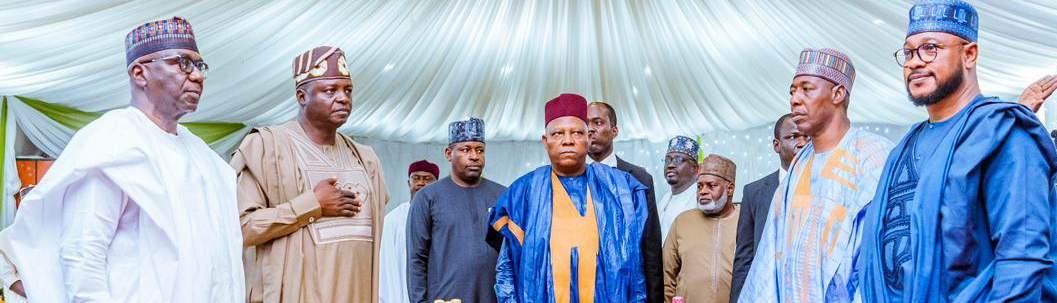
ENSURING TERRORISM DOESN’T CHANGE OUR WAY OF LIFE…
children’s wedding ceremony at the Maiduguri Central Mosque in Maiduguri…yesterday
L-R: Kwara State Governor and Chairman, Nigeria Governors’ Forum, AbdulRahman Abdulrazaq; National Chairman, All Progressives Congress, Prof. Nentanwe Yilwatda; Vice President Kashim Shettima; Borno State Governor, Prof. Babagana Umara Zulum; and Zamfara State Governor, Dauda Lawal, during Zulum’s
wellness within reach
with W Health loan
The W Health Loan provides women with access to financing for eligible healthcare services
*Terms and conditions apply
Despite CBN’s Policy Shift, Five Banks Post N9.88tn Interest Income as High Rates Persist
Kayode Tokede
Despite a marginal easing of monetary policy by the Central Bank of Nigeria (CBN), five leading banks generated a combined N9.88 trillion in interest income in 2025, underscoring the sustained impact of a high-interest-rate environment on financial-sector earnings.
The figure, drawn from the audited full-year results of Zenith Bank Plc, Wema Bank Plc, Stanbic IBTC Holdings
Plc, Ecobank Transnational Incorporated, and Guaranty Trust Holding Company Plc (GTCO), represents a 27.7 per cent increase from N7.74 trillion recorded in 2024.
The strong performance came even as the apex bank trimmed its Monetary Policy Rate (MPR) to 27 per cent in a bid to rein in inflation and stabilise the naira.
Analysis showed that the elevated interest rate regime continued to drive banks’ earnings from loans, advances,
and investment securities, even as it raised borrowing costs for businesses and households.
A breakdown of the results indicated that Zenith Bank led the pack with N3.67 trillion in interest income, marking a 35 per cent increase from the previous year.
Ecobank followed with N3.19 trillion, while GTCO posted N1.65 trillion, up 23 per cent from 2024. Stanbic IBTC recorded N787.05 billion, representing a 39 per cent rise, and Wema Bank reported
N576.07 billion, a sharp 62.4 per cent increase year-on-year.
GTCO, in its presentation to investors, attributed the growth to expansion in earning assets and improved portfolio yields.
However, it noted a contraction in non-interest revenue, largely driven by declines in fair value and derivative gains.
Industry data further revealed that Nigeria’s average maximum lending rate moderated slightly to 29.32 per cent in December
2025 from 29.71 per cent a year earlier, after peaking at 30.50 per cent in February 2025 when the MPR stood at 27.50 per cent.
The prime lending rate, which applies to top-tier borrowers, also eased to 18.02 per cent from 18.56 per cent in 2024.
Market analysts linked the surge in interest income to the sustained tightening stance adopted by the CBN and other central banks across Africa since 2024, as authorities grapple with inflationary pressures and currency volatility.
OIL TANKERS COME UNDER FIRE AS IRAN REIMPOSES RESTRICTIONS ON STRAIT OF HORMUZ
Sunday Ehigiator
Tension has surged once again in the Middle East after Iran abruptly reimposed strict restrictions on vessel movement through the strategic Strait of Hormuz, barely 24 hours after announcing its reopening, triggering fresh fears of escalation of hostilities between Tehran and Washington.
This latest development has also fuelled renewed anxiety across global energy markets.
Responding from the Oval Office, United States President, Mr. Donald Trump, dismissed
Iran’s position and signalled Washington’s determination to maintain pressure on Tehran, insisting that the US won’t be blackmailed.
Iranian military authorities, in a strongly worded statement yesterday, blamed the US for what they described as a continued “blockade” of Iranian ports, insisting that the move forced Tehran to reverse its earlier decision to allow limited maritime passage through one of the world’s most critical oil transit corridors, insisting that it will only open the Strait passage for ships that pay.
“The Islamic Republic of Iran, following previous agreements in negotiations, has agreed in good faith to the managed passage of a limited number of oil tankers and commercial ships through the Strait of Hormuz,” the statement said.
“Unfortunately, the Americans continue the so-called blockade. For this reason, control of the Strait of Hormuz has returned to its previous state, and this strategic strait is under the strict management and control of the armed forces.”
Iran warned that the
restrictions would remain in place indefinitely unless Washington guarantees unrestricted maritime access for Iranian vessels.
“As long as the United States does not end the complete freedom of passage of vessels from Iran to destination and from destination to Iran, the situation in the Strait of Hormuz will remain under strict control and in its previous state,” Iranian authorities added.
Trump Pushes Back
Responding from the Oval
Office, Trump dismissed Iran’s position and signalled Washington’s determination to maintain pressure on Tehran.
“We have very good conversations going on,” Trump said. “They got a little cute, as they have been doing for 47 years. They wanted to close up the Strait again, as they’ve been doing for years. They can’t blackmail us,” he added.
Trump further revealed that the US would sustain its blockade of Iranian ports until a comprehensive agreement is reached, reinforcing a hardline stance that appears to have
CITING UNACCEPTABLE TERMS, BAUCHI PDP HALTS DEFECTION TALKS WITH APC
Democratic Congress (ADC) due to the lingering leadership dispute within his Peoples Democratic Party (PDP).
The state Chairman of the PDP, Sama’ila Burga, who disclosed the party's position yesterday during a press conference at the PDP Secretariat along Yandoka Road in Bauchi, explained that the decision to suspend political discussions followed a lack of consensus on critical conditions between the two parties.
He said the briefing was intended to inform the public about developments concerning the party, its leadership, and
Finance and Coordinating Minister of the Economy, Mr. Wale Edun, said Nigeria’s reform programme was increasingly being recognised globally as credible, durable, and self-sustaining, adding that the country has been positioned to withstand external shocks while attracting stronger investor confidence.
Speaking as Nigeria concluded engagements at the IMF/World Bank Spring Meetings, Cardoso said the MPC resisted calls for more aggressive rate cuts because members had access to broader indicators that pointed to underlying risks in the economy.
“There was a feeling that we would be more aggressive with reducing rates because of the several months of deceleration. But many times, MPC members have access to data and see things many people do not. There was a concern that there were shocks
key stakeholders.
According to him, the PDP entered the talks with sincere intentions to foster mutual understanding and explore political collaboration for the state's overall progress.
However, he stated that the discussions ultimately failed to yield the desired outcome, stressing that “we entered the discussions in good faith and with an open mind, but we were unable to reach a common ground.”
Burga further revealed that the party undertook extensive consultations and careful deliberations with
that weren’t too clear, but we needed to be certain,” he said.
He stressed that the committee’s decisions were strictly guided by data rather than sentiment, adding that recent economic developments had justified the earlier caution.
“The decisions of the MPC are based on data. This is not something anybody is emotive about. It is what the data tells us that we react to. I am pleased that at least that decision has been borne out; things have played out,” Cardoso said.
He argued that without the policy steps taken at the time and the broader reform programme already underway, Nigeria’s economic situation would have been significantly more difficult.
“If not for the steps we had taken at the time, and if not for the reforms that had been embarked upon when we did, I think the
its key stakeholders before arriving at the decision, noting that the consultation process involved members of the National Assembly, State House of Assembly members, and local government party leaders.
He explained that the major obstacle to reaching an agreement was the APC leadership's inability to accept some key terms and conditions presented during the negotiations.
“There was no alignment on several fundamental issues, and for that reason, we considered it appropriate to discontinue
outcome for the country would have been a lot more difficult and painful,” he said.
Cardoso also reaffirmed the central bank’s commitment to sustaining reforms and maintaining a tight focus on price stability, despite ongoing global uncertainties.
“As a result of global shocks, we are not relenting on continuing to build resilience and to stay the course with respect to bringing down inflation to single digits. We will stay that course because it ties in with the issues of concern to Nigerians, particularly how people feel the impact of recent developments,” he said.
He noted that signs of stability were beginning to emerge in the economy, with some of the earlier pressures easing.
“Stability has begun to set in; so, some of the negative consequences of instability are
the process,” he added.
The PDP chairman also reaffirmed the party's commitment to pursuing political pathways that best serve the interests and aspirations of the people of Bauchi State.
According to him, “we shall continue to evaluate other political alternatives that will be beneficial to the people.”
The party reaffirmed its commitment to promoting good governance, unity, and collective progress under Governor Bala Mohammed, while continuing to focus on the state's development and
behind us,” he added.
According to him, the central bank remains firmly committed to consolidating gains from recent reforms and strengthening institutional capacity to ensure long-term macroeconomic stability.
“As we conclude the meetings, our message is clear: The CBN remains firmly on track. We are focused on building on existing gains, sustaining reforms, and reinforcing institutional capacity to deliver long-term macroeconomic stability,” he added.
On his part, Edun reiterated that the ongoing reforms have strengthened Nigeria’s capacity to withstand global economic turbulence.
“Nigeria is well-positioned to withstand external shocks such as the one we are witnessing at this time,” he said.
Edun said discussions with key global institutions, including
An investment banker, Mr. Tajudeen Olayinka, explained that the high-rate environment reflected a deliberate policy to attract foreign portfolio inflows, boost external reserves, and support exchange rate stability. According to him, the repricing of financial instruments across markets has continued to push up yields on loans and securities, reinforcing banks’ earnings momentum.
triggered Tehran’s latest move. “We’re talking to them, and you know, we’re taking a tough stand. They killed a lot of people. A lot of our people have been killed,” he said.
In an immediate reaction, Iran’s Deputy Foreign Minister Saeed Khatibzadeh sharply criticised Washington’s approach, describing Trump’s statements as inconsistent and counterproductive.
“President Trump’s statements yesterday were kind of confusing,” Khatibzadeh said
the welfare of its citizens.
Responding to journalists' questions, he said the party was mindful of electoral timelines and would take all necessary steps to meet legal requirements, leaving no stone unturned.
He added that the PDP would continue to explore available political options in the overall interest of its members and the people of Bauchi State.
Governor Mohammed had indicated a possible defection to ADC following his failed bid to defect to the APC.
The APC was said to have
the IMF and IFC, reflected broad support for Nigeria’s priorities, particularly in human capital development, infrastructure, agribusiness, and digital innovation.
“Our engagements reflected these priorities. There was support for Nigeria’s human capital priorities. Discussions with the IMF focused on sustaining reform momentum and macro stability,” he said.
He added that engagement with development finance partners showed rising investor interest in critical sectors of the economy.
“Conversations with the IFC and other partners highlighted growing investor interest in energy infrastructure, agribusiness, and digital innovation,” he noted.
Edun said the overall outcome of the meetings was positive for Nigeria’s economic outlook,
conceded a 60/40 powersharing arrangement in the governor’s favour and also offered him a Senate ticket.
However, the ruling party denied him the privilege of choosing a successor, which led to a breakdown in the defection talks.
The governor disclosed his latest plan recently when he received a delegation from ADC, led by former Secretary to the Government of the Federation (SGF), Babachir Lawal, at the Presidential Lodge, Government House, Bauchi.
stressing that confidence in the country’s reform trajectory was strengthening.
“The overall message from the Spring Meetings is encouraging. Nigeria’s global economic standing is improving. Our reform story is being taken seriously and indeed used as an example. Our resilience is better understood, and our investment case is strengthened, with confidence returning at a faster pace,” he said.
He further added: “We are firmly committed to disciplined, credible policy as the foundation for resilience, for growth, and for long-term prosperity, which, in the end, means lifting Nigerians out of poverty.”
He noted that Nigeria came to the meetings with a clear message on the direction of its reform agenda.
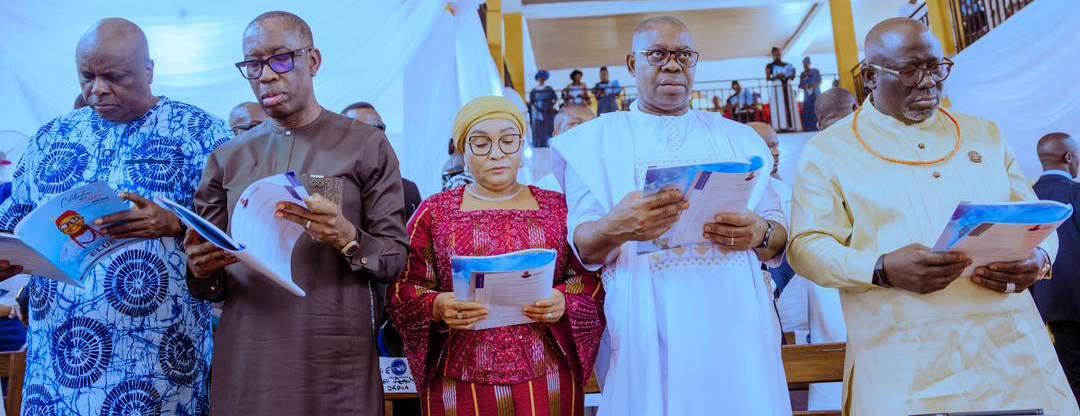
PAYING THEIR LAST RESPECTS…
To Protect Domestic Firms, Manage Forex, FG Bans Importation of Paracetamol, Other Medicines
Frozen poultry, cement, detergents, refined vegetable oils also banned
The federal government has released an updated schedule of prohibited trade items, signalling a firm stance on protecting domestic industries and managing foreign exchange.
The revised import prohibition list, dated April 1, 2026, contained 17 major categories of goods strictly barred from entering the country
through any port of entry.
This latest directive from the Federal Ministry of Finance carried significant implications for importers, clearing agents, and the general public, as it covered a vast range of products from basic food staples to essential life-saving medications. Among the most sensitive inclusions is the extensive list of prohibited medicaments under HS Codes 3003.10.00.00
through 3004.90.90.00. The government has totally banned the importation of common pharmaceutical products, including paracetamol tablets and syrups, metronidazole, cotrimoxazole, and chloroquine.
Other widely used health products, such as multivitamin capsules, aspirin, folic acid, and various ointments like penicillin and gentamycin, are now restricted to local manufacturers.
This move places the responsibility for the nation’s primary healthcare supply firmly on the domestic pharmaceutical sector, while the importation of pharmaceutical waste under HS Code 3006.92.00.00 remains strictly forbidden.
The agricultural and food sectors face equally stringent restrictions intended to bolster food security and local farming.
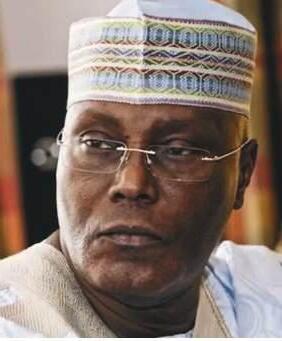
Atiku: ADC Remains Nigeria’s Only Opposition Force Ready to Challenge, Defeat APC in 2027
Momodu fires back at ex-VP’s critics, says Trump, Mandela, Biden ran for presidency at old age Chuks Okocha in Abuja
Former Vice President Atiku Abubakar has described the African Democratic Congress (ADC) as the only opposition force that was ready to challenge and defeat the “failing” All Progressives Congress (APC) in next year’s general election.
This is as a chieftain of the ADC and publisher, Dele Momodu, has dismissed calls for former vice president to step aside from the 2027 presidential race, describing the campaign against him as “unbridled chicanery.”
Atiku, who made the remark yesterday in a post on X, described the ADC as a party “strong in ideals and structure”.
“I remain convinced that the ADC has risen as Nigeria’s true opposition force , one that is strong in ideals, structure, and resolve, and ready to challenge and defeat the failing APC in the elections ahead,” he wrote.
The former vice president said he hosted stakeholders of
the Adamawa ADC at his Abuja residence on Friday, describing the visit as “deeply touching.”
“I thanked them for the gesture and reminded the new state leadership that unity is now their sacred duty: To heal divisions, carry everyone along, and lead with fairness,” he added.
On Friday, ADC’s National Publicity Secretary, Bolaji Abdullahi, said Nigerians were determined to vote President Bola Tinubu out of office in 2027, alleging that his “policies have ruined lives and destroyed livelihoods.”
Abdullahi was reacting to comments made by the president at the State House on Thursday while hosting the Renewed Hope Ambassadors.
At the event, Tinubu had said he was unfazed by mounting opposition against him ahead of the 2027 elections.
“They want to scare me off? It’s a lie. I’ve been through this path before,” the president had said.
However, Abdullahi said
the remarks reflected a leader disconnected from the reality of hardship, insecurity, and frustration facing millions of citizens.
In a related development, a chieftain of the ADC and publisher, Dele Momodu, has dismissed calls for Atiku to step aside from the 2027 presidential race, describing the campaign against him as “unbridled chicanery.”
Momodu fired back yesterday at popular activist and Peter Obi’s supporter, Zekeri Idris Jnr, who had urged Atiku to yield ground to younger candidates, arguing that his projected age of 80 by 2027 made him unfit for the presidency.
In a post on X, Momodu said those targeting Atiku were misdirecting their energy instead of holding the ruling government accountable.
“Instead of making videos against the ruling government, you’re dissipating energy on a man who has never wronged your preferred candidate,” the
statement read.
Momodu cited a raft of global leaders who he said had served their nations effectively at an advanced age, naming former United States Presidents Donald Trump, Joe Biden and Bernie Sanders; former Liberian President Ellen Johnson Sirleaf; former President Muhammadu Buhari; South Africa’s Nelson Mandela; former Ghanaian President Nana Akufo-Addo; former US presidential candidate Hillary Clinton, and Liberian President Joseph Boakai, adding that they “made good use of their age and experience for the betterment of their nations”.
The outburst followed a viral video in which Idris, wearing a green traditional outfit, delivered a nearly two-anda-half-minute appeal, urging Atiku’s allies to persuade the former vice president to bow out of the race.
The list confirms that live or dead birds, including frozen poultry under HS Codes 0105.1100 to 0210.99.00.00, remain banned.
This extends to pork, beef, and bird eggs, though the government has allowed an exclusion for hatching eggs of grandparent stock intended for research and breeding purposes.
Furthermore, refined vegetable oils in retail packs of five litres or less, encompassing soya-bean, palm, and sunflower oils, are prohibited. However, crude vegetable oil and specific fats like hydrogenated vegetable fats under HS 1516.20.10.00 are permitted to enter the country for industrial use.
In the retail and consumer goods category, the prohibition covers cane or beet sugar in retail packs and chemically pure sucrose containing added flavouring or colouring.
The cocoa industry is also
shielded; cocoa butter, powder, and cakes, as well as chocolate preparations in blocks or bars exceeding two kilograms, are listed as prohibited items.
Other household essentials now restricted to local production include tomato paste, whole tomatoes put up for retail sale, and mineral and aerated waters. The hygiene sector is notably impacted, as all forms of soaps and organic surface-active products (commonly known as detergents) are now barred from importation under HS Codes 3401.11.10.00 through 3402.90.00.00 when intended for retail sale.
Even everyday stationery is affected, as ballpoint pens and their refills are barred from importation, though the government made a specific concession for importing pen tips. Industrial and construction materials were not left out of the revised trade policy.
Nigerian Army Raises the Alarm over Low Enlistment from Southeast, Urges Eligible Youths to Apply
Linus Aleke
The Nigerian Army has raised concerns about low enlistment in the South-east geopolitical zone, revealing that Anambra State recorded only 117 applications out of 38,000 nationwide.
Brigadier-General Uche Nnabuihe, who led an army delegation to sensitise youths in Awka, the Anambra State capital, noted that the figure was recorded on April 7, before a nationwide awareness campaign began.
He said the exercise aimed to encourage more youths from Anambra State and the South-east to join the 91 Regular Recruits Intake before the May
27, 2026, deadline.
“We observed with concern that out of 38,000 applications received nationwide, only 117 came from Anambra as of April 7.
“This sensitisation is to correct that imbalance and encourage our youths to take advantage of opportunities in the Nigerian Army,” he said.
Nnabuihe urged eligible youths to apply, noting the Army offers a structured career path and opportunities for national service.
On his part, Lt. Col. Ogbemudia Osawe said training infrastructure had expanded, with new institutions in Abakaliki and Osogbo to accommodate incoming recruits.
James Emejo in Abuja
L-R: Former Delta State Governor, Chief James Ibori; immediate past Governor of the state, Senator Ifeanyi Okowa; wife of the Deputy Governor, Lady Catherine Onyeme; Deputy Governor, Sir Monday Onyeme; and Governor Sheriff Oborevwori, during the funeral service in honour of the late former deputy governor, Sir Benjamin Elue, at All Saints Anglican Church, Obior in Aniocha North LGA…Friday
RESTRATEGISING FOR THEIR TRADITIONAL ROLES…
Presenters Who Express Opinions as Facts, Bully Guests Risk Sanctions,
NBC Warns TV, Radio Stations
Atiku slams commission, say threat could undermine press freedom
The National Broadcasting Commission (NBC) has warned that presenters who express opinions as facts and bully guests would be sanctioned.
In a swift reaction, former Vice President, Atiku Abubakar, criticised the commission threat,
warning that it could undermine press freedom and restrict free expression in Nigeria ahead of the election.
In a statement issued yesterday, the commission raised concern over what it described as a growing lack of professionalism among anchors and presenters, warning that violations of the
Nigeria Broadcasting Code would attract sanctions as the 2027 elections approach.
The commission said it had observed an increase in violations of the sixth edition of the Nigeria Broadcasting Code across news, current affairs, and political programs.
“The National Broadcasting
PRESS RELEASE
Commission (NBC) has identified a sustained increase in breaches of the 6th Edition of the Nigeria Broadcasting Code across News, Current Affairs, and Political Programs.
“Broadcast platforms are increasingly being deployed in ways that depart from their core obligation to inform the public
National Broadcasting Commission Issues Formal Notice to Broadcasters Over Code Breaches in News. Current Affairs, And Political Programmes.
The National Broadcasting Commission (NBC) has identified a sustained increase in breaches of the 6th Edition of the Nigeria Broadcasting Code across News, Current Affairs, and Political Programmes.
Broadcast platforms are increasingly being deployed in ways that depart from their core obligation to inform the public with accuracy, balance, and professionalism.
As we approach the 2027 General Elections, the Commission, hereby, notifies all broadcasters and stakeholders that it will enforce strict and uncompromised compliance with every provision of the Nigeria Broadcasting Code, particularly those relating to fairness, balance, accuracy, hate speech, incitement, and respect for constitutional bodies.
In view of the foregoing, the Commission draws attention to the following pressing issues:
1. The Crisis of Anchor and Presenter Professionalism:
The Commission has noted a disturbing departure from the core principles of broadcast journalism in clear violation of the ethical standards enshrined in the Nigeria Broadcasting Code. as follows:
•Section 1.10.3: "The Broadcaster shall ensure that its Presenter does not express his or her opinion in the programme, as a matter of professional standard."
•Section 3.3.1(b): “All side s to any issues of public interest are equitably for fairness and balance.”
•Section 3.4.1 (b): “All sides to am issues are equitably presented, preferably in the same broadcast.”
Sections 5.3.3(b) “The broadcaster shall, in using political materials for news and currents affairs programme, avoid hate sp0eeech, inflammatory, derogatory and divisive remarkds or allusions.”
2. Misuse of Broadcast Platforms by Political Actors: The Commission has documented a rising trend of political actors across party lines using broadcast platforms to promote contents in violation of the following Code Sections:
•Section 3.1.1 "No broadcast shall encourage or incite to crime and lead to public disorder or hate be repugnant to any person or organization alive or dead or generally be disrespectful to human dignity".
•Section 3.11.1(a)- "language or scene likely to encourage or
incite to crime, or lead to disorder is not broadcast."
•Section 5.4.1(f)- "the broadcaster shall not transmit divisive materials or compromise the indivisibility and indissolubility of Nigeria as a sovereign state."
•Section 3.11.1(b) "...no programme contains anything which amounts to subversion of constituted authority or compromises the unity or corporate existence of Nigeria as a sovereign state."
•Section 5.5.1(b) "The broadcaster shall exhibit professionalism in handling the transmission especially sensitive issues as politics, communal conflicts and wars."
Henceforth, any anchor or presenter found to have:
• expressed personal opinion as fact,
• bullied or intimidated a guest,
• denied fair hearing to opposing views, or otherwise compromised neutrality, shall be deemed to have committed a Class B breach.
Broadcast platforms must not be used for hate speech, personal attacks, or content inciting disorder along political lines. The Code places a non-transferable obligation on broadcasters to exercise editorial
judgment at all times, including during live programming.
Editorial responsibility cannot be abdicated to guests.
Accordingly, the NBC places all Broadcasters on formal notice: Strict compliance with the Nigeria Broadcasting Code will be enforced across all News, Current Affairs, and Political programmes.
Broadcasters must ensure fairness, balance, accuracy, and right of reply in all contents. Inflammatory, divisive, or unsubstantiated broadcasts will attract regulatory sanctions. Compliance is mandatory, not discretionary.
As Nigeria enters a critical electoral period, the airwaves must not amplify tension or propagate misinformation. They must remain platforms for credible information, responsible discourse, and national cohesion.
The National Broadcasting Commission will continue to guarantee Your Right to Quality Broadcasting.
•NATIONAL BROADCASTING COMMISSION 20 Ibrahim Taiwo Str Asokoro, P.O. Box 5747, Garkı-Abuja PUBLIC AFFAIRS DIRECTORATE
with accuracy, balance, and professionalism,” the statement said.
The commission said the trend included presenters expressing personal opinions as facts, failing to give equal representation to opposing views, and allowing inflammatory or divisive content on programs, stressing that such actions violated the code's provisions requiring accuracy, professionalism, and responsible conduct.
It said some anchors and presenters deviated from professional standards by denying fair hearing to opposing views and compromising neutrality during broadcasts.
The NBC warned that such conduct contravened the code's provisions, which required presenters to remain impartial and ensure that all sides of issues of public interest were fairly represented.
“Henceforth, any anchor or presenter found to have expressed personal opinion as fact, bullied or intimidated a guest, denied fair hearing to opposing views, or otherwise compromised neutrality, shall be deemed to have committed a Class B breach,” NBC said.
The NBC also raised concerns over the increasing use of broadcast platforms by political actors to air divisive, inflammatory, and unsubstantiated content.
It reiterated that broadcasters would bear full editorial responsibility for all content aired, including during live programs, adding that such responsibility cannot be transferred to guests.
The NBC said it would enforce strict compliance with the broadcasting code, warning that breaches relating to hate speech, incitement, and lack of balance would attract sanctions.
It emphasised that it would enforce “strict and uncompromised
compliance” with all provisions of the code, warning that “inflammatory, divisive, or unsubstantiated broadcasts will attract regulatory sanctions,” and stressing that compliance is “mandatory, not discretionary.”
As the country moves toward a critical electoral period, the NBC urged broadcasters to ensure responsible discourse, noting that the airwaves must not “amplify tension or propagate misinformation” but remain platforms for credible information and national cohesion.
It urged broadcasters to uphold professionalism, fairness, and accuracy, adding that as Nigeria enters a critical electoral period, the airwaves must not be used to propagate misinformation.
Responding to the threat, former Vice President Atiku criticised the commission, warning that it could undermine press freedom and restrict free expression in Nigeria ahead of the election.
In a statement on his X post yesterday, Atiku said: “The Code of Conduct advisory issued by the National Broadcasting Commission is yet another troubling attempt to muzzle the media and shrink the space for free expression in Nigeria.”
He argued that Nigeria’s media landscape has earned global respect and should not be subjected to what he sees as repeated regulatory pressure during election periods.
According to the former vice president, such interventions risk distorting the role of the media rather than protecting ethical standards.
He added: “Our media industry has grown into a formidable institution, respected globally for its resilience and professionalism.” He expressed concern that the timing of the advisory suggests a broader attempt to control political narratives rather than strengthen journalistic integrity.
Chuks Okocha in Abuja
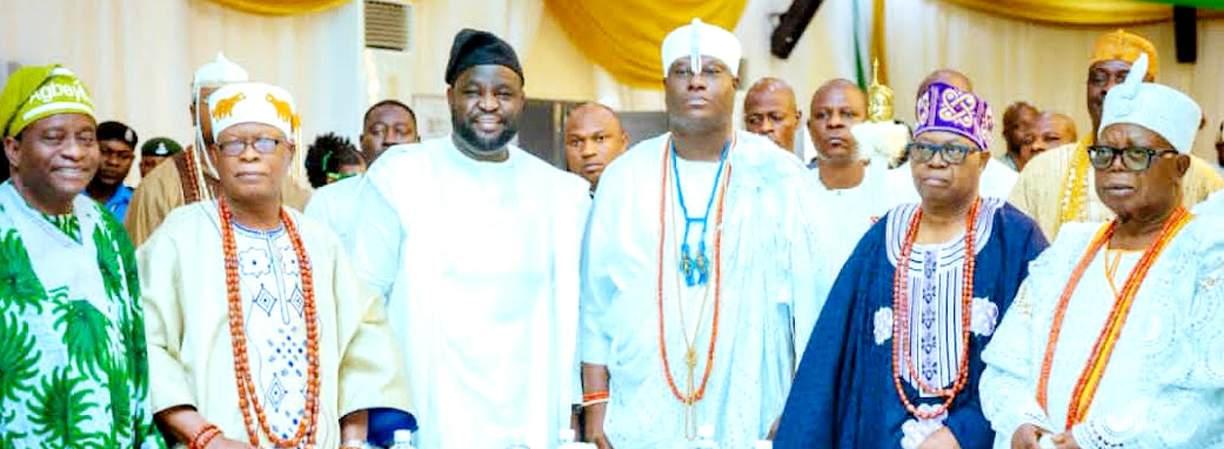
L-R: Managing Director/CEO, Agbeyewa Farms Limited and Matna Foods Limited, Mr. Oska Seyi Aiyeleso; the Ajero of Ijero-Ekiti, His Royal Majesty Oba Joseph Adebayo Adewole II; Chairman, Cavista Holdings, Mr. Niyi John Olajide; His Imperial Majesty, Ooni of Ife, Oba Adeyeye Enitan Ogunwusi; Chairman, Ekiti Traditional Rulers Council, His Royal Majesty Oba Samuel Adejimi Adu-Alagbado; and His Royal Majesty, the Oloye of Oye-Ekiti, Oba Oluwole Ademolaju Adugbole III, during the third Annual Agbeyewa Traditional Rulers Retreat held at Ikogosi Warm Spring and Resort Ekiti State... recently
CELEBRATING 20TH ANNIVERSARY OF GRACE…
Kwankwasiyya Movement Tackles Atiku, Says Only Obi, Kwankwaso Enjoy Organic Support
Amid the jostling for the presidential ticket of the opposition African Democratic Congress (ADC), the Kwankwasiyya movement has pushed back against recent remarks by former Vice
President Atiku Abubakar, suggesting a decline in Rabiu Musa Kwankwaso’s political dominance in Kano, insisting that only Peter Obi and Kwankwaso enjoy “organic” nationwide followership.
Spokesperson of the Kwankwasiyya movement, Hon.
Habib Mailemo, who spoke on a television programme, argued that the followership enjoyed by Obi and Kwankwaso was rooted in personal conviction rather than political inducement or entrenched party structures.
Mailemo insisted that the former vice president's popularity
came mostly from PDP governors and the party's established structures.
He said, “It is only Peter Obi and my principal, Alhaji Rabiu Musa Kwankwaso, who have organic followers that are not induced by anything. Their aspirations align with the belief
Soludo Reads Riot Act to APGA Members, Adopts Option A4 for Party's Primaries
David-Chyddy Eleke in Awka
The Governor of Anambra State and national leader of All Progressives Grand Alliance (APGA), Prof. Chukwuma Soludo, has read the riot act to the leaders and members of the party, while reeling out guidelines for the conduct of the party's forthcoming primary elections.
Soludo, who addressed APGA faithful yesterday during the South-east zonal convention of the party held at the International Convention Centre (ICC), Awka, the Anambra State capital,
revealed that the party would adopt Option A4 for the primaries. Soludo said this would beat rigging and also enhance transparency in the party, while cutting down waste of scarce resources through vote buying.
He said: "I know that most of you may not be happy with this new strategy because you see politics and party membership as business. Most of you may even say ‘why does this man want to spoil our show during this political season’?
"What we are doing is to cut wastefulness and also ensure the
health and credibility of our party. Let me tell you, there are people here who may have saved some money to buy shuttle buses; maybe the money is not yet complete, and they are waiting for this political season to make up to buy it.
"But we don't want this period to be business-as-usual. Our aspirants who want to make money should be able to save up their resources to be able to fight their opponents in other parties in the main election, instead of spending it during the primary election.
"We are going to adopt Option A4 in all our primary elections this season. The essence is that once you look back and you are winning, you will know you are winning. When you see a long line of people behind you, you will know you are winning.
"It is not the one that you will pay money to people, and they will tell you they are for you, and because it is a secret ballot, they will go and vote against you. We want to curb all that. There are many other things we want to do to ensure that this party stands."
Bandits Abduct Newly Installed Traditional Ruler, Wife in Kwara
About 10 suspected bandits have reportedly invaded the palace of a newly installed monarch in Olayinka community in Ifelodun Local Government Area of Kwara State, abducting the traditional ruler, his wife, and one other individual during a midnight raid. The incident, according to THISDAY’s investigation, occurred yesterday when the royal father and others were sleeping at the palace.
The attack, which was believed to have taken place around 1:40 a.m., saw the armed assailants firing sporadically before whisking away their victims. The monarch had only recently been installed by the state government, making the incident shocking for the community.
The recent incident marked the third abduction of traditional rulers in Kwara South senatorial district in the last five months.
In December 2025, the Ojibara of Bayagan Ile, Kamilu Salami,
was kidnapped and later released after ransom was paid.
In February 2026, the Oniwo of Afin, Oba Simeon Olanipekun, was abducted alongside his son. They also regained freedom after ransom was paid.
A member of the Olayinka community who spoke with THISDAY on condition of anonymity in Ilorin yesterday, described the latest raid as terrifying and unprecedented. He warned that insecurity in the region had reached alarming levels.
Some of the members of the community have called for urgent government and security intervention to protect traditional rulers, who have become the prime targets of criminal gangs.
When contacted, a senior police officer with the Ifelodun Local Government Divisional Police Headquarters at Share who spoke on condition of anonymity, confirmed the ugly development. He said: "We are working round towards ensuring the rescue of the victims.”
in their competence and proven track records, and the masses identify with them.”
The spokesman of the group added that the current political discourse should focus less on personal supremacy and more on the broader objective of national recovery, noting that a single goal drove Kwankwaso’s involvement in coalition talks.
“My principal has made it very clear that we are going into the coalition simply because his sole intention is to contribute to rescuing Nigeria,” he said.
Responding to a question on whether Kwankwaso enjoys greater popularity in the North
than Atiku, as claimed by the former vice president, the aide acknowledged Atiku’s long-standing presence in Nigeria’s political landscape but argued that his electoral strength had often been tied to party machinery rather than individual appeal.
“It is true that Atiku has contested multiple times, particularly under the PDP, where he had the backing of governors and a strong structure. But he cannot solely attribute the votes he garnered to personal popularity, given the elite consensus and broad political support within that fold at the time”, he said.
Kano APC Disowns Arewa Forum, Denies Claims of Withdrawing Support for Tinubu
Ahmad Sorondinki in Kano
The Kano State chapter of the All Progressives Congress (APC) has debunked a statement allegedly issued by the Arewa APC Forum, Kano State chapter, claiming the withdrawal of support for President Bola Tinubu's second-term bid.
In a statement issued yesterday by the state Publicity Secretary of the party, Auwalu Abdullahi, the ruling party disowned the group and described the claim as false, misleading, and a calculated attempt to tarnish the party's image.
The party emphasized that no recognized or constitutionally backed organ within the APC had taken such a decision, stressing that the Kano State chapter of the party remained fully committed to supporting Tinubu and his administration.
“The APC in Kano is aware of attempts by certain individuals and faceless groups to create confusion and disunity
within the party.
“We wish to state categorically that this so-called forum is not known to the party structure and does not represent the views of APC members in Kano State,” the statement explained.
The party further reaffirmed its confidence in Tinubu’s leadership, noting that his administration remained focused on delivering good governance, economic reforms, and national development.
The Kano APC, under the leadership of Umar Doguwa, urged party members and the general public to disregard the statement in its entirety, describing it as the handiwork of mischief-makers bent on causing unnecessary tension.
The statement concluded by reiterating the party’s unity and unwavering support for Tinubu’s vision for a better Nigeria.
“The so-called signatory of the purported withdrawal is faceless and not a stakeholder of the party at any level in Kano,” the statement added.
Hammed Shittu in Ilorin
Chuks Okocha in Abuja
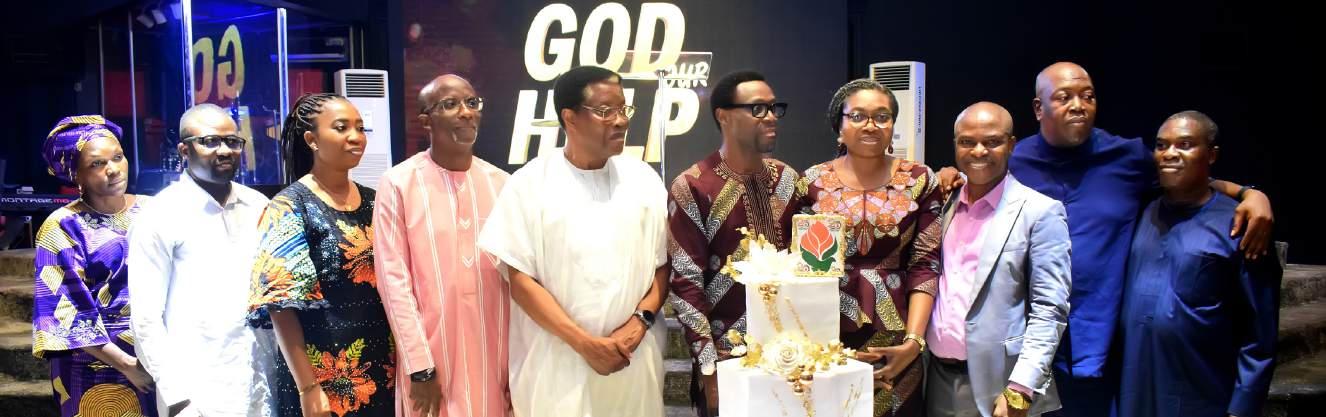
L-R: Pastor Bunmi Onilude; Rev. Olayemi Akande; Pastor Ronke Adeoti; Rev. Yemi Adeoti; General Overseer, Word Communication Ministries, Apostle Sunday Popoola; Rev. Yemi Graceman; Global Lead Pastors, Lighthouse International Christian Centre, Pastor Olanike Aduloju; Pastor Bukola David Olanrewaju; Rev Gbenga Kotila; and Pastor Yinka Osuolale, at the celebration of the 20th anniversary of Lighthouse International Christian Centre in Ibadan…recently
FUEL REFINING AND DISTRIBUTION ON THEIR MINDS…
Wike-backed PDP Dismisses Anyanwu’s
Suspension Claims, Says Appeal Misrepresented
The Minister of Federal Capital Territory (FCT), Nyesom Wikebacked faction of the Peoples Democratic Party (PDP) has described reports on Senator Samuel Anyanwu’s appeal as misleading.
The party, under the leadership of Abdurahman Mohammed, insisted that no suspension was ever in place, adding that the legal action did not stem from any disciplinary measure.
PDP’s National Publicity Secretary, Jungudo Mohammed, stated in a press statement yesterday that although Anyanwu filed an appeal, it was not related to any suspension.
during the Antalya Diplomacy Forum.
“There is one simple, crystal clear golden regulation: Security for all or security for none,” he added.
Khatibzadeh warned that any extension of the current ceasefire would depend on the US abandoning what he described as a “maximalist” negotiating position.
“That would only be possible if the other side just accepts to negotiate on equal footing and just puts aside its maximalist position,” he said.
While acknowledging that Iran had agreed to talks because “there is no alternative,” the deputy minister struck a defiant tone.
“We will defend ourselves until the last bullet and the last soldier,” he declared.
Gunfire in the Strait
The UK Maritime Trade Operations (UKMTO)
confirmed that two Iranian Revolutionary Guard Corps (IRGC) gunboats fired on a
The PDP is entangled in a prolonged internal crisis, with the party divided into factions.
One camp, led by Tanimu Turaki (SAN), is supported by Governors Seyi Makinde of Oyo State and Bala Mohammed of Bauchi State, while the courtrecognised faction enjoys the backing of Wike. In pursuit of favourable legal outcomes, both sides have filed multiple suits.
In one of the ongoing cases, Anyanwu lodged a Notice of Appeal at the Court of Appeal, contesting the judgment of the High Court of the Federal Capital Territory, which dismissed his case and upheld his recommended expulsion from the party.
The appeal, dated April 10,
tanker transiting the waterway, marking the first attack in more than 10 days since the attack near the Gulf on April 7, when a bulk carrier was struck by ‘two unidentified projectiles.’
According to the advisory, the vessel’s captain reported being “approached by 2 IRGC gun boats” approximately 20 nautical miles off the coast of Oman.
“No radio warning” was issued before shots were fired, the report said, although the tanker and its crew were confirmed safe.
In a separate incident hours later, a container ship was struck by what authorities described as an “unknown projectile,” causing damage to cargo but no reported casualties or environmental harm.
In total, three ships, a tanker, a cargo ship and a cruise ship, all internationally-flagged, were involved in the incidents off the coast of Oman yesterday.
Reports also indicated that at least two of the vessels targeted were Indian-flagged, raising alarm in New Delhi and further
2026, was filed at the Abuja Judicial Division of the appellate court, challenging the January 12, 2026.
The ruling was delivered by Justice Yusuf Halilu in suit No. FCT/HC/CV/1050/2025.
Meanwhile, the Turaki-led faction has, through its legal representatives, petitioned the Independent National Electoral Commission (INEC) to derecognize the Mohammed/ Anyanwu faction, and, by extension, the Wike-backed camp.
Responding, Mohammed clarified that the Tom Ikimi Disciplinary Committee only recommended a suspension, which was never reviewed, adopted, or ratified by either the National Working Committee
internationalising the crisis.
India Lodges Protest, Summons Iranian Ambassador
The crisis has already drawn international concern, with the Indian government summoning Iran’s ambassador to India, Dr. Mohammad Fathali, following reports that Indian-flagged vessels were caught in the crossfire.
India’s Foreign Secretary Vikram Misri conveyed “deep concern” over the incident and stressed the importance of ensuring the safety of merchant shipping in the region.
He urged Tehran to “resume at the earliest the process of facilitating India-bound ships across the Strait,” underscoring the country’s reliance on the route for energy imports.
Misri, in a separate message, later confirmed two Indianflagged ships' involvement in the incident.
The immediate impact of Iran’s renewed restrictions was
(NWC) or the National Executive Committee (NEC) of the party.
He maintained that the recommendation carried no binding authority and that no valid suspension ever existed.
PDP Publicity Secretary stated, “The party categorically states that these reports are misleading and lack proper context. While it is true that Senator Anyanwu filed an appeal, it is important to clarify that the appeal was not against any suspension.
“The suit, which was first initiated at the FCT High Court, Abuja, was a case filed to challenge the competence and proceedings of the Disciplinary Committee previously chaired by Mr. Tom Ikimi, who has
evident across global shipping lanes, as vessels began reversing course rather than risk entering the Strait.
Marine tracking data showed several tankers, including those carrying liquefied natural gas and crude oil bound for Asia, turning back toward the Gulf.
US Blockade Intensifies Pressure
The US military, under the United States Central Command (CENTCOM), confirmed that its blockade operations had already forced dozens of vessels to change course.
“Since commencement of the blockade, 23 ships have complied with direction from U.S. forces to turn around,” CENTCOM said in an update.
Although the blockade does not directly target the Strait itself, its impact on Iranian shipping has had a cascading effect on maritime movement in the region.
Iran has described the blockade as a violation of
since left the PDP.
“It must be emphasised that the Tom Ikimi Disciplinary Committee merely recommended a suspension. This recommendation was never considered, adopted, or ratified by either the National Working Committee or the National Executive Committee of the Party. As such, it had no binding effect, and no valid suspension ever existed.
“Furthermore, the said Disciplinary Committee and its recommendations had long been jettisoned by the party’s leadership after it was determined that the committee was constituted in violation of Chapter 10, Article 57(1) of the Party’s Constitution.
“Accordingly, there was no
the ceasefire, with its Supreme National Security Council warning that it would not allow normal passage through Hormuz under such conditions.
“As long as the enemy intends to disrupt the passage of vessels and apply its naval blockade, Iran will view that as a violation of the ceasefire,” the council said.
Iran: Strait Passage Open Only to Ships That Pay
In a fresh development, a Senior Iranian official, while speaking with CNN yesterday, said Iran will only prioritise vessels that pay to cross the Strait of Hormuz.
According to the official, vessels that do not pay the fees will have their passage “postponed.”
Under the proposed system, vessels would be required to submit detailed information, obtain transit certificates, and pay service fees; effectively placing one of the world’s most vital shipping lanes under Iranian administrative control.
valid or effective suspension at any time.
For the avoidance of doubt, the judgment of the FCT High Court delivered by Justice Halilu in January 2026 did not affirm any suspension, as that was never the issue before the court.”
Mohammed further stated that the court dismissed the suit entirely on the grounds of lack of jurisdiction, ruling that disciplinary issues are internal party matters and not subject to judicial review.
The statement read in part, “In light of these facts, the appeal, which was inadvertently filed on April 10, 2026, has now been directed to be immediately withdrawn as it is no longer necessary.
In a separate message marking Army Day, Iran’s Supreme Leader Mojtaba Khamenei issued a veiled warning to adversaries.
“Iran’s navy stands ready to make the enemies taste the bitterness of new defeats,” the message read.
Amid mounting fears of a wider conflict, regional powers have stepped up diplomatic efforts to de-escalate the crisis.
Foreign ministers from Pakistan, Saudi Arabia, Turkey, and Egypt convened on the sidelines of the Antalya forum to push for renewed negotiations.
Egypt’s Foreign Minister Badr Abdelatty expressed cautious optimism.
“We are pushing very hard to move forward,” he said, adding that an agreement between the United States and Iran could be reached “in the coming days.”
Pakistan, in particular, has emerged as a key intermediary, with its military chief engaging both sides in an attempt to salvage the fragile ceasefire before its expiration.
Chuks Okocha in Abuja
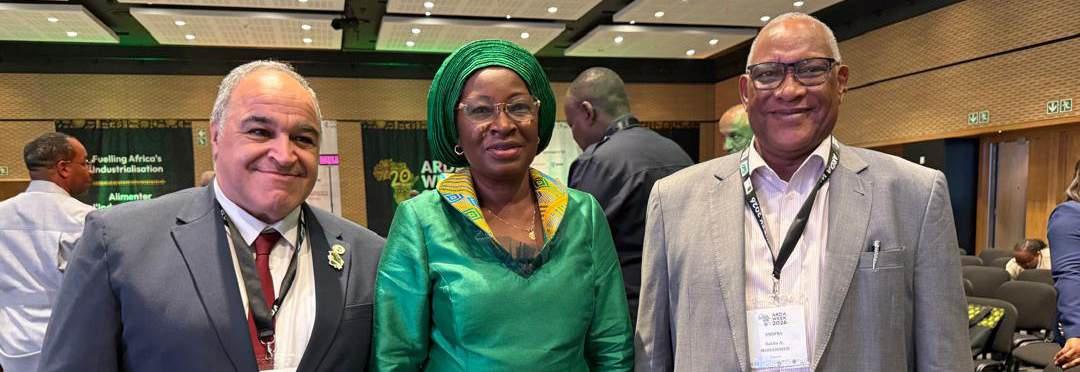
L-R: Secretary General of the African Petroleum Producers Organisation, Farid Ghezali; President of the African Refiners and Distributors Association, Marie-Josephine Sidibé; and Chief Executive of the Nigerian Midstream and Downstream Petroleum Regulatory Authority, Saidu Mohammed, during proceedings at ARDA Week 2026, in Cape Town, South Africa…weekend
new S
IMPROVING THE SYSTEM OF TAXATION…
Tantita Uncovers Sophisticated Underground Pi p eline Network for Crude Theft in Rivers
Wale Igbintade
An extensive and highly sophisticated underground network used for illegal crude oil extraction and distribution has been uncovered in Rivers State by Tantita Security Services Nigeria Limited, which described it as one of the most revealing discoveries on the scale and organization of oil theft in the Niger Delta.
The findings, contained in a report presented to the Joint Committee on Petroleum Resources of the Senate and House of Representatives,
showed that the operation went far beyond isolated acts of pipeline vandalism, exposing instead a coordinated industrial system designed for sustained crude oil diversion.
According to the report, Tantita operatives during one of their early field interventions in Rivers State discovered a professionally executed illegal connection welded onto a major export pipeline.
The connection, carefully buried underground, was linked to an extensive canal system that stretched several kilometers across difficult terrain, indicat-
ing deliberate engineering and long-term planning.
The canals, reportedly excavated with mechanical equipment, were used to transport stolen crude oil to concealed storage facilities where it was accumulated before being moved to processing or distribution points.
The scale and sophistication of the infrastructure suggested that the network had been operating undetected for a prolonged period before its interception.
The report noted that the discovery significantly altered the understanding of oil theft in the region.
What had previously been assumed to be largely opportunistic activity by small-scale operators was found to include highly organized networks with access to technical expertise, equipment, and financial resources comparable to those of legitimate industrial operations.
The connection points were located in remote, hard-to-reach areas, while the canal routes were concealed by dense vegetation.
Storage facilities were strategically positioned to avoid visibility from both ground patrols and aerial
surveillance, reflecting a high level of operational discipline and planning.
Tantita’s success in uncovering the network was attributed to a combination of intelligence-led operations, including ground surveillance, informant engagement, and technological monitoring.
This multi-layered approach enabled operatives to trace the movement of stolen crude from the initial tapping point through the canal system to storage and distribution nodes, leading to the complete dismantling of the operation.
The report also high-
lighted another breakthrough in a separate operation, where Tantita operatives uncovered a clandestine crude oil market operating openly within the region.
In the market, crude oil and condensate were reportedly being sold in buckets and tarpaulin-lined sacks, with buyers transporting products across the region with relative ease.
The discovery of the market, which served as a central hub for illicit crude transactions, further underscored the scale of illegal oil trade networks before Tantita’s intervention.
Group Warns Benjamin Kalu Against Attacks
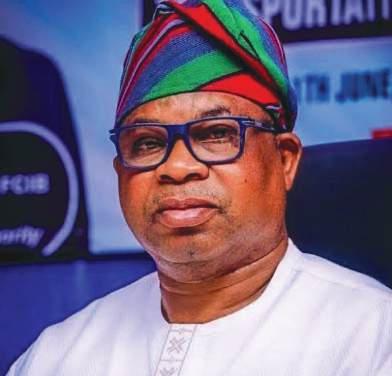
A good governance advocacy group, True Grassroots Monitors (TGM), has criticised Deputy Speaker Benjamin Kalu over what it described as an endorsement of political intimidation tactics aimed at Governor Alex Otti of Abia State.
The group expressed concern over Kalu’s reported remarks suggesting the use of “tantrums” against the governor, warning him to desist from what it called a “lazy and outdated strategy.”
It stressed that the political climate in Abia has evolved beyond such approaches.
Kalu had, while addressing members of his political party, reportedly stated that he had “things they can use as tantrums against Governor Alex Otti and his government.”
In a statement signed by its National Secretary, TGM maintained that governance should not be reduced to personal attacks or theatrics.
“Governance is beyond throwing tantrums at opponents,” the statement read.
“Abians today are focused on results. It would be unfortunate
on Alex Otti
for any serious political actor to rely on name-calling or empty rhetoric instead of presenting credible ideas.”
The group further noted that any politician seeking to challenge the incumbent governor in future elections must do so on the strength of verifiable achievements and a clear governance agenda.
“From our observation, the electorate in Abia is more discerning. Anyone intending to contest must base their campaign on performance and substance, not idle attacks,” the group added.
On the issue of political endorsements, which Kalu has recently highlighted, TGM cautioned against what it described as “stage-managed or deceptive endorsements.”
“In a true democracy, credible endorsements have their place. However, voters in today’s Abia are unlikely to be misled by contrived displays of support,” the statement said.
The group also encouraged the Deputy Speaker to formally contest any elective position he desires, rather than resorting to indirect political tactics.
FG Orders Medical Directors to Improve Patient Care, Prevent Strikes in Hospitals
Onyebuchi Ezigbo in Abuja
The federal government has directed newly appointed Medical Directors of Federal Medical Centres (FMCs) to prioritise patient care.
It also ordered them to prevent industrial disputes that could disrupt healthcare services nationwide.
The directive was contained in a statement released yesterday by the Federal Ministry of Health and
Social Welfare and signed by its Assistant Director of Information and Public Relations, Ado Bako.
The Minister of State for Health and Social Welfare, Iziaq Salako, spoke in Abuja while presenting appointment letters to six Medical Directors.
“I want to encourage you to be fully abreast of government policies and ensure they are reflected in everything you do,” Salako said.
He stressed that maintaining
peace within hospitals is critical to effective service delivery, urging the new appointees to engage health workers and unions consistently.
“Keep an open-door policy with unions and continuously engage them. Whatever issues can be resolved early through dialogue should be addressed promptly,” he said.
The minister also issued a strong warning against denying patients access to care.
“A situation where patients are turned back will not be accepted,” he stated.
Salako disclosed that the ministry had established a task force on clinical governance and patient safety, directing Medical Directors to replicate similar systems in their hospitals to improve accountability and patient feedback.
On staffing challenges, he urged them to take advantage of the federal government’s fast-track
APC Fires Back at Critics, Defends Tinubu’s Reforms, Governance Record
Onuminya Innocent in Sokoto
The National Chairman of the All Progressives Congress (APC), Professor Nentawe Yilwatda, has strongly condemned what he described as deliberate attempts by critics and opposition elements to undermine the achievements of President Bola Tinubu, insisting that the administration’s reforms
and development initiatives were already yielding tangible benefits across Nigeria.
Yilwatda made the party’s position known in a statement issued yesterday in Sokoto by his Senior Special Assistant on Media, Malam Yusuf Dingyadi. Yilwatda accused certain groups, largely affiliated with opposition political parties,
of deploying social media platforms to circulate what he described as false and misleading narratives aimed at discrediting the administration’s achievements.
According to him, the spread of unverified reports and propaganda reflects a pattern of political desperation among individuals who place
personal interests above patriotism, national stability, and the country’s collective progress.
He stressed that attempts to diminish the administration’s performance through misinformation and unfounded allegations, particularly regarding developments in northern Nigeria, should be condemned by all well-meaning Nigerians.
Wale Igbintade
L–R: Registrar/Chief Executive, Chartered Institute of Taxation of Nigeria, Mrs. Afolake Oso; Deputy Vice President, CITN, Mr. Samon Kato; 17th President/Chairman of Council, CITN, Mr. Innocent Chinyere OhagwaI; Deputy Vice President, CITN, Dr. Titilayo Eni-Itan Fowokan; and Chairman, 28th Annual Tax Conference Committee, Mrs. Caroline Ndubisi, during a press conference on 28th Annual Tax Conference preparation by CITN, in Lagos…Friday
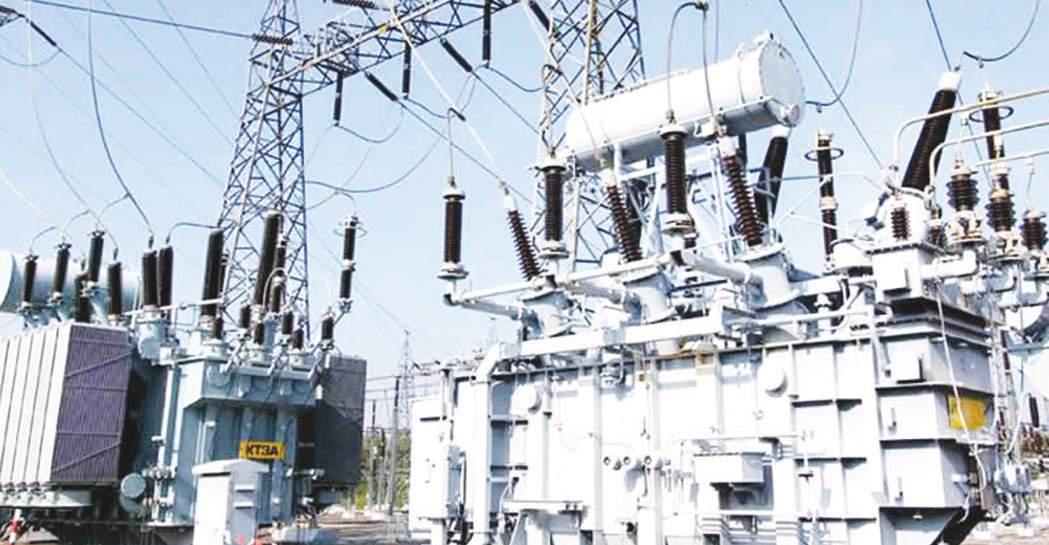
Power: Can States Deliver Where the Centre Failed?
Nigeria’s electricity reform has handed power to the states, but without capacity, funding, and coordination, the promise of light could easily deepen the shadows, writes Festus Akanbi
Nigeria’s electricity sector is undergoing one of its most consequential reforms in decades.
With 15 states now assuming regulatory authority over their intra-state electricity markets under the Electricity Act 2023, the country is shifting from a highly centralised system to a more decentralised structure.
This transition, coordinated by the Nigerian Electricity Regulatory Commission (NERC), represents a deliberate attempt to bring governance closer to consumers, encourage investment, and address long-standing inefficiencies that have crippled power supply.
Under the new framework, states may establish State Electricity Regulators (SERs), which now oversee licensing, tariff setting, investment promotion, and consumer protection within their jurisdictions. NERC retains authority over interstate electricity activities such as generation, transmission, and multi-state distribution, but the operational emphasis is gradually shifting to subnational governments. We expect localised control to enable policies that reflect economic realities on the ground, thereby accelerating market development and improving service delivery.
However, industry observers caution that the success of this reform will depend less on the legal framework and more on three critical factors: the technical capacity of state regulators, effective policy coordination, and the maintenance of consistent standards nationwide.
Analysts say the first and most immediate challenge is technical capacity. Electricity regulation is a highly specialised function requiring expertise in engineering, economics, finance, and law. Many states currently lack the depth of human resources needed to perform these roles effectively. Experts argue that establishing a regulatory body is not simply about creating an institution; it involves building a system capable of designing tariffs, enforcing compliance, managing disputes, and ensuring market stability.
Legal and industry experts stress that states must undertake detailed planning before assuming regulatory control. This includes conducting power audits, developing policy frameworks, and investing in human capital. Without these steps, regulatory autonomy risks becoming superficial.
As Ayodele Oni of Bloomfield Law notes, states must carefully consider infrastructure, personnel, and regulatory frameworks before taking on such responsibilities.
This capacity gap helps explain why, despite 15 states completing the transition process, only a fraction are fully operational. The six-month transition window required by NERC has proven insufficient for many states to build functional systems.
Closely tied to capacity is financial capability. Electricity markets are capitalintensive, and state governments already face significant fiscal constraints. Analysts argue that regulatory autonomy comes with financial obligations that many states are not prepared to meet.
These include funding regulatory agencies, supporting infrastructure development, and potentially subsidising electricity tariffs.
A key concern is the sustainability of tariffs. If the federal government reduces or withdraws subsidies, states may be forced to adopt cost-reflective tariffs or absorb the subsidy burden themselves. Both options carry risks.
Higher tariffs could trigger political resistance and reduce consumer affordability, while subsidies could strain state finances.
Israel Ijie, a power-sector analyst, notes that this dilemma is one reason many states are proceeding cautiously.
Kola Adesina of Sahara Power Group raises an even broader concern: most states lack the financial capacity to build and maintain electricity infrastructure. Without adequate resources, decentralisation could replicate inefficiencies at multiple levels rather than resolve them.
The financial challenge is compounded by the structural weaknesses of Nigeria’s electricity sector. The industry is burdened by a significant liquidity crisis, driven by poor revenue collection and a large circular debt.
In such an environment, attracting private investment becomes difficult, regardless of whether regulation is centralised or decentralised. Investors require assurance that tariffs are cost-reflective, policies are stable, and revenues are recoverable.
This brings into focus the third major issue: policy coordination. Electricity systems are inherently interconnected, and decisions taken at the state level can have broader implications for the national grid. While the Electricity Act clearly defines the roles of federal and state regulators, effective implementation requires continuous collaboration.
For example, embedded generation projects within a state must still interact
with transmission infrastructure regulated at the federal level. Tariff structures must also be aligned to avoid distortions that could discourage investment or create regulatory arbitrage.
Without coordination, there is a risk of fragmentation, where different states adopt conflicting policies that undermine the coherence of the national electricity market.
Industry watchers warn that such fragmentation could deter investment. Investors prefer stable and predictable regulatory environments. A patchwork of varying state regulations could increase uncertainty and raise the cost of doing business. This is why policy consistency is widely seen as essential for the success of the reform.
Another critical factor is maintaining consistent technical and regulatory standards. Electricity systems depend on uniform standards for safety, reliability, and interoperability.
As states take on greater regulatory roles, ensuring compliance with these standards becomes more complex.
Federal agencies such as the Nigeria Electricity Management Services Agency (NEMSA) continue to enforce technical standards, but coordination with state regulators will be crucial.
Weak enforcement at the state level could lead to the proliferation of substandard infrastructure, increased system losses, and safety risks.
The cautious approach adopted by many states reflects an awareness of these challenges. The Electricity Act is designed to be permissive rather than mandatory, allowing states to opt in when they are ready. This flexibility has slowed the pace of adoption but may ultimately strengthen the reform by preventing premature transitions.
Early adopters such as Lagos and Enugu are effectively serving as pilot cases. Their
experiences will provide valuable lessons for other states, particularly in areas such as tariff design, investor engagement, and regulatory enforcement.
This gradual approach aligns with international best practices, where decentralisation is often implemented in phases to allow for learning and adjustment.
Despite the challenges, the potential benefits of decentralisation remain significant. By bringing regulation closer to consumers, states may be better positioned to address local issues such as metering gaps, distribution inefficiencies, and access to off-grid solutions.
The reform also creates opportunities for subnational governments to attract investment in renewable energy and mini-grid projects, which are critical for expanding electricity access in underserved areas.
However, these benefits will not materialise automatically. They depend on states’ ability to build credible institutions, implement sound policies, and maintain investor confidence. Without these elements, decentralisation could fall short of its objectives.
In the final analysis, the transfer of regulatory authority to 15 states is a bold experiment in restructuring Nigeria’s electricity sector. It reflects a recognition that the existing centralised model has not delivered the desired outcomes. But the reform’s success will depend on execution, not intent.
Technical capacity, financial strength, policy coordination, and regulatory consistency will determine whether this decentralized approach improves electricity supply or merely redistributes existing challenges. If these conditions are met, the reform could mark the beginning of a more dynamic and resilient electricity market. If not, it risks becoming another well-intentioned policy that fails to deliver meaningful change.
National Grid
www.thisdaylive.com
opinion@thisdaylive.com
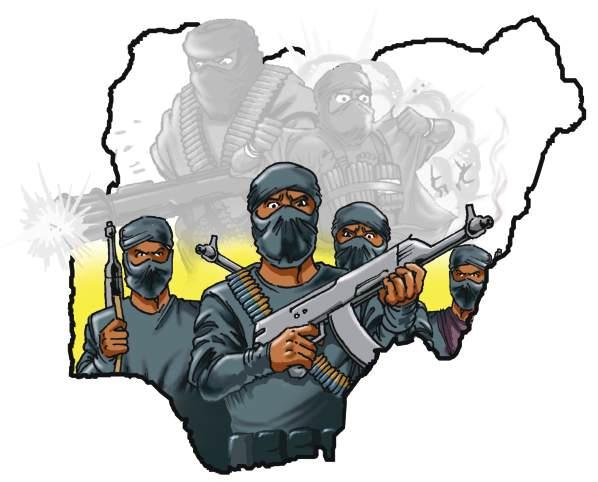
KADUNA AND POLITICISATION OF INSECURITY
Kaduna State encourages political actors to compete on ideas, not the exploitation of security challenges, writes
See Page 16
WHY OYEbAMIjI FITS OSUN’S NExT CHAPTER
Suleiman Kabiru argues that Bola Oyebamiji’s candidacy in the Osun State governorship election in August offers an alternative that speaks to governance as a structured endeavour.
See Page 16
The former Vice President, in alliance with other top brass in the ADC, is set for the final showdown, writes TUNDE OLUSUNLE
AS ATIKU RALLIES THE STORMTROOPERS
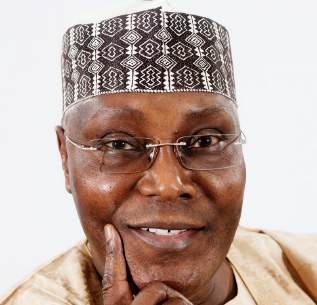
His reputation as a genial, genteel, generous gentleman precedes him. He wears calmness like second nature, barely ever betraying emotions, no matter what the apprehension or challenge is. Probably one reason he has soldiered in sprightly health towards the octogenarian rungs in a country where the average life expectancy is below 55 years. His capacity for accommodation, for doing good, is humongous, elastic. It is his DNA, maybe bolstered by the peculiar circumstances of his childhood. He has long known that people need a shoulder to lean on at some point. Within the limits of his resources, he feels an eternal obligation to intervene, to contribute to the alleviation of people’s troubles. He has suffered serial betrayal and backstabbing, but all of that have not impacted his person.
Many erroneously consider Atiku Abubakar, the first Vice President of Nigeria’s Fourth Republic, a softie because of his patriarchal disposition. Those who know him well, however, understand that he is a man of very strong convictions. He has shown time and again that we are not all bound by any law whatsoever, to lay on our couches, and train our heads and sights in the same direction when we sleep. We are entitled, as obtains in literary appreciation, to see the moon from different angles. Atiku has serially demonstrated his infinite capacity for independent thought and divergence of worldview. Indeed, he has demonstrably dissented, on issues he feels very strongly about. Political historians must not forget in a hurry, Atiku’s multiple battles in the law courts to salvage democracy and rule of law, from the grips of ultra-powerful and overbearing heads of government.
Call him a veteran of contemporary opposition politics in Nigeria and you will not be wrong. Atiku has put himself forward on a number of occasions so as to avail Nigerians an alternative leadership template. His policy document which has been regularly updated in conformity with times and trends, remains the most comprehensive, most practical and most achievable template for good governance and the realisation of the Nigerian dream for sustainable socioeconomic development. It has been suggested that Atiku was blatantly robbed of his well-earned victory at the 2019 presidential poll. A disenchanted polity did indeed vote for the alternative which the erstwhile Peoples Democratic Party, (PDP), presented in Atiku at the time, as against the flailing and floundering incumbent at the time, Muhammadu Buhari. The story of the server of the electoral umpire, the Independent National Electoral Commission, (INEC), which magically went dysfunctional when votes were being tallied and Atiku was in the clear lead, remains a blot on our electoral evolution.
The pliable agent-in-chief of the electoral body in that milieu, today lounges in the oriental comfort of a diplomatic post in the Middle East, as reward for that perfidy. Tragically, INEC’s performance has continued to dip every electoral cycle, even as larger democracies elsewhere, even in the Third
World, continue to raise the standards of inclusion and real-time transparency. The very same 2019, India, with a population of almost 1.4 billion people and 900 million registered voters, recorded a voter turnout of 67%, which means 615 million people cast their ballots in a single election. Out of 82 million registered voters, just 28.6 million, representing 35.6%, turned out for the presidential poll in Nigeria in 2019. The figures were more depressing during the 2023 elections.
Along with other patriots including former top brass of the ruling All Progressives Congress, (APC), Atiku last July led the way to a political coalition to provide a counterpoint to the establishment, on the platform of the African Democratic Congress, (ADC). It has to be very serious business for a former national chairman of the APC and a Third Republic Governor like Chief John Odigie-Oyegun, and Nigeria’s longest serving Senate President till date, Senator David Alechenu Mark, to agree to coalesce to provide an alternative to the status quo. Atiku’s running mate during the 2019 presidential election and candidate of the Labour Party, (LP), during the 2023 version, Peter Gregory Obi and erstwhile flagbearer of the New Nigeria Peoples Party, (NNPP) in the same election, Rabiu Musa Kwankwaso, have also aligned with the coalition.
Former Governors who were hitherto APC leaders like Aminu Tambuwal, Nasir El- Rufai, Rauf Aregbesola, Rotimi Amaechi; former Ministers Abubakar Malami, SAN, and Solomon Dalung, are equally members of the evolving coalition. Senators Enyinnaya Abaribe, Austin Akobundu, Ireti Kingibe, Binos Dauda Yaroe, among a dozen others, have equally pitched their tents with the ADC. There are also notable political leaders like Chief Onyema Ugochukwu; Senator Ben Obi; former Secretary to the Government of the Federation, (SGF), Babachir David Lawal and several members of the House of Representatives in the ADC train which continues to galvanise support and followership across the country. Governor Seyi Makinde of Oyo State and his Bauchi State counterpart, Bala Mohammed, are said to be in talks with the
new coalition for possible integration. Such is the moss, the momentum which the ADC has garnered in less than one year of its coming to be. In the same manner that the PDP was very obviously unsettled by the instrumentation of the state, no effort has been spared in allowing the ADC get a foothold. Malami and El Rufai have suddenly become regular guests of the anti-graft agencies. They’ve spent weeks and months between themselves, in prison cells and detention rooms, as the interrogations of their national service has suddenly taken centrestage. On the eve of its recent national convention, the ADC leadership of David Mark and Rauf Aregbesola was suddenly derecognised by INEC, plunging the party into uncertainty. Attempts by the ADC to secure a venue for its convention became more difficult than the Biblical camel passing through the eye of a needle. APC chieftain, Adamu Aliyu, didn’t mince words when he said in an interview on national television that his party was responsible for “putting sand in the garri of the ADC.” He accused the ADC of poaching his party, APC leaders such as Aregbesola, El Rufai, Amaechi, Malami.
Viewed from whichever perspective, the APC looks very grounded for the 2027 general elections. At the last tally, the party had 31 governors, (three more than the 28 which the PDP had at the height of its ascendancy in 2003), and a very overwhelming majority in both houses of the national assembly. President Bola Tinubu has made more resources available to governors to strengthen their hands in service delivery to their constituents, than his predecessors which has bought their collective loyalty. *Money na water,* as Nigerian music artist, Onyenze, said in a 2024 song. There will be money in abundance for the government to throw around for the election. Added to these is that in Nigeria’s brand of totalitarianism, the institutions kowtow to the dictates of the ruling party. It has been proferred therefore, that in the same manner that the security services and chief pollster were procured to do the bidding of the establishment in times past, they remain as amenable as ever, to the subversion of popular will.
Despite these very obvious advantages, however, there seem to be palpable unease, jitters and panic in ranks of the establishment. Which explains the multilevel bumps and roadblocks being deliberately thrown on the path of the coalescing opposition. The Kabiru Turaki, SAN, faction of the PDP recently began robust engagements with the ADC towards a workable collaboration. One of the founding fathers of the PDP and Emeritus Minister, Prof Jerry Gana; former Chairman of the PDP, Uche Secondus, and former Chairman of the Board of Trustees of the party, Senator Adolphus Wabara, attended the exploratory exchanges. Erstwhile governors of Ebonyi, Cross River and Niger states, Dr Sam Egwu, Liyel Imoke and Babangida Aliyu, as well as the Oyo State Governor, Makinde, also featured at the interaction.
Olusunle, PhD, Fellow of the Association of Nigerian Authors, (FANA), teaches Creative Writing at the University of Abuja
KaDuna anD pOLitiCisatiOn OF inseCurity
Kaduna State encourages political actors to compete on ideas, not the exploitation of security challenges, writes yesuF DantuKOr
In a decisive response to recent security breaches in parts of Kaduna State, Governor Uba Sani, swiftly convened the Kaduna State Security Council meeting at Sir Kashim Ibrahim House last Monday. The gathering provided a platform for a comprehensive review of the security landscape and building on the notable successes achieved through the administration’s innovative Kaduna Peace Model. During the meeting, the Governor issued a firm warning: all acts of politicising insecurity ahead of the 2027 general elections will not be tolerated. This stance underscores a commitment to safeguarding the hard-won gains in peace and stability.
Governor Sani’s administration has, since assuming office in 2023, invested painstaking efforts in restoring peace and security across Kaduna State. Recognising that meaningful development cannot thrive amid fear and chaos, the Governor prioritised a holistic, multi-layered approach that combines kinetic operations with robust non-kinetic strategies. Central to these efforts is the Kaduna Peace Model — a locally rooted framework anchored on inclusivity, dialogue, intelligence-led operations, community engagement, and seamless coordination among security agencies, traditional rulers, religious leaders, and grassroots stakeholders.
The model represents a paradigm shift from purely reactive responses to proactive prevention. It emphasises early threat detection, conflict resolution through dialogue rather than dominance, and equitable governance that addresses underlying drivers of tension such as ethnic and religious divides, marginalisation, and youth unemployment.
Governor Uba Sani has consistently said “the peace we are building in Kaduna is rooted in dialogue, not dominance,” fostering an environment where communities actively participate in their own security.
Key operational pillars of the administration’s security architecture include the establishment and strengthening of the Kaduna Vigilance Service (KADVS). The government recruited and trained over 7,000 personnel, equipping them with 150 security vehicles and 500 patrol motorcycles. These local operatives work in synergy with federal security forces, providing actionable grassroots intelligence that has proven instrumental in disrupting bandit networks and criminal elements. Traditional rulers and community youth groups serve as critical links, rebuilding trust and enabling rapid information flow.
Governor Uba Sani was among the first state governors to present a comprehensive internal security master plan to the National Security Adviser, the Chief of Defence Staff, and service chiefs.
This advocacy led to the establishment of additional Forward Operation Bases in vulnerable areas, enhancing operational reach and response times. Collaboration with the Nigeria Police Force ensured professional training for vigilance operatives, while inter-agency coordination has improved intelligence sharing and joint operations.
The administration also signed into law the Kaduna State Security Trust Fund Bill, creating a dedicated funding mechanism to sustain these initiatives. Non-kinetic measures have complemented these efforts, including confidence-building dialogues, reconciliation processes, and targeted empowerment programmes for at-risk youth. In some cases, olive branches were extended to repentant insurgents and hoodlums, encouraging voluntary
surrender and reintegration while reducing active threats.
These painstaking steps have yielded measurable gains, transforming Kaduna from a state once plagued by frequent banditry, kidnappings, and communal clashes into one recording significant progress in stability. The Kaduna-Abuja Expressway, previously a notorious hotspot for attacks, has seen renewed traffic as travellers ply the route with greater confidence. Farmers have returned to previously abandoned farmlands in southern Kaduna and the Birnin Gwari/ Giwa axis, boosting agricultural productivity and food security. Schools and markets in affected communities have reopened, allowing normal socio-economic activities to resume.
Under the Kaduna Peace Model, the state has shifted from a reactive posture to proactive containment of threats. Incidents of banditry have reduced considerably in many areas, with renewed public confidence evident in previously volatile zones. International partners, including the UK’s Foreign, Commonwealth & Development Office (FCDO), have reportedly adjusted Kaduna’s risk rating from “red” to “amber,” signalling improved safety for development partners and investors. The model’s emphasis on inclusivity has helped mend ethnic and religious fault lines, with non-indigenes and diverse groups commending the Governor’s equitable approach to governance and peacebuilding.
These achievements have not gone unnoticed nationally. In 2026, Uba Sani was honoured as Governor of the Year at the National Leadership Awards in recognition of his security gains, unity efforts, and people-centred leadership. Analysts and stakeholders have pointed to the Kaduna Peace Model as a potential template for other states in the North West and beyond, with the Governor himself recommending its adoption to counterparts facing similar challenges. Peace has unlocked broader development dividends: rural roads now link farmers to markets, health centres and schools have been upgraded, and economic activities, including initiatives like Nigeria’s first lithium processing plant, are gaining traction in a more stable environment. Despite these strides, recent isolated incidents of security breaches serve as a reminder that eternal vigilance is the only price for freedom. The recent Kaduna State Security Council Meeting, attended by the Minister of Defence, Gen. Christopher Gwabin Musa (rtd.), reaffirmed the synergy between state and federal governments.
Why Oyebamiji Fits Osun’s next Chapter
suLeiman Kabiru argues that Bola Oyebamiji’s candidacy in the Osun State governorship election in August offers an alternative that speaks to governance as a structured endeavour
As Osun State approaches its August 15, 2026 governorship election, the conversation is gradually shifting from personality to proposition. Elections in Nigeria have long thrived on charisma, symbolism, and emotional connection. Yet, beneath that familiar terrain, there is a quieter but increasingly persistent question: who is best equipped to manage the complexities of governance in a demanding fiscal and administrative environment?
In this evolving context, Bola Oyebamiji’s candidacy represents a distinct offering—one that prioritises structure over spectacle, systems over spontaneity, and long-term stability over shortterm political theatre.
It is not an argument rooted in dismissal of his opponent, Governor Ademola Adeleke, whose grassroots appeal and retail political strength remain formidable. Rather, it is an argument about fit: the alignment between Osun’s present needs and Oyebamiji’s particular strengths.
Oyebamiji’s trajectory does not follow the familiar arc of Nigerian political ascendancy. There are no dramatic moments of sudden emergence or populist breakthroughs. Instead, his profile has been built incrementally, through years of engagement in both private enterprise and public administration.
With nearly three decades in the financial sector, he brings to politics a mindset shaped by discipline, risk assessment, and institutional thinking. His transition into public service, particularly as Commissioner for Finance in Osun State, did not mark a departure from those principles—it reinforced them.
At a time when Osun faced significant fiscal constraints, governance was less about expansion and more about survival. Decisions taken during that period were undeniably difficult and, in some cases, unpopular. Yet they reflected a governing philosophy anchored in sustainability rather than expediency. That distinction matters.
It would be incomplete to discuss Oyebamiji’s candidacywithoutacknowledgingthecontroversies associated with his time in government, particularly the half-salary policy. That period remains a sensitive chapter in Osun’s political memory.
However, elections are not only about revisiting past decisions; they are also about interpreting them. The question is not merely what was done, but under what circumstances and with what intent. Oyebamiji’s defenders argue that those measures were taken within a context of severe fiscal limitation, where the alternatives may have been far more damaging. The argument does not seek to erase the hardship experienced by citizens, but to frame those decisions as constrained choices rather than acts of indifference.
For voters, this introduces a more nuanced evaluation: whether difficult decisions made under pressure can be seen as evidence of capacity rather than liability.
Oyebamiji’s subsequent role at the National Inland Waterways Authority (NIWA) expanded his administrative scope beyond Osun. In that position, he engaged with issues that extend into infrastructure development, regulatory oversight, and economic diversification.
His tenure coincided with increased attention to inland waterways as viable economic corridors, alongside renewed emphasis on safety standards and institutional reform. This exposure places him within a broader governance framework, one that connects local administration to national policy and global best practices.
In political terms, such experience enhances credibility. It suggests familiarity not only with statelevel challenges but also with the larger ecosystem in which those challenges exist.
One of the defining features of Oyebamiji’s candidacy is his alignment with the presidency. Within the South West’s political structure, such alignment is rarely insignificant.
It offers potential advantages in coordination, policy continuity, and access to federal resources. It also strengthens the argument for synergy between state and national governments, a factor often cited as critical for development.
At the same time, this alignment is not without
its criticisms. Opponents are likely to frame it as undue influence or an attempt to shape Osun’s political direction from outside the state. Yet this critique must contend with another reality: Oyebamiji is not an external imposition. He is deeply rooted in Osun’s political and social landscape, with longstanding ties that predate his current ambition.
The issue, therefore, is not whether he belongs, but whether his alignment enhances or complicates his ability to govern effectively. Oyebamiji’s campaign messaging reflects his background. It emphasises productivity, accountability, and structured governance. His proposals—focused on agriculture, education, healthcare, and infrastructure—are framed within a broader narrative of efficiency and long-term planning.
This approach contrasts with more personality-driven campaigns. It asks voters to consider governance as a process rather than a performance. Such a message can be challenging in a political culture that often rewards immediacy and visibility. However, it also aligns with a growing awareness among voters of the limitations of governance that prioritises optics over outcomes.
At its core, the argument for Oyebamiji rests on readiness.
His supporters present him as a candidate who understands the mechanics of governance, who has operated within both constrained and expansive systems, and who approaches leadership with a focus on sustainability. This does not negate the achievements or appeal of the incumbent. Rather, it introduces a different metric for evaluation—one that prioritises administrative depth and strategic thinking. Across Nigeria, there are subtle indications of a shift in voter expectations. While charisma and narrative remain influential, there is increasing attention to performance and delivery. This shift is neither uniform nor complete. It coexists with traditional political dynamics. Yet it creates space for candidates whose appeal lies in competence rather than charisma alone.
Oyebamiji’s candidacy appears calibrated to this moment. It offers an alternative that speaks to governance as a structured endeavour. Ultimately, elections are not decided by profiles alone. They are shaped by perception, organisation, and the complex interplay of voter sentiment.
Governor Adeleke retains significant advantages, including incumbency and strong grassroots connection. These are not easily discounted. However, Oyebamiji introduces a compelling counter-narrative— one that emphasises stability, alignment, and institutional capacity.
His case is further helped by the polarised opposition. There is the Peoples Democratic Party, PDP; and the Africa Democratic Congress, ADC. Every vote for both parties are a subtraction from Adeleke’s Accord. And it would be significant.
Kabiru is a management consultant based in Osogbo, Osun State
Dantukor writes from Jabi, Abuja
Editor, Editorial Page PETER ISHAKA
Email peter.ishaka@thisdaylive.com
THE CRISIS OF NATIONAL SECURITY
Five months after President Bola Tinubu declared a national security emergency, stating in his broadcast that “There will be no more hiding places for agents of evil,” it would seem the ‘agents’ have metastasised, wreaking havoc all over the country. In the month of March 2026 alone, Boko Haram and the Islamic State West Africa Province (ISWAP) carried out sporadic and coordinated attacks in Ngoshe, Konduga, Marte, Jakana, Minok, Kukawa, Damboa, Mallam Fatori and Buratai within Borno and Yobe States in the Northeast, leading to the killings of several civilians and military personnel, including top commanders. In the Northwest, bandits have also intensified attacks across Zamfara, Katsina and Kebbi States, sacking villages, and abducting innocent residents.
The Armed Forces must be well provided for to prosecute the war
As things stand, the president may need to take direct command and control. That may require a direct engagement with the men on the field to understand their requirements and take extraordinary steps to properly fund the war.
The picture is not too different in some parts of Niger and Kwara States in North Central where people have fled communities for fear of attacks and abduction. All these have prompted many Nigerians to ponder whether the authorities have lost steam in the war against insurgency and banditry. In the latest incident on 9 April, the insurgents attacked the location of 29 Task Force Brigade in Benisheik and later Ngamdi, both along the Maiduguri-Damaturu Road, killing some soldiers and razing down the brigade location after carting away arms and ammunition. They also killed the army brigade commander, Brigadier General Oseni Braimah.
President Tinubu should make national security the guiding principle of a new resolve. Without a secure nation, politics and elections have no meaning
The essence of this is to enable the president to have a clear understanding of where military efforts sit in the overall resolution of the crisis and the harmony with other issues bordering on governance, cooperation with neighbouring countries, and galvanising a whole of society approach to the crisis. More importantly, it will help untie the web around funding requests to meet military operational requirements which, as constantly advocated, goes beyond normal budgetary considerations. What media reports of military leaders having to lurk around ministers and heads of agencies in Abuja to virtually plead for funds suggest a dangerous gap in prosecuting the war.
These recent attacks indicate that the country has probably reached a tipping point in this war, and it is time for the political leadership to look beyond the usual or routine management and take extraordinary steps to stem the ugly tide. The inference by Senate President Godswill Akpabio that the killings are because of the 2027 general election is not supported by any empirical evidence. Besides, making political excuses cannot be the solution to a serious national security challenge.
When the president declared emergency in the security sector last November, we raised questions about whether the measures announced were far reaching enough. We also noted the mixed messages and incoherence with senior government officials saying different things depending on their audience.
SUNDAY NEWSPAPER
editor DAvIDSoN IRIekPeN
deputy editors FeSTUS AkANBI, eJIoFoR ALIke
Managing director eNIoLA BeLLo
deputy Managing director ISRAeL IwegBU
chairMan editorial Board oLUSegUN ADeNIYI
editor nation s capital IYoBoSA UwUgIAReN the oMBudsMan kAYoDe koMoLAFe
THISDAY NEWSPAPERS LIMITED
editor-in-chief/chairMan NDUkA oBAIgBeNA
group executive directors eNIoLA BeLLo, kAYoDe koMoLAFe, ISRAeL IwegBU divisional directors SHAkA MoMoDU, PeTeR IwegBU ANTHoNY ogeDeNgBe
deputy divisional director oJogUN vICToR DANBoYI snr. associate director eRIC oJeH
associate director PATRICk eIMIUHI controllers ABIMBoLA TAIwo UCHeNNA DIBIAgwU, NDUkA MoSeRI director, printing production CHUkS oNwUDINJo to send eMail: first name.surname@thisdaylive.com
Letters to the Editor
Indeed, from the comments of some soldiers out there in the Northeast theatre as often read on social media, one could establish a largely ill-motivated force. When soldiers keep using the same old and unreliable weapons or assume that the adversary have superior weapons, this can erode their enthusiasm. The catalyst to getting rid of this feeling is to inject new and modern weapons in substantial quantity into the theatre. We have seen this work in the past with the acquisition and deployment of some sizeable number of the Russian made T72 tanks in 2014. These vehicles played a substantial role in the clearing of occupied communities that enabled the 2015 general election to hold.
Of all the responsibilities heaped on the president by the constitution, that of Commander-in-Chief of the armed forces is the most overarching. The survival of the political edifice of the Nigerian state overrides everything else. The criminals who are contesting the legitimacy of the Nigerian State pose an existential threat. To that extent, resource allocation to national defense and security should override all other budget allocations. President Tinubu should make national security the guiding principle of a new resolve. Without a secure nation, politics and elections have no meaning.
That is the defining lesson of this moment.
Letters in response to specific publications in THISDAY should be brief(150-200 words) and straight to the point. Interested readers may send such letters along with their contact details to opinion@thisdaylive.com. we also welcome comments and opinions on topical local, national and international issues provided they are well-written and should also not be longer than (950- 1000 words). They should be sent to opinion@thisdaylive. com along with the email address and phone numbers of the writer
LETTERS
2027 ELECTIONS AS DEFINING MOMENT FOR WOMEN AND YOUTH
As political activities gradually intensify ahead of the 2027 general elections, Nigeria once again finds itself at a familiar crossroads. The atmosphere is already charged, with permutations, alliances, and quiet calculations shaping what promises to be another decisive electoral cycle. Yet beyond the noise of political maneuvering lies a more pressing question: who truly gets to participate in shaping the nation’s future?
For years, women have remained significantly underrepresented in public offices across the federation. Despite their numerical strength and contributions to national development, their presence in governance structures continues to lag behind expectations. This imbalance raises concerns about inclusivity and fairness in a democratic system that should reflect the diversity of its people.
Nowhere is this disparity more evident than in the National Assembly and the various state houses of assembly. Only a handful of women
occupy seats in these institutions, a situation that stands in stark contrast to the widely advocated 30 percent affirmative action target. The gap between policy aspirations and political reality remains wide, underscoring systemic barriers that have yet to be dismantled.
A similar pattern can be observed among youths and younger generations. Despite their energy, creativity, and numerical dominance, many young Nigerians have largely ceded the political stage to older, more established figures. Instead of stepping forward as contenders, a significant number settle into supporting roles, often serving as aides or personal assistants to career politicians.
This reluctance is not without cause. One of the most significant barriers to entry is the prohibitive cost of nomination forms imposed by political parties. These fees, which are sometimes arbitrarily increased, effectively shut out capable individuals who lack the financial
backing to compete. Such practices not only discourage participation but also undermine the democratic principle of equal opportunity.
It is difficult to ignore the implication of these trends. When political participation is restricted by financial hurdles and entrenched interests, the system becomes less representative and more exclusionary. The deliberate or indirect sidelining of women and young people is both unfortunate and detrimental to national progress, and it is a practice that deserves unequivocal condemnation.
Political parties, as gatekeepers of the electoral process, have a responsibility to reverse this trend. Rather than erecting barriers, they should actively create pathways for inclusion by reducing costs and providing support structures for aspiring candidates. Encouraging women and young people with innovative ideas to seek elective positions would not only strengthen democracy but
also inject fresh perspectives into governance. At the same time, Nigerian women and youths must recognize the urgency of the moment. Waiting for opportunities to be handed down is no longer a viable strategy. Across party lines, there must be deliberate mobilization and a conscious effort to contest for positions in the 2027 general elections. Participation must move beyond support roles to active engagement in leadership. Ultimately, political power is never given freely; it is contested and secured through determination and collective action. Women and the younger generation must embrace this reality if they are to remain relevant in Nigeria’s evolving political landscape. The 2027 elections present not just another routine exercise, but a critical opportunity to redefine participation and reshape the future of the nation.
Tochukwu Jimo Obi, Obosi, Anambra State
A l egend of l ifestyle
For a trained lawyer like Abubakar Tafawa-Balewa, to push back ‘the bar and the bench’ means pitching new tents with famed luxury brands and creating a blueprint for male fashion and style appreciation. This unapologetic globetrotter, in a virtual encounter with Yinka Olatunbosun, peels off some layers of history to reveal the persona with the name that certainly chimes.
Being casual is not the problem, carelessness is
Before he was called to the Nigerian Bar in 2004, Abubakar Tafawa-Balewa enjoyed a decent upbringing that prepared him for life, leadership and the courage to make hard choices. Every summer was a dream and thankfully, it came with the perk of his birthday celebration.
“Growing up was genuinely fun,” he began, excitedly. “Every summer we travelled to new destinations. There was a warmth and intentionality to how my parents raised us that I carry with me to this day. But beyond the experiences, it was the values instilled early that shaped everything. My parents taught me the importance of hard work and the importance of keeping the family name which is something that I’ve always lived by.”
Abubakar who hails from Bauchi state is the son of a career diplomat and a businesswoman of Yoruba origin who was a former Miss Nigeria. He had his early primary education in Blackpool, England before returning to Nigeria to spend a year at St. Jude’s Private School. For his parents, it was crucial for him to adapt to the Nigerian schooling system before proceeding to the Nigerian Military School after which he attended the Prestigious Ahmadu Bello University and obtained a degree in Law.
Looking back at his years in the military school, his name didn’t get him preferential treatment. Instead, the school shaped his character and reinforced values he still lives by.
“The Nigerian Military School (NMS) was the making of me,” he recounted. “It was demanding and unrelenting. It stripped away everything superficial and built something solid underneath. The discipline I carry today, the way I approach work, the way I hold myself in a room, that school is responsible for a great deal of it.
“As for my name, it was like any other at NMS. That is the beauty of that institution. You could be the son of a former president, a minister, a governor and none of it earned you special treatment. We were all equal under that uniform. If anything, it taught me early that a name is only as powerful as the character behind it.”
Adding to this background, he proceeded to work with Libra Law under the mentorship of Mrs Hairat Balogun, the former Attorney General of Lagos State and Mr. Afolabi Balogun before leaving practice to establish MODE MEN Magazine in 2006. After building the brand for 20 years, he grew into a household, establishing himself as a luxury brand consultant working with brands like Tom Ford, Fendi, Armani and Givenchy in Nigeria for various launches.
But did he ever miss the legal practice and the edge-of-the-seat feeling that litigation sometimes brings? He paused and said: “The law gave me structure and rigour and I am grateful for that foundation. But there was a desire that practice could not satisfy. Nigerian men had no magazine that truly spoke to them, their ambition, their style, their complexity. Not a pale imitation of something Western, but something authentically ours. So, I made a decision. In 2006, I walked towards the thing that would not leave me alone. MODEMEN was the result.”
Despite digital intrusion, his magazine survives. He moved away from focusing on periodic publishing to continuous engagement. He explained that distribution is still a challenge for print magazines.
“While funding and advertising are also challenges facing print, I strongly believe that with lifestyle publications, there will always be a market.”
With role models such as General Buba Marwa, Barack Obama, Chief Chukwuemeka Chikelu, Ralph Lauren, and Tom Ford, his taste was built around a variety of principles including integrity, discipline, and grace under pressure.
“What Ralph Lauren and Tom Ford did transcends fashion. Ralph took a vision of effortless elegance and turned it into one of the most recognisable brands on the planet. Tom walked into Gucci when it was on its knees and made it the most talked-about house in the world.”
Circling back to his Nigerian heritage, Abubakar recalled his favourite edition of
his magazine without revealing too much about his identity.
“The ‘FOUNDING FATHERS’ edition which celebrated Nigeria at 50 featured the grandson of Chief Obafemi Awolowo, Nnamdi Azikwe’s son and Sardauna’s grandson. It was an epic edition.”
Despite being an icon of his own rights, Abubakar doesn’t believe in being fashionably late.
“Punctuality reflects respect. Presence is defined by value, not timing. I went to school in England at an early age and also went to the Nigerian Military School. You must be at an appointment 10 to 15 minutes ahead.”
As a frequent traveller, he has some essentials he wouldn’t travel without. Apart from books, journals for notes, medication and vitamins, Abubakar shows his affable side with other travel must-haves.
“My headphones,” he said, mentioning a specific brand “the moment they go on, the world outside ceases to exist. And a well-cut blazer and a caftan, just in case an occasion comes up.”
Abubakar’s personal style is refined and understated. He always loves it clean, well-tailored, and effortless. Though a bit of a conservative, he holds on to the mantra: ‘dress as you want to be addressed.’ While his sense of style is admirable, it was noteworthy to talk about how markedly different it is from today’s casual attitude to dressing especially with the Gen-Zs.
“Working from home is part of it, but I think it goes deeper than that. This generation grew up being told to challenge every convention and dressing down became a form of self-expression, even rebellion. Social media accelerated it further; streetwear and casual aesthetics dominate the algorithm, so that is what young people see celebrated daily.
“But I will say this, being casual is not the problem. Carelessness is. There is a difference between a young man who wears a well-fitted agbada to a wedding and one who shows up in a wrinkled shirt because he simply did not try. What we are losing is intentionality. The understanding that how you present yourself signals how seriously you take the room you are walking into. That is what MODE MEN has always tried to teach, not that you must wear a suit, but that you must be deliberate.”
The conversation lingered a little on the palpable global cultural shift towards Nigerian traditional wear, especially in inter-racial weddings. Abubakar argued that Afrobeats played a pivotal role in this phenomenon.
“Afrobeats opened the door. When Nigerian music conquered global stages, it brought Nigerian aesthetics with it; the colours, the fabrics, the ceremony. Suddenly, the world wanted to know what we wear, how we celebrate, and what we look like when we are fully ourselves. Inter-racial couples began choosing Nigerian traditional attire not out of novelty but out of genuine reverence for the richness of the culture.”
It’s gratifying for him to see a growing confidence in homegrown African brands, as they coexist with global labels.
“The economic opportunity here is enormous and largely untapped,” he argued. “We are talking about a global market hungry for authentic Nigerian craftsmanship; aso-oke weavers in Iseyin, adire artisans in Abeokuta, master tailors in Lagos and Abuja who can construct a grand boubou that rivals anything on a Paris runway. What we need is structure: intellectual property protection for our textile traditions, government investmentinourfashionindustryasaculturalexport, the diaspora alone represents a multi-billion naira market waiting to be properly served.”
For Abubakar, each day is unique. But typically, his schedule is a mix of editorial planning, meetings, and strategy. Some days, it’s a photoshoot followed by a gala.
But generally, he believes in simplicity alongside authenticity.
“Simplicity always works. Know what suits you, invest in quality, and avoid chasing trends. With lifestyle publications generally, my philosophy is ‘do unto others as you want done unto you’. And as I’ve gotten older (and a little wiser), I’ve learnt that ‘we are all different, learn to tolerate others; Each person is influenced by their upbringing and circumstances.”
Tafawa-Balewa
The burden of explaining his name is perhaps Abubakar’s lifelong task. By working hard to earn his own name and gaining access to places that still exist only in people’s dreams, he has proven himself not as a silhouette in Nigeria’s history, but a game changer in the lifestyle orbit.
“It is something I acknowledge with respect, given the historical significance of the name. However, I see it more as a reminder of responsibility than identity. Ultimately, every individual must define their own path. For me, it has always been about building something meaningful and contributing in my own way.”
with KAYoDe ALFreD 08116759807, E-mail:
Taiwo Afolabi and the Art of Keeping Wealth in
the Bloodline
For many Nigerians, wealth is something individuals build and eventually step away from. For Taiwo Afolabi, it appears structured differently. Here one finds a business that is not only a company but a system designed to remain within reach of those who understand it best. That system came into clearer view when his son, Damilola Afolabi (widely known as the singer L.A.X), was appointed Executive Director at SIFAX Logistics. The announcement coincided with L.A.X’s 33rd birthday, turning a personal milestone into a formal entry into corporate authority.
To understand the weight of that decision, it helps to know that SIFAX Group operates across shipping, ports, aviation, and hospitality, including major activities at Tin Can Island Port. It sits close to the flow of goods that sustain Nigeria’s economy.
Placing a family member within that structure is not random. Logistics is the core engine of the business, less visible than hotels or airlines but far more critical. Control over that segment means influence over the direction, stability, and long-term survival of the entire enterprise.
What stands out in this case is the dual identity of the new executive. Before this move, L.A.X built a music career, working with mainstream figures and developing a wide audience. With this transition in view, it can only be concluded that there has been preparation happening outside public view, beyond the stage and headlines.
This pattern is not unique. Across Nigeria, families like those of Aliko Dangote and Femi Otedola have integrated their children into key roles, clearly favouring the logic of trust remaining highest where ownership and responsibility are shared by blood.
When others are questioned on this front, the typical response is that choosing kin reduces uncertainty; it keeps decisionmaking within a small circle and ensures that those managing critical assets have a personal stake in outcomes. Plus, partners and investors see it as meaning continuity beyond the founder’s active years.
So, at its core, Afolabi’s strategy reflects a long-term view of power. The business is built to last, and the family is positioned to carry it forward.
...Amazing
lifestyles of Nigeria’s rich and famous
What’s Aiyedatiwa Doing about Incessant Kidnappings and Killings in Ondo?
Ondo State is under pressure as kidnappings and killings spread across communities. Residents now live with daily fear. Attacks are constantly being reported on highways, farms, and within towns, disrupting movement and weakening confidence in basic security across the state. The word from observers is that such activities only happen at such frequencies and intensities when the government is asleep.
Ondo’s situation is terrible, so much so that ordinary families are facing direct impact. Victims are abducted and held for ransom, forcing prolonged negotiations. Plus, many households struggle to make payments. The emotional strain is severe, and in some cases, victims do not return, which only serves to deepen fear across affected communities.
Killings have also increased. Farmers, traders, and commuters now avoid certain routes. In places like Akure North, Owo, and the Akoko axis, repeated attacks have reduced activity, resulting in local economies
slowing as people limit travel and abandon farmland.
A major incident was the killing of traditional ruler Oba Kehinde Falodun in his palace. That attack was proof that even high-profile individuals are not protected from the grasp of this evil, further raising concerns about the reach and boldness of criminal groups
Public reaction has intensified. Youths and community groups have staged protests, including blocking major roads such as the AkureOwo highway, demanding stronger protection and visible leadership from the governor, Lucky Aiyedatiwa. From his quarters, supporters insist that the governor and his government are not inactive.
Officials cite arrests of over 100 suspects, expansion of the Amotekun Corps, and new security posts. Laws have been strengthened, including the introduction of the death penalty for kidnapping.
Notwithstanding, the gap between official statements and daily experience continues to
be wider. Many residents say they do not feel safer, even with the policy announcements being blasted from every radio and TV. Unless there are visible results to show that security is improving, the pressure on Aiyedatiwa’s government will continue to rise.
Royal Prospects Brighten as Abimbola Onabanjo Meets President Tinubu
When the president, Bola Tinubu, received Abimbola Onabanjo at his Lagos residence on April 11, 2026, it was officially
described as a routine courtesy visit. The discussion focused on national development. On the surface, it looked like a standard meeting between a political leader and a private citizen. But context is king.
You would think that Onabanjo is just a businessman—he is not. He is a prominent prince from Ijebuland and a leading contender for the Awujale throne. That stool is one of the most influential traditional positions in southwestern Nigeria, with real political and social weight.
The Awujale seat has been vacant since the passing of Oba Sikiru Adetona in 2025, and the selection process is still sensitive, with petitions and state involvement slowing decisions. In that environment, access to the President carries its own signal.
For many in Ijebu Ode, this meeting is being read as recognition at the highest level.
Mike Adenuga at 73: A Patriarch of Prosperity, Crowned in Enduring Legacy
At 73, Mike Adenuga stands as one of Nigeria’s most consequential business figures, though he rarely seeks attention. His influence runs through systems that people use daily, from mobile networks to fuel distribution, often without direct visibility.
Born in 1953, Adenuga built his foundation through persistence rather than inheritance. As a student in the United States, he worked multiple jobs to fund his education, a detail that explains his later discipline in business decisions and long-term investments.
His defining breakthrough came with Globacom, which changed how Nigerians paid for mobile calls by introducing per-second billing. This move forced competitors to adjust and expand access to communication across income levels, especially for ordinary users.
Beyond telecoms, his company Conoil Producing marked a turning point in Nigeria’s
It does not confirm anything formally, but it places Onabanjo within a circle of relevance that goes beyond local influence. In simple terms, it shows he is being taken seriously.
His profile supports that perception. Often called the “Builder Prince,” Onabanjo has funded road projects and community development efforts in Ijebu Ode. He runs businesses across sectors, including oil and gas and financial services. This mix of local impact and corporate exposure strengthens his case.
There is also a broader political layer. Traditional rulers in Ogun State do not operate in isolation. They shape alliances, influence decisions, and act as stabilising figures. A candidate who can connect both palace and presidency becomes more valuable in that system.
Still, the process is not political in the usual sense. Kingmakers, customs, and legal frameworks determine the final outcome. Even Onabanjo has urged patience, knowing that visibility may open doors, but it does not close the race.
energy sector. It became the first indigenous firm to discover oil in commercial quantities, shifting part of the industry’s control away from foreign dominance.
Adenuga’s style is defined by restraint. He avoids frequent public appearances and rarely grants interviews, yet his decisions carry weight across sectors.
His philanthropy follows the same pattern. Through the Mike Adenuga Foundation, he has funded healthcare support, disaster relief, and cultural institutions such as Alliance Française in Lagos.
Recognition has come from both Nigeria and abroad. He holds the Grand Commander of the Order of the Niger and France’s Legion of Honour, reflecting how his business footprint extends beyond national borders into broader economic and cultural influence.
At 73, Adenuga’s legacy rests less on
personal narrative and more on systems that continue to function. His career suggests that scale, when combined with discipline, can shape entire sectors without demanding constant attention.
A Slip or Signal? Oyegun’s APC Chant Sparks Confusion at ADC’s Convention
At a political gathering meant to project unity, words did the opposite. This incident involved the man currently chairing the Policy and Programme Committee of the African Democratic Congress (ADC): John Odigie-Oyegun. He stepped up to the podium at the ADC convention and opened with a loud “APC.” The hall reacted before he even finished the sentence.
Odigie-Oyegun corrected himself almost immediately. “No, no, no… did I say APC? The devil is a liar,” he said, drawing laughter and scattered applause. Then came a lighter line about needing something strong to clear his system of the old party
name. The room moved on quickly, but the moment did not.
Readers may remember that Oyegun once chaired the APC at its founding stage, a role that made the slip easy to understand for some attendees. Others read more into it, treating it as a political message hiding inside an error.
The reaction split along familiar lines. One view called it a habit. Old names tend to surface when political memory runs deep. Another view treated it with suspicion, pointing to shifting loyalties in Nigeria’s party system, where movement between platforms is common and often strategic.
It pays to remember that Oyegun’s current ADC role is a position tied to the party’s broader ambition heading into the
next election cycle. And though his message at the event still focused on governance and criticism of current leadership, the chant became the headline, raising questions about discipline in a new political home, especially for figures with long histories in rival parties. Which is to be expected because in Nigerian politics, even a single word can sit under inspection longer than an entire speech. For now, the ADC has not issued any formal comment on the moment. The party continues its convention agenda, while the clip of the chant circulates with the usual mix of jokes, analysis, and suspicion that follows political missteps in Abuja and beyond.
onabanjo
Aiyedatiwa
oyegun
Afolabi
Adenuga
Mohammed Babangida’s work at the Bank of Agriculture (BOA) continues to draw attention for a simple reason: he stays out of the way while the institution moves. Since July 2025, the man has chaired the bank,
Mohammed Babangida: A Private Man in a Public Role
which anchors Nigeria’s rural finance and food security agenda. His role has taken shape in quiet steps rather than public displays.
The first change came from how the bank makes decisions. Babangida constituted a full board with representation across all six geopolitical zones. That adjustment tightened internal coordination and reduced delays in approvals that had slowed operations in earlier years.
Work then shifted to delivery programmes. The Renewed Hope National Agricultural Mechanisation Programme became a key channel for distributing tractors and equipment to young farmers. The rollout passed through formal structures inside the bank, with little emphasis on public visibility around individual leadership.
Babangida’s background helps explain this method. He studied business administration and public relations in Switzerland and later completed corporate governance training at Harvard Business School. Before joining public service, he worked in real estate and education, including executive roles at El-Amin
From Unity to Rivalry: Yusuf Challenges Ganduje’s Influence Over Kano APC Leadership
In Kano politics today, the reigning question is about who controls the structure of the ruling party. Abba Yusuf has answered that question in direct and definite terms: he says the authority rests with him.
Yusuf’s position follows his move into the All Progressives Congress (APC), a shift that immediately changed the balance within the state. For many observers, joining the ruling party at the centre strengthens a governor’s leverage. Yusuf has leaned into that advantage without hesitation.
The challenge comes from Abdullahi Ganduje, who built and managed the party structure in Kano for years. Even without his former national role, Ganduje’s network is still very intact, as evidenced by how party loyalists still look to him for direction, especially on internal decisions.
Yusuf’s argument rests on a basic political principle in Nigeria: incumbency carries
weight. As a sitting governor, he controls state machinery, influences appointments, and shapes local alliances. In practical terms, that means leadership of the party within the state.
But when did party structure start to disappear when leadership changed? Ganduje’s camp still holds influence among stakeholders, including figures who determine candidate selection and internal negotiations. This creates a situation where authority exists in two places at once.
The tension is already showing in important decisions, such as who fills strategic positions and who speaks for the party. These are not minor disagreements. They affect how the party prepares for elections and how power is distributed among loyalists.
Yusuf frames his move as a step to stabilise politics in Kano after internal disputes elsewhere. His critics interpret this move differently, seeing a calculated attempt to take control of an existing
International Schools and the Profile Group.
Within BOA, communication stays controlled. Babangida does not maintain a personal verified social media presence. Updates come through official statements, keeping attention on institutional actions rather than personal positioning. Internal meetings and formal memos carry most of the decision flow.
Outside BOA, Babangida’s presence continues to be selective. At family-related events, such as the launch of his father’s autobiography, he appears in a supporting role. Those moments place him within a long public lineage without shifting focus toward personal branding.
Readers might recall that Babangida’s appointment was briefly questioned after a false report claimed he had turned it down. The claim was later corrected through an official statement. Then, work inside the institution continued without disruption. After almost a year, the emphasis has stayed on building systems that function with minimal noise and steady output.
structure. Both views point to the same reality: control of the party is now contested.
What this means going forward is straightforward. Kano APC is no longer a single bloc with a clear chain of command. Instead, it is a shared space where influence must be negotiated, asserted, and defended.
NRS Headquarters: A Bold Legacy Move that Leaves Critics Muted
The unveiling of the Nigeria Revenue Service headquarters in Abuja places Zacch
firmly within the conversation on institutional reform. The project, delivered after more than two decades of delay, signals administrative follow-through in a system often slowed by stalled execution.
Located in the Central Business District,
the facility sits on Kur Mohammed Avenue as a three-tower structure designed to accommodate about 3,000 personnel. Its scale is evident, yet its purpose remains straightforward: to house a unified and more coordinated tax administration system.
Inside, the design prioritises order. Entry points are clearly separated for staff and visitors, supported by strict identification procedures.
Movement across the building follows a controlled flow, backed by layered security and monitored access, limiting congestion and reducing operational friction.
Workspaces reflect a structured environment. Offices are arranged for functionality, with shared areas such as meeting rooms, quiet spaces, and staff lounges integrated into daily use. Cleanliness and discipline are enforced through internal guidelines, shaping how the space is used.
Technology runs through the system. Digital memo platforms, controlled elevator access, and energy management protocols support daily operations. Safety infrastructure is equally detailed, with marked evacuation routes, fire
Florence Ajimobi Takes Command, Tightens Grip on Oyo APC Structure
Power in party politics does not always follow titles. In Oyo State, it is settling around Dr. Florence Ajimobi, former First Lady of Oyo State and wife of the late Governor Abiola Ajimobi. She holds no formal chairmanship, yet she now sits at the centre of the APC’s internal map. Her influence shows in who meets, who agrees, and who steps back.
The party has a chairman, Chief Moses Adeyemo. Day-to-day authority, however, typically flows through Madam Florence’s network. She convenes, brokers, and settles. That role has grown sharper as the party prepares for the 2027 elections.
Recent meetings in Lagos and Ibadan brought together figures who rarely share the same room. Minister Adebayo Adelabu and Senator Teslim Folarin both attended. Clearly, the goal of the meeting was to reduce friction early and avoid another fractured campaign
season.
Madam Ajimobi’s language has also drawn notice. She described the coming election as a contest the party must win with full backing from Abuja. In other words, this is no playing ground; the time has come for mobilisation.
It makes more sense remembering that the convener in question is also an ambassadordesignate, which places her within a wider circle of influence. It ties state politics to national calculations and gives her added leverage inside the party.
Not all reactions have been warm. Some members question how recent party decisions emerged through consensus. Others worry that a small circle now shapes outcomes that once involved wider participation.
She has also had to push back against sharper claims. Reports linked her to a plot to impeach Governor Seyi Makinde. Her office
Olubadan vs Makinde
What once looked like a settled relationship between Seyi Makinde and Oba Rashidi Ladoja is now under quiet strain. Knowing the crumbs hidden within the cupboard, it cannot be said that this is a distant rivalry, not when it involves two figures whose paths have been closely linked in Ibadan’s recent political history.
Ladoja was not just a traditional figure in Makinde’s journey. He was part of the political foundation that helped shape it. When he ascended the throne as Olubadan, Makinde’s support was visible and consistent, reinforcing a sense of alignment between government and palace.
suppression systems, and emergency response access built into the design.
The building also addresses inclusion. Accessible entrances and facilities are incorporated for persons with disabilities, with clear rules guiding their use. Visitor management remains tight, requiring registration and escort through approved areas of the complex.
Beyond the structure, performance figures have strengthened the narrative around the agency. The service reported N28.3 trillion in revenue for 2025 and has set a higher target for 2026. These numbers have shaped public perception, shifting attention toward outcomes and away from earlier doubts.
The headquarters now stands as part of a wider administrative shift under the Nigeria Revenue Service framework. Its presence is proof that the system is under Adedeji’s full control, becoming more coordinated, with processes, infrastructure, and oversight operating from a single, central base.
rejected the story and called it political fiction. Earlier in the year, a manipulated video forced another round of denials.
Even so, Madam Ajimobi’s position holds. She speaks less in public rallies and more in closed meetings where deals take shape. That method suits a party trying to rebuild after an electoral loss.
The shift did not begin with public confrontation. It started around decisions tied to Ibadan’s chieftaincy system, especially the elevation of certain high chiefs. In Ibadan, these processes follow a long-established order, and any deviation tends to attract attention.
What raised concern was the optics rather than just the decisions themselves. The absence of the Olubadan at a key ceremony, alongside the absence of some chiefs affected by those decisions, created room for interpretation. Because presence normally signals consent, absence can be suggestive of disagreement.
The situation reportedly escalated when Ayodele Fayose introduced a more serious claim. He alleged that there were moves to remove the Olubadan. Almost immediately, a counter-narrative appeared, suggesting that political actors linked to the palace were exploring impeachment options against the governor.
Both claims were denied. The palace dismissed any involvement in political plots, stressing that traditional rulers do not hold such constitutional powers. The state government also rejected any suggestion of interference with the throne, maintaining that no such discussion exists.
Even with these denials, the underlying issue remains. This is about where traditional authority ends and political authority begins, especially in a city like Ibadan, where both structures carry weight. When decisions touch tradition, they rarely stay administrative.
For now, the matter is being framed as internal, with elders expected to mediate. But the conversation has already moved beyond private resolution, as one would expect whenever governance and tradition begin to overlap too closely.
Babangida
Ladoja
Ganduje
Ajimobi
Adedeji
Adedeji
obAfemI HAmzAT: UNcerTAINTY, coNfUSIoN AND A SmIle
I smile because I infiltrated Alausa during the week in my quest to really understand what is going on. Let me give some clarity. You know the true Lagos indigenes, and we have long lost hope in being part of the process of choosing the Governor of Lagos. For those of you who do not t know, let me gist you. Choosing the Lagos Governor is exactly like choosing the Pope. Some very old men will enter a conclave and deliberate, but unlike the Vatican, when the choice is made, a certain smoke does not come out of any roof - this one, once a choice is made, the winner will rush to the nearest buka and indulge in amala and shaki and ponmo.
So, the Bourdillon caucus and the GAC will put heads together and over bottles of Schnapps, orogbo and bitter kola, consult their gods and pronounce the next governor, and all will fall in place, and merriment will continue.
Well, that is how, during the week, they told us that Hamzat was the chosen one and that one now ran to GAC to take a picture with Baba Olusi. All operatives started moving towards him. Then a signal came again that Emilokan had not approved. Confusion sets in. We
Atiku Abubakar: l et’s Do It
It is gradually getting to the point where nobody will be able to convince me that Atiku Abubakar is not clandestinely working for President Tinubu. The reason is very simple; if he were not, he would most likely be doing things differently.
A lot of people are wondering why such an experienced and well-engaged politician of his calibre would continue on this political journey. It is very clear that this ADC will not work, very clear that his aspirations will continue to cause division in the opposition, not allowing them to mount a decidedly strong engagement against a Tinubu who is heading towards the election at full strength. Yet he is still insisting on being thrown forward, knowing fully well that his emergence would break the fragile party into six – if you count Nafiu’s own, which has already gone sef.
In fact, not only Atiku sef, I think even Amaechi, Obi – yes Obi and the rest of them except El-Rufai – could just be deceiving us and be working
started hearing that it was Tokunbo, and the Ambode people also started fighting back. In all this brouhaha, voters are busy buying okrika at Yaba market; they are neither consulted nor considered.
So, I entered Alausa to make my own investigation. Don’t forget that I had heard that Hamzat was endorsed over the Easter holidays, but my findings in Alausa show that although Hamzat is in pole position, anything can happen. Mbok, make something happen o because me, na Ambode man o. In all of these, it is the Lagos indigenes that suffers the most because once more they are not taken into consideration. They would be left with only one governor in all the about 16 people that have governed Lagos. Sad.
rAUf AregbeSolA AND THe ‘JUDAS’ IN THe HoUSe
Did he just call his former paddy a scammer? Kai, Rauf have gone full circle. From being Baba Tinubu’s main man to now being the arrowhead of his position. In a blistering attack during a speech, Rauf called his former partner a scammer, or did he say a party of scammers? Whatever it is he said, the man has broken ranks and has taken his fate into his hands. Over 70% of
underground for Tinubu because how would these obviously intelligent people gather themselves into a wonky platform, knowing fully well that Atiku will not agree, probably waiting for Atiku to inevitably disagree and then break off when its six days to election to join other parties, thereby fooling us as Tinubu coasts to another “victory.”
My people, nothing is impossible with this Tinibu o. Remember, they don’t call him Master Strategist for nothing o. Remember how, during the APC primaries that year, the people were canvassing delegates, and our daddy was canvassing presidential aspirants –mad strategy, as all of them started stepping down like a pack of cards.
I will not be surprised if the Baba is using these ones who are masquerading as opposition against us.
In this regard, I, the honourable Duke of Shomolu, do challenge Alhaji to prove to Nigerians this April morning that he is not subtly working for Tinubu, and the only way he can do it is to step down now. Thank you.
those within the APC network are like Rauf, undercover but lack the courage or have not been sufficiently provoked to break ranks. But that is not even the issue here now o. The presidency, as expected, responded with too much fire. Nothing they did not call their former oga. They threw up his “funny” administration in Osun. True, true, Rauf was contesting for worst governor ever. If Nigeria were a country, people like Rauf would not be a class monitor for a village school, let alone a governor. Anyways, we are here now, and the Judas in Rauf is on a rampage. He joined the ADC, pivoted to serious leadership and threw shades at his former oga and former associates. Now for me, I don’t like all this powder fighting. All this, ‘he is a scammer,’ is not doing it for me. My thirst for roforofo is legendary. If Rauf really means business and is not one of the agents sent to go and destabilise ADC, let him give us a real gist, abeg. Release very powerful secrets that you must have known as an insider, so we know you mean business – Scammer na English word, mbok in what way is he a scammer? What did he do? Show us the skeletons, we are salivating o. Kai, I can like trouble.
wole oSHIN: QUIeTlY eNgAgINg
This bobo is so invincible that if you see him on the road, if not for his suit, you will mistake him for a preacher. He is so quiet that you will not know that he runs what has been termed the fastest-growing financial outfit in the country. His Custodian Investments Plc just released its results. It would be paying out dividends totalling over N13billion. Their profit after tax doubled to N67.6billion, and total assets crossed the N1 trillion mark. The last time I saw him was at Hon. Chike Ogeah’s house when we all went to pay the Ogbueshi a condolence visit at the loss of his wife Funke.
A lot of people do not know Wole; he sweetly avoids media attention while working hard to build an enduring institution. Very nice man o, with a quick warm smile and a very humble mien, but he comes to the business table with a sharp acumen, strong instincts for opportunity. Wole made the Maddtimes Power List. He was nominated by a prominent individual who himself is a corporate titan, and nobody complained o. Nobody opposed it because we all knew the weight behind that name. See me sounding like a praise singer,
Hamzat
Aregbesola
president mahama
oshin
Atiku
but I don’t mind praise-singing Wole because he has really done so well with his Custodian. Well done, sir.
preSIDeNT JoHN MAHAMA: we wIll Be okAY
The Ghanaian President says he has stopped sleeping because of Nigeria. The Baba says that our economic crises and insecurity problems could lead to a huge number of Nigerians running to his country. He said, imagine one million of your cousins out of the 250 million of them run to your country, so he is in constant fear, and that is why he is leaving his own economic problems to pray for us. Now, you see, this is not his fault. Shebi it is the kind of people that have been ruling us since Obasanjo left. Our fate has continued to be on a downward spiral up till today, when we are supposed to have renewed hope. It is for this reason that a whole country whose total GDP is not up to Lagos can use this style to humiliate us like this.
It is really not his fault, and I don’t blame him. What he is saying is true. Nigerians are running away, the very rich ones within us are running to “better” countries in Europe and America, but the rest of us who cannot afford to really japa will just stroll into neighbouring countries. So not only the Ghanaian President should go into prayers, but also countries like Cameroon, Niger Republic, Togo, Republic of Benin should also be in serious prayers. We have enough big pastors we can lend to them to join in the crusade. We continue to be humiliated and rightly so because of what we keep throwing up as leaders. Caricatures in power. Kai.
AMAJU pINNIck: A weDDINg of All SeASoNS
Last week, if you were not in Warri, go and check your social credentials. Almost everybody who is somebody from politics, business, governance, celebrity, sports and even religion was in Warri to celebrate with the sports diplomat at his daughter’s wedding. Before you now come and ask me if I was invited, let me quickly respond to show that I am not all of your mates in this Nigeria. Yes, I was invited. In fact, not only them invited me o. Even Julian, the luxury merchant, has also invited me to his child’s wedding.
Mbok, back to Amaju, as I could not make it, I decided to go through the guest lists, and what I saw was a potpourri of power and influence in Nigeria. I have the complete list. Space will not allow me to show you guys here but you all can contact me if you really want to know. With that list ehn, Amaju can lay claim to a phenomenal network which will push a lot of influence his way. The list was so rich that even the FIFA President, who could not physically attend, sent in a mini documentary calling Amaju “my friend and brother.”
Anyway, I wondered when I spoke to him why he did not do the wedding in London, where the couple reside and where he owns a 5-bedroom sprawling mansion, or why he did not do it in Lagos, where he commands power and respect. This was his response: “It is to show that Warri is not a cemetery where you only just come to bury people.” Whatever his reason was, he did very, very well. Congrats, my brother, even as I wish the couple a brilliant marriage, which is the most important. Thank you.
DANIel BwAlA: THIS IS geTTINg
BorINg
This one is behaving like a failed boxer from Shomolu. You know, when two Alagbara are fighting those days, there would be so much hype, and we would all run to the UNA Primary School at Morocco, near the Duchess’s house, for the fight. They will beat one Alagbara to a pulp, and the Alagbara will be giving these kinds of excuses that Bwala is giving. Oh, I did not eat well that day, oh, the sun is biting, and it entered my eye, oh, I have a boil in my ass, that is why. All sorts of funny excuses.
Daniel went into a fight with full confidence, and he was sorely beaten to a pulp. He ran away. Since then, it has been one Shomolu excuse after the other. He has not even let us forget the miserable outing and focus on other things that continue to plague us in this country.
He first came out with the excuse of brilliant editing, and then he said he was not totally ready. Now he is
saying that he went for throat surgery immediately after the episode, as if it was the throat that was not making him think well during the interview. Oga, abeg move on, we have more critical things to fry. Thank you.
folUke ABDUlrAzAq: A DIffereNT kIND of elegANce AND BrIllIANce You know how they say it is a small world abi? Let me tell you guys a story. So, my guys at First Bank had said – one of our Directors is coming to see your play, please assist. I said no problem, and Oga came, and I greeted him and gave him a good seat. After the play, the protocol guy said, “Oh, Edgar, meet Dr. Abdulrazaq,” and I responded, “Oh, my brother, the Governor of Kwara State, better known as AA, is Abdulrazaq. Guess what his response was? AA is his brother! I screamed. AA is my favourite governor, and he has been very supportive of Nigerian theatre. He once invited me to his expansive office in Ilorin for a deep conversation.
IfeANYI okowA:
A ‘NeD’ IN HIS THroAT
So, the shy, quiet and failed vice-presidential candidate, the amiable Dr. Ifeanyi Okowa, has finally declared his intention to contest for the senate in his Delta North district. He was reported to have made his intention known when some party leaders went to visit him at his home. But in his declaration, he also apologised for fostering Senator Ned Nwoko on them.
You know it is very good to be patient because as I was reading the report, what came to my mind hurriedly was – is that not Ned’s seat? And truly, he mentioned him, thereby declaring open the most colourful and exciting senatorial battle in the country since Dino
Melaye’s. Ned is at his weakest with the loss of his beautiful damsel, thereby distracting him, but that does not mean that he would be a walkover because one long-necked former governor is eyeing his seat. Funny enough, both of them have long necks quite literally.
Me, I am very excited, I like this kind of struggle as Ned is certainly not a pushover. I can’t even wait; I have bought my popcorn and ordered a new settee as I recline to watch this rumble in Asaba. Guess who my money is on – Okowa and I will tell you guys why next week. Buy this newspaper next week. Thank you.
Nwoko
Then one day, my son Alvin finished school and needed to go for a sixth form education and ended up at Bridge House, owned by…guess who? The same Abdulrasaq who came to see my show. The sad thing is that I did not realise the ownership of the beautiful and well-established school until I had finished paying the school fees because the discount I would have asked for ehn, or even claimed poverty for a full scholarship.
Anyways, Madam, who is one of the most well accomplished Nigerians, is now 70, and I was sent her profile. Mbok, you know how they say that some women don’t need to be defined by marriage, na this one o. With national honours deeply deserved and a Harvard education, she built an enviable banking career highlighted by being Executive Chairman/CEO of the Interim Board of Credit Bank Nigeria Limited. From there, she was made Commissioner of Finance and later Commissioner for Women Affairs in Lagos, from where she landed on the Board of UBA Plc and several other boards.
Let me just stop here because the accomplishments are just too much, I tell you. Let me just wish Madam a happy 70th and ask when I can send a delicious plate of afang to her. Congrats madam.
SANDrA ATSAgBeDe: A worlD of MAgIc
This story I am about to tell you guys happened in Magodo, where I have a second home. The beautiful estate was hit very recently with an event that would make Nollywood producers scrabble for rights to put the story on the screen.
Sandra is a brilliant restaurateur, minding her business and struggling with the many challenges that bedeck genuine entrepreneurs in this Nigeria. One day, over 20 youths flooded her restaurant to eat.
They had come for an interview just across the road and were asked to come and have lunch while they waited to be called in. Sandra’s staff, seeing a big business opportunity, served them very well, and they incurred a bill of N400,000.
They had been asked to drop all of their phones in the guest house just across the road, in a room rented for the purpose, since they could not take the phones and other such allied accessories into the exam room.
The over 20 youths who were seeing job opportunities quickly dropped their phones and headed to Sandra’s restaurant.
While they were eating, and unknown to them, the coordinator went back to the room and promptly disappeared with all of their phones. So, the youths not only lost their phones and other property, but they also were left with a bill in excess of N400,000. Sandra was also left with an unpaid bill of N400,000. Luckily, they got one of the accomplices, and the case has been transferred to the state police headquarters.
This is really a sad occurrence and shows that the security at that estate is kind of loose, and I have been shouting ooo that my security is very paramount. I must be protected; that is the kernel of this story. How can over 20 people invade the estate, get their phones stolen, eat free food and the person “wey thief escape” and security are there checking for dues and harassing me for not paying.
See, I am the most important person in that estate of over 5,000 units. Nothing must happen to me o. I am saying my own now o.
okowa
Oba Femi: A Night with the Beast
On wrestling’s grandest stage, the Nigerian WWE star steps into the biggest match of his career as he faces one of the sport’s most dominant figures, Brock Lesnar. Vanessa Obioha reports
One of the most anticipated matches of Wrestlemania 42 is happening tonight as Nigeria’s WWE star Oba Femi takes on ‘The Beast Incarnate,’ Brock Lesnar. The buzz has been intense with WWE denizens divided in their loyalties. The question on many lips is can Oba Femi, a former NXT champion, join the elite group of wrestlers who have managed to conquer Lesnar?
For nearly two decades, Lesnar has embodied dominance in the world of professional wrestling. A multiple-time world champion, he has headlined WrestleMania on several occasions and remains one of the most physically imposing figures in WWE history. His victories are usually bold statements, often delivered through his signature moves, the F-5 and the punishing trips to “Suplex City.”
His résumé is stacked with defining and intriguing moments. For instance, in 2014, he ended The Undertaker’s legendary WrestleMania undefeated streak, a feat that many never saw coming. Over the years, only a handful of wrestlers have been able to claim victories over him, among them Seth Rollins, who defeated him twice in 2019 to earn the moniker “Beast Slayer,” as well as John Cena, Drew McIntyre, Roman Reigns, and Cody Rhodes. To defeat Lesnar is to enter a rarefied space in wrestling lore indeed.
After stepping away from WWE in 2023 amid the controversy surrounding former chairman Vince McMahon, Lesnar returned in 2025 during
a John Cena match at Summerslam. His dominance remains intact but now seems shaky after Oba Femi’s recent moves on him, making fans wonder if Oba would demystify the dominance of the Beast Incarnate. Born Isaac Odugbesan in Lagos, Oba Femi represents a new generation of Nigerian talent making its mark on the global stage. Before wrestling, he built a career in track and field, specialising in the shot put while studying Visual Art, eventually moving to the United States to further his athletic ambitions.
His entry into WWE came in 2021 after being discovered through social media. At 6-foot-6 and over 300 pounds, he brought both size and intensity, two major qualities that translated seamlessly into the ring.
“I’m guessing they saw the package. They saw the size,” said Femi in a recent CNN interview. “They saw some of
my throwing videos. I showcased some sort of intensity during my throwing. I’m sure that’s what drew them to the market.”
Since making his NXT debut in 2022, he has quickly established himself as one of the brand’s standout performers, capturing both the NXT Championship and the NXT North American title. But beyond titles, it is his presence that sets him apart.
From his entrance—complete with traditionalinspired aesthetics and the rhythmic chants of “Oba” that echo through arenas—to his commanding in-ring persona, Femi has crafted an identity that resonates strongly with fans, particularly Nigerians eager to see themselves reflected on a global platform.
While he is not the first Nigerian to feature prominently in WWE—stars like Omos and Apollo Crews have carried the flag—Femi’s rise has been marked by a distinct charisma and cultural expression that sets him apart.
Tonight’s clash, set to open the second night of WrestleMania 42, represents more than just another match. It is a defining moment.
If Femi can withstand Lesnar’s brute force, counter the devastating F-5, and impose his own rhythm on the match, he could do more than secure a victory. A win would not only position him among the few who have toppled Lesnar but also signal the arrival of a new African force in the upper echelons of professional wrestling. The stakes even feel higher for Nigerian fans who see him as a symbol of possibility, one whose success could further cement Nigeria’s growing presence in global sports entertainment.
Whether Oba Femi emerges victorious or not tonight, this moment with the Beast Incarnate will remain unforgettable.
SAM Pharma’s Big Bet on Local Manufacturing
With a new manufacturing facility in Ota, Ogun State, Sam Pharma is reaffirming its commitment to quality, regulatory compliance and healthcare advancement in Nigeria, Vanessa Obioha reports
After more than five decades in Nigeria’s pharmaceutical industry, SAM Pharmaceutical Limited has expanded its production footprint with the commissioning of a new manufacturing facility in Ota, Ogun State.
Inaugurated on April 8, 2026, the unveiling drew a cross-section of stakeholders from government, regulatory agencies, and the private sector. Among those present were Ogun State Deputy Governor, Noimot Salako-Oyedele; Minister of State for Health and Social Welfare, Dr. Iziaq Salako; Director-General of the National Agency for Food and Drug Administration and Control (NAFDAC), Prof. Mojisola Adeyeye; Consul General of India, Mr. C. Kannan; and representatives of key professional bodies such as the Pharmaceutical Society of Nigeria (PSN) and the Pharmacists Council of Nigeria (PCN). Traditional leaders and private sector stakeholders were also in attendance.
Designed in line with World Health Organisation current Good Manufacturing Practice (cGMP) standards, the new plant is expected to significantly increase the company’s production capacity. According to the company, the facility can produce over 400 million tablets, 50 million capsules, two million bottles of liquid formulations, and one million sachet-based products monthly. with additional expansion plans already underway.
The development comes at a time when Nigeria continues to push for increased local pharmaceutical manufacturing to reduce dependence on imports and improve access to essential medicines for its over 200 million population.
Speaking at the inauguration, the Chairman and Managing Director of SAM Pharmaceutical, Amit Bhojwani, described the new facility as a milestone in the company’s evolution, linking its past achievements with its future ambitions.
“This ultra-modern manufacturing plant represents not just the future direction of SAM Pharmaceutical, but also the strength of the foundation we have built over the past 55 years,” he said. “Our commitment to quality assurance, pharmacovigilance, and regulatory compliance remains unwavering.”
He noted that with the launch of what the company terms ‘SAM Pharm 2.0,’ the company is positioning itself for the next phase of growth, driven by advanced formulations and evolving healthcare needs across Nigeria and the broader African market.
“This WHO cGMP-compliant facility, developed in alignment with global best practices, underscores our readiness to compete at the highest levels and reinforces the message that ‘Made-in-Nigeria’ pharmaceutical products can meet and exceed international standards.”
“The presence today of esteemed, highranking government officials and industry leaders is deeply encouraging,” he continued. “It not only strengthens my resolve to do more, but also serves as a powerful signal to a new generation of entrepreneurs like me that with the support and confidence of our leaders, we too can take bold steps toward building impactful, enduring enterprises.”
Beyond the commissioning, the company used the occasion of its anniversary to highlight its involvement in public health interventions. As part of its corporate social responsibility efforts, it conducted a deworming programme targeting over 5,000 children in communities across Ogun.
The initiative addresses neglected tropical diseases, particularly soil-transmitted helminth infections, which remain a public health concern in many parts of Nigeria, especially among children. Health experts have
consistently noted that such interventions, when scaled, can significantly improve child health outcomes and support broader national health goals.
SAM Pharmaceutical’s trajectory reflects the evolution of Nigeria’s pharmaceutical sector over the past five decades—from a market largely dependent on imports to one gradually building local capacity, albeit with persistent challenges.
Founded in the early years of Nigeria’s post-independence industrialisation, the company has operated across both human and
veterinary medicine, maintaining a presence through periods of economic volatility and policy shifts. Its continued expansion, therefore, speaks to the broader possibilities within the sector if supported by the right mix of investment, regulation, and infrastructure.
The inauguation event concluded with a celebratory cocktail reception at the Lagos Continental Hotel, bringing together stakeholders for an evening of networking and entertainment. Guests were treated to live performances, including a headline appearance by Afrobeats artist Ladipoe, alongside cultural showcases and interactive performances.
Oba Femi
L-r: Sam pharmaceutical (east Team), Mr. Fisayo Awoyemi; Sam pharmaceutical (North Team), Mr. Hitesh patel; Chairman Sam pharmaceutical, Mr. Amit Bhojwani; Sam pharmaceutical Marketing Head, Mr. Tapan Singhal; CFO, Sam pharmaceutical Mr. Jeyaram perumal; and GM, Trisa Nigeria Limited, Mr. robin Singh.
A Winter Day, a Discovery, and What Followed
What, for a grandmother in her sixties, began as a quiet sequence of events would, by January 7, become an unexpected turning point.
Okechukwu Uwaezuoke writes
There is something subtly providential about January 7—arriving a day after the feast of Epiphany, yet itself marking a moment of recognition. For Eunice Olarenwaju Sanyaolu, hitherto known for her work in floral design, it marked a decisive turning point: the surfacing of an unexpected creative faculty, unannounced and entirely unforeseen. She had left Nigeria for the US on June 12 of the previous year, already 62, and now lives with her daughter and son-in-law in Bowie, Maryland, a modest city of some 57,000 residents in Prince George’s County.
A curious weaving of fate saw her UK-based younger daughter, Iyunoluwa, visit the home along Dalebrooke Drive in December for two weeks. A promise made three years earlier weighed on her conscience: a painting for an elder sister, deferred but not forgotten. Bound, as she is, to the protocols of gallery representation, Iyunoluwa could not simply hand over an existing work. A painting had to be made afresh within the narrow span of her stay. And so, between departures and the rhythms of domestic life, painting was quietly accommodated.
By the time she flew back to the UK on January 4, the promise had been fulfilled. What remained were the incidental traces of her practice—tubes of paint, brushes, the small, portable remnants of artistic labour. Most of these were passed on to a nephew, less a bequest than an afterthought. Predictably, they lay unused while he returned to his computer screen.
It took three days for Sanyaolu, patently averse to wastefulness, to recognise their latent potential—not as sudden clarity, but as a gradual awareness that came without drama. So she asked herself: why not put them to use? Outside, winter continued to unleash its chill, discouraging any inclination towards the city. Inside, a more contemplative disposition took hold, shaped as much by habit as by faith. “At the appropriate time, I will be shown,” she mused, part declaration, part acknowledgement of a Higher Hand.
Alone in the house on January 7, she turned to the canvas and took up the brush. What emerged bore little resemblance to experiment or tentative groping. There was, instead, an unaccountable fluency—as though the gesture had been rehearsed elsewhere, in another realm of experience, now taking form as something visibly real. The ease of its emergence resisted intellectual explanation, measured neither in effort nor in prior knowledge.
She describes the experience as beautiful, though even that feels understated. It was less an act of production than of recognition: a quiet convergence between hand and medium, in which something long unarticulated finally found expression.
If the moment of beginning carried the weight of revelation, what followed, in retrospect, seems less a deviation than a return along a path long prepared. Her life, in its various phases, has been shaped by acts of making—floral design, landscape work, decoration, farming—none
formally trained, yet all guided by an instinctive discipline. She learnt early that arranging flowers was not simply about assembling colour; it was about keeping things alive in space, allowing them to breathe without excess. That sensibility moves easily across mediums. On canvas, as with foliage, balance becomes less theory than habit—colour against colour, texture against stillness, form against restraint.
Seen this way, painting does not arrive as rupture but as continuity. The languages differ, but the syntax remains recognisable. What she once achieved with petals and stems now finds its equivalent in pigment and stroke. The eye, trained over years to detect imbalance or excess, carries its knowledge forward, quietly guiding the hand.
Yet there is also, unmistakably, a shift in intensity. What begins as curiosity gathers into something more insistent, less easily set aside. She speaks of joy—repeated almost as invocation—but beneath it lies a kind of compulsion, as though the act of painting answers to a demand she did not herself formulate. Earlier occupations—sewing, knitting, indoor gardening—had filled time, even satisfied it to a degree, but none had quite settled into necessity. Painting, encountered at 63, alters that equilibrium. The days begin to organise themselves around it. Three canvases, sometimes five, completed in succession. The difficulty is no longer how to begin, but how to stop.
Significantly, she does not claim full authorship of what appears. Many of the images, she suggests, come already formed—received rather than constructed. There is, in this, a subtle displacement of agency: the painter as conduit rather than origin. It lends her sudden fluency a different character—not the product of belated training, but of an alignment that resists easy explanation.
That sense of unfolding, however, is not how it appears to those around her. A small and attentive audience gathers. The grandson—initially the intended recipient of the abandoned paints—returns each day from school to inspect what has been made in his absence. His assessments are brief, unvarnished, but carry a certain authority. “Grandma, you are doing great,” he says on one occasion . Sometimes, simply, “You are getting better by the day.” Her daughter, meanwhile, expresses astonishment at the ease with which birds emerge on the canvas, as though summoned rather than studied. Her son-in-law, ordinarily sceptical about reincarnation, allows himself a momentary concession: perhaps, he suggests, this facility belongs to another time, another life. The remark lingers, half in jest, half in recognition of something not entirely explained.
Evenings settle into a routine of viewing. Her daughter and son-in-law return from work and, before anything else, turn to the day’s production. The paintings, in their growing number, begin to structure the domestic space they inhabit. It is here that Sanyaolu articulates the principle that now governs her practice: whatever cannot be lived with—cannot be granted a place on the wall—ought not to be made. It is, at once, an
aesthetic and moral position, one that resists indulgence in favour of endurance.
Between January 7 and the end of February, she produced over 120 paintings, each arriving with a swiftness that leaves little room for interruption or doubt.
And yet, the work is not an end in itself.
Beneath it lies something that extends beyond the immediate act of painting. There are older histories pressing quietly against the present—years marked by absence and the labour of raising children alone after the death of their father, when the youngest was scarcely more than an infant. The memory of that period, with its accumulations of need and endurance, does not recede. Instead, it informs what comes next.
Then, the idea of a foundation begins to gather substance, directed towards children and widows navigating their own precarious circumstances. The proceeds from her work, she suggests, will be channelled towards this purpose. It is a gesture that folds past hardship into present action, translating private resilience into a more public offering.
So the painting continues, not as diversion but as extension. What began in the quiet contingency of unused materials now assumes a steadier, more deliberate course. And if January 7 marked the moment of emergence, what follows carries the slower, more demanding task of giving that emergence a place in the world.
Sanyaolu working on a painting
Her paintings displayed on the walls of her son-in-law’s living room Close
paintings
InternatIonal International Law and Diplomacy of Strait of Hormuz: Opportunity and Challenges for Nigeria
The Vie Internationale of last week Sunday provided an analysis of why there will never be international peace and security in the world. The central argument was that national interests are generally conflicting. Quests for global leadership are rooted in flagrant disregard for international law at the level of the big powers. Russian special military intervention in Ukraine and Israelo-U.S. aggression on Iran are quite illustrative of this point. Thus, national interests are, at best, very conflicting. Even when it is purported that States share common values in inter-state relations, the extent is, at best, limited. The conflict of interest and the need for self-preservation largely explains the rationale for the lack of regard for the Law of Nations.
For instance, the United States and Israel are contented that they have fought and won the battle with Iran in the strong belief that the road to permanency of peace is smooth or that the end of war has come. Iran responded with a new diplomacy of Strait of Hormuz which the United States and Israel did not bargain for in their war calculations. True, the Strait of Hormuz falls within the territorial waters of Iran. There is no disputing the fact that the geo-political location of the Strait in terms of international transportation of energy and strategic resources prompted the classification of the Strait as international waters in order to ensure free passage of international vessels. Iran not only signed, but also ratified, some international agreements to the effect. But, apparently considering that neither the United States nor Israel bother to respect international law in the protection of their national interests, Iran saw nothing wrong in also disrespecting the international maritime conventions guiding the Strait of Hormuz. And true enough again, the U.S. is so annoyed that Iran was not only re-territorializing the Strait, but was also commercializing it. The U.S. therefore also blocked access to and from the Strait, as well as threatened all oncoming and ongoing vessels from and to the Strait of Hormuz of stoppage, attachment, or destruction in the event of disregard for its blockade. China responded that the United States did not have any right of interference in Chinese domestic energy affairs and that its vessels would sail through accordingly. On Tuesday, 14 April, 2026 Chinese vessels sailed out of the Strait disregarding U.S. threats. This is the background to today’s choice of international law and diplomacy of Strait of Hormuz as topic.
International Law and Strait of Hormuz
Grosso modo, straits are geographically narrow and chokepoints. They are connecting passages for vessels carrying global energy resources. They are generally less than 24 nautical miles and often lie within a state’s territorial waters. The international Right of passage and national Right of sovereignty over territorial waters conflict with one another, especially when war vessels are passing through. Littoral states do not always take kindly to this in the absence of prior authorization for transit.
The geo-political locations of straits are best explained by the resources carried through any given strait. In order to ensure international safety and economico-security, international law has to regulates straits. For example, while the Strait of Malaca is a critical East-West trade route, so is the Bab el-Mandeb enables access to the Suez Canal. The Strait of Hormuz is particularly noted for oil movement. There are also the Turkish Straits (Dardanelles and Bosphorous, specifically governed by the Montreux Convention Regarding the Regime of Straits, done on 20 July 1936 at the Montreux Palace in Switzerland.
The Montreux convention granted Turkey sovereign authority over the straits of Bosporus and Dardanelles which serve as links between the Black and the Mediterranean Seas, as well as for free passage of civilian merchant vessels during peacetime. Article 19 of the Convention restricted the transit of military warships. When Russia invaded Ukraine in 2022, Turkey (now Turkiye) not only invoked Article 19 to block the passage of belligerent warships into the Black Sea, but also, in April 2026, when it denied passage to the minehunters donated by the UK to Ukraine. In the enforcement of the Montreux Convention, only merchant vessels are allowed total freedom of navigation and passage during peacetime.
During wartimes. Merchant vessels that are neutral and are not assisting the enemy have freedom of passage. Warships can pass through the straits in peacetime if the tonnage is not more than 15,000 tons on aggregate and the warships are not more than a maximum of 9.
In wartime, Turkiye decides whether to close the straits to belligerent warships. These conditions are considered valid for the littoral states, Russia and Ukraine. As for the non-littoral states, vessels with not more than 30,000 tons can pass through the straits in peacetime and can also stay as long as 21 days. In war time, there is no passage if Turkiye is not involved in the war. In fact, submarines and aircraft are prohibited from transiting in peace and wartime unless they are returning to their base. The foregoing is to underscore the extent to which straits are internationally regulated.
More important, maritime passage can be innocent (Innocent passage) or transitory (transit passage), as provided for in 1982 under the United Nations Convention on the Law of the Sea. Innocent passage is the general regime that enables all foreign ships to pass through the territorial sea of the coastal states. ‘Innocent passage’ falls squarely under territorial sea. This means that prior authorization is always required for any passage and air flight. All submarines must navigate always on the surface with clear display of their registered flags, to avoid their right of navigation from being suspended. In terms of extent of right and for reasons of security concerns, the passage is often very restrictive.
On the contrary, a ‘transit passage’ has a special character: the straits are specifically used for international navigation. The transit must be continuous and expeditious. ‘Innocent transit’ or ‘passage’ does not have the right of overflight, but ‘transit passage’ has the right. ‘Transit passage’ also has the right for submarines to transit submerged in consonance with their normal code of operation. In fact, transit passage cannot be obstructed by States bordering a strait in light of the universality of application of the rule of transit passage to all vessels, including warships and military aircraft.
What is important to note here is that transit passage does not apply to ‘longstanding international conventions,’ such as the Turkish Straits governed by the 1936 Montreux Convention; the Danish Straits (The Sound and the Belts), which are governed by the 1857 Copenhagen Treaty; and the Strait of Magellan, located in between Chile and Argentina,
which is governed by the 1881 Boundary Treaty. In the context of our main focus of concern, the Strait of Hormuz, does it fall under ‘innocent passage’ classification or ‘transit passage’?
Unlike the many other straits, the Strait of Hormuz is of two different legal regimes: the UNCLOS categorises the Strait of Hormuz as an international strait, and therefore subject to ‘transit passage.’ For Iran, it is not transit passage but ‘innocent passage,’ which is more restrictive in character. In the eyes of Iran, the 1982 UNCLOS does not obligate it because Iran only signed, but never ratified the convention. And to a great extent, signing may not be sufficient to obligate a signatory unless the signatory belongs to the Monist school of thought. For a country like Nigeria which belongs to the Dualist school and for which ratification is still insufficient, insisting on further domestication before an international agreement can be part of municipal law, signing ordinarily is not a big deal.
On the contrary, the United States posits that it is transit passage that obtains in the Strait of Hormuz, because it is customary international law that applies to all Member States of the international community, regardless of the status of the treaty. Oman, which shares the Strait of Hormuz with Iran only recognizes ‘transit passage’ in its own territorial waters.
Consequently, with the acceptance of only ‘innocent passage,’ Iran, in our eyes, has been exercising lawfully the right of a coastal state to suspend passage for security reasons but cannot legally suspend traffic or close the strait. If the U.S. and Israel have the penchant to always disregard international law, it is wrong to condemn Iran for ensuring her survival in the face of unprovoked Israelo-American aggression on Iran. The Iranian government consistently made it known that the Strait of Hormuz was never closed except to the ‘enemy countries.’ Strongly believing in ‘innocent passage,’ Iran promulgated a law in 1993 requiring foreign warships to first get an authorization before entering the territorial waters of Iran. This may be considered a negation of the transit passage regime. For Iran, it is not a negation. The problem raised in this case is not only the extent to which Iranians can dispute the non-applicability of international customary law to them. Admittedly, Iran signed the UNCLOS 1982, but did not ratify it. Why have the U.S. and Israel not been obligated by international customary law when they engage in and condone genocide in exchange for national protectionism and survival? Besides, why should any sovereign state be forcefully obligated by international customary law? How do we understand the U.S. quest and threat to wipe out Iranian civilization? International law should not only be respected when it is convenient. If Iran is not obligated by the UNCLOS, Iran cannot be obligated when the rule of law is respected on the basis of whims and caprices of the big powers even if ‘transit passage’ has the character of a long-standing customary law. The crisis of Strait of Hormuz is more of politics than law. True, the concept of a strait was a derivation from politics of law and law of politics, because it was made a quid pro quo: the maritime powers only accepted the extension of the territorial seas to 12 nautical miles in exchange for guaranteed transit passage. Without this, the more than 100 straits in the world would have been restricted to international navigation. This is what Nigeria should first bear in mind in its future strategico-political calculations.
Opportunity and Challenge for Nigeria
The politics of Israelo-U.S conflict with Iran creates a number of opportunities and challenges for Nigeria, but Nigeria must first learn lessons from it, especially from the international perspectives. First, how is the blockade of the Strait of Hormuz seen by world leaders? China believes that the U.S.-led blockade of Iranian ports is ‘dangerous and irresponsible.’ It is seen as exacerbating regional tensions and undermining global energy. Based on this perspective, China has recommended a comprehensive ceasefire between the U.S. and Iran and the restoration of normal maritime navigation before there can be peace. Put differently, there must be an immediate ceasefire, diplomatic negotiations, protection of non-military targets, ensuring security of shipping lanes, as well as complete rejection of unauthorized unilateral military actions not approved by the UN Security Council.
More importantly, China has refused to send troops to support the U.S.-led maritime security operations, considering that the Strait of Hormuz belongs to the regional people and ‘no foreign troops should be involved. This is one major rationale for the Chinese and Russian veto on UN resolution that sought defensive escorts and coordinated efforts in solving the political lull. In short, China wants the root causes of the conflict first addressed rather than first promoting one-sidedness in the approach.
The policy attitude of the European Union and the U.K. is also concerning. The EU attitude is largely predicated on the 2020 French-initiated European Maritime Awareness in the Strait of Hormuz (EMASoH), which was put in place to promote safe passage in the region. Following the devastation of Iran by the U.S. and Israel, the Government of Iran decided to block the free passage of the Strait of Hormuz and to also subject the authorized passage to payment of about $2m. In disagreement with the policy, the United States also decided to block access to and access from the Strait. In light of this, the EU opted to push for a ‘strong international coalition’ that will be only European-led and that will put an end to the security crisis. In this regard, France and the U.K are providing the leadership in seeking the protection of the shipping lanes and clearing the likely mines. Belligerent States like the U.S., Israel, and Iran are not meant to be involved in the EU design. Can this solve the problem?
Tinubu
08066066268
IN THE ARENA
Amupitan in the Eye of the Storm
A series of controversies has continued to trail the conduct of the Chairman of the Independent National Electoral Commission, Professor Joash Amupitan, with the latest involving allegation of partisanship, which has raised concerns over the neutrality of the commission, as the 2027 general election approaches, Davidson Iriekpen writes
In the past seven weeks, the Chairman of the Independent National Electoral Commission (INEC), Professor Joash Amupitan, has been in the eye of the storm. Whether it’s his fixing of the 2027 election during Ramadan or his push to revalidate permanent voter cards, which many felt could potentially disenfranchise millions, or his interventions in the internal crisis rocking the African Democratic Congress (ADC), all his actions and inactions are viewed with suspicions in different quarters.
Before all these, his trouble first started last year immediately after his appointment when amid the declaration of Nigeria as a Country of Particular Concern (CPC) by the United States over genocide against Christians, his legal brief published in 2020 and entitled: ‘Nigeria’s Silent Slaughter: Genocide in Nigeria – The Implications for the International Community’, where he argued that attacks by Boko Haram and Fulani herdsmen constituted a genocide against Christians and minority groups in Nigeria, surfaced.
This instantly led to a barrage of agitations for President Bola Tinubu to withdraw his nomination, and for the National Assembly to refuse his confirmation by many Muslim groups in the country who accused him of bias.
This was followed by unfounded allegations that he served on the legal team of President Tinubu or the All Progressives Party (APC), which were successfully debunked.
Currently, there is a fresh allegation linking him to alleged pro-APC activity during the 2023 general election, raising fresh questions about the neutrality of the commission ahead of the 2027 general election.
The controversy, which erupted on April 10, 2026, centred on allegations that an X account, purportedly linked to him, posted partisan content in support of the APC during the 2023 general election.
The report stated that open-source intelligence (OSINT) traced a Yahoo email address, said to match the one listed on Amupitan’s public University of Jos CV, along with an associated phone number, to an X (formerly Twitter) account that posted “Victory is sure” in response to a March 18, 2023 tweet by Dayo Israel, then APC National Youth Leader.
Israel’s post had celebrated the APC’s success in flipping a polling unit in an “Igbo-dominated” area during the 2023 elections. Amupitan’s alleged response was presented as clear evidence of partisan alignment, in contradiction of repeated
assurances that the INEC Chairman is apolitical.Screenshots of the interaction have circulated widely, with indications that the account was subsequently renamed or taken private, further intensifying scrutiny of the alleged digital trail.
However, as soon as the allegation surfaced, INEC issued a categorical denial, describing it as “entirely baseless, a total fabrication, and a figment of the imagination of its purveyors.”
The commission maintained that Prof. Amupitan does not own or operate any account on X, and has remained non-partisan throughout his career. It further described the claims as part of a “malicious and coordinated campaign of calumny” aimed at undermining public confidence in the electoral body.
The electoral umpire also warned that cybercriminals often create fake accounts in the names of public officials, adding that it was working with security agencies to identify those responsible.
Despite the denial, the emergence of his alleged personal email, phone number linkages to his OPay account has significantly escalated the controversy, with opposition figures calling for his resignation.
While many have also argued that he was not the chairman of INEC when he allegedly made the tweet, others felt that the purported post was evidence of his partisanship.
However, the opposition African Democratic Congress (ADC) called for
his immediate resignation on grounds of partisanship, stating that the allegation linking him to a pro-Tinubu tweet was not merely disturbing, but a grave affront to the integrity of the electoral system.
A statement by the party’s National Publicity Secretary, Bolaji Abdullahi, said: “In a democracy, the umpire must be above suspicion. He must not only be independent, but he must be seen, beyond any reasonable doubt, to be independent. That is the minimum standard required of anyone entrusted with the sacred duty of conducting free and fair elections.
“However, more troubling is the desperate attempt to tamper with digital records, to erase evidence of his previous partisanship. This is not a trivial matter. It is a calculated assault on truth and accountability. A man who manipulates records to save himself cannot be trusted to safeguard the mandate of millions.”
But the 2023 presidential candidate of the Social Democratic Party (SDP), Adewole Adebayo, however holds a different opinion. According to him, even if the account were proven to have belonged to Amupitan, it would not automatically disqualify him from holding office under the law.
“The requirement is that at the time of appointment, you should not be a member of any political party. It does not mean you could not have been a member in the past or that you did not vote. Someone who voted in 2023 can still become INEC chairman in 2025,” he stated.
POLITICAL NOTES
Adebayo stressed that the issue of integrity would be central if the account were confirmed to belong to the INEC chair.
But a technology expert, Gbenga Sesan, questioned INEC’s outright denial that the chairman ever operated an X account, urging deeper scrutiny. He pointed to digital archiving tools as evidence that an account bearing Amupitan’s name once existed.
The tech expert also explained that creating a social media account typically requires access to a registered email address or phone number, suggesting that such links could help establish ownership. He criticised INEC’s response, describing it as counterproductive.
“The reality is that you cannot use someone’s email or phone number to open an account without access to verification messages sent to them. The denial by INEC falls flat, and it is unfortunate. When institutions rush to dismiss issues, they often generate more public interest,” Sesan said.
A lawyer, Comrade IG Wala, alleged that his public denial of ownership of certain digital assets could expose him to criminal liability, including perjury and abuse of state power.
The author said public space had already identified links between the account in question and Amupitan’s personal email, phone number, and an OPay account. Wala added that banking institutions like OPay operate under strict Know Your Customer (KYC) mandates.
According to him, if a subpoena is issued, the disclosure of the BVN and NIN used to verify that account would provide irrefutable proof of ownership.
He then cautioned against the strategy of denial, coupled with reported threats to arrest individuals drawing attention to alleged digital links, which could escalate the matter from a reputational issue into a full-blown criminal case.
As these allegations die down, Amupitan should realise that the office of the INEC Chairman is not just a public office; it is important in a democracy. This is more so in Nigeria, where elections are constantly riddled with controversies and allegations of manipulation. It is not out of place that people he was appointed to serve will continue to scrutinise his past and present records.
Therefore, he should see the numerous calls for his resignation by different groups, including opposition parties and civil society, as nothing but a demand for accountability.
Akpabio Playing Politics with Lives of Nigerians
The reckless and flippant nature of the political class, who make wild comments, without taking into consideration their implications, could mar Nigeria’s democracy.
Last week, the President of the Senate, Senator Godswill Akpabio, alleged that the recent surge in insecurity currently across Nigeria is politically-motivated and linked to the 2027 general election.
Speaking while delivering a goodwill message at the inauguration of the Nigeria Revenue Service (NRS) headquarters in Abuja, Akpabio said some actors were sponsoring violence to undermine the re-election of President Bola Tinubu.
He said insecurity was rising because elections were approaching, adding that as soon as elections
are over, Nigerians would not hear a single bomb blast because people were sponsoring it to distract President Tinubu.
Turning to the opposition political parties, the Senate president wondered how they would win an election when they do not have structure.
He stressed that whether elections were manipulated or not, the All Progressives Congress (APC) and Tinubu are sure of victory in 2027.
His comments came amid heightened security concerns nationwide, following a series of killings and mass abductions in recent weeks. It even shows lack of empathy for those who have lost their loved ones, including the military where hundreds have been killed in the last one year.
Whether terrorists are sponsored or not, whose duty is it to arrest and bring the sponsors to justice?
If the government, which Akpabio serves, cannot protect lives and property, it a huge sign of failure. It also shows that the government is weak and clueless.
With 32 state governors in the ruling APC, hanging their failure on the head of the opposition or imaginary people is simply passing the buck.
Akpabio should stop his conspiracy theories and encourage the government to do its job of identifying and arresting the sponsors of insecurity.
Politicians and other public office holders, who are heavily guarded by hordes of security agents should stop playing politics with the lives of vulnerable Nigerians.
Amupitan
Akpabio
BRIEFINGNOTES
Can ADC Navigate the Storm?
Having dared the Independent National Electoral Commission and the courts, and conducted its national convention, will the David Mark-led African Democratic Congress survive the political turbulence or suffer the fate of the Tanimu Turaki-led Peoples Democratic Party? Ejiofor Alike asks
In a clear demonstration of the dwindling confidence of the opposition political parties in the Independent National Electoral Commission (INEC) and the judiciary, the Senator David Mark-led African Democratic Congress (ADC) last Tuesday defied the commission and organised its national convention.
The INEC, largely populated by former political office holders and allies of prominent politicians, is perceived to be increasingly exhibiting biases against the opposition parties instead of acting as a neutral arbiter in the management of Nigeria’s electoral system.
Many opposition political figures and civil society organisations (CSOs) have accused the commission of allowing itself to be used by the ruling All Progressives Congress (APC) to destabilise the opposition parties ahead of the 2027 general election.
The judiciary has not fared better as controversial court judgments fuelled by the unholy alliance between some judges and some prominent politicians have eroded the citizens’ confidence in the judiciary.
Many analysts believe that some agents of the ruling party can never lose political cases in courts because of the huge patronage they dole out to judges and judicial officers, using their influential positions in government.
These government agents, with close allies in the judiciary and INEC, are also believed to have used corrupt judges and unscrupulous officials of the commission to destabilise and weaken the major opposition parties.
It was not surprising that the ADC ignored INEC and organised its national convention without the commission monitoring the exercise.
The Chairman of INEC, Joash Amupitan, had warned the party against holding its congresses and national convention without the commission’s oversight.
Amupitan had issued the warning during an interview on ARISE NEWS Channel after the party indicated it would proceed with its convention despite INEC’s derecognition of the leadership of Senator Mark and former Osun State Governor, Rauf Aregbesola.
The INEC boss said holding the convention could attract grave legal consequences.
He noted that the commission’s decision
to derecognise Mark-led leadership was anchored on a subsisting court order, not arbitrary discretion.
“So, if they are going ahead with their congress, with their convention, it’s left for them to look at it, whether it is in contravention of the court. INEC didn’t just take a decision. We didn’t just wake up one day and took this decision. There was something that led to it. There was an order of court,” he said.
The INEC chairman said the appellate court had specifically directed parties to refrain from any action capable of undermining pending proceedings.
“Don’t do anything. Don’t take any step that will render any proceeding before the court nugatory,” Amupitan stated.
For INEC, the ADC has no leadership and is not in a position to organise congresses and national convention until the court recognises either Senator Mark or Hon. Nafiu Bala Gombe-led leadership.
ADC, like other opposition parties, has been enmeshed in a leadership dispute as factions loyal to Mark and Gombe continue to fight for the control of the soul of the party.
Before Amupitan’s warning, the commission had earlier announced the delisting of the Mark-led National Working Committee (NWC) of the party from its official portal, citing a directive of the Court of Appeal.
But the Mark-led leadership countered the commission, insisting that the Court of Appeal’s ruling for the parties to maintain status quo did not imply derecognition of its NWC.
However, despite the opposition by the commission, ADC went ahead with its national convention.
Speaking at the party’s convention, which took place at Rainbow Event Marquee in Abuja, Mark said the exercise was the beginning of the process to change Nigeria.
According to him, ‘’forces that feared what a united ADC represents came for us through the courts, through institutions, through bureaucratic obstruction. They sought to stop this convention from happening. They removed our names from official portals.”
Mark vowed that “in an ever-shrinking democratic space that is orchestrated by those in the ruling party, the ADC will not bow,
we will not cower, and we will not retreat.”
In a similar combative tone, the party also declared itself an unstoppable political force, while attacking the ruling APC and the INEC for making themselves a growing threat to Nigeria’s democracy.
In its secretariat report presented at the convention by the national secretary, Aregbesola, ADC said no individual, group, or institution could determine its existence. The party insisted that its legitimacy stemmed from the will of Nigerians.
ADC accused INEC of failing in its statutory duty by refusing to monitor its convention, describing the move as “dereliction of duty” and evidence of partisanship.
It warned that any attempt to delegitimise its activities would undermine democratic norms and called on the international community to closely monitor developments in Nigeria’s political space.
Many political analysts had thought that the recent nullification of the national convention organised in Ibadan, the Oyo State capital on November 15 and 16, 2025, by the Kabiru Tanimu Turaki-led faction of the Peoples Democratic Party (PDP) by the Court of Appeal would scare the ADC from holding the national convention.
The PDP held the convention against the orders of two Federal High Courts and without INEC monitoring it.
With the commission insisting that the ADC’s convention would contravene Appeal Court’s decision, which ordered the parties to maintain status quo, many had suggested that the Mark-led leadership should have
NOTES FOR FILE
gone back to court to seek the interpretation of the Appeal Court’s decision.
But the ADC believes that INEC’s agenda was to frustrate its preparation for the 2027 general election and facilitate the victory of the APC.
Unlike in the case of the PDP where courts gave express orders stopping the holding of the Ibadan convention, there was no evidence that the ADC received any court order stopping its convention before the exercise took place.
In the PDP’s case, two judges of the Federal High Court – James Omotosho and Peter Lifu, in their separate decisions, handed down rulings stopping the convention.
Though many political analysts had expected the PDP to suspend the Ibadan convention and seek the vacation of the restraining order, the party went ahead with the convention, which was eventually nullified by the Court of Appeal.
However, the Appeal Court didn’t give express order stopping the ADC convention except the order for the parties to maintain status quo, which was given different interpretations by both parties in the dispute. A court order that reportedly sought to stop ADC’s convention was reported by the media after the convention had taken place. Will the ADC’s convention, which was also not monitored by INEC survive legal scrutiny?
The outcomes of the different court cases involving the party’s leadership dispute will provide the answer to this question in the coming weeks.
Why Military Should Go After Terrorists’ Logistics Suppliers
A report last week that a 15-year-old boy who was part of the terrorist group that killed General Oseni Braimah and two soldiers in Borno State was arrested on his way to purchase food for his group by troops of the Joint Task Force (North East) Operation HADIN KAI (OPHK) set tongues wagging.
The boy, who identified himself simply as Tijjani, made the confession in a video. He confirmed that he was arrested on Sunday at Ngamdu.
The teenager, who spoke in Hausa language, said he was among the terrorists that attacked Benisheik and Ngamdu recently. He also reportedly disclosed that the attackers mobilised from Jilli, a known insurgent hideout in Gubio
Local Government Area, before carrying out their deadly operations and later returning to the area.
The arrest provided further insight into how insurgents use young couriers to move money and supplies across different locations in the region.
The suspect further claimed he was later given N850,000 to purchase supplies for other fighters.
While military authorities said investigations were ongoing to track other members of the network and disrupt remaining supply routes used by the group, many have expressed anger that no serious efforts have been made to cut off food, weapons, ammunition, medications and
fuel supplies to the terrorists.
This is why many Nigerians have been criticising the military for their inept and clueless security architecture.
Nigerians have read in history how the Nigerian military cut off food, salt, medications, and weapons to then Biafrans, and how this measure eventually contributed to the end of the Nigeria-Biafra war.
The question is: Why can’t they replicate the same to subdue the terrorists?
It is increasingly evident that the terrorist leaders use women and children as logistics suppliers. The military should identify these logistics suppliers. The war against the insurgents has to be total for the military to overcome them.
Mark
Oluyede
CiCero/issues
As Insecurity Hits Military Commanders
With the war against insurgency in Nigeria taking a new dimension, moving from attacking military bases to killing senior commanders, thereby heightening fears about the country’s security architecture, Davidson Iriekpen chronicles a select few of the valiant officers who paid the supreme price
The resurgence of terrorist activities in Nigeria has once again cast a dark shadow over the nation’s security landscape, raising urgent concerns about the safety of both civilians and military personnel.
In less than two weeks, reports indicate that at least six senior military officers have been killed by Boko Haram and Islamic State West Africa Province (ISWAP) elements.
This frequency of attacks points to a renewed boldness and operational capacity among terrorist groups, suggesting that existing counter-terrorism strategies may be falling short.
What started with the Boko Haram insurgency in 2009, has since evolved into multiple factions, including ISWAP, which is linked to the Islamic State (ISIS).
Below are some of the valiant soldiers who fought till they breathed their last.
K. Yusuf
Yusuf, a lieutenant colonel and commanding officer of the 223 Tank Battalion, along with 15 soldiers, was declared missing in action on October 16, 2016, after Boko Haram fighters dislodged them from their station in Gashiga, Borno State.
Troops of Operation Lafiya Dole later conducted clearance operations in January 2017 and recovered the bodies of the military personnel at Asaga village along the Kamadugou River line in Borno, following the dislodgement of Boko Haram terrorists in the area.
Muhammad Abu Ali
Muhammad Abu Ali, a lieutenant colonel, was killed by Boko Haram on November 4, 2016, in Mallam Fatori, Borno State, a year after his promotion from major.
He commanded the 272 Tank Battalion and was known for his bravery in battle. During an insurgent attack on a forward base, he was killed in a firefight after stepping out of his tank to assess the situation.
Before his death, he served in the United Nations Mission in Liberia (UNMIL) and the United Nations Mission in Darfur (UNAMID). He also received an accelerated promotion and a gallantry award in September 2015 from the then Chief of Army Staff, Lt-General Tukur Buratai.
B. U. Umar
In November 2016, Lieutenant Colonel B. U. Umar and soldiers of his 114 Task Force Battalion were ambushed by Boko Haram fighters after an initial bomb explosion.
The troops, who were on patrol towards Mubi in Adamawa State, encountered an improvised explosive device (IED) along the Bitta–Pirang Road and were subsequently ambushed by terrorists. Although the troops had successfully repelled the ambush after a gun battle, Umar lost his life at the scene.
O. Umusu
Lieutenant Colonel Umusu, the commanding officer of the 118 Task Force Battalion in Borno State, was killed alongside his soldiers by an improvised explosive device in December 2016.
The officer and his men were returning from Maiduguri to their base towards Baga when the incident occurred between Zare and Gudumbali.
Ibrahim Sakaba
Lieutenant Colonel Ibrahim Sakaba, the commander of the 157 Task Force Battalion, was killed in November 2018 during a large-scale insurgent attack on a military base in Metele, northern Borno State. The assault overwhelmed the base and led to heavy casualties.
His death became symbolic of the risks faced by commanders stationed in remote bases near Lake Chad, where insurgents often exploit terrain and surprise tactics.
Dahiru Chiroma Bako
Dahiru Chiroma Bako, a colonel under Operation Lafiya Dole, was ambushed near Wajiroko in Borno State in September 2020. He later died from injuries sustained in the attack despite undergoing surgery at a military hospital.
He was known for his role in securing Damboa and was regarded as a prominent field commander. General Buratai described him as a fighter who “gave everything for the unity and peace of the nation”.
Z. Manu
Lieutenant Colonel Z. Manu was killed in September 2020 during an operation in Katsina State. He died after bandits ambushed his team in Unguwar Doka village in Faskari LGA.
Manu and his soldiers were on routine patrol when they encountered the ambush.
His death at the time highlighted how insecurity had expanded beyond the north-east into other parts of northern Nigeria.
Dzarma Zirkusu
Brigadier General Dzarma Zirkusu was the commander of the 28 Task Force Brigade in Chibok, he was killed in November 2021. He died alongside other soldiers in an ISWAP ambush in Askira Uba, Borno State.
The Nigerian Army said the troops killed several attackers and recovered weapons while repelling the assault.
Aliyu Saidu Paiko
In October 2025, Boko Haram fighters killed the commanding officer of the 202 Battalion in Bama LGA, Colonel Aliyu Saidu Paiko, along with other soldiers.
Musa Uba
Brigadier General Musa Uba was killed near Wajiroko in Borno State in 2025 after ISWAP fighters ambushed troops along the Damboa–Wajiroko road.
At least 17 military motorcycles were reportedly seized by the insurgents. Uba was initially declared missing, with the army saying he had returned to base.
However, ISWAP later released a video showing him in captivity, after which he was killed.
OC Okolo
Lt. Col. OC Okolo was killed on February 16, 2026, during a Boko Haram attack at Mandaragirau in Biu Local Government Area of Borno State. He was on duty when the attackers struck, and did not survive.
He was described as a gallant, dedicated and committed officer.
Umar Ibrahim Mairiga
On March 1, 2026, fighters linked to ISWAP attacked a military formation in Mayenti, Bama LGA, killing Lieutenant Colonel Umar Ibrahim Mairiga, the commanding officer, and several soldiers. The assault targeted a base near Bama town.
S.I. Iliyasu
On March 6, 2026, insurgents carried out coordinated attacks on multiple military positions across Borno State, including Konduga, Mainok, Jakana, and Marte, between 10 pm and 3 pm the following day. During the offensive, Lieutenant Colonel S.I. Iliyasu, the commanding officer of the 222 Battalion, was killed in an attack on a major base in the Konduga area.
Umar Farouq
On March 9, 2026, at about midnight, insurgents overran a military base in the Kukawa LGA of Borno State, killing Lieutenant Colonel Umar Farouq along with several soldiers. The attackers reportedly advanced on the town from multiple directions, dislodged troops, set military vehicles ablaze, and looted weapons and ammunition.
The assault came roughly a month after a previous attack on the same base had been repelled by troops, who reportedly neutralised several insurgents, an action that earned praise from residents and the lawmaker representing the area in the state assembly.
Oseni Braimah
Brigadier General Oseni Braimah was killed during an assault on a military base in Benisheikh, Borno State on April 9, 2026. According to a statement by the Defence Headquarters (DHQ), the insurgents launched an early morning attack on the base, which was eventually repelled, though several soldiers were killed.
I.A. Mohammed
The Commanding Officer of the 242 Battalion, Monguno, Col. I.A. Mohammed, and no fewer than 10 soldiers lost their lives when an Improvised Explosive Device (IED) planted by insurgents went off in Monguno Local Government Area of Borno State.
Local sources said Col. Mohammed was killed while on a reinforcement mission following an overnight attack on a military formation. The incident was said to have occurred when the officer responded to a distress call from troops under attack at a Forward Operating Base (FOB), which is linked to the 242 Battalion.
WHEN INTERNATIONAL OBSERVERS CAME CALLING…
L-R: International Port Security Liaison Officer, Lieutenant Commander Eric Hatfield; Deputy Director, International Ships and Ports Facility Security (ISPS) Code NIMASA; Mrs. Jane Gabriel-Ibeh; Director General, Nigerian Maritime Administration and Safety Agency, NIMASA; Dr. Dayo Mobereola; Chief of International Port Security Operations, Mr. Bryan Ullmer; Executive Director, Operations NIMASA, Mr. Fatai Taiye Adeyemi; and Head, ISPS Unit of NIMASA, Mr. Isa Mudi, after a visit by the United States Coast Guard team to key port facilities in Lagos…recently
APC Faults Saraki Over Offa Robbery Charges, Insists Court Will Decide Facts
Sunday Ehigiator
The Kwara State chapter of the All Progressives Congress (APC) has criticised former Senate President, Dr Bukola Saraki, over his response to charges linked to the 2018 Offa robbery incident, insisting that the matter should be settled in court.
In a statement issued yesterday by its Publicity Secretary, Abdulwaheed Olawale Babatunde, the party also dismissed the allegations by the Peoples Democratic Party (PDP) that the charges were politically motivated.
“The attention of the Kwara State chapter of the APC has been drawn to the melodramatic press statement by the Kwara State PDP and Senator Bukola Saraki, accusing Governor AbdulRahman AbdulRazaq of a ‘surreptitious plot’ over the
charges rightly slammed against him and three others over the tragic 2018 Offa robbery incident,” the statement read.
The statement added, “Neither Saraki nor the PDP needs to lose sleep if their hands are clean. “But they must come to terms with the fact that the court deals with evidence and fact, not dramatic statements that seek to erase the facts of history.”
The APC urged Saraki to defend himself before the court rather than through public statements. “Rather than the shameful resort to personal attacks like a child whose lollipop was taken away, we advise him to go face his trial and let the court establish his guilt or otherwise,” the party said.
Describing Saraki’s denial of links to the convicted robbers as untenable, the party stated,
Kidnapped Benue Travellers Were Not UTME Candidates, JAMB Clarifies, Releases First Batch of Results
Kuni Tyessi in Abuja
The Joint Admissions and Matriculation Board (JAMB) has denied reports that the victims abducted while travelling from Makurdi to Otukpo in Benue State were candidates heading to sit for the 2026 Unified Tertiary Matriculation Examination (UTME).
This is as the examination body has released the results of 632,788 candidates who sat for the UTME on Thursday, April 16, 2026.
JAMB, in a statement by its Public Communication Adviser, Dr. Fabian Benjamin, said investigations had confirmed that none of the kidnapped persons were UTME candidates.
According to the board, the victims were participants in the ongoing police recruitment
exercise who had travelled to Makurdi and were returning to Otukpo when they were abducted.
JAMB expressed concern over what it described as the hasty spread of unverified claims linking the incident to its examination schedule, noting that some individuals were too quick to blame the board without establishing the facts.
“It is regrettable that government institutions, particularly JAMB, are often unfairly maligned in situations like this without proper verification,” the statement said.
The Board argued that the original claim lacked credibility from the outset, stressing that UTME candidates are usually assigned to different centres and rarely travel together in groups to sit for the examination.
“Senator Saraki’s denial of link with the murderers is laughable and characteristically deceitful, given the large volume of evidence to the contrary. Only cowards make such denial.”
The APC further referenced testimonies it claimed contradicted Saraki’s position, noting, “The testimonies of the
Tinubu:
Chief of Staff to the Governor, Yusuf Abdulwahab and Ayo Akinnibosun do not support Saraki’s claims, but we leave the court to do their work when the case begins in June.”
According to the party, statements by convicted suspects form part of the case record. “The convicts have named
his role in how they acquired guns and other logistics. This is a matter of court record. So, the trial could not have been more timely at a time Nigerians want sponsors and godfathers of criminals, terrorists, and bandits to be unveiled and shamed,” it said.
The APC commended Governor AbdulRazaq for allowing the legal process to proceed.
“We particularly commend the state government for the boldness to put Saraki to trial despite his vaingloriness and boastfulness in deceit,” the statement added.
NOUN Has Become Solution to Nigeria’s University Admission Crisis
President Bola Tinubu has identified open and distance learning as Nigeria’s best hope for tackling the country’s persistent university admission crisis, declaring that flexible education systems were critical to widening access to higher learning.
Speaking at the 15th convocation of the National Open University of Nigeria (NOUN), Tinubu said the institution has become a strategic solution to the growing mismatch between the number of candidates seeking admission and the limited spaces available in conventional universities.
With more than two million candidates sitting annually for
the Unified Tertiary Matriculation Examination (UTME), the President noted that only a small percentage would eventually secure admission, leaving millions of qualified Nigerians shut out of the tertiary education system.
“NOUN has demonstrated that the frontiers of higher education can be expanded significantly without compromising academic standards,” Tinubu said, describing the university as a “vital instrument” for democratising access to education.
Tinubu, who was represented by the Executive Secretary of the National Universities
Commission (NUC), Prof. Abdullahi Yusufu Ribadu, praised NOUN’s flexible learning structure, saying it has broken barriers linked to geography, occupation, age and personal circumstances, thereby enabling workers, women, entrepreneurs, security personnel and other groups to pursue higher education.
Tinubu also applauded the university’s partnership with security agencies, which allows personnel to improve their qualifications, as well as its collaboration with the Nigerian Correctional Service to educate inmates.
He described the prison education initiative as a major commitment to rehabilitation and reintegration, stressing that education remains one of the most powerful tools for giving people a second chance. More than 24,000 students graduated at the convocation, including 17,474 undergraduate degree holders, 1,788 postgraduate diploma recipients, 5,282 master’s degree graduates and 31 doctoral degree awardees. Among the graduating class were 57 First Class students and 57 inmates who earned first degrees through the university’s correctional education programme.
At African Refiners’ Week in Cape Town, Saidu Mohammed Advocates Phased Fuel Harmonisation
Ejiofor Alike
The Authority Chief Executive of the Nigerian Midstream and Downstream Petroleum Regulatory Authority (NMDPRA), Mr. Saidu Mohammed, has called for a pragmatic, phased approach to fuel specification harmonisation across Africa, cautioning against rigid targets that did not reflect market realities.
He spoke at the panel session: “Policy Pathways to Fuel Specification Harmonisation: Regulation, Progress, and Ambition,” during African Refiners and Distributors Association (ARDA) Week 2026 in Cape Town, South Africa.
Mohammed said while harmonisation remained a strategic continental goal, a “one-size-fits-all” framework was impractical given disparities in regulatory capacity, infrastructure, and refining capabilities across African countries.
He advocated a step-by-step alignment model that would allow countries to transition at a pace consistent with domestic realities, without disrupting supply chains or imposing additional cost pressures on consumers.
“Harmonisation must be pragmatic and context-driven. We must align ambition with execution realities,” he stated.
Mohammed highlighted Nige-
ria’s regulatory direction under the NMDPRA, noting ongoing efforts to tighten fuel quality standards while preserving supply stability and market efficiency.
He emphasised that effective regulation must balance environmental objectives with affordability and energy access, particularly in developing markets.
Mohammed identified key enablers for successful harmonisation to include stronger inter-regulatory collaboration, policy clarity and consistency, sustained investment in refining and distribution infrastructure, and realistic transition timelines.
According to him, improved alignment of fuel specifications
would help reduce market distortions, curb cross-border arbitrage, and enhance regional trade, while supporting the gradual transition to cleaner fuels across the continent.
Mohammed also pointed to growing refining capacity in Africa, particularly in Nigeria, as a critical factor in advancing harmonisation efforts and reducing reliance on imported petroleum products.
ARDA Week 2026, which ended at the weekend, marked two decades of Africa’s downstream industry coordination, convened regulators, policymakers, and industry leaders to examine pathways for a more integrated and resilient energy market.
EngagEmEnts
Mr. President, Declare this Emergency… and Fight this War, Now
Ablistering urgency currently envelopes Nigeria. It is an urgency of war, the clear and present danger of an imminent national meltdown. It is a common truth that Nigeria is desperately embattled on all fronts. It has been so for far too long. Our leadership may not agree that we are at war. But our perceptive citizens keen external observers know we are in serious trouble. The Americans have advised their embassy staff to keep away from normal duties and avoid travelling to at least 26 of our 36 states. Other missions have quietly taken similar steps. I would not know what more defines a war situation than the mass casualties and treacherously risky atmosphere in most parts of the country.
On a daily basis, we are facing military challenges and confrontations of a form and intensity that literally qualify as warfare. A callous enemy is lobbing grenades at everything at sight. Strategic roads in Borno and other nearby states are littered with IEDs that frequently kill innocent people and combatants alike. Well planned attacks are being carried out against our security forces. Planned ambushes are laid daily on the routes of military and political leaders in the embattled states. Our military is in full combat engagement with all the weapons of war – tanks, armoured personnel carriers, full combat air cover against an enemy that no longer hides its identity or intent.
Even worse, we are recording casualty levels that would make a formally declared war look like a joke. Troops and civilians are daily being decimated on an industrial scale. Forces deployed to engage insurgents in Borno and neighbouring states are no longer sure of the dividing line between the enemy and innocent citizens. In the prevailing panic, friendly fire is claiming more innocent lives than fire directed at the enemy.
Of greater concern is the heavy toll that the counter insurgency engagement has recently taken among our senior military officers. Otherwise well trained and highly valued officers in strategic combat roles are being taken out in attacks that look like sabotaged from inside. Clearly, there is leaky intelligence all over the theatre of this undeclared war. In the last fortnight, we have lost two generals and one colonel, that is an average of one dead general per week! Predictably, the political leadership has rolled out the usual messages of condolence to bereaved families. We have reiterated our determination to wipe out the insurgents and end terrorism very soon. It is the same empty boasts that the Nigerian state has reflexively issued over the last 12 years to no avail.
Over these years, the Nigerian state has treated combatant insurgents more like errant citizens than as combat adversaries. Some arrests have been made. After short periods of detention, those arrested have been released, granted state amnesty, rehabilitated with government allowances and dressed in government funded outfits only to rejoin the terror gangs once they run out of cash. The ranks of terrorists and insurgents have grown just as their organizations have gotten stronger and more vicious. That is how we got to this dangerous stage in an almost uncontrollable war.
Politically opportunistic arguments that equate Boko Haram and other insurgent combatants with what used to be Niger Delta Militants do not hold water. Niger Delta militancy was fired by economic and ecological injustice in a region that has remained the life line of the Nigerian economy. Therefore, state amnesty for the Niger Delta militants and their rehabilitation in sustainable livelihoods was a sensible development policy initiative and a drive towards equity and justice. Once the policy was activated and institutionalized, the militancy died a natural death for the most parts.
With jihadist insurgents who have been engaged in over a decade long fundamentalist warfare against the Nigerian state, it is a different matter. Jihadist insurgents and terrorists are declared enemies of the Nigerian and other states in the Sahel. They have a creedal commitment that is adversarial to the existence of the Nigerian state. In contrast to the secular essence of the Nigerian state, these fundamentalist terrorists have a sectarian religious commitment. Their commitment is also territorial which makes them a dangerous secessionist movement.
They have sought to carve out swathes of Nigerian territory to form part of a caliphate. This is no different from the madness of ISIS in parts of the Middle East and Europe in the post 9/11 Bin Ladin era. Therefore,
tinubu’
jihadist insurgents and militants in northern states of Nigeria cannot be regarded or treated as either misguided citizens or victims of economic, social or ecological injustice. They may share the blight of poverty and deprivation with other underprivileged Nigerians. But they are first and foremost adherents of a faith- based secessionist armed rebellion against the Nigerian state. When captured in combat, therefore, these Boko Haram and other jihadist militants should be treated more like war prisoners, not just common terrorists or casual criminals. They should be tried and punished under the best rules of the Geneva Convention for prisoners of war.
The wider Nigerian public is astonished that captured jihadist militants have so far hardly been prosecuted, convicted or punished. The news is filled with stories of mass abductions of citizens from schools and places of worship by jihadist militants and other faith inspired squads of bandits and militants. But frequently and almost as a rule, those abducted are released but there is hardly word on the arrest or prosecution of their captors. Instead, a virtual industry of ransom for abductions is said to be thriving. The proceeds are “re-invested” in new recruitments and arms purchases for further attacks. The result is the present state of war involving a large army of terrorists, bandits, fundamentalist zealots, ransom takers and agents of foreign interests based in nearby countries.
State governors reportedly hold meetings and reach power sharing agreements with bandits and terror merchants. Official security personnel observe and provide “security” at such meetings. Former state governors some of whom have condoned and embraced these terrorists have been known to be rewarded with ministerial portfolios by the federal government!
While the fire of war rages on, affected states like Borno presumably remain under civilian authority and presumed democracy. State governments sit in council. Politicians claim constituencies even if those areas are effectively under jihadist terrorist control and occupation. Democracy in a theatre of war. Civilian rule in a place where the only language spoken is armed violence and where the populace is sharply divided between ‘enemies’ and ‘friends’. The pretext to civility is indeed so laughable. If combat generals with their troops and equipment are constantly unsafe and subject to hostile enemy fire, all pretense to a civil democratic atmosphere amounts to foolish self -delusion.
How come the Nigerian federal government behaves in disparate illogical ways when national security is at issue? When in Rivers State the political atmosphere became so charged that governance was threatened, the President declared a state of emergency and suspended the governor for six months to seek a restoration of governable civil order. The state was
placed under a sole administrator. All elected officials were sent home.
But even at its worst, the Rivers political crisis was only a political threat to national security as a matter of conjecture and projection. There was hardly any armed threat to the nation. The enemy was the political factions within, not an armed insurgent faction that questioned the legitimacy of the Nigerian state.
In Borno and surrounding states, however, we are dealing with a naked armed foe. We are faced with a well armed and articulated insurgency project with an ideology, a creed and an armed force that daily assaults and seeks to topple the authority of the Nigerian state across a wide swathe of territory. The business of Nigeria is not being conducted in the areas of states under the assault of Boko Haram or ISWAP or whatever other name they call themselves. In response, all we are getting by way of counter action are sporadic and uncoordinated opportunistic attacks by the Nigerian military. A good number of the responses seem to be happening under a perforated intelligence atmosphere in which our troops are sabotaged routinely through intelligence leakages.
Where does the power and authority of a state governor as chief security officer of a state end and that of a deployed military commander with orders from the Commanderin- Chief begin?
While the nation is faced with a war of survival, the federal government continues to delude itself that we are faced with a normal national security challenge requiring normal budgetary allocations to the defense ministry. The foolish assumption is that the structures and activities of normal social and democratic existence can co-exist with an atmosphere of serious warfare.
The state government can continue to operate normally even if the state governor has himself been ambushed and nearly captured by the enemy on a few occasions. The political elite who represent the affected states in the National Assembly in Abuja continue to live and flex in Abuja from where they issue occasional silly statements about insecurity from far away.
Meanwhile, a war economy continues to thrive in and around the embattled states. Successive defence chiefs in Abuja are associated with some shiny luxury castles in Abuja and elsewhere. Some business and political elite have been fingered as financiers of the war ravaging the nation. This Mickey
Mouse approach to a serious national security crisis has prevailed for more than a decade. But we are now at a stage where the jihadist insurgency in the northern states is threatening to dismantle the fragile Nigerian state. From the troubled frontline states, violence is being “exported” to other parts of the country, thereby creating a nationwide atmosphere of insecurity and perpetual imminence of war. Abuja is besieged. Kaduna is similarly encircled. Katsina and Niger states are war outposts which are routinely assaulted by terrorists and bandits.
As matters now stand, it does not matter how many meetings President Tinubu holds with his Defense and Security chiefs. It does not matter how many statements Defence Headquarters issues to explain the deaths of senior officers and other ranks or the collateral mass killings of innocent civilians by badly trained soldiers armed with equipment they hardly understand. The truth is that we are at war and we seem to be losing badly. Some of our states are now more of war theatres than states in a democracy.
The clear urgent political decision that President Tinubu needs to make is simple. Declare a state of emergency in Borno and other states that are now virtual theatres of war. Under that state of emergency, the affected states should be under total military rule led by a military administrator. While it lasts, the rules of war should govern life and affairs in the affected states. The military administrator should have a clear mandate to clear the state of all insurgent forces, bring those captured to book as prisoners of war. Politicians and political actors from the affected states who value their mandates and the reign of democracy should aid the military administrator in the war effort to end the war and restore democracy in the affected states.
The intensity of the jihadist insurgency war can no longer be glossed over. Downplaying the reality of the raging war because there is an election in the horizon would be the height of self -delusion and governmental foolishness. This is not just insecurity as captured in normal political parlance. The incumbent administration cannot outsource this crisis to previous or successor regimes. I doubt that any serious political party can campaign in this election cycle without addressing a definite solution to this raging war. This embarrassing conflict with all its nasty dimensions cannot be carried forward to yet another presidential term.
The first step to ending a bad war is to formally declare it by calling it its right name. Democracy is a ceremony of peace and life. A place of death cannot host a festival of peace and life. Only the living vote in an election. Those who are not sure to see tomorrow can neither prepare for nor vote in an election. Therefore, for all those politicians who seek votes from people in Borno and our other war
There you have it. In an interview with ARISE TV on Wednesday, Alhaji Atiku Abubakar confirmed the worst-kept secret in politics: that he is going to join the 2027 presidential race. The former vice-president, the driving force behind adopting the African Democratic Congress (ADC) as the platform to rally the opposition against the All Progressives Congress (APC), also promised that this would be his last attempt — most likely, since he will be 80 by 2027 and 84 by 2031. His proposal all along has been to do one term and support power shift to the south in 2031. He has promised to sponsor an amendment to the constitution to provide for rotational presidency should he be elected president.
A lot has been said about Atiku’s presidential ambition. He has been trying to actualise his dream since 1993, and he must think 2027 is his brightest chance ever. To be fair, he also thought 2023 was his brightest chance ever, given that there was no incumbent to compete with and he was the biggest northerner in the race, whereas the south had Asiwaju Bola Tinubu (APC) and Mr Peter Obi (Labour Party). By simple calculations, the south would divide its votes and Atiku would have coasted home with the voting power of the north. It didn’t work out like that: his party, the Peoples Democratic Party (PDP), ran into a crisis. That apart, Tinubu deployed his clout to upstage him.
But Atiku will look at 2027 differently as an optimist. Tinubu’s consequential economic reforms might be generating macro-economic positives, but there are significant micro-economic pains on the streets where the votes are domiciled. The economic hardship is something any politician will capitalise on any day — and this is something that the opposition will seek to exploit in 2027. There is an added edge for Atiku: Tinubu is seen in many parts of the north as pursuing an anti-north agenda. Islamic clerics are arguably the most powerful influencers of northern voters, and some are rigorously preaching against Tinubu. Atiku will hope to be the chief beneficiary of the discontent.
In selling his credentials, Atiku told Mr Charles Aniagolu, the ace ARISE TV anchor, that he is more popular in the north than Dr Rabiu Musa Kwankwaso, Rt Hon Aminu Waziri Tambuwal and Mallam Nasir el-Rufai. But is this statement necessary at a time the ADC is still struggling to find its feet? But he can make the claim on the basis of his electoral pedigree. He was the PDP candidate in the last two elections, garnering 5.2 million northern votes in 2019 and 4.8 million in 2023. Kwankwaso got only 1.5 million northern votes as candidate of the New Nigeria Peoples Party (NNPP) in 2023. Tambuwal and el-Rufai have not run in national elections, so we don’t have any data on them.
Asked if he would step down for any aspirant, specifically Obi, Atiku categorically said he would not — but promised to support whoever is nominated either through consensus or primary election. I was not surprised. Atiku did not adopt the ADC or support Senator David Mark to be chairman in order to step down for anybody. A section of Obi’s supporters, popularly known as Obidients, have launched attacks on Atiku on social media. They said if Obi was not given the ADC ticket, they would not vote and Tinubu would inevitably get a second term. Some
Atiku
even threatened to vote for Tinubu and APC in protest. Many argue that Obi is the only presidential hopeful who can defeat Tinubu.
In fact, some said Obi/Kwankwaso is the ticket the APC fears the most. My reading is that they want Obi to be the consensus candidate of the ADC without going through a primary election and they see Atiku as the biggest obstacle on this pathway. Somehow, I would not agree that Atiku is the only barrier between Obi and the ADC ticket. Rt Hon Rotimi Amaechi, we must remember, is also a presidential aspirant. Would he agree to endorse Obi as the party’s consensus candidate? The Electoral Act 2026 mandates all aspirants to agree in writing that they had endorsed one aspirant for consensus candidature to be legally binding. If one aspirant dissents, then there must be a primary.
Amaechi, we may recall, came second to Tinubu in the APC primary in 2022, outscoring Prof Yemi Osinbajo, the sitting vice-president. He is, therefore, a factor in the ADC. And he is also from the south, in the event that the party agrees to zone out northerners in the race for its presidential ticket. Amaechi has also built bridges (or is it railways) across the country, having been a state speaker, governor, chairman of the Nigeria Governors Forum (NGF), and minister. He is not a political Lilliputian as my rep, Hon Leke Abejide, tried to portray him on TV the other day. That Amaechi’s supporters are not that vociferous on social media does not mean he is a pushover. Just saying.
I sense that Obi’s supporters are not confident enough that he can win the ADC primary. Otherwise, they would be challenging Atiku to “bring it on”. They think Obi is more popular on the streets but may not be able to navigate the “dirty” terrain of primaries, where — truth be told — “shishi” is a potent currency more often than not. Given that Obi’s group was the last to join the ADC “coalition”, they may not be in a position to choose a direction for the party. They seem to be banking on the youth demography to make their case, something like “we are the ones that will vote in the general election after all”. In other words, “give the ticket to the man Nigerian youths are dying to vote for.”
All these assumptions are debatable, of course, but I also understand where the Obidients are coming from.
Many of them sincerely believe in Obi. They see him as someone who is not like other Nigerian politicians, someone who will carry his own suitcase, someone who will not waste or steal public funds. They see him as the one that will banish poverty and unemployment with a snap of the finger. Obi himself is intelligent enough to know that human and economic development does not happen overnight, but it does not hurt his profile for his supporters to continue to market him as the ultimate solution to Nigeria’s economic, political, security and other nation-building challenges.
Many Obidients want Atiku to play the “statesman” by working for Obi, but they are not asking nicely. Some of the comments I read after Atiku’s interview were full of bile, which, I would suppose, is not the best way to persuade anyone to support your choice. This thing called democracy has many ramifications, including freedom of choice. Blackmail and intimidation are not always useful in certain situations where the call is not yours to make. In my opinion, Obidients would do well by joining the ADC in their millions to vote for Obi in the presidential primary since they believe they have the numbers. It is direct primary — meaning every party member will vote. Do they know this?
Atiku has used just one interview to assert himself in the ADC. In one blow, he tried to degrade the political weight of Kwankwaso, Tambuwal and el-Rufai and also sought to douse the enthusiasm of the firebrand Obidients. Ironically, I don’t think Obi himself would mind being Atiku’s running mate, thereby hoping — I believe — to be in a position to succeed him in 2031 based on the rotational presidency promissory note. But there is Obi and there are Obidients. They live in two different worlds and are engaged in a marriage of convenience, where the tail always insists on wagging the dog. This is the biggest challenge Obi will face after the ADC primary if he does not get the ticket.
But there is an elephant in the room: does Atiku seriously believe in power rotation? On the basis of evidence, I would say no. Since 2003, he has always wanted to be president, no matter the part of the country laying claim to it. He briefly toyed with the idea of running against President Olusegun Obasanjo in the PDP primary in 2003 until a last-minute armistice. In 2007, after being pushed out of the PDP by Obasanjo who did not want him to be his successor, Atiku ran on the platform of the Action Congress (AC), the opposition party floated by Tinubu. Atiku came third behind PDP’s Alhaji Umaru Musa Yar’Adua and Maj Gen Muhammadu Buhari of the All Nigeria Peoples Party (ANPP).
Atiku tried to run against President Goodluck Jonathan in 2011 but lost in the PDP primary. He gave it a shot again in 2015 but came third in the APC primary behind Buhari and Kwankwaso. In 2019 and 2023, he flew the flag of the PDP. When Aniagolu asked him about the south completing its turn after Buhari had done eight years, Atiku said the south has been in power for longer than the north since 1999. Does that mean his power rotation promise is just political talk? Atiku also talks as if only the north will vote in 2027. Buhari made this mistake thrice before retracing his steps in 2015. Atiku sounds extremely confident as if the 2027 presidential election would be a walk in the park. Hubris?
And Four Other Things…
WHAT’S IN A NAME?
The police recently announced that Matthew Chukuemeka Adebiyi had been repatriated to the UK for a murder trial. Some social media commenters alleged that “Chukuemeka” was invented and added to his name as part of an ethnic hate agenda. Really? Is this the first time a Nigerian would answer a cross-cultural name? The Great Zik named his son Chukwuma Bamidele Azikiwe. My mother-in-law, an Ibibio, answers Tokunbo (her mum is Yoruba). Rather than focus on the alleged crime, we are here bickering over middle names. The UK police confirmed to TheCable that indeed, Chukuemeka is the suspect’s middle name. When are we going to stop this juvenile fuss? Dangerous.
SCHOOLBOY ERRORS
I know that the African Democratic Congress (ADC) has enough trouble in its hands, but that should not stop the opposition party from tidying up its act as it seeks to take power. If we are to judge the ADC by its recent convention in Abuja, then we may be faced with a party that does not care about the fine details. On the conference badge, “delegate” was spelt as “deligate”. The letter the party wrote to the FCT minister to apply for a venue for the convention referred to the Eagle Square as “Eagles Square”. I fully understand that there were more burning issues to deal with, but which one is easier: to spell “delegate” or to tackle Nigeria’s delicate development challenges? Worrisome.
DONALD CHRIST
Before Donald Trump offended certain sections of Christendom by portraying himself as “Dr Jesus” and going on a blistering attack on Pope Leo, I had seen an X post where the user said he believed the US president was the comforter Jesus Christ promised Christians before his ascension. It is that bad. The deification reminds me very much of the story of King Herod Agrippa I in the Acts of the Apostles. He had delivered an oration in his royal robes during a peace meeting with Tyre and Sidon, and the people were so consumed by his aura that they shouted: “The voice of a god and not of a man!” He stood there gleefully soaking in the glory. We all know what happened to him next. Pride.
NO COMMENT
Alhaji Atiku Abubakar described former President Goodluck Jonathan as an “inexperienced” leader in his recent ARISE TV interview. Atiku was, of course, trying to make a case that his old age should not be used against him in the 2027 presidential election. But if we check Atiku’s resume, he has never been a governor or minister or headed any government agency. He was vice-president for eight years but was never officially designated an acting president. In 2011, he insisted the north must produce the president and challenged Jonathan for the PDP presidential ticket in 2011. You know what? The inexperienced Jonathan got 2,736 votes while the highly experienced Atiku scored 805. Hahahaha…
L-R: Executive Director, Ernest Shonekan Centre, Dr. Uche Ogbonna; Chairman, ESC, Mr Kyari Bukar; Board Member, ESC, Mr. Nnanna Ude; and Governance Adviser, Foreign, Commonwealth and Development Office, Dr. Mathew Ayibakuro, at the launch of the Baseline Report on Priority Legislative Actions to Foster a Business-Enabling Environment in Nigeria in Abuja…recently