The federal government has dismissed concerns raised by critics over rising borrowing
and debt accumulation, insisting that deficit spending was neither criminal nor abnormal.
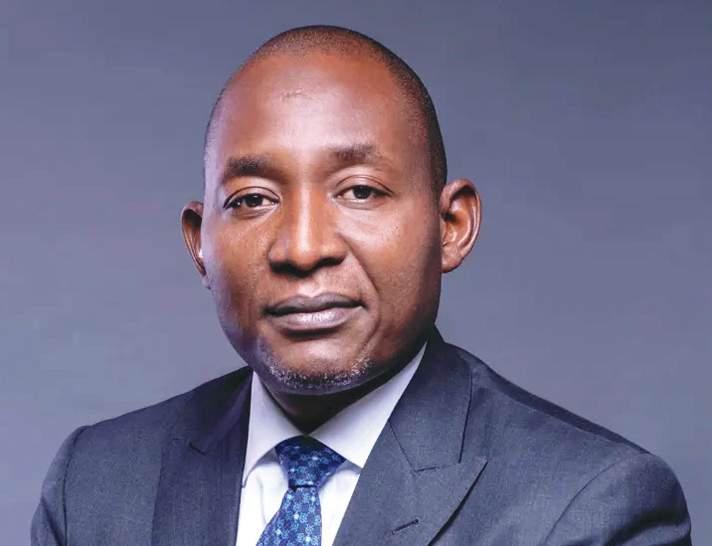
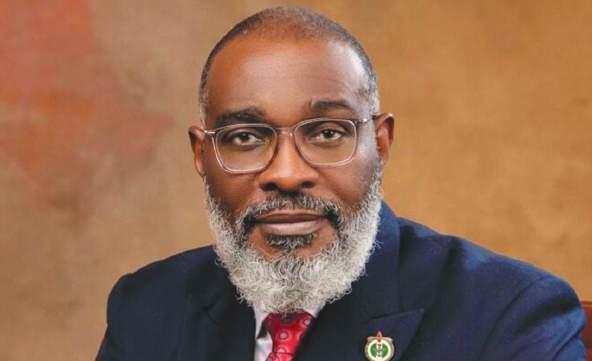
The Director-General of the Budget Office of the Federation
Kalu,
(BoF), Dr. Tanimu Yakubu, conveyed the government's position in a lengthy statement titled "Deficits, Debt and Economic Literacy: A Response
to Nigeria's Fiscal Critics," which he released over the weekend.
He described debt as one of the oldest instruments of macroeconomic stabilisation
known to economic theory and modern statecraft.
Yakubu, whose riposte was laced with harsh words for critics of the government's relentless
borrowing culture, said critics of rising debt were doing so out of "economic illiteracy."
Obi
Queries Benefits of Tinubu’s Foreign Trips, Says Trump Got Billions of Dollars’ Deals from China
Insists Nigeria’s leadership should focus on productivity, not ceremony Says diplomacy shouldn’t be reduced to symbolic displays
Chuks Okocha in Abuja
The former Labour Party (LP) presidential candidate, Mr. Peter Obi, has queried the economic
benefits of President Bola Tinubu’s foreign trips, saying that the United States President Donald Trump secured deals worth billions of dollars from
China. Obi argued that foreign trips by government officials must deliver tangible economic benefits to Nigerians.
According to him, foreign engagements by the Nigerian leaders must translate into measurable economic benefits for the citizens.
While Trump has returned to Washington after two days of talks with Chinese leader Xi Jinping in Beijing, Tinubu just returned to Nigeria from
a three-nation visit to France, Kenya, and Rwanda. During Tinubu’s visit to
Trump, Tinubu Confirm Killing of ISIS Leader, Al-Minuki by Joint US, Nigerian Forces
Nigerian president hails Trump for his unwavering support in war against terrorism Presidency justifies joint US, Nigerian military operation DHQ clarifies reported killing of al-Minuki in 2024
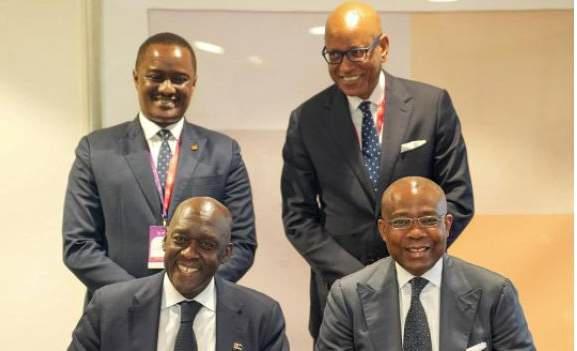
LANDMARK AFRICA DEAL ON THE WORLD STAGE…
L-R:
Chairman, Access Holdings, Mr.
Back L-R: CMD/CEO, Access Bank Rwanda, Faustin Byishimo, and Regional Vice President, Africa IFC, Ethopis Tafara, during the signing of $500m funding between Access Group and IFC in Kigali, Rwanda…recently
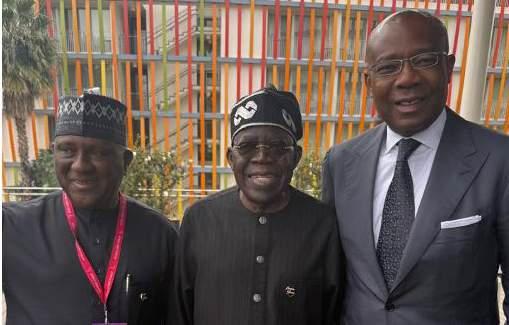
INVESTMENT DRIVE…
L-R: Chairman, BUA Group, Abdul Samad Rabiu; President Bola Tinubu; and Chairman, Access Holdings, Mr. Aigboje Aig-Imoukhuede, when the president led Nigerian business leaders for outstanding outing in Kigali, Rwanda…recently
(front row) Managing Director, International Finance Corporation, Mr. Makhtar Diop;
Aigboje Aig-Imoukhuede;
Tinubu Hails Aircraft Maker, Airbus' Move to Establish Hanger, Maintenance Facilities in Nigeria
Seeks accelerated delivery of three Apache attack helicopters to boost insecurity fight
Deji Elumoye in Abuja
President Bola Tinubu has welcomed the world aircraftmaker, Airbus' proposal to establish maintenance and hangar facilities in Nigeria as part of a broader effort to position the country as a regional aerospace and aviation services hub.
The president also
emphasised Nigeria’s urgent need for modern helicopters and fixed-wing aircraft capable of supporting security operations, logistics, and national development priorities, in furtherance of his administration's effort to end the intractable security challenges in some parts of the nation.
Tinubu, according to a
statement issued yesterday by presidential spokesperson, Bayo Onanuga, spoke during a recent meeting with a delegation from Airbus, led by Head of Regional Business Growth Africa and the Middle East, Thierry Cloutet, on the sidelines of the Africa CEO Forum in Kigali, Rwanda.
He told the delegation
that his administration was determined to scale up the cordial relationship between both parties, leveraging the company's comparative advantage in military aircraft and aerospace development.
The president called for the accelerated delivery of the three Apache helicopters already ordered by Nigeria to support ongoing security
and counterterrorism operations, underscoring his administration's determination to deploy all assets against terrorists across the nation.
“Nigeria needs attack helicopters urgently that can be used to confront and overwhelm terrorists.
That is my priority now," Tinubu said.
Nigeria's acquisition of
TRUMP, TINUBU CONFIRM KILLING OF ISIS LEADER, AL-MINUKI BY JOINT US, NIGERIAN FORCES
United States President Donald Trump and President Bola Tinubu yesterday confirmed the killing of the second-in-command of the Islamic State in Iraq and Syria (ISIS) globally, Abu-Bilal al-Manuk, in a joint operation carried out by the Nigerian Armed Forces and their counterparts from the United States.
The Presidency has also justified the joint military operation, saying the well-planned operation was intelligence-driven
France, he met with global investors and defended his administration’s economic reforms.
He also attended the Africa Forward Summit in Nairobi, Kenya, co-hosted by President Emmanuel Macron and President William Ruto.
While in Nairobi, Tinubu held a bilateral meeting with Madagascan leader Michael Randrianirina.
In Kigali, Rwanda, the Nigerian leader joined other African presidents, investors, and chief executives at the Africa CEO Forum to discuss ways of accelerating Africa’s economic transformation through regional
He said: "Those who speak glibly about deficits, debt, and fiscal expansion often reveal not economic sophistication, but economic illiteracy disguised as moral outrage.
"Much of today's opposition rhetoric confuses accounting identities with ideological slogans and mistakes macroeconomic intervention for recklessness.
"A modern economy is not managed through market romanticism. It is managed through theory, evidence, history, and context.
"The loudest critics of Tinubu's administration speak as though government borrowing is inherently immoral, as though deficits emerge from vice rather than economic necessity, and as though Nigeria's economic difficulties suddenly materialized on May 29, 2023.
"Such arguments are neither historically grounded nor
and a result of prolonged Intelligence, Surveillance, and Reconnaissance (ISR) efforts, supported by communications monitoring and phone intercepts that lasted for over a six-month period.
Meanwhile, reacting to the public confusion over yesterday’s announcement of the killing of al-Minuki, after the military had reported his death in 2024, the Defence Headquarters (DHQ) has clarified that terrorist commanders often adopted similar names and aliases as part of their indoctrination strategy to conceal their true identities.
integration and cross-border investments.
Reacting in a post on his X handle yesterday, Obi said state visits by leaders and diplomacy must produce measurable gains for citizens.
The former Anambra State governor and presidential aspirant on the platform of the Nigeria Democratic Congress (NDC) said every foreign trip undertaken by government officials should translate into investments, technology transfer, trade agreements, industrial partnerships, and job creation.
Referencing recent engagements by Trump with China, Obi claimed the American
economically coherent.
"No serious economist — from Keynes to Samuelson, from Krugman to Stiglitz — has argued that governments should retreat into fiscal paralysis during periods of structural imbalance, liquidity stress, and inherited distortions.
"The central insight of modern macroeconomics is precisely the opposite: When private demand weakens, when markets fail to allocate efficiently, or when structural rigidities suppress growth, the state must intervene counter-cyclically to restore equilibrium. That is not ideology. That is orthodox macroeconomics," he explained. According to him, those attacking deficit spending behaved as though government borrowing was money disappearing into thin air, and added that critics fundamentally failed to understand the most
Trump, who broke the news of the killing of the terrorist leader in the early morning hours of yesterday, said the US forces, working alongside the Nigerian military, carried out an operation that killed the top ISIS leader, described as the terror group’s second-in-command globally.
The US president said American forces and the Armed Forces of Nigeria "flawlessly executed a meticulously planned and very complex mission" targeting Abu-Bilal al-Minuki. While describing the mission as complex, Trump said al-Minuki was hiding in Africa.
delegation consisted mainly of key government officials and top business figures, contrasting it with what he described as large entourages accompanying Nigerian leaders on foreign trips.
He questioned the direct economic value of such visits, asking how many factories, agricultural agreements, manufacturing partnerships, and jobs would come to Nigeria as a result of the engagements.
Obi added that at a time when many Nigerians were struggling with economic hardship, every kobo spent on foreign trips must deliver clear value through investments, jobs, and broader economic
elementary principle of national income accounting —that government expenditure became somebody else's income.
He further argued that when the government spent on infrastructure, security, rail, roads, social transfers, or capital projects, the money circulated through the economy as contractor revenues, household income, supplier payments, corporate earnings, pension assets, and tax receipts.
"One sector's deficit is frequently another sector's surplus," he added.
"Indeed, the private sector balances often celebrated by critics are themselves the mirror image of public deficits.
"The irony is profound. Many of those condemning public borrowing are often the first to celebrate improved liquidity, increased business activity, rising consumer demand, and stronger
“Tonight, at my direction, brave American forces and the Armed Forces of Nigeria flawlessly executed a meticulously planned and very complex mission to eliminate the most active terrorist in the world from the battlefield. Abu-Bilal al-Minuki, second in command of ISIS globally, thought he could hide in Africa, but little did he know we had sources who kept us informed on what he was doing. He will no longer terrorize the people of Africa or help plan operations to target Americans. With his removal, ISIS’s global operation is greatly diminished,”
opportunities.
According to Obi: “State visits by leaders are not tourism, and diplomacy is not a fashion parade. Every foreign trip undertaken by a government must deliver measurable benefits to the people, including investments, technology transfer, trade agreements, factory expansion, industrial partnerships, and job creation.
“During President Trump’s recent visit to China, the American delegation reportedly included a few top government officials, and many of the biggest figures in global business and technology.
“Consequently, huge trade
corporate earnings, even though these outcomes are frequently driven by fiscal injections into the economy. "What they denounce politically, they quietly benefit from economically," he added.
In what appears to be an attempt at buck-passing, Yakubu noted that "many of the liabilities now being weaponized against the current administration were accumulated over years, including periods when President Tinubu was not in office."
He argued that those he labeled as propagandists compressed decades of structural dysfunction into a single political narrative, adding that this was not analysis but propaganda masquerading as economics.
"Nigeria's fiscal vulnerabilities did not begin in 2023. They are the product of decades of fuel subsidy distortions, chronic underinvestment, oil
Trump wrote.
The American president also thanked the Nigerian government for what he described as its partnership in the operation.
Al-Minuki was listed as a “Specially Designated Global Terrorist” by the administration of former US President Joe Biden in 2023, over links to the Islamic State group.
Confirming the elimination of al-Manuk, in a statement issued by the presidential spokesman, Bayo Onanuga, President Tinubu stated that the wanted terrorist leader was killed at his residence in Lake Chad.
deals worth several billion dollars, including about 200 Boeing orders, were achieved.
“The list of the entourage included: Donald J. Trump –President of the United States; Marco Rubio – Secretary of State; Pete Hegseth – Secretary of Defence; Elon Musk – CEO, Tesla & SpaceX; Jensen Huang – CEO, Nvidia; Tim Cook – CEO, Apple; Larry Fink – CEO, BlackRock; Stephen Schwarzman – CEO, Blackstone; and Kelly Ortberg – CEO, Boeing.
Other members of the US delegation, Obi said, include:
“Brian Sikes – CEO, Cargill; Jane Fraser – CEO, Citigroup; Larry Culp – CEO, General Electric;
"To discuss today's debt profile without acknowledging yesterday's accumulated distortions is intellectually dishonest," he said.
Yakubu further argued that serious economists did not assess debt based solely on sensational headlines or absolute figures, but also examined debt sustainability, debt service capacity, debt composition, maturity structures, currency exposure, and debt-to-GDP ratios.
"By global standards, Nigeria's debt-to-GDP ratio remains comparatively modest at 36.9 per cent as at December 2025. By comparison, the United States carries debt above 120 per cent of GDP, Japan above 250 per
the Airbus C-295 platform, broader defence aviation cooperation, as well as aircraft leasing and financing models, including export credit arrangements, sale-and-leaseback structures, and long-term aircraft financing solutions aimed at improving airlines' access to aircraft and reducing sector financing constraints, were also discussed.
Tinubu, while commending the gallantry of the two forces during the successful joint operation, expressed appreciation to Trump for his unwavering support for Nigeria's fight against terrorism, saying he was looking forward to more decisive strikes against all terrorist camps across the country.
“Overnight, Nigeria and the United States recorded a significant example of effective collaboration in the fight against terrorism.
"Our determined Nigerian Armed Forces, working closely
David Solomon – CEO, Goldman Sachs; Sanjay Mehrotra – CEO, Micron Technology; Cristiano Amon – CEO, Qualcomm; Dina P. McCormick – President of Meta; Ryan McInerney –CEO, Visa; Michael Miebach – President, Mastercard; Jim Anderson – CEO, Coherent, and Jacob Thaysen – CEO, Illumina.”
Obi added that: “That is how serious nations approach diplomacy, by aligning foreign policy with economic expansion, industrial growth, innovation, and national productivity. “I hope that lessons can
Continued on page 17
cent, Singapore above 170 per cent, France above 110 per cent, the United Kingdom around 100 per cent, India above 80 per cent and Brazil above 85 per cent.
"Nigeria, therefore, remains significantly below many advanced and emerging economies on pure debt stock metrics. The real Nigerian challenge is not simply debt accumulation, but weak revenue mobilisation and the productive deployment of borrowed resources.
"A country with low revenueto-GDP ratios will naturally face debt-service pressures even at comparatively moderate debt levels. The solution is therefore not performative austerity, but economic expansion, export growth, productivity enhancement, tax-base broadening, and structural transformation," the DG, Budget Office added.
Deji Elumoye, Linus Aleke in Abuja
Primaries, House Majority Leader, Ihonvbere Loses
Our Reporters
The Speaker of the House of Representatives, Hon. Tajudeen Abbas, and his deputy, Hon. Benjamin Kalu have won the primaries of the All Progressives Congress (APC) to seek reelection into the House in the 2027 general election.
The Speaker, who first entered the House of Representatives in 2011 and became Speaker of the 10th Assembly in 2023, was the sole aspirant cleared for the contest.
A former Minority Leader of the House, Hon. Ndudi Elumelu also won the APC primary in Delta State.
Yusuf Buhari, son of the late former President Muhammadu Buhari emerged winner of the primary for Sandamu/Daura/ Mai’adua Federal Constituency in Katsina State.
He secured 6,386 votes to defeat his opponent, Auwal
Daura, son of the former Director General of the Department of State Services (DSS), Lawal Musa Daura, who polled 322 votes in the exercise.
Abbas emerged unopposed as the APC candidate for Zaria Federal Constituency in Kaduna State following an affirmation exercise held across the 13 electoral wards in the constituency.
Kalu emerged the candidate of the party for Bende Federal Constituency in Abia State.
Kalu’s third term bid received a boost, when party members from the 13 wards that make up the constituency unanimously affirmed his candidacy.
Mr Pascal Okechukwu, a.k.a.
The Cubana Chief Priest also lost the primary election for ticket for Orsu/Orlu/Oru East federal constituency in Imo State. Meanwhile, APC has released the names of House of Representatives’ aspirants who
were screened but disqualified from participating in yesterday's primary election
Its National Publicity Secretary, Felix Morka, in a tweet on the official party’s X handle yesterday said the screening exercise was conducted by the party’s screening committees in line with established procedures and guidelines.
He, however, failed to specify the grounds for disqualification of the 14 aspirants.
In Aniocha/Oshimili Federal Constituency of Delta State, Elumelu was declared the winner after collation at the constituency centre in Oshimili South Local Government Secretariat.
Delta State Governor Sheriff Oborevwori and Deputy Governor Monday Onyeme, lauded the peaceful conduct of the House of Representatives primary elections of the APC across constituencies in the state.
In Rivers, the Speaker of the state House of Assembly, Martin Amaewhule, a strong ally of the Minister of the Federal Capital Territory (FCT), Nyesom Wike, won the House of Representatives primaries for Obio/Akpor Federal Constituency to APC's flag in the 2027 general election.
Also in Oyo State, the Chairman of APC House of Representatives’ Primaries Committee, Prof. Mojeed Alabi, described the exercise across the 14 federal constituencies as peaceful, transparent and credible.
He made the disclosure during a news conference held at the Oke-Ado secretariat of the APC in the state.
In Ondo State, discordant voices trailed yesterday’s exercise following widespread allegations of irregularities.
Speaking at Ward 5, an aspirant, Hon. Adeola Fynch,
Six ISWAP Bomb Makers Killed in Borno IED Explosion
No fewer than six suspected members of the Islamic State West Africa Province (ISWAP) have been killed following a premature Improvised Explosive Device (IED) that detonated in the Marte Local Government Area of Borno State.
Security sources said the incident occurred at about 7a.m. yesterday at Jubilaram, where the terrorists were reportedly assembling an explosive device.
This is coming barely a few hours after joint US forces and the Nigerian Army executed one of the
top ISWAP commanders operating in the Lake Chad region.
The sources said the group of IED makers was led by a suspected bomb expert identified as Abu Umar, who also died in the explosion alongside five other militants.
Three other members of the group reportedly sustained serious injuries in the incident.
According to intelligence assessments, the deceased suspects were part of ISWAP’s IED-making cell operating within the
Marte–Kerenoa–Wulgo axis, a known corridor for insurgent movements in the Lake Chad Basin.
The explosion is believed to have occurred while the device was being prepared, leading to a premature detonation that destroyed the site and caused multiple casualties.
The death of Abu Umar and other identified bombmaking specialists could significantly disrupt the group’s improvised explosive device operations in the area.
The incident reportedly affected an
IED manufacturing hub located between Arinna Maimasallaci and Arinna Ciki, which may now be temporarily nonoperational following the blast.
Military sources said the development could further degrade the operational capability of the Islamic State West Africa Province along key routes in the Marte axis.
Security authorities are reportedly considering follow-up air and ground operations to exploit the situation and further deny insurgents freedom of action in the area.
described the process as transparent and orderly.
But a party chieftain, who spoke on condition of anonymity, sharply criticised the process, particularly the timing of the release of screened and disqualified aspirants.
Addressing journalists in Ilorin during the APC primaries, Governor AbdulRahman AbdulRazaq of Kwara State stated that the ruling APC in the state built a responsible government and delivered meaningful development across
the state since assumption of office.
In Katsina State, the members of the House of Representatives loyal to Governor Dikko Umaru Radda, emerged as consensus candidates of the party.
The lawmakers, Hon. Abdullahi Aliyu Ahmed and Hon. Muhammad Aminu Ibrahim were unanimously affirmed during separate APC consensus exercises held in Musawa and Malumfashi Local Government Areas of the state.
ADC Postpones Screening of Presidential, Governorship Aspirants, LP Constitutes Committee for Exercise
Chuks Okocha in Abuja
The African Democratic Congress (ADC) has shifted its presidential and governorship screening exercises to Monday, May 18.
This is just as the Labour Party (LP) has constituted an eight-man committee for the screening of aspirants for various elective positions in the 2027 general election.
In a statement issued yesterday by ADC’s National Publicity Secretary, Mr. Bolaji Abdullahi, the party said, ''It wishes to inform all presidential and governorship aspirants that the party’s screening exercise earlier scheduled for this weekend has been postponed to Monday, May 18, 2026.''
The statement further stated that due to the security situation affecting some parts of Northern Nigeria, the screening of affected federal lawmakers’ aspirants would take place in Abuja.
It added that all affected aspirants would be duly
contacted with the updated schedules and necessary details.
The party said that it regretted any inconvenience this adjustment might cause and appealed for the understanding and cooperation of all aspirants and stakeholders.
Three presidential aspirants - former Vice President, Atiku Abubukar; former Rivers State Governor, Rotimi Amaechi and renowned economist, Hayatudeen Mohammed are contesting for the party’s presidential ticket in the January 2027 general election.
In a related development, the LP has constituted an eight-man committee for the screening of aspirants for various elective positions in the 2027 general election.
This was contained in a special public announcement jointly signed by the party’s National Chairman, Senator Nenadi Usman and the National Secretary, Iheanacho Obioma and made available to journalists in Abuja.
RALLYING SUPPORT FOR RULING PARTY…
Presidency, Oyedele Attribute S&P Rating Upgrade
to Growing International Confidence in Tinubu’s Reforms
Ndubuisi Francis in
The Presidency and the Minister of Finance and Coordinating Minister for the Economy, Mr. Taiwo Oyedele, have said the recent upgrade of Nigeria’s sovereign credit rating by S&P Global Ratings was a reflection of the impact of economic reforms introduced by President Bola Tinubu’s
administration since 2023.
The latest by S&P Global Ratings, announced at the weekend, followed similar positive ratings by Fitch Ratings and Moody's Ratings in 2025.
It upgraded Nigeria's long-term foreign and local currency sovereign credit ratings from 'B-' to 'B' with a stable outlook, marking Nigeria's first sovereign upgrade by S&P in 14 years,
Oyo School Abduction Exposed Major Intelligence Gap, Says Makinde, Inaugurates Violent Crime Response Unit
Kemi Olaitan in Ibadan
Oyo State Governor, Mr Seyi Makinde, has declared that the school abduction incident, which occurred last Friday in Orire Local Government Area (LGA) of the state exposed a major gap in intelligence gathering and informationsharing, warning residents against withholding critical security information from law enforcement agencies.
The governor made the statement yesterday during the inauguration of the newly established Violent Crime Response Unit (VCRU) of the Nigeria Police Force and the commissioning of its headquarters in Ibadan.
Makinde said preliminary findings surrounding the Orire incident revealed that suspicious movements and activities were not reported quickly to security agencies, thereby undermining efforts to prevent the tragedy.
“From what we know so far about yesterday’s incident in Orire Local Government, there is still a big gap in giving timely information to security agencies. When you see strange movements or suspicious behaviour, please report it,” the governor said. He stressed that the incident underscored the urgent need for stronger collaboration between residents and security agencies, noting that
the government alone could not guarantee security without the active cooperation of the public.
The governor described the launch of the specialised tactical unit as a timely and strategic response to rising cases of kidnapping and violent crimes across the country, particularly in the wake of recent security challenges in Oyo State.
According to Makinde, VCRU was the first of its kind in the South-west region and represented a renewed commitment by the state government and security agencies to strengthen the state’s security architecture.
He said the abduction incident had deeply troubled
families and communities across the state, noting, “Our thoughts and prayers are with the families that have lost their loved ones. May the souls of the departed rest in peace.“
Makinde maintained that security must never be taken for granted, warning that economic growth, investment, tourism and social stability could only thrive in an environment where lives and property are adequately protected.
The governor said his administration had continued to invest heavily in security through logistics support, surveillance infrastructure, mobility support, intelligencesharing and improved interagency collaboration.
Tambuwal: ADC Structure Not Built for Atiku; Obi, Kwankwaso Defected to Test Popularity Elsewhere
Former Sokoto State Governor, Senator Aminu Tambuwal, has dismissed claims of a crisis within the African Democratic Congress (ADC), insisting that the recent defections of a former governor of Anambra State, Mr. Peter Obi, and his former counterpart in Kano State, Senator Rabiu Kwankwaso, from the party to the National Democratic Congress (NDC) were based on personal decisions rather than internal divisions.
The departures of the two opposition figures, alongside several federal lawmakers, had fuelled concerns that cracks may be emerging within the ADC-led coalition ahead of the 2027 general election.
Speaking in a television interview over the weekend, Tambuwal said the defections were not driven by internal disagreements within the party.
“I do not believe that it was out of any crack. I believe that they wanted to go to
another platform for them to possibly test their popularity with the Nigerian people at the general elections,” he said.
The developments had sparked claims in some political circles that the ADC presidential structure was already tilted in favour of Atiku Abubakar, with observers alleging the party’s direction had been settled before the contest fully began.
Addressing the speculation, Tambuwal rejected suggestions that the ADC had been structured to favour
Atiku, insisting that neither Obi nor Kwankwaso publicly accused the party of bias.
“I didn’t hear Governor Peter Obi saying so, I didn’t hear Distinguished Rabiu Kwankwaso saying so,” he stated.
He added: “And if it is an assumption of any individual, observers or public commentators, I believe that with Distinguished Senator David Mark on the saddle as chairman of ADC, a level-playing field would have been provided.”
and signalling an apparent indication of the growing global confidence in the country's macroeconomic direction.
Among several key drivers cited for the upgrade were sustained structural reforms, including the 2023 liberalisation of the foreign exchange market, improved oil output and prices, combined with expanding domestic refining capacity.
S&P also considered a stronger balance of payments position, fiscal consolidation arising from progress in revenue generation and measures to reduce fiscal pressures.
In a statement issued yesterday by the Special Assistant to the President on Social Media, Dada Olusegun, the Presidency said the development signaled the growing confidence in the country’s economic direction.
“Beyond the global increase in oil prices, S&P’s eventual upgrade of Nigeria’s credit
rating, for the first time since 2012, reiterates the resilience and commitment of the current administration to holistically reset the trajectory of our nation’s economy, without being distracted by its adversaries,” the statement said.
According to the statement, Nigeria recorded “a drastic improvement in oil production between 2023 and the present through enhanced security measures and strategic investments.” It added that fiscal reforms were expected to reduce the country’s debt-to-revenue ratio to 338 per cent in 2026, down from about 500 per cent in 2023.
The statement further noted that sustained policy measures, including subsidy removal and FX liberalisation, were central to the improved outlook.
It said, “Nigeria’s current account surplus is expected to grow to 5.8% of GDP in 2026, up from 4.8% in 2025.”
ECOWAS Lawmakers Push for Stronger Regional Response to Insecurity in Sahel
Michael Olugbode in Abuja
The Parliament of the Economic Community of West African States (ECOWAS) has called for a stronger response to terrorism in the Sahel region.
The regional parliament argued that terrorism and political instability in the Sahel remained among the most serious threats confronting West Africa.
Addressing journalists at the end of the First Ordinary Session of the ECOWAS Parliament in Abuja, Hon. Dominic Napara of Ghana and Hon. Amodu Camera of The Gambia expressed concern about the security
consequences of Mali, Burkina Faso, and Niger withdrawing from ECOWAS.
They argued that the three countries remained critical to the region’s security and economic architecture.
Dominic said the security challenges in the Sahel had direct consequences for neighbouring countries, including Nigeria and Ghana, stressing that terrorism was a common enemy that demands a united response.
“Whatever happens in those countries affects all of us. Terrorism is a common enemy, and we must work together to confront it,” he said.
Abuja
Chuks Okocha
L-R: Chief Asini Joseph; Okpe Ward 3 Chairman, Hon. Kingsley Onojighofia; Delta State Governor, Sheriff Oborevwori (middle); Chairman of Okpe Local Government Council/Delta State Chairman of ALGON, Hon. Isaiah Esiovwa (second right); and others
NATIVE ARTICLE PROPOSAL
What is a Native Article?
ARISE NEWS is Africa’s leading business and financial news website, providing a unique blend of international and pan‑African business and economic news.
Native Article is the innovative way of strategically packaging content to blend in with editorial.
This allows for content to appear as more credible, as it reads naturally without the marketing agenda of the company coming across as obvious.
How it works
Client to provide Arise News with an article, Arise News Editorial team will then re‑write this to fit the consumer content behaviour.
The Article will be posted on the website, and the article page will have full advertiser branding.
The Article link will be embedded on the homepage for one week.
The article will get a social post dedicated to drive users to the article page on the day it is released.
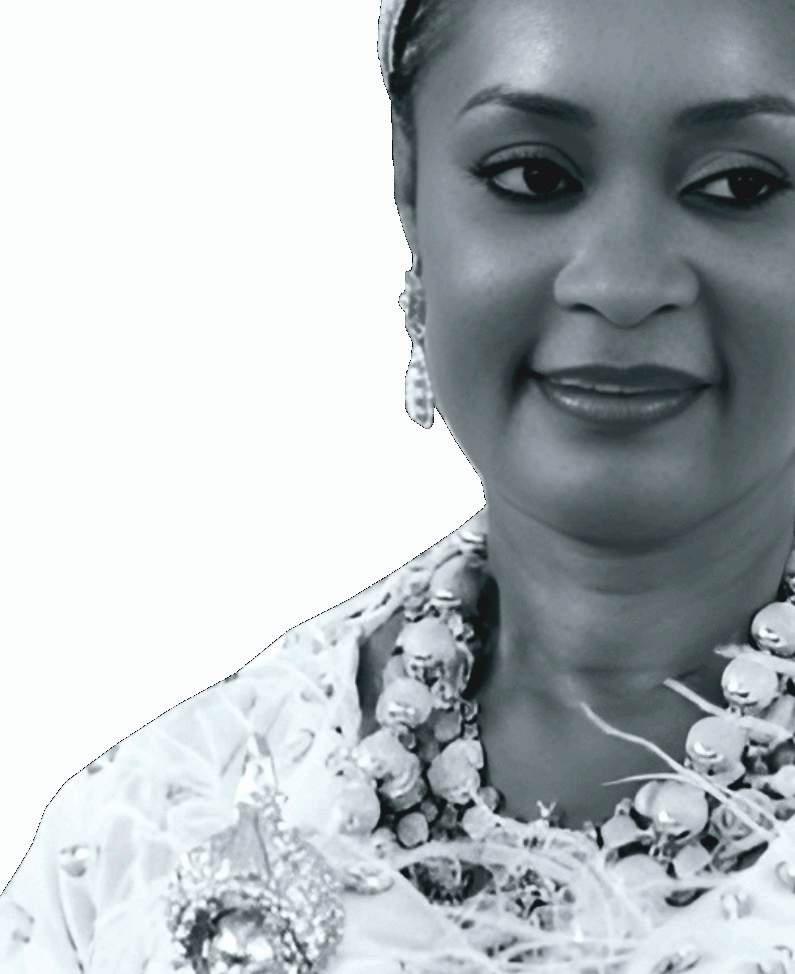
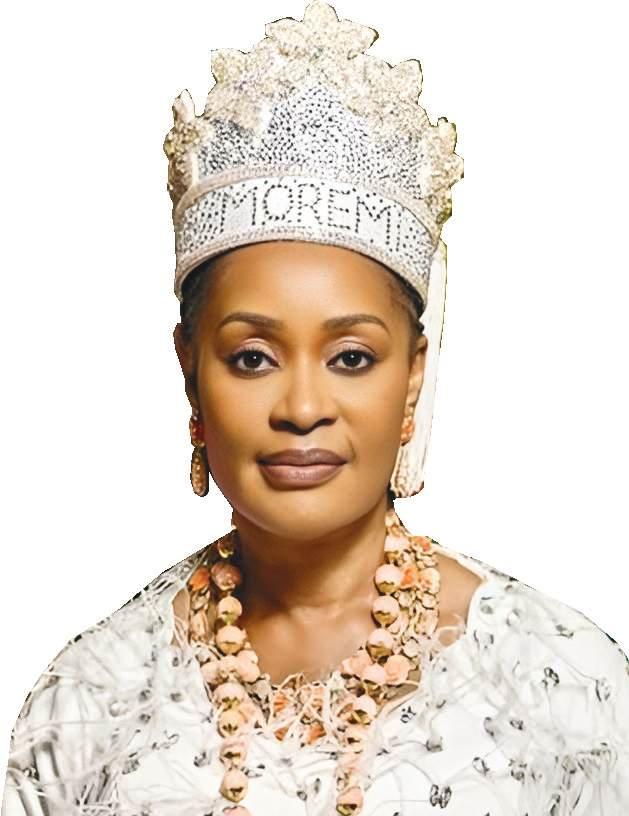
With a deep sense of gra�tude and humility, I warmly thank all our Dis�nguished Guests, Excellencies, Royal Fathers, Religious Leaders, Statesmen, Diplomats, various Professional and Social Associa�ons, Scholars, Family, Friends, and Well-Wishers who joined us in Ile Ife on May 2, 2026, to celebrate my wife, Chief Mrs. Olufunso Amosun’s 60th birthday and her installa�on as Yèyé Mòremì Oòduà.
We are deeply grateful to His Excellency, President Bola Ahmed Tinubu, GCFR, for taking the �me to write a personal tribute. Our special apprecia�on goes to our revered Àrólé Òdùduwà, Ọlọfin Àjàláyé Àdìmúlà, Ọòni Adéyẹyè Ẹnitàn Ògúnwùsì, CFR, Òjájá II, Ọòni of Ifè, for the great honour bestowed and for going beyond the call of duty to make the occasion truly memorable. We thank many others, too numerous to men�on individually, for their hear�elt tributes.
The occasion was enriched by your goodwill, gi�s, prayers, and the love you showered on us. The atmosphere of dignity, unity, and genuine affec�on that marked the day will stay with us for a long �me. Your support and sacrifices are not taken for granted.
As a family, we remain thankful to God for His grace and for the privilege of sharing such a historic and joyful moment with so many remarkable people. The success of the day could not have been without the benevolence of Almighty God.
May the Almighty God bless and preserve you, grant you good health and con�nued success.
With sincere apprecia�on and highest regards,
Senator Ibikunle Amosun CON, FCA
Sy�ende Mai Norge!
Marine Platforms Limited proudly joins the Norwegian community around the world in celebrating Norway’s Constitution Day, a celebration of unity, resilience, innovation, and progress.
As we honour Norway’s rich heritage and global leadership in offshore innovation, sustainability, and responsible energy development, we also celebrate the enduring partnership between Norway and Nigeria, and the strong collaborations that continue to create opportunities for shared growth and advancement across industries, cultures, and nations.
Norway continues to inspire through its leadership in offshore innovation, sustainability, and responsible energy development, values that strongly align with our vision at Marine Platforms Limited.
On this special occasion, we celebrate the people of Norway and the lasting relationships that continue to strengthen ties across nations and industries.
Happy Constitution Day! Gratulerer med dagen!
STRATEGISING FOR EKITI 2026…
Jonathan Upbeat, Says Nigeria Will Overcome Current Economic, Social, Security Challenges
Anglican Church decries rising debt, insecurity, political defections
Sunday Aborisade in Abuja
Former President Goodluck Jonathan yesterday expressed confidence that Nigeria would overcome its current economic, social, and security challenges, even as the Church of Nigeria (Anglican Communion) warned political leaders against abandoning governance for
early permutations ahead of the 2027 general election.
The former president’s strong interventions came at the ongoing First Session of the 13th Synod of the Diocese of Abuja held at St. James Anglican Church, Asokoro in the nation's capital, where the Anglican Church delivered a sweeping State of the Nation address on the
economy, insecurity, corruption, electoral integrity and rising social decay.
The Synod, presided over by the Primate of the Church of Nigeria and Bishop of Abuja Diocese, Henry Ndukuba, cautioned the Independent National Electoral Commission (INEC) against partisanship and urged political actors to focus on governance rather than
“toxic political manoeuvres” ahead of the next electoral cycle. Jonathan, who spoke at the ceremony attended by former Head of State, Gen. Yakubu Gowon (rtd), Senator Ireti Kingibe, bishops, clergy, and government officials, said the church remained one of the strongest institutions holding Nigeria together during difficult times.
LCCI Urges Tinubu-led Administration to Deepen Reforms as Inflation Climbs to 15.69%
The Lagos Chamber of Commerce and Industry (LCCI) has called on the federal government to deepen ongoing macroeconomic reforms to stabilise prices, strengthen investor confidence, and ease the burden on businesses and consumers.
According to Nairametrics, the chamber warned that despite signs of moderation in inflationary trends, millions of Nigerians, particularly manufacturers, traders, Micro, Small and Medium Enterprises (MSMEs), and low-income
households, continue to grapple with elevated costs of food, transportation, energy, and logistics.
Director-General of LCCI, Dr. Chinyere Almona, made the call while reacting to the latest inflation report released by the National Bureau of Statistics (NBS), which showed that Nigeria’s headline inflation rate rose to 15.69 per cent in April 2026 from 15.38 per cent recorded in March.
Although the month-onmonth inflation rate slowed significantly from 4.18 per cent
to 2.13 per cent, Almona noted that the pace of price increases remained troubling for businesses already operating in a difficult environment.
According to her, the inflationary pressure continues to erode purchasing power, weaken consumer demand, and compress business margins across several sectors of the economy.
“The chamber observes that inflation continues to weigh heavily on manufacturers, MSMEs, traders, and consumers, through rising costs of food, transportation, energy, and logistics,” she stated.
She added that the higher rural inflation figure of 16.36 percent reflected deeper structural challenges in the economy, including insecurity in food-producing communities, poor transportation networks, weak storage systems, and persistent supply chain disruptions.
“The higher rural inflation rate also highlights ongoing supply chain disruptions, insecurity in food-producing areas, and weak distribution infrastructure,” she added.
He lamented what he described as a deepening moral decline in society, rising violence, and the erosion of values among young people, warning that the country faced increasing social pressures, partly fuelled by the misuse of technology and social media.
“The decadence in society is so high that the church has to double its efforts through prayers and conduct to help build a normal society for our children,” Jonathan said.
The former president, however, maintained that Nigeria would eventually overcome its challenges through focused leadership, patience, and collective commitment.
“I believe that as a country, we will get over our challenges. God will not abandon Nigeria,” he added.
Drawing lessons from the economic transformation of countries such as Singapore and other Asian Tigers, Jonathan said national development required long-term planning and consistent leadership.
“What I noticed was that it took between 30 and 40 years for these countries to move
from where we are now to near first-world status. Progress takes time, but it also takes good and focused leadership,” he stated.
In its State of the Nation address, the Anglican Church expressed concern over what it described as increasing political desperation ahead of 2027, saying many political leaders appeared more interested in power struggles than addressing worsening economic hardship and insecurity.
“Unfortunately, Nigeria has leaders who serve their own interests and work for themselves rather than the citizens,” the Synod declared. The church criticized the growing wave of defections across political parties and lamented what it called the absence of a strong, objective opposition in the country’s democratic space.
According to the Synod, “the political class is jostling for its survival rather than the service and welfare of the people,” warning that governance was gradually being sacrificed for political calculations ahead of the next elections.
At 89, I Still Exercise, Manage Diabetes with Discipline, Says Obasanjo
Former President Olusegun Obasanjo yesterday urged Nigerians to embrace healthy living through proper diet, regular exercise, and routine medical check-ups, saying the lifestyle choices had helped him remain active at 89, despite battling diabetes for over four decades.
Obasanjo spoke in Abeokuta after performing the ceremonial tee-off at the 2026 FirstBank/ OBJ Golf Tournament held at the Abeokuta Golf Club.
The former president, who described exercise as essential at
every stage of life, particularly in old age, said discipline and consistency in health management had sustained him over the years.
“One thing you must understand is that exercise is very important at every age, and even more important when you become a senior citizen,” he said.
“I’m officially 89 years old, but by the grace of God, I have been keeping fit and strong even though I have been diabetic for over 40 years. Many people do not take their health seriously
enough.”
Obasanjo explained that he lives by what he calls the “DREAMS + C” principle, which he said serves as a guide to healthy, balanced living.
According to him, “D stands for diet — what kind of food do you eat? R is for rest — do you have time to rest? E is for exercise — you must exercise regularly. M is for medical — the need to go for check-ups and take necessary medication.
“S is for social — create time to interact with people. This was one of the reasons I established
a Senior Citizens Club in OOPL, and the minimum age for joining is 70.
“Finally, C stands for contentment. Whatever position you are in life, be content. That doesn’t mean you shouldn’t be ambitious; you should have realistic ambition but avoid over-ambition.”
“I am always excited every year to be part of this tournament because, beyond the game itself, it encourages exercise, interaction, and national unity,” he added.
Speaking at the event, the
Vice Chairman of the Abeokuta Golf Club and Chairman of the tournament’s organising committee, Oladele Adeniran, said the competition was organised to honour Obasanjo’s enduring contributions to Nigeria and Africa.
Adeniran dismissed the notion that golf was an elitist sport, insisting that the game remained accessible to people from different backgrounds.
“Yes, if you are financially comfortable, you can play the game. But there is also another pathway into golf, especially
for younger people, becoming a caddie. As a caddie, you have access to the course, and you can learn and practice the game,” he said.
“In fact, many professional golfers in Nigeria and around the world today started as caddies. Some came from humble backgrounds, but through golf, they have become respected voices in society.” He further noted that golf offers flexibility and health benefits, and that players can easily fit the game into their schedules.
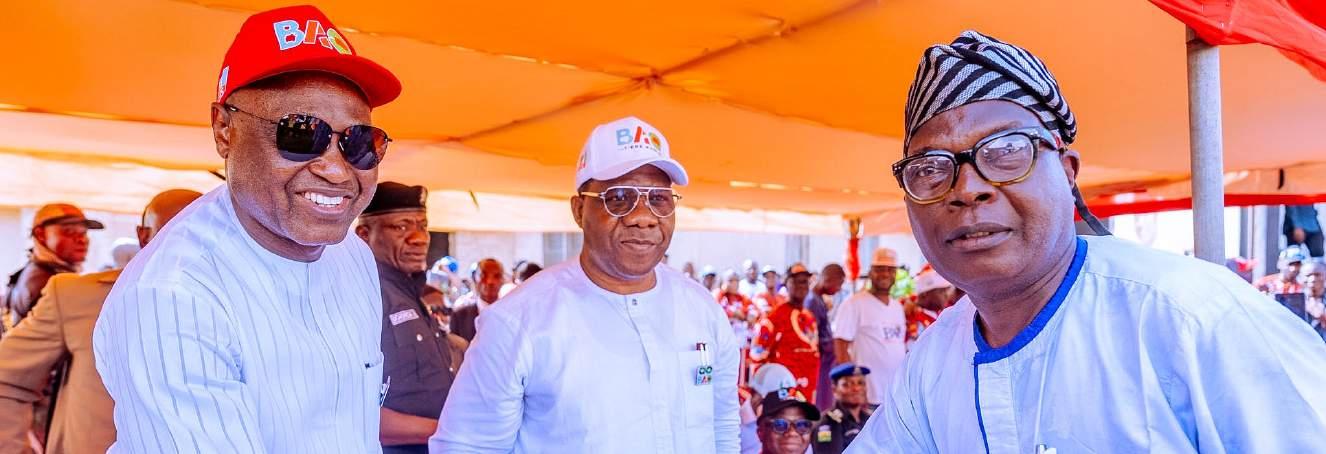
L-R: Ekiti State Governor, Mr Biodun Oyebanji; Senate Leader/Chairman of APC 2026 Governorship Election Campaign Council, Senator Opeyemi Bamidele; and candidate of the Alliance People's Movement (APM), Chief Joseph Anifowose, shortly after Anifowose stepped down for Oyebanji at a rally in Igede Ekiti-...weekend
CONGRATULATIONS …
Police Mourn 17 Officers Killed by Terrorists at Army Special Forces School in Yobe
The Nigeria Police Force has mourned the death of 17 police officers who were killed in a terrorist attack on the Nigerian Army Special Forces School in Buni Yadi, Gujba Local Government Area (LGA) of Yobe State.
The officers, who were undergoing specialised operational training at the
military institution, lost their lives during a coordinated attack launched by terrorists in the early hours of May 8, 2026.
In a statement issued yesterday, the Force Public Relations Officer, DCP Anthony Placid, said the attackers stormed the facility from multiple directions at about 1:15 a.m., leading to intense confrontation with security
personnel at the school.
He noted that several Nigerian Army personnel also paid the supreme sacrifice while bravely resisting the attack.
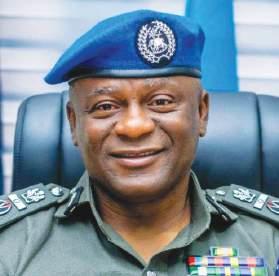
The Inspector-General of Police (IG), Olatunji Disu, described the fallen officers as courageous and dedicated personnel who demonstrated exceptional patriotism and commitment to national security
through their participation in advanced counter-terrorism and tactical training programmes.
The IG also conveyed the condolences of the entire Nigeria Police Force to the families of the deceased officers, assuring them that the sacrifices of the fallen personnel would never be forgotten.
“In further demonstration of solidarity and support, the Commissioner of Police, Yobe
State Command, Mr. Usman Kanfani Jibrin, visited the institution on behalf of the IG, where he commiserated with the Commandant of the School, Brigadier General AC Enuagu, officers of the Nigerian Army, and surviving police personnel undergoing training at the facility.
“He commended the resilience and courage of the surviving officers and
TRUMP, TINUBU CONFIRM KILLING OF ISIS LEADER, AL-MINUKI BY JOINT US, NIGERIAN FORCES
with the Armed Forces of the United States, conducted a daring joint operation that dealt a heavy blow to the ranks of the Islamic State.
"Early assessments confirm the elimination of the wanted IS senior leader, Abu-Bilal Al-Manuki, also known as Abu-Mainok, along with several of his lieutenants, during a strike on his compound in the Lake Chad Basin
"Nigeria appreciates this partnership with the United States in advancing our shared security objectives. I extend my sincere gratitude to President Trump for his leadership and unwavering support in this effort.
"I commend the personnel involved on both sides for their professionalism and courage, and I look forward to more decisive strikes against all terrorist enclaves across the nation," Tinubu explained.
The Armed Forces of Nigeria have also announced the successful elimination of the senior ISIS leader, following a
OBI
QUERIES
joint counterterrorism operation conducted in collaboration with US forces.
In a statement issued yesterday by the Director of Defence Information, Major General Samaila Uba, the military described the operation as “meticulously planned and highly coordinated,” resulting in the neutralisation of one of the world’s most active terrorists.
According to the statement, the precision strike was made possible through enhanced intelligence sharing and cooperation under a recently strengthened Nigeria–United States security partnership.
The operation, the military said, dealt a significant blow to a terrorist network that posed threats to Nigeria, the Lake Chad Basin, and the wider West African region.
DHQ noted that al-Minuki played a critical role within ISIS, providing strategic guidance to affiliated groups outside Nigeria. His responsibilities reportedly included overseeing media
operations, coordinating economic warfare, and supporting the development of weapons, explosives, and drone technologies.
“His death removes a critical node through which ISIS coordinated and directed operations across different regions of the world,” the statement said.
Military intelligence further indicated that, as recently as February 2026, al-Minuki may have been elevated to head the ISIS General Directorate of States, effectively making him the second most senior figure in the global terror group.
Prior to this, he was said to have served as the Nigeria-based al-Furqan office emir in 2023, where he oversaw ISIS-linked operations across the Sahel and West Africa, including attacks targeting civilians, particularly ethnic and religious minority communities.
The military also linked alMinuki to longstanding ties with ISIS-West Africa Province (ISWAP)
and alleged his involvement in the 2018 Dapchi schoolgirls’ kidnapping. Intelligence records further suggested that between 2015 and 2016, he facilitated the movement of fighters to Libya to support ISIS operations in North Africa.
Before aligning with ISIS in 2015, al-Minuki was reportedly a prominent figure within Boko Haram.
Presidency Justifies Joint US, Nigerian Military Operation
Meanwhile, the Presidency has justified the Nigeria-US joint military operation, which culminated in the killing of al-Minuki.
Reacting to the controversy trailing the killing of al-Minuki, presidential spokesperson Onanuga, in a statement, explained that the reported killing of the terrorist commander in 2024 was a case of mistaken identity. He stressed that there was no
ambiguity this time as al-Manuki has been confirmed killed by the military authorities.
"It is acknowledged within military and intelligence circles that Al-Manuki’s name had appeared among lists of suspected ISWAP/Boko Haram commanders reportedly killed in 2024 during operations around the Birnin Gwari forest axis in Kaduna State.
"However, security officials now clarify that the earlier listing was a case of mistaken identity or misattribution in the fog of sustained counterinsurgency operations. Importantly, intelligence now confirms that the Birnin Gwari theatre was never within Al-Minuki’s established operational sphere, which negates the accuracy of the earlier assessment.
"This time, however, security and military authorities maintain a far higher level of confidence.”
DHQ Clarifies Reported Killing of Abu-Bilal
encouraged them to remain resolute in completing the training programme in honour of their fallen colleagues,” the statement said.
The IG further assured Nigerians that the Force, in collaboration with the Armed Forces and other security agencies, would sustain ongoing efforts to track down and bring those responsible for the attack to justice.
Al-Minuki in 2024, Says Terrorist Leaders Adopt Similar Names to Obscure Their Identities
In a similar clarification on the earlier reported killing of al-Minuki in 2024, the DHQ maintained that terrorist commanders often adopted similar names and aliases as part of their indoctrination strategy to conceal their true identities.
The Director of Defence Information, Major General Uba, said in a statement that the military remained committed to providing verified information through official channels.
“It is important to state that within the North-east region and across the Lake Chad Basin, the use of similar or identical names, aliases, and nom de guerres is common among ISWAP and Boko Haram terrorists. This is essentially part of their indoctrination programme, which is aimed at deliberately obscuring identities.
BENEFITS OF TINUBU’S FOREIGN TRIPS, SAYS TRUMP GOT BILLIONS OF DOLLARS’ DEALS FROM CHINA
be learned from these recent visits, comparing them with the President of Nigeria’s recent state visit to the United Kingdom.
“A large entourage of politicians, aides, and government officials travelled, yet Nigerians are still asking a simple question: what exactly did Nigeria bring home?
“Which factories are coming to Nigeria? What power, technology, manufacturing, agricultural, or industrial agreements were secured?
“How many direct jobs will this visit create for Nigerian youths? What investments were attracted? What measurable economic outcomes can the
ordinary Nigerian point to?”
Obi queried.
Obi claimed Tinubu’s delegation to the UK included: President Tinubu; his wife, Remi; 12 governors; nine ministers; seven members of the National Assembly; over 20 senior State House staff; over 30 security personnel; over 10 domestic
staff, and several supporters and associates.
“It is not enough to ride horses, wear matching uniforms, attend royal banquets, and release glossy photographs. Symbolism without substance cannot feed hungry citizens.
“Today, Nigeria is in decline, battling serious insecurity, food
insecurity, unemployment, a weakened naira, declining industrial productivity, and worsening poverty.
value: investments, factories, jobs, exports, infrastructure, and economic opportunities.
“Nigeria needs leadership that is focused less on optics and more on productivity; less on ceremony and more on measurable economic results.
national
“At a time when millions of Nigerians struggle daily to afford food and survive economic hardship, every kobo spent on foreign trips must produce
A New Nigeria is Possible,” Obi stated.
Linus Aleke in Abuja
tangible
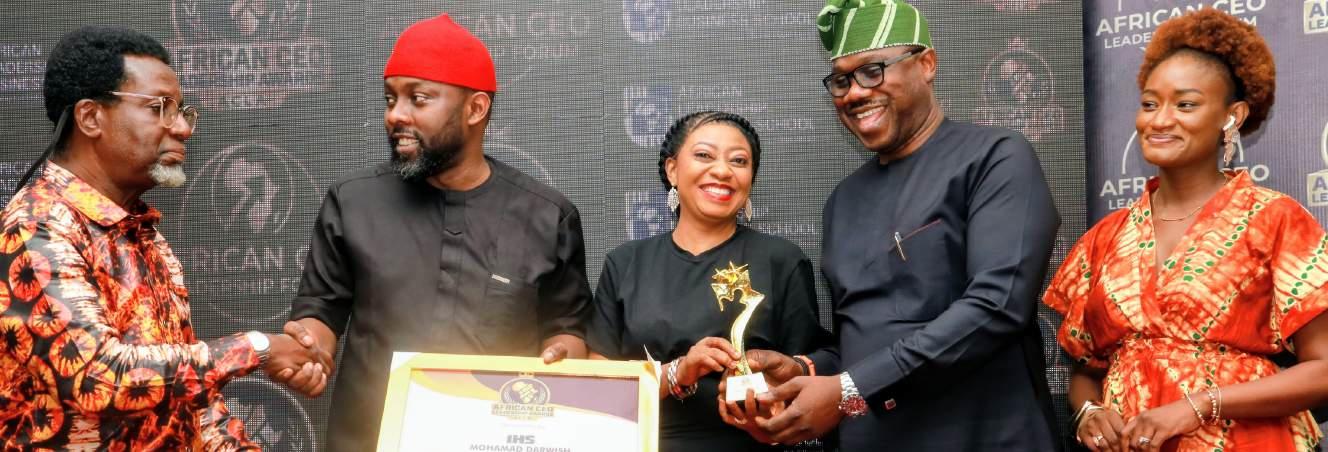
L- R: Member of the Faculty, African Leadership Business School, Prof. Stanley Ohenhen; Director, Corporate Communications, lHS, Sylva Ifedigbo; Director, Sales, IHS, Olubukola Agbaminoja; Associate Director, Government and External Relations, lHS, Bond Abbe, and Head, Brand Marketing and Corporate Communication, Sovereign Bank Limited, Precious Olaleye, during the presentation of African Telecommunications Services CEO of The Year 2026 Award to the CEO of IHS, Mohamad Darwish byAfrican CEO Leadership Forum in Lagos...weekend.
PHOTO: ABIODUN AJALA
When FX Blew Up Nigeria’s Debt Numbers
Nigeria’s rising debt figures mask a deeper reality driven largely by naira devaluation, FX volatility, and long-hidden liabilities, writes Festus Akanbi
Nigeria’s rising debt profile has again returned to the center of economic debate, but beneath the frightening headline figures lies a more complicated story shaped by exchange-rate volatility, inherited liabilities, weak revenue generation, and rising borrowing costs, rather than by reckless accumulation of fresh loans.
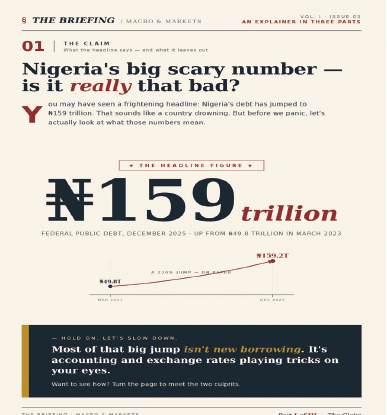
The controversy followed revelations that Nigeria’s total public debt rose from about N49.8 trillion in March 2023 to nearly N159.2 trillion by December 2025, triggering fears that the country may be drifting towards a debt crisi. Yet economists insist that much of the increase was driven by the sharp devaluation of the naira and the formal recognition of long-existing obligations.
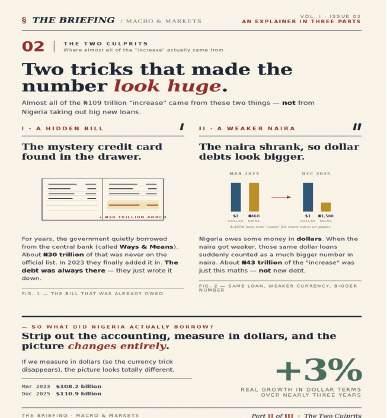
A report by The Briefing – Macro & Markets argued that the dramatic rise created a misleading impression that Nigeria had accumulated massive new debt in a short period. According to the report, when measured in dollar terms rather than naira, NNigeria’stotal debt only rose slightly from about $108.2 billion in March 2023 to roughly $110.9 billion by December 2025.
That distinction has become central to the debate. Following the foreign exchange reforms introduced in 2023, the naira weakened sharply from around N460/$ to nearly N1,500/$ by late 202. The immediate consequence was that the naira value of NNigeria’sforeign currency obligations ballooned automatically, even without substantial fresh borrowing.
Analysts estimate that nearly N43 trillion was added to the debt stock purely through exchange-rate revaluation. Dollar-denominated obligations that previously appeared manageable suddenly translated into far larger naira liabilities once the exchange rate adjusted.
The debt profile was further inflated by the securitisation of almost N30 trillion in Ways and Means advances owed to the Central Bank of Nigeria (CBN. Those obligations had existed outside the formal debt register for years before being officially recognised and converted into tradable debt instruments.
Economic analysts say the move improved transparency but instantly expanded the ccountry’srecorded debt stock.
The issue dominated discussions on ARISE News last week, with analysts arguing that public debate was increasingly driven by sensational headline figures rather than a proper understanding of the debt composition.
One analyst noted that while the N159 trillion figure looked alarming, the real concern was NNigeria’sweak revenue base and rising debt servicing costs.
“That matters is not just the amount you owe, but your capacity to repay,””the analyst said. ““f more than half of government revenue is going into debt servicing, development spending inevitably suffers.””That concern has become increasingly difficult to dismiss. NNigeria’sdebt service-to-revenue ratio remains among the highest globally, despite the ccountry’srelatively moderate debt-to-GDP ratio compared with several advanced economies.
President Bola Tinubu acknowledged that a substantial portion of federally generated revenue is now consumed by debt service, leaving less fiscal space for infrastructure, healthcare, education, and social investments.
Analysts also noted that many of the loans now putting pressure on public finances were contracted years before the current administration. Several external facilities, including Chinese infrastructure loans secured between 2016 and 2019, came with moratorium periods under which Nigeria initially paid only interest before principal repayments commenced.
With many of those repayment windows maturing under the present administration, fiscal pressures have intensified sharply.
Still, critics insist that the current government cannot completely distance itself from the consequences of the naira devaluation, which magnified the debt burden in local-currency terms.
“Then people say debt increased because of
exchange-rate devaluation, they should also admit that the devaluation itself worsened the debt burden,”another analyst observed during the ARISE discussion.
Beyond technical arguments over debt ratios, many Nigerians remain unconvinced because they see no visible improvements in living
standards despite years of borrowing.
Several economists questioned the productivity of government spending, arguing that excessive recurrent expenditure, policy inconsistency, and perceived elite extravagance continue to weaken public confidence in fiscal management.
“Nigerians are asking a simple question: what exactly are we doing with the money?””an economist said. ““eople see worsening inflation, unemployment, and hardship while government officials continue to live lavishly.””The debate has also exposed deeper structural weaknesses in NNigeria’seconomic management framework. While the Debt Management Office continues to insist that the ccountry’sdebt remains sustainable by international standards, concerns persist over transparency, leakages, and poor revenue mobilisation.
Minister of Finance and Coordinating Minister of the Economy, Taiwo Oyedele, has repeatedly defended the ggovernment’sposition, arguing that debt sustainability should be assessed using internationally recognized indicators rather than relying on nominal debt figures alone.
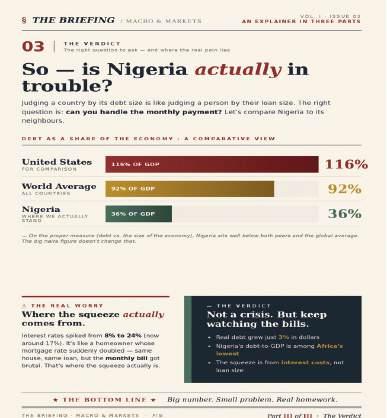
According to him, NNigeria’sdebt-to-GDP ratio stood at about 36.1 percent in 2025, significantly below the global average of over 90 percent and far below ratios recorded in countries such as Japan and the United States.
Oyedele maintained that much of Nigeria’s debt Nigeria’snated in local currency, reducing exposure to external repayment shock. However, he acknowledged concerns over the crowding-out effect of government borrowing on private-sector investment.
Many economists now believe the larger danger lies not in the size of the debt stock itself but in the rapidly increasing cost of servicing it.
Following the CBN’s aggressive monetary tightening to combat inflation and stabilize the naira, interest rates surged sharply between 2023 and 202. Treasury bill yields and bond rates rose above 20 percent at different points, significantly increasing government borrowing costs.
Consequently, debt servicing obligations have continued to absorb a growing share of federally collected revenue.
The Nigerian Economic Summit Group (NESG), in its recent Debt Burden Monitor, warned that beneath the apparent stability of conventional debt indicators, fiscal vulnerabilities remained elevated. The group projected that Nigeria’s debt stock coNigeria’stowards N200 trillion in the medium term if structural reforms fail to strengthen government revenues and reduce persistent fiscal deficits.
Former President of the Nigerian Bar Association, Olisa Agbakoba, also warned that continued borrowing without deeper institutional reforms could worsen Nigeria’s fiscal outlooNigeria’sticized weak revenue collection systems and the practice of some government agencies deducting operational costs before remitting funds to the Federation Account.
“The issue is not just borr”wing,” Agbakoba argues. “The big”er problem is leak”ges, inefficiency, and poor fiscal discipline.”
Faced with mounting fisca” pressures, the Tinubu administration has increasingly shifted attention towards tax reforms as a long-term solution to Nigeria’s chronic revenue wNigeria’sStill, analysts argue that reforms alone may not ease public anxieties unless citizens see visible improvements in infrastructure, jobs, electricity supply, and living conditions.
For investors and development partners, the central issue is no longer whether Nigeria’s debt figures appeNigeria’sening in nominal terms, but whether Africa’s largest economy caAfrica’sa resilient revenue system capable of supporting growth without perpetual dependence on borrowing.
While economists remain divided over the severity of Nigeria’s debt situation, aNigeria’sconsensus appears to be emerging: Nigeria’s long-term fiscal Nigeria’sility will depend less on the size of its debt and more on the quality of economic management, revenue reforms, and the productive use of public resources.
CBN, Union Bank, and the Trust Deficit
The legal battle over Union Bank of Nigeria is raising fresh concerns over investor confidence and regulatory credibility in Nigeria’s banking sector, writes Sunday
Eghiator
The intensifying legal confrontation between the Central Bank of Nigeria (CBN) and the former shareholders of Union Bank of Nigeria is rapidly assuming dimensions far beyond an ordinary banking dispute. What is unfolding in the courtroom has become a defining examination of regulatory accountability, sanctity of investment, and the wider credibility of Nigeria’s financial governance architecture before the global investment community.
At the centre of the controversy is the Federal High Court judgment delivered by Justice Chukwujekwu Aneke, which nullified the CBN’s January 2024 dissolution of Union Bank’s board and management, describing the intervention as ultra vires, unlawful, and inconsistent with the provisions of the Banks and Other Financial Institutions Act (BOFIA) 2020.
The judgment was particularly damaging because it did not merely question procedure; it fundamentally challenged the legal and evidential foundation of the intervention itself.
While the CBN has approached the appellate court seeking to overturn the ruling, the deeper issue emerging from the dispute is whether the apex bank’s aggressive legal response risks compounding concerns already raised by the lower court regarding due process, regulatory transparency, and investor protection.
The implications are profound because banking regulation depends not only on statutory authority, but also on confidence, confidence that regulators will act lawfully, proportionately, and transparently.
The Federal High Court ruling appears to have struck precisely at those foundations.
One of the most consequential aspects of the judgment was the court’s finding that the former shareholders and directors of Union Bank were denied a fair hearing before punitive actions were taken against them. The court held that the affected parties were sanctioned without adequate opportunity to respond to allegations arising from a purported special examination of the bank.
More significantly, the court reportedly found that the CBN failed to produce the alleged examination report as evidence to justify the drastic intervention.
That omission has become one of the most troubling elements of the dispute.
In regulatory enforcement, especially within the banking industry, extraordinary powers are often justified only by equally compelling evidence. Where a regulator dissolves a bank’s board, restructures ownership, dilutes shareholding, and excludes
investors from recapitalisation processes, the expectation within global financial practice is that such actions must be supported by robust documentation and transparent supervisory findings.
The court’s conclusion that no such examination report was produced has inevitably raised uncomfortable questions.
The controversy becomes even more complicated when viewed against the sequence of events leading up to the intervention.
According to documents referenced in the proceedings, Titan Trust Bank had acquired Union Bank in 2022 through Luxis International DMCC and Magna International DMCC, reportedly with financing support linked to African Export-Import Bank. The shareholders subsequently initiated a merger process between Titan Trust Bank and Union Bank and sought regulatory approval for a HoldCo structure intended to absorb acquisition-related obligations.
The court filings suggested that while the merger process received regulatory approval, the HoldCo arrangement was not approved. Yet shortly afterward, the CBN dissolved the bank’s board and management.
For many within financial and legal circles, that sequence created a troubling contradiction.
The question being quietly asked across investment circles is simple: how does a regulator approve a merger process and then, within a relatively short period, proceed to dismantle the same governance structure on grounds severe enough to justify emergency intervention? That contradiction has become central to growing investor anxiety.
The concern is not merely about Union Bank. Rather, it is about the predictability of Nigeria’s regulatory environment and the extent to which investment rights remain protected once capital has entered the country.
Foreign investors are naturally sensitive to signals emanating from disputes involving regulators. In emerging markets, institutional credibility often matters as much as economic returns. Investors seek assurance that disputes will be governed by transparent rules rather than discretionary impulses.
This is particularly crucial in banking, where transactions involve substantial cross-border financing, long-term commitments, and sensitive governance structures.
The Federal High Court’s finding that the shareholders’ interest was diluted from full ownership to about 40 per cent without lawful justification has therefore intensified concerns regarding investment security.
Equally damaging is the court’s suggestion that aspects of the intervention reflected bad faith.
In global financial systems, regulators derive moral authority not only from legislation but also from perceptions of neutrality, consistency, and procedural fairness. Once accusations of arbitrariness or selective application of power begin to surface, reputational consequences can extend far beyond the immediate dispute.
The CBN’s appeal, while legally permissible, now risks creating another layer of uncertainty.
Ordinarily, an appeal by a regulator seeking judicial clarification on statutory powers would not generate unusual concern. However, in this instance, the lower court judgment appears to have exposed gaps that investors may interpret as institutional weaknesses rather than mere legal disagreements.
The apex bank insists that Union Bank faced severe financial distress, including a negative capital adequacy ratio, nonperforming loans, and a capital shortfall exceeding N224 billion. It also maintains that BOFIA empowers it to intervene
decisively in troubled institutions to preserve financial stability.
That argument, on the surface, is entirely consistent with global regulatory practice. Central banks across the world possess emergency supervisory powers precisely because banking failures can trigger systemic crises capable of destabilising entire economies.
But even in advanced regulatory systems, emergency powers are expected to operate within carefully defined legal boundaries. Courts often defer to regulators on technical banking matters, yet such deference weakens considerably when due process appears compromised or evidentiary standards are questionable.
This explains why the Union Bank case is attracting unusually intense scrutiny.
For Nigeria, the timing is particularly delicate. The country is actively seeking foreign portfolio flows, banking recapitalisation investments, and broader international financial partnerships amid persistent currency pressures and macroeconomic fragility.
At such a moment, prolonged disputes that suggest uncertainty about shareholder protection or regulatory consistency can become reputational liabilities.
Investors rarely ignore warning signs in financial governance disputes. Even where regulators ultimately prevail in court, perceptions created during litigation often linger longer than judgments themselves.
The Union Bank dispute may therefore become more consequential for its reputational impact than for its eventual legal outcome.
What is increasingly evident is that the controversy has evolved beyond the technical interpretation of BOFIA. It has become a wider referendum on regulatory conduct, institutional transparency, and the confidence global investors can place in Nigeria’s financial governance framework.
And in international finance, confidence remains the most fragile currency of all.
Broad street, Lagos
THE TRIAL OF EL-RUFAI
Let El-Rufai enjoy his constitutional rights, argues ADAMU LAWAL TORO
The unfolding confrontation between the Independent Corrupt Practices Commission and the family of Nasir El-Rufai is gradually degenerating into something far more dangerous than a routine corruption investigation. It is becoming a test of whether Nigerian institutions can enforce the law without appearing vindictive, selective, or politically motivated.
No serious society can survive without strong anti-corruption institutions. Public officials who misuse public resources must face investigation and prosecution. Nigerians are exhausted by decades of impunity where powerful men enrich themselves while citizens suffer poverty, insecurity, and collapsing infrastructure. Therefore, no one, including El-Rufai, should be immune from scrutiny.
But anti-corruption agencies must understand a simple principle, the legitimacy of justice depends not only on punishment, but also on fairness, restraint, and respect for the law. Once an agency begins to look arbitrary, emotional, or politically weaponised, it weakens both itself and the broader democratic system.
According to family sources, the ICPC allegedly denied El-Rufai access to his personal doctor despite an existing court order permitting unrestricted medical access. The agency also reportedly stopped his wife from delivering food because she arrived after an internally imposed 6:30pm deadline.
Whether one admires or dislikes El-Rufai is irrelevant. Rights do not belong only to the popular or politically convenient. Constitutional protections exist precisely for moments when the state possesses overwhelming power over an individual. If indeed a valid court order exists allowing medical access, then any obstruction by officials is indefensible.
Agencies cannot selectively obey judicial directives. The rule of law is not a buffet where institutions choose which orders to honour and which to ignore. The moment security or anti-corruption agencies begin to treat court orders as optional suggestions, Nigeria moves dangerously close to institutional lawlessness.
This is particularly sensitive because ElRufai is not an ordinary political figure. As former governor of Kaduna State and one of the most controversial political actors of the Fourth Republic, he commands both fierce loyalty and deep opposition. Every move against him will inevitably be interpreted through a political lens. That reality places an even heavier burden on the ICPC to act with transparency and procedural discipline.
Unfortunately, Nigerian anti-corruption agencies have historically struggled with public credibility. From the Economic and Financial Crimes Commission to the ICPC itself, accusations of selective prosecution have persisted across administrations. Political opponents are often aggressively pursued while allies of those in power appear untouchable. Cases are loudly announced before television cameras, only to quietly collapse years later in court.
This pattern has created public cynicism. Many Nigerians now see anti-corruption not as a principled institutional mission but as a political weapon deployed against enemies and discarded when inconvenient.
That perception becomes even stronger when investigations are accompanied by dramatic displays that appear designed to humiliate rather than prosecute. Denying family access to food or restricting medical consultations creates the impression of punishment before conviction. It shifts the focus from alleged corruption to alleged persecution.
The ICPC must be careful not to turn El-Rufai into a political martyr. Nigeria has witnessed this cycle repeatedly. Public officials under investigation often gain sympathy not because citizens suddenly believe they are innocent, but because the conduct of the state appears excessive. In many cases, heavy-
handed treatment allows politically exposed persons to rebrand themselves as victims of oppression rather than subjects of legitimate inquiry.
Ironically, this can damage anti-corruption efforts more than outright inaction. Once the public loses confidence in the neutrality of institutions, every prosecution becomes politically contaminated.
There is another deeper danger in this unfolding drama: the erosion of institutional maturity.
Democracy is not sustained merely by elections. It survives through institutional restraint. Agencies must understand the limits of their power. Courts must be respected. Detainees must retain basic human rights. Procedures must be consistent and transparent. Without these safeguards, democratic institutions slowly acquire authoritarian habits.
Nigeria’s democratic journey is already fragile. Public trust in institutions is dangerously low. Citizens see widespread insecurity, economic hardship, elite impunity, and selective justice. In such an environment, state agencies cannot afford conduct that reinforces fears of arbitrariness.
This does not mean El-Rufai should be shielded from accountability. Far from it. If there is evidence of corruption, abuse of office, financial misconduct, or violation of procurement laws, the ICPC should pursue the case rigorously and professionally. Nigerians deserve accountability from all public officials, past and present. But professionalism matters.
The strongest anti-corruption cases are built not through media warfare or institutional intimidation but through evidence, due process, and credible prosecution. Courts, not emotional press statements, must determine guilt or innocence. The ICPC must therefore answer critical questions openly. Was there truly a court order guaranteeing unrestricted medical access? If yes, why was the doctor allegedly denied entry? What legal basis exists for restricting food delivery? Were these actions standard detention procedures or targeted measures? Silence or evasiveness will only deepen suspicion.
Nigeria does not need another institutional war between powerful political actors and state agencies. What the country desperately needs is credibility. Citizens want to see anticorruption institutions that are firm but fair, strong but lawful, aggressive but restrained. That balance is what separates justice from vendetta. The tragedy of Nigeria’s anticorruption history is not merely that corruption persists. It is that institutions fighting corruption often undermine themselves through inconsistency, political interference, media sensationalism, and procedural recklessness. If the ICPC truly wants public confidence, it must demonstrate that even its enemies retain constitutional protections.
TUNDE OLUSUNLE pays fitting tribute to Audu-Rafiu Enikanolaiye, minister of state for foreign affairs
ENIKANOLAIYE:
DIPLOMATORACLE AS FOREIGN MINISTER
He was a 40 - year-old, Assistant Director in the foreign service at the outset of the administration of President Olusegun Obasanjo in 1999. Nigeria’s foreign relations space was dominated by a robust mix of career veterans and the political class, which underscored the primacy the new democratic dispensation was going to accord diplomacy. Obasanjo himself was the country’s diplomat-in-chief having built tremendous capacity beginning from his years in office as Nigeria’s military Head of State between February 1976 and September 1979. Whereas the two Foreign Affairs Ministers, Sule Lamido and Dubem Onyia (of blessed memory) were of the political class, Obasanjo intentionally fortified himself with experienced foreign affairs experts to guide the policy slant of his government. These included the Cambridge-trained Patrick Dele-Cole, PhD, a first class degree honours holder who had previously served as Nigeria’s Ambassador to Argentina and Brazil, and Ambassador Ralph Uwechue, PhD, who opened Nigeria’s embassy in Paris, France, in 1966, as its pioneering envoy. Obasanjo’s State Chief of Protocol, (SCOP), Ambassador Jonathan Oluwole Coker, had been previously decorated with the twin honours of Commander of the National Order of Cote d’Ivoire, and Commander of the Legion of Honour of France, in 1999 to underscore his foreign service exertions. His Deputy, Ambassador Wisdom Baiye, was a renowned linguistic diplomat, translator and interpreter. Besides their primary responsibilities in the State House, Obasanjo productively engaged them as Special Envoys on Ivorien and Burundi peace processes, respectively. Such was the extent to which Obasanjo tapped from the experience of core diplomats in repositioning Nigeria in the global foreign affairs orbit.
Unknown to many, Audu-Rafiu Olusola Enikanolaiye was a critical, unobtrusive component of the diplomatic ascendancy of the Obasanjo government. He was specifically headhunted in August 1999, just months into the life of the new regime, by the very cerebral Ambassador Patrick Dele-Cole, who was Special Adviser to the President on International Relations, from his parent ministry. Cole engaged Enikanolaiye to serve as his Special Assistant, and add breadth to the foreign policy thrust of the administration. He was just on time for the historic visit to Nigeria, of former United States President, Bill Clinton and his wife, Hilary, which began August 26, 2000, the first such look-in into Nigeria by an American President, since President Jimmy Carter visited Obasanjo as military Head of State between March and April, 1978.
As Special Assistant on Special Duties to President Obasanjo all through his two terms in office myself, I speak with authorial confidence about the evolution of that government. Enikanolaiye was a regular at various audiences granted by the President, and meetings chaired or attended by him at home or abroad, which bordered on diplomacy. The Obasanjo government was defined by a “shuttle diplomacy” approach to foreign relations, targeted at rebuilding Nigeria’s pariah profile in the global eye, securing debt relief and positioning Africa as a genuine leader in African affairs. This entailed extensive travels by Obasanjo. Enikanolaiye was famous for taking copious notes of proceedings at such engagements, ostensibly to enrich briefs and advisories to be laid subsequently on the desk of the
President, as the scholar-diplomat he is. Civil servants, notably, are to be seen, and not to be heard. Their inputs, irrespective of originality or profundity, never bear their imprimatur as they remain constrained to the shadows of anonymity. In June 2001, Enikanolaiye returned to the “African Department” of the Foreign Affairs Ministry, at a time Africa remained the centrepiece of Nigeria’s diplomatic focus. It was the period when the Obasanjo government decisively resolved the civil wars in the neighbouring countries of Liberia, (which included granting asylum in Nigeria to former Liberian warlord and controversial President, Charles Ghankey Taylor) and Sierra Leone. The Obasanjo administration equally reinstated the momentarily displaced administration of former President Fradique de Menezes of Sao Tome and Principe, within a week of his ouster by dissidents, in July 2003. The erstwhile Organisation of African Unity, (OAU), was equally reconceived as the “African Union,” (AU), styled after the “European Union,” (EU). That milieu equally birthed the “New Partnership for African Development,” (NEPAD), to promote socioeconomic development between African countries. Such was the frenzy of diplomatic activity, even activism in the immediate aftermath of the return of democracy.
Enikanolaiye subsequently served as Minister in Nigeria’s High Commissions in Ottawa, Canada and London, United Kingdom, before functioning as High Commissioner of Nigeria to New Delhi, India. In between these postings, he had stints as Deputy Director and Director respectively, in the Office of the Minister of Foreign Affairs, through the tenures of several Ministers. These included Chief Ojo Maduekwe and Ambassador Olugbenga Ashiru, (both of blessed memory), as well as Professor Viola Onwuliri and Ambassador Aminu Bashir Wali. It is a measure of the quality he exuded and the insights he brought to bear on his work that Enikanolaiye who was promoted substantive Director, January 1, 2010, was appointed *Ambassador insitu,* three years later in February 2013, and retained at the headquarters of the Foreign Ministry, to continue to illuminate the paths of successive chief executives of the ministry.
Olusunle, PhD, Fellow of the Association of Nigerian Authors, (FANA), teaches Creative Writing at the University of Abuja Toro, a veteran journalist, writes from Bauchi
Editor, Editorial Page PETER ISHAKA
Email peter.ishaka@thisdaylive.com
THE NOMINATION OF CANDIDATES
The process of nomination should be transparent and credible
In strict compliance with the guidelines and timetable of the Independent National Electoral Commission (INEC) for the 2027 general election, political parties in the country have commenced the process for nominating candidates for various offices. These public offices include national and state assemblies, governorship, and the presidency. The outcome of these primaries, especially in the leading political parties, will offer Nigerians glimpses of what to expect at the election proper and the kind of leaders to emerge. But from field reports, it would seem that imposition of candidates under the pretext of ‘consensus’ is now so commonplace that it could disfigure the coming general election.
Until the 2023 general election, candidates of the political parties were nominated strictly by delegates at indirect primaries. But this process produced unfair outcomes as the primaries of all the political parties, big or small, were replete with widespread fraud, monetisation, lack of respect for accountability by sundry godfathers and overbearing governors. Party chiefs and moneybags bought and imposed candidates in what became bazaars only to require the popular electorate to vote for them on a one man one vote basis. Apparently to correct this anomaly, the Ninth National Assembly amended 87(1) of the 2010 Electoral Act to include the option of direct primaries.
have highlighted on several occasions, if intraparty primaries are flawed, as they have been over the years, it is a given that the outcomes of such exercise cannot deliver on good governance. Therefore, to the extent that credible election is a basic requirement of democratic governance and an antidote to civil disorder, it is important that the nomination of candidates by the parties be transparent and based on popular participation in which aspirants and their members are availed a level-playing field.
When politicians who seek public offices do not obey the rules they make for themselves, it is a given that such individuals cannot be trusted to maintain law and order in the larger society
SUNDAY NEWSPAPER
editor DAviDSoN iriekpeN
deputy editors FeSTUS AkANBi eJioFor ALike
Managing director eNioLA BeLLo
deputy Managing director iSrAeL iwegBU
While the amended Electoral Act 2026 has removed the option of the much-abused ‘indirect primaries’, the ‘consensus’ option is proving to be no better, despite the safeguard provided in the law. Indeed, if the indirect primaries system was considered defective and jettisoned because it selected candidates through a warehoused surrogacy, the brazen manner in which ‘consensus’ candidates are now imposed raises questions about adherence to the rule of law. Even though the Electoral Act 2026 provides that so long as one aspirant disagrees with the option, the party is legally bound to conduct direct primaries, governors and party leaders are still forcing their ways through.
Meanwhile, the process through which the candidates emerge is critical and should not be compromised by unwholesome practices. As we
chairMan editorial Board oLUSegUN ADeNiYi
editor nation s capital iYoBoSA UwUgiAreN the oMBudsMan kAYoDe koMoLAFe
THISDAY NEWSPAPERS LIMITED
editor-in-chief/chairMan NDUkA oBAigBeNA
group executive directors eNioLA BeLLo, kAYoDe koMoLAFe, iSrAeL iwegBU divisional directors SHAkA MoMoDU, peTer iwegBU ANTHoNY ogeDeNgBe deputy divisional director oJogUN viCTor DANBoYi snr. associate director eriC oJeH associate director pATriCk eiMiUHi controllers ABiMBoLA TAiwo UCHeNNA DiBiAgwU, NDUkA MoSeri director, printing production CHUkS oNwUDiNJo to send eMail: first name.surname@thisdaylive.com
While appealing to members, aspirants and leaders of his ruling All Progressives Congress (APC) to conduct themselves as sportsmen and women in the ongoing primaries, President Bola Tinubu admonished “the winners not to gloat in victory and the losers to show sportsmanship by taking things in their stride and preparing for another time.” But the president also spoke to the issue of transparency in the process. “You must rise above sentiment to offer all aspirants a level playing field that guarantees participation without let or hindrance. While only one person will win for every seat contested, we should give eventual losers the satisfaction of a fair contest.”
Unfortunately, with the process already hijacked by overbearing governors and sundry godfathers, democratic choice is being systematically subverted in a manner that could eventually leave the determination of candidates to the courts with all its dire implications for the polity. So, the presidential appeal that the rules and regulations governing the primaries should be binding is already lost on many of these operatives. Yet at a period like this when the nation needs innovative leaders at all levels of government, the process through which the candidates emerge should be transparent.
Democracy and credible elections begin with the internal processes of political parties. Parties that fail in conducting credible primaries cannot be expected to conduct themselves responsibly in a general election. When politicians who seek public offices do not obey the rules they make for themselves, it is a given that such individuals cannot be trusted to maintain law and order in the larger society.
Letters in response to specific publications in THiSDAY should be brief(150-200 words) and straight to the point. interested readers may send such letters along with their contact details to opinion@thisdaylive.com. we also welcome comments and opinions on topical local, national and international issues provided they are well-written and should also not be longer than (950- 1000 words). They should be sent to opinion@thisdaylive. com along with the email address and phone numbers of the writer Letters to the Editor
LETTERS HAIL TO NRS’S TRANSFORMATIVE LEADERSHIP
In an era where economic resilience has become central to national development, the recent report by the Transparent Watch Initiative highlighting the achievements of the Nigeria Revenue Service (NRS) is both timely and significant. The recognition of the agency’s strategic direction, institutional reforms, and leadership driven innovations reflects the growing confidence in its role as a critical pillar of national economic stability. The initiative commended the Zacch Adedeji-led NRS for its intentional foresight, reform driven leadership, and unwavering commitment to strengthening the nation’s revenue architecture. Under his leadership, the agency has continued to implement strategic policies aimed at expanding the tax net, improving compliance systems, and enhancing operational efficiency. The report noted that these deliberate reforms are
steadily positioning the NRS as a critical pillar of national economic confidence and fiscal sustainability.
What stands out most is the agency’s unwavering dedication to expanding the tax net while improving compliance systems. Rather than relying solely on traditional revenue channels, the NRS has embraced proactive measures that encourage broader participation, accountability, and transparency within the tax ecosystem. These reforms are not only boosting internally generated revenue but are also laying the foundation for a more sustainable and inclusive economic framework.
The Initiative rightly noted that the agency’s commitment to expanding the tax net, improving compliance systems, and enhancing revenue generation continues to position it as a major pillar of national
economic stability. This observation reflects the growing public perception that the NRS is evolving beyond a conventional revenue agency into a strategic institution driving fiscal sustainability and national development.
Equally commendable is the leadership’s ability to combine innovation with institutional discipline. Through technologydriven initiatives, operational restructuring, and stakeholder engagement, the agency has demonstrated that effective governance is achievable when competence, vision, and accountability are prioritized. These efforts are gradually restoring confidence in public sector administration and reinforcing the importance of strong institutions in nationbuilding.
The current leadership of the NRS also deserves praise for maintaining a reformoriented mindset despite prevailing economic
challenges. Transformational leadership is often measured not by rhetoric but by measurable impact, and the agency’s growing efficiency in compliance monitoring and revenue optimization speaks volumes about its direction and capacity.
As Nigeria continues to navigate economic uncertainties, institutions like the NRS will remain central to fiscal stability and sustainable growth. The endorsement by the Transparent Watch Initiative should therefore serve not only as recognition of progress made but also as encouragement for the agency to sustain its reform momentum. With continued visionary leadership, strategic planning, and institutional discipline, the NRS is wellpositioned to remain a model of public sector excellence and economic stewardship.
Arábìnrin Adérónke Atóyèbí, Abuja
How Uba Sani’s Ingenuity, Prudence Pulled Kaduna from Fiscal Brink
When Senator Uba Sani took the oath of office as Governor of Kaduna State on May 29, 2023, he inherited not merely the burdens of governance, but the wreckage of a state standing perilously close to fiscal collapse. Kaduna was weighed down by crushing domestic and foreign debts, strangled by insecurity, paralysed by distrust, and haunted by the spectre of economic stagnation. For many observers, the prognosis appeared grim: a state trapped between insolvency and instability.
The figures alone were staggering. Kaduna was saddled with inherited liabilities estimated at over $587 million in foreign debt, N85 billion in local obligations, and more than N115 billion in contractual liabilities. Debt servicing had become so suffocating that, in his first month in office, the state reportedly received only N3.6 billion from the Federation Account after deductions exceeding N7 billion to service debts. Yet the monthly salary obligation stood at over N5 billion.
“We cannot even pay salaries without borrowing,” Governor Sani admitted at a stakeholders’ town hall meeting held at the Yar’Adua Indoor Sports Hall in Kaduna shortly after assuming office.
Many expected the new administration to resort immediately to fresh borrowing. But Sani chose a different path; one that now appears, in retrospect, both courageous and transformative. Instead of plunging Kaduna deeper into indebtedness, he embraced fiscal discipline, institutional reform, prudent management of scarce resources, and aggressive revenue mobilisation. Three years later, the results have altered Kaduna’s trajectory in ways few anticipated.
Against formidable odds, Governor Sani recently disclosed that the state has repaid over N90 billion of inherited debts without taking fresh loans. In a political culture where borrowing often substitutes for innovation, the decision to stabilise public finance through prudence rather than debt accumulation marked a profound departure from convention.
Equally remarkable has been the restoration of confidence in Kaduna’s financial management architecture. Under Sani, transparency and accountability ceased to be rhetorical ornaments and became measurable governance principles. For two consecutive years, Kaduna emerged as Nigeria’s most transparent and accountable state according to the Transparency and Integrity Index released by the Centre for Fiscal Transparency and Public Integrity, supported by the MacArthur Foundation.
“Our administration has prioritised transparency and accountability as pillars of sustainable development,” the governor insisted.
The ranking was not accidental. Kaduna institutionalised open procurement systems, strengthened citizen engagement frameworks, expanded fiscal transparency mechanisms, and deepened the Open Government Partnership framework through its extended State Action Plan III covering 2024–2027. Governance increasingly became participatory rather than opaque.
Perhaps nowhere is the administration’s reformist instinct more visible than in revenue generation. At the time Sani assumed office, Kaduna’s monthly internally generated revenue hovered around N5 billion. Through tax reforms, automation, expansion of the tax net, and improved ease of doing business, Kaduna rapidly emerged as the leading internally generated revenue-performing state in Northern Nigeria.
The numbers tell the story. Kaduna generated N62.48 billion in IGR in 2023; N71 billion in 2024; N86 billion in 2025 and with projections nearing N90 billion by 2026.
This remarkable leap did not arise from arbitrary taxation, but from systemic reforms. The introduction of the PAYKADUNA integrated tax administration portal automated revenue collection, reduced leakages, and enhanced compliance. Financial inclusion initiatives and innovative taxpayer complaint systems further strengthened public confidence.
Payments are made through the PAYKADUNA portal or via pay-direct channels swept directly into the Treasury Single Account.
The effect has been transformative. Kaduna
gradually moved from fiscal fragility toward financial resilience, enabling government to sustain salaries, execute projects, and attract investments without mortgaging the future.
Indeed, investor confidence has steadily returned. The administration has attracted, so far, investments worth over $2.5 billion; a remarkable feat for a state that, only a few years earlier, was associated more with instability than opportunity.
Yet perhaps the most consequential achievement of the Uba Sani administration lies in the restoration of relative peace and security across Kaduna State.
In 2023, Kaduna was effectively under siege. Banditry, kidnappings, communal conflicts, and violent extremism had devastated communities, shut down schools and hospitals, displaced thousands, and crippled economic activities across large swathes of the state. Today, the situation has improved substantially. More than 500 previously closed schools have reopened. Nearly
300,000 children whose education had been disrupted by insecurity are back in classrooms. Markets, hospitals, and farming communities that once stood deserted have resumed activities. The atmosphere of fear that once defined many rural communities has considerably eased.
International partners have taken notice. In a significant diplomatic and developmental milestone, the United Kingdom moved Kaduna State from “red” to “amber” in its travel advisory classification, citing measurable improvements in security and governance.
“Kaduna has weathered periods of heightened security challenges. Governor Sani has recorded real achievements with the improved security situation in Kaduna State,” The Head of UK Development Cooperation, Foreign, Commonwealth and Development, Ms Cynthia Rowe, observed at a recently Kaduna State Mutual Accountability Framework Dialogue
The UK Government subsequently selected Kaduna to host its Strengthening Peace, Resilience and Inclusive Governance (SPRiNG) programme; a major endorsement of the state’s peace-building trajectory.
What distinguishes Governor Sani’s approach
is not merely the deployment of coercive security measures, but the adoption of a broader peace architecture rooted in inclusion, dialogue, rural transformation, and rebuilding trust across ethnoreligious divides. His style has been markedly less confrontational and more consensus-driven, reducing tensions in a state historically fractured by polarisation.
Education has equally occupied a central place in this reconstruction agenda. The administration has embarked on the construction of 102 new schools and the renovation of 170 existing schools and learning centres across Kaduna’s 23 local government areas under the Reaching Out-of-School Children project.
Within two years, the number of out-of-school children in Kaduna dropped from about 550,000 to under 190,000. The state has also constructed dozens of secondary schools, supplied over 81,000 units of classroom furniture, upgraded water and sanitation facilities, and expanded vocational education infrastructure.
Particularly noteworthy are the three Institutes of Vocational Training and Skills Development established in Rigachikun, Samaru Kataf, and Soba. Commissioned in 2025 by His Excellency, President Bola Ahmed Tinubu and certified among Nigeria’s best-equipped skills centres, they offer training in welding, solar technology, information technology, artificial intelligence, and other technical trades designed to prepare Kaduna’s youth for a rapidly changing global economy.
Meanwhile, the iconic Panteka Market, Africa’s largest informal skills hub, has undergone extensive modernisation, preserving traditional craftsmanship while introducing modern techniques and certification systems for over 38,000 apprentices.
What has emerged in Kaduna under Governor Sani is not merely a recovery programme, but a redefinition of governance itself: less theatrical, more methodical; less populist, more institutional.
Three years ago, Kaduna stood dangerously close to the precipice. Today, while challenges undoubtedly remain, the state has regained fiscal stability, improved investor confidence, restored relative peace, and revived public optimism.
The rescue of Kaduna from the brink may ultimately stand as one of the most compelling subnational governance stories in contemporary Nigeria: a reminder that prudence, transparency, restraint, and strategic leadership remain potent instruments of transformation in public office.
Dr. Mumuni, a development economist and scholar, resides in Samaru, Zaria.
Abdulgafar Mumuni
Governor Sani (left) and President Tinubu
Ms. Rowe and Governor Sani
Next Energy Superpower May Not Be Who the World Expects
When Britain recently started aviation fuel imports from Nigeria, the decision received little international attention. It should have.
The move was not simply a commercial transaction. It reflected a deeper shift in the way governments are beginning to think about energy security after years of geopolitical shocks.
For decades, countries treated energy mainly as a question of price and supply. They bought from the cheapest producers and assumed the global trading system would remain stable enough to guarantee uninterrupted flows of oil and refined products.
That assumption is collapsing. The latest tensions around the Strait of Hormuz have again exposed how vulnerable the world economy remains to geopolitical disruption. Nearly one-fifth of global oil supply passes through that narrow waterway. Even the threat of instability there can raise shipping costs, disrupt fuel markets and unsettle industrial supply chains across continents.
Europe has already learned painful lessons about overdependence on fragile supply routes. The COVID-19 pandemic exposed the weaknesses of global logistics systems. Russia’s invasion of Ukraine demonstrated how quickly energy dependence can become a strategic liability.
Now governments are adjusting. Energy security is no longer only about who has oil and gas reserves. It is increasingly about who can deliver reliably during periods of geopolitical uncertainty.
That shift matters for Nigeria. Nigeria possesses some of the world’s largest hydrocarbon reserves and occupies an advantageous Atlantic position far from many of today’s geopolitical flashpoints. As Europe and other economies diversify energy relationships and reduce exposure to unstable regions, Nigeria has an opportunity to become a more important strategic supplier.
But resources alone are not enough. The central issue is trust.
For decades, Nigeria has struggled to convert immense natural wealth into lasting national strength. Corruption, insecurity, policy inconsistency and weak institutions undermined investor confidence and damaged the country’s international credibility.
The result is that Nigeria is often viewed as a country with extraordinary potential but uncertain execution. That perception now carries economic consequences.
Global markets reward predictability. Investors want confidence that pipelines and infrastructure are secure, contracts will survive political transitions and exports can continue during periods
of instability.
The countries that will matter most in the coming decades may not necessarily be those with the largest reserves beneath the ground. They will be the countries capable of providing stability when other regions become uncertain.
Nigeria can become one of those countries, but only if it treats this moment with seriousness. The country still has significant room to expand crude production by reactivating shut-in wells, improving operational efficiency and strengthening infrastructure security. Yet production growth alone will not solve the larger problem. Nigeria must also build institutions that inspire long-term confidence.
That means protecting critical infrastructure from theft and sabotage. It means creating regulatory stability so investors can make long-term commitments without fearing abrupt policy reversals. It means demonstrating that contracts and commercial rules will outlast political cycles.
Nigeria must also think beyond crude oil exports. The growth of domestic refining capacity, particularly through the Dangote Refinery, presents another strategic opportunity. For years, Africa’s largest oil producer depended heavily on imported refined products because domestic refining systems deteriorated through mismanagement and neglect.
That contradiction weakened national credibility and exported economic value that should have remained within the country.
Now Nigeria has an opportunity not only to export crude oil, but also to become a significant supplier of refined petroleum products to regional and international markets.
That distinction matters. Countries that refine and export petroleum products occupy a stronger position in the energy value chain than countries that merely export raw commodities. They gain greater strategic leverage, industrial capacity and economic resilience.
The Strait of Hormuz crisis is therefore more than a Middle Eastern security problem. It is a warning that the global economy is reorganizing itself around resilience, trusted partnerships and secure supply chains.
Countries that can provide reliability during periods of uncertainty will gain influence. Countries that cannot will become increasingly vulnerable.
This is not simply an energy story. It is also a story about the changing structure of geopolitical power. In an era of fractured supply chains and growing regional instability, dependable exporters will acquire greater diplomatic and economic influence than their resource base alone might suggest. That is why reliability is becoming as strategically important as production itself.
The world needs dependable energy partners. Nigeria has the reserves, geography and refining potential to become one of them. What remains uncertain is whether the country can finally build the credibility and institutional stability required to seize the opportunity.
Dr, Olawepo-Hashim writes from Abuja.
Unknown Pasts of NMDPRA Boss: Rabiu Umar
Rabiu Abdullahi Umar, the newly appointed Chief Executive Officer of Nigeria Midstream Downstream Petroleum Regulatory Agency (NMDPRA) by President Bola Tinubu to run the three-in-one agency effectively, efficiently and unblemishly in line with global best practices and as enshrined in the Petroleum Industry Act of 2021 is a “square peg in square hole”.
NMDPRA was birthed from the merger of three oil regulatory bodies, namely Petroleum Products Pricing Regulatory Agency (PPPRA), Petroleum Equalisation Fund Management Board (PEFMB) and the Midstream Downstream Divisions of the Department of Petroleum Resources (DPR).
These are separate regulatory, supervisory and technical bodies from the unbundled Nigeria National Petroleum Corporation (NNPC), now housed together in one body, soul and brain. And when President Tinubu saw that the first two insider-CEOs were not properly driving petroleum administration, regulation and monitoring seamlessly, in tandem with the Renewed Hope Agenda of his administration, he decided to appoint an outsider - CEO to marshall the agency. That’s in the person of Rabiu Umar a seasoned corporate executive whose three-decade records transcended oil, energy, production and commodity business administratively and technically.
Contrary to all that have been written highlighting the new CEO’s career in Ashaka cement and Dangote, the man had previously had three jobs in two decades with big companies before later berthing at Ashaka and Dangote respectively.
Bayero University where he started as a Sales Rep, he transited at Privatisation with Unipetrol to Oando where he rose through the ranks to become the Chief Operating Officer and from there joined Lafarge as Energy & Strategy Director.
From Lafarge he pitched his tent with Ashaka Cement leaving as Managing Director to join Dangote as Group Sales & Marketing Director before resigning over a year ago to drive his own private commodity/produce business which gives him time for family and tennis games at Ikoyi Club and 1004 courts.
Aside this piece showcasing the new CEO’s proven corporate track records outside of Ashaka and Dangote companies, it is to also espouse his leadership traits which go a long way in helping to understand the connectivity in business and governance in tandem with PBAT’s Renewed Hope Agenda for all- round infrastructural development in which the oil sector carries a humongous load that intertwine in political economy.
With Rabiu Umar, who is a scion of an oil industry father, Alhaji Abdullahi Umar Snr (retired General Manager, Admin & HR) at Total Oil plc, taking full charge of NMDPRA with Senate’s approval of his appointment last week, a new era beckons in the agency for all and sundry that is devoid of man-made volatility, meddlesomeness, corruption, accusations and lacklustre-proactiveness.
With formal and informal trainings at BUK, Harvard, Unipetrol, Oando, Lafarge, Ashaka and Dangote coupled with his own personal entrepreneurship which are real gamut of administrative and technical know-how in oil, energy and manufacturing business where timeliness, proactiviness, competitiveness and
from
Groomed and nurtured at the privatised Unipetrol Nigeria
Gbenga Gbadesireå
Gbenga Olawepo-Hashim
Olawepo-Hashim
Abdullahi Umar
quality control are templates for achievements, Mr. Rabiu Abdullahi Umar should know that he’s not just on the radar watch of President Tinubu but also of the corporate world being the first product of the private sector to head this sensitive intergovernmental agency, especially now that other big and medium
petroleum refineries have come up to compete with imported fuels, which are the engine room of most businesses.
Gbadesire is a Lagos-based media and logistics entrepreneur.
Rebuilding A Beauty Brand
The recently celebrated 30th anniversary of the Fair and White Paris skincare brand, along with the accompanying beauty pageant, was all the buzz.
Online, young fashion and beauty influencers share snippets of the event ubiquitously, recounting their experience at the soiree, which took place at The Civic Centre, Lagos, last April, to their large pool of followers. From the ambience, meeting their favourite celebrities, fashion, cuisine to enjoying the musical ecstasy of Iyanya and Chike, they dished
launched in Nigeria. By the age of five, she had already been introduced to the business world as her father’s company became the major distributor of the product in the country.
“Growing up, everyone in my family used Fair and White. I didn’t even know that there were other skincare products outside Fair and White. And on a personal level, it helped with my skin care.”
Gradually, she became more involved in the business, interning across different departments before leaving the country to study abroad. Although she studied Criminology at the University of Toronto with interests in human psychology and sociology, she never veered from skincare and beauty.
“I understand skincare from a holistic point of view. I studied nutrition so this helps me to understand the different phases of skincare.”
The knowledge she gained from her studies, she explained, has also helped in her role, particularly in the way she interacts with customers. For a brand with over 150 products catering to men and women of different skin tones and age groups, understanding customer needs is essential in helping them make the right choices.
Through these interactions, for instance, Ms Chibueze discovered that most younger ladies associate the brand with their mothers and often assume it is a bleaching product.
“What I love about the younger generation is the fact that they love their skin,” she said. “They love their melanin, their skin tone. They’re not trying to be what they’re not. So when I speak to them about their skin concerns, it’s more so a reassurance that if their mother has used Fair and White for 30 years of her life and she still looks this younger than her age and her skin is healthy because as a skincare brand, we prioritise skin health, then you have to hop on the trend regardless of your complexion.”
She also observed that many Nigerians still desire lighter skin tones.
and I want it to change,” she said. “Anyone who takes care of their skin properly will get the best results. You will glow, and you are good enough. Every skin tone is beautiful as it is. You shouldn’t try to be anything other than yourself.”
Debunking another misconception, Ms Chibueze pointed out that the brand is not exclusively for women.
“We have products for everyone and you can see that the world is changing. Men are also becoming more interested in skincare and taking care of their skin.”
While loyalty from long-term customers has contributed to the brand’s staying power, Ms Chibueze attributes much of its longevity to science-based research focused on healthy skin.
“Remember the product was founded by a French pharmacist for melanin skin,” she explained. “We ensure that every ingredient used is beneficial and not detrimental to the skin.”
But in a very competitive skincare market, can legacy be enough to sustain relevance? Innovation, according to Ms Chibueze, remains central to the company’s future.
“While we retain our basic vision which is skin health, we are also evolving with the times. I know that Korean skincare is trending among young people now and we are looking at ways to see how these routines can benefit the melanin skin.”
One of the boldest attempts to connect with younger consumers was the beauty pageant staged as part of the anniversary celebration. The competition attracted over 200 applications from across the country, with contestants vying for the N10 million grand prize.
Cherish Nwakanma, a Microbiology graduate of The Federal University of Agriculture took home the coveted crown. The first and second runners-up, Chiamaka Nzeakor and Ujunwa Mbaegbu won N7.5 million and N5 million respectively.
According to Ms Chibueze, the pageant was designed not just as entertainment, but as a strategic tool to engage younger audiences. Although the company has organised beauty pageants in the past, she intends to make it a stronger part of the brand’s future identity.
out every detail to their curious followers. As one influencer puts it, it was “a full experience.”
For Ogonna Chibueze, the newly appointed executive director of the brand, the event couldn’t have gone better. It was her first time spearheading a major milestone event for the company and, as she admitted during a recent virtual meeting, it was no easy task. She had to pull all the strings to ensure everything ran smoothly.
The second daughter of businessman Patrick Chibueze, Ms Chibueze was born the same year Fair and White Paris
“Unfortunately, there’s this false narrative that the lighter a woman’s skin tone is, the more attractive and appealing she is to society. So a lot of people come to us asking for products that will make them whiter.”
Pausing for emphasis, she clarified the brand’s position.
“We don’t have any Fair and White products that bleach the skin. Our products are designed to maintain and enhance your natural complexion. We want it to bring out the best version of your skin tone.”
The young executive believes this obsession with lighter skin is deeply cultural.
“Being in the cosmetics industry, I have seen this a lot
“The beauty pageant is a sort of marketing tool that will enable us to speak to the younger ones, give them an opportunity as well to further their career, whatever it might be, and learn how to take care of their skin. It is my own personal vision for the brand moving forward.”
With the anniversary celebration now in the rearview, Ms Chibueze is now focused on the future of the brand and the generation she hopes to win over. Armed with lessons in consistency, detail and discipline from the milestone event, she appears determined to ensure that Fair and White evolves with changing beauty conversations while remaining rooted in its original promise of healthy skin.
Chibueze:
Bashir Ojulari’s First Year at NNPCL
Bashir Ojulari stepped into the role of Group CEO of Nigerian National Petroleum Company Limited (NNPCL) on April 2, 2025, bringing with him nearly 35 years of global energy experience, including senior leadership roles at Shell across Nigeria, Oman, and the Netherlands. He previously led Shell Nigeria Exploration and Production Company and later spearheaded a $2.4 billion acquisition of Shell’s onshore assets. On paper, he appeared exceptionally prepared for the role.
The results have followed. Crude oil production reportedly surged to 1.8 million barrels per day, while NNPCL’s upstream subsidiary achieved a 36-year production record of 355,000 barrels daily. The TransNiger Pipeline returned to full operational availability, and within five months, NNPCL remitted nearly 7 trillion to the Federation Account.
In May 2026, Ojulari also signed a technical partnership with Chinese firms aimed at restarting refineries without fresh direct capital expenditure from NNPCL, a notable departure from the cash-intensive maintenance models of previous years. He equally transformed the company’s communication culture. Monthly financial reports returned to FAAC deliberations, while NNPCL hosted its first public earnings call. Simultaneously, a cost-optimisation campaign targeting $4.5 billion in savings began to take shape, with underperforming contracts facing possible termination if they failed to increase production or reduce costs.
Yet reform within NNPCL inevitably comes with resistance.
Ojulari’s uncompromising approach to filtering out unproductive contracts has reportedly alienated political and industry interests that once benefited from opaque arrangements. Coordinated media criticism, legal disputes, and smear campaigns have followed in response. Some critics within the broader public sphere have also expressed disappointment that the pace of transformation has not matched the scale of public expectation, particularly regarding refinery rehabilitation timelines.
Ojulari inherited decades of structural decay, subsidy controversies, pipeline vandalism, and institutional inefficiencies. His supporters argue that no leader could erase such longstanding burdens overnight. Several Niger Delta youth coalitions have publicly defended his leadership, citing corporate stabilisation and the inclusion of regional experts as signs of meaningful progress.
Nigeria now watches closely, hopeful, critical, and impatient in equal measure. Ojulari’s story may only be beginning to unfold, but the fierce weight of national expectation has already made one reality unmistakably clear: leading NNPCL is never merely an oil-sector assignment; it is a national trust.
Nigeria’s high society paused on May 9, 2026, as Harbour Point Centre in Victoria Island hosted the traditional wedding ceremony of Ephraim-Julian Osula and Ngozi Obiekwugo. This occasion gathered wealth, influence, prestige, and royalty beneath one exquisitely adorned roof.
The guest list read like a roll call of Africa’s most influential business figures. Aliko Dangote, Africa’s richest man, arrived in regal traditional attire. Tony Elumelu, whose familial connection to the bride added personal significance to his presence, attended alongside his wife, Awele. Also present were ABC Orjiako, Uju Ifejika, gas magnate Julius Rone, and prominent businessman Tayo Ayeni.
Yet beyond the distinguished guests, the families themselves carried remarkable social and cultural significance.
The bride is the beloved niece of Elumelu, billionaire Chairman of United Bank for Africa and Heirs Holdings. She is the daughter of Prince Charles Obiekwugo and Dr. Agatha ElumeluObiekwugo, a family deeply connected to both enterprise and legacy.
The groom, meanwhile, is the first son of Chief Julian Osula, a respected
luxury entrepreneur whose business empire spans high-end watches, jewellery, and exotic automobiles across Nigeria. Chief Osula also maintains longstanding ties to the Benin royal family.
The ceremony beautifully blended Edo and Delta cultural heritage with sophistication and grandeur. The bride dazzled in elegant coral bead ensembles paired with exquisitely crafted headscarves, while the groom and his entourage complemented the lavish atmosphere with impeccably tailored traditional attire. Guests, draped in luxurious fabrics and regal accessories, celebrated amid rich cultural displays, gourmet hospitality, and heartfelt prayers for the newlyweds.
Every detail reflected meticulous planning — from the breathtaking décor to the effortless convergence of high-society networking and cultural celebration, unfolding amid music, dance, and ceremony. Across social media, the hashtag #enlove2026 quickly gained momentum as guests shared glimpses of the opulence and elegance that defined the event.
A destination white wedding is already anticipated. Yet the traditional ceremony alone has firmly secured its place among the most talked-about society weddings of the year.
How Hamzat Emerged as the Most Equipped Governorship Aspirant
In a political climate often dominated by loud ambitions and hurried declarations, Obafemi Hamzat represents a different tradition of leadership; one built not on spectacle, but on preparation. His public journey reflects years of intellectual discipline, administrative experience, policy engagement, and strategic governance that have steadily positioned him as one of the most equipped governorship aspirants of his generation.
Long before conversations about higher office gathered momentum, he had already distinguished himself within the demanding corridors of governance and public administration. Armed with a strong academic foundation in engineering and public policy, he cultivated a rare blend of technical expertise and governmental insight, a combination that continues to define his leadership identity.
What separates him from many contemporary political figures is the depth of his institutional experience. Over the years, he has actively participated in shaping policy, infrastructure development, technological advancement, and administrative reform. His exposure to governance has never been ceremonial; it has been practical, immersive,
and result-oriented. In many respects, Dr. Hamzat belongs to a class of leaders who understand governance not merely as political power, but as a disciplined responsibility requiring competence, patience, and vision. Those who have closely observed his career often point to his calm disposition and methodical approach to leadership. He projects the image of a man more interested in solutions than applause, and more committed to systems than slogans.
Beyond competence, Dr. Hamzat also embodies continuity and stability. He represents a leadership culture that values planning over improvisation and long-term development over temporary political excitement. Indeed, the growing perception of Hamzat as one of the most equipped governorship aspirants of his generation is anchored not in political mythology but in visible preparation.
As conversations about the future continue to shape the political landscape, Dr. Hamzat’s name resonates not simply because of ambition but because of readiness. And in a nation where preparation is often rare in politics, that distinction alone has become profoundly significant.
Jimoh Ibrahim’s Impressive Diplomatic Debut
Jimoh Ibrahim walked into the United Nations Secretariat in New York on April 20, 2026, to formally present his letters of credence to António Guterres. The ceremony itself was routine. What followed, however, quickly attracted diplomatic attention.
Within weeks, Nigeria’s new Permanent Representative to the United Nations welcomed a delegation from the United States Army War College, led by Professor John Hagel, to Nigeria’s Permanent Mission in New York. Far from being ceremonial, the engagement focused on international security architecture, emerging geopolitical realities, conflict prevention, and Africa’s role in shaping a more balanced global order.
Observers noted Ibrahim’s eloquence, composure, and command of global affairs. For a man making his first major appearance on the international diplomatic stage, the outing carried unusual weight and confidence.
He arrived at the UN with credentials that extend beyond politics. Ibrahim holds a doctorate in business studies from the University of Cambridge and previously served as Chairman of the Senate Committee on Inter-Parliamentary Affairs, where he cultivated relationships across global legislative networks. He is also a
businessman and legal practitioner with decades of private-sector experience.
His diplomatic objectives are already becoming clear. He is leading Nigeria’s renewed advocacy for permanent African representation on the UN Security Council, while also defending the economic reforms of President Bola Tinubu, including fuel subsidy removal and foreign exchange unification, as long-term structural necessities rather than temporary political discomforts.
He has additionally positioned Nigeria within broader conversations surrounding global tax reform, wealth inequality, and climate finance.
Several civil society groups have publicly welcomed his appointment, describing his intellectual depth and negotiation skills as strategic assets for Nigeria’s international engagement. Counter-petitions linked to previous commercial disputes surfaced briefly but faded following his formal accreditation at the UN.
His tenure remains young, yet his early diplomatic appearances already carry the signature of a man who understands that diplomacy is not merely about occupying a seat; it is about shaping the global conversation.
Ibrahim
Hamzat
osula-obiekwugo
ojulari
He was there simply to celebrate.
Dangote on the Dance Floor: The Human Side of Africa’s Richest Man
The traditional wedding ceremony of Ephraim and Ngozi Osula gathered some of Nigeria’s most influential figures, but Dangote’s quiet elegance became one of the evening’s most memorable highlights.
He danced with calm confidence and understated poise, no excessive theatrics, no flamboyant display, just effortless composure and refined rhythm. In that moment, the industrial titan appeared not as Africa’s wealthiest businessman but as a relaxed guest fully immersed in joy and celebration.
The scene reflected an important dimension of Dangote’s public image.
As founder of the Dangote Group and architect of the world’s largest single-train petroleum refinery, his business influence stretches across cement, sugar, flour, and energy markets throughout Africa. Yet beyond the corporate stature lies a man who still moves comfortably within social spaces, balancing immense power with remarkable simplicity.
Over the years, viral clips and public appearances have consistently revealed this more human side: Dangote laughing among friends, dancing at celebrations, and
blending northern traditional elegance with the cosmopolitan energy of Lagos high society.
For many younger Nigerians, that balance carries symbolic value. It projects the image of a man capable of commanding boardrooms while still embracing culture, celebration, and personal warmth.
Beyond social appearances, his philanthropic influence remains equally substantial. Through the Aliko Dangote Foundation, he has supported major health and education initiatives across the continent, including partnerships with the Bill & Melinda Gates Foundation focused on polio eradication, nutrition, and humanitarian intervention.
At Harbour Point that evening, Dangote did more than dance. He reminded everyone present that true influence rarely needs to announce itself loudly. Sometimes, it simply moves gracefully across the room — equally comfortable between billiondollar negotiations and moments of celebration.
Macron’s African Pivot: Less Aid, More Partnership
Emmanuel Macron arrived in Nairobi with a carefully chosen language. Rather than positioning himself as a leader arriving to lecture Africa, the French president emphasised listening, partnership, and mutual respect.
The Africa Forward Summit — the first French-led Africa summit hosted in an Anglophone African nation — symbolised something larger than a diplomatic gathering. It represented an attempt to redefine France’s relationship with a continent increasingly asserting its own strategic independence.
Macron openly acknowledged that European powers must stop dictating solutions to African nations, insisting instead that Africa possesses its own sovereign priorities and developmental agenda.
The significance of that statement was amplified by France’s historical relationship with the continent, particularly within Francophone Africa, where decades of political and military influence have often generated controversy and resentment. Increasingly, however, the traditional language of paternalism appears to be giving way to a rhetoric of partnership and shared interest.
France backed its diplomatic messaging with substantial economic commitments. The summit reportedly
mobilised $27 billion in investment pledges targeting energy transition, artificial intelligence, digital infrastructure, and maritime development. Macron also publicly supported African calls for permanent representation on the United Nations Security Council, alongside broader reforms of the global financial system.
Yet this strategic pivot is not occurring in isolation.
Growing anti-French sentiment and military withdrawals from parts of the Sahel have forced Paris to rethink its African strategy. Kenya has consequently emerged as a key diplomatic and commercial anchor for France within Anglophone Africa. Macron also highlighted a striking demographic reality: by 2050, more than 80 per cent of the world’s French-speaking population is expected to live in Africa, particularly within the Congo Basin region.
Sceptics, however, remain unconvinced. Critics argue that the initiative may amount to sophisticated rebranding without fully addressing longstanding African demands surrounding debt relief, financial equity, and post-colonial economic imbalance. France also faces intense geopolitical competition from China, Russia, Turkey, and Gulf states across the continent.
For many Africans, the true measure of Macron’s African pivot will not lie in speeches or summit declarations, but in
French investment ultimately creates jobs, strengthens infrastructure, and respects national sovereignty.
The rhetoric has changed. The challenge now is proving that the substance has changed with it.
Babajimi Benson and the Politics of Performance
In an era where political promises are often drowned by public disappointment and unfulfilled expectations, Babajimi Benson has continued to distinguish himself as a legislator whose record speaks louder than campaign rhetoric. His political journey has steadily evolved into a compelling narrative of delivery, consistency, and people-centred representation.
For many within his constituency, Babajimi Benson represents a refreshing departure from the conventional style of politics where grand declarations rarely translate into tangible development. Instead, his stewardship has increasingly been defined by visible infrastructure projects, educational support initiatives, youth empowerment programs, healthcare interventions, and sustained community engagement — all carefully woven into a broader philosophy of governance rooted in impact rather than publicity.
What has particularly strengthened his reputation is the uncommon alignment between campaign commitments and realities on the ground. While political speeches may inspire temporary optimism, it is performance that ultimately sustains public trust. Benson appears to understand this principle deeply. Over the years, he has cultivated an image not merely as a lawmaker occupying office, but as a representative committed to ensuring that governance
meaningfully touches the everyday lives of ordinary people. Beyond his legislative responsibilities, his political identity has increasingly become associated with accessibility and responsiveness. In communities where
a New Terrain
Adeolu Akande is not a career politician in the conventional sense. He is a Professor of Political Science, a veteran journalist, and a legal practitioner whose public service résumé spans academia, governance, and telecommunications regulation. Having served as Executive Chairman of the NCC Board of Commissioners, presidential aide, and Chief of Staff to the Governor of Oyo State, he now seeks to represent Oyo North in the Senate. His supporters argue that the district requires precisely this blend of intellectual depth and administrative experience.
Akande’s political proposition rests on a simple idea: governance functions best when theory and practice intersect. He has spent decades studying political systems while also operating within them. During his tenure at the Nigerian Communications Commission, he contributed to telecommunications policies that expanded digital access across Nigeria. He now hopes to bring similar expertise to Oyo North through rural connectivity expansion and largescale ICT infrastructure development. His legislative priorities extend beyond technology. Akande advocates for an economic framework capable of leveraging Oyo North’s proximity to commercial centres such as Lagos, with particular emphasis on agricultural processing, industrialisation, and regional enterprise growth.
citizens once felt disconnected from elected authority, his continued presence and interventions have helped restore a measure of confidence in democratic representation. From road projects to social development programs, many constituents see evidence of a leader who views public office as a responsibility rather than a ceremonial privilege.
Political analysts across Lagos frequently point to his consistency as one of his defining strengths. In a nation where public confidence in leadership often fluctuates, Benson’s ability to sustain relevance through measurable delivery has elevated him into broader conversations surrounding performance-driven politics. His model reflects a growing shift within Nigerian democracy — one in which voters are becoming increasingly conscious of results, accountability, and visible governance.
Perhaps the most enduring aspect of his political journey is the trust he has built among the people. Trust in politics is rarely inherited; it is earned gradually through fulfilled promises, visible commitment, and sustained public service. Through his style of representation, Benson has demonstrated that effective leadership does not necessarily depend on loud political theatrics, but rather on quiet consistency and meaningful impact.
He also prioritises youth and women’s inclusion through vocational development programs, technologydriven entrepreneurship initiatives, federal employment opportunities, and educational support schemes. Through his foundation, scholarships and financial micro-grants have reportedly reached tertiary students and smallscale traders alike.
Political momentum around his candidacy continues to grow. Twentyfour former Oyo North Local Government Chairmen have collectively endorsed his ambition, praising what they describe as his data-driven and ideologically grounded approach to governance. Student associations and progressive youth movements have similarly rallied behind him, advocating meritocracy and structured leadership over transactional politics.
In an era where Nigerian politics frequently rewards noise over substance, Akande represents a different archetype — measured, scholarly, disciplined, and policy-oriented. His supporters believe such qualities are essential at the national level, where meaningful legislation demands more than rhetoric.
Akande
Macron
Dangote
Aliko Dangote stepped onto the dance floor at Harbour Point in Victoria Island, and the atmosphere instantly shifted. He was not there to negotiate contracts or oversee billion-dollar transactions.
whether
Benson
what An energetic Start for Mustapha Abdullahi
DeSMoND
ellIoT’S BrokeN rING
After my write-up last week, one of his strong supporters, who is also a friend, convened a meeting in a secret location in Ikoyi. I went there on an empty stomach, expecting that the bearded supporter would at least give me breakfast. Nothing oo, my people. I don’t know which kind of luck I have carried and entered politics. Others go to meetings and come out with bags of rice and wads of naira. I will go to the meeting, and afterwards, I will be rushing to the buka to eat afang. Well, Desmond looked a bit tired with sleep bags underneath his eyes. Apparently, he had not been sleeping and had just come down from the mountain. All he has now is God, and he kept saying that, “Na God get all the power.”
The structure has moved against him, his godfather is resilient, and all seems to be against him. At some point, he was close to tears: “Duke, na God hand I dey,” and I replied, “God dey with you. When the Philistines amass against one tiny Desmond, it is only up to an invisible force you can raise your eyes to. How will “little” Desmond stand the full wrath of Gbaja, how oo? Kai, the governor has washed his hands, the GAC people have washed their
We have seen reports that he has just been picked up by the EFCC after a petition filed by a CSO alleging that he had laundered about N500bn using five different companies owned by the same directors, and reportedly opened all within the same week in the past year.
You see, the man is down and is yet to defend himself, but one can look at the issues the matter has thrown up –next generation thieves, impunity in the system, lack of personal accountability in public office and, much more importantly, societal pressure on public office holders which drives them to this kind of things.
This person, from his pictures and a cursory look at his profile, is a young man. A very young man compared to the Methuselahs leading us. Some of us have
hands, the party people in Surulere have washed their hands. Number one is ambivalent; his son is vexing with Desmond. The First Lady is having a siesta. Who is standing with Desmond? Only me, this bearded sponsor wey no give me food and the people.
Yes, Desmond is wildly popular in Surulere. I have seen clips of the people shouting his name at his opponent’s rally, but then, since when did the people matter in APC matters? This time, the people will matter, I swear.
Hope uzoDIMMA: AN uNforGeTTABle SNuB
His Excellency Governor Hope Uzodinma is in the news today. We seem to be hearing all sorts of things from every corner about him.
I just read something very brilliant, purportedly said by Nyesom Wike who also seems to be calming down these days He was reportedly quoted to have said – “Oh! You want to come and settle conflict in another man’s state but you also want to be senator from your state in 2027 when your term as governor will be expiring in 2028.”
My eyes popped. Oh my God! I jumped up from my bowl of afang. How is that going to be possible?
Senator and Governor at the same time?
That would be very funny and historic.
been pushing for a natural selection to cull all the ogas that have refused to leave power even though they have crossed the 100-year-old mark, hoping that the next generation, imbued with a better grasp of humanity, buoyed by technology, will do things differently. So, you can imagine the dump in my heart when I saw this report of a young leader mired in corrupt practices.
This one was just recently appointed, and see what quagmire he has found himself in. Mbok, don’t let me talk too much until he comes out and tells us his side.
But for now, and from what we are seeing of the new generation, na corruption pro max. If we are not careful, the upcoming ones will eat us dry the way very hungry people devour fish, not sparing the bones or the eyes. We are truly in trouble. Kai.
As if that was not enough, different stories of campaign funds, fights within the Progressive Governors’ Forum and a brief mention in the matter of the arrest of the Energy Commission boss and you come to the realisation that we are looking at probably the busiest and the most powerful ‘Igbo’ governor in recent times.
So it was under these clouds, that I saw him walk into the dining area of the beautiful Eko Hotel with a retinue of men the other day.
It was like a huge mafia Don in those American movies, and everybody gave way and nobody dared to even greet him. I then looked at my son, Alvin and said - see, that is Imo State Governor and he said – hmmmmm.
You know these Gen Z people, he could not care less if he was a walking plate of plasticine I continued. He is a very powerful man, he wants to be senator and governor at the same time and wait come let’s go and greet him and take a picture.
I should have just minded my business ooo. Shey, I thought I was dealing with a Sanwo-Olu or Dapo, the Eleyi of Ijebu East.
This was Hope o. I walked very proudly and confidently to him and said: “Your Excellency”. His boys, or should I say men looked
at me in amazement. Exactly how those people in American mafia films look when a stranger breaks their cordon that last minute before they rush you with slaps and kicks.
I swear, they actually looked at their principal seeking permission and he ignored them and looked up at me and gave me a verbal slap: “What is it, you can see that I am about to eat breakfast please excuse me.”
At that moment, I laid a huge curse on that jobless oaf who invented the termpublic servant.
This one was far from a public servant o. This one was a public overlord and I apologised and walked away in shame and sadness for getting that kind of embarrassment in front of my son. Anyways, I just felt like giving you guys the gist as this man’s name keeps flying all over the news so that when he finally becomes the very first Governor/ Senator Hope, you will all know that he once snubbed me on his way to making history.
Someone once said, “We get the leaders we deserve. Mbok, we truly do deserve this one. Kai!
A poSITIve STrIke froM Gov ADeMolA ADeleke
This Oba committed a major crime against humanity. While the world was
elliot
uzodinma
Dickson
Adeleke
Abdullahi
reeling with COVID, this otherwise respectable traditional ruler was busy creaming out funds that were meant to ameliorate sufferings and even save lives. He was convicted and jailed, and somehow, we forgot to dethrone him. Anyways, better late than never. A report emanating from Osun shows that the Dancing Governor has finally done the needful. He has been dethroned by the state government and rightly so. See ehn, these little ones that do not have that kind of connection that makes most of them untouchable, we should be using them for the optics abi? Shebi we cannot touch the babas, but these petty criminals, we use them and shout it so that the bulk of the people will see it as a deterrent and begin to respect themselves. With time, you will see that the frustration of the petty thief who is jailed and harassed will instill fear in those who want to tow that path, and gradually, we will wipe out the tiny cabal that continues to “deal” with us. Well done, Your Excellency. Whatever finally gave you that nudge, greet it for me, the thing tried. Good riddance.
SerIAke DIckSoN: A DIffereNT kIND of kINgMAker
This baba, who is built like a wrestler, has more sense than Peter Obi. Before I tell you why, let me ask you guys if you have ever heard of that wrestler they used to call Maliamugu, the Ugandan giant? That is who Dickson reminds me of.
Unlike Peter Obi and the rest, who do not have political foresight and rushed into ADC only to run out again, Seriake went quietly to form the NDC because he knew exactly that Atiku would never agree, thereby positioning himself for the inevitable fallout.
Seriake was perfectly positioned, and Obi and Kwankwaso and their hordes rushed to him, propelling him from a regional fisherman politician to a national one with a prominent national party. NDC now stands in a very strong position to give APC some sleepless nights.
I know that APC is not sleeping and will do its usual stuff, which I will not say here. You know APC believes that we all have fufu in our brains, and that is why they do some of these things. Well, it is not their fault; it is the fufu that is in the brains of our politicians that allows them to do these things and get away with them.
Well, barring any fufu-inspired moves, an Obi/ Kwankwaso ticket would energise the system, throw in the muchneeded electricity and bring out the best in President Tinubu’s campaign skills. So, Nigerians prepare for more Emilokan-type of rhetoric and more bala blue slogans. Exciting days ahead.
MuHAMMAD BuBA: A 30-YeAr-olD MIrAcle
The clip has gone viral, followed by so many photos of this young man with President Bola Tinubu and many more top political heavyweights circulating. At the risk of body shaming or crossing some lines which I don’t know, I will risk describing what I saw and have been seeing. It was a clip of him submitting his papers to the APC verification officers. He is vying for a seat in the House of Representatives from Kaduna State.
The officials were amazed and rightly so. He says he is 30 years old and looks nothing older than six, but his brain capacity and self-elocution are those of an older person, which confirms his assertion that he is 30 years old. Don’t let me talk too much because attempting to engage on his physicality may touch on some sensitive chords, but then again, it is very difficult to tell this story without attempting to ask
questions about his physicality.
Mbok, let me just talk about the thing that has been scratching my throat and hope I don’t get into trouble. Please, is this a child or a dwarf looking like a child? Because I don’t understand
again. Is this like a comic relief to lighten the tension, or is he truly a dwarf? I would like to state that there is nothing wrong with dwarfism.
I am waiting for answers o. Kai.
DApo ABIoDuN vS gBeNgA DANIel: SupreMAcY fIgHT
So Gbenga was the godfather very early in his political career, and Dapo went to him to seek his support to be governor. That one gave him his support on the grounds that when he eventually became the governor, he would support his senatorial bid. This midnight agreement was made under the looming shadow of a powerful Amosun, who had a strong hand in the game. So, these two had to come together; otherwise, they would be toast.
So Dapo eventually won and started running Ogun the way only he can – if I talk now, they will come at me with a press release, so let me choose my words abeg, I no get power. Now it was time for Gbenga to go back to the Senate, and by this time, power had changed hands, and Dapo was now a kingmaker. Daniel went to him, and Dapo told Daniel – You know, as a governor, it is my birthright to go to the Senate after my tenure. Daniel swore to “Sopona” that at that time he would have been 70 years old and would have no need to go back, that he would have achieved almost everything in politics. They poured spit on their palms and shook to that agreement. Gbenga left to eat Amala, and Dapo left to do whatever he does when he is happy.
Now Dapo’s tenure is coming to
an end, and he has started revving for the Senate, but Daniel suddenly remembers that he forgot something in the chamber and wants to go back. Now, wahala has burst. Roforofo everywhere in Ogun East. Gbenga was locked out of the stakeholders’ meeting, Dapo claims full endorsement, and in all of these, Tinubu, who has the last say in these things, is quietly looking at everything.
There is no way that Tinubu will choose Dapo over Gbenga because when Tinubu had nothing, Gbenga gave Tinubu a boys’ quarter in his office in Maryland, Lagos, to start his political life, as one stalwart told me. Another said, Dapo is a sitting governor and has control of the structure and enormous resources that he will deploy and which he has been deploying as we have seen Gbenga singing inside a coaster bus, as they did not allow him to enter one hall. Also, his hotels and other real estate risked demolition for one thing after another.
Well, as for me, I will not put my mouth because I nearly suffered in Dapo’s hands, and Gbenga has never given me a bag of rice in all of these, so nothing really concerns me. My analysis is just for the purpose of entertainment. Nobody should come and beat me oo.
opAY: cHArITY BegINS AT HoMe
This Fintech owned by some Chinese people just snuck into the country, and before you knew it, it has amazed over 40 million users in Nigeria with about 10 million daily users. This is power. Not only this, it has spread its tentacles to logistics, food delivery, and transport, among others.
This is a unique success abi? Yes, but there is a small issue. They have decided to list themselves on another Exchange out of the country, and this is not sitting well with the Nigerian capital market community, especially local investors who would have really loved to be part of the magic.
I agree with them because with over 40 million Nigerians throwing in significantly to their revenues and bottom line, we should be in pole position to reap the benefits thereof, as my brother Ajanaku, who used to work with them, would say – that one likes to speak in biblical terms: thereof, therein, kai.
The issue here is that although an entrepreneur has the right to chase favourable conditions that would help his business, pushing towards a foreign listing when we have the most viable exchange with the greatest returns in the world can only begin to look one kind. So my prayers to them are for them to at least consider a joint listing if for nothing else. Na beg ooo.
YeMI AND TeMI eDuN: A wAlk THrougH A STroke
Yemi is very popular and well-liked within a specific spectrum of the financial circles in both Nigeria and the UK. He is everybody’s friend. People will be boasting and saying - I am Yemi’s friend and have known him for years and Yemi too will be saying, “Edgar, I know almost everybody, you know.” And guys, I know people. Well, Temi, his wife, got hit by a stroke one evening like that, and she almost lost her life. I think the issue started when she went to give birth and developed high blood pressure. The stroke hit her and almost took her life, but thankfully, with great care, she bounced back and is on the super highway to recovery. See, blood pressure issues are our lot as Nigerians. From the age of 40, three out of five will start having BP problems, and because it does not come with symptoms, it will just take you unawares, and you will die. That is how we will be hearing that the man just slumped.
Temi wrote a beautiful book about her experiences and also mentioned in detail Yemi’s courage in standing by her. I will be having a session with them at the Mövenpick Hotel in Ikoyi, with over 100 people in attendance, to discuss this issue.
By the time you are reading this piece, the session will have been held. Don’t worry, I will gist you guys next week. Buy paper, don’t do free reader or go online. Buy the damn paper. Thanks.
Alex ekuBo: SIleNce IN DeATH
This talented actor was reported to have lost his life during the week. Reports have said it was cancer. He was only 40 and a leading light in the industry. What enamoured him to me was his antics with his brothers – Ike Ogbonna and Yomi Makun. Together, they called themselves the Chop Life Gang. Their actions caused so much laughter and admiration as they were well-dressed, well-groomed and very good-looking young men who lightened up every event with their entrance.
This was a great loss not only to Nollywood but to the nation, and I pray that God will give his family and very close friends the solitude to handle the painful loss. Rest in peace, bro.
Daniel
Abiodun
Sim Fubara and the Politics of Survival
For months now, the question on the lips of many in Rivers has remained the same: would Siminalayi Fubara survive the relentless political onslaught against him?
It is a question rooted in the realities of a fierce power struggle that has continued to shape the political atmosphere in the oilrich state. Since assuming office as governor, Fubara has found himself navigating turbulent waters, contending with forces many believe are determined to either weaken his authority or completely eclipse his influence within the state’s political structure.
As he races towards his second term election, the governor is currently unsure what 2027 has in store for him.
For political watchers, the battle transcends ordinary disagreements within a ruling structure. It has evolved into a contest of endurance, influence, loyalty and survival. At the heart of it lies the age-old Nigerian political dilemma: can a political godson truly assert independence after ascending power, especially when the shadow of his political benefactors still looms large?
Supporters of Fubara insist that he
has shown uncommon calmness in the face of intense pressure. They argue that despite provocations, institutional battles and persistent attempts to undermine his administration, the governor has remained measured, strategic and focused on governance. To them, his quiet disposition should not be mistaken for weakness, but rather interpreted as political maturity.
His critics, however, see a leader struggling to consolidate authority in a deeply polarised environment. They contend that in politics, perception often matters as much as power, and that prolonged uncertainty around his political standing may continue to embolden his opponents.
Yet, history has repeatedly shown that Nigerian politics is often unpredictable. Alliances shift overnight, enemies become allies, and yesterday’s underdog sometimes emerges stronger from political adversity. This is why many believe it may still be premature to write off Fubara’s political future.
What remains undeniable is that the coming months may prove critical. The decisions he takes, the alliances he builds, and the political wisdom he deploys could
ultimately determine whether he emerges as a leader who overcame overwhelming odds or one consumed by the very system that brought him to power.
For now, Rivers people — and indeed the nation — continue to watch closely as the unfolding drama tests the resilience, courage and political survival instincts of Fubara.
For billionaire businessman and Chairman of Shoreline Group, Kola Karim, the year appears to be unfolding like a carefully scripted success story. The suave entrepreneur, reputed for his sharp business instincts and ability to close high-profile deals, is once again commanding attention across global business circles with a string of ambitious investments stretching far beyond the shores of Nigeria.
The businessman, who also holds the revered traditional title of Agbaoye of Ibadanland, has in recent months become one of the most visible Nigerian investors on the international stage. So remarkable has his rise been that President Bola Tinubu recently singled him out among Africa’s leading businessmen.
Karim’s latest milestone came this week in Nairobi, Kenya, during the Africa Forward Summit 2026 jointly hosted by Kenya and France, where Shoreline Group signed a landmark letter of intent with Accor, one of the world’s foremost hospitality groups, to establish Nigeria’s first national hotel platform.
The ambitious partnership, backed by a staggering $300 million investment from Shoreline Group, is expected to reshape Nigeria’s hospitality landscape. Industry insiders disclosed that the collaboration aims to develop a network of 10 hotels spread across eight Nigerian cities, delivering over 1,200 rooms before 2030. The proposed hotels will cater to various market segments, ranging from midscale offerings to ultraluxury accommodations, positioning Nigeria as a more competitive destination for business and leisure travellers alike.
Beyond bricks and mortar, the project is also expected to make a strong socioeconomic impact through the establishment of a dedicated hospitality academy designed to train local talents and raise service standards within the sector. The initiative is projected to create about 1,000 direct jobs.
Speaking on the partnership, Sébastien Bazin, Chairman and CEO of Accor, described the collaboration as a strategic commitment to Nigeria’s future and the untapped opportunities within its hospitality sector.
Karim, while reflecting on the deal, noted that the investment aligns with Shoreline’s broader strategy of building institutionalquality infrastructure platforms across Africa. According to him, hospitality infrastructure is becoming increasingly critical to economic growth and capital movement, especially in markets where quality accommodation remains grossly underserved.
The latest deal comes on the heels of Shoreline Group’s recent celebration of a $1 billion Algeria gas contract secured through Karim’s Italian EPC acquisition, Arkad Engineering, alongside Egypt’s PETROJET. Earlier in February 2026, the group also expanded into the United States with the acquisition of a producing oil asset, further cementing Karim’s reputation as one of Africa’s most aggressive and globally minded investors. Indeed, for the Oyo State-born mogul, the momentum shows no sign of slowing down.
Senator Adams Oshiomhole is never known for staying silent in the face of perceived injustice. At the moment, the high level of exasperation he is going
r enewed Xenophobic Attacks Leave Oshiomhole e xasperated
through is simply impossible to conceal.
The former labour leader and outspoken lawmaker is visibly furious over the renewed wave of xenophobic attacks targeting Nigerians and other African nationals in parts of South Africa, and those close to him insist that his frustration has reached a boiling point.
For Oshiomhole, the disturbing development represents far more than isolated acts of violence. To him, it is a painful assault on the spirit of African brotherhood painstakingly built in the aftermath of apartheid. The senator reportedly finds it difficult to reconcile the recurring hostility against Nigerians with the enormous diplomatic, financial and moral support Nigeria extended to South Africa during its long and difficult liberation struggle. In his estimation, the repeated attacks have moved beyond ordinary criminality and now constitute a grave threat to continental unity and regional cooperation.
Within political circles, sources say the senator believes African leaders can no longer afford to approach xenophobic
violence with diplomatic caution while innocent citizens continue to suffer. Although he stopped short of openly calling for retaliatory action, his comments at the Senate reflected the depth of his anger and disappointment.
Across Nigeria, many citizens appear to share the senator’s outrage. Social media platforms have remained awash with condemnation, with countless Nigerians questioning why the attacks continue to recur despite repeated bilateral engagements and public condemnations by both governments.
Yet beneath Oshiomhole’s fury lies something deeper — disappointment. For many Africans of his generation, South Africa once symbolised resilience, liberation and the triumph of collective African solidarity over oppression. The persistence of xenophobic violence therefore feels, to many, like a painful betrayal of a shared history and common destiny.
If late Professor Dora Akunyili and her husband, Dr. Chike Akunyili, could cast a glance from beyond, surely their hearts would swell with pride. Their daughter, internationally acclaimed artist, Njideka Akunyili Crosby, has once again placed the Akunyili name and Nigeria on the global map with yet another remarkable feat.
In what many have described as a moment of national pride, Njideka has been named among the final group of major artists commissioned for the prestigious Obama Presidential Centre ahead of its grand opening on June 19, 2026, in Chicago. The announcement came through the Obama Foundation, founded by former United States President Barack Obama, and signals another giant leap for the Nigerianborn creative powerhouse.
The latest recognition places Njideka in the company of some of the world’s most respected contemporary artists, all selected to create sitespecific masterpieces that will define the visual identity of the Centre. The initiative is part of the Obamas’ longstanding commitment to public art, culture and civic engagement.
For those who have followed her meteoric rise, this latest honour comes as no surprise. Born in Enugu and now based in Los Angeles, Njideka has built an enviable reputation with her deeply layered works that blend painting, photography and personal storytelling. Her art, rich in symbolism and emotion, explores themes of family, identity, migration and the African diaspora.
A recipient of the coveted MacArthur Fellowship in 2017, she has exhibited in top museums and galleries across the world, with collectors and critics alike hailing her as one of the most important voices in contemporary art.
For many Nigerians, Njideka’s latest milestone is more than personal success; it is proof that excellence knows no borders. The Akunyili legacy, built on service, brilliance and resilience, continues to shine through a daughter who has turned creativity into global currency.
Fubara
Karim
Oshiomhole
Njideka
Venice Biennial and Paradox of Nigeria’s Participation
With its artists and institutions affirming their place in global art conversation at the Venice Biennial as part of the very foundation of the house, Nigeria, by its ‘absence’ is shifting focus from being just a physical entity but a lens through which the world is seen. Yinka Olatunbosun writes.
At the crux of this year’s Venice Biennale lies a fascinating paradox for West Africa’s cultural powerhouse. For the first time since 2017 since its official national participation, the green-white-green flag is not hoisted at an official national pavilion. Yet, paradoxically, the Nigerian presence in Venice has never felt more structural or deeply embedded in the “DNA” of the exhibition.
While the Nigerian government opted for a “strategic hiatus” to restructure its cultural diplomacy under the Destination 2030 initiative—aiming for a grand, permanent return in 2028—the vacuum has been filled by a sophisticated network of individual artists and independent institutions.
Cementing this institutional pivot is the Guests Artists Space, otherwise known as G.A.S. Foundation. Founded by Yinka Shonibare CBE in Lagos and Ijebu Ode, the foundation is one of the participants in the main exhibition of the Biennale, titled In Minor Keys.
Curated posthumously according to the vision of the late Koyo Kouoh, the Biennale features G.A.S. not just as a supporter, but as a “world-making” institution. By highlighting the foundation’s work in research, residency, and agricultural sustainability, the Biennale acknowledges that the future of Nigerian art isn’t just in the objects produced, but in the infrastructure built on the ground in Lagos.
After the premature passing of Koyo Kouoh in May 2025, with the full support of her family, La Biennale di Venezia decided to carry out her exhibition, with the purpose of preserving, enhancing and widely disseminating her ideas and the work she pursued with such dedication till she passed. The invited participants of this exhibition – among them, individual artists, collaborative duos, collectives, and artist-led organisations – hail from many geographies and regions selected by Kouoh with particular attention to resonances, affinity, and possible convergences between practices, even when far apart. Kouoh sought to envision how their ingenuity, breadth of material experimentation, and visionary ideas bear connections to other artists and movements in simultaneity. In this spirit, In Minor Keys 110-participant strong expands upon Kouoh’s relational geography of encounters with artists over her lifetime.
Kouoh’s curation leans heavily on the “African gaze,” featuring a roster of heavyweights who represent the country’s contemporary range namely Otobong Nkanga who brings her
signature exploration of land, memory, and repair; Marcia Kure, known for her intricate, multidisciplinary works that bridge traditional Nigerian motifs with global contemporary concerns; Ranti Bam who showcases her evocative, tactile sculptural works that push the boundaries of clay and form. Also, Temitayo Ogunbiyi merges play, botany, and social interaction through her site-specific installations at the Venice Biennial.
G.A.S. Foundation’s inclusion in In Minor Keys, as one of six artist-led organisations participating in Kouoh’s “Schools” motif, reflects its ongoing commitment to bringing together artists and thinkers, fostering cultural dialogue, care, and exchange across local and international contexts. Kouoh’s invitation to participate in the main exhibition recognises the residency not simply as a support structure, but as a practice in its own right—a site of research and sustained engagement that generates meaning through dialogue and shared inquiry.
Tiwani Contemporary acts as a Residency and Fellowship Supporter of this programme, led by the Yinka Shonibare Foundation.
Also exhibiting at In Minor Keys, Theo Eshetu presents Garden of the Broken Hearted, an installation and video project, offering a moment of contemplation and reflections on the complexity of brutal realities that impact many people’s lives; realities that are simultaneously consumed at a distance through images on our screens. Working with water, light, shadows and enclosures, the Garden of the Broken Hearted echoes a real garden, as a space of contemplation and isolation.
The installation centres around an olive tree resting on a rotating dais, inviting meditations on time and motion and inspiring resilience and peace. In the words of the artist: “The olive tree, like the apple tree in the Garden of Eden, stands as an emblem for these times, when everything is so difficult, when all our reasoning is so clogged up and logic is turned on its head. We might need to go back to the garden to try to find other realities, other ways of feeling, other ways of thinking, other ways of looking at things.”
The work explores the garden as a space for gathering - of plants as much as of people - a space for growth, exchange, community, and thought, but also a sign of unrooting, control, and appropriation. It acts as an overarching motif for the image of the olive tree and its symbolic presence. It stands as a poetic reflection on impermanence, exploring aspects of humanity through lessons drawn from the observation
of nature.
Following the high-profile 2024 pavilion, the Ministry of Arts, Culture and Tourism, led by Hannatu Musa Musawa, announced a shift toward a more “sustainable framework.”
The goal is to move away from the “episodic” nature of past pavilions—which often relied on last-minute private funding—and toward a model of permanent institutional collaboration.
In short, Nigeria is taking a “gap year” to ensure that when it returns for the 62nd Biennale in 2028, it does so with the weight of a permanent national cultural policy.
Even without a building, the “Nigeria Everywhere” spirit is alive in the collateral events
and satellite shows. The African Art in Venice Forum (AAVF) remains a hub for Nigerian collectors and scholars, while independent curators have organised “pop-up” dialogues that argue Nigeria doesn’t need a formal pavilion to dominate the conversation.
The 2026 Venice Biennale marks a shift from Representation to Integration. Nigeria is no longer a guest knocking at the door of the Giardini; its artists and institutions have become part of the very foundation of the house. By being “absent,” Nigeria is proving that its cultural influence is now too large to be contained within a single room.
A sculptural installation titled Soft Offerings to Silenced Voices and to All who have turned to Dust (2026) by Otobong Nkanga Photo credit: Lisson Gallery
Koyo Kouoh
Obroni Wawu (2019-2026) Dead White Man’s Clothes by Victoria-Idongesit Udondian
Thin Line between Art and Craft DISCOURSE
At a pottery workshop in Abuja, or in any of those found across Nigeria, potters shape clay on the wheel using gestures learned over generations. The technique lives on through gestures learned and repeated across generations. The object that emerges may be beautiful, demanding, even remarkable. Yet in the conventional hierarchy of the art world, it sits below a painting hanging nearby. One is called craft. The other, art. Frequently, I hear that the difference is fundamental, but I think it isn’t. This is more an inherited division than a natural one. The idea that creative work can be split into “pure” aesthetic expression and “functional” making arrived in Nigeria through contact with the West. Like in many other parts of the world, before that contact, there was no such boundary here. And when you look closely at the history of making in this region, the line begins to look less like a meaningful distinction and more like a cultural importation. Part of what makes this division so durable is a confusion between two things that are worth keeping separate: aesthetic value, which belongs to any object that rewards sensory and perceptual attention, and artistic value, which is specific to works made within the interpretive and institutional frameworks we
call art. A hand-thrown pot can carry full aesthetic value—in its form, texture, and the evidence of its making—without being diminished by the fact that it is also useful. The hierarchy does not strip such objects of aesthetic seriousness; it misrepresents them by treating aesthetic value as lesser than artistic value, and then using that misrepresentation to enforce a ranking. That distinction, however, has taken root. It shapes university departments, museum collections, gallery pricing, and the quieter assumptions about whose work counts as serious. Fine art and applied art are frequently separated into different tracks, with different levels of prestige. What appears to be a neutral classification turns out to be an imported hierarchy.
The bronzes of Benin City were cast by hereditary guilds—the igbesanmwan—within a system that combined technical mastery, ritual knowledge, and historical record. These works served royal courts, marked events, and carried layered meanings. Were they art or craft? The question doesn’t really apply. They were made within a framework that did not divide aesthetic value from function. In Benin, as in much of the pre-modern world, that opposition simply did not exist. And yet it would be wrong to conclude from this that these works lacked what we now call artistic value. They carried it fully: they demanded interpretation, encoded meaning, and
shaped the experience of those who encountered them. What the later European hierarchy did was not invent a distinction that had been absent; it imposed a ranking onto a distinction that these traditions had simply never treated as a ranking. The bronzes were not lesser because they served a court. Their seriousness lay precisely in the full weight of purpose they carried. The same holds in Yoruba traditions. A Gelede mask, an Ifa tray, or a length of aso-oke—each is at once technical, symbolic, social, and aesthetic. The Yoruba concept of àrà—often translated as “art,” though, I am told, it means more than that—does not sort objects into higher and lower categories. A weaver was not doing something lesser than a sculptor, only something different. This is not unique to Nigeria. Chinese collectors prized ceramics as highly as painting. In Islamic traditions, intellectual and aesthetic rigor found expression in architecture, textiles, and metalwork. In Japan, the tea bowl or lacquer object could demand as much attention as any painting. These examples are not exceptions. They point to something simpler: the idea that functional objects cannot be art is historically narrow and culturally specific.
The distinction took shape in medieval Europe, where scholars separated the “liberal arts” from the “mechanical arts.” Over time, painting and sculpture were elevated, while activities tied to manual skill—pottery, weaving, metalwork—remained lower in status. By the 18th and 19th centuries, this
hierarchy had hardened into institutional practice within academies, universities, and museums. There were challenges. Critics like John Ruskin and William Morris argued that separating design from making diminished both. They insisted that all forms of making deserved equal regard. They were persuasive, but the system—the academies, universities, and museums—largely remained intact.
See concluded part on www. thisdaylive.com
Bridging the Gap Between Emerging and Established Artists
Aquiet ripple in the stream of time often arrives unannounced—brief, luminous, and already slipping into memory.
A flock of birds lifts suddenly into the sky. A passerby meets your gaze for a second too long. Such fleeting encounters are familiar, yet easily missed. For the retired astrophysicist, Aako Ugbabe, however, they are precisely what give nature photography its quiet urgency.
His engagement with the natural world deepened during the COVID-19 lockdown. Confined to his home, he found an unexpected opening into stillness. With a camera in hand, he would sit outdoors and observe birds reclaiming a space temporarily freed from human interruption. That period rekindled a long-dormant interest in photography, as avian life—responding to reduced urban pressure—began to drift more boldly into his immediate environment.
“The lonely bird rested in my yard for two days on its journey from somewhere to somewhere,” he recalled during the Lagos preview of his 65
WORKSHOP
nature photographs, drawn from scenes in Jos and Otukpo, his hometown. His wife, Kanchana, sat quietly beside him throughout the engagement. “On the second day, it posed for me—birds sometimes do that. But when they do, you may not be ready. That is the frustration of bird photography; better to be a bird lover and bird watcher.”
On another occasion, he encountered a trogon—an elusive species he was fortunate to capture on camera. Even then, he notes, it was difficult to convince some that such a bird exists in Nigeria, or had ever passed through his locality.
“Birds do not make or keep appointments,” he said. “The itinerant ones are unpredictable; resident species are always there; seasonal ones come and go; and one-time guests may be seen
Inside Oche Obe’s Story of Identity in ‘How Nigeria Happened to Tanko’
Obe’s decision to mark his birthday with the virtual launch of his debut novel went beyond celebration.
It was a deliberate and reflective statement about storytelling, memory, and the enduring question of what it means to belong in Nigeria. The online event, moderated by development consultant Ben Ariko, unfolded with intimacy, bringing together friends, colleagues, and literary enthusiasts who engaged critically with the ideas at the heart of the work.
“This is really a privilege, because of our friend who is celebrating his birthday and has decided that this birthday must be unique,” Ariko noted in his opening remarks. What emerged was not just a book launch, but the introduction of a narrative that situates itself within the enduring tradition of
BOOK REVIEW
Nigerian literature, one that interrogates identity, nationhood, and lived experience.
At the centre of the novel is Tanko, a young boy born into the intersection of Hausa and Igbo identities. From the outset, his life is framed not simply as a coming-of-age story, but as a journey through a terrain shaped by history, prejudice, and expectation.
Obe describes the story as both reimagined and deeply personal. “This story is part of a creative reimagining of the life my friend and schoolmate would have lived,” he said. “It developed over a long time. I desired to tell a very true story that feels real and relatable.”
Yet beyond its personal roots, the novel expands into a broader reflection on the Nigerian experience. It raises enduring questions: Where do I belong? Who am I? How much of identity is inherited, and
how much is shaped by environment?
“The book is about identity. It is about belonging. It’s about conflict, both within and around us,” Obe explained. “Beyond Tanko as an individual, this is a story about Nigeria.”
Rather than leaning on dramatic plotlines or overt political commentary, Obe adopts a measured narrative style. He turns to the quiet rhythms of everyday life—family interactions, childhood experiences, and moments of self-discovery.
This restraint gives the novel its strength. Tanko is not constructed as a symbol or ideological device, but as a boy trying to understand his world. Through his experiences, deeper societal fault lines, ethnic identity, cultural expectation, and the search for acceptance—emerge naturally.
A reviewer at the launch described the book as “a slice of life captured in a well-wrought canvas,” highlighting its exploration of identity, ambition, and resilience against the Nigerian backdrop.
One of the novel’s most compelling elements is its
once, never again. And if you are not lucky, not even a photograph will serve as witness.”
Beyond documentation, Ugbabe’s practice reflects a deeper sensitivity to ecology and place. He often contrasts the restful ambience of Jos with the hyper-commercial intensity of Lagos, suggesting a widening gap in how nature is experienced across regions. While some parts of Nigeria still offer everyday proximity to the earth, Lagos, he observes, increasingly offers curated access to what remains of it.
Inside the Didi Museum on Victoria Island, his works—presented in sequence and quiet rhythm—evoke a contemplative stillness that feels at odds with the city outside. The solo exhibition, Wild Meets Urban, opens on May 2 and runs until May 16, offering what might best be described as a form of visual therapy, inviting viewers into a slower register of seeing. Beyond birds, Ugbabe also turns his lens to human presence within natural and transitional spaces, including Fulani women engaged in everyday movement and trade. These encounters, however, are often brief and evasive.
“I want to take pictures, but they take off and run or hide their faces, or simply accept that I have already clicked the shutter,” he recalled.
treatment of identity as fluid and evolving. Tanko’s dual heritage places him in an ambiguous space, belonging fully to neither side, yet shaped by both.
Discussant Emmanuel Abah captured this dynamic succinctly: “Nigeria happened to Tanko in many ways, from religion to cultural difference to ethnic discrimination. These are things that could happen to anybody.”
Yinka Olatunbosun
Sunday Ehigiator
Jess Castellote
• Castellote, PhD, is the director of Yemisi Shyllon Museum of Art. Pan-Atlantic University
A Benin commemorative bronze head
A cross-section of participants at the workshop
08066066268
IN THE ARENA
Will Famadewa Make Any Difference on Security?
President Bola Tinubu’s latest effort to curb insecurity through the establishment of the Homeland Security Department has left critics wondering whether retired Major General Adeyinka Famadewa, appointed to lead the new department, will make any meaningful difference, Davidson Iriekpen reports
In a surprising move, President Bola Tinubu last week appointed Major General Adeyinka Famadewa (rtd.) as his Special Adviser on Homeland Security. The president expressed confidence that his appointment would deepen “coordination of homeland security initiatives, intelligence integration, and proactive risk management,”and urged him to deploy his wealth of experience in advancing the administration’s Renewed Hope Agenda.
According to the statement by the Office of the Secretary to the Government of the Federation (OSGF), the appointment was approved in recognition of Famadewa’s “exceptional record of service, strategic expertise, and outstanding contributions to Nigeria’s national security architecture.”
The statement added that the appointment “underscores the commitment of the administration of Bola Ahmed Tinubu to strengthening internal security coordination, enhancing intelligence-driven operations, and deepening inter-agency collaboration in addressing emerging security threats across the country.”
As a special adviser on homeland security, Famadewa would be tasked with enhancing the administration’s efforts to achieve a safer and more secure Nigeria through improved coordination of homeland security initiatives, intelligence integration, and proactive risk management, the OSGF said.
Before the announcement, Famadewa’s popularity was confined to the country’s defence and security circles. It was the announcement of his appointment that brought him to limelight
The appointment, however came as a surprise to many, who viewed it as another decorative addition in a security system that critics say has produced more structural adjustments than measurable improvements.
With over 30 years of experience in military service, Famadewa is believed to have a strong background in military intelligence, counter-terrorism operations, and national security strategy. He served as Principal General Staff Officer to the National Security Adviser (ONSA) between 2015 and 2021, and is credited with playing a key role in the establishment of the Intelligence Fusion Centre (IFC) under ONSA.
The IFC brings together major security agencies, including the Department of State Services (DSS), National Intelligence Agency (NIA), Defence Intelligence Agency (DIA), Nigeria Police Force, and the Armed Forces
Famadewa
for coordinated intelligence sharing.
After his retirement, he worked as a Senior Research Fellow at the Nigerian Army Resource Centre, Abuja. His research focus includes policing, civil-security cooperation, and security sector reforms.
He authored a monograph titled “Policing and National Security in Nigeria”, focused on improving inter-agency collaboration. He is seen as a key figure in strengthening Nigeria’s intelligence coordination framework.
Famadewa has long been critical of Nigeria’s approach to tackling insecurity.
Once, he chose a 1990s hip-hop hit to vent his frustration. For instance, in a 2023 article, the veteran officer drew parallels between the country’s security architecture and Salt-N-Pepa’s ‘Let’s talk about sex’.
“To support this belief, the writer stated in the lyrics that the song would be prohibited by the radio services. However, surprisingly or even disappointingly enough, the song was all over the radios at that time because so much was said and yet, so little was said.
“The national security conversation in Nigeria for the last 15 years is akin to Salt-N-Pepa’s song on the aforementioned subject. While so much has been said about national security to the extent that it has influenced the decision of who sits at the apex of government in the revered Aso Rock Villa, the results we have consistently seen suggest that ‘yet, so little is said,’”
Famadewa wrote.
Famadewa criticised the state’s overdependence on the military as an allencompassing solution to tackling insecurity and called for a multidimensional approach to mitigating threats. He also frowned on the absence of a clear definition of Nigeria’s national security and proposed a review of the country’s national security strategy.
No doubt his appointment has heightened expectations as many asking if he would implement his ideas on security.
While some state governors had created equivalent positions at the sub-national level, no previous Nigerian president had established a dedicated homeland security advisory role in the presidency.
In the states where governors have created equivalent positions, there hasn’t been respite for the resident as lives are not being wasted, but kidnappers are still having a field day in their nefarious activities.
The creation of the office marks a departure from Nigeria’s traditional security architecture, which has historically concentrated advisory functions within the National Security Adviser’s (NSA) office.
The question many are therefore asking is whether he can make a difference and break the cycle of the security challenges where successive service chiefs have failed?
“Many Nigerians are hoping that both the creation of the office and appointment of
POLITICAL NOTES
Famadewa is not another way of creating jobs for kinsmen, party loyalists, and supporters,” said one analyst. Nigeria’s insecurity situation has continued to worsen over the years. Reports indicate that nearly 6,000 people have been killed across the country this year alone and thousands kidnapped.
The North remains the most afflicted, though the ripple effects are now felt in the southern part of the country
While the country has been contending with Boko Haram and Islamic State of West Africa Province (ISWAP) terrorist groups for over 15 years in the North-east geopolitical zone, a new group, Mahmuda, has come up in the North-central states of Kwara and Niger.
In parts of the North-west, the Lakurawa and Ansaru groups have gained notoriety, killing people and rustling cattle. There is also al-Shabaab, whose members invaded Owo town in Ondo State and massacred over 40 worshippers.
In all of these, there are marauding bandits who pose a significant security threat. They are notorious for their brutality, as they attack villages, kidnap residents for ransom, and loot properties. All of this show how Nigeria’s map of insecurity keeps expanding.
Daily, communities are being ravaged by these criminal elements who operate with impunity. Kidnapping for ransom has become a thriving industry; farmers can no longer access their fields; and highways have been turned into danger zones.
For travellers, road journeys that once represented adventure now evoke dread. For many families, each day brings news of abductions, raids, and killings. This has exacerbated hardship and poverty in the country.
Due to heightened insecurity across the country in 2024 and 2025, President Tinubu in October 2025, sacked his former service chiefs and appointed a new set who he charged to reclaim peace, contain the spread of armed groups, and protect the nation’s fragile stability. From then till now, Nigerians have not seen any remarkable difference.
But since the assumption of office by the current service chiefs, insecurity has gone worse. Communities are not only still being constantly sacked, people are being kidnapped for huge ransom, soldiers and their commanders are killed, and military bases are being raided by terrorists.
As AGF Chases Mundane Issues
One of the reasons why many Nigerians have been clamouring for the separation of the office of the Attorney General of the Federation (AGF) and Minister of Justice, is to insulate the AGF it from politics.
Their argument is that while the office of the Attorney General of the Federation can exclusively manage legal cases as the chief law officer of the federation, that of the Minister of Justice can play politics.
The incumbent Attorney General of the Federation and Minister of Justice, Mr. Lateef Fagbemi (SAN) confirmed the fears of those clamouring for the separation of these offices when he threw his weight behind a suit seeking the de-registration of some political
parties, including the African Democratic Congress (ADC), over alleged constitutional breaches.
The position of the AGF was contained in a notice filed before the Federal High Court in Abuja in suit number FHC/ABJ/CS/2637/2026.
The defendants in the suit are the Independent National Electoral Commission (INEC), the Attorney General of the Federation, African Democratic Congress, Action Alliance, Action Peoples Party, Accord, and Zenith Labour Party.
Essentially, the argument of the National Forum of Former Legislators (NFFL) which filed the suit, is that since the political parties have failed to win elective seats or secure the minimum constitutional threshold in elections, they shouldn’t be recognised,
and should be de-registered.
The AGF stated that it was “the custodian and protector of the Constitution of the Federal Republic of Nigeria” and had a duty to support actions aimed at enforcing constitutional provisions.”
Nigerians are wondering what the AGF’s concern is with political parties even if there are 100. Is it the federal government’s resources that are used to run them?
Gone are the days when INEC used to give subventions to political parties. It is no longer the case. So why should the AGF be concerned? The answer is simple: He does not want the opposition to rise and challenge the All Progressives Congress (APC) in 2027.
Fagbemi
BRIEFINGNOTES
FG’s Penchant for Rejecting Global Bodies’ Reports
The federal government’s obsession for rejecting the reports of international organisations such as the World Bank, International Monetary Fund and, very lately, UNICEF, only when such reports do not align with its expectations, is perceived as a ploy to shield Nigeria’s economic and social realities from global scrutiny, Ejiofor Alike writes
By rejecting the economic and social reports from credible international organisations that do not favour its expectations, the federal government is unwittingly isolating Nigeria’s economic and social realities from the global economic and social dynamics.
The agents of the federal government have gained notoriety for rejecting unfavourable reports of the World Bank, International Monetary Fund (IMF) and, very lately, the United Nations Children’s Fund (UNICEF) on the economic and social developments in the country.
Reports released by the Amnesty International (AI) and other rights groups on extrajudicial killings, torture, arbitrary arrests, unlawful detention, forced disappearance of Nigerians and other human rights violations are also being debunked and rejected by the Nigerian security agencies whose human rights records are one of the worst.
Local agencies have not been spared as the federal government had repeatedly attempted to discredit the reports of the National Bureau of Statistics (NBS) that were not favourable to the government.
Ironically, the government and its agents celebrate the reports of these same organisations when they align with the expectations of the ruling class.
It is the right of every sovereign nation to reject international organisations and their reports in their entirety, and pull out from these bodies.
However, many believe that subscribing to these international bodies and rejecting their favourable reports amount to outright mischief designed to shield Nigeria’s real economic and social conditions from global scrutiny.
For instance, UNICEF had recently decried the increasing number of out-of-school children in Nigeria, saying it had hit 18.3 million.
The global education agency stressed that this alarming figure positioned Nigeria as the country with the highest number of out-of-school children globally.
During a two-day Regional Stakeholders Engagement Meeting on Out-of-School Children in Bauchi, Gombe, and Adamawa states, which was held in Gombe, the Chief
of Bauchi Field Office of UNICEF, Dr. Tushar Rane, further highlighted that only 63 per cent of primary school-age children regularly attended school.
He said only 84 per cent of children transitioned to junior secondary education after completing primary school.
He attributed this trend to inadequate evidence-based policies, limited budget allocation, teacher and classroom shortages, poor infrastructure, cultural norms, health and safety concerns, and child labour
“Unfortunately, this positions Nigeria with the challenge of having the largest number of out-of-school children globally,” Rane stated.
With this assessment, education stakeholders had expected the agents of the federal government to work collaboratively with the global body to close this education gap.
But the Minister of Education, Dr. Tunji Alausa, chose to dissipate energy in debunking the report.
Speaking on a TV programme, the minister argued that Nigeria’s number of out-of-school children was about 8million, which was lower than the 15–18 million estimate often cited by UNICEF.
But in what was perceived as a contradictory remark, the minister explained that the federal government was still conducting a nationwide mapping exercise to identify the actual number of out-of-school children.
The question on the lips of education stakeholders is: If the mapping is still ongoing, how did Alausa arrive at his own figure?
In July 2025, the Presidency had also faulted the International Monetary Fund (IMF) over what it described as a “very fatalistic” assessment of Nigeria’s economic reforms, inflation, and poverty levels.
The Special Adviser to President Bola Tinubu on Economic Affairs, Tope Fasua, criticised the IMF’s article titled “How Nigeria Can Unleash Its Economic Potential,” which raised concerns over the country’s persistently high inflation rate and slow impact of reforms.
In April 2022, the federal government, through the Debt Management Office (DMO), had also faulted the IMF over its position on the nation’s debt servicing obligations.
IMF had stated in its 2021 Article IV, that the Nigerian government could spend as much as 92.6 per cent of its revenue on debt
servicing this year.
The IMF’s position was first voiced out by Agusto and Co. rating agency.
Reacting, the DMO acknowledged that Nigeria’s debt and debt service levels may have grown over the years but faulted the reports of the two bodies, insisting that the nation’s debt remained sustainable as revenue efforts were already yielding fruits.
The same federal government had in April 2018 expressed satisfaction over the IMF’s economic outlook on Nigeria.
The then Minister of Budget and National Planning, Senator Udoma Udo Udoma had stated that from the various presentations made by the leadership of the IMF/World Bank, the overall global outlook for 2018 and 2019 was very positive.
Earlier in April 2026, the federal government had also dismissed the World Bank reports alleging hidden spending and diversion of federation revenue.
Nigeria’s fiscal framework had faced renewed local and international scrutiny after the World Bank revealed that over N34.53 trillion was deducted from federation revenue between 2023 and 2025 before funds were shared across the three tiers of government.
In its latest Nigeria Development Update, the global lender said about 41 per cent of that N84 trillion realised as revenue within the period never reached the Federation Account due to pre-distribution deductions, commonly referred to as “first-line charges.”
Key agencies, including Nigeria Customs Service, Nigerian National Petroleum Company (NNPC) Limited and Nigeria Revenue Service,
NOTES FOR FILE
were identified as major beneficiaries of these deductions, as their funding was tied to fixed percentages of gross revenue.
But in a statement signed by the Minister of Finance and Coordinating Minister for the Economy, Taiwo Oyedele, the federal government faulted the interpretation of these reports.
What many described as scandalous and unacceptable attempts had also been made by the federal government to discredit the reports of the NBS.
The then Senior Special Assistant to the late President Muhammadu Buhari on Public Affairs, Ajuri Ngelale, who later became President Bola Tinubu’s spokesman, had declared on national TV in February 2022 that the NBS gave out wrong data for public consumption.
In 2018, the Special Assistant to Buhari on Media and Publicity, Garba Shehu, and the then Statistician-General of the Federation, Yemi Kale, had disagreed with the methods of tracking job creation and unemployment numbers in Nigeria.
Shehu had claimed that Yemi Kale told the Federal Executive Council that the NBS concentrated on white-collar jobs when preparing its jobs report.
Shehu said: “So, I think the data collected on the basis of which some of the judgment has been passed is misleading. The data has been unfair to this administration; they have ignored job creation in the area of agriculture. If you are talking about job losses, no, we have created at least 12m new jobs in the area of agriculture.”
Unfortunate Death of an Ex-lawmaker in Kidnappers’ Den
The rate at which Nigerians lose their lives these days especially to terrorists is really a cause for concern and a big shame to the Nigerian government. It not only shows that governments have failed, it also shows that our security agencies failed in their responsibilities.
Indeed, it appears killings, and kidnappings have become normal ways of life in Nigeria because they are no longer news.
They only become news when members of the ruling class and their associates are affected.
Last week, there was a report that a former member of the House of Representatives, Abba Adamu, died while in the custody of kidnappers.
According to the reports, the former lawmaker was abducted by armed bandits along the Abuja-Kaduna
highway on May 3. Despite efforts by his family to secure his freedom, he reportedly died nine days later while still in captivity.
In countries where security agencies are very effective, the nine days are enough to track and rescue the embattled lawmaker, and bring the kidnappers to justice.
Adamu’s death was yet another grim reminder of the worsening collapse of security under the President Bola Tinubu administration.
If a former member of the National Assembly can be abducted on one of the country’s most strategic highways and died in captivity, what hope remains for the ordinary Nigerian who lacks visibility, influence, or protection?
Reacting to the tragic death of the former lawmaker,
Vice President Atiku Abubakar described it as a painful reflection of the worsening security situation in the country.
He said the death of the ex-lawmaker highlighted what he called the federal government’s inability to adequately protect citizens and secure major highways across the country.
The former vice president lamented what he described as a growing pattern of insecurity across the country, alleging that kidnappings and violent attacks had continued to spread from highways to farms, communities, and residential areas.
He concluded by saying that any government that cannot secure its highways cannot claim to govern, and that a government that watches citizens get hunted like prey has failed the most elementary test of leadership.
Oyedele
2026 France-Africa Forward Summit:
Addressing Emmanuel Macron’s New Intellection
Francophone Africa used to be considered an exclusive backyard of France in international relations. The exclusiveness of Francophone Africa as backyard is first explained by France’s quest for Grandeur de la France (Greatness of France), the need for France to remain a global power, and the need to respond to the challenges of the Cold War. Thus, the quest required evolving a special relationship with Francophone Africa which is called FrançAfrique.
FrançAfrique, was first used in 1943 by the Editor-in-Chief of l’Aurore newspaper, Jean Piot, to imply the strategy of uniting France and Africa with the ultimate objective of renewing and strengthening French empire. This conception was redefined in 1955 by President Félix Houphouët-Boigny, to make it look good, rather than condoning it as a negative re-colonisation. Houphouët-Boigny defined it as celebration of shared language, economic, and cultural values. However, in the eyes of François Xavier Verschave, FrançAfrique was an embodiment of a very fraudulent or corrupt system. As he put it, ‘FrançAfrique symbolized a shadowy system of corruption, patronage and political interference.’
In spite of this, France could not and still cannot sustain her needed great power status without carrying the former colonies along. FrançAfrique was therefore re-coined Franco-African Summit and Jacques Foccart, who was a major player in the making and execution of FrançAfrique, still continued with the implementation of Franco-African Summit policy. Foccart was not only African Affairs advisor to the French President, from 1958 to 1974, but also an advisor to Prime Minister Jacques Chirac between 1986 and 1988. Franco-African Summits underscored partnerships and gave the impression of non-domination by France even though the instruments of French hegemony were still manifest.
With the emergence of troubled misunderstanding between France, on the one hand, and Mali, Burkina Faso, and Niger, on the other hand, over France’s inability to contain jihadism in the Sahel, and particularly, France’s active support for the ECOWAS sanctions over unconstitutional changes of government in the three countries, relationship with France has been severely damaged. This is the background to the 2026 FrançAfriquess Forward Summit.
The 2026 France-Africa Forward Summit
The first issue that is noteworthy in the 2026 France-Africa Forward Summit is the name. ‘France-Africa Forward Summit’ is the new name for Franco-African Summit that was introduced in 1973 by the late French President, George Pompidou. The concept of Franco-African Summit, as noted earlier, replaced the usage of FrançAfrique, which was predicated on many pillars. It should therefore not be confused with the 2026 name which is consciously to close the chapter of Franco-African relations and open a new framework of relationship.
First, Franco-African Summit has a pillar of military interventions, which involved the signing of bilateral accords with pro-France countries. The bilateral accords were to defend and sustain the friendly governments. France often assist them to continue to stay in power by different lawful and unlawful means. Operation Manta in Chad and Operation Serval in Mali are good illustrations of this observation.
When the name FrançAfrique became politically controversial, President Felix Houphouët-Boigny of the Cõte d’Ivoire first used FrançAfrique to promote Franco-African closer rapprochement. Emphasis was particularly placed on Franco-African partnerships that were promoted from 1955 until 1998 when François Xavier Verschave, a social activist, redefined it to condemn France’s interventionist neo-colonial system. Verschave saw FrançAfrique as secretive and corrupt. In his eyes, FrançAfrique was nothing more than French neo-colonialism. Africans have become much suspicious about neo-colonialism as shown in the anti-France sentiments in the ASS countries. This explains why Emmanuel Macron has to design the 2026 summit differently. For instance, Aljazeera had it that ‘France’s influence in Africa has faded.’ This is a truism and Macron appears to be much aware of it. This is one reason why Macron is trying to lay a new foundation for restoring French influence without any jot of arrogance. Attitudinally, he is not only courting a special relationship with Nigeria’s President Bola Ahmed Tinubu (PBAT) but also boasted before the summit took place that PBAT would attend the Kenya
Summit. And true enough, PBAT attended, flying directly from Paris to Nairobi. Additionally, Macron has been presenting himself as a true friend of Africa who really wants to help Africa. As he put it, ‘we are not simply here to come and invest on the African continent and alongside you – we need great African business leaders to come and invest in France.’ Macron has always given the impression of feeling at home whenever he is in Africa, especially having worked in the Embassy of France in Lagos before he became President of France. At the Kenyan summit, the economist.com has it that Macron ‘is betting on business to shake off its colonial baggage.’ More importantly, ‘he cooked with a Kenyan influencer and ran with Eliud Kipchoge, a long-distance runner. He even danced to a live performance of Jerusalema, a South African hit. Emmanuel Macron’s trip to Kenya from May 10th to May 12th certainly felt different.’
Participation wise, more than 7,000 participants were there. In terms of issues raised, they were basically as raised by Macron in 2017 in his transformation of the partnership: promotion of mutually beneficial partnerships on an equal footing. According to the elysee.fr, the issues are about ‘promoting mutually beneficial partnerships on an equal footing; forging ties through our youth and our diasporas; encouraging the scaling up of private investment on the African continent to address financing needs (development, climate, etc.), and facing our shared history head-on, through the unprecedented work undertaken since 2017 on memory and the restitution of cultural property looted during the colonial period’
More importantly, the Elysée said that ‘€23 billion in investments in Africa have been announced, corresponding to the creation of more than 250 direct jobs in France and Africa, and many more indirect jobs. Of the €23 billion, €14 billion are French investments in Africa; €9 billion are African investments in Africa’ (https://www.elysee.
fr). And most importantly, the French have made it clear that ‘by making the mobilisation of private capital in Africa a priority, the Africa Forward Summit builds, in particular, on the Paris Summit on the Financing of African economies in 2021, the Paris summit for a New Global Financing Pact in 2023, and the African Union-European Union (AU-EU) Summits held in Brussels under the French presidency of the European Union in February 2022 and in Luanda in November 2025. It marks an important step towards ensuring that the voices of African countries are heard ahead of the G-7 Summit in Evian in June 2026.’
Of what use will the voices of African countries be at the G-7 summit in its true sense of it? To an extent, Macron may be right by positing that ‘the challenges faced in Africa and in Europe are the same’ and that ‘we want peace, prosperity and sovereignty.’ Are the challenges really the same? Which countries in Europe want prosperity for Africa? What is the policy of the European countries on migration from Africa? Emmanuel Macron has also said that ‘Europe has fought for peace, prosperity and sovereignty. ‘Following the Second World War, it built the European Union, first to ensure peace, then formed the common market to ensure prosperity. Today, the European agenda is one of strategic autonomy, so as not to depend on Chinese or American domination and try to stick to a middle path in line with international law.’ This point is interesting. However, if France does not want dependence on the Americans and on the Chinese why should Africans be made dependent on France or on the European Union? As told by Macron, what the French want to do is not to bring aid. That approach is a thing of the past. We can see that many countries of the north, some on ideological grounds, some due to fiscal difficulties, are no longer delivering the planed aid. That is a reality. We must bring greater clarity to relations between the North and South.’ This is the first basis of the intellection provided by President Macron at the 2026 Summit.
Emmanuel
Macron’s New Intellection
One cannot easily comprehend President Macron’s new intellection on the matter without first expatiating on the implications of both FrançAfrique and Franco-African Summit policies. It should be recalled that FrançAfrique is predicated on a pentagonal legs: African Cell in which the French President, his close advisers and the French Secret Services are only involved; the leg of Franc Zone, according to which the currencies of most Francophone Africa are pegged to the French Franc; Cooperation frameworks, which are basically a series of agreements that facilitate political, economic, military and cultural ties between France and Africa; Stability guarantor, which makes France an enabler and guarantor of regional stability; and more importantly, Personal Networking, which is about personal diplomacy on the basis of one-on-one relationship with African leaders.
And for various reasons, FrançAfrique entered into désuétude. One of the reasons is the factor of Cold War which ended in 1989. The end of the Cold War made the use of Africa not as compelling as of when the Cold War was active. The end of the war raised the relevance of Africa as a source of raw materials for the development of Europe and to which Nigeria’s Commissioner of External Affairs, Dr. Okoi Arikpo, was vehemently opposed.
Another reason was the deepening budgetary constraints in France. Francophone African leaders want aid, either because of the argument of one school of thought that emphasis should be placed on development aid from France as a means of French pay back for colonial exploitation or because of arguments of unavoidable principles of interdependence. Put differently, the factor of political independence of many colonial dependencies has necessarily reduced the direct control of France over financial mineral resources of the countries.
Besides, the factor of France being an original Member of the European Economic Community that evolved into the European Community, and then to the European Union,s created many obligations for France to tow common policies which curtailed the free hands of France in Francophone Africa. This factor was made more difficult with the death of the major implementers of the policy, such as Jacques Foccart and François Mitterrand. In the absence of the catalytic agents, FrançAfrique cannot but be thrown into the garbage of history. If it is equally borne in mind that the management and conduct of the FrançAfrique was fraught with corruption under President Valéry Giscard d’Estaing in Africa, there was no way the need for an alternative policy attitude would not have remained a desideratum. President d’Estaing was accused in 1979 by Le Canard Enchain, a satiric French newspaper of having received large quantity of gold and diamond from Jean-Bedel Bokassa of the Central African Republic who was supported by the French Government and who was accused of unnecessarily lavishing public funds on his coronation.
France adopted the new policy of making changes within continuity. The changes are tactical in operation, and therefore are constantly changing, while the ultimate objective is continual. France’s hegemonic influence is to be sustained while the tactical means of ensuring the hegemony often change. To begin with, the name of FrançAfrique was changed to Franco-African Summit with a new content. The first Franco-African Summit took place in Paris in 1973 with the Franc Zone and Euro-African relations as thematic focus. The 1975 Summit was held in Bangui, Central Africa Republic, and it focused on African economic problems. Dakar, Senegal, played host to the 1977 summit which focused on African security questions. The Summit of 1980, held in Nice in southern France, was quite notable as it addressed the establishment of a ‘Francophone Community.’ The 2010 Summit that also took place in Nice, addressed Africa’s role in global governance.
Supporters of the former presidential candidate of the Labour Party (LP) in the 2023 general election, Mr. Peter Obi and his former counterpart in the Nigeria Peoples Party (NNPP), Senator Rabiu Musa Kwankwaso have agreed to work towards a consensus presidential ticket ahead of the 2027 general election, saying unity was key to defeating the ruling party.
This is as the leadership of the Nigeria Democratic Congress (NDC) has moved to calm growing concerns among aspirants and party loyalists over the process for selecting candidates ahead of the 2027 general election, pledging transparent primaries and warning against actions that could trigger internal crises or litigation.
The decision of the Obidients and Kwankwasiyya movements was announced yesterday at the NDC Aspirants’ Summit in Abuja, where both the Obidient and Kwankwasiyya movements declared plans to mobilise resources for a joint ticket.
National Coordinator of the Obidient Movement Worldwide, Dr. Yunusa Tanko, said supporters would raise 60 million to purchase a joint presidential nomination form for Obi and Kwankwaso.
Tanko said the move was a reflection of the growing belief among grassroots supporters that a united front would improve their chances of victory and mobilise voters across regions.
He described the collaboration as a response to public demand for credible leadership and a viable alternative to the current political establishment.
Speaking on behalf of Obi, former Inter-Party Advisory Council Chairman, Chief Peter Ameh, urged aspirants to embrace integrity, sacrifice and peopleoriented leadership.
“Nigeria does not need more politicians; it needs statesmen and women who will prioritise the public over personal gain and greed,” Ameh said.
He warned against violence, vote-buying and manipulation, stressing that leadership should begin with integrity in the pursuit of power.
“The world is watching, and Nigerians are watching,” he added.
He also condemned post-election defections, describing them as a breach of trust that weakened democratic values and voter confidence.
Similarly, the Coordinator of the Kwankwaso National Network (KNN), Moshood Shittu, representing Kwankwaso, said Nigeria’s
challenges stem largely from the absence of sincere and committed leaders.
“One day, the people will come together and say enough is enough. The resilience of grassroots supporters demands change,” he said.
He argued that the country’s main problem was not a lack of resources but the failure of leaders to tell the truth and place national
interest above personal ambition.
Also speaking, the National Secretary of the NDC, Ikenna Enekweizu, assured party members of a free, fair and transparent primary process ahead of 2027.
He dismissed claims of a secret list of candidates, saying all aspirants who purchased forms would participate in a transparent process through primaries or consensus.
Enekweizu announced that
women and youths aged 18 to 35 would pay 50 per cent of nomination fees, while persons with disabilities would pay 25 per cent, in a bid to encourage broader participation.
On his part, a chieftain of the NDC, Buba Galadima said the Electoral Act restricted parties to consensus or direct primaries, a structure he claimed was designed to disadvantage the opposition.
Citing the violent 2011 direct primaries in Kano, he recalled that the process led to deaths, injuries and a N150 million court fine against him as CPC National Secretary. Galadima argued that direct primaries often ended in conflict and litigation, urging parties to adopt consensus after proper consultations to maintain unity and avoid legal battles.
Lagos Names Toyosi Akerele-Ogunsiji Co-Chair of Global Investment Summit
Wale Igbintade
Renowned public policy expert, digital transformation specialist and technology projects adviser, Dr. Toyosi Akerele-Ogunsiji, has been appointed Co-Chair of the Technical and Programmes Committee for Invest Lagos 3.0, the Lagos State Government’s flagship global investment summit aimed at strengthening the state’s position as Africa’s leading business and innovation hub.
The summit, themed “Lagos: The Business Gateway into Africa,” is being organised by the Lagos State Government in partnership with the Commonwealth Enterprise and Investment Council (CWEIC), under the leadership of its Chief Executive Officer, Samantha
2027: It’s Abians Against Opposition, Not Otti, Youth Advocate Reminds Abians
A chieftain of the Labour Party and a youth advocate in Abia State, Mr. Nwabueze Onwuneme, has reminded Abians, especially the youths and women, that the 2027 election is not a battle for Governor Alex Otti but between them and the forces of retrogression who constantly want to take the state backwards to the era of no developments, insecurity and looting of their collective wealth by a few.
Onwuneme, speaking at a gathering of Abia indigenes in the diaspora in London, urged them to encourage their families, relations and friends back in the state of the need to make sure Dr. Otti is returned for a second term in office.
Onwuneme stated that for the love of the state and its continuous development, Abians should rally around and make sure Governor Otti and whosoever he is supporting for the office of the President and all other elective offices are voted to power in order for the numerous socio-infrastructural gains made so far in the state to be consolidated.
He stated that not in the history of the state “has it witnessed giant strides in education where today children are no longer seen hawking goods during school hours due to the free and compulsory education enrollment offered by the governor that has led to a 100% enrollment in schools with quality smart model schools built and equipped with well over ten thousand trained teachers employed.
“Industries that have been moribund like the Star Paper Mills in Aba and others been taken over and revitalised by the governor and very soon will
start production and will employ hundreds if not thousands of Abians thereby creating jobs for citizens and reducing crime and criminality and boosting the economy of the state.”
The governor, he said, understands that health is wealth leading to his building and equipping of over 200 numerous primary health centres all over the state and employing qualified doctors and health care personnel to man them round the clock.
Onwuneme added that governor has also upgraded
buildings and Amachara General Hospital, Umuahia and Abia State University Teaching Hospital Aba to worldclass standards.
He noted that the hospitals would now be run by a seasoned medical doctor, Dr. Ezinne Ben Kalu.
Onwuneme also highlighted the orderly mass transit system the governor has put in place through his provision of electric buses and building of designated bus stops and the ultra modern worldclass bus terminals almost completed in Umuahia.
According to the organisers, the summit is expected to attract global investors, policymakers, development finance institutions, sovereign wealth funds, private sector leaders, innovators and strategic partners from Africa, the Commonwealth, Europe, Asia, the Middle East and North America.
Invest Lagos 3.0 is being hosted under the leadership of Lagos State Governor, Babajide Sanwo-Olu, with participation from prominent global business leaders, including Chairman of the Commonwealth Enterprise and Investment Council, Lord Marland of Odstock, and Chairman of Access Holdings Plc, Mr. Aigboje Aig-Imoukhuede, who also serves as Summit
The Local Organising Committee is chaired by the Lagos State Commissioner for Commerce, Cooperatives, Trade and Investment, Mrs. Folashade Ambrose-Medebem, alongside the Deputy Chief of Staff to the Governor, Mr. Samuel Egube.
As Co-Chair of the Technical and Programmes Committee, Akerele-Ogunsiji, is expected to provide strategic direction for the summit’s programme design, innovation ecosystem engagement, stakeholder partnerships, thought leadership sessions and technology-driven policy discussions focused on investment and economic transformation in Lagos and across Africa.
The organisers stated that her
appointment reflects the summit’s emphasis on artificial intelligence, digital transformation, data governance, youth innovation, smart infrastructure, creative economies and inclusive growth as critical pillars for Africa’s future development. Akerele-Ogunsiji
Cohen CBE.
Co-Chair.
THREE ELECTORAL ASSUMPTIONS TO BE TESTED IN 2027
purposes. These by themselves may not count as much as the quality of the opposition. All things being equal, Tinubu is likely to be confronted by a fractured opposition that additionally has not, beyond the usual vibes, made a compelling case of what it would do differently and how that would translate to a different outcome for most Nigerians. Even after controlling for state power, Tinubu may still get over the line because a significant number of voters may trust him to do a better job than his opponents or he may be favoured, yet again, by the arithmetic of a crowded contest. But it is also possible that most of the voters may choose to vote anyone but Tinubu. For now, it is difficult to say how things will pan out in January, as many things can still change between now and then. But for sure, the assumptions about the baggage and the advantage of incumbency will be tested.
The second assumption that will be appraised is the weight of political structure and the agency of individual voters in determining the outcome of presidential elections in Nigeria. The structuralist view of Nigeria’s election sees most of the voters as anonymised individuals deciding largely as part of political groupings, and the country as a mass of decentralised electoral groupings that are sustained and controlled by certain patrons or party grandees. To this school, whoever controls or is supported by a coalition of most electoral-rich political structures has the edge.
The contrary view, which we can call the individualist school, sees the voters as distinct individuals with minds of their own and who are not tied to any patronage system or political structure, and who will always vote for whom they think is the right or most qualified candidate. For those who subscribe to this view, appealing directly to a plurality of individual voters, rather than cutting deals with an array of political lords, provides a surer path to victory especially for non-traditional politicians.
Individual and group voters exist in Nigeria, as in other climes. A review of voting patterns over many electoral cycles suggests a division largely along urban-rural and class lines, which further suggests that the group voters might
be more in number. This realisation has increased the utility of political structure to presidential candidates desirous of getting not just the highest number of votes but also of meeting the spread requirement. In a vast country where extraction and patronage are the norm, it is not surprising that cobbling together the largest coalition of political structures or being the candidate of a party that boasts of such a structure has been the more preferred and the surer path to victory in presidential elections. To be sure, there is an alternative path, of an individual with a near-religious, popular following, but the nature of Nigeria’s politics is that the utility of this alternative path is limited by how Nigeria’s diversity makes it difficult to have candidates that appeal on merit to individual voters across the different divides. Also, whatever makes a politician wildly popular in one section of the country necessarily arouses suspicion and even hostility in another section.
It is important to state here that the distinction between individual and group voters or of appealing to political lords and directly to voters is not always neat or normative (even when some go to great length to cast political decision in sanitised moral hues). The groups are not necessarily mutually exclusive. The fact that someone is voting as part of a structure does not undermine the soundness or independence of their decision. Also, the fact that someone is exercising their individual agency does not mean they are operating independently, and not just following a crowd.
Also, controlling most of the state and local council structures does not automatically guarantee victory, as anti-party and tactical voting are not infrequent in our politics. While our experience has shown that enjoying mass, near-cultic following might fall short, it is also not impossible for a presidential candidate to have some mass appeal and be supported by a cross-over vote machine that a strong political structure can offer. This combination created the path for Buhari in 2015, after failing to make the cut in three electoral cycles despite his faithful 12 million voters.
Based on purely structuralist readings, the election should be a cakewalk for
GOVERNOR MAKINDE AND HIS 2027 GAMBLE
fire and brimstone and openly called for violence, warning President Tinubu and the governing APC to remember that the “wild, wild West” of the First Republic started in Ibadan.
Many analysts and commentators, including the deep and incisive Segun Ayobolu writing in his column “Illuminations” condemned Makinde for his misguided comparison, saying there is no basis to compare the present political situation in the country, where political parties and opposition politicians are freely assembling and canvassing their views and positions, to the wave of violence that engulfed the Western Region in 1964-65, which directly led to the collapse of the First Republic.
That episode, caused by a toxic mix of intra-party betrayal in the Action Group and rigged elections, particularly the 1964 Federal Election and 1965 Western Regional Elections, was characterised
Tinubu. His party, the All Progressives Congress (APC), is in power in 31 of the 36 states of the federation. The governors are the real lords of the manor and they control the structure in their states. But this by itself doesn’t mean much. The APC will be deluded to think it would win the majority of votes in all the 31 states. It may not even poll up to a quarter of the valid votes in the presidential election in some of these states.
Some of the opposition figures have been pointing out that 2027 would be a contest between governors and the people. There is something to this, though it may be overblown. The fact that a governor has moved to a new party does not mean everyone within the structure has moved with him or will vote for the new party’s presidential candidate, especially if the candidate has been narrativized as being against the interests of their zone or region or when there is a home boy on the ticket. The point is that while governors are all-powerful at the state level, their control is not absolute. Even with their best efforts, they might not be able to guarantee their preferred outcome always. That said, the influence of governors cannot be dismissed, especially as they have an incentive in securing victory for themselves or their party, as a loss at the presidential level may create a negative bandwagon effect. Also, the assumed face-off between the governors and the people may not hold water, and there is no guarantee that the people are with the opposition.
It is possible that structure by itself is over-rated but it is also possible that it is not. It is also possible that mass appeal by itself has been underappreciated but it is also possible it has not. Some of those who favour the individualist lens say, with utmost conviction, that there is no way Nigerians who have gone, and are still going, through the worst cost-of-living crisis in decades will re-elect Tinubu and that the only way he can win again is through rigging. Pain-points are a major determinant of how people vote, but these are not the only considerations. With and without rigging, Tinubu may still win or lose. We will never know until the 2027 polls if structure still trumps individual agency or if we have now moved to
the age of the individual voters making independent decisions.
The third assumption that I think will be tested is whether there is indeed a settled national consensus that the presidency should rotate every eight years between the north and the south. My sense is that this bargain was fashioned in response to the crisis that followed the annulment of the June 12, 1993 election and the agitation against regional dominance during military rule. Even when it is not codified in the constitution and no politician can be stopped from exercising their constitutional rights to stand for elections, the political elite has largely kept to this gentlemanly agreement. This bargain has been tested a few times, especially following the sickness and the death of President Umaru Yar’Adua and in practically all presidential elections since 2003. It will be tested again in 2027.
By the rotation logic, the presidency should stay in the south till 2031 before returning to the north for eight unbroken years. All the aspirants from the south pledging to do only one term in office are responding to the need not to upset this delicate bargain. Without really saying it, they are simultaneously trying to reassure the north and appeal to northern votes. This is also the appeal of Jonathan to some northern politicians, as only Jonathan and Tinubu can really be confined to one term because, if either of them wins in 2027, he would be constitutionally term-barred from running in 2031.
There is a possibility that the rotation bargain is a shared consensus between the political elite and the generality of Nigerians. But what if it is just as elite construct and it is not really a hill most Nigerians are ready to die on and that all those tying themselves into knots making promises that no one believes do not really need to bother? We will not know until this assumption is tested. If it however matters to both the political elite and the majority of the electorate, what happens if someone forces the issue and this delicate balance is upset? Will it be tolerated as one of those things or will it set off a series, or sow the seeds, of a political crisis in the country? This, too, we will not know until we get to that bridge.
by widespread electoral fraud, ballot box snatching, voter intimidation and violence perpetrated by members of the late Chief Ladoke Akintola’s NNDP-NPC Alliance. This angered the people and made them feel their votes didn’t count.
The question of a disputed election in 2027 is far-fetched, as there is nothing to suggest that, except in the warped imagination of people like Governor Makinde.
Makinde’s political inanities aside, many in the state concede that the Oyo State governor has done well in terms of providing infrastructure for the state. However, balancing politics with policy remains important. Mere grandstanding and posturing like a strongman can never be deemed a virtue.
At their summit in Ibadan, the opposition politicians resolved to work towards fielding a single presidential candidate in 2027. How Makinde’s entry
into the race will help that course is yet unclear.
Governor Makinde is battling to foist his successor on the state in 2027 and, in the same breath, wants to be president. What are his chances? How far he can go in the race is a matter of conjecture, as he lacks a strong political base outside of Ibadan. He claims to be running on the PDP-APM alliance, yet his only support across the Niger, in the North, is perhaps his connection with Bauchi State Governor Bala Mohammed. I haven’t yet seen any politician burn political bridges as whimsically and recklessly as Makinde does. This is particularly exemplified in how he has ditched many allies who helped him into office, including Senator Hosea Agboola alias Alleluya, Chief Bisi Ilaka and Hon. Babs Oduyoye, his former Political Adviser. Another case in point is how his relationship with former
Rivers State governor Nyesom Wike has gone sour, to the extent that the two are today at daggers drawn. In the run-up to the 2023 elections. Wike left Port Harcourt to come and root for Makinde’s re-election in Ibadan. As the timeless maxim instructs, to thyself be true. I think Governor Makinde knows too well that he is on a wild goose chase. He is only indulging himself. What he is engaging in is a mere political gamble. My worry for him is when all else is done, when all the chips are down, when the battle is lost and won, his reputation would have been badly damaged, his legacy, if any, rubbished, his influence and relevance gone, and his place in history and reckoning within the Yoruba race sullied.
•Rahman is Senior Special Assistant to President Tinubu on Media & Special Duties.
EngagEmEnts
The Burden of Hope
In the countdown to the 1993 presidential election between the National Republic Convention (NRC) and the Social Democratic Party (SDP), I served on the think tank of Chief M.K.O Abiola’s campaign. Our search for a unifying national resonant theme came down to one thing: the need to imbue Nigerians with hope in the future of their country and in their own future as private individual citizens. To us gathered for what we saw as a national assignment, Chief Abiola was a pan- Nigerian symbol of hope for every Nigerian across barriers of ethnicity, region, religion and class. He symbolized what most Nigerians would like to see happen in their lives.
Most importantly, Abiola was that poor kid who in earlier life had hawked inconsequential merchandize on his head in a bid to find enough money on a daily basis to help his poor mother. Yet out of the anonymity of a deprived and very ordinary childhood, he emerged in later life to become a beacon of financial success with huge amounts what was in those days iconic wealth. He rose in his chosen accounting profession to become the Financial chieftain of the lead multinational telecommunications of the time, the International Telecommunications and Telephone (ITT) company. Subsequent complex networking with the then military governments of the time shot him into the nation’s leading money oligarch and symbol of wealth and financial success.
But Abiola did not horde that treasure fortune for just himself and his immediate family. He spread his philanthropic net on all and sundry across the country. He built schools, mosques and churches all over the country. He assisted the poor and needy with scholarships, business loans, cash gifts and welfare gestures.
His patriotism knew no bounds and barriers. He was simultaneously a Yoruba man, an Igbo chief, a notable northern Muslim devotee and faithful. He was at home with Quaranic verses as he was with Baptist prayers and hymns. I recall his frequent -off hand recitations of Bible passages as well as of Quaranic verses. If any politician in then Nigeria personified the Nigerian ideal, it was Abiola. He was a pragmatic philosopher king, at home with scholars in disputations about Africa and Nigeria as he was with world affairs and practical issues of governance and problem solving.
He engaged the most enlightened and informed audiences on a diversity of issues fro Pretoria to London, from Washington to Beijing and his views were reckoned with. His private diplomacy was next to none. He carried his message of hope for Nigeria and Africa to wherever he travelled almost like an independent private sovereign. I recall being received at the state house annexed in Entebbe, Uganda, by president Yoweri Museveni who briefly recalled the financial and material support he received from Abiola to liberate Uganda from the Milton Obote and Idi Amin brigandage. Similarly, if any successful single Nigerian symbolized the hope of every ordinary Nigerian, it was M.K.O Abiola. He was large hearted. He was patriotic in a very passionate way. He belonged to none and identified with all. He was a visionary of the Nigerian dream and ideal, speaking on numerus global fora on what Nigeria was capable of. He also longed for reparations for the bleeding of Africa by the slave trade and the colonial holocaust.
It was therefore easy and natural for us to christen his campaign the “Hope ’93” campaign and so also his campaign headquarters in Ikeja as The Hope ’93 Headquarters. All the campaign themes resonated with Hope as a unifying word and subject. And we agreed on the central television image of the poor ragged Nigerian who lacked everything as the subject of the entire political drama of the time. Nigeria found itself in one image speaking in one voice, one longing and one source of hope. That was in 1993, a hope that was variously betrayed, dashed and killed. Fast forward to 2023 and after. Bola Tinubu vied for the presidency of Nigeria. He did not quite know what theme to tie his aspiration around. Given his affiliation to the Abiola phenomenon, he has since adopted “The Renewed Hope Agenda” as a belated mantra for his presidency. Ostensibly, he and his devotees are eager
tinubu
to tie his presidency around the theme of the hope that fueled the Abiola phenomenon. So, here came the Tinubu presidency riding on a tattered flag of Renewed Hope. Almost four years after its adoption, no one in the Tinubu choir has yet told us what this ‘Renewed Hope’ is all about.
Quite unlike Abiola before him, no one has told us how Mr. Tinubu and his political briefcase symbolizes hope for anyone other than himself , his immediate family and his motley devotees. Abiola embodied the hope he preached. We knew the sources of his wealth. We knew Abiola’s former schools, his classmates and even some of his teachers.
Tinubu’s humongous wealth is of an unprintable source. They say Tinubu was an accountant at Mobil Oil. Others say he went for undergraduate studies in the United States but the specific university remains a subject of countless af- fidavits and litigations. Tinubu was a tolerably good governor of Lagos state surrounded by a battery of technocrats and pseudo intellectual hacks. He did fairly well. But Lagos is not EvenNigeria. while he was campaigning for the presidency in the run up to 2023, non one can point at one coherent speech or statement in which Tinubu articulated either his vision of Nigeria or his specific agenda for seeking the lofty office. On the national level, it is true that Tinubu embraced a bit of the metropolitan Lagos by including a few non-Lagosians in his cabinet as Governor. But then given the socio-economic architecture of Lagos, it is harder even to define who is a Lagosian in the socio economic and cultural melting pot that the city state has grown to become. Outside his immediate South West Yoruba catchment area, President Tinubu has hardly shown the kind of pan-Nigerian identity for which Nigerians hungered for Abiola. In-
stead, Tinubu has literally reduced Nigeria into a cottage Oduduwa Republic. Virtually every significant and strategic government department is headed by a fellow Yoruba appointee. It is now hard to argue that the Yoruba imprint of the Tinubu administration is deniable. By this nativist appointments, Nigerian are being dragged back into a tribal society, a regression from the little progress that had been made towards the evolution of a national polity.
Whereas M.K.O Abiola was a meritocrat, believing in the best of Nigeria for the best jobs, Tinubu has instead diminished Nigeria to his own stature and diminished the gigantic attainments and accomplish- ments of the Yoruba race to the mediocrity of his hand -picked minions. Most of his appointees are from among his immedi- ate Lagos circle of friends and his Ogun neighbourhoods. As a result, the sorry state of Nigeria today is being wrongly blamed on the entire Yoruba race. But, what we are witnessing is the incompetence and incapacity of Tinubu’s selection of minions, mendicants and circle of friends.
This brings us right back to the cardi- nal issue of hope as a political weapon. Politicians abuse two key words: HOPE and CHANGE. Forget Change for now and let us focus on hope which is more relevant here and troublesome because it is abstract. Hope is belief in things unseen and unattained. When a politician preaches hope, he is dragging the field with the evangelist preacher. In politics, hope in things unseen is an empty concept if the politician has nothing in his personal life and policy arsenal or basket of achievements to show the populace as the target of hope. Abiola could stand full chested to point at himself as a desirable goal of those who hoped and aspired to his rule. And he was right in every sense.
Hope is not an agenda of governmental action. It is not a policy, a programme. It has no time line or measurable goals. It is a non -existent abstract. It is like heaven in most theologies, a never land for which devotees forever long but never attain. Somehow, devotees believe the place of hope will come about in their life time but never ask them when?
In his catechism and portrayal of hope, Mr. Tinubu has been most unhelpful to himself. The prime pontiffs of his gospel are the least credible and convincing people on the Nigeria political earth. See the present assorted Nabobs of presidential power on parade: Wike, Umahi, Akpabio and the other inconsequential wagoners! Are Nigerians meant to hope that these mascots of unexpected power will one day metamorphose into believable apostles of hope and future goodness when they themselves are unsightly effusions of rot and moral decadence, the corrupting absolutist dregs of ultimate incumbent power.
As a manner of political speaking, how- ever, ‘renewed hope’ could be a legitimate linguistic legal tender. A government that has run out of goodwill perhaps needs to invest most in the rhetoric of hope. When people have been driven to the wall of adversity, they are the best audience for a message of hope. On the contrary, a people in contentment is the least attractive market for a better , more hopeful day.
But in the Nigerian climate of today, to advance ‘renewed hope’ as an agenda of government is somehow mischievous and cruel political messaging. It is a mockery of a nation whose people are going through unequalled anguish to insist that you are renewing their hope. The hardship and hunger are still raging in urban and rural areas. The worst insecurity is still rampant. Innocent people are being killed on an industrial scale by the day for no sensible reason other than the incapacity of the state. Living costs continue to climb by the day as all social services decline or become progressively unavailable. Deprived of nearly every social service that citizens should look up to in a normal society, our people are being asked to ‘renew hope’ with no idea of what the land of hope looks like.
Worst of it all, the apostles of ‘renewed hope’ are back in town in a new season of campaigning and salesmanship. They want Nigerians to brave all odds and vote again to ‘renew’ the mandate of Mr. Tinubu and futile ‘hope’ in his inept administration. Specifically, Abiola was no longer just a political aspirant.
Man City Beat Chelsea with Semenyo’s
Magic Moment to Seal 8th FA Cup Title
Manchester City found beauty in the grind at Wembley, beating Chelsea 1-0 in an FA Cup final short on rhythm but rich in consequence. Antoine Semenyo, signed from Bournemouth in January for £65m, delivered the decisive moment with 16 minutes remaining, a flash of instinct and elegance that lifted Pep Guardiola’s side to another domestic trophy.
For long stretches, this was a final searching for a spark. Chelsea worked hard, Manchester
City probed patiently, but neither side found the fluency expected of such a stage. Then came Semenyo, arriving at speed to meet Erling Haaland’s cross with a superb right-footed flick beyond Robert Sanchez. It was sudden, sharp and worthy of winning any final.
Semenyo’s goal carried the feel of a player growing quickly into Manchester City’s world. There was no hesitation, no sense of stage fright, only movement, timing and conviction. Haaland had endured a difficult afternoon with limited service, yet his persistence mattered. His delivery invited invention, and Semenyo
Iheanacho Helps Celtic to 56th Premiership Title after Hearts-break
Super Eagles striker, Kelechi Iheanacho has won the Scottish Premiership title with Celtic, following a dramatic 3-1 victory over Hearts at Celtic Park yesterday.
The Hoops welcomed title rivals Hearts to Glasgow for their final game of the season yesterday. The stakes couldn’t have been higher, with the match serving as a winner-take-all decider for the Premiership crown.
Sitting one point adrift of their visitors, Celtic desperately needed a win. However, their title hopes took a hit when Lawrence Shankland opened the scoring for Hearts in the 43rd minute.
Fortunately for the hosts, Arne Engels drew them level from the penalty spot just before the break.
Although Iheanacho did not start, he was introduced at the beginning of the second half.
The Nigerian has primarily functioned as an impact substitute under manager Martin O’Neill, and he was called upon to deliver a similar gamechanging performance.
While Celtic dominated most of the second half, they struggled to find a clinical breakthrough. The atmosphere at Celtic Park was palpable with tension, knowing a single goal would determine whether the Premiership trophy stayed in Glasgow or traveled to Edinburgh. Premier League Fixtures
Man Utd v Forest
supplied it.
That single moment gave City the FA Cup to add to their Carabao Cup triumph over Arsenal. It also ended a painful sequence of final defeats against Manchester United and Crystal Palace. For a team more often associated with control and technical authority, this was a victory built on patience, sweat and resilience. Guardiola’s reaction was restrained, perhaps fittingly so. This was not Manchester City at their most dazzling. It was Manchester City at their most durable, managing frustration, staying alive in the contest and trusting that
quality would eventually cut through. Manchester City’s best sides have often won finals by suffocating opponents with possession and precision. This FA Cup final was different. Chelsea disrupted their patterns, closed space well and made City look unusually ordinary for long spells.
Yet champions find routes through awkward afternoons. City did not dominate with swagger, but they stayed compact, disciplined and calm. Semenyo’s contribution will rightly take the headlines, but this was also about collective resolve.
2026 Unity Cup Opportunity to Assess Emerging Talents for Super Eagles, Says Chelle
Super Eagles coach, Eric Chelle has indicated that the upcoming 2026 Unity Cup slated for The Valley in London will provide a key opportunity to assess emerging talents and broaden his player pool. Nigerianfootballfansarenoweagerly awaiting the squad announcement, with players such as Plymouth Argyle forward Owen Oseni, Pisa striker Rafiu Durosinmi, Hamburg winger Philip Otele,DuklaPraguemidfielderSamson Tijani and Ikorodu City captain Tosin Oyedokun expected to receive call-ups.
“Definitely, Nigeria is blessed with a lot of talent, but not all will play at the same time, so I try my best to give opportunities to those who can fit into our philosophy and vision, which is to become the best,” Eric Chelle told TVC News.
After the Unity Cup, Chelle is expected to name his strongest squad for the high-profile friendlies against Poland and Portugal.
However, the Malian tactician has acknowledged that player availability could complicate his plans for the matches against the European countries.
“At this time, this is difficult because
for these games against Poland and Portugal, players are on holiday. They have spent a year playing, some have minor injuries, and they need to rest, so it will depend on how they feel,” Super Eagles coach Chelle explained.
“I have a few days to think about everything. Now, I prefer to stay focused on the Unity Cup and work during these few days for the games in June.”
Chelle was also spotted observing Nigeria Premier Football League matches ahead of the Unity Cup squad announcement, with the coach expressing admiration for several standout performers in the domestic league.
Nigeria’s Coach Fizdale Dreams LA Olympics with D’Tigers
Nigeria’s new coach for D’Tigers, David Fizdale, is hopeful of making the 2028 Los Angeles Olympics and making an impact with the team. The former Miami Heat coach spoke about his plans in a detailed exclusive interview with M4STV (m4stv.com) in Nigeria. This week, the Nigeria Basketball Federation named Fizdale as the new head coach of the D’Tigers, the country’s senior men’s national basketball team. Fizdale, who said he was happy with the new work challenge, said he is determined to turn things around for a team that has fallen far behind the performance of the women’s team, D’Tigress. By his plans, qualifying for
the 2028 Olympic Games in Los Angeles is on the table.
“We have to make getting to Los Angeles our mission,” he said in the interview with M4S TV in Nigeria.
“That is my ultimate goal, to get this
team to those Olympics. And not just get there. I want to win.”
Fizdale added, “We can’t set short goals. We can’t just say, ‘Oh, we’re happy to be in the Olympics.’ That is not acceptable. We have to set higher goals. We have to set the same goals as the U.S. team, the same expectations as the U.S. team.
“Can we reach it? I don’t know. But if we’re shooting for that and working in that way, pushing ourselves and holding ourselves accountable to be on that level, only good things can come out of that.”
Fizdale told M4STV that he was already talking with a lot of the players.
“I guarantee you one thing: the guys I’ve talked to who want to play and are working to get eligibility, they’re not going to be happy just to be at the Olympics.
They’re going to want to win a medal.”
Incidentally, Los Angeles is Fizdale’s hometown.
The former Los Angeles Lakers and Phoenix Suns assistant coach said, “When you go through your career, if you’re lucky enough, you start putting together a bucket list of basketball things you want to accomplish.
“When I found out I’d be coaching a team in my hometown, that made it that much more desirable. All of my friends, all of my family, all of my coaches, we were all here as witnesses to the ‘84 Olympics.
“When young Michael Jordan was coming out of college, I was like 9 or 10 years old. And that stuck with me. From that moment, I wanted to participate.
Manchester City players and officials pose with the FA Cup trophy at Wembley Stadium, after defeating Chelsea 1 -0
SEND-FORTH PARTY FOR MRS ARE…
WAZIRI ADIO
Three Electoral Assumptions to be Tested in 2027
In less than eight months, Nigeria will hold another presidential election, likely to be as fiercely contested as the 2023 version, if not more. The final cast of contestants will emerge after the primaries and possible last-minute alliances and some say by the courts. But it is not only the presidential candidates and their permutations and their ideas that will be on trial at the polls. The 2027 election, probably more than earlier polls, will also provide a major opportunity to test or re-test some of the long-held assumptions and questions about Nigeria’s electoral politics. I will explore three of such key electoral assumptions today, starting with the place of incumbency, which can now be regarded as a settled issue based on the outcome of the 2015 presidential
in Nigeria where incumbency usually comes with both expected baggage and undue advantage.
For different reasons, the four sitting presidents who stood for re-election after Nigeria embraced the presidential system in 1979 went into their second elections with perceived popular weaknesses. Alhaji Shehu Shagari was vulnerable in 1983, and to different degrees so were Chief Olusegun Obasanjo in 2003, Dr. Goodluck Jonathan in 2015 and President Muhammadu Buhari in 2019. But being in office and having control of state apparatus and resources usually blunt the vulnerability to the extent that it was deemed totally impossible, no matter what, to defeat an incumbent president in Nigeria.
Nigeria an incumbent can be defeated. But defeating a sitting and vulnerable president is still not a given, as not all vulnerabilities are fatal. 2027 will thus provide an opportunity to test if we are due for a repeat of 2015 or not. Based on the still painful effects of petrol subsidy removal and Naira devaluation, his lopsided appointments and the generally middling performance of his administration, President Bola Tinubu cannot be said to be going into this election as a clear favourite of most voters.
But he is adjudged to have greater political nous than previous presidents and he is suspected to have less scruples than his predecessors in pressing state resources and apparatus for electoral election. The world over, elections are seen as referenda on incumbent candidates or parties. It is the same
However, 2015 happened. And it is now a settled matter that even in
Governor Makinde and His 2027 Gamble
The race to the presidency in 2027 is getting more exciting. Last Thursday, May 14, 2026, at the ancient Mapo Hall in Ibadan, the Oyo State capital, Governor Seyi Makinde formally threw his hat into the ring and organised a spectacle that could only have been funded by Oyo State taxpayers’ money.
His declaration to contest for the topmost office in the forthcoming general election, however, is anything but surprising. Some political watchers had long sensed where he might be headed, given the somewhat convoluted politics that have seen him taking several seemingly contradictory and illegal steps. What was unknown and unclear was which platform the “outgoing landlord
of Agodi Government House” would contest on. His Peoples Democratic Party is, after all, still enmeshed in crisis, wherein his camp holds a short end of the political stick.
But let me state clearly from the outset that I disagree with renowned activist and politician Senator Shehu Sani’s claim that during the late President Muhammadu Buhari’s presidency, many Northerners would not even dare to contest him, believing the region was entitled to its eight years in office. Sound and convincing as Senator Sani’s argument seems to be, apparently alluding to an attitude akin to that of a misguided child standing in and urinating inside a family pot he will drink from, I believe Governor Makinde is perfectly entitled to his decision and declaration to contest.
President Bola Tinubu welcomes Governor Makinde’s decision. He will be waiting to square up against him on January 15, 2027, if the latter can muster the conviction and work his way down to the final political wire. His entry has now increased the number of contestants to six or so, namely President Tinubu, former vice president Atiku Abubakar, former Anambra State governor Peter Obi, former Minister of Transportation Rotimi Amaechi, Alhaji Mohammed Hayatudeen, Makinde and maybe former President Goodluck Jonathan. Governor Makinde says he will run on the PDP-APM alliance platform –whatever that means. He is one of the leaders of the Turaki-led faction of the PDP, which is still hanging in the balance, as the court has yet to fully settle the
The Oyo State governor has been rather sanctimonious since he joined the race. At a rally he dubbed “Unity Mega Rally,” he called for national unity against what he christened “one-party rule,” saying claims that the opposition cannot unite are a miscalculation, apparently suggesting he could unite the opposition.
While speaking at an All Opposition Summit he hosted in Ibadan on April 25, 2026, Makinde waxed reckless, desperate and dangerous, in a puerile attempt to hide behind a finger. He threatened
Tinubu
leadership supremacy battle. Bauchi State Governor Bala Mohammed is also a member of the Allied People’s Movement.
Continued on page 61
L-R: Mrs. Tokunbo Adeola; Mrs. Ore Williams; Mrs. Ngozi Are; Marie Fatai-Williams; Mrs. Roselyn Oduyemi; and Mrs. Pamela Adedayo, during the tea-and-coffee morning organised by Mrs. Fatayi-Williams in honour of Mrs. Are as she travels out to the United States to join her Ambassador-husband, in Lagos...weekend