Account for 72.2% of NGX N156.44tn Market Capitalisation
Kayode Tokede
Airtel Africa Plc, Dangote Cement Plc, MTN Nigeria Communications Plc, BUA Cement, Seplat Energy Plc and
five other blue-chip companies have tightened their grip on the Nigerian equities market, accounting for N112.902 trillion, or 72.2 per cent, of the Nigerian Exchange Limited's (NGX) overall
the
telecommunications, cement, oil and gas, information technology, banking and agro-allied sectors, highlighting the dominance of a handful of large corporations in determining the direction of the Nigerian stock market. Airtel Africa emerged as the most capitalised company on the NGX after its market Continued on page 5
IG: State Police will Deepen Intelligence Gathering, Bring Security Closer to Nigerians…
www.thisdaylive.com
Army: How We Rescued 44 Abducted Pupils, Teachers
Presidency, Atiku in fresh row over release of victims
Former VP accused of silence after victims regain freedom Presidency hails Obi for calling for thanksgiving
Atiku denies allegation of silence
NGF hails rescue, Makinde to brief Nigerians on what transpired
The Nigerian Army has revealed that the 44 pupils and teachers abducted by terrorists of Oriire Local Government Area (LGA) in Oyo State were rescued following a sustained intelligence-led joint security operation
This is just as the Presidency and the former Vice President Atiku Abubakar, yesterday engaged in a war of words over the former vice president’s alleged failure to rejoice with the federal government several hours after the release of the abducted pupils and teachers.
Continued on page 5
FOR THE LOVE OF KING'S COLLEGE…
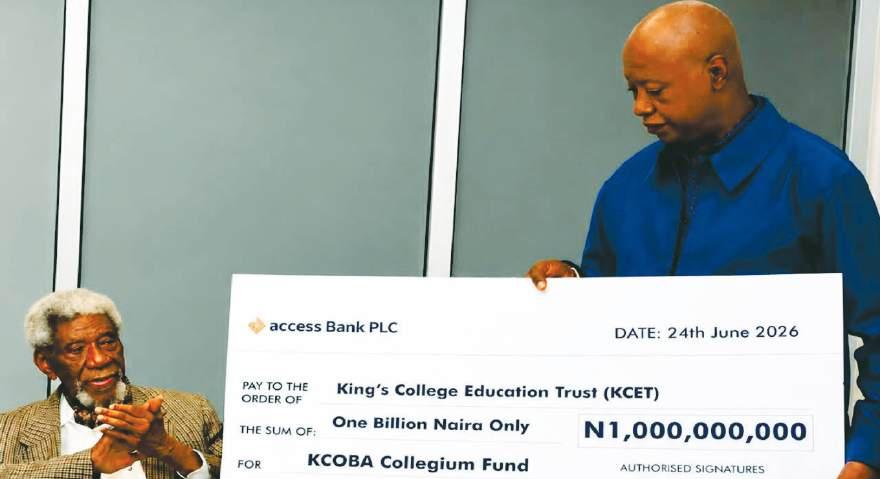
President of the King’s College Old Boys’ Association (KCOBA), Alhaji Kashim Ibrahim-Imam (right), presenting a ₦1billion cheque towards the ₦100 billion KCOBA Collegium Fund for the King’s College Education Trust (KCET) to the Pioneer President of King’s College, Lagos, and Chairman of the KCOBA Board of Trustees, Alhaji Femi Okunnu (SAN), following the federal government’s approval of the concession of King’s College, Lagos…recently
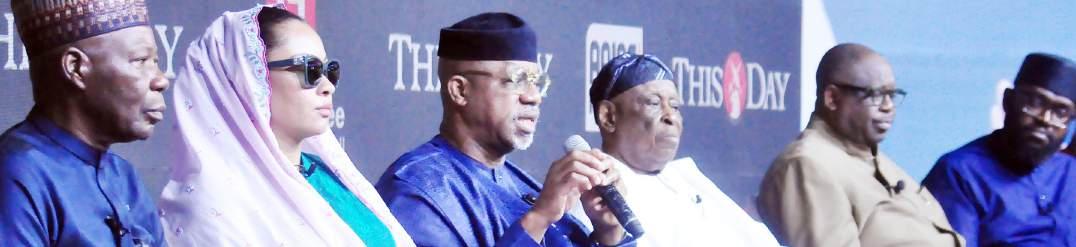
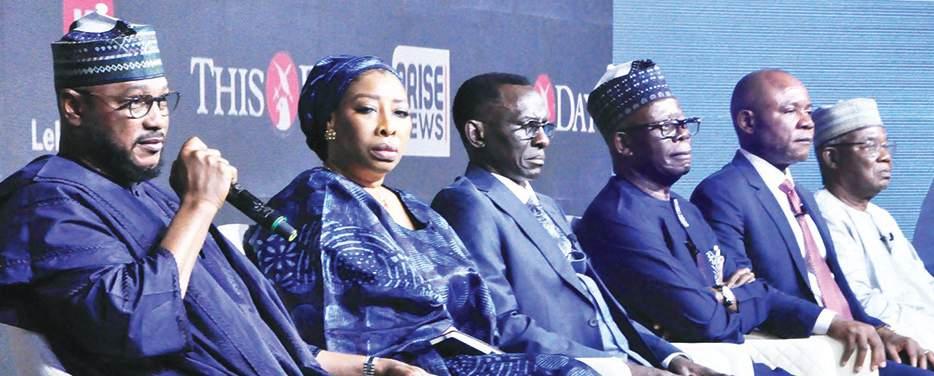
L-R: Chairman, Steering Committee on State Police, Prof. Olu Ogunsakin; Senator Natasha Akpoti-Uduaghan; Ogun State Governor, Prince Dapo Abiodun; former Ogun State Governor, Chief Olusegun Osoba; Governor of Plateau State, Caleb Mutfwang; and Senior Special Assistant to the President on Research and Public Policy, Dubem Okadigbo Moghalu, during the ARISE NEWS Town Hall on State Police in Abuja…Thursday
Deji Elumoye, Chuks Okocha in Abuja, and Kemi Olaitan in Ibadan
First Lady to Burna Boy, Asake, Davido: Channel Your Wealth to Help Most Vulnerable Nigerians
Deji Elumoye in Abuja and Ibrahim Oyewale in Lokoja
Wife of the President, Senator Oluremi Tinubu, has urged rich Nigerians especially prominent musicians like Burna Boy, Davido and Asake to channel part of their wealth into charitable foundations to help the country’s most vulnerable.
She posited that the huge burden on government alone informed her latest position on the issue.
While the Presidency accused Atiku of silence for several hours after the victims regained their freedom, it praised the presidential candidate of the Nigeria Democratic Congress (NDC) for calling for a thanksgiving to celebrate the rescue operation.
But in a swift response, Atiku who is the presidential candidate of the African Democratic Congress (ADC), has dismissed the Presidency’s claim, describing the allegation as a reckless distortion of facts that collapsed under the weight of documentary evidence.
Meanwhile, the Nigeria Governors’ Forum (NGF) has welcomed the successful rescue of the pupils and their teachers, describing the development as a source of joy and relief.
However, Oyo State Governor, Seyi Makinde, yesterday said he would next week formally brief
Speaking at the launch of the North-Central National Community Food Bank yesterday in Lokoja, the Kogi State capital, the First Lady appealed to wealthy Nigerians particularly figures in the entertainment industry to back sustained philanthropic efforts.
She said: “We have a lot of wealthy people. But our priorities are different. And I think it’s high time we started
the people of the state and the nation at large on what exactly transpired during the rescue of the pupils and their teachers from captivity.
A statement issued yesterday by the spokesperson for 2 Division, Nigerian Army, Ibadan, Lt. Col. Danjuma Jonah Danjuma, said the rescue operation lasted for more than one month and targeted the kidnappers’ network and hideouts in the Old Oyo National Park and other locations across the country.
He said the operation, coordinated by the General Officer Commanding (GOC) 2 Division, Maj. Gen. C.R. Nnebeife, on Friday, July 10, involved special units from the Office of the National Security Adviser (ONSA), particularly the National Counter Terrorism Centre (NCTC) the Defence Headquarters, Special Forces of the Nigerian Army,
helping those who need help in the country”.
Mrs. Tinubu cited international examples of entertainers who combine careers with charity work and called for similar commitments at home.
She said: “The Burna Boys of this world, Asake, all of them, Davido. We want to see you with one foundation or the other, helping the poor with your money.”
The First Lady also
Nigerian Navy and Nigerian Air Force, the Nigeria Police Force, the Department of State Services (DSS), the National Intelligence Agency (NIA), the Nigeria Security and Civil Defence Corps (NSCDC), as well as local vigilantes, hunters and Amotekun operatives.
According to Danjuma, the coordinated operation led to multiple arrests in Oyo State and several other states, effectively dismantling the kidnappers’ network.
“These arrests completely disorganized the group, exerted overwhelming pressure on them and ultimately led the terrorist group to release the pupils and teachers unconditionally. Further operations will be conducted,” he said.
He explained that the operation was carefully planned and executed to avoid collateral
discouraged social stigma against modest, lawful livelihoods and recalled a case of a University graduate who turned to street vending after failing to find formal employment; after assistance, the vendor now employs a dozen people.
“Our people should never despise small jobs”.
Mrs. Tinubu who announced a further donation of N100million by the Renewed Hope Initiative to the First Lady
damage and ensure the safe rescue of the abducted pupils and teachers.
“However, there were some casualties on the part of the security forces,” he added, without providing further details.
Danjuma said the rescued victims are receiving medical attention at an undisclosed hospital and will be handed over to the Oyo State Government for reunification with their families.
He said the GOC expressed appreciation to President Bola Ahmed Tinubu for his strategic guidance, support and the resources provided, which contributed to the success of the operation.
The GOC also commended Oyo State Governor, Seyi Makinde, and the people of the state for their unwavering support to security agencies throughout the operation.
of Kogi State to provide N50,000 each to 2,000 petty traders. She commended beneficiaries for embracing small-scale enterprise, noting the simple trays of their wares which included pepper, okro, tomatoes and others, they brought to welcome her as evidence that the message had resonated.
Earlier, the First Lady described the food bank programme as a deliberate and sustainable response to insecurity and malnutrition
He further applauded all the participating security agencies for their resilience, professionalism and commitment to the successful rescue mission.
Presidncy, Atiku in Fresh Row over Release of Abducted Victims
Meanwhile, the Presidency and Atiku yesterday engaged in a war of words over the former vice president’s alleged failure to rejoice with the federal government several hours after the release of the abducted pupils and teachers.
Presidential spokesperson, Bayo Onanuga, in a tweet yesterday on his verified X handle, @ aonanuga1956, alleged that Atiku never deemed it fit to speak up and congratulate the government at the centre and security agencies several hours
TRUMP THREATENS TO COMPLETELY DECIMATE IRAN OVER ASSASSINATION PLOT
if the Islamic Republic attempts or succeeds in assassinating him, dramatically escalating tensions between Washington and Tehran despite ongoing diplomatic efforts.
In a post on his Truth Social platform yesterday, Trump declared that the US military had already been placed on alert to launch a massive retaliatory strike against Iran should any assassination attempt be made against him.
“1,000 missiles are locked and loaded and aimed at the Islamic Republic of Iran, with thousands of more to follow immediately, should the Iranian Government act on its threat to assassinate,
value crossed the N20 trillion threshold to N21.8 trillion, a historic milestone for the telecommunications giant.
Strong investor demand pushed Airtel Africa's share price up by 10 per cent to N5,801.40 per share, from N5,274 at the start of the trading period.
The rally in Airtel Africa and other heavyweight stocks helped propel the overall market capitalisation by N9.3 trillion in one week, rising from N147.1 trillion to N156.44 trillion as of July 10.
Dangote Cement followed with a market capitalisation of N17.7 trillion, while MTN Nigeria Communications Plc
or attempt to assassinate, the sitting President of the United States of America, in this case, ME!” Trump wrote. He added: “Orders have already been given, and the U.S. military is ready, willing, and able, for one year, subject to extension, to completely decimate and destroy all areas of Iran.”
Trump’s remarks came despite his earlier agreement to continue negotiations with Iran, although he maintained that the ceasefire between both countries was effectively over.
“The Islamic Republic of Iran has asked us to continue talks. We have agreed to do so, but the United States has stated to
occupied the third position with N17.01 trillion.
An agro-allied heavyweight, BUA Foods, whose share price has remained flat at N939 since June 2026, recorded a market capitalisation of N16.9 trillion, making it the fourth most capitalised stock on the Exchange. The company had ranked as the NGX's most valuable listed company in June.
BUA Cement Plc, with a market capitalisation of N11.5 trillion, was the other company whose valuation exceeded the N10 trillion mark.
Other companies in the top 10 were Seplat Energy Plc, valued at N6.82 trillion; Aradel Holdings
them, in no uncertain terms, that the Cease Fire is OVER!” he posted.
Iran, however, rejected Trump’s claims, insisting it had remained committed to the memorandum of understanding signed with Washington last month.
Iranian Foreign Minister Abbas Araghchi said Tehran had fulfilled its obligations under the agreement, accusing the United States of violating its own commitments.
“The Islamic Republic of Iran has so far kept its word. Reality check: There can only be mutual compliance,” Araghchi said.
He argued that Washington
Plc, N6.63 trillion; HBM Nigeria Plc, N5.4 trillion; Guaranty Trust Holding Company Plc, N4.61 trillion; and Zenith Bank Plc, with N4.55 trillion in market capitalisation as of July 10.
The renewed bullish sentiment followed the heavy profit-taking that swept through the market in June 2026.
The Nigerian stock market suffered its worst monthly decline on record in June, when investors lost N13.3 trillion in the value of listed equities, bringing one of the market's strongest rallies to an abrupt halt.
Analysts at Cordros Research expressed optimism that market sentiment would
had breached provisions that required it not to impose new sanctions or deploy additional forces in the region while negotiations continued.
Diplomatic efforts have shown little progress since the signing of the agreement, with only one round of direct talks held in Switzerland alongside indirect negotiations mediated by Qatar.
The latest exchange of threats followed renewed military tensions after strikes this week shook the fragile understanding between both countries and raised fears of another wider regional conflict.
Meanwhile, the confrontation intensified further yesterday as
remain constructive as investors continued to take positions ahead of the release of first-half 2026 corporate earnings.
According to the analysts, attention is expected to remain focused on fundamentally sound stocks that still offer attractive entry points following the recent market correction.
Chief Executive Officer of HighCap Securities Limited, David Adonri, had also projected a mild recovery in the Nigerian equities market in the second half of 2026, supported by improving corporate fundamentals and sustained macroeconomic reforms.
Adonri said the market
among vulnerable households in Nigeria
According to her: "It is designed to ensure that vulnerable children under the age of six pregnant women and lactating mothers have access to nutritious food this initiative alliance with the Renewed Hope Agenda of President Bola Tinubu particularly in advancing food, security, improving healthcare outcomes and building a stronger and more prosperous Nigeria.
after the victims were rescued on Friday.
The presidential media aide in the tweet stated: "Almost 18 hours after the Oriire pupils and their teachers regained their freedom, Atiku Abubakar @atiku has not deemed it fit to rejoice with the Tinubu federal government, the security agencies and the traumatised victims.
"Previously, he weaponised the kidnap as a campaign issue several times since it happened 57 days ago. Now that the abductees are out, all is quiet on Atiku’s internet lane. No comment. No words of praise. Maybe, the veteran presidential runner is waiting for some bad news to attack Tinubu’s administration. Onanuga, however, praised Obi for speaking out on the issue. His words: "Kudos to Peter
Continued on page 9
Iran’s Supreme Leader, Mojtaba Khamenei, vowed revenge for the killing of his father and predecessor, Ali Khamenei, who was reportedly killed during US-Israeli strikes in late February.
In his first public message since assuming leadership, Khamenei declared that retaliation remained inevitable.
“Vengeance is the will of our nation and must inevitably be carried out,” he said.
“This matter depends neither on my personal existence nor on that of other officials. Whether we are present or not, it will come to pass.”
He also disclosed that Iran had compiled a list of individuals
was expected to gradually regain momentum as investors responded to stronger corporate earnings, improving economic indicators and growing confidence in the federal government's reform agenda.
He, however, warned that persistent inflationary pressures, political uncertainties ahead of the 2027 general election, insecurity, simultaneous capital-raising exercises and the continuing conflict in the Gulf region could pose significant downside risks to the market in the months ahead.
According to him, the recent correction on the NGX should not be interpreted as evidence of structural weakness in the
it intended to target, further heightening concerns over the deteriorating relationship between the two countries.
Despite the escalating rhetoric, mediators, including Qatar, Oman and Pakistan, continue efforts to revive negotiations and prevent a return to full-scale conflict.
Araghchi arrived in Oman yesterday for talks focused on the future of the Strait of Hormuz, the strategic waterway whose closure during the conflict severely disrupted global oil shipments and remains one of the biggest obstacles to a lasting agreement between Washington and Tehran.
capital market, but as a normal phase of institutional portfolio repositioning following the strong rally induced by economic reforms.
“The current market correction is a result of institutional investors repositioning their portfolios and not an indication of a breakdown in market fundamentals,” Adonri said.
He added that investor sentiment remained largely supported by improving macroeconomic conditions and projected a mild recovery in the second half of the year, driven by stronger corporate fundamentals and better earnings prospects.
IN SHOW OF SOLIDARITY TO TERRORISTS' VICTIMS…
After Oyo
Schoolchildren,
Teachers Regain
Demands Rescue of Borno, Kwara Kidnap Victims
Freedom, ADC
Urges FG to stop measuring success by rescues, prevent kidnappings
The African Democratic Congress (ADC) has urged the federal government to extend the same urgency and operational commitment that secured the release of abducted pupils and teachers in Oyo State to victims who remained in captivity in Borno and Kwara states, warning against what it described as a selective approach to rescue efforts.
The opposition party said
while the rescue of pupils, teachers and other victims abducted from schools in Oriire Local Government Area (LGA) of Oyo State after 56 days in captivity was commendable, it insisted that many Nigerians kidnapped in other parts of the country had remained in captivity for months without attracting similar national attention.
In a statement issued yesterday by its National Publicity Secretary, Mallam
Bolaji Abdullahi, the ADC congratulated the rescued victims and their families but insisted that the government must treat every kidnapping case with equal importance.
“We commend the security agencies and all those whose efforts made this rescue possible. Most importantly, we rejoice with the families whose long traumatic wait for the safe return of the victims has finally come to an end,” the party said.
The ADC, however, argued that the successful operation in Oyo State should not overshadow the plight of victims still being held by kidnappers elsewhere.
“The pupils abducted in Borno State in May this year remain in captivity, while more than 100 people kidnapped in Kaiama, Kwara State are still in the den of kidnappers several months after. We believe that the suffering of these victims deserves the same urgency,
Report: Boko Haram Uses AI to Make Bombs, Plot Operations
A report by The New York Times has revealed how Boko Haram terrorists turned to artificial intelligence (AI) for weapons making, including bombs, as well as improving their operations generally.
Former insurgents, the report noted, used multiple AI platforms, including ChatGPT, Claude, Gemini, Grok and DeepSeek.
According to the report, former Boko Haram commanders told terrorism and technology researcher Antonia Juelich of the University of
Cambridge that after an assault on a military base was frustrated by a defensive trench, the group consulted AI tools for ideas.
That was when they learned how to modify motorcycles to jump over such obstacles. Their mechanics altered motorcycles to improve speed and acceleration, and fighters practiced maneuvers before operations.
One of the former Boko Haram commanders told Juelich: “We saw in a movie how motorcycles can jump over bridges.
“We used AI to learn how to
do this. We gave it information like which motorcycles we use, the distance we need to jump, and so on. And it gave us steps on what we have to do.”
Another terrorist, a former commander in Islamic State West Africa Province, ISWAP, told Juelich, “You type in the question or use your voice, and it gives you a detailed answer, like ‘How can I build a bomb?’ and then it tells you how.
“It is like a human robot! We used it a lot. Trial-and-error can kill you. AI gives you accuracy,” he said.
“Before, the bomb explosion
was not that big, but then they studied it. AI told us what chemicals to put in that made the explosion heavier,” he said.
Reacting to the findings, OpenAI told The New York Times that the terrorists violated its policies with such actions.
On their part, Google and Anthropic said their AI models contained protections designed to refuse dangerous requests.
However, the former insurgents told the researcher that they often bypassed chatbot restrictions by disguising their requests as legitimate projects.
determination as well as the national and international attention that brought the Oriire victims’ home,” the statement added.
The party maintained that rescue operations, though important, should not become the benchmark for assessing the government’s security performance.
“Every successful rescue is worth celebrating. But every kidnapping is also a reminder that the primary duty of the government is to ensure that citizens are not abducted in the first place. What we must not do is to get accustomed to measuring success by the number of rescue operations this government conducts,” it added.
According to the statement, the real measure of success is creating an environment where parents can send their children to school without fear, travellers can use highways safely, and citizens can go about their daily activities without the constant threat of abduction.
The party expressed concern that insecurity had become a routine feature of daily life under the current administration, warning
that persistent kidnappings continued to undermine public confidence and economic development.
“We cannot achieve meaningful economic growth, attract investment or build public confidence while kidnapping remains a recurring feature of national life,” it said.
The ADC called on the federal government to sustain the momentum that led to the rescue of the Oriire victims by deploying “the same resolve, intelligence and operational capacity” to secure the release of all Nigerians still in captivity. It also urged the government to “move beyond reactive responses by adopting a comprehensive security strategy focused on improving intelligence gathering, strengthening inter-agency collaboration, addressing the root causes of insecurity and restoring effective state presence in vulnerable communities.”
The party concluded that while the return of the Oriire victims deserved celebration, national efforts would remain incomplete until every abducted Nigerian regained freedom.
UK Reaffirms Visa Requirement for Nigerians, over 100 Other Countries for Short Duration
Festus Akanbi
The United Kingdom has reaffirmed that Nigerians and nationals of more than 100 countries and territories must obtain visas before travelling to the country for visits or for a duration of less than six months.
The requirement is set out in the updated UK Immigration Rules Appendix Visitor, which
lists countries and categories of travelers who must obtain entry clearance before embarking on a journey to the UK. The updated immigration rule was released at the weekend.
Under the rules, citizens of Nigeria, Ghana, South Africa, Kenya, India, Pakistan, Russia and several other African, Asian, European and Latin American countries remained classified as
visa nationals, who must obtain entry clearance before travelling to the UK, except where specific exemptions apply.
The updated guidance also extended the visa requirement to stateless persons and individuals travelling with documents other than national passports or, where permitted, national identity cards.
It stated: “Stateless persons
and people travelling on documents other than a national passport or, where applicable, a national identity card must also obtain entry clearance before travelling, unless the document has been issued by the UK.”
The UK Home Office, however, in the rules released on July 1, indicated that limited exceptions apply to certain nationals of the People’s
Republic of China and Taiwan, with the relevant exemptions set out in subsequent provisions of the immigration rules.
The development means that Nigerian travellers planning tourism, family visits, short business engagements, or other visits lasting less than six months must continue to obtain the appropriate UK visa before departure.
Other African countries on the visa list include Algeria, Angola, Benin, Botswana, Burkina Faso, Burundi, Cameroon, Cape Verde, Central African Republic, Chad, Comoros, Republic of the Congo, Côte d’Ivoire, Democratic Republic of the Congo, Djibouti, Egypt, Equatorial Guinea, Eritrea, Eswatini, Ethiopia and Gabon.
Linus Aleke in Abuja
Chuks Okocha in Abuja
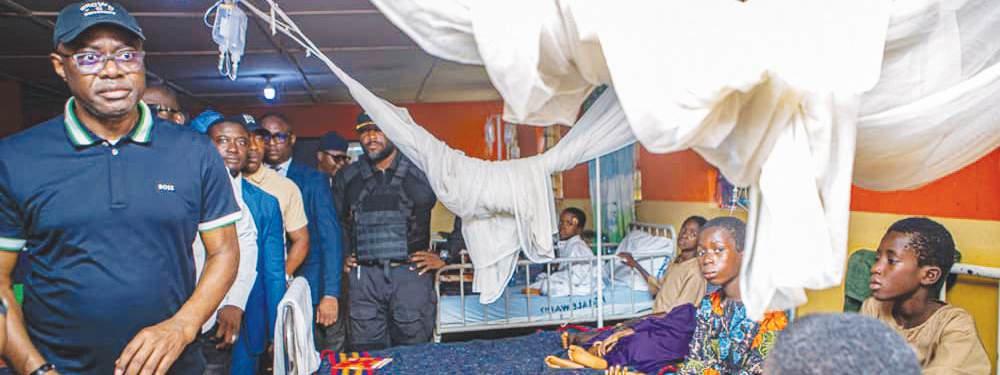
Oyo State Governor, Seyi Makinde and some of the rescued abducted people from Orire Local Government Area when the governor paid a visit to them at 2 Division of the Nigerian Army Medical Services and Hospital, Adekunle Fajuyi Cantonment, Ibadan…yesterday
WE SHARE IN YOUR GRIEF…
L-R: Ekiti State Governor, Mr. Biodun Oyebanji; former member of the House of Representatives/son of the deceased, Hon. Bimbo Daramola; Niger State Governor, Mohammed Umaru Bago; and Senate Leader, Senator Opeyemi Bamidele, at the funeral of renowned educationist, Chief Francis Adebayo Daramola, at St John's Anglican Church, Ire-Ekiti...Friday
Senate Probes Alleged $71.65m,
N30.7bn NDDC
Remittance
Default by Aiteo, Summons Company
Seeks list of all defaulting IOCs, weighs tougher sanctions
Sunday Aborisade in Abuja
The Senate has commenced an investigation into the alleged non-remittance of statutory contributions amounting to $71.65 million and N30.7 billion by Aiteo Exploration and Production Company Limited, now known
as Nembe Exploration and Production Company Limited, to the Niger Delta Development Commission (NDDC), warning that persistent defaults were undermining development efforts across the oil-producing region.
The Senate Committee on the NDDC, which opened the investigative hearing in Abuja,
also directed the oil company at the centre of the petition to appear before it within two weeks.
The panel also requested the commission to submit a comprehensive list of all the international oil companies (IOCs) with outstanding statutory remittances.
The probe followed a petition by environmental activist Mathew Echo, who alleged that Nembe Exploration and Production Company Limited, had failed to remit statutory contributions to the NDDC from 2021 to date as required under the NDDC Act.
Section 2(p) of the NDDC Act, as amended, requires
Nigeria, Global Aircraft Manufacturers, Bombardier, Conclude Strategic Engagement
Kasim Sumaina in Abuja
The Federal Government of Nigeria has concluded its strategic engagement with the world's leading aircraft Original Equipment Manufacturers (OEMs), Bombardier, following a visit to the company’s Laurent Beaudoin Completion Centre (LBCC) in Montréal, Canada, by the Minister of Aviation and Aerospace Development, Festus Keyamo, who led a delegation of Nigerian airline operators on a working visit.
The visit fulfilled a commitment
made by the minister upon assuming office in 2023 to establish direct partnerships between Nigerian operators and the world's leading aircraft manufacturers.
Following earlier engagements with Boeing, Airbus and Embraer, the Bombardier visit completed the federal government's comprehensive OEM engagement programme aimed at supporting fleet renewal, improving access to aircraft financing, expanding technical cooperation, strengthening maintenance capabilities, and
enhancing the competitiveness of Nigerian airlines.
Speaking during the visit, Keyamo reaffirmed the federal government's commitment to creating an enabling environment for indigenous operators.
The minister, in a statement issued by his Special Adviser on Media, Tunde Moshood, stated: "Our objective has always been clear—to connect Nigerian operators directly with the world's leading aircraft manufacturers and create opportunities that will strengthen indigenous capacity, modernise
our fleets, improve safety, enhance operational efficiency, and ensure the long-term sustainability of our aviation industry."
According to him, "Bombardier, a global leader in business aviation, manufactures the Challenger and Global series of executive aircraft and provides world-class aircraft completion, maintenance, training and aftermarket support. The engagement aligns with the Federal Government's ongoing reforms to strengthen Nigeria's business and non-scheduled aviation sector."
Industrial Court Bars Non-specialist Police Lawyers from Civil Cases
Wale Igbintade
The National Industrial Court sitting in Abuja has barred police officers who are not employed in the Specialist Legal Cadre from representing the Nigeria Police Force in civil proceedings, even if they are qualified legal practitioners. The landmark judgment
delivered on Friday by Justice O. Anuwe in the suit marked NICN/ABJ/264/2025 was in the case between the Incorporated Trustees of the Nigerian Bar Association (NBA) and the Police Service Commission alongside five other respondents. The action was instituted by the NBA and prosecuted by the Public Interest
Litigation Committee of the Section on Public Interest and Development Law, SPIDEL, led by Mr. Olukunle Edun (SAN).
oil-producing companies operating in the Niger Delta to contribute three per cent of their annual operating budgets to the commission to support infrastructure, environmental remediation and other development programmes.
The oil company, according to a statement issued yesterday by the Committee, did not appear before it despite an invitation.
Declaring the hearing open, Chairman of the Senate Committee on the NDDC, Senator Asuquo Ekpenyong, said the committee was investigating allegations of non-compliance with the provisions of the NDDC Act and would ensure that all parties were given a fair hearing.
He, however, said the committee was prepared to give the oil company the benefit of the doubt over its absence, noting
that the notice of invitation might have been too short.
"The Managing Director (of NDDC) has also indicated that there are other companies with outstanding remittances. We want the NDDC to furnish this committee with a comprehensive list showing those that have complied with their obligations and those that have not," Ekpenyong said. He added that the committee had resolved to invite the oil company to appear before lawmakers within two weeks to respond to the allegations. Presenting the petition, Echo described the case as a reflection of a wider challenge facing the commission, alleging that some oil companies had consistently failed to comply with their statutory obligations for years.
The NBA had argued that several police officers recruited as General Duty Officers later obtained law degrees and were called to the Nigerian Bar but were not converted to the Specialist Legal Cadre as required by law.
The suit sought the interpretation of Rule 8(1) and (2) of the Rules of Professional Conduct for Legal Practitioners, 2023, Section 18(9) and (11) of the Nigeria Police Act 2020, and Force Order 137(3) of the Ratified Police Force Order 2013.
The Armed Forces of Nigeria (AFN) have sustained offensive operations across various theatres, rescuing abducted citizens, dismantling terrorist logistics networks, disrupting criminal activities and weakening the operational capabilities of insurgent groups, the Director of Defence Media Operations, Major General Michael Onoja, has said.
Speaking during a press briefing in Abuja on ongoing military operations for the period covering July 3 to 9, 2026, Onoja said troops maintained an aggressive operational posture aimed
at restoring peace, protecting lives and safeguarding national economic assets.
He disclosed that troops of Operation Hadin Kai in the North-east recorded major successes against terrorist groups through offensive and search-and-rescue operations across Adamawa, Borno and Yobe states.
According to him, troops rescued six farmers abducted from Mussa in Askira Uba Local Government Area (LGA) of Borno State and also destroyed terrorist logistics and support structures in Wulgo, Hausari, Danbaure and Jegarawaji areas of Ngala LGA.
IG: State Police will Deepen Intelligence Gathering, Bring Security Closer to Nigerians
Assures international community of safety of investments, tourism
Linus Aleke in Abuja with agency report
The Inspector-General of Police (IG), Mr. Tunji Disu, has said state police would deepen community policing and improve intelligence gathering.
This is as he promised the international community that Nigeria remained safe for
citizens, investors and visitors.
Disu told the News Agency of Nigeria (NAN) in New York at the weekend that the initiative would boost community-based policing and improve intelligence gathering.
He, however, said implementation would involve extensive consultations, comparative studies and
capacity building before full operationalisation.
“We are still at the teething stage. We need experience, education and comparative studies from jurisdictions already practising state police,” he said.
He expressed confidence that state police would strengthen collaboration between federal and state security institutions.
“It will bring policing closer to the people because officers will better understand the communities they serve. It will take us back to the era when almost everybody knew those policing their communities,” he added.
The police chief said closer community engagement would improve intelligence gathering,
NAF’s Precision Strikes Kill Scores of Terrorists, Destroy Enclaves in Borno
The Nigerian Air Force (NAF) yesterday said that its Air Component of Operation Hadin Kai recorded another major operational success with precision air strikes that devastated a terrorist enclave at Yaganari in the Gezuwa general area of Borno State.
Director of Public Relations and Information at NAF, Air Commodore Ehimen Ejodame, said several terrorists were neutralised in the operation, which took place on Friday.
“Acting on credible intelligence on renewed terrorist activities and the concentration of fighters in the area, the Air Component conducted intelligence, surveillance and reconnaissance missions which confirmed the presence of terrorist structures and logistics hubs,” Ejodame said.
“The targets were subsequently engaged in a series of precision strikes, leading to the destruction of terrorist infrastructure and the neutralisation of several terrorists.
“The successful operation
further underscores the growing pressure being mounted on terrorist elements, whose freedom of movement and ability to regroup continue to be severely degraded by sustained air offensives.”
The Chief of the Air Staff (CAS), Air Marshal Sunday Aneke, commended the personnel involved for their professionalism and reaffirmed the Nigerian Air Force’s resolve to sustain relentless offensive operations against all threats to national security.
According to the CAS, “The
Nigerian Air Force will continue to deliver decisive air power in concert with surface forces to hunt down, disrupt and destroy terrorist elements wherever they may seek refuge.”
“We remain committed to ensuring that terrorists have no safe haven and no opportunity to recover their capabilities,” he added.
He stressed that the Armed Forces of Nigeria remained firmly on course in consolidating the significant gains already recorded in the ongoing counter-terrorism campaign.
LP Unveils Female Veteran Nurse as Vice Presidential Candidate for 2027 General Election
Chuks Okocha in Abuja
The Labour Party (LP) has unveiled Hajia Bintu Konto as its vice-presidential candidate for the 2027 general election, pairing her with the party’s presidential candidate, Dr. Chibuzo Okereke.
LP’s National Publicity Secretary, Ken Asogwa, disclosed this in a statement issued in Abuja yesterday.
He said, “The decision
followed extensive consultations with stakeholders and reflected our commitment to presenting a ticket that embodies competence, integrity, inclusiveness, patriotism and proven capacity for public service.
“Her experience in governance engagement, humanitarian coordination, women’s empowerment and public policy, as well as her
fluency in English, Hausa, Kanuri, Shuwa, Fulani and Bura, would strengthen the party’s presidential ticket.
“Her nomination underscored its commitment to gender inclusion, national unity and competent leadership. We also believe that the Okereke-Konto ticket represented a new generation of purposeful, people-centred leadership committed to restoring hope, strengthening
national institutions, reviving the economy, improving security and delivering responsible governance.”
Continuing, the party called on Nigerians to support its presidential ticket ahead of the 2027 election.
Konto, who hails from the north, is a trained nurse, midwife, health educator and public health specialist with a master’s degree in public health.
public trust and rapid response to security threats.
He reaffirmed the Nigeria Police Force’s commitment to innovation, professionalism and strategic partnerships to sustain peace, stability and national development.
Disu, who participated in the UN Chiefs of Police Summit at the UN headquarters, said Nigeria’s sacrifices strengthened global peace.
According to him, Nigeria’s UN peacekeeping record remained a source of global pride, adding that the country never failed in its UN peacekeeping missions.
The IG said Nigeria remained one of the United Nations’ most dependable contributors to peacekeeping.
He praised Nigerian security personnel serving worldwide, saying Nigeria has contributed troops, police officers and made enormous sacrifices.
The police chief reaffirmed Nigeria’s longstanding commitment to United Nations peacekeeping operations worldwide.
He recalled that Nigeria began participating in UN peacekeeping operations in Congo in 1960 and has remained a dependable contributor ever since.
“There is virtually no UN mission where you will not find Nigerian personnel serving with distinction,” he said.
Disu said Nigeria had also made enormous sacrifices in global peacekeeping through the loss of many police personnel.
“The United Nations will never joke with Nigeria’s contributions because of our commitment and sacrifices,” he said.
Disu used the occasion to assure the international
community that Nigeria remains safe for citizens, investors and visitors.
He said security agencies were working round the clock to protect everybody in the country.
The Nigerian police chief countered negative global perceptions of security, saying international perceptions often failed to reflect realities on the ground.
The IG said negative global perceptions of Nigeria often differed from realities experienced by visitors to the country.
“People hear stories about Nigeria, but when they visit, they are surprised by what they see. People are moving around freely.”
He acknowledged the challenges posed by insurgency and banditry in parts of the country, saying they are a spillover of the regional security challenge in the Sahel.
“These challenges are more prevalent in some areas than others. I assure you, the Nigeria Police and other security agencies are not resting on their oars. They are working daily to ensure life becomes easier for every citizen and every visitor.”
The IG reaffirmed the government's commitment to restoring lasting peace nationwide.
“Our resolve remains unwavering to secure every part of Nigeria.”
Disu said security agencies remained committed to protecting lives and property through intelligence-led operations and enhanced inter-agency collaboration.
He said Nigeria was increasingly deploying advanced technology to combat terrorism, banditry, kidnapping and other emerging security threats.
Linus Aleke in Abuja
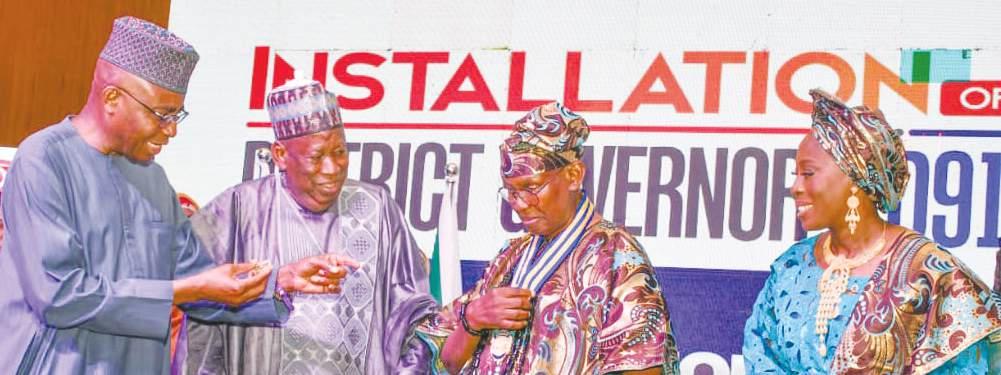
L-R: Chairman of the occasion, Dr. Ahmed Raji (SAN); former Governor of Kano State, Dr. Abdullahi Umar Ganduje; District Governor 9127, Mr. Sikiru Adetona Owonikoko; and his wife, Zainab, during the investiture of Owonikoko as the Rotary International District Governor for District 9127 at the Transcorp Hilton Hotels in Abuja…yesterday
TWENTY-TWO HEARTY CHEERS…
Akume: FG is Building Economy, Creating Opportunities, Restoring Confidence in Governance
Okon Bassey in Uyo
The Secretary to the Government of the Federation (SGF), Senator George Akume, yesterday said the federal government was deliberate building an economy that created opportunities, strengthened institutions, improved infrastructure, enhanced social welfare and restored public confidence in governance.
Akume stated this at the 2026 Permanent Secretaries’ Retreat held in Ikot Ekpene, Akwa lbom State, saying this was the essence of the government's Renewed Hope Agenda.
These aspirations, the SGF said, cannot be realised through budget appropriations alone, but also on disciplined implementation, prudent financial management and a procurement system that delivers value for money.
He maintained that the success of government was ultimately measured not only by the quality of its policies but by the results those policies delivered to the citizens.
"Roads must be completed. Hospitals must be equipped. Schools must be improved. Water and sanitation projects must reach communities. Security infrastructure must
be strengthened. Investments in agriculture, education, healthcare, technology and critical infrastructure must translate into better lives for Nigerians," he said.
Akume noted that as permanent secretaries, they were the accounting officers of their respective Ministries, Departments and Agencies (MDAs), adding that in that capacity, they should provide the institutional leadership that would transform government policies into practical outcomes.
"The quality of procurement planning, the timeliness of project execution, the integrity of contract administration and
ARMY: HOW WE RESCUED 44 ABDUCTED PUPILS, TEACHERS
Obi: At least, he has spoken and called for thanksgiving without commending the Commanderin-Chief."
Obi, while reacting to the rescue operation in an X post yesterday, described their safe return as “worthy of thanksgiving”.
He commended security personnel and others involved in securing the victims’ release.
“I am greatly relieved and delighted to learn of the safe rescue of the schoolchildren who were kidnapped,” Obi said.
“I sincerely thank all those whose tireless efforts made their freedom possible, especially the security personnel and everyone who worked behind the scenes.”
He said the incident showed the need to strengthen Nigeria’s security architecture, warning that no child should be subjected to the trauma of abduction.
“While we celebrate this happy outcome, we must remember that no child should ever have to endure such trauma,” he noted.
“The recurring incidents of kidnapping, particularly of schoolchildren, underscore the urgent need to strengthen our security architecture and make the protection of lives and property the foremost responsibility of the government.
“Our children deserve to learn in an atmosphere of safety, not fear. We must continue to work towards building a Nigeria where every child can pursue education without the threat of violence or abduction.
“I rejoice with the children, their families, their schools, and all Nigerians on this heartening development.”
But reacting in a statement issued by his Senior Special Assistant on Public Communication, Phrank Shaibu, the ADC presidential candidate said there were “only two possible explanations for the Presidency’s latest outburst: either its media handlers were too lazy to acquaint themselves with publicly available facts before rushing to attack the opposition, or they were too embarrassed by the substance of his statement to acknowledge its existence.”
The statement quoted Atiku as saying, “It is astonishing that a Presidency with limitless public resources could accuse someone of silence without carrying out the most basic verification.
“Either they failed to read our statement because they were too lazy to do so, or they deliberately ignored it because it exposed uncomfortable truths about their misplaced priorities.”
Atiku insisted he had issued a comprehensive press statement earlier yesterday, titled ‘A Nation at War Needs a Commanderin-Chief, Not a Campaigner-inChief’, in which he welcomed the rescue and commended the security agencies involved.
“What we declined to do was to applaud a Commanderin-Chief who, at a defining moment of national importance, remained publicly preoccupied with partisan political activities instead of personally leading the nation in celebrating the success of our troops and reassuring families whose loved ones remain in captivity,” he said.
The statement Atiku issued earlier yesterday had accused Tinubu of prioritising politics over national security.
In it, Atiku argued that Nigeria needed a “Commander-in-Chief, not a Campaigner-in-Chief” at a time the country was battling terrorism, banditry and mass kidnappings.
He had noted that the rescue coincided with the launch of the All Progressives Congress’ door-to-door campaign ahead of the 2027 election, which he described as troubling.
“The politics of re-election should consume no serious government while innocent
the effectiveness of financial oversight are all influenced by your leadership.
"This places on you a responsibility that extends beyond administrative compliance. It calls for strategic thinking, ethical leadership and a steadfast commitment to the principles of transparency, fairness and accountability. Every procurement decision should reinforce public trust and demonstrate responsible stewardship of public resources.
The theme of this retreat, "Strengthening Procurement Leadership and Accountability for Effective Budget Execution and National Development," the
schoolchildren have remained in the custody of kidnappers for weeks,” he said, adding that “yesterday should have been dedicated to the war room, not the campaign room.”
Atiku added that no amount of propaganda could erase the questions raised in his earlier statement, pointing to children still held in Borno State and elsewhere.
“The rescue of the Oyo schoolchildren brought joy to the nation, but Nigerians are still asking: When will the children abducted in Borno State and other innocent citizens across the country also regain their freedom? Those questions remain unanswered,” he said.
Atiku urged the Presidency to devote less energy to manufacturing controversies over opposition statements and more to confronting the country's security challenges.
“A government secure in its performance does not invent silence where there was a documented public statement.
It responds to legitimate concerns with facts and results, not propaganda,” he said.
He added that Nigerians deserved a Presidency focused on rescuing every citizen still in captivity rather than one
SGF said was both timely and compelling.
"It speaks directly to one of the most important responsibilities entrusted to public institutions: ensuring that public resources are managed with integrity, efficiency and measurable impact."
He posited that one of the federal government's key priorities was to improve budget implementation.
"We have made significant progress in strengthening budget preparation and aligning public expenditure with national priorities.
"However, the true measure of success lies in ensuring
preoccupied with misrepresenting the opposition.
Atiku had also argued that Tinubu ought to have personally addressed the nation alongside the country’s defence chiefs immediately after the rescue, rather than leaving the announcement to his spokesman.
At the same time, he was engaged in political activities.
NGF Hails Rescue, Makinde to Brief Nigerians on What Transpired
In a related development, the NGF has welcomed the successful rescue of the pupils and teachers.
In a statement issued by its Chairman and Governor of Kwara State, AbdulRahman AbdulRazaq, the forum congratulated President Tinubu on the successful operation.
The NGF said the rescue was the outcome of months of high-level coordination, intelligence gathering and disciplined execution by security agencies.
The forum also rejoiced with the families of the victims, noting that the operation had reunited them with their loved ones.
that approved budgets are implemented efficiently and that projects are completed on schedule, within cost and to the required quality standards."
Experience, he said, had shown that delayed procurement planning, weak project preparation, fragmented institutional coordination and inadequate contract management could undermine even the most carefully prepared budgets.
Addressing these challenges, he said required leadership, discipline and collaboration across the public service, as no Ministry, Department or Agency would operate in isolation.
It commended the Oyo State Government for its collaboration with the federal government, which it said contributed significantly to the success of the rescue mission.
On his part, Makinde said he would formally brief the people of the state and the nation at large next week on exactly what happened during the rescue of the pupils and teachers.
The governor met with the victims and the medical personnel attending to them at the Military Hospital in Ibadan, where they were receiving treatment.
Makinde, while speaking with journalists after the visit, disclosed that the state government would expect a formal handover of the victims from the military after the medical evaluation.
“We’ll watch them over the next 48 hours, so by Monday we think an assessment will be done and maybe there’ll be a formal transfer from the military to the state. Then we can manage the process from that point forward,” the governor said.
“In the course of the week, I will officially brief the people of Oyo State and the nation at large on what exactly has transpired,” Makinde said.
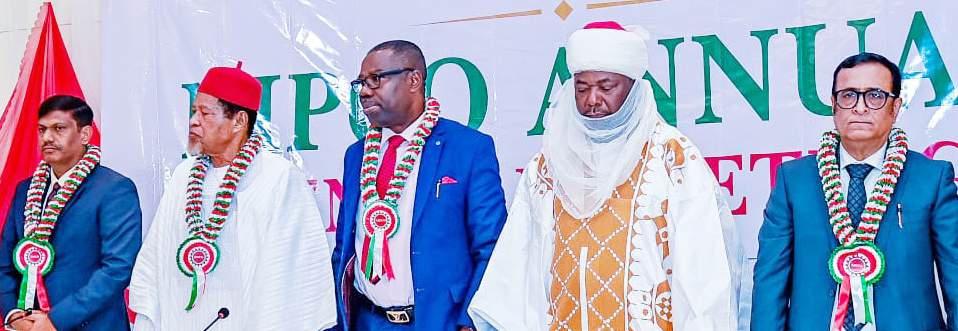
L-R: Managing Director, NIPCO Plc, Suresh Kumar; Chairman, Bestman Anekwe; Company Secretary, Paul Chukwuma Obi (SAN); Group Executive Director, Abdulkadir Aminu; and Director, Ramesh Virwani, during the Company's 22nd Annual General Meeting held in Abuja ... weekend
WORKING FOR HuMANITY…
APC Sweeps Edo Council Polls Amid Low Voter Turnout
Candidates of the All Progressives Congress (APC) have won Saturday’s local government elections conducted across the 192 wards and 18 local government areas of Edo State. Despite the statewide victory, voter turnout was low in many polling units visited, with reports from across the state indicating widespread voter apathy.
The Edo State Independent Electoral Commission (EDSIEC) said 12 political parties participated in the election, but APC candidates emerged victorious in all the chairmanship and councillorship contests.
However, turnout was relatively high at Ward 2, Udomi Primary School, in Esan Central
Local Government Area, where Governor Monday Okpebholo cast his vote.
Election materials arrived early at polling units, while voters queued to cast their ballots in parts of Esan South-East, Esan West and Esan Central local government areas.
Governor Okpebholo arrived at his polling unit at about 10:30 a.m. and voted 10 minutes later.
Speaking after voting, he described the exercise as peaceful and orderly.
“This election is very peaceful and it is going smoothly based on the feedback we are getting from the field.
“The turnout is very high. This is a demonstration of grassroots democracy. It shows
Ganduje Urges Stronger Institutions, Values-driven Leadership at Rotary Investiture
Former National Chairman of the All Progressives Congress (APC), Dr Abdullahi Ganduje, has called for stronger institutions, effective leadership and adherence to core values as essential ingredients for sustainable development and lasting impact in Nigeria.
Ganduje spoke in Abuja at the investiture of Rotarian Sikiru Adetona Owonikoko as District Governor of Rotary International District 9127, where he praised Rotary as a model of institutional stability built on service, discipline and humanitarian values.
The event brought together government officials, captains of industry, Rotarians from across the country, and friends and family members of the new district governor.
Drawing from his experience in public administration, Ganduje said the challenge facing many developing countries was not the absence of policies but weak implementation structures.
“Successful implementation is only possible when you have strong institutions. We have good policies, but implementation is often faulty,” he said.
that our people are interested in choosing those who will administer the affairs of their local governments. By the grace of God, a winner will emerge at the end of today’s election,” he said.
The governor urged residents to remain peaceful throughout the exercise and await the official declaration of results by EDSIEC.
Earlier, EDSIEC Chairman, Johnson Aifuobhokhan, said the commission recruited and trained
10,000 ad hoc staff for the election.
Former Edo State Governor, Senator Adams Aliyu Oshiomhole, and his son, Dr Cyril Oshiomhole, also voted at Ward 10, Iyamho, in Etsako West Local Government Area.
In Ovia South-West Local Government Area, 30-year-old Anthony Osarobo of the APC was declared chairman-elect after polling 98,994 votes across the council’s 10 wards.
Returning Officer for the election, Dr Arodoye Nosakhare, announced the result at the EDSIEC Local Government Collation Centre.
“After the collation of results across different party lines, the APC chairmanship candidate, having scored the majority of valid votes, is hereby returned elected,” Nosakhare declared.
Reacting to his victory, Osa-
robo expressed appreciation to the electorate for the confidence reposed in him.
“I am happy to have emerged as the Chairman-elect of Ovia South West. I do not take this victory for granted because it was made possible by the support and confidence reposed in me by the people. I will use this mandate to work tirelessly for the development and progress of Ovia South West,” he said.
Marwa Seeks Traditional Rulers’ Support to Tackle Drug Abuse, Protect Girl-child
Michael Olugbode in Abuja
The Chairman and Chief Executive Officer of the National Drug Law Enforcement Agency (NDLEA), Brig. Gen. Mohammed Buba Marwa (rtd.) has called for the protection of the girl-child against systemic vulnerabilities that drive women and youth toward drug abuse and exploitation.
in Kaduna yesterday, stated that “by protecting the girl-child, we protect the family, and by protecting the family, we secure the nation.”
He said efforts to protect the vulnerable in society should not be left to government and nongovernmental organisations alone but must be embraced by every stakeholder, including traditional institutions.
He described Rotary as a strong institution whose enduring relevance is rooted in its humanitarian mission.
“The core value of Rotary is humanitarian service,” Ganduje added.
Reflecting on his time as governor of Kano State, Ganduje recalled the resistance encountered during the polio eradication campaign and said decisive measures were necessary to protect public health.
“Parents hid their children under beds, behind their houses and even in the bushes to avoid immunisation. We had to adopt unconventional measures because prevention is better than cure,” he said.
“Eventually, people became convinced, and Kano ceased to be the epicentre of polio.”
Ganduje noted that Rotary’s role was becoming even more critical at a time when Nigeria was grappling with security and economic challenges that required stronger humanitarian interventions.
“For a sustainable institution, you need strong leadership, rules and regulations, compliance with those rules, and adherence to the core values of the institution.
Marwa, who made the call in his remarks at the public presentation of a book: “In The Shadow of the Neem Tree,” written by his daughter, Mariam Marwa-Abdu,
According to him, “as the Chairman/CEO of NDLEA, I see firsthand, every day, how systemic vulnerabilities like
poverty, abuse, and lack of education drive women and youth toward drug abuse and exploitation. Advocacy like Mariam’s is the first line of defence. We cannot leave this battle to the government or nongovernmental organisations alone. We need the partnership of our revered traditional institutions, led by custodians of culture like His Royal Highness, the Emir of Zazzau, to shift the cultural paradigm. We must protect our daughters, educate them, and give them the wings to fly.”
While commending the author for her courage, intellect, and compassion, and for making him and the entire family incredibly proud, Marwa urged the gathering to ensure the message conveyed on the pages of the book reaches every corner of society.
“To see all four of my eldest children, who are all coincidentally lawyers, pick up the pen to fight societal ills and document human experiences is the greatest legacy a father could ask for. We have become practically a family of authors!”
The Chairman of NIPCO Plc, Chief Bestman Anekwe has said that the company has mapped out an aggressive growth for 2026 with focus on gas expansion and shareholders returns.
Addressing the shareholders at the company’s Annual General Meeting held recently in Abuja, Anekwe said the ambitious roadmap for 2026 and beyond, was anchored on vertical integration, technology adoption, and sustainable energy solutions.
He assured shareholders that the company would augment investments across all business lines while deploying more pragmatic marketing strategies to maintain a competitive edge and stay ahead of industry peers.
He stated that the company’s growth trajectory aligned seamlessly with Nigeria’s “Renewed Hope Agenda” and the federal government’s push to harness the country’s vast gas reserves. According to him, with 43 new Field Development Plans approved nationally and gas-to-power supply reaching
its strongest levels in months, NIPCO was strategically positioned to capture emerging opportunities in both domestic and export markets.
Anekwe explained that focus for 2026 would be on strengthening infrastructure, driving local content development, and prioritizing environmental sustainability.
He noted that the company remained conscious of pressing issues such as infrastructure deficits and operational efficiency, and is investing in technology and local talent to address them.
“The goal is clear: Lead the industry in profitability, market share, and investor confidence,” Anekwe declared.
He pointed out that NIPCO remained committed to fostering collaboration between government, regulators, and industry players to create a conducive environment for investment and innovation. According to him, with the right policies and collaborative approach, Nigeria’s oil and gas industry is poised to become a major driver of economic growth, job creation, and sustainable development.
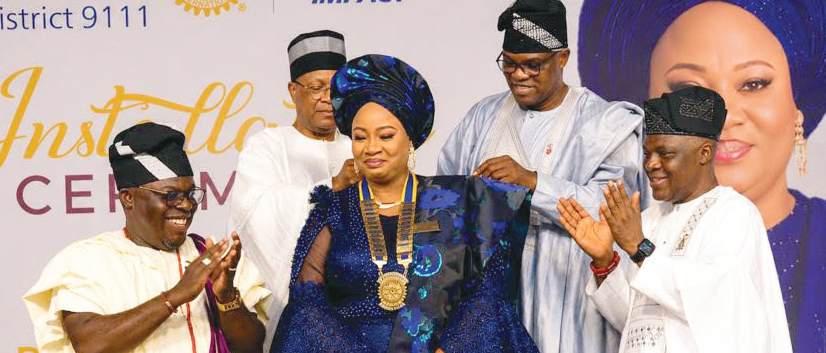
L-R: Immediate past District 9111 Governor, Rotary International, Henry Akinyele; former Minister of Health and Doyen of past District Governors, Prince Julius Adelusi-Adeluyi; Rotary International District 9111 Governor 2026-2027, Rotarian Bukola Bakare; Rotary International President 2026-2027, Yinka Babalola; and Ajirowa of Ijesha Kingdom, Chief Lateef Bakare, decorating Bakare at the Balmoral Hall Sheraton Hotel, Ikeja, Lagos…yesterday.
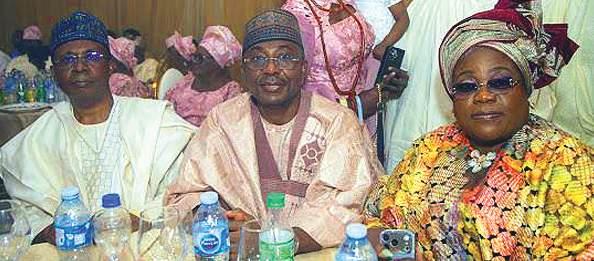
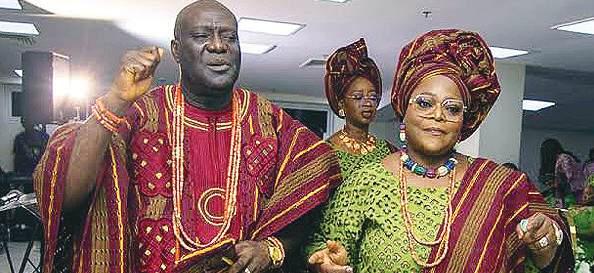
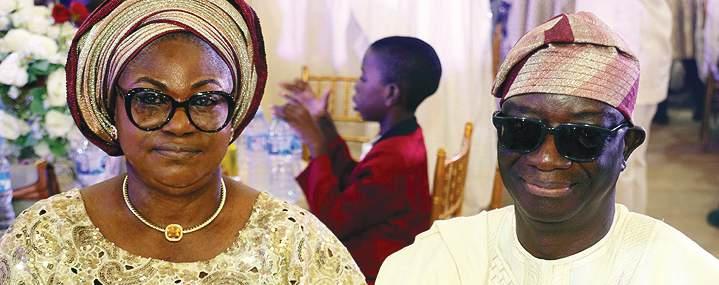
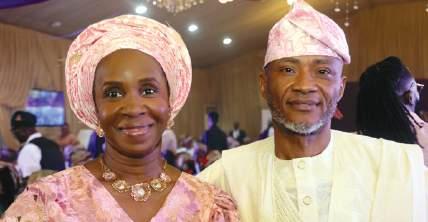
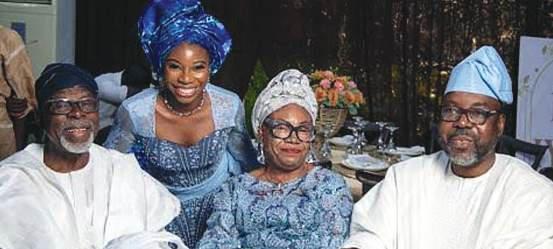
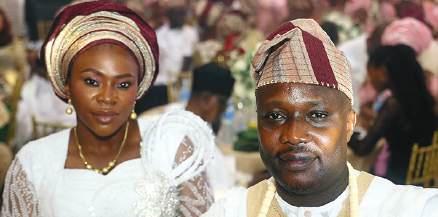
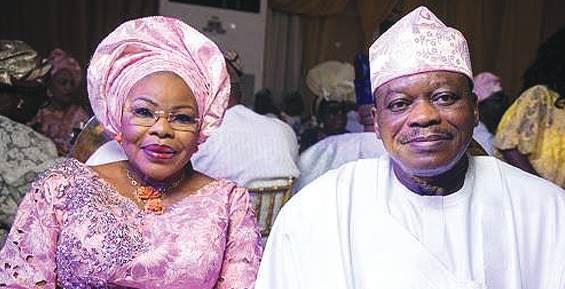
The solemnization of holy matrimony between Opeyemi Onikute and Aderewa Owope was held last weekend at The Citadel Global Community Church 30, Kudirat Abiola Way, Oregun, Lagos. The reception followed at The Classique Event Centre, Oregun, Lagos.
L-R: Prince John Olobayo; PrincessElizabethObalisa (Nee Olobayo)
L-R: Timi Owope; Dami Pare; and Victoria King
Barrister Johnson Olorunsaye and his wife, Funke
Mrs. Funmi Arokoyo; and Dr. Raphael Arokoyo
Mr. Raphael Lewu and his wife, Bimbade
L-R: Col. Yomi Dare (rtd); HE Adebanji Jimoh; and Ose Ohunwa
Pastor Tunde Bakare and his wife, Pastor Layide
L-R: Alhaji Baba Ali Suleiman; Alhaji Danlami Suleiman; and Princess Debo Odutola
Parents of the bride, Prince Gabriel Adetun and Princess Olubunmi Caroline Owope
L-R: Mrs. Funsho ElfridaSamuel and General Babatunde Samuel.(rtd)
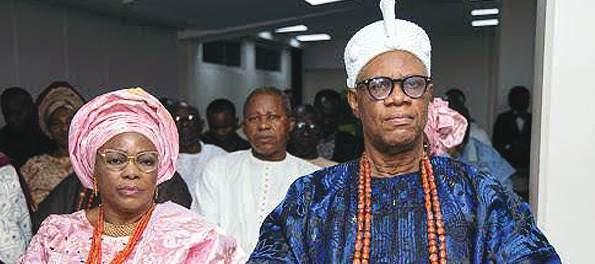
Osemawe of Ondo KindomOba (Dr.) Victory Adesimbo Ademefun Kiladejo, and his wife, Olori Comfort
When a Banking Titan Takes His Final Bow
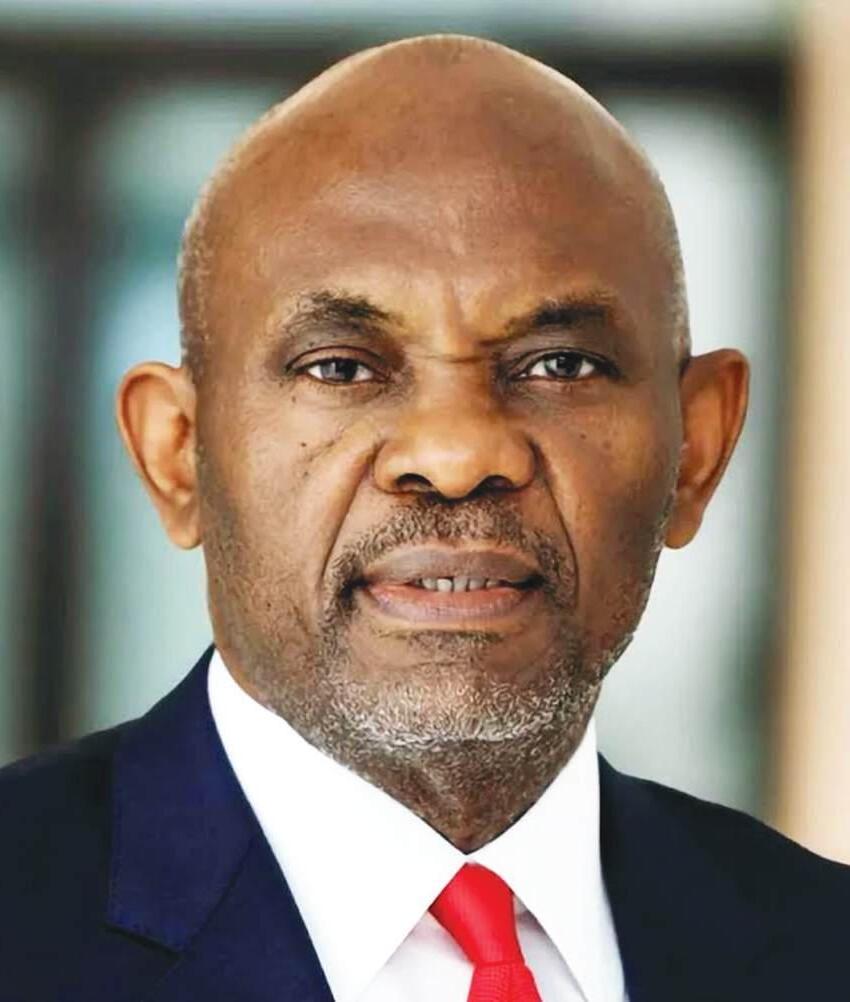
Tony Elumelu's final UBA board meeting on August 21 will mark the end of an era that transformed both the bank and African banking, writes Festus Akanbi
There are moments in corporate history that transcend routine boardroom changes. They become markers of institutional evolution, signalling not merely the departure of a leader but the conclusion of a defining era. Such a moment will arrive on August 21, 2026, when Tony Onyemaechi Elumelu presides over his final meeting as Chairman of United Bank for Africa (UBA) Plc.
His exit, compelled by the Central Bank of Nigeria's corporate governance rules on board tenure, brings to a close more than two decades of remarkable influence over one of Africa's most recognisable financial institutions. It also invites reflection on how one banker helped redefine the contours of modern African banking.
Few corporate leaders have enjoyed the rare privilege of transforming the same institution twice. Fewer still have done so from two different seats of authority.
Elumelu first arrived at UBA as the architect of one of the most audacious banking transactions in Africa. Having rescued the then-struggling Standard Trust Bank and turned it into one of Nigeria's fastest-growing financial institutions, he orchestrated its merger with the much older United Bank for Africa in 2005.
The transaction was more than an acquisition. It represented a collision of youthful ambition and institutional heritage that fundamentally altered the competitive landscape of Nigerian banking. At a time when consolidation was reshaping the industry, Elumelu recognised that size alone would not guarantee relevance. What mattered was vision.
That vision was continental.
Long before regional integration became fashionable in policy circles, Elumelu was building a banking institution that ignored colonial boundaries and viewed Africa as a single economic space.
Under his leadership as Group Managing Director and Chief Executive Officer, UBA expanded beyond Nigeria into virtually every major African sub-region, establishing operations in 20 African countries while planting its flag in New York, London and Paris. The strategy was neither symbolic nor opportunistic. It anticipated a future in which African trade, investment and finance would increasingly flow across borders. Years later, as the African Continental Free Trade Area gathered momentum, UBA's continental footprint appeared less like corporate expansion and more like strategic foresight.
Expansion, however, was only one dimension of the transformation. Elumelu also understood that banking was changing long before digital disruption became an industry cliché. Under his watch, UBA embraced technology, invested heavily in electronic banking, improved operational efficiency, and expanded financial inclusion through innovative retail products. Customer experience became a strategic priority rather than an afterthought. The institution emerged from that period not only larger but significantly more resilient, more profitable and better governed. The recognition that followed, including his
emergence as African Banker of the Year in 2008, reflected achievements already visible across the continent. When regulatory changes ended his tenure as chief executive in 2010, many expected him to move permanently into private investment. Instead, four years later, he returned to UBA as Chairman, assuming a markedly different responsibility. His role was no longer to run the bank's daily affairs but to safeguard its long-term direction. It was a transition from operator to institution builder.
Over the past 12 years, his emphasis shifted decisively towards governance, succession planning, strategic oversight, and the preservation of the culture that had driven UBA's continental rise. The distinction proved significant.
While executive management drove operations, Elumelu concentrated on ensuring that the institution remained stronger than any individual entrusted with leading it.
His final major assignment may well illustrate that philosophy. UBA's successful navigation of the latest
banking recapitalisation exercise demonstrated not only financial strength but also investor confidence in the institution's governance and strategic clarity. At a time when higher capital requirements compelled banks to seek fresh equity and reassure shareholders, UBA completed the process without undermining confidence in its long-term prospects. It was a reminder that institutional credibility is often accumulated over decades but tested in moments of regulatory change.
Yet limiting Elumelu's contribution to banking alone would understate the breadth of his influence. Over the years, he has become one of Africa's most visible advocates of private-sector-led development through the philosophy he christened Africapitalism.
At its core lies a simple but compelling proposition: African businesses must pursue profit in ways that simultaneously generate social and economic transformation. Rather than treating development as the responsibility of governments and donor agencies alone, Africapitalism assigns entrepreneurs a central role in expanding opportunity, creating jobs and building sustainable prosperity.
The philosophy has found practical expression in the Tony Elumelu Foundation, whose entrepreneurship programme has become one of Africa's largest privately
funded initiatives supporting young business owners across all 54 African countries. It has equally shaped his investment strategy through Heirs Holdings, where banking sits alongside power generation, oil and gas, hospitality, healthcare, technology and real estate.
Whether through Transcorp's expansion of electricity generation or investments across strategic sectors, the common thread has remained consistent: long-term investment capable of delivering commercial returns while addressing structural constraints to Africa's development.
Perhaps the most enduring lesson from Elumelu's career lies in his understanding of succession. African institutions have often struggled to outlive their founders, with leadership transitions frequently exposing organisational fragility. His departure from UBA presents a different narrative. By embracing the Central Bank's tenure limits and supporting an orderly transition to Emmanuel Nnorom, Elumelu reinforces a principle he has long espoused, that institutions should become stronger because leaders leave, not weaker. Leadership, in this sense, is measured less by longevity than by the quality of the institution left behind.
His exit also coincides with profound changes confronting African banking. Digital finance, artificial intelligence, cybersecurity risks, fintech competition and changing consumer behaviour are redefining financial services at unprecedented speed. UBA's next generation of leadership will inherit not only one of Africa's strongest banking franchises but also an industry undergoing its most significant transformation since consolidation reshaped Nigerian banking two decades ago. Their challenge will be to preserve the institution's continental relevance while navigating a radically different competitive environment.
History rarely remembers corporate leaders simply for occupying powerful offices. It remembers those who permanently altered institutions and influenced industries. By that measure, Tony Elumelu's place in Nigerian banking history is already secure. He transformed a struggling bank into a continental institution, championed governance at a time when confidence mattered most, demonstrated that indigenous African banks could compete globally, and advanced an investment philosophy that continues to shape conversations about Africa's economic future.
On August 21, as he leaves the UBA boardroom after his final meeting as chairman, the significance of the moment will extend far beyond a routine change of leadership. It will represent the closing of one of the most consequential chapters in Nigerian banking history—a chapter defined by bold decisions, continental ambition, institutional discipline and an unwavering belief that Africa's future is best built by Africans themselves.
If the institution continues to flourish under a new leadership, that may ultimately become Tony Elumelu's greatest achievement: proving that the true measure of leadership is not personal permanence but institutional endurance.
• Elumelu
POLITY
NBA Elections: A Reset for the Judiciary
Opeyemi Adamolekun
“Thereisnojustificationfortheexistenceofthe judiciary,exceptinitsexistenceforthedefenceof the citizen to put his vies across ith all potency, for him to vent his feelings and his success in thepublicforhimtofeelandbreathetheairof freedom around him.” - Kayode Eso, JSC
Acaveat: I’m not a lawyer, so I am not voting in the upcoming Nigeria Bar Association (NBA) Elections.
I understand that a while ago, a senior lawyer at the bar and a junior lawyer were contesting for the NBA presidency. They belonged to an association, and the association intervened. In a closed-door meeting, they decided who would run, and the other would step down and run in the next election with their full support. In the process, zoning became a part of the NBA system. Some lawyers have argued that, as a professional body, the NBA should not toe the line of politics with zoning, but sadly, our pedestrian politics has permeated every facet of society, including the intellectual sphere. One of my favourite female lawyers ran a few years ago, and even though she got widespread support, she lost due to some “technical glitches” that might really have been rooted in zoning.
This year, the NBA presidency is zoned to the South-west. There are three candidates, all Senior Advocates of Nigeria (SAN): Lateef Akangbe, Olumuyiwa Akinbor0, and Oyinkansola BadejoOkunsanya.
“Egbe Amofin O’Odua is the premier association of Yoruba lawyers in Nigeria. Founded decades ago by legal luminaries including Chief Kehinde Sofola (deceased), Chief Fayoko (deceased), and Chief Wole Olanipekun, SAN. We unite lawyers of Yoruba extraction called to the Nigerian Bar and enrolled in the Supreme Court of Nigeria.” (culled from their website) Why we still need groupings by
ethnicity, region and religion in 2026 is a topic for another piece. Egbe Amofin, in its infinite wisdom, decided that THEY would decide who should be the next leader of the bar, a “Selectorate” of sorts. How is this different from how our politicians behave? Egbe Amofin chose Olumuyiwa Akinboro and wrote to the NBA that the presidency, since zoned to the south-west, would be uncontested. Oyinkan Badejo-Okunsanya did not say she was stepping down, and she spoke up quickly. The NBA, in line with its constitution, said that unless the other candidates formally step down, there would be a contest, and Egbe Amofin has no locus.
Unfortunately, Egbe Amofin, understanding Nigeria’s judicial system, decided to “Go to court!” They filed an application at the Oyo High Court, sitting in Ibadan, for an “ex parte interim injunction restraining the NBA, its officers, organs, committees, agents, and anyone acting on their behalf from recognising or processing the nomination of any candidate other than the consensus candidate presented by Egbe Amofin O’odua.” The judge, Justice Y.S. Adekunle, granted the request on February 24, 2026. In a bid to resolve the matter, the Attorney General of the Federation was involved in a
mediation and issued a directive to suspend the elections and dissolve the NBA Electoral Committee, among other matters. The response from the NBA President was swift. In a memo dated July 7th titled “Only the National Executive Council of the NBA Can Direct the Postponement of the 2026 NBA National Officers’ Election,” Mazi Afam Osigwe, SAN, reminded the AGF who had locus on NBA elections.
There are other cases filed in connection with this matter, but I’ll leave it to the lawyers to produce that timeline. What I find fascinating is that the “Egbe Amofin O’odua is seeking declarations affirming its sole right to present a presidential candidate from the Western Zone, compelling compliance with the zoning arrangement in the NBA Constitution, recognition of its candidate, and restraining the NBA from accepting or recognising any other candidate.” On what grounds? When the matter was called on March 10, seven SANs appeared for Egbe Amofin - Ali Kazeem, Yomi Alliyu, Isiaka Olagunju, Murtala AbuldRashid, Kazeem Gbadamosi, Mutalubi Adebayo and Tunji Ogunrinde. How are lawyers advancing a case to nullify the freedom of association that our Constitution protects?
The elections are on Saturday, July 18. I invite all lawyers to take this opportunity to demonstrate the kind of leadership we want to see in Nigeria. As we go into an election season, the judiciary is critical to ensuring that our votes, the voice of the people, are what truly determine the winner of our elections. We can’t point fingers at inept and corrupt politicians while we watch the third arm of government and those who are the custodians of the rule of law be available to the highest bidder. The Nigeria we want is a decision, especially the decision of its elite. And after four years (maybe more) studying law, one year in law school, being called to the bar, and one or 63 years post-call, you should certainly consider yourself one of Nigeria’s elite. Again, I’m not a lawyer.
• Adamolekun is an active citizen.
Gbajabiamila: When Public Outrage Overtakes Facts
Lanre Adeyinka
For weeks, the allegations made by Adeniyi Adeyemi against the Chief of Staff to the President, Hon. Femi Gbajabiamila, dominated public discourse.
Social media erupted. Television panels were flooded with commentary. Political opponents saw an opportunity. Critics sharpened their knives. And, as has become increasingly common in Nigeria’s public space, a verdict was delivered long before any investigation had begun
Today, however, the narrative is beginning to unravel. The interview granted by Adeyemi to a social media influencer, Martins Vincent Otse known as Very Dark Man (VDM), has inadvertently become the strongest defence yet mounted on behalf of Gbajabiamila.
What was expected to be a damaging exposé instead exposed the weakness of the allegations themselves. Beyond sensational claims and dramatic assertions, there was no evidence directly linking the Chief of Staff to the alleged fraud.
This is where the conversation becomes uncomfortable. A significant portion of the public reaction was driven not by facts but by a deep-seated distrust of public officials. Many Nigerians did not pause to ask the most fundamental questions.
Where was the proof? Where were the documents? Where was the financial trail? Where was the appointment letter? Where was any verifiable evidence connecting Gbajabiamila to the alleged scheme?
Those questions were largely ignored because outrage had become more attractive than inquiry.
In many respects, Gbajabiamila was convicted in the court of public opinion before he was heard. The assumption was simple: because he occupies a powerful office, he must be guilty. It was an emotional conclusion rather than an evidential one.
Yet, facts possess a stubborn quality. They eventually force themselves into the conversation.
Following the interview, many who initially accepted the allegations have begun to reconsider their positions. Some have openly apologised.
Others have quietly retreated from their earlier certainty. What has emerged is the growing realisation that the allegations against the Chief of Staff were built more on speculation than
substance.
This does not mean the broader scandal should be ignored. Far from it. If anything, the collapse of the allegations against Gbajabiamila should redirect attention to the far more important questions.
How did an organisation whose legal status remains deeply disputed find its way into official government processes? How did it obtain office accommodation within the Federal Secretariat?
How did it acquire budgetary allocations? How did treasury procedures allegedly recognise its activities? How did banking
arrangements involving public institutions emerge?
These questions are bigger than one individual. They point to potential institutional failures that should concern every Nigerian. Indeed, the danger now is that some may mistakenly conclude that because Gbajabiamila appears to have been falsely accused, the entire matter should be buried. That would be a grave mistake.
The president was therefore right to order an investigation through the Independent Corrupt Practices and Other Related Offences Commission (ICPC).
The investigation must continue, not because there is evidence against the Chief of Staff, but because there are still unanswered questions about how government systems may have been manipulated.
The focus of the probe should now shift from politically convenient scapegoats to the bureaucratic pathways through which the alleged fraud was enabled.
Someone approved documents. Someone processed requests. Someone granted access. Someone authorised procedures. Someone looked the other way. The public deserves to know who.
The Gbajabiamila chapter may well be nearing its conclusion. The institutional accountability chapter is only just beginning.
The lesson from this episode is simple. In a democracy, allegations should trigger investigations, not convictions. Evidence must remain superior to emotion. Facts must remain superior to prejudice.
And when investigations eventually separate truth from fiction, society must possess the humility to correct itself. That correction is now taking place.
For Gbajabiamila, it may amount to vindication. For Nigeria, it should become an opportunity to uncover how a questionable operation allegedly penetrated the machinery of government. That is where the real story now lies.
•Adeyinka writes from Ibadan
Fagbemi
Anyiam-Osigwe
InternatIonal U.S.-Africa Competing Sovereignties: The Implications of MAGA for Africa’s Future
One major concern with which Professor Tunde Adeniran, former Minister of Education of Nigeria and former Ambassador of Nigeria to Germany, is currently preoccupied is what future for Africa in light of the many unending unrests in the continent. The Afrophobia in South Africa is a new saga in intra-African relations that has to be addressed. The resultant political unrest is generating a diplomatic row between Nigeria and South Africa. Similarly, Ghana stopped the planned visit by the South African President, Cyril Ramaphosa, to Ghana. Besides, from the estimation of the United Nations, the city of El-Obeid in Sudan has the potential to witness a general massacre, because the on-going war in Sudan has prompted a siege-like conditions for about 18 months now. The Ebola out-break in the Democratic Republic of Congo (DRC) has been made complex because of last week’s strike of health workers whose entitlements were not paid or delayed. In fact, Africa’s relationship with the self-proclaimed leader of the world, Donald Trump of the United States, is increasingly becoming hardened with a growing number of African countries rejecting hegemonic foreign policy instructions from President Trump. U.S. grant of aid that is always unnecessarily made conditional for African leaders, not for them to consider and possibly accept, are now instantly jettisoned by African leaders in protection of their national sovereignty. And true enough, national sovereignty is under permanent threat from developed countries. The Alliance of Sahel States (ASS: Mali, Burkina Faso, and Niger) kicked out France from their countries. In the eyes of Burkina Faso, France is behind the terrorism in the ASS countries. This is because of the shift of alliance from the traditional European partners to Russia and China. Thus, France cannot but be happy about the downing of a Russian Africa Corps Mi-24 helicopter in Mali by the Tuareg insurrectionists last week. But for how long will this ASS-France Cold War continue?
Competing Sovereignties
Contemporary international relations is witnessing an unprecedented competition between Africa’s sovereignty, on the one hand, and the sovereignty of the United States of America under President Donald Trump, on the other. President Trump has introduced the foreign policy of ‘America First’ and ‘Make America Great Again’ (MAGA). These policies are far away from being able to address Africa’s main problems of systemic poverty in which more than 70% of the total population lives below poverty line.
For instance, the conditionality often attached to the agreements presented to African leaders for consideration and expected approval is, at best, arrogantly undermining the rule of sovereign equality. It consciously promotes Africa’s dependency on the U.S. and prioritizes plundering of African mineral resources. As reported by Kat Lay the Global Health Correspondent of The Guardian (London) on 27 February 2026 President Emmerson Mnangagwa of Zimbabwe ‘directed that Zimbabwe must discontinue any negotiation with the USA on the clearly lop-sided MoU that blatantly compromises and undermines the sovereignty and independence of Zimbabwe as a country.’
The first point of emphasis is the aspect of lop-sidedness of the MoU. What makes it lop-sided? Another issue is the undermining of the sovereignty of Zimbabwe. How do we explain the compromising and undermining of the Zimbabwean sovereignty? The U.S. has reportedly offered a health funding of $350m (£258m) but subject to the acceptance of some conditions that are generally applicable to all countries that accept the MoU: first, signatories must accept U.S. regulatory approval of new drugs and technologies before the new drugs can be rolled out. Zimbabwe was not only being asked to provide pathogen samples but also ‘to share its biological resources and data over an extended period, with no corresponding guarantee of access to any medical innovations - such as vaccines, diagnostics or treatments – that might result from that shared data.’
Put differently by the spokesperson of Zimbabwe, ‘ín essence, our nation would provide the raw materials for scientific discovery without any assurance that the end products would be accessible to our people should a future health crisis emerge.’ Zimbabwe’s reasoning is quite logical and commendable, especially that the country is looking at the implications for the agreements done with the World Health Organisation whose systems allow for fairness in the response to future pandemic. And most interestingly, perhaps, Zimbabwe rejected the U.S. offer because ‘development aid should empower nations, not
create dependencies or serve as a vehicle for strategic extraction… When financial assistance is contingent upon concessions that touch upon national security, data sovereignty, or access to strategic resources, it fundamentally alters the nature of the relationship from one of partnership to one of unequal exchange.’
The thinking of Ghana is not in any different. As noted by Arnold Kavaar Auo, the Executive Director of Ghana’s Data Protection Commission, ‘we had concerns around the scope and breadth of data that was being required…It was us generating data and passing it on to the U.S. authorities, and there were no real reciprocal measures when it comes to the protection of Ghanaian data and Ghanaian sovereignty… And so from our perspective, once the data left the Ghanaian borders, we had no control over what becomes of it.’
Many questions cannot but be raised at this juncture: why was it impossible for African leaders to understand the direct motivations of the U.S. when the MoU negotiations began? Could it be that the countries that had signed the MoU are more knowledgeable than the countries that have refused the MoU? The Secretary of State, Rubio reportedly told a Congressional Committee that 32 countries in Latin America and 20 in Africa had already accepted the American First Health MoU by mid-May. ‘Not only are we treating the acute situations in the ground of people that are sick, we are helping them build the capacity and the capability to do this for themselves,’ the Congressional Committee was further told.
What did the 20 African countries consider before accepting to sign any MoU with the U.S.? According to a State House spokesperson, ‘the Trump administration has made it clear, U.S. foreign assistance is not charity – rather it is strategic capital to be wisely invested to advance U.S. interests – and we expect all our allies and recipient nations to take seriously American strategic and commercial priorities.’
Have the signatories to the MoU with the U.S. be said to have taken seriously American strategic and commercial priorities? In taking the U.S. seriously, to what extent have the national interests of the signatories been objectively and adequately protected?
And perhaps more inquisitively, to what extent have the African leaders that signed the MoU understood the meaning of ‘America First’ and ‘Make America Great Again’ policies?
The policies underscore the protection of national sovereignty, selfreliance, and economic nationalism. More important, they are aimed at protecting the homeland, promoting prosperity, sustaining peace through renewed strength, rebuilding the military, and enhancing U.S. influence in the world
It is the mania of implementation of these policies, and particularly the conditionality to which the acceptance of the various Memoranda of Understanding on it is subject, that is largely defining Africa’s response to the policies of America First and MAGA. One clear rationale for ordaining the U.S. Constitution is to ‘promote the common defense.’ This foreign policy objective was sustained until the end of World War II after which U.S. foreign policy objectives increasingly became ambiguous. U.S. foreign policy was challenged by confrontational or competitive alliances and economic dependency.
The American Cornerstone Institute explained the spirit of the U.S. Constitution until World War II thus: quoting the Farewell Address of President George Washington, ‘the nation which indulges toward another a habitual hatred or habitual fondness is in some degree a slave,’ because that nation cannot truly be independent. From the perspective of President John Quincy Adams, the U.S. ‘goes not abroad in search of monsters to ‘destroy. She is the well-wisher to the freedom and independence of all. She is the champion and vindicator only of her own.’
And perhaps more interestingly, this foreign policy stand appears to have been strengthened by the consideration that the United States is not only surrounded by the Pacific Ocean to the West and by the Atlantic Ocean to the East, and therefore also, in the thinking of Abraham Lincoln in his Lyceum Address, all the armies of Europe, Asia and Africa combined, with all the treasure of the earth (our own excepted) in their military chest, with Bonaparte for a commander, could not by force, take a drink from the Ohio, or make a track on the Blue Ridge, in a trial of a thousand years.’ Americans largely draw their strength and determination from the foregoing beliefs. In light of these considerations, Americans opted to adopt a foreign policy of altruism in the conduct and management of global affairs, and playing the role of global policeman.
However, the beliefs did not appear to have anticipated technological developments in the defence sector. Inter-continental ballistic missiles, nuclear drones that can enable attacks on the U.S. without necessarily having to come closer to the U.S. before attacking it, constitute new challenges that probably give the impression that America may be under threat or not invincible. And therefore, there is the need to Make America Great Again.
Implications of MAGA for Africa’s Future
On March 19, 2026, Nick Checker, Senior Bureau Official at the U.S. Mission to the African Union, said the United States is ‘resetting its relationship with Africa based on mutually beneficial partnerships rather than aid, dependency, and spreading divisive ideology.’ From our discussions above, it cannot be rightly said that the relationship has been mutually beneficial and that it is free from dependency or spreading divisive ideology. And if the partnership has been beneficial, it cannot be holistic in scope as many countries have jettisoned the U.S. agenda.
As noted further by Mr. Checker, U.S. partnership with Africa is guided by ‘Trump Administration’s 2025 National Security Strategy, which in clearest terms in the post-Cold War era lays out our singular global prioritization and focus on protecting and advancing our “core national interests.” It is a radical, but necessary corrective to the reckless pursuit of liberal hegemony over the last 30 years. This is an approach of strategic autonomy that is ‘modest’ in aims, clear in interests, disciplined about limits.’
What is particularly noteworthy here is the quoted explanation of Secretary Rubio: ‘to be successful in diplomacy as a result means meeting countries on their own terms, and respecting differences in culture, history, and governance in order to advance shared priorities. This reality means we must engage governments as they are, and not as Washington wishes them to be.’ This is a beautiful diplomatic talk as it does not in any way reflect the situational reality on the ground. The truth in some cases, like Zambia, is that the partnership is more of a one-country show rather than an agreement mutually consented to. Zambia’s Foreign Minister, Mulambo Haimbe, reportedly said that ‘it is an American effort to link health funding to U.S. economic interests by connecting the deal to a separate agreement giving Washington access to critical minerals.’ In the eyes of the U.S., there is nothing wrong in linking the two deals. The two deals should be taken together as a package because ‘the U.S. felt that there is need for there to be a preferential treatment in the U.S. of critical minerals and the framework was to reflect that.’
Admittedly, there are two different issues, healthcare funding and quest for critical raw materials. If there is sovereign political will to have both issues discussed as one package, there should not be any qualms. The apparent problematic in the negotiations is the U.S. quest to impose acceptance of the two as one. And true enough, even if the two issues are to be considered as one, the moment any point of submission becomes controversial, there is no way that controversial issue will not be struck with nullity.
Tinubu
www.thisdaylive.com
opinion@thisdaylive.com
The Bayelsa State governor is committed to a return to ecological sanity in the Niger Delta, writes IKE OKONTA
DUOYE DIRI’S BRAVE STANCE ON BAYELSA’S BELEAGUERED ENVIRONMENT
My
first close encounter with Senator Duoye Diri, governor of Bayelsa State, was on 30th October 2024 at the Ladi Kwali Conference Centre, Abuja Continental Hotel, in Abuja. The occasion was the international conference on Petroleum Pollution And Just Transition In the Niger Delta and the public presentation of the book, “An Environmental Genocide: The Human And Environmental Cost Of Big Oil In Bayelsa, Nigeria” authored by members of the Bayelsa State Oil And Environmental Commission (BSOEC.)
The Bayelsa State government had established the commission to take a hard look at the effects of oil production on the environment of the state’s towns and villages and come up with hard evidence and recommendations of remediation. Members of the Commission – Professor Michael Watts, Kathryn Nwajiaku, Anna Zalik, and Isaac Osuoka, among others, had flown into Abuja from all parts of the world. They are all long-standing friends and colleagues of mine, and I had also flown in from the University of Oxford where I was teaching at the time at their invitation to witness the important event.
Ladi Kwali Conference Centre was packed that October morning. Governor Duoye Diri walked into the hall at exactly 9am, followed by a retinue of aides. Also in the hall was his predecessor in office, Senator Henry Seriake Dickson. When he was called to the rostrum, it was a sober Governor Diri that faced the audience. Missing was his trademark smile. It was clear that he had grim news. Yet, when he began to speak, his voice was calm and measured. “What we are facing in Bayelsa State,’’ he said, “is an environmental crisis of catastrophic proportions.’’
The book, “An Environmental Genocide” is a searing account of irresponsible exploration and production of oil in Bayelsa State by the big oil companies licensed to operate in the country. Oil spills into the farmlands and fishing rivers of local communities, gas flaring falling back into villages as acid rain, creeks and mangrove swamps thoroughly depleted – the lens of the report focussed unwaveringly on these sundry ecological devastations and stated that workers in the big oil companies displayed total contempt towards the local people and their fragile environment and should be made to account for this tragedy.
Governor Diri spoke in a similar vein that morning in Abuja. He argued that a greater but unhidden tragedy was the fact that local people in Bayelsa State had been consuming fishes and food crops contaminated by oil pollution for decades and that these people come down with all manner of strange and uncurable
diseases as a consequence. Governor Diri further argued it was not simply enough to investigate ecological atrocities and write a report, but that his government was exploring the possibility of resorting to judicial action to bring justice to his beleaguered people. On his return to Yenagoa after the conference, Governor Diri has since turned into a vocal apostle of ecological responsibility, making his office and his time available to environmental activists who are working to restore Bayelsa State and the wider Niger Delta to environmental health. It is important to state at this point that Governor Duoye Diri’s stance is not only uncommon; it is very brave. The tragic norm in the oil-producing states of the Niger Delta is for the governors and other elected politicians to stridently condemn the activities of the big oil companies when campaigning for office and then to make a complete u-turn when elected and actually join in perpetuating this tragedy in return for financial inducement. Oil-related environmental devastation persists in the Niger Delta because elected politicians allow this to be so. Governor Diri is cut from a different cloth, however. He knows that his home state of Bayelsa is bleeding, ecologically speaking, and he is anxious to staunch this blood-flow.
Members of the Bayelsa State Oil And Environmental Commission (BSOEC) returned to Yenagoa last June as part of their quest to advance the recommendations of the report and as usual Duoye Diri was on hand to receive them. Done with their visit, the members journeyed to various ecologically impacted sites and also listened to local people who were anxious to unburden themselves and narrate their ordeals at the hands of workers of the oil companies. Some of them reported that following the publication of “An Environmental Genocide” oil workers had come to their communities to taunt them and even warn them to desist from talking to ‘meddling outsiders.’’
This author had a similar experience in 2001. Oronto Douglas, the late environmentalist and human rights lawyer and I had written a book titled “Where Vultures Feast,” depicting the ecological carnage all over the Niger Delta as a result of oil production. The book was first published by Sierra Club Books, the biggest environmental pressure group in the United States. As soon as the book was out Oronto Douglas and I began to receive anonymous telephone calls, warning us to withdraw the book from bookshops or face the consequence. Of course we ignored the cowardly threat. Our book is still available all over the world, and is a regularly recommended text in American and European universities as a witness to what Big Oil does to unprotected people.
Ken Saro-Wiwa and the Ogoni Eight were not so lucky. Oil had been produced in Ogoniland since 1958, putting billions of dollars into the coffers of the oil companies and the Nigerian government. What the Ogoni people got in return was a devastated environment and crushing poverty. It was this unfair state of things that Ken Saro-Wiwa and other Ogoni leaders set up the Movement for the Survival Of the Ogoni People (MOSOP) in 1990 to address. They faced instant opposition from Nigeria’s leaders and the oil companies who came together to devise a plan to destabilise MOSOP from within and also unsettle Ken Saro-Wiwa, its leader. By 1995 Saro-Wiwa and eight of his compatriots were dead and Ogoniland in ruins.
It is therefore important that we situate Governor Duoye Diri’s uncommon bravery in its wider national context. There are powerful Nigerians who are perfectly satisfied with the present state of affairs in
Bayelsa State and the wider Niger Delta. As long as the big oil companies and the Federal Government continue to allocate to them lucrative oil blocks from which they make millions of dollars every year, they are happy to let the environmental carnage in the Niger Delta continue, and they would not hesitate to move against anyone, governor or not, who wants to return the beleaguered region to ecological sanity. That is why it is important that Governor Duoye Diri be supported in his stance by environmental and human rights campaigners in Nigeria and indeed worldwide. Governor Diri’s fight is the people of the Niger Delta’s fight. It is Africa’s fight. It is the world’s fight, still grappling with the increasing impact of oil-induced climate change.
Dr Okonta was until recently Leverhulme Career Fellow in the Department of Politics, University of Oxford. He now lives in Abuja.
Editor, Editorial Page PETER ISHAKA
Email peter.ishaka@thisdaylive.com
THE PROPOSED NYSC REFORM AND MATTERS ARISING
Critical stakeholders should be carried along
The recent announcement by the federal government of far-reaching reforms for the National Youth Service Corps (NYSC) deserves a serious interrogation. Anchored on the notion that no national institution can remain relevant if it is unwilling to evolve with changing times, the proposed emphasis is on entrepreneurship training, digital literacy, leadership development, civic responsibility and skills acquisition. It is also aimed at matching corps members’ primary assignments more closely with their academic qualifications and professional competencies among others.
Established in 1973 in the aftermath of the Nigerian Civil War, the NYSC was conceived primarily as an instrument of national integration. It sought to heal the wounds of the conflict by fostering interaction among the diverse ethnic, religious and cultural groups in the country. Being a creation of a military administration, the scheme was also designed to instill discipline and regimentation into the youths thereby making them amenable for mobilisation towards national development. This historical context explains the military content of the orientation course and much of the structure that has endured for over five decades.
patriotism and spirit of service that have always distinguished the NYSC while also taking into account the level of insecurity in the country that may require some form of training in that direction.
The proposal to expand the orientation programme, upgrade camp facilities, introduce new training modules and improve the welfare of corps members will require substantial and sustained financial commitment. Currently, the NYSC Act places funding responsibilities on the Federal, States, and Local Governments.
Despite its challenges, it has helped to bridge ethnic divides, supplied critical manpower to underserved communities and shaped generations of young Nigerians
SUNDAY NEWSPAPER
editor DAviDSoN iriekpeN
deputy editors FeSTUS AkANBi eJioFor ALike
Managing director eNioLA BeLLo
deputy Managing director iSrAeL iwegBU
chairMan editorial Board oLUSegUN ADeNiYi
editor nation’s capital iYoBoSA UwUgiAreN the oMBudsMan kAYoDe koMoLAFe
The annual mobilisation has risen from a few hundred graduates in 1973 to well over 400,000 today, according to the current NYSC Director General, Brigadier General Olakunle Oluseye Nafiu. The pressure on the scheme has multiplied accordingly. It is now faced with persistent rejection of corps members by employers, inadequate camp facilities, welfare issues, rising operational costs and, more importantly, the country’s deteriorating security situation which have increasingly exposed corps members sometimes to fatal risks. Against this backdrop, a comprehensive review was not merely desirable; it had become inevitable.
The decision to modernise deployment processes and place greater emphasis on security is quite paramount. For several years, parents and prospective corps members have expressed legitimate concerns about postings to volatile areas. Integration remains the soul of the NYSC, but no national objective should come at the expense of the safety of young Nigerians. Until security conditions
THISDAY NEWSPAPERS LIMITED
editor-in-chief/chairMan NDUkA oBAigBeNA
group executive directors eNioLA BeLLo, kAYoDe koMoLAFe, iSrAeL iwegBU
divisional directors SHAkA MoMoDU, peTer iwegBU ANTHoNY ogeDeNgBe
deputy divisional director oJogUN viCTor DANBoYi snr. associate director eriC oJeH
director, printing production CHUkS oNwUDiNJo to send eMail: first name.surname@thisdaylive.com
improve substantially, greater flexibility in posting corps members, including allowing many to serve within or around their current localities where circumstances demand, is a practical response to prevailing realities.
The proposal to place the administration of the scheme under civilian leadership equally reflects the evolution of democratic governance and the need to give the scheme a new face consistent with the objective of the reforms. Nevertheless, whatever administrative structure ultimately emerges must preserve the discipline,
Over time, inadequate funding has led to the proposal of the NYSC Trust Fund, designed to harness resources from the organised private sector since they are principally the beneficiary of the services provided by the corps members. Such a funding regime, if properly structured, transparently managed and insulated from political interference, could provide the financial stability required to translate the reforms from policy to practice.
However, reforms imposed from above rarely achieve their full potential. It is therefore important that critical stakeholders, which include student bodies, parents, employers, tertiary institutions, the military, management of the NYSC and state governments are adequately carried along. Broad consultation not only enriches policy but also strengthens public ownership of it. Nigeria has never lacked well-crafted policies; what has often been lacking is consistency in execution.
The NYSC remains one of Nigeria’s most enduring national institutions. Despite its challenges, it has helped to bridge ethnic divides, supplied critical manpower to underserved communities and shaped generations of young Nigerians. Reforming it is therefore not an admission of failure. Rather, it is an affirmation that institutions, like nations, must continually adapt to remain relevant.
The reforms deserve support. But the ultimate success will be measured not by the breadth of the proposals announced, but by the sincerity, commitment and resources devoted to their implementation long after the headlines have faded. That is the test the federal government must now pass.
Burna Boy to Perform at First World Cup Final Halftime Show
Aat the FIFA World Cup Final Halftime Show, joining an international lineup for the tournament’s inaugural halftime spectacle. FIFA had announced in May that Madonna, Shakira and BTS will headline the show, which is curated by Chris Martin, the lead singer of the band Coldplay.
Burna Boy’s addition broadens the musical diversity of the halftime show, bringing Afrobeats alongside pop, Latin music and K-pop. He also becomes the first African artiste to perform at the FIFA World Cup Final Halftime Show. Earlier this year, he collaborated with Shakira on the tournament’s official anthem, ‘Dai Dai,’ which they performed at the opening ceremony in June.
Reacting to his selection, Burna Boy said in a statement: “To represent Africa on the first-ever FIFA World Cup
Final Halftime Show is a privilege and a responsibility that I don’t take lightly. I’m honoured to be part of a performance that not only celebrates football and culture, but also helps create greater opportunities for children through education around the world.”
While music has always been part of World Cup tournaments, it has often been limited to opening and closing ceremonies. But with the halftime show, FIFA seems to be borrowing a page from the NFL’S playbook, where the Super Bowl halftime shows are a staple. Over the years, the stage has hosted some of the world’s biggest stars, from the late Michael Jackson and Beyoncé to Dr. Dre. The performances have also become major advertising and cultural moments that attract audiences beyond sports fans.
FIFA effectively tested the concept last year during the FIFA Club World Cup final at MetLife Stadium, where Doja Cat, Tems and J Balvin performed in partnership with Global Citizen.
The inaugural 11-minute halftime show at the July 19 World Cup final at MetLife Stadium in New Jersey will also feature Justin Bieber, Venezuelan conductor Gustavo Dudamel, the PS22 Chorus from Staten Island, New York, and Coldplay. The event is expected to draw one of the largest global television audiences of the year
Black Camera Names Femi Odugbemi to Editorial Advisory Board
Black Camera: An International Film Journal, one of the world’s leading peerreviewed publications on Black cinema and visual culture, has appointed acclaimed Nigerian filmmaker and media scholar Femi Odugbemi to its Editorial Advisory Board.
The appointment, announced by the journal’s Editor-in-Chief, Professor Akin Adeṣ kan, underscores Black Camera’s commitment to broadening its global intellectual reach by bringing together leading voices in filmmaking, scholarship and cultural criticism.
According to Adekan, Odugbemi’s extensive contributions to filmmaking, media scholarship, and international engagement in cinema make him a valuable addition to the board. He also cited Odugbemi’s role as cofounder of the iREP International Documentary Film Festival and his work across film production,
interviews, archival materials, reviews and critical essays exploring Black filmmaking across Africa and the global diaspora.
Accepting the appointment, Odugbemi described it as an honour.
“I am deeply honoured by this appointment and grateful for the opportunity to contribute to Black Camera’s longstanding commitment to documenting and advancing critical scholarship on Black cinematic experiences across the world. I look forward to supporting the journal’s continued growth, intellectual engagement and global reach.”
His appointment reflects the journal’s continued efforts to deepen engagement with African cinema and scholarship by drawing on practitioners whose work spans filmmaking, policy, education and industry development.
Freedom Songs Blends Theatre with Civic Engagement in Lagos
More than 100 theatre enthusiasts and civicminded Nigerians gathered at Fired and Iced, Lekki, recently for ‘Freedom Songs,’ a cabaret by Created by Tomilola Productions that fused musical theatre with civic engagement and public dialogue.
Held on Juneteenth, the annual commemoration of the end of slavery in the United States, the production explored themes of voice, hope and civic responsibility through songs from the musical theatre canon, highlighting the gap between freedom proclaimed and freedom experienced.
The production followed the success of ‘The Wait,’ which was staged at the Lagos International Theatre Festival (LITF) 2025.
‘Freedom Songs’ starred Tomilola Adeniran (The Wait, Love is Like a Butterfly), alongside Abiola Lepe (Dear Kaffy, High Octave, Trials of Brother Jero), Bukeh Ikang (The Wait), and newcomers Chukwuemika DanChigwalu, Tamilore Oduola and Adaure Ibekwe, who made their stage debuts.
In partnership with Fired and Iced Outdoor Lounge, the event also featured collaborations with Flutterwave’s Send App, which sponsored tickets for attendees, as well as WiiCreate and Ara Concepts, which supported the event through merchandise and experience design.
Attendees also had access to a voter engagement desk organised by Enough is Enough Nigeria (EiE), where they received assistance with voter pre-registration, polling unit transfers, voter status verification and other electoral inquiries ahead of the 2027 general elections.
Speaking on the inspiration behind the production, Founder and Creative Director of Created by Tomilola Productions, Tomilola Adeniran, described theatre as a powerful tool for inspiring civic consciousness.
“‘Freedom Songs’ came from a simple belief that theatre is one of the clearest ways of holding up a mirror to society. It can hold reflection, urgency and responsibility all at once. With this piece, we wanted to use performance to bring people closer to the idea of participation—not just as audience members, but as citizens,” she said. “Ultimately, it’s a reminder that there is still a fight left in us, and that how we choose to show up, speak, and engage with one another still matters.”
The event concluded with a post-show discussion featuring the Head of Voter Education at INEC Lagos, Ayopo Lawal, and Enough is Enough Nigeria’s Senior Media Associate and RSVP campaign lead, Akindeji Aromaye. The speakers engaged the audience on voter participation, democratic awareness and the importance of civic engagement. media policy, education and cultural advocacy as strengthening the journal’s mission. Published with the support of The Media School at Indiana University Bloomington, Black Camera is internationally recognised as one of the foremost academic journals dedicated to the study, documentation and critical analysis of Black cinema and visual culture. The journal publishes research articles,
Odugbemi will join an internationally respected Editorial Advisory Board comprising scholars, filmmakers and critics from Africa, Europe, the Caribbean and North America. His name will appear on the journal’s masthead beginning with its Fall 2026 edition (Volume 18, Number 1).
Vanessa Obioha
Odugbemi
Theatre actress Abiola lepe performing at ‘Freedom Songs
Burna Boy at the FIFA world Cup 2026
PersPective
Karimi G’okeOdo,K’afaratoJa
At the height of the ascen- dancy of juju music in the 1970s and 1980s, one very popular track which received a lot of airplay was oro mi ti dayo which was performed by Ebenezer Obey, a living music legend who goes by the stage alias of “Chief Com- mander.” The song was a celebration of the head of the successful Jinadu family of Isale-Eko, in downtown, primordial Lagos. The refrain which caught on like wildfire from the song was o ti goke odo, k’afara to ja, which means “he successfully crossed the river before the bridge collapsed.”
That chorus suggested that Jinadu had excelled in his line of business before things went southward for subsequent venturers. Bandwagonism, what is known in local parlance as “copy, copy,” where entrepreneurs tend to xerox the models and precedence of their precursors, has always been a feature of Nigerian busi- nesses. Jinadu had made good before the market bust on copycats at the time.
You would think that into the second month after the Senator representing Kogi West Senatorial Zone, Sunday Steve Karimi won the ticket of the All Progressives Congress (APC), to run for reelection in the January 2027 general elections, the focus would be on preparations for the forthcom- ingThatdebacle.Karimi would win the primary election last May, was never in question. Twice in the House of Representatives between 2011 and 2019, representing Yagba federal constituency, he received unanimous support from the seven local government areas which make up the three federal constituencies in Kogi West when he contested for the Senate in 2023. This wholesale adoption was predicated on his track record during his stint in the lower chambers and the way he comported himself during his years out of office. He remained earthed and rooted with his constituents.
The better known name among those who were going to contest the primary with him, was Smart Afolabi Adeyemi, who had been in the Senate for three terms, between 2007 and 2015, and from 2019 to 2023. With the hindsight that he comes from the same local government area as Dino Melaye who represented Kogi West between 2015 and 2019, however, Adeyemi bowed to popular thinking. It would be gluttonous, unjust and inequi- table, if a single local government area, Ijumu, which held the office for 16 years at a stretch, 2007 to 2023, was contesting against a federal constituency which has just produced a senator for the first time in the Fourth Republic. He stepped down honourably before the primary and pledged support for Karimi.
Samuel Bamidele Aro, who had a littleremembered, one-term stint as member representing Yagba federal constituency between 2007 and 2011, was not in serious reckoning. Over the years, sadly, he has cut the image of a desperate political voyager who presented himself for every political office in his part of Kogi State, every pass- ing electoral cycle. Aro prides himself as a “veteran” of sorts, having vied for elective office on four occasions. He lost his bid for reelection to the House of Representatives in 2011, to Karimi which was his second shot; contested as running mate to Musa Wada, in the 2019 off-cycle gubernatorial election in Kogi State which they lost as a pair, and most recently acquiesced to being herded into the Kogi West APC senatorial primary, to play the spoiler, against a candidate from his homestead, his local governmentConfrontedarea.with the reality of a formidable opponent in Karimi, despite the backing of elements from the Kogi State Government, and the imminence of a thorough shellacking at the ballot, Aro also summarily dropped his senatorial aspira- tion. When he recanted and subsequently
postured as winner of the primary which returned Karimi, the internet, contemporary nemesis of fraud, falsehood and perfidy, popped up in “4D” with his original Facebook post, wherein he publicly denounced his aspiration. Aro, ap- parently, has harboured deep-seated animosity against Karimi since 2011, when the latter ran on the platform of the minority Action Congress of Nigeria, (ACN), and defeated him. This was despite the fact that Aro savoured the benefit of the incumbency of the ruling Peoples Democratic Party, (PDP), on which platform he contested at the time. He believes this is when to exact his pound of flesh.
Karimi won the APC senatorial primary with over 51,000 votes, his closest opponent barely scraping 1,000 votes. Between Kabba, political headquarters of Kogi West where the votes were tallied, and the Abuja headquarters of the APC, however, humongous sums of money reportedly changed hands.
A falsified submission allegedly abetted by a certain Senior Special Assistant to the President on School Feeding Programme, one Yetunde Adeniji, found its way to the Abuja offices of the APC. In a way, we must now appreciate the wisdom of Ajibola Bashiru, the National Secretary of the APC, who admon- ished state organs of the party to refrain from announcing the results of primary elections, until they had been cleared by the party’s topmost nationalWhereasauthority. the APC has since uploaded Karimi’s name as its duly elected candidate for the January 16, 2027 general elections, on the portal of the Independent National Electoral Commission (INEC), political hirelings, plain revisionists, provincial reactionaries have hatched one hair-brained scheme after another, to disclaim Karimi’s hard-won victory, while propping up a contender who threw in the towel before the fight, as the victor! Saturday, July 4, 2026, a group which could easily pass as an assemblage of seasoned come- dians, jesters and jokers, converged at Reverton Hotel, GRA, Lokoja, to
proclaim its own choice of APC senatorial candidate for the January poll, as different from that which has been captured in the database INEC). The gathering created a mental picture of a meeting of renowned rib-crackers like Baba Sala, Baba Suwe, Gringory, and Mr Ibu of blessed memory, plus Baba Aluwe, Osuofia and Papa Ajasco, supposedly overruling a definitive decision of the party’s National Working Committee (NWC)!
Hopefully, the National Chairman of the APC, Nentawe Yilwatda, will immediately activate steps to institute appropriate disciplinary action against the renegades who styled themselves “Kogi West APC Leaders Forum,” met in a hotel room in the Kogi State capital on Saturday July 4, 2026, and named their own candidate, as different from the party’s officially certified flagbearer, Sunday Steve Karimi. That was a civilian equivalent of a coup plot. Their press conference counts for nothing, because the train has long left the terminal. Even at that, the APC must enforce internal party discipline and rein in insubordination at all levels. This should begin with the quasi-insurrection in Kogi State. The names of the convener of the hoax, his accomplices and the attendees who are mainly appointees of the Yahaya Bello/Ahmed Ododo diarchy are in the public domain.
With the rapid approach of the 2027 polls, let it be known by the decision-mak- ers of the APC, that Karimi is the party’s talisman for resounding victory in Kogi West. He is a dye-in-the-wool, grassroots politician who is most at home with his people and loved by them. Whether it is back home in Egbe his hometown, or Abuja his official address, Karimi is a man of minimum protocol, a poster boy for the APC. He wears no airs, his doors ever open. His capacity for listening, for problem-solving is almost elastic. He has a very good grasp of the challenges of his constituents and conscientiously addresses them. From education where he runs a revolving bursary scheme which presently supports 4,000 students from across all the 21 local government areas of the state and is almost completing a N1.5billion makeover of the Government Secondary School, Kotonkarfe, Karimi understands the centrality of literacy to Kogi West. There is also the CBT centre which he has emplaced in his alma mater, Titcombe College, Egbe, to minimise travel risks for students who intend to write national examinations. Scores of graduate youngsters from Kogi
West, owe their pensionable employments to Karimi’s selflessness. The military Forward Operating Base (FOB) in Egbe, a mini-barracks, stands as testament to the kind of contributions individuals can make towards mitigating insecurity. Courtesy of his doggedness, approval was recently granted for the rehabilitation of federal roads linking Kogi West with Kwara State on one hand, and Ekiti on the other hand. Both projects are estimated at about N130billion. Both roads will enhance motorability, socioeconomic activities and indeed security. Karimi has assisted with the water projects across communities; built hospitals and bridges, and funded empowerment programmes for women and youths. In Nigeria’s kind of politics where “stomach infrastructure” has been popularised, Karimi is renowned for his proactiveness in providing food items in ample quantities, for his constituents and indeed beyond. Kenneth Imasuagbon a prominent entrepreneur and politician in Edo State is known by the alias of “the Rice Man” of Edo politics. Karimi may well be the Kogi State variant on account of his proclivity for pointed philanthropy.
Karimi’s traducers have reached their collective wit’s end. Atari ajanaku ki se eru omode, hauling the deadweight of the head of an elephant, is never entrusted to children, a famous Yoruba proverb says. Their plots and ploys, their subterfuge and shenanigans at every intersection have failed and fallen flat. From commandeering hapless traditional rulers to nonsensical meetings, to mobilising faceless groups for worthless protests, every vain effort has betrayed the hollowness of the so-called schemers and strategists and indeed their paymasters. Let them be reminded that the physical seat of the Senator representing any district, is designed to accommodate a single occupant. It is not a bench, or lounging chair. Karimi has earned his ticket. He won his primary election with a landslide. He is APC’s surest bet for 2027 and thankfully, the party knows. Karimi ti goke odo, k’afara to ja. His antagonists are advised to join hands with him on solid ground. Or pitifully clutch at the straws and reeds of defeat, in the muddy waters beneath the broken bridge.
•Olusunle, PhD, Fellow of the Association of Nigerian Authors (FANA), teaches Creative Writing at the University of Abuja.
Tunde Olusunle
Karimi
Bukola Bakare elevating Service over Status
ranks of Rotary, Bukola Bakare has consistently chosen service over status. Now, as the first woman to serve as District Governor of Rotary District 9111, she is determined to leave behind more than a historic milestone, writes Vanessa Obioha
edited by: VAN e SSA o BI o HA/vanessa.obioha@thisdaylive.com.
Elevating Service Over Status
On July 1, 2026, Bukola Bakare officially began her tenure as the first female district governor for Rotary District 9111. In her welcome letter to members, she outlined her vision and mission, pledging accessible leadership through collaboration, transparency, and support for every club in the district.
At her installation ceremony, she reiterated that commitment. Only a few women have served as district governors in the Rotary Club in Nigeria. For Bakare, whose life’s journey is dotted with resilience and valiance, her investiture is more about responsibilities than titles. Having occupied different positions in the Rotary Club since she joined in 2013 – from Club Secretary to Club President to Assistant Governor – her new position, as she puts it, is a call to serve at a higher level.
“Looking back now, I can see that every assignment, every challenge and every opportunity was preparing me for this moment,” she said.
The significance of her historic milestone is not lost on her, particularly at a time when women remain underrepresented in sectors such as security, where men dominate executive positions. But Bakare has never viewed barriers as reasons to retreat. It is a landscape that she is well familiar with.
From an early age, she evinced the traits of a fearless and compassionate leader.
“I was very much a tomboy growing up,” she recounted, laughing. “I was adventurous, energetic, curious and never afraid to ask questions. I climbed trees, played with the boys, challenged opinions and sometimes got into trouble because I refused to accept that certain things could not be done.”
Her adventurous spirit was matched by a deep sense of justice.
“If I saw someone being bullied or treated unfairly, I found it difficult to look away. Even as a little girl, I felt compelled to speak up for people who could not defend themselves. At the time, I don’t think anyone imagined those traits would one day become leadership qualities. Looking back now, however, I realise they were preparing me for the responsibilities I carry today.”
Those childhood experiences shaped her understanding of leadership as an exercise in courage, difficult decisionmaking and conviction, even when standing alone.
Her curiosity is equally seen in her academic background spanning media, marketing, management and criminology.
“I’ve always been fascinated by people,” she said, explaining her interest in these fields. “Why people think the way they do, why organisations succeed or fail, why societies develop differently, how communication shapes perception, how leadership influences behaviour.”
While Mass Communication, her first diploma, taught her that communication is more about connecting, influencing and inspiring, her postgraduate diploma in Marketing taught her that every organisation must understand people before it can serve them effectively.
“Whether you are selling a product, leading a business or mobilising volunteers for Rotary, understanding people remains essential,” she added.
Her interest in Criminology emerged through her career in private security.
“I wanted to understand crime beyond what we see on the surface. Too often, society focuses only on the criminal act. I wanted to understand why crime happens in the first place. What social conditions produce crime? What role do poverty, unemployment, poor education, substance abuse and weak institutions play? How
can prevention become more effective than reaction?”
Even today, those questions continue to fascinate her and influence how she approaches leadership.
“Good leaders do not simply solve problems; they try to understand why the problems exist. Once you understand root causes, your solutions become more sustainable. That philosophy guides me both in business and in Rotary.”
Her years in security have convinced her that crime is often rooted in poverty, unemployment, poor education, substance abuse, weak institutions and social exclusion.
“Of course, there will always be individuals who deliberately choose criminal behaviour despite having opportunities, but when large numbers of young people become vulnerable to crime, society must ask deeper questions. Why are they vulnerable? What opportunities were missing? What support systems failed?”
“As someone who has worked in
perceived as a man’s world.
“There was a widespread assumption that security was a man’s job. Many people believed women were better suited to administrative or supportive roles rather than operational leadership,” she recalled.
Rather than allowing stereotypes to define her career, she relied on competence.
“There were times when people walked into meetings expecting to see a man as the Managing Director or Chief Executive. Some were visibly surprised when I introduced myself. Occasionally, I could sense the initial doubt in their minds. But I also learned that people change their opinions very quickly when they encounter professionalism, knowledge and results.”
One of the lessons she learnt during that period is that confidence is extremely important.
“If you do not believe in your own abilities, it becomes difficult to convince others to believe in you. At the same time, confidence must be supported by preparation. You cannot rely on confidence alone. You must know your work, continue learning and constantly improve yourself.”
As she takes on the baton of leadership in Rotary District 9111, Bakare is reminded of why she joined the club in the first place. It was on November 14, 2013, that the thenPresident of the Rotary Club of Ikeja GRA, Rotarian Ade Akinfolurin, invited her to attend a meeting.
“Interestingly, my husband had been a Rotarian years earlier while he lived in Kano, so Rotary was not entirely unfamiliar to me. I had heard about it, but I had never really experienced it. I accepted the invitation out of curiosity, thinking I would simply attend one meeting and leave.”
That meeting, she revealed, changed the course of her life.
“What struck me immediately was not the formality of the meeting or the calibre of professionals in the room. It was the sincerity of their commitment to service. These were accomplished men and women who had demanding careers and businesses, yet they willingly devoted their time, resources and expertise to solving problems in their communities. People simply wanted to make life better for others, and that touched me deeply.”
Bakare was already an accomplished professional and entrepreneur at this stage, but found joy in using her success to impact lives. The values of integrity, friendship, diversity, leadership and service that have always been the bedrock of the club still exist today, but in a world with more complex challenges, Bakare is taking things a step further.
security management for many years,” she added. “I have learned that security is not simply about guards, gates, surveillance systems or patrol vehicles. Real security begins long before those measures become necessary. It begins with strong families, quality education, meaningful employment, responsible leadership, functional institutions and communities where people feel included rather than abandoned.”
That philosophy aligns naturally with Rotary’s emphasis on community development.
“Rotary’s strength lies in prevention rather than reaction. We may not carry arms or enforce the law, but we help create the kind of communities where crime is less likely to thrive.”
Few women head security outfits in Nigeria. Bakare belongs to that rarefied world. As the CEO of Around ‘D’ Clock Security Company Limited, she has built the company as one of the top security firms in Nigeria, handling complex tasks and operations in an industry that is
She wants Rotary District 9111 to respond boldly to today’s challenges by focusing on mental health, youth unemployment, climate change, peacebuilding, education, disease prevention and economic empowerment. She also hopes to raise at least $700,000 for The Rotary Foundation, deepen collaboration among clubs, strengthen mentorship and forge new partnerships.
Perhaps most importantly, she wants Rotary to tell its own story better.
“Rotary has one of the greatest stories in the world, yet we are sometimes too modest about telling it. We have almost eradicated polio, we build schools, we provide clean water, we restore sight, support education, promote peace and empower women and young people. Yet many people still ask, ‘What exactly is Rotary?’ That tells me we have not told our story well enough.”
For Bakare, success will not be measured by the distinction of being the district’s first female governor, but by the lives transformed under her watch.
“If, at the end of my tenure, more people have hope, more communities have been transformed, our clubs are stronger, our membership has grown, our contribution to The Rotary Foundation has increased, and District 9111 has become even more impactful, then I will consider my tenure successful.”
Bakare
Nigeria’s Fuel War is Heading to Court
For decades, Nigeria imported virtually all its fuel. The country’s state-owned refineries in Port Harcourt, Warri, and Kaduna sat largely idle, and fuel traders were the backbone of national supply. That arrangement is now being challenged in the courts, and how every Nigerian buys petrol could be affected by the outcome.
Three major fuel trading companies—Matrix Energy, AA Rano, and AYM Shafa—have filed a lawsuit in Abuja against the Nigerian Midstream and Downstream Petroleum Regulatory Authority (NMDPRA), demanding that their import licences should continue to be renewed. They argue that restricting imports gives one supplier too much power and, should that supplier ever go offline, everyday Nigerians will suffer.
The supplier they are not naming directly is Dangote Petroleum Refinery, the largest private refinery in Africa, built by Aliko Dangote, Nigeria’s richest man. Dangote has filed his own suit at the Federal High Court in Lagos, seeking the cancellation of fuel import licences altogether. His argument is that imports should only be allowed when local production falls short of national demand, as stated in the Petroleum Industry Act. A key hearing is scheduled for October 7.
The NMDPRA has been caught between both positions all year. Earlier in 2026, it suspended import licences, citing sufficient local supply. Then, after supply gaps caused by Middle East instability and scheduled refinery maintenance, it reversed the suspension, issuing fresh licences to six firms for roughly 720,000 metric tonnes of petrol.
Dangote was not very happy with the reversal, as demonstrated by his response: threatening to redirect his refinery’s entire output to export markets if the government kept bypassing local capacity.
The marketers say free imports could push pump prices below N800 per litre. The refinery says sustained imports drain foreign exchange and make energy selfsufficiency impossible.
Actually, this kind of fuel tension is not new; Nigerians have lived with it for generations. What is new is that a private Nigerian company now has enough capacity to take the government to court over it.
One Year Later, Ojulari’s NNPC Scorecard is Mixed
When Bayo Ojulari was appointed Group CEO of NNPC Limited, the energy industry paid attention. Here was an engineer with over 30 years at Shell, including a stint as Managing Director of Shell Nigeria Exploration and Production, being handed Africa’s largest national oil company with a mandate to run it like a private multinational.
The expectations were sweet and specific. He promised $30 billion in investment by 2027 and a production target of two million barrels per day. He took over after NNPC’s conversion to a limited liability company under the Petroleum Industry Act, a moment that demanded a different kind of leadership.
Fifteen months in, the numbers from his own camp are credible. NNPC cut operating costs by $3.4 billion through contract restructuring. Key pipelines, including the Trans Niger and Forcados lines, achieved full availability. Crude export terminals hit a 98% operational recovery rate. Government revenue contributions rose to N19.5 trillion, and projected profit after tax stands at N5.76
trillion. He also introduced NNPC’s first Group Earnings Call and real-time production dashboards.
But there are also failure points. Nigeria’s four state-owned refineries remain offline, and Ojulari made it worse by publicly admitting NNPC cannot run them profitably. The OB3 Gas Pipeline and the Ajaokuta-KadunaKano pipeline both missed commissioning deadlines. Overall, national output continues to fall short of Nigeria’s OPEC quota. Not to mention that his early months were turbulent, marked by union disputes, parliamentary probes, and a resignation controversy in August 2025 that unsettled investors before he was cleared to continue.
What lies ahead is a gas-focused strategy, experts believe. A 20-year supply deal to revive the Ajaokuta Steel Complex is already signed, and a Final Investment Decision on a floating LNG project is expected by yearend. State refineries will likely shift to private partnerships rather than NNPC management.
Ojulari has named political pressure as his greatest threat. That may prove more accurate than any production figure.
Osman Chennar: The Lebanese Broker Behind Turkey’s Nigerian Arms Deals
A Lebanese businessman based in Abuja has quietly become one of the most significant figures in Nigeria’s evolving defence partnerships. His name is Osman Chennar, and his firm, D7G, sits at the centre of Turkey’s growing military footprint in Africa’s largest country.
Chennar’s D7G is a military equipment brokerage that represents some of Turkey’s most powerful defence manufacturers, including Turkish Aerospace Industries, Aselsan, and Roketsan. His company operates through a Turkish-registered entity, D7G Savunma Sanayi, and works closely with a network of retired Nigerian military generals who help steer deals through the country’s security establishment.
His most concrete achievement so far came in 2022, when the Nigerian Air Force acquired six T-129 ATAK attack helicopters from Turkish Aerospace Industries. Chennar was directly tasked with overseeing the multi-million-dollar contract and managing the integration of the aircraft’s weapons systems.
The Seriki Estate Fight and What
Happens
When a Patriarch is Gone
Demola Seriki served Nigeria as Minister of State for Defence and later as Ambassador to Spain. Since his death, his name has returned to public attention for a different reason: his wives are fighting over what he left behind.
The late Seriki’s third wife, Sholape Seriki, recently took to social media in tears, accusing her co-wife, Wosilat Seriki, of ignoring their late husband’s will and moving to control the entire estate.
Sholape claims property documents tied to assets meant for her children were altered after the ambassador’s death. Wosilat reportedly filed a court summons over a vehicle in Sholape’s possession, demanding either a public apology or a N50 million fine. Sholape also alleges her children’s school fees were deliberately withheld, that her children were physically attacked after visiting Wosilat’s home, and that she and her children were blocked from praying at their husband’s grave without prior permission.
Billionaire Femi Otedola, a close friend of the late diplomat, stepped in after Sholape’s social media posts spread widely. He gifted her and her children N50 million to cover immediate needs, including school fees.
The dispute follows a pattern that legal experts and sociologists have noted across Nigeria’s wealthiest households. When a patriarch who held multiple family factions together dies, the financial tensions that were managed quietly during his lifetime often surface immediately.
Similar battles have played out publicly after the deaths of Nollywood actor John Okafor, Access Bank CEO Herbert Wigwe, and Major General Abdullahi Muraina, whose 19 properties and vehicles had to be publicly frozen through newspaper notices to prevent unauthorised transactions.
In the Seriki case, one side has the courts. The other has social media. Both are being used as leverage in a fight that the man at the centre of it all can no longer resolve.
The work goes beyond procurement. Through the DICON-D7G initiative, Chennar’s firm is partnering with Nigeria’s state-owned Defence Industries Corporation to push the country toward local arms assembly and technology transfer, a shift from simply buying hardware to eventually producing it domestically.
The broader framework underpinning all of this was formalised at the Antalya Diplomacy Forum, where Nigeria and Turkey sealed agreements on intelligence sharing, the training of 200 Nigerian Special Forces on Turkish soil, and the construction of a permanent military training facility in Nigeria. Turkish firm DASAL Aviation Technologies is also entering the Nigerian market with kamikaze and cargo drones.
Africa Intelligence, which first reported on Chennar’s role, has not alleged any wrongdoing. What the report does make clear is that significant defence arrangements are being shaped, at least in part, by a private intermediary whose work is quiet.
Chennar
rano
Seriki
ojulari
At 71, Gbenga Ashafa Has Earned Every Year
Senator Gbenga Ashafa turns 71 on July 22, and the birthday is worth marking for reasons that go beyond the number. Over a career spanning more than two decades in public life, he has moved through three entirely different arenas and left a credible record in each.
The first was Lagos State’s civil service. Appointed as Executive Secretary of the Land Use and Allocation Committee in 2001, and later Permanent Secretary of the Lagos State Lands Bureau in 2005, Ashafa digitised land allocation processes that had long been opaque and prone to conflict. He is credited with significantly reducing the gang violence and land-grabber clashes that plagued the system before his reforms.
From Lagos, he moved to the federal legislature. Representing Lagos East in the Senate through the 7th and 8th Assemblies between 2011 and 2019, he chaired the Senate Committee on Land Transport. His legislative push to modernise Nigeria’s railway networks earned him a nickname that stuck: “The Rail Man.” He also
sponsored amendments to the NDLEA Act, imposing tougher penalties for drug trafficking, and championed national unemployment data tracking.
His third chapter came when he was appointed Managing Director of the Federal Housing Authority (FHA) in 2020. The FHA had long carried a reputation for sluggish delivery. Ashafa restructured it and pushed through the construction of affordable housing units across Nigeria’s six geopolitical zones before leaving in 2024.
At 70, he added one more item to that record by publishing his memoirs, titled “Truly Distinguished:ALife of Service To God, Country, And Humanity,” a document that reads as both a personal account and governance blueprint.
President Bola Tinubu and Lagos Governor Babajide Sanwo-Olu have both publicly saluted his legacy. If some think that a long life in public service does not mean anything in Nigeria, they only need to look at Ashafa at 71 and how much he has contributed.
Nigeria’s Customs Chief Has Done Something No Nigerian Did Before Him
Adewale Adeniyi was re-elected Chairperson of the World Customs Organisation (WCO) Council in Brussels this week, and the vote was unanimous.
For anyone unfamiliar with the WCO, it is the body that sets global customs standards, coordinates border security, and determines how goods move across international boundaries for its 185 member nations. Its Council is the organisation’s highest decisionmaking authority.
Adeniyi sits atop it, for the second time running, while also serving as the ComptrollerGeneral of the Nigeria Customs Service at home. No Nigerian had ever held the WCO Council chairmanship before he was first elected to it in June 2025, making his re-election this year a continuation of something already historic.
The unanimous vote is the detail that matters most. The WCO’s member nations did not need to hand it back to him. They chose to, which suggests his first term delivered enough credibility to make the decision straightforward.
What he brought to that first term was a domestic reform record that the international
The Adeyemi Affair and Why Government is Now Looking Everywhere
The Adeniyi Adeyemi scandal has done what no auditor’s report could— it has forced the federal government to take a hard look at the agencies and parastatals operating under its nose. All of this because one man allegedly built a fake council, secured a budget, opened offices and got civil servants deployed. All without anyone asking questions.
Adeyemi is the self-acclaimed DirectorGeneral of the Presidential Foreign Intervention Promotion Council (PFIPC). The problem is that the council does not legally exist. He allegedly used forged presidential letters to give it the appearance of federal backing. The government says he succeeded well enough to secure N1.3 billion in the 2026 Appropriation Act.
How did this happen? Adeyemi reportedly opened 34 bank accounts, including official Central Bank pathways. He secured office space on the 2nd Floor of the Federal Secretariat Complex in Abuja. He summoned foreign ambassadors to meetings at a luxury hotel. He also held sessions with actual government ministers. The Office of the National Security Adviser was completely bypassed.
The fake agency even got approval
to recruit over 300 staff members. Active civil servants were deployed to its office despite a federal hiring freeze. The system processed his requests as legitimate.
As if these are not shock-worthy enough, major institutions like the CBN and the Accountant-General’s office did not raise any flags. That is what has shaken the presidency.
President Bola Tinubu has now given a 30-day ultimatum for a full report. The government wants to know how a nonexistent entity made it into the national budget. It is also tightening the verification protocols that validate presidential directives. Adeyemi faces an eight-count charge for forgery, impersonation and conspiracy at the Federal High Court. But beyond the personalities, the case is raising questions among even experts. How are such entities established? Which government institution supervises them? What legal instruments define their existence?
For this reason, everybody agrees that the Adeniyi affair is more than something to glance at, hum about, and continue on after forgetting. It should become a reason for real institutional reform.
community evidently found convincing. Within Nigeria Customs, he deployed the B’Odogwu technology platform to streamline cargo processing, introduced non-intrusive inspection equipment at ports, launched the Authorised Economic Operator Programme for certified traders, and expanded partnerships with over 20 customs administrations worldwide. Revenue collection improved even as anti-smuggling operations tightened.
At home, President Bola Tinubu has extended his tenure as ComptrollerGeneral twice: once by a full year in 2025, and again by six months in June 2026, specifically to allow him to complete the National Single Window project and manage an orderly handover.
The picture accompanying Adeniyi now is that of an official whose credibility runs in two directions simultaneously. His WCO peers trust him enough to return him to the chair. His own government trusts him enough to keep extending his contract. In the Nigerian public service, that combination is genuinely rare.
In Ogun, 2027 Race is Also a Family Affair
When Nigerians go to the polls in Ogun State in 2027, they will be choosing a governor. But the race behind the scenes suggests they will also be passing judgment on something older, namely, the political weight of family names that have defined the state for generations.
The clearest example is the Adebutu family. Sir Kessington Adebutu, the patriarch, built one of Nigeria’s most recognisable business and philanthropic empires. His son, Ladi Adebutu, has spent years converting that legacy into political capital, serving in the National Assembly and running for governor multiple times. He has now secured the PDP consensus candidacy for 2027.
On the other side of the business world sits Chief Kola Adegunwa, an industrial heavyweight whose family name commands serious respect in Ogun. Questions about whether an Adegunwa heir might enter active politics have become part of the 2027 conversation, though nothing has been formalised.
Former Governor Olusegun Osoba’s influence also runs through the current cycle. His son, Olumide, has won the APC ticket for a fourth term in federal parliament, keeping the Osoba name firmly in play. Meanwhile, former President Olusegun Obasanjo’s daughter Iyabo has been publicly active, though the family appears divided on which candidate to back for governor.
The dynastic narrative has a significant counterpoint, however. Senator Solomon Adeola, widely known as Yayi, won the APC governorship ticket with 304,055 primary votes, backed by the combined machinery of Governor Dapo Abiodun and President Bola Tinubu. Yayi is not an heir to a famous name. He built his own political structure.
Technocrats like Communications Minister Bosun Tijani and former Finance Minister, Wale Edun have also been mentioned in succession conversations, representing a different kind of credential entirely. Family names open real doors in Ogun. They do not, on their own, unlock Government House.
Adeniyi
Adeyemi
Ashafa
Adegunwa
Adebutu
president bola Tinubu: elusive Statesmanship
peTer obI: be A MAN AboUT IT
War never start and this one has already been a chicken about it. Oh, I may not be alive to contest; they seized my car the other day. Please, someone should come and send this one to the school of opposition politics. He just doesn’t get the memo, and his unseriousness grates me to no end.
The other day, I was driving into Ikoyi and on the huge but dilapidated towers that make up Dolphin Estate – the dirty one o, you know there are two Dolphin Estates, one that is fine and the other one that looks like someone threw a bomb at it. Na that dirty one. You will see giant frames of Tinubu and Shettima staring at you as you hurtle along the road inward and outward of Ikoyi.
It dawned on me that this Obi is a joker, playing emotional politics. Who wants a crybaby in opposition? Who wants someone who speaks like a kindergarten teacher to come and fight this dispensation? I would rather vote for Sowore, who is more of a man. Is he even ready for the contest? Where are his billboards? Where are his agents, structures, etc? The
During the week, I reached out to a top Lagos State Government official that I hadn’t spoken to in 10 years, and he exclaimed: “Duke, you are among those abusing Tinubu abi? I will come to Shomolu and beat you.” I responded by telling him to go ahead and that “I go beat shege commot for your body.” We laughed and agreed to share agbado and kulikuli one of these days.
You see, I have come to a very painful conclusion that our President does not listen, and if he does at all, he listens to a very tiny cabal of self-interest-driven goons who have control of a wider swath of brainless mob who see no evil, hear no evil and speak no evil. The sycophancy is palpable and engaging to the point that all I have for Mr. President is pity.
I pity him because he is driven by these sentiments to severely miss opportunities at positive immortality. He is the bestplaced Nigerian leader to reach epochal status considering his emergence to stand very squarely with the Abraham Lincolns,
painful thing about all of this is that I believe very strongly that in a free and fair election, Tinubu will beat this one wholeheartedly, so I don’t even know why they are doing all these shenanigans as a government, except they see a clearer danger outside of Obi.
For me, Obi is distracting us and should just go and sit down. Thank you.
NASIr el-rUfAI: wHere IS THe reD croSS?
This man’s case is another stark reminder that in Nigerian politics, there are no friends but just very selfish goons who are driven only by self-interest and avarice. This same El-Rufai, who, without him, this government was already dead. This same El-Rufai that led the fight at the Supreme Court that gave oxygen back to the campaign. It is this same El-Rufai that is languishing as if he committed treason. Is it not this same El-Rufai as governor that left everything to pursue and make sure Muhammed Sanusi II was freed?
The same person who drove to that outpost to get him safely into Abuja, it is
Mandelas of this world, but he continually misses the opportunity every time fate throws it at him.
See this Gbaja and Prince matter –allegations have been made bordering on serious improprieties, impacting negatively on his administration and a very key member of his inner caucus, pulling in his CBN Governor, his Head of Service, his Auditor-General, among others.
What a huge opportunity to grab statesmanship. He misses it once again by going “filial” – Oh, “I have confidence in my Chief of Staff, I have not made any mistake, and if I did, I know how to recalibrate, so all these must stop.” Oh, my God! I screamed. What was that?
You had already ordered a probe –brilliant, why not allow the process to run freely and independently, even if it means engineering it from behind? At least, let it be seen to be running for the optics. But no, instead of that, what we get is a new appointment for the main character after the reportedly presidential endorsement.
this same El-Rufai that cannot even see his doctor in peace.
Mbok, what is so dangerous about this man that he is in chains and kept like an animal by his “friends and colleagues”, and everyone is going about their business as if nothing is happening?
This Atiku cannot suspend his yeye campaign that is even going nowhere and fight for his release? This Peter Obi cannot do the same? And even our President cannot remember all the midnight meetings with him to say, bro, you find my trouble but make I leave you, make we fight for campaign. Why is the government so brittle? Is it not a war of words that the man has been fighting? Did he carry arms? Did he threaten destabilisation? Are his offences not bailable? Why all the humiliation na? It’s not fair na. Give him his bail, give him access to his doctors, protect his fundamental rights. He is not a fowl. He is a well-respected and well-grounded Nigerian who was only in the race. The humiliation is too much, abeg.
Please, let’s respect processes, human rights and dignity. This is the least we can ask for in this our caricature
Na wa o.
What would a statesman in his shoes do? Mbok, what would I do because I am already a statesman? I will give the accuser immunity, free access to legal counsel, set up a special panel of inquiry, ask the accused to go on suspension, assure Nigerians that we will get to the bottom of this, suspend top officials of the aforementioned parastatals mentioned, have a meeting with top echelons of the National Assembly, etc.
But my people, you see why I have lost all the elections that I have contested. Na this simple reason. I am too much of a statesman, and Nigerians no dey like statesmen.
In conclusion, it is not too late, Baba Alakara is the best-positioned Nigerian this century to attain the immortal status of true father of the country, and it all remains with him to assume it or continue to fritter it away on the table of prebendal politics. I have said my own; you can come and beat me. Thank you.
democracy. It’s too much, abeg. ebele NwAcHUkwU: HISTorY IN INSUrANce
History was made last Friday at the iconic Oriental Hotel in Lagos. My sister Ebele Nwachukwu, who is the MD at Rex Insurance, assumed the firstever female Chairman of the Nigerian Insurance Association (NIA). The NIA is the umbrella body of the insurance sector, and it has been around for decades, but this is the first time a female has emerged as its Chairman, and they pulled out the parade for her.
They blocked the expressway as hundreds of insurance operators left their jobs, jumped into their jeeps and headed for the venue.
The celebrant was looking resplendent, and her hubby was very proud as the full house serenaded her with speeches. Even my aunty who also just achieved history by emerging as the first female-to-female transition as chairman of the Chartered Institute of Directors Abuja Chapter, was there to make a speech. Brilliant Dr. Nneka Onyeali-Ikpe of Fidelity Bank was also there to deliver a warm message. I saw so many insurance people, and
obi Sanwo-olu el-rufai Nwachukwu
Tinubu
they were looking good o. They have come a long way from those jackets and “tontiri” trousers they used to wear all over the place in the 90s, and are now very trendy people. Come and see Kunle Ahmed, immediate past chairman, Segun Omosheyin, their regulator, my favourite Tunde Fajemirokun, Ada Nwakuche and my sister Adebisi, formerly of Axa Mansard and many more, all looking like Hollywood stars.
Well done, Ebele and congrats to the sector on a brilliant outing. Wait, I didn’t see my brother, Dr. Austin Ebose. Wetin happen?
BABAjIDe SANwo-olU: THe CUrIoUS
CASe of eNIolA IBrAHIm
Your Excellency, it is on bended knees that I approach you this morning. It is the sad case of this young boy, Eniola Ibrahim. Eniola is a gifted dancer who ran into turbulent winds. He was convicted of rape and sentenced to life imprisonment at the Maximum Kirikiri Correctional Centre.
On a visit to the prison, he walked up to me and introduced himself to me as a dancer who had taken part in one of my productions, ‘Oba Eshugbayi.’ He told me his story, and you know in prison, everyone is innocent. But what has made me push for you to kindly consider clemency is the fact that this boy has served about 15 years, started school in prison and has led a cultural reemergence in the place and has shown sufficient remorse.
Now, I don’t know the details or what it takes to seek clemency or even a case review, but what I know is that he does not even have the circumstances to seek his constitutional right to appeal. Even the lawyer the Dance Guild of Nigeria sent on the mission didn’t even have enough money to charge her phone because, as we were speaking, her phone crashed.
Your Excellency, is there any way you can call up his file? I hear that you have not exercised your power of clemency and that it was Fashola who last did it. Your Excellency, as you come to the end of your very eventful administration, is it possible that you call up some of these files, if not for outright clemency, at least for a review?
This boy still has a lot to offer the nation, and he has really shown pertinence for his act. God bless you, sir, as you consider this our plea. Ino oni jo ile ishe o as your people will say o (fire will not burn your office o).
ozoNNA SolUDo: mUTeD AND reNegADe ACTIvISm
Ozonna is the first son of Charles Soludo, the Executive Governor of Anambra, but we have been seeing unverified information on social media where the governor is allegedly disowning him. So in writing this, I went back to research and asked AI a simple question: Is Ozonna Soludo, Charles Soludo’s first son? It gave me this answer: Ozonna Soludo is Charles Soludo’s first son.
Now, why all these? Ozonna, in the last few days, has become a folk hero with millions swearing by him and promising to protect him at all costs. In fact, “we must protect our baby at all costs” is trending all over social media. So what did Ozonna do to push him to this level of infamy or popularity, depending on which side of the fence you find yourself?
Ozonna posted a video of himself in his usual weird costumes dancing to a song lampooning our leaders, including his father. The lyrics of the song are so direct and abusive. The singer will shout “shame on to…” name the leaders, and continue. Almost every top official from the presidency to the National Assembly to governors and even his father,
emmANUel NNorom: A SYmBol of CorporATe loYAlTY
During the week, a huge announcement was made by UBA Plc. The mercurial Chairman, Mr. Tony Elumelu, was stepping down after 12 meritorious years and was being replaced by Mr. Emmanuel Nnorom, a non-executive director of the bank.
I was immediately filled with excitement, and my reason was simple. Mr Nnorom had spent 22 years in the system. In these days of “abutata” career where people jump from one boat to the other for the flimsiest reason, this man stayed in one place for 22 years, and that system rewarded him for his loyalty with the chairmanship.
I am not saying that the only thing Nnorom is bringing to the table was loyalty o. His brilliance, intelligence and legendary attention to detail, coupled with his unusually high integrity, all combined to make him that valuable corner piece with which Tony built his fortress.
I remember dealing with Mr. Nnorom as a rookie stockbroker at
BGL. He was something – not very high up at the Standard Trust Bank, and when I had issues, I would sashay to his table. He would calm my hot blood, call his people, listen very diligently and solve the problem.
More recently, one of his officials annoyed me again – kai, small thing can vex me – so I shouted at her, “I will crush this your fly with sledge hammer,” I swear. I sent a message to Nnorom, and he immediately called me, gently stroked my brittle ego and sorted the matter. I said to him, “My brother, if you continue like this, you will soon be chairman.” Today, he is chairman, and this shows nothing but Mr. Elumelu’s uncanny brilliance in not only identifying brains but also in nurturing and empowering them to the point that the institution benefits tremendously. Congrats to both men, because they did this together and well done to the UBA Group.
Charles, were mentioned, and Ozonna danced his quirky steps to it. Social media exploded.
So maybe in retaliation, some people now started sending out a clip, claiming that Charles had disowned him long ago, but this has been put to lie because we have seen clips very recently of Prof dancing the quirky dance with Ozonna.
Well, as for me, anytime I see Ozonna in his usual shorts, earrings, rings, little white socks and Bongos Ikwue shoes dancing in his little garden, what comes to mind is that old British comedy –Some Mothers Do Have Em. Kai, Soludo don born this one, na gift to the struggle.
NIgel fArAge: THe ‘oUgHT’ IN polITICS
Let me tell you a story. Kai, this very annoying gentleman, was embroiled in a small scandal. He was accused of collecting a “gift” of five million pounds from a businessman. He was taken up on it, and he resigned as Member of Parliament. But that was not all. He said, “Guys, let the people of my constituency decide, as I would be contesting the byelections to fill the seat.”
Mbok, oya come and bring this kind thing to our National Assembly. Imagine yourself as an adviser to the Senator who was accused of sexually harassing a colleague, or the one who was accused of this kind thing and you, as an adviser, having read what Farage did, went to him and said – Sir, let us resign and go back for elections. My brother, the slap you will get ehn, you will need an expert ENT expert at the national hospital to fix your hearing again. After that, you will be banished to the constituency office in your village, that is, if you are lucky enough that your father is close to the Village Head or you have a Nollywood actress sister who will unzip your Oga and make penitence on your behalf. As I read this thing, I just laughed with pity at the British. If they continue like this, they will ruin their country and will soon be doing japa to our own country. This Nigel is a very naughty man, I tell you. Kai. He should come to our Senate for a quick internship. Na joker. Kai.
BrYmo: A SICkeNINg reColleCTIoN
Anytime this singer overdoses, he will just come out and speak crap. I just saw an interview where he was talking about sleeping with married women and even mentioned a top Nigerian act who pointedly asked his wife if she had slept with him. What message he was trying to pass remains very blurry, as I didn’t see it. He looked very sleepy and drawling in his speech, and not really making any sense. For such a talented act, this remains a sad train wreck. Brymo reminds me of the great Majek Fashek, whose personal demons drove him to an early grave. Huge talent at times comes with these kinds of drawbacks. Brymo is well talented, a piece of art and one of the most talented in the space. If you listen to him sing, you will scream.
If you think I am lying, just go listen to his ‘Alajo Shomolu’, and you will come back and slap me. Such a sad story. Kai.
DUkeofSHomolU:ABIrTHDAYorgY
It was my birthday last Sunday, and I had fun. But some people, despite all the afang I have supplied them, did not greet me nor give me gifts – let me name them. Davidson, the editor, Theo John Philips, Ken Etete, YIbo Koko, Donald Duke, Lami Adekola, Chike Ogeah, Segun Akintemi, so many I cannot mention all. Thanks, however, go to so many of my friends who joined me in raising N5.4 million for widows, as I usually do to celebrate them on my birthdays. I was 57 years old on Sunday, meaning that I am officially old now and cannot be expected to be doing two rounds again. Thank you.
Nnorom
Funso Lawal’s
Elegant
March to 71
There are men whose lives are measured not merely by the years they have lived but by the footprints they leave on the sands of enterprise and human relationships. Otunba Funso Lawal belongs to that rare league. As the respected oil and gas magnate gracefully steps into his 71st year, the occasion offers more than a birthday celebration; it is an elegant salute to a man whose journey has been defined by quiet excellence, uncommon resilience and an abiding commitment to purpose.
In Nigeria’s oil and gas industry, the Ogbomoso high chief has remained a steady hand. Over the decades, he has navigated economic cycles, policy shifts, and industry headwinds with the calm confidence of a man who understands that lasting success is never accidental but the product of vision, discipline and unwavering integrity.
As those within Nigeria’s business and social circles readily attest, the true measure of the celebrant extends far beyond corporate milestones. Behind the accomplished businessman is a gentleman of remarkable humility, refined taste and effortless grace. Never one to seek the klieg lights, Lawal has instead cultivated a reputation built on quiet generosity, dependable friendships and a willingness to open doors for the next generation of entrepreneurs. His influence has often been felt more in private acts of kindness than in public displays of affluence.
Indeed, longevity in business is one achievement; longevity with honour is another altogether. Lawal has managed to combine both with admirable ease, earning the respect of peers who value not just his commercial acumen but also the dignity with which he has conducted his affairs.
Expectedly, congratulations have flowed from captains of industry, business associates, longtime friends and admirers, all united in celebrating a man whose life continues to inspire confidence and admiration.
At 71, his story is far from a mere chronicle of business triumphs. Rather, it is the portrait of a life well lived, a legacy carefully nurtured and a future that still beckons with promise.
Alison-Madueke’s Acquittal Endless Debate
The former Petroleum Minister Diezani Alison-Madueke has lived through a season of extraordinary public humiliation, one so prolonged that describing it merely as an ordeal hardly captures its weight.
The River State-born former minister spent years beneath the unforgiving glare of international headlines as allegations of bribery and corruption trailed her from one courtroom to another. In elite circles where reputation is prized as dearly as wealth itself, her fall from the commanding heights of Nigeria’s oil establishment to the lonely corridors of legal battles became one of the most riveting conversations behind polished mahogany doors and over crystal glasses.
Then came the twist few anticipated. A London court acquitted her, bringing a measure of legal reprieve after years of intense scrutiny. For those who stood by her through the storm, the judgment was more than a courtroom victory; it was the first ray of sunlight piercing through
clouds that had stubbornly refused to part.
Yet, in a society where public opinion often refuses to surrender to judicial pronouncements, the verdict has done little to quiet her detractors. Many of her critics appeared unwilling to sheathe their swords, preferring instead to cling to long-held convictions rather than acknowledging the court’s decision.
Among her admirers, this lingering hostility has become the real spectacle. They argue that justice cannot be celebrated only when it validates popular sentiment while being dismissed when it challenges entrenched narratives.
Perhaps that is the greatest irony of the former minister’s long public journey. The courtroom may have delivered its verdict, but the court of public opinion remains in perpetual session, where evidence often competes with emotion, and perception, rather than proof, is frequently crowned king. Her ordeal remains one of the stories that refuses to take a final bow.
Oil Tycoon, j ack- r ich’s p olitical Misadventures
There are moments when individual success transcends personal achievement to become a source of collective national pride. Such is the story of Dr. Dorcas Akanbi, whose remarkable academic feat in Russia has earned admiration far beyond the walls of her medical school.
Graduating with an outstanding cumulative grade point average of 4.90 on a 5.00 scale, Dr. Akanbi emerged as one of the institution’s most distinguished graduates, reaffirming the enduring reputation of Nigerians as resilient, brilliant and globally competitive. Her accomplishment is a testament to the fact that excellence knows no borders and that talent, when matched with discipline and determination, inevitably commands recognition.
If her stellar academic performance drew applause, her valedictory address elevated the occasion into an unforgettable spectacle. Speaking in impeccable Russian, the young physician delivered her speech with poise, confidence and eloquence before an audience of professors, graduating colleagues, family members and distinguished guests. It was a performance that resonated well beyond the graduation hall, quickly capturing hearts on social media and earning widespread admiration from Nigerians at home and abroad.
Even more impressive than her academic brilliance was the humility with which she
Producing Limited, one of the country’s foremost indigenous oil companies, the 51-year-old has built an enviable reputation as an entrepreneur, philanthropist and champion of youth empowerment. To many, he represents the Nigerian dream — a man who rose from humble beginnings to become one of the nation’s most influential oil tycoons.
Success has been generous to him. Wealth, prestige and boardroom influence have naturally followed his accomplishments. Recent events have, however, demonstrated a timeless lesson: politics is often played by rules entirely different from those of business.
Determined to expand his public service footprint, Jack-Rich sought the All Progressives Congress (APC) ticket to represent Rivers West Senatorial District in the National Assembly. The district is not just any constituency; it is one of Rivers State’s most strategic political territories and an epicentre of Nigeria’s oil economy.
On paper, Jack-Rich appeared eminently qualified. He had resources, a formidable profile and a long-standing relationship with the APC. More importantly, he had invested more than 13 years of loyalty in the party and had even thrown his hat into the ring as a presidential aspirant ahead of the 2023 elections.
However, politics can be a ruthless teacher. Despite his credentials and loyalty, Jack-Rich
was disqualified during the party’s screening exercise. Curiously, the APC screening committee offered no public explanation for its decision, fuelling speculation and disappointment among his supporters.
The development was particularly painful for his followers because it exposed the limits of influence and affluence in politics. While money can build businesses and command public attention, it does not necessarily guarantee acceptance within the intricate web of party structures and political alliances. In many political circles, control of the grassroots machinery and the backing of key stakeholders often matter more than personal success and popularity.
His supporters wasted little time in appealing to President Bola Tinubu to intervene, describing the exclusion as both disturbing and unjust. Yet, the party’s decision remained unchanged.
For Jack-Rich, the episode is perhaps one of the most humbling chapters of an otherwise remarkable journey. It is a reminder that even for billionaires and accomplished party stalwarts, politics in Nigeria remains the ultimate game of interests, calculations and unpredictable outcomes.
embraced the moment. Rather than bask in personal glory, Dr. Akanbi chose to celebrate her heritage, declaring that she was “honoured to be a Nigerian and wear my identity proudly.” Those simple but powerful words reflected a young woman who understands that true greatness lies not only in professional accomplishment but also in remaining firmly rooted in one’s identity.
For her family, especially her father, THISDAY Deputy Editor, Festus Akanbi, the occasion represents a deeply personal moment of joy and fulfilment. Watching a daughter attain such remarkable heights is every parent’s dream, and this milestone undoubtedly stands as one of the family’s proudest moments.
Beyond the Akanbi family, however, the achievement carries a broader national significance. At a time when stories of Nigerian excellence are often overshadowed by less inspiring narratives, Dr. Akanbi’s success serves as a refreshing reminder that the nation’s greatest asset remains its people. Across continents and in the world’s leading institutions, Nigerians continue to distinguish themselves through intellect, resilience and an unwavering commitment to excellence.
Alison-Madueke
For years, Tein Jack-Rich has occupied a special place in Nigeria’s corporate landscape. As the founder and President of Belemaoil
jack-rich
Akanbi
The Untold Story Behind Yinka Shonibare’s Monument
The homecoming of Yinka Shonibare’s work from the 2024 Venice Biennale seemed to complete one historical circle while quietly opening another debate. Okechukwu Uwaezuoke argues
Really, it’s hard not to see the return of Yinka Shonibare’s “Monument to the Restitution of the Mind and Soul” to Benin City—after its acclaimed appearance at the 2024 Venice Biennale—as a victory lap. The installation was, after all, among the standout works of Nigeria Imaginary, the Nigerian Pavilion’s debut presentation at the Biennale. It directly intervened in ongoing debates about the restitution of looted African cultural heritage. Its arrival in Nigeria amounted to more than the relocation of an artwork between exhibition venues. It completed a symbolic circle, bringing the work to the very kingdom from which the Benin objects it references were looted during the British Punitive Expedition of 1897. The irony is difficult to miss: while the original bronzes remain dispersed across museums in London, Berlin, Vienna and elsewhere, their clay stand-ins have arrived home first.
It was only fitting, then, that the work should assume pride of place in Nigeria Imaginary: Homecoming, the inaugural exhibition marking the public opening of the Museum of West African Art (MOWAA) on November 11, 2025. Yet what ought to have stood out as a landmark moment in Nigeria’s recent cultural history flitted by with scant attention within the local art scene. Barely 48 hours before the exhibition opened, the museum campus became the site of a dramatic protest and forcible invasion by a group of protesters identifying as Indigenous Benin Youths and members of the Aiguobasinmwin Movement. Public attention shifted from the exhibition itself to the controversy surrounding the institution’s debut.
Yet the controversy obscured another story, one embedded in the installation itself. It has less to do with the return of objects than with the provenance of ideas.
Standing before “Monument to the Restitution of the Mind and Soul”, anyone familiar with Professor Peju Layiwola’s 2010 landmark exhibition Benin1897. com: Art and the Restitution Question is likely to experience a distinct sense of déjà vu. The resemblance extends far beyond the shared subject of the Benin Bronzes. It extends into the work’s material choices, installation strategy and conceptual framework.
Long before the restitution debate acquired its current international prominence, Layiwola had established herself as one of its most rigorous artistic voices. An artist, art historian, curator and granddaughter of Oba Akenzua II, she occupies a unique position within this history. Her engagement with the events of 1897 is at once scholarly, artistic and deeply personal.
Her 2010 exhibition proved pivotal. Instead of recreating the looted objects in their original medium, Layiwola deliberately opted for clay. Hundreds of unglazed terracotta heads spread across the gallery floor in solemn, mournful formations. Without bronze’s durability and prestige, they became fragile stand-ins for lives lost, broken histories and a fractured cultural memory. Alongside them were altered archival photographs, mixed-media works and installations such as “Theatre of War” and “Whose Queen?”, which turned colonial records into instruments of historical reckoning. Against this backdrop, Shonibare’s Venice installation appears strikingly familiar. The similarities are difficult
Yinka
to ignore. Shonibare also abandons bronze for raw clay. He too relies on repetition to suggest the industrial scale of colonial plunder. As with Layiwola’s installation, the replicated forms function simultaneously as memorial, evidence and accusation. Neither artist attempts to recreate lost splendour. Both are concerned instead with absence, vulnerability and rupture.
None of this establishes that Shonibare consciously drew upon Layiwola’s work. Artists often arrive independently at similar solutions when responding to the same historical event. Even so, the parallels are striking enough to invite discussion.
More significantly, Layiwola’s work was not unknown to Shonibare. A photograph exists of Layiwola presenting him with a publication documenting her extensive research and artistic practice on the Benin restitution question. That photograph does not prove that “Monument to the Restitution of the Mind and Soul” grew directly out of her work but it does establish something equally important: Shonibare was aware of it.
That fact inevitably shifts the discussion. The issue is no longer whether he encountered Layiwola’s ideas. It is whether a work that echoes so many of her conceptual and material strategies shouldn’t reasonably have acknowledged that proximity.
Far from diminishing Shonibare’s achievement, such acknowledgement would place it within a richer and more honest conversation. No artist works in isolation. Ideas migrate. They are inherited, challenged, reshaped and sometimes returned in unexpected forms. Art history has always moved through that kind of conversation. Recognising it does not weaken originality; it clarifies it.
This case also raises a broader question about contemporary African art, where visibility is often determined less by innovation than by access to global institutions. Layiwola’s career illustrates the point since she is far less known than Shonibare despite the fact that her engagement with restitution extends well beyond the gallery.
In 2014 she initiated Whose Centenary?, a public intervention staged on Benin City’s historic Igun Street as a counterpoint to Nigeria’s official centenary celebrations of the 1914 amalgamation. Rather than commemorating colonial statehood, the project drew attention to the centenary of Oba Ovonramwen’s death. Artists, bronze casters, poets, performers and residents transformed the ancient bronze-casting quarter into a living museum where history, scholarship and public memory converged.
This sustained body of work makes it difficult to regard Layiwola as simply another artist addressing the Benin Bronzes. She has been one of the principal architects of the contemporary discourse surrounding restitution. That is what makes the absence of any visible acknowledgement of her ouevre’s conceptual and formal achievements in Shonibare’s Venice installation so striking.
Of course, no one expects footnotes in sculpture.
But artists routinely acknowledge influences through interviews, exhibition catalogues, essays and public conversations. Such gestures do more than observe professional courtesy; they preserve the genealogy of ideas.
That matters particularly in a discourse devoted to restitution. Restitution is not only about returning objects. It is also about restoring visibility to those whose labour has been overlooked and whose contributions risk being absorbed into more visible narratives. If museums are increasingly expected to acknowledge the provenance of looted artefacts, contemporary art should be equally attentive to the provenance of ideas. Shonibare’s “Monument to the Restitution of the Mind and Soul” deserves its place in the history of restitution. Its return to Benin City completed a powerful symbolic circle. Yet perhaps the work’s homecoming also invites another act of historical repair: a fuller recognition of the artists whose pioneering engagement with the Benin question helped make such a work possible. Because the provenance of an idea can be as important as the provenance of an artefact, a movement committed to restitution should recognise both.
Peju Layiwola (centre) presenting her book to Yinka Shonibare
Shonibare's Monument to the Restitution of the Mind and Soul
Peju Layiwola's work, 1879.com
Art Beyond the Elites
Since last week, something good has happened at the Yemisi Shyllon Museum of Art at Pan-Atlantic University. Thanks to a generous supporter, we now offer free entry to our galleries. We are proud of this move to bring more people closer to the arts. But even as we celebrate it, one question keeps bothering me: will free admission alone be enough? Many museums around the world, especially smaller ones, have been free for years. Yet their great collections still do not get as many visitors as they deserve.
Admission fees may discourage some visitors, but I suspect they are no longer the main obstacle. Most people simply assume that museums and galleries have little to do with them. If art is perceived as something distant from everyday concerns, opening the doors wider may not make much difference. It may be like building roads to places nobody wants to go.
When people talk about making art available to everyone, they usually mean two things: lower the price, or put art in public places like streets and roundabouts. These are helpful steps, but they rest on a diagnosis that mistakes the symptom for the disease. For most people, the biggest obstacle is not money. It is the sense that art does not connect with their world, that it speaks a language they were never taught, about things that do not touch their daily struggles and joys. This is quite noticeable in Lagos. Our city is full of creativity. Music is everywhere, in buses, homes, parties. Fashion lets people show who they are and what they dream of. Nollywood tells our stories to millions. Markets, churches, festivals, and streets are filled with colour, pattern, dance, and beauty. Nigerians
DISCOURSE
are not strangers to art; we live with it every day. And yet, despite this cultural energy, museums and galleries often feel like peripheral places most people visit rarely or never. I believe the heart of the problem is not exclusion but a perception of irrelevance. People are not actively rejecting fine art. They simply do not see how it connects to raising children, finding work, dealing with money problems, building relationships, chasing better days. A painting might look impressive, but if it feels removed from everyday realities, it is easy to overlook.
Many Lagosians do not stay away because anyone has kept them out. Nor is it simply that they know nothing about art. Rather, visiting a museum has never become part of how they imagine spending their time. The possibility barely enters their minds. That is not a problem of access. It is a problem of meaning. Part of this comes from how fine art is presented. Museums often lead with history, movements, expert explanations, useful for deeper study, but many first-time visitors have a simpler question first: why should I care about this? Most works of art ultimately return to familiar human experiences: the people we care about, the losses we endure, the ambitions we pursue, the questions we ask about ourselves and our place in the world. The challenge is to make that connection felt before loading people
Navigating Narratives in Chijioke Ogbuike’s The Whirlwind BOOKS
In his 2025 novel, The Whirlwind, Chijioke Ogbuike presents a compelling tapestry of human ambition, societal expectations, and the enduring quest for personal autonomy.
Published by Pan-Atlantic University Press, the novel is set in southern Nigeria and reflects a society in transition. Through the experiences of its protagonists, Ogbuike illustrates how individual lives are often reshaped by forces—both internal and external—that can be as irresistible and disruptive as a whirlwind.
The story opens with Emenike Ugwuanya, a village schoolteacher living a predictable and modest life in Agbani. Ogbuike carefully establishes the rhythms of his ordinary existence, making the upheaval that follows all the more striking. The sudden departure of his wife, Ngozi Wabash, from the village in search of a new life in the city becomes the catalyst that drives the narrative forward.
This inciting incident is more than a domestic crisis; it serves as the whirlwind that uproots Emenike from his familiar world. Forced by circumstances to leave Agbani for the sprawling metropolis of Lagos, he embarks on a transformative journey. The move is not merely geographical but symbolic—a transition from the communal, agrarian pace of village life to the intensely competitive and often unforgiving landscape of corporate Nigeria.
Running parallel to Emenike’s story is that of the Dama family. If Emenike embodies the humble search for truth and stability, the Dama Group of Companies represents the formidable force of ambition and power. Led by the patriarch, Dama Snr, the conglomerate becomes a central engine of the novel’s tension and intrigue.
Among its most compelling characters is Akelboni Dama, the patriarch’s son. Initially presented as a carefree playboy preoccupied with superficial pursuits, Akelboni is gradually thrust into a position of responsibility within the family business. His evolution provides an effective counterpoint to Emenike’s struggles. Through him, Ogbuike examines the burden of inheritance and the sobering realisation that privilege and wealth offer little protection from the demands of personal growth and self-discovery.
One of the novel’s strengths lies in the way Ogbuike weaves together these seemingly disparate worlds. As Emenike delves deeper into the circumstances surrounding his wife’s disappearance, his search inevitably intersects with the opaque dealings of the Dama Group. The result is a narrative that combines family drama with mystery, where each revelation about Ngozi’s past sends ripples through the lives of multiple characters.
Ogbuike handles the theme of societal expectations with considerable finesse. Whether it is the pressure on
a village teacher to preserve the appearance of a stable marriage or the burden placed on a corporate heir to safeguard a family empire, the characters are all grappling with the challenge of finding freedom within the confines of their social roles. The title, The Whirlwind, serves as an apt metaphor for the unpredictability of contemporary life, where carefully laid plans can be swept aside by unforeseen circumstances and long-buried secrets.
At 344 pages, the novel unfolds at a measured pace. Ogbuike devotes equal attention to building the world of Agbani and capturing the frenetic energy of Lagos. His prose is accessible yet evocative, grounding the story in a reality that will resonate with readers both within Nigeria and beyond. Although the narrative possesses the momentum of a thriller, its emotional core remains firmly rooted in character development. These are not static figures; they evolve as the storms in their lives compel them to confront their weaknesses, reassess their assumptions, and embrace change.
The Whirlwind succeeds in balancing social commentary with a gripping, character-driven plot. It is ultimately a story about the fragility of human certainties and the resilience required to rebuild when those certainties are shattered. By the final pages, readers are invited to reflect on their own personal whirlwinds—the unexpected events and disruptive forces that shape the course of their lives.
With The Whirlwind, Chijioke Ogbuike has crafted a novel that is both engaging and thought-provoking.
with facts and dates. The art market frequently makes things worse. When the loudest conversation about art concerns auction records and the speculation habits of the ultra-wealthy, the signal sent to everyone else is unambiguous: this is not for you.
So why do so few people even consider coming?
The market woman in Balogun, the bus driver on the Mainland Bridge, the trader’s daughter in Surulere, they are not staying away because they tried the museum and found it unrewarding. Almost none of them have ever pictured a visit as a real possibility for someone like them. For many people, the museum occupies the same category as a courthouse or a government office: a place that exists, certainly, but not somewhere one thinks of spending a free afternoon. Free entry removes one obstacle, but it does nothing to plant the idea of going in the first place.
Part of this is simply who the museum appears to be for. If the only people ever seen entering are collectors, foreign tourists, and uniformed schoolchildren on a mandated trip, that becomes the unspoken membership list. Institutions communicate through appearances as much as through words.
This is why outreach must happen away from the museum, not just inside better-designed galleries. If the institution waits for people to arrive, it will keep attracting only those who already expected to belong there. Perhaps, the museum has to go to the market, the church hall, the bus terminal, the radio call-in show, carrying two or three objects and a willingness to talk, not as a one-off publicity stunt, but as a sustained, repeated presence, until the museum stops sounding like a place reserved for somebody else and starts sounding like an institution that already knows the neighbourhood.
• Jess Castellote, PhD, is the Director, Yemisi Shyllon Museum of Art, Pan-Atlantic University
Blending mystery, social observation, and family drama, it offers a nuanced meditation on the complexities of the modern human condition. For readers who appreciate stories driven by layered characters, shifting social realities, and intricate family legacies, The Whirlwind is a rewarding and worthwhile read.
More importantly, it serves as a reminder that even amid chaos and uncertainty, there may be a path towards clarity, growth, and self-discovery waiting on the other side of the storm.
Downtown Promotions, LASG Rev Up for Victoria Island Carnival
The maiden edition of the Victoria Island Carnival is scheduled to take place in Lagos from 14 to 18 September. Organised by Downtown Promotions in collaboration with the Lagos State Ministry of Tourism, Arts and Culture, the event is themed “Eko’s Jewel: A Legacy Rich in Colour” and is designed to celebrate the unique identity of Victoria Island.
While Lagos Island is traditionally associated with historic cultural celebrations such as the Fanti Carnival, Victoria Island has emerged as the modern face of the city. The new carnival is conceived as a celebration of VI’s distinctive role as the epicentre of Lagos’ business, hospitality, entertainment,
and economic activities.
and
events.
as
as
The carnival is expected to attract residents, tourists, corporate organisations, creatives, hospitality brands, government stakeholders, and members of the international community, creating significant opportunities for collaboration, investment, and economic
Promotions, the organisers behind the initiative, are known for delivering impactful cultural and entertainment experiences across Lagos, including Most Beautiful Girl in Lagos, the Africa Fashion Week Nigeria Summit, and the Badagry to the World Concert.
Olatunbosun
Jess Castellote
The Yemisi Shyllon Museum, Pan Atlantic University
L-R: CEO Downtown Promotions/Carnival Director, Abiodun Ayorinde; Permanent Secretary, Lagos State Ministry of Tourism, Arts and Culture, Mrs Adebopo Oyekan Ismaila, and Project Lead, Victoria Island Carnival, Afolabi Ajomale at the press conference/ launch of Victoria Island Carnival
Yinka Olatunbosun
IN THE ARENA
Increasing Attacks on Journalists Threaten Democracy
The frequent arrests of journalists while carrying out their professional duties and exercising their constitutional rights pose a serious threat to press freedom in Nigeria and undermines democracy, Davidson Iriekpen writes
The sudden abduction and disappearance of a journalist with the online news platform, Secret Reporters, Stanley Ugagbe, for five days before the intervention of Nigeria Committee of the International Press Institute (IPI Nigeria) which secured his release from police custody last Monday, has again shown how endangered journalists have become in Nigeria.
Ugagbe was said to have been abducted from his residence in the Jikwoyi area of Abuja on Wednesday, July 1, 2026, at about 6:30 p.m. by unidentified armed men.
According to reports, neighbours saw four men in plain clothes arrive in an unmarked Mitsubishi Pajero SUV before taking the journalist away. While one of the men carried an assault rifle, another was dressed in shorts.
Secret Reporters said it initially suspected the involvement of the Department of State Services (DSS). However, after contacting the agency, it was informed that Ugagbe was neither in its custody nor arrested by its operatives. It added that the search later shifted to the Nigeria Police Force after a confidential source alleged that officers attached to the Police Violent Crimes Response Unit (VCRU) in Guzape, Abuja, carried out the abduction. However, efforts to verify remained unsuccessful.
According to the report, lawyers representing the organisation visited the Guzape police division on Thursday, July 2, 2026, to determine whether the journalist was being held there and possibly seek his release. The police division, however, denied arresting or detaining the journalist.
Penultimate Friday, the Committee to Protect Journalists (CPJ) raised concerns that Ugagbe’s disappearance could be linked to a recent investigation into the corruption and infidelity allegations involving a deputy governor of the Central Bank of Nigeria (CBN). It alleged that the senior CBN official concealed ownership of a luxury property in the United States.
The said investigation was published on June 16 by Secret Reporters on its website, titled: ‘CBN Deputy Governor Emem Nnana Usoro Hides N1.4billion California Luxury Condo in Asset Declaration Scandal (1)’.
Even though the report did not carry the name of a journalist, he was believed to be the lead reporter. He was said to have received a telephone call from a man identified as “Ibrahim” after he contacted the CBN executive named in the investigation for comment before
idris
publication.
According to CPJ, the caller denied the allegations and asked the journalist not to publish the report. It further quoted Secret Reporters’ publisher, Tega Oghenedoro, as saying police sources informed the organisation that Ugagbe had been taken to the former Special Anti-Robbery Squad facility in Abuja’s Guzape district.
However, searches at the location, police stations in Jikwoyi, the Nigeria Police Force Headquarters and the Federal Capital Territory (FCT) Police Command Headquarters did not establish his whereabouts. The command’s spokesperson, Josephine Adeh, disclosed that police were investigating the disappearance but had found no record indicating that Ugagbe was in police custody.
CPJ noted that calls and messages to the spokesperson for the Nigeria Police Force, Anietie Okokon, received no response. It also said it reached out to the Director General of DSS, Oluwatosin Ajayi, the CBN executive named in the publication, and phone numbers listed publicly on the CBN website, but received no replies.
Despite the denial, at approximately 7:30 p.m. on Monday, July 6, 2026, Ugagbe was released to the President of IPI Nigeria, Musikilu Mojeed. Although he
was granted bail, the police investigations into allegations of espionage, cyberstalking and computer-related offences were said to be continuing.
The travail of Ugagbe has again shown what journalists face while carrying out their professional duties and exercising their constitutional rights.
Not a few have faulted Gestapo-manner Ugagbe was arrested by the police and rendering him incommunicado for days before he was finally found.
Currently, Nigeria ranks 112 with a global score of 46.81 in the world press freedom index according to Reporters Without Borders (RSF). This shows that the actions of agents of the federal and state governments toward journalists in recent times undermine constitutional democracy and weaken public trust in institutions.
Since the inception of the current administration in 2023, the military, police, and DSS have been notorious for their Gestapo-like tactics in arresting and unlawfully detaining perceived government critics, especially journalists
What started with the arrest of the then Editor of FirstNews newspaper, Segun Olatunji, in March 2023 by operatives of the Defence Intelligence Agency (DIA) has become a habit of security agencies
POLITICAL NOTES
to silence journalists and instil fear in them.
Soon after Olatunji's travails, another journalist, Daniel Ojukwu, was on May 1, 2023, abducted by the Intelligence Response Team of the Inspector General of Police. Ojukwu, a journalist with the Foundation for Investigative Journalism (FIJ), was said to have gone missing on May 1 with his phone numbers switched off and his whereabouts unknown to colleagues, family and friends.
However, a few days later, it was discovered that he was being held at the State Criminal Investigation Department (SCID), Panti area of Lagos.
Investigation revealed that Ojukwu was held for an alleged violation of the 2015 Cybercrime Act based on a story he wrote.
The Cybercrime Act, a regulatory framework for prosecuting cybercrimes, has become a law used by the federal government to prosecute journalists and media houses.
Such incidents suggest that the administration of President Bola Tinubu not only condones repression of freedom of the press.
Section 22 of the 1999 Constitution clearly gives the media the power to hold the government accountable to the people, but sometimes, the same government, whether at the federal or state level, goes after journalists discharging their constitutional responsibility.
Under the same constitution and other international instruments to which Nigeria is a signatory, it is forbidden for any citizen or resident to be detained beyond 48 hours, except with a valid court order, but security agencies turn a blind eye to this.
The continued criminalisation of legitimate journalistic work by security agencies not only undermines press freedom and the rule of law but also damages the democratic credentials and international reputation of the current administration.
It is sad that the security agencies demonstrate show of maximum force against unarmed and harmless journalists but can't go after bandits that torture their victims to death and display their ransom openly on social media.
If the same zeal is deployed to arrest bandits whose gangs continue to terrorise citizens, surely, the country would be free from hunger and fear.
A free press serves as a watchdog on power. Without freedom of the press, Nigeria’s democracy is endangered. A free press is also critical in exposing abuse of power and corruption.
Need to Beef Up Security Around Peter Obi
The alarm raised last week by the presidential candidate of the Nigeria Democratic Congress (NDC), Peter Obi, saying he may not be alive to contest the 2027 general election needs to be taken seriously.
Obi, who spoke during an interview with Chude Jideonwo, Obi suggested that his life was under threat because President Bola Tinubu’s government was constantly frustrating and targeting him.
During the interview, Jideonwo asked the NDC candidate whether there was any possibility that he would not fly the party’s flag in the 2027 presidential election.
“Not even a candidate. I might not even be alive. I’m telling you,” he responded, alleging that the current Nigerian government has been frustrating his activities and targeting opposition figures.
He continued, “Every single thing I do for a living, this government is frustrating. Deliberately so. So, there is even a possibility that, if they have the opportunity, I will not be alive.”
Obi, however, clarified that he was not making direct accusations against President Tinubu’s government because the government does not act openly.
“It’s not an accusation. I know. I get frustrated every day because you do things that you think would be normal – it is not normal anymore.
“They (the government) won’t come directly and say, ‘Oh, we’re doing this,’ but you can see their hand in everything,” he said.
Giving instances of attacks against him, Mr Obi referenced an incident at an airport where officials allegedly locked his
car, despite other vehicles being parked in the same area.
“I said, ‘It’s me.’ The person in charge said he didn’t care. But I said, ‘Look at the cars of other people,’” he recalled.
But reacting in a post, Tinubu’s Special Adviser on Information and Strategy, Bayo Onanuga, described the claims as “unfounded and misleading.”
“His claim that he may not be alive for the January 2027 election and that people are being pressured not to invite him to social events is nothing more than a fabricated narrative, a page from his book of lies and propaganda,” Onanuga said.
Despite Onanuga’s attempt to dismiss Obi’s fears, the federal government should beef up security around the former Anambra State governor.
BRIEFINGNOTES
S'Africa's Undiplomatic Language against Nigeria
South African government's recent sarcastic request for Nigeria to identify locations in the country that were used as "drug dens" by fleeing Nigerians is a mockery of international diplomacy and an apparent indication of a subtle backing of the xenophobic attacks by the country's lawless youths, Ejiofor Alike reports
The recent comments by the South Africa’s minister in the presidency, Khumbudzo Ntshavheni, against Nigeria have again confirmed what many perceive as Nigeria’s rising global status as the butt of the joke among the comity of nations.
Nigeria was once a highly respected and feared ‘Giant of Africa’ that enjoyed respect globally and played significant roles in the liberation of South Africa.
However, long years of maladministration and lack of regards for the lives and welfare of Nigerians by successive Nigerian leaders have reduced her status to such a ridiculous level and made the lives of Nigerians very cheap both within and outside the country.
Indeed, flaunting the Nigerian passport outside the shores of the country, which used to be a thing of pride in the past, now makes one a crime suspect, who must prove his innocence.
It was not surprising that the South African government allowed their lawless youths to unleash xenophobic attacks on Nigerians, without the highest level of Nigeria's political leadership rising in condemnation.
In one of the weak press statements issued by a junior government official and spokesperson for the Ministry of Foreign Affairs, Kimiebi Ebienfa, the federal government merely sought to “formally convey the Nigerian Government’s profound concern regarding recent events that have the potential to impact the established cordial relations between Nigeria and South Africa."
Lawless South Africans made the country a hostile place for both documented and undocumented migrants.
They set a June 30 deadline for black Africans to leave the country, as if the South African government had relinquished leadership to the angry mob.
"I am very scared and traumatised," Esnat Joseph, a 36-year-old Malawian woman, told the BBC as she tried to comfort her crying one-year-old triplets.
According to reports, she fled her home in an informal settlement in the port city of Durban, in KwaZulu-Natal province, seeking refuge in an open field where up to 7,000 foreigners - mainly Malawians - began gathering with their belongings weeks before the expiration of the deadline.
"The people came to my house and told me: 'You must leave. We don't want you people to stay here any longer; so, you have to go to your country.' There were 10 and they were carrying weapons," she said, describing how the group of
South African men were holding machetes and whips.
"They cut my husband on his head and his neck. They were holding his neck like they wanted to kill him. Because of God he still survived, but he's in the hospital."
As Nigerians were being attacked and killed in South Africa, the Nigerian government did not rise to the occasion with a proportionate response, except to repatriate some citizens.
It was Ghana that demonstrated a strong and responsible leadership by postponing a visit by South Africa's President Cyril Ramaphosa following the attacks that resulted in hundreds of Ghanaians being repatriated from his country.
BBC reported that diplomatic tensions between the two nations heightened after a video went viral of Emmanuel Asamoah, a young Ghanaian living in South Africa, being confronted and told to ''go fix his country''.
Ramaphosa had long planned a visit to Ghana in the first week of August, but the Ghanaian government spokesman, Felix Kwakye Ofosu told the BBC the visit would
not happen for the time being.
''We sent them a communication indicating that it would be best to defer the visit in view of the present climate around xenophobia," he explained.
South Africa had sought to play things down, with presidential spokesman Vincent Magwenya reiterating the country's unwavering commitment to "deepening cooperation" between the "two sister nations" and "advancing the African Agenda".
"The two countries will continue to engage through diplomatic channels to identify a mutually convenient date," he said.
Over 118 Nigerians were reportedly killed in xenophobic incidents between 2015 and 2026, but the highest political leadership in Nigeria did not make a bold statement warning the South African government to halt this lawlessness and threatening retaliatory measures.
The Nigerian government recently confirmed that another two of its citizens were killed in South Africa.
A statement from the foreign ministry said Emeka Charles Iroegbu was "reportedly killed" on June 28 by police officers "using gruesome interrogation techniques", while unidentified assailants had killed shop owner Musa Yunana Joe, aka Big Joe, on the same day.
NOTES FOR FILE
In the absence of any threat of retaliatory measures by the Nigerian government, South Africa recently added insult to injury, mocking Nigeria for planning to request for compensation for properties abandoned by Nigerians fleeing the country.
South Africa sarcastically asked Nigeria to identify alleged “drug dens” linked to its citizens.
The acting Nigerian High Commissioner to South Africa, Temitope Ajayi, had stated that the federal government would seek compensation for businesses and properties abandoned by Nigerians returning from South Africa under its voluntary evacuation programme.
“In terms of the businesses, just three days ago, myself and the South African Deputy Minister of Finance were together, and we were discussing this. I took up the discussion with her, and we have agreed that we are going to ask our people who are returning to begin to document what they are leaving behind, and that was the message yesterday before this set that is due to land in Lagos.”
But South Africa’s minister in the presidency, Ntshavheni, rebuffed those possibilities of compensation at a press conference.
The minister instead asked the Nigerian government to provide information on locations allegedly used for drug-related activities.
“We’ll be interested to know where the drug dens of Nigerians are. So, they can show us where they have been holding the drugs so that we can clean the drugs in South Africa quite urgently,” Ntshavheni said.
“So, there’s no compensation that will come from the government. Those who leave their properties, if they are properly legally registered in the country, they can dispose of the properties in the property market in South Africa — whether it’s a movable or immovable property. And we are going to seriously appreciate being told where the drug dens are.”
From South Africa's reaction to the postponement of President Ramaphosa's planned visit to Ghana by the Ghanaian government, and the country's response to the plan by the Nigerian government to seek compensation for Nigerians that lost properties, it is evident that Ghana was accorded respect while Nigeria was mocked in very clear terms.
The implication is that Ghana now enjoys more respect than the once ‘Giant of Africa.’ History will be unfair to successive Nigerian governments whose bad governance forced Nigerians to flee their country in search of greener pastures and also made the country a laughing stock in the comity of nations.
When Will Osun LG Funds Be Released?
It is unfortunate that for 19 months now, the federal government has withheld statutory allocations of local government councils in Osun State against the ruling of the Supreme Court.
According to data from the Federal Accounts Allocation Committee (FAAC), the allocations have grown to the tune of N201.962 billion. The review covered a 15-month period spanning March 2025 to May 2026.
The prolonged withholding of the allocations has remained the subject of legal and political disputes between the federal government and the state government following the February 2025 local government elections in the state.
Following the elections, which were challenged by the ruling All Progressives Congress (APC), the federal government withheld the statutory allocations meant for the 30 councils.
The legality of the action later came under judicial scrutiny, with the Supreme Court holding that the withholding of the funds was unconstitutional.
In the lead judgment delivered by Justice Mohammed Idris, the apex court declared that the seizure of the allocations amounted to "grave breach of the 1999 Constitution."
Justice Idris further held that "the hand of the federal government was soiled" by its decision to withhold the allocations and directed that the funds should be "directly channelled to local accounts."
Though the court faulted the state government for initiating the suit on behalf of the affected local governments and consequently dismissed the suit, it still held that the federal government was wrong to withhold the local government funds.
Despite this, the federal government has ignored the
court’s directive.
Many are shocked that this is happening under President Bola Tinubu who as Governor of Lagos State under President Olusegun Obasanjo challenged the withholding of LGA allocations in Lagos and won.
In the judgment delivered by the Supreme Court in the dispute, it said the President Obasanjo was wrong to order the seizure of the Lagos LG funds and ordered that the allocations be released, a decision that was complied with. The action of the federal government in Osun has since worsened poverty and hunger in the state.
Governor Ademola Adeleke has said the funds were essential for paying the salaries of primary school teachers, nurses, other health workers across the state's 332 primary healthcare centres, local government employees, members of traditional councils, and retirees.
Tinubu
Ramaphosa
Fagbemi
CiCero/issues
State Police: Nigeria's Security Crossroads and Burden of Getting Reform Right
Iyobosa Uwugiaren reviews the Town Hall on Building a Consensus for State Police, organised by THISDAY/Arise News recently, arguing that the true measure of the event's success will not lie in the quality of the discussions alone, but in whether the ideas generated influence the constitutional amendments and policy decisions that now lie ahead
Speakers at the THISDAY/ARISE News Town Hall on Building a National Consensus for State Police and National Security commended the Chairman/ Editor-in-Chief of THISDAY/ARISE Media Group, Prince Nduka Obaigbena, for convening what many described as a timely and nationally significant national conversation. Their commendations, however, went beyond acknowledging the organisers. They reflected the importance of a forum that assembled governors, federal lawmakers, security chiefs, policy experts and international security specialists to deliberate on one of the most consequential governance issues confronting Nigeria today.
More importantly, the town hall revealed that the national conversation on state police had shifted remarkably—from debating whether Nigeria should establish state police to determining how such a system could be designed to strengthen security without undermining democracy and the rule of law.
Throughout the deliberations, a broad consensus emerged that Nigeria's worsening insecurity had exposed the limitations of its highly centralised policing architecture.
Yet participants were equally emphatic that creating state police, without corresponding constitutional amendments, judicial reforms, institutional safeguards, financial autonomy and operational accountability, could merely decentralise the weaknesses that have long plagued the Nigeria Police Force. The significance of the town hall, therefore, is not merely in advocating state police but in outlining the conditions necessary for its success.
For over six decades, Nigeria operated one of Africa's most centralised policing systems. Every police officer ultimately answers to the Inspector-General of Police, while state governors—ironically designated as Chief Security Officers of their states—exercise virtually no operational control over the officers deployed within their jurisdictions. Senator Adams Oshiomhole captured this constitutional contradiction succinctly, arguing that governors are held accountable for security failures despite lacking authority over recruitment, deployment, promotion or discipline of police personnel.
The contradiction has become increasingly glaring as insecurity assumes more complex dimensions across the federation. Terrorism in the North-east, banditry in the North-west, kidnapping in the North-central, separatist violence in the South-east and organised criminality
in parts of the South-west require responses that are often local, intelligence-driven and community-based.
A centrally controlled police force, however wellintentioned, has struggled to respond effectively to these diverse realities.
The legislative momentum behind the reform suggests that state police is no longer a distant aspiration.
Deputy Speaker of the House of Representatives, Hon. Benjamin Kalu disclosed that the National Assembly has entered the final phase of harmonising the constitutional amendment bill before transmitting it to the state Houses of Assembly. The growing support among governors equally indicates that political resistance to decentralised policing has diminished considerably.
Yet legislation alone, participants at the town Hall, argued, cannot guarantee effective policing.
One of the most insightful interventions came from former Israeli Prime Minister, Ehud Barak, whose keynote address provided valuable international perspective.
While endorsing state police as "a step in the right direction," Barak reminded participants that institutional reforms must always reflect national realities. He argued that Israel's highly centralised policing system functions largely because of its relatively small geographical size.
Nigeria, by contrast, he added, possesses a vast territory, enormous population and extraordinary cultural diversity that demand a different security architecture.
His endorsement, however, came with important conditions: Decentralisation, he argued, must be accompanied by robust legal safeguards, national coordination and transparent oversight capable of preventing political abuse.
Equally significant was his insistence that intelligence gathering, rather than military deployment, remains the most effective weapon against terrorism.
Security experts, he said, deserve particular attention in Nigeria, where military forces have increasingly assumed policing responsibilities that are better handled by professional law enforcement institutions rooted within local communities.
The discussion equally exposed the inseparable relationship between policing and the administration of justice. Anambra State Governor Chukwuma Soludo argued persuasively that state police cannot function optimally without corresponding judicial restructuring.
His advocacy for state Courts of Appeal and state Supreme Courts underscored a reality often ignored in public discourse: Policing does not end with arrest.
Delayed prosecutions and prolonged appeals weaken public confidence in the entire criminal justice system.
His intervention broadened the debate beyond policing to encompass the wider architecture of justice administration. Without efficient courts, capable prosecutors and functional correctional institutions, policing reforms may achieve only limited results.
Funding emerged as another recurring concern.
Although several governors insisted that states already devote substantial resources to supporting federal security agencies, establishing state police will require far more than purchasing patrol vehicles and communication equipment.
Sustainable policing depends on competitive remuneration, continuous professional training, forensic capability, modern technology, welfare, pensions and operational independence.
It was against this backdrop that Senate Leader Opeyemi Bamidele's recommendation that state police funding should enjoy first-line charge status assumed considerable importance. Financial independence could serve as one of the strongest institutional safeguards against undue political influence.
Indeed, fears of political abuse remain the greatest obstacle confronting advocates of state police. The country's democratic history provides sufficient evidence to justify such concerns.
Governors already wield considerable influence over state institutions, raising legitimate questions about whether decentralised policing could become another instrument for suppressing political opposition or influencing electoral outcomes.
The reservations expressed by Senator Natasha Akpoti-Uduaghan; Defence Minister, Gen. Christopher Musa (rtd.) and Professor Chidi Odinkalu therefore deserve careful consideration rather than dismissal. Democratic institutions are ultimately tested not by their performance under responsible leadership but by their resilience against abuse when less responsible leaders emerge.
Encouragingly, participants also proposed practical safeguards. Independent Police Service Commissions, civilian oversight bodies, ombudsmen, constitutional checks and clearly defined operational boundaries between governors and police commissioners featured prominently among the recommendations. Their eventual incorporation into the legal framework may ultimately determine public confidence in the new policing system.
Another significant contribution was the emphasis placed on local government autonomy. Several speakers argued that genuine community policing cannot
flourish where grassroots governance remains weak or financially dependent.
Effective intelligence gathering begins within communities, making empowered local institutions indispensable partners in any decentralised policing arrangement.
Technology likewise featured prominently in the discussions. Enugu State Governor Peter Mbah's emphasis on artificial intelligence, surveillance infrastructure and smart policing reflects contemporary realities. Modern law enforcement increasingly depends on technology, data analysis, forensic science and integrated communication systems. Criminal networks have become more sophisticated; policing must evolve accordingly.
Perhaps the greatest caution came from former Chief of Defence Staff, General Lucky Irabor (rtd.), who warned against merely reproducing at state level the institutional deficiencies that have weakened the federal police. His observation captured the central challenge confronting the reform process.
Structural decentralisation alone cannot guarantee better policing unless accompanied by improvements in recruitment, professionalism, discipline, welfare and accountability.
Ultimately, the significance of the ARISE News Town Hall extended beyond the speeches delivered or the consensus reached. It demonstrated that Nigeria's security debate has matured considerably.
The question is no longer whether the existing policing structure is under severe strain. Years of persistent insecurity have largely settled that argument. The more fundamental challenge is ensuring that state police become part of a comprehensive programme of constitutional, judicial and governance reforms rather than another isolated institutional experiment.
Prince Obaigbena deserves credit for providing a platform where this critical national conversation could take place.
However, the true measure of the town hall's success will not lie in the quality of the discussions alone, but on whether the ideas generated influence the constitutional amendments and policy decisions that now lie ahead.
State police may well represent one of the most significant governance reforms since Nigeria's return to democratic rule in 1999. But its success will depend not simply on creating another police institution. It will depend on building credible democratic institutions capable of protecting citizens, enforcing accountability and inspiring public trust.
That is the challenge the Abuja town hall placed squarely before the nation.
L–R: Governor Dauda Lawal of Zamfara State; Hon. Nnenna Elendu-Ukeje; former Chief of Defence Staff, General Lucky Irabor; Senator Adams Oshiomhole; Governor Peter Mbah of Enugu State; and Historian, Bukar Usman
THE PFIPC SCANDAL AND THE URGENT REFORMS REQUIRED
The problem, however, is that PFIPC has no legal backing and was never established by the Federal Government.
Top sources in the National Assembly claim the allocation entered “through a backdoor arrangement” without budget defence. For whatever his statement is worth, Adeyemi, in his interview with social media influencer, VeryDarkMan, from his hideout, said he was detained for 23 days while the budget was being prepared. “I did not prepare or defend any budget, and nobody went to defend it on my behalf,” he said. That means the appropriation to the fake agency bypassed the committees that should have asked probing questions such as: “Which agency is this?” What is its mandate? Who are its staff members?
Since the rebirth of democracy over 27 years ago, Nigeria’s budget process has been criticised for “insertions” and “undue inflation”. PFIPC is now the clearest example of why that matters. A ghost agency should not be able to get real money. If the Budget Office, House of Representatives, and Senate all missed this, our first line of fiscal defence needs a long, hard look.
There is also the issue of appointment and office verification. Adeyemi allegedly used a forged appointment letter bearing Gbajabiamila’s purported signature and counterfeit presidential letterhead to present himself as DG. Gbajabiamila’s lawyers insist he has “never had any contact whatsoever with Adeyemi”. Yet somehow, that letter was “accepted at the civil service headquarters without adequate verification”. It secured him an office in the Federal Secretariat for over a year. Up until this month, a sign for PFIPC was still up, directing visitors to the “council’s purported office” inside the Ministry of Health wing. Just think about that. The administrative hub of the Federal Civil Service could not
detect a fake appointment. If letterheads and signatures of top government functionaries are that easy to forge and accept, then no MDA is safe. Tomorrow, it could be a fake NCC or NDDC director. And next week, possibly a fake university VC.
The third system failure is about banking and due diligence. Adeyemi allegedly opened an account with the Central Bank of Nigeria for the non-existent agency. Adeyemi himself asked the most damning question in a viral video: “The same acclaimed non-existent agency has a domiciliary account, a pounds sterling account and a Treasury Single Account, all domiciled in the Central Bank of Nigeria. Is it even possible to open an account with fictitious documents in a commercial bank in Nigeria today, let alone at the CBN?”
He also allegedly operated 34 bank accounts linked to fictitious agencies. Banks and government revenue platforms are required by law to conduct a KYC (know your customer) check. How did 34 accounts get opened? Who approved the TSA linkage? The EFCC has recovered items and made arrests, but the institutions that enabled the financial plumbing have not been named.
But how does the Chief of Staff come into all of this? Where does he fit into, for the life of me? Adeyemi alleged that Gbajabiamila demanded 48% of a N27.4bn take-off grant and collected N400m through proxies.
Gbajabiamila says he has never met Adeyemi in his life and no proxy has acted on his behalf. His lawyers call the allegations “false and gravely defamatory” and have slammed a N10bn suit on Adeyemi. Adeyemi himself admitted in the VDM interview that he never met Gbajabiamila.
Truth is, Gbajabiamila’s office does not issue appointments. Presidential
Spokesman Bayo Onanuga had pointed out that much in a statement. The matter of appointment is the prerogative of the Secretary to the Government of the Federation, which is the clearing house for all appointments made by the President. Even then, the CoS’s letterhead and signature were also found to have been forged.
It was the Office of the CoS that first “blew the whistle” about the fake agency after the Nigeria Investment Promotion Council flagged it. Gbajabiamila caused a disclaimer to be placed on Adeyemi following which he was arrested by the police and arraigned in court.
It is instructive that President Bola Tinubu has directed the Independent Corrupt Practices and Other Offences Commission to investigate the entire scandal. That is a commendable step.
The President also did not leave the duration of the investigation open-ended; he ordered that the probe be concluded within a month. It was also gathered that KPMG may be brought in if there are larger accounting issues to untangle.
Also, whereas the House of Representatives has elected to launch its own investigations into the matter, the Senate has suspended its own probe, rightfully backing the President’s action.
My point is that the investigation and the legal process must run their course. The CoS should not be guillotined, literally. There should be a presumption of innocence until he is proven guilty.
But the more important point is this: even if every allegation against the CoS is false, as it appears to be, the fact that his name and signature could be forged, and used to access government property still suggests some vulnerability in the administrative controls.
All of that has made a reform of the system imperative.
Arresting Adeyemi so he can answer
EL-RUFAI AND THE LINE BETWEEN PROSECUTION AND PERSECUTION
charged for offences ranging from abuse of office, money laundering and corruption to security breach. He may or may not be guilty of these serious charges. But as grave as these alleged crimes are, they are bailable offences under our laws, which also stipulate that the conditions for bail must be reasonable. For now, it is difficult to ignore the conclusion that there is more to the El-Rufai trial based on the timeline of events since 16th February 2026 when he was first detained and how the courts have handled his bail applications.
Sections 35 and 36 of the 1999 Constitution of the Federal Republic of Nigeria guarantee the rights to personal liberty and fair trial to all citizens, high and low. Specifically, Section 36(5) stipulates that “Every person who is charged with a criminal offence shall be presumed to be innocent until he is proved guilty.” This means that no one should be punished for an alleged crime until they are competently convicted. This principle on presumption of innocence, enshrined in our constitution, provides the foundation for the right to bail. This right is further reinforced in our laws, especially in the Criminal Procedure Act (CPA) and the superseding Administration of Criminal Justice Act (ACJA).
In Section 158, ACJA states thus: “When a person who is suspected to have committed an offence or is accused of an offence is arrested or detained, or
appears or is brought before a court, he shall, subject to the provisions of this part, be entitled to bail.” It is commonly believed that all offences that are not punishable by death are bailable. But interestingly, Sections 118 of CPA and Section 161 of ACJA even allow for someone standing trial for a capital offence to be granted bail by a judge of the high court under “exceptional circumstances.”
While Sections 162 to 164 of ACJA set out the different conditions for bail for different types of alleged crimes, Section 165 of the law states that terms for bail are discretionary but must be reasonable. The section, which allows for refundable deposits from the accused or their sureties, specifically stipulates thus: “The conditions for bail in any case shall be at the discretion of the court with due regard to the circumstances of the case and shall not be excessive.”
Even when the laws allow for reasonable discretion, it is important not to lose sight of the reasons for setting conditions for bail. These conditions are not intended to be punitive or to be unmeetable. They are meant to ensure that the accused person does not jump bail, will always be available for interrogation and trial and is not in a position to interfere with witnesses or evidence. So, in exercising their discretion in setting bail conditions, the judges are expected to look at the peculiarity of the
for his serious misdeeds is necessary. However, that would not be sufficient. Stopping there would be akin to treating malaria with paracetamol.
In my view, at least four immediate reforms are required at this point. One is the budget integrity law. No allocation should appear in the Appropriation Act without being scrutinised by the relevant committee and published with a sponsoring MDA, a legal instrument, and a staff list. A “ghost agency” clause should trigger an automatic audit by the Auditor-General.
Secondly, there is a need for appointment verification portal. Every federal appointment letter must be logged on a public, verifiable portal managed by the SGF. MDAs should not accept physical letters without a portal code. That way, forgery becomes instantly detectable.
Thirdly, the Federal Secretariat must have more access control. A forensic audit of all offices, signage, and allocations in the secretariat is desirable. Any office space given in the last three years without SGF/ HoS approval should be revoked and investigated.
The fourth, and perhaps more importantly, is the need for financial institution accountability. The CBN and commercial banks must explain how accounts were allegedly opened for PFIPC and 34 other “agencies.” The Bank Verification Number and CAC database should be crosschecked before any government-linked account is activated.
In the final analysis, Prince Adeyemi allegedly gamed the system. But systems are gamed because they are weak. The PFIPC scandal is a stress test, and the system failed at three points: budget, appointment, and banking.
*Rahman is Senior Special Assistant to President Tinubu on Media & Special Duties.
case, the history and the status of the person standing trial, and the cause of justice. Yes, there is discretion, but this is not a blanket discretion, to be exercised in ways that amount to denying a right grant by the constitution and our laws.
It is equally important to bear in mind that granting bail does not terminate the case. This is why it is befuddling when some judges treat bail applications as if they are final decisions on the cases or as a test of strength or in ways that unflatteringly portray them as interested parties in the cases.
Two courts have granted bail to El-Rufai so far, and with stringent conditions that must be met separately. The Federal High Court in Abuja asked him to submit all his valid international passports. This is reasonable, if the accused is deemed a flight risk. The court required El-Rufai to post a bond of N100 million and to report at the DSS office by 10am on the last Friday of every month to sign a register. Both conditions may be considered reasonable. However, there is an additional requirement for a bond of N100 million by a surety who must be a federal civil servant not below Grade Level 17, who must reside in Maitama or Asokoro in Abuja and who must deposit the original C-of-O of a landed property located within the jurisdiction of the court, who must provide evidence of salary payments in the last three months authenticated by a bank manager and
who must submit a verification letter from their immediate department and a tax clearance certificate for the last six months. The judge has turned down the request to vary these stringent conditions. On its part, the Kaduna State High Court set the following condition for El-Rufai to perfect his bail: he must deposit all his travel documents with the court, report to ICPC headquarters every first Monday of the month and sign an undertaking not to interfere with prosecution witnesses or grant interviews about the case pending the conclusion of the trial. All these can be understood. But the court also asked for two sureties to post bonds of N200 million, with one of the sureties being a resident of Kaduna with a landed property worth N200 million with verified C-of-O and the second surety being an elder in Kaduna State, verified by the Kaduna State Council of Elders or Traditional Council.
Without any doubt, the two courts have placed what can be considered excessive burdens on the sureties and granted bails on conditions that are extremely difficult to meet. Why the insistence by one of the judges on a federal civil servant and the other on an attestation from traditional rulers? Why will any federal civil servant or a traditional ruler put themselves at risk
Continued on page 61
UNILORIN MEDICAL MESS AS A METAPHOR BACKPAGE CONTINUATION
or buy kola nuts and Tom Tom candy for government houses?
This article was prompted by the unfolding mess at the University of Ilorin Medical School where the fate of many students is now hanging precariously because of a failure on the part of the university authorities. From what I have been reading, it is clear that Unilorin overshot its quota for the admission of medical students for years. The Medical and Dental Council of Nigeria (MDCN), which regulates medical practice and training standards in Nigeria, does not take this infraction lightly. If a medical school has only 100 slots, the MDCN will induct only 100 doctors. But how will the MDCN penalise Unilorin for the infraction without punishing the students as well? That is the question.
Here is the mess. Unilorin has now trained medical students who cannot be inducted because the school overshot its admission quota. While it normally takes six years to train for a Bachelor of Medicine, Bachelor of Surgery (MBBS) degree, some students have been at the school for eight years and are still not sure of being inducted because of the quota quagmire. According to reports, over 200 students are affected by this, 44 of whom have been at home since last year. To solve the problem, the Unilorin management may have to adopt an algorithm that will delay the careers of many students. Creating the induction index will obviously involve a complex and confusing matrix. If I were a medical student who has been at Unilorin since 2018 and I am still unsure of being inducted for no fault of mine, I would be frustrated. I would be depressed. I would have nothing but resentment towards the authorities. I didn’t offer myself the admission. Like other students, I have toiled through thick and thin, taxed my parents and relatives to their last kobo to survive in school, and studied under the most unfriendly conditions. Having endured
‘AKU ORIIRE’
You would think I won a lottery on Friday when news broke that the kidnapped pupils and teachers in Oriire, Oyo state, had been released after nearly two months in captivity. We have had cases of mass school abductions in the north in the last 10 years, but they were usually resolved in weeks. The Oriire kidnappers had beheaded a teacher and looked resolute to hold on to these kids. I actually feared we had another Chibok situation at hand. My condolences to those who lost loved ones in this sad saga. I hope the government will do more to protect the vulnerable areas as the security forces continue their onslaught against the forces of darkness holding the nation down. Progress.
the torture till the end, I am now being told that I cannot graduate in 2026. I am not even sure of graduating in 2027 or 2028. My offence? My university, in conjunction with JAMB, went above its allotted quota for medical school.
The issue here is not that the doctors were not properly trained. It is not that they failed their papers. It is not that they are incompetent. It is simply that Unilorin — not the students — breached an admission rule. For emphasis, I will keep saying the university was wrong to overshoot its quota, but why would you refuse to take delivery of a baby because the mother got pregnant before her wedding day? The students that will not be inducted underwent the same training and wrote the same exams as their colleagues, but they will be asked to stay at home for more years because of a breach of quota. And this is a country that needs 200,000 more doctors as urgently as yesterday!
One major measurement of a country’s development is access to quality health care. There is no country called “developed” in the world today that does not have a sound health care system. Here in Nigeria, we are not only short on quality facilities, but we are also short on numbers. If a doctor has to attend to four times the recommended number of patients per day, there is no need to ask why the public health system is hostile to the ordinary Nigerian. Our doctors are simply overworked. They are stressed. Many of them have become bitter and angry with the system. And it is the poor that inevitably bear the brunt. The elite, of course, receive their own injections in Europe and UAE. As things stand, we need hundreds of thousands of more doctors to be able to meet the WHO recommended ratio. When faced with a shortage of personnel, advanced countries, such as the US and the UK, created a pathway for foreign doctors and nurses to increase the numbers and meet their needs. Common sense! But
in Nigeria, we created a quota to limit the number of doctors we can produce. Please, make it make sense. In the UK public hospitals today, there are Indian, Pakistani and Nigerian doctors everywhere. The country is also ramping up the training of more British doctors to avoid relying on foreigners in the future. That is a combination of shortand long-term actions.
Nigeria is actually slowing down its own progress as much as possible. Our universities are bragging that they are rejecting students who apply to study medicine. They even celebrate it as a badge of honour! This is a country where the incentives to be a doctor are not there. Those who want to study medicine actually have a passion for it, otherwise why can’t they study some more lucrative courses in the Nigerian environment? With all the stress that medical students go through, we should be happy that some Nigerians are still interested in studying medicine. If not that something is not right with our policymaking, how can we be rejecting them and celebrating it as if we just won a trophy?
Don’t get me wrong: the MDCN is not committing a crime by being strict. It is only carrying out its mandate. The problem is that Nigerian policymakers, regulators and legislators often work in silos. That is why our polices are hardly based on a robust, well thought-out process. There are obvious gaps in the policy process. We have a problem and want solutions. What problems have we identified? What are the dimensions? How can we address the problems one by one and as a whole? How can institutions think and work together to achieve our goals? The MDCN is only mandated to enforce standards. Upscaling the quality of faculties and facilities is clearly none of its business. May I emphasise that medical education is not a joke and we cannot prioritise quantity over quality, but there should also be no suggestion that
And Four Other Things…
Our senators never cover themselves in glory. Not that they care, in any case. Whether or not to probe the Presidential Foreign Intervention Promotion Council (PFIPC) scandal is entirely their prerogative, but the reason they gave is an insult on our intelligence. How can the upper chamber say it is not going to probe a matter because the president is already probing it? Really? When did we descend to this ridiculous level? The legislature is supposed to be a check on the executive in a presidential system. A budget of N1.3 billion was approved by the legislature for the PFIPC and the senate won’t probe this? They are inevitably promoting suspicions of a grand cover-up. Shame.
As someone who has spent decades promoting and advocating for small businesses — which I see as the engine room of the economy and the biggest employers of labour — I have been amused at the outrage against Mrs Remi Tinubu’s support for akara business and petty trading. I want us to cast aside our misgivings with anything APC and tell ourselves the home truth: enterprise is the fastest route out of poverty and unemployment. About 20 years ago, I invested in a company started by my partner in crime, Chidi ‘Uzor, to give loans of between N10,000 and N100,000 to petty traders. Their lives changed forever. Politics or no politics, let’s respect enterprise and the dignity of labour. Vital.
EL-RUFAI AND THE LINE BETWEEN PROSECUTION AND PERSECUTION
to stand as surety to someone being prosecuted by the state for alleged crimes? Ordinarily someone who has served as a former head of a federal agency, a former minister and a former governor without prior history of jumping bail should be granted bail on self-recognition and other personal terms. To be sure, the courts have the discretion to impose additional terms, but those terms “shall not be excessive”, as state clearly by ACJA. It is difficult, in good conscience, not to see the bail terms for El-Rufai as not being excessive and to resist the
temptation to think that there might be other things at play in this trial. Yielding to this temptation is not baseless, for it is simply inconceivable that El-Rufai would have been subjected to all this were he to remain within the ruling party whose members standing trial for some similar offences are treated differently.
There are those who think that ElRufai deserves however he is treated because they are not enamoured of his person or his politics or because they claim he treated others the same way
when he was in power. Some people even celebrate what is happening to him, and frame it as his comeuppance. But they miss an important point. It should be possible to thoroughly despise someone and still insist that they should be treated as stipulated and intended by our constitution and our laws and that due process be duly apply to them.
This is not just about taking the high ground of principles, but about strategic self-interest: if a person of such high status can be so treated, it could happen to any of us, including
quantity and quality are diametrically opposed. Someone will argue that the issue is capacity — that we do not have the facilities to train a huge number of doctors, hence the need to limit the numbers. Good argument, I concede. But where there is a will, there is a way. I did my secondary school in my village at a time Nigeria was short of teachers. But we had a system that allowed foreigners to help out. Indians taught us physics, chemistry, maths, and further maths. During my A Level, a Ghanaian teacher took one of the courses.
I conclude. My suggestion regarding the Unilorin situation is that the MDCN should temper justice with mercy and allow the arrears to be cleared. It should offer a one-off amnesty, lest it becomes an excuse for other medical schools to flout the quotas. I am happy that the council is regarded as a no-nonsense regulator, but there is a time for rigidity and there is a time for flexibility. All the students have undergone the same training and have the competence needed at their level, so why delay their integration? Agreed, rules are rules and rules are good, but rigidity must not cloud reason. Moreover, Nigeria urgently needs more doctors, but the raging question is over quota not quality.
And if I may ask, what is urgent at this time: maintaining the status quo in the midst of shortages or improving the capacity of medical schools to produce more doctors? This, I insist, is the conversation we should be having, not quotas. We need a national emergency to accelerate the training of more doctors. The ministry of health, ministry of education, MDCN, National Universities Commission (NUC), universities, legislators and all others in the ecosystem must take this seriously. We have an emergency on our hands. Our public health system is actually a shambles. The least we can do is not to kill the dreams and aspirations of young people who still want to be doctors against all odds.
NO COMMENT
Senator Ali Ndume finally met with President Bola Tinubu on Thursday after publicly complaining that he had lost access to him. “We used to have this interaction before, but somehow it stopped. Now, the interaction has resumed,” Ndume, who had always been critical of Tinubu, said after the meeting. The senator representing Borno South came up with some nuggets, particularly telling Nigerians that the president alone cannot solve the security problems. It reminds me of when the late Oba Okunade Siwuade, the Ooni of Ife, visited President Ibrahim Babangida in 1993 after the annulment of the June 12 presidential election. “Babangida is talking sense,” he said. Hahahaha.
the present office holders (who will not be in office forever) and those setting bail terms. We are all better served as individuals and as a society when the constitutional guarantees for fair treatment and trial are non-negotiable and not dependent on whether we are universally loved or not. And when we continue to insist, whether we or our faves are affected or not, that unfairly throwing the weight of the state against an individual or insinuating politics into the dispensation of justice should not be normalised or acceptable.
AKARA DRAMA
EngagEmEnts
Please Rent Me a Good Con Man
The Tinubu presidency is caught in a web from its own DNA. A grand Ponzi scheme born and bred in the bowels of the presidency has burst into the open. A famous con man ostensibly hired by highly placed officials has been exposed. His elaborate scheme of floating a phantom government agency has been unraveled. The culprits are running from pillar to post to save their jobs and naked buttocks. But the public is hardly impressed.
The public is being deceived into seeing the credibility of the incumbent administra- tion as being on the line. Government is acting like a drunken monkey stung by a thousand bees. It has taken the phantom Director General of the rogue agency to court. It has also quickly empaneled an investigation into how a con artist floated a government agency with the lofty prefix of “Presidential Council”. The whole raging argument about the phantom Presidential Foreign Intervention Promotion Council (PFIPC) headed by one Adeniyi Adeyemi is all a hoax. Every step that the government has so far taken to wash its hands off this scandal seems to point straight back at the administration. What went wrong?
From what has so far been made public, the government has taken itself to court. It is also investigating the existence of a monster of its own creation. An unusual government agency, the Presidential Foreign Investment Promotion Council (PFIPC) and its Director General one Mr. Adeniyi Adeyemi to court ostensibly for floating and running a full- fledged fake federal government agency with all full paraphernalia. The agency is said to have been operating from a full -blown furnished government allocated office in the federal secretariat for over half a year.
According to the pervasive narrative, the fake agency was allocated a copious furnished office in the Federal Secretariat. It was also allowed a waiver to hire a staff complement of over 300. It was also granted full budgetary status and its budget duly passed through the National Assembly budget process. Beyond having its budget passed and over N1.3billion was allocated to it in the 2026 budget. The agency had an account duly opened for it in the Central Bank and over 34 other bank accounts in commercial banks. The agency which has been operating for close to one year had all the paraphernalia and rituals of a full federal agency. It held meetings with sister agencies, communicated with foreign missions and international agencies as all legitimate government agencies do.
Suddenly, a whistle went off. Mr. Adeniyi Adeyemi has named names and level charges. These include the names of officials who are too close to the apex of power in Abuja. The charges include demands for and payments of unprintable quantum of funds to the highly placed official enablers.
Following the bursting of the Ponzi agency, relevant government offices began to do what they do best: exchange silly communications to appear concerned. Letters flew back and forth between powerful offices. From the National Security Adviser to the DSS, the Police , SGF etc. questioning the legitimacy of the agency.
For close to one year since late 2025 to the present, this Mickey Mouse pretense to serious official concern continued leading belatedly to the institution of a law suit against Mr. Adeniyi Adeyemi and his Ponzi agency only in the last couple of weeks. Mr. Adeyemi however insists that his agency was duly established and that his appointment to head it emanated from the highest quarters. No one knows what is the fact since Mr. Adeyemi insists that he will tender his exhibits in court. Meanwhile, the go-between who arranged his appointment and liaised between him and the office of the president’s Chief of Staff has reportedly died!
In spite of spirited efforts by the presidency to disown Mr. Adeyemi and his phantom agency, what cannot be denied is that a streak of fraud, racketeering and phantom schemes runs deep in the DNA of the APC and the Tinubu establishment.
In the run up to the 2023 presidential elections, there was deafening public noise about the religious combination of the APC presidential ticket. Nigerians, ever so sensitive to religious matters, were incensed that Mr. Tinubu had chosen to run a Muslim=Muslim ticket with Mr. Shettima as his running mate. On the day of Shettima’s unveiling at the Musa Yar’Adua Centre in Abuja, drama overwhelmed common sense.
Majority of the untidy assemblage of ‘clergy’ that thronged the Shehu Musa Yar’Adua Centre to grace the unveiling of Mr. Kashim Shettima to President Buhari as Mr. Bola Tinubu’s presidential running mate for 2023 were fake. Interestingly, the public was hardly shocked about the travesty, being so used to a political class that is endlessly resourceful in its creativity for good and for ill.
Most of the hirelings were in such a hurry to don their clerical costumes for the show that they dressed up in a car park nearby. An indiscriminate recruitment drive yielded a mixed bag of Okada riders, mechanics, jobless housewives, ladies of the night and motor park touts. Their recruiters had improvised clerical gear on the ready: choristers gowns, cheap school graduation gowns, left over Father Christmas apparel etc. Being so gar- ishly attired, the chorus was chaperoned into the hallowed chambers of the presidential villa as ‘Christian clerics’ from across the country massed in solidarity with the APC presidential ticket.
They were all ‘unknown’ men of God summoned to an urgent earthly mission of playing ‘holy’ men for less than a day in return for a handsome payout of political cash. In a country that has become world famous for ‘unknown gunmen’, unknown bandits as well as sundry other tribes of troublemakers, the addition of fake bishops and unknown men of God is only a comic addition to an unfolding national political tragedy. It was indeed a dress rehearsal towards a presidency that would feature many fake identities and Ponzi schemes. Fast forward to the actual presidential campaign itself. In gathering after gather- ing, rally after rally, Tinubu’s handlers had perfected a new political language for their principal. The man of the hour had suddenly been afflicted by a speech defect. We had the “Ba Ba Blu” lingo, a strange unrecogniz- able political language that no one could understand. Tinubu had literally nothing to say to the rallies. His henchmen went to town with two divergent explanations.
One was that the man was afflicted with a strange vocal illness. The public was enjoined to sympathize with the man rather than be astonished or amused . Another version was that the man’s speeches had been doctored by his opponents with computer viruses to misrepresent him. When he went to Chatham House in London to make his star presentation, Mr. Tinubu refused to answer an questions himself but instead outsourced his responses to members of his entourage including my friend Nasir El-Rufai. Another dress rehearsal towards a Ponzi presidency. But after his swearing in at Eagle Square, Tinubu regained his speech capability. After reading his inauguration script, the first off-script statement he made was: “Fuel subsidy is gone!” No more “Ba Ba blu” and all the campaign gibberish! We had been scammed! Enter the presidency itself. All manner of inconsequential people entered the cabinet list and some were actually cleared and confirmed by Akpabio’s Senate including a woman who had cleverly avoided the NYSC. Another one had literally no educational qualifications and ended up paying monies meant for poverty alleviation into her friend’s personal bank account before the fraud was detected and she was relieved of the ministerial honey pot.
Still on the presidential train. Shortly after he assumed office, Mr. Tinubu decided that the planes in the Presidential fleet were all old and not befitting. He needed a new luxury jet to undertake his presidential junkets. There was hardly any bidding for the purchase of a new presidential jet. No known procurement procedure.
The tale is that a used Air Bus aircraft had been found somewhere in the neighborhood of Europe. It had reportedly been owned by some Arab client who defaulted on a financing credit from Deutshebank. The plane had been repossessed by the bank and put up for sale. An agent of the Nigerian presidency located it and arranged to buy the second hand plane for our president. While arguments and debates about appropriation and due process were going on in Abuja, the plane had been paid for. It was being adorned in Nigerian colours and Nigerian Air Force livery and refitted ready for delivery to the President on one of his numerous visits to Paris. That is another Ponzi scheme by this administration. No questions asked. Nothing investigated. Public money spent without due process, NASS approval or procurement process.
A habit of racketeering and closet financial crimes has been prevalent. In the business of government itself, this administration has been known for reckless abuse of due process especially in the award of high price tag contracts. Take the mega projects it prides itself in. Most of them are proceeding on the basis of contracts awarded in defiance of all known procurement due processes. The controversial Lagos-Calabar Coastal Highway was awarded with hardly any public competitive bidding for a sum that keeps fluctuating and funded largely with all manner of loans approved arbitrarily by the National Assembly. The contractor is a certain Hiteck Construction Company. The same company is similarly awarded the over 1,000 km Sokoto-Badagry Highway contract. Only recently, construction of the Gombe- Biu highway was similarly announced as having been awarded to the same Hiteck Construction Company. In none of these mega construction projects is the public aware of any advertised bids, tenders or due process procurement processes. They are all fait accompli done deals.
Clearly then, Ponzi contracts, fraudulent transactions and microwave loan approvals and legislative arbitrariness have been the trademarks of this administration. The Adeyemi phantom Presidential Foreign Investment Intervention agency therefore fall in the line of the patented behavior of this administration. We can only dredge the long term systemic implications of this pattern of crime scene behavior fir the health and future of the Nigerian state.
At bottom, this PFIC controversy and its accompanying scandal is at bottom a national security crisis. That a bunch of rascals from within and outside government can infiltrate the apparatus of state from the citadel of power to the basic strategic organs of state- the budget mechanism, the legislative process, the financial nexus and its control mechanisms - for several months without an alarm or detection is cause for serious concern. It indicates that the organs of state are fragile and prone to multiple institutional sabotage.
Mr. Adeyemi has named his enablers and collaborators in in highest places of power. Even ahead of legal and investigative proof, that the citadel of power should be manned by individuals whose credibility is minimally doubtful raises serious concerns about the basic credibility of the Tinubu presidency and the company it keeps.
The disorderly response of the government to the crisis worsens the administration’s crisis of competence and credibility. Why wait for close to a year before taking action towards establishing the authenticity of an agency that parades a “Presidential” tag? Why sue a proven con man instead of arresting him and treating him like any other common impersonator and criminal? Why refer an illegal or fake agency to the ICPC? Is that not a tacit recognition of the official status of the fake agency. Is the ICPC established to investigate common criminal organizations out there in the streets?
Above all, the antecedents of Mr. Adeyemi are so lavishly fraudulent that his curriculum vitae as a known con man should not have escaped the DSS and EFCC if indeed these agencies mean business. The phantom agency was not operating in secret. It was lavish and full of the pomp and ceremony associated with our numerous federal agencies.
For whatever it is worth, this crisis should trigger more than an investigation of just this one rogue agency. It calls for a comprehensive audit of the entire gamut of all the agencies in the federal bureaucratic behemoth: what they do; where they are located; how they are funded; their budget status and banking and financial standing etc. The National Assembly should now establish the composition of the federal bureaucracy and its many agencies and make its findings available to the public.
In the final analysis, the Tinubu admin- istration would do itself a great service if it takes one sensible step: suspend from office all government officials that Mr. Adeyemi has fingered pending the completion of the investigation and legal processes.
tinubu
Bellingham’s Brace Books England Semifinal Ticket as Three Lions Await Winner of Argentina vs Switzerland
England booked their place in the semifinals of the World Cup as another double from Jude Bellingham clinched a 2-1 extra-time victory over Norway in Miami.
Five days on from his two-goal heroics against Mexico, Bellingham proved England’s saviour again as he cancelled out Andreas Schjelderup’s opener with a superb finish in firsthalf stoppage time before pouncing from close range to score the winner in extra-time.
The goals take the 23-year-old to six at the tournament, putting him level with Harry Kane and only one behind Erling Haaland, who struggled to make an impact for Norway in a gruelling contest impacted by the hot and humid Florida conditions.
England will face either Argentina or Switzerland in only the third World Cup semi-final in their history but had to overcome adversity to get there after Jordan Pickford was beaten by Schjelderup’s cross-shot for Norway’s freak opening goal.
Norway was aggrieved Bellingham’s equaliser, fired into the net after a driving run into the box, was allowed to stand, claiming Orjan Nyland’s goal kick struck an overhead camera cable before falling to Elliot Anderson in the build-up, but FIFA insisted the
matchball’s sensor did not register any contact.
Norway had spurned chances to double their lead before that, most notably when Alexander Sorloth failed to square the ball to Haaland during a two-on-one counter-attack, but they were made to pay for their wastefulness as Bellingham’s remarkable tournament continued.
With penalties looming, he completed England’s comeback by reacting quickest to Nyland’s spill from substitute Morgan Rogers’ long-range shot to force the ball over the line and haul Thomas Tuchel’s side over the line for a second consecutive knockout tie.
Bellingham and Harry Kane are now on six goals apiece, making it the first time two England players have scored at least five times at a single edition of the tournament.
The Lions goalkeeper, Jordan Pickford made history by becoming England’s most-capped goalkeeper at World Cups, with his 18th tournament appearance surpassing Peter Shilton’s record.
Results
Norway 1-2 England
Fixtures
Argentina 0-0 Switzerland
South Africa World Cup Hero Adams Dies at 25
South Africa and Mamelodi Sundowns midfielder, Jayden Adams has died at the age of 25, just weeks after featuring for his country at the World Cup.
Adams featured in all three of South Africa’s group games at the tournament, where they reached the knockout stages before losing to co-hosts Canada in the round of 32.
“It is with profound shock and a heavy heart that I have learnt of the passing of Jayden Adams,” South Africa’s minister of sport, arts and culture Gayton McKenzie said, in a statement.
“South African football has lost one of its brightest young talents, and our nation mourns alongside his family, his team-mates and the millions of supporters who watched him grow from a promising academy prospect into a full Bafana Bafana international.”
Police in South Africa said they had opened an investigation after the body of a 25-year-old man was found at a house in Schotschekloof, a suburb in central Cape Town, on Saturday morning.
McKenzie added: “The cause of Jayden’s passing has not yet been confirmed, and I wish to appeal to members of the media and the public to exercise restraint and compassion, and to refrain from speculation, while his family and Mamelodi Sundowns are given the space
and privacy they need at this incredibly difficult time.
“Any official information will be communicated by the appropriate parties in due course.”
Adams started in the 1-1 draw against the Czech Republic in Group A despite learning that his grandmother had passed away only hours before kick-off.
The South African Football Players Union said it was “devastated by the untimely passing” of Adams who made his debut for his country in 2022.
“Jayden had only recently represented South Africa at the 2026 World Cup, carrying the hopes of the nation with pride, courage and distinction.
“His passing is an immeasurable loss to his family, team-mates, clubs, the football fraternity and the country at large.
“South African football has lost a gifted player, a proud servant of the game and a young life that still had so much to offer.”
Adams started his career at Stellenbosch FC, before moving to Mamelodi Sundowns in January 2025, where he won league and African Champions League titles.
He was part of the South Africa squad that reached the 2024 Africa Cup of Nations semi-finals before being called up to Hugo Broos’ squad for the World Cup, where the team made history in reaching the knockout stages of the competition for the first time.
Noskova Holds off Muchova’s Fightback to Win Maiden Grand Slam
Lher maiden Grand Slam title as she became the third Czech women’s Wimbledon champion in four years with victory over compatriot Karolina Muchova yesterday - but only after overcoming a major wobble. Noskova followed fellow Czech champions, Marketa Vondrousova in 2023 and Barbora Krejcikova in 2024 in lifting the Venus Rosewater Dish on Centre Court with a 6-2 5-7 6-3 success against Muchova - after regrouping from a second-set collapse.
WIMBLEDON
At 21, Noskova became the youngest Wimbledon champion since her fellow Czech Petra Kvitova in 2011, sealing vic- tory on her sixth Championship point.
“It feels incredible. All of these matches have been so tough physically and men- tally, today especially. It’s never easy to get the last point,” Noskova said after collecting the trophy.
“Karo, you really made me work for it! I’m so glad I could play my first Grand Slam with you. We made history today.
Klopp to Replace Nagelsmann as Germany Coach
Red Bull head of global football, Jurgen Klopp has reached an agreement in principle to become the new head coach of Germany’s men’s national team.
The former Liverpool boss met senior German football association (DFB) officials in New York yesterday.
While the DFB said more talks were planned next week and an agreement with Red Bull, where Klopp has been head of global football since January 2025, is still to be reached, it is now just a matter of time before Klopp replaces Julian Nagelsmann, who resigned following the team’s early
World Cup exit. “DFB president, Bernd Neuendorf and DFB vice-president Hans-Joachim Watzke held their first in-depth talks with Jurgen Klopp in New York regarding his potential appointment as national team coach,” said the DFB in a statement.
“During the constructive exchange, an agreement was reached on the key points of a potential contract. Talks will continue next week.
“Both sides are confident that the negotiations - subject to an agreement with Klopp’s current employer, Red Bull - can ultimately be successfully concluded.”
Nasarawa Amazons, El-Kanemi Warriors Win 2026 Federation Cup
Debutants Heartland Queens and Ikorodu City gave their very best but eventually fell to the firepower of the old guard as El-Kanemi Warriors and Nasarawa
Amazons lifted the men’s and women’s trophies of this year’s President Federation Cup competition in Asaba yesterday. Following a scoreless first half, the Queens, who sent packing more illustrious FC Robo Queens of Lagos in the semi finals, shot into the lead early in the second half at the Stephen Keshi Stadium, through Chizoba Johnson, but Coach Christopher Danjuma’s charges from Lafia levelled later on through Judith Adaobi, to send the contest into a penalty shootout. The Amazons prevailed 6-5 after the shootout went into sudden death.
In the men’s final, Muktari Ismail converted a first-half penalty to hand the trophy to El-Kanemi Warriors, with the Maiduguri boys refusing to budge despite spirited efforts by Ikorodu City in the second half.
Jude Bellingham joined by Harry Kane (r) and Madueke celebrate England second goal against Norway
inda Noskova sealed
Linda Noskova continued the Czech domination of the women’s game at Wimbledon
SIMO N KOLAWOLE
Unilorin Medical Mess as a Metaphor
If they explain Nigeria to you and you understand, then you are one in a billion. I herein provide yet another instance. It is estimated that the country, with a population of 220 million, has just about 55,000 doctors. That comes to one doctor per 4,400 Nigerians. The World Health Organization (WHO) recommends 1/1,000. For a country with such a severe shortage of doctors, you would expect all hands to be on deck
Unilorin VC, Prof. Wahab Olasupo Egbewole, SAN
measures. One would be to create incentives to slow down or halt the “japa” syndrome that is ravaging the sector. Another would be to accelerate the training of more doctors to fill the huge void.
situation would make us sit down and think up intelligent solutions. You would expect that we should be aiming to ramp up the numbers by improving the capacity of our medical schools in terms of faculties and facilities. What does it take to improve facilities? Is it not brick and mortar? Is it not equipment? Will this bankrupt Nigeria? Will it cost us more than it does to sponsor pilgrims to address the national emergency. You would expect some extraordinary
But Nigeria is peculiar. That is why we are Nigeria. We are making it harder to produce more medical doctors. We have a policy that strictly limits the number of medical students that can be trained per year. You would think that our pathetic
Continued on page 61
El-Rufai and the Line between Prosecution and Persecution WAZIRI ADIO
By Saturday this week, Mallam Nasir El-Rufai would have been in detention without conviction for 150 days. This untenable milestone would have been by Wednesday this week but for the three days in March when he was released, commendably, on compassionate grounds
to attend the burial of his late mother.
There is no universe in which keeping someone in detention for that long for alleged offences that are bailable can be right or defensible. Increasingly, this is looking more like persecution than prosecution, an unfortunate turn that equally puts our justice administration system on the stand.
El-Rufai, like anyone else, is not
beyond reproach. He can be arrested and prosecuted for his conduct in office and for his utterances. The issue then is not that he is standing trial and is being prosecuted, simultaneously, in three courts in FCT and Kaduna State. The issue is that he should not be denied, either directly or indirectly, the protections of personal liberty and fair trial granted under the 1999 Constitution and other relevant
laws. Holding him under different guises for almost 150 days before conviction, denying him adequate access to his family and physicians, and circumscribing his capacity to prepare for his defence are not exactly as envisaged by our laws.
The former governor of Kaduna State and former Minister of FCT has been
The PFIPC Scandal and the Urgent Reforms Required
When PrinceAdeniyi Adeyemi Matthew walked into Phase III Section of the Federal Secretariat in Abuja with a forged letter and emerged with an office, signage, and a semblance of government legitimacy, he did not
act alone.
That is the uncomfortable truth of the “Presidential Foreign Intervention Promotion Council” saga. Adeyemi has been charged with eight counts of fraud and forgery. But the bigger scandal is not one man’s alleged audacity. It is how a non-existent agency got close to N1.3bn in the 2026 budget, secured office space in the heart of government, hosted top
government functionaries from Nigeria and abroad, and allegedly operated multiple accounts.
This is not a story about Chief of Staff Femi Gbajabiamila versus Prince Adeyemi. This is a story about systemic failure. And until the system is properly fixed, it is quite probable that the next Adeyemi is somewhere forging another letterhead.
There are several systemic breaches in the saga that public finance analysts and other commentators have already pointed out, but they nonetheless require restating. There is a failure of due diligence in budgeting. The 2026 Appropriation Act contained N1.3bn for the “Presidential Economic Advisory Council/PFIPC”.
Continued on page 60
L-R: Attorney General of the Federation and Minister for Justice, Prince Lateef Fagbemi (SAN); President, Court of Appeal, Hon Justice Monica Dongban-Mensem; Chairman, Body of Benchers, His Royal Majesty Albert Akpomudje (SAN); Chief Justice of Nigeria, Justice Kudirat Kekere-Ekun; Chairman, Council of Legal Education, Chief Emeka Ngige (SAN); and Director General, Nigerian Law School, Dr. Gbemi Odusote, at the Call to Bar ceremony in Abuja…recently