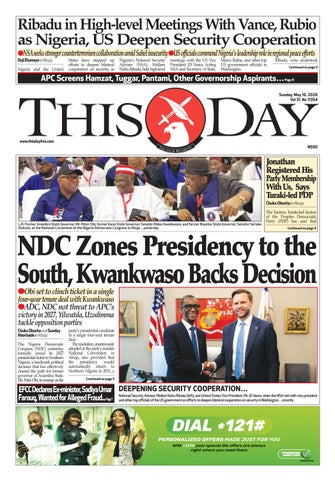
Ribadu in High-level Meetings With Vance, Rubio as Nigeria, US Deepen Security Cooperation
Deji Elumoye in Abuja Nigeria and the United States have stepped up efforts to
The Tanimu Turaki-led faction of the Peoples Democratic Party (PDP) has said that
NDC Zones Presidency to the South, Kwankwaso Backs Decision
Obi set to clinch ticket in a single four-year tenure deal with Kwankwaso ADC, NDC not threat to APC’s victory in 2027, Yilwatda, Uzodimma tackle opposition parties
Chuks Okocha and Sunday Aborisade in Abuja
The Nigeria Democratic Congress (NDC) yesterday formally zoned its 2027 presidential ticket to Southern Nigeria, a landmark political decision that has effectively cleared the path for former governor of Anambra State, Mr. Peter Obi, to emerge as the party's presidential candidate in a single four-year tenure deal.
The resolution, unanimously adopted at the party's maiden National Convention in Abuja, also provided that the presidency would automatically return to Northern Nigeria in 2031, a
Chuks Okocha in Abuja
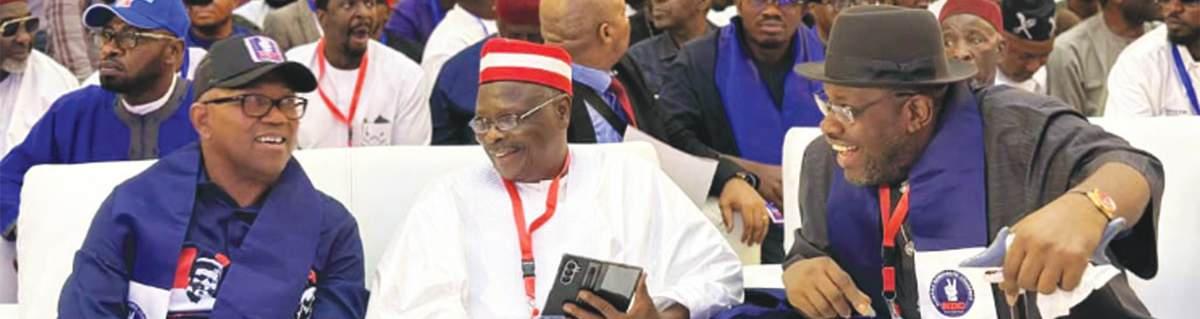
L-R: Former Anambra State Governor, Mr. Peter Obi; former Kano State Governor, Senator Rabiu Kwankwaso; and former Bayelsa State Governor, Senator Seriake Dickson, at the National Convention of the Nigeria Democratic Congress in Abuja…yesterday
Three Deaths Recorded as Hantavirus Cases Rise to Eight, WHO Issues Advisory
UK to isolate cruise ship passengers in ex-Covid hospital
Onyebuchi Ezigbo in Abuja
The World Health Organisation (WHO) yesterday confirmed a total of eight cases, up from seven earlier reported, including three deaths from the hantavirus outbreak.
In an update highlighting the disease outbreak linked to MV Hondius, the organisation noted that the statistics were
as of Friday, May 8, 2026. “As of May 8, a total of 8 cases, including three deaths, have been reported”, the statement said. It added that six cases were confirmed as Andes virus, four patients were hospitalised, while one case previously reported as suspected was reclassified as a non-case after testing negative for Andes
(ANDV) virus through specific polymerase chain reaction (PCR) and serology.
Meanwhile, the United Kingdom health authorities are gearing up to receive about 24 people from a virus-hit cruise ship, who will be isolated in a hospital once used for Covid patients, NHS officials said yesterday.
Hantaviruses are zoonotic
viruses that naturally infect rodents and can occasionally spread to people.
WHO noted that epidemiological investigations were underway to determine the source of exposure, including the travel history and potential exposures of the first case, adding that one of its experts and one from the European Centre for Disease
NDC ZONES PRESIDENCY TO THE SOUTH, KWANKWASO BACKS DECISION
move party leaders described as a deliberate strategy to promote equity, national cohesion, and political stability.
Reacting to NDC’s zoning of the presidency, the National Chairman of the All Progressives Congress (APC), Prof. Nentawe Yilwatda and the Chairman of the Progressive Governors’ Forum (PGF) and Imo State Governor, Senator Hope Uzodimma, have said that the African Democratic Congress (ADC) and the NDC were not a threat to the ruling party.
NDC’s decision has received the backing of a former Kano State Governor, Dr. Rabiu Kwankwaso, who said the resolution reflected the party's commitment to fairness.
The motion was moved by the member representing Ogbaru Federal Constituency of Anambra State in the House of Representatives, Hon. Afam Victor Ogene, who said the zoning formula reflected the party's commitment to fairness, inclusiveness, and balanced national leadership.
According to him, the decision was "not merely political but a moral statement on national cohesion," designed to reduce tension surrounding Nigeria's long-standing debate over power rotation.
"In recognition of our country's diversity and the need for balance, the party has resolved that the presidency shall rotate to the South in 2027 for a single term and
subsequently return to the North in 2031," he declared amid a loud applause from delegates.
The decision is expected to intensify speculation about Obi's possible presidential ambition on the NDC platform.
Addressing delegates, Obi said the coalition behind the NDC was driven by principle rather than political convenience, insisting that the movement was determined to rescue Nigeria from poverty, insecurity, and poor governance.
He noted that the time to rescue Nigeria has come, and all hands must be on deck to achieve it in 2027.
"We are not changing
political platforms for transactional reasons," Obi said.
"We are making a principled decision to find a platform that allows us to build a new Nigeria that is possible."
He warned against attempts to weaken opposition politics in the country, saying beneficiaries of democracy were gradually becoming agents of democratic destruction.
"We must insist that Nigeria cannot become a one-party state. Nigeria must remain a democracy, and we are determined that in 2027 we will have free, fair, and credible elections," he declared.
Obi lamented that more than 140 million Nigerians were living in multidimensional
Prevention and Control were on board the cruise ship to provide support to the passengers, crews, and ship operators during the journey. During the cruise, which was travelling from Ushuaia in Argentina to Cape Verde off west Africa, “illness onset occurred between 6 and 28 April 2026,” WHO said. It was “characterised
poverty while millions of youths remained unemployed or underemployed.
"Our choice as a people is therefore clear: whether to surrender to despair and national decline, or to summon the courage to rescue our country and rebuild it on the foundations of unity, equity, justice, competence, and productivity.
"Nigeria is not a poor country; it is a country rooted in poverty by poor leadership. The NDC will move the country from a consumption-driven economy to a production-based economy."
He also pledged that, if elected, the party would prioritise national unity,
JONATHAN REGISTERED HIS PARTY MEMBERSHIP WITH US, SAYS TURAKI-LED PDP
former President Goodluck Jonathan is a registered member of the party under its leadership, adding that he recently participated in the party’s digital membership registration exercise.
It stated this while dismissing as fake a series of campaign posters circulating on social media linking Jonathan to various political parties ahead of the 2027 general election.
In a statement issued yesterday by the faction’s National Publicity Secretary, Ini Ememobong, the group warned Nigerians against associating Jonathan with
any political platform outside the PDP.
The statement, titled “Beware of Fake GEJ Campaign Posters,” said the posters falsely portrayed Jonathan either as a standalone presidential aspirant or paired with other prominent Nigerians as running mates.
“Campaign posters bearing the photographs of President Goodluck Jonathan, either alone or paired with other notable Nigerians as running mates, have emerged and are being circulated widely on social media platforms,” the statement read.
According to the faction, the posters also “falsely portray him as a member of the various political parties whose logos appear on them.”
The Turaki-led PDP maintained that Jonathan remains a registered member of the party under its leadership and recently participated in the party’s digital membership registration exercise.
“We state categorically that President Goodluck Ebele Jonathan is a registered member of the Peoples Democratic Party under the capable leadership of Kabiru
Tanimu Turaki (SAN),” the statement said.
“He duly registered personally in his ward during the recently concluded digital membership registration exercise — a fact he personally confirmed to members of the Interim National Working Committee during a meeting with him yesterday.”
The faction said the clarification was necessary under the provisions of the Electoral Act, warning that double political party registration is prohibited and punishable under Nigerian law.
“This clarification has become necessary in view of the provisions of the extant Electoral Act, under which double registration is not only prohibited but also punishable,” the statement added.
The party also alleged that some individuals could attempt to manipulate party databases by registering Jonathan and other political figures in multiple parties without their consent.
“We are aware that mischief makers may not only design and circulate fake campaign posters, but may also, in concert with
by fever, gastrointestinal symptoms, rapid progression to pneumonia, acute respiratory distress syndrome and shock,” it said, adding that “further investigations are ongoing”. WHO stressed that it assessed the risk to the global population from the outbreak as “low”, adding that it would continue to monitor the situation.
security, and economic revival.
"We want a Nigeria where citizens are safe, whether in Kano, Katsina, Kebbi, Sokoto, Benue, Rivers, or anywhere else in the country," he added.
Kwankwaso Backs Decision on Zoning Presidency to South
Meanwhile, the Leader of the Kwankwasiya Movement and former Kano State governor, Kwankwaso, openly backed the zoning arrangement, describing it as a bold step towards fairness, equity, and national inclusion.
Kwankwaso said, "I support the decision to zone the
Continued on page 9
highly placed collaborators, attempt to input the details of President Jonathan and other prominent members of our party and the opposition movement into the databases of different political parties,” it stated.
The PDP faction called on the Independent National Electoral Commission (INEC) and the general public to disregard any such activities.
“We therefore put the public, especially the INEC, on notice of this malfeasance and urge them to discountenance any such fraudulent activity,” the statement concluded.
RIBADU IN HIGH-LEVEL MEETINGS WITH VANCE, RUBIO AS NIGERIA, US DEEPEN SECURITY COOPERATION
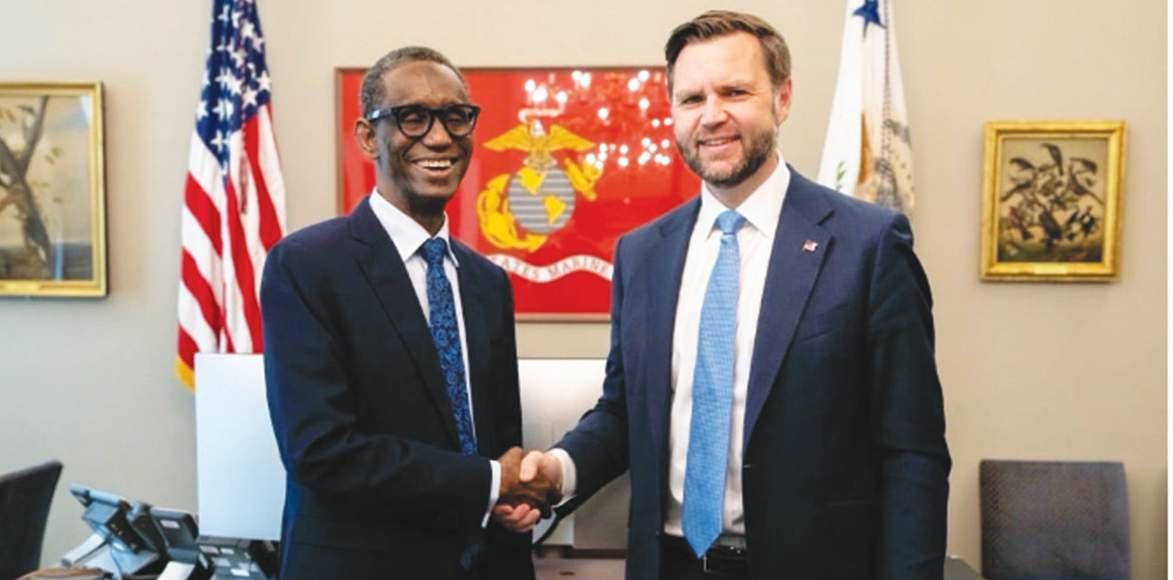
a three-day working visit to the US from May 4 to May 6, conveyed President Bola Tinubu’s commitment to strengthening Nigeria’s longstanding strategic partnership with the US, to the US officials.
During the visit, the NSA also met with the US Undersecretary for Political Affairs, Allison Hooker, and Assistant Secretary of War, Daniel Zimmerim.
A statement issued yesterday by the Special Adviser to the President on Information and Strategy, Bayo Onanuga, said the engagements provided an opportunity for both countries to review the
current state of relations and to strengthen collaboration in counterterrorism, defense cooperation, intelligence sharing, regional security, and democratic governance.
During the meetings, Ribadu stressed the need for sustained international collaboration in tackling growing security threats across West Africa and the Sahel region.
According to Onanuga, the NSA also conveyed President Tinubu’s strong commitment to Nigeria’s longstanding strategic partnership with the US.
The meetings provided an opportunity for both sides to review the current state
of Nigeria–United States relations.
Ribadu stressed the importance of sustained cooperation in addressing terrorism, violent extremism, transnational organised crime, and cyber threats.
The NSA also reaffirmed Nigeria’s regional security role, saying the country “remains fully committed to working with international partners in promoting peace, stability, democratic governance, and economic development across Africa.”
He further underscored Nigeria’s role as a regional leader and frontline state in counterterrorism efforts across the Lake Chad Basin
and West Africa.
Discussions between Ribadu and the US officials also focused on the evolving security situation in the Sahel, the need for enhanced regional cooperation, and the importance of strengthening institutional capacity to respond effectively to complex and asymmetric threats.
At a meeting with Under Secretary for Political Affairs, Hooker at the US Department of State, Ribadu expressed Nigeria’s appreciation to the US government for its continued support and cooperation in various sectors, particularly in security assistance, intelligence collaboration, defence capacity
building, humanitarian support, and counterterrorism operations.
He reaffirmed Nigeria’s commitment to implementing the agreed roadmap under the Nigeria–US Joint Working Group (JWG), established to advance structured bilateral cooperation on strategic and security-related matters.
Both sides reviewed progress under the JWG framework. They discussed practical measures to enhance the implementation of agreed initiatives, including intelligence sharing, military cooperation, counterterrorism support, border security, strategic communications, and capacity development for
Nigerian security institutions. The discussions also highlighted the importance of maintaining regular channels of communication and strengthening institutional coordination between the two countries to address common security challenges.
The NSA also used the opportunity to brief US officials on ongoing reforms and operational measures being undertaken by the federal government to improve national security, stabilise affected communities, and address the root causes of insecurity. He emphasised the
CONGRATULATIONS TO NEWEST COUPLE…
Access, First Bank, GTCO, UBA, Zenith Bank's Shareholders’
Funds Hit N20.2tn Amid CBN’s Recapitalisation Drive
Nigeria’s banking industry witnessed a major capital strengthening in the 2025 financial year as the combined shareholders’ funds of five Tier-1 lenders surged above N20 trillion for the first time, underscoring the far-reaching impact of the Central Bank of Nigeria’s (CBN) aggressive recapitalisation policy, THISDAY’s analysis has shown.
An analysis of the audited financial statements of the country’s largest lenders showed that the combined shareholders’ funds of Access Holdings Plc, United Bank for Africa Plc, Zenith Bank Plc, First HoldCo Plc, and Guaranty Trust Holding Company Plc rose to N20.22 trillion in 2025, representing a 21 per cent increase from N16.72 trillion recorded in 2024.
The sharp rise in capital reserves was a reflection of the
success of the banks’ aggressive fundraising programmes through the Nigerian capital market following the apex bank’s decision to raise minimum capital thresholds for lenders operating in the country.
In March 2024, the CBN unveiled a sweeping recapitalisation framework aimed at repositioning Nigerian banks for larger balance sheets, stronger shock-absorption capacity, and greater support
for the real economy.
Banks were given until March 2026 to comply through fresh capital raising, mergers and acquisitions, or license downgrades.
The five banks also significantly expanded their asset bases during the review period.
Combined total assets rose by 12.6 per cent to N161.2 trillion in 2025 from N143.1 trillion in 2024, highlighting sustained growth in lending
Sultan: A True Muslims Should Be Agent of Peace, Reconciliation
Yinka Kolawole in Osogbo
The President of the Nigeria Supreme Council for Islamic Affairs (NSCIA) and Sultan of Sokoto, His Eminence Sa’ad Abubakar, has disclosed that a true Muslim would be a peace builder as a result of the teachings of Islam. Speaking at the inauguration and handing over of an ultra-modern mosque build to celebrate Asiwaju Khamis Badmus’ 80th birthday in Osogbo weekend, he said true understanding of Islamic religion helped to build a
disciplined and enlightened Muslim, who turned intolerance into friendship and hostility into love.
The Sultan, who was represented by the President of the Muslim Ummah of South West Nigeria (MUSWEN), Alhaji Rasak Oladejo, said the essence of mosque was beyond just the observance of five daily prayers.
“Let me give my Muslim brothers and sisters some advice. Let us make efforts to understand our religion properly. True religious understanding should produce disciplined, compassionate and
enlightened Muslims who build peace and not destroy it. Religion should transform us inwardly, turning intolerance into friendship, hostility into love and conflict into collaboration. In essence, we become agents of peace and reconciliation”, he said.
Also, the National Missioner of Ansar-u-Deen Society, Sheik Abdulrahman Ahmad, while commending Badmus for the edifice, noted that a mosque should not be reduced to just observance of five daily prayers, saying it was the nucleus of the Muslim society, where social,
economic and political conflict were resolved for the progress of the society.
“The Mosque of Qubah, in the city of Madinah in 622 CE, the purpose was not for Salat alone. That Mosque was designed to serve Islam by accommodating such necessary institutions as School, Library, Treasury, Information Centre, Court of law, Mini Parliament and even Hospital. In a nutshell, going by its original design, the Mosque should be the social symbol of Muslim development theoretically and practically, on the platform of unity.
activities, customer deposits and investment portfolios.
Consequently, shareholders’ funds accounted for 12.5 per cent of total assets in 2025, an improvement from 11.68 per cent recorded in the previous year, reflecting stronger capital buffers across the banking sector.
Among the lenders, Zenith Bank Plc maintained the strongest shareholders’ fund position at N4.9 trillion in 2025, representing a 22.2 per cent increase from N4.03 trillion in 2024.
Access Holdings Plc followed with N4.33 trillion shareholders’ funds, up 15.05 per cent from N3.76 trillion posted in the previous year. At the same time, United Bank for Africa Plc reported N4.25 trillion, representing a 24.4 percent increase over N3.42 trillion declared in 2024.
In its audited report, UBA disclosed details of its multi-tranche capital raising programme designed to comply with the CBN’s new minimum capital requirements.
between July and September 2025, raising an additional 3.16 billion ordinary shares at N50 per share.
The lender added that it had secured the CBN’s final regulatory approval before year-end and recognized the net proceeds of N154.65 billion after deducting associated transaction costs.
Similarly, Guaranty Trust Holding Company Plc reported shareholders’ funds of N3.4 trillion in 2025, about 26 per cent higher than the N2.7 trillion recorded in 2024, while First HoldCo Plc posted N3.3 trillion, representing an 18.1 per cent increase over N2.8 trillion in the preceding year.
GTCO disclosed that it had completed the second phase of its capital raising programme to meet the N500 billion regulatory capital requirement for its flagship subsidiary, Guaranty Trust Bank Limited.
According to the group, it executed an international capital offering involving 2.28 billion ordinary shares priced at N70 per share, following regulatory approval obtained in July 2025.
Troops Repel ISWAP Attack on 27 Brigade in Yobe, Kill 50
Linus Aleke in Abuja
Troops of the Operation HADIN KAI have neutralised at least 50 suspected Islamic State West Africa Province (ISWAP) terrorists during a coordinated attack on the Headquarters of 27 Brigade in Buni Gari, Yobe State.
The Nigerian Army disclosed this in a statement issued yesterday by the Media
Terrorists, Recover Arms
Information Officer of the Joint Task Force (North East), Operation HADIN KAI, Lt. Col. Sani Uba.
The incident, which took place in the early hours of Thursday, 8 May 2026, also left two soldiers dead.
According to the statement, the terrorists launched the attack at about 2 am on Thursday from multiple directions targeting the
brigade headquarters and the Buni Gari checkpoint.
The army said the attackers first advanced from the western flank, then reinforced along the southern axis at Ganinga Junction, and later attempted to encircle the troops from the south-western flank.
“The assault, launched under the cover of darkness by a large number of terrorists from multiple
axes, was met with devastating firepower, tactical brilliance, and resolute determination by troops who held their ground and inflicted catastrophic losses on the attackers.
“No fewer than 50 terrorists were neutralised, while a large cache of arms and ammunition was recovered from the fleeing remnants,” the statement read.
According to the lender, it registered a fresh equity capital programme with the Securities and Exchange Commission (SEC) to raise N400 billion. It commenced the first tranche through a rights issue in November 2024, which closed in December of the same year.
The bank stated that the SEC approved the allotment on May 7, 2025, after obtaining the CBN’s “no objection” for the capital verification exercise.
UBA disclosed that net proceeds of N234.27 billion were recognised after deducting offer costs of N5.13 billion, representing about 1.82 per cent of gross proceeds.
The bank subsequently launched the final tranche of the capital raising exercise through another rights issue
The group also completed a N10 billion private placement by issuing 125 million ordinary shares at N80 per share, with proceeds received in December 2025.
Financial analysts said the successful capital-raising exercises demonstrated growing investor confidence in the resilience of Nigerian banks amid macroeconomic pressures, currency volatility, and global uncertainties.
Vice President of Highcap Securities Limited, Mr. David Adonri, noted that the Nigerian capital market played a strategic role in supporting the federal government's recapitalization process and broader economic ambitions.
Kayode Tokede
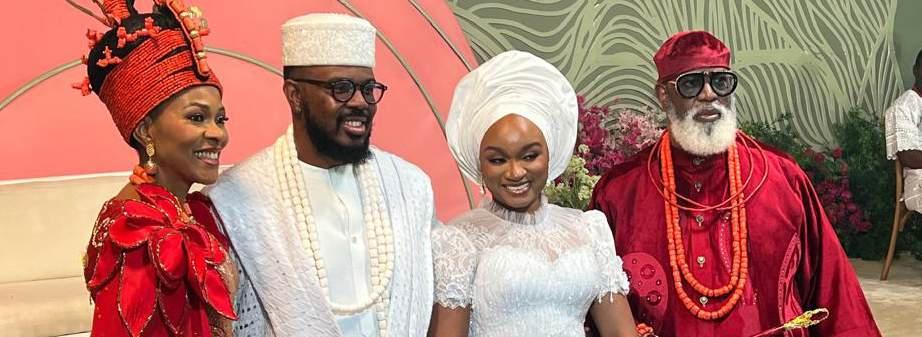
L-R: Mother of the groom, Mrs. Oghogho Osula; the new couple, Ephrain and Ngozi Osula; and Father of the groom and Chairman, Julian Luxury’s Nigeria, Prince Julian Osula, at the traditional wedding ceremony of Ngozi and Ephrain Osula at the Harbour Point Event Centre, Victoria Island, Lagos…yesterday.
UNVEILING A NEW ERA OF GROWTH…
Returning Power to North in 2027 Inimical to Nigeria’s Unity,
Sunday Ehigiator
Two Nigerian ambassadordesignates, Femi Fani-Kayode and Reno Omokri have declared that returning power to Northern Nigeria after a southerner occupied only one term would be inimical to Nigeria’s unity, unpatriotic and a betrayal of the rotation pact that anchored Nigeria’s democracy since 1999. They added that it would
Say Fani-Kayode, Omokri
also be a slight against President Bola Tinubu, who was the chief architect of the North’s return to power in 2015. Ambassador-designate to South Africa, Fani-Kayode, and Ambassador-designate
to Mexico, Omokri, made the declaration in a joint statement issued yesterday, endorsing Tinubu for re-election in 2027.
They argued that the North had enjoyed two full, uninterrupted terms under
ADC Confirms Atiku’s N90m Payment for Presidential Nomination Form
Chuks Okocha in Abuja
The African Democratic Congress (ADC) has confirmed that former Vice President Atiku Abubakar paid for his presidential form to contest under the party’s platform and received his payment receipt.
This was disclosed in the party’s official statement posted on its X account yesterday.
The ADC post on Atiku was accompanied by an Official Receipt No. 2881 confirming the transaction.
The document confirmed the payment of ₦90 million via bank draft, which was stated as the cost of the presidential
nomination form ahead of the 2027 general election. The receipt was dated Friday, May 8, 2026.
The party explained: “A New Chapter in Nigeria’s Democratic Journey. “H.E. Atiku Abubakar, GCON, has officially received his payment receipt to contest under the platform of the African Democratic Congress (ADC) ahead of the 2027 Presidential Election.”
The ADC described the development as part of what it called a wider political shift within the party, framing it as a moment of strategic significance in its evolving electoral posture.
“This development marks
another significant moment in the growing movement for national renewal, democratic inclusion, and people-driven leadership within the ADC,” it read.
Reinforcing its broader political messaging, the party positioned itself as an emerging alternative in Nigeria’s competitive opposition space.
It added, “As Nigerians continue to seek credible alternatives, the ADC remains committed to providing a strong platform built on unity, competence, economic recovery, security, and national progress.”
According to the announcement, the next
EFCC Declares Ex-minister,
formal step in the process will take place in the coming days.
It noted, “The formal presentation of nomination forms is expected on Monday at the ADC National Secretariat, Abuja.”
The party further framed the development as part of growing internal momentum ahead of the election cycle.
“The movement is growing. Hope is rising. Expect more,” the party concluded.
The confirmation of Atiku’s receipt signals an early and notable move in the unfolding 2027 political contest, as parties begin to activate structures and test alignments ahead of the national vote.
Sadiya
Umar Farouq, Wanted for Alleged Fraud
The Economic and Financial Crimes Commission (EFCC) has declared a former Minister of Humanitarian Affairs and Social Development, Sadiya Umar Farouq, wanted for alleged abuse of office and diversion of public funds.
In a statement shared on its website, the anti-graft agency said “anybody with useful information as to her whereabouts” should contact the EFCC offices through the
number listed on the page.
“Farouq, 52, is an indigene of Zamfara State, and her last known address is EN008, Okpo River, off Agulu street, Maitama, Abuja,” the wanted notice reads.
Umar Farouq served as a minister from 2019 to 2023 in the administration of former President Muhammadu Buhari.
The anti-graft agency is investigating the ministry she oversaw over alleged N37 billion fraud.
On April 16, 2026, a Federal Capital Territory (FCT) High Court in Apo issued an arrest warrant against Umar Farouq.
The presiding judge, Justice Jude Onwuegbuzie, also granted an order of arrest against a permanent secretary in the ministry, Bashir Nura Alkali.
The order was granted following an application by the EFCC after the defendants failed to appear in court for their scheduled arraignment.
Umar Faruoq and
Alkali, alongside one Sani Mohammed, are facing a 21-count charge bordering on breach of trust and abuse of office as filed by the EFCC.
The commission had alleged that the defendants misappropriated about $1.3 million and N746.6 million.
According to the EFCC, part of the funds meant to be refunded to the ministry after payments made under a social intervention program was allegedly converted for personal use.
former President Muhammadu Buhari, with southern support, adding that equity demanded that the South be allowed a complete two terms before any power shift.
“We view it as unpatriotic and inimical to the unity, equilibrium, and progress of Nigeria for anyone to even conceive of power returning to Northern Nigeria after only one term of four years, during which it was domiciled in Southern Nigeria,” they said.
They noted that the South’s current hold on power was not incidental but deliberate.
They added, “Not just in Southern Nigeria, but in the specific hands of the man who was the chief architect for the return of power to the North in 2015.”
“We are of the opinion that one good turn deserves another and that one good term deserves another,” they said.
The statement described the gentleman’s agreement on rotation as the bedrock of Nigeria’s post-military stability.
“It is in the best interest of the stability, unity, and prosperity of the Federal Republic of Nigeria, and in keeping with the Gentleman’s Agreement which ushered in our Fourth Republic in 1999, after sixteen years of turbulence and political instability, for there to be a balanced and orderly rotation of power in Nigeria between the North and the South,” they said.
They added that Northern Nigeria, having “completed and made full and unfettered use of two terms of four years under the Muhammadu Buhari administration,” had exhausted its turn in the rotation and must now yield.
On performance, the statement credited Tinubu with 12 consecutive cycles
of GDP growth and trade surpluses, saying he had added “$67 billion to our economy” and made “Nigeria the sixth largest contributor to global GDP growth in 2025.”
They also pointed to infrastructure under the Renewed Hope Agenda as proof of a unifying presidency. They called on all Nigerians to back the president’s re-election.
“Finally, we call on all Nigerians, irrespective of region, religion, and communion, to join us and queue behind the present Presidency and future candidacy of President Bola Ahmed Tinubu and the Renewed Hope Agenda, which has seen infrastructural efforts to unite Nigeria, including the N15 trillion 750-kilometre Lagos-Calabar Coastal Highway, the N13 trillion 1068-kilometre Illela-SokotoBadagry Superhighway, and bridging the gap between the Southeast and the entire North through the 465-kilometre Trans-Saharan Road being constructed at a cost of an estimated $750 million.
“If we all extend the right hand of fellowship to President Bola Tinubu, we will, with the help of God, collectively see Nigeria become a $1 trillion economy by 2031,” they said.
Citing Switzerland as a model, they argued that structured power-sharing had kept the Alpine nation stable and conflict-free for over two centuries.
“The reason Switzerland has been stable, peaceful, and prosperous for the last 211 years is because that Alpine nation wisely introduced power sharing amongst its multiethnic population and has not seen any conflict since 1815,” they said.
“To re-elect President Bola Ahmed Tinubu is a task that must be done,” they declared.
Alex Enumah in Abuja
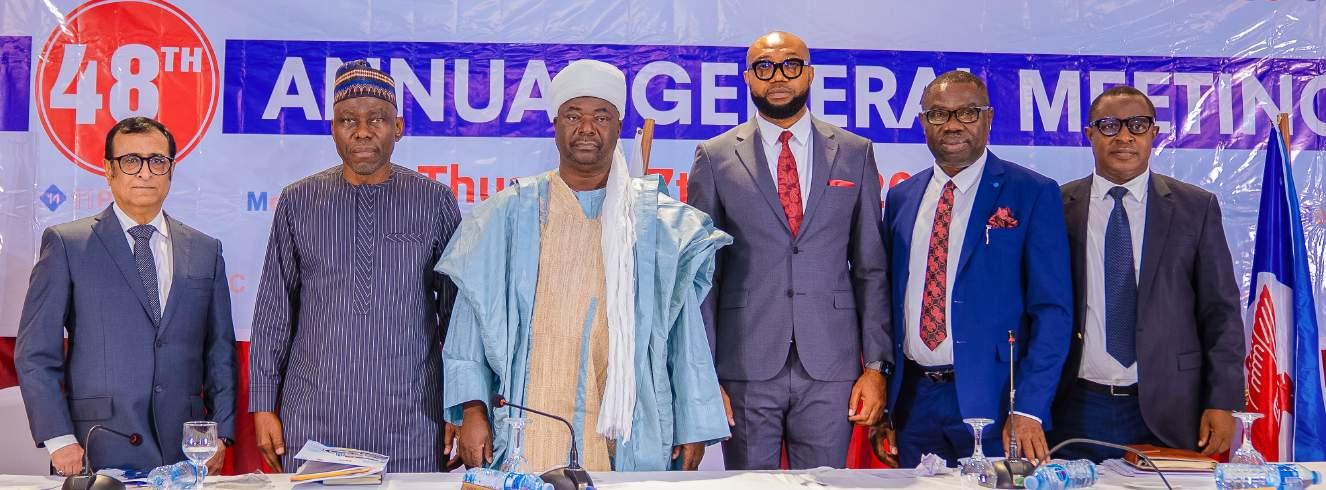
L-R: Group Executive Director, Finance, 11Plc, formerly Mobil Oil Nigeria Plc, Ramesh Virwani; Acting Managing Director, Osagie Ogedegbe; Non- Executive Director, Abdulkadir Aminu; Company Secretary, Samuel Ozeh; Non - Executive Director, Paul Obi, and Independent Non - Executive Director, Nurudeen Abubakar, during the company's 48th Annual General Meeting held at Abuja Continental Hotels, Abuja…weekend
PAYING LAST RESPECTS TO KABIYESI…
SDP Elects New Officers, Accuses APC of Crushing Opposition, Vows Fierce Battle for Power in 2027
Picks Adebayo as presidential candidate Bugaje accuses INEC, judiciary of undermining opposition
Sunday Aborisade in Abuja
The Social Democratic Party (SDP) yesterday launched a blistering attack on the All Progressives Congress (APC), accusing it of shrinking democratic space, manipulating state institutions and attempting to wipe out opposition politics ahead of the 2027 general election, even as
the party declared itself ready to challenge for power at the national level.
This is as the party adopted its 2023 presidential candidate, Adewole Adebayo, as its consensus presidential flag bearer for the 2027 general election.
At its 2026 National Convention held in Bauchi State where Professor Sadiq
Gombe emerged as the newly elected National Chairman of the party, it accused the federal government of using the judiciary and the Independent National Electoral Commission (INEC) as political tools while impoverishing Nigerians through policies that had worsened hardship, unemployment, insecurity and rising food prices.
Chairman of the convention, Professor Usman Bugaje, told delegates that Nigeria was drifting towards authoritarianism and warned that attempts to suppress opposition parties would ultimately fail.
He said despite worsening economic conditions and political intimidation, Nigerians remained determined to reclaim
Police Maintain Presence at ACF Headquarters Amid Lingering Leadership Crisis
John Shiklam in Kaduna
The headquarters of the Arewa Consultative Forum (ACF) in Kaduna remained under heavy police watch yesterday as the lingering leadership crisis rocking the apex northern socio-political body showed no sign of easing.
When THISDAY visited the ACF headquarters, the premises were heavily guarded by three truckloads of stern-looking operatives of the Nigeria Police Force stationed within and around the facility.
The police had moved into the
premises on Tuesday following separate notices from two factions within the ACF leadership, each indicating plans to hold parallel National Executive Committee (NEC) meetings at the same venue and at the same time.
Spokesman for the Kaduna State Police Command, DSP Mansir Hassan, said the deployment was strictly a preventive measure aimed at maintaining peace and public order.
He explained that the police did not seal off the ACF headquarters as speculated
in some quarters, but only took proactive steps based on intelligence reports available to the command.
“We have not sealed the ACF headquarters. What we did was the deployment of our personnel to the place to prevent breakdown of law and order,” the police spokesman said.
He explained that intelligence reports indicated that the parallel meetings planned by the two factions could degenerate into a confrontation that could threaten the peace in Kaduna.
The police action followed the
deepening internal crisis within the ACF, which escalated after the National Executive Committee (NEC) announced the suspension of the Chairman of the Board of Trustees (BoT), Bashir M. Dalhatu, over allegations bordering on financial misconduct and constitutional breaches.
The NEC, which held its meeting at the National Teachers Institute after being denied access to the secretariat, also directed a forensic audit of the forum’s finances and reaffirmed its confidence in the leadership of the National Working Committee.
the country from what he described as failed leadership.
“Congratulations for the courage of conviction and for standing out from a timid and spineless crowd running to take shelter in a ruling party that has stolen this country dry while leaving Nigerians in excruciating poverty and utter misery,” Bugaje declared.
According to him, democratic institutions had allegedly become instruments in the hands of politicians determined to retain power at all costs.
“National institutions like the judiciary and democratic institutions like INEC have become tools in the hands of unscrupulous politicians, tossed around like chess pieces,” he said.
“The attempt by the ruling party to block political space and eliminate opposition is one of the most despicable offences in a democracy.”
Drawing parallels with the military era, Bugaje referenced the late General Sani Abacha, saying authoritarian forces had historically failed despite wielding enormous power.
“Only a quarter of a century
ago, General Abacha, with all his military might, detained who he could and did what he could, yet he could not achieve what he wanted,” he stated.
In a related development, SDP National Secretary, Dr. Olu Agunloye, declared that the party had successfully resisted attempts by “self-serving politicians and coalition forces” to hijack its structure ahead of the 2027 elections.
Presenting the State of the Party address, Agunloye said the SDP had undergone internal reforms and cleansing exercises aimed at restoring discipline and protecting the party’s ideological foundation.
“The party survived the siege of takeover attempts by self-serving politicians and agents of coalition who reacted violently to the internal cleansing activities,” he said.
According to him, the SDP had reclaimed its structure and repositioned itself as a credible opposition force capable of competing nationally.
“Our party has been able to reclaim and re-establish itself and has been brought back to its original owners,” he said.
APC Screens Hamzat, Tuggar, Pantami, Other Governorship Aspirants
Akinwale
The All Progressives Congress (APC), yesterday screened some of its governorship aspirants, including the Deputy Governor of Lagos State, Dr. Obafemi Hamzat; immediate past Minister of Foreign Affairs and a governorship aspirant in Bauchi state, Yusuf Tuggar; and a former Minister of Communications and Digital Economy, and Gombe State governorship aspirant, Prof. Isa Pantami.
Speaking after his screening,
Pantami declared that a free, fair, and transparent primary was crucial for the party's survival ahead of the 2027 elections.
He stressed that he wasn't aware of any consensus arrangement in the Gombe State chapter of the party.
Pantami noted: “I’m not aware of anything like this at the moment because, since we were invited for screening and we have been screened here, it is an indication that at least the party at the national level has given every Nigerian a level playing ground.
“Internal democracy and internal justice are very important to the survival of democracy in Nigeria.
Because of this, the party allowed every one of us to come here and be screened objectively, even at the state level.
“In comparison, I believe that the party has stated that they are ready for direct primaries.
I think this is commendable, both at the federal and state levels, for shifting their position.
“What is important is not only the direct primaries, but
that the direct primaries must be very transparent, very fair, and at the same time very independent, because when you are planning direct primaries, any person with an interest or bias should not be in charge of it.
On his part, Tuggar said that the party would most likely conduct a direct primary with more than five aspirants vying for the party's ticket in Bauchi State.
He stated, “To be honest, it is unlikely that there is going to be a consensus in Bauchi
State. I don't think that there will be agreement amongst the aspirants.
Initially, there were five aspirants, and then all of a sudden, yesterday, we saw a flurry of activity and a deluge of forms being procured. So, this is a day before the screening, and it makes you wonder why or how, but people are free to exercise their freedom to contest.”
Also speaking, Hamzat expressed optimism that he would be the next governor of Lagos State.
“At home, I’m very comfortable. I’m absolutely comfortable. But we’ll see. That’s the essence. It’s for our citizens, our party members. It is going to be their choice, but I’m confident that at the end of the day, not only that, I will be the next Governor of Lagos State,” he said. However, a governorship aspirant from Kwara State, AbdulFatai Yahaya, said the state governor,
would determine the mode of primary that the party would adopt in the state.
Adedayo
in Abuja
Abdulrazaq Abdulrahman,
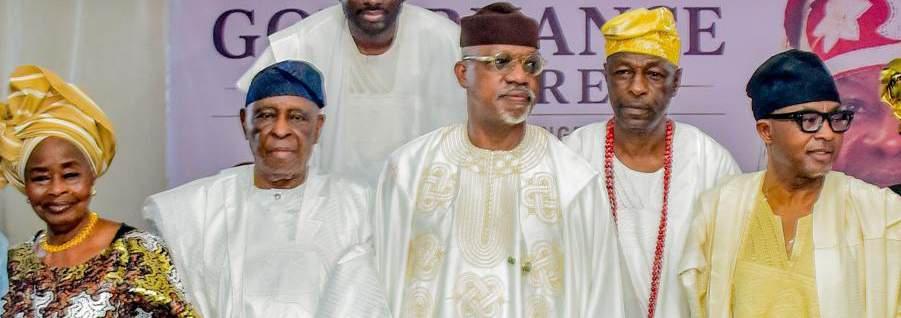
L-R: Wife of the late Awujale of Ijebuland, Olori Iyabo Adetona; former Ogun State Governor, Olusegun Osoba; Governor Dapo Abiodun; first son of the late Awujale, Prince Adedire Adetona; and the representative of former President Olusegun Obasanjo; Abiodun Fari-Arole, during the final farewell ceremony and grand reception for the late Awujale of Ijebuland, Oba Sikiru Kayode Adetona, held at the Dipo Dina Stadium, Abeokuta…yesterday
GIVING BACK TO THE SOCIETY…
US, Iran No Closer to Ending War as Negotiators Await Tehran's Response
Sunday Ehigiator
A state of relative calm prevailed around the Strait of Hormuz yesterday, after days of sporadic flare-ups, as the United States waited for Iran's response to its latest proposals to end more than two months of fighting and begin peace talks.
US Secretary of State, Marco Rubio said on Friday
NDC
presidential ticket of the NDC to the South in the interest of fairness, equity, and national inclusion.
"This presents a true opportunity for national healing and genuine nationbuilding," he said.
Kwankwaso said Nigeria was currently facing a severe leadership crisis marked by insecurity, economic decline, and institutional collapse.
"There has been a sharp decline in the quality of governance. Insecurity has created widows and orphans across the country. Millions have been displaced from their homes. Investments are fleeing while critical infrastructure is neglected," he said.
According to him, the country was once again in need of a broad national alliance similar to historic coalitions that shaped Nigeria's First Republic.
"Our party is committed to fairness and federal character
that Washington expected a response within hours.
But a day later, there was no sign of movement from Tehran on the proposal, which would formally end the war before talks on more contentious issues, including Iran's nuclear programme.
With US President Donald Trump due to begin a long-awaited visit to China next week, there has been
in all ramifications," he added, while urging Nigerians to register with INEC and support the NDC ahead of 2027.
National Leader of the party and former Bayelsa State governor, Senator Seriake Dickson, accused the ruling establishment of shrinking democratic space and intimidating opposition parties.
"The Nigerian opposition landscape is heavily compromised, intimidated, and constricted," he said.
Dickson stated that the party endured years of legal and administrative obstacles before eventually securing registration from the INEC earlier this year.
"The Independent National Electoral Commission complied and issued us a certificate of registration in February this year," he said.
"Contrary to propaganda, there is no appeal in any court against that decision,
continued leadership role in regional peace and security efforts and acknowledged Nigeria's importance as a strategic partner of the United States in Africa.
mounting pressure to draw a line under the conflict, which has thrown energy markets into turmoil and posed a growing threat to the world economy.
Recent days have seen the biggest flare-ups in fighting in and around the Strait of Hormuz since a ceasefire began a month ago, and the United Arab Emirates came under renewed attack
on Friday.
On Friday, there were sporadic clashes between Iranian forces and US vessels in the strait, Iran's semi-official Fars news agency reported.
The Tasnim news agency later cited an Iranian military source saying the situation had calmed but warning more clashes were possible.
The US military said it struck two Iran-linked vessels
BACKS DECISION
and INEC has duly registered our party."
National Chairman of the party, Senator Moses Cleopas, described the convention as a defining moment in the history of the NDC and a celebration of resilience, sacrifice, and faith in democracy.
Cleopas said the party was committed to issue-based politics, internal democracy, youth inclusion, and peopleoriented governance.
"We are not assembling a crowd for elections; we are building a movement for governance," he declared.
ADC, NDC Not Threat to APC’s Victory in 2027, Yilwatda, Uzodimma Tackle Opposition Parties
Reacting to NDC’s zoning of the presidency, the National Chairman of the APC, Prof. Yilwatda and the Chairman of the PGF and Imo State
and the promotion of sustainable peace and security across West Africa and the Sahel.
Governor, Senator Uzodimma, have declared that the ADC and the NDC were not a threat to the ruling party.
Yilwatda said the ruling party has over 31 governors, 400 legislators in its fold compared to a “meagre" 17 lawmakers that recently defected to the NDC.
Yilwatda disclosed this in Abuja after the screening of governorship aspirants ahead of the party's primary.
He maintained that the NDC was not a threat to the party despite zoning its presidential ticket to the South.
He stated: “Why should we be afraid? If you look at it now, the fight is not between APC and ADC or within our political party, but ADC versus NDC.
So, we’ve been vindicated when people say that APC was fighting the opposition.
“Now everybody has seen clearly that it is the opposition fighting themselves. So
attempting to enter an Iranian port, with a US fighter jet hitting their smokestacks and forcing them to turn back.
Tehran has largely blocked non-Iranian shipping through the strait since the war began with US-Israeli airstrikes across Iran on February 28. Before the war, one-fifth of the world's oil supply passed through the narrow waterway.
The US imposed a blockade
when you talk about having problems or challenges, why should we be afraid?
“All the by-elections - ADC has won none. In other byelections, NDC has won none. The major opposition we have is actually PDP.
“And even the PDP has not done very well in terms of electoral performance.
Performance is not on TV, it is not on radio; it is in newspapers, it is on the field during elections.”
Yilwatda noted that the recent defection of 17 lawmakers was meagre compared to 400 legislators that APC has.
He added: “17 legislators? We have over 400 legislators. Compared to 17, it is just a meagre number that has moved to those numbers.
“31 governors are still intact. We have over 600 local government chairmen.
APC is the most prepared, most outstanding political
on Iranian vessels last month. But a CIA assessment indicated Iran would not suffer severe economic pressure from a US blockade of Iranian ports for about another four months, according to a US official familiar with the matter, raising questions over Trump's leverage over Tehran in a conflict that has been unpopular with voters and US allies.
party that right now can face anybody on earth. I have not seen a party that can give us a headache.”
On his part, Governor Uzodimma also insisted that none of the opposition parties is a threat to the re-election bid of President Bola Tinubu. His words: “The problem I have with the media is that you know the truth, yet you always want to dance around in a country of 36 states, and 31 are sufficiently and transparently members of the All Progressives Congress.
“Look at that proportion 31 states are already for president Bola Ahmed Tinubu, apart from some states that are half APC and half their party. If you add it to it. You know that Nigeria has spoken.
“So, I’m not, we’re not threatened by any. First of all, this party that zoned the presidential ticket to the South - where is their head office?”
RIBADU IN HIGH-LEVEL MEETINGS WITH VANCE, RUBIO AS NIGERIA, US DEEPEN SECURITY COOPERATION administration’s wholeof-government approach, which combines kinetic and non-kinetic measures, including community engagement, economic development, deradicalisation initiatives, and regional partnerships.
On their part, US officials commended Nigeria’s
Both sides reaffirmed their shared commitment to democratic values, regional stability, economic cooperation,
The meetings concluded with a mutual commitment to deepen further bilateral engagement through sustained diplomatic dialogue, enhanced defense and security
cooperation, and the effective implementation of ongoing bilateral initiatives under the Joint Working Group framework.
Both Nigeria and the United States expressed optimism about the future of the strategic partnership while also reaffirming their readiness to
continue working closely to advance shared interests and address common global and regional challenges.
Recall that in November 2025, Ribadu led a delegation of 10 senior Nigerian government officials to meet with US officials in Washington, DC.
A month later, in December 2025, the NSA received a delegation from the United States Congress in Abuja. The delegation, led by senior members of the House, included representatives Mario Díaz-Balart, Norma Torres, Scott Franklin, Juan Ciscomani, and Riley Moore.
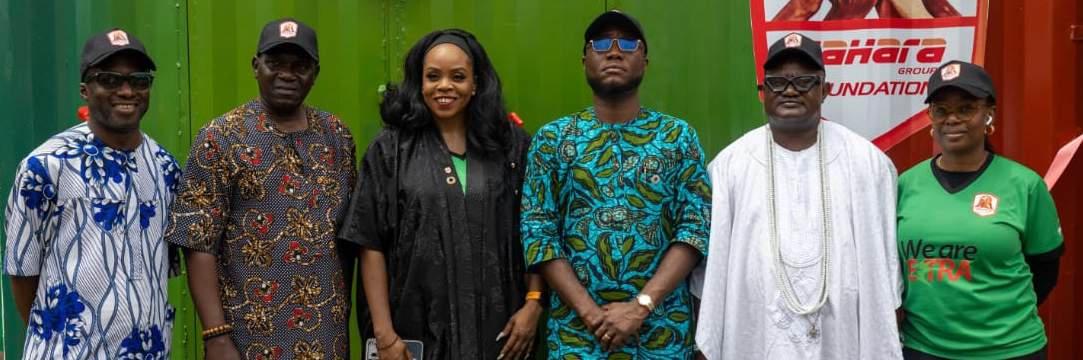
L-R: Supervisor for Environment, Ojodu LCDA, Lagos State, Sanitarian Muyiwa Awe; CDC Chairman, Ojodu LCDA, Pastor Segun Fayemi; Director, Sahara Group Foundation, Chidilim Menakaya; Chief of Staff, Ojodu LCDA, Hon. Olaide Bello; Aare Borikini of Aguda, Titiloye Ojo; and CSR, Brands and Events Manager, Ikeja Electric, Adebimpe Akintola, during the commissioning of Sahara Go Recycling Hubs in Ojodu Local Council Development Area, Lagos State…recently
PRODUCT LAUNCH…
Tinubu: Traditional Rulers Indispensable Partners in Governance, Grassroots Development
President Bola Tinubu has reaffirmed his administration’s commitment to restoring the relevance of traditional institutions in Nigeria’s governance structure, describing monarchs as indispensable partners in promoting peace, security, and grassroots development across the country.
Tinubu stated this yesterday during the final farewell and reception held in honour of the late Oba Sikiru Kayode Adetona at the Dipo Dina Stadium in Abeokuta, Ogun State.
Speaking on the lecture theme, ‘Bridging the Gap Between Traditional Institutions and Modern Government,’ Tinubu described the topic as timely and significant to Nigeria’s democratic
evolution.
Represented by Governor Dapo Abiodun of Ogun State, the president said the Renewed Hope Agenda of his administration had deliberately repositioned traditional rulers from ceremonial figures to active stakeholders in governance, conflict resolution, economic mobilisation, and nation-building.
According to him, the federal government envisions a Nigeria where traditional institutions are recognised as critical partners in preserving cultural values, strengthening social harmony, and advancing grassroots development.
“Our vision is clear — a Nigeria where traditional institutions are recognised as critical stakeholders in promoting peace, preserving values, strengthening harmony, and advancing grassroots develop-
Abductors Demand 20m Ransom for NYSC Member in Abuja
The family of Miss Eunice Ameh, a serving member of the National Youth Service Corps (NYSC) member and lawyer, is in distress after suspected kidnappers demanded 20 million for her release.
Eunice was abducted in the Federal Capital Territory (FCT) on May 6, shortly after leaving her job at Blades and Butchers Limited in Maitama around 5:40 p.m.
She was heading home to Life Camp when her phone went unreachable.
Both lines have remained switched off despite repeated attempts by relatives.
The corps member had only recently resumed the job as Sales Manager and was close to completing her NYSC service, including her final Community Development Service activities.
The disappearance was reported immediately to the Maitama Division of the Nigeria Police Force and to
the NYSC.
Initially, there was no contact from the abductors.
That changed when the kidnappers reached out to the family with a 20 million demand, intensifying fears and prompting fresh calls for swift action from security agencies.
FCT Police spokesperson Josephine Adeh said an investigation was underway and operatives were working to trace Eunice’s whereabouts and establish how the abduction occurred.
The incident has reignited concern among residents over rising kidnappings and ransom crimes in the city, particularly along commuting routes and residential areas.
As of yesterday, police had not confirmed any negotiations or breakthroughs.
The Ameh family continues to appeal to security agencies and the public for help, hoping for Eunice’s safe return.
ment,” he said.
Tinubu noted that traditional rulers possessed indigenous intelligence, moral authority, and social legitimacy that modern institutions cannot easily replace, stressing that their roles remained vital in addressing contemporary national challenges.
The president observed that while the 1963 Constitution accorded traditional institutions significant relevance within the governance structure, subsequent constitutional
arrangements diminished their influence, weakening the synergy between government and grassroots leadership.
He assured that his administration would continue to support constructive engagement aimed at assigning clearer constitutional responsibilities to traditional rulers through ongoing conversations at the National Assembly.
“This is not about politics; it is about strengthening governance, deepening inclusion, and recognising an institution that has sustained social order
for centuries,” he added.
Tinubu further disclosed that the federal government had sustained strategic consultations with traditional and religious leaders through the National Council of Traditional Rulers of Nigeria on issues relating to national security, economic growth, communal peace, and social stability.
He commended the Oba Sikiru Adetona School of Governance for organising the lecture in honour of the late monarch, whom he described as a courageous,
disciplined, and principled leader who ruled with wisdom, candour, and uncommon integrity.
“The theme speaks to one of the most important governance questions of our time — how to harmonise the authority of our ancestral institutions with the structures of constitutional democracy in advancing national progress,” he stated.
In a keynote address, former President Olusegun Obasanjo described the late Awujale as a foremost traditional ruler whose influence transcended Ijebuland.
New 11 Plc MD, Ogedegbe Pledges Aggressive Market Strategy to Boost Returns on Investment
A new chapter opened for 11 Plc, formerly Mobil Oil Nigeria Plc, as Acting Managing Director Mr. Osagie Ogedegbe has pledged aggressive market strategy to boost returns on investments
Speaking during his maiden public appearance during the company’s 48th Annual General Meeting (AGM) held at Abuja Continental Hotels in Abuja, Ogedegbe pledged to drive the company forward with professionalism, dedication, and a result-oriented
mindset.
The seasoned executive, who had served in senior management roles at the company for several years, used the platform to reaffirm his commitment to elevating 11 Plc as a benchmark for the Nigerian downstream sector.
Addressing shareholders and stakeholders, Ogedegbe expressed gratitude for the confidence placed in his leadership.
He assured that the quality of Mobil lubricants produced by 11 Plc in Nigeria would continue to maintain the global standards, a
direct reflection of the rigorous ExxonMobil training that underpins the company’s operations.
Looking ahead, he outlined an ambitious plan to expand market share, boost revenue, and enhance profitability through aggressive commercial strategies and continuous business diversification.
Importantly, he signaled that the management would prioritize inclusion and diversity as part of its talent and corporate strategy, aiming to make 11 Plc an employer and partner of choice.
Ogedegbe thanked shareholders
for their trust and promised to make them proud. “Better days are ahead,” he affirmed, signaling a future where stakeholders at every level can share in the company’s growth and success.
Reinforcing this optimism, he stressed that stellar service delivery will be the hallmark of 11 Plc’s operations across all segments.
“Whether in fuel retailing, lubricant production, or corporate client solutions, the company is committed to delivering consistent, high-quality service that exceeds customer expectations,” he said.
Sahara Group Boosts Community Access to Sustainable Waste Management in Lagos Community
Ejiofor Alike
As part of its commitment to ensure the expansion of community access to sustainable waste management solutions, Sahara Group Foundation has commissioned its 18th and 19th Sahara Go Recycling Hubs in Ojodu Local Council Development Area (LCDA) of Lagos State. Sahara Group Foundation is the social impact vehicle of global energy and infrastructure conglomerate, Sahara Group.
The Sahara Go Recycling Initiative promotes responsible waste management by diverting recyclable waste from landfills, improving resource recovery, and creating income opportunities for households through structured waste-towealth solutions.
The commissioning of the two hubs in a single day marks another milestone in the Foundation’s drive to advance environmental sustainability while empowering communities through inclusive
development initiatives.
Speaking at the commissioning ceremony, Director, Sahara Group Foundation, Chidilim Menakaya, described the launch as a reflection of the Foundation’s continued investment in practical, community-focused solutions that deliver long-term environmental and socioeconomic impact.
“The commissioning of these Sahara Go Recycling Hubs in Ojodu reflects our commitment to creating sustainable ecosystems that empower communities,”
she said.
“By bringing structured recycling solutions closer to residents, we are not only promoting environmental responsibility but also creating opportunities for households to derive economic value from recycling activities. Beyond waste management, this initiative demonstrates how collaborative action can unlock livelihoods, strengthen local resilience, and contribute to building sustainable societies through EXTRApreneurship.”
James Sowole in Abeokuta
Ejiofor Alike
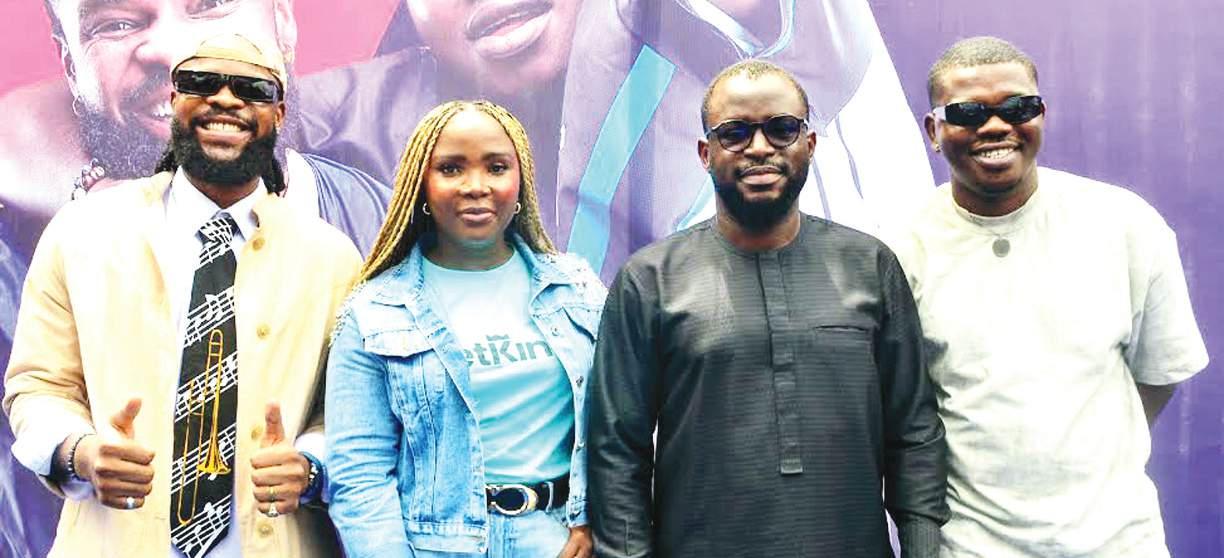
L-R: Host of Banter FC, Arinze Denis Ekwenem (Denari); Head of Marketing, BetKing, Nengi Akinola; Managing Director, KingMakers and Chief Executive Officer, BetKing, Gossy Ukanwoke; and, Host of Banter FC, Unekwuojo Godswill Ameh (Kuture), at a press conference/launch event of BetKing TV in Lagos…recently
Nigeria Bets on Blended Finance to Fix Electricity Crisis
Last week, some stakeholders unveiled the Green Finance and Investment Facility as a new financing model aimed at turning Nigeria’s huge energy deficit into an investable opportunity, Festus Akanbi reports
Nigeria’s power crisis has never lacked speeches, policies, or donor interest. Analysts say what it has lacked is a financing structure strong enough to move projects from conference halls to communities.
That is the promise and the test of the Green Finance and Investment Facility, a private-sector-led blended-finance platform designed to mobilise $40 billion for distributed renewable energy across Nigeria.
The initiative comes at a time when Nigeria remains one of the world’s most energy-poor countries.
The World Bank said the Distributed Access through Renewable Energy Scale-up (DARES) programme is designed to provide more than 17.5 million Nigerians with new or improved access to electricity through distributed renewable energy solutions. A 2025 World Bank-linked report also estimated that about 86.8 million Nigerians lacked electricity.
The GFIF did not begin as a grand platform. It started as a conversation between the Rural Electrification Agency and Barton Heyman Limited on how to mobilise financing for Nigeria’s distributed renewable energy market. From that conversation came a bigger proposition: do not create just another fund; build a financing architecture.
Senior Partner at Barton Heyman, Anthony Feyitimi, captured the problem clearly at the programme’s launch in Lagos last week. “When we keep saying there are no bankable projects in Africa, especially in Nigeria, that is not true,” he said.
“What is true is that getting debt to bankability is a major challenge.”
His point goes to the heart of Nigeria’s infrastructure problem. Many projects exist. Demand is strong. Technology is available. But financiers, developers, grant providers, equity investors, and guarantee institutions often operate in separate rooms, each requesting different documents, assurances, and risk protections.
According to its promoters, GFIF seeks to bring them into one room. The pilot facility is a $188 million syndicated transac-
tion expected to finance 191 megawatts of solar mini-grid projects under the DARES programme. It targets 230,000 household connections and about 1.2 million people, using an average household size of roughly five persons. Nigeria’s own living standards data put the average household size at 5.06 persons.
At full scale, GFIF is expected to mobilise $40 billion and support 20 gigawatts of distributed renewable energy. Feyitimi said Nigeria must think at scale if it wants to be taken seriously as an African economic powerhouse. “We need at least 100 gigawatts of power at a minimum,” he said, contrasting Nigeria’s weak supply with India’s massive renewable energy ambition.
The platform’s logic is simple but difficult: use public and concessional resources to reduce risk, then crowd in private capital.
The Rural Electrification Agency (REA) results-based financing under DARES provides the de-risking anchor. Commercial lenders and equity investors then provide debt and capital support. The World Bank’s latest implementation document shows DARES is a $750 million programme, with implementation already underway.
For FCMB, the attraction is as much impact as return. The bank’s Senior Vice-President and Divisional Head, Business Banking, George Ogbonnaya, said the bank had watched renewable energy projects move from “dreams” to real assets touching households and businesses.
The bank is committing financing to developers, with structures that can fund up to 70 percent of capital expenditure, subject to project-specific conditions.
However, the remaining 30 percent equity requirement remains a bottleneck. Many technically sound projects have stalled because developers could not raise sponsor equity. This is where the GFIF structure matters: grants, guarantees, senior debt, junior capital, and developer equity can be layered into a single coordinated instrument.
Chief Investment Officer of ARMHILL, Derek Chime, was blunt about the investment case. Nigeria, he noted, is a market where a significant portion of electricity is self-generated by households and businesses. That makes power more expensive than it should be. For SMEs, industrial clusters, schools, hospitals, and agricultural value chains, distributed renewable energy is not a luxury. It is core infrastructure.
Yet Chime warned that capital will not move simply because demand exists. “Private capital only participates where structures are credible, risks are transparent, and returns are commercially viable,” he said.
That is why GFIF’s promise will depend not on slogans but on discipline: project quality, standardised contracts, clear risk allocation, bankable cash flows, currency-risk management and credible exit routes for investors.
Guarantees are another critical piece. Co-Chair of the Green Guarantee Group, Farouk Yusuf, argued that many projects may be “theoretically bankable” but still unable to attract financing because nobody wants to absorb political, credit, operational, or currency risk.
In his view, Nigeria and other emerging markets need stronger guarantee institutions, clearer premium structures, better data, and deeper local-currency markets.
His warning is important. Without affordable long-term financing, renewable energy projects will either fail to scale or pass high costs to consumers.
The UK Government, through UK PACT and the Foreign, Commonwealth and Development Office, supported the technical design of GFIF. Simon Field, speaking for the British Deputy High Commission in Lagos, described the facility as “a strategic risk-sharing mechanism designed to attract private finance, not replace it.”
That distinction matters. Nigeria does not need another donor-dependent scheme. It needs structures that make commercial capital
comfortable enough to enter difficult markets without demanding impossible returns.
For Lagos State, the GFIF conversation fits into a wider climate-finance agenda. Special Adviser to the Governor on Climate Change and Circular Economy, Mrs. Titi Oshodi, said green finance must move from ambition to measurable performance. Climate finance, she argued, does not respond to good intentions alone; it responds to credible data, verifiable impact, and investable projects.
REA Managing Director Aliyu Abba made the strongest institutional case for scale. He said Nigeria cannot solve electricity access through “small, small projects” when tens of millions remain unserved or underserved.
He also pointed to regulatory constraints, including mini-grid capacity limits, and said REA had pushed for reforms to allow larger, more ambitious projects. Nigeria’s 2023 MiniGrid Regulations apply to mini-grids up to 1MW per site, although ongoing reforms and interconnected projects are pushing the market toward larger structures.
Still, its design addresses a real problem. It recognises that Nigeria’s energy transition will not be financed solely by public funds. It also recognises that private capital will not come merely because the need is urgent.
The bridge between need and capital is structure. If GFIF delivers, it could become more than a Nigerian financing platform. It could offer a model for emerging markets facing the same contradiction: abundant energy demand, viable renewable projects, but an insufficient financing architecture. For now, the promise is clear. The harder work begins after the signatures are obtained.
And as Managing Partner/CEO, Barton Heyman Ltd, Mr. Olumide Lala put it, “This is only the beginning. What takes its first step in Lagos today will be presented to the world as a global blueprint for mobilising private capital to power communities in emerging markets. We are not simply solving a Nigerian problem. We are building a model for the rest of Africa. So, let’s make it count”.
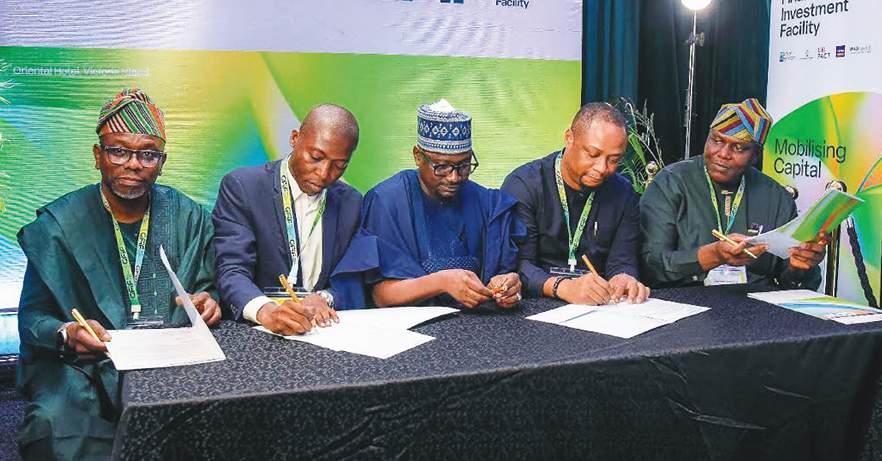
L-R: Managing Partner/CEO, Barton Heyman Ltd, Mr. Olumide Lala; Head, Renewable Energy, Mr. Olujide Adesanya representing Senior President and Divisional Head Business Banking, First City Monument Bank Plc, Mr. George Ogbonnaya; Managing Director/CEO, Rural Electrification Agency, Mr. Aliyu Abba; Chief Investment Officer, ARM-Harith Infrastructure Investment LTD, Mr Derek Chime; and Senior Partner, Barton Heyman Ltd, Mr. Anthony Feyitimi, at the formal declaration and signing ceremony of the Green Finance and Investment Facility (GFIF), in Lagos…on Thursday.
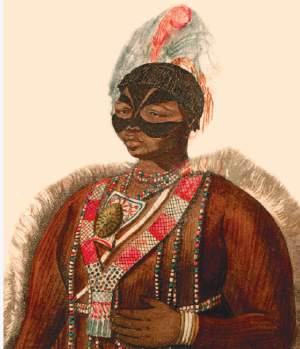
Baartman’s final return to South Africa restored her to the category from which she had been violently removed, argues K. BOLANLE ATI-JOHN
SARAH
BAARTMAN,
REPARATIONS
AND THE COURAGE TO REMEMBER
Sarah Baartman’s story is often told as the tragedy of one African woman humiliated before European audiences. It was more than that. It was a warning about what happens when power teaches itself to see another human being as spectacle, evidence, property and profit. Her body was exhibited in life, studied after death, retained in a museum, and returned home only in the twenty-first century after Nelson Mandela requested that her remains be restored to South Africa. To remember her today is not to summon inherited guilt. It is to ask whether modern societies have the courage to tell the truth about systems that once made such humiliation respectable.
Baartman’s life occupies a painful place in the moral history of Africa and Europe. Born among the Khoikhoi people in southern Africa, she was taken to Europe in the early nineteenth century and exhibited under a degrading stage name that turned her body into a commercial attraction. She was not presented as a full human being with memory, feeling, origin, language, kinship and soul. She was presented as an object of curiosity. The public gaze became part of the violence. What was done to her did not require chains alone. It required audiences. It required language. It required the slow moral training by which one person learns to look at another and not see an equal.
That is why Sarah Baartman remains so important. She reveals the architecture of dehumanisation. It rarely begins with physical violence alone. It begins with description. A people are first renamed, classified, mocked, exoticised or reduced to bodies. Then the world is invited to treat them according to the category imposed upon them. In Baartman’s case, the African woman was converted into entertainment. Entertainment became commerce. Commerce became pseudo-science. Pseudo-science became museum custody. And museum custody, for generations, was treated as an administrative matter rather than a moral scandal.
The deepest injury was not only that she was exhibited while alive. It was that death did not immediately restore her dignity. After she died in Paris in 1815, parts of her body were preserved and displayed. In 1994, Nelson Mandela, newly elected president of a democratic South Africa, requested the return of her remains. They were returned only in 2002, and she was buried in the Eastern Cape that year. The delay matters. It shows that the question was never simply about the cruelty of individual men in a distant century. It was also about the institutional habits by which African bodies, artifacts, memory and dignity could remain in foreign custody long after the age that produced their capture had lost its moral defence.
This is why Baartman’s story belongs at the centre of the contemporary reparations debate. The African Union has chosen “Justice for Africans and People of African Descent Through Reparations” as its 2025 theme, following a decision of African heads of state and government. The African Commission has also welcomed the declaration of an African Union Decade on Reparations from 2026 to 2036. These developments should not be dismissed as symbolic politics. They represent an attempt to give diplomatic, legal and moral language to injuries that were once treated as normal features of global order.
The word “reparations” often causes discomfort because it is quickly reduced to money. That reduction weakens the debate. Financial compensation may be part of reparatory justice in some cases, but it is not the whole of it. Reparations also mean truth, formal acknowledgement, apology where appropriate, restitution of human remains and cultural objects, correction of historical falsehoods, memorialisation, educational repair, archival access, institutional humility
and structural reforms that address the continuing effects of historical exploitation. The point is not to place living generations under permanent accusation. The point is to prevent inherited amnesia from becoming the final victory of past injustice.
A serious reparations conversation must therefore begin with memory. Memory is not the enemy of reconciliation. It is its foundation. Societies do not heal because they forget. They heal because they learn how to remember truthfully without becoming imprisoned by bitterness. Baartman does not ask the world for theatrical guilt. Her story asks for a more difficult virtue: honesty. It asks modern institutions to admit that what was once called curiosity was often humiliation; what was called science was often prejudice; what was called possession was often theft; and what was called civilisation was sometimes built upon the denial of another people’s humanity. This is also where the familiar defence of colonialism must be examined with care. Some argue that European rule modernised Africa, pointing to roads, railways, ports, schools, courts, languages and administrative systems. The argument should not be dismissed crudely, because history is rarely simple. Colonial rule did leave behind institutions and infrastructure. But the existence of inherited tools does not settle the moral question. The real questions are different: modernisation for whom, under whose authority, with whose consent, at what cost, and to whose benefit?
A railway built to move minerals, troops or cash crops is not the same as a railway designed for sovereign development. A school system built to produce subordinate clerks for an imperial administration is not the same as an education system built to liberate a people’s full genius. A legal order that denies equal dignity to the governed cannot be absolved merely because it uses the language of law. A port that exports raw wealth while leaving the producing society structurally dependent cannot be praised without qualification as a gift of modernity.
Baartman’s story exposes the moral weakness in the “modernisation” defence without requiring us to name and shame any people. She was not modernised. She was displayed. She was not liberated by enlightenment. She was reduced by a society that could combine curiosity with cruelty and then call the result knowledge. Her story does not prove that every European was personally cruel, nor does it deny that complex human exchanges occurred across continents. It proves something more important: that a system can build institutions and still degrade human beings; that power can produce infrastructure and still deny dignity; that civilisation can speak in polished language while failing the most basic test of seeing another person as fully human.
GEORGE ADIMIKE pays tribute to Ezenna, a businessman and philanthropist
HAPPY BIRTHDAY, ANTHONY EZENNA
In a social climate where enterprise is too often reduced to the arithmetic of profit and loss, and where the ethos of wealth creation frequently drifts from the pathos of human responsibility, the question of how to reconcile character with capacity becomes both urgent and unsettling. Many have mastered the mechanics of accumulation yet remain impoverished in moral vision, thereby deepening the fractures within society. It is within this tension; between gain and goodness, between success and significance that the life of Sir Anthony Ifeanyichukwu Ezenna, KSS, OFR (Ijele Akokwa) emerges as a compelling response. He embodies that rare synthesis where enterprise is not severed from integrity and where capacity is refined and directed by character.
His journey, far from the splendour or the illusion of instant success, begins in the quiet discipline of a chemist shop owned by his family in Onitsha; a modest but formative space where the dignity of labour, the rigour of consistency and the ethics of honest trade were lived as daily realities. In that seemingly small enterprise were sown the seeds of a larger vision, one that would eventually blossom into Orange Drugs Limited, and the Orange Group. As success rarely happens in leaps but in layers of little steps, consistent engagement that overtime transforms smallness into greatness, so is the story of Orange Drugs Limited.
Such a mega success requires one who would stay the course and make the days and years count and let habits speak louder than one’s hopes. Of course, while Sir Ezenna’s commercial enterprise deserves accolades, it is however its essence as a channel through which essential goods flow into the arteries of society, sustaining life and enhancing human well-being that stands out. Thus, what appears as business expansion is, in truth, the gradual unfolding of a vocation rooted in service: love of God and neighbour.
Yet, the true measure of Ijele Akokwa is not simply that he built a mega enterprise, but that he built it with attentiveness to human need, a reverence for social order and true worship of God. Beginning with limited capital, he embraced the humble but strategic path of distribution, patiently cultivating networks of trust, reliability and accessibility. He understood, with rare clarity, that enterprise divorced from the realities of the people it serves becomes an empty pursuit.
Consequently, his model was not constructed on abstraction, but on encounter; an intimate awareness of the daily struggles of ordinary people and a disciplined effort to respond to them. In this, his identity as a social entrepreneur is neither a fashionable label nor a retrospective invention, but a natural outgrowth of a deeply rooted philosophy: that business must first listen before it leads, and serve before it scales.
Beneath these visible achievements lies the deeper architecture of character, often unseen, yet profoundly decisive. The patience to submit to years of learning business, resisting the haste that defines many modern pursuits; the courage to step beyond the familiar into uncertain terrains; the discipline to expand without corruption of purpose, these are the interior virtues that sustain the exterior structure of success. In a milieu where shortcuts seduce and expediency masquerades as intelligence, his life offers a firm contradiction: that integrity, though demanding, remains the most reliable currency of enduring enterprise.
Sir Ezenna’s transition into manufacturing represents not merely a strategic evolution, but a moral commitment to national
development through wealth creation. By investing in local production and reducing dependency on external systems, he participates in the restoration of economic dignity and the strengthening of societal structures. Factories, in his vision, transcend their material function; they become spaces where human potential is engaged, where livelihoods are cultivated, and where the dignity of work is reaffirmed. Here, capacity reveals its highest meaning. This is in the sense that his vision is not just to generate wealth but he has the wisdom to generate systems that sustain and uplift individuals and families.
Flowing naturally from this is the expansive dimension of giving, where success is understood as stewardship. His philanthropic and charitable engagements spanning education, healthcare, social cohesion and poverty reduction, and community-focused and faith-based initiatives are deliberate extensions of a worldview that recognizes the sacred responsibility attached to privilege. He understands that to rise without lifting others is to misunderstand the very purpose of elevation. Thus, through scholarships, community interventions, and institutional support, he transforms resources into instruments of hope, and influence into a force for communal renewal.
To describe Dr Tony Ezenna as a social entrepreneur, therefore, is to acknowledge a consistent pattern of life, one in which enterprise and empathy are not in competition, but in communion. It is a pattern where growth does not trample upon the weak, but creates pathways for their advancement; where leadership is exercised not through noise, but through impact that is enduring. His life becomes, in this sense, a luminous testimony that greatness is a product of value, one that is patiently cultivated, faithfully sustained and generously shared. It typifies grace. In an age enamoured with fleeting success and superficial acclaim, he stands as an enduring light. His legacy reminds us that the true measure of a man is found not only in what he builds, but in what his building makes possible for others. Indeed, in the harmonious convergence of integrity and enterprise, of character and capacity, his life continues to illuminate the path toward a more just, responsible, and humane society.
Fr George Adimike
Rear Admiral Ati-John (rtd) fdc⁺ is a Distinguished Fellow of the National Defence College, Abuja, and writes from Lagos
Editor, Editorial Page PETER ISHAKA
Email peter.ishaka@thisdaylive.com
SOUTH AFRICA AND ‘AFROPHOBIA’
The attacks and killings of Nigerians and other Africans are senseless
South Africa is once again engulfed in a vicious pattern of violence against fellow Africans—an ugly reality that can no longer be softened by the language of Xenophobia. What is unfolding is more accurately described as Afrophobia: a targeted campaign of hate against black African nationals. And the current attacks are as horrifying as they are revealing. Mobs have stormed public hospitals, ordering patients, including pregnant women from other African countries, out of wards as though they were less than human. Businesses owned by foreign nationals have been looted and set ablaze. On the streets, men and women are harassed, beaten, and hunted. There are chilling reports of victims being killed even as they begged for their lives. The sheer inhumanity of these acts should shock the conscience of the continent and the world.
African migrants are not the architects of inequality in South Africa; they are, in many cases, fellow victims of it. The targeting of black foreigners is therefore not only morally indefensible but intellectually dishonest
of sub-Saharan Africa during the decades of struggle against apartheid and for liberation, foreigners, mostly of African descent, are being subjected to brutality and detention. Xenophobia against Africans is currently on the rise and should be nipped in the bud”. It is unfortunate that 19 years after that report, the situation has only worsened. In the past six weeks, many unemployed South African nationals (including those with neither education nor skills) have taken the law into their hands and exacted brutal justice on some other foreign nationals on grounds of taking their jobs.
These recurring eruptions of violence are often justified by perpetrators on economic grounds. Yet such claims collapse under scrutiny. The uncomfortable truth is that more than 80 per cent of South Africa’s economy remains in the hands of the white minority, who constitute less than nine per cent of their population. African migrants are not the architects of inequality in South Africa; they are, in many cases, fellow victims of it. The targeting of black foreigners is therefore not only morally indefensible but intellectually dishonest—a tragic expression of ignorance and misdirected anger. Even more troubling is the extent to which Afrophobia has seeped into South Africa’s political discourse. It is not merely a fringe sentiment; it is too often legitimised, amplified, or tolerated by influential voices within and outside government. This normalisation of hostility has emboldened perpetrators and created an environment in which violence becomes cyclical and predictable. Against this backdrop, the consistent and principled rejection of Afrophobia by Julius Malema, leader of the radical party, Economic Freedom Fighters deserves commendation. As Malema has told his compatriots many times, given the support that South Africa
SUNDAY NEWSPAPER
editor DAviDSoN iriekpeN
deputy editors FeSTUS AkANBi eJioFor ALike
Managing director eNioLA BeLLo
deputy Managing director iSrAeL iwegBU
chairMan editorial Board oLUSegUN ADeNiYi
editor nation s capital iYoBoSA UwUgiAreN the oMBudsMan kAYoDe koMoLAFe
THISDAY NEWSPAPERS LIMITED
editor-in-chief/chairMan NDUkA oBAigBeNA
group executive directors eNioLA BeLLo, kAYoDe koMoLAFe, iSrAeL iwegBU
divisional directors SHAkA MoMoDU, peTer iwegBU ANTHoNY ogeDeNgBe deputy divisional director oJogUN viCTor DANBoYi snr. associate director eriC oJeH
associate director pATriCk eiMiUHi
controllers ABiMBoLA TAiwo UCHeNNA DiBiAgwU, NDUkA MoSeri director, printing production CHUkS oNwUDiNJo to send eMail: first name.surname@thisdaylive.com
received from African countries during the struggle against apartheid and the reality that economic power is in the hands of the white minority, there is no justification for victimising black Africans. Malema’s emphasis on African unity stands in stark contrast to the dangerous rhetoric that fuels division and violence by those who refuse to accept that police and the courts are the right instrument for handling illegal activities by foreigners, not lynch mobs.
It should indeed worry the South African government that their country has become notorious for this heinous hate crime. In its 2007 report, the Africa Peer Review Mechanism (APRM) of the African Union stated that “despite the solidarity and comradeship between black South Africans and the rest of the people
Like previous xenophobic attacks that now define South Africa, there were warnings that the nationals of other African countries running shops, stalls and other businesses within the informal economy were gradually becoming endangered. But the South African authorities have not shown sufficient will to deal with the problem. Yet, as we have reiterated in the past, it is also in the interest of South Africa to protect Nigerians from what has become hate mongering. Considering that South Africans also do businesses and are allowed to move freely in our country without let or hindrance, the federal government must make it clear to their authorities that they bear responsibility for the lives of our nationals.
The time has come to acknowledge that diplomatic niceties have failed. Polite condemnations and routine assurances have not stemmed the tide; if anything, the situation is deteriorating. Stronger, coordinated action is now imperative. The African Union must move beyond statements and consider concrete measures that hold South Africa accountable to continental norms and obligations. Regional bodies and global institutions must also lend their weight to efforts aimed at protecting vulnerable populations and restoring the rule of law. As a leading voice on the continent, Nigeria has both a moral duty and a strategic interest in taking decisive action. It must spearhead a firm, coordinated response that leaves the government of Cyril Ramaphosa in no doubt about the consequences of continued inaction.
The Irretrievable Breakdown of Marriage Between Atiku and Obi
The biggest mistake that anyone can make when dealing with President Bola Ahmed Tinubu is to think he is an ordinary person. He is not. No matter what you throw at him he comes out on top. He is a what those that are familiar with Yoruba mythology describe as an “akanda eniyan” which basically means he is a “special one” that is endowed by God with extraordinary grace and some kind of spiritual and mystical powers. He is wily, tough, resilient, courageous, cunning, wise and most important of all patient.
We tried to pull him down for years but failed. Yours truly was amongst the ranks of those that did so until 2020 when I realised I was wrong, saw the light, retraced my steps, had a Paulian conversion and fought hard for him in the 2023 presidential campaign.
And I was not alone. In the end many of those that once opposed him are now with him and, as is usually the case with converts, are even more fanatical and vocal in our support for him than others because we need to justify our change of heart and new-found position and make up for our past mistakes and error of judgement.
He recognises that fact and that is why he is so accommodating, forgiving and magnanimous in victory. He welcomes all: even those who once fought and opposed him. And unlike others, he rewards and builds up his supporters and loyalists and does not seek to denigrate, humiliate, crush or destroy them. That is the secret of his success.
Simply put he cannot be stopped and this is a lesson that his enemies have yet to learn. He is what we Christians call a “sign and a wonder” and there is no doubt in my mind that the Lord is with him. Those that are ganging up against him to stop him in 2027 are indulging in an exercise in futility. Not only will they fail but they will fail woefully. And already we see signs of that. Permit me to share just one example.
I was informed about the division and disintegration of the Senator David Mark-led faction of the ADC and the increasingly acrimonious divorce proceedings that are taking place between the Atikulators within their ranks on the one hand and the Obidients and Kwakwansians that have chosen to pack their bags and walk out on the other. To make matters worse I also gather that a young man by the name of Nafiu Bala has what is left of Mark’s faction of the ADC by the balls and has them tied down in court.
After processing these developments, I sat back in my favourite chair and laughed in Swahili. This is because we had seen all of this coming right from the start and we said so. How can a battle ship hope to float let alone embark on a successful military campaign when it has too many captains on board and when it is loaded and filled to the brim with the loudest, crudest, most unruly, most indiscipline, most vulgar, most disrespectful, most abusive and most aggressive band of drunken sailors who are little better than wild-eyed pirates. This was a break up and break down that was waiting to happen and frankly their marriage of opportunism and convenience was doomed from the start.
What we are witnessing today is a fall out that was predictable and inevitable and the fact that they are now turning their guns on one another and attempting to blow each other to pieces not only vindicates those of us that dismissed them as a bunch of clowns right from the start but also gives us immense joy.
We have brought out the popcorn and are watching them with keen interest as they fire the most modern drones and inter-continental ballistic missiles at each other which of course will result in their mutual destruction. Yet even as entertaining as this whole drama is to behold it is not my focus in this contribution. Instead I have chosen to share a few words with at least two of the protagonists in the conflict who I have a soft spot for and who I find particularly fascinating. My objective here is to offer them both some unsolicited counsel and advice. Let us hope they take it in good faith and that neither takes offence. If they do, I pray that they forgive me because, a usual, I mean them no harm, I wish them no ill and I come in peace.
Permit me to begin with my dear aburo and much loved friend, Mr. Peter Obi (@PeterObi). My brother, you went from APGA to PDP to LP to ADC and now to NDC. This means that you went to five different political parties over the last 27 years since our return to democracy in 1999.
Now let me come to my dearest older brother and highly esteemed leader Waziri Atiku Abubakar (@ Atiku). My leader, you went from PDP to ACN to PDP to APC to PDP and now to ADC. This means that you also went to six different political parties over the last 27 years since our return to democracy in 1999.
Between you both you have collectively changed political parties no less than 11 times between 1999 and 2026! This must be a world record of some sort when it comes to changing sides and using others to achieve your personal objectives and satisfy your insatiable desire for power.
With the greatest respect I would urge you both to kindly take note of the fact that political parties are not established and designed to be used like toilet paper and then flushed down the lavatory. They are meant to be vehicles of honor that are designed to serve the collective interest of ALL their members and ultimately our country and not just the narrow interests and vain ambitions of the two of you. Leaders are meant to live for the benefit of their political party: the political party is not meant to live for the benefit of its leaders.
Forgive me for saying this and know that I say it with love and mean no offence but you are beginning to look and behave like the character called Gollum in J.R. Tolkien’s epic titled Lord of the Rings. Like the goblins and orcs in that famous book, Gollum was desperate, hideous, ugly, twisted, irretrievably corrupt in mind, body, spirit and soul and driven by the rarest and most destructive form of madness.
I know that deep down, like Gollum himself, you once had good hearts but sadly politics has brought out the worse in you and today you reflect all of those frightful characteristics and traits. You crawl and hiss like snakes in a pit as you slither from one political party to the other looking for the power that neither of you shall EVER achieve and spreading a hateful venom that has no place in civilised climes or in the land of the sane.
To see elderly, experienced, intelligent and respectable men who many once had so much affection and respect for degenerate to this degree and to recognise the fact that they have no loyalty to anything or anyone other than their personal delusions and vainglorious ambitions is a tragedy of monumental proportions.
This is especially so in the case of Waziri who, despite our past differences, has always had a special place in my heart given the fact that that he was the Vice President in a government in which I proudly served not just as a presidential spokesman but also as a two time Minister 23 long years ago!
Sadly that was in the past and today presents us with a new reality which is that both of these two formerly decent men have fallen and are a shadow of their former selves. Worse of all is the fact that they are only in politics for themselves and that they only want power for the sake of having it.
They are both totally and completely obsessed with and mesmerised by their futile quest for the Presidency of Nigeria and this unfortunate affliction may have affected their psychological disposition and negatively impacted on their mental health. Their loyalty is to their personal ambitions and not
to their party or our nation and that is precisely why they are not capable of managing their differences, of staying together in one party and of providing a united front.
Permit me to put the following question to them both directly: if you can’t even manage to hold your party together and stay in one place how can you possibly manage to run the affairs of our beloved country Nigeria with all its religious and ethnic diversity and all its complexities?
It would be a frightful and dangerous thing to put the levers of power in your hands because everything you do would be driven by your compulsion for and obsession with that power. As a matter of fact it is clear that if you ever achieve it (God forbid) you would never let it go and ultimately it would not only destroy you but it would destroy our entire nation as well.
Like Gollum craved for the Ring of Power you crave for the Presidency of Nigeria and you are totally addicted to it. That is what makes you so unfit to lead. We know that you are both great planners and highly experienced specialists and experts in the art and intricacies of political intrigue and subterfuge but God is great and the Holy Koran tells us that “Allah is the greatest planner of all!”
We recognised your weaknesses and obsessive disposition when you gathered your forces together in the ADC and we asked God to deliver our nation from you by scattering your ranks. We looked to the Holy Bible and stood on Isaiah 54 15:17 which says, “surely they shall gather but it shall not be of me: whosoever gathers against thee shall be scattered for thy sake”.
The Lord heard our prayers and not only scattered your ranks but also reduced you to be nothing more than a busy and vocal band of vagabonds and wanderers looking for something that you will NEVER find. I say God is truly faithful: glory be to His holy name.
Permit me to add this. A few days ago the famous black American podcaster Candace Owens said the following words about her fellow American and archenemy, the Zionist Ben Shapiro on X. She wrote, “You have no honour. You have no dignity. You have no loyalty — we as human beings are naturally averse to the spirit of Judas and that’s what Ben Shapiro demonstrates.” These are strong words which, in the Nigerian context, can safely and appropriately be applied to the two of you.
After the presidential election in a few months time you and your respective party members and followers will be worsted and humbled and you will both be thrown into the sea of oblivion and tossed into the dustbin of history. What a sad end this will be to two illustrious careers that had achieved so much in the past and that once had so much potential for the future.
Like the Greek mythological character known as Icarus, your vanity, blind ambition and hubris caused you both to fly too close to the scorching sun with your waxen wings. Consequently the wax melted, your wings collapsed, your dreams were shattered, your hopes were dashed and like Lucifer, the Son of the Morning, you fell and met your nemesis. Sadly this is your portion and that shall be your end.
Now some young Obidients who know no better will say that President Bola Tinubu has been a member of numerous political parties over the last 27 years as well but let me explain the difference between his experience and that of Atiku and Obi. It is true that between 1999 and 2026 the President has been in the AD, AC, ACN and APC but the difference is that he was the sole founder, builder and leader of the first three of the four parties mentioned and he was the co-founder and co-leader (together with President Muhammadu Buhari) of the fourth.
He simply changed the name of his original party the AD to AC and then to ACN and kept building on it by adding other groups and key individuals and bringing them on board until a formidable platform called the APC that was capable of wrestling power from the old PDP was finally established in 2014. He never abandoned any of the parties he founded, he never highjacked anyone else’s party and he never insisted on running as President until 2023 even though the platforms essentially belonged to him in all those years! At every point he put the interest of his party first before his own even though on some occasions he was treated badly and suffered for it. Through all those years, from 1999 till 2026, he bided his time and exercised patience and restraint giving others the chance to run for the top job on platforms that he established, funded, nurtured and jealously protected and guarded.
He was selfless in this respect and when he made his bid to become flagbearer of the APC in 2023 no-one could stop him despite the efforts that some made. From there he went on to win the presidential election and, by God’s grace, he will win again in 2027. The secret to his success is that, unlike others, he was patient, calculating, kind, generous, forgiving and charitable to others and he was not driven by a malevolent and violent obsession or vaulting ambition. He was wise enough to know that only a fool will seek to divide and destroy his own party platform in an attempt to become flagbearer and only a bigger fool will go to someone else’s platform to try to steal it, forcefully take it over and use it to run for the Presidency.
He built his own, he funded it, he developed it, he expanded it, he was generous to others with it and allowed them to use it and eventually, when the time was right, the members and leaders of his party themselves rewarded him for his efforts and loyalty by electing him to be their flagbearer.
This took discipline, patience, fortitude, foresight and faith in God, qualities and virtues which Tinubu had in abundance and which Atiku and Obi not only lack but simply cannot comprehend.
That is the difference between his situation and political history and theirs. His spoke of loyalty, discipline and unalloyed commitment to a collective progressive and ideological cause whilst theirs is rooted in opportunism, chicanery, mischief, deceit, betrayal and intrigue.
Unlike him, neither Obi or Atiku ever founded, led or established any of the political parties whose platforms they used or attempted to use to run for public office or the Presidency. They were always joiners and highjackers and never builders. Permit me to conclude with the following.
On the part of Peter Obi, I have reason to believe that there is a distinct possibility that his newly formed party known as NDC, which is led by my good friend and a man for whom I have immense respect, Senator Seriake Dickson the former Governor of Bayelsa state, may also end up having problems because more often than not when Peter does not have his way, Peter walks away. It is common knowledge that Obi and his Obidients have insisted on being gifted the Presidential ticket of the NDC for themselves and that is where the problem lies.
• Chief David Oluwafemi Adewunmi Abdulateef Fani-Kayode, the author of this essay, is a former Minister of Aviation of the Federal Republic of Nigeria, a former Minister of Culture andTourism of the Federal Republic of Nigeria, a former Senior Assistant on Public Affairs to President Olusegun Obasanjo, the Ambassador-Designate of the Federal Republic of Nigeria to South Africa, the Sadaukin Shinkafi, the Wakilin Doka Potiskum, the Otunba of Joga Orile, the Aare Ajagunla of Otun Ekiti and a legal practitioner
Femi Fani-Kayode
Atiku Obi
Remembering a Platform that Told Our Stories
As Showmax shut down its app after years of championing African originals, its legacy lives on in the stories, stars, and cultural moments it helped shape across Nigeria’s creative industry, writes Vanessa Obioha
On April 30, 2026, the light dimmed on Showmax, the streaming platform positioned to place African storytelling on the global stage. The day had been dreaded by many dedicated fans who saw the platform, first launched on the continent in 2015 by MultiChoice, as one that celebrated and promoted local content. Its strategy was centred on local content commissions, giving creatives an avenue to tell authentic African stories. It expanded into the Nigerian market in 2019.
News that the platform would shut down had broken earlier in March, when Canal+, the new owners of MultiChoice, cited sustained financial losses in announcing the decision. The actual shutdown a month later only confirmed what many had hoped might be reconsidered.
This came just two years after Showmax relaunched with a new look, a new app, and an entirely new product suite powered by Peacock’s globally scaled technology, following its 2023 partnership with Comcast’s NBCUniversal and Sky. The revamped platform also introduced a first-in-Africa standalone, mobile-only Premier League package.
The reaction to the news was one of instant shock, as fans wondered what would happen to their favourite titles on the streamer, such as ‘The Real Housewives of Lagos’ and ‘Wura.’ It was that question—what becomes of these stories?—that stirred a sense of nostalgia as I looked back at Showmax’s era in Nigeria.
I remembered when it launched ‘Ghana Jollof,’ its first Nigerian original series. Produced by comedian and filmmaker Bright Okpocha, better known as Basketmouth, the production featured a mix of Nigerian and Ghanaian stars, including Basketmouth himself, Funnybone, Akah Nnani, James Gardiner, and Mawuli Gavor. The series had an impressive run, spending 13 weeks on the chart and ranking among the platform’s most-watched titles in
2021. It was preceded by the reality TV series
‘I Am Laycon,’ based on the rise to stardom of Big Brother Naija 2020 winner, Laycon. By 2022, the streamer had commissioned more projects, including the award-winning ‘Real Housewives of Lagos (RHOLagos).’
Before its debut, Nigeria had yet to fully embrace the reality TV show fever. RHOLagos changed that, driven by its intriguing characters and layered drama. It was not surprising that each season recorded strong first-day streaming numbers. The Abuja franchise would later follow in 2023.
That same year saw the commissioning of its first original docu-series, ‘Journey of the Beats.’ The release was timely, coming just a year after Burna Boy’s Grammy win, at a time when conversations around Nigeria’s sound were gaining global attention. Produced by music executive and DirectorGeneral of the National Council for Arts and Culture, Obi Asika, the documentary traces the origins of Afro-music, including highlife, Fela Anikulapo-Kuti–inspired Afrobeat, and the modern stylised genre of Afrobeats. The 10-episode series explored themes of identity, heritage, and resilience and was well-received within the music industry.
2022 may have been the year Showmax commissioned the most projects, as other titles such as the drama series ‘Flawsome,’ the limited series ‘Diiche,’ and the crime thriller ‘Crime and Justice Lagos’ were also released.
That momentum carried into 2023 with the release of its first original telenovela, ‘Wura.’ The following was immediate and widespread. From homes to campuses, offices to social media, conversations around the show were constant. Starring Scarlet Gomez in the lead role, ‘Wura’ is an adaptation of the South African drama ‘The River.’ It brought high drama to the screen while also spotlighting locations rarely seen on television.
The pioneering executive producer Rogers Ofime in an interview revealed that he was intentional about reenacting the setting of the original and was fortunate to find Iperindo, a mining community
nestled in Osun with a gold mining company that fits the story perfectly. This authentic form of storytelling was in line with Showmax’s mission to tell stories that resonate with the people while leaving a lasting impact.
More importantly, it was the talents that Showmax Originals introduced that lingered the most. From Gomez to Miriam Timmer, Enaho Odigie to Baaj Adebule, the platform created space for both new and emerging voices. Through their performances, audiences saw reflections of their own society. The same can be said of storytellers like James Omokwe, who worked behind the scenes to bring these stories to life.
The strength of Showmax’s Originals slate was its range. Whether reality TV, drama, documentaries, fashion, or telenovelas, the platform offered something for a wide audience.
But fans need not despair. Even though the app is no longer available,
AMVCA, Johnnie Walker Spotlight Future Talent at Young Filmmakers Day
and Attracting the Right Opportunities’ and powered by Johnnie Walker, the YFD connected emerging filmmakers with Nollywood’s established actors and directors, offering a clear-eyed view of what lies ahead through the professional journeys that have shaped their careers.“Our entire philosophy is based on unexpected expressions, and I see that same energy in all of you,” said Brand Manager, Johnnie Walker for Africa, Oyetola Akeredolu, as she addressed participants at the MultiChoice headquarters in Lagos.
She added: “You are the generation that looked at the film industry in defiance; looking at AI, not as a threat to your jobs, but as a digital paintbrush to build worlds. You are ‘disruptive’ by nature, not because you break things, but because you are building something bigger and bolder.”
According to the organisers, the collaboration between the AMVCA and Johnnie Walker for YFD prioritises the development of future talent through
Showmax content has moved to a new home: DStv
Eligible Showmax subscribers in Nigeria will receive trial access to DStv Stream Compact for a limited period starting this May. After the trial expires, qualifying customers can continue at a discounted rate, provided their subscriptions remain active.
The offer gives former Showmax users access to a broader content experience, including live TV, international series and movies, children’s programming, and live sports via SuperSport, available on mobile devices and smart TVs.
Showmax may no longer exist in its original form, but the stories it helped tell, and the talents it helped shape, remain part of Nigeria’s evolving screen culture. For many viewers, it was more than just a streaming service; it was a window into familiar lives, accents, and experiences rarely given this level of visibility. It was indeed a platform that made African stories feel central, not peripheral.
mentorship and access to the right networks. By placing emerging filmmakers in direct conversation with seasoned professionals, the initiative closes the gap between ambition and lived industry experience.
During her masterclass, Uche Jombo urged aspiring actors to view social media as a professional tool. She explained that staying consistent online is vital because a person’s digital profile often acts as their first impression for casting directors. By maintaining a clear and professional presence, actors can better prove their dedication and attract the right career opportunities.
As an actor, you are constantly selling yourself. That is the reality of the craft. Growth comes from consistency. Africa Magic may give you your first opportunity because you have graduated, but one project is not enough. You cannot afford to go quiet. Stay visible. Keep working. Do your monologues, share them, and pin them to your socials to hold attention,” she said.
Actors Stan Nze and Amarachukwu Onoh, alongside filmmaker Abiodun Odu, examined the role of AI during a panel session, noting that while the technology may displace some roles, it largely serves as an enhancer, enabling professionals to streamline processes and elevate production quality. The panellists argued that AI is a collaborative partner rather than a replacement for human creativity.
Stream.
Showmax Originals
Iyke Bede
off weeklong activities for the 2026 Africa Magic Viewers’ Choice Awards (AMVCA), organisers hosted the Young Filmmakers Day (YFD) to engage Nigeria’s emerging talent. The forum provided a platform to examine evolving career paths and the role of AI in the modern film industry. Themed ‘Audacious Storytelling
L–r: Brand Ambassador, Diageo west and Central Africa, Ulan Jampak; Culture Manager, reserve –South, west and Central Africa, Diageo Africa, Cynthia Ufele; Brand Manager, Johnnie walker – South, west and Central Africa, Oyetola Akereledolu; and Media Manager, reserve – South, west and Central Africa, Diageo Africa, Temitope Ayanbade, at the AMVCA Young Filmmakers Day.
Celebrating a Mother’s legaCy Kayode ajulo
On the heels of her 91st birthday, the matriarch of the Ajulo family, Christianah Ajulo becomes the inspiration for the latest edition of the Catalyst Symposium in Akure- an honour which her son, Kayode Ajulo, the Attorney-General and Commissioner for Justice in Ondo State wholly treasures. Vanessa Obioha writes
She is a Role Model of Virtuous Womanhood
If you are on the contact list of the Attorney General and Commissioner for Justice of Ondo State, Kayode Ajulo (SAN), it is likely that you received a WhatsApp video from the latest edition of the Catalyst Symposium in Akure, where his mother, Princess Chief (Mrs.) Christianah Ajulo, was honoured.
Held at the Federal University of Technology, Akure, the symposium was themed ‘Ma’ami Ajulo XCI: Legacy & GirlChild Mentorship’ in celebration of her 91st birthday.
As the theme suggests, the event brought together young girls across the state, with sessions addressing issues confronting the girl-child, such as entrepreneurship, leadership and professional development.
It was not the first time the matriarch would be honoured in the state. At her 90th birthday last year, her son organised a colloquium that culminated in what is now known as the “season of women” in the state’s March–April calendar under the administration of Governor Lucky Aiyedatiwa. That colloquium also focused on women, using the life of Ma’ami Ajulo, as she is fondly called, as a model of true motherhood.
She is revered for her entrepreneurship, brilliance, and leadership attributes; traits that her son often sings to anyone who cares to listen.
“She is the bedrock of our family,” he said in a recent encounter. “A woman of quiet strength, unwavering faith, and remarkable diligence who raised us with high values of integrity, hard work, and service to humanity. Seeing her legacy celebrated at an event focused on legacy and girl child mentorship is a full-circle moment for me.”
The celebration, he added, is more than just the honour of her 91st birthday. Rather, “it’s validation of the sacrifices countless mothers make that often go unseen.” “My heart swells with gratitude to the organisers and participants for shining this light on maternal influence in shaping bold, purposeful lives,” he said.
Ajulo’s love for his mother has always been constant but has deepened with time and perspective. He recalled growing up in Ibadan and seeing his mother as a tireless pillar managing the home and her businesses while instilling discipline and teaching him the power of prayer and education, even in modest circumstances.
“Through my journey; from building a career in the legal space, founding a prestigious law firm, Kayode Ajulo (SAN) & Co. Castle of Law) to public service, to serve humanity, I’ve come to admire her wisdom even more. She taught resilience without bitterness and generosity without fanfare.” Public life, he noted, has further deepened that admiration.
“Every challenge I face reminds me of her quiet counsel. The admiration evolved from filial duty to profound respect for her as a role model of virtuous womanhood. I’ve never hidden it because such love is a gift worth celebrating openly. And I am fundamentally proud to be one of my mother’s numerous legacies.”
On her legacy, Ajulo believes that it lies in quiet, transformative influence.
“At this stage, her legacy is living through the values she instilled in us and the many she has mentored informally. It’s a legacy that says true greatness often lies in faithful, unseen service; one that inspires the girl-child to build enduring impact through character and purpose.”
That personal history, he suggested, informs his interest in issues affecting women and the girl-child.
Like in any other place in the universe, the Senior Advocate of Nigeria believes the girl-child in Ondo needs stronger and more enforceable protections against gender-based violence, child marriage and exploitation, alongside safeguards for access to education and inheritance rights.
However, he acknowledged persistent implementation gaps, especially in rural and riverine areas.
“Today, my priority areas include the swift prosecution of sexual and domestic
violence cases, protection from harmful traditional practices, and ensuring equal inheritance rights under customary law conflicts.”
He is equally passionate about mentorship.
“In this digital, fast-changing age, the girl child needs holistic, values-driven mentorship that builds inner confidence, critical thinking, and leadership skills while grounding her in ethics and resilience.”
He highlighted the importance of role models across fields such as STEM, entrepreneurship, law, and public service, as well as guidance in navigating social media pressures, mental health, and economic independence.
“Mentorship should ignite ‘bold actions,’ as the symposium theme says, helping girls see themselves as solutionproviders, not victims of societal barriers,” he said. Beyond advocacy, Ajulo said his work in the justice sector reflects a broader effort to protect vulnerable groups and expand access to justice in the state.
Since assuming office in 2024, he noted that the state has prioritised expanding access to justice, strengthening legal policies and reforming justice-sector institutions.
“Our key interventions have included the appointment of several qualified legal practitioners to broaden the reach of legal aid services, thereby making justice more readily available to vulnerable segments of society, particularly young girls confronted with abuse or intractable family disputes. We have also championed the more effective implementation of the Child Rights Act and the Violence Against Persons (Prohibition) Law through targeted capacity-building programmes for prosecutors. These measures have demonstrably accelerated the handling and prosecution of such cases,” he shared.
Other interventions include legal literacy and protection programmes in underserved communities.
On the issue of gender-based violence,
he was emphatic.
“It is now the settled policy of the Ondo State Government that nolle prosequi shall not be entered in cases of this nature. “Any attempt to exert such undue influence shall no longer be tolerated. Indeed, any person who seeks to interfere with the due process of justice in these matters shall henceforth be prosecuted as an accessory after the fact,” he warned. These deliberate and sustained efforts, both direct and indirect, he noted, serve to empower the girl child by dismantling barriers to her education, safety, and overall advancement.
When asked about his principal’s alleged bid for reelection, Ajulo responded firmly:
“It’s expedient to be clear on this as there’s nowhere publicly or privately that Governor Aiyedatiwa has stated that he’s considering running for a second term despite the court’s position on such issues.”
The matter, he added, is personal to the governor but as a Senior Advocate, he acknowledged that recent court developments have raised constitutional questions around tenure limits.
“These include the proper interpretation of Section 180 of the 1999 Constitution (as amended) and related provisions, notably, whether His Excellency Governor Lucky Aiyedatiwa, enjoys the constitutional immunity and protection afforded by Section 308, whether a cause of action exists to litigate the matter pertaining to the 2028 election which was filled in the year 2025 and whether its premature or not and several other issues.”
He nonetheless noted that such matters are best left to the courts to resolve.
“In the interim, our undivided attention must remain on the diligent delivery of good governance, the sustenance of peace and stability, and the relentless pursuit of developmental
deliverables for the good people of Ondo State.”
Ondo has in recent times experienced a wave of insecurity. The Senior Advocate described it as a national challenge driven by factors such as porous borders, unemployment, youth restiveness and coordination gaps across security agencies, and needs to be addressed with honesty.
While noting efforts by the state government in intelligence and community policing, he stressed the need for broader collaboration and long-term solutions such as job creation, social investment and prosecution of offenders to deter impunity.
“Blaming alone solves nothing; the real work lies in closing implementation gaps while building community trust and resilience.”
Ajulo, who has spent over two decades in the legal profession, said public service has refined his worldview.
“It has reinforced my belief in the power of institutions, the necessity of integrity in leadership, and the resilience of the Nigerian spirit,” he said. “I’ve seen firsthand how policy impacts real lives, the joys of progress and the frustrations of systemic bottlenecks. It has deepened my commitment to justice as a tool for equity and my appreciation for teamwork over solo heroism.”
More importantly, it confirmed what his upbringing taught him: service is a privilege, and every challenge is an opportunity to build a better society.
Describing law as a lifelong ambition, Ajulo stated that lawyers barely retire.
“It gets better with age and the truth must be told, a lawyer never truly retires in the classical sense, the training shapes a lifelong mindset of analysis, advocacy, and problemsolving. While one may step back from active courtroom battles or administrative roles, the essence of the profession; seeking justice, offering counsel, and upholding the rule of law, continues.”
For him, retirement would simply mean redirecting that energy into new forms of service.
Ajulo with his mother on her 90th birthday
HighLife
Why Femi Lazarus Moved His Ministry to Kenya
Femi Lazarus stood before a congregation in Kenya on May 3, 2026, and delivered news that would travel quickly back to Nigeria: he was not returning. The lead pastor of Light Nation Church announced his relocation to Kenya with his wife, their daughter, and some members of his pastoral team. The reason, he explained, was divine instruction received through prayer.
For those unfamiliar with Christian charismatic tradition, this language requires some unpacking. Lazarus believes God gave him a direct assignment. The move was not motivated by personal ambition, convenience or a better cost of living. It was, in his telling, obedience to a clear spiritual directive.
He arrived alongside Reverend Julian Kyula of The Purpose Centre Church, who welcomed the Nigerian cleric and described the move as a season of favour for Kenya. Lazarus shared that trusted spiritual leaders were among the first people he informed after receiving what he called a divine directive.
The decision follows a difficult season. In early 2025, Lazarus’s church building in Abuja was demolished due to regulatory issues. It was, in the opinion of some, a loss that may have opened space for a broader reimagining of his ministry’s geographic footprint. Observers note that East Africa is experiencing significant growth in charismatic and evangelical movements, making Kenya a strategic base for expansion.
Lazarus joins a growing list of Nigerian religious leaders who have relocated internationally. Sam Adeyemi moved to the United States during the pandemic and stayed. Arome Osayi relocated to the US in early 2025 but returned to Nigeria within a year, citing a spiritual conviction that his primary mantle remains for Africa. Then, he returned abroad and is currently in Dallas, Texas.
Reactions among Nigerian followers have been mixed. Supporters praise Lazarus for his bold obedience to divine calling. Others quietly question why so many spiritual leaders are hearing instructions that lead them away from Nigeria. For now, Lazarus is in Nairobi, laying foundations for what he believes is the next chapter of his mission.
with KAYoDe ALFreD 08116759807, E-mail: kayflex2@yahoo.com
...Amazing lifestyles of Nigeria’s rich and famous Dynasty in Motion: The Mangal Heir Steps Forward
For decades, the name Dahiru Mangal has resonated across Katsina more as a strategist than as a candidate. The founder of Max Air and the Mangal Group shaped electoral outcomes, brokered alliances, and defined the rhythm of power from behind the curtain. He was the kingmaker. That era has now ended.
Abba Mangal, a lawyer and industrialist known as Abbadee, has emerged as the All Progressives Congress (APC) consensus candidate for the Katsina Central Federal Constituency for the 2027 elections. He did not declare an interest beforehand. Rather, party stakeholders drafted him during intense negotiations. The decision directly displaced Hon. Sani Danlami, a two-term incumbent with deep grassroots loyalty.
This moment marks the first time
a direct family member of the Mangal dynasty has run for elected office. What was once indirect has become deliberate. The family is stepping fully into the open arena of elective politics, moving from kingmaking to candidacy.
Abba’s agenda centres on service over status. He prioritises youth empowerment, small-business support, improved education, and infrastructure. His professional background as a barrister, combined with his father’s industrial acumen, positions him as a next-generation leader bridging business innovation and public service.
But inheritance alone will not suffice. Abba must craft an independent political identity distinct from his father’s formidable shadow. He must earn public trust in a politically aware, performanceattentive constituency. The same Mangal name that opened the door has now raised the bar.
The Senate Locks Its Doors: New Rules Block Uzodimma’s Path to Power
Nigerian Senate has changed its own rules, and one man’s political
calculation now lies in ruins. Governor Hope Uzodimma of Imo State has been rumoured for months to be eyeing a return to the Red Chamber after his governorship ends, with whispers placing him as a potential candidate for Senate President in the 11th National Assembly. Those whispers just hit a brick wall.
In May 2026, the Senate amended Orders 4 and 5 of its standing orders following a marathon closed-door session. The new rules are straightforward. Any lawmaker seeking to become Senate President or Deputy Senate President must have served at least two consecutive terms in the Senate. More critically, one of those terms must be the immediate term preceding the nomination.
The implication is brutal for outsiders. Only current members of the 10th Senate who secure reelection into the 11th Assembly will qualify to lead the chamber. Sitting governors, former senators returning after a break, and fresh faces are all locked out.
Uzodimma served in the 6th and 7th Senate.
Agege’s New Blueprint: How Vinod Obasa is Redefining Local Governance
Hon. Vinod Obasa took office on December 22, 2025, as the Vice-Chairman who stepped up after his predecessor resigned due to health challenges. Five months later, Agege Local Government has become a case study in grassroots transformation.
Vinod brings an unusual résumé to local government politics. He holds a Bachelor’s and Master’s degree in Accounting and Finance from Aston University in England. He worked at PwC, Providus Bank and Parallex Bank before launching De’Havilland Homes, his real estate firm. He also founded the Vinod Football Academy and serves as CEO of Kings Sports International. This is not a typical political CV for a local council chairman in Lagos.
His father is Rt. Hon. Mudashiru Obasa, Speaker of the Lagos State House
of Assembly. While that name opens doors, Vinod has chosen to earn his keep through delivery rather than inheritance alone. In March 2026, his peers elected him President of the West African region for a local government leadership body within UCLG Africa, a recognition of his emerging continental profile.
The results inside Agege are becoming visible. His administration has paid JAMB fees for over 1,000 students. Tech and leather hubs are under development to equip residents with practical skills. Roads, sanitation and youth engagement have moved from campaign promises to weekly deliverables.
Vinod represents something larger than himself. He is part of a younger generation of Nigerian political actors who understand that citizens no longer accept visibility without evidence. People demand
He knows the chamber; he has the experience. But he did not serve in the 10th Senate, and no amendment can rewrite that fact. Even if he wins a Senate seat in 2027, he would walk into a chamber whose leadership door has been sealed shut before his arrival.
The process was not smooth. Senator Adams Oshiomhole engaged in a heated verbal exchange with Senate President Godswill Akpabio during the session, complaining about both the substance of the amendment and the way it was pushed through. But the rules passed nonetheless.
Political observers see the move for what it is: a strategic consolidation of influence around Akpabio and his allies. By narrowing the field to ranked senators from the current session, the Senate President has effectively decided who can and cannot play leadership roles in the next Assembly. Uzodimma, for all his political weight, now finds himself on the wrong side of a procedural wall.
movement. They demand leadership that touches daily life. Agege is becoming the argument that local government, properly empowered and competently led, can outpace many state-level agencies in speed and relevance.
abrupt halt.
Ambode responded with the same silence that had defined his resurgence. Was there a public reaction? No. What about an expression of disappointment? No. No attempt to contest the new alignment either.
boardrooms and elite circles of influence throughout early 2026. Supporters built a narrative around his tenure as Lagos governor from 2015 to 2019, pointing to infrastructure expansion, disciplined fiscal management and administrative efficiency as evidence that he deserved a second shot at the top job.
The momentum gathered without his direct involvement. Ambode maintained silence, a posture associates described as strategic patience shaped by reflection. Years outside executive office had taught him a hard lesson about political alliances. During his tenure, advisers, contractors and party figures revolved around his authority. After he lost the party ticket in 2019, that network
dissolved with startling speed. Meetings thinned. Calls diminished. A contractor who had risen through a major public project redirected his allegiance almost overnight.
That lesson stuck. When speculation about his return surged in 2026, Ambode offered no confirmation. He also offered no denial. He simply stayed quiet and let the conversation flow around him.
Then came the hard stop. The Governors Advisory Council (GAC), widely regarded as the central force in Lagos political decision-making, endorsed Deputy Governor Obafemi Hamzat as the preferred successor to Babajide SanwoOlu. President Bola Ahmed Tinubu backed the endorsement. The momentum that had carried Ambode’s name encountered an
Behind the scenes, however, Ambode has reportedly expressed readiness to serve Lagos once again. He has publicly reaffirmed his loyalty to President Tinubu and pledged full support for the President’s 2027 reelection bid. Analysts view these moves as strategic rehabilitation, an effort to regain favor with party leadership.
The Epe district, Ambode’s home base, continues to push for him to complete the tenure cut short in 2019. But the GAC endorsement has shifted the field. Hamzat now stands as the candidate backed by the structures that matter most in Lagos politics. Ambode, for all his quiet resurgence, finds himself on the outside again. Whether he can rest now remains an open question.
Uzodimma
The
Mangal
Akinwunmi Ambode never announced his comeback. He did not need to. His name traveled ahead of him through party corridors, private
Lazarus
obasa
Ambode
The New Face of Abuja Power: Osahon Okunbo Steps Out of the Shadow
Did you know that in the powergambling pavilions of Abuja’s elite society, a distinct presence is steadily emerging?
Osahon Okunbo moves through diplomatic gatherings, social functions and private boardrooms with effortless calm. While not attempting to replicate his late father, billionaire Captain Hosa Okunbo, whose influence stretched across sectors and generations, Osahon is building something different.
The young man in question serves as Executive Director of Pipeline Infrastructure Nigeria Limited, managing energy projects valued at over $4 billion. He is also Chairman of The Wells Carlton Hotel and Apartments, a premier Abuja landmark where business deals and diplomatic engagements unfold daily. Through Vetrinox Capital, he has expanded into technology and the creative economy, signalling a shift from pure industrial dominance toward a multi-sector approach.
But his influence extends beyond balance sheets. Osahon understands that modern power is no longer built solely in
boardrooms. It is also built through networks, cultural relevance and social intelligence. His foundation funds arts education, classical painting masterclasses and grants for emerging screenwriters, often in partnership with the Belgian Embassy. He founded Live! Lounge in Lagos, Nigeria’s first purpose-built comedy club, and supports musicians through Muse Studios.
He has been named Young Entrepreneur of the Year by both Vanguard and New Telegraph, honours presented in the presence of top political figures like Adams Oshiomhole and Mele Kyari. Those accolades underscore his role as a bridge between his father’s established networks and the future of Abuja’s corporate and social landscape.
Abuja has always admired power dressed in elegance. Osahon projects luxury without loudness. His style reflects restraint. His public appearances feel curated rather than performative. And increasingly, he is being discussed not simply as the son of a legend, but as a figure steadily crafting his own narrative within Nigeria’s evolving power structure. The shadow of history remains, but Osahon is beginning to cast one of his own.
Paris Pitch: Tinubu Courts Creditors as 2027 Looms
President Bola Tinubu flew to Paris on May 5 with two audiences in mind. The first sat across the table: Citibank, Amundi and other global creditors holding the keys to Nigeria’s economic credibility. The second waits at home: Nigerian voters who will decide in January 2027 whether he deserves a second term.
Tinubu came bearing results: Nigeria raised $2.35 billion in eurobonds in late 2025; the economy grew 11.2 per cent in dollar terms last year, and foreign exchange reserves have increased significantly. These are the numbers the president carried into the meeting, and they opened doors that might otherwise have remained shut.
But the creditors wanted something beyond numbers. They asked for a “post-2027 agenda.” Apparently, they wanted assurance that the man seeking re-election would not abandon painful reforms after the votes were counted. Tinubu promised policy consistency, fiscal discipline and something rarer in Nigerian governance: quarterly financial reporting.
Jim Ovia founded Zenith Bank in 1990. Three and a half decades later, he built something rare in Nigerian corporate history: a Tier-1 financial powerhouse with N31 trillion in assets and a N5 trillion market valuation. His retirement on May 5, 2026, was not a choice. The Central Bank of Nigeria’s mandatory 12-year tenure limit for bank chairmen drew a line under an era.
Stepping into that space is Mustafa Bello. Not attempting to replicate Ovia’s founder-led charisma, he is arriving as something different: a continuity candidate with deep institutional memory and a technocrat’s temperament.
Bello joined the Zenith board in December 2017. At the time of his appointment as Chairman, he was the longest-serving director on the board. He had already chaired the Risk Management Committee and served on Audit, Compliance, Governance and Nomination committees. He knows the bank from the inside.
His résumé before Zenith carries equal weight. As Minister of Commerce under President Obasanjo from 1999 to 2002,
Tinubu also introduced his new Finance Minister. Taiwo Oyedele has replaced Wale Edun, whose quiet departure signals a shift in how the administration plans to handle fiscal data and transparency. Oyedele stood before the same creditors and pledged disciplined debt management.
According to experts, the Paris meeting served a second purpose. It was a reassurance tour designed to show that internal friction inside the economic team had not derailed the reform momentum. The Central Bank has seen over 1,000 staff departures since early 2025, officially voluntary but widely viewed as a purge. Opposition groups have called the administration’s economic direction “clueless” and previously demanded the CBN governor’s resignation.
None of that made it into Tinubu’s Paris talking points. He smiled, shook hands, introduced his new minister, and left the room with global creditors still willing to listen. Whether they will still be listening after the 2027 campaign begins is another question entirely.
Can Mustafa
Bello Steward Zenith Bank?
Bello led the development of Nigeria’s first WTO-consistent trade policy and digitised the Corporate Affairs Commission, transforming business registration. He then spent over a decade as CEO of the Nigerian Investment Promotion Commission, where he is credited with scaling foreign direct investment into the country.
An engineer by training from Ahmadu Bello University, Zaria, Bello brings a methodical style to a role that many assumed would require Ovia’s larger-thanlife presence. But Zenith is not looking for another Jim Ovia. Ovia remains the bank’s largest individual shareholder with 16.2 per cent. His shadow is long, but he has not left the building.
Bello takes over as Zenith posts a pretax profit of N360.92 billion for Q1 2026. The numbers are healthy. The question is not whether he can fill Ovia’s shoes. Can he protect the legacy while steering the bank through its next phase of African and global expansion? Early signs suggest he understands the assignment.
The Brothers Who Became Enemies: Inside the Wike-Makinde Cold War
Nyesom Wike and Seyi Makinde once stood shoulder to shoulder. They were strategic allies during the PDP’s most turbulent internal battles, united by ambition and political necessity. Together, they challenged entrenched interests as part of the G5 governors’ bloc in the 2023 elections. That alliance is now a memory.
The cold war between them has returned with greater intensity. Makinde claims that Wike volunteered to “hold the PDP” for President Bola Tinubu ahead of 2027, an allegation Wike denies as a blatant lie fuelled by Makinde’s own presidential frustrations. Wike has gone further, accusing Makinde’s allies of orchestrating fraudulent arrangements designed to seize control of the party’s structure. At the heart of the dispute lies a fundamental disagreement over the PDP’s direction. Makinde pushes for an interim structure, arguing it is necessary to rescue the party from paralysis. Wike’s camp views this
as a violation of party procedures and existing court rulings. In May 2026, the Supreme Court voided the Ibadan convention backed by Makinde, a significant victory for the Wikealigned faction.
The rivalry has turned deeply personal. Makinde mocked Wike’s career path, noting that at age 29, he made his first million dollars while Wike was still finishing law school. Wike fired back, calling Makinde a “junior brother” who lacks political maturity. With the language hardened, all political trust seems to have evaporated.
Both camps insist they are fighting to save the PDP. Yet with every public accusation, the crisis deepens. Parallel meetings, competing directives and fractured loyalties have weakened a party still struggling to recover from past electoral wounds. The deeper the divisions grow, the more uncertain the PDP’s capacity to present itself as a coherent national alternative becomes.
For now, reconciliation feels distant. What
once existed as a concealed rivalry has transformed into an open contest for supremacy over the soul of Nigeria’s opposition.
Why Abdulsalam Kachallah is Headed to the Federal
Stage
Governor Babagana Zulum has made his choice. The Borno State leader is throwing his weight behind Abdulsalam Kachallah for a significant federal appointment in Abuja. The endorsement has stirred fresh momentum across the Maiduguri Metropolitan Council, where supporters see Kachallah as a bridge between grassroots struggles and national representation.
Kachallah is no stranger to public service. He previously served as Executive Chairman of the Borno State Rural Electrification Board, where he tackled persistent power outages in Maiduguri and pushed for energy sector reforms. An electrical and electronics engineering graduate from the University of Maiduguri, he brings technical expertise to a political landscape often dominated by pure politicians.
Beyond his public sector work, Kachallah has been involved in private developments, including the luxury Polo Grand Hotel in Borno, a project that showcases local engineering and hospitality standards.
His political ambition has deep roots. Kachallah has pursued the dream of representing the MMC Federal Constituency since 2019, and he is renewing that drive for the upcoming House of Representatives elections. His intention to contest for a seat in the Green Chamber has rekindled hope among grassroots communities that have long yearned for stronger representation.
Kachallah is the son of the late Mala Kachallah, who served as Governor of Borno State from 1999 to 2003. That lineage carries weight. But those who know him say he has carved his own identity through consistent engagement and service. He remains closely connected to the people of the Maiduguri Metropolitan Council, maintaining a visible and approachable presence.
Zulum’s endorsement gives experts no reason to ‘hmmm’ in thought. The governor is known for placing infrastructure experts and experienced administrators in key roles to sustain Borno’s reconstruction agenda. Kachallah, with his engineering background and political engagement, fits that mould. For a state still rebuilding from years of insurgency, sending competent sons to federal positions is not just politics but policy.
Okunbo
Kachallah
Tinubu
Makinde wike
Bello
goodluck jonathan: please Don’t come
Senator Oshiomhole was beaten black and blue. I almost pitied him the other day when I saw footage of him dressed like Harrison Ford in his usual khaki safari suits, shouting at the Senate President Goodswill Akpabio on a matter. The whole thing came to a halt when the Senate President gave him a last warning: “If you don’t be careful, we will use broom and sweep you like cockroach comot for here.” This made Adams calm down, realising that this was not an Air Peace moment, power has passed power.
But what was the issue? They say that only senators from the 9th and 10th assemblies can vie for Senate Presidency, which completely removes the 11th Assembly, where I hear Adams is nestled. This effectively bars any ambitions he would be having for the Senate Presidency, hence the NLC-like tantrum in the chambers.
The one that made me really laugh was when Akpabio said, “You will go back to your village and contest, and come here without knowing the rules.” This Akpabio can yab.
Please sir, don’t come and add your own. What we are facing is already too much with Tinubu, Atiku, Obi and the others in the circus.
You are now attempting to add your own, which may just be too much for Nigerians to bear.
I have seen a report where you were quoted to have said that contesting the Nigerian presidency isn’t a computer game....
My brother with that one you are correct and this is why as you said you are consulting what you should be asking those you are consulting or your family members is what else you should be doing with your free time instead of coming to annoy us any further.
So because we have been progressively moving from frying
pan to fire since you left, you now want to come and think that we are having nostalgia for you.
I am sure it’s all that comparison between your time and now that is making your Bowler hat refuse to sit on your head again.
Please sir, smell the coffee, Nigeria is looking for fresh legs, fresh brains and not recycled leadership. We are only just hunkering down with our heads in between our legs as they tell us to do when a plane is in rough air hoping that when we stabilise, leadership will come.
Let me do like Martin Luther King Jnr- I have gone to the mountain top and I have a dream and I certainly do not see Goodluck Ebele Jonathan anywhere near leadership.
Anyway, what concerns us on the streets as no matter who emerges, “e no really concern us” as it is the same 10 and 10 pence for the people. It will still be the same. So, they can continue to abuse themselves, nack gavel on their head and insult each other. When the time comes, the true Nigerian Senate will emerge. Secondly, I hear that Oshiomhole too has gone to say that we should move against MTN and DStv in response to the evil xenophobia attacks in South Africa.
This is why Akpabio likes to yab him when he will not calm down and do his research before he opens his mouth. MTN is partly owned by Nigerians and is quoted on the NGX. Furthermore, its staff strength is 95% Nigerian, so who will be hurt more if the government takes his ill-thought-out advice seriously? MTN Nigeria, which is one of the largest taxpayers in the country. Secondly, even the DStv, a common small Google search would show you that DStv is owned by French Canal+ and is no longer South African-owned. Is this how he will even run the Senate if he wins the seat? Na wa.
TUNjI AlAUSA: A brIllIANT MOve
My brother just announced that the federal government has regulated the issuance of honorary doctorates in our universities. Mbok, the thing don tire us. Everybody is now a doctor oo. Some will even go as far as Cotonou to go and collect doctor titles. It is this rash of doctors everywhere that made me not go for a PhD because we would not know the difference.
From the junior staff in some banks to Uber drivers, and most female corporate executives, everybody na honorary doctor, and they will be doing shakara like they even read Lancombe’s in secondary school. It got so bad that even universities with no finite PhD programms were also giving out honorary doctorates for financial and political reasons. The churches were the worst. They will just open one Jankara seminary, and the next thing, they will be churning out doctorates, and the people will be spitting on our faces because they now think they are doctors.
Mbok, I am so happy with this policy. These doctors will now let us hear word. I used to have a friend when I
was working at NAL Merchant Bank. He was an assistant manager like me, and one day, I just started seeing ‘Dr’ in front of his name. I said to him, “Aghh, no be me and you dey chase target, when did you become a doctor?” He laughed and said it was a honorary with a smirk.
Mbok it’s enough abeg, anybody that wants to be a doctor should go and read abeg. Thank you.
peTer ObI: A rOllINg STONe gATHerINg NO MOSS
This one’s supporters will just be abusing someone up and down. Once you just say one thing that they don’t like, they will just be abusing you and cursing out your family. They really are not a sensible bunch, and that is why their leader is just jumping up and down like someone who has devil beans in his pants.
From APGA to PDP to LP to ADC and now to NDC. I just saw a cartoon that says that by the time he finishes, he may end up in NURTW.
All I did during the week was to query his jumping up and down in a system that he himself has no confidence in. If
ADAMS OSHIOMHOle: bAck TO ScHOOl
Oshiomhole
Ovia
Alausa
Obi
jonathan
you say that INEC is one kind and the judiciary is one thing, why jump from one party to the other only to now go and seek validation from the same system that, according to you, is doing you in? No be juju be that?
That is all I said in an article, and the next thing, they started abusing my mother and father. One even said that I have HIV. Look at me, I don’t brook rubbish, as I will not engage in useless Twitter rants. Anybody that is ready, he should just come to Onipanu bus stop, and I will deal with them as Carter did with Portable. Go and ask Gisorin, the last guy I beat to a pulp at Morocco bus stop in Shomolu that year.
I have never seen a bunch of dreamers who are hallucinating with an overdose of shisha like these Obidient people. Now they say over 10 million people have registered in the new NDC, that is what we used to hear, like that voters card registration. Mbok, make una leave me olo, our saviour will soon emerge. The time is nigh, I tell you. Fingers crossed.
JIm OvIA: THe eND Of AN erA Of ImmeNSe prOpOrTION
They say Mr Ovia has stepped down as Chairman of the almighty Zenith Bank Plc. Kai, you will be wondering why I used the word “almighty”? Have you seen their results? Mehn, those guys are not joking. All indices crossing the trillion naira mark, and the man who started it all retiring at this point?
I once read somewhere how the young Jim had gone to convince Baba Otubu, my egbon Dere’s father, to invest in the bank instead of building something. That move made Baba the first Chairman of Zenith, and as they say, the rest is history.
Mr Ovia has, over the years, carried himself with elusive dignity. He has been very low-key as best as he can be with such a high profile and working outside of the klieg lights to deliver impact in various sectors like technology and education. Let me not write too much before I go and talk pass myself, and quickly wish Mr Ovia, who incidentally made the Maddtimes Coffee table book of the Most Powerful Nigerians, a happy retirement. Well done, sir.
TOSIN eNIOlOrUNDA; mOUTHINg A TUrbUleNce
It was Fela that said, “When trouble sleep, yanga go wake am, wetin he dey find…” That is exactly what this young man has gone to do. You see a horde of frustrated Nigerian youths everywhere, and you now went to look for their trouble. You open your mouth and say that you have 500 vacancies and cannot find enough Nigerians out of the 20 million unemployed youth to employ.
Mbok, the way the youths have come at this bobo, you will pity him and his Moniepoint. The last time anyone yabbed Nigerian youths was President Buhari, who had called them lazy, and he suffered for it. This one with one “chukunu” microfinance bank now carries his afro and calls our youths unskilled and olodo.
People have come out of the woodwork to take him out o. They have so finished him that you will be pitying his forbears. Even though he has some truths in it, because really looking for skill in this labour market can be daunting. However, saying you cannot find 500 is a stretch.
A quick look at his so-called website you will see that there are only 39 vacancies available. This is what you get when you allow tech nerds to communicate. This kind of thing, he should be represented and not go out there without the necessary
communication skills, and he goofed big time.
Tosin really needs a crash course in communications, but as it is now, it is even too late. What he needs now is a quick Masterclass in crisis and reputational management. He should call me urgently.
JUSTIce crAck: A DIffereNT vIew
This is not a straightforward case. So, all these self-appointed consciences of the country had better up their game. You just don’t because you have access to social media and you have followership, just jump into issues without understanding the full ramifications.
Anything military is sensitive as it borders on national security and, by extension, throws all 200 million of us into credible risk.
So, this Justice person gets footage
of food being served to our soldiers on the war front. True, true, what he showed us was really poor. If it is true that that is the ration that our soldiers are being served, then we should all be ashamed of ourselves. So, Justice throws it out there, and as expected, there is a loud cry by Nigerians. The military authorities move in and reportedly “kidnap” him. For days, nobody knew where he was, and they later came out to talk about the general ramifications of that post, especially as it affects the morale of the soldiers and cohesion, which I agree with.
But as usual, instead of the army being responsible in their response, they did the jankiriwo way. They allegedly “abduct” the guy for days, keep him out of circulation, trample on his rights, and after all the hue and cry which went as far as the Presidency, they released him to civil authority, who
TONY elUmelU: A DefAmATION gONe TOO
My brother Sowore is fast becoming and ambulance chaser. An ambulance chaser is a lawyer who chases accident victims convincing them to sue for damages. They are the lowest in reputation and seen as slime in the system.
Omoyele Sowore said that it is as result of being the “biggest content creator in the Billionaire Industry”, whatever that means, that now gives these misguided youths the effrontery to make all sort of allegations about the Elumelus. That is how we just woke up to distressing rumours about the Elumelus, regarding the paternity of their children as posted on various social media platforms.
fAr
If we are to agree with Sowore, the self-acclaim defender of the universe, because the Elumelus are prominent high profile social figures then I can call his mother a waif and be justified? Thankfully, after so much lag time, the Elumelus have struck and everybody is calm now. Relatives of the boys have started begging as usual and as expected. It is very sad, that people can be so targeted just because someone has N100 to buy data. Why go to such length to attempt to cause trauma in a family just for the fun of it. I am happy that the Elumelus have acted and that the full arm of the law be extended to these ones so that it can serve as a warning to the rest. Social media is really a jungle these days.
have now taken him to court. This was the right thing to do in the first place. My own opinion is that if what the boy said is true, then the army should concentrate its energy on ramping up the welfare of its troops because they are, as we speak, the most valuable Nigerians. The content activists, too, should also look very carefully before they act so they don’t cross the lines of national security. Please, let us just give Justice Crack 12 strokes of the cane and let him go back to his family while we concentrate on the very important task of soldiers’ welfare. Thanks.
rIcHArD mOfe-DAmIJO: A SATIre ON DIvOrce
I have not heard from my big brother in a while. The last time I saw him was at the opening of Mudi’s outlet in Lekki. So, as I was scrolling down IG, I saw a satire he had written about divorce, which almost made me collapse in laughter.
He said when a rich man is losing his marriage, you will hear press statements, court cases, alimony, lawyers, etc.
But when a poor man is about to be divorced, the wife will just wait for him to go to work and park her load and send him a text, saying – I don go ooo, I don leave key for window. I no fit do again. I laughed and laughed until my ribs were cracking. This RMD ehn, na something else. Lol.
A Slew Of Sex TApeS
This is the best time to be in Nigeria if you are a fan of sex tapes. It seems to be pouring sex tapes almost weekly. Once you go on IG, you will get a prompt to rush to Telegram to see the latest offerings. The earliest Nigerian sex tape was the one with an actress and her oyibo lover. They apparently had recorded their activities and sent in the phones for repairs, and voila, we all were having a front row seat.
Since then, we have been inundated with a slew of sex tapes, with a lot coming from low-profile people, and these litter the Telegram space.
In the recent past, sex tapes of T, the International singer, and M, the light-skinned actress, captured our imagination.
For T, she had warned us that she was being blackmailed and that her sex tape would soon be released.
Nigerians went gaga, and the clip hit xvideos, the sex site and garnered millions of views.
She waded through it and came out stronger and even released a song about the experience.
For the actress, she chose a lackey who didn’t even know what to do with her huge endowments.
She enjoyed herself as she moaned, but Nigerians gave the man a low rating for not being able to smash the actress, who was the apple of many people’s eyes.
Then the socialite sent her nudes to the octogenarian, whose wife later released them to the public.
The one that is hitting the headlines is the one of the herbal trader, her hubby and her friend. I hear this has six versions, but I have only seen two.
As I write, the sex tape of one of Nigeria’s most acclaimed footballers’ younger brother is in circulation.
Although married to the younger sister of billionaire blogger L, he was said to have been carrying on an affair with a young lady after lying to her that he was single.
When she found out in annoyance, she released their tape.
One warning I will give is that once you record, the chances that it will be leaked are very high. So keep recording so we can be watching. It’s been fun. Kai!
elumelu
Socialite Halimat
Tejuosho Finally Meets Her Waterloo
Halimat Tejuosho once carried herself like a woman whose doors were permanently open in the corridors of power. But today, the once-celebrated socialite and political operator has run into what many now describe as her biggest storm yet.
The Economic and Financial Crimes Commission (EFCC) has declared Tejuosho wanted over allegations bordering on obtaining money by false pretence, sending shockwaves through social and political circles where her name once commanded attention. The anti-graft agency’s public notice, accompanied by her photograph, has dramatically altered the narrative for a woman who once thrived on visibility, influence and access.
For years, Tejuosho was said to have skillfully built an image around elite connections, often presenting herself as someone capable of opening doors others could only knock on. She reportedly moved with the confidence of a power broker, dazzling many with claims of access to top government figures and promising appointments, contracts and opportunities to those willing to pay the price.
But as investigators dig deeper, the glitter has given way to grim revelations.
At the centre of the current controversy is an alleged N603.4 million fraud case already before the courts, involving her associate, Gidado Ibrahim. Court filings reportedly accuse the duo of collecting huge sums from a victim under the promise of securing a top appointment in the nation’s oil sector. Tejuosho, however, was listed as being at large.
Even more damaging are resurfaced allegations linking her to an earlier contract scandal involving a housing project said to have gulped hundreds of millions of naira without visible execution. Those who once admired her rise now whisper about a lifestyle sustained by illusion rather than enterprise.
Some of her political associates have begun distancing themselves. The City Boy Movement has already announced her suspension from a prominent role within its women’s wing pending the resolution of the allegations.
Tejuosho has since taken to social media, admitting financial obligations while citing health challenges for her inability to honour invitations from the EFCC. She also pledged readiness to make refunds.
For a woman who once basked in the glow of influence and flamboyance, the fall has been swift, public and painfully symbolic.
Between Femi Gbajabiamila and His Former Protégé, Desmond Elliot
For years, the political friendship between former Chief of Staff to President Bola Tinubu, Hon. Femi Gbajabiamila, and member representing Surulere Constituency 1 in the Lagos State House of Assembly, Desmond Elliot, was the stuff of political folklore in Lagos corridors of power. The former Speaker of the House of Representatives was widely credited as the singular force behind the Nollywood-turned-politician’s remarkable legislative journey — from celluloid fame to three terms on the floor of the assembly. Society Watch gathered that as recently as 2023, it was the former Speaker’s intervention that saved Elliot from what would have been a most embarrassing political exit from the assembly — a fact that underscores just how consequential that relationship once was.
But as they say in Lagos political circles, yesterday’s godfather is today’s obstacle. The two men, once inseparable in political calculation, have since parted ways — and the fallout is beginning to crystallise in ways that could permanently alter Elliot’s political future.
Society Watch has reliably gathered that Gbajabiamila has not only distanced himself from his former protégé but has quietly identified and begun grooming a replacement. The name making the rounds in Surulere political circles is that of Barakat Odunuga-Bakare, former Special Adviser
to Governor Babajide Sanwo-Olu on Housing.
A seasoned party loyalist, Odunuga-Bakare had contested the State Assembly seat in 2022 but graciously stepped down in deference to party directives — a sacrifice the party apparatus appears now ready to handsomely reward.
As Elliot approaches the twilight of his third
and final term in 2027, the clock is ticking loudly. His political future beyond the assembly remains uncertain, and without his erstwhile godfather’s backing, the terrain looks considerably more treacherous.
Yet those who know Desmond Elliot well counsel against writing his obituary just yet. The actor-turned-lawmaker, we gathered, is not exiting the stage quietly. He is said to be strategising carefully — mapping out moves to outmanoeuvre his former political benefactor and keep his ambitions firmly alive.
Once r evered, Jailed Oba Oloyede Suffers Final Humiliation
For the disgraced and jailed monarch, Oba Gbenga Oloyede, the walls appear to be closing in from every direction. Just when many thought prison time in the United States was punishment enough, another crushing blow has landed — this time from home.
In a dramatic move that has sent shockwaves across Osun State and beyond, the State Government has officially deposed him as the Apetumodu of Ipetumodu, stripping him of the throne he once occupied with splendour, influence and regal authority.
If the embattled royal figure had entertained hopes of returning to Nigeria after serving his sentence abroad to reclaim his stool, such dreams have now been shattered.
The decision, announced recently, marked the final unravelling of a reign now remembered more for scandal than sovereignty.
Oba Oloyede is currently serving a four-
At 44, Tunji-Ojo wears the Golden Badge of Honour for Vision and Service Delivery
Grace, divine favour, benevolence, all these have been bestowed on Olubunmi Tunji-Ojo, the Minister of Interior.
Without doubt, life has been good to him. And for a man who is generally believed to be blessed with the proverbial Midas touch, Tunji-Ojo has never disappointed his large crowd of admirers.
From his time in the House of Representatives, the people of the Akoko North East/Akoko North West federal constituency began to experience, perhaps for the first time, what it really meant to have a representative in the green chamber.
There is, undeniably, a certain finesse to his leadership style—a blend of policy depth, conscious dedication to service delivery, and an uncanny unwillingness to be constrained by bureaucracy.
It was, therefore, not surprising when on Friday,
In the world of legacy and influence, some names carry a weight that time cannot diminish. Antonia Ally is one of such names. Yet, rather than be overshadowed by it, she is embracing it with poise, purpose, and a quiet determination to redefine its meaning for a new generation.
As the daughter of the late Brigadier Godwin Ally, a respected military figure whose legacy remains etched in national memory, Antonia’s journey could easily have been one of preservation. Instead, she has chosen transformation. Where her father’s impact was forged in discipline and command, hers is rooted in compassion, service, and human connection.
Over the years, she has steadily built a reputation as a committed social entrepreneur and humanitarian, dedicating her energy to causes that uplift communities and create sustainable change. Her decade-long stewardship as the founding Managing Director and CEO of The HOW Foundation (Herbert Onyewumbu Wigwe Foundation) speaks to a life of purpose
May 1, 2026, his friends and colleagues rolled out the drums to celebrate him as he turned 44.
Those close to him speak of a man who balances politics with humility, power with accessibility. These are rare virtues all combined in one man in a world often defined by titles and achievements.
His transformation programs and immediate impact in the ministry speak volumes about his readiness for the job. A ministry once known for only announcing public holidays had a turnaround that caught the attention of the entire world. In the immigration department, correctional centres and the NSCDC, it became obvious that Nigeria can be transformed with round pegs in round holes.
Tunji-Ojo’s dedication to President Tinubu’s Renewed Hope Agenda and the determination that the president gets a second term is infectious.
In Ondo State, his influence in the various pro-
year prison sentence in the United States following his conviction over COVID-19 fraud-related offences. According to the state government, his removal was carried out in accordance with the Osun State Chiefs Law and other extant regulations governing traditional institutions.
But beyond the legal language lies a deeper symbolism: a king has fallen.
The government did not stop at mere deposition. All instruments of office earlier bestowed on him, including the sacred staff of office — the ultimate symbol of traditional authority — have been withdrawn with immediate effect.
With that singular act, the reign of Oloyede was ceremoniously brought to an end.
The stool of the Apetumodu has now been declared vacant, setting the stage for the emergence of a new monarch who will inherit a throne bruised by controversy.
Tunji-Ojo
Tinubu groups is a strong assurance to all that the president is the candidate to beat in the Sunshine State. Though not one to tune up the loudspeakers for a birthday ceremony, his political and business associates, as well as admirers, will not have any of such. They stormed his Abuja residence to celebrate a man whose impact continues to be felt in far and near places.
beyond privilege.
Not one to rest on past achievements, Antonia expanded her footprint in late 2025 with the launch of the Agbede Foundation in her hometown of Obudu. Focused on grassroots empowerment, the initiative delivers vocational training, healthcare support, and educational opportunities to underserved communities—an effort that reflects both her roots and her vision.
Now, she is taking that vision a step further. With her entry into the 2027 race for the Obanliku/Obudu/Bekwarra Federal Constituency seat under the platform of the All Progressives Congress (APC), Antonia signals a bold new chapter. Her agenda— centred on youth empowerment, improved healthcare access, sustainable development, and greater female inclusion in leadership— positions her as a refreshing voice in Nigeria’s evolving political landscape.
Gbajabiamila
elliot
Tejuosho
Oloyede
Ally
Of Hair, Heir and Heritage
Oluwole Omofemi’s portrait of Prince William trades the stiff solemnity of royal tradition for a vivid, textured fusion of Nigerian aesthetics and British monarchy, prompting curiosity, debate, and praise for its notably flattering take on the future king. Yinka Olatunbosun reports
Commissioned to signal a new chapter for the Prince of Wales, Oluwole Omofemi’s work reframes William through a distinctly Pan-African lens. Set against his signature ochres and deep blues, the figure feels at once recognisable and reimagined. The artist’s bold lines draw attention to a different kind of “crown”—not jewelled, but symbolic: identity, heritage, becoming. It’s a subtle challenge to the viewer: what should a modern monarch look like in a world no longer bound by old borders?
The portrait has drawn significant attention ahead of its appearance on Tatler’s cover, not least for its quiet departure from William’s welldocumented balding image. That choice alone has fuelled debate about artistic licence versus realism. Yet Omofemi, known for celebrating Black identity—particularly through the cultural and aesthetic weight of hair—approaches this subject with restraint. The result is less about reinvention than reinterpretation.
There’s a careful balance here. Omofemi blends his pop-art sensibility with traditional oil techniques, softening the rigid distance typical of court portraiture. Light and shadow are used not to elevate, but to humanise. William, in this rendering, is less an icon than a presence—approachable, contemplative, almost within reach.
Having previously painted Queen Elizabeth II for her Platinum Jubilee, Omofemi’s portrait of William feels like a generational bridge. It reflects not only the Prince’s evolving role as heir but also the shifting image of the monarchy itself—less untouchable institution, more scrutinised, global symbol.
For Omofemi, the commission signals something larger than royal approval. It underscores the expanding influence of contemporary Nigerian art on the world stage. Speaking about the process, he emphasised intention over spectacle: “I wasn’t trying to make something overly grand. I wanted it to feel present, calm, and relatable. There’s a quiet energy in the portrait… it’s about showing responsibility in a way that still feels human.”
That quiet energy extends to his use of colour. The recurring yellow tones subtly link this portrait to his earlier royal work, creating continuity across subjects. Even outside his usual focus, Omofemi remains drawn to what he calls the “soul” of the sitter—often anchored in the eyes, which meet the viewer with a steady, unforced intimacy.
His process was meticulous. He scoured images of the Prince online, studying them for something less obvious than likeness—something closer to essence. One reference stood out. From
there came sketches, blockings, layers of colour—and interpretation.
“I added a crown,” he explained, “not as something possessed, but as something approaching.”
That idea—inheritance as a state of becoming—runs quietly through the work.
A faint rendering of St Edward’s Crown hovers within the composition, less object than suggestion. It carries expectation more than authority, echoing the tension embedded in the title Heir. William is not yet king, but the weight of that future is already present.
Omofemi also weaves in elements of his own heritage. The patterns on the tie, inspired by African textile traditions, are small but deliberate acts of authorship. They shift the portrait from mere representation to dialogue—a meeting point of cultures, histories, and visual languages.
In that sense, this is not just a portrait of Prince William. It’s part of a longer, evolving story. Nigerian artists have been here before: Ben Enwonwu’s 1956 sculpture of Queen Elizabeth II famously “Africanised” royal imagery, while Chinwe Chukwuogo-Roy’s Golden Jubilee portrait offered elegance grounded in precision and dignity. Omofemi follows in that lineage, but pushes it further—into a globalised, postcolonial present where identity is less fixed, more negotiated.
“The timing felt right,” he said. “We’re in a moment where public figures are constantly seen, but not always deeply observed. I wanted to make something that invites people to look again.”
That invitation is perhaps the portrait’s greatest strength. It resists spectacle in favour of reflection. Through layered oils, subtle textures, and restrained symbolism, Omofemi creates a work that feels both contemporary and enduring.
For centuries, royal portraiture functioned as a tool of power—carefully constructed images reinforcing authority. But through a Nigerian lens, the genre becomes something more dynamic: a site of reinterpretation, even quiet resistance. It carries echoes of history while asking new questions about identity, legacy, and ownership.
Omofemi’s portrait doesn’t shout those questions. It lets them linger—somewhere between the seen and the sensed, between inheritance and identity. And in that space, the future king becomes something more interesting than tradition ever allowed: a figure still in the act of becoming.
Omofemi working on the painting
Omofemi in his studio with his paintings in the background (inset above) Omofemi sitting before the completed painting
InternatIonal Ambassador Eineje Onobu’s Fragments of Time: QuoVadisConcert of Medium Powers?
“Fragment of Time: My Foreign Service Years,” is the title of the diplomatic memoir of Ambassador Eineje Onobu, presented to the public at the Tafawa Balewa House on Tuesday, 5th May, 2026 in Abuja. Tafawa Balewa House is like Quai d’Orsai in Paris or Department of State in Washington. Amb. Onobu is a diplomatic agent and a diplomatist per excellence. In Nigeria, there are many diplomatic agents as conceived in some pre-1961 diplomatic agreements. For example, there was the 1815 Congress of Vienna, which standardised diplomacy and ranked diplomats in Europe. The Institut de Droit International, founded in 1873 in Belgium, introduced the Règlement de Cambridge in 1895. The Havana Convention, a Latin American regional treaty done on 20 February, 1928, established the rules for granting political asylum in diplomatic settings. It defined who a diplomatic staff was and the conditions for their entitlement to immunity. In fact, there was also the 1932 Harvard Law School Draft Convention on “Research in International Law” project which attempted to codify privileges and immunities as customarily done between 1868 and 1928. Above all is the almighty 1961 Vienna Convention on Diplomatic Relations which summarises all the various rules.
Without whiff of doubt, a diplomat or diplomatic agent is one that has ‘diplomatic rank’ or is a member of the ‘diplomatic staff’ in an embassy (vide Article 1 (d) of the 1961 Convention). He performs the duties provided for in Article 3: representation of the sending State, protection of the national interests, negotiation with the receiving State, monitoring developments in the host country, and promoting friendly ties in the host country.
Unlike a diplomat who is defined by ranking and functional duties, a diplomatist is not simply a diplomat representing his or her country, but someone who combines great skills in the management of delicate issues and great capacity for intellection. In the context of the conduct and management of Nigeria’s diplomacy, we reserve the use of diplomatist, even if it is controversially of old usage, for any diplomat that has added ‘intelligere’ to the basic functional duties of diplomats. As we have been talking about academic journalists, so should we be also talking about academic diplomat. Ambassador Eineje Onobu, without any iota of doubt, is an academic diplomat or diplomatist. It is against this background of reasoning that his book, Fragments of Time should be understood.
Fragments of Time
“Fragments of Time” is quite interesting a title because of its many possible meanings. It can refer to a song in which Todd spent time in Los Angeles where he was having the time of his life. As a song, it was about how to put feelings in a song, about his feeling of nostalgia, about his present and thinking, how he now feels so good and feel nostalgic about this moment in the future. Poetically and artistically, “Fragments of Time” also refers to captured moments in time, as it is the case with music, photographs, notes, etc. It is synonymous with segments of time, bits of time, snippets of time, and fleeting instances. This is precisely what Ambassador Onobu’s memoirs is all about.
The public launch of the book took place, not only in a serene environment, but also at a time when U.S. foreign policy is being conducted by manu militari and several issues in Nigeria’s foreign policy are being raised. U.S. leadership of the world is being challenged by the Chinese. The Nuclear Weapons States, particularly led by the U.S, probably all want death for Iranians who are insisting on self-survival. Iranians want the status of the Strait of Hormuz to be changed. International law currently provides for the principle of ‘transit passage,’ considering that the Strait is international waters, while Iran sees the Strait as its territorial waters, and therefore, arguing that it is the principle of ‘innocent passage’ as espoused under pre-UNCLOS (United Nations Convention On the Law of the Sea) that should apply. This is why there has been a political lull in the Irano-U.S relations following the Israelo-U.S aggression on Iran on 28 February.
Besides, Iran is not simply an international question, but also a major problematic for Nigeria, in light of the suggestion of the
Israeli ambassador to Nigeria, Michael Freeman, who has publicly told Nigerians that Iran was sponsoring terrorism in Nigeria. Why did he say this? Did he not want to cut Nigeria’s favour and make Iran an enemy of Nigeria? Whatever is the case, the public launch of Ambassador Onobu’s book has provided different opportunities to reflect on Nigeria’s foreign policy in different ramifications. First, the environmental conditionings of the reflections were quite conducive, very friendly. Ambassadors worth their salt were there. Ambassador Nkemjinka Wadibia-Anyanwu, former Permanent Secretary, sat to the left hand side of Ambassador Jibrin Dada Chinade (also a former Permanent Secretary) in the front row. Three former Foreign Ministers were also there: General Ike Nwachukwu, who chaired the occasion, Alhaji Sule Lamido, and Suberu Dada (former Minister of State). Veteran diplomats, like Ambassadors Brownson Dede, Amb Aderemi Olagoke Esan, a former Deputy Chief of Staff to President Olusegun Obasanjo.
Core diplomatists, like Ambassador Joe Keshi, also a former Permanent Secretary, Akin Fayomi, former Ambassador to France, Shina Fatai Alege, a former Ambassador to Ukraine, Ambassadors M.K. Ibrahim and Kayode Garrick were there. The current Permanent Secretary of the MFA, Dunoma Umar Ahmed who was cross-posted from the Home Service (Ministry of Youth Development,s former Nigeria’s Ambassador to Mozambique, Ozo Nwobu, and Ambassador Godknows Igali, who is the current Vice President of the Academy of International Affairs, as well as Ambassadors Adamu Abbas, Ridhwan A. Mustapha, Okey Emuchay, and A.R. Salahdeen, were all there. Thus, the event was more of a gliterrati of diplomats and diplomatists. It was an event of many thought-provoking speeches.
The speech of General Ike Nwachukwu regarding the need for the establishment of a Foreign Service Commission was particularly noteworthy from two perspectives. Research has shown that when the idea of the need for an independent Foreign Service Commission was not new when General Nwachukwu was Foreign Minister. It was during the time of General Ibrahim Badamasi Babangida who opted to be addressed as President, a concept normally reserved for elected leaders only. Regardless of whatever might have been done to promote the activities of the Foreign Ministry when General Nwachukwu was Foreign Minister, there is no disputing the fact that the request for a separate Foreign Service Commission to specifi-
cally deal with the Foreign Service, was killed ab initio under the Babangida regime.
General Nwachukwu can still be commended for renewing the request for a Foreign Service Commission. In Nigeria, it is after leaving service that people often see more clearly after the rain, in the mania of Johnny Nash. When still in office, the problem is always about policy myopia and remissness. For example, FCT Minister, Nyesom Wike, can always afford the luxury of threatening to withdraw land or Certificates of Occupancy for non-payment or delayed payments of ground rent, but he never has the luxury of promptly signing Certificates of Occupancy on his table since 2023. The political system in Nigeria unnecessarily makes life very difficult in order to allow for the promotion of indiscipline and corruption. Whenever I remember how General Ike Nwachukwu-led Governing Council of the Nigerian Institute of International Affairs protected fraudulent members of staff and bastardised the processes of professorial evaluation and appointment, I personally refuse to take whatever he says seriously. Imagine his Governing Council dictating at a Council meeting the content of the letter I should send to assessors of professorial candidates. It is the same Chairman of Council, General Nwachukwu, coming into the open space to indict, deductively the President of Nigeria, Bola Ahmed Tinubu, of not acting well in the conduct and management of Nigeria’s foreign policy. This is most unfortunate. This is not to say that General Nwachukwu’s call for the establishment of a Foreign Service Commission does not have merit. His idea is sagacious and logical. However, the problem in the Ministry of Foreign Affairs is more complex and is consciously created.
When a President of a country has little or no interest in foreign policy, there cannot but be little respect for the MFA. Foreign policy was most active under Chief Olusegun Obasanjo because he has interest in it and he took active part in the activities of different international relations associations. There is nothing to suggest that PBAT is much interested in the Foreign Ministry. He only shows much interest in economic diplomacy but which cannot be well conducted without having accredited ambassadors in place. This means that PBAT is not strategically calculating well. This problem is not peculiar to PBAT and the memoir of Ambassador Onobu clearly attests to this. Let us review the main points of the handsomely beautiful and soft spoken General Nwachukwu in the context of the Concert of Medium Powers proposed by another former Foreign Minister, Professor Akinwande Bolaji Akinyemi.
Onobu and Concert of Medium Powers
In understanding Ambassador Onobu’s point about the segment of time on the Concert of Medium Powers, it is useful to recall what the reviewer of the book, Osita Chidoka, said about the memoir: ‘what emerges from these pages is not a failure of individuals, but a misalignment between the professional depth a specialised service demands and the structures we have built to lead it. A system in which administrative authority is not consistently matched by substantive domain expertise risks producing order without direction. Files move. Meetings hold. Memos circulate. But direction is often thin.’ Perhaps more importantly, Osita Chidoka also had it that ‘a foreign policy agenda carefully prepared but not adopted. A coordination mechanism that worked briefly and then dissolved. Institutional ideas that flickered and disappeared. These are not isolated incidents. They are patterns. The lesson is not that we lack ideas. It is that we lack the structures that sustain them. We do not have a consistent culture of translating professional knowledge into enduring institutional action. And the consequence of that gap is not just administrative – it is strategic. It means that each generation of capable officers, like Onobu, must improvise the coherence that the system should have provided automatically.’ It is against this background that the remarks made by General Nwachukwu in his capacity as the chairman of the occasion and Ambassador Onobu’s fragment of time on the Concert of Medium Powers should also be explicated and understood.
As noted and advised by General Nwachukwu, ‘Government’s preference for political appointees has made it almost impossible for young men and women who put their lives into training to become career ambassadors on their retirement. This is not right.’ He rightly recalled that when he was Foreign Minister, it was a ratio of 70% for diplomatic careerists and 30% for non-careerists. He pleaded with Government to return to the 70-30 ratio if not possibly adopt a 80-20 ratio. As he put it, ‘we must go back to that. It is frustrating for young men and women to enter service aiming to become an ambassador, but failing to do so because there are no available slots.’
More important, General Nwachukwu said ‘we must establish a foreign Service Commission to institutionalise best practices, protect the integrity of the service, and ensure that career diplomats are given a fair opportunity to grow.’ Put differently, ‘there has to be a deliberate effort to restore balance – retain institutional memory, reward professionalism, and ensure continuity in policy execution’ as Nigerian diplomats ‘represent Nigeria in difficult environments. They deserve adequate support, not constraints that limit their effectiveness.’ His suggestion is very patriotic and necessary in light of the deepening complexity of threats to the maintenance of international peace and security, at the external level, and over-politicisation of ambassadorial appointments, at the internal level.
For instance, it is not in dispute that a Foreign Service Commission is normally charged with the responsibility of managing the recruitment, training, promotion, and discipline of career diplomats.
Read full article online on www. thisdaylive.com
IN THE ARENA
Landmines in Electoral Act Ahead of 2027 Polls
With political calculations for 2027 already underway, a quiet but consequential legal fault line may be forming beneath the Electoral Act 2026, which if not addressed, could taint the elections, Davidson Iriekpen writes
When Nigeria undertook sweeping electoral reforms in 2026, the expectation was that a more credible, transparent, and competitive political process would emerge.
Only a short distance into its life cycle, a troubling pattern is already evident: The law may have changed slightly, but the game remains unchanged.
It would be recalled that President Bola Tinubu assented to the amended Electoral Act in 2026 on February 19. While many Nigerians were looking forward to seeing that the Electoral Act addresses several recurring deficiencies, including election timelines and the use of technology in voter identification and result management, the Act has been marked by controversy.
Many opposition parties, civil society organisations, labour groups, youth movements, and prominent public commentators had vehemently opposed the Act, insisting that the real challenge was rejection of real-time transmission of results from polling units to INEC’s central server.
However, little did they know that a quiet but consequential legal fault line was beneath the electoral framework.
Even those who are supposed to champion the legal fault lines have ignored them, preferring to ‘politick’ and return when it could be too late.
Now, with political calculations for 2027 already underway, calls for amendments to the Act are growing louder, amid warnings that its current provisions could enable manipulation and widespread malpractice.
For many, a close reading of the Electoral Act 2026 reveals drafting inconsistencies that could become explosive in a tightly contested presidential or governorship race. The tension lies in the uneasy coexistence between electronic transmission of results and the continued primacy of manual collation.
Specifically, they listed sections 60(3), 63(2), 65, 77, 137(3), and 138(2), as areas that could weaken electoral transparency and public trust if left unchanged.
For instance, Section 60(3) which has to do with counting of votes and forms, states: “The Presiding Officer shall electronically transmit the results from each polling unit to the IREV portal and such transmission shall be done after the prescribed Form EC8A has been signed and stamped by the Presiding Officer and/or countersigned by the candidates or Polling agents where available at the Polling Unit.
Akpabio
“Provided that if the electronic transmission of the result fails as a result of communication failure and it becomes impossible to transmit the result contained in form EC8A signed and stamped by the Presiding Officer and countersigned by the candidates or polling agents where available at the polling unit, the form EC8A shall remain the primary source of collation and declaration of the result.”
In effect, the law appears to create two parallel evidentiary tracks without clearly establishing which prevails in the event of discrepancies. In a politically charged 2027 environment, ambiguity could prove costly.
What this means is that if electronically transmitted results differ, even slightly from manually collated figures at ward, local government or state collation centres, candidates and parties may weaponise whichever version that favours their position.
The absence of explicit legal hierarchy between digital and manual records could open the floodgates to conflicting interpretations, inconsistent administrative decisions and prolonged post-election litigation.
More critically, the drafting gap may shift the battleground from the polling unit where transparency is strongest to collation centres and courtrooms, where oversight and technical interpretations dominate.
Another section that has rendered many Nigerians uncomfortable is 63(2) which states that “Where the returning officer is satisfied
that a ballot paper which does not bear the official mark was from a book of ballot papers which was furnished to the Presiding Officer of the polling unity in which the vote was cast for use at the election in question, he or she shall, notwithstanding the absence of the officer mark, count that ballot paper.”
They argued that the section would enable wide-scale malpractice among presiding officers to manipulate elections by ensuring that they accept ballot papers without official marks for elections.
They also criticised Section 65 which gives powers to INEC to review the declaration as well as Section 137 which makes it necessary to join electoral presiding officers and returning officers to give an account of their duties, should there be petitions filed against the conduct of the election in their areas of duty at the tribunal.
It was to deal with this that Section 137 was introduced in the 2022 Act to the effect that where documents are before the court, it shall not be necessary to call oral evidence.
Before the 2022 Act, courts were complaining that documents were always being dumped on them by the defence. They wanted the petitioners to come and give oral evidence. But the 2026 Act has shielded them from accountability.
The effect of this would definitely be the barrage of the cries from the opposition that the judiciary compromised.
Also being questioned is the inclusion
POLITICAL NOTES
of Section 138 in the Act, which, according to observers has always been one of the rigging provisions they had been agitating and crying should be removed.
The section which had to do with persons entitled to present election petitions, states: “Where the petitioner complains of the conduct of an electoral officer, a presiding or returning officer, it shall not be necessary to join such officers or persons notwithstanding the nature of the complaint and the commission shall, in this instance, be – (a) made a respondent; and (b) deemed to be defending the petition for itself and on behalf of its officers or such persons”. They argued that the section would empower politicians and their allies to produce their own ballot papers and results, which would compromise the elections.
To many Nigerians, some sections were deliberately inserted in the Act to give the ruling party an advantage. And how the opposition political parties hope to navigate these booby traps set against them by the ruling APC-controlled National Assembly and still hope to win the 2027 presidential election is left to be seen.
To many, the 2026 Electoral Act is not a good legal framework that will give the opposition a perfect playing field. It is dotted with landmines. Genuine reform requires more than cautious amendments. It demands clear, enforceable provisions that reduce discretion where it has historically enabled abuse.
It is against this background that the senator representing the Federal Capital Territory (FCT), Mrs. Ireti Kingibe, while speaking on ARISE NEWS programme, Prime Time, recently, raised concerns that the Electoral Act was significantly altered from what was collectively agreed upon, stating that nearly every aspect of the original proposal was altered.
Kingibe, who said she was part of the Electoral Reforms Committee, said many provisions in the current Act differ from what was initially agreed upon. According to her, the document presented later did not reflect the outcome of the committee’s work. She emphasised that she still possesses copies of the original draft and questioned some of the changes that appeared in the final version.
The lawmaker highlighted concerns about election procedures, particularly the absence of standard security features on ballot papers, noting that historically, ballot papers issued by INEC have always included safeguards to prevent irregularities, making the reported changes unusual.
Xenophobic Attacks: FG’s Insensitivity to the Lives of Nigerians
It is embarrassing that the Nigerian government has not taken bold steps to stop the senseless attacks on Nigerians in South Africa.
The neglect of the victims of the attacks is a further demonstration of the utter disregard the government has for the lives of Nigerians.
The Ministry of Foreign Affairs demonstrated this insensitivity last week when it disclosed that Nigerians interested in returning from South Africa would be responsible for the cost of their return trip to Nigeria.
The ministry’s spokesperson, Kimiebi Ebienfa, who stated this during a press briefing in Abuja, said the process would be self-funded and not state-funded, adding that the Nigerian government will only facilitate and coordinate their return.
In the past, such reparations were sponsored by Nigerian airline owners, the Chief Executive Officer of Air Peace, Mr. Allen Onyema, and others.
The government’s decision to repatriate Nigerians in South Africa came on the heels of the recent xenophobic attacks on Nigerians and other foreigners.
About 130 Nigerians in South Africa have expressed a willingness to return home voluntarily.
In what seems to be a demonstration of disregard for the lives of Nigerians, Ebienfa stated that the return of the Nigerians would depend on their financial capacity, as they would be expected to fund their trip back home individually.
The federal government’s position implies that poor Nigerians who cannot afford the cost of a return ticket
should be left to die in South Africa. This is the height of insensitivity on the part of the federal government. While the federal government has not taken bold steps to rein in the South African government to stop the madness, it has also abandoned poor Nigerians to die in South Africa. This is exactly the same way bandits and terrorists are killing Nigerians in the country while the government appears helpless and overwhelmed.
A government should not abandon its stranded citizens to be killed in another country simply because such citizens cannot afford the cost of returning home. This shows that the government no longer cares about the plight of its citizens whose lives and property are in constant danger.
BRIEFINGNOTES
As APC’s Consensus Politics Provokes Discontent
Ejiofor Alike writes that as internal crises and personal ambitions continue to rob the opposition parties the chances of victory in the 2027 general election, the ruling All Progressives Congress’ victory will also be hinged on its capacity to manage the fallout of its ongoing selection of its candidates through consensus, which has provoked the ire of aspirants in Ogun, Nasarawa, Gombe, Adamawa, Oyo and other states
The opposition parties seeking to unseat President Bola Tinubu in the 2027 general election have continued to brighten Tinubu’s chances of victory with their inability to unite against the ruling party.
This politics of self-interest being played by the opposition figures manifested further recently when the presidential candidate of the Labour Party (LP) in the 2023 general election, Mr. Peter Obi, and his former counterpart in the New Nigeria Peoples Party (NNPP), Dr. Rabiu Musa Kwankwaso, defected from the African Democratic Congress (ADC) to the Nigeria Democratic Congress (NDC).
These latest political realignments among opposition figures have weakened the ADC’s capacity to challenge the All Progressives Congress (APC) in the 2027 polls.
Bauchi State Governor, Senator Bala Mohammed, also announced his defection from the Peoples Democratic Party (PDP) to the Allied Peoples Movement (APM).
With Obi and Kwankwaso joining the NDC and Mohammed defecting to APM, the opposition parties have become more fractured than ever before, weakening their capacity to challenge the ruling APC.
The fractured opposition, analysts say, has cleared the coast for President Tinubu and the APC to emerge victorious in the 2027 polls.
However, the ruling party appears not to be insulated from internal crisis as the selection of its candidates for next year’s elections through consensus has provoked the ire of aspirants in Ogun, Nasarawa, Gombe, Adamawa, Oyo and other states.
Section 84 (2) of the Electoral Act 2022 recognises direct primaries and consensus as methods for the nomination of candidates by political parties.
In direct primaries, every registered member of a political party has the right to vote directly for his or her preferred aspirant, unlike in consensus method where a candidate may emerge if all cleared aspirants provide written consent to step down.
However, even if one aspirant refuses to provide written consent, the party must revert to a direct primary.
It is on this ground that many aspirants kicked against the emergence of consensus candidates of APC in many states.
During an enlarged stakeholders’ meeting presided over by Governor Muhammadu Yahaya of Gombe State, the state APC had unveiled Dr Jamilu-Isiyaku Gwamna as its consensus governorship candidate.
The party had also anointed a deputy commissioner of police (DCP), Mohammed Ahmadu Deba (rtd.) as its consensus candidate for Gombe Central Senatorial District’s seat that is currently occupied by Senator Muhammad Danjuma Goje.
However, both Goje and a former Minister of Communications and Digital Economy, Professor Isa Pantami, who is aspiring to succeed the governor, have rejected the purported consensus arrangements.
This rejection is an indication of absence of written consents from all the aspirants as required by the law.
In a statement issued by Goje’s aide, Mr Saidu Muazu Kumo, the Senator, who is seeking a record fifth term in the Senate, said the purported consensus meeting involved only Governor Yahaya and a limited number of aspirants, “and did not include all duly recognised aspirants within the party.”
Similarly, in a statement issued by Professor Suleiman Mohammed on behalf of supporters and members of the Pantamiyya Movement, Pantami insisted that no valid consensus could be reached without the involvement and consent of all aspirants who had obtained and completed their nomination forms.
The loyalists of former Ogun State Governor and Senator representing Ogun East, Gbenga Daniel, have also rejected the purported endorsement of Governor Dapo Abiodun as the APC consensus candidate for the 2027 Ogun East Senate race.
Addressing journalists at the Sagamu GRA private residence of Daniel, the spokesperson of the group, retired General Olumuyiwa Okunowo, said the meeting tagged “Ogun East APC caucus meeting,” during which Abiodun was announced as the party’s consensus candidate, was a gathering organised exclusively by the governor’s loyalists.
In Nasarawa State, the immediate-past
governor and North Central Coordinator of the Renewed Hope Ambassadors, Umaru Tanko Al-Makura, has claimed that he was not consulted by Governor Abdullahi Sule, before announcing his preferred candidate for the 2027 governorship election.
Governor Sule had announced the current Senator representing Nasarawa West Senatorial District, Aliyu Ahmed Wadada, as his preferred successor.
Speaking with journalists in Lafia, shortly after a courtesy visit to his residence by a former Inspector-General of Police, Mohamed Abubakar Adamu, who is also APC governorship aspirant, the former governor described Governor Sule’s pronouncement as premature, warning that such a move could undermine due process within the party.
Reacting to Al-Makura’s claims, the governor accused his predecessor of “overdoing it” by trying to choose his successor.
“As an individual, he had a preferred aspirant. And he has a right to have a preferred aspirant. And his preferred aspirant may not be my preferred aspirant.
“But to the point where now you say, I will select an aspirant for you to take over from you. I think that’s overdoing it,” the governor said.
In Oyo State, a former Minister of Power and governorship aspirant in the state, Adebayo Adelabu, has also rejected the endorsement of Senator Sharafadeen Alli by some APC leaders as a consensus candidate for the 2027 race.
Crisis is also brewing in the ruling party in Adamawa State following last week’s announcement by Governor Ahmadu Fintiri that he would name his successor soon.
NOTES FOR FILE
Receiving one of the governorship aspirants in Yola, Fintiri said: “I also have the right also to appoint and anoint my candidate. And I’m looking at all the variables, and by next week I will meet my candidate now.” With this pronouncement, many aspirants in the state are said to be planning for a showdown.
A former Cross River State governor, Prof. Ben Ayade’s withdrawal from the race for the Cross River North senatorial seat in compliance with a “request” from President Bola Tinubu, did also not go down well with the former governor.
In a lengthy statement issued recently, Ayade, however, said he yielded to Tinubu’s request despite his sense of “ill-treatment” and deep disappointment over the decision.
In Kwara State, more than 10 governorship aspirants purchased APC forms to challenge any consensus candidate anointed by Governor AbdulRahman AbdulRasaq.
In Yobe State, the former Inspector-General of Police, Usman Alkali Baba, submitted his APC governorship nomination forms and vowed not to step down for any consensus candidate.
Benue State Governor Hyacinth Alia’s move to emerge as consensus candidate is also being challenged by Mathias Byuan, who has vowed not to step down for the governor.
As lack of unity continues to rob the opposition parties of chances of victory in the 2027 general election, political analysts believe that APC’s victory is also hinged on the ability of the party to successfully manage the fallout of its consensus politics.
Oyo-Ita’s Acquittal: A Lesson for EFCC
After what many have regarded as six years of harrowing experience inflicted on her by the Economic and Financial Crimes Commission (EFCC), a Federal High Court in Abuja last week discharged and acquitted Winifred Oyo-Ita, former Head of Service (HoS) of the Federation, of alleged money laundering.
Ruling on her no-case submission, Justice James Omotosho said she had no case to answer.
The EFCC had filed an 18-count charge bordering on alleged fraud and money laundering amounting to N570 million against Oyo-Ita, alongside her personal assistant, Ubong Effiok, and seven others, on February 28, 2020.
In his ruling, Justice Omotosho held that the prosecution failed to establish a prima facie case,
describing the EFCC suit as one “built on the quicksand of speculations, suspicions and shoddy investigation”.
The judge found that Oyo-Ita was neither a director nor shareholder in the companies allegedly linked to her, noting that the prosecution witnesses admitted this under cross-examination.
On the alleged funds traced to her, Omotosho held that the EFCC failed to prove they were proceeds of any unlawful activity.
On claims relating to estacodes, duty tour allowances (DTAs), and travel expenses, the judge held that the payments were duly approved, noting that Oyo-Ita was not the approving authority.
Omotosho also faulted the prosecution’s failure to provide documentary evidence of alleged unperformed
trips or improper payments. He further noted that no administrative query or disciplinary action was shown to have been issued against Oyo-Ita, which he described as a significant omission.
All these were what the EFCC should have done before hurriedly filing charges against the suspects but it chose otherwise.
The case has again shown why the EFCC should painstakingly investigate their allegations before charging any suspect to court. With diligent, the anti-graft agency can do better.
After about six years, its efforts in securing a conviction against Oyo-Ita ended in nothing.
One can only imagine the humiliation and pains that Mrs. Oyo-Ita went through in the course of her trial.
Yilwatda
official of the Alliance for Democracy (AD) between 1998 and 2002.
I was struggling to figure out the NDC game when Hayatu-Deen entered the ADC fray, paying the N100 million fee for the nomination forms. If Atiku was planning to pick the party’s ticket by consensus or unchallenged, he may have to adjust his plan. Of course, we know Rt Hon Chibuike Rotimi Amaechi is also going to throw his hat into the ring, but what seems obvious to onlookers is that he can settle for the running mate position as the coast is now clear with Obi totally out of the equation. But the entrance of Hayatu-Deen would tend to suggest that the ADC primary may not be a one-way street. There may be a competitive primary, except he decides not to go all the way.
Many Nigerians are not familiar with HayatuDeen the politician. Those who know him very well remember the economist and banker who was the CEO of the FSB International Bank Plc for 11 years and its chairman for three years. He was reputed as the man who turned around
XENOPHOBIA VS XENOPHOBIA
Senator Adams Oshiomhole has an incredible solution to the xenophobic attacks in South Africa: we should nationalise MTN and Multichoice! South African scoundrels, inspired by laziness and weed, are being used by politicians to attack innocent foreigners, mostly Nigerians and Zimbabweans, ahead of elections, and the super solution is to nationalise privately owned companies that these ruffians don’t care about? How does that even make sense, if not that there is already anti-MTN and anti-Multichoice xenophobia in Nigeria? You want to overcome xenophobia with xenophobia? Does Oshiomhole even know that the Dangote Group also operates in other African countries? Ridiculous.
the former Federal Savings Bank, which had gone into coma under government ownership. FSB was “consolidated” into Fidelity Bank Plc in 2005. An alumnus of the ABU, Zaria, Hayatu-Deen cut his teeth at the Northern Nigeria Development Corporation (NNDC, now known as New Nigeria Development Corporation) which managed 145 investments of the northern states. At 30, he rose to the position of MD/CEO.
Hayatu-Deen, who received leadership and management training at the Harvard Business School, London Business School and INSEAD (France) in the course of his career, has four decades of experience in the corporate world. But that is Hayatu-Deen the economist and banker. Hayatu-Deen the politician is, to put in bluntly, a freshman. In 2023, he bought the PDP presidential nomination forms but withdrew a few days to the primary, alleging that the process was contaminated. “It is based on personal principles and with great humility that I have decided after wide consultations to withdraw from this contest which has been obscenely monetised,” he announced
at the time.
He was complaining about the process that eventually produced Atiku as the party’s candidate. It was a war of cash between Atiku and Chief Nyesom Wike. Northern leaders in the party were scared Wike was going to get the ticket owing to his war chest and tried to get the aspirants from the north to step down for Atiku. Only Rt Hon Aminu Waziri Tambuwal, then governor of Sokoto state, agreed to step down — just before voting started at the convention. Atiku polled 317 delegate votes while Wike had 237. That was a margin of 80 votes. Tambuwal was projected to have over 100 delegates in his corner. If he had not withdrawn, the outcome might have been different. We will never know.
In his interview with ARISE TV on Thursday, Hayatu-Deen — who was born in Borno state but made Kano his home — spoke about the insecurity in the north which he links to poverty. “Approximately 105 million Nigerians are living below the poverty line…. approximately 90 percent of those who are poor actually live in the northern part of the
And Four Other Things…
POWER CORRUPTS
A federal high court on Thursday convicted Mr Saleh Mamman, former minister of power, on all 12 counts of money laundering filed against him by the Economic and Financial Crimes Commission (EFCC). Justice James Omotosho said the EFCC proved its case beyond reasonable doubt that Mamman diverted N33.8 billion meant for the Zungeru and Mambilla hydroelectric power projects while the nation reeled in darkness. The former minister, who served under President Muhammadu Buhari, was found to have made a cash payment of $655,700 for property. We need more of these convictions so that public officers will understand the meaning of crime and punishment. Positive.
MENINGITIS MENACE
Some things happen so often in Nigeria that they no longer grab national headlines. Even if they do, who cares anyway? As many as 34 people have died in a meningitis outbreak across nine LGAs of Sokoto state. Yes, 34 human lives. Those who escape the barbarism of the bandits and terrorists are not guaranteed to see the next day. Diseases await. Dr Faruk Abubakar-Wurno, the commissioner for health, says most of the deaths occur at home before government intervention because victims always attribute what is clearly a medical problem to spiritual forces. There is definitely a correlation between poverty and communicable diseases, but — pray — where do we go from here? Distressing.
ATIKU, OBI: BIRDS OF A FEATHER AND THEIR VAULTING AMBITIONS
him there must be a 2027 before 2031.
Kwankwaso is now a pitiable sight, hopping from party to party with Obi after unceremoniously abandoning the NNPP, where he was a disputed national leader.
Like Obi and Kwankwaso, Atiku had been moving from one party to another in his futile bid for the presidency. He left the PDP following his political disagreement with former President Olusegun Obasanjo and joined the then Action Congress, on which platform he contested for the presidency in 2007. He later shamelessly returned to the same PDP to contest against President Goodluck Jonathan in 2011. Unable to secure presidential ticket in the build-up to the 2015 election, he joined APC with five other breakaway Peoples Democratic Party governors, which included Rotimi Amaechi, who was then Rivers State Governor and other PDP chieftains like Senator Bukola Saraki. He, however, unsuccessfully contested the party’s presidential primary with late President Buhari and others. He returned to PDP to contest against the same Buhari in 2019 and President Tinubu in 2023. Now he is in ADC, which he allegedly hijacked for its presidential ambition from its founder.
Now, my sense, based on the preceding background, is this: nothing worthwhile can come from former Vice President Atiku and former Anambra governor Obi. Atiku is a shifting and imprudent political leader whose many indiscretions in the name of privatising the nation’s patrimony are well known. Obi’s only political record as Anambra governor is setting up a beer company and saving money like a miser while his people languished in poverty.
His former ally in ADC, the party’s National Publicity Secretary, Mallam Bolaji Abdullahi, in a recent Arise TV interview, asserts Obi is never interested in any policy or programme, saying “Peter Obi doesn’t know ADC’s position on fuel subsidy because he has never been interested.”
What Obi and Kwankwaso’s defection signposts is the deepening disunity and rivalry
within the ranks of the opposition politicians. With a divided rank, the opposition cannot mount any serious challenge against the governing party. We don’t need a soothsayer to predict their imminent defeat in 2027. Consistency of the gladiators in building their parties, as well as unity within the ranks of the opposition, is crucial in electoral battles. President Tinubu has remained a progressive throughout several electoral cycles while in opposition.
Our present opposition politicians should blame themselves. They have already prepared the grounds for their 2027 election failure in 2026. As I had argued previously on this page, and this bears restating: “For democracy, the danger isn’t just a strong ruling party, or an alleged one-party rule, but opposition parties that can’t model the constitutional order they promise to deliver and engender unity within their ranks.”
From Zuba to Dutse: A Litany of Legacy Projects
Political diatribes sometimes obscure the capacity to appreciate developments in the governance space.
Last week was a beehive of activities for members of the Presidential Communications Team. From Zuba Junction in the Federal Capital Territory to Kaduna, Kano, Dutse, and BirninKebbi, the team toured Federal Government projects in the North-west geopolitical zone. Under the auspices of the Renewed Hope Ambassadors, the tour revealed the extensive transformative projects being executed by the President Tinubu administration in road and railway infrastructure, as well as other intervention projects.
The first port of call during the tour was the Zuba Junction end of the remodelled Abuja-Kaduna-Kano highway, featuring a 20-centimetre-thick concrete pavement and solar-powered streetlights. That road is a beautiful sight to behold. The 82-kilometre-long Section 1
country,” he said, adding that security should be treated with the same urgency as economic management. He does not see himself as a political outsider. Rather, he says his career straddled public and private sectors as he played advisory roles to past administrations and was involved in national policy initiatives. We can call him a technocrat then.
Upsetting Atiku in the ADC will certainly be an uphill task for Hayatu-Deen — but, at least, we can start thinking less about the courts and begin to focus on the presidential contest itself. The APC ticket seems settled in favour of Tinubu. Although someone else in the ruling party has signified interest, I am not expecting any twist there. I also want to believe Obi will fly the NDC flag, except something really dramatic happens. I think more aspirants will soon procure the nomination forms of the other leading parties, namely the Labour Party and the PDP. The race needs more life. Politicians, activists and technocrats are all welcome. I want Nigerians to experience more excitements ahead.
NO COMMENT
On Thursday, a group of “youths”, calling itself the Coalition for Goodluck Jonathan, marched to the Abuja residence of the former president singing and dancing, and asking him to run for president. He told them he was going to consult. He said something about computer science that I didn’t quite get. In other words, he doesn’t have any plans to run. The youths are the ones begging him to come and “rescue Nigeria” — the favourite phrase of opposition parties since 2007. Because he “never” wanted to run, he has to consult to make up his mind. Haven’t we seen this before? Who remembers Youths Earnestly Ask for Abacha (YEAA)? Now, Youths Earnestly Ask for Jonathan (YEAJ). Hahahaha…
of the road, stretching from Zuba to Jere, being handled by Infiouest International Construction Company, is virtually completed, save for the remaining 300 metres. Work on Section 2 has already commenced. The completion deadline is November this year.
In Kaduna, we inspected the Kaduna Western Bye-pass that has been stalled for over 22 years across several administrations. Work on the road is progressing steadily. However, the most iconic project under construction is the much-talkedabout Kaduna-Kano-Jigawa-Katsina-Maradi (Niger Republic) railway line that will connect several states in the North and also the Niger Republic, enabling inter-state transportation and boosting agriculture and trade.
We saw the massive overpass bridge for that railway line in Kaduna and assessed the extent of work done. The deadline for completion is December 2026.
From Kaduna, we moved to Kano, where we inspected the Kano Section of the AbujaKaduna-Kano highway. The Kano end is already at 95% completion. We also toured the various ongoing projects at the Aminu Kano Teaching Hospital in Kano, including the Cardiovascular Centre, Pediatric Centre and Students’ Hostel, which are part of the Constituency projects of the Deputy Senate President, Senator Jubrin Barau.
The team saw the N27 billion Irrigation project in Garko, the Federal Government Ecological Fund project, the Solar project of the Energy Commission of Nigeria, and the 10-hectare Agricultural Incubation Centre constructed by the National Agency for Science and Engineering Infrastructure at Bayero University, Kano, aimed at developing and scaling modern agricultural solutions.
There is also another ecological fund project worth N47 billion in the Wujuwuju-Jakara area, which was initially a Kano State Government project. The Tinubu administration has now taken it over. Also in Kano, within the Government Reservation Area along Murtala Muhammed Way, we visited the headquarters of the North
West Development Commission, one of the interventionist agencies established by the Tinubu administration to develop the various geopolitical zones.
In Jigawa, the team inspected the Jigawa corridor of the Kaduna-Kano-Jigawa-KatsinaMaradi Railway project. We also saw some state projects, including the Bola Tinubu Skills Acquisition Centre and the Renewed Hope Fabrication Centre. In this Northwestern state, we saw some agricultural mechanisation projects, including over 300 tractors already on the ground awaiting inauguration.
In Kebbi, the Birnin-Kebbi Section of the 1,068-kilometre-long Sokoto-Badagry Super Highway, covering Phases 2A and 2B and stretching from Kilometre 120 to Kilometre 385, is progressing as scheduled. Site clearance, filling works, stone base, and sub-surface works are all progressing steadily, while concrete pavement construction has covered 19 kilometres, including street light installation. The level of completion is put at 40 percent for Section 2A and 16 percent for Section 2B.
Also in Birnin-Kebbi, we saw the ArgunguNaseini-Buyi Federal Road, which has been completed, the Argungu Township Road, and the Skills Acquisition Centre, among others, constructed by the state government.
The Federal Government’s Infrastructure Intervention projects demonstrate President Tinubu’s commitment to the development and modernisation of the Northern region. They stand as a bulwark against falsehood, proving that the alleged marginalisation of the region is untrue. Also, the delivery of landmark projects by some state governments is part of the gains of the increased allocation to states from the Federation Accounts as a result of the economic and tax reforms of President Tinubu. President Tinubu truly deserves commendation for bringing this about.
•Rahman is Senior Special Assistant to President Tinubu on Media and Special Duties
Bad Loans: Responsibility Lies With Bank Directors, Shareholders, Not CBN
The growing call for sweeping sackings of bank directors may sound decisive, even cathartic, in the face of mounting bad loans and suspended dividends.
But it is, at best, an oversimplification of a complex governance challenge and at worst, a dangerous distraction from where responsibility truly lies.
The impulse to shift blame entirely to the Central Bank of Nigeria, which is the apex regulator of the banking sector ignores both the legal framework governing banks and the shared responsibilities embedded in modern corporate governance. If Nigeria is to break the recurring cycle of bad debts, it must resist emotional fixes and embrace institutional accountability, starting with shareholders and boards.
Shareholders are Not Innocent Bystanders
Under the Companies and Allied Matters Act 2020 (CAMA 2020), shareholders are not passive observers but the ultimate authority in corporate governance.
Section 238 vests the powers of the company in the general meeting, while Sections 271–274 provide for the appointment, removal, and remuneration of directors.
Specifically, Section 238 of the CAMA 2020 stated that “A company may appoint a person as a director by ordinary resolution at a general meeting. This reinforces shareholder control over the composition of the board. The person being appointed must be qualified and not disqualified under the Act.”
This means shareholders not only elect those who run the bank but also approve their compensation and, by extension, the incentives that shape their behavior.
Section 238 of the Companies and Allied Matters Act is more than a procedural rule, it is a cornerstone of corporate accountability and governance.
First, it anchors shareholder authority. By requiring that directors be appointed through an ordinary resolution at a general meeting, the law ensures that those who own the company ultimately decide who manages it. This prevents the board from becoming a self-perpetuating circle and keeps power from being concentrated in a few hands.
Second, it promotes transparency and legitimacy. When directors emerge from a formal, documented process, complete with consent and regulatory filing, it reduces the risk of hidden interests or backdoor appointments. Stakeholders, including regulators and investors, can clearly see who is in charge and how they got there.
Third, it strengthens accountability in decisionmaking because directors know they are appointed by shareholders and can be replaced by them. This creates a natural check on reckless or self-serving behaviour, especially in critical matters like financial management, lending decisions, and corporate strategy.
Fourth, it supports regulatory oversight. The requirement to notify the regulators ensures that there is an official record of who is directing the company’s affairs. This becomes crucial in investigations, compliance monitoring, and enforcement actions.
Fifth, it has real consequences in times of crisis especially in cases like bank failures or corporate mismanagement. Section 238 makes it clear that directors are not accidental actors; they are deliberately chosen and entrusted with responsibility. Therefore, when things go wrong, attention must also turn to the shareholders who appointed them, not just external regulators.
The Act also reinforces the broader principle that corporate governance is a shared responsibility. Section 238 quietly but firmly distributes power and by extension, responsibility between shareholders and directors. That balance is essential for any company that aims to be stable, transparent, and resilient.
In practice, however, many shareholders reward aggressive loan growth and high returns during boom cycles, only to recoil when those risks materialize into non-performing loans. This cyclical amnesia creates a moral hazard: profits are privatized in good times, while losses are blamed on management or regulators in downturns. The law anticipates active ownership as shareholders are expected to interrogate financial statements, challenge risk exposures, and vote responsibly. When they fail to do so, governance weakens at its foundation.
Calling on the Central Bank of Nigeria to sack directors without acknowledging this statutory role amounts to an abdication of responsibility. Shareholder activism, not regulatory substitution is the first line
of defence in any well-governed financial system.
Directors Already Bear Heavy Legal Duties
The notion that bank directors operate without accountability is not supported by law. CAMA 2020 is explicit on fiduciary obligations. Section 305 imposes a duty on directors to act in good faith in the best interests of the company, while Section 306 requires them to exercise reasonable care, skill, and diligence. Section 309 further prohibits conflicts of interest, particularly in transactions where directors may have personal stakes.
Section 305 of CAMA imposes a statutory duty of care, skill and diligence on directors; Section 306 requires directors to act in good faith and in the best interest of the company, not for personal gain or improper purposes, while
Section 309 reinforces accountability for breach, including consequences where directors act negligently, recklessly, or in conflict of interest.
Together, these sections define what it means to be a responsible director under Nigerian company law.
Beyond CAMA, the Banks and Other Financial Institutions Act 2020 (BOFIA 2020) imposes even stricter obligations on bank directors. Section 19 places a duty on directors and managers to ensure that loans are granted in accordance with sound banking principles, while Section 20 restricts insider-related lending and requires strict disclosure and approval processes. Violations can attract penalties, including removal, fines, and even criminal sanctions.
These provisions make it clear: the legal framework already provides for accountability and they have closed the “Blame the Regulator” gap. For instance, CAMA Sections 305, 306, and 309 make it clear that directors have personal fiduciary and statutory duties. So even though BOFIA Section 19 involves regulatory approval, that approval does not transfer responsibility to regulators.
A director approved under BOFIA is still fully bound by CAMA duties. If things go wrong, approval is not a shield against liability.
The issue is not the absence of powers to punish wrongdoing, but the need for evidence-based enforcement. Not every bad loan is the result of fraud or negligence; banking, by its nature, involves risk. To equate rising non-performing loans automatically with misconduct is to misunderstand both the law and the business of banking.
The CBN is Already Acting Within Its Mandate Critics who accuse the regulator of inaction overlook not only the existence of powers under the Banks and Other Financial Institutions Act (BOFIA 2020),
but the deliberate way those powers are designed to be exercised. Regulation under BOFIA is not meant to be impulsive or punitive for its own sake; it is structured as a graduated, evidence-based framework of intervention.
Section 33 empowers the CBN to impose a range of regulatory measures, including restrictions on dividends, bonuses, and other capital distributions. This is not a symbolic provision, it is a frontline supervisory tool aimed at preserving the financial health of institutions at the first signs of stress. By limiting capital outflows, the CBN ensures that banks retain sufficient buffers to absorb losses, particularly in the face of rising non-performing loans.
Section 34, on the other hand, provides for the removal of directors and officers but crucially, this power is conditional, not arbitrary. It is triggered only upon clearly defined grounds such as unsafe or unsound practices, material regulatory breaches, or threats to solvency. This distinction is critical. The law does not empower the CBN to act on speculation, public sentiment, or media pressure; it requires demonstrable evidence and procedural fairness.
This sequencing is intentional. Section 33 represents preventive supervision, while Section 34 represents corrective enforcement. To leap prematurely to removals without exhausting preventive measures would not signal strength, it would represent a breakdown of regulatory discipline and expose the system to claims of arbitrariness.
The recent restrictions on dividend payments for banks with elevated non-performing loans should therefore be understood within this legal and prudential context. These measures are not signs of regulatory hesitation; they are prudential interventions. By compelling banks to conserve capital, the CBN is addressing risk at its root long before it escalates into insolvency or systemic distress.
This approach is fully aligned with global supervisory standards, particularly those promoted by the Basel Committee on Banking Supervision, which emphasize early intervention, capital adequacy, and proportional response. Around the world, responsible regulators prioritize financial system stability over short-term shareholder returns, especially in periods of heightened credit risk.
Moreover, calls for indiscriminate sackings ignore a fundamental principle embedded in both BOFIA and broader corporate governance under the Companies and Allied Matters Act. Acountability must be rule-based, not reactionary. Directors can only be removed within
a framework that respects due process, evidentiary thresholds, and legal safeguards. Anything less would not only exceed the regulator’s mandate but also undermine investor confidence by introducing uncertainty and regulatory unpredictability.
In fact, arbitrary removals would create a dangerous precedent where regulatory actions are perceived as politically or emotionally driven, rather than grounded in law. That outcome would weaken, not strengthen, the financial system.
The real test of an effective regulator is not how loudly it acts, but how lawfully, proportionately, and consistently it applies its powers. In this regard, the CBN’s use of dividend restrictions and capital preservation measures reflects a measured, legally sound, and globally consistent approach to supervision.
Corporate Governance is a Shared Ecosystem Modern corporate governance has evolved far beyond a regulator-centric model. It is now a multilayered system involving boards, shareholders, auditors, rating agencies, and internal control mechanisms. The Central Bank of Nigeria Code of Corporate Governance for Banks and Discount Houses reinforces this by assigning clear responsibilities to board committees, audit, risk management, and credit oversight.
Independent directors, in particular, are tasked with ensuring objective judgment in these processes. Their role is not ceremonial; it is designed to provide checks against excessive risk-taking and insider abuse. If these mechanisms fail, the solution is to strengthen them and not to bypass them with sweeping regulatory purges.
Over-reliance on the regulator creates a perverse incentive structure. Banks may become less vigilant internally, assuming that external intervention will always correct excesses. This weakens institutional discipline and perpetuates the very cycles the system is trying to avoid.
Systemic Risks are Being Misread as Individual Failures
The current bad loan crisis reflects broader macroeconomic realities. Commodity price volatility, foreign exchange pressures, and structural weaknesses in the economy have all contributed to the deterioration of loan quality. When large obligors default, the impact is rarely confined to a single bank, it reverberates across the system.
BOFIA itself recognizes this systemic dimension, which is why it emphasizes risk management frameworks and capital adequacy rather than punitive measures alone. Section 13 mandates banks to maintain adequate capital and manage risks prudently, acknowledging that not all losses are avoidable.
To interpret sector-wide impairments purely as evidence of director complicity is to ignore these structural factors. It risks turning a complex economic issue into a simplistic governance narrative, leading to policy responses that address symptoms rather than causes.
There is an understandable public frustration when dividends are suspended and losses mount. But policy must be guided by long-term stability, not short-term appeasement. Blanket sackings, clawbacks, and punitive measures, if applied without rigorous standards could erode investor confidence and deter qualified professionals from serving on bank boards.
Both CAMA and BOFIA emphasize due process. Directors can be removed, but only under defined conditions and with proper investigation. This is not bureaucratic caution; it is a safeguard against arbitrariness. Financial systems thrive on predictability. Once regulatory actions become unpredictable, capital flight and governance deterioration often follow. If the goal is to prevent future crises, the focus must shift from reactive punishment to proactive governance. This requires that shareholders must actively exercise their rights under CAMA questioning management, scrutinizing reports, and voting responsibly. The boards must fully comply with fiduciary duties and strengthen internal controls, as mandated by both CAMA and BOFIA.
There must also be industry-wide commitment to self-regulation, peer accountability, and ethical lending practices while the regulator must continue to enforce rules firmly but within the boundaries of law and due process.
Ifeanyi Onuba
Cardoso
EngagEmEnts
Season of Conspiracy Politics
Ihave fallen victim to two sets of phone calls in recent weeks about political developments in Nigeria. Between foreign friends and associates on one hand and my local elite readers and friends on the other. The foreigners have uniformly expressed consternation at recent political developments in Nigeria. They just cannot understand the peculiarities of our political culture. How come an opposi- tion platform is just being cobbled together barely six months to a general election? How come the major opposition leaders are the same politicians who have featured with the characters now in power in the ruling APC? How come politicians have waited for the judiciary to tell them who should lead the new opposition party? Why do Nigerian politicians change their parties literally like underpants ever so often?
On the other hand, calls from fellow Nigerian elite have been somewhat different. They are not surprised about the series of decampments and avalanche of new parties on demand. In Nigerian politics, political parties are just like the local mini bus, Danfo. They are just means of transporting political animals to their desired destination. It is inbuilt in Nigeria’s political culture. We form new parties, discard old ones, jump from one party to the other at different times of the day. No ideals. No ideologies. Just trends and likely winners. We are mostly devotees of political icons and oracles. We follow our favourite candidates wherever they go in the partisan super market. Whoever the people feel is likely to win automatically has our support. It does not matter what the party stands for or for how long it has been in existence. A party can spring to life in three months and still sweep a state, local government and cause sleepless nights at the national level. No one here in their right senses will express surprise at the last minute tinkering with opposition parties. From either side, none has queried the names or nomenclature of the many opposition parties. Nigerians are infinitely creative when it comes to naming things. No one has asked what the new salvation army parties stand for. We are not an ideological people. No one has even asked how the new opposition platforms differ from the ruling APC. Our politicians come from a common ancestry. They are all bound by the blood of betrayal, conspiracy, cross-carpeting, deceit of the masses and deployment of stolen money. Yesterday it was some strange creature called the ADC. People registered massively into the ADC. Even federal legislators defected into the ADC before pausing to hear what the Supreme Court would rule on whether the party had a legal leadership or not and the plight of its registration as a party. After the Supreme Court verdict validating the new party’s leadership, the anti-ADC public jubilated. At last, some party was coming to free us from the Tinubu hegemony. The Tinubu people panicked a bit. Their illusion of a virtual one party dominated general election was fractured.
The defections, migrations and exodus into the ADC continued for a while. In the aftermath of the Supreme Court verdict, the purported preferred opposition party played host to a deluge of political migrants. As it were, the political landscape quickly split into two camps: the APC/Tinubu tribe versus those whose only identification mark is that they are “NOT” Tinubu and APC. A ruling party and a fledgling grand opposition party!
But just as Nigerians were getting used to this new bipolar landscape, the Nigerian political animal birthed an even stranger offspring. Peter Obi and Rabiu Kwankwaso, two significant opposition leaders abandoned the ADC and joined a new party, the NDC- the Nigerian Democratic Congress- previously mostly identified with one man-Senator Seriake Dickson- former Bayelsa Governor. Literally, Dickson’s Danfo was ready to convey Peter Obi and Kwankwaso to the “new Jerusalem”.
Yet another ripple has occurred in the politi- cal pool. Literally overnight, the previously solid followership of the ADC as the main opposition platform has literally caved in. Most non-APC politicians have begun yet another mass migration to the NDC, abandoning the ADC. Only a few days ago, 17 federal legislators defected to the NDC in one day. Mass membership registrations into the NDC have been reported all over the country.
The initial conspiracy rumours began during the opposition leaders summit held in Ibadan earlier. The public perception was that the leaders had agreed to present a consensus candidate for the presidential ticket. That sounded un-Nigerian given the towering ambitions on display. It later turned out that despite every effort made to discourage one
of the leaders to back down from the race, he insisted on proceeding. Later, unconfirmed reports filtered out that the man had made specific demands as conditions for stepping down. An initial understanding to hold direct primaries to choose a presidential candidate became uncomfortable for Mr. Atiku the moment he sensed that Peter Obi had reached an understanding to collaborate with Kwankwaso on a joint ticket. Atiku now wanted a consensual endorsement of his candidature. This did not go down well with the rest.
On their part, both Peter Obi and Kwankwaso are said to have insisted that candidates for the party’s ticket should have their own organic fol- lowership and movements in order to drive membership. So, Ibadan ended with a future of discord and a clear indication that the ADC was dead from inception.
From the developments so far, certain tentative deductions have become apparent.
First, Nigerian political followership is not necessarily ideological. It is like the rest of our social value system driven by personalities. Nigerians believe in personages, individuals whom they believe embody certain ideas and ideals. Somehow, the current political opposition temperament in Nigeria seems to be driven by the popularity of Mr. Peter Obi and his left -of- centre ideas. His messaging is about a new politics for a new nation. He is about a more transparent governance based on leadership that is accountable, visionary, competent, nationalistic and committed. He has carried this message forward from his 2023 campaign. He has found a political marriage with former Kano state governor Rabiu Kwankwaso very convenient.
Both men share a certain massive popular followership. Kwankwaso has his Kwankwasiyya movement which has expanded into a virtual pan -northern popular movement with teeming followership. On his part, Peter Obi has had the Obidient Movement as a massive popular movement with membership that cuts across ethnic, religious and regional divides. The elite and the urban working class are comfortable with the Obidient values as coinciding with the ideals that could make Nigeria great. It is this combination that is the driving force of the possibility of a viable opposition in the current Nigerian political atmosphere. Obi and Kwankwaso therefore represent the immense demographic
possibility of the popular masses in Nigeria. It is this fear that seems to frighten the old political establishment including President Tinubu’s political behemoth, the APC. It is the heart and soul of the real political opposition at the present time. And this is why with the exit of Obi and Kwankwaso, the opposition potential of the ADC has largely been deflated. What is left of the opposition threat of the ADC is the shadow presided over by Mr. Atiku Abubakar. Mr. Atiku who turns 80 in November totally misread the political compass of the nation. The convention of north-south rotation of the presidency is not a fiction. It is the basis of stability in a nation that is predominantly Southern Christian and Northern Muslim.
In the current setting, Mr. Tinubu, a south- ern Muslim is in power. The only political competition he can face can only be from a southern politician. In other words, political contest every eight years in the context of the rotational north-south convention can only be localized within the same geo-strategic region. Atiku’s current presidential ambition is a blatant violation of this convention.
Secondly, given his current age (80 in November), Atiku is outside the tolerable age perimeter of those who lead the current opposition pressure. Beyond that, he has been too much a part of the partisan yo-yo of the recent politics to be taken seriously. Atiku has made too many political somersaults, changed parties too frequently and therefore perspectives and convictions ever so often to be held responsible for any perceivable slant on Nigeria’s problems. Ordinarily, the ideal direction for Atiku Abubakar at this moment in time is towards a merited retirement. It is hard to exonerate Atiku from the collapse that awaits the ADC proposition as an opposition platform.
In his statement justifying his exit from the ADC coalition, Peter Obi pointed at the purported infiltration of the ADC by the forces of the APC-led Nigerian state. Since then, various versions of the grand conspiracy to stop Obi and Kwankwaso have emerged.
One devious version is that the ADC may have been an arrangement between President Tinubu and Mr. Atiku to help the latter recover financially after the heavy toll his finances took under Buhari who literally was bent on impoverishing Atiku. This mischievous conspiracy theory goes on to insist that Atiku’s mission in the 2027 election season is merely to help Tinubu demolish Peter Obi’s threat by whittling down his vote count and giving Tinubu a much clearer win than in 2023.
The conspiracy theory indicates that Tinubu may have already promised Atiku certain ‘lucrative’ portfolios in his second term administration in addition to a handsome upfront down payment. This may well be a wild conspiracy theory with no factual basis.
But for whatever it may be worth, the scheme and Atiku’s own presidential ambition would seem to have landed short of its runway. The ADC as a party may still survive as a shell like the other many useless parties in the INEC register. But as a credible and frightening opposition platform, its hour has passed. It will not just disappear. It will go ahead to field inconsequential candidates with manifesto that appears to differ from Tinubu’s lack-lustre agenda. But it has lost its originating appeal and potential. In Nigerian politics, a party platform is as good as the names behind it and their political gravity. Without Obi and Kwankwaso, the ADC is dead on arrival as an opposition platform.
Public response to the migration of Peter Obi and Rabiu Kwankwaso has therefore been predictable. The duo were the life blood of the ADC and the opposition on account of their popular followership. Many have blamed Obi for this latest switch of party after he earlier left the Labour Party. Some have even seen Obi’s party migrations as indications of excessive ambition and an unwillingness to be a team player. That is a defective reading. Obi has grown into an undeniable leadership stature in the country. His vast followership cannot see him in any role less than that of a presidential candidate. Therefore, it would be political suicide for Obi to join any party that would offer him anything less than a presidential ticket. The ADC as conceived was likely to humiliate him into a lesser role. It is therefore heroic of Obi to see the danger ahead and quit as and when he did.
In politics as in real life, heroism is not walking head on into an oncoming train. Nor is political bravery measured by walking blindly into a destructive trap set by vicious adversaries. On the other hand, the wise politician is the wily fellow who avoids all snares, traps, evil schemes of his adversaries and survives politically to advance his ambition and prosecute his vision to his desired victory point. Even if he does not win the race, let it be said that he led the charge in front of those who see him as leader.
The majority of those who have been castigating Obi for quitting the ADC are partisans who were waiting to deny Obi the party’s presidential ticket in order to douse his popularity and extinguish him politically. But the man had the foresight to fly over the cuckoo’s nest. With the exit of Obi and Kwankwaso, the fire is out of the ADC’s projected opposition train.
Interestingly, there has been little or no word against Mr. Atiku Abubakar whose lifelong presidential ambition has wrecked nearly every party that hosted him. Similarly, there has hardly been any condemnation of the antics of President Tinubu and the ruling party who have invested heavily in destabilizing and destroying rival political parties. This in itself is a direct destructive assault on multi party
Sincedemocracy. the recent upheaval in the political opposition landscape, a rash of conspiracy theories have invaded the air. The social media and beer parlor channels have taken over political intelligence. In his statement justifying his migration to the NDC, Peter Obi hinted that the ADC coalition had already been infiltrated by the virus of old Nigerian politics. In other words, the ADC had been invaded by agents of the incumbent administration.
Beer parlor informants who are ready to swear by all unlicensed deities further have it that Mr. Atiku has no interest in the 2027 presidential election beyond his personal financial rehabilitation. No one can confirm or deny this unkind theory.
Another conspiracy theory is that a wing in the ill fated ADC is out to humiliate both Peter Obi and Atiku Abubakar by denying both the presidential ticket of the party. This faction, led by opposition figures from the South West, are said to be bank- rolled by the incumbent administration with a limitless budget. The strategy is to make 2027 a South West versus South West contest with a view to making President Tinubu the consensus candidate. Under this scheme, both Governor Makinde and Rauf Aregbesola are to choose running mates from the North for full effect. Whichever of them wins the ADC ticket will face Tinubu in something akin to Olu Falae versus Olusegun Obasanjo (1999) contest! Nigeria’s presidential election is a grand casino. Whoever wins the election will get to occupy the most powerful political office in Africa. It is an unlimited license to incredible power, influence and cash. In pursuit of that office, no conspiracy is too far- fetched. In fact, political conspiracy is in itself a virile lucrative sector of the Nigerian political industry. We are right in the midst of the conspiracy season in Nigeria’s unusual political culture.
SEEKING A FRESH MANDATE…
L-R: Secretary to the State Government, Prof. Habibat Adubiaro; Speaker, Ekiti State House of Assembly, Hon. Adeoye Aribasoye; Governor Biodun Oyebanji; Deputy Governor, Mrs. Monisade Afuye; Chief of Staff to the Governor, Mr. Niyi Adebayo; and Member, House of Representatives, Hon Femi Bamisile, during the governor's re-election campaign in Emure-Ekiti...weekend
Someone said 24 hours is a long time in politics. So true. It has been one drama after the other in this presidential election season, so much that it is hard to catch our collective breath. On Friday, while we were busy with permutations and calculations, flipping from one TV channel to the other and hopping from website to website for the latest news from the courts (where most political battles take place these days), Mr Mohammed Hayatu-Deen, former chairman of the Nigerian Economic Summit Group (NESG), took us by surprise by picking the nomination form of the African Democratic Congress (ADC). I didn’t see that coming. Many young Nigerian voters asked: Mohammed Who?
I started my commentaries on the 2027 presidential election months ago thinking it was going to be a three-way fight featuring
Hayatu-Deen
President Bola Tinubu of the All Progressives Congress (APC), Alhaji Atiku Abubakar of the ADC, and Mr Peter Obi of the Labour Party.
Before I knew what was happening, Obi had defected to the ADC and I thought it was now going to be a two-way fight, most likely between Tinubu, as the sitting president, and Atiku, as the moving spirit behind the ADC. When Dr Rabiu Musa Kwankwaso moved from the New Nigeria Peoples Party (NNPP) to the ADC, I concluded Tinubu had unintentionally rallied the key opposition figures against himself and was now going to face a big war.
I was still trying to understand what was going on when Obi and Kwankwaso left the ADC to join the newly registered Nigeria Democratic Congress (NDC), where, we are told, they have been assured of getting the presidential and vice-presidential tickets. If Obi is endorsed by a consensus, he would not go through an elective primary. The 2026 Electoral Act stipulates that a party’s candidate shall be nominated in one of two ways: by consensus, meaning all aspirants who secured
and submitted the nomination forms must — without dissent and in writing — agree to withdraw for one of the aspirants; or by direct primary, meaning registered party members, no longer delegates, will vote.
Before we could say Jack Robinson, former President Goodluck Jonathan received some youths asking him to run at his Abuja residence. Initial feelers were that he would run on the platform of the Allied Peoples Movement (APM), with Bauchi Governor Bala Mohammed hoping to be the running mate. Bala, I recall, was the FCT minister under Jonathan. While we were still digesting the rumours, we heard again that Jonathan would join the NDC, the party registered by Senator Seriake Dickson, who was Bayelsa’s attorney-general when Jonathan was governor. Dickson also used to be Tinubu’s party mate, having been a top
Continued on page 53
Atiku, Obi: Birds of a Feather and their Vaulting Ambitions
For someone running for the presidency a record seventh time and who has switched political parties at least four times since 1999, former Vice President Atiku Abubakar’s unbridled rebuke of fellow contestants in a recent interview with Arise Television raises a crucial question: has he indeed learned anything from the political mistakes that cost him that top office in 2023?
Atiku failed to glean any political wisdom from the costly mistake of shutting out Peter Obi from his presidential calculations and of allowing the Nyesom Wike-led breakaway governors to exit PDP – factors that largely contributed to his defeat in the 2023 presidential election.
During his interview with Arise TV, Atiku cast aspersions on Peter Obi’s credentials, labeling him an ethnic aspirant with a narrow political base. He also questioned Senator Rabiu Musa Kwankwaso’s pan-Nigerian political reach, saying Kwankwaso has only Kano State, and that, too, has been balkanised under his nose.
It is confounding that an aspirant to the presidency of Nigeria seeking the support of other aspirants in the race, and one trying to form a coalition around his own candidacy, would make such denigrating comments about them and give the impression they count for nothing.
Is Atiku actually privy to something we don’t know? Does he have any other way of winning the presidency aside from building a broad coalition to achieve what may well be his last shot at the race? Did the former vice president deliberately condemn them to provoke the ouster of Obi and Kwankwaso from the African Democratic Congress presidential race?
Some sources suggest that the scenario seemed to be Atiku’s plan to foist a three-way horse race on the nation, in which he hopes to profit as a Northern candidate.
If that was his plan, it has backfired. While Obi and Kwankwaso’s exit from the ADC has opened a floodgate of defection from the party, rendering it prostrate, their entry into the
Nigeria Democratic Congress, which came into the limelight after former Bayelsa State governor, Senator Seriake Dickson, joined the party, has turned NDC into a beautiful bride of sorts, and an emerging third force in the run-up to 2027.
Nonetheless, the defection of Obi and Kwankwaso to NDC is another manifestation of the duo’s unbridled and vaulting presidential ambitions. Obi is seeking a land where the grass is greener, albeit one where he wouldn’t have to nurture before arriving at a beautiful and formidable fortress. This latest move would be the fifth time Obi has defected from one party to another – from PDP to APGA and back to PDP. When it was apparent he could not secure PDP presidential ticket in 2023 he moved to Labour. Unable to manage the crisis in Labour Party after his post-2023 presidential run, he sought refuge in ADC, and now NDC.
Lacking any known political philosophy except a desperate quest for a convenient political platform – a special purpose vehicle,
if you like – to contest, there seems to be no difference between Atiku and Obi. Being birds of a feather, shouldn’t the duo have flocked together to present a formidable team for 2027?
Kwankwaso, the former Kano governor, seems to have virtually settled for the position of running mate to Obi, given how he has been on the ex-Anambra governor’s heels like a bee to honey. But Kwankwaso’s main interest is the 2031 presidential race. It was the same 2031 presidential plan that stalled his moves and discussions with President Bola Tinubu, as well as his apparent bid to join the governing All Progressives Congress. This, perhaps, also led to the break-up of his New Nigeria Peoples’ Party and the Kwankwasiyya Movement, and the defection of his only governor, Kano State Governor Abba Yusuf, to the APC. President Tinubu had allegedly refused to commit to Kwankwaso’s 2031 succession plan, telling