Bank releases unaudited Q1 2026 management account to douse concerns
Kayode Tokede First HoldCo Plc has finally released its delayed audited results and accounts for the full year ended December 31, 2025, on the Nigerian Exchange Limited (NGX), with impairment charges soaring significantly by 93.8 per
cent to N826.3 billion, compared to the N426.29 billion declared in its 2024 financial year.
The financial institution also released its unaudited first quarter (Q1) 2026 management
CTC Reveals How Wike-Led Faction Lost Out in PDP Leadership
www.thisdaylive.com
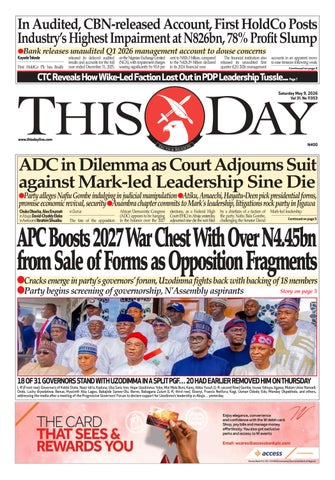
ADC in Dilemma as Court Adjourns Suit against Mark-led Leadership Sine Die
Party alleges Nafiu Gombe indulging in judicial manipulation Atiku, Amaechi, Hayatu-Deen pick presidential forms, promise economic revival, security Anambra chapter commits to Mark's leadership, litigations rock party in Jigawa In Audited, CBN-released
Chuks Okocha, Alex Enumah in Abuja, David-Chyddy Eleke in Awka and Ibrahim Shuaibu in Dutse The fate of the opposition
African Democratic Congress (ADC) appears to be hanging in the balance over the 2027
elections, as a Federal High Court (FHC) in Abuja yesterday, adjourned sine die the suit filed by a chieftain of a faction of the party, Nafiu Bala Gombe, challenging the Senator David
APC Boosts 2027 War Chest With
Over N4.45bn
from Sale of Forms as Opposition Fragments
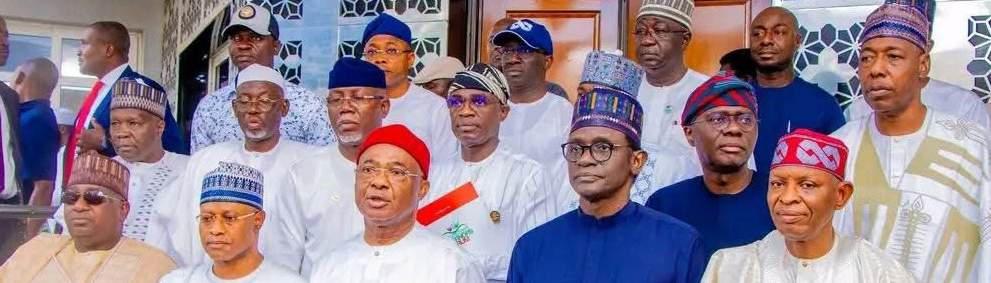
Cracks emerge in party’s governors’ forum, Uzodinma fights back with backing of 18 members Party begins screening of governorship, N’Assembly aspirants Story on page 5
Imo, Hope
Mai Mala
media after a meeting of the Progressive Governors’ Forum to declare support for Uzodinma’s leadership
second Row) Gombe, Inuwa Yahaya; Jigawa, Malam Umar Namadi; Ondo, Lucky Aiyedatiwa; Benue, Hyacinth Alia; Lagos, Babajide Sanwo-Olu, Borno, Babagana Zulum (L-R, third row), Ebonyi, Francis Nwifuru; Kogi, Usman Ododo; Edo, Monday Okpebholo, and others, addressing the
in Abuja…
wellness within reach
with W Health loan
The W Health Loan provides women with access to financing for eligible healthcare services
*Terms and conditions apply
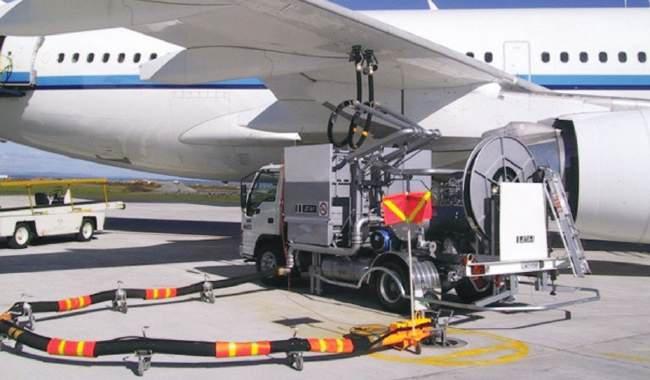
NMDPRA Resumes Issuance of Fuel Import Permits,
Six Firms to Deliver 600,000mt
Oil price surge, reforms draw fresh investors’ attention to Nigeria
Emmanuel Addeh in Abuja
The Nigerian Midstream and Downstream Petroleum Regulatory Authority (NMDPRA) has ramped up the issuance of fuel import licences, equating to a total volume of 600,000 metric tonnes, or roughly a quarter
Adedayo Akinwale in Abuja
As opposition parties continue to fragment ahead of the 2027 general elections, the ruling All Progressives Congress (APC) has significantly boosted its war chest, raking in over N4.45 billion from the sale of nomination and expression of interest forms, further consolidating its financial and political advantage over its fragmented rivals.
The party made the whopping N4.45 billion from the sale of forms to two presidential aspirants, over 83 governorship aspirants, from 28 states as well as National and state Assemblies aspirants.
The ruling party realised the sum of N200 million from President Bola Tinubu and Stanley Osifo, who purchased the presidential nomination forms, while the governorship forms were sold at the rate of N50 million, the Senate form was sold for N20 million and the House of Representatives for N10 million.
These come as the split within the Progressive Governors Forum (PGF) deepened yesterday as the
In its reaction to the court ruling, the Mark-led ADC cried out that the legal direction the case was going contradicted the judgment of the apex court, charging that what Gombe wanted to indulge in was "judicial manipulation".
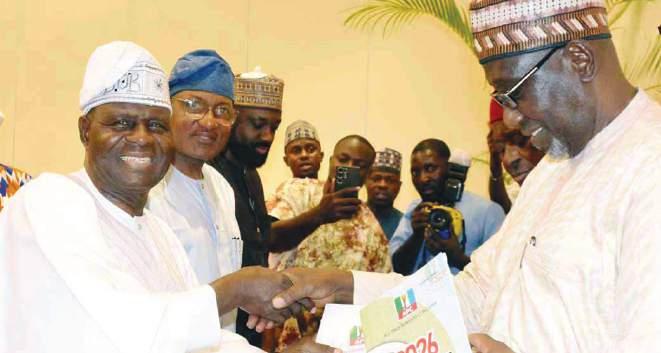
These come as three presidential aspirants - former Vice President, Atiku Abubakar, former Governor of Rivers State and former Transport Minister, Rotimi, Chibuike Amaechi, and renowned economist, Mohammed Hayatu-Deen picked their expression of interest forms for the presidential ticket of the party.
Justice Emeka Nwite adjourned the suit pending the
full-year 2025 performance, which was weighed down by the sharp rise in impairment charges and a steep decline in profit. The Q1 results also showed that its net impairment charges on financial assets rose to N40.35 billion from N37.25 billion in Q1 2025.
The full-year 2025 results showed that the Group closed 2025 with a profit before tax of N220.28 billion, which was a decline by 72 per cent, compared with the N781.88 billion reported in 2024, just as profit after tax
of the country's domestic consumption.
The easing of the restriction on foreign fuel imports is coming amid a recent presidential directive to remove the NMDPRA's erstwhile Chief Executive, Saidu Mohammed, and replace him with Rabiu Umar, an outgoing Sales and
Chairman of the forum and Governor of Imo State, Senator Hope Uzodinma, fought back strongly against mounting opposition within the group, securing a vote of confidence from 18 APC Governors, out of 31, in a major show of support.
The Forum, on Thursday, had removed Uzodinma, and there were plans to replace him with the Governor of Enugu State, Peter Mbah, as the possible new leader.
Reports indicated that the other group is led by Governors of Ogun State, Dapo Abiodun and that of Kwara, Abdulrahman Abdulrazaq, respectively.
However, after a closed-door meeting in Abuja yesterday, 18 governors of the party declared support for Uzodinma’s leadership.
Kebbi State Governor, Dr. Nasir Idris, who spoke after the meeting, said: “We don’t have any problem to justify what they have said. So, I want to seek this opportunity to move a vote of confidence on our chairman and his Deputy.”
On his part, Governor Uba Sani of Kaduna State said: “What I can say here is that all of us woke up with that very unfortunate story
presentation of the Certified True Copy (CTC) of the judgment of the Supreme Court as well as the decision of the FHC Chief Judge (CJ), Justice John Tsoho, on the letter of the plaintiff seeking the transfer of the case to another judge.
Yesterday's adjournment was the second time the suit marked: FHC/ABJ/CS/1819/2025, would be adjourned indefinitely.
The first last month was in deference to the apex court's decision in an interlocutory appeal filed by the second defendant, David Mark.
A five-member panel of the Supreme Court had last week ordered the return of the suit to the trial court after dismissing the
in the year under review fell to N147.25 billion, representing a 78 per cent decline from the N663.499 billion reported in 2024.
First HoldCo’s reported impairment charges on financial instruments, when compared to its other tier-one peers, emerged as the highest in the 2025 financial year.
The full-year results showed that the Group’s interest income closed 2025 at N2.99 trillion, up by 24.9 per cent from the N2.4 trillion recorded in 2024, while interest
Marketing Manager at Dangote Industries Limited (DIL).
While supporters of continued fuel imports insist on supply security, competition, and the need to shield the Nigerian market from monopolistic tendencies, those opposed to it contend that fuel imports are
that we have virtually in all the media in Nigeria. But the truth of the matter is that the APC Progressive Governors Forum is very united.
“We’re stronger now than any other time. And of course, we are all supporting our President for what he has been doing.
“We also want to assure everyone that APC is united, governors are united, the forum is united, and there is no problem at all.”
The Governors in attendance were those of: Ondo, Kaduna, Taraba (he came and left after a brief meeting with his host), Sokoto, Ebonyi, Borno, Lagos, Kogi, Kano, Yobe, Kebbi, Benue, while those of Jigawa, Nasarawa were represented by their deputies.
While moving the vote of confidence, Idris declared that Uzodimma and his deputy, Governor Sani remain the Chairman and the Deputy of the forum, respectively.
He dismissed speculation of disunity in the APC, saying the Forum was focused and committed to the upcoming primaries.
interlocutory appeal by Mark, as well as vacating the maintenance of status quo ante bellum order by Court of Appeal.
When the matter came up yesterday, Gombe's lawyer, Mr. Luka Musa Haruna, who briefed Justice Nwite on what transpired at the apex court, disclosed his client had, through a letter dated May 4, 2026, applied to the CJ of the court for the transfer of the case to another judge.
He said the letter had already been transmitted to the court registrar and urged Justice Nwite to await the administrative decision of the Chief Judge.
“At this juncture, we must humbly pray to your Lordship, to wait for the administrative
expenses moved from N996.12 billion in 2024 to N1.08 trillion declared in 2025, representing an increase of 8.1 per cent.
The Group’s net interest income experienced growth of 36.8 per cent, reaching N1.9 trillion and resulting in a net interest margin of 11.1 per cent.
“Non-interest income remained strong, with net fees and commission income rising by 20.2 per cent to N294.5 billion, supported by greater digital transaction volumes, transfer
economically damaging and undermine the rationale for Aliko Dangote investing $20 billion in domestic refining.
But citing eight local sources with knowledge of the matter, S&P Global reported that the Authority granted six Nigerian marketers with new petrol import licences on May 6,
“Governors of Progressive Congress are all united and resolved to support Mr. President and to ensure that he comes out successfully during the upcoming elections by January 2027.
“So we have decided to work harder, look after our people, show performance and provide all the necessary social interventions that make Nigerians happy and that is actually a matter of fact the resolution will have come up with this afternoon,” Uzodinma noted.
Meanwhile, the ruling party yesterday commenced the screening of governorship, as well as Senate and House of Representatives aspirants ahead of the party's primary.
The ruling party had scheduled the primary and election for the House of Representatives aspirants to hold on May 15, while the Senate is scheduled to hold on May 18, 2026 and the governorship primary is scheduled to hold on May 21.
However, while the ruling party set up two committees to screen incumbent Governors seeking reelection, and Governors aspiring to contest for Senate seats, it kept
decision of the Chief Judge of the Federal High Court,” Haruna said.
Surprised and angry with what they perceived as an ambush, the defendants accused the plaintiff of attempting to frustrate the accelerated hearing earlier ordered by the Court of Appeal and upheld by the Supreme Court.
Counsel for the first defendant, Realwan Okpanachi, who held brief for Shuaibu Aruwa, SAN, argued that the plaintiff had misrepresented the outcome of the Supreme Court judgment.
He submitted that the apex court partially allowed the appeal and specifically upheld the
and intermediation fees, and letter of credit commissions and fees,” a report by First HoldCo explained.
From the audited results and accounts, the Group saw its operating expenses rise to N1.2 trillion in 2025, representing an increase of 32.1 per cent from N934.16 billion in 2024.
Findings showed that the Group spent an estimated N183.4 billion on advertising and corporate promotions in 2025, which was a significant
worth 600,000 metric tonnes.
The move is a significant policy departure from recent market norms, which have seen the NMDPRA heavily regulate foreign arrivals of Nigeria's main motor fuel in order to support the country's new domestic refinery owned by Aliko Dangote.
mute on the screening of Senate and House of Representatives aspirants.
The Chairman of the party, Prof. Nentawe Yilwatda chaired the committee to screen the incumbent Governors seeking re-election, the Secretary of the party, Senator Ajibola Basiru would serve as secretary of the committee.
The screening of the incumbent Governor is scheduled to hold at Plateau Governors lodge, Abuja, while the screening of other Governorship aspirants hold elsewhere.
Similarly, the party set up a committee for other governorship aspirants chaired by Dr. Ben Nwoye, while Mr. Emeka Offor would serve as the secretary.
But, the Peering Advocacy and Advancement Centre in Africa (PAACA) and Centre for Policy Advocacy and Leadership Development (CPALD) have petitioned the Independent Corrupt Practices and other related offences Commission (ICPC) and the APC regarding the eligibility of Prof. Princewill Igbagara to contest for the position of Member representing Sagbama/Ekeremor Federal Constituency under the
appellate court’s order directing accelerated hearing of the case.
Okpanachi further faulted the plaintiff for allegedly ambushing the defendants with the transfer request.
“We have not received any communication regarding that application. My Lord, so as it is, we don’t know the form or the content of that application. Therefore, we take the approach of the plaintiff as an ambush,” he said.
He added, “We also consider it as an attempt to frustrate the order of accelerated hearing granted by the Court of Appeal and upheld by the Supreme Court.”
Okpanachi maintained that
141 per cent increase over the N75.9 billion reported in 2024.
An analysis on ARISE News Channel showed that the Group’s advertising expenses were larger than what it paid as levy to the Asset Management Corporation of Nigeria (AMCON) in the year under review, which was at N130 billion, and also far higher than the amount spent on Information Technology maintenance, which was N108.9 billion, raising concerns among stakeholders.
A further comparison with
After an initial clampdown in October 2025, the NMDPRA issued six companies with limited petrol import licences in late March 2025, S&P said, but left them to expire at the end of the first quarter, leaving uncertainty over its future policy trajectory.
platform of APC.
The Executive Director of PAACA, Ezenwa Nwagwu in the petition dated May 7, 2026, also copied the National Chairman of APC, Prof. Yilwatda, the National Secretary of APC, Senator, and the State Chairman of APC. He said Igbagara, an indigene of the Isoni Community in the Sagbama Local Government Area of Bayelsa State, simultaneously holds the positions of Professor and lecturer at the Federal University Otuoke, while also serving as the Special Adviser to the Governor of Bayelsa State on Science and Technology.
He added that as at 20th April 2026, he was believed to have held both roles concurrently.
“Prof. Igbagara, an indigene of the Isoni Community in the Sagbama Local Government Area of Bayelsa State, simultaneously holds the positions of Professor and lecturer at the Federal University Otuoke, while also serving as the Special Adviser to the Governor of Bayelsa State on Science and Technology. As at 20th April 2026, he is believed to
litigants were not permitted to choose courts or judges to determine their cases, adding that the court should maintain the earlier order adjourning the matter sine die, pending the filing of the CTC of the Supreme Court judgment. Similarly, the second defendant's lawyer, Sulaiman Usman, also condemned the plaintiff’s move, describing it as “forum shopping and judge shopping.”
Usman told the court that the Supreme Court had commended Justice Nwite “in glowing terms” over his handling of the proceedings.
industry peers also showed that the N183.4 billion spent on advertising by First HoldCo was far above the amount spent by other tier-one banks combined, reflecting concerns over cost efficiency and expense management. For instance, while Zenith Bank spent N24.2 billion in its 2025 financial year, GTCO spent N20 billion, UBA spent N19.8 billion, and Access Holdings spent N18.7 billion, further highlighting the issue of efficiency.
CTC Reveals How Wike-Led Faction Lost Out in PDP Leadership Tussle
Abdulrahman faction says copy in circulation not officially released, insists content affirms his leadership
Chuks Okocha and Alex Enumah in Abuja
A Certified True Copy (CTC) of the judgement of the apex court on the leadership tussle in the Peoples Democratic Party (PDP) has revealed how the faction loyal to the Minister of the Federal Capital Territory (FCT), Nyesom Wike, lost out in the battle for the party's soul.
But in a swift reaction, the Abdulrahman Mohammed leadership of the party said that the purported CTC of the recent
Supreme Court judgement is not officially released. He also insisted that the Supreme Court judgement recognised him as PDP National Chairman and Senator Samuel Anyanwu as the National Secretary.
According to the CTC sighted by THISDAY yesterday, the apex court unanimously dismissed the cross appeal brought by Wike, alongside the main appeal by the Tanimu Turaki-led faction said to be loyal to the Oyo State Governor, Seyi Makinde.
"The Cross-Appeal is in
NBA-SBL's 20th Anniversary Conference to Focus on Measuring Policy Impact
Raheem Akingbolu
The Nigerian Bar Association Section on Business Law has announced its 20th Annual International Business Law Conference themed ‘Beyond Reforms: Measuring Policy Impact’.
The event is set to take place from 8th to 10th June 2026 in Abuja.
As one of Africa’s foremost gatherings at the intersection of law, business, and policy, the conference marks a significant milestone in the organisation’s continued commitment to shaping Nigeria’s commercial and regulatory landscape.
For two decades, NBA-SBL has convened leading voices across sectors, building a platform that goes beyond legal discourse to influence business strategy, policy direction, and economic development.
The 20th edition reinforces this legacy, positioning the conference as a critical forum for evaluating the effectiveness of reforms and charting a path toward measurable outcomes.
Speaking on the significance of the milestone, Chairman of NBA-SBL, Ozofu ‘Latunde Ogiemudia, said, “Twenty years on, this conference has evolved into more than a gathering of professionals; it is a platform that actively shapes how law supports business growth and economic development in Nigeria. This year’s theme reflects a necessary shift from conversations about reform to a more deliberate focus on impact—what has changed, what is working, and what must be done differently to drive sustainable progress.”
According to the organisers of the conference, this year’s conference will bring together legal practitioners, business leaders, policymakers, regulators, investors, and innovators to examine the real impact of reforms and identify what is required to drive sustainable progress. It is a deliberate effort by the organisation to ensure that law and policy serve as active enablers of development, not just frameworks on paper.
the circumstance of the Main Appeal, dismissed.
"Cross-Appeal Dismissed," Justice Stephen Adah, held in the CTC, which was released to the public barely one week of the judgement. It would be recalled that the Makinde faction had emerged from the party's convention held last November in Ibadan with Turaki as National Chairman, while the Wike faction emerged from the March convention in Abuja, with Abdulrahman Mohammed as National Chairman.
Following the March 9 judgement of the Court of Appeal which nullified the Ibadan convention, on grounds that the convention held in flagrant disobedience of the orders of the Federal High Court, Abuja, the Turaki leadership had approached
the apex court to set aside the judgement of the lower court on grounds among others that the appellate court erred in law when it agreed with the Federal High Court, Abuja, that the case before it was outside the internal affairs of political parties and hence the court has jurisdiction to intervene.
But, it was not only the Turaki faction that has problem with the judgement of the appellate court, taking into cognizance the cross appeal filed by the Wike faction.
The cross appeal specifically set out to reverse the unanimous judgement of the Court of Appeal, which on March 9, affirmed the suspension of the party's Legal Adviser, Kamaldeen Ajibade, SAN.
The Turaki faction had approached the appellate court to challenge the judgement
of Justice James Omotosho of the Federal High Court, Abuja, which on October 31, 2025, restrained the PDP from proceeding with the convention slated for November 15 and 16, 2025, until it conduct proper congresses in areas congress was allegedly not held, as well as another judgement of Justice Peter Lifu, which on November 14, barred the PDP from conducting the said convention until an aspirant, the former governor of Jigawa State, Sule Lamido, was allowed to purchase nomination form and participate in the convention.
At the hearing of the appeal, Ajibade who was recognised by Justice Omotosho as the legal representative of the PDP at the trial court had objected to Chief Chris Uche, SAN representing the PDP, insisting he is the one clothed with legal authority to
represent the PDP at the appeal. However, his objection was dismissed on account of his suspension from the PDP. "By leave of this Court, the appellant placed before the Court as fresh evidence the Notice evidencing the suspension of A.K. Ajibade, SAN as National Legal Adviser of the appellant on November 1, 2025. That evidence was duly admitted pursuant to the principles governing reception of fresh evidence on appeal as restated by the Supreme Court. "The legal effect of that fresh evidence is that, as at December 10, 2025 when Appeal No. CA/ABJ/1728/2025 was purportedly filed by A.K. Ajibade, SAN, he had ceased to hold the office of National Legal Adviser of the appellant. An agent whose authority has been lawfully terminated cannot bind the principal.
Presidency: NDC, Like ADC Has No Immediate Plan For Nigeria
Says party lacks ideology and without manifesto four months after being registered Ardo raises fresh concern over NDC’s registration
Deji Elumoye and Chuks Okocha in Abuja
The Presidency yesterday declared that the recently registered political party, the Nigeria Democratic Congress (NDC), has no immediate plan in the offing for the teeming Nigerian populace.
This was as the promoter of the League of Northern Nigeria and All Democratic Alliance (ADA), Dr. Umair Ardo, yesterday raised fresh
concern over the registration of the NDC by the Independent National Electoral Commission (INEC).
Ardo in a statement yesterday in Abuja, insisted that he has obtained a certified copy from INEC that the registration of NDC was allegedly shrouded in fraud.
Presidential spokesperson, Bayo Onanuga, in a posting on his verified X handle, @ aonanuga1956, submitted that the NDC and the Africa
Democratic Congress (ADC) are birds of the same feather that don't have the interest of the Nigerian people at heart.
He stated specifically that about four months after the registration of NDC as a political party it cannot boast of any known ideology and manifesto.
The Presidency, in the fiveparagraph release stated inter alia: "Out of sheer curiosity, I have twice in the last few days googled the website
of the Nigeria Democratic Congress (NDC), the party that the political wanderer Peter Obi and his ally, Rabiu Kwankwaso, sought shelter in after abandoning the ADC midstream.
"I was interested in the party’s manifesto and whether it has enunciated a markedly different vision for the governance of Nigeria, one better than President Tinubu's and the APC’s Renewed Hope Agenda.
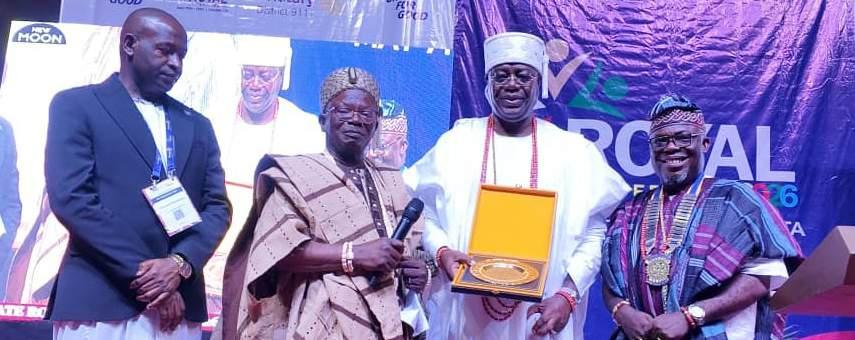
L-R: Rotary International President’s Representative, Francisco Ssemwanga; HRH Oba Michael Babalola, Onijale of Ijale Kingdom; Keynote Speaker, HRH Oba Olufolarin Olukayode Ogunsanwo, Telade IV Alara of Ilara Kingdom, Epe Lagos, and Rotary District 9111 Governor, Henry Akinyele, during the opening ceremony of Rotary District 9111 Royal Conference held in Abeokuta, Ogun State…yesterday
PRODUCT LAUNCH...
2027: Governors, Ex-Governors Intensify Battle for Senate Seats
Sunday Ehigiator
With less than one year to the 2027 general elections, political calculations across the country are increasingly tilting towards the Senate, as a growing number of serving governors and former governors position themselves for seats in the Red Chamber, setting the stage for fierce political battles in several states.
THISDAY’s findings indicate that the race for senatorial tickets is already fuelling tensions between incumbent governors and their predecessors in some States, while also raising fresh concerns among civil society groups over what they describe as the “recycling of political elites” at the expense of younger Nigerians.
Among governors reportedly eyeing Senate seats are Governor AbdulRahman AbdulRazaq of Kwara State, Governor
Hope Uzodinma of Imo State, Governor Mai Mala Buni of Yobe State, Governor Dapo Abiodun of Ogun State, Governor Abdullahi Sule of Nasarawa State, Governor Ahmadu Umaru Fintiri of Adamawa State and Governor Bala Mohammed of Bauchi State.
At the same time, several former governors are also plotting returns to the Senate, including former Sokoto State governors Aliyu Wamakko and Aminu Waziri Tambuwal; former Gombe State governor Danjuma Goje; former Ogun State governors Ibikunle Amosun and Gbenga Daniel (who is a current serving senator); former Kogi State governor Yahaya Bello; former Delta State governor Ifeanyi Okowa; former Abia State governors Theodore Orji and Orji Uzor Kalu; former
Lagos Moves to Criminalise Estimated Billing Amid 11,000MW Power Supply Deficit
Emmanuel Addeh in Abuja
The Lagos State Government has moved to criminalise the supply of electricity without meters, intensifying pressure on Distribution Companies (Discos), amid a widening power crisis that has left the state grappling with an estimated 11,000 megawatts supply deficit.
The move, backed by provisions in the Lagos Electricity Law and fresh regulatory reforms, seeks to outlaw arbitrary electricity charges for unmetered consumers, while compelling operators to accelerate meter deployment across the commercial hub.
These details were contained in the maiden 2025 Lagos Electricity Market Report released by the Lagos State Electricity Regulatory Commission (LSERC), which was seen by THISDAY yesterday.
The commission added that enforcement of compulsory
metering would commence in 2026, stressing that universal smart metering across the state is expected to be implemented on a feeder-by-feeder basis.
“Adequate metering is fundamental to fair billing and consumer protection. The national metering rate across Nigeria's Discos stood at 55.37 per cent as at September 2025…In the interim, the commission notes that non-metered consumers remain exposed to estimated billing, which has historically been a major source of consumer grievance and a significant impediment to accurate revenue collection.
“The commission draws attention to the provisions of section 89(2) of the law, which criminalises the supply of electricity without a meter, and notes that active enforcement of this provision will commence in 2026 in line with the SIP (Strategic Implementation Plan) metering timeline,” the report emphasised.
Gombe State governor Ibrahim Dankwambo; former Benue State governor Samuel Ortom; former Kebbi State governors Adamu Aliero and Abdulaziz Yari; former Plateau State governor Simon Lalong; and former Taraba State governor Jolly Nyame.
The emerging contest is already creating cracks in some political structures.
In Kwara State, political insiders say Governor AbdulRazaq’s alleged senatorial ambition is unsettling loyalists of former Senate President Bukola Saraki, with both camps believed to be quietly consolidating ahead of the battle for political control in the state.
In Ogun State, the rivalry appears even more layered
as Governor Abiodun, former governor Amosun and former governor Daniel are all linked to possible senatorial ambitions, setting up what analysts describe as a three-way struggle for influence in the state’s political hierarchy.
A similar scenario is unfolding in Sokoto State, where Wamakko and Tambuwal remain dominant political figures with deep-rooted
structures and overlapping interests in the state’s senatorial politics.
In Abia State, Orji Uzor Kalu is seeking to return to the Senate. Observers say the Senate has increasingly become a retirement destination for governors and former governors seeking political relevance, continued influence and political protection after leaving office.
ADC IN DILEMMA AS COURT ADJOURNS SUIT AGAINST MARK-LED LEADERSHIP SINE DIE
“So my Lord, for the plaintiffs to come back to this court, and to inform us today that they have written a private correspondence to the Honourable Chief Judge, and to hinge that to make a request for this court to await the outcome of that private correspondence, is not only unfortunate My Lord, but a dangerous trend which must not be allowed to stand,” he said.
Counsel for the third defendant, M.E. Sherriff, aligned himself with the submissions of the first and second defendants, arguing that substantive prayers could not be sought through
have held both roles concurrently,” he said.
Ezenwa maintained that this situation raised significant legal and ethical concerns, including violation of public service rules and ethical standards, as well as breach of constitutional and electoral provisions.
He added: “Holding dual remunerated public offices, one at a federal institution and another as a political appointee, contravenes established public service regulations and ethical guidelines governing conflict of interest and double remuneration from public funds.
“The simultaneous occupation of these offices may constitute a violation of constitutional provisions relating to public officers
ordinary letters.
Similarly, counsel for the fifth defendant, P.I. Oyewole, described the application as “strange” and accused the plaintiff of inviting the Chief Judge “to indulge in judicial rascality.”
“My Lord, asking the Chief Judge to transfer that kind of case is worse than forum shopping,” Oyewole argued.
Responding, Haruna faulted the defence for attacking a letter they had not seen, insisting that the plaintiff stood by its application.
Justice Nwite subsequently held that the court could not
seeking elective positions while retaining public employment or appointments.
“Maintaining both positions while pursuing political ambition raises concerns about abuse of office, unfair access to public resources, and the misuse of government institutions for political purposes.”
In view of the foregoing, Nwagwu called on ICPC to conduct a thorough investigation into the matter to determine whether Igbagara has violated any provisions of the Constitution, Electoral Act, public service rules, or anti-corruption laws.
CAAPA also called for appropriate action to be taken in line with the Constitution, Electoral Act, and public service
take any decision on the letter without hearing all parties.
“Taking a decision or any action in such a letter without hearing from the defendants will amount to breach of their fundamental right in this suit,” the judge ruled.
He added that since the letter was addressed to the Chief Judge, the trial court could not make any pronouncement on it.
“This matter is best adjourned sine die to afford the parties file the Certified True Copy of the judgment of the Supreme Court in the interlocutory appeal in the suit, to serve the defendants with the letter addressed to the
regulations if any violations are established.
In a separate petition dated May 7th, the Executive Director of CPALD, Edward Terna, said the Constitution and relevant electoral laws emphasize transparency, accountability, and the avoidance of conflicts of interest for individuals seeking elective office.
Also, a chief of the party from Ekiti state, Hon. Afuye Idowu has petitioned the National Working Committee (NWC) of the party, demanding for the disqualification of Senatorial aspirant and the Senator representing Ekiti North Senatorial District, Cyril Fasuyi over non-performance.
Idowu, while addressing journalists after submitting his petition at the party secretariat
Honourable Chief Judge, and finally to await further or any directive from the Chief Judge of the Federal High Court,” Justice Nwite said.
Gombe had approached the court for an order restraining Mark leadership from parading themselves as leaders of the ADC pending the hearing and determination of his suit challenging their leadership.
He had also asked the court to issue another order against the Independent National Electoral Commission (INEC), restraining it from recognising the Mark leadership.
yesterday Abuja, the petition was based on his strong conviction that an assessment of Fasuyi's present term of office clearly indicated that he is antithetical to the ideals of the Renewed Hope Agenda and the ideology of the party. He said: “He is not reported to have moved any serious motion or made any significant contributions to debates on the floor of the Senate which implies that the people of Ekiti North Senatorial District do not have a voice of representation in the Senate.”
Idowu, however, warned that if the party's NWC refuses to disqualify Fasuyi, they would wait for him during the primary election to show him the way out.
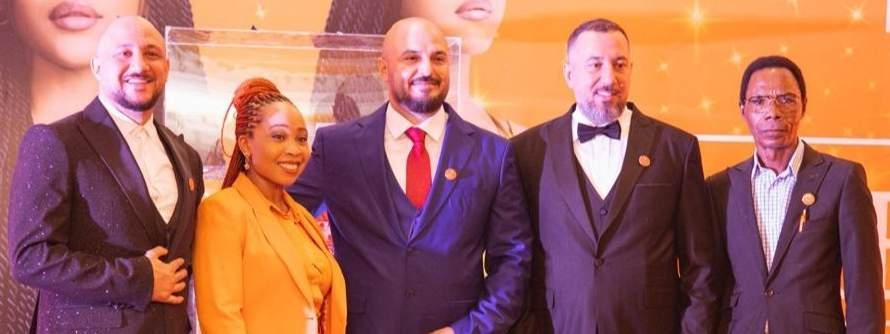
L-R: Head, Production System Optimisation, Mr. Shahin Alawam; Marketing Manager, Best Fibres Nigeria Ltd, Mrs. Ekemini Ogbiko; Managing Director, Mr. Khaled Sallam; General Manager, Mr. Kenan Alawam; and Marketing Manager, Ben Odianah, during Tressa Hair Launch in Lagos... recently
CHANGE OF BATON...
Gunmen Kill 11 in Fresh Plateau Attack, Pregnant Women Among Victims
Two soldiers, scores of insurgents killed as troops repel ISWAP attack on military base in Magumeri Troops uncover 2 Illegal arms factories, apprehend suspects, recover weapons in Plateau Security forces kill five bandits, rescue 32 kidnap victims in Katsina Nigeria, US deepen ties to combat terrorism, regional instability
Yemi Kosoko in Jos, Linus Aleke in Abuja, Onuminya Innocent in Sokoto and Francis Sardauna in Katsina
At least 11 persons have been killed in a renewed attack on Ngbra Zongo community of Kwall District in Bassa Local Government Area of Plateau State, plunging the area into fresh mourning amid rising concerns over persistent insecurity.
This was as two soldiers and scores of Islamic State West African Province (ISWAP) insurgents were killed during a fierce gun battle after troops of Joint Task Force (North East) Operation Hadin Kai successfully repelled an attack on a military base in Magumeri, Borno State.
In another development, troops of Sector 2, Joint Task Force North West Operation FANSAN YAMMA have recorded a major blow against terrorist networks in Zamfara
and Katsina states, neutralining nine fighters including two notorious kingpins in coordinated operations between May 1st and 3rd 2026. Similarly, joint security forces in Katsina State have killed five bandits and rescued 32 kidnapped victims during intensified operations against bandit groups operating across parts of the state and neighbouring communities.
Also troops of the Quick Response Force (QRF), Operation Enduring Peace, have uncovered two illegal arms manufacturing factories in Plateau State, leading to the arrest of suspects and the recovery of a cache of weapons and ammunition during a coordinated security operation.
The assault on Ngbra Zongo community of Kwall District in Bassa Local Government Area of Plateau State which occurred around 12a.m. yesterday, was carried out by gunmen who reportedly invaded the community in coordinated
Pharmacists Raise Concerns Over Staff Depletion in Lagos
The Pharmaceutical Society of Nigeria (PSN) Lagos State branch has raised strong concerns over the depletion of pharmacists in the state's services, saying it could undermine effective drug regulation and patients’ safety.
groups, shooting sporadically and attacking residents with machetes and other weapons.
Several others sustained varying degrees of injuries,
while many families fled into nearby bushes to escape the violence.
A community member, Mr. Philip Alanga, told journalists in Jos that the attackers moved from house to house, leaving residents in panic.
“They came into the community around midnight and started shooting and hacking people to death. They moved from one house to another attacking innocent people,” he said.
OPL 471: Court Dismisses CNPC’s Challenge, Affirms $100 Million Award to Nigerian Firm
Blessing Ibunge in Port Harcourt
A Federal High Court sitting in Port Harcourt, Rivers State has reaffirmed judgement in Suit Number FHC/PH/ CS/136/2022 between Cutra International Limited vs China National Petroleum Corporation, upholding the award of $100 million in favour of Cutra against China petroleum firm.
In his ruling delivered on April 24, 2026, the trial judge, Justice Adamu Turakii Mohammed dismissed an application filed by the CNPC seeking to set aside the judgement earlier entered
against it on May 23, 2025.
The application to overturn the judgement was filed on October 28, 2025, but the Court found no basis to disturb its previous judgement, thereby affirming the full judgment sum awarded to Cutra.
The dispute centred on the ownership structure and equity participation under an Oil Prospecting Licence (OPL 471) awarded by the Nigerian Federal Government in 2006/2007 to CNPC and its local partner, Cutra.
Under the award and arrangement between the parties, Cutra held a 10 per cent equity interest in the OPL.
However, CNPC unilaterally returned the OPL to the federal government without consulting or obtaining Cutra's consent.
Aggrieved by the action, Cutra approached the court seeking damages for the deprivation of the benefits and entitlements from the oil asset. The court in its earlier judgement ruled in favour of Cutra. In assessing the appropriate damages and compensation payable to Cutra, the Court observed that Cutra’s evidence that the minimum yield from the OPL was valued at $5 billion was not challenged by CNPC. Relying on the uncontroverted
evidence before it, the Court consequently awarded damages in the sum of $100 million in favour of Cutra.
According to the court, “when a Court takes a position on a matter in controversy before it, that Court becomes functus officio with respect to that matter in controversy, and the Court stands and remains bound by the decision.
"It is equally the position of the law that where a trial Court in the course of the proceedings in a matter before it decides on a particular issue or question, it becomes functus officio to revisit that issue or question."
PIA: Court Bars NUPRC From Reviewing Gazetted Coastal Communities Says only NBC can delineate littoral host communities
Wale
Igbintade
According to him, “|the Directorate of Pharmaceutical Services is responsible for the supervision and administration of critical operations such as pharmaceutical inspection, drug quality control, counterfeit medicine enforcement, malaria control programmes, and drug abuse campaigns,” but expressed regret that the extension of the DPS services to other health services units has worsened the situation.
Chairman of PSN, Olaitan Ogunlade, during the 2026 Annual Luncheon of the Society in Lagos recently said that the state’s Directorate of Pharmaceutical Services (DPS) has been hit by a severe dearth of Registered Pharmacists to sustain its retinue of statutory responsibilities and exposing the healthcare system to statutory breaches.
A Federal High Court sitting in Warri, Delta State, has ordered the Nigerian Upstream Petroleum Regulatory Commission (NUPRC) to immediately implement the Host Communities Development Trust provisions under the Petroleum Industry Act (PIA) based on the existing federal government Gazette recognising coastal host communities, holding that the agency lacks the legal authority to delay the process
pending any review exercise.
In a landmark judgement delivered on May 6, 2026, Justice Hyeladzira Nganjiwa held that only the National Boundary Commission (NBC) possesses the statutory powers to determine and delineate littoral host communities for the implementation of Chapter 3 of the PIA.
The court consequently restrained the NUPRC from withholding benefits due to recognised host communities
under the Host Communities Development Trust Fund on the ground that some communities were allegedly omitted from the gazetted list.
The suit was instituted by Chief Joseph O. Wuruyai, Chief Matthew Pudie, Babajide Ololade Olokodana, Oladipupo Kehinde Jimoh, Chief Ayodele J. Busiga, Mathew Adebogun Badejo, Esubiyi Ifasanya Shuaibu and Prefa Tariere Tokoni against the National Boundary Commission, the NUPRC, and
several representatives of affected coastal communities in Delta and Ondo states. At the proceedings, A.L. Onodjefemue, and Augustine Akpojaro Esq. appeared for the plaintiffs on the instruction of A. Alabi Lawal, SAN, while Mr. V.N. lfeanyi represented the 2nd defendant on the brief of Sunday Onubi. Prince Clem Omotoye appeared for the 3rd to 7th defendants and also held the brief of Ahmed Raji, SAN.
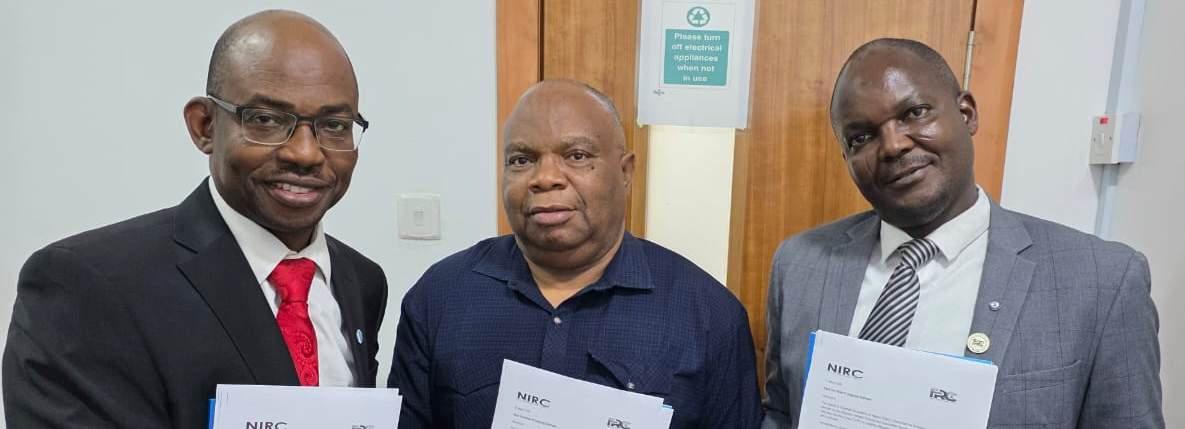
L-R: Immediate Past Chairman, Nigerian Integrated Reporting Committee (NIRC), handing over to the current Chairman, Dr. Iheanyi Anyahara, and Dr. Abdulrazaq Abubakar, who represented Executive Secretary of the Financial Reporting Council, Dr. Rabiu Olowo, during the handing over ceremony held in Lagos…recently
RENEWED HOPE AMBASSADORS PROJECT TOUR...
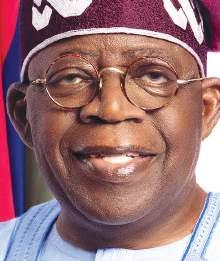
FG Clarifies Tinubu’s Official Appellation, Insists on Incorporation of 'His Excellency' Title
Ajimotokan in Abuja
The Office of the Secretary to the Government of the Federation, has corrected errors by some media
organisations in the official title of President Bola Ahmed Tinubu.
The clarification was made in a statement yesterday the Special Adviser Media and Publicity, Office of the
Wike Blasts NBA Chairman Over Condemnation of Judicial Housing Projects
Olawale Ajimotokan in Abuja
The Minister of the Federal Capital Territory (FCT), Nyesom Wike, has faulted remarks ascribed to the Chairman Nigerian Bar Association (NBA), Afam Osigwe, SAN, on the appropriateness of the residential quarters for judges and justices in Abuja.
Wike disputed the position of the NBA that the projects due to be inaugurated this month by President Bola Ahmed Tinubu, amounted to executive interference in the function of the judiciary.
The minister spoke yesterday after inspecting ongoing judicial infrastructure projects, including judges’ residences, the Court of Appeal Abuja Division and proposed residential projects for judges of the Industrial Court and the Code of Conduct Tribunal.
Wike blasted NBA for inferring that the provision of facilities for judicial officers by the government amounted to a threat to judicial autonomy.
“I don't want to reply to what he (Osigwe) said. He has never said anything well. The judiciary is to interpret and adjudicate cases. We have built public houses, both for the National Assembly and for the judiciary. The Supreme Court was built by us here. So, there’s nothing new. The mere fact that the executive constructs does not mean it
will interfere with the judiciary. It's unfortunate,” Wike said.
He lambasted the NBA leadership for lacking consistency, alleging the association is fond of seeking financial support from state governments for its conferences and activities while criticising government interventions in the judiciary.
“It is not for the NBA chairman to comment on what the executive is doing. All he is interested in is when they will go and apply for state government to sponsor NBA activities. Is that not interference? If governments fund their conferences, does that mean they are no longer independent? We are focused, we'll go ahead,” he quipped.
He insisted the FCT Administration would not be distracted from implementing projects designed to improve the welfare and working conditions of judges and justices, describing the initiative as a voluntary act by the government to make judicial officers comfortable and focused on their work.
He expressed satisfaction with the scope of work at the judges’ quarters, describing the project as 99 per cent ready for inauguration.
Wike, however, expressed dissatisfaction with the aspects of finishing at the Court of Appeal Abuja Division project, saying it fell short of expected quality.
Secretary to the Government of the Federation, Mr. Yomi Odunuga.
The statement on the appropriate coinage was personally signed by the Secretary to the Government of the Federation, Senator George Akume.
The OSGF urged the public and media
organisations to verify official titles before publication so that such avoidable and embarrassing errors would not filter into the publications.
“For the record, the correct and official appellation is: His Excellency, Bola Ahmed Tinubu, GCFR, President and Commander-in-Chief of
the Armed Forces, Federal Republic of Nigeria,” Akume stated.
He added that verifications can be made through the office’s official channels, including: Facebook- @ OfficeoftheSGF, InstagramOfficialOSGFNG, X (formerly Twitter)-OfficialOSGF, Emailinfo@osgf.gov.ng.
Akume added that the clarification became necessary after an error was observed in the naming and appellation of the President in a publication by a national daily on May 7, 2026. He noted that such lapses can be avoided with due verification through the appropriate sources.
Atiku Demands Halt to NNPC’s P’Harcourt, Warri Refineries Deal With Chinese Firms
Says independent assessments show firms lack technical depth Group insists deal strategic masterstroke for energy security, economic renewal
Chuks Okocha and Adedayo Akinwale in Abuja
Former Vice President Atiku Abubakar yesterday called for the immediate suspension and public scrutiny of the “Technical Equity Partnership” recently announced by the Nigerian National Petroleum Company Limited (NNPCL) involving two Chinese firms, Sanjiang Chemical Company Limited and Xingcheng (Fuzhou) Industrial Park Operation and Management Co. Ltd.
This was as the Nigeria Citizens Watch for Good
Governance has described the recent Memorandum of Understanding between NNPCL and two Chinese firms as a strategic masterstroke for energy security and economic renewal.
Atiku, in a statement issued by his Senior Special Assistant on Public Communication, Phrank Shaibu, described the deal as “another dangerous gamble” with Nigeria’s economic future.
The chieftain of the African Democratic Congress (ADC) accused the administration of President Bola Ahmed Tinubu of attempting to mortgage critical
national assets through opaque arrangements allegedly lacking technical credibility, transparency and accountability.
He said, “We are demanding an immediate suspension and public scrutiny of the Technical Equity Partnership announced by the Nigerian National Petroleum Company Limited involving two Chinese firms, Sanjiang Chemical Company Limited and Xingcheng (Fuzhou) Industrial Park Operation and Management Co. Ltd.
“It is both shocking and insulting that after wasting
over $2.5 billion on endless refinery rehabilitation scandals, the NNPC is once again asking Nigerians to trust another experiment built on secrecy and questionable competence.”
According to him, independent assessments of the two Chinese firms involved in the Memorandum of Understanding indicated that neither company possesses the pedigree, technical depth, or global reputation associated with the rehabilitation and management of complex crude oil refineries such as those in Port Harcourt and Warri.
Kwankwasiyya Movement Backs Obi, Kwankwaso Alliance
Chuks Okocha in Abuja
The Kwankwasiyya Movement has defended its national leader, Senator Rabiu Musa Kwankwaso, amid growing public discussions over a possible political alliance with former Labour Party presidential candidate, Peter Obi, under the platform of the Nigeria Democratic Congress (NDC).
In a statement issued yesterday, the group said many Nigerians had welcomed the reported
move as a step toward national unity and democratic progress, but alleged that some commentators, particularly from sections of the northern political class, were attempting to discredit Kwankwaso.
According to the movement, the concern in some quarters was not the alliance itself, but the political strength such a partnership could generate ahead of future elections.
“What appears to be troubling certain interests is not merely the possibility of
political cooperation, but the enormous national potential such an alliance represents,” the statement read.
The group said a partnership between Kwankwaso and Obi could alter the country’s political landscape by bridging longstanding regional divisions in opposition politics.
“For the first time in recent political history, Nigerians are witnessing the realistic possibility of a broad-based political understanding capable of bridging the long-
standing regional divide in opposition politics,” it stated.
The movement noted that Kwankwaso commands a strong grassroots structure in Kano and the North-west, while Obi enjoys widespread support among youths, urban voters and large sections of southern Nigeria.
“Naturally, the prospect of both leaders working together introduces a completely new political equation, one that transcends ethnicity, religion and regional sentiment,” it added.
Olawale
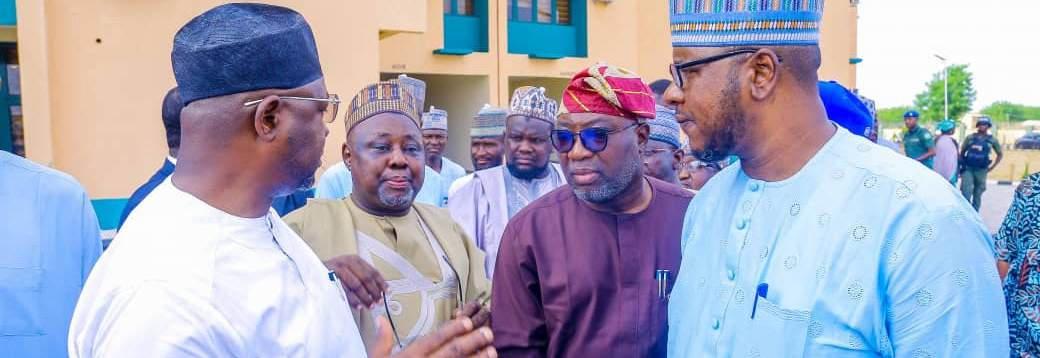
L-R: Special Adviser to the President on Media and Public Communication, Sunday Dare; Kebbi State Deputy Governor, Umar Abubakar Tafida; Senior Special Assistant to the President on Media and Special Duties/Director of Communication of Renewed Hope Ambassadors, Tunde Rahman, and Senior Special Assistant to the President on Community Engagement (Northwest), Abdullahi Tanko Yakasai, during the tour of the newly constructed State Secretariat, Birnin Kebbi, as part of the Renewed Hope Ambassadors Northwest tour of Federal and State Governments funded projects
The Man Who Built The Temple Before The Congregation Arrived
Watching football in English stadiums did something to my brain. Multiple experiences at Old Trafford, The Den in London, Stamford Bridge, the Amex, and the Emirates on match days brought a few things home for me with the force of revelation. Football in the United Kingdom is a religion, and behind that religion is a god called capitalism. Every link in the chain is a value-creating cascade, the likes of which you could not imagine from the outside. The man watching from home pays. The one who decides to leave home starts spending on transportation before he has even arrived. If he goes to a pub for the experience, that is one cost. If he decides on the stadium itself, the costs pile up differently but certainly no less. Both could ultimately meet at the pub afterwards, or at the club store, or on the journey home. Then there are the tourist fans — us — with our hotels, flights, match tickets, merchandise, and local travel. Do you have any idea of the GDP contribution of those pitches? Of those ninety minutes?
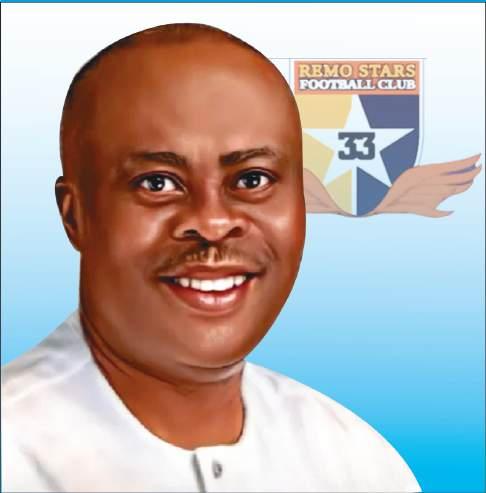
When the idea to start Lagos Liga hit me in 2023, I knew those accumulated experiences had formed into something that felt like a responsibility. Something needed to be done about football in Nigeria. And as I looked around at who was already doing that building, one man stood out above the rest. Kunle Soname. He turned 60 on April 27, 2026. He was celebrated by friends and family. But I thought the man deserved considerably more than that.
people who made the moment deserve to know it. He stays building the culture, one gesture at a time. I said earlier that one man inspired me when I began thinking seriously about Lagos Liga. Idris Olorunnimbe was the first person I called when it was time to make it real; no surprise that he became our first Chairman and continues to shape our evolution. But Soname has been the remote inspiration: what he is doing with Beyond Limits, with Remo Stars, with the stadium in Ikenne, with the system and the structure, tells anyone willing to look that it is possible to build football institutions in Nigeria that actually work. He gets it. Not theoretically. Architecturally. Passionately. Intentionally.
I have been touched directly by another Ijebu great — my leader, Dr Mike Adenuga GCON. Soname is also Ijebu, and has been deeply intentional about building his heritage alongside the sports business.
I suspect there is something in the Ijebu constitution that makes pride in culture a prerequisite for greatness — that the two cannot be separated, that you cannot build something lasting while being embarrassed about where you come from. Both men build with that understanding embedded in the foundation.
Remo Stars Football Club was founded by Kunle Soname in 2004. Most people who start football clubs in Nigeria are doing one of two things: buying political capital or buying social relevance. Soname was doing neither. He was building an institution, which is an entirely different enterprise, requiring a different disposition. One requires cheques and press releases. The other requires vision, patience, and the peculiar madness of investing seriously in something that will not return its value in your first decade.
Since returning to the NPFL's top flight in 2021, Remo Stars consistently secured continental qualifications and earned a reputation as one of the league's most organised outfits. That reputation did not arrive accidentally. It is the product of a system: a coaching structure, a talent development philosophy, a stadium that belongs to the club, and an academy called Beyond Limits that has been exporting players and winning tournaments across the world. Beyond Limits won the Gothia Cup in Sweden. Gothia Cup is one of the world's most prestigious youth football tournaments. The players came home to a chairman who rewarded them from his own pocket. That is not just a club. That is an ecosystem.
On April 27, 2025, on Mr Soname’s 59th birthday, Remo Stars sealed the 2024/25 NPFL title with a 1-0 victory over Niger Tornadoes, winning the championship with three games to spare. It was the first time
WE ARE QUICK TO POINT FINGERS AT WHAT IS WRONG AND ONLY REMEMBER TO CELEBRATE OUR HEROES WHEN THEY ARE GONE. SONAME’S FLOWERS WILL BE HANDED TO HIM, SO THAT HE CAN SPEND HIS NEXT SEVERAL DECADES ON EARTH SMELLING THEM
a club from the Southwest had won the league since Julius Berger in 1991. This was thirty-three years of waiting, ended on the birthday of the man who refused to stop building. It was also the first time a privately owned club had achieved the feat in over two decades. President Tinubu congratulated them. The Governor of Ogun State, Dapo Abiodun, personally presented the trophy at the Remo Stars Stadium in Ikenne. Kanu Nwankwo, writing on behalf of Enyimba, called it a victory for Nigerian football as a whole. These are not small gestures. They are the institutional acknowledgement of what one man's stubborn, unglamorous, years-long commitment to building something real had produced.
After the title, Soname hosted the squad at a gala, handed the team ₦25 million, gifted his best player, Olamilekan Adedayo, a brand new SUV, rewarded the women's team with ₦10 million, and sent Beyond Limits home with ₦5 million. A man who gives like that has internalised something important: that the institution is bigger than the moment, and that the
IWe will build Lagos Liga into a world-class league. We have already secured title rights from the biggest brand in the game (the current World Champion) and sponsorship from the number one brand in its global category, BYD. I am proud of what my peers Shola Akinlade and Lanre Vigo are doing with Sporting Lagos and Inter Lagos respectively. Lanre sits on our board. The ecosystem is growing. But it is growing on soil that men like Kunle Soname tilled before any of us arrived.
That is what deserves to be said plainly on his 60th birthday. When Nigerian football finally becomes what it should be; a generator of wealth, identity, talent, and global pride at genuine scale; the historians will search for the inflection points. They will find the Remo Stars Stadium in Ikenne. They will find a man who started in 2004 when nobody was watching, built through the years when nobody was investing, won a league title on his birthday, and turned 60 still building.
His role in what is coming will not be written in footnotes. It will be cast in platinum. I needed to do this. Because for far too long, the human psyche has been built into a bias for negativity. We are quick to point fingers at what is wrong and only remember to celebrate our heroes when they are gone. Soname’s flowers will be handed to him, so that he can spend his next several decades on earth smelling them. We are here building on the foundation, the bedrock, that he helped to find.
Happy 60th, Otunba Kunle Soname. The congregation is arriving. The temple was already standing. Omojuwa is the CEO of Metamo Sports INC and the founder of Lagos Liga
The Misplaced English Debate
TAIWO AKERELE argues that Africa’s strategic priorities should transcend superficial comparisons
recently came across a widely circulated video in which President William Ruto asserted that Kenyans speak better English than Nigerians. For full disclosure, I am Nigerian; however, I will not respond from a purely nationalistic standpoint. Rather, I will frame my reflections along three dimensions—political, economic, and national identity—while maintaining a rhetorical posture.
First, one must ask: how would Africa’s founding fathers—those who fought tirelessly for independence—interpret such a statement? Would they find pride in the fact that, over six decades after liberation from colonial rule, an African leader appears to valorize linguistic
proximity to former colonial powers as a marker of distinction?
More troubling is the implicit derision of a fellow African nation on the basis of accent. What, then, becomes of the ideological legacies of figures such as Julius Nyerere, Nnamdi Azikiwe, Walter Sisulu, Albert Luthuli, Hastings Kamuzu Banda, Kwame Nkrumah, Kenneth Kaunda, and indeed Jomo Kenyatta?
These leaders advanced visions of dignity, cultural confidence, and intellectual sovereignty. It is worth reflecting on whether such remarks align with those foundational principles.
Second, from a development policy perspective, proficiency in the English language is neither a sufficient nor a
necessary condition for economic advancement. If it were, non-Anglophone powers would not occupy their current positions in the global economic hierarchy. China—one of Kenya’s largest creditors, with exposure estimated at approximately $6.69 billion—did not attain its economic stature through English linguistic dominance. Similarly, Germany, Europe’s largest economy, operates primarily in its native language. Within Africa, major economies such as Egypt, Algeria, and Morocco—whose combined GDP approaches $785 billion—are not Englishspeaking nations. Even India, whose professionals are prominent in global technology and medical ecosystems,
deploys English largely as a functional working language, while maintaining strong linguistic and cultural identities.
Development, therefore, is driven by productivity, institutional capacity, innovation, and human capital—not accent or linguistic mimicry. Finally, speaking now as a Nigerian, the empirical record does not support any inference of intellectual or professional inferiority.
Nigerians have demonstrated global competitiveness across disciplines— medicine, engineering, law, economics, academia, and the creative industries. Akerele PhD, Head, Policy House International, writes from Washington, DC. taiwo.akerele@policyhouse.org
JOSHUA J. OMOJUWA pays tribute to Kunle Soname, an entrepreneur and sport enthusiast
The rains are here...
South Africa’s Shameful Amnesia
In Praise of President Buhari
Thomas Eze Needs Justice in Ebonyi
SWouth Africa, Africa’s “rainbow nation” is casting unsightly clouds over Africa, which threaten to trigger in some of its key allies a painful reminder of its difficult past and the sacrifices made to support it.
hen President Muhammadu Buhari took over the reins of power on May 29, 2015, Nigeria was sadly a broken state in many respects. As a result of many other factors including bad governance and untold level of corruption, government could not live up to its financial obligations to citizens and service providers at both the federal and state levels.
It is not like South Africans do not live and run businesses in other countries. If they were to be paid in their coins, they would predictably soon be short of coins.
Indeed one of the first official assignments that President Buhari carried out was the approval of billions of Naira in bailout funds to enable state governors pay something as basic as workers’ salaries. Granting those bailout funds was a huge boost to national security because the pressure of arrears of unpaid monthly salaries building dangerously all over the country was a ticking bomb.
Horrifying videos and images have broken across the internet of some South Africans harassing, assaulting, and looting the goods of so-called foreigners and bluntly asking them to go back to their country. What is most troubling, though, is that South African authorities have not been known to do anything to prosecute some of those caught on video.
Ask the naysayers and they would readily remind you of how long it took President Buhari to appoint his ministers and how that contributed to collapse of the economy as if, without ministers, governance was frozen. But buying that narrative would amount to what a famous Nigerian writer, Chimamanda Adichie, termed “the danger of a single story”. Yet the whole story was that many of our citizens did not know how decrepit a state President Buhari inherited in 2015.
It was therefore necessary for him to take stock against the background of the fact that the departing government did not, reportedly, cooperate full well with the incoming government in terms of leaving workable handover notes. Although President Goodluck Jonathan was gracious in defeat, many of his appointees were still sulking over what they saw as their personal losses and therefore pulled all the stops to make things difficult for the Buhari government.
For years, as South Africa toiled under the stygian darkness of apartheid with the legendary Nelson Mandela languishing in jail, Nigeria especially did not hold back in its support for a beleaguered country. Together with many other African countries, Nigeria’s moral, diplomatic, political, and even economic support greatly contributed to finally breaking the hold of apartheid in the country.
The TSA policy, interestingly, was mooted by the PDP government but its penchant for imprudence and lack of accountability denied it the courage of implementing the policy. What the President literally did was to gather all the nation’s money into one box and locked it up with a big padlock and watched for any thief to come close.
Problems persist, though. The wounds of South Africans run deep. Economic inequality persists in a country with some of the widest fault lines in the world, but should the frustrations be filed into a file with which to gouge out the eyes of other Africans?
Who can blame the President for almost developing paranoia over the safeguard of the national treasury with revelations and reports of mind-boggling looting that took place in the 16 years of the PDP? With such disclosures of how billions meant for fighting insurgency in the Northeast ended up in the pockets of a few individuals while our gallant soldiers fought with bare hands and on empty stomach, President Buhari was duty bound to bring sanity and accountability back in national spending.
If South Africans are resentful of their government and its inability to tackle corruption and crime, they should take out their frustrations on their government using the proper channels.The world has become a global village where boundaries are blurred for a whole host of purposes.
TEven with the obvious and unpatriotic obscurantist behaviour of the PDP appointees and their supporters still in government hell-bent on making things difficult for Buhari, the President moved on with his methodical repair of a broken country. The first thing he did was to identify all possible sources of income to the nation and directed that all inflows be paid into one single account in line with the policy of Single Treasury Account (TSA).
by the EFCC, President Buhari by his action has successfully brought back to the public consciousness the need to treat public funds with the highest level of transparency and accountability.
After keeping treasury looters on their toes and at bay through the EFCC, particularly, President Buhari moved to curb unnecessary spending habits of the nation on what economists call articles of ostentation. Part of the disclosures of the President’s stock taking was how the country frittered away billions in foreign currency by importing goods, which can be produced at home. One of such items was rice, a major staple among Nigerians. By banning rice importation into the country, the President on one hand had saved the nation billions in foreign currency annually.
And, on the other hand, the President has boosted domestic production of rice and in the process had nudged the country into self sufficiency in food production. He also created millions of jobs for young people in the rice value chain.
What is most admirable about President Buhari and his government is its frugal management of scarce national resources to attain optimum goals.
The disgusting cycle of shameful attacks on Africans from other countries also indicts the government of South Africa, which bears the weighty responsibility to unmistakably remind renegade and xenophobic South Africans of the debt they owe to the rest of Africa.
Kene Obiezu is a lawyer, writer, and social commentator.
he Advocacy for Alleged Witches urges the governor of Ebonyi state, Francis Nwifuru, to come to the aid of Thomas Eze. Eze is lying critically ill at Chukwubuikem Mission Hospital and Maternity, Umuogudu Akpu Ngbo in Ebonyi state following an assault by witch hunters in Aguebele. This elderly man in his 70s is undergoing treatment for injuries sustained when a local mob accused him of witchcraft and subjected him to torture, inhuman and degrading treatment in his community.
Recall that since President Buhari stepped in the saddle, oil revenue dropped abysmally as if to sabotage him knowing all the big promises he made to citizens during his campaigns. But with the little resources that trickle in, the President is achieving what governments that received oil windfalls could not dream of.
Today, the trains are up and running daily from Abuja to Kaduna. And from Lagos to Ibadan a brand new rail track was started and completed; citizens are already commuting daily to and fro these two major cities in the country seamlessly as they reap from the dividends of democracy. And with the way this government is going, before 2023 when the President would leave, the entire country would be linked by rail with all of its economic advantages.
Ainofenokhai Ojeifo, Abuja
THE SATURDAY NEWSPAPER
EDITOR YEMI ADEBOWALE
THE SATURDAY NEWSPAPER
DEPUTY EDITOR AHAMEFULA OGBU
EDITOR OBINNA CHIMA
MANAGING DIRECTOR ENIOLA BELLO
DEPUTY EDITOR AHAMEFULA OGBU
DEPUTY MANAGING DIRECTOR ISRAEL IWEGBU
MANAGING DIRECTOR ENIOLA BELLO
DEPUTY MANAGING DIRECTOR ISRAEL IWEGBU
Stop Ritual Attacks and Killings
Tsoldier ants all over his body, and forced him to lie on the ground till daybreak. The following day, the torture continued. The mob poured some peppered water into his ears and eyes, dropped burning plastics on his body, tied him with palm fronts, paraded and flogged him in public.
he Advocacy for Alleged Witches (AfAW) urges the Nigerian public to stop ritual attacks and killings because the notion of ritual money and wealth is completely baseless. AfAW is making this call following the reported arrest of suspected ritualists in Oyo State in southern Nigeria. The local media reported that members of the Western Nigeria Security Network, Amotekun, arrested suspected ritualists with the body parts of a 73-year-old man.
According to family sources, Eze's ordeal started last year. In the early hours of August 21 2025, some irate youths invaded his compound and abducted him. They beat him with sticks and machetes. Some hit and kicked him in his private parts. Others tied his hands, poured some
CHAIRMAN EDITORIAL BOARD OLUSEGUN ADENIYI
CHAIRMAN EDITORIAL BOARD OLUSEGUN ADENIYI
EDITOR NATION’S CAPITAL IYOBOSA UWUGIAREN
MANAGING EDITOR BOLAJI ADEBIYI
THE OMBUDSMAN KAYODE KOMOLAFE
EDITOR NATION’S CAPITAL IYOBOSA UWUGIAREN THE OMBUDSMAN KAYODE KOMOLAFE
THISDAY NEWSPAPERS LIMITED
THISDAY NEWSPAPERS LIMITED
EDITOR-IN-CHIEF/CHAIRMAN NDUKA OBAIGBENA
EDITOR-IN-CHIEF/CHAIRMAN NDUKA OBAIGBENA
TO SEND EMAIL: first name.surname@thisdaylive.com What a waste!
GROUP EXECUTIVE DIRECTORS ENIOLA BELLO, KAYODE KOMOLAFE, ISRAEL IWEGBU, IJEOMA NWOGWUGWU, EMMANUEL EFENI
A relative told the Advocacy for Alleged Witches that a mob gathered and flogged him following his banishment as he moved from Aguebele to Odebukwugba. The mob beat him in front of the house of a representative member of the area, Eze Nwachukwu, and Thomas fainted. A relative sent a motorcycle that came and conveyed him to the king's palace in the community.
Late last year, a local advocate drew the attention of AfAW to the case of Thomas Eze. AfAW has been working to support Eze and his family. AfAW worked with Eze and petitioned the police.
Leo Igwe directs the Advocacy for Alleged Witches.
The Fairy Tale is Over
The suspects, who were apprehended in the Boluwaji area in Ibadan, said that a Muslim cleric asked them to procure some human body parts for rituals. Ritual attacks are widespread in Nigeria. Irrational conceptions of how to make money or become wealthy and successful undergird these atrocities. Many Nigerians strongly believe in blood money, known in some local languages as Ogun Owo (Yoruba) or Ogwu ego (Igbo). They think that they could become rich, or successful through ritual sacrifice. Unfortunately, this is not the case. Ritual wealth has no basis in reason, science, or reality. Home movies known as Africa magic or Nollywood films have not helped matters. These movies continue to reinforce these mistaken notions and other superstitions. Families, churches, mosques, and other public institutions do not encourage the interrogation of these traditional occult beliefs. There are no robust efforts to criticize or dispel these irrational and paranormal claims in schools, colleges, and universities. So millions of Nigerians grow up blindly believing that they could make money through ritual sacrifice of human body parts. The belief has led many Nigerians to commit crimes and perpetrate atrocities. Many Nigerians have been jailed or are undergoing court trials due to ritualrelated attacks and murder.
In the fairy story world of Cinderella the special gift was the glass footwear. In the real world, at the meeting of Marco Rubio and the Pope the special gift was the glass football.
DIVISIONAL DIRECTORS SHAKA MOMODU, PETER IWEGBU, ANTHONY OGEDENGBE
Thus, under President Buhari, the Economic and Financial Crimes Commission (EFCC), which had remained comatose for years, was woken up to resume its duties. Apart from the trillions of Naira of looted funds and property recovered from corrupt politicians
That these attacks keep happening is testament to the pathological xenophobia of some South Africans. The government of South Africa may argue that only a handful of criminal elements are doing this, but what is it doing about it?
GROUP EXECUTIVE DIRECTORS ENIOLA BELLO, KAYODE KOMOLAFE, ISRAEL IWEGBU
DEPUTY DIVISIONAL DIRECTOR OJOGUN VICTOR DANBOYI
DIVISIONAL DIRECTORS SHAKA MOMODU, PETER IWEGBU, ANTHONY OGEDENGBE
Although there was some shared symbology, in the Cinderella story they all lived happily ever after, it's unlikely Rubio's crew at the Whitehouse are heading for such a positive outcome.
Does the President and his team live in the real world?
Not too long ago, the police arrested some young Nigerians for stealing female pants, which they intended to use for ritual sacrifice. AfAW is asking all Nigerians to desist from ritual-related abuses because ritual money beliefs are baseless superstitions. Nigerian media, schools, and colleges should help educate and reorient the public. They should assist in reasoning Nigerians out of this killer-superstitious absurdity and nonsense. Leo Igwe directs the Advocacy for Alleged Witches (AfAW)
Dennis Fitzgerald, 28 Landale St Box Hill, Vic, Australia
COURTESY VISIT...
L-R:
No Evidence of Hantavirus Cases in Nigeria, Says NCDC
Global authorities in race to trace passengers from virus-hit cruise ship
Onyebuchi Ezigbo in Abuja and Oluchi Chibuzor with agency report
The Nigeria Centre for Disease Control and Prevention (NCDC) has issued a public health advisory on Hantavirus Cluster Linked to Cruise Ship Travel, saying no trace of the disease in Nigeria yet.
The Centre in an advisory signed by its Corporate
Communications Division, confirmed that there was currently no evidence of hantavirus cases in Nigeria
The public health advisory read: "The Nigeria Centre for Disease Control and Prevention (NCDC) has released a public health advisory regarding recently reported cases of a hantavirus cluster linked to cruise ship travel involving multiple countries.
"The NCDC confirms that there is currently no evidence of hantavirus cases in Nigeria. However, NCDC is closely monitoring the situation and maintaining enhanced surveillance for emerging infectious diseases."
NCDC also advised the public to maintain clean environments and prevent rodent infestation It urged the citizens to store food properly and dispose of
waste safely.
In addition, the public were advised to avoid contact with rodents and their droppings and use appropriate protective measures when cleaning rodentinfested areas.
The Centre further advised the public to practice regular hand hygiene and maintain optimal infection prevention and control practices in communities and healthcare facilities.
FG: Katsina Smart Schools to Boost Nigeria’s Tech-Driven Education
Security operations resettle over 30 displaced communities
Sardauna
The federal government has said the establishment of Katsina State Smart Model Secondary Schools by the state government would boost Nigeria's technology-driven education.
Also, no fewer than 30 political wards earlier deserted due to ravaging insecurity
in Katsina have now been reclaimed, with the state government attributing development to a raft of security interventions rolled out internally.
The government said that the initiative is preparing Nigerian students for a technology-driven global economy and equip learners with digital skills, innovation, and problem-solving abilities needed to compete effectively
in the modern world.
Unveiling the Smart Model Secondary School in Radda, Katsina State, the Minister of Education, Dr. Tunji Alausa, said the school would provide students with access to modern learning facilities and technology-based teaching methods that align with global educational standards.
Aside from the newly inaugurated Smart Model Secondary School in Radda
community, the Katsina State Government is also constructing similar projects in Jikamshi and Dumurkul communities, with the schools now at advanced stages of completion.
Alausa described the project as a bold milestone, noting that the Smart School represented more than physical infrastructure but a symbol of innovation, opportunity and strategic investment in human capital.
Police Arrest Another Key Suspect in Abduction of Bayelsa Judge Five Months After
Olusegun Samuel in Yenagoa
Operatives of the newly established Inspector General Police (IGP) Violent Crime Response Unit of the Bayelsa State Police Command have arrested a key suspect in the last year abduction of a State High Court Judge, Justice E.G Omukoro, at a popular eatery in Yenagoa, the state capital.
The arrested suspect, according to police and judiciary sources, was identified as 39 years Ogbonna-Otu Emizibo Dennis, popularly known as ‘Ogbono’ and is an indigenes of Ekeremor Local Government
Area of the state.
Intelligence officers were mounted around his residence for over five months till his return. He was said to have been identified by Justice E.G Omukoro during suspect parade.
The suspect claimed the white Hilux in his possession was returned to the owner who is a retired Brigadier General after the driving job was concluded. But a close family member punctured the claim by alleging that he was in possession of the white Hilux at the reported time of the alleged abduction.
Investigations also revealed that the suspect was the owner of the white Hilux used by the kidnapping gang in the abduction of the judge.
He was also identified as the owner of the house located along the school road in Edepie, where the kidnap gang allegedly used as the planning base for the abduction of one Aladei God Save, owner of the Ruth more Hotel, and the state High Court judge.
The officers led by Commander Chris Nwaogbo and his team also recovered the motorcycle owned by one of the kidnappers in his compound.
The motorcycle, allegedly owned by dismissed and declared wanted Police Sergeant Obrientele Ebiarede, was reportedly used to procure food and other items for their victims at their camp at Orkaki bush, a boundary between Rivers and Bayelsa states.
A senior police officer from the State Polic Command attributed the successes recorded to the persistent support of the State Commissioner of Police, CP Iyamah Daniel Edebor and the Inspector General of Police, Olatunji Rilwan Disu, on diligent investigation and policing.
"The NCDC remains committed to safeguarding public health and will continue to provide timely updates as the situation evolves," it added.
Meanwhile, health authorities across the globe are racing to trace dozens of people who disembarked from a cruise ship before an outbreak of hantavirus was detected, and anyone who has come into close contact with them since.
Five cases have now been confirmed, including three deaths, following an outbreak on the Dutch vessel MV Hondius, the World Health Organisation (WHO) has said.
The UN health agency also said the outbreak was not the start of a pandemic like Covid six years ago, because this hantavirus strain spreads through "close, intimate contact".
But given the incubation period of this disease, which can be up to six weeks, more cases may be reported, the WHO said.
About 150 passengers and crew from 28 countries are reported to have initially been aboard the vessel, but dozens got off on the island of St. Helena on 24 April, the BBC reported. The luxury cruise, operated by Oceanwide Expeditions, began its journey on 1 April in Ushuaia, Argentina, and is expected to arrive in Spain's Canary Islands on 10 May.
Hantavirus typically spreads from rodents, with people infected by breathing in air contaminated with virus particles from rodent urine, droppings, or saliva.
Bala Mohammed Picks APM Senate Nomination Form
Segun Awofadeji in Bauchi
Bauchi State Governor, Senator Bala Mohammed, has officially picked up his nomination form to contest for the Senate seat representing Bauchi South Senatorial District under the platform of the Allied People’s Movement (APM) ahead of the 2027 general elections.
He picked the Senate form after attending his first National Executive Committee (NEC) meeting of the Allied People’s Movement (APM), presided over by the National Chairman of the party, Yusuf Mamman Dantalle, alongside other key stakeholders and members of the party leadership.
The high-level meeting focused on critical national and party matters, while also serving as an opportunity for Governor Mohammed to formally familiarise himself with members of the party’s leadership structure following his recent defection to the APM.
Speaking during
the meeting yesterday, Mohammed stated that the current political landscape in the country has become increasingly challenged by undemocratic practices and political intimidation, making genuine political participation and survival difficult for many progressive leaders and movements.
He explained that after wide consultations with political associates, stakeholders, and supporters across the country, the APM emerged as the political platform that best aligns with their collective vision and aspirations.
The governor noted that the party shares common values with his political philosophy, particularly in the areas of good governance, internal democracy, justice, inclusiveness, and respect for the rule of law.
He further emphasised that their decision to join the APM was driven by conviction and the desire to contribute to
Francis
in Katsina and Omolabake Fasogbon in Lagos
building a stronger democratic culture in Nigeria.
Adesuwa LaTanya Edo-Osagie; Justice Efe Isoken Ikponmwonba, and Omorogiuwa Montel Edo-Osagie, both children of Past Chairman of the NBA Benin Branch and currently Alternate Chairman of the Judiciary Committee of the NBA National Nosa Francis Edo-Osagie, during a courtesy visit to Ikponmwonba…recently
AWARD WELL DESERVED...
How Quiet Reform May Reshape
IMF’s Leadership Selection Process
Nume Ekeghe
A quiet but potentially transformative reform may have just begun at the International Monetary Fund (IMF), following an unprecedented consensus among member countries to support a more open, inclusive, merit-based, and transparent process for selecting the institution’s Managing Director. The development, contained
in the communiqué issued after the fifty-third Meeting of the International Monetary and Financial Committee (IMFC) during the recent IMF/World Bank Spring Meetings in Washington DC, is being widely interpreted by analysts as a major breakthrough in the governance structure of the multilateral institution.
For the first time in decades, IMF members formally endorsed language
Stakeholders Want Imo Governorship Ticket Zoned to Ohaji/Egbema, Oguta
Amby Uneze in Owerri
A group of Concerned Stakeholders of Ohaji/Egbema in Oguta Local Government Areas of Imo State has voiced their grievances over years of deliberate marginalisation of the oil and gas-rich areas from not producing a governor since the creation of the state in 1976.
In a press conference held yesterday in Owerri, the Imo State capital, the group demanded that the 2028 governorship should be zoned to their area as a way of giving them a sense of belonging and appreciating their contributions towards the growth of the state.
In two-page communique
released to the press and signed by Dr. John-Donald Ikegwuruka, the group stated that any charter of equity that excludes the people that lay the golden eggs can amount to nothing but a classroom debate, theoretical, hollow and insulting their people.
Recounting their many losses over the years, the group said, "we have lost countless lives and properties in our lawful struggle for recognition and repositioning. Our patience has worn thin. If Imo State is sincere about building a charter of equity that will endure for generations, then it must first adopt charter of resources," adding, "justice must precede rotation and contribution must precede entitlement."
Ekiti THISDAY Correspondent Buries Father
Ekiti THISDAY Correspondent, Prince Gbenga Sodeinde, yesterday, buried his father, the Olu of Iju-Gbalefa, HRH Oba Olufemi Sodeinde.
The monarch, who died at 100, is remembered for his legacy of peace, leadership, and community development.
The funeral rites began on Thursday, May 7, with
a Wake Keep and Service of Songs at The African Church Cathedral, Abeokuta. While a lying-in state held for the deceased yesterday, followed by funeral service held at St. Peter’s African Church, Iju-Gbalefa.
After interment, reception took place at Supreme Distilleries, Sango-Idiroko Road.
that could weaken the long-standing unwritten convention reserving the IMF leadership for Europeans. Conventionally, the IMF Managing Director is traditionally European, while the United States designates the President of the World Bank. This "gentleman's agreement" has existed since 1945, preventing other nations from filling the top role
However, the key provision from the IMFC was embedded in the newly adopted ‘Diriyah Guiding Principles on IMF Quota and Governance Reforms’, which stated that: “The selection process of the Managing
Director should uphold an open, inclusive, merit-based, and transparent procedure.”
Though seemingly technical, the statement marks a significant departure from decades of resistance to explicitly discussing reform of the IMF leadership recruitment process within the IMFC — the IMF’s highest political advisory body where major policy and governance matters are debated.
Observers familiar with IMF governance history described the consensus as one of the most consequential institutional reform signals seen within the Fund in recent years.
The IMFC meeting was
chaired by Saudi Arabia’s Minister of Finance, Mohammed Aljadaan, while Saudi Arabia’s Deputy Finance Minister, Dr. Ryadh Alkhareif, who serves as Deputy Chair of the IMFC, was said to have played a critical role in pushing for the reform language.
What makes the development particularly significant is that IMFC communiqués are adopted strictly by consensus, meaning the United States, European countries, emerging economies, and developing nations all agreed to the new wording.
Analysts said this effectively introduces a new governance principle into the IMF
system — one that could fundamentally reshape future leadership contests at the institution.
Growing calls for governance reform from emerging economies, particularly in Asia, Africa, the Middle East, and Latin America, over the years, have intensified pressure on the IMF to reflect changing global economic realities. Emerging and developing economies now account for a significant share of global growth, while Gulf countries such as Saudi Arabia and the United Arab Emirates have become increasingly influential in global finance and economic diplomacy.
South South Youth Leaders Forum Extols Chituru's Revival of UPTH
The Chairman of the South South Youth Leaders Forum, Odiedim Amachree, has hailed the transformative leadership of Professor Chituru Godwill Orluwene, the Chief Medical Director (CMD) of the University of Port Harcourt Teaching Hospital (UPTH), describing his first 100 days in office as
a clinical "Cardiopulmonary Resuscitation" (CPR) for the institution.
Speaking to journalists following an extensive fact finding tour of teaching hospitals across the Southsouth geopolitical zone, Mr. Amachree noted that the rapid revitalisation of UPTH stands as a beacon of administrative
excellence in the region.
The Forum observed that prior to the current administration, the premier health institution had been in a state of "functional coma," plagued by infrastructural decay and administrative lethargy.
"In just 100 days, Professor Chituru has performed what we can only describe as an
WINGS Office Complex Backs CraftVantage 2026 Exhibition to Empower Young Nigerian Artists
The WINGS Office Complex, one of Lagos’ premium business and lifestyle destinations located on Ozumba Mbadiwe Avenue, Victoria Island, has thrown its weight behind the CraftVantage 2026 Graduate Exhibition in a move aimed at supporting creativity, youth development and Nigeria’s growing creative economy.
The three-day exhibition,
organised by CraftVantage, is expected to bring together emerging Nigerian artists, collectors, cultural leaders, business executives, students, families, and members of the wider community in a celebration of art, sustainability, and the future of creative enterprise.
The collaboration underscores a growing partnership between the
private sector and the creative industry, highlighting the role of corporate institutions in promoting innovation, cultural expression, and social impact initiatives.
Speaking on the partnership, Director of WINGS, George Adjei-Ampofo, said the initiative aligns with the organisation’s broader vision of creating spaces that go beyond conventional office use.
administrative CPR on UPTH," Amachree stated. "The pulse of the hospital has returned. We have moved from a state of near total collapse to a vibrant, functioning centre of medical excellence.
I, formerly known and addressed as EMORDI JOY EWERE, now wish to be known and addressed as GABRIEL JOY EWERE. All former documents remain valid. General public should please take note.
I, formerly known and addressed as ONYEKA CHUKWUEMEKA, now wish to be known and addressed as ONYEKA MARTIN CHUKWUEMEKA. All former documents remain valid. General public should please take note.
I, whose name was formerly written as SHOLA IDOWU KAYODE on my BVN, now wish to be known and addressed as SHOLA IDOWU EZEKIEL. All former documents remain valid. The general public should please take note.
Former Governor of Ogun State, Aremo Olusegun Osoba (left) and awardee, Young Entrepreneur of the year award, Osahon Okunbo, at the Vanguard award held in Lagos... recently
Air Peace and Dangerous Culture of Social Media Demarketing
Fred Chukwuelobe
In recent weeks, social media has been awash with videos attacking Air Peace, Nigeria’s foremost indigenous airline. Some of the videos openly call on Nigerians to boycott the airline, while others portray the carrier as incompetent, insensitive, or incapable of managing its operations.
Curiously, however, many of these viral videos tell only one side of the story.
A closer look reveals that some of the clips currently making the rounds are not even recent incidents. They are old videos recycled and repackaged to create the impression of an airline perpetually in crisis. Others involve high-profile personalities such as reality TV star Tacha and Nollywood actress Funke Akindele, whose public frustrations naturally attract widespread attention and emotional reactions online.
But beneath the outrage and sensational headlines lies a deeper question Nigerians must ask themselves: Are we being fair to Air Peace?
The aviation industry globally is currently passing through a period of significant operational strain, and Nigeria is not insulated from these realities. The persistent scarcity and astronomical cost of Jet A-1 aviation fuel continue to exert enormous pressure on airline operators. The ongoing Middle East tensions have further worsened global supply uncertainties, driving operating costs to unprecedented levels.
Already, Rano Air has temporarily suspended some of its flight routes, citing an increase of over 300 per cent in the cost of Jet A-1 fuel. Such developments naturally impact airline scheduling, route management, and operational stability across the sector.
In addition to this are rising incidents of bird strikes, adverse weather conditions, mandatory technical safety checks, airport congestion, and regulatory bottlenecks — all of which can disrupt flight operations anywhere in the world. Even the biggest and most sophisticated international airlines suffer delays and cancellations under similar conditions.
Yet whenever such situations occur in Nigeria, especially involving Air Peace, social media instantly transforms into a firing squad.
This is not to suggest that passengers do not have legitimate grievances. They certainly do. Anyone whose flight is delayed or cancelled has every right to feel disappointed, angry, and inconvenienced. Missed appointments, disrupted business schedules, abandoned family events, and financial losses can
be deeply frustrating.
However, there is a clear difference between expressing genuine frustration and orchestrating a public lynching.
What is increasingly disturbing is the growing tendency of some passengers to immediately switch on their phones, record emotionally charged videos, and upload them online — often before seeking proper clarification about the circumstances surrounding the disruption. In many cases, the objective appears less about informing the public and more about provoking outrage, generating engagement, and amplifying negative perception.
The danger is that repeated sensationalism can gradually erode public confidence in indigenous institutions, especially one as strategically important as Air Peace.
It is important to remember that Air Peace is not merely another private business enterprise. Over the years, the airline has evolved into a strong symbol of indigenous capacity in an industry historically dominated by foreign operators. It has created thousands of direct and indirect jobs, expanded local and international connectivity, opened routes previously underserved by foreign airlines, and projected Nigerian enterprise beyond the country’s borders. That is why the recent pattern raises uncomfortable but necessary questions.
Why are old videos being recycled as though they are fresh incidents? Why does every operational challenge involving Air Peace immediately become a national social media spectacle? Why do some online commentators appear more interested in damaging the airline’s
reputation than demanding balanced accountability? Could there be deliberate efforts to demarket the airline or weaken its competitive standing?
These questions deserve serious interrogation. In today’s digital age, perception can easily become reality. A sustained stream of negative content — whether organic or coordinated — can inflict enormous reputational and financial damage on any institution. Airlines are particularly vulnerable because public confidence is central to their survival.
This is why Air Peace must continue strengthening not only its operational efficiency and passenger communication systems, but also its strategic communication architecture, with the capacity to respond swiftly and effectively to misinformation, half-truths, and orchestrated online narratives. To its credit, the airline has increasingly demonstrated a proactive rather than reactive communication approach, although the purveyors of misinformation appear relentless in their campaign.
The media also has a responsibility here. Journalism must rise above social media hysteria. Every story has two sides, and fairness demands that all perspectives be properly interrogated before conclusions are reached.
At a time when indigenous businesses are struggling under harsh economic realities, Nigerians must be careful not to become willing participants in the destruction of one of the country’s most visible corporate brands.
Criticism is necessary in every democracy. Accountability is important. Passenger welfare must never be compromised. But fairness is equally important.
For context, Rano Air, with a much smaller fleet, has already scaled back some of its routes because of operational realities. If Air Peace, which operates the largest fleet in the country, were forced into similar large-scale cutbacks, the repercussions for Nigerian travellers, connectivity, and the aviation industry would be far more severe.
Despite the immense pressures confronting the sector, Air Peace continues to make significant sacrifices to sustain operations and minimise disruptions as much as possible.
That effort, at the very least, deserves fairness and balance in public discourse.
• Chukwuelobe is a Lagos-based journalist/ public affairs analyst
Elumelu Urges FG to Expedite Payment of N4trn Power Sector Debts to Boost Electricity Osezua Knocks Public Sector Reforms in Nigeria
TheChairman, Transnational Corporation Plc, Mr. Tony Elumelu, yesterday urged the federal government to expedite payment of over N4 trillion legacy debts owed to power companies to enhance electricity availability in the country.
Amid the worsening electricity crisis in recent times, power companies had repeatedly attributed the challenges to non-payment of the federal government’s indebtedness which is long-overdue.
This was as President/Group Chief Executive, Transcorp, Owen Omogiafo, also confirmed that the federal government has actually commenced the repayment of part of the legacy liabilities, a move that could improve electricity availability.
Both Elumelu and Omogiafo spoke at the 20th Annual General Meeting (AGM) of Transcorp in Abuja.
Elumelu, who chaired the proceedings, specifically commended the government for signing agreements that would eventually lead to the settlement of total liabilities to power firms.
It was further learnt that Transcorp is owed about N543 billion out of the total indebtedness.
This came as shareholders of the company approved the sum of N20.32 billion as dividend for 2025.
This translated to a full dividend of N2 per share, comprising the interim dividend of 40 kobo paid earlier in August and a final dividend of N1.60 kobo per share – approved at the AGM.
Shareholders also commended the board and management for the improvements in dividends and financial performance for the period.
The company’s revenue increased 33 per cent to N544 billion from N408 billion in 2024 while total assets also grew by 33 per cent to over N1 trillion compared to N751.6 billion in the preceding year.
Speaking with THISDAY shortly after the meeting, Elumelu said, “Our purpose is about improving lives and transforming our country. Our performance is driven by a commitment to do that - the mantra and mission of making life better for everyone.
“I will dedicate this 2025 financial performance to the Group CEO, the subsidiary CEOs, the executive management team at Transcorp, and of course, the board and our shareholders who have been extremely supportive.
“Each time we call on shareholders to invest, to put in more money, they do so. I think the operating environment is gradually also improving and all of these contributed to the increase in performance that you have seen.
“But more importantly, to our shareholders who have stayed with us through the tide of COVID-19, they are now happy to receive dividends. That is fantastic, that is significant.
“And what management has pledged is that we are starting to do more. Transnational Corporation Plc, is a Nigerian iconic institution. It is a leading conglomerate in Nigeria and on the continent. We want to continue to do more, to impact lives more positively, to improve lives and transform Nigeria.”
Continuing, he said, “That is why we invest in electricity. Improvement in infrastructure and electricity to us is the bedrock of economic transformation for Nigeria. It is the bedrock of an improved standard of living for our people. That is why we do that.
“When we invest in hospitality, we do so because we want to attract investors to Nigeria. When investors come and they are well taken care of, and there is a decent hotel, they want to come back.
“And we need massive investments by all these investors in our country to help drive our economic development, which will help reduce poverty and create employment for our youths.”
“So, everything we do in the Transcorp Group — investments in electricity, power distribution, power generation, investments in gas, the energy sector, hospitality, and renewable energy — is all there because to us, it is about improving lives and making major investments in electricity forever.”
Also, speaking to THISDAY, Omogiafo said, “First of all, let me start by commending the federal government under President Bola Ahmed Tinubu. This is the greatest progress we have made as it relates to dealing with the historical debt.
Aleading scholar of Public Administration, Prof. Ehiyamen Osezua, has decried ongoing reforms in Nigeria’s public sector as mere motion without movement, contending that they are short of service-delivery outcomes.
Delivering the 11th Inaugural Lecture at the Olusegun Agagu University of Science and Technology (OAUSTECH), Okitipupa, Ondo State, Nigeria titled, “Governing Without Results: Public Administration, Leadership and Institutional Failure in Nigeria. Quo Vadis?,” Osezua, who is Dean, School of Management Sciences, said governance systems in the country remain active, but development outcomes are uneven.
According to him, “Nigeria’s experience reflects a broader governance paradox in which administrative systems remain structurally active yet functionally constrained, producing what may be conceptualized as a condition of governing without results.
This condition exemplifies the central thrust of this lecture: that governing without results reflects not the absence of administrative structures, but the weakness of institutional mechanisms required to translate “policy intent into public value”.
Alluding to the higher education governance as an empirical lens for understanding institutional failure in Nigeria, Osezua posited that “institutional failure is not solely a function of financial scarcity or policy inadequacy but also of leadership praxis and accountability discipline.”
A useful entry point into the problem of institutional failure in Nigerian higher education, according to him, was the contrast between system expansion and institutional experience.
“As of 20 March 2026, the National Universities Commission recognises 309 universities
in Nigeria, comprising 74 federal, 67 state, and 168 private universities,” Osesua revealed.
“This numerical growth suggests an expanding university system. Yet the same policy environment now reflects concern about whether the rapid multiplication of institutions has been matched by adequate funding, infrastructure, stang, and governance capacity.
“Indeed, in August 2025, the Federal Government imposed a seven-year moratorium on the establishment of new federal universities, polytechnics, and colleges of education, citing overstretched resources, under-utilised institutions, and declining academic quality.
“The implication is clear: the problem is no longer simply one of access or proliferation, but one of whether the system possesses the institutional depth to sustain quality.
“Funding data reinforces this concern. In the 2026 education budget proposal, the Federal Government allocated N966.9 billion to universities, which represents the largest single share within the education sector envelope presented by the Ministry of Education. On paper, this appears substantial.
“However, recent ocial budget defence proceedings before the National Assembly also reveal persistent concern about capital planning, fiscal discipline, monitoring, accountability, and the eective use of appropriated funds in the Nigerian University System. In other words, the challenge is not merely the size of allocation, but the enduring gap between budgetary promises and institutional delivery.
“Universities do not experience budget figures in the abstract; they experience them through laboratories, classrooms, sta welfare, research support, power supply, digital infrastructure, and the regularity of institutional processes.
Onyema
MasterCh
JamesEmejoinAbuja
‘Grace Period’ Americanism
YOU are welcome to this edition: “Internet fraud: Wait for more shocker (shockers)—EFCC” Get it right: ‘shocker’ is an informal and countable noun.
Depending on context, we could have this: ‘Wait for another shocker’.
From BUSINESS of the above edition comes this headline faux pas: “FG sensitises (sensitizes preferably) stakeholders on (to) accessing N200bn fund”
“Gunmen demand for N50m ransom” Delete ‘for’ from the extract.
“FG commissions (inaugurates) Africa’s largest off-grid solar power plant in BUK”
“Though, (otiose comma) the United States Embassy yesterday said it would….”
“The Coalition (needless capitalization) planning the protest against the British and Irish embassies said it is (was)….”
“In an invite (invitation) to all members….” ‘Invite’ is a colloquial expression unfit for a standard newspaper where truth and reason prevail.
“…to convene meetings to find lasting (a lasting) solution to the perennial conflict”
“Influence of late (the late) Emir Ado Bayero”
“…said dupes (dupers) and scammers….”
This way: dupe (the person who is duped—it (dupe) is also a transitive verb which means to trick or deceive someone); duper (the person who commits the act); and dupery (the act and art of duping).
“The FAAN Management is giving a 30 days (a 30-day or 30 days’) grace period effective Monday….” Please note that ‘grace period’ is American English, while ‘grace’ (which I opt for) is the British version.
“Stakeholders spell out dos, don’t (don’ts) in fresh 4-year roadmap to new Minister”
“About 14 people died yesterday in a ghastly (fatal) motor accident at….” ‘Fatal’ is not even necessary!
“Assailant, vigilante member die in gun duel” (DAILY INDEPENDENT Rider, April 6) Get it right: vigilance member. Alternatively: Assailant, vigilante die in gun duel.
“INEC official arrested over ‘missing’ ballot papers” Truth in defence of freedom: ‘arrest’ takes ‘for’—not ‘over’!
“Woman arrested with AK-47, 148 live ammunitions” The last word in the extract is uncountable. The Old English (Anglo-Saxon) period is gone!
“This will remove the possibility of passing the bulk (buck)” (THE PUNCH, March 30) No pedestrian English.
“The organized private sector took the bull by the horn recently….” (DAILY TRUST, April 6) For a better society: take the bull by the horns
“Britain handed over the reigns of power to the politicians.” (THE GUARDIAN, April 6) Modern English: reins of government.
“One even wonders why government did not adopt that method from the onset (outset).” (Vanguard, April 6)
“This is true given the restricted and guarded comments from those who have been priviledged to view the clips.”
(Leadership, April 6) Spellings count: privileged.
“Government needs to put (get) its acts together and prosecute the kidnappers.” (Vanguard, April 6) My own comment: get its act (not acts) together.
“Vigilante group accused of murder“Get it right: vigilance group.
“Apart from all these, the debt recovery (a hyphen confirms class) level of the banks have not been any issue of interest to NDIC.” (THISDAY, April 2) Question CBN has to answer, debt recovery has (not have).
“It is believed in some quarters that the Nigerian Police has….” (THE NATION, April 6) Get it right: the Nigerian Police have.
The next five blunders are from Daily Trust of April 5: “And the leaders, being new on the saddle of political leadership (another comma) were.…” The challenges of good grammar: in the saddle
“Efforts by the late Chief Obafemi Awolowo and his group to remove Akintola from office was (were) fiercely resisted.” Why the discord?
“As a new democracy, there was (were) bound to be problems.”
“In the course of the crisis, Awo and some of his lieutenants were arrested and charged for (with)….”
“The ethnic colouration of the coup led to a counter coup (a hyphen) in July 1966.” Spell-check: coloration
“Have the previous exercises impacted meaningfully on the lives (life) of the average Nigerian?”
“This could not have been possible if they had been outrightly liquidated.” (Source: as above) ‘Outrightly’ is a Nigerian creation! The right word ‘outright’ functions as an adverb and an adjective. Therefore, it does not require any inflexion. In other words: This could not have been possible if they had been liquidated outright. Even at that, ‘liquidation’ does not need any qualification because of its causative finality. So, if they had been liquidated....
‘Reopening’ abhors hyphenation. It is not automatic that any word with a prefix must go with a hyphen, except where there is a vowel replication. For instance: re-entry, but readmit, readjust, etcetera.
“Legislators, oil chiefs parley on industry enhancing issues” Imagine the classical excellence a hyphen between ‘industry’ and ‘enhancing’ would have conferred on the headline.
“I said these are (were) beggars and I told my wife I better (I had better) get money ready for them.” (DAILY INDEPENDENT, April 6)
“…the grassroots population of our people will remain the lifewire of the UBE scheme.”
(Leadership, April 6) Adult literacy: livewire
The Cost of Being “Okay” in Nigeria
There was a time in this country when being “okay” was not an ambitious life goal. It was merely the minimum expectation. You had a modest job, paid your rent without organising a family summit, filled your fuel tank without checking your blood pressure, and bought groceries without calculating exchange rates like a Central Bank analyst. You were not rich, but you were not drowning either. You were simply… okay.
Today, however, “okay” has become a luxury category. In modern Nigeria, there is poverty, there is wealth, and then there is that exhausted class of citizens permanently trapped in between - the people who look fine in public but silently panic every time their phone rings unexpectedly. Because every unexpected call now sounds expensive.
The cost of being okay in Nigeria has risen beyond inflation figures and economic graphs. It is now psychological. Emotional. Spiritual, even.
You see it in the faces of working-class Nigerians who earn what used to be respectable salaries but now spend half their lives moving money from one emergency to another. One school fees payment away from borrowing. One medical test away from financial acrobatics. One electricity bill away from becoming motivational speakers on LinkedIn.
Some years ago, a young graduate got a decent entry-level job and could at least dream progressively: first a small apartment, then maybe a used car, eventually marriage and stability. Today, many graduates with “good jobs” still live like refugees from adulthood. They earn salaries every month and still whisper, “How did all the money finish?”
Because nothing adds up anymore. Transport costs rise before salaries even arrive. Food prices now behave like crypto markets - unpredictable and emotionally draining. A bag of rice has become something people discuss in lowered voices, almost with diplomatic sensitivity. Nigerians now price tomatoes the way people
abroad discuss stock portfolios.
And let nobody pretend this is merely about “global economic realities”. Nigerians are not complaining because life is difficult. Human existence has always involved struggle. Nigerians are complaining because the relationship between effort and reward has collapsed spectacularly.
A civil servant can work for thirty years and retire into immediate anxiety. A small business owner can make sales every day and still remain permanently broke because diesel, rent, taxes, insecurity and inflation are all waiting outside like area boys demanding settlement.
Even laughter has become expensive. That is why Nigerian humour today sounds increasingly desperate. Our jokes are no longer merely entertainment; they are survival tools. When citizens joke that “the only thing cheaper in Nigeria now is advice”, they are not trying to trend on social media. They are managing collective trauma with comedy.
Some people have stopped dreaming entirely. Their ambitions have become frighteningly modest.
“I just want peace.”
“I just want to eat comfortably.”
“I just want to pay my bills without stress.”
Imagine reducing the vast possibilities of human aspiration to the simple hope of uninterrupted electricity and stable garri prices. But perhaps the greatest tragedy is how quickly abnormality becomes normal in Nigeria.
We have adjusted to conditions that should provoke national outrage. Parents casually discuss relocating their children abroad as though they are evacuating from a conflict zone. Young people with university degrees celebrate obtaining visas with the emotional intensity of prisoners receiving presidential pardons. Professionals work multiple jobs, not to become wealthy, but merely to remain afloat.
Some Nigerians now earn salaries that sounded impressive five years ago, yet cannot afford lifestyles that were once considered basic middle-class existence. Owning a car has
“The remains of the Ovie, sources in the town revealed, was (were) later tied….”
“And just last Friday, it was reported that the police has (had) arrested the PDP governorship candidate….” (THE GUARDIAN, April 6)
“The meetings were about some developments alright....” (THE PUNCH, April 6) ‘Alright’ (non-standard) is unacceptable for ‘all right’ in formal settings.
“My suggestion, therefore, is that our National Assembly members should tow (toe) the line of reason.” (THE PUNCH, April 6)
“This is because of the numerous restraints, both social and economical (economic, again!) which is (are) associated with the day to day (day-to-day) life of a convict.”
”…especially those public officers who remain suspect with regards (regard) to their qualifications and credibility to hold public offices” (Nigerian Tribune, April 6)
Alternative: as regards their qualifications….
“The nation has (had) in the past pardoned and forgiven it’s (sic) past leaders and citizens who committed one offence or the other (or another).” (Leadership, April 6)
“Such citizens had since been integrated back (reintegrated) into the system.” (Source: as above)
“A recent summit in Kaduna on education in the northern states provided the appropriate forum to revisit, once again….” (THE PUNCH, April 6) ‘Revisit’ cannot co-function with ‘again’.
“Gone are the days when government can (could) go it alone.” (THE GUARDIAN, April 6)
“Infact (In fact) every (all) loving parents....” (DAILY INDEPENDENT, April 6)
“In the agricultural sector, the two countries can learn a lot from one another (each other).” (Nigerian Tribune, April 6)
become a financial relationship with suffering. Rent advances resemble ransom negotiations. Healthcare is increasingly a privilege reserved for those lucky enough not to fall sick seriously.
Meanwhile, the country continues producing billionaires and luxury estates at astonishing speed, as though two different Nigerias are operating side by side without ever greeting each other. One Nigeria buys champagne in dollars. The other Nigeria buys cooking oil in instalments.
And somewhere in the middle sits the exhausted citizen trying to maintain dignity under impossible economic conditions. The person still dressing neatly, speaking good English, attending weddings and replying “We thank God” while mentally calculating outstanding debts.
That phrase - “We thank God” - may actually be Nigeria’s most sophisticated economic policy. Because honestly, what else can people do?
There is also a dangerous cultural pressure in Nigeria to appear successful regardless of reality. Social media has intensified this madness. Everyone must look soft, happy and prosperous even while surviving on financial CPR. People now spend borrowed money maintaining appearances for people equally pretending.
A man is broke but attends owambe (parties) with rented confidence. A woman is emotionally exhausted but still posting “soft life” captions beside borrowed aesthetics. Virtually verybody is packaging. Nobody is breathing.
The result is a society quietly collapsing under performance pressure. Depression rises silently. Anxiety hides behind fashion and humour. Families break under financial strain. Friendships become transactional. Young people begin to associate self-worth entirely with economic survival.
And still, policymakers often speak about hardship with the detached language of weather forecasts. “Temporary pain.” “Necessary sacrifice.” “Economic adjustments.” But sacrifice means little when citizens no longer believe relief is coming.
The truth is simple: a nation becomes unstable when ordinary people can no longer afford ordinary lives. Not luxury. Not extravagance. Just ordinary, decent existence.
History repeatedly shows that societies survive not merely because the rich are comfortable, but because the average citizen still believes tomorrow can improve through honest effort. Once that belief dies, cynicism becomes national culture.
Nigeria must be careful. A population permanently surviving in “manage mode” eventually loses emotional attachment to systems, institutions and leadership promises. Citizens become angrier, more impatient, more vulnerable to manipulation and despair.
Still, despite everything, Nigerians continue displaying astonishing resilience. Markets still open at dawn. Workers still report to offices. Parents still sacrifice for children. Young entrepreneurs still launch businesses in an economy that behaves like an angry landlord.
Perhaps that resilience is our greatest blessing. Or perhaps it is the government’s greatest excuse. Because the more Nigerians endure silently, the easier it becomes for leadership to confuse endurance with progress.
But survival is not success. Merely being “okay” should not require financial wizardry, emotional stamina and divine intervention.
Yet here we are - in a country where stability now feels like luxury, peace of mind feels imported, and the middle class survives mainly on hope, humour and hypertension.
And somehow, every morning, Nigerians still wake up, iron their clothes, charge their phones during the two hours of electricity available, and continue chasing a version of life that used to be ordinary. That alone deserves national honours.
A Fragile Nation, A Narrow Window: Bola Tinubu’s Moment of Truth
When Steve Jobs unveiled the first iPod in October 2001, he did not lead with engineering specifications or storage capacity. He did not say Apple had built a 5GB MP3 player. Instead, he offered a single, vivid line: “1,000 songs in your pocket.” Then he reached into his jeans and pulled the device out.
In that moment, Jobs did something simple. He translated complexity into clarity. He made the abstract tangible. More importantly, he gave people a story they could carry with them. More than two decades later, the technical specifications are forgotten, but the message remains. Millions around the world still remember those words.
In another example, when the prospect of electing the first Black president in the United States still seemed distant, Barack Obama stepped forward with a simple message: “Yes, we can.” It was emotional, memorable and expansive. He persuaded white, Black and brown voters alike, transforming a long-shot candidacy into a movement. In 2008, Barack Obama was named Advertising Age’s Marketer of the Year, beating global brands such as Apple and Nike.
Nigeria now finds itself in a moment that demands similar clarity. The political season has quietly begun. Economic strain persists. Public trust remains fragile. At the center of it all is President Bola Tinubu, long regarded as one of the most formidable political strategists of his generation. Yet he now faces a different kind of test.
It is not a test of political machinery or coalition-building. It is a test of narrative. For all his reputation as a master tactician, Mr Tinubu has yet to articulate a message that captures, in simple and compelling terms, what his presidency means for ordinary Nigerians. Policies have been announced. Reforms have been defended. But the connective tissue, the story that binds those actions into a coherent vision, remains elusive.
This is not a cosmetic problem. It is a govern-
ing one.
In moments of uncertainty, citizens do not merely evaluate outcomes. They search for meaning. They want to understand not only what is happening, but why it matters and where it leads. When that explanation is absent or unclear, a vacuum emerges, quickly filled by frustration, speculation and opposition narratives.
Mr Tinubu’s government has, in many respects, been defined by difficult but consequential decisions. Subsidy removal, exchange rate adjustments and fiscal tightening have all been justified as necessary corrections to long-standing distortions. Yet necessity alone is not a narrative. It explains pressure, not destination. Nigerians are repeatedly told what must be endured, but less often what can be imagined on the other side.
The result is a perception gap. A government that sees itself as reformist risks being seen as reactive.
A presidency that intends transformation risks being remembered for turbulence. Perhaps age, power or political fatigue has altered the rhythm of his public engagement. But there was a time when Bola Tinubu possessed one of the sharpest political messaging instincts in Nigeria.
I first met Mr Tinubu in 2000 while reporting for Lagos Horizon, later renamed Eko Today. I had been seconded to Alausa as a temporary replacement for Mr Kazeem Akintunde, who was away on leave at the time.
I saw firsthand how effectively Mr Tinubu used storytelling as a political tool, more skillfully than many of his contemporaries. Reporters gravitated toward him. Even as a lone opposition governor, he commanded unusual national attention. His ambition was clear, his language persuasive and his conviction unmistakable. Nigerians listened because he gave them something larger than policy details. He gave them a sense of direction.
This is where the lesson from Steve Jobs becomes instructive, not because governance is identical to product marketing, but because both require the discipline of distillation. The ability to compress complexity into a message that resonates is not trivial. It is strategic. What would “1,000 songs in your pocket” look like for Nigeria today?
What is the single memorable idea that captures the purpose of Mr Tinubu’s reforms? What phrase can a market trader in Lagos repeat, a student in Kano understand and an investor in London recognize as the essence of his administration?
Until that question is answered, even the most well-intentioned policies risk being lost in translation.
History suggests that leaders are rarely judged solely by the breadth of their actions, but by the clarity of their vision. Franklin Roosevelt had the New Deal. Deng Xiaoping spoke of “reform and opening up.” More recently, leaders who navigated difficult
transitions successfully did so not only by acting decisively, but by communicating persuasively.
In contrast, leaders who fail to define their narrative often find it defined for them.
Mr Tinubu still has time to shape his. But time in politics is not static. It compresses. It accelerates. Moments that appear open can close quickly, particularly in environments where public patience is thin and political competition is intensifying.
The early signs of electioneering are already visible. Subtle alignments are forming. Criticism is sharpening. In such an environment, a presidency without a clear and compelling message is not merely at a disadvantage. It is exposed.
This is not to suggest that a slogan alone can resolve Nigeria’s structural challenges. It cannot. But a clear message can do something equally important. It can align expectations, restore confidence and provide a framework through which difficult reforms are understood and ultimately judged.
The question, then, is not whether Mr Tinubu has an opportunity. It is whether he can recognize its nature. This is not simply a political window. It is a communicative one, a chance to define, in unmistakable terms, what his presidency stands for, what it has achieved and where it intends to lead the country.
There is little doubt that Mr Tinubu is attempting to steer Nigeria out of difficult terrain. But policy without persuasive communication creates distance between government intention and public understanding. What is needed now is not outsourced messaging or overly intellectual political defense. It is an authentic Tinubu message, clear, direct and convincing.
For the president to regain narrative momentum, he must also avoid the perception of distance or detachment that followed the Chatham House episode in the United Kingdom, when he delegated members of his team, including Nasir el-Rufai, to answer questions directed at him. Fairly or unfairly, moments like that shape public perception.
Read full article online - www.thisdaylive.com
What I Observed Worshiping at Grace Nation Church
Onyekachi Nwosu
When allegations surface around a high-profile pastor in Nigeria, the script is usually familiar: social media erupts, commentators speculate, critics amplify, supporters defend. Nigeria’s digital culture moves fast. Accusations trend within minutes. Verdicts are delivered before investigations begin.
Recently, Pastor Chris Okafor of Grace Nation Church found himself at the center of claims made by Doris Ogalaallegations that have since been widely described as false. Controversy travels fast. But truth often reveals itself more quietly - in atmosphere, in consistency, in what does not change.
But beyond the headlines lies a more measurable question: What happens inside the church when the noise begins? Over five Sundays, this reporter attended services at the church’s Ojodu headquarters to assess attendance, morale, messaging, and leadership posture. Not as a critic. Not as a defender. But as an observer. But there was something. A confession. I had some doubtswondering if the Church was going to survive the storm. So I went to see for myself.
Observation 1: Attendance remains strong. By 8 a.m., the auditorium was filling steadily. Overflow seating was active by mid-service. Ushers reported no unusual decline. Pastor Okafor stuck to his ‘self-exile’ from the pulpit for one month as he promised his congregation. He only watched proceedings from afar.
Observation 2: No defensive pulpit rhetoric. Pastor Okafor returns. Did not reference the allegations directly. His sermon themes centered on perseverance and spiritual maturity - without overt rebuttal language. But hit, he did. Indirectly though.
Observation 3: Institutional continuity. Administrative structures appeared intact. Volunteer teams operated routinely. Prayer lines remained long. Weekly
programs continued uninterrupted. Controversies often test not just leadership, but infrastructure. On visible indicators-attendance, staff cohesion, member engagement - Grace Nation shows no outward fracture. Whether public opinion shifts long-term remains to be seen. But on the ground, the institution stands steady.
First Visit: The Noise Outside, The Calm Inside By 7:51 a.m., the church premises was already filling up. Security was organized but not tense. Ushers moved with practiced ease. Families arrived in clusters - young professionals, elderly couples, teenagers, infants asleep on shoulders. If there was (any sign) anxiety in the air, it was not visible. Inside the main auditorium, worship began with the kind of intensity that cannot be staged. There was no reference to scandal. No defensive tone. No coded messaging. Just prayer, music, and what two regular attendees described to me as “worship business as usual.”
One middle-aged congregant leaned over and whispered: “We know our Papa ( Pastor Chris Okafor). Social media and all the lies do not attend our services.” It was said without aggression.
Second Visit: Leadership Under Scrutiny; Joseph in the Bible was jailed for false allegations. “ armed robbers only go to rob where there are valuable things. So many people have suffered for what they did not do” Okafor returns to the pulpit!
On my second visit, I paid closer attention to Pastor Chris Okafor himself - as he resumed duties after 4 weeks (all through January 2026) of taking a break for his honeymoon. The church auditorium was filled to the brim - between 8000 - 10000 worshipers thronged the Ojodu headquarters of the church, a senior member explained to this reporter. He mounted the pulpit without visible strain. His message focused on resilience, faith under pressure, and spiritual maturity. There was no mention of the allegations. No rebuttal sermon. No attempt to weaponize the pulpit.
If anything, the tone was measured. But his message? Punchy and a straight shoot.
“It is God that sees man - every man.” Illustrating with the story of Joseph in the Bible, who was jailed for false allegations, Okafor exploded: “armed robbers only go to rob where there are valuable things. So many people have suffered for what they did not do” Leadership, especially in charismatic churches, often carries a theatrical dimension. But what stood out was composure. Not defiance - composure.
Body language experts often speak of micro-expressions. What I observed was consistency.
“Attacks from the enemy? God‘ll turn up for you”, he started. Turning to the Bible: “ In the midst of David’s battles, God turned up for him.”
“The man God sends to deliver men is being attacked by the enemy. They‘ll do everything to stop the man from coming. Hear me again, the one that‘ll bring salvation to his people is the one being attacked,” Okafor who has a PHD, warned, while drawing an illustration from Joseph in the Bible. The same cadence. The same engagement. The same pastoral interaction with congregants after service.
Okafor
Tinubu
How Jet Fuel Crisis is Reshaping Global Travel, Threatening African Economies
Sunday Ehigiator
The global aviation industry is confronting a crisis few imagined possible, which is the growing fear of a severe jet fuel shortage triggered by geopolitical tensions in the Middle East.
As the conflict involving Iran threatens shipping routes through the strategic Strait of Hormuz — a vital artery for global oil transport — airlines, governments, businesses, and travelers are already feeling the impact through rising fares, flight cancellations, and growing uncertainty.
Although experts say the world is unlikely to completely “run out” of aviation fuel, the current disruption has exposed how vulnerable global air travel remains to oil supply shocks.
Nearly 41 percent of Europe’s aviation fuel passes through the Strait of Hormuz, and recent data from market analysts revealed that global shipments of jet fuel and kerosene have fallen to record lows, the London-based Guardian newspaper reported.
The immediate consequence has been a sharp rise in fuel prices. Aviation fuel costs have reportedly doubled in recent months, placing enormous pressure on airlines already struggling with thin profit margins. Major carriers such as Lufthansa
have cancelled thousands of flights, while others, including Virgin Atlantic and British Airways have announced fare increases to offset operational costs. Low-cost airlines are particularly vulnerable because fuel represents one of their largest operating expenses.
For travelers, the effects are becoming increasingly visible. Holidaymakers are delaying bookings, searching for cheaper destinations, or abandoning long-haul trips altogether. Industry analysts say passengers are now prioritizing short-haul and regional travel over expensive intercontinental
journeys. Travelers are also being advised to fly through larger international hubs, as smaller routes are often the first to be suspended during periods of economic pressure.
However, while Europe and North America face rising ticket prices and route disruptions, Africa may suffer far deeper consequences.
Many African economies depend heavily on imported petroleum products, including aviation fuel. Unlike wealthier nations with large fuel reserves or domestic refining capacity, several African countries remain highly exposed to global supply disruptions. Rising oil prices increase the cost of transportation, food imports, electricity generation, and fertilizer — all of which deepen inflationary pressures across already fragile economies.
In Nigeria, the implications are particularly severe. Any sustained increase in global jet fuel prices immediately affects local airlines, many of which already struggle with high operational costs, foreign exchange volatility, and infrastructure deficits.
Domestic carriers in Nigeria have repeatedly warned that the rising cost of Jet A1 fuel threatens their survival. Ticket prices on local routes have surged dramatically over the past year, making air travel increasingly unaffordable for average Nigerians. Business travel, tourism, religious pilgrimages, and family trips are already being affected as passengers cut back on discretionary spending.
Hospitality Leaders Move to Bridge Industry Knowledge Gap
For the past seven years, the Hotel Managers Conference Africa (HMCA) has led efforts to transform the hospitality industry through impactful knowledgesharing conferences that bring together top professionals to tackle the sector’s most pressing challenges.
As Nigeria’s hospitality industry evolves to meet growing demand for better service and global best practices, the Hotel Managers Conference Africa remains a leading platform for industry transformation.
From enhancing service delivery and driving sales growth to fostering healthy competition and collaboration among hoteliers, the conference has steadily evolved into one of the hospitality sector’s most influential gatherings.
This year’s edition of HMCA 2026 will place a strong emphasis on bridging the talent and knowledge gap within the hospitality sector while promoting professionalism, innovation,
and leadership across the industry.
The two-day conference, scheduled for July 11 and 12 in Lagos, will bring together about 24 leading professionals and hospitality experts to lead discussions on workforce productivity, hospitality operations, service standards, and technology adoption.
Among the distinguished speakers expected at the conference are Prof. Wasiu Babalola, who will deliver the keynote address, alongside Martin Bredenoord, Karl Hala, Funke Olusoga Ogunlade, and Benedicta Ogar.
The conference was officially unveiled during a press briefing at the Sheraton Lagos Hotel, where stakeholders from across the hospitality and tourism industry gathered to reaffirm their support for the initiative. OPay was also announced as the headline sponsor of the conference.
Speaking at the briefing, Chukwudimma Ezembamlu, Director of Hospitality, Fuel and Gas (Key Account Merchant) at OPay, said the company partnered HMC Africa as headline sponsor to help tackle payment collection challenges within the hospitality sector.
Pyne Awards Africa, MIPAD Collaborate to Boost Tourism, Hospitality
Charles Ajunwa
The organisers of the Pyne Awards Africa, Pyne Hospitality Company, have announced a partnership with Most Influential People of African Descent (MIPAD) to unveil the 100 Most Influential People of African Descent in Travel, Hospitality and Tourism.
This first-of-its-kind global recognition will spotlight trailblazers of African descent who are shaping the future of tourism, hospitality, aviation, destination marketing, and global travel experiences. From industry executives and policymakers to innovators, entrepreneurs, and cultural ambassadors, the list will celebrate excellence, impact, and influence across continents.
Set against the backdrop of the Pyne Awards Africa 2026 in Maputo, Mozambique, the initiative aligns with this year’s theme, ‘True to Excellence’, reinforcing a shared vision to elevate African and diaspora contributions to global tourism on the
world stage.
The Founder of The Pyne Hospitality Company, Amaka Amatokwu-Ndekwu, said, “This partnership with MIPAD represents a defining moment, not just for Pyne Awards Africa, but for the global tourism ecosystem. This is not just a list. It is a coordination layer for the people shaping how the world travels, where it invests, and how Africa and its diaspora are experienced globally. We are not just highlighting influence, we are aligning it.”
She added, “Beyond recognition, this initiative will serve as a strategic coordination platform, identifying and convening the leaders shaping global travel flows, tourism investment, and hospitality infrastructure across Africa and the diaspora.
“Through this collaboration, both organisations aim to elevate global visibility of African and diaspora leaders in tourism and hospitality; strengthen cross-continental connections and investment opportunities, inspire the next generation of leaders across Africa and the diaspora and position Africa as a central force in shaping global travel narratives,” Amatokwu-Ndekwu noted.
According to him, the company identified significant gaps in payment processing across hotels and hospitality businesses and has developed tailored solutions designed to ensure
seamless and transparent payment systems. He explained that the partnership is in line with the company’s broader objective of promoting financial inclusion through technology.
Aviation fuel scarcity
Charles Ajunwa
CFAO Mobility Targets Growth, Innovation at 2026 Lagos Open Day
The Managing Director of CFAO Mobility Nigeria, Mr Denis Martin, has reaffirmed the company’s commitment to growth, innovation, sustainability, and customer satisfaction amid evolving market conditions. He made this known during the 2026 CFAO Mobility Open Day held at Harbour Point Event Centre, Victoria Island, Lagos.
The Open Day, which was attended by auto enthusiasts and industry stakeholders, featured the various brands distributed by CFAO Mobility in Nigeria, including Toyota, BYD, Mitsubishi Motors, Suzuki, Yamaha, Fuso, JCB, Howo, King Long, Toyota Material Handling, TechKing Tyres, Winpart, and Auto Fast.
CFAO Mobility also used the event to give away a brand-new BYD Seagull during its VIP evening cocktail for key customers.
Speaking at the event, Martin noted that the Open Day, now in its second edition, reflects the company’s steady progress and continuous improvement. “We held the first edition a year ago, and now we’re hosting the second. It’s clear we’ve made significant improvements, which is very encouraging,” he said.
He acknowledged the volatility in the global economic and mobility landscape, emphasizing the need for adaptability. According to him, CFAO Mobility’s diverse portfolio of 14 brands positions the company to respond effectively to shifting market trends, regulatory changes, and evolving customer preferences in Nigeria.
Despite ongoing challenges, he expressed optimism about the sector’s prospects. “There is
Managing Director of Toyota by CFAO, Mr. Boye Ajayi (right) in an interaction with a participant at the 2026 CFAO Mobility Open Day event held in Lagos... recently
a lot of volatility, but there are also opportunities to grow and innovate,” he stated.
Highlighting why customers should choose CFAO Mobility, Martin stressed the company’s strong customer-centric philosophy, explaining that every decision and service offering is designed to deliver value, with particular emphasis on after-sales support. “It’s not only about selling a car. What is important is keeping it running throughout its lifespan,” he said.
The Managing Director also pointed out that the company’s extensive portfolio is known for reliability and high performance. Backed by a presence in 38 African countries and ownership by Toyota Tsusho Corporation, CFAO Mobility boasts one of the continent’s largest distribution networks.
All-new Electric C-Class: Redefining the Segment
In the future, the predicted wind conditions along the route and the height of the vehicle will also be considered even more accurately.
The intelligent navigation system calculates when a charging stop is necessary and automatically plans it in such a way that the total travel time is optimized. In some circumstances, two short charging stops with a higher charging power can be quicker than one longer charging stop. In addition, the vehicle’s charging settings are automatically adjusted by Navigation with Electric Intelligence and optimized for fast charging along the route – including the preconditioning of the high-voltage battery so that it is at the optimum temperature for DC fast charging at the right time.
MBUX Surround Navigation and MBUX Augmented Reality Head-up Display
MBUX Surround Navigation also takes visual interaction to a new dimension. Supported by cameras and sensors, it displays a real-time 3D representation of the vehicle and its surroundings on the driver display. Drivers benefit from enhanced situational awareness.
A new optional MBUX Augmented Reality Head-Up Display is available on the C-Class for the first time. It presents relevant information and route guidance for the driver in an 18-inch
display area. The virtual color image appears in the field of view.
MB.DRIVE: Advanced driver and parking assistance systems7
The all-new electric C-Class is equipped standard with a water-cooled high-performance supercomputer with sufficient power reserves for future functions, and cameras and sensors for first-class driver assistance features. Artificial intelligence processes the sensor data in real time to assess the driving situation.
A variety of advanced driver assistance technologies including Digital Extra: Distance Assist DISTRONIC1 are equipped standard.
Hyundai Introduces IONIQ 3: Aero Hatch Elevates EV Technology for Simple, Spacious , Intuitive Mobility
Hyundai Motor Europe has introduced IONIQ 3, a fully electric compact hatchback designed to make electric mobility intuitive, comfortable and relevant for everyday European needs.
IONIQ 3 combines bold design rooted in Hyundai’s “Art of Steel” philosophy, simple and easy-to-use technology and a spacious, comfortable interior. Embodying the IONIQ lineup’s mission to lead advanced electrification and connected living under Hyundai’s vision of “Progress for Humanity”, it is shaped by a design approach that balances simplicity, precision and material authenticity.
IONIQ 3 introduces a new “Aero Hatch” typology with a silhouette optimised for both aerodynamic efficiency and generous interior
space. Its low, sleek front-end transitions into a distinctive roofline that runs straight over both front and rear occupants before accelerating downward to merge seamlessly with the rear spoiler. This geometry maximises interior roominess, delivering notable headroom and improved comfort for the rear passengers.
With IONIQ 3, we are bringing the bold design, driving enjoyment and advanced features of the IONIQ brand to a broader range of customers across Europe. Built for people’s real everyday needs, IONIQ 3 combines an expected segment-leading driving range and aerodynamics with extraordinary levels of space, comfort and practicality. IONIQ 3 also marks the debut of the Pleos Connect infotainment system, delivering sharp graphics, an intuitive user experience and broad customisation options – raising the bar for the segment.
The United Na ons World Food Programme (WFP) Office in Ab ja, Nigeria o ld like to contract retailers in markets ithin Borno Yobe, Katsina and Sokoto States for its o cher food assistance programme targe ng beneficiaries in Bade, Karasuwa, Gulani, Tarmuwa, Dikwa, Monguno, Jibia, Sokoto So rth and Tanga a LGAs).
Retailers m st ha e registered shops (m st pro ide the CAC cer ficate), alid trading licenses, permanent/semi-permanet shops in the Markets of Bade, Karasuwa, Gulani, Tarmuwa, Dikwa, Munguno, Jibia , Sokoto South and Tangaza LGAs) and able to pro ide food items to the targeted beneficiaries.
Interested retailers are req ested to fill and s bmit the EOI registra on f o r m t h a t i l
Nigeria.eoi@wfp.org ci ng the reference n mber as the s bject of the mail on or before A�er registra on, retailers ill be 25th May 2026. a
C AC Cer ficates, LGA Membership and ph sical shop(s) ill not be assessed/ selected
Interested Retailers can get the Registra on Form and more informa on on WFP's req irements b sending an e-mail to: Nigeria.eoi@wfp.org q o ng the EOI reference n mber in the s bject line before 21st May 2026.
For f rther informa on, please call telephone n mber: 09062434682/09070348306/08126014388.
*Female retailers are encouraged to apply
In line ith its commitment to the United Na ons Disabilit Incl sion
S t r a te g ( U N D I S ) , W F P s p p o
i t h disabili es and enco rages its endors to demonstrate disabilitincl si e policies and prac ces.
Gaiyatar Yan Kasuwa da ke Shaawar Aikin Voucher: K ngi ar World Food Programme da ake kira (WFP) a Ab ja , Nigeria na gai atar kananan an kas a mas shag na a kas anni da ke cikin Jihohin Borno, Yobe, Katsina da Sokoto domin s shigo cikin shirin o cher da WFP ke shirin g danar a a (Bade, Karasuwa, Gulani, Tarmuwa, Dikwa, Monguno, Jibia , Sokoto Sourth Da Tangaza LGAs)
M na b katar an kas a s kasance lalle s na da rajistan Cooperate Affiars Commission (CAC) da lasisin kas anci k ma s na da shago a cikin kas anni kamar (Bade, Karasuwa, Gulani, Tarmuwa, Dikwa, Munguno, Jibia , Sokoto Sourth Da Tangaza LGAs)
Yan kas a mas shaa ar annan shirin s cika fam ɗin k ma aika shi ta th han ar imel a kafin ranar 25 May 2026 Nigeria.eoi@wfp.org
Ak ma san a lambar annan EOI a matsa in s nan asika, Ba an anna rigista a'a tantance an kas a kafin a bada aikin.
Mas sha'a ar annan shirin a s i a sam n fom ɗin rajista da ƙarin
b a a n i k a n b ƙ a t n W F P t a h a n a r a i k a s a ƙ o n i m e
Nigeria.eoi@wfp.org s na ambaton lambar EOI a matsa in s nan asika kafin 21st May 2026.
Domin neman Karin ba ani a kira annan n mber a a: a Jihar Katsina 09062434682/09070348306/08126014388.
Electric C-Class
Who Wins Best Lead Actor at 12th AMVCA?
Ferdinand Ekechukwu
The Best Lead Actor at the 11th edition of the Africa Magic Viewers’ Choice Awards (AMVCA) last year was bestowed on Femi Adebayo for his role in the movie, ‘Seven Doors’. It was such euphoric win, given his acceptance speech.
For the 12th edition of the awards this year, the Best Lead Actor nominees for 2026 feature a competitive lineup of eight actors. Among them are Lateef Adedimeji, Wale Ojo, William Benson, Mike Ezuruonye, and Kanayo O. Kanayo, with the ceremony set for tonight at the Eko Hotels and Suits in Lagos.
The category also recognises Femi Branch, Uzor Arukwe, and South African Khumbuza Meyiwa. The nominees are recognised for their roles in films across genres spanning epic, thriller, comedy and drama, featuring Lisabi: A Legend Is Born, 3 Code Dishes, To Kill A Monkey, and Oversabi Aunty.
This is not a category one can easily call, and that, more than anything, is the point as the Best Lead Actor race this year is perceived as the most competitive the ceremony has seen in its record, aside from being one of the most sought-after categories.
The eight nominations assembled for the 12th edition, with Joke Silva serving as head judge — “make a compelling argument for the depth of talent currently working across African film and television,” notes a review posted by BellaNaija.
“What is striking about this particular field is not simply the quality of the individual performances, but the range they collectively represent,” it added.
“There is a veteran who traded his usual intensity for something warmer, playing a grieving grandfather whose stubbornness slowly gives way to the chaos and joy two grandchildren drag back into his life.
“There is a historical epic’s leading man returning to a role he has made entirely his own. There is a crime thriller’s moral centre, a brilliant man whose desperation pulls him into the wrong world, played with a restraint that makes his unravelling feel genuinely devastating.
“And there is a South African actor, nominated
for the first time, whose presence in this category signals exactly the continental ambition the AMVCA has been building toward.”
So who among these stars will shine brighter tonight? The jury has already decided, just waiting to announce the winner. Below are snippets of all the nominees and their roles in their respective films.
Uzor Arukwe — Colours of Fire
When a warrior is sent to hunt a beast believed to be unleashed by his clan’s rivals, he uncovers a darker truth and an unexpected connection. Now he must decide whether to protect his clan’s honour or risk everything for a forbidden love. Uzor Arukwe plays that warrior, and the role demands the full range of what he is capable of — physical presence, emotional vulnerability, and the specific tension of a man caught between loyalty and something that feels more true. At the 2020 AMVCA, Arukwe received a double nomination for Best Actor in a Comedy for his performances in “Smash” and “Size 12,” and returned in 2025 with a Best Supporting Actor nomination for “Suspicion.” This year he takes his biggest step yet, earning a Best Lead Actor nomination for “Colours of Fire” alongside a Best Supporting Actor nomination for “Behind The Scenes,” making him one of the few performers in this edition to appear in both acting categories at the same time. Arukwe stars alongside Osas Ighodaro in the fantasy epic Colours of Fire. Arukwe’s performance as a conflicted warrior earned him a spot in the
highly competitive Best Lead Actor category at the 2026 AMVCA.
wale Ojo — 3 Cold Dishes
Featuring a star-studded cast, including Nollywood actors such as Osas Ighodaro, “3 Cold Dishes,” directed by Asurf Oluseyi and written by Tomi Adesina, tells the story of three women who reunite after being trafficked as teenagers and seek justice against those responsible. Wale Ojo plays a role central to that story of reckoning, in a film that received six AMVCA nominations including Best Movie, Best Director, Best Writing, Best Score, and Best Editing alongside his Best Lead Actor nod. He was nominated at the AMVCA in 2015 and 2018 for Best Actor in a Comedy and Best Supporting Actor respectively, before winning the Best Lead Actor award at the 10th AMVCA in 2024 for his performance in “Breath of Life.” Now back in the same category two years later, the jury has clearly not forgotten what he is capable of.
Mike ezuruonye — Oversabi Aunty
In a film built around Toyin Abraham‘s selfrighteous, morality-policing church usher, Mike Ezuruonye plays Chidi — her Igbo husband, the quieter counterweight to her very loud chaos. Chidi’s frustration is conveyed through pauses and expression rather than theatrics, and his comic timing, especially when navigating Yoruba dialogue with an Igbo accent, adds levity without undermining credibility. It is the kind of performance that could easily be
Portable Urges Established Acts to Make Room for Emerging Talents
Habeeb Okikiola, popularly known as Portable would always continue to pull his survival strings from controversy. The street-hop artist who recently got beaten in a celebrity boxing match by streamer, Cater Efe, has stirred conversation about shifts in the Nigerian music industry, urging established acts to make room for emerging talents.
In a chat delivered in pidgin during a livestream session with BBNaija star, Whitemoney, Portable argued that every generation benefits from those before them stepping aside.
He cited earlier figures such as D’banj, Don Jazzy, Flavour, and KCee, noting that their era
created opportunities for music stars like Wizkid, Davido, Olamide, and Burna Boy to rise.
Portable further referenced Timaya as an example of an artist who made space for others, urging current industry leaders to do the same. According to the ZaaZoo Zehh crooner, refusing to allow new talents to thrive could lead to being pushed aside by the next wave of artists.
Portable also during the livestream admitted the one thing Olamide gave him that Davido has refused to grant, comparing his experiences with Olamide and Davido, saying Olamide gave him a life-changing opportunity while Davido only offered advice and meals.
According to the singer, Olamide’s support directly contributed to his breakthrough in
the music industry. Portable said: “The very first day I met Olamide, he gave me a verse. He didn’t buy me food, he gave me my future.”
However, Portable had less flattering remarks for Davido, suggesting that their interactions did not lead to meaningful career progress. He said: “You took me to a restaurant to eat and that’s where you started giving me bad advice. If you wanted to help, you’d have helped.”
His comments sparked mixed reactions online as he praised Olamide, with fans divided over Portable’s criticism of Davido and praise for Olamide.
Portable, known for his outspoken personality and controversial statements, has repeatedly made headlines for public disputes, emotional outbursts, and social media rants involving fellow celebrities and music industry figures.
overlooked in a film this busy, but Ezuruonye holds the centre of the family story with enough restraint and warmth that you feel his presence even when the camera is not on him. Toyin Abraham herself described working with him as smooth and fulfilling, noting that he delivered beyond what she imagined for the character. This is Ezuruonye’s first AMVCA Best Lead Actor nomination.
Lateef Adedimeji — Lisabi: A Legend Is Born
Lateef Adedimeji enters this year’s ceremony as one of the most nominated individuals, achieving a historic triple nod in the acting categories alone. He is nominated for Best Lead Actor for his titular role in ‘Lisabi: A Legend Is Born,” reprising the role of the Egba hero he first brought to life in “Lisabi: The Uprising.” The franchise is one he has poured personal passion into, having served as executive producer on both films alongside his wife, actress Mo Bimpe. His versatility is further on display with two additional Best Supporting Actor nominations for his performances in Gingerrr and Red Circle — a range that very few actors pull off in a single awards cycle. At the 2025 AMVCA, “Lisabi: The Uprising” won three of its ten nominations — Best Indigenous Language Film (West Africa), Best Art Direction, and Best Makeup. This year he returns with five nominations in total, adding Best Indigenous Film.
See concluded part on www. thisdaylive.com
Tomilola Adeyemo Returns With Efun’s Jazz
Multiple bestselling romance author, Tomilola Coco Adeyemo, has announced her next novel, Efun’s Jazz. The novel, slated for release later this year, will be her third with leading Nigerian publisher, Masobe Books.
Efun’s Jazz follows Nicole Oyetunji, who is tired of surviving a life that no longer feels like her own. Married for ten years to a man who resents her success and with a longing for motherhood that remains unanswered, she returns to Osogbo hoping that faith, ritual, and ancestral intervention might repair what love has slowly broken. But Osogbo has other plans. Against the backdrop of the Osun Osogbo
festival, Nicole meets Adelaja “Laja” Kolapo, a powerful businessman weighed down by grief, prophecy, and a past he has never fully confronted. Their connection is immediate and unsettling, stirring desires Nicole has long buried and raising questions she is no longer sure she wants answered. As divinations are told and destinies begin to collide, Nicole must reckon with the truth of her marriage, the cost of self-denial, and the possibility that love can be both terrifying and freeing.
The novel, which was previously published as a short story series on PanAfrican literary website Brittle Paper in 2022, quickly became a fan favourite in
Efun’s Jazz explores the themes of forbidden love, culture, Yoruba spirituality and its place in our modern lives. It is slated for release on August, 11th 2026.
Known for Never Far Away (2025), African Movie Channel Original Production - Again (2019) and One Minute Man (2015), Adeyemo attended the Obafemi Awolowo University Ile-Ife where she earned a Bachelor of Arts in Dramatic Arts and the sheer audacity to pursue writing as a career. She found early success in Nollywood with credits on hit TV shows, documentaries and Nigeria’s first feature-length animation. Adeyemo lives in Lagos Nigeria. A Very Gidi Christmas is her debut novel.
Uzor Arukwe
Mike Ezuruonye
Lateef Adedimeji Wale Ojo
Ferdinand Ekechukwu
Tomilola Adeyemo
Portable
Kelly Onu: Being Only African, Woman in Class Fueled My Drive to Succeed
Kelly Onu is a vibrant young tech talent, one of the few women in the global cybersecurity workforce who stands out with a distinct edge. A Senior Cybersecurity Consultant at Ernst & Young, she leads secure-by-design and AI security for Fortune 500 companies, her strides earning top honours including the Canadian Security Emerging Leader award, Cybersecurity Woman of the Year, and a place among the Global 30 under 30 in Cybersecurity. Onu’s rise in a male-dominated field reflects resilience. As the only woman and African at her U.S. alma mater, she endured biases that foreshadowed what awaited her in the field, dynamics she notes are typical for women and persist because of leadership gap she is now determined to bridge. In this conversation with Omolabake Fasogbon, the Canada-based Nigerian shares insights on the self-imposed barriers that limit women’s chances. Excerpts:
You’re thriving in a space long defined by male dominance. What is it that drives and sustains your motivation?
It goes back to 2004. I was in Primary 4 when my mum bought our first home desktop. Home internet was not easily accessible in Nigeria then, but I was fascinated. I spent hours figuring out how to connect to the web and stream music. Fast forward to secondary school, at Vivian Fowler Memorial College for Girls, Lagos, I was one of the inquisitive ones during computer classes. The school was remarkably forward-thinking; by SS1, I was designing websites with Adobe Dreamweaver, and by SS2 I was learning programming languages like SQL, HTML, and Java. That foundation made choosing Information Technology for university a straightforward decision. Then, in my third year, an ethical hacking class changed everything. The moment network security concepts, like encryption, jail breaking, penetration testing all clicked, I knew cybersecurity was my path.
Have you always envisioned this career, or did it evolve?
It evolved. I began taking security and hacking classes at university out of curiosity, not conviction. Two years into my first professional role, I decided to get serious and completed a Master’s in Cybersecurity at Georgia Tech. The clarity came gradually through doing, failing, and pushing further.
Were there moments of self-doubt?
Absolutely, especially when I attended Florida International University for my Bachelor’s degree. Culture shock and imposter syndrome are very real. What kept me going was the clarity of my goal and the honest realisation that I could not give up. I had come too far to turn back, and too many people were watching. That accountability matters.
So you were the only woman and African in your cybersecurity classrooms. Did you feel intimidated?
Well, this has become my reality, even in the corporate world. In many professional settings, I am often the only African and one of very few women. The gap was obvious at university because picking a tech major was not common for women then. I sat in classes where the demographic difference was stark. Rather than feel intimidated, I used it as motivation. I want women to understand that cybersecurity is not just for tech enthusiasts of a particular mould, it requires creativity, psychology, and storytelling, skills women naturally bring.
Reports show women represent about 25 percent of the global cybersecurity workforce. In Africa, it is one in ten.What to you is responsible for this imbalance?
It starts with exposure. My school was forwardthinking, but that is the exception, not the norm, particularly in Nigeria, where accessibility compounds the problem. Government-funded programmes for women with financial need could create a serious talent pipeline. Organisations like CyberSafe Foundation in Nigeria and CyBlack in the UK are doing valuable work, but the scale of the gap demands more. The will has to come from the top.
From your experience, can you brief us on the unique risks women face in navigating this space?
I have noticed that women and minorities routinely have to put their best foot forward just to be recognised. In a male-dominated field, ideas get ignored or quietly absorbed by others, and promotions stall because there is nobody in leadership who looks like you to sponsor your case. What I think what is needed are
more Black executives in global companies willing to be outspoken about this gap, not just sympathetic, but vocal and active. Moreover, it is wrong to believe cybersecurity is only about “hacking” or that you must be a coder. The industry needs sales executives, marketers, and professors; it is open to all backgrounds.
So how do you navigate working with male contemporaries and clients?
It’s all about resilience. One just has to be undeniable in one’s expertise. Once one proves to know one’s craft, the dynamic shifts. But the initial burden of proof is almost always higher for women.
What leadership gaps do you think still needs to be addressed for women to rise and thrive in this space?
More specifically, sponsorship. Mentorship is giving advice. Sponsorship is putting your reputation on the line to pull someone up. Those are very different things. My goal is to be the sponsor that I wish I had when I was starting out.
On whom does the responsibility then fall to build stronger pipelines for women in cybersecurity?
In a perfect world, everyone shares it. In practice, change happens when local initiatives, nonprofits, and private organisations commit their resources, not just their words. Companies need to stop just talking about inclusion and start funding scholar-
ships, internships, and targeted hiring programmes. Intention without investment changes nothing.
As an ADPList Top 10 Mentor in Security
Engineering 2025 and a scholarship reviewer who has helped award over $40,000 to underrepresented tech talent, what key qualities do you seek in scholarship applicants?
Career intention, existing accomplishments, and what I call the multiplier effect. I look for candidates who have already dipped their toes in the field, but most critically, I look for a commitment to keeping the door open for the next person. Talent that circulates is far more valuable than talent that accumulates.
You’ve observed recurring mistakes among early-career women professionals. Can you identify them and what practical advice would you give to female professionals who want to build a strong career in this field?
One common misstep is specializing too early without exploring the breadth of the profession — whether it’s governance, risk and compliance (GRC), application security, or penetration testing. Another mistake is ruling out technical roles because of a perceived lack of tech background. Cybersecurity is vast, and many skills can be learned with persistence. Don’t let assumptions close doors before you even try. Networking is another area. Too often, it’s transactional, focused only on landing a job. I encourage
mentees to build genuine, long-term relationships that open doors to mentorship, sponsorship, and collaboration. Finally, don’t let anyone box you into roles you don’t want. Women are often pigeonholed into softer functions like project management. If your passion is penetration testing or forensic analysis, pursue it boldly. Never self-reject before anyone else has had the chance to say no.
What do you consider the single greatest cybersecurity threat facing Nigerian businesses today?
Alack of visibility and data. We do not have authentically sourced, transparent reporting on breaches: how many occurred, what they cost in naira, how many people were affected. Without that data, we cannot improve our defences or our reputation. Current figures suggest Nigerian firms experience an average of 4,200 attacks per week, 60 percent above the global average. That number should alarm everyone.
Which economic sectors would you say carry the most complex cyber risk?
Globally, financial services and healthcare carry the most complex cyber risks, not just because of regulations like laws that protect patient records (HIPAA) and standards that protect credit card data (PCI DSS), but due to the sensitivity of their data and the need for constant availability.
Both sectors handle highly confidential information, making them prime targets for cyberattacks, and any breach can have immediate and long-term consequences. Their environments are also highly interconnected, which increases the attack surface and complexity of securing them.
What’s your take on Nigeria’s pace of digital transformation and the state of its cybersecurity infrastructure?
There is a gap which leaves Nigerians exposed to daily cybersecurity risks. The risks range from romance scams and phishing to sophisticated threats like prompt injection in AI agents. We are moving faster than we can safely handle. Regulations like the Cybercrime Prohibition and Prevention Act of 2024 and the Nigeria Data Protection Act of 2023 are steps forward, but they need to be comprehensive enough to cover not only traditional IT risks but also emerging ones like AI, quantum computing, and beyond.
You’ve also spoken extensively about internal security threats. What would you say concerns you most about the future of cybersecurity?
State-sponsored attacks are my biggest concern. Governments need to brace for these threats and embraceAI-driven defenses. Cybersecurity is no longer just about protecting companies, it’s about national resilience. At the same time, scams like phishing and romance fraud will continue to thrive because they exploit human psychology. Technology alone won’t solve this; awareness and vigilance are equally critical.
In light of evolving risks, which emerging AI threats should organisations be preparing for now?
AI agents are fast becoming the new norm, but they introduce risks that many organisations are not ready for — prompt injection, model poisoning, and adversarial inputs, to name a few. There is also the question of data bias. If AI systems are trained predominantly on Western data, they lack the cultural context needed for decisions that affect African communities: medical diagnoses, law enforcement, and financial access. That gap is not theoretical. It is already causing harm.
Features
Olasupo Olusi: Repositioning BOI as Engine of Industrial Growth
Under the leadership of Dr. Olasupo Olusi, the Bank of Industry is undergoing a remarkable transformation, expanding support for businesses, promoting inclusion, and positioning itself at the forefront of Nigeria’s economic renewal, writes Dike Onwuamaeze
At a time when the Nigerian economy faces mounting pressure as a result of intensifying geo-political tensions and the urgent need for industrial diversification, the Bank of Industry (BOI) is emerging as one of the country’s most strategic institutions for economic transformation.
At the centre of this resurgence is Dr. Olasupo Olusi, the Managing Director and Chief Executive Officer whose reform-driven leadership is redefining development finance in Nigeria.
A respected economist and development finance expert with more than two decades of global experience, Olusi assumed leadership of BOI with a clear vision of reposition the institution into a modern, impactdriven development finance powerhouse capable of supporting Nigeria’s industrial ambitions while delivering measurable social and economic outcomes.
Since taking office, he has brought a blend of global expertise, strategic planning, fiscal discipline, and innovation to the bank’s operations, helping BOI deepen its role as a catalyst for enterprise growth, job creation, sustainability, and economic inclusion.
Olusi’s impressive career trajectory prepared him well for the assignment. Before joining BOI, he built a distinguished profile at the World Bank and the International Finance Corporation (IFC), where he worked on capital market reforms, private sector development, fiscal sustainability, and investment initiatives across several countries.
He also served as Economic Adviser at Nigeria’s Federal Ministry of Finance, giving him a firsthand understanding of the country’s economic realities and policy environment.
That international exposure is now reflecting in the strategic direction BOI is pursuing under his leadership.
At the heart of Olusi’s agenda are five thematic priorities — support for Small and Medium Enterprises (SMEs), digital transformation, youth and skills development, gender inclusion, and climate sustainability. Together, these pillars are shaping a more responsive and future-focused development finance institution and the results are already becoming evident.
According to BOI’s latest Impact Report published in February, the bank disbursed a record N636 billion to more than 7,000 enterprises in 2025 — the highest in its history — while maintaining a non-performing loan ratio below 1.5 percent, an indication of strong risk management and operational efficiency.
More significantly, the financing directly supported or created about 1.6 million jobs across critical sectors of the economy.
The bank’s interventions touched virtually every productive segment of the economy. The agro-allied
sector received N202 billion, infrastructure projects got N100 billion, manufacturing secured N79 billion, extractive industries received N77 billion, while the services sector obtained N55 billion in financing support.
Olusi’s leadership has also strengthened BOI’s commitment to Micro, Small and Medium Enterprises (MSMEs), widely regarded as the backbone of Nigeria’s economy.
Under his watch, N178 billion was disbursed to SMEs, while nano and micro enterprises received N51 billion and N32 billion respectively.
Perhaps one of the most impactful aspects of the current BOI leadership is its emphasis on inclusive growth.
Women-owned businesses, traditionally underserved by conventional financial institutions, are receiving unprecedented support through BOI’s Guaranteed Loans for Women (GLOW) Programme — a N10 billion intervention fund offering affordable financing of up to N50 million per beneficiary.
The initiative is helping female entrepreneurs overcome long-standing barriers to capital access and business expansion.
Building on this momentum, BOI recently partnered with the MTN Foundation to launch the BOI–MTN Foundation Y’ellopreneur 3.0 Matching Fund, a N1 billion programme designed to provide financing and capacity-building for women-led enterprises. The initiative is expected to train up to 1,000 women entrepreneurs, while 200 female-led MSMEs will access loans of up to N5 million each.
Beyond external interventions, Olusi has also promoted gender inclusion within the institution itself. In 2024, BOI launched “BOI Amazons,” a platform aimed at fostering mentorship, collaboration, innovation, and professional development for female employees — an initiative now attracting attention across both public and private sector organisations.
Youth and rural enterprises have equally benefited from the bank’s intervention programmes. Youth-owned businesses received N12 billion in loans, while over 880 rural businesses across Nigeria’s 36 states and the Federal Capital Territory accessed more than N6.5 billion through the Rural Area Programme on Investment for Development (RAPID).
One of the defining features of Olusi’s leadership has been his emphasis on partnerships and institutional collaboration as tools for accelerating industrial development. Rather than operating in isolation, BOI under his administration is increasingly aligning with global institutions, development agencies, state governments, and private sector players to scale impact and improve financing access for businesses.
This collaborative approach is helping BOI mobilise resources, share technical expertise, and create stronger support systems for entrepreneurs across Nigeria. Analysts believe this strategy is particularly important in a period when many businesses are struggling with high production costs, limited access to foreign exchange, weak infrastructure, and declining consumer purchasing power.
Under Olusi, BOI has also intensified efforts toward digital transformation and operational efficiency. The institution is modernising its systems and processes to improve service delivery, reduce bureaucracy, and expand financial access to underserved entrepreneurs, especially in rural and semi-urban communities. This technology-driven approach is helping the bank improve transparency, customer experience, and loan processing timelines.
Industry observers say the renewed focus on efficiency is contributing significantly to BOI’s ability to maintain one of the lowest non-performing loan ratios within Nigeria’s development finance ecosystem despite the challenging macroeconomic environment.
The bank’s increasing focus on sustainability and green financing is another area attracting attention. As climate concerns continue to shape global investment priorities, BOI is positioning itself ahead of the curve by integrating Environmental, Social and Governance (ESG) principles into its financing framework.
Under Olusi’s leadership, BOI is also increasingly positioning itself as a sustainability-focused institution.
In a major milestone, the bank recently won the “Best Circular Economy Model” award at the 2026 Sustainable Finance Awards organised by Global
Finance Magazine. The recognition was based on BOI’s innovative Paper Decluttering Initiative — a nationwide programme implemented across 34 locations to reduce paper waste, improve operational efficiency, and strengthen environmental sustainability.
The initiative reportedly achieved between 25 and 65 percent reduction in paper usage while reinforcing Environmental, Social and Governance (ESG) standards across the institution’s operations.
Sustainability is no longer treated as a peripheral issue at BOI. Under Olusi, it has become central to the institution’s development strategy.
The bank financed projects that reduced carbon emissions by as much as 20,000 tonnes in one year alone. It also launched an N825 million clean energy financing initiative in collaboration with the UNIDO-GEF Industrial Energy Efficiency and Resource Efficient Cleaner Production Project to support renewable energy, recycling infrastructure, and cleaner industrial technologies.
BOI’s growing relevance is also evident in its strategic partnerships. Recently, the bank signed a Partnership Framework with Deutsche Gesellschaft für Internationale Zusammenarbeit (GIZ) GmbH aimed at strengthening Nigeria’s MSME ecosystem through improved financing, capacity development, and market access.
It also entered into a strategic Memorandum of Understanding with the Raw Materials Research and Development Council (RMRDC) to promote local value addition in agro-processing, solid minerals, and manufacturing — a move analysts say could reduce Nigeria’s dependence on raw commodity exports while boosting industrial productivity.
Beyond financing, Olusi’s BOI is increasingly becoming a knowledge-driven institution that engages stakeholders across sectors. Through customer engagement forums, entrepreneurship programmes, ESG conferences, and strategic dialogues, the bank is helping businesses navigate challenges while promoting innovation and sustainability.
Another landmark achievement under his tenure was BOI becoming the first National Implementing Entity to the United Nations Adaptation Fund in Nigeria, further strengthening its credibility within the global development finance ecosystem.
For many observers, the significance of Olusi’s leadership lies not only in the impressive figures but also in the broader institutional transformation taking place within BOI. The bank is evolving from a traditional lender into a strategic development institution focused on impact, innovation, sustainability, and economic inclusion.
See
Kwara South 2027: Why Salaam is Emerging as Strong Senatorial Contender
As the 2027 general elections draw closer, the people of Kwara South are beginning to look beyond politics as usual. The call across Igbomina, Ekiti and Ibolo blocs is for competent representation that delivers real change.
In this article, one name continues to resonate: Kazeem Olayimika Salaam (Alabaja).
Alabaja is not a stranger to service. Over the years, he has built a reputation as a grassroots mobilizer, intellectual and community builder whose passion for the development of Kwara South is unwavering.
His deep understanding of the peculiar challenges facing the seven local governments in the district positions him as a senatorial hopeful with both vision and capacity.
The people of Kwara South yearn for a senator who will move beyond rhetoric to real, measurable impact, Dr. Alabaja embodies that promise.
His development blueprint prioritizes road infrastructure to open up rural communities, quality education to empower the next generation and agricultural investment to harness the agrarian strength of Igbomina, Ekiti and Ibolo lands. What sets Kazeem apart is his accessibility and connection to the people.
From market women in Offa to farmers in Ekiti LGA and from artisans in Oke-Ero to youths in Isin, testimonies of his interventions and support abound.
He listens, he engages and he acts. That is the kind of representation Kwara South deserves at the Red Chamber.
Kwara South has suffered years of underrepresentation where federal opportunities, jobs and projects barely reach the nooks and crannies of the district.
With Alabaja at the Senate, the district will have a strong voice to lobby, attract and monitor federal presence.
His exposure, contacts and intellectual depth are assets he intends to deploy for the collective good. Youth and women empowerment remain central to his agenda.
Alabaja believes that a prosperous Kwara South must be built on an empowered population.
His plan includes targeted skills acquisition programs, support for small businesses, improved healthcare delivery and scholarship schemes that cut across the three ethnic blocs without bias.
Traditional rulers, community leaders, and party stakeholders who have interacted with him attest to his humility, loyalty and clarity of purpose.
He is not driven by personal ambition but by a genuine desire to see Kwara South take its rightful place in the development index of Nigeria. His candidacy is therefore a movement, not just an aspiration.
The 2027 Kwara South senatorial election presents a clear choice: continuity of tokenism or the dawn of real change. Dr. Kazeem Olayimika Salaam (Alabaja) represents that new dawn.
He is the man to be entrusted with the mandate — to speak for us, to fight for us and to bring development to every corner of Igbomina, Ekiti and Ibolo.
Ayuba, is the Special Assistant on Media and Communication to the Executive Chairman, Ifelodun LGA, Hon Femi Yusuf.
Olusi
Kazeem Ayuba
Salaam
Obafemi George: Nigeria Needs Visionary Leaders Willing to Make Tough Decisions
For Samuel Obafemi George, leadership is not about choosing the popular path, but making difficult decisions that secure a better future. The Founder and Chief Executive Officer of Barachel Realty Limited believes Nigeria’s current economic pains are temporary sacrifices necessary for long-term prosperity, insisting that bold reforms, infrastructure investments and social reengineering remain the only sustainable path to national growth. In this conversation with Sunday e higiator , the entrepreneur, politician and youth advocate speaks about President Bola Ahmed Tinubu’s reforms, Nigeria’s housing crisis, the importance of family values, and why he has devoted years to mentoring young Nigerians through leadership and entrepreneurship initiatives. Excerpts:
What have you done in politics, beyond your achievements in the corporate world?
I believe that patriotic citizens can’t sit on the fence and complain. So, I joined ACN in 2007. I was a founding member of APC. I was the first Assistant Youth Leader of APC in Eti-Osa local government. I contested for the chairmanship of Eti-Osa LG in 2016. In 2018 and 2019, I was the Director, Lagos State, for the Buhari Campaign organisation. I ran the entire political architecture in Lagos State and was responsible for strategy implementation, door-to-door campaign and all of those. Thankfully, God helped me, and I did very well. I studied Political Science and obtained a Bachelor’s degree from LASU; Master’s degree from Unilag, and Master’s degree in International Law and Diplomacy also from the University of Lagos. I’ve attended foreign courses in many places. The most recent being the Kennedy School of Government at Harvard University in Boston, Massachusetts. I’m happily married with three wonderful kids.
As a real estate expert, what would you say is Nigeria’s problem in providing affordable mass housing for its citizens?
For me, the game changer will be if the new Minister can come up with a social housing policy. Historically, the only leader who has been able to crack that code was the late Alhaji Lateef Jakande, as Governor of Lagos. Unfortunately, we’ve been struggling to produce or deliver social housing across Nigeria.
But some people argue that the Jakande houses are substandard. What do you think?
Jakande delivered solid buildings, most of which are still standing today, so how will anyone say they were substan- dard? The model was to deliver social housing by delivering on the basics. Just block work, no balcony, no façade, no aesthetics. People bought the finished carcass and completed the interiors. Once there’s a political will, there will be a way.
As a professional and someone focused on reducing poverty in Nigeria, shouldn’t the APC’s policy focus be on aggressively reducing poverty given the global poverty index that rates Nigeria badly?
First, from my perspective as a political scientist, when you see data from the Western world, you must learn that not every piece of data is objective. It is in the interest of the West to paint Africa as a dark continent, a jungle that needs a messiah from Washington, New York or London. They try to control the global narrative. When COVID-19 came, Bill Gates and others like him said they’re going to be picking up corpses on the streets of Africa. Same thing during the Ebola pandemic. But they were shocked. Our medical institutions, doctors, nurses, paramedics, government and wealthy indi- viduals beat the pandemic hands down. The West knows that once Nigeria gets it right economically, Africa will get it right, and once Africa gets it right, take it or not, it’s going to affect Western economies negatively. So it is not in their interests that we get it right economically. So, I will rather focus on the statistics that show we are making progress. The government of President Bola Ahmed Tinubu is investing massively in infrastructure, from roads to airports and seaports. There is investment in tertiary education supported by a transparent scholarship programme that is flawless. These are the long- term investments that take a nation out of poverty. Let me give you an example. China created a pathway to lift almost a billion people out of poverty. You need to create infrastructure for that, long-term. They also invested massively in education. They created special economic zones, comparable to what we call free trade zones. Those are the three things they did. In the first 10 years, nothing much happened. China’s economy only grew by 100 per cent. But they did not stop. They kept doing those three things. By 1999, 20 years later, they crossed the $1 trillion threshold from just their $99 billion economy 20 years before. By 2019, China’s economy
was worth $44 trillion. So, when you see a data wallet that says poverty is increasing in Nigeria, that is just one side of the data. Can we quantify our investment in education, infrastructure and the free trade zones?
So, beyond Western criticism, how have we fared as a country?
Let’s begin to track the growth and look at this data together. APC came into power in 2015. By 2016, the global price of crude oil had dropped to 27 dollars per barrel from $100 in 2014. Let’s personalise it. If your salary was N100,000 per month, and it suddenly dropped to N27,000 per month, yet your obligations and expenses keep increasing rather than dropping, what choice do you have but to borrow? Since 1970, every government has promised a Second Niger Bridge in political campaigns, but nobody did it. As a matter of fact, a former president launched the bridge in 2014 with no drawing, nothing. Who delivered on that bridge? An APC government started and finished that bridge, even though when he contested, President Muhammadu Buhari did not win any of the South-East states.
Secondly, since 1908, when the first railway station was built in Lagos, no government, either colonial or Nigerian, ever started a rail project and finished it, except the APC-led government. Thirdly, we’re talking about infrastructure. The Lagos-Ibadan expressway has been under construction since 2006 and was not built until President Muhammadu Buhari came and completed it.
As of 2015, when President Goodluck Jonathan was leaving, his PDP-led government spent N3 billion to launch the flag off of the construction of the Sagamu interchange, but that interchange was just built and completed two weeks ago by President Bola Tinubu’s APC-led administration. And there is the Lagos-Calabar Coastal Highway, where construction is going on at a record-breaking speed. Funding for the Sokoto- Badagry expressway has just been approved.
But there are complaints that life has become almost unbearable for some Nigerians. What can you say about that?
This reality is painful for every right-thinking Nigerian. You see, as of December last year, Nigeria’s economic figures were positive in all ramifications, even at the macro-economic level. In January this year, our economy was on cruise control. Then all of a sudden, we all woke up to the news that Israel had attacked Iran. The result of that, coupled with war escalations between Russia and Ukraine, has toppled the global economy, and Nigeria doesn’t exist in isolation. That singular crisis crashed Nigeria’s economic projections, and that is beyond anybody’s control. Just two weeks ago, Germany - the strongest economy in Western Europe - cut its economic projections by half. No country or president has control over global economic shocks. Where we are as a nation is tempo- rary, and we are on the right path to a prosperous nation.
Some may say you are saying all these because you are a party loyalist, what can you say about that?
I am a party loyalist, no doubt about that, but I don’t follow people blindly. There are hard decisions that the government must take, not just to rescue Nigeria, but to position it for true continental leadership. Tinubu’s predecessors refused to make those tough calls that Nigeria needs. Let me give you an example. When President Tinubu came in, the first thing he did was to remove fuel subsidy. He didn’t allow it for any public debate. In his maiden speech, he declared the subsidy was gone forever. For the past 15 years, we have been sinking billions of dollars into foreign refineries, all in the name of subsidies and watching our own refineries fail. It is hard on everyone now, but it is a price we must pay for a better tomorrow. I don’t have a second passport, nor do I plan to relocate, so we must make Nigeria work for us all.
Aren’t you overhyping this administration?
But let’s look at the BRT buses, which Ghana came to study.
George
Some of these buses are so comfortable and convenient, some even air-conditioned, that Lagos has almost forgotten the derelict and dangerous Molue buses we used to commute in. This is visionary leadership, stirred up by our party leader and head of government. Tinubu created the free trade zone in 2003 that today houses Africa’s largest such investment, the Dangote Refinery, which Nigeria is proud of. A visionary leader doesn’t always do what is popular, but what is needful. Tinubu was heavily criticised for creating the free trade zone. His promise of a deep seaport was disbelieved. And they started voting against ACM in 2007, against AC against APC in 2015.
All of a sudden, Lagos has a deep seaport there now. Today, land that was selling N80,000 per plot has turned quite a few of the indigenous land owners into billionaires, marrying second, third and fourth wives, etc. Now, they’ve made a complete U-turn to see what Tinubu saw 20 years ago, which they did not see. Look at the economic explosion along that Lekki corridor, which the United Nations has described as the fastest-growing corridor in Africa. Now, in terms of policies, all the candidates had similar manifestos in 2023 that they would remove fuel subsidy. But it is doubtful if any of them would have the guts to do it. It could have just been a mere campaign promise that would melt away once they see the cabal behind the fuel subsidy.
The recent celebration of Workers’ Day once again brought labour issues to the fore. Director General of Nigeria Employers Consultative Association, Mr. Adewale-Smatt Oyerinde, speaks on nagging issues in Nigeria’s industrial relations system. Dike Onwuamaeze brings the excerpts:
We have just celebrated the Workers’ Day on May 1st. What is your overview of the Nigerian industrial relations system?
The Nigerian Industrial Relations System (IRS) is fundamentally structured on a tripartite framework involving government, employers, and organised labour, each playing clearly defined and interdependent roles. However, as of April 24, 2026, the system is under acute tension, with nationwide protests planned for May Day 2026 over non-implementation of the N70,000 Minimum Wage in states such as Adamawa, Zamfara, and Imo, reflecting growing strain within the framework. The system is underpinned by key legislative instruments such as the Labour Act, the Trade Disputes Act, and other enabling regulations, which collectively provide the legal basis for employment relations, dispute resolution, and the protection of rights and obligations within the workplace. At its core, the IRS is designed to promote industrial harmony through social dialogue, collective bargaining, and institutionalised dispute resolution mechanisms. In principle, the framework is robust and aligns with international labour standards. However, inflation at 33.2 per cent as of March 2026 continues to exert pressure on both employers and workers, constraining the system’s effectiveness.
The country’s industrial relation system is currently dominated by frequent and disruptive conflicts, particularly in essential sectors. What are the implications of this trend on the economy and investment outlook?
The increasing frequency of industrial conflicts in Nigeria is a matter of serious concern. From an economic standpoint, such disruptions lead to significant productivity losses and increased costs. This is further compounded by macroeconomic pressures, as Nigeria’s 2026 growth forecast has been downgraded to 4.1 per cent, reflecting weakening economic performance. In addition, capital spending declined from 1.3 per cent of GDP in 2024 to 1.0 per cent in 2025, while debt service consumes 49.5 per cent of government revenue, limiting fiscal space for infrastructure and investment. From an investment perspective, these dynamics reinforce uncertainty, discourage long-term commitments, and weaken Nigeria’s competitiveness.
Is there any need to have a clear legal definition of essential services and their behaviour during national crises?
Absolutely! The absence of a clear and universally accepted legal definition of essential services creates ambiguity and often leads to disputes during industrial actions. Establishing a precise definition, in line with international best practices, is critical to ensuring clarity and consistency in application. Beyond definition, there is also a need to outline acceptable conduct and minimum service requirements during industrial actions, particularly in times of national emergencies—whether economic, social, or political. This will help balance the fundamental rights of workers, including the right to strike, with the need to safeguard public welfare and national security. Such clarity will reduce conflicts, enhance predictability, and strengthen the credibility of the industrial relations system, while ensuring that essential services remain operational even during periods of dispute.
There is a visible trend among social partners to bypass statutory dispute resolution processes. What are the implications of this?
The growing tendency to disregard or bypass established dispute resolution mechanisms is deeply concerning. These processes were instituted to provide structured, fair, and orderly means of resolving disputes without resorting to disruptive actions. When these mechanisms are ignored, it weakens institutional integrity, erodes trust among stakeholders, and encourages a culture of impunity. Disputes that could have been resolved amicably through dialogue and mediation often escalate into prolonged industrial actions with significant economic consequences. For businesses, this creates uncertainty and increases operational risks. For the broader economy, it results in lost productivity, reduced investor confidence, and reputational damage. Strengthening compliance with dispute resolution processes is, therefore, essential to restoring order and ensuring sustainable industrial harmony. Part of our efforts at reversing these trends is the institutionalisation of the International Labour Adjudication and Arbitration Forum,
which had witnessed the participation of the ILO
many other dignitaries. The need for continuous education cannot be overemphasised.
What are the factors hindering the review and passage of Labour and Employment Bills into law?
The delay in reviewing and passing critical labour and employment legislations can be attributed to several inter- related factors. These include bureaucratic inertia, competing legislative priorities, and, importantly, divergent stakeholder interests that often slow down consensus-building. In the
Director- General, President of the Appeal Court of Nigeria, President of the National Industrial Court of Nigeria and
Oyerinde
L-R: Director, University of Abuja Business School (UABS), Professor Munirat Olafemi Yusuf-Habeed; Guest Lecturer/Former Minister of Information and Culture, Alhaji Lai Mohammed and the Deputy Vice Chancellor (Academic), University of Abuja, Professor Rosemary Udeozor, when the former minister delivered a Lecture at University of Abuja Business School’s Guest Lecturer Series in Abuja….recently
L-R: Head, Corporate Marketing LG Electronics Nigeria, Paul Mba; Product Marketing Manager, LG Electronics Nigeria, Champion Hamzat; Chief Marketing Officer, Aspira Nigeria Limited, Santhosh Nair; and Head, Digital Marketing, LG Electronics Nigeria, Doris Onwuagba; during the partnership announcement event in Lagos.. recently.
L-R: Chairman Lexican Investments Ltd, Omooba Adeleke Adedoyin Gbadebo, Group Executive Director, International Business and Corporate Services at Nigerian Aviation Handling Company NAHCO Plc, Dr. Peter Olusola Obabori;and Mr. Dotun Adebayo presenting a portrait to Omooba Gbadebo during a reception held to mark his 70th birthday in Lagos.... recently.
L-R: APC Governorship Aspirant for Kwara State, Dr. Bashir Omoloja Bolarinwa; former Managing Director of Daily Times Newspaper, Mr. Aliu Akoshile; and the National Organising Secretary of the APC, Alhaji Sulaiman Mohammed Argungu, when Dr. Bolarinwa submitted his Expression of Interest and Nomination Forms to the APC Executive in Abuja on Saturday
EMPOWERMENT
Zenith Bank: Deepening Youth Empowerment Through ICT Education
Omolabake Fasogbon
In a modest classroom in Dutse, Jigawa State, a group of secondary school students gather around computer screens, learning how to create spreadsheets, presentations and digital documents for the first time. For many of them, the computer centre before them once felt like a distant dream. That is something reserved for students in Lagos or Abuja, not children growing up in communities where access to technology remains limited. Today, that reality is changing. And for many of these students, the transformation began with one deliberate intervention by Zenith Bank Plc.
Across Nigeria, from Lagos to Maiduguri, Uyo to Abakaliki, the bank has quietly built a growing legacy that extends far beyond financial services.
While Zenith Bank is widely recognised for innovation in digital banking, another digital revolution is unfolding away from banking halls and boardrooms. This one is happening inside classrooms, ICT centres, libraries and vocational hubs where young Nigerians are being prepared for a technology-driven future.
At the heart of this transformation is the simple but powerful belief that education, especially digital education, is one of the most effective tools for empowerment.
For Zenith Bank, investing in young people is about nation-building and not charity. Nigeria has one of the youngest populations in the world. Every year, millions of young Nigerians enter schools and universities with ambition, intelligence and potential. Yet many still face enormous barriers that include poor infrastructure, limited access to technology, outdated learning systems and widening digital inequality.
In a world increasingly shaped by artificial intelligence, coding, automation and digital communication, those barriers can determine who succeeds and who gets left behind. Zenith Bank appears to understand this urgency clearly.
Investment in ICT Education
Over the years, the bank has invested heavily in ICT education initiatives aimed at helping Nigerian students compete confidently in a rapidly changing global economy. Rather than treating education support as a one-off intervention, the bank has adopted a long-term approach focused on infrastructure, digital inclusion, skills development and youth empowerment.
One of its most impactful partnerships has been with ReadManna Empowerment Initiative, an organisation focused on developing ICT capabilities among students through practical learning and international exposure. Through this partnership, Zenith Bank has consistently sponsored the annual Microsoft Office Specialist World Championship (MOSWC) and the ReadManna ICT Quiz and Awards.
These programmes may sound technical on the surface, but for thousands of students, they represent something much deeper: access, exposure and possibility.
Every year, students from cities including Abuja, Port Harcourt, Benin, Uyo, Osun, Ondo and Ilorin participate in national ICT competitions that test their proficiency in Microsoft Office applications such as Word, Excel and PowerPoint. For many participants, the competitions become their first real introduction to global standards in digital learning.
The best-performing students then earn the opportunity to represent Nigeria at the Microsoft Office Specialist World Championship in the United States, an experience that changes lives.
Since 2016, Zenith Bank has supported Nigeria’s participation in the global competition through ReadManna Ventures Ltd, covering travel expenses, accommodation, logistics and participation costs for both students and their accompanying ICT teachers.
The support has enabled young Nigerians from ordinary backgrounds to stand confidently on international platforms alongside students from advanced economies.
One particularly memorable moment came in 2017 when Katherine Eta, one of the Nigerian students sponsored through the initiative, emerged third globally at the Microsoft Office Specialist World Championship held in Disneyland, California. For many Nigerians, it was a proud moment. For young students watching from classrooms back home, it was proof that excellence has no geographical limitation.
Bridging Digital Divide
For decades, one of the biggest challenges in Nigeria’s education sector has been unequal access to technology. Students in urban private schools often enjoy better digital resources, while many in rural and underserved communities remain excluded from modern learning opportunities. Zenith Bank’s interventions attempt to bridge that divide.
At Bamaina Academy in Dutse, the donation of a computer centre has introduced students to digital literacy in ways previously unimaginable. In Lagos, fully equipped ICT and library facilities have transformed learning environments into spaces where curiosity and innovation can thrive. The bank’s footprint extends deeply into tertiary education as well. Institutions such as the University of Nigeria, Lagos State University, Ebonyi State University, Veritas University, Mountain Top University, and Ambrose Alli University have benefited from ICT facilities and computer donations aimed at strengthening digital learning.
At Lagos State University in Ojo, an ultra-modern ICT Centre now serves thousands of students, many of whom rely on digital tools for research, assignments and innovation.
For undergraduates preparing to enter a highly competitive labour
market, access to digital infrastructure is no longer optional. It is essential.
These investments reflect a broader understanding that the future economy will belong to those who possess digital competence. But beyond the statistics and infrastructure are deeply human stories. Today, there is a student in Lagos who no longer depends solely on outdated textbooks because she can now complete research assignments online. There is also the undergraduate in Nsukka who develops computer skills that later improve his employability after graduation. Equally, in Agbor, there is a teacher who gains access to modern educational tools and passes that knowledge to hundreds of future students. And there is the young ICT competition participant who boards an international flight for the first time because someone believed enough to invest in her talent. These are the stories that often go untold.
Supporting National Develop- ment
While ICT education remains a major pillar of the bank’s youth empowerment strategy, Zenith Bank’s broader educational interventions reveal a more holistic vision.
The bank has invested millions of naira in upgrading learning environments across Nigeria through school renovations, library projects, scholarship support and vocational training programmes.
At Ojota Secondary School in Lagos, revitalised classrooms now provide students with safer and more inspiring spaces to learn. Victoria Island Secondary School has also undergone extensive renovation, reinforcing the idea that public school students deserve quality educational environments.
In Taraba State, vocational training bungalows have been constructed to equip young Nigerians with practical skills that can support self-employment and financial independence.
Meanwhile, in Maiduguri, a flagship vocational training centre is helping young people affected by conflict and economic hardship learn trades such as tailoring, carpentry and
digital production. The impact is profound.
For some beneficiaries, these programmes represent a second chance. For others, they provide a pathway out of poverty. Zenith Bank’s youth empowerment efforts also extend into financial education. Through its nationwide Financial Literacy Drive, students are introduced to concepts such as saving, budgeting, responsible borrowing and entrepreneurship. The goal is simple but important: helping young Nigerians develop healthy financial habits early in life.
In an economy where financial literacy remains relatively low, these lessons can shape lifelong decision-making. The bank has also introduced youth-focused banking products such as the ZECA and ASPIRE accounts, designed to encourage younger Nigerians to embrace formal banking and digital financial services. For many students, these products become their first interaction with the financial system.
Zenith Bank’s educational philosophy also recognises that access alone is not enough. Inclusion matters. Through the Pad-a-Queen initiative, the bank has helped address one of the most overlooked barriers affecting girls’ education: menstrual health management. Across selected schools in Lagos, thousands of girls have received sanitary products, menstrual hygiene education and confidence-building support designed to ensure that menstruation does not interrupt their education.
For many girls, the programme removes fear, shame and absenteeism. Sometimes, empowerment begins with dignity. That same spirit of empowerment was evident during Zenith Bank’s 2026 International Women’s Day seminar themed “Take It, You Own It,” where women across industries gathered to discuss leadership, opportunity and gender inclusion. Speaking at the event, the bank’s Group Managing Director and CEO, Adaora Umeoji, emphasised the importance of creating systems where women are not merely included, but empowered to shape outcomes. Her message reflected a broader institutional culture increasingly focused on inclusion, mentorship and opportunity creation. Today, women occupy key leadership positions within the bank, while initiatives such as the Z-Woman Programme continue to support female entrepreneurs and professionals.
Corporate social responsibility often becomes a buzzword in modern business conversations. But the most meaningful interventions are usually the ones that directly improve human lives.
Conclusion
For Zenith Bank, education appears to sit at the centre of that philosophy. The bank’s interventions align strongly with the United Nations Sustainable Development Goals, particularly Quality Education, Gender Equality and Reduced Inequalities.
Yet the true impact is best measured not in policy language, but in ordinary moments. It is in the confidence of a girl who no longer misses school because of her period. It is in the excitement of a student learning digital skills for the first time. It is in the graduate whose academic excellence is recognised. And it is in the thousands of young Nigerians now better equipped to compete in a global economy increasingly shaped by technology. As industries evolve and digital transformation accelerates globally, the importance of ICT education will only continue to grow. Clearly, Nigeria’s greatest resource is not oil. It is its people. Particularly its young people. And in classrooms scattered across the country, that future is already taking shape.
Zenith Bank’s sustained investments in ICT education, digital inclusion and youth empowerment may not solve every challenge facing Nigeria’s educational system. But they are helping to close critical gaps. Ultimately, the bank’s approach reflects an understanding that education is an investment in human potential. And across Nigeria, from Lagos to Jigawa, from Maiduguri to Port Harcourt, thousands of young Nigerians are already beginning to reap the dividends of that investment.
Umeoji
lessons from Katsina self-powered Digital initiatives
For years, Ministries, Departments and Agencies (MDAs) have outsourced critical ICT functions to foreign consultants, incurring huge costs that could have been saved if built and managed internally.
A former Executive Vice Chairman of the Nigerian Communications Commission( NCC), Dr. Ernest Ndukwe once argued that the country’s dependence on foreign ICT services drains billions annually, insisting the same could be retained if government engaged domestic expertise.
A professor of Innovation and Technology, Banji Oyelaran-Oyeyinka, described indigenous technological capability as a prerequisite for real national development.
Achieving this vision thus informed the establishment of the Katsina State Directorate of Information and Communications Technology (KATDICT) to lead the state’s digital transformation drive.
Director General of KATDICT, Naufal Ahmad said the directorate emerged from the state government’s vision to pursue a holistic digital transformation that would be state-powered and nurtured, rather than relying on external consultants.
According to Ahmad, KATDICT presently oversees a whole-of-government digital transformation covering all 118 ministries, departments and agencies in the state.
“We serve as a central clearinghouse for all ICT projects, procurement of hardware, software development, training and change management,” he said.
With this infrastructure in place, memos and approvals are now processed digitally, replacing physical file movement.
The state also operates a Treasury Single Account (TSA) platform enabling digital budgeting, expenditure and revenue flows, alongside shared internet infrastructure across MDAs.
“Through this, we have improved efficiency, reduced the cost of governance, and increased the speed of service delivery in Katsina. Beyond that, we are creating jobs and enriching the state’s coffers,” Ahmad added.
Powering digital transformation internally, Ahmad noted, now saves the state about N5 billion that could otherwise have gone into consultancy fees.
Experts say the model reduces duplication, one of the biggest drivers of waste in public finance.
For Katsina, however, it has been able to reduce cost of projects by leveraging internal capacity.
“Something that would have cost the state N150 million can now be built by an intern here, and we don’t charge the government for it,” he said.
A tour of KATDICT by THISDAY reflected the state’s readiness in building a digital economy, beyond scoring political points.
“We have laid 27 kilometres of fibre optic cable connecting the KATDICT central office
to the state secretariat and Government House. We have connected the airport, the State House of Assembly and other critical institutions. We have also distributed over 2,000 ICT devices across MDAs to support digitization processes,” he explained.
He added that the state had fully waived right-of-way charges to attract more partners and investment into the technology sector.
A 2023 research by global advisory firm,
Gartner revealed that government’s Chief Information Officers (CIOs) are increasingly relying on external partners to accelerate digital transformation.
Nigeria’s ICT sector accounted for 11.18 percent of total real GDP in Q2 2025, compared to 10.93 percent in Q2 2024 and 10.59 percent in the previous quarter, reflecting an economy where the cost of skilled digital labour and technology services is rising sharply.
AgriNova Bridges Trust Gap in Agro-Real Estate Investment
Aconsortium of leading Nigerian real estate firms has launched AgriNova, a new platform aimed at addressing longstanding concerns over transparency, accountability and execution in Nigeria’s agro-real estate investment space.
The initiative brings together multiple property developers under a unified structure designed to provide investors with a more credible and professionally managed entry into agricultural land investments.
Speaking at the launch, Coordinator of the consortium and President of the Billionaire Realtors Group (BRG), Dr. Emmanuel Abikoye,
WWemaBankhasunveiled Season Five of its 5for5 Reward Scheme aimed at promoting financial inclusion, rewarding customer loyalty and encouraging increased adoption of digital banking channels across Nigeria.
Tagged “Evolve with Wema 5for5,” the new season of the initiative will run from May to December 2026 with a total reward pool of over N170 million for customers nationwide.
The bank said the latest edition introduces a more structured and merit-based reward system designed to recognise customers based on their financial activities and engagement across youth, women and mass market segments.
According to the bank, beneficiaries in the youth and student category will enjoy tuition
said the platform was conceived in response to years of poorly structured agro-investment schemes that left many investors exposed to losses.
“Over the last decade, thousands of investors have participated in land and agro-related investments that lack structure, accountability and transparency. The result has been predictable: misaligned expectations, poor execution and capital loss. This is what AgriNova has come to correct,” he said.
Agro-real estate combines land ownership with agricultural production, enabling investors to earn from farm yields while benefiting from land appreciation. However, the sector in Nigeria has been constrained by inadequate
Scheme
support, laptops, pocket money and a grand Star Student reward, while women customers will benefit from empowerment grants, wellness packages and impact awards targeted at entrepreneurs.
Customers in the mass market category are also expected to receive daily cash rewards, monthly incentives and a grand prize of N5 million for the most consistent participant during the campaign period.
Speaking on the launch, the Managing Director and Chief Executive Officer of Wema Bank, Moruf Oseni, said the initiative reflects the bank’s commitment to transparency, customer empowerment and digital banking growth.
He explained that customers would qualify for rewards through consistent account funding and transactions carried out via ALAT, *945# and Wema Bank debit cards.
Oseni added that the revised framework was designed to encourage positive financial habits while ensuring fairness and alignment with regulatory standards.
information, weak transparency and activities of unscrupulous operators.
Abikoye said the new platform operates as a structured agricultural asset, built around verified land allocation, standardized plantation development and production-based income.
Under the model, investors purchase demarcated plots of land, while the consortium manages cultivation and farming operations. Returns are generated from the sale of crops produced on individual plantations, while investors retain ownership of the land.
The consortium commencing with palm oil plantation comprises firms including Assetrise Limited, BRG, Gracias Global Homes and Property, Eystone Development, Zularich
Properties, GHP Properties, Landvest, Prime Pinnacle, Urban Living and Auspicious Properties. Chief Executive Officer of Assetrise and operational partner of the consortium, Oluwadurotimi Ojamamoye added that the collaboration would help reduce risks and deepen agriculture’s contribution to economic growth.
Also speaking, Chief Executive Officer of Gracias Homes and Property, Dr. Ololade Abuta stressed the need for government support to scale the initiative beyond individual investors.
On his part, Chairman of the Lagos chapter of the Real Estate Developers Association of Nigeria ( REDAN) Dr. Tony Kolawole described the initiative as a timely innovation that would boost food production and property investment.
C-Suite Awards Expand Recognition across 15 Countries
The organisers of the CIO & C-Suite has announced the seventh edition of the Awards as the platform broadens its recognition of technology and executive leadership across 15 African countries.The awards initiative which launched at the height of COVID-19 crisis seeks to spotlight technology executives and senior business leaders who sustained organisations and economies during a period of global disruption.
So far, the initiative has evolved into a continental platform recognising leadership across sectors including fintech, e-commerce, healthtech and agritech, amongst others.
Convener of the awards, Abiola Laseinde said the growth of the initiative reflects the increasing depth of leadership within Africa’s technology ecosystem.
“Reaching a seventh edition is not just a milestone for the Awards; it is a reflec-
tion of the extraordinary depth and consistency of African technology leadership. Each year reinforces the belief that the continent’s best is yet to come,” she said.
Over the years, the awards have recognised executives across banking, telecommunications and digital infrastructure, including Group CIO of MTN, Shoyinka Shodunke; CIO of the Egyptian Banking Institute, Mohamed Besheer; CEO of Open Access Data Center, Ayotunde Coker and Chairman of Chams Holdco Plc, Ademola Aladekomo, amongst others.
Laseinde added that the awards, whose nominations opened on May 1 and close on June 30 via the organisers’ digital platform, go beyond rewarding achievement to strengthening recognition for African leadership in the technology sector.
Omolabake Fasogbon
Bennett Oghifo
Gov. Dikko Radda
Nigeria’s Moribund Refineries and Ojulari’s New Wild Goose Chase
The signing of agreement between the Nigerian National Petroleum Company Limited and two Chinese companies for the revival, operation and maintenance of the Port Harcourt and Warri refineries has sparked reactions from energy analysts and public affairs commentators, writes peter uzoho
The Nigerian National Petroleum Company Limited (NNPC) has signed a fresh Memorandum of Understanding with two Chinese firms, in what it described as an attempt to restart and expand its long-dormant Warri and Port Harcourt refineries, raising both cautious optimism and familiar skepticism about whether this will break a 25-year cycle of failed turnarounds and billions of dollars in sunk costs.
The MoU, signed on April 30, 2026, in Jiaxing City, China, was between NNPC and Sanjiang Chemical Company Limited and Xingcheng (Fuzhou) Industrial Park Operation and Management Co. Ltd. It outlines a potential Technical Equity Partnership (TEP) to complete outstanding rehabilitation work, operate and maintain the two facilities, and expand their petrochemical and gas-based industrial capacity.
Group Chief Executive Officer of NNPC, Bayo Ojulari, described the agreement as “a significant milestone” following more than six months of engagement between technical and management teams. “All parties recognise mutually beneficial opportunities for the development and long-term sustainable profitability of NNPC’s refining assets in Nigeria,” Ojulari said.
But for many industry watchers, the announcement echoes a pattern that has defined Nigeria’s refining sector since the late 1990s: grand plans, large budgets, intermittent fanfare, and little sustainable output.
A History of Billions Spent and Breakdowns
Nigeria’s four state-owned refineries — two in Port Harcourt, and one each in Warri and Kaduna — once had a combined nameplate capacity of 445,000 barrels per day. Today, they operate at near-zero capacity despite decades of rehabilitation efforts.
The Port Harcourt refinery complex, with 210,000bpd capacity, and the 125,000bpd Warri refinery have been the focus of repeated Turn Around Maintenance (TAM) exercises since 2000. The federal government has spent an estimated $18 billion-$25 billion on TAM, equipment upgrades, and consultancy fees over two decades, according to various legislative audits and civil society reports.
The most recent push began in 2021 under the late former President Mohammadu Buhari administration, with a $1.5 billion contract awarded to Tecnimont SpA of Italy for the rehabilitation of Port Harcourt’s 60,000bpd old refinery and 150,000bpd new refinery. The government repeatedly promised mechanical completion and startup dates in 2022, 2023, 2024, and 2025. While NNPC announced mechanical completion of the old Port Harcourt unit in late 2023 and began loading products briefly in 2024, sustained commercial production has not materialised. Warri’s 125,000bpd facility was said to have achieved mechanical completion in early 2025, but has remained idle.
Kaduna’s 110,000bpd refinery is also undergoing rehabilitation under a separate contract, but progress has been opaque.
What the New China MoU Proposes
According to NNPC’s statement, the MoU with Sanjiang and Xingcheng covers three areas: completion of outstanding rehabilitation work at Port Harcourt and Warri; long-term operation and maintenance to achieve “best-in-class, sustainable performance”; and expansion to cleaner, more profitable product standards.
The agreement also contemplates expanding petrochemical capacities and developing co-located gas-based industrial hubs to harness downstream gas opportunities. The structure is a Technical Equity Partnership, meaning the Chinese firms would bring both technical expertise and equity investment, rather than a pure engineering, procurement and construction (EPC) contract.
The MoU is non-binding at this stage. NNPC said it reflects “shared intent to progress discussions in good faith, with any definitive arrangements to follow in due course and subject to customary approvals.”
Ojulari framed it as a step toward identifying “potential technical equity partner(s) to restart and expand NNPC’s refineries,” suggesting the search for a long-term operator is still ongoing.
Industry Analysts’ Reactions
With Dangote Refinery now at full 650,000bpd capacity and exporting surplus diesel and jet fuel to 11 African countries, Nigeria has a domestic benchmark for what efficient refining looks like. The competitive pressure may finally force NNPC to adopt a commercial, rather than political, operating model.
But the announcement has drawn sharp criticism from energy experts and civil society leaders who see it as another chapter in a long book of disappointment.
Former President of the Organised Private Sector and currently of the Alliance for Economic Research and Ethics, Dele Oye, raised serious concerns about the selection of the two Chinese firms. He said his organisation benchmarked the two Chinese firms against the original contractors handling the refinery rehabilitation projects, namely Technimont and Saipem, both of which he described as globally recognised Engineering, Procurement
and Construction (EPC) companies with extensive refinery turnaround experience.
Oye further questioned why NNPC was entering into fresh agreements without first clarifying the status of existing refinery rehabilitation contracts and ongoing investigations by the Economic and Financial Crimes Commission (EFCC).
He recalled that monies had earlier been approved for refinery rehabilitation and argued that Nigerians deserved explanations regarding disbursements, project execution and value received.
“We have not resolved the past. Have we found out, out of the $1.5 billion that was approved for the Port Harcourt refinery, how much was disbursed, what was available, and if indeed we hold them to account? NNPC is silent on that,” he said.
Referencing the Port Harcourt refinery, Oye maintained that despite official claims that operations had resumed, the facility only functioned briefly before shutting down again. “The refinery only worked for 30 days. It was shut down for them to look at what the issues are. It has never been opened,” he recalled.
He warned that failure to properly terminate or resolve previous refinery contracts before entering into new agreements could expose Nigeria to fresh arbitration and litigation risks similar to the Process and Industrial Developments (P&ID) dispute.
Oye insisted that the firms lacked the core engineering competence required for the assignment and advised NNPC against proceeding with the agreements.
“We recommend that NNPC should not go ahead. These two companies have nothing to offer Nigeria. They don’t have the capacity technically. They don’t have the experience,” he maintained.
“The first company, Sanjiang Chemical Company Limited, is not an engineering company. They are more into downstream and chemicals. They have never done any refinery work. It is a public company registered on the Hong Kong Stock Exchange.
“If you look at the company’s fundamentals, it doesn’t have the competence. They are into hydrocarbons. The second company, Xingcheng (Fuzhou) Industrial Park Operation and Management, is just a real estate company. They are into industrial parks. There is no evidence anywhere in the world that they are involved in any refinery or they ran a refinery,” he stressed.
Oil and gas expert, Dan Kunle, said the MoU raises more questions than answers. “We have been down this road too many times. TAM after TAM, contract after contract, and yet our refineries remain monuments to waste. What is different about this Chinese arrangement? Who is bearing the risk? What are the governance structures?”
Kunle argued that without transparent contracting, independent oversight, and a clear exit from political interference, the TEP could become another drain on public resources. “The real problem is not technology. It is governance. It is corruption. It is the lack of a commercial orientation.”
Energy economist and Chief Executive Officer of Dairy Hills, Kelvin Emmanuel, said the timing of the deal suggests desperation rather than strategy. “You have Dangote already meeting domestic PMS demand and
exporting surplus. You have a global refining overcapacity looming post-2027. Why is NNPC still pouring money into 1970s-vintage assets instead of focusing on gas and modular refineries?” Emmanuel also questioned the financial structure. “Technical equity partnership sounds good, but what equity are the Chinese bringing? Is it cash, debt, or just technical services converted to equity? And what happens to the existing $1.5bn Tecnimont contract? Are we layering one contractor on another?”
He added that decentralising refinery operations without addressing pipeline security and crude supply would undermine any partnership. “You can rehabilitate a refinery, but if you cannot secure crude supply or the product pipelines, you will still be importing.” Veteran journalist and Arise News anchor, Reuben Abati, was more blunt in a recent broadcast. “This looks like another procurement exercise disguised as reform. Nigerians have been told repeatedly that refineries will come on stream. We have seen ribbon-cuttings that led to nothing. Until we see crude going in and products coming out consistently for 12 months, this is just paper.”
Abati also warned against mortgaging national assets to foreign entities without parliamentary scrutiny. “These are national strategic assets. Any equity deal must go through proper legislative process and public disclosure. Nigerians deserve to know the terms.”
The Governance Gap
The core issue, analysts agree, is governance. NNPC was reformed into a limited liability company under the Petroleum Industry Act (PIA) 2021 to operate commercially and be free from political interference. Yet four years after PIA’s passage, full implementation remains incomplete.
“The PIA has not even been fully implemented,” said NAEE President Dr. Mahmud Hassan.
Without independent boards, cost-reflective pricing, and freedom from fuel subsidy politics, NNPC refineries cannot compete commercially. Even with new partners, they risk being used as political tools for employment or patronage rather than profit centers. There is also the question of crude supply. Nigeria’s upstream sector has struggled with underinvestment, theft, and pipeline vandalism. The NNPC has introduced the “crude for refinery” initiative to guarantee feedstock, but volumes remain inconsistent. A refinery without crude is an expensive parking lot.
The Dangote Factor and Market Realities
The inauguration of Dangote Refinery has fundamentally changed Nigeria’s refining landscape. At 650,000bpd, it exceeds Nigeria’s total domestic consumption and is already exporting to Ethiopia, Ghana, Togo, and eight other African countries.
This creates both an opportunity and a threat for NNPC. On one hand, a competitive private refinery sets a standard for efficiency, quality, and pricing. On the other, it raises questions about the economic viability of reviving older, smaller, less efficient state refineries.
Chief Executive Officer of Dangote Petroleum Refinery, David Bird, acknowledged this at a recent energy conference, where he said: “If Dangote’s scale forces older, smaller, less efficient refineries closing down, then that is a good thing for the planet, because that improves the overall energy efficiency of the refining population.”
His comment cuts to the heart of the debate: should Nigeria keep investing in legacy assets, or focus on supporting new, efficient capacity and a competitive market?
The Gas and Petrochemical Angle
Experts argue that where the China MoU may have merit is in is petrochemical and gas-based industrial component.
Nigeria flares over 300 million standard cubic feet of gas daily due to lack of infrastructure. A co-located gas hub could monetize that gas into fertilizers, methanol, and industrial chemicals — sectors where Nigeria has a trade deficit.
If Sanjiang and Xingcheng bring capital and technical know-how to build these hubs around Warri and Port Harcourt, the economic multiplier effect could justify the investment even if fuel refining margins remain thin.
But again, according to analysts, is execution is key. Nigeria’s industrial parks have a poor track record due to power shortages, regulatory delays, and infrastructure deficits.
What Must Change for Success
For this partnership to succeed where others failed, industry experts suggest several conditions must be met, which will include transparency --ensuring that the final TEP agreement must be published, including equity structure, funding sources, profit-sharing, and performance benchmarks, and that parliamentary oversight is essential.
They said refineries must operate as independent profit centers, free from political directives on pricing, staffing, or crude allocation. They also opined that NNPC must guarantee a reliable crude supply through secured pipelines or alternative logistics, adding that this may require joint security arrangements with host communities and private operators.
Ojulari
GLOBAL SOCCER
C H ub A Akpo M Another Loan Looms?
Statistics have it that two out of all clubs promoted to the Premier League get relegated back to the English Championship. Last season, the three clubs promoted got relegated, while in this ending season only one promoted would be relegated. Mindful of this statistics, plus the fact the last time IpswichTowngotpromotiontotheEnglishtoptier,theywentdownthefollowingseason.However, theTractor Boys have made permanent the services of Super Eagles forward,ChubaAkpom based on the clause in the loan deal withAjax which stipulated that should Ipswich secured promotion it wouldbemadepermanent.However,for‘afflictionnottoariseagain’theywillbeneedingmorethan a two-goal in 20 appearances striker in their fold which may signal another loan spell forAkpom or cantheNigeriancarrythehugeresponsibilityofhelpin keepingIpswichafloatbyprovinghowmuch ofafighterheis?
Super Eagles Striker, Chuba Akpom during the week officially joined Ipswich Town on a permanent deal after the Tractor Boys sealed promotion to the Premier League. This was after initially signing on loan from Ajax with the option for the English side to make it a permanent deal if they gained promotion. with Ajax being paid £8 million in the process.
Ipswich Town were promoted to the Premier League after beating Queens Park Rangers 3-0, thus pipping Millwall and Southampton to a second-place finish in the Championship.
Akpom committed his future to Portman Road Stadium until June 2029, bringing an end to his three-year association withAjax, the club he joined from Middlesbrough in the summer of 2023.
During his loan spell in the Championship, the Nigerian-born striker made 30 league appearances for Kieran McKenna’s side, finding the net twice.
While his goal return was modest, his experience and hold-up play were valued components of the squad that secured back-to-back promotions.
Akpom originally arrived at Ajax in 2023 following a sensational 28-goal season at Middlesbrough, but struggled to replicate that prolific form in the Eredivisie.
The move to Ipswich has offered him a fresh start in English football, and he will now have the opportunity to test himself in the Premier League next season.
In their quest for a return to the Premier League, Akpom made a total of 31 appearances throughout the campaign, with goals against Hull City and Oxford United coming in vital victories to help the Tractor Boys secure promotion.
“Ipswich Town can confirm Chuba Akpom will join the Blues on a permanent deal,” the club said in a statement.
“The forward, 30, moved to Portman Road on loan from Ajax in the summer of 2025, with a permanent move subsequently triggered during the course of the 2025/26 season.
“The permanent deal for Chuba, which runs until 2029, will come into effect from July 1.”
Ipswich had last been in the Premier League in 2024/25 — their first season back in the top flight after a 22-year absence.
However, following relegation with just 22 points and four wins in the top flight, the squad underwent a rebuild, with a number of key players from the promotion push two seasons ago departing.
Akpom will now be among the players tasked with helping to re-establish the club’s status in the Premier League.
Ipswich can now fully begin their preparations for life back in the Premier League after sealing automatic promotion on the final day of the regular Championship season.
A third promotion in four years was emphatically rubber-stamped with a 3-0 victory over mid-table Queens Park Rangers at Portman Road courtesy of goals from George Hirst, Jaden Philogene and Kasey McAteer, and now the hard work is set to begin in terms of attracting a higher calibre of players to the Suffolk club as they look to consolidate their position back in the Premier League.
Last season, Ipswich were relegated comprehensively alongside Leicester City and Southampton despite the standout season of current
Chelsea forward, Liam Delap, in particular, in front of goal.
However, whilst they have ended the current season as the third-highest scorers in the Championship with 80 strikes from 46 games, relying on a clinical centre-forward has been a problem for McKenna at times, even though the aforementioned Hirst ended the campaign on double-figures.
They have also been presented with a dilemma through a reported agreement with Dutch giants, Ajax, which meant that Akpom’s loan deal from the Johan Cruyff Arena was to be turned permanent for £7m in the event of promotion.
But, it’s fair to say that the 30-year-old hasn’t hit it off for the Blues, and Football League World’s Ipswich Town fan pundit, Adam Wilkin, believes he may be moved on rather quickly.
“Just three seasons ago, the former Arsenal man won the Championship’s Golden Boot after hitting the back of the net 28 times in 38 regular season outings for Middlesbrough, before enduring mixed fortunes in Amsterdam. Indeed, the aforementioned £7m deal was obligatory, meaning it is set to come out of Ipswich’s coffers as a result of their on-pitch
success, even though Akpom has only scored twice in 30 league appearances, with none of those coming from the starting lineup since New Year’s Day.
As such, Wilkin believes a potential scenario could be that Ipswich loan out the forward in the upcoming summer window.
“Akpom’s had a strange career, and I think this loan move has been just another weird step,” he told FLW.
“Whether Birmingham would be in for him, considering we stole him from under their noses, that could be an option.
“He’s not really been given the opportunities this season, and when he has, he’s not overly delivered,” Wilkin added.
“He’s scored a couple of goals, and then he’s had injuries, so I don’t think he’s one of those I see coming in and being a Premier League player.
“I’m not sure what the terms of the deal are. But, if it’s a long-term deal, maybe you would look to loan him out next season and see whether you’re in the Premier League or Championship the season after and go from there and hope he has a good season to get his value back up.
As Wilkin alluded to, there was a long-standing transfer saga involving Ipswich and Birmingham for Akpom’s services last August, but the eventual winners of said battle haven’t exactly succeeded overall on this front given a lack of output and minutes.
“Based on current form, it is hard to see how the forward would garner any form of minutes in the Premier League, having been limited to substitute appearances in the second tier, with both of his strikes in the league coming in November and January against Hull City and Oxford United, respectively. Therefore, a loan move could be the best decision for all involved at this particular moment in order for the Londoner to get his career back on track once more.
The 30-year-old featured four times for Arsenal in the EPL but was unable to establish himself.
Since then, he has had spells at Brentford, Brighton, Hull, and PAOK in Greece before finding his rhythm at Middlesbrough, where he scored 28 goals in 40 Championship games in the 2022/23 season.
Chuba Akpom celebrates one of his two goals for Ipswich Town
GLOBAL SOCCER
Plymouth Striker, Oseni Gets Super Eagles Unity Cup Call up
Plymouth Argyle striker, Owen Oseni has been included in the Nigeria squad for this month’s Unity Cup at the Valley in London.
Oseni has received his first senior national team call-up following an impressive campaign with the Pilgrims, during which he registered 10 goals and five assists in 33 appearances.
Born in Waterford 23 years ago, the centre-forward is eligible to represent the national teams of the Republic of Ireland, as well as Nigeria and Ivory Coast through his father and mother respectively.
After pledging his international future to the Super Eagles, the Nigeria Football Federation swiftly responded by handing him a call-up for the Unity Cup.
The Nigerian Federation have already sent a formal letter of invitation to Plymouth Argyle, informing the League One club of his call-up to the Nigeria squad.
In terms of eligibility, there are no obstacles, with the player holding a valid Nigerian passport and yet to feature for either Ivory Coast or the Republic of Ireland at any level.
Interestingly, Nigeria are
Sevilla Coach Backs ejuke for Starting Lineup Against espanyol
Sevilla coach, Luis García has backed Super Eagles forward, Chidera Ejuke to retain his place in the starting lineup against RCD Espanyol if the Nigerian wingercontinuestheimpressive form he displayed in the victory over Real Sociedad.
Ejuke, who has endured a difficult campaign with the Andalusian side, was a surprise inclusion in the starting eleven as Sevilla secured a crucial 1-0
win over Real Sociedad at the Ramón Sánchez Pizjuán Stadium.
The Nigerian international produced one of his most lively performances of the season, constantly troubling the visitors with his direct running while also putting in a disciplined defensive shift to help Sevilla preserve a clean sheet.
Speaking ahead of the clash against Espanyol, García praised the winger’s overall display and
poised to secure Oseni’s services after Lagos-born forward Chiedozie Ogbene’s decision to represent the Republic of Ireland.
Other Republic of Ireland internationals with Nigerian heritage who are cap-tied include Adam Idah, Gavin Bazunu, Festy Ebosele and Andrew Omobamidele.
Tayo Adaramola (Sheffield Wednesday), Jaden Umeh (Benfica) and Aidomo Emakhu (Oxford United) have received their first senior Republic of Ireland call-ups ahead of the international friendly against Grenada on May 16.
stressed that the 28-year-old would continue to feature regularly if he maintainsthe same intensity and focus.
“If he maintains this level, he’ll play,” Garcia told reporters during the press conference. “If he’s a focused Ejuke, always looking to attack and never losing his way.”
The Sevilla boss also highlighted the importance of Ejuke’s defensive contribution, insisting that his work rate without the ball is key to earning a place in the team.
Iheanacho Double-nominated for Celtic Goal of the Month Ahead of Old Firm Derby
Super Eagles striker, Kelechi Iheanacho has been doublenominated for Celtic’s Goal of the Month award, following two impressive strikes for the ScottishPremiershipchampions in April.
The Manchester City academy graduate should be in contention to be named in the matchday squad on Sunday when the Hoops take on Rangers in the Old Firm derby, having previously missed four
matches against their Glasgow rivals earlier in the season due to fitness concerns.
Celtic have shortlisted six goals for the club’s Goal of the Month, with Iheanacho’s brilliant strikes against Dundee and St Mirren making the cut.
Against St Mirren in the semifinal of the Scottish Cup on April 19, he came off the bench to inspire Celtic to a 6-2 win over StMirrenandthehighlightofhis impressive performance was a
delicate, elegant finish from inside the box in the tenth minute of extra time.
The super-sub controlled a cross from Marcelo Saracchi before firing a powerfulfinishintothenetinthe82nd minute.
Iheanacho’s goals have been nominated for the monthly accolade alongsidestrikesfromSaoirseNoonan, AnthonyRalston, Kieran Tierney, and Daizen Maeda.
Burna Boy Teams up with Shakira for 2026 world Cup Theme Song
Though the Super Eagles will not be at the 2026 FIFA World Cup, Nigeria will definitely have a recurring presence in the competition. . Nigeria failed to qualify from their group in the qualifiers proper. Despite getting a lifeline through the playoffs, they still failed to make it through.
prize money of $871 million.
In fact, just for participating in the tournament, teams will receive a massive $11.4 million. This kind of money would have done Nigerian football a world of good.
However, while Nigerian football stakeholders and the Super Eagles continue to rue their miss, there is a small flicker of light.
Ahead of the 2026 FIFAWorld Cup, superstar musician Shakira has shared a snippet of the official song of the competition.
bet pawa Splashes Millions on Sporting Lagos, Others
This edition of the Mundial promises to be the biggest ever. It will be hosted by three countries in the Americas Canada, the United States, and Mexico. It also promises to be the most financially rewarding World Cup tournament, with all participating teams set to share
The “Waka Waka” crooner also tagged Nigerian artiste Burna Boy as a collaborator.
The title of the song is “Dai Dai,” and was released on Thursday, May 8. This is a massive feat for Burna Boy, who is arguably the biggest artiste in the Nigerian space at the moment. He follows in the footsteps of another Nigerian music great, Davido, who collaborated with Trinidad Cardona andAisha for the 2022 World Cup soundtrack, “Hayya Hayya.” Before now, Burna Boy has performed at the 2023 UEFA Champions League final, the NBAAll-Star game, the England women’s welcome party after winning the 2025 Euros, and several other top sporting events.
as NNL Super 4 Crowns Historic Season
Sporting Lagos emerged champions of a dramatic Nigeria National League (NNL) Super 4 tournament in Ikenne, Ogun State, yesterday, capping a season many stakeholders believe was transformed by betPawa’s groundbreaking Locker Room Bonus initiative.
The final day of the Super 4 delivered a tense and dramatic finish, with three clubs — Sporting Lagos, Inter Lagos, and Doma United — all entering the concluding fixtures with realistic chances of lifting the title.
Only Ranchers Bees were out of the running after suffering defeats in their opening two matches against the Lagos clubs.
The decisive final round produced more twists at
the Remo Stars Stadium in Ikenne.
Inter Lagos defeated Sporting Lagos 1-0 in a hardfought encounter, but despite the defeat, Sporting Lagos still emerged champions of the 2025/26 NNL Super 4 tournament on goal difference after both Lagos clubs finished level on points.
At the second venue, Ranchers Bees closed their campaign on a winning note with a convincing 3-1 victory over Doma United, ending the Savannah Tigers’ title hopes in the process.
The dramatic finale underlined the competitiveness that characterised the NNLseason, a campaign heavily influenced by betPawa’s direct player reward model.
Following Sporting Lagos’ triumph, betPawa splashed over 2 million on the champions as part of an expanded Super 4 reward package that went beyond the standard matchday payout system used during the regular season.
Unlike the traditional Locker Room Bonus structure — where only the matchday squad and three technical officials receive 56,000 after a victory — the Super 4 payout was extended to the full 30man squad and team officials, ensuring more players and backroom staff benefitted from the title success.
With today’s additional championship payout, Sporting Lagos earned more than 18 million in total from betPawa during the 2025/26 campaign.
Man utd’s Fernandes wins Football writers’
Manchester United captain, Bruno Fernandes has won the Football Writers’ Association’s men’s Footballer of the Year award.
Midfielder Fernandes has scored eight goals and provided 20 assists in 34 games across all competitions for the Red Devils this season.
Fernandes finished with 45% of the votes from the FWA’s 900-plus members.
He claimed 28 more votes thanArsenal midfielder Declan Rice in second, while Manchester City striker Erling Haaland was third.
Portugal international Fernandes has played a key role in United’s upturn in form under interim boss Michael Carrick. United are set to finish the season without a trophy for the second season in a row,
Men’s Award
but they are on course to finish third in the Premier League and secure a place in next season’s Champions League.
He is the first United player to win the FWA men’s award since Wayne Rooney in 2010.
The 31-year-old joined United from Portuguese club Sporting in January 2020 for £67.7m and clocked up his 300th appearance for the club earlier this season.
Barcelona vs Real Madrid to Air Live on StarTimes Sports Premium as Fans Gather at Unilag for Football’s Biggest Rivalry
StarTimes is set to deliver one of the biggest nights in football to Nigerian fans as FC Barcelona face Real Madrid in the latest edition of El Clásico on Sunday, May 10, 2026.
The highly anticipated La Liga clash will air live at 8:00 PM on StarTimes Sports Premium and will also be available for streaming on the StarTimes ON app.
To mark the occasion, StarTimes Nigeria will host a free El Clásico Watch Party at King Jaja Hall, University of Lagos (UNILAG), bringing fans together for a live communal viewing experience filled with football, rivalry, and entertainment.
Doors open from 7:00 PM, with fans expected to
arrive in their club colours as Barcelona and Madrid supporters go head-to-head ahead of kickoff.
Speaking on the initiative, Oke Umurhohwo, Marketing Director, StarTimes Nigeria, said the company
is focused on creating immersive football experiences beyond traditional broadcasting.
“El Clásico is more than just a football match. It’s one of the biggest sporting events in the world, and Nigerian fans are deeply connected to it,” he said.
“We want fans to experience that energy together, whether at the watch party in UNILAG or from the comfort of their homes through StarTimes Sports Premium and the StarTimes ON app.” Widely regarded as the biggest rivalry in club football, Barcelona vs Real Madrid consistently attracts millions of viewers globally, with passionate followership across Nigeria.
Falcons Set to pick Another world Cup Ticket
Nigeria’s U-20 girls, Falconets, have appeared at every edition of the FIFAU20 Women’s World Cup finals since the competition cameintobeing,as anU19tournament, in 2002. The Falconets were atCanada2002andThailand2006 (the two tournaments were for U19 players). It became an U20 competition before the 2006 finals in Russia, where Nigeria also featured. They were also at
FIFA u 20 w OM e N’S w O r LD C up
Chile 2008, Germany 2010, Japan 2012, Canada 2014, Papua New Guinea 2016, France 2018, Costa Rica 2022 and Colombia 2024. As Poland 2026, the two-time finalists(Germany2010andCanada 2014) and one-time semi finalists (Japan 2012) look determined to maintaintheirconsistencyinbeing
at every final tournament. Today, the Falconets take on the Malawi U20 girls at the Bingu National Stadium in Lilongwe, holding a 2-0 advantage from the first leg played in Ikenne-Remo on Saturday last week. Nigeria’s delegation arrived in Malawi’s second city on Wednesday, and head coach Moses Aduku confirmed the team’s readiness to clinch the ticket to Poland.
NNL Champions Sporting Lagos in celebration mood as betpawa pays big again
L-r: O’Karo Akamune, Basketball Operations Lead, NBA Nigeria; Onaopepo Adu, Senior Special Assistant to the Lagos State Governor on Sports Marketing & Administration and Fola Folowosele, Country Head, NBA Nigeria, at the BAL watch party held at ebonylife Cinema, Lagos, which brought fans together to support MakTown Flyers in their final Sahara Conference game
el Clasico
COURTESY VISIT...
IKEDIOHAKIM
The Rotational Covenant: Why Equity Demands Eight Years for Tinubu
From 1999, the Fourth Republic has rested on two pillars: the written Constitution and an unwritten covenant of rotational equity. That covenant — that the presidency should alternate between North and South in uninterrupted eightyear cycles — was not sentiment. It was statecraft, conceived to heal the wounds of June 12, 1993, and to ensure no region sees itself as a permanent spectator in the Nigerian project.
Today, that covenant faces a test of faith. To contemplate a single term for President Bola Ahmed Tinubu is to reopen a debate Nigeria thought it had settled. To truncate the South’s cycle a second time, as in 2015, would signal that the formula which underwrote our stability can be discarded when politically convenient.
The precedents are clear and born of trauma. The annulment of June 12 brought Nigeria to the brink. The military’s 1999 exit was conditioned on a national consensus: power must return to the South-West to atone for that injustice and reintegrate an alienated region. The North, in rare political maturity, conceded the presidency to Chief Olusegun Obasanjo. That concession was honoured in full: eight years without interruption, despite fierce contests in 2003. The message was unmistakable — the South’s turn was not a token.
In 2007, the covenant dictated a northern swing. President Umaru Musa Yar’Adua’s emergence was the nation keeping its word. His death in 2010 created the first stress test. The Constitution rightly elevated Vice President Goodluck Jonathan to complete the term. Yet the North’s expectation that its “turn” had been interrupted was palpable.
The federation absorbed that tension. By 2015, the corrective asserted itself: power returned North through President Muhammadu Buhari. He was accorded the full dignity of two terms, 2015–2023, without a serious Southern challenge to the principle of his re-election. The North’s eight years were restored, and with it, the symmetry of the covenant.
President Tinubu’s mandate in 2023 was the orderly restoration of the South’s turn. It marked the second half of a national balance sheet. To suggest this cycle should now be abridged after four years implies the South’s tenure is discretionary, whereas the North’s is sacrosanct. That is not federalism. That is revisionism.
The arithmetic of equity is stark: 1999–2007: Eight years for the South under Obasanjo. 2015–2023: Eight years for the North under Buhari. 2023–2031: Equity requires eight years for the South under President Tinubu.
This argument addresses the
South as much as the nation. The presidency is not a personal estate; it is held in trust for a region and, by extension, for the federation. The South observed disciplined restraint during President Buhari’s second-term bid, understanding that to break the cycle would be to break the country.
For Southern actors to now abet the curtailment of a Southern cycle would be a strategic forfeiture of the region’s long-term standing. It would teach future generations that the South cannot protect its own inheritance.
Constitutional purists will invoke the primacy of the ballot and the right to contest. True in law. But constitutions are sustained not by text alone, but by the political culture that gives them life. For 25 years, Nigeria has subordinated raw electoral arithmetic to the higher imperative of inclusion. That culture steered the nation through the constitutional crisis of 2010. To abandon it now for immediate advantage is to gamble with the stability that has made democratic contestation possible. Laws flourish only in predictable environments. The rotational pact is the environment we built. Beyond symbolism lies governance. The Tinubu administration is engaged in the most far-reaching reforms since 1999. Subsidy removal, FX unification, banking recapitalisation, the student loan architecture, tax reforms, and the new security doctrine in the North-West and North-East — these are not four-year policies.
The IMF, World Bank, and AfDB note that Nigeria’s structural adjustment requires six to eight years to translate into sustained growth and debt sustainability. Policy consistency is the currency of investor confidence. A one-term presidency guarantees policy whiplash. It tells investors every election is a reset button. It tells
civil servants reforms are seasonal. It tells insurgents to wait out the administration.
In 2023, the electorate endorsed not merely a candidate, but the preservation of a stabilising order. To interrupt that order in 2027 is to replace reform with campaign politics at the moment difficult decisions should yield dividends. No nation rebuilds its fiscal foundations, power sector, or security architecture in 48 months.
The rotational pact is the moral infrastructure of our federation. It needs no judicial interpretation — only fidelity to an agreement that has served the republic well. The North was accorded its full cycle, and the republic was the beneficiary. The question before the national conscience is whether the South merits less.
To uphold President Tinubu’s second term is to issue a Manifesto for National Peace: a declaration that transitions of power shall cease to be moments of national anxiety, and that the rules will not shift with every cycle. It is equally a Mandate for Progress, for transformation is not harvested in a single season. Reform must mature into institutional memory and economic fact.
Nigeria must choose between the expedience of the moment and the endurance of the republic. To honour the South’s eight-year cycle is to reaffirm that every region is a stakeholder, that every covenant will be kept, and that the federation is worthy of its citizens’ trust. That is the debt we owe our past, and the foundation we must bequeath to our future.
•Ohakim, a former Governor of Imo State, is a public policy analyst and statesman. He writes from Owerri.
L-R: Minister of State, Budget and Economic Planning, Doris Uzoka-Anite; Russian Ambassador to Nigeria, H.E. Andrey Leonidovich Podelyshev, and Minister of Budget and Economic Planning, Senator Abubakar Atiku Bagudu during a courtesy visit by the envoy to the Ministry in Abuja…recently