European Bank for Reconstruction, Development Plans
$1.5bn Investment
Nume Ekeghe The European Bank for Reconstruction and Development (EBRD) yesterday announced plans
in Nigeria, Prioritises Power Sector
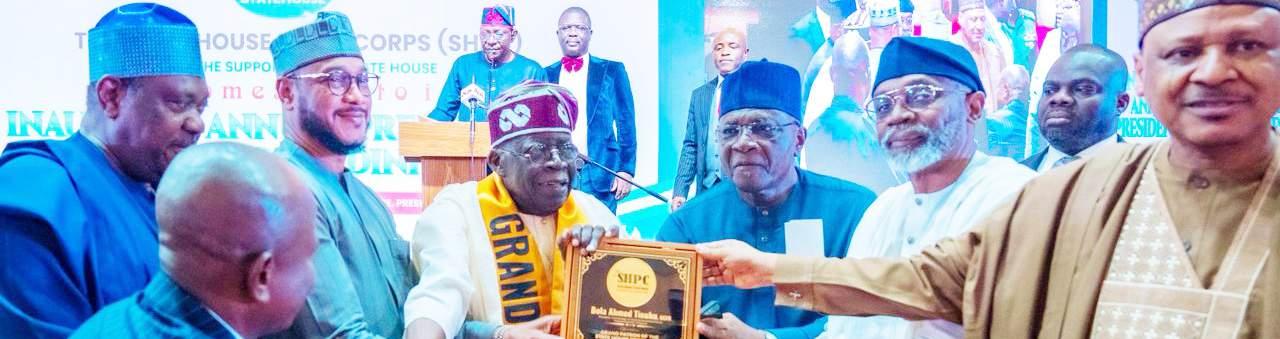
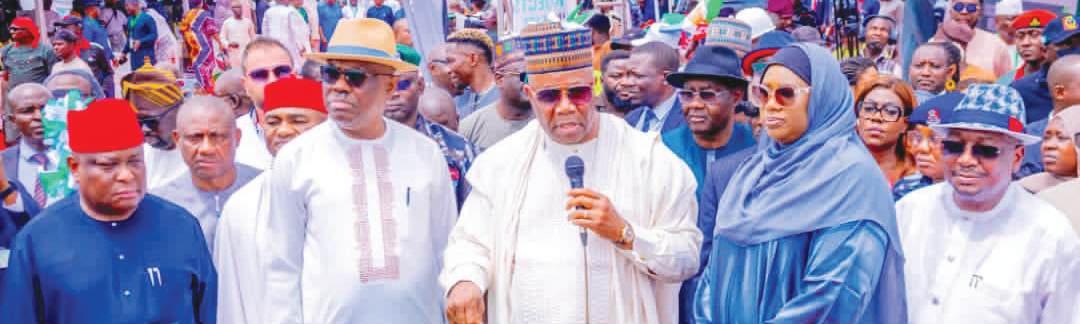
L-R: Chairman, State House Press Corps, Emmanuel Anule; Secretary to the Government of Federation, George Akume; Zamfara State Governor, Dauda Lawal; President Bola Tinubu; Special Adviser to the President on Information and Strategy, Bayo Onanuga; Chief of Staff to the President, Femi Gbajabiamila, and Minister of Information and National Orientation, Mohammed Idris, during the conferment of Grand Patron of the State House Press Corps on the President at the Inaugural Press Corps Dinner in Abuja PHOTO: GODWIN OMOIGUI
Linus Aleke in Abuja Security experts have expressed divergent opinions on Nigeria’s capacity to independently sustain counterterrorism operations following the recent drawdown
Continued on page 5
GHL Floors First Bank as Supreme Court Orders Handover of FPSO to Oil Company
Voids appeal court judgement Says FBN failed to meet MoU obligations to GHL
Lawyer: Nigeria lost $70m to oil company, bank’s legal battle
Alex Enumah in Abuja
The apex court issued the order shortly after it set aside the orders of the Court of
Continued on page 5
In a landmark judgment that reshapes one of Nigeria's most closely watched oil industry disputes, the Supreme Court yesterday ordered the immediate handover of the crude oil aboard the FPSO Tamara Tokoni to General Hydrocarbons Limited (GHL), overturning the basis of the prolonged legal tussle.
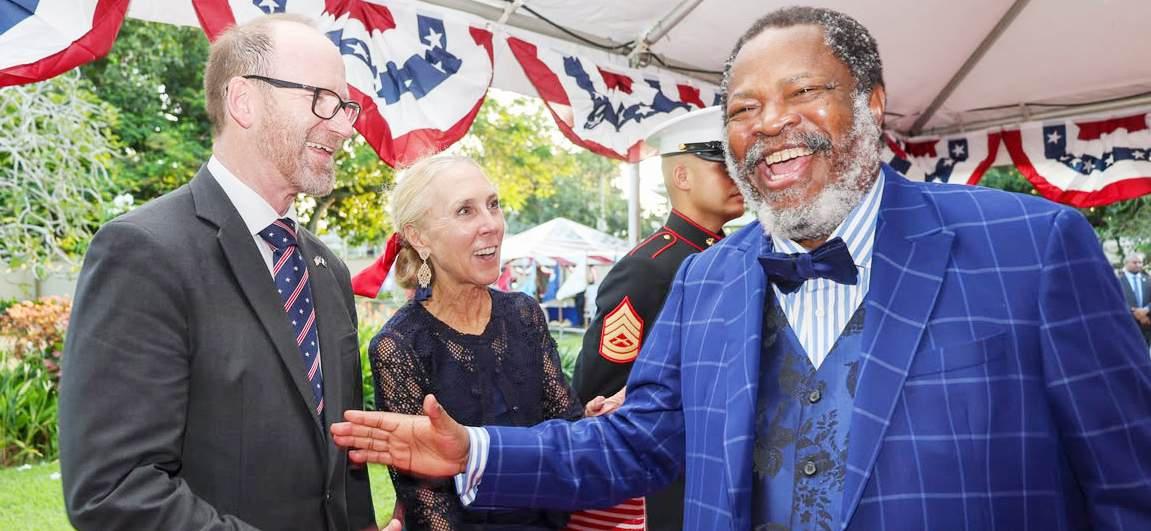
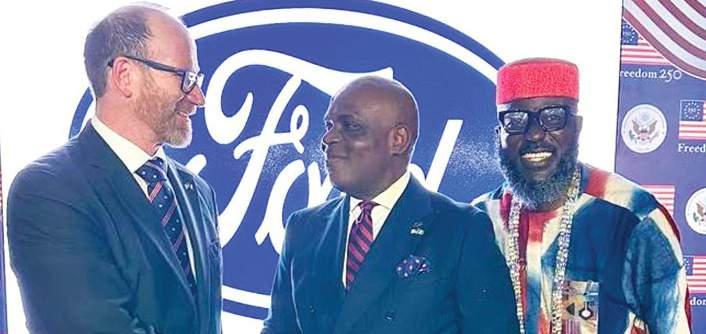
States Consul General, Rick Swart; his spouse, Mrs. Bonnie Swart, and Chairman and Editor-in-Chief, THISDAY/ARISE Media Group, Prince Nduka Obaigbena, during the 250th US Independence Day celebration in Lagos…recently
2027: INEC Extends Nationwide CVR by Two Weeks
Adedayo Akinwale in Abuja
The Independent National Electoral Commission (INEC) has extended the ongoing nationwide Continuous Voter Registration (CVR) exercise by two weeks.
INEC's National Commissioner & Chair, Information and Voter Education, Mohammed Kudu Haruna, in a statement issued yesterday, said it resolved to
of United States troops from parts of the country.
The development comes after the United States reduced its troop presence in Nigeria following the May operation that led to the killing of Abu-Bilal al-Minuki, the second-in-command of ISIS in the Lake Chad Basin.
This comes as the Chief of the Air Staff (CAS), Air Marshal Sunday Kelvin Aneke, called for the integration of air power, intelligence and joint military operations to effectively tackle Nigeria's evolving security threats, stressing that no single security service can address the country's increasingly complex challenges in isolation.
Air Marshal Aneke made the call while delivering a lecture titled, "Air Power and National Security: The Nigerian Air Force in Perspective," to participants of National Defence College Course 34 at the National Defence College (NDC), Abuja yesterday.
The Commander of US Africa Command (AFRICOM), Dagvin Anderson, announced the
Appeal, which directed that the crude oil aboard the FPSO Tamara Tokoni be sold and the proceeds placed under the custody of court officials pending the outcome of a dispute between First Bank of Nigeria and GHL.
This comes as one of the lawyers to GHL, Ojukwu Chikoso, SAN, while advising Nigerian banks to allow investors concentrate on their business as going concerns, revealed that Nigeria as a country lost over $70 million due to the legal battle between FBN and GHL. The senior lawyer therefore
of operations.
The lender further said Nigeria's power sector presents both one of the country's biggest development challenges and one of its largest investment opportunities, pointing out that resolving longstanding electricity constraints would reduce operating costs for businesses, improve productivity and unlock greater private sector investment across the economy.
The Managing Director, Sub Saharan Africa (SSA), EBRD, Heike Harmgart, disclosed
extend the exercise following the feedback received from its State Offices, political parties, civil society organisations, and other stakeholders.
The nationwide CVR exercise commenced on 18th August, 2025 and was originally scheduled to conclude on 10th July 2026.
Haruna noted: “In order to provide additional opportunity for eligible citizens who are yet to register, the Commission
withdrawal on Thursday at a press briefing in Luanda, Angola, after the 2026 African Chiefs of Defence Conference, noting that Washington would nonetheless maintain its intelligence partnership with Nigeria.
While analysts acknowledge that the withdrawal may reflect confidence in Nigeria’s kinetic military capabilities, they cautioned that it does not necessarily translate into full operational self-reliance. They emphasised that intelligence remains the decisive factor in modern counterterrorism, often determining operational success or failure.
According to them, despite significant battlefield gains recorded by Nigerian forces, persistent insecurity points to enduring structural weaknesses in intelligence generation, coordination and technological integration. They therefore advocated comprehensive reforms within the intelligence architecture, including stronger surveillance systems, improved inter-agency data sharing and
urged the Central Bank of Nigeria (CBN) to be alive to its responsibilities, arguing that the court case revealed that the apex bank was not doing enough to control the activities of some banks.
A three-member panel of the appellate court sitting in Abuja, had last year, set aside the ruling of Justice E.A Obile of the Federal High Court, Port Harcourt, which had in March last year, dismissed the case of FBN against GHL, in respect of the cargo of crude on board FPSO Tamara Tokoni.
After setting aside the judgment of the trial court,
this during a media chat following the opening of the European bank's Lagos office, its first in SSA.
She reiterated that EBRD was encouraged by the pace of opportunities in Nigeria and expected investments to accelerate as its local operations expand.
She explained that Nigeria only became eligible for EBRD financing after becoming a shareholder in July 2025 and a country of operations in October of the same year.
Harmgart said: "Nigeria only became a shareholder of the EBRD last July
has extended the exercise to Friday, 24th July 2026.
“The extension underscores the Commission's commitment to ensuring that every eligible Nigerian has a fair and reasonable opportunity to be included in the Register of Voters ahead of future electoral activities.
“In furtherance of its commitment to innovation, accessibility, and improved service delivery, the Commission is pleased to
increased investment in human intelligence to enable more precise and proactive operations.
In a telephone interview with THISDAY, former Director of the Department of State Services (DSS), Mr. Mike Ejiofor, described the withdrawal as premature, arguing that US forces ought to have remained longer, particularly in light of what he characterised as one of the most significant terrorist incidents since 9/11. He warned that insurgent groups often exploit any reduction in military pressure to regroup and escalate attacks.
Ejiofor further cautioned that the public disclosure of the withdrawal may generate unnecessary anxiety, suggesting that such movements are usually better managed discreetly. However, he stressed that security cooperation and operational synergy between US forces and the Nigerian Armed Forces remain active.
He added that under the current leadership of the DirectorGeneral of the DSS, Oluwatosin Ajayi, there has been improved coordination, inclusiveness and
the three-member panel led by Justice Hamma Barka, had ordered that the crude be sold and that the proceeds be paid into a court-administered escrow account, pending the hearing and determination of the arbitration and other processes currently ongoing.
According to the justices, the order was made in the interest of justice and the need to preserve the "res" (subject matter) of the case, pending the determination of the case at the high court and before an arbitration panel.
Taken aback by the appellate court's verdict, GHL had
and became a country of operations last October. So, we can only invest and start developing projects in Nigeria since October 2025. Before October 2025, we could not work in Nigeria because Nigeria was not a shareholder.
"Since October 2025, we have invested including the trade finance $280 million. Since the beginning of the year, it is $180 million because we did $100 million last year.
"We are very demanddriven, we are working on projects as they come. We don't have an envelope that
announce the introduction of a self-service registration option (online) for eligible first-time voters.
“The new service will become available from Wednesday, 8th July, 2026 through the Commission's dedicated CVR portal - cvr. inecnigeria.org where the step-by-step guide is also provided.”
The National Commissioner explained that the self-service option
inter-agency collaboration within Nigeria’s security architecture.
Professor of Political Science and International Relations at Benue State University, Makurdi, Attah Pine, said the deployment of about 200 US soldiers to support Nigeria’s counterterrorism operations in the Lake Chad region initially demonstrated Washington’s confidence in the Nigerian Armed Forces. He suggested that their withdrawal may be linked to a perceived reduction in the ISIS threat in the Sahel, including the reported killing of its second-in-command.
“Intelligence is the engine room of any military operation. Remove intelligence, and everything else becomes guesswork. For there to be positive results, intelligence must precede combat operations. In any case, intelligence and kinetic action are mutually inclusive to the success of any operational endeavour,” he said.
Retired Commissioner of Police, Dr. Emmanuel Ojukwu, said Nigeria’s initial invitation
approached the apex court to set aside the September 11 judgment of the Court of Appeal against its assets.
The appellant among others argued that the lower court erred in law, when it made the orders against the assets of the appellant, adding that the appellate court lacked the necessary jurisdiction to hear the case of FBN.
Delivering judgment in the appeal yesterday, the five-member panel of the apex court held that the suit instituted by First Bank of Nigeria was contractual in nature and not an admiralty
says Nigeria we will do X in 2026, or we can maximally do this amount.
“If we have lots of good projects, we will do lots of investments. We still have to learn a lot as we are new and just opened our office and have only recently started building the team.”
According to her, "This year is looking good. We are probably looking at around $300 million this year, but we don't have a ceiling or fixed target as such, but we want to use as many opportunities as possible.
“Over the next three years,
would enable eligible citizens to initiate and complete their voter registration process, including biometric capture, using their personal devices without having to physically visit an INEC office.
He noted that the system incorporates robust identity verification, biometric validation, and backend integrity checks designed to preserve the credibility and accuracy of the National Register of Voters.
to the United States to support counterinsurgency efforts was likely guided by strategic mutual interests. He added that the withdrawal may also be consistent with the terms of the bilateral agreement between both countrie.
Speaking on intelligence-led operations in Nigeria and the wider Sahel region, Ojukwu said modern intelligence gathering is increasingly driven by technology, with Nigeria steadily building capacity to collect, process and deploy actionable intelligence alongside conventional methods. He stressed that this remains a work in progress.
The Director-General of the Institute for Peace and Conflict Resolution (IPCR), Dr. Joseph Ochogwu, said the US troop withdrawal reflects the professionalism and adaptive capacity of the Nigerian military in responding to contemporary security challenges through the deployment of modern technologies. He said this was evident in targeted joint operations
matter.
Although, the lead judgment was prepared by Justice Emmanuel Agim, it was read by Justice Habeeb Abiru.
Other members of the panel led by Justice Mary Uwani Abba Aji, Justice Ibrahim Saulawa and Justice Uwa Chidiebere held that the trial court lacked the necessary jurisdiction to entertain the suit brought by FBN, on the grounds that the nature of the suit was not within the general maritime case that involves the loss or damage of products or cargo.
"The cause of action is breach
our expectation is that we would do a minimum over three years of $1.5 billion. That is an estimate and I hope we do more.
"I also don't want to be overly optimistic, and I think it's just good for us. We have the capital as an institution. We have new shareholders that are ambitious.
“We just had the meeting with the Nigerian Minister of Finance, who wants us to do more. He is now a shareholder representing Nigeria on board, so I think we want to respond.”
Also speaking, EBRD
The Commission urged all eligible Nigerians who are yet to register to take advantage of this extended window and explore the new voter registration technology option.
The Commission said it remained committed to a credible, inclusive and accessible voter registration process, and to advancing the use of technology to improve citizens' experience in the electoral process.
conducted by Nigerian and US forces within the theatre of operations.
He explained that intelligence remains a highly sensitive aspect of military operations, often subject to bureaucratic processes that can delay decision-making and response. While noting that Nigeria is not unique in this regard, he argued that intelligence assessments may either be dismissed as false alarms or validated for action depending on analysis outcomes. Ochogwu called for the removal of unnecessary bureaucratic bottlenecks in complex security environments to enable faster operational responses. He also stressed the importance of continuous learning and adaptation among frontline security operatives, recommending that they be empowered to act on credible intelligence without always awaiting directives from headquarters. According to him, such decentralised authority would significantly reduce the activities of criminal networks.
of the financing agreement by the appellant not paying the proceeds of the crude oil produced and lifted from OML120 into a collection account maintained by the appellant with 1st respondent and diverting same elsewhere. "A dispute over the diversion of sale of proceeds of produced and lifted crude oil in breach of a financing agreement is fundamentally a banking and commercial dispute. It is not a dispute over ownership of the FSPO, the cargo of crude oil or a ship's freight. The contractual
Continued on page 15
Country Head of Nigeria, Hamza Al-Asaad, said the institution had no predetermined sector allocation for the West African country, stressing that it was largely demand-driven but had identified infrastructure, energy, agribusiness, manufacturing, digital infrastructure and financial institutions as priority areas with strong investment potential. He said the bank would continue to partner with commercial banks, noting
DIGITAL FINANCE SUMMIT...
PFIPC Scandal: Atiku, ADC, NDC, CSOs, Falana,
Afenifere Demand Probe, Gbajabiamila's Removal
Chief of staff being dragged into criminal enterprise, says presidential aide Arewa youth welcomes State House clarification exonerating Gbajabiamila
The presidential candidate of the African Democratic Congress (ADC), Atiku Abubakar, the leadership of ADC, the Nigeria Democratic Congress (NCN) and the Civil Liberty Organisations (CSOs), human rights lawyer and Senior Advocate of Nigeria (SAN), Femi Falana and the pan-Yoruba socio-political organisation, Afenifere, have called on President Bola Ahmed Tinubu to thoroughly investigate the controversy surrounding the Presidential Foreign Intervention Promotion Council (PFIPC), where the names of the President’s Chief of Staff Femi Gbajabiamila and others were mentioned.
In swift reaction, Senior Special Assistant to the President on Media and Publicity, Mr. Temitope Ajayi, yesterday accused one Prince Matthew Adeniyi Adeyemi, who claims to be the Director General of PFIPC, of exploiting public perception by using corruption allegations to divert attention from investigations into his alleged criminal activities. Also expressing support for the Presidency’s actions so far, the Arewa Youth Consultative Forum (AYCF) has warmly welcomed the detailed State House clarification regarding the controversy surrounding the PFIPC, describing the official statement as a decisive intervention that completely exonerates the Chief of Staff to the President, Gbajabiamila,
Edo State Commissioner of Police, Monday Agbonika, disclosed yesterday that the command arrested 38 kidnappers and rescued 32 kidnap victims in various operations across the state in the month of June 2026.
Agbonika said the command arrested 77 in all, including suspected criminals allegedly involved in violent crimes across the state.
Addressing journalists during the command's monthly briefing in Benin, Agbonika further disclosed that the suspects were arrested for alleged kidnapping, cultism, armed robbery, murder, unlawful possession of firearms, rape, and defilement.
Breaking down the arrests, Agbonika said 32 suspects were
arrested for alleged kidnapping, 15 for cultism, three for armed robbery, 11 for murder, two for unlawful possession of firearms, while 14 suspects were arrested for rape and defilement.
According to him, 38 kidnapped victims were rescued through intelligence-driven operations and coordinated tactical responses.
Agbonika said the suspects included those allegedly involved in the kidnapping of passengers aboard a GUO Transport Company vehicle on the Benin–Akure Road, during which the driver was killed.
He added that the Command also arrested suspected kidnappers who had been terrorising the Benin–Auchi Road, the Benin–Agbor–Warri Road, and their surrounding communities through intelligence-led operations.
from unfounded and malicious allegations.
Atiku warned that failure to institute what he described as a transparent, comprehensive and independent probe would reinforce public suspicion that influential government officials may have benefited from the alleged fraud.
The former vice president, in a statement issued yesterday by his Senior Special Assistant on Public Communication, Phrank Shaibu, said the controversy had gone beyond the alleged actions of one individual and now raised serious questions about the credibility of government institutions and oversight mechanisms.
He argued that the Presidency’s explanation that the PFIPC never existed failed to address how the purported agency allegedly secured office space, interacted with government institutions, processed official transactions and held meetings with foreign
diplomats.
“If the government wants Nigerians to believe that one man single-handedly created an office for himself, secured office space within a government facility, held meetings with foreign embassy delegations, paid courtesy visits to the EFCC, processed staff salaries through official channels and allegedly operated institutional accounts without the knowledge or collaboration of anyone in government, then that narrative raises even more troubling questions than it answers,” Atiku said.
The ADC chieftain maintained that while Adeniyi Adeyemi, identified by the Presidency as the alleged mastermind of the scandal, should answer for any wrongdoing if found culpable, the focus should extend to those who may have enabled the operation.
According to him, the key issue is how a purportedly non-existent government agency
allegedly functioned within official structures without detection.
“At this point, the story looks less like a clean explanation and more like an attempt to isolate one man after an internal arrangement went sour. If Mr. Adeniyi Adeyemi committed fraud, he must face the law. But the bigger question is what kind of government system allows such an elaborate operation to pass through budgetary, administrative, security and institutional channels without detection,” he stated.
Atiku also referenced reports that the PFIPC was captured in the 2026 Appropriation Act with a multi-billion naira allocation and that the Office of the Head of the Civil Service of the Federation allegedly approved the recruitment of more than 300 personnel into the agency.
He argued that such developments could not have occurred through mere administrative oversight.
Onuminya Innocent in Sokoto
The Minister of State for Defence Mohammed Bello Matawalle, yesterday said the recent Federal High Court judgement affirming the leadership of the African Democratic Congress (ADC) under former Senate President David Mark has vindicated President Bola Ahmed Tinubu against allegations of judicial interference and plans to impose a one-party system in Nigeria.
Matawalle stated this in a statement issued by his media aide, Ahmed Dan Wudil. The former governor noted that the court dismissal of the suit filed by House of Representatives
member Leke Abejide challenging the ADC leadership, “had once again demonstrated that President Tinubu remained committed to the independence of the judiciary, due process and the rule of law.”
The minister maintained that despite sustained political attacks by opposition figures and some members of the political elite, the President had never interfered with judicial proceedings or attempted to influence the outcome of politically sensitive cases.
“President Tinubu’s democratic credentials were built long before he became President,” Matawalle was quoted as saying in the statement signed by Dan Wudil.
“So having participated in the struggle for the restoration of democracy, he fully understood the importance of preserving democratic institutions,” he added.
According to Matawalle, “the sanctity of the judiciary remained non-negotiable under the current administration because the President believed that a strong and independent judiciary was fundamental to Nigeria’s democratic survival, political stability and national cohesion.”
The minister accused some opposition politicians of deliberately spreading falsehood and propaganda to discredit the
According to him, the preparation of the national budget and recruitment into the federal civil service involve several layers of approval, making it implausible that a fictitious agency could have operated without institutional backing.
The former vice president further said the conflicting claims by Adeyemi, who has denied forging his appointment documents and insists he was lawfully appointed, make an independent investigation imperative.
“Whether his claims are true or false is not for the Presidency to determine through press statements. That is precisely why Nigeria needs an independent investigation. Let the facts speak. Let every document be examined. Let every approval be traced. Let every official who acted, neglected a duty or enabled this scandal be identified and held accountable,” he said.
President. He alleged that they were quick to accuse Tinubu whenever court decisions did not favour their political interests, but unwilling to acknowledge judgements that reflected the independence of the judiciary.
Matawalle argued that “genuine patriots should be fair enough to commend the President when court decisions clearly showed that democratic institutions were functioning without executive interference.”
On security, the minister said the federal government remained undeterred in its efforts to end insecurity across the country.
Chuks Okocha, Sunday Aborisade in Abuja and James Sowole in Abeokuta
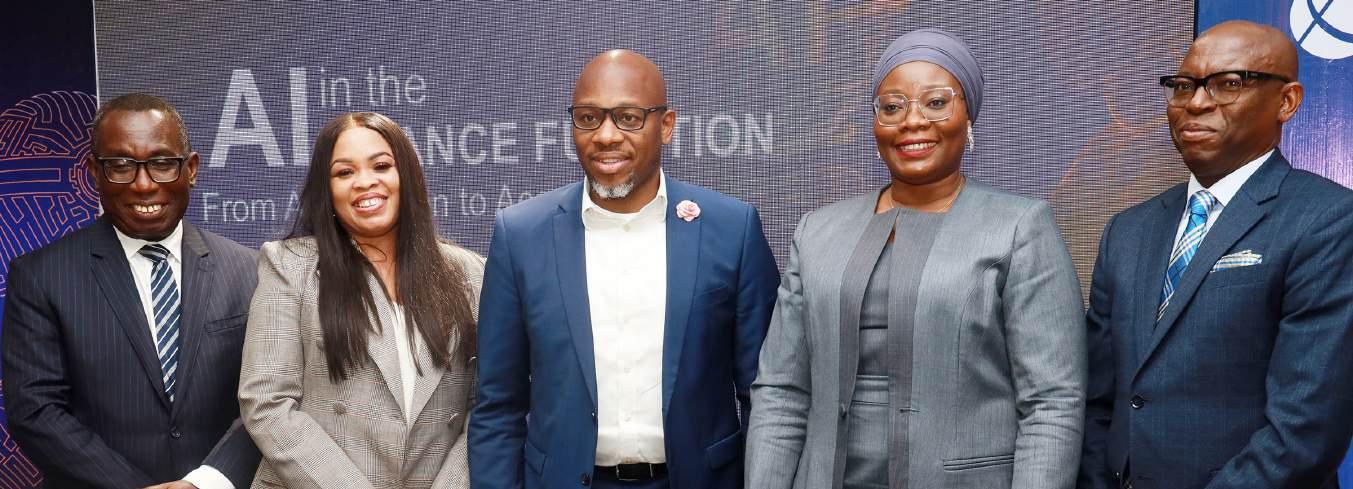
L-R: Dean, Nile Business School, Prof. Noel Tagoe; Country Director, AICPA and CIMA Nigeria, Ijeoma Anadozie; Partner and Head, Tech, Risk, KPMG Africa, Lawrence Amadi; Vice President, Group Audit and Risk, IHS Towers, Temitope Yusuf, and CEO, Manifold Enterprise Solutions, Chukwuma Okpaka during the CGMA Speaks event on AI in the Finance Function-From Automation to Accountability organised by the Chartered Institute of Management Accountant in Lagos...yesterday
PHOTO: ABIODUN AJALA
WEALTH CREATION ON THEIR MINDS...
Emefiele Trial: Obazee Wants Late Buhari, Mustapha, CBN Board Prosecuted over Alleged $6.2m Theft
Alex Enumah in Abuja
The special investigator appointed by President Bola Tinubu, Mr. Jim Obazee, to unravel how the sum of $6.2 million was allegedly stolen from the Central Bank of Nigeria (CBN), under Mr. Godwin Emefiele, yesterday stunned a High Court of the Federal Capital Territory (FCT), when he expressed surprise at the prosecution of only the former CBN governor.
Emefiele is standing trial on a 20-count amended charge bordering on criminal breach of trust, procurement fraud as well as conspiring with some
other persons to move from the apex bank the sum of $6,230,000, purportedly meant for international election observers for the 2023 general elections.
In the charge marked: FCT/ HC/CR/577/2023, he was also accused of forgery, abuse of office, as well as conferring corrupt advantages on two companies, April 1616 Nigeria Ltd and Architekon Nigeria Ltd, while in office.
He however denied committing the alleged offences and has since been admitted to bail.
As part of efforts at establishing the allegations against Emefiele,
Delta to Employ Secondary Schools’ Teachers, Institutionalise 13 Month Salary for Civil Servants
Sylvester Idowu in Warri
Delta State Government has said the 13 month salary announced by Governor Sheriff Oborevwori will become institutionalised in the State.
The State Commissioner for Works (Rural Roads) and Public Information, Mr Charles Aniagwu, made the disclosure yesterday on behalf of the Governor during a post executive council media briefing in Asaba. Aniagwu, who addressed the media alongside the Commissioner for Health, Dr Joseph Onojaeme and the Commissioner for Transport,
Mr Onoriode Agofure, said the approval would pave the way for an executive bill to be transmitted to the Delta State House of Assembly for legislative backing.
He said a bill would be forwarded to the state House of assembly so as to make it a law in Delta State for the period of the tenure of Sheriff Oborevwori as governor of Delta state.
According to him, the move was aimed at ensuring that the payment of the 13th-month salary is no longer dependent on the discretion of any administration but becomes a legal entitlement for civil servants in the state.
the prosecution; the Economic and Financial Crimes Commission (EFCC), yesterday called its 15th and last witness in the case. Obazee, who was being led in evidence by EFCC's lawyer and Director Public Prosecution of the Federation, Mr. Rotimi Oyedepo, SAN, midway into the proceedings demanded that all those mentioned in the alleged crime must be brought before
the court for trial.
Those he specifically mentioned included the late former President Muhammadu Buhari and former Secretary to the Government of the Federation (SGF), Mr. Boss Mustapha.
Others were a staff of the CBN, Bashirudeen Maishanu, from whom the witness claimed he personally recovered the sum of $856,500; a "staff" in the office
of the former SGF, the Abuja branch manager of the CBN as well as the Board of Governors of the apex bank. In an apparent displeasure with only Emefiele in the dock, the witness queried in the open court why the others are not standing over the stealing of the $6.2 million from the federal government foreign exchange account domiciled at the CBN.
Obazee's position was prompted by a letter from the Presidency alleging that the ex- President Buhari, had signed for the release of the $6.2 million and another letter by the office of the SGF, ordering the former CBN governor to effect the release of the money to one Jibril Abubakar, introduced as a staff of the office of the SGF to collect the money.
Peter Obi: Nigeria's Education Sector Needs Fundamental Reforms to Drive Economic Growth
Sunday Aborisade in Abuja
Presidential candidate of the Nigeria Democratic Congress (NDC) in the 2027 general election, Mr. Peter Obi, yesterday, accused the federal government of mismanaging Nigeria's education sector, insisting that the country's worsening learning outcomes require a fundamental overhaul
of governance rather than mere policy adjustments.
Reacting to the federal government's recent admission that the separation of junior and senior secondary schools had failed to improve educational outcomes, Obi said the education crisis reflected years of poor leadership, inadequate funding and weak implementation of policies.
In a statement posted on his X account, Obi argued that the government's acknowledgement of the policy failure underscored deeper structural problems in the sector.
He cited recent examination results as evidence of the declining standard of education, noting that only 38.32 per cent of candidates passed both English Language and Mathematics in
the 2024 West African Senior School Certificate Examination (WASSCE), while only 32 per cent reportedly passed the computer-based WASSCE in 2025.
According to him, the consistently poor performance recorded in major public examinations over the past two years demonstrates the urgent need for comprehensive reforms.
US 250th Independence Day Celebrations Ramp Up, Trump Heads to Mount Rushmore
Sunday Ehigiator with agency report
Festivities commemorating the 250th anniversary of American independence ramped up across the United States yesterday, as demonstrations of national pride — and hints of political polarisation — were balanced with efforts to stay safe as much of the country baked under extreme heat.
Gunmen Kill Former Benue SSG
A former Secretary to the Benue State Government (SSG), Prof. David Salifu, has died from gunshot wounds sustained during an attack by suspected gunmen along the Wukari–Joota Road in Katsina-Ala Local Government Area, a border corridor between Benue and Taraba states.
Salifu, a Professor of Public Administration and former Dean of the Faculty of Social Sciences at the Federal University Wukari, was reportedly on his way to Makurdi to attend the burial of his uncle when his vehicle came under attack. He was shot in the stomach
during the incident and was initially taken to a hospital in Wukari, where surgeons successfully removed the bullets lodged in his abdomen. He was later referred to the Federal Medical Centre (FMC), Makurdi, for further medical attention but died around midnight on Thursday.
President Donald Trump will travel to South Dakota to deliver a speech and watch fireworks at Mount Rushmore. And in a novel twist, there will be a
ball drop in New York City’s Times Square at midnight to usher in the July Fourth holiday with much the same revelry that is typically reserved for New Year’s Eve.
The sound of fighter jets on military flyovers shook the nation’s capital, the Associated Press reported. In New York City, Mayor Zohran Mamdani delivered his own address on the country’s 250th anniversary that cast America as a nation of contradictions “working each day towards the perfection in which it was conceived.”
Ex-CNN Anchor, Aisha Sesay, Stars On Station’s Glo-sponsored African Voices
Ace journalist and former CNN International’s anchor, Aisha Sesay, will this week return to the studio of the news medium, not to interview a guest but to feature on the 30-minute magazine programme, African Voices. The programme is sponsored by telecommunications company, Globacom. The 50-year-old BritishSierra-Leonean who was born on January 6, 1976 gained popularity as a result of her extensive career on the international news medium, which she joined as a news anchor in 2005 having previously worked with the British Broadcasting Corporation
and Sky.
(BBC)
L-R: Executive Director, Optiva Capital Partners, Dr. Amaka Okeke; CEO Mercan Group Portugal, Jerome Jerry Morgan; Chairman, Optiva Capital Partners, Franklin Nechi, and Immigration Attorney, Portugal, Inez Costa, at an Exclusive Investor Session hosted by Optiva Capital Partners…recently
TRANSCORP HOTELS 16TH WOMEN EMPOWERMENT COHORT...
FG Clears N39.6bn Long-standing Pension Arrears under Defined Benefit Scheme
Ndubuisi Francis in Abuja
The federal government has successfully settled over N39.6 billion in longstanding pension liabilities under the Defined Benefit Scheme (DBS).
The Executive Secretary of the Pension Transitional Arrangement Directorate (PTAD), Mrs. Tolulope Odunaiya, made the disclosure when she paid a visit to the Minister of Finance and Coordinating Minister of the Economy, Mr. Taiwo Oyedele.
Odunaiya's briefing during the visit highlighted the clearance of inherited pension obligations that had remained outstanding for years.
According to a statement issued by the Head, Information and Public Relations, Federal Ministry of Finance, Efe Ovuakporie, the PTAD Executive Secretary told the minister that the payments comprised
N25.05 billion representing the outstanding 35-month pension liability owed to 9,675 eligible pensioners of the defunct NITEL/MTEL; N9.48 billion representing the initial 50 per cent payment of the Back End Computation (BEC) arrears to 3,959 eligible PHCN pensioners.
Others are N5.09 billion representing the balance 50 per cent payment of the 10.66 per cent and 12.95 per cent pension increment arrears due to 11,180 eligible pensioners of the defunct Assurance Bank, NICON, NITEL and People's Bank of Nigeria.
She explained that the settlement followed presidential approval granted in August 2025, with the required funding subsequently provided under the 2026 Appropriation Act.
the Defined Benefit Scheme, providing long-awaited relief to thousands of pensioners. Commending PTAD for the successful execution of the exercise, the minister said the
settlement underscored the federal government's resolve to address longstanding obligations through prudent fiscal management and responsible governance.
"For many pensioners, this is more than the settlement of outstanding arrears; it is the restoration of confidence and dignity. The Ministry of Finance will continue to support measures that strengthen public financial management while ensuring that government obligations are met in a sustainable and timely manner," Oyedele said.
Access Holdings, Coronation Group Celebrate Enduring Legacy of Nigerian Modernism
Nume Ekeghe
Access Holdings Plc and Coronation Group hosted a private reception at Tate Modern, London, to celebrate the enduring legacy of Nigerian Modernism, one of the most significant presentations of African art in the gallery’s recent programme.
works on paper, it traced the evolution of modern Nigerian art from the 1940s through the post-independence era, offering fresh perspectives on the political, social, and cultural forces that shaped modern African expression.
reflected on what he described as one of the exhibition's most enduring achievements: its impact on young people.
Adebola Williams Joins Global Leaders at Gnaoua Music Festival, Human Rights Forum in Essaouira
of culture in shaping more inclusive societies.
This year’s Forum focused on the future of youth, identity and citizenship in an era marked by uncertainty, conflict and rapid transformation, a statement explained.
According to her, the exercise has now brought to a close all inherited pension liabilities under Pan-African media entrepreneur and nation builder, Adebola Williams, Founder of RED Africa and the MITTA Africa Centre, joined global thought leaders at the 13th Human Rights Forum of Essaouira.
The event was held alongside the internationally acclaimed Le Festival Gnaoua et Musiques du Monde in Morocco.
Recognised as one of Africa’s foremost gatherings celebrating cultural dialogue, music and human rights, the festival brings together artists, policymakers, activists, academics and social entrepreneurs from around the world to explore the role
Drawing on more than 25 years of building platforms that amplify African voices and youth leadership, Williams reflected on a career driven by a simple conviction: that when hopelessness meets helplessness, societies become vulnerable but when young people are equipped with purpose, opportunity and agency, they become the architects of national transformation.
The Nigerian Modernism exhibition, in partnership with Tate Modern from October 10, 2025, to May 8, 2026, brought together nearly 300 works by more than 50 artists spanning five decades of Nigerian artistic production. Through painting, sculpture, textiles, ceramics, and
During its run, the exhibition attracted more than 180,000 visitors, while its reach extended far beyond the gallery through international media coverage, digital engagement, educational programming, and scholarly discourse that connected hundreds of millions of people worldwide with the story of Nigerian modern art.
Beyond its critical acclaim, Nigerian Modernism succeeded in democratising access to African art, creating opportunities for young people and members of the African diaspora to engage directly with African creativity, history and artistic expression at one of the world's leading cultural institutions
The evening convened leading figures from business, culture, diplomacy, academia and the arts in recognition of the exhibition's international impact and cultural significance.
In his remarks, Aigboje AigImoukhuede, Chairman of Access Holdings and Coronation Group,
“One of the aspects of this exhibition that stands out most for me is the opportunity we created for nearly 2,800 students, many of them of African heritage, to experience Tate Modern. While their encounters with the artworks could not be formally documented, the feedback we received spoke volumes. For many of these young people, the exhibition inspired a deeper appreciation of their heritage, reinforcing their sense of identity and pride in their African roots.”
Aneke Launches Double Empowerment Scheme for Barrack Youths
The Chief of the Air Staff (CAS), Air Marshal Kelvin Aneke, has reaffirmed the Nigerian Air Force's commitment to tackling unemployment within its bases with the launch of a two-pronged empowerment initiative for barrack youths. The initiative, comprising the CAS Fellowship Programme and
the CAS Youth Technical and Vocational Skills Development Programme, is designed to equip young people with practical skills and opportunities for self-reliance, promote economic independence and support community development.
Speaking at the official unveiling of the programmes, Air Marshal Aneke said the Nigerian Air Force recognises that the strength of any
military institution lies not only in its operational capability but also in the well-being, development and empowerment of its human capital.
He described the initiative as a significant investment in the future of young people within NAF communities.
He said, "This is a landmark initiative deliberately designed to uplift, inspire, and equip
young people within our base communities with the skills and opportunities they require to thrive in an increasingly competitive world. Today’s event goes beyond the launch of a programme; it represents the ignition of hope, the unlocking of latent potential, and a renewed commitment to the welfare and future of Nigerian Air Force personnel and their families.
NMH Unveils Nigeria's First Mental Health Policy Tracker
Charles Ajunwa
Nigerian Mental Health (NMH) has launched Nigeria’s first public-facing Mental Health Policy Commitment Tracker, an
accountability platform designed to independently monitor whether mental health policy commitments are translating into measurable action across Nigeria.
A statement said the launch followed an initial public unveiling on May 28, 2026, at the close of Mental Health Awareness Month.
and civil society organisations to review the platform, contribute grassroots insights, and submit implementation details from their local communities to anchor the tracker’s operational success.
Linus Aleke in Abuja
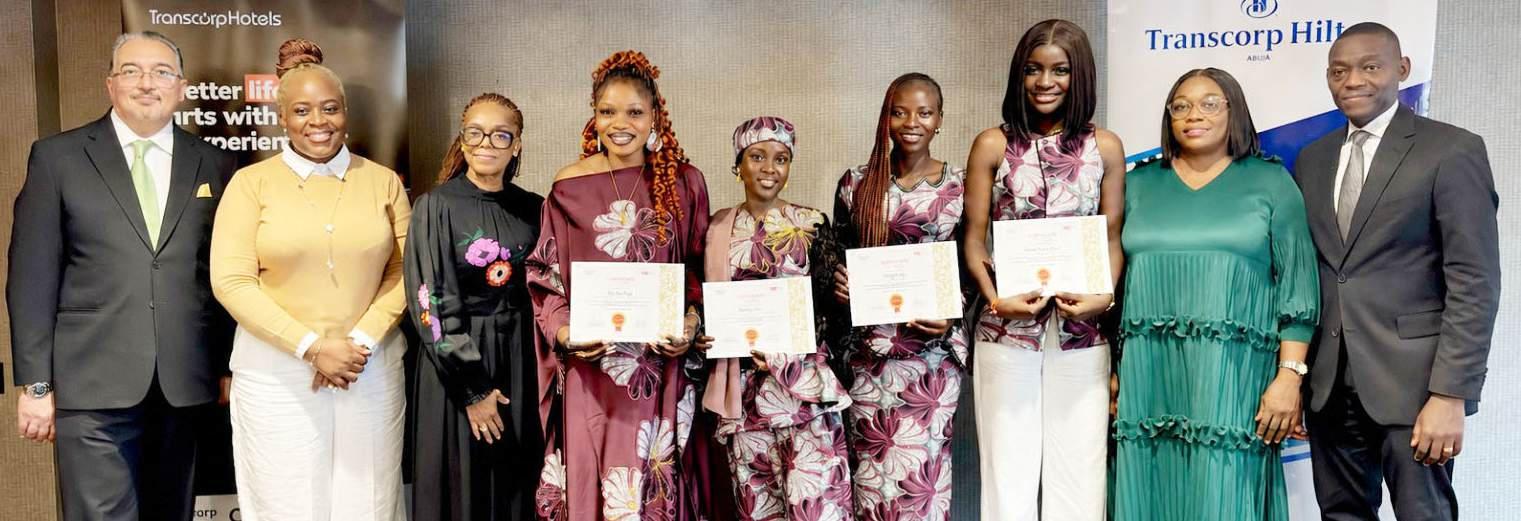
L-R: Hotel Manager, Transcorp Hilton Abuja, Mohamed Said Khalil; Communications and Marketing Manager, Ijeoma Osuji; MD/CEO, Transcorp Hotels Plc, Uzoamaka Oshogwe; members of the 16th graduating cohort of the Business Empowerment Programme for Women (BEPW) Initiative; Head of Office, ACE Charity, ; Eno Simon, and Head of Human Resources, Transcorp Hilton Abuja, Johnson Jock, during the BEPW 16th Graduation Ceremony in Abuja, on Thursday.
A GOLDEN TOAST TO THE ILLUSTRIOUS C LASS OF
1976
OF THE NIGERIAN LAW SCHOOL
Fifty years ago, that is, on 4th July, 1976, we set forth as dreamers from diverse backgrounds, bearing different convictions and aspirations, yet united by a common purpose: the noble quest to embrace the law, uphold justice, and lend our modest quota to the advancement of humanity.
Time has carried us through many seasons, softened some edges, expanded our w i s d o m , b r o
understanding, advanced our sense of judgement, refined our character, ennobled our spirits and deepened our gratitude.
the unending interplay of divine Providence, the enduring bonds
witness not only to where we have been, but also to our triumphs and
of cherished friendship, the timeless beauty of a reunion that bears legacy.
As we raise our glasses in golden toast to fif ty eventf ul years at the Bar, may the years ahead be adorned with serenity, enriched with
Today, we pause to celebrate, not merely the passage of years, but vitality, ennobled with glad tidings and crowned with longevity.
Happy Golden Jubilee to us all!
LL.D.,
Chief Wole Olanipekun, CFR, OFR, SAN,
D.LITT., FCIArb., FNIALS
Why Akara, Corn And Kulikuli Matter
but also in markets, kitchens, and roadside businesses, argues CHALYA MARYAM
Recent comments by the First Lady, Senator Oluremi Tinubu, highlighting businesses such as akara, roasted corn and kulikuli have generated considerable public discussion. While some interpreted the remarks as encouraging Nigerians to settle for “small businesses,” a broader perspective reveals a much deeper economic message. It is a message that aligns with the Renewed Hope Agenda’s emphasis on entrepreneurship, self reliance, and inclusive economic growth.
Across Nigeria, millions of micro enterprises operate within the informal economy. These businesses may appear small individually, but collectively they form one of the largest drivers of employment, household income, and local economic activity. An akara seller is not merely frying bean cakes. She is running an enterprise that purchases agricultural produce from farmers, buys cooking oil and fuel, pays for transportation, supports local markets, and often employs family members or assistants. The same is true for sellers of roasted corn, kulikuli, fruits, vegetables, and countless other everyday products.
Every naira earned is reinvested into communities, circulating through local economies and supporting multiple value chains. These enterprises provide affordable goods and services while sustaining millions of Nigerian families.
The Renewed Hope Agenda recognises that entrepreneurship exists at every level of society. Economic transformation cannot be achieved by focusing solely on large corporations or high growth technology startups. It must also empower the millions of Nigerians who wake up each day to create value through small businesses.
The real challenge is not that these enterprises are too small. It is that too many remain excluded from opportunities to grow. Many operate without access to finance, digital payment systems, business records, insurance, training, or larger markets. They remain economically productive but financially invisible.
This is where the digital economy becomes a powerful enabler. By connecting informal
Eentrepreneurs to digital identities, digital payments, financial services, business development support, and market opportunities, government can help transform subsistence businesses into sustainable enterprises. A roadside akara seller who accepts digital payments begins to build a financial history. A roasted corn vendor with access to digital marketplaces can reach new customers. A kulikuli producer can expand beyond a neighbourhood market through branding, packaging, and electronic commerce. These are not merely food businesses. They are enterprises with the potential to grow, create jobs, and contribute even more significantly to national prosperity.
The First Lady’s remarks therefore serve as a reminder that dignity of labour remains central to national development. Every legitimate business has value. Every entrepreneur deserves the opportunity to succeed. Economic progress begins not by dismissing humble enterprises, but by creating an environment where they can thrive, scale, and contribute more fully to the nation’s economy.
The future of Nigeria’s economy will be built not only in boardrooms and technology hubs, but also in markets, workshops, farms, kitchens, and roadside businesses across the country. When these entrepreneurs are equipped with the right tools, digital access, and institutional support, they become powerful contributors to inclusive growth.
THESE ARE NOT MERELY FOOD BUSINESSES. THEY ARE ENTERPRISES WITH THE POTENTIAL TO GROW, CREATE JOBS, AND CONTRIBUTE EVEN MORE SIGNIFICANTLY TO NATIONAL PROSPERITY
Seen through this lens, the conversation is not about asking Nigerians to settle for less. It is about recognising the economic potential that already exists in millions of small businesses and ensuring that every entrepreneur, regardless of where they begin, has the opportunity to grow, prosper, and participate in Nigeria’s economic transformation under the Renewed Hope Agenda.
Shagaya is Senior Special Assistant to the President on Entrepreneurship Development in Communications, Innovation and Digital Economy
The Communication Cost Of Governance
Strategic communication helps citizens understand government well enough to judge it fairly, writes TONY USIDAMEN
very government has two responsibilities. The first is to govern. The second is to help citizens understand what it is doing and why it is doing it. Success in the first does not automatically guarantee success in the second.
Examples abound of governments that implemented difficult reforms but failed to carry the public along. There are also those that communicated difficult realities so effectively that even people who disagreed with specific policies understood the rationale behind them.
The difference was not always the quality of policy. More often than many governments realise or acknowledge, it was the quality of communication. That distinction matters more today than at any other time in recent history.
Public opinion is no longer shaped primarily by official statements or newspaper headlines. It is shaped minute by minute across television, radio, online publications, podcasts, WhatsApp groups, X, Facebook, TikTok and countless other platforms where competing narratives constantly vie for attention. In this environment, communication is not a support function of governance; it is an instrument of governance.
Yet governments frequently misunderstand the role of spokespersons. Many assume that their primary responsibility is to respond to critics, defend decisions, and win arguments. The purpose of strategic communication is not to make governments look good. It is to help citizens understand government well enough to judge it fairly. That requires five disciplines: credibility, empathy, clarity, consistency and initiative.
Recent public communication from Nigeria's Presidency provides a useful case study—not because this administration is uniquely challenged, but because the communication dilemmas it illustrates confront governments everywhere. The lessons therefore extend beyond one administration or spokesperson.
Credibility: The Messenger Matters
One of the oldest principles of communication is that audiences evaluate both the message and the messenger. Credibility and trust accumulate over time, and they travel with the messenger. Individuals who once took strong public positions against an administration may later decide to support it. Democracies
allow such evolution. But strategic communication must also reckon with how audiences receive that transition. Whether fairly or unfairly, communicators whose previous public positions sharply contrast with their current advocacy often face a higher burden of persuasion.
That burden is not only about political history. It can be just as much about fit. A technically accurate message delivered by someone the audience struggles to relate to may prove less persuasive than the same message delivered by one they connect with more easily. This is not necessarily a judgment on the individual. It is simply how public perception works.
Every government message is filtered through public perceptions of the messenger.
The messenger can strengthen the message. The messenger can also become the story. When that happens, attention shifts away from policy and towards personality— a costly tradeoff in public communication. Strategic communication therefore pays careful attention not only to what is said, but also to who says it, when it is said, and how it is said.
Empathy Before Explanation
Perhaps the greatest challenge facing any government implementing difficult economic reforms is public frustration. When citizens experience rising prices, declining purchasing power or prolonged uncertainty, they evaluate government communication through the lens of their own lived experience. People first want to know that their reality is understood.
In a recent television interview, a spokesperson for Nigeria's Presidency made remarks suggesting that widespread reports of hunger in the country may be exaggerated because members of his own domestic staff appeared to be coping well.
Whether the remarks were intended to reassure, explain or make a different point matters less than how they were received. Communication is judged not by what is intended, but by what is understood. Empathy, therefore, is not a public relations tactic; it is a strategic necessity.
Clarity: Anticipating Interpretation
Strategic communicators ask themselves one question before they speak: How will this be understood?
Usidamen advises organisations on strategic communications and public affairs.
The future of Nigeria’s economy will be built not only in boardrooms,
SHAGAYA
The Rage of Nature?
Before the Next Lynching
In Praise of President Buhari
Ibrahim H. Abdullahi: Giving Hope to the Hopeless
IWhen President Muhammadu Buhari took over the reins of power on May 29, 2015, Nigeria was sadly a broken state in many respects. As a result of many other factors including bad governance and untold level of corruption, government could not live up to its financial obligations to citizens and service providers at both the federal and state levels.
form of atrocity that should be put past Nigeria’s security personnel.
Indeed one of the first official assignments that President Buhari carried out was the approval of billions of Naira in bailout funds to enable state governors pay something as basic as workers’ salaries. Granting those bailout funds was a huge boost to national security because the pressure of arrears of unpaid monthly salaries building dangerously all over the country was a ticking bomb.
n May 2022, within the hallowed precincts of the Shehu Shagari College of Education in Sokoto State, Deborah Samuel was burnt to death by her fellow students. Her crime was that she allegedly blasphemed Islam. More than four years later, her killers have disappeared through the cracks of Nigeria’s justice system.
Ask the naysayers and they would readily remind you of how long it took President Buhari to appoint his ministers and how that contributed to collapse of the economy as if, without ministers, governance was frozen. But buying that narrative would amount to what a famous Nigerian writer, Chimamanda Adichie, termed “the danger of a single story”. Yet the whole story was that many of our citizens did not know how decrepit a state President Buhari inherited in 2015.
by the EFCC, President Buhari by his action has successfully brought back to the public consciousness the need to treat public funds with the highest level of transparency and accountability.
Crucially, no country that desires to grow can have headless mobs running through its streets, killing and burning people. Mob justice continues to thrive in Nigeria because Nigeria has never made it a priority to hold to account those who kill others while taking the law into their hands.
WAfter keeping treasury looters on their toes and at bay through the EFCC, particularly, President Buhari moved to curb unnecessary spending habits of the nation on what economists call articles of ostentation. Part of the disclosures of the President’s stock taking was how the country frittered away billions in foreign currency by importing goods, which can be produced at home. One of such items was rice, a major staple among Nigerians. By banning rice importation into the country, the President on one hand had saved the nation billions in foreign currency annually.
And, on the other hand, the President has boosted domestic production of rice and in the process had nudged the country into self sufficiency in food production. He also created millions of jobs for young people in the rice value chain.
When Fwimbe Gofwan was killed in Jos a couple of years ago by a mob who mistook him for a thief, nothing was done. Deborah Samuel’s killers walk free today, looking for their next victim.
It was therefore necessary for him to take stock against the background of the fact that the departing government did not, reportedly, cooperate full well with the incoming government in terms of leaving workable handover notes. Although President Goodluck Jonathan was gracious in defeat, many of his appointees were still sulking over what they saw as their personal losses and therefore pulled all the stops to make things difficult for the Buhari government.
Stop Ritual Attacks and Killings
TOn security, he is providing the people with a new lease of life after years of living in fear. He also provided jobs for the youths in the area, just as he built a modern market at affordable prices for market women and men in Nasarawa State.
Last month, Malama Ummulkhair, an Islamic teacher, asked her way to her death in Kaduna State. Her fatal mistake was to ask a group of children for directions as she sought a location. An alarm by a handful of idle women summoned a crowd of jobless criminals, and she was promptly killed and burnt to death, accused of attempting to kidnap children. In a country where the lives of citizens have become cheaper than kitchen salt, the question on the lips of many Nigerians is, where were those sworn to defend Nigerian lives from killers as Malama Ummulkhair was attacked?
What is most admirable about President Buhari and his government is its frugal management of scarce national resources to attain optimum goals.
Recall that since President Buhari stepped in the saddle, oil revenue dropped abysmally as if to sabotage him knowing all the big promises he made to citizens during his campaigns. But with the little resources that trickle in, the President is achieving what governments that received oil windfalls could not dream of.
When the law is weak, the wicked operate easily and without restraint. Nigeria has become such a place where the law is weak.
Even with the obvious and unpatriotic obscurantist behaviour of the PDP appointees and their supporters still in government hell-bent on making things difficult for Buhari, the President moved on with his methodical repair of a broken country. The first thing he did was to identify all possible sources of income to the nation and directed that all inflows be paid into one single account in line with the policy of Single Treasury Account (TSA).
The TSA policy, interestingly, was mooted by the PDP government but its penchant for imprudence and lack of accountability denied it the courage of implementing the policy. What the President literally did was to gather all the nation’s money into one box and locked it up with a big padlock and watched for any thief to come close.
Ike Willie-Nwobu, Ikewilly9@ gmail.com.
hatever is used as measurement of success would see Prince Ibrahim Hassan Abdullahi (Adon Gari Lafia Bare-Bari) qualified as excellent. He is an achiever. He has performed beyond the expectations of the masses. He has provided the basic necessity of life to many people of Nasarawa State and its environs. He has also given hope to the hopeless by donating books, mathematical sets and other essential items to students of the council.
Many roads in Nasarawa State were not motorable, until Prince Abdullahi put smiles on the faces by constructing roads, and building schools equipped with computers. He also built healthcare centres for the masses in addition to recreation centres.
Today, the trains are up and running daily from Abuja to Kaduna. And from Lagos to Ibadan a brand new rail track was started and completed; citizens are already commuting daily to and fro these two major cities in the country seamlessly as they reap from the dividends of democracy. And with the way this government is going, before 2023 when the President would leave, the entire country would be linked by rail with all of its economic advantages.
Ainofenokhai Ojeifo, Abuja
THE SATURDAY NEWSPAPER
THE SATURDAY NEWSPAPER
EDITOR YEMI ADEBOWALE
DEPUTY EDITOR AHAMEFULA OGBU
MANAGING DIRECTOR ENIOLA BELLO
DEPUTY MANAGING DIRECTOR ISRAEL IWEGBU
Who can blame the President for almost developing paranoia over the safeguard of the national treasury with revelations and reports of mind-boggling looting that took place in the 16 years of the PDP? With such disclosures of how billions meant for fighting insurgency in the Northeast ended up in the pockets of a few individuals while our gallant soldiers fought with bare hands and on empty stomach, President Buhari was duty bound to bring sanity and accountability back in national spending.
As the fog of his grief cleared a bit, Malama Ummulkhair’s grief-stricken husband made a startling revelation cum accusation. According to him, his wife had somehow found her way to a police station where she was supposed to be safe from the alarmist killers. Instead, the DPO, rather than protect her from the crowd baying for her blood, pushed her out to her death. Expectedly, the authorities of the Nigerian police force have denied this while ordering an investigation.
In a country where those who enforce the law are often missing in action when it matters most, there is
Thus, under President Buhari, the Economic and Financial Crimes Commission (EFCC), which had remained comatose for years, was woken up to resume its duties. Apart from the trillions of Naira of looted funds and property recovered from corrupt politicians
DEPUTY MANAGING DIRECTOR ISRAEL IWEGBU CHAIRMAN EDITORIAL BOARD OLUSEGUN ADENIYI
CHAIRMAN EDITORIAL BOARD OLUSEGUN ADENIYI
EDITOR NATION’S CAPITAL IYOBOSA UWUGIAREN
EDITOR NATION’S CAPITAL IYOBOSA UWUGIAREN THE OMBUDSMAN KAYODE KOMOLAFE
MANAGING EDITOR BOLAJI ADEBIYI THE OMBUDSMAN KAYODE KOMOLAFE
THISDAY NEWSPAPERS LIMITED
THISDAY NEWSPAPERS LIMITED
EDITOR-IN-CHIEF/CHAIRMAN NDUKA OBAIGBENA
EDITOR-IN-CHIEF/CHAIRMAN NDUKA OBAIGBENA
GROUP EXECUTIVE DIRECTORS ENIOLA BELLO, KAYODE KOMOLAFE, ISRAEL IWEGBU
GROUP EXECUTIVE DIRECTORS ENIOLA BELLO, KAYODE KOMOLAFE, ISRAEL IWEGBU, IJEOMA NWOGWUGWU, EMMANUEL EFENI
DIVISIONAL DIRECTORS SHAKA MOMODU, PETER IWEGBU, ANTHONY OGEDENGBE
DIVISIONAL DIRECTORS SHAKA MOMODU, PETER IWEGBU, ANTHONY OGEDENGBE
DIRECTOR, PRINTING PRODUCTION CHUKS ONWUDINJO TO SEND EMAIL: first name.surname@thisdaylive.com
TO SEND EMAIL: first name.surname@thisdaylive.com
Prince Abdullahi has never failed to use any opportunity to call on his colleagues to help on youth development in the State. He established a Foundation through which he caters for the less privileged and destitute, and has helped thousands of people through the foundation. The foundation has helped widows by giving them cash to start small businesses.
Prince Abdullahi made indelible marks in the area of education by purchasing GCE forms for the less privileged and destitute with no hope for their children to further in their education. He has given voice to the voiceless, the hallmark of a good leader.
Adeolu Anjorin, Lafia, Nasarawa State
A Champion?
e have two tennis players, one perhaps the greatest ever woman player and one so nervous she forgot to warm up, which is the better player?
he Advocacy for Alleged Witches (AfAW) urges the Nigerian public to stop ritual attacks and killings because the notion of ritual money and wealth is completely baseless. AfAW is making this call following the reported arrest of suspected ritualists in Oyo State in southern Nigeria. The local media reported that members of the Western Nigeria Security Network, Amotekun, arrested suspected ritualists with the body parts of a 73-year-old man. The suspects, who were apprehended in the Boluwaji area in Ibadan, said that a Muslim cleric asked them to procure some human body parts for rituals. Ritual attacks are widespread in Nigeria. Irrational conceptions of how to make money or become wealthy and successful undergird these atrocities. Many Nigerians strongly believe in blood money, known in some local languages as Ogun Owo (Yoruba) or Ogwu ego (Igbo). They think that they could become rich, or successful through ritual sacrifice. Unfortunately, this is not the case. Ritual wealth has no basis in reason, science, or reality. Home movies known as Africa magic or Nollywood films have not helped matters. These movies continue to reinforce these mistaken notions and other superstitions. Families, churches, mosques, and other public institutions do not encourage the interrogation of these traditional occult beliefs. There are no robust efforts to criticize or dispel these irrational and paranormal claims in schools, colleges, and universities. So millions of Nigerians grow up blindly believing that they could make money through ritual sacrifice of human body parts. The belief has led many Nigerians to commit crimes and perpetrate atrocities. Many Nigerians have been jailed or are undergoing court trials due to ritualrelated attacks and murder.
Maya Joint has managed to beat Serena fairly easily in the match and presented herself well at the after match conference whereas Serena did a dummy spit and skipped the conference.
Being a champion is a privilege and a responsibility and sometimes you need to know when to back out honourably.
Not too long ago, the police arrested some young Nigerians for stealing female pants, which they intended to use for ritual sacrifice. AfAW is asking all Nigerians to desist from ritual-related abuses because ritual money beliefs are baseless superstitions. Nigerian media, schools, and colleges should help educate and reorient the public. They should assist in reasoning Nigerians out of this killer-superstitious absurdity and nonsense.
Leo Igwe directs the Advocacy for Alleged Witches (AfAW)
Dennis Fitzgerald, 28 Landale St Box Hill, Vic Australia
PROMOTING SPORTS...
L-R: Members, Team Lagos Swimming Athlete, Ashiru Ibrahim, IbidapoTofunmi, Hafsat Kazeem; Director General of the Lagos State Sports Commission, Mr. Lekan Fatodu; Managing Director/Chief Executive Officer of Parallex Bank, Dr. Olufemi Bakre; other Members of the team, Emmanuel Bright, Megbodo Teminijesu, and Fabowale Akorede, during the presentation of cash prizes sponsored by Parallex Bank to the top 10 Team Lagos athletes who excelled at the 2025 National Youth Games in Asaba, during the presentation held in Lagos… recently
Okonkwo: Why No One From South-east Was Eligible To Be Atiku’s Running Mate
The spokesperson to the presidential candidate of the African Democratic Congress (ADC), Kenneth Okonkwo, has said that no individual from the South-east was qualified to be chosen as Atiku Abubakar’s vice presidential candidate, as they were not registered members of the ADC prior to the primary election.
Okonkwo also refuted claims of opposing the selection of Rotimi Amaechi as the party’s vice presidential candidate. He had rejected the Atiku-
Amaechi ADC presidential ticket after the party made the announcement. Okonkwo, who criticised the ADC’s decision to select the former Minister of Transportation, Amaechi, from the South-south as Atiku’s running mate, had asserted that the position should have been allocated to someone from the South-east. He also vowed not to campaign for Atiku if his running mate is not from the South-east. However, speaking on a television programme, Okonkwo was asked if he still holds that
view. He responded, “I do not know where you got that from.”
Asked if he supports Amaechi as the vice presidential candidate of the ADC, he added, “First and foremost, he is the choice of the party and everybody is a loyal party member.
“I said I expected that the Vice President should come from South-east. It was a geopolitical expression, not the person of anybody, and of course I understood the limitations within the Electoral Act 2026. Remember, for anybody to be eligible to contest, you must have been a member 21 days
before the primary, so the people from the South-east that I would have preferred, strictly speaking, were not even registered members, so we are restricted.
“Rotimi Amaechi, Mohammed Hayatu-Deen, Atiku Abubakar and Peter Obi, these were the people that were showing interest to contest the presidential election, and then when Peter Obi left, South-east was thrown into confusion, and you have to pick a vice president that has elicited interest that he wants to embark on the onerous duty of campaigning around
Defence Minister Seeks Unified Strategy to Protect Oil, Gas Infrastructure
CDS Oluyede advocates resilient African security architecture COAS inaugurates projects in Port Harcourt, reaffirms soldier-first culture
The Minister of Defence, General Christopher Musa (rtd), has called for a more coordinated and integrated approach to safeguarding Nigeria's oil and gas infrastructure. This was as the Chief of Defence Staff, General Olufemi Oluyede, has called for a more resilient and adaptive African security architecture capable
that Access Bank was its first financial institution client not only in Nigeria, but across Sub-Saharan Africa through a $100 million trade finance facility.
According to him, the EBRD was already engaging most of Nigeria's tier-1 and select tier-2 banks and expects those partnerships to expand as its local team grows.
Asaad also noted that
of addressing both current and emerging threats, as he led Nigeria's delegation to the 2026 African Chiefs of Defence Conference (ACHOD) held in Luanda, Angola. Also, the Chief of Army Staff (COAS), Lieutenant General Waidi Shaibu, has inaugurated several infrastructural projects at the Headquarters, 6 Division, Nigerian Army, Port Harcourt, as part of activities marking the Nigerian Army's 163rd anniversary celebration.
beyond financing, the bank was supporting financial sector reforms, including working with the Central Bank of Nigeria and other market stakeholders over the past year to help develop the Nigerian Overnight Financing Rate, which was recently launched by the apex bank.
On the investment climate, Harmgart identified Nigeria's electricity challenge as one
The defence minister stressed the need for stronger collaboration among government agencies, industry operators and host communities.
Musa made the call during a high-level stakeholders' meeting held at the Headquarters of the 6 Division, Nigerian Army, Bori Camp, Port Harcourt, Rivers State.
Speaking at the meeting, the minister identified vandalism, crude oil theft, sabotage and ageing infrastructure as persistent
of the biggest constraints to private sector competitiveness, saying high energy costs continue to weigh heavily on businesses despite their resilience.
She explained, "I would say, for me, also surprising coming to Nigeria is the challenge around the power sector. I mean how much people pay for power, because everyone has to have their
threats to the nation's critical oil assets.
He warns that emerging security challenges, including the use of explosives in pipeline attacks, require a more proactive and coordinated response.
He noted that "effective protection of strategic national assets will depend on sustained collaboration, enhanced intelligence sharing and the deployment of modern surveillance technologies to tackle evolving security threats."
generator with the power cuts, the limited capacity of the transmission grid, the losses on the distribution network.
"I'm even more impressed by Nigerian businesses that they are so successful given what they pay for power. We need to help Nigerian businesses reduce the cost of power because that is really holding a lot of businesses
the nation.
“Amaechi got up to 500 and something voters in the primary, you cannot alienate them. What I was agitating is that even if you have constraints, you ought to get the people of South-east and sit down with them and say, ‘look, these are my constraints’. Then they will know what they will present
to their people. “Atiku was not in Nigeria when the party made the announcement, he travelled, so when he came in, he did the needful. If you recall, that is the beauty of this great democrat. When he came in, everything was halted, he went into dialogue, and called all the parties.”
Ogu Calls for Collective Action to End Preventable Childbirth Deaths
Blessing Ibunge in Port Harcourt
The Deputy Vice Chancellor (Academic), University of Port Harcourt (UNIPORT), Prof. Rosemary Ogu, has described every maternal death as a human catastrophe, stressing that preventing women from dying during pregnancy and childbirth requires collective action by government, healthcare providers, communities, universities and families.
Ogu, a Professor of Reproductive Health and the university's 216th inaugural lecturer, made the call while delivering the institution's inaugural lecture titled, ‘Sweet Mother: From Peril to Power’, in Port Harcourt, Rivers State. She lamented that the death of a woman during pregnancy or within six weeks after childbirth goes beyond a
back. The government can do something about it through transmission and distribution infrastructure, but the private sector can also come and invest in this sector."
Asaad described the power sector as both one of Nigeria's greatest challenges and one of its biggest investment opportunities.
According to him, "Once this is addressed, just imagine
medical failure, saying it leaves children motherless, destabilises families and weakens national development.
According to her, "Every maternal death is not merely a medical failure, but a human catastrophe; a life extinguished in the act of giving life, a child left motherless, a family destabilised and a nation quietly impoverished."
The reproductive health expert said the phrase, ‘Sweet Mother’ is more than a nostalgic refrain, describing it as a declaration of the worth, dignity and power of mothers, while urging policymakers and stakeholders to prioritise maternal health. She maintained that maternal health remains a reflection of society's values, noting that safeguarding women during pregnancy and childbirth would foster stronger, healthier and more equitable societies.
what businesses that are surviving and doing great today can do with stable, cheaper, cleaner power.
"This is exactly one of the areas where we would love to help support the government and the regulators in creating the right environment, the right policies, and maybe bring some of our experiences elsewhere and adapt them to the local market."
Chuks Okocha in Abuja
Blessing Ibunge in Port Harcourt and Linus Aleke in Abuja
promise to pay the sale proceeds into a designated account as a condition for financing the production of the crude oil creates, at most, a contractual right against the appellant not a proprietary right in the crude oil," Justice Agim held.
While emphasising that FBN does not have any right to seize the crude cargo, the apex court explained that the fact that FBN financed the appellant’s production of the crude oil and was entitled to recover the facility from the proceeds of sale of the produced crude paid by the appellant into a designated account maintained with it, did not by itself gave FBN ownership of the crude oil or make the crude oil security for the financing of the crude oil production.
"The MoU and the further financing agreements did not create a legal or equitable mortgage or a fixed charge or security interest over the produced crude oil itself or constitute an assignment of title in the Crude by the appellant to the 1st respondent.
"The bare contractual obligation of the appellant to pay the proceeds of Sale of the produced and lifted crude oil from OML120 cannot give the 1st respondent the right to arrest and sell the cargo through an admiralty action.
“First Respondent’s Suit No. FHC/PH/CS/02/2025 being solely for breach of the proceeds domiciliation clause in the MoU and further financing agreements cannot be a valid basis for the arrest, take over and sale of the crude oil cargo at the instance of the 1st respondent as the financier of the production of the said cargo.
"Such a suit cannot be entertained and determined under the admiralty jurisdiction of the trial Federal High Court.
The 1st respondent's claim for diversion of the sale proceeds is ordinarily a contractual or debt recovery claim, not a maritime claim and falls outside the admiralty jurisdiction of the trial court," the apex held.
The justices went ahead to fault the trial court for exercising admiralty jurisdiction over the
suit on the grounds that the dispute is about the proceeds of sale of cargo stored on an FSPO at sea or that the underlying transaction relates to offshore oil production.
"It is clear from the above provisions that the admiralty jurisdiction of the trial court extends only to matters expressly recognised as maritime claims, which are either proprietary or general.
"Proprietary maritime claims relate to ownership or possession of a ship or mortgage over a ship or its freight or dispute between co-owners of a ship. A general maritime claim refers to a claim for loss of or damage to goods carried by a ship and a claim out of an agreement relating to the carriage of goods or persons by a ship or to the use or hire of a ship whether by charter party or otherwise.
"It is obvious that 1st Respondent’s Suit No. FHC/ PH/CS/02/2025 is neither a general maritime claim nor a proprietary maritime claim. It is a claim for breach of contract to pay proceeds of sale of produced crude oil into a designated account and recovery of the diverted proceeds," the apex court held.
Emphasising that the jurisdiction of the Federal High Court over contractual disputes was limited or confined to contracts on the matters expressly listed in Sub-section(1) of Section 251 of the 1999 Constitution, the apex court held that the contract to pay proceeds of sale of produced crude oil into a designated account is not connected to any of the subject matters listed in Section 251(1) of the 1999 Constitution as constituting the subject matter jurisdiction of the Federal High Court.
orders made therein in exercise of jurisdiction in respect of Suit No. FHC/PH/CS/02/2025 are equally a nullity.
"Accordingly, the orders made by the Court of Appeal on 11-9-2025 for inter alia the arrest and sale of the cargo of crude oil on board FPSO Tamara Tokoni are hereby set aside.
"In the light of the foregoing, no useful purpose would be served determining all other issues raised for determination in this appeal. On the whole this appeal succeeds.
"It is hereby allowed. The judgment of the Court of Appeal delivered on September 11, 2025 in Appeal No. CA/ PH/292/2025 and all the orders made therein are hereby set aside.
"It is hereby further ordered that the Chief Registrar of the Court of Appeal and the Admiralty Marshal forthwith release from their possession and control and hand over to the appellant the said cargo of crude oil on board FPSO Tamari Tokoni.
"The 1st respondent shall pay costs of 5 million naira to the appellant," the court ordered.
Justice E. A. Obile of the Port Harcourt division of the Federal High Court, had in a ruling in an ex parte application brought by FBN, ordered the seizure of the whole crude as well as the seizure of the vessel carrying the crude, over an alleged indebtedness by GHL.”
However, Justice Obile later reversed his earlier order after the court discovered that FBN withheld facts and that the order was made against another order of the Lagos division of the Federal High Court.
enforceable Memorandum of Understanding between GHL and FBN which was breached repeatedly by FBN.
The court consequently held that by the instant suit, First Bank approached the court to do the very act that Justice Lewis-Allagoa had restricted it from doing, and as such, the suit was a classic case of abuse of court process, and consequently dismissed the suit.
Justice Obile also agreed with GHL that the ex-parte orders of January 9 had lapsed by operation of law.
These are: “An order to arrest and/or attach or lien the entire cargo of crude oil on board the Floating Production Storage and Offloading (“FPSO”) vessel Tamara Tokoni;
“An order directing the officers of the Nigerian Navy, NUPRC, NIMASA, Harbour Master of the Nigeria Ports Authority to render necessary assistance to the Admiralty Marshall of the Court in giving effect to the order of arrest made in (a) above.”
The court had held that the orders had lapsed automatically by effluxion of time and consequently set them aside.
Dissatisfied, FBN approached the appellate court to challenge Justice Obile's reversal order, following which the appellate court ruled partially in its favour.
The appellate court also issued an order directing payment of the proceeds of each sale into a single interest yielding escrow account in the name of the Chief Registrar of the Court of Appeal, pending the hearing of the suit before the trial court and or before the court of arbitration.
custody of the court until the matter is determined either at trial or in arbitration.
Barka had also expressed the determination of the appellate court to protect the crude from First Bank dissipation pending determination of the court case and/or arbitration.
The FPSO has crude oil belonging to GHL, Conoil/ NNPC. First Bank claimed that GHL owed it $19 million in debt. However, GHL strongly denied the claim, saying FBN on several occasions breached the 2021 Subrogation Agreement and no payment was due.
GHL also accused FBN of abusing an ex parte freezing orders when it selectively released part of the crude in the FPSO to Conoil and NNPCL.
Lawyer: Nigeria Lost $70m to Oil Company, Bank’s Legal Battle
Meanwhile, one of GHL's lawyers, Ojukwu Chikoso, SAN, stressed that it was time for Nigerian banks to allow investors in the country to carry out their businesses without undue interference, alleging that Nigeria had lost more than $70 million to the legal battle between FirstBank and GHL.
“The court made some findings at the time of recital that this is a case that First Bank could not even live up to its expectation to fund the memorandum of understanding (MoU) it entered with GHL,” he added.
urged the CBN to be alive to its responsibilities, saying the suit revealed that the apex bank was not doing enough to control the activities of some banks.
Chikoso wondered if the apex bank was allowing banks to overstep into investment areas and by so doing indirectly working against investors and the country.
He also wondered whether the central bank was also allowing banks to stifle revenues due to the federal government.
PAGE 15 CHANGE
"The trial Federal High Court lacked the subject matter jurisdiction to entertain the claim in Suit No. FHC/PH/ CS/02/2025.
"Therefore, its exercise of jurisdiction over the suit is a nullity, Equally, Appeal No. CA/PH/292/2025 arising from Suit No. FHC/PH/CS/02/2025 and the proceedings in the said appeal and all the decisions and
The court had also in its ruling in the preliminary objection to the case of FBN, dismissed the suit in its entirety, citing lack of jurisdiction and abuse of court process.
Besides, the judge further held that the plaintiff’s attempt to distinguish the instant suit from the one numbered FHC/L/ CS/1953/2024 could not stand.
He had maintained that every subsequent agreement entered into by the parties was pursuant to the legally
According to the appellate court, the Chief Registrar of the Court, shall liaise with the Admiralty Marshal to take charge, possession and to secure any cargo of crude oil on board FPSO Tamara Tokoni against expropriation, waste, dissipation and or fraudulent disposition pending the hearing and determination of a suit before the trial court and or court of arbitration in the case.
The funds according to the ruling will remain under the
According to Chikoso, the price of crude oil was much higher as at the time the court ordered for its seizure, compared to what it is sold today.
"They awarded N5 million against First Bank, they have the money, they will pay, but to hold crude oil of Nigeria, when Iran war had that crude at about $160 and today crude oil is around $60 and $70, Nigeria has lost about $70 million, when you minus or deduct 20 percent of royalty of $70 million to Nigerian government in an unnecessary litigation", he said.
The senior lawyer therefore
"Do the central bank allows to wake up in the morning and take over OML crude oil production?” he queried, adding that no matter the situation banks should not target the sales of crude oil in the event of any dispute with investors.
"You could target any other thing" he said, "financing of OMLs, taking over of oil wells, putting oil production companies into receivership needs to stop".
According to him, the CBN must put a stop gap mechanism that would require banks to come to it first before enforcing such contracts, in order to protect investors, arguing that "without investors our naira would continue dying".
"So, the central bank should wake up and the Supreme Court decision has reinforced that. General Hydrocarbons Ltd has come to stay and they will continue to discharge their business without fear and fear of molestation.
"The Supreme Court has said so and has restored the faith we have in the court processes and that the judiciary is the last hope of the common man", the lawyer added.
SHOWBIZ
Tinuade Okewole: My Stories Impart Empathy, Healing, Compassion on My Audiences
The Nigerian film industry has witnessed depth, realities and entertainment through its scripts over the years but a consciousness has woken up lately which led to the emergence of budding script writer and filmmaker, Tinuade Okewole. With a vast multicultural experience around the globe she brings greater depth, originality, and richness to the Nigerian film industry through compelling scripts that are transformed into thought-provoking films. She speaks to Tosin Clegg about how she ventured into script writing, the quality of what her works would be and a lot more. Excerpts:
What inspired your journey into scriptwriting, and when did you realise it was more than just a creative pursuit?
My journey started from a really young age. I loved writing stories, and I would often draw pictures to illustrate them. I also made comics, which meant creating characters, dialogue and little storylines without even realising I was already practising the basics of scriptwriting. I realised it was more than just a creative pursuit when I was at the university. Scenes, characters and story ideas would constantly fill my imagination, and I found myself thinking about them even when I was not writing. That was when I understood it was not just a hobby. It was something I genuinely loved, something I felt drawn to, and something I wanted to keep developing seriously.
What core values or ideologies do you hope audiences take away from your stories?
The core values I hope audiences take away from my stories are empathy, healing and compassion. I want audiences to leave my stories with a better understanding of the realities and struggles many people face. I want them to experience life through someone else’s eyes, not just as observers, but as people who can feel, understand and learn from another person’s journey.
For me, stories should remind us that everyone’s path is different. Everyone carries something, everyone is shaped by their own experiences, and everyone is moving through life in their own way. If my stories can make people pause, reflect and become more compassionate toward others, then I believe they have served a meaningful purpose.
How do your personal experiences, cultural background, and observations of Nigerian society influence the characters and narratives you create?
My personal experiences have a strong influence on the characters and narratives I create. Many of my characters are shaped by things I have experienced or witnessed while growing up. Some of my thoughts become their thoughts, some of my pains become their pains, and some of my lessons become their lessons. This does not only come from my own life, but also from the lives of people I have met and observed over time. Their struggles, choices, emotions and experiences often influence the kind of characters I create. My observations of the Nigerian society also play a major role in my narratives. I pay attention to how people deal with family pressure, social judgement, ambition, trauma, class differences, faith, love and survival. These realities help me create characters who feel human, layered and connected to the world they come from.
What social issues or human experiences do you believe are still underrepresented in Nigerian cinema, and why do they deserve more attention?
I would say emotional trauma, quiet struggles, mental health
challenges and the aftermath people have to deal with afterwards are still underrepresented in Nigerian cinema. These are things people do not really talk about openly. They exist in many homes and communities, but they are often hidden because people are expected to be strong, keep quiet, protect the family image or simply “move on.”
Although Nigerian cinema has touched on these issues, I believe there is still more room to explore them with depth and honesty. When films represent these struggles properly, they can help people feel seen, reduce shame and encourage more empathy.
For me, storytelling should not only entertain. It should also help us understand people better and start conversations that society often avoids.
Many people see films as entertainment, while others see them as tools for education and social change. What role do you believe storytelling should play in shaping values and perspectives?
Honestly, I believe storytelling should play both roles. It should entertain, but it should also educate and inspire social change. Entertainment is important because there are times when people need to pause, enjoy life a little, laugh, reflect and find some relief from the struggles and chaos happening in the world. At the same time, storytelling should also help people learn and see life from different perspectives. Films can show experiences that teach us about people, choices, pain, love, trauma, healing and society. Through those stories, audiences can learn lessons, become more empathetic and sometimes make better choices in their own lives. For me, storytelling should not force people to think one way, but it should open their minds. It should help shape values by encouraging empathy, understanding and reflection.
Can you walk us through your creative process from developing an idea to crafting a script that resonates emotionally with audiences?
My ideas usually come in different ways. Sometimes they come from everyday realities, conversations I have had, things I have observed, or even random thoughts about a topic or situation. Once an idea stays with me, I start asking myself what kind of story it could become and what message I want the audience to take away from it. From there, I begin to develop the characters. I think about who they are, what they are carrying, what they want, what they fear, what their goals are and what situation I want to place them in. I ask myself how they would react, what choices they would make, what consequences would follow, and whether the experience would change them. Even though I naturally want happy endings for the characters I create, I also understand that life does not always work that way. Sometimes the character comes out stronger, sometimes they break, and sometimes they simply learn to live with the outcome. For me, that honesty is what helps a story resonate emotionally with an audience.
How Dandanlope is Touching Lives Through Worship, Live Music
Tosin Clegg
With a voice that inspires worship and a stage presence that captivates audiences, prolific gospel music minster and live band performer, Akerele Ajoke Enitan popularly known as Dandanlope continues to steadily carve a niche for herself in the gospel music landscape. Complemented by a soul lifting vocal capacity she has continued to rise in pace touching and shaping the lives with what she knows how to do best.
Blending heartfelt ministry with the rich sounds of live instrumentation, the talented gospel artiste has become known for creating powerful worship experiences that connects deeply with listeners.
Narrating her journey into gospel music ministry she said, “It started from a young age and was from a place of deep love for God and a passion for using my voice to worship Him. Growing up, I was always drawn to gospel songs and ministering through music.
“Over time, I realised that music was more than just a talent for me, it was a calling and a way to impact lives positively.”
On the live band showcase she has become someone worth listening to as well. With tens of thousands across social media platforms she continues to define herself as who has what it takes to be a game changer.
For her she was inspired to become a live band artiste through her boss and my love for authentic worship and the unique energy that live music brings.
She further adds that, “A live band creates an atmosphere where people can connect with God in a more personal and powerful way. I love the spontaneity, creativity, and connection that comes with live performances.
“Seeing people worship, receive hope, and encounter God’s presence through live music motivates me to keep growing in this ministry.”
The music industry is constantly evolving but Dandanlope has found a way to adapt.
While staying true to her faith and sound, she points out that, “l believe it’s possible to be relevant
without compromising your convictions. My goal is to use every available platform and musical expression to share the Gospel while maintaining the authenticity and sound that God has placed in me.”
With a huge catalogue of songs and projects she has created over the years, Dandanlope is also currently working on an exciting project ahead of her birthday in September she titles, HEART OF GRATITUDE.
Speaking more about what she has planned she says, “It’s a special project that reflects my journey, God’s faithfulness, and my sincere appreciation for His grace and mercy over my life. Through this project, I hope to inspire people to cultivate a lifestyle of thanksgiving regardless of their circumstances.”
As she continues to use her gifts to inspire faith, uplift hearts, and draw people closer to God, her journey stands as a testament to the power of purpose, perseverance, and unwavering devotion. Through her music, ministry, and dynamic live performances, she is not only building a successful career but also leaving a lasting impact on lives across generations.
Tinuade
Dandanlope
MeMOrABle MIleSTONeS
Paul Okoku: Ten Most Important, Exciting Moments of My Life
Paul Okoku was among the first set of Nigerian footballers to represent the country in a FIFA competition U20 World Cup. He won silver for Nigeria at the 1988 AFCON. Just last week he was recognised by FIFA as a FIFA Legend at the ongoing World Cup at an event in America. Kunle Adewale brings his below 10 most exciting moments in his life:
1Receiving the Chief Adeniran Ogunsanya Scholarship (1979)
One of the earliest defining moments of my life came in 1979 during the final of the Chief Adeniran Ogunsanya Youth Football Competition in Lagos. Our team faced one that included future Nigerian greats such as Stephen Keshi, Henry Nwosu, Franklin Howard, and Emeka James. Following the tournament, Chief Adeniran Ogunsanya publicly awarded me a scholarship in recognition of my performance and potential. That was the first time I truly felt that football could change my life.
2. National Bank Football Club Helping Save My Father’s Sight No trophy or medal can compare to seeing my father regain his eyesight. As a teenager, while still a student at St. Finbarr’s College, I was also playing football for National Bank Football Club. Around that time, my father’s eyesight began to deteriorate, and my family could not afford the cost of surgery. The emotional burden affected me deeply, and although I did not realise it then, my performances on the field had begun to decline. During a match, Coach Siwoku of Mandilas Football Club noticed that I was not playing to my usual standard. After the game, he spoke with my coach, Dan Ajibode, and suggested that something might be troubling me. Coach Ajibode later spoke with me, and I explained my father’s condition. Without hesitation, he took me to meet the officials of National Bank Football Club at our training ground at Yaba College of Technology as they were there watching us practice. After listening to my situation, the club immediately stepped in. They arranged medical care, provided the necessary documentation, and made it possible for my father to undergo eye surgery. My father’s sight was restored.
3. Receiving a Scholarship to Study in the United States (1984)
Five years after receiving my first scholarship, football once again changed the direction of my life. In 1984, I received a scholarship to attend the Alabama A&M University, an opportunity that brought me to the United States and opened an entirely new chapter in my life. For me, however, football was never the final destination. Football was my transportation through life. Nigeria gave me a dream. America gave me the stage. From an early age, I understood that while a football career has a limited lifespan, education lasts a lifetime. That conviction shaped many of the decisions I made throughout my playing career. Even while representing Nigeria at the highest levels of football, I never abandoned my education because I knew that one day football would end.
4. Representing Nigeria Simultaneously with the Flying Eagles and Super Eagles (Then Known as the Green Eagles) (1983–1984)
Few Nigerian footballers have had the rare privilege of representing the Flying Eagles and the Super Eagles (then known as the Green Eagles) simultaneously. I was blessed to be one of that small and elite group. In 1983, after serving as Vice-Captain of the Flying Eagles at the FIFA World Youth Championship in Mexico, our team returned to Nigeria and regrouped at the Nigerian Football Association (NFA) camp at Bembo Games Village, Ibadan, Oyo State, to prepare for the West African Football Union (WAFU) Cup, which Nigeria would later win on home soil. At the same time, the Super Eagles were preparing for two major competitions: the final qualifying rounds for the 1984 Africa Cup of Nations and the
1984 Olympic Games in Los Angeles.
5. Winning an Africa Cup of Nations Silver Medal (1984) Representing Nigeria at the 1984 Africa Cup of Nations and winning a silver medal remains one of the proudest achievements of my life. To wear Nigeria’s green and white jersey on Africa’s biggest football stage was an honour beyond words. It gave me the privilege of competing against some of the greatest footballers of my generation, including Théophile Abega, Roger Milla, Thomas N’Kono, and Joseph-Antoine Bell of Cameroon, Rabah Madjer of Algeria, Abdul Razak of Ghana, and many other outstanding players who helped shape African football.
6. Graduating from Alabama A&M University and Building a Professional Career
Graduating from Alabama A&M University was more than earning a university degree—it was the fulfillment of a promise I had made to myself years earlier. As a young footballer, I understood that every playing career eventually comes to an end. That realisation motivated me to pursue my education with the same discipline and determination that I devoted to football. Looking back today, I can confidently say that graduat-
ing from Alabama A&M University changed the trajectory of my life.
7. Bringing My Mother to America
Among the many blessings God has given me, one of the most meaningful was bringing my mother to the United States as a permanent resident. In 1984, she stood at the airport in Lagos with tears in her eyes as she watched me leave Nigeria to pursue my education in America. Like any loving mother, she was proud of her son, yet saddened to see him leave home. Neither of us could have imagined what God had in store for our family. Twelve years later, our story came full circle. I was able to sponsor my mother to the United States, where she arrived with her Green Card. Picking her up at the airport remains one of the proudest and most emotional moments of my life.
8. Founding Greater Tomorrow Children’s Fund and Giving Back
One of the greatest privileges of my life has been founding Greater Tomorrow Children’s Fund and using it as a vehicle to impact the lives of children and families in need. Many of the values that shaped the Foundation were born from my own childhood experiences. Growing up in Lagos, I often walked through Oke-Ira, near the railway compound in Ebute Metta, Lagos, where watched the children of railway executives riding bicycles. My parents could not afford to buy me one. Whenever I had a little money, I would rent a bicycle from one Baba Gani, who owned a bicycle repair and rental shop. He rented bicycles by the hour, and if you exceeded your allotted time, the penalty could cost more than the original rental fee. Those memories never left me.
9. The Birth of My Children and the Legacy of Fatherhood
Every child is a gift from God, and the birth of each of my children ranks among the happiest and most defining moments of my life. No football victory, academic achievement, professional success, or public recognition can replace the joy, responsibility, and purpose that came with becoming a father. Each child’s arrival brought renewed hope and a deeper appreciation for the importance of family. Fatherhood has taught me lessons that no classroom and no football pitch could ever teach—patience, sacrifice, unconditional love, servant leadership, and the importance of leading by example. It has reminded me that success is measured not only by what we accomplish for ourselves, but also by the values we pass on to the next generation.
10. My FIFA Legend Journey
Being recognised as a FIFA Legend during the 2026 FIFA World Cup — Football Beyond the Pitch. One of the most unexpected and humbling experiences of my life came during the 2026 FIFA World Cup, when I was invited to participate in a week-long celebration in Atlanta, Georgia, and was formally recognized as a FIFA Legend. Until that moment, I had never heard anyone use the title “FIFA Legend” to describe me. Receiving the credential was an incredible honor, but what made the experience truly special was discovering that football had opened yet another door more than four decades after my international playing career began.
American Business Council Unveils Freedom 250 Programme to Mark U.S. Independence
The American Business Council (ABC) has announced a year-long programme of activities to commemorate the 250th anniversary of the independence of the United States, with a focus on deepening economic, cultural and educational ties between the U.S. and Nigeria.
The initiative, known as ‘Freedom 250 Programme’, was unveiled in a statement issued in Lagos on Saturday. It will feature four major events across Nigeria aimed at promoting dialogue, innovation, leadership and collaboration between stakeholders from both countries.
According to the Council, the programme was designed to reinforce the long-standing partnership between the United States and Nigeria by bringing together government officials, diplomats, business leaders, youth, creatives and development partners throughout 2026.
The first event, the Red, White & Blue Arts & Culture Night, is scheduled to hold in Lagos in August.
It will showcase live music, art exhibitions and creative performances celebrating the cultural connections between both nations while highlighting the role of the arts in fostering international cooperation.
This would be followed by the Economic and Policy Forum on October 26 in Abuja, to be held on the sidelines of the 32nd Nigerian Economic Summit.
The forum is expected to convene policymakers, government officials, private sector executives and development partners to discuss trade, investment, innovation and policy cooperation between the two countries.
As part of its corporate social responsibility efforts, the Council said it will also organise a CEO mentorship series across secondary schools in Lagos during the third and fourth quarters of 2026. The initiative is designed to pair chief
executives from member companies with students to provide guidance on leadership, entrepreneurship, career development and youth empowerment.
The Freedom 250 Programme will culminate in a grand celebration involving representatives from government, diplomacy, business, academia and civil society to commemorate the U.S. independence milestone and reaffirm bilateral relations with Nigeria.
Speaking on the initiative, the Chief Executive Officer of the American Business Council, Margaret Olele, described the anniversary as a significant moment to reflect on the enduring relationship between both countries.
She said the United States had over the past 250 years, played a leading role in innovation, entrepreneurship and democratic development, while building strong international partnerships. “The milestone reminds us of the enduring U.S.–Nigeria partnership.
Paul Okoku after he was honoured as a FIFA Legend
Dike Onwuamaeze
Olugbenga Sunday: Better Policies Can Unlock Nigeria’s Hospitality Potential
Nigeria’s hospitality industry holds enormous potential to drive tourism, create jobs and diversify the economy, but poor infrastructure, inconsistent policies and multiple taxation continue to constrain its growth. Convener of Hotel Managers Conference Africa, Olugbenga Sunday, outlines reforms needed to transform the sector into a major economic powerhouse. Charles Ajunwa brings excerpts
How do you handle the issue of capacity building in the sector?
We found out that within our sector, one important thing is the people, because it’s all about service. How do we handle our guests? So capacity is key to the success of our business, from the gates, to being a porter, to receptionist, to an housekeeper, because everything we do directly affects the service we offer our guests. Most of these things, they ask you with skills. Just to set a table for dinner, requires skills. To even wrap toothpicks require skill and so on. So, we don’t joke with skills, because it’s people-driven. So, we know that when we invest in their capacity, they will deliver better.
what role should government play in the hospitality sector?
I would say policy. Policy making is key, and most times, I see how they play down on policies that affect us as a sector. For instance, we talked about taxation, it’s a policy issue. We talked about monitoring, quality assurance, and quality control. Sometimes they even have those policies, but they don’t implement them. Because before you can even open a hotel we are supposed to have those policies in place. Apart from that, we are supposed to have controls and regulations. So, government needs to do more with regulations. How do you have a hotel that you don’t have restroom for the guests? Guests have to go to back of the building for convenience. If government has done their job, they wouldn’t have allowed that. Today in Nigeria, there are some hotels that are assisting the government, but the government is not even aware they are there. And I will say this, government needs to look at enabling environments, in the area of power, good roads and problem of floods. Some hotels today have shut down completely. They need
to do something, because it’s killing us. Today, 40 per cent of our income go into power. This is something we’re supposed to enjoy, to run our business. What about security? Imagine hotels in Kogi and Borno. Infrastructure is important and government needs to pay attention to our sector and give us that support.
Can you throw more light on the 8th edition of Hotel Managers Conference Africa?
We have started preparation for the 8th edition of Hotel Managers Conference Africa (HMCA). This year’s theme is, ‘Raising the Bar: Sales, Service and Standards for a Competitive Africa’, which will hold from July 11 to 12 in Lagos. We started this conference in 2016 in Uyo, Akwa Ibom State. We did the first three editions in Akwa Ibom. In 2022, we moved to Port Harcourt for the fourth edition. We lost some years to COVID. Our strategy for the project, is to conquer Nigeria. We want every region to have a taste of it. We moved the fifth edition of HMCA to Owerri, in the South-east region. Lagos hosted the sixth and seventh editions and we are going back there this year for the eighth edition of the conference. So, over the years, the conference has grown to become one of the major conferences we have today in the African soil. We have been able attract participants from different regions in Africa, physically present. From the fifth edition, we’ve been having participation from other countries. In Nigeria, we have been able to grow the conference to attract participants from all the six geopolitical zones. We have participants from North-east, North-west, North-central, South-west, South-east, and South-south. In fact, that was an edition that we had participants from 27 states physically present in our conference. For the international participation, we have participants coming from West Africa, Central Africa majorly Cameroon, East Africa- Uganda, Rwanda, Botswana, the Kenya. We run this
Diplomats, Stakeholders
Advocate Cultural Diplomacy to Promote Peace
Nigeria’s rich cultural heritage displayed outside and inside the main hall.
The inaugural edition of Goge Africa Cultural Dialogue and Diplomacy Series brought together members of the diplomatic community, heads of federal and state government agencies, policymakers, leaders in public and private sectors, and stakeholders in tourism, arts and culture sector, and academics and students from different educational institutions and conversations centred on the role of culture in diplomacy and international collaboration, which outcome is germane to people-to-people shared humanity in the areas of peace building, economic prosperity, cultural exchange, scientific and technological innovations across the world.
The event hosted by Isaac Moses and Nneka Moses from Goge Africa in partnership with Nigerian Institute of International Affairs (NIIA) and Centre for Black and African Arts and Civilisation (CBAAC), which held in Lagos, had books, wooden and iron sculptures and cultural artefacts showing
Director General, NIIA, Prof. Eghosa Emmanuel Osaghae, in his welcome address, said the theme of the Goge Africa Cultural Dialogue and Diplomacy Series, ‘Eyo, Culture and Soft Power, came at a time the world was experiencing dire multilateral crisis, adding, “adding, “we live in a rapidly globalising world, where nations are increasingly defined not only by their economic or military strength, but also by their ability to project values, narratives, and cultural symbols that resonate beyond borders. This is the essence of soft power “ Osaghae, who was represented by Prof. Chinasa Ohiri, added,”Culture, for one, has increasingly emerged as a strategic resource through which nations, communities, and institutions articulate identity, build international partnerships, and exert influence beyond conventional political and economic instrument.
“The growing recognition of cultural diplomacy as a pillar of soft power underscores the transformative potential of heritage, traditions, and creative expressions in shaping narratives, strengthening intercultural dialogue, and advancing mutual understanding among peoples.”
conference through sponsorship, because that’s the only way we’re able to push it to where we are today.
Beyond Nigeria, we have hospitality from East African interpretations, the West African interpretations, the Central African interpretations, and we come together to have that dialogue. Inside that same hall, we have opportunity for tech solutions, and innovations going on that support our system. So, we see it as a big ecosystem that beyond learning and capacity building, strong panel discussions, we should have time to find new solutions to our beddings, and a couple of solutions within our space. The vision of the conference is to just bridge that gap between local and international branded hotels.
From your assessment, what’s the success level of the project so far?
Let me first of all say, over the years, the conference has attracted more people, more stakeholders, leadership, General Managers, consultants, and some owners join us because the managers there are not just the GMs. It’s everyone that is involved in the management
of the hotel. You agree with me that some of the owners, they are fully involved in managing the hotels. So, over the years, number one thing we have been to do with this project is exposure. Two, we get to know ourselves more now and in the course of it, that partnership is helping us because we are rubbing each other. I found out that the conference has given opportunities for people to have mentors. Sometimes, I found out that people that attend the conference, they go back fired up. They go back to their respective hotels and change one or two things. They want to implement what they have learned within the two days conference and we hear those testimonies. We see people now get their hotels better clean, well-structured, having better operation modules. Some of them, better SOPs. Some of them now understand the need for them to have training for their staff regularly, because that’s what we preach. Above all, I begin to see grooming. Before now, you go to some hotels, you can’t even identify the GM. But now, I begin to see that orientation, they now begin to look better. They know what to wear, what to put on, their wardrobe, and all that.
Transcorp Hotels Graduates
16th Women Empowerment Cohort
opportunities, and contribute meaningfully to their communities and Nigeria’s growing economy.
Transcorp Hotels Plc, the hospitality subsidiary of Transnational Corporation Plc, has graduated the 16th cohort of its Business Empowerment Programme for Women (BEPW), strengthening its commitment to creating opportunities, empowering communities, and driving inclusive economic growth.
The BEPW is one of Transcorp Hotels Plc’s flagship sustainability initiatives, reflecting the company’s commitment to creating long-term social, economic, and environmental impact.
A statement explained that the corporate social responsibility (CSR) programme provides young women with hands-on tailoring training, as well as skills in business, financial management, marketing, and customer service.
Established in 2016 in partnership with ACE Charity, BEPW has so far empowered 64 young women with skills, confidence, and resources to build sustainable livelihoods, create economic
Upon completion of the six-month programme, the company donates sewing machines and other relevant tools to the beneficiaries, enabling them to immediately kickstart their entrepreneurial journey.
As part of Transcorp Hotels Plc’s commitment to sustainability, the programme promotes circular fashion by repurposing pre-used hotel bedding for practical training, thereby giving new life to items that would otherwise become waste and modelling sustainable practice.
Speaking on the impact of the initiative, MD/ CEO of Transcorp Hotels Plc, Uzoamaka Oshogwe said: “We believe hospitality goes beyond the experiences we create within our hotels. Through this programme, we are investing in young women, supporting entrepreneurship, creating social and economic impact, and promoting sustainability.
“We are proud of the 16th cohort graduands and look forward to the businesses they will build, the jobs they will create, and the positive impact they will have on their communities and Nigeria’s economy.
Sunday
Charles Ajunwa
Charles Ajunwa
AdedejI KAzeeM:
Community Without Cultural Memory Is Vulnerable to Fragmentation
As he bows out as Chairman of the Isale Eko Descendants’ Union, former Lagos State AttorneyGeneral and Commissioner for Justice, Prince Adeniji Kazeem (SAN), reflects on his tenure, the defence of the Eyo heritage during the Gangs of Lagos controversy, the future of indigenous Lagosians, and why he chose not to seek a second term. Raheem Akingbolu brings the excerpts:
As your tenure as Chairman of the Isale Eko Descendants’ Union draws to a close, how would you describe your overall experience?
It has been one of the greatest privileges of my life to serve the community of my birth and heritage. Public service is often measured by titles and positions, but service to one’s roots carries a different emotional significance. Isale Eko is not merely a geographical location; it is a civilisation, a history and a people. I leave the office with a deep sense of gratitude. Together with my colleagues in the Executive Committee, we worked voluntarily and without remuneration, driven solely by a desire to strengthen our community and preserve its heritage.
What would you consider the major achievements of your administration?
One of our key accomplishments was bringing the community together around shared cultural and developmental objectives. The Isale Eko Day Walk and Isale Eko Day Celebration became important platforms for promoting unity and showcasing our rich heritage. We also supported potable water distribution initiatives and facilitated medical outreach programmes through strategic partnerships. These interventions demonstrated that community organisations can make meaningful contributions to improving the quality of life of residents. In addition, we expanded membership, promoted employment opportunities for younger members and maintained active participation in important cultural institutions such as the Eyo Festival and the White Cap Chieftaincy traditions. I would also count among the defining achievements of our administration the principled stand taken by the Union, alongside other stakeholders, regarding the unfortunate portrayal of the Eyo Masquerade in the film Gangs of Lagos. The Eyo Masquerade is one of the most revered cultural symbols of Isale Eko and indeed Lagos. We considered it our duty to defend the integrity of that heritage against misrepresentation.
Indigenous communities across Nigeria are increasingly concerned about preserving their identity. How important are indigenous rights to you?
Indigenous rights are fundamentally about identity, heritage and belonging. Every indigenous community has a legitimate interest in preserving its history, customs, institutions and collective memory. For Isale Eko, indigenous rights do not mean exclusion. Rather, they mean ensuring that future generations understand who they are, where they come from and the contributions of their ancestors to the development of Lagos and Nigeria. Communities that lose their history eventually lose their confidence and their voice. Preserving indigenous rights therefore means preserving dignity.
Lagos is changing rapidly. Are you concerned that urbanisation may erode indigenous culture and identity?
Urbanisation is inevitable; cultural extinction is not. The challenge is not whether Lagos will continue to grow. It certainly will. The challenge is whether growth will occur in a manner that respects the communities and traditions that gave Lagos its identity in the first place.
• Kazeem
What role should organisations such as the Isale Eko Descendants’ Union play in addressing urban challenges?
Community organisations serve as bridges between government and the people. Issues such as housing, environmental sustainability, youth unemployment, education and healthcare require collaborative solutions. Community organisations have a responsibility to mobilise citizens, provide constructive engagement and contribute ideas that reflect local realities. The future of Lagos cannot be left solely to government institutions. Civil society, traditional institutions and community organisations all have critical roles to play.
Why do you place so much emphasis on culture?
Because culture is the soul of a people. When we support Eyo, celebrate our festivals, preserve historical sites, document our history and honour our traditional institutions, we are not engaging in nostalgia. We are investing in identity. The events surrounding the Gangs of Lagos controversy reinforced this conviction. The overwhelming response from Isale Eko descendants and Lagos indigenes demonstrated that our cultural symbols are not mere entertainment props. They embody centuries of history, values and communal identity. The successful resolution of that matter underscored the importance of vigilance in preserving and protecting our heritage. A community without cultural memory is vulnerable to fragmentation. I believe strongly that development and culture must go hand in hand. Economic advancement without cultural preservation is incomplete.
One of the most publicised issues dur-
ing your tenure was the Gangs of Lagos controversy. Looking back, what lessons did that episode teach you about cultural preservation in contemporary Nigeria?
The episode taught us that culture must never be taken for granted. Many people often assume that cultural symbols can be appropriated, altered or portrayed without consequence. The reaction to the portrayal of the Eyo Masqurades demonstrated that our people remain deeply attached to their heritage and are prepared to defend it when necessary. The lesson for me is that cultural preservation requires vigilance. It requires institutions, community leaders and ordinary citizens to remain actively engaged in protecting the narratives that define who we are.
You have announced that you will not be seeking another term. Why have you taken that decision?
The constitution permits a second term, and I am deeply honoured by the encouragement I have received from many members. However, leadership also requires knowing when to create space for others. In recent times, I have assumed the office of National President of the Ansar-UdDeen Society of Nigeria. The demands of that office are considerable and national in scope. It requires extensive travel, strategic engagement and constant attention to matters affecting one of the foremost Islamic organisations in Nigeria. How would you describe your relationship with His Royal Majesty, Oba Rilwan Akiolu I, the Oba of Lagos?
It has been one of respect, loyalty and mutual commitment to the welfare of Lagos and Isale
Eko. Kabiyesi is not only the Patron of the Union but also a symbol of continuity, stability and cultural identity.
During your tenure, you worked closely with Alhaji Femi Okunnu, SAN, former Chairman of the Board of Trustees of the Isale Eko Descendants’ Union and now Vice Patron of the Union. What role did he play in your administration?
I consider myself exceptionally privileged to have served during a period when I could draw so extensively from the wisdom, experience and guidance of Alhaji Femi Okunnu. For me, Baba has been much more than a former Chairman of the Board of Trustees or a respected elder of the Union. He has been a father, mentor and guiding spirit throughout my tenure. His support, encouragement and wise counsel were invaluable, particularly at critical moments when difficult decisions had to be taken in the best interests of the Union. One of the most remarkable qualities about Baba is the extraordinary sharpness of his intellect and the depth of his knowledge of the history of Lagos and Isale Eko, even at 93 years of age. Despite his age, his recollection of historical events, personalities, institutions and traditions remains astonishingly precise.
You also worked closely with Mr Akin Kekere-Ekun, who served initially first as Trustee and subsequently succeeded Alhaji Femi Okunnu, as Chairman of the Board of Trustees. How would you assess his contribution to your administration?
Mr Akin Kekere-Ekun has been one of the most important institutional figures during my tenure as Chairman of the Isale Eko Descendants’ Union. Before becoming Chairman of the Board of Trustees, he served the Union faithfully first as a Trustee and was therefore already deeply familiar with its history, traditions and governance structure. Following the retirement of Alhaji Femi Okunnu, SAN, as Chairman of the Board of Trustees, he assumed that office and provided a seamless transition in the leadership of the Board. One of the qualities I most admire about him is his unwavering commitment to good governance and ethical leadership.
Looking back, is there anything you would have done differently?
Every leader leaves office wishing there had been more time. I would have liked to see even greater progress in institutional funding, membership expansion and the development of permanent community programmes. That said, leadership must be judged not by perfection but by sincerity, integrity and commitment to service. I am satisfied that we laid the foundations upon which future administrations can build.
What advice would you give the incoming Executive Committee?
Stay focused on providing excellent service. Maintain the unity of our Union. Honour our elders while empowering younger members. Preserve our traditions while also welcoming innovation. Most importantly, remember that leadership is about stewardship. We are custodians of an institution that existed before us and will continue long after we’re gone.
Nigeria’s Digital Leap: How DEMIS Is Set to Transform Education Data, Policies
Isa AbdulMumin
As the Federal Ministry of Education unveils the Digital National Education Management Information System (DEMIS), a flagship component of the Nigeria Education Data Initiative (NEDI), stakeholders across government, development organisations, civil societies, and the classrooms are watching with utmost optimism and considerable expectations.
For decades, one of the most persistent criticisms levelled against Nigeria’s education sector has not been a lack of adequate planning, but a lack of reliable data. Budgets have been crafted on unverifiable enrolment figures. Policies have been designed without knowing how many teachers are actually in classrooms, how many schools lack basic learning tools or infrastructure like water or electricity, and how many children quietly fall through the cracks between primary and secondary education to be drop outs. The consequences were somewhat wasted resources, misaligned interventions, and millions of children underserved have been overwhelming.
That is precisely the problem the Honourable Minister of Education, Dr. Maruf Olatunji Alausa, is moving decisively to address. With the launch of the Digital National Education Management Information System — code name DEMIS, Nigeria is poised to establish a centralised, real-time digital infrastructure for education data management that analysts say could fundamentally reshape how the country plans, funds, and governs its sprawling education landscape.
What Is DEMIS — And Why Does It Matter? DEMIS is beyond a simple a database. It is the technological backbone of the Nigeria Education Data Initiative (NEDI), a broader reform programme designed to strengthen the culture of evidence-based decision-making across Nigeria’s entire education system, from the Federal Ministry of Education down to the local government education authority, and ultimately to the individual school.
At its core, DEMIS will consolidate data streams from basic education, senior secondary, technical and vocational education, and tertiary institutions into a single, interoperable digital platform. School enrolment figures, teacher deployment data, infrastructure inventories, learning outcome metrics, budget allocations, and examination results will no longer exist in isolated silos or fragmented across state ministries, spreadsheets, and filing cabinets. Rather, it will flow into a unified system accessible in real time to authorised planners and policymakers.
The system is designed with four strategic pillars in mind: strengthening education data management, enhancing evidence-based planning, improving policy formulation, and supporting effective monitoring and evaluation. Each pillar speaks directly to a documented failure mode in Nigeria’s
education governance with a concrete opportunity for transformation.
The Stakeholders: Who Stands to Gain?
The envisaged gains of the new initiative is quite enormouse and capable of transforming the education sector. The Federal Ministry of Education stands as the primary architect and beneficiary of the system. For Honourable Minister Alausa and his technical team, DEMIS represents a generational opportunity to shift the Federal Ministry from a largely administrative body into a genuine data-driven policy engine. With reliable, real-time data on school performance, teacher presence, and resource distribution, the Ministry will be better positioned to direct funding to where it is most needed, identify underperforming states and local government areas, and hold implementing agencies accountable.
State Ministries of Education and State Universal Basic Education Boards (SUBEBs) are critical nodes in the system’s architecture. Nigeria operates a federal structure in which education delivery is substantially decentralised with states controlling the vast majority of public schools and teacher deployments. For DEMIS to function as intended, state-level data must feed consistently and accurately into the national platform. This demands a significant investment in capacity building, data governance frameworks, and digital infrastructure at the state level. It also demands political will. States that have historically been reluctant to share unflattering enrolment or teacher attendance data may need to be brought along through policy incentives and, where necessary, accountability mechanisms.
Development Partners and International Organisations including UNICEF, the World Bank, the United States Agency for International Development (USAID), the UK Foreign, Commonwealth and Development Office (FCDO), and the Global Partnership for Education (GPE) — have long been among the most vocal advocates for robust education management information systems in Nigeria. Many of these organisations have, at various points, funded piecemeal data collection efforts that lacked the systemic integration DEMIS promises. For development partners, the launch of DEMIS represents both a vindication of sustained advocacy and a new platform for more targeted, evidence-aligned programming. It also raises expectations as international partners will be watching closely to ensure that the system is not simply a showcase of good intent but a functioning infrastructure that is regularly updated and used.
Civil Society Organisations and Education Advocacy Groups, including bodies such as the Education Crisis Response, the ActionAid Nigeria education programme, and the Education Rights Campaign, bring a vital accountability perspective. These groups have long argued that data is
not merely a technical matter but a rights issue with state’s obligation to provide free, quality education to every Nigerian child demands that the government know, at any given moment, whether that obligation is being met. DEMIS, if properly implemented and data made accessible under open data principles, could become a powerful tool for citizen-led accountability. Advocacy groups will be closely monitoring not just the system’s launch but its governance architecture in terms of who controls the data, who can access it, and whether it will be used to highlight progress or otherwise about the education sector.
Ayodele Morocco-Clarke: Championing Gender Justice in Nigeria’s Climate Future
Onyema Dike
Between the 23rd and 24th of June 2026, Abuja became the centre of one of the most consequential conversations on Africa’s climate future.
The Gender Inclusive Climate Change Governance (GenCGov) International Conference, held at the Federal Ministry of Education, convened regulators, civil society leaders, climate scientists, academics, and data professionals under the theme “Governing Climate in an Age of Retreat, Risk, and Geopolitical Re alignment.”
It was a gathering designed not merely to discuss climate change, but to interrogate the political, social, and gendered power structures shaping Africa’s response to it.
Among the most compelling voices at the conference was Professor Ayodele Morocco-Clarke, who chaired the session on “Climate Justice, Women’s Leadership and Subnational Accountability.”
Her presence was not incidental. In a field where expertise is often thin and global stakes are rising, Morocco-Clarke stands out as one of Nigeria’s most accomplished legal minds in climate change, energy transition, and environmental governance.
A legal practitioner with more than twenty five years of experience, she is currently Professor of Energy, Climate and Environmental Law & Policy at Nile University of Nigeria. Her academic pedigree spans the University of Aberdeen, where she earned her PhD in Oil & Gas and Environmental Law, and the University of Dundee, where she completed her LL.M. in Petroleum Law and Policy. She began her academic journey at Lagos State University and interned at ExxonMobil International in London.
Today, her research and teaching cut across environmental law, energy justice, constitutional law, climate change regulation, and sustainable development. She is a sought after speaker, a decorated scholar, and a trusted advisor to institutions ranging from NGOs to international organisations and the Nigerian Senate Committee on Constitutional Review.
Yet, despite her extensive credentials, Morocco-Clarke’s
focus remains grounded in the urgent realities facing Nigeria. “I predominantly work at the intersection of energy, climate and environmental law,” she explained. “And conferences like the GenCGov International Conference are very important because they bridge the gap between different sectors and
experts working on the climate crisis in Nigeria. In fora such as these, there is a synergy and knowledge sharing between a smorgasbord of fields and people… In addition, knotty and unclear issues often get ironed out and clarity obtained. At these sessions, connections are made and collaborations subsequently undertaken by conference participants.”
Her emphasis on collaboration reflects a broader truth: Nigeria’s climate challenge is not merely environmental. It is economic, political, and deeply social. And nowhere is this more evident than in the gendered dimensions of climate vulnerability.
“The GenCGov International Conference was particularly important and timely because it sought to shine a light on the dark space of one of the most vulnerable and often overlooked groups within the climate change discourse and actionwomen,” she said. With women making up 49.4% of Nigeria’s population, and research showing they disproportionately suffer climate impacts, Morocco-Clarke argues that Nigeria’s climate strategy must undergo a fundamental shift. “There must be an urgent paradigm shift in the modus operandi adopted in Nigeria’s climate action and plans.”
Her session on climate justice and women’s leadership underscored this urgency. “In Nigeria, one must make clear that climate change disproportionately burdens women,” she noted. But rather than waiting for top down solutions, “grassroots women led coalitions are actively driving the shift toward gender-responsive climate policies.”
These coalitions are demanding subnational accountability to ensure climate finance and environmental protections reach frontline communities. Morocco-Clarke highlighted systemic inequalities, particularly in agriculture, where women form a large portion of the labour force but lack land ownership rights, access to credit, and long term investment opportunities. She also pointed to heightened vulnerability during environmental disasters, where displacement exacerbates gender based violence and health risks.
Alausa
Morocco-Clarke
VIew poINT
Nigeria’s Presidential Malfeasance: Why Investor
Confidence Requires an Independent Inquiry
Markets do not demand perfect governments. They demand credible institutions.
The Presidency’s handling of allegations of a ghost agency involving, its self-claimed Director-General, Prince Adeniyi Adeyemi Matthew and President Bola Tinubu’s Chief of Staff, who also served as at the exalted position of as a Speaker of the Nigeria’s House of Representatives, Olufemi Gbajabiamila risks creating a governance problem larger than the allegations themselves.
The defining issue before President Tinubu is no longer whether the allegations made by Adeniyi against Gbajabiamila are true. That question belongs to investigators and, ultimately, the courts. The more immediate question is whether Nigeria’s institutions are sufficiently independent to establish the truth without political interference.
That distinction matters because confidence, which is the currency upon which both democracy and investment depend, is built less on official denials than on the credibility of the institutions issuing them. By moving swiftly to publicly discredit the accuser while simultaneously exonerating one of the most powerful officials in government, the Presidency has inadvertently transformed what could have remained a criminal investigation into a broader test of Nigeria’s governance architecture.
To be clear, neither Gbajabiamila nor Adeyemi should be convicted in the court of public opinion. The Chief of Staff is entitled to the presumption of innocence. So too is Adeyemi until the judicial process reaches its conclusion. Yet the Presidency occupies a fundamentally different constitutional position. It is neither investigator nor prosecutor. Its obligation is not merely to defend its officials but to protect the integrity of the institutions that command public confidence.
That is why an independent inquiry has become imperative. Not because guilt has been established, but because confidence has not.
History offers sobering lessons. Malaysia’s 1MDB scandal did not devastate investor confidence simply because billions of dollars were allegedly misappropriated. Confidence deteriorated because the executive was widely perceived to have frustrated independent scrutiny before domestic and international
investigators eventually established the facts. Capital fled. The ringgit weakened. Foreign investors reassessed governance risk long before criminal convictions were secured.
Likewise, South Africa’s years of state capture under Jacob Zuma imposed an enduring premium on sovereign risk because institutions appeared compromised until judicial commissions restored a measure of public trust. Investors price institutional credibility every bit as much as macroeconomic indicators.
Nigeria cannot afford to repeat those mistakes.
The Presidency has vigorously argued that Adeyemi operated a fictitious government agency, forged appointment letters, maintained dozens of bank accounts and impersonated public officials. It says the Office of the Chief of Staff itself petitioned security agencies in 2025 after discovering the alleged scheme, and that criminal proceedings are already before the Federal High Court. Those allegations may well be substantiated in court.
Yet these official explanations have not answered the broader
governance questions now being asked by legal practitioners, opposition figures and sections of civil society. If the agency was fictitious, how did it reportedly interact with government institutions? If forged documents circulated across multiple ministries, where did institutional controls fail? If concerns reached several agencies before the alleged fraud was uncovered, what does that reveal about weaknesses inside the Nigerian state? These are questions that transcend the criminal liability of one individual.
Human rights lawyer Femi Falana captured the constitutional issue succinctly when he argued that the Presidency has no authority to clear anyone accused of corruption. That responsibility belongs to independent investigative agencies operating without executive influence. Whether one agrees with Falana or not, his intervention shifts the debate from personalities to institutions—the terrain upon which international investors invariably assess political risk.
President Tinubu has invested enormous political capital in presenting Nigeria as a destination for global investment. His administration has removed fuel subsidies, liberalised exchange-rate policy and repeatedly assured international markets that difficult reforms are laying the foundation for long-term growth. Those reforms deserve recognition. But economic reforms alone cannot compensate for perceived weaknesses in governance. Investors routinely absorb inflation, currency volatility and fiscal deficits. They are considerably less tolerant of uncertainty surrounding institutional integrity.
Indeed, political risk is often not created by allegations themselves but by the perception that governments are unwilling to subject senior officials to the same standards expected of ordinary citizens. In mature democracies, temporary recusal from office pending investigation is not necessarily an admission of guilt. It is frequently a demonstration that public office exists to protect institutions rather than individuals.
President Tinubu therefore has an opportunity to convert a potentially damaging controversy into a powerful
Thumbs Up for Oga Bello @ 65
Tunde Akanni
In a country where officialdom is often weighed down by bureaucracy, territoriality and needless rigidity, encounters with genuinely humane public officers are rarities. Indeed, many public officials in Nigeria erect invisible walls around themselves, making access difficult and possible collaborations even more daunting.
Tunji Bello, Journalist, Lawyer and Veteran Public Servant and current Executive Vice-Chairman/Chief Executive of the Federal Competition and Consumer Protection Commission (FCCPC) as an extraordinary people and material manager would none of all such misdeeds
It is therefore not surprising that several colleagues, days away from the 65th birthday anniversary of Oga Bello Wednesday July 1, 2026, Nigeria’s leading columnists have been relentless with tributes in his honour. It happened simply because Tunji Bello is who he is: independent-minded, warm, humane, intellectually sophisticated and remarkably devoid of airs. Specifically, foremost essayist and his former colleague, Sam Omatseye, notes that he is particularly given to “fighting for justice”. This bonds me up specially with Oga Bello. Having served as the spokesperson for the Civil Liberties Organisation (CLO), during the perilous period of the military governments in Nigeria, particularly the deadly Abacha years, human rights advocacy today constitutes a major track of the development work I have had to champion and research as
a development communication scholar.
I therefore resolved that whenever the opportunity for sabbatical leave came, I would deliberately seek a development arena beyond the walls of academia. I believed that crossing institutional boundaries would enrich my scholarship and broaden my understanding of public life. Having had ample experience with non-state actors with CLO and the Centre for Free Speech, CFS, which I later co-founded, next is the state actor.
Accordingly, I approached several federal government agencies. The responses ranged from indifference to outright silence. One particular agency gave indications that my request might be considered, only to eventually treat the prospect with a degree of contempt that was both disappointing and disheartening. Those experiences reinforced a painful reality about our public institutions: access often depends less on merit than on rigid official cultures.
Tunji Bello changed the whole rhythm completely
Although Bello and I had not physically seen each other for nearly a decade before 2025 when I reached out to him, I eventually decided to send him a brief message mentioning my search for a suitable sabbatical placement. I had no grand expectations. Years apart, combined with the enormous responsibilities of his office, could easily have warranted a polite silence. Not only did my prayers get answered, it also received an accelerated hearing.
“We can fix it. Send in your papers,” he replied.
Yours sincerely immediately perceived openness, empathy and a willingness to look beyond bureaucratic conventions. More remarkably, he gave me complete freedom to determine when I wished to commence the assignment.
But why reach out to my ViceChancellor’s hubby without the courtesy of notifying her? Before my formal memorandum reached her desk therefore, I quickly sent her the message of my exploit. In a manner strikingly reminiscent of her husband, she merely congratulated me and wished me well. There was no unnecessary bureaucracy, no institutional resistance and no administrative drama. Like husband, like wife. The formal approval process subsequently proceeded without delay.
Yet, it is important to stress that Tunji Bello’s gesture was not a case of dispensing favours to acquaintances or merely creating opportunities for “his own people.” Nothing could be farther from the truth.
On assumption of duty, Bello as a smart administrator simply advised me to study the Commission carefully.
“The researcher that you are,” he said, “see how you can fill the noted gaps so we can appreciate you.”
That statement remains profoundly significant. Rather than prescribing what I should do, he entrusted me with intellectual freedom. Rather than seek conformity impose routine compliance, he challenged me to create value.
To reciprocate that confidence and courtesy, I have endeavoured, within modest limits, to contribute meaning-
demonstration of democratic maturity. He should establish an independent panel chaired by retired jurists and supported by forensic accountants, respected anti-corruption practitioners and experienced public administrators. Its mandate should extend beyond the allegations against the Chief of Staff to include the apparent institutional failures that allowed the controversy to emerge. Every relevant document, financial record, appointment process and budgetary trail should be examined. Its findings should be published without alteration.
If Gbajabiamila is entirely vindicated, no presidential press statement could restore his reputation as effectively as an independent report accepted across political divides. If wrongdoing is established, decisive accountability would send an equally important message that no official occupies a position above constitutional scrutiny.
At the start of our new democracy in 1999, Salisu Buhari was the Speaker of the Nigerian House of Representatives. He was caught in a forgery scandal for forging a Bachelor’s degree from the University of Toronto and falsifying his age to meet the constitutional minimum requirement of 30 years old to serve in the House. He was just 49 days into his role as a speaker of the House. In tears, he resigned on July 22, 1999 and was convicted. This is an example of how to clean the Augean stable, build investors’ confidence and genuinely renew hope in a democratic governance that presents nightmares.
That is ultimately the choice confronting the Presidency. It can seek to win today’s media cycle, or it can strengthen the institutions upon which tomorrow’s investment depends.
Adeola Akinremi, a public policy strategist and risk intelligence analyst specializing in emerging market regulation, is the founder and Chief Executive Officer of Hintells, a crosscorridor, AI-powered enterprise risk intelligence infrastructure for businesses and African diplomatic missions in Washington, D.C. He can be reached via email: adeola@hintells.com
fully to the Commission’s mandate. Thankfully, those efforts have yielded dividends that transcend, while never compromising, the institutional objectives of the FCCPC. As a long-standing human rights advocate privileged to have enjoyed some of the finest professional international training opportunities, I have consistently integrated the consumer protection perspectives of the FCCPC into my recent newspaper interventions and public commentaries whenever relevant. In doing so, I have sought not merely to publicise the Commission’s activities, but to deepen public understanding of consumer rights and responsibilities. It’s my own intellectual appreciation of the enablement to typify a rare specie of scholar cum
practitioner with the full experience of advocating for full gamut of rights beginning with fundamental human rights through socio-economic rights for which FCCPC stands.
Since Bello took over the leadership of FCCPC, it has been plaudits all the way for both the Commission and the man who leads it. Under his stewardship, the FCCPC has continued to assert itself as one of Nigeria’s most visible and impactful regulatory institutions.
Beyond policies and enforcement actions, however, the enduring strength of any institution lies in the quality of leadership it enjoys. In this regard, Tunji Bello has brought not only competence and experience to the office, but also the tenacity of a journo as well as to the attention to details characteristic of good lawyers
Ogunsanya
Bello
Adedayo Oketola: Vote-buying is Malignant Contaminant in Our Electoral Ecosystem
Adedayo Oketola, the Chief Press Secretary and Media Adviser to the Chairman of the Independent National Electoral Commission, speaks on the June 20 Ekiti State election, lessons learnt from previous polls in the Federal Capital Territory (FCT), Abuja, and Anambra State, among others. Sunday ehigiator brings the excerpts:
How do you measure the success of the Ekiti election?
The Ekiti State Governorship Election on June 20, 2026, marks the third major off-cycle election successfully delivered under the leadership of our Chairman, Professor Joash Amupitan, SAN. This follows the successful conduct of the Anambra State Governorship Election on Saturday, November 8, 2025, and the FCT Area Council Elections on Saturday, February 21, 2026. Alongside the Ekiti poll, we also successfully conducted six concurrent legislative by-elections in Ondo, Nasarawa, Kano, Rivers, Kebbi, and Enugu on the same day. With 1,059,360 total registered voters and an impressive 1,028,929 Permanent Voter Cards (PVCs) collected, the Ekiti poll has been generally adjudged peaceful, transparent, and credible.
What were the logistics in place before Election Day that you believe helped in the conduct of the poll?
Before Election Day, the Commission made a commitment to simultaneously activate all 2,445 polling units in Ekiti at exactly 8:30 a.m. The Chairman always says that an election is only as good as its logistics, which is why he aggressively overhauled the Commission’s logistics framework upon assuming office. That strategic review paid off beautifully in Ekiti. Thanks to the early morning deployment of men and materials, over 93 per cent of the polling units opened and commenced accreditation strictly by 8:30 a.m. The BVAS devices performed optimally across the state and accreditation was seamless. We also recorded exceptionally swift, transparent result uploads to the IReV portal. Remember that elections cannot be truly credible if voters, observers, and electoral officials operate in an atmosphere of physical intimidation, fear, or violence. In Ekiti, security agencies, under the Inter-agency Consultative Committee on Election Security (ICCES), provided the right environment that allowed voters to exercise their franchise without fear.
What is your response to the claims of irregularities raised by the Peoples Democratic Party and the African Democratic Congress, specifically on alleged intimidation, vote-buying, and transfer of PVCs to non-indigenes of the state?
Let me start with vote-buying. Vote-buying is a malignant contaminant in our electoral ecosystem. It has become a toxic menace, which threatens to turn our democracy into a transactional marketplace and and the Commission condemns it in the strongest possible terms. However, we must constantly clarify that INEC’s statutory responsibility is to organise and conduct elections. Even though the law mandates INEC to prosecute electoral offenders such as vote traders, we do not have our own police. We rely on security agencies to make arrests and investigate, which makes it a herculean task because of the process involved. We will continue to rely on the security agencies to aggressively stamp out this menace while we continue to engage and sensitise the public on the dangers of trading their votes.
We also continually call on stakeholders, including the media, to join the Commission in tackling this menace. On the allegations regarding the transfer of PVCs to non-indigenes, that was a completely baseless narrative and a calculated attempt to mislead the public. Under our current technological dispensation, a PVC is completely useless in the hands of an impostor. The Bimodal Voter Accreditation System (BVAS) acts as an uncompromised biometric gatekeeper using a strict verification process. The device must successfully match your fingerprint or scan your facial features against our database before a ballot paper can legally be handed to you. If the biometrics do not match the specific identity embedded on that physical card, the BVAS locks out the bearer. You cannot bypass it, meaning proxy voting is an impossibility in modern Nigerian elections. With BVAS, your vote cannot be stolen.
On primaries conducted after the INEC deadline, what can you say about this?
The position of the Commission is firm, legally unyielding, and governed strictly by the Electoral Act. Deadlines contained in the official INEC Timetable and Schedule of Activities are not tentative suggestions; they are hard statutory boundaries. The Commission has the Regulations and Guidelines for Political Parties, 2026 and the Regulations and Guidelines for the Conduct of Elections, 2026, in line with section 151 of the Electoral Act, 2026. Party primaries remain the gateway to democratic governance, and their credibility directly impacts the quality and integrity of the electoral process. so, any political party that conducts its primaries outside the INEC Timetable and Schedule of Activities is engaging in an exercise in futility. INEC will simply not accept or recognise candidates emerging from such exercises. We cannot adjust national timelines to accommodate internal party disorganisation. If a party fails to conduct valid, transparent primaries within the legal timeframe, it simply locks itself out of the ballot. The rules apply equally to everyone.
What is the Electoral Commission doing regarding the issue of the data breach raised recently, specifically the allegations that confidential information from INEC’s database leaked to the public?
There was absolutely no external breach or hacking of the INEC database. What occurred was an isolated, unauthorised internal disclosure of confidential documents by a staff member.
As part of our nationwide Continuous Voter Registration (CVR) exercise, the Commission grants restricted, controlled access to specific backend components to our registration officers so they can process new applicants, handle voter transfers, and update records
. This access is strictly monitored and withdrawn the moment an exercise closes. In the specific case being referenced on social media, which involves the personal data of a prominent actor, a staff member unlawfully pulled confidential documents and passed them to an aide of a serving minister. INEC frowns heavily on any violation of data privacy. We took immediate administrative action: the staff member was promptly handed over to the security agency, while the minister’s aide was thoroughly grilled by the police. We want to reassure the Nigerian public that voters’ biometric and personal data remain protected, secure, and entirely inaccessible to third-party political actors.
What are your thoughts on the lack of internal democracy within some political parties?
The integrity of our broader electoral process is being heavily strained by the persistent, toxic leadership squabbles within various political parties. The very essence of democracy relies on political parties behaving like mature, rule-bound institutions that respect fair play. Unfortunately, the current wave of internal infighting shows a severe collapse of internal democracy. This internal chaos does not just damage the parties involved; it spills over into a deluge of pre-election litigation that unnecessarily chokes our judicial system and drains public resources. INEC routinely finds itself dragged into these internal court battles as a nominal party, which consumes our critical administrative time and distracts us from our core logistical duties.
The success of the 2027 general election depends heavily not just on the Commission but also on the political parties. They must understand that INEC cannot be blamed for the crises bedevilling them.
Cohesive, transparent leadership is essential for the health of our democracy. We strongly urge party leaders to prioritise constructive internal dialogue over divisive court dramas and to strictly adhere to the legal framework of the Electoral Act and their own party constitutions.
Let’s talk about the court orders affecting political parties and the role of INEC. How does the Commission handle being caught in the middle of these factions?
INEC remains a completely dispassionate, neutral umpire. We do not side with factions, nor do we take a vested interest in who wins a party’s internal ticket. Our constitutional mandate is simply to obey valid orders from courts of competent jurisdiction.
However, where necessary and appropriate, the Commission has stepped in to mediate administratively between warring factions—not to dictate terms, but to help them find a lawful middle ground and resolve disputes before they escalate into logistical nightmares for the country.
We will continue to push political parties to internalise democratic principles and adopt robust alternative dispute resolution mechanisms rather than defaulting to destructive internal warfare.
There is concern about politicians’ tendency to shop for favourable judges of coordinate jurisdiction. What is your view?
Yes, there are concerns over politicians engaging in forum shopping, that is, looking for favourable judges of coordinate jurisdiction across different states to obtain conflicting orders. Forum shopping is a deeply retrogressive practice, a blatant abuse of the judicial process, and a direct threat to electoral stability. It creates a chaotic situation where the Commission is served contradictory court orders on the same matter from courts sitting in entirely different states. It is highly condemnable.
Thankfully, the leadership of the Nigerian judiciary, through the National Judicial Council (NJC), has taken an aggressive stance against this practice by penalising errant judicial officers. For democracy to thrive, politicians must stop treating the courts like a supermarket where they can shop for custom-made injunctions to upend legitimate democratic processes.
How prepared is INEC for the upcoming Osun State Governorship Election and the 2027 general election?
We are in a state of continuous, active readiness. The successes recorded in Ekiti have provided us with invaluable operational data that we will inject into our planning for the Osun State Governorship Election. Our logistics lines are fully awake, our staff are undergoing continuous specialised training, and our technological assets are constantly being audited and upgraded. The Commission recently held a media forum in Oshogbo, the Osun State Capital, where the National Commissioner and Chairman, Information and Voter Education Committee (IVEC), Mohammed Kudu Haruna, charged media practitioners in the state to treat vote buying as a frontline investigative priority ahead of the August 15, 2026 Governorship Election. He lamented that vote buying was the most alarming development to emerge from the Ekiti Governorship Election, noting that political actors and their agents were widely reported to have offered cash to voters at polling units, in some cases through numbered vouchers redeemable outside polling locations to evade detection. Section 22 of the Electoral Act 2026, which prescribes a fine of not less than five million naira, imprisonment of up to two years, or both, alongside a ten-year disqualification from contesting public office, for persons convicted of vote trading. As for the 2027 general election next year, we are not waiting for election year to prepare; we are preparing every single day. Under Prof. Amupitan’s leadership, INEC is completely focused, systematic, and structurally ready to deliver a general election that Nigerians can be genuinely proud of. There is an undercurrent of fear in some quarters that the upcoming general election might not be credible. How do you address these concerns?
Fear and anxiety are common in any high-stakes political cycle, but our response to fear will always be empirical performance. Look at our performance from Anambra in 2025 to the FCT and now Ekiti in 2026. The data show steady, measurable improvement in poll opening times, technological stability, and result transmission transparency.
The 2027 general election will be credible because our technological frameworks, especially the BVAS and the INEC Result Viewing Portal (IReV), have been safeguarded against manipulation. We have eliminated the human vulnerabilities that used to define elections in Nigeria. Our systems guarantee that only the actual numbers recorded by voters at the polling units will determine the final outcome. The public should trade its fears for confidence; the Commission is fiercely committed to protecting the sanctity of every single ballot.
Oketola
PeOPLe
Ekeoma Eme Ekeoma: Building
Wealth, Inspiring Lives
At 66, Ekeoma Eme Ekeoma embodies a rare brand of African leadership where enterprise serves purpose, wealth fuels impact, and faith shapes vision, writes Adedayo Adejobi
The chandelier light is soft against polished marble. Outside, Lagos hums with its familiar urgency, a city perpetually negotiating between ambition and uncertainty. Inside, however, the atmosphere is markedly different. Calm. Deliberate. Ordered.
At the centre of it sits Ekeoma Eme Ekeoma, entrepreneur, investor, philanthropist, Christian leader, husband, father and grandfather. At 66, he possesses the rare confidence of a man who no longer measures success by accumulation alone.
Across Africa, conversations about leadership are increasingly shifting. The question is no longer simply who built wealth, but who converted wealth into value. Who built institutions rather than empires. Who created opportunity beyond themselves. Who left communities stronger than they found them. By that measure, Ekeoma’s story deserves attention.
For more than four decades, he has operated at the intersection of business, faith and social impact, building successful enterprises while quietly constructing something more enduring: a model of purpose driven leadership rooted in service, stewardship and conviction.
His journey began far from the executive suites and boardrooms where he is now a familiar presence. Born in Igbere, Abia State, and raised partly in northern Nigeria, he came of age in an era when ambition was often constrained by circumstance. There was no inheritance waiting in the wings. No priviledged network opening doors. What existed instead was determination.
When he arrived in Lagos as a teenager, carrying little more than a suitcase and faith in a better future, the city represented possibility. The young man who stepped into Nigeria’s commercial capital could scarcely have imagined the scale of the journey ahead.
His early professional years at the Central Bank of Nigeria provided a rigorous education in discipline and structure. Yet it was entrepreneurship that would ultimately define him. Over time, he built interests across multiple sectors, helping establish Nepal Oil and Gas and other ventures that would place him among a generation of self-made Nigerian business leaders who transformed opportunity into enterprise.
What distinguishes Ekeoma from many successful contemporaries is not merely the businesses he built, but the philosophy that underpins them. “Wealth is a tool,” he has often said.
“What matters most is to make an impact.” That simple idea has become the organising principle of his life.
While many entrepreneurs speak about purpose after achieving success, Ekeoma has spent years embedding purpose within success itself. Colleagues describe a leader who balances commercial ambition with social responsibility, a businessman who understands markets but remains deeply interested in people.
The result is a leadership style that resonates far beyond the private sector.
For policymakers, his career offers an example of how private enterprise can complement public development. For emerging entrepreneurs, it demonstrates that profitability and social value are not mutually exclusive. For a continent searching for sustainable models of leadership, it presents a compelling case study in long term thinking.
Yet business is only one dimension of the Ekeoma story.
Behind the executive is a family man whose greatest partnership may be his marriage to Ngozi Ekeoma, the accomplished entrepreneur and lawyer who has shared his journey for nearly four decades.
In elite business circles, power couples often become public brands. The Ekeoma’s have largely resisted that temptation. Their relationship is less spectacle than substance, built on mutual respect, complementary strengths and shared values.
He frequently credits his wife as an entrepreneurial force in her own right, often
noting, with characteristic humour, that she is the more adventurous business mind. Beneath the lighthearted remark lies something deeper: an acknowledgement that enduring success is rarely a solo achievement.
Together they have raised four children, welcomed grandchildren, navigated the pressures of enterprise and public life, and built a family culture grounded in faith and stability.
If family provides the foundation of his life, faith provides its compass.
More than two decades ago, a profound spiritual transformation reshaped his priorities.
Today, as an Elder of the Presbyterian Church of Nigeria, he occupies a distinctive position within the country’s business community: a prominent entrepreneur whose public identity is inseparable from his Christian convictions. Unlike those who compartmentalise belief and business, Ekeoma sees them as interconnected. His faith informs not only how he lives, but how he leads.
That conviction found expression in 2016 with the establishment of Believers Fellowship, a non-denominational platform designed to help professionals and business leaders engage with
questions of purpose, leadership and spiritual growth.
Notably, the fellowship has evolved without the trappings of religious commercialisation that increasingly characterise parts of the modern faith landscape. There are no expansion campaigns or celebrity ambitions. The focus remains singular: preparing people for lives of meaning and service. The same philosophy drives his philanthropic work.
Over the years, Ekeoma has quietly funded infrastructure projects in prisons, underserved communities, including roads, water systems and worship centres. Yet some of his most significant interventions occur far from public view. Through prison ministry initiatives, he has helped secure freedom for more than a thousand inmates. Hospital bills have been paid. Families in distress have received support. Communities often overlooked by traditional development efforts have found an advocate willing to act rather than merely sympathise.
These efforts reveal an important dimension of his leadership philosophy. Impact, in his view, is not measured by visibility but by outcomes. It is an increasingly relevant lesson for a continent confronting complex challenges. Africa does not merely need successful entrepreneurs. It needs institution builders, bridge builders and leaders capable of aligning private success with public good.
At 66, Ekeoma appears more focused on that mission than ever.
He speaks often about Nigeria’s future, not with naïve optimism but with informed conviction. Despite economic pressures and social challenges, he remains firmly invested in the country’s possibilities. His belief in Nigeria is not rhetorical. It is reflected in decades of investment, philanthropy and engagement. There is a telling consistency to his worldview. Whether discussing business, family, ministry or nation building, the same principle emerges repeatedly: success acquires meaning only when it improves the lives of others.
Tony Amadi: My Journey Through Journalism, History Life
Journalist, author and media executive, Tony Amadi reflects on the defining experiences, historic encounters and personal milestones that shaped his remarkable career, family life and enduring passion for journalism. Ferdinand Ekechukwu brings the excerpts:
My first exam result 1953
I started school in 1953 at age five when the physical test to find out if my right hand could touch my left ear from across my head. Many failed that test and meant they were not yet due to start school as the case was in those days. But the real excitement occurred when I came first in the class and brought home my black slate with the massive good in white chalk that showed that I passed. My dad was even more excited as he gave me a roasted corn to celebrate.
Passing my entrance to Ibo Union Grammar School Kano
I attended St Michael’s Primary School Gudi in Nasarawa State and took entrance to Ibo Union Grammar School, one of the best secondary schools in Northern Nigeria in the early sixties was the only student to pass the exam. The British principal refused to admit me because I was too small and decided to reset the exam before he will believe that I passed. By the time I wrote the first paragraph of the essay, he stopped me and apologized and admitted me. That moment remains unforgettable in my life.
Meeting Dr Nnamdi Azikiwe, Premier of Eastern Region on his way to Kaduna in 1959 to meet Ahmadu Bello, Premier of Northern Region at Gudi
That event was history in the making because I went on to meet Zik several more times as a journalist and each time reminded him about the meeting in Gudi
through his auspices. This widened my knowledge of Nigeria and newspaper distribution which helped me in scoring the best project at London’s Centre for Business Studies in Greenwich.
My first day at work
My first job was work at a publishing company, Thomas Nelson Publishers in Apapa. I got the job because I reviewed a book in the Sunday Times written by Anthony Enahoro distributed by the company. The MD was so excited by the review that he offered me a job immediately.
Award of Diploma in Journalism by School of Journalism, Reading in England.
While working with Thomas Nelson Publishers in Apapa, Lagos, I was studying for a diploma with a top Fleet Street journalist Mr Richard Williams in his School of Journalism in Reading by Correspondence. The day I got my diploma was so exciting and memorable. The leading music paper in the world, MELODY MAKER of London made me their Africa Correspondent and opened me up to music journalism.
My first visit to London 1972.
Having become a leading music journalist, EMI, the world’s number one record company dispatched me to London to report Fela’s historic recording sessions in the famous Abbey road studio. My reports covered Nigeria papers including Daily Times, Lagos Weekend and Daily Express.
Eme-Ekeoma
Amadi
Railway station.
Meeting Chief Joseph Oluwole, Publisher and Circulation Manager of Daily Times in Port Harcourt.
During school holidays I sold newspapers and magazines during holidays in Port Harcourt and met Chief Oluwole who took me to Lagos from where I toured Nigeria
Digital Disruption and Newspaper Vendors’ Fight for Survival
For decades, newspaper vendors were an indispensable part of Nigeria’s media ecosystem, serving as the bridge between newspaper publishers and millions of readers. Today, operators in that once-thriving business are struggling to survive as they contend with digital media, rising operating costs, inflation and declining patronage, writes Sunday Ehigiator
Once the lifeblood of Nigeria’s print media industry, newspaper vendors are gradually disappearing from street corners and busy intersections across the country.
The trade, which once provided a dependable livelihood for thousands and served as the final link between newspaper publishers and millions of readers, is now buckling under the combined weight of digital disruption, soaring operating costs, shrinking print circulation and dwindling patronage.
Many vendors have abandoned the business entirely, while those who remain have been forced to diversify into selling bottled water, snacks, recharge cards and other items to make ends meet.
The rapid migration of news consumers to digital platforms, rising inflation and the escalating cost of newsprint are some of the challenges confronting newspaper vendor business.
For ageing vendors like Oga Bello, however, the crisis goes beyond declining income. His untreated ulcer-ridden right leg, which has deteriorated over time because he cannot afford proper medical care, has become a painful symbol of a profession that appears to have been forgotten.
Every day, despite the excruciating pain and the foul-smelling wound, he reports to his newspaper stand because staying at home means earning nothing. His story, like those of many of his colleagues still clinging to the trade, reflects the human cost of an industry that has been hit by changing times.
Like Oga Bello, Like Others…
The first thing most people notice about Oga Bello is not the newspapers carefully arranged on his wooden table at his newspaper stand located in the Ile-Ile area of Ketu, along the Ikorodu Corridor. It is his leg.
Wrapped loosely in an old bandage, his right leg bears an ulcer that has refused to heal. The sore has eaten deep into his flesh, leaving behind an open wound that emits a pungent smell. Customers who have known him for years try to ignore it, but it is difficult not to notice. Some stop briefly to greet him before hurriedly moving on. Others buy their newspapers quickly and leave, while his cult readers glued their heads in papers, discarding the smell.
Yet every morning, despite the pain, Oga Bello makes the journey to his newspaper stand. For him, staying home is not an option. “If I don’t come out, I won’t eat,” he says quietly, shifting his weight to ease the pain.
He has no health insurance. No pension. No savings to rely on. Worse still, he says, he has no one willing or able to finance the treatment his leg desperately needs. “I have nobody to help me,” he says, his voice almost drowned by the noise of passing vehicles.
For years, Oga Bello has done what thousands of newspaper vendors across Nigeria once proudly did: placing the day’s biggest stories into the hands of readers. Today, however, he has become a symbol of an industry that is itself fighting for survival.
His untreated ulcer tells a story beyond personal hardship. It mirrors the slow decay of newspaper vending in Nigeria, a profession once regarded as indispensable to the country’s information ecosystem but now steadily disappearing under the combined weight of digital disruption, economic hardship and changing reading habits.
Across Nigeria’s major cities, the familiar newspaper kiosks that once occupied strategic junctions are vanishing. Also, getting newspaper vendors to aid this report was a struggle. Some have become POS centres. Others now sell soft drinks, snacks or phone accessories. Many have simply disappeared altogether. Those who remain are mostly ageing men like Oga Bello, clinging
to a profession that no longer guarantees a decent living.
Musa Ibrahim
For 62-year-old Musa Ibrahim, the newspaper business has become a waiting game. Seated behind a weather-beaten wooden stand under Mile 12 Bridge in Lagos, he spends more time watching pedestrians walk past than attending to customers, unless it’s a day after an eventful football weekend; then, the ardent debaters crowd his stand to argue it out like a game of tug-of-war.
“There was a time we couldn’t even sit down,” he recalls with a faint smile.
“From 7 a.m., people were already buying papers. Bankers, lawyers, civil servants; they all wanted to know what was happening in the country.” Today, he says, that rush has disappeared.
“Now, people just check their phones. Even those who stop here only ask, ‘What’s the headline today?’ After glancing through the headlines, they move on or say they have already seen it online.”
According to Ibrahim, sales have crashed by more than 80 per cent.
“Before, on a good day, I sold over 40 copies. Today, if I sell five copies, I thank God. The decline has taken a heavy toll on us.
“Many of my colleagues have abandoned the business. Some are driving tricycles, some have opened POS shops, while others now sell other things just to survive. The young people don’t even want to join us because they see there is no future.”
To survive, Ibrahim now sells bottled water, biscuits and recharge cards alongside newspapers.
“If I depend only on newspapers, I won’t be able to feed my family.”
Ola Gbajumo 48-year-old Ola Gbajumo, popularly called ‘Gbajumo’, used to have his stand by Ikeja underbridge, but for the recent construction of an additional linking bridge and a facelift of that axis, he now hawks newspapers every morning in traffic along the Ojota area of Lagos State.
For Gbajumo, the greatest challenge is not only declining readership but the rising cost of doing business.
“Every month, transport goes up, newspaper prices go up, but customers don’t have money. The cost of collecting newspapers has increased, but the commission we earn has not improved.”
He notes that many vendors are gradually being pushed out of business.
“When you deduct transport fare and other expenses, sometimes you discover that you worked from morning till evening for almost nothing,” he added.
He believes newspaper publishers should do more to support the few vendors still keeping
the trade alive.
“We are the last people that put the newspaper into readers’ hands. Without vendors, many people won’t even know the papers are available.”
He suggested that publishers introduce better commission structures, welfare support and health insurance schemes for ageing vendors.
“Look at people like Oga Bello in Ketu,” he said. “He has spent decades selling newspapers, but today he cannot even afford proper treatment. If those who served this industry for years are abandoned like this, what message are we sending to the younger generation?
“I honestly don’t know whether newspaper vendors will still exist in another 10 years. Every year, our numbers keep reducing. I have been selling newspapers here for about 10 years.
“You cannot compare now with how things were before. In those days, someone could sell between 20 and 30 copies of newspapers in a day. Today, if you sell two or three copies, you’re lucky.
“To survive now, we have to do other businesses alongside newspaper selling because newspaper sales alone cannot sustain us anymore.
“The newspaper companies have a major role to play. They need to improve the conditions under which we collect newspapers and give us better prices so we can make reasonable profits.
“They should also encourage table vendors to register with them and allow us to source advertisements on their behalf. If a vendor brings advertisements to a newspaper company, the company should pay the vendor a commission. That will provide us with another source of income.
“They should also subsidise the price of newspapers so vendors can sell more copies to readers. These days, I cannot make more than about N10,000 in sales in a day. If you don’t sell the newspapers, you lose your capital. When newspapers remain unsold, some people buy them for recycling. We sell the old copies to them so we can recover a little of our money.
“But years ago, business was much better. We could make between N20,000 and N30,000 in sales. You simply cannot compare then and now.”
An Industry That Once Thrived
There was a time newspaper vendors were among the busiest informal workers in Nigerian cities. They had a network filled with politicians, bankers, lawyers, and people from different walks of life.
Before smartphones became commonplace, newspapers were the country’s primary source of political news, business intelligence, sports reports and investigative journalism. Every morning, vendors competed to attract readers eager to know the latest developments before arriving at their offices.
From newspaper stands in Lagos, Abuja, Port Harcourt and Kano, politicians debated headlines, bankers monitored financial markets, civil servants followed government policies and football lovers argued over match reports. For vendors, business was brisk. Oga Bello remembers those days vividly. “I have been here for about 30 years,” he said from his stand. Asked what has changed over the years, his answer comes without hesitation. “A lot of things have happened. First, there is the internet. Second, there is the economic problem. Third, the price of paper keeps going higher.”
Those three challenges, he says, have fundamentally transformed newspaper vending. The difference is staggering. What was once a thriving business has become little more than a daily struggle for survival.
The Internet Changed everything If one innovation fundamentally altered newspaper vending, it was the arrival of smartphones and affordable internet access. Breaking news no longer waits until the next morning. Political developments, sports scores, stock market updates and entertainment stories now circulate on social
Bello
Digital Disruption and Newspaper Vendors’ Fight for Survival
media platforms within minutes. By the time newspapers arrive at vendors’ stands the next day, many readers have already consumed the stories online.
Even traditional newspaper organisations have embraced digital publishing, investing heavily in websites, mobile applications, newsletters, multimedia engagements, and social media platforms to retain audiences.
While this shift has helped publishers remain relevant in the digital era, it has unintentionally weakened the distribution chain that sustained thousands of newspaper vendors. Increasingly, customers stop only to glance at front-page headlines before pulling out their phones. For vendors, every headline viewed but not purchased represents another lost sale.
Poverty behind the Headlines
The decline in newspaper sales has created another crisis- one rarely discussed: Poverty. For Oga Bello, the consequences are written all over his body. His ulcer has worsened over time because he cannot afford consistent medical care. Every day he sits for long hours despite the pain because missing work means losing whatever little income the day might bring.
It is a painful irony. The men who spent decades helping Nigerians stay informed are themselves living largely unseen. Without pensions, structured welfare programmes or health insurance, many ageing newspaper vendors now depend entirely on declining daily sales. For some, illness has become another cost they simply cannot afford.
Inflation Makes Matters worse
The internet may have reduced readership, but inflation has intensified the pain. The depreciation of the naira has sharply increased the cost of imported newsprint and other printing materials. It’s noteworthy that papers and a few other key materials needed at the printing press to print newspapers are mostly imported, and their cost is thereby controlled by the naira-to-dollar rate.
Publishers have responded by increasing cover prices and reducing print volumes. Some old popular print media houses only now publish online and on e-Paper daily, while some others have reduced their physical print publication to twice or once weekly. Unfortunately, all these measures have hurt vendors.
Imo State Governor, Senator Hope Uzodimma has received a special recognition from the United States House of Representatives for his transformative leadership.
The recognition in the US, came ahead of the Governor’s historic address to the House of Lords in London.
Uzodimma, apart from the address at the House of Lords, would be receiving “African Inspirational Leadership and Good Governance Award” by the African Leadership Organization.
Even before the event scheduled for Westminster, the South Carolina House of Representatives moved a motion to recognise and commend Uzodimma for his transformative leadership guided by the strategic 3R agenda of rehabilitation, reconstruction and recovery.
A statement yesterday disclosed that the motion, moved by Representative Rosalyn D Henderson-Meyes, recognised the Imo State Governor for undertaking “extensive investments in road infrastructure, urban renewal and digital transformation initiatives aimed at enhancing connectivity, improving public service delivery and creating an enabling environment for sustainable growth “
mean fewer copies available for sale.
According to Oga Bello, vendors often bear the consequences. “If you’re not selling, you make a loss,” he said, as unsold newspapers eventually end up in the recycling market. The money realised from recycled newspapers barely offsets the losses incurred.
The Human Link in Journalism
Long before digital algorithms recommended stories, newspaper vendors played a uniquely human role in news distribution. They knew customers by name. They remembered which newspapers politicians preferred, which sports pages football lovers wanted and which business executives never missed the financial pages. They became trusted voices within their communities. Sometimes they interpreted headlines for customers. Other times they recommended one newspaper over another depending on the day’s exclusives. In many ways, vendors became informal ambassadors of Nigerian journalism. As their numbers decline, an important cultural institution is disappearing alongside them.
A Plea to Publishers
attractiveness to both domestic and international investors.
It specifically mentioned Uzodimma’s signature infrastructure projects to include the Assumpta Twin Flyover and the development of the Orashi Energy Free Trade Zone, which have made Imo State the key driver of regional national development.
Receiving the award in London on behalf of the Governor, the Imo State Commissioner for Information, Public Orientation and Strategy, Hon. Declan Emelumba, described it as a global acknowledgement of Uzodimma’s hard work and commitment to the overall development of the state.
While commending the South Carolina House of Representatives for the honour, Emelumba said it would certainly spur the governor to do more not only for the state but Nigeria and the African continent.
The Commissioner noted that it was quite encouraging that notable global institutions have continued to acknowledge and appreciate Uzodimma as one of the very few sub-national leaders committed to transformative leadership in Africa.
Despite the industry’s challenges, Oga Bello also believes newspaper companies still have an opportunity to support vendors. According to him, publishers should improve commission structures and create new income opportunities.
“The media houses have a lot of roles to play. They should allow us to collect at better prices.” He also wants publishers to empower vendors to source advertisements on their behalf. “They should encourage table vendors to register with them. If they bring advertisements, they should earn commission.”
Such initiatives, he argues, could create additional income while strengthening relationships between publishers and vendors.
An Ageing workforce
One striking feature of newspaper vending today is the age profile of those still in the business. Most vendors are middle-aged or elderly. Very few young Nigerians see newspaper vending as an attractive occupation.
The reasons are obvious. Digital media dominates news consumption. Alternative informal businesses often promise quicker returns. Without deliberate intervention, newspaper vending risks
disappearing almost entirely within a generation. Some may argue that digital journalism has simply replaced an outdated distribution model. But the disappearance of newspaper vendors carries broader implications.
Print newspapers remain important in government offices, libraries, universities, boardrooms and courtrooms. They provide permanent records that are less vulnerable to disappearing links, deleted posts or manipulated online content.
More importantly, vendors remain the final human connection between publishers and readers. Their disappearance would represent not merely the loss of a profession but the end of a longstanding tradition that helped shape Nigeria’s public discourse.
The Last Men Standing
As evening approaches, Oga Bello begins arranging the few unsold newspapers into neat piles. Business has been slow. Again, nearby, commuters rush home, many scrolling through news on their smartphones. Few notice the elderly vendor quietly packing up for another day. Fewer still know that beneath the table where newspapers are displayed sits a man nursing a festering ulcer he cannot afford to treat.
He remembers when daily sales comfortably sustained his family. He remembers when profits of between N20,000 and N30,000 were possible. Today, making N10,000 in sales has become increasingly difficult. Yet tomorrow morning he will return. He will arrange fresh newspapers once again. He will greet familiar faces. He will hope someone buys a copy.
Because despite the pain in his leg, despite the smell of an untreated wound, despite dwindling sales and the steady disappearance of colleagues from the trade, Oga Bello has little choice. He is one of the last men standing in an age-long profession that once brought Nigeria’s headlines to life.
And perhaps that is the greatest tragedy of all. For while the nation still wakes up to fresh headlines every day, the people who spent decades ensuring those headlines reached millions of readers are quietly fading into history; unnoticed, unsupported and, like yesterday’s newspapers, increasingly discarded.
US House of Reps Honours Uzodimma for Transformative Leadership Explosion Triggers Fire at Apapa Tank Farm
The South Carolina House of Representatives in the motion signed by the Speaker, G Murrel Smith Jr and the Clerk Charles F Reid ,also acknowledged Uzodimma as a widely respected leader known for his dedication to “ inclusive governance, infrastructure development, economic revitalization, and the long term prosperity of Imo State, reinforcing his standing as one of Nigeria’s leading sub-national reformers and development focused leaders “ It noted that the honour bestowed on only 40 Africans also took cognisance of the Governor’s focus on improving the ease of doing business through strategic reforms and investor friendly policies which has in turn enhanced the state’s
An explosion followed by a fire outbreak caused panic yesterday at the tank farm cluster in Ibafon, Apapa, Lagos, as emergency agencies battled to prevent the flames from spreading to nearby petroleum storage facilities.
The fire, which erupted at the Bono Tank Farm located within the Best Energy Tank Farm complex, forced workers and residents
Member, South Carolina House of Representatives, USA, Hon. Rosalyn D. Henderson-Myers
and Commissioner for Information and strategy Imo State, Hon. Chief Declan Mbadiwe
receiving a special recognition award on behalf of Governor Hope Uzodimma in USA…recently
in the area to flee for safety while emergency responders launched efforts to bring the situation under control.
Firefighters from the Nigerian Ports Authority (NPA) and the Nigerian Maritime Administration and Safety Agency (NIMASA) were swiftly deployed to the scene to contain the inferno and stop it from spreading to adjoining tank farms and other critical installations.
Sources said the fire broke out in the early
hours of the day shortly after a loud explosionlike sound echoed across the neighbourhood, sparking fear among residents and workers. Confirming the incident, the Director of the Lagos State Fire and Rescue Service, Mrs. Margaret Adeseye, said no casualties had been recorded. She disclosed that firefighters and other emergency personnel remained on the ground to combat the blaze and ensure it was fully contained.
(left)
Emelumba,
Oluchi Chibuzor
‘Police Are Your Friends’
“IF the deduction of the proposed $1bn is for investment purpose….”
Punching below the belt: an investment purpose or investment purposes
“Lagosians have a cause to celebrate as the state government opens a modern bridge in upscale Lagos Island.” Sights & Signs: on upscale Lagos Island.
“Police is your friend, so extend the hand of fellowship to them (sic).” Either the policeman is your friend, so extend your hand of fellowship to him or the police are your friends, so extend the hand of fellowship to them. Even the police themselves are guilty of this juvenile grammatical solecism!
“Peak reiterates commitment to sustain quality” Why not ‘Peak reiterates quality sustenance’?
“On Arsenal website, the England youth international, who has accepted to play for the Super Eagles (another comma) was described as a powerful but technically-astute midfielder….” ‘But’ is a contrasting conjunction misapplied here. The right word should be ‘and’.
“…keep resting in the bossom of the Lord.” Spell-check: bosom.
“Most airports set-up for political motives—Experts” Perhaps, by year-end, we shall de-emphasize this continual abuse of phrasal verbs: set up.
“The siege on The Nation” The siege to (not on)
“CHAMPIONS LEAGUE: String of loses haunt Eyimba” Three points: losses; Enyimba; and string of losses haunts (not haunt)!
“One may say that in some countries people literarily (literally) fought for their independence.”
“Trouble, however, started when security personnels at the stadium adopted the Boko Haram style.” ‘Personnel’ is non-count.
“I was a witness to a very moving event recently at the Idimu Police Station at the outskirts of Lagos.” From A to Z: on the outskirts.
“A strong grassroot force has to be in the drivers’ seat for the targeted poverty programme.”
Richness of language: grassroots.
“The poor has to see themselves properly involved in the programme.” How does it sound? Once more, the poor think more about money than the rich!
“Government should take the bull by the horn and restructure PHCN.” No blackout: take the bull by the horns.
“Nigeria needs a judiciary that would neither be intimidated or humiliated.” Neither…nor and either…or. No carelessness!
“This is because the governor was not really in the good book of the electorate.” A fall foreseen: in the good/bad books of the electorate.
“Four varsities to re-open, ASUU insists on strike” Get it right: reopen (no hyphenation).
“Hunger is threatening to crush majority of our citizens.” The shape of things to come: a/ the (take note of the determiner) majority of our citizens.
“The type of exotic jewelleries (jewellery) you can find at museum shop.” ‘Jewellery’ is uncountable. America: jewelry
“…the president of the country can be harassed with a degree that bothers (borders) on flippancy….”
“The noise have (has) been deafening about imposition of candidates.…”
“Sometimes (Sometime) around (about) 9.35 a.m., a convoy of six cars comprising of….” Do away with the second ‘of’ in the extract.
“There were sporadic explosions while the cars were burning in Maiduguri apparently due to remnants of ammunitions.” ‘Ammunition’ does not take any inflexion.
“Beyond the cloud, pomp and pageantry.…” Either pomp and ceremony or pomp and circumstance
“As the saying goes, money is the root of all evils.” From my file, the love of money (not money itself) is the root of all evils.
“Also, at the onset (outset) of the computer revolution.…”
“The naira permitted it’s (its) designers to inflict on it some tribal (ethnic) marks.”
“They aroused his curiousity and we soon displayed all the denominations of the naira…” Spell-check: curiosity.
“Beyond mere symbols of ethnic jingoism which may prove difficult for the ordinary man in the street to identify….” ‘The man in the street’ does not require any embellishment such as ’ordinary’ because the man is simply ordinary.
“…eyes where poor man (a poor man) can own mansions in (on) Victoria Island.”
“One is gratified by the rising attention on (to) consumerism in the organized private sector.”
“In addition, there had been no report that he had gone to condole (condole with) the family of (the) late....”
“…he may be able to warm (worm) himself in (to) the recognition and acceptance of the various nationalities and interest groups in Nigeria.”
“The police officer noted that since armed bandits have (had) shifted their operation to the churches….” Whoever wrote ‘armed bandits’ obviously does not understand the nature of banditry. There is no banditry without arms. Otherwise, it becomes another form of criminality, not banditry.
“They demanded for money only after they had made sure that the victim would not survive the shooting” Delete ‘for’.
“…Most victims of sexual exploitation were found to be young girls aged between 13 to 18 years. Between 13 and 18 or from 13 to 18.
“…that effort at sensitizing Nigerians on (to) the essence of the Vision 20-2020 is well in an advanced stage.” What is the definition of the cliché ‘advanced stage’? Any form of public communication—gestural, written or verbal—that is subject to individualistic interpretations is not efficient and effective.
“ACF urges Boko Haram to sheath swords” Truth is a burden: sheathe swords.
“New car owners stranded over plate numbers”
Aso Chronicle: number plates
“New Year bomb victim dissatisfied over (with) treatment abroad.”
“Muslims in all continents of the world would today celebrate Eid-El-Kabir.” My comment: on all continents.
“It is hoped that those engaging in acts inimical of (to) the nation’s corporate progress….”
“We seize today’s occasion of….” For Americanism and all its informalities, this is acceptable. But, in formal (standard) British entry—which I strongly advocate—you take or use an occasion/ opportunity. ‘Seize’ has an inherent, elemental force (connotatively and denotatively), imperativeness of sociolinguistics notwithstanding.
“Entrepreneurs team-up (team up) with Rivers on investment”
“Each passing day I pray that the lord will wipe my tears, heal the wound and the pains
When Rain Becomes Breaking News
The rain arrived as it always does. It did not announce itself with political affiliation, religious persuasion or ethnic identity. It simply fell from the heavens, as rain has done since creation. Within hours, roads disappeared beneath brown water, homes became reluctant swimming pools, vehicles stalled in the middle of flooded streets, businesses shut their doors, electricity infrastructure buckled, and thousands of Lagosians resigned themselves to yet another annual ritual of inconvenience, anxiety and avoidable loss.
By the following morning, the script had become painfully familiar. Government agencies commenced damage assessments. Emergency responders swung into action. Commissioners explained the intensity of the downpour. Residents blamed blocked drains. Environmental officials reminded citizens not to dump refuse into canals. Weather experts pointed to climate change. The media documented another chapter in Nigeria’s perennial rainy-season diary. Before long, the floodwaters would recede, public outrage would evaporate with them, and everyone would quietly prepare for the next deluge.
If this sounds repetitive, it is because it is. One would have thought that after more than six decades of independence - and well over a century of organised urban development in cities like Lagos - we would have graduated beyond treating seasonal rainfall as though it were an unexpected national emergency. Rain is not the problem. It has always rained in Nigeria. What has changed is our astonishing ability to convert a natural occurrence into an annual humanitarian and economic crisis.
Some countries prepare for winter. Others anticipate hurricanes, tornadoes or earthquakes. We, it would appear, prepare for press conferences.
Every rainy season, we rediscover the same vocabulary: blocked drains, illegal structures, indiscriminate refuse disposal, inadequate drainage infrastructure, wetlands under assault, climate change, tidal effects and exceptional rainfall. Every year, the explanations remain almost identical. One almost expects government officials to
laminate the previous year’s statements, replace the date and issue them afresh.
Yet, beneath the familiar official explanations lies an uncomfortable truth. Flooding in our major cities is increasingly less an environmental phenomenon than a planning failure accumulated over decades. Successive administrations have inherited problems, certainly, but many have also enthusiastically added fresh layers to them. We have buried wetlands under concrete, reclaimed swamps without adequate engineering, and then express surprise when water insists on returning to where it has flowed for centuries.
Natural waterways have been narrowed, diverted or completely blocked. Buildings have emerged where common sense, engineering principles and approved master plans insisted they never should. Influential developers have treated drainage alignments as optional suggestions rather than compulsory safeguards. Regulators have too often discovered their enforcement zeal only after disaster has occurred.
Water possesses a stubborn memory. It remembers every channel through which it once flowed, and it has an irritating habit of trying to reclaim those pathways regardless of whose shopping complex, luxury apartment or imposing hotel now occupies the space. Unfortunately, when water decides to recover its territory, title deeds become remarkably unpersuasive.
To be fair, government alone cannot carry the entire burden. Citizens have contributed generously to this annual spectacle. We have treated drainage channels as convenient refuse bins, converting plastic bottles, food containers, old mattresses and every imaginable domestic waste into engineering obstacles. Community after community waits patiently for government to clear drains that residents have spent months enthusiastically clogging. Environmental sanitation is too often regarded as somebody else’s responsibility until floodwater begins knocking on the front door.
Still, leadership must carry the heavier responsibility. Governments exist precisely to anticipate predictable challenges and prevent avoidable disasters. Nobody should be surprised that Lagos experiences heavy rainfall between June and September. It would be
that your sudden departure have (has) left in my heart.”
“I still thank God because I believe that you are resting peacefully in His bossom (bosom).”
And this, by the way: in God’s bosom, peace is integral and guaranteed. My condolences, the avoidable slips notwithstanding
“We are however rest assured that you are been (being) taken care of and that one day, we will meet to part no more.”
“…many Nigerians have expressed mixed reactions over (to) this development.”
“The herbalist allegedly demanded for his wife’s eyeball….” Delete ‘for’ in pursuit of lexical excellence.
“Nigerian women are not mediocre” Our women are not mediocrities or mediocrists. Put differently, Nigerian women are not mediocre people (adjectival parlance).
“Several (Many, preferably) innocent Nigerians have been killed by uniform (uniformed) men at checkpoints for failure to give bribe (bribes).”
“He got the woman’s phone number and texted (text-messaged) her N500 phone (recharge) credit.”
“…until such a time his adversary is able to proof (prove) to the court that he is not the rightful king.”
“I doff my hat for the resilience of those who staked their necks to confront the excesses of the military.” Dogma at the barricades: I doff/take off my hat to (not for) newspaper contributors, the occasional Freudian slips notwithstanding.
“Others just ridiculed me outrightly.” A protester at the American embassy: Others just ridiculed me outright.
“NCP raises alarm over alleged harrasments of market women” Across the nation: harassment. Also note that ‘harassment’ is uncountable, unlike ‘embarrassment’.
“…but the incidence rather than subdue you, (sic) should instead spur you to greater hights (heights).” The human angle: incident (not incidence). ‘Instead’ has no function here.
far more surprising if it did not. Therefore, drainage maintenance, canal dredging, enforcement against illegal developments and flood-control infrastructure ought to operate as permanent governance priorities rather than seasonal emergency exercises.
Beyond the immediate images of submerged roads lies an economic story that rarely receives sufficient attention. Every flooded street represents productive hours lost. Every stranded commuter translates into reduced economic output. Every submerged shop means damaged inventory. Every flooded transformer disrupts businesses far beyond the immediate neighbourhood. Schoolchildren lose valuable learning time. Hospitals struggle with access. Insurance claims rise. Public health risks multiply as contaminated water spreads disease. What appears as “temporary flooding” often leaves permanent financial scars on families already battling inflation and declining purchasing power.
Then there is the psychological toll. We, as Nigerians, have become accustomed to living in a permanent state of anticipation. During the dry season, we worry about water scarcity. During the rains, we worry about flooding. We have become experts at adapting to circumstances that more organised societies long ago decided were unacceptable. There is resilience in that adaptability, but there is also danger. When people become too accustomed to dysfunction, they gradually lower their expectations of governance.
That expectation must rise again. The solutions are neither mysterious nor revolutionary. Urban planning must cease being a decorative chapter in official documents and become an uncompromising instrument of public policy. Illegal developments obstructing natural waterways should attract swift enforcement regardless of the status of their owners. Drainage infrastructure requires continuous maintenance rather than ceremonial desilting after television cameras have arrived. Local governments, whose proximity to communities ought to make them the first guardians of environmental order, must become visible beyond the collection of market levies and political mobilisation.
Equally important is a civic reawakening. Environmental responsibility cannot be outsourced entirely to
government. Residents’ associations, schools, religious institutions and community organisations must become active custodians of their immediate surroundings. A citizen who throws refuse into a drainage channel today should not be surprised when tomorrow’s flood chooses his own doorstep for revenge.
Climate change is real, and extreme weather events are becoming more frequent across the world. That reality demands greater investment in resilient infrastructure, improved weather forecasting, modern drainage engineering and smarter urban expansion. It cannot become a convenient alibi for decades of poor planning or inconsistent enforcement. Countries facing far harsher environmental conditions have demonstrated that preparedness often matters more than geography. Ultimately, this conversation is about more than rain. It is about whether we are capable of learning from our own history. Nations mature when they stop treating recurring disasters as isolated incidents and begin addressing the structural weaknesses that produce them. We already know where the flood-prone communities are. We know which canals require expansion. We know the wetlands under relentless assault. We know the habitual offenders who build where they should not. We even know the excuses that will be offered after the next heavy rainfall.
What remains uncertain is whether we possess the collective discipline to break the cycle. Because there is something profoundly troubling about a country that continues to be defeated, year after year, by a rainy season whose arrival is neither secret nor sudden. Rain should nourish our land, replenish our water bodies and sustain our agriculture. It should not annually expose the poverty of our planning, the weakness of our enforcement and the shortness of our institutional memory.
IF YOU MUST TEACH GERMAN LANGUAGE HERE
Just think back a few years ago, when a sudden craze for the study of Chinese Language seized the land. Everyone who could say “ching chong” went about threatening to make whosoever they encountered a Ph.D. holder in the language. It was largely fueled by the desire of many people to travel out of the country, and particularly China at the time.
Today, the tremendous increase in the demand for learning foreign languages, especially German, Chinese, and Spanish, has created a new groundswell. At the same time, the absence of trained and qualified teachers in these languages has also been strengthening the mischief of various forms of so-called Language Schools all over the country.
Question: “What are the qualifications of the owners of these language schools and who authorized their operations? To understand to what extent most of these schools are just collecting people’s money and completely wasting their time in the name of teaching, say, a language like German, let us look at the standard proficiency levels in the Common European Framework for Languages (CEFRE)
The first level is A1, or the Beginner/Breakthrough class. This is followed by the A2, known as Elementary. It is after these two levels that you then proceed to the B1, or Intermediate level. Next comes the B2, which is Upper Intermediate, before you move on to levels C1 and C2, which are the ‘Advanced’ and ‘Proficient’, respectively It is with the B1 and B2 qualification that you can apply for a visa for such things like short courses and etc. But only with C1 and C2, that is the with Intermediate and Upper Intermediate levels, that anyone can apply for admission and study in a German University. See the difference?
Interestingly, and actually very distressingly, one overlooked point by those thronging the language schools is that anyone with a Bachelor of Arts (BA) degree in German language from a Nigerian university is actually required to still take and pass the exams for the C1 and C2 levels of the language before they can qualify to study in a German University. Reason:
Their German is still not good enough for them to fully follow, and really understand, a normal lecture in a German University.
Coming back to the mushrooming language schools springing out of every street corner here in Nigeria, majority of the people who are prancing all over the place and opening these language schools do not have even the B2 level qualification; which legally allows them to apply and possibly get a visa for short courses and some other things. They lack the C1 level qualification. And a BA certificate does not remedy this lack, and is not a substitute for it.
That tells you the type of mess we are in, with the prevailing epidemic of incompetent, fraudulent and bizarre language schools everywhere. With the level of German language proficiency found in most German language schools in Nigeria today, people are simply being swindled by individuals and groups who actually cannot meaningfully run a language school.
But they have been doing it, and getting bolder by the day in their impunity, because there are no strict regulations. Also, because of what I call “unconscious collusion” by those whom, as regulators of the learning space, many do not know any better. Once someone flashes a certificate, usually of questionable pedigree but without really knowing the German language, he is deemed qualified to teach the language. If perchance, he or she even goes further to say “Guten Morgen” (Good Morning), forthwith, his exceptional proficiency in the language is presumed confirmed beyond question and beyond reproach.
We simply cannot go on like this on matters of this nature, as a nation.
As I write, all sorts of Language Schools are everywhere, particularly at the sub-national level. They are boldly, and cheerfully, promising the ignorant and unsuspecting public that they have the authorization of the appropriate authorities, and also that they possess the capacity, to make whoever approached them as proficient in the German language as any native-speaker of the language within 8 weeks.
To give greater colour and character to their nefarious
activitgies, some even promise to procure German Visa for their “students” on completion of the 8 weeks, with large sums of money filched into the bargain.
It is in this way that many people are being routinely scammed, even as other equally misguided ones are lining up in great haste for their turn in a merry-go-round that I would have described as laughable, were it not so sad and unfortunate. In some states of the federation, and Anambra presents an interesting example in this regard, some of these visibly unqualified teachers are “leased” to secondary schools as teachers of one foreign language or the other.
Those superintending these leasing businesses are, themselves, usually not language teachers; with the exception of those who have scratched up one of the lowest conceivable proficiency certificates of no real value for meaningful and serious work with the language. So, what are these unqualified teachers actually teach anyone?
It is an open question whether this is not, in fact, barefaced criminality. For instance, what curriculum are they working with, and who cleared it? Who vets their lesson notes? Is there any inspection of their work, and who are their inspectors? But then, who is qualified to inspect them? Where no one can estimate, know or even speculate on what is being taught in the schools under reference, particularly in some secondary schools in Anambra State, in the name of foreign languages, is this academic progression of organized bastardization?
It is a matter of record that the German Cultural Center, that is the Goethe-Institute, Nigeria, has recognized this situation and the problem it poses. It has also started to proactively search for templates and genuinely qualified teachers of the language as partners, to see how the situation can be remedied. For example, a two-day training was given in Western Nigeria in University of Ibadan for all those who have been trying to teach German in one form or the other. There was also another one in the South East. The interesting element of this particular one is that the Institute sought out a distinguished Nigerian scholar, Prof.
Chinedu Uchechukwu, of the Department of Linguistics in Nnamdi Azikiwe University, and contracted him to give the two-day training alongside the Goethe-Institute. The Prof is easily one of the few most qualified in that subject-area in Africa. He studied Germanistics, lived, worked and taught in Germany before coming back to Nigeria after over a decade’s sojourn.
I am not surprised that the Goethe-Institute has now simply decided to rise to the challenge of stopping the bastardization of German language and aspects of German culture that are incorporated in any regular German language course; and which the Institute exists to protect. It is trying to do its best to end the growing muddle being created by many uncertified, so-called, “Language Schools” wherein the learners end up either learning nothing of true value, learning the wrong thing, or even mis-learning altogether.
The way forward in this matter is for state ministries of education to carry out a comprehensive audit of teachers of foreign languages in secondary schools, especially teachers of the German language, with the aid of confirmed authorities on the language in Nigeria. In this regard, attention should be paid to the various levels of proficiency in the language mentioned earlier in this article.
The nation needs a legal framework of sorts, in the form of a visibly enforceable law, clearly indicating that one of the conditions for establishing a language school is that the individuals who wish to do so must be holders of Doctorate Degrees (Ph.D.) in the language, from known universities of established scholarly competence. One other thing that should be incorporated in such a legal framework is that such a person should also have had a minimum of two years post-doctoral academic practice and experience in a higher institution in Nigeria, to be deemed qualified to open a language school.
A framework of this nature can help protect our secondary school children, improve the quality of foreign language teaching in Nigeria and free Nigerians from the fraudulent machinations of unscrupulous individuals and charlatans of dubious intent.
NNAJI’S ALLEGED CERTIFICATE FORGERY: TEST FOR NIGERIA’S ANTI-CORRUPTION WAR
be tempted to obtain or retain public office through fraud and deception.
The federal government must also resist any temptation to allow political considerations, personal relationships or elite influence to derail the process. The ICPC must be given the institutional independence and backing required to conclude its investigation without fear or favour and if sufficient evidence exists, the matter should proceed to prosecution with dispatch and if the allegations cannot be substantiated, the outcome should equally be made public.
Ultimately, this case is about the credibility of Nigeria’s anti-corruption institutions, the sanctity of public office and the rule of law and the federal government must see to its conclusion.
African XenophobiaUnity,and Crisis of Leadership in South Africa
“They said they would start shooting at the remaining people who do not want to go home. Once they know you are a Nigerian, the police and other security agencies will come to extort you. Day in and day out, they are doing that.”
The above harrowing experience was recently shared by Emmanuel Nwachukwu, a Nigerian returnee from South Africa, who fled the country following intensified hostility in some parts of that country amid growing anti-immigrant campaigns that blamed undocumented migrants for unemployment, crime, housing shortages and mounting pressure on public services.
The Nigerian government has so far evacuated about 861 of its nationals from South Africa, with the promise of bringing back another 700 in the coming days.
Equally narrating his ordeal in South Africa, Kaunga Nyirenda, a Malawian said: “They asked me: ‘When are you going to leave the country? We want to fix our country. If you don’t leave now, you’re going to leave in a coffin because we don’t need anyone after 30th of June.”
Nyirenda’s statement goes to show that it is not only Nigerians that are being targeted. Some other African countries whose citizens have faced same level of hostilities in South Africa are Ghana, Zimbabwe, Malawi, Mozambique, Ethiopia, Zambia, Somalia, Lesotho, DR Congo, Burundi and Tanzania.
The deaths of three Nigerians, five Mozambicans, and five Ethiopians have also been linked to the current wave of attacks, with the latest being a Nigerian businessman popularly known as ‘Big Joe’ who was reportedly shot and killed by unidentified gunmen last Sunday, outside his shop in Witbank, Mpumalanga Province.
Regrettably, South Africa which is home to about 2.4 million foreigners (documented and undocumented) according to 2022 census data, has a long history of anti-immigrant violence.
Before 1994, when it gained independence from the apartheid regime, immigrants from other parts of Africa and beyond faced discrimination and violence in South Africa. After the attainment of majority rule in 1994, immigrants felt that the incidence of xenophobia would reduce but, on the contrary, it increased. Xenophobic riots in 2008 killed 62 people. Another wave of attacks in 2015 left at least five people dead.
Also, between 2000 and March 2008, not less than 67 people were reported to have been killed in xenophobic attacks and more than 150,000 displaced. In 2015, another nationwide spike in xenophobic attacks against immigrants, in general, prompted several foreign governments to evacuate their citizens.
A report had revealed that majority of South Africans
view immigrants as parasitic and a burden on society because they had come to take jobs and social benefits and that they are responsible FOR criminal activities in their country.
President Cyril Ramaphosa has consistently condemned these violent attacks whenever they erupt. His government has repeatedly affirmed that foreign nationals have constitutional rights and deserve protection. But while statements like these by the President and his predecessors in South Africa are important, they have not been able to end the cycle of attacks on fellow Africans. The recurring nature of the attacks raises questions about whether official interventions have matched the scale and persistence of the problem.
This tragedy is particularly painful because South Africa occupies a unique place in Africa’s political imagination.
One wonders how the likes of Nnamdi Azikiwe, Obafemi Awolowo, Ahmadu Bello, Patrice Lumumba, Kwame Nkrumah, Julius Nyerere, Kenneth Kaunda, Samora Machel, Nelson Mandela, among several other pan-Africanists, who during their time on earth, championed Africa’s unity through the All Africa’s Peoples Conference, first in 1958 in Accra, and other similarly initiatives aimed at bringing the continent together would be feeling in their graves with the perennial xenophobic attacks in South Africa.
When apartheid isolated South Africa, African countries stood with its people. Nigeria became one of the loudest voices against apartheid, contributing resources to the liberation struggle and championing sanctions against the white minority regime. Zambia hosted liberation movements despite the enormous security risks. Many offered sanctuary to South African freedom fighters, funded the anti-apartheid movement and mobilised international support for the struggle.
Unfortunately, this is how history repays those who once stood with South Africa during its darkest hour.
A Human Sciences Research Council poll showed South Africans are now more hostile towards immigrants than ever, with only one in six adults saying they would
WHY POLICY WRITERS ARE CRITICAL TO NATION BUILDING
public policy and governance. A democracy becomes stronger when citizens have access to information, when institutions are responsive, when public choices are explained, and when government performance can be examined against evidence. Therefore, evidence-based policy is not only about improving administrative efficiency. It is also about strengthening democratic life. It allows citizens to move from speculation to informed engagement. It allows public officials to move from assumptions to measurable priorities. It allows researchers and civic actors to move from general criticism to constructive accountability.
The close-out ceremony of the Policy Writing Fellowship and the unveiling of two laudable portals
by Agora Policy sit within this broader democratic purpose. The Local Governance Accountability Portal and the Policy Registry are not merely digital platforms. They are instruments for deepening the relationship between information, participation and accountability. The present moment in Nigeria demands disciplined policy thinking and coordinated implementation. Government is undertaking significant reforms across the economy, public finance, revenue mobilisation, social investment, education, infrastructure, agriculture, security and public service delivery. These reforms are being pursued in a context of heightened citizen expectations, fiscal constraints, institutional complexity and urgent development needs. This makes policy coordination not just desirable, but essential.
A policy coordination framework, known as the National Policy Coordination Framework, has therefore been developed to strengthen coherence, tracking and accountability across government. This effort was led by the Office of the Secretary to the Government of the Federation in collaboration with the Office of the Special Adviser to the President on Policy Coordination, with contributions from the National Institute for Policy and Strategic Studies and the Nigerian Economic Summit Group, and support from the Foreign, Commonwealth and Development Office Partnership for Agile Governance and Climate Engagement (FCDO-PACE).
The objective of that framework is to support a more disciplined approach to the implementation
welcome all foreigners and 42 percent saying they would welcome none, up from a third in 2021.
Also, an Afrobarometer survey showed that seven out of 10 South Africans see immigrants’ economic impact as negative, with 85 percent saying authorities should cut the number of refugees coming in, or stop them altogether.
South Africa’s economy remains largely controlled by a wealthy White Afrikaner minority, leaving many Black South Africans with limited economic opportunities. Unable to challenge the high-level political and corporate structures responsible for their poverty, many of their citizens instead direct their frustrations at defenseless black immigrants.
The attraction to South Africa for migrants is because employers see them as willing to work for lower wages and, as non-citizens, they are typically not protected by many labour laws. Employers also perceive them as having higher work ethics than some citizens of South Africa. Indeed, no government can prevent every act of criminal violence. Every country grapples with crime and social tensions. But when attacks against foreign nationals recur over many years, resulting in deaths, injuries and destruction of livelihoods, leadership must be judged not simply by words of condemnation but by the effectiveness of its response. That is where political leadership matters.
The African Union also cannot remain a passive observer whenever xenophobic violence erupts. Expressions of concern are no substitute for sustained diplomatic engagement.
The greatest tribute South Africa can pay to Mandela, Lumumba, Nkrumah and to every generation that believed in African solidarity is the creation of a society where no African fears persecution because of the passport he carries, the language she speaks or the country from which they came.
Until that happens, the promise of African unity will remain incomplete, and South Africa’s remarkable liberation story will continue to be overshadowed by an avoidable crisis of leadership.
of government priorities. It seeks to ensure that policies, programmes and deliverables are better aligned with national objectives, that responsibilities are clearer across institutions, and that progress can be assessed more systematically. This is important because one of the recurring challenges in public administration is not always the absence of policy, but the fragmentation of policy effort. Too often, government institutions work in silos. Programmes overlap. Mandates are misunderstood. Reporting lines are unclear. Implementation is delayed by weak coordination rather than lack of intention.
AUTOWORLD
Motul, Winpart by CFAO, Energy Switch Partner to Expand Access to Premium Lubricants in Nigeria
Motul, the globally recognized leader in high-performance lubricants, has partnered with Winpart by CFAO, the aftermarket division of CFAO Mobility Nigeria, and Energyswitch, a leading fuel retail network, to enhance the availability of premium automotive lubricants by successfully branding eight Energyswitch fuel stations in Ibadan, Oyo State.
The collaboration marks a significant milestone in enhancing customer access to authentic Motul products while creating a more convenient and integrated automotive care experience for motorists.
The branded stations, strategically located across Ibadan, will serve as trusted points of sale for genuine Motul lubricants, enabling customers to purchase premium products alongside their regular fueling needs.
Speaking during the official press conference held at the CFAO Mobility head office in Victoria Island, Lagos, Eric FANTODJI, General Manager, Winpart by CFAO, described the initiative as a major step towards bringing world-class automotive solutions closer to consumers.
“This partnership reflects our commitment to making high-quality automotive products more accessible to Nigerian motorists. By
L-R: Deputy Managing Director, CFAO Mobility, Mr Kunle Jaiyesimi; General Manager, Winpart by CFAO, Mr. Eric Fantodji;
and Marketing Director, Energyswitch Allied Oil Services Ltd, Mr. Lanre Muhammed at the official signing of Motul/Winpart by CFAO and Energyswitch Allied Oil Services Ltd Partnership at the CFAO Mobility head office on Victoria Island, Lagos... recently
leveraging Energy Switch’s retail network, we are creating convenient touchpoints where customers can confidently access genuine Motul lubricants and benefit from the performance, protection, and reliability they deliver”, he said.
According to the company, the partnership
reinforces the shared commitment of Motul, Winpart by CFAO, and Energy Switch to improve vehicle maintenance standards, promote product authenticity, and deliver enhanced value to motorists.
Through this collaboration, customers will
benefit from Improved access to genuine Motul lubricants, Increased consumer confidence through trusted retail outlets, and greater convenience through integrated fuel and lubricant services.
The initiative also addresses the growing need for authentic automotive products in the Nigerian market by providing motorists with verified points of purchase and reducing the risks associated with counterfeit lubricants.
Mr. Olugbenga Adediwin, Managing Director, Energyswitch Allied Oil Services Limited, noted that the collaboration aligns with the company’s vision of offering customers a comprehensive automotive service experience beyond fuel retail.
“Our partnership with Motul and CFAO Mobility allows us to enhance customer value by providing access to globally trusted lubricants within our stations. This is an important step in improving the overall experience for motorists.”
The successful branding of the eight stations represents the first phase of the collaboration, with plans to explore additional opportunities to expand the model to other locations and markets.
As Nigeria’s automotive sector continues to evolve, Motul, Winpart by CFAO, and Energyswitch remain committed to delivering innovative solutions that drive performance, accessibility, and customer satisfaction.
Carloha Nigeria Launches Care 6-6-7 Rescue Initiative
Emergency Roadside Assistance Now Available Nationwide—Extended to Non-Chery Owners for a Limited Period
Carloha Nigeria, the authorised distributor of Chery vehicles in Nigeria, today announced the launch of the CarlohaCare 6-6-7 Rescue Initiative, a comprehensive emergency roadside assistance programme designed to provide prompt and professional support to motorists experiencing vehicle breakdowns on highways and major roads across the country, free of charge.
The programme reinforces Carloha Nigeria’s commitment to delivering an exceptional vehicle ownership experience by ensuring that trained rescue professionals are available around the clock, whenever and wherever they are needed.
A Dedicated Rescue Team at Your Fingertips
Through a dedicated emergency hotline, motorists can reach the CarlohaCare Rescue team by dialling 07000 667 667. Upon receiving a distress call, a professionally trained rescue crew is dispatched to provide immediate assistance for a wide range of roadside emergencies.
Response times vary depending on location and road accessibility. Every distress call receives a professional dispatch, ensuring that no stranded motorist is left without support.
The 6-6-7 Promise: From the Showroom to
the Roadside
The Rescue Initiative is the latest extension of Carloha Nigeria’s award-winning CarlohaCare 6-6-7 after-sales package, which earned the company the title of “Most Outstanding Aftersales Car Company” at the Nigeria Auto Journalists Association (NAJA) Awards.
FRSC, NADDC, SON Parley on Safe EV, CNG Rollout at NAJA Auto Summit
Nigeria’s push towards cleaner transportation will receive a major boost on July 30, 2026 as the Corps Marshal of the Federal Road Safety Corps (FRSC), Shehu Mohammed, the Director-General of the National Automotive Design and Development Council (NADDC), Joseph Osanipin, the Director-General of the Standards Organisation of Nigeria (SON), Dr. Ifeanyi Chukwunonso Okeke, and the Controller-General of the Federal Fire Service, Olumode Samuel Adeyemi, headline the 3rd Nigeria Auto Journalists Association (NAJA) Auto Summit with strategic presentations aimed at charting a safe and sustainable roadmap for Nigeria’s electric vehicle (EV) and Compressed Natural Gas (CNG) revolution.
The summit, scheduled to hold at the Radisson Hotel, Ikeja, Lagos, is themed: “Nigeria’s Clean
Mobility Future: The EV and CNG Journey Under the Bola Tinubu Administration.” It is expected to assemble senior government officials, automotive industry leaders, manufacturers, energy experts, investors, regulators and transport stakeholders to assess Nigeria’s progress in clean mobility and outline practical steps for accelerating the transition.
At the centre of the discussions will be the FRSC Corps Marshal, who is expected to unveil a comprehensive safety framework for the deployment of EVs and CNG-powered vehicles across the country. His presentation will address critical issues such as vehicle certification, roadworthiness standards, emergency response procedures, accident prevention, technician capacity building and public enlightenment, all of which are considered essential to ensuring the safe adoption of alternative-fuel vehicles on Nigerian roads.
The “6-6-7” package comprises a 6-year manufacturer’s warranty, 6 years of free scheduled maintenance, and a 7-day repair promise—under which customers receive a courtesy vehicle if repairs exceed seven working days due to parts availability or other qualifying circumstances. The Rescue Initiative extends this industry-leading
commitment beyond the workshop and onto the open road. The CarlohaCare 6-6-7 Rescue initiative was originally intended to serve Chery customers in Nigeria. However, in order to ensure that
Mr. Samson Akinbowale, After-sales Manager at Carloha Nigeria, highlighted the initiative’s impact on customer confidence. According to him, “Vehicle breakdowns can occur unexpectedly and often create stressful situations for motorists. With the CarlohaCare 6-6-7 Rescue Initiative, our customers can enjoy peace of mind knowing that a dedicated team of trained professionals is available around the clock to provide prompt assistance whenever they need it. Beyond rescue operations, we are also offering on-location maintenance support to help reduce downtime for both individual customers and fleet operators.”
In the same vein, Mr. Felix Mahan, General Manager of Marketing at Carloha Nigeria, described the initiative as a natural evolution of the company’s customer-centric approach. According to Mahan, “The CarlohaCare 6-6-7 Rescue Initiative is an extension of our vision to provide a superior ownership experience and eliminate the worries that come with vehicle ownership. We want every Chery owner to know that help is always just a phone call away.”
Carloha’s emergency roadside assistance
L -R: Consul General, United States Consulate General, Lagos, Mr. Rick Swart; General Manager, Marketing and Corporate Communications, Coscharis Group, Mr. Abiona Babarinde; and Mr Ibrahim Aliyu, during the 250th USA Independence anniversary, supported by Coscharis/Ford, held at the Consulate General residence in Lagos... recently
Managing Director, Energyswitch Allied Oil Services Ltd, Mr. Olugbenga Adediwin;
GLOBAL SOCCER GLOBAL SOCCER
Tob I Amu SA N prefontaine r ecord Setting Next Target
After setting a new meet record in the women’s 100m hurdles at the NewTaipeiAthletics Open in Taiwan three weeks ago, world record holder,Tobi Amusan on Sunday continued her impressive runofformbyleadingthepackattheParisDiamondLeague withaseason-equallingtimeof12.27 seconds.Thequeenofthetrackishowevernotdoneyetassheshiftsherfocustothewomen’s100m hurdles at the 2026 Prefontaine Classic scheduled for today at Hayward Field in Eugene, Oregon, USA,as part of theWanda Diamond League circuit.The race is highly anticipated,bringing together aneliteinternationalfield,includingMasaiRussellandDevynneCharlton
Barely three weeks after setting a new meet record in the women’s 100m hurdles at the New Taipei Athletics Open in Taiwan, Nigeria’s world record holder, Tobi Amusan continued her impressive run of form by claiming victory in the women’s 100m hurdles at the Paris Diamond League on Sunday with a season-equalling time of 12.27 seconds.
The performance marked the third time this year the world record holder has clocked 12.27 seconds, underlining her consistency on the Diamond League circuit.
Competing at Stade Charléty, Amusan crossed the finish line comfortably ahead of the field. American Grace Stark finished second in 12.38 seconds, while compatriot, Alaysha Johnson placed third in 12.39 seconds.
The Nigerian had previously recorded the same winning time at the Xiamen and Rabat Diamond League meetings earlier this season, making Sunday’s triumph another statement performance ahead of the business end of the campaign.
The Paris meet was staged under a revised schedule after a severe heatwave across France forced organisers to cancel all lower-tier youth and regional club events over the weekend.
Despite track temperatures reaching 32 degrees Celsius, Amusan produced another commanding display.
She exploded out of the blocks, cleared each hurdle cleanly and opened up a decisive advantage midway through the race before cruising to victory.
The win strengthens the 29-year-old’s credentials as one of the favourites heading into the Diamond League Final, with her remarkable consistency placing her among the world’s top sprint hurdlers this season.
Speaking after Sunday’s victory, Amusan says she is not under pressure to maintain her top form this season.
The victory was her second on the Diamond League circuit this season, following her triumph in Rabat. She had earlier won the New Taipei City Athletics Open this month and also claimed gold at the African Championships in Botswana.
Challenging for another Diamond League title after winning three consecutive crowns between 2021 and 2023, and having recorded the second-fastest time in the world this season behind Masai Russell’s 12.14s, the Remo-born hurdler insisted she was not feeling any pressure to finish the campaign strongly.
“I do not like the warm weather at all, but whatever the weather, I was going to come out here and kill it. My execution was alright. I am just happy to be injury free,” she told the Diamond League website.
“The pressure does not get to me. I have grace, a very strong support system around me, and that finish line. So I am never worried about pressure on the night.
“My approach to the hurdles varies.
Sometimes you are thinking about what has just happened. Other days, it is really sloppy and I still come out and run a fast time. I try to take a shot at every race.”
Meanwhile, Amusan is shifting her focus to today’s Prefontaine Classic after expressing satisfaction with her latest performance on the Diamond League circuit.
Looking ahead, the Nigerian star confirmed that her immediate focus is the prestigious Prefontaine Classic, although she is yet to decide on the events that will follow.
“I’ll be competing at the Prefontaine Classic next, but I am yet to decide where to race after that,” she concluded.
Three weeks ago, Amusan broke another record with dominant win in Taiwan.
The Nigerian added another milestone to her illustrious career by setting a new meet record in the women’s 100m hurdles at the New Taipei Athletics Open in Taiwan after cruising to victory in 12.72 seconds despite running into a slight headwind of -0.3m/s, finishing comfortably ahead of the rest of the field.
The Taiwan’s achievement came barely weeks after Amusan secured her first Diamond League victory of the 2026 season in Rabat, Morocco.⁶
At the Rabat Diamond League, the 29-year-old stormed to victory in 12.28 seconds, equalling her season’s best and breaking her own meeting record of 12.45 seconds set at the same venue in 2025.
That performance marked a significant turning point in her campaign after opening the Diamond League season with podium finishes in China. Amusan had placed third in Shanghai with a time of 12.41 seconds before improving to 12.28 seconds for a runner-up finish in Xiamen, where she lost only to American hurdling star Masai Russell.
Her 12.28-second run remains one of the fastest times recorded globally this year and ranks among the best performances of her distinguished career.
The former world champion has steadily built momentum throughout the season. Before beginning her Diamond League campaign, she claimed gold in the women’s 100m hurdles at the African Championships in Accra, helping Nigeria secure its first gold medal of the competition.
Since bursting onto the global stage with her historic world title and world record of 12.12 seconds at the 2022 World Championships in Eugene, Oregon, Amusan has remained one of the most consistent performers in women’s hurdling.
Tobi Amusan leads the pack of hurdlers in the 100m hurdles at the paris Classic recently
2026 world cup... 2026 world
Egypt Reach FIFA World Cup Round of 16 for the First Time in History
Egypt wrote a new chapter in their football history yesterday by becoming the secondAfrican nation to book aplaceintheFIFA World Cup Round of 16, defeatingAustralia4-2onpenaltiesafter a gripping 1-1 draw following extra time in Dallas.
Thevictorymarksthefirsttime the Pharaohs have progressed beyond the FIFA World Cup knockout play-off stage to reach the Round of 16, eclipsing all of their previous appearances at the global showpiece.
After 120 minutes failed to separate the two sides, Egypt held their nerve from the penalty spot to seal a famous victory and set up a last-16 encounter against either defending champions Argentina or Cape Verde.
Emam Ashour gave Egypt a deserved first-half lead with a towering header in the 13th minute after Karim Hafez recycled possession from a Mohamed Salah free-kick and delivered an inviting cross
to the far post. It was Ashour’s second goal of the tournament and capped an impressive opening spell in which the seven-time African champions controlled possession and dictated the tempo.
Australia found an equaliser in the 55th minute through an unfortunate own goal by Mohamed Hany, whose attempted defensive FIFA plans Special pre-match programme in Houston, philadelphia to Mark uS 250th Independence
To mark the United States’ Independence Day and the nation’s 250th anniversary, FIFA will celebrate the holiday with special pre-match programming at both FIFA World Cup 2026 Round of 16 matches today, which will take place in Houston and Philadelphia.
Houston Stadium’s prematch celebrations will commemorate Independence Day in a red, white and blue extravaganza that will leave spectators revelling in the occasion as the FIFA World Cup 2026 Host City takes to
the world stage on this historic day for the United States. Highlights will include the unfurling of a large pitch banner – inspired by the energy of a firework – followed by a rousing national-anthem performance by US Navy Band Chief Musician Maia Rodriguez. The celebration in Philadelphia – the birthplace of the United States, where the Declaration of Independence was adopted on 4 July 1776 –will honour the city’s history and continued legacy. Philadelphia Stadium pre-
CAF Invites Member Associations to Submit Bids to Host
The Confederation of African Football (CAF) has invited its Member Associations that represents 54African countries, to submit bids to host the Africa Cup of Nations (AFCON) 2028, 2032 and 2036.
The AFCON competition is the biggest sporting event in Africa and is also amongst the biggest sporting events in the world with more than 3.2 billion TV audiences and 6 billion digital views globally.
The CAF Africa Cup of Nations 2027 will take place in Kenya, Tanzania and Uganda from19June2027to17July2027.
header from a dangerous freekick looped beyond his own goalkeeper to level matters at 1-1.
Extra time followed a similar pattern, with Egypt enjoying the better openings. Salah missed a golden chance from close range beforeAustralia’s defence, led by Souttar and Beach, repeatedly frustrated the African side as penalties became inevitable.
match highlights will include a US national-anthem performance by TonyAward winner Idina Menzel; a musical performance by The Roots, the multiple Grammy Award-winning hip-hop band founded in Philadelphia; and additional ceremonial elements featuring the Philadelphia Boys Choir & Chorale and Miss Pennsylvania, Stephanie Skinner.
Additionally, fans at Philadelphia Stadium will be able to take part in a tifo card display and enjoy a fly-past by the VFA-11 and VFA-81 squadrons from the Naval Air Station Oceana, Virginia Beach. The action in Philadelphia will also feature half-time entertainment from another Grammy Award winner, DJ Jazzy Jeff, a native of the ‘City of Brotherly Love’.
Fear of Thunderstorm May Force Change in Time of Mexico vs england Clash
England’s World Cup last16 tie with Mexico is set to be moved to 19:00 BST on Sunday.
Fifa is understood to be locked in talks over the scheduling of the game at Azteca, Mexico City, which had been due to kick off at 01:00 BST on Monday (18:00 local time on Sunday).
Forecasts suggest there could be thunderstorms and heavy rain around that time, though Fifa is yet to provide any explanation for the change.
Under tournament safety rules, any lightning strikes detected within eight miles of the stadium result in an automatic 30-minute delay
to play.
Fifa regulations for World Cup 2026 state it has the right to “cancel, reschedule or relocate” matches “at its sole discretion”.
Football’s world governing body maintains no decision has been made on rescheduling the fixture, and it remains in talks.
The FootballAssociation (FA) had been planning as normal on Friday for Sunday’s game, with officials involved in planning and security discussions.
Sources have told BBC Sport suggestions of a change, which was first reported by local media in Mexico, took the FA and its Mexican counterparts by surprise.
Asked at England’s training session on Friday about the possibility of the game being moved, winger Marcus Rashford said it was “not ideal” but the squad would deal with it.
“I think for us it’s the same how we prepare for the game,” he said. “It has to be the same.
Results
Switzerland 2-1 Algeria
Australia 1-1 Egypt
Egypt win 4-2 on penalties
Argentina 3-2 Cape Verde today
Canada 0-0 Morocco
Paraguay 0-0 France
AFCON 2028, 2032, 2036
CAF will host a competition involving senior men’s national teams every year except during the year of the FIFAWorld Cup. CAF has developed the AFCON 2028, 2032 and 2036 bidding framework with the support of its independent expert adviser, PwC, and its technical, financial and external legal advisers. The Bidding Framework establishes a transparent, credible and ethical process for the evaluation and selection of the host country or host countries for eachAFCON editionandisinaccordancewith global best practices.
According to the continental football governing body, Ethiopia, Morocco and the Botswana-South Africa joint bid submitted their expressions of interest before the February 2026 deadline.
Ethiopiaisseekingtohostthetournament independently, while Morocco hopes to stage another edition of the competition following its successful hosting of several continental and international football events. Botswana and South Africa, on the other hand, are pursuing a joint bid aimed at showcasing regional cooperation and leveraging their combined sporting infrastructure to host the championship.
Trabzonspor Drag Al Ahli to FIFA Over Onuachu’s Transfer Dispute
Turkish Süper Lig club, Trabzonspor are taking Saudi Pro League side Al-Ahli to FIFA over the transfer of Super Eagles striker, Paul Onuachu.
Onuachu’s future has been a major concern for Trabzonspor this summer. He was their best player last season, contributing 17 goals and four assists in 25 appearancesacrossallcompetitions.
If not for him, the Black Sea Storm probably would not have finished in the top three or won the Turkish Cup.
Onuachu’s goalscoring spree
ensured he was a contender for the top-scorer title. If not for his late-season lull, he could have easily taken the prize home.
In the meantime, the Super Eagles star’s performances have attractedinterestfromseveralclubs in Europe and beyond.
Saudi Pro League club,Al-Ahli appears very interested in Onuachu as they look to add quality to their squad. Reports suggest they are willing to quadruple his salary to land him.
But it appears that Trabzonspor is unhappy with the
way Al-Ahli has handled the situation.
According to Puskas Sports, Trabzonspor has filed a complaint with FIFA against Al-Ahli for contacting Paul Onuachu to make an offer without the club’s consent. Since he still has two years remaining on his contract, AlAhli would only be permitted to negotiate with Onuachu during the final six months of his deal. Trabzonspor alleges that the Saudi club has flouted these regulations.
How JOF Nigeria’s Grassroots Vision produced Another Football Success Story
The rain came down relentlessly over the University of Lagos Sports Centre in the afternoon of Sunday 28th June, 2026, turning the football pitch into a slippery, waterlogged battleground. Yet, for the young boys contesting the final of the seventh edition of the JOF U-13 Cup Football Tournament, the weather was little more than another obstacle standing between them and their dreams.
Every pass, tackle and sprint through the soaked surface carried a deeper meaning.
This was more than a football match. It was the culmination of months of sacrifice, discipline and hope for dozens of young players who had spent the past several months chasing an opportunity that could shape their futures.
When the final whistle blew after a tense goalless encounter, Fortune Football Academy of Oshodi and FC VI-Foot Football Academy of Ijora still could not be separated. It took a dramatic penalty shootout to decide
the champions, with Fortune FA emerging victorious 3-1 to lift the coveted trophy before jubilant teammates, coaches and supporters. For the champions, it was a reward for months of hard work. For the runners-up, it was a reminder that success is often measurednotonlybytrophiesbut also by the journey. And for JOF NigeriaLimited,thetournament’s sponsor, it represented another successful chapter in a vision that stretches far beyond the final score.
Chrisland retains 5th D.O.A. Memorial Soccer Title
Chrisland School has defended its crown at the 2026 Daniel Oreoluwa Adebiyi (D.O.A.) Foundation Soccer Challenge after defeating Faith Academy 2-1 in a thrilling final, which held at the Chrisland College Idimu (CCI) stadium in Lagos.
The victory saw Chrisland retain the title after also emerging champions in the 2025 edition of the annual grassroots football tournament.
The 5th edition organised in memory of the late Daniel
development. Faith Academy finished as runners-up, while Supreme Education Foundation claimed third place after an impressive outing in the one-day tournament.
l-r: Deputy Chairman of FIFA Men’s National Teams Committee, Amaju pinnick; FIFA Secretary General, Mattias Grafström and Managing Director and CeO of pipeline Infrastructure Nigeria limited (pINl), Dr. Osahon Okunbo during the FIFA world Cup 2026 round of 32 match between portugal and Croatia at Toronto Stadium on Thursday night in Toronto, Canada
egyptian players and fans celebrating their victory over Australia yesterday
Chairman of JOF Nigeria limited, Mr Segun Olugboyegun (middle) presenting the 7th u-13 JOF Cup trophy to Adelani Sultan of Fortune Football Academy while Mrs Olugboyegun looks on during the final ceremony of the grassroots football tournament held at the university of lagos Sports Centre, Akoka, lagos on Sunday
Oreoluwa Adebiyi, a gifted young footballer and former Chrisland student, the competition featured eight schools in a celebration of youth football, sportsmanship and talent
Chrisland School in a group photograph after retaining the 2026 Daniel Oreoluwa Adebiyi (D.O.A.) Foundation Soccer Challenge at the CCI Stadium in lagos
ACCESS ROADS INAUGURATION...
OKEY IKECHUKWU
If You Must Teach German Language Here
Three years ago, my niece wanted to travel to Germany for a skilled-based university course that is not available in Nigeria. To do so, she needed to study the German language and, thus, must learn the German language as a precondition. Several language schools were mentioned and I chuckled at the very idea of sending her to any of these schools to master, of all languages, German for the purpose of university education.
While we were at, someone actually suggested that, based on my smattering knowledge of the language from my university days, I should teach her. The
absurdity of such a suggestion was not immediately
obvious to the speaker, because he assumed that once you can speak a language to a certain degree, and can even write an essay or two in the language, you are not only good at it in every sense of the word, but that you could also teach it to another person. This is simply ridiculous.
I arranged for my niece to go to Goethe Institute where the language can be taught, and is being taught, the way it should be taught.
The corollary to the above is that most of the “language schools” proposed for my niece were peopled by owners and teachers whose mastery of the language did not go beyond basic social graces like
OBINNA CHIMA
EDGY
Nigeria’s anti-corruption war is once again at a defining crossroads as about nine months after he resigned as Minister of Innovation, Science and Technology over allegations of certificate forgery, the Independent Corrupt Practices and Other Related Offences Commission (ICPC) this week arrested Geoffrey Uche Nnaji, following the execution of a bench warrant issued by a Federal High Court.
The ICPC’s Head of Media and Public Communications, Okor Odey, disclosed that Nnaji was arrested at the Nnamdi Azikiwe International Airport, Abuja. He was apprehended with the assistance of the Department of
obinna.chima@thisdaylive.com
State Services (DSS) and subsequently handed over to the anti-graft agency for further investigation.
According to the commission, the action became necessary after the former minister allegedly failed to honour invitations for investigative interviews served at his known addresses in Abuja and Enugu, as well as through his electronic mail.
Nnaji resigned from office in October 2025 after reports alleged that he forged his National Youth Service Corps (NYSC) discharge certificate and his first degree certificate. Although he insisted that he graduated from the University of Nigeria, Nsukka, in 1975, reports claimed the institution could not verify his academic records. The report also
alleged that Nnaji’s forged NYSC certificate indicated that he served in Plateau State between 16 April 1985 and 15 May 1986.
Whether these allegations are ultimately proven or disproven is a matter for the courts. However, what is no longer in doubt is that the case has become a major litmus test of President BolaTinubu administration’s commitment to the rule of law and its repeated promise that no one is above the law.
Forgery is not a mere administrative irregularity. It is a criminal offence that undermines the rule of law, destroys meritocracy, devalues genuine academic achievements, and erodes confidence in public institutions.
HADIZABALAUSMAN
greetings, elementary conjugation and some “Kleine Unterhalten”; and nothing more. Today, such schools are all over the place, swindling gullible people and are being operated by unscrupulous individuals who employ language graduates with only elementary knowledge to teach others.
The latter, in turn, inflict their ignorance on “victims”, who later discover that the certificates thus obtained neither gives them good knowledge of the language, nor makes them eligible for admission in Germany without first taking further courses in the language.
Continued on page 27
In fact, Section 463 of the Criminal Code stipulates a three-year imprisonment sentence for forgery. Also, Sections 362 to 364 of the Penal Code address forgery offenses, with penalties reaching up to 14 years of imprisonment. Nnaji, who while in office, was largely seen as a ‘sleeping minister,’ if found guilty, could be said to have drawn salaries, allowances and other perks of office on the false claims that he holds NYSC and UNN certificates. Therefore, if proven guilty, the federal government should ensure it recovers the salaries and allowances he received while in office to serve as a deterrent to others who may
Why Policy Writers are Critical to Nation Building
Policy writing is not merely a technical exercise. It is a public responsibility. It is one of the instruments through which societies define their problems, debate their options, clarify their priorities and organise action for the common good. In governance, the quality of policy thinking often shapes the quality of policy outcomes. A poorly defined problem will usually produce a weak intervention. A policy proposal that does not understand context,
institutions, fiscal realities, implementation capacity and citizen experience may be impressive in form, but limited in impact.
This is why initiatives such as the Agora Policy Writing Fellowship matter. They help to cultivate the discipline of evidence, the habit of rigorous analysis, and the capacity to translate complex public problems into clear and practical policy arguments. It is important to note that Nigeria does not suffer from a shortage of ideas. Across sectors, we have
had plans, strategies, reports, white papers and reform proposals. The more difficult task has always been to convert ideas into priorities, priorities into institutions, institutions into implementation, and implementation into measurable improvements in the lives of citizens. This is the central challenge of governance. It is also the central opportunity before public policy scholars, practitioners, civic actors and public officials. One idea from democratic theory is useful for our
reflection today. John Dewey, the American philosopher and educationist, described democracy not simply as a form of government, but as “a mode of associated living.” In other words, democracy is not exhausted by elections, procedures or institutions. It is sustained by participation, communication, shared responsibility and the continuous engagement of citizens in the affairs that shape their lives. This idea is especially relevant to
Germany president, Frank-Walter Steinmeier
L-R: Senator Osita Izunaso; Senate Deputy Whip, Onyekachi Nwaebonyi; Minister Federal Capital Territory (FCT), Nyesom Wike; President of the Senate, Godswill Akpabio; Senator Magnus Abbe; Minister of State FCT, Mariya Mahmoud, and APC senatorial candidate for FCT, Senator Phillip Aduda, during the inauguration of access roads to the Renewed Hope Cities and Estate at the Karsana West District of the FCT, by Akpabio who represented President Bola Tinubu in Abuja…yesterday