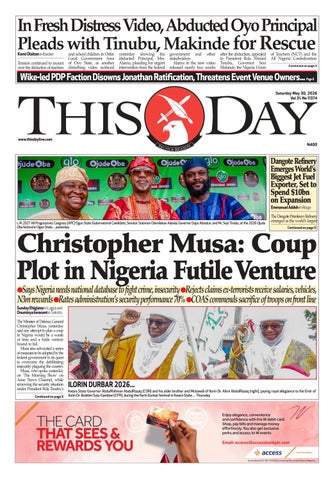
In Fresh Distress Video, Abducted Oyo Principal Pleads with Tinubu, Makinde for Rescue
Kemi Olaitan in Ibadan
Tension continued to mount over the abduction of teachers and school children in Oriire Local Government Area of Oyo State, as another disturbing video surfaced
yesterday showing the abducted Principal, Mrs. Alamu, pleading for urgent intervention from the federal
Wike-led PDP Faction Disowns
www.thisdaylive.com
government and other stakeholders. Alamu in the new video released nearly two weeks
after the abduction, appealed to President Bola Ahmed Tinubu, Governor Seyi Makinde, the Nigeria Union
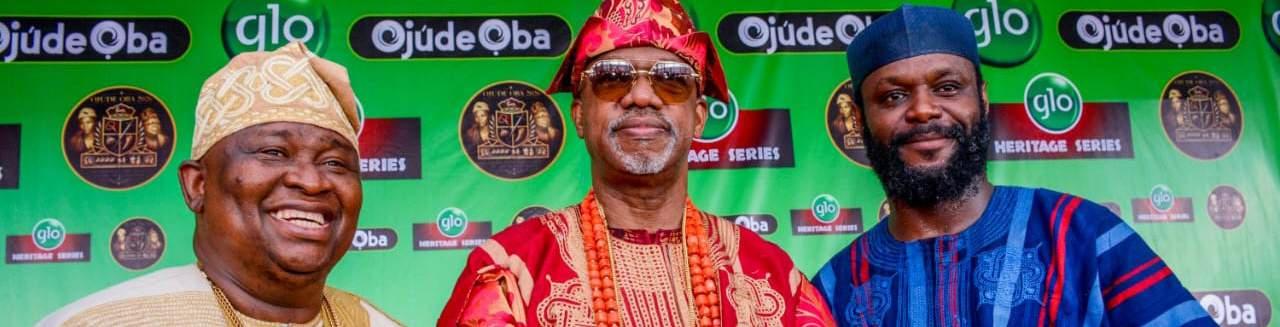
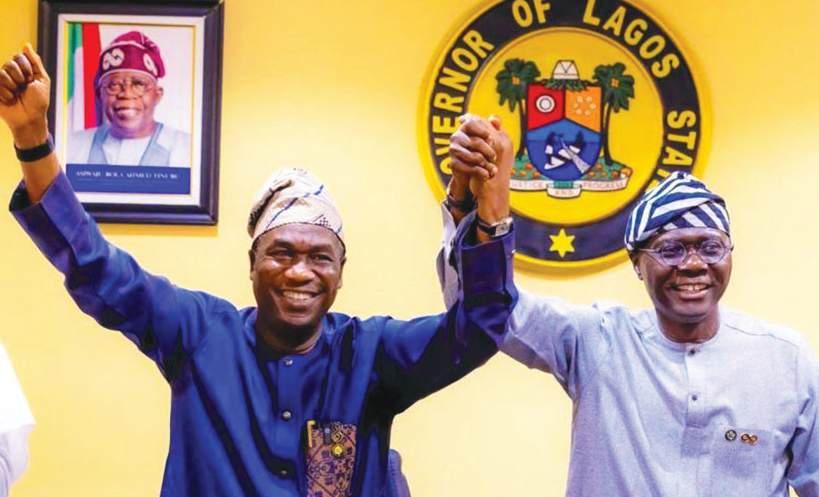
L-R: 2027 All Progressives Congress (APC) Ogun State Gubernatorial Candidate, Senator Solomon Olamilekan Adeola; Governor Dapo Abiodun, and Mr. Seyi Tinubu, at the 2026 Ojude Oba festival in Ogun State…yesterday
Christopher Musa: Coup Plot in Nigeria Futile Venture
Sunday Ehigiator in Lagos and Onuminya Innocent in Sokoto
The Minister of Defence, General Christopher Musa, yesterday said any attempt to plan a coup in Nigeria would be a waste of time and a futile venture bound to fail.
Musa also advocated a series of measures to be adopted by the federal government in its quest to overcome the debilitating insecurity plaguing the country.
Musa, who spoke yesterday on ‘The Morning Show’ on Arise News Channel, while reviewing the security situation under President Bola Tinubu’s
Continued on page 5
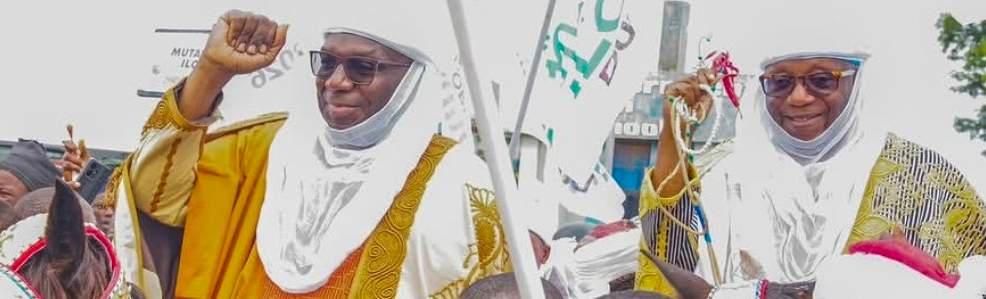
ILORIN DURBAR 2026...
and
and
Kwara State Governor AbdulRahman AbdulRazaq (CON)
his elder brother
Mutawali of Ilorin Dr. Alimi AbdulRazaq (right), paying royal allegiance to the Emir of Ilorin Dr. Ibrahim Sulu-Gambari (CFR), during the Ilorin Durbar festival in Kwara State… Thursday
Emmanuel Addeh in Abuja
The Dangote Petroleum Refinery emerged as the world's largest
Trump Ponders Whether to Move Forward With Iran Deal, But Hasn’t Yet Decided
Sunday Ehigiator with agency report
United States President Donald Trump yesterday held a White House Situation Room meeting with his advisers but has not yet made a decision on whether to move forward with a deal to extend the Iran ceasefire and reopen the Strait
single exporter of aviation fuel in April, with the company set to spend a fresh $10 billion on its 1.4 million barrels per day expansion drive, according to S&P Global.
The development came after the 650,000 barrels per day refinery attained full operational capacity in February, enabling it to take advantage of supply disruptions triggered by the conflict in the Middle East and significantly boost exports of refined petroleum products to international markets.
The expansion will also require a significant diversification of crude supply sources, with the refinery expected to process a broader range of feedstocks from Africa, the Middle East, the United States and other producing regions, the report noted, disclosing that the facility can refine up to 40 crude blends with plans to expand it to over 100.
Chief Executive Officer of the refinery, David Bird, told Platts that the expansion would further cement the refinery's position as a major global refining hub and significantly deepen Nigeria's role in international petroleum products trade.
administration after three years in office, insisted that security agencies alone cannot address the country’s growing challenges without stronger institutional systems and community collaboration.
This comes as the Chief of Army Staff, Lieutenant General Waidi Shaibu, described the sacrifices of frontline soldiers as the backbone of Nigeria’s security, assuring them of the Army’s unwavering support as they continue to battle threats across the country.
Speaking further, he insisted that democracy remains far better than military rule.
The minister said officers accused of plotting to overthrow
of Principals of Secondary Schools (ANCOPSS) to urgently negotiate with the abductors to prevent further tragedy.
The visibly distressed school principal said the abducted teachers and children were being subjected to harsh conditions in captivity, warning that the kidnappers
of Hormuz.
Iran said the agreement has not been finalised.
According to the Associated Press, ahead of the meeting, Trump had said he was looking to make a “final determination.”
A senior administration official later said the roughly two-hour meeting with national
Bird explained that within weeks of attaining full capacity, the refinery was able to respond swiftly to market shortages by increasing aviation fuel production, helping to fill supply gaps created by the conflict in the Middle East.
Sustaining current run rates demands another order of trading sophistication, testing the limits of Dangote's logistics, said Bird, who left OQ8, owner of Oman's Duqm refinery, in 2025 to become the company's first CEO.
"This is not a traditional refinery in an oil-producing country that just sits on the end of a crude pipeline and processes one crude," Bird said.
"This is a fully merchant refining model that you could see in Europe or Asia," he added. After the Middle East war began, Dangote shifted to "max jet mode," and in April it became the world's single largest exporter of aviation fuel, according to S&P Global Commodities at Sea data. The refinery is also producing 200 per cent of its petrol potential by importing blending components like GTL naphtha and Bonny condensate, Bird said. As such, it can "comfortably" make
the administration of President Bola Tinubu lacked support and would have been resisted even by ordinary Nigerians without military intervention.
“Anybody planning any coup is wasting his time. Democracy is far, far better than any military regime. This is an opportunity to show the junior ones that coup doesn’t pay,” he added.
The minister described those allegedly involved in the plot as confused individuals who misled junior officers into trouble.
“I just looked at the people that were involved and I shook my head, because they are just a bunch of confused individuals that exposed very junior officers
were becoming increasingly impatient.
She said in the video, “The terrorists are already getting impatient. The teachers and the children are still under the sun and the rain, while we are in the cold.
"The government should not use force. All they need to do is call and negotiate with them.
security aides concluded without a decision.
The official, who was not authorised to comment publicly and spoke on condition of anonymity, said Trump would only sign a deal that “satisfies his redlines” and curbs Iran’s nuclear ambitions.
Trump confirmed the highlevel talks the day after The
75 million litres/day (about 650,000 bod), and could do 100 million l/d with better storage infrastructure, he added.
According to the report, other projects would further diversify the feedstock coming into Dangote. In addition to a new linear alkylbenzene plant and diesel hydrotreater, the company is planning to build a new 750,000 metric tonne/ year propane dehydrogenation plant, which will process imported LPG and convert it into polypropylene.
Although the Dangote model was designed to process the light sweet crude native to Nigeria, it has been challenged by what the refinery says is a lack of local supply and poor terminal reliability.
Dangote can now refine 40 different types of crude, but Bird would like to see the number get closer to the 130 used at Singapore's Pulau Bukom refinery, which he ran between 2012 and 2015, he said.
S&P added that Dangote's “$10 billion expansion project” will make the refinery capable of processing 1.4 million bpd, equivalent to 90 per cent of Nigeria's oil output, forcing it to seek new crude streams.
who didn’t know their left from their right and now put them into this mess. It’s quite unfortunate,” he said.
According to him, even civilians would have confronted the alleged plotters if they had attempted to execute their plans.
He also called for the establishment of a national database, conducting a comprehensive census, and creating stronger border security, state police and community vigilance structures as part of efforts to tackle insecurity across the country.
Musa said one of the most important steps Nigeria must urgently take was the creation of a national database to improve
We are begging you, don’t let them waste our lives. Please help us, don’t forget us here, answer them on time.”
The latest appeal has heightened fears among residents and families of the victims, amid ongoing rescue efforts by security agencies in the Ogbomoso axis of the state.
Associated Press and other news outlets reported that U.S. and Iranian negotiators had come to terms on a tentative agreement. The deal would extend the fragile ceasefire by 60 days as new talks are held on Iran’s disputed nuclear program.
Trump wrote on social media that “Iran must agree that they
It has so far relied on US WTI Midland crude to supplement local supply, but as it scales up, it can incorporate heavier grades and residues, Bird said. "We will be in the crude blending game," he said. "So you can easily imagine at 1.4 million bpd we could process 30 per cent Middle Eastern grades on each train," he explained.
In an interview before the Middle East war began, S&P quoted founder Aliko Dangote as having said that his business was eyeing crudes from countries like the UAE, and would consider Russian oil should sanctions be lifted.
The refinery already has competitive operating costs of under $2.50/b, but the number could drop to $1.50/b post-expansion, he said. South American residues are also being considered, according to Bird.
In time, the company hopes to stimulate regional demand with low-cost fuel. It is finalising approvals for a Namibian tank farm, which it plans to connect to Zambia by pipeline, and is also discussing a Djibouti oil link and storage in Cameroon, according to Bird and Dangote's Vice President for oil and gas,
criminal tracking and law enforcement.
“We must have a database as Nigerians. With the database, if you go abroad, you commit an offence, it’s very easy for them to arrest you. It’s not by magic. It’s because they have a database. They get your template or your face or your signature or something, they can get you as quickly as possible. We need to do that.
Nigeria must also have that,” he insisted.
The minister argued that effective identification systems remain critical to modern policing and national security, adding that technology must be better deployed to reduce
Alamu was among the teachers abducted during the coordinated attacks on Community High School, Ahoro-Esinele, and Yawota Baptist Nursery and Primary School in Oriire Local Government Area.
The incident, which occurred on May 15, also involved the abduction of dozens of
will never have a Nuclear Weapon or Bomb.” He said the strait must be reopened for international navigation and all sea mines destroyed. Iran’s main negotiator yesterday said it has “no trust in guarantees or words,” only actions, underscoring lingering distrust after the U.S. and Israel have twice
Devakumar Edwin.
The refinery currently ships half of its production overseas and plans to export all additional products from its expansion to international markets, Edwin said in a separate interview at the site.
"We normally try to avoid stocks in all of the businesses," Edwin told S&P, explaining a wider Dangote Group ethos of forcing salespersons to move product. However, limited tankage space leaves little margin for error for operators facing "a tsunami of product coming down the pipe every day" and unpredictable truck demand, Bird said.
Consequently, the business is deviating from its existing spot model, managed mostly by international trading companies, to pursue more long-term purchasing commitments from governments, distributors and national oil companies.
"We'll be making sure that we're not the supplier of last resort," Bird said. "We want to start building some of those direct offtake relationships," he pointed out.
Besides, Bird stated that Dangote has had an influx of requests from African countries
crime and criminality in the country.
“We need to do that,” he repeated, stressing that stronger data systems would make criminal activities harder to sustain.
Musa also advocated for a national population census, saying proper demographic records were necessary to improve planning and security coordination.
“Census is one thing I also want to encourage, we must conduct a census of all Nigerians in the world. With technology, we can do that and once we do that, it makes crime and criminality difficult. If you can’t do the time, don’t do the crime,”
pupils and students, while a teacher and an okada rider were reportedly killed during the attacks.
The Oyo State government had earlier assured residents that security agencies were intensifying both kinetic and non-kinetic operations to secure the safe release of the abductees.
attacked Iran over the past year while it was engaged in nuclear negotiations.
“No step will be taken before the other side acts,” Mohammad Bagher Qalibaf wrote on X. “We do not gain concessions through talks, but through missiles.”
and a recent deal with Ethiopian Airlines. In contrast to its early years, the refinery is better positioned to offer competitive credit and payment terms, he added.
The company is also tailoring its port infrastructure to support smaller cargoes and reduce dependence on truck-outs. After hitting constraints with its single-point mooring system, it is developing a four-berth marine jetty to accommodate LR2-size ships and below, Bird stated.
According to him, the refinery expansion will involve "ruthless replication of the existing plant," partly to cut engineering time. Nevertheless, the second train will likely involve different catalyst choices to meet winter fuel-grade specifications in the Northern Hemisphere, which incur a heavy yield penalty with the current configuration, he said.
Also, the project is being supported by an Initial Public Offer (IPO) later this year, which Dangote hopes will value the business at $40 billion, Edwin said. The company will list 5 per cent-10 per cent of its shares on the Nigerian stock exchange and is considering others, including London and Dubai.
he added. On insecurity, the Defence Minister stressed that security should not be seen as the sole responsibility of the military and police, insisting that Nigeria requires what he maintained was a “whole society approach. This challenge is a Nigerian challenge and all Nigerians must put ourselves together to fight it. The armed forces and the other security agencies are doing their best.” He argued that local governments must become more functional because criminality often begins within communities.
Governor Makinde also confirmed that some operatives involved in the rescue mission sustained injuries after encountering Improvised Explosive Devices (IEDs) allegedly planted by the kidnappers around the Old Oyo National Park area where the victims were believed to be held.
PROMOTING SUSTAINABILITY AND SOCIAL IMPACT...
With Strong Corporate Earnings, Nigerian Stock Market Rises by N61trn in Five Months
Market capitalisation hits historic N160trn for first time Investors record 61.5% return amid renewed confidence
Nume Ekeghe and Kayode Tokede
Amid improved economic indicators as well as improved corporate earnings by listed companies, the Nigerian stock market appreciated by N61.1 trillion in the first five months of 2026, according to data compiled by THISDAY. Also, the naira appreciated by 13.42 per cent year-on-year (YoY) against the dollar at the official Nigerian
Foreign exchange market (NFEM), strengthening from N1,586.15/$ as at May 30, 2025, to N1,373.25/$ yesterday. Data on the stock market performance obtained from the Nigerian Exchange Limited (NGX), revealed that the market capitalisation, which opened the year at N99.38 trillion, closed at N160.51 trillion yesterday, reflecting a remarkable increase of N61.1trillion or 61.52per cent within the period.
Group Lauds Mbah for Impactful Governance, Urges Enugu People to Renew His Mandate
Emmanuel Ugwu-Nwogo in Enugu
Governor of Enugu State, Peter Mbah, has been lauded for his manifest three years of visionary, transformative and exemplary leadership that has repositioned the state for rapid economic growth and sustainable development.
A socio-political organisation, the New Enugu Group, made the commendation in a statement signed by its Convener, Barr. Henry Nnanna Okeke, saying that Mbah has so far performed far beyond expectations.
He specially praised Governor Mbah for introducing "innovation-driven governance that has triggered unprecedented development across critical sectors of the state economy."
NEG after reviewing Mbah’s performance in office over the past three years, said that Enugu has been reaping the benefihs of good governance, citing holistic developments in the state since the inception of the present administration.
According to the group, Enugu has witnessed "massive infrastructural renewal, economic expansion, improved security architecture, educational reforms, healthcare revitalisation and aggressive investment drive that have collectively transformed Enugu into one of the fastest growing states in Nigeria."
“Your Excellency’s leadership continues to inspire progress across different sectors. Today, we celebrate your commitment to building a stronger and more prosperous Enugu State," NEG said while congratulating the governor on his third anniversary in office.
"The past three years have been marked by impactful, innovation-driven governance focused on growth, development and transforming Enugu State for a better future."
To justify its high rating of Mbah’s administration, the group pointed to his landmark projects, including the ongoing dualisation and reconstruction of major urban and rural roads, and the Enugu Smart Green Schools initiative.
For the first time in the history of the bourse, it crossed the N160 trillion mark in May 2026, following investors' demand for blue-chip stocks. Consequently, the NGX All
Share Index gained 94,772.44 basis or 60.90 per cent in five months to close May 2026 at 250,385.47 basis points from 55,613.03 basis points it opened for trading in 2026.
The market capitalisation had hit the N100 trillion mark in early January 2026, buoyed by renewed investor demand and broad-based gains across listed stocks.
In February 2026, it crossed historic N120 trillion mark to close at N122 trillion, over a repricing rally in Dangote Cement Plc, MTN Nigeria Communication Plc.
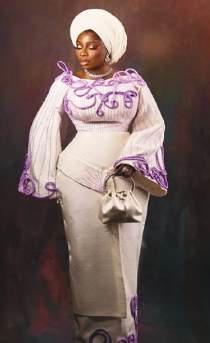
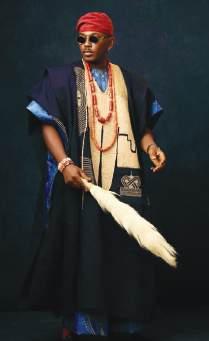
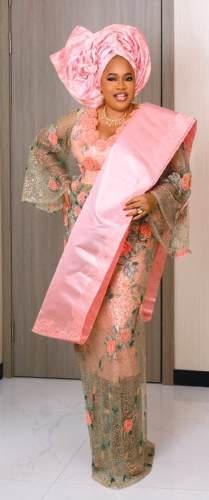
Culture, Colours, Heritage Dazzle at 2026 Ojude Oba Festival
Glo describes festival as spectacle of honour, rewards
Arrays of beautifully adorned men, women, youths, and cultural enthusiasts from all walks of life yesterday thronged the ancient town of Ijebu-Ode for the 2026 Ojude Oba Festival, transforming the city into a vibrant panorama of colour, glamour, heritage, and tradition.
Globacom described this year’s Ojude Oba Festival as a spectacle of honour, fun, entertainment and rewards. Apart from the event being
held to honour the outstanding memories of the late Oba Sikiru Adetona, it was also another opportunity for Globacom as the festival’s main sponsor, to shower cash prizes on outstanding age grades and horse riders who shone brilliantly at the event.
Ogun State Governor, Dapo Abiodun, Minister of Art, Culture, Tourism and the Creative Economy, Hannatu Musawa, and Seyi Tinubu, son of President Bola Tinubu, were among dignitaries present at the 2026 Ojude Oba Festival
themed: ‘Celebrating the Legacy of Oba Sikiru Adetona’ held in Ijebu Ode, Ogun State.
The annual cultural celebration came alive with spectacular horse-riding processions, richly embroidered attires, rhythmic traditional music, and elegant displays by the Regberegbe groups, reaffirming Ojude Oba’s status as one of Africa’s most iconic cultural festivals.
Visitors, tourists, dignitaries, sons and daughters of Ijebuland from across Nigeria and the diaspora gathered to witness the colourful spectacle, which
combined tradition, fashion, unity, and cultural pride in grand style.
Speaking at the event, Ogun State Governor, Prince Abiodun, described Ojude Oba as a powerful symbol of peaceful coexistence, communal harmony, and cultural sophistication.
Abiodun said his administration has deliberately positioned the festival as a flagship of Ogun State’s tourism development agenda in order to harness its enormous cultural and economic potential.
Akpabio Hails Tinubu Third Anniversary Celebration
Sunday Aborisade in Abuja
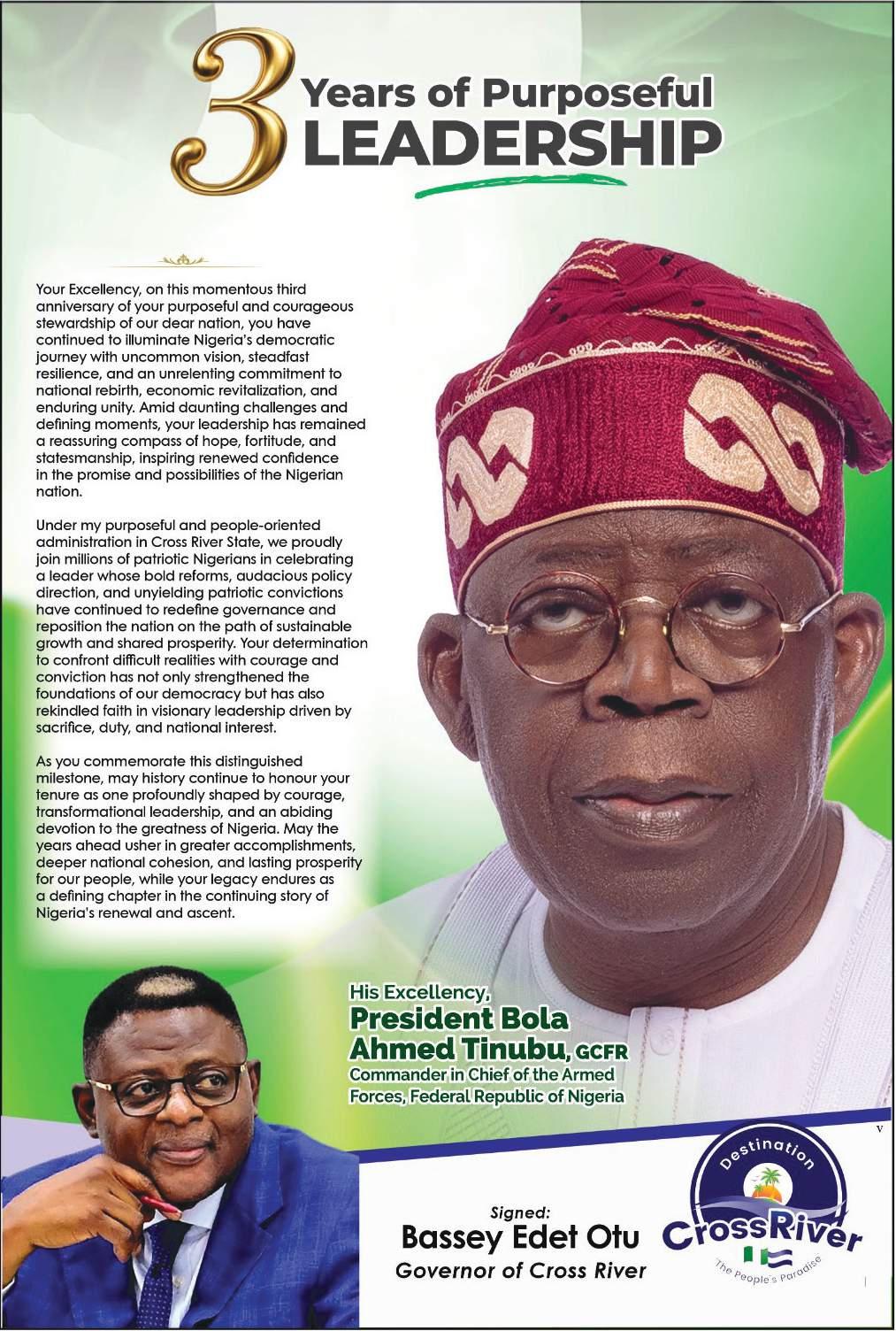
President of the Senate, Senator Godswill Akpabio, yesterday, congratulated President Bola Ahmed Tinubu on his third year in office, praising his administration’s economic reforms and strategic leadership despite prevailing national challenges.
Akpabio, in a personally signed statement, said Tinubu’s “Renewed Hope Agenda” had laid a solid foundation for sustainable growth through policies targeted at economic diversification, infrastructure
renewal, security and social welfare.
The Senate President particularly applauded the administration’s decision to remove fuel subsidy and unify the foreign exchange market, describing the measures as difficult but necessary steps aimed at long-term national prosperity.
“The courage to remove fuel subsidy, unify exchange rates, and drive infrastructure despite global headwinds shows a President committed to long-term prosperity over short-term comfort,” Akpabio
stated.
He noted that the administration had, within three years, embarked on landmark projects and reforms capable of repositioning Nigeria for economic growth and national development.
Among the key initiatives highlighted by Akpabio were the Lagos-Calabar Coastal Highway project, the Nigerian Student Loan Scheme, the Renewed Hope Housing Programme, the nationwide rollout of Compressed Natural Gas (CNG) buses and conversion
centres, ongoing tax reforms, and the completion of the OB3 gas pipeline project. According to him, the LagosCalabar Coastal Highway would boost coastal trade and connectivity, while the student loan scheme had expanded access to tertiary education for Nigerian youths.
He also said the housing programme was delivering affordable homes nationwide, adding that the deployment of CNG buses and conversion centres was helping to ease transportation costs across the country.
James Sowole in Abeokuta and Ferdinand Ekechukwu
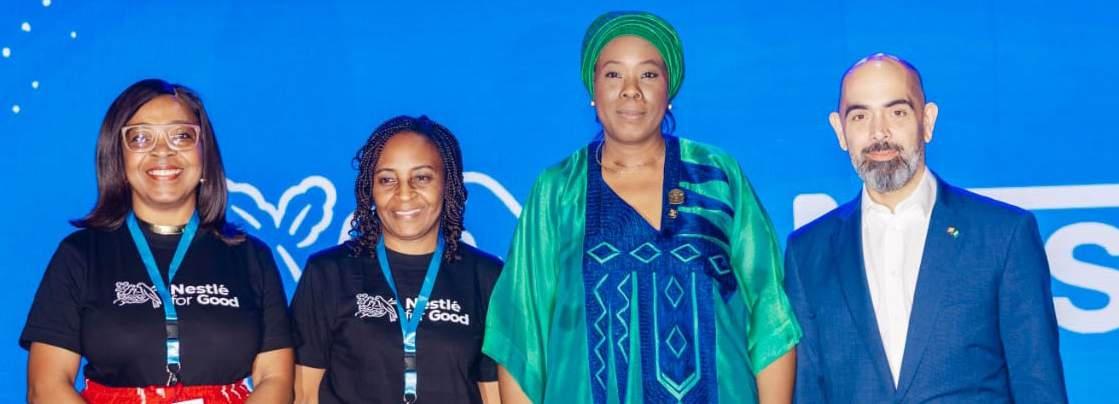
L-R: Corporate Communications, Public Affairs and Sustainability Lead at Nestlé Nigeria, Victoria Uwadoka; Head of Corporate Communications, Public Affairs and Sustainability for Central and West Africa, Patricia Ekaba; Lagos State Commissioner for Commerce, Cooperatives, Trade and Investment, Mrs. Folashade Bada Ambrose-Medebem, and Managing Director and CEO of Nestlé Nigeria Plc, Wassim Elhusseini, at the Nestle for Good Summit held in Lagos… recently
2026 GRADUATION AND ART EXHIBITION...
NDC Awaits Final Ratification of Obi, Kwankwaso, Others as Nationwide Primary Collation Continues
Kano: Gwarzo secures party’s governorship ticket
Aspirant alleges irregularities in Enugu East/Isi-Uzo House primary
Sunday Aborisade in Abuja, Ahmad Sorondinki in Kano and Gideon Arinze in Enugu
The Nigeria Democratic Congress (NDC) yesterday clarified that none of the aspirants who participated in its nationwide presidential, governorship, National Assembly and State Assembly primaries had yet been formally ratified as candidates for the 2027 general elections.
This was as the former Deputy Governor of Kano State, Aminu Abdussalam Gwarzo, emerged as the governorship candidate of NDC, marking a significant milestone in the party’s preparations for the forthcoming elections.
Also, a House of Representatives aspirant of NDC for the Enugu East/
Isi-Uzo Federal Constituency, Uchenna Okolo, has alleged irregularities in the party’s primary election, claiming that the exercise was marred by intimidation, venue changes, and attempts to influence the outcome.
The party said the final approval and official announcement of successful aspirants would only come after the completion of results collation and ratification by its National Working Committee (NWC).
This came as the party concluded its nationwide primaries amid what observers described as a massive show of grassroots mobilisation and growing national acceptance ahead of the 2027 polls.
According to a statement issued by the NDC National
Nigeria Records 204 Lassa Fever Deaths With 793 Confirmed Cases
Onyebuchi Ezigbo in Abuja
The Nigeria Centre for Disease Control and Prevention (NCDC) has said that 204 persons have died from Lassa Fever disease between January till date.
It also said that the country has so far recorded 793 confirmed cases of Lassa Fever since the beginning of this year.
The Centre said that one new healthcare worker was affected by Lassa Fever as at Week 19 this year.
A Lassa Fever Situation Report for Week 19 (4th10th May, 2026) made public yesterday the total number of new confirmed cases decreased from 22 in Epidemic Week 18 of 2026 to 17.
NCDC said the cases were reported in Edo,Bauchi, Ondo, Kogi, Taraba and Nasarawa states.
According to the update, "the cumulative total of confirmed cases of Lassa Fever for week 19 (2026) is 793, while 204 deaths have been recorded. It further disclosed that the case fatality rate is 25.7 per cent (higher than 19.4 per cent same period in 2025).
While 23 states have recorded at least one confirmed case across 108 Local Government Areas, 84 per cent of confirmed cases are from Bauchi, Ondo, Taraba, Benue and Edo State. NCDC stated that the predominant age group affected still remains 21- 30 years.
Publicity Secretary, Osa Director, the exercise was conducted between Thursday and Friday across several states of the federation.
He explained that large crowds of party members and supporters trooped to voting centres to participate in the direct primaries and affirmation processes. Despite logistical concerns
triggered by the Eid-el-Kabir holidays and transportation challenges in parts of the country, the exercise, he added, was largely peaceful, orderly and well coordinated.
He said officials of the Independent National Electoral Commission (INEC), supported by security agencies including the Police and the Department of
State Services (DSS), monitored the exercise in various locations to ensure compliance with electoral regulations and maintain public order.
According to him, reports from across the federation indicated that voting and affirmation processes were transparent and largely hitch-free in most centres, while party stakeholders commended aspirants and supporters for their maturity and peaceful conduct throughout the exercise.
Director stated that the party’s National Working Committee was still expected to complete the collation of results from the states before making formal announcements from the national headquarters.
FG Inaugurates Abuja CNG Booster Station, Ramps Up Gas Infrastructure Drive
Rolling Energy deploys over 8,000 vehicle conversion kits
President Bola Tinubu yesterday inaugurated the Jahi High-capacity Compressed Natural Gas (CNG) Daughter Booster Station in Abuja, as the federal government intensifies efforts to expand gas infrastructure and accelerate the transition to cleaner and cheaper energy nationwide.
The facility, developed by Rolling Energy Limited with
support from the Midstream and Downstream Gas Infrastructure Fund (MDGIF), is one of four major gas infrastructure projects inaugurated nationwide as part of the government's drive to deepen domestic gas utilisation and strengthen Nigeria's gas value chain.
Speaking at the inauguration ceremony, Tinubu, who was represented by the Minister of State for Petroleum Resources (Gas),
Ekperikpe Ekpo, described the project as a significant milestone in the implementation of the government's ‘Decade of Gas’ initiative and the Presidential Initiative on Compressed Natural Gas (Pi-CNG).
He said the station would play a critical role in expanding access to cleaner energy solutions while supporting the government's broader economic and industrialisation agenda, pointing
out that Nigeria, with about 215 trillion cubic feet of proven gas reserves, must increasingly leverage the resource for domestic economic development rather than focusing primarily on exports.
Tinubu stressed that facilities such as the Jahi Daughter Booster Station were essential to building the infrastructure backbone required to support widespread adoption of CNG for transportation and industrial applications.
POS Operators Threaten to Suspend Services Over Exclusivity Practice
The Association of Point of Sale Service Providers (POS) may suspend their services in the country if the Central Bank of Nigeria (CBN) and the FCCPC fail to intervene in the alleged exclusivity practice by Verve International and Interswitch Limited.
The association made the disclosure in a statement signed by Yomi Idowu, its Communications Consultant.
According to Idowu, the POS operators have written a letter to protest the alleged persistent unlawful decisions of the two companies, noting that the actions of Verve and Interswitch, negate ‘extant rules and regulations of the Central Bank of Nigeria (CBN} and the Federal Competition and Consumer Protection Act (FCCPC), 2018.
The Association of POS
Service Providers emphasised that “As representatives of coalition comprising several Central Bank of Nigeria Licensed payment acceptors/acquirers, processors and switches they would have no option than to suspend acceptance/acquiring, processing and switching of Verve Card transactions.”
The Point of Sales Association in the letter was quoted thus that “This decision
has become unavoidable due to the persistent and escalating unlawful conduct of Verve International (Verve) and Interswitch Limited (Interswitch),” which according to the Association jointly undermine “The integrity of Nigeria’s payments ecosystem, erode the capital base of participating Institutions and violates several regulatory requirements.”
Emmanuel Addeh in Abuja
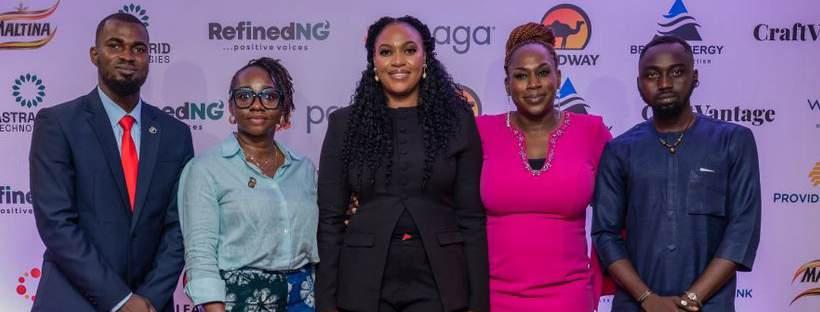
L-R: 2026 CraftVantage Cohort Artist, Oyekale Johnson; Special Adviser to Lagos State Government on Climate Change and Secular Economy, Titilayo Oshodi; Founder & Program Director, CraftVantage, Oluwayemisi Ogunbodede; Programme Manager, Ijeoma Olisekwu, and 2026 CraftVantage Cohort Artist, Nasir Adamu, at the CraftVantage 2026 Graduation and Exhibition held in Lagos…recently
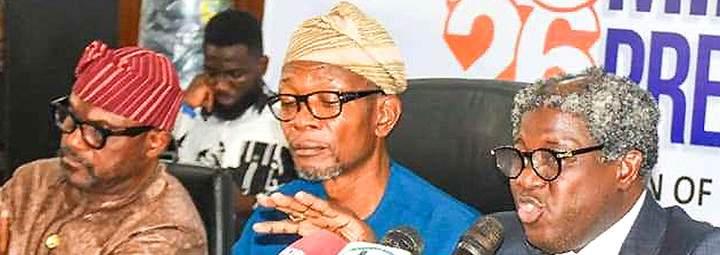
25TH ANNIVERSARY MEDIA BRIEFING...
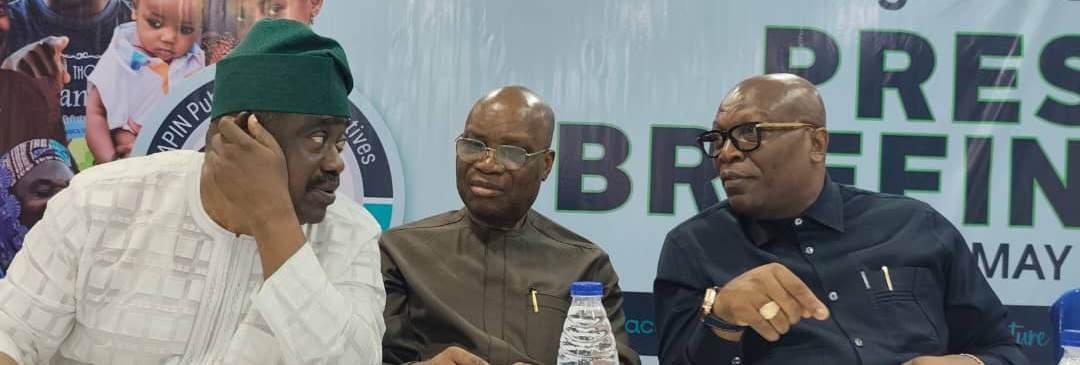
L-R: Deputy Chief Executive Officer (Operations), APIN Public Health Initiatives, Mr. Niyi Olaofin; Chief Executive Officer, Prof. Prosper Okonkwo, and Deputy Chief Executive Officer (Programmes), Dr. Jay Osi
ECOWAS Moves to Deepen Regional Trade as Dangote Pushes Business Council Take-off
Michael Olugbode in Abuja
The Economic Community of West African States (ECOWAS) has intensified efforts to deepen regional economic integration and boost private sector participation with renewed moves to operationalise the ECOWAS Business Council (EBC), a platform expected to drive investment, trade and industrial development across the sub-region.
The commitment was reaffirmed during a high-level working visit by senior officials of the ECOWAS Commission to the Chairman of the ECOWAS Business Council, Aliko Dangote, at the Dangote Group headquarters in Lagos.
The delegation was led by the ECOWAS Commissioner for Economic Affairs and Agriculture, Dr. Kalilou Sylla,
alongside the Commissioner for Internal Services, Dr. Habib Yaya Bappah. They were accompanied by Gerard Amoi Amangoua, Technical President of the Technical Working Group (TWG) for the ECOWAS Business Council, and other members of the working group.
The meeting focused on accelerating the operationalisation of the ECOWAS Business Council, a strategic private-sector-led platform established to facilitate greater collaboration between governments and businesses in the implementation of the ECOWAS regional market agenda.
The Commission said the initiative represents a major milestone in efforts to position the private sector at the centre of regional economic transformation, job creation,
Uwaleke: Next Phase of Reforms Should Address Budget Implementation Weakness, Public Spending Inefficiency
Ndubuisi Francis in Abuja
Renowned professor of capital market and former Commissioner for Finance, Imo State, Uche Uwaleke, has stated that renewed policy coherence is one of the defining characteristics of the current administration’s economic strategy, but admonished that the next phase of reforms should focus on addressing persistent budget implementation weakness and public spending inefficiency.
Appraising President Ahmed Tinubu administration's economic trajectory in the past 36 months in an article titled, ‘Three Years After: A Critical Evaluation of Tinubu’s Economic Reforms’, Uwaleke noted that several macroeconomic indicators currently reflect
gradual stabilisation, adding that these developments collectively suggest that the reforms, though painful, are beginning to yield measurable macroeconomic benefits.
But he observed that one of the major structural problems undermining economic development is the continued implementation of overlapping and multiple-year budgets, which often delays capital project execution and weakens fiscal discipline.
He said, "In 2025, for example, less than 30 per cent of budgeted capital projects were reportedly implemented despite significant borrowing. This creates a situation where government accumulates debt without corresponding infrastructure delivery or economic productivity gains.
industrialisation and sustainable development.
Speaking during the engagement, the officials emphasised the critical role of the private sector in unlocking the enormous economic potential of the West African region, particularly at a time when member states are seeking to enhance competitiveness, increase intra-regional trade and
attract greater investment flows.
The ECOWAS Business Council is expected to serve as a bridge between policymakers and the business community, providing practical solutions to long-standing barriers to trade, investment and industrial growth within the 15-member regional bloc.
The council’s operationalisation comes
amid growing concerns that trade among West African countries remains significantly below potential despite decades of regional integration efforts.
Experts have attributed the challenge to poor infrastructure, multiple border checkpoints, non-tariff barriers, policy inconsistencies and inadequate private sector involvement in regional decision-making
processes.
Analysts believe a fully functional ECOWAS Business Council could help address many of these obstacles by providing a structured platform for dialogue between governments and businesses while promoting reforms aimed at improving the ease of doing business across member states.
Third Anniversary: Oborevwori
Credits Achievements to God’s Grace
Selman ministers at Delta thanksgiving, praise day
Delta State Governor, Sheriff Oborevwori, yesterday attributed the successes recorded by his administration over the past three years to the grace, wisdom and mercy of God.
He declared that the state's development strides were achieved without borrowing a kobo and amid prudent management of resources.
Speaking at the 2026 Delta State Thanksgiving and Praise Day held at the Dome Event Centre, Asaba, the governor said the occasion was an
opportunity to appreciate God for His faithfulness and guidance as the administration marks its third anniversary in office.
Addressing a gathering of political leaders, government officials, clergy, traditional rulers, Deltans and residents, Oborevwori expressed gratitude to the people for their support since he assumed office on May 29, 2023. He noted that the journey had been "eventful, exciting and enlightening."
According to him, the last
three years have witnessed the implementation of people-oriented programmes and projects designed to improve on the living standards of citizens, alongside the execution of major infrastructure projects across the state.
He said; "today, we are celebrating three years of this administration. Indeed, this is the Lord's doing and it is marvelous in our sight. I remain eternally grateful to God for finding me worthy to serve the people of Delta
State in this capacity."
The governor explained that despite challenges encountered along the way, his administration had successfully navigated them through divine wisdom, sincerity of purpose and prudent financial management.
He emphasised that all contracts awarded by his administration were backed by available funds, stressing that Delta State had continued to execute projects and meet its obligations to contractors without borrowing.
Niger PDP Elects Sulaiman Governorship Candidate
PDP
Dipo in
chieftain declares self-authentic governorship candidate in Enugu
and
A former Chairman of Mokwa Local Government of Niger State, Alhaji Abubakar Sulaiman, has been elected as the Governorship candidate of the Peoples Democratic Party (PDP) for next year’s general elections. Also, a chieftain of PDP in Enugu State, Samson Chukwu Nnamani, has declared himself the authentic governorship candidate of the party for the 2027 election.
Alhaji Sulaiman was elected by consensus after other aspirants pulled out of the race.
He is now set to confront the APC flagbearer and incumbent Governor of Niger State, Alhaji Mohammadu Umaru Bago and the candidate of the African Democratic Congress (ADC), Dr. Mohammed Idris Kpautagi.
A former vice chairman of the party Alhaji Yahaya Ability was also elected by consensus as the senatorial candidate of the party for the Niger North Senatorial
Zone while Alhaji Nma Alfa was also picked by consensus as the candidate for the Niger South Senatorial Zone.
It was learnt that efforts were being made as at press time to get a consensus candidate for the Niger East senatorial zone and House of Assembly positions.
Commenting on his election as the candidate of the party, Alhaji Sulaiman declared that "it is an opportunity many people have longed for. I am happy I got it."
Sulaiman appreciated all those
that backed him for the position and prayed that he succeeds in the venture.
In another development, addressing journalists in Enugu yesterday through his Media Director, Buchi Nnaji, Nnamani claimed that his emergence followed a governorship primary monitored by the Independent National Electoral Commission (INEC) and was backed by the Supreme Court judgement recognising the Abdurahman-led faction of the party.
Laleye
Minna
Gideon Arinze in Enugu
Samuels, at a media briefing ahead of the organisation's 25th Anniversary celebrations held ….recently
Using Menstrual Cups by Women for Better Hygiene
WWIn Praise of President Buhari
Mathias Ezeaku, Christianity and Politics
omen, girls in Nigeria are advised to adopt the use of menstrual cups instead of the regular tampons and pads in tackling their menstrual periods.
hen President Muhammadu Buhari took over the reins of power on May 29, 2015, Nigeria was sadly a broken state in many respects. As a result of many other factors including bad governance and untold level of corruption, government could not live up to its financial obligations to citizens and service providers at both the federal and state levels.
Indeed one of the first official assignments that President Buhari carried out was the approval of billions of Naira in bailout funds to enable state governors pay something as basic as workers’ salaries. Granting those bailout funds was a huge boost to national security because the pressure of arrears of unpaid monthly salaries building dangerously all over the country was a ticking bomb.
Menstrual cups are sustainable alternative to use for disposable menstrual periods amid poor environment hygiene.
Ask the naysayers and they would readily remind you of how long it took President Buhari to appoint his ministers and how that contributed to collapse of the economy as if, without ministers, governance was frozen. But buying that narrative would amount to what a famous Nigerian writer, Chimamanda Adichie, termed “the danger of a single story”. Yet the whole story was that many of our citizens did not know how decrepit a state President Buhari inherited in 2015.
Menstrual cups, inserted in the vaginas, is eco- friendly with reduced negative environmental impact, safe and budget friendly, can be used while swimming and other recreational activities.
systems, and increased awareness on eco-friendly alternatives are no longer optional conversations; they are urgent necessities. We strongly believe that empowering women and girls must go hand in hand with building sustainable communities. Our commitment remains focused on advocacy, education, inclusion, health awareness, and creating safe spaces where girls and women can thrive without shame or limitation.
It was therefore necessary for him to take stock against the background of the fact that the departing government did not, reportedly, cooperate full well with the incoming government in terms of leaving workable handover notes. Although President Goodluck Jonathan was gracious in defeat, many of his appointees were still sulking over what they saw as their personal losses and therefore pulled all the stops to make things difficult for the Buhari government.
by the EFCC, President Buhari by his action has successfully brought back to the public consciousness the need to treat public funds with the highest level of transparency and accountability.
MAfter keeping treasury looters on their toes and at bay through the EFCC, particularly, President Buhari moved to curb unnecessary spending habits of the nation on what economists call articles of ostentation. Part of the disclosures of the President’s stock taking was how the country frittered away billions in foreign currency by importing goods, which can be produced at home. One of such items was rice, a major staple among Nigerians. By banning rice importation into the country, the President on one hand had saved the nation billions in foreign currency annually.
And, on the other hand, the President has boosted domestic production of rice and in the process had nudged the country into self sufficiency in food production. He also created millions of jobs for young people in the rice value chain.
I wish to therefore call on government institutions, development partners, private organisations, philanthropists, and other good-spirited individuals to support initiatives such as this.
What is most admirable about President Buhari and his government is its frugal management of scarce national resources to attain optimum goals. Recall that since President Buhari stepped in the saddle, oil revenue dropped abysmally as if to sabotage him knowing all the big promises he made to citizens during his campaigns. But with the little resources that trickle in, the President is achieving what governments that received oil windfalls could not dream of.
Dr. Jumai Ahmadu, President, Helpline Social Support Initiative (HSSI), Abuja
Even with the obvious and unpatriotic obscurantist behaviour of the PDP appointees and their supporters still in government hell-bent on making things difficult for Buhari, the President moved on with his methodical repair of a broken country. The first thing he did was to identify all possible sources of income to the nation and directed that all inflows be paid into one single account in line with the policy of Single Treasury Account (TSA).
The TSA policy, interestingly, was mooted by the PDP government but its penchant for imprudence and lack of accountability denied it the courage of implementing the policy. What the President literally did was to gather all the nation’s money into one box and locked it up with a big padlock and watched for any thief to come close.
The commemoration of Menstrual Hygiene Day 2026 with the theme: “Rethinking Menstrual Waste: Sustainable Solutions for the Next Generation" is aimed at promoting conversations around menstrual health, sustainability, reusable menstrual products, and environmental responsibility among young people. For too long, menstrual health has remained surrounded by silence, stigma, and misinformation. Many young girls still miss school because they lack access to safe menstrual products and proper hygiene facilities. At the same time, the increasing use and disposal of non-biodegradable sanitary products continue to pose serious environmental challenges.
Who can blame the President for almost developing paranoia over the safeguard of the national treasury with revelations and reports of mind-boggling looting that took place in the 16 years of the PDP? With such disclosures of how billions meant for fighting insurgency in the Northeast ended up in the pockets of a few individuals while our gallant soldiers fought with bare hands and on empty stomach, President Buhari was duty bound to bring sanity and accountability back in national spending.
As we advocate for menstrual dignity, we must also promote environmentally responsible choices that protect our planet for future generations. Sustainable menstrual solutions such as reusable pads, menstrual cups, proper disposal
Thus, under President Buhari, the Economic and Financial Crimes Commission (EFCC), which had remained comatose for years, was woken up to resume its duties. Apart from the trillions of Naira of looted funds and property recovered from corrupt politicians
y attention has been drawn to a media report stating that a community had rejected a traditional religious worshipper, Mathias Ezeaku, who is aspiring to contest next year's election in Enugu, Southern Nigeria. According to the report, some leaders from Uzo Uwani constituency had come out to oppose Mathias Ezeaku, a self-identifying traditional religious worshipper who is seeking the Nigeria Democratic Congress (NDC) ticket for the 2027 House of Representatives election. From the report, Ezeaku is a bona fide citizen. He had no criminal record. Ezeaku is not a terrorist. The opposition to his candidacy
Today, the trains are up and running daily from Abuja to Kaduna. And from Lagos to Ibadan a brand new rail track was started and completed; citizens are already commuting daily to and fro these two major cities in the country seamlessly as they reap from the dividends of democracy. And with the way this government is going, before 2023 when the President would leave, the entire country would be linked by rail with all of its economic advantages.
Ainofenokhai Ojeifo, Abuja
THE SATURDAY NEWSPAPER
EDITOR OBINNA CHIMA
THE SATURDAY NEWSPAPER
DEPUTY EDITOR AHAMEFULA OGBU
EDITOR YEMI ADEBOWALE
MANAGING DIRECTOR ENIOLA BELLO
DEPUTY EDITOR AHAMEFULA OGBU
DEPUTY MANAGING DIRECTOR ISRAEL IWEGBU
MANAGING DIRECTOR ENIOLA BELLO
CHAIRMAN EDITORIAL BOARD OLUSEGUN ADENIYI
DEPUTY MANAGING DIRECTOR ISRAEL IWEGBU
EDITOR NATION’S CAPITAL IYOBOSA UWUGIAREN
CHAIRMAN EDITORIAL BOARD OLUSEGUN ADENIYI
THE OMBUDSMAN KAYODE KOMOLAFE
EDITOR NATION’S CAPITAL IYOBOSA UWUGIAREN
Stop Ritual Attacks and Killings
Tis linked to his denunciation of Christianity and public burning of the Christian holy book, the Bible. If I may ask: When did the renunciation of the Christian religion become a political liability? When did the profession of traditional African religion become a political stopper?
Apart from being vocal in criticizing Christianity, Ezeaku has reportedly promoted traditional African religion, designating Christianity and Islam as deceitful and as mechanisms to enslave and mislead Africans.
Leo Igwe is a scholar of religion and a board member of the Humanist Association of Nigeria.
Telling the Truth, but Fully?
AMANAGING EDITOR BOLAJI ADEBIYI THE OMBUDSMAN KAYODE KOMOLAFE
THISDAY NEWSPAPERS LIMITED
EDITOR-IN-CHIEF/CHAIRMAN NDUKA OBAIGBENA
THISDAY NEWSPAPERS LIMITED
GROUP EXECUTIVE DIRECTORS ENIOLA BELLO, KAYODE KOMOLAFE, ISRAEL IWEGBU
EDITOR-IN-CHIEF/CHAIRMAN NDUKA OBAIGBENA
GROUP EXECUTIVE DIRECTORS ENIOLA BELLO, KAYODE KOMOLAFE, ISRAEL IWEGBU, IJEOMA NWOGWUGWU, EMMANUEL EFENI
DIVISIONAL DIRECTORS SHAKA MOMODU, PETER IWEGBU, ANTHONY OGEDENGBE
DEPUTY DIVISIONAL DIRECTOR OJOGUN VICTOR DANBOYI
DIVISIONAL DIRECTORS SHAKA MOMODU, PETER IWEGBU, ANTHONY OGEDENGBE
DIRECTOR, PRINTING PRODUCTION CHUKS ONWUDINJO TO SEND EMAIL: first name.surname@thisdaylive.com
he Advocacy for Alleged Witches (AfAW) urges the Nigerian public to stop ritual attacks and killings because the notion of ritual money and wealth is completely baseless. AfAW is making this call following the reported arrest of suspected ritualists in Oyo State in southern Nigeria. The local media reported that members of the Western Nigeria Security Network, Amotekun, arrested suspected ritualists with the body parts of a 73-year-old man. The suspects, who were apprehended in the Boluwaji area in Ibadan, said that a Muslim cleric asked them to procure some human body parts for rituals. Ritual attacks are widespread in Nigeria. Irrational conceptions of how to make money or become wealthy and successful undergird these atrocities. Many Nigerians strongly believe in blood money, known in some local languages as Ogun Owo (Yoruba) or Ogwu ego (Igbo). They think that they could become rich, or successful through ritual sacrifice. Unfortunately, this is not the case. Ritual wealth has no basis in reason, science, or reality. Home movies known as Africa magic or Nollywood films have not helped matters. These movies continue to reinforce these mistaken notions and other superstitions. Families, churches, mosques, and other public institutions do not encourage the interrogation of these traditional occult beliefs. There are no robust efforts to criticize or dispel these irrational and paranormal claims in schools, colleges, and universities. So millions of Nigerians grow up blindly believing that they could make money through ritual sacrifice of human body parts. The belief has led many Nigerians to commit crimes and perpetrate atrocities. Many Nigerians have been jailed or are undergoing court trials due to ritualrelated attacks and murder.
rocket from Blue Origin has exploded on its launchpad in Florida. Their spokesperson stated that “We experienced an anomaly during today’s hotfire test." An anomaly is a flashing button, what they got was what the cartoon Martin the Martian wanted, an "earth-shattering kaboom!".
Space has always had its dangers including a broken toilet, an extended stay which was best known for the floating sphere of hair of one astronaut but also for far too many deaths.
Space exploration may be our future but it has to be safe and eventually made available for the general public.
Dennis Fitzgerald, 28 Landale St, Box Hill, Vic, Australia
Not too long ago, the police arrested some young Nigerians for stealing female pants, which they intended to use for ritual sacrifice. AfAW is asking all Nigerians to desist from ritual-related abuses because ritual money beliefs are baseless superstitions. Nigerian media, schools, and colleges should help educate and reorient the public. They should assist in reasoning Nigerians out of this killer-superstitious absurdity and nonsense.
Leo Igwe directs the Advocacy for Alleged Witches (AfAW)
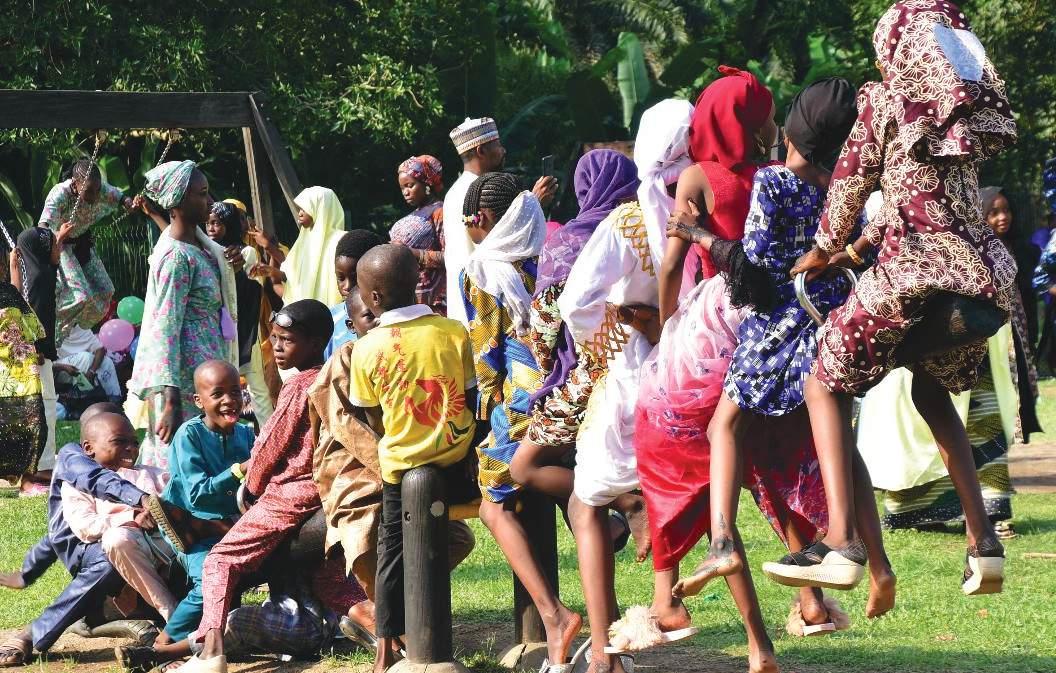
Barka da Sallah..
Ebola Resurgence: PSN Places Pharmacists on High Alert
Oluchi Chibuzor
As Ebola spreads in some African countries, especially East and Central Africa, the Pharmaceutical Society of Nigeria (PSN) has placed its members on red alert as it issues emergency guidelines to heighten surveillance and strengthen infection prevention measures.
The President of PSN, Ayuba Ibrahim Tanko, said that although the Coordinating Minister of Health, Prof. Muhammad Ali Pate, has confirmed there are currently no cases of Ebola in Nigeria, however, as frontline healthcare professionals and primary points of care the association makes absolute vigilance imperative.
In advisory guidelines signed by Pate, PSN urged community pharmacies and institutional pharmacy departments across the county to immediately strengthen national biosecurity defenses. It emphasised nationwide
surveillance measures and urged members to maintain a high index of suspicion when attending to patients presenting symptoms consistent with Ebola, especially those with recent travel history to affected countries in East and Central Africa.
PAGE 16
In the document titled, ‘Official Public Health Advisory: Enhanced Preparedness, Surveillance and Infection Prevention Guidelines for Ebola Virus Disease (EVD)’, the PSN noted that the incubation period for Ebola virus ranges from two to 21 days, with infected individuals becoming contagious only after symptoms appear.
Tanko explained that early symptoms include sudden high fever, severe fatigue, muscle and joint pains, headaches, and sore throat, adding that advanced symptoms may progress to vomiting, diarrhea, skin rashes, impaired kidney and liver function, and bleeding from body openings.
To prevent possible spread
3rd Anniversary: Fubara Credit Success to Resilience, Resourcefulness of Rivers People
Blessing Ibunge in Port Harcourt
Governor of Rivers State, Siminalayi Fubara, has attributed the successes recorded in the last three years to the cooperation, resilience, resourcefulness and spirit of enterprise of people of the state.
This was as he reaffirmed his commitment to the ‘Rivers First’ mantra, noting that is the philosophy that has guided the policies and programmes of his administration in the last three years. Governor Fubara made the assertions yesterday in a goodwill message to mark the third year anniversary of his administration. He said that putting the
interest of the people above every other consideration and ensuring their well-being at all times have been his focus in the past thirty six months. Fubara said that the massive investments his administration has made in road infrastructure, was meant to connect the rural communities with the urban centres and open economic opportunities for the people.
According to him, the vision of transforming Rivers State into an investment hub informed the execution of signature projects such as the Port Harcourt Ring Road, Trans- Kalabari Highway, Elele/Umudioga/Egbeda/ Ubimini/Ikiri/Omoku Road and the Ngo-Atlantic/ Oyorokoto Road, amongst others.
of the disease, the PSN ordered the revival of hand hygiene stations by re-establishing visible, mandatory hand-washing stations with soap and running water or alcohol-based hand sanitisers (minimum 70 per cent isopropyl/ ethyl alcohol) at all pharmacy entrance points.
It also advised that all frontline dispensing assistants and pharmacists wear appropriate medical masks and disposable gloves when interacting with patients showing visible respiratory or systemic illness. According to PSN, the Ebola virus is highly susceptible to standard disinfectants.
The PSN directed community pharmacies and institutional pharmacy departments to intensify disinfection of high-contact surfaces such as counters, payment terminals, door handles, and consulting areas using bleach solutions or alcohol-based disinfectants. Similarly, the society cautioned against conducting non-essential invasive point-of-care tests, such as blood glucose checks and malaria rapid diagnostic tests, for patients with unexplained fever, in order to minimise possible blood-borne exposure.
I’m Committed to Benue’s Devt, Says Gov Alia
George Okoh in Makurdi
The Benue State Governor ,Hyacinth Alia, has declared that his administration is committed to peace, development, and economic transformation of the sate as he marks his third anniversary in office yesterday.
In an address to the people of the state, Governor Alia reflected on the journey of his administration since assuming office on May 29, 2023, stating that despite the
numerous challenges inherited, his government has recorded visible progress across key sectors.
The governor recalled that his administration met a state burdened by poor infrastructure, unpaid salaries and pensions, insecurity, unemployment, and declining public confidence in governance.
According to him, his government immediately embarked on rebuilding the state and restoring hope to
the people.
Speaking on security, Alia said his administration prioritised the protection of lives and property through strategic support for security agencies.
He disclosed that the government procured and distributed 150 Hilux vehicles, as well as over 600 motorcycles to security personnel to enhance surveillance and access to difficult terrain.
The governor also noted that the establishment of the
Civil Protection Guards and the joint task force codenamed ‘Anyam Nyor’ was aimed at strengthening local security operations and complementing existing security structures across the state.
The governor appreciated President Bola Ahmed Tinubu for supporting efforts to combat insecurity in Benue, noting that the interventions were yielding results as displaced persons gradually returned home and the population in IDP camps declined.
Protest Rocks Anambra Govt House over Outcome of APGA Primary Election
Protesters insist process manipulated
David-Chyddy Eleke in Awka
Protest erupted yesterday at the Anambra State Government House, also known as Light House, Awka, over the outcome of primary election of the All Progressives Grand Alliance (APGA).
Thousand of protesters from Oyi Local Government Area of the state who stormed the Hovernment house with placards bearing different inscriptions cried to the state Governor, Prof. Chukwuma Soludo, to intervene in what they described as brazen rigging of the Oyi State Constituency primary election. They claimed that while a
popular candidate, Hon. Innocent Ojike, also known as Ojicam had won the election, they were surprised to find that the party announced another aspirant, Kosisochukwu Ibemesi as the candidate to represent the party for the Anambra State House of Assembly election, next year.
Since APGA held its party primaries last Saturday, several groups and aspirants have rejected the outcome, claiming that the processes were manipulated in many constituencies, while those who emerged victorious have praised the process as being transparent.
The State Auditor of APGA, Hon. Uchenna Oraegbunam, who
led the protesters said: "We are here for a peaceful protest to let our Governor, Prof. Chukwuma Soludo, to know some of the things that happened in Oyi State Constituency last Saturday.
"We had a very peaceful protest and elections were declared, and Ojicam, Hon. Innocent Ojike, the current member of the Anambra State House of Assembly was declared winner. We were all confident that he was going to win because we know he is popular.
"We were all surprised that when the party released the names of candidates that were successful, what we saw was the name of Mr. Kosisochukwu
Ibemesi. This is a surprise to us and we want anyone who said that Ibemesi won the election to come and prove it.
OJA ASIWAJU FOOD BANK...
Member Representing Lagos State Constituency I, Lagos State House of Assembly, Mrs Omolara Oyekan-Olumegbon (left), with former member, House of Representatives, Mrs. Jumoke Okoya-Thomas, during the 6th edition of Oja Asiwaju Food Bank held in Lagos Island... recently
MEDIA BRIEFING...
FG Reaffirms Support for Electric Vehicle Industry Growth
The federal government has reaffirmed its commitment to supporting the growth of Nigeria’s electric vehicle (EV) industry through policies that prioritise local content, innovation, technology transfer and industrial development.
The Minister of Innovation, Science and Technology, Dr. Kingsley Udeh, stated this at the inaugural meeting of the Electric Vehicle Assemblers and Manufacturers Association of Nigeria (EVAMAN) in Abuja.
Represented by Mr. Ibiam Oguejiofor, National Coordinator of the Strategy Implementation Task Office for Presidential Executive Order No. 5, Udeh said the government was working to ensure that Nigerian expertise, materials and enterprises occupy a central place in the country’s industrial future.
He noted that Presidential Executive Order No. 5 remains a major policy framework aimed at promoting indigenous capacity and local participation in science, engineering and technology-related projects.
According to him, the Federal Ministry of Innovation, Science and Technology is collaborating with relevant Ministries, Departments and Agencies (MDAs) to institutionalise local content across strategic sectors, including clean transportation, renewable energy, advanced manufacturing and digital innovation.
“Our objective is clear and unwavering: Nigerian talent, Nigerian resources, Nigerian technology and Nigerian enterprises must occupy a central place in the country’s industrial future,” he said.
Udeh added that the ministry was prepared to support EVAMAN through
policy coordination, research collaboration, innovation support programmes and strategic partnerships to accelerate industrial growth in the EV sector.
Speaking at the event, President of EVAMAN, Mr. Mustapha Audu, described the inauguration as a major
transition for the association from a caretaker administration to an elected leadership structure.
Audu said that within two years, the association had secured legal recognition through registration with the Corporate Affairs Commission (CAC) and built partnerships with government institutions and
industry stakeholders.
He explained that EVAMAN had expanded its membership base to include manufacturers, assemblers, charging infrastructure providers, renewable energy experts, researchers and investors within the electric mobility ecosystem.
“Nigeria has enormous
potential to become a major player in Africa’s electric mobility revolution,” Audu said.
“With our large market, skilled manpower and growing technological capacity, we can position ourselves as a hub for electric vehicle manufacturing and clean transportation solutions in Africa,” he added.
Esther Okereke has emerged as the presidential candidate of the National Rescue Movement (NRM) for the 2027 general election after clinching the party’s ticket at its presidential primary convention held in Abuja.
Her emergence followed a successful screening process conducted in accordance with the party’s constitution and
electoral guidelines.
In her acceptance speech, Okereke said her decision to join the NRM was driven by her conviction that the party has the capacity and vision to pull Nigeria back from what she described as the brink of institutional collapse.
She pledged to galvanise Nigerian youths, promote ethical leadership and pursue far-reaching structural reforms that would reposition
CHRISTOPHER MUSA: COUP PLOT IN NIGERIA FUTILE VENTURE
He added: “Our local governments must be up and doing because crime is local. If local governments are working, they will be able to tackle these things within their own area before it gets to the state, before it gets to the federal.”
The minister also renewed his call for state police, saying decentralised policing would significantly improve local intelligence gathering and criminal identification.
“State police are very, very important because they will be able to work together with the local government chairman, and they will know all the criminals around them, so they will be able to tackle this completely,” he said.
Musa also advocated stronger community-based vigilance systems, saying communities should work with hunters, vigilantes and authorised security volunteers to improve safety.
“Communities must come together, get your group together, so that you can have people
that can identify if you have criminals coming in.
“You can’t sit back and say you’re waiting because there’s no soldier or there’s no policeman, then you won’t protect yourself.
“The first preservation of every human being is protection of your life. So whatever you need to do to ensure that you stay alive, please do it.”
The minister explained that government already recognises local security collaboration structures in some parts of the country.
“The president has the prerogative to authorise different groups that have been identified, have been profiled, have been authorised to bear arms in support of the military.
“Like we did in the Northeast, we have the civilian JTF, we work together with them, the local governments get them pump action, buy them cartridges, we go for operations together with them.”
On border security, Musa described Nigeria’s long and
porous borders as one of the biggest enablers of insecurity, adding that terrorists often flee into neighbouring countries whenever military pressure intensifies.
“We share about 1,500 kilometres with Niger, 1,650 with Cameroon. We have some level with Benin Republic and the Atlantic Sea, and then with Chad.
“What the terrorists do actually is that when you attack them more, they move to the next country.”
According to him, Nigeria cannot effectively tackle terrorism without cooperation from neighbouring countries.
“So you need the other country to also be able to block this one side of the border so that they don’t have any safe haven,” he said.
Musa disclosed that authorities had already identified fresh threats along the Benin Republic border corridor.
“We have seen a level of
threats coming in between Benin, Nigeria border.
“We are through the multinational joint task force, establish a new sector to address those areas so that, from Burkina Faso, they don’t penetrate through Benin into Nigeria. We want to stop it.”
The Defence Minister also rejected allegations that repentant terrorists undergoing rehabilitation under Operation Safe Corridor are rewarded with salaries, official vehicles and millions of naira.
“Not at all. Not at all,” he said.
“We’re not rewarding the acts of crime. It would be stupidly and foolhardy for us to do that.”
Responding to claims that ex-terrorists receive monthly salaries of N70,000, N3 million payments and government vehicles, Musa said: “I don’t know about the N70,000 you’re talking about.”
He explained that many of those rehabilitated were
the country for sustainable growth and development if elected president in 2027.
Speaking at the convention, the National Chairman of the party, Chinedu Obi, called on delegates to put national interest above personal ambition, stressing that Nigeria’s future rests on credible leadership and responsible governance.
Obi lamented the worsening state of insecurity,
not hardened insurgents but people allegedly forced into terrorist camps.
“What the terrorists were doing then is when they attack a village, they bring back all the male guys to one side and ask you to either join them or you die.
“Those who joined were left. Those who didn’t join were beheaded.
“There were different groups that were picked. For one reason or another, they were used as farmers to help assist them in farming out there in the field and all. They were using them as slaves.”
According to Musa, those directly involved in violent crimes are treated differently.
“The terrorists, those that are hardened criminals among them, they are profiled and identified and then handed over to the Attorney General of the Federation for prosecution. And I’m sure you’ve heard of recent cases; some of them were jailed.”
poverty, unemployment and economic hardship across the country, while expressing sympathy for victims of terrorism, kidnapping, banditry and communal violence.
According to him, despite Nigeria’s vast human and natural resources, millions of citizens continue to face hardship as a result of years of poor leadership and weak governance.
Asked to assess the Tinubu administration’s performance on insecurity after three years, Musa rated the government between 65 and 70 per cent.
“Yes, I’ll give ourselves 65–70. No nation is totally free from crime and criminality.”
The minister insisted that terrorist activities had reduced significantly under the current administration.
“Terrorist attacks in the past, the way it used to be, is not as rampant as it used to be. You see that we have more kidnappings now than acts of terrorism. And what it shows is that it is going down.”
While acknowledging that insecurity remains a challenge, Musa urged Nigerians not to lose faith in security institutions and to work together in confronting criminality.
“We must come together to understand this is our country. The more we support each other, the more we work together as a team, the more we succeed.”
Michael Olugbode in Abuja
L-R: General Manager, Lagos State Urban Renewal Agency (LASURA), Dr. Animashaun Oladimeji; Permanent Secretary, Office of E-GIS and Urban Development, Engr. Adeyemi Adetunji Adesanya, and Special Adviser to the Governor, E-GIS and Urban Development, Dr. Olajide Babatunde, during the 2026 annual ministerial press briefing as part of activities marking the third year of the second term in office of Governor Babajide SanwoOlu, held in Lagos… recently
Three Years On: Limits of Tinubu’s Economic Model
In a meeting I attended recently in Washington D.C., a group of economists reflected on their careers. The pain they all echoed was the same: how data can go wrong. In Nigeria, the data is wrong. It is wrong about nearly everything. But it is mostly wrong about unemployment and underemployment—the systemic underutilization of education, skills, and experience.
Nigeria’s unemployment data is like a cracked mirror. It reflects the general shape of the economy but distorts the true image beyond recognition. The data represents a stark contrast between official statistics and the lived reality of millions of citizens. The one-hour International Labour Organization benchmark, where anyone who worked for at least one hour within the last seven days is classified as employed, has produced an unemployment figure that often masks severe underemployment, informal survivalism and systemic poverty. It is Nigeria’s enduring contradiction: low unemployment on paper, deepening poverty in practice.
This contradiction sits at the heart of Nigeria’s democratic journey since May 1999. When former President Olusegun Obasanjo assumed office after years of military rule, Nigeria was a country with immense promise. Oil prices would soon rise. Debt relief negotiations were underway. Democratic optimism was high. There was a genuine expectation that civilian governance would unlock economic prosperity and improve the quality of life for ordinary Nigerians.
Twenty-seven years later, the picture is far more complicated. Nigeria today is Africa’s largest economy by size and one of its poorest societies by lived experience. The country has produced billionaires, unicorn startups and impressive GDP figures at different points, yet millions of citizens increasingly struggle with food inflation, collapsing purchasing power, poor healthcare, insecurity and unstable electricity. The disconnect between macroeconomic policy and household reality has become one of the defining failures of Nigeria’s democratic era.
The current president Bola Tinubu administration inherited a fragile economy burdened by debt, subsidy distortions, low productivity and dwindling state capacity. To its credit, the government moved quickly on reforms previous administrations avoided. Fuel subsidy removal and exchange rate unification were economically rational decisions long recommended by multilateral institutions. Few serious economists dispute that Nigeria could not sustainably
continue spending trillions subsidising petrol consumption while revenue remained dangerously low.
But policy logic alone does not feed citizens.
These reforms exposed millions of Nigerians to economic shock without an adequate social protection cushion. Transport costs exploded. Food prices accelerated. Small businesses collapsed under inflationary pressure. Salaries remained stagnant while the naira lost much of its value. Economic reform, without visible social relief, began to resemble punishment rather than transition.
This is where Nigeria’s fiscal dilemma becomes more troubling. Government after government has borrowed heavily in the name of development, yet citizens rarely experience the developmental outcomes associated with such debt accumulation. Roads remain poor. Public hospitals deteriorate.
Universities suffer repeated strikes. Power generation stagnates. Water infrastructure is weak. In effect, Nigeria has accumulated debt without building enough productive capacity to justify it.
The World Bank’s International Development Association, the concessional lending arm designed for poorer countries, offers perhaps the most revealing indicator of Nigeria’s stalled development story. Countries that once shared similar developmental conditions with Nigeria have successfully graduated from IDA borrowing status. According to World Bank historical data, South Korea graduated decades ago. China graduated in 1999. India graduated in 2014. Vietnam exited in 2017. Turkey and Thailand also moved on. Nigeria, however, remains an IDA “blend” borrower, still dependent on concessional lending because of weak per capita income and structural economic vulnerabilities.
The comparison with Vietnam is particularly painful.
In 1999, both Nigeria and Vietnam were emerging economies with large populations, rural poverty and developmental constraints. Yet Vietnam pursued aggressive export-oriented industrialisation, invested heavily in education and manufacturing, and integrated itself strategically into global supply chains. Today, Vietnam is a manufacturing powerhouse attracting major global technology firms while exporting electronics, textiles and industrial goods at scale. Nigeria, by contrast, still depends overwhelmingly on crude oil exports and imports refined petroleum products despite being an oil-producing nation.
Indonesia offers another instructive comparison. Like Nigeria, Indonesia experienced political transition and economic instability in the late 1990s. It faced corruption challenges, subsidy pressures and currency crises. Yet successive Indonesian governments gradually diversified the economy, strengthened manufacturing, improved agricultural productivity and invested in decentralised infrastructure development. Indonesia re-graduated from IDA in 2008 after temporarily re-entering during the Asian financial crisis.
Nigeria, meanwhile, remains trapped in a cycle where each administration inherits fiscal instability, borrows to stabilise consumption, and leaves behind even greater structural fragility.
Part of the problem lies in how Nigeria understands economic growth. For too long, policymakers equated growth with oil revenue expansion rather than pro-
ductivity expansion. GDP growth that does not generate mass employment, industrial capacity or household prosperity eventually becomes politically and socially meaningless. Nigeria’s economy has often grown statistically while citizens became poorer materially.
Another major issue is the state’s extraordinarily weak revenue base. Nigeria’s tax-to-GDP ratio remains among the lowest globally. Successive governments relied excessively on oil rents instead of building an efficient taxation system tied to productive economic activity. When oil prices decline, fiscal crisis follows almost automatically. Borrowing then becomes the substitute for structural reform.
Yet the answer cannot simply be endless austerity.
Nigeria’s greatest danger today is not merely debt accumulation. It is the erosion of social trust. Citizens increasingly feel disconnected from the promises of democracy because economic hardship appears permanent regardless of who governs. When people lose faith that legitimate economic effort can improve their lives, social instability becomes inevitable.
President Bola Tinubu still has an opportunity to alter this trajectory, but only if fiscal reform becomes visibly connected to citizen welfare. First, the government must aggressively invest in food production and agricultural logistics rather than relying primarily on import interventions. Food inflation is now one of the greatest threats to household survival. Rural insecurity, poor storage infrastructure and transport inefficiency continue to destroy agricultural productivity. Nigeria does not merely need farming rhetoric; it needs agro-industrial zones linked to rail, storage and processing infrastructure.
Second, the Electricity Act of 2023, signed by President Bola Tinubu, represents perhaps the most consequential power-sector reform since the 2005 unbundling of the state monopoly. Unlike previous frameworks that concentrated regulatory authority largely at the federal level, the new law allows states to establish and regulate their own electricity markets, issue licences and attract subnational investment into generation and distribution.
As Africa Day Promotes Continent’s Cultural Heritage
At this year’s Africa Day, leaders and institutions within and outside celebrated the continent’s rich cultural heritage, writes Charles Ajunwa
Seyi Bakare
On May 25, leaders, citizens and staff of various institutions within and outside Africa marked Africa Day in style, showcasing the continent’s cultural potential. Talk shows and exhibitions were organised to showcase Africa’s culture. All those who participated dressed in African attire unique to different countries as they marked the event.
Africa Day, formerly African Freedom Day and African Liberation Day, is the annual commemoration of the foundation of the Organisation of African Unity (OAU) on May 25, 1963. The organisation was replaced by African Union on 9 July 2002, but the holiday continues to be celebrated on 25 May. It is celebrated in various countries in Africa as well as around the world.
In a statement to commemorate the event, Chairperson of the African Union Commission (AUC), H .E. Mr. Mahmoud Ali Youssouf, underscored Africa’s growing prominence in international affairs, urging all Africans to renew their faith in Pan-Africanism. He said, “Today, Africa commemorates sixty-three years since the founding of the Organisation of African Unity — a historic milestone that continues to inspire our collective pursuit of unity, liberation, dignity, and
development.
“As we mark this year’s Africa Day under the theme, ‘Sixty-three (63) Years of Unity, Integration and Development, Let’s Celebrate Together’, we reaffirm our unwavering commitment to the aspirations of Agenda 2063 and to building the Africa We Want.
“Africa Day is both a celebration of our shared heritage and a recognition of Africa’s growing role in shaping global affairs. Guided by the spirit of Ubuntu — “I am because we are” — our continent continues to champion solidarity, cooperation, and shared humanity in an increasingly uncertain world.”
Youssouf added, “On this Africa Day, I call upon African diplomats and representatives across the world to continue working closely with the African Group in various capitals to strengthen Africa’s collective voice and advance our shared priorities.
“I also express appreciation to the African Union’s partners for their continued cooperation and solidarity in supporting peace, integration, development, and institutional transformation across our continent.
“As we celebrate Africa Day, let us renew our faith in the power of African unity, the promise of PanAfricanism, and the limitless potential of our people.”
Also, President of the Republic of
Burundi and the Chairperson of the African Union (AU), H.E. Mr. Evariste Ndayishimiye, in the statement, reminded the continent that the celebration must coexist with collective awareness.
“An African child deprived of education today is a part of Africa’s future that we are abandoning tomorrow,” Ndayishimiye said, calling for education to be prioritised alongside humanitarian aid in refugee and internally displaced persons (IDP) settings, and urged stronger continental unity against terrorism, stating: “No country should be left alone to face this peril.”
He called on all African leaders to “speak with one voice”, adding, “Long live a united Africa! Long live the African Union and happy Africa Day to all.”
Workers from government institutions, including staff of various organisations within and outside the continent, observed the Africa Day wearing their unique native dresses. The significance of this, is to promote Africa’s culture and heritage.
The United Bank for Africa (UBA), with presence in 20 African countries and the African financial services in New York, London, Paris and Dubai, joined to celebrate Africa’s culture, creativity, talent, resilience, and
excellence.
“Africa is more than a continent; it is culture, creativity, resilience, innovation, and the unstoppable spirit of its people.
“Today, we celebrate the talent, excellence, and limitless possibilities that continue to shape Africa’s story and inspire the world,” a statement from the bank declared.
Transcorp Group staff also observed Africa Day with dressing in their native attire. A statement from the Group said, “Today, we celebrate Africa’s heritage, a continent rich in culture and possibilities. Today we celebrate One Africa, Many Strengths. Happy Africa Day from all of us at Transcorp Group.”
The African Development Bank Group and the government of Brazzaville, in partnership with the African Union Commission hosted Africa Day celebration to mark the official kickoff of the Bank Group’s 2026 Annual Meetings.
Organisers said that the Africa Day held at Mfoa Plenary Hall, Kintele International Conference Centre, Brazzaville, Republic of the Congo, brought together participants of the Annual Meetings and Bank staff to showcase Africa’s cultural richness, contem-
porary creativity, and enduring sense of identity. According to the organisers, participants across headquarters, regional and country offices, joined the event in African attire.
The Africa Day featured activities that highlighted Africa’s cultural heritage and richness and African arts through powerful visual and emotional expression.
“The centerpiece of the celebration, the African Cultural Heritage Show, offered staff and attendees an opportunity to show off traditional and modern African attire representing their countries.
“In addition, the ‘Words for Africa’ live art installation, led by a young local artist, invited participants both in person and online to contribute three words reflecting their vision for Africa onto a collective visual canvas, connecting physical and digital audiences in a shared expression of ideas,” organisers said.
UN Tourism, formerly World Tourism Organisation, also celebrated Africa Day in a statement noting that Africa is, “a continent that never stops growing.”
“But the question now is who that growth truly reaches. Tourism cannot succeed if the communities hosting the world are left behind.
Tinubu
Yemisi OgunbOdede:
Art Key to n igeria’s Creative economy Future
As conversations around Nigeria’s creative economy grow, visual art is gaining recognition as both cultural expression and economic value. At the centre is Oluwayemisi “Misi” Ogunbodede, founder of CraftVantage, whose 2026 Graduate Exhibition in Lagos showcased emerging Nigerian artists and explored themes of identity, resilience and culture. Beyond the artworks, the exhibition highlighted mentorship, sustainability and the need to build lasting opportunities for young creatives. Dike Onwuamaeze brings excerpts:
‘Bold Stories, Sustainable Futures’ was a compelling theme for CraftVantage. What inspired it, and what conversation are you hoping it sparks within Nigeria’s art ecosystem?
The theme was inspired by two things: The courage of young artists to tell stories that are deeply personal, and the need to build a creative ecosystem that can sustain them beyond talent alone. For us, “Bold Stories” speaks to the power of the works themselves. These artists are engaging with identity, memory, resilience, spirituality, womanhood, urban life, and the everyday realities that shape us. “Sustainable Futures” speaks to what must happen around the artists. How do we ensure that talent is not only celebrated, but supported? How do we create platforms, patronage, mentorship, commercial pathways, and visibility that allow emerging artists to build lasting careers? The conversation we hope to spark is that art is not just cultural expression. It is also part of economic participation, national identity, and the future of Nigeria’s creative economy.
The exhibition brought together young artists working across painting, sculpture, installation and mixed media. What does this diversity say about the direction contemporary Nigerian art is heading?
It shows that contemporary Nigerian art is becoming more experimental, more confident, and more layered. Young artists are no longer working within narrow definitions of what art should look like. They are combining materials, disciplines, memory, culture, personal experience, and social commentary in very interesting ways. This diversity also reflects the spirit of the country itself. Nigeria is complex, energetic, restless, and constantly evolving. The work of these artists mirrors that. They are not only making beautiful objects, they are creating visual language for the times we are living in.
Many of the featured works explore identity, resilience, memory and everyday life. Why do you think these themes are resonating strongly with emerging Nigerian artists today?
Emerging artists are creating from the realities they know. Identity, resilience, memory, and everyday life are not abstract themes in Nigeria, they are lived experiences. Many young artists are trying to understand where they come from, what they have inherited, what they are surviving, and what future they are imagining. Their work becomes a way of processing personal and collective experience. That is why the themes feel so strong. They are not forced. They come from observation, emotion, memory, and the need to make meaning.
CraftVantage emphasises storytelling and social consciousness alongside technical excellence. How important is art as a tool for social commentary and nation-building in Nigeria today?
Art is extremely important because it gives society a way to see itself. It allows us to reflect, question, remember, celebrate, and imagine differently. In Nigeria, where so many stories are often told through politics, economics, or crisis, art provides a more human and layered way of understanding who we are. It can speak about identity, history, inequality, hope, resilience, beauty, and possibility in ways that statistics or speeches often cannot. For nation-building, that matters. A country also needs imagination. It needs symbols, stories, memory, and cultural confidence. Art helps create that.
Interest in African art continues to rise globally. How can Nigeria better position itself as a leading destination for art investment and collecting on the continent?
Nigeria already has the talent, the stories, the cultural depth, and the market energy. What we need is to keep building the structures that make the ecosystem easier to understand, access, and trust. That means stronger galleries, better documentation, more collector education, institutional support,
consistent art fairs, serious criticism, stronger museums, artist archives, and more platforms that connect artists with local and international audiences. We also need to tell the story of Nigerian art with more confidence. If we want global collectors to take Nigerian art seriously, we must also build stronger local confidence around collecting, patronage, and cultural investment.
What would you say to private investors, corporates or institutions that still see art mainly as decoration rather than as a serious cultural and economic asset?
I would say art is one of the most powerful ways to invest in culture, identity, legacy, and economic value at the same time. Of course, art beautifies spaces, but that is only one layer. Art also tells stories, preserves history, strengthens brands, supports livelihoods, creates markets, and builds cultural capital. For corporates and institutions, supporting art is not charity alone. It is a way of participating in the creative economy, shaping cultural conversations, and aligning with innovation, youth development, sustainability, and national progress. When you invest in art early, especially in emerging artists, you are not just buying an object. You are helping shape a career, a market, and a cultural future.
One of CraftVantage’s stated goals is to provide visibility and long-term support for emerging creatives. What are the biggest barriers young Nigerian artists still face in building sustainable careers?
Many young artists have talent, but they need more than talent to build a sustainable career. They need access, mentorship, materials, documentation, networks, pricing guidance, business knowledge, collector engagement, and consistent visibility. A major challenge is the transition from school into professional practice. That is often where young artists are
most vulnerable. They may have skill, but they may not know how to position their work, speak about their practice, price properly, engage collectors, or navigate opportunities. That is where CraftVantage is trying to intervene. We want to support artists at that critical point where encouragement, structure, and access can make a real difference.
Beyond exhibitions, what kind of support systems do young artists need most to thrive professionally?
Exhibitions are important, but they are not enough on their own. Young artists need mentorship, grants, residencies, production support, studio access, collector introductions, curatorial guidance, legal and business education, and stronger links to institutions. They also need help understanding the business of art. How do you build a body of work? How do you price? How do you document your practice? How do you write about your work? How do you protect your intellectual property? How do you build relationships without losing your creative identity? The goal should be to build artists who are not only talented, but professionally prepared.
Nigerian artists are increasingly gaining international recognition. How can emerging artists be better positioned to transition from local visibility to global relevance? Global relevance begins with strong local grounding. The most compelling artists are often those who are deeply connected to their own stories, materials, context, and visual language, but who present that work with professional clarity and international standards. To support that transition, artists need strong documentation, curatorial framing, digital visibility, international residencies, gallery relationships, critical writing, and access to platforms where their work can be seen by the right audiences. It is not enough to say Nigerian artists are talented. We must build the bridges that allow that talent to travel.
How important is mentorship in the journey of a young artist, and how is CraftVantage helping bridge the gap between talent and professional opportunity?
Mentorship is critical because talent without guidance can easily become isolated. A mentor helps an artist think more deeply about their practice, understand the market, avoid mistakes, and see possibilities they may not have imagined. At CraftVantage, mentorship is part of the structure. We are not simply asking artists to produce work and show up at an exhibition. We are supporting them through a process that includes guidance, training, feedback, exposure, and professional development.
The gap we are trying to bridge is the gap between promise and opportunity. Many artists have promise. What they need is the right environment to convert that promise into a sustainable practice.
Nigeria’s creative economy is often discussed in terms of music and film, but visual art gets less policy attention. What economic contribution can the visual arts sector make to Nigeria if properly developed?
The visual arts sector can contribute significantly if we take it seriously as part of the creative economy. It creates direct and indirect opportunities across artist production, galleries, framing, logistics, curation, publishing, design, education, tourism, events, collecting, advisory services, and cultural exports. It also strengthens Nigeria’s soft power. The way a country’s art travels influences how that country is seen globally. Nigerian visual art can help shape cultural diplomacy, tourism, investment conversations, and global perceptions of Nigerian creativity. But for that to happen, the sector needs more structure, policy attention, investment, and institutional support.
Ogunbodede
Visionary Teenagers Driving Change Through Educational Support
In a country where conversations about the future are often clouded by concerns over economic hardship, unemployment and declining social values, a group of Nigerian teenagers has offered a refreshing reminder that the nation’s hope may still lie in the compassion, vision and courage of its young people, Bennett Oghifo writes
On Friday, May 22, 2026, two teenage students, Fareedah Oyolola and Ifeoluwa Onafowokan, demonstrated an uncommon commitment to social impact as they led an educational outreach programme in Lagos under the initiative, EduSpark by Tomorrow’s People.
The outreach, which took place at Express Nursery and Primary School I along Ikosi Road in Ketu, Kosofe Local GovernmentArea of Lagos State, brought together over 30 student volunteers who distributed educational materials to more than 400 pupils in the public school.
What made the event particularly remarkable was not merely the scale of the intervention, but the age of those behind it. The initiative was conceived, coordinated and executed entirely by teenagers under the age of 17 who chose to channel their privilege and access into improving the lives of less privileged children through education.
Their actions offered a practical demonstration of the popular Yoruba saying, “Eyin nín di Akúkó,” loosely translated as “the young of today are the leaders of tomorrow.”
Despite adverse weather conditions, including heavy rainfall and thunderstorm warnings across parts of Lagos, the young volunteers remained undeterred. Accompanied by security personnel and arriving in four vehicles loaded with educational supplies, the students carried on with the programme as scheduled.
School officials described the exercise as unprecedented, noting that it was rare to witness such a level of organisation, empathy and social consciousness from secondary school students.
For many observers, the outreach represented more than a charitable exercise. It reflected the
emergence of a new generation of socially conscious young Nigerians who understand that education remains one of the most powerful tools for reducing inequality and transforming lives.
Fareedah Oyolola, one of the brains behind the initiative, is already gaining recognition as one of Nigeria’s outstanding young intellectu-
als. She first drew attention after becoming an international scholar at the age of 13, a feat that placed her among exceptionally gifted young students globally.
Yet, beyond academic excellence, the teenager is increasingly becoming known for humanitarian
service and youth-driven advocacy.
Speaking during the outreach, Fareedah explained that the inspiration behind EduSpark emerged from her participation in the Rise for The World Competition, a platform designed to encourage young people to develop practical solutions to societal challenges.
UK Govt Boosts Nigeria’s Local Production’s Creative Industries
The UK-Nigeria Technology Hub has launched its Creative Fund, a first-phase grants initiative designed to address critical technical capacity gaps across Nigeria’s film, fashion, and music industries.
The fund will support the development of local digital production capacity, encourage the adoption of modern creative technologies, and promote the responsible use of Artificial Intelligence (AI), to strengthen Nigeria’s creative value chain.
The initiative directly supports the priorities of the UK-Nigeria Economic Transformation and Investment Partnership (ETIP) Creatives Working Group launched in March 2025 and delivers on
Fertility
commitments made during President Tinubu’s State visit to the UK in March 2026. It is designed to ensure that high potential creative projects can access the technical talent, tools, and resources required to produce, scale and complete their work locally.
Funded by the UK-Nigeria Tech Hub, under the UK Government’s Digital Access Programme and implemented by Tech4Dev, the Creative Fund responds directly to evidence gathered through the State of the Creative Innovation Ecosystem in Nigeria, study in 2024. Drawing on over 1,700 survey responses, and fieldwork across seven states, the research showed that Nigeria’s creative economy employs approximately 4.2 million people and contributes around US$3 billion to GDP annually.
Despite this scale, the sector continues to face structural constraints - over 80 per cent of prac-
Foundation
Expands Support for Women as Cost of IVF Soars
As the cost of fertility treatment continues to rise in Nigeria, putting assisted reproduction beyond the reach of many families, the Olaronke Thaddeus Foundation has expanded its intervention to support more women struggling with infertility.
The foundation, led by fertility advocate Olaronke Ugwueke-Thaddeus, announced a fresh outreach programme offering free intrauterine insemination (IUI) treatment to 20 Nigerian women, as part of efforts to ease the financial burden associated with fertility care.
The latest initiative builds on the foundation’s growing fertility support programme, which has already sponsored in-vitro fertilisation (IVF) treatment for about 50 women and couples across
Nigeria between 2024 and 2025. The support has also extended to Nigerians living in the United Kingdom who face financial barriers to accessing fertility treatment.
Ugwueke-Thaddeus, who is also the founder of Meet Surrogate Mothers, one of Nigeria’s leading assisted reproductive technology agencies, said the intervention was aimed at restoring hope to women and families for whom infertility treatment remains unaffordable.
The intervention comes at a time when the cost of a single IVF cycle in Nigeria ranges between N1.7 million and N5 million, making it inaccessible to many low- and middle-income earners.
Beyond the financial burden, infertility continues to carry significant social consequences, especially for women, including stigma, emotional distress, marital pressure and economic hardship.
titioners are self-taught, fewer than 10 per cent have access to formal financing, and high-value technical work is routinely outsourced outside the country. The Creative Fund is a direct response to these gaps, and central to the work of the ETIP Creative working Group.
Oyinkansola Akintola-Bello, Director of the UK-Nigeria Tech Hub, said: “Nigeria’s creative sector already delivers real economic value, and both governments have committed under the UK-Nigeria Economic Transformation and Investment Partnership to supporting its growth. Through the ETIP Creatives Working Group, we are moving from ambition to action. The Creative Fund is a practical first-phase intervention that addresses critical gaps in skills, infrastructure, and access to advanced tools, enabling Nigerian creatives
to produce and scale high-quality work locally.”
“The Fund will support high-potential creative projects covering three industries; Film, Fashion, Music and will focus on initiatives that demonstrate strong potential for impact, scalability, and job creation. It will subsidise projects that need to close technical gaps including critical specialists like VFX artists, sound engineers, post-production editors, and design professionals, or the digital tools and resources that make professional-quality work possible locally, for example digital asset management systems, content delivery tools, Digital Rights Management solutions, and AI-driven production technologies. The aim is straightforward; Nigeria’s best creative work should be made in Nigeria,” Akintola-Bello added.
NGO Launches Rehab Centre Project to Tackle Drug Crisis
The Lifted Life Rehabilitation Centre will today officially commence the construction of its purpose-built rehabilitation facility to support the fight against illicit drugs.
The groundbreaking event will take place at the Swiss International Hotel, Lagos.
This historic milestone coincides with the retirement of its founder, Mrs. Helen Nkwo, who will step down from her illustrious 35-year career in the oil and gas industry on May 27, 2026. Her transition from corporate leadership to humanitarian activism underscores a passionate commitment to combat Nigeria’s alarming drug crisis—an issue demanding urgent, strategic intervention.
Recent statistics from the National Drug Law
Enforcement Agency (NDLEA) reveal a deeply troubling trend: 13.6 per cent of secondary school students have experimented with drugs, with 6.9 per cent actively using. An estimated 14.3 million Nigerians are currently affected by substance abuse, exposing a silent, escalating crisis that threatens the health, safety, and future of the nation.
Under Nkwo’s leadership, Lifted Life has already demonstrated remarkable success. Over six successful rehabilitation seasons, the organisation has supported more than 400 youths. Of these, over 70 individuals have been fully rehabilitated and successfully reintegrated into society—many now thriving in employment, entrepreneurship, and community leadership. These outcomes showcase the centre’s capacity to effect enduring, life-changing results through structured interventions, counselling, mentorship, and community mobilisation.
L-R: Logistics Lead, EduSpark, Ademinitioluwa Ogunwuyi; Event Lead, EduSpark, Lynette Hunponu-Wusu; Co-Founder EduSpark & Project Lead, Miss Fareedah Oyolola; Head Boy, Express Nursery and Primary School, Ikosi ketu, Kamolideen Mubarak; Head Girl, Ukaegbu-Alex Mercy; Co-Founder EduSpark & Project Lead, Miss Ifeoluwa Onafowokan; and Financial Team Lead, EduSpark, Sharon Ayodeji-Ojo, during the education outreach programme held at Express Nursery and Primary School, Ikosi ketu, Lagos... recently
Kehinde Oladunjoye
Fred Ojeh
Sunday Ehigiator
Can Obafemi Hamzat Govern Africa’s Most Restless City?
As Lagos strains under the weight of ambition, congestion and explosive growth, Obafemi Hamzat has emerged as the technocrat betting that competence and continuity can tame Africa’s most restless megacity, writes Adedayo Adejobi
Lagos has a particular way of testing human optimism. At dawn, the city stretches awake like an overworked machine, coughing danfo smoke into the humid air while traders arrange tomatoes beside luxury cars trapped in traffic that appears both temporary and eternal.
Somewhere between the glass towers of Victoria Island and the flood-prone alleys of Ajegunle lies the central contradiction of Nigeria’s commercial capital, a city forever advertising the future while wrestling stubbornly with the present.
It is into this theatre of ambition, exhaustion, improvisation and relentless motion that Kadri Obafemi Hamzat now steps out as the governorship candidate of the All Progressives Congress (APC), the political party that has governed Lagos for more than a quarter of a century.
His emergence was not entirely surprising. In Lagos politics, surprises are usually carefully negotiated in advance.
Yet Hamzat’s candidacy matters because it says something deeper about where the Lagos establishment believes the city is heading. In an age when politics increasingly rewards spectacle over substance, Lagos appears poised to hand its future to a technocrat. That alone is unusual.
Hamzat does not possess the theatrical populism of the modern African political strongman. He is neither a rabble rouser nor an instinctive retail politician. His public image is that of a cerebral operator, part engineer, part systems manager, part political insider. He speaks the language of infrastructure, governance frameworks, transportation grids
and data-driven reform with the calm assurance of a man who has spent more time around policy documents than campaign drums
For supporters, this is precisely the point. Lagos, after all, is no ordinary city. With its swelling population, collapsing patience, expanding technology sector and endless infrastructural anxieties, it increasingly resembles a living stress test for governance itself. Running Lagos requires more than charisma. It demands administrative stamina, political dexterity and a tolerance for permanent crisis management.
Hamzat’s backstory fits neatly into that argument.
Born in Mushin, educated in Oyo and later trained at the University of Ibadan and Cranfield University in England, he belongs to that distinctly Nigerian class of public figures who combine local political instincts with global technocratic polish. Before politics, he worked in New York with firms such as Citibank, Merrill Lynch and Morgan Stanley before returning home to join Oando Plc.
That corporate pedigree matters in Lagos, perhaps more than elsewhere in Nigeria. Lagos likes to think of itself as a city state powered by commerce rather than crude oil nostalgia. Its political elite often present governance as a form of executive management. In that worldview, Hamzat’s resume is not incidental. It is strategic branding.
Still, credentials alone do not win elections, nor do they automatically solve urban dysfunction.
Lagos is a city that routinely humbles planners. Population growth outruns projections. Roads fill up faster than governments can expand them. Informal settlements emerge
overnight. Floodwaters arrive with biblical enthusiasm. Every solution appears to create two new problems.
The city’s growth is both astonishing and punishing. Millions continue to migrate there chasing prosperity, survival or simply possibility. Lagos absorbs them all with the appetite of a machine that never powers down.
This is the burden awaiting Hamzat if elected governor in 2027.
To his credit, he does not appear entirely naive about the scale of the task. His public speeches acknowledge the brutal complexity of governance in Lagos. He speaks frequently about transportation, health services, education, job creation and infrastructure continuity. His manifesto, unveiled almost immediately after securing the APC ticket, reflects the managerial instincts of someone already immersed in government operations.
Yet continuity can be both asset and liability.
the administrations of Babatunde Fashola, Akinwunmi Ambode and Babajide Sanwo Olu. The APC’s central argument is that Lagos works precisely because of this continuity. Rail projects, tax reforms, transport systems and digital governance initiatives were not built overnight. They emerged through long term political stability. There is truth in that claim.
The Lagos Blue Line rail project, the Red Line, BRT expansion, road infrastructure and digitisation efforts reflect a level of policy consistency rare in Nigerian governance. Hamzat himself played visible roles in several of those initiatives, particularly as Commissioner for Science and Technology and later Commissioner for Works and Infrastructure. His admirers see him as one of the quiet architects of modern Lagos. They point to government automation reforms, transport integration efforts and large-scale infrastructure planning as evidence of administrative seriousness.
Hamzat represents the latest chapter in the political tradition built by President Bola Ahmed Tinubu and sustained through See
Half the Population, Yet Women Still Missing in Politics
As Nigeria’s political season gathers momentum, women are steadily losing ground in governance, raising urgent questions about democracy, representation, and whether Africa’s largest country is deliberately silencing half its population, writes Adedayo Adejobi
In the loud theatre of Nigerian politics, where ambition crackles through television studios, party conventions, and crowded campaign grounds, one silence has become impossible to ignore. Women are steadily disappearing from the room.
Not entirely, of course. They still organise rallies, mobilise voters, anchor policy conversations, and often carry the emotional weight of communities through economic hardship and political instability. Yet when the ballots are counted and appointments announced, the distance between women’s contribution and women’s representation becomes painfully obvious.
Nigeria, Africa’s largest democracy and most populous black nation, now finds itself confronting an uncomfortable truth. At a time when many countries are widening political opportunities for women, the Nigerian political system appears to be moving backwards.
Female representation in Nigeria’s legislature has fallen sharply from 6.4 per cent in 2011 to roughly 4.4 per cent following the 2023 general elections. It is a decline that would be troubling anywhere, but in a nation of more than 200
ongoing political realignments and party primary activities across the country, AWLO warned that Nigerian democracy risks becoming increasingly exclusionary unless urgent corrective action is taken.
Dr. Elisha Attai, founder and global president of AWLO, believes the country has reached a defining moment.
“Nigeria cannot truly progress while systematically limiting the voices, visibility, and opportunities of half of its population,” he said.
His words cut through the usual diplomatic language that often surrounds conversations about gender inclusion. This was not framed as charity for women or symbolic representation. It was presented as a democratic emergency.
The concern is not simply that women are underrepresented. It is that the structures designed to produce political leadership often appear calibrated to edge them out altogether.
Across party lines, women frequently encounter financial barriers, opaque delegate systems, intimidation, entrenched patronage networks, and cultural assumptions about leadership that still overwhelmingly favour men. Even highly qualified female candidates often find
themselves politically stranded long before the general electorate gets a chance to decide.
Nothing captures this tension more sharply than the reported disqualification of Senator Ipalibo Banigo, one of only four women currently serving in the Nigerian Senate and the only female senatorial representative from Rivers State.
For many observers, the episode became symbolic of a deeper institutional problem. If one of the few women who successfully navigated Nigeria’s brutal political terrain can still face exclusion from within party structures, what hope exists for younger or less established female aspirants?
Attai insists that inclusion must move beyond carefully worded speeches and ceremonial commitments.
“Inclusion must go beyond public declarations and be reflected in practical actions, policies, nominations, and electoral outcomes that intentionally create space for women to participate and lead,” he said.
That distinction matters. Nigeria is not short of conferences about women’s empowerment. It is short of measurable political outcomes.
For decades, the country has celebrated women rhetorically while marginalising them structurally. The contradiction is woven into nearly every layer of public life. Nigerian women dominate sectors of commerce, academia, media, entrepreneurship, agriculture, and civil society. In many homes, they are economic stabilisers and decision makers. Yet political power remains stubbornly concentrated in male hands.
Hamzat and Sanwu-Olu
million people, it feels particularly alarming. For the African Women in Leadership Organisation (AWLO), the trend is dangerous. In a strongly worded statement released amid
Ferdinand Ekechukwu- 08035011394
Email: ferdi_adthisday@yahoo.com
Funmbi Ogunbanwo: My Passion Revolves Around Building People, Stories, Systems
Months before dominating the 12th Africa Magic Viewers’ Choice Awards, winning five awards, including the Best Movie, ‘My Father’s Shadow,’ a film set against the aftermath of the June 12 annulment, had made waves internationally. As it makes a comeback to Nigerian cinemas, the producer, Funmbi Ogunbanwo, reflects on making the film, her personal story, and her observations on filmmaking in Africa, particularly in Nigeria. Ferdinand Ekechukwu brings the excerpt
‘MyFather’sShadow’ isaterrificfilm, anditdeservedly won most of the majorcategories. while shooting the film, as the producer, did you and the team envisage the film to be this successful?
No, we didn’t envisage that it would be this successful. My Father’s Shadow is a beautiful story and very gripping. At heart, it’s an honest take by Wale and Akin (Wale Davies and Akinola Davies Jr., who won Best Writing and Best Director respectively) on what it means to deal with grief. It’s an honest take on Nigeria as a country and Nigeria as a father, on being a child and longing for the love of a father. It’s that honesty we always knew and felt when making the film. With these things, you rarely know, and you’re just showing up every day. We didn’t think it would be this successful.
Well, it turns out to be successful, winning multiple awards and premiering arguably the biggest movie stage in the world. Tell us
about the early days of ‘My Father’s Shadow’ when the idea to shoot the film emerged?
I’ve been working with Akin and Wale for many years now. We founded Fatherland together. I lead Fatherland as CEO and co-founder. My Father’s Shadow was a project we’ve been working on together for many years now. It was first written as a short film that Wale sent to me, which I thought was very beautiful. Wale would tell you he’s a new writer, and this is his first feature, but I could hear the tone of voice clearly in the script. For me, clarity is always a big thing in anything I’m working on. In any script or story, is the voice clear? When Akin and Wale decided to develop it into a feature from a short film, that clarity shone even more. The location, the 90s, was the detail and the subtlety. Not having light in your house as a 90s kid and playing outside with action figures, longing for your father to come back so you can play with him.
What prompted the foundation of Fatherland as a production company, and how has it been managing and directing the affairs of the production company?
Fatherland is a production company founded by Wale, me, and Akinola Davies. I’m their unofficial adopted sister. I met Wale over a decade ago. We started off the company because we believed stories from here could travel, and more specifically, there were other kinds of stories that we were drawn to, and we both really wanted to tell. Akin was directing at the time and doing a lot of fashion projects. As Akin has said in interviews, at first he wasn’t sure he wanted to be a director because that comes with so much responsibility, but he’s such a strong visual storyteller and has a real knack and instinct. And that’s how you know good directors; they just have a pulse for these things. We started with just servicing Akin’s fashion projects and working with friends on other fashion projects and music videos. Then we started working with more international brands. The gap I saw was matching artistic integrity with structural efficiency, and that’s really what I handle as the CEO of the business. Yes, it’s great to do a cool project, but what are the systems you put in place to make sure that project is efficient? And that the next time you do that project, it is even more efficient? I sit in between creativity and business in the same breath.
Asake Hits the Road for Europe, North America Tour
Stories by Ferdinand Ekechukwu
Nigerian singer Asake has announced his ‘In God We Trust’ tour across Europe and North America following the record-breaking success of his album M$NEY. The 16-city run includes stops in London, Paris, Toronto, Atlanta, Los Angeles and Afronation Portugal. The tour follows the success of his album M$NEY, which broke Spotify records for an African album.
A four-month run across North America and Europe spanning 16 cities, the tour announcement was made on his official Instagram page on Tuesday
to an excited reception from fans. The tour kicks off on July 4 and runs through to October 24, taking in some of the biggest music markets in the world.
The ‘In God We Trust’ tour will cover a wide stretch of cities across two continents.
The North American run include Chicago, Toronto, Laval in Quebec, Brooklyn, Lowell, Atlanta, Miami, Houston and Los Angeles, with a Colombia stop also on the schedule. While the European leg takes place in London, Brussels, Amsterdam, Berlin and Paris, alongside a headline appearance at Afronation Portugal, one of the biggest Afrobeats festivals on the continent.
The tour follows the release of Asake’s fourth studio album, M$NEY, which dropped on May 1, 2026. “The 13-track project features collaborations
with Tiakola, DJ Snake and Kabza De Small, and marked a noticeable shift in his sound to something more measured and cohesive compared to the chaotic energy of his earlier work,” a reviewer noted.
Adding that the evolution drew praise from some listeners and mild criticism from others who felt the crossover direction softened his edge.
“Either way, the numbers displayed a much more interesting scenario. M$NEY secured the biggest opening week streams for an African album in Spotify history with 55.98 million streams, and set a new Spotify Nigeria opening-week record with 37.5 million streams.”
“M$NEY is a reflection of my spiritual and creative journey,” Asake said. “Everything flows from a place of gratitude to God and every moment
Tradition Meets Glamour at Ajosepo2 : TheGathering Premiere
The highly anticipated Nollywood movie Ajosepo (The Gathering) held its exclusive, star-studded premiere on May 24, 2026, at the Filmhouse IMAX Cinema in Lekki, Lagos. The premiere featured an “Owambe” (traditional party) theme where guests dazzled in elegant traditional attire to celebrate Yoruba culture and cinema.
Dressed for a celebration worthy of royalty, the stars arrived, showing richly woven fabrics, embroidered aso-oke looks to dramatic geles and regal accessories. The event transformed into a full-scale display of Nigerian party fashion at its finest — the kind of glamour that instantly makes you feel like you’ve stepped into an extravagant Lagos wedding celebration.
Leading the night’s standout fashion moments was Timini Egbuson, who plays groom-to-be Jide in the upcoming film. Rather than opting for the expected shimmering fabrics often associated with owambe styling, the actor embraced a more refined traditional aesthetic. A matching red fila added contrast to the ensemble, while a white ìrùkere completed the regal finish.
Co-star Bolaji Ogunmola, who portrays Mary, leaned fully into bridal elegance with a beautifully tailored cream aso-oke ensemble. Her blouse featured softly exaggerated sleeves accented with intricate purple rope embroidery along the neckline and cuffs, while the matching layered skirt echoed
that’s shaped me. The music explores different sonic elements, from orchestral sounds to dance beats. I stay true to myself but also weave in new creative expressions from my life experiences and personal evolution.”
Isong: Why I Quit 7-digit Monthly Job to Build Logistics Empire
In a professional landscape where most practitioners seek the safety of a high-paying corporate ladder, Samuel Isong chose a different path. Having been headhunted for a prestigious talent acquisition role with a foreign firm—a position that promised a monthly seven-figure salary—Isong did the unthinkable: he walked away.
His reason? A commitment to the local ecosystem and a vision to solve a glaring deficiency in Nigeria’s entertainment value chain. For Isong, the allure of a massive salary was outweighed by the precarious nature of foreign investments in the local market. He realised that when foreign brands eventually exit, they often leave a void that negatively impacts the local economy.
“I had to channel my energy into creating something that would immensely impact our people,” Isong says. “These brands can pull out at any time. I wanted to build a structure that belongs here and stays here.” This realisation led him back to a sector he knew intimately: the entertainment industry.
However, instead of returning to talent management, he identified a critical, often-overlooked gap—Logistics. Isong’s transition into logistics was not accidental. Having previously managed high-profile stars like Ini Edo and Mr 2Kay, he witnessed firsthand how poor movement coordination could derail a brand’s public image.
“There is more to entertainment than just creating music and streaming,” Isong explains. “Logistics is a critical part of the value chain. After I resigned from managing talent, I spent time researching, touring, promoting, and business development. I saw that logistics wasn’t being done well, and that was the opportunity.”
Ogunbanwo
Bolaji Ogunmola Timini Egbuson
Toyin Abraham
How Digital Public Infrastructure Can Close Care Gaps Behind Lagos Maternal Deaths
Despite sustained interventions, maternal mortality remains high in Lagos, driven partly by pregnant women switching hospitals during pregnancy, which disrupts continuity of care. Omolabake Fasogbon reports on how Digital Public Infrastructure—through shared digital identity, interoperable health records, and a connected referral system—could help close deadly gaps in maternal healthcare
In September 2025, a viral case surfaced online involving an unidentified woman in Abuja who lost her pregnancy after delays caused by obtaining a referral letter from the facility where she registered for antenatal care, finding a N28,000 deposit and being transferred between hospitals, all while in labour.
This journey took time she did not have. By the time the delay resolved itself, her twins were dead. The case went viral on TikTok, as shared by a user identified as Ondeku Joy and cited by Nigeria Health Watch. In the comments, hundreds of women said they recognised the system. They had navigated it themselves.
Earlier that same year, another widely reported case involved late Kemi Folajimi, who died from pregnancy complications at a hospital where she was not registered for antenatal care. Kemi, it was learnt, had registered with a local midwife in her community, where her medical records and history remained.
While her husband, Akinbobola Folajimi, claimed she was denied treatment over a failure to deposit N500,000 upfront, the founder of the hospital where she died, Dr. Rauf Salami, later said her condition was already critical and, as an unbooked patient, needed referral to a better-equipped facility. She never got there, she died.
Kemi was one of an estimated 82,000 women Nigeria loses to pregnancy-related causes every year. Many of them, experts say, did not die because their complications were untreatable, but from care discontinuity, broken referral and missing records.
The victims’ ordeals reflect the growing reality of pregnant women switching healthcare facilities during pregnancy, and in a system illequipped to handle such transitions.
Reports show a high prevalence of pregnant women failing to complete care at a single facility, often resulting in neonate or fetal loss, or maternal death, as above. This casualty rate is further fuelled by fragmented medical records, poor healthcare system interoperability, and the lack of a unique patient identification system. These challenges mirror the current reality in Lagos, where a Digital Public Infrastructure (DPI) solution is deemed urgent to bridge the gap.
In the former case, medical experts noted that a hard -copy referral letter from the booked hospital to access the pregnant woman’s history would have been unnecessary had interoperable Electronic Patient Records (EPRs) existed, like those used in the United Kingdom, potentially preventing the delay that cost her twins’ lives. In Lagos, EPRs are available but are not interoperable.
why Continuity Matters
As outlined at the 2005 Partnership for Maternal, Newborn and Child Health meeting hosted by the World Health Organisation (WHO) in Geneva, continuity of care refers to integrated service delivery for mothers and children from pre-pregnancy through delivery, the immediate postnatal period, and childhood.
WHO emphasises that care must be integrated, and that continuity should exist across the providers and facilities a patient encounters during pregnancy. Referrals and follow-up should also be linked.
In “Holding the Line: Maintaining Continuity of Care for Patient Safety,” published on the blog of Canada-based healthcare consulting firm Courtemanche & Associates, healthcare consultant, Christopher Pratt explained why continuity of care cannot be neglected, especially in complex systems.
According to him, continuity of care is crucial for patient safety because it builds trust, keeps providers aware of patient needs and vulnerabilities, and helps coordinate treatment, thereby reducing fragmented care, medical errors and avoidable readmissions through stronger communication and information sharing.
“Ultimately, maintaining continuity of care reduces adverse safety events and improves patient outcomes,” he stated.
The World Bank estimates that 74 percent of maternal deaths could be averted if all women had access to timely interventions, including referral services for pregnancy or childbirth complications.
Lived Reality
Beyond the viral cases, many women in Lagos say navigating maternal healthcare often means moving between multiple providers, formal and informal care systems, sometimes in the middle of emergencies.
Mariam Olaniyi, a mother living in Bariga, Lagos, said she experienced the consequences of fractured care firsthand.
“When my pregnancy reached five months, we relocated to a more distant place. A neighbour then introduced me to a nearby faith-based maternity homes where women were cared for with prayers, so I stopped going to the clinic. “But during labour, complications started. The mission home panicked and told my husband to rush me to the General Hospital. By the time we arrived, I was bleeding heavily and had no medical notes explaining my condition, doctors had to run fresh tests while my husband searched for a new folder to open a file,” she said.
The faith-based maternity home is one of the maternal healthcare providers in the state’s mapped system, which if integrated with other four, including where Mariam had sought emergency service, would possibly have saved his baby boy.
“I narrowly survived, but I lost my baby boy,” she recounted.
Mariam’s story is not unusual. Available data confirm it.
Dying Despite the Interventions
Maternal deaths remain a major public health threat across Nigeria,
with consequences that transcend national and state indices. The burden extends beyond the affected women-families, friends, communities, and well-wishers often share in the grief and trauma.
According to World Health Organisation (WHO) data, Nigeria has one of the highest maternal mortality rate globally, with an estimated ratio of 993 deaths per 100,000 live births as of 2023 nearly 15 times higher than the Sustainable Development Goal (SDG) benchmark of 70 per 100,000 live births.
In Lagos, the situation remains troubling despite interventions that include strengthening and upgrade of 47 Primary Health Centres (PHCs), the Maternal and Child Mortality Reduction (MCMR) Programme, donor-funded schemes and other NGO-backed initiatives.
With a mortality rate of 555 per 100,000 live births, Lagos ranks third in maternal and infant deaths nationally. The Special Adviser to the Governor on Health, Dr. Kemi Ogunyemi further attributed scourge to a shortage of healthcare workers, noting that the state is now considering a task-shifting policy alongside the retraining of community health extension workers.
Similarly, the Permanent Secretary of Lagos State Health District V, Dr. Oladapo Asiyanbi, noted at a stakeholders gathering in Lagos that while maternal deaths are declining, the pace is far behind global targets.
According to Asiyanbi, the expected annual reduction benchmark is between 15 and 20 points, Lagos is recording less than a two-point reduction yearly, highlighting gaps requiring attention.
This slow pace of progress despite multiple interventions has continued to raise concerns about effectiveness of interventions and resources devoted to the cause.
Speaking at a high-level stakeholder sensitization meeting, the state Commissioner for Health, Prof. Akin Abayomi admitted Lagos’ maternal mortality record remains unacceptable relative to its global profile.
Abayomi noted that the state has mapped five layers of maternal healthcare providers: Primary Healthcare Centres (PHCs), secondary/ general hospitals, tertiary/specialist teaching hospitals, faith-based maternity homes and Traditional Birth Attendants (TBAs), which it is working to integrate into the formal health system.
While these multiple layers provide women with wider options for antenatal care and delivery as aligned with their convictions, experts say stronger synergy is crucial, amid growing movement of patients across multiple facilities. This will enhance continuity of care, making patient information follow them anywhere. This coordination, however, remains visibly lacking in the state, contributing to preventable deaths.
Inside the Lagos Silos
The Executive Director of MRHCollective, Olajumoke Oke raised concerns over the wide gap between the number of women attending antenatal care and those delivering in health facilities in Lagos.
Speaking at a recent meeting to strengthen maternal health systems in Lagos, Oke explained that while distance, staff attitudes, cost, quality of care, spiritual beliefs, and emergency referral issues drive this trend, she warned siloed operations among delivery facilities are aggravating associated risks.
Studies across individual hospitals in the state further corroborate her concerns, pointing to fragmented maternal healthcare interventions, with one of the hospitals, Orile Agege General Hospital, Ile-Epo quantifying care fragmentation at 88.2 per cent.
Stakeholders at the meeting also highlighted broken operations among relevant agencies and maternal healthcare providers, causing isolated interventions that lack depth and do not always reflect the realities or needs of patients.
Oke stated, “The number of women attending antenatal care is nowhere near the number delivering in health facilities, yet many still return for immunization afterward.
“That tells us these women are accessing care at some points but dropping out at critical stages, particularly during delivery. The same disconnect exists between antenatal care and family planning services. This underscores the need to harmonise the continuum of care from antenatal care to delivery, immunisation, and family planning.”
She asserted that stronger collaboration, improved data systems, and community engagement are critical to closing these gaps across the state.
A midwife at a public hospital who asked not to be named because she was not authorised to speak publicly described the daily reality of receiving women whose histories are unknown.
“They come in, and you ask, ‘ Where have you been attending? They mention one private hospital, or a midwife around them. And we have nothing. No file, no record, no blood group sometimes, we are starting from zero while the woman is in pain in front of you.” She said the problem is worse during emergencies.
“When a referral comes in at night, sometimes all we get is a note on a piece of paper. Sometimes we get nothing. You just do your best with what you can see.”
The Founder and Chairperson of the MRH Research Collective, Prof. Bosede Afolabi maintained that maternal mortality remains a complex issue that cannot be solved through isolated interventions.
Afolabi, who is also a Professor of Obstetrics and Gynecology at the College of Medicine, University of Lagos, urged strong collaboration to tackle the challenge, identifying referral systems, health insurance, respectful maternity care, and healthcare facility preservation as areas requiring urgent coordination.
Unique Maternal Digital IDs: Backbone of DPI Rollout
Medical stakeholders have increasingly advocated digital interventions to address fragmented maternal healthcare in Lagos, with experts now urging a Digital Public Infrastructure (DPI) approach built around continuity, interoperability and coordinated care.
DPI, a set of shared interoperable systems built on open standards, enables integration across multiple healthcare layers. While Lagos has made strides in digitising parts of its health sector through electronic medical records, experts say the next step is interoperability across facilities and providers.
Drawing lessons from India’s digital identity architecture and the UK’s integrated care systems, digital public health expert in Digital Innovations in Health and Social Care, Dr Zaid Olanrewaju, proposed a minimum interoperability framework built on three pillars: a unique maternal digital identity, interoperable longitudinal health records, and a statewide referral and notification system.
Under such a framework, he explained, “Every pregnant woman would have a single identifier linked to her journey across facilities, while hospitals and PHCs exchange records through standards like HL7 Fast Healthcare Interoperability Resource (FHIR).”- a modern standard for secure, web-based data exchange through APIs.
Founder of Health Drive Nigeria, Dr. Adewunmi Akingbola similarly advocated for a federated health information exchange that would allow Lagos’ six health districts to retain their local databases while synchronising core maternal health data into a shared state platform for referrals, planning and emergency coordination. Akingbola advised shifting from institution-centred care to a connected ecosystem.
Under such a connected system, Akingbola explained that “Hospitals, PHCs, NGOs, labs, and community health workers would plug into one network with common standards for referrals, patient records and reporting”. He noted that real-time tracking and risk alerts could eliminate duplicated assessments and the common issue of women disappearing between stages of care.
“If a woman is identified as high-risk, the system can automatically trigger referrals and monitor her arrival. This visibility shifts care from isolated interventions to a coordinated system,” Akingbola stated. To improve emergency response, Olanrewaju proposed a “command-andcontrol” referral model. This real-time network would connect ambulances and hospitals, allowing providers to view bed availability and escalation pathways, reducing the delays that drive maternal mortality.
Because technology alone cannot cure community distrust, both experts thus advocated formal integration of licensed TBAs into referral systems, citing their cultural alignment, accessibility and trust within communities.
Akingbola recommended equipping TBAs with simple USSD and WhatsApp-based reporting tools rather than app-dependent systems to eliminate digital literacy barriers.
He also advised incentivising TBAs based on early pregnancy registration, successful referrals and completed maternal care journeys, effectively transforming them from independent providers into trusted community navigators.
The experts concluded by cautioning administrators against large-scale tech rollouts without first mapping existing referral pathways.
“Lagos should prioritize the foundations of coordination before investing in new technology. Reducing maternal mortality depends less on building more apps and more on creating a connected ecosystem where every provider contributes to one continuous care pathway, “they submitted.
For many women in Lagos, experts maintain that safe childbirth depends on how quickly care can be connected between one provider and another.
Kemi Folajimi did not survive, nor did the fetuses. Both paid with their lives for gaps that a connected system could have closed. Those gaps remain open. Whether Lagos bridges them will determine if the next Kemi survives.
How Strategic Partnerships Are Reinventing Civil Service for Growth
James emejo writes that public institutions remain central to economic growth, with the civil service providing continuity and stability. Increasingly, strategic partnerships between public and private organisations are reshaping the system through collaboration focused on institutional strengthening, leadership development, innovation, and better service delivery.
Standing in the bustling halls of the Abuja International Conference Centre for the second edition of the International Civil Service Conference (ICSC) 2026, it was impossible not to feel the shift in the air. As a journalist who has covered the slowmoving gears of government for years, I found myself genuinely amazed.
It wasn’t just the sheer number of partners present, ranging from global development agencies to local tech giants, but the striking depth of those connections. We have moved past the era of surface-level event sponsorships where a corporate logo is simply swapped for a front row seat. What I witnessed was a radical level of integration. Private sector partners are now providing more than just funding. They are offering strategic insight, technical advisory oversight, and deep-level execution support.
Frankly, this is not what it used to be. For decades, the public and private sectors in Nigeria operated like two different planets that rarely crossed orbits on anything deeper than a procurement contract. To see them now co-designing the future of governance is nothing short of beautiful.
A Bet on the Public Servant
The turning point arguably began years ago with a groundbreaking announcement: a partnership between the Office of the Head of the Civil Service of the Federation (OHCSF) and the Aig-Imoukhuede Foundation. At the time, it felt like a bold experiment. It signalled that the service was finally ready to stop looking inward and start looking forward.
What many do not know is that this “overnight success” was actually years in the making. The Foundation had sought this partnership long before it was formalised, driven by a philosophy once voiced by its Chairman, Aigboje Aig-Imoukhuede. He noted that no matter how successful the private sector is, it cannot replace the role of a functional state. He believed that national prosperity is mathematically bounded by the quality of its institutions. This was not about taking over the Civil Service. It was a bet that if you equip the public servant with the right tools, the nation wins.
For anyone who has followed Nigeria’s civil service, one thing remains constant. The service is one of the most stable institutions in the country, carrying the responsibility of government from one administration to the next. Policies change, priorities shift,
and political leadership rotates, but the civil service remains. It translates intent into administration in ways that are often not visible to the public. That continuity has always been its defining strength, allowing the machinery of government to keep functioning even under pressure. What is more noticeable now is that this stability is being accompanied by a quieter form of evolution, reflected in how the system relates to the world around it.
From Institutional Strength to Openness
Over time, partnership has moved from being an occasional feature of reform to something more sustained and intentional. It is beginning to shape not just how reforms are supported, but how they are designed and implemented. The OHCSF has reflected this shift by moving away from treating external actors as occasional supporters. Instead, there is now a deliberate engagement with partners who bring complementary expertise. What stands out is not just the presence of these partnerships, but how they are becoming embedded in the architecture of reform. They are less about short-term support and more about continuity and shared learning. One of the most consistent of these relationships has been with the Aig-Imoukhuede Foundation.
This has moved beyond basic program support into structured leadership development and institutional strengthening.
Quiet Markers of Change
Some of the most meaningful developments in the civil service are not the ones that attract immediate headlines. They sit beneath the surface, shaping how the system functions. The adoption of ISO 9001:2015 certification by the OHCSF is a perfect example. On paper, it is a technical milestone. In practice, it signals a move toward consistent processes, clearer standards, and a stronger focus on quality execution.
Alongside this is a growing emphasis on recognising performance. Initiatives such as the Civil Service Excellence Awards, supported through philanthropic partnerships, reflect an effort to place greater value on delivery. These are not dramatic interventions, but they influence behaviour over time. Taken together, these changes suggest a system paying closer attention to how work is actually experienced and delivered.
Platform for Shared Engagement
The International Civil Service Conference has become the clearest expression of this collaborative approach. First convened in 2025 by the Head of the Civil Service of the Federation, Mrs Esther Didi Walson-Jack, the conference was designed as a space for exchange among public servants, private sector leaders, and development partners. It reflects an understanding that reform conversations are more effective when they are shared across sectors.
The role of partners in that inaugural edition extended far beyond funding. They were involved in shaping the programme and bringing together partners from across the private sector. What stood out was the substance of the interaction. These organisations were involved in real discussions around capacity, systems, and implementation. The Partnership Award presented to some key partners, including the Aig-Imoukhuede Foundation, was more than just a formal gesture at the end of a conference; it was a nod to a relationship grounded in continuity rather than a one-off engagement.
Rub-Off Effect: A Call to Action
You would wonder why I am on and on about partnerships in the public sector. The truth is that the concept itself is not new. What stands out today is the radical change in its role. Rather than being episodic or event-driven, there is a shift toward long-term engagement. Partners are not positioned outside the system looking in. They operate within it, working alongside public institutions to provide support without substitution.
The quality of partnerships we see at the 2026 ICSC is a pointer to the greatness currently unfolding. However, the civil service still operates in a complex environment where change is a gradual process. While the outcomes will take time to fully assess, we can already see a system that is more open and willing to explore how external expertise can complement internal capacity.
The OHCSF has shown us the blueprint. It is no longer just a theory; it is a working model.
We need more federal agencies to follow this track and seek out organisations for their technical expertise, rather than just a cheque to cover a conference lunch. We need the systems, the discipline, and the “user-first” mentality of the private sector to rub off on every corner of the public sector. It can only get better from here, provided other institutions are brave enough to open their doors.
Aig-Imoukhuede
L-R: Pilot, Nigeria Police Air Wing, CSP Dazi Manga; Director, Admin, Lagos State Security Trust Fund, LSSTF, Mr. Adegbola Lewis; Executive Secretary/ CEO, LSSTF, Dr. Ayodele Ogunsan; Commissioner of Police, Lagos State Command, CP Fatai Tijani and Pilot, Nigeria Police Air Wing, ACP Nsikan Boniface during Aerial Surveillance across the state.....yesterday
L-R: Executive Director, Society for AI Advancement, Daniel Adaramola; MEA Sales Director, Datacentres-Exagates and Boreas,Georges Dubien; Panel Moderator; Ifeoluwa Adesanya; Chief Technology Architect, ipNX, Oluwaseun Oluboyo; and Chief Technology Officer, OmniBiz Africa, Dika Oha, at the IoT West Africa Conference and Exhibition held in Lagos ….recently.
L-R: Safety, Health and Sustainability Manager, Olam Agri, Bobby Asun; top prize winner in Indigenous Food Contest, Mary Isaiah; and Regional Lead for Learning, Talent Management, and Diversity, Equity and Inclusion, Sumbo Williams, during the Africa Day Celebration organised by the agribusiness at its Lagos head office …recently
L-R: Chairman, 2026 Conference Planning Committee, Nigerian Bar Association - Section on Business Law, Oludare Senbore; Chair, Program and Content, Olufunmilayo Otsembor; Chair, NBA-SBL, Ozofu ’Latunde Ogiemudia; Member, NBA-SBL Executive Committee, Seyi Bella; Vice Chair, NBA-SBL, Baba Alokolaro during the NBA-SBL press conference for 20th Annual Business Law conference in Lagos...recently
perSpeCTIVe
Ojude Oba: Globacom’s Support for Cultural Preservation, Social Continuity
Kayode Akinyemi
It was another season of cultural extravaganza and heritage festival in Ijebuland at the grand finale of the world-acclaimed Ojude Oba Festival - the showcase of Ijebu’s rich culture, traditions, and customs - held yesterday in Ogun State.
The glamorous cultural carnival is principally sponsored by Globacom, the foremost indigenous telecommunications operator in the country, which has done so in the last 21 years.
Globacom’s founder and chairman, the billionaire businessman, Dr. Mike Adenuga Jr., is a bona fide Ijebu son who holds the prestigious traditional chieftaincy title of Otunba Apesin of Ijebuland.
A lover, friend, and proponent of culture, Adenuga is a major pillar behind the global recognition and outstand- ing success of the Ojude Oba Festival. Glo’s headline sponsorship of the event over the years has, in addition to garnering global visibility for the festival, also positioned the cultural fiesta among the world’s top go-to tourism places.
What started as a small annual religious homage-paying indulgence by a few Muslim adherents to the Awujale after the Ileya’ (Eid-El-Kabir) in the late 19th century has now become a notable global tourism and bespoke cultural spectacle that is observed by over a million people annually.
It features traditional horse riding, parade by cultural age groups (Regberegbe), musical performances, fashion parades involving various dress codes, and general entertainment of immense scale. People from within the country and the diaspora come in to witness the annual cultural festival.
The 2026 edition of the festival was also to honour the late Awujale of Ijebuland, Oba Sikiru Kayode Adetona, the man who gave it the touch of modernity and widened its appeal. He expanded the scope to include the various age groups, men and women, and the introduction of horse riders, among others. This is the first edition of the cultural fiesta since Oba Adetona passed on in July 2025.
Underlying the significance of the cultural synergy and partnership between Globacom and Ijebuland spanning more than two decades, Globacom explained that Ojude Oba remained compelling evidence that culture is not a fading relic, but a living force capable of advancing unity, tourism, economic growth, and social cohesion. In an era where globalisation often threatens indigenous identity, it said the festival reminds us that any people who preserve their culture ultimately preserve their future.
In its remarks at the grand finale of the cultural show- case, Globacom explained that what distinguished Ojude Oba from other cultural festivals was its extraordinary ability to unite people across religions, class and genera- tions, noting that Muslims, Christians, and traditional worshippers celebrate it harmoniously.
The company harped on the discipline and elegance of the various groups, the valour of the horse-riding families, and the vibrant cultural mosaic produced by music, fashion, dance, and cuisine.
Giving reasons for the long sponsorship deal as principal sponsors, the company noted that Ojude Oba has become a festival that promotes unity, enterprise, excellence, respect, and cultural continuity. It emphasized that beyond the splendour of the festivities lies a major significance. Ojude Oba strengthens intergenerational bonds and teaches younger generations the enduring value of identity and belonging.
“The festival has also emerged as a major economic and tourism catalyst. Each year, thousands converge on Ijebu-Ode from across Nigeria and beyond. Hotels flourish, commerce expands, artisans prosper, and local businesses experience renewed vitality. Culture, therefore, is not merely social capital; it is economic capital, “Globacom further stressed.
Going down memory lane, the foremost telecom firm acknowledged the immense role played by Oba Adetona towards the cultural preservation of the Ijebus and paid glowing tribute to him for his wisdom, foresight, and devotion, which elevated Ijebuland to global prominence.
Providing further insight into the long partnership between it and Ijebuland, Globacom said it recognises that corporate social responsibility extends beyond commerce and requires investment in communities, traditions, and institutions that strengthen social harmony and national pride. It clarified that Globacom’s support for Ojude Oba is not merely a sponsorship deal but a lasting investment in heritage preservation, youth engagement, tourism, and national unity.
Globacom’s headline sponsorship of cultural events is not limited to only the Ojude Oba Festival. Indeed, it has consistently sponsored other major Nigerian cultural festivals, utilising long-term partnerships to preserve heritage, boost local tourism, and connect with communi- ties. The telecom company supports these multi-year
Adenuga
events through strategic funding, digital amplification, and grassroots empowerment.
Onitsha Ofala Festival
Since 2011, Globacom has been the principal corporate sponsor of the Ofala Festival of Onitsha in Anambra State. The company heavily underwrites the multi-day event, which features youth carnivals, art exhibitions, and traditional pageantry.
Globacom’s sponsorship of the revered Ofala Festival has become one of the most remarkable examples of corporate support for cultural sustainability in Nigeria.
Development, in many societies, is culture-based. A people’s progress is deeply rooted in the preservation of their values, customs, and collective identity. This is why the Ofala Festival remains a treasured institution among the people of Onitsha. Beyond the colourful displays, royal pageantry, music, and dance, the festival represents a profound cultural renaissance and a reaffirmation of the people’s historical consciousness.
The festival is a huge socio-cultural platform for identity reinforcement, value amplification, and commitment to heritage traditions. It is a gathering that reconnects the Onitsha people with their ancestry, beliefs, customs, and traditional institutions. In an era where globalization and modern influences continue to erode indigenous cultures, the Ofala Festival stands as a powerful reminder that tradition remains an enduring pillar of social cohesion and communal pride.
Through its sponsorship, Globacom has elevated the festival into a globally recognized cultural event, attracting tourists, dignitaries, cultural enthusiasts, investors, and media attention from different parts of Nigeria and beyond. The company’s involvement has helped project the rich cultural heritage of Onitsha to the international community while strengthening local participation and pride.
Importantly, the economic impact of the festival can not be overstated. The event creates a quantum leap in local tourism and socio-economic activities. During the festival, hotels experience massive occupancy, transport operators record increased patronage, restaurants and food vendors enjoy booming sales, while traders and artisans witness unprecedented commercial activities. Fashion designers, makeup artists, event planners, decorators, entertainers, and local craftsmen also benefit immensely from the influx of visitors and spending associated with the celebration.
Indeed, the Ofala Festival has evolved into an economic
ecosystem that stimulates local enterprise and community prosperity. It provides temporary employment opportunities for many youths and enhances the visibility of local businesses. Such economic stimulation underscores the strategic importance of cultural festivals as drivers of grassroots development and sustainable local economies.
Beyond commerce and tourism, the festival plays a critical role in preserving the age long values, beliefs, social systems, and institutions of the Onitsha people. It ensures that customs and traditions are transmitted from one generation to another, thereby preventing cultural extinction. Traditional dances, folklore, royal rituals, language expressions, indigenous music, and communal ethics are all preserved and showcased during the celebration.
Globacom’s support, therefore, transcends ordinary corporate sponsorship. The company has become a dependable partner in cultural preservation and social continuity. By investing in the Ofala Festival, Globacom is helping to sustain the people’s social norms and general way of life. It contributes meaningfully to the preservation of indigenous identity in a rapidly changing world.
In essence, Globacom is not merely a sponsor of the Ofala Festival; it is a custodian and preserving agent of culture, tradition, beliefs, and social cohesion. Its sustained commitment reflects a deep understanding that culture remains the soul of a people and that any meaningful development must rest upon the foundation of identity, heritage, and communal values.
The partnership Globacom has with Ojude Oba and Ofala festivals is, therefore, a shining example of how corporate organizations can contribute meaningfully to nation-building by supporting culture, promoting tourism, stimulating economic activities, and preserving the priceless heritage of the Nigerian people.
Yesterday, Ijebu Ode was once again brought to a standstill as crowds flocked to the Ojude Oba pavilion for the famed festival. This year’s celebration was notably marked by the absence of Oba Adetona, whose peaceful six-decade reign elevated the festival’s global and local prominence. Adding to the vibrant atmosphere, lead sponsor Globacom made a massive statement, blanketing the festival grounds and major streets with its signature branding.
Akinyemi, a fellow of the Nigeria Institute of Public Relations (FNIPR), writes from Lagos
How Ancient Yoruba Titles Survived Nupe Influence
Abdulmalik Dauda
In many traditional communities across Northern Yorubaland and the Niger–Benue axis, there are traditional stools whose meanings run much deeper than their names suggest. Some of these titles have survived wars, migrations, Nupe expansion, colonial rule and changing political realities for centuries. Others changed names over time but retained their meanings within traditional governance systems.
One of the most fascinating examples is the traditional office variously known today as Shaba, Saba, Akogun or Balogun. To many people, these names merely sound like military titles. But a closer historical examination reveals something far more profound. Across several Yoruba frontier societies and neighbouring Middle Belt communities, these titles repeatedly appear as institutions connected with military authority, deputy rulership, succession, continuity of governance and stabilisation of the throne.
Historical evidence suggests that the name “Shaba” was not originally what many Northern Yoruba communities called the office. Rather, it emerged more prominently during the period of Nupe military influence and interaction across parts of present-day Kogi and adjoining regions.
When Nupe forces and political influence spread into several Yoruba frontier territories centuries ago, they encountered already established traditional hierarchies. In many of those communities, the traditional titles immediately after the king were occupied by senior military chiefs known traditionally as Akogun or Balogun. These offices were not merely war titles; they were deeply connected to seniority, deputy authority and succession line ups within the indigenous Yoruba political structure. The Nupe, however, already possessed a comparable traditional title of their own political system known as “Shaba” — a title associated with the heir apparent, deputy ruler or successor-in-waiting within Nupe traditional governance. Consequently, when they encountered similar continuity structures among the Yoruba frontier communities, they naturally applied the familiar designation “Shaba” to those offices.
In effect, the Nupe name aligned closely with the traditional role they met on the ground.
Thus, in many Northern Yoruba communities, the title Shaba gradually became attached to offices that were originally Akogun or Balogun in indigenous political tradition. What occurred, therefore, was not a creation of a new title rather it was a renaming or reinterpretation of an already existing traditional office.
This alignment is historically significant because the traditional Yoruba structure itself already positioned the Akogun or Balogun as military head, second-in-command and, in many instances, succession authority after the king. Perhaps one of the clearest surviving examples today comes
from Kakanda Kingdom in present-day Kogi State. During recent succession discussions relating to the Agankyu stool, traditional authorities publicly described the office of the Shaba of Kakanda in remarkably explicit official terms. One traditional account stated: “Central to the succession system is the office of the Shaba of Kakanda, which by long-established custom is the position of heir apparent.”That statement is historically important for some reasons. It confirms that within that traditional political system, the Shaba functioned simultaneously as deputy ruler, heir apparent, successor-in-waiting and continuity mechanism for the throne.
In essence, the office formed part of the bridge between one reign and another.What makes this significant is that similar institutional patterns appear repeatedly across Northern Yorubaland.
Colonial intelligence reports and later historical studies on Kabba Province, Akoko, Yagba, Igbomina, Owe and neighbouring frontier regions reveal that British administrators encountered highly organized indigenous political systems with layered structures of authority, military organization and continuity tendencies.
One important archival source frequently cited by historians is NNAK SNP 10 393p/1918, Assessment Report on the Aworo District of the Kabba Division by C.K. Meek, Assistant District Officer. The report and related colonial intelligence records became foundational materials for later historians studying political institutions in Kabba Province and Northern Yorubaland. These records clearly showed that many communities already possessed traditional systems built around ranked authority, senior military chiefs and continuity-sensitive traditions long before modern local government administration emerged. Historical studies on Akoko political development also reveal the existence of titles such as Shaba, Madaki, Zaki and Dawodu within local governance systems. What is particularly fascinating is that while names evolved over time, the institution itself survived.
Today, there is a growing cultural and historical shift across several Northern Yoruba communities toward re-emphasizing the original Yoruba titles ,especially Akogun and Balogun , while gradually downplaying the later Nupe-derived nomenclature “Shaba.”
This shift is not necessarily a rejection of history. Rather, it represents an attempt to reconnect the institution with its older Yoruba political roots and indigenous constitutional identity.
In many communities, scholars, traditionalists and cultural custodians increasingly argue that Akogun and Balogun more accurately reflect the original traditional offices that existed before Nupe influence renamed or reinterpreted them.
Importantly, the transition concerns terminology more than function. The titles themselves remain substantially intact. Indeed, the same continuity philosophy appears across wider Yorubaland.
In Ibadan, for example, the famous Olubadan succession
system remains fundamentally organized around progression through senior military and civil chieftaincy lines. Historically, the military line headed by officers such as Balogun formed one of the principal constitutional routes to kingship. In this arrangement, military seniority became directly connected to continuity of rulership.
The same principle existed in old Oyo political traditions, where the Aremo functioned as crown prince while senior military chiefs exercised major influence within governance and succession politics. In Ilorin too, offices such as Balogun and Madawaki became strategically important not merely because of military responsibility, but because continuity of authority and military organisation were deeply interconnected.
Thus, across much of Yorubaland, military-deputy offices repeatedly occupied positions closely linked with succession and continuity of power.
It is against this broader historical background that the IfeOlukotun in Yagba East LGA of Kogi State example becomes especially illuminating.
Historical traditions within Ife-Olukotun indicate that the office of Akogun had already existed as the recognized secondin-command to the Olukotun for several centuries before the advent of Nupe incursions into the region.
Travel Insurance in Nigeria: Lessons, Advice from a Physician
Nkechi Ilodibia
“Do you have insurance… or are you paying this bill yourself?”
The question hung in the air of a busy emergency ward in the United States of America, a simple routine question, especially necessary for visitors from other countries. The fluorescent lights were harsh, the lobby was busy and cold, and at the registration desk, clerks moved quickly as patients waited to be checked in and directed for care.
Mr Tayo looked away in silence, while Belama brought out his phone to give them his insurance details.
Both men arrived four days ago. Tayo, an Assistant Director with a Federal Parastatal, was on a business trip, while Belema was on a leisure trip. Both were experienced international travellers, so the logistics felt routine. Nothing could go wrong.
Unfortunately, on the fourth day, an inebriated driver crashed into their vehicle, leaving them at the mercy of fate. The impact left Tayo with rib injuries and Belema with a fractured shoulder, which required monitoring for possible surgery. They were rushed to the nearest hospital, and were both stabilised and admitted for further care and evaluation.
As discharge planning began, a patient financial counsellor visited each of them separately.
The question still remained the same: “Do you have health or travel insurance?”
Tayo’s conversation was straightforward and uncomfortable. With no insurance and insufficient personal funds to cover the bill which had already climbed into the tens of thousands of dollars, he was offered a formal repayment plan and asked to sign an undertaking before he could be cleared for discharge. This was supposed to be a simple trip as usual. He had never bothered about insurance before and never saw the need to.
Until this accident. Now, he was in debt and there was no way out.
But Belema?
That was a different form of complication.
Feeling some sense of relief, he reached out for his phone and pulled up his policy document. Every time he travelled to the U.S., he would purchase an insurance package that didn’t cost much but made him feel like he had ticked off all the right boxes. Belema prided himself on being a careful and responsible traveller. Insurances were for unforeseen situations such as this and he was adequately prepared.
So he thought.
He dialled the 24-hour emergency contact number, explained the accident, the hospital, and the shoulder fracture, and then asked how the insurer would assist. The response was brisk and procedural: pay out of pocket, retain all receipts, and submit a claims request upon return to Nigeria.
Belema was in a bind. He never anticipated thousands of dollars in emergency medical costs. He had assumed travel insurance would shield him from such burdens. That was the whole point of getting it in the first place. Yet, after a frustrating series of back-and-forth, nothing changed. Disheartened, he ended the call and returned
to the financial counsellor, who presented the same repayment options offered to Tayo.
Both men were now trapped in the same hole, but at different entry point.
What neither of them fully understood before travelling is a reality many Nigerian travellers overlook: travel insurance is not always what it seems.
Tayo had not purchased a policy. He failed to take into cognizance the unpredictability of life’s accidents.
Belema, on the other hand, purchased a policy but did not ask the most important question: how does this policy actually work in an emergency?
Some policies require upfront payment with later reimbursement. Others offer direct hospital billing. Some have strict coverage ceilings that are rarely highlighted at the point of purchase.
Belema would only discover this later—while recuperating—that his policy had a reimbursement limit far below his actual medical expenses. He didn’t think it was necessary to inquire and get clarity about the policy he purchased before leaving Nigeria, hence, the insurance company never mentioned it.
Tayo, on the other hand, missed his official assignment and returned home with something heavier than pain: a hospital bill submitted to his office for settlement since the accident occurred while he was on official duty. But it wasn’t all good news because during the last management meeting, a clear decision was made by the board that every business traveller was to get travel insurance or consult a Travel Physician before traveling. He had even looked up the price. Now, lying there, it felt painfully ironic that such a small expense could have spared him this crushing financial burden.
• Dr. Ilodibia is a Family Physician with a special interest in Travel Medicine and Public Health. She serves as President of the NSTM and is a Board Member of the Pan African Travel Medicine Federation. She can be reached via president@nstm. org.ng.
Ilodibia
•Abdulmalik Dauda, a scholar and anthropologist, lives in Lokoja.
Fasonranti
How Hope Uzodimma is Redefining Development in Imo State
Oluchi Chibuzor
By all indications, governance in Imo State is increasingly being measured by visible projects, institutional reforms and the everyday experiences of citizens.
Across communities, from urban centres to rural settlements, the conversation around governance is gradually shifting toward the delivery of dividends of democracy and the impact government is having on daily lives.
Few recent moments captured that reality more clearly than the visit of a delegation of clergymen from Okigwe Zone to Governor Hope Uzodimma. Drawn from the Catholic, Anglican and Methodist Churches, the delegation came as respected voices representing communities, families and congregations spread across Imo North.
Their visit carried both symbolism and significance. It was a recognition of governance efforts that many within their communities say are increasingly visible. Their message to the governor was that Imo is witnessing transformation.
Receiving the delegation, Governor Uzodimma used the occasion to call for stronger collaboration between government and the Church in sustaining peace, security and development across the State.
He described the Church as the moral conscience of society and acknowledged the critical role religious institutions continue to play in promoting unity, shaping values and supporting social stability.
For the governor, development cannot be achieved by the government acting alone. It requires partnership with communities, with institutions, and with moral voices capable of mobilising society toward peace and progress. His appeal to the clergy reflected that conviction.
He urged them to continue supporting efforts aimed at preserving peace across Imo and to sustain prayers for his administration and that of President Bola Ahmed Tinubu as both governments pursue broader development objectives.
Over the years, Governor Uzodimma’s administration has become closely associated with physical infrastructure renewal across the State. Road construction and rehabilitation have emerged as some of the most visible expressions of his government’s development philosophy. Communities long challenged by poor connectivity have seen major improvements in road access, making transportation easier for residents, traders and businesses.
For many citizens, infrastructure becomes meaningful when it touches everyday life directly. Roads reduce travel time. Better access opens up local economies. Commercial activity expands. Farmers move produce more efficiently. Communities become more connected. Public confidence grows when development is not something citizens hear about but something they can see and use. This visibility has become central to the administration’s governance identity.
The visit by the Okigwe clergy reflected that reality. Their praise was anchored in outcomes.
Speaking on behalf of the delegation, Rev. Fr. Peterclever Ohaeri, commended Governor Uzodimma for what he described as remarkable achievements under the administration’s 3R agenda—Reconstruction, Rehabilitation and Recovery. His remarks reflected sentiments increasingly echoed in many communities.
Perhaps the strongest symbol of this developmental momentum in Okigwe is the ongoing construction of the 63MVA electrical substation. The project was highlighted by the delegation as a major intervention capable of transforming power supply and accelerating economic activity in the zone.
Reliable electricity remains one of the most critical foundations for economic growth anywhere in Nigeria. It shapes productivity, business expansion, healthcare delivery, education and household wellbeing. For local entrepreneurs and small businesses, stable electricity can mean lower operating costs and greater profitability. For larger investors, it signals readiness for industrial growth.
That is why the Okigwe substation carries significance beyond its physical structure. It represents possibility. It points toward stronger economic capacity, improved commercial activity and greater long-term investment potential for the area.
The clergy also acknowledged the governor’s efforts in healthcare delivery, particularly support for the Teaching Hospital serving the area. Though often less visible than roads or bridges, healthcare remains one of the most important measures of governance. Functional hospitals, improved access to medical services and stronger healthcare institutions directly affect the wellbeing of families and communities. Investment in healthcare is investment in people. It means better outcomes for mothers and children, improved access to treatment, stronger emergency response and greater dignity in public service delivery. For citizens, these are the quiet but powerful markers of responsive leadership.
Education also emerged as one of the defining points of discussion during the visit. Rev. Fr. Ohaeri specifically praised Governor Uzodimma’s role in securing presidential approval for the proposed Federal University in Okigwe. For many in the zone, the project is viewed as transformative.
A federal university does more than expand access to higher education. It changes the economic and social profile of an area. It creates jobs. It attracts students, academics and researchers. It stimulates housing demand, transportation, food supply chains and local commerce. It opens pathways for innovation, knowledge exchange and future enterprise.
For Okigwe, the proposed university carries both developmental and symbolic importance. It signals inclusion in national educational planning and promises longterm economic benefits for generations to come.
Beyond infrastructure and institutional development, security remains another area where the Uzodimma administration has drawn increasing recognition.
Over recent years, security concerns dominated public conversations across parts of Imo State, as they did in much of the South-East. Restoring peace became not just a policy priority, but an urgent
necessity.
The clergy delegation specifically acknowledged improvements in security across the state and particularly in Okigwe Zone. Their commendation reflects what many residents increasingly describe as a gradual return of confidence in public life.
Security is often the invisible foundation upon which every other form of development depends. Roads matter more when people can travel safely. Markets thrive when traders feel secure. Businesses invest when environments are stable. Schools function better when communities are peaceful. Without peace, development struggles to take root.
Governor Uzodimma has consistently linked security to broader development goals, maintaining that no meaningful progress can happen without stability. His administration’s continued emphasis on restoring order and improving safety has therefore become central to its broader governance strategy.
That recognition from the clergy carries particular importance because religious leaders often have close contact with grassroots communities. They hear concerns directly from citizens. They observe changes in mood, movement and public confidence. Their public acknowledgment of security improvements therefore reflects more than protocol; it speaks to lived community experience.
The meeting also reaffirmed the continued relevance of Uzodimma’s 3R agenda—Reconstruction, Rehabilitation and Recovery—which has remained the defining framework of his administration. Years after its introduction, the 3R agenda continues to shape public understanding of governance in Imo. Reconstruction has been seen through physical infrastructure—roads, public works and expanded facilities.
Rehabilitation has reflected in institutional strengthening, healthcare delivery and public service improvement. Recovery has extended to rebuilding confidence, restoring governance structures and reclaiming development momentum in communities across the state.
Rev. Fr. Ohaeri captured this sentiment memorably when he declared to the governor: “You have reconstructed Imo State, rehabilitated Imo State and recovered what belongs to Imo State.”
It was a striking endorsement because it represented the recognition that the administration’s central development philosophy is translating into outcomes people can identify.
One of the most compelling aspects of the visit was its demonstration of how governance and moral institutions can work together in a shared public interest.
In Imo, as in much of Nigeria, the Church remains deeply influential, not only spiritually but socially. Churches serve as centres of community leadership, dialogue, support, mediation and mobilisation. They shape conversations on peace, values and civic responsibility.
Governor Uzodimma’s emphasis on strengthening collaboration between government and the Church reflects an understanding that development extends beyond policy and projects. It is also about values, social cohesion and collective responsibility.
His call on the clergy to continue praying for government while encouraging young people to reject violence and embrace productive ventures was consistent with this broader vision.
Youth engagement remains central to any sustainable development strategy. Economic opportunity, inclusion and stability depend heavily on how effectively young people are integrated into productive life. By encouraging the clergy to help guide younger generations toward peace and enterprise, the governor placed moral leadership alongside political leadership in the development process.
Ultimately, what the visit by the Okigwe clergy revealed was a broader story about governance in Imo State today.
It is a story increasingly defined by visible roads, visible infrastructure, visible institutions, visible interventions and visible outcomes.
Like every government, the Uzodimma administration continues to face challenges. Economic pressures remain real. Public expectations continue to rise. The demands of governance are constant. Yet citizens often judge leadership not by the absence of challenges, but by whether there is measurable movement forward.
In Imo State, many observers believe that movement is evident.
The praise from the Okigwe clergy was a reflection of how governance is being perceived at community level—through the lens of delivery.
For Governor Uzodimma, that may be the strongest endorsement any administration can receive and increasingly across Imo, that appears to be the language citizens are responding to.
Uzodimma
BACKPAGE CONTINUATION
THREE YEARS OF TINUBU: FOUR SUCCESSES, FOUR FAILURES
rate system that was characterised by significant disparities between official and parallel market rates, which in every market creates opportunities for speculation, round-tripping and capital flight. But the unification of the rates has restored greater transparency, opportunities for arbitrage have been reduced, and stability has been seen in the past three years. The administration also cleared Nigeria’s foreign exchange backlog, estimated at over $7 billion. Investors have generally welcomed these moves and it has also earned the country positive ratings from the global rating agencies.
Tax Reform Agenda
Another achievement of President Tinubu’s administration in the last three years was the ability to push through one of the biggest tax overhauls in decades, consolidating multiple tax laws and restructuring tax administration. The reform is expected to support long-term national development and bolster the country’s economic resilience. The new tax system is a vital tool for sustaining economic growth, attracting investment, and ensuring fairness across various sectors. A major obstacle to growth over the years was the long-standing weaknesses within Nigeria’s tax administration, which included issues such as multiple taxation, weak compliance, informal economic activities, and inconsistent enforcement. These challenges hindered businesses and created a perception of unfairness among taxpayers, which the new system is expected to address.
Student Loan
President Tinubu signed the Student Loan Bill into law in his first 30 days
in office. The launch of the scheme through NELFUND, was a notable policy intervention aimed at expanding access to educational opportunities and reducing exclusion. As of May 2026, more than 450,000 indigent students across federal and state tertiary institutions have benefited from interest-free educational loans tied to future employment-based repayment structures. This initiative has helped reduce the financial barriers for beneficiaries.
Despite these notable policy initiatives and promises of ‘Renewed Hope’ the administration has struggled to ease the burden on citizens, and here are four areas where the President has failed:
Worsening Insecurity
One area President Bola Tinubu has failed to address is the worsening insecurity, kidnappings, and abduction of schoolchildren, as well as mass killings. Insecurity, especially abduction of citizens for ransom, which previously was confined largely to a part of the country, in the last 36 months has spread to areas which in the past never experienced such levels of violent attacks, with the nation descending into a frightening state in which citizens feel abandoned to criminal violence and terrorists. Moving from one part of the country to another today is a nightmare because of the fear of bandits; communities are under siege, schools are no longer safe, children are being abducted, teachers are being murdered, and families are traumatised. Farmers have abandoned their farmlands, which has had serious consequences on food security, pushing up prices and worsening the hardship faced by millions of Nigerians.
Cost-of-Living Crisis and Rising Poverty
This is the biggest political challenge of the administration. Fuel prices, transport fares, electricity tariffs and food prices rose sharply after the subsidy removal and naira devaluation. Even where macro indicators improved, the living conditions of many ordinary Nigerians have worsened. Three years into these sweeping reforms, the populace is getting restive and uncomfortable with the unintended consequences of the policies. Nigerians are already asking for the benefits, as the cost of living was further worsened by the ongoing conflict in the Middle East. Households and operators of businesses have been stretched financially, emotionally, and psychologically. Salaries have not kept pace with inflation, while small businesses are struggling to stay afloat amid rising input costs. Families are making difficult trade-offs between essentials, going for low-cost substitute goods and have embraced ‘sachetised economy,’ as a result of the structural change in consumer behaviour.
Power Supply Deteriorates
Despite promises of power-sector reform, many Nigerians still experience unreliable electricity and high tariffs. The immediate past Minister of Power, Adebayo Adelabu, who was in charge of the sector for three years before he resigned to pursue his failed gubernatorial ambition, was obviously a square peg in A round hole, as electricity supply deteriorated under his watch. Persistent grid collapses have been the story in the past three years, forcing many Nigerians to rely on alternatives such as generators and solar power. Worsening tariff shortfalls,
AFRICA AND RISING GLOBAL CONFLICTS, SEVERE ECONOMIC SHOCKS
They include the South Sudan war with estimated 400,000 deaths, the decade-long senseless Boko Haram killing spree which had claimed some thousands of women and children. The historic conflicts were no less wasteful of human lives. Nigerian Civil War—196770 with over 1 million deaths, mostly civilians, Rwandan Genocide—1994, Liberian Civil War from 1989 until 1997. Liberia, a country of less than 5 millions, lost 250,000 with many thousands displaced. Nigeria reportedly spent $12 billion and lost over 1000 troops on the Liberia peace campaign within the Economic Community of West African States (ECOWAS) in the 90s! What about decade long wars of attritions of the Libyan war lords ?
Violence on the continent has displaced over 35 million people, accounting for nearly half of all conflict-displaced populations. Armed conflicts in and around DRC accelerate the spread of Ebola by displacing populations into new regions, breaking down disease surveillance networks, and forcing medical responders to operate in dangerous “red zones.”
However the point can’t be overstated: the vision of the founding fathers and mothers of AU was transformative and revolutionary rather than managing avoidable conflicts. The motivation was unity as a means as much as an end.
As of May 2026, the intensifying conflict in the Middle East particularly following the escalation around February 28, 2026 has triggered severe global economic shocks with a big bang in Africa. The crisis, characterized by significant disruptions to maritime energy routes (Strait of Hormuz), have damaged infrastructure and heightened
uncertainty which are driving inflation threatening global recession in 2026. Impact of addictive global violence on Labour and Employment are better imagined. Loss of lives, livelihoods, Job Losses and Insecurity. Many working men and women have lost their lives to violent conflicts, insurgencies and banditry. In directly affected areas, workplaces are destroyed, leading to high unemployment, businesses are closing, and worker incomes are facing immediate strain. Irregular and forced immigration has also increased leading
implementation delays, and changing realities in the country’s electricity sector recently led to an agreement between the federal government and the World Bank to cancel about $717.7 million in undisbursed financing under the Power Sector Recovery Operation (PSRO) programme.
Public Perception Gap
One of the biggest challenges facing President Bola Tinubu’s administration is the widening perception gap. This disconnect is even worsened by growing public concerns around corruption, wasteful government spending and the optics of leadership. At a time when citizens are repeatedly urged to make sacrifices and tighten their belts, public frustration is intensifying over reports of large entourages on foreign trips and other non-essential spending. Even where such spending is officially justified, the perception of waste fuels distrust and weakens confidence in the government’s message of shared sacrifice.
Conclusion
Going forward, sustaining public support requires more than articulating long-term benefits. It demands delivering real-world gains that reassure citizens. Therefore, President Tinubu must now match the boldness at which his reforms were initiated with results, as the country gradually enters into another election cycle. Emphasis must now focus on translating reforms into tangible economic outcomes. Nigerians are eager to feel the benefits of the pain they endured yesterday as evidence that the sacrifices they made are already paving the way for a more prosperous tomorrow.
are worsening. For countries like Nigeria, whose economic stability is closely tied to global oil markets and international trade dynamics, these developments pose serious challenges. Rising fuel costs, food insecurity, currency fluctuations and declining purchasing power have profound implications for workers, businesses and governance structures. It is against the backdrop of the above disruptions occasioned by global economic crisis that The Michael Imoudu National Institute for Labour Studies (MINILS), Ilorin, a premier institution dedicated to labour education and industrial relations, in collaboration with the Nigerian Institute of International Affairs (NIIA), Lagos and the Friederich Ebert Stiftung (FEF) seeks to provide a strategic platform for citizenship engagement on the pressing issues of conflict, economic crisis and the impact on the labour market. The engagement compliments the Renewed Hope Agenda of President Bola Ahmed Tinubu with respect to promoting, economic reforms, and Development
to xenophobic attacks in countries like South Africa. Since Africans in 1994 rose in unity to damn apartheid and racism as crime against humanity, hundreds of African nationals have been killed in xenophobic violence in South Africa—the epicenter of anti-migrant violence on the continent—Nothing is more unacceptable than this madness of violence of blacks- on -blacks called xenophobia!
Labour market experts have raised alarm that violent conflicts in Africa and the worsening economic crisis globally
The intersection of global economic crises, rising global conflicts and labour realities calls for informed, coordinated and forward-looking responses. Organized labour and Civil Society Organizations (CSOs) have critical roles to play in advocating against wars and violence, advocacy for workers’ welfare, influencing policy and promoting social justice during periods of economic instability.
•Aremu is the Director General of Micheal Imoudu National Institute for Labour Studies (MINILS), Ilorin and Member National Institute, Kuru Jos.
Chairperson of the African Union Commission, H.E. Mahmoud Ali Youssouf
Anchoring Monetary Policy Decisions on Numbers
James emejo writes on the Central Bank of Nigeria’s adherence to rule-based monetary policy
The Governor of the Central Bank of Nigeria (CBN), Mr. Olayemi Cardoso, has repeatedly demonstrated his faith in the implementation of orthodox monetary policy, which he believes remains crucial for restoring investor confidence in the economy.
Since taking over the helm of affairs at the apex bank in September 2023, he has made orthodox economic principles one of the cardinal principles of his administration - and now he has the numbers to prove his policy choices.
Orthodox intervention is traditional central banking strategies that rely on established, market-based mechanisms—primarily interest rates and open-market operations—to control inflation and stabilise the economy.
Similarly, the rules-based monetary framework enables the central bank to tweak interest rates and money supply based on predetermined formulas and mathematical models rather than ad-hoc, subjective human judgment, and is mainly designed to provide economic stability, transparency, and predictability.
Cardoso had blamed his predecessor for adopting unorthodox practices that led to high inflation and exchange rate crisis that eroded investor confidence and trust in the central bank - some of the deficits he inherited and bent on addressing - with early positive outcomes so far.
Bold statement at MPC
If anything, the recent Monetary Policy Committee (MPC) meeting further demonstrated the apex bank’s disposition to rules-based administration under Cardoso.
Notwithstanding the marginal uptick in inflation for two consecutive months, largely induced by external shocks, the CBN retained the Monetary Policy Rate (MPR), the benchmark interest rate at 26.5 per cent as well as the standing facilities corridor around the MPR at +50/-450 basis points. The central bank also left the Cash Reserve Requirement (CRR) for
Money Banks (DMBs) unchanged at 45 per cent, merchant banks at 16 per cent, and 75 per cent for non-TSA public sector deposits.
The retention of policy instruments came at a time of when the spillovers from the Middle East crisis had exerted upward pressure on energy prices and cost of transportation, prompting some analysts to predict a likely interest rate hike to respond to the situation as other developed and emerging economies had chosen to react.
Cardoso, at the conclusion of the two- day meeting of the committee, explained that the decisions to hold MPR - the rate at which the central bank lends to commercial banks and which often determines the cost of funds in the economy - were anchored on a
comprehensive assessment of the risks to the outlook.
Although inflation had risen marginally, largely induced by global headwinds, the MPC pointed to its transitory nature and remained confident that the current macroeconomic environment is sufficiently robust to support a return to disinflation.
Cardoso also highlighted the fact that the CBN will never be swayed by emotions or sentiment but will be backed by data in arriving at its decisions.
He said available evidence suggested that the impact of the crisis on the Nigerian economy had been largely muted due to the benefits of prior policy reforms implemented under his watch, particularly initiatives that helped to stabilise the exchange rate and improve external reserve buffers.
Other policy interventions under the CBN governor strengthened monetary policy transmission, led to a well-capitalised banking system, and ongoing fiscal consolidation, which had significantly enhanced the economy’s ability to absorb external shocks. He said, “As a result, the pass-through of global commodity and energy price shocks to domestic inflation has been significantly mitigated and would have been more pronounced in the absence of these reforms.”
According to the CBN governor, the bank remained convinced that the essential conditions for price stability remained firmly in place.
The committee also welcomed the recent sovereign rating upgrade amid prevailing external headwinds, noting that the development further underscored the strength of the country’s macroeconomic fundamentals and reinforced confidence in its reforms.
No Businesses as Usual
Cardoso who inherited loans and advances worth N40 trillion of which CBN interventions accounted for about 25 per cent - liquidity injections that largely distorted the economy - had vowed never lead the bank in such an unpopular trajectory.
He has continually affirmed the central bank’s commitment to restoring credibility in the bank’s operations through orthodox monetary policy, transparency, and policy consistency – promising to sustain key policy reforms undertaken under his watch to address a crisis of confidence which he inherited at his assumption of office in 2023.
Cautious optimism
In February, when the apex bank cut MPR to the current level, following months of disinflation, and before the Middle East crisis, THISDAY had asked the CBN Governor if Nigerians could go to sleep on inflation.
Average Price of Petrol Hits N1,532 Amid Food Inflation
Cooking gas jumps to N22,382 for 12.5kg cylinder
transportation and food costs that have continued to erode consumers’ purchasing power nationwide.
The average retail price paid by consumers for Premium Motor Spirit (PMS), otherwise known as petrol, rose by 23.69 per cent year-on-year to N1,532.93 in April 2026, compared to N1,239.33 recorded in the corresponding period of 2025, according to the National Bureau of Statistics (NBS).
According to the Premium Motor Spirit (Petrol) Price Watch (April 2026) report released by the statistical agency, month-on-month, petrol prices increased by 18.97 per cent from N1,288.54 in March 2026.
The increase in petrol price came amid persistent inflationary concerns and rising
MATAN Food Bank to
According to the report, state-by-state analysis showed that Yobe recorded the highest average retail price for petrol at N1,599.05 per litre during the review period.
Edo and Bauchi followed with average prices of N1,595.74 and N1,589.07 respectively.
However, Niger recorded the lowest average retail price at N1,403.89 per litre, while Sokoto and Katsina posted N1,404.16 and N1,406.28 respectively.
At zonal level, South-south had the highest average retail price of N1,566.76, while North West had the lowest price of N1,508.81. Similarly, the average retail price for refilling a 12.5kg cylinder of cooking gas increased by
13.89 per cent month-on-month to N22,382.20 in April 2026 from N19,652.83 in March 2026.
On a year-on-year basis, the price rose by 10.43 per cent from N20,268.06 recorded in April 2025.
According to the LPG Price Watch for April, Katsina recorded the highest average retail price for refilling a 12.5kg cylinder at N25,596.71, followed by Kogi at N24,558.25 and Gombe at N24,438.97.
On the other hand, Ogun recorded the lowest average price at N19,564.36, followed by Bauchi and Anambra at N20,178.87 and N20,511.90 respectively.
At the zonal level, the North-west recorded the highest average retail price for refilling a 12.5kg cylinder at N23,276.95, followed by the North-central at N22,865.29, while the South-east
recorded the lowest average price at N21,060.92, the NBS stated.
In adcition, the average retail price for refilling a 5kg cylinder of cooking gas rose by 13.73 per cent month-on-month to N8,706.93 in April 2026 from N7,655.73 recorded in March 2026, the NBS stated. Year-on-year, the price increased by 10.42 per cent compared to N7,885.60 recorded in April 2025.
Lagos recorded the highest average price for refilling a 5kg cylinder at N9,745.10, followed by Nasarawa at N9,451.70 and Bayelsa at N9,422.74.
On the other hand, Anambra recorded the lowest average price at N7,204.76, while Ondo and Ogun followed with N7,239.49 and N7,825.75 respectively.
The North-west recorded the highest average retail price for refilling a 5kg cylinder at N9,025.07, followed by the North-east at N8,847.16, while the South-east recorded the lowest average price at N8,224.37.
Food
Imo State Chairman of the
Foundation, Hon.
has assured residents that the impact of the foundation’s numerous food security and empowerment initiatives would soon be felt across the state.
In a statement issued yesterday by Imuche Chukwu, the state Director of Information and Technology, MATAN, Odika gave the assurance while addressing members of the foundation in Ohaji/Egbema Local Government Area at the end of a statewide tour of its structures across the council.
He urged members to remain committed to the ideals of the foundation in order to achieve its mandate at the grassroots.
The chairman described MATAN as a non-profit organisation focused on tackling hunger and promoting food security through technology-driven and community-based
initiatives.
According to him, some of the group’s key programmes include the Automated MATAN Food Security Initiative and the MATAN Community Compound Foods and Nutrition Resolution Initiative.
Odika explained that the Automated MATAN Food Security Initiative, launched during a national flag-off in Lagos last year with farmers and stakeholders from the 36 states and the Federal Capital Territory, was designed to rebuild Nigeria’s food system from the grassroots using modern tools for food production, tracking and distribution.
He said, “The initiative targets over 40 million Nigerians through direct food access programmes, elimination of chaotic food distribution queues, and identification of vulnerable groups, including children, workers and low-income households, for intervention.”
Lagos State Government has commended CraftVantage art exhibition for unlocking local and international employment opportunities for young Nigerian artists, while attracting investment and promoting sustainability in the creative industry for economic growth.
Special Adviser to Lagos State Governor on Climate Change and Circular Economy, Titilayo Oshodi, gave the commendation during the CraftVantage 2026 Graduate Exhibition, themed: ‘Bold Stories, Sustainable Futures’, held in Lagos recently.
She said the state government identifies the creative industry and green economy as critical sectors for economic diversification and growth, noting that Nigeria must begin to explore alternative revenue sources beyond oil by leveraging its abundant natural and human resources in the
creative industry.
Oshodi pledged the state government would support the artists by facilitating access to markets and investment opportunities to scale and grow their operations.
Founder of CraftVantage, Oluwayemisi Ogunbodede, said the programme was designed to support fresh graduates and provide them with platforms to showcase their talents and stories, adding that the artists went through intensive training and mentorship for months.
According to her, the exhibition was aimed at presenting the artists’ creativity, technical skills and commitment to sustainability through the use of eco-conscious materials and processes.
Ogunbodede said the organisation was committed to nurturing emerging artists through mentorship, financial support, professional guidance, curated platforms and international exposure as part of efforts to strengthen Nigeria’s creative economy.
Cardoso
Deposit
James Emejo in Abuja
Oluchi Chibuzor
The
MATAN
Bank
Chris Odika,
SOCCER GLOBAL SOCCER
GLOBAL SOCCER
Fe MI Azeez
New e agle Takes Flight
With 19 goals contribution (11 goals and eight assists) in the recently concluded English Championship, Super Eagles Coach, Eric Chelle was left with little choice but to include Millwallforward,FemiAzeez,whowasalsolistedintheChampionshipPlayeroftheSeason intheUnityCupatTheValleyStadium,London. The24-year-olddidnotdisappoint,scoring the two goals that sank Zimbabwe.Chelle indeed described the two-goal hero as a bright prospectwhowillmakealongcareerinthenationalteamifheremainsfocusedonimproving hisgame.“IfIwakeupwithagoodstateofmind,andIwanthimintheteamforthePortugal andPolandgames,I’llsayyes,butifIdon’twanthim,Iwillsayno,”theMaliansaid.
Femi Azeez scored twice on his Nigeria debut against Zimbabwe to help seal a place in the Unity Cup final.
The Millwall forward put the recent Championship play-off heartbreak to one side and grabbed his opportunity on the international stage with both hands, opening scoring inside five minutes before giving the Super Eagles breathing space just after the hour mark.
As such, Nigeria - the winners of all three previous editions of the Unity Cup - will look to defending their crown against Jamaica in today’s final at Charlton’s The Valley stadium. Failure to qualify for this summer’s World Cup in North America has afforded the Nigeria coach the chance to rebuild.
“This Unity Cup is for us, this is not a question about winning the trophy,” Chelle said during the pre-match press conference. “I have a goal and objective for this tournament, for these two friendly games.
“The first objective is giving an opportunity, a chance to show what we can do and what we can improve with our team.
“There are some new players that I want to give the chance to show something. This is our main goal. The second objective, of course, when you play, you want to win.”
His first goal came after just five minutes, as his left-footed strike from just outside the box arrowed past Future Sibanda and into the bottom corner.
Then just after the hour mark and, against the run of play, Azeez tapped home from a Terem Moffi cross to wrap up the victory for the Super Eagles, setting the West Africans on their way to completing both objectives set out by Chelle.
Inspite of Azeez’s match-winning brace against Zimbabwe, Chelle has expressed some dissatisfaction with his overall contribution in Tuesday’s Unity Cup, faulting the 24-yearold’s failure to execute his tactical instructions before being substituted.
“The first objective was for him to run today; this is what I asked of them,” Chelle said. “The second instruction was to press high, but during the 90 minutes, they did not.
“We have to analyse the performance, particularly Azeez’s. I know he scored two goals, so congratulations to him.”
But he lost possession far too often, technically, so I’m not happy. He won the ball back at times, but other times he didn’t, so I’m not happy. But for his debut, I can say congratulations to him.”
When asked whether Azeez had done enough to earn a spot in the squad for Nigeria’s upcoming friendlies against Poland and Portugal in June, Chelle was deliberately vague.
“If I want him for the games against Portugal and Poland, I’ll say yes. But if I don’t want him, I’ll say no,” he said.
Azeez’s performance reflected the outstanding season he had with Millwall, and he was full of optimism about what lies ahead with the Super Eagles.
“It was a mix of excitement, comfortability and expression,” Azeez told Nigeria Football Weekly.
“The manager gave us freedom, especially in the final third, to do what we want and express ourselves. That’s why we’re here at the end of the day.
“When Moffi passed the ball back to me, and I saw that, I was going for it. I didn’t even
think twice. I just went for it.”
With most of the Super Eagles regulars expected to return for the June friendlies against Portugal and Poland, Azeez also relished playing in a role more commonly associated with Ademola Lookman.
“I’ve never really played in that position before, I’ll be honest,” Azeez revealed.
“But over the last few days in training, I really enjoyed it. The management and technical staff helped me feel my way into the role.
“As soon as I touched the ball and got comfortable with my surroundings, I was able to show what I can do,” he said.
“I just want to represent this country, do as well as I can, and play in front of these fans. It’s incredible.
Born in London to a Nigerian father and Spanish mother, the 24-year-old winger officially committed his international future to Nigeria earlier this year despite eligibility to represent England and Spain.
But the road to this moment was far from easy.
Azeez was released from Watford’s academy at age 14, a setback that could have ended his football dreams early. Instead, he rebuilt his career through non-league football with clubs like Northwood, Wealdstone, and Hanwell Town before eventually earning opportunities at Reading F.C..
His persistence finally paid off after joining Millwall, where he exploded into form during the 2025/2026 Championship season.
Meanwhile, Premier League clubs which include Everton, Brentford, Crystal Palace, Brighton and Fulham have been listed among
Premier League clubs interested in signing the 24-year-old, with Sunderland being the latest Premier League club to be linked with Azeez.
The winger was one of Millwall’s standout performers in the English Championship during the 2025/26 season, scoring 11 goals and provided eight assists in 37 league appearances for the Lions, who narrowly missed out on promotion to the Premier League.
They lost 2-0 on aggregate to Hull City in the semi-final of the Championship playoff.
The Nigerian’s impressive performances earned him a place in the Sky Bet Championship Team of the Season.
According to reports, Millwall will only consider a substantial offer for the former Reading player.
The Lions are expected to demand a fee in the region of €20m from interested clubs.
Azeez began his football journey at the age of nine but was released from the Watford youth system at 14. He began his senior career with non-league side Northwood.
After making 12 appearances in his debut season, he signed for fellow nonleague club Wealdstone in 2018. Following his spell at Wealdstone, which included a loan move to Hanwell Town in 2018, he joined Reading in 2019.
He was later loaned to Bracknell Town before making his senior debut for Reading in 2021. He became an important part of the team during the 2023/24 season before signing for Millwall in 2024.
At Millwall, Azeez enjoyed a break -
through campaign in the just-concluded season, recording 11 goals and seven assists in 37 Championship games. He was named the EFL Championship Player of the Month for February 2026 after registering five goal contributions in five matches.
He also has a younger brother, Miguel Azeez, who plays as a midfielder for National League club Morecambe.
The younger Azeez began his career in Arsenal’s youth academy at the age of five.
On September 24, 2019, he signed his first professional contract with Arsenal. He made his first-team debut on December 10, 2020, replacing Joe Willock in the 83rd minute of a 4-2 UEFA Europa League win over Irish side Dundalk at the Aviva Stadium.
For Azeez, his rise during the just-concluded Championship season has also made him a transfer subject, with former Manchester United striker Wayne Rooney tipping him for a move to the Premier League.
“I think Femi Azeez is one of those players who can step up,” Rooney said.
“He’s a player I’ve watched, and I really like him. He’s an intelligent football player, and I think to go and play in the Premier League, you need that intelligence to be able to find space, take the ball and be a match-winner.
“I think he’s one player who’s more suited to the Premier League.”
How well Azeez establishes himself as a Super Eagles regular remains to be seen. However, his explosive start in the Unity Cup and a move to the English top tier would definitely add as a booster.
Femi Azeez celebrating one of his goals against zimbabwe
GLOBAL SOCCER
Chelle Talks Tough Ahead of Super Eagles, Reggae Boyz Clash
Nigeria’s Head Coach, Eric Chelle says his team is prepared to retain the Unity Cup Tournament trophy in today’s final in London no matter which circumstances presents themselves on the day.
The Super Eagles and the Reggae Boyz won their semi final encounters against Zimbabwe and India respectively by two unreplied goals, and face off for the third time in the history of the Afro-Caribbean mini-tournament that celebrates football, music and culture in the British capital.
Last year, Moses Simon gave Nigeria an early lead, with the Reggae Boyz replying almost immediately through Kaheim Dixon. Early in the second half, Nigeria regained their lead at the Brentford Stadium through
Samuel Chukwueze, but the Boyz found the leveller again, through Jon Russell.
The three-time African champions netted their five penalty kicks while Dwayne Atkinson blew his kick above goalkeeper Stanley Nwabali’s sticks.Though Simon and Chukwueze are not at this year’s tournament, Nigeria showed class with a largely new group on Tuesday, outclassing Zimbabwe’s Warriors with a brace from debutant Femi Azeez. The following day, Kaheim Dixon scored the second for the Boyz against India, after Courtney Clarke had put them ahead.
Asked whether his team is prepared to go through the penalty shootout ritual again
– having won last year’s tournament through that route and being subjected to the lottery in the semi-final and third-place match at the last Africa Cup of Nations finals - Chelle said: “Penalties are part of the game, and it can decide who wins a match. Every time I go into a game, I have the mentality to win.
“This is the culture I have put in these boys – the winning culture. I don’t know if Saturday’s (today’s) g@Dame will end in penalties; what I know is that I have prepared my team to win. These are very young players with a bright future and they are hungry for success at any level. So, on Saturday, we will see how the game is decided, but we surely h ave prepared to win and defend the Unity Cup.
Nigeria’s U17 girls, the Flamingos, will look to complete the job against Guinea tomorrow when both sides clash in the second leg of their FIFA U17 Women’s World Cup qualifying fixture at the Remo Stars Stadium in Ikenne-Remo.
The Flamingos head into the encounter with one foot firmly in the next and final round of the qualifying campaign following an emphatic 5-0 victory in the
first leg played in Abidjan, Côte d’Ivoire. It was a performance filled with confidence, attacking quality, and tactical discipline.
Since returning from Côte d’Ivoire, preparations have continued in Ikenne-Remo with the technical crew maintaining the intensity in training sessions despite the comfortable first-leg advantage. Head Coach Akeem Busari admitted that managing the mentality of the players
after such a dominant first-leg result remains one of the biggest tasks for his coaching crew. According to Busari, overconfidence can naturally set in after a heavy victory, but the emphasis in camp has been on maintaining discipline and continuing the team’s development process.
The coach compared the situation to preparing for examinations, insisting that success only comes through continuous work and repetition.
Curtain Falls on Nigeria Super League as Southern Sharks Battle Middle-Belt Tigers
The stage is now set for a thrilling conclusion to the Nigeria Super League following two intense elimination-stage encounters at the TBS Cricket Oval, Lagos.
Southern Sharks secured the first place in the final after defeating Middle-Belt Tigers by 17 runs in a rain-shortened contest. Batting first, the Sharks posted 85/6 in 13 overs, with Durotoye Gideon top-scoring with27runs,whileDanladiIsaac added a brisk 13 runs to help set a competitive total. Inresponse,Middle-BeltTigers put up a spirited fight but were
eventually bowled out for 68 in 11.3 overs. Captain Runsewe Sulaimon led the resistance with a fighting 19 runs, but the Sharks’ bowling attack proved decisive.DanladiIsaacdelivereda match-winningspellof3wickets, whileAkhigbeMiraclesupported admirablywith2wicketstoguide Southern Sharks into the final. Middle-Belt Tigers, however, responded strongly in the second eliminator to claim the remaining final spot with a convincing six-wicket victory over Central Eagles. Central
Eagles posted 98/9 in 20 overs, led by Mohammed Moshood’s 32 and Chima Akachukwu’s 26.
The Tigers chased the target in 17.2 overs, anchored by an unbeaten 38 from captain Runsewe Sulaimon and a valuable 24 not out from Ndubudem Elochukwu David, sealing their passage to the championship match.
Earlier in the elimination round, Central Eagles edged Northern Lionsbysevenrunsinanotherclosely foughtcontest.ChimaAkachukwu led the batting effort with 30 runs, while Peter Aho starred with the ball, taking 3 wickets to help defend a total of 83.
poland Doubts players Mental readiness for Super eagles Friendly days,” Urban told reporters at a press conference.
Poland Coach, Jan Urban has expressed concerns over the fitness and mental readiness of his players ahead of their upcoming international friendly against Nigeria.
The Eagles are set to face two fellow World Cup absentees during their summer internationals, beginning with a clash against Ukraine at the Tarczyski Arena in Wrocław on Sunday, May 31, before taking on Ni-
geria in a highly anticipated encounter three days later at the PGE Narodowy Stadium in Warsaw.
Poland started training in Wrocław under difficult circumstances after the disappointment of failing to qualify for the World Cup.
“Many players, probably twelve, came to Wrocław straight from their holi -
“Some finished their season two weeks ago, and it’s hard for them to be constantly training and not thinking about resting for the next season.”
The coach acknowledged that managing the condition of his players will be a major challenge as preparations continue for the friendlies against Ukraine and Nigeria.
pSG Stand Between Arsenal and First Champions League Title
After wrapping up their Premier League campaign with a long-awaited title, Arsenal head to Budapest to end their 2025/26 season looking to make history when they face Paris Saint-Germaine in the Champions League final.
Getting the Premier League monkey off their back after a 22 year title drought and three successive second place finishes has felt like a curse has been lifted and Arsenal can breathe free air again. Left behind in the wake of decades of a seemingly unshakeable atmosphere of nerves is the vindication of Mikel Arteta’s project and the belief that this is only the beginning of a new era of Arsenal success.
They won’t have to wait long to see if their title can unlock a new level as today marks the chance for this season’s Gunners to cement their legacy. 25 years after falling short in their one and only previous appearance in the Champions League final, Arsenal have a date with
destiny against the reigning Champions League title holders in hopes of doing what they couldn’t two decades ago.
With one drought out of the way, can the Gunners end another and ride their title-winning momentum to earn their first.
Awaiting the Gunners in Budapest are a PSG side that are the proverbial yin to Arsenal’s yang. While the Gunners scrapped and scraped their way through a physically exhausting league campaign, the French champions coasted to their 14th Ligue 1 title, rotating and resting players along the way to keep their legs fresh as they push for a second consecutive Champions League title after winning their first last season.
Where the Gunners lean on a deep and disciplined defense, PSG rely on a lethal attack that look to catch teams on the counter in numbers. Ballon d’Or winner Ousmane Dembele has dealt with injuries but has returned in fine fashion,
been an absolute menace on
Their attack is fast, talented, and deep. Behind them are a stable of technical midfielders that can unlock packed defenses and unleash the attack. The defense features two of the world’s best attacking fullbacks in Achraf Hakimi and Nuno Mendes, and keeper Matvei Safanov has stepped up in the injury to Lucas Chevalier.
The title-holders will hope their markedly fresher legs will be the difference maker. Much has been made about Ligue 1’s generous scheduling in favor of PSG’s European campaign, as the French top flight were more than happy to move fixtures around to give them extra rest ahead of key matches. The French league also features one less domestic competition, which certainly helps with limiting fatigue. This season, Arsenal’s starters have logged 2,500 more minutes than PSG’s have, which is nearly 30 matches more.
PSG are largely unchanged from last season when the Gunners were defeated 3-1 in the semifinals, which is both a good and bad thing.
Ujiri Charges Govt, Nigerians to Improve Infrastructure Maintenance
Co-founder of Giants of Africa and President and Alternate Governor of the Dallas Mavericks, Masai Ujiri, has called on the various levels of government in Nigeria and institutions to pay greater attention to the maintenance of public facilities in the country. The former D’Tigers player said more attention should be paid to keeping the facilities in good shape rather than building new ones and then leaving them poorly maintained.
Masai spoke at the milestone launch of the 50th basketball court under the Giants of Africa (GOA) “Built Within” initiative, which was celebrated in grand style on Monday at the historic premises of King’s College Lagos.
He described the occasion as a moment of fulfilment in the organisation’s journey
ujiri to empower young Africans through basketball.
Ujiri said, “It’s a thing of joy and fulfilment to have the 50th court in our mission of providing 100 courts around Africa.
“The Giants of Africa is also happy to have this court situated within this historic school, King’s College Lagos. However, I must state emphatically that the structure of this prestigious
school is nothing to write home about. A modern basketball facility does not sync with the structures I have seen here today.
“I therefore challenge those saddled with the administration of the school and government to do something urgent to uplift the school. We all understand that this is one of the oldest schools in Lagos with old structures, but we need to modernise them to conform to a modern basketball facility like what we have launched today.”
The NBA trophy winner with the Toronto Raptors has spoken about facilities maintenance in Nigeria at every given opportunity. For the past decade, Masai has called on the authorities to fix the National Stadium in Lagos. The iconic national facility has not hosted an event in more than 10 years.
Mourinho Returns to Big Stage, Signs Three-year Madrid Deal
Jose Mourinho has signed a three-year deal to become Real Madrid’s new head coach.
He will not be officially unveiled until after the club’s presidential election, which is due to take place on 7 June.
However, the 63-year-old’s contractwillonlybevalidifcurrent presidentFlorentinoPerez remains in his role.
Perez announced the election during an extraordinary news conference earlier this month in whichhecriticisedjournalistsand LaLigaandspokeofan“organised campaign” against him.
The 79-year-old has been in officesince2009-andwaspreviously presidentbetween2000and2006 -buthasoverseentwosuccessive trophyless seasons.
Renewables tycoon Enrique Riquelme is standing against Perez in the first presidential election in 20 years featuring a challenger, although Perez is expected to still win.
Mourinho is leaving his role as manager of Benfica, where he took charge in September andled them to third place in the Primeira Liga this season.
Inhispreviousspellinchargeof Real between 2010 and 2013, the PortuguesewonLaLiga,theCopa delReyandtheSpanishSuperCup.
Mourinho will replace Alvaro Arbeloa, who only took charge in January following Xabi Alonso’s departure as boss.
Real ended their 2025-26 campaign trophyless, with rivals Barcelona sealing the La Liga title with a 2-0 El Clasico victory. Los Blancos’ Champions League run also ended with a 6-4 aggregate defeat by German champions Bayern Munich in the quarter-finals.
Super eagles set for reggae Boyz in today’s unity Cup final
pSG, Arsenal go for broke in today’s Champions League final
while Khvicha Kvaratskhelia has
the left.
PAYING SALLAH HOMAGE TO PRESIDENT TINUBU...
L-R (Front row): Governors Babajide Sanwo-Olu of Lagos State; Hope Uzodimma of Imo State; Vice President Kashim Shettima; President Bola Tinubu; Governors AbdulRahman AbdulRazaq of Kwara; Abdullahi Sule of Nasarawa; Kebbi, Nasir Idris; Ondo, Lucky Aiyedatiwa, and Edo, Monday Okpebholo; (Back row: L-R): Jigawa, Umar Namadi; Enugu, Peter Mbah; Ogun, Dapo Abiodun; Benue, Hyacinth Alia; Adamawa, Ahmadu Fintiri; Kogi, Usman Ododo, and Niger, Umaru Bago, during a sallah homage, at the residence of the President at Ikoyi, Lagos …yesterday
OBINNA CHIMA
Three Years of Tinubu: Four Successes, Four Failures
Yesterday, May 29, 2026, marked exactly three years since President Bola Tinubu assumed office as Nigeria’s 16th President.
While in those three years, the President, his political party, the All Progressives Congress (APC) and his supporters can point to bold structural reforms and improved fiscal numbers, for millions of Nigerians, the more pressing question is whether those gains have translated into lower prices, greater security, and a better quality of life.
The gap between his government’s reform initiatives and its impact on ordinary citizens lies at the heart of the Tinubu-at-three debate.
While supporters and loyalists such as his spokesman, Bayo Onanuga,
strongly believe that President Bola Tinubu has done impressive work to
place the country on the path of stability and transformation, the journey of the last 36 months has been difficult for the ordinary Nigerian who continue to grapple with rising prices, declining purchasing power, insecurity and the daily struggle to make ends meet despite the government’s reform efforts. So, here are four things that the President, who is seeking re-election, has gotten right in the past three years:
Fuel Subsidy Removal
From his “fuel subsidy is gone” statement on his inauguration day, in which he further clarified that the 2023 budget made no provision for subsidy payment, it was clear that Tinubu was out to end a controversial policy that
successive governments since the eighties could not address due to vested interests. To show you how damaging it was, as of the first half of 2023, payment for the fuel subsidy alone had risen to about N3.3 trillion. The policy largely benefited the rich and hurt the economy badly, as it was a major drain on Nigeria’s revenue. The opacity surrounding the policy was the major reason Nigerians wanted it to be phased out.
Foreign Exchange Reform
The unification of Nigeria’s multiple exchange-rate windows was another major structural reform initiated by President Tinubu in the last 36 months. Before 2023, Nigeria operated an exchange
Continued on page 27
Africa and Rising Global Conflicts, Severe Economic Shocks
Monday, May 25, marked 2026 Africa Day ( AD) . The annual observance commemorates the 1963 founding of the Organization of African Unity (now the African Union). The manifestation celebrates Pan-Africanism, cultural identity, and the continent’s progress. This year’s observance assumes historic importance. It marks 63rd anniversary of OAU (1963 – 2026). Africa Union (AU) celebrates AD with the theme Theme:“Sixty-three (63) Years of Unity, Integration and Development, let’s celebrate together”! Against the backdrop of the clarion call
by the Africa Union that Africans should celebrate together, Michael Imoudu National Institute for Labour Studies (MINILS) Ilorin, the Nigerian Institute of International Affairs (NIIA) Lagos and the Friedrich Ebert Stiftung (FES Nigeria, the German foundation promoting the values of Social Democracy with respect to social justice, democracy, peace) jointly organized collaborative policy dialogue on Thursday 21st of May on the theme; “Rising Global Conflicts, Severe Economic Shocks on Decent Work Agenda in Africa”. It cannot be overstated that the world today witnesses conflicts of varying proportions. Avoidable. Unacceptable. Globally, there are estimated over 130
active armed conflicts.
The global media understandably dramatizes the 4 year- old UkraineRussian war and the heightened addictive conflicts in the Middle East. But the African continent sadly also accounts for roughly 40% of the world’s armed conflicts. There are more than 50 ongoing active conflict hotspots, a figure that has grown by 45% in recent years and has driven massive humanitarian crises. African conflicts are long dated. Almost forgotten too. Major theaters of war include the two Sudanese tragic civil wars, the resurgence of the M23 rebel offensive and other insurgencies in the Democratic Republic of the Congo (DRC), long-
standing battles with al-Shabaab in Somalia and widespread instability across the Sahel (including Burkina Faso and Mali). Paradoxically the Theme for 2020 Africa Day was : “Silencing the Guns in the context of the COVID19”. I reflected then that “Any terrestrial body from outer space reading about the chosen theme would be right to define the continent almost in terms of double jeopardy of scores of wars of attrition and global pandemic devastating the continent”. Since 2020, many avoidable armed conflicts are still suffocating the African continent.