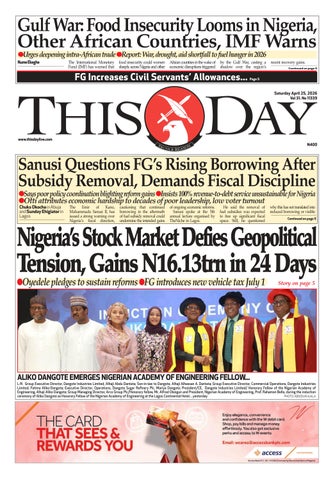
Gulf War: Food Insecurity Looms in Nigeria, Other African Countries, IMF Warns
Urges deepening intra-African trade Report: War, drought, aid shortfall to fuel hunger in 2026
Nume Ekeghe The International Monetary Fund (IMF)
Sanusi Questions FG’s Rising Borrowing
Subsidy Removal, Demands Fiscal Discipline
Says poor policy coordination blighting reform gains Insists 100% revenue-to-debt service unsustainable for Nigeria Otti attributes economic hardship to decades of poor leadership, low voter turnout
Chuks Okocha in Abuja and Sunday Ehigiator in Lagos
The Emir of Kano, Muhammadu Sanusi II, has issued a strong warning over Nigeria’s fiscal direction,
Nigeria’s
cautioning that continued borrowing in the aftermath of fuel subsidy removal could undermine the intended gains
of ongoing economic reforms. Sanusi spoke at the 5th annual lecture organised by TheNiche in Lagos.
He said the removal of fuel subsidies was expected to free up significant fiscal space. Still, he questioned
or visible
Stock Market Defies Geopolitical
Tension, Gains N16.13trn in 24 Days
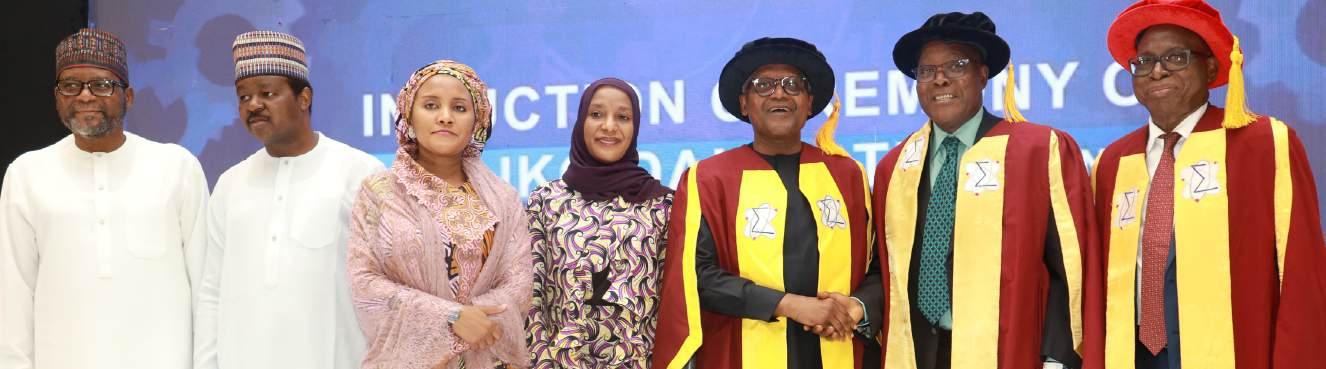
ALIKO DANGOTE EMERGES NIGERIAN ACADEMY OF ENGINEERING FELLOW...
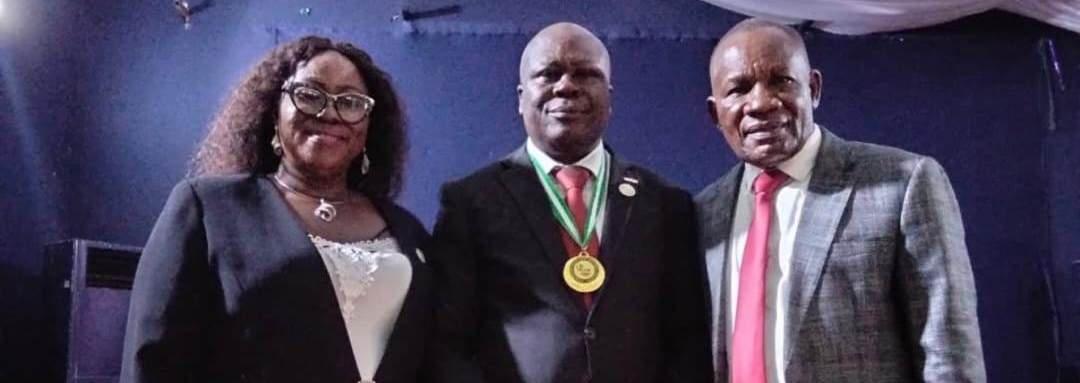
L-R: Group Executive Director, Dangote lndustries Limited, Alhaji Abdu Dantata; Son-in-law to Dangote, Alhaji Alhassan A. Dantata; Group Executive Director, Commercial Operations, Dangote lndustries Limited, Fatima Aliko-Dangote; Executive Director, Operations, Dangote Sugar Refinery Plc, Mariya Dangote; President/CE, Dangote lndustries Limited/ Honorary Fellow of the Nigerian Academy of Engineering, Alhaji Aliko Dangote; Group Managing Director, Arco Group Plc/Honorary fellow, Mr. Alfred Okoigun and President, Nigerian Academy of Engineering, Prof. Rahamon Bello, during the induction ceremony of Aliko Dangote as Honorary Fellow of the Nigerian Academy of Engineering at the Lagos Continental Hotel…yesterday PHOTO:
FG Increases Civil Servants’ Allowances
Govt approves upward review of DTA, estacode, book allowance, others Introduces new exit benefit scheme for retiring govt employees
Onyebuchi Ezigbo and Emmanuel Addeh in Abuja
The federal government yesterday unveiled a broad package of welfare enhancements for public workers, anchored on a N10 billion housing initiative spearheaded by the Federal Mortgage Bank of Nigeria (FMBN), improved allowances, as well as a new
retirement benefit structure.
This comes as the Managing Director of the Nigeria Social Insurance Trust Fund (NSITF), Oluwaseun Faleye, expressed the commitment of the Fund to the Employee Compensation Scheme (ESC) for the benefit of Federal Civil Servants.
Speaking during a press briefing in Abuja, the Head of the Civil Service of the Federation
(HoCSF), Esther Walson-Jack, said the reforms in workers’ allowances were a deliberate shift from rhetoric to measurable policy action, signalling President Bola Tinubu’s commitment to placing workers’ welfare at the centre of governance.
According to Walson-Jack, central to the package was the approval of an Exit Benefit Scheme, designed to provide
retiring treasury-funded civil servants under the contributory pension system with a payout equivalent to their total annual emoluments. This, she said, is intended to address longstanding concerns around post-retirement financial vulnerability within the public service.
She also outlined the operationalisation of the ECS, a structured social protection
mechanism covering workrelated injuries, occupational diseases, disability and death. The scheme, she said, complements existing life assurance provisions and expands the safety net available to government workers and their families.
In a move targeted at professional development, the government also approved
NIGERIA’S STOCK MARKET DEFIES GEOPOLITICAL TENSION, GAINS N16.13TRN IN 24 DAYS
The stock market segment of the Nigerian Exchange Limited (NGX) has continued to shrug off mounting geopolitical tensions, delivering a stunning N16.13 trillion appreciation since the beginning of this month amid impressive 2025 financial year corporate earnings by listed companies, and FTSE Russell Reclassification of Nigeria from unclassified to Frontier Market status. The rally underscores renewed investor confidence and positions the market as a surprising bright spot amid global uncertainty.
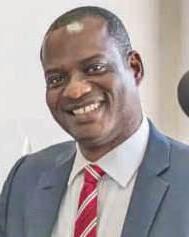
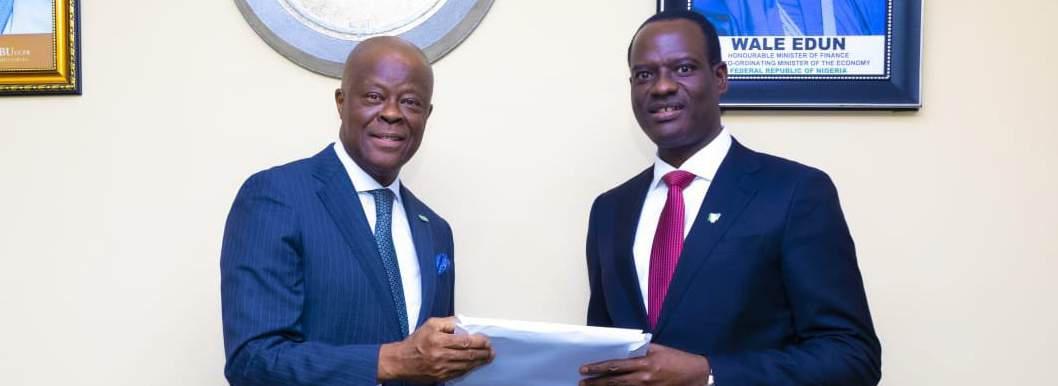
This comes as Nigeria’s new Minister of Finance, Mr. Taiwo Oyedele expressed commitment to sustaining ongoing policy
reforms, as he formally assumed office following the completion of the handover process by the former Minister, Mr. Wale Edun. In line with its 2026 fiscal strategy, the federal government is set to introduce a new tax of between two and four per cent and on high-engine vehicles under items it classified as Green Tax Surcharge effective July 1.
Data obtained by THISDAY from NGX revealed that the market capitalisation of listed companies opened for trading in April 2026 at N129.21 trillion, gained N16.13 trillion or 12.5 per cent to close yesterday at N145.335 trillion.
On the other hand, the NGX All-Share Index gained 12.14 per cent to close yesterday at 225,722.49 basis points, compared with the 201,287.78 basis points
the stock market closed for trading March 31, 2026.
The month of April 2026 witnessed the market capitalisation making history by crossing the N140 trillion mark over surge in demand for fundamental stocks.
When Nigeria’s reclassification by the FTSE Russell was announced, the market capitalisation of the Exchange crossed the N130 trillion mark amid renewed confidence by foreign investors.
However, in its Year-till-Date (YtD) performance, the market capitalisation has appreciated by N45.96 trillion or 46.25 per cent, from N99.376 trillion it closed for trading in 2025.
Also, the NGX All-Share Index increased by 70,109.46 basis points or 45.05 per cent
to 225,722.49 basis points from 155,613.03 basis points when the market closed for trading last year.
As global investors increasingly prioritise markets with strong infrastructure, transparency, and accessibility, Nigeria’s re-entry into the FTSE Frontier Market universe underscores the critical role of market infrastructure in enabling capital formation and connecting local opportunities to global capital.
A group of analysts at Cordros Research, in a report stated that Nigeria’s return to Frontier Market status was expected to improve market flow dynamics, with inflows projected in the range of $840.00 million to $1.04 billion (N1.15 trillion to
N1.42 trillion), underpinned by benchmark-driven rebalancing and incremental discretionary allocations.
Despite persistent geopolitical uncertainties, the sustained rally in the Nigerian equities market highlights a growing resilience underpinned by improving macroeconomic reforms, strong corporate earnings, and renewed foreign investor interest.
Meanwhile, Oyedele, the new Finance Minister, has expressed commitment to the sustain ongoing policy reforms.
full payment of Duty Tour Allowance (DTA) for civil servants attending training programmes at designated federal institutions, regardless of travel requirements. The intervention, she explained, is expected to remove cost barriers associated with capacity building across the service.
He emphasised the need to build on existing reforms while focusing on measurable impact across key sectors of the economy. The minister expressed appreciation to President Bola Tinubu for the confidence reposed in him to serve in his new capacity.
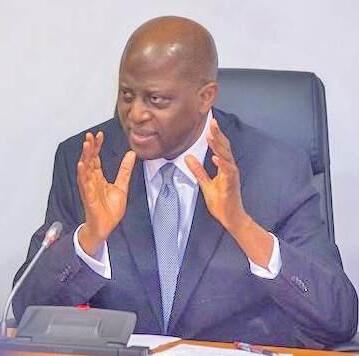
Edun’s period in office was marked by the advancement of key fiscal and economic reforms aimed at stabilising the macroeconomic environment and repositioning the economy for sustainable growth.
In a statement, the Head, Information and P.R Unit in the Ministry of Finance, Efe Ovuakporie, quoted Oyedele in his handover remarks to have commended the former minister for his service and contributions to the ongoing reform efforts in the economy. Oyedele reaffirmed his readiness to work closely with the leadership and staff of the ministry in order to deliver concrete outcomes that align with the government’s economic priorities.
“We’ve removed the subsidy. We’re not spending it. What we should not see is fiscal contradictions. You cannot remove the subsidy and continue borrowing. If you’re not paying the subsidy and you’ve got the money, why are we still borrowing and borrowing? What are we borrowing for?” the former Governor of the Central Bank of Nigeria (CBN) queried.
Sanusi’s comments come amid controversy over another loan request by President Bola Ahmed Tinubu, who had asked the Senate to approve a $516 million loan for sections of the proposed Sokoto–Badagry Superhighway.
In a letter read by Senate President Godswill Akpabio, the President had said the 1,000-kilometre project was intended to connect Nigeria’s North-West and South-West regions.
This comes as the 2026 Global Report on Food Crises predicted that conflict, drought and shrinking aid would keep global hunger at critical levels this year, with food insecurity expected to worsen in some of the world's most fragile countries.
In a blog post, the IMF’s Director of the African Department, Abebe Aemro Selassie, said Sub-Saharan Africa entered 2026 on a relatively strong footing, but was now facing mounting risks that could
The borrowing plan has drawn criticism from several quarters, including former Vice-President Atiku Abubakar, who had described the project as commendable but urged the government to explore alternative funding options instead of increasing debt.
Speaking further, Sanusi stressed that reforms must go beyond policy announcements and deliver measurable outcomes that citizens can feel, warning that failure to do so could erode confidence in government.
Despite backing the policy direction, the former CBN governor questioned the sequencing and timing of the reforms, particularly the removal of subsidy and liberalisation of the foreign exchange market at same time.
According to him, Nigeria’s past reliance on fuel subsidies and artificial exchange rates created deep distortions, making
derail its fragile progress.
He noted that the region recorded its fastest growth in a decade in 2025, expanding by 4.5 per cent, supported by easing macroeconomic imbalances, improved investment flows, and a broadly favourable global backdrop.
Several economies, including Benin, Côte d’Ivoire, Ethiopia, and Rwanda, grew above six per cent, while inflation moderated to about 3.5 per cent and public debt levels began to edge lower, reflecting
economic adjustment inevitable. He, however, stressed that reforms must be complemented by discipline and coherence in implementation.
“I have always said the subsidy regime was unsustainable. We cannot continue exporting jobs to foreign refineries when we are an oil-producing country and not refining our own products,” Sanusi said.
Highlighting recent progress in domestic refining, he added, “Today we have a situation where we have our own domestic refinery, we’re not importing petroleum products, we’re even exporting to Europe, and this is very good for the economy.”
Despite acknowledging the gains, the former CBN Governor warned that poor policy coordination had weakened the overall impact of the reforms.
“Artificial exchange rates, especially when you’re printing
sustained reform efforts.
However, that momentum was now under threat, he stated: “A prolonged conflict could further inflate commodity prices, trigger a risk-off episode in global markets, and force abrupt fiscal adjustments in countries with large refinancing needs. In a severe downside scenario, as detailed in the IMF’s latest, regional output this year could fall 0.6 percent below pre-war forecasts, with oil importers suffering the most, and inflation could surge by
money, cannot work. There was going to be devaluation,” he said, noting that the eventual adjustment of the naira was unavoidable.
Sanusi argued that the sequencing of policy actions played a critical role in the volatility experienced in the foreign exchange market.
“If you decide to remove subsidies and liberalise exchange rates in an environment of very loose monetary conditions, before you tighten the money supply, the naira drops into a bottomless pit. That was a timing issue,” he stated.
He emphasised that monetary tightening should have preceded or at least accompanied the liberalisation process to prevent excessive pressure on the currency.
On the fiscal side, Sanusi said, “When you get to a point where 100 per cent of your revenue goes to debt service, you cannot continue. Where is the money
an additional 2.4 percentage points.
“The human costs are equally stark. Food insecurity looms large: the region remains acutely vulnerable to food-price shocks, and the war has already driven up fertilizer and shipping costs.
“A 20 percent rise in international food prices could push more than 20 million people into food insecurity and leave 2 million children under age 5 acutely malnourished. Climate shocks intensify the strain the recent floods in
going to come from?” he asked. He also reiterated his longheld position on governance and ethics in public service.
“Public service is an honour. If you want to make money, go into business,” he said, pointing to industrialist Aliko Dangote as an example of wealth creation through private enterprise.
Also speaking at TheNiche lecture, Abia State Governor, Alex Otti, provided a broader political context for Nigeria’s economic challenges, linking them to decades of poor leadership choices and declining civic participation.
Otti argued that the country’s current economic hardships, including rising poverty, unemployment, and institutional decay, are the cumulative result of governance failures spanning over half a century.
“If you have behaved badly for over 60 years, it will take you time to correct yourself,” he said. “Our country has a
Mozambique and Madagascar serve as a reminder of the region’s deep vulnerability to weather disruptions.”
The IMF official stressed that, beyond immediate policy responses, structural reforms remained critical to cushioning the shock and strengthening resilience over the medium term. Central to this, it stated, was the need to deepen intra-African trade and accelerate regional integration.
He added: “Even as policymakers grapple with
great destiny, but whether that day will be in this decade or in the coming century or perhaps never will depend largely on what we do in the days and years that follow,” he said. The governor warned that citizens’ disengagement from the political process had contributed significantly to poor governance outcomes.
“Staying away from the field of play only ensures continued deterioration,” he said, referring to declining voter turnout in recent elections.
He stressed that democracy requires active participation beyond Election Day, urging Nigerians to critically assess candidates and their economic philosophies.
“The crisis of unemployment, poverty, and the collapse of institutions cannot be separated from citizens’ disinterest in the political affairs of their communities,” Otti stated.
the immediate shock, the medium-term reform agenda cannot wait. The premium on accelerating structural reforms—to boost growth and resilience—is now even higher. Improving the business climate, strengthening governance, and reforming state-owned enterprises, especially in energy, transport, and telecommunications, can help attract investment and lift productivity.
Ndubuisi Francis in Abuja and Kayode Tokede in Lagos
(This announcement appears as a matter of record only)
RC: 103022
Private Placement of 14,800,000,000 Ordinary Shares of 50 Kobo each at ₦ 17 . 5 0 per share
Payable in full on Application
Announces the result of the Private Placement of 14,800,000,000 ordinary shares of 50 kobo each at ₦ 17 . 5 0 per share (the “Offer”), which opened on Wednesday, December 31, 202 5 and closed on Wednesday, December 31, 2025
• Twenty (20 ) applications for 16,776,200,000 ordinary shares were received, deemed valid, accepted and presented to the Central Bank of Nigeria (CBN) for capital verification
• Fourteen (14) applications for 12,238,058,000 ordinary shares were fully verified and allotted in full.
• One (1) application for 1,609,550,000 ordinary shares was partially verified, with 735,942,000 ordinary shares verified and allotted.
• Five (5) applications for 2,928,592,000 were not verified.
• In summary, the Offer recorded 113.4% in valid applications and achieved a subscription level of 87.7% upon conclusion of the CBN capital verification process.
The breakdown of the allotment is provided below:
The above stated basis of allotment, as well as this announcement has been cleared by the Securities and Exchange Commission (the “SEC”).
Shares allotted will be credited to the CSCS account of allottees on April 30, 2026 by the Registrars to the Issue, First Registrars & Investor Services Limited, No 2, Abebe Village Road Beside Nigerian Breweries Plc, Iganmu, Lagos In accordance with the SEC Directive on Dematerialization of Share Certificates, allottees without CSCS accounts will have their shares credited immediately at the CSCS using a Registrar Identification Number
Also, return monies will be credited to the bank account of affected
details on April 27, 2026
Joint Issuing Houses
NEW HOUSING MINISTER MEETS PRESIDENT...
Military Begins Closed-door Trial of Alleged Coup Plotters, Bars Journalists from Venue
The Nigerian military yesterday commenced a closed-door trial of personnel accused of plotting to overthrow the country’s democratic government, as journalists were barred from covering the proceedings.
This comes exactly three days after the federal government filed a 13-count charge before the Federal High Court, Abuja, against a retired major general, a retired naval captain, a serving police inspector, and three others, who were allegedly involved in the coup to oust President Bola Tinubu.
The military trial, convened under a General Court Martial, began in Abuja amid tight security and restricted access.
Journalists invited to cover
the inauguration at the Scorpion Officers’ Mess were, however, abruptly ordered to leave the venue.
According to those present, the directive came shortly after a bus conveying the accused officers arrived.
The journalists were subsequently escorted out of the premises and taken away from the vicinity without explanation.
Many described the development as unexpected, noting that they had been formally invited by the military authorities to cover the event.
They also expressed concern over what they characterised as disrespectful treatment, particularly given that the restriction appeared to have been imposed after initial access had been granted.
Confirming the proceedings, the Defence Headquarters
Gombe Governor Orders Full Implementation of Minimum Wage for LG Workers, Others
Gombe State Governor, Alhaji Muhammadu Inuwa Yahaya, has approved the full implementation of the new national minimum wage for workers in the local government system across the state.
The Head of Civil Service, Professor Muazu Shehu, who conveyed the governor’s approval yesterday , said the directive covers staff of the 11 local government councils, Local Education Authority ( LEA) and primary healthcare workers, and will take effect from May 2026.
With this decision, the state government has cleared the remaining 43 per cent balance, completing 100 per cent implementation of the wage structure.
(DHQ) announced that a General Court Martial had been inaugurated to try 36 serving military personnel over alleged breaches of national security. In a statement yesterday, the
Director of Defence Information, Major General Samaila Uba, said the trial relates to accusations of mutiny and an alleged attempt to overthrow the government.
“The Defence Headquarters
has today inaugurated a General Court Martial to try 36 serving military personnel over alleged mutiny aimed at overthrowing the government of the day,” the statement said.
He added that the move follows an earlier announcement made on 26 January 2026 and underscores the Armed Forces’ commitment to discipline and accountability.
Third Party Insurance: Court Restrains Police, FRSC from Imposing Fines on Motorists
A Federal High Court in Abuja, yesterday, issued an order restraining the Nigeria Police Force and the Federal Road Safety Corp (FRSC), from imposing fines and penalties against motorists, who breached the Third Party Motor Vehicle Insurance Act, without a valid order of court.
Justice H. J. Yilwa, made the order while delivering judgement in a suit filed by
human rights lawyer, Mr. Deji Adeyanju.
Justice Yilwa before delivering her judgement dismissed a Notice of Preliminary Objection brought by the police to "arrest the judgment".
When the matter was mentioned, counsel to the police, Mr. A. Victor had brought a motion to challenge the court's jurisdiction to entertain the suit, arguing that jurisdiction is vital to any case and can be brought at any time before judgement,
adding that the Police was not served with the charge.
But, Justice Yilwa, in a bench ruling disagreed, maintaining that evidence of service is contained in the court's record.
"Having listing to submissions of all counsel, this court notes that the originating summons was served on all respondents", she said, adding that her record shows the suit was served on the Police on April 3, May 21, November 14, 17, January 28, and April 21.
While also listing the dates that the 2nd and 3rd respondents filed their respective replies, she said, "1st respondent is very much aware of the suit but refused to respond, this is viewed as an attempt to arrest this judgment and this court will not allow it. The motion of preliminary objection as well as the party seeking to be joined are hereby refused. Consequently I shall proceed to deliver judgment."
Court Strikes out Suit Seeking to Jail INEC Chairman for Alleged Disobedience
The full rollout, he added, is expected to boost morale, enhance productivity and strengthen service delivery across grassroots institutions.
It would be recalled that Gombe was among the first states to implement the new national minimum wage following its passage into law in 2024.
Governor Yahaya has consistently maintained that improving the welfare of civil servants remains central to his administration’s development agenda, describing workers as “critical drivers of governance and service delivery.”
The state Head of Civil Service explained that the decision was made possible by improved fiscal conditions at the council level, which have strengthened local governments' capacity to meet salary obligations without disruption.
The Federal High Court in Abuja has struck out a contempt of court charge against the Chairman of the Independent National Electoral Commission (INEC), Professor Joash Amupitan, SAN. Justice Joyce Abdulmalik
struck out the suit on the grounds that the applicant failed to personally serve the court documents on the defendant, as required by law. It would be recalled that Justice Egwuatu had in a judgement delivered on March 5, 2025 in Suit No. FHC/ABJ/ CS/45/2025, ordered INEC to
recognise the Edozie Njoku-led committee as the national leadership of the National Rescue Movement (NRM).
Following refusal of the commission to obey the order of the court, the NRM subsequently initiated contempt proceedings against the then INEC chairman, Prof Mahmoud Yakubu, by the
filing of Forms 48 and 49. However, INEC at the proceedings of last month had challenged the jurisdiction of the court to hear the matter, arguing that the court of Justice Egwuatu was not the proper court to hear the alleged contempt since it was not made in the face of the court.
Subair Attributes Lagos Tax Growth to Tinubu’s Foresight
Dike Onwuamaeze
The Executive Chairman of the Lagos State Internal Revenue Service (LIRS), Dr. Ayodele Subair, has said the remarkable growth of tax administration and internally generated revenue in Lagos State can be traced to the bold reforms initiated by President Bola Tinubu during his tenure as governor of the state.
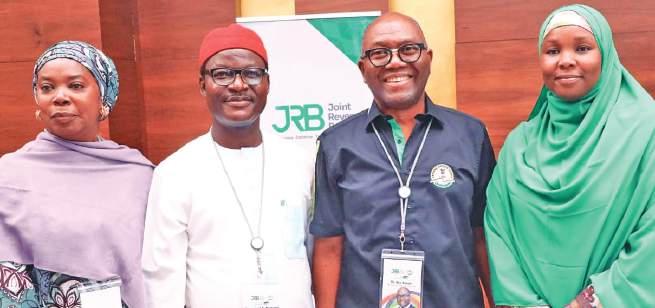
Subair stated this at the Gala night organised to close the 159th meeting of the Joint Revenue Board (JRB) held in Lagos, where tax administrators and revenue stakeholders from across the country gathered for four days to deliberate on ways to strengthen tax systems, improve compliance, and deepen revenue generation nationwide.
According to him, the decision
by Tinubu to grant operational autonomy to the Lagos State Internal Revenue Service years ago laid the foundation for the success story that has since become a model for several states in Nigeria.
He said, “This story of taxation in Lagos was started seriously by our present President, Asiwaju Bola Ahmed Tinubu, who deemed it fit to give autonomy to the Lagos
State Internal Revenue Service. “From then on, things changed. Things are still evolving and changing because he handed over the baton to very serious governors thereafter. His model is copied in most of the states in Nigeria. I think the President deserves applause. We are seeing the benefits of that vision that this great Nigerian had, and we all pledge to continue.”
Alex Enumah in Abuja
Alex Enumah in Abuja
Linus Aleke in Abuja
Segun Awofadeji in Gombe
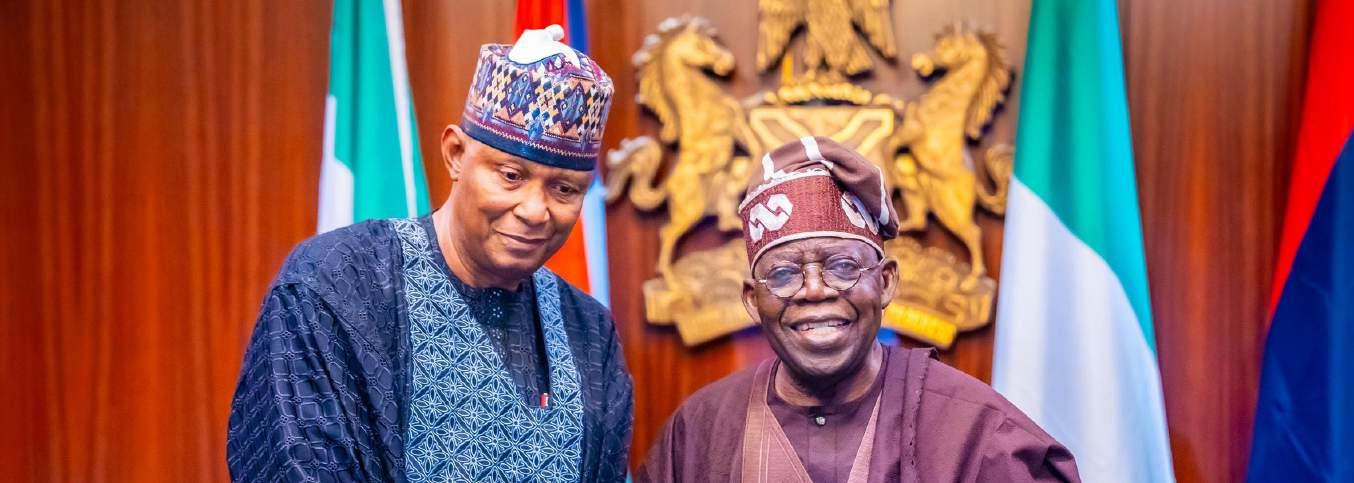
President Bola Tinubu (right) after swearing in Engr. Muttaqha Rabe Darma as the Minister of Housing and Urban Development at the Presidential Villa, Abuja...yesterday
PHOTO: GODWIN OMOIGUI
BOOSTING AGRICULTURAL TRADE ON THEIR MINDS...
US Revitalises Credit Guarantee Programme to Boost Agric Trade with Nigeria
The United States has stepped up efforts to deepen agricultural trade ties with Nigeria by revitalising a key financing mechanism designed to ease access to imports and strengthen food supply chains.
At the centre of this push is the Export Credit Guarantee Program (GSM-102), administered by the U.S. Department of Agriculture. The programme provides government-backed credit guarantees that reduce the financial risks faced by banks and importers, making it easier
for Nigerian businesses to source essential agricultural inputs from the United States.
Officials say the move reflects a broader strategy to shift economic engagement toward mutually beneficial trade.
Speaking in Lagos, U.S. Consul General, Rick Swart, emphasised a transition “from aid to trade,” positioning Nigeria as a critical commercial partner in Africa and highlighting opportunities for entrepreneurs and investors on both sides.
Trade figures underscore the growing relationship. Bilateral trade between United States and
Lagos TUC Crisis Deepens as Council Accuses National Body of Imposing Leadership
Sunday Ehigiator
The Lagos State Council of the Trade Union Congress of Nigeria (TUC) has accused the national leadership of attempting to subvert internal democracy by attempting to impose leadership, warning that the ongoing leadership dispute in the state poses a broader threat to trade unionism across the country.
Addressing journalists in Lagos yesterday, the Public Relations Officer of the state council, Comrade Kabiawu Gbolahan, said the crisis transcends a mere struggle for office, describing it as “a grave danger confronting the soul of trade unionism in Nigeria.”
He alleged that the dispute was orchestrated by the TUC National Secretariat, which, according to him, initially approved the Lagos State Delegates’ Conference before allegedly working to undermine the process when outcomes did not align with its interests.
“The same National Secretariat that issued the notice,
released the delegates’ list, and cleared candidates, suddenly turned around to sabotage the process,” he said, adding that such actions erode trust and threaten the credibility of union structures.
Gbolahan maintained that a valid election was conducted in Yaba under the supervision of a caretaker committee, with participation from more than 15 affiliates, security agencies, and representatives of the Lagos State Government.
He said the exercise produced a duly elected executive council led by Comrade Aladetan Abiodun Emmanuel as chairman, insisting that the outcome reflected the legitimate will of workers in the state.
However, he alleged that a parallel process was organised elsewhere, which he described as “manipulated” and dominated by a single affiliate, resulting in what he termed an imposed leadership.
“It was not a conference; it was a coronation. It was not democracy; it was a script,” he said.
Nigeria reached nearly $15 billion in 2025, marking a 14 per cent increase from the previous year.
Agricultural trade has been a major driver, rising sharply to $764 million—an 84 per cent jump that reflects expanding demand and stronger market linkages.
To boost awareness and participation in GSM-102, the Foreign Agricultural Service
of the U.S. Consulate General convened a two-day forum in Lagos. The event brought together stakeholders including the U.S. International Development Finance Corporation, the NigerianAmerican Chamber of Commerce, U.S. exporters, Nigerian banks, and agricultural importers. Discussions focused on how the credit guarantee scheme can unlock financing, improve food
security, and create jobs across the agricultural value chain.
Participants also engaged in business-to-business meetings aimed at converting opportunities into tangible trade deals.
According to Demeteris Hale, the programme’s strength lies in its ability to build market confidence by lowering transaction risks, thereby enabling lenders and exporters to expand
into new markets. The renewed momentum follows a key development in late 2025, when Nigerian banks regained eligibility to participate in GSM-102. Since then, selected financial institutions have received credit limits, reopening access to U.S.-backed trade financing and helping to accelerate agricultural commerce between the two countries.
Ex-Chairman of Defunct Skybank, Tunde Ayeni in EFCC's Net over Alleged N36bn, $30m Fraud
Alex Enumah in Abuja
A former board Chairman of the defunct Skybank Plc, Mr. Tunde Ayeni, has been taken into the custody of the Economic and Financial Crimes Commission (EFCC), over alleged money laundering and fraud offences.
Ayeni, according to sources at the anti- graft agency, is currently being grilled for allegedly misappropriating and diverting the sum of N36,540,058,400,00 and $30m.
He was reportedly arrested in Abuja on Thursday by operatives
of the EFCC and he is said to be kept at one of the holding facilities of the commission.
According to a source who crave anonymity, "Ayeni was arrested sequel to the investigation of the EFCC into alleged misappropriation and diversion of funds to the tune of N36,540, 058,400,00 and $30m obtained from Polaris Bank Plc by different entities linked to him."
The source added that the funds were loans obtained allegedly for specific investment projects but subsequently
transferred to other entities’ accounts.
He disclosed that investigations so far showed that, though the loans were obtained for purposes such as finance of marine security activities, electricity distribution contract, estate development, they were diverted to the NITEL/MTEL asset acquisition through NATCOM account.
Similarly, 12 different companies linked to Ayeni are said to being investigated by the EFCC. They are said to be entities he allegedly used to
obtain loans from Polaris Bank for the alleged deals.
The source claimed that the loans are depositors’ funds fraudulently obtained and allegedly frittered into diverse wasteful purposes.
Meanwhile, another source assured that the former bank executive will be arraigned once investigations are concluded. When contacted over the development, spokesperson of the EFCC, Mr. Dele Oyewale, who confirmed the arrest however refused to speak further on the issue.
Ganduje: PWDs’ Neglect Leading to Army of Beggars in Northern Nigeria
Adedayo Akinwale in Abuja
A former Governor of Kano State, Dr. Abdullahi Ganduje, has lamented that the neglect of persons living with disabilities (PWDs) has led to an army of beggars in the North.
To this end, he called on governors, development partners and philanthropists to invest more in persons living with disabilities to reduce begging in Northern Nigeria. Ganduje, who is the
immediate-past National Chairman of the All Progressives Congress (APC), made the call yesterday in Abuja during the 10th anniversary of Let's Talk Humanity (LTH), an organisation caring for the education needs of deaf and blind.
He stated, “In the northern part of this country, people with disabilities are so much relegated to the background. That's why we have an array of beggars across the northern part of this country day and night.
“Some sleep under bridges, some sleep on the road, this is a sorry story but looking at what we saw this afternoon, you can see that there is a silent revolution if what we have seen could be adopted by our executive governors, development partners and by various philanthropists, there's no doubt there will be a big change in our society.
"Yes, they are neglected because they are physically challenged. This has affected
their psyche, motivation and they cannot even think they are human beings like other beings but unveiling this kind of programme we are making them to be like any other human being in our society."
Also, the Minister of Humanitarian Affairs, Dr. Bernard Doro, said that assistive devices or technology must be developed with PWDs in mind at the design stage. Doro stressed that inclusion is not an option but a design imperative.
Michael Olugbode in Abuja
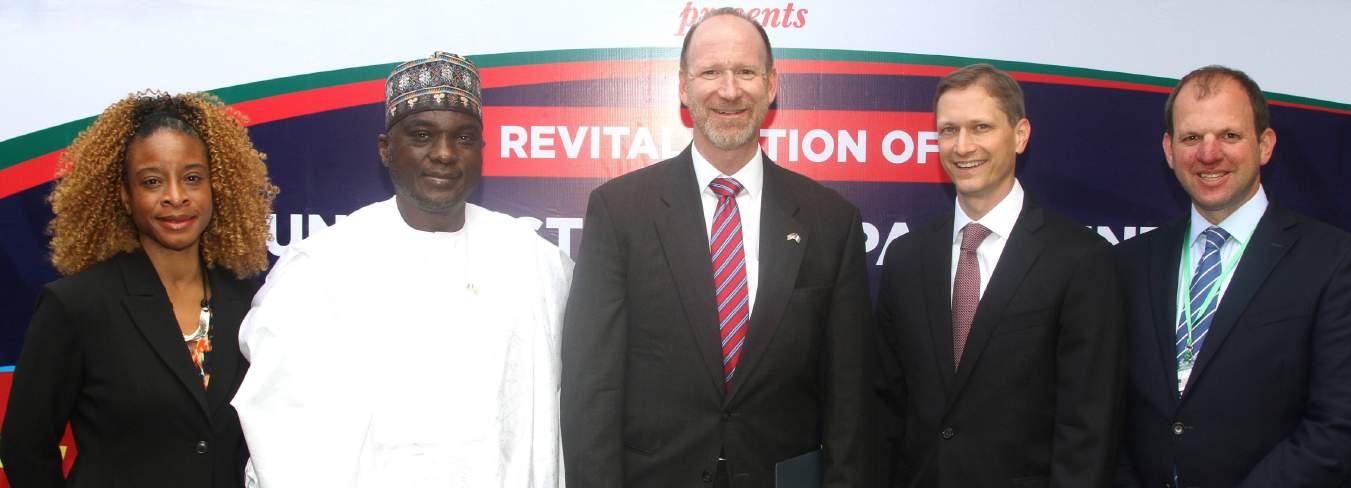
L-R: Senior Analyst, U.S. Department of Agriculture (USDA), Demeteris “Dee” Hale; President Nigerian-American Chamber of Commerce, Sheriff Balogun; U.S. Consul General, Rick Swart; U.S. Mission Agricultural Counselor, Chris Bielecki, and Financial Analyst, Risk and Asset Management/Credit Programs Division, USDA Joe Gurowsky, during the GSM-102 Revitalisation event in Lagos…recently
The Making Of The First Presidential Library In Africa
Before General Ibrahim Babangida left office, his administration appointed Senator Udoma Udo Udoma as the Chairman of the Corporate Affairs Commission (CAC). They wanted him to reform the CAC, which used to be a company registry. He was mandated to turn it around so that it could register companies and monitor them. Udoma studied law at Oxford University, and specialised in commercial law. That was the connection; CAC is a commercial institution.
I recall that Udoma came to my house in Lagos. He said there were several warehouses containing documentations from 1891 and that they were all scattered everywhere in Abuja. He believed that from my advertised expertise, exposure and experience, he could trust me to sort out the data for them. They took me from one warehouse to another. I saw rooms filled to the ceiling with files. I refused to be afraid. I went back home, and as I always did, I told myself this is a challenge you can overcome.
The first thing I did was to call my good friend, Richard Braithwaite Lloyd Fitzwilliams, Editor-in-Chief of the International WHO'S WHO, in London. I told him about the assignment I had, and asked how he could be of help to me. “I can only organise for you to go to the company house in Wales, in the UK,” Richard offered. He said they had an underground filing system. He concluded that if I went there, certainly, I would know what to do back in Nigeria.
Within seven days, I was there in the United Kingdom. From there, I went to understudy how things were done at the company house in London. From London I went to Wales. From there, I was linked to the company house at Albany, in the United States of America. I spent four weeks in Albany, studying how documents are processed in a computerised system. I was also exposed to the National Archives and Records Administration (NARA) on how they manage information for the office of the President of the United States of America. It was about analysis, documentation, finetuning information, storage and retrieval. Emphasis has always been on the fact that once you have the right quality of information, you can take the right decision. The next one is implementation. By the time I returned to Nigeria, I had loads of information. That exposure in the United States and UK really helped me a lot. That was because I went to the source—I went to people who had done that kind of thing before and they put me through the processes. These were connections established and sustained over the years—since my days at the Nigerian
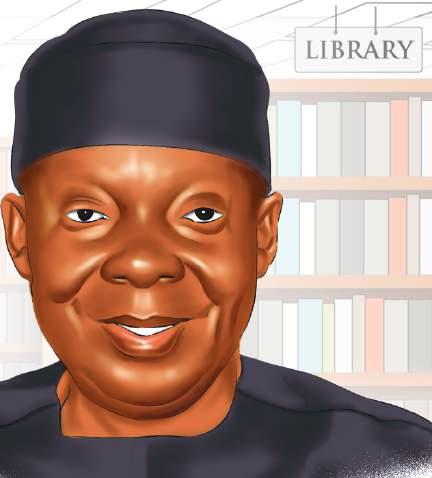
Pnarrates the history of The Olusegun Obasanjo Presidential Library
Chronicle. They helped to solidify my background and knowledge about managing information, or managing knowledge. So, the establishment of the CAC in the manner that Udoma was mandated to do was partially made possible by the documents I brought from these countries. At that time, I was still committed to Newswatch, but as a consultant. I wasn't going there frequently anymore.
Within that period, the late Senator Uche Chukwumerije was appointed Secretary of Information, an equivalent of Information Minister by the Ibrahim Babangida administration. As soon as they made the announcement, the first person he asked of was NyaknnoAbasi Osso. Somehow, I was not even aware that he was looking for me. So, why was he looking for me? It happened that, while I was on the CAC job for Senator Udoma, I was most of the time at the Transcorp Hilton Hotel. Usually, you would see me in the bookshop where they also sell magazines. One day, as I walked into the bookshop, I met Soji Akinrinade. We had worked together at Newswatch. He was surprised to see me there. “Aaahhh, it is God that has made me to see you today,” Akinrinade exclaimed. “There is one Minister that has been sending people to Newswatch to look for you for the past three months.”
MY STAY WITH PRESIDENT OBASANJO IN THE PRESIDENTIAL VILLA AFFORDED ME THE OPPORTUNITY TO ACTUALISE THE PRESIDENTIAL LIBRARY CONCEPT. MOST IMPORTANTLY, I WAS SENT ON TOUR OF PRESIDENTIAL LIBRARIES IN THE UNITED STATES OF AMERICA. I TALKED WITH THESE FORMER PRESIDENTS ABOUT PRESIDENT OBASANJO'S VISION OF THE FIRST PRESIDENTIAL LIBRARY IN AFRICA
He tried to recall the name of the Minister while we talked about other things. Eventually, he mentioned his name: Chukwumerije. It was about 3 p.m. Soji said he was in Abuja with other editors for a seminar. Even Ray Ekpu and Dan Agbese were also there. He said the seminar would end by 3:30 pm. They had a chartered aircraft waiting for them at the Abuja airport for the return trip. He said the plane was almost empty and that I could fly with them back to Lagos so that I could meet with Chukwumerije. I quickly went back to where I used to stay with a friend, Dr Effiong Esu. I gathered a few belongings into my briefcase and went straight to the airport to join them.
As soon as we landed in Lagos, I took a taxi straight to Chukwumerije's office at 15 Awolowo Road in Ikoyi. At the front desk, they told me that he was presiding over a meeting. I filled a form, which they took to him. The man left the meeting he was holding, and came to the door shouting, “Where is Osso? Where is Osso?” And I said, “Sir, see me here.” Once he saw me, he gushed, “This man, where have you been; I have been searching for you. Please come inside.”
Excerpts from AGAINST ALL ODDS: My Testimony
Pan-Africanism: Beyond Propaganda
Replacing Western imperialism with that of Moscow or Beijing is not liberation; it is a new bondage, argues OUMAROU SANOU
an-Africanism is once again in vogue. But what is being marketed today, particularly by military-led regimes across the Sahel and their ideological enablers, is not Pan-Africanism. It is a distortion of it, seductive in its language and dangerous in its implications.
A new orthodoxy has taken hold. To gain admission into the growing club of self-appointed Pan-Africanists, one needs only to perform two rituals: express fierce hatred for the West, then faithfully echo the talking points of Moscow or Beijing. The louder the anti-Western rhetoric, the purer the credentials. Across social media and in certain political circles, an active disinformation architecture, both overt and covert, markets to African youths the idea that genuine liberation means substituting Washington for Moscow, Paris for Beijing, and Brussels for Ankara. These are false choices. This is not independence of thought. It is the outsourcing of African destiny to a different set of foreign masters, like a servitude dressed in Kente cloth.
At its core, Pan-Africanism has always stood for one fundamental principle: the right of African peoples to determine their own destiny. Not to rebrand dependency. Not to outsource it. To own it, fully and unapologetically. What we are witnessing today is its precise opposite.
Unfortunately, the Pan-Africanism being peddled by certain juntas is, at its core, a grand jail ruled by dictators who have traded democratic legitimacy for foreign patronage. When leaders in the Sahel invoke African sovereignty even as their political survival depends on the Wagner Group mercenaries and Kremlin goodwill, the contradiction is breathtaking. A country's sovereignty is impossible without the sovereignty of its people, which means the rule of law, democratic governance, and the protection of individual rights. A regime that silences its own citizens while railing against foreign imperialism is not an emancipator. It is an oppressor with a better publicist.
There is a further symptom of this counterfeit Pan-Africanism: the curious
hierarchy of suffering it enforces. Passionate debates rage across the continent about the Middle East, with Africans taking heated sides over Gaza and Tel Aviv. Yet the carnage in Sudan, the horror in eastern Congo, the catastrophe in Ethiopia attract a fraction of the same outrage. Why should the Russia-Ukraine war command more African attention than the conflicts consuming the Great Lakes or the Sahel? Pan-Africanism that ignores African suffering in favour of globally fashionable causes is not Pan-Africanism. It is geopolitical ventriloquism. We are living in the age of artificial intelligence, robotics, and commercial space exploration. The global economy is being reorganised by technologies that did not exist a generation ago. Against this backdrop, a handful of military dictators are attempting to justify their regimes by recycling the legitimate but exhausted struggles of the 1950s and 1960s. The anti-colonial struggle was necessary and noble. But the world has moved on, and Africa cannot afford to remain imprisoned by historical resentments while the future
is being built without it.
The lesson from post-war Europe is instructive. France and Germany, nations that twice in a single century sent millions of each other’s sons to die, chose to build a common future rather than nurse their wounds. That decision produced the most ambitious peace project in modern history and made both nations more prosperous than they had ever been through conflict. Africa’s historical grievances are real. But fixating on past resentments is not a development strategy. It is an abdication of leadership.
Authentic Pan-Africanism is not an ideology of grievance. It is a programme of action. Half a century ago, South Korea and Singapore were poorer than many African countries. Today, they rank among the world’s most dynamic economies. The difference was not the absence of foreign interference; both nations had plenty of that.
Sanou is a social critic, Pan-African observer and researcher focusing on governance, security, and political transitions in the Sahel.
NYAKNNOABASI OSSO
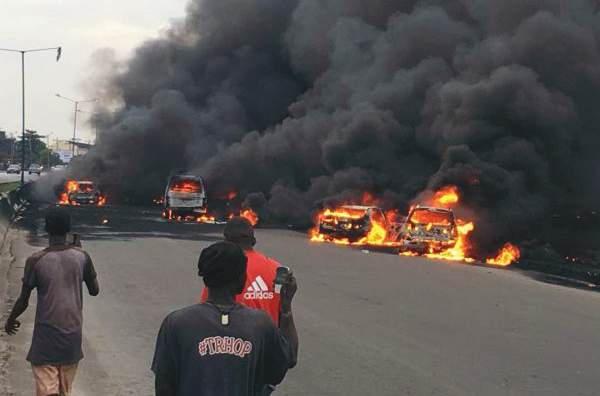
Yet another explosion...
Nigeria’s False Superiority Complex
In Praise of President Buhari
Do Lawyers Suffer Spiritual Attacks in Courtrooms?
AWhen President Muhammadu Buhari took over the reins of power on May 29, 2015, Nigeria was sadly a broken state in many respects. As a result of many other factors including bad governance and untold level of corruption, government could not live up to its financial obligations to citizens and service providers at both the federal and state levels.
Indeed one of the first official assignments that President Buhari carried out was the approval of billions of Naira in bailout funds to enable state governors pay something as basic as workers’ salaries. Granting those bailout funds was a huge boost to national security because the pressure of arrears of unpaid monthly salaries building dangerously all over the country was a ticking bomb.
s criticisms have intensified following a dramatic dip in the standard of living of Nigerians and rising insecurity, the Nigerian government has grown increasingly defensive, clutching at straws to extend some explanation to what has become a truly inexplicable situation to Nigerians.
Ask the naysayers and they would readily remind you of how long it took President Buhari to appoint his ministers and how that contributed to collapse of the economy as if, without ministers, governance was frozen. But buying that narrative would amount to what a famous Nigerian writer, Chimamanda Adichie, termed “the danger of a single story”. Yet the whole story was that many of our citizens did not know how decrepit a state President Buhari inherited in 2015.
at independence. Four years before then, the discovery of oil at Oloibiri, Bayelsa State, meant that a newly independent country had all the tools it needed to take a place long predicted for it on the world stage. At that point, it appeared that decades-long prophecies about a great country rising out of the stygian darkness of Africa were about to be fulfilled.
by the EFCC, President Buhari by his action has successfully brought back to the public consciousness the need to treat public funds with the highest level of transparency and accountability.
MAfter keeping treasury looters on their toes and at bay through the EFCC, particularly, President Buhari moved to curb unnecessary spending habits of the nation on what economists call articles of ostentation. Part of the disclosures of the President’s stock taking was how the country frittered away billions in foreign currency by importing goods, which can be produced at home. One of such items was rice, a major staple among Nigerians. By banning rice importation into the country, the President on one hand had saved the nation billions in foreign currency annually.
While Nigeria flew out of the blocks, other African countries, some newly independent, others fighting for their independence, were left behind. For a country like Ghana, the situation was one of grave despair.
It was therefore necessary for him to take stock against the background of the fact that the departing government did not, reportedly, cooperate full well with the incoming government in terms of leaving workable handover notes. Although President Goodluck Jonathan was gracious in defeat, many of his appointees were still sulking over what they saw as their personal losses and therefore pulled all the stops to make things difficult for the Buhari government.
And, on the other hand, the President has boosted domestic production of rice and in the process had nudged the country into self sufficiency in food production. He also created millions of jobs for young people in the rice value chain.
What is most admirable about President Buhari and his government is its frugal management of scarce national resources to attain optimum goals. Recall that since President Buhari stepped in the saddle, oil revenue dropped abysmally as if to sabotage him knowing all the big promises he made to citizens during his campaigns. But with the little resources that trickle in, the President is achieving what governments that received oil windfalls could not dream of.
Kene Obiezu is a lawyer, writer, and social commentator. keneobiezu@gmail.com.
Even with the obvious and unpatriotic obscurantist behaviour of the PDP appointees and their supporters still in government hell-bent on making things difficult for Buhari, the President moved on with his methodical repair of a broken country. The first thing he did was to identify all possible sources of income to the nation and directed that all inflows be paid into one single account in line with the policy of Single Treasury Account (TSA).
There is only so much a country can withstand; there is only so much the citizens of a country can stomach. When that country is Nigeria with its enormous pool of human and natural resources, the frustration at how desperate things have become grows exponentially. Recently, amidst severe and ceaseless backlash about Nigeria's rising poverty and insecurity levels, the presidency traced comparative lines all the way to Kenya. According to President Bola Ahmed Tinubu Nigerians were better off than other Africans in Kenya and other African countries.
The TSA policy, interestingly, was mooted by the PDP government but its penchant for imprudence and lack of accountability denied it the courage of implementing the policy. What the President literally did was to gather all the nation’s money into one box and locked it up with a big padlock and watched for any thief to come close.
Recently, the presidency doubled down, saying that according to statistics, Nigeria was growing more than the UK and the US. Beyond dubious data, what do Nigerians have to show for supposedly being better than Kenyans or growing faster than the UK and USA? Since when have the scraps that make it to Nigerian plates only barely become a sign of growth?
Who can blame the President for almost developing paranoia over the safeguard of the national treasury with revelations and reports of mind-boggling looting that took place in the 16 years of the PDP? With such disclosures of how billions meant for fighting insurgency in the Northeast ended up in the pockets of a few individuals while our gallant soldiers fought with bare hands and on empty stomach, President Buhari was duty bound to bring sanity and accountability back in national spending.
The reality is that Nigeria is living in past glory, and there are strong historical reasons for this hysterical delusion. In 1960, Nigeria exploded out of the blocks
Thus, under President Buhari, the Economic and Financial Crimes Commission (EFCC), which had remained comatose for years, was woken up to resume its duties. Apart from the trillions of Naira of looted funds and property recovered from corrupt politicians
y attention has been drawn to an article, Haunted wigs: Lawyers share mysterious courtroom experiences, by Chijioke Iremeka. The article was published in The Punch Newspaper on April 5 2026. The author rightly acknowledged the nonrecognition of witchcraft and the use of charms in the Nigerian constitution, while addressing 'rumours about alleged spiritual attacks on lawyers and the judicial system'. Although the piece claimed to focus on gossip, I am persuaded that the article would misinform the public and reinforce witchcraft and juju beliefs. Most readers would not be observant enough to know that the author was explaining 'rumours', not 'real courtroom experiences'. The purpose of this piece is to dispel those misguided rumours.
Today, the trains are up and running daily from Abuja to Kaduna. And from Lagos to Ibadan a brand new rail track was started and completed; citizens are already commuting daily to and fro these two major cities in the country seamlessly as they reap from the dividends of democracy. And with the way this government is going, before 2023 when the President would leave, the entire country would be linked by rail with all of its economic advantages.
Ainofenokhai Ojeifo, Abuja
THE SATURDAY NEWSPAPER
EDITOR OBINNA CHIMA
THE SATURDAY NEWSPAPER
EDITOR YEMI ADEBOWALE
DEPUTY EDITOR AHAMEFULA OGBU
MANAGING DIRECTOR ENIOLA BELLO
DEPUTY EDITOR AHAMEFULA OGBU
MANAGING DIRECTOR ENIOLA BELLO
DEPUTY MANAGING DIRECTOR ISRAEL IWEGBU
DEPUTY MANAGING DIRECTOR ISRAEL IWEGBU
CHAIRMAN EDITORIAL BOARD OLUSEGUN ADENIYI
CHAIRMAN EDITORIAL BOARD OLUSEGUN ADENIYI
EDITOR NATION’S CAPITAL IYOBOSA UWUGIAREN
EDITOR NATION’S CAPITAL IYOBOSA UWUGIAREN
THE OMBUDSMAN KAYODE KOMOLAFE
MANAGING EDITOR BOLAJI ADEBIYI THE OMBUDSMAN KAYODE KOMOLAFE
THISDAY NEWSPAPERS LIMITED
THISDAY NEWSPAPERS LIMITED
EDITOR-IN-CHIEF/CHAIRMAN NDUKA OBAIGBENA
EDITOR-IN-CHIEF/CHAIRMAN NDUKA OBAIGBENA
GROUP EXECUTIVE DIRECTORS ENIOLA BELLO, KAYODE KOMOLAFE, ISRAEL IWEGBU
GROUP EXECUTIVE DIRECTORS ENIOLA BELLO, KAYODE KOMOLAFE, ISRAEL IWEGBU, IJEOMA NWOGWUGWU, EMMANUEL EFENI
DIVISIONAL DIRECTORS SHAKA MOMODU, PETER IWEGBU, ANTHONY OGEDENGBE
DIVISIONAL DIRECTORS SHAKA MOMODU, PETER IWEGBU, ANTHONY OGEDENGBE
DIRECTOR, PRINTING PRODUCTION CHUKS ONWUDINJO TO SEND EMAIL: first name.surname@thisdaylive.com
DIRECTOR, PRINTING PRODUCTION CHUKS ONWUDINJO
TO SEND EMAIL: first name.surname@thisdaylive.com
Stop Ritual Attacks and Killings
TIn his piece, the author noted that "some lawyers and judges told ...(him)...that they faced unusual spiritual attacks while handling certain sensitive cases". He further alluded to an unidentified lawyer, who made a video clip that went viral on X and Instagram, asking "litigants to stop directing spiritual attacks at opposing lawyers during court proceedings". He also noted the case of a retired judge in Imo state who stated that events that 'defied explanation' unfolded inside and outside courtrooms. The judge said that she had suffered ' spiritual attacks and intimidation during court proceedings, but she had always prevailed through her Christian faith".
Leo Igwe, who holds a doctoral degree in religious studies from the University of Bayreuth in Germany, is a board member of Humanists International.
Confusing Reporting
She Advocacy for Alleged Witches (AfAW) urges the Nigerian public to stop ritual attacks and killings because the notion of ritual money and wealth is completely baseless. AfAW is making this call following the reported arrest of suspected ritualists in Oyo State in southern Nigeria. The local media reported that members of the Western Nigeria Security Network, Amotekun, arrested suspected ritualists with the body parts of a 73-year-old man. The suspects, who were apprehended in the Boluwaji area in Ibadan, said that a Muslim cleric asked them to procure some human body parts for rituals. Ritual attacks are widespread in Nigeria. Irrational conceptions of how to make money or become wealthy and successful undergird these atrocities. Many Nigerians strongly believe in blood money, known in some local languages as Ogun Owo (Yoruba) or Ogwu ego (Igbo). They think that they could become rich, or successful through ritual sacrifice. Unfortunately, this is not the case. Ritual wealth has no basis in reason, science, or reality. Home movies known as Africa magic or Nollywood films have not helped matters. These movies continue to reinforce these mistaken notions and other superstitions. Families, churches, mosques, and other public institutions do not encourage the interrogation of these traditional occult beliefs. There are no robust efforts to criticize or dispel these irrational and paranormal claims in schools, colleges, and universities. So millions of Nigerians grow up blindly believing that they could make money through ritual sacrifice of human body parts. The belief has led many Nigerians to commit crimes and perpetrate atrocities. Many Nigerians have been jailed or are undergoing court trials due to ritualrelated attacks and murder.
ometimes the world doesn't make sense, nor the reports about it, both at the grand and trivial scales. From what I read this problem is not isolated to Australian papers but is becoming more common worldwide. A recent report in a number of Australian newspapers and websites concerning some cattle rustling illustrates the problem. A young man stole some cattle, a simple story, but the headlines emphasised him almost playing for a professional sports team, a fact unrelated to his current life.
Why are many stories of crime or tragedy colored by the person's occupation, which is usually irrelevant except that it draws the eye and becomes click bait?
Dennis Fitzgerald, Melbourne, Australia
Not too long ago, the police arrested some young Nigerians for stealing female pants, which they intended to use for ritual sacrifice. AfAW is asking all Nigerians to desist from ritual-related abuses because ritual money beliefs are baseless superstitions. Nigerian media, schools, and colleges should help educate and reorient the public. They should assist in reasoning Nigerians out of this killer-superstitious absurdity and nonsense. Leo Igwe directs the Advocacy for Alleged Witches (AfAW)
Pledges collaboration with RMRDC on 30% processing of commodity exports Receives corporate social performance award
Nume Ekeghe, Dike Onwuamaeze in Lagos and James Emejo in Abuja
The Central Bank of Nigeria (CBN) has increased the cost of issuing and replacing Automated Teller Machine (ATM) debit and credit cards by 50 per cent, raising the fee to N1,500 from the previous N1,000.
The CBN also has pledged to collaborate with the Raw Materials Research and Development Council (RMRDC) to realise the council's quest to achieve 30 per cent processing of raw materials before they are exported from Nigeria.
At the same time, the apex bank scrapped the N50 monthly maintenance charge on nairadenominated debit and credit cards, a fee that previously included a 7.5 per cent Value Added Tax (VAT).
The new directives were outlined in the CBN’s exposure draft of the “Guide to Charges by Banks and Other Financial Institutions (OFIs) in Nigeria 2026.”
In a circular signed by the CBN Director, Financial Policy and Regulation Department, Dr. Rita Sike, and addressed to
A governorship aspirant in Adamawa State on the platform of the All Progressives Congress (APC), Abdulrahman Bashir Haske, has condemned in the strongest possible terms the brutal and senseless killing of innocent residents of MayoLadde community in Hong Local Government Area (LGA) of Adamawa State by suspected Boko Haram insurgents.
The aspirant described the attack, which occurred on Tuesday, as barbaric, reprehensible, and a grave assault on humanity, noting with deep concern that the violence also spilled into Pubagu community in Askira/Uba Local Government Area of Borno State, a neighbouring border area to Hong LGA.
According to the aspirant,
the renewed wave of insurgent violence represents a tragic reminder of the continued vulnerability of rural and border communities in the NorthEast, whose inhabitants are largely peace-loving citizens struggling daily for survival and dignity.
He expressed profound sorrow and heartfelt condolences to the families of the deceased, the affected communities, and the governments and people of Adamawa and Borno States, stressing that the pain of such irreplaceable loss must not be treated with indifference or routine sympathy.
The aspirant further commiserated with survivors of the attack, including those injured and displaced, and prayed for the eternal repose of the souls of
the departed, while calling for immediate humanitarian support for affected families.
“The killings were senseless, inhumane, and unacceptable, as I strongly believe that no cause whatsoever justifies the taking of innocent lives. I express deep sorrow over the loss of lives and I extend my heartfelt condolences to the families of the victims, the affected communities, and the governments of Adamawa and Borno States.
“I also commiserate with those who sustained injuries and those displaced as a result of the attack and I deeply pray for the repose of the souls of the deceased and quick recovery for the injured,” Haske said.
While acknowledging the sacrifices and gallantry of Nigeria’s
security personnel, the aspirant insisted that current security efforts must be urgently strengthened and better coordinated to prevent further bloodshed.
He called for closer operational collaboration and intelligence sharing among the Armed Forces, the Nigeria Police Force, the Nigeria Security and Civil Defence Corps (NSCDC), and communitybased local vigilante groups who possess critical grassroots intelligence.
He emphasised that communities such as Hong and Askira/Uba, which lie along porous borders, require enhanced surveillance, rapidresponse capability, and sustained security presence to deny insurgents freedom of movement and prevent repeat attacks.
Transcorp Hilton Dismisses Water Scarcity Claims, Says Supply Fully Restored
Sunday Ehigiator
Transcorp Hilton Abuja has dismissed reports alleging persistent water scarcity at the hotel, insisting that the situation was temporary and has been fully resolved.
In a statement yesterday, signed by the General Manager, Martin Zarybnicky, the hotel clarified that the
disruption in water supply was short-lived and caused by emergency maintenance works carried out by the Federal Capital Territory Water Board (FCTWB).
“We confirm that there was a one-day disruption in water supply, resulting from emergency maintenance works by the Federal Capital Territory Water Board
(FCTWB), which commenced on Tuesday, April 14, 2026,” the hotel said.
The management explained that contingency measures were immediately activated to ensure guest comfort and uninterrupted service during the period.
“In response, hotel management promptly implemented contingency
measures to ensure continued water availability, maintaining guest comfort and uninterrupted service throughout the maintenance period,” it stated.
Addressing social media claims suggesting ongoing shortages, the hotel dismissed them as inaccurate, insisting that normal supply was restored promptly.
banks, other financial institutions, and the general public, the apex bank stated that the review was part of efforts to strengthen the financial system and promote innovation.
However, customers using foreign currency-denominated cards will continue to pay an annual maintenance fee of $10.
Under the revised framework, cardholders will no longer bear charges for transactions conducted at merchants’ Point of Sale (PoS) terminals. Instead, the Merchant Service Charge (MSC) will be fully borne by the merchant.
The CBN stated that the fee for regular debit or credit card issuance and replacement is now fixed at N1,500, while charges for premium or hybrid cards will remain negotiable. It also confirmed that virtual cards will be issued at no cost.
James Emejo in Abuja
Shareholders of United Capital Group, yesterday approved a total dividend of N18 billion in 2025, representing 25 per cent increase over N14.4 billion distributed in the preceding financial year.
This translated to a final dividend of 70 kobo per share, bringing the total dividend for the review period to N1.00 per share.
Speaking at the Group’s 2025 Annual General Meeting (AGM) in Abuja, Chairman, United Capital Plc, Uche Ike, said despite macroeconomic headwinds in the review year, the company reported an outstanding financial performance as gross revenue increased by 35 per cent to N58.55 billion from N43.43 billion in 2024.
Similarly, Profit Before Tax (PBT) accelerated by 37 per cent year-on-year to N41.18
According to the apex bank, all card payments made at merchant locations will be free for customers, with the MSC set at 0.5 per cent per transaction, subject to a maximum cap of N10,000, regardless of the payment method or technology used.
The Bank noted that the updated guide is designed to expand the range of financial services, encourage the development of innovative products, and enhance oversight and accountability within the sector.
The central bank added that the revised charges are also aimed at boosting financial inclusion by lowering tariffs for micropayments and encouraging greater adoption of electronic payment channels, while accommodating new players in the financial services industry.
billion from N30.10 billion in the preceding year while Profit After Tax (PAT) rose by 17 per cent from N24.10 billion to N28.15 billion, indicating impressive growth in the overall profitability of the Group.
Group total assets further increased by 4 per cent yearon-year to N1.76 trillion from N1.70 trillion, driven largely by growth in investments in securities which accounted for 76 per cent of total assets. Also, Shareholders' Funds increased by 12 per cent to N150 billion compared to N133.50 billion. The Group's Return on Average Equity (RoAE) stood at 20 per cent, signifying strong value creation for shareholders. In addition, total comprehensive income closed the year at N30.97 billion, reflecting both strong revenue growth and disciplined cost management across the Group.
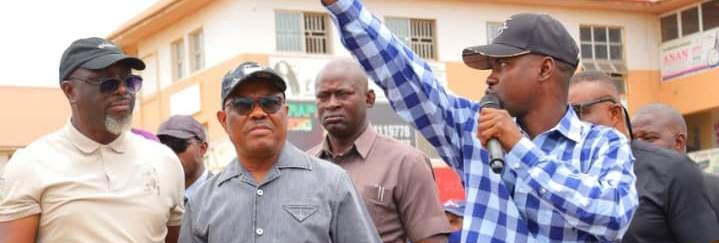
Managing Director, Abdul Val Limited, Abdullahi Suleiman Bello; FCT Minister, Nyesom Wike, and the Coordinator, STDD, Abdulkadir Zulkifli, during the Minister's inspection of the Karu township roads project in Abuja…yesterday
UNVEILING NEW INCENTIVES FOR CIVIL SERVANTS....
Tinubu Demands Results from New Housing Minister
Appointee pledges to tackle housing deficit with innovation, strategy
President Bola Tinubu yesterday administered the oath of office on the new minister of housing and urban development from Katsina State, Dr Muttaqha Rabe Darma.
Darma, who was cleared by the Senate on Thursday, replaced Ahmed Musa Dangiwa, who recently resigned.
Tinubu, at a brief ceremony at the State House, congratulated Darma for coming on board at this “very challenging time of national development."
According to him: “You have a very rich and interesting background. As a leader, we need competent hands like yours.
“There is no doubt that you have rendered valuable services in all the assignments you have embarked upon; You are a fitting peg in the right position"
The President told him to be ready to serve in any capacity in which he is called upon.
Speaking with reporters after being sworn in, Darma pledged to deploy innovation
and strategic thinking to tackle nation's massive housing shortfall.
He described his appointment as a test of responsibility and accountability, saying his performance would be judged by multiple constituencies, including himself, the public, and ultimately, God.
His words: "I feel that I have been given a responsibility. And I know that if you are given responsibility, there are three classes of people who will judge you on that responsibility.
"I won’t satisfy all those classes. For example, I must satisfy myself that the work I’m given, I’m doing it well.
Then the people around me, people close to me, will be satisfied that what I’m doing, I’m doing it well. And then the general public will become satisfied that what I’m doing, I’m doing it well.
“At the end of it all, God Almighty will also judge me… and I tell you that I am going to deliver to the best of my ability, and you will see changes in no time."
The minister acknowledged
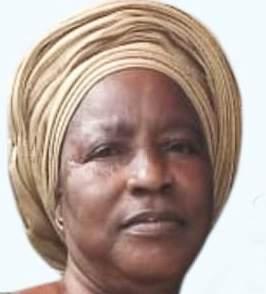
Tributes as Mama Aduke is Laid to Rest
It was a gathering of children, family members, friends and well-wishers as Late Mama Tijani Sarah Aduke made her last journey home.
Mama Tijani, who died on Thursday, April 16 at the age of 67, had her Christian Wake Keep, while the burial service took place at Crown Estate, Iya Koko, Ogba-Ayo, Ijoko, Ogun State.
According to those that were close to Mama while she was alive, she was a loving and compassionate woman. She was survived by three children - Jamiu Jimoh, Ahmed and Tosin Tijani.
Speaking after the burial,
Tosin, who was closest to to the mother while she was alive said: "Mama would be greatly missed not only by her children and family members but also neighbours because of her kindness and kind- heartedness."
the quantum of the crisis before him, noting that Nigeria requires an estimated 20 million housing units to meet current demand, a gap affecting over 100 million people.
According to him: “That is a tremendous challenge. Even if you say you’re going to build 15 million houses in the next 10 years, it’s going to be difficult,
2025FY:
Kayode Tokede
and it’s going to consume a lot of money. We know all of that."
Darma, however, signalled a reform-driven approach anchored on innovation and forward planning.
“But we are strategic. We are focused. We are forwardlooking. We are people who actually think much faster than the time we are in. And I am
UBA Declares
The United Bank for Africa (UBA) Plc, yesterday, announced its audited financial results for the year ended December 31, 2025, recording total assets of N33.2 trillion, up by 9.4 per cent from N30.3 trillion declared in 2024.
The growth in total assets was driven by customer deposits that moved to N27.2 trillion in 2025, an increase of nearly 12per cent from N24.3 trillion in 2024
The results released to the Nigerian Exchange Limited showed that the Group also delivered gross earnings of N3.09 trillion from the N3.19
telling you, we will bring a lot of innovation and creativity to ensure that we do well, and that so many people who are unhoused will be housed, inshallah.”
On the critical issue of funding, which is a major bottleneck in the sector, the minister admitted he is yet to fully assess the ministry’s
internal constraints but assured that solutions would follow a proper understanding of the terrain.
“Let me tell you one thing: I have not gone to the ministry to fully understand the many challenges it is facing. If I know the challenges, I will definitely find ways to solve them,” he said.
9.4% Increase in Total Assets to N33.2trn
trillion recorded the previous year.
Although recording a slight drop in gross earnings, the performance was still strengthened by resilient core business fundamentals and a diversified Pan-African footprint, even as the year reflected a strategic repositioning of its balance sheet for sustainable long-term growth.
Overall, the bank explained that its 2025 performance was impacted by prudent and forward-looking risk management decisions, including loan loss provisions of N331 billion and fair value changes on derivatives amounting to N278 billion.
Owing to this, its profit before tax dropped to N423 billion in the year under review, compared with N803.7 billion the previous year, also resulting to drop in profit after tax, from N766.5 billion last year, to N404.7 billion this year.
These changes, largely nonrecurrent in nature, weighed on profitability but are not expected to recur at similar magnitudes in future periods, the bank explained in a statement.
A critical look at the performance showed that UBA’s capital position remained robust, with shareholders’ funds rising to N4.25 trillion in 2025; up from N3.42 trillion the previous year, with share capital and premium
hitting N505 billion following a very successful rights issue. The Group’s capital adequacy ratio of 23.2 per cent provides a solid foundation to support future growth, just as the Bank has also strengthened its recovery efforts, with a fortified recovery team aggressively pursuing delinquent exposures, ensuring that recoveries will positively impact earnings from full year 2026 and beyond.
Operating in 20 African countries and in the US, UK, France and UAE, the Group’s Pan-African operations continue to be a major growth driver, contributing over 50 per cent of total assets, revenue, and profit.
World Malaria Day: Chevron Reinforces Commitment to Disease Eradication Across Africa
Sunday Ehigiator
Chevron has reaffirmed its commitment to the fight against malaria across Africa, intensifying efforts to support prevention, treatment, and health system strengthening in Nigeria and other parts of the continent as the world marks World Malaria Day.
The renewed push comes amid growing concern from global health authorities over stalled progress in malaria control.
Director-General of the World Health Organisation, Tedros Adhanom Ghebreyesus, recently warned that despite the availability of effective tools and strategies,
malaria continues to claim lives at an alarming rate, particularly in Africa. He stressed that urgent action is required to prevent the reversal of decades of gains.
According to the latest World Malaria Report, global malaria cases rose to 282 million in 2024, an increase from the previous year, while deaths climbed to 610,000.
The WHO African Region remains the most affected, accounting for the vast majority of cases and fatalities.
Observed annually on April 25, World Malaria Day serves as a platform to galvanise action against the disease. This year’s theme, “Driven to End Malaria:
Now We Can. Now We Must,” underscores the urgency of scaling up interventions and sustaining investments to eliminate the disease.
Chevron, explained that through long-standing partnerships with governments, international health organisations, and local communities, it has continued to play a significant role in addressing the malaria burden.
Across Nigeria, Equatorial Guinea, and Cameroon, the company has supported initiatives aimed at improving access to prevention tools, strengthening healthcare delivery, and enhancing disease surveillance systems.
In Nigeria, the multinational stated that its interventions have focused on community-based health education, awareness campaigns, and support for national malaria control efforts. Working with partners such as the Global Fund to Fight AIDS, Tuberculosis and Malaria, PATH, and the Corporate Alliance for Malaria in Africa, the company has contributed to the distribution of insecticide-treated mosquito nets, training of health workers, and expansion of early diagnosis and treatment services. These efforts have reached thousands of households, particularly in the Niger Delta region.
Deji Elumoye in Abuja
L-R: Managing Director, Federal Mortgage Bank of Nigeria (FMBN), Shehu Osidi; Head of Civil Service of the Federation (HoSF), Esther Walson-Jack; Director General of the National Pension Commission (PENCOM), Omolola Oloworaran and Chief Executive, Nigeria Social Insurance Trust Fund (NSITF), Oluwaseun Faleye during a briefing in Abuja to unveil new incentives for civil servants... yesterday.
Mama Aduke
CITN DISTRICT EXCO INVESTITURE...
Hegseth: Iran War is Trump’s Gift to the World, Berates Europe, Asia
Iran's foreign minister heads to Pakistan for talks
agency
United States Defense Secretary Pete Hegseth lashed out at American allies yesterday for
not committing naval forces to forcibly re-open the Strait of Hormuz after Iran shut down the key waterway in retaliation to U.S.-Israeli attacks. This was as the Iranian
BAT Ideological Group Hails
Tinubu on N17bn Grassroots Fund
Bennett Oghifo
The Convener of the Bola Ahmed Tinubu Ideological Group, Bamidele Atoyebi, has said President Bola Ahmed Tinubu’s approval of a N17 billion grassroots development fund for 8,804 wards reflects the adoption of the group’s earlier community driven development proposals.
Foreign Minister, Abbas Araghchi, was expected to fly into Pakistan’s capital yesterday with a small delegation, in what officials said was a key step towards the resumption of direct talks with the United States aimed at ending their war.
Asian countries were not sufficiently grateful for the U.S.-led war, which he called “a gift to the world” from President Donald Trump, citing the administration's purported goal of preventing Iran from acquiring nuclear weapons.
During a Pentagon briefing with Joint Chiefs of Staff chair General Dan Caine, Hegseth implied that European and
“The President has bought fully into this idea,” Atoyebi said, adding that the initiative mirrors the group’s push for bottom-up development where communities identify their most urgent needs and government responds directly.
The N17 billion fund is designed to support ward level projects nationwide, allowing each community to partner with local organisations to implement priority interventions. The approach, Atoyebi noted, is similar to fixing a house room by room rather than attempting a single large scale renovation, ensuring that development reaches even the most remote areas.
In a statement, Atoyebi said the presidential approval announced on April 22 aligns with an internal memo issued by the BAT Ideological Group on April 1, which urged state coordinators to identify underserved communities lacking basic amenities such as water supply, healthcare centres, rural roads and financial support for farmers and market women.
Seun Awogbenle Announces Launch of Policraft
Nigerian writer and development economist Seun Awogbenle has announced the launch of Policraft.
In a statement in London on behalf of the company, Awogbenle said Policraft will provide a range of services that will deepen the impact of public policy, shape public opinion, influence outcomes, and inspire positive change.
“Our range of services is at the intersection of policy, communication and the media, with a plan to expand to other key sectors of the economy.
We have a firm commitment to social impact and strong confidence in the promise and prospect of Nigeria, at a time of vital economic reforms."
Awogbenle, who recently completed a master’s programme in economic development from the United Kingdom, said the effort also represents an opportunity for him to adapt the key learnings from the programme for the prosperity of Nigeria, adding that individual responsibility remains vital to a strong economic future.
“It's a bold and dangerous mission ... courtesy of a bold and historic president,” Hegseth said.
The defense secretary claimed the U.S. Navy's “ironclad blockade” on Iranian ports would be “going global” and “tightening by the hour” to prevent any Iranian ships from entering or leaving Iran's territorial waters without U.S. permission.
At the same time, he accused Iranian forces of “acting like terrorists” by attempting to
Meta Slashes 8,000 Jobs After Spending Billions on AI
Meta will cut thousands of jobs next month as it spends more than ever on artificial intelligence (AI) projects.
The company told employees in a memo on Thursday that it planned to cut 10 percent of its workforce - roughly 8,000 staff. It said it would also not fill thousands more open jobs it had been hiring for.
A key reason for the layoffs is Meta's increased spending in other areas of the company,
including AI, for which it will spend $135 billion (£100 billion), the BBC reported.
This is roughly equal to the amount it has spent on AI in the previous three years combined, according to a person who viewed the memo.
A spokesman for Meta confirmed the planned job cuts but declined to comment further.
Mark Zuckerberg, Meta's co-founder and chief executive, made public comments in January
that essentially telegraphed the company would be cutting jobs again this year.
The Meta boss said he had seen how much more productive workers who relied heavily on AI tools had become, noting a single person could now complete projects that would have previously required a large team.
"I think that 2026 is going to be the year that AI starts to dramatically change the way that we work," Zuckerberg said.
CraftVantage Unveils 2026 Cohort, Positions
Nigeria’s Next Generation of Artists
CraftVantage has announced its 2026 cohort, bringing together a carefully selected group of outstanding art graduates and placing them within a structured programme designed to move talent into visible, commercially viable practice.
The 2026 cohort, according to a statement, brings together exceptional graduates from leading institutions, including Yaba College of Technology and the University of Lagos.
Each artist is commissioned to produce original work,
supported through dedicated funding and production resources, with direct access to experienced curators and practitioners, and a clear expectation of delivering work that is distinctive, compelling and exhibition-ready.
This body of work will be presented in “Bold Stories, Sustainable Futures,” a curated exhibition taking place at the Wings Office Complex in Lagos in May 2026. The exhibition is conceived as a cultural moment of intent, bringing together collectors, institutions, media and a
wider HNI audience.
Providing curatorial direction for the program, Senior Lecturer, Department of Fine and Applied Arts, Dr Bolaji Ogunwo, stated that “Talent has never been the issue. What has been missing is structure, access and continuity. CraftVantage is closing that gap in a way that is deliberate and uncompromising, so that artists are not only seen, but taken seriously.”
For the Founder, Misi Ogunbodede, the platform speaks to something larger.
enforce their own blockade of the waterway against “random ships" and laying "indiscriminate mines" in the strait.
"Iran's battered military ... has been reduced to a gang of pirates with a flag. They cloak their aggression in slogans, but the world now sees them for what they are — criminals on the high seas," he said.
“We are in control. Nothing in, nothing out,” Hegseth added. Iranian forces have effectively blockaded the strait since the start of the U.S.-Israeli bombing campaign, cutting off approximately 20 per cent of the world’s oil supply from markets and sending petroleum prices to levels not seen in years.
Tehran has also placed mines in the strait and has seized or attacked ships transiting through it, leading to a massive buildup of idle ships and raising fears of shortages of fuel and other products in regions that rely heavily on imports and exports through the waterway.
American ships have not been operating in that narrow passage because doing so would put them in range of Iranian drone or missile attacks.
U.S. forces in the Gulf of Oman and the Indian Ocean also have been intercepting ships bound for or originating from Iranian ports since earlier this month as a way of restricting Iranian revenue from both oil exports and Tehran’s efforts to extract massive tolls from ships seeking to pass through the strait.
change of name
Oluchi Chibuzor with
report
L-R: Vice Chairman, Ikeja and District Society, Chartered Institute of Taxation of Nigeria (CITN) for the 2025–2027, Aro Oluwatoyin; 12th Chairman, Dr. Bolarinwa Olaoti, and Deputy Vice Chairman, Olatunde Adewale, at the investiture of the 12th Chairman and swearing-in of executives held in Lagos…recently
Seleem AdegunwA:
True Return on Investment lies in lives You Transform
Rarely seen with his sleeves down, the Managing Director and Chief Executive Officer of Rite Foods Limited, Seleem Adegunwa, is constantly on the move. Even at rest, his mind is busy shaping new ideas. A graduate of Birmingham City University, Adegunwa transformed a childhood fascination with food experimentation into a thriving enterprise. Today, Rite Foods stands as a testament to his vision, capturing a significant share of Nigeria’s energy drink market and expanding from a single product into a diverse portfolio. Despite a background in Mechanical Engineering, which he did not initially choose, his strategic insight and discipline have driven remarkable growth. In this chat with Omolabake Fasogbon, he reflects on his journey, influences, leadership philosophy, and the risks behind the ‘Proudly Nigerian’ vision
You lead one of the fastest-growing beverage companies in Nigeria. What leadership philosophy guides your decisions as Managing Director/CEO?
I would say it’s sincerity of purpose. If your intentions are clear and genuine, everything aligns, your people will trust you; your products reflect it, and your decisions become consistent. A leader can easily be misunderstood; so it is critical that your intentions are clear and that you have absolute clarity about why you are doing what you do.
What personal habits keep you productive and focused?
Clarity, discipline and sense of responsibility are personal habits that keep me focused and productive. I am very clear on what needs to be done and why. When you carry responsibility for so many stakeholders, focus is not optional, it’s a duty. Consumers trust us enough to take our product home and sleep soundly. That trust is a responsibility I do not take lightly. This mindset has shaped my personal habits and greatly influenced the corporate culture of Rite Foods – one built on discipline, accountability, and a relentless pursuit of excellence. Excellence is never the easiest option, but it is always the right one.
Looking back, what has been your most defining leadership moment, and how did studying abroad shape it?
My most defining moments are the moments I choose excellence over any other consideration. Commitment to excellence comes at a huge cost, but it’s always the best decision to take; not the easiest. Studying abroad teaches excellence. When you travel, you come to realise that excellence is not aspirational; it is simply a way of life. It is being delivered per second in societies all around the world. And once you understand that there is no excuse for settling below it, you force yourself to do the right thing. There is no concept of ‘sorry’, sorry for what? That became a norm I carried back with me. My team will tell you that if something goes wrong, I do not understand the word sorry. Which part of it are you sorry about? Fix it. When we hold board retreats abroad, I deliberately choose places like Dubai or Doha not for leisure, but to show the team what is possible to achieve within one’s lifetime. Countries that were nothing when we were teenagers are now world-class. That tells you something powerful: excellence is possible, and it is possible quickly. From day one, Rite Foods was built on that premise. When we entered the sausage market, there was a competitor that had been there for four decades. People asked how we planned to compete. For me, I knew the answer was in embracing excellence and doing things better than competition.
The company started in 2008 with a single product and today has over 20 products across its brands. At what point did you begin to see the bigger picture?
Rite Foods was built with clarity from day one. The vision was always clear – we just built it one product at a time. We don’t do ‘me too’; we either do it better or we create something new. This deliberate approach to innovation, combined with deep consumer insight, has allowed the company to scale rapidly across categories while maintaining relevance in a competitive market.
What price did you have to pay personally for the company’s growth?
I don’t see a price; I see a privilege. When you realise your business supports entire livelihoods, it stops being about
Super Saturday
Seleem Adegunwa: What Sets People Apart Is the Will to Keep Going
ambition and becomes a responsibility. Back in the days, I visited one of our depots in Onitsha and found about 20 young men waiting outside. The manager told me they were waiting for the sausage truck because when it arrives, they get paid from the offloading. It hit me: if that truck does not show up, those men do not go home with money that day. Their families do not eat. The woman selling food nearby does not make sales. It’s an entire ecosystem. Once you understand that, you stop seeing your role as just building a brand. Again, I see work as fun because I love what I do. On Fridays, I am almost reluctant to go home. I tell my team the same, find something you love this much.
You’ve built your company around the ‘proudly Nigerian’ mantra. How did this resonate with a market that often sees Nigerian products as inferior?
I would say that one of Rite Foods’ most defining moves was its bold embrace of the Nigerian identity at a time when local products were often perceived as inferior. We were the first to put the Nigerian flag on our labels. We proved that Nigerian identity and world-class quality can coexist. Today, even multinationals follow that playbook by claiming to be ‘proudly Nigerian.’ For me, being ‘proudly Nigerian’ is not a branding exercise; it is a standard. It means excellence, not compromise.
So what sets the company apart as truly Nigerian?
Hundred percent Nigerian ownership, global standards. We never compromise on quality, process, or manufacturing standards. Our management team is entirely Nigerian, but every single process we run is top-notch. We have built entirely Nigerian brands from scratch that are competing favourably with foreign brands. Therefore, for us, proudly Nigerian does not mean second-rate. It means excellence and best-in-class coming out of Nigeria.
So, how do you navigate competition from both incumbents and underdogs in this space?
Rite Foods built its strategy around differentiation, rather than mirroring competition. We don’t copy; we identify gaps and fill them. Innovation and authenticity are our competitive edge. This approach has helped the company hold its own, and in some cases, lead against both established players and emerging challengers in the market.
What about challenges in the economic environment?
Operating in Nigeria’s complex economic environment has not been without challenges. However, we adopt a pragmatic approach to the challenges. The environment compels you to provide all the utilities by yourself. However, stability is improving, and with that, you can plan. Once you can plan, you can build. I cannot remember the last time I checked the exchange rate every morning in panic. As a passenger, I feel like someone is driving the car now, and I am reasonably comfortable. We are looking forward to more of that.
Amid challenges, how do you motivate your team to remain innovative and resultdriven?
Beyond strategy and products, our people remain our most critical asset. People perform best when they feel valued. So, we create the right environment and innovation becomes natural. Through deliberate internal engagement and a strong focus on employee wellbeing, Rite Foods has built a culture where ideas are encouraged and performance is sustained.
Many companies in your space folded up post-COVID-19. What kept you even till now?
We stayed resilient by seeing every problem as an opportunity. If you can solve a problem, there is a business in it. If you’re thirsty and I give you something to drink, that’s an opportunity. Tell me any problem, I’ll find a business in it.
Policy-wise, what are your expectations from the government, even in the face of growing geopolitical tensions?
• Adegunwa
Clarity, discipline and sense of responsibility are personal habits that keep me focused and productive. I am very clear on what needs to be done and why. When you carry responsibility for so many stakeholders, focus is not optional, it’s a duty
On policy, I would advocate that the government supports local investors with the same energy given to sourcing for foreign investors and watch how fast the economy grows. This is a position shaped by firsthand experience as a local manufacturer navigating infrastructure gaps and structural challenges.
You come from a family that is entrepreneurial. Does this rub off on you in any way? Profoundly! Growing up around business taught me one thing early in life – you can compete with anyone and win. This belief is not only embedded in my leadership orientation but also in the very identity of one of our flagship brands – Fearless Energy
photography took over.
Mentorship often shapes career paths. How has it influenced yours, and how are you paying it forward to the next generation of leaders?
From reading and studying true success stories, I’ve learned there’s no superman and no smooth road. Everyone stumbles, everyone faces tough times; they just keep going. That’s the lesson. Today, I share my time with young people, being honest about my own journey, which was far messier than it might seem. I tell people, don’t be fooled by what success looks like from the outside. If you have passion and are willing to work hard, you can succeed. I value mentorship and that is why Rite Foods in partnership with the Sulaiman Adebola Adegunwa Foundation set up an ICT Center at Ososa that empowers 400 students daily, taking them from never touching a computer to actively coding in six months. We believe you cannot nurture talent in a hungry child, so the program also includes a daily meal at no cost to the parents. For us, the true ‘return on investment’ isn’t a trophy; it’s the ripple effect. I recently met a professional at the Nigerian Ports Authority who attributed his entire career to being a beneficiary of our school. When you invest in your own with that level of authenticity, the impact on the national talent pool is automatic.
You admitted the road was rough, but today, Rite Foods stands as a role model in the industry, rising from the top 50 to the top 22 Nigerian brands within four years. What lessons can aspiring and struggling entrepreneurs draw from that journey? When you love what you do, challenges do not feel like walls. Passion keeps you going, grinding, and eventually, momentum builds. Our early years were especially challenging. We launched products we believed were excellent, but adoption was slow. Take our first sausage roll as an example. For a year, I went from state to state listening to feedback, then returned to the drawing board, adjusted, and relaunched. Those moments tested patience, humility, and resilience. You learn that perseverance matters more than perfection and that listening to the market is as crucial as executing your vision. Our rapid rise on the Top 50 Brands ranking is a reflection of consistency – quality products, continuous innovation, and a genuine connection with consumers across all key brand metrics.
You seem deeply immersed in your work. Do you ever find time to unwind?
Relaxation for me is about mentally resetting while still absorbing ideas that can be applied to the business or personal development. I value time with family and moments of personal reflection. I also read, mostly business literature, case studies, and real-life accounts that will genuinely teach me something I can implement. I don’t do fiction or entertainment; I struggle with them. My wife has to physically sit me down for Netflix which I endure two or three episodes and then ask if I can go now. I do not have time for Superman and the likes. How does that one pay me?
How does your day typically run?
My daily routine reflects a sense of purpose – starting the day early, often before dawn, with time set aside for reflection and planning. I believe that if you win in the morning, you control the day. This helps me to set the tone for the day and to think strategically about both company and personal matters.
Drink. I grew up watching my father build AGFA into Nigeria’s leading photo consumables brand with dominant market share.
You studied Mechanical Engineering yet built a career in food and beverage. At what point did the transition happen? Honestly, food was always my natural space. The engineering degree was more for my parents. In those days, if you were not going to be an engineer, a doctor, or a lawyer, the family was not entirely satisfied. So, I chose one of the three. But the passion for good food runs in me. Throughout my studies, I was constantly drawn to it, looking for ways to learn, experiment and create. I started in the food business before Rite Foods even existed. My wife and I had a small food venture. The path to Rite Foods came when our family’s photo business needed to diversify as digital
After that, the day is structured but flexible. Meetings, strategy sessions, product development discussions, or team consultations, they all require my presence and attention.
Looking forward, what legacy would you want to leave in Nigeria’s manufacturing sector?
My legacy is to prove that a truly world-class company can be built from Nigeria, without compromise. I want to build an exceptional company, a place where people are proud to work and where market-leading products are created without cutting corners or compromising on quality. Ultimately, when I step back, I want to be remembered for building a company that was not only a great place to work but one that consistently delivered outstanding products.
‘Outset’, ‘Onset’ Misuse
BUSINESS of April 16 wel- comes us today with this recurrent headline crudity: “AMCON raises alarm (the alarm) over rising NPLs in banks” Agreed that the article, ‘the’, is usually not allowed in headlines, but that realization should not affect fixed/ stock idiomatic expressions and indeed any other inflexible lexical entry.
“Man dies in sex romp in Enugu hotel” ‘Sex’ and ‘romp’ cannot function in the same lexical environment as the latter indicates intercourse (sexual activity). Please note that it is an informal entry with multifarious applications.
“…the regime of crime with many youths taking to kidnapping and all manners of vices” (DAILY TRUST Opinion Page, April 10) Right: all manner of vices.
“Menace of under-aged voters” (DAILY INDEPENDENT Online, April 6) Get it right: underage voters. Never “overaged” players or “matured” politicians
“NASS will re-open Bakassi issue” (THISDAY Headline, April 3) This way: reopen.“Ugwueze goes to the alter” (Van- guard Headline, April 7) High-heeled: altar.
“Imo: Late arrival of materials mar election in Oguta LG” A recurring case of subject-verb disagreement: Late arrival of materials mars (not mar). It has nothing to do with “materials”, but “late arrival”.
“In the past, such leaders have (had) plundered the common wealth and infected the environment with the demon of greed and avarice.” (NIGE- RIAN Tribune, April 11)
“The electorate streams (stream) out tomorrow at the beginning of a voting exercise that will ultimately ease out….” (THISDAY, April 11)
“There are two types of Persil brands in the market, apparently imported by private individuals (are there public individuals?) who thought there are (were) openings in Nigeria’s detergent market.” (Vanguard, April 11)
“Large turn-out signpost rescheduled Imo polls” (BUSI- NESSDAY, April 11) Get it right: turn-out signposts.
“No other country in (on) this continent throws up the kind of absurdities that we have in this land.” (DAILY INDEPENDENT Online, April 8)
“Such persons should be declared persona non grate (sic).” (Source: as above) At the crossroads: personae non grata.
“If he were still in power, the former governor would have been immuned (immune) to….”
“Thirdly, corruption was not limited to the outgoing governor but involved his cohorts at the corridor of power.” (Nigerian Tribune, April 11) Africa’s execu- tive robbers: in the corridors of power.“Even though I wanted to see him, he advised against it on the ground that I could get into trouble….’’ The verdict: on the grounds.
Still on the above edition: “The state Nigeria Union of Journalists (NUJ) has 36 chapels out of which seven chapel officers, all duely (duly) nominated and some of the.…”
“…arrogating the powers of the National President and the Central Working Committee (CWC) on (to) himself and.…” (THE GUARDIAN, April 11)
“…the reduction on the external debt and investment in social
infrastructures and equipments.” (THE PUNCH, April 11) The last word in the extract is uncountable, just like these: stationery, bedding, cutlery, jewelry, gossip (as an act)….
“Why is President Bola Tinubu drag- ging his foot (feet/heels) on probing treasury looters…?” (DAILY INDEPEN- DENT Online, April 11)
“…abolish the federal agency and realign it into (with) mainstream government machinery.” (NIGERIAN Tribune, April 11)
“Thugs in Imo State lay siege on Okorocha’s relics” (Sunday Trust, April 15) This way: lay siege to (not on).
“They had a second wind between 1964 to 1985, though they did not know it.” (Source: as above) A common error: between 1964 and 1985 or from 1964 to 1985—no mix-up.
“I must confess from the onset that I am not a protagonist of military rule.’’ (DAILY INDEPENDENT Online, April 11) Get it right: from the outset (in this context).
“The boss and his secretary will continue to have intimate official connection, in spite of gossips.” (DAILY TRUST, April 11) ‘Gossip’, as an act, is uncountable. But, with reference to those who talk idly and backbite, inflection of the word is allowed.
“But ours is quite different, judging by the experience with regards to the activities of the elected….” Either of these: as regards or with regard to.
“The industrial sectors of the economy have to invest in information technology, the type of which would stimulate the necessary (could it have been unnecessary?) inputs to produce good results.’’ In Standard English, which strictly applies here, ‘input’ is non-count, but countable in the usually informal American English, which, of course, is a corruption of the formal version.
Of Praise, Power And The Unmoved Man
Despite a surly-lipped harangue by a writer in this space who lambasted and mocked potential laudatory treatise on a larger-than-life personality, and yet transformed from excoriation to a lavish adoration and systemic metaphysical exploration of same man’s persona - in his own unbridled effusiveness - and then added another billionaire benediction for maximum effect, all without a scintilla of restraint or shame, we go ahead with the needful. Jobless interlopers may hug transformers for all one cares.
Now, to the matter. What is the frame of mind of a man who does not respond to praise?
It is an unsettling question in a society that thrives on applause, rehearses adulation, and often confuses noise for substance. Here, a compliment is rarely just a compliment; it is a currency, a bridge, a coded request. You hail, I hail back. You spray, I kneel. You praise, I acknowledge. It is a rhythm as old as the marketplace.
So when a man consistently refuses to dance to that rhythm - when praise meets a wall of silence, or at best, a polite indifference - it unsettles the ecosystem. It feels like a breach of cultural contract. It raises suspicion. Is it pride? Is it affectation? Is it disdain? Or is it something far more deliberate?
In reflecting on the life and persona of Michael Adeniyi Agbolade Ishola Adenuga Jr. (as he marks his 73rd birthday on Wednesday, 29 April, 2026), one is drawn less to the familiar litany of wealth, assets and corporate conquest - well documented, well rehearsed, and frankly, well exhausted - and more to this curious detachment from applause. A man so widely praised, yet so sparing in his response to that praise, presents a study in contrasts.
Let us be clear: silence in the face of adulation is not emptiness. It is often a choice. There is, first, the possibility of internal anchoring. Some individuals operate from a deeply private scoreboard. Their metrics are not headlines, not social chatter, not even industry validation.
They measure against targets only they can see, and timelines only they can interpret. In such a mental space, public praise becomes peripheral - pleasant, perhaps, but hardly decisive. It neither accelerates their pace nor alters their direction.
Then there is discipline - emotional, almost surgical. To react to praise is to admit that it has power. And if praise has power, then criticism must, by extension, have equal or greater power. The truly disciplined mind flattens both. It neither rises on ovation nor crumbles under censure. It simply continues.
This is not to romanticise detachment. It is to recognise it as a method. In the Nigerian context, where visibility is often mistaken for value, such restraint can appear almost unnatural. Our public figures are expected to acknowledge, to wave, to speak, to perform gratitude in visible, sometimes theatrical ways. Even humility is expected to be loud. A quiet man, therefore, becomes a puzzle.
But there is also a strategy in silence. Power, real power, rarely advertises itself. It does not need to. It understands that attention attracts not only admiration but intrusion, expectation, and, inevitably, contestation. To remain understated is to retain control - of narrative, of access, of self. It is to decide when to be seen, and more importantly, when not to be.
Those who have encountered Adenuga’s style - often through intermediaries, rarely through direct access - speak of a man who appears and disappears on his own terms. Engagement is selective. Recognition is quiet. Generosity, when it occurs, is frequently detached from spectacle. It is philanthropy without the drumbeat, intervention without the press conference.
And that brings us to a more uncomfortable layer of this conversation: the nature of praise itself. In many cases, praise is not innocent. It is negotiated. It seeks entry. It anticipates reciprocity. It flatters in order to position. A man who has navigated decades of high-stakes business, regulatory complexity, and competitive rivalry will, by instinct or by experience, develop a
“The elitist Ikoyi Club, established in 1938, sometime ago celebrated its Diamond Jubilee amid pomp and pageantry.” (DAILY INDEPENDENT Online, April 11) Standard expression: pomp and ceremony (or circumstance) or just pomp. The expression, ‘pomp and pageantry’, is a perversion of the etymology of the English language.
“Staff Reporter…takes a peep into the nation’s recent past and notes that it is a past whose scars will remain for sometime.” (THE GUARDIAN, April 11)
Right focus: for some time.
“One of the suspects said his intention was to warm (worm) his way back to the“…gunshotcountry.…”wounds he received in the hands of armed bandits….” (DAILY TRUST, April 11) Reporters who don’t appreciate the magnitude of ‘banditry’ should play ball with ‘armed robbery’. ‘Banditry’ is simply criminal violence that culminates in aggravated roguery which involves inevitable use of weap- onry. So, in the interest of morphologi- cal sanity, delete ‘armed’. The next catachresis is from the Sunday Vanguard of April 19: “The chairman of the occasion quickly acknowledged it was not easy to launch a book after Chidi has (had) launched it.”
“Two failed banks chiefs get bail” Towards a better use of language: bank chiefs. The plurality of ‘banks’ had been taken care of by ‘chiefs’, in line with syntactic sequence.
“Lagos NURTW swims in fresh crisis: “Thugs in free-for-all fight” Delete ‘fight’ to avert calamitous redundancy.
filter for such overtures. One way to neutralise transactional praise is simply not to engage it. If you do not respond, you do not owe.
Yet, it would be simplistic to conclude that such a posture is purely strength. Silence can also be armour. It can signal caution, even distrust. A man who does not respond to praise may also be a man who has learned, perhaps the hard way, that not all applause is goodwill, and not all goodwill is safe.
There is, too, the element of upbringing and early conditioning. Environments where excellence is expected, not celebrated, tend to produce individuals who do not hinge their sense of worth on external affirmation. Achievement becomes routine. Applause becomes optional.
But beyond psychology and strategy, there is something almost philosophical at play - a long-game orientation that renders the present moment less intoxicating. Praise, by its nature, is immediate. It celebrates what has been done, often without full understanding of what it costs, or what remains to be done. For those thinking in decades, even generations, such moments are fleeting interruptions, not destinations.
And so, the man continues - building, expanding, retreating, re-emerging - largely unmoved by the chorus around him. This is where the narrative becomes particularly Nigerian, and perhaps, ironically humorous.
We are a people who like our gratitude acknowledged. “Yin ni yin ni, k’ale se mi,” the elders would say - (express your thanks, that you may receive more). It is a neat, almost transactional philosophy of appreciation. Yet here stands a figure who appears to invert that logic entirely: give, but do not wait for thanks; receive praise, but do not validate it.
It unsettles the rhythm. It leaves beneficiaries - some of whom have quietly experienced lifealtering interventions - holding gratitude that has nowhere to land. Letters written, messages sent, emissaries dispatched, all in pursuit of a simple human closure: thank you, sir. And yet, the silence persists.
Is this indifference? Or is it a deliberate refusal
to turn generosity into performance?
One might argue that in a culture increasingly addicted to spectacle - where even modest acts are amplified for social capital - the refusal to monetise goodwill through visibility is, in itself, a statement. It suggests a hierarchy of values where impact outranks applause, and discretion outranks display.
Still, the question lingers. What does it take, mentally, to remain unmoved in the face of sustained adulation?
Perhaps it takes a certain detachment from the self - the kind that sees identity not in public perception but in private conviction. Perhaps it takes a disciplined narrowing of focus, where everything that does not contribute to the mission is treated as noise. Or perhaps, more simply, it takes familiarity - too much familiarity - with praise to find it novel.
When you have been praised long enough, it loses its flavour. In the end, the fascination is not merely with wealth or achievement, but with temperament. With the ability to stand at the centre of attention and yet remain, in many ways, outside it. To be celebrated and yet unconsumed by celebration. To give and not perform. To receive and not react.
In a country where the loudest voice often wins the room, there is something almost subversive about a man who does not raise his voice. Whether one interprets that as strength, strategy, or simply personality may depend on one’s own expectations of power and presence. But it is, without question, a rarity.
And perhaps that is the quiet lesson here: that not all influence is visible, not all gratitude is acknowledged, and not all praise deserves a response. Some men, it would seem, have simply chosen to keep walking and working.
•Tourism •Arts&Culture
Charles Ajunwa
• 08064268968 • ajunwacharles@gmail.com
Positioning Katsina as Cultural Tourism Hub
Katsina State is steadily carving a niche for itself on the global cultural map, writes Francis Sardauna
Long known for its deep historical roots and enduring traditions, Katsina State is increasingly drawing international attention because its cultural heritage took centre stage recently as a high-powered delegation of foreign diplomats arrived in the state to witness the 2026 Durbar celebrations.
The arrival of the 17 diplomats in the state to celebrate the 2026 Durbar, underscored the growing international interest in one of Northern Nigeria’s most enduring traditions, thereby transforming the state’s heritage into a powerful tool for diplomacy, tourism, and development.
Governor Dikko Umaru Radda personally received the 17-member diplomatic delegation at the Umaru Musa Yar’Adua International Airport in Katsina, alongside his deputy, Faruk Lawal Jobe.
The Durbar festival, an age-old tradition synonymous with northern Nigeria’s emirate system, came alive in vibrant displays of horsemanship, royal pageantry, and communal pride.
Led by Belgium’s Ambassador, Pieter Leenknegt, the delegation included representatives from Egypt, the Netherlands, Spain, Poland, Switzerland, Slovakia, Argentina, and Congo, among others. Also present were senior international figures, including the United Nations Resident Coordinator in Nigeria, Mohammed Malick Fall, and the Chief Executive Officer of NewGlobe Inc, Jay Kimmelman.
From the airport, the governor, flanked by his deputy and other top government officials, led the high-ranking delegation to the palace of the Emir of Katsina, Dr. Abdulmumini Kabir Usman, where the visitors began their immersion into the Durbar experience following the Emir’s return from the Eid prayer ground.
Traditionally associated with royal pageantry, horse-riding displays, and homage to the emirate
Radda
system, the Durbar has evolved into more than a ceremonial gathering. It is now a platform for cultural diplomacy; one that projects Katsina’s image to a global audience.
From the ancient city of Katsina to the historic town of Daura, the festival unfolds as a vibrant display of colour, tradition, and community spirit.
Horsemen adorned in elaborate regalia parade the streets of the ancient cities, while traditional rulers receive homage in a spectacle that blends
history with living culture.
At the centre of this cultural resurgence is the globally recognised Durbar festival, a centuries-old tradition that continues to define the rhythm of life across the Katsina and Daura emirates. The presence of high-ranking envoys, including representatives from the United Nations and various foreign missions, signals a shift in how cultural festivals are perceived.
Furthermore, the participation of these envoys is no longer confined to local celebrations, they have turned the Katsina’s annual colourful Durbar, Hawan Sarki and Hawan Magajiya celebrations, into a viable and world acceptable platform for dialogue, business and educational partnership, and mutual understanding.
Addressing the international visitors at the Old Government House, Governor Radda added that their presence reflects growing global confidence in Katsina State and the state’s peaceful cultural heritage.
He reiterated that the Durbar is not just a celebration because it represents the state’s identity, unity, and the enduring values that bind its peace-loving citizens and residents together irrespective of their religion, tribal and political affiliations.
“We are honoured to receive this distinguished delegation who have come to witness our unique cultural heritage.
“The Durbar is not only a celebration of tradition but also a symbol of unity, peace, and identity of our people,” he said.
Shortly after the Durbar that witnessed colourful horse riders from 28 districts of the state, the governor led the 17 European Union envoys on a historic tour of the renowned Kusugu Well in Daura, where he drank water from the “life-saving well.”
The historic well, which dates back approximately 2,005 years, stands as a remarkable symbol of Katsina’s ancient past and enduring legacy. Its
longevity reflects the deep historical roots of the people and the traditions that have been preserved over centuries.
“Kusugu Well is central to the history of Katsina. Immortalising this heritage alongside our educational investments helps preserve the legacy of our people,” Governor Radda said.
For the visiting diplomats, the site provided more than just a visual experience. It offered a rare and meaningful glimpse into the cultural identity of Katsina, revealing stories of origin, resilience, and continuity that define the community.
Beyond its historical significance, the Kusugu Well also underscores the importance of preserving cultural heritage. It serves as a bridge between generations, connecting the past to the present while reinforcing the pride and identity of the people of Katsina.
While at Dumurkul Model Secondary School, Daura, one of the three modern schools his administration has established across the state’s three senatorial zones, Radda informed the envoys that the schools were built to give children from rural and disadvantaged backgrounds a world-class education “free of charge.” The schools focus on students from public schools and rural communities across the 34 local government areas of the state.
The governor further told the 17 envoys that each of the three schools is equipped with 24-hour electricity, ICT-fitted classrooms, hostels, and internet access, with other cutting-edge learning and teaching facilities provided at no cost to the benefitting students. He said the aim is to ensure that in the next 20 to 30 years, these students can compete on the global stage.
Plateau Set for Mega Cultural Festival, Tourism Revival
Plateau State is preparing to stage what officials describe as its first mega cultural festival in October, a flagship event expected to showcase the state’s vast cultural wealth and reinforce its position as Nigeria’s emerging hub for tourism and the creative economy.
Commissioner for Tourism, Culture and Hospitality, Hon. Cornelius Dongnaan Doeyok, who disclosed this in an interview with THISDAY, said the festival formally known as the Plateau State Festival of Arts and Culture will feature all ethnic nationalities on the Plateau and serve as a unifying celebration ahead of the harvest season.
“We should be looking forward to October,” he said, adding, “The preparation is on ground and we are trusting God that the security challenges must have stabilised to the barest minimum.”
Doeyok emphasised that the festival was designed to become one of the state’s biggest tourism assets, capable of drawing thousands of visitors and stimulating the local economy through hospitality, transportation,
crafts, entertainment and other value-chain activities.
He noted that “one of the greatest assets that Plateau State has is its cultural potential if the state can harness and aggregate our cultural potential, it has the capacity to be a single largest revenue earner for the state.”
According to the commissioner, Governor Caleb Mutfwang’s administration has placed tourism at the heart of its economic agenda, recognising the global rise of the “orange economy,” the cultural, creative and tourism sectors as a major driver of jobs and revenue.
He explained that the state government has doubled the Tourism Ministry’s budget, initiated extensive stakeholder engagements, and is developing a comprehensive tourism policy and roadmap in partnership with the UNDP.
Doeyok revealed that Plateau State has entered public-private partnerships to revive iconic hospitality landmarks such as the Hill Station Hotel and Plateau Hotel once the pride of Jos in the 1970s and 80s.
He added that the government has ordered an integrity test on the long-abandoned Rock International Hotel at Lamingo to determine its suitability for redevelopment into a five-star facility.
In addition, discussions with Afro-Caribbean investors to take over and modernise the Jos Amusement Park have reached “about 90 percent,” while the Jos
“The government is very, very serious about reviving the Hill Station Hotel, the amusement park and other tourism sites,” he said.
With over 56 ethnic nationalities, Plateau State’s cultural diversity is one of its strongest assets, the commissioner said. Properly organised festivals, he argued, can strengthen peaceful coexistence and reshape the state’s image.
“There’s nothing as strong as identity,” he noted. “If you see your culture in parade, you will be happy about it.”
He stressed that the ministry was working to standardise festivals, improve data collection, and encourage private-sector participation to elevate them to international standards.
The commissioner acknowledged that recent security incidents have disrupted plans for several community-based festivals, many of which are time-bound and tied to farming cycles.
However, he insisted that the state must not allow negative narratives to overshadow ongoing progress.
“If we keep dwelling on our shortcomings in terms of the security gap, we will not make progress in trying to let people know the real Plateau State we’re trying to sell,” he added.
Maggi’s Category and Marketing Manager, Nestle Nigeria, Funmi Osineye, speaks about how Maggi culinary brings fresh tastes to consumers, among others. Charles Ajunwa brings excerpts
Yourcampaigntagged‘Meand Madi’,what’s it all about?
The culinary space is really evolving and food today is no longer just about cooking. It’s really about your expression, your vibe, your creativity. A lot of times now people don’t just get food and eat. They do a lot of things around food today and one simple one is that you get to a restaurant, you do a fine dining, they bring your food. What’s the first thing that you do with that food? You take a picture. You admire it. Even before you start eating, you’re just like, wow, I love the creativity. I love this plating. I love the way the food comes together. The way the chefs, the restaurants and
everybody is going about food now, it’s now like an infusion of modernity, even to the old food that we all know and grew up with.
You see some dishes today and you’ll be like, wow, I didn’t know this can be transformed into a very interesting one. So today when we look at the young generation, they don’t just eat the food, they create content around it.
They remix, they share and they talk about when they were growing up, how it used to be and what it is now. They bring some form of modernity into it. So Gen Z has really turned food into a culture. It’s now a movement. It’s no longer about food.
For Maggi, we’ve always been there. This year Maggi is going to be 60 years in Nigeria.This is a heritage brand, a brand that is rooted in culture.
When you’re talking about the history of Nigeria, you cannot complete it without mentioning Maggi, which is why even when you look at the seasoning segments in the market today, our brand is what dominates. A lot of times when you want to buy seasoning, they will say I want to buy Maggi. It’s when you get to the retailer’s table that they will now say which Maggi do you want to buy? And they now mention specifically which Maggi.
So we’ve always been there from our parents’ kitchen to our own quick meals and to now becoming part of trends and everyday creativity. We started something nice during Christmas last year, the Maggi Christmas campaign. We’ve been bringing that creativity and we’re telling that new story.
Yemi Kosoko in Jos
Wildlife Park has completed a 12-kilometre perimeter fence and is in talks with the Namibian government to restock animals.
Caleb Mutfwang
Osineye
As Peter Okoye Severes Ties with Brother, Paul, Changes Birth Date
Ferdinand Ekechukwu
What impact would Paul Okoye’s (Mr P) change of birthdate choice and decision have?
Of what effect does his decision portend?
At best, it might be a lingering twist to a perpetual end. It has taken the intervention of many prominent personalities and celebrities across sectors to intervene in their fallouts, but all to no avail.
Hours after announcing that he would officially change his date of birth, Nigerian music star and one-half of the defunct P-Square fame, Peter Okoye, made good his promise, signaling their long dispute may have now assumed perpetuity.
Early this week, the 44-year-old singer had declared in a post on X, that he will now celebrate his birthday on November 30 — abandoning November 18, the date he has shared for decades with his twin brother
“Dear Family, Friends, and Fans, I’m making it official. November 18th is no longer my birthday celebration date. Please note that I will not be accepting any messages or gifts on that day,” he wrote.
“My birthday will now be celebrated on November 30th. This is a personal decision, and I truly appreciate your understanding. Thank you all.”
His post sparked widespread reactions, with many fans, observers online questioning his decision. He immediately fired back, insisting the outrage is misplaced.
In a post shared on Tuesday via his X handle,
the former member of P-Square expressed surprise at the level of backlash trailing what he described as a personal choice.
The singer who now goes by Mr. P has been having a running battle with his twin brother, Paul Okoye, aka Rudeboy, and elder brother cum manager, Jude. In June 2025, Peter explicitly stated that he had severed ties with his family, especially his brothers.
“We are no longer family at this point! Family is blood-related, but the real family is loyalty. Like I said, ‘don’t let family be the reason you’re drowning in silence.
“I did for over 20 years. And it almost cost me everything. But now I know better: love doesn’t manipulate, loyalty doesn’t betray, and
family doesn’t steal from you. Family that steals and breaks you isn’t family at all,” he wrote in answer to an X user’s inquiry.
In a report that same month, Mr. P also took jabs at his estranged elder brother, whom he accused of allegedly misappropriating $1 million and £34,537.
In May 2025, Mr. P told the courts that Jude’s wife owns 80 percent of Northside Music. While giving evidence, the singer, led in the witness box by the prosecution counsel, Mohammed Bashir, told the court that Jude’s wife, Ifeoma, held substantial shares in Northside Music Ltd (Jude’s company).
‘You stole, betrayed, disrespected me,’ Peter
Bovi Takes Over As Hosts of AMVCA 12
Nigerian comedian and actor, Bovi Ugboma, would take the stage as host, alongside South African award-winning actress and humanitarian, Nomzamo Mbatha as co-host when the lights ignite for the 12th edition of the Africa Magic Viewers’ Choice Awards (AMVCA), set to take place on Saturday, May 9, 2026, at the Eko Hotel and Suites in Lagos.
The announcement marks a significant change and refreshment for the Africa’s most celebrated film and television awards ceremony, as the duo step into what is widely regarded as one of the most coveted hosting gigs on
the continent.
This transition marks the first change in hosting leadership for the prestigious ceremony in over a decade. Ebuka Obi-Uchendu, an industry colleague, hinted was believed would be a replacement for ace compere IK Osakioduwa, who majorly hosted the AMVCA since its debut in 2013, becoming closely associated with event.
Bovi is remarkably noted to bring sharp wit and the kind of cultural fluency that makes a room of people both nervous and delighted. Speaking on his appointment, Bovi expressed excitement and a sense of responsibility.
“The AMVCA stage is one of the biggest in Africa, and I don’t take that lightly,” he said. “I want to bring the energy, the laughs, and the magic that this night deserves. African
Mary Njoku, Juliet Ehimuan
storytelling is at an all-time high, and it’s an honour to be the one holding the mic while we celebrate the best of it.”
Enter the actress, producer, and UNHCR Goodwill Ambassador who rose to international prominence with her role in Coming 2 America and currently stars as Queen Nandi in the acclaimed epic drama series Shaka iLembe, for which she also serves as Executive Producer.
Nomzamo, on her part, brings elegance, presence and the kind of experience and aura that befits the AMVCA stage. Together, Bovi and Nomzamo make an interesting pairing.
The nominees for the 12th edition of the Africa Magic Viewers’ Choice Awards have already been unveiled, building anticipation for what promises to be a spectacular evening.
was quoted to have posted, while calling out estranged brother Jude.
“I went to the EFCC with my lawyer to submit the petition on January 22, 2024. I initially wrote Northside Music as the respondent. However, following various investigations by the Commission, it was discovered that Jude’s wife, Ifeoma, owns the company, holding 80 per cent of the shares. In comparison, Jude retains the remaining 20 per cent.
“I submitted the petition, and I never spoke to either Paul or Jude until early April 2024, when the EFCC asked if my twin brother was involved, and I said I did not know. The commission discovered over 47 bank accounts used by Jude to receive royalties,” the ‘Winning’ crooner said.
The Splits, The Reunion...
Several reports have it that P-Square first split in 2017 following disputes tied largely to the role of their elder brother Jude Okoye, who had managed the duo since their early days. That split was resolved in November 2021 when the brothers publicly reconciled at Peter’s Lagos home in a moment that generated significant goodwill from fans, friends and colleagues.
The reunion, however, was short-lived. By 2024, the brothers had separated again, with Paul publicly confirming the breakdown and citing ongoing personal differences.
The latest chapter of their feud escalated significantly over a song. Paul accused Peter of working with a producer who had originally collaborated with him on a track titled ‘Winning,’ alleging that the same producer re-recorded the song with Peter without his knowledge or consent.
Taking Nigeria to Cannes Lions 2026 in Major New Roles
Ferdinand Ekechukwu
Two Nigerian film and media executives, Mary Njoku and Juliet Ehimuan have been confirmed for prominent roles as juries at the Cannes Lions International Festival of Creativity 2026, representing Nigeria at the world’s leading creative festival.
With these appointments, Nigeria will be represented across two influential areas of Cannes Lions 2026: developing future talent and recognising innovation at the highest level.
Njoku, the ROK Studios CEO, joins the Scholarship Jury, while Beyond Limits founder Ehimuan judges the Innovation category. The appointments reflect the scale of influence they have built across
media, business, and tech.
Separately, organisers of the Cannes Lions International Festival of Creativity announced the appointment of Ehimuan, where she will serve in the prestigious Innovation category. The festival is scheduled to hold from 22nd to 26th June in Cannes, France.
The LIONS Scholarship gives young creatives and marketers access to a fully funded place in either the Creative Academy or Brand Marketers Academy at Cannes Lions 2026. Ten winners from 10 countries will be selected, with applications open to candidates aged 30 and under.
As a jury member, Njoku, a Nollywood executive will join global industry leaders responsible for selecting the next group of emerging talent. Her
Asake Set to Drop New Album This May
enough visual detail to spark curiosity while leaving the message open to interpretation.
Mr. Money as he likes to be fondly called, has announced he would be releasing a new album on May 1, 2026. Announcing it through a 20-second video, the teaser presents a white man meticulously sculpting what appears to be a carved likeness of a human head. The brief clip leans on intrigue and minimalism, offering just
The cave was in a white block and was artistically chiseled to our eyes as a creation of something of a masterpiece. While the general theme of the video wasn’t clear, the short clips present something to reflect on. The evolution of Asake has brought different elements to his person which is filled with a lot of unpredictable
moments, creativity and suspense.
But the album’s title, MONEY takes us back to wondering about its correlation with a sculpture.
After the announcement, fans have taken to Asake’s comment section, dropping anticipation with a mix of excitement, speculation, and high expectations ahead of the album’s release. With the current deliveries in his songs and how trail blazing they become many are already predicting a chart-topping project.
appointment places a Nollywood executive at the centre of a programme focused on identifying and supporting future creative leaders.
Juliet Ehimuan brings decades of tech leadership to France as she joins the 2026 Cannes Lions Awarding Jury for the Innovation category, judging ideas that redefine the intersection of technology and creativity.
Simon Cook, CEO of LIONS was captured saying the weight of the jury’s role: “The impact of the Cannes Lions Jury can’t be underestimated. Their time and expertise in recognising groundbreaking work sets the global creative benchmark for the year ahead and provides a view of the future shape of creativity.”
Peter Okoye (inset P-Square duo)
Ferdinand Ekechukwu
Asake
Mary Njoku and Juliet Ehimuan
Bovi and Nomzamo
Tosin Clegg
SHOWBIZ
Temi Adeyemi: Funding Withdrawal Biggest Threat to Theatre
The decline in financial support from corporate organisations and foundations has emerged as the most pressing challenge confronting theatre and stage performance today, threatening the sustainability of the creative industry. Yet, amid these constraints, productions like The Disciple by Boatseed Productions continue to keep the art form alive. Staged recently in Lagos, the play delivers a gripping narrative of ambition, faith, betrayal, and redemption. Playwright and co-producer Temi Adeyemi speaks on its vision and journey, in this exclusive chat with Sunday Okobi
What is the inspiration behind the play ‘The Disciple’, and what message is the public- mostly Christians looking for divine succour in Nigeria-expecting from the play?
The inspiration for The Disciple is a reimagining of the Passion of Christ, told through the lens of a reality TV business competition in the style of The Apprentice. The play centres on the journeys of several key figures involved in the events leading up to the crucifixion, but reframes their motivations and choices within the context of ambition, competition, and the pursuit of purpose. Just as contestants on The Apprentice compete to prove their worth and earn a coveted role, the characters in our production are vying to be named The Disciple-the chosen right hand to the ultimate authority, represented here by God.
The goal is not simply to retell a familiar religious story, but to offer audiences-Christian or otherwise-a fresh and deeply relatable perspective. The Easter story is not merely a religious account; it is a profound cultural narrative that belongs to all of humanity. By situating it in a modern, recognisable framework, we hope to illuminate what was truly at stake for each character, invite audiences to see themselves in those characters, and encourage meaningful reflection on how we each relate to this timeless account. The sacrifice of Christ remains absolutely central to the story, but The Disciple also draws attention to the very human drama that surrounded it-the ambition, the loyalty, the fear, and the faith.
The effort put into the play is immense. What does the production team want to achieve in the end?
The production has required the dedication of many people, significant resources, and no small amount of sacrifice-and it has all been driven by one core ambition: to give families a shared, meaningful theatrical experience. We believe there is a real gap in the market for content that the whole family can enjoy together-productions that are neither too childish for parents nor too mature for children. The Disciple is recommended for ages 10 and above, though younger children attending with parental guidance are also likely to engage with and enjoy the show.
We want families to come together, to be entertained, to laugh and reflect, and to leave the theatre having shared something genuinely impactful. Beyond the entertainment, the play carries powerful lessons drawn from one of the most significant stories ever told- lessons about integrity, ambition, courage, and redemption that are as relevant today as they have ever been.
We are also proud to share that we have partnered with schools to make the experience freely accessible to children, because we believe that theatre should be a formative part of every young person’s life, not a privilege reserved for the few.
What are the possible challenges facing stage play performance in this era? And is there anything else the audience would have known about the play?
The most significant challenge facing theatre and stage per-
Nigerian-founded publishing house, Cassava Republic Press, has announced its first-ever shortlisting for the prestigious Women’s Prize for Fiction, marking a historic moment for the company and African independent publishing.
The recognition comes with The Mercy Step, a debut novel by British-Jamaican author Marcia Hutchinson, which has been named on the 2026 shortlist for the globally acclaimed literary prize.
The milestone represents the first time an African and Black women-owned independent publisher has made the shortlist in the prize’s three-decade history, highlighting a breakthrough for diverse voices in global publishing.
Reacting to the development, Founder and Publishing Director of Cassava Republic Press,
formance today is the withdrawal of financial support from corporate organisations and foundations that once championed the arts. Funding that previously sustained productions, venues, and creative careers has steadily dried up, and the consequences are far-reaching. What is often underestimated is the role that theatre plays in education and character formation. Older generations consistently recall attending the theatre as a natural, enriching part of their upbringing-not as a luxury, but as a cornerstone of a well-rounded education. It cultivated creativity, empathy, lateral thinking, and a capacity for reflection. By allowing this art form to fade from public life, we risk depriving younger generations of something genuinely formative. Theatre heals, it builds character, it opens minds — and it also sustains livelihoods across the creative industries.
Our hope is that The Disciple plays a small but meaningful role in reawakening Nigerians’ relationship with the stage-and particularly in reintroducing theatre to children who have never had the opportunity to experience it. Through our partnership with schools, we are actively working to ensure that this generation of young people does not have to wait decades for their next theatrical encounter, as has sadly become the norm.
Bibi Bakare-Yusuf, described the achievement as both symbolic and deeply significant.
“We are honoured, and we are proud. This is what independent, Black-owned publishing is for — not as a corrective to the mainstream, but as a home. A place where a writer can debut at sixty. Where a story rooted in Black British life can be treated with the full literary ambition it deserves,” she said.
Reflecting on the publisher’s journey since its founding in Abuja in 2006, she added: “We started in Abuja twenty years ago with passion and an unshakeable belief that African storytelling belonged to the world. Today, the world agrees.”
The Mercy Step tells the story of Mercy, the youngest child in a Windrush-generation Jamaican family living in 1960s Bradford, navigating a complex home shaped by hardship, faith, and sibling bonds. The novel, praised for its emotional depth and narrative voice, had previously been rejected by over 50 publishers before being picked up by Cassava Republic.
TFrom the character of God to the evicted Judas Iscariot in the ‘The Disciple’, please can you explain how they were able to express the spirit of sacrifice, faith, loyalty, betrayal, fear and redemption (individually) in the play?
A number of the characters display various elements of these qualities. Firstly, Prince de Paz, who is based on the character of Jesus Christ, is portrayed as a defence lawyer passionate about ensuring the welfare of people who are being ill-treated and whose rights are being taken away from them. The ultimate sacrifice made by Prince de Paz mirrors the sacrifice made by Jesus Christ for mankind.
In regard to loyalty, the character of Simon is spoken of as being deeply loyal to Prince de Paz, with a strong desire to protect and follow him, ultimately in a way that causes him to sacrifice himself, leaving behind his own ambitions to instead become an example of selflessness for others. This contrasts with his initial position, which was driven by a desire to win the coveted title of ‘The Disciple’, proving the winner to be the top disciple. The example of betrayal comes in the form of the character, Judas Iscariot, who seeks to undermine the task set for the other contestants. His motivation is revenge for having been dismissed from the reality tv business show, compounded by his pursuit of wealth and status — the kind of ambitions we see in our society today that can lead people to make wrong decisions about how to gain power and riches. Fear is embodied particularly by the team known as ‘The Brothers’, which includes characters Simon Petra, James, and John Zeebeedee, who are all afraid of being associated with Prince de Paz to avoid imprisonment or mistreatment-even though they knew they ought to be standing up for what is right. This reflects something many of us face in life: knowing that something is wrong, yet fearing the consequences of speaking out, because doing so makes us a target of those who wish to perpetuate wrongdoing.
Redemption ultimately comes through Simon Petra, who, having failed the task set for him and his team, sacrifices his own pursuit of the cover title, but is ultimately rewarded for this-very much in line with the scripture that says he who lays his life down will gain it, and he who saves his life will lose it.
The quality of the costumes and performances, as well as the diction of the characters was top-notch. How did you and your team put that together?
Interestingly, the male costumes were mainly designed by Juliana Dede approximately 12 years ago and were used in my very first production, The Story of Joseph. Fortunately, I had kept them safely stored, making them reusable for this production. She did a remarkable job of creating quality costumes that have lasted over a decade and remain fully intact.
The ladies’ costumes were made by designer Lara Diamond, who very generously contributed them to the show as a sponsor, and also allowed us to conduct a sort of fashion show at the beginning of the play, showcasing her beautiful and colourful designs-a wonderful complement to the men’s costumes.
(See concluding Article on www.thisdaylive.com)
he President of the Senate, Senator Godswill Akpabio, has lauded the Governor of Akwa Ibom State, Umo Eno, on his 62nd birthday, describing him as a man who embodies the grace of God and the silent strength of purposeful leadership.
In a congratulatory message personally signed by him, Akpabio praised the governor’s ARISE Agenda, which he said has transitioned from vision to visible impact.
“Your Excellency and my brother, Pastor Umo Eno, on behalf of my family, and the good people of Akwa Ibom North West Senatorial District, the 10th Senate of the Federal Republic of Nigeria, and indeed the National Assembly, I extend my warmest felicitations to you on the joyous occasion of your 62nd birthday. “At 62, you embody the grace of God and the quiet strength of purposeful
leadership. Your ARISE Agenda has moved from vision to visible impact — in agriculture, rural development, infrastructure, security, and social empowerment — giving our people renewed hope and tangible dividends of democracy.
“I particularly commend your politics of inclusivity. By running an open, broad-based administration that embraces all Akwa Ibomites regardless of party or creed, you have lowered the political temperature in our state and fostered unity. That is statesmanship, and it is yielding peace as a foundation for progress, growth and opportunities.
“Under your watch, Akwa Ibom continues on the path of steady development — from roads and healthcare upgrades to support for SMEs and human capital growth. You are building on our shared heritage while charting a compassionate, people-first course for the future.
“As you mark this new age, my prayer is that Almighty God will grant you greater wisdom, sound health, and enduring strength to keep serving our dear state and nation.
Adeyemi
Charles Ajunwa
Sunday Ehigiator
AUTOWORLD
Soueast Enters Nigeria with SUV Line-up, Targets Local Production
Nigeria’s automotive landscape witnessed a significant shift on Wednesday as Soueast formally entered the Nigerian market, courtesy of the Kewalram Chanrai Group. The entry was marked by a media launch followed by a test drive of its full range of SUVs along the scenic Coastal Highway in Lagos, signalling a fresh wave of competition in the fast-evolving mobility space.
The high-profile event brought together dealerships, media, and auto enthusiasts, offering first-hand experience of the brand’s capabilities in real driving conditions.
Speaking at the launch, Chief Operating Officer, Mobility Division of Kewalram Chanrai Group, Mr. Anil Sahgal, described the move as a strategic response to changing consumer expectations in Nigeria.
“For over 165 years, Kewalram Chanrai Group’s reputation has been built on trust delivered through consistency,” he said. “Our decision to bring Soueast into Nigeria is deliberate. Today’s Nigerian customer is more informed and focused on long-term value. There is a growing demand for vehicles that combine modern design, safety, technology, durability, and affordability — and Soueast fits precisely into this space.”
The COO emphasized that the company is not merely introducing a new brand but backing it with robust infrastructure, including a structured dealership network, strong after-sales systems, skilled technical
teams, and a long-term investment approach.
He noted that the SUVs unveiled had been engineered with Nigerian realities in mind, addressing road conditions, fuel efficiency concerns, durability needs, and total cost of ownership.
“This is not just a product launch; it is the beginning of a long-term commitment to a
market that demands resilience, value, and consistency,” he added. “Our vehicles are built on three pillars — product integrity, adaptability, and value sustainability.”
Sahgal also disclosed plans to commence local assembly of the vehicles by the third quarter of 2026, underscoring the group’s long-term commitment to the Nigerian
market.
The highlight of the event was the test drive session along the Coastal Road, where participants assessed the performance, comfort, and handling of the Soueast range under real traffic and road conditions — a move widely seen as a confidence-building step by the company.
Jetour Nigeria Consolidates as Sole Distributor
Jetour Nigeria has consolidated its position as the exclusive representative of the Jetour brand in the country following its 2022 appointment by Jetour International.
The company said the move to clarify its exclusive status came after its successful hosting of the “Jetour Experience” in Lagos, where it unveiled its nationwide dealership structure and addressed lingering market ambiguity over distribution rights.
Since securing the mandate in 2022, Jetour Nigeria has led the importation, distribution, and provision of manufacturer-backed after-sales services for the brand’s full vehicle range in the country.
Its growing influence recently earned global recognition at the 2026 Jetour Global Conference, where the firm received the “Market Share Leadership Award 2025,” underscoring its dominance in the African market.
To strengthen nationwide service delivery, the company operates through a network of seven authorised dealers — Elizade Nigeria Limited, New Era Autovehicle Services Limited, Kojo Motors, Germaine Auto Centre, R.T. Briscoe Plc, TAB Autos Limited, and Mandilas Motors.
These partners, according to the company, are the only entities authorised to sell and service Jetour vehicles in Nigeria.
At the four-day exhibition held at the Podium Events Centre, the dealers provided product information and customer engagement services, reinforcing what the company described as a unified and regulated distribution ecosystem.
“The ‘Jetour Experience’ was more than a celebration; it was a statement of clarity,” noted a representative of Jetour Nigeria. “By bringing our seven authorized dealers together under one roof, we have shown the public exactly where the Jetour brand lives.
“Since our 2022 appointment, we have invested heavily in a structure that guarantees customers genuine parts, expert technicians, and valid warranties—benefits, only available through our official channels.”
The company also received a boost from the visit of Anguo Yuan, Vice President of Jetour International, who commended the Nigerian team for its rapid expansion and infrastructure investment.
Industry recognition has followed the brand’s growth, with awards including the Nigeria Auto Journalists Association’s New Entrant of the Year,
Growing Auto
and
Jetour Nigeria said its current lineup — including the rugged T2, plug-in hybrid models, and the flagship G700 — reflects its commitment to
innovation and market leadership.
It advised customers to engage only its authorised dealer network to guarantee access to genuine parts, certified service, and full manufacturer warranty coverage.
Motul by CFAO Storms Ibadan with New Energy Switch Mega Station
Motul, a global leader in high-performance lubricants distributed by CFAO Mobility, has strengthened its footprint in Nigeria with the successful commissioning of the Energy Switch Mega Station, Boluwaji, in Ibadan, Oyo State.
The newly opened station, supported and visibly branded by Motul by CFAO, is set to redefine access to original, high-quality lubricants for motorists, okada riders, transport operators, and businesses across Ibadan and its surrounding communities.
In a market where the challenge of counterfeit automotive products remains a concern, this initiative delivers a timely solution, ensuring that customers can confidently access authentic Motul by CFAO lubricants that guarantee
engine protection, durability, longer drainage intervals, and long-term savings.
Speaking during the commissioning, the General Manager of Winpart by CFAO, official Motul Distributor, Mr. Eric Fantodji emphasized the importance of taking premium products closer to the people.
He said “Ibadan is a key commercial city with heavy daily movement. This partnership is about access and trust, making sure that drivers and riders in this region can get original Motul products without stress, and enjoy better engine performance while saving costs in the long run.”
The Energy Switch Boluwaji station is positioned to serve not just as a fueling point but as a reliable automotive hub, where quality meets convenience.
Customers can expect improved engine efficiency, longer drain intervals, and peace of mind with every purchase.
L-R: General Manager, Mr. Gaurav Kaul; HR & Admin Manager, Mr. Gbenga Oguntusin; Chief Operating Officer, Mobility Division - Kewalram Chanrai Group, Mr. Anil Sahgal; and Marketing Manager, Onyinye Iyama, at the formal introduction of Soueast into the Nigerian market
Jetour G700
L-R: Director of Marketing, Energy Switch Allied Oil Services Limited, Mr. Olanrewaju Mohammed; General Manager, Winpart by CFAO, Mr. Eric Fantodji; Chief Executive Officer, Energy Switch Allied Oil Services Limited, Mr. Olugbenga Adediwin; Deputy Managing Director, CFAO Mobility, Mr. Kunle Jaiyesimi; Director of Operations, Energy Switch Allied Oil Services Limited, Mr. Adeshina Oladipupo; and Sales Manager, Motul, Mr. Precious Ekwufulem, at the official commissioning of the Energy Switch Mega Station, Boluwaji, Ibadan... recently
Fastest
Brand,
Car of the Year for the Jetour Dashing.
Celebrating Nkechi Soneye at 50 PEOPLE
Tributes poured in, glamour lit up the night, and heartfelt gratitude filled the air as family, friends and highprofile guests gathered to celebrate Dr. Nkechi Soneye on her 50th birthday, writes Sunday Ehigiator
When a life has been lived with purpose, passion, and an unwavering commitment to excellence, its milestones naturally become moments of collective celebration. Such was the case as friends, family, and associates gathered in grand style to honour Dr. Nkechi Soneye at 50; a golden jubilee that reflected not just the passage of time, but the impact of a remarkable woman whose journey continues to inspire across continents and professions.
The evening was a rich tapestry of gratitude, legacy, and hope, woven together by heartfelt tributes, electrifying performances, and the unmistakable warmth of a woman deeply loved by all who know her.
At the heart of the celebration was family, a recurring theme that defined both the event and the celebrant’s life. Mrs. Soneye shared romantic moments on stage with her husband, Mr. Femi Soneye, a respected journalist, media entrepreneur, publisher of Per Second News, an online news medium; former Chief Corporate Communications Officer of NNPC Ltd, and host of his new biweekly podcast, The Exchange with Femi Soneye.
A Grand e ntrance
From the outset, the celebration radiated elegance and spiritual depth. Guests adorned in dazzling attire filled the venue, their presence a testament to the celebrant’s far-reaching influence. The night opened with a vibrant praise session, setting a deeply reflective and joyous tone.
As the music soared, Soneye made her grand entrance alongside her family, all dressed in coordinated ensembles that symbolised unity and love. Her radiant smile and confident stride immediately drew admiration, reinforcing what many already knew: this was a woman who embodied grace and strength in equal measure.
“The essence of my being is to glorify your name,” rang out during the opening prayer, capturing the spirit of the evening. “For 50 years of impactful living, we say thank you.” It was a powerful invocation that framed the celebration not just as a personal milestone but as a testimony of faith, resilience, and divine favour.
A Night of Praise, Dance, and Gratitude
The atmosphere soon became electric as top Nigerian gospel artists led an energetic praise session. Mrs. Soneye herself took to the dance floor, her vibrant steps and infectious energy sparking cheers from the crowd.
There was no mistaking it; this is a woman who embraced life fully. Family members and friends added a layer of intimacy to the celebration through games and heartfelt tributes. Laughter echoed across the hall, blending seamlessly with prayers and expressions of love.
“You know that I love you very, very much,” one speaker said, summing up the emotions shared by many present. The celebrant, in her vote of thanks, expressed deep appreciation to everyone who had journeyed with her through life.
“I pray for open doors, you will know no sorrow, you will know no pain,” she said, offering blessings to her guests in a moment that reflected her selfless nature.
The woman Behind the Celebration
Beyond the glamour and festivities lies a story of discipline, intellect, and service. Nkechi Soneye is a highly accomplished healthcare professional whose career spans decades of dedication to patient care and community well-being.
Her academic journey alone speaks volumes. She began with a degree in Geography and Regional Planning from the University of Lagos, before transitioning into nursing; a decision that would define her life’s work.
She earned an associate degree in nursing from Prince George’s Community College,
followed by a Bachelor of Science in Nursing from the University of Maryland. Not one to settle, she advanced further, obtaining both a master’s degree and a doctorate in nursing from Walden University.
Today, she stands as a Maryland boardcertified Family Nurse Practitioner and Mental Health Nurse Practitioner, bringing extensive expertise to primary care and mental health services. Her work has consistently focused on improving patient outcomes and advancing healthcare standards.
“I have been bettering myself, looking for opportunities to help people, to empower people, especially women,” she said during the celebration, offering insight into the philosophy that drives her.
Tributes That Tell a Story
Perhaps the most defining moments of the evening came through the voices of those who know her best. Each tribute painted a vivid picture of a woman whose kindness, discipline, and generosity have left lasting impressions.
Her daughter, Michelle Soneye, delivered
one of the most touching tributes of the night.
“Our mom is so kind, supportive and sweet. She has always taught us the importance of hard work. She’s an inspiration. We hope to be just like her.”
From lifelong friends to professional colleagues, the sentiments echoed a consistent theme: Soneye is a pillar of strength and compassion.
Family friend, Hon. Bimbo Daramola, who has known her for over two decades, spoke with conviction about her enduring character.
“I don’t think God makes wives like that anymore. Nothing has changed about the quality and virtues of this woman.”
Similarly, Managing Editor of Per Seconds News, Dele Akinsola, alongside friends such as Nkechi Austin-Okocha and Shola Osibodu, highlighted her unwavering integrity and warmth.
“She’s someone that isn’t just kind, but genuinely free-spirited,” one tribute noted.
Even traditional leadership lent its voice, as the Olokinne of Ojowo, Ijebu Igbo, HRM Oba Abayomi Banjo, acknowledged her contributions to society and her role as a
positive influence within her community. A Celebration of Family and Love
At the heart of the celebration was family, a recurring theme that defined both the event and the celebrant’s life.
Femi Soneye, during the cake-cutting ceremony, a symbolic highlight that underscored their enduring partnership said: “You’re an amazing woman, a great mother, a wonderful wife. Cheers to many more years.”
The moment was tender, drawing applause and admiration from guests who witnessed a union grounded in love and mutual respect.
Her sister-in-law, Damilare SoneyeShofowora, and other close relatives also shared heartfelt messages, reinforcing the importance of family bonds in her life.
Glamour Meets Celebration
As the evening transitioned into its second phase, the atmosphere shifted into high glamour. A green carpet reception welcomed dignitaries and high-profile guests, including notable figures such as Tony Elumelu, James Ibori, James Umeh, Austin Okocha, among others.
The celebrant’s entrance, accompanied by melodic saxophone tunes and her elegantly dressed children, was nothing short of cinematic.
Guests were treated to comedy, live music, and an electrifying performance that kept the energy high throughout the night. Every segment of the event reflected careful planning and a deep desire to create unforgettable memories.
Lessons at 50: Courage and Self-Belief Milestones often come with reflection, and Mrs. Soneye used the occasion to share valuable life lessons drawn from her experiences. “My biggest lesson: life is a risk, and it’s worth taking,” she said. “Don’t be afraid to fail, just be yourself and do it.”
It was a message that resonated deeply, particularly with younger guests who see in her a role model for balancing ambition with authenticity. Her focus on empowering women and giving back to the community remains central to her vision for the future. “I look forward to contributing to my community as much as I can,” she added.
Turning 50 is often described as the golden age, a time when experience meets clarity, and purpose becomes even more defined. For Dr Mrs. Nkechi Soneye, this milestone marks not a peak, but a continuation of a journey of servitude, growth, and impact.
Her life story is on e of reinvention, from geography to nursing, from Nigeria to the United States, and from student to respected healthcare professional. It is a testament to the power of resilience and the courage to pursue one’s calling. More importantly, it is a story of giving, of using knowledge and opportunity to uplift others.
A Future to Anticipate
As the celebration drew to a close, one thing was clear: this was more than a birthday. It was a celebration of a life well-lived and a future brimming with possibilities. As a popular musician, Patoranking puts it in one of his electrifying performances on the night, “celebrate me now that I am alive.” Nkechi Soneye was well celebrated by friends, families and well-wishers, right before her very eyes.
From the soulful praise sessions to the glamorous reception, from heartfelt tributes to powerful reflections, every moment told a story of love, excellence, and enduring impact.
For those in attendance, the memory of that night will linger, not just for its splendour, but for the inspiration it provided. And for Mrs. Soneye, the journey continues, stronger, brighter, and even more purposeful.
As she steps into the next chapter, surrounded by love and guided by faith, one truth is sustained: her story is far from over. In fact, at 50, it is only just getting started.
Soneye
L-R Former Delta State Governor, Chief James Ibori, Chairman Heirs Holdings, Mr Tony Elumelu, Mr Femi Soneye and Celebrant, Dr Nkechi Soneye
Ogun East: Time for a Higher Standard of Politics
Shola Akinkunmi
The race for the All Progressives Congress (APC) senatorial ticket in Ogun East is steadily gathering momentum, and the conversation is evolving beyond mere name recognition to something far more consequential: suitability for the role. What was once a contest of visibility is fast becoming a test of competence, depth, and the capacity to represent effectively.
Yet, in a political climate where incumbency often confers disproportionate advantage, sometimes even stifling alternative voices—the undiscerning may be tempted to equate executive experience with legislative readiness. But the demands of lawmaking call for insight, independence, and a clear understanding of the responsibilities of representation.
That assumption deserves closer scrutiny, especially in the case of Governor Dapo Abiodun of Ogun State.
One of the most critical, yet persistently underestimated, requirements for effective service as a federal legislator is a collaborative temperament. It specifically shapes the ability to build, sustain, and deploy relationships across political divides.
The Senate is not an extension of executive authority; it is a delicate ecosystem of negotiation, compromise and strategic alliance. Basically, it rewards those who can convene consensus, manage differences, maintain durable channels of influence across competing interests and can earn the votes of the people through trust.
It is within this context that Abiodun’s leadership profile raises concerns – serious ones. His tenure as governor has been widely characterised by strained relationships with key stakeholders, including influential party figures and predecessors, who remain central to Ogun State’s political architecture.
While disagreement is inevitable in politics, what is at issue here is not isolated tension but a recurring pattern – one that points to a deeper limitation in collaborative temperament. A good example is the way former Governor Gbenga Daniel and senator for Ogun East was treated at a caucus meeting allegedly at the behest of Abiodun.
Since Nigeria’s return to democracy in 1999, Ogun State has had four governors. Yet, rather than consolidate political harmony across this lineage, Abiodun’s administration has often been defined by friction with at least two of his three predecessors. He fears competition and delights in trampling on democratic tenets.
Chief Olusegun Osoba, a towering political figure in the state and a force within the APC tradition,
remains emblematic of this strained dynamic.
Increasingly, political observers note that even that fragile relationship risks further deterioration as intra-party alignments intensify around senatorial and gubernatorial ambitions.
his predecessors were not even from the same party formation. Yet, rather than inherit division, he has deliberately worked to bridge institutional and personal gaps across political generations.
Today, there is a growing sense of stability and elite consensus among key stakeholders in the state, including former governors who now participate in a more coordinated political atmosphere.
This is not a trivial political detail. It is a structural warning sign, because a governor’s office is designed to unify. It is meant to consolidate elite consensus, harmonise competing factions and strengthen institutional continuity.
When instead it becomes associated with recurring estrangement from critical actors, it suggests not merely political disagreement but a deeper deficiency in the art of governance itself, and the inability to manage relationships as a tool of statecraft.
On the contrary, the Senate operates on a fundamentally different logic. A governor can rely on command; a senator must rely on persuasion, collaboration and harmonious co-existence with relevant stakeholders. These, unfortunately, are not traits inherent in Abiodun.
A governor can issue directives; a senator must negotiate outcomes. The transition is not procedural, it is psychological and behavioural. It demands restraint, emotional intelligence and above all, a disposition that prioritises engagement over exclusion.
Without these, legislative relevance is significantly weakened. This is why comparative examples from other states are instructive.
In Ekiti State, the current governor, Biodun Oyebanji, governs within a politically plural legacy where
Whatever ideological or political differences exist, they are contained within a framework of functional engagement and mutual recognition. That outcome did not happen by accident.
It reflects a governing style rooted in accommodation, patience, and strategic inclusion – qualities that allow political systems to outlive individual ambition.
A similar pattern is observable in Ondo State, where successive administrations have emerged from different political parties and ideological blocs.
Yet, despite this diversity, former governors and key stakeholders have often found ways to maintain functional relationships across party lines.
The result is not perfect harmony, but a workable political equilibrium that allows governance to proceed without the burden of permanent hostility among elite actors.
These examples matter not because they are flawless, but because they demonstrate what is possible when temperament aligns with the demands of political continuity.
They show that even in highly competitive environments, a governor can choose cohesion over confrontation in show of leadership. This, regrettably, hasn’t been the case in Ogun since the inception of Abiodun’s tenure.
Ogun State presents a different and more troubling contrast. Here, political relations at the elite level have often been defined by suspicion, distance and periodic breakdowns in communication between the incumbent and established stakeholders.
This is not merely an administrative issue; it reflects a governing style that struggles to accommodate institutional memory and political inheritance. And therein lies the concern for Ogun East.
Because if a political actor has struggled to maintain stable relationships within the relatively bounded environment of state governance, what happens when that same actor is placed in a national legislature where influence is entirely dependent on relationships, alliances and continuous negotiation?
Obviously, the Nigerian Senate is not a chamber for isolated authority. It is a marketplace of interests. Bills are shaped by persuasion, not command. Constituency influence is sustained through networks, not hierarchy.
Committee power is exercised through collaboration, not confrontation. In such a space, Abiodun’s confrontational or isolative disposition is not just inconvenient, it is disabling.
This is where the contrast becomes politically significant. The issue is not simply about personal disagreements or elite rivalries. It is about whether a leadership style that appears structurally predisposed to friction can adapt to a system that rewards cohesion.
Expectedly, supporters of the incumbent Ogun governor may point to some of his infrastructure delivery, administrative visibility and the authority of incumbency as indicators of readiness for higher legislative responsibility.
Yet visibility is not influence and authority is not persuasion. The Senate does not respond to executive titles; it responds to relational capital. Moreover, Ogun East’s developmental aspirations require more than symbolic representation.
The district needs a senator capable of navigating federal structures, securing projects, influencing budgetary allocations and embedding local priorities within national policy frameworks.
These outcomes are not achieved through distance, chaotic dominance or divide and rule, but through access, trust, and sustained collaboration across political divides.
Ultimately, the decision before APC delegates – and by extension, the electorate – is not merely between two individuals, but between two governing philosophies.
One approach privileges executive assertion, often at the expense of institutional harmony. The other recognises that political power in a democracy is relational, cumulative and sustained through engagement rather than isolation. In a legislative environment defined by interdependence, the difference is decisive.
In the final analysis, Ogun East does not simply require representation. It requires effective representation, and effectiveness in the Senate is not determined by past office alone, but by temperament – the capacity to build bridges where others create barriers, to sustain alliances where others generate friction, and to work within networks rather than outside them.
On this fundamental measure of political fitness, the evidence before the electorate raises profound and unavoidable concerns about Dapo Abiodun. And those concerns go beyond politics, they speak directly to suitability for the collaborative, relational and negotiated demands of legislative life.
• Akinkunmi, a communications strategist, writes from Lagos
NEWOMCII Gives Hope to Women in Economic Strain
As job losses, rising costs, and limited access to capital push women into survival-level enterprises, New Dawn for Women and Community Intervention Initiative (NEWOMCII) targeted grassroots interventions are emerging as a critical bridge between hardship and sustainable economic growth, writes Ayodeji Ake
When Hauwa Suleiman lost her job at a commercial bank in Abuja, it came as part of a broader wave of workforce reductions triggered by economic pressure and institutional restructuring. For over a decade, she had worked within the stability of the banking sector, earning a steady income and maintaining a structured life. But the decision that ended her employment also marked the beginning of a far more uncertain chapter, one defined by survival rather than stability.
Speaking during an interview in Karu, Hauwa described the moment as both abrupt and disorienting, particularly as she had already been dealing with the loss of her husband. “It was not something I saw coming like that,” she said. “You are working, you are planning your life, then suddenly everything changes. And because I am alone, I had to quickly think of what to do next.”
Before losing her job, Hauwa had operated a small business on the side, something she managed alongside her formal employment. However, that business was never structured to serve as her primary source of income. With limited capital, minimal inventory, and no external support, scaling it up to meet her daily needs proved difficult.
“The business was just something I was doing to support myself small,” she explained. “It was not something that could carry all the responsibilities I have now. But when the job stopped, I had no choice but to depend on it.”
Operating under these conditions, Hauwa faces constant financial pressure. She is unable to buy goods in bulk due to limited capital, which restricts her profit margins. Fluctuations in customer demand further complicate the situation, while the absence of structured support systems means that growth remains slow and uncertain.
“There are days you sell, and there are days you don’t,” she
said. “But whether you sell or not, you still have to feed, you still have to take care of things. So you just keep pushing.”
Her experience reflects a growing reality for many women across Nigeria who are being pushed out of formal employment into informal businesses that lack the capacity for immediate sustainability. While these women demonstrate resilience, the structural limitations they face often prevent their efforts from translating into meaningful economic progress.
In another part of the Federal Capital Territory, Patience Ibrahim is confronting a different version of the same challenge, one rooted not in job loss but in limited access to capital. As a banana trader in Nyanya, her business depends heavily on her ability to purchase goods in sufficient quantity. However, without adequate funds, she is forced to operate on a small scale, a constraint that significantly affects her earnings.
“I go very far to buy my banana,” she said during an interview at her roadside stall. “But I don’t have enough money to buy plenty. I just buy small, small, and come and sell.”
The implications of this limitation are immediate and farreaching. Buying in small quantities increases her cost per unit, reduces her bargaining power, and limits the volume she can sell in a day. By the time transportation costs are deducted, her profit margin is significantly reduced.
“If I can buy in large quantity, I will gain more,” she explained. “But now, everything is small. The buying is small, the selling is small, and the profit is small.”
Patience’s situation illustrates a common economic trap within the informal sector, where low capital leads to low output, and low output prevents the accumulation of capital needed for expansion. Despite consistent effort and demand for her goods, her business remains constrained by structural limitations beyond her control.
Across communities, similar patterns are evident. Women
are actively engaged in various economic activities, including farming, food processing, weaving, petty trading, and small-scale manufacturing. However, their ability to scale these activities is often hindered by limited access to finance, inadequate tools, poor infrastructure, and the absence of targeted support systems.
While government interventions exist, their impact at the grassroots level remains uneven, with many women unable to access or benefit from available programmes. As a result, a significant gap persists between policy level initiatives and the lived realities of those operating within the informal economy.
It is within this context that the New Dawn for Women and Community Intervention Initiative( NEWOMCII), is positioning itself as a response to these challenges. The organisation is focused on bridging the gap between effort and opportunity by providing targeted, practical interventions that address the specific constraints faced by women at the grassroots.
According to the National Coordinator, Hajiya Sa’adatu Adamu Bokane, the organisation’s work is guided by the need to create sustainable impact rather than temporary relief. “We realised that many women are working very hard, but the structure is not there to support them,” she said. “Our goal is to provide the kind of support that will help them grow what they are already doing.”
In the agricultural sector, NEWOMCII is addressing labourintensive processing through the provision of equipment such as corn shellers and rice threshers to women cooperatives. In Kuchiko, Bwari Area Council, this intervention has significantly improved efficiency, enabling women to process larger quantities of produce within shorter periods and increase their income.
Abiodun
Abiodun
Sanwo-Olu Celebrates Alebiosu at 90
At 90, Otunba Busura Adedoyin Alebiosu stands as one of the enduring pillars of Lagos politics. This is man whose quiet influence has shaped decisions, nurtured leaders, and stabilised the state’s political architecture across decades.
For Lagos State Governor, Babajide Sanwo-Olu, the nonagenarian is far more than a respected elder; he is a political father, mentor, and one of the finest figures to have emerged in the state’s democratic journey.
Reflecting on Alebiosu’s place in Lagos’ political evolution, Sanwo-Olu situates him among a rare generation of leaders who have consistently guided the state through defining moments. From his early days as a member of the Lagos State House of Assembly representing Somolu/ Kosofe, through the transitional years of military rule and into the stability of the Fourth Republic, Alebiosu has remained a constant voice of reason. His influence, according to the governor, lies not in noise or visibility, but in depth, wisdom, and timing.
For over two decades, Sanwo-Olu notes, Alebiosu, fondly called Baba Bush, has been a steady presence in his political journey. He describes him as a “beacon of final solutions,” a leader whose counsel becomes most valuable in moments of tension and uncertainty. In a political environment often marked by sharp divisions and competing interests, Alebiosu’s calm disposition and ability to broker understanding have distinguished him as a true stabiliser.
That influence is perhaps most visible within the Governance Advisory Council (GAC), where Alebiosu occupies a symbolic and practical seat of honour.
Sanwo-Olu reveals that the elder statesman’s seat positioned immediately to his left, is permanently reserved, whether he is physically present or not. The gesture underscores the reverence he commands among peers and protégés alike. When he speaks, the governor says, the room listens—not out of obligation, but out of recognition of a lifetime of earned wisdom.
“He does not speak often,” Sanwo-Olu observes, “but when he does, his words carry the weight of experience and the clarity of someone seeking resolution.” In those moments, conversations shift, tensions ease, and direction emerges. His leadership style, the governor adds, is neither forceful nor domineering; rather, it is reflective, measured, and deeply rooted in the pursuit of consensus.
Beyond his political contributions, Alebiosu’s life offers enduring lessons for younger leaders navigating today’s complex terrain. Chief among these, Sanwo-Olu emphasises, are patience, endurance, and the willingness to compromise. In an era where rigid positions often define political engagement, Alebiosu represents a different philosophy—one that values inclusiveness over ego and resolution over rivalry.
“He is not a politician driven by bitterness,” the governor notes. “He understands that leadership sometimes requires giving up something for the greater good.” This ability to balance principle with pragmatism, to pursue peace without sacrificing purpose, is what Sanwo-Olu believes the next generation must learn and emulate.
As Lagos continues to evolve as Nigeria’s economic and political nerve centre, figures like Alebiosu remain vital—not merely as symbols of the past, but as custodians of institutional memory and guardians of stability. His continued presence, even at 90, is described as both reassuring and inspiring—a reminder that leadership is as much about character as it is about strategy.
In celebrating his milestone birthday, SanwoOlu’s tribute is both personal and profound. He acknowledges divine grace in Alebiosu’s longevity, noting his continued strength, clarity of thought, and active engagement in public affairs. For the governor, these are not just signs of good health, but evidence of a life sustained by purpose and impact.
“The strongest values younger leaders should draw from him are patience and endurance. It is the understanding that there is nothing that cannot be resolved. You cannot be a hardliner permanently. You can be principled and have your say, but at the end of the day, when everything is laid on the table, you must be able to live with a solution. He is not a politician with bitterness.
“He is not one who believes that if it is not him, then it must be no one else. He understands compromise and inclusiveness. These are attributes that younger people must take away. You must understand that you may not have it all. You must learn to compromise, meaning you can give up something in order to reach a solution. You can give back just to avoid conflict that could become a bigger issue for everyone.
“He is a stabiliser, someone willing to give up something so that we can all have peace and still remain happy with one another. For him to still be with us is truly a thing of joy and happiness,” the governor adds.
He offers prayers for continued vitality, peace,
and fulfilment, expressing hope that Alebiosu will witness many more years surrounded by family, protégés, and the enduring respect of the political community he helped shape. He also expresses confidence that the legacy of integrity and service built over decades will remain untarnished.
“May you continue to live with your head held high,” Sanwo-Olu prays, “guiding us with wisdom and grace.”
At 90, Otunba Busura Adedoyin Alebiosu is not merely being celebrated for his age, but for a legacy defined by quiet strength, enduring relevance, and a lifelong commitment to the stability and progress of Lagos State.
Chinese Envoy Hails Mbah’s Investment Drive, Enugu’s Investment Opportunities
The Consul General of the People’s Republic of China in Nigeria, Yan Yuqing, has applauded Governor Peter Mbah’s bold economic vision and investorfriendly policies.
Yuqing described Enugu State as a rising hub of “vitality, livability, and opportunity,” with strong prospects for deeper China-Nigeria economic cooperation.
The envoy gave the commendation at the Government House, Enugu, where she led a delegation of top executives from leading Chinese companies to a high-level meeting with Mbah yesterday.
She said the visit underscored growing bilateral engagement between Nigerian and China, which also spotlighted Enugu’s evolving status as a preferred destination for foreign direct investment, FDI.
A statement yesterday, quoted the Chinese envoy to have particularly praised Mbah’s
Family members, friends and associates have paid glowing tributes to Prof. Anthony Olusegun Adegbulugbe as he marked his 71st birthday, celebrating a life of impact across the energy sector, academia and ministry.
Adegbulugbe, a first-class graduate of Obafemi Awolowo University, is the Chairman of Green Energy International Limited, the firm credited with building Nigeria’s first indigenous onshore crude oil terminal after decades of reliance on multinational infrastructure. Congratulatory messages described him
strategic focus on infrastructure, technology, and human capital development, noting that the administration’s blueprint aligns with global best practices and emerging investment trends.
“The governor’s vision for Enugu is both inspiring and practical. His commitment to infrastructure, technology, and human capital development provides a solid foundation for sustainable growth. We are confident that Enugu will become a major destination for Chinese investors,” she added.
This was even as she stated that initial doubts as to possibility of a direct flight from Enugu to China had been cleared, having seen Mbah’s bold vision and efforts in positioning Enugu as an economic and aviation hub.
“So, at that time I thought, a straight flight to China, is it possible? But now, especially after our discussion, I think that it is not a dream. It’s a reality. And maybe in the near future, we can realise it,” she said.
According to the Consul General, the relationship between China and Nigeria has continued to strengthen, especially following the elevation
as a visionary leader and a devoted man of God. As Chairman of the District Coordinating Council of the Christ Apostolic Church, Mbora, he was praised for his humility, discipline and commitment to service.
The Director of Legal Services and Corporate Affairs of Green Energy International Limited, Olusegun Ilori, said Adegbulugbe’s life continues to inspire hope for Nigeria and Africa, noting his role in positioning the company on the global energy map.
Similarly, the company’s Chief Operating Officer, Engr. Kayode Adegbulugbe, described his father as a source of encouragement whose
of bilateral ties to a comprehensive strategic partnership in 2024, expressing optimism that Enugu would play a significant role in advancing this cooperation.
She also highlighted the presence of major Chinese corporations in Nigeria and indicated China’s willingness to expand collaboration in key sectors including infrastructure, digital economy, vocational education, and cultural exchange.
Yuqing further revealed that discussions were ongoing regarding possible sister-city agreements between Enugu and select Chinese cities, a development expected to foster closer economic and cultural integration.
She expressed delights at the cleanliness of Enugu city, describing it as quite livable.
Addressing the delegation, Mbah reaffirmed that Enugu remains open and ready for international partnerships, particularly with Chinese investors and airlines.
He emphasised that the state had deliberately created a safe, clean, and business-friendly environment capable of supporting large-scale
influence extends beyond family to all who encounter him. He expressed optimism that the company would continue to record major milestones in Nigeria’s oil and gas industry.
In her tribute, Adegbulugbe’s younger sister, Deaconess Orowole Ebenezer, highlighted their enduring bond, describing him as a brother, father and confidant for over six decades, while praying for long life and continued achievements.
Also, a longtime associate, Dr. Goke Adegoroye, described the celebrant as a dependable friend and a pride of his alma mater and Ondo State.
investments.
“We are open to partnerships with Chinese airlines and investors. Enugu is safe, clean, and business-friendly,” the governor said, adding that ongoing reforms were designed to ensure ease of doing business and long-term returns for investors.
He further disclosed that plans were already underway to establish direct international flight routes between Enugu and major Chinese cities, including Guangzhou, as part of broader efforts to deepen trade and economic exchanges.
“With the concessioning of the Akanu Ibiam International Airport and our plan to build a modern cargo terminal, direct flights from Enugu to China are possible within a shorter time. This will significantly enhance trade, logistics, and investment flows,” Mbah stated.
The governor described the New Enugu Smart City as a flagship initiative aimed at redefining urban living and investment standards in Nigeria. According to him, the project would feature world-class infrastructure, including underground
Beyond the energy sector, Adegbulugbe serves as Chairman of All Grace Energy, Chancellor of Joseph Ayo Babalola University, and presiding pastor of All Saints Christ Apostolic Church, Mbora District. He also previously served as Special Adviser to former President Olusegun Obasanjo on Energy Matters. Widely regarded for his academic excellence, Adegbulugbe holds a historic record of a perfect 5.0 CGPA at the then University of Ife, now Obafemi Awolowo University. His 71st birthday celebration, stakeholders noted, is a testament to a legacy defined by excellence, service and enduring impact.
Bennett Oghifo
Emmanuel Ugwu-Nwogo in Enugu
• Alebiosu
TRIBUTE/PHOTO NEWS
Adenuga at 73: Power of The Bull
Louis Ibeayoka
At seventy-three, the Bull still stands—unbowed, unhurried, unbroken—like an ancient force of nature that time itself has learned to respect rather than resist. The sun has not dimmed his radiance, nor has the passage of years corroded the architectural brilliance of his vision.
Dr. Mike Adenuga Jr., enters this season of life not as one who counts years, but as one upon whom years confer deeper meaning; not as a mortal marking time, but as a phenomenon through whom destiny continues to articulate itself. In him, existence appears to have found a metaphor dense with symbolism—an allegory of strength clothed in serenity, a parable of enterprise written in the ink of endurance.
His life reads less like biography and more like revelation; less like a chronology and more like scripture inscribed upon the unfolding parchment of African ambition.
From the ancient cradle of Ijebu-Igbo to the high vaulted corridors of global enterprise, his journey unfolds as a dialogue between man and destiny, between will and providence, between the clay of human limitation and the breath of transcendental possibility. He was not merely born into time; he appears to have been summoned by it, shaped for a purpose that refuses diminishment.
Like the sacred Bull that roams through the mythic imagination of civilisations, he evokes the archetype of grounded might—anchored in earth yet vibrating with thunder.
Across antiquity, the Bull has stood as a creature of sacred gravity: in Greek myth as divine disguise, in African cosmologies as emblem of continuity and fertile strength, in ancient philosophy as the embodiment of unyielding presence.
It is power without panic, force without frenzy, dominion without disorder. In such a symbolic mirror, the Adenuga narrative reflects not vanity but vision; not noise but necessity; not spectacle but substance.
His 73 years on earth, which he marks on April 29th, 2026, are therefore not merely lived—they are layered, like strata of meaning deposited by time itself. Each layer speaks of patience, of precision, of providence quietly at work beneath the visible theatre of success. He is the Bull not in brute assertion, but in composed sovereignty; not in chaotic charge, but in deliberate movement across the field of destiny. He does not rush history—he reshapes it.
To contemplate his industrial footprint is to engage with a philosophy disguised as enterprise.
His commercial universe is not merely an aggregation of assets but an architecture of intention. Through telecommunications, energy, and infrastructure, he has inscribed his will upon the economic grammar of a continent. His flagship creation in telecommunications did not simply enter a market; it altered its metaphysics. It spoke where silence once reigned, connected where distance once divided, and
Adenuga
dissolved monopolies that had calcified into inevitability. It was not competition—it was liberation, a technological Exodus echoing through fibre and frequency.
Like the Bull breaking soil to reveal fertility, his ventures have consistently unsettled stagnation and summoned possibility. Beneath oceans and across continents, his infrastructural reach suggests not merely ambition but cartography—the mapping of Africa’s voice into the global conversation. In this, he becomes less a businessman and more a silent architect of connectivity, drawing invisible bridges between isolation and inclusion.
Yet the deeper marvel lies not in motion but in restraint. In the ancient schools of philosophy, wisdom was often measured not by what a man pursued, but by what he refused to chase. In this regard, his patience becomes a doctrine. He builds slowly, deliberately, almost
liturgically—as though each decision must first pass through the altar of contemplation before entering the world of action.
Time, for him, is not adversary but ally; silence, not absence but strategy; waiting, not inertia but intelligence refined to its purest form.
There is within this discipline an echo of Stoic composure, a resonance with the Aristotelian ideal of measured excellence, and even a faint reflection of the Christian ethic of stewardship—where dominion is not domination but responsible guardianship.
His strength is not loud; it is liturgical, like a hymn sung in the architecture of restraint.
And yet, paradoxically, his humility remains his most radiant crown. In a world intoxicated by visibility, he embodies the grace of withdrawal. He does not summon attention; he evades its tyranny. It is as though
he understands an ancient spiritual truth—that light, when too exposed, loses its mystery, but when contained within humility, becomes revelation. His quietness is not absence but ascension; not withdrawal but elevation above the noise of spectacle.
Within the Christian imagination, greatness is often perfected in humility, and kingship refined through service. In this symbolic alignment, his life appears almost parabolic—a narrative in which wealth kneels before wisdom, and success bows to stillness. His influence does not shout; it resonates. It moves through systems like a hidden psalm, altering realities without announcing its arrival.
Even his philanthropy mirrors this theology of quiet abundance. It flows like subterranean rivers—unseen yet sustaining, modest yet transformative. He gives not as theatre but as truth; not as performance but as principle. In this he echoes the ancient wisdom that the most enduring generosity is that which does not require witnesses. His compassion is not staged beneath public lights; it is dispersed like morning dew—gentle, consistent, life-giving. There is, moreover, an almost metaphysical quality to his presence in the economic imagination of the continent. One might say he moves through enterprise as though guided by an unseen geometry, a design too precise to be accidental. His decisions often carry the weight of inevitability, as if they were not merely chosen but revealed.
In such perception, the boundary between strategy and destiny becomes thin, almost imperceptible. At 73, the Bull does not recede; he ripens. His strength has not diminished—it has refined itself into wisdom. His fire has not cooled—it has matured into a steady glow capable of warming without consuming. He is no longer merely a force of expansion but a study in equilibrium, where power learns the dignity of stillness and ambition learns the discipline of restraint.
Thus the revelation of seventy-three is not decline but distillation. It is the unveiling of essence beneath achievement, of spirit beneath structure, of permanence beneath performance. It affirms that greatness, properly understood, is not a sprint of ambition but a pilgrimage of alignment between destiny and discipline.
And so the Bull continues—not as myth alone, but as living metaphor; not as memory, but as presence; not as echo, but as ongoing revelation. He moves through the world not to announce himself, but to affirm a truth older than enterprise itself: that enduring power is quiet, that true dominion is composed, and that the highest form of success is alignment with something greater than the self.
In the unfolding chronicles of our time, his name will endure not merely as a catalogue of achievements, but as a symbol of what becomes possible when human will is refined by patience, and when ambition is tempered by grace.
At 73, the Bull still stands—steadfast in silence, magnificent in restraint, and eternal in metaphor.
• Ibeayoka, a Reputation Management Strategist, and Public Relations Specialist, wrote in from Mbaise, Imo State
L-R: Chairman, Commodities Tradenet Limited,Mr. Gbenga Awe; President and Co-Chief Executive Officer, Critical Minerals Financing Corp(CMFC) Plc, (formerly DEAP Capital Plc), Dr. Israel Ovirih; Chief Operating Officer, CMFC,Mr. Ikenna Oguike; and Acting Chief Executive Officer, CMFC, Mr.Anthony Adigwe, at the completion board meeting for N1.81 billion debt to equity conversion of 1.07 billion ordinary shares of CMFC held at the company’s head office, Victoria Island, Lagos recently
L-R: Conference Public Relations Adviser, Mr. Abiona Babarinde; wife of the Synod Secretary, Mrs Olufisayo Adeoye; wife of the host Bishop, Mrs. Yetunde Akande; host Bishop, Rt. Rev Ezekiel Akande; Secretary of Conference, Rev. Babatunde Taiwo; Lay President, Olugbenga Akindele; wife of the Lay President, Kemi Akindele and Synod Secretary, Very Rev Phillip Adeoye, all of Methodist Church Nigeria at the 20th Synod thanksgiving service of Methodist Church Nigeria, Diocese of Lagos West held in Lagos... recently
L-R: Executive Chairman, Zamfara State Internal Revenue Service, Hajiya Rakiya Ahmad Dodo; Executive Chairman, Enugu State Internal Revenue Service, Mr. Emmanuel Ekene Nnamani; Executive Chairman, Lagos State Internal Revenue Service, Dr. Ayodele Subair, and Executive Chairman, Gombe State Internal Revenue Service, Aisha Adamu, during the 159th meeting of the Joint Revenue Board, hosted by the LIRS in Lagos…recently
Ben Eze: Digital Transformation Without Security Is Like Smart City With No Locks
In an era defined by rapid digital transformation, cybersecurity expert and Founder/CEO of MC-KEZ Infotech Solutions Limited, Mr. Ben A. Eze, warns that the risks businesses face are no longer distant, but are immediate and personal. From small enterprises that could collapse overnight after a single breach to hospitals unable to access patient records, the human cost of cyberattacks is growing harder to ignore. Challenging organisational complacency, Eze insists that security must evolve alongside convenience, with employees playing a critical frontline role. At the centre of his response is Furticore, a next-generation cybersecurity solution he developed to detect, prevent, and respond to threats in real time, offering businesses not just protection, but the confidence to operate securely in an increasingly vulnerable digital world. Dike Onwuamaeze brings the excerpts:
Cyber threats are becoming more sophisticated globally, how exposed are organizations in Nigeria today? Nigeria sits at a critical inflection point. As one of Africa’s largest digital economies, with a fast-growing fintech ecosystem, expanding e-commerce, and increasing government digitisation, the country has become an increasingly attractive target for cybercriminals both domestic and international. Today, Nigerian organisations are highly exposed. The Nigeria Communications Commission (NCC) and various threat intelligence reports consistently reveal that Nigerian businesses from banks to telecoms, SMEs to government agencies are among the most targeted on the continent. Ransomware attacks, Business Email Compromise (BEC), phishing campaigns tailored to Nigerian English and local brands, and supply chain attacks are all on the rise. What compounds this exposure is a critical skills gap? Many organizations lack dedicated cybersecurity teams, rely on outdated infrastructure, and have limited budgets for cyber defense. The rapid adoption of digital tools without corresponding security investment has created massive blind spots. Put simply: Nigeria’s digital ambition is outpacing its cybersecurity readiness and threat actors know it.
What are the most common cybersecurity threats businesses currently face?
From what we observe across our client base and threat intelligence feeds, the five most prevalent threats facing Nigerian businesses today are: First, phishing and social engineering. This remains the number one entry point for attackers. Employees receive convincing emails, SMS messages, or WhatsApp messages impersonating executives, banks, or government agencies, tricking them into revealing credentials or transferring funds. Second, ransomware. Attackers encrypt an organization’s data and demand payment, often in cryptocurrency. We have seen ransomware cripple hospitals, manufacturing firms, and even government ministries. Third, Business Email Compromise (BEC). Fraudsters infiltrate or spoof executive email accounts to authorise fraudulent transfers. Nigerian businesses have lost billions of naira to this single attack vector. Fourth, insider threats, whether malicious employees or negligent ones remain a persistent problem, especially in financial services. Fifth, unpatched vulnerabilities in legacy software and outdated systems provide easy footholds for attackers. Many Nigerian businesses are running systems that haven’t been updated in years, which is the equivalent of leaving your office door wide open.
Many organisations still underestimate cyber risks. What are the real consequences of that mindset?
The consequences of underestimating cyber risk are catastrophic, and they extend far beyond the IT department. Let me be direct: the “it won’t happen to us” mindset is one of the most dangerous beliefs a business leader can hold in 2025. Financially, a single successful cyberattack can cost a Nigerian organization tens of millions of naira in recovery costs, regulatory fines, legal fees, and lost business. For many SMEs, one serious attack is a company-ending event. Operationally, ransomware and data breaches can shut down business operations for days or weeks. Imagine a hospital that cannot access patient records, or a logistics company whose systems are completely locked. The downstream effect is enormous. Reputationally, once customers lose trust especially in sectors like banking, insurance, and healthcare recovery is near impossible. In an era of social media, news of a data breach spreads within hours.
Legally, the Nigeria Data Protection Act (NDPA) 2023 now imposes real obligations on organizations that handle personal data. Non-compliance resulting from a breach can attract serious regulatory sanctions. The most dangerous mindset is reactive waiting until after an attack to invest in security. By then, the damage is already done.
How has the rise of remote work and digital transformation increased cybersecurity vulnerabilities?
The shift to remote work and rapid digital transformation, accelerated significantly by the COVID-19 pandemic, fundamentally expanded what security professionals call the “attack surface.”
Where an organisation previously had a defined network perimeter inside a physical office, that perimeter has now dissolved. In Nigeria specifically, the remote work transition happened rapidly, often without the supporting security infrastructure. Employees began accessing corporate systems from personal laptops, home Wi-Fi networks without firewalls, and mobile devices with no endpoint protection. Corporate data started flowing through WhatsApp, personal email accounts, and unvetted cloud storage services. Digital transformation has also brought complexity. As businesses adopted
new SaaS platforms, cloud infrastructure, mobile applications, and third-party APIs, each integration became a potential vulnerability. The more interconnected your digital ecosystem, the more entry points an attacker has. We now see a proliferation of shadow IT employees using tools and applications not approved by IT which creates vulnerabilities that the security team isn’t even aware of. Digital transformation without security-by-design is like building a smart city without any locks on the doors.
What key features should organisations look for when choosing a cybersecurity solution?
Choosing the right cybersecurity solution is one of the most consequential technology decisions a business can make. Here are the critical criteria I advise organisations to evaluate: First, comprehensive coverage across all threat vectors email security, endpoint protection, network monitoring, identity management, and cloud security should all be addressed, ideally from a unified platform. Second, real-time threat detection and response capability. Threats that are detected 72 hours late cause far more damage than those caught in minutes. Look for solutions with AI-powered behavioral analysis, not just signature-based detection. Third, local context and adaptability. A solution built entirely for Western markets may miss Nigeria-specific threat patterns, local phishing templates, and regional regulatory requirements.
Your security solution should understand your context. Fourth, ease of integration with existing infrastructure. You don’t need to rip and replace everything the solution should layer effectively onto what you already have. Fifth, centralised visibility and reporting. A single dashboard showing your organisation’s full security posture is invaluable for leadership decision-making. Sixth, scalability. Your security solution should grow with your business whether you’re a 20-person startup today or a 2,000-person enterprise in five years. Finally, local support. When a breach occurs at 2am, you want a team that understands your context, speaks your language, and can respond immediately.
How can companies strike a balance between security and operational efficiency?
This is one of the most common tensions I encounter in boardrooms and is, frankly a false dichotomy when approached correctly. Security and efficiency are not opposites; poor security is what truly destroys operational efficiency, as any victim of ransomware will tell you. The key is building security into operations from the ground up rather than bolting it on as an afterthought. When security is embedded into your processes, workflows, and systems by design, it becomes invisible to the end user; it doesn’t slow anyone down. Practically, this means using Single Sign-On (SSO) and Multi-Factor Authentication (MFA) that employees actually find usable. It means automating security checks in software development pipelines rather than making them a manual bottleneck. It means deploying intelligent tools that flag genuine threats without overwhelming staff with false alarms. Training also plays a crucial role. An informed workforce makes security decisions naturally without needing to
escalate every minor concern to IT. When your team knows what a phishing email looks like, they stop clicking and that’s both secure and efficient. The organisations that struggle most are those that implement security as a series of roadblocks. The ones that thrive treat security as an enabler a foundation that allows them to move faster and more confidently in the market.
In practical terms, what immediate steps should a company take to improve its cyber defense today?
If you can only do five things starting tomorrow, here is my priority list: Enable Multi-Factor Authentication (MFA) on every system, especially email, banking portals, and remote access tools. This single action blocks the vast majority of credential-based attacks; conduct an immediate vulnerability assessment. You cannot protect what you don’t know exists. Map all your assets, systems, and data then identify the weakest points, and train your staff. Your employees are both your greatest vulnerability and your strongest potential defense. A short, practical cybersecurity awareness session can dramatically reduce phishing susceptibility. The others are to implement a robust backup strategy using the 3-2-1 rule: three copies of data, on two different media types, with one copy off-site or in an isolated cloud environment. This is your insurance policy against ransomware, and develop and test an Incident Response Plan. Most organizations have no documented process for responding to a breach. When an attack happens, confusion and panic make things worse. A rehearsed plan saves time, money, and reputation. Beyond these five, organisations should seriously consider engaging a managed security service provider who can provide 24/7 monitoring and expert guidance especially if you lack an in-house security team.
Can you explain what Furticore is and the specific problems it is designed to solve?
Furticore is a next-generation cybersecurity platform built to address the specific, evolving threat landscape facing African businesses with Nigeria at its core. The name itself reflects our philosophy: fortified, intelligent, and core to your operations. Furticore was born out of a recognition that most cybersecurity solutions available to Nigerian organisations were either designed for large Western enterprises with massive IT budgets or were generic off-the-shelf tools that didn’t account for the nuances of operating in Nigeria the local threat patterns, the infrastructure realities, the regulatory environment under the NDPA, and the resource constraints of many businesses. Furticore solves three fundamental problems. First, the detection gaps many organisations don’t know they’ve been breached until weeks after the fact. Furticore uses AI-driven behavioral analytics to detect anomalies in real time, dramatically shrinking the attacker’s window of opportunity. Second, the complexity problem most businesses can’t afford or retain a team of senior security engineers. Furticore simplifies security management through an intelligent unified dashboard, giving even non-technical leaders clear visibility into their security posture. Third, the cost barrier to enterprise-grade security has historically been affordable only by large corporations. Furticore’s architecture and pricing model makes robust security accessible to SMEs and mid-size organizations without compromising on capability.
What differentiates Furticore from other cybersecurity solutions in the market?
There are several dimensions on which Furticore stands apart from the competition, and I’ll highlight the most significant. First is contextual intelligence. Furticore’s threat detection models are trained and continuously updated with Nigerian and African threat data not just global datasets. This means it recognises attack patterns, phishing templates, and fraud methods that are specifically targeting organisations like yours, in your region. Second is the depth of integration with MC-KEZ’s broader digital services ecosystem. Because Furticore is built and maintained by the same team that develops your web applications, SaaS platforms, and digital infrastructure, security is embedded at the architecture level not added on top. This creates a seamless, deeply integrated security posture. Third is the human element.
Furticore clients have access to a dedicated team of Nigerian cybersecurity professionals who understand the local business environment, can communicate in plain language, and are available around the clock. This is radically different from the support experience of most global vendors. Fourth is the adaptive pricing we do not force every client into a one-size-fits-all enterprise contract.
Eze
The Rise and Rise of the ‘Taxman’
Taiwo
Oyedele’s recent elevation to
for his years of hard work, writes
Great achievements in life are often defined by hard work, grit, dedication, perseverance, and conscious effort. An enduring success is therefore anchored on personal sacrifice, consistency, hard work, and not overnight luck.
Henry Wadsworth Longfellow fittingly captured this in his famous quote from the poem, “The Ladder of St. Augustine.”
According to him, “The heights by great men reached and kept were not attained by sudden flight. But they, while their companions slept, were toiling upward in the night.”
This does not by any means diminish the fact that an interplay of providence has catapulted a few individuals into greatness.
Just a few days ago, an Associate Professor who prefers to be addressed as Mr. Taiwo Oyedele stepped up a notch higher in his career progression. He has now been saddled with the task of driving Nigeria’s fiscal policy ecosystem.
Precisely on March 16, 2026, he was appointed Minister of State for Finance, and barely a month later (Tuesday, April 21, 2026), he stepped up as the substantive Minister of Finance.
For many of us who read the political barometer intently, following the events of the last few months, Oyedele’s elevation was foretold.
Here is a man who ticks all the right boxes in many respects. He worked himself to the top, and his appointment was not a random pick. Perhaps, for most Nigerians, he wasn’t a household name until he was saddled with the task of overhauling the nation’s Medieval and often loathed tax system.
He is still not a household name for now, and may start ringing a bell when his current portfolio thrusts him into full public glare.
Who is Oyedele, the New Driver of Nigeria’s Fiscal Policy?
Oyedele is an accountant, economist, and investment banker. The almost 51 year--old Oyedele was born on June 18, 1975 in IkareAkoko, Ondo State. He attended St. Luke’s Primary School and Babatope Memorial High School, Ikoro Ekiti for his primary and secondary education respectively.
Legend has it that he was almost denied admission into primary school at five because he was small and when put to test as the practice was in those days, his left hand could not touch the right ear when placed across
Athe position
of
Ndubuisi Francis
his head. He was accepted only because his twin sister, Kehinde passed the test. He was consistently the best student in his class through primary and secondary schools.
After his secondary education, Oyedele obtained a Higher National Diploma (HND) in Accountancy and Finance from Yaba College of Technology and B.Sc in Applied Accounting at the Oxford Brookes University.
He completed executive education programmes at the London School of Economics, Yale University, Gordon Institute of Business Science and Harvard Kennedy School. Oyedele’s career spans several key roles in both the private and public sectors.
Prior to his appointment in 2023 as the Chairman of the Presidential Committee on Fiscal Policy and Tax Reforms set up by President Bola Tinubu with a broad mandate to carry out critical reforms on Fiscal Governance, Revenue Transformation, and Economic Growth Facilitation, he was the Fiscal Policy Partner and Africa Tax Leader at PwC, where he worked for 22 years.
Over 10 years, he was in top leadership positions, gaining in-depth knowledge and diverse experience ranging from Tax Advisory & Policy Advocacy to Business Strategy Consulting, Leadership Development, and Policy Design and Execution.
He was the Thematic Lead for the Fiscal Policy & Planning Commission, and Chairman of the West Africa Debt Management Roundtable of the Nigerian Economic Summit Group (NESG); Chairman of the Taxation & Fiscal Policy Faculty Board of the Institute of Chartered Accountants of Nigeria (ICAN); member of the Nigerian Taxation Standards Board of the Chartered Institute of Taxation of Nigeria (CITN); and a member of the Ministerial Committee on the Design and Implementation of Nigeria’s National Tax Policy.
Oyedele is also a Fellow of the Nigeria Leadership Initiative, a member of the Global Tax Forum and a former member of the Global Governing Council of the Association of Chartered Certified Accountants (ACCA). He is an Associate Professor at Babcock University and a guest lecturer at the Lagos Business School. With such a rich resume, the cap fits Oyedele. More like a round peg in a round hole.
The Tax Reforms
Key components of the 2025 Tax Reform Acts, which his Presidential Committee midwifed, are the Nigeria Tax Act (NTA), which unified existing tax laws, introduced a progressive personal income tax system (0 per
n aspirant for the Idemili North and South House of Representatives on the African Democratic Congress (ADC), Dr. Chiogo Constance Ikokwu, has called on political parties across Nigeria to either scrap or reduce the high cost of nomination forms. This she said, would open the door to real leadership, and help to expand access to women and people with disabilities (PWDs).
In a statement titled “End the Paywall on Leadership: Let Competence, Not Cash, Decide our Candidates,” yesterday, Ikokwu argued that Nigeria’s political system cannot thrive behind a price tag.
She observed that the high cost of party nomination forms has turned political participation into an exclusive club for the wealthy, shutting out capable women, young people, and PWDs before they even begin.
If leadership is truly about service, then access to contest must
substantive
Finance Minister is the icing on the cake
cent to 25 per cent), and updated capital gains tax on digital assets.
There is also the Nigeria Tax Administration Act (NTAA), which establishes a Taxpayer Bill of Rights, mandates digital invoicing, and provides for a new Tax Ombudsman to mediate disputes.
The Nigeria Revenue Service Act (NRSA): restructured the tax authority for better efficiency, while the Joint Revenue Board Act (JRBA) facilitates collaboration between federal and state tax authorities.
These tax laws--four in all--are already in operation, and as nobody can implement them with a human face than him now presiding over the nation’s fiscal space.
Expectations from Nigerians
The talk has been that the current administration’s policy reforms have achieved macroeconomic stability. Commendable. But in its latest Nigeria Development Update (NDU), the World Bank, while applauding the government for restoring macroeconomic stability, cautioned that that macroeconomic stability alone is not sufficient, noting that human capital development is a key channel through which macroeconomic gains can translate into improved living standards and jobs.
It also observed that inflation is still elevated and under increasing pressure, which poses risks to incomes and poverty reduction, highlighting the need to further decelerate inflation and
complement stabilisation with investments that expand economic opportunities and jobs.
Poverty remains high, and cost of living continues to soar beyond the reach of most Nigerians. Part of the World Bank’s recommendations is that Nigeria’s fiscal policy should leverage the oil windfall occasioned by the ongoing war in the Middle East to rebuild fiscal buffers and provide targeted support to vulnerable households.
The report noted that while recent bold reforms have strengthened macroeconomic fundamentals, enhancing Nigerians’ productive capabilities will be critical to translating these gains into better living standards and jobs. Nigeria’s economy grew by 4.0 per cent in 2025, the same as in 2024, driven mainly by services such as ICT, financial services, and real estate, with mild expansion in other sectors.
The World Bank report noted that Inflation has eased notably, falling to 15.1 per cent year-on-year in February 2026, down from 26.3 per cent a year earlier, supported by tight monetary policy, reduced exchange rate volatility, and improved food supply. But despite these gains, the World Bank stated that household incomes are yet to recover fully as poverty remains high, highlighting the need to lower inflation further and complement stabilisation with investments that expand economic opportunity and jobs.
Nigeria’s debt burden, occasioned by an almost unbridled appetite for borrowing, has remained a cause for concern, even by multilateral agencies. At the present rate of about five per cent of GDP, the concern has been to halt the trajectory. The abysmal implementation of the capital budget is a misnomer and must be checked, while what is perceived as misplacement of priorities and financial profligacy by the government must be addressed. There must be clearly defined fiscal discipline in governance. These and many more are concerns Oyedele is expected to address as Nigeria’s new Minister of Finance and Coordinating Minister of the Economy. He has the pedigree to make things change for the better only if he sets his eyes on driving life-changing national objectives. The challenges may be arduous, but they’re not insurmountable. He must realise that the election year is fast approaching and comes with a lot of fiscal challenges and headwinds. He must be proactive.
Constance Ikokwu to Parties: End Money Politics, Let Competence Decide Candidates
not be determined by bank balance, but by vision, integrity, and the courage to lead, she said.
“Political parties, especially the African Democratic Congress (ADC) on whose platform I’m running, must take deliberate steps to eliminate or drastically reduce the cost of nomination forms.
“I also expect that women and PWDs are allowed to pay discounted fees, if indeed they must pay. If we are serious about deepening democracy, then access to contest should not be reserved for the wealthy or those backed by powerful financiers,” she stated.
She added: “Money politics has done deep damage to the quality of our representation, and the reasons are clear. It sidelines visionary candidates who have ideas, integrity, and a
genuine desire to serve, but lack the financial muscle to compete.
“By removing these financial, and other barriers, parties will not only expand participation but also elevate the standard of leadership. Nigeria deserves leaders chosen for their competence and character, not the size of their wallets.”
Ikokwu argued that Nigeria cannot keep saying it wants inclusive leadership while maintaining barriers that shut out capable citizens. As a journalist turned politician, she said she has seen firsthand how the exorbitant cost of party nomination forms discourages not just women, but also young people from even stepping forward. These fees are not a measure of competence or commitment, they are simply a financial gatekeeping tool that narrows our democratic space, she declared.
Ban On Drugs Importation: Pharmacist Seek Presidential Committee to Drive Policy
Pharmacists under the aegis of the Association of Community Pharmacists of Nigeria (ACPN) have strongly advised the federal government on the need to establish a Presidential Committee to develop a clear roadmap and strengthen regulatory institutions for sustainable local production in the nation’s pharmaceutical sector.
ACPN Chairman, Ambrose Ezeh, who lauded government’s recent expansion of the list of prohibited imported drugs in the country, said a presidential committee would consolidate the benefits of the policy, ensure the enforcement of the National Drug Distribution Guidelines, and strengthen laws
against counterfeit drugs.
According to Ezeh, the decision to protect the local industry represents a critical opportunity to advance national self-sufficiency in healthcare, stressing that timely and effective execution would ultimately benefit Nigerians through improved access to safe, affordable medicines.
ACPN described the recent prohibition as a strategic step toward strengthening local pharmaceutical manufacturing and conserving foreign exchange.
The body called for the expansion of the pool of skilled professionals in the industry through pharmaceutical education and
training for qualitative clinical, hospital and community practice.
It said the updated prohibition schedule covering drugs under HS Codes 3003.10.00.00 through 3004.90.00 signals renewed commitment to protecting domestic industry players.
The association specifically highlighted the ban on the importation of commonly used medicines such as paracetamol tablets and syrups, metronidazole, clotrimazole, chloroquine, multivitamins, aspirin and folic acid, as well as topical preparations like penicillin and gentamycin ointments. It described the development as a “step in the
right direction” which would boost investor confidence in Nigeria’s pharmaceutical sector.
‘’The policy effectively places the responsibility for meeting the country’s primary healthcare drug needs on local manufacturers, aligning with national economic priorities. It also welcomed the inclusion of cocoa derivatives and sugar products on the prohibition list. “The ACPN commends the federal government on the release of an update schedule of prohibited trade items, which is geared towards protecting the local manufacturing industry and managing scarce forex,” it added.
Oyedele
Sunday Ehigiator
Ayodele Arise: After 15 Years, It’s My Turn to Represent Ekiti North in Senate
After 15 Years, It’s My Turn to Represent Ekiti North in Senate. A chieftain of the All Progressives Congress in Ekiti State, Senator Ayodele Arise, bares his mind on the political developments in the state, alleging plots to foist a consensus candidate on Ekiti North Senatorial district. Excerpt:
In recent times, you have expressed strong reservations about the consensus option in the selection of candidates. But the Electoral Act makes provision for direct primary and consensus. If the party decides to adopt a consensus candidate, what actually do you have against consensus?
The party cannot say we have adopted consensus without following the guidelines. Consensus means that among contestants, you have agreed that this is the person that you are supporting to represent you for a particular position. Where that is not achievable, you go for direct primaries to select your candidate. That is the stipulation on the ground. So the party is not saying that all we want to do is a consensus. How do they achieve it when you have more than four contestants in the same party running for the same office? So does the consensus now say that a governor must now point or one or two leaders must now say, we are picking somebody? There’s no picking system in that arrangement. It is either consensus or direct primaries. Everybody has a constitutional right to say I want to go to this particular office. So if the party now says we want to adopt a consensus, then let us know, let them spell out the ways and manners to achieve that consensus. Without the participants saying, I have agreed, or we have agreed that this is our consensus candidate, it is not meant for one or two people to pick people and say these are the people we have selected by consensus. Which consensus is that? I will give an example of my senatorial district. I am a leader there, I’m the second most senior political office holder in that senatorial district in terms of ranking and the years that we went to head political office. So, other than the fact that (Kayode) Fayemi, who was governor under APC and now an ex-governor from the same local government I come from, I am next to him. So if he’s going to make a decision that seems like it’s a consensus where they’re making that consensus arrangement, he will be seated there, I should be there. It’s not for him to say, I am picking this person. That is not a consensus. As I said, he’s free to express interest in his favorite, in whoever he feels that is good for the office. If other candidates do not agree with his position, everybody goes to the polls. So there is nothing I’m asking for that is out of place, that is unreasonable, that is selfish, nothing. This one is most likely going to be my last election I want to participate in. I will be 70 this year. This primary will still happen before my 70th birthday and I have told them this is what I want from the party. If they cannot give it to me on a platter of gold for my efforts, for my sacrifices, for what I’ve done for the party, then let’s go to the field. But if I see that the process leading to the emergence of that preferred candidate is fraudulent, I will not agree and I will go to court, and I will take my ticket back, because we have to teach our people that there is decency in integrity. When you don’t have that, you can’t lead.
Have you tried to convey your feelings to the governor? The party has always maintained that the governor is the leader of the party in the state?
I’ve told you, before I started this journey, I consulted all of them. It was December 2024, I went to Niyi Adebayo, the first civilian governor of Ekiti state and actually the godfather of the current governor by any definition. That is because he was his Personal Assistant, he was his Chief of Staff and he has continued to promote his political career. So I went to him first. When I left him, I went to Fayemi. I told him, I want to run. And he said, we should just face the governor’s election first, and that after that, he will know what he will do. I went to speak with the
governor himself. And he asked me, have you spoken to my boss? I said, Yes, I’ve gone to Governor Adebayo, I have told him. I have gone to Governor Fayemi, he said you have told Fayemi too, I said yes. He said I will call him. I said call him now, I’ve told him. I left that place. Even before then, I called my brother and friend, Adedayo Adeyeye, I told him. Then I called Segun Oni, I told him, these are the people that are supposed to say, ‘Yes, this man deserves the ticket, give it to him.’
Governors have cashed in on this consensus arrangement to determine who becomes what in a state. Do you think the consensus arrangement that was added to the new Electoral Act has given governors so much powers over other politicians and do you see this as a challenge, using your state as a case study?
What I’ve noticed is that there’s no method that you can use outside of voting that does not give the governors an advantage. We are developing our democracy. We are growing it. The governors have been given tremendous powers. And the state has more resources than individuals who want to contest, so they will give the logistics and all
Experts Decry Women Led Startups Get Just 2%
Omolabake Fasogbon
The Head of Product at FlashChange, Emelia Sunday Edet, has warned that Africa’s venture capital ecosystem is inequitably directing resources by underfunding women led startups despite proven efficiency.
The warning follows a 2025 report by research platform, ‘Africa: The Big Deal’, showing African tech startup funding rebounded to roughly $3.2 billion, yet startups led by female CEOs accounted for just 2.2 percent of the total.
According to her, companies founded exclusively by women also saw allocations
drop to 0.9 percent, about $28.8 million of the $3.2 billion, while male only founding teams attracted more than 90 percent of the capital raised during the period.
Emilia said Africa’s economy may be operating below full potential due to limited investment in a segment that has demonstrated strong capital efficiency.
Citing a 2018 Boston Consulting Group and MassChallenge study, she noted that startups with female founders generated $0.78 in revenue for every dollar invested, compared to $0.31 for male only teams.
She stressed the issue is not just about inclusion, but capital allocation challenge.
“There is a consistent pattern where viable,
that to back their candidate. It’s only in this case that they have a very bad market. That is why there is nothing they can do. Like I told people, once I believe in something, don’t just mess with me, don’t get me angry, because it is my right. We have two federal constituencies in my senatorial district. The constituency that Senator Cyril Fasuyi represents by the end of his tenure in May next year, they would have spent 24 years. His local government has done three terms, and his constituency has had about two senators from there. Then, the other local government has had eight years. In my federal constituency, which constitutes Oye Ekiti and Ikole, I am the only person who has represented them in the Senate — one term.
Are you saying the zoning favours you?
Of course, if it is a matter of zoning, I am the person who is supposed to go. So, there is no question about it. These people have monopolised the thing, and at the end of the day, it’s just like some other places that monopolise power, and they have not used it for their people. My four years had very serious meaning for people of my federal constituency, which is why I don’t know what the parameters they are using to say they want somebody to go and repeat when I am standing and I’ve waited for 15 years, and they have been doing it without quarrel. I said, “ This is my time,” and you are saying you don’t want to give it to me and you don’t want to follow the law. It’s not going to happen. I’ve told them, so if they use it by force, they write somebody’s name by force, I will go to court and claim that victory because I’m ready for them.
So what is your message to your constituents? This is not the first time you are aspiring to represent them. They know your capacity. So what is your message to them in this scenario?
Well, I have gone around the 56 wards, and I can assure you that there has been no election I’ve ever received such support at the ward level. I told them, you have only seen the little I was able to do in four years. Now I’m going in there as a ranking senator. My focus, like always, is your welfare, your development, your progress, the ability for your children to go to school, and ability for them to be able to defeat poverty, that is the message. I keep on telling people, I was the Chairman, Senate Committee on Privatization, Vice President Jonathan was the Chairman, National Council for Privatization. So I was the only one supervising anybody in the presidency, which was the Vice President. That is how we grow some friendships. Thereafter, when I was asking for this, I never asked him to sell me any company belonging to the government. I never asked him to give me shares. All I asked him was to give me a federal university, which he did. So we have a difference. Everybody goes to the Senate for a purpose. I was there for a purpose, and I achieved that purpose for my people.
Away from Ekiti politics, let’s discuss a burning national issue which is State Police. The House of Representatives has laid its reports, but the Senate has not laid its own report and the new IGP has set up a committee on state police, and they have submitted to the Senate ad hoc Committee on constitution review. Tell us why they should fast-track the Constitution review so that they can make provision for state police
Our greatest challenge in Nigeria today is security. And there have been two previous or three presidents that have had to face the security challenge, and it seems it is not abating, but there are improvements that we are seeing on a day-to-day basis. But the federal government with a unified structure for the police will now have to send people from Abuja to all the nooks and crannies of this country. The State Police have numerous advantages. One is attacking insecurity, the other is providing employment to the youth.
of
Africa’s VC Funding
revenue generating businesses struggle to secure funding despite clear market demand. Investors say they are prioritising efficiency, profitability and sustainable growth, yet the founders who demonstrate these qualities remain the least funded, suggesting the system is optimising for something else,” she said.
Head of Platform and Networks at Ventures Platform, Damilola Teidi Ayoola further attributed existing imbalance to how venture deals are sourced, noting that access to networks and referrals play a critical role in determining which startups receive early stage backing.
“If you’re not funding women at pre seed, they don’t make it to seed. If you’re
not funding at seed, they can’t reach Series A,” she said.
Emilia also linked the disparity to sector bias, noting that many women led businesses operate in retail, agriculture and services, segments often viewed as high risk by traditional venture capital firms.
She maintained that underfunding these sectors leads to risk mispricing rather than avoidance, leaving key parts of Africa’s economy undercapitalised. She added that the gap has prevented women led businesses from scaling beyond early rounds, particularly at the Series A stage where institutional capital becomes unavoidable.
Arise
Economic Bouquet of Recapitalised Banking System
In this piece, James Emejo looks at the opportunities and pitfalls in a well-capitalised banking system, especially Nigeria, where the statutory roles of bankers had hitherto been called into question
It all started on November 24,2023, at the Chartered Institute of Bankers of Nigeria (CIBN) 58th Annual Bankers’ Dinner and Grand Finale of the Institute’s 60th Anniversary, held in Lagos.
The Governor of the Central Bank of Nigeria (CBN), Mr. Olayemi Cardoso, took bankers by surprise when he hinted at a potential liquidity injection by financial institutions to increase their capital thresholds to enable the industry effectively play their intermediation role in the proposed $1 trillion economy that was envisaged by the President Bola Tinubu’s by 2030.
This was followed up by a policy announcement on March 28,2024, when the CBN announced new minimum capital requirements of N500 billion and N200 billion for commercial banks with international and national authorisation respectively as well as new capital threshold of N50 billion for banks with regional licenses.
The central bank also pegged the new minimum capital for merchant banks at N50 Billion, while non-interest banks with national and regional authorisations are mandated to raise their capital thresholds to N20 billion and N10 billion, respectively.
The apex bank also set a deadline of March 31, 2026 for all fresh capital requirements to be met.
While justifying the capital raise, Cardoso stated, “The administration, as outlined in the widely circulated Policy Advisory Council report on the national economy earlier this year, has set an ambitious goal of achieving a Gross Domestic Product (GDP) of $1 trillion over the next seven years, with clearly defined priority areas and strategies.
“Attaining this substantial target necessitates sustainable and inclusive economic growth at a significantly higher pace than current levels. The administration has already commenced this journey through fiscal reforms, including the removal of petrol subsidy and the unification of the foreign exchange market rate.
“Considering the policy imperatives and the projected economic growth, it is crucial for us to evaluate the adequacy of our banking industry to serve the envisioned larger economy. It is not just about the stability of the financial system in the present moment, as we have already established that the current assessment shows stability.
“However, we need to ask ourselves: Will Nigerian banks have sufficient capital relative to the financial system’s needs in servicing a $1.0 trillion economy in the near future? In my opinion, the answer is “No!” unless we take
Cardoso action. Therefore, we must make difficult decisions regarding capital adequacy. As a first step, we will be directing banks to increase their capital.”
Failure to meeting financing obligations
Instructively, the CBN’s directive to financial institutions to beef up their capital buffers came at when banks are generally adjudged to have failed to play their statutory role of mobilizing deposit and distributing such to fund economic growth, especially big-ticket infrastructure in the country.
Credit to the real sector continued to be in trickles compared to financing gaps and interventions to SMEs which are the fulcrum of growth had been largely paltry. Agriculture,
the main employer of labour continued to be relegated when it comes to financing due to risks of apathy by banks. Yet, the role of banks remained crucial to achieving the country’s economic and growth aspirations.
Dangers of undercapitalised banking system
Part of the reasons for the banks’ seeming underperformance with regards to properly supporting the Nigerian economy were largely attributed to their undercapitalised nature. As reflected in the nation’s banking system, some financial institutions had displayed several warning signs that reflected weak financial buffers and vulnerability to shocks in recent times, leading to CBN interventions
in such institutions.
These are further marked by frequent bank distress or failures as banks struggle to absorb losses, leading to closures, mergers, or bailouts. Such scenario was also characterized by low capital adequacy ratios, limiting their ability to lend and operate safely, high levels of nonperforming loans (NPLs), credit contraction, loss of depositor confidence, and increased reliance on central bank support among a host of other symptoms.
Recapitalisation milestone, a watershed under Cardoso
This was why the CBN’s announcement on April 1, 2026, that Nigerian banks had raised a total of N4.65 trillion in new capital within 24 months, came as huge relief and positive implications for the economy at large. The development further strengthened the resilience of the financial system, and enhanced industry capacity to support the economy.
The central bank, through a joint statement signed by its Director, Banking Supervision, Dr. Olubukola A. Akinwunmi, and acting Director, Corporate Communications, Mrs. Hakama Sidi Ali, announced the successful conclusion of the banking sector recapitalisation programme that was initiated in March 2024. The programme recorded strong participation from both domestic and international investors, with 72.55 per cent of capital sourced locally and 27.45 per cent from international markets, reflecting sustained confidence in the Nigerian banking sector.
Cardoso said, “The recapitalisation programme has strengthened the capital base of Nigerian banks, reinforcing the resilience of the financial system and ensuring it is well-positioned to support economic growth and withstand domestic and external shocks.”
The CBN governor stressed that “Sustainable economic growth is unattainable without a resilient financial system. This recapitalisation ensures Nigerian banks can fund the scale of transactions needed to drive a $1 trillion economy.”
Well-capitalised financial system
On the other hand, a well-capitalised banking system—where banks hold sufficient capital relative to their risks—usher huge benefits to an economy.
These include financial stability, strong capital buffers to absorb losses during economic shocks, and increased lending capacity.
The Real Test After Recapitalisation
Michael Oladejo
As of 20 April 2026, the public conversation should move on from whether banks can raise capital. That deadline ended on 31 March 2026.
The harder question is what Nigeria does with the stronger balance sheets the recapitalisation exercise was meant to create.
Capital raising was never the destination. It was the precondition. Three facts now define the next phase. The CBN has now published an April 2026 sector-wide recapitalisation outcome. Current CBN guidance still points to weak credit flow into agriculture and other productive segments. And the policy response is increasingly aimed at pushing capital back into the real economy. That is the unfinished story behind recapitalisation.
What The Exercise Was Supposed to Achieve
On 28 March 2024, the Central Bank of Nigeria set the programme to produce stronger, healthier, and more resilient banks that could support the goal of a $1 trillion economy by 2030. The new thresholds were sharp. International commercial banks were pushed to N500 billion. National commercial banks moved to N200 billion.
Regional commercial banks moved to N50 billion.
National merchant banks moved to N50 billion.
National non-interest banks moved to N20 billion, while regional non-interest banks moved to N10
billion. The design was deliberate. For existing banks, the new minimum had to come from paid-up capital and share premium, not from recycled reserves or Additional Tier 1 capital.
According to a CBN press release, the recapitalisation programme has now been concluded. Nigerian banks raised a total of N4.65 trillion in fresh capital over the 24-month exercise. The CBN said 33 banks met the revised minimum capital requirements, with 72.55 per cent of the capital sourced locally and 27.45 per cent from international markets. It also said a limited number of institutions remained subject to ongoing regulatory and judicial processes, while all banks remained fully operational. That aggregate update matters because it changes the debate. The issue is no longer whether the system could mobilise capital. It could. The issue now is what banks do with a stronger capital base. Recent filings show the starting point. GTCO’s audited 2025 results, released on 31 March 2026, showed shareholders’ funds of N3.4 trillion, a capital adequacy ratio of 43.8 per cent, and a net loan book of N3.13 trillion. FCMB said on 8 March 2026 that it had completed the capital raise programme for FCMB Limited and that
The proceeds were sufficient for the bank to meet the revised N500 billion minimum for an international banking licence, based on verified eligible capital of N266.5 billion as at 31 December 2025. Zenith’s 2025 annual report, published on 7 April 2026, showed share capital and share premium of roughly N614.6 billion. The unfin-
ished part of recapitalisation is no longer capital raising. It is capital allocation.
Why Fresh Capital Is Still Not Reaching the Real Economy
Nigeria’s banks have often preferred safety when macro conditions turn uncertain. High rates, exchange rate pressure, and borrower stress make treasury assets and central bank placements look cleaner than long tenor private sector credit. If fresh equity only finances caution, recapitalisation improves resilience without lifting growth.
As at April 2026, the CBN’s agriculture page still says less than five per cent of banks’ credit goes to the sector. For a sector that employs a large share of the labour force and sits at the centre of food security, that single statistic is enough to show the allocation problem.
The issue is not whether the banking system can lend. GTCO’s 31 March 2026 results showed its net loan book still grew by 12.4 per cent in 2025. The issue is whether the system is deploying enough of its stronger capital into the productive parts of the economy that need it most.
The banking system does not need reckless expansion. It needs better distribution into productive segments that remain underserved, especially agriculture, export-oriented businesses, infrastructure-linked corporates, and well-run SMEs. These borrowers do not need softer standards. They need banks that can measure risk properly, structure facilities properly, and stay with the credit after disbursement.
That is the real policy test after recapitalisation.
The system must become more willing, and more able, to take disciplined, productive risk.
Capital Efficiency Is the Real PostRecapitalisation Test
This is the central post deadline issue. The next phase is about capital efficiency, not only capital adequacy. How much productive earning capacity does each naira of new equity create? Which sectors justify capital consumption? Which lending lines build durable returns rather than absorb balance sheet without strengthening the franchise?
Recapitalisation should not end in safer balance sheets parked in treasury assets, short-dated placements, and the most familiar low-risk names. Resilience matters. But the public purpose of stronger bank capital is to widen the system’s capacity to support agriculture, export businesses, infrastructure-linked corporates, and manufacturing value chains, and the better run end of the SME market without returning to weak underwriting. The FCMB case is a useful reminder that recapitalisation was still a live process in March 2026, not a settled talking point. On 8 March 2026, the Group said it had completed the capital raise programme for FCMB Limited and had sufficient capital to meet the revised minimum for an
SOCCER GLOBAL SOCCER
Ke L ec HI I H e ANAc H or r ediscovering His Groove
With three goals in his last three matches for Celtic after several setbacks through injuries since joining the Hoops as a freeagent,callsforareturntothenationalteamhavebeenontheincrease.Havingbeensnubbedinthelasteditionof theAfricaCupofNationsinMorocco,KelechiIheanacho,whowastheheroforCelticintheir6-2winoverSt.Mirren in the semi final of the Scottish Cup,has over the weekend been handed another chance with the Super Eagles after more than a year,as he was listed among the senior players in the squad for the Unity Cup next month.It however remainstobeseenifthe29-year-oldcanwarmhimselfbacktotheseniornationalteamwiththefour-nationtourney
Kelechi Iheanacho seems to be peaking at the right time this season. After months on the sidelines at Celtic, he is now the team’s in-form attacker, with three goals in his last three games.
His cameo against St Mirren saw him score two extra-time goals, including an excellent left-footed finish for his second. As things look, he could be a main character for the rest of the season in Scottish football.
His return to form has drawn attention in his homeland too, where he hasn’t been called up in over a year.
Former Nigeria international, Mutiu Adepoju backs heanacho for Nigeria return after the 1994 Africa Cup of Nations gold medallist told FootyAfrica: “Kelechi has always been a very good player and a good scorer who has done very well over the years.
“Unfortunately, these past few years he has not been finding it easy and all that.
“I’m happy that he is coming back and he is doing very well in Celtic. I just believe he will be able to sustain that and continue.
“Experience matters, and if he is doing very well and I believe if the handlers of the national team see and find him worthy, then he can still come back.
“I believe he has that ability to come back to the team.”
Since making his international debut as a teenager, Iheanacho has scored 14 goals in 58 appearances for the Super Eagles.
However, the last of these goals came in November 2023. Despite being the most populous country in Africa, Nigeria have failed to qualify for both the 2022 and 2026 World Cups.
Iheanacho isn’t short on competition in the striker position, either. Victor Osimhen is the team’s star player, whilst Viktor Boniface, Akor Adams and Paul Onuachu are all playing at a high level.
Not to mention, there’s also a pair of exRangers strikers in Umar Sadiq and Cyriel Dessers.
Speaking about Iheanacho after Sunday’s win, Celtic manager, Martin O’Neill said of increasing his playing time: “I couldn’t disagree with that, yes.
“Obviously he’s had a few injury problems. I think I said to you that sometimes if he felt as if he started the games, he might not see the game through.
“We’ve got a couple like that at the moment. But yes, today his goals have been big for us, really big.
“He says he is completely fit, and I’m not completely sure! But he was brilliant. He took the goals magnificently. You can see why he’s had a career.”
Indeed, O’Neill is preparing to unleash Iheanacho in the title run-in after the forward rode to Celtic’s rescue against St Mirren.
Signed as a free agent last summer after leaving Sevilla, Iheanacho has been beset by injury troubles.
But with five defining league games remaining plus a return to Hampden now beckoning, O’Neill feels the forward is approaching the point where he can start matches.
Meanwhile, former Rangers star, Steven Thompson has described Iheanacho as the most complete striker at Celtic “by a mile” following the Nigerian’s decisive display in their Scottish Cup semi-final triumph over St Mirren.
Speaking on BBC Sportsound, Thompson highlighted Iheanacho’s all-round qualities that set him apart from other attacking options at the club.
“We talk about his goals, which were both
really well taken,” Thompson said.
But his link play shows a knowledge of the game that the others don’t bring. He’s the most rounded striker at Celtic by a mile.”
The Nigerian international arrived at Celtic as a free agent last September after enduring a difficult campaign marked by inconsistent form at Sevilla.
He quickly made an impact, enjoying a bright start to life in Scotland by rediscovering his scoring touch and netting twice in his opening three league appearances.
However, that early momentum was disrupted by injury, which limited his ability to build on his promising performances.
Now regaining full fitness, the former Leicester City forward will be eager to sustain his resurgence and play a key role as Celtic chase a domestic double, defending their Scottish Premiership crown and lifting the Scottish Cup.
Interestingly, O’Neill has suggested that Iheanacho could be handed a starting role when the Hoops face Falkirk FC today at Celtic Park.
Iheanacho, who joined Celtic as a free agent in September 2025, has rediscovered his form after overcoming early injury setbacks that disrupted what initially looked like a promis-
Speaking ahead of the weekend fixture, O’Neill expressed his satisfaction with Iheanacho’s recent contributions and hinted strongly at the possibility of a starting berth.
“In a serious moment, he’s done really well. He’s looking very, very strong,” O’Neill said.
“And I think with the confidence now, and I think with us showing a serious trust in him now, I think he really wants to do it. And I think that’s a lovely thing about it.”
The Celtic boss also highlighted the forward’s technical quality and overall influence in recent weeks.
“You can see that he’s been a player. His control is really good. Honestly, I’ve been really pleased with him. He could easily start. He could easily start in the games,” he added.
O’Neill further reflected on Iheanacho’s growing role within the team, pointing to key contributions, including his decisive goal in the win over Dundee.
“Actually, it’s more important as the weeks have gone on,” O’Neill explained.
“He came on at Dundee, scored the goal probably at that stage in the proceedings, probably the only one that would have got us the goal at the time. He’s followed that
up there by scoring some goals, and took them brilliantly.”
Despite competition for places, particularly with Daizen Maeda impressing in a central role, O’Neill acknowledged there is a strong case for Iheanacho to start more regularly.
“And, yes, I think he would like to start in the game. Daizen Maeda started this press from the centre-forward position, got us the goal early on. And, yeah, there’s definitely a case for thinking about Iheanacho starting in matches. I think he would love to do it.
“Not having completed it in 90 minutes for quite some considerable time, as I thought. But he also started at Dundee United. I don’t think it was his fault. He had a great chance. The goalkeeper made a really good save after half an hour in the game.
“But I’m not saying it didn’t work for the team as such. But, overall, he has made a big impact in the last couple of weeks. And it looks as if he’s staying fit,” he concluded.
The 29-year-old Iheanacho has scored six goals and providing one assist in 18 appearances across all competitions.
However, how well Iheanacho is able to win the trust of Super Eagles coach, Eric Chelle remains to be seen.
Iheanacho celebrates one of his two goals against St. Mirren with his celtic teammates ing start to life in Glasgow.
Rangers Pleads with One-cap Super Eagles Defender, Fernandez to Stay One More Season as Arsenal, West Ham Circle
Super Eagles and Rangers‘ new boy, Emmanuel Fernandez has been linked with a move to the English Premier League, with Arsenal and West Ham United circling with interest.
The 24-year-old defender joined the Gers last summer, but his development has been impeccable, and he’s now on the radar of several top European clubs, an issue that has been addressed by Rangers boss Danny Rohl. Fernandez arrived at Ibrox for 3.5 million euros from Peterborough, and has gone on to score six goals in 28 games for the Record Scottish Champion. His
Galatasaray have strongly defended Victor Osimhen after rivals Fenerbahçe formally complained about the striker’s protective arm brace ahead of Sunday’s Intercontinental Derby.
The dispute has added fresh tension to an already fierce Turkish Süper Lig title race, with just four matches left to play. Galatasaray sit narrowly ahead of Fenerbahçe at the top of the table, making the weekend clash a potential title decider.
Fenerbahçe have written to the Turkish Football Federation, asking officials to investigate whether Osimhen’s arm protection breaks safety rules. Their concern centres
brilliant development also saw him earn a maiden call-up to the Super Eagles team last month.
Addressing the interests in Fernandez, Rohl urged the defender to stay for at least one more season, considering he could play in the biggest stage of European football, for one of the biggest clubs in the world.
“I’m looking at a lot of videos at the moment, not just games but also players,” the German said in quotes revealed by the Daily Record.
“We had a daily meeting with the board (in Spain). With Jim Gillespie, Dan Purdy and Fraser Thornton we have a good group
and it’s clear what we want.
“In terms of Manny (Fernandez), he knows what he has here. He’s developed very quickly. We shouldnotforgetthatoneyearago he was playing in League One.
“Now he plays for a big club. And if everything goes well and we get what we want, maybe can play next year in the highest competition(ChampionsLeague).
“We want to develop them and give them opportunities here,” the 36-year-old concluded.
The SPFL title race is down to the wire, as only three points separate Hearts, Rangers and Celtic, with five league games left to play.
Fenerbahçe protest Osimhen’s protective Arm Brace Ahead International Derby on the rigidity of the brace, which the Nigerian striker has worn since suffering a right forearm fracture duringaUEFAChampionsLeague game against Liverpool on 18 March.
The club argue that the equipment could pose a danger in physical duels, especially during aerial challenges or tackles. Their submission reportedly includes a medical assessment referencing International FootballAssociation Board Law 4, which states that any protective equipment must not be dangerous to other players.
Bayelsa, Bauchi Emerge Champions at 2nd National School Volleyball Championships
Bayelsa and Bauchi states emerged as champions at the 2nd edition of the National School Volleyball Championships, which came to a thrilling close yesterday, at the National Institute for Sports inside the National Stadium, Surulere, Lagos.
The four-day tournament brought together 28 teams—10 boys’ and eight girls’ squads, from across the country including Lagos, Ogun, Oyo, Ondo, Ekiti, Osun, Adamawa, Bauchi, and Bayelsa. Organised by the Nigeria School Sport Federation (NSSF) in partnership with the Nigeria Volleyball Federation (NVBF) and supported by the Lagos State Sports Commission (LSSC), the event was a celebration of youthful energy, competition, and grassroots sports development.
Galatasaray, however, have rejected the complaint outright, according to Turkish outlet Milliyet. Club officials insist the brace is medically approved and safely designed, with a rigid inner layer fully covered by soft material to prevent harm. They also stress that the equipment meets standard safety requirements and has been cleared for competitive use.
Inside the club, there is a belief that the timing of the complaint is no coincidence, coming just days before a match that could decide the championship.
Tragedy as Former Super eagles’ Forward, eneramo Dies in Kaduna
Former Nigeria international, forward Michael Eneramo collapsed and died on the pitch in UngwanYelwa,KadunaonFriday morning, during a local friendly game in which he had played the entire first half.
Early reports indicated that Eneramo appeared to have suf-
fered cardiac arrest five minutes into the second half of the said friendly match. He was born on 26th November, 1985 in Kaduna.
“This is devastating. I am short of words at this moment. I can only pray that God will grant him eternal rest and also grant his loved ones and the Nigeria football family the fortitude to bear the loss,” NFF General Secretary,DrMohammedSanusi, said on the telephone from Cairo, Egypt.
Highly-respected in Tunisia and Turkey where he had fantastic club careers, Eneramo won 10 caps for the Super Eagles after rejecting overtures from Tunisia to take that country’s nationality and opt for an international odyssey with the Carthage Eagles.
His debut for Nigeria was against Jamaica’s Reggae Boyz in a friendly match in London on 11th February 2009, which ended goalless. In his second game, also a friendly, he scored his first goal for Nigeria against the Republic of Ireland in a 1-1 draw in London on 29th May 2009. He also played against France in Nigeria’s 1-0 win in Saint Etienne four days later.
Five days later, he featured in Nigeria’s 3-0 win over Kenya in a 2010 FIFA World Cup qualifying match in Abuja, and also played the home-and-away ties with Tunisia (0-0 in Tunis and 2-2 in Abuja) in the same race. It was in the home game against Tunisia in Abuja on 6th September 2009 that he scored his most memorable goal for the Super Eagles.
wolves Manager plays Down Arokodare,Teammate’s Altercation
WolverhamptonWanderersmanager, Rob Edwards has moved to calm reports surrounding an altercation involving striker Tolu Arokodareandteammate,Mateus Mane, insisting the matter was handled internally and has since beenputbehindthesquadasthey reflect on a difficult campaign that ended in relegation. The altercation between Arokodare and Mateus Mane is understoodtohavetakenplacefollowingWolverhamptonWanderers’4–0defeattoWestHamUnited
at the London Stadium, a result that deepened the club’s difficult season. Theheavylossreportedlytriggered frustrationwithinthesquad,leadingto abriefconfrontationbetweenthetwo players in the dressing room before teammates and staff intervened to calm the situation.
Despite the attention the story has generated,Edwardshasplayeddown its significance, stressing that such momentscanoccurinhigh-pressure environmentsanddonotnecessarily reflect deeper issues within a squad.
“That was a couple of weeks ago.
Not uncommon. We dealt with it andwehavemovedonfromit,”Rob Edwardssaid,asquotedbyBBCSport. He acknowledged that emotions can run high in football, particularly during a challenging season, but insisted that the group remains united and committed despite setbacks.
TheWolvesmanageradded:”There is a lot of passion and sometimes things can get physical. We have a groupthatcare.Theyareatightgroup and sometimes things can spill over. I’ve got no problem with any of the individuals.”
The atmosphere was electric as hundreds of students cheered their peers through
action-packed matches. Bayelsa struck first glory in the girls’ final, defeating a determined Lagos side 2-1.
The Bayelsa girls opened strongly with a 25-14 win, but Lagos rallied to take the second set 25-19, leveling the score. The decider was tense and dramatic, with both teams pushing each other to the limit. Ultimately, Bayelsa held firm, clinching the title with a narrow 15-12 victory.
Inspired by the loss of their female counterparts, the Lagos boys entered their final against Bauchi with determination, taking the first set 25-21. But Bauchi responded with renewed vigour, storming back to dominate the second set 25-12. In the deciding set, Bauchi silenced the home crowd with a commanding 15-9 win, securing the boys’ championship and confirming their place as national leaders in school volleyball.
Elsewhere, Adamawa and Oyo claimed bronze medals in the boys’ and girls’ categories respectively, overcoming Ekiti and Ogun in the third-place matches played on Thursday, April 23. At the closing ceremony, President of the Nigeria Olympic Committee (NOC), Habu Gummel, praised the NSSF under Olabisi Joseph for its commitment to reviving grassroots sports. He pledged the NOC’s continued support, noting that tournaments like this are vital to nurturing future stars who can shine on the Olympic, Commonwealth, African, and world stages. Looking ahead, selected players from the championships will represent Nigeria at the International School Sport Federation (ISF) World School Volleyball Championship, scheduled for July 1–10 in China, under the technical guidance of the NVBF.
Injury Knocks Iwobi Out of Aston Villa Clash
Fulham quest of playing in Europe next season has suffered injury to Super Eagles midfielder, Alex Iwobi after limping out of thePremierLeaguematchagainst Brentford last weekend.
Manager Marco Silva has indeed confirmed a significant setback for Fulham ahead of their Premier League clash withAston Villa, revealing that Iwobi will be unavailable for selection.
Iwobi sustained the injury during Fulham’s London derby against Brentford, where he was forced off shortly before half-time
after going down unchallenged while chasing a ball.
players are going to be available,” Silva told FFCtv.
The midfielder went straight down the tunnel and was subsequently replaced by his international teammate Samuel Chukwueze.
Silva disclosed that the Nigeria internationalwillmisstheupcoming fixture against Aston Villa, alongside other absentees in the squad.
“Bad news about Alex. Alex is going to be out for the game and of course Kevin and Kenny are still out as well. All the other
Iwobi’s absence against Aston Villa would mark the first time he has failed to feature in Fulham’s starting line-up for a Premier League match since returning from the 2025 Africa Cup of Nations. This season, the Hale End Academy graduatehasmade27appearancesinthe English top-flight, recording four goals and three assists, while logging 2,279 minutes. Nigeria manager Eric Chelle will be closely monitoring Iwobi’s situation, with the Fulham star in his plans for the high-profile friendlies against Poland and Portugal.
Green Falcons Defeat African All-Stars to Round Off NRLA’s Rugby League Development Week
The Nigerian women’s national rugby league team, the Green Falcons, defeated an all-African stars team 30-12 in an international exhibitiongameplayedattheAlaro CityinternationalRugbypitch,Epe, Lagos.
EnduranceandSuccessledalltry scorersastheGreenFalconskeptthe African All Stars at bay in the first two periods.
Despite scoring 6 tries, the Nigerian women could only complete two conversions on the Alaro City international Rugby League Pitch.
The African All Stars featured players from Ghana, Côte d’Ivoire, Uganda, and Kenya.
The Exhibition is a part of a weeklong program by the Nigeria Rugby LeagueAssociation to make the final step up in their status as a member of the International Rugby League.
Princess Avorcah made two tries, and Julie Bleu added one more to get the Africa All-Stars to a respectable 12 points in the game.
IG @ 60 Pro-Am: Final Putt Drops as Top Men, Ladies Dazzle on Benin Fairways
The Benin Club Golf Section (BCGS) fairways will close out in spectacular fashion as the Ignatius Aigbokhaode @ 60 Birthday Pro-Am Golf Tournament ends today.
Featuring in today’s event are men’s hcp 0-12, ladies hcp 0-28, and invited guests, capping four days of elite competition, youthful brilliance, and heartfelt celebration of IG, past Captain of the club joyous entrance into the veteran category.
Over 250 golfers from across Nigeria and beyond competed in
the event marking the diamond jubilee of Aigbokhaode, a respected philanthropist, and longtime supporter of golf development in Edo State.
The caddies were precise as the tournament teed off on Wednesday, the eaglets were bold, the pros were tested on Friday alongside men’s hcp 13-28, ladies hcp 28 -36, veteran and super veterans as the event lived up to its billing as one of Benin’s premier golf gatherings this year. That is how you honour a man
who loves the game.
Speaking on today’s grand finale, Hon. Andrew Momodu said: “IG @ 60 is never just about competition. It is about legacy. Aigbokhaode has invested in people, and since Wednesday, we have seen that investment pay off on every fairways.
“This evening is going to be another final round as winners will be announced across multiple flights, with trophies and other prizes to be presented during a gala dinner at the club house.”
Fernandez
NSSF president, Olabisi Joseph (left) with captain of boys’ champion from Bauchi and a representative of NSC at the finale yesterday, at NIS in Lagos
eneramo
CHANGE OF BATON...
OBINNA CHIMA
When Reform Fatigue Sets In
President Bola Tinubu and his Ministers are always quick to trumpet some of the reforms initiated at the beginning of his administration as courageous steps to dismantle longstanding economic inefficiencies, restore macroeconomic stability and fiscal discipline.
They often stress that the administration took the bold step of ending fuel subsidies and multiple foreign exchange rates to reset Nigeria and achieve inclusive growth. They have always told those who care to listen that the reforms are already enabling federal, state, and local governments, through more resources and cash, to better respond to the needs of citizens and have been consistent in assuring Nigerians that the sacrifices demanded by the reforms were designed to yield long-term benefits and that the present administration remains committed to building a more prosperous and equitable nation.
The just-concluded International Monetary Fund and World Bank Spring Meetings was not different as government officials once again amplified the gains of the reforms and reassured stakeholders of their long-term benefits.
“Reforms are boosting domestic production and private sector confidence. Nigeria is transitioning from stabilisation to growth acceleration and job creation. Nigeria’s global economic standing is improving, with reforms gaining recognition. I am confident that reforms will drive sustainable growth and reduce poverty,” Wale Edun, who during the week stepped down as the Minister of Finance and Coordinating Minister of the Economy, had told journalists in Washington, D.C.
But while policymakers continue to project confidence and highlight reform gains, the mood outside government circles tells a different story.
There is a growing mood of reform
fatigue across Nigeria today, which the government would do well to read carefully. Reform fatigue comes into effect when citizens who have endured pain in the name of long-term reform gains begin to ask: Where are the results from the sacrifices and belt-tightening measures?
Just like Nigeria, in many countries that have embarked on economic reform, empirical evidence shows that policy fatigue sets in after two years.
For years, Nigeria postponed these difficult decisions, choosing instead to manage distortions rather than confront them. But this government chose to confront them. The country is almost three years into the sweeping reforms, but the populace is getting restive and uncomfortable with the unintended consequences of the policies. The danger of allowing reform fatigue to set in is that policymakers may lose the gains they have already achieved.
Nigerians are already asking for the benefits, as the cost of living has worsened due to the ongoing conflict in the Middle East.
Across households and operators of businesses in Nigeria have been
stretched financially, emotionally, and psychologically.
Salaries have not kept pace with inflation, while small businesses are struggling to stay afloat amid rising input costs.
Families are making difficult trade-offs between essentials, going for low-cost substitute goods and have embraced ‘sachetised economy,’ as a result of the structural change in consumer behaviour. Some have even argued that the middle class has been eliminated.
The World Bank, in its latest Nigeria Development Update (NDU), while applauding the government for restoring macroeconomic stability, cautioned that macroeconomic stability alone is not sufficient. It stated that human capital development remains a key channel through which macroeconomic gains can translate into improved living standards and jobs, adding that poverty remains high, and the cost of living continues to soar beyond the reach of most Nigerians.
Also worrisome is Nigeria’s rising public debt profile, which has climbed to N159.28 trillion (approximately $110.97 billion) as of December 2025, according to the latest figures released by the Debt Management Office (DMO). This has raised concerns, as Nigerians were assured that subsidy removal would free up resources for infrastructure projects and reduce the government’s reliance on borrowing. It is against this backdrop that former Central Bank of Nigeria Governor and Emir of Kano, Sanusi Lamido Sanusi, on Thursday, questioned the federal government’s continued borrowing despite subsidy removal and exchange rate reforms.
“If you’re no longer paying the subsidy and have more revenue, why are we still borrowing? What exactly are we borrowing for?” he asked.
Reform fatigue, however, is not a sign of failure; it is a predictable phase in any major transformation, one that governments around the world have
encountered when implementing similar reforms.
“The most notable examples of fatigue syndrome include Britain under Margaret Thatcher, Myanmar, and Moldova in Eastern Europe. Policymakers will most likely offer the citizens palliatives to calm the restiveness of the populace. Also, in some cases, the leaders succumb to political pressure and begin to reverse some of the reforms,” CEO of Financial Derivatives Limited, Bismarck Rewane, had stated.
Reform fatigue intensifies when policy communication is weak or when progress appears abstract. Telling people that macroeconomic fundamentals such as Gross Domestic Product, inflation, external reserves, among others, are improving means little if their daily experience continues to deteriorate. Growth figures, fiscal balances, and investor sentiment matter, but they must eventually translate into jobs, stability, more income for breadwinners and affordable food.
Sustaining public support, therefore, requires more than articulating longterm benefits. It demands delivering incremental, real-world gains that reassure citizens along the way. When people begin to see clear signs of improvement, their willingness to endure short-term hardship strengthens. But where the benefits remain distant or unclear, reform fatigue can set in, eroding trust and weakening the social contract that underpins successful policy transformation.
Therefore, President Tinubu must now match the boldness at which his reforms were initiated with results, as the country gradually enters into another election cycle. Emphasis must now focus on translating reforms into tangible economic outcomes.
Nigerians are eager to feel the benefits of the pain they endured yesterday as evidence that the sacrifices they made are already paving the way for a more prosperous tomorrow.
Immediate past Minister of Finance and Coordinating Minister of the Economy, Wale Edun (left) during the handing over ceremony to his successor, Taiwo Oyedele, at the Ministry’s office in Abuja… Thursday