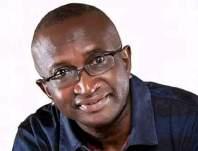
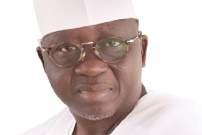
Adedayo Akinwale in Abuja, Boniface Okoro in Umuahia, Daji Sani in Yola, Hameed Shittu in Ilorin, Blessing Ibunge in Port Harcourt and Igbawase
Ukumba in Lafia
More governorship candidates of the All Progressives Congress (APC) emerged yesterday
following the determination of contests to determine standard bearers for the party in the 2027 elections.
Results so far from Abia,
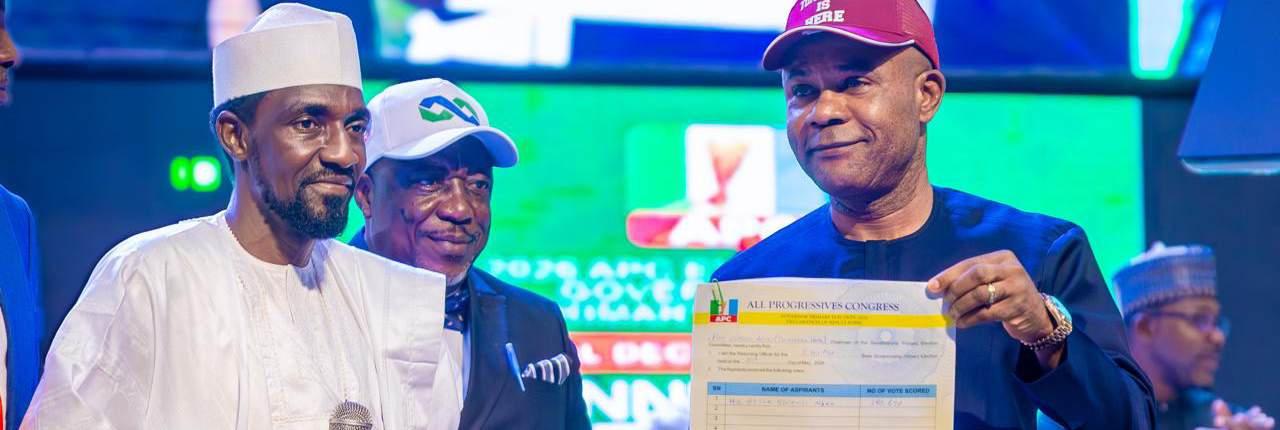
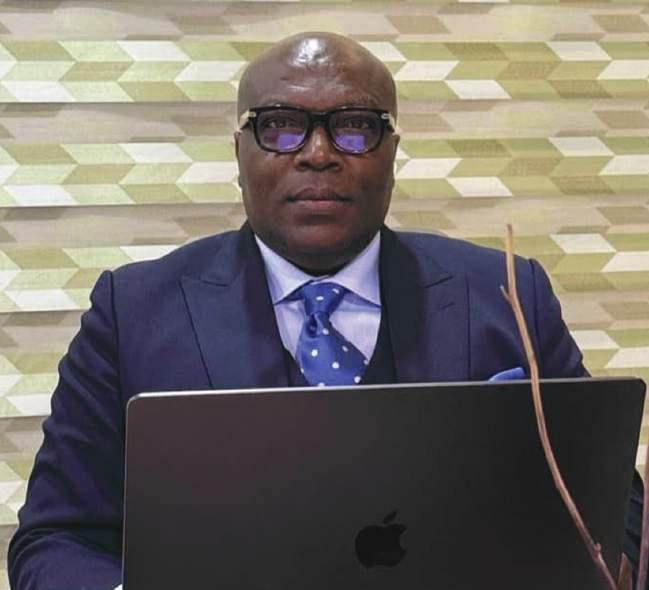
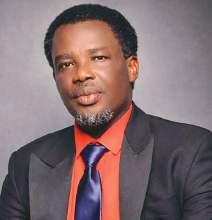
Adamawa, Kwara and Nasarawa States showed that the primaries were conclusive in those states. In Abia, business mogul Eric Opah clinched the ticket while
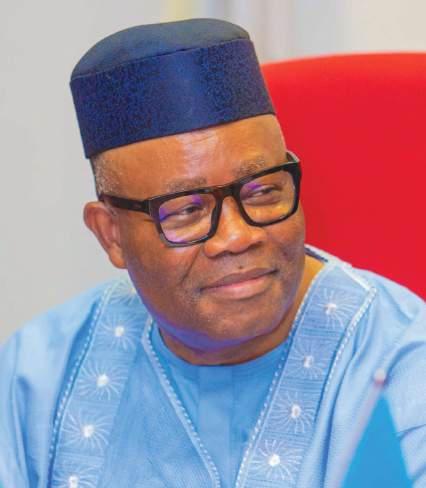
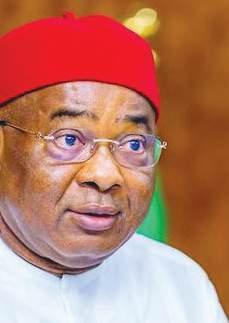
Aminu Tijani Galadima emerged victorious in Adamawa. Also, former Speaker of the State Assembly, Danladi Salihu, won that of Kwara State, while Senator
Ahmed Aliyu Wadada emerged as candidate in Nasarawa. This comes as the ruling APC
on page
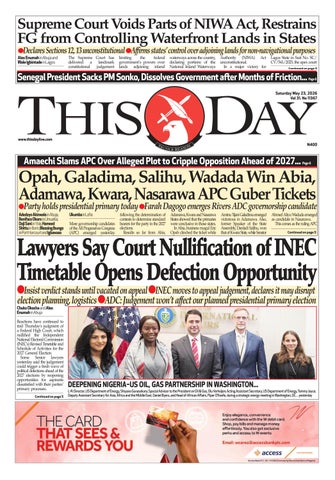
Lawyers Say Court Nullification of INEC
Timetable Opens Defection Opportunity
Chuks Okocha and Alex Enumah in Abuja
Reactions have continued to trail Thursday's judgment of a Federal High Court, which nullified the Independent National Electoral Commission (INEC's) Revised Timetable and Schedule of Activities for the 2027 General Election.
Some Senior lawyers yesterday said the judgement could trigger a fresh wave of political defections ahead of the 2027 elections by reopening opportunities for aspirants dissatisfied with their parties’ primary processes.
Continued on page 5
wellness within reach
with W Health loan
The W Health Loan provides women with access to financing for eligible healthcare services
*Terms and conditions apply
In Fuel Import Licence Dispute, NNPC Accuses Dangote Refinery of Seeking Monopoly
Warns court action could destabilise supply, undermine energy
Wale Igbintade
The Nigerian National Petroleum Company Limited (NNPC), in a statement of defence before a Federal High Court in Lagos, has accused the Dangote Petroleum Refinery of seeking to undermine competition in the downstream petroleum sector through its legal challenge to fuel import licences issued to rival marketers. The state oil company, NNPC Limited, argued that granting the reliefs sought by Dangote
Petroleum Refinery would expose Nigeria to fuel supply disruptions, price instability, and risks to national energy security.
NNPC maintained that the Nigerian Midstream and Downstream Petroleum Regulatory Authority
(NMDPRA) acted within its statutory powers in issuing import licences.
It said the law permits licences for companies with local refining capacity or a proven record in petroleum trading, and that regulators retain discretion
security
under Nigeria’s backward integration policy.
The company further argued that there was no legal requirement mandating a ban on imports except in cases of verified domestic shortfall.
It rejected Dangote Refinery’s interpretation of the Petroleum Industry Act, insisting that fuel imports remain a lawful mechanism for stabilising supply and pricing in the domestic market.
expressed its readiness to conduct its presidential primary election today. President Bola Tinubu, who is seeking re-election, will face Stanley Osifo, an Edo State APC chieftain. According to the party, all registered APC members will be eligible to vote for their preferred presidential aspirant in the election scheduled to be held across 8,809 wards nationwide.
In a related development, former House of Representatives member, Dr. Farah Dagogo has emerged the Rivers State Governorship candidate of the African Democratic Congress (ADC).
Meanwhile, for the governorship ticket, in Abia, Opah clinched the governorship ticket after defeating a former Minister of Science, Technology and Innovation, Chief Henry Ikechukwu Ikoh, in the direct primary conducted across the 184 electoral wards in the state.
Announcing the result early yesterday morning at the APC State Secretariat, Umuahia, the Returning Officer, Barthow Nyelong, said Opah polled 126,977 votes to beat Ikoh, who got 5,905 votes.
This comes as the African Democratic Congress (ADC) stated that the judgement won't affect the party’s planned presidential primary election.
Also yesterday, a faction of the Peoples Democratic Party (PDP) and the African Action Congress (AAC) welcomed the judgment.
Justice Mohammed Umar, in the judgment, held that the time-frame "imposed" by INEC on political parties to conduct their primaries, submit, withdraw and replace names and particulars of their candidates for the 2027 general elections, "is inconsistent with the provisions of the Electoral Act, 2026", and subsequently
held that Sections 12 and 13 of the NIWA Act are invalid to the extent that they empower the federal government to regulate and control lands adjoining waterways for purposes unrelated to navigation, maritime activities and fishing.
Nyelong said Opah met all requirements of the APC constitution and guidelines and therefore declared him the winner and the party’s candidate for the 2027 governorship election.
Voluntary withdrawal by Mascot Uzor Kalu, the third governorship aspirant duly cleared to contest for the ticket, made the primary a straight contest between Opah and Ikoh.
Abia APC heartily congratulated Opah on his "successful emergence" as the governorship candidate of the party following the governorship primaries held on Thursday, May 21, 2026.
The congratulatory message was contained in a statement by the Abia APC Publicity Secretary, Uche Aguoru, shortly after the results of the governorship primary were announced.
The party, which described Opah as "an internationally renowned businessman and distinguished leader," said it was confident that the shipping magnate "possesses the leadership capacity, vision and experience required to lead the party to victory in the 2027
set aside the guidelines.
In their reactions, some Senior Advocates of Nigeria (SANs) and other lawyers commended the judgement for enhancing the rule of law as well as democracy in the country.
The lawyers who acknowledged INEC's rights to make regulations and guidelines for the smooth conduct of elections in the country, however, stressed that such regulations and guidelines must be in tandem with the Electoral Act.
Besides, they pointed out that with the nullification of the guidelines aspirants who lost in party primaries due to
In addition to Lagos, other states that joined the suit against the federal government were Bayelsa, Akwa Ibom, Ogun, Cross River, Kaduna, Enugu, Ebonyi, Ekiti, Benue, Rivers, Osun, Oyo and Anambra.
Lagos State’s legal team was led by the State’s former Governor, Babatunde Raji Fashola SAN, alongside Olasupo Shasore SAN, and Muiz Banire SAN, while the federal government was represented by Akin Olujinmi SAN.
The court affirmed that state governments retain constitutional authority over adjoining lands used for non-navigational purposes,
general elections and return the Government House to Umuahia under the banner of the APC."
The emergence of Opah from Nsulu in Isiala Ngwa North Local Government Area has set him against his kinsman and the Labour Party candidate, Governor Alex Otti, who hails from Isiala Ngwa South Local Government Area.
The exercise in Adamawa State returned Galadima as its governorship flag bearer for the 2027 general elections following the conclusion of the party’s primary.
Chairman of the Governorship Primary Committee, Prof. Innocent Bariko, announced the result after reviewing the exercise against the party’s guidelines and constitution. He said Galadima met all requirements to be declared winner and standard bearer of the APC in the state.
According to the committee chairman, Galadima polled 401,444 votes to defeat his closest rival, Alhaji Abdulrazak Namdas, who secured 86,000 votes, while Abdulrahman Haske came third with 65,935 votes. The margin gave Galadima a decisive victory
absence of level playing ground or perceived manipulation, now have the opportunity to test their popularity and strength in another party.
Reacting to the judgment, Magaji Mato, SAN, who observed that the judgment reaffirmed constitutional supremacy over administrative discretion, clarified that the judgment of the court is binding not only on INEC but on all political actors in the country.
Speaking in an interview on ARISE News Channel, Mato explained that the court’s decision was not limited to the parties before it but has a general effect on the electoral process.
thereby restricting the federal government and the NIWA from exercising sweeping control over such areas.
The seven-member panel of the court, led by Justice Mohammed Lawal Garba, also issued a perpetual injunction restraining the federal government from dealing with lands adjoining waterways within Lagos State and other states of the federation for non-navigational purposes.
in the contest.
Bariko said the process was conducted in line with APC rules and that all aspirants were given a fair opportunity to participate. He added that the committee was satisfied that the outcome reflected the will of party members who took part in the primary.
The declaration positions Galadima as the official APC candidate heading into the 2027 governorship election in Adamawa. Party officials said the result will be forwarded to the national leadership for ratification.
Abdulrahman Haske, one of the aspirants in APC Adamawa State, raised concerns over the conduct of the exercise, while reaffirming his commitment to party unity and democratic ideals.
In an interview, Haske pointed out irregularities that, in his view, required careful review in the interest of strengthening internal party democracy ahead of the 2027 general election.
These, he said, included the absence of collation processes in some Local Government Areas, irregularities in voting in certain polling units, and limited access
“This judanything wrong in that kind of decision. It might be an inconvenient judgment to INEC, probably because of the hectic task it faces in conducting elections nationwide. But the law is the law, and it must be obeyed. It is only in obedience to the law that the country will move forward", he said.
Also speaking, another senior lawyer, Mr. Dayo Akinlaja, SAN, who saw the judgment as good for the development of the nation's democracy, was of the position that any regulations made against the provisions of the laws are bound to be nullified by the courts.
He stressed that the judgment of the Federal High Court did
The matter was determined by a panel comprising Justices Garba, Emmanuel Akomaye Agim, Chidiebere Nwaoma Uwa, Haruna Simon Tsammani, Stephen Jonah Adah, Abubakar Sadiq Umar and Mohammed Baba Idris. Justice Umar, read the lead judgment.
Although the court was unanimous on most issues, the decision recorded a 5-2 split on the constitutionality of Sections 10 and 11 of the
to collation procedures before the final declaration of results.
“It was surprising that while we were waiting for the collation of the votes to happen, what happened to our greatest surprise was the declaration of the winner. We have our data, and we will consult and state our position over the weekend,” he said.
While acknowledging that a candidate has been declared, Haske stressed that the credibility of any electoral process must rest not only on outcomes but also on transparency, fairness, and the full inclusion of all aspirants.
“The integrity of the process is as important as the outcome. Transparent and inclusive procedures remain essential to sustaining trust, confidence, and unity within our great party,” he stated.
Despite his concerns, Haske struck a tone of sportsmanship and responsibility, urging restraint among his supporters and calling for calm across the state.
He disclosed that consultations are ongoing with party leaders, stakeholders, and supporters to determine the appropriate next course of action within
not in any way weaken the powers of the electoral umpire to make regulations for the smooth conduct of elections, but that such regulations and guidelines must be in tandem with the law.
"From the snippets I have gathered, the timetable was challenged on alleged grounds of inconsistencies with relevant provisions of the Electoral Act. If that is the case, I fail to see the ensuing judgment as weakening the powers of INEC in any way or form.
"INEC as a body is bound by the provisions of the Electoral Act. Obviously enough, INEC lacks the power to make regulations, guidelines or
NIWA Act.
Justices Agim and Idris dissented on some aspects of the decision, maintaining that Lagos State ought to have succeeded on additional reliefs relating to federal control over waterways.
Lagos State had approached the Supreme Court under its original jurisdiction, challenging the constitutional validity of several provisions of the NIWA Act.
The state argued that the
the framework of the party’s constitution.
“As responsible democrats, we are engaging widely to review the exercise and explore all legitimate avenues available to us. Our decisions will be guided by due process, party unity, and the best interests of Adamawa State,” he said.
However, speaking after the announcement, committee members urged party stakeholders to close ranks and work toward a united front. They stressed that internal cohesion would be crucial for the APC’s chances in the state.
In Kwara, Election Committee Chairman, Senator Musiliu Obanikoro, declared the Speaker of the Kwara State House of Assembly, Salihu, as the winner of the primary, which ended yesterday.
This development invalidated the announcement of Amb. Seriki Fatai Gambari, a mining magnate, whom Governor AbdulRahman AbdulRazaq had previously announced as his successor.
Three of the 15 gubernatorial
timetable inconsistent with the provisions of the Electoral Act. "If it is established that the instant timetable is in conflict with the provisions of the Electoral Act, it is only proper and appropriate for the Court to nullify the timetable. That is the singular way to strengthen our democracy. Akinlaja opined that the judgment would enhance the internal democracy of political parties as well as the 2027 polls. According to him, following the nullification of the revised timetable, political parties now have the benefit of ample time to prepare for the upcoming
National Assembly exceeded its constitutional authority by enacting provisions empowering the federal government and NIWA to exercise control over lands adjoining waterways within states.
Specifically, Lagos contended that Sections 10, 11, 12 and 13 of the NIWA Act conflicted with Sections 4 and 315 of the Constitution,
15TH SYNOD OF REMO ANGLICAN DIOCESE...
Report: 32 States Recorded 43% Budget Performance in Q1
No fewer than 32 out of the nation’s 36 states collectively achieved a budget implementation rate of 43 per cent from a total expenditure of N3.5 trillion in the first quarter (Q1) of 2026, a new report by Agora Policy has estimated.
Aggregate budget of the 36 states in 2026 stands at N36.98 trillion, up from N25.58 trillion in 2025.
Anambra, Delta, Ogun and Rivers were not covered in the report.
The sum of N1.8 trillion (51.5 per cent) of the expended N3.5 trillion was allocated to
Tears
capital projects, while N1.7 trillion (48.5 per cent) covered recurrent costs.
Recurrent expenditure achieved for the 32 states reviewed showed an implementation rate of 63 per cent, while capital expenditure was lower at 33 per cent.
Kano and Imo states recorded the highest ratio of capital spending at 76 per cent, with Plateau (88 per cent) and Ondo (78 per cent) topping in recurrent expenditure.
According to the report, in the first quarter of 2026, 25 of the 32 states implemented less than 50 per cent of their expenditure budgets, while
Flow as 49-year-old Teacher Killed in Oyo School Attack is Buried
Kemi
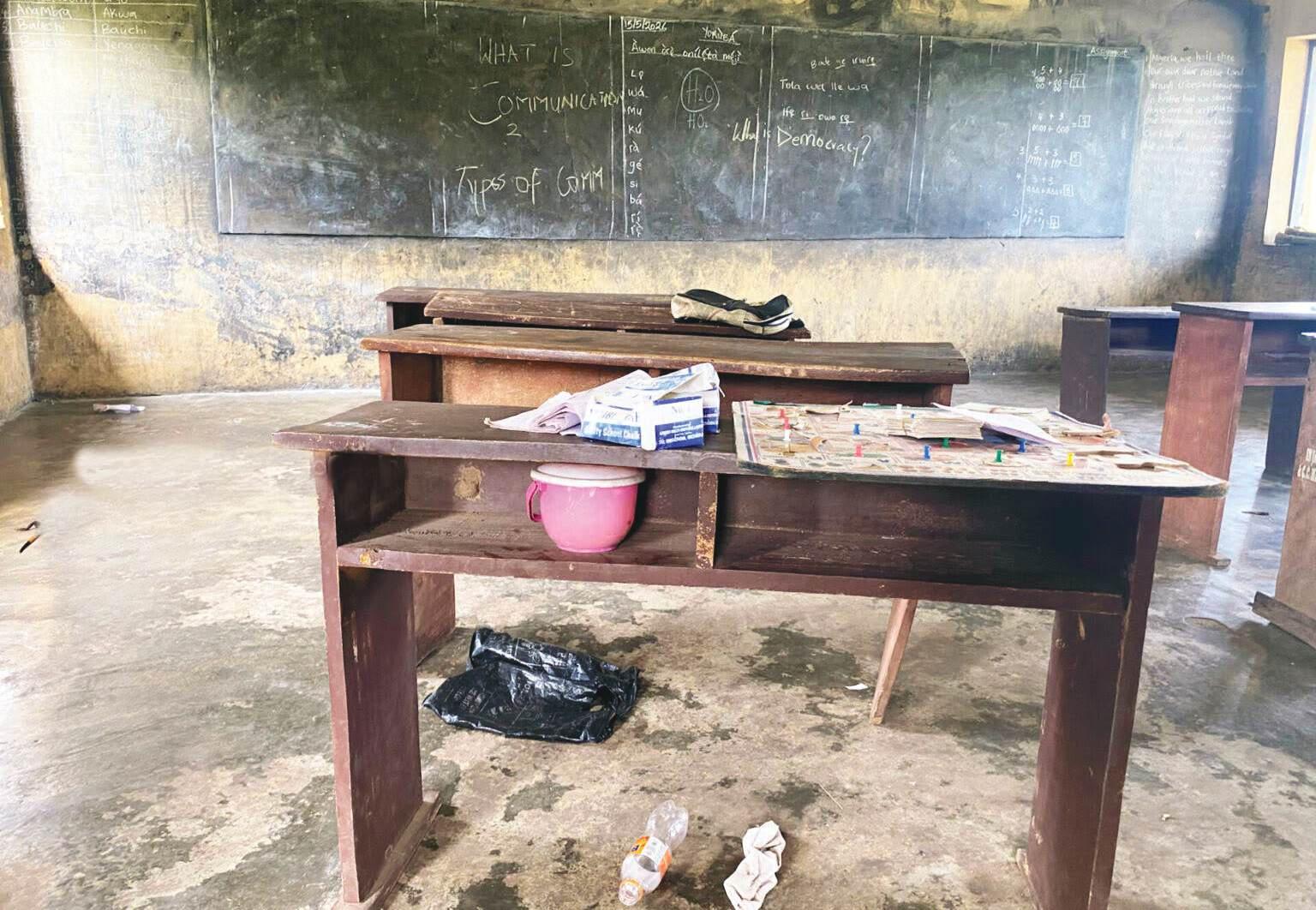
Families, friends, and colleagues yesterday struggled to hold back tears as one of the teachers killed during an attack on schools in Oriire Local Government Area of Oyo State, Adesiyan Joel Adegboye, was laid to rest at his residence in Owolake, Ogbomoso.
Adegboye was among the victims of a coordinated assault by armed hoodlums who rode into the area on motorcycles.
The attackers simultaneously targeted Baptist Nursery and Primary School, Yawota; Community Grammar School; and L.A Primary School, Esiele.
The attacks led to the death of Adegboye and abduction of pupils and members of staff. Among those abducted was the Principal of one of the schools, Mrs. Folawe Alamu. The incident has left the affected communities in mourning and raised concerns over the safety of schools in the state.
Residents who attended the burial in Ogbomoso
described Adegboye as a dedicated teacher committed to his students, while many expressed grief over his death and called for urgent measures to improve security around educational institutions in the local government and other parts of Oyo State.
Before interment, a burial service was held for the deceased at Ayegun Baptist Church, Ogbomoso, where family, friends, relatives and his co-workers in the Nigeria Union of Teachers (NUT) praised the deceased for his impact while alive.
In his sermon, Rev. Paul Olaleye, urged the family of the deceased to take solace in the incident and leave everything for God to fight for them.
He called on people to always prepare for death because it can come anytime.
He said, "Death will not tell anybody the day and time it will come, but we need to prepare ourselves because after death, we will know either we have eternal joy or eternal sorrow.
only seven states exceeded 50 per cent implementation rate.
Oyo (104.4 per cent) and Ekiti (66.1 per cent) led the rankings, with Enugu posting the lowest at 12.1 per cent.
Among the 32 states, five achieved a recurrent
expenditure implementation rate above 80 per cent, while eight states were yet to attain 50 per cent during the period.
On the other hand, 29 states have implemented less than 50 per cent of their capital budgets with only Oyo,
Bauchi and Lagos surpassing 50 per centin capital spending implementation for the period.
In value terms, Lagos, Oyo and Akwa Ibom recorded the highest total expenditure and capital expenditure in Q1 2026.
For recurrent expenditure,
Lagos, Oyo and Ogun recorded the highest.
Oyo State recorded the highest budget performance on a pro-rated basis at 140 per cent compared to Enugu which had the lowest at 12 per cent.
NDC Sets Up 20-member Committee for Governorship, N’Assembly Primaries
Says only cleared aspirants to buy nomination forms Party to conduct direct primaries May 28th to 30th where consensus fails
Sunday Aborisade in Abuja
The Nigeria Democratic Congress (NDC) has constituted a 20-member National Selection Committee to oversee the screening and selection of aspirants for its forthcoming governorship and National Assembly primaries, as the party intensifies preparations ahead of the 2027 electoral cycle.
The party said the move was part of efforts to deepen transparency, strengthen
internal democracy and ensure the emergence of credible candidates through what it described as a “free, fair and credible mechanism.”
According to a statement issued yesterday, by the National Secretary of the party, Ikenna Morgan Enekweizu, the committee was approved by the party’s National Leader, Senator Seriake Dickson, following recommendations by the National Working Committee (NWC).
The statement explained that
the committee would review and scrutinise reports submitted by the National Screening Committee and take final decisions on the screening outcomes of aspirants seeking tickets for governorship and National Assembly positions.
A former senator, Cleopas Moses Zuwoghe, was named chairman of the committee, while Enekweizu will serve as secretary.
Other members include Buba Galadima, Yinusa Tanko, Udenta Udenta, and Aminu
Abdulsalam, among others.
The party disclosed that only aspirants who successfully scale the screening process and are cleared by the committee would be permitted to purchase nomination forms. It added that consensus arrangements would be prioritised in the selection of candidates, but warned that direct primaries would be conducted between May 28 and May 30, 2026, in constituencies where consensus could not be achieved.
SeerBit Technologies Partners IIAN to Provide Payment Gateway
Internal Auditors and other online and offline financial managers have the benefits of technology solutions to everyday professional tasks as a leading financial technology company, SeerBit in collaboration with the Institute of Internal Auditors Nigeria
(IIAN) have provided secured payment gateways for both online and offline businesses.
As part of annual global awareness campaign for internal auditors held recently 2026 Lagos, which included the showcasing of latest Apps, POS and In-Store Payment
Systems developed by the company for easy payment, and to keep internal auditors abreast of new technological innovative solutions
In his presentation, titled 'Driving Audit Efficiency Through Streamlined Payment System', the company's Head of Commercial Services, Oyewale Oyelade, explained that the programme became necessary to help auditors overcome gaps they see in their work which might not be solved after using all control measures within the audit framework.
African Marketplace 2026 Holds in Dubai October
African Marketplace (AMP) is set to return for its highly anticipated second edition from October 10–12, 2026, at the prestigious Conrad Hotel Dubai, following the success of its landmark 2025 debut.
The three-day event will once again convene some of the finest products, services, creatives, and innovators from Africa and the Caribbean, connecting them with global buyers, investors, policymakers, distributors, and cultural enthusiasts in one of the world’s most strategically
connected trade capitals.
African Marketplace is a pan-continental trade and cultural platform designed to spotlight Africa’s and the Caribbean’s finest exportready brands, SMEs, and innovators, empowering them to scale internationally, unlock investment opportunities, and achieve global relevance. African Marketplace 2026 will showcase the richness of African and Caribbean heritage alongside contemporary innovation across fashion, furniture, art, cuisine, music, technology, wellness, and intellectual capital.
Oluchi Chibuzor
Olaitan in Ibadan
Ndubuisi Francis in Abuja
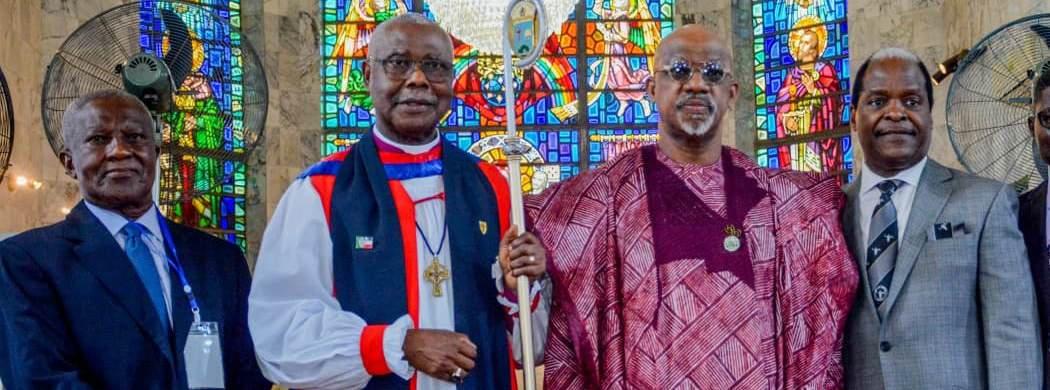
L-R: The Chancellor, Mr. Lanre Ogunlesi; Bishop of the Remo Diocese/Archbishop of the Ecclesiastical Province of Lagos, Most Reverend Dr. Olusina Fape; Ogun State Governor, Prince Dapo Abiodun, and Akin Oshibajo, during the official opening of the first session of the 15th Synod of the Remo Anglican Diocese, held at Our Saviour’s Anglican Church, Ikenne, Ogun State…yesterday
The national average cost of maintaining a healthy diet in the country rose to N1,513 per adult per day in February 2026, representing a 3.76 per cent increase from N1,458 recorded in the preceding month, the National Bureau of Statistics (NBS) stated yesterday. By implication, the cost of accessing a healthy diet had outpaced both headline food inflation in the period under review, underscoring deepening pressure on household nutrition as millions struggle with rising food prices. This was contained in the Cost of a Healthy Diet (CoHD) report, February 2026 which was released by the statistical agency.
The report further showed that the CoHD had maintained a steady upward trajectory over the past year.
Year-on-year, the cost increased by 12.4 per cent from N1,346 in February, largely driven by increases in the prices of starchy staples, fruits, legumes, nuts and seeds, as well as animal source foods. According to the NBS, CoHD represents the least expensive combination of locally available foods capable of meeting internationally recognised healthy dietary standards.
The data serves as an important indicator for measuring physical and economic access to nutritious food and is increasingly monitored globally by
Ogun to Empower 100,000 Residents Through Monthly Cash Intervention Scheme
Ogun State Governor, Dapo Abiodun, has announced plans by the Ogun State Government to launch the Renewed Hope Ward Development Programme (RHWDP), an initiative aimed at providing monthly cash interventions to between 50,000 and 100,000 residents across the state within the next one year.
Also, the state government has concluded plans to forward a bill to the State House of Assembly aimed at strengthening legal measures and prescribing stiffer penalties against vandals of public infrastructure across the state.
The governor made this known yesterday during the official opening of the first session of the 15th Synod of the Remo Anglican Diocese, themed ‘The Empty Tomb: An Authentic Proof of the Living
Saviour, Jesus Christ’, held at Our Saviour’s Anglican Church, Ikenne.
Governor Abiodun also disclosed that his administration would prioritise the reconstruction of the Sagamu–Ode Lemo Road, stressing that collaboration between government and the church remains essential to building a peaceful, just, and progressive society. He commended the church for its steadfast commitment to spiritual renewal, community development, and godly nationbuilding at a time when the nation requires strong moral and faith-based guidance. According to him, the church’s dedication to propagating the gospel, promoting peace, and uplifting humanity continues to inspire hope across the country.
institutions such as the United Nations and the World Bank.
The NBS gathers monthly retail food price data from 10,534 sources across urban and rural areas nationwide to support the computation of the index.
Findings further indicated that animal source foods remained the most expensive component of a healthy diet in February, accounting for 39 per cent of total CoHD while contributing
only 13 per cent of total calories.
Fruits and vegetables were equally identified as among the costliest food groups relative to calories supplied, accounting for 16 per cent and 14 per cent respectively of the total cost of a healthy diet.
In contrast, legumes, nuts and seeds emerged as the least expensive food group, accounting for just seven per cent of total cost on average.
According to the statistical agency, rising healthy diet costs have important implications for food security, nutrition planning, agricultural policy and social protection interventions.
The data could help policymakers identify supply bottlenecks in key food groups and design targeted interventions aimed at improving food production, market access and affordability
of nutritious foods for vulnerable households.
The report stated, "The Cost of a Healthy Diet (CoHD) has been rising steadily over the past year. As of February 2026, the CoHD was 12.4 per cent higher than February 2025, increasing from N1,346 to N1,513. While the price of Starchy staples decreased, all other food groups experienced price increases.
ICPC Allegedly Bars ADC Leaders from Seeing El-Rufai
Chuks Okocha in Abuja
Leaders of the African Democratic Congress (ADC) were allegedly denied access to former Kaduna State Governor, Nasir El-Rufai, who is currently in the custody of the Independent Corrupt Practices and Other Related Offences Commission.
The ADC delegation, it was gathered, included the party’s National Secretary, Rauf Aregbesola, National Publicity Secretary, Bolaji Abdullahi, and Secretary of
the ADC Manifesto and Policy Committee, Salihu Lukman.
The party leaders reportedly visited the ICPC facility in an attempt to see el-Rufai but were denied access.
The development comes days after the ICPC dismissed allegations that el-Rufai was being denied access to food, family members and medical care while in detention.
Speaking at a press conference earlier, ICPC spokesperson, Okor Odey, described the allegations as “false and misleading.”
According to him, visitors are allowed into ICPC detention facilities between 9:00a.m. and 6:30p.m., adding that el-Rufai’s wife arrived outside the approved visiting hours.
Odey also maintained that authorised visitors, including family members, lawyers and medical personnel, were permitted access under supervision.
However, the el-Rufai family had alleged that the former governor was denied access to his personal doctors despite
in Custody
an earlier court order from the Kaduna High Court granting him unrestricted access to legal representatives and physicians.
The family further claimed that the ICPC’s in-house doctor had recommended additional medical examination before access was allegedly blocked.
“When you see a doctor and you run tests, you are expected to see the doctor back so that he explains what the problem is,” a family member said.
“He was denied access to the doctor,” el-Rufai’s second wife, Hasiat, alleged.
Katsina Disburses N6.1bn Grants to 110 Schools
The Katsina State Governor, Dikko Umaru Radda, has flagged off the second disbursement of school improvement grants valued at N6,116,343,477.00 to 110 schools across the state.
Radda, who flag-off the disbursement yesterday at the TESS Project Office in Katsina, described the initiative as clear evidence of his administration's unwavering commitment to improving educational
standards.
He said education remains a key priority because sustainable development is only achievable through meaningful investment in human capital.
He outlined his vision to build an inclusive, functional, and accountable education system capable of preparing children to compete effectively in the modern world.
"Our vision is to build an education system that is inclusive, functional, accountable, and capable of preparing our
children to compete effectively in the modern world," the governor stated.
He said the N6.1 billion funds must be utilised with the highest level of transparency, prudence, and accountability, strictly in accordance with the approved guidelines.
Radda called on School-Based Management Committees, parents, community leaders, and teachers to support these efforts and ensure proper utilisation and maintenance of executed projects.
In his remarks, the State Commissioner for Basic and Secondary Education, Yusuf Suleiman Jibia, said the AGILE project is advancing inclusive education through distribution of specialised learning materials to learners with special needs.
He said, "This important intervention underscores our collective resolve to ensure that every child, irrespective of physical condition or learning difficulty, is given equal opportunity to learn, grow, and realize their full potential.”
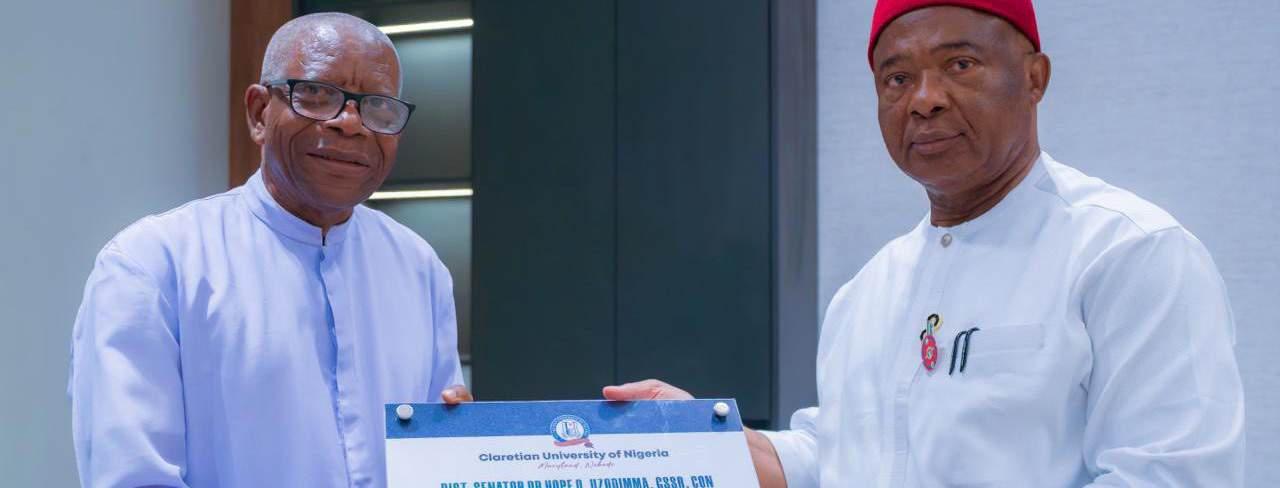
Vice Chancellor of Claretian University of Nigeria, Very Rev. Fr. Wenceslaus Madu (left), presenting the Institution's maiden Convocation plaque to the Governor of Imo State, Senator Hope Uzodimma, as the GRAND PATRON of CUN, at Government House,
Francis Sardauna in Katsina
MBAH EMERGES APC GUBER CANDIDATE...
L-R: Chairman, Enugu State All Progressives Congress (APC) Governorship Primary Election Committee, Hon. Danmalikin Hausa; Committee Secretary, Harold Aboloje, and Governor of Enugu State, Dr. Peter Mbah, during the presentation of a copy of election result affirming Mbah as APC governorship candidate in the 2027 general election at the International Conference Centre, Enugu...yesterday
2027: Mbah Unveils Achievements, Promises More after Emergence as Enugu APC Candidate
Emmanuel Ugwu-Nwogo in Enugu
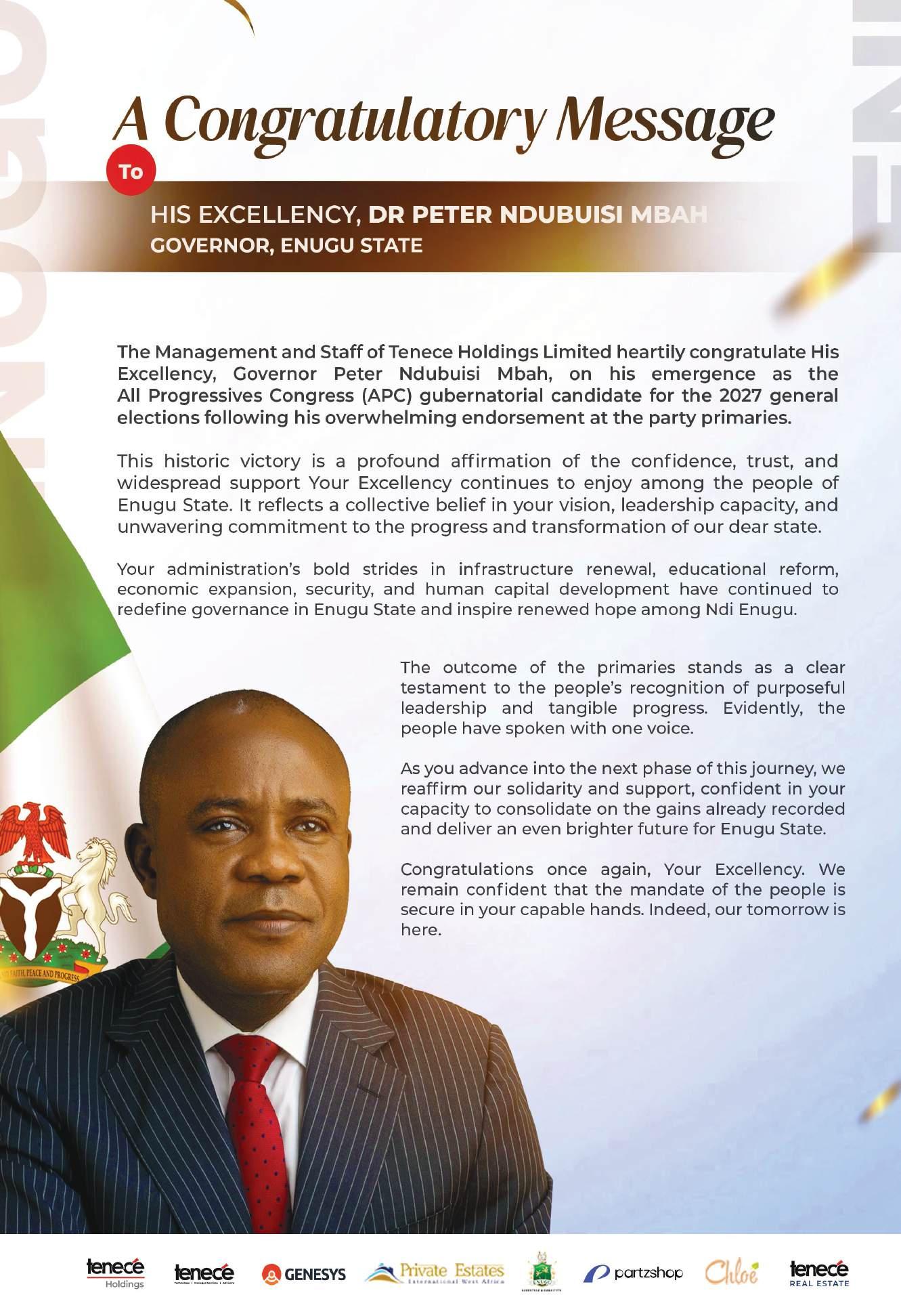
Governor Peter Mbah has saluted the All Progressives Congress’ (APC) faithful for his election as the party’s gubernatorial candidate in the 2027 general elections, highlighting progress made under his stewardship and promising more to the state.
He stated this in his acceptance speech at the International Conference Centre, Enugu, yesterday, as the Hon. Danmalikin Hausa-led Enugu State APC Governorship Primary Election Committee concluded the collation of results of the exercise that saw 397,370 accredited party faithful participating across the state’s 260 wards on Thursday and formally declared him the winner.
“This moment is not one I take for granted. For me, there was never a sense of entitlement. I accept this nomination with full awareness of the expectations that come with it, buoyed by the knowledge that it’s not an unfamiliar path for me,” he stated.
Mbah expressed happiness that his administration totally disproved the notion that campaign promises could never be kept, saying the “Tomorrow Is Here,” which underscores his governance philosophy had moved from the abstract to a reality.
“What once felt distant – that tomorrow could be different – is no longer abstract. It is taking shape.
“It is visible in the routines of daily life, in how people travel, how they work, and how they now access services
Experts Advocate New Funding Model for Nigerian Universities
The Chairman of the Nigeria Higher Education Foundation, (NHEF) and Chief Executive Officer of Kuramo Capital Management, Wale Adeosun, yesterday, urged Nigerian universities to reduce their overdependence on government funding and instead leverage alumni endowments, research grants and innovation commercialisation as sustainable sources of revenue.
Speaking at two -day Commonwealth Institute Universities Leaders Conference, in Lagos, themed, ‘Funding and Revenue Generation for Universities', Adeosun identified tuition, alumni endowments, research grants and commercialisation of faculty innovations as the four major funding sources for universities globally.
According to him, "while tuition remains a traditional source of revenue, universities must increasingly focus on building strong alumni support systems and attracting research funding through grants written by faculty members."
He also stressed the need for universities to commercialise ideas and innovations developed within their institutions, especially in biotechnology and technology-related fields, noting that such innovations could attract venture capital investments and generate substantial income.
The chairman noted that many Nigerian universities possess gold mines in the form of their alumni networks, adding that several young Nigerian graduates are already developing globally relevant solutions through coding and artificial intelligence.
that were once unreliable or out of reach.
“We have smashed the notion that promises matter more than performance. Every naira spent has been made to give the people of Enugu a return on their investment of trust and faith,” he said.
Continuing, the governor reeled out his administration’s achievements across various
sectors.
“Today, events are scheduled on Mondays without the least apprehension. Through our Command and Control Centre and other modern security infrastructure, we have effectively restored citizens’ faith in the state’s capacity to protect them.
“Through our ward-based Smart Green Schools, learning
has become fit-for-purpose, offering our children education that guarantees them a place in a fast-changing world.
“With at least one Type-2 Primary Healthcare Centre in each of our 260 Wards, we have ensured that location is no longer a hindrance to quality healthcare.
“Across our rural communities, crop yield is rising
as the rev of tractors increasingly replaces backbreaking tasks like ridging and tilling once done with hoes and cutlasses.
“Across our towns and cities, opportunities are emerging as decades-long moribund industries roar back to life.
“Until a few months ago, the Songhai Heneke Farm in Ezeagu was a desolate project. The story is different today.
Supreme Court Judgement Reaffirms
.Insists Gabam remains expelled from party
Sunday Aborisade in Abuja
The National Chairman of the Social Democratic Party (SDP), Prof. Abubakar Sadiq Gombe, yesterday, hailed the judgement of the Supreme Court on the lingering leadership dispute within the party.
He declared that the verdict had reaffirmed the authority of the party’s National Working Committee and validated actions taken against former National Chairman, Alhaji Shehu Musa Gabam.
Addressing journalists
Sunday Ehigiator
The President of the Association of Food, Beverage and Tobacco Employers (AFBTE), Mr. Chinedum Okereke, has said Nigeria’s high interest rate regime is crippling businesses despite the country recording a 3.87 per cent GDP growth in 2025.
Speaking at the association’s 47th Annual General Meeting (AGM) held recently in Lagos, Okereke said manufacturers continued to battle harsh operating conditions driven by
in Abuja alongside former Minister of Power, Olu Agunloye, and former senator, Ugochukwu Uba, Gombe maintained that the apex court had effectively nullified pronouncements earlier made by the Court of Appeal regarding the party’s leadership.
According to him, the Supreme Court judgement delivered in the appeal marked SC/CV/229/2026, Fayemi Tosin Babatunde vs INEC & 4 Ors, and adopted in five related appeals, upheld the
high borrowing costs, multiple taxation, inflation and weak consumer purchasing power.
According to him, the Monetary Policy Rate (MPR), which stood at 27 per cent for most of 2025, worsened the financial burden on businesses across the country.
“The huge increases over time in the past translated to high cost of borrowing, i.e., high interest rate, a development which evidently increased the debt burden of businesses and in like manner reduced their margins,”
position that issues relating to internal party affairs remained within the exclusive jurisdiction of political parties.
“We represented the party physically at the Supreme Court. We have already applied for the Certified True Copy of the judgement and journalists are free to obtain the judgement themselves and verify what transpired,” Gombe said.
He dismissed claims circulating on social media suggesting that Gabam had been restored as SDP national
Okereke stated.
He noted that although Nigeria’s economy recorded modest growth and inflation slowed considerably during the year under review, ordinary Nigerians and businesses were yet to feel meaningful relief.
“Despite these reductions, there has been an upsurge in the cost of living in the country, especially the cost of food and other basic items,” he said.
Okereke attributed the persistent rise in food prices and living costs to the removal of fuel subsidy, naira
chairman, insisting that no such order existed.
“I don’t want to rely on social media speculation. I have provided an official document duly signed and verifiable at the Supreme Court,” he added.
The SDP chairman further argued that the Independent National Electoral Commission had no option but to recognise the decisions of the party’s National Executive Committee, which ratified Gabam’s expulsion after a disciplinary process.
depreciation, rising energy prices, poor infrastructure and insecurity in farming communities.
“The reasons for this are not far-fetched. They include the expected impact of the removal of fuel subsidy and the floating of the Naira, resulting in a high cost of logistics, particularly transportation,” he explained.
The AFBTE president further blamed insecurity in Northern Nigeria for worsening raw material shortages and increasing production costs for manufacturers.
Funmi Ogundare
ENO EMERGES APC GUBER CANDIDATE...
FG, World Bank Support 250 Health Centres
Nationwide with $200,000 Intervention
Onyebuchi Ezigbo in Abuja
The federal government has commenced distribution of medical equipment to 250 secondary health facilities across 30 states of the federation to strengthen service delivery and reduce maternal and newborn mortality in Nigeria.
Speaking at the flag-off ceremony in Abuja, yesterday, Coordinating Minister of Health and Social Welfare, Muhammed Ali Pate, said the
intervention was part of the federal government’s renewed commitment to health sector reforms and Universal Health Coverage (UHC).
APC: Niger House Deputy Speaker, 15 Other State Lawmakers Lose Return Bids
Laleye Dipo in Minna
The Deputy Speaker Niger State House of Assembly and the only woman legislator, Hon. Affiniki Dauda along with 15 other members of the House lost their bids to fly the flags of the All Progressives Congress (APC) in next year's general elections.
Hon. Dauda who currently
represents Gurara State Constituency lost the seat to a newcomer in the constituency. The APC legislative assembly primary election showed that the party would not field any woman or Christian for any of the 27 legislative seats.
However, the Speaker of the House Rt. Hon. Abdulmalik Sarkindaji was returned unopposed from his Magama
State Constituency.
Other serving members who won the APC primary election are Alhaji Abdulmalik
Zakari (Mokwa), Alhaji. Nasir Umar (Paikoro), Alhaji Yahaya Abubakar Ahmadu (Gbako), Alhaji Zubair Ismaila (Rafi), and Alhaji. Dogari Daje (Munya). The results of the House of Assembly primary election were announced at the APC Secretariat on Thursday by the Chairman of the Committee, Alhaji Danlami Mohammed Abubakar.
SUPREME COURT VOIDS PARTS OF NIWA ACT, RESTRAINS FG FROM CONTROLLING WATERFRONT LANDS IN STATES
the Land Use Act, and Items 36 and 64 of the Exclusive Legislative List.
The state further argued that the federal government could not validly exercise powers over inland waterways that had not been designated as international or interstate waterways by the National Assembly.
Lagos also maintained that the federal government lacked constitutional authority to regulate lands adjoining waterways for purposes unrelated to navigation.
The state sought multiple declarations and orders nullifying the disputed provisions and restraining federal authorities from exercising control over adjoining lands within its territory.
Before delving into the substantive issues, the Supreme Court first considered preliminary objections filed by the federal government and other defendants challenging the jurisdiction of the court.
The objections were dismissed for lacking merit.
The court subsequently proceeded to determine the constitutional questions raised in the suit.
One of the key issues addressed by the court was whether the case had already been settled in the earlier dispute between NIWA and the Lagos State Waterways Authority (LSWA).
The defendants had argued that the doctrine of res judicata applied because the issues had been determined in the earlier NIWA v. LSWA decision.
However, the Supreme Court rejected the argument, holding that the present suit was distinguishable from the earlier case and therefore not barred.
That finding cleared the way for the court to fully examine the constitutional validity of the disputed provisions of the NIWA Act.
In its substantive findings, the court held that Sections 12 and 13 of the NIWA Act went beyond the constitutional powers granted to the National
Assembly.
The apex court ruled that while the federal government possesses authority over navigation, maritime activities, fishing and international waterways, those powers do not extend to general control over lands adjoining waterways within states.
The court held that the National Assembly acted ultra vires by attempting to regulate adjoining lands for purposes outside navigationrelated activities.
Accordingly, the court declared Sections 12 and 13 unconstitutional to the extent of their inconsistency with the Constitution.
The court specifically held that the federal government cannot rely on those provisions to deal with lands adjoining waterways for non-navigational purposes.
The judgment is expected to have farreaching implications for waterfront development, land reclamation, urban
planning, environmental regulation and revenue generation in Lagos and other coastal states.
Despite Lagos State’s partial victory, the Supreme Court declined to invalidate Sections 10 and 11 of the NIWA Act.
The court reaffirmed its earlier position in NIWA v. LSWA, holding that the federal government retains constitutional authority over matters relating to navigation and declared federal waterways.
Consequently, the court refused Lagos State’s requests for declarations that the National Assembly lacked legislative competence over waterways not specifically designated as international or inter-state waterways.
The apex court also rejected the argument that federal authority over inland waterways exists only where express declarations have been made by the National Assembly.
Pate, represented by the Executive Director of the National Primary Health Care Development Agency (NPHCDA), Muyi Aina, described the initiative as a broader Health Sector Renewal Investment Agenda aimed at translating policy commitments into measurable improvements in healthcare delivery nationwide.
According to him, over 40,000 women have already accessed life-saving maternal health interventions under ongoing government-supported programmes.
“These are not just numbers; they represent mothers who have been given a second chance at life,” he said.
Pate added that the intervention fulfils President Bola Tinubu’s commitment to ensuring safe childbirth for every
Nigerian mother and improved survival chances for newborns. He noted that equipment worth approximately 200,000 Dollars had been deployed to address critical gaps in secondary healthcare facilities.
However, he cautioned that equipment alone would not guarantee improved health outcomes.
“Sustainable impact requires functional facilities, adequate staffing, and continuous investment, particularly at the secondary healthcare level where workforce gaps remain significant,” he said. He urged state governments to complement federal efforts through facility rehabilitation, improved staffing, and proper utilisation of the equipment as well as ensuring accountability.
Osun: Labour Unions Pledge Support for Adeleke’s Second Term
Yinka Kolawole in Osogbo
The joint Labour Movement, which comprises the Joint Labour Congress, Trade Union Congress and Nigeria Labour Congress, held sensitising programme at the Assembly's Pavilion to pledge their total support for the second term of the Governor, Senator Ademola Adeleke.
The Union said the movement dwelt extensively on the welfare enjoyed by Osun workers ranging from payments of backlogs of half salaries, implementation of minimum wage ranking Osun as third presently against 34 position before now out of 36 states of the federation, infrastructural developments across the length and breadth of Osun State, among others.
In his welcome address, Chairman, Parliamentary Association Staff Association of Nigeria, PASAN, Comrade
Akeem Adesina, saluted the commitment of members for turning out en masse.
In their separate remarks, President, National Union of Local Government Employee, Comrade Nathaniel Ogungbangbe, Chairman, Joint National Congress Comrade Olalekan Adediran, Chairman, Trade Union Congress, Comrade Abimbola Fasasi and Chairman, Nigeria Labour Congress, Comrade Christopher Arapasopo, appealed to union members to mobilise massively and reciprocate the good gesture of the governor by returning him to office.
They admonished President Bola Tinubu not to turn Osun State to battlefield, appealing to the President to allow them vote for their preferred candidate. The union leaders charged their members to work on 25-person each, mobilise and vote accordingly.
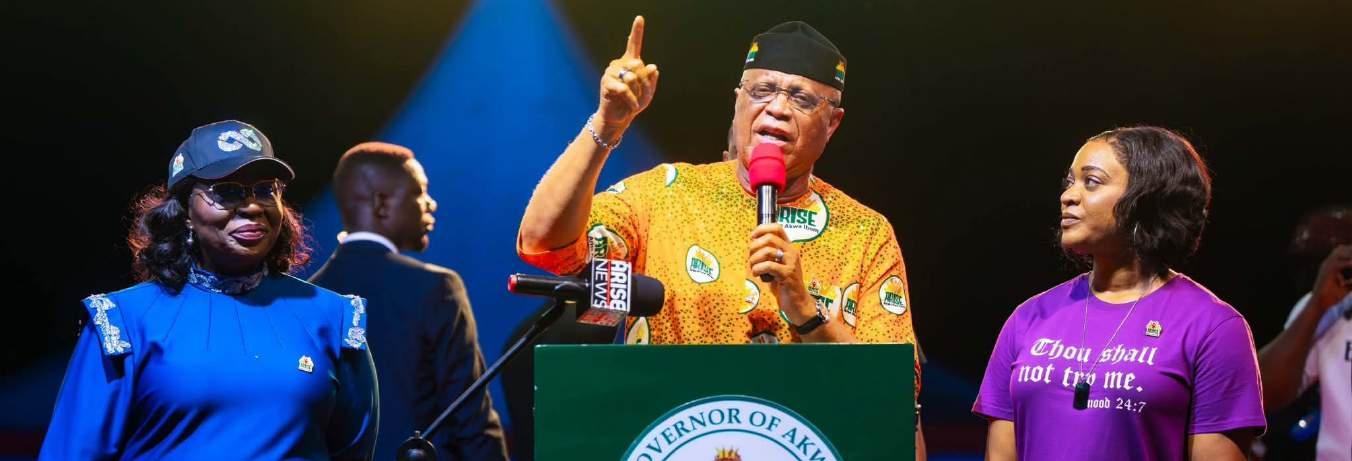
L-R: Deputy Governor, Akwa Ibom State, Senator Akon Eyakenyi; Governor Umo Eno, and Coordinator, Office of the First Lady, Helen Eno Obareki, at a victory party after Eno emerged as the State 2027 APC Gubernatorial candidate held at Ikot Ekpene Udo, Nsit Ubium Local Government Area…Thursday
The Child Who Processes The World Differently
HENRIETTA C. IKEDIASHI writes about children who are wired uniquely
The teacher called the boy stubborn. The pastor called it a generational curse. The grandmother said the mother had done something wrong in her first pregnancy. The school eventually stopped calling altogether, which is the cruelest thing an institution can do, because silence reads, to a desperate parent, like a verdict.
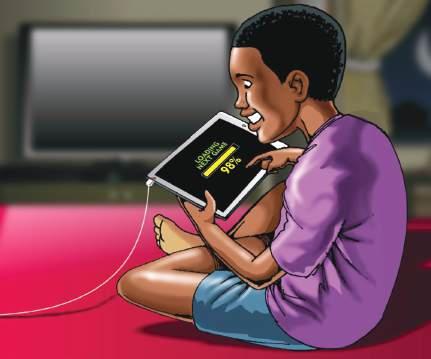
The boy was eight years old. He could dismantle and reassemble a radio. He could tell you the weather pattern of any city you named. He could not, however, sit still for 40 minutes, copy notes from a board, or stop talking when talking was forbidden. His brain was not defective. His brain was, in the language of modern neuroscience, differently wired. What was defective was every adult system around him that had decided, without investigation, that he was the problem.
He is not an isolated case. In this country of more than 200 million people, approximately 30 million are neurodivergent. That is not a statistic from a foreign journal with no relevance to our lives. That is your nephew who cannot read despite being, by every other measure, a perceptive and intelligent child. That is your colleague who loses things constantly, forgets appointments, and yet produces the most original thinking in every room he enters. That is the girl at the back of the class who seems to be somewhere else entirely, who will one day, if someone reaches her in time, be somewhere extraordinary. Neurodiversity is the term that describes the natural variation in how human brains develop and function. Autism. Attention Deficit Hyperactivity Disorder. Dyslexia. Dyscalculia. Sensory Processing Differences. These are not diseases to be cured, spirits to be cast out, or character weaknesses to be beaten out of a child. They are neurological realities as old as the human race itself, present in every tribe, every faith, every income bracket, every generation. We did not import them from the West. We only borrowed the language to describe what was always here.
What we have done, in the absence of that language, is damage children.
We have flogged children with dyslexia for what we called laziness. We have expelled autistic children from schools that took their parents money and offered cruelty in return. We have medicated without diagnosis, prayed without understanding, punished
without cause, and wondered, year after year, why so many brilliant young Nigerians arrive at adulthood feeling fundamentally inadequate. The answer has been in front of us. We built every system, the classroom, the religious centres, the examination, the workplace, for one type of mind, and then blamed every other type of mind for not fitting.
That ends here. Every Mind Matters, will appear as a standing commitment to every Nigerian family navigating a reality that this country has refused to discuss seriously. We will talk about what neurodiversity is and what it is not. We will talk about how to identify it early, because early identification is the difference between a child who thrives and a child who is lost.
We will talk about what schools are getting wrong, what some schools are getting right, and what parents can demand without apology. We will talk about faith communities, because in Nigeria, the church and the mosque are often the first place a frightened parent turns, and both institutions need better tools than they currently have. We will talk about policy, about the laws that exist and the ones that must be written.
But above all, we will talk about children. Nigerians. The boy with the radio. The girl at the back of the class. The teenager who has masked his differences so expertly that everyone, including himself, has missed the truth of who he is.
AUTISM. ATTENTION DEFICIT HYPERACTIVITY DISORDER. DYSLEXIA. DYSCALCULIA. SENSORY PROCESSING DIFFERENCES. THESE ARE NOT DISEASES TO BE CURED, SPIRITS TO BE CAST OUT, OR CHARACTER WEAKNESSES TO BE BEATEN OUT OF A CHILD. THEY ARE NEUROLOGICAL REALITIES AS OLD AS THE HUMAN RACE ITSELF
There is a particular violence in telling a child, through action or inaction, that the way their mind works is shameful. Nigeria has been committing that violence quietly, consistently, for generations. We have called it discipline. We have called it deliverance. We have called it toughening them up for the real world.
The real world, as it turns out, is full of neurodivergent people. The evidence is not in question. What is in question is whether we love our children enough to learn what they need before we lose them to a story that was never true.
Every mind matters. Not as a slogan. As a standard. Ikediashi is a certified ABA Therapist, neurodiversity advocate, and child development specialist. She is the Founder of Solution Nest Education Initiative and the author of "My Pet Friends Sound Colorful"
That Alleged N800 Billion ‘Esusu’
Nigeria has become a place where anything goes, reckons TUNDE
OLUSUNLE
No regime in Nigeria's Fourth Republic trajectory has demonstrated the kind of desperation which the incumbent dispensation of the All Progressives Congress, (APC), has undisguisedly expressed for a second term for a President, since it's outset. Politicking for President Bola Tinubu’s second term began in earnest almost as soon as he was inaugurated May 29, 2023. If an underwhelming President Muhammadu Buhari was endured by Nigerians for a whopping eight years, which of course included rigging out his major challenger and now publicly acknowledged winner of the 2019 presidential poll, Atiku Abubakar, why not Tinubu the kingmaker turned king himself? Wasn't the "First Son" of the Federal Republic, Seyi Tinubu, rumoured to have once said "not even God can stop his father from completing his eight years as President?" His campaign creation, the "City Boy Movement," recently refuted the proposition which expectedly, has been knocked as recklessly blasphemous.
And so with increasing fiscal allocations to the subnationals following
the removal of fuel subsidy and reforms in the oil sector, governors of the 31 states controlled by the APC, elevated the President to the pedestal of a quasi-deity. You must have heard Monday Okpebholo of Edo State say in a television interview, that "it is the President that is giving us all the money we are spending." You get a feeling the President is making disbursements straight out of his own wallet, and is thus individually responsible for the fiscal oxygen Nigeria breathes. Governors seem to have come into office without their independently articulated visions and manifestos, because they all chorus the "renewed hope" agenda, even if the man on the street will tell you his hunger, hurt and hopelessness is renewed by the day. Whereas the President believes increased resources at the state and local government levels should impact the overall wellbeing of Nigerians and the socioeconomic health and security of the nation, APC governors have a different idea. Yes, in fairness to the President, he has chastised his governor lieutenants at various fora, about the need to ensure that this period of fiscal
bliss, reflects on their constituents. Delta State governor, Sheriff Oborevwbori did say on one occasion that more funds than ever before is coming to the subnationals, and leaders at those levels of the governance pyramid owe it a responsibility to Nigeria to make it count. Oborevwbori whose 2026 budget sits in the elite class of trillionaire states, is regularly undertaking people-oriented, high impact, multibillion naira projects, and engaging some of Nigeria's most competent contractors to ensure value for money.
It came to light a fortnight ago, that the APC Governors Forum, might have been surreptitiously pooling resources together from public funds to support the reelection of President Tinubu in January 2027. There are 31 of them and they had, reportedly at the end of April 2026, polled about N800 Billion, out of the N1Trillion war chest they project as funding support, to return the President. I tried to do the maths and it boils down to the fact that each state has averaged N26 Billion thus far. Reports indicate that the recent resignation, or dismissal of Wale Edun as Finance Minister, might not
be unconnected with this discovery. He reportedly conceded to the request by the concerned governors, to deduct on a monthly basis, an agreed sum at source, when funds are being remitted to the various tiers of government are being paid from the Federation Account Allocation Committee, (FAAC).
The N800 Billion in question was indeed going the way of what Yorubas will describe as *ole gbe, ole gba,* which translates as a thief stealing from a thief. Imo State governor, Hope Uzodinmma, who, as chairman of the Progressives Governors Forum, (PGF), was entrusted with warehousing the humongous fund, momentarily ran into stormy weather with his colleagues as he purportedly stammered and dithered when it was time to render account. An in-house putsch to oust him and install Peter Mbah of Enugu State, one of the standout performers in the present crop of governors as leader by 18 of the 31 governors, was quieted by Tinubu.
Olusunle, PhD, Fellow of the Association of Nigerian Authors, (FANA), teaches Creative Writing at the University of Abuja
When are they coming home?
In Praise of President Buhari
Still on Withdrawal of Police Escorts from VIPs
WStop Ritual
Then President Muhammadu Buhari took over the reins of power on May 29, 2015, Nigeria was sadly a broken state in many respects. As a result of many other factors including bad governance and untold level of corruption, government could not live up to its financial obligations to citizens and service providers at both the federal and state levels.
he issue of police escorts attached to politicians, wealthy individuals and influential personalities in Nigeria has continued to generate concern among citizens who believe that the primary duty of the police is gradually being abandoned. Few months ago, Bola Tinubu gave a marching order to the immediate past Inspector General of Police to withdraw police escorts from VIPs and redeploy officers to conventional policing duties across the country. The directive was widely applauded by Nigerians who saw it as a bold step towards strengthening community policing and improving public security.
by the EFCC, President Buhari by his action has successfully brought back to the public consciousness the need to treat public funds with the highest level of transparency and accountability.
Indeed one of the first official assignments that President Buhari carried out was the approval of billions of Naira in bailout funds to enable state governors pay something as basic as workers’ salaries. Granting those bailout funds was a huge boost to national security because the pressure of arrears of unpaid monthly salaries building dangerously all over the country was a ticking bomb.
Ask the naysayers and they would readily remind you of how long it took President Buhari to appoint his ministers and how that contributed to collapse of the economy as if, without ministers, governance was frozen. But buying that narrative would amount to what a famous Nigerian writer, Chimamanda Adichie, termed “the danger of a single story”. Yet the whole story was that many of our citizens did not know how decrepit a state President Buhari inherited in 2015.
It was therefore necessary for him to take stock against the background of the fact that the departing government did not, reportedly, cooperate full well with the incoming government in terms of leaving workable handover notes. Although President Goodluck Jonathan was gracious in defeat, many of his appointees were still sulking over what they saw as their personal losses and therefore pulled all the stops to make things difficult for the Buhari government.
At the initial stage, the police hierarchy appeared to comply with the presidential order. Many police escorts attached to private individuals and politicians were reportedly withdrawn, while assurances were given that more officers would be deployed to streets, highways and crime-prone communities. Citizens expected that such redeployment would boost confidence in the police and improve response to insecurity across the nation.
Even with the obvious and unpatriotic obscurantist behaviour of the PDP appointees and their supporters still in government hell-bent on making things difficult for Buhari, the President moved on with his methodical repair of a broken country. The first thing he did was to identify all possible sources of income to the nation and directed that all inflows be paid into one single account in line with the policy of Single Treasury Account (TSA).
However, weeks after the announcement, it now appears that the reverse has gradually become the reality. Across several cities in Nigeria today, one still sees politicians, captains of industry, businessmen and other influential persons moving around with heavily armed police escorts and long convoys. In some cases, private individuals who hold no constitutional office are accompanied by multiple security personnel, thereby raising questions about the sincerity and enforcement of the original directive.
The TSA policy, interestingly, was mooted by the PDP government but its penchant for imprudence and lack of accountability denied it the courage of implementing the policy. What the President literally did was to gather all the nation’s money into one box and locked it up with a big padlock and watched for any thief to come close.
Who can blame the President for almost developing paranoia over the safeguard of the national treasury with revelations and reports of mind-boggling looting that took place in the 16 years of the PDP? With such disclosures of how billions meant for fighting insurgency in the Northeast ended up in the pockets of a few individuals while our gallant soldiers fought with bare hands and on empty stomach, President Buhari was duty bound to bring sanity and accountability back in national spending.
The growing return of police escorts to VIPs has continued to reduce the number of officers
Thus, under President Buhari, the Economic and Financial Crimes Commission (EFCC), which had remained comatose for years, was woken up to resume its duties. Apart from the trillions of Naira of looted funds and property recovered from corrupt politicians
available for ordinary policing duties. At a time when many communities are battling armed robbery, kidnapping, cultism and other violent crimes, it is difficult to justify why a significant number of officers should still be attached to a privileged few. Many Nigerians have repeatedly complained that police presence is hardly visible in residential areas, yet armed escorts are readily available for the elite class.
After keeping treasury looters on their toes and at bay through the EFCC, particularly, President Buhari moved to curb unnecessary spending habits of the nation on what economists call articles of ostentation. Part of the disclosures of the President’s stock taking was how the country frittered away billions in foreign currency by importing goods, which can be produced at home. One of such items was rice, a major staple among Nigerians. By banning rice importation into the country, the President on one hand had saved the nation billions in foreign currency annually.
And, on the other hand, the President has boosted domestic production of rice and in the process had nudged the country into self sufficiency in food production. He also created millions of jobs for young people in the rice value chain.
What is most admirable about President Buhari and his government is its frugal management of scarce national resources to attain optimum goals. Recall that since President Buhari stepped in the saddle, oil revenue dropped abysmally as if to sabotage him knowing all the big promises he made to citizens during his campaigns. But with the little resources that trickle in, the President is achieving what governments that received oil windfalls could not dream of.
It is important to recall that President Tinubu had directed that individuals who genuinely require security protection should seek such services through the Nigeria Security and Civil Defence Corps. The intention behind that directive was to reduce the burden on the police and allow them to focus on their constitutional responsibility of protecting lives and property. Unfortunately, many influential Nigerians still seem to prefer police, military or DSS protection, perhaps because of the prestige and authority associated with such security formations.
Tochukwu Jimo Obi, Obosi, Anambra State
Today, the trains are up and running daily from Abuja to Kaduna. And from Lagos to Ibadan a brand new rail track was started and completed; citizens are already commuting daily to and fro these two major cities in the country seamlessly as they reap from the dividends of democracy. And with the way this government is going, before 2023 when the President would leave, the entire country would be linked by rail with all of its economic advantages.
Ainofenokhai Ojeifo, Abuja
THE SATURDAY NEWSPAPER
EDITOR OBINNA CHIMA
THE SATURDAY NEWSPAPER
DEPUTY EDITOR AHAMEFULA OGBU
EDITOR YEMI ADEBOWALE
MANAGING DIRECTOR ENIOLA BELLO
DEPUTY EDITOR AHAMEFULA OGBU
DEPUTY MANAGING DIRECTOR ISRAEL IWEGBU
MANAGING DIRECTOR ENIOLA BELLO
CHAIRMAN EDITORIAL BOARD OLUSEGUN ADENIYI
DEPUTY MANAGING DIRECTOR ISRAEL IWEGBU
EDITOR NATION’S CAPITAL IYOBOSA UWUGIAREN
CHAIRMAN EDITORIAL BOARD OLUSEGUN ADENIYI
THE OMBUDSMAN KAYODE KOMOLAFE
EDITOR NATION’S CAPITAL IYOBOSA UWUGIAREN
MANAGING EDITOR BOLAJI ADEBIYI THE OMBUDSMAN KAYODE KOMOLAFE
THISDAY NEWSPAPERS LIMITED
EDITOR-IN-CHIEF/CHAIRMAN NDUKA OBAIGBENA
THISDAY NEWSPAPERS LIMITED
GROUP EXECUTIVE DIRECTORS ENIOLA BELLO, KAYODE KOMOLAFE, ISRAEL IWEGBU
EDITOR-IN-CHIEF/CHAIRMAN NDUKA OBAIGBENA
GROUP EXECUTIVE DIRECTORS ENIOLA BELLO, KAYODE KOMOLAFE, ISRAEL IWEGBU, IJEOMA NWOGWUGWU, EMMANUEL EFENI
DIVISIONAL DIRECTORS SHAKA MOMODU, PETER IWEGBU, ANTHONY OGEDENGBE
DEPUTY DIVISIONAL DIRECTOR OJOGUN VICTOR DANBOYI
DIVISIONAL DIRECTORS SHAKA MOMODU, PETER IWEGBU, ANTHONY OGEDENGBE
esidents of Ukwuorji Area of Ogwashi-Ukwu Town in Aniocha South Local Govt Area of Delta State, since last November, have been in darkness. This reportedly is due to a fault the Benin Electricity Distribution Company has refused to fix. We are also tired of their estimated billing. When shall we come out of darkness?
Feyisetan Akeeb Kareem, Ogwashi- Ukwu, Delta State
Crime Now Pays
As Batman said in 1966, "Crime doesn't pay". Now a fat man or at least an overweight man, Donald Trump, says, "Crime will pay" or at least the Government is planning to pay the Jan 6 rioters. There are very few times when a convicted person should be paid unless by example they were later found to be innocent.
he Advocacy for Alleged Witches (AfAW) urges the Nigerian public to stop ritual attacks and killings because the notion of ritual money and wealth is completely baseless. AfAW is making this call following the reported arrest of suspected ritualists in Oyo State in southern Nigeria. The local media reported that members of the Western Nigeria Security Network, Amotekun, arrested suspected ritualists with the body parts of a 73-year-old man. The suspects, who were apprehended in the Boluwaji area in Ibadan, said that a Muslim cleric asked them to procure some human body parts for rituals. Ritual attacks are widespread in Nigeria. Irrational conceptions of how to make money or become wealthy and successful undergird these atrocities. Many Nigerians strongly believe in blood money, known in some local languages as Ogun Owo (Yoruba) or Ogwu ego (Igbo). They think that they could become rich, or successful through ritual sacrifice. Unfortunately, this is not the case. Ritual wealth has no basis in reason, science, or reality. Home movies known as Africa magic or Nollywood films have not helped matters. These movies continue to reinforce these mistaken notions and other superstitions. Families, churches, mosques, and other public institutions do not encourage the interrogation of these traditional occult beliefs. There are no robust efforts to criticize or dispel these irrational and paranormal claims in schools, colleges, and universities. So millions of Nigerians grow up blindly believing that they could make money through ritual sacrifice of human body parts. The belief has led many Nigerians to commit crimes and perpetrate atrocities. Many Nigerians have been jailed or are undergoing court trials due to ritualrelated attacks and murder.
The rioters were pardoned or had their sentences commuted by President Trump despite what happened on the day and the number of lives lost. They are not innocent victims. They should not be paid. There were victims, the police killed or injured, the democratic election process, and the credibility of America.
America is heading the wrong way.
Dennis Fitzgerald, 28 Landale St, Box Hill, Vic, Australia
Not too long ago, the police arrested some young Nigerians for stealing female pants, which they intended to use for ritual sacrifice. AfAW is asking all Nigerians to desist from ritual-related abuses because ritual money beliefs are baseless superstitions. Nigerian media, schools, and colleges should help educate and reorient the public. They should assist in reasoning Nigerians out of this killer-superstitious absurdity and nonsense. Leo Igwe directs the Advocacy for Alleged Witches (AfAW)
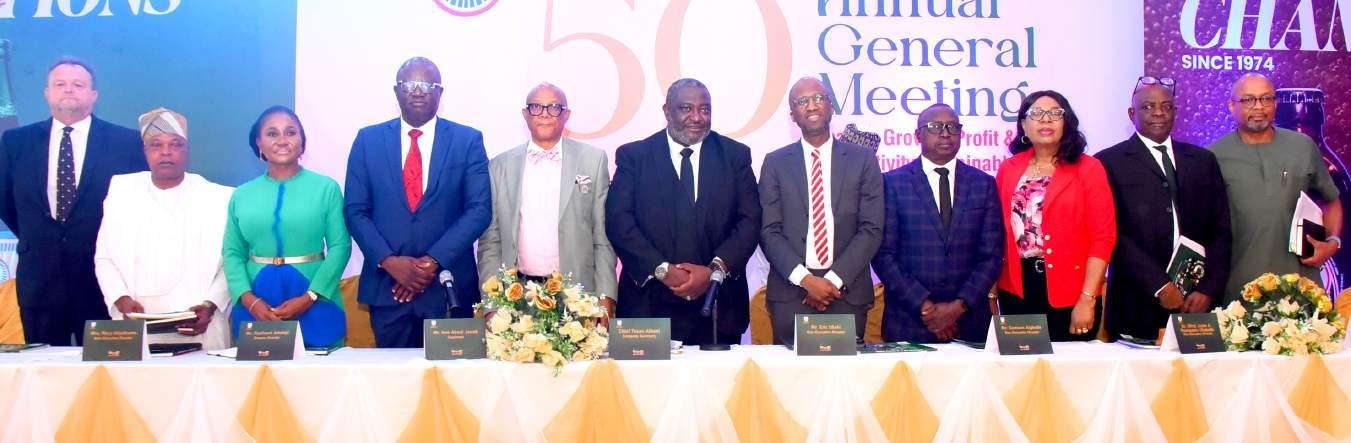
50TH ANNUAL GENERAL MEETING...
L
– R: Non-Executive Directors, Champion Breweries Plc, Mr. David Butler, Mr. Thompson Owoka, Mrs. Mary Akpobome; Executive Director, Mr. Rasheed Adebiyi; Chairman, Board of Directors, Mr. Jacob Imo-Abasi; Company Secretary, Chief Tosan Atle Aiboni; Non-Executive Directors, Mr. Eric Idiahi, Mr Samson Aigbedo; Independent Non-Executive Director, Mrs. Jayne Thompson-Shoboiki; Non-Executive Director, Mr. Olufunminiyi Alabi, and Independent Non-Executive Director, Mr. Oladele Ajayi, during the company’s 50th Annual General Meeting held in Lagos…recently
Report: Broader AI Adoption Could Boost Nigeria’s GDP by $22bn by 2035
Meta platforms contribute $820 million in economic value in 2025 FG partners social media platform to launch AI-powered chatbot to improve governance, service delivery Bosun Tijani: AI won’t rob Nigerians of jobs
James Emejo and Oghenevwede Ohwovoriole in Abuja
A new report has revealed that broader adoption of Artificial Intelligence (AI) could add about $22 billion to the country’s Gross Domestic Product (GDP) by 2035.
The report, ‘Nigeria’s Digital Economy: Unlocking Growth and Opportunity’ was authored by independent economic research firm, Public First, and was unveiled by Meta, in collaboration with key government agencies and private sector stakeholders in Abuja.
The study underscored the growing strategic importance of digital infrastructure, open-source technologies and online business platforms in the country’s economic future.
This came as the federal government and Meta also launched a multilingual artificial
intelligence-powered chatbot, GovGuide Nigeria, to improve access to government services and public information nationwide.
The solution encompasses both a voice and text assistant, allowing users to access information on government services through web platforms in English, Hausa, Igbo and Yoruba.
The report however, projected that Nigeria’s digital economy, currently estimated at $52 billion, could more than double to $120 billion within the next decade if investments in connectivity, platforms and AI ecosystems are sustained.
The findings also showed that Meta’s platforms generated about $820 million in economic value for Nigerian businesses in 2025 alone, while about 14 million Small and Medium-scale Enterprises (SMEs) leveraged Meta-owned applications including WhatsApp, Facebook and Instagram to drive
NPA Boss Raises Concern Over Outdated Port Infrastructure in West, Central Africa
Sunday Ehigiator
The Managing Director of the Nigerian Ports Authority, Dr. Abubakar Dantsoho, has identified outdated port infrastructure as one of the major challenges hindering efficient maritime operations across West and Central Africa.
Speaking at a dinner hosted for port managers from West and Central Africa in Lagos, Dantsoho said many ports in the region were built decades ago and are no longer suitable for modern shipping demands.
According to him, Nigeria’s major ports, including Apapa Port, Tin Can Island Port and Port Harcourt Port, have aged significantly and require urgent modernisation to meet global standards.
“The main challenge we need to be serious about is outdated infrastructure. It is a general problem in the region and sub-region,” he said.
“Apapa Port has been there for over 100 years, Tin Can Island for more than 50 years, and Port Harcourt Port for about 100 years. They are old infrastructures and no longer fit for current realities.”
Dantsoho noted that global shipping has evolved rapidly, with modern vessels now far larger than what many African ports were originally designed to accommodate.
Drawing an analogy with technological advancement in homes, he said infrastructure must also evolve to remain relevant.
operations, sales and customer engagement.
Speaking at the event, Minister of Communications, Innovation and Digital Economy, Mr. Bosun Tijani, dismissed growing fears that AI could worsen unemployment in Nigeria and Africa at large, insisting instead that the technology would improve productivity and create new economic opportunities.
Tijani said countries that failed to embrace AI risked deeper poverty as emerging technologies continue to transform global economies and industries.
He told THISDAY, “There are fears globally that AI will take jobs, but for Africa, AI will actually enhance opportunities. Across our sectors, we are operating below our full potential. AI can help us improve productivity and create even more jobs. However, we must retrain people and ensure they are prepared for the future.”
The minister described the report as a strong validation of ongoing federal government investments in broadband infrastructure, digital skills and AI readiness.
CraftVantage to Showcase Emerging
Nigerian Artists at 2026 Graduate Exhibition
Oluchi Chibuzor
CraftVantage is set to host its 2026 Graduate Exhibition titled ‘Bold Stories, Sustainable Futures’, bringing together a new generation of emerging Nigerian artists whose works explore themes of identity, resilience, culture, memory, movement and everyday life.
The exhibition, scheduled
to hold from May 26 to 28 at Wings Office Complex, Victoria Island, Lagos, will feature works spanning painting, sculpture, installation and mixed media.
According to the organisers, the exhibition reflects CraftVantage’s commitment to supporting young artists through mentorship, visibility, sustainable artistic practice and long-term creative development.
Among the featured artists is Utubor Shadrach Melvin, whose expressive figurative paintings capture human emotion, movement and spiritual undertones of everyday Nigerian life using oil on canvas.
Also exhibiting is Oloruntobi Bolaji Esther, whose sculptures and mixed media works examine womanhood, resilience, nature and economic realities through
aspirants, namely Prof. Olawale Sulaiman, Rt. Hon. Yakubu Danladi Salihu and Captain Ahmed Mahmud, were physically present at the banquet hall, Government House, venue of the programme.
Barring any unforeseen political development, Danladi, who yesterday polled the highest votes of 94,990, by the declaration would fly the flag of the party in the 2027 governorship election. Obanikoro told the gathering that 15 aspirants contested the primary, namely, Olufemi Kolawole Sani - 5,919, Dr. Ibrahim Yahaya Oloriegbe - 3,910, Mohammed Dele Belgore (SAN) - 3,411, Mohammed Omar Bio1,122, Dr. Alabi Oluwatoyin - 1,999 and Ambassador Yahaya Fatai Seriki Gambari, who polled 41,700. Others are Tajudeen Audu
Abdulkadir - 1,462, Azeez Salako Muhideen - 1,198, Bashir Omolaja Bolarinwa - 22,118, Prof. Olawale Adeniyi Sulaiman - 2,434, Ahmad Ibrahim Mahmoud - 362, Yetunde Musliat Adebowale - 638, Aishat Ahman Pategi - 1,734 and Prof. Abubakar Olarewaju Sulaiman, who polled 1,722.
In his remarks, Obanikoro said: "I have the privilege to present to the public the outcome of the governorship primary that took place today, 22nd May 2026. Let me commend the men and women of our party.
"Yesterday, as we were coming, we saw a large number of our members who participated. But for logistical reasons, we decided to shift the primary to today.
"In spite of the inconveniences experienced yesterday, you still came out today to show the world
the doggedness and resilience that are known with our great party. I want to make bold that there is no loser in the contest of APC.
"Therefore, I, Senator Musiliu Olatunde Obanikoro, hereby pronounce Rt. Hon. Yakubu Danladi-Salihu as the winner of the governorship primary, having satisfied the requirements of the APC constitution and guidelines and scored the highest number of votes, as the candidate of our great party for the Kwara Governorship election, dated this day, 22nd of May, 2026. I so declare. Thank you and God bless you all."
In Nasarawa State, Wadada beat his main challenger, a former Inspector General of Police, Mohammed Adamu Abubakar, in a tension-packed primary to clinch the ticket.
the use of resin, metal, wood and recycled materials.
Afolabi Samuel’s works document everyday Nigerian experiences, urban life and Yoruba heritage through bold colours and expressive compositions, while Nasir Adamu’s acrylic paintings draw from personal experiences and cultural identity to create emotionally reflective works.
CHANGE OF NAME
I
and addressed as JOLLY UZOMA ADUBA, now
and
as JOLLY UZOMA CHRIS ADUBA. All
The
I
MRS IFOEGBU JUDITH CHISOM All
The
I
and addressed as MISS ECHEFU CHISOM UDOCHUKWU,
CORPORATE SOCIAL RESPONSIBILITY IN ACTION...
SGF Preaches Unity of Benue APC Ahead of Presidential Primary
Olawale Ajimotokan in Abuja
The Secretary to the Government of the Federation, Senator George Akume, has underscored the essence of unity within the All Progressives Congress (APC) in Benue State ahead of the party’s presidential primary
billed to hold today. He made the entreaty yesterday while speaking to reporters, when he landed at the Makurdi Airport.
The SGF urged party members and stakeholders in the state to place the collective interest of the APC above
personal ambitions, noting that internal cohesion would be critical to the party’s success in future elections.
He said, “The presidential primaries are taking place tomorrow (Saturday). We're here to mobilise support for our dear President. He's doing very well.
FRC Takes Actuarial Science Awareness Campaign to Secondary School
Dike Onwuamaeze
Conscious of the negative consequences of the acute shortage of certified actuarial scientists in Nigeria, the Financial Reporting Council of Nigeria (FRC) has taken the campaign for young Nigerians to embrace the study of Actuarial Science to the secondary schools. In furtherance of this campaign, the Assistant Director/Head, Directorate of
Actuarial Standards, FRC, Mr. Harris Oshojah, visited Babs Fafunwa Millennium Secondary School, Ojudu, Lagos State, to enjoin the students to chose the study of Actuarial Science in their university education.
The visit was part of the Nigerian Actuarial Development Programme (NADP) Advocacy Outreach.
Oshojah said, "We are here this afternoon because certified actuaries are lacking in Nigeria.
"Presently, we have less than 30 actuaries in Nigeria and we are here to sensitise students on the importance of studying Actuarial Science and the opportunities embedded in the profession."
He said that one of the major hindrances in the advancement of the study of Actuarial Science in Nigeria is that many students in the secondary schools are not aware of the course and the potentials it has.
I've told him repeatedly that he has no problem in Benue State. In this country, his performance, his commitment to patriotism, inclusive nature of government all speak in his favour.
“In the democracy you must always have some opposing voices but the truth is that his
work is remarkable. His work has been approved by most Nigerians and we are very sure come tomorrow (today) our people are going to vote massively for Mr President.”
Akume also voiced discontent about the alleged diversion of materials during the party’s primaries held in the state earlier in the week, describing reports of the diversion of electoral materials during the primaries as disturbing. He warned that such actions could undermine confidence in the party’s internal democratic process.
Ifako Ijaiye: Olotu Thanks APC Members for Victory, Seeks Support for Tinubu
Light Nwobodo
Member representing Ifako Ijaiye Constituency II at the Lagos State House of Assembly, Hon. Emmanuel Olotu, has expressed heartfelt appreciation to members of the All Progressives Congress (APC), party faithful and residents of Ojokoro in Ifako Ijaiye for their overwhelming support, commitment and impressive turnout to vote for him during
the party’s primary election that was held midweek.
Hon. Olotu described his emergence as the APC candidate for Ifako Ijaiye Constituency II as a collective victory for the people and a reflection of the unity, resilience and democratic spirit of the APC family across the constituency.
He thanked party members for the confidence reposed in his leadership and assured them of his continued dedication
LAWYERS SAY COURT NULLIFICATION OF INEC TIMETABLE OPENS DEFECTION OPPORTUNITY
elections.
"And, once there is no let or hindrance in the way of preparing for the 2027 polls, the polls stand to be more successful, credible and impactful", he added.
Also reacting on his X handle, another lawyer, Ekene Aninze, who hailed the judgment of the Federal High Court, pointed out that INEC could not arrogate to itself powers beyond what the law expressly provided by issuing guidelines that practically controlled and strangled political parties.
Speaking on the implications of the judgment Aninze, observed that the transfer window across political parties has effectively reopened for politicians who may wish to
dump their parties and move elsewhere.
"Secondly, no political party is under any immediate pressure or compulsion to submit the names or particulars of its candidates to INEC until 120 days before the election.
"Thirdly, political parties can still substitute the names of their candidates before 90 days to the election, and INEC will be legally bound to accept such substitutions.
"As it stands today, every wise politician who has been disqualified is expected to immediately take advantage of this judgment while INEC is yet to appeal it", he said.
Justice Umar had, in his judgment in the suit filed by the Youth Party against INEC,
held that INEC cannot lawfully abridge or limit the statutory period for parties to submit their membership register by prescribing a shorter timeframe in its 2027 election timetable.
The judge, while referencing Section 31 of the Electoral Act, 2026, which permits political parties to withdraw and substitute candidates not later than 90 days before the conduct of an election, also held that INEC lacked the powers to abridge or limit that statutory period by fixing an earlier deadline for the withdrawal and replacement of candidates in its 2027 election timetable.
Justice Umar in addition, held that by provisions of Section 32 of the Electoral Act, 2026, INEC does not possess the
statutory power to publish the final list of candidates for the 2027 general election before the 60-day minimum period prescribed by law.
"A Declaration is made that upon the proper construction of Section 98 of the Electoral Act, 2026, the defendant does not possess the statutory authority to fix in its timetable for the 2027 general elections for campaign to end 2 days before the elections.
"A Declaration is made that upon the proper interpretation to Section 33 of the Electoral Act, 2026, the time frame prescribed by the Defendant for submission of membership registers for the conduct of primary elections is NOT applicable to primary elections
conducted for the purpose of replacing withdrawn candidates."
Meanwhile, the ADC has said the judgement won't affect its planned presidential primary election.
In an interview with THISDAY, the National Publicity Secretary of ADC, Mallam Bolaji Abdullahi, said the order of the Federal High Court is a welcome development, but our planned presidential primary election will go ahead as planned.
''On the appointed date, our presidential primary election will be held. We don't want to take further chances, Abdullahi stated.
Barring any further changes, the presidential primary election of the ADC will take
to quality representation, grassroots development and the advancement of the constituency. Speaking further, Olotu commended the visionary leadership of Nigeria’s President and National Leader of the APC, Asiwaju Bola Ahmed Tinubu, whose Renewed Hope Agenda, according to him, continues to strengthen democratic governance and reposition the nation for sustainable growth and development.
place among the former Vice President, Atiku Abubakar; former Governor of Rivers State, Rotimi Amaechi, and renowned economist, Mohammed Hayatudeen.
Also, reacting to the judgement, Yiaga Africa, in a statement by its Executive Director, Samson Itodo called on stakeholders to dialogue with INEC on the ways forward. According to Itodo, ''INEC must now engage transparently with stakeholders on its next steps, whether that means filing an appeal, compliance with the judgment, or a further review of the timetable. Clear communication with political parties and citizens will be critical to sustaining confidence in the process.''
L-R: Volunteer Beauty Instructor, Mrs. Mary Agaji, Graduating/Empowered Widow, Mrs. Titilayo Egbedokun, and Assistant Manager, Mercy Ogbuehi Widows and Orphan Foundation, Mr. Celestine Edward, at the 19th graduation ceremony of Mercy Ogbuehi Widows and Orphans’ Foundation, held in Lagos…recently
Uplift, Not ‘Upliftment’
“HE said the salvation of the country cannot (could not) be found in any of the existing political parties.”
“7 LGAs violent-prone (violence-prone) in Bayelsa elections—NGO”
“Pa Ukoha was a selfless community leader, (otiose comma) who committed his personal resources to the upliftment (uplift) of Igbere community.”
“Mbah handsover (hands over) 65 security vehicles to police”
“Here are the personalities that grace (graced) the occasion.”
“Two of England’s most successful clubs will on tomorrow (delete ‘on’) go head-to-head in the Premier League as Manchester United take on Liverpool.”
“Incessant fuel tanker fire (fires) worries (worry) Obi of Onitsha
“…so that our people will live a prosperous, safe and secure lives (life) in their environment (environments)….”
“…as cost of raw materials skyrocket (skyrockets)”
“The ban on tinted glasses is even more reprehensible because the security benefits it can deliver is (are) far from certain.”
“Gov, Reps demand his arrest over (for) inciting comments on 2023”
“A week’s trail on the heels of pirates reveal (reveals) how Nigerians lose billions of Naira to the kingpin….”
“Court remands Edo lawmaker in prison over unlawful possession of firearm” The lawmaker was remanded in custody—not in prison!
“That is why the Presidency must show more leadership and tact before jumping into a battle just because it thinks it has the power to crush the enemy—real or imagined.” Get it right: the enemy—real or imaginary.
“Nigerian scientists have failed woefully.” THE SUNDAY INTERVIEW: …have failed abysmally (not woefully)
“Let me also make this point that our scientists have not done creditably well over the years.” No overkill: either creditably or well.
“Insurgents await ransom, assure on ex-minister’s safety” ‘Assure’ is a transitive verb. It must take an object.
“Restoring sanity on (to) the road should be the first tangible step if he is serious about….”
“The result was that what was supposed to be a consensus agreement willingly entered into by….” ‘Consensus agreement’? Next time, just choose one.
“It was flurry of activities in Abuja last week.…” A flurry or a hive of activity….
“The minister said government’s desire to licence (sic) a second carrier is (was) born out of the…” General view: borne out.
“Knowing fully well that Abacha was a key factor in the Babangida regime.…” Intelligent commentary: knowing full well.
“Some blind beggars on a street in Lagos Island” Beggars in a street on (not in) Lagos Island.
“…Catholic cardinals who converged at (on) the Vatican for a three-day meeting….”
“Manhunt begins for killers of award winning (award-winning) police chief.”
“…writes (writes to) the president to intimate him of (to) the hardship ravaging the land.”
“The civil servants have got pay rise, yet their purchasing power have (has) been decimated.”
“The ITSC equipment was damaged early this week by a heavy rainstorm....” In the interest of telecoms, delete ‘heavy’-–which is contextually otiose, just like ‘heavy downpour’!
“Every moneybag (moneybags) wants you to know when he is celebrating….” ‘Moneybag’ is the sac used in putting money, while the owner is a moneybags.
“A professional must update his knowledge
The President Nigeria Still
Four years ago, in the heat and hysteria preceding the 2023 elections, I attempted to outline the type of president Nigeria did not need. At the time, the political atmosphere was already thick with noise, rehearsed promises, elite conspiracies, emergency defections and the usual carnival of manufactured hope that accompanies our electoral cycles.
Today, looking around in 2026, one uncomfortable truth confronts us: the faces may change, the slogans may mutate, the party logos may be redesigned, but the political culture remains stubbornly familiar.
Nigeria still suffers from an elite recycling programme cleverly disguised as democracy. The same actors migrate from one platform to another with astonishing flexibility. Yesterday’s sworn enemies become today’s strategic allies. Men who once accused one another of corruption now exchange warm smiles at political conventions and thanksgiving services. Defections are announced with the emotional weight of football transfers, while supporters are expected to defend these ideological summersaults with straight faces.
In Nigeria, political memory is deliberately short because amnesia is profitable. The tragedy is not merely that politicians defect. Democracies survive defections. The tragedy is that many defections in Nigeria are completely empty of philosophical conviction. There is hardly any ideological centre holding the major parties together beyond access to power, patronage, contracts and influence.
Our politicians switch camps so frequently that ordinary citizens now struggle to remember who insulted whom last year. And somehow, everyone suddenly claims to be “acting in the national interest”.
The “national interest” in Nigeria usually appears shortly before elections and disappears immediately after swearing-in ceremonies. Meanwhile, the citizens continue carrying the burden of elite experiments and political opportunism.
That is why Nigerians must become more careful about the type of leadership they romanticise. We have repeatedly mistaken noise for vision, arrogance for strength, propaganda for competence, and ethnicity for qualification.
A politician speaks aggressively and supporters
in his chosen career otherwise he becomes a mediocre.” The way we write: otherwise he becomes a mediocrity or mediocrist. ‘Mediocre’ is an adjective that cannot function as a noun except in a collective manner (the mediocre).
“The emergence of vigilante (vigilance) groups to combat the activities of men of the underworld is only symptomatic of lack of faith in the ability of the police to guarantee….”
“The assurance from the IGP is therefore supposed to act as a soothing balm.” Is a balm not supposed to soothe? Does it do the opposite?
“…it will be much more so with one involving a police personnel.” ‘Personnel’ is a collective term. Use ‘policeman’, ‘officer’ or ‘cop’.
“But how do we prevent hunger in 2027 when politicians will engage themselves (one another) in a do or die (do-or-die) battle for re-election.”
“VP condemns do or die politics” This way: do-or-die politics.
“The race to Government House in Kano has began in earnest as….” Without any effort: The race has begun….
“…those who would have uttered (what?) them reduced everyone to spectators while they reached for each other’s throats.” Get it right: each other’s throat or one another’s throat (depending on context).
“Knowing what to wear and how to compliment (complement) it goes a long way….”
“The state, therefore, does not deserve the treatment being currently meted to it”. Classical expression: being meted out to it.
“Chief of Naval Staff advocates for increased productivity via industrialization” When used as a verb, ‘advocate’ does not admit ‘for’. Let us avoid verbiage in headline casting: Naval Chief advocates increased productivity.
“For the university to recommend that students should pay for the damages while they have….” A common mistake: except in legalese, ‘damage’ cannot be pluralized. “…rather than investigating and finding
Doesn’t Need
scream, “Strong man!” Another shares money recklessly and crowds shout, “Man of the people!”
One quotes scripture fluently and suddenly becomes “God-fearing”. Another speaks polished English on television and is immediately crowned “brilliant”.
Yet governance is far more demanding than public performance. Nigeria has suffered repeatedly from leaders who campaigned like revolutionaries but governed like bewildered tenants trapped accidentally inside Aso Rock.
That is why the country still does not need another president obsessed primarily with power acquisition rather than institutional transformation. We do not need another leader surrounded entirely by praise-singers, image launderers and professional excuse manufacturers masquerading as advisers.
We certainly do not need another government addicted to propaganda while citizens drown in economic and psychological exhaustion.
There is a dangerous tendency among sections of the Nigerian political class to confuse public relations with governance. Once criticism emerges, the machinery activates instantly: statistics are weaponised, critics are insulted, social media warriors are mobilised, and carefully edited videos suddenly appear explaining why citizens should actually be grateful for their suffering.
But hunger is stubbornly difficult to gaslight. Transport fares do not reduce because of motivational speeches. Market prices do not collapse because hashtags are trending. Citizens cannot cook press statements for dinner. And Nigerians are increasingly tired of governments that appear more emotionally invested in defending perceptions than confronting realities.
Perhaps even more dangerous is the growing normalisation of mediocrity in public leadership. Standards have fallen so low that basic administrative competence is now celebrated as extraordinary brilliance.
A governor pays salaries consistently and is treated like Nelson Mandela reborn. A public official answers journalists coherently and citizens almost organise thanksgiving services. We have become so traumatised by dysfunction that normal governance now feels miraculous.
Yet Nigeria’s problems are too serious for
out who were involved and check against future re-occurrence: Beyond recurrence, can an event yet to take place happen in the past?
“…the university is pointing its accusing fingers in the direction of the lecturers.” True idiom: point a/the finger. No inclusion of ‘accusing’ or inflection of ‘finger’.
“It is our belief that we members of the alumni association of our Alma Mata (Alma Mater) have unique roles to play in the restoration of sanity on our university campus.” It is…restoration of sanity to (not on) our campus.
“Isn’t it funny that it is the beak with which a bird builds it’s (sic) nest that it uses to scatter it.” Possessive: its
“…the AU summiteers concentrated almost exclusive (sic) on the political independence and liberation of countries in (on) the continent.”
“Monday’s action, which started at dawn, was as a result of the breakdown of series of negotiations…” An agendum: a series of negotiations.
“According to investigations, the deceased was said to be resting alone in his room at about 9.p.m….” Every reporter should be decisive based on timing which description to use: either at or about 9 p.m. The two cannot co-function.
“According to the source, the institution has a very high percentage of failure in the last academic year.” Reported speech: the institution had (not has).
“… that the authorities of the institution was (were) still waiting the result of the police analysis of the bomb”.
“…in the next three years, its per capital income would have ...” This way: per capita income.
“Then it was catalogue of misses for the Super Eagles.” In the spirit of qualification: a catalogue of misses.
ceremonial leadership and cosmetic reforms. The country still does not need a president imprisoned by provincial thinking and sectional anxieties. We cannot continue reducing a complex federation of over 200 million people into an endless tribal arithmetic competition where competence becomes secondary to ethnic negotiations.
Every election season, political merchants dust off the same emotional weapons: “It is our turn.”
“Protect your own.” “They want to dominate us.”
“Our region has been cheated.”
And millions of suffering citizens, united by poverty but divided by sentiment, begin fighting one another emotionally while the elite negotiate comfortably behind closed doors.
The rich politician from the North and his wealthy counterpart from the South often share far more common interests with each other than with the poor citizens screaming online in their defence. But ordinary Nigerians continue inheriting elite quarrels that never improve their living conditions.
That is one reason the country still does not need leaders who deliberately exploit division as political capital. Nigeria’s fragile condition demands bridgebuilders, not identity merchants profiting from tension and suspicion. Nor do we need another president emotionally disconnected from the daily struggles of ordinary people.
One of the recurring tragedies of Nigerian governance is the frightening distance between official comfort and public suffering. Citizens battle inflation, insecurity, unemployment and collapsing purchasing power, while sections of the political elite carry on with astonishing extravagance.
Convoys grow longer. Government luxuries expand. Public officials speak casually about hardship from air-conditioned podiums protected by armed escorts and imported comforts. And then they ask citizens to “be patient”.
Patience is easier to preach when your generator never goes off. This is why empathy matters in leadership. Not performative empathy. Not staged market visits for cameras. Genuine understanding of how policies affect human beings beyond spreadsheets and economic briefings.
A country already battling deep distrust cannot afford leadership that appears emotionally absent.
And then there is the matter of courage.
Nigeria still does not need another hesitant leader paralysed by political calculations while urgent national problems deteriorate. The country has suffered enough from delayed decisions, timid responses, selective outrage and endless committees established mainly to postpone accountability.
Leadership requires the courage to confront entrenched interests, even when politically inconvenient. But courage is scarce where political survival becomes more important than national survival.
Perhaps the most worrying reality today is that many Nigerians are becoming psychologically detached from democracy itself. Elections no longer inspire excitement in the way they once did. Citizens participate, yes - but often with diminished expectations.
Too many people now approach politics like disappointed football fans watching a familiar match-fixing scandal.
They vote cautiously. Hope cautiously. Trust cautiously. And sometimes, not at all. That emotional withdrawal should alarm every serious political actor in Nigeria. Because democracy weakens dangerously when citizens stop believing their participation can meaningfully shape outcomes.
Still, despite everything, one cannot completely dismiss the quiet awakening happening beneath the frustration. Young Nigerians are more politically aware than previous generations. Citizens question power more aggressively. Information travels faster. Propaganda faces stronger scrutiny. Public conversations are no longer controlled entirely by traditional gatekeepers. The establishment notices this. That is why political messaging has become more aggressive, more sophisticated and more emotionally manipulative. The struggle for Nigeria’s future is no longer merely about winning elections. It is increasingly about controlling perception, emotion, fear and attention. And that is why Nigerians must think more deeply before the next electoral cycle gathers full momentum.
Aliyu Badaki: FG Intensifying Efforts to Tackle Jet Fuel Crisis
The President, Federation of Tourism Associations of Nigeria, Aliyu Badaki, speaks about partnership with corporate bodies, scarcity of jet fuel, and other issues. Charles Ajunwa brings excerpts
Part of your mandate is to represent Nigeria’s tourism and hospitality industry focusing on coordination of members, protecting their interests and acting as a bridge for policy dialogue with the government. Any progress in this regard?
You see, as part of our mandate we ensure a harmonious working relationship with the relevant bodies to protect our members’ interests.
You came up with the Tourism Transformation Mandate (TTM), which is a three-pillar, eight-campaign commitment plan designed to move Nigeria’s tourism forward. At what stage is this plan?
Our tourism transformation mandate, TTF,
is seriously on course. We are now building a more robust foundation in enhancing a better visibility and reputation. Efforts are being made to harmonise various members’ associations under the federation. Our partnership with corporate bodies is yielding results gradually. We also have a more robust relationship with some relevant government agencies.
The outbreak of Hantavirus and Ebola announced by World Health Organisation will impact travels and tourism globally. What’s your take?
The outbreak of hantavirus is still new and under study in the countries
affected. We hope that it will be curtailed by the World Health Organisation and other international health organisations, and we cannot do much now until proper protocols are established by the relevant agencies. We have well-trained medical personnel at the borders- air, land and sea.
Iran and Israel/US war has created scarcity of jet fuel. What is FTAN under your leadership doing to protect operators and passengers who bear the brunt of this astronomical increment in tickets?
Since its global occurrence, the Nigerian government, in conjunction with the aviation industry, is looking at ways to mitigate the adverse effects. It’s really a serious matter that is affecting our industry.
Fayemi Urges African Leaders to Integrate Tourism into Economic Devt Plans
Former Ekiti State Governor and ex-Minister of Mines and Steel Development, Kayode Fayemi, has called for the institutionalisation of tourism policies that can endure beyond electoral cycles.
He described tourism as a critical but underutilised driver of economic growth and cultural preservation across Africa.
Fayemi made the submission while delivering a Special Guest Reflection at the International Tourism Summit Oyo State 2026 held at the International Conference Centre, University of Ibadan.
Lagos Continental Hotel Inaugurates New Training Academy, Staff Dormitory
As part of efforts of upgrading services to meet clients’ satisfaction and build a workforce reputed globally, Lagos Continental Hotel has inaugurated a new training academy and staff dormitory.
The two projects are a few metres from the main hotel, along Kofo Abayomi Street, Victoria Island, Lagos.
The General Manager, Lagos Continental Hotel, Christoph Schleissing, who took journalists round the projects located in one large compound, described the new training academy and dormitory as game-changers as the hotel moves to upscale the team members professionally.
“Always remember, human resource people are most important for the success of our company. We put utmost efforts to make it the best place to work for in Nigeria. I think it’s the only hotel in Nigeria with a dedicated training academy.
“This training academy is brand new, spread over 140 square meters, has two training rooms, and this is a real big step forward into the right future. It’s all about you, it’s not about me, it’s about us and how we are going to, grow and become better every single day.
“Our chairman made this happen for you and with his unconditional love for you as his team.
You see, we didn’t spare any cost, it’s not about money, it’s about the future, and it’s about your development.
“There’s an interactive screen in the academy. We have around 80 seats in our main area for the training, and we have one more board room for smaller meetings, for example, leadership trainings, Chinese classes and others. This is the best quality apartment in the entire country. We never spare money when it concerns our people.
“What do we expect from you? Drink the water
and we expect you to learn, have that drive to become a better person every single day,” Schleissing said.
He said apart from three of its staff already certified by the Nigerian Institute of Training and Development, the hotel plans to engage specialised trainers for the academy.
“We have taken all three of them through this certification. You know, certifying agencies or certifying associations will always be used because it’s important that we have the right people doing the right thing at the right time.
“The training academy is not something we do for public relations. We spend the money, we train our people because we really believe it’s the only way forward. We need to train the youths of Nigeria. This is what we’re going to do.
“Our long-term plan, we want to give back to the community in which we are operating.”
He further added, “We took over this entire compound for many reasons. One reason, it’s always our drive that our team members can evolve in a very safe and secure environment. Some of our team members are living in the building. We have the academy in one of the floors. What is actually a game changer is the dormitory, because going from 28 beds to over 100 beds is a game changer. It makes us operational-wise more flexible when it comes to delivering excellent service to our clients. On the other hand, this entire area, is a part of the hotel.
The Cluster Director, Human Resources, Continental Hotel Group, Niyi Agoro, described the academy take off as a landmark achievement to human capital development.
“This significant investment goes beyond physical infrastructure; it represents a transformative vision centered on continuous learning, workforce empowerment, talent sustainability, and the enhancement of the overall employee experience.
“The creation of these special facilities reinforces our strategic objective of nurturing a highly skilled, motivated, and future-ready workforce capable of delivering exceptional hospitality standards.
Speaking on the theme of sustainable tourism development, the former governor stressed the need for African governments to approach tourism as long-term economic infrastructure capable of generating employment, stimulating local economies, preserving cultural heritage, and advancing subnational development.
Drawing from his administration’s experience in Ekiti State, Fayemi highlighted efforts aimed at repositioning the Ikogosi Warm Springs Resort, improving access roads within the tourism corridor, and investing in supporting infrastructure to encourage recreational tourism and expand economic opportunities for host communities.
According to him, tourism development must be integrated into a broader agenda of economic renewal, cultural identity, and community participation to achieve lasting impact. Fayemi also commended Seyi Makinde and the Oyo State Government for convening the summit and creating a platform that brought together policymakers, investors, development partners, and industry stakeholders to deepen discussions around tourism development in Nigeria and across Africa.
He maintained that the future of tourism on the continent would depend largely on the ability of governments and stakeholders to build people-centred, investment-friendly, culturally rooted, and institutionally resilient tourism ecosystems.
Fraser Suites Appoints Endozo GM
Ronin Ronald Endozo has been appointed the General Manager Fraser Suites Abuja.
A statement signed by the Director, Corporate Services, Haroun Audu, said Endozo, brings more than two decades of international hospitality leadership and a long-standing connection to the property. Endozo first joined the team in 2017, serving briefly as Interim General Manager during the property’s opening year, and has now returned to lead it.
His career has been shaped by some of the most demanding addresses in five-star hospitality, with senior food and beverage and operations positions at the Muscat InterContinental, Burj Al Arab Dubai, Raffles Hotel Dubai, Hilton Dubai Creek, Millennium Plaza Hotel Dubai, and the Jumeirah Group of restaurants, where he served as Area Operations Manager.
He joined Frasers Hospitality as Director of Operations at Fraser Suites Dubai in 2014, a role he held for seven years while also serving as pre-opening General Manager for Fraser Suites Riyadh. He subsequently led Citadines Culture Village Dubai with The Ascott Limited from pre-opening through to award-winning maturity, before returning to Frasers Hospitality and Abuja. Endozo, who is a certified ISO 9001 Lead Auditor is a graduate of Bath Spa University and holds business management qualifications from Cornell University.
On his expectations regarding his new role in Abuja, he said: Fraser Suites Abuja is a property I first stepped into in 2017, and leading it now is a singular privilege. What sets it apart has not changed in the years between: a residential ease that belongs in the suites themselves, a service style that is considered without being intrusive, and a quiet sense of place that is rare in a working capital. My focus is to protect those things, and to keep earning the trust our guests bring through the door.”
Charles Ajunwa
Olawale Ajimotokan in Abuja
Badaki
Gbenga Sodeinde
Endozo
Fayemi
Carloha partners Okpekpe international Marathon
Carloha Nigeria, the authorised dealer of Chery vehicles in Nigeria, has announced its participation as the Official Automobile Sponsor of the 11th edition of the Okpekpe 10km International Road Race scheduled to hold on May 30, 2026, in Edo State.
Widely regarded as one of Africa’s most prestigious road races, the Okpekpe Road Race is a World Athletics Gold Label event and a full member of the Association of International Marathons and Distance Races (AIMS), attracting elite athletes, sports enthusiasts, and global broadcast attention.
As part of its participation, Carloha-Chery will deploy two Chery HIMLA vehicles as the official lead vehicles for the professional and VIP runners during the race. The vehicles will carry the race timing systems and remain positioned ahead of the athletes throughout the competition, placing the Chery brand at the forefront of one of Nigeria’s most globally recognised sporting events.
Speaking on the partnership, Felix Mahan, General Manager Marketing at Carloha Nigeria, described the sponsorship as part of the company’s broader corporate social responsibility commitment toward supporting sports development, healthy living, youth empowerment, and globally relevant community initiatives.
According to Mahan, endurance sports such as long-distance running share a natural
connection with the values represented by the Chery HIMLA — strength, resilience, durability, consistency, and the ability to perform under demanding conditions.
“The spirit of the Okpekpe Race perfectly aligns with the character of the HIMLA,” the company stated. “Just as endurance athletes are built to go the distance despite challenging terrain and conditions, the HIMLA is engineered for strength, reliability, and sustained performance across diverse driving environments,” Mahan said.
Mahan further noted that supporting internationally recognised sporting events contributes positively to Nigeria’s global image and encourages local participation in athletics and wellness culture.
Beyond the race itself, the company intends to leverage the event to deepen public awareness of its customer-focused aftersales package, CarlohaCare 6-6-7, which has continued to distinguish the Chery brand in the Nigerian automotive market.
Forland, TSS Motors Conclude Truck Training For
Technical Team
Forland Motors, one of the leading manufacturers of light commercial trucks in the world, has concluded a specialised three-day training programme organised in conjunction with its local assembler and distributor, Transit Support Services Ltd (TSS).
The programme was organised to equip the TSS technical team, comprising both assembly and after-sales technicians, with in-depth knowledge of the brand’s light trucks, which are assembled and distributed in Nigeria by the local partner.
It covered assembly, installation, troubleshooting, and maintenance to ensure high service standards in both the assembly and maintenance of Forland light trucks.
The training, which was held at the TSS Motors Training Centre on Ikorodu Road in the Anthony area of Lagos, was attended by Forland instructors who came in from China, as well as TSS technical personnel drawn from its network covering Lagos, Enugu, and Abuja.
Also in attendance were technical personnel from Yuchai, the major supplier of engines to Forland trucks. Yuchai is one of China’s largest manufacturers of powertrain solutions.
Giving more insight into the training, TSS Head of After-Sales Services, Mrs Phebian Iwalokun, said it covered general maintenance, engine servicing, and preventive programmes.
According to her, the training was designed to ensure that TSS technicians were fully equipped to handle the expanding profile of Forland vehicles in Nigeria.
Moreover, there was a need for skill enhancement as TSS prepared for the planned expansion of production, with demand for Forland trucks continuing to increase.
“Forland trucks are currently gaining ground in Nigeria, with over 1,000 units in use mainly for
Chery Demonstrates Safety Leadership at Auto China 2026
Carloha Nigeria, the authorised dealer of Chery vehicles in Nigeria, has achieved a significant international milestone after winning two prestigious global awards at the 2026 Chery Global Summit and Beijing International Automotive Exhibition held in China.
The company received the New Star Award and the Brand Leap Contribution Award in recognition of its outstanding market growth, strategic brand development, customer engagement initiatives, and contribution to strengthening the Chery brand presence in Nigeria and across Africa. The awards were presented during the global summit attended by Chery distributors, international partners, automotive stakeholders, and industry leaders from around the world.
The double recognition marks a major achievement not only for Carloha Nigeria but also for Nigeria and the African automotive industry. It reinforces Nigeria’s growing importance as a strategic automotive market and highlights the increasing competitiveness of African automobile
Carloha Nigeria at the 2026 Chery Global Summit and Beijing International Automotive Exhibition held in China
businesses in delivering world-class standards in sales, customer experience, aftersales support, and brand building. The recognition also positions Carloha Nigeria among the emerging success stories within Chery’s global distributor network. Beyond the awards, Chery further demonstrated its leadership in automotive safety and intelligent mobility at Auto China 2026 through the unveiling of advanced technologies and next-generation mobility innovations.
fast-moving consumer goods, logistics companies, and many last-mile distributors of products,” Iwalokun stated.
A subsidiary of ABC Transport Plc, Transit Support Services assembles Forland trucks at its plant in Enugu and has provided support to many Forland users across the country.
Forland is a highly successful commercial vehicle and light-truck brand, with products performing well in many parts of the world.
The National President of the Chartered Institute of Logistics and Transportation (CILT), Dr. Boboye Oyeyemi, and the Dean of the School of Transportation and Logistics, Lagos State University (LASU), Prof. Ogochukwu Ugboma, are set to headline the 12th edition of the Nigeria Transport Lecture (NTL) scheduled for Thursday, June 18, 2026, in Lagos.
The annual lecture is organised by Transport Day Media, a specialised media platform focused on transportation and logistics reporting and analysis.
Both speakers will address participants on the theme: “Multi-modal Transportation Safety in Nigeria: Prospects, Challenges & Contribution to National Growth.”
The event, which will take place at the Radisson Blu Hotel, Ikeja, Lagos, is expected to attract major stakeholders from the public and private sectors of the transport and logistics industry to discuss critical safety concerns and policy frameworks needed to strengthen Nigeria’s multi-modal transportation system.
Over the years, the Nigeria Transport Lecture has featured notable industry leaders and policymakers, including former DirectorGeneral of the Nigerian Maritime Administration and Safety Agency (NIMASA), Dr. Dakuku Peterside; former Federal Permanent Secretary, Dr. Anthonia Ekpa; former Corps Marshal of the Federal Road Safety Corps (FRSC), Dr. Boboye Oyeyemi; and the current Managing Director of the Nigerian Railway Corporation (NRC), Dr. Kayode Opeifa, among others.
Speaking on this year’s edition, the Editor of Transport Day Media, Mr. Frank Kintum, said the lecture remains a strategic platform for addressing pressing issues within the transportation and logistics sector.
“Every year, we use the lecture as a platform to discuss contemporary issues in the industry. This year, we settled for multi-modal transportation safety because without safety, the various multimodal transport initiatives by governments at different levels may be undermined,” he said.
Kintum further noted that the event represents Transport Day Media’s contribution towards building a sustainable and efficient transport and logistics industry in Nigeria and across Africa.
Jetour T2 Raises SUV Safety Stakes in Nigeria with 5-Star NCAp Rating
Jetour has intensified competition in Nigeria’s growing SUV market as its rugged T2 model officially secured the prestigious NCAP 5-Star safety rating — the highest recognition achievable in global crash safety and avoidance technology standards.
The development is expected to strengthen the brand’s position among Nigerian motorists seeking vehicles that combine durability, advanced safety and premium comfort in a market increasingly driven by demand for versatile family and adventure SUVs.
Its accredited dealers spread across Nigeria are Elizade Nigeria Limited, New Era AutoVehicle Services Limited, Kojo Motors, Germaine Auto Centre, Tab Autos Limited, R. T. Briscoe Motors and Mandilas Autos.
Positioned as a bold “super SUV,” the Jetour T2 was designed specifically with Nigerian driving conditions in mind, according to the automaker.
In a country where motorists often encounter congested urban roads, long-distance highways and rough rural terrain within the same trip, the
T2 is engineered to adapt seamlessly to changing environments.
Safety remains one of the vehicle’s strongest selling points. The SUV comes equipped with a comprehensive airbag system, SRS airbags, parking sensors, rear camera and surround-view monitor. It also features advanced driver-assistance technologies such as Anti-lock Braking System, Emergency Braking Assist and Auto-Brake Assist, which help detect potential collisions and automatically apply braking when necessary.
ABC Transport Group founder, Mr. Frank Nneji (right) presenting certificates to the participants
Chery HIMLA
Oyeyemi and Ugboma
Jetour T2 Raises SUV
Late Michael Ndika as Niniola’s Best Kept Secret?
The Nigerian entertainment industry has lately been buzzing with a mix of heartbreaking moments, controversial issues bothering on relationships, bold reactions, and emotional tributes as celebrities continue to make headlines beyond music and movies.
From grief in the entertainment scene to growing concerns over insecurity and emotional reflections from stars, fans have been reacting to the latest developments involving some of the country’s biggest names. One of such is Nigerian afro-house singer, Niniola Apata, who recently left his fans and followers with a shock.
Niniola announced the death of her “husband” and long-time manager, Michael Ndika. The lewd lyricist disclosed the heartbreaking news through a series of emotional posts shared on her Instagram story in the early hours of Wednesday. “God took him,” she wrote in one of the posts.
“My husband died,” she added in another
emotional message. In a third post, the singer wrote: “God took him. 13 years. 13 f***ing years.” Each post was accompanied by photos of Niniola and Michael, reportedly the CEO of NaijaReview, a multimedia platform focused on Afro-house and African music.
The announcement has left fans and the wider Nigerian entertainment community in shock, not only because of the loss itself, but because of what it revealed. Sometime last year, 2025, Niniola, 39, sat down for an interview on Yanga FM Lagos and flatly denied being married.
One described it as Niniola’s best kept secret.
“I don’t care what anyone says about my personal life. I’m not a 12-year-old. I’m not married,” she said, dismissing speculation that had circulated online about a secret union. At the time, her comments were taken at face value. Describing Michael as “husband” may be figuratively having been together for 13 years.
The circumstances surrounding his death were not immediately disclosed by the singer. Niniola has largely kept her private life away from the public eye. A friend of the late talent manager disclosed to this reporter that Michael,
44, died following complications arising from cerebrovascular accident, commonly known as stroke.
According to the source, Michael has been battling high blood pressure for some time. “He just got back from America on May 1st, and shortly after his BP started disturbing him, he was taken to the intensive care unit of the Lagos State University Teaching Hospital, Ikeja,” where he passed on Tuesday, May 19, the source disclosed
Fondly known as “Big Mike”, he was a Nigerian music executive and entrepreneur, whose work sat firmly behind the scenes. He was instrumental in shaping the career of Niniola. She released her debut single ‘Ibadi’ in 2014 and has since become one of Nigeria’s prominent music stars.
His entry into the music industry came after an earlier career in technology. Michael had worked as a Systems Engineer and later as Head of IT at Associated Haulages, building a professional background rooted in structure and process, qualities that would later define his approach to artist management.
Long before the trending gist of his affair with Sandra Onyenucheya, ‘Call of My Life,’ a romantic comedy, featuring Afropop singer, Chike Osebuka, was already set for a theatrical release. The gist has severely polarised social media users, with some fans defending the singer, others heavily criticising his rumoured romp with Sandra, who happens to be estranged wife of Frank Edoho, a media personality. Predictably, the internet has treated the story like entertainment. There have been jokes, memes, and a flurry of backlash following the controversy. But none reflected the reality at the premiere of the film held over the weekend of May 16th and 17th, 2026. Chike who delivered a soundtrack and vocal features attended the star-studded event, the film officially in cinemas nationwide. His presence drew large fans as female admirers flocked the venue to take photos and interact with the singer, with fan meet-and-greet sessions extending to Filmhouse Landmark through the weekend. Other celebrity guests including
chemistry, ‘Call of My Life’ follows Soluchi, a hopeless romantic still healing from being jilted by her former lover, Kalu. When a regular work call puts her in touch with the charming Eli, Soluchi begins to see the possibility of the love story she has always wanted.
The film features a strong cast, including Nkem Owoh, Patience Ozokwo, Zubby Michael, Uzoamaka ‘Power’ Aniunoh, Beverly Osu, and Broda Shaggi. It also includes live performances by Johnny Drille and Cobhams Asuquo.
Shot across Lagos, Abuja, and Enugu, ‘Call of My Life’ is produced by Blessing Uzzi for Bluhouse Studios, with a screenplay written by Uzoamaka ‘Power’ Aniunoh.
This marks Bluhouse Studios’ second theatrical outing since their debut with Freedom Way last year. Dammy Twitch, known for directing commercials and music videos for Afrobeats artists including Burna Boy and Davido, spoke on his choice of a romance story as instinctive, as he wanted his first feature film to reflect his heart, which he describes as “rooted in love and happiness”.
For producer Blessing Uzzi, “It was important for me to produce ‘Call of My Life’ to show the
Nigerian stars including Tems, Wizkid, Burna Boy, and Asake earned nominations at the 2026 BET Awards. The prestigious American awards show, established in 2001 by Black Entertainment Television, celebrates outstanding achievements by Black entertainers across music, sports, television, and film. The music stars appear across multiple categories as the 2026 nominations make their full impact.
Tems leads the Nigerian contingent at the 2026 BET Awards with three nominations — Best Female R&B/ Pop Artist, BET Her Award for First, and Viewers’ Choice for Raindance with Dave. Wizkid and Asake are jointly nominated for Best Group, while Burna
from 11 June 2026 to 19 July 2026.
Tosin Clegg
Grammy Award-winning superstar, Burna Boy, recently made headlines once more as he teamed up with Colombian pop star, Shakira, to create the official song for the 2026 World Cup. This was a major milestone for Afrobeats influence and how it has come to play a role in today’s global music consciousness. This marks Shakira’s second official World Cup anthem after Waka Waka (This Time for Africa) for the 2010 tournament in South Africa. The World Cup definitely would be leading everyone to an amazing summer experience as the 48-team tournament runs
Tens of thousands comments have since flooded the joint Instagram post of Burna Boy and Shakira as fans are elated over this major milestone signifying a big win for the Nigerian music scene. A few other African Nationals have earned this noble stage prior but at this turn for Nigeria it’s a highly commendable honor.
Beyond the excitement surrounding the collaboration, a lot of Nigerians see it as a cultural achievement that continues to position Afrobeats among the world’s most influential music genres. For many young African creatives, the recognition also serves as inspiration, proving that local talent can command international relevance and respect at the highest level.
Boy earned a Best Collaboration nod for WGFT, his feature on Gunna’s hit single from the 2025 album “The Last Wun.”
Wizkid and Asake earned the recognition for their collaborative work, specifically their 2026 joint EP ‘REAL Vol. 1‘. Wizkid and Asake will compete against an elite lineup of American and British acts, including Clipse, FLO, De La Soul, Terrace Martin & Kenyon Dixon, Metro Boomin & DJ Spinz, French Montana & Max B, as well as Nas & DJ Premier.
South African star Tyla earned two nominations: Video of the Year and Viewers’ Choice for her track “Chanel.” Leading the overall nominations is Cardi B with six nods, followed by Kendrick Lamar and Mariah the Scientist with five each. Cardi B earns an Album of the Year nod for Am I The Drama? a Best
Female Hip Hop Artist nomination, and appears in Best Collaboration for the ‘Errtime Remix.’
range of stories Bluhouse Studios can tell. After Freedom Way, I wanted to explore something softer but equally meaningful. At a time when many feel jaded about love, I wanted to create a film that is hopeful and uplifting, a story that reminds us to believe in love again.”
Comedian, Igwe De MC to Thrill Audience in UK, Marks
Two Decades on Stage
After 20 years of electrifying performances, thrilling audiences with exciting shows, one of Nigeria’s ace comedians, Henry Okwudili Ugwoke, popularly known as Igwe De MC, has deemed it fit to celebrate the milestone with 20 topnotch African comedians lined up to Perform at the event.
As part of plans for the upcoming event, the entertainment maestro has concluded arrangements to go offshore and celebrate his 20 years on stage with a show tagged “JOKES APART” Comedy Extravaganza, scheduled to hold in Southampton, England.
According to the organisers, the highly anticipated comedy and entertainment show (“JOKES APART”) would be headlined by the renowned comedian and professional events host, Igwe De MC as a fitting celebration of “an incredible 20 years on stage”.
“JOKES APART” promises to deliver an unforgettable night filled with premium comedy, music, and live entertainment, bringing together some of the finest African entertainers and performers under one roof,” the organisers said in a statement. The landmark event is scheduled to commence at sundown on Friday, July 25 at 6.00pm at the prestigious Novotel Hotel Southampton, England, United Kingdom. Apart from the celebrant, Igwe De MC, the event would feature an exciting lineup of 19 other entertainers including Seyi Law, Deacon Famous, Twocantok, Sir One on One, Franchez, Lyrics, Warri Bros, Funny Urch, and ND Funny.
Other comedians billed to make the event unforgettable are Unku SP, Lafin Gas,Triple U, DJ Oma, DJ Rain, DJ Charles Wizzy, DJ Bullet, DJ Sailent Masta, Pascal Ogbuefi, and Yauz (Scotland). The organisers said that the expected audience would be entertained with “a unique blend of stand-up comedy, live DJ performances, music, and vibrant stage entertainment designed to keep guests entertained throughout the evening”. Speaking on the coming event, Igwe De MC expressed gratitude to fans and supporters who have stood by him throughout his two-decade journey in the entertainment industry. “This is more than just a comedy show,” he said, “it is a celebration of growth, consistency, laughter, and the amazing support from fans over the years”.
Michael
Ferdinand Ekechukwu
Ferdinand Ekechukwu
Ferdinand Ekechukwu
Afrobeats superstar, Davido also showed up at the premiere in support of the screening.
A warm, culturally grounded Nollywood rom-com with strong performances, charming
Chike
Burna Boy
Tems
SHOWBIZ
Celebrity Scandal and Collapse of Moral Restraint
Once upon a time, scandal arrived cloaked in silence and shame. Today, it arrives sponsored by algorithms, fuelled by outrage, and consumed like entertainment. The incident involving Frank Edoho, Sandra, and Chike is not merely celebrity gossip, but a disturbing mirror reflecting a culture steadily losing its grip on restraint, dignity, accountability, and moral seriousness, writes Adedayo Adejobi
There was a time when scandal arrived in whispers. A neighbour lowered her voice behind a gate. An uncle cleared his throat awkwardly at a family gathering. Shame travelled quietly then. Today, scandal enters like a carnival procession with hashtags, cryptic Instagram stories, leaked audios, podcasts, reaction videos, and self-righteous spectators armed with ring lights and WiFi.
The messy public unravelling involving Frank Edoho, his estranged wife Sandra, and singer, Chike is the latest proof that modern society no longer merely witnesses private pain. It monetises it, memes it, and dances around it like villagers around a bonfire.
At the centre of the storm sits Frank Edoho, the smooth- talking television host once admired for his wit and polished intellect. Around him now swirl allegations of emotional abuse, infidelity, financial irresponsibility, narcissism, and marital cruelty, all publicly levelled by Sandra in lengthy social media statements.
If even half of the allegations are true, then Frank clearly failed in fundamental areas of marriage. Marriage is not sustained by cleverness, popularity, or public charm. It survives on emotional presence, fidelity, tenderness, and restraint. A man who emotionally abandons his wife while performing goodness before the public is not a victim of fate. He is an architect of his own domestic collapse.
Yet, and this is where society has lost its moral bearings entirely, none of that automatically transforms infidelity into righteousness. Pain may explain betrayal. It does not sanctify it.
This is the dangerous confusion modern culture keeps promoting. Somewhere along the line, emotional dissatisfaction became a moral permission slip. We now live in an age where people no longer simply make poor choices. They curate justifications for them. Every wrongdoing now arrives wrapped in therapy language, social media sympathy, and fashionable victimhood.
One reads Sandra’s defence and notices less remorse than rationalisation. The tone suggests that suffering within marriage somehow converts adultery into emotional self-care. It does not. If a marriage becomes unbearable, civilisation has already created an honourable exit called separation. You leave. You file for divorce. You walk away with whatever dignity remains intact.
What you do not do is remain legally married, under the same roof, while entertaining emotional or romantic entanglements elsewhere, especially with someone connected to your husband. That is not liberation. That is recklessness wearing deoderant.
And then there is Chike. Good heavens. Of all the women available to a successful young musician in Nigeria, he allegedly chooses a married woman tied to a man he knows. One almost has to admire the astonishing arrogance of it. Not because it is admirable, but because it reveals something deeply unsettling about modern masculinity.
There was once an unwritten code among men. Flawed men still respected certain boundaries. You did not knowingly walk into another man’s home emotionally or romantically. Not because men owned women, but because society understood that restraint is what separates fidelity from chaos.
In older African societies, such behaviour was not treated as trendy recklessness or social media banter. It was seen as a grave violation capable of igniting family feuds, communal disgrace, spiritual paranoia, and dangerous retaliation. Men whispered stories of mysterious illnesses, sudden misfortunes, and unexplainable collapses befalling those who meddled carelessly in another man’s home. Whether those stories were superstition, fear, or psychological torment hardly mattered. The point was simple, society feared consequences then.
Truth be told, Chike is fortunate this controversy allegedly involved a modern, mediaconscious man. Had this occurred decades ago, especially within a deeply traditional setting governed by wounded pride, ancestral loyalties,
and vindictive tempers, the atmosphere around him would be entirely different. There are men with strong traditional roots who would not merely write cryptic tweets or grant podcast interviews. The response would have been colder, darker, and infinitely more dangerous. In many communities, the woman involved would have suffered even harsher social consequences, rightly or wrongly, because society historically judged female infidelity with brutal severity. That does not justify violence, vengeance, or superstition. Far from it. But it does reveal how dramatically social fear and moral restraint have eroded. What previous generations approached with dread, modern culture now treats like flirtatious entertainment.
And perhaps that is precisely the tragedy of this age. The internet has produced a generation frighteningly comfortable with destruction, especially when applause accompanies it. Boundary-breaking is now marketed as confidence. Emotional recklessness is rebranded as authenticity. People no longer fear consequences because social media has numbed them to
The Nigerian music scene is no stranger to explosive talent, but few independent artists have maintained the steady, intentional growth of Afro-fusion sensation MB-RAK.
From his early experimental sounds to his deeply reflective recent releases, the singer-songwriter is proving that consistency and vulnerability are the ultimate formulas for longevity in a fast-paced industry.
MB-RAK first caught the attention of discerning music lovers in 2021 with the release of his debut EP, Good Timing.
True to its name, the project established him as a fresh voice to watch, blending infectious rhythms with relatable storytelling. He built on that momentum in 2023 with his sophomore EP, Feel What It Is, a project that showcased his vocal dexterity and solidified his growing fanbase.
That same year, he capped off his success by headlining the MB-RAK Music Concert in Tejuosho, Yaba, performing a high-energy set alongside a vibrant lineup of mainland talent.
Determined to keep his creative momentum flowing, MB-RAK entered 2024 with a clear statement of purpose, dropping his third EP titled New Beginning. The project marked a pivotal turning point in his career, signaling a fresh sonic direction
moral weight.
Chike’s social media posture throughout the controversy says more than any formal statement could. The cryptic posts, the detached coolness, the performative indifference, all of it reflects a culture increasingly addicted to spectacle and allergic to accountability. A young man pursuing a married woman is not merely engaging in romance. He is making a statement about boundaries, empathy, discipline, and upbringing. It reflects a generation increasingly raised on validation rather than values.
And society applauds. That is the truly terrifying part. Scroll through Nigerian social media and observe the reactions carefully. Entire crowds now cheer chaos provided the aesthetics are attractive enough. People no longer ask, “Is this right?” They ask, “Who won?”
Marriage has become entertainment content. Divorce has become branding. Heartbreak has become monetised storytelling.
Young people consume all this daily until dysfunction begins to look normal. This is not merely about Frank, Sandra, or Chike anymore. They are simply the latest actors on a collapsing cultural stage.
A society dies gradually before it dies publicly. It first loses its shame. Then it loses its restraint. Finally, it loses its ability to distinguish freedom from foolishness.
One cannot entirely blame social media for this decay, although it certainly amplifies it. Social media did not invent moral confusion. It simply removed the curtains.
The modern world encourages emotional impulsiveness while mocking discipline as repression. Loyalty now sounds old fashioned. Endurance sounds weak. Privacy sounds suspicious. People increasingly live as though every desire deserves immediate expression and every emotion deserves public validation.
The consequences are everywhere. Children growing up in homes fractured by ego and infidelity. Young boys learning masculinity from musicians and influencers who glorify conquest without responsibility. Young girls learning that victimhood can excuse anything, provided the audience sympathises loudly enough.
Even older generations are not exempt. Gen X, millennials, Gen Z, all seem united by one disturbing trait: The growing inability to exercise emotional restraint. Everybody wants fulfilment. Nobody wants to sacrifice. Everybody demands understanding. Nobody wishes to be accountable.
And perhaps that is why scandals like this spread so aggressively online. People are not merely consuming gossip. They are seeing reflections of themselves, their fears, their temptations, their secret frustrations.
Frank Edoho may indeed have wounded his marriage long before it collapsed publicly. Sandra may genuinely carry years of pain and emotional exhaustion. Those realities deserve compassion. But compassion cannot come at the expense of moral clarity.
Two wrongs do not become wisdom because they trend online. The saddest part of this entire affair is not even the alleged betrayal itself. Human beings have always betrayed one another. History is littered with adulterers, liars, narcissists, and fools. The real tragedy is how unserious society has become about dignity.
Some women now openly defend infidelity if emotional dissatisfaction exists. Some men glorify side relationships as proof of status. See concluding part on www. thisdaylive.com
and an elevated level of artistry that bridged his early sounds with his future ambitions.
“From Good Timing to Living in Fear, MB-RAK is proving that vulnerability and consistency are the ultimate formulas for longevity.”
By 2025, MB-RAK’s sound grew even
more mature, spiritual, and grounded. Moving past standard commercial tropes, he dropped two major singles that showcased his dual nature as an artist. First came “Jah,” a soulful, reflective track rooted in gratitude and divine guidance. He quickly followed it with “My Real Gee,” a gritty, heartwarming anthem dedicated to loyalty, brotherhood, and the day-one friendships that keep him grounded amidst rising fame.
Never one to stay in his comfort zone, MB-RAK has officially stepped into 2026 with his most raw and honest body of work yet: the Living in Fear EP.
Stepping away from typical party anthems, this new project dives deep into the complexities of the human experience, tackling the anxieties of success, societal pressures, and the internal battles that come with chasing a dream. Backed by atmospheric production and sharp, introspective songwriting, Living in Fear isn’t a statement of cowardice—it is an exploration of the courage it takes to face and conquer your demons.
As the new EP continues to gain heavy traction across digital streaming platforms, one thing is abundantly clear: MB-RAK is no longer just a rising star. He is an artist fully in control of his narrative, and his musical journey is only getting started.
The Living in Fear EP is out now and available on all major digital streaming platforms.
Singer Chike; Frank Edoho, his estranged wife Sandra
MB-Rak
Yinka Salami
Osi Samuels: From Harvard Project, APIN Has Become Public Health Giant in Nigeria
Dr. Jay Osi Samuels, a Harvard-trained public health expert, is the Deputy Chief Executive Officer (Programmes) of APIN Public Health Initiatives, which was set up in 2001 to battle the scourge of HIV/AIDS in Nigeria. As the organisation is set to mark its 25th anniversary, Samuels tells the story of how the organisation moved from being an intervention body to a major player in public health management in Nigeria. Oluchi Chibuzor brings the excerpts:
Can you tell us how APIN Public Health Initiatives came to be 25 years ago?
APIN started as a project of the Harvard School of Public Health in 2001, which was also how APIN derived its name, AIDS Prevention Initiatives in Nigeria, with $25 million funding from the Bill and Melinda Gates Foundation. The project focused on conducting molecular epidemiology of the virus and implementing community prevention efforts in Nigeria, with a specific focus on three states: Lagos, Plateau, and Oyo. The reason for that was that, from 2000 to 2001, Nigeria was just emerging from a military dictatorship, and before that, Nigeria was more or less a pariah in the international development community. Because of our population, there was a concern of Nigeria’s HIV prevalence hitting and surpassing the five percent threshold, with its resultant devastating effects, which have already been documented in countries like South Africa and Kenya. It was with this in mind that Prof. Phyllis Kanki, who was the lead investigator for the Harvard School of Public Health and who, through her work in Senegal, described the HIV 2 virus, wrote a proposal to the Bill and Melinda Gates Foundation on the need to stem the tide of HIV/AIDS in Nigeria and prevent the implosion. In Oyo and Plateau States, the work was more scientific and laboratory-based and was about studying the molecular epidemiology of HIV/AIDS in Nigeria, characterizing and understanding the different strains of the virus. In Lagos, the efforts were more about prevention, and we were working with the New Era Foundation, which was set up by the then First Lady of Lagos State, Senator Oluremi Tinubu, who is now the First Lady of Nigeria. Her Foundation was an umbrella body working with about 30 other community-based organisations. So through funding from APIN, she was able to work with these other organisations. In 2004, the US government announced its initiative, which was the US President’s Emergency Program for AIDS Relief, PEPFAR. It was a different program as the then US President, George Bush, was concerned with the HIV/ AIDS prevalence in Africa and its impact on the continent. So, he set up PEPFAR as an intervention to address it, and, of course, because of Nigeria’s strategic position in Africa, he specifically asked that Nigeria be the country of focus in Africa. They also had a criterion that any investigator must have at least three years of experience in their country of interest. Prof. Kanki was specifically invited to bid for the program. She won the grant to work in Nigeria, Tanzania, and Botswana. And this marked the beginning of the APIN treatment program in Nigeria, per se. That was how APIN evolved from a preventive project to a more service delivery intervention body in terms of HIV/AIDS in Nigeria.
Is the US President’s intervention still supporting APIN till today?
Yes. They are still supporting us. We have completed four 5-year funding cycles since then.
So, how has the journey been? In terms of success rate, effectiveness and meeting your targets as well as deliverability on core mandate.
I will answer from two angles. First, as an organisation and two on the general impact on the country. First, on the PEPFAR, that is the US President intervention funding,
Nigeria currently has over 1.7 million people on treatment. We are moving towards achieving the 95-95-95 goal. What this means is this: the first is about the percentage of people who know their status. And we have achieved that. The second 95 is the percentage of people who, through data, have been infected with HIV and are on treatment. Currently, Nigeria is close to that 95 percent. The third 95 is the percentage of people who are on treatment, receiving drugs, and virus-suppressed. On these scores, Nigeria is doing very well.
On the human development indices, people like us are here today because of the US President’s intervention funding. There are thousands of people employed, and you can imagine the direct and indirect impact on human capital development. Currently, APIN has a workforce of close to 4000. These include over 400 direct hires and over 3000 indirect hires. You can imagine the multiplying effect of that on the population of Nigeria and the family economy. Yet, APIN is just one of the several organisations implementing the US government intervention efforts in Nigeria. About 25 organisations are working on that US project, even if APIN is one of the biggest. In terms of human capital development, training and employment, as well as HIV investment infrastructure in Nigeria, the effect has been massive. APIN is currently working in five states, and we are supporting 443 health facilities in the country. And out of those 443, we have over 200 of them whose laboratory capacity, in terms of capacity and human resources, is being supported by APIN. You
can imagine the effect on income streams, healthcare delivery systems at the tertiary, secondary, and local government levels.
As for APIN as an organsation, with the work we are doing, APIN has evolved from being a project of Harvard School of Public Health to being an institution in Nigeria which is a locally registered, indigenous organisation. We are no longer a project but a Nigerian organisation. As a matter of fact, when the US government changed its policy about funding, nothing changed. For you to understand this, I have to provide the background. What happened was that the US government was funding US organisations like Harvard to come and work in Nigeria; these US organisations usually looked for local organisations to work with. Unlike some other US organisations that would bring Americans in and be running the project themselves, what Harvard did was to build on Nigerian human resources, train them and support them in order to deliver the best quality of service. In fact, what they did was that they didn’t want samples to be moved from Nigeria to Boston to be tested. They wanted the type of clinical facilities they have in the US in Nigeria so that Nigerians can be capacitated to be able to do the work here.
Now, for these organisations, this came at a cost. This is because these American organisations have what they call statutory charges for overhead. For every $1 million they get, 40 percent or even 60 percent goes to overhead. So if it is $100 they got from the US, they take about $60 or thereabout and use the remaining to do the work. At some point, the US government became dissatisfied with that because it wanted every dollar to be used on what it was meant for. So they started encouraging the policy of asking the US institutions to transition to local partners so that the overheads will be eliminated and more funds would be freed for the projects
to be executed.
When that policy came, APIN was the first Nigerian organisation to be transitioned to as Harvard transferred to us in terms of full project management in Nigeria. Between 2010 and 2012, the financial responsibilities of Harvard were transferred to APIN. So from them, APIN became funded one hundred per cent directly from the US government.
Between 2006 and 2008, we registered with the Corporate Affairs Commission, CAC. We work with the CDC, which is the Centre for Disease Control. They are the ones that fund us on behalf of PEPFAR. So APIN has transformed from being a project to a Nigerian outfit. It must be noted that after some time, around 2014, we have developed capacities beyond HIV/ AIDS. So we wanted to start approaching other funders outside HIV/AIDS. But we found out that we were kind of stigmatised with HIV/AIDS. Anywhere we go, people always say, ‘You guys are HIV people. That was why we decided to change our names. Though going by works we were doing, we had become known by that name, APIN. So we did not want to lose that name. Therefore, we changed to APIN Public Health Initiatives. Just to maintain the brand name. So, APIN, which was once an acronym, became the brand name. In the same vein, our Board used to have foreigners like professors from Harvard and so on. So we had to transition the Board to be only Nigerians. Since then, we have won several awards, grants, and so on. Currently, we manage the major grants of the US government, like the comprehensive grants, data management grants and also the laboratory grants. Now, we have, since 2021, we have been operating from our corporate headquarters in Abuja, which is 100 per cent owned by us. Three years ago, we set up a diagnostic centre in Utako, Abuja. And as part of the 25th anniversary celebrations, we will be commissioning a new building adjacent to the diagnostic centre. A part of the new building will house the new MRI and other future projects of the organisation.
How cooperative have governments been in achieving your objectives at different levels?
Without the support of government, there is no way we could have achieved any success. This is because government is our landlord. Despite the fact that we get funding from the US government, it sets the policies and the guidelines. we have to have government buy-in to make any progress. If you want to train, there is no way you can train without government’s approval since the hospitals are owned by the government. So either federal, state or local government, we have to work with the authorities. So the cooperation of government has been tremendous. Currently, we are working in Benue, Plateau, Oyo, Ogun, and Ondo States. Collectively, we are currently managing 328,000 out of 1.7 million carriers receiving treatment. On the day of the event marking our 25th anniversary, government at different levels will be fully represented.
What are Nigerians to expect from APIN in the future?
They should expect a more vibrant APIN; one that is more involved in the wider scope of public health. Not in HIV/AIDS alone, but in every aspect of development like education, nutrition, and community development projects to ensure Nigeria is a better country for you and I.
Samuel
Akpabio and Uncommon Politics of Certainty
Eseme Eyiboh
Let us begin with a confession. There is something unsettling about a politician who no longer appears to struggle.
In the turbulent theatre of Nigerian politics, where noise is often mistaken for relevance, where primaries resemble wrestling contests and delegate management demands the instincts of a hostage negotiator, a man who walks in unopposed does not merely win. He transforms the entire contest into a rehearsal.
On Monday, May 18, 2026, at Methodist Primary School, Ukana, in Essien Udim Local Government Area, Senator Godswill Akpabio did exactly that. No contest. No drama. No nervous counting of votes. He simply emerged as the candidate of the All Progressives Congress for the Akwa Ibom North West Senatorial District without a single challenger.
While many politicians remain trapped in the exhausting rituals of horse trading, factional bargaining, and survival politics, Akpabio’s good works delivered something far rarer in Nigeria’s political environment than gold itself. Absolute consensus.
To the casual observer, an unopposed return may suggest the absence of competition. That would be a dangerously shallow interpretation.
Those familiar with the political phenomenon long associated with the “Uncommon Transformer” understand the distinction clearly. An unopposed ticket does not mean nobody desired to contest. Politics naturally attracts ambition the way light attracts insects. Power always generates interest. Influence always provokes aspiration.
What an unopposed return truly means is far more significant: potential challengers surveyed the landscape, studied the numbers, weighed the networks, measured the emotional connection between the man and the political structure around him, and quietly concluded that the road to victory simply did not exist.
There is a profound difference between lack of opposition and the collapse of viable opposition
Why is there no road to victory for others? Because what Akpabio has built in Akwa Ibom State in general and Akwa Ibom North West in particular is no longer merely a political structure. It is a fortress. Its walls are not made of concrete. They are made of cultivated loyalty. Enduring networks. Strategic generosity. And the unspoken understanding that confronting him politically is not simply difficult. It is often futile and absurd.
The atmosphere at the ward centre resembled less a politi- cal exercise and more a carnival of affirmation. Supporters, community leaders, women groups, youths, and party faithful gathered not to determine an outcome but to endorse a grace carrier already settled in the public imagination. The votes were counted without end. The votes were celebrated.
Here is the remarkable part. The whispers surrounding Akpabio’s dominance do not come only from admirers. They come from seeming opponents too. They do not fear his voice. They fear his results. They do not tremble at confronta- tion. They confront something more sobering: the recognition that within his political territory, the arithmetic has been solved with almost clinical precision.
While others are still assembling coalitions, Akpabio consolidated his long ago. While rivals continue calculating delegate figures, he has already moved to the next question: what happens after victory? How does political power translate into enduring relevance and measurable impact?
That is the distinction between a career politician and a
Kevin Warsh Sworn in As Fed Chair
Warsh was sworn in yesterday as the new chair of the Federal Reserve, the world’s most influential central bank. Warsh’s formal assumption of the role comes after the Senate confirmed him to lead the Fed in a 54-45 party-line vote on May 13. The only Democrat to cross the aisle was Sen. John Fetterman of Pennsylvania.
The NBC reported that the optics of yesterday’s event, in the White House’s famed East Room and with lengthy remarks by President Donald Trump, underscored just how tightly the president would like to control the Fed and its interest-rate-setting body.
“I want Kevin to be totally independent and just do a great job,” Trump said before Warsh was sworn in by Supreme Court Justice Clarence Thomas.
Trump added that he wants Warsh to do his “own thing.”
Warsh said he believes that living standards can be raised for Americans and that “the Fed has something to do with it.”
“I will lead a reform-oriented Federal Reserve,” Warsh added about the institution he said he cherishes.
The last Fed chair to be sworn in at the White House was Alan Greenspan in 1987. The two most recent chairs, Janet Yellen and Jerome Powell, were both sworn in by fellow board members in low-key ceremonies at the bank’s headquarters.
Warsh takes the helm of the Federal Reserve at a challenging moment for the central bank.
Inflation is on the rise, the labor market is under pressure and a consensus is forming among economists that interest rates should not be lowered in the near future.
political architect. One chases office. The other shapes the terrain on which the chase itself occurs.
Since assuming office as President of the 10th Senate, Akpabio has projected a measure of stability within the Red Chamber. That should not be understated.
The Nigerian Senate has earned a reputation for turbulence over the years. Leadership rebellions. Internal fractures. Floor dramas that generate headlines while weakening governance and social democratic structures. Against that backdrop, a Senate President capable of maintaining institutional stability without recurring crises becomes more than merely effective. He becomes uncommon.
His admirers see in him a politician who has consistently combined institutional authority with emotional loyalty from his base through the National to International arena. From Governor to Minister to Senate President, his rise is framed as the journey of a man who understood tomorrow before others arrived there. A politician deeply conscious of timing, alignment, and the delicate craft of converting social capital into durable influence and uncommon power (political capital).
This point matters enormously. Political capital is easy to squander. This point matters enormously. Political goodwill is easy to destroy. Many politicians exhaust it through arrogance, exclusion, or the endless pursuit of personal advantage. But Akpabio appears to understand something deeper about leadership: goodwill grows when people genuinely feel seen, valued, included, and carried along.
Over the years, he has cultivated relationships not merely through politics, but through accessibility, generos- ity of spirit, loyalty to associates, and an unusual ability to make people feel remembered even in the midst of high office. That is why his support structure often appears less like a coalition held together by convenience and more like a community bound by shared experience and enduring personal connection.
What some interpret merely as political dominance may actually be the long-term harvest of sustained human investment. And perhaps that explains the ease with which the field gradually cleared around him. Not because opposition was forcibly silenced, but because many within the political environment saw little wisdom in disrupting a consensus built around continuity, stability, experience, and an existing relationship of trust.
His commitment to continue working closely with Presi- dent Bola Ahmed Tinubu and Governor Umo Eno reinforces a broader message of continuity and strategic alignment. At a time when fragmentation remains the temptation of many ambitious actors, Senator Akpabio has chosen coordination. That is not a weakness. It is political arithmetic.
And this is where the conversation shifts from the present to the near future. The same political capital that secured his senatorial return without resistance is not a one-use currency. It accumulates. It compounds. The goodwill he has cultivated, the equilibrium he has maintained, and the pragmatic preference for results over rhetoric are not merely tools for another Senate term. They form the foundation of something larger and forthcoming.
The crystal ball is not required to observe the trajectory. A Senate President who secures his own return effortlessly, stabilises a chamber historically associated with instability, aligns himself with the centre of the national power grid while maintaining grassroots legitimacy, is a Senate President who has solved one of Nigerian politics’ most difficult equations.
Akpabio
He has shown the party hierarchy that he can be trusted. He has reassured constituents that proximity to power has not disconnected him from them.
This combination is rarer than any single attribute standing alone. So when the 11th Senate eventually convenes and the question of leadership emerges once again, the conversation may prove shorter than many anticipate. Not because there will be no interested contenders. There always are. But because the arithmetic of loyalty, institutional experience, strategic alignment, and demonstrated political capacity will already have completed its quiet work.
Akpabio has not formally declared interest in leading the 11th Senate. He does not need to. The declaration already exists in the pattern of his movements, the stability of his stewardship, and the political field he has cleared without visible strain. It is simply the discipline of reading political signs as they present themselves* .
In the end, Nigerian politics rewards those who understand the people more deeply than those who merely master performance and noise. That is not sentimentality. It is a political reality.
A politician capable of delivering his constituency without violence, panic, or emergency intervention is a politician who understands something fundamental: power is never truly declared. It is demonstrated. And it is demonstrated most convincingly when nobody steps forward to challenge it.
On that Monday in Ukana, the drums rolled. Praises echoed across the gathering. And the political message arrived without ambiguity.
• Eyiboh, is a former member and Spokesperson of the House of Representatives and currently Special Adviser, Media/Publicity and official Spokesperson to the President of the Senate
He has demonstrated to his colleagues that he can deliver. Read full article online - www.thisdaylive.com
FG Allays Fears of AI
Olawale Ajimotokan
in Abuja
The federal government has doused concerns that the adoption of AI technology would lead to job losses in the public service.
The Director General of the National Information Technology Development Agency (NITDA), Mr. Kashifu Inuwa, allayed this concern at the International Civil Service Conference 2026, held in Abuja.
Inuwa, who was represented by the Director, Stakeholder Management and Partnership department, Dr Aristotle Onumo, noted that the AI technology should be viewed as a tool for the advancement of productivity rather than a threat to human relevance.
He said: “There is always this fear that AI is coming to take away jobs, especially in the public service. But I want to state clearly that the jobs of people who refuse to upskill themselves may eventu-
Public Service Job Displacements
ally be affected. However, those willing to retrain and adapt will benefit immensely from AI.
“AI has not come to replace people completely. But those who refuse to develop their skills may struggle to fit into the evolving technology ecosystem”.
To address this concern, he said NITDA had commenced agency-wide AI capacity building programmes for all staff members, adding that employees, whose traditional roles were being transformed by automation were being reassigned and redesignated into emerging AI-related functions.
He said NITDA had ensured AI training for all public workers, stressing those who previously handled manual file operations had now been redesignated as AI assistants and AI administrators.
He explained the importance of maintaining human oversight in AI deployment, warning against the complete removal of human
intelligence and accountability from governance systems
On governance and regulation, the NITDA boss urged all Ministries, Departments and Agencies (MDAs) to develop internal AI policies capable of defining clear operational boundaries for the technology, clarifying that government deployment of AI differs significantly from private sector usage because public institutions must bear responsibility for any AI-related failures or ethical breaches.
As part of efforts to deepen digital capacity across government institutions, Inuwa said NITDA was collaborating with the Office of the Head of Civil Service of the Federation to train civil servants in digital literacy and AI-related competencies.
He reiterated that the future workforce must embrace continuous learning and adaptability to remain relevant in an increasingly AI-driven world.
Uzodimma, Burden of Rebuilding Imo and Politics of Sacrifice
Donatus Eleko
Leadership in difficult times often demands more than political rhetoric. It requires courage, patience, discipline and the willingness to make decisions that may not immediately please everyone but are considered necessary for long-term stability and development.
In Imo State, Governor Hope Uzodimma increasingly appears determined to define his administration around that philosophy — a leadership style rooted in reform, political stability, institutional rebuilding and economic transformation.
Over the past few years, Uzodimma has steadily projected himself not merely as a politician concerned with electoral victories, but as a leader pursuing what he considers a broader mission of repositioning Imo State politically, economically and institutionally for sustainable prosperity.
His recent remarks after a Sunday worship service at the Government House Chapel in Owerri reflected both the burden of governance and the difficult realities associated with reform-oriented leadership.
“In the course of driving a new vision for the Imo we envisage, some people will be hurt and some will be promoted,” the governor said, adding that, “some sacrifices are personal, while others are collective.”
The statement captured the balancing act confronting many leaders attempting structural reforms within politically sensitive environments.
For Uzodimma, rebuilding Imo is not simply about executing projects or winning political battles; it is about creating what he repeatedly describes as a new foundation for prosperity.
“We want to open up the political and economic space in Imo State for prosperity to thrive,” he explained.
“You cannot invite visitors into your home without providing seats for them. We are creating those seats upon which prosperity will sit.”
That metaphor increasingly defines the governor’s political and economic messaging. Supporters argue that his administration’s investments in roads, urban renewal, security, infrastructure and institutional reforms are all aimed at creating a more competitive and investment-friendly Imo State capable of attracting opportunities beyond partisan politics.
Yet Uzodimma also understands that governance inevitably produces friction, especially within a state with a vibrant and highly competitive political environment like Imo.
He openly admits that difficult choices sometimes generate discontent among political stakeholders and supporters.
“I am not a perfect human being,” he acknowledged. “I may make unintended mistakes or fail to please some people according to their personal ambitions and aspirations.”
But despite acknowledging human limitations, the governor insists that decisions taken under his administration are driven by the larger interests of the state rather than personal considerations.
“There is nothing anyone is passing through for the interest of Imo State that I have not personally experienced,” he said.
That message of sacrifice and discipline became even more pronounced recently as political activities intensified ahead of the All Progressives Congress (APC) primaries in the state.
Sensing possible acrimony after the exercises, Uzodimma
convened a meeting with aspirants, party leaders and stakeholders at the Banquet Hall of Government House, Owerri, where he delivered what many observers described as a frank and fatherly appeal for loyalty, discipline and political maturity.
Addressing aspirants seeking tickets for the Senate, House of Representatives and House of Assembly, the governor reminded them that politics was “not a lottery but a game of courage,” stressing that “some people will win and some will not.” He warned against desperation and excessive financial risks, advising aspirants not to jeopardise their personal lives and family welfare in pursuit of political ambitions.
“Don’t use the money meant for your children’s school fees to buy forms if you cannot bear the risk,” he cautioned.
The statement immediately attracted widespread attention because it reflected a rare moment of political realism within Nigeria’s intensely competitive political culture, where aspirants often invest enormous personal resources in pursuit of elective offices.
Uzodimma urged party members to remain loyal before, during and after the primaries, insisting that democracy within political parties can only survive
Amaechi Okoba: Delta North APC Primary Was Hijacked, the Numbers Don’t Lie
Amaechi Okoba is the legal adviser to Senator Ned Nwoko’s campaign organisation. He spoke with Chuks Okocha on the allegations of the perceived irregularities that marred the Delta North senatorial primary election last week. Excerpts:
Shehu Dahiru
How would you rate the Delta North senatorial primary election?
The Delta North APC senatorial primary for 2027 was not an election. It was a fabricated result, and the process failed every basic test of compliance and credibility.
What do you mean
They put serving commissioners in charge of elections. That was what happened in this instance. Look at what happened in Delta South: Dr. Ifeanyi Osuoza, a serving commissioner under the state government, was used as a returning officer. When a serving commissioner runs the process, you don’t get neutrality rather you get instructions from the top. That’s the playbook they used across Delta to undermine independence and force a predetermined outcome.
Who conducted the senatorial primary election?
They flooded the committees with party executives and loyalists. Instead of independent officials, they deployed
members of the party executive committee to oversee and declare results. These are not neutral umpires. They are political appointees with one job: deliver the result Okowa wants, regardless of what happens in the wards.
What is your main grouse to the Delta north senatorial primary election?
The declared result is fabricated and fails compliance. The numbers announced don’t match the reality on the ground. The committee ignored the registered number of party members in each ward and went ahead to record figures that are not just inflated, but mathematically impossible. In multiple wards, they recorded votes far above the actual registered membership.
What evidence do you have to back up these claims of irregularities?
Senator Ned Nwoko has video evidence from all 98 wards. That footage shows a completely different outcome from what was announced. You can’t reconcile a process where the video evidence from the field contradicts the announced result 100 percent. That’s not a disputed election; that’s a
when members place collective interests above personal ambitions.
“There is a need for loyalty to the party. That is what our partisan democracy requires,” he stressed.
He also advocated respect for zoning arrangements and equity principles where applicable, assuring stakeholders that the APC would adopt the Option A4 voting system to guarantee transparency and minimise accusations of manipulation in areas where consensus arrangements failed.
For the governor, peaceful and transparent primaries are critical not only for APC’s electoral success but also for maintaining political stability within Imo State.
“The number of aspirants is quite large,” he noted, “hence the need for reason to prevail in ensuring that the primaries become a win-win situation for the state and the party. We don’t want Imo State to go back to Egypt.”
That biblical metaphor reflected concerns about preserving the political stability the state has experienced in recent years despite periods of political tension and insecurity.
Observers say one of Uzodimma’s strengths lies in his ability to combine political management with strategic messaging. While some politicians focus solely on political survival, he increasingly presents governance as a process requiring collective responsibility, sacrifice and patience from both leaders and citizens
His leadership influence now extends beyond Imo State. As Chairman of the Progressive Governors’ Forum (PGF), Uzodimma has emerged as one of the most vocal defenders of President Bola Tinubu’s economic reforms.
During a recent engagement with members of the Diplomatic Corps resident in Nigeria, the governor strongly defended the federal government’s economic policies, describing them as difficult but necessary reforms aimed at rescuing Nigeria from years of structural distortions and fiscal irresponsibility.
According to him, the removal of fuel subsidy, liberalisation of the foreign exchange market and efforts to stabilise government finances are already rebuilding investor confidence in Nigeria’s economy.
Uzodimma argued that previous administrations avoided removing fuel subsidies because of political risks despite trillions of naira allegedly lost annually through corruption, smuggling and fraudulent subsidy claims.
He described President Tinubu’s decision to remove the subsidy shortly after assuming office as an act of courage and patriotism. The governor also assured foreign investors and development partners that Nigeria was gradually becoming more transparent, stable and investment-friendly.
In many ways, his national advocacy mirrors the governance philosophy he promotes in Imo State — the belief that temporary hardship and political discomfort may be necessary to secure long-term growth and institutional stability.
Within APC circles, Uzodimma is increasingly viewed as one of the party’s strategic political stabilisers. His ability to manage competing political interests while maintaining party cohesion has strengthened his influence both within the South-east and nationally.
That perception was evident during the recent APC stakeholders’ meeting in Imo, where party leaders and aspirants openly pledged loyalty to his leadership.
written result. Take time to go through the video clips, and you will conclude what they call the Delta North senatorial primary election
What is the next line of action?
They changed the rules mid-process, ignored 97 wards, and used a single ward video to declare a winner. This is how Okowa and his allies hijack primaries: control the officials, ignore the register, and erase the real votes. The APC national leadership cannot legitimise this fraud. Delta North deserves a primary that respects the register, respects the process, and respects the members. This is why we want the national leadership to look into it by ensuring a proper investigation. The Delta north senatorial primary election was shewed between Senator Nwoko and the Delta State government. Okoba was just a pawn in the political chess Board.
Uzodimma
Okoba
In Defence of Tinubu’s Debts-for-infrastructure Policy
Omoniyi Akinsiju
The nation’s policy space is once again inundated with claustrophobic imputations by politically minded individuals and advocacy groups that stridently demonise the federal administration’s infrastructure policy debts, with a devious objective to disorient the masses against the administration.
Our review of all imputations made in this regard points to a fallacy of generalisation, lacking an alternative workable solution to the historical limitations inherent in Nigeria’s infrastructure deficit and the consequential unproductive impact on the nation’s economy and development.
Infrastructure development, in the context of this Policy Statement, encompasses the construction and maintenance of physical structures such as roads, bridges, power supply, transportation systems, and other enabling facilities that facilitate economic activity and improve the quality of life for citizens.
Nigeria’s infrastructure challenges are vast. Road networks, crucial for trade and mobility, span around 195,000 kilometres. Yet, over 70 per cent of these roads are in poor condition, driving up transportation costs, delaying deliveries, and limiting access to markets, especially for small businesses and farmers.
Nigeria’s rail infrastructure is also limited. Despite recent investments, the country has only 3,500 kilometres of operational tracks, insufficient for a population exceeding 220 million. Installed power capacity is 12,500 MW, but actual operational output often averages only 4,000 MW, leaving Nigeria’s per capita electricity consumption at just 144 kWh annually, far below the global average of 3,131 kWh. Businesses spend an estimated $29 billion annually on backup energy sources, including diesel generators. This infrastructural insufficiency was attributed to the exit of companies such as GSK and P&G, among others, over the years.
Valuation of Nigeria’s Infrastructure Deficit
Nigeria’s productivity and standard of living have been ascribed to the inadequacy of infrastructure over the years. While there is a seeming consensus on this assertion, there have been diverse estimates of the true value of the country’s infrastructure deficit.
The World Bank, which categorises Nigeria as a middle-income economy, estimated the Nation’s total infrastructure stock to be approximately 30 percent to 35 percent of its Gross Domestic Product (GDP). This ratio falls well short of the World Bank’s 70 percent benchmark for middle-income economies. Thus, it is projected that Nigeria will need an accumulated investment of up to $3 trillion over 30 years to bridge the infrastructure gap.
The African Development Bank (AfDB), on the other hand, estimated the value of the country’s infrastructure shortfall at $2.3 trillion, $700 billion lower than the World Bank’s estimate. According to its erstwhile President, Dr. Akinwunmi Adesina, Nigeria needs $15 billion in annual investment over 20 years to bridge its infrastructure gap.
The International Finance Corporation (IFC), on its part, estimated a lower figure of $2 trillion over 20 years to bridge it. Still, KPMG, the global audit firm, estimated a much lower annual infrastructure spending of $14.2 billion over 10 years, totalling a sum of $142 billion to close the country’s huge infrastructure gap.
To establish which of the estimates can be realised in Nigeria’s perennially constricted revenue-generation circumstances, we put the different infrastructure deficit estimates to the test of probable outcomes, which determine the likelihood of specific results from a random event or experiment, often calculated as the ratio of favourable outcomes to total possible outcomes.
Among all the estimates, KPMG’s $142 billion estimate aligned more closely with the Nigerian situation, with a probable outcome indicating that spending $14.2 billion annually over 10 years (a total of $142 billion) is a key target to bridge Nigeria’s infrastructure gap. Accordingly, sustained investment at this level, particularly in transportation, power, and digital infrastructure, will catalyse substantial economic growth and significantly reduce the deficit.
While this estimate will not absolutely provide the full bouquet of required infrastructure, the investment will shift Nigeria from an infrastructure-deficient state to one with a rapidly modernised, connected, and sustainable system. Such investment could generate roughly 3 to 4 times as many jobs in the economy, significantly reducing unemployment and addressing the poor condition of road networks, enhancing air transport safety, and facilitating faster growth to support a modern digital economy, among other benefits.
Historical Budget Allocation
Over the last 25 years, since 2000, no federal administration has budgeted more than $14 billion for capital spending in a single year, despite three oil booms between 2000 and 2014.
In 2000, for instance, total federal government projected capital expenditure was $3.62 billion, but only the first quarter was fully disbursed, with lower disbursements recorded in the second quarter to the last. Though the 2001 fiscal year was marked by high oil revenues and windfall gains (excess proceeds), the capital budget was $3.87 billion, but only the first-quarter allocation was fully disbursed.
In 2002, the total capital expenditure appropriated was $2.7 billion. Still, only about 38% of the capital budget was implemented, with appropriated capital expenditure declining to $2.25 billion in 2003 and recording a marginal increase to $2.6 billion in 2004. Though capital spending increased to $ 4.6 billion in 2005, it was still a far cry from KPMG’s $14.2 billion suggested benchmark per annum, especially given that it marked the year of the oil
windfall, when projected crude oil sales reached $37.7 billion. But only 55% of the budget was implemented by December, 2005. The trend of low capital appropriation continued in 2006, with total federal infrastructure spending cited at $4.5 billion.
In 2007, however, the capital budget ballooned to over $5 billion, propelled by an oil sale boom, but actual spending was about $3.9 billion. The same basic, relatively high capital budget appropriation was recorded in 2008, another oil price surge year, when about $6.7 billion was appropriated, with yet again a low implementation threshold. In 2009, approximately $7 billion was budgeted for capital expenditure, but only about 54.26% was released.
In tandem with the oil boom of 2010, 2011, 2012, and 2013, appropriated capital expenditure increased to about $12.3 billion, $10.42 billion, $8.2 billion, and $9.9 billion, respectively. However, all the appropriated expenditures were reported to have performed below 70 per cent.
We note that, beginning in 2014, after the global oil price upswing, capital expenditure returned to the $6 billion range. By 2015, however, earnings from crude oil had crashed, and that reflected in a reduced capital budget allocation of about $3.2 billion.
Nevertheless, as of September 2015, only about $1 billion had been spent on capital projects.
In 2016, there was a relative increase in both allocation and implementation, with about $3.95 billion released for capital projects. Paradoxically, the year of the oil crash recorded the highest capital release for infrastructure in the country’s history up to that point. The budget was successfully implemented through loans and related debts.
About $2 billion was specifically injected to revive abandoned projects in the year. In 2017, proposed capital expenditure was roughly $7.3 billion; however, about $4.5 billion was released. In 2018, capital expenditure was quite ambitious at about $9.42 billion, again with about $4.4 billion released. This was replicated in 2019 when total capital expenditure released was roughly $3.9 billion out of the approved capital budget of $6.6 billion. In 2020, budgeted capital expenditure was about $5.0 billion. In 2021, planned capital expenditure totalled roughly $10.4 billion. However, the actual spending was about $5 billion. Beginning with the 2022 capital budget allocation, we observed an exponential increase in the capital budget to $13.34 billion; however, only about $4.29 billion was released. The value of capital expenditure declined to $9.3 billion in 2023, while actual performance was reported at $3.45 billion. Beginning in 2024, we observed a policy of rolling over outstanding appropriated expenditures into the following year to ensure their complete implementation. The 2024 capital expenditure was printed at about $13 billion, with a further increase to about $15 billion in the 2025 budget for restoration.
We note at this juncture the near-perennial low budget implementation threshold since 2000, with the obvious inconsequentiality of appropriated expenditure on infrastructural development.
However, at this time, we acknowledge the record-breaking fiscal milestone set by the President Tinubu-led federal administration, which matched and exceeded KPMG’s $14.2 billion annual infrastructure spending estimate for the first time in Nigeria’s fiscal history.
Based on the approved 2026 Appropriation Act, the Nigerian government significantly expanded its fiscal framework, with the total budget breaking records. Remarkably, the budget allocated $23 billion (roughly half the total budget) to infrastructure and other capital expenditures.
Without doubt, the 2026 budget is indicative of a new vista in the nation’s fiscal firmament with emphasis on securing debts for infrastructure development.
The approved $23 billion infrastructure budget is about the same size as the budget deficit to be financed almost entirely through debt.
This debt-for-infrastructure spending policy had roused a cacophony of concerns and, at times, condemnation in political opposition quarters and corporate advocacy groups. Some had orchestrated the fact that debts should not have been planned to finance the 2026 deficit since the removal of the fiscally ruinous fuel subsidy. The opposing argument is that the removal had saved the country about $10 billion, which should naturally revert to the federation account.
Our retort, however, is that the $10 billion annual fuel subsidy was mostly funded by debt and did not account for the bulk of the financing required for capital spending at that time or now. The country definitely needed more than the $10 billion saved from subsidies to provide functional infrastructural facilities.
Some other adversarial imputations have also argued that, rather than resorting to debt financing for infrastructure, the Public-Private Partnership (PPP) model should be vigorously adopted.
We note, conversely, that several empirical studies have shown that PPPs in infrastructure financing face significant challenges, including high transaction costs, lengthy negotiation timelines, complex risk allocation, and political instability, which often result in projects being treated as off-balance-sheet liabilities.
Other key obstacles include limited institutional capacity to manage contracts, weak legal frameworks, insufficient financial resources and abandonment.
In addition, private investors are drawn more to jurisdictions that have demonstrated strong commitments to infrastructure investment because such commitments act as key indicators of economic stability, reduced operational risks, and enhanced profitability, unlike what obtains in Nigeria.
A substantive indicator of the private sector’s reluctance to enthusiastically embrace the infrastructure PPP in Nigeria is that institutional assets, including pension and insurance funds, have exceeded $100 billion, yet less than five percent is invested in infrastructure, compared to 15% in South Africa.
Private equity and venture capital flow to Nigeria reached $1.2 billion in 2023, but little of this was directed to infrastructure.
The reality is that manifest government funding of infrastructure assets usually motivates and builds investors’ confidence in the jurisdiction of interest.
Nonetheless, from both global and domestic indicators, there are growing signs of investors’ increased confidence in Nigeria’s debt instruments, evidenced by Nigeria’s sovereign Eurobonds yields, which fell last week to 6.89% from 8% for the first time on record. This signals improved sentiment among foreign portfolio investors towards the country and underscores the strength of demand for Nigeria’s external debt, even as global borrowing costs remain elevated.
This positive development is despite rising US Treasury yields, which usually attract investors away from emerging-market debt. Instead, investors are increasingly pricing in Nigeria’s improved macroeconomic stability, reform momentum and more recently, the rally in oil prices following the U.S.-Iran war. Thus, it can be safely asserted that the global capital market will provide Nigeria with a cheaper cost of debt in the future.
We also note that some Nigerian corporates express concerns about the crowding out of domestic companies from the debt market by the federal government’s borrowing there.
Our submission in this regard is that, at this point in the nation’s developmental trajectory, all considerations should be subject to the requirements of development infrastructure investment, with borrowed funds directed to high-priority projects in transportation, power, digital, healthcare, and education that enhance long-term productivity and economic growth.
We must add that the government’s issuance of domestic debt through bonds and treasury bills deepens local financial markets, helping to create a benchmark yield curve. This serves as a reference point for pricing private-sector debt and facilitates the growth of corporate bond markets.
Conclusion
Already, we are seeing clear signs of a rejuvenated Nigerian infrastructure, with the recent approval by the Tinubu-led Federal Executive Council of a record-breaking suite of infrastructure projects. These include $2.99 billion for rail projects in Lagos, Kano, and Kaduna, more than ₦7 trillion for road and bridge works nationwide, $billion worth of total reconstruction of major seaports in Apapa, Tin Can, Calabar, Warri, and Port Harcourt to address decades of neglect and ₦1.096 trillion for capital projects in the power sector, among others.
-Akinsiju, PhD, is the Chairman, Independent Media and Policy Initiative (IMPI)
Tinubu
NIMASA’S Renewed Push Against Maritime Crimes feATureS
With four consecutive years without piracy incidents, the collaboration between the Nigerian Navy and NIMASA under the Deep Blue Project is restoring global confidence and positioning Nigeria as a leading maritime force in Africa, writes Sunday ehigiator
By all indications, Nigeria’s maritime sector is undergoing one of its most significant transformations in decades, driven by stronger security architecture, strategic inter-agency collaboration, and renewed investments in capacity development under the Nigerian Maritime Administration and Safety Agency (NIMASA).
That momentum was once again on display in Lagos, this week, during the C4i Capability Demonstration and Graduation Ceremony, where 177 maritime security personnel completed specialised operational training under the Federal Government’s Deep Blue Project — an ambitious maritime security initiative that has continued to redefine Nigeria’s standing in the Gulf of Guinea.
The event, attended by top military officials, maritime stakeholders, and security agencies, underscored the growing synergy between the Nigerian Navy and NIMASA in sustaining the gains already recorded in Nigeria’s territorial waters.
Representing the Chief of Naval Staff, Vice Admiral Idi Abbas, the Flag Officer Commanding Western Naval Command, Rear Admiral Mustapha Bala Hassan, described the graduation ceremony as a reflection of Nigeria’s collective determination to secure its maritime domain and protect critical economic assets.
According to him, the Deep Blue Project has become a practical demonstration of how inter-agency collaboration can effectively tackle maritime crimes and enhance operational efficiency across the nation’s waterways.
“This ceremony marks not only the completion of a course, but the strengthening of our collective resolve to ensure safety, security and prosperity within Nigeria’s maritime domain and the Gulf of Guinea,” he said.
For years, the Gulf of Guinea was regarded as one of the world’s most dangerous maritime routes due to piracy, sea robbery, kidnapping, and attacks on merchant vessels. Nigeria, as the region’s largest maritime hub, bore the brunt of these security concerns, with implications for trade, foreign investment, insurance premiums, and economic growth.
Today, however, the narrative is gradually changing. One of the most notable achievements highlighted during the ceremony was Nigeria’s record of four consecutive years without a piracy incident within its waters — a development maritime experts say was almost unthinkable less than a decade ago.
The Director-General of NIMASA, Dr. Dayo Mobereola, attributed the achievement largely to the operational successes of the Deep Blue Project, which combines air, land, and sea assets with intelligence gathering and rapid response systems.
“For four consecutive years, Nigeria has maintained zero piracy incidents in its waters. This achievement has not only restored global confidence in our maritime domain, but also significantly contributed to Nigeria’s election into Category C of the International Maritime Organisation (IMO),” Mobereola stated.
Industry stakeholders believe the improved security environment is beginning to yield direct economic benefits for Nigeria.
Reduced piracy threats have helped lower war-risk insurance premiums previously imposed on vessels operating within Nigerian waters. This has made Nigeria’s ports and shipping corridors more attractive to international shipping companies and investors.
The gains are also coming at a crucial time when the federal government is aggressively pushing its blue economy agenda as a new frontier for national economic growth.
Under the Ministry of Marine and Blue Economy, the government has continued to emphasise maritime security
Stewardship, Not
Seizure:
There is a particular genre of financial commentary that mistakes legal process fora factual verdict. A court delivers a first-instance ruling, procedural questions are raised, and before the ink is dry on the appeal filing, the narrative has already hardened: the regulator overreached, investor confidence is shattered, and Nigeria’s financial governance is on trial before the world.
Much of the commentary currently circulating about Union Bank of Nigeria belongs to that genre. It is not without merit on certain procedural questions. But it is, at its core, incomplete — and incompleteness in financial journalism carries costs that run well beyond the column.
The Acquisition That Started Everything In 2022, Titan Trust Bank Lim-
as a critical pillar for unlocking opportunities in shipping, fisheries, coastal tourism, offshore energy, and marine transportation.
The latest graduation exercise forms part of broader efforts to deepen operational readiness and strengthen indigenous maritime capabilities.
Mobereola disclosed that the 177 graduands included 33 Special Mission Vessel Officers, 14 Special Mission Vessel Engineers, 107 Fast Intervention Boat Operators, Technicians and Boarding Team members, alongside 23 Helicopter Team personnel. According to him, the participants underwent intensive training in helicopter operations, medical evacuation, tactical vessel boarding, interceptor boat manoeuvres, communications systems, unmanned aerial systems, and combat medical support.
“These specialised trainings are designed to improve operational efficiency, intelligence coordination, and rapid response capabilities within Nigeria’s maritime domain and the Gulf of Guinea,” he explained.
The operational capability demonstration during the ceremony further showcased the growing sophistication of Nigeria’s maritime security framework.
Using Special Mission Vessels, helicopters, fixed-wing aircraft, and fast interceptor boats, personnel executed a coordinated rescue operation involving a merchant vessel reportedly under attack.
Observers at the event described the exercise as evidence of the increasing professionalism and preparedness of Nigerian maritime security agencies.
Rear Admiral Hassan commended the participants for their discipline and operational efficiency, stressing that the knowledge acquired would improve coordination among maritime stakeholders and help deny criminal elements freedom of action within Nigerian waters.
“The performance displayed by the participants during the capability demonstration was surgically executed, reflecting the quality of training and operational preparedness required
to secure our maritime domain,” he noted.
Beyond combating piracy, analysts say the Deep Blue Project has also strengthened Nigeria’s maritime surveillance capabili- ties, enhanced intelligence sharing, and improved response time during emergencies at sea.
The project, launched under the Integrated National Security and Waterways Protection Infrastructure, remains one of the most comprehensive maritime security initiatives on the African continent.
It integrates advanced surveillance technology with special- ised assets, including special mission aircraft, unmanned aerial vehicles, armoured vehicles, interceptor boats, and command- and-control systems.
Maritime stakeholders have repeatedly argued that improved maritime security is essential for Nigeria’s economic diversifica- tion ambitions, particularly at a time when the country seeks to increase non-oil revenue generation.
Nigeria controls one of Africa’s busiest shipping corridors and handles significant volumes of cargo destined for West and Cen- tral Africa. Securing those waters, experts say, directly impacts trade facilitation, port efficiency, and investor confidence.
Recent reforms by NIMASA have also complemented the security improvements.
Over the past year, the agency has intensified efforts toward maritime digitalisation, indigenous shipping development, seafarer training, and improved regulatory oversight.
NIMASA has also expanded collaborations with international maritime organisations and development partners aimed at improving safety standards and strengthening Nigeria’s compliance with global maritime conventions.
Industry observers note that Nigeria’s re-election into Category C of the IMO Council further reinforces growing international recognition of the country’s maritime reforms and leadership role within Africa’s maritime sector.
What Union Bank Case Is Really About
ited, then chaired by Mr. Tunde Lemo, acquired approximately 94 per cent of Union Bank of Nigeria through two Dubai-registered entities: Luxis International DMCC, promoted by Mr. Rahul Savara, and Mr. Cornelius Vink’s Magna International DMCC, both linked to the Tropical General Investments (TGI) Group. The US$300 million transaction was financed predominantly through an Afreximbank facility.
The CBN’s policy is unambiguous: borrowed funds may not be used to acquire shares in a licensed financial institution. That principle exists because debtfunded acquisitions hollow out the very capital base they purport to build.
That is precisely what happened. A forensic audit found that the Afreximbank loan was ultimately reflected in Union Bank’s own books, with no hedging arrangements against naira depreciation.
As the currency weakened, revaluation losses intensified, the capital adequacy ratio deteriorated into negative territory, non-performing loan exposure increased significantly, and a substantial capital shortfall emerged. Critically, as stated in the Bank’s own Notice of Appeal, a special examination was conducted, and its findings were formally presented to former Managing Director Mudassir Amray and the board then chaired by Farouk Gumel, who were confronted with the institution’s grave financial condition and continuing regulatory infractions.
The claim that the CBN acted without evidence before dissolving the board is, on the record, simply not accurate.
The Legal Picture
The CBN acted under Section 34 of BOFIA 2020 and Section 52 of the CBN Act 2007 — broad discretionary executive powers
that do not require a special examination as a condition precedent. The Federal High Court’s characterization of those powers as quasi-judicial is itself among the central questions now on appeal.
Both the CBN and Union Bank have filed formal appeals. Union Bank’s own Notice of Appeal, filed the day after judgment on thirteen grounds and argued by Olaniwun Ajayi LP, challenges the ruling on several fronts: that the respondents may never have had locus standi to sue in the first place, under the rule in Foss v. Harbottle; that the application was filed nearly two years after the January 2024 events, well outside the prescribed three-month limitation window; and that the CBN-supervised recapitalisation exercise, mandated under Section 9 of BOFIA, cannot constitute evidence of bad faith. These are not technicalities. They are substantive questions
of law that the Court of Appeal must now determine.
The Human Stakes and the Real Question Behind the legal arguments sit approximately 7.8 million depositors and around 6,450 employees across 281 branches. Union Bank’s own affidavit describes it as a systemically important institution in a precarious financial situation, continuing to rely on CBN forbearance for its existence — a frank admission that validates, rather than undermines, the case for intervention. Meanwhile, critics argue the dispute damages investor confidence. The wider evidence does not support that conclusion. By April 2026, 33 Nigerian banks had raised N4.65 trillion under the CBN’s recapitalisation framework — over ten times the 2004 to 2005 consolidation figure. The Nigerian Exchange All-Share Index rose approximately 29 per cent in the first quarter of 2026 alone.
Bala Rabiu
L-R: Representative of the Chief of Naval Staff, Flag Officer Commanding (FOC) Western Naval Command, Rear Admiral Abdullahi Mustapha, Director General Nigerian Maritime Administration and Safety Agency, NIMASA Dr. Dayo Mobereola and Chief Executive Officer, HLSi, Tal Spektor, during the Deep Blue maritime training graduate ceremony in Lagos...recetly
BACKPAGE CONTINUATION
CITY BOYS AS DRESSED-UP CHARLATANS
Today this Imo State Coordinator of the City Boys Movement, an impressive assembly of political n’verdo-wells, has seen for himself what his people really think of him. This is a blessing, if he and Obinna his boss would summon the courage and humility to dwell on the experience. This political battering is his chance for a re-awakening. Let us hope that he does not miss this rare Divine Intervention and fail to wake up and learn how to use his social visibility and little wealth to influence his environment for the better.
“I’m a hustler”, he said after the political disaster that struck him. Hear him: “I don’t regret trying to contest for a position. My only regret was trusting the elders in the community. I know how much I gave them, but only 14 people voted for me in the primary”. What he failed ort ask himself is this: “Who the hell am I that anyone should vote for me?
He spoke of wanting to bring a cleaner and issuebased political participation driven by young Nigerians, when announced his political ambition earlier this year. But he never really got to meaningfully explain the issues he had in mind. The question now is this: “What has he learnt about the young people and even the elders he was talking about”?
In particular, what does Obi Cubana, his Chief Priest and others in that thoroughly disreputable assembly of deluded individuals know about society in general the Igbo society and the core values of leadership in particular?
Our people say that “Onye aju na ebu anaghi aza ide ji uno” (the person who is swooning cannot be hailed as the pillar that holds the edifice). Our people also say: “Ugo na udene anaghi azo nri” (the eagle and the vulture do not meet at the same dining table). And it is common knowledge that no family or kindred sends out an offspring of doubtful value to represent it in the village square as “Onu na ekwulu Umunna” (the voice of the kindred).
Ndigbo have core values that make a clear distinction between the sublime and the ridiculous. What the City boys represent today is one of the most visible
expressions of a new breed of “Igbo leaders by selfproclamation”, who would declare themselves “Obi of Lagos”, “Mayor-General of Ndigbo”, etc., because of some paltry wealth.
Can any of these characters say “He who brings kolanut brings life” at the beginning of an event and actually explain what it means? Knowing that Ndigboo do not bring a dead man back to life by bringing kolanut to him, can they then tell you how this statement makes sense? Do they know that the kolanut is not a snack, but a symbol of communion?
Ndigbo do not eat it without calling on The Giver of Life and the gods protection and guidance. This makes the presence of kolanut, first and foremost, an opportunity for prayers. And since prayers bring blessings and strengthen life, whoever brings it has brought an opportunity for the strengthening of life. Hence the prayer of the person blessing the kolanut: “He Who Lives above, the Giver of life, protect us”.
The kolanut ceremonies also emphasize the interdependence in every community and among all living things. That is why it is said: “May the river not dry up and may the fish not lack water to swim in. The river’s looks more beautiful because of the fish, while the life of the fish depends on the steady flow of the river. Ndigbo also pray thus while before eating the kolanut: “Elders shall live and the young shall live. Our harvest shall be rich and none shall pray for the misfortune of another, lest his farm be the only patch of earth without rain’, etc.
This prayer is the first event in every serious gathering of Ndigbo, showing that Ndigbo have always been an organized people, with a mature sense of community and social responsibility. What the Igbo traditional political system lacked in absolute monarchy is replaced by a republicanism that uses the council of elders, titled men, age-grade associations, etc., to arrive at community decisions endorsed by all.
The concept of “Igbo enwe eze”, which has been fueling the type of tomfoolery characterized by many rich young men simply means that no single feudal authority can visit tyranny on the people unchallenged.
That is why it is said: “When the talisman begins to act so tough as to even try to intimidate its owner, then it is time for you to show it the wood from which it was carved”.
Igbo enwe eze does not mean disrespect for constituted authority. It simply means that the collective right of the people can always be invoked to remind anyone with tyrannical aspirations that a hero is always a people’s hero. That is also why Ndigbo say that “A masquerade that flogs its drummers and followers ceases to dance, because it walks alone”.
It is because the tradition Igbo concept of power and authority rest more on respect for the laws of the land that the true Igbo concept of success is always linked with respect for Omenani. The people, and the laws of the land, always determined the difference between right and wrong. That is also why Ndigbo say: “Asokalie eze anya ekpuchie nkata na iru wee gwalua ya okwu aru” (After long periods of deference to a bad ruler, you should cover your face with a basket and go tell him the truth to his face).
To walk up to misbehaving the community leader and tell him what he needs to hear, you must either be part of a select group sent to admonish the leader, or you are stepping forward as the messenger of the community – sent by the community. Once you are sent in this way, you no longer represent yourself; just as a man is presumed to have transcended to the spirit world once he is dressed up as a masquerade. The covering of the face upholds the dignity of the office of Eze and affirms that no one may insult the office in his capacity as a mere mortal. But this presumably mysterious being from the beyond, speaking for the gods and men (but using the voice of a man) may do so to any unworthy occupant of the position of leader.
It is against the background of the foregoing that Ndigbo make a distinction between heroes and charlatans. The concept of That is why the concepts of ndi akalogeli, ofo ogeli, ndi ome k’ome etc. exist to contrast “ndi obata Osu’ with true genuine leaders and heroes.
The person who boldly display debauchery as leadership violates everything a kolanut ceremony recommends. Such a charlatan may impress some ignorant and wayward people, or mislead those who are on the fringes of social and spiritual morality. The major trade mark of an Igbo charlatan is that most of what he does cannot lead to sustainable development, or a healthy communal, religious or Family life, if it is adopted by everyone. He is a danger to social morality and the economic life of the people; because of his ‘Okpata otitaa’ approach to on life. It is such charlatans who parrot proverbs like: “Ewu na eso onye bu igu”. This statement is true, but it applies only to goats and any other living thing that behaves like a goat. Such sayings were originally meant to warn people against thoughtless materialism and immorality as a philosophy of life. But today it is freely used to justify irresponsibility, unfaithfulness and every form of debauchery. It was not the case that only the person who offers immediate material satisfaction deserved loyalty. Not in Igboland, where the cardinal communal philosophy says: “namadu abughi ewu”. The fact that this proverb like “The goat only follows the person carrying green leaved (food)” is now popular in shows that the dregs and never-do-wells are truly on the ascendant. Truth is: Ndigbo know the difference between heroes and charlatans. Because Ndigbo are represented and led, particularly in Abuja, by an emergent elite with wrong ideas about leadership and social responsibility, everyone is disconnected from real issues of group values and identity. That is also why there is hardly an ‘Igbo Position’ on any national issue today. A curious high breed of questionable antecedents, who are committed to ensuring that the worst in the land stand forth as epitomizing the best, cannot be the Igbo destination. Let the fate of Cubana Chief Priest be an object lesson to many similarly led astray. The City boys should calmy sit down somewhere and recalibrate. They are really nobodies, masquerading as meaningful varies in a political chess game that does not need them at all
QUIET REVOLUTION IN NIGERIA’S TERTIARY EDUCATION: CASE STUDY OF FUOYE
This is a remarkable achievement. Four-year programmes are increasingly being completed within the stipulated period, while parents and students now speak more confidently about the reliability of the university system. Institutions such as FUOYE, which had already maintained relatively stable academic calendars, now benefit from improved national consistency across the tertiary education sector.
The current administration has also invested significantly in the infrastructure required for quality education. Billions of naira channelled through TETFund have gone into the construction of hostels, laboratories, ICT facilities, and the rehabilitation of key academic structures. Indeed, FUOYE stands as a strong example of the administration’s growing commitment to research, innovation, and institutional development.
Rather than continuing the old practice of establishing new universities without adequate infrastructure or funding, the government wisely imposed a seven-year moratorium on the creation of additional federal tertiary institutions. This approach reflects a commitment to consolidating, strengthening, and improving existing institutions before expanding the system further.
The emphasis on skills development and entrepreneurship is equally commendable. Incubation centres, venture capital opportunities for student startups, and a deliberate shift toward a more practical
curriculum are helping to produce graduates who are increasingly prepared to become job creators rather than job seekers.
Similarly, the recent policy initiative encouraging enrolment into education and agriculture-related programmes is aimed at addressing the growing national need for teachers and agricultural professionals while broadening access to critical areas of national development. Technical and Vocational Education and Training (TVET) programmes have also received substantial support, with over ₦30 billion reportedly committed to equipping young Nigerians with practical skills in areas such as solar technology, fashion, digital services, and other emerging sectors.
The gradual push for greater university autonomy, particularly financial autonomy, is another important reform. By encouraging institutions to generate and manage their own resources more effectively, the administration is reducing excessive dependence on central government allocations.
Once again, FUOYE has emerged as a notable example of how a relatively young university can pursue institutional growth and financial sustainability within a short period. These reforms have also benefited from the open-door leadership style of the Minister of Education, Dr Tunji Alausa. His accessibility, responsiveness, and willingness to engage stakeholders
have contributed significantly to the progress being recorded in the sector.
I recall my first interaction with him shortly after my appointment as Chairman of the FUOYE Governing Council. At the time, the university was facing internal challenges, and the Minister had already initiated certain administrative measures aimed at restoring stability. Following my preliminary findings upon assumption of duty, I considered it important to discuss my observations directly with him. Although our initial telephone conversation was affected by poor network connectivity because I was travelling abroad at the time, he nonetheless made efforts to reconnect and listen attentively. That disposition towards consultation and stakeholder engagement reflects an important leadership quality that has contributed positively to ongoing reforms within the education sector.
Critics will naturally point to implementation gaps, lingering challenges, and the pace of change. Such concerns are legitimate in any reform process. However, it is difficult to ignore the fact that, within a relatively short period, the Tinubu administration has addressed key issues relating to funding, academic stability, infrastructure, and institutional relevance that previous administrations struggled to resolve.
These reforms may not yet be perfect, but they are deliberate and potentially far-reaching. If sustained,
BEFORE 2027, PARTIES MUST CHOOSE COHESION OVER CONQUEST
in itself, but in the democratic system altogether. At moments such as this, leaders must resist the temptation to reduce politics to personal succession battles or contests of supremacy. Power is transient. Institutions are meant to endure. The danger begins when individuals start treating party structures as extensions of personal authority rather than collective platforms governed by rules, consultation and restraint. Nigeria has travelled too far democratically to return to a politics where process exists only in appearance, while outcomes are quietly predetermined elsewhere. The preservation of due process is therefore not a procedural luxury. It is the very foundation of legitimacy. Aspirants must believe they are entering a fair contest. Party members must feel that their voices matter. Stakeholders must trust that consultations are genuine. When people lose faith in internal democracy, fractures begin quietly before they eventually become public crises.
History offers enough lessons on this matter. Political parties rarely collapse suddenly. They weaken gradually through unresolved grievances, selective fairness, poor consultation and the concentration of influence in too few hands. Factions do not emerge from nowhere. They grow in spaces where people feel unheard, excluded or taken for granted. This is why mature leadership matters. At this stage of our national development, Nigeria needs leaders capable of calming tensions rather than inflaming them. It needs political actors who understand the difference between influence and imposition. Influence persuades. Imposition compels. Influence strengthens institutions. Imposition weakens them. The most enduring leaders are rarely those who controlled every outcome. They are those who protected the credibility of the process even when outcomes were uncertain.
That is the deeper test before all major political
actors as 2027 approaches.
The All-Progressives Congress, as the governing party, carries a particularly significant responsibility. By virtue of its national reach and governing mandate, its internal conduct inevitably shapes wider public expectations. The party must therefore continue to project itself not merely as an electoral machine, but as a stable institution capable of balancing competing interests across regions, generations and political tendencies.
This responsibility becomes even more delicate in a country as diverse and sensitive as Nigeria. Ours is a nation whose strength lies in balance. No section can flourish sustainably at the expense of another. No democracy survives for long where groups consistently feel excluded from opportunity, representation or recognition. Leadership must therefore remain conscious of the need to preserve both party cohesion and national cohesion simultaneously.
they could help restore the prestige once associated with Nigerian universities, a period when institutions such as the University of Ibadan, the University of Lagos & Ife and Ahmadu Bello University attracted staff and students from across the world. Universities such as FUOYE are already positioning themselves to participate meaningfully in that future. We already have MoUs with foreign Universities in this regard. This is Renewed Hope in action: pragmatic, peoplecentred, and future-oriented.
As a Nigerian who believes deeply in the potential of our youth, I commend President Tinubu and his team, particularly the leadership of the Federal Ministry of Education, TETFUND and NELFUND, for choosing reform over stagnation and progress over decline.
The work is not yet finished, but an important foundation has been laid. If sustained, these reforms could produce a generation of graduates equipped to compete globally and contribute meaningfully to Nigeria’s long-term development.
Nigeria is rising, one improved classroom, one empowered student, and one stable academic session at a time.
The politics of bitterness may generate temporary applause, but it rarely builds lasting stability. A nation as complex as Nigeria requires bridge builders more than agitators. It requires leaders capable of listening across divides, negotiating differences with patience and reassuring all sides that they belong within the national project.
The coming electoral cycle must therefore not become another theatre of hostility where political competition degenerates into institutional damage. Parties must learn to compete fiercely without destroying the frameworks that hold them together. Ambition is legitimate. Democracy encourages competition. But ambition without restraint eventually corrodes the very structures upon which political legitimacy rests.
•Egba, OFR, CON, SAN, Leader of the 7th Senate, is the Chairman, Governing Council and Pro Chancellor, Federal University, Oye Ekiti (FUOYE)
President of International Press Institute, Nigeria, Musikilu Mojeen; Prof.
Wei
the Ministry of Commerce, Republic of China in Beijing…yesterday
L-R: Deputy Director, Digital Economy Department, NCC, representing, Dr. Aminu Maida, Executive Vice Chairman (EVC) and CEO of the Nigerian Communications Commission (NCC), Dr. Beluchi Nwanisobi; Director-General of the Small and Medium Enterprises Development Agency of Nigeria (SMEDAN), Charles Odii; Vice President, Public Policy, Africa, Middle East and Turkiye, Meta, Kojo Boakye; Minister of Communications, Innovation and Digital Economy (FMCIDE), Dr. Bosun Tijani; Head of Public Policy, Anglophone West Africa, Meta, Sade Dada; Director-General and CEO of the National Information Technology Development Agency (NITDA), Kashifu Inuwa Abdullahi, at the launch of the Nigeria’s Digital Economy report hosted by Meta which held in Abuja...recently
of
and
Social
Corporate Communications, Public Affairs and Sustainability Lead , Nestlé Nigeria ,Victoria Uwadoka; Head of Corporate Communications, Public Affairs and Sustainability for Central and West Africa, Patricia Ekaba; Commissioner, Commerce, Cooperatives, Trade and Investment, Lagos State, Folashade Bada Ambrose-Medebem; and Managing Director/CEO, Nestlé Nigeria Plc, Wassim Elhusseini, during the Nestle for Good
held in Lagos... recently
L-R Chairman, Aseese (ACDC), Chief Lawrence Oyelakin; Zonal Officer, Obafemi Owode Local Government, Babatunde Odukoya; Obafemi Owode Zonal Area (ACDC), Chairman, Engr. Adeleke Adegboyega, Chairman Oloke Toro- Toro (ACDC), Engr. Arthur Okorho; Baale Oloke Toro-Toro, High chief Sunday Ogundipe Ayinde; Gen Secretary Oloke Toro- Toro (ACDC), High Chief Adebisi Agbede; and Women Rep. Mrs. Comfort Olubunmi Ajayi at the presentation of ACDC Certificate to Oloke Toro-Toro Community held at Oloke Toro-Toro Via Asese, Ogun State...recently SUNDAY ADIGUN
L-R: General Manager, Globus Training and Advisory Ltd, Desmond Nnebue; Representative of Commissioner of Police, Lagos Command, ACP Oluwatoyin Kazeem; Director, Admin, Lagos State Security Trust Fund, Adegbola Lewis; Corps Marshal, Lagos State Environmental Sanitation Corps (LAGESC), Major Olaniyi Olatunbosun Cole Rtd and Representative of the Commander, NNS Beecroft, Nigerian Navy, Commander Oka Bassey Otu during the opening ceremony of the May edition of LSSTF’s 2-Day Statewide Inter-Agency Training for Security Operatives in Lagos held at the Zone, Gbagada….. yeserday SUNDAY ADIGUN
L-R: Executive Assistant, Lagos State Security Trust Fund, Mrs. Adaobi Nwankwo; Sgt. Bulus Hassan; Facilitator, Dr. Wale Adeagbo and Director, Admin, LSSTF, Mr. Adegbola Lewis during the presentation of Certificate to Sgt. Bulus at the closing session of the LSSTF’s 2-Day Statewide Inter-Agency Training for Security Operatives in Lagos…..yesterday
L-R:
Xiong
of Department of Diplomacy and Foreign Affairs Management, China Foreign Affairs University; National Treasurer, Nigerian Guild of Editors, Dr. Iyobosa Uwugiaren, and Editor-In-Chief of NAN, Ojo Folorunsho at a seminar for editors by
L-R: Chief Youth Development Officer, Lagos State Ministry of Youth and Social Development, Bukola Odofin; Lagos State Permanent Secretary, Ministry of Tourism Arts and Culture, Mrs Bopo Oyekan - Ismailia; an IBILE Youth from Ikorodu Division, Miss Glory Itodo; Director, Administrative and Human Resources, Lagos State Ministry
Tourism Arts
Culture, Mr. Taoreed Dosunmu; and Chief Youth Development Officer, Lagos State Ministry of Youth and
Development, Miss Okeke Patience, during the IBILE Youth Academy’s courtesy visit to Tourism’s Ministry, Alausa...yesterday
Super Falcons defender, Sukurat Oladipo was, during the week, named Best Defender in Italy’s Serie A Women and was also named in the Serie A Women Team of the Year after a standout 2025–26 season with AS Roma, just weeks after helping her team win the Serie A Feminine.
The 21-year-old defensive wall enjoyed a breakout campaign in Italy, following the club’s dominant title-winning season.
The former FC Robo Queens star established herself as a key figure in Roma’s defensive line, featuring in 18 Serie A matches with 15 starts and played 1,398 minutes as the team recorded 11 clean sheets during her involvement, while remaining unbeaten in the league matches she featured in.
During that time, she registered 27 interceptions, 27 successful tackles, 70 clearances and 104 ball recoveries, while helping Roma keep eight of their 12 clean sheets.
Earlier, Oladipo alongside compatriot, Rinsola Babajide had won the Serie A feminile with AS Roma following decisive victory over Ternana.
The title-clinching triumph confirmed Roma Women’s growing dominance in Italian football, securing their third league crown and an impressive third championship in the last four seasons.
Reacting to the achievement, Oladipo said: “This is a huge moment for me and my family. Playing for a great club like Roma and winning the league is a blessing. I’ve learned a lot this season and I’m grateful for the opportunity,” Oladipo stated.
The young centre-back further thanked the fans, coaches, and teammates for their support throughout the campaign.
“The support from the club and fans has been incredible. We worked hard for this title and I’m happy our efforts paid off,” she added.
The historic achievement once again highlights the growing impact of Nigerian players in European women’s football and further strengthens Nigeria’s reputation as a powerhouse in the women’s game.
For Oladipo, the Serie A triumph represents not just silverware, but a proud moment of Nigerian excellence on one of Europe’s biggest football stages.
For Babajide and Oladipo, the victory represents a defining moment in their careers. Both players have played important roles within a competitive squad, contributing to Roma’s depth and attacking strength throughout the campaign. Their involvement in a title-winning team marks a significant milestone, adding a major domestic honour to their growing football journeys.
For both Nigerian internationals, lifting the Serie A Feminile trophy represents a significant step forward, reinforcing their presence on the European as it is more than just a medal—it is the reward for persistence, adaptation, and contribution to a team built on ambition and success.
The Nigerian duo also made history by becoming the first Nigerian internationals from the same club to lift the Italian women’s top-flight league title together.
Oladipo joined AS Roma Women from Robo Queens FC in the Nigeria Women’s Football League (NWFL) in the 2025 winter transfer window.
The 21-year-old, who can play both in the defence and midfield, signed a one-and-ahalf-year deal that would see her play in Italy till 30 June 2027
She made 178 appearances for Robo Queens
in the NWFL before her exit.
She was a member of the Falconets squad that won silver at the women’s football event of the 2024 African Games in Ghana.
Oladipo also participated in the 2024 FIFA U-20 Women’s World Cup in Colombia. She played in all four of Falconets’ games at the competition.
She described the move to Roma then as “life-changing” and said it could only propel her football journey upward.
“It will help my career grow as a person and as a versatile footballer passionate about the game,” she had said.
Oladipo also relishes every single second coming her way in Nigeria’s camp during the last Women’s Africa Cup of Nations in Morocco.
Although the FC Robo Queens of Lagos product had previously experienced the national camp with Nigeria’s under-17 and under-20 teams, the Flamingos and Falconets, respectively, the WAFCON was the first time she is rolling with the senior squad.
She then took her Super Falcons’ caps to three with her inclusion in the line-up for Nigeria’s third group match at the ongoing WAFCON, and she got high marks in the goalless draw with Algeria.
She thanked all the senior players in the squad, noting that the encouragement and words of advice they kept giving her helped her settle down pretty fast. Oladipo stated ecstatically, “The senior players encourage me, and they talk to me. Mostly, during training, they cheer me up,
and they support me with everything that I need.
“So, I really want to appreciate them for their support, for their love, and for everything.”
The 21-year-old attacker also gave thanks to God for helping her settle down firmly into the Falcons’ mainframe and for the roles of the senior players, especially as she came out unscathed in the clash with Algeria.
She added, “It’s not easy to play for the national team. So, I just have to thank all of them for their love. I also thank God for this opportunity.
“Without God, I wouldn’t be able to go far in this career. So, I thank God first and, second, I am very happy that I was able to travel out (to play abroad).”
She submitted her thoughts about the Falcons’ campaign in Morocco, saying: “I am highly excited to be in this WAFCON and that I was able to play a match. To me, it’s a big opportunity in my career.” Up next for her and compatriot Rinsola Babajide, will see all attention turned to the Coppa Italia Femminile final against Juventus tomorrow, where Roma will aim to complete a domestic double, and at this rate nothing is impossible.
Sukurat Oladipo with roma teammates celebrating winning the club’s third straight league title
Sukurat Oladipo poses with his best defender’s plague
GLOBAL SOCCER
Plymouth Striker, Oseni Shocked by Super Eagles Invitation
Ahead of Nigeria’s top friendly matches against Poland and Portugal, Plymouth Argyle striker, Owen Oseni says he was in “disbelief” when he was called up to the Nigeria squad.
The 23-year-old is part of the group that will play Poland and Portugal next month in pre-WorldCupfriendlymatches.
He will also feature in the group playing in the Unity Cup inLondonlaterthis monthagainst Zimbabwe and then India or Jamaica.
“IknowIhadanalrightseason, but to get called up for a country where there’s more than 240 millionpeopleandprobably50%
want to play for their country was quiteabigdealformesoIwasreally buzzing,” Oseni told BBC Sport.
“Thecoacheswerewatchingme, obviously they picked up on the form I’d hit just towards the end of the season.”
Osenifoundthenetthreetimesin Plymouth’s final four games of their League One campaign, where they narrowlymissed out on a place in the play-offs.
The Irish-born forward ended his first spell in the English Football League with 10 goals from 33 appearances,havingjoinedPlymouth last summer from Scottish side St Mirren after a spell with National
League club Gateshead.
Oseni is eligible for Nigeria through his father, while his mother is from Ivory Coast, meaning he could represent the Elephants as well as the Republic of Ireland.
“I’d love to represent any country on a national level,” he says. “It’s massive for me and my career and Nigeria, the Super Eagles,whentheycameknocking, it was a decision that I couldn’t turn down.
“I didn’t think there was a possibility that that could happen. All I know is to just work hard and many doors could open, but I definitely didn’t think that I would be one of them.”
17-year-old Nigeria-eligible Forward, Ngumoha
Named in england’s world Cup Traveling Squad
England manager, Thomas Tuchel has named a 30-man travelling squad to Florida in the United States, where the Three Lions will hold a preparatory camp ahead of the 2026 Fifa World Cup.
The German tactician has included four uncapped players in the group, among them Liverpool’s Nigeriaeligible forward Rio Ngumoha, Bournemouth’s Alex Scott and Fulham midfielder Josh King.
Speaking at the squad announcement, Tuchel explained that the decision was aimed
at integrating promising young talents into the senior setup while still maintaining the required squad depth.
It has been a remarkable week for Ngumoha, who was recently nominated for the 2026 Golden Boy award, given to the best U21 player in Europe.
The teenager has been promoted into England’s senior training group following a breakthrough season with Liverpool, where he scored twice in 18 Premier League appearances.
Last month, the former
Chelsea academy graduate became Liverpool’s youngestever Premier League goalscorer at Anfield, finding the net at 17 years and 225 days old.
NgumoharepresentedEngland at U15, U16 and U17 levels before progressing to the U19 side, making his debut in a friendly against Ukraine in September 2025.
HeisthefourthplayerofNigerian descent confirmed to be training with England in Florida, joining theArsenal trio of Noni Madueke, BukayoSakaandEberechiEze,who have all been named in the 26-man World Cup squad.
Nigeria Makes podium Finish in Men’s Doubles
The roar of the Lagos crowd has found new heroes in Taiwo Mati and Matthew Kuti, the Nigerian duo who fought their way into the semifinals of the Men’s Doubles at the WTT Contender Lagos.
The Nigerians’ run has rekindled memories of 2024, when Olajide Omotayo and Azeez Solanke carried the nation’s hopes to the final before bowing out to India’s Manav Thakkar and Harmeet Desai. This time, the baton has passedtoMatiandKuti,andthey are determinedtoleavetheirmark.
The duo’s journey has been one of grit and determination. In the opening round, they brushed aside their Ghanaian opponents
with confidence, setting the tone forwhatwastocome.
Thequarterfinalbroughtamore emotional challenge — a clash against fellow Nigerians David Fayele andAmidu Lawal. It was abattleofcompatriots,butMatiand Kutiheldtheirnerve,surmounting thechallengetobooktheirplacein thelastfour.
Now,standingbetweenthem and a shot at the final are India’s Manav Thakkar and Manush Shah. It is a formidable test, but onethatcomeswithasilverlining: regardless of Saturday’s result, Nigeriaisassured of a podium finish. For the host nation, this
achievementcarriesweight—itmay well be the country’s sole medal at this year’s championship, but it is one earned through resilience and teamwork.
In Lagos, where table tennis passion runsdeep,MatiandKuti’ssuccess ismorethanjustasemifinalberth.Itisa reminderthatNigeria’sdoublestradition remainsalive,andthatthenation’splayers continuetorisetotheoccasionwhenthe spotlightshinesbrightest.
Meanwhile, when Frenchman Leo DeNodrestfirstcametoLagosin2025, hewas,relatively,unknown.Yetbythe time he left, he had carved his name into the tournament’s story, battling his way from the qualifying rounds to the semifinals, where he fell to eventual champion Anders Lind in the Men’s Singles.
Onuachu’s Brace Fires Trabzonspor to Turkish Cup Glory
Paul Onuachu delivered a match-winning performance as Trabzonspor secured a dramatic 2-1 victory over Konyaspor to lift the Turkish Cup yesterday evening.
The Super Eagles striker opened the scoring in the first half after connecting with a precise cross from Wagner Pina following an impressive attacking move down the right flank.
Onuachu rose highest in the box to head home and give Trabzonspor the advantage. Konyaspor responded in the second half through Jackson Muleka, who restored parity and set up a tense finish to the contest.
However, Onuachu stepped up once again in the closing stages to seal victory for Trabzonspor.
The EC Ebedei product
calmly converted the decisive penalty in the final 11 minutes, pausing during his run-up to send goalkeeper Bahadir Gungordu the wrong way before slotting the ball into the bottom-right corner. The brace also ended a recent goal drought for the Nigerian international, who had failed to score in his previous five league matches against stanbul Baakehir, Konyaspor, Göztepe, Beikta, and Gençlerbirlii.
John peters: 80 Hearty Cheers to Nigeria’s ‘encyclopedia of Table Tennis’
John Peters has lived and breathed table tennis for more than six decades. Over the years, his life has revolved aroundthesport,andhismastery of its laws made him a towering figure — a true authority within and beyond Africa.
Now, as he marks his 80th birthday, the former blue badge umpire was celebrated at the ongoingWTTContenderLagos.
TheLocalOrganisingCommittee (LOC)paidtributetohisremarkable service, a brief but heartfelt honour that left Peters visibly moved.
Having officiated at the Olympic Games, Commonwealth Games, African Games, and both World and African Championships, Peters is often described as the “encyclopedia of the laws of the game.”
On Wednesday, May 20, 2026, Peters was a happy man as the table tennis family paused play to recognise his legacy.
“I am grateful to the LOC for this celebration,” he said, elated by the recognition. “I hope to continue staying close to the game I love.”
From saving match points to interpreting the rules with precision, Peters has been a constant presence in the sport’s journey. His 80th birthday honour in Lagos was not just a celebration of age, but of a lifetime dedicated to table tennis.
LSSTF Boosts public primary Schools in Lagos with Sports equipment
Before Thursday’s official presentation of sporting equipment to public primary schools in Lagos, a total of 1,020 public primary schools in Lagos have received sporting equipment through the Lagos State Sports Trust Fund (LSSTF).
At the official presentation held on Thursday, May 21, at the Adeyemi Bero Auditorium, the Chairman of LSSTF, Wahid Oshodi, described the initiative as part of the state government’s commitmenttodevelopingsports at the grassroots level.
Oshodi emphasised that the donation reflects the government’s dedication to the future ofchildrenandtheholisticgrowth of sports in schools.
“Sportsismorethanrecreation; it is a tool for education, discipline, health, and social cohesion. It teachesteamwork,resilience,and leadership values that align with
theTHEMES+Agendaofthepresent administration, particularly in theareasofEducation,Health,and Youth engagement,” he said.
Recallingthesituationbeforethe establishment of LSSTF, Oshodi noted that many public institutions lacked basic equipment to introduce pupils to sports such as football, athletics, table tennis, basketball, volleyball, chess, and more.
“Today, LSSTF is taking another decisive step to bridge that gap.
In collaboration with private sector partners, we are distributing standardised sports kits and equipment to 1,020 public primary schools across the state. Talent is evenly distributed, but opportunity is not. By equipping our schools, we are creating a pipeline for the next generation of Lagos, Nigerian, and global sports stars,” he added.
He stressed that every child,
regardless of background, deserves access to sports, noting that the distribution is not a one-off event. A monitoring framework has been instituted to ensure proper use and maintenance of the equipment, while newly engaged Lagos State coaches are being trained to maximize its impact.
Oshodi expressed gratitude to Governor Babajide Sanwo-Olu and his deputy, Dr. Kadri Obafemi Hamzat, for their unwavering support and prioritisation of grassroots sports development. He urged the Local Government Education Authority (LGEA) to put the equipment to effective use in discovering talents from schools.
The Executive Secretary of LSSTF, Olaposi Agunbiade, also appreciated sponsors and called for more support to extend the initiative to all schools in the state.
Onwumere Tops in Africa at AIPS Sport Media Awards
Nigeria had a strong showing on the global stage after journalist Odimegwu Onwumere earned double recognition at the 2026AIPS Sport MediaAwards.
On May 16, 2026, AIPS - International Sports Press Association (from its French name, Association Internationale de la Presse Sportive) announced that Onwumere made the competitive global longlist and ranked as the top performer from Africa. It’s a milestone for Nigerian journalism, and a nod to years of consistent reporting and storytelling.
This year’s awards were historic for another reason: the intriguing conclusion of the AIPS Sport MediaAwards 2025
edition was held at the Olympic Museum in Lausanne, Switzerland on 10 April. Often called the highest honour in sports media, the awards attracted 1,987 entries from around the world. Only 703 moved to the second round. By making the longlist, Onwumere’s work placed among the top 35% of sports journalism submitted globally.
His bigger win came at the continental level. He was ranked among the top 10 in Africa, in the “Writing Best Colour Piece” category, leading the list for the region.
In two separate letters, the awardscommitteecommended his contribution to an edition
they said set a new standard for quality. After receiving his certificates, Onwumere thanked the publisher and editors at (The Nigerian Voice) for giving him the space to tell African stories for a global audience.
The duo of Taiwo Mati and Matthew Kuti are assured of the wTT Contender Lagos podium
Chairman, Lagos State Sports Trust Fund (LSSTF), wahid Oshodi (fourth from right); executive Secretary, LSSTF, Olaposi Agunbiade; board member, Gbolahan Onibuje with other dignitaries and pupils at the sports equipment donation to public primary school in Lagos by LSSTF on Thursday, in Lagos
president of the African Table Tennis Federation (ATTF), wahid enitan Oshodi presenting a gift to Nigeria table tennis encyclopedia, John peters at his 8th birthday
Onwumere
WTT COnTEndEr LagOS
UnITy CUP
COURTESY VISIT...
OKEY IKECHUKWU
City Boys as Dressed-Up Charlatans
Our people say that a toad which, facing an identity crisis, ventures into the air under the mistaken impression that it is a bird quickly falls back to the ground with a resounding thud; looking silly and ridiculous. A bat that mistakes itself for a bird and prances out during the day to join the frolicsome engagements of real birds will drop to the ground in helpless self-immolation; after a debilitating encounter with the full blast of daylight. Our people also say that a cat is no a leopard, nor
a different type of leopard. Yes, it has whiskers and
belongs to the class of animals, like lions and tigers called the ‘cat family’. But it is a cat and nothing more. If its imagination plays a mean trick on it and, believing that it is a leopard, it marches off into the forest in that delusion, it will up as afternoon snack to the real owners of the forest.
So, think of Cubana Chief Priest who stepped forward to present himself as a potential representative of his people. He performed so lamentably in the party primaries that all he could mutter after he was worsted was “I regret trusting my community elders”. He later changed his story to a claim about
VICTOR NDOMA-EGBA
Quiet Revolution in Nigeria’s Tertiary Education:
In the often-chaotic theatre of Nigerian public discourse, genuine transformation rarely makes headlines until the results become impossible to ignore. Yet, under President Bola Ahmed Tinubu’s administration, a silent but profound transformation has been unfolding in our tertiary education system, one that deserves commendation. Far removed from the familiar cycle of strikes, protests, and policy reversals that defined previous eras, Nigeria is gradually entering a period of greater stability, increased access, and forward-looking reforms that are already reshaping the future of millions of
young Nigerians.
For decades, brilliant young Nigerians from low-income families watched their dreams fade at the gates of our universities simply because they could not afford the fees. At the Federal University, Oye Ekiti (FUOYE), one of the fastest growing universities in the country, no fewer than 3,500 students are currently beneficiaries of the NELFUND intervention. This has enabled many of them to pursue their academic aspirations without the burden of severe financial constraints.
The Tinubu administration’s decision to revive and strengthen the student loan scheme, through genuinely
interest-free loans covering both tuition and living stipends, has significantly altered the educational landscape. By early 2026, hundreds of thousands of students across numerous institutions had reportedly benefited from the scheme, with over N180 billion already disbursed.
This is more than welfare; it is a strategic investment in human capital development. It gives hope where there was once despair. It assures indigent students across the country that their future need not be determined solely by their parents’ financial circumstances. For the first time in many years, access to higher education is gradually becoming more inclusive and less dependent
having withdrawn earlier from the entire process. But the damage was done. The point made by the outcome stands.
He complained bitterly about how the money he gave out failed to deliver the ticket for him. He did not complain about any programmes, brilliant initiatives or new leadership templates his inability to clinch the ticket would now deny his people. He spared no thought for the impact of his profile and life choices on social morality and the young.
Continued on page 27
on privilege or personal connections. Equally noteworthy is the relative stability currently being experienced in public universities. The prolonged strikes by the Academic Staff Union of Universities (ASUU), which once crippled academic activities for months at a time, are becoming less frequent. Through sustained dialogue, the waiver of the “No Work, No Pay” policy, and efforts to address inherited obligations, the administration has helped restore a greater measure of predictability to the academic calendar.
Before 2027, Parties Must Choose Cohesion Over Conquest
There are seasons in the life of a nation when politics must rise above the pursuit of advantage and rediscover its larger obligation to society.
Nigeria is entering such a season. As political parties prepare for primaries and the long march towards the 2027 elections, the country stands at an important democratic crossroads. The choices made now, within party
structures, within state chapters, within consultations among leaders and stakeholders, will shape not only electoral outcomes, but the wider stability and cohesion of the republic itself.
Too often in our politics, elections are discussed only in terms of victory, numbers, strategy and control. Yet the true health of a democracy is not measured merely by who wins office. It is measured by whether citizens continue to trust the process
through which leaders emerge. Where trust weakens, cynicism grows. Where cynicism grows, institutions begin to lose moral authority. And where institutions lose authority, divisions deepen in ways that eventually affect governance, peace and national confidence. This is why the conversation about party cohesion must now be elevated beyond internal calculations. It is no longer simply a partisan concern. It is a national concern.
Political parties are not private empires. They are democratic institutions carrying public consequences. The internal conduct of parties ultimately shapes the external stability of the nation. A party that manages disagreement with fairness strengthens democracy. A party that rewards exclusion, manipulation or excessive dominance weakens public faith not only
Cubana Chief Priest
L-R: Deputy Governor of Lagos State and State’s APC Gubernatorial Candidate, Dr. Obafemi Hamzat; President Bola Tinubu; Wife of the Deputy Governor, Oluremi Hamzat, and Chief of Staff to the President, Hon. Femi Gbajabiamila, during a courtesy visit to the President at his residence in Ikoyi, Lagos…yesterday