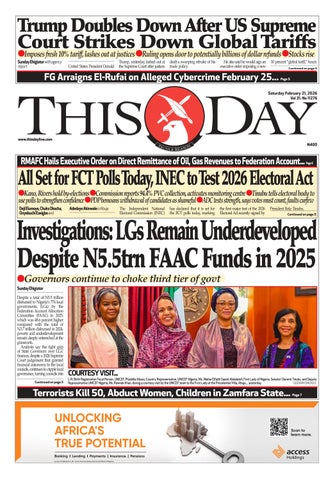
Trump Doubles Down After US Supreme Court Strikes Down Global
Imposes fresh 10% tariff, lashes out at justices Ruling opens door to potentially billions of dollar refunds Stocks rise
All Set for FCT Polls Today, INEC to Test 2026 Electoral Act
Kano, Rivers hold by-elections Commission reports 94.4% PVC collection, activates monitoring centre Tinubu tells electoral body to use polls to strengthen confidence PDP bemoans withdrawal of candidates as shameful ADC tests strength, says votes must count, faults curfew
Investigations: LGs Remain Underdeveloped Despite N5.5trn FAAC Funds in 2025
Sunday Ehigiator
Despite a total of N5.5 trillion disbursed to Nigeria’s 774 local governments (LGs) by the Federation Account Allocation Committee (FAAC) in 2025, which was 48.6 percent higher compared with the total of N3.7 trillion disbursed in 2024, poverty and underdevelopment remain deeply entrenched at the grassroots.
Analysts say the tight grip of State Governors over LGs’ finances, despite a 2024 Supreme Court judgement that granted financial autonomy to the local councils, continues to cripple local governance, turning councils into
Deji Elumoye, Chuks Okocha, Onyebuchi Ezeigbo and Adedayo
FG Arraigns El-Rufai on Alleged Cybercrime February 25
Alex Enumah in Abuja
The federal government will on February 25, arraign a former Governor of Kaduna State and chieftain of the African Democratic Congress (ADC), Mallam Nasir El-Rufai on alleged cybercrime and breach of national security.
This follows the fixing of the date for arraignment by Justice Joyce Abdulmalik of the Federal High Court (FHC),
who has been assigned the matter by the Chief Judge of the FHC, Justice John Tsoho.
The Department of State Service (DSS) had on Monday filed a three-count criminal charge against the former governor, following his statement on wiretapping the telephone lines of the National Security Adviser (NSA), Mallam Nuhu Ribadu.
The criminal charge was filed same day El-Rufai
honoured an invitation by the Economic and Financial Crimes Commission (EFCC) in respect of allegations bordering on corruption and fraud to the tune of over N440 billion, during his administration of Kaduna State, between 2015 and 2023.
In the charge marked: FHC/ABJ/CR/99/2026, the DSS claimed El-Rufai breached the Cybercrimes Prohibition Act (2024) and the
Nigerian Communications Act (2003)
The ADC chieftain, who was also a former Minister of the Federal Capital Territory (FCT) during the administration of former President Olusegun Obasanjo, was in count one alleged to have, on February 13, while appearing as a guest on Arise TV’s ‘Prime Time’ programme in Abuja, did admit during the interview
that he and his cohorts unlawfully intercepted the phone communications of the NSA.
The offence is said to be contrary to and punishable under Section 12(1) of the Cybercrimes (Prohibition, Prevention, etc.) Amendment Act, 2024.
The DSS in count two, alleged that El-Rufai had on February 13, while appearing as a guest on ‘Prime Time’
INVESTIGATIONS: LGS REMAIN UNDERDEVELOPED DESPITE N5.5TRN FAAC FUNDS IN 2025
cash conduits rather than engines of development.
FAAC disbursed a total of N5.5 trillion to the LGs in 2025, according to data compiled by THISDAY. A breakdown of the data showed that in January 2025, the LGs were allocated a total of N434.6 billion, N410.3 billion in February, N387 billion in March, N406 billion in April, N419 billion in May, N444.9 billion in June, N485 billion in July, and N522 billion in August. Also, the LGs were allocated N530 billion in September, N505 billion in October, N445.3 billion in November and N513.3 billion in December 2026.
The data showed that while the federal government got a total of N7.8 trillion from FAAC in 2025, higher than the N4.95 trillion they got in 2024, according to a NEITI report, the 36 States and the Federal Capital Territory got N7.5 trillion.
Investigations across several local councils and rural communities reveal that basic
social services remain grossly inadequate, with many areas lacking functional primary healthcare centres, quality primary schools, potable water, and accessible rural roads.
In many communities, residents continue to rely on dilapidated facilities and informal support systems, with little evidence that increased fiscal transfers have translated into improved living standards or tangible development projects.
Findings also suggest weak governance structures, poor fiscal transparency, and limited administrative capacity at the local level, raising questions about how public funds are utilised.
Civil society leaders argue that the autonomy granted by the Supreme Court remains largely theoretical, as governors allegedly continue to control local government finances and political structures.
Speaking with THISDAY, the Executive Director of the Civil Society Legislative Advocacy
Centre (CISLAC), Awal Musa Rafsanjani, said while the court ruling was a positive step, much more needs to be done to make autonomy meaningful.
“I think let us get very clear. Although the court has given local government autonomy, including financial autonomy, the reality is that despite this autonomy, there’s a lot that needs to be put in place to ensure resources that get into the local government actually reduce poverty at the grassroots level,” Rafsanjani said.
He argued that the autonomy remains limited and has not manifested in tangible development outcomes.
“The governors are still playing important roles in terms of what local governments do. For autonomy to work, there must be proper reforms that ensure the institutional capacity of the local governments. They still don’t have the required capacity to do the work they are supposed to do,” he stated.
According to him, years of administrative neglect have weakened the local government system, making it incapable of driving socioeconomic development or effectively implementing poverty intervention programmes.
“Overnight, you don’t expect them to function efficiently, especially given the fact that the administrative structure is very weak. Many of the councillors don’t have the required fiscal and administrative skills and independence,” he said.
Rafsanjani maintained that reducing poverty at the grassroots requires competent officials who understand fiscal management, administrative processes, and political independence.
“You are still dealing with issues of accountability, capacity building and transparency in the use of resources meant to tackle poverty. Many people who would have been skilled to work in local governments are not there. What you have
ALL SET FOR FCT POLLS TODAY, INEC TO TEST 2026 ELECTORAL ACT
Voters across Abuja are set to cast their ballots amid heightened security and logistical preparations.
Also today, in Rivers State, bye-elections will hold in the Ahoada East II and Khana II constituencies to fill vacancies arising from the resignation and death of sitting legislators. In Kano State, elections will take place in Kano Municipal, with 330,228 voters across 630 polling units, and Ungogo constituency, with 205,418 voters across 384 polling units, following the deaths of two members of the State House of Assembly.
For the FCT, INEC would conduct elections across the six area councils of the FCT, involving 1,680,315 registered voters across 2,822 polling units, alongside bye-elections in Rivers and Kano states.
The Electoral Act 2026
introduced several reforms, including the statutory codification of the Bimodal Voter Accreditation System and provisions for electronic transmission of results to INEC’s Result Viewing portal, while retaining manual collation as a fallback in areas with poor network coverage. The new legislation had sparked debate, with civil society groups expressing displeasure with the hybrid transmission system.
For the FCT, INEC revealed that it has set up an Election Monitoring Centre to track developments and respond to emergencies during the exercise today.
President Bola Tinubu yesterday called on eligible voters, security agencies, and INEC officials to conduct themselves orderly during today’s polls in the FCT, and states of Kano and
Rivers.
Also, a Civil Society Organisation (CSO), the Centre for Democracy and Development (CDD-West Africa), has expressed concern over what it calls persistent low voter turnout in the Federal Capital Territory (FCT), particularly in residential estates and urban communities.
The FCT Resident Electoral Commissioner, Aminu Idris disclosed the PVC collection rate yesterday in Abuja while giving an update on the level of preparedness for the election.
He revealed that all sensitive and non-sensitive materials would be deployed to Registration Area Centres yesterday afternoon to ensure early distribution to polling units for the election to commence at 8:30 as scheduled.
Idris stressed that all Bimodal Voter Accreditation Systems (BVAS) that would be used in
the election have been configured and tested for effective and timely capturing of voters
He said transport unions engaged for the exercise must adhere strictly to the terms of their memorandum of understanding, warning that the commission would not tolerate lapses.
Idris called on the 17 political parties participating in the election to ensure strict compliance with the Electoral Act and Election guidelines in the conduct of the polls.
He maintained that candidates or political parties just stepping down and announcing their withdrawal from today’s election were doing so contrary to the law.
“The Electoral Act and Election guidelines clearly stipulate the window period for Candidates and Political Parties to withdraw from the election,” he said.
Also, the electoral body
are unskilled administrators who do not understand how to constructively deal with poverty in most local governments,” he added.
He stressed that financial autonomy alone would not solve the problem unless it is institutionalised through constitutional reforms.
“We need constitutional amendments that will give more political, legal and financial autonomy to local governments for them to function and focus on developmental issues. Under our current law, state governments still make laws for local governments. There’s no way you can achieve genuine autonomy under such conditions,” he said.
Questioning how N5.5 trillion could be allocated without a visible impact, Rafsanjani alleged that governors still direct how local government funds are spent.
“The truth of the matter is that this is money that has been directed on how it should be implemented by the governors.
disclosed that FCT has recorded a 94.4 per cent collection rate of Permanent Voter Cards (PVCs) ahead of today’s election.
The National Commissioner and Chairman of the Information and Voter Education Committee (IVEC), Mohammed Haruna, in a statement, disclosed that as at the close of collection on 10th February 2026, a total of 1,680,315 voters were registered in the FCT.
According to him, out of this figure, 1,587,025 PVCs had been collected, leaving 93,290 PVCs uncollected.
Providing a breakdown of the figures across the six Area Councils, Haruna described the performance as encouraging, noting that the impressive collection rate reflects strong voter responsiveness across the Territory.
Haruna noted: “Abaji Area Council recorded 75,517 collected PVCs out of 79,471 registered
TRUMP DOUBLES DOWN AFTER US SUPREME COURT STRIKES DOWN GLOBAL TARIFFS
after the Supreme Court struck down his sweeping “reciprocal” import duties.
The new “Section 122” tariffs will come on top of the existing levies that remain intact following the high court’s decision, Trump said as he raged at the “deeply disappointing” ruling during a White House press briefing.
Owing to the development, US stocks finished higher yesterday.
in Abuja, stated during the interview that he knew and related with certain individual, who unlawfully intercepted the phone communications of NSA, without reporting the said individual to relevant security agencies.
The offence was said to be contrary to and punishable under Section 27 (b) of the Cybercrimes (Prohibition, Prevention, etc.) Amendment Act, 2024.
Every time state governments want to do something, they ask local governments to provide money. It is not about addressing poverty or inequality at the local level; it is an opportunity for governors to continue directing what the resources should be used for,” he said. He described the current autonomy as existing “only on paper. If it were institutionalised, you would see clear improvements in the well-being of the people at the grassroots with this kind of money.
“At the local government level, where insecurity is supposed to be tackled, you don’t see them playing that role. You don’t see improved primary education. The healthcare system at the local level has not improved. Markets that should boost revenue are not properly supported. Agricultural activities are not enhanced,” he said.
voters, representing 95.0 per cent. Bwari Area Council recorded 276,360 collected PVCs out of 295,711 registered voters, translating to 93.5 per cent.
“Gwagwalada Area Council recorded 196,184 collected PVCs out of 208,057 registered voters, representing 94.3 per cent, while Kuje Area Council posted the highest collection rate with 144,109 PVCs collected out of 148,286 registered voters, representing 97.2 per cent.
“Kwali Area Council recorded 99,774 collected PVCs out of 107,203 registered voters, representing 93.1 per cent. The Municipal Area Council, which has the largest voting population in the Territory, recorded 795,081 collected PVCs out of 841,587 registered voters, representing 94.5 per cent.”
The Supreme Court struck down some of Trump's most sweeping global tariffs, upending one of the White House's top policy priorities and injecting new uncertainty into global trade.
In a 6-3 decision, the justices in America's highest court, according to the BBC, said the law Trump used to impose some of his most significant tariffs did not authorise him to do so.
The ruling opens the door to
In some of his harshest criticisms ever of the nation's highest court, Trump said some justices should be "absolutely ashamed" for siding against him.
potentially billions of dollars in tariff refunds, delivering a major victory to the small businesses and states that had challenged the measures.
The Trump administration had contended that the duties were justified under a law empowering the president to respond to national emergencies.
But lawyers for the challenging states and private firms said the law used by the president to impose the levies made no mention of the word "tariffs."
They argued that Congress did
not intend to hand off its power to tax or give the president an "open-ended power to junk" other existing trade deals and tariff rules.
Without evidence, Business Insider Africa, noted that Trump accused justices of being "swayed by foreign interests."
He added that the majority opinion was "almost like not written by smart people."
"Others think they're being politically correct, which has happened before far too often
with members of this court," he said. "They are just being fools and lapdogs for the RINOS and radical left Democrats."
Trump said it was fair to question the loyalty of "our people," a likely reference to his two appointees, Justices Amy Coney Barrett and Neil Gorsuch, who sided against the administration's view.
Trump said due to the "deeply disappointing" decision, "alternatives" would be used to preserve his trade agenda.
Later, he said he would use
a separate authority to impose a 10 percent global tariff on top of any existing tariffs.
"The Supreme Court did not overrule tariffs. They merely overruled a particular use of IEPPA tariffs," Trump said, citing the law in question in the court's ruling.
Asked if the government would now have to issue refunds, Trump again criticised the court for not addressing the issue.
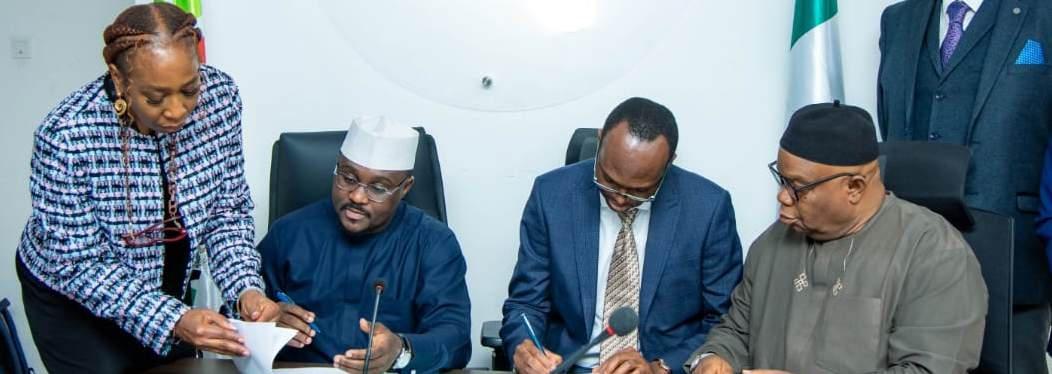
TRIPARTITE AGREEMENT ON NATIONAL DIGITAL PLATFORM...
L-R: Legal Counsel/Director, Financial Reporting Council of Nigeria (FRC), Mrs. Nnoruka; Executive Secretary/CEO, FRC, Dr. Rabiu Olowo; CEO, SALI, Dr. Ebere Weli, and CEO/Founder, RCRA, Dr. Iheanyi Anyahara, during the signing of a tripartite agreement to develop a National Digital Platform for sustainability regulatory reporting, held in Abuja…recently
CDS: Nigerian Forests, Ungoverned Spaces, Will No Longer Serve as Safe Havens for Terrorists
Military probes source of N37 million cash intercepted by troops in North-east Security experts: Nigeria needs more manpower, technology, good governance to defeat insecurity
The Chief of Defence Staff (CDS), General Olufemi Oluyode, has warned that forested enclaves and ungoverned spaces previously exploited by terrorists will no longer serve as safe havens.
This was as the military authorities launched a probe to determine the source of N37 million cash intercepted by troops of the Joint Task Force North-East, Operation Hadin Kai, along the Maiduguri–Magumeri Road on 16 February 2026.
General Oluyode revealed that troops deployed under the newly inaugurated Operation Savannah Shield will carry out sustained clearance and stabilisation operations across vulnerable corridors within the theatre.
He affirmed that the Armed Forces of Nigeria are fully prepared to dominate the operational environment, consolidate previous security gains, secure critical agricultural belts, and guarantee the protection of lives and property.
According to a statement by the Director of Defence Information, Major General Samaila Uba, the CDS stressed that Operation
Also, security experts have said that defeating insecurity in Nigeria will require a deliberate combination of increased manpower, the deployment of modern technology and the entrenchment of good governance.
FG Flags-off Distribution of 15 Million Learners' Support Kits Nationwide
Reaffirms commitment to end menace of out-of-school children
The federal government has flagged off the nationwide distribution of 15 million learners' support kits to vulnerable pupils in schools across the country, reaffirming its commitment to ending the menace of out-of-school children and ensuring that no Nigerian child is left behind.
The flag-off ceremony, held in Makurdi, Benue State, coincides with the 2026 Benue State Universal Basic Education Board (SUBEB) Basic Education Summit and the National Launch of the Learners Support Programme (LSP).
Speaking at the event, the Executive Secretary of the Universal Basic Education Commission (UBEC), Dr. Aisha Garba, said the initiative
reflects the resolve of the administration of President Bola Ahmed Tinubu to tackle barriers preventing millions of children from accessing basic education.
She said the Learners Support Programme would commence with the distribution of 1,155,900 school kits nationwide, comprising 288,975 units each of school bags, sandals, pencils and exercise books, targeted at children from low-income and vulnerable households.
She explained that the nationwide rollout forms part of a broader intervention that will see 15 million school kits distributed across states to ease the financial burden on parents, boost enrolment, enhance retention and improve transition rates in basic schools.
Savannah Shield is not a routine deployment but a deliberate, well-coordinated offensive designed to deny criminal elements freedom of action.
Speaking at the formal
inauguration of the Joint Task Force North Central Operation Savannah Shield (OPSS) at 22 Brigade, Sobi Military Cantonment, Ilorin, Kwara State, Oluyode said the intelligence-driven joint
operation is strategically mandated to dismantle terrorist networks, kidnapping syndicates, and allied criminal groups threatening Kwara State and neighbouring areas of Niger State.
Reassuring citizens of the military’s unwavering commitment, the CDS emphasised enhanced inter-agency synergy and operational effectiveness aimed at achieving decisive outcomes.
Terrorists Kill 50, Abduct Women, Children in Zamfara State
At least 50 people were killed and several women and children abducted after armed men attacked a village in Zamfara State, a state lawmaker told Reuters yesterday.
Hamisu A. Faru, lawmaker representing Bukkuyum south, said the attackers raided Tungan Dutse village from around 5 p.m. on Thursday until about 3:30 a.m. yesterday, burning down buildings and
shooting residents who tried to flee.
"They have been moving from one village to another ... leaving at least 50 people dead," Faru told Reuters by phone.
He said the number of abducted victims was yet to be determined. Traditional leaders and local government officials were still accounting for the missing.
A Zamfara state police spokesperson did not respond to calls seeking comment.
Abdullahi Sani, 41, a resident of Tungan Dutse, said three family members were killed in the attack.
"No one slept yesterday; we are all in pain," he said.
A day earlier, residents contacted security forces and local authority when they saw more than 150 motorcycles
carrying armed men. But the warning was ignored, Sani said. Insecurity is a pressing concern in Nigeria and the government is under mounting pressure to restore stability.
There has been a surge in attacks blamed on "bandits", who have carried out deadly assaults, abductions for ransom, and displaced communities across northern Nigeria.
Report: Tinubu's Renewed Hope Policies Driving Drop in Inflation
Nume Ekeghe
Nigeria’s inflation trajectory is showing signs of a decisive turnaround, with a new policy brief stating that reforms under President Bola Ahmed Tinubu’s Renewed Hope Agenda are directly driving the sustained
moderation in prices and could push inflation into single digits before the end of the year.
Just days after the National Bureau of Statistics (NBS) reported that headline inflation slowed to 15.10 per cent year-on-year in January 2026 down sharply from
27.61 per cent in January 2025 and slightly lower than the December 2025 reading, a policy brief by Statehouse Digital Policy and Research described the moderation as a “historic drop,” attributing the sustained disinflationary trend to reforms under President Bola Ahmed
Tinubu’s Renewed Hope agenda. On a month-on-month basis, inflation contracted by 2.88 per cent. The report described this as a “significant deflationary trend, 3.42 per cent lower than Dec 2025, signalling price cooling.”
JOHESU Warns N/Assembly On Danger Passing Bills to Regulate Healthcare
The Joint Health Sector Unions (JOHESU) has warned the National Assembly about the dangers of passing proposed amendments to laws on control and regulatory control of other healthcare in the country.
The umbrella body of
professional health workers in the country, claimed that the bills being initiated by the Medical and Dental Practitioners, if passed would create a monstrous regulatory structure that gives medical practitioners domineering control over other
health professions in Nigeria’s healthcare system.
In a statement signed by the National Chairman of JOHESU, Kabiru Ado Minjibir, and General Secretary, Martin Egbanubi, the union described the exercise as an ‘’attempt to foist apartheid regime in the Nigerian health sector by imposing medical and dental practitioners on the professional regulatory control of other healthcare professions that are distinct and separate from medicine and dentistry.”
Linus Aleke in Abuja
Kuni Tyessi in Abuja
STRENGTHENING PARTNERSHIP...
Civil Society Coalition Plans Fresh Protest, Insists on Real-time Election Result Transmission
The Civil Society Situation Room has deplored the swift presidential assent to the Bill making real time electronic transmission of election results non mandatory for the Independent National Electoral Commission (INEC).
It said the signing of the Bill into law by President Bola Tinubu clearly contradicted years of reform advocacy, stakeholder consultations, and lessons learned from recent elections and election petitions.
The Situation Room warned that if nothing was done to make electronic transmission of election results mandatory,
it may be forced to mobilise members of the Civil Society Coalition and the Nigerian people to a national protest.
Addressing a press conference yesterday, CoConveners of the Nigeria Civil Society Situation Room, Mma Odi and Celestine Odo said the coalition is demanding an urgent review and the corrective legislative action required on the clause for electronic transmission to make it mandatory without conditions.
They said, "The Situation Room and the Movement for the Transformation of Nigeria (MOTION) is also planning a National Day of Action in this
We’re Repositioning Ondo for Prosperity, Aiyedatiwa Tells Investors
Ondo State Governor, Lucky Aiyedatiwa, has declared that his administration is taking deliberate steps to introduce bold reforms and strategies aimed at repositioning the state for sustainable economic growth and transforming it from a civil service–dependent economy into a diversified and industrialised one.
The governor made this known in Akure yesterday while addressing journalists at a press conference to herald the 2026 Ondo Investment Summit, themed ‘The New Order: Forging a Pathway to Prosperity’, scheduled to hold on Monday, February 23, 2026, at the International Cultural and Event Centre (The Dome), Alagbaka, Akure.
Aiyedatiwa, who was represented by his Special Adviser on Entrepreneurship Development and Chairman of the Investment Committee, Dr. Summy Smart-Francis, said the summit was designed to attract
strategic investments capable of creating jobs and accelerating economic transformation in the state.
“The objective is to move Ondo State from being largely dependent on civil service activities to becoming an industrial and investment hub driven by private sector participation,” Smart-Francis said.
He disclosed that the summit would feature the signing of several Memoranda of Understanding (MoUs), including agreements on the proposed Deep Seaport project and other key industries.
“During the summit, the state government will sign a number of MoUs, including the Deep Seaport, fertiliser production and other strategic projects that will boost the economy and generate employment for our people,” he stated.
Smart-Francis added that the summit would attract international and local investors as well as captains of industry and key stakeholders
regard and will make further announcements."
Situation Room blamed the leadership of the National Assembly for failing to rise to the demands of the
Nigerian electorates to correct the imperfections in the legal framework for elections that will guarantee a credible poll.
It said the amended law, in its current form, falls short
of the minimum standards required to guarantee credible elections.
According to Situation Room, the absence of a mandatory electronic
transmission clause weakens electoral integrity safeguards, adding that the new legislation threatens to reverse public confidence gains made in recent electoral cycles.
UNICEF: Official Registered Births in Nigeria Rose to
Deji Elumoye in Abuja
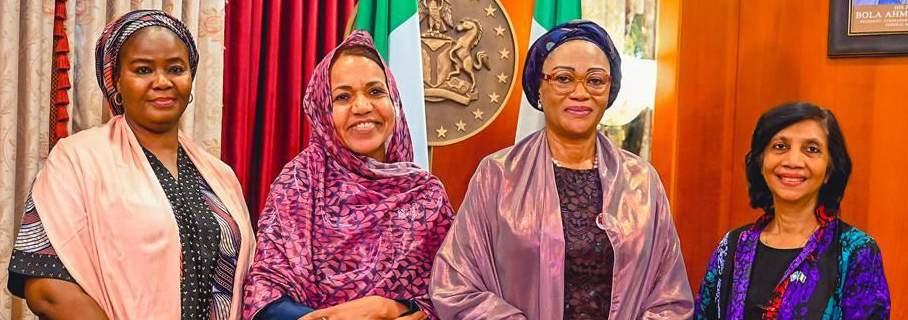
The United Nations Children's Fund (UNICEF) has disclosed that the number of children whose births are officially registered in Nigeria within the past two years has risen significantly to 14 million.
UNICEF Country Representative to Nigeria, Ms Wafaa Saeed Abdelatef, made
this known yesterday during a courtesy visit to wife of the President, Senator Oluremi Tinubu, in her office at the State House, Abuja. She commended the First Lady for her leadership not only in the areas where UNICEF is working but also for impacting lives in areas that have to do with children and families across the nation.
14m in Two Years
According to her, "Birth registration, we look at it as the first right of every child to be counted, to be recognised and it is really impressive, I have served in many places but I have not seen in two years, we could have a progress that has happened here in Nigeria.
"We have 14 million children whose births have been registered, the system is
being digitalised at the health facility at the world level as well, combine that, there is a bill before the National Assembly, things don’t just happen like that, we scale with our leadership.
"I am really grateful for you leading this area of birth registration and allowing us to celebrate this fantastic leadership.
2027: Group Urges ADC to Zone Presidency to South
Wale Igbintade
The Coalition for Good Governance (CGG) has warned the African Democratic Congress (ADC) coalition that its 2027 presidential ticket must be zoned to Southern Nigeria, insisting that anything less could undermine the hopes of millions seeking political renewal.
Addressing journalists, the group, comprising former national party chairmen and
ex-presidential candidates drawn from all six geopolitical zones, argued that equity, national balance and electoral realism make Southern zoning a strategic necessity, not a political concession.
“The nation is deeply polarised and economically distressed. The path to victory and national healing lies in fairness. Zoning the ticket to the South is both morally compelling and electorally strategic,” the coalition declared.
The CGG warned that failure to decisively resolve the zoning question could spark internal divisions and weaken the ADC’s credibility as a viable alternative platform ahead of the 2027 general elections.
Turning to electoral reforms, the coalition launched a scathing attack on President Bola Ahmed Tinubu over his assent to the amended Electoral Act, describing the development as “a dangerous regression” capable of eroding
public confidence in the electoral process.
According to the group, the rejection of mandatory realtime electronic transmission of results creates openings for manipulation, voter intimidation and post-election disputes.
“Electronic transmission safeguards data integrity, reduces human interference and restores public trust. Any resistance to it is resistance to transparency,” the statement read.
Bayelsa Police Nab Two Fake Military Personnel in Yenagoa
Olusegun Samuel in Yenagoa
The Bayelsa State Police Command has arrested a fake Naval officer and a fake corporal dressed in military camouflage in two separate operations in Yenagoa, the Bayelsa State capital. In a press statement by the Command's spokesman, DSP Musa Mohammed, said the significant operational success was
a result of the sustained efforts to curb criminal activities across the state under the leadership of CP Iyamah Daniel Edobor. He said, on 13th February, 2026, at about 1500 hours, operatives attached to Ekeki Division, arrested Kelechi Lazarus, aged 25 years old, dressed in military camouflage uniform with the rank of Corporal, who attempted to fraudulently withdraw the
sum of N200,000 at Ekeki Park, Yenagoa, by sending fake alert to the POS operator.
"Preliminary investigation reveals that the suspect showed the victim a purported credit alert on his mobile phone as proof of transfer. However, the victim did not receive any corresponding alert on her device and insisted on verification at her bank. Upon inquiry, the bank confirmed that
no such transaction was made into her account.
"Consequently, the suspect thereafter persuaded the POS operator to accompany him to his bank for further clarification but later changed his mind and suggested proceeding to his base at 16 Brigade. Suspecting foul play, the victim declined. The suspect assaulted her, inflicting bodily injuries on her.
Onyebuchi Ezigbo in Abuja
Fidelis David in Akure
in the investment sector.
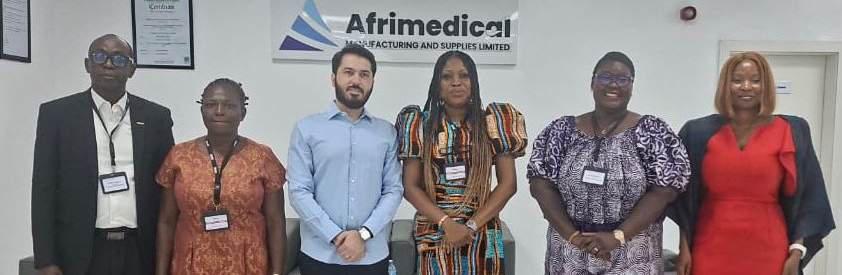
L-R: Director, Finance & Account, Lagos State Health District 3, Mr. Adebayo Dosunmu; Director, Nursing Services, Mrs Christianah Adeboboye; General Manager, Afrimedical Manufacturing and Supplies Limited, Gabi Al-Aridi; Lagos State Permanent Secretary Health District 3, Dr. Monsurat Adeleke; Director, Medical Services and Disease Control, Dr. Adenike Oguntuase; and Marketing Manager, Afrimedical Manufacturing and Supplies Limited, Egbe Daniella, during a working visit to Afrimedical Manufacturing and Supplies Limited by officials of Health District 3, to explore opportunities for collaboration and innovation in healthcare delivery... recently
COURTESY VISIT...
1949 Enugu Coal Mine Massacre: FG, UK Served Judgement
Ordering
£420m Compensation to Victims' Families
Urged to respect, comply with decision
The Federal Government of Nigeria and that of the United Kingdom, have been served with the judgement of a Nigerian court which ordered judgement in the sum of £420 million, for family members of the 21 Nigerian miners killed in 1949.
A professor of Law and
Senior Advocate of Nigeria, Prof. Yemi Akinseye-George, who disclosed the service of the judgement on the respondents, however urged the two governments to respect and also comply with the said judgement.
It would be recalled that the British colonial administration had on November 18, 1949, ordered colonial police officers
to open fire on 21 coal miners, at the Ivy Valley Coal Mine in Enugu, who were then protesting poor working conditions, wage dispute, and discriminatory labour practices.
After over three decades of the incident, a Human Rights Activist, Mazi Greg N. Onoh, in 2024, sued the UK government, demanding redress and compensation for
families of victims.
The plaintiff in the suit marked: E/909/2024, sought an acknowledgment of liability, a formal apology from the British Government, and comprehensive compensation for the loss of their loved ones.
Two years later, the court came out with a guilty verdict, describing the massacre as an unlawful and extrajudicial
FG, Ogun Reward Nigeria's Best Teacher with Car,
James Sowole in Abeokuta
The federal government and the Ogun State Government have rewarded Nigeria's Best Teacher for 2025 Session, Mr. Solanke Taiwo, with a brand new car and a two-bedroom bungalow respectively.
Solanke, who is a primary school teacher at Ansa-Ur-Deen Main School I, Kemta Lawa, Abeokuta, was presented with
his prizes by Governor Dapo Abiodun at a ceremony, held in Abeokuta, Ogun State capital.
The teacher had earlier received a cash award of N50 million from the federal government at the National Teachers’ Summit in Abuja in recognition of his outstanding performance and dedication to education.
Abiodun handed over the car keys to the award-
winning teacher at his office in Oke-Mosan, Abeokuta, in the presence of the Commissioner for Education, Science and Technology, Prof. Abayomi Arigbagbu, and the Permanent Secretary in the ministry, Mr. Oloko.
The governor disclosed that the two-bedroom bungalow would be allocated to Solanke in any location of his choice under the State Housing Scheme.
House
Abiodun also reiterated his administration’s commitment to continuous training and retraining of teachers through workshops, seminars, digitisation initiatives, and AI-powered teaching platforms.
Speaking in an interview, Arigbagbu described the feat as a confirmation of the governor’s sustained investment in education and the impact of ongoing reforms in the sector.
Zulum Commits N12.9bn into Training of 54 Borno Indigenes in Aeronautics, Advanced Engineering
Michael Olugbode in Maiduguri
violation of the right to life.
While holding the British colonial administration liable, the court ordered substantial compensation, formal apologies, and diplomatic action.
“These defenseless coal miners were asking for improved work conditions; they were not embarking on any violent action against the authorities, but yet were shot and killed.
“The 1st, 2nd, 5th and 6th respondents should pay £20 million per victim, totalling £420 million, payable by the British Government as effective
remedy and compensation for the violations of the right to life.
“They will also pay postjudgement interest at 10 per cent per annum until fully paid while claims for prejudgement interest and exemplary damages are hereby refused,” Onovo held.
Speaking of efforts to enforce the judgement of the court, Akinseye-George, who led the legal battle for the plaintiff, told journalists that the judgement was dispatched to the United Kingdom through the British High Commissioner in Nigeria.
Origin Tech Partners OAU on Centre of Excellence in Agriculture
Food systems giant, Origin Tech Group Nigeria Limited, has entered into a Partnership Agreement via a Memorandum of Understanding (MoU) with one of Nigeria’s leading academic institutions, the Obafemi Awolowo University (OAU).
Also, Zulum has approved a special training fund for the 56 medical doctors currently undergoing residency training under the state’s sponsorship.
The beneficiaries of the aeronautics and advanced engineering disciplines will undergo a five-year training
Borno State Governor, Prof. Babagana Zulum, has committed a staggering N12.9 billion to train 54 Borno indigenes in aeronautics and advanced engineering disciplines, in what is widely seen as one of the boldest state-backed investments in specialised aviation education in Nigeria.
programme at the Isaac Balami University of Aeronautics and Management (IBUAM), combining degree studies with professional certifications and basic pilot training.
At a ceremony held Thursday night at the Government House in Maiduguri, Zulum presented an initial cheque of N2.5 billion to the institution to cover annual
tuition and associated costs. The full sponsorship package over five years is valued at N12.9 billion.
The governor said the initiative is part of a deliberate strategy to reposition Borno from a conflict-scarred state to a hub of innovation, technology and high-level manpower development.
Former UBA Chairman, Ogbue Dies at 99
The Board of Directors, Management and Staff of the United Bank for Africa (UBA) Plc on Thursday announced the passing of Chief Israel C. Ogbue, former Chairman of the bank, who died peacefully at the age of 99. A revered boardroom statesman and distinguished administrator, Ogbue devoted over six decades of his life to service in Nigeria’s public and private sectors, leaving behind an enduring legacy of integrity, discipline and institutional excellence.
Born on February 18, 1927, in Onicha-Olona, Delta State, Chief Ogbue’s professional journey began in the Federal Civil Service before he travelled to the United Kingdom for further studies. A statement explained that he built an accomplished career that saw him rise through senior management ranks at the National Insurance Corporation of Nigeria (NICON), where he served with distinction until his retirement in 1988. His reputation for governance expertise subsequently earned him appointments to the boards of several leading institutions, including UBA.
The agreement is geared towards delivering strong synergies in the end-to-end agricultural value chain, leveraging Origin Tech Group’s proven expertise in agriculture and agribusiness and OAU’s excellence in teaching, research and development.
The Partnership Agreement and MoU signing ceremony, which took place at the University’s Campus in Ile-Ife, according to a statement, was executed on behalf of Origin Tech Group by Mr. Olusesan Ayeni, the Executive Director, Corporate Services and Professor Adebayo Bamire, the Vice Chancellor of the University.
Ayeni explained that, “this robust agreement is anchored on establishing a best in class centre of agriculture in the South-west of Nigeria harnessing the vast potential of the region in farming through a unique handshake, standing shoulder to shoulder and linking the vast capabilities of Origin Tech Group in large scale mechanised farming management
with the deep knowledge of the University in capacity building and manpower development.” Ayeni also the overarching purpose of the agreement is to create “a corridor of excellence and opportunities by deepening the Nigeria's food system, providing impetus, access and necessary exposure to scholars and young minds studying agriculture in the university to a culture of practical, knowledge-driven, modern and smart methods through mechanization that ensures large scale commercial farming system for a food secure nation.” He commended the institution’s efforts in scholarship and for being a worthy participant in the training of Nigeria’s past, current and future workforce, praising the current and past leaders of the institution for their commitment to excellence.
“No other place is more worthy of hosting such an endeavour we are erecting today other than the highly revered citadel of academic learning as the Obafemi Awolowo University. The environment is not only appropriately suited for academic excellence but can also serve as a hub for transforming agricultural productivity, centre of excellence in mechanisation and exceedingly strong support systems for agriculture.”
Alex Enumah in Abuja
Kayode Tokede
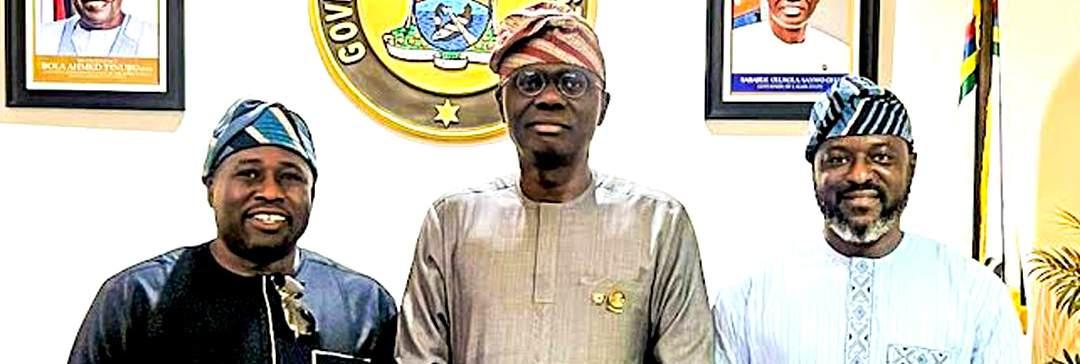
L-R: An ally of Farm Zone, Mr. Ahmad Oyekan; Governor of Lagos State, Mr. Babajide Sanwo-Olu, and Chief Executive Officer of Farm Zone, Mr. Bashir Salami, during a courtesy visit by a delegation from Farm Zone to the Governor at Alausa,,Lagos… recently
Interrogating The Russian Model In Africa
If Africa’s ambition is prosperity, stability, and dignity for its people, the path forward must begin and end with accountable governance, argues OUMAROU SANOU
In recent years, Russian influence in Africa has expanded at a striking pace and with strategic precision. From Bamako to Bangui, Niamey to Ouagadougou, Moscow has presented itself as a dependable alternative partner; one that claims no colonial guilt, imposes no lectures on governance, and attaches no democratic conditionalities to cooperation. In a region fatigued by insecurity and disillusioned with Western engagement, that message has resonated.
But beyond the rhetoric of “Saint Russia” and the carefully cultivated image of a geopolitical “Saviour of Africa” - a narrative amplified across social media - a more fundamental question demands attention: what exactly is the Russian model offering Africa, and does it truly align with the continent’s long-term aspirations for democratic governance, economic transformation, and social stability?
Africa’s post-independence experience has been shaped by recurring governance challenges: corruption, authoritarian leadership, fragile institutions, and predatory elites. These weaknesses have stunted the growth of an empowered middle class, undermined entrepreneurship, and limited inclusive development. After decades of experimentation, the lesson is clear: sustainable progress rests on accountable leadership, institutional strength, rule of law, and political alternation. If governance reform remains Africa’s unfinished project, then the value of any external partnership must be measured against whether it strengthens or weakens that trajectory.
The issue is not Russia as a nation. Every sovereign state has the right to pursue its interests abroad. The concern lies with the regime's political structure, which is implicitly promoted as a model. Contemporary Russia is characterised by prolonged executive dominance, limited political alternation, and significant concentration of economic power among a narrow elite. President Vladimir Putin has led the country for a quarter of a century. Opposition space is restricted. Independent media operates under heavy constraints. Wealth is concentrated, and outside a few urban centres such as Moscow and St. Petersburg, economic dynamism remains limited.
This is not an emotional or ideological critique; it is a structural observation. A governance system marked by entrenched oligarchic influence and constrained civic space is unlikely to export a blueprint that empowers pluralism, fosters institutional independence, or nurtures a broad-based middle class, precisely the ingredients Africa needs.
When news filtered in on Wednesday, February 11, about the passing of Professor Biodun Jeyifo, I found myself journeying back 35 years, to my National Youth Service days at Teachers’ College, Kagoro, in the southern part of Kaduna State.
It was 1991. We were young, idealistic, and argumentative in the best sense of that word. We believed ideas mattered. We believed debates could shape society. Kagoro, quiet and reflective, became for us a space of intellectual exchange. It was there that I first heard the name Biodun Jeyifo. I was speaking with my fellow corps member, Adekola Adebayo, who had studied English at Obafemi Awolowo University, Ile-Ife. As corps members often do, we compared our campuses and the intellectual giants who shaped them.
I told him about the University of Calabar, about Eskor Toyo, the formidable Marxist economist whose lectures drew students from every faculty, and about Dr. Innocent Ukeje, the political scientist, whose ideological position
In the Sahel, Russia’s expanding footprint has coincided not with democratic revival, but with the consolidation of junta-led regimes. Mali, Burkina Faso, and Niger, now bound together in the Alliance of Sahel States (AES), have sharply pivoted toward Moscow. Yet these countries rank among those with the highest terrorism-related casualties globally. Despite bold promises, insecurity persists and, in some cases, has worsened. Instability increasingly spills beyond their borders, affecting coastal West African states, including Nigeria.
The central question, therefore, is not whether Russia should engage Africa; it can and should, like any global actor. The real question is whether the nature of that engagement strengthens institutions or merely reinforces regime survival.
Partnerships anchored primarily in security cooperation without parallel institutional reform risk deepening political stagnation. Leaders become insulated from domestic accountability. Civic freedoms shrink. Economic diversification slows. Investors hesitate. Youth populations, already restless, lose faith in systems that offer neither alternation nor upward mobility. Nigeria offers an instructive contrast. Its democracy is imperfect and often turbulent. Corruption remains a challenge. Electoral processes are contested. Yet Nigeria has witnessed peaceful transfers of power between parties. Civil society is active. The press is vibrant and frequently critical. Courts retain the authority, however unevenly exercised, to check executive excess. These achievements should not be dismissed. They represent the fragile but essential infrastructure of democratic governance.
A GOVERNANCE SYSTEM MARKED BY ENTRENCHED OLIGARCHIC INFLUENCE AND CONSTRAINED CIVIC SPACE IS UNLIKELY TO EXPORT A BLUEPRINT THAT EMPOWERS PLURALISM, FOSTERS INSTITUTIONAL INDEPENDENCE, OR NURTURES A BROAD-BASED MIDDLE CLASS, PRECISELY THE INGREDIENTS AFRICA NEEDS
It is, therefore, troubling when foreign missions publicly attack Nigerian and African journalists for critical reporting, which is a model Moscow is championing in the AES and seeks to extend to other African countries. A model that seems to suppress critical voices and press freedom. Is that what Africa needs? Media scrutiny is not hostility; it is a cornerstone of democratic accountability.
Reciprocity is the foundation of diplomatic respect. One must ask: would any major power accept a foreign embassy publicly disparaging its journalists on its own soil? The answer is an absolute no, but this is what Russia has done and continues to do across Africa. Nigeria’s democratic gains must not be undermined by external pressure.
Sanou is a social critic, Pan-African observer and researcher focusing on governance, security, and political transitions in the Sahel
Remembering Biodun Jeyifo
MAX AMUCHIE pays tribute to the public intellectual who passed at 80
differed sharply from Toyo’s. On that campus - whether you're a Malabite or Malabress (as Unical students are called) - your intellectual leaning often aligned you with one or the other. I told Kola that my sympathies leaned toward Eskor Toyo’s Marxist clarity and structural critique.
Years later, Ukeje would rise to become a professor at the University of Abuja. Eskor Toyo would retire as a respected professor of Economics before his passing on December 7, 2015 at 86. But in 1991, their debates still animated our conversations.
Kola then smiled and said, “Let me tell you about BJ.” That was my first introduction to Biodun Jeyifo. At Ile-Ife, he said, students and lecturers affectionately called him “BJ.” He described him as a brilliant literary scholar and a committed Marxist intellectual. He also mentioned Ropo Sekoni, another respected literary scholar and close associate of BJ. Years later, I would come to appreciate how deep and enduring that friendship was. What I did not know at the time, and what I only came to understand much
later, was the depth of the connection between BJ and the Madunagus. As a student in Calabar, I encountered Professor (then Dr) Bene Madunagu a few times. I knew her as a lecturer in the Botany Department and as a passionate promoter of the Girl Power Movement. She was visible, energetic, and deeply committed to social advocacy. Yet I did not then grasp the broader ideological network of which she was part.
It was only years later that I learned that Biodun Jeyifo, Edwin Madunagu, and Bene Madunagu were bound together not merely by friendship but by shared ideological commitment, as the trio that formed the Nigerian Socialist Movement, the nucleus of what became widely known as the Nigerian Left. That knowledge reframed my memories.
The intellectual currents I experienced in Calabar and the ones Kola described in Ile-Ife were not isolated phenomena. They were interconnected streams flowing from a larger river of radical thought and organised socialist engagement in Nigeria. BJ stood alongside
Dr. Edwin Madunagu and Professor Bene Madunagu in shaping socialist thought and activism in the country. They were not armchair theorists. They were organisers, teachers, writers, and public intellectuals committed to building a socialist consciousness rooted in justice, equality, and human dignity. Today, of that historic trio, only Dr. Edwin Madunagu remains. Professor Bene Madunagu, a formidable intellectual and activist in her own right, passed away on Tuesday, November 26, 2024, at the age of 77. (Interestingly, her death was jointly announced by Dr Edwin Madunagu and BJ). With the death of Biodun Jeyifo, another pillar of that generation has fallen.
Yet even in BJ's final years, the bonds of friendship and shared struggle endured and were publicly celebrated. This the world saw on Monday, January 5, just last month, when an international symposium was held in Lagos to mark his 80th birthday.
Dr Amuchie, a member of the Nigerian Guild of Editors, is CEO, Sundiata Post Media Ltd.
Yet another one...
In Praise of President Buhari
Witchcraft and Killing in Rivers State
WThen President Muhammadu Buhari took over the reins of power on May 29, 2015, Nigeria was sadly a broken state in many respects. As a result of many other factors including bad governance and untold level of corruption, government could not live up to its financial obligations to citizens and service providers at both the federal and state levels.
Indeed one of the first official assignments that President Buhari carried out was the approval of billions of Naira in bailout funds to enable state governors pay something as basic as workers’ salaries. Granting those bailout funds was a huge boost to national security because the pressure of arrears of unpaid monthly salaries building dangerously all over the country was a ticking bomb.
Ask the naysayers and they would readily remind you of how long it took President Buhari to appoint his ministers and how that contributed to collapse of the economy as if, without ministers, governance was frozen. But buying that narrative would amount to what a famous Nigerian writer, Chimamanda Adichie, termed “the danger of a single story”. Yet the whole story was that many of our citizens did not know how decrepit a state President Buhari inherited in 2015.
It was therefore necessary for him to take stock against the background of the fact that the departing government did not, reportedly, cooperate full well with the incoming government in terms of leaving workable handover notes. Although President Goodluck Jonathan was gracious in defeat, many of his appointees were still sulking over what they saw as their personal losses and therefore pulled all the stops to make things difficult for the Buhari government.
he Advocacy for Alleged Witches is saddened by the brutal murder of Chidiebere Isaiah by a relative, Nwalozie Chiwendu, following an accusation of witchcraft in Ofeh, Rivers State. The tragic news reached AfAW on February 15, 2026. AfAW contacted The Punch and Vanguard correspondents in Port Harcourt for the phone number of the youth president of the Ofeh community in Omuma Local Government Area. Through an advocate in the state, AfAW contacted a legal counsel from the community who confirmed the incident and has volunteered to facilitate any intervention. This legal counsel said he knew the victim and the suspected murderer very well. As reported, Chiwendu accused and murdered Isaiah for being responsible for his lack of progress. The legal counsel stated that Chiwendu dropped out of primary school. He never went to secondary school. "How did he expect to make significant progress and become rich if he was not educated?" He queried.
violators to justice came to nothing. Meanwhile, advocates have been reacting and expressing their outrage following the horrific murder of Isaiah. One advocate stated, "See what ignorance has done: a tragedy for that community and the family. One brother is dead, and another brother is certainly going to be hanged for murder. Terrible! Meanwhile, the pastors who preached this rubbish mentality into his ignorant head are walking about free, indoctrinating other ignorant people". Another noted: "This is evil. So you claim to do something good by killing your brother because he is a witch, and you are running? You are not supposed to run away; rather, you should stay so we can tell you what a hero you are. Witchcraft does not exist. Say no to witch-hunts". Furthermore, one advocate described the incident as: " Absolutely tragic. Leo Igwe directs the Advocacy for Alleged Witches.
Even with the obvious and unpatriotic obscurantist behaviour of the PDP appointees and their supporters still in government hell-bent on making things difficult for Buhari, the President moved on with his methodical repair of a broken country. The first thing he did was to identify all possible sources of income to the nation and directed that all inflows be paid into one single account in line with the policy of Single Treasury Account (TSA).
The TSA policy, interestingly, was mooted by the PDP government but its penchant for imprudence and lack of accountability denied it the courage of implementing the policy. What the President literally did was to gather all the nation’s money into one box and locked it up with a big padlock and watched for any thief to come close.
Who can blame the President for almost developing paranoia over the safeguard of the national treasury with revelations and reports of mind-boggling looting that took place in the 16 years of the PDP? With such disclosures of how billions meant for fighting insurgency in the Northeast ended up in the pockets of a few individuals while our gallant soldiers fought with bare hands and on empty stomach, President Buhari was duty bound to bring sanity and accountability back in national spending.
Chiwendu reportedly fled after the incident. The local police claimed that he was at large. As in previous cases in Rivers state, this matter will fizzle out after a while. The police stated that the investigation was ongoing, but that was all that would be heard about the case. There are no indications that the police are taking the case seriously, that they are tracking the suspect, or that they will bring him to justice soon. Witch persecution persists in the region due to impunity and lack of accountability, due to a failure of the police and the justice system. Last year, the police in Rivers state refused to prosecute pastors arrested for abusing children during exorcism and ritual cleansing in the state. All efforts and pressures on police authorities to bring these
Thus, under President Buhari, the Economic and Financial Crimes Commission (EFCC), which had remained comatose for years, was woken up to resume its duties. Apart from the trillions of Naira of looted funds and property recovered from corrupt politicians
Aliyu Musa: A Worthy Administrator
by the EFCC, President Buhari by his action has successfully brought back to the public consciousness the need to treat public funds with the highest level of transparency and accountability.
AAfter keeping treasury looters on their toes and at bay through the EFCC, particularly, President Buhari moved to curb unnecessary spending habits of the nation on what economists call articles of ostentation. Part of the disclosures of the President’s stock taking was how the country frittered away billions in foreign currency by importing goods, which can be produced at home. One of such items was rice, a major staple among Nigerians. By banning rice importation into the country, the President on one hand had saved the nation billions in foreign currency annually.
Stop Ritual Attacks and Killings
lh. Aliyu Musa, an oil and gas expert, is the current Chairman of Nasarawa State Market Union Traders, and CEO of Turaki Gamji Filling Station. He ensures environmental and regulatory recovery, providing strategic consultation to reduce costs besides managing technical issues.
TAnd, on the other hand, the President has boosted domestic production of rice and in the process had nudged the country into self sufficiency in food production. He also created millions of jobs for young people in the rice value chain.
What is most admirable about President Buhari and his government is its frugal management of scarce national resources to attain optimum goals.
Aliyu Musa oversees the drilling production, and refunding process to maximize efficiency, including troubleshooting plants upsets. He ensures strict adherence to safety protocols, regulatory compliance and maximizing the environmental impact of operators. He manages budgets, timeline and resources for large scale energy projects, while providing strategic advice to leadership to improve portfolio value. Musa is an expert in the area of upstream, midstream and downstream.
Recall that since President Buhari stepped in the saddle, oil revenue dropped abysmally as if to sabotage him knowing all the big promises he made to citizens during his campaigns. But with the little resources that trickle in, the President is achieving what governments that received oil windfalls could not dream of.
Today, the trains are up and running daily from Abuja to Kaduna. And from Lagos to Ibadan a brand new rail track was started and completed; citizens are already commuting daily to and fro these two major cities in the country seamlessly as they reap from the dividends of democracy. And with the way this government is going, before 2023 when the President would leave, the entire country would be linked by rail with all of its economic advantages.
Ainofenokhai Ojeifo, Abuja
THE SATURDAY NEWSPAPER
EDITOR OBINNA CHIMA
DEPUTY EDITOR AHAMEFULA OGBU
MANAGING DIRECTOR ENIOLA BELLO
THE SATURDAY NEWSPAPER
DEPUTY MANAGING DIRECTOR ISRAEL IWEGBU
EDITOR YEMI ADEBOWALE
CHAIRMAN EDITORIAL BOARD OLUSEGUN ADENIYI
DEPUTY EDITOR AHAMEFULA OGBU
EDITOR NATION’S CAPITAL IYOBOSA UWUGIAREN
MANAGING DIRECTOR ENIOLA BELLO
THE OMBUDSMAN KAYODE KOMOLAFE
DEPUTY MANAGING DIRECTOR ISRAEL IWEGBU
CHAIRMAN EDITORIAL BOARD OLUSEGUN ADENIYI
EDITOR NATION’S CAPITAL IYOBOSA UWUGIAREN
MANAGING EDITOR BOLAJI ADEBIYI
THE OMBUDSMAN KAYODE KOMOLAFE
THISDAY NEWSPAPERS LIMITED
EDITOR-IN-CHIEF/CHAIRMAN NDUKA OBAIGBENA
GROUP EXECUTIVE DIRECTORS ENIOLA BELLO, KAYODE KOMOLAFE, ISRAEL IWEGBU
THISDAY NEWSPAPERS LIMITED
DIVISIONAL DIRECTORS SHAKA MOMODU, PETER IWEGBU, ANTHONY OGEDENGBE
EDITOR-IN-CHIEF/CHAIRMAN NDUKA OBAIGBENA
DEPUTY DIVISIONAL DIRECTOR OJOGUN VICTOR DANBOYI
SNR. ASSOCIATE DIRECTOR ERIC OJEH
ASSOCIATE DIRECTOR PATRICK EIMIUHI
DIRECTOR, PRINTING PRODUCTION CHUKS ONWUDINJO TO SEND EMAIL: first name.surname@thisdaylive.com What a waste!
GROUP EXECUTIVE DIRECTORS ENIOLA BELLO, KAYODE KOMOLAFE, ISRAEL IWEGBU, IJEOMA NWOGWUGWU, EMMANUEL EFENI
DIVISIONAL DIRECTORS SHAKA MOMODU, PETER IWEGBU, ANTHONY OGEDENGBE
Alh. Musa works in the interest and protect members in the state. He fights for the right of the members in Nasarawa state. He provide leadership, defining the vision and goals for the market union in the state. He ensures that all union members comply with union’s constitution by-laws and regulations. He also ensures free and fair conduct of elections for union offices. He engages with authorities to secure better facilities, maintenance and favourable policies for the union in Nasarawa state. He settles disputes between members through negotiation, mediation and arbitration to ensure peace and unity.
Anjorin Adeolu, Lafia, Nasarawa State
Is Social Media Addictive? Yes
Mhe Advocacy for Alleged Witches (AfAW) urges the Nigerian public to stop ritual attacks and killings because the notion of ritual money and wealth is completely baseless. AfAW is making this call following the reported arrest of suspected ritualists in Oyo State in southern Nigeria. The local media reported that members of the Western Nigeria Security Network, Amotekun, arrested suspected ritualists with the body parts of a 73-year-old man. The suspects, who were apprehended in the Boluwaji area in Ibadan, said that a Muslim cleric asked them to procure some human body parts for rituals. Ritual attacks are widespread in Nigeria. Irrational conceptions of how to make money or become wealthy and successful undergird these atrocities. Many Nigerians strongly believe in blood money, known in some local languages as Ogun Owo (Yoruba) or Ogwu ego (Igbo). They think that they could become rich, or successful through ritual sacrifice. Unfortunately, this is not the case. Ritual wealth has no basis in reason, science, or reality. Home movies known as Africa magic or Nollywood films have not helped matters. These movies continue to reinforce these mistaken notions and other superstitions. Families, churches, mosques, and other public institutions do not encourage the interrogation of these traditional occult beliefs. There are no robust efforts to criticize or dispel these irrational and paranormal claims in schools, colleges, and universities. So millions of Nigerians grow up blindly believing that they could make money through ritual sacrifice of human body parts. The belief has led many Nigerians to commit crimes and perpetrate atrocities. Many Nigerians have been jailed or are undergoing court trials due to ritualrelated attacks and murder.
ark Zuckerberg is in court, apparently for the first time, defending his products from the accusation that they are addictive, and deliberately so. As a retired, grumpy, senior I try to avoid the world of influencers, the latest challenge that may injure me and certainly online medical advice that could kill me. Of course much of it is right but how can I tell? I get my medical advice from my local, living, doctor. Dennis Fitzgerald, Melbourne, Australia
Not too long ago, the police arrested some young Nigerians for stealing female pants, which they intended to use for ritual sacrifice. AfAW is asking all Nigerians to desist from ritual-related abuses because ritual money beliefs are baseless superstitions. Nigerian media, schools, and colleges should help educate and reorient the public. They should assist in reasoning Nigerians out of this killer-superstitious absurdity and nonsense. Leo Igwe directs the Advocacy for Alleged Witches (AfAW)
NIGERIA SECURITY AND CONFLICT OUTLOOK 2026...
On Intl. Mother Language Day, Linguists Raise the Alarm over Decline of Indigenous Tongues
Sunday Ehigiator
As the world marks the 2026 International Mother Language Day today, declared by the United Nations, linguistics experts in Nigeria have warned that the steady decline of indigenous languages poses grave cultural, educational and developmental consequences for the country.
Themed, ‘Youth voices on multilingual education’, this year’s celebration is focusing
on the crucial role young people play in defending, revitalising, and promoting languages through technology and innovation.
The International Mother Language Day was proclaimed by the General Conference of the United Nations Educational, Scientific and Cultural Organisation (UNESCO) in November 1999.
The idea to celebrate International Mother Language Day was the initiative of
NASS Kicks as Livestock Ministry Gets Zero Capital Release, 65% of Meat Still Imported Sunday
Aborisade in Abuja
The National Assembly yesterday berated the federal government over what it described as lip service to the development of the livestock sector, lamenting that two years after the creation of a dedicated ministry, funding has remained grossly inadequate, with zero capital release for 2025.
The lawmakers’ anger was triggered during a budget defence session between the Joint Committee on Livestock Development and the Ministry
of Livestock Development, where the Minister Alhaji Idi Mukhta Maiha disclosed that only a fraction of approved funds had been released since the ministry’s establishment.
Minister of Livestock Development, Alhaji Maiha, told the committee that out of the N70 billion approved as take-off grant for the ministry in 2024, only N20 billion had been released to date.
He further disclosed that none of the N10 billion appropriated as capital vote for the 2025 fiscal year had been disbursed.
Digital Communities Emerge as Lifelines for Africa’s Youth Amid Rising Mental Health Pressures
Across Africa, a growing number of young people are turning to digital communities to cope with emotional stress, social isolation, and economic uncertainty, as traditional support systems face mounting strain.
From university campuses to rapidly expanding urban centres, youth are grappling with rising living costs, unemployment pressures, insecurity, and the emotional toll of uncertain futures.
Mental health advocates say many young Africans continue to struggle in silence, constrained by stigma, cultural expectations, and limited access to professional mental health services. In many
communities, conversations about mental wellbeing remain taboo, discouraging young people from seeking help.
In response, online spaces are increasingly filling the gap.
Social media platforms, online forums, and dedicated digital health communities are emerging as informal support networks where young people share experiences, coping strategies, and words of encouragement.
Experts note that these platforms provide anonymity, relatability, and a sense of belonging—key elements that can foster emotional resilience and encourage early help-seeking behaviour.
Bangladesh. The UN General Assembly welcomed the proclamation of the day in its resolution of 2002.
The day, set aside globally to promote linguistic and cultural diversity as well as multilingualism, has sparked renewed conversations about the fate of Nigeria’s over 500 languages, many of which are reportedly endangered.
Speaking with THISDAY, the President of the Nigerian Academy of Letters (NAL), Prof. Andrew Haruna, expressed concerns over the situation, while
he also linked the situation to the decision of the 69th National Council on Education (NCE) to cancel the National Language Policy (NLP 2022) and adopt English as the sole medium of instruction at all levels of education.
According to him, “The National Language Policy (2022) was the product of over 40 years of incremental policy decisions and rigorous nationwide consultations aimed at ensuring that Nigerian children receive their first six years of education in their mother tongue or the
language of their immediate environment.”
The Academy noted that “global studies; supported by UNESCO guidelines; consistently show that mother-tongue instruction improves literacy, cognitive development and academic outcomes while promoting cultural identity and social inclusion.”
The Academy warned that the cancellation poses serious risks, including “the erosion of linguistic diversity, weakening of national cohesion, contravention of constitutional provisions
on education, and symbolic exclusion of minority language speakers. “
It argued that reverting to English-only instruction amounts to restoring “colonial linguistic domination and cultural alienation.
Also speaking, professor of sociolinguistics at one of Nigeria’s top universities, Prof. Tunde Akinyemi, said the erosion of mother tongues in Nigeria was accelerating, especially among urban families who increasingly prioritise English over indigenous languages.
Abia Plans Data-driven Governance for Better Service Delivery
Boniface Okoro in Umuahia
Abia State government is planning to unlock data-driven governance for efficient service delivery through its proposed One Data, One Identity, One Government initiative.
The initiative would help the government to generate, plan and deliver services to the public, using one source of data.
Declaring open a one-day workshop on the initiative held at Michael Okpara Auditorium, Umuahia, Thursday, Governor Alex Otti charged stakeholders and participants to build a unified data architecture for tracking performance and deliver public services with precision and speed.
The gathering was christened Abia State Workshop on Strategic Digital Public
Infrastructure and Delivery and was organised for stakeholders in the public service.
Governor Otti, represented by his Deputy, Engr. Ikechukwu Emetu, maintained that governance in the 21st century must be anchored on credible data and a reliable identity system.
"In an era where economies thrive on information, Abia State cannot afford to operate
Police Burst Illegal Sites Destroying Beverage Bottles, Crates in Anambra
The Beer Sectoral Group (BSG), a member of the Manufacturers Association of Nigeria, in collaboration with the Nigeria Police Force, on Thursday, February 19, 2025, stormed some factories in Anambra and its environs, apprehending some persons for destroying returnable packaging materials, including glass bottles and plastic crates belonging to various beverage manufacturing companies.
Speaking on the development, the Executive Secretary, Beer Sectoral Group, Abiola Laseinde, was quoted in a statement to have explained that the BSG, working with the police, acted on credible
intelligence and stormed the factories to crack down on illegal disposal, theft, and unauthorised recycling of its returnable packaging materials, notably returnable glass bottles and plastic crates.
Laseinde noted that the owners of these factories were involved in destroying returnable packaging materials for reuse, thereby causing the businesses to lose millions of naira in investments.
She stated that the group had engaged relevant security and regulatory authorities through formal petitions and intelligence-sharing, seeking lawful intervention to curb the illegal practices,
recover company assets, and dismantle unauthorised recycling operations.
According to her, the group identified multiple locations in the South-east where they crush bottles and crates for resale as raw materials.
She added that investigations had revealed that significant quantities were being diverted from legitimate channels into informal recycling networks.
She also disclosed that, in several instances, bottles were deliberately broken and crates were intentionally shredded for sale as raw materials, undermining the beverage companies’ circular packaging model.
in silos. A unified data architecture will empower us to track performance, allocate resources more efficiently, improve internally generated revenue, strengthen social protection systems, and deliver public services with precision and speed.
"Without accurate data, planning becomes guesswork. Without a harmonised identity framework, service delivery becomes fragmented," the governor stated, emphasising that "the future of governance is digital, the future of planning is analytical and the future of accountability is data-based.” He said that Abia State “is ready to lead in this direction," explaining that the workshop marks a deliberate and strategic step towards correcting the gaps lack of data have caused, and position the state for intelligent, evidence-based governance.
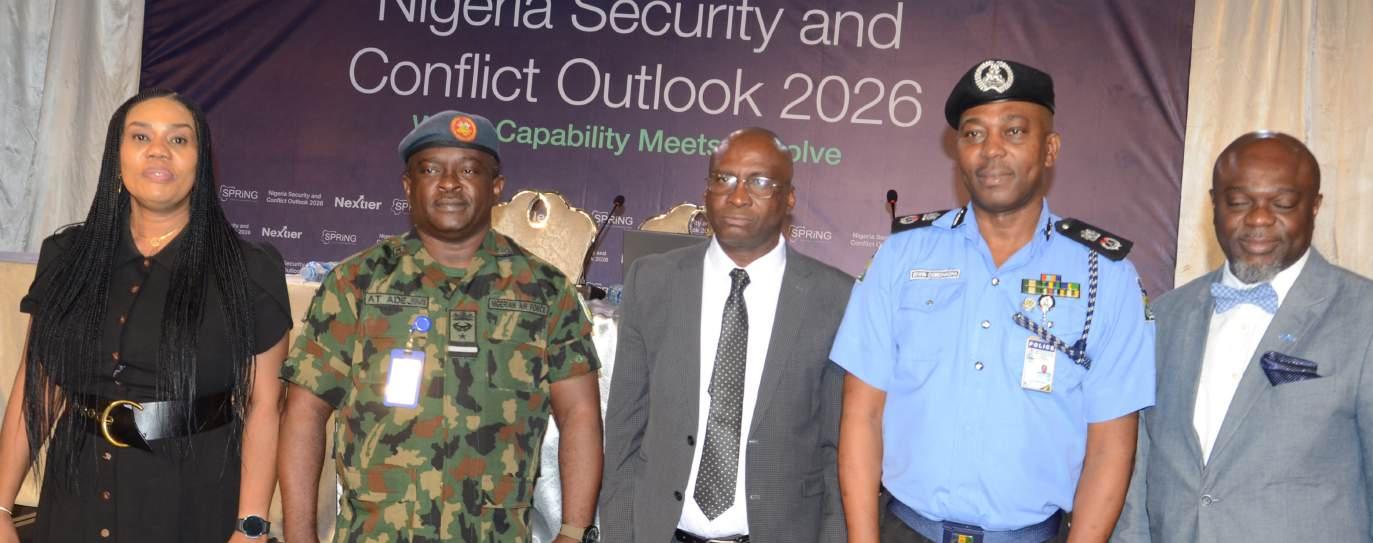
L-R: Acting Director of the Early Warning Directorate ECOWAS Commission, Dr. Onyinye Onwuka; Representative of Chief of Air Staff, Air Commodore Ademola Adejimi; Team Lead SPRiNG, Dr. Ukola Ukiwe; representative of Deputy Inspector General of Police, Research and Planning, Edwin Ogbeghahrg, and Managing Partner, Nextier, Mr. Ndubuisi Nwokolo; during the Nigeria Security and Conflict Outlook 2026 held in Abuja..recently
KINGSLEY ADEBOYE
‘Living Witness’? Wrong
YOU are welcome to this post-Valentine edition. I hope you used romantic words to celebrate it! Let’s go: “This explains the incidents of rural-urban drifts that have worsen (worsened) the security challenges in the cities.”
“NANS condones (condoles) with Irukwu’s family”
“Sarsoli flys (flies) Nigerian flag high at K2026 fair in Germany”
From Vanguard schoolboy blunders we move over to The Guardian of February 9 which nurtured two falsehoods: “Our committee has the responsibility to oversight (oversee) BPP….”
“…it is not to intimidate or witch-hunt them but to rub minds (dialogue, exchange ideas, discuss, talk, converse—not ‘rub minds’!) and enlighten….” How do you even ‘rub minds’?
THISDAY of February 6 grappled with basic grammar: “…the debate had far progressed beyond the introductory stage to the question and answer (question-and-answer) session.
“…has congratulated the National U-17 team, Golden Eaglets (another comma) for (on/upon) qualifying for the next….”
“But the minister seems to have swam (swum) into troubled waters recently with allegations ranging from insensitivity to abuse of office….”
From THE SATURDAY NEWSPAPER we cross over to THE NATION ON SUNDAY of February 15: “Voters apathy mars election” News: Voter apathy…
“The presidency, also aware of its interests, may do same (the same).”
“…takes a look at the fallouts, recent studies and how women are coping.” New WOMAN: ‘fallout’ is uncountable.
“Snoop Dogg, others join the EMA’s bandwagon” Entertainment plus: climb/jump (not
join) on the bandwagon
“S’West PDP passes confidence vote on (in)…”
“Rep debunks report of decamping (defection) to APC”
The PUNCH homes & property of February 2 goofed: “NEMA warns against building in flood prone (flood-prone) areas”
“Ecobank toll free (toll-free) number… The Pan African (Pan-Africa) Bank” (Full-page advertisement)
THE NATION ON SUNDAY of February 1 started the month on a faulty note all through most of the pages: “Bride or masquerade?” The mask/ effigy/masquerade is the object worn by a masquerader. Therefore: bride or masquerader?
“Bamanga calls Atiku, others treacherous” This is impossible because ‘treacherous’ is an adjective. The man called them traitors.
“Soludo assures support for construction of Nnewi mall” How can the governor assure support? The governor did not assure ‘support’—he either elicited support or gave an assurance of support to some people.”
“I wish you the protection of Almighty God and all your heart desires.” Get it right: heart’s desire (take note of the apostrophe and ‘desire’—not ‘desires’)!
“I and my family (My family and I—that is, if at all there should be separation since ‘I’ is a constituent of the ‘family) feel proud to celebrate a genuine Nigerian patriot….”
“We are all living witnesses to Yar’Adua Part 1” I am a witness, not a ‘living or dead’ witness!
Still on THE SUNDAY NATION under review: “The meeting of the Patriots with
President Bola Tinubu in Abuja, few days (a few days) to this week’s National Political Summit in Uyo….”
“Copy her two colour (two-colour) look”
Saturday PUNCH of January 31 goofed: “I won four golds as a nursing mother…” ‘The most widely-read newspaper’: four gold medals Daily Trust of January 29 continues the race with a few infractions: “The privilege (privileged) class has taken over virtually everything….”
“…power show in the country is choking the common man on the street….” My own view: the man/woman in the street (also the man/woman on the street) ‘Commonness’ is implied!
“...and that these have the potential to trigger off crisis (a crisis) the end of which nobody could fathom.”
Next is a special extract from the edition under review: “Reports said no fewer than 44 people were slaughtered penultimate Tuesday night by some unknown gunmen (we can never know the gunmen—so spare readers the ‘unknown’ trite!) at Dumba village on the outskirt (outskirts) of Baga town in the Kukawa Local Government Area of the state.”
“Our members have earned the allowances by working for the money and therefore we are not begging for crump (crumbs) from government.”
“She said the motive is (was) still unknown….”
Lastly from Daily Trust under examination:
“Police cordons town hall over crisis” A rewrite: Police cordon off town hall after crisis
Daily Independent Online of January 28 committed juvenile errors: “…dignitaries at the event took their turn (turns) to thrash out the problems politicians have infested Nigeria with.”
“Fresh 3,000 jobs in Osun as Aregbesola commissions (inaugurates) garment factory”
Of Network Bars and Ballot Boxes
On a cursory reading, the conditional clause attached to Section 60 of the amended Electoral Act on electronic transmission of results sounds reasonable. Nigeria, after all, is not Estonia. We still argue with electricity, negotiate with bandwidth, and occasionally consult the heavens before making a phone call from certain “remote” locations. To insist that results must be transmitted electronically in all circumstances, without qualification, may appear idealistic in a country where network bars can be as shy as public accountability.
Yet those opposing that conditionality are not being hysterical. They are speaking from lived experience.
The argument is simple: Nigerian political actors cannot be trusted to behave transparently when the stakes are high. Therefore, the law must compel what character has failed to guarantee. If immediate electronic transmission of polling unit results is not mandatory, the window for manipulation between polling unit and collation centre remains ajar - and in Nigerian politics, an ajar window is an invitation.
Senate President Godswill Akpabio has assured Nigerians that the Electoral Act 2026 (Amendment), recently signed by President Bola Tinubu, will ensure that “every vote will now count”. He argues that the perennial problem of result tampering after leaving polling units has been eliminated. The law recognises electronic transmission of results to the INEC Result Viewing Portal (iREV), a long-standing demand of civil society and opposition parties.
But there is a caveat. In areas with poor telecommunications infrastructure, the primary source of collation remains the EC8A forms signed at polling units. The explanation is that where there is no network, results will be uploaded once officials move to areas with coverage. That is the conditionality.
On paper, it is pragmatic. In practice, Nigerians are wary. They have seen how procedural grey areas morph into tactical opportunities. They remember the controversies of 2023, when the iREV platform did not function as expected during the presidential election, fuelling allegations of manipulation and eroding public confidence. Trust, once cracked,
does not mend with legislative poetry.
Telecommunications companies have reportedly claimed that they can cover the entire country, creeks and all. Critics have pushed back, questioning the realism of such assurances. Even if coverage exists, is it reliable, secure and resilient on election day, when traffic spikes and incentives for sabotage multiply?
President Tinubu, while signing the bill, emphasised the need to avoid glitches and unnecessary hacking. A sensible caution. But it inadvertently reinforces public anxiety: if hacking and glitches are credible risks, what independent safeguards exist? Who audits the digital infrastructure? Who certifies its integrity before and after elections?
At the heart of this debate is not technology; it is trust. There is a cavernous trust deficit between the governed and those who govern - across party lines, across institutions, across election cycles. Nigerians do not mistrust only the ruling party; they mistrust the political class, full stop. Both incumbents and opposition figures have, at various times, benefitted from opaque processes. The catalogue of broken promises and electoral brigandage stretches from the aborted Third Republic through the often turbulent elections of this Fourth Republic.
We have seen ballot box snatching, collation centre theatrics, judicial somersaults and post-election litigations that sometimes feel like alternative electoral seasons. Against that history, citizens demanding compulsory, immediate electronic transmission are not being unreasonable. They are asking for the law to do what morality has not reliably done.
The National Assembly insists the amendment reflects broad consultations and sacrifices, including shortened holidays to conclude deliberations. It also introduces direct primaries for political parties and mandates fresh elections where a declared winner is disqualified, rather than handing victory to a distant runner-up. These provisions, on their own, may deepen participatory democracy and avoid certain absurdities of the past.
But the optics trouble many Nigerians. A legislature dominated by the ruling party passes a consequential electoral amendment with notable speed. The President signs it promptly. The 2027 election timetable has already been released. INEC is reportedly seeking a budget far north of ₦800
“Influx of people stretch (stretches) our security—FCT CP”
“UN seeks Nigeria’s help to (at) restoring constitutional order in (to) Guinea Bissau” THE NATION ON SUNDAY of February 15 fumbled copiously: “…Ehoe division responded to a distress call at about 3.30pm (at 3.30 p.m.) that….”
“Traders commend FG over (for) intervention on (in) closed shops”
“…in this interview with reporters, he said the North’s allegations that they are currently marginalized was (were) baseless….”
Daily Trust of January 21 offered readers clownish mistakes: “4 family members arrested in Abia over murder of kinsman” A rewrite: 4 family members arrested for kinsman’s murder
FeeDBACK
IT is the broadcast media that are to blame for misleading the public through ‘assumption’. The general tendency has persisted because there are no fatalities or costly impact as in medicine or engineering. Now it is WRONG to refer to policemen or military personnel as security operatives. They don’t belong to the ‘official’ government security forces. Therefore security operatives are mere private security-men with some level of training in the field. In the past, they were called ‘watchmen’. Words and phrases freely abused in Nigeria are ‘severally’, ‘media parley’, ‘general election’, ‘charges’. ‘hitch’/’glitch’, etcetera. We now have an array of sources to learn from. Today’s journalism is knowledge driven.
Sunny Agbontaen, Benin City (07043524368)
billion for the exercise - a staggering sum in a country where hospitals wheeze and universities beg. For that money, Nigerians will expect not merely an election, but an unimpeachable one. Comparatively, established democracies treat the chain between voting and collation as sacred. In the United Kingdom, paper ballots remain primary, but counting is transparent, local and open to observers, with clear audit trails. In the United States, despite decentralised administration and partisan tensions, layers of verification, bipartisan oversight and judicial review exist to check malfeasance. In India, electronic voting machines are backed by voter-verifiable paper audit trails, allowing physical cross-checks. The lesson is consistent: transparency is not an afterthought; it is engineered into the process.
Nigeria’s challenge is more complex. We are large, diverse, infrastructurally uneven and politically combustible. But complexity cannot become a perpetual alibi. If electronic transmission is recognised as the gold standard for preventing post-polling manipulation, then the state must invest in making it universally feasible - not selectively optional.
Otherwise, we risk a familiar post-election script. Parties that lose will cite network failures and manual collation irregularities. Parties that win will praise the system’s integrity. INEC will defend its procedures. The courts will be inundated. Citizens will retreat further into cynicism. And cynicism is democracy’s silent assassin.
The argument that EC8A forms signed by presiding officers and party agents are sufficient as primary documents is legally sound. But law without confidence is brittle. The moment citizens suspect that manual processes can be exploited in network-poor areas, the legitimacy of outcomes in those areas becomes contestable.
This is not merely about technology; it is about psychological assurance. Voters must feel that once they thumbprint a ballot, their choice is locked in, traceable and immune from midnight metamorphosis.
What, then, should Nigerians expect as the electoral cycle rolls in?
First, clarity. INEC must publish detailed operational guidelines explaining precisely when and how electronic transmission will occur, what constitutes “lack of network”, and how such claims
will be independently verified.
Second, transparency audits. Independent cybersecurity experts - local and internationalshould test the system publicly. Simulation exercises should be conducted well before election day.
Third, accountability. Clear sanctions must be attached to officials who fail to transmit results where network exists or who manipulate manual collation processes.
Fourth, political maturity. Parties must commit in writing to abide by transparent processes and refrain from inflammatory rhetoric that undermines institutions before ballots are cast.
Ultimately, no electoral law can compensate for a deficit of character. As the President himself observed, systems are managed by people. But precisely because people are fallible - and sometimes ambitious beyond propriety - systems must be designed to minimise discretion where discretion invites abuse.
Nigeria stands at a delicate junction. The promise that “every vote will count” is powerful. It must not become another slogan filed under “aspirations unmet”.
If the amended Act succeeds, it could mark a turning point in restoring faith in the ballot. If it falters - through loopholes, glitches or selective enforcement - the erosion of trust may accelerate beyond repair.
Democracy is not sustained by laws alone; it is sustained by belief. The 2027 elections will test not just electronic devices and network strength, but the sincerity of a political class long viewed with suspicion.
In the end, Nigerians are not asking for perfection. They are asking for certainty - that their vote leaves the polling unit exactly as they cast it, and arrives at the collation centre untouched by invisible hands. That is not a technological fantasy. It is the minimum requirement of a republic that expects to be taken seriously.
MiChAEl EhindEro:
Teaching Chemistry, Biology After School Funded My Professional Exams
From a laboratory trained in microbiology to the boardrooms of one of the world’s biggest spirits companies, Managing Director of Pernod Ricard Nigeria Michael Ehindero’s career defies convention, it speaks to a deeper instinct for reinvention. Calm, reflective, and quietly audacious, Ehindero is not your typical industry executive. His journey cuts across science, professional accountancy, and multinational leadership spanning Nigeria, Europe, and Angola where he steered Pernod Ricard business to astounding market dominance and profitability. In this conversation with Omolabake Fasogbon, Ehindero reflects on the values that shaped him growing up in Nigeria, lessons from Angola, industry challenges requiring discipline to surmount and why moderation and sustainability are redefining the future of the wine and spirits industry. Excerpts:
You started out in microbiology. How did you end up in finance?
Finance was definitely not my first choice. My first degree was in Microbiology, but very early on, just after university, I began to question whether that path truly reflected who I was. While I enjoyed science, the career trajectory felt too inward looking for my personality. I am a mix of an introvert and extrovert. I enjoy reflection, but I also thrive on interaction and seeing the bigger picture. I wanted a career that allowed me to engage more broadly with people, businesses and systems. I also knew I was comfortable with numbers, so finance became a natural pivot.
How challenging was the transition?
On the surface, microbiology and accountancy seem very different, but at their core, both are logical disciplines. I have always believed that if you apply your mind properly, you can learn almost anything. The transition was not intellectually difficult; it was more about mental adjustment. Once I committed fully, the process became smooth. I went into professional accountancy studies with ICAN eventually qualifying as a chartered accountant, and in that period worked at KPMG. That experience reinforced a key lesson for me: mindset often matters more than background.
How did your family respond to this decision?
Interestingly, I did not tell my parents immediately. At the time, I was serving in the NYSC and funded my professional exams myself by teaching after school classes in chemistry and biology, subjects that were in high demand. That income sustained me through the transition. My initial ambition had been medicine, but circumstances in Nigeria at the time made that difficult due to challenges within the university admission process. Eventually, I learned that life is not always about following your original plan. Life rewards adaptability, courage and self-awareness.
Growing up in Nigeria, what values stayed with you most strongly?
Resilience, without a doubt. Nigeria teaches resilience whether you like it or not. Growing up here forces you to think on your feet. My father used to say, “Don’t lose your sense of smell,” meaning you must always stay alert to opportunities. There are many reasons to feel discouraged in Nigeria, from economic pressures to systemic challenges, but we remain optimistic. You cannot just hope things will improve; you must seek opportunities, solve problems and make a difference, not just for yourself but for the wider society.
You’ve had an interesting career spanning KPMG, Cadbury and now Pernod Ricard, most notably in Angola, your last posting before returning. How did you navigate leading the business in that new environment?”
Nigeria prepared me well. The resilience and work ethic Nigerians imbibe tends to stand us out wherever we go. When I arrived in Angola, I immersed myself fully in the environment. I learned Portuguese on my own, both spoken and written, and took time to understand the culture and business landscape. That effort helped me earn credibility. It was also my first role in general management and it came with significant challenges especially due to the deep economic challenges faced by the country in that period. By the time I left five years later, the business had become the dominant market leader, profitable and largely debt free (managed leverage), with a highly motivated workforce. That experience shaped my leadership approach in a very fundamental way.
How would you compare Angola with Nigeria in terms of business environment?
I often joke that Angola is like Nigeria, just on a smaller scale. Across Africa, many markets share similar challenges such as currency volatility, high inflation growth rate and unemployment, but they also share immense opportunity. Africa has a young, aspi-
Ehindero
Super Saturday
Michael Ehindero: Life Rewards Adaptability, Courage, Self-awareness
rational population and growing consumer sophistication. Whether it is Nigeria, Angola, Ghana or South Africa, success comes from understanding local dynamics, tuning them to your business advantage rather than being overwhelmed by the challenges.
Your Angola record, including over six percent market share growth in five years remains remarkable. How are you replicating same in Nigeria?
I daresay that we are already on that path, data is there to prove this though I acknowledge that it will be stiffer competition here due to the nature of the Nigeria business culture and opportunity. The 2024 International Wines and Spirits Report (IWSR) which is the industry’s widely accepted benchmark measure, rates us as number one in Nigeria’s premium plus segment. We now lead with the top Irish whiskey and Cognac brands, while even our mainstream labels have risen to become category leaders. It’s a clear trajectory of success. As I often tell my team, Angola was a great school for me, not just in delivering financial results but in consolidating on resilience and innovation. Here in Nigeria, we have piloted bold marketing activations, including the landmark Martell Tower and its latest edition, The Martell on the Move encompassing two elements – Martell Voyager and the Swift Ascendant. In the past year alone, we have won about 14 to 15 industry awards, underscoring our momentum. And beyond my own experience, I am backed by a solid team, truly the best in the industry which makes me confident that we are on a very strong trajectory.
As the MD, how are you getting to align the company’s global priorities with the unique realities of the Nigerian market?
Nigeria is a key focus for us. Since establishing a full subsidiary here in 2012, we have operated end-to-end from production to importation, sales, and distribution which reflects our long-term commitment. Nigeria is potentially the largest economy in Africa and one of the most promising; so it is only natural that we invest deeply in this market. Our presence is not just about profits; it is also about developing people and talent. Many Nigerians who started their careers here have
grown into roles across Europe and other parts of Africa, which shows the opportunities this market creates. For us, aligning global priorities means adapting to local realities while building capacity, nurturing talent, and ensuring Nigeria remains central to the group’s vision.
You have lived, studied and worked across different geographies. How has this exposure shaped your outlook on life and business?
My education and career have been a blend of academic learning and professional experience across different countries, and that exposure has shaped my worldview significantly. It gives me an international outlook on how I process information, approach problem solving and relate with people from different backgrounds. What has been particularly helpful is that my education has never been detached from reality. It has always been closely linked to the markets I work in and the decisions I
make daily. That balance between ideas and execution has been very important in shaping who I am as a professional.
The local wine and spirits industry faces distinct regulatory, economic, and social challenges. What key risks do you navigate as a leader?
For me, I would say the most significant challenge remains counterfeiting. This represents a massive loss of revenue to both governments in the form of taxes and to legitimate operators and more importantly, poses serious health and safety risks to consumers. Despite the billions invested by manufacturers in production, marketing, and distribution, counterfeiters continue to exploit the system.
How in your opinion can this threat be curtailed?
For us, we have taken some innovative steps which combine technology, partnerships and education. Initiatives like Glass to Life help remove bottles from circulation, making it harder for counterfeiters to reuse them. By actively removing used bottles from circulation, we address not only environmental concerns but also brand security and consumer protection. We also work closely with regulators. Ultimately, an informed consumer is the strongest defense. Counterfeiting remains a major issue not just in alcohol, but across multiple product categories in Nigeria. It thus requires sustained and collective action to tackle.
Sustainability appears central to the business strategy.Why is this so important?
Given our extensive global footprint, we are acutely aware of our environmental impact. As a result, both our global and Nigerian operations have made sustainability central to how we do business. Environmental responsibility is not an add-on; it is core to our corporate identity. In practical terms, this means eliminating single-use plastics across our activations and offices—no plastic straws, cups, or bottled water. We have also extended these commitments into our production processes. For instance, the Absolut Vodka factory in Sweden operates as a carbon-neutral. In Nigeria, we are driving local sustainability
initiatives such as Glass to Life, which focuses on collecting post-consumer bottle waste and reintegrating it into the circular economy through recycling. Working with partners across the country, we are turning waste into value while reducing environmental harm.
So how do you embed these values inSustainability is embedded in how we work, from town hall meetings to business and marketing plans with a constant focus on reducing waste. Through initiatives like ‘Bar World of Tomorrow,’ employees and partners learn how waste, especially glass, can be repurposed into useful products like cup, glass, chandeliers etc
This approach extends to our brands and consumers. We minimize the use of natural resources at every step by imagining, producing and distributing our products and experiences in ways that reduce carbon emissions and waste. We redesign packaging, such as Chivas 18, to reduce glass use, and at events we eliminate single-use plastics and replace with biodegradable alternatives such as paper or edible straws and cups. We replace bottled water with water refills and promote responsible drinking. Each touchpoint also serves as consumer education, reinforcing our commitment to sustainability.
The company is so intentional about its stance on moderate drinking. How does it get to reconcile this with its growth and profit objectives?
Globally, our vision is to be creators of conviviality but conviviality does not mean irresponsibility. True enjoyment has no place for excess. When people lose control, conviviality is lost, and that is not what our brands stand for. Our role is to bring people together, not to create harm. We believe moderation enhances experience and we champion balanced and convivial drinking as a conscious and aspirational choice. In that sense, profitability and responsibility are not in conflict; they reinforce each other. Ultimately, we will never put profit ahead of the health and wellbeing of our consumers.
See concluded part on www. thisdaylive.com
Aishah Ahmad Recognised by Maternal Lineage in Imesi-Ile
Former CBN Deputy Governor now holds
southern parts of the country, writes
Aformer Deputy Governor of the Central Bank of Nigeria (CBN), Aishah Ndanusa Ahmad, has been conferred with the traditional title of Yeye Tayese of Imesi-Ile - a chieftaincy honour from her maternal Ijesha lineage in Osun State.
The title, which translates to ‘Mother Who Promotes Societal Progress,’ was conferred by His Royal Majesty, Oba Ademola Akinyemi (Oyoyo II), the Owa-Oye of Imesi-Ile, on behalf of the Owa-Oye-in-Council and the Kingdom.
Speaking on the conferral, Oba Akinyemi described Ahmad as a leader whose achievements reflect the values Imesi-Ile seeks to uphold.
“The title of Yeye Tayese is reserved for women of exceptional character - those who have demonstrated not only personal success, but a commitment to lifting others,” the monarch said.
“Aishah Ahmad has served at the highest levels of national leadership, yet she has remained connected to this community. She has shown that it is possible to operate on the global stage while staying rooted in tradition. That is the kind of leadership we are proud to recognise,” he added.
The installation ceremony, held on Thursday, February 5, was intentionally private, with family members in attendance and no press coverage. Ahmad’s husband, Brigadier General Abdallah Al-Hassan Ahmad (Rtd), a retired military officer with over three decades of service including United Nations peacekeeping missions, was also honoured with the title of Baba Tayese, in keeping with Yoruba tradition.
Rooted in Two Homelands
With this, Ahmad now holds traditional titles from both sides of her heritage - Soniya
traditional title from both the north and
Sunday ehigiator
Asusu Nupe and Yeye Tayese. On her paternal side, she descends from the Ndanusa family of Nupe lineage in Niger State. Her title, Soniya Asusu Nupe, designates her as Custodian of the Commonwealth of the Nupe people and Chief Adviser to the Etsu Nupe on socio-economic affairs. Through the Amfani Zhiba Foundation, which she founded to serve her father’s homeland, she continues to support women’s empowerment and youth development in Bida and across northern Nigeria. She recently delivered a TEDx talk
in Minna on structural development challenges in northern Nigeria. On her maternal side, she descends from the Ilerio and Akegun dynasties of Imesi-Ile - a lineage that places her within the Kingdom’s traditional aristocracy. Her relationship with the town has been longstanding, with close ties to its people and history maintained since childhood.
That connection is reflected in her coauthorship of ‘Florence: Daughter of Akegun,’ a book chronicling the life of her grandmother, Florence Bamidele Makanjuola, and preserving aspects of Imesi-Ile’s cultural origins. Nigeria’s social fabric has long been shaped
by families whose identities span regions and cultures. Such layered heritage is neither unusual nor new; it is part of the country’s lived reality. Leaders who carry more than one tradition often develop a natural fluency across communities. In this sense, Ahmad’s dual recognition reflects not only personal lineage, but the broader possibility of unity within difference.
Culture as Foundation
For Ahmad, cultural heritage is not separate from institutional leadership - it informs it.
‘Knowing who you are - where you come from, the traditions that shaped you - creates a sense of responsibility,’ she said. ‘In public office or in traditional council, the work is ultimately the same: stewardship. It is about safeguarding people, institutions, and opportunity for the next generation.’
She describes her northern and southern recognitions not as parallel honours, but as a continuity of service across communities that have shaped her life.
Bridging Institutions and Communities
Ahmad’s three-decade finance, governance and policy career includes service as Deputy Governor of the Central Bank of Nigeria (2018-2023). She is the founder of Bridgforte, a convening platform focused on financial governance and inclusion, which recently held dialogues on the sidelines of the United Nations General Assembly. She also serves as Chair of the Expert Leaders’ Group at the Graca Machel Trust, a pan-African network of former and serving female deputy governors and finance ministers.
Ahmad is a recipient of Nigeria’s national honour, Officer of the Order of the Federal Republic (OFR), and a CFA charter holder.
Aishah Ahmad (left), after her conferment with the traditional title of Yeye Tayese of Imesi-Ile by Oba Akinyemi in Osun…recently Photos: Adedigba Adetayo
Ehindero
Removing Barriers to Fiscal Federalism, Sub-national Growth
James emejo, assesses efforts by the federal government through National Economic Council to enhance states’ capacity and readiness to better contribute to the national economy and create impact at the grassroots
One of the high points of the recently concluded 2nd National Economic Council (NEC) Conference with the theme, “Delivering Inclusive Growth and Sustainable Development: The Renewed Hope National Development Plan”, was the need to enhance fiscal governance –ensuring that subnational governments remain competitive and growth-focused, taking advantage of the ongoing fiscal reforms, particularly clearing obstacles to the implementation of the Nigeria Tax Administration Act, 2025 (NTAA 2025) at the state level.
The meeting was a clarion call to government at all levels to prioritise spending on human capital development, enabling infrastructure and improved accountability to strengthen trust amid unprecedented revenue boost resulting from major reform initiatives including subsidy removal by the administration of President Bola Tinubu.
The recommendations at the end of the two-day conference specifically called on states to enact the harmonised tax law to address multiple taxation and complement the new tax reform laws. NEC, while commending the 12 states for passing the harmonised tax law, further urged 13 others that have their laws at the State Assemblies, and the 11 others that are yet to conclude the process - to accelerate the passage of the new law which promises to usher prosperity to the people.The stakeholder also called for an expedited amendment to the constitution to remove certain inconsistencies in the implementation of fiscal federalism to enable effective rollout of the tax regime at the federal and sub-national levels of government.
To further strengthen interstate strategies and collaboration in a federal system, the meeting concluded that states should institutionalise joint planning, shared resources, harmonised policies, and structured information exchange, supported by formal legal and institutional frameworks, as well as regional cooperation platforms to address shared challenges and promote balanced development.
The Council recommended that federal and state governments should establish regular intergovernmental engagements, capacitybuilding programmes, and conflict-management frameworks to jointly address insecurity, infrastructure gaps, and economic disparities across the federation.
The federal and state governments are also required to foster strong partnerships with the private sector, civil society, and development partners to achieve inclusive and sustainable national development.
Presidential approval
Meanwhile, President Tinubu said the gathering reflected a collective dedication to national progress, and hailed NEC, chaired by Vice President Kashim Shettima, for sustaining a vital platform for policy coordination and strategic dialogue.
The president said the Council remained a cornerstone of fiscal federalism and economic governance in the country.
He stressed that the economic reforms undertaken since the inception of his administration had helped stabilise the economy and restore confidence.
Tinubu said, “I am pleased to address the second edition of the National Economic Council Conference at a critical moment
Send App by Flutterwave, a cross-border remittance solution from Africa’s leading payments technology company, has launched “Send App Postcards,” a new campaign that introduces a personalised year-in-review experience, transforming users’ remittance activity into visual, shareable digital stories.
Global remittances are often discussed in terms of volumes and foreign exchange flows, an approach that frequently overlooks the emotions, sacrifices, and commitments of both remittance senders and recipients. Send App Postcards aims to change this narrative by shifting the focus from transactions to people, highlighting how every remittance tells a deeply human story.
From tuition paid and medical emergencies covered to weddings supported and simple “thinking of you” moments, the campaign illustrates how money sent across borders represents love, responsibility, and lasting impact.
in Nigeria’s development journey. NEC remains a cornerstone of fiscal federalism and economic governance in our country.
“I must say again at this juncture, the monetary policy that we have embarked on since the reforms has yielded positive results and gained recognition around the world.”
He commended the Central Bank of Nigeria (CBN) under the watch of Governor Yemi Cardoso for restoring confidence in the country’s monetary policy.
The President said state and local governments now receive increased, more predictable federal allocations, enhancing their capacity to pay salaries, invest in infrastructure, and deliver social services. He added that infrastructure development across transportation, power, digital connectivity, housing and irrigation has been prioritised.
Tinubu also highlighted expanded social investment and human capital programmes targeting vulnerable households,
“Sending money home is often a quiet act of love. We wanted to make some noise for our users, moving beyond the transaction receipts to celebrate the love and care that defines living across borders with the commitment to supporting loved ones back home,” said Harvey Bahia, Head, SendApp Business, Flutterwave.
“With Postcards, we are helping our users visualise the real impact of the money they sent in 2025, the lives they touched, and the connections they sustained throughout the year,” a statement quoted him to have added.
The postcards are available directly within the Send App on Android and iOS devices. Users can now view, save, and easily share their Postcards across multiple channels to celebrate their impact. Each Postcard includes a “Worth of Love” metric that shows the total amount sent to family and friends in 2025, as well as personalised sender persona badges based on individual sending habits.
youth, women and small businesses, alongside grassroots-focused initiatives under the Renewed Hope Agenda.
He said, “The Renewed Hope Ward Development Project further demonstrates our commitment to grassroots inclusion through a bottom-up approach to national development.
“These successes reflect strong collaboration among the federal and state governments, development partners and the private sector.”
In the Renewed Hope National Development Plan 2026–2030, the President explained that it represents the next phase of Nigeria’s national journey, anchored in inclusive, resilient, and environmentally sustainable growth.
He said, “The Plan prioritises economic diversification and productivity; human capital development; subnational competitiveness based on comparative advantage; private sector-led growth; and climate resilience.
“Its success will depend largely on effective implementation at the state and local government levels, making NEC central to aligning national priorities with subnational realities.
The president stated that, “This Conference has reinforced collaboration, shared accountability and a focus on practical solutions and measurable outcomes.
“We must move decisively from declarations to implementation through data-driven decision-making, peer learning among states and innovative financing models.”
He added that while the task before the nation was challenging, the opportunity is historic, and expressed confidence that resolutions from the conference would advance agricultural diversification, including dairy farming, livestock investment and ranching.
On his part, Shettima, called for deeper collaboration among the three tiers of government, describing the council as a decisive forum for shaping Nigeria’s economic direction through debate and consensus. According to him, “The relevance of this council lies not in the size of its membership but in the quality of ideas it generates.”
The vice president urged members to prioritise poverty reduction, job creation, fiscal sustainability and stronger inter-regional trade, noting that “inclusive growth must translate into tangible improvements in the lives of our citizens.”
Fiscal Milestones
On his part, the convener of the conference and Minister of Budget and Economic Planning, Senator Abubakar Atiku Bagudu, commended the President’s sustained engagement with the council as symbolic of respect for Nigeria’s federal structure, noting that recent reforms had strengthened fiscal conditions nationwide and boosted international confidence in the economy.
Bagudu, whose ministry also serves as the Secretariat of NEC, specifically hailed Tinubu for strengthening the nation’s federal system, noting that his economic reforms have increased funds for the subnational governments to provide more amenities for their constituents.
He highlighted the president’s support for the NEC, which includes the 36 state governors and the Federal Capital Territory (FCT). Bagudu said the president had fostered greater cooperation among the federal, state, and local governments, referencing his passionate interest in
MasterChef Nigeria Launches Search for Best Home Cook, to Offer N73m
MasterChef has officially landed on Nigerian shores. Brought to the country by African media giant Primedia, MasterChef Nigeria, the inaugural local adaptation of the world’s most renowned reality television cooking show, is set to transform the Nigerian culinary landscape – and the lives of passionate home cooks who dream of taking their creative flair in the kitchen to the next level.
The winner of MasterChef Nigeria will scoop a staggering N73 million and make history as the world’s first-ever Nigerian MasterChef. Entries are now open for this life-changing opportunity, with the closing date on 27 February 2026.
MasterChef Nigeria, which will be screened on DStv’s Africa Magic Showcase and Africa Magic Family, forms part of the global MasterChef television franchise, represented internationally by Banijay Entertainment, which is also the content powerhouse behind iconic series such as Big Brother and Survivor.
The deal for this new version was negotiated by Banijay Rights, the global distribution arm of Banijay Entertainment.
The MasterChef format, created by Franc Roddam and first launched in 1990, has catapulted the careers of countless culinary stars across 720 countries while showcasing the unique food culture of each territory. As recognised by the authoritative Guinness World Records, it is the most successful cookery show in the world. Over 700 seasons and 16,000 episodes have aired to date.
“MasterChef Nigeria is a major Nigerian television milestone that will celebrate the country’s exquisite cuisine, innovative food culture and vibrant culinary traditions as never before, whilst unearthing, mentoring and nurturing talent with the potential to become Nigeria’s next generation of distinguished chefs,” said Tamara van Eeckhoven, Managing Director at Primedia Africa.
“We encourage all home cooks who want to make a name for themselves in the dynamic Nigerian food industry to enter this profound competition.”
Tinubu
Bennett Oghifo
•Tourism •Arts&Culture
Boost for Argungu Fishing Festival
The 61st Argungu International Fishing and Cultural Festival, which was held recently and attended by President Bola Tinubu, once more put Nigeria on the global tourism map.
The festival showcased Kebbi State’s rich cultural heritage, agricultural products, livestock, and solid minerals.
Before now, the Argungu International Fishing and Cultural Festival was suspended for several years but was revived by Governor Nasir Idris.
As part of preparations for the festival, the Kebbi State Government through the State Investment Promotion Agency worked round the clock to ensure the event recorded a huge success, targeting foreign investors and promoting economic growth.
The Kebbi State Investment Promotion Agency Director General of the agency, Dr. Muhammad Kabir Kamba, announced that foreign investors from Europe and Asia had expressed interest in attending the festival, following Governor Nasir Idris’ overseas visits.
“We are expecting a large turnout of investors who are interested in exploring the state’s abundant natural resources and exploring possible partnerships with the government and people of Kebbi State.”
Anticipating a large influx of visitors, the Agency also sensitised hotel owners to upgrade their facilities. “We are working with hotel owners to ensure they upgrade their facilities to meet international standards,” Kamba said.
Also, as part of arrangements to make the festival economically viable, a consultative forum was organised to bring together investors, government institutions, and the indigenous business community to explore partnership opportunities.
Governor Idris assented to a law authorising the issuance of Certificates of Occupancy for residential, commercial, and industrial plots across the state.
While addressing mammoth crowd at the fishing festival, Tinubu described the 61st Argungu International Fishing and Cultural Festival as a testament to the return of stability and normalcy in Kebbi State and across the country.
The president also pledged the federal government’s sustained support for tourism, agriculture, food security, and rural development.
The President commended Governor Idris for successfully organising the historic cultural event, which attracted over 50,000 fishermen from across Nigeria and neighbouring countries.
The four-day festival featured cultural displays, water competitions, traditional boxing, and dancing.
On security arrangements that enabled the festival to be hosted safely and successfully, he commended the governor for doing a good work.
“The organisation, security arrangement, and internal outlook of the event demonstrate what is
The 61st Argungu
International Fishing and Cultural Festival attracted tourists from all walks of life, writes Charles Ajunwa
possible when leadership is purposeful and inclusive.
Thank you, Mr. Governor of Kebbi State. You are a team leader, and you are demonstrating it.
”A socio-cultural event like this can only thrive and become a tourism attraction where the security atmosphere is conducive,” he added.
On the ongoing fight against insecurity, he said,
“The relative peace we are witnessing today in this region is not accidental. It is the result of sustained investment in security, intelligence gathering, and community engagement.
“Our farmers, including the fishermen, traders, and families, will be able to go about their lives without fear or injury. This festival is a testament to the return of stability and normalcy.
“We will continue to support it and encourage it.
Our traditional leaders, particularly the custodians of this festival, remain at the heart of our national agenda. We are deliberately investing in programs that empower youth, women, and rural communities.”
Highlighting the federal government’s commitment
to agriculture, the President reaffirmed support for farmers, fishermen, and rural communities.
”Working jointly with the state government, we will continue to give our farmers the necessary support. Kebbi State is recognised for its commitment to food security and agricultural production. We will work together to make it a great economic success,” he added.
The president also emphasised the unifying power of culture, noting: “The Argungu International Fishing Festival brings together people of different backgrounds, nations, and beliefs in the spirit of friendship and healthy competition. It showcases our heritage and projects Nigeria in a positive light to the rest of the world. I commend the organisers, and I reaffirm my commitment to peace, empowerment, food security, and infrastructural development of the Federation.”
In his remarks, Governor Idris thanked the President for honouring the state with his presence. He reaffirmed the state government’s commitment
to sustaining the festival as a platform for cultural preservation, tourism development, and economic empowerment.
Emir of Argungu, Sama’ila Muhammad Mera, in his speech expressed delight that the ancient waters of Matan Fada, the grand fishing arena, once again witnessed the traditional gunshot after nearly six years of a hiatus.
”For 61 editions this festival has endured not merely as a competition but as a testament to the capacity of our people to choose courage over conflict and friendship over feud.
”Your presence here, Mr. President, is not an ordinary honour. It is a profound identification with these core values: Courage, reconciliation, peace, and friendship. These are the values that guide national cohesion, good governance, and progress, which are pillars of Mr. President’s Renewed Hope agenda,” the Emir said.
He praised the President’s initiatives, saying: ”We see this agenda made manifest in the student loan fund programme, provision of primary healthcare, and expanding access to life-saving vaccines for our children.
“We note with immense pride your leadership in retraining health workers, efforts that have rightly earned you the position of African Union Champion in Community Health.
”In public works, your vision is unmistakable. The coastal highway and Ilela-Badagry Highway, which Kebbi State stands as a single largest beneficiary, are not mere roads; they are arteries of prosperity connecting our rural farmers with the outside world.”
Announcing the results of the fishing competition, the Deputy Governor of Kebbi State, Senator Umar Abubakar Tafida, who chaired the Festival Organising Committee, saud that Abubakar Usman from Maiyama Local Government Area emerged overall winner with a 59kg catch and received N1 million and two brand-new cars.
Abdullahi Garba from Argungu placed second with a 40kg fish.
The state government awarded him N750,000, a brand-new car, and a Hajj seat.
The third position was jointly claimed by two contestants from Jigawa and Kogi states with a 33kg catch.
They got N1 million and a motorcycle each.
All four winning fish were presented to President Tinubu as a souvenir.
Maggi Unveils Tales of Ramadan Season 2
Charles Ajunwa
Maggi, one of the products of Nestle Nigeria, has unveiled ‘Tales of Ramadan Season 2’, which has six episodes that will air weekly over the next six weeks on some selected social media platforms and television stations across the country and beyond for the Muslims faithful during this year’s holy month of Ramadan.
Managing Director and Chief Executive Officer of Nestle Nigeria, Wassim Elhusseini and his wife, guests, cast and crew all gathered at Ebony Life Cinema Place, Victoria Island, Lagos, where two out of the six episodes of Maggi Tales of Ramadan Season 2 were unveiled.
Two of the episodes tell the story of family and friendship, with the actors and actresses displaying real energy. The two episodes ended with a taste Maggi, as different delicacies cooked with Maggi ingredients were lavishly served and all those who enjoyed the meals demanded for more.
Category Lead for Maggi Culinary for Nestle Nigeria, Funmi Osineye, said Ramadan is at heart of Maggi.
“It’s something that we care and we are
passionate about because of our consumers. And it’s not something we just started now, it’s something that we have been doing over the years.
“It has evolved over the years, we started with cooking with families, showing cooking
recipes and we evolved it from showing cooking recipes to showing bonding with families. Showing what happens, which is community bonding and sharing during the holy month of Ramadan,” she said.
On the concept behind the movie, Osineye said, “Because we are a brand that really cares about our consumers and we know that the month of Ramadan is one important month for our Muslim faithful, who are a major part of our consumers. So we feel that we have to do something that resonates and really brings them together. Ramadan is all about fasting, praying, and sharing. For us, as a sharing brand we feel that we should bring stories that they can resonate with and that they can learn and take something out during the month of Ramadan. It’s a family story, so we want them to have a takeaway out of it that can resonate with the family and really bond the family.”
According to her, “Maggi is all about food, and what food does is to connect people together. So in tourism, movies, and anything we do it’s all about food and connecting those sharing moments together.
“What I will say to the younger and older ones is eat healthy. Whatever you do ensure that it’s a healthy lifestyle and use our products. Our products are made from fresh ingredients that you know and you love on your kitchen. Take for example, our Maggi Chicken you have inside onions, tumeric and others. These are
things you use every day in your family. So in whatever you do, eat healthy, use Maggi and bring that taste to your cooking.”
On what to expect in future, she said “This is the second of Tales of Ramadan, we had the first season last year where we had 30 days of amazing stories that we took as project and this year is not different. This year, we have 30 days of Tales of Ramadan and you will be seeing all the episodes. We have six episodes, you just saw six out of it and we have four more. We are telling you to stay tuned on our U tube, Facebook, Tik Tok, Instagram channels and all the television channels that we are going to be viewing the movie. This is not a stop for Maggi, it’s something that is going to become a household name and you will look forward to every Ramadan to viewing it.”
The series is produced by Josh Olaoluwa, Goodness Emmanuel, and Hope Eniayekan through Conceptified Media, with cinematography by Timmy Davies, while Tomi Folowosele returns as head writer following her work on the first season.
The series is directed by Orire Nwani and Adeniyi J. Omobuleijo, who previously directed ‘Irora Iya’, a series about the harrowing journey to motherhood. The cast includes Lucy Ameh, Sani Muazu, Saeed Mohammed (Funky Mallam), Abba Alli Zaky, Farida Abdullahi, Yakubu Mohammed, Rabiatu Suleiman, and Chidinma Ugwu.
Argungu Fishing Festival
Osineye
Sammy Sodeke: Touring with Lagbaja Opened My World to Global Music, Artists
Led by its CEO, Sammy Sodeke, Aristos Band appears to be the band of choice for corporate, social, and high-profile events, possessing a wide repertoire of old, current and classic tunes that appeal to both young and old folks. A versatile musician, Sodeke relieves his experience in the industry, his days with the masked Afrobeat musician Lagbaja. An adept saxophonist, “Sammy Sho” as he is well known, shares his brand uniqueness, why his 35-man ensemble stands out, and his love for jazz. Ferdinand Ekechukwu brings the excerpts
When did you start your career and how long have you launched your brand?
Well, I started from the church as a young drummer then I started playing keyboards. After I left secondary school I joined Lagbaja (veteran Nigerian Afrobeat musician) to play as a keyboardist for seven years. While I was in the university, I’m a graduate of Microbiology, Lagos State University. At the point along the line while I was still there at the time, I started the band in 2006-2007, that’s how Aristos Band started. At the same time we had Aristos Entertainment that was doing artist management and all of that. We were managing a couple of guys, I wouldn’t want to mention names, some of the great guys that you know today in the live band industry passed through Aristos management. And by the Grace of God the number has been growing since then till now.
To put you on record, when exactly did you launch your band professionally? I would say 2008.
Can you tell us some of the places you have performed over the years since 2008 till now?
By the grace of God we have performed almost everywhere, even outside the country. We have done several cooperate events, social events, we have played for governors, we have played for top cooperate bodies and individuals, and then a few years ago we started performing outside the country. We’ve done our UK concert, we did a couple of stuff in Canada and we are planning our US tour as well. So God has helped us.
Since you started, what are the challenges you faced knowing Nigeria and considering the youth (young ones) who could be considered as digital consumers or so and averse to live band performances?
Well the challenges would be the same challenges you face as an individual when you are starting new. It can take a while for
people to accept it you know. Like any other business starting from the scratch. But if you are consistent, and if you know what you want, for me, I’ve always known what I wanted. And with my experience playing, even before I played for Lagbaja I played different other music; I played juju; I played in almost every churches you can think of, every denomination. So I have that vast experience and working with Lagbaja for that number of years exposed me in all over the world travelling, touring with him and I met different artists. So starting the band I knew what I wanted. Going the other route, like putting a band together is serious business, its serious work, playing serious music. So, but you see people know what they want. And after a while we keep changing our sound, defining our music to suit our target audience. We may primarily not be for everybody. Even the digital sound you talked about we play at event and the young crowd love our music because of the way we merge sounds. But what is actually peculiar in our sounds is the heavy percussion. But we fused into the modern music, take the oldies, foreign, hip-hop, everything, then put together sound appeal to the crowd. So what we do is we study the crowd at an event and give them what they want. If it’s cooperate gathering we give them what they want, even if it’s wedding we have the old folks, we have the young folks. And then the Nigerian hip-hop music today is not only for the young folks alone. Even the old folks want to dance to what they want to dance to. So we find a way to put those sounds together. By the Grace of God today we are one of the best in the country today.
Do you have some of your works on digital platforms?
Yes we do… we do. So we do some recordings in the studio, aside from our live performances; we do recordings then we put it on the open market. We have ‘The Live of the Party’ from the days of Covid. We had 1.0, 2.0, 3.0 and then up to 9.0. And then last year (December) we had our first music concert it was huge. I was the very first band to put together an 80 man band on stage full orchestra. And that has also put us on
another stage entirely. Shortly after that we played at AFRIMMA Awards (January 2026) because they loved that concept. We just like to do things so that we set the pace. And gradually everybody is accepting the brand.
How would you describe your sound what you are giving out to the audience, how would you describe it?
I love the African percussion a lot. So everything we do we try to infuse that into it to make a very interesting sound. Bottom line is whether you are 20, or you are 30, you are 40, you are 80 we have something for you. But when you hear that sound – you know the blend of that percussion and saxophone and everything, you will know it’s the Aristos. It’s unique. So we can sing R&B you know it’s the Aristos, we can sing highlife, we can sing hip-hop, we can even do rap you know its Aristos Band.
So what’s your relationship with your former boss, Lagbaja and what are the things you learnt from him?
My relationship with him was very good. I learnt quite a lot. He’s a much disciplined artist, so I learnt that. He made me understand that you can’t really go far without discipline, dedication, passion for what you do. So Music is a serious business. My experience of him he is a fantastic musician.
Recent times have seen the live band music evolve, how have you been able to sustain the whole tempo been able to be in competition?
We don’t see it as competition, the only competition we have is ourselves to get better at every show, so we keep making sound. So for us it’s not a competition. We understand that its business. So we keep getting better and we keep strategizing, we keep making good music, that’s our strategy, that’s our style. The sky is the limit for us, we just created a sound and people love it.
With the current economic pressure, what is the management doing to ensuring the band remains affordable to private clients?
So like I said, by God’s grace we are a
premium brand. But then we are flexible. It takes a lot to maintain a band like buying equipment, setting it up. They don’t come cheap. So the band cannot come cheap as well. But there’s a balance. We have to find a balance. We have our target audience. We also have things for everybody. That’s why we do things for our fans via our social media handles.
What should we expect from you this year in terms of shows, performances and celebrations?
This year we have our second edition of our concert which is going to be bigger by God’s grace. Before then there will be series of pre event that would lead to that I wouldn’t want to mention now but as time goes on. But the main one ‘Life of the Party 2.0’ is scheduled for December 17, 2026. We have music projects coming up and tours outside the country. I can say we are the first Nigerian live band to have a concert.
Is there a figure to your band ensemble?
The entire structure we have 35 members including technical crew, engineers, administrators and all that but on stage is 15 man band depending the event and gathering. There are no songs we can’t play. Music is a language.
Your band plays or should one say has a large repertoire, personally what genre of music appeal to you?
Jazz… I love jazz.
ARISE TV Correspondent, Mary Chinda Unveils Book on Love, Marriage
Ajournalist, author and convener of the Single Ladies Conference, Mary Chinda recently launched new book. At the event, she reinforced the purpose and aim of the conference which is to empower single women by fostering spiritual growth, providing mentorship on relationships, career, and building a supportive community to help find purpose in Christ before and during marriage.
Chinda said this on the sidelines of the Single Ladies Conference in Lagos during the unveiling of the book titled, The Single Lady: Starting Over. The conference held at Dominion City Church, Lekki, brought together faith leaders, professionals and thought leaders to address conversations around purpose, entrepreneurship, relationships, emotional healing, and personal development.
A transformative gathering, designed to equip, impact, and inspire single women to discover purpose, deepen faith and prepare for impactful lives and relationships, offered participants at the Valentine Edition on February 14, a unique platform to engage
with seasoned speakers, notably Chioma Agwunobi of Sharcee Media, who addressed ‘Spiritual Warfare and Marital Delays’.
Others, Lovett Obiakalusi of Harriet New Life Foundation spoke on ‘Preparing for Marriage’ and ‘Wife Before Wife’. While Samson Akinosho shared insights on ‘Common Marital Challenges’, drawing on his extensive experience as a counselor, wrapping up the event themed: The Vision: Healing Your Way To God’s Original Image of You.
The occasion highlighted Chinda’s mission: to empower single women to navigate love, relationships, and personal growth with faith, clarity, and confidence. She charged every single lady to remember who she is, and to find identity in the Lord. The ARISE NEWS TV correspondent’s unveiling of her eight-chapter book at the conference combined inspiration with practical guidance for attendees.
The book offers practical guidance for women handling breakups, heartbreak, or a toxic relationship, emphasising spiritual and personal growth over desperation. Chinda further shed light on the essence and the vision behind the singles ladies gathering, describing singleness as a period of incubation and finding identity in God while still
waiting for the man.
“The Single Ladies Conference is that conference that reminds you that God loves you so much and that you are actually valuable to God. The singles conference is that one conference that empowers singles to prepare for marriage, and who God has called you to be. And who has God has called you to be? God has called you to be a healed woman before sending you to help a man.
“Many women go into relationships seeking validation, but Jesus does. Singleness means that you are a whole person whose one person waiting to be coupled with the second person so that both of you become an inseparable expression of God’s love, and who God really is. Singleness is that period of incubation and finding your identity in God while still waiting for the man.
“Sometimes there could be a lot of marital debate, and it’s not like it is God’s will for you not to get married, but rather than being desperate to get married, you have to find an alignment in God. You’ve got to push to even become the wife more than the man would. It is not a feminist talk; it is a talk that says I want to find myself in God so that I can help in love with his son, who is going to be my husband,” she explained.
Rebecca Israel
Sammy Sho
Chinda
FormerDeputy Chief of Staff in the Presidency, Asiwaju Olusola Akanmode, and Senator Tunde Ogbeha last weekend feted the immediate past Vice Chancellor of Federal University Lokoja, Prof. Olayemi Akinwumi, on the successful completion of his tenure. Prof. Akinwumi was accompanied by his wife to Onomo Allure at the AfrixemBank African Trade Centre, Abuja, venue of the dinner. It was a convivial atmosphere as friends and associates were there to celebrate with the Akinwumis PHOTOS: Julius Atoi
L-R: Associate Professor Adeshina and Chief Barrister Segun Adekunle
L-R: Alhaji Abdulrazaq Isah Kutepa; Asiwaju Sola Akanmode; Senator Tunde Ogbeha CON
L-R: Dapo Olutekunbi and Francis Ade Arotile
L-R: Uloma Danjumbo , Dr Israel Oladipo , Mrs Victoria Oladipo and Mr Richard Akanmode.
L-R: Femi Bello , Eddy Obi (Maj Gen ) PhD and Arinze Obi
L-R: Prof Olayemi Akinwunmi & wife Mrs Akinwunmi
L-R: Bunmi Kunle, Chief Femi Melefa and Mrs Agatha Melefa
HE Yomi Awoyi and wife Olutokunbo
L-R: Sen Sunday Karimi and Hon Abubakar Abbas
L-R: Mr Dan . D. Kunle and wife Olubunmi Kunle
L-R: Sen Dino Meleya and Gbenga ibileye VC
L-R: Kola & Lola Ologbondiyan
L-R: Arotile Dare and Kay Hambohu
L-R: Prof Sarah D. Yani , Dr Rebecca Aimiohu Okojie and Bishop Olukayode Ajibade
L-R: Musa A Ibrahim, Prof M.S Audu and Prof S.D Musa
Dikko RaDDa: INTERVIEW
90% of insecurity in katsina Caused by People from My State, Not Strangers
Katsina State Governor, Mallam Dikko Radda, was among the participants at a recent conference held in Lagos. He insisted that 90 per cent of insecurity in the North-west Region of Nigeria is from locals, stressing they are not carried out by foreigners. He also spoke on other issues.
First of all, I would like to say that since we were elected as governors in the North-west region, we must organise ourselves, put up a formidable team to focus on coordinated activities within the region because the problems and the challenges in the region are so complex that we cannot solve them at the individual level. We need to collectively look at it and then address them holistically. Since then, we formed a secretariat which we focus on three key issues: security, economy, and agriculture. With political will from the seven governors, we encouraged the United Nations to set up a desk called the North-west Coordination Desk under Hajia Mariam Uwais. The importance of this is that we have to look at the challenges we are facing as a region, which is very critical and key to any investments in the region. As you rightly know, security has been an issue in the North-west, which has really scared away investments into the region, and which invariably helps to increase the malnutrition, poverty issues, and a lot of other things. If you could remember last year, we organised a North-west security summit in Katsina, in which we addressed most of the challenges against insecurity in the region, and we focused our attention on the regional approach to insecurity. As a governor of Katana State, if I address insecurity in Katana State and Zamfara could not do it, Sokoto could not do it, and Kano cannot do it, I will not achieve anything. Rather, I will just create a forum where the bandits and the criminals will move from one place to another. So deliberately, before six months in office, I was able to set up a Katsina Community Watch Corps, which is locally-based because the insecurity in our region is really localised in the sense that all the hypotheses that foreigners are coming in is not true. Ninety per cent of our insecurity is from locals and from the people within our States. We have to address it using the local approach. We pick these young, able men and women from the localities affected by this insecurity, and our job there is to complement the efforts of the conventional security agencies in the country so that we can all work together. They provide intelligence, they work with the community leaders, they work with the traditional leaders, and they approach it because they know the topography better than any other person, and they know where they live, they know where they are staying, and the best approach to that is addressing it locally. Since we set up this, Zamfara, Sokoto, and Kano followed with the same approach.
Radda
So, it is on this note that we will be able to set up a regional security outfit that will address allour challenges under the collaboration with all the various security outfits in all the states. Then the next approach under the secretariat of the North-west Governors’ Forum is to set up an investment opportunity summit for the North-west. As long as we continue to address one issue with another, and then coordinate it in this approach, we’ll be able to get where we want to be. But basically, the mainstay of the economy of the North-west, or Nigeria, I can say, is agriculture. Then what are the problems? Because if you don’t address the problem of agriculture, you will not get where you want to be. The major thing that we need to address is seeds. We have problems with seeds, and anything that will improve investment in quality seeds. We have cotton production. Why are we lagging behind now in terms of cotton production? It’s because we don’t have quality seeds, and this is market-based because before we used to have marketing boards, and this cotton was being graded. There are off-takers immediately from the farm, or from the farmers, but all these things are not there now. This has really discouraged the farmers from producing it because they produce at a very low value, and then they produce lower than the cost of production. Once you don’t have quality seeds, you cannot produce a high level of production that will give you profit, or that will improve your livelihood. So these are the issues that we need to address. Then we have the problem of land tenure system in our region, due to inheritance. You have one hectare of land, you have 10 male children, and if the father of the children dies, they will share that one hectare with 10 children. So that makes the land smaller, and how do you take advantage of a small land is when you have an improved seed. Once you have it, you increase your production. Where you have a farm that can produce one tonne, with improved seeds, you can produce four to five tonnes. These are some of the issues that we need to address as long as we know that this is our chance, and this is the major problem affecting us. As a region, we need to look at this market-based economy to set up a marketing board, restore it, and see
how we can improve on commercial farming because we should go beyond farming to feed our families. As a region, we have started to de-risk the area of insecurity, and relative security is restored to some level. It has drastically reduced to a certain level with the community approach we have established within the framework. Nigeria is not the only country that is suffering from insecurity or any kind of other issues that are negative, but we always enjoy portraying our country or our state in a negative light. I don’t know what benefits we get out of it. I saw one major newspaper in Nigeria that said ‘kidnapping, banditry, and other form of criminality returning to Katsina’. Front page! Which is a big lie, and I don’t know what they want to achieve by doing that. Unfortunately, most of the people that are producing that newspaper, some of them are even indigenes of the state. You know, it doesn’t make any sense to portray our country and ourselves as bad. We are not as bad as others, but we can improve on what we are doing and then be able to get where we want to be. I want to emphasise the North-west governors, we really appreciate their contribution and their efforts toward building a very formidable North-west at this time. This community approach to addressing our issues is very highly recommended for all northern states.
Can you throw more light on the displacement and market-based economy in the North-west Region you talked about?
The seven North-west Governors emphasised operation, partnership and building strategy for market-based solutions to our internal displacement as a result of insecurity and other issues that are related to our states. Also, we highlighted some of the investment opportunities, the de-risking mechanism and the way forward for the region.
How are you selling Katsina State to investors?
I think we have done so much in that regard. We work 24-hours on a daily basis addressing that. On insecurity, we have adopted local and community-based security solution and it’s working very well in the state. That has also yielded positive results in terms of investors coming to partner with us in the area of investments especially in agro-value chain. And we have also tried to provide financial stimulation to the internally displaced in terms of providing them with skills and empowerment so that they can move out of
poverty level. That will give us more opportunity for reintegrating them back to the society and building their future for benefit of the state and economic growth potential of our region.
You have been in the saddle for more than two years, can you tell us some of your achievements so far?
You know, we have done a lot of things. Basically, what we did in Katsina was to encourage communitybased solutions to all our problems and we deliberately created community-based development programme and this community development programme, it gives destiny to the owners of the land, making sure that they have input on what they do, what we do and the kind of interventions government provide and then for whatever, we make them to be able to be the masters of the game by providing them with all the solutions locally. Then also selecting those people that will benefit who are more dire in need of those benefits directly from the community. Everything is community-based. The projects are community-based, the support is community-based, selection is communitybased and that will give the people confidence and allow them to be part of the development agenda of the administration because without the community, we will be empty.
How do you intend to make agriculture become a business rather than a culture?
We are doing that through building industries that will help to create that enabling environment, especially some basic processing plants that will process and give a little quality to what they produce. And then the state is also moving towards establishing a meat processing plant in the state because we have potential in livestock production. We are encouraging the development of livestock feed feed lots and also meat processing programme so that we can have employment for teeming youths and then gingering and stimulating the economy of the state.
All the seven governors of North-west didn’t turn up for the summit organised by the North-west Development Commission. Why?
The invitation was given to us on impromptu notice, which we as Board of Trustees of the North-west Development Commission, we were not part of the planning.
INTerVIew
Femi Majekodunmi: Defections to APC
Underscore Tinubu’s Wisdom, Diligence
Chief Femi Majekodunmi, an All Progressives Congress chieftain from Ogun State, says the wave of defections to the ruling party underscores President Bola Tinubu’s wisdom, diligence, and administrative competence. He commends the president for taking bold decisions to stabilise the economy and tackle longstanding challenges since assuming office two and a half years ago. Majekodunmi assesses the administration’s reforms, economic policies, and political realignments, while also reflecting on governance at the federal and state levels. bennett Oghifo presents excerpts:
Former Vice-President Atiku Abubakar, at a recent book launch in Abuja, described the administration of President Bola Ahmed Tinubu as the worst in the history of Nigeria. Does that reflect the current situation of the country?
Definitely, that is not true. There are many indicators, worldwide now, recognising the efforts of the President in improving the economic situation of the country. World Bank has spoken. International Monetary Fund (IMF) has spoken, that the economy is improving. The administration, when it concerns the micro-economy of this country, of course, the main problem that affects the common man is still there, but with the improvement going on, the indices are showing improvements. We expect all these things would positively affect the common man later. The common man is definitely going to benefit. Many of the higher prices of food items are going down, gradually; though probably, slowly, they are going down. To say Tinubu is the worst he has seen is very uncharitable. Like I said earlier, it is not true.
How has Nigerians fared in the last two and half years of the administration of President Tinubu?
Well, Tinubu did what many, if not all past leaders, feared to do. He has come out boldly by removing fuel subsidy. It was like a calamity for the country, especially considering prices of commodities and so on, at that time, that went up almost immediately beyond the reach of the common man. It was bad. But then, when we considered it all, the fuel subsidy could not continue the way it was. To me, Tinubu took the bull by the horns. I believe, it is the only way we can improve many things in this country. That is the way he has started. And giving him more time, we would see far, far better results we didn’t imagine. There is no doubt Tinubu is a seasoned administrator, an experienced politician, who did a lot in Lagos and, by extension, doing almost replicating the same achievements in Nigeria as a whole. And many achievements are being recorded. He is a
silent operator. He doesn’t make noise. The way he is tackling situations and improving the economy, he would succeed, in no time.
Don’t you think the administration is pushing Nigerians too hard with the introduction of new tax reforms?
I believe the new tax reforms are just what to be expected because it means the President, in this case, means well and determined to improve the economy. Solid, veritable tax system is extremely necessary. It is part of the concommitant of governance, and people should understand this. And from what
How Akpabio’s Leadership Secured Nigeria’s Electoral Future
In the evolving story of Nigeria’s democratic consolidation, few issues have provoked as much intensity as electoral reform. The signing into law of the Electoral Act (Repeal and Re-enactment) Bill 2026 by President Bola Ahmed Tinubu marked another chapter in this journey, drawing applause, skepticism, and fierce debate in equal measure.
At the centre of this moment stands Godswill Akpabio, President of the Senate, who has consistently articulated a position that blends institutional caution with reformist intent. His assertion that the National Assembly met “the aspirations of Nigerians, not a few people who make noise” reflects not merely a rhetorical flourish, but a deeper philosophy of lawmaking anchored in constitutionalism, legislative procedure, and national peculiarities.
To understand Akpabio’s positioning, one must situate the reform within Nigeria’s broader democratic trajectory. Since the country’s return to civilian rule in 1999, electoral reforms have often oscillated between technological optimism and structural reality. The 2026 re-enactment does not discard innovation; rather, it recalibrates it. In defending the new Act, Akpabio emphasized that the National Assembly undertook a “painstaking” and “thorough” process, mindful of the country’s infrastructural limitations, judicial precedents, and the ultimate objective of preventing disenfranchisement.
A key flashpoint in the debate was the question of electronic transmission of results. For many reform advocates, real-time electronic transmission became symbolic of transparency. Yet Akpabio’s argument was not against technology; it was against rigidity detached from capacity. He consistently maintained that technology must serve democracy, not endanger it. In a country where broadband penetration is uneven, where insecurity disrupts network infrastructure across multiple states, and where power supply remains inconsistent, embedding
inflexible “real-time” mandates into statute could, in his view, expose elections to avoidable litigations and invalidation.
This perspective aligns with the constitutional role of the legislature. The Senate does not conduct elections; it makes laws. The responsibility for operational modalities rests with the Independent National Electoral Commission (INEC), which applies the law within its administrative and technical capacity. By leaving room for INEC to determine timing and modalities of transmission, the Act reflects a respect for institutional boundaries. Akpabio’s defense of this approach underscores his insistence that Parliament legislate for posterity, not for transient political advantage.
At the State House signing ceremony, President Tinubu reinforced this institutional clarity. He observed that Nigeria’s elections remain “essentially manual.” Ballots are cast manually, counted manually, and declared by human beings. While electronic viewing enhances transparency, the core process remains human-centered. Tinubu’s caution about broadband readiness and cyber vulnerabilities echoes Akpabio’s reasoning. Together, their statements project a governance philosophy that privileges clarity and feasibility over performative reform. Perhaps the most celebrated innovation in the new Act is the formal legal recognition of the Bimodal Voter Accreditation System (BVAS) result viewer, commonly referred to as IReV. This recognition represents a significant milestone. For the first time since independence in 1960, electronic viewing of polling unit results is explicitly grounded in statutory authority. Under the amended framework, results transmitted electronically—even if delayed due to connectivity issues—must ultimately reflect on the IReV portal once network is restored. This creates a verifiable digital trail that citizens, observers, and parties can scrutinize and interrogate.
Akpabio described this as a landmark safeguard against a historic problem: tampering between polling units and collation centres. By ensuring that Form EC8A—the primary polling unit result form signed by presiding officers and
we are hearing or, from what we are seeing, the new tax policy would benefit the common man than before. The common man will pay less. And I understand it is already happening. Tax being deducted from the low income people has reduced. And probably, with time, more benefits would accrue to them. Again, we need to give Tinubu more time. People should realise that he has just started about two and half years ago, and he is working hard. His team, the economic committee, is working hard to carry out his policies to the letter. Meanwhile, we have no cause to doubt his sincerity, that he is going to do wonders, if all these approaches.
Has the government justified the benefits of fuel subsidy removal?
Time matters. But the way he has started, the way he is doing it, the results we are receiving show that things will be better, to be justified, because many goodies would accrue to the benefits of this country, and eventually, to the common man. What we have now is that Nigeria has more money to spend but it hasn’t reached the common man. What the common man sees is inflation. Of course, what you see now is that, inflation is falling. With time, it would reduce inflation, life would be more buoyant than what we have now. The economy is still terrible when you consider the common man.
Are the governors doing enough with the humongous monies that they are receiving from the Federation Account?
When you have huge money is like a problem, and that is what I see with many of these governors. Such huge money is not meant to be distributed to people, either poor or the common man. They are supposed to be used, starting with their concerted plans to organise the expenditure of this money which is not really there. They have to do many things immediately, not be in a hurry. And the people are agitated, they know, they hear about huge money that is coming.
party agents—feeds into a publicly accessible portal, the law strengthens accountability without discarding manual collation procedures validated by courts.
The Supreme Court’s pronouncements in post-2023 election litigation had clarified that IReV, as previously configured, was not the definitive legal record of results. Rather than ignore this judicial interpretation, the legislature responded by integrating electronic viewing into statutory text while preserving the evidentiary primacy of signed result forms. This harmonization of law and jurisprudence illustrates legislative maturity. Critics, including the opposition parties, alleged that the Act’s signing reflected partisan fear. Civil society voices such as Yiaga Africa described the reform as incremental where transformation was needed. Yet even among critics, a pragmatic thread emerged.
The Civil Society Legislative Advocacy Centre and the Transition Monitoring Group urged acceptance of the law while focusing attention on demanding credible conduct from INEC. This convergence suggests that while disagreements persist about optimal reform design, there is recognition that institutional strengthening is iterative.
Majekodunmi
Eseme Eyiboh
Akpabio
Tunji AlAusA:
Reimagining nigeria’s Education sector
Under Dr. Tunji Alausa, Nigeria’s education sector is undergoing a quiet but far-reaching transformation, driven by data, technology, and targeted reforms, writes Oluchi Chibuzor
Nigeria’s education sector has for decades mirrored the country’s broader development paradox, which is usually seen as a nation that is rich in potential yet constrained by weak systems, inadequate funding, poor data, and uneven quality.
From overcrowded classrooms to millions of out-of-school children, from underpaid teachers to outdated curricula, the challenges have remained stubbornly persistent. Against this backdrop, the reform agenda of the Minister of Education, Dr. Tunji Alausa, is emerging as one of the most ambitious attempts in recent history to overhaul the system, reposition learning for relevance, and build a foundation for Nigeria’s human capital future.
Since he was appointed Minister of Education on October 23, 2024, by President Bola Tinubu, Alausa has been resolute in overhauling the nation’s educational infrastructure, addressing perennial challenges in the sector, and has shown transparency in driving the education policies of the federal government.
At the heart of Alausa’s approach is a conviction that education policy must be grounded in evidence, not intuition. For years, Nigeria has operated with fragmented and unreliable statistics on enrollment, dropout rates, teacher deployment, and school infrastructure. This lack of accurate data often led to poorly targeted interventions and wasted resources.
Determined to change this, the minister has launched what he describes as the first comprehensive annual school census in the country’s history.
“Today, for the first time in our country’s history, we are conducting our annual school census. By this March, the teacher or the principal who is responsible for any school in the country can go online and enter all the information required,” he said during a recent engagement.
“Beyond mere headcounts, the census is designed to digitise the education ecosystem. Every student will be assigned a Learner Identification Number, tied to their state, local government area, ward, and school. This digital identity will follow students as they move across states and institutions, providing a longitudinal record of their educational journey.
“If the student moves from Abia State today to Lagos State, we would know that he or she started in Abia State. This would help us monitor them,” Alausa explained. Such tracking, he believes, would enable early intervention for students at risk of dropping out.
“As students are dropping off, we now can know why they are dropping out and go and meet them in their location,” he added.
The data-driven architecture is also expected to strengthen the integrity of examinations and curb the longstanding scourge of malpractice.
“It will help us reduce, if not eradicate, exam malpractices. As you are aware, people are no longer transferring from Senior Secondary School 3, all those miracle centres have been shut down,” he noted. For the minister, the logic is simple: policy without data is guesswork. “If you don’t use data, you cannot plan, and if you are not planning, how do you intervene? And if you intervene without data, it is like you are shooting in the dark,” he said.
With nearly 24 million pupils in primary schools alone, Alausa argues that Nigeria cannot afford to operate blindly. Visual dashboards and geospatial mapping tools are being developed to give policymakers real-time insight into enrolment, infrastructure deficits, teacher distribution, and learning outcomes.
“There is a need to improve access to primary education in the country. Without data, there is no way you will know all that,” he stressed.
Central to the reform agenda is the teacher. Alausa believes that no education system can rise above the quality of its teachers, and he is pushing large-scale investments in teacher education, training, and incentives.
“We are investing so much on teachers’ education so as to improve education outcomes. We are doing it in such a way to incentivise them to improve their knowledge,” he said.
Importantly, the reforms extend beyond public schools to Nigeria’s rapidly growing private education sector. With private schools accounting for about 19 percent of all schools and rising annually, the minister insists
they must be part of the national reform framework.
“If you don’t bring the private school teachers in, there will be a disaster for all of us. The number of private schools in Nigeria is rising every year,” he warned.
Nigeria’s crisis of out-of-school children has been one of the most troubling indicators of its development challenges. Reports indicate that the country has the highest out-of-children population in the world. This has remained a concern to governments and stakeholders.
While insecurity has often been blamed, Alausa points to poverty as the primary factor.
“Banditry and terrorism are not actually the reasons why they are out of school. Ninety percent of the reason is that there is no money to send them to school,” he said. To tackle this, the government is deploying a voucher-based partnership with private schools, paying them to enrol and educate children who would otherwise be excluded.
“We are going to use the private schools, and we are paying them through a voucher system. We have given them the model, and we have determined how much it will cost the government, and we will pay them per student. The payments will cover their tuition, feeding, and part of the educational materials,” he explained.
The programme is geo-tagged to ensure transparency and precise targeting. “We are geo-tagging them to know where these kids are. We have gone to seven states now, community by community,” he said. Beyond expanding access, the initiative will also strengthen regulation of private schools.
“If you are going to bring your school to be part of this, you have to meet certain conditions – the type of teachers that you have and you must have a certain number,” he added.
A major pillar of Alausa’s vision is the revitalisation of Technical and Vocational Education and Training (TVET), which he sees as essential for Nigeria’s economic transformation.
To combat youth unemployment and bolster Nigeria’s skilled workforce, the federal government had rolled out TVET, an ambitious, tuition-free initiative. The programme aims to train thousands of Nigerians across 30-plus trades—from auto mechanics and welding to digital media, agriculture, and cosmetology. The initiative is fully funded by the federal government and promises not only hands-on training but also monthly stipends, startup grants, and access to business loans. Nigeria faces a critical shortage of skilled labor despite a booming youth population, which the TVET programme targets to close.
The TVET initiative is structured into three main tracks, including: Short-Term Certificate (STC) Programme – a six-month course ideal for school leavers and beginners. No prior education is required, only a National Identification Number (NIN) and a Bank Verification Number (BVN).
Fields of study range across: technical trades like welding, plumbing, carpentry, electrical installation; automotive like vehicle mechanics, vulcanising, auto-body repair; ICT & Digital, including network installation, hardware repair, digital media. Other sectors of focus include: creative & personal services, including fashion design, hospitality, cosmetology; agriculture, including poultry farming, beekeeping, livestock husbandry; as well as green economy, consisting, solar panel installation and maintenance.
Commenting on the initiative, Alausa said: “TVET is a core and essential of any society and for its future.”
He pointed to global examples where skilled trades command high incomes. “If you go to major countries in the world, a plumber earns more than a doctor, and an electrician earns more than a lawyer,” he noted.
Nigeria currently has about 160,000 students in technical training, but the government aims to scale this to one million.
To attract young people into skills training, the government is paying stipends. “We have paid almost N10 billion as stipends to these students. For every student, you will get N45,000,” he disclosed.
The programme is built on strict accountability measures, including biometric attendance. “We get their biometrics attendance every month. Every day they go to school. Any student that has less than 65 percent, we won’t pay,” he said.
Performance monitoring officers and quality assurance teams also inspect training centres to ensure standards are maintained.
To accelerate technical education reform, Nigeria has partnered with Singapore, widely regarded as a global leader in vocational training.
“We have even signed an MoU with the Singapore government. Singapore has one of the best technical education programme,” Alausa revealed.
The partnership will include training for Nigerian technical teachers and leadership training for polytechnic and technical school administrators. “They will train about 250 of our technical school teachers who would now cascade it down. We are also doing training in leadership in technical education, where several heads of our polytechnics and principals are going to be trained and they will come back and cascade that training,” he said.
Tertiary education is also set for massive investment.
The government plans to deploy about N200 billion in TETFund resources to universities and polytechnics.
“This year we are hoping to invest about N200 billion of TETFund money in our universities and polytechnics,” Alausa said.
Selected universities of technology and faculties of engineering will be equipped with modern workshops, while new facilities will be built where they do not exist.
“We have allocated N4 billion for each of the universities. Our technical colleges and our polytechnics are also beneficiaries,” he noted. Simulation laboratories—first of their kind in Nigeria—are being built across the country to enhance experiential learning.
“We are building simulation labs, about eight of them across the country. Each of them would get simulation lab. That would be the first in the country,” he said. Curricula are being revised toward competency-based and outcome-driven frameworks.
The minister also addressed misinformation around the history curriculum, urging Nigerians to disregard claims that certain ethnic narratives were removed.
“History is back, and it contains the entire Nigerian history. I don’t know who in their imagination took history out of our curriculum about 15 years ago, but it is back,” he said.
Girl-child education is another major focus, backed by a $1.2 billion World Bank-supported programme targeting adolescent girls.
“Data shows that if you educate a girl-child through finishing secondary school, the fertility rate drops,” Alausa explained. He described the programme as a demographic and economic intervention as much as an educational one. “That’s why I am so bullish about this,” he said.
In response to rising insecurity in schools, the government is also developing technology-driven school safety systems. “Our alert system is poor. When they kidnap these children, they come with hundreds of bikes. Where is the response system? Where is the alert system?” Alausa asked.
Planned measures include surveillance systems and motion sensors that trigger alarms and rapid response. “For each school, by the time we deploy the technology, you have the surveillance where there will be motion sensors. If you cross a path, there will be an alarm and there will be response immediately,” he said. A dedicated department on school safety has been created to coordinate these initiatives.
Funding remains a critical challenge, and Alausa is advocating structural reforms to secure sustainable financing for education infrastructure. He praised TETFund for rescuing tertiary institutions but argued that education needs first-line charge funding.
“Everything depends on funding. But one thing everyone agrees with is that TETFund rescued our tertiary institutions, because of the dedicated funding. But we need first-line charge money,” he said. Labour relations in the sector are also being addressed, with salary adjustments and negotiations with unions. “We have lifted the academic staff salary by 40 percent. There is an existing parity and we have to maintain that,” he said, adding that discussions with non-academic unions are ongoing.
“For the NASU, we are also working on that. We are doing some modelling. We have told them to be patient,” he said.
Alausa also signalled a policy shift in how TETFund resources will be used. “No more construction of Senate buildings, we would use these funds in core academics,” he declared, underscoring a move toward teaching, research, laboratories, and innovation.
Taken together, the reforms represent a sweeping attempt to modernise Nigeria’s education sector, from early childhood to tertiary education, from classrooms to digital dashboards, from skills training to school safety.
Whether these initiatives will achieve their full promise depends on implementation, funding discipline, and political continuity. But for the first time in years, Nigeria’s education sector appears to be moving from rhetoric to systems, from promises to platforms, and from intuition to data.
As Alausa put it, without data, policy is blind. With data, Nigeria’s education system may finally begin to see clearly and chart a path toward a more educated, skilled, and prosperous future.
Alausa
Grand Celebration as Ihejirika Turns 70
Lt. Gen. Azubuike Ihejirika (rtd), former Chief of Army Staff, marked his 70th birthday in Umuahia with a grand celebration that drew family, friends, colleagues, and admirers, writes boniface Okoro
Lt. Gen. Azubuike Ihejirika, a former Chief of Army Staff, celebrated his 70th birthday in style. Born February 13, 1956, Ihejirika hails from Ovim in Isuikwuato local government area of Abia State. He joined the Nigerian Army in 1977 and retired after 37 years of meritorious service, rising to the pinnacle of his career as the Chief of Army Staff, from September 8, 2010, to January 16, 2014; a position he was appointed to by former President Goodluck Jonathan.
A dozen years after his retirement, Nigerians rolled out the red carpet to celebrate one of Nigeria’s finest soldiers and gentlemen at 70.
The celebration was organised by Abia State government at the International Conference Centre, Umuahia, to honour one of its illustrious sons and a courageous soldier who is currently the Chairman of Abia State Security Council.
A former Kaduna State Governor, Senator Ahmed Makarfi, delivered the birthday lecture, moderated by the Editorial Board Chairman of THISDAY Newspapers, Mr. Olusegun Adeniyi. Makarfi was in office when Ihejirika served in the State. The ceremony also featured cutting of the birthday cake by the celebrant, flanked by his wife, Mrs. Nnenna Ihejirika, and many guests, as well as culturaldisplays. The event attracted wife of the Deputy Speaker House of Representatives, Abia top government officials, traditional rulers, clergymen, people of Isuikwuato and others from all walks of life.
The grand ceremony was attended by dignitaries, including President Bola Tinubu, Governor Alex Otti, and other serving and retired military chiefs numbering over 200.
Three former Chiefs of Army Staff, namely, Alexander Ogomudia, Abdulrahman Bello Dambazau, and Farouk Yahaya; three former Chiefs of Defence Staff, including Lucky Irabor, Christopher Musa and Ogomudia; a former Chief of Air Staff, Mohammed Dikko Umar and a former Chief of Naval Staff, Ezeoba; as well as dozens of retired Army Major Generals/Brigadier Generals, Air Vice Marshalls/Commodores and Naval Vice Admirals/Rear Admirals, were in attendance.
The celebrant confessed that he expected many generals to come, but not in such an overwhelming number, saying he was very grateful for their presence.
Ihejirika’s journey as a military officer is a testament to conviction, courage, and service. As Chief of Army Staff, he led the Nigerian Army during a critical period in the fight against insurgency.
His tenure was marked by significant reforms, including the establishment of the 7 Division in Maiduguri and the Counter Terrorism and Counter Insurgency Centre.
His leadership was characterised by strategic expansion, logistical foresight, and unflinching composure. He prioritised troops’ welfare, building new barracks and rehabilitating old ones. His approach to counter-terrorism earned him recognition as a courageous and patriotic leader. Going Down Memory Lane
At the event, Ihejirika went down memory lane, recounting how he joined the Nigerian Army. In line with revelations that go with such occasions, the Dike Abia, a chieftaincy title his kinsmen honoured him with after his retirement, said he had many mentors, including a former Minister of Foreign Affairs, General Ike Nwachukwu (rtd),
Governor of Enugu State, Dr. Peter Mbah, on Friday undertook an unannounced on-the-spot inspection tour of the ongoing 44.1km Enugu-Ugwogo Nike-Opi-Nsukka road construction by his administration, describing it as a critical socioeconomic infrastructure for the people of the state.
Mbah also visited identified security flashpoints on the road, which he said would be immediately fixed through infrastructural interventions and the setting up of a forward base.
This was even as the CEO of the construction firm, COMAG Construction Company Limited, Cosmas Agu, commended the government for the proper financing of the project, saying the company had no reason not to complete the project by October, the reviewed deadline.
Speaking to newsmen after the tour, a statement quoted Mbah to have expressed satisfaction with the work, vowing that the administration would
himself, an infantry soldier and late Rear Admiral Ndubuisi Kanu. In his reflection, Ihejirika said Gen. Nwachukwu taught him to be confident.
“By the time we were about finishing secondary school, for those of us who chose to join the military, we had some advantage. Those of us from Ovim or Isiukwuato, we knew of General Ike Nwachukwu, we knew of Rear Admiral Ndubuisi Kanu, and, of course, they talked to us, they talked to the student unions and encouraged us.
“But one thing General Ike Nwachuku did when I went for internship, because he was right there in the Defence Academy, if it were today, what most people in such position would do would just be to write the name of the ward and say, please take this person. So when I met him a few days before the internship, he said, ‘sit down.’He sat in a position.
“He said I should consider him to be the interviewer. I bent my face. He said, ‘no, look up. Look straight.’ Then he kept tutoring me, asking me various questions, possible questions and then I would answer. After drilling me, he said, okay, just go confidently and perform.”
Ihejirika recalled he came tops when he sat for the Captain to Major practical exams in Ghana and Gen. Nwachukwu gave him another surprise because he never knew the implication of coming first.
“I went to his office. I said, brother, we just did the exams, and I came first. He said ‘what did you just say?’ I said I came first. He said ‘you have made my day.’ He said pack my suitcase, he had done enough for today. Now we should go to his house.”
He said Gen. Nwachukwu carried him in his 504
not rest on its oars until the project was completed.
“We are very happy with the pace of work here. We have also paid attention to the quality because this is going to be a major highway for us by the time we are done. We are also interested in the timeline because we have given the contractor a strict timeline.
“We have reviewed the work programme, and the agreement is that this project will be delivered in October 2026. We don’t want to sit back in our office and at the end of the day be disappointed. What the team is doing is to be sure the project is being executed in accordance with the timeline and quality. We are satisfied with the speed and I am confident that the contractor will deliver,” he stated.
On the security flashpoints on the road, Mbah said: “Again, this road has also been one of the flashpoints of security challenges in our state. So, what we have also done here today is to go
to the exact locations where we have security breaches on this road every now and again, and we have basically found a solution that will ensure those breaches do not continue on this road.
“We have also identified what to do, and we have agreed with the contractor on some quick fixes to do there. Most importantly, we are also going to have our forward operating base there to deal with that.
“The primary responsibility of every government is to ensure the security and safety of citizens. That is why I thought it wise to get to those flashpoints and ensure we put in place measures that will eliminate any such threats,” he concluded.
Also speaking, COMAG’s Agu, while expressing satisfaction with the funding of the project, said the firm had divided the project into several segments where work was going on simultaneously, assuring that the road would be ready by October.
air-conditioned car, with its flag flapping in the wind as they sped to his house. He said the General celebrated him.
“He brought champagne. I drank champagne for the first time. It wasn’t sweet. I said, so just for coming first, that’s what has caused all this celebration. So from that point onwards, I took my courses seriously.”
In another incident, he narrated how he missed his promotion from Lieutenant Colonel to Colonel which rather turned out to be a blessing. He believed he may have offended a Commander who refused to forgive him, recalling that “that same promotion I missed was one that impacted on whatever followed, leading to my appointment as the Chief of Army Staff.”
The former COAS said he had several accidents but escaped unhurt. “I also had accidents a number of times without scratch. In one of the accidents, the vehicle somersaulted. So I used my boot to remove the rear screen and we came out unharmed. In another one, I traveled all the way from Kaduna to my village without getting official pass. It was a weekend. So I needed to go back before morning on Monday.
“In the process, I slipped off between Akwanga and Jos. I went into a valley. I just slipped off completely. I came out. And similar things like that. So one can only thank God,” he said in gratitude. He told of how he worked harmoniously with his colleagues, including late General Patrick Owoye Azazi, as well as a former Governor of Kaduna State, Ahmed Markarfi.
“When I worked in Kaduna, if there was a problem, I did not need to refer to the Governor on what to do about a crisis already brewing. I did also not need to tell my GOC that there was a crisis and that I was taking action.
Funmi Ogundare
Gracy World Initiative Foundation is organising ‘Project 1,000’ a training seminar on AI productivity skills and mental health resilience for students on March 20, 2026 at Ikorodu, Lagos.
According to the Founder of Gracy World Initiative (GWI), Filani Oreoluwa Grace disclosed that “Project 1,000 is about ensuring that the next generation isn’t surviving the system but reforming it through technology and emotional intelligence.”
She explained that “the training will transform the lives of 1,000 young scholars by empowering them with
valuable AI-productivity skills, added with mental health support, thus proving to these students that their dreams are valid despite their circumstances and that no limitation can stop a focused mind.”
She noted that “the initiative will ultimately place Ikorodu on a global visibility scale, rewriting the local narrative from one of systemic vulnerability to a blueprint for world-class tech and innovation.”
Filani further stated that GWI demonstrates that impactful social change can be achieved through strategic partnerships and a commitment to achieve the UN Sustainable Development Goal (SDG 4 and 17)
Ihejirika (left) and Otti
polITY
Proliferation of BAT Support Groups: Sifting the Grain from Chaffs
Muhammad Usman
It is a truism that while various support groups have mushroomed since the inception of President Bola Ahmed Tinubu’s administration, the BAT Ideological Group (BAT-IG) stands as the fulcrum and premier intellectual vanguard dedicated to institutionalizing the “Tinubu Legacy.” More than a mere mobilization base, the BAT-IG functions as a leadership academy, focused on deep-rooted sensitisation and the scholarly preservation of the President’s progressive governance philosophy.
The well-focused group set a historic precedent by launching the official BAT Ideological Group Handbook on September 18, 2025. The launch was a monumental event that received massive global coverage, with news of the handbook’s unveiling spreading across international media platforms and digital networks. This widespread attention highlighted the group’s unique role in providing a structured, intellectual foundation for the “Renewed
Hope” Agenda on a world stage.
This pioneering document was meticulously designed to serve as a “compass” for 36 state coordinators, providing a structured guide to the administration’s core philosophies and milestone achievements. It remains the gold standard for docu- menting the President’s vision, effectively bridging the gap between political manifesto and tangible national reform.
The success of the BAT-IG has naturally engendered imitation from emerging movements that appear to be poorly copying its established blueprint. Recently, a group announced plans to launch its own handbook in March 2026. This group aims to showcase 301 achieve- ments of the administration and has timed its launch to coincide with the President’s historic state visit to the United Kingdom, clearly attempting to capture the same intellectual momentum first ignited by the BAT-IG.
However, the political landscape is littered with groups that have surfaced with grand plans only to fade away. It was one Nigerian Economist that once lamented that any venture worth it’s mark in Nigeria is known by people
flocking to the same venture only to retract with the speed they jumped into it. He blames it on a lack of well thought out strategy; so with the wave BAT Ideological Group is making, the observation of that economist has come full cycle. Many of these organizations suffer high mortality rate due to lack of genuine passion, intellectual depth, and structural resilience that defines the BAT Ideological Group. While others may prioritize temporary optics or “copy” established strategies, the BAT-IG is driven by a deep-seated conviction that the President’s ideology is a permanent institution that must be studied and sustained.
The group’s commitment goes beyond publications; it is rooted in tangible academic and grassroots structures. For example, the BAT-IG has entered into a strategic partner- ship with LASUSTECH to establish the BAT Institute of Governance, and there is also a partnership with UNILAG as well to establish the Center for Politics, Policies, Accountability Bola Ahmed Tinubu Endowed Chair, which will offer scholarly training in leadership. This level of institutionalization sets it apart as primus inter pares from groups that simply aim to list achievements during high- profile foreign visits.
In the words of the movement’s convener, Bamidele Atoyebi, the group’s purpose is clear and unwavering as it continues to function as a leadership academy and a political vanguard for Nigeria’s future. While imitation may be the sincerest form of flattery, the BAT Ideological Group remains the original and most passionate carrier of the Tinubu legacy.
Usman, a public commentator wrote in from Kano
How Nathaniel Bassey is Transforming Christian Culture through Music, Prayers
August 27, 1981, seemed like an ordinary day, but it marked the birth of a future global voice in gospel music and ministry—Nathaniel Bassey. Over the decades, his music and pastoral calling have touched hundreds of thousands, transforming lives through spiritual depth, worship artistry, and devotion to God. Known for spirit-filled songs such as “Imela,” “Onise Iyanu,” and “Olowogbogboro,” Nathaniel Bassey has grown into one of the most influential and widely listened-to gospel ministers in Nigeria and beyond. His music beautifully blends genres including jazz, contemporary worship, hymns, and medleys, creating a rich sound that resonates across generations and denominations. Beyond his music ministry, Bassey is deeply rooted in service and leadership within The Redeemed
Christian Church of God (RCCG). He mentors and guides young believers, combining music, worship and sound biblical teaching in his ministry.
After years of delivering mind blowing gospel music and enriching souls, he started the #HallelujahChallenge in June 2017, where he and other believers worship God in unison.
The Challenge is an hour-long online praise program unto the Lord. These sessions of praise hold daily during designated periods every year, as God leads the convener. Commencing at 11:59PM, it features sessions of passionate praise and prayer. So far it has become a mountain of high praises, fervent prayer, heartfelt worship, deliverance, breakthrough, miracles and signs.
It all started from an Instagram Live video by Bassey, streaming praise and worship from his living room. That initial praise session went on to attract tens of thousands around the
world, joining online to praise God together. Editions of the Halelujah Challenge often (but not always) ends with a Festival, which holds at a physical venue. It features time of praise, intercession prayer and lots of testimonies.
The primary inspiration of the Challenge is to praise of God. As it is in scriptures, when believers gather together to offer praise, God is provoked to do more. Testimonies arise and judgment is rendered upon the enemy. No surprise why the key scripture of the Challenge is: Acts 16:25-26
Since 2017, every edition of the Hallelujah Challenge has been confirmed with testimonies, many so shocking that they are hard to share publicly. Even personally, for the convener some of his personal testimonies are so mind-blowing that to reason it through seems impossible, but keying into the verse that says with God nothing is impossible.
As the February 2026 edition commenced many testimonies have started pouring in on how the power of God has been made manifest
Bassey through the program.
According to Bassey, the February 2026 Hallelujah Festival, which crowns the conclusion of the programme would be filled with joy unspeakable. He further shared that, “This night will be a very intentional night of thanksgiving, Praise & Worship. Prayers will follow, and God will do what He does best, Blessing His People.”
L-R: Dangote Sugar Refinery Plc, Group Managing Director/CEO, Thabo Mabe; Dangote Industries Limited, Group Vice President, Olakunle Alake; National Sugar Development Council, Executive Secretary, Kamar Bakrin and Dangote Sugar Refinery Plc, Executive Director, Backward Integration Projects (BIP), Mulhim Eltayeb; during the National Sugar Development Council Executive Secretary and his teams visit to Dangote Sugar Refinery Plc, Numan Operations to monitor the progress of DSR Numan’s ongoing 2025/26 Crop operations, in Adamawa state....recently
L-R: Director Banklink Africa, Francis Ekeng; Managing Director Deap Capital Management & Trust PLC, Anthony Adigwe; Managing Director RGM Materials Solution Ltd, Temitope Oduseso; and Partner Dentons ACA Law, Dr Sanford Mba, at the Final Definitive Agreement Signing Ceremony with Strategic Investors, Banklink Africa Private Equities Ltd and RGM Material Solution LTD at Ikeja, Lagos...recently.
L-R: Deputy Commissioner of Police, DC Operations, DCP Lawal Adeshina; Director, Admin, Lagos State Security Trust Fund, LSSTF, Mr. Degbola Lewis; Executive Secretary/CEO, LSSTF, Dr. Ayo Ogunsan; Commissioner of Police, Lagos Command, CP Olorundare Jimoh and Chairman, Police VGS, Engr. Steve Olu during the donations of four (4) Operational Vehicles for Anti-Crime Patrol at the Command’s Headquarters, Ikeja. In Lagos…. recently SUNDAY ADIGUN
Tosin Clegg
PeoPle
Uche Secondus: It Took Me 14 Years to Complete My New House
Prince Uche Secondus, former National Chairman of the Peoples Democratic Party, opens up on life after leaving office, his private-sector roots, and the story behind the sprawling house that has stirred public curiosity. Chuks Okocha brings excerpts of his candid conversation on power, perception, and personal legacy
How has it been since leavingofficein2021?
I thank God. God has been kind to me. I have been able to fit in because, all my life, I have been a private-sector person.
Talking about being a private sector person, not many Nigerians know this aspect of Uche Secondus, can you throw more light on it?
The truth is that, yes, I am a politician, but I am a politician with a second address. I have been involved in businesses for over four decades. Pere Ajunwa and I ran the Port Harcourt Chamber of Commerce, having been trained by the London Chamber of Commerce. We ran the chamber for five years. Pere and I were business partners who were granted an import license to import chemicals and other components that we supplied to NAFCON and other companies. I agree with you, most people do not know my background and that is largely because I don’t make noise like others God has done well for me. and is still doing in my life. For instance, my first house in my hometown is a large two-storey building housing the entire extended family. I moved into the old GRA Port Harcourt, a place regarded as a European quarter, in 1986. I bought the house from Bata Nigeria Limited that year.
How have you been able to combine politics with business because most businesses usually go down the drain once their owners join politics?
For me, I think my story is different. It is not by my power, but the Lord’s doing. I have been around for a long time during the military and political era. My business was running while I was active in politics. And once I left office, I returned to my business of real estate, retail, insurance, oil, and gas services. Rome was not built in a day. I applied that philosophy to my life and it has really helped me thus far. In politics, even if you are a saint, because this is Nigeria, you’re tagged and blackmailed. In all the offices I have held, I served meritoriously without blemish. And the records are there for anybody to cross-check.
As journalists, we hear stories of how party officials collect money from prospective
candidates during primaries and you supervised quite a number of them. Are you saying nothing exchanged hands during those periods?
To answer you straight away, all those I supervised in their primaries and handed over tickets to them are still alive. Go and ask them. I never collected anything from them. Governors like Seyi Makinde, Bala Mohammed, and even Rabiu Musa Kwankwaso during his second coming among others can testify. Go and ask them. As the chairman of the biggest opposition party at the time, from 2017 to 2021, ask the governors if I was collecting money from them. I was never found wanting. In 1999, I was elected unanimously even against my will as the state chairman of the PDP to take over from Marshall Harry. I spent nine years in office because the election was not conducted on time. After my tenure lapsed in the state, I was offered the position of the national organising secretary. I did very well and that led all the governors and stakeholders to make me the deputy national chairman. While I was acting National Chairman after Adamu Muazu left, I was invited by the EFCC, based on a petition written by one Kassim Afegbua, they investigated me thoroughly over campaign logistics, vehicles, and all that. But nothing was found on me. I was given a clean bill of health. Again, when the then federal government’s spokesman, Lai Mohammed published what they called ‘looters list,’ and my name featured, I was bold enough to approach the court to challenge it. After two years, I won the case. It was well publicised. There was no evidence against me. It will interest you to know that I was the only one who challenged the FG and Lai Mohammed among all those whose names were on that list. Look, not all politicians are dirty. My own is totally different because I am dependent on my faith and the direction God leads me. This is how I have been all my life.
But you have also held other positions like board chairman and the like, are you saying you don’t also
take kickbacks from the award of contracts? I have never. Go and check all the agencies where I have served. I was chairman of PortHarcourt Flour Mills for 12 years, and I was a member of the School to Land Authority under the military as well. The agency was primarily set up to train young school leavers on how to be on their own without necessarily seeking white-collar jobs. I was the chairman, National Insurance Commission. Once I was appointed, I resigned from my position at the International Energy Insurance, where I was a co-founder and first chairman. I was a member of the board of directors of Nigeria Railways and I was also the first chairman of the National Identity Management Commission, where I even forgot to collect my allowances. I have never occupied any executive positions where contracts are awarded. I had nothing to do with the day-to-day running of the places. I also served with retired General TY Danjuma on the Presidential Committee on North-East Initiative. I have served this country meritoriously without blemish. I am a different species of politician.
So, in all of these, how did you come about the sprawling building, which many say can compete with any Government House in Nigeria?
It took me 14 whole years to build that house you are talking about. At one time, people were asking me, are you not going to finish the house? And I told them, Rome was not built in a day. I supervised that house myself, building it step-by-step, and one thing at a time. I did not give it to any big contractor to help me build. So, anybody putting any figure to that building, is merely telling a lie. Look here, I am a totally different politician. I don’t do what most politicians do to survive. I don’t blackmail. I am a politician with a difference, I do charity, and I offer scholarships. But you will never hear me make noise about them because I am doing them for the sake of God. I am an elder in my church, and I believe in laying good examples for the younger generation to follow. It will interest you to also know that I served as a consultant to the Bayelsa State Government during the tenure of Col. Edor Obi, the last military administrator before the return to democracy. His administration provided a conducive environment that helped attract and harness funds to the state. So, I
have been around for a long time. I started politics early in life. But even at that, I made my money before going into politics to operate at the highest level. I started as a youth leader during the NPN days. In NRC, I was the state Publicity Secretary and later emerged as the deputy state chairman. And during the days of Abacha, I was the state chairman of DPN in Rivers State. Ask any reasonable politician in Port-Harcourt, I usually come in with my finance to support my preferred candidate. Chief Rufus Adah George and others will testify to this assertion. I served under Peter Odili as the state chairman PDP, he asked me what I wanted and I told him to pave the road to my village- Andoni, and Opobo, and those roads were constructed to the glory of God. In taking that decision, I was only imbibing the philosophy of our leader, Melford Okilo. He said ‘Don’t go after money, go after what will benefit the people.’ I went after infrastructure for my people, against any personal interest. My parents too did very well for the country. My father, a police officer, fought in the Congo war in the 60’s and my mother, a grade 2 teacher served meritoriously without blemish. So, I have a name to protect. We had lived in Osogbo and Lagos before the war broke out and we relocated to the East. The places we had lived also helped in shaping my life and in having a broader perspective about life and Nigeria. I am a totally different Nigerian politician, who believes in service to humanity. I left the office in 2021 and returned to my business. Mere looking at me, you know God has been good to me. Not many people out of the office five years ago will still be looking this way. And perhaps because of my approach to life, God too has been faithful and kind to me.
To God be the glory.
At 70, Owoeye’s Quiet Genius Still Builds Nigeria
At a moment when Nigeria’s classrooms groan under swelling enrolment and shrinking means, the life of Professor Jide Owoeye stands as a tender reminder that true nation-building is often the work of patience, sacrifice and faith in tomorrow.
Born in Ibadan in 1956, Owoeye will on March 1 2026 marks his 70th birthday , not with fanfare, but with the enduring gratitude of students whose futures he helped to rescue. A scholar of International Relations, and Pro-Chancellor of Lead City University, he has spent a lifetime nurturing minds while quietly easing burdens for those who could not afford a second chance.
From chalkboard to compass of hope
His intellectual path began at University of Ibadan and matured at Obafemi Awolowo University, where scholarship met purpose.
Rising to professor in 2002, he carried his curiosity beyond Nigeria’s shores, studying Africa’s diplomatic ties with Asia during fieldwork in Japan. Yet titles were never his destination.
After decades in the public university system, he founded Lead City University in 2005, determined to widen the narrow door through which too few Nigerian youths could pass. Lecture theatres became sanctuaries of hope; laboratories, engines of confidence; scholarships, lifelines to children who had once resigned themselves to lost dreams.
Recognition tempered by humility
His honours include the Africa Education Legends Award in 2022. But those closest to him say his truest accolade lies in the quiet stories: fees paid anonymously, hostels built where none existed, lecturers supported through hardship, and the shy student who discovered courage because one man believed in her.
Through ventures such as *College Press & Publishers Ltd. and Lead City Microfinance Bank, Owoeye sought to ease the wider burdens of education-books within reach, loans without humiliation, dignity for teachers and learners alike.
A life shaped by compassion
Students describe him as a gentle listener who remembers their names long after graduation. Staff recall a leader who asks first about families before files. In lecture halls and council chambers, he carries a quiet conviction: that education is not a commodity, but a covenant between generations.
At 70, his journey mirrors the story of Nigeria itself-tested, hopeful, unfinished. His legacy whispers that progress is possible when intellect is guided by kindness and ambition softened by grace.
In an age of impatience, Professor Owoeye’s life reminds a weary nation that institutions are built not merely with bricks and budgets, but with love, vision and the courage to believe that every child deserves a future brighter than yesterday.
Secondus
Owoeye’
Folu Olamiti
ANALYSIS
Tackling Inflation with Monetary Policy Tools, Structural Reforms
Dike Onwuamaeze
The steep decline in Nigeria’s inflation rate from 34.8 per cent as of December 2024 to 15.10 per cent in January 2026 was largely driven by the monetary policy easing and positive outcome of key reforms instituted by the Central Bank of Nigeria (CBN).
The reforms enhanced FX stability, spike in foreign reserves to $47 billion and exchange rate stability. As the MPC meets on February 23 and 24th, many stakeholders expect the apex bank-led monetary policy committee to continue prioritizing macroeconomic stability that would accelerate disinflation to single digit, expand FX inflows and support stronger naira
The rapid moderation in inflation rate, rising competitiveness of the naira and growth in foreign reserves all point to a positive phase in Nigeria’s economic journey.
Already, Nigeria’s headline inflation rate dropped to 15.10 per cent in January 2026, down from 15.5 per cent in December 2025, the National Bureau of Statistics (NBS) reported.
The NBS Consumer Price Index (CPI) report for December 2025 also showed that inflation remains significantly lower than the 34.8 percent recorded in December 2024.
The decrease was largely driven by falling prices of tomatoes, garri, eggs, potatoes, carrots, millet, vegetables, plantain, beans, wheat grain, grounded pepper, and onions.
The NBS data underscores continued moderation in price pressures across the country, signaling a positive trend for households and policymakers managing inflationary challenges.
The CBN says structural reforms are beginning to filter through to the broader economy, helping to stabilise the naira and ease lending rates as inflation continues to moderate.
For the apex bank, the monetary policy actions reflect a deliberate strategy to restore macroeconomic stability after years of fiscal and external pressures.
These developments reflect the commitment and focus of the bank’s leadership in restoring stability to the financial system, and lowering lending rates are emerging as one of the tangible outcomes of the CBN’s policy trajectory.
The CBN said alignment of fiscal and monetary policies is indispensable at a time when technological innovation and digital finance are rapidly transforming the financial landscape.
Push for Lower Interest Rate
The CBN-led MPC had last November, retained the benchmark interest rate at 27 per cent, extending its pause on monetary tightening as the bank seeks to consolidate recent progress in stabilising prices, exchange rates, and capital flows. CBN Governor, Olayemi Cardoso, said the MPC voted by a majority “to maintain the monetary policy stance,” adding that members were convinced that the economy required more time for earlier decisions to filter through.
He signaled that the bank was sticking to its disinflation strategy despite calls from parts of the private sector for more easing to reduce borrowing costs.
It was observed that the decision marks the fourth time last year that the MPC has held the benchmark rate steady, following a 50-basis-point cut in September—the only reduction since the aggressive tightening cycle of 2024, during which rates were raised six times to curb inflation and support the naira.
The committee also adjusted the corridor around the benchmark rate to +50/-450 basis points and retained the Cash Reserve Ratio at 45 per cent for deposit money banks, 16 per cent for merchant banks, and 75 per cent for non-TSA public-sector deposits.
The liquidity ratio was kept unchanged at 30 per cent. According to the communiqué, the stance was underpinned by the need “to sustain the progress made so far towards achieving low and stable inflation,” adding that future policy choices would remain “evidence-based and data-driven.”
The bank attributed inflation rate decline to sustained monetary tightening, improved FX market stability, higher capital inflows, and relative calm in fuel prices.
Cardoso noted that investors who had previously stayed away due to volatility were returning, noting that “after stability comes investment, and after investment comes growth.”
He said Nigerians would “in the fullness of time” begin to feel the effect of the current stability as investment strengthened job creation and incomes.
Monetary Policy Decisions Impact
The CBN’s decision adjusting the Standing Facility corridor around the Monetary Policy Rate (MPR) at +50/-450 basis points, represents sanction against banks not keen on lending to real sector.
By adjusting the Standing Facility corridor around the
MPR from +250/-250 basis points to +50/-450 basis points, banks taking excess deposits to CBN instead of lending to businesses, will now be paid 450 basis points below the 27 per cent benchmark interest rate.
The Monetary Policy Committee (MPC’s) decision was underpinned by the need to sustain the progress made so far towards achieving low and stable inflation. The MPC reaffirmed its commitment to a data-driven assessment of developments and outlook to guide future policy decisions.
Confirming the development, Managing Financial Derivatives company Limited, Bismarck Rewane, said that by reducing the amount CBN pays to banks taking idle funds to its vaults, will accelerate lending.
For the MPC to adjust the asymmetric corridor, means that the apex bank will not be paying much to banks for keeping money idle at the Central Bank, which is the key thing. Rewane explained that the CBN’s decision, which signals positive yields on short-term assets, will continue to strengthen portfolio capital inflows, support the naira, and reinforce the disinflation path.
“The MPC’s decision also reflects current global trends emphasizing central bank autonomy and independence, as seen in most advanced economies,” he said.
“The next MPC meeting is in February 2026. In the coming days, a cautious “wait-and-see” approach is expected, with T-bill rates and debt management policies under close scrutiny. The naira will likely trade in a range of N1,450–N1,500/$ in the near term, while GDP growth is projected at 3.9 per cent in 2025 and 4.2 per cent in 2026. However, 2026 presents key risks of imponderables and exogenous shocks, including a likely fall in the price of Brent to $55pb,” he said.
Rewane added: “We believe that the MPC will most likely cut the policy rate by 100bps to 26 per cent per annum at its February 2026 meeting. This dovish stance by the CBN should in no way undermine the current gradual decline in inflation.”
Other analysts noted that monetary policy is always conducted by influencing monetary and credit conditions to achieve set macroeconomic goals, and by adjusting the Standing Facility corridor around the MPR, the intension is to boost lending to the domestic economy.
More Loans to Private Sector
The CBN’s money and credit statistics showed that N74.41 trillion credit was extended to the private sector in October.
The figure represents improvement from N72.53 trillion in September, and an increase of about N1.88 trillion represents a month-on-month growth. It represents the strongest positive movement so far in 2025.
On a year-on-year basis, credit to the private sector increased only slightly, from N74.07 trillion in October 2024 to N74.41 trillion in October. The modest annual gain shows that while the stock of private credit is broadly back to where it was a year earlier, the real story is the short-term rebound that followed the September rate cut.
Cardoso said MSMEs remain central to our efforts. Last year alone, microfinance lending expanded by over 14 per cent, and new digital-credit products reached more than 1.2 million small enterprises — evidence of the sector’s growing depth and capacity.
We are improving access to credit, supporting microfinance institutions, and expanding financial products tailored to smaller enterprises.
“The Central Bank of Nigeria will continue to steer monetary policy with discipline, anchored firmly to its core mandate of price stability. Stability remains the bedrock upon which investment flourishes, resources are allocated efficiently, and purchasing power is protected. In 2026, we will deepen engagement with stakeholders, strengthen collaboration with other regulators and international partners, and foster responsible innovation across the financial system,” he said.
Reserves Record Significant Increase
Nigeria’s gross external reserves rose to $46.8 billion as of February 4, marking the highest level in eight years, with capacity to cover 14 months imports for the country.
The reserves position represents an 18.9 per cent increase from $38.88 billion in January 2025. The improvement is attributed to increased oil exports, diaspora inflows, and foreign portfolio investments.
Rewane, said stronger external reserves have helped to ease pressure on the naira, which appreciated by 0.65 per cent to N1,385/$.
“This is the strongest level of the naira in the last two years when it was N1,329.65/$ in May, 2024. Improved reserve buffers have also lifted import cover to 14 months, helping reduce exchange-rate pass-through to inflation, lower input-cost volatility for small and medium-sized businesses, and support household purchasing power and consumer confidence ahead of the pre-election year,” he said.
He estimated the fair value of the naira at about N1,257 to the US dollar.
Rewane posits that the local currency is undervalued by approximately 11 per cent when assessed using the purchasing power parity (PPP) model.
He noted that currencies typically converge towards their PPP-implied values over a five-year horizon.
According to him, the appropriate exchange rate based on current PPP estimates stands at N1,256.79 to the dollar, reinforcing the view that the naira remains below its fair valuation level.
President, Association of Bureaux De Change Operators of Nigeria (ABCON), Aminu Gwadabe, said the naira has remained stable across market for several months, ending years of volatility in the market.
Other factors driving reserves build up include improved FX inflows, higher oil receipts, increased remittances through official channels and renewed interest from foreign portfolio investors following FX market reforms instituted by the Cardoso-led CBN. Overall, strong reserves position will continue to bolster exchange rate and promote financial sector stability.
Cardoso
GLOBAL SOCCER GLOBAL SOCCER
e mm AN uel f er NAND ez
A N oTH er C H elle’S Coup
Since his appointment as head coach of Nigeria’s senior football team,Eric Chelle is known to have injected some young blood into the Super Eagles fold,and another namemaybejoiningthethree-timeAfricanchampionsaftertheMalian-borntactician sent scouts to Scotland to watch Rangers’centre-back,Emmanuel Fernandez,born to Nigerian parents,and has recently been in the midst of a transfer battle between Londonrivals-ArsenalandChelsea
According to latest reports making the rounds, Nigeria’s national football team head coach, Eric Chelle has been sounded out about the potential inclusion of Glasgow Rangers centre-back, Emmanuel Fernandez in the Super Eagles squad ahead of their international fixtures in March 2026.
Born in London, the highly-rated Rangers centre-back has impressed in recent weeks after breaking into the Scottish giants’ starting lineup.
Fernandez has pledged his international future to Nigeria, opting to represent the Super Eagles over his country of birth, England.
At present, there has been no direct contact between Chelle and Fernandez, though that could change in the coming weeks if the defender receives positive evaluations from the scouting team.
Chelle’s scouts are expected to thoroughly assess the dual-national defender before a decision is made on whether to extend an invitation to the 24-year-old for next month’s fixtures.
Fernandez will be hoping to follow in the footsteps of former Rangers stars, Calvin Bassey and Joe Aribo, both of whom earned their Nigeria debuts while at Ibrox.
The Malian tactician will oversee the Super Eagles in the first FIFA international window of 2026 amid speculation linking him to the vacant managerial position at Marseille.
Chelle has ruled himself out of consideration for the Marseille role, expressing confidence that former Aston Villa and Newcastle United right-back Habib Beye will secure the position.
The coach has roughly one year remaining on his contract with the Super Eagles, whom he led to a third-place finish at the 2025 Africa Cup of Nations.
Meanwhile, Fernandez has emerged as a surprise transfer target for both Arsenal and Chelsea this summer.
The Light Blues made major moves in the transfer windows this season, including last summer, when they splashed just under £4m to bring in the 6ft4 central defender from Peterborough, and they currently sit two points behind league leaders, Hearts, following a huge 4-2 win this past weekend.
But after a mixed season of results, recent months have seen some stability emerge, and the performances of Fernandez in the centre of defence have attracted the attention of a number of top clubs across Europe.
Fernandez, who has been compared to Virgil Van Dijk for his style of play, has emerged as a key player under Danny Rohl alongside John Souttar in the heart of the defence, helping the team to the second-best defensive record in the league, with 21 goals conceded.
His performances have seen clubs such as Arsenal and Chelsea take a close look at his situation ahead of the summer transfer window. A move is not believed to be
imminent, and no talks have been held, but a final decision is expected to be made once the season concludes.
Several clubs in Europe, including Bayern Munich and Borussia Dortmund, are understood to have shown an interest in January, and Fernandez has shown a preference to move to the Bundesliga, but Rangers blocked any mid-season deal from occurring.
Interestingly, Fernandez is ignoring transfer speculation to focus on Rangers’ pursuit of domestic success after their disappointing Europa League campaign ended.
The centre-back, who moved to Ibrox on a four-year deal from Peterborough last summer, has reportedly attracted interest from German giants Borussia Dortmund and Bayer Leverkusen this month.
But, speaking after the 3-1 defeat at Porto, 24-year-old Fernandez said: “Honestly, I haven’t even heard about it.
“I’m focused on what’s going on here and I’m focused on being successful for this club. “We’ve just got to keep moving, keep going, keep grinding and we’ll get results.”
Defeat in Portugal halted Rangers’ eight-game winning streak but Fernandez is confident Danny Rohl’s side can quickly put the setback behind them as they embark on the domestic title run-in.
The Ibrox side, four points behind leaders Hearts, travel to Easter Road on Saturday to face fifth-place Hibs.
“Look, we’re out of this competition, but we’ve got 15 games to go, and a lot to do in these 15 games,” Fernandez said.
“We know it’s a big 15 games left but I feel like we just need to take it game by game, focus on each game and bring a good performance.
“I feel like as much as we’ve got to focus on other teams, we’ve got to focus on ourselves as well, we’ve got to focus on bringing the best of ourselves each game and make sure that every game we bring a good result.
“I feel like everyone’s come together and we’re putting in results. I feel like there’s a lot more to come from this team. We put this game to rest. We don’t think about it and we move on to the next.”
Asked what would be the key factor to Rangers being successful this season, he added: “I think being a team, that’s the main thing for every single game, then we know that there are positives that come from that. If we don’t be a team, then it’s going to be a difficult moment.
“As long as we’re connected on the pitch and we’re connected as a group off the pitch then there’s not really many teams that can come up against us and take us toe to toe.
“I back every person in the team. I think we all back each other and I feel like whatever happens, then we still have a strong squad.”
Fernandez won Glasgow Rangers’ Player of the Month award for January
after being recognised for his strong defensive displays during the month under review.
The Gers conceded just one goal in January. It’s the first time the centre-back will be winning the individual accolade since his arrival at the club.
Fernandez joined Rangers from English club Peterborough United last summer.
The 24-year-old has scored four times in 15 league appearances for the Light Blues this season.
fernandez scores his first goal for rangers
Anthony Joshua Eyes July Ring Return After Fatal Accident
Two-timeworldheavyweight champion, Anthony Joshua is targeting ring return in July after surviving a fatal car crash in December but will not yet be fighting Tyson Fury next, according to his promoter Eddie Hearn.
36-year-old Joshua was involved in a road traffic accident while visiting family in Nigeria overChristmas,whichresultedin two of his friends and members of his training team, Sina Ghami and Latif Ayodele, being killed. Londoner Joshua, who was initially hospitalised, had just beaten Jake Paul in a sixth-round knockout victory in Miami.
Hearn told The Sportsman: “He was due to fight in March, then fight Tyson Fury. That’s not
“We’ve really not had any solid plans to announce what’s next.
“The focus forAnthony Joshua is to get back into training camp. He’s not ready to go back into training camp, physically, but it’s getting closer.
“I think there’s nothing more that he wants at the moment than to return to training camp because it’s where he loves to be.
“Really, I think July is the time to return. We are looking at multiple options around the world for that potential return.
“I haven’t spoken that deeply with Anthony yet until he gets back into camp, and hopefully that will be in the next couple of
weeks.”
Although the two will not fight justyet,Furysaidhisownreturnto boxing was inspired by Joshua’s tragic accident in late December. At the start of 2025, Fury had announced that he would retire from boxing. But he since decided tocomebackandwillfightArslanbek Makhmudov on April 11 in London.
Speaking after his return was announced, he said: “Tomorrow might not ever come.
“The biggest turning point in this comeback for me was the tragedy that happened with Anthony Joshua. I was on holiday in Thailand with my family for Christmas, just to get away from the rain.
NSC Backs Upcoming Power Sector Games
Emmanuel Addeh in Abuja
The National Sports Com- mission (NSC) has pledged full support for the upcoming Nigerian Electricity Supply Industry (NESI) games, with the Chairman of the commission, Shehu Dikko, assuring that it would not only promote workplace harmony but im- prove the sports economy of local communities.
Dikko spoke in Abuja when he received the management of the NESI Platform, organisers of the NESI Week, led by its Chairman,ObioraAnthony.The games will include participation of workers and other stakeholders in the power sector.
The NSC chair stated that unlike the oil and gas games which is in its 48th year, the maiden edition of NESI games would require a lot of technical
support to be successful.
He said: “In addition to the support, it will bring the people together. You will compare what other people are doing in the industry and how you can sup- port yourselves to do your core business of getting us electricity across the country.
“We are here to support you with whatever you need to make the games successful, especially since this is the first one”.
According to him, the games align with the commission’s objec- tives and President Bola Tinubu’s ‘Renewed Hope Agenda’.
“We are ready to give our full support and provide technical as- sistance to ensure the NESI Games areheldsuccessfully,”Dikkoadded.
Dikko encouraged the Steering Committee to develop sports facili- ties within their operational areas and inspire members to contribute to community development
through sport.
In his remarks, the Chairman, NESI Platform, Anthony, said the games which would feature seven sports would bring the electricity industry stakeholders together.
He stated: “NESI Games 2026 is a structured national sporting initiative designed to promote institutional cohesion, workforce wellness, leadership development, and cross-sector collaboration within Nigeria’s Electricity Supply Industry”.
He explained that the games represent the first nationally struc- tured sporting engagement plat- form within Nigeria’s electricity and energy ecosystem, explaining that it will be embedded within the NESI Week 2026, a nationally coordinated platform that brings together policymakers, regulators, operators, investors and private sector leaders across the energy ecosystem.
Fortune FA Go for Broke as Nathaniel Idowu-Ajegunle U-14 League Enters Week 5
The pitch is getting higher and the pace, now frenetic as the epochal and crowds pulling first edition of the Nathaniel Idowu-Ajegunle U14 football tournament enters week 5, which has been described as a defining moment.
Runaway league leaders Fortune FA led by the mercurial Adeshola Odunayo with maximum 12 points from as many games, seem not ready to remove their foot off the
pedal, as they face midtable Ajegunle United Sporting Academy in the first game of the day.
Fifth placed Bright Future FA tackle bottom of the table Best of Best International FA, in a seemingly lopsided affair, while Coal City FAand Michael May FAdo battle in game three of the day.
Match four pitches Strong Dove FA in fourth position against Young 11 FA, who are two places above the bottom side.
With three spots separating both sides,theencounterbetweenSharp Talent FA and Divinely Blessed FA promises to be a tough one, as both teams aims to improve their standings on the log.
Second placed Pure Talents would surely aim for the jugular of eleventh placed Moree Wins FA, as they hope to give the league leaders a run for their money as the tournament enters the mid race.
Fansarealreadysalivatingabout the exciting, mouth-watering and unpredictable matches of the tournament.
S’ e agles to p lay Iran, Jordan in four-nation Tournament
Three-time African championsc, Nigeria will feature in a four-nation invitational tournament in Amman, capital of Jordan, during next month’s FIFA men’s international window. The mini-tournament will kick off with a clash between the Super Eagles and the senior men national team of Iran, at the 17,000-capacity Amman International Stadium, on Friday, March 27. The same day, the senior men national teams of Jordan and Costa Rica will be at each other’s jugular at the 62,000-capacity King Abdullah Sports City Stadium, also
in Amman. On Tuesday, 31st March, hosts Jordan will take on 2025 AFCON bronze-medallists Nigeria at the Amman International Stadium, while Costa Rica will confront Iran at the King Abdullah Sports City Stadium. Organizers will announce the time-schedule for the four matches in a few days.
Ndidi Set for Göztepe Clash after Emotional Farewell to Father
Super Eagles midfielder Wilfred Ndidi has returned to first-team training at Besiktas after burying his father in Nigeria, Soccernet.ng reports.
Ndidi’s father, Sunday Ndidi, tragically passed away following a car accident in Agbor, Delta State, three weeks ago.
Throughout this difficult period, Besiktas has shown immense support for the Super Eagles star.
Following the news of his loss, the club even paid tribute to the late Sunday Ndidi by sharing a memorial video on the stadium screens during their subsequent match.
The club granted the midfielder leave to travel to Nigeria last week for the funeral. The
Super Eagles captain was spotted in Delta State alongside family members as he laid his father to rest.
Immediately following the ceremony, the former Leicester City man returned to Turkey to resume his duties.
Ndidi was seen training with his teammates at the BJK Nevzat Demir Facilities on Wednesday.
The club shared images of the session with the caption: “Preparations for the Göztepe match are ongoing.” Judging by the photos, the 29-year-old looked sharp and ready for a competitive return.
Besiktas are set to host Göztepe at the Tüpraş Stadium this Sunday in one of the most
anticipated Süper Lig fixtures of the weekend. The stakes are high, as only one point separates the two sides. Göztepe currently sits in fourth place with 41 points after 22 matches.
The Black Eagles, however, will be disappointed with their current league standing and must start securing wins to keep their European qualification hopes alive.
Securing a victory will be a daunting task. Their opponents, Göz-Göz, boast the best defensive record in Turkey—a feat attributed to their compact setup and the presence of talented defensive midfielders like Anthony Dennis and Novatus Miroshi.
NSSF Powers-up School Sports Leadership with Capacity-building Seminar
The Nigeria School Sport Federation (NSSF) has held its annual administrative seminar, bringing together state coordinators from across the country for a one-day workshop in Lagos at the weekend.
Designed to build capacity and align with global best practices, the seminar empowered sports handlers with tools for effective management of events, programmes, and activities.
Themed “Enhancing Capacity for Effective School Sports Leadership,” the highly interactive session featured
lectures, knowledge sharing, and practical experiences from resource persons, reinforcing NSSF’s commitment to maintaining high standards in school sports administration.
Delivering a paper titled “Effective Organisation of Sports Programmes for Talent Identification and Maximisation in Nigerian Schools,” Professor Macpherson Akindele Ogunsemore of the University of Lagos highlighted the critical role of coordinators in harnessing grassroots talent. He urged participants to collaborate with
coaches and physical education teachers to channel their expertise toward nurturing athletes from the grassroots to elite levels. In another lecture, “Effective Writing of School Sport Reports: AGuide for Administrators,” Dr. Oluyomi Oluwasanmi, Director of School Sports at the Lagos State Sports Commission, emphasised the importance of documentation. She noted that concise and structured reporting helps in planning, identifying successes and shortcomings, and ensuring continuous improvement in future events.
NbSf Appoints eeXSpOrT as Strategic partners
In line with its strategic mandate to strengthen governance, visibility, and the sustainable development of baseball and softball in Nigeria, the Nigeria Baseball and Softball Federation (NBSF) has announced the appointment of EEXSport as its exclusive worldwide marketing, sponsorship, communications, media and digital agency.
The partnership aligns with national sports development objectives and the Olympic Movement’s emphasis on institutional capacity building, commercial sustainability, athlete-centred
growth, and global engagement.
It represents a key pillar of the Federation’s broader reform agenda aimed at enhancing professionalism, transparency, and international competitiveness.
Under the agreement, EEXSport will support the Federation in the design and execution of integrated marketing, sponsorship, communications, media, and digital strategies. These initiatives will focus on strengthening the Federation’s brand architecture, improving
stakeholder engagement, attracting strategic partners, and expanding the visibility of Nigeria’s baseball and softball programmes across continental and global platforms.
Speaking on the appointment, Uche Odozor, the NBSF president underscored the institutional significance of the partnership.
“This appointment reflects our commitment to building a modern, well-governed Federation aligned with global best practices and the values of the Olympic Movement. Sustainable growth in sport requires strong institutional structures beyond the field of play.
15th BIPOGA: FHQ Dominates Swimming With 15 Gold Medals
Omon-Julius Onabu in Asaba
Police Force Headquarters (FHQ) established a dominant presence at the swimming events of the 15th Biennial Police Games (BIPOGA) tagged “Asaba 2026” by securing more than half of the events’ medals.
FHQ won 15 of the gold medals of the 29 swimming events yesterday to exhibit their strength and dominant capacity with the acquisition
of the gold medals.
The superlative performance of the FHQ contestants in the swimming pool left no one in doubt they possessed the winning aces.
From the preliminary stages of the different heats, which cut across the whole categories of the events, they generally won quute effortlessly, creating wide margins between them and the others. With the record of their scintillating
performance on display, FHQ could safely claim superiority in the game for future reference.
Zone ‘2’ Lagos came a distant second on the table with four gold, nine silver and five bronze medals while Zone ‘16’ grabbed the third place with equal number of gold but fell short with six silver and 12 bronze medals to occupy the third position.
Zone ‘17’ won three gold, five silver and four bronze medals to place fourth.
Joshua’s last fight against Jake paul
participants at the NSSf one-day workshop in Lagos... recently
INTERNALLY DISPLACED PERSONS ON THEIR MINDS...
OBINNA CHIMA
Between City Boys and Village Boys’ Movements
As political alignments intensify ahead of the country’s next general elections, Nigerians on various social media platforms are being entertained with the activities of groups pushing for the endorsement of their aspirants.
From Facebook to X, Instagram, and the latest addition from the founders of ARISE and THISDAY media group, Lekeelekee, the digital space has become a theatre of endorsements, counter-endorsements, and viral political theatrics. While some of these campaigns are strategic, many are clearly driven by opportunism and the quest for relevance, offering citizens both spectacle and satire in equal measure.
At the centre of the latest drama is the City Boys Movement, a group pushing for the re-election of President Bola Tinubu, and the Village Boys Movement, a pro-Peter Obi support group which sprang up in response to the former.
While the City Boys Movement has been in existence since 2022, as a youth advocacy and mobilisation platform that supported Tinubu’s 2023 presidential ambition, with a reach it claims to be in all the States and the 774 local governments, the Village Boys Movement, an offshoot of the Obidient Movement, is a massive organic group of followers of the former Anambra State Governor and a chieftain of the African Democratic Congress.
But beneath the growing banter from these groups lies a dangerous trend, which is the gradual replacement of ideas with insults, policies with personality attacks, and democratic persuasion with online hostility.
This became rife when some South-East socialites, such as Obinna Iyiegbu, widely known as Obi Cubana; Pascal Okechukwu (Cubana Chief Priest), and other social media influencers and billionaires who supported Obi in 2023, assumed leadership roles in
the City Boys Movement in the region. There have been online attacks and banters from critics who have labelled the move a betrayal of earlier political loyalties. If left unchecked, this may lead to physical attacks as the elections draw closer. The controversy has also sparked broader debates about the role of celebrity figures in Nigeria’s political landscape.
As the country edges towards another electoral cycle, the tone of political engagement matters as much as the outcome of the contest. Campaigns that thrive on hate speech, stereotyping, and personal attacks must be discouraged as they weaken democratic culture and public discourse. Nigeria deserves better.
In democracies, elections are essentially popularity contests, and in Nigeria, presidential elections have always been seen to be more important, as they determine the direction of national power, policy priorities, and control of federal resources. While the importance of the internet as a tool for communication, networking, and social interaction has dramatically increased in recent years, at the same time, it has
become a platform for organised hate groups to recruit and control their members, organise attacks, and intimidate and harass their enemies. We must not allow this to happen as the journey towards the general elections draws nearer.
Clearly, the rhetoric of enmity and hatred spread on social media and instant messengers undermines the social cohesion of citizens, breeds distrust and intolerance, sows panic, provokes people to illegal actions, creating the ground for conflict tension.
Rather, political campaigns should focus on combating negativity by offering voters a new, unfamiliar situation with the possibility of a major gain.
Voting should be seen as an opportunity for people to have their say. That is why boosting engagement is hugely important and it offers the voting community the right to get involved and see the tangible impact of their voting power.
The City Boys Movement, the Village Boys Movement, or any other groups that would spring up in the coming days are therefore advised to focus primarily on relevant issues, push their own views, and sell their candidates without attacking their opponent in an attempt to gain votes.
Positive campaigns that allow for factbased criticism of an opponent should be encouraged. One way candidates can maximise the positivity of their campaigns is by eliminating those things that make people and their opponents have negative emotions.
On the other hand, negative, attackoriented campaigning is undermining and damaging to democracy and reduces the total number of citizens involved in democratic elections, thus undermining the power of the people to voice their opinions. In fact, negative campaigns reduce voter turnout during elections.
Political campaigns should not be about class and entrenching a dichotomy between
elites and ordinary citizens. In a country already grappling with ethnic, religious, and regional fault lines, such narratives are combustible. Political campaigns should be marketplaces of ideas, not battlegrounds of insults. Democracy thrives when citizens are persuaded by clear visions, credible plans, and measurable records.
From Kafanchan in Kaduna, to Agbidiama in Bayelsa, Ohaji in Imo, Ado-Ekiti, Sokoto, Lokoja and other rural and urban communities in Nigeria, voters want to know how candidates will tackle inflation, address Nigeria’s worsening insecurity, end mass abduction of school children; make people return to their ancestral homes by resolving the issue of Nigeria’s growing Internally Displaced Persons camps, create jobs, improve education, turnaround the healthcare deficits, address perennial power outages and grid collapses and make Nigerians want to stay more in their country, and not who can craft the most viral insult on social media.
If elections are going to be won, they will be won in classrooms, markets, farms, transport parks, campuses, and street corners, and not on social media.
We must guard against a fractured society, as Nigeria cannot afford another cycle of political toxicity. A healthier political culture demands deliberate restraint. Political movements and political parties must commit to issue-based campaigns, fact-based debates, and respectful engagement.
Civil society, media organisations, religious and traditional rulers also have a role to play in calling out toxic rhetoric and promoting civic education.
Finally, the City Boys and Village Boys, and others must understand that the true test of leadership is not the ability to dominate opponents with words, but the capacity to unite citizens, deliver the dividends of democracy, and enthrone an inclusive country.
Obi Cubana
Minister of Humanitarian Affairs and Poverty Reduction, Dr. Bernard Doro (left), and Minister of Defence, Gen. Christopher Musa (rtd), at a two-day conference for Internal Displacement held in Lagos…recently