Former Kaduna governor facing karma, not persecution, says Adeyanju Atiku, ADC condemn incident
and
Former Governor of Kaduna State, Mallam Nasir El-Rufai, yesterday gave a detailed account of how security operatives attempted to detain him at the Nnamdi Azikiwe International Airport, describing the incident as an unlawful attempt to abduct him without due process.
www.thisdaylive.com
However, civil rights lawyer and activist Deji Adeyanju
insisted that the chieftain of the African Democratic Congress (ADC) must face investigation, arguing that the development represents “karma” rather than persecution.
But former Vice President Atiku Abubakar and the leadership of the African Democratic Congress (ADC),
strongly condemned what they described as an attempt by security operatives to arrest El-Rufai at the airport, Abuja,
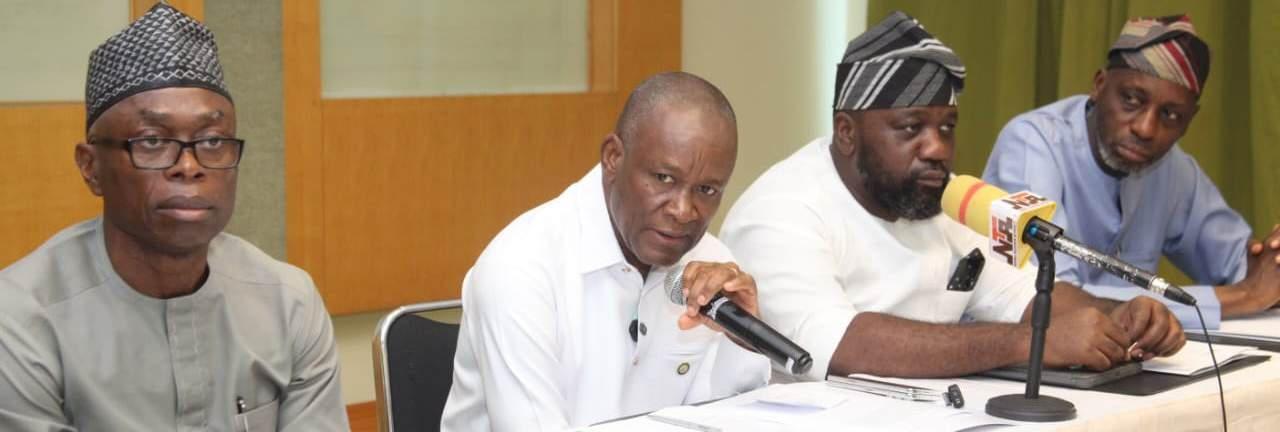
PDP, ADC express readiness as INEC fixes Feb. 20 for 2027 presidential, N’Assembly elections Opposition parties task electoral umpire on free, credible election Commission to consult over Ramadan concerns CVR hits 884,737 nationwide
Chuks Okocha, Adedayo Akinwale in Abuja and Sunday Ehigiator in Lagos
JWith just 371 days to the 2027 presidential election, the political battlefield is already taking shape, with familiar heavyweights and ambitious newcomers positioning for the nation’s highest office. This is as the Independent
National Electoral Commission (INEC) yesterday fixed February 20, 2027, for the presidential election and National Assembly elections.
But following concerns
raised by some stakeholders, including former Vice President and a chieftain of the African Democratic Congress (ADC), Alhaji Atiku Abubakar, that the election timetable falls within
the Muslim fasting period of Ramadan, the Commission assured that it was currently undertaking consultations and may, “where necessary, seek appropriate legislative
that
and
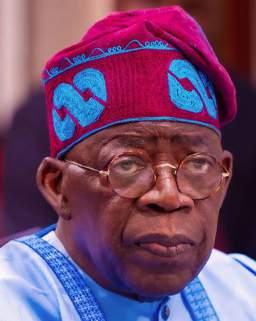
Tinubu
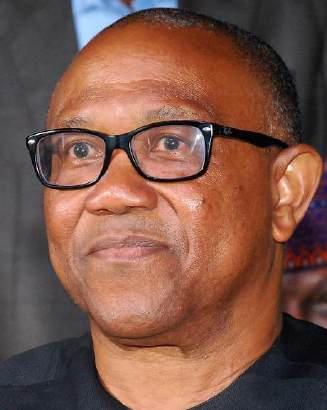
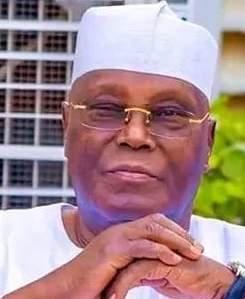
Atiku Obi
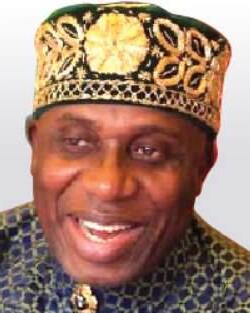
Amaechi
Chuks Okocha in Abuja
Sunday Ehigiator in Lagos
Social Media, E-Commerce Redefining Valentine’s Day Celebration
FRSC cautions against drunk driving, excessive speed
Omolabake Fasogbon in Lagos and Kasim Sumaina in Abuja
From curated love notes and viral hashtags to instant gift deliveries at the tap of a screen, social media and e-commerce are transforming Valentine’s Day into a digital-first celebration of romance, connection, and commerce.
However, as celebrants take
to the roads and venues today, the Federal Road Safety Corps (FRSC), yesterday warned them to avoid drunk driving and excessive speed, cautioning that reckless behaviour could turn a day of love into a day of tragedy.
Corps Marshal, FRSC, Shehu Mohammed, in a statement, said that all operational and educational tools have been
put in place to ensure the safety of road users during the celebrations.
In Nigeria, research firm SBM Intelligence had observed a steady growth in Valentine’s spending, despite prevailing economic challenges. Manufacturers and sellers increasingly leverage the excitement of the season to roll out creative campaigns. Beyond traditional cards and restaurant
dates, items such as perfumes, fashion accessories, smartphones, flowers and curated gift boxes are gaining momentum and available at just a scroll and tap away.
Analysts noted the steady rise in Valentine’s Day spending, with a significant share of transactions now conducted online and enabled by the digital finance and fintech boom. They link the surge in spending
to the growing popularity of Valentine’s Day within a technology-driven marketplace that has made the celebration more competitive, accessible and highly personalised.
Chief Executive Officer of PricePointe Wholesale Club, Tayo Williams, said the growing attention drawn by online marketplaces and social media platforms was not only
WITH 371 DAYS TO PRESIDENTIAL ELECTION, HERE ARE THE CONTENDERS, PRETENDERS
Owing to the announcement by the Commission, the 2027 race is beginning to reveal who is prepared for power and who is merely posturing, from serious contenders with structures and strategy to pretenders testing the waters.
While the various political parties have yet to hold their primary elections to determine their flagbearers, here are the likely contenders and pretenders for now, with more expected to emerge in the coming days:
CONTENDERS
President Bola
Tinubu – Harvest of
Endorsements
The President is in pole position to emerge as the presidential candidate of the All Progressives Congress (APC), buoyed by a gale of endorsements for his candidacy. He has received backing from the various organs of the APC, governors, National Assembly members, and state assembly members, while numerous support groups for the President continue to spring up almost daily.
Peter
Obi
– Has a Big Battle Ahead for ADC Ticket
A two-term former governor of Anambra State, Mr. Peter Obi, took the political scene by storm when he contested alongside President Bola Tinubu and former Vice President Atiku Abubakar in 2023. He, however, came third, securing a total of 6,101,533 votes on the platform of the Labour Party (LP). Obi has since defected to the African Democratic Congress (ADC), where he faces political heavyweights such as Atiku and Rotimi Amaechi as he seeks to emerge as the ADC’s presidential
candidate.
Atiku Abubakar – Will He Be Lucky This Time?
Former Vice President Atiku Abubakar, who has earned the moniker of Nigeria’s veteran presidential election contestant, will turn 80 next year. Political commentators are asking whether he will be lucky this time if he secures the ADC ticket, as he has publicly declared his intention to contest. He has contested unsuccessfully for the President of Nigeria at six different election cycles: 1993, 2007, 2011, 2015, 2019 and 2023. Atiku’s closest chance to become president was in 2019 and 2023. He came to a close second in 2023 with a total of 6,984,520 votes behind the incumbent President Tinubu, who scored 8,794,726 votes, the lowest in contemporary history that any president ever polled.
Chibuike Amaechi – Resilient and Strategically Mobilising
A former Speaker of the Rivers State House of Assembly, two-term governor of Rivers State, and former Minister of Transportation for eight years, Rotimi Amaechi, now an ADC chieftain, has declared his intention to contest the presidential election. Like others, his first hurdle is to secure his party’s ticket, where he will compete with the likes of Atiku and Obi. Amaechi previously contested the APC’s June 2022 presidential primary, finishing second behind President Tinubu.
Gbenga OlawepoHashim – Standing With A Divided PDP
Dr. Gbenga OlawepoHashim appears to be the only presidential aspirant on the platform of Peoples Democratic
Party (PDP). The first task he has is how to unite a PDP that is divided, with two factions fighting for control of the party. Olawepo-Hashim is a veteran of Nigeria’s pro-democracy activist.
PRETENDERS
Emeka Nwajiuba –Journey to Nowhere
A former Minister of State for Education under the late President Muhammadu Buhari, Emeka Nwajiuba, recently declared his intention to contest the 2027 presidential election on the platform of the ADC. Nwajiuba, a two term member of the House of Representatives, said Nigeria’s current challenges require leadership capable of producing sound policies, effective negotiation and strong grassroots political engagement. He had contested the 2023 presidential election on the platform of the APC but did not scale through the party’s primaries and is unlikely to also emerge this time around.
Hamza Al-Mustapha –Still Lacking National Appeal
Major Hamza Al-Mustapha (rtd), a former Chief Security Officer to late Head of State, General Sani Abacha, has formally declared his intention to run for president in the 2027 general elections under the platform of the Social Democratic Party (SDP). AlMustapha had emphasised his readiness to serve the country with integrity and a renewed vision aimed at rebuilding the nation.
Adewole AdebayoRegionally Constrained Ambition
Although he has not officially declared his intention, Adewole Adebayo, the 2023
EL-RUFAI: HOW I WAS ALMOST ARRESTED AT AIRPORT upon his arrival from Cairo, Egypt, on Thursday.
Speaking during an interview on ARISE News, El-Rufai said what was supposed to be a routine return to Nigeria from Cairo turned into a confrontation with operatives of the Department of State Services (DSS).
“Well, I came out of the plane, and a well-dressed young man in a nice suit approached me and said, ‘I am from the DSS (Department of State Security). I would like to meet with you
in our office.’ I said, ‘That’s fine. Where is the letter of invitation?’ He said, ‘My bosses have it. I will escort you to them.’ I said, ‘I’m going through immigration. I have to do that. Just get me the letter.’
“But I noticed that as I started going, more and more people came out. Apparently, I didn’t know, because I slept through most of the flight, and even when we landed, I didn’t call any of my guys to learn what was going on. But apparently, they had moved about 50 DSS
operatives to the airport with the specific instructions that I should be detained, I should be abducted and detained,” he said.
El-Rufai said he resisted attempts to compel him to accompany the operatives without a written invitation.
“So we started walking, but I saw more people coming out. I’m a politician. I’m used to crowds. I’m used to people surrounding me. And then as we moved forward, we came to the point that I either went
presidential candidate of the Social Democratic Party (SDP) is gearing up to contest again in 2027. But a major setback he will face is that he is from the south-west, same region with the current President.
INEC Fixes February 20, 2027 for Presidential, National Assembly Elections
INEC has fixed February 20, 2027 for the presidential and National Assembly elections.
INEC Chairman, Prof. Joash Amupitan spoke on the timeline while addressing a press conference yesterday in Abuja, where the commission formally released the notice of election, timetable and schedule of activities for the 2027 general election.
He recalled that for some time now, the issue about the notice of election has been a subject of speculation, adding that some people have even taken over the role of INEC by announcing their own date and schedule of activities for the 2027 general election.
Amupitan said this was sharply countered by INEC as it was greatly misleading and orchestrated by detractors.
He further recalled that at the Stakeholders’ meetings held last week, he informed participants that the Commission was watching with keen interest, the ongoing amendment of the Electoral Act, 2022, at the National Assembly.
Amupitan stressed that the electoral body recognised the critical need for timely action to ensure the integrity and effectiveness of the electoral processes.
The INEC boss noted that it was imperative that the Commission acts swiftly to address any challenges arising from any delay that may result in logistical failure.
right for immigration, or left. And two officers came forward, one big fat one and another about my height.
“They said, ‘We are from the DSS, sir. We are going this way. We need to go to your office.’ I said, ‘I’m not going to your office. I’m not going anywhere until you show me a letter of invitation. Your guy said you have a letter.’
“He said, ‘No, sir.’ I said, ‘If you don’t have a letter, I’m not going. You know my house. I live very close to the DSS
reshaping the occasion, but also redefining its meaning and purpose.
“The online market space and social media landscape have made Valentine’s Day more stylish and visible, shifting it from what was once largely private and limited to card exchanges or quiet moments into a highly publicized affair,” Williams said.
He stressed that by virtue of the 1999 Constitution as amended, the tenure of the President, Vice President, Governors and Deputy Governors of States of the Federation, except Anambra, Bayelsa, Edo, Ekiti, Imo, Kogi, Ondo, and Osun States) would expire on the 28th day of May, 2027; while membership of the National and State Assemblies would stand dissolved on the 8th day of June, 2027.
Amupitan added that pursuant to Sections 76(2), 116 (2), 132 (2) and 178 (2) of the 1999 Constitution, elections to the said offices shall hold not earlier than 150 days and not later than 30 days before the expiration of the term of office of` the last holder of that office.
He pointed out that this action was taken pursuant to the provisions of the 1999 Constitution as amended and section 28(1) of the Electoral Act, 2022, which mandates the Commission to publish the notice of election not later than 360 days before the date appointed for the election.
The chairman emphasised that the 2027 general election would hold nationwide for the following offices: President and Vice President of the Federal Republic of Nigeria; Governors and Deputy Governors of the States of the Federation (except Anambra, Bayelsa, Edo, Ekiti, Imo, Kogi, Ondo, and Osun States); Members of the Senate; Members of the House of Representatives; and Members of the State Houses of Assembly.
Amupitan stated: “In exercise of the powers conferred on the Commission by the Constitution of the Federal Republic of Nigeria, 1999 (as amended) and the Electoral Act, 2022 and of all other powers enabling it in that behalf, the Commission hereby sets in
headquarters. I can even walk down there if you bring a letter of invitation.’
“So I tried to turn right, and they tried to force me to go left. I said, ‘Look, don’t touch me. I’m going with my passport to have it stamped. And I’m not going where you want.’ He said, ‘You have to go where I want.’ I said, ‘Even the president cannot tell me I have to do anything. It’s a free country. It’s a democratic country. And I don’t have to do anything that I do not wish to do.’”
motion the electoral process for the 2027 general election and fixes the date for the 2027 general election as follows:
“Presidential and National Assembly- 20th February 2027; Governorship and State Houses of Assembly - 6th March 2027.
“The detailed Timetable and Schedule of Activities have been uploaded to the Commission’s official website and circulated to all registered political parties and relevant stakeholders.
“All the 36 Resident Electoral Commissioners and that of the FCT are directed to publish this Notice in each constituency in respect of which an election is to be held.
“These dates reflect our commitment to ensuring that our electoral processes are transparent, credible, and adhere to the provisions of our laws.
“In accordance with the approved Timetable and Schedule of Activities: Party primaries will be conducted within the statutory period stipulated by law.
“Submission of nomination forms by political parties will commence and close within the designated window as provided in the Schedule. Campaigns by political parties shall commence on the date specified by law and end 24 hours before Election Day.”
Amupitan acknowledged that the current Electoral Amendment Bill was pending before the National Assembly, adding that the proposed legislation has sparked important discussions and concerns among various stakeholders.
He said the commission recognised the necessity of enhancing the electoral framework to ensure that it meets the ever-evolving needs of the society and reflects aspirations for free, fair, and credible elections.
He said after his passport was stamped, security operatives allegedly attempted to confiscate it.
“By then, of course, some of the passengers had come and begun to form a crowd. So I turned right, and I moved on, presented my passport. It got stamped. And remember, before you stamp the passport, a DSS operative has to look at it and then hand it over to the immigration officer. This was done.
COURTESY VISIT...
At AU Summit, Nigeria Canvasses Health Security Sovereignty in Africa
Nigeria has canvassed a continental shift towards health security sovereignty in Africa aimed at moving the continent from reliance on foreign aids to self-sufficient and homegrown health systems.
This, according to Vice President Kashim Shettima, has become a matter of necessity to ensure the health of Africans is not subjected to the uncertainties of distant supply chains or the shifting priorities of global panic.
Shettima made the submission yesterday during a high-level side event on ‘Building Africa’s Health Security Sovereignty’, on the margins of the ongoing 39th Ordinary Session of the Assembly of Heads of State and Government of the African Union (AU) in Addis Ababa, Ethiopia.
The Africa health security
and sovereignty initiative is a collaboration between the Nigerian government and the Africa Centre for Disease Control and Prevention, to mobilise investment in the health workforce, community health and sustainable immunisation programmes.
The Vice President, who is representing President Bola Tinubu at this year's AU Summit, reaffirmed Nigeria's readiness to partner with other African nations to build a continent that is capable of healing itself.
"Nigeria stands ready to collaborate with every member state of our Union to make health security sovereignty measurable in factories commissioned, laboratories accredited, health workers trained, counterfeit markets dismantled, and insurance coverage expanded.
"When history reflects on this
Police Probe Deaths of Two Film Crew Members at Lekki Medical Facility
The Lagos State Police Command has commenced investigation into the deaths of two members of a film production crew, who were recently found unresponsive inside a vehicle at a medical facility in Lekki Phase 1.
The deceased persons, identified as a lighting technician, Ekemini Imeh, and his associate, Ayodeji Odediran, were discovered on February 7, 2026, during a movie production taking place at the medical facility. Prior to their death, the duo had completed the installation of lighting equipment for a film being produced and directed by former Big Brother Naija housemate, Boma.
Done with the job, they entered a parked vehicle within the premises to rest while awaiting the commencement of filming.
The duo were still resting when food was reportedly delivered to them at about 11 a.m but were
later found lifeless roughly eight hours, when production activities for the day had ended.
The case has been transferred to the State Criminal Investigation Department (SCID), Panti, Yaba, for further investigation and forensic examination.
Police sources said there were no immediate signs of violence on the bodies, while witnesses at the scene reported indications consistent with a sudden collapse.
Imeh, who was the Chief Executive Officer of a leading lighting company, was a well-known figure in the film and entertainment industry, with credits on major projects including King of Boys and music videos for prominent Nigerian artistes such as Davido.
THISDAY gathered that presently investigators are exploring multiple possibilities, including environmental factors around the parking area where industrial generators were reportedly operating.
generation of African leadership, may it record that when confronted with vulnerability, we chose capacity; when confronted with dependence, we chose dignity; and when confronted with uncertainty, we chose cooperation. And in choosing cooperation, we built a continent that could heal itself," he declared. Shettima cautioned against the consequences of vulnerability, recalling that during global health emergencies like the COVID-19 pandemic when the world turned inward, Africa waited, improvised and negotiated for rationed vaccines and scarce oxygen.
Acknowledging that there is dignity in endurance, the Vice President noted, however, that endurance is not a strategy, as "leadership is measured not by how long vulnerability can be withstood, "but by how deliberately we reduce it.
"Health security is national security, and in an interconnected continent, national security is continental security. A virus, as we have witnessed, does not carry a passport. A counterfeit medicine does not respect a border. A pandemic does not wait for bureaucracy," he stated.
Tinubu: Ethical Leadership, Strong Institutions, Nigeria’s Pathway to Peace
Olawale Ajimotokan in Abuja
President Bola Ahmed Tinubu has said that ethical leadership and strong institutions remain the country’s surest path to peace, justice and sustainable development.
He asserted this yesterday at the Global Council for Political Renewal (GCPR) Conference in Cape Town, South Africa that had in attendance dignitaries including, the Prime Minister
of the Kingdom of Eswatini and President of the GCPR, Right Honourable Russell Mmiso Dlamini; the Secretary General of the GCPR, Prof. Furio Honsell; the Prime Minister of East Timor, Jose Ramos-Horta; the President of the National Assembly of the Central African Republic, Simplice Mathew Sarandji, among others.
Presenting the country’s position on good governance, institutional reforms, and human rights, President
Tinubu, who was represented at the conference by Minister of Information and National Orientation, Mohammed Idris, said ethical political conduct was no longer optional in a divided, fast-changing world.
“We are living in a time of deep political and ideological polarisation, where misinformation spreads faster than truth. The challenge before us is how to protect free expression while restoring responsibility, civility and trust in public discourse,”
Tinubu said.
The President also spoke on Nigeria’s domestic reforms, noting that his administration was strengthening transparency, accountability and institutional performance under the Renewed Hope Agenda.
“Public office is a trust. Our reforms are focused on modernising institutions, reducing leakages, and ensuring that governance decisions improve the daily lives of citizens,” he said.
Bank CEOs Deepen Partnership with Police to Strengthen Financial System Security
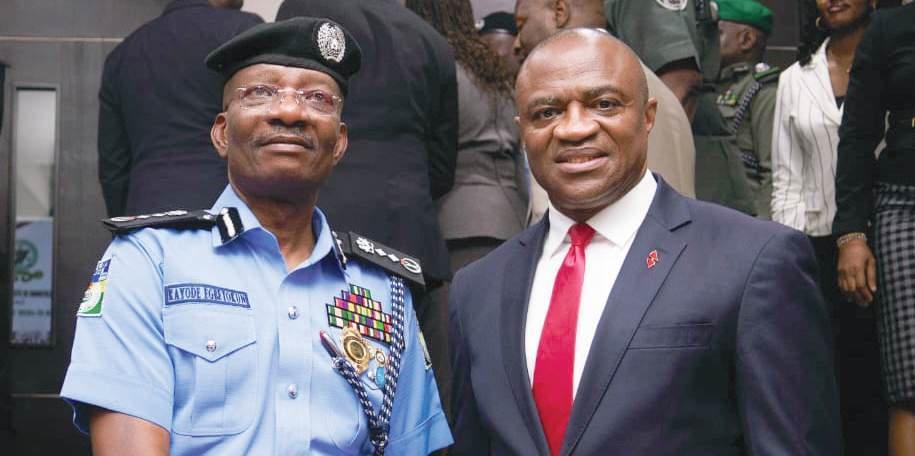
The Body of Banks’ Chief Executive Officers in Nigeria has reaffirmed its commitment towards strengthening collaboration with the Nigeria Police Force (NPF) towards enhancing the security and resilience of Nigeria’s financial system.
Speaking during a stakeholders’
engagement with the Inspector General of Police, Olukayode Egbetokun, the Chairman of the Body of Banks’ CEOs, Oliver Alawuba, commended the IGP for his steadfast support to the banking industry and his commitment to modernising the nation’s policing architecture.
Alawuba who is also the Group Managing Director/CEO, United Bank for Africa (UBA) Plc, noted that the banking sector operates at the heart of Nigeria’s economic stability and requires a secure and enabling environment to effectively mobilise financial resources, support businesses, and
drive inclusive growth. He applauded the operational milestones recorded under the IGP’s leadership, including strengthened intelligence-led policing, the establishment of the Special Intervention Squad, and enhanced personnel welfare initiatives.
UBA Launches ‘The Red Vault’
In a bold move to redefine customer value and appreciation, Africa’s Global Bank, United Bank for Africa (UBA) Plc, has officially launched ‘The Red Vault’, an innovative lifestyle platform designed to reward its customers with numerous
benefits throughout the entire year.
This initiative, which aims to transform the customer experience by offering tangible value and substantial discounts across the most sought-after lifestyle platforms, including travel, fashion, wellness,
healthcare, short-let and ridehailing, was launched during Valentine's Day celebration.
The benefits in the Red Vault, which can be accessed by visiting https://theredvault. ubagroup.com, are open to all UBA Customers with the bank’s debit or prepaid card.
The campaign is part of the bank's overarching, year-long theme, ‘It’s All About U’, as it embodies UBA’s commitment to moving beyond transactional banking and embedding real, meaningful value into the daily lives of its customers.
Deji Elumoye in Abuja
Chiemelie Ezeobi
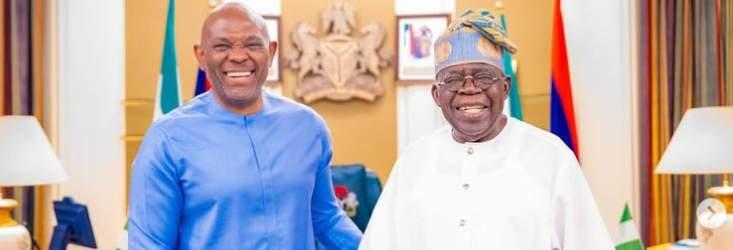
Chairman, United Bank for Africa and Heirs Holdings, Mr. Tony Elumelu (left) and President Bola Tinubu, during a courtesy visit to the President at the Presidential Villa, Abuja…. yesterday
GODWIN OMOIGUI
REWARDS FOR PERFORMANCE...
L-R: Managing Director/Editor-in-Chief, New Telegraph, Mr. Ayodele Aminu;
‘Man
CAS: Nigeria to Acquire Over 46 Cutting-edge Fighter Aircraft, UAVs to Enhance Air Power
CDS Oluyode to troops: discharge your duties professionally
The Chief of the Air Staff (CAS), Air Marshal Sunday Kelvin Aneke, has said the Nigerian Air Force (NAF) is fast-tracking the procurement of over 46 cutting-edge fighter aircraft, helicopters and unmanned aerial vehicles (UAVs) to enhance the operational effectiveness of the Armed Forces of Nigeria across the full spectrum of air operations.
This was as the Chief of Defence Staff, General Olufemi Oluyede, has urged troops of the Joint Task Force South-South, Operation Delta Safe (JTF SS OPDS) to carry out their responsibilities with the highest standards of professionalism and integrity.
Speaking during the inauguration of key infrastructural projects at NAF Base Kaduna, the CAS explained that the acquisitions form part of the ongoing transformation of the Service under his leadership.
The platforms being procured include 24 M-346 Fighter Ground Attack Aircraft, 12 AH-1Z Viper attack helicopters and 10 AW-109 Trekker helicopters.
He disclosed that strategic engagements in the United States, Italy and Türkiye are already yielding positive results.
Air Marshal Aneke noted that in addition to expanding its fleet, the NAF has taken significant steps to prepare its personnel for the operation of the incoming modern and advanced aircraft.
He described the developments as critical to readying the next generation of pilots who will operate the Service’s new platforms.
In a statement by the Director of Public Relations and Information, Nigerian Air Force, Air Commodore Ehimen Ejodame, the CAS expressed profound appreciation to the President and Commanderin-Chief of the Armed Forces, President Bola Ahmed Tinubu, for his unwavering commitment
UK Trial: Key Witnesses Contradict Prosecution in Diezani UK Bribery Case
The prosecution in the United Kingdom bribery trial of former Nigerian Minister of Petroleum Resources, Diezani AllisonMadueke, has faced a series of challenges after key witnesses gave testimony that appeared to contradict central elements of the Crown’s case.
The trial, holding at the Southwark Crown Court, concerns five counts of bribery and one count of conspiracy to commit bribery.
to national security.
“We salute President Tinubu for his unwavering support to national security, as demonstrated by his bilateral engagement with the Government of the Republic of Türkiye for defence equipment, including the acquisition of advanced helicopters and Unmanned Aerial Vehicles for the Nigerian Air Force,” he said. Highlighting the importance of the infrastructure projects, the CAS stated that the completion of the Student Pilots’ Quarters represents a major step in preparing pilots
to operate modern advanced aircraft, enabling the projection of smart and decisive air power to eliminate terrorist threats while safeguarding the nation.
He emphasised that the inauguration goes beyond infrastructure. “My mission here is not just about buildings but about fulfilling my command philosophy, to enhance and sustain a highly motivated, professional and mission-ready force capable of delivering decisive air power effects in synergy with surface forces for the realisation of national security objectives,” he said.
Experts Warn Amendment of Electoral Act May Weaken Electronic Transmission
Michael Olugbode in Abuja
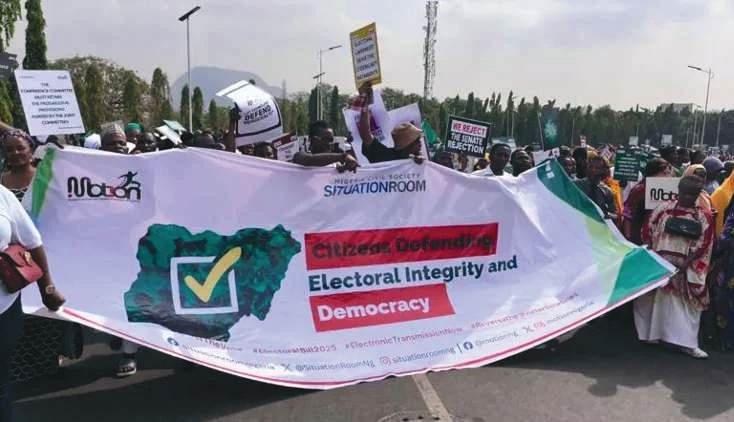
A coalition of electoral reform advocates, legal experts and technology specialists has warned that the proposed amendment to Clause 60(3) of Nigeria’s Electoral Act could undermine recent gains in electoral transparency if not carefully revised. They gave support to the
position of the House of Representatives over that of the Senate, stating that the lower legislative arm's position on the amendment of the Electoral Act was a lesser evil than that of the upper chamber.
The position emerged from an Expert Round Table convened in Abuja yesterday, by ActionAid Nigeria, YIAGA Africa and the
Movement for the Transformation of Nigeria. The meeting brought together academics, civil society leaders, lawyers, engineers, election administrators and governance specialists to examine the implications of the National Assembly’s amendment to Clause 60(3) of the Electoral Act 2022.
At the centre of deliberations was the provision dealing with the
electronic transmission of election results. While the current law provides for electronic transmission, the Senate’s amendment affirms that manually signed polling unit results remain legally valid if electronic transmission fails. Participants argued that this caveat could reopen long-standing vulnerabilities in Nigeria’s electoral process.
Yilwatda Urges North to Back Tinubu for Second Term
APC inaugurates national campaign council for 2026 FCT area councils election We’ll rewrite history in FCT, says Kalu
Lafia, the Nasarawa State capital.
Over recent days, jurors have heard allegations involving luxury shopping sprees and high-value purchases in exclusive areas of London.
However, testimony under cross-examination has introduced significant inconsistencies that the defence is expected to rely upon as proceedings continue.
One of the prosecution’s key witnesses, Sandro Rocha, who previously worked as a driver to Nigerian businessman Kola Aluko, gave evidence over a two-day period.
In his initial testimony, Rocha described transporting large sums of cash and driving Allison-Madueke to and from residences linked to Aluko in London.
Prosecutors alleged that during her tenure as Nigeria’s Petroleum Minister, Allison-Madueke received gifts described as bribes from prominent figures in the oil industry, allegedly intended to influence her official decisions.
Adedayo Akinwale in Abuja and Igbawase Ukumba in Lafia
The National Chairman of the All Progressives Congress (APC), Professor Nentawe Yilwatda, yesterday urged the North to support President Bola Ahmed Tinubu’s second terms, saying anything less will be a disservice to the Northern region’s interest. Also the APC inaugurated members of the party’s 137-member National Campaign Council for the forthcoming 2026 Federal Capital Territory (FCT) area councils elections scheduled to hold on February 21.
Yilwatda disclosed this while receiving defectors at the thank you solidarity rally organised in support of President Tinubu and Governor Abdullahi Sule, in
The National Chairman of APC said the President deserves another term following his numerous people-oriented projects and reforms embarked upon across the country.
He said that the President has shown that Nigeria is one, and he has promised to run an inclusive government where everyone can have sense of belonging According to him, “We have a road from Sokoto to Badagry, and it is going to carry over 60 dams that will have water for irrigation. It will provide agriculture, electricity, and clean water. This is what Mr. President is providing for us in the North.
“Mr. President is providing railways, the rail line that will
run from Abuja to Kano and to Niger Republic. For all of us in the North, it simply means that we will become importers and exporters because the entire Northern parts of Sudan, Burkina Faso and Chad will rely on us for their imports.
“All these projects are being done by Mr. President. That is why it will be a disservice to the North if we do not support him, because nobody may have the capacity to do those projects for us again. Supporting Mr. President is a must for the North because of what he has laid, what he is doing, and what he will do for the entire region,” he added.
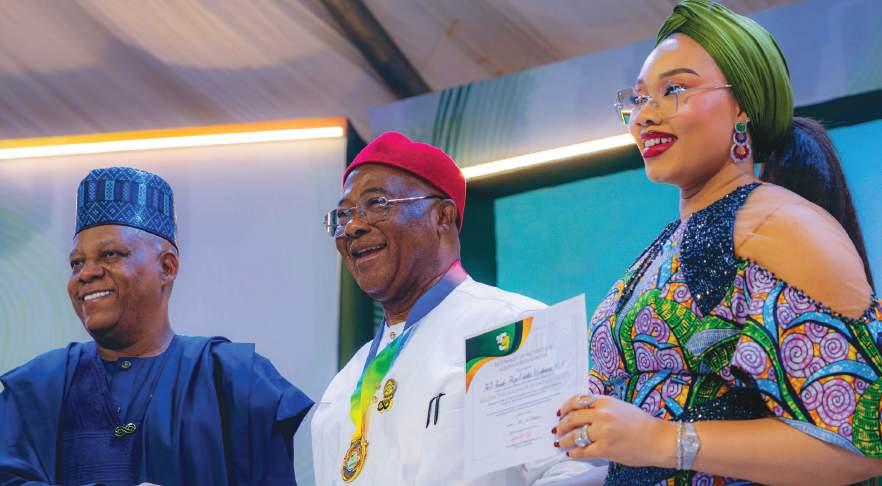
Governor of Imo State, Senator Hope Uzodinma who doubled as National Coordinator of the Renewed Hope Agenda,
also urged Renewed Hope Ambassadors to spread the gospel of President Tinubu's achievements to the grassroots. He emphasised that the event was not a campaign rally, but an opportunity to encourage Renewed Hope Ambassadors to inform people about the benefits of the President's policies, including reduction of food prices, increasing foreign reserves, and a stable exchange rate.
Uzodinma who commended the President's efforts in declaring a state of emergency on insecurity; charged the Renewed Hope Ambassadors in the state to preach the gospel, evangelise, and take ownership of the message that a new Nigeria is possible under President Tinubu's leadership.
Linus Aleke in Abuja
Wale Igbintade
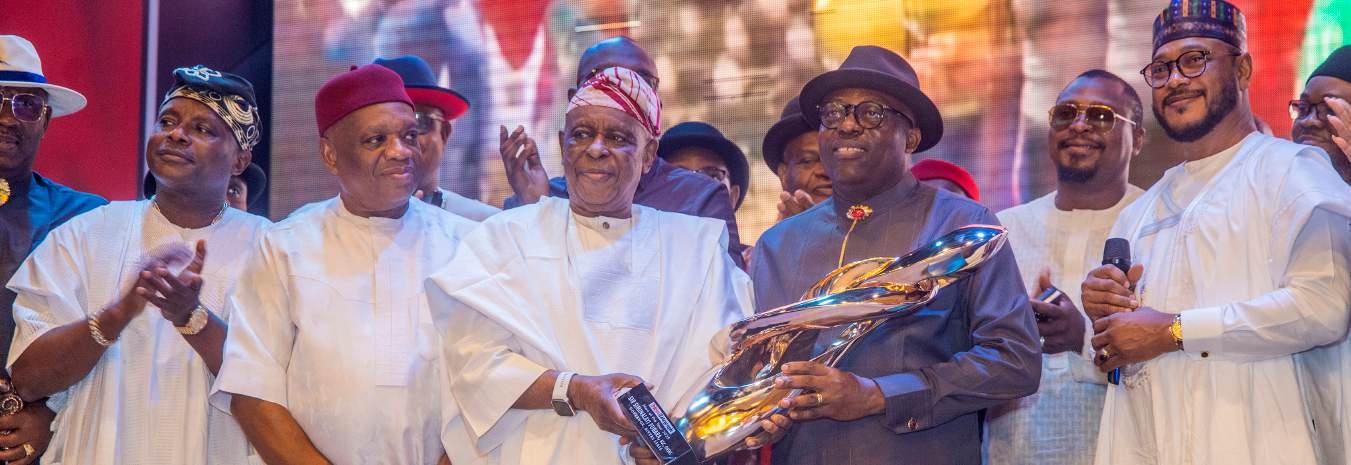
Publisher and former Abia State Governor, Senator Orji Uzor Kalu; Chairman of the Day, Former Governor of Ogun State, Chief Olusegun Osoba, presenting the award for
of the Year’ to Governor of Rivers State, Siminalayi Fubara and Governor of Zamfara State, Dauda Lawal Dare, during the media house award night held in Lagos ...yesterday KUNLE OGUNFUYI
MEDIA BRIEFING...
Shettima: Nigeria Will Overcome Displaced Persons' Challenge
Humanitarian minister, Bernard Doro, says FG working with private sector on market-based solutions to IDP Crisis
Mohammed Fall: Calls on private sector to show concrete commitment supporting displaced persons
Charles Ajunwa
Vice President Kashim Shettima has said that Nigeria is working to overcome the present challenge of over 3.7 million displaced persons across the country.
Sunday Ehigiator
The Pentecostal Fellowship of Nigeria (PFN) has called for the creation of a new constitution that guarantees equal treatment of all religions, describing the current 1999 Constitution (as amended) as religiously biased and a product of military imposition.
PFN President, Bishop Wale Oke, made the call yesterday,
Shettima, who disclosed this at the opening of a two-day conference themed 'Securing Futures: Marketbased Solutions for Internal Displacement' organised by the Nigerian Government, United Nations-Nigeria, UK
International Development and Tropical General Investments Group (TGI) held at Lagos Continental Hotel, Victoria Island, asked the private sector to expand the economic opportunities of displaced persons, which, he said will ensure they become productive and self-resilient.
The Vice President who was represented by the Minister of Defence, General Christopher Musa (rtd), thanked the private sector and development partners for their contributions, describing the problem of displaced persons as "national priority and development initiatives", emphasising that there should be timely, strategic and collective action in tackling IDPs problem for durable stability.
He said Nigeria cannot allow the displaced persons to be unproductive, noting their present situation is no
during a press briefing held in Lagos.
Oke said the present constitution does not reflect the will of Nigerians, insisting that it should be replaced with a document driven by the people. According to him, “There is a constitutional review that is going on and the stand of the Pentecostal Fellowship of Nigeria has been consistent
that this constitution that we're running now is a contraption and we should jettison it and initiate the process to have a constitution that will represent the will of the people, that will begin with we; the people of Nigeria, giving ourselves this constitution.
“Not the constitution that the military handed over to us and we're patching it up and patching
it up; a constitution that we see as biased and unbalanced.
“A constitution that mentions Sharia, Islam many times and there is no mention of the church or Christians at any instance, not once. And such a constitution is not acceptable to us. It is a constitution that ignores the feelings and the aspiration of over 50 per cent of the populace of Nigeria.
Community to Buy Expression of Interest Form for Otti, Donates
Ahamefula Ogbu
At a reception organised to thank Governor Alex Otti of Abia State at Ozu Abam Secondary School Field for projects executed, the Abam community in Arochukwu Local Government Area of the state has pledged to buy Expression of Interest Form for him as well as give N500 million
seed money for his campaign expenses.
Governor Otti speaking at the occasion promised to return soon to inaugurate most of the projects which he said have attained 75 per cent completion.
He also pledged to restore power to the Abam community in the next few months.
"I can assure you that it can
never be the same again in Abam, it will continue to be better. Thank you for producing good leaders in Abam, people that have continued to prioritise development of the community against selfish interests.
"I am here to assure you that we have restored the state to the dreams of our forefathers against the selfish interests of past leaders
in their underdevelopment plans.
“We will be firm with everything at our disposal, firmness, development and ensure that we will not allow the return to darkness by those threatening to take us back to the dark alleys.
May this light shine in perpetuity.
May I thank the leadership of Abam, for producing the best people in this country," Otti said.
Globacom Unveils Valentine Smartphone Promo with Massive Discounts, 18GB Free Data
Globacom has announced the launch of its Valentine Smartphone Promo which offers amazing discounts on a wide range of premium smartphones from leading brands including Samsung, Infinix and Tecno. The promotion, which commenced on February 9 and will run until February 16, 2026, offers significant price reductions on selected Samsung models such as Galaxy A56 5G, Galaxy A36 5G, Galaxy A26 5G,
Galaxy Z Fold 7, and Galaxy A07. Customers who purchase any of the phones will also win a free travel charger and pouch and also enjoy up to 18GB bonus data for six months, exclusively on the Glo network.
Tecno devices are also available at discounted rates, alongside other Infinix models, ensuring customers have a wide selection of smartphones to suit different preferences and budgets.
problem of theirs.
The Vice President who acknowledged that displacement issues should be tackled through shortterm and long-term plans, emphasised that displaced persons should earn to support their families and enjoy human dignity. "There should be long-term stability that supports national cohesion," he said.
Makinde Elevates 14 High Chiefs to Obas in Oyo
Kemi Olaitan in Ibadan
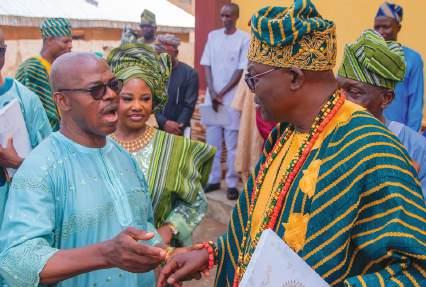
The Oyo State Governor, Seyi Makinde, yesterday elevated 14 High Chiefs and Baales in Oyo town to the status of crown-wearing Obas with the presentation of Staffs of Office and Instruments of Office.
The state Deputy Governor, Barrister Bayo Lawal, presented the Staffs of Office and Instruments of Office on behalf of Makinde at a colourful coronation ceremony held at the premises of Oliveth Heights in Oyo West Local Government
Area of the state. The newly elevated monarchs include the Alaaguo of Aguoland, Oba David Oyediran; the Baba Eyaji of Oyo, Oba Afonja Mukaila; the Alajagba of Oyo, Oba Samuel Odurinde; the Ona-Isokun of Oyo, Oba Isiaka Tella-Titiloye; the Onimileke of Imileke, Oyo, Oba Fakayode Alowonle; the Onigbudugbu of Gbudugbu, Oyo, Oba Salawu Oyeniran; the Oloodu of Ojongbodu, Oba Olaniyi Adegboye; and the Alapa-Ara of Apa-Ara, Oba Tijani Ajeigbe.
Ramadam: Atiku Advises INEC to Reconsider 2027 Election Timetable
Former Vice President and a chieftain of the African Democratic Congress (ADC), Alhaji Atiku Abubakar, yesterday advised the Independent National Electoral Commission (INEC) to reconsider the February 20, 2027 date announced for the presidential and National Assembly elections, saying it falls within the Muslim fasting period of Ramadan.
In a post on his official
X handle yesterday, Atiku noted that the proposed date falls “squarely within the Ramadan period (February 7 – March 8, 2027), a sacred season of fasting, reflection, and spiritual devotion for millions of Nigerian Muslims.” He added, “Elections are not mere administrative rituals; they are national exercises that demand maximum participation, physical endurance, and collective focus.
L-R: Special Advisor to the Minister of State for Industry, Prof. Anoka Njan; Minister of State for Industry, Senator John Owan Enoh; Special Adviser to the President on Industry, Trade & Investment, John Uwajumogu, and Director General, National Institute for Policy and Strategic Studies, Kuru, Prof. Ayo Omotayo; during a strategic media briefing on the Nigeria Industrial Policy (NIP) 2025, held in Lagos…yesterday
In pursuit of credible elections...
In Praise of President Buhari
A Valentine Note to Eric Anyamene
As Pate Leaves Kashere
Varsity
WIhen President Muhammadu Buhari took over the reins of power on May 29, 2015, Nigeria was sadly a broken state in many respects. As a result of many other factors including bad governance and untold level of corruption, government could not live up to its financial obligations to citizens and service providers at both the federal and state levels.
our love for other people through diverse ways. For example, when a rich man pays all the fees for the tertiary education of a person from an indigent home without demanding reciprocity from the poor person, the rich man has carried out an act of love. But do we possess the virtue of love?
Indeed one of the first official assignments that President Buhari carried out was the approval of billions of Naira in bailout funds to enable state governors pay something as basic as workers’ salaries. Granting those bailout funds was a huge boost to national security because the pressure of arrears of unpaid monthly salaries building dangerously all over the country was a ticking bomb.
bring you greetings in this season of love. Writing this valentine missive to you during this period of love is imperative given the acts of love you have done for a great number of people, who live in Idemili North and South LGAs. The word, valentine, is symbolic or representative of love. It connotes and denotes love, too. Empathy is an intrinsic part of love. And St. Valentine for whom we commemorate the Valentine's day on every February 14 is an empathetic man. It is said that he performed acts of love for other people without expecting that they would requite his kind gestures.
Ask the naysayers and they would readily remind you of how long it took President Buhari to appoint his ministers and how that contributed to collapse of the economy as if, without ministers, governance was frozen. But buying that narrative would amount to what a famous Nigerian writer, Chimamanda Adichie, termed “the danger of a single story”. Yet the whole story was that many of our citizens did not know how decrepit a state President Buhari inherited in 2015.
It was therefore necessary for him to take stock against the background of the fact that the departing government did not, reportedly, cooperate full well with the incoming government in terms of leaving workable handover notes. Although President Goodluck Jonathan was gracious in defeat, many of his appointees were still sulking over what they saw as their personal losses and therefore pulled all the stops to make things difficult for the Buhari government.
by the EFCC, President Buhari by his action has successfully brought back to the public consciousness the need to treat public funds with the highest level of transparency and accountability.
TAfter keeping treasury looters on their toes and at bay through the EFCC, particularly, President Buhari moved to curb unnecessary spending habits of the nation on what economists call articles of ostentation. Part of the disclosures of the President’s stock taking was how the country frittered away billions in foreign currency by importing goods, which can be produced at home. One of such items was rice, a major staple among Nigerians. By banning rice importation into the country, the President on one hand had saved the nation billions in foreign currency annually.
Stop Ritual Attacks and Killings
There are moments in academic life when a leader’s departure forces a community to pause, reflect and take stock of the footprints left behind. The recent sendforth marking the end of the tenure of Professor Umaru Alhaji Pate at the Federal University of Kashere was one of such moments. It was not merely a ceremonial farewell. It was an emotional gathering that revealed the depth of impact one man has had on an institution, on students and on the personal journeys of countless young academics like myself.
And, on the other hand, the President has boosted domestic production of rice and in the process had nudged the country into self sufficiency in food production. He also created millions of jobs for young people in the rice value chain.
he Advocacy for Alleged Witches (AfAW) urges the Nigerian public to stop ritual attacks and killings because the notion of ritual money and wealth is completely baseless. AfAW is making this call following the reported arrest of suspected ritualists in Oyo State in southern Nigeria. The local media reported that members of the Western Nigeria Security Network, Amotekun, arrested suspected ritualists with the body parts of a 73-year-old man.
The TSA policy, interestingly, was mooted by the PDP government but its penchant for imprudence and lack of accountability denied it the courage of implementing the policy. What the President literally did was to gather all the nation’s money into one box and locked it up with a big padlock and watched for any thief to come close.
But there are different versions of the life story of St. Valentine, which have raised critical questions and posers. Was St. Valentine for whom we mark the Valentine's day a historical person? Or was he a mythical figure conjured into being and/ or existence to teach us moral lessons, which are centred on love? Or is the true story about the provenance of St. Valentine and the Valentine's day celebration lost in the mist of time? Whatever is the case is immaterial to us, now, as we are concerned with the meaning and significance of the St. Valentine's day. Now, it is a known and indisputable fact that Valentine connotes and denotes love. In the Bible, which is the holy book of the Christians, we are admonished to love one another. The teachings of our Messiah, Jesus Christ, which are contained in the new testament of the Bible, are predicated on love. And a popular biblical quote says this: love covers a multitude of sins.
Love, we all know, is a scarce commodity among us. If we are actuated by the feelings of love, our political leaders will not contemplate stealing money from our national exchequer, not to talk of carrying it out, thereby rendering our economy prostrate. If love exists among us, terrorists will not corral kids and women into houses to liquidate them with guns for no just cause. If love truly exists in the hearts of Nigerians, children will not kill their parents in brutal and mind-boggling ways for money-making rituals.
What is most admirable about President Buhari and his government is its frugal management of scarce national resources to attain optimum goals.
Recall that since President Buhari stepped in the saddle, oil revenue dropped abysmally as if to sabotage him knowing all the big promises he made to citizens during his campaigns. But with the little resources that trickle in, the President is achieving what governments that received oil windfalls could not dream of.
Chiedu Uche Okoye, Uruowulu-Obosi, Anambra State
Even with the obvious and unpatriotic obscurantist behaviour of the PDP appointees and their supporters still in government hell-bent on making things difficult for Buhari, the President moved on with his methodical repair of a broken country. The first thing he did was to identify all possible sources of income to the nation and directed that all inflows be paid into one single account in line with the policy of Single Treasury Account (TSA).
Who can blame the President for almost developing paranoia over the safeguard of the national treasury with revelations and reports of mind-boggling looting that took place in the 16 years of the PDP? With such disclosures of how billions meant for fighting insurgency in the Northeast ended up in the pockets of a few individuals while our gallant soldiers fought with bare hands and on empty stomach, President Buhari was duty bound to bring sanity and accountability back in national spending.
The BBC dictionary defines love as: "the feeling that a person's happiness is very important to you, and the way you show this feeling in your behaviour towards them." We demonstrate
Thus, under President Buhari, the Economic and Financial Crimes Commission (EFCC), which had remained comatose for years, was woken up to resume its duties. Apart from the trillions of Naira of looted funds and property recovered from corrupt politicians
Many leaders occupy offices. Some watch institutions drift. Others construct buildings and expand physical structures. Yet only a few build people. Professor Umaru Alhaji Pate belongs to that rare category of leaders whose greatest achievements are human beings whose lives have been reshaped by his mentorship and guidance.
Today, the trains are up and running daily from Abuja to Kaduna. And from Lagos to Ibadan a brand new rail track was started and completed; citizens are already commuting daily to and fro these two major cities in the country seamlessly as they reap from the dividends of democracy. And with the way this government is going, before 2023 when the President would leave, the entire country would be linked by rail with all of its economic advantages.
Ainofenokhai Ojeifo, Abuja
THE SATURDAY NEWSPAPER
EDITOR OBINNA CHIMA
DEPUTY EDITOR AHAMEFULA OGBU
MANAGING DIRECTOR ENIOLA BELLO
THE SATURDAY NEWSPAPER
DEPUTY MANAGING DIRECTOR ISRAEL IWEGBU
EDITOR YEMI ADEBOWALE
CHAIRMAN EDITORIAL BOARD OLUSEGUN ADENIYI
DEPUTY EDITOR AHAMEFULA OGBU
EDITOR NATION’S CAPITAL IYOBOSA UWUGIAREN
MANAGING DIRECTOR ENIOLA BELLO
THE OMBUDSMAN KAYODE KOMOLAFE
DEPUTY MANAGING DIRECTOR ISRAEL IWEGBU
CHAIRMAN EDITORIAL BOARD OLUSEGUN ADENIYI
EDITOR NATION’S CAPITAL IYOBOSA UWUGIAREN
MANAGING EDITOR BOLAJI ADEBIYI
THE OMBUDSMAN KAYODE KOMOLAFE
THISDAY NEWSPAPERS LIMITED
EDITOR-IN-CHIEF/CHAIRMAN NDUKA OBAIGBENA
GROUP EXECUTIVE DIRECTORS ENIOLA BELLO, KAYODE KOMOLAFE, ISRAEL IWEGBU
THISDAY NEWSPAPERS LIMITED
DIVISIONAL DIRECTORS SHAKA MOMODU, PETER IWEGBU, ANTHONY OGEDENGBE
EDITOR-IN-CHIEF/CHAIRMAN NDUKA OBAIGBENA
DEPUTY DIVISIONAL DIRECTOR OJOGUN VICTOR DANBOYI
GROUP EXECUTIVE DIRECTORS ENIOLA BELLO, KAYODE KOMOLAFE, ISRAEL IWEGBU, IJEOMA NWOGWUGWU, EMMANUEL EFENI
SNR. ASSOCIATE DIRECTOR ERIC OJEH
ASSOCIATE DIRECTOR PATRICK EIMIUHI
DIVISIONAL DIRECTORS SHAKA MOMODU, PETER IWEGBU, ANTHONY OGEDENGBE
DIRECTOR, PRINTING PRODUCTION CHUKS ONWUDINJO TO SEND EMAIL: first name.surname@thisdaylive.com
Anyone who walks through the Federal University of Kashere today can see clear evidence of growth and transformation. His tenure witnessed massive developmental projects that strengthened the academic culture of the university, particularly within the Mass Communication Department. But beyond infrastructure and statistics lies his most enduring contribution: restoring confidence in students and young scholars who once doubted their own potential. Bilyaminu Gambo Kong-kol, Kashere, Gombe State
He is Actually Transparent
Attorney General Pam Bondi has stated that President Trump is the "most transparent President in the nation's history" and she is right, we can see right through him. Wikipedia tells us that "The attorney general is seventh in the presidential line of succession." I always thought seven was a lucky number but maybe I was wrong.
Dennis Fitzgerald, Melbourne, Australia
The suspects, who were apprehended in the Boluwaji area in Ibadan, said that a Muslim cleric asked them to procure some human body parts for rituals. Ritual attacks are widespread in Nigeria. Irrational conceptions of how to make money or become wealthy and successful undergird these atrocities. Many Nigerians strongly believe in blood money, known in some local languages as Ogun Owo (Yoruba) or Ogwu ego (Igbo). They think that they could become rich, or successful through ritual sacrifice. Unfortunately, this is not the case. Ritual wealth has no basis in reason, science, or reality. Home movies known as Africa magic or Nollywood films have not helped matters. These movies continue to reinforce these mistaken notions and other superstitions. Families, churches, mosques, and other public institutions do not encourage the interrogation of these traditional occult beliefs. There are no robust efforts to criticize or dispel these irrational and paranormal claims in schools, colleges, and universities. So millions of Nigerians grow up blindly believing that they could make money through ritual sacrifice of human body parts. The belief has led many Nigerians to commit crimes and perpetrate atrocities. Many Nigerians have been jailed or are undergoing court trials due to ritualrelated attacks and murder. Not too long ago, the police arrested some young Nigerians for stealing female pants, which they intended to use for ritual sacrifice. AfAW is asking all Nigerians to desist from ritual-related abuses because ritual money beliefs are baseless superstitions. Nigerian media, schools, and colleges should help educate and reorient the public. They should assist in reasoning Nigerians out of this killer-superstitious absurdity and nonsense. Leo Igwe directs the Advocacy for Alleged Witches (AfAW)
Why Do We Celebrate Valentine’s Day? Focus
In Nigeria, Valentine’s Day, February 14, has grown from a largely foreign romantic tradition into a vibrant social and economic phenomenon that influences relationships, commerce, and popular culture. Sunday ehigiator, in this report, examines the changing social values, consumer behaviour, and the ways Nigerians define and express love on Valentine’s Day.
Every February 14, the world transforms into vibrant displays of affection, colour, and commerce as millions celebrate Valentine’s Day. From red roses and heart-shaped chocolates to candlelit dinners and romantic getaways, the day has grown into a global cultural and commercial phenomenon. While often associated with lovers and romantic partners, Valentine’s Day has evolved into a broader celebration of love in its many forms: friendship, family bonds, and self-love.
In Nigeria, the day carries its own distinctive flavour. Streets become busier, businesses record increased patronage, and social media platforms overflow with romantic declarations and carefully curated red-themed outfits. Yet, beyond the glittering displays of affection, Valentine’s Day also sparks debates about cultural influence, commercialisation, and the real meaning of love.
This year, the celebration in Lagos carries an added layer of uniqueness as it coincides with the Lagos City Marathon, creating a rare intersection between romance, recreation, and public infrastructure adjustments.
For many Lagos residents, the road closures may disrupt traditional Valentine’s Day routines such as breakfast dates, gift deliveries, and early outings. However, some residents see it as an opportunity to create new experiences.
Fitness enthusiasts and couples are expected to merge celebration with physical activity, with some planning to participate in or watch the marathon together before continuing their Valentine’s Day plans. Businesses along marathon routes may also benefit from increased foot traffic as spectators gather.
The coincidence highlights Lagos’ dynamic urban lifestyle, where cultural celebrations often intersect with large-scale public events, forcing residents to adapt creatively while maintaining the spirit of the occasion.
Understanding why Valentine’s Day is celebrated requires exploring its historical roots, symbolism, cultural evolution, and the social and economic impacts it generates today.
History of the Origin of Valentine’s Day
The origin of Valentine’s Day traces back to ancient Roman traditions and Christian history. Historians link the celebration to Saint Valentine, a Christian martyr who lived during the reign of Emperor Claudius II in the third century.
According to legend, Emperor Claudius II banned marriages for young men, believing single soldiers performed better in battle than married ones with families.
Saint Valentine, defying the emperor’s order, secretly performed marriage ceremonies for young couples. When his actions were discovered, he was arrested and later executed on February 14, around 270 AD.
Another account suggests Valentine was imprisoned for helping persecuted Christians escape Roman prisons. During his imprisonment, he reportedly healed the blind daughter of his jailer and left her a note signed, “From your Valentine,” a phrase that remains popular today.
By the Middle Ages, Valentine’s Day had become associated with romantic love, especially in England and France, where it was believed birds began mating around mid-February.
Over time, the tradition of exchanging handwritten love notes evolved into the modern celebration involving gifts, cards, and grand romantic gestures.
Why the Colour Red Dominates Valentine’s Day
One of the most recognisable symbols of Valentine’s Day is the colour red. Across decorations, clothing, gifts, and marketing campaigns, red dominates the visual identity of the celebration.
The colour red historically symbolises passion, love, desire, and deep emotional intensity. In many cultures, red is also associated with vitality and strong human emotions. Psychologists suggest that red naturally stimulates feelings of attraction and excitement, making it an ideal representation of romantic love.
Additionally, red roses, which are widely exchanged
during Valentine’s Day, carry a symbolic meaning dating back centuries. In Greek and Roman mythology, red roses were associated with Aphrodite and Venus, goddesses of love. Today, giving red roses remains one of the most universal expressions of affection.
In Nigeria, wearing red outfits on Valentine’s Day has become both a fashion statement and a cultural ritual, especially among young people who use the colour to visually express romantic availability, celebration, or solidarity with the global Valentine tradition.
Gifts and Treats
Gift-giving remains a central element of Valentine’s Day. Traditionally, romantic partners exchange items symbolising affection and appreciation. Popular gifts include flowers, chocolates, jewellery, perfumes, stuffed toys, greeting cards, and personalised keepsakes.
In Nigeria, gift culture has expanded significantly in recent years. Luxury gift packages, curated hampers, customised cakes, and surprise delivery services have become increasingly popular, especially among young professionals and social media users seeking unique ways to express love.
Chocolate, in particular, holds symbolic importance due to its historical association with pleasure and emotional comfort. Similarly, flowers, especially roses, serve as timeless symbols of admiration and romantic interest.
Beyond romantic partners, Valentine’s Day has also become an occasion for friends, colleagues, and family members to exchange small tokens of appreciation, reflecting the broader interpretation of love in modern society.
Economic Beneficiaries
Valentine’s Day is not only a cultural celebration but also a major commercial event. Several industries experience increased patronage during the period, particularly restaurants, bakeries, cinemas, fashion brands, and hospitality businesses.
Restaurants often introduce special Valentine’s menus, candlelight dining packages, and live music events designed to attract couples. Many establishments report some of their highest customer turnout during the celebration.
Cake and pastry businesses also experience significant demand as customers order customised cakes, cupcakes, and desserts themed around love and romance. Similarly, cinemas record increased ticket sales as couples and groups of friends seek entertainment options.
Fashion brands benefit from the demand for themed clothing, particularly red dresses, suits, matching couple outfits, and accessories. Hotels and resorts also offer special accommodation packages, including romantic room decorations and weekend getaway deals.
For small business owners, Valentine’s Day provides an opportunity to boost income, with many entrepreneurs offering delivery services, photography packages, and event planning solutions tailored to the occasion.
Social Media Influence and Pressure
Social media has significantly reshaped how Valentine’s Day is celebrated, transforming the once private expression of affection into a highly visible digital spectacle.
Platforms such as Instagram, TikTok, Facebook, and X (formerly Twitter) become saturated with romantic content in the days leading up to February 14. Users flood timelines with a couple of photoshoots, surprise engagement and proposal videos, elaborate gift presentations, love-themed skits, and carefully styled fashion posts dominated by red and white colour palettes.
The celebration has evolved into a visual culture where storytelling, aesthetics, and public declarations of affection play a central role in how love is perceived and expressed.
Hashtags such as #ValentinesDay, #LoveInLagos, #RedSeason, and #ValentineVibes often trend during the period, creating digital communities that encourage participation and interaction. Through these hashtags, users share personal experiences, relationship milestones, and creative content that quickly spreads across audiences.
Viral Valentine challenges, couple quizzes, and romantic storytelling formats have also become common, allowing users to engage in the celebration even when they are not in physical relationships, thereby broadening the meaning of the occasion.
For influencers and content creators, Valentine’s Day represents a lucrative commercial window. Lifestyle bloggers, relationship influencers, fashion models, and entertainers collaborate with brands to promote Valentine-themed products ranging from gift hampers and perfumes to clothing, jewellery, and luxury experiences.
Many influencers organise giveaways and promotional campaigns, encouraging audience engagement while simultaneously driving product visibility. Their curated content often shapes consumer behaviour, with followers seeking to replicate trending romantic gestures and gift ideas showcased online.
Businesses have increasingly recognised the marketing power of social media during Valentine’s season. Restaurants, hotels, bakeries, cinemas, and fashion retailers deploy aggressive digital marketing strategies, including early promotional teasers, countdown campaigns, discount announcements, and influencer partnerships.
Small and medium-scale entrepreneurs, particularly
those in gift packaging, event planning, photography, and delivery services, rely heavily on social media to showcase their services and attract customers. The digital marketplace has therefore expanded the economic value of Valentine’s Day, providing entrepreneurs with low-cost but high-reach advertising platforms.
Despite these benefits, social media has also introduced complex social pressures. The constant display of extravagant romantic gestures, luxury gifts, and curated relationship images can create unrealistic expectations among users.
Relationship counsellors note that individuals sometimes measure the strength of their relationships based on public validation through likes, comments, and online attention. This comparison culture may trigger feelings of inadequacy among single individuals or couples who cannot afford elaborate celebrations, and has sometimes led to a spate of breakups among young lovers.
Financial strain has also emerged as a growing concern. Some individuals feel compelled to spend beyond their means to meet social expectations or avoid public embarrassment.
The desire to stage grand surprises or purchase expensive gifts for online recognition has, in some cases, overshadowed the emotional sincerity that traditionally defines romantic expression. Mental health advocates warn that social media-driven celebrations can unintentionally fuel anxiety, loneliness, and relationship dissatisfaction.
Nevertheless, social media continues to redefine Valentine’s Day by democratising participation and amplifying creativity. It has enabled long-distance couples to celebrate virtually, allowed friends and families to publicly express appreciation for one another, and given businesses powerful platforms to connect with customers.
Nigerians View
Many Nigerians view Valentine’s Day as a positive celebration of love and human connection.
A Lagos-based event planner, Tolu Adeyemi, believes the celebration strengthens relationships.
“Life in Lagos can be stressful, and Valentine’s Day gives couples a chance to reconnect and appreciate each other. It also supports businesses like mine because people want memorable experiences,” she said.
Similarly, Chinedu Okafor, a banker, sees the day as an opportunity to express emotions that people often suppress.
“Many Nigerians are not very expressive about their feelings. Valentine’s Day encourages people to show appreciation, not just to partners but also to friends and family members,” he explained.
Despite its popularity, Valentine’s Day has faced criticism from those who question its cultural authenticity and commercial focus. A cultural historian, Dr Musa Abdullahi, on his X handle, argues that the celebration reflects Western cultural influence.
“Valentine’s Day is largely a Western tradition that has been commercialised globally. While celebrating love is important, we must ensure we do not neglect our indigenous cultural expressions of affection and family bonding,” he said.
Another critic, Blessing Nwoye, a small business owner, expressed concerns about the financial pressure associated with the celebration.
“Social media has made Valentine’s Day feel like a competition. Some people spend beyond their means just to impress others. Love should not be measured by expensive gifts.
“Besides, Love should be shown every day, not restricted to one date influenced by foreign culture. I am also concerned that young people sometimes misuse the day by focusing more on material gifts and unhealthy behaviours.”
Ultimately, it is good to note at this juncture that Valentine’s Day endures because it resonates with a universal human need: the desire to express love and appreciation.
Whether celebrated through grand gestures, simple acts of kindness, or quiet reflection, the essence of Valentine’s Day lies in reminding individuals of the importance of human connection in an increasingly fast-paced world. Why Do We Celebrate Valentine’s Day?
fOCuS
Imo State: The Next 50 Years
The next 50 years for Imo State demands deliberate planning, with knowledge, technology, and human capital positioned as the engines of prosperity and sustainable development, writes Sunday ehigiator
The atmosphere at the Imo State golden jubilee celebration was not only festive but reflective of a state standing at a historic threshold. Fifty years after its creation, Imo has reached a moment where memory meets imagination and where the story of its past converges with the promise of its future.
At the heart of the celebration was a clear message from Governor Hope Uzodimma that the next 50 years for the South-East State must be deliberately shaped, anchored on knowledge, technology, and human capital as the new drivers of prosperity.
In his address at the colourful celebration which attracted dignitaries from all over the country, including Vice President Kashim Shettima, serving and former State Governors, serving and former National Assembly members, traditional rulers, as well as captains of industries, among others, Uzodimma framed the future of Imo not in terms of natural resources but intellectual capital.
“This is a declaration of our intent. Our future wealth will not come from the ground, but from the minds of our people,” he said, signalling a decisive break from traditional economic models. He highlighted the state’s Skill-Up Imo programme, which has already trained more than 65,000 young people in artificial intelligence, robotics, coding, and other digital skills, describing them as the digital natives who will define Imo’s economic destiny.
By the State’s 75th anniversary, he projected, this new generation would have transformed the Eastern Heartland into a global technology corridor, delivering the economic breakthrough long promised to the people.
Beyond immediate milestones, the Governor extended his vision to the centenary horizon.“As we celebrate this golden jubilee, we must also plant the seeds for our centenary,” he declared, urging policymakers, citizens, and institutions to think beyond electoral cycles and generational boundaries.
By 2076, he said, Imo must emerge as a fully industrialised knowledge economy—one where innovation is the primary export, and where universities rival any in the world.
His vision is of a state where every child, regardless of origin, has access to world-class education and healthcare, and where infrastructure and digital networks connect citizens seamlessly to global markets.
Uzodimma’s centenary vision places education at the core of transformation. He envisaged a future where Imo’s educational institutions are globally competitive, producing graduates equipped not only with academic knowledge but with the skills and creativity to compete in the global economy. In this future, classrooms will be hubs of innovation, research, and entrepreneurship, feeding industry with ideas and talent. For the governor, education is not merely a social service but the engine of economic growth and social mobility.
Healthcare, in his vision, is equally central to the state’s future resilience. He spoke of a future Imo where every citizen can access quality healthcare, where modern facilities, skilled professionals, and technology-driven systems ensure longevity and productivity. Such a system, he implied, would underpin a productive workforce capable of sustaining the knowledge economy he envisages.
Infrastructure also featured prominently in the governor’s blueprint for the next half-century. He spoke of a state where roads, airports, and digital networks seamlessly link communities to national and global markets. In this future, infrastructure is not only physical but digital—broadband connectivity, data infrastructure, and smart systems that integrate Imo into the global digital economy. Such connectivity,
he suggested, will enable businesses, researchers, and creatives in Imo to operate on a global scale without leaving the state.
A defining element of the governor’s centenary vision is governance. He called for a future where political leadership is measured by transformation rather than tenure, signalling a shift from personality-driven politics to performance-driven governance. In this future Imo, institutions, policies, and systems will outlive individuals, ensuring continuity of vision and sustained development across generations. It is a call for a political culture that rewards results, accountability, and long-term planning.
Throughout his address, Uzodimma returned to the theme of legacy — what today’s leaders owe tomorrow’s citizens. He described the State’s development journey as being built, “brick by digital brick” for generations yet unborn, underscoring the intergenerational responsibility embedded in public leadership. The digital natives being trained today, he suggested, are not merely beneficiaries of policy but architects of the state’s future prosperity.
The Governor’s vision of Imo in 2076 is ambitious: a knowledge-driven, industrialised, globally connected state where innovation is the primary export and human capital is the most valuable resource. It is a future where Owerri and other cities are centres of technology, research, culture, and enterprise; where rural communities are digitally connected; and where the state’s sons and daughters compete and collaborate on the global stage.
In his address, Shettima praised Imo State on its 50th anniversary, describing her immense contributions as a pillar to Nigeria’s political, cultural, and intellectual life. He also described Governor Hope Uzodimma of as a game changer.
Shettima highlighted the State’s achievements in education, Nollywood, agriculture, and technology, adding that,“Imo’s skill, human capital, and institutional strength remain strategic assets for long-term economic leadership.”
VP Shettima traced Imo’s legacy of leadership from Dr.
Kingsley Ozumba Mbadiwe, whose “flamboyant command of language enriched Nigeria’s political memory,” to Sam Mbakwe, the celebrated Weeping Governor, and Senator Rochas Okorocha, whom he described as a pan-Nigerian archetype for his humanitarian work with orphaned children across the country.
He highlighted Imo’s intellectual and cultural influence, particularly through Chief Flora Nwapa, whom he described as “the mother of modern African literature”, who gave African women “a literary voice at a time when silence was expected of them.”
Senator Shettima also celebrated the state’s contributions to Nollywood through actors such as Genevieve Nnaji, Rita Dominic, and Kanayo O. Kanayo, as well as music icon, Onyeka Onwenu, who “placed Nigerian sound on the world stage with grace and conviction.”
On economic development, the Vice President acknowledged Imo’s strengths in agriculture, particularly palm oil production at the historic Ada Palm Plantation, and its thriving commercial centres from Nkwo Orji to Orlu International Market.
He further spoke on the state’s educational infrastructure, including the Federal University of Technology Owerri and Imo State University, describing education as Imo’s greatest industry. “Literacy rates remain among the highest in the nation, and graduates from Imo compete confidently across every field,” VP Shettima stated. He highlighted emerging opportunities in Imo’s oil and gas sector in Ohaji-Egbema and Oguta, as well as growth potential in agro-processing, renewable energy, mineral processing, tourism, and the digital economy.
The Vice President praised the emergence of Owerri as a major hospitality hub with one of the highest concentrations of hotels and entertainment centres in Nigeria, noting that “security has been an economic asset and peace, when nurtured, yields prosperity.”
The Blindside of AI Economics
Christian
This article was motivated by my listening to the erudite Professor Scott Galloway of New York University Stern School of Business on CNN Smerconish last Saturday, February 7, 2026, during which he pointed out what Amazon said, as reported by The New York Times in October 2025, that Amazon has outlined plans to potentially double its sales/revenue by 2033 without increasing its U.S. warehouse workforce, utilizing increased automation to avoid hiring roughly 600,000 new workers; it represents the future – many companies like UPS and Microsoft are all leveraging AI to reduce human labor. The first thing that came to my mind was, “there is something they are not seeing, a blindside,” namely, who will buy the goods and services to double Amazon’s revenue if there is no increase in consumers, and instead, reductions? The projected increase in revenue is a forlorn hope without confident consumption; if it happens, it will
be fleeting.
We are watching artificial intelligence become the great accelerant of modern economic life in our generation. It sharpens prediction, compresses production cycles, and expands the frontier of what firms can accomplish. Yet beneath this momentum lies a structural oversight — a blindside that threatens to undermine the very prosperity AI promises to deliver.
At the center of AI’s economic appeal is a single, dominant thrust: efficiency. AI pushes relentlessly to reduce costs, accelerate processes, and amplify output across every layer of economic activity. But when this drive toward efficiency hardens into a blinkered focus, it narrows our vision. It blinds us to the unintended consequences gathering at the edges of our systems. And if this blindside remains unexamined, it carries the power to destabilize the very economy we are striving to optimize. Efficiency may be the engine of AI economics, but without balance, foresight, and human judgment, it can just as easily
become the fault line.
This fault line becomes clearest when we revisit the circular flow model, a primal fundamental of macroeconomics. As Paul Samuelson emphasized, the circular flow demonstrates that “one person’s expenditure is another person’s income,” underscoring that consumption is not a peripheral feature of the economy — it is its bloodstream. Whatever novelty AI introduces, there is no economic model in which consumption can be relegated or bypassed. Production without consumers is not progress; it is paralysis.
This principle is echoed across economic history. The insight is not new. In fact, it is one of the oldest truths in economics. Adam Smith, in The Wealth of Nations, observed that “consumption is the sole end and purpose of all production.” Alfred Marshall reinforced the same logic, noting that demand — not supply — determines the value of goods in real markets. Even Milton Friedman, often associated with supply-side thinking, acknowledged that “the ultimate goal of
Christian Ekeigwe FCA, CPA (Massachusetts), CISA, is Chairman, Audit Committee Institute and Visionary at Audit is Trustworthy
economic activity is consumption.” Across ideological lines, the consensus is unmistakable: consumption is indispensable.
Shettima, Uzodimma, and his wife, Mrs. Chioma Uzodimma at the Imo@50 celebration in Owerri...recently
Ekeigwe
Super
AzUbUIke IhejIRIkA:
My Mother Refused Fetish Marks On Me, So I Grew Up Fearless, Confident
From the quiet resilience of his childhood in a rural community in Abia State to the commanding heights of Nigeria’s military hierarchy, where he served as Chief of Army Staff from September 2010 to January 2014, retired Lieutenant General Azubuike Ihejirika’s journey is a study in conviction, courage, and service. In this conversation with Obinna Chima, he recalls that his mother’s refusal to allow fetish marks on him instilled a deep sense of confidence and fearlessness that shaped his character from an early age. Decades later, that same resolve defined his tenure as Chief of Army Staff, when he confronted Nigeria’s complex security challenges at a critical moment in the nation’s history. Ihejirika, who turned 70 yesterday, maintains that the Nigerian Army still possesses the capacity and untapped potential to defeat the country’s worsening insecurity, which he described as a cancer that has spread, if backed by political will, societal support, and strategic clarity. Excerpts:
As you turn 70, what moments from your childhood still shape the man you are today?
I grew up in the village. The name of my village is Eluobai in Ovim, in Isukwuato Local Government of Abia State, today. I was born on 13th of February, 1956. Living in my village was like living with nature. We call our place Elucity, because we believe it was a city rather than a jungle. Let me simply say that i was blessed with very good parents. My mother, perhaps due to her circumstances, disliked superstition and everything fetish. She
died in 2021. So, because of failed prophesies regarding my birth, I was not born at the ninth month, and according to my mum, I was almost passing the 10th month in the womb. So, the native doctors then imagined that I was already gone. But my mum didn’t agree with them because there was still movement in her womb, and when I was given birth to, I was healthy. When it was time for me to be fortified, as our people used to, where some marks are given to either protect the child from enemies or from dangerous diseases, my mum refused. She refused them from giving me a fetish mark. So, I grew up without fear a very confident. If we are returning from school and if there was
any contraption on a tree, on our track, or a rope, that is blocking the road, all the children would wait for me to go forward and take them off. Then, something happened. A story was told by father, about how his own father, who worshipped in the native way, witnessed a tree that represented his god. In those days, everybody had a mini-god, even though they still worshipped the almighty God and they call that one Obasibilelu, that is the god in heaven, but there were other smaller ones with their sub-specialties. So, before my grandfather’s eyes, the tree representing his god withered. So, he called his children that he had done enough worshipping and that every one of us should
be free. That was why I grew up not having any iota of respect for fetish things or superstitions, and that had a serious impact in my life, to the extent that when I was appointed Chief of Army Staff, one General who claimed to be a Pastor, came to me that we should pray and do some cleansing before I would sit down on the seat. But, before he finished saying that, I just rushed and sat down in my seat. Another important thing was when I came of age, and I was about to join the Defense Academy. I had prepared to leave the house, but my father called me and gave me some advice. He wished me well and said he wants me to make it in life, but he told me that the greatest wealth in life is the
Ihejirika
phoToS: Godwin omogui
Azubuike Ihejirika: Nigerian Army Has Capacity to Win Ongoing Battle Against Insecurity
people you have around you. He stressed that the person he calls a wealthy man is one who, when he has problems, has friends who come to his aid. He advised that I should not judge being wealthy by how much I have, either in property or in money. I think that helped me in life to value relationships.
What values did your upbringing instill in you, and how did they influence your decision to pursue a military career?
Before the war started, I was with my grandmother on a farm, and the military band was playing some martial music. The bugle also sounded not too far from the farm. I fell in love with the music, and I tried to find out what was going on there. I was told that one Lieutenant Eneji, one of the pioneers of the Nigerian Air Force, had crashed in Lagos during training, and the military was conducting his burial. It struck me. I said, ‘What an honour. This has never happened before.’ So, that sparked my initial interest in a military career, and later, when I was growing up, the war broke out when I was just 11 years old. Then I began to hear about Admiral Ndubuisi Kanu and General Ike Nwachukwu, who were in the military. Before we finished our secondary school certificate examination, they also came and spoke to the students’ union in the village, encouraging young people to consider a career in the military. So, I jumped into it. By 1974, as I was taking my school certificate examination, I was also applying. But I waited for my school certificate result, which was why I joined the Defense Academy in 1975.
What is the most important lesson you learnt as a young officer that stayed with you throughout your career?
I will say it is human management. My first posting was in Maiduguri at a time when the city was the finest and safest in the whole world. Then, at Maiduguri, people slept without locking their doors. Due to the heat, people slept mostly outside and were so friendly and generous. By the time I graduated in 1982, I was posted to Lagos, and my first task was to look after the soldiers. But it was when I was building the bridge at Ipaja, a kind of military bridge, that I really put my human management skills into practise. At that time, Ipaja was not linked to the mainland with any reasonable bridge, and the wooden bridge they had there had collapsed. I was tasked to launch a military bridge across the place. I applied a little lesson on man-management. I would get palm wine for my soldiers, those who would drink and I realised that they were so motivated because of the quality of food, care, and the fact that most times I joined them in the construction, having been trained also in the construction of such bridges. Of course, I was younger than most of them. We were given two weeks for that job, but we concluded it in one week. So, I will say, man management was my first lesson as a very young officer. If you handle your troops well, they will support you with the output.
What did it mean to you personally to be appointed Chief of Army Staff at that point in Nigeria’s history?
It meant to me an opportunity to bring about changes. That was why my vision was to transform the Nigerian Army into a force that is better and able to meet contemporary challenges. The military by nature, is conservative. We like to stick to rules, and we hardly make changes. Not just the Nigerian Army, but the military globally. So, I was privileged to hold appointments that prepared me for the office of the Chief of Army Staff. Command in the Army is in layers. I commanded 30 men as a troop Commander. You may call it a platoon commander. When I got to the rank of a Captain, I became an Officer Commanding, and I had about 100 people under my command. When I became a Major, I taught at the staff college. It was there that I was promoted. As Captain and as Officer in Charge at Basawa Barracks, Zaria. I also held other appointments, like working in the Department of Military Secretary, where I was Deputy Military Secretary Three. This was at a time Nigeria was involved in Operations in Liberia and later Sierra Leone. It was my task to generate the officers that would be posted, either as an enforcement to those operating or to prepare the new battalions billed to go there. Of course, that opened my eyes to the problem of manpower because it was there I realised that the Nigerian Army was grossly understaffed. I also saw some things that needed to be improved upon in the promotion system, having missed a
promotion myself. After that, I still went to the War College and learnt operational acts and all that. But before I became the Chief of Army Staff, I was appointed the Chief of Army Standards and Evaluation. So, the mandate given to me by the late General L.N. Yusuf was to review all the training manuals of the Nigerian Army and bring them up to date. That involved visiting all the Nigerian Army Training Institutions, including the banned training school. With that, I saw all the inadequacies and the areas that needed complete change or improvement. So, I set up over 20 different committees to review these manuals until they were ready for publication. But suddenly L.N. Yusuf left office and the project stalled. So, one day, General Yusuf called me while on retirement and from a sick bed to find out if I had published those manuals. I told him that I was no longer in charge and he said, “Look, you are the one to publish those manuals; that was why I entrusted you with that job.” So, when I became Chief of Army Staff, that project was one of the early things I implemented. In line with my vision, which was to transform the Nigerian Army into a force that is able to manage the country’s challenges.
What would you describe as the toughest decision you had to make during your tenure?
The toughest decisions I took had to do with deployments. Deployments included the selection of those who would work with you, because whatever you do, the quality of those around you matters a lot. Along with deployment, you will have things like promotion, retirement, and administrative matters. It is difficult to single out a particular aspect and say it is the toughest. There were some postings I did towards the end of my tenure, to ensure that I keep track with the mission statement of the Nigerian Army, which is to win all land battles. When those deployments were made, there were ripples all over the country with different groups putting pressure on the authority and so one. There was also serious pressure that I should retire General Mustapha Dennis Onoyiveta (Rtd), that he was the Aide-de-Camp (ADC) to the late President Yar’Adua, and during that period, as ADC, he wasn’t approachable and amenable. They even said he should be retired because his counterparts in the Police and the DSS, who were at the lower rung, had been retired. But I refused. I said this Officer was one of the best among his peers, and I said no. I called for his file, looked at it, and saw that it was excellent, and nobody had written a petition against him. But it was a tough one. Also, another case was during a promotion. We had a case where three officers, after the Board Assessment, emerged first. Now, what would happen? Should we drop one or two? I said no. Instead of dropping any of them since they were so good, we’d better research and create additional vacancies to enable them to be promoted. This was because not promoting any of them would send wrong signals and demoralise them, and show that competence or merit did not matter. Interestingly, the three officers were from Kano State. Of course, there
now that it has spread, drastic measures would be required. I cannot share what I think should be done in this interview. If I am requested, like my colleagues used to do from time to time, I air my view. All I can say is that the situation is not good.
In your view, does the Nigerian Army currently have the capacity to decisively tackle these threats?
I will you an example. Let me refer you to Sun Tzu, in his ‘The Art of War,’ he said know yourself and know your enemy, and you will fight a thousand wars. It implies that first, you must be truthful and honest with yourself. It means that you have inherent weaknesses; list them, and you have your strengths; list them as well. You identify what you lack, and then you find out how to fill the gap. In ‘Things Fall Apart,’ ‘Eneke the bird says that since men have learned to shoot without missing, he has also learnt to fly without perching.” I can say that the Army has the capacity, untapped potential, but working under an environment that degrades their strength.
What role should external partners like the United States, Russia, China, and others play in addressing Nigeria’s security challenges?
were those I changed their deployment, and hell was let loose. Of course, I did not reverse the deployment.
What is your assessment of the nature of insecurity Nigeria is facing today compared to what existed during your time in service? During my tenure, the situation was more predictable. But today, it is more than fluid. If you look back to somethings I did as Chief of Army Staff, as part of the implementation of my vision, if you examine them deeply, you will see that all the effort was to prevent what is going on now. I had what I call a containment strategy. This strategy was to restrict Boko Haram to the fringes of the north-east, while we build the capacity to deal with the problem. I realised that we lacked strength. Though the Army was about 80,000 when I took over, before I left, I had added more than 20,000, within just three and half years. We used to recruit between 1,000 and 2,000 annually, but I had to turn most of the Army Training Schools into recruit training grounds. I also did recruitment for drivers so as to turn out drivers in large quantities. We also had to tamper with the educational qualification for soldiers, to get some mechanics who had no school certificates or who had just one or two papers. One thing we did to curtail this menace then was to dominate the major roads leading out of the north-east. So, whether you are coming from anywhere, you will meet soldiers on patrols. I didn’t have the luxury of doing roadblocks because I had compared the two. From experience, when I was in Kaduna, I compared the two and realised that mobile patrol is better. But we still had some roadblocks in the case of Kaduna and Abuja, because of the volume of traffic as well as intelligence. Today, it is like when cancer has spread. When cancer spreads, treatment is not easy. The biggest problem Nigeria has is that we prefer to live in denial from the real fact. Of course, the military has training schools, War Colleges, Institute of Strategic Studies, and others. Such institutions exist to enable a nation to foresee problems before they manifest. Any nation that waits would be overwhelmed. The battle is like a race; it is not like a wrestling match. If you pause, the enemy keeps moving. First, I commend Mr. President for bringing back the National Anthem, whether it will give us a small sense. The other national anthem talks about celebrating our heroes past, and we don’t know who is a hero. The Boko Haram, their leaders are following the teachings of Osama Bin Laden. Some Nigerians wrote to Osama Bin Laden, requesting for three things: The asked for training, weapons and money. Osama Bin Laden in his response, promised them training in a place not far from Nigeria; promised them weapons, but he said they should look inwards for money. So, if Boko Haram needs money, they just kidnap some people and money will come. So, we must agree that Nigeria is at war, which was my pronouncement then. But the Chief of Army Staff will not declare war. But if I see war, I would know. We saw the bombs, analysed and we saw the sophistication. We saw their organisation even if they were rag-tag. But
Relationships and defence pacts are very important. Nigeria is not an island, and of course, there are experiences you will get by working with external bodies. The most important things you will receive from others who are superior to you are training and equipment. But you don’t wait for them before you start producing your own equipment. My project at the War College was on ‘Military Industrial Complex in National Defence: Discuss.” But in the course of that study, in conceptualising military industrial complex, I realised that any nation that relies on another for all its defence needs has not yet arrived. Capacity building is a continuous thing. You cannot buy capacity, but you can get help. However, while you are being helped, you have to struggle quickly to acquire capacity. During my time as Army Chief, the United States was able to train some units for us. But there was no continuity. As I left the office, they also left. Now, if we expect foreigners to solve all our problems, it will not materialise. But if you say you don’t want foreigners, things would worsen, because we have not built that capacity. When I say the Nigerian Army has capacity, I know the potential. I also know that with societal support, they can do better. If the whole society agrees that enough of all this nonsense we see around and with the political will, it will stop. The situation we have today does not happen in many countries.
Looking back, is there anything you wish you had done differently as Army Chief? As Army Chief, I find it difficult to pick on things I should have done differently. But certainly, if I look at all the days I spent as Army Chief, I realise one thing: I approached my job strictly as a professional, but I ignored the fact that an Army Chief is also operating at the highest strategic level. So, one of the things I could have done differently is that I could have taken a little more time to explain some of the strategic decisions we took to Mr. President. Not doing so leaves gaps which could be exploited by interest groups, maybe for political reasons or otherwise.
What did service to Nigeria demand of you personally and of your family?
The way postings come, particularly when you are a young officer, you can be here now, and the next moment you are posted. Your first child might be coming at a time you are drafted for a mission or course, and all that. So, the first training we give newly recruited civilians, is to remove the civilian mentality from their head. So, this is an area that can be looked into. But looked into carefully so that you don’t remove the soldier in the man. If a soldier is alerted or called upon, you don’t look back, you just dress up and go there. That is the training. That is the soldier in you. As I rose through the ranks, at every point, I always had very good subordinates. I always made sure that I avoided any officer with psychopathic tendencies. I mean, not bringing too close an officer who is a praise-singer and who would applaud every decision. I prefer those who would stand before me and argue their points. Of course, it was reflected in my project in the War College.
Ihejirika
Auto World
Versat Automobile Limited Officially Launches C&C Trucks in Nigeria
20th Lagos Motor Fair & 13th Africa Autoparts Expo Hold
Versat Automobile Limited has formally announced its entry into the Nigerian automotive market, marking the launch of a new vehicle company established to deliver reliable and valuedriven mobility solutions tailored for Nigeria’s operating environment. Established in 2024, Versat Automobile Ltd. enters the market with a clear focus on Performance, Durability, Quality, Reliability, Customer Support, and long-term value creation for businesses operating across critical sectors of the economy.
As part of its market debut, Versat Automobile Ltd. has introduced C&C Trucks to Nigeria, officially launching the range on 6th February 2026. This launch represents the first major step in Versat’s strategy to build a strong presence in the Heavy-Duty Truck segment, supporting industries including logistics, construction, mining, and infrastructure development with dependable commercial vehicle solutions.
Speaking on the launch, Alhaji Francis Ogboro, Non-Executive Director of Versat Automobile Ltd., stated, “Our entry into the Nigerian market marks the beginning of a long-term commitment to supporting businesses with dependable, highperformance Commercial vehicles. Through Versat Automobile Ltd., we are focused on delivering trucks that are built for Nigeria, supported locally, and designed to create sustainable value for our customers.”
The introduction of the C&C Trucks range reinforces Versat Automobile Ltd.’s vision to provide transportation solutions that combine advanced engineering, strong performance, and comprehensive After-Sales support. Engineered to meet the demanding realities of Nigerian roads and operating conditions, C&C Trucks
are built with durability, safety, and efficiency at their core. Made for Nigeria, the range reflects Versat’s commitment to value without compromise, offering Heavy-Duty Trucks designed to deliver consistent performance while reducing Total Cost of Ownership. With a strong emphasis on reliability and ease of maintenance, the trucks are positioned as practical, hardworking partners for fleet owners and operators seeking dependable productivity. At launch, the Versat portfolio includes a range of Heavy-Duty trucks engineered for demanding applications. This comes in the form of the C&C Model U400 6x4 available in Tractor, Dump Truck and Chassis variants.
The U400 6×4 is a model designed to perform reliably under heavy load conditions.
The U400 6×4 is equipped with a high-output 400HP engine delivering up to 1800Nm of torque,
providing strong pulling power and consistent performance in demanding environments. Its high-strength steel chassis and reinforced components ensure durability on tough terrain, while optimised fuel efficiency, enabled by next-generation engine combustion systems and high-efficiency turbocharger technology, supports faster payback and lower operating costs. With excellent ground clearance, robust axles, increased capacity cooling. systems and high load-bearing capacity, the truck delivers stability and reliability both on and off-road, making it well-suited to Nigeria’s operating conditions.
Central to Versat Automobile Ltd.’s market proposition is a strong focus on After-Sales excellence. Customers benefit from a growing nationwide service network, readily available.
Coscharis Motors Offers Valentine Month Rebate
With love in the air, Coscharis Motors Plc, the respected leading automobile dealership in Nigeria is set to delight customers and prospects through its “Ride with Pleasure this Valentine” campaign throughout the month of February 2026. The objective is to simply display, and offer select brands across its portfolio for special discount in its showrooms nationwide within the campaign period.
According to the General Manager, Marketing and Corporate Communications, Coscharis Group, Abiona Babarinde that knowing fully well how Nigerians like to specially celebrate love around the Valentine period, Coscharis Motors is out to equally complement its customers and prospects in celebrating love and gifting with some special rebates across its automobile brands that include Jaguar Land Rover, BMW, Grenadier, Ford, Renault and Geely.
In his words, “Our customers and prospects alike that desire the very best love gifts that epitomizes style, luxury, prestige and quality performance have the unique opportunity to explore the available discounts on select variants across our robust portfolio of globally respected iconic automobile brands. All you need is to walk into any of our showrooms across the country with your loved one and leverage on this Valentine month of love rebates from Coscharis Motors up to
10% depending on the variant of your choice and become an owner of a brand vehicle. To complement the special package is the warranty package of 3 Years to 6 Years which is inclusive across the brands.”
In addition to the special Valentine rebate package, the Company equally delivers aftersales offerings with original parts and tools managed by certified technicians in top class workshops across the six geo – political zones in Nigeria to deliver peace of
mind after every purchase.
Also available is the existing value adding offering of the friendly finance scheme from a sister company, Coscharis Mobility for easy vehicle purchase from Coscharis Motors.
Coscharis Motors Plc is a multi-automobile dealership with exclusive franchise for BMW, Jaguar Land Rover, Ford, Renault and Geely vehicles in Nigeria for Sales and Aftersales.
Presidential CNG Initiative Gains Momentum with
Tulip Compressor Launch in Lagos
Nigeria’s push toward cleaner and cheaper transport energy received a boost on Friday as Chanrai Nigeria Limited announced the launch of Tulip CNG Compressor Packages, a new gas compression technology aimed at accelerating the country’s transition to compressed natural gas.
The company said the new equipment, developed in partnership with Tulip Com- pression, would strengthen gas distribution infrastructure and support the Federal Govern-
ment’s Presidential CNG Initiative, which seeks to reduce dependence on petrol and diesel across transport, power and industrial sectors.
The unveiling, held in Lagos, marks the firm’s expansion into Nigeria’s gas distribution value chain as demand for alternative fuels rises following recent energy reforms.
Chief Operating Officer of the company, Anil Sahgal, described the technology as a “game-changer” capable of driving economic growth while promoting environmental sustainability.
“With our commitment to safety, efficiency
and OEM partnership, we’re empowering the nation to achieve its CNG ambitions,” he said.
According to the firm, the compressor packages come in capacities ranging from 250 to 1500 standard cubic metres per hour, allowing deployment in both small stations and large gas hubs. The systems are avail- able in motor-driven and gas engine-driven options, with features designed to minimise maintenance costs and improve long-term efficiency.
The company added that the packages incorporate a dual-chamber safety design to
March 17–19, 2026
The organisers of the 20th Lagos International Motor Fair and the 13th Africa Autoparts Expo, incorporating the Africa Motorcycle and Tricycle Expo, have announced that the forthcoming edition of the all-inclusive automotive event will be strongly focused on accelerating the development of Nigeria’s automotive industry and positioning the country as the hub for automotive growth in West Africa.
The event is scheduled to hold from March 17–19, 2026, at the Federal Palace Hotel, Victoria Island, Lagos.
According to the organisers, Nigeria is richly endowed with both natural and human resources capable of transforming the country into one of the most vibrant automotive industry hubs in the world.
“Nigeria has all it takes to become a global automotive industry giant. In partnership with other like-minded stakeholders, we remain committed to deploying every available platform to ensure the country attains this height sooner than expected. This conviction informs our resolve to continue hosting these events despite the increasing challenges, as part of our contribution to the rapid growth of the sector,” the organisers stated.
Speaking further, Mr. Ifeanyichukwu Agwu, Chairman of the Organising Committee, explained that the Lagos Motor Fair and Africa Autoparts Expo have, over the years, served as strategic platforms for driving investment into automobile spare parts and accessories manufacturing in Nigeria, while also strengthening aftermarket activities.
“We have consistently used these events to attract investment into auto components manufacturing and to showcase the enormous capacity and potential of this critical sector of the economy,” he said.
Mr. Agwu, who is also the Managing Director of BKG Exhibitions Limited, disclosed that the 2026 edition of the event will place strong emphasis on Business-to-Business (B2B) engagement between exhibiting Original Equipment Manufacturers (OEMs) and auto parts dealers from across Nigeria and neighbouring countries.
“We are deliberately creating a platform that enables OEMs and local dealers to establish working business partnerships that can lead to the establishment of component manufacturing plants in Nigeria,” he explained. He added that the event is expected to stimulate the rapid emergence of companies engaged in the manufacturing of automotive components, thereby supporting government policies aimed at building a strong, sustainable, and competitive automotive sector in the country.
Mr. Agwu also advised the Federal Government to place greater emphasis on spare parts and components manufacturing, rather than focusing primarily on vehicle assembly.
“Spare parts manufacturing is where real technology transfer occurs. It involves precision engineering, planning, and innovation—far beyond the coupling processes involved in assembly. This approach will encourage the emergence of more OEMs and significantly increase employment opportunities,” he noted. He further called for a review of the current automotive policy to ensure it achieves its intended objectives and fully supports local manufacturing.
prevent leaks, advanced sealing technology to eliminate gas loss and certifications that meet global standards such as ATEX and CEIndustryrequirements.analysts say investments in CNG infrastructure have gained momentum in recent months as operators and fleet owners seek cheaper alternatives to petrol amid rising energy costs.
Kewalram Chanrai Group, the parent organisation of Chanrai Nigeria Limited with interests spanning automobiles, agro-products, healthcare and fast-moving consumer goods, said the new launch signals a deeper com- mitment to Nigeria’s evolving energy market. The company confirmed that the compressor packages are now available for immediate orders, with full after-sales support, remote monitoring solutions and integrated compres- sion, storage and dispensing services.
Versat C&C u400 trucks renault duster
feATureS Building National Strategy Against Illicit Drugs
Nigeria is stepping up its fight against illicit drugs, with the National Drug Law Enforcement Agency leading a coordinated national strategy focused on enforcement, prevention, rehabilitation, and community engagement to protect youth and society, writes Oluchi Chibuzor
Nigeria is taking a decisive stand against the scourge of illicit drugs, and the National Drug Law Enforcement Agency (NDLEA) is leading the charge. Through bold initiatives, strategic interventions, and public awareness campaigns, the agency has demonstrated a commitment to protecting the nation’s youth, strengthening communities, and safeguarding the country’s future. Its efforts are not just reactive but visionary, laying the foundation for a coordinated national strategy that promises measurable impact.
Over the years, the NDLEA has combined enforcement with prevention, recognising that tackling drug abuse requires more than arrests. It demands education, rehabilitation, and alternative development programs. By engaging local communities, partnering with international bodies, and championing innovative policies, the agency has created a multi-pronged approach that addresses the roots of the problem while responding decisively to its immediate threats.
The drive to build a national strategy against illicit drugs underscores a broader commitment to national security, public health, and societal wellbeing.
That was why the Chairman/Chief Executive Officer of the NDLEA, Brig Gen. Mohamed Buba Marwa (rtd), recently called for a strong national response and sustained support for the alternative development programme recently initiated to curb illicit cannabis cultivation, uplift rural communities and strengthen national security.
Marwa, harped on the need to support for the first in Africa, the drug control initiative, which pilot scheme had been launched in three cannabis growing communities in Ondo State.
Alternative Development Strategy
While explaining the alternative development strategy of drug control, the NDLEA boss said the concept goes far beyond crop substitution, stressing that “its wider benefits include: strengthening rural economies through value-chain development; reducing the burden on law enforcement and the justice system; promoting peace and social cohesion in previously crime-prone areas; supporting national food production and agricultural diversification; improving Nigeria’s international standing in global drug control and development cooperation.”
According to him, “this approach represents a win-win solution—for communities, for government, and for national security. The successful take off of the pilot scheme in Ilu Abo, Ifon, and Eleyewo in Ondo state last week clearly demonstrates that alternative development works when communities are engaged, supported, and empowered.
“We therefore call for a strong national response and sustained support from all stakeholders across all layers of government, traditional rulers and community leaders, development partners and donor agencies, the private sector and agricultural value-chain actors as well as civil society organisations and the media.”
He also urged communities across the country, particularly those affected by illicit drug cultivation, to embrace the model and work with the NDLEA in building lawful, productive, and secure livelihoods. “Let me reiterate that the alternative development programme is not just a drug control initiative; it is a people-centred development intervention designed to uplift communities, strengthen national security, and secure Nigeria’s future.”
He assured that the Agency “remains fully committed to expanding this programme nationwide, in partnership with all stakeholders, as we collectively build a safer, healthier, and more prosperous Nigeria in alignment with the renewed hope agenda of the President Tinubu administration.”
Speaking on the successful flag-off of the scheme in Ondo state, Marwa said “one of the most encouraging outcomes of this pilot project has been the overwhelming acceptance and support expressed by the host communities and their traditional and community leaders. They have openly stated that this programme has renewed their hope in Nigeria and restored their confidence in government.
“They recognise that Alternative Development offers a dignified and lawful source of income for farmers; reduction in poverty and vulnerability, especially among rural households; improved food security through the introduction of viable alternative crops; enhanced community stability and safety, as illicit drug cultivation often fuels criminal networks and insecurity.”
He noted that replacing cannabis cultivation with sustainable agricultural and economic opportunities, the programme directly tackles the root causes of drug production rather than merely treating the symptoms.
The NDLEA boss said the dire reality of illicit cannabis cultivation and use in Nigeria made the Agency to look beyond law enforcement and consider a United Nations-endorsed alternative to solving the cannabis conundrum.
Alternative Development Mission in Ondo
During the event proper in Ondo, at the Government House in Akure, Governor Lucky Aiyedatiwa, had accorded Marwa
and his delegation a warm, almost regal reception, setting the tone for a visit that would combine high-level policy discussions with direct community engagement.
The second day was set for a new approach to an old problem as the visit commenced with a warm courtesy visit to the governor’s office and the palace of the Deji of Akure. There after he ensured he met with CAN Chairman Ondo state and the leadership.
Addressing stakeholders, Governor Aiyedatiwa called for comprehensive and people-centred strategies to tackle drug abuse, urging young people to reject illicit substances and embrace alternative livelihoods.
He had described the NDLEA initiative as timely and visionary, noting that drug abuse remains a serious threat to public health, social stability and economic productivity, often fuelling crime and youth restrictiveness
According to the Governor, tackling the root causes poverty, unemployment and lack of opportunity is far more effective than relying solely on enforcement.
“When people are productively engaged, the urge to indulge in drug abuse and other illicit activities is significantly reduced,” Aiyedatiwa said, highlighting his administration’s investments in skills acquisition, agriculture, vocational training and youth-focused grants. He assured the NDLEA of the state government’s full support, pledging collaboration with traditional rulers, religious institutions, civil society organisations and the private sector to strengthen prevention, rehabilitation and reintegration efforts.
Intensifying Battle Against Oil Theft in Niger Delta
The Armed Forces of Nigeria and other security agencies have remained resolute in the battle against oil theft in the Niger Delta, sustaining operations to safeguard critical national assets despite resistance from some host communities and the complexities of the terrain, writes Linus Aleke
Nigeria’s history is closely intertwined with the hydrocarbon wealth of the Niger Delta. Crude oil has long served as the backbone of the national economy, accounting for more than 90 per cent of revenues accruing to the national treasury and remaining the country’s largest source of foreign exchange. Sustained oil production is therefore central to national development. Yet, the same resource has also been a source of environmental degradation and social tension.
Recurrent oil spills have damaged fragile ecosystems, polluted rivers and creeks, and disrupted traditional livelihoods such as fishing. Over time, agitation over resource control and the impact of oil exploration has fuelled militancy, piracy, sea robbery, kidnapping for ransom and widespread crude oil theft.
To confront these challenges, the military, acting on presidential directives, established a joint security architecture in the region under the Joint Task Force South-South, codenamed Operation Delta Safe (OPDS). Coordinated by Defence Headquarters, the operation integrates land, maritime and air components in a multi-agency framework that includes the Armed Forces, the Nigeria Police Force, intelligence agencies and other paramilitary organisations.
Currently led by Rear Admiral Olugbenga
Oladipo Operation Delta Safe continues to drive efforts aimed at curbing oil theft and related crimes. Supporting him are component commanders responsible for land, maritime and air operations across the theatre.
Providing insight into recent developments, the Land Component Commander of OPDS and General Officer Commanding (GOC), 6 Division, Nigerian Army, Port Harcourt, Major General Eric Emekah, said sustained military pressure on pipeline vandalism has significantly improved crude oil production.
During a media tour of the operation’s area of responsibility in Port Harcourt, Emekah noted that
enhanced security has enabled national output to rebound to approximately 2.2 million barrels per day.
He linked this improvement to the reduction of violent pipeline vandalism and other forms of economic sabotage.
“The Niger Delta remains the backbone of Nigeria’s economy, and the performance of the oil and gas sector is a critical indicator of our operational effectiveness,” he said.
According to him, since assuming command on January 24, 2025, Operation Delta Safe has not recorded any incident of violent pipeline vandalism within its area of responsibility. He recalled that prior to this period, production fluctuated between 1.4 and 1.5 million barrels per day, but rose steadily following a presidential directive to increase output, reaching about 2.2 million barrels per day by December 2025.
Emekah added that from January 2025 to date, no oil company in the area has reported pipeline breaches linked to vandalism. Where leaks occurred, investigations attributed them largely to ageing infrastructure rather than deliberate interference, with affected companies promptly notified for remedial action.
On illegal refining, he explained that many operations were traced to abandoned
oil wells rather than active pipelines. He said intensified patrols, sustained follow-up operations and the disruption of logistics and market networks have weakened the activities of illegal refiners.
Central to these gains, he emphasised, is continuous engagement with host communities. Regular dialogue with community leaders and mediation between oil companies and local stakeholders have helped address grievances and reduce tensions, thereby restoring economic activities such as fishing in many riverine areas. While the land forces project confidence, operational realities remain demanding.
Earlier, the Commander of OPDS, Rear Admiral Olugbenga Oladipo, highlighted the difficulty of securing thousands of wellheads scattered across swampy and densely forested terrain.
He noted that in some instances, community members even employ local spiritual means to discourage oil companies from accessing facilities.
“In many areas, thick vegetation makes movement almost impossible. Even when illegal activities are detected, access remains a serious constraint,” he said, adding that despite these hurdles, troops conduct at least two major operations daily in addition to routine patrols.
A recent example of sustained pressure is the reclamation of the Adibawa Oil Well from crude oil thieves. Following a series of coordinated operations, the Joint Task Force announced that the well had been secured. Arrangements have since been concluded with Reconizer Oil Company to establish a 24-hour surveillance post to prevent a resurgence of illegal bunkering.
Marwa (left) with Oba Olu Falae in his palace before the flag off of the event in Ondo…recently
The rural community of Orin-Ekiti bubbled when Prince Segun Ilori, former Chief of Staff to ex-Governor Segun Oni of Ekiti State, recently bid his mother Olori Rachael Adelubi Ilori the final farewell. Ilori’s friends and political associates were Orin-Ekiti to support him
Hon.(Dr) Yomi Ayorinde and Dr. Femi Ajayi
Mr. Olaitan Odusote and Rear Admiral Emmanuel Ofik (Rtd)
Deaconess Orowole Ebenezer, Hrh Serena Dokubo-Spiff and Engr. Sunday Babalola
Dr Goke Adegoroye and Prof. Anthony Adegbulugbe
Chief Dipo Anisulowo and Barr. Noah Ajari
Venerable Deji Olugboji and Mr. Lanre Abidakun
L-R: Prince Adewole Ilori, Mr Abel Omoniyi, Prince Gbadebo Ilori, Prince Adedamola Ilori and Princess Adebola Ilori
Nze Godwin Okeke and Lolo Godwin Okeke
Chief Olumide Akintan, Prince Segun Ilori and Mr. Ayo Ajayi
L-R) Mrs Blessing Ilori, Senator (Prince) Adedayo Adeyeye, Prince Segun Ilori and Princess Adetomilola Adeyeye
Chief Segun Oni, Chief Mrs Kemi Oni and Prince Segun Ilori
Chief Bolaji Shenjobi and Chief Segun Faturoti
IntervIew
Maryann Igbinovia: Teaching is My Calling to Shape Lives
The Proprietress De Gloryland Schools, Lagos, Mrs. Maryann Igbinovia, says she wants to grow children who can compete with their peers globally. She also revealed how she was able to overcome the challenges after establishing the school 40 years ago. Charles Ajunwa brings the excerpts:
What inspired you to establish the school?
De Gloryland Schools were borne out of my deep love for children. When I started out as a teacher, I noticed that teaching wasn’t just a job for me - it was a calling. As I grew in the profession and later served as Headmistress in two different schools, that passion only became stronger. I began to feel a strong burden in my heart to do more than just teach in classrooms; I wanted to build something that would truly shape lives. I wanted to help raise children who would grow up with good values, the fear of God, and a strong sense of responsibility. My desire has always been to see these children become good citizens who can make a positive impact wherever they find themselves in the future. The idea for De Gloryland College came later, mainly because of the parents. Many of them were very pleased with the foundation we had laid at the Nursery and Primary levels and kept asking for a continuation. They wanted their children to remain in the same environment where they were well guided, disciplined, and properly nurtured before moving on to tertiary institutions.
At that time, quality education was not easily accessible, and I was also concerned about what many children were being exposed to - especially with the rise of internet vices, cultism, and the general moral decline in society. I didn’t want our children to end up
in places where they might not be adequately cared for or guided. As a mother and a teacher, this deeply challenged me. Seeing the struggles and negative influences affecting our youths today was heartbreaking. That conviction pushed me to take responsibility and establish a secondary school where children could be protected, guided, and prepared - academically, morally, and spiritually - for life.
What were the early challenges, and how did you overcome them?
The major challenges came when we first established the Primary School. The biggest issue then was resources - everything needed to start and run a school properly required a lot of funding and planning. When it came to establishing De Gloryland College, the challenges were much less. We already had sufficient land within the Primary School premises, so we simply had to demarcate and properly plan the space to create enough ground and facilities for the College.
Of course, resources were still required. We had to set up the necessary laboratories and ensure everything met the required standards. The process of getting approval from the Ministry of Education was also quite demanding. There were frequent visits, inspections, and follow-ups before the school and its subjects were fully approved. We also had to visit other schools to learn best practices and understand how things were properly done. Financially, it was not easy, but by the grace of God, we were able to
meet the demands as they arose.
Another major challenge was getting effective, dedicated, and committed teachers. That took time. It can be very frustrating when teachers are not stable or consistent, especially in an educational environment. However, I thank God that things have taken a positive turn. Today, we are blessed with diligent, consistent, and committed teachers and workers. I was able to overcome these challenges by doing everything required on the management side, and with God’s help. We also intentionally built a strong sense of family within the school. With all humility, we see De Gloryland not just as a school, but as the Gloryland family.
How does the vision and mission of the school help in shaping the lives of the pupils?
The vision of the school is centred on raising well-rounded boys and girls who learn and grow together in a disciplined and healthy environment. We intentionally encourage positive interaction between male and female students, because we believe this helps to build mutual respect, confidence, healthy competition, and strong leadership qualities.
Our mission goes beyond just academics. While we are committed to maintaining a high standard of education, we also focus on instilling in our pupils and students the spirit of excellence and the desire to always give their best. We want them to strive for perfection in their academic pursuits and to develop the discipline and determination needed
to succeed in life.
At the same time, we place great emphasis on character building. We deliberately equip our students with leadership skills, moral discipline, and a strong sense of responsibility, so they can contribute positively to society and build a better tomorrow.
Above all, our deepest desire is that our pupils and students are raised in the fear of God. We believe that when a child’s foundation is rooted in godly values, it reflects in their behaviour, decisions, and future, and that is one of the most important ways our vision and mission continue to shape their lives.
(See concluding Interview on www. thisdaylive.com)
Stakeholders Advocate Early Preparations forDettyDecember
Sustaining Detty December’s growth according to stakeholders depends on early planning, stronger supply chains, and deliberate investment long before due date, writes Charles Ajunwa
The recently organised Naija7Wonders conference put together by organisers of Akwaaba African Travel Market, brought together tourism stakeholders to assess how the end-of-year travel surge is reshaping domestic tourism, creating new economic opportunities, and positioning Nigeria as a festive-season destination on the global map.
Discussions at the forum centred on how lessons from past festive seasons can inform better coordination among suppliers, hospitality businesses, and tourism planners ahead of 2026. Participants agreed that Detty December has matured into a powerful tourism driver for Nigeria, drawing international attention and revenue.
Founder of Lion Hospitality Partner and Group CEO of Wakanow, Bayo Adedeji, revealed that Nigeria’s rapidly expanding Detty December tourism season has exposed critical gaps in supply chains and workforce readiness.
Adedeji disclosed that his network of venues — Wave Beach, Athena Beach, Kyma Beach, Unda Lounge, Lion Wonder Arena in Alausa, Egbeda and Ikorodu, as well as Doo & Shima Beach House — sold about 100,000 bottles of water in December alone, yet struggled to meet customer demand.
While much attention is often placed on the vibrant nightlife, packed beaches, and sold-out events that define Detty December, the hospitality entrepreneur
highlighted the less visible operational pressures behind the scenes — particularly supply and staffing.
According to him, “Another thing is supply. We could not get our hands on good supply as we went down the road. Being able to think about supply from the month of October — not even November now — is critical. My biggest supply problem was water,” he said.
Adedeji said the scale of consumption during December overwhelmed suppliers. Despite moving roughly 100,000 bottles of water across his hospitality outlets, he said there were days customers had to be told there was no water available because suppliers could not keep up with demand.
“If you just think about it — 100,000 bottles of
water — that means we could not get enough supply. There were days we were telling customers we had no water because the supplier just couldn’t keep up,” he explained.
Beyond supply constraints, staffing according to him presented another major challenge. He revealed that despite frequent complaints about unemployment in the country, hospitality operators struggled to find enough personnel to handle the seasonal rush, with some workers quitting abruptly at the peak of operations.
“We could not find enough people to work. People continue to complain there are no jobs, and yet we can’t find enough people to do the work,” he added.
Addressing concerns about price increases during the festive rush, he explained that operators are often forced into difficult decisions when demand rapidly outpaces available supply.
“As a businessman, I will be honest with you. If demand exceeds supply, we would have to raise prices. That is the reality,” he said. “You cannot judge a business only by what happens in December without understanding the losses we absorb during the rest of the year when facilities are half empty.”
To illustrate how intense the pressure became, he shared an example from his food operations across his hospitality network.
(See concluding Interview on www. thisdaylive.com)
World Crafts Council Honours Runsewe
Light Nwobodo as well as his commitment to empowering crafts communities in Africa.
In recognition of his contributions to the development of arts,culture and the creative industry, the World Crafts Council has awarded Mr. Olusegun Runsewe ‘The Icon of Crafts,Culture and Hospitality in Africa’. The award was conferred on Runsewe during the second World Crafts Forum held in the city of Kuwait. In the award letter signed by the President of the Council AISBL (International), Sa’ad alQaddumi, the Council commended Runsewe for his “unwavering commitment to the preservation, promotion and sustainability of the handicraft”
The Council noted that Runsewe’s commitment to the development and promotion of arts and handicrafts “align strongly with the mission and objectives of the World Craft Council.”
The letter further stated that “in recognition of your remarkable contribution and steadfast commitment to the advancement of crafts, the World Crafts Council is pleased to express its appreciation through the presentation of a commemorative plaque.”
The plaque, according to the award letter, is a formal and symbolic acknowledgement of Runsewe’s “commendable role in promoting icon of craft, culture and hospitality in Africa
and globally, as well as his invaluable support towards the preservation of handicrafts and the empowerment of crafts communities.”
The plaque stands as a testament to the World Crafts Council’s deep respect for Runsewe’s leadership vision and enduring dedication to cultural heritage, the letter stated.
Runsewe was the immediate past Director General of the National Council for Arts and Culture (NCAC).
The World Craft Forum, Kuwait 2026 with the theme ‘Craft ln The Creative Economy’ brought together international crafts leaders, artisans, and policy makers to discuss the role of crafts in modern society, focusing on sustainability, heritage and resilience.
Igbinovia
Adedeji
Umeokoli
L-R: Al Ahmad, Otunba Olusegun Runsewe and Al Sabah
Shaping Nigeria’s Future through Human Capital Development
As demographic pressures and technological shifts intensify, coordinated investments in education, health, and human capital development are emerging as the clearest pathway to unlocking the nation’s potential, writes Dike Onwuamaeze
Human capital is fast becoming the most decisive currency in a nation’s quest for sustainable development, competitiveness, and inclusive growth. As Nigeria grapples with demographic pressures, technological disruption, and economic uncertainty, the quality of its people — educated, healthy, and skilled—will determine whether it thrives or falters in the decades ahead.
Across government and the private sector, a renewed push is underway to transform policy conversations into concrete investments that can unlock the full potential of Nigeria’s greatest asset: its people.
Indeed, in a country where the quality of tomorrow depends largely on the investments made today in people, Nigeria’s Human Capital Development (HCD) agenda continues to gain renewed urgency and structure.
That urgency was evident at the Fourth Quarter 2025 meeting of the HCD Co-Working Group, convened in Abuja under the chairmanship of the Deputy Chief of Staff.
The meeting brought together a broad and influential coalition of development partners, private sector leaders, philanthropic foundations, and key government ministries, departments, and agencies.
Beyond routine updates, the gathering reflected a deeper shift in how Nigeria is approaching human capital, with stronger coordination, clearer roles, and a shared resolve to translate policy into measurable outcomes for citizens. At the heart of the meeting was a progress update from the HCD Secretariat, delivered by the National Coordinator. The presentation outlined milestones achieved over the year, emerging priorities, and strategic next steps, particularly around improving delivery at the state level.
Participants were briefed on how ongoing reforms are gradually aligning education, health, nutrition, and social protection interventions under a more coherent national framework.
Progress Report
The HCD National Coordinator, Ms. Rukaiya El-Rufai, delivered
an overview of ongoing implementation efforts across the HCD 2.0 Strategy. Her update highlighted the transition of technical support from the Nigeria Governors’ Forum (NGF) to DAI, the need for full-time staffing at the HCD Secretariat, and the importance of capacity strengthening to enable effective support to states.
Under governance, the Steering Committee has been reconstituted, and membership of the Core Working Group expanded. Notably, the Vice President approved a partnership with the Hertie School of Governance in Berlin to advance leadership and governance capacity.
Ekiti and Oyo States formally requested technical assistance from the Secretariat to develop their state-level HCD plans. In addition, plans are underway to adopt a data-driven design approach for the national Early Childhood Development (ECD) programme, strengthen visibility through active social media engagement,
build HCD experts, and hold monthly meetings over the next six months to sustain advocacy momentum.
Presenting on behalf of the World Bank Nigeria Office, Dr. Ritgak Tilley-Gyado underscored the urgency of prioritising early childhood development, noting that 90 percent of brain development occurs before the age of five. Despite this, Nigeria faces significant constraints, including 40 percent of children under five are stunted, affecting cognitive and physical development; only 43 percent of children aged 3–4 meet basic developmental milestonesm, and only 24 percent of children aged 4–6 can write a simple word, indicating poor early literacy.
Tilley-Gyado highlighted the long-term consequences of inadequate early development, which extend to reduced productivity, limited job opportunities, and lower national GDP. Stunting, in particular, undermines school completion rates and future labor force participation.
To address these gaps, she proposed a multi-sectoral approach integrating nutrition, health education, social protection, and WASH interventions. Key recommendations included stronger governance systems, coordinated sectoral action, costed investment plans, and the implementation of an integrated early years framework.
Other development partners provided detailed grant and programme updates, highlighting both progress and lessons learned. DAI shared insights from its ongoing support for HCD-focused interventions, while the Nigerian Economic Summit Group (NESG) also gave an update on efforts to mobilise and coordinate private sector participation through its Private Sector Partners Group.
The Ama Dubello Foundation used the platform to present plans for the upcoming Northern HCD Conference. The conference is expected to focus attention on region-specific challenges and opportunities, particularly in education access, maternal and child health, and skills development across Northern Nigeria. Participants welcomed the initiative as a critical step toward ensuring that national HCD strategies remain inclusive and context-sensitive.
Dr. Joe Abah, Country Director of DAI Nigeria, provided an overview of the Secretariat Support Grant for HCD 2.0, highlighting its objectives and expected outcomes. The grant aims to strengthen the design and delivery of the HCD 2.0 Roadmap by establishing an accountability framework for coordinated national and sub-national action; enhancing knowledge management and facilitating action learning, and supporting multi-stakeholder platforms and advancing operational plans in partnership with NESG and NGF.
Expected outcomes include stronger multi-stakeholder collaboration, increased advocacy for investments in HCD, enhanced capacity of state focal persons and HCD champions, development of policy briefs, research publications, and training workshops, and deployment of regional consultants and establishment of a national HCD database and dashboard.
Equally notable was the strong private sector presence, underscored by the NESG’s update on the Private Sector Partners Group. Representing the NESG, Seun Ojo provided an update on the PSPG, an innovative platform mobilising private sector resources to complement public sector efforts in advancing HCD, by recognising the private sector’s vast financial and technical capabilities, the PSPG positions itself as a key complement to public sector efforts, driving growth in critical HCD sectors like health, education, and skills development.
L-R; Lead Standards Development Manager,( BSI), David Adamson; Director Corporate Affairs Department(SON), Mrs Talatu Ethan; Chairman,National Technical Committee, Governance of Organization (SON), Prof Oserheimen Osunbor; Head Standard Development Directorate,Standards Organisation of Nigeria (SON). Yunusa Mohammed; and Director of Strategy,Praeveni Global,British Standards Insitute, Duncan Jepson during the Awareness Workshop on Fraud Control and AntiMoney Laundering Standards Supported by ISO and BSI held in Lagos… yesterday SUNDAY ADIGUN
L-R: Rotary International President, Francesco Arezzo; his wife, Anna Maria Arezzo - Criscionne; District 9112 Governor, Lanre Adedoyin, and District 9111 Governor, Henry Akinyele, during a press briefing by the visiting Rotary International President Arezzo held in Lagos…yesterday
L–R: Managing Director/Chief Executive Officer of Guinness Nigeria Plc, Girish Sharma presents a copy of the 2026 Guinness World Records to Lim Sim Seng, Singaporean High Commissioner to Nigeria, during a courtesy visit by the High Commissioner to Guinness Nigeria Headquarters in Lagos recently Inspector-General of Police(IGP), Olukayode Egbetokun (left) and Chairman, Body of Banks’ CEOs, and Group Managing Director/CEO, UBA Group, Mr. Oliver Alawuba at the interactive meeting held between the IGP and banks’ CEOs in Lagos…recently
Shettima
TrIbuTe
Murtala Mohammed: Africa’s Martyr, Nigeria’s Flaming Conscience, 50 Years After the Bullets
Tanimu Yakubu
Fifty years ago, on 13 February 1976, the streets of Lagos trembled under the crack of gunfire.
A nation awoke to the assassination of its Head of State. Africa lost not merely a soldier, not merely a president, but a furnace of will — a man whose 180 days in office re-ignited the moral and political spine of a continent.
General Murtala Ramat Mohammed did not rule long. He ruled intensely.
He did not govern cautiously. He governed decisively.
He did not speak timidly. He spoke for Africa. And in doing so, he altered the irreversible direction of African liberation.
THE RESTORATION OF THE AFRICAN PERSONALITY
In July 1975, when he assumed leadership, Africa was formally decolonizing yet psychologically contested. Apartheid South Africa remained entrenched. Rhodesia defied majority rule. Angola and Mozambique were battlefields of Cold War intrigue. Guinea-Bissau had only just wrenched independence through blood.
Western powers maneuvered. Minority regimes brutalized. The African Personality — that assertion that Africa would define itself — was under assault.
Murtala Mohammed answered with clarity.
At the 1976 OAU Summit in Addis Ababa, he declared: “Africa has come of age. It is no longer under the orbit of any extra-continental power.”
That was not rhetoric. It was policy.
Within months, Nigeria recognized the MPLA government in Angola in defiance of Western hesitation. It committed financial, diplomatic and strategic support to liberation movements in Southern Africa. It intensified pressure on apartheid South Africa and Rhodesia. It aligned decisively with majority rule and self-determination.
He refused neutrality where justice demanded clarity.
COLLISION WITH IMPERIAL POWER
The brevity of his tenure belies its force. In less than 180 days:
• Nigeria’s foreign policy shifted from cautious alignment to assertive non-alignment.
• Diplomatic relations were recalibrated around African solidarity.
• Material and financial support to liberation movements expanded dramatically.
•The doctrine of African sovereignty was articulated without apology.
• This was not abstract idealism. It was geopolitical confrontation.
The United States and Western allies, deeply invested in Cold War chess, preferred gradualism and accommodation. Murtala preferred justice and speed. Settler regimes preferred delay. Murtala preferred irreversible momentum.
His administration stood in open opposition to:
Apartheid in South Africa
Minority rule in Rhodesia
External interference in Angola and Mozambique Neo-colonial patronage
structures that reduced African sovereignty He made Nigeria the diplomatic spearhead of African liberation.
A PHILOSOPHY IN ACTION
Murtala’s praxis echoed the intellectual thunder of African revolutionaries.
Frantz Fanon had warned:
“Each generation must, out of relative obscurity, discover its mission, fulfill it, or betray it.”
Murtala discovered his mission — and fulfilled it in six months.
Amilcar Cabral had insisted:
“Tell no lies. Claim no easy victories.”
Murtala claimed no easy victories. He pursued hard ones.
Kwame Nkrumah proclaimed:
“The independence of Ghana is meaningless unless it is linked up with the total liberation of Africa.” Murtala operationalized that linkage. Nigeria’s independence became an instrument of continental freedom.
He believed that sovereignty was not symbolic — it was material, diplomatic, strategic.
THE ENERGY OF 180 DAYS
It remains almost unbelievable that within six months: Angola’s MPLA gained decisive African recognition. Nigeria repositioned itself as the undisputed diplomatic anchor of Black Africa.
Southern African liberation movements gained unprecedented legitimacy and backing.
The moral narrative shifted from “managed transition” to “African determination.”
His tempo was revolutionary. His governance style was austere and impatient with complacency.
He understood momentum.
History sometimes turns slowly. But occasionally it convulses.
Murtala was one of those convulsions.
MARTYRDOM AND MOMENTUM
On the morning of his assassination, the conspirators believed they had halted a trajectory.
They miscalculated.
The trajectory was continental.
The liberation of Mozambique consolidated. Zimbabwe would follow. Namibia would follow.
Apartheid would collapse. The minority regimes that once seemed immovable would fall.
Africa’s political liberation, once contested, became irreversible. Murtala did not complete the journey.
He accelerated it beyond reversal.
THE AFRICAN PERSONALITY RECLAIMED
The African Personality is not a slogan. It is a stance:
The refusal to kneel diplomatically.
The refusal to outsource moral judgment.
The insistence that Africa speaks in its own voice. Murtala Mohammed embodied that stance.
He reminded the continent that sovereignty without courage is decorative.
He demonstrated that leadership without fear is transformative.
He did not negotiate Africa’s dignity. He asserted it.
FIFTY YEARS ON
Half a century later, Africa confronts new forms of dependency — financial, technological, institutional. The battlefields have shifted from trenches to trade agreements, from colonial governors to capital markets, from gunboats to debt instruments. Yet the question remains the same: Will Africa define itself?
Murtala’s answer still echoes:
“Africa has come of age.”
The statement was not descriptive. It was prescriptive.
ETERNAL FLAME
Nigeria’s General.
Africa’s Martyr.
A soldier whose courage outlived the bullets.
A statesman whose six months reset a continent’s trajectory.
He did not merely hold office.
He held history by the collar.
And history still remembers.
On this 50th anniversary of his assassination, we do not mourn him as fallen.
We salute him as fulfilled.
Yakubu is the Director General, Budget Office of the Federation
As Flutterwave Signals Deeper Commitment to Nigeria
L-R: Chairman and Founder of The Delborough, Dr. Stanley Ifeanyi Uzochukwu; ), President/CEO, Coscharis Group, Dr. Cosmas Maduka; former President of Sierra Leone, Dr. Ernest Bai Koroma; Founder and CEO, Flutterwave, Mr. Olugbenga ‘GB’ Agboola, and Chairman of the Board of Directors, MTN Nigeria, Dr. Ernest Ndukwe, at an innovation night, hosted by Flutterwave in Lagos…recently
On a night where business met style and innovation met influence, Flutterwave, Africa’s leading payments technology company, in partnership with luxury hospitality brand The Delborough, hosted some of Nigeria’s most powerful business and public sector leaders for an exclusive Gala Night in Lagos.
The black-tie gathering brought together decisionmakers from technology, aviation, hospitality, FMCG, insurance, fashion & beauty, and the public sector for an evening of elevated conversations, entertainment, and strategic connections.
The event underscored Flutterwave’s renewed commitment to strengthening its involvement in Nigeria’s business ecosystem and supporting local enterprises as they scale globally.
From the moment guests arrived on the red carpet, the tone was set for a night of sophistication and purpose.
Industry leaders, founders, policymakers, and creatives mingled over light refreshments, posed for photographs, and shared candid conversations about the future of Nigerian business.
The highlight of the evening was a keynote address by the Guest of Honour and Chairman of the event, former President of Nigeria, Chief Olusegun Obasanjo, who spoke on innovation, leadership, and the role of private enterprise in national development. His remarks set the stage for broader discussions around economic growth and Nigeria’s place in the global economy.
The evening was hosted by Mojibade Sosanya, with Olugbenga ‘GB’ Agboola, Founder and CEO of Flutterwave, delivering a keynote that reflected on Flutterwave’s journey and its evolving role as a financial infrastructure partner for Nigeria’s biggest businesses.
The distinguished guest list reflected the breadth and influence of Nigeria’s business and cultural landscape.
In attendance were also Governor Babajide Sanwo-Olu
of Lagos State, former President of Sierra Leone, Ernest Bai Koroma, Pastor Paul Adefarasin, Pastor Flourish Peters, Dr. Cosmas Maduka, President and CEO of Coscharis Group, Sir Olu Okeowo, Founder and Chairman of Gibraltar Construction Nigeria Limited, Dr. Michael Onuoha C, Chairman & Chief Executive Officer of Ailes Group, Ernest Ndukwe, Chairman of the Board of Directors, MTN Nigeria, Erica Nlewedim, Omotola Jalade Ekeinde, Tiwa Savage, and Dorathy Bachor, alongside other prominent captains of industry and public sector leaders.
Adding to the evening’s memorable moments, Maduka spoke glowingly about the importance of building innovative, resilient businesses in Nigeria.
He also commended Olugbenga ‘GB’ Agboola for his leadership and vision, praising Flutterwave’s impact on the financial technology landscape across Africa.
Sanwo-Olu also shared warm and encouraging remarks, offering strong words of support for Agboola and urging him to continue the great work of building globally competitive financial infrastructure from Nigeria.
Speaking on the significance of the night, Olugbenga ‘GB’ Agboola, Founder and CEO of Flutterwave, said: “Nigeria is home, and it remains one of our most important markets. Our goal is to build deeper relationships with the businesses and leaders driving the economy. Flutterwave has the infrastructure to support industries across aviation, hospitality, FMCG, tech, and beyond, and we are committed to working closely with Nigerian businesses as they grow locally and expand globally.”
Also commenting, Dr. Stanley Ifeanyi Uzochukwu, Chairman and Founder of The Delborough, said: “At The Delborough, our vision is to provide world-class hospitality for leaders who are shaping industries and the future of our country. Hosting this Gala with Flutterwave enables us to do what we are best at – creating a space where meaningful business relationships can be built, ideas can flow, and excellence is experienced at every touchpoint.”
The night ended on a high note with a live band, dancing, and continued networking over exquisite cuisine. A fitting close to an evening that celebrated ambition, collaboration, and Nigeria’s growing influence on the global stage.
Late Murtala Muhammed
Bayo Akinloye
Reflections on Alex Otti’s Miracle in Abia State II
Kenneth Kalu
History occasionally presents moments so profound that they compel reflection beyond routine political commentary. The transformation of Abia State since May 29, 2023, represents such a moment. It is a story that challenges long-held assumptions about governance in Nigeria, and it is a story that reaffirms a timeless truth that leadership, when grounded in vision, competence, and integrity, can fundamentally alter the destiny of a society. The Abia of today bears little resemblance to the Abia of yesterday.
For about two decades, Abia State stood as a symbol of squandered potential, institutional decay, and public disillusionment. Public infrastructure crumbled, trust evaporated, and citizens learned to lower expectations.
Yet, in a remarkably short span of two and a half years under the administration of His Excellency, Dr. Alex Chioma Otti, Abia has undergone a renaissance that many now describe, without exaggeration, as miraculous. The transformation of Abia did not occur by chance. It is the outcome of deliberate choices, disciplined execution, and an unambiguous break from the past.
For one who has been a close observer of happenings in Abia State during these past decades, I would argue that perhaps the most consequential achievement of the current administration is not in the roads, bridges, streetlights or other physical infrastructure across the State, important as these are, but in the restoration of public trust in government. In societies long battered by governance failure, cynicism becomes a survival mechanism.
Citizens stop believing that the government can work for them, and governance itself becomes transactional rather than transformational. In Abia today, that narrative has changed. The renewed confidence of citizens in their government is palpable. Across cities, towns, and rural communities, there is a growing sense that the government now exists to serve the common good.
Civil servants, traders, large and small businesses, students and the general public now believe that the government works conscientiously to enhance everyone’s welfare. This restoration of trust has become the invisible foundation upon which all physical development now stands. Governor Alex Otti has brought superior intellect into governance and the results have been truly transformational, changing the narrative of a State that was only recently associated with failure.
From 1991, when Abia State was created to the year 2023 when Dr. Alex Otti became the State Governor, the capital city of Umuahia had remained the same with little or no effort by past administrations to change the city’s landscape or to enhance its infrastructure. While other state capitals in the country evolved into modern urban centres, Umuahia’s landscape reflected inertia, with narrow roads, no improvement in urban planning, and minimal investment in public spaces. Successive administrations appeared content to manage decline rather than attempt or even imagine renewal. But, in less than three years of Governor Otti’s leadership, Umuahia is wearing a
new and significantly improved look. Today, Umuahia is being redefined as a modern capital city worthy of its status. From the expanded multiple-lane roads leading from the Onuimo axis to the Abia Tower, to the expanded Mission Hill Road (now Aguiyi Ironsi Boulevard) leading to the city center, everyone can see that Umuahia, the State Capital, is wearing a dignified new look.
The systematic construction of walkways across the city of Umuahia today has altered the feel and look of the city for good. In addition, the nearly completed modern central bus terminal and newly constructed bus stops reflect not just utility, but dignity, and an insistence that public infrastructure should meet high standards of quality and decency.
These choices aptly reveal the State Government’s understanding that cities shape behavior, productivity, and civic pride. Little wonder that the people of Abia everywhere have regained their pride and trust in government.
If what is happening in Umuahia today represents renewal, the story of Aba represents resurrection. The transformation of Aba under Governor Otti is a story that cannot be comprehensively discussed in one textbook, and certainly not in a short opinion piece such as this. But what everyone who has been to Aba lately, whether they are visitors or residents; the consensus of opinions is that Aba has regained its pride of place in the Southeast.
The roads that had hitherto been abandoned, with many converted to wastebins due to several years of decay and neglect, have all been rebuilt and adorned with solar street lights. Where does one start from to outline the infrastructure renewal in Aba under Governor Alex Otti? Is it the construction of the famous Port Harcourt Road, a major road corridor that once hosted several businesses, but which was abandoned for over two decades, forcing the traders and businesses to relocate to other cities? Or the construction of several other critical road arteries including Ngwa Road, Ohanku Road, Cameroun Road and several others which had sadly become shameful representations of State failure and neglect? Along the streets of Aba, in the markets, business premises and everywhere one goes, the verdict is the same: what has happened in Aba since May 29, 2023 is nothing but miraculous.
Today, the State Government is not only building roads, drainages, street lights and other critical physical infrastructure projects, but the Government has also gone ahead to create the Greater Aba Development Authority (GADA), reflecting Governor Otti’s vision to truly transform Aba to a world class city. Consistent with Governor Otti’s vision, GADA has started by revisiting and updating the Aba masterplan – a document that outlines the layout of what the commercial city should look like. In addition to its several initiatives to redesign the city to serve the demands of modern city life, GADA is frontally and successfully confronting the monstrous flooding menace that used to make Aba roads impassable
during rainy seasons.
By establishing the GADA and giving it the mandate to transform Aba for good, Governor Otti has again affixed his stamp of deep intellect and excellence on Aba. With GADA, the government has institutionalized Aba’s renewal. Urban development is no longer treated as a series of isolated projects, but as a coordinated, long-term process guided by an updated master plan.
FUL: As Gbenga Ibileye Mounts the Saddle
It all seems like yesterday now when the cream of the leadership of the Okun-Yoruba people of Kogi State engaged former President Goodluck Jonathan on salient concerns of the nationality, late 2010. The delegation was an amalgam of the leaderships of the Okun Development Association, (ODA), the foremost sociocultural umbrella body of the Okun nation, and the Okun Think Thank, (OTT), a select group of apolitical Okun technocrats who provided policy fibre for the subnational.
Former Minister for Health, Prof Eyitayo Lambo; former Attorney-General and Minister of Justice, Chief Bayo Ojo, SAN, CON, and Chief of Staff to former Vice President Atiku Abubakar, GCON, Prince Sola Akanmode, headlined the team.
There were also the former Commander, Brigade of Guards, State House, Major-General Julius Oshanupin; billionaire businessman, Tunde Ayeni, CON, and energy expert, Chief Dan Kunle. Emeritus President of the ODA, Ambassador Babatunde Fadumiyo; Emeritus Professor of Pathology, Albert Anjorin; former Rector of the Kogi State Polytechnic, Prof Idowu Ajibero; former Commander, Internal Security, Rivers State, Brigadier-General Paul Okuntimo, and former entrepreneur and community leader, Chief Samuel Adedoyin, all of blessed memory, were equally present.
Issues tabled at the engagement included the total emasculation of the Okun people from the Jonathan administration, and the absence of a federal university in Okunland, despite the historical contributions of the people to national educational development. The meeting alluded to the existing College of Agriculture, Kabba which had been affiliated to the Ahmadu Bello University, (ABU), Zaria, since it was established in 1964. Jonathan took due note of the latter request, aggregated similar requests from across the country and pronounced the establishment of nine federal universities, including that of Lokoja on February 16, 2011. It was good politics for Jonathan who would be running for the presidency on his own mandate the following month, against serial contestant, Major-General Muhammadu Buhari, at the time. Prof Abdulmumini Hassan Rafindadi, was appointed pioneer Vice-Chancellor of the newborn institution, and succeeded by Prof Angela Freeman Miri, who completed her tour of duty in February 2021. Prof Yemi Akinwumi, a redoubtable scholar of History and International Relations took over the reins from Prof Miri, and has been credited with significant infrastructural development, ambitious curriculum expansion and institutional
stability. His memoirs is one of two publications which will be presented in Abuja Friday February 13, 2026, to commemorate his eventful regime.
History beckons as an epochal and landmark management transition unfurls at FUL, now considered one of Nigeria’s fastest growing citadels of learning and research. Gbenga Solomon Ibileye an internationally acclaimed Professor of English with specialisation in Pragmatics and Discourse, is set to assume the reins of power as Vice Chancellor of the only federal academic institution in a city that once served as capital of colonial Nigeria. His appointment reads like a Nollywood script with divine authorship. Ibileye is the second “indigenous,” Vice-Chancellor of the school. Indigenous within the context of being the second indigene of Kogi State to lead the institution. It is a striking coincidence that Ibileye and his predecessor both hail from Ekinrin-Adde, Ijumu Local Government Area, further underscoring the total commitment to education for which Okun people are well known. Indeed, aside from agriculture, education has retained its prime position as the most vibrant industry in Okunland. Over the ages, people
from the area have made their marks in diverse fields and professions across the globe.
By no means, therefore, is this achievement infinitesimal or a random happenstance. Without doubt, it is a product of a well calibrated design forged in several years of rigorous scholarly pursuit, unwavering commitment to hard work, and a liberal dose of exemplary discipline. It is not a surprise that Ibileye joins the small club of special and privileged Nigerians to attain the professorial pinnacle of academia as well as hitting the topmost administrative cadre (Vice Chancellor) in the university system. These privileged Nigerians constitute less than one per cent of the population. To be sure, Ibileye is a prolific author, consummate teacher and mentor, a painstaking assessor, an astute manager of men and resources, a groundbreaking researcher, and a tested leader with verifiable records of high impact results. His appetite for advancing the frontiers of knowledge is insatiable and has seen him produce and co-author over 100 publications and books. Each of the publications addresses specific, germane intellectual and pragmatic concerns .
A man of an immensely fecund analytical mind, his primary research interests include Discourse Analysis, Political Discourse, Media Discourse, and Social Media Discourse. His research specialties cover Legal Linguistics, Constitutional Language Analysis, Forensic linguistics, Applied Linguistics, and Psycho Linguistics. Among his major studies in progress are “Psycho Discoursive Analysis of (in) Security Induced Trauma in Nigeria;” “Oworo Language Codification Project,” and “Magongo Language Codification Project.” These studies seek to unearth the major issues in national insecurity as well as formalising and codifying Oworo and Magongo languages for development.
Ibileye has been a major and integral factor in the evolution and development of FUL, the institution he now has the privilege to lead. A pioneer staff, he joined the service of the then nascent university in 2012 as a Professor of English and Literary Studies from the Ahmadu Bello University, Zaria. He immediately hit the ground running, heavily immersing himself in academic programme planning and curriculum development as the first coordinator of the general studies unit between 2012 and 2016. He also served as the Head of Department, English and Literary Studies from October 2014 to 2017, redesigning the curriculum for greater efficiency.
Otti
Tunde Olusunle
Ibileye
BACKPAGE CONTINUATION
substantive knowledge in their respective disciplines and encourage them to adapt this enhanced knowledge to promote social harmony and conflict resolution in their places of work, communities and nations”.
That massive intervention was 14 years ago. And the man has been making multiples of this sort of quiet and impactful financial, peace building, human capital development and special public health intervention continuously since then.
And, lest anyone should think that is the usual birth hype of noisily projecting philanthropic endeavours to no end, I need to make a clear distinction between a man who is merely doing good things in order to be praised and a man who has genuine goodwill and love for humanity within himself. Friends and associates of Sir E describe him as a good person, first and foremost.
Going back to the decade-old article, I said, then: “The first time I heard of Offor was in connection with Anambra politics, at the dawn of the current democratic dispensation, when someone who was making a rather offensively loud conversation with someone else, described him as ‘a terrible trouble maker’ within earshot. When, months later, I saw the man physically in Lagos, however, he did not quite look the ‘demon’ I had expected”.
The article continued thus: “His personal energy was evident but he was not trying to be noticed unduly, yet he had full control of his space and of what was going on within that space. The man I saw is the type of person who can easily understand a situation and who can also take quick and far-reaching decisions without any fears. But he was no troublemaker in the conventional sense of the term but seemed, instead, the type of person who will boldly pick his fights, tell you that you are in the line of fire and throw his punches without subterfuge”.
Those who have known him for a long time knew this to be true, even now; and the above words were written in 2013.
In that article I also said this: “But he also looked like one who will abandon a fight if he sees that there is some higher purpose to be served. He did not look like
settlement practices, mandating that all FX transactions be conducted through settlement accounts with licensed financial institutions.
Equally, third-party transactions are prohibited, while cash settlement is limited to a maximum of 25 per cent of each transaction amount.
For clarity, BDCs are not those men who stand on major roadsides in cities hawking foreign currencies. They are different from the black market operators you see under trees. BDCs are licenced by the CBN and are authorised to conduct retail FX transactions. Their services include facilitating Personal Travel Allowance (PTA), Business Travel Allowance (BTA), as well as handling medical and school fees FX services.
It is also worth noting that this is not the first time the CBN is resuming FX sales to BDC operators after a period of suspension. In the past, the apex bank
the type of person who will kick somebody who is down. These observations only accentuated my interest, because it was either that the man was travelling on the wrong road or he is misunderstood – or both. He did not exude condescending airs in his interaction with those around him, including some that looked like his aides”.
The article continued: “Surely this is a man who would like to make an impact on his environment with his contacts and his wealth. But such a man must also find the right type of impact and sphere of activity, or his energy and resources will be wasted on nothing. Offor, at that first encounter, did not look like the type of person who will ultimately be satisfied with empty swagger and public attention. Yes, this man looked like he would like to smile at a baby, or occasionally sit and watch happy children at play, but not as a weak, dreamy man. He must channel his energies to what will make him feel happy and fulfilled before God and man – or remain unfulfilled”.
I continued in the article: “I recall taking up this matter with the very gifted current Corps Marshal of the Federal Road Safety Commission (FRSC), Osita Chidoka, who knew the man well enough; and who was Personal Assistant to Maduekwe when I was the latter’s Special Assistant at the time. I said that someone needed to tell Offor that he should face his business and find more rewarding means of impacting his world, instead of fueling the wrong vehicles for public good. The rest, as they say, is history”.
Am I eulogizing Sir Emeka Offor here today? I think not. I am merely repeating what I believe to be true about him, and most of which I have once said about him, as I say to him, “Jide k’iji, and wish him abundant blessings on his 67th birthday.
The man has been in the news in the right circles, and for the right reasons, since that piece on this back page. And the same Offor is still in the news within and outside Nigeria, also for very commendable reasons. His Foundation, the Sir Emeka Offor Foundation (SEOF), is still making all manner of interventions to eradicate various health problems, including Onchocerciasis, or river blindness. The
had halted the sales to BDCs as part of efforts to curb speculation, address corruption, money laundering allegations, tighten regulatory oversight, and sanction infractions by some currency dealers who were found to be abusing the system. However, successive CBN governors have, at different points, recalibrated the policy and restored limited access to BDCs in recognition of their role in deepening liquidity at the retail end of the market.
While for over two years since they assumed leadership, the Olayemi Cardosoled CBN has been relentless in their pursuit of price and exchange rate stability to promote investor confidence and reduce uncertainty, the resumption of FX sales to operators in the retail arm of the market is expected to support liquidity and ease pressure on the naira which has been on the upswing since the new policy was announced.
role of the Carter Centre in the work, with headquarters in Plateau State, to which Offor once donated $250,000 to fight river blindness cannot be forgotten, because of how it joined hands with SEOF to beam a spotlight on the silent menace that was ravaging.
Sir E has since moved away from obtrusive political activities to the more fulfilling role of helping deepen and strengthen others in more lasting ways. He has distanced himself from one of the major preoccupations of many wealthy Anambra people, who demean their fellow Anambarians, rather than raise them in any way whatsoever. His Foundation is still helping many to become self-reliant, independent and self-sufficient through many programmes. It is also now a sort of reference for many who are looking at development efforts across Nigeria and sub-Saharan Africa.
Ofor’s profile within the business and political circles in Nigeria has been enhanced, instead of being diminished, since he began to pay less attention to visible local politicking and more attention to wht really pleases his spirit. Many can speak of improved livelihood and a better future today because of him.
And he never fails to acknowledge his humble beginnings, unlike many who are not half as wealthy, but who carry on as if their parents owned the exchequer before they were born. His foundation remains unrelenting in its support for human capacity development, skills acquisition, the establishment of small and medium enterprises (SME’s) and cooperative societies. The results of its youth empowerment programmes, widows’ cooperative programmes, education programmes, health service programmes and infrastructure development programmes are still there for all to see.
Many who spoke of his Foundation’s important partnerships with international organisations in the areas of (1) Books for Africa and (2) Rotary International, among other initiatives, over a decade ago are still talking about it today. Those who were excited about how he was honoured by Rotary Foundation at a convention in Lisbon, Portugal, where he got a special recognition during the
But the central bank must be vigilant so as to guard against malpractices which were prevalent in that arm of the market in the past. The regulator must wield the big stick and punish dealers who sell FX to unauthorised buyers. Many BDCs had been sanctioned in the past for selling FX to unauthorised buyers, such as importers.
On their part, BDC operators, led by their association, must embrace innovation and build capacity to ensure compliance with extant regulations.
Beyond re-admitting BDCs to the official FX market, Nigeria’s policymakers must begin to look at the bigger picture by creating a conducive environment to attract Foreign Direct Investments, which are crucial to attracting the much-desired capital inflows, technology transfer, and job creation needed to stabilise the currency and deepen economic diversification.
Additionally, Nigeria’s unfriendly
Arch C. Klumph (AKS) dinner for being the highest donor from Africa over ten years ago, are overwhelmed today by the many other honours he has received since then.
Back then, as also mentioned the article that has been quoted extensively here: “The AKS is the highest echelon of Rotary Foundation, attained only by those who have donated a minimum of $250,000 to its causes. But Offor has donated over $1 million to the Foundation; and he he captured his motivation for the interventions thus: “In Nigeria, many of us have lost friends to polio, but polio should have no place in our world... It is my deepest hope that my financial contribution and work with the Rotary leadership in Nigeria can bring about the final, permanent and irreversible eradication of polio. Together we can make this happen, and we will do so.”
Spoken from the heart!
Also over ten years ago, Offor said: “People are not poor because they choose to be. There are many able and creative people who could be making important contributions to society if they were not mired in poverty. In other words, God plants precious seedlings in the most unlikely places. He asks that we water these seedlings so that they can grow into the fruit-bearing trees he intended. Those of us who have received fortune’s blessings have a moral duty and civic responsibility to help the poor and vulnerable. For this reason, I established the Foundation.”
Here him again, also a statement he made over ten years ago: “I want to make my mark. Actually, I want to make two marks. One is that I have been an excellent businessman who built a group of companies that will stand the test of time. Two, that I have been as good at giving as I was in turning a profit. In my own way, I hope to set an example for the next generation of successful Nigerian businessmen. I want them to know that they can make money while also making a difference.”
Let what Sir Emeka Ofor represents to Ndigbo today speak to those who have ears to hear. Sir E onye o ga na adili nma n’’aga níru, ekenee m gi, ma kenekwaa ndi nékwelu gi egwu!
business environment has been largely identified as one of the factors that discourages foreign investments. Without resolving the power sector crisis and guaranteeing that Nigerians have access to reasonably priced energy, the country cannot attract the much-needed FDIs, as businesses are forced to produce a sizable amount of their electricity due to challenges in the sector. All in all, there must be harmony between the fiscal and monetary policy harmony to ensure sustainable growth and stability. Overall, this measured re-entry of BDCs into the NFEM underscores the CBN’s willingness to deploy pragmatic tools to stabilise the market while safeguarding integrity. If complemented by broader reforms to boost investor confidence and capital inflows, this policy could mark a meaningful step toward a more resilient and transparent foreign exchange regime.
Understanding new Guidelines for BDcs
As the naira continues to strengthen, the Central Bank of Nigeria has reopened a structured window for licenced Bureau De Change operators at the official market. Nume ekeghe examines the new policy, its safeguards, and what it means for retail FX liquidity and exchange rate stability
When the Central Bank of Nigeria (CBN) issued its circular titled “Participation of Licensed BDCs in the Nigerian Foreign Exchange Market,” the immediate headline was straightforward: licenced Bureau De Change (BDC) operators can now access up to $150,000 weekly from the Nigerian Foreign Exchange Market (NFEM).
But beneath that headline lies a carefully calibrated attempt to boost retail dollar liquidity without reopening the distortions of the past.
Signed by Dr. Musa Narkoji, Director of the Trade and Exchange Department, the circular states that “all BDCs that are duly licensed by the CBN are allowed to access foreign exchange from the NFEM through any Authorised Dealer of their choice, at the prevailing exchange rate.”
The objective, the CBN notes, is, “to ensure the availability of adequate foreign exchange liquidity in the retail segment of the foreign exchange market to meet the legitimate needs of end users.”
In simple terms, the central bank is reopening a structured window for retail dollar supply but under tighter guardrails.
Why This Matters Now
Retail FX demand in Nigeria has never disappeared. Travel allowances, tuition payments, medical expenses, and other invisible transactions continue regardless of where official supply stands. When formal liquidity tightens, demand does not evaporate; it migrates.
By allowing licenced BDCs to access FX directly from the NFEM through Authorised Dealers, the apex bank is attempting to channel retail demand back into the formal system.
But it is doing so with safeguards that reflect lessons from earlier cycles when expanded BDC access contributed to arbitrage, round-tripping, and pressure on reserves. This time, the architecture is different.
Access Has Expanded
The $150,000 weekly cap per BDC is the most visible change. It adjusts the access limit to reflect what the CBN describes as evolving retail demand. Yet, the pricing structure remains firmly market-based.
Foreign exchange will be sold strictly at the prevailing exchange rate. There is no preferential pricing, no administrative allocation, and no hidden subsidy. BDCs are permitted to apply only a one per cent spread above their buying rate, in line with existing regulations. That point is critical. In Nigeria’s FX history, expanded access has often been interpreted as discounted access. The circular makes it clear that this is not the case. The rate is the rate. The message is subtle but important: liquidity support does not equal subsidy.
The Real Game-Changer
The circular states: “Settlement of foreign exchange transactions by BDCs with Authorised Dealers and/or with end-user customers shall be conducted exclusively through settlement accounts held with
licensed financial institutions. Third-party transactions are prohibited, and settlement of foreign exchange sales in cash is limited to a maximum of 25 per cent of each transaction amount.”
This single provision fundamentally reshapes how retail FX will move. Only a quarter of any transaction can be settled in physical cash. At least 75 per cent must pass through cards issued by licensed financial institutions.
That means the bulk of transactions are traceable. In a segment historically driven by cash exchanges, this restriction tightens oversight without eliminating the BDC channel altogether.
No Room to Hoard
Perhaps even more significant is the position limit. “BDCs are not permitted to keep funds purchased from NFEM in their positions,” the circular states. Any unutilised balances must be returned to the market within 24 hours.
This is a direct strike against hoarding. In past episodes, speculative holding of dollars amplified scarcity signals and widened spreads between official and parallel markets. By mandating immediate utilisation or prompt return, the CBN is attempting to prevent that cycle from repeating.
In essence, BDCs are being repositioned as flow-through intermediaries, not storage points. They can access FX. They cannot warehouse it.
Policy Recalibration
It is tempting to view the circular as a return to an older regime where BDCs played a larger role in official FX distribution. But structurally, this framework is tighter. Know Your Customer requirements remain mandatory. Authorised Dealers must complete due diligence in line with internal risk management frameworks. Transactions must be tied strictly to eligible purposes. Electronic returns are compulsory. Third-party settlements are prohibited.
And critically, pricing remains market-driven. “The existing BDC Guidelines apply to all transactions,” the circular reiterates a line that underscores continuity rather than reversal. What has changed is access volume. What has not changed is discipline.
Economic Objective
Improving retail FX liquidity could help narrow spreads between official and parallel markets. When legitimate demand is met efficiently through formal channels, the incentive to source dollars informally diminishes.
Price convergence is not achieved by decree; it is achieved by liquidity and credibility and by expanding supply into the retail segment while maintaining market pricing, the CBN is working toward convergence rather than control. Dollars accessed under this framework are sold at prevailing rates, not at administratively determined discounts. That matters for reserves management and for signalling consistency.
With seventy-five per cent of transactions required to move through licensed financial institutions, FX flows become embedded within formal
financial channels rather than circulating primarily in cash. That strengthens transparency and improves regulatory visibility both essential for exchange rate stability.
What
It Means Going Forward
For BDC operators, the circular removes a layer of uncertainty. The rules are now clearer: there is a weekly cap, pricing is tied strictly to the prevailing market rate, and settlement must follow a defined process. In a market that has often shifted abruptly, predictability itself becomes valuable.
For consumers, the signal is equally important. Access to foreign exchange for legitimate needs, travel, medical payments, tuition and other invisible transactions is being strengthened, but within a system that is documented and traceable. Dollars may be more accessible, but they will not move in the shadows.
For the economy, the implications are more structural. The framework could ease distortions in the retail FX segment, draw more activity into the formal banking system, and improve transparency around how retail demand is met. By ensuring that most transactions pass through licensed financial institutions, the CBN is quietly reinforcing intermediation and data visibility in a segment that has historically been cash-heavy.
As the market continues to adjust, this circular represents a deliberate effort to anchor retail demand within formal, transparent, and market-driven channels. If that balance holds, it could help strengthen exchange rate stability and gradually rebuild confidence in the system and outcomes that matter far more than the weekly cap itself.
Turning Daily s avings into s ustainable c apital
Omolabake Fasogbon
Amid the challenges of obtain- ing business credit in Nigeria, citizens are devising alternative ways to fund their ventures, one of which is petty savings in local piggy banks. Stories abound of how consistent, daily savings from modest earnings have transformed lives and met urgent needs. Increasingly, these small savings are being harnessed as capital to start a business or side hustle.
Interestingly, fintech platforms like PiggyVest and Cowrywise are also incorporating this practice into their products. Nigerians continue to rely on this method to finance micro-businesses, which in turn fuels growth of micro-enterprises across theThecountry.Small and Medium Enterprises Develop- ment Agency of Nigeria (SMEDAN) reports that lack of finance, alongside low financial literacy and inadequate business management skills, remain the biggest barriers to small business success. In this context, self-funding through personal savings is increasingly a lifeline.
A recent Moniepoint report indicates that 40.2 percent of female entrepreneurs rely primarily on personal funds and savings as their main source of Similarly,capital. a 2020 survey of MSMEs, referenced by the Development Research and Projects Centre (dRPC), found that 59 percent of sole proprietorship- owned small and medium enterprises in Nigeria used personal savings as their primary source of capital.
Awareness of the power of small, disciplined
savings is growing. Nigerians are setting aside little amounts daily, whether in traditional wooden piggy banks or modern digital savings tools to fund business ideas over time.
One Facebook user, Lara Wise, shared her experience, noting that daily tiny savings helped her life, while emphasising that it does not have to be a lump sum.
“Even amounts like N50 or N100 saved consistently can accumulate into meaningful capital”, she advised.
She further suggested business ideas that could be launched with small savings, such as ice-block sales, jewellery businesses, and wristwatch retail, generating daily, weekly, or monthly income.
Comments on her post reveal widespread interest, with testimonies from Nigerians who have used daily savings to start business like hand-beaded crafts and fabric trading businesses with as little as N30,000. Above all, financial experts reiterate discipline, alongside the practical nuggets below as essential to turning small daily savings into sustainable income streams
Don’t Break the ‘Bank’ Too early
Before opening your piggy bank, set a clear savings target for your business. Decide how much money you need to start meaningfully, whether it’s ₦50,000 or ₦100,000 , stick to it. Breaking piggy bank too soon can leave you undercapitalized, forcing compromises like buying insufficient stock or cheap supplies that affect the quality of your products. Waiting until you reach your goal allows you to start with confidence, ensuring that your first business steps are strong and sustainable. Focus on Needs, Not wants
When choosing a business, prioritize goods and services that meet everyday needs rather than luxury or non-essential items. Products like ice blocks, cold drinks, staple foods, mobile phone repairs, or basic fashion accessories usually have steady demand because people require them regularly. Starting with essential goods reduces the risk of slow sales, especially in an unpredictable economy, and increases the chances that your business will generate consistent income from day one.
Keep Saving while Selling
Your first profit is not for indulgence, it’s capital to grow your business. Allocate a significant portion of earnings back into stock, equipment, or savings instead of spending everything immediately. For example, if you earn N5,000 in a day, consider reinvesting N3,500 to restock and using N1,500 for personal needs. Reinvesting profits consistently allows your business to grow steadily, ensures you have funds to handle unforeseen expenses, and gradually builds a reserve that can fund bigger opportunities.
Track every Kobo
Even small businesses need basic financial tracking. Record every income, expense, and savings contribution in a notebook or simple spreadsheet. Tracking your money prevents losses from overspending, helps you identify which products or services are most profitable, and allows you to make informed decisions about restocking, pricing, and expansion. Keeping clear records also helps you measure progress over time, motivating you to stay disciplined and improving your long-term business planning.
Leverage Community and Mentorship
You don’t have to grow your business alone. Join local savings groups, cooperatives, or online networks of entrepreneurs. These communities can provide additional funding through pooled savings, advice on business strategies, and access to suppliers or customers. Mentorship from experienced business owners can teach practical skills, like negotiating with vendors or marketing products effectively, which you might not learn on your own. Building these connections can be as valuable as the money you save.
Start Small, Scale Gradually
Begin with a small, manageable investment and a limited product range. Test the market to see what sells best and monitor customer feedback before increasing inventory or ex- panding services. Scaling too quickly with limited capital can lead to wasted money, stress, and business failure. Gradual growth allows you to learn the market, adapt strate- gies, and increase revenue steadily without compromising quality or financial stability.
Maintain Discipline and Patience
Building a business from small savings is a marathon, not a sprint. Stick to your savings goals, avoid impulsive spending, and reinvest profits carefully. Patience and discipline are essential because the results may take time to appear, especially in micro-businesses with low starting capital. Consistency in these habits strengthens not only your business but also your personal financial skills, making you more resilient and prepared for future opportunities.
CBN Governor, Olayemi Cardoso
GLOBAL SOCCER GLOBAL SOCCER
GLOBAL SOCCER
C A r N e Y C H ukwuemek A
b
e T wee N LoYALTY To fATH er LAND
AND
STA rr IN g IN w or LD Cup
AfterstarringforEnglandattheU20levelandhelpingtheYoungLionswinthe2022EuropeanChampionship, CarneyChukwuemekawashopinghewouldgraduatetoEngland’sseniornationalteaminthecomingyears. However,with theThree Lions call up not in sight,the country of his birth,Austria,and that of his parents were ready-made options for the former Chelsea man, with the three-time African champions in the fore front of wooing Chukwuemeka.With failure to book a ticket to the 2026 Mundial, Nigeria may have lost out on the signature of the Borussia Dortmund midfielder, as participating in the world’s biggest soccer fiesta is the carrot Austriaaredanglingattheex-AstonVillaman
Nigeria’s hope of recruiting Borussia Dortmund exciting midfielder, Carney Chukwuemeka to the Super Eagles fold may have hit the rocks, because Austria is enticing the U19 European Championship winner with England with the prospect of starring at the 2026 World Cup.
Though he is eligible to play for the Super Eagles of Nigeria, but is reportedly close to switching his international allegiance to Austria.
According to a report by The Athletic, the Austrian Football Association (ÖFB) is actively working on an agreement that would see Chukwuemeka represent Austria at the senior level.
The 22-year-old has represented England up to the Under-20 level and was part of the England U19 team that won the 2022 European Championship, but he has not played for England’s senior team, which leaves him eligible to change nationality under FIFA rules.
Born in Eisenstadt, Austria, to Nigerian parents, Chukwuemeka spent his early childhood in Austria before relocating to Northampton, England, where he later became a British citizen.
Chukwuemeka’s eligibility for Nigeria had long kept him on the Super Eagles’ radar, with a section of the Nigerian football community hoping the former Aston Villa and Chelsea midfielder could strengthen Nigeria’s midfield options in the future.
However, Austria’s push appears to be advancing in securing his switch, with the country keen to have him in time for the 2026 World Cup qualifiers.
Now settled in Germany with Borussia Dortmund, Chukwuemeka has been enjoying regular football in the Bundesliga after leaving Chelsea, which has boosted his profile and made him a key target for Austria’s national team project.
Chukwuemeka’s Nigerian roots recently came into focus at the club level through his relationship with teammate, Felix Nmecha, who is also of Igbo descent.
Speaking on their shared heritage, Nmecha said:
“I was speaking to Chukwuemeka about it — I think we’ve never had two Igbo players playing for Dortmund at the same time before.
“I’m very connected and close to where I come from. My dad’s obviously Igbo, and we share that passion for our people. It’s nice to have another Igbo and Nigerian player to play together with — the connection is strong.
“I’m very, very connected, just in the sense of the music, the food. I try to learn a few words here and there, but I think I need to learn a bit more.”
Despite those cultural ties to Nigeria, Austria now look set to win the race for his international future, with the ÖFB accelerating talks to complete his switch before any senior appearance for England or Nigeria can be made.
Chukwuemeka has failed to break into Three Lions Coach, Thomas Tuchel’s plans and he has been handed a surprise chance to jet off to the World Cup by Austria.
The Athletic reports that the Austrian Football Association are working on an agreement
for him to switch his international allegiance before the tournament.
Chukwuemeka has notched three goals in 26 appearances for Bundesliga giants Dortmund this season.
However, he is behind the likes of Declan Rice, Jude Bellingham, Cole Palmer, Morgan Rogers and Elliot Anderson in the England pecking order. The ex-Aston Villa youngster renounced his Austrian citizenship as part of the process to become a British citizen.
But Chukwuemeka, who is also able to switch his allegiance to France, can have it reinstated after the decision was made for him as a minor.
Austria, bossed by former Manchester United interim chief, Ralf Rangnick booked their place in the World Cup by finishing above the likes of Bosnia-Herzegovina and Romania in qualifying.
The Austrians will face defending champions Argentina, Jordan and Algeria in the group stage this summer.
Chukwuemeka is locked in talks to attempt to fast-track his switch from England selection.
He was limited to just 32 outings for Chelsea, finding the back of the net twice along the way.
And he was desperate to return to Dortmund on a permanent deal, having spent the second half of last season there, despite interest from the likes of Juventus, Napoli, RB Leipzig and
West Ham.
Meanwhile, one report has it that Chukwuemeka has already decided to represent the Austrian national team at the international level, a move that could provide the “Austrian Mannschaft” with a strong addition in midfield as major tournaments approach, most notably the 2026 World Cup.
The Dortmund player is expected to be called up for the upcoming friendly matches against Ghana on March 27 and against South Korea on the 31st of the same month. Both matches will be held in the capital, Vienna, providing the player with a first opportunity to prove himself in the jersey of his new national team.
Chukwuemeka’s decision is seen as a significant gain for Austria, which seeks to strengthen its lineup with young, high-quality players, while the English national team loses a player who was a potential future option for their midfield.
The 22-year-old joined Borussia Dortmund for £24million last summer after three years at Stamford Bridge where he struggled to earn a regular first team spot amid a battle for fitness and form.
The Blues had signed the attacking midfielder from Aston Villa for £20m when he was just 18, with Chukwuemeka one of the most highly rated talents in the country at
the time.
Perhaps Nigeria might have been very much in the conversation concerning Chukwuemeka’s international allegiance had the Super Eagles qualified for the 2026 Mundial.
Lookman scores on his debut to help Atletico to the Copa del rey semis
Osimhen’s Playmaker Role Inspire Gala to Big Win
Victor Osimhen showed another side of his game yesterday night as he helped Galatasaray to a comfortable 5-1 victory over Eyüpspor in the Turkish Super Lig. Known mainly for his goals, the Nigeria striker became the chief creator this time, setting up two goals in a performance full of energy and intelligence. His clever passing and strong pressing helped Galatasaray take control early and never look back.
The home side wasted no time in making their dominance count. Just two minutes into
the match, Osimhen floated in a perfect cross for Yunus Akgün, who powered a header into the net to give Galatasaray the lead. The pressure kept coming, and after half an hour, Mauro Icardi doubled the advantage by reacting quickest to a loose ball in the net.
Thingswentfrombadtoworse for Eyüpspor when Bedirhan Özyurt was sent off in the 38th minute, leaving the visitors with ten men and a mountain to climb. Osimhen and Icardi turn the win into a rout Galatasaray came out
Top Prospects Set for Annual B’ball Without Borders All-Star Camp
The National Basketball Association (NBA) and the International Basketball Federation (FIBA) announced 40 of the top high-school-age prospects from 29 countries and territories who will travel to Los Angeles for the 10th annual Basketball Without Borders (BWB) All-Star camp, which will be held February 13 – Sunday, February 15 at the UCLAHealth Training Center as part of NBA All-Star 2026. The NBA and FIBA also
today announced a reimagined format for the BWB program with the launch of “BWB Next Up” – two annual camps for the top 80 male prospects and top 80 female prospects from outside the U.S. that will replace regional BWB camps and from which the top- performing players will be selected to participate in BWB All-Star camps at the following NBA and AT&T WNBAAll-Star. The dates and locations of this year’s BWB Next Up camps will be announced in the coming months.
after the break with the same hunger.
Just three minutes into the second half, Osimhen won the ball inside the penalty area and calmly squared it for Icardi, who finished neatly to make it 3-0. The fourth goal arrived in the 70th minute when Barı Alper Yılmaz sent a dangerous cross into the box. Osimhen just missed it, but Icardi was there again to complete his hat-trick with a composed finish. Eyüpspor briefly pulled one back through MetehanAltunbas a minute later, but the match was already settled.
“Basketball Without Borders has been a cornerstone of our global development efforts for 25 years, and this reimagined format will build upon the legacy of the program and enhance its impact on the next generation of international players,” said NBA Associate Vice President, Head of Elite Basketball Brendan McKillop. “By bringing together the top male and female players from around the world at two ‘Next Up’ camps each year, we will strengthen the competitive experience and create a clearer pathway for the top-performing players to participate in our signature BWB All-Star camps at NBA and WNBA All-Star.”
Rapha House Wins Maiden Peaceville Int’l Academy Interhouse Sport Competition
Though Peaceville International Academy has been in existence since 2022 and has been involved in sporting activities since it was founded, but it was not until yesterday that the school held its first inter-house sport competition inside one of the best facilities in the country, and everyone that witness the competition were not disappointed by the show of excellence put up by the pupils.
Rapha House (Red House) yesterday won the maiden edition of Peaceville International Academy Inter-house Sport competition after amassing 10 gold medals and 10 silver medals.
Rapha made its intention known from the match past with their elegant display and it therefore came as no surprise as the house emerged first in the match past.
Nissi (Yellow house) with six gold, 10 silver and six bronze medals. With five gold, three silver and nine bronze medals, Jireh (Green House) was third, while Shalom House’s (Blue) five gold, three silver and nine bronze medal was only good for a fourth place.
“It’s our first inter-house sport, though we’ve always had mini sports fiesta. How-
ever, on the scale of excellence, comporting ourselves, conducting the whole event I will score us nine out of 10. We are a school that stands for excellence which is our watchword.
“What I have seen on display today is excellent communication and collaboration between the teams and great resilience. Even when it was challenging they kept on going,” Head of School, Ms Dolapo Fatoki said.
For Dr. Olugbenga Omojola, who is a member of the Board of Governor of Peaceville International Academy, it was a very interesting and engaging competition with the pupil very excited.
“The match past and the athleticism shown by the pupils was very encouraging but could get better. Aside academic excellence, sports is one area the school is focusing
on. We have a standard football pitch, a tartan track, an Olympic size swimming pool, a tennis court, volley ball court and a badminton court of which a lot of investment gone into them,” Omojola expressed.
Omojola said plans are also in place at ensuring that talents are discovered from the inter house sports and are nurtured and developed to international standard.
“The school is investing in coaches and different kind of training programmes for the learners to ensure that they are not only identified but are sharpened. And I can assure you that in a few years from now Peaceville will produce athletes that will be representing Nigeria at international competitions,” Omojola noted.
The Head of School however promised that next year’s edition would be more exciting.
MTN Awards10 Athletes with Golden Ticket
MTN Nigeria has officially signaled a new era for grassroots athletics. The event was highlighted by the unveiling of 10 newly discovered athletes who received Golden Tickets to join the prestigious Making of Champions (MoC) Athletics Academy.
The induction of these 10 MVPs, scouted during the intense trials of Season 3, brings the Academy’s total roster to a record 30 elite athletes.
While previous seasons focused heavily on talent discovery across Nigeria, Season 4 marks a strategic transition toward Talent Development. This initiative is specifically engineered to ensure that the young athletes, Odunola
Aderemi, Chidinma Esemonu, Destiny Reuben, Emmanuel Akolo, Kehinde Seriki, Michael Aniche, Mighty Okunola, Nneoma Okonkwo, Rebecca Enilolobo, and Victory, are not just participants, but podium contenders at the Los Angeles 2028 Olympic Games.
Tosolidifythislong-termvision, MTN announced a landmark three-year deal extension with MoC. This agreement secures the future of Seasons 4, 5, and 6, providing a stable, multi-year runway for athletes to prepare for the global stage.
Speakingattheunveiling, Yaya Ibrahim, Chief Technical Officer of MTN Nigeria, emphasized the corporate responsibility behind the initiative.
“With Season 4 of MTN CHAMPS, one of our primary objectives is to align with the national sports agenda to ensure thatthetalentwediscovertodayis standingonthepodiumattheLos Angeles 2028 Olympic Games,” Ibrahim stated. “Nigeria has the raw potential; MTN is proud to provide the structured pathway to turn that potential into gl excellence.”
The Season 4 tournament format is scheduled to begin this month, strategically timed to coincide with the traditional inter-house sports window in secondary schools. The season will feature three regional qualifiers across the South, North, and West zones, culminating in a prestigious Grand Finale.
NSSF Hails MTN, MOC Commitment to Athletics
The Nigeria School Sports Federation (NSSF) has expressed deep appreciation and excitement over the sustained commitment of MTN Nigeria and Making of Champions (MOC) to the development of athletics at the grassroots level, as Season 4 of MTN CHAMPS officially kicks off.
to youth and school sports development.
She described MTN CHAMPS as a transformative platform that has redefined athletics in Nigerian schools and continues to inspire young athletes across the country.
According to the NSSF President, MTN’s consistent investment demonstrates that corporate leadership goes beyond profitability and embraces nation-building through intentional support for young talents. “MTN is not
Speaking at a press conference to herald the new season, the President of NSSF, Olabisi Joseph commended MTN Nigeria for its unwavering dedication Tuvawish eyes brighter future
Steve Oma-Ofozor
Junior Tuvawish recently made a statement in his dream career sport when he emerged the new junior champion of the Win Win Golf Tournament 2026.
To emerge champion at the one-day event, which held at the Kano Golf Club 1908, Tuvawish,15, finished 65 net to beat his closest rival Ayomide Miracle Abiodun, who finished 67 net.
In this regard, the Lebanon School, Kano SS 2 student, who would not want his education truncated for any reason, in his champion’s speech said, “My
dream is to become a successful and one of the best golfers in the future; but I’ll still continue with my education, because education is a very important development in one’s life.”
In appreciation he added, “I want to thank the organisers for creating this opportunity for the junior players to express themselves. I also hope to maintain this performance and do better in other tournaments.”
A golf clinic was also organised during the event to teach the kids some etiquettes of the game; this is against the backdrop of golf as a “game of life” for
just sponsoring a competition; it is nurturing dreams, shaping lives, and building the next generation of world-class athletes for Nigeria,” she stated.
The Federation also applauded its technical partner, Making of Champions (MOC), for its vital role in talent identification and development, particularly in the Cadet (Under-14) and Youth (Under-17) categories. Through this collaboration, young athletes are exposed to structured training and global best practices from an early stage.
ANFASSC Endorses Nathaniel Idowu U14 Football League, Donates Jerseys
The Nathaniel IdowuAjegunle Under-14 Football League has secured a powerful endorsement from the Authentic Nigeria Football and Allied Supporters Club (ANFASSC), further strengthening its mission to transform grassroots football in one of Nigeria’s most storied communities.
During a courtesy visit to ANFASSC’s national
secretariat in Surulere, Lagos, league officials — led by Adedotun Coker, Vice Chairman of the Lagos State Football Association, and McAnthony Anaelechukwu, Director of Sports for the Ajeromi-Ifelodun Sports Council and Chairman of the League Management Committee — met with Abayomi Ogunjimi, National President of ANFASSC.
Ogunjimi pledged the organisation’s full backing for the tournament, describing it as a vital intervention in youth development. In a show of solidarity, ANFASSC donated sets of Super Eagles replica jerseys and official supporters’ club kits to the foundation. He also assured organisers that ANFASSC’s famed vocal supporters would be present at matches, bringing their trademark energy and electrifying atmosphere to the competition.
Osimhen and Galatasaray teammates celebrating their 5-1 victory yesterday
five-time Olympian and two-time Olympic bronze medalist; Mary Oyali, Chief Technical Officer of MTN Nigeria; Yaya Ibrahim, president, AfN, Tonobook Okoye, female Captain of MTN Champs; Onyeneonje Chioma, Male Captain of MTN Champs; Showers uche and Chief risk and Compliance Officer of MTN Nigeria, Obiageli ugboma, at the launch of MTN CHAMpS S4 held at MTN rooftop on wednesday
Tuvawish physical and mental upbringing where discipline and honesty are not compromised.
rapha House taking its turn during peaceville International Academy Inter-house sport
WE SHARE IN YOUR GRIEF...
Sir E: Beyond a Birthday Celebration
When, on July 2, 2013, I wrote about Sir Emeka Offor on this page, it was not his birthday. It was a frank and unsolicited assessment of a man whom I felt, from my first impression of him 13 years and seven months earlier, had the capacity to affect many lives in a positive way over time. I sought no information, or materials, from anyone around him for the article in question. It was simply the culmination of my frank assessment of the man and his activities; from the day I first saw him at the Lagos airport in the year 2000. I was then the Special Assistant to the then Minister of Transport, Chief
Today, 13 years after that article, Sir
Emeka Offor is cheerfully living out what I felt then he would find fulfilling if he focused on not being unduly obtrusive in everything he did, going forward; no matter its impact in the public domain. That article of 2013, titled “Emeka Offor’s Metamorphoses”, started by stating as follows:
“Late last year (2012), Sir Emeka Offor supported Rotary’s international network of Peace Centres with $250,000 for fellowships in peace and conflict resolution. The preference and focus, in terms of beneficiaries of the programme, are qualified applicants from Nigeria and other African countries. Part of the aim was to promote peace in Nigeria, with its ethno-religious and regional diversity,
CHIMA
wherein the beneficiaries are to become mediators of better peace management and transmitters of contemporary conflict resolution paradigms in their various spheres of influence”.
The article continued: “That is why the programme offers professional development certificate in peace and conflict studies to mid-level professionals from related fields, such as public health, education, international law, economic development, journalism, rule of law and social justice. The endowment is for practitioners and activists from sub-Sahara Africa and the dual purposes of the fellowship is to enhance future recipients’
Continued on page 27
Sustaining Forex Market Stability
Liquidity is a core element of every financial market, including the foreign exchange (FX) market. It is fundamental to financial markets as it helps to shape the degree to which an asset can be bought or sold without significantly affecting its price. That is why central banks strive to ensure sustainable liquidity in every market. Central banks globally intervene in the FX markets to maintain liquidity, primarily to ensure the smooth functioning of currency markets, manage volatility, and ensure that economic stability is achieved or maintained.
Inadequate liquidity in the FX market can cause severe dislocations, disrupting international trade and hindering the ability of banks to intermediate.
Owing to this, the decision of the Central Bank of Nigeria (CBN) to allow licenced Bureau De Change (BDC) operators back into the Nigerian Foreign Exchange Market (NFEM) is a pragmatic move to enhance liquidity in the market.
By capping weekly FX purchases at $150,000 per BDC and enforcing strict compliance with existing operational guidelines, the CBN seeks to achieve a balance between market support and regulatory discipline, an approach that
aligns with global best practices.
The latest policy is part of efforts to improve FX liquidity in the retail arm of the market and help meet legitimate needs of end users. Under the new directive, all BDCs duly licenced by the CBN are permitted to access FX through any Authorised Dealer Bank of their choice, at the prevailing market rates.
The policy, according to the central bank, is also aimed at deepening market efficiency and ensuring broader access to foreign exchange across the economy.
The regulator, however, imposed strict compliance and risk-management conditions on the transactions. That
authorised dealers are required to conduct full Know-Your-Customer (KYC) and due diligence checks on BDC clients before any FX sale. To further strengthen transparency and accountability, the central bank directed that all licensed BDCs must submit timely and accurate electronic returns in line with extant regulations. It also directed that any unutilised FX must be sold back to the market within 24 hours, as BDCs are prohibited from holding FX positions purchased from the NFEM. Additionally, it restricted
Ojo Maduekwe. But more of that later.
Sir Emeka Offor
L-R: Senator Patrick Ndubueze; President of the Senate, Godswill Akpabio; wife of the deceased, Chioma Ezea; Deputy Senate Whip, Onyekachi Nwaebonyi; Senators Victor Umeh, Kelvin Chukwu and Anthony Ani, during the burial ceremony of late Senator Okechukwu Ezea, in Enugu… yesterday