
Proposes mandatory 51% ownership stake in subsidiaries to strengthen control, accountability
Elon Musk Makes History as World’s First Trillionaire With SpaceX IPO
Kemi Olaitan in
Makinde made the disclosure in his Newsletter No. 140 released yesterday, assuring residents that security agencies were intensifying efforts to
secure the victims’ safe release. According to the Governor, it has been 27 days since the school children and their teachers were abducted, leaving
their families and communities worried about their fate.
The victims were kidnapped during coordinated attacks on Baptist Nursery and Primary School, Yawota, Community Grammar School and L.A. Primary School in Esinle on
improved security, prosperity, good governance
Insist Nigeria yet to fulfil democratic promises, call for accountability Akpabio, Atiku, Obi, Ooni, Uzodimma, Saraki, Falana seek secured Nigeria
Chuks Okocha, Michael Olugbode, Sunday Aborisade in Abuja, Sunday Ehighiator in Lagos, Yinka Kolawole in Osogbo, Ahmad Sorodinki in Kano, Segun Awofadeji in Bauchi
As Nigeria yesterday marked 27 years of uninterrupted democratic rule, eminent Nigerians, political leaders, traditional rulers, civil society organisations and governance advocates have warned that rising insecurity, poverty, corruption and weakening institutions were threatening the country's democratic gains
Some of those who gave the warning included former Senate President Dr. Bukola Saraki; Nume Ekeghe The Central Bank of Nigeria (CBN) has
Continued on page 5
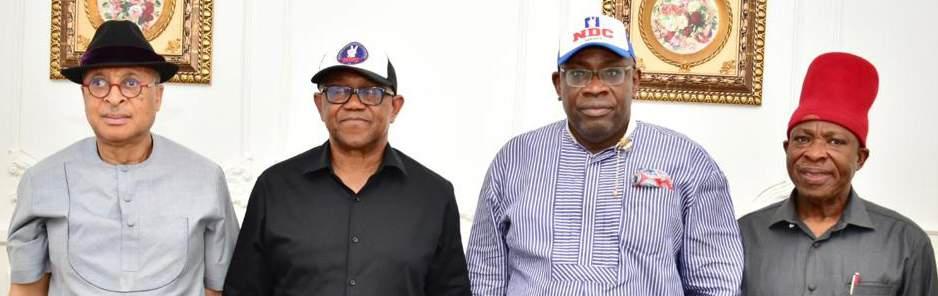
L-R: Prof. Pat Utomi; Presidential Candidate, Nigeria Democratic Congress (NDC), Peter Obi; party’s Founder and Leader, Senator Seriake Dickson, and the Senator representing Anambra Central in the 10th Senate, Senator Victor Umeh, after a closed-door meeting held in Abuja…yesterday











Ibadan
Oyo State Governor, Seyi Makinde, yesterday disclosed that the students and teachers abducted by suspected bandits in Oriire local government area of the state nearly a month ago are still being held within the Old Oyo National Park.


wellness within reach
with W Health loan
The W Health Loan provides women with access to financing for eligible healthcare services








*Terms and conditions apply
Elon Musk Makes History as World’s First Trillionaire With SpaceX IPO
Artificial intelligence company crosses over $2trn valuation
Kayode Tokede with agency report
Shares of SpaceX jumped 23 percent in their Nasdaq debut yesterday, as investors piled into the world's largest initial public offering (IPO), betting on Elon Musk's sprawling empire spanning rockets, internet services, and artificial intelligence. This made Musk the world’s richest
man and its first trillionaire.
The stock was last trading at $166 a share after opening for trading at $150, making SpaceX the sixth-largest United States company, with a market value above $2 trillion, Reuters reported.
The company's debut was widely viewed as a dress rehearsal for a new generation of mega-listings, with market
participants watching for signals on investor appetite ahead of forthcoming IPOs for AI heavyweights Anthropic and OpenAI.
Musk commemorated SpaceX opening for trading on Nasdaq by attending a ceremonial bell ringing from SpaceX’s South Texas home, Starbase.
Musk’s net worth also includes stock in his separately-run electric
car manufacturer, Tesla, as well as ownership stakes in a handful of other ventures, including the brain implant company Neuralink and the tunneling firm The Boring Company.
He founded SpaceX in 2002 and has revolutionised the space industry with partly reusable rockets and Starlink, a form of satellite internet that provides service to rural areas, airlines
and the Ukrainian army. Musk said SpaceX was going public now because it wants to establish satellites and data centers in space, as well as eventually founding a 1 million-person colony on Mars.
He restated his goals to help humanity expand beyond Earth.
“Not just a few astronauts, I mean literally you,” Musk said.
“Whoever you are watching this,
MAKINDE: ABDUCTED PUPILS, TEACHERS STILL HELD IN OLD OYO NATIONAL PARK
May 15, 2026.
The Governor acknowledged the pain and anxiety being experienced by the affected families, stating that although he had repeatedly assured residents that the victims would be rescued and reunited with their loved ones, he understood that such assurances might offer little comfort as the days
continue to pass.
Makinde maintained that the state government and security agencies have not relented in their efforts.
He said, “Every credible lead is being pursued and every lawful measure is being deployed to secure the safe release of the abductees.
"Intelligence reports indicate
that the victims are still being held within the wider Old Oyo National Park axis, a vast expanse covering approximately 2,500 square kilometres across parts of ten local government areas in Oyo State.
"The size and difficult terrain of the area pose significant operational challenges for
security personnel, requiring patience, strategic coordination, and sustained efforts to ensure a successful rescue operation.”
He, however, assured residents that security agencies have not relented in their efforts, stressing that every credible lead is being pursued to ensure the safe rescue of the victims.
Makinde urged members of the public to remain vigilant and report suspicious activities through the state’s toll-free emergency line, 615, adding that all useful information would be treated promptly.
He also cautioned against the spread of unverified reports concerning the abduction, warning that misinformation
DEMOCRACY DAY: LEADERS, CSOS WARN OF DEMOCRATIC BACKSLIDE, DEMAND REFORMS
Atiku Abubakar, who is the presidential candidate of the African Democratic Congress; the National Democratic Congress presidential candidate Peter Obi; the National human rights Commission and several governors, as well as human rights lawyer Femi Falana (SAN).
In his intervention, Atiku said the quality of democracy and behaviour of political actors betray the ideas of those who fought and died for democracy in Nigeria.
Obi urged Nigerians to use June 12 as an opportunity to evaluate the country’s democratic journey and determine whether it still reflects the ideals that inspired the historic 1993 election, while Saraki, argued that a strong and independent legislature remains the most effective safeguard against democratic collapse. Also, human rights lawyer, Falana, used the occasion to stage a public protest on the state of the nation.
But President of the Senate, Senator Godswill Akpabio, called on Nigerians to rally behind democratic institutions, embrace national unity and support ongoing efforts to tackle insecurity, declaring that the country's 27 years of uninterrupted democratic rule must not be undermined by forces seeking to derail its progress.
Similarly, Imo State Governor, Senator Hope Uzodimma
from participating in lending decisions and credit approval processes.
The move would also require the HoldCos to maintain a minimum 51 per cent ownership stake in their subsidiaries.
The proposed reforms, contained in the ‘Exposure Draft of the Revised Guidelines for Licencing and Regulation of Financial Holding Companies in Nigeria,’ posted on the apex
challenged Nigerians to work harder to sustain democracy, saying that both Nigerians and institutions must collaborate to defend democracy and make it a covenant that they must keep.
Governors from Nigeria’s North-West region used the occasion to express commitment to a concrete, time-bound actions aimed at reducing multidimensional poverty and improving living conditions for women and children to better the lot of the people.
Also, the Permanent Chairman of the Southern Nigerian Traditional Rulers Council (SNTRC), Arole Oodua Olofin Adimula and the Natural Head of the Oduduwa race worldwide, the Ooni of Ife, Ooni Adeyeye Enitan Ogunwusi, called on the federal government to intensify efforts towards tackling insecurity and ending the menace of banditry, kidnapping and other criminal activities threatening peace and development across the country.
The INEC recognised Peoples Democratic Party (PDP) paid tribute to the resilience, patriotism, and unwavering commitment of citizens to democratic governance despite prevailing challenges. Not left out, the PDP led by Tanimu Turaki urged Nigerians to remember the ethos of a free and fair election of June 12 1993. This was as the presidential candidate of the Social Democratic
bank’s website, were aimed at strengthening governance, enhancing accountability and ensuring clearer ownership structures within Nigeria’s increasingly diversified financial groups.
In prohibiting parent companies from participating in lending decisions, it stated that a HoldCo shall not: “Be involved in credit administration and approval processes of any
Party (SDP), Prince Adewole Adebayo, and his counterpart in the National Rescue Movement (NRM), Dr. Esther Nkem Okereke, said although Nigeria had sustained democratic rule for over two decades, millions of citizens remained trapped in poverty, insecurity and political disenchantment.
The Civil Society Legislative Advocacy Centre (CISLAC) and the Rule of Law and Accountability Advocacy Centre (RULAAC) while celebrating the import of June 12 lamented that despite 26 years of uninterrupted democratic rule, Nigeria was yet to fulfil the promise of the struggle, citing worsening insecurity, economic hardship, corruption and shrinking civic freedoms as evidence that many citizens have yet to reap the benefits of democracy.
ActionAid Nigeria used the occasion to raise concerns over what it described as the country’s failure to fully realise the democratic ideals symbolised by June 12, warning that shrinking civic space, rising poverty, insecurity and weak governance threaten the nation’s democratic future.
Executive Secretary of the National Human Rights Commission, Chief Tony Ojukwu (SAN), declared that credible elections were fundamental human right that must be
of its subsidiaries.”
It added: “Loans by a banking subsidiary to its holdco would be regarded as a return of capital and deducted from the capital of the bank in computing the bank’s capital adequacy ratio.”
According to CBN, the review became necessary after years of implementing the existing framework introduced in 2014.
The draft signed by Director, Financial Policy and Regulation
guaranteed to every citizen, rather than a privilege granted by those in power just as the Chairman of the Northern States Governors' Forum and Governor of Gombe State, Alhaji Muhammadu Inuwa Yahaya described democracy as the most dependable pathway to sustainable development, citing the transformation witnessed across Gombe.
They paid tribute to several pro-democracy icons, including Chief MKO Abiola, Hajia Kudirat Abiola, General Shehu Musa Yar’Adua, Chief Gani Fawehinmi, Ken Saro-Wiwa, Chima Ubani, Bamidele Aturu, Innocent Chukwuma, Bilikisu Yusuf, Tajudeen Abdulraheem and many others whose sacrifices shaped Nigeria’s democratic journey.
Atiku stated this while delivering a keynote address at the democracy day dialogue organized by the Coalition Political Action Committee (COPAC) commended Nigerians for not abandoning the promises of June ,12 ; freedom, prosperity and the right to choose leaders who will serve them.
Atiku expressed concerns that despite ravaging insecurity, only 7.11 percent of the country’s 2026 defense budget had been accessed, stressing that democracy has not yet translated into prosperity.
He said: “The cost of living crisis has exploded into an unbearable burden that is
Department, Dr. Rita Sike stated: “Following several years of implementation, the CBN has identified areas within the extant Guidelines that require enhancement to strengthen the operational effectiveness and regulatory oversight of Financial Holding Companies.
“Accordingly, the Guidelines has been reviewed to address observed gaps and align with evolving regulatory and market
crushing ordinary families. Fuel, good, transport, and medicine have become luxuries that few Nigerian’s can afford.
“Food insecurity has become synonymous with our daily reality. The statistics are staggering, and the warnings of impending hardship now haunt millions. Farms lie fallow, markers stand empty and for too many of our people have grown accustomed to going to bed hungry in a country that cannot even guarantee their safety.”
Atiku said youth unemployment has reached epidemic proportions and has condemned Nigerian’s brightest talents to idleness and despair , consequently driving an unprecedented wave of brain drain and forced migration.
Obi, yesterday challenged Nigerians to insist on a repeat of the credibility, transparency and popular legitimacy that characterised the historic June 12, 1993 presidential election, declaring that the country must deliver a similar electoral process in 2027.
Marking this year's Democracy Day, Obi urged citizens to go beyond celebrations and use June 12 as an opportunity for sober reflection on the health of Nigeria's democracy, the performance of its institutions and the integrity of its electoral system.
In a statement posted on his X
developments.”
One of the most significant changes proposed by the regulator is the introduction of a mandatory majority ownership requirement for all subsidiaries under financial holding companies.
Highlighting the key amendments, the apex bank stated that the revised framework would introduce, “Ownership and Control
SpaceX wants to be able to take you to the moon, take you to Mars and ultimately beyond.” SpaceX's stock performance is being closely scrutinised in part because some bankers said the IPO market could face difficulties if SpaceX shares close below Thursday's pricing level of $135 a share.
could undermine ongoing rescue operations and compromise security efforts. The governor appealed to residents to continue supporting security agencies with credible information and to keep the abducted students and teachers in their prayers as efforts to secure their freedom continue.
account, the former Labour Party presidential candidate said June 12 remains the most enduring symbol of the Nigerian people's democratic will and should serve as a benchmark for evaluating the nation's political progress. According to him, the annual commemoration of Democracy Day should provoke critical questions about whether Nigeria's democratic institutions are living up to the ideals that inspired the struggle for democratic governance.
In his Democracy Message, Uzodimma, who is also the Chairman of Progressive Governors Forum insisted that the legislature, judiciary, security agencies, the electoral body and Nigerians themselves must work hard to uphold democracy as the best form of government for the county.
"Democracy is not the work of government alone. Let each of us, in our own station, support and consolidate it,' he declared. While acknowledging that democracy in Nigeria still faces some challenges, he was optimistic that given the 27 years of unbroken democracy Nigeria truly deserved this form of government they fought for. He paid glowing tribute to President Bola Ahmed Tinubu and other democracy activists
Requirements: Requiring FHCs to hold a minimum of 51 per cent equity stake in each subsidiary and to be registered as a person with significant control by the appropriate corporate registration authority.” The proposed requirement is expected to strengthen the ability of HoldCos to exercise effective oversight over subsidiaries while
MEDIA BRIEFING...
State Police: Federal Authorities to Handle National Security, States to Control Local Policing
Shagari to NASS: Approve state police now before insecurity consumes Nigeria
With the House of Representatives having passed the constitutional amendment bill seeking to establish state police and the Senate already advancing the proposal through Second Reading, momentum is building towards the realisation of one of Nigeria's most debated security reforms.
Adding his voice to the call for state police, former Deputy Governor of Sokoto State and ex-Minister of Water Resources, Mukhtari Shagari, has urged the National Assembly to end years of debate and urgently approve the creation of state police, warning that Nigeria risks deeper insecurity if the reform is delayed further.
Details of the proposed constitutional amendment obtained by THISDAY yesterday
revealed a far-reaching framework that would fundamentally restructure policing across the country by creating separate Federal and State Police formations with clearly defined responsibilities, powers and oversight mechanisms.
The proposed amendment, currently before the National Assembly, seeks to amend the Constitution to formally establish two distinct policing institutions—the Federal Police and State Police—in what could become one of the most significant security reforms since the return to democratic rule in 1999.
Under the proposal, each state would be empowered to establish its own police service through legislation passed by its House of Assembly, while the Federal Police would retain responsibility for national security and federal law
Warri Federal Constituency II: Warring Parties Agree Power Sharing after Tinubu's Intervention
Representatives of the Ijaw and Itsekiri ethnic nationalities in Delta State have agreed on a power-sharing arrangement for the proposed Warri Federal Constituency II following the intervention of President Bola Tinubu aimed at resolving the lingering dispute over electoral ward delineation in the area.
The agreement was reached yesterday, after a meeting convened at the Office of the National Security Adviser (NSA), Mallam Nuhu Ribadu, in Abuja.
The meeting followed an earlier engagement between Tinubu and representatives of the Ijaw, Itsekiri and Urhobo ethnic groups from Warri Federal Constituency at
the Presidential Villa on June 11. Delta State Governor, Sheriff Oborevwori, also attended the meeting.
According to the resolution signed by representatives of the Ijaw and Itsekiri groups and witnessed by stakeholders, the parties agreed on a rotational arrangement for the House of Representatives seat in the proposed Warri Federal Constituency II. Under the agreement, the House of Representatives seat would rotate between the Ijaw and Itsekiri ethnic groups, with the Ijaw nationality taking the first turn for two consecutive terms before the seat shifts to the Itsekiri for a similar tenure.
enforcement functions.
The proposed legislation stipulates that State Police would not commence operations automatically. States seeking to establish police services must first enact relevant laws and meet national minimum standards prescribed by an Act of the National Assembly before
receiving certification to operate.
The bill also contains transitional provisions under which the Federal Police would continue performing all policing functions in states until their respective police formations become fully operational.
A major highlight of the proposed amendment is the
attempt to balance state policing powers with safeguards against abuse and excessive federal interference.
According to the draft proposal, the Federal Police would be prohibited from interfering in the internal security affairs of a state except under clearly defined circumstances. Such intervention
would only be permitted where there is a complete breakdown of law and order beyond the capacity of a State Police Service, where a governor formally requests assistance, or where a state police force becomes unable to function because of administrative, financial or operational challenges.
VMO Aero Clarifies Circumstances of Aircraft Occurrence Near Asaba Airport
VMO Aero has provided additional details regarding an occurrence involving one of its aircraft during a flight from Lagos to Asaba on June 10, 2026.
In a statement signed by its Accountable Manager, Oluwaseun Ayodeji, the company said the aircraft departed Lagos and, during its initial approach into Asaba Airport at about 7:43a.m. local time, the flight crew determined that the approach parameters were not within the required limits for a safe landing.
The aircraft involved was a
Bombardier Challenger CL-601 business jet with registration N989BC. Aviation industry sources said the aircraft is on lease in Nigeria from Best Aircraft Deals LLC, a U.S.-based aviation brokerage and aircraft services firm involved in aircraft sales and acquisitions.
According to the company, the crew subsequently carried out a missed approach in line with established aviation safety procedures and repositioned the aircraft for another approach.
VMO Aero stated that the aircraft later landed on a roadway in the
Ogwashi-Uku area near Asaba.
The company said it is engaging with the Nigerian Safety Investigation Bureau (NSIB), the Nigerian Civil Aviation Authority (NCAA) and other relevant authorities to support a comprehensive review of the occurrence and the implementation of any necessary corrective actions. It confirmed that there were no injuries to any persons, no damage to property and that the aircraft subsequently returned safely to Lagos.
VMO Aero said it appreciates
the seriousness with which the authorities view any event that could affect the integrity of flight operations and regulatory compliance, and expressed regret for any inconvenience caused to members of the public. The company reiterated its commitment to safety, regulatory compliance, operational responsibility and professional accountability, while pledging continued cooperation with the relevant authorities as efforts continue to establish all the facts surrounding the occurrence.
Report: Long-standing Regional Political Culture Shaping Anti-APC Sentiment Among South-east Youths
Adedayo Akinwale in Abuja
A new report released by South East Youth for Progressives (SEY4P) has revealed that historical political alignments and long-standing regional political culture has continued to shape anti-All Progressives Congress (APC) sentiment among young people in the South-east.
The Research Coordinator/ Chairman, SEY4P, Ugah Chukwuemeka, said the report released yesterday which was
conducted between March and May 2026, surveyed 12,480 respondents across 29 universities and nine polytechnics located in Abia, Anambra, Ebonyi, Enugu, and Imo states.
He explained that participants included undergraduate students, young graduates, entrepreneurs, job seekers, NYSC members, and first-time voters between the ages of 18 and 35.
Chukwuemeka said the report revealed that several
factors continue to shape negative perceptions of the APC among South-east youths.
He noted, “The findings show that 34 per cent of respondents believe the South-east remains politically marginalised at the national level.
“Twenty-seven per cent cited worsening economic hardship, unemployment, inflation, and declining living standards as the primary reasons for losing confidence in the ruling party.
“Eleven per cent said historical political alignments and long-standing regional political culture continue to shape anti-APC sentiment among young people.
“Eight per cent believe the APC has failed to maintain consistent grassroots youth engagement and sustained interaction with young people across the region.
“Sixteen per cent admitted that their political opinions are heavily influenced by negative social media narratives and online conversations surrounding the APC.
Sylvester Idowu in Warri
Chuks Okocha in Abuja and Onuminya Innocent in Sokoto
Executive Director, Optiva Capital Partners, Amaka Okeke (left) and Chairman, Franklin Nechi, at the company’s Quarterly Media Briefing held in Lagos…recently
MOVIE PREMIERE...
FG Distributes Free Fertilisers to 20,160 South-west Farmers
Armstrong
James Emejo in Abuja
Takang:
The National Agricultural Development Fund (NADF) has intensified efforts to boost food production and strengthen food security with the distribution of 80,640 bags of free fertiliser to 20,160 smallholder farmers across the South-west geopolitical zone.
Tinubu’s reforms repositioning economy, unlocking value from public assets
Also, the Managing Director/ Chief Executive, Ministry of Finance Incorporated (MOFI), Dr. Armstrong Ume Takang, yesterday declared that the economic reforms being implemented by President Bola Tinubu are laying a stronger foundation for sustainable growth by repositioning key
Police Teargas Protesters At June 12 March in Abuja
Chuks Okocha in Abuja
A protest march in Abuja calling for urgent government action on insecurity, the release of abducted schoolchildren, and improved governance was disrupted yesterday after security operatives fired teargas at demonstrators approaching Eagle Square.
The procession, which began earlier at Berger Bus Stop in Wuse part of Abuja, was heading towards the Federal Secretariat where organisers planned to submit their demands to the federal government when it was intercepted near Eagle Square by armed policemen.
Eyewitness accounts and reports indicated that
teargas canisters were fired into the advancing crowd as the protesters neared the area, causing panic and forcing participants to scatter temporarily.
Human rights activist and protest leader, Omoyele Sowore, was among those affected by the chemical irritants, with reports stating that he was exposed to teargas at close range.
He was said to have inhaled the fumes and experienced breathing difficulties before being assisted away from the scene by fellow protesters.
A second round of teargas was reportedly deployed while he was still receiving attention, further heightening tension and confusion in the area.
Stakeholders Call for Collaborative Actions to Boost Cancer Care
Healthcare services stakeholders have called for urgent collaborative action to stem the widening gap in cancer treatment in the country.
At a high-level Executive Business Networking Dinner held in Lagos, healthcare leaders, policymakers, investors, financial institutions and hospital executives, participants called for collaborative actions to address the crisis in the management of cancer cases in Nigeria.
On a collective note, they
identified critical infrastructure deficits as a threat to healthcare delivery across the country as they warned that urgent investments and stronger partnerships are needed to stem the widening cancer care gap and poor healthcare infrastructure.
The organisers of the event, global healthcare technology company, SHINVA Medical Solutions and Hospital Assist Nigeria (HAN), unveiled fresh plans to support oncology expansion, infection prevention and hospital modernisation across Nigeria.
public institutions and unlocking value from government-owned assets.
The intervention, implemented under the federal government's Renewed Hope Farm Input Support Programme (FISP), was officially flagged off in Ado-Ekiti as part of measures to support farmers during the 2026 wet farming season.
Speaking at the launch, Executive Secretary/Chief Executive of NADF, Mr. Mohammed Abu Ibrahim, described the programme as a strategic intervention aimed at enhancing agricultural productivity, lowering production
costs and ensuring that support reaches genuine farmers.
According to him, the initiative was designed to deliver targeted assistance to farmers cultivating priority crops critical to food production and market stability.
He said, “This is not fertiliser distribution for the sake of distribution. It is targeted support designed to get fertiliser to the right farmers, for the right crops, at the right time."
He explained that the programme aligns with President Bola Ahmed Tinubu’s commitment to food security, agricultural transformation and inclusive economic growth.
The NADF boss further disclosed that all fertilisers distributed under the programme were locally produced, traceable and clearly branded “Not For Sale” to curb diversion and ensure accountability.
He added that each bag had been linked to verified beneficiaries as part of measures to promote transparency in the distribution process.
Ekiti State Governor Biodun Oyebanji who was represented by the Secretary to the State Government, Prof. Habibat Adubiaro, described the fertiliser support programme
as a timely intervention that would help improve agricultural productivity across the region.
The governor noted that the initiative would also support ongoing efforts to position agriculture as a major driver of economic growth, job creation and food security.
He commended President Bola Tinubu, the Federal Ministry of Agriculture and Food Security and NADF for implementing programmes that directly support farmers while strengthening cooperation between the federal and state governments.
AI Now Strategic Necessity, Not Luxury, Nigerian Army Declares
Linus Aleke in Abuja
The Nigerian Army has underscored the growing importance of artificial intelligence (AI) and strategic communication in modern military operations, describing emerging technologies as critical tools for operational success in an increasingly complex information environment.
Speaking at the closing of the Combined First and Second Quarters Directorate of Army Public Relations Media Workshop 2026, the Acting Director of Army Public Relations, Colonel Apollonia
Anele, said the workshop had highlighted the need for the Army and its partners to remain adaptive, innovative and technologically aligned in the information domain.
According to Colonel Anele, one of the major highlights of the workshop was the forward-looking discourse on the application of AI in media operations.
She noted that discussions on AI-driven tools for information management, audience analysis, content development and rapid-response communication reinforced the importance of embracing technology to enhance
operational effectiveness. "In an era where speed, accuracy and influence often shape outcomes, artificial intelligence is no longer a luxury but a strategic necessity," she stated.
The Acting Director further explained that deliberations on leveraging media operations for strategic influence in joint operations reaffirmed the growing significance of information as a decisive component of contemporary security operations.
She said participants recognised that effective media engagement can shape narratives, counter adversarial
propaganda, build public confidence and strengthen the legitimacy of military and security operations. "Indeed, the concept of media as a force multiplier has resonated strongly throughout this workshop. Just as firepower and manoeuvre contribute to success on the battlefield, strategic communication and media integration are critical to success in the cognitive and perceptual domains," she said, adding that the ability to project truth, maintain credibility and positively influence public perception remains central to enduring operational success.
Lagos First Lady Intensifies Campaign Against Drug Abuse in Tertiary Institutions
Segun James
The First Lady of Lagos State, Dr. Ibijoke Sanwo-Olu, has intensified her office campaign against drug abuse as she led a walk against the scourge at Caleb University, Imota, Lagos.
The walk, which commenced from the main gate of the institution at Imota, had principal officers of the university led by the Vice Chancellor, Prof.
Olalekan Asikhia, other workers of the institution, students and residents of Imota community as participants.
The Caleb edition of the walk, was in commemoration of the 2026 International Day Against Drug Abuse and Illicit Trafficking with the theme ‘The World Drug Problem: Persisting Issues, New Challenges, Innovative Responses’ and was the third edition of the
campaign in tertiary institutions.
Mrs. Sanwo-Olu said that Caleb University is the third tertiary institution visited under this initiative and the first private university in Lagos State to participate.
According to her, the theme for the Year 2026 reflects both longstanding and emerging patterns of drug abuse that require collaborative and evidence-based action.
She said, "Drug abuse poses a serious threat to our youth and society at large. It adversely affects mental and physical health, academic performance, productivity, relationships, and overall wellbeing."
The First Lady said drug addiction cuts across ages, gender, and social status; “yet, those affected are often stigmatised rather than supported.”
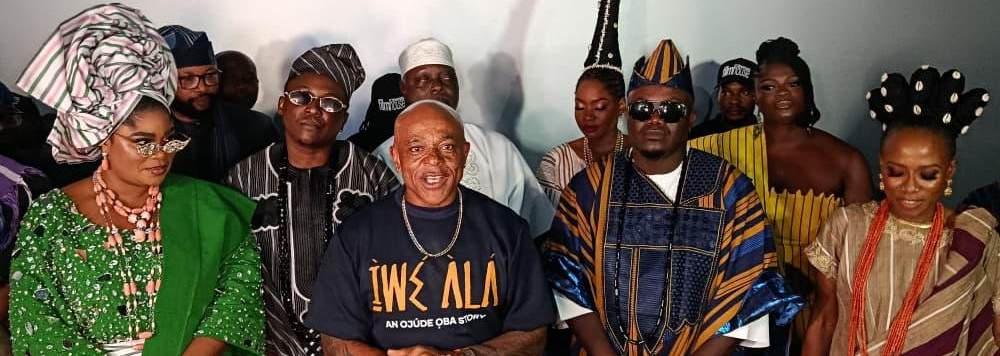
L-R: Eniola Ajao, Farooq Oreagba, Owobo Ogunde, Tobi Makinde, and Mrs. Olawumi Fajemirokun (Executive Producer ), during the premiere of the movie, "Iwe Ala" at Filmhouse Cinema, Lekki Lagos...recently.


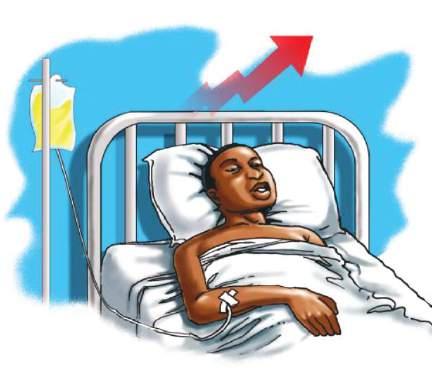
The Race To Cure Cancer
Artificial Intelligence, genetics, and modern science are redefining hope, writes SONNY IROCHE
Cancer remains one of humanity’s most feared and devastating diseases. It has claimed millions of lives across generations, affecting families, economies, and healthcare systems worldwide. Yet, despite its terrifying reputation, scientists today are more optimistic than ever before that humanity is approaching a historic turning point in the fight against cancer.
For decades, cancer treatment revolved around surgery, chemotherapy, and radiation therapy. These methods, though lifesaving in many cases, often came with severe side effects because they attacked both healthy and cancerous cells. Modern scientific research, however, is shifting away from generalized treatment toward precision medicine, therapies designed specifically to target the biological weaknesses of individual cancers.
Today, laboratories across the United States, the United Kingdom, China, Germany, Japan, Israel, and other advanced scientific centers, such as the University of Oxford, MIT and Stanford are engaged in an unprecedented race to find not merely treatments, but functional cures for many forms of cancer. Artificial Intelligence (AI), genomics, nanotechnology, immunotherapy, stem-cell science, and molecular biology are converging to transform what once seemed impossible into a realistic scientific ambition.
One of the most exciting developments in this global effort is the emergence of AI-driven drug discovery companies such as Isomorphic Labs, a spinout from Google DeepMind. The company has attracted worldwide attention because of its bold ambition to revolutionize medicine using artificial intelligence. In May 2026, Isomorphic Labs reportedly raised approximately $2.1 billion to accelerate the development of AI-designed drugs, including therapies targeting cancer. The company is preparing to commence clinical trials by late 2026, focusing particularly on oncology, the branch of medicine dealing with cancer.
Although no definitive “cure for cancer” has yet been announced, researchers believe that AI could dramatically shorten the timeline for discovering life-saving medicines.
Traditionally, developing a new drug could take between 10 and 15 years, with costs exceeding billions of dollars. Scientists would manually test
Ithousands, sometimes millions, of molecules before identifying one potentially effective drug candidate. AI changes this equation completely.
Using sophisticated machine-learning systems derived from technologies such as AlphaFold, researchers can now predict the three-dimensional structures of proteins and map how molecules interact within the human body. This allows scientists to design highly targeted drugs with unprecedented speed and precision.
At the heart of many cancers lies genetic mutation. Cancer is fundamentally a disease of abnormal cellular behavior, where cells grow uncontrollably, evade death, and spread throughout the body. Modern AI systems can analyze enormous genomic datasets in ways impossible for human researchers alone. These systems can identify hidden patterns, predict mutations, and even recommend molecular compounds likely to interrupt cancer growth.
This represents a revolutionary shift from reactive medicine to predictive medicine.
Scientists increasingly believe that cancer may eventually become a manageable chronic condition rather than a death sentence. Some experts compare the current state of cancer research to the early days of antibiotics in the 20th century, a scientific frontier on the verge of transformative breakthroughs.
One of the most promising areas of cancer research today is immunotherapy. Unlike chemotherapy, which attacks cancer directly, immunotherapy empowers the body’s own immune system to recognize and destroy cancer cells. This field has already produced remarkable results.
CAR-T cell therapy, for instance, involves extracting a patient’s immune cells, genetically engineering them to attack cancer, and reinserting them into the body. In certain blood cancers such as leukemia and lymphoma, CAR-T therapies have produced extraordinary remission rates.
Researchers are now attempting to extend these successes to solid tumors such as breast cancer, lung cancer, pancreatic cancer, an d brain cancer, areas traditionally more difficult to treat.
TIMIPA JENKINS OKPONIPERE PAYS TRIBUTE TO BLESSING AMADI, MEMBER HOUSE OF REPS AT 72
Iroche is an Oxford-trained Artificial Intelligence scholar with a postgraduate qualification from the University of Oxford
Happy Birthday, Blessing Chigeru Amadi
TIMIPA JENKINS OKPONIPERE pays tribute to Blessing Amadi, member House of Reps at 72
n 2019, by sheer divine providence, little known Mrs. Blessing Chigeru Amadi (a.k.a. Ada Ikwerre) from little known Rumuekini Community in Obio/Akpor Local Government Area of Rivers State was overwhelmingly elected into Nigeria’s House of Representatives by the good people of Port Harcourt Federal Constituency Two.
Indeed, not a few pundits and bookmakers in the politics of Rivers State were visibly stunned by Ada Ikwerre’s sudden and dramatic political, economic and social metamorphosis; from being a mere retired university administrator into a federal legislator in Nigeria’s keenly competitive political environment.
Among many milestones in an illustrious career in public service, Ada Ikwerre enjoys the privilege, the distinction and the rare honour of being elected as the first and only female secretary general in the history of Ogbakor Ikwerre Worldwide (the umbrella body of Ikwerre ethnic nationality, one of whose prominent sons is Chief Nyesom Ezenwo Wike, Minister of the Federal Capital Territory, Abuja). She was appointed as the first and only female Special Assistant to the Vice Chancellor (SAVC) in the history of Rivers State University (RSU) in Port
Harcourt where she meritoriously served under Professor Simeon Achinewhu.
It was while she was working and schooling at the Faculty of Law of RSU Chief Nyesom Wike – her Destiny Helper – spotted her talent.
Sometimes, good news travels faster than bad ones. In her capacity as SAVC at RSU, Mrs Amadi positively impacted many lives and families, particularly in the area of access to tertiary education. Through her effort, literally hundreds of indigent Rivers sons and daughters gained admission into RSU. Unknown to Ada Ikwerre, news of the good works she did while working and schooling at RSU somehow got to the ears of Chief Nyesom Wike who immediately took particular interest in her career. Chief Wike was visibly impressed with the fact that the SAVC at RSU was a lady from Rumuekini Community (but married into Amadi Family of Nkpolu-Oroworukwo Community) who was making Ikwerre and Rivers State proud.
Among many homilies, Amadi’s political, economic and social metamorphosis; from being a mere retired university administrator into a federal legislator in Nigeria teaches us to shun corruption and other societal vices; teaches us to
be God-fearing citizens; teaches us to be selfless human beings; teaches us to be principled and dedicated to a cause; teaches us to be reliable and trustworthy compatriots; and finally, teaches us to be meek and humble, at all material times; because, it is only God who shows mercy.
Shortly after Blessing Amadi was elected into the House of Representatives, she discovered that Rivers was the only state in the entire federation which did not have a Federal Medical Centre (FMC). She has since initiated A Bill for the Establishment of a Federal Medical Centre in Port Harcourt, Rivers State. Her legislative advocacy and activism, particularly for women and child rights has seen her travel to many countries of the world.
Since Nigeria gained independence in 1960, every democratic epoch has produced a legislative Amazon. In the current political dispensation in Nigeria, Amadi is the legislative amazon of Nigeria on account of several reasons, including: One, she has initiated several bills and sponsored/moved several motions of national importance to Nigeria and the people of Port Harcourt Federal
Constituency 2.
Two, she is not a controversial or divisive element in the National Assembly, unlike other female legislators. Her patriotism and dedication to the continued unity and greatness of Nigeria is well documented and commended by the leadership of the House of Representatives.
Three, at 72 years of age, having been born 1st May, 1954, she approaches the legislative assignment with maturity, poise, experience, courage, bravery and candour. Accordingly, therefore, she cannot be intimidated, cowed or bullied.
Given these rare qualities, the good people of Port Harcourt Federal Constituency 2 are poised to return Ada Ikwerre back to the 11th House of Representatives come February, 2027 on the platform of All Progressives Congress (APC). This would enable her to continue to give Nigeria, the international community and the people of her constituency good and proper representation for sustainable development.
Dr. Okponipere is lawyer and former Member of Governing Council, Abubakar Tafawa Balewa University (ATBU), Bauchi
Has the North Benefitted from Democracy?
In Praise of President Buhari
The Menace of Cybercrime Among Youths
WShen President Muhammadu Buhari took over the reins of power on May 29, 2015, Nigeria was sadly a broken state in many respects. As a result of many other factors including bad governance and untold level of corruption, government could not live up to its financial obligations to citizens and service providers at both the federal and state levels.
Indeed one of the first official assignments that President Buhari carried out was the approval of billions of Naira in bailout funds to enable state governors pay something as basic as workers’ salaries. Granting those bailout funds was a huge boost to national security because the pressure of arrears of unpaid monthly salaries building dangerously all over the country was a ticking bomb.
Ask the naysayers and they would readily remind you of how long it took President Buhari to appoint his ministers and how that contributed to collapse of the economy as if, without ministers, governance was frozen. But buying that narrative would amount to what a famous Nigerian writer, Chimamanda Adichie, termed “the danger of a single story”. Yet the whole story was that many of our citizens did not know how decrepit a state President Buhari inherited in 2015.
ince the return of democracy in 1999—precisely 27 years ago—democratic governance in Nigeria has continued to evolve, reflecting both the strengths and shortcomings of the system. Within this period, Nigeria has conducted seven uninterrupted general elections, a notable achievement in its political history. In the coming months, Nigerians will once again head to the polls to elect new leaders for another four-year term. The electoral umpire, INEC, has already released the election timetable, while political parties have concluded their primaries in preparation for the 2027 general elections.
It was therefore necessary for him to take stock against the background of the fact that the departing government did not, reportedly, cooperate full well with the incoming government in terms of leaving workable handover notes. Although President Goodluck Jonathan was gracious in defeat, many of his appointees were still sulking over what they saw as their personal losses and therefore pulled all the stops to make things difficult for the Buhari government.
However, after over two decades of democratic rule, critical questions persist, particularly among Northern Nigerians: To what extent has democracy benefitted the North—the largest political bloc with 19 states and significant voting strength?
with some farmers compelled to pay levies to access their own farmlands. Those unable to comply often lose both their livelihoods and their safety. Government policies have also contributed to the sector’s decline. The decision by the current administrations to open borders for the importation of certain staple grains has undermined local agricultural production. Farmers are now forced to compete with imported, often subsidized, goods, making it difficult to sustain their businesses. Additionally, the high cost of fertilizers, pesticides, and farm equipment—exacerbated by the removal of fuel subsidies—has further increased the burden on farmers.
Even with the obvious and unpatriotic obscurantist behaviour of the PDP appointees and their supporters still in government hell-bent on making things difficult for Buhari, the President moved on with his methodical repair of a broken country. The first thing he did was to identify all possible sources of income to the nation and directed that all inflows be paid into one single account in line with the policy of Single Treasury Account (TSA).
The answer is not straightforward. While democracy has brought some gains, the region continues to grapple with deep-seated challenges that raise concerns about its overall impact. Once a flourishing and economically vibrant region, Northern Nigeria is now battling a myriad of problems, including poverty, unemployment and widespread insecurity.
The TSA policy, interestingly, was mooted by the PDP government but its penchant for imprudence and lack of accountability denied it the courage of implementing the policy. What the President literally did was to gather all the nation’s money into one box and locked it up with a big padlock and watched for any thief to come close.
Who can blame the President for almost developing paranoia over the safeguard of the national treasury with revelations and reports of mind-boggling looting that took place in the 16 years of the PDP? With such disclosures of how billions meant for fighting insurgency in the Northeast ended up in the pockets of a few individuals while our gallant soldiers fought with bare hands and on empty stomach, President Buhari was duty bound to bring sanity and accountability back in national spending.
Agriculture, which forms the backbone of the region’s economy, has suffered significant setbacks. Persistent attacks by non-state actors have forced rural farmers to abandon their ancestral lands. In many communities, farming activities have been disrupted by banditry,
Thus, under President Buhari, the Economic and Financial Crimes Commission (EFCC), which had remained comatose for years, was woken up to resume its duties. Apart from the trillions of Naira of looted funds and property recovered from corrupt politicians
by the EFCC, President Buhari by his action has successfully brought back to the public consciousness the need to treat public funds with the highest level of transparency and accountability.
CAfter keeping treasury looters on their toes and at bay through the EFCC, particularly, President Buhari moved to curb unnecessary spending habits of the nation on what economists call articles of ostentation. Part of the disclosures of the President’s stock taking was how the country frittered away billions in foreign currency by importing goods, which can be produced at home. One of such items was rice, a major staple among Nigerians. By banning rice importation into the country, the President on one hand had saved the nation billions in foreign currency annually.
And, on the other hand, the President has boosted domestic production of rice and in the process had nudged the country into self sufficiency in food production. He also created millions of jobs for young people in the rice value chain.
What is most admirable about President Buhari and his government is its frugal management of scarce national resources to attain optimum goals.
Recall that since President Buhari stepped in the saddle, oil revenue dropped abysmally as if to sabotage him knowing all the big promises he made to citizens during his campaigns. But with the little resources that trickle in, the President is achieving what governments that received oil windfalls could not dream of.
Ibrahim Mustapha Pambegua, Kaduna State
ybercrime has emerged as one of the most disturbing national issues facing Nigeria in recent years. While technological advancement has created numerous opportunities for innovation, entrepreneurship, and communication, it has also provided a platform for criminal activities conducted through digital means. The increasing involvement of some Nigerian youths in internet fraud has become a matter of serious concern for families, communities, and government institutions.
One of the reasons for the rise in cybercrime is the high rate of unemployment and underemployment among young people. Many graduates leave universities and other tertiary institutions only to find limited job opportunities. In
Today, the trains are up and running daily from Abuja to Kaduna. And from Lagos to Ibadan a brand new rail track was started and completed; citizens are already commuting daily to and fro these two major cities in the country seamlessly as they reap from the dividends of democracy. And with the way this government is going, before 2023 when the President would leave, the entire country would be linked by rail with all of its economic advantages.
Ainofenokhai Ojeifo, Abuja
THE SATURDAY NEWSPAPER
THE SATURDAY NEWSPAPER
EDITOR YEMI ADEBOWALE
EDITOR OBINNA CHIMA
DEPUTY EDITOR AHAMEFULA OGBU
DEPUTY EDITOR AHAMEFULA OGBU
MANAGING DIRECTOR ENIOLA BELLO
MANAGING DIRECTOR ENIOLA BELLO
DEPUTY MANAGING DIRECTOR ISRAEL IWEGBU
DEPUTY MANAGING DIRECTOR ISRAEL IWEGBU
CHAIRMAN EDITORIAL BOARD OLUSEGUN ADENIYI
CHAIRMAN EDITORIAL BOARD OLUSEGUN ADENIYI
EDITOR NATION’S CAPITAL IYOBOSA UWUGIAREN
EDITOR NATION’S CAPITAL IYOBOSA UWUGIAREN
Stop Ritual Attacks and Killings
Ttheir desperation to achieve financial independence, some individuals are lured into fraudulent online activities that promise quick wealth. The glorification of sudden wealth in certain segments of society has further contributed to the problem. Social media platforms are often filled with displays of luxury lifestyles, expensive cars, and lavish spending, creating pressure on young people to attain similar standards of living regardless of the means. This unhealthy obsession with material success has weakened moral values among some members of society.
Halima Abubakar Sadiq, Mass Communication Dept, Kashim Ibrahim University, Maiduguri
Science Goes Silly But Not Cheap
STHE OMBUDSMAN KAYODE KOMOLAFE
MANAGING EDITOR BOLAJI ADEBIYI THE OMBUDSMAN KAYODE KOMOLAFE
THISDAY NEWSPAPERS LIMITED
THISDAY NEWSPAPERS LIMITED
EDITOR-IN-CHIEF/CHAIRMAN NDUKA OBAIGBENA
EDITOR-IN-CHIEF/CHAIRMAN NDUKA OBAIGBENA
he Advocacy for Alleged Witches (AfAW) urges the Nigerian public to stop ritual attacks and killings because the notion of ritual money and wealth is completely baseless. AfAW is making this call following the reported arrest of suspected ritualists in Oyo State in southern Nigeria. The local media reported that members of the Western Nigeria Security Network, Amotekun, arrested suspected ritualists with the body parts of a 73-year-old man. The suspects, who were apprehended in the Boluwaji area in Ibadan, said that a Muslim cleric asked them to procure some human body parts for rituals. Ritual attacks are widespread in Nigeria. Irrational conceptions of how to make money or become wealthy and successful undergird these atrocities. Many Nigerians strongly believe in blood money, known in some local languages as Ogun Owo (Yoruba) or Ogwu ego (Igbo). They think that they could become rich, or successful through ritual sacrifice. Unfortunately, this is not the case. Ritual wealth has no basis in reason, science, or reality. Home movies known as Africa magic or Nollywood films have not helped matters. These movies continue to reinforce these mistaken notions and other superstitions. Families, churches, mosques, and other public institutions do not encourage the interrogation of these traditional occult beliefs. There are no robust efforts to criticize or dispel these irrational and paranormal claims in schools, colleges, and universities. So millions of Nigerians grow up blindly believing that they could make money through ritual sacrifice of human body parts. The belief has led many Nigerians to commit crimes and perpetrate atrocities. Many Nigerians have been jailed or are undergoing court trials due to ritualrelated attacks and murder.
GROUP EXECUTIVE DIRECTORS ENIOLA BELLO, KAYODE KOMOLAFE, ISRAEL IWEGBU, IJEOMA NWOGWUGWU, EMMANUEL EFENI
GROUP EXECUTIVE DIRECTORS ENIOLA BELLO, KAYODE KOMOLAFE, ISRAEL IWEGBU
DIVISIONAL DIRECTORS SHAKA MOMODU, PETER IWEGBU, ANTHONY OGEDENGBE
DIVISIONAL DIRECTORS SHAKA MOMODU, PETER IWEGBU, ANTHONY OGEDENGBE
DEPUTY DIVISIONAL DIRECTOR OJOGUN VICTOR DANBOYI
DEPUTY DIVISIONAL DIRECTOR OJOGUN VICTOR DANBOYI
SNR. ASSOCIATE DIRECTOR ERIC OJEH
SNR. ASSOCIATE DIRECTOR ERIC OJEH
ASSOCIATE DIRECTOR PATRICK EIMIUHI
ASSOCIATE DIRECTOR PATRICK EIMIUHI
CONTROLLERS ABIMBOLA TAIWO, UCHENNA DIBIAGWU, NDUKA MOSERI
CONTROLLERS ABIMBOLA TAIWO, UCHENNA DIBIAGWU, NDUKA MOSERI
DIRECTOR, PRINTING PRODUCTION CHUKS ONWUDINJO
DIRECTOR, PRINTING PRODUCTION CHUKS ONWUDINJO TO SEND EMAIL: first name.surname@thisdaylive.com
TO SEND EMAIL: first name.surname@thisdaylive.com
cientists have done so much to make our lives better and there is so much more to do but occasionally they go rogue and this might be such a case. T.rexs died out about 66 million years ago and even Google says you can't get DNA from fossils, a fact that would have made Jurassic Park a much shorter film. However, a purse made of T.rex leather is up for sale for about $500K, which seems expensive but given the shortage of real T.rex leather might be reasonable. The reality however, from my years of school science teaching, is that this isn't possible although a purse costing $500k should also be impossible. A $10 purse will do the job and from there this may just be an exercise in vanity and gullibility although purses are not my area of speciality. Dennis Fitzgerald, 28 Landale St, Box Hill, Vic., Australia
Not too long ago, the police arrested some young Nigerians for stealing female pants, which they intended to use for ritual sacrifice. AfAW is asking all Nigerians to desist from ritual-related abuses because ritual money beliefs are baseless superstitions. Nigerian media, schools, and colleges should help educate and reorient the public. They should assist in reasoning Nigerians out of this killer-superstitious absurdity and nonsense. Leo Igwe directs the Advocacy for Alleged Witches (AfAW)
Welcome home...

ROTARY DISTRICT 99111 SCHOLARSHIPS PRESENTATION...
Tension in Kwara Communities as Suspected Bandits Abduct 20, Kill One Person
Troops intensify pressure on terrorists in Lake Chad region as two ranking ISWAP commanders surrender NAF air strikes decimate terrorist enclave, neutralise scores in northern Tumbuns offensive
Tension has enveloped the ancient towns of Gaa-Alla and Gaa Oke Abba communities in Isin Local Government Area and Famole town in Ifelodun Local Government Area of Kwara State, following the killing of one person and abduction of 20 persons when suspected bandits invaded the affected communities.
This was as the troops of Operation Hadin Kai intensified pressure on terrorist elements operating in the Lake Chad region, resulting in the surrender of two ranking commanders of the Islamic
State West Africa Province (ISWAP). The development marks another major success in the military's ongoing counter-terrorism campaign and underscores the growing impact of sustained operations against insurgent strongholds across the North-east.
Also, the Nigerian Air Force (NAF), through the Air Component of Operation Hadin Kai, has delivered another significant blow to terrorist elements in the Lake Chad Basin, following precision air strikes that destroyed a terrorist enclave and neutralised scores of insurgents at Metele in the Northern Tumbuns area.
Students, Teachers Get N2.9 Million for Proficiency in Mother Tongue Competition
Oghenevwede Ohworiole in Abuja
Organisers of ‘Raise Children
Speaking Their Mother's Tongue’ competition, designed to encourage indigenous languages among Nigerian children, have splashed N2.9 million on top three winning students and their teachers.
The competition was organised by Shelta Impact Programme (SIP) in collaboration with Printrite Foundation for Sustainable Environment and Education (PFSEE).
The CEO of SIP, Austin Igwe who made the disclosure in Abuja at the launch of the competition, said the competition is for children aged between six and 12 years, adding that first prize money is N1 million while the second and third place winners will go home with N500,000 and N300,000 respectively.
Igwe who was represented by the Chief Operating Officer
(COO), Stanley Odum said, "We are organising a mother tongue competition for school children, aged 06-12 and the first position will get N1 million with the coach (teacher), getting N500,000, the second position will get N500,000 with the coach getting 250,000 and the third position will get N300,000 and the coach will get N150,000.
"It’s our own way of encouraging the students to speak their mother's tongue and also reward their teachers who will coach them. All they need to do is to download the Shelta app and register with a video clip of the child saying something in their mother's tongue.
"We have categorised the games to the mother tongue and from waste to wealth. So, the mother tongue is to see children who have the ability to speak the mother tongue. The other one is creativity, where we see the child who is able to create from waste to wealth."
THISDAY investigation revealed that the attacks on Gaa-Alla and Gaa Oke Abba communities in Isin Local Government Area and Famole town in Ifelodun Local Government Area of Kwara State were carried out simultaneously in a coordinated manner on Thursday around 10:00pm.
Alike Ejiofor
The Minister of State for Petroleum Resources (Gas), Hon. Ekperikpe Ekpo, has urged investors to unlock Nigeria’s vast natural gas resources to drive industrialisation, economic growth, job creation, and improved living standards for all Nigerians.
Ekpo made this appeal when he delivered a keynote address at the Association of Local Distributors of Gas (ALDG) Business Forum 2026 held in Abuja, where he spoke
The state Commissioner of Police, Adekimi Ojo, who confirmed the development, however said that, "I can only confirm that in Gaa-Alla community that two people were abducted and that the police in conjunction with the military and forest guards are on the trail of the assailants."
"In Gaa-Alla, two people were taken away by the terrorists," a source said.
Sources in the communities also said that the suspected terrorists kidnapped scores of residents and killed one person during a gun battle in Famole community.
The source, however, noted that the exact number of victims abducted from Gaa-Oke Abba could not immediately be ascertained as of the time of filing this report.
Ekpo Seeks Investments to Unlock Nigeria's Vast Gas Resources for Industrialisation, Economic Growth
on the theme, ‘From Gas Abundance to Gas Access: Reassessing Nigeria’s Gas Distribution Imperatives’.
The minister who was represented by the Director of Midstream and Downstream at the ministry, Mrs. Ikenma Irene, told stakeholders that while Nigeria possessed over 209 trillion cubic feet of proven natural gas reserves—making it one of the most gas-endowed nations globally—the country’s true challenge was actually on how to ensure widespread access and utilisation of this strategic resource.
“Nigeria’s development will not be measured by the volume of gas beneath our soil, but by the extent to which that gas powers industries, supports households, creates jobs, and fuels sustainable economic growth,” the minister stated.
The minister commended ALDG for providing a strategic platform for collaboration and dialogue among key stakeholders, noting that the Forum intervened at a critical period in Nigeria’s energy transition journey.
He highlighted the federal government’s continued
commitment under the leadership of President Bola Tinubu to deepen domestic gas utilisation through the Decade of Gas initiative and other transformative reforms designed to position Nigeria as a gas-powered economy. The minister further noted that the Petroleum Industry Act (PIA) 2021 has strengthened the legal and regulatory framework necessary to attract investment, encourage private sector participation, expand infrastructure, and promote market efficiency throughout the gas sector.
2027: Tinubu Will Sweep North With Bigger Margins, Matawalle Declares
The Minister of State for Defence, Dr. Bello Muhammad Matawalle, has projected that President Bola Ahmed Tinubu will secure the North-west and Northern votes in the 2027 presidential election with margins higher than those recorded in previous polls.
In a press statement by his Personal Assistant on Media, Ahmad Dan-Wudil, Matawalle said the President remained “politically strong across the North-west and deserves much of the support from North than
anywhere and well-positioned for victory in the 2027 presidential election.”
The minister dismissed what he described as propaganda, misinformation and politically motivated attacks by opposition elements, insisting such moves would not distract the administration from delivering on its mandate.
“No amount of propaganda, misinformation, or politically motivated attacks by opposition elements would distract the President from delivering on his mandate to Nigerians,” he
stated.
Matawalle accused some opposition groups, particularly in the North-west, of spreading false narratives and exaggerating security challenges to undermine the Tinubu government. “The opposition is uncomfortable with the visible progress being recorded in the fight against insecurity and the ongoing developmental strides across the country,” he said.
He further alleged that critics were focusing on isolated incidents rather than overall gains. “Rather than
acknowledge the sacrifices of our security personnel and the gains being made, they focus solely on isolated incidents in an attempt to create an atmosphere of fear and political instability,” the minister added.
Commending the Armed Forces and other security agencies, Matawalle noted that many personnel had “paid the ultimate price in the service of the nation” while defending Nigeria’s territorial integrity. He said their commitment had enabled the administration to record measurable progress.
Onuminya Innocent in Sokoto
Hammed Shittu in Ilorin and Linus Aleke in Abuja
L-R: Rotary District 9111 Chief of Staff, Busola Satuyi; Treasurer, Kunle Adeniyi; Chairman DEWEF Board of Trustees, Somo Omoniyi; recipient, Aminat Olabode; District Governor, Henry Akinyele; past District Governor, Richard Giwa-Osagie; Chairman DEWEF Committee, Kunle Mufutau;, and Fundraising Committee Chair, Kayode Owolabi, at the scholarships presentation ceremony held at Rotary Centre, Ikeja GRA, Lagos... recently
UK Launches £15m Initiative to Accelerate Nigeria's Economic Transformation
The United Kingdom has announced a new £15 million Growth Programme for Nigeria aimed at unlocking private investment, accelerating economic reforms and supporting the country’s transition to sustainable growth, in a move that signals a deepening of economic ties between both nations.
The initiative was unveiled in Abuja yesterday by the UK Minister for Africa and International Development, Baroness Jenny Chapman, following a two-day visit to Nigeria during which she held high-level engagements with government officials, investors
and community stakeholders.
The programme, expected to run for three years, was announced after discussions with Nigeria’s Minister of Finance and Coordinating Minister of the Economy, Taiwo Oyedele. It is designed to support economic transformation, strengthen capital markets, promote technologydriven investments, and provide technical assistance to critical sectors of the economy.
The development comes as both countries seek to reposition their long-standing relationship beyond traditional diplomatic and development cooperation towards a partnership anchored on investment, trade and shared prosperity.
Speaking on the initiative, Oyedele described the UK-Nigeria relationship as one of the most important bilateral partnerships for both countries, noting that it now places greater emphasis on growth and economic development.
According to him, the Growth Programme will create new opportunities in capital market development, technology investments and support for small businesses, while helping to drive reforms needed to sustain economic progress.
The announcement also included expanded collaboration in Nigeria’s digital economy through the SPRIRET initiative under the UK’s Digital Access Programme. The project will support digital
governance reforms across five Nigerian states, with a focus on reducing regulatory bottlenecks, improving broadband investment and fostering innovation in digital services and emerging technologies.
Chapman also held talks with Nigeria’s Minister of Industry, Trade and Investment, Jumoke Oduwole, where discussions centred on strengthening trade relations under the Enhanced Trade and Investment Partnership (ETIP), expanding Nigerian exports to the UK market, and deepening cooperation in fintech and capital markets.
Beyond Abuja, the UK minister visited Kaduna State where she met with Governor Uba Sani to
WSICE to Celebrate Wole Soyinka at 92 With Lagos, London Cultural Exchange
The 17th edition of the Wole Soyinka International Cultural Exchange (WSICE) will take place in Lagos and London this July, bringing together scholars, artists, policymakers, students, cultural practitioners and members of the African diaspora for a global conversation on culture, identity, memory and humanity.
Organisers announced that the 2026 edition, themed ‘Culture Beyond Borders’ with the sub-theme ‘Rooted, Yet Not Restricted’, will coincide with the 92nd birthday celebration of Nobel Laureate Professor Wole Soyinka and will feature a series of cultural, literary and intellectual engagements aimed at fostering dialogue across generations and continents.
The Lagos leg of the programme is scheduled for July 13–14, while activities in London will take place from July 17–18, a statement yesterday disclosed.
According to the organisers, this year's theme reflects growing concerns about the impact of globalisation, migration, digital technology and artificial intelligence on cultural identity and human relationships.
They noted that although the world has become increasingly interconnected, many societies continue to grapple with social divisions, cultural dislocation and the erosion of historical memory.
The organisers said the 2026 edition seeks to explore how culture can remain a unifying force in an era marked by rapid technological change, increasing migration and evolving notions of identity.
Renewed Hope National Media Tour of South-east Projects Begins
The Renewed Hope Ambassadors in collaboration with the Presidential Media Team will this weekend embark on the South-east Edition of the National Media inspection of projects.
A statement by the Director, Media and Publicity, Renewed Hope Ambassador, Tunde Rahman, said the tour of legacy projects undertaken
by the President Bola Tinubu government in the South-east zone, will take off from Ebonyi State today and end in Imo State on June 17th.
The five-day media engagement will bring together over 50 editors and journalists from across Nigeria for an extensive tour designed to showcase the achievements, ongoing projects, and
developmental strides of the administration of President Tinubu under the Renewed Hope Agenda.
Aspects of the tour will include project inspections, stakeholder engagements, media interactions, and strategic discussions on national development.
Ebonyi, Enugu, Anambra, Abia and Imo states in the
South-east geopolitical zone will be covered during the tour.
The Renewed Hope National Media Tour remains a unique platform for promoting factual reporting, strengthening government-media relations, and providing Nigerians with firsthand information on the impact of policies and programmes being implemented across the country.
review more than two decades of cooperation between the UK and Kaduna State.
During the visit, she engaged business leaders and institutional investors on strategies for
attracting investments and climate finance, while also interacting with livestock breeders and animal health workers benefiting from UK-supported agricultural programmes.
Court Upholds Dismissal of Ex-JAMB Deputy Director
The National Industrial Court has dismissed a lawsuit filed by Yisa Usman, a former Deputy Director of the Joint Admissions and Matriculation Board (JAMB), upholding his termination from service.
Presiding judge, Justice Osatohanmwen Obaseki-Osaghae, sitting in Abuja ruled that the dismissal was lawful and fully compliant with the Board’s staff manual.
In a Certified True Copy of the judgement delivered on June 2, 2026 (Suit No: NICN/ ABJ/266/2023), the court also
awarded N250,000 in costs against Usman in favour of JAMB. Usman, who served in JAMB's Finance Department, was dismissed in July 2023 for gross misconduct and willful disobedience of constituted authority, prompting him to challenge the termination in court. Justice Obaseki-Osaghae established that Usman was granted a fair hearing before his exit. The judge noted that the claimant responded to initial queries but deliberately boycotted subsequent disciplinary proceedings.
Kola Oyewo Dies at 80
Adedayo Adejobi
Nigeria's creative industry is mourning the death of veteran actor, dramatist, filmmaker, and scholar Dr. Kola Oyewo, who died at the age of 80. News of his passing was announced yesterday by fellow actor Kunle Afod, bringing an end to a remarkable career that spanned more than six decades and touched virtually every corner of Nigerian performance culture.
Born on March 27, 1946, in Oba Ile, Osun State, Oyewo began his acting journey in 1964 with the renowned Oyin Adejobi Theatre Group. What started as a young man's passion for performance evolved into one of the most influential careers in the history
of Yoruba theatre and Nigerian storytelling.
For many Nigerians, Oyewo's name became synonymous with excellence on stage. His portrayal of Odewale in Ola Rotimi's classic drama The Gods Are Not to Blame remains one of the defining performances in African theatre. The role elevated him beyond the boundaries of Yoruba theatre and established him as a respected figure across the continent's dramatic landscape. His contributions extended far beyond the stage. Over the years, he appeared in acclaimed productions such as Saworoide, Sango, Koseegbe, and Super Story, earning admiration from audiences who viewed him as a symbol of authenticity and artistic discipline.
Michael Olugbode in Abuja
Sunday Ehigiator
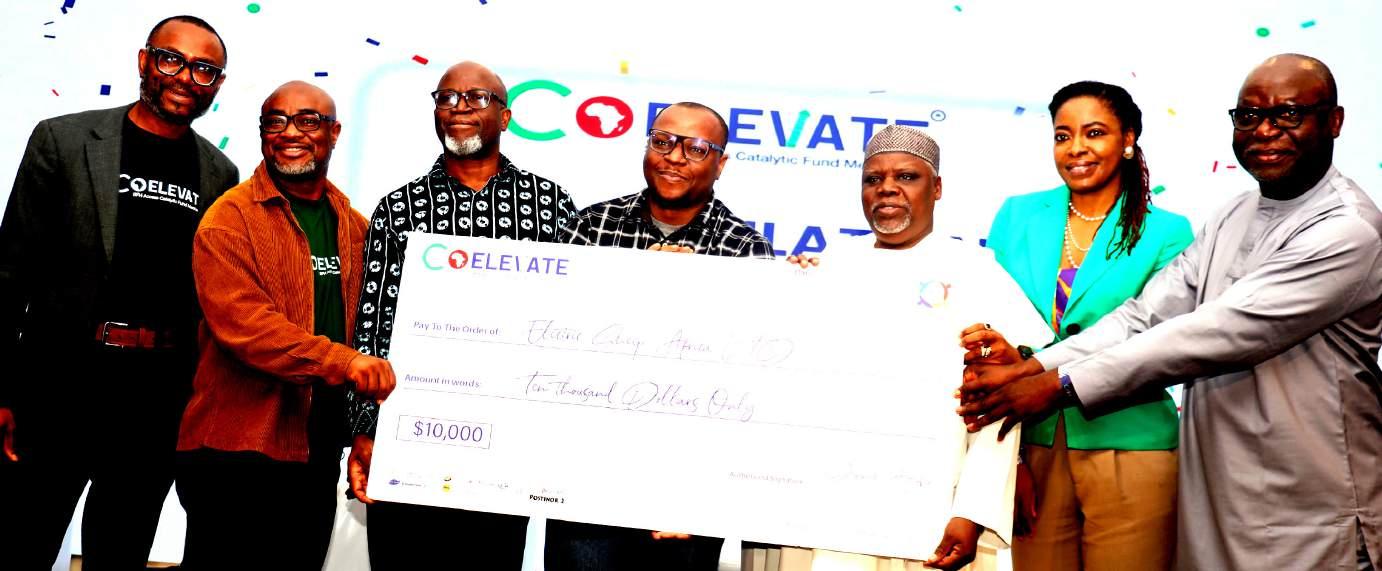
L-R: Director, Tourbillon Limited, Dr. Uche Ofili; Group Director/Managing Director, SFH Access,Mr.. Dennis Aizobu; Group Chief Executive Officer, SFH Group, Dr. Omokhudu Idogho; Beneficiary of Co-Elevate Catalytic Fund and Founder Electric Sheep Africa Limited, Mr. Kossiso Udodi; Chairman, SFH Access Board of Directors, Alhaji. Ahmed Yakasai; Chief Growth Officer, PBR Life Scientist, Mrs. Adesola Arowolo; and Member, CoElevate Board, Prof. Ehijie Enato, at the Presentation of Seed Funding Support to Beneficiaries of CoElevate Catalytic Fund at the Maiden Edition of the CoElevate Catalyst: Scaling the Future of Health held at Sheraton Hotel Ikeja,Lagos Thursday PHOTO: ETOP UKUTT
GUARDING AGAINST GENDER-BASED VIOLENC...
IGP Disu Pushes for Smarter Policing Through Accurate Suspect Data Management
The Inspector General of Police, Olatunji Disu, has urged investigators and heads of investigative units nationwide to prioritise the accurate capture and management of suspects’ information as part of ongoing efforts to strengthen intelligenceled policing and modernise criminal investigations across the Nigeria Police Force. The charge was delivered
during the opening of the One-Day Crime and Incident Database Impact Sensitisation Workshop, organised by the Department of Information and Communication Technology (ICT) at the Force Headquarters, Abuja.
The workshop was convened to highlight the importance of the Suspects’ Information Capturing Process under the Nigeria Police Force Crime and Incident Database (NPF-ICD)
Centre Project—a strategic initiative aimed at enhancing crime analysis, intelligence gathering, evidence-based investigations, inter-agency collaboration, and proactive crime prevention.
Addressing participants, the IGP stressed that modern policing is increasingly driven by timely, accurate, and actionable data, noting that effective law enforcement can no longer depend solely
on conventional investigative methods.
He emphasised that the Crime and Incident Database Centre is a vital national policing asset with the capacity to improve investigative outcomes, track criminal trends, identify repeat offenders, link crimes across jurisdictions, and support informed operational and strategic decision-making.
Reaffirming his administration’s commitment to
modernising policing through technology, innovation, and intelligence-led strategies, Disu called for stricter compliance with established suspects’ information capturing procedures across all Commands and Formations.
In a statement, the Force Public Relations Officer, DCP Anthony Placid, disclosed that the IGP encouraged participants to engage actively in the workshop and develop
DEMOCRACY DAY: LEADERS, CSOS WARN OF DEMOCRATIC BACKSLIDE, DEMAND REFORMS
who made sacrifices for the advent and sustenance of the current democracy.
He urged Nigerians to remain steadfast and keep faith with the country in the march to consolidate democracy and good governance.
In a message marking the 2026 Democracy Day made available to Journalists yesterday, Gombe Governor, Inuwa Yahaya, stated, “Democracy has created the enabling environment for growth, expanded access to public services and opened new opportunities for our people.”
The Governor acknowledged that Nigeria’s democratic journey has faced significant challenges, but noted that 27 years of uninterrupted civilian rule remains a remarkable national achievement.
“Our ability as a nation to sustain democratic governance, manage transitions peacefully and continue striving toward national development is worthy of recognition,” he said.
eliminating ambiguities around control and accountability within financial groups.
The CBN also moved to draw a clear line between the responsibilities of parent companies and those of subsidiaries by prohibiting HoldCos from interfering in operational and business decisions.
North-West Governors Pledge to Fight Poverty, Support Women, Children
Governors from Nigeria’s North-West region have committed to a concrete, time-bound actions aimed at reducing multidimensional poverty and improving living conditions for women and children.
The commitment followed a twoday high-level policy dialogue held in Kano, organized by the North-West Governors’ Forum in partnership with the Office of the Vice President, the European Union (EU), and UNICEF.
The event drew participation from Vice President Kashim Shettima, federal ministers, traditional and religious rulers, youth leaders, and private sector representatives.
The North-West region, which houses approximately 60 million people, currently
According to the draft guidelines, a HoldCo shall not “Arrogate to itself any of the powers or functions of the board or management of any of its subsidiaries or associates.”
The regulator further stated that: “Without prejudice to Section 18 of BOFIA 2020, the practice whereby members of
grapples with some of the highest multidimensional poverty rates in Nigeria. Women and children remain the hardest hit, with more than half of the region's children out of school. Families also face severe, overlapping deficits in healthcare, nutrition, clean water, sanitation, and income security.
To address these challenges, the Governors adopted a joint communiqué at the conclusion of the meeting. The document outlines clear strategies to scale up social protection systems—including child-focused benefits—strengthen public service delivery, and increase domestic financing for poverty reduction. They also endorsed a structured roadmap and monitoring framework to track implementation progress.
Speaking on behalf of the Chairman of the North-West Governors’ Forum and Katsina State Governor, Malam Dikko
Umaru Radda, Deputy Governor Malam Faruk Lawal described
the Board or Management of a subsidiary attend meetings of the Board of the holdco and vice versa is prohibited.”
In a particularly strong provision targeted at preserving the independence of subsidiary institutions, the apex bank stated that a HoldCo shall not: “Interfere in the day-to-day activities of
the agreement as a pivot from intent to action. He stated that the region now possesses a clear set of priorities to guide human capital investments and deliver tangible results for local communities.
Building on this, Vice President Kashim Shettima emphasised that the success of the initiative depends on sustained leadership and swift execution, reaffirming the Federal Government's full support for the states.
Ooni Urges FG to Intensify Fight Against Insecurity
In a Democracy Day message yesterday by the Director of Media and Public Affairs, Ooni’s Palace, Moses Olafare, the traditional ruler appealed to Nigerians to remain patient and supportive of government efforts at addressing the nation’s security and economic challenges.
the subsidiaries.”
The draft further provides that parent companies must not compel subsidiaries to take instructions from them in the conduct of business.
According to the CBN, a HoldCo shall not: “Require its subsidiaries (including any employee, staff, manager, officer or director thereof) to
The Ooni noted that no responsible government would deliberately desire insecurity within its territory, stressing that the safety of citizens remains fundamental to national growth and stability. According to him, while security challenges persist in several parts of the country, the government at all levels must continue to strengthen security architecture, improve intelligence gathering, equip security agencies adequately and ensure that perpetrators of criminal activities are brought to justice.
“Democracy thrives best in an atmosphere of peace, security and justice. As we celebrate another Democracy Day, I urge our governments to do more in the fight against insecurity and banditry. The protection of lives and property must remain a top priority,” the Ooni stated.
The Ooni further urged Nigerians not to lose hope in the country’s democratic journey, emphasizing
take directives or act on the instructions of the holdco in its decision-making process, or in relation to the conduct of its business in any way whatsoever.”
Beyond governance reforms, the proposed framework also introduces stricter capital requirements for financial holding companies.
practical solutions that will enhance operational efficiency and further strengthen the Force’s crime management architecture.
The Nigeria Police Force remains committed to leveraging technology, innovation, and intelligenceled policing to improve service delivery, enhance public safety, and build a more professional, accountable, and citizen-focused Police Force.
that national development requires collective sacrifice, patience and cooperation between leaders and citizens.
Reject Forces Seeking to Derail Democratic Governance, Says Akpabio
Akpabio charged Nigerians to always strive to preserve democracy which was the essence of June 12 and described Nigeria's democratic journey as a testament to resilience, endurance and collective commitment to constitutional rule, despite challenges that have tested the nation's resolve over the years.
Speaking on behalf of the 10th National Assembly, Akpabio congratulated Nigerians for sustaining democracy for nearly three decades, noting that while the democratic experiment had not been without shortcomings, the nation remained on the path of progress. According to him, democracy must go beyond the periodic conduct of elections and be anchored on accountability, justice, transparency, compassion and service to the people.
CHANGE OF NAME
I formerly known and addressed as ARO FATAI, now wish to be known and addressed as ONAEMOR JAMES SYLVESTER All former documents remain valid. The general public should take note.
Linus Aleke in Abuja
L-R: Executive Director, Protect the Child Foundation, Mrs. Elizabeth Ebulejonu; NSCDC’s Aremu Modupe; Head SGBV Ministry of Justice, Mrs. Yewande Gbola; Gender-based Violence Policy and Strategy Development Specialist for the ESGBV Programme, International IDEA, Ms. Melissa Omene, and Assistant Director, Ministry of Education, Mrs. Apakasa Augustina, during the First TOT workshop for the prosecution of perpetrators of school-related Gender-based Violence in Abuja…recently
PHOTO: KINGSLEY ADEBOYE
Worm, Not Warm, Your Way…
BUSINESS of April 16
welcomes us today with this recurrent headline crudity: “AMCON raises alarm (the alarm) over rising NPLs in banks”
Agreed that the article, ‘the’, is usually not allowed in headlines, but that realization should not affect fixed/stock idiomatic expressions and indeed any other inflexible lexical entry.
“Man dies in sex romp in Enugu hotel” ‘Sex’ and ‘romp’ cannot function in the same lexical environment as the latter indicates intercourse (sexual activity). Please note that it is an informal entry with multifarious applications.
“…the regime of crime with many youths taking to kidnapping and all manners of vices” (DAILY TRUST Opinion Page, April 10) Right: all manner of vices.
“Menace of under-aged voters” (DAILY INDEPENDENT Online, April 6) Get it right: underage voters. Never “overaged” players or “matured” politicians
“NASS will re-open Bakassi issue” (THISDAY Headline, April 3) This way: reopen.
“Ugwueze goes to the alter” (Vanguard Headline, April 7) High-heeled: altar.
“Imo: Late arrival of materials mar election in Oguta LG” A recurring case of subject-verb disagreement: Late arrival of materials mars (not mar). It has nothing to do with “materials”, but “late arrival”.
“In the past, such leaders have (had) plundered the common wealth and infected the environment with the demon of greed and avarice.” (NIGERIAN Tribune, April 11)
“The electorate streams (stream) out
The
World
is
As the world gathers for another FIFA World Cup, Nigeria will be watching from the sidelines. For a country that once treated qualification for football’s greatest spectacle almost as a birthright, our absence from the tournament is itself a reminder that standards can slip when ambition is not matched by preparation. Yet, even without the Super Eagles on parade, millions of Nigerians will immerse themselves in the month-long festival. Viewing centres will overflow. New loyalties will be adopted overnight. Armchair coaches will emerge from every street corner. Old arguments will be renewed and fresh rivalries invented. For a few weeks, generators will hum a little longer, neighbourhood football analysts will suddenly become tactical geniuses, and many citizens will temporarily outsource their worries to ninety minutes of football.
The difficulty, however, is that while football offers distraction, it does not suspend reality. Even as the world celebrates goals, trophies and sporting excellence, Nigeria continues to wrestle with a more sobering challenge. Across different parts of the country, communities remain vulnerable to attacks, abductions and violent criminality. Families continue to mourn loved ones. Farmers remain uncertain about venturing onto their lands. Travellers still calculate risks before embarking on journeys. Fear, unfortunately, has become an unwelcome companion in the daily lives of far too many citizens.
It is a troubling contradiction. While billions gather to celebrate one of humanity’s most unifying events, significant numbers of Nigerians remain preoccupied with a far more fundamental concern: personal safety. While some citizens are studying match fixtures and debating which nation will lift the trophy, others are studying escape routes, avoiding certain roads and wondering whether their communities might be next.
That reality should concern us beyond the immediate security implications. It speaks to the image of the nation itself. Countries do not build reputations merely through slogans, public relations campaigns or colourful speeches at international
tomorrow at the beginning of a voting exercise that will ultimately ease out….” (THISDAY, April 11)
“There are two types of Persil brands in the market, apparently imported by private individuals (are there public individuals?) who thought there are (were) openings in Nigeria’s detergent market.” (Vanguard, April 11)
“Large turn-out signpost rescheduled Imo polls” (BUSINESSDAY, April 11) Get it right: turn-out signposts.
“No other country in (on) this continent throws up the kind of absurdities that we have in this land.” (DAILY INDEPENDENT Online, April 8)
“Such persons should be declared persona non grate (sic).” (Source: as above) At the crossroads: personae non grata.
“If he were still in power, the former governor would have been immuned (immune) to….”
“Thirdly, corruption was not limited to the outgoing governor but involved his cohorts at the corridor of power.” (Nigerian Tribune, April 11) Africa’s executive robbers: in the corridors of power.
“Even though I wanted to see him, he advised against it on the ground that I could get into trouble….’’ The verdict: on the grounds.
Still on the above edition: “The state Nigeria Union of Journalists (NUJ) has 36 chapels out of which seven chapel officers, all duely (duly) nominated and some of the.…”
“…arrogating the powers of the National President and the Central Working Committee (CWC) on (to) himself and.…” (THE GUARDIAN, April 11)
“…the reduction on the external debt and investment in social
Playing,
infrastructures and equipments.” (THE PUNCH, April 11) The last word in the extract is uncountable, just like these: stationery, bedding, cutlery, jewelry, gossip (as an act)….
“Why is President Bola Tinubu dragging his foot (feet/heels) on probing treasury looters…?” (DAILY INDEPENDENT Online, April 11)
“…abolish the federal agency and realign it into (with) mainstream government machinery.” (NIGERIAN Tribune, April 11)
“Thugs in Imo State lay siege on Okorocha’s relics” (Sunday Trust, April 15) This way: lay siege to (not on).
“They had a second wind between 1964 to 1985, though they did not know it.” (Source: as above) A common error: between 1964 and 1985 or from 1964 to 1985—no mix-up.
“I must confess from the onset that I am not a protagonist of military rule.’’ (DAILY INDEPENDENT Online, April 11) Get it right: from the outset (in this context).
“The boss and his secretary will continue to have intimate official connection, in spite of gossips.” (DAILY TRUST, April 11) ‘Gossip’, as an act, is uncountable. But, with reference to those who talk idly and backbite, inflection of the word is allowed.
“But ours is quite different, judging by the experience with regards to the activities of the elected….” Either of these: as regards or with regard to.
“The industrial sectors of the economy have to invest in information technology, the type of which would stimulate the necessary (could it have been unnecessary?) inputs to produce good results.’’ In Standard English, which strictly applies here, ‘input’ is non-count, but countable in the usually informal American English, which, of course, is a corruption of the formal
Nigeria Is Praying
gatherings. They build reputations through the lived experiences of their people. A nation that cannot consistently reassure its citizens about their safety will struggle to convince outsiders about its stability.
This is why security remains one of the most important components of national branding. Investors pay attention to it. Tourists pay attention to it. Members of the diaspora pay attention to it. Foreign governments certainly do. More importantly, citizens pay attention to it. No amount of promotional messaging can compensate for a deficit of public confidence.
The World Cup therefore presents both an opportunity and a warning. Across Nigeria, viewing centres, sports bars, recreational hubs and public gathering spots will attract large crowds throughout the tournament. These places represent the joyful side of football culture. They also represent potential soft targets for those who thrive on disruption, fear and publicity. This is not a call for panic. It is a call for vigilance.
Security agencies must recognise that periods of mass public gathering require enhanced intelligence, visible policing, improved surveillance and proactive deployment. State governments and local authorities should work closely with community leaders and operators of viewing centres to ensure that basic security measures are not treated as optional extras. Early detection, information sharing and rapid response capabilities become even more critical during periods when large crowds gather routinely.
At the same time, citizens have responsibilities. Suspicious activities should be reported promptly. Rumours should be verified before they are circulated. Community awareness should be encouraged without descending into paranoia. Security is ultimately the responsibility of the state, but public vigilance remains an important layer of protection.
Yet, it would be unfair to place the burden primarily on ordinary Nigerians. The greater responsibility rests squarely with the government and the security establishment. Citizens deserve confidence that every available resource is being deployed to identify, disrupt and neutralise
version.
“The elitist Ikoyi Club, established in 1938, sometime ago celebrated its Diamond Jubilee amid pomp and pageantry.” (DAILY INDEPENDENT Online, April 11) Standard expression: pomp and ceremony (or circumstance) or just pomp. The expression, ‘pomp and pageantry’, is a perversion of the etymology of the English language.
“Staff Reporter…takes a peep into the nation’s recent past and notes that it is a past whose scars will remain for sometime.” (THE GUARDIAN, April 11) Right focus: for some time.
“One of the suspects said his intention was to warm (worm) his way back to the country.…”
“…gunshot wounds he received in the hands of armed bandits….” (DAILY TRUST, April 11) Reporters who don’t appreciate the magnitude of ‘banditry’ should play ball with ‘armed robbery’. ‘Banditry’ is simply criminal violence that culminates in aggravated roguery which involves inevitable use of weaponry. So, in the interest of morphological sanity, delete ‘armed’.
The next catachresis is from the Sunday Vanguard of April 19: “The chairman of the occasion quickly acknowledged it was not easy to launch a book after Chidi has (had) launched it.”
“Two failed banks chiefs get bail” Towards a better use of language: bank chiefs. The plurality of ‘banks’ had been taken care of by ‘chiefs’, in line with syntactic sequence.
“Lagos NURTW swims in fresh crisis: “Thugs in free-for-all fight” Delete ‘fight’ to avert calamitous redundancy.
criminal networks. They deserve assurance that ongoing operations are not merely reactive but increasingly preventive.
This is why many Nigerians struggle to understand explanations suggesting that certain criminal elements remain difficult to track because they employ sophisticated anti-surveillance or anti-tracking technologies. Such claims may contain elements of truth, but they inevitably raise difficult questions. How is it that individuals capable of terrorising communities often appear boldly on social media platforms displaying weapons, flaunting proceeds of crime, conducting public gatherings and, in some cases, taunting the state itself? How can those visible enough to project influence online appear invisible when accountability beckons?
These questions are not attacks on security agencies. They arise from public frustration. Citizens naturally expect that in an era of technological advancement, international intelligence cooperation and sophisticated surveillance capabilities, the space available to violent criminals should be shrinking, not expanding. At a time when governments across the world are collaborating on intelligence and security matters, Nigerians should not be left wondering whether bandits are technologically better equipped than the state pursuing them.
The truth, however, is that insecurity in Nigeria did not materialise overnight. It is the product of decades of accumulated neglect. A rapidly growing population continues to outpace available opportunities. Industries that once provided employment and stability have either collapsed or weakened significantly. Universities, polytechnics and colleges continue to produce hundreds of thousands of graduates annually, yet the economy struggles to absorb them meaningfully. We celebrate convocation ceremonies with fanfare, but often pay scant attention to what happens after the gowns are folded away. The result is a growing army of frustrated, under-employed and unemployed young people, many of whom become vulnerable to manipulation by criminal, extremist or opportunistic actors.
Added to this are the exploitation of religious sentiments by extremists, persistent security lapses

and compromises, policy inconsistencies, weak enforcement mechanisms and the unfortunate tendency of some political actors to encourage or empower violent groups for short-term advantage. History repeatedly teaches the same lesson: violence rarely remains loyal to its sponsors. The monsters created to intimidate opponents today often become the threats that haunt entire communities tomorrow.
The conversation around state police must equally move from endless debate to responsible implementation. The complexity of Nigeria’s security challenges increasingly demands a policing structure that is closer to communities and more responsive to local realities. Such a system must be carefully designed, adequately funded and protected by robust safeguards against political abuse, institutional excesses and the familiar temptations that have undermined many public institutions. No state should be left behind because of financial limitations; a national security priority deserves national support.
As football captures the imagination of the world over the coming weeks, Nigerians will laugh, celebrate, argue and dream along with everyone else. They deserve that joy. But they also deserve something more fundamental. They deserve the confidence that they can gather peacefully, travel safely, work productively and sleep without fear.
The world may be watching the World Cup. Nigerians, meanwhile, are watching something else. They are watching to see whether those entrusted with power will demonstrate the same urgency towards protecting lives as politicians routinely display in pursuing office. Because no trophy, no slogan and no carefully managed national image can substitute for the simple assurance that citizens are safe in their own country.
That, ultimately, is the Nigeria worth qualifying for.
VIew poINT
Segun Ogunsanya at 60: Can Nigeria’s Sovereign Wealth Fund Become a Sovereign Development Engine?
Eleven years ago, I sat across from Segun Ogunsanya in his office at Airtel’s headquarters in Lagos. Behind him was a vast stretch of water visible through a glass wall overlooking an ocean at Banana Island. As he reflected on what the view meant to him, he offered a remark that has stayed with me ever since. “The water is unlimited,” he said. “We see in it the future. We see an expanse of opportunity for our business, just waiting to be tapped.”
At the time, he was talking about telecommunications. Today, as Chairman of the Nigeria Sovereign Investment Authority, he confronts a much larger ocean: the challenge of deploying capital to unlock Nigeria’s economic future.
Of course, when Segun Ogunsanya turned 60 last week, many of the tributes focused, understandably, on his remarkable corporate career. Few Nigerian executives have built a reputation for execution quite like his. From leading Airtel Nigeria through a fiercely competitive telecommunications market to eventually overseeing Airtel Africa’s operations across multiple countries, Ogunsanya demonstrated an ability to translate strategy into measurable results.
Yet his most consequential assignment may still lie ahead.
As Chairman of the Nigeria Sovereign Investment Authority (NSIA), a position he assumed in 2024, Ogunsanya now sits at the intersection of capital, policy and national development. The challenge before him is fundamentally different from anything he faced in the private sector.
Airtel was ultimately accountable to shareholders. NSIA is accountable to generations.
The difference is profound.
For much of Nigeria’s post-independence history, public institutions have struggled to inspire confidence. Many have been weakened by political interference, weak governance or inconsistent execution. NSIA stands apart. Since its establishment in 2011, the sovereign wealth fund has steadily built a reputation for professionalism, transparency and disciplined investment management that is rare not only in Nigeria but across much of the developing world.
Its record speaks for itself.
Over the years, NSIA has grown into one of Africa’s most respected sovereign investment institutions, earning international recognition for
governance standards while expanding its asset base and investment footprint. Unlike many sovereign wealth funds that function largely as passive custodians of national wealth, NSIA has evolved into an active participant in Nigeria’s development story.
That evolution deserves greater attention because it reveals something important about how economic development is increasingly being financed in Nigeria.
The Authority was originally designed around a simple framework. Incoming capital would be allocated across three distinct funds: the Stabilisation Fund, the Future Generations Fund and the Nigeria Infrastructure Fund. The model sought to balance fiscal stability, long-term savings and domestic development.
Over time, however, reality intervened.
Nigeria’s infrastructure deficit proved too large, and the demands of economic transformation too urgent, for a purely conservative approach.
Consequently, NSIA adjusted its capital allocation strategy, reducing the share flowing into the Future Genera-
tions Fund while increasing the proportion dedicated to infrastructure investment.
That decision may prove one of the most consequential policy choices in the institution’s history.
In effect, Nigeria made a strategic judgment that future generations may benefit more from roads, healthcare facilities, energy projects, logistics infrastructure and digital networks built today than from additional financial assets invested abroad. It was a recognition that development itself is an intergenerational asset.
The results of that shift are increasingly visible.
NSIA has invested in toll roads, fertilizer production, healthcare infrastructure, agriculture, renewable energy and climateresilient projects. It has secured access to international climate finance platforms and emerged as a trusted co-investment partner for development finance institutions and private investors. Its network of oncology and diagnostic centres is helping reduce medical tourism while improving access to specialized healthcare services for Nigerians. More recently, it has expanded into digital infrastructure, including investments that support Nigeria’s growing data economy.
These are not the activities of a traditional sovereign wealth fund.
They are the actions of an institution attempting to bridge one of the largest development financing gaps in the world.
This is where comparisons with Norway, often regarded as the gold standard of sovereign wealth management, become instructive.
Norway’s Government Pension Fund Global invests almost entirely outside the country. It is designed to preserve wealth for future generations and prevent oil revenues from distorting the domestic economy. It is a model that has served Norway exceptionally well.
But Nigeria is not Norway. Norway’s challenge is managing abundance. Nigeria’s challenge is overcoming scarcity.
Norway can afford to invest its oil wealth abroad because it already possesses world-class infrastructure, efficient public services and strong institutions. Nigeria

faces a very different reality. It continues to grapple with inadequate transport networks, unreliable electricity, healthcare deficits, housing shortages and insufficient productive capacity. A sovereign wealth fund operating in such an environment cannot simply function as a passive savings account.
It must become an instrument of economic transformation.
In that regard, NSIA’s increasingly activist approach should not be viewed as a deviation from best practice. Rather, it represents an adaptation of sovereign wealth principles to Nigerian realities.
Yet this is where the real challenge for Ogunsanya begins.
The issue facing NSIA today is no longer one of direction.
It is one of scale.
Even with its net asset value climbing to $3.4 billion, the Authority’s balance sheet remains modest when measured against the sheer scale of national scarcity. Nigeria’s annual infrastructure funding gap alone is estimated at $14 billion—meaning the NSIA’s entire accumulated wealth could be swallowed up by a single year’s national requirement. In fact, the World Bank notes Nigeria needs $100 billion annually to close its overall deficit, while the government tracks an acute, immediate gap of $14 billion annually. No sovereign wealth fund, regardless of how flawlessly managed, can close that chasm on its own balance sheet. The math demands a shift from direct funding to macroorchestration.
This reality demands a new strategic ambition.
A decade ago, Ogunsanya told me that
Adeola Akinremi, a public policy strategist and risk intelligence analyst specializing in emerging market regulation, is the founder and Chief Executive Officer of Hintells, a crosscorridor, AI-powered enterprise risk intelligence infrastructure for businesses and African diplomatic missions in Washington, D.C. He can be reached via email: adeola@hintells.com
As Cardoso Leads CBN to Global Acclaim
Toni Kan
A wag once said that the reward for hard work is more work.
This aphorism was at the core of Yemi Cardoso’s acceptance speech in London on June 10, 2026 when he accepted the Central Banking award for Central Bank of the Year on behalf of the Central Bank of Nigeria (CBN).
Speaking at the ceremony, which is hailed as the “Oscars of Banking” Cardoso said – “We receive this recognition with humility. We see it, not as a destination, but as encouragement to continue the important work ahead.”
While there is indeed important work ahead, no one can countenance the fact that the CBN under Cardoso has notched up impressive achievements since he took over a central bank that was mired in a quagmire of gargantuan proportions. The successes are remarkable especially in a period marked by “turbulence and uncertainty” as well as tectonic geopolitical shifts.
Cardoso said at the ceremony that credit for the successes achieved belong to his dedicated and committed team at the CBN on whose behalf he was accepting the award.
“I accept this award on behalf of the Board, Management and staff of the CBN. Above all, it belongs to the many dedicated professionals who serve our institution with integrity, expertise, and an unwavering commitment to the public good,” he said.
Speaking further Cardoso reflected on the journey to global acclamation
and the important role the apex bank plays in the financial ecosystem.
According to him “the responsibility entrusted to central banks is a solemn one – to preserve confidence, safeguards to stability and to create the conditions in which economies and societies can prosper.”
The challenging environment that faced the apex bank in 2023 and the decisive actions taken by Cardoso and his team to reverse years of financial rascality and unorthodoxy at the CBN were catalogued in an article announcing the CBN’s selection as Central Bank of the year.
Quoting a former Central Bank governor, Sanusi Lamido Sanusi, Central Banking writes: “When Nigeria’s new president, Bola Ahmed Tinubu, assumed office in May 2023, he inherited an economy that was “on the brink of hyperinflation” and “fiscal bankruptcy” with “the naira in free fall” and “inflation rising month on month” due to “the total loss of CBN autonomy” and “very loose monetary policy under [Muhammadu] Buhari,” Sanusi adds. He had earlier been quoted in the article as saying that “the nation looked more likely than not to be heading the way of Venezuela and Zimbabwe.”
In three years, with a disciplined insistence on not just autonomy but adherence to good corporate governance, transparency and orthodox monetary policy, Cardoso and his team have managed to drag the economy back from the brink where it teetered weighed down by high inflation, depleted forex reserves,
opaque monetary policy and reporting, huge ways and means over hang, run away backlog of matured FX obligations and wide spread between the official and parallel market rates.
The CBN under Cardoso’s sway and a robust inflation targeting mechanism has presided over a comprehensive disinflation regime with inflation down to about 15%, robust accretion of foreign reserves which has crossed $50bn guaranteeing over 10 months of import cover, contraction of the FX spread to about 2% from 60%, a healthy macroeconomic environment, close alignment with fiscal authorities, a recapitalised and resilient banking sector and restored investor confidence which has contributed in large part to Nigeria exiting the “grey list.”
All these successes were central to the recognition and validation from Central Banking. Commenting on the choice of the CBN as Central Bank of the Year, Christopher Jeffrey, editor-in-chief explained that the apex bank was honoured for among other things, “a recognition of its monetary policy reforms that overturned past frameworks and resulted in widespread improvements in the country’s economy.”
Continuing he noted that the reforms had enabled the CBN to “implement disciplined monetary tightening, while also pursuing FX market reform. A further major achievement has been the CBN’s clearance of more than $7bn of outstanding obligations.”
Central Banking also added that as “evidence of its widespread efforts to improve its operation, the central
bank had carried out governance and transparency improvements …Additionally banking sector recapitalisation, payments modernisation and Nigeria’s removal from the Financial Action Task Force “grey list” had contributed to rebuilding investor and public confidence making the CBN a fitting candidate to be recognised for global excellence.”
Recognition has also come from other quarters, notably the International Monetary Fund (IMF) which acknowledged and praised the CBN’s reforms noting that its “Directors welcomes steps by the authorities to build reserves and support market confidence and praised reforms to the foreign exchange market that supported price discovery and liquidity.”
Last year, Cardoso was named African Central Banker of the year at the Annual Banker Awards in recognition of ongoing reforms. The organisers recognised “Governor Cardoso’s recent achievements and the Central Bank’s critical role in addressing market imbalances and repositioning the Nigerian economy for sustainable growth.”
Closer home the Centre for Economic Growth and Monetary Reforms (CEGMR) has commended the Central Bank of Nigeria (CBN) for its handling of the country’s monetary policy with the director stating that “Monetary policy is not magic, but discipline pays off. The CBN’s commitment to consistency and
orthodox tools is now reflected in falling inflation, stabilising exchange rates, and a rebound in external reserves.”
While the achievements are not in doubt two key things stand out from the piece by Central Banking. First is the unequivocal vote of confidence by Sanusi Lamido Sanusi who is not known to suffer fools gladly.
Another is Cardoso’s insistence that more work needs to be done. With a successful conclusion of the banking recapitalisation exercise, Cardoso seems focused on making sure that the gains of the exercise are not frittered away. On the day of the award ceremony in London, the CBN released new rules for the licensing and regulation of financial holding companies (FHCs/HoldCos) in Nigeria.
The June 10, 2026 circular with reference number FPR/DIR/PUB/ CIR/001/017 and signed by Dr. Rita Sike, Director Financial Policy and Regulation Department was titled “Exposure Draft of The Revised Guidelines for Licensing and Regulating Financial Holding Companies In Nigeria” and presented key proposals around Ring-Fencing Operations, Capital Requirements, Governance Structure and Public Engagement all geared to “enhance the stability of the banking sector and protect depositors’ funds” with Holdcos now “required to maintain a minimum 51% equity stake in each subsidiary and have stricter capital requirements to ensure financial stability.”
Ogunsanya
•Tourism •Arts&Culture
Lanre Balogun: Job Creation Drives Ikogosi’s Multi-million-naira Tourism Investments
General Manager of Glocient Hospitality, the concessionaire of the Ikogosi Warm Springs Resort and Conference Centre in Ekiti State, Lanre Balogun, speaks about how the resort attracts guests of different categories and the investments in the past one year, among others. Charles Ajunwa brings excerpts
Can tell us some of the changes that have taken place at the resort in past one year?
Glocient Hospitality, the operators of Ikogosi Warm Springs Resort, is the hospitality arm of Cavista Holdings. Our goal at Glocient, is to transform moribund tourist attractions in Nigeria into profitable businesses and national treasures. A blueprint of that, is Ikogosi Warm Springs Resort. Ikogosi is better experienced. If you had been here four years ago, Ikogosi was not a place that was habitable. We have done a lot and it will interest you to know that every transformation you see here, are done by Nigerians - Nigerian experts and artisans. No foreign experts. They were done by us because we built capacity over the years. I brought Radisson into Nigeria, and I was with the group for over two decades. That experience of operator-selector, conceptualisation, construction, pre-opening and design, is what we brought in here to transform Ikogosi. Some of you were here last year, there are noticeably improvements. Honestly, these improvements and investments will continue and we continue to upgrade. When you came last year, I’m sure we didn’t have an alternative source of energy. Then we had diesel generator as our backup. Now, we’ve invested close to $200,000 (about N275 million) in renewable energy. This covered the cost of the purchasing and installing the solar panels and other ancillary items such as the building, the AC, cables, chairs, and other things required to support the installation of the solar. This serves us 12 hours every day. The savings we are making with the benchmark of 500KVA is over half a billion in a year. That benchmark was done with our 500KVA generator running for 10 hours savings alone. When we did the financial analysis for one year, as I said, we would be saving over half a billion. That’s huge. That’s the kind of investment we are making in Ikogosi. We have a multi-year concession, and the government is
impressed by what we’ve been able to do so far. We have employed over 230 staff, almost 70 per cent of the staff are female and over 60 per cent of them are from Ikogosi community. Government has no business in business but what it can do is to create the enabling environment for businesses like ours to thrive. Kudos to the government of the Ekiti State under the leadership of Biodun Abayomi Oyebanji, they have been very supportive. In terms of accessibility, we have two airports that are close to Ikogosi. We have an airport in Ado, it’s less than 50 minutes from Ikogosi, and we have an airport in Akure, which is also less than 50 minutes to Ikogosi. We are in an advantageous location. Security challenges are not as bad as people portray them on social media. We encourage people to promote Nigeria positively. Promote our resort, Ikogosi as a national asset. People go all over the world to promote Kenya, Zimbabwe and the rest. Honestly, Nigeria is a beautiful place, and Ikogosi is a testament of that where you have warm and cold water springs flowing side by side, maintaining their thermal properties, and the water we use here is pure spring water piped into all the rooms. The water in rooms that our guests drink, take shower come from the spring water. No chemicals in the swimming pool. The vegetables that we eat, we grow them here. Even the food waste, yam peels, banana peels are channelled to the livestock that we grow. So, it’s a sustainable ecosystem and we want people to support this business.
You said you saved about half a billion, was it in naira or dollars?
It’s naira. We spent N1,900 per litre on diesel using a benchmark of the consumption of the generator. Assuming you run the generator for 10 hours a day and the generator uses 200 litres or 1,000 liters in two days. If you calculate 1,000 using 1,900 per litre accumulated for one year, this amounts to N513,000,000. So, in less than a year it has paid for itself. In hospitality
Taraba Targets Tourism Boom with Agro-Ecotourism Project
Taraba State Governor, Agbu Kefas, has embarked on a multi-billion naira ambitious agro-ecotourism project aimed at injecting funds into the state’s economy, accelerates development, creating massive job opportunities for youths and help to quell security challenges.
The tourism project, the La Campagne Tropicana Agro-Ecotourism Resorts, is described as an unprecedented public-partnership project. To this end, the state government has approved 2,500 hectares of land, and the locations for the agro-ecotourism resort are scattered on 12 sites across the state.
They include the La Campagne Tropicana AgroEcotourism Heritage Resort Zangon Kombi just few kilometres for the Danbaba Suntai Airport, Jalingo, the La Campagne Tropicana Nwonyo Lake Resort, Ibi, the La Campagne Tropicana Rest Area, Zangon Kombi, the La Campagne Rest Area Mahula Bali, the La Campagne Tropicana Rest Area, Gayam, Gashaka,
the La Campagne Tropicana Agro-Ecotourism Heritage Resort Mayo Selb, Gashaka, the La Campagne Tropicana Rest Area Biyudasisi, Mambilla, the La Campagne Tropicana Agro-Tourism Heritage Resort Abong Kurmi council area, the La Campagne Tropicana Eco-Tourism Resort Nagadasda, the La Campagne Tropicana Rest Area Gurgu Mambilla, the La Campagne Tropicana Kwararafa Rest Area Gasol.
The project being executed in partnership with the La Campagne Tropicana Resort Group, builders of the world’s first African themed resort brand, when completed, will transform the state into one of the leading tourist destinations in Nigeria in terms of traffic.
The Taraba State governor embarked on this legacy project so that it would become a point of reference in years to come. It encompasses leisure, ecotourism, and agriculture.
The La Campagne Agro-Ecotourism Resorts project is gradually, but steadily taking shape. Some of the ecofriendly accommodations are already being built. Leisure facilities such as quad bikes, fishing boats and jet skis have been added to the facilities at the resorts.
While speaking on the project during a tour of one of the sites, Governor Kefas expressed his satisfaction with the pace of development.
business, even if you have one guest in a room, the generator must be on. And there are things you can’t run without power like the internet facility, pumping machines and others.
One of the ways to promote this place is to bring high-value guests that will attract huge interest. Why is it not possible for you to attract the federal executive council meeting here, not ministerial?
We have had several government agencies that I don’t want to mention their names, national agencies and legislative arm. And some national issues are also being discussed here but for obvious reasons, we don’t want to disclose all these. Take for example, the State Executives from Lagos State and Rivers State have visited Ikogosi. So, our focus is actually not just high individuals, but MICE destination. I can have a major company in Lagos, come with around 60 to 70 of their staff for four days. That translates to F&B revenue, accommodation, experience, merchandise. However, in hospitality, you can’t have enough. We want as much MICE business as possible. We encourage people to make Ikogosi their next destination. The environment here, is serene, peaceful and cool.
What has been the inflow of traffic in the last one year?
When we did our analysis year on year, our revenue has more than doubled the first quarter compared to 2025. Of course, we have more
visibility and more business. Between March and April even though we surpassed our revenue targets, but business dipped from our projection. We had those months packed, however, energy cost more than doubled. The daily cost of 500KVA diesel generator is N1.4 million while monthly cost is N42 million. That is over N513, 000,000 in one year using the benchmark of N1,900. But you know diesel also rose over N2,000 per litre. In the month of April alone, we spent over 46 million which increased the cost of production and that was what drove us to install solar panel. Apart from renewable energy, what other projects are you embarking upon in order to realise the resort’s full potential?
You see, we’re investing heavily in rooms here because the order we’re getting is from 100, 120 and 150 rooms. From our own projection and the entire budget we’re working on now, we’re investing over two million Dollars in Camp A. Also, we will be expanding the laundry and scaling up our renewable energy. We want to scale up to 1 megawatts. For 72 hours, we haven’t used a drop of diesel, which is a lot of savings for us. We want to connect the whole resort to renewable energy. As you can see, our location is quiet and we have our own peculiarities. In Lagos, you can survive with two washing machines because you are closer to maintenance and you are closer to technicians.
Presken Hotels Celebrates 10th Anniversary
Presken Hotels Ikeja, Lagos, has marked 10th anniversary with the official launch of the Presken Cares, a foundation initiative that will serve as a key pillar of the hotel chain’s business operations and community engagement efforts.
It also commemorated the birthday of its Chairman, Mr. Kadiri Momoh.
The launch, held recently, signified a major milestone in Presken Hotel’s decade-long journey of hospitality excellence and social impact.
The initiative reflects the organisation’s philosophy that corporate success should extend beyond business growth and translate into meaningful contributions that uplift surrounding communities and improve lives.
Speaking during the launch, the Managing Director of Presken Hotels, Mr. Pius Obaje, stated that the organisation has consistently undertaken impactful outreach and humanitarian activities over the years.
According to him, the formal establishment of the Presken Cares was a strategic step towards institutionalising the hotel’s commitment to social responsibility.
“Over the years, Presken Hotels has quietly supported various charitable causes and community projects. Today, we are proud to officially launch Presken Cares, which will focus on touching lives, providing assistance, and restoring hope to the less privileged and vulnerable members of society,” Obaje said.
He noted that the initiative aligns with the vision of the Chairman, Mr. Momoh, whose leadership has guided the hotels group’s growth over the past decade while emphasising the importance of giving back to the society.
As part of activities marking the launch, Obaje led members of the management team on outreach visits to several beneficiary communities and institutions across Lagos. The team visited Bethesda Home for the Blind in Surulere, Little Saints Orphanage in Ogudu and the Makoko community in Yaba, where they donated various food items, household essentials, and other relief materials aimed at supporting residents and improving their welfare.
Balogun
Light Nwobodo
Light Nwobodo
Celebrating Culture Custodian, Benson Idonije at 90
Ferdinand Ekechukwu
His story is still being told. The impact he has made across generations in music and broadcasting is largely being felt. A foremost critic whose contributions helped shape Nigerian sound and culture and continues to inspires, it is not surprising the array of guests, mostly from the creative community, who showed up in Lagos at the 90th birthday celebration of Benson Idonije.
Surrounded by his family, friends, admirers, and personalities in the music industry, the colourful occasion reflects every trappings befitting of the milestone celebration. Idonije, a respected music critic, former broadcaster, former teacher, former manager of Afrobeat pioneer, Fela Anikulapo-Kuti, occupies a unique place in Nigeria’s cultural history.
The highlight of the occasion was the presence of his grandson and Grammy-winning Afrobeats artist, Burna Boy, as seen in videos trending online. One noted that the gathering served as a reminder of the historic bridge between Fela’s revolutionary era and Burna Boy’s global dominance, with Idonije standing proudly at the centre of that connection.
It was touching moment filled with love and cherished memories as popular actor Alexx Ekubo’s final journey home began on Wednesday evening with a service of songs. Videos from the event still making the rounds on social media revealed scores of celebrities, entertainers, dignitaries, including several players in the movie, music, and lifestyle sectors in attendance to honour the late actor.
To honour Alexx’s colorful spirit, the family had requested a strictly all-white dress code for the funeral ceremonies. The attendees trooped into The Monarch Event Centre, Lekki complying to the all-white attire in tribute to Alexx’s vibrant fashion sense. Familiar faces, including Kate Henshaw, Ebele Okaro, Ruth Kadiri, comedian
Praised for his lasting influence on Nigeria’s music landscape, “Pa Idonije’s close association with Fela and his role in chronicling and promoting Nigerian music made him a significant figure in the story of Afrobeat’s evolution. For many attendees, the celebration underscored a remarkable musical lineage.” This much was captured by Burna Boy in his glowing tribute to his grandfather.
“We’re here to celebrate my granddad on his birthday; 90th birthday. You know, the prayer is that we all get to live that long. So this is not an ordinary man or an ordinary birthday. This is the greatest man in the world as far as I’m concerned. And this is the reason why we have a lot of things we have today. So I’m forever indebted to him and grateful to him.”
Raising a toast, the singer enthused, teasing his grandfather such that elicited laughter. “And I know I’m not the only one. So this is a way for us to come together and celebrate the greatest man in the world today on his 90th birthday, even though I think he’s a lot younger. Yeah so this is a toast to the greatest man on earth; my hero, my grand-dad…”
Bose Ogulu, daughter of the celebrant and Burna Boy’s mother, who also serves as his manager, reflecting on the values her father instilled in her from childhood. describes him as “a wordsmith, a trainer of trainers and a scholar of music,” she said many broadcasters in Nigeria had passed through his classroom at one point or another.
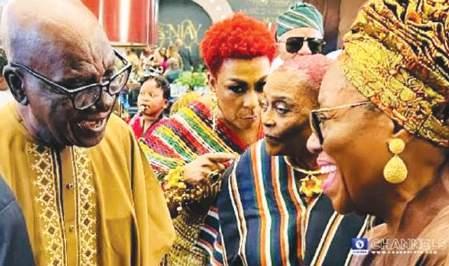

Ruger Returns to Music After Legal Battle with Ex-partner
Afrobeats singer Ruger is set to return to the music scene after a legal dispute with his ex-girlfriend kept him away from releasing new projects for some time. The development was confirmed by his record label, Blown Boy Entertainment. His former partner had filed a lawsuit against the singer for alleged ‘emotional distress’ and ‘damages”.
According to Blown Boy Entertainment, the case affected the singer’s activities and contributed to his absence from the music scene. Addressing his fans, known as the ‘RU Nation’, the management, however, said that chapter of the singer’s life
AY, his brother, Yomi, were among those spotted at the solemn event.
Celebrity couple Stan Nze and Blessing Obasi, Nancy Isime, actor Frederick Leonard, media personalities Frank Edoho and Ebuka Obi-Uchendu, Nigerian singer Chike Osebukam, and popular socialite Cubana Chief Priest also attended the service of songs in white couture. The service of songs officially opened a series of funeral activities planned for the late actor.
Other attendees included Nigeria’s former Minister of Education, Oby Ezekwesili; Ini Edo; Nigerian pastors Ituah Ighodalo and Jerry Eze; and Moses Bliss, among others. Pastor Ighodalo offered prayers for Alexx Ekubo’s widow, Anwuli. Bliss, Peterson Okopi, Ebuka Songs, Nathaniel Bassey, Mercy Chinwo, Kaestrings, and the Laud Urban Choir led worship and ministration respectively.
The Ekubo family had previously released an obituary statement via the late actor’s official
was now over. It further stated that the former Jonzing World artist is focusing on his music, assuring fans that he is ready to return to the scene with new projects.
“We know it’s been a while since Ruger dropped new music. For some time, Ruger was caught up in a series of personal challenges after someone he dated decided to sue him for alleged ‘emotional ‘distress’ and ‘damages”. The label noted that the legal matter has now been resolved, allowing the singer to focus fully on his career and upcoming projects.
“That chapter is now behind him. A new chapter begins. A new energy emerges,” it stressed. “Ruger is back to doing what he loves most – making music. And best believe, he has been cooking”, the label disclosed, while revealing that Ruger has been working on new material and is scheduled for a series of international performances this summer
in Belgium, Málaga, Bali, the United States.
“We would like to sincerely thank everyone who remained patient and continued to support Ruger throughout the silence. Your loyalty and belief have meant everything.” The announcement has sparked discussion among fans online, many expressing excitement about Ruger’s return and anticipation for new music following months of uncertainty surrounding his career Ruger, born Michael Olayinka is a Nigerian singer-songwriter and performing artist. He rose to fame with the release of his song “Bounce”, which led him to sign a recording deal with Jonzing World and Sony Music Entertainment UK, in a joint venture with Columbia Records, in 2021. That same year, he released his debut extended play, Pandemic. In January 2024, he left Jonzing World to start his own imprint, called ‘Blown Boy Entertainment’.

Guests at the service of songs Instagram page, urging his fans and the general public to keep the immediate family in their thoughts and prayers. At the event, friends, family, and colleagues used their speeches to share what they
knew about the beloved Alexx, who died on May 11, 2026, aged 40. His in-law shared a heartfelt tribute, reflecting on the impact, kindness, and memories he left behind.
Barcelona FC and Brazilian football legend, Ronaldinho this week made headline with the official release of his debut album, Camisa 10, which features an impressive lineup of 44 artists from 18 countries. Having it out just before the World Cup might seem like a good strategy especially considering his record breaking career as an athlete.. The project was officially released under his
newly launched record label, Tu Música. Its title serves as a tribute to the legendary No. 10 jersey that became an enduring symbol of Ronaldinho’s remarkable career with FC Barcelona and the Brazilian national team.
Presented as a two-volume body of work, the album explores a rich blend of musical styles including dancehall, reggaeton, Latin pop, Afrobeats, regional Mexican music, and contemporary urban sounds.
The diverse tracklist reflects the global appeal, cultural influence, and boundary-crossing legacy that established Ronaldinho as one of football’s
most celebrated and universally admired icons. Excited about the project, Ronaldinho wrote on his Instagram page: “The NUMBER 10 SHIRT is now available on all platforms! So happy to launch Tu Música’s first global music project and share this moment with so many talented artists. Thank you to everyone who was part of this journey.. Enjoy, share, and turn up the volume!”
The album also boasts collaborations with global music heavyweights such as Pitbull,
Idonije, his daughter Bose Ogulu, his wife, and a guest
Burna Boy, his grandmother, and his mother, Bose Ogulu
Ruger
Skales
Tosin Clegg
Ferdinand Ekechukwu
Ferdinand Ekechukwu
Justin Quiles, Luis R. Conriquez, Lenny Tavarez, Lenin Ramírez, Micro TDH, Yng Lvcas, Nanpa Básico, Jonas Blue, Dalex, Jon Z, and Fariana.
Carloha Nigeria Launches Chery Tiggo 9 PHEV as Chery Q Brand Arrives
Reinforcing its commitment to premium, sustainable and intelligent mobility solutions, Carloha Nigeria, the authorised importer and franchise holder of Chery vehicles in Nigeria, has officially launched the all-new Chery Tiggo 9 Plug-in Hybrid Electric Vehicle (PHEV) and announced the forthcoming introduction of the Chery Q brand into the Nigerian market.
The unveiling ceremony, marking the introduction of Chery’s latest flagship SUV and its next-generation mobility solutions to the Nigerian market, was held at Carloha Nigeria’s exquisite showroom in Alapere, Lagos, with some select members of the media in attendance.
The Chery Tiggo 9 PHEV is designed to redefine the premium SUV segment by combining luxury, intelligent technology, advanced safety systems, and efficient hybrid performance. Offering the benefits of both electric and petrol-powered driving, the vehicle delivers enhanced fuel efficiency, reduced emissions, impressive driving range, and exceptional comfort for modern motorists.
Speaking at the launch, the Managing Director of Chery Central Africa, Mr. Hai Wei, expressed enthusiasm about the introduction of the Tiggo 9 PHEV to the Nigerian market. He described the launch as a significant milestone in Chery’s commitment to innovation, intelligent technology, and sustainable mobility.
“It is my pleasure to be in Nigeria today for the official unveiling of the Chery Tiggo 9 PHEV, a vehicle that embodies Chery’s vision for innovation, advanced technology, and environmentally responsible mobility. Nigeria remains a strategically important market for Chery and a key pillar of our growth ambitions across Africa.
As one of the continent’s largest and most dynamic economies, Nigeria presents immense opportunities for the adoption of advanced mobility solutions, and we remain committed to investing in the country’s automotive future while delivering world-class products and services

Chery Tiggo 9 PHEV
to our customers,” he said.
Also, the Sales Director of Carloha Nigeria, Mr. Joseph Omokhapue, noted that the Tiggo 9 PHEV offers customers a unique combination of luxury, performance, safety, and sustainability.
“The Tiggo 9 PHEV is more than just a new SUV; it is a statement of innovation. With its sophisticated design, spacious interior, advanced safety technologies, premium comfort features, and impressive range, it is designed for families, professionals, and business leaders who demand more from their vehicles,” he stated.
“The launch of the Chery Tiggo 9 PHEV
reflects Carloha’s commitment to providing innovative mobility solutions that align with global automotive trends while meeting the evolving needs of Nigerian consumers. This flagship model represents a major step in expanding our portfolio of technologically advanced, premium, and environmentally responsible vehicles in the country,” he said.
Commenting on the significance of the launch, the Marketing Director, Carloha Nigeria, Mr. Dexter Li, said the event demonstrated the company’s commitment to a smarter and more sustainable future of mobility.
Zenith Bank Tops Honours List at Toyota Awards Night
Zenith Bank Plc has emerged as one of the major winners at the 2026 Toyota Awards and Customers’ Night, clinching the prestigious Evergreen Customer of the Year Award in recognition of its position as Toyota (Nigeria) Limited’s most consistent customer over the last five years.
The annual prestigeous awards held last Friday at The Podium Event Centre in Lekki, Lagos, brought together customers, dealers, government officials, corporate partners, media practitioners and other stakeholders to celebrate outstanding patronage and contributions to the growth of the auto company.
The event serves as a platform to reward loyal customers, recognise strategic partners and reinforce the company’s customer-centric philosophy.
This year’s edition of the awards carried special significance as Toyota Nigeria celebrates its 30th anniversary, marking three decades of operations since its establishment in 1996.
In recognition of the Zenith Bank’s huge patronage, the Chairman and founder of Toyota (Nigeria) Limited, Chief Michael Ade.Ojo, presented the bank officials with the keys to a brand-new Toyota Starlet Cross.
Another keenly contested category was the Customer of the Year Award, which went to AGL Motors for purchasing the highest volume of Toyota vehicles in 2025.
The Nigerian Army and Zenith Bank emerged as first and second runners-up respectively in that category. The winners received office equipment worth several millions of naira.
In keeping with its tradition of recognising excellence across its business ecosystem, Toyota Nigeria also honoured outstanding automotive journalists whose reports and analyses have helped shape public understanding of developments in the industry.
Veteran motoring journalist, Theodore Opara of Vanguard, was named Journalist of the Year for his consistent coverage of the automotive sector and
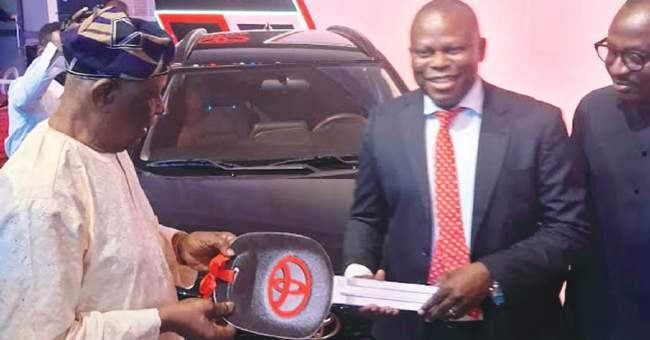
insightful reporting on industry trends and Toyota’s innovations.
Mike Ochonma of Transport World emerged as the first runner-up, while Rasheed Bisiriyu of Newstrends was recognised as the second runner-up for his contributions to automotive journalism, particularly in the areas of vehicle technology, mobility solutions and market analysis.
Earlier in his keynote address, Managing Director of Toyota Nigeria Limited, Mr Kunle Ade-Ojo, described the annual gathering as a celebration of the enduring relationships that had sustained the company over the years.
“Tonight is a moment of reflection, celebration and renewed commitment,” he said.
8 Signs You Could Have Brake Problems
Car brake repair and brake servicing are important parts of proper vehicle maintenance. When you take care of your brakes, they’ll take care of you when you need them most. However, even with regular maintenance, the brakes on your vehicle may require a professional inspection and servicing if you encounter one or more of these eight brake problem warning signs and symptoms.
1. Brake Light On
If a brake light indicator appears on your dashboard, it’s either time for your regular maintenance or it’s an alert to a potential problem. These are some of the more common dashboard alerts that appear in today’s vehicles. Note: Consult your vehicle owner’s manual for possible causes for these and other indicators.
Brake Pad Indicator
This light lets you know your brake pads may be wearing out, along with other non-visible reasons. Either way, get them inspected at Les Schwab.
Brake Fluid Level Indicator
This light will flash when your brake fluid levels are low. You may be able to top off the fluid to keep your brakes functioning properly, or stop by your local Les Schwab and we’ll give you a hand.
Parking Brake Indicator
When this light appears, your parking brake is either engaged or there is a problem with it. To diagnose the possible issue, engage and disengage your parking brake. If the indicator goes away, there are no issues. If it still won’t go away, come to Les Schwab.
2. Squealing or Squeaking Noises Odd or unusual noises coming from your brakes aren’t always a sign of problems. It could just be a foreign object lodged in your brakes (a pebble or debris). It could also be your brake-pad wear indicators. These bits of metal in your brake pad come in contact with the rotor to emit a high-pitched noise when you apply the brakes. This lets you know it’s time to get your brake pads replaced.
3. Grinding Noises
Grinding noises, whether you have disc or drum brakes, could mean your brakes need servicing right away. In some cases, the sounds may be the brake pad or shoe scraping on metal contact points. A trip to Les Schwab is recommended when you hear or feel any form of brake grinding.
4. wobbling, Vibrating, or Pulsing when Braking
If your steering wheel or vehicle shakes, vibrates, or pulses when you apply the brakes, it could be an uneven rotor. Brake rotors, which are a vital part of your disc brakes, are large metal discs attached to both ends of your vehicle’s axle. When you hit the brakes, the brake pads push against the rotors, which stops your wheels from spinning. Wobbling, vibrating, or pulsing can occur if the rotor surface area is not flat (has uneven areas). Over time, it’s normal for the rotor surface to wear down and possibly become uneven. Braking friction, when you apply the brakes, results in the transfer of pad material to the rotor surface. If the pad material transfers unevenly, you may experience vibration when braking. Left uneven, the material will continue to accumulate, worsening over time. During brake servicing, the face of the rotor should be smoothed or evened out to correct flaws and keep you from feeling a wobble when you brake. If the rotors are too far worn to be serviced, they will need to be replaced.
“For us at Toyota Nigeria, this annual gathering is more than a tradition. It is a deliberate expression of our enduring philosophy of putting the customer first. It provides a unique platform to honour the loyalty, trust and partnership that have defined our journey over the years.”
According to him, Toyota Nigeria has evolved from modest beginnings into one of the country’s most trusted automotive brands through a relentless focus on quality, reliability and service excellence.
“Since commencing operations in 1996, our journey has been defined by resilience, growth and transformation. Our progress has been anchored on one unwavering principle—creating value for our customers.
5. Leaking Fluid When you apply your brakes, a lot of things happen all at once. An important part of the process involves brake fluid. This is used to create hydraulic pressure, which pushes the brake pad against the rotor (the large metal disc attached to the end of your axle). If your vehicle has no brake fluid, you won’t be able to stop safely. Check your vehicle’s brake fluid often. Not sure how? Stop by Les Schwab and we’ll be glad to help.
6. Spongy or Soft Brakes
When you press on the brakes, you want to feel some resistance. If they feel soft or the pedal goes all the way to the floorboard, it could indicate air or moisture in the braking system. It could also be a problem with the master cylinder, which is often located in the engine compartment near the brake pedal. This cylinder is where the whole braking system starts.
L-R: Chairman of Toyota Nigeria Limited, Chief Michael Ade.Ojo; Head of Admin and Due Diligence, Zenith Bank, Mr. Callixtus Nwodo; and Head, Dealer Development and Special Duties at Toyota Nigeria Limited, Mr. Henry Ojuoko, during the presentation of Toyota Starlet Cross to Zenith as winner of TNL Evergreen Customer award in Lagos... recently
Katsina’s Digital Public Infrastructure Push: Gaps, Fixes, Safeguards
Katsina State is rolling out its Digital Public Infrastructure, a move pointing to growing subnational adoption, writes Omolabake Fasogbon
Nigeria has been rated among nations of the world making significant progress regarding Digital Public Infrastructure (DPI) that is becoming almost inevitable to daily life. However, state-level adoption and integration into service delivery is crucial to offer full value.
Defined by the World Bank as foundational, reusable digital platforms and building blocks designed for the public benefit, DPI is built on three anchors: digital identity, digital payment, and data exchange. Together, these elements enable services across both the public and private sectors, similar to how physical roads and railways connect people and goods.
From a rural farmer instantly receiving a government fertilizer subsidy on his mobile wallet, to a mother accessing her child’s verified immunization records at a local clinic without carrying a sheet of paper, DPI is increasingly touching almost every sphere of modern life, driving improvement in education, agriculture, revenue and tax, social protection, and finances, amongst others.
why DPI Matters for Katsina
Nigeria officially rolled out its DPI Framework in March 2025. Anchored on the pillars of digital identity, payments, and data exchange, it was designed to serve as the backbone the country’s e-Government system, spurring service delivery and creating an environment for innovation.
While significant progress has been made in payment and identity layers, the country still struggles with data exchange and interoperability.
Speaking on the framework at a public review forum for the Draft DPI Life Events Framework and the Draft Technical Standard for the Nigerian Data Exchange (NGDX), the Director of e-Government and Digital Economy at the National Information Technology Development Agency (NITDA), Salisu Kaka, identified the need for states to align with the federal government on DPI pursuits.
At the forum, Kaka emphasised the need for subnational governments to match national standards. “If the states can model and reflect what happens at the national level, then we can have a 360-degree view of the whole data exchange across the country and drive all-of-government processes,” he stated.
State-level adoption of DPI is deemed crucial for effective local governance, improved planning, administration, expanded access to public services, and targeted service delivery. This importance was recently demonstrated by the Nigeria Governors’ Forum’s DPI Readiness Report, which built its parameters entirely around states rather than the federal government.
For Nigerians, the closest essential services they need—be it education, health, or banking come from the state, not the federal level. This is why states must adopt DPI, and Nigerian states are rising to the task, though at varying paces.
A 2025 report shows that only two states of 34: Akwa Ibom and Oyo have achieved high DPI maturity. Twenty are in the middle band, while twelve, including Katsina, were at the bottom at the time the report was compiled. For Katsina, the report indicated it was far behind benchmarks across key indicators, spurring corresponding action, with the state now aiming to become a DPI reference point.
Katsina is one of Nigeria’s most populous states, with more than 10 million residents spread across 34 local government areas. The state has contended with perennial challenges that include insecurity and poverty. As efforts to rewrite this narrative gain momentum, prioritised DPI investment is deemed as crucial.
Experts submit that when DPI is designed in adherence to its core principles and safeguards including interoperability, inclusion, accessibility, privacy, fairness, and transparency, it is proven to solve state challenges. This was echoed by World Bank President Ajay Banga, who described DPI as one of the strongest accelerators for inclusion and economic opportunity.
Specifically addressing Katsina’s reality, a 2025 analysis by George Ingram and Jacob Taylor of the Brookings Institution’s Center for Sustainable Development submitted that DPI can strengthen
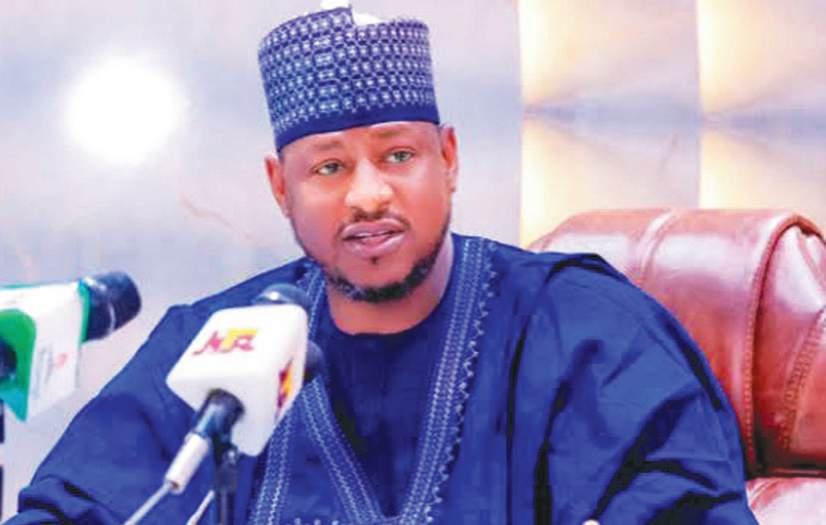
state capacity and deliver essential services in fragile contexts, adding that digital identification and real-time payment systems can help build state resilience amid instability.
The Director General of Katsina State Directorate of Information and Communication Technology (KATDICT), Naufal Ahmad admitted the state had been ‘running blind’ prior to present government, emphasizing that DPI is a basic requirement for any government that wants to know who it is governing.
Inside Katsina’s Low DPI Rating
The July 2025 DPI Readiness Report by the Nigeria Governors’ Forum highlights major gaps in Katsina State’s digital readiness. The state was assessed across 22 indicators covering the enabling environment, foundational systems, and public service delivery. Katsina was placed in the low maturity category, ranking among the bottom 12 of the 36 states assessed.
One of the state’s biggest challenges identified in the report is ICT infrastructure. Katsina scored low in this area, indicating inadequate internet connectivity, limited hosting facilities, and insufficient data center capacity to support digital government services. According to the report, states in the low maturity category lack basic hosting capabilities, have limited cloud adoption, and face serious connectivity barriers.
Data management is another weak area. Katsina was found to lack an effective system that allows government agencies to share information with one another. Compliance with Common Data Standards was reported low, alongside the absence of a government-wide data exchange platform. As a result, information remains trapped within separate agencies. For example, a patient’s details in a health facility cannot easily be verified against a social protection database, while agricultural officers may be unable to access records needed to process support for farmers. This could limit coordination and makes service delivery less effective.
In digital payments, its systems were ranked low, with improvements in payment interoperability suggested to enable ministries, agencies, service providers, and citizens to transact seamlessly. The DPI readiness report also faulted the state’s public service delivery digital platforms, describing them as limited. Digital systems in education, agriculture, and electronic registries all recorded low scores. Katsina was among the more than 25 states rated low in electronic registries, an important component of modern public service delivery.
The report also spotted gaps in the state’s compliance with national policies designed to protect citizens. It noted that the state had yet to fully implement tools required under the National Cybersecurity Policy. In addition, it rated Katsina’s consent management capability at low maturity, suggesting that mechanisms for managing citizens’ consent over personal data remain underdeveloped.
The report found that compliance with the Nigeria
Data Protection Act 2023 remains weak across the country, with more than half of the states in the low maturity category and only about 25 to 30 percent having the tools and infrastructure needed for effective enforcement.
From Low Rating to Reforms: Katsina’s Turnaround
Katsina may have emerged among the low-ranked states in the Nigeria Governors’ Forum (NGF) DPI readiness report, but it is not sitting idly. Even within that assessment, the state pulled off some strides, attaining medium maturity in digital skills, identity systems, and policy framework, having adopted the National Data Strategy 2022 and the Nigeria Data Protection Act 2023.
One of the state’s major strengths lies in its policies for interoperability, with the report rating its policy alignment viz a viz Nigeria e-Government Interoperability Framework (Ne-GIF) at high maturity, placing it among the few states with advanced readiness for data exchange across government systems. Land administration was another bright spot, with the state earning a high rating for digitizing land records and transactions.
The state is not carried away by its highs, nor is it ignoring the areas where it scored low. Kit rather builds on its profile through reforms led by the internal agency, KATDICT, which is tasked with steering the digital transformation agenda of the state.
For instance, the report rated data exchange policy high, but compliance low due to the lack of a government-wide data exchange platform. Today, that narrative is changing. By introducing a digital authority layer, the government now processes and shares inter-agency memos and executive approvals digitally, removing papers.
“We have also distributed over 2,000 ICT devices across MDAs to support digitization processes,” Ahmad said.
Following its groundwork in digital identity, the state is elevating its efforts with the “iKatsina” framework, which is now 90 percent completed.
iKatsina is a state-level DPI layer designed to sit atop the federal National Identity Number (NIN) database. It is a digital identity designed specifically for residents to connect them to government services through a single platform.
“The NIN tells us that you are Nigerian. The iKatsina ID tells us you are a resident in Katsina. The government cannot govern effectively if it doesn’t know who it is governing.
“With it, residents can use a single identity to access services ranging from healthcare and scholarships to vehicle registration and loans. The system is also designed to improve financial inclusion. If we digitize the process of getting a scholarship, for example, anyone from Nigeria could apply and get it. We want an ID that tells us you live in Katsina so the government can plan with you.
“Whether a resident is applying for a loan, reg-
istering a vehicle, or accessing other services, the same identity will be used. That is the foundation of what we are trying to build as a smart city. For instance, if there is a traffic violation and a vehicle’s plate number is captured, we can trace it back to the owner’s identity. Ultimately, this is about making governance easier and more accessible for residents, while also giving government the data it needs for planning and evidence-based decision-making,” Ahmad told THISDAY.
Previously rated low in ICT infrastructure, the state is already tackling this by laying 27 kilometers of fiber optic cable connecting KATDICT central office to the state secretariat and Government House.
“We have connected the airport, the State House of Assembly, and other critical institutions,” the DG informed.
This infrastructure is supported by strategic investments to clear structural bottlenecks like power and connectivity.
The state has fully waived right-of-way charges to encourage telecommunications firms to expand local fiber networks, while critical government offices, including the state secretariat, select hospitals, and schools, have been transitioned to off-grid solar energy.
Ahmad informed that the state is committed to a holistic digital transformation to drive DPI, which is largely built through internal capacity, not external consultants, a move he said has saved the state approximately N5 billion.
He added, “We presently oversee a whole-ofgovernment digital transformation covering all 118 ministries, departments, and agencies in the state. We have also developed about 12 frameworks to guide both government digitization and the technology ecosystem.”
The state has also deployed the Treasury Single Account (TSA) system to digitise financial workflows from budgetary planning to expenditure control.
“Through this, we have improved efficiency, reduced the cost of governance, and increased the speed of service delivery in Katsina. Beyond that, we are creating jobs and enriching the state’s coffers,” Ahmad revealed.
The Safeguards Katsina Cannot Ignore For a state that has taken a leap and shown real commitment, achieving sustainable results will depend heavily on building infrastructure that protects the people it is meant to serve.
In September 2024, the United Nations launched the Universal DPI Safeguards Framework, identifying 13 major risks that can arise in digital public infrastructure and offering about 300 recommendations to help governments build safe and inclusive systems. The identified risks center on safety, inclusion, and structural vulnerabilities. At the launch, United Nations Development Programme (UNDP) Administrator Achim Steiner stressed: “Digital public infrastructure is transforming the delivery of services to people all the way to the last mile. As more countries design and implement these digital foundations, we must commit to the universal adoption of these critical safeguards to build safe and inclusive digital public infrastructure that benefits all.”
As Katsina rolls out initiatives such as the iKatsina resident identity and expands its digital services and governance, experts argue that inclusion must remain a top priority.
NITDADirector-General Kashifu Inuwa Abdullahi has consistently argued that technology should be designed around citizens’ needs, ensuring that people are not excluded because of where they live or their level of digital literacy.
Strengthened data protection, improved interoperability, and expanded access to digital services are deemed necessary to move the state from theoretical readiness to real-world impact.
Only then can a farmer in Funtua register for government support without traveling long distances, a trader in Katsina town access credit using a trusted digital identity, a pregnant woman in a rural community receive healthcare services without repeated paperwork, and a student apply for scholarships or school admissions through a single, verified profile.
Radda
Positioning Imo as Nigeria’s Emerging Investment Destination
Governor Hope Uzodimma is positioning Imo State as a competitive investment destination and a rising hub for private-sector-led economic growth, writes Dike Onwuamaeze
Competition for investment capital has become one of the defining realities of economic development in the 21st century. Across the world, governments are increasingly judged not only by their ability to formulate policies but also by their capacity to attract businesses, create jobs, expand infrastructure and stimulate sustainable economic growth.
In Nigeria, where sub-national governments are seeking innovative ways to diversify their economies and reduce dependence on federal allocations, the race to attract investors has become more intense than ever.
For Imo State, Governor Hope Uzodimma believes the state is no longer merely participating in that competition but is steadily emerging as one of the country’s most attractive destinations for investment and enterprise.
That message formed the centrepiece of Uzodimma’s presentation at the third edition of Invest Lagos 3.0, held at Eko Hotel and Suites, recently.
The event, which attracted investors, business leaders, policymakers and development partners from within and outside Nigeria, provided a platform for the governor to showcase what he described as the immense economic opportunities available in Imo State.
His pitch was that Imo is open for business and ready to become one of Nigeria’s leading investment destinations.
In explaining the state’s economic transformation agenda, Uzodimma traced the journey back to 2020 when his administration assumed office.
“The full meaning of Imo is Investment Meets Opportunities (IMO). In 2020, we inherited a state operating under an outdated model of economic development where the government wanted to build industries, run industries, own industries, and create businesses instead of focusing on governance. That approach had failed elsewhere in the world, and it was destined to fail here as well. Unsurprisingly, it did fail,” he said.
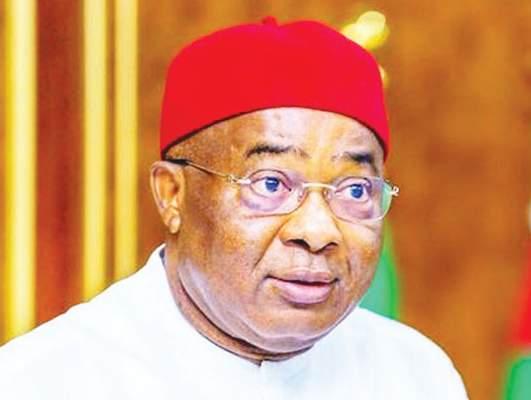
According to him, one of the first decisions of the administration was to rethink the role of government in economic development and shift from a government-controlled economic model to one driven largely by private enterprise.
“We therefore changed the narrative. We repositioned government to focus on its core responsibility—creating an enabling environment where businesses can thrive—while allowing the private sector to drive investment and enterprise development,” the governor stated.
That philosophy has become the cornerstone of the administration’s economic agenda.
Across successful economies globally, governments create the conditions necessary for investment through policies, infrastructure, regulation and security, while businesses provide capital, innovation and employment. Imo’s new development strategy seeks to replicate that model by reducing barriers to investment and encouraging greater participation by local and international investors.
Uzodimma explained that the administration undertook a deliberate study of how to build a sustainable economy capable of attracting long-term investment.
“To achieve this, we conducted a comprehensive study on how to build a sustainable economy and establish a clear trajectory for growth in Imo State. We leveraged the commendable reform policies of the federal government and mobilised our resources to prepare the state for private-sector-led growth,” he said.
One of the earliest priorities identified was infrastructure. Road networks remain among the most important indicators investors consider when evaluating business locations. Efficient transportation systems reduce production costs, facilitate trade and improve access to markets. Recognising this reality, the administration embarked on an extensive road development programme designed to connect major economic centres across the state.
“We began with infrastructure. We connected our major cities with high-quality roads to facilitate the movement of people, goods, and services,” Uzodimma noted.
Improved road infrastructure has implications far beyond transportation. It enhances agricultural value chains, boosts commerce, attracts manufacturing activities and supports tourism development. By investing heavily in connectivity, the government believes it has created a stronger foundation for economic expansion. However, infrastructure development was only one aspect of the broader reform agenda.
Power supply remains one of the biggest challenges facing businesses in Nigeria. High energy costs have historically reduced competitiveness and discouraged industrial investment. Consequently, the administration identified electricity as a strategic priority.
As reforms in the power sector created new opportunities for state governments to participate in electricity generation and distribution, Imo moved quickly to take advantage.
“As we advanced in this area, the federal government introduced reforms in the power sector, empowering sub-national governments to participate in electricity generation and distribution.
2027: Case for Basil Maduka for Owerri Zone Senatorial Seat
Amby Uneze
Tugh battles are usually won by the most experienced, fearless soldiers all over the world, hence before a country embarks on a war, she prepares well, keeps her arsenals ready, and matches out the best of her soldiers to the war front. In football, as well, a winning team lines up its best 11 (known as first 11) before a crucial match because such moments are not an opportunity to rest or experiment players.
Whereas the Senate (otherwise referred to as the Red Chambers) of the National Assembly is meant for the most experienced politicians of a zone, it is equally not for the mediocre or a training ground for up comers in the political arena.
In the US for instance, the Senate is majorly occupied by former governors, captains of industries, academics, as well as people of high repute with clean records of service in private and public sectors.
Considering the above criteria, Basil Maduka represents a strong choice for the Owerri zone Senate in 2027. His experience as a seasoned politician and success as a business magnate positions him well to address the needs and aspirations of the people.
With a deep understanding of both the political landscape and economic developments, Maduka is poised to bring impactful change and insightful leadership to the Senate. His vision for progress and commitment to community development makes him a candidate worth supporting in the upcoming 2027 elections.
Maduka, who is the Labour Party (LP) senatorial candidate of Owerri Senatorial zone (Imo East) embodies the qualities we urgently need in Owerri zone as a vocal voice in the Senate.
His integrity, dedication, plans and a profound commitment to the development and prosperity of the people of Owerri zone speaks volume. His comprehensive understanding of the challenges facing the zone, sets him apart as a leader who can truly make a difference.
We are at a critical juncture, where thoughtful leadership is needed to drive progress and secure a better future for our youth and generations
to come. Basil Maduka’s aspiration represents hope, progress, and a promise of transparent and accountable servant of the people.
Basil Maduka’s political journey, marked by his involvement in previous elections, demonstrates his active engagement in the political landscape of Imo State. Some insights into his political trajectory place him ahead of others.
In 2019, Maduka was an aspirant to beat for the senatorial seat. He contested for the primary election under the People’s Democratic Party (PDP) for the Owerri zone Senate seat. Even though he came second, he did not waiver, rather, he supported the winner and hosted the entire Owerri zone delegates and party officials for a “thank you hand shake”.
His focus to address issues affecting the Owerri zone through effective representation of the interest of the people at the national level has not changed a bit.
Due to the burning desire in him to contribute meaningfully to the development and progress of the people, Maduka in 2023 shifted to the Labour Party where he contested for the governorship primary election. His shift indicated a strategic political move, which potentially reflected a desire to align with the changing dynamics within Imo State politics at the time.
Though his aim of contesting for this position shows his ambition to have a more significant impact on state governance, addressing broader issues affecting not only the Owerri zone but Imo State as a whole.
The implication of Maduka’s political involvement is not far from economic development and empowerment through the promotion of local businesses, attracting investments, and creating job opportunities within the Owerri zone.
He is also desirous of influencing infrastructure improvement, through legislation by advocating for better roads, electricity, and good water supply to enhance the quality of life for residents. Among other key areas Maduka’s attention will be focusing include Education and Healthcare Access, Community Engagement, and Agriculture and Food Security, etc.
Maduka brings to the table a wealth of political experience that is unmatched in our zone. Over the years, he has proven himself to be a successful private sector-driven personality deeply attuned to the needs and aspirations of people of the zone. His years of active involvement in politics have equipped him with the knowledge, skills, and networks necessary to navigate the complexities of effective representation.
Maduka high network exposure in economic development, job creation, goodwill, national and global businesses place high above others. His mental alertness in security network is best to none for the state in general. At this point in time of our political history in owerri zone and the state we need him more for his integrity and stability. Therefore, we call on Mbaise nation cum Owerri zone irrespective of the political parties to support him because he remains our best.
Finally, and more importantly too, Maduka is not just an experienced politician; he is a leader ready to serve with sincerity, transparency, and commitment. His record reflects a clear focus on improving the lives of the people through policies that promote economic development, education, healthcare, and social welfare.
Uzodimma
Maduka
Caleb Izedonmi: Financial Services’ Future Will Be Defined By Innovation,
Governance, Customer Trust
As Nigeria’s fintech sector expands, managing fraud, compliance, and operational risk has become critical. Industry leaders agree that sustainable growth will depend on balancing innovation with trust, governance, and resilience. Managing Director, Cized Konsult, Caleb Izedonmi, in this interview with Adedayo Adejobi, explored the emerging risks shaping Nigeria’s digital payments ecosystem. Excerpts:
With Nigeria’s digital payments ecosystem growing rapidly, what emerging risks should fintechs and financial institutions focus on?
As digital payments grow, so do the risks. Beyond traditional fraud and cybersecurity threats, fintechs and financial institutions (FIs) must pay closer attention to identity fraud, account takeovers, mule accounts, third-party risks, and the increasing sophistication of financial crime. The real challenge is that innovation is accelerating faster than traditional control frameworks. FIs and fintechs that succeed will be those that build risk management capabilities at the same pace as product innovation.
How has the risk landscape evolved from traditional banking to today’s digital-first ecosystem? Risk has become faster, borderless, and technologydriven. Traditional banking relied heavily on physical verification and manual oversight. Today, customers can be onboarded remotely, and transact instantly across multiple channels. As a result, risk management must therefore be proactive, data-driven, and embedded into the customer journey and life cycle.
How can fintech startups balance rapid growth with regulatory compliance?
Compliance is not anti-business growth and should not be viewed as a barrier to innovation. Sustainable growth is built on strong governance and effective controls. The most successful Fintechs integrate compliance into their business model from the beginning rather than treating it as an afterthought.
Renowned Nigerian fashion designer
Olorunyomi Omoniyi Makun (Yomi Casual), is set to embark on a month-long fashion and cultural tour of the United States aimed at showcasing contemporary African fashion to international audiences.
The tour, scheduled to run from June 25th to July 27th, 2026, a statement yesterday revealed, would take him to major American cities including Atlanta, Maryland, Houston, and other locations, where he is expected to present some of his latest designs and engage with fashion lovers, cultural enthusiasts, and members of the African diaspora.
“Yomi Casual has built a strong reputation
How important is compliance culture in building sustainable institutions?
Culture is the foundation of effective compliance. Policies and systems matter, but people ultimately make decisions. One of the biggest mistakes organisations make is believing compliance belongs only to the compliance team. Compliance is everyone’s responsibility, and leadership must set the tone from the top.
What practical steps can payment companies
over the years for blending African fabrics with modern tailoring, helping to promote Nigerian fashion on the global stage.
“Known for dressing high-profile personalities across entertainment, business, and religious circles, the designer has remained one of the leading voices in contemporary African fashion. Industry observers note that one of the strengths of the Yomi Casual brand is its ability to celebrate African identity while appealing to diverse audiences around the world,” the statement added.
Speaking ahead of the tour, the fashion designer was quoted to have described the experience as an opportunity to share African creativity and cultural expression with a wider audience.
“African fashion has become a powerful form of cultural expression. This tour is an opportunity to showcase our creativity, our fabrics, and the
Minister of Arts, Culture and Creative Economy, Hannatu Musawa, has lauded celebrated metal sculptor and environmental artist, Dotun Popoola for his decade long practice of turning what others perceive as waste into compelling works of beauty and cultural significance that place Nigerian creativity on the world stage.
She reiterated this yesterday when she formally opened Reclaimed Beauty: A Dialogue Between Continents — the eighth solo exhibition by Popoola — at The Village by Tikera in Abuja.
“You have elevated departed materials that have been put to waste into meaning and into something that is culturally significant,” Musawa said at the ceremony, adding that Popoola’s
work has drawn international attention. “I was in Spain 24 hours ago and people there were talking about your art.”
The minister described the solo exhibition produced by Tikera Africa in partnership with the Scrap Art Museum as model for sustainability.
The exhibition featured large-scale sculptures and installations made from discarded metal and repurposed materials and spotlighted themes of sustainability, transformation and cross cultural exchange while inviting visitors to reconsider notions of waste, value and beauty.
Musawa framed the exhibition within broader government initiatives to grow Nigeria’s cultural economy and boost the country’s soft power under President Bola Tinubu’s Renewed Hope agenda.
After touring the exhibition arena with journalists, Musawa highlighted a memorandum of understanding between the ministry and Tikera Africa to develop The Village as a creative city in Abuja and pledged that the ministry would
take to strengthen fraud risk management?
Payment companies should adopt a layered defense strategy that combines strong customer due diligence during onboarding, transaction monitoring, behavioral analytics, fraud detection tools, and employee awareness. Fraud prevention is not just a technology issue; it requires the right combination of people, processes, and technology.
How can institutions improve AML, CFT, and KYC compliance without compromising customer experience?
Technology provides a significant opportunity for this convergence. Automated screening, digital identity verification, and risk-based onboarding can strengthen compliance while making the customer journey more seamless. The goal is to apply stronger controls where risk is higher and reduce friction where risk is lower.
What gaps still need to be addressed to strengthen investor confidence in Nigeria’s fintech sector?
Nigeria has made remarkable progress, but continued focus is needed on cybersecurity resilience, governance maturity, consumer protection, and industry-wide collaboration against fraud. Capital always follows trust. Investor confidence grows where there is regulatory clarity, operational resilience, and strong governance.
What global best practices should Nigerian institutions adopt more aggressively?
Three areas stand out: stronger risk governance; greater use of data-driven decision-making; and more disciplined acquiring risk management. Globally, the
stories behind them. We want people to experience the beauty, elegance, and versatility of African fashion,” he said.
Fashion stakeholders say global interest in African-inspired designs continues to grow as designers across the continent gain recognition through international fashion platforms and cultural events. The tour is expected to contribute to ongoing conversations around African fashion, heritage, and creative expression.
A fashion enthusiast who follows the designer’s work described the tour as an exciting development.
“Yomi Casual has consistently represented African fashion with excellence. Many people are looking forward to seeing his latest collections and experiencing the creativity behind the brand,” she was quoted to have said.
work to deliver infrastructure at the site in the coming months.
She said she was overwhelmed by the quantum of reclaimed materials reimagined as culture and history, which she said would inspire young people and broaden public appreciation for the creative economy.
“My hope is for as many Nigerians to come and experience the amazing expression of culture, history and creativity that Dotun has shown,” she said, positioning The Village as part of the government’s aim to make Nigeria the cultural hub of Africa.
She urged local and subnational actors to learn from Popoola’s example and explore how reuse and creative placemaking can support tourism, local enterprise and environmental cleanliness.
Founder of Tikera Africa and developer of The Village, Bayo Omoboriowo, described Popoola’s exhibition as “a natural fit” for the site and a demonstration of Tikera’s wider vision
most successful institutions treat trust as a strategic asset rather than merely a compliance requirement; and treat risk as a strategic function rather than a control function.
What are the most common compliance failures among fintechs?
Common issues include weak customer due diligence, inadequate transaction monitoring, and insufficient governance oversight. Most compliance failures are not caused by a lack of regulation but by weak execution and rapid scaling without adequate controls.
What are the biggest threats in e-commerce acquiring risk management?
The major threats include merchant fraud, transaction laundering, excessive chargebacks, card-not-present fraud, and account takeover attacks. The greatest mistake acquirers make is treating merchant due diligence as a one-time onboarding exercise. Institutions must prioritize robust merchant due diligence, continuous monitoring, and effective chargeback management programs.
Does increased financial inclusion create increased compliance vulnerabilities?
Yes, it can. As access expands, institutions face greater exposure to identity fraud, mule accounts, and other forms of financial crime. The solution is not to limit access but to implement proportionate, risk-based controls that support both inclusion and financial integrity.

of sustainability-driven creative ecosystems. Omoboriowo said the site transformed from a bushy and overlooked land into a 32 hectare creative campus constructed largely from reclaimed airplanes, shipping containers, train components and other salvaged materials.
“Everything you see here is scrap metal,” he said, urging creatives to see constraints as ladders for innovation. He called Dotun a model of how creativity can move from idea to product and product to industry.
“Dotun exemplifies the energy of turning craft into enterprise. This place is a perfect canvas for people like him, inviting the world to see what we are doing here.”
He also challenged artists and cultural entrepreneurs to open their minds to possibilities and to use local materials and imagination to build sustainable creative businesses.
He described the exhibition as “about possibility — what becomes possible when imagination refuses to accept limits.”
Yomi Casual Set for US Fashion Tour, to Showcase African Style, Culture
Musawa Hails Waste Metal Sculptor Popoola for Placing Nigeria on Global Stage
Izedonmi
Makun
Ayo Yusuf
Olawale Ajimotokan in Abuja
Repositioning Legal Frameworks for Sustainable Development
The Niger Delta Development Commission is tackling environmental degradation caused by extractive activities by developing strategic legal frameworks to mobilise resources and drive sustainable development across the region, writes Sunday Okobi
Since the creation of the Niger Delta Development Commission (NDDC) in 2000 with the mandate of stimulating the development of the oil-rich Niger Delta region, the interventionist agency has recorded significant progress with the implementation of key projects across the nine states of Abia, Akwa-Ibom, Bayelsa, Edo, Cross River, Delta, Imo, Ondo, and Rivers. Notwithstanding, the NDDC remains mindful of stakeholders’ expectations regarding economic diversification to enhance opportunities for productive engagement and sustainable development across the region.
In response to the quest for economic transformation, the NDDC, under the leadership of the Managing Director and Chief Executive Officer, Dr. Samuel Ogbuku, and Mr. Chiedu Ebie, who heads the seventh Governing Board of the Commission, has prioritised the completion of abandoned projects, investment in new infrastructure, and strategic partnerships with stakeholders, including state governments and the private sector. The NDDC recognises that the region faces compelling challenges of environmental degradation due to extractive activities, with gas flaring remaining a major concern. However, the current leadership of the NDDC has expressed its determination and commitment to confront the challenges headlong.
In furtherance of this reawakening, recently, the NDDC held a Law and Development Summit in Port Harcourt, Rivers State, to deliberate on the nexus between law and sustainable development, with the theme: ‘The Role of Law in Driving Sustainable Development in the Niger Delta Region.’
The summit explored how legal reforms can be leveraged to address long-standing developmental and environmental challenges confronting the Niger Delta region.
The summit was attended by policymakers, judicial officers, top legal and development experts, academics, rights groups, community leaders, and other stakeholders to assess existing frameworks and propose bold legislative and regulatory reforms tailored toward the peculiar needs of the region.
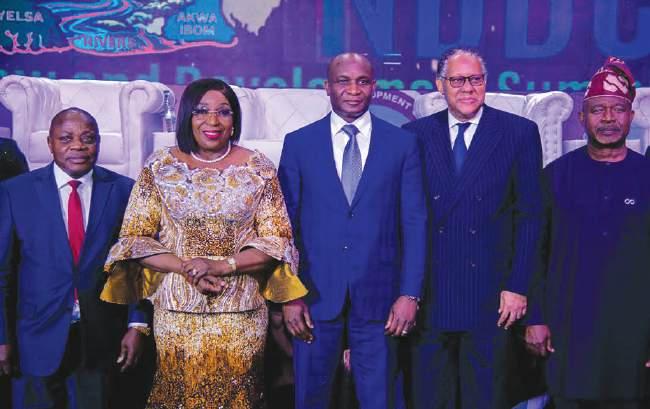
At the summit, the Managing Director and Chief Executive Officer of the NDDC, Ogbuku, told participants that the commission remains committed to driving sustainable development through reforms to improve efficiency and service delivery.
Ogbuku noted that sustainable development extends beyond physical infrastructure to include economic growth, social inclusion, and environmental protection.
He disclosed that the current management inherited administrative challenges that required significant restructuring and modernisation. According to him, the NDDC has now achieved nearly 90 percent digitalisation of its internal processes, enabling contractors and stakeholders to execute contractual agreements electronically with minimal physical interaction.
“We have put in place mechanisms for contractors and stakeholders to sign and execute their contract agreements electronically from the comfort of their homes and offices,” Ogbuku said.
Also, while addressing the summit, the Chairman of the NDDC Governing Board, Ebie, said the summit was convened to explore how legal frameworks can be strengthened and reformed to accelerate sustainable development in the Niger Delta region.
He observed that despite the region’s enormous natural wealth, many communities continue to grapple with poverty and inadequate infrastructure, underscoring the urgent need for a responsive legal architecture.
The NDDC board chairman lamented what he
described as cumbersome appropriation structures and regulatory compliance requirements that have slowed down project implementation across the region, emphasising that “the aspirations of our people demand nothing less than a legal architecture that is bold, responsive, and fit for purpose.”
He further noted that funding constraints, inflationary pressures, and project abandonment have undermined development efforts and, therefore, called for innovative legal solutions to address the challenges.
Ebie, however, cautioned that “the law should not be seen as an obstacle but as a tool for development,” while expressing the expectation that the summit would provide stakeholders with an opportunity to examine existing legal frameworks, evaluate Environmental, Social and Governance (ESG) principles, and chart a new course for sustainable development in the Niger Delta.
While delivering his keynote presentation at the summit, the Keynote Speaker, Henry Odein Ajumogobia (SAN), who was a former Minister of State for Petroleum Resources (2007 and 2009) and later Minister of Foreign Affairs (2010 to 2011), noted that the Niger Delta’s persistent environmental degradation, poverty, and underdevelopment are not the result of inadequate laws, but a failure to enforce existing legal frameworks.
He advocated the enactment and enforcement of laws to abolish routine gas flaring, impose stricter environmental sanctions, and establish specialised environmental courts across the region.
According to the keynote speaker, decades of weak legal governance have prevented the oil-rich region from translating its vast natural resources into sustainable prosperity, noting that “the Niger Delta is not suffering from a lack of law; it is suffering from a failure of legal governance.”
According to him, meaningful development in the region can only be achieved when host communities are empowered through enforceable legal rights that guarantee participation in petroleum operations, equitable revenue sharing, and inclusion in decision-making processes.
How E-Invoicing Will Reshape Nigeria’s Tax System
As enforcement begins for large taxpayers and medium-sized firms enter the compliance net, businesses confront a new reality where digital invoicing is no longer optional but central to tax efficiency, VAT recovery and commercial competitiveness. Bennett Oghifo reports
Nigeria’s tax administration is entering a defining moment.
Beginning July 1, 2026, large businesses with annual turnover of N5 billion and above will no longer have the luxury of delaying compli- ance with the Nigeria Revenue Service (NRS) electronic invoicing mandate. From that date, every invoice that falls outside the prescribed electronic transmission framework could attract penalties, marking the commencement of one of the most ambitious fiscal modernisation programmes ever undertaken in Africa.
The development signals a significant shift in the way taxes are administered, monitored, and enforced in Nigeria. More importantly, it highlights the increasing role of technology in plugging revenue leakages, improving transparency, and reshaping relationships between businesses and tax authorities.
At a virtual media parley organised by DigiTax Nigeria, stakeholders examined the implications of the policy and the readiness of businesses as the enforcement deadline approaches. The discussions revealed a mixed picture of progress and concern.
According to Olumide Akinsola, Country Director of DigiTax Nigeria, compliance levels among large taxpayers have improved consider- ably, but a substantial number of businesses remain outside the system despite the looming deadline.
The NRS (formerly the Federal Inland Revenue Service), estimates that approximately 5,000
companies fall within the large taxpayer category. While more than 1,000 businesses had reportedly complied as of early 2026, the majority are yet to complete the process.
“The NRS tells us the results are encouraging, but there is a lot more work to be done. There is still a significant chunk of businesses in this cohort that are still outside,” Akinsola said.
The implications of non-compliance extend beyond regulatory sanctions. Under the new framework, businesses can only claim Value Added Tax (VAT) input credits on invoices that have been validated and transmitted through the Merchant Buyer Solution (MBS) platform. Consequently, a supplier’s failure to comply could directly affect the financial position of its customers.
This provision effectively transforms e-invoicing from a regulatory requirement into a commercial necessity. Companies that fail to comply risk not only fines but also the possibility of losing business relationships as customers increasingly insist on dealing only with compliant suppliers.
Akinsola stressed that businesses ignoring the directive may be exposing themselves to avoidable financial losses.
“It is impossible to claim VAT input credits if those invoices were not transmitted to the NRS system. Not being compliant means you are actually leaking revenue because the input VAT you cannot claim back has to be paid from your own pocket,” he explained.
The financial consequences could be substantial. Under the penalty framework, every VAT charge contained in an invoice that was not transmitted
after the compliance deadline automatically becomes a fine. In addition, interest is imposed at two percentage points above the Central Bank of Nigeria’s Monetary Policy Rate.
For many businesses, the prospect of ac- cumulating such liabilities should be sufficient motivation to accelerate compliance efforts.
Yet the significance of the policy extends far beyond penalties and deadlines. At its core, the e-invoicing initiative represents Nigeria’s attempt to modernise tax administration through real-time data collection and digital transaction monitoring.
The framework requires businesses to generate, validate and submit invoices electronically through accredited Access Point Providers (APPs) and System Integrators (SIs). Once validated, each invoice receives an Invoice Reference Number (IRN) and a QR code that enables verification by both regulators and business partners.
The system is designed to create a compre- hensive digital trail for every transaction, thereby reducing opportunities for tax evasion, invoice manipulation, and underreporting.
According to Akinsola, the global movement towards e-invoicing has been driven by five key objectives: transparency and traceability, enhanced voluntary compliance, reduction of VAT gaps, efficiency gains, and real-time exchange of fiscal information.
Nigeria is not alone in this transition.
Across Africa, governments are increasingly embracing technology-driven tax administration.
Countries such as Kenya, Zambia, Rwanda, Ghana, Egypt and South Africa have implemented or are
rolling out variations of e-invoicing frameworks aimed at improving revenue collection and reducing tax leakages.
The urgency is understandable. Estimates cited during the media engagement suggest that Africa loses the equivalent of approximately N20 trillion annually through tax leakages and compliance gaps.
For governments facing mounting expenditure obligations and limited fiscal space, digital tax systems offer an opportunity to broaden revenue collection without necessarily increasing tax rates. Nigeria’s adoption of e-invoicing therefore aligns with a wider continental effort to strengthen public finance management and improve accountability.
The rollout itself has been structured in phases.
Large taxpayers with turnover of N5 billion and above constitute the first phase and face enforcement from July 1, 2026.
The second phase begins simultaneously in July 2026 and targets medium-sized businesses with annual turnover between N1 billion and N5 billion. While stakeholder engagement commences immediately, their enforcement period will run from January to March 2027.
By March 2027, regulators expect every business with annual turnover exceeding N1 billion to be fully integrated into the e-invoicing ecosystem.
The final phase targets emerging taxpayers and small businesses with annual turnover below N1 billion. Their enforcement period is scheduled for January to March 2028.
This staggered approach reflects recognition of the differing levels of technological readiness across Nigeria’s business landscape.
L-R: Chief Judge of Rivers State, Justice Simeon Amadi; Deputy Governor of Rivers State, Prof. Ngozi Odu; NDDC Managing Director / CEO, Dr. Samuel Ogbuku; Keynote Speaker, Mr. Henry Odein Ajumogobia (SAN), and Executive Director, Corporate Affairs, NDDC, Chief Ifedayo Abegunde, at the Commission’s Law and Development Summit 2026, held in Port Harcourt, Rivers State … recently
NNPCL: How Senate Exposed Oshiomhole, Committee Over Bogus N210trn Missing Claim
What began as an aggressive Senate committee investigation into claims that the Nigerian National Petroleum Company Limited (NNPCL) could not account for N210 trillion ended with the Senate itself repudiating key actions taken by its Public Accounts Committee, distancing the institution from controversial comments made by Edo Senator Adams Oshiomhole, and voiding a warrant of arrest issued against former NNPCL Group Chief Executive Officer, Mele Kyari.
The dramatic turn of events unfolded on Thursday when the Senate, through a motion raised by Senate Leader Opeyemi Bamidele, moved to protect what lawmakers described as the institutional integrity of the upper chamber, uphold due process, and reaffirm the limits of committee powers under Nigerian law.
At the heart of the controversy were two issues: the warrant of arrest issued against Kyari by the Senate Committee on Public Accounts and comments attributed to Oshiomhole during the committee’s proceedings in which he reportedly described NNPCL as “a bunch of criminals and thieves.”
The Senate’s intervention effectively reversed the committee’s position and underscored concerns among lawmakers that legislative oversight must be conducted without prejudice, bias or the appearance that conclusions have already been reached.
The controversy began during the committee’s ongoing probe into allegations relating to NNPCL’s financial records and claims that the company could not account for N210tn.
As part of its investigation, the Public Accounts Committee invited Kyari to appear before it. However, the former NNPCL boss wrote the committee explaining his absence due to health-related issues while other leadership of the company invited attended.
Mallam Kyari said he was ready to respond to all inquiries and that the channel to be reached was open.
During the committee’s proceedings, Anambra Senator Tony Nwoye validated Kyari’s letter and informed members that Kyari was receiving medical treatment and therefore could not attend.
Nwoye told the committee, “I spoke to Mele Kyari about a week ago. He promised that he would be here. But incidentally, I learned last night that the man is hospitalized in Germany.”
His intervention was intended to persuade the committee to postpone further action until Kyari was medically fit to appear. Some members reportedly agreed that the circumstances warranted caution, particularly because the absence was health-related rather than a deliberate refusal to cooperate.
Despite those concerns, the committee proceeded with a warrant of arrest against the former NNPCL chief.
The committee’s decision immediately generated debate within and outside the National Assembly. Questions were raised about whether a Senate committee possessed the authority to issue such a warrant independently and whether the action complied with the Legislative Houses (Powers and Privileges) Act, 2017.
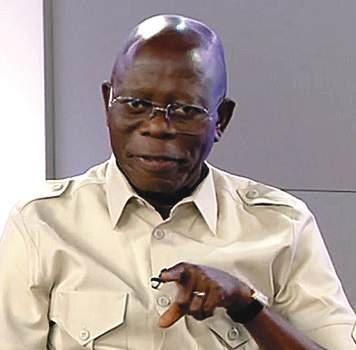
The controversy deepened after comments attributed to Oshiomhole during the proceedings.
The former Edo State governor reportedly referred to NNPCL as “a bunch of criminals and thieves,” a remark that attracted criticism because the committee’s investigation was still ongoing and no judicial determination had been made regarding any allegations against the company or its officials.
The fallout from the committee’s actions was significant enough for the matter to be brought before the full Senate under a Matter of Urgent Public Importance with senators angry that the former Labour leader had exposed the upper chamber to ridicule.
Rising under Orders 41 and 51, Senate Leader Opeyemi Bamidele argued that the issues raised by the committee’s actions went beyond a routine investigation and touched on the constitutional responsibilities of the Senate itself.
According to Bamidele, the Senate had a duty to preserve its institutional authority, ensure compliance with the law and uphold the principles of fair hearing, due process and parliamentary impartiality.
He reminded lawmakers that Sections 88 and 89 of the Constitution of the Federal Republic of Nigeria empower the National Assembly to conduct investigations and oversight activities in the interest of accountability, transparency and good governance.
However, he stressed that such powers are not unlimited and must be exercised strictly within the framework established by law.
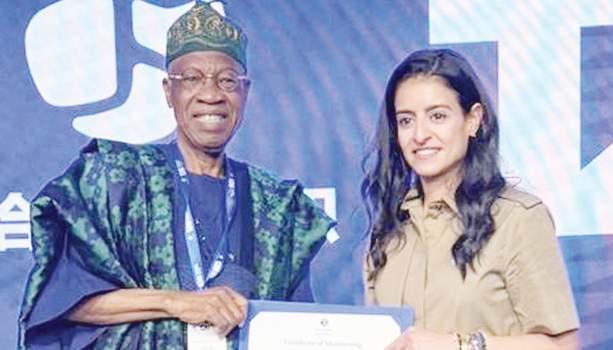
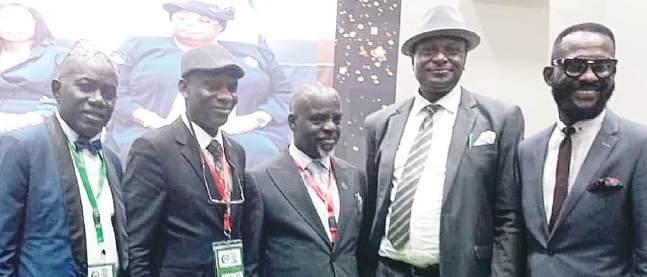
Bamidele specifically cited the Legislative Houses (Powers and Privileges) Act, 2017, which governs the procedures for compelling witnesses to appear before the National Assembly and its committees.
According to him, “Sections 4, 5 and 6 of the Legislative Houses (Powers and Privileges) Act, 2017 specifically vest the authority to issue warrants compelling the attendance of witnesses in the Presiding Officer of the Legislative House, namely the President of the Senate in respect of Senate proceedings and Committees thereof.” That provision became central to the Senate’s deliberations because it raised a fundamental question: Did the Public Accounts Committee possess the legal authority to issue a warrant of arrest on its own? Bamidele’s position was unequivocal. He argued that committees derive their authority from the Senate and may only exercise powers expressly granted to them by the Constitution, Senate Standing Orders and relevant legislation.
“The power to issue a warrant affecting the liberty of a citizen is an extraordinary statutory power which must be exercised strictly in accordance with the procedure prescribed by law,” he said. Beyond the procedural issue, Bamidele also focused on the comments attributed to Oshiomhole.
He warned that the Senate must be careful not to create the impression that it had already reached conclusions about any person or institution appearing before it.
According to him, “the Senate, as an institution established under the Constitution of the Federal Republic of Nigeria, is bound at all times to conduct its proceedings in accordance with the principles of natural justice, fairness, objectivity, parliamentary responsibility and respect for the rule of law.”
He further stated that although the Senate possesses extensive oversight powers, those powers he said “must be exercised in a manner that does not create the appearance of bias, prejudice, pre-judgment or predetermined conclusions regarding any person or institution under investigation.”
The Senate Leader noted that NNPCL remains a strategic national institution incorporated under the Petroleum Industry Act, 2021, with ownership interests held on behalf of Nigerians. For that reason, he argued that public comments suggesting criminality before the conclusion of investigations could have serious implications.
He observed that statements characterising NNPCL as “a bunch of criminals and thieves” were capable of conveying a conclusion of criminal culpability against the institution and its officers before the completion of any lawful investigation or determination by a court of competent jurisdiction.
Bamidele warned that if such statements were left unaddressed, they could easily be interpreted by the public as the official position of the Senate.
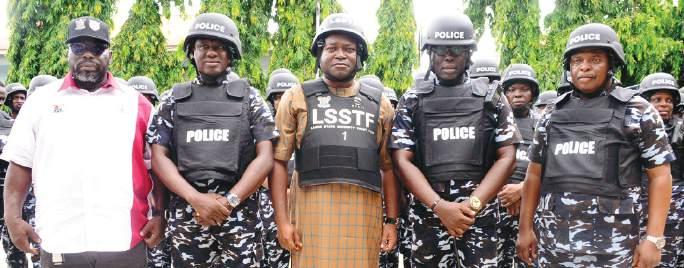
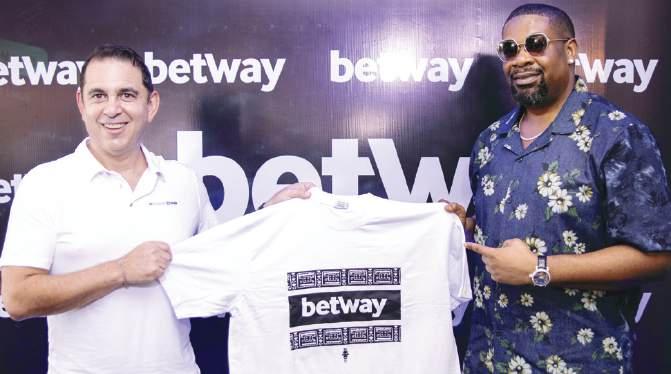
Isuma Isuma
Oshiomhole
L-R: Santhus Awooture ; Past Nigerian Bar Association Publicity Secretary, Kunle Edun SAN; Past 1st Vice President Nigerian Bar Association and Past Spidel Chairman, John Aikpokpo Martins; Past Chairman NBA Benin Branch, Nosa Francis Edo-Osagie,Esq; and Sam Mac-Ebi, Esq. at the Closing of NBA Benin Branch Law Week activities held at the Ceremonial Court Hall of the Edo State Judiciary in Benin City…recently..
L-R: Chief Executive Officer of Super Group, Neal Menashe; and brand ambassador, Don Jazzy, at the official brand ambassador signing ceremony in Lagos, recently.
L-R: Director, Administration, Lagos State Security Trust Fund, LSSTF, Mr. Adegbola Lewis; Deputy Commissioner of Police, DC Admin, DCP Khan Salihu; Executive Secretary/CEO, LSSTF, Dr. Ayodele Ogunsan; Commissioner of Police, Lagos State Command, CP Fatai Tijani and Deputy Commissioner of Police, DC Operations, DCP Lawal Adeshina during the presentation of Bulletproof Vests and Helmets by LSSTF to all DPOs, Area Commanders and Tactical Squad at the Police Officers’ Mess, GRA, Ikeja…recently
L-R: Chairman of the Board of Trustees of the Eko Tourism Foundation, Alhaji Lai Mohammed receiving the Certificate of Membership awarded to Eko Tourism Foundation as a new Affiliate Member of UN TOURISM from Shaikha Al Nuwais (right), the UN Tourism Secretary General, in Toledo, Spain on Thursday
Isuma wrote in from Abuja
PersPective
Leadership: What the Alex Otti Example Teaches Us
Kenneth Kalu
Leadership is one of the most frequently discussed subjects in public life, yet it remains one of the least understood. In our books, our places of worship, our political rallies, and our living rooms, we agree that leadership is the single most important factor in the rise or fall of any society. Yet, for all the talk, very few of us truly understand what leadership means in practice.
In Nigeria, the word has been so abused that it has almost lost its meaning. During every election season, we are bombarded with empty promises, recycled slogans, and bare-faced lies from characters whose backgrounds and records have nothing to do with genuine leadership. We have heard the word “leadership” so often that we have become numb to it.
This is why what is happening in Abia State today is so remarkable. It deserves our attention, not because of political affiliation, not because of sentiment, but because it offers a rare, living example of what real leadership looks like when it is finally put to work.
Whether one approaches the subject from a political, professional, or academic perspective, the developments in Abia State over the past three years offer important lessons about the subject of leadership. One of the first lessons is that leadership is the combination of vision and execution. Many leaders possess ideas, but far fewer possess the discipline, focus, capacity, and consistency required to convert those ideas into tangible outcomes.
Until 2022, Abia State was widely considered one of the worst-performing states in Nigeria. Roads were impassable, and Government institutions were comatose. The capital city, Umuahia, and the commercial hub, Aba, told stories of neglect that broke the hearts of residents and visitors alike. Many Abians had simply given up hope that their state could ever be different.
Then came Governor Alex Otti, and almost immediately, things began to change. Roads and bridges that had been abandoned for decades have been reconstructed. Health facilities are being rebuilt and new ones constructed. Water schemes are returning to communities that had forgotten what clean public water tasted like. Public schools that were almost completely abandoned are now being rebuilt and repositioned with thousands of new teachers recruited.
Today, the transformation is so visible that even the harshest critics have run out of arguments. The question being asked everywhere is no longer whether Governor Otti is performing. It is how he is doing it. How is a man running a state once labeled “poor”, funding so many projects at the same time?
How is he doing what others, with more resources, could not do? The answer lies in leadership. True leadership prioritizes the people over personal interests. The kind of leadership we are talking about treats public funds as a sacred trust rather than a personal allowance. True leadership plans, executes, and delivers. That is the current reality of Abia State. It would be easy, and perhaps lazy to reduce the Governor Otti’s administration to its physical projects alone. Roads, bridges, hospitals, and schools are very important, and they are easy to see and photograph.
But a deeper story of what is happening in Abia State lies in the things that are not as immediately visible. It lies in the careful investments being made in people. Take the TechRise program, for instance. While many state governments are still trying to figure out what to do about youth unemployment, Governor Alex Otti is equipping young Abians with skills in information technology, artificial intelligence, and data analytics.
These are the skills that will define the economy of the future. Years from now, when these young people are earning real incomes and building real businesses, we will look back
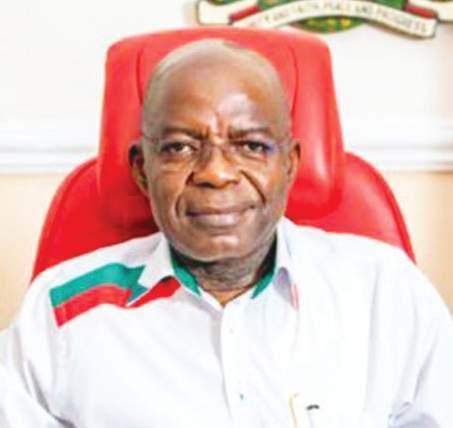
and recognize that TechRise was one of the smartest investments any Nigerian state has made in its youth.
The same vision is evident in the comprehensive rebuilding of Abia State University in Uturu, the Ogbonnaya Onu Polytechnic in Aba, and the Abia State College of Education (Technical) in Arochukwu. Under previous administrations, these institutions had been left to decay.
Programmess lost their accreditations, and lecture halls fell apart. Hostels became unfit for human habitation.
Today, the story is different, as new hostels are rising, and new internal roads are being constructed across all the campuses. New academic staff have been recruited, and modern teaching and research tools are being acquired. The institutions are coming back to life, and with them, the futures of the graduates. This is what serious leaders do. They build strategically for tomorrow, even when the ordinary person may not understand the logic.
Perhaps one of the most fascinating of Governor Alex Otti’s initiatives, and the one that equally highlights the depth of his thinking, is the establishment of the Abia State Leadership Academy. Think about this carefully.
At a time when many politicians are focused on the next election, Governor Otti is focused on the next generation. At a time when many leaders are content to be celebrated for what they have built, he is investing in raising other leaders who will outlast him. This is not normal political behavior in our clime. This is true statesmanship in all its ramifications.
The Abia State Leadership Academy has been formally established with a clear mandate to groom emerging leaders with “the intellectual capacity, ethical orientation, practical leadership skills, and civic consciousness required to drive sustainable development.”
Please read those words again. This is not the language of a politician chasing votes. This is the language of a man who has thought deeply about what our nation needs and is
determined to do something about it.
In the next few weeks, the Academy will admit another batch of 1,000 young Abians, between the ages of 16 and 20, into its leadership bootcamp. The fully residential program will train them in the core demands of responsible citizenship, visioning, leadership and service, creativity and innovation, and enterprise and impact. Imagine what Nigeria would look like in twenty years if every state took such an investment seriously. Imagine a country where, in every village and every city, young men and women have been carefully trained to think about service, integrity, and the common good. That is the Nigeria Governor Otti is helping to build, one cohort at a time.
The Academy is not only for the youth. It also has a mandate to train senior public officers and civil servants in high-performance governance, leadership decision-making, institutional management, stakeholder engagement, and execution. This is significant because so many of our government institutions fail not for lack of policies, but for lack of capacity to execute the policies. By investing in the people who run the institutions, the Academy is addressing one of the deepest problems in Nigerian governance. The Academy will equally extend its capacity-building mission to entrepreneurs and businesspeople through its Enterprise Leadership Program.
Participants will be trained in strategic management, financial management, marketing across borders, negotiation, succession planning, and sustainable business growth. This is the kind of holistic thinking that builds nations. Governments do not create wealth, but entrepreneurs do. By equipping entrepreneurs with the tools to succeed, Governor Alex Otti is sowing seeds whose fruits will be harvested for decades.
There is a famous saying that true leaders are those who invest in creating other leaders, not those who seek followers. Governor Otti seems to have taken this principle to heart. He is not building a personality cult. He is building institutions, training people, and laying foundations that will outlast his administration. This is why his example matters beyond Abia State.
Whichever part of Nigeria one may reside, it is important to pay attention to what is happening in Umuahia. Whether you belong to a political party or not, you should be studying this model. Successful nations and organizations
learn from what works. They do not allow politics to blind them to results. They do not allow tribe or party affiliation to prevent them from acknowledging good when they see one. Governor Otti has demonstrated the foundational philosophy of his leadership. He has demonstrated a deep respect for the people, a commitment to public good over private interest, and a long-term view of development. This is exactly what citizens should be demanding from every elected official. To understand why Governor Otti governs the way he does, you have to understand the man himself. He graduated with a first-class degree in Economics and was named the best overall student at his university. He built a very successful career in banking and finance, rising to the position of a Bank CEO. He really has nothing personal to prove again. Anyone who has worked closely with him will tell you the same thing. Dr. Alex Otti is a thinker, a planner, and a man of audacious vision who is not afraid to dream big and work hard to make those dreams real. When his commissioners and aides worry about how he intends to fund all the ambitious projects on his desk, he simply reminds them that finance is his own professional calling. But he is more than a financier.
He is a transformational leader who believes in results, in excellence, and in the moral duty of public office. His commitment to public good over private interest is not a campaign slogan, it is the way he actually governs. His writings on the back page of THISDAY newspaper, long before he became Governor, are still there for anyone to read. He wrote about the failures of leadership, the need for accountability, the importance of vision, and the urgency of investing in people. Now that he holds a political office, he is doing exactly what he wrote about. He is one of those very rare politicians whose practice matches what they preach. In a country where so many leaders say one thing and do another, Alex Otti’s consistency alone is revolutionary. As citizens, we have a responsibility too. We owe it to ourselves and to future generations to recognize good leadership when we see it, to celebrate it, to learn from it, and to insist that it becomes the norm rather than the exception. We must stop the bad habit of dismissing every success story as either propaganda or coincidence. We must train ourselves to study results, follow evidence, and reward performance.
Abia State is on a turn for good. The roadmap is very clear, and the execution is visible. The impacts are touching real lives in real time. What remains is for the rest of us as citizens, journalists, scholars, civil society leaders, and politicians to acknowledge the lesson and ensure it is replicated wherever good leadership is needed.
The Alex Otti story is, in the end, a story about possibility. It tells us that even our most troubled states can be turned around. It tells us that leadership, properly understood and properly practiced, can change everything. It tells us that we do not have to settle for mediocrity, that we do not have to accept the myth that “this is Nigeria, and nothing works here.” Things can work. Things are working in Abia State. And if we are wise, we will pay attention.
Governor Otti’s leadership model teaches us that when leadership is anchored on vision, execution, institution building, and investment in people, meaningful transformation is possible. The Abia State Leadership Academy is not just a project. It is a powerful statement that demonstrate a deep commitment to society’s progress today and tomorrow.
It is Governor Otti’s way of telling us that the future of our country depends on the kind of people we raise to lead it. And he is doing his own part. The question for the rest of us is whether we are willing to do ours. Leadership, indeed, makes all the difference.
Prof.KaluisPresidentoftheAbiaState Leadership Academy.
Otti
PSV 2028: Deepening Financial Access, Expanding Payments
James emejo writes that the launch of the Central Bank of Nigeria’s Payments System Vision 2028 marks more than the unveiling of another policy framework
For years, Nigeria’s payments ecosystem has been celebrated as one of Africa’s most innovative, producing real-time payments infrastructure, fostering fintech growth and driving the continent’s digital finance revolution. Yet, despite these achievements, millions of Nigerians remained outside the formal financial system, electronic fraud continued to threaten trust, and the country’s innovations remain largely underappreciated globally.
Against this backdrop, PSV 2028 emerges as a bold national blueprint designed to push financial inclusion to 95 per cent, bring an additional 15 million Nigerians into the formal financial system, deepen payment penetration, strengthen trust and security, and position Nigeria as both a continental and global payments powerhouse.
However, beyond the lofty targets and policy declarations, discussions during the launch revealed that the true challenge lies not in technology itself, but in affordability, accessibility, execution, collaboration and trust. The accompanying panel session brought together regulators, infrastructure providers, fintech leaders and inclusion advocates whose interventions collectively exposed both the promise and complexity of achieving the vision.
Beyond Policy: Building Nigeria’s ‘Invisible Roads’
At the heart of PSV 2028 is the recognition that modern payment systems have become critical economic infrastructure.
Speaking at the launch, CBN Governor, Olayemi Cardoso, framed the vision as a blueprint for how Nigerians will transact, save, trade and participate in the digital economy over the next several years. He repeatedly returned to the idea of payment systems as “invisible roads” that move money, arguing that just as physical infrastructure drives commerce, digital payment infrastructure now underpins productivity, trade, investment and economic growth.
For Cardoso, PSV 2028 is fundamentally about outcomes. The ambition is to achieve near-universal financial inclusion, drastically reduce fraud losses, accelerate transaction speeds and nurture globally competitive fintech companies capable of exporting innovation from Nigeria to the world.
His emphasis on execution was unmistakable. Nigeria’s history is littered with well-crafted policy documents that failed to deliver transformational outcomes because implementation faltered. PSV 2028 seeks to avoid that fate by making measurable impact the benchmark of success.
The central bank governor’s vision connects payment infrastructure directly to poverty reduction. By expanding access to financial services and reducing reliance on cash, more Nigerians can participate meaningfully in economic activities,
access credit, save securely and engage in formal commerce.
According to Cardoso, the vision represented a sweeping reform targeting 95 per cent financial inclusion, and “faster-than-a-blink” digital transactions, adding that the new framework aimed at drastic reduction in electronic fraud losses, and the emergence of globally competitive Nigerian fintech unicorns.
Cardoso stressed that PSV 2028 is designed to position Nigeria as a global fintech hub, with explicit ambition to produce internationally competitive fintech unicorns.
He noted that open banking reforms have unlocked over 100 Application Programming Interfaces (APIs), creating opportunities for innovation, new products and financial services expansion.
According to him, Nigerian innovators should be able to build global fintech solutions from Lagos, Abuja and Kano, using domestic data and infrastructure.
He said the country must transition from a fintech adoption market to a fintech production and export economy.
Importantly, Cardoso urged Nigerians to actively project its fintech achievements globally, warning that failure to tell its own story risks allowing external narratives to define its progress albeit in away not comfortable for the country.
“If we do not tell the story, others will tell it for us,” he said.
Cardoso said,” The central bank has provided a platform— but in actual fact, it is owned by everyone. As was said earlier—and I fully endorse it—we must work together to ensure execution.
“We must also measure performance. It is fine to have well-crafted words, but if we do not measure outcomes, we will lose track.
“We must keep in mind that there is a broader roadmap for outputs. As the government builds roads, schools, and hospitals, we here must also build the invisible roads that move money.” He said, “And that is why Nigeria’s payments system vision 2028 is critical to national prosperity. Let us keep that in mind. The journey is still ongoing. That is part of it—and a major part of it. The journey is to lift people out of poverty, and to have an impact on GDP.
“Today’s payment systems process millions of transactions every day, and the majority are completed in less than 10 seconds.
“By 2028, our target is simple: every Nigerian—from Abuja to Brass—will be able to send and receive money faster than they can blink. Inclusion, not exclusion.”
The apex bank boss said, “In 2023, a large number of Nigerian adults had access to financial services. Under Vision 2028, I would like to see this reach 95 per cent inclusion— meaning 15 million more market women, farmers, and young people will gain access to financial services.”
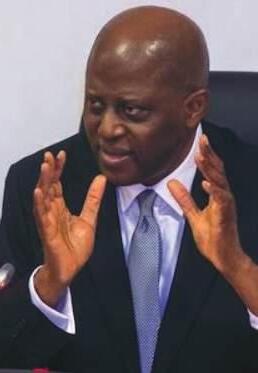
The Structural Shift in Moving Value CBN Deputy Governor for Economic Policy, Dr. Muhammad Sani Abdullahi, elevated the conversation beyond banking and fintech.
According to him, PSV 2028 represents a structural shift in how value moves across the Nigerian economy. The framework is anchored on five interconnected pillars — infrastructure, inclusion, innovation, cross-border payments and system integrity.
Interrogating IMF’s 2026 Article IV Consultation Report
Uche Uwaleke
The International Monetary Fund (IMF) has remained an important development partner to Nigeria over the years, providing policy advice, technical assistance, surveillance, and analytical insights aimed at strengthening macroeconomic management. While not all IMF prescriptions have been universally accepted, its Article IV Consultations often offer useful perspectives on the strengths and weaknesses of the Nigerian economy.
The 2026 Article IV Consultation Report deserves commendation for acknowledging the significant reforms undertaken by the Nigerian government over the past three years and their contribution to improved macroeconomic stability and resilience.
Indeed, the gains recorded in exchange rate reforms, fiscal consolidation efforts, banking sector recapitalisation, reserve accumulation, and improved external balances demonstrate that difficult but necessary policy adjustments have begun to yield results.
However, as the IMF rightly observed, these improvements have yet to translate into widespread welfare gains for ordinary Nigerians, many of whom continue to grapple with rising poverty, food insecurity, and a high cost of living.
The Fund’s concerns regarding off-budget spending, complex financing arrangements, and weaknesses in fiscal transparency are particularly relevant.
Sustainable economic development requires strong institutions, transparent budgeting processes, credible fiscal reporting, and effective public financial management systems. Investors, development partners, and citizens alike require confidence that public resources are managed efficiently and accountably.
Strengthening fiscal governance will not only improve resource allocation but also reduce waste, and corruption that often undermine macroeconomic stability. Equally commendable is the IMF’s emphasis on strengthening fiscal risk management frameworks, as hidden liabilities and opaque financing structures have historically contributed to fiscal vulnerabilities in many emerging economies.
The recommendation to reduce reliance on portfolio flows with significant rollover risks is equally well-founded. While foreign portfolio investments provide short-term liquidity and help support external reserves, they are inherently volatile and highly sensitive to changes in global financial conditions. Nigeria’s experience has repeatedly shown that sudden reversals of portfolio capital can exert severe pressure on the exchange rate, external reserves, and financial markets.
It is a no-brainer that sustainable economic development cannot be built on speculative capital inflows. Rather, the focus should remain on attracting long-term foreign direct investment into productive sectors such as manufacturing, agriculture, technology, infrastructure, mining, and renewable energy.
Such investments create jobs, transfer technology, strengthen domestic productive capacity, and generate more stable sources of foreign exchange earnings.
Similarly, the IMF’s call for stronger supervision of stablecoins and other crypto-assets deserves support. The rapid growth of digital financial assets presents both opportunities and risks. While financial innovation should be encouraged, inadequate regulation could expose the financial system to risks relating to money laundering, terrorism financing, cybercrime, consumer protection failures, and financial instability.
Bringing these activities within an appropriate regulatory framework would strengthen market integrity while allowing innovation to flourish responsibly. In the same vein, Nigeria’s removal from the Financial Action Task Force (FATF) grey list represents a significant achievement that should not be taken for granted.
Sustained implementation of anti-money laundering and counter-terrorism financing reforms will be essential in preserving investor confidence, improving Nigeria’s international reputation, and facilitating smoother integration into the global financial system.
The IMF is also correct in emphasising the importance of structural reforms aimed at promoting inclusive growth and economic diversification.
For decades, Nigeria’s excessive dependence on crude oil revenues has exposed the economy to recurrent external shocks. Diversification is therefore not merely desirable but
on Nigeria
essential. Governance reforms, improvements in security, expansion of electricity access, modernization of agriculture, infrastructure development, and investments in human capital are all critical components of a sustainable development strategy.
In particular, improving security conditions across the country would unlock agricultural productivity, encourage domestic and foreign investment, reduce food inflation, and stimulate economic activity. Likewise, resolving longstanding electricity challenges would significantly lower production costs, enhance competitiveness, and support industrialisation. Investments in education, healthcare, and skills development are equally important because no country can achieve sustained economic transformation without a productive and well-trained workforce.
While the IMF deserves credit for many of its recommendations, some of its policy prescriptions warrant closer scrutiny within the peculiar realities of the Nigerian economy. One such recommendation is the suggestion that additional tax policy measures may be required over the medium term, including possible increases in the Value Added Tax (VAT), extension of VAT to fuel products, rationalization of tax expenditures, reduction of exemptions, and introduction of telecommunications excise duties. Although the objective of enhancing revenue mobilisation is understandable, the timing and context of such proposals raise legitimate concerns.
Nigeria is currently experiencing one of the most severe cost-of-living crises in recent history. Households are already contending with elevated food prices, transportation costs, energy costs, housing expenses, and declining purchasing power.
Increasing indirect taxes under such circumstances would likely exacerbate economic hardship, weaken consumer demand, and further strain household welfare.
Cardoso
• Uwaleke, a financial economist, is Nigeria’s renowned professor of capital market with the Nasarawa State University and President of the Capital Market Academics of Nigeria (CMAN)
TRIBUTE TO CHIEF OLUFEMI MAJEKODUNMI
bluntly refused to succumb to pathos or despair. Thereafter, “Majekodunmi” became both his sobriquet and name.
Also, in 1955, when Chief J.B Majekodunmi (Femi’s grandfather) died, my Dad (Chief J.K Randle), my cousin Adeyinka Majekodunmi and I drove from Lagos to Abeokuta to attend the funeral. It was Femi’s Dad, Chief (Dr) Moses Adekoyejo Majekodunmi, who invited my Dad. It was a really grand affair. At the end of the funeral, Chief Majekodunmi summoned the family members to the inner sanctum of the family house at Ikereku. That was seventy-one years ago, when tape recorders had just surfaced in Nigeria. Anyway, Majekodunmi had persuaded his father to record a message on his deathbed to be released after his death.
Without any prior warning, Majekodunmi pressed the button, and what followed was the authentic voice (in thick Egba dialect) of the departed patriarch of the family. He pleaded for peace and unity amongst all his children. There must be no litigation or squabbles over his vast estate. Technology had berthed on our shores and landed in Abeokuta.
The audience took to their heels and fled in various directions. The whole of Abeokuta was in panic. It was pandemonium everywhere.
Word quickly spread that the departed Chief J.B Majekodunmi had risen from the dead and had spoken to his family.
Something else I recall from the funeral was a photograph of Chief (Dr) Moses Adekoyejo Majekodunmi resplendent in his “Aso Ebi” in the midst of his closest friends- Chief Obafemi Awolowo, Chief F.R.A Williams and Chief J.K Randle. Those who are familiar with Nigeria’s turbulent history would no doubt appreciate the irony and significance of that poignant photograph. Following the turmoil in the Western Region of Nigeria, Chief (Dr) Moses Adekoyejo Majekodunmi was appointed by the Prime Minister, Sir Abubakar Tafawa Balewa, as the Sole Administrator of the Western Region. His first task on resuming in Ibadan was to sign the detention order which confined Chief Obafemi Awolowo, the erstwhile Premier of the Western Region to the then remote (and mosquito-infested Lekki Peninsula- and later to Calabar.
Chief F.R.A Williams resigned as the Minister of Justice and Attorney-General of the Western Region to set up his law chambers in Lagos. Chief J.K Randle had died in 1956 at the age of 47 years.
Last year, I handed over a photograph of Chief Moses Adekoyejo Majekodunmi, Sole Administrator of the Western Region, worshipping at a Church in Oke Padre, Ibadan. Standing at attention was Captain Murtala Muhammed who was the Aidede-Camp to the Sole Administrator.
You do not need to be a historian to remember that Murtala Muhammed rose to the rank of General and became the Head of State of Nigeria on July 29, 1975. He was assassinated on Friday 13th February 1976.
At the risk of telling you what most, if not all of you know already- what Femi wanted most was for his father who was a titan in the medical profession to be proud of him. It is self-evident that Femi has not only met his father’s expectations. He surpassed them by miles.
Here is the testimonial to these superlative achievements:
Olufemi Adetokunbo Majekodunmi, FNIA; ARIBA (1940-2026)
Personal Background
Olufemi was born in London, England, on 1st May 1940, to Moses Majekodunmi and Tomi Agbebi. He grew up in Nigeria and attended St Gregory’s College, Lagos. He later returned to the United Kingdom to study architecture at the Glasgow School of Art, Kingston College of Art (now Kingston University) and graduated in 1966. Majekodunmi was married to Victoria Majekodunmi. They had four children. He died on 5 June 2026, at the age of 86.
Architectural Career
Arc (Chief) Olufemi Majekodunmi was a pioneering British-Nigerian architect whose career fundamentally shaped the African architectural landscape. He was the first African President of the International Union of Architects (UIA) and founder of one of the continent’s most prominent
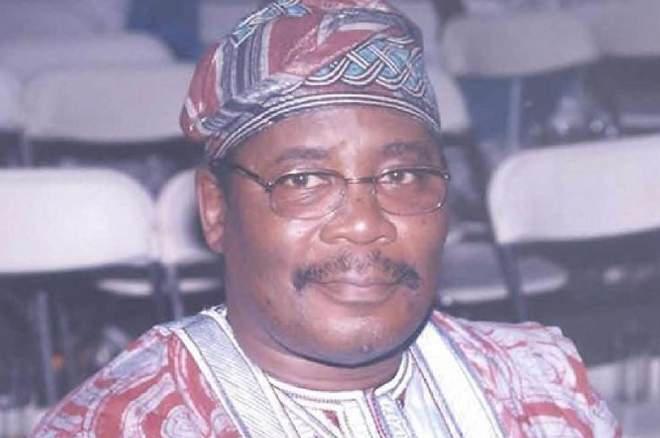
architectural firms.
After graduation, Femi worked for some years with firms in Washington D.C. Afterwards, he returned to Nigeria and worked with Godwin and Hopwood Architects, Lagos before establishing his architectural firm, then Femi Majekodunmi Associates, now FMA Architects Ltd, in Nigeria in 1973. The firm has grown to a large practice, with branch locations in Botswana and South Africa. He worked with various architectural organizations to advance the practice of architecture in countries across Africa. He was closely associated with many architectural organizations. He was the first president of the Nigerian Institute of Architects and a past president f the International Union of Architects from 1990 to 1993.
Majekodunmi was a Fellow of the Nigerian Institute of British Architects and a member of the Royal Institute of British Architects. He was a juror for several competitions including WAN Awards for World Architecture. He was an Associate Professor of Architecture at the University of Lagos.
Notable Buildings/ Projects
Botswana Police College; St. Nicholas Hospital, Lagos; Sterling Tower, Lagos; NAL Office Buildings, Standard Chartered Bank Building, Lagos; South African High Commission, Abuja; Total Head Office, Lagos.
Professional Leadership
Arch. (Chief) Olufemi Adetokunbo Majekodunmi was a pioneering force in African architecture.
As the first African President of the International Union of Architects (AUA), he championed African perspectives globally and shaped architectural governance across the continent.
A distinguished architect and committed leader, Olufemi Majekodunmi made a lasting contribution to the profession at both regional and international levels. He served as the first Secretary General of the African Union of Architects (AUA) from 1981 to 1984, helping to lay the foundations of its governance across the continent.
From 1990 to 1993, he served as the first African President of the UIA, marking an important moment in the Union’s history. During his presidency, he helped bring African perspectives more prominently to the international stage and championed a more inclusive vision of architectural leadership and professional dialogue.
Throughout his career, Olufemi Majekodunmi was widely respected for his vision, his commitment to service, and his support for future generations of architects. His work strengthened professional institutions and contributed to broader reflections on ethics, collaboration, and the role of architecture in society.
His passing is a great loss to the architectural community. The UIA pays tribute to his remarkable legacy and extends its sincere condolences to his family, colleagues, and friends, as well as to the architectural community in Nigeria, across Africa, and throughout the world.
Other Roles and Honours
The late Chief Architect Olufemi Adetokunbo Majekodunmi was a globally acclaimed British-
Nigerian architect known for defining modern African architecture. He received prestigious academic and professional honours, including the Albert Einstein Bronze Medal, and the American Biographical Institute Medal of Honours.
Legacy
Chief Olufemi Majekodunmi was a pioneering British-Nigerian architect whose legacy is defined by transforming modern African architecture, building resilient professional institutions, and advocating for African representation on the global stage.
He inherited a legacy of public service from his father, but he forged a unique path through architecture. Over more than five decades, he has mentored countless young architects and helped transform Nigeria’s skyline with modernist structures that balance innovation and cultural identity.
Femi has firmly established himself amongst the patheon of outstanding Nigerian professionals with global footprints. His most enduring architectural masterpiece is St. Saviour’s Cathedral Church, Tafawa Balewa Square, Lagos with its iconic huge (and ever dazzling) hanging cross which is reputed to possess amazing healing powers. The funeral service for Femi will hold at the very same church he designed.
Femi was very much a family man and the centre piece was his adorable wife- Victoria who sadly passed on 6th March 2023. They were blessed with four children; Olufunke, Ayodeji, Akintunde, and Olufolarin.
It must have been heartbreaking for Femi to cope with the loss of his beloved daughter Olufunke two months ago.
For much of his childhood and adulthood, Femi was in awe of his father. Dr. Majekodunmi had been a brilliant student at St. Gregory’s College before proceeding to Trinity College, Dublin where he truly excelled. On his return to Nigeria, he joined the Civil service and was posted to Oshogbo where he became both neighbor and friend to Engineer Adeniyi Williams. Both of them ended up back in Lagos.
Femi followed his father’s footsteps and entered St. Gregory’s College but it was a shaky beginning. He eventually got into his stride. In spite of his athletic frame, he did not participate aggressively in sports.
When it came to choosing a career after leaving St. Gregory’s College, it was his step-mother Mrs. Nora Majekodunmi who steered him towards architecture. He was sent off to Britain and he enrolled at Glasgow School of Art, Kingston College of Art (now Kingston University), Kingston, Surrey and graduated in 1966.
At that time, the British Council ran a hostel at 58-61 Hans Crescent, Knightsbridge, London (just a stone throw from Harrods, the luxury store). Femi was a frequent lodger and guest during vacation. He was very hip (hipster). He had found freedom and liberation in London, away from parental supervision.
He even acquired a guitar which he carried all over London and beyond. Perhaps it was inevitable that he would make friends with other Nigerian students who were not entirely saintly- all night gambling at St. Stephens Gardens, Ladbroke Grove
with Peter as the Chief Host; noisy parties at the residence of Western Nigeria’s Agent-General at the super exclusive Kensington Place Gardens, and dodgy escapades too many to mention. Femi quickly acquired a reputation which was captured in his nick name “NB”. This is not the appropriate occasion for full disclosure. If you know, you know!!
I must resist the temptation to spill the beans about Peter. He had rented a basement flat which he converted into a den. It was a magnet for errant students from various universities- University of London; Imperial College; Queen Mary’s; Oxford; Cambridge, etc, as well as the drop outs. They mostly had rich Nigerian parents or were on scholarships from the Nigerian Federal Government. Aside from gambling, booze was available all day and all night. Plenty of girls were at their beck and call. Romance was brief and sex was casual. Pregnancies were not part of the deal. Hence, abortions were the ultimate consequences. Peter insisted that none of these human frailties were his concern. His business was marathon games of poker. On one occasion, a guy gambled away the car which his father had given him as a present to celebrate his graduation from Oxford University where he obtained a degree in PPE (politics, philosophy and economics) from Brasenose College.
Peter’s den was always smoked-filled. He would boldly attest that the old boys of Kings College, Lagos only smoked cigarettes. However, he remained sworn to secrecy regarding what the old boys of St. Gregory’s College, Obalende were smoking!!
Regardless, Femi remained focused and he completed his studies. This was followed by success in acquiring the requisite professional qualifications to practise as an architect. When he returned to Niegria, he was still single and he joined the architectural firm of a British couple- John Godwin and Gill Hopwood (Godwin and Hopwood). That was when he vigorously courted Victoria Afe who was then a student at the University of Lagos. They got married on 12th August 1972. Femi set up his own firm, Femi Majekodunmi and Associates on the 10th Floor, St. Nicholas House, Catholic Mission Street, Lagos in January 1973. For many years, Femi and his wife lived in a flat in a block owned by his father at 52, Odunlami Street, Lagos. It was right on the edge of Campos Square. Hence, Femi could lay claim to being an “Area Boy”.
It would be a great injustice not to acknowledge Femi’s professional accomplishments beyond the confines of Nigeria. Having successfully captured Nigeria, he found the environment too restrictive to accommodate his vast talents. That was what propelled him to venture to South Africa; Botswana and numerous other countries where his professionalism was rewarded with generous amounts of Dollars. I believe those offices are still in very good hands, especially with his son Ayodeji (who is also an architect) now at the helm of affairs. At the pinnacle of his career, Arc (Chief) Olufemi Majekodunmi made his time and talents available to the next generation of architects. He became an Associate Professor of Architecture at the University of Lagos.
Femi was very much what the English would succinctly describe as ‘Clubable”. Hence, he was in his element at the Lagos Luncheon Club. I think he eventually became the Chairman. He was also a long-standing member of the Lagos Motor Boat Club. I am not at liberty to disclose what he got up to on his yatch (or super yatch). Whatever happens at sea, stays at sea.
Perhaps I should add that this tribute is at the behest of The Metropolitan Club of Lagos, Victoria Island. Chief Majekodunmi was the President of the Club from June 1983 to June 1988. Femi was a member of the Club for forty-eight years and of Table 4 where old boys of King’s College, Lagos are equal in number to the old boys of St. Gregory’s College, Obalende. Let us draw the curtain by adopting the stoicism of the Majekodunmi Family. We shall absorb the pain and sorrow over the loss of Arc (Chief) Olufemi Majekodunmi (and all other tribulations) without flinching.
HENCEFORTH, NO NEGATIVITY. JUST POSITIVE VIBES
Chief Olufemi Majekodunmi
AS GOV ENO SIDESTEPS BUHARI’S BAD EXAMPLE BACKPAGE CONTINUATION
In sum, this Artificial Intelligence (AI)powered basic education reform programme has the ultimate objective of strengthening teaching quality and improving foundational literacy and numeracy in public primary schools across the state. It aligns completely with the state’s ARISE Agenda development framework and will leverage technology to support teachers in delivering structured lessons while providing pupils with personalized learning experiences tailored to their academic progress.
The programme is being implemented by EIDU in partnership with the Akwa Ibom State Ministry of Education, introducing a data-driven and AI-enabled instructional model in classrooms. The deployment of digital learning tools will give teachers, school leaders and education managers access to real-time data to monitor pupils’ performance and identify learning gaps at an early stage. For the record, EIDU currently partners with governments in four countries to improve foundational learning outcomes using its AI-enabled teaching model, which has reached more than 790,000 children in underserved communities.
In contrast to the foregoing, the “education reform initiative” of the federal government, under former President Muhammadu Buhari. In his very last Federal Executive Council meeting, that government announced the decision to spend the sum of 4.7 billion on the construction of seven Models Schools in the six geo-political zones of the country and Abuja.
In an article titled “Objection Mr. President “, which appeared on this page three weeks after Buhari dissolved that cabinet, I said: “The federal government can choose one Unity School from each of the geo-political zones and upgrade it to a Model School, or school of reference of some sort, instead of starting fresh school projects. A simple cost-benefit analysis shows that 4.7 billion Naira will go a very long way in rescuing the 104 now decrepit and derelict Unity Schools in the country and increasing their carrying capacity. The old students’ associations and the parents of the current students who are now maintaining and sustaining these schools in the critical areas of infrastructure and learning environment should be relieved of a burden that a distant Federal Ministry of Education, a
consummate cabal with impressive credentials that no minister of education can easily see through of dislodge, claims to be handling but is not”.
Governor Eno is strengthening and deepening what already exists. While the Buhari government set out to build new model schools by awarding contracts and waiting for years, as we are waiting now, Akwa Ibom is doing what makes sense in a twenty-first-century world. As I said then, “The seven Model Schools will not make any impact whatsoever on human capital development, or contribute to the growth of education, one way or another in Nigeria in the next five years. But upgrading some Unity School will do just that within the same timeframe. So the proposed new schools will be nothing but a major capital project, resting on the mistaken assumption that the provision of learning infrastructure is the same thing as sustainable investment in education”.
I have often likened the school system to a “factory” producing human capital for the nation. It needs “factory workers”, as well as facilities and the physical infrastructure housing all activities. Investment that focuses on factory machinery and the premises of our education industry is not the best approach to improving the quality of citizens (or “products”) we turn out. It is not enough for an investor to procure and install fine “machinery.” The equipment will not translate to high-quality products, or even any products at all, unless there are also competent people to handle them.
A man who builds a bakery to the best global standards, complete with a service and marketing template that even the Jews would envy, but who fails to train bakers and install an efficient and effective management has invested in folly. He will have impressive installed capacity, but pitiable capacity utilization. Incompetent staff will quickly destroy the unfamiliar equipment and ruin everything.
Eno has brought out a point I never cease to make at every opportunity, and which I also made in the aforementioned article. There is a difference between “investment in physical infrastructure for education” and learning environment and investment in teacher education/knowledge upgrade,
up-scaling of learning outcomes and other measures that would impact the quality of products of our schools. The expenditure of most states of the federation on education over the years shows huge budgetary allocations to education, at the same time that we also saw a precipitous decline in educational standards and learning outcomes. Some states with very high records of expenditure for classroom rehabilitation, the supply of desks, books, etc., also have the worst teacher training, school enrolment and retention records. Check the investment of the federal and state governments on the training of teachers, provision of teaching aids and more in the last 20 years. So, let us pull the blinkers off our eyes and get real.
Let us recall that the introduction of the 3-3-3-6 secondary school template was predicated on the expectation that the products of our secondary schools would be eligible for some form of employment, based on a “technical” education of sorts. Introductory Technology (Intro-tech) came on board as a subject in our secondary schools because of this. Impressive machinery and other infrastructure for teaching the subject were also quickly imported (procurement contract). Some of the “Jakande Schools” in Lagos with their low walls had to build new halls for safe storage of the equipment.
But there were practically no teachers for the new subject anywhere. So while we cheerfully planned for a revolutionary national human capital development outing and procured the equipment for it, while we celebrated the expected outcomes a very sound education policy, many schools could not even install the equipment, to say nothing of using them. The equipment procured and given to schools all over Nigeria for that revolution is nowhere to be found today. The products of that revolution are also nowhere to be found today. Worse still, there is no impact on national development, technological evolution and unemployment. It is against the background of the foregoing that Governor Eno stands out in my view. It was also for the same reasons that I wrote the article “Objection Mr. President” to the proposed Model Schools without any mention of producing Model Teachers as marching Components. But the Akwa Ibom education
SECURING SCHOOLS AGAINST TERRORIST ATTACKS
abducting nearly 300 pupils and students during morning assembly.
In November 2025, gunmen attacked a girls’ secondary school in Kebbi State, killing a vice principal and abducting 25 students from their hostel. Days later, more than 300 students and teachers were kidnapped from St. Mary’s School in Papiri, Niger State, one of the largest school abductions in recent Nigerian history.
Unfortunately, the threat has not diminished in 2026. These repeated incidents have not only disrupted day-to-day life but have also had lasting impacts on education.
Today, attacks on educational institutions have emerged as one of the most critical challenges affecting human capital formation in the country.
The impact of violent crimes and abduction on education is devastating and goes far beyond the immediate physical consequences of the attacks. The fear and uncertainty caused by terrorism have a lasting effect on families’ decisions to send their children to school.
These gunmen target educational institutions because they are comparatively soft targets and thus offer potential for mass casualties. Schools are more easily accessible simply because educational institutions are typically open to the public.
Today in Nigeria, there are communities where school enrolment has dropped significantly because parents prefer to keep their children at home rather than risk losing them to kidnappers.
The tragedy is that many of these attacks
are preventable. Many Nigerian schools, particularly in rural communities, have no perimeter fencing, no surveillance systems, no trained security personnel and no emergency response plans. Some schools operate with only a gateman who lacks the training and equipment to respond to an armed attack. Some are located in isolated areas where security agencies may take hours to arrive at after distress calls.
Recent talks on how to address this issue have brought to the fore Nigeria’s Safe Schools Initiative which was established IN 2014. It also raises accountability concerns and the extent to which funds estimated at $10 million under THE late former President Muhammadu Buhari, earmarked for school protection, have translated into safer learning environments, particularly in vulnerable communities.
Also, the Minister of Education, Dr. Maruf Tunji Alausa, must partner with state governments in stabilising learning environments, restoring public confidence in the education system, and ensuring that no child is left behind.
In addition, the federal government must see to the implementation of its Smart School Protection Strategy, which Alausa launched a few months ago to strengthen security across schools nationwide through renewed collaboration with the Nigeria Security and Civil Defence Corps.
The Minister had described school protection as a “non-negotiable priority,” announcing the creation of a dedicated Department of Safe School Initiative to
game plan is also talking about an increase in the number and quality of teachers, the expansion of the carrying capacity of the existing schools, and the provision of the necessary contemporary teaching aids for the students, teachers and benefiting communities.
Further still on the matter of wrong prioritization in education, this page also drew attention to a wrongheaded initiative of Kebbi State, some five years ago. Under the title “Kebbi State, for Instance “, raised issues about the decision of the Kebbi State to spend the sum of ₦4.5billion on the construction and renovations of schools and the building of new schools in every local government of the state.
The first bad news, I said then, was that “some local councils visited lacked adequate female teachers, infrastructure, as well as low enrolment of girls”. This is in addition to the fact that some parents refuse to register their children in school. Reason? “Unconducive learning environment, insecurity, inadequate teachers and lack of teaching aids and materials.”
Further still on the bad news, the state government (and most other state governments in the country) may wish to answer the following questions: (1) Is there a difference between expenditure on education infrastructure and actual investment in education and human capital development? (2) How many candidates enrolled for SSCE and related examinations in the last 10 years, and why? (3) Are your secondary teachers so versed in their respective teaching subjects that what they need now is “methodologies to impact more knowledge on students” (4) Can you say in all good conscience, that less than seventy per cent of your state’s education budget of the last 20 years have not been more of procurement contracts? And (5) Has there been an improvement in enrolment, retention and education outcomes? All states of the federation should look at what is going on in Akwa Ibom. Our people say that only a fool will not relent in the fruitless endeavor of trying to catch a slippery snake with a soapy hand.
Governor Eno’s initiative is making this point: “Education is about knowledge, not the infrastructure for learning”.
coordinate policy implementation, monitoring and inter-agency collaboration, with the NSCDC serving as lead operational agency.
Key components of the strategy included the deployment of smart security solutions such as emergency panic alert systems, rapid response mechanisms and enhanced command-and-control centres designed to enable intelligence-driven interventions.
However, despite these policy measures, stakeholders say school attacks have continued unabated, raising questions about implementation and enforcement.
Also, the directive that schools in highrisk areas should have perimeter fencing, controlled entry points and alarm systems must be implemented. There is also a need for solar-powered lighting and surveillance cameras in areas that do not have power supply or where it is not reliable. Dormitories should also be secured.
The government must ensure that community-based security networks are strengthened. In many rural communities, residents are often the first to notice suspicious movements. Traditional rulers, vigilante groups, community leaders must be involved in this arrangement in areas where they are not doing such already.
Equally, teachers and school administrators must receive security awareness training to identify suspicious behaviour, recognise early warning signs, and respond appropriately during emergencies. Periodically, drills should be conducted so that staff and students can understand evacuation procedures
and emergency protocols.
Educational and security policies should be integrated to address not only immediate threats but also to mitigate the long-term effects of terrorism on education and mental health. Mental health is often overlooked in policy discussions. Given the significant psychological impact of terrorism exposure on children and families, there is a need to integrate mental health support into educational and health services in schools.
Importantly, the international community must support Nigeria in disrupting and cutting off the funding sources of these gunmen and terrorist groups, while there is also need to empower and strengthen the local government system in the country to address the high level of rural poverty in the country.
At this point, I must not fail to commend the Department of State Services, which has continuously intensified its aggressive pursuit and prosecution of high-profile terrorism suspects and violent criminals in Nigeria. Recent judicial actions, including mass trials and high-risk operations, have led to significant convictions and ongoing trials.
Finally, the protection of schools must be viewed as a national security issue, an economic issue and a moral issue because a country that cannot guarantee the safety of its children cannot confidently speak about its future. Every parent should be able to send a child to school without fear, and every teacher should be able to teach without looking over their shoulder.
Zenith Bank: Driving Environmental Stewardship through Lagos Clean-up Exercise
As the world marked World Environment Day 2026, attention turned once again to the urgent challenge of climate change and the collective responsibility to protect the planet, writes Omolabake
Fasogbon
For years, 52-year-old boat operator, Mr. Kunle Kofi, has navigated the waterways linking Ikoyi, Victoria Island and other parts of Lagos.
Every morning before sunrise, he pushes away from the jetty and begins another day transporting commuters across the bustling commercial capital. But over time, he noticed something disturbing. The water was changing. Plastic bottles floated where fish once gathered. Food packs drifted with the tide. Nylon bags wrapped themselves around boat propellers, forcing operators to stop mid-journey to remove the debris.
During the rainy season, clogged drainage channels spilled refuse into the lagoon, turning sections of the waterways into moving dumpsites.
“It was becoming difficult,” Adebayo recalled. “People talk about traffic on the roads, but we also have problems on the water. Sometimes you spend extra time clearing waste from your boat engine. The environment was crying for help.”
Like many Lagos residents, he had become accustomed to seeing waste accumulate in public spaces. What was unusual, however, was what he witnessed on the morning of June 4, 2026.
Instead of merely discussing environmental challenges, hundreds of people were doing something about them.
Among them were employees of Zenith Bank Plc, officials of the Lagos Waste Management Authority (LAWMA), representatives of the Lagos State Waterways Authority (LASWA), community stakeholders and environmental advocates, all united by a common mission—to clean the waterways and contribute to a healthier environment.
For Adebayo and many others who witnessed the exercise, it was a powerful demonstration that climate action does not always begin in conference halls or policy documents. Sometimes it begins with ordinary people rolling up their sleeves and taking practical action.
The planet doesn’t argue. It doesn’t negotiate. It sends signals—rising seas, raging wildfires, heatwaves, melting glaciers. We said 1.5°C was the limit. We are crossing it.
For decades, the world has heard the climate story—warnings, targets, distant deadlines. Too often, the response has been clouded by noise: delay, distraction, denial.
But listen closer now. Beneath the noise, another signal is rising. Solar panels stretch across rooftops. Wind turbines line the horizon. Cities are being redesigned for people. Forests are being replanted. Positive tipping points are taking root in every corner of the planet.
World Environment Day 2026 focuses on climate change—on the urgent signals the Earth is sending and the signals we choose to send back. UNEP’s global campaign calls on all of us to step in, to move further, to steer a world already in motion. The question is no longer if change comes, but how we guide it and how fast it happens.
That simple but powerful message lay at the heart of Zenith Bank’s commemoration of World Environment Day 2026.
Held under the global theme, “Inspired by Nature. For Climate. For Our Future,” the bank’s two-phase environmental initiative reflected an understanding that sustainability is not merely a corporate slogan but a responsibility that requires visible and measurable action.
The first phase of the exercise took place on June 3, 2026, along Ajose Adeogun Street in Victoria Island, one of Lagos’ busiest commercial districts and home to numerous corporate headquarters.
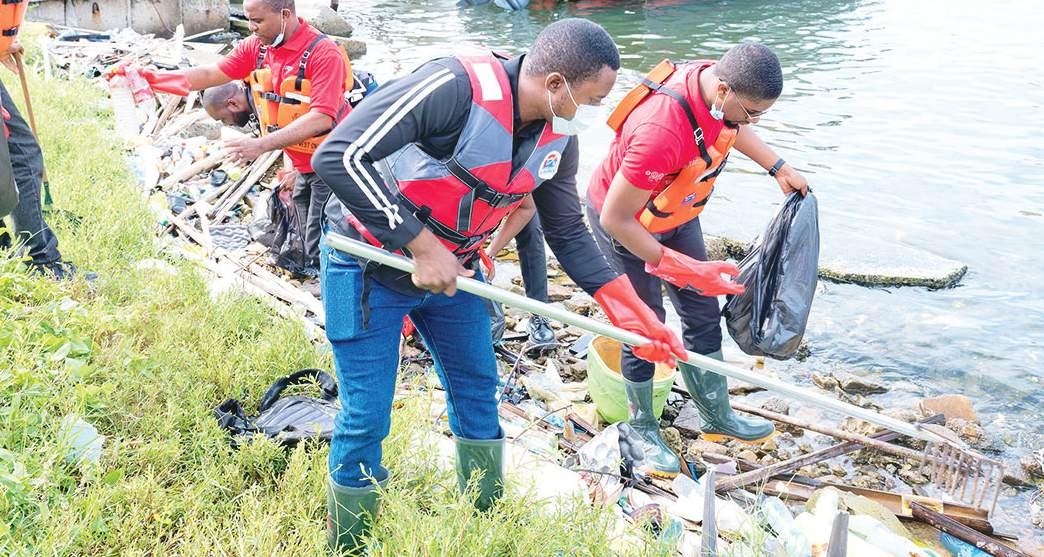
Employees of Zenith Bank left the comfort of their offices and embarked on a coordinated cleanup operation aimed at removing litter, promoting environmental awareness and encouraging responsible waste disposal among residents and businesses.
The scene was striking. Bankers who ordinarily spend their days analysing financial statements, serving customers and developing business solutions exchanged their desks for gloves and waste bags. Together, they swept streets, collected refuse and engaged members of the public on the importance of keeping their environment clean.
The exercise reinforced a fundamental principle that often gets lost in conversations about sustainability: environmental protection is everybody’s business. A day later, attention shifted from the streets to the waterways.
At Falomo, Ikoyi, one of Lagos’ strategic waterfront locations, Zenith Bank joined forces with LAWMA and LASWA in a large-scale clean-up operation focused on removing marine debris and promoting healthier waterways.
The collaboration reflected an important truth about climate action in the modern world. Environmental challenges cannot be solved by governments alone. Neither can they be addressed solely by private corporations. Sustainable solutions emerge when institutions work together.
The partnership between Zenith Bank, LAWMA and LASWA demonstrated precisely that approach.
Participants removed floating waste, highlighted the dangers posed by marine pollution and drew attention to the critical role waterways play in the economic and environmental life of Lagos.
As Africa’s largest city and one of the world’s fastest-growing urban centres, Lagos faces unique environmental pressures. Rapid population growth, increasing urbanisation and rising consumption have intensified waste management challenges across the metropolis.
Blocked drainage systems contribute to flooding. Plastic pollution threatens aquatic ecosystems. Poor waste disposal practices undermine public health and environmental quality.
These realities make initiatives such as Zenith Bank’s World Environment Day activities more significant than symbolic exercises.
They represent practical interventions aimed at changing behaviour, raising awareness and encouraging collective responsibility.
Speaking on the initiative, the Group Managing Director and Chief Executive Officer of Zenith Bank Plc, Dame Dr. Adaora Umeoji, emphasised the institution’s commitment to environmental stewardship.
According to her, sustainability is deeply embedded in the Bank’s operations and strategic vision.
“At Zenith Bank, sustainability is integral to how we operate. Clearing our streets and our waterways is a practical reminder that protecting the environment is a shared responsibility—and one we are proud to take up alongside LAWMA and LASWA. Through these exercises, we are taking deliberate action to preserve our communities, support climate action and inspire others to act,” she said.
Her remarks reflect a broader shift taking place across the global financial industry.
Increasingly, leading financial institutions are
recognising that long-term business success is inseparable from environmental sustainability. Investors, customers and regulators are demanding greater accountability on environmental, social and governance (ESG) issues.
Yet what often distinguishes genuine commitment from mere rhetoric is action.
In Zenith Bank’s case, environmental responsibility extends beyond policy statements and annual reports.
The bank has consistently integrated ESG principles into its operations, investing in energy efficiency, supporting green initiatives and promoting responsible business practices across its Nigerian, African, United Kingdom and European operations.
This approach aligns closely with several United Nations Sustainable Development Goals, particularly Goal 7 on Affordable and Clean Energy, Goal 11 on Sustainable Cities and Communities, and Goal 13 on Climate Action.
These goals have become increasingly important as the world confronts the growing realities of climate change. The evidence is difficult to ignore.
Across continents, communities are experiencing rising temperatures, extreme weather events, prolonged droughts, severe flooding and environmental degradation.
Scientists have repeatedly warned that the window for meaningful climate action is narrowing.
World Environment Day 2026 was therefore designed to serve as more than a ceremonial observance.
The global campaign seeks to focus attention on the urgent signals being sent by the planet and the actions required to safeguard future generations.
The campaign’s central message is that climate change is a present reality. Yet there is also reason for optimism. Around the world, positive changes are emerging.
Renewable energy is expanding. Cities are adopting cleaner transportation systems. Forest restoration projects are gaining momentum. Businesses are incorporating sustainability into their strategies. These developments suggest that while environmental challenges are immense, solutions are within reach.
The key lies in collective action.
That is why initiatives such as Zenith Bank’s clean-up exercises matter.
Their value extends beyond the quantity of waste collected on a particular day. They help shape attitudes. They demonstrate leadership. They create visibility around environmental issues. Most importantly, they encourage citizens to recognise their own role in protecting the environment.
For residents who observed the activities in Victoria Island and Ikoyi, the exercises provided a reminder that environmental responsibility is not reserved for environmental experts alone. Every discarded plastic bottle, improperly disposed food pack or littered nylon bag contributes to a larger environmental problem. Conversely, every responsible action contributes to a cleaner and healthier future.
Environmental advocates often speak about the importance of behavioural change. While policies and regulations are essential, lasting progress depends on individual and collective habits. When respected institutions take visible action, they help influence those habits. That influence can be powerful.
A commuter who witnesses a corporate clean-up
may think twice before littering. A business owner may adopt better waste disposal practices. A student may develop greater awareness of environmental issues. These small shifts can create meaningful long-term impact.
In many respects, this is where Zenith Bank’s initiative demonstrates its greatest strength. Rather than limiting its environmental commitment to internal operations, the bank is helping to foster a culture of environmental consciousness within the broader community. Such efforts are particularly important in developing economies where rapid urban growth often places significant pressure on infrastructure and natural resources.
Nigeria is no exception. As cities expand and populations increase, the challenge of balancing economic development with environmental sustainability becomes increasingly complex. Addressing that challenge requires innovation, investment and partnership. It also requires leadership.
Corporate institutions possess resources, visibility and influence that can help accelerate environmental progress. When these institutions choose to lead, they can inspire broader societal participation.
Zenith Bank’s World Environment Day activities illustrate how corporate leadership can be translated into practical community engagement. The initiative also highlights a growing understanding that sustainability is not a destination but a continuous journey. Protecting the environment requires ongoing commitment, adaptation and collaboration.
No single clean-up exercise can solve the challenges posed by climate change or environmental degradation. However, every meaningful action contributes to a larger movement.
For Mr. Adebayo, the boat operator who has spent decades navigating Lagos waterways, that movement is already making a difference. As he watched participants remove waste from the water, he felt encouraged.
“It gives people hope,” he said. “When organisations like Zenith Bank come out and show they care about the environment, it sends a message that everybody should care too. The water belongs to all of us.” His observation captures an important reality. The environment is a shared inheritance. Its protection cannot be outsourced. Governments have responsibilities. Businesses have responsibilities. Citizens have responsibilities.
The future depends on how effectively these responsibilities are embraced.
In commemorating World Environment Day 2026, Zenith Bank chose to move beyond words and demonstrate what responsible corporate citizenship can look like in practice. By cleaning streets, restoring waterways, partnering with public institutions and promoting environmental awareness, the bank transformed a global environmental theme into local action.
In doing so, it reinforced a powerful lesson. The fight against climate change is not fought only in international negotiations, scientific laboratories or policy forums. It is also fought on city streets, along waterways and within communities where individuals decide to take responsibility for the world around them. And sometimes, it begins with something as simple as picking up a broom.
Bank partnered with LAWMA/LASWA cleaning streets June 3rd and waterways June 4th
GLOBAL SOCCER GLOBAL SOCCER
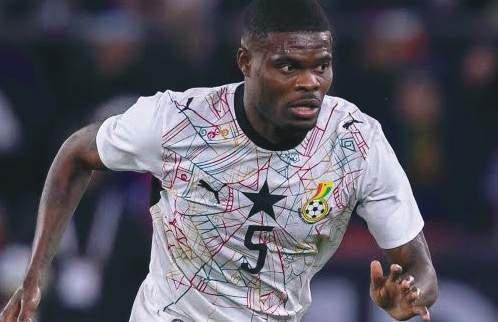
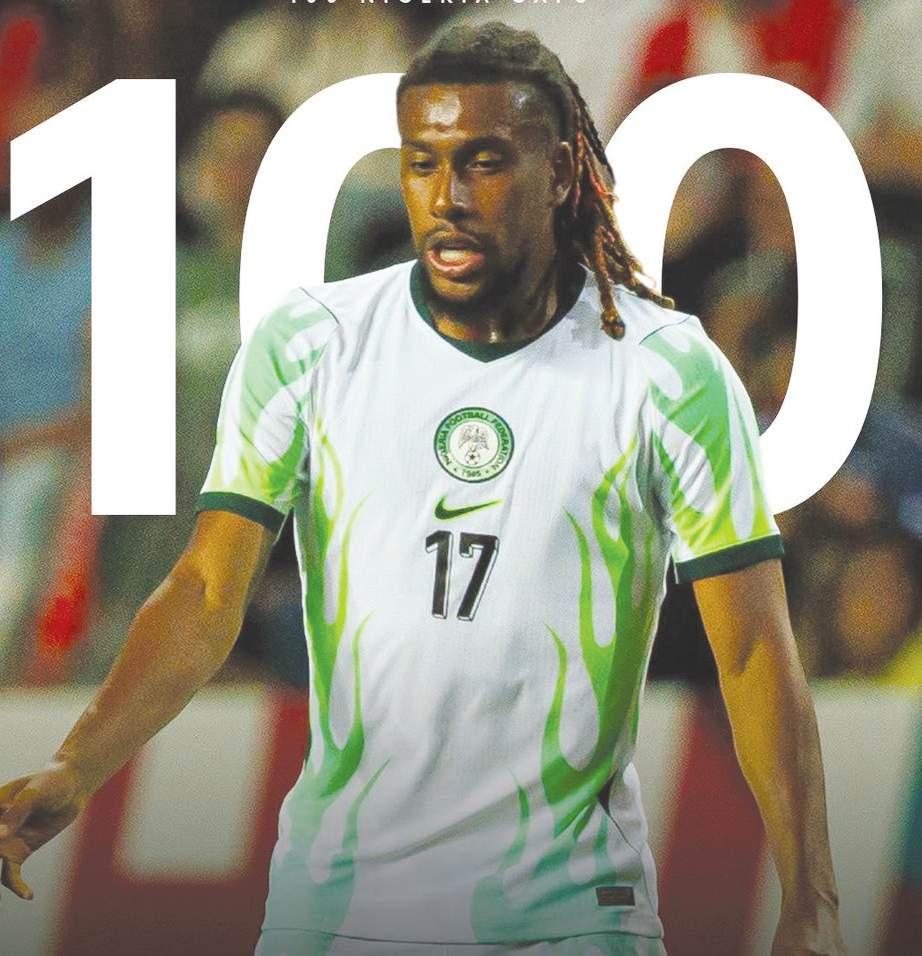
Alex Iwob I 100th Cap Milestone
WhenAlex Iwobi debuted for Nigeria in a friendly encounter against DR Congo in Visé,BelgiuminOctober2015,littledidheknowitwasthebeginningofwhatwould later become a monumental career in the Super Eagles colours.OnWednesday,in Leiria,Portugal,the Hale EndAcademy product earned his 100th cap for Nigeria in aninternationalfriendlyagainstPortugal,therebybecomingjustthefourthNigerianto achievesuchfeatafterJosephYobo,VincentEnyeamaandAhmedMusa.Thisreport takesaretrospectiveglanceat howitallbegan
Alex Iwobi on Wednesday in Lieira joined Jospeh Yobo, Vincent Enyeama and Ahmed Musa as one of only four Nigerians to have played a hundred games for the national team when he played the full 90 minutes in an international friendly encounter against Portugal.
He received a commemorative plaque bearing the number 100, to mark the milestone, from the Chairman of the National Sports Commission, Shehu Dikko, who was in Portugal to make the presentation before kick-off.
The former Arsenal man who only switched allegiance to Nigeria after he had initially represented England at different age-grade levels, however says he has no regrets on his decision to don the green-and-white in his senior international career, despite missing out on the 2026 FIFA World Cup and never winning the Africa Cup of Nations.
“I am proud to be where I am today; proud to wear the green-and-white,” Iwobi said in remarks shared by the Nigeria Football Federation. “I have no regrets choosing Nigeria.
“Yes, I would have loved to win the AFCON and perhaps be with the Eagles at the FIFA World Cup that is about to kick off in a few days’ time, but no regrets.” (It kicked off on Thursday).
The 30-year-old added that the decision was made after spending time at both England and Nigeria youth camps and in consultation with his family, including his famous uncle and Nigeria legend, Austin ‘Jay Jay’ Okocha, but made it clear the final decision was his to make.
Iwobi said of Okocha: “He always said go and do what’s right, go and enjoy your football. Of course he’s a Nigerian legend and the advice I got from my parents and from him was that before you take a decision on where you want to play, give Nigeria a try and see how you feel.
“So I actually went to the under 23s and experienced it for myself and I felt a lot like I’m at home. No disrespect to England because I had a good time there but Nigeria is where my heart is. So yeah, he did influence me a bit, but at the end of the day, it was ultimately my decision.”
Iwobi made his debut for Nigeria in a friendly against DR Congo in Visé, Belgium in October of 2015. He has gone on to appear at four Africa Cup of Nations tournaments, winning silver in 2023 and bronze in 2019 and 2025, and played at the 2018 FIFA World Cup in Russia.
He would have reached the hundredth milestone against Poland in Warsaw on June 3, but was serving a suspension after receiving a red card in Nigeria’s 2-2 friendly draw against Jordan in March in Antalya, Turkey.
He was sent off for retaliation after a foul by Jordanian defender Amer Jamous for only his second dismissal in a Nigeria shirt.
Iwobi subsequently apologised on his Alexander Yaa Digg podcast: “I need to address what I did and apologise to all my Nigerian teammates, staff, and everyone who cares about Nigeria.
“My actions were not good enough, and I got sent off. I want to apologise for the mistake.”
Nigeria drew 2-2 with Poland in Warsaw in Iwobi’s absence before travelling to Portugal.
Reflecting on his journey so far, Iwobi described his most memorable moment in green-and-white as the goal he scored against Zambia at the Godswill Akpabio Stadium in Uyo in October 2017, which sent Nigeria to the 2018 World Cup in Russia.
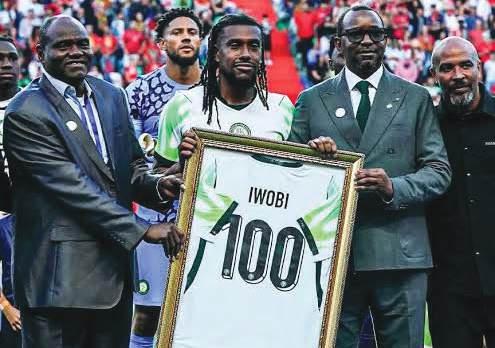

He said: “It’s not because of the stakes, although it sent us to the World Cup, but simply because my parents were in the stadium. Being able to celebrate with my mum and my dad was an amazing feeling. That’s who I do it for.
“I loved the occasion because my dad and my mum were both at the stadium and saw it all, and we celebrated together afterwards.”
The 30-year-old said the milestone had prompted reflection on a career defined by loyalty to the green-and-white.
“After 10 years and eight months, I won’t say I am a legend; I only see myself as a Super
Eagles player. It feels great to be looking at a 100th cap, and on a lighter note, I wish I can add another 100 caps. I have enjoyed my time with the Super Eagles.”
“It’s been an honour to represent. But seriously I am just happy to make a hundred appearances for my country.
“In a nation like Nigeria, it’s a big achievement because we have so many talented players. I appreciate the players I’ve played with, the coaches that have called me up, the staff. I am proud to be where I am today.”
In his reaction, his father Chuka Iwobi, himself
an ex-footballer, told the NFF that the family is incredibly proud of Alex’s achievements in Nigerian colours.
Chuka said: “We remain ever grateful to the nation for the opportunity Alex has been given. When he made his debut in 2015, little did we know that this was the beginning of an amazing and incredible journey which would lead to him achieving the milestone of a hundred caps and with the potential of many more caps to come.
“Alex loves playing for the nation and always gives his best. No one can ever question his commitment, devotion and patriotism while wearing the green-and-white.
“There have been highs and lows over the years but he has emerged stronger from the experience of playing for the country. We pray that he continues to excel and that the Super Eagles are able to repay the fans for their love and support.”
Iwobi, who represented England at youth level before committing to Nigeria, said his father played a central role in that decision without pressuring him.
“I first went to the Nigeria U23 team camp and felt at home. My father always told me to go out there and enjoy my football and make the decision that I felt was good for me. He was part of the decision but he didn’t force it down on me. I have no regrets choosing Nigeria.”
How far Iwobi can carry on remains to be seen, but from his passion, commitment and enthusiasm for the senior national team, its just a matter of time before he erase Musa’s 111 appearances record of the most capped Super Eagles player.
Iwobi receives a shirt congratulating him for his 100th match for the National Team before the start of the match against portugal
Photo: Gualter Fatia
Alex Iwobi outpaces portuguese bruno Fernandes

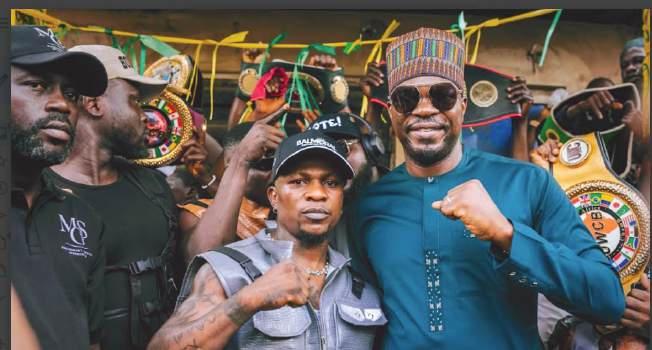
No Partey for Party as Ghanaian Denied Entry to Canada for Ghana’s World Cup Opener
Black Stars of Ghana and Villarreal FC midfielder, Thomas Partey has been denied entry into Canada ahead of the team’s opening match of the FIFA World Cup.
According to The Athletic, the Canadian government refused a visa to the former Arsenal FC midfielder due to his ongoing sexual assault charges in the UK.
Canada maintains strict immigration laws that restrict foreign nationals with pending indictments for serious crimi-
2026 w O r LD C up
nal offences from entering the country.
The Black Stars are still at their training camp in Boston, in the US, and will soon travel to Canada for their first World Cup game against Panama.
Partey can legally train with his teammates on US soil, but he will be barred from crossing the border into Canada for the match at the BMO Field in Toronto on June 18.
Partey left the UK in 2025 for
Villarreal FC in Spain after allegations surfaced that he sexually assaulted a few women during his spell in London.
The Ghanaian currently stands accused of seven counts of rape and one count of sexual assault involving four women.
The midfielder has maintained his innocence, entering a “not guilty” plea to all charges. The eight-week trial, originally scheduled to take place at Southwark Crown Court, was recently pushed back to June 2027 by a UK high court judge.
Canada Claim First world Cup point After Draw with Bosnia
Canada claimed their first ever World Cup point as the co-hosts came from behind to rescue a 1-1 draw against Bosnia-Herzegovina.
For long periods, Canada thought it wasn’t their day. After Bosnia led through Jovo Lukic’s close-range header from a corner, some wasteful finishing and equally stunning
Bosnia-Herzegovina defending frustrated the co-hosts.
Jonathan David and Tani Oluwaseyi missed golden first-half chances to score.
In the second half, former Arsenal defender Sead Kolasinac and Nikola Katic both cleared off the line as the pressure from Jesse Marsch’s side grew.
But Southampton striker Cyle Larin’s finish from inside the box - his first touch after coming onto the pitch 121 seconds earlier - sent Toronto into delirium and rescued a point for the co-hosts.
“It was the first time Canada had avoided defeat in the World Cup finals, after they had been beaten in all three games in 1986 and then again in 2022.
Oliseh Attributes pressure for South Africa world Cup Opener Loss to Mexico
Former Super Eagles
Captain, Sunday Oliseh has attributed SouthAfrica’s disappointing start to the 2026 FIFA World Cup to inability to cope with pressure mounted by the over 80,000 Mexican fans Oliseh is convinced that South Africa’s collapse on the colourful opening day of the global showpiece had more to do with pressure than football ability.
Bafana Bafana were beaten 2-0 by co-hosts Mexico in the opening match of the tournament at the famous EstadioAzteca in Mexico City. The Group A clash attracted a crowd of 80,824 fans and quickly turned into one of the most dramatic opening games in World Cup history. Despite the scoreline and the disciplinary chaos, Oliseh insisted South Africa are far better than they showed on the night.
The 26th edition of the MILO Basketball Championship continued with the successful conclusion of the Central Conference regional finals, where Government Secondary School, Gboko, Benue State, and FatherO’ConnellScienceCollege, NigerState,emergedchampions in the girls’ and boys’ categories respectively.
Speaking in a podcast clip after the match, the former Nigeria midfielder argued that the occasion itself overwhelmed Hugo Broos’ men.
“Finally, the World Cup is here,” Oliseh said. “80,000 fans at the Azteca, a beautiful opening ceremony and we all expected a romantic replay of the 2010 in South Africa. But we actually just witnessed was absolute psychological warfare.
“Mexico won 2-0 but this wasn’t about tactics. It was about pure pressure. South Africa didn’t lose because they are a poor side. Believe me. They lost because the stage seems to be simply too big for them.
“I was thinking the host nation pressure would break Mexico. Instead, that massive crowd took the pressure away from them and seems to dump it all on Bafana Bafana, forcing
sports, using basketball as a platformtoinspirediscipline,teamwork, resilience and confidence amongyoungpeople.Throughthe championship, MILO continues tocreateopportunitiesforstudents across Nigeria to discover their potential, build character and pursue excellence both on and off the court.
them into two red cards and a total meltdown.
“Expect to see this trend a lot during this tournament. The big stages change everything in football. Let’s see if the other host nations (United States and Canada) can handle this same pressure tomorrow and the day after.”
South Africa’s two red cards also placed them on the wrong side of World Cup history. Bafana Bafana became only the second team ever to have two players sent off in a tournament opener, matching a record set by Cameroon at the 1990 World Cup against Argentina.
WOrlD CuP
results
South Korea 2-1 Czechia
Canada 1-1 Herzegovina
Today’s Fixtures
USA 0-0 Paraguay
Qatar 0-0 Switzerland
Brazil 0-0 Morocco
Ezekiel Adamu Dubs Esepo True Talent as 19-0 Fighter Signs Deal with Balmoral
Balmoral chief executive, Ezekiel Adamu has described Taiwo ‘Esepo’ Agbaje as the embodiment of everything the promotion is trying to build after the undefeated Nigerian lightweight champion signed a promotional deal with Balmoral Promotionsthe Lagos-based outfit behind the Chaos in The Ring franchise, in what the 19-0 fighter described as the most significant moment of his professional career.
Agbaje, who holds the WBAAfrica lightweight title after his unanimous decision victory over Tosin “Sojar Boy” Osaigbovo in April, put pen to paper on Wednesday,
June 10, with Balmoral, one of Nigeria’s most ambitious boxing promotions.
The Mushin-born fighter, whose nickname was earned on the streets of Lagos long before professional boxing came calling, said the deal represented the platform he had been searching for throughout his career.
“I feel so good, I can’t lie. I feel good because this is the type of deal I have been looking for in my life and I believe that Balmoral Promotions is the best promotion in Nigeria. This is the line that I know if I climb, I will become a world champion because this is the space where there
are many opportunities for me,” Agbaje said.
“I have been all over the world but Balmoral is set to make me a king in Nigeria so I can dictate my terms now and get what I am worth out there. This is a great deal for me.”
For Balmoral chief executive, Ezekiel Adamu, the signing is the culmination of a process that began well before Wednesday’s announcement. He described Agbaje as the embodiment of everything the promotion is trying to build — a fighter with genuine talent, deep roots in the community and the kind of authentic connection with ordinary Nigerians that transcends the sport itself.
winners emerge at rexona Consumer promotion, Get Tickets to FIFA world Cup Matches
Unilever Nigeria Plc. has officially announced the winners of the Rexona FIFA World Cup 2026 Consumer promotion, giving loyal consumers of its leading deodorant brand, Rexona, the chance to experience the excitement of the FIFA World Cup 2026 live in Vancouver, Canada.
The ticket presentation ceremony, held at Prince Ebeano Supermarket, Ikeja, marked the successful conclusion of the consumer promotion designed to reward loyal
customers who purchased Rexona products. Under the campaign structure, consumers who purchased three Rexona aerosol products were eligible for the grand prize, while all participating shoppers also received guaranteed rewards.
Winners emerged from the promotional draw after meeting the purchase criteria, with their prize packages fully sponsored by Rexona. The rewards included return flight tickets, accommodation, match tickets and other travel
arrangements, offering them a memorable FIFA World Cup 2026 experience.
Speaking at the event, Head of Corporate Affairs, Communications and Sustainability, Unilever Nigeria Plc, Zainab Obagun, stated that the FIFA World Cup 2026 Consumer promotion sponsored by Rexona reflects Unilever’s commitment to building stronger connections with consumers through initiatives that reward loyalty and create memorable experiences.
World Cup 2026 Opening Week Sets Tournament Tone on SuperSport competition. For viewers in Nigeria, live coverage will be available on SuperSport via DStv and GOtv throughout the tournament.
The FIFA World Cup 2026 began with a packed opening round of fixtures that immediately set the tone for the expanded 48-team tournament, co-hosted by the United States, Mexico and Canada.
With 104 matches scheduled over 39 days, the group stage opens with a steady flow of headline encounters, early statement games and key continental clashes that will shape the direction of the
The action began yesterday, with Korea Republic vs Czech Republic at 3:00 am, followed by Belgium vs Egypt at 8:00 pm in an early European-African encounter that sets the tone for the opening week.
Today, the schedule continues with United States of
America vs Paraguay at 2:00 am and Qatar vs Switzerland at 8:00 pm. The standout fixture follows at 11:00 pm as Brazil face Morocco, bringing together South American pedigree and African momentum after Morocco’s recent rise.
Sunday, 14 June features Germany vs Curacao at 6:00 pm and Netherlands vs Japan at 9:00 pm, both expected to test early tournament rhythm and structure.
47th CBN Senior Tennis Championship Serves Off in Abuja
Olawale Ajimotokan
The 47th edition of the Central Bank of Nigeria (CBN) sponsored Senior Tennis Championship yesterday began at the Tennis Complex, Package B, Moshood Abiola National Stadium, Abuja.
The championship will culminate in a grand finale on June 20, at the same venue.
wheelchair events for both men and women, showcasing some of the nation’s finest tennis talents.
For 26 years, MILO has remained committed to youth development through school
GSS Gboko, Father O’Connell win 26th MILO Central Conference Titles growthandrelevanceoftheplatform. At the Central Conference regional finals, seven schools competed for a placeattheNationalFinals.GovernmentSecondarySchool,Gboko,won thegirls’categorywitha63–31victory overNigeriaDefenceAcademyStaff Secondary School, Kaduna State, while Father O’Connell Science College, Niger State, won the boys’ category after a hard-fought 56–53 win over Government Secondary School, Gwarinpa Life Camp, Abuja.
This year, over 13,000 schools appliedtoparticipateintheMILO BasketballChampionshipnationwide, reflecting the continued
The tournament will feature exciting contests in the men’s and women’s singles and doubles categories, alongside
For nearly five decades, the championship has remained a vital platform for talent discovery and development, producing players who have gone on to represent Nigeria with distinction at prestigious international competitions, including the Davis Cup and the All-Africa Games.
Widely regarded as one of Nigeria’s most prestigious
tennis tournaments, the CBN Senior Tennis Championship has nurtured and showcased outstanding athletes such as Sunday Maku, David Imonite, Veronica Oyibokia-Iwebema, Christy Agugbom, Sarah Adegoke, Sylvester Emmanuel, Joseph Imeh, Oyinlomo Quadri, and Marylove Edwards.
The championship continues to underscore the CBN’s commitment to youth development, sports excellence, and the promotion of tennis across Nigeria.
Canadian players celebrating their equalizer against Bosnia-Herzegovina to claim their first world Cup point yesterday
Taiwo ‘esepo’ Agbaje (l) and Balmoral chief executive, ezekiel Adamu during the signing of the promotional deal with Balmoral promotions
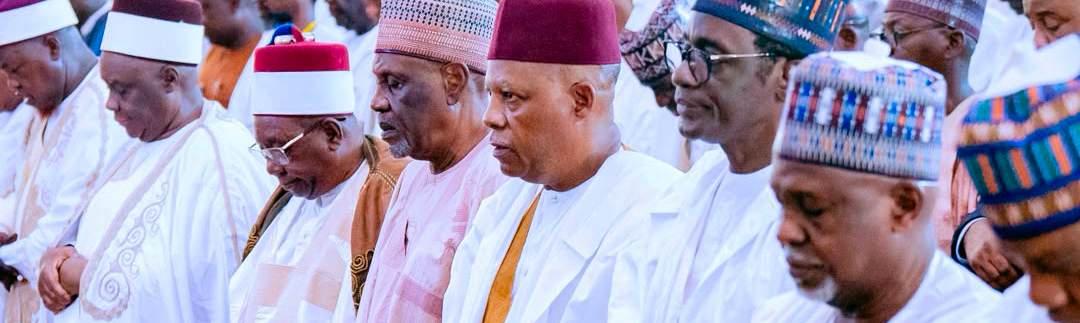
FUNERAL PRAYER FOR LATE EMIR OF GAZARGAMU...
OKEY IKECHUKWU
As Gov Eno Sidesteps Buhari’s Bad Example
Afew weeks ago, the government of Akwa Ibom State announced a comprehensive education reform programme. It is designed and tagged, an Artificial Intelligence (AI)powered basic education reform programme. Part of the objective is to recreate and deepen foundational literacy and numeracy in public primary schools. This sweeping ₦5.9 billion initiative is structured surefootedly in partnership with the global education
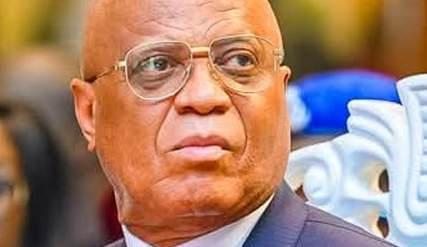
Gov Eno
organization EIDU to introduce data-driven
teaching models.
As for the core Components of the Reform, we are looking at AI Teaching Guides, in the form of AI-enabled tools for the delivery of structured daily lesson plans to teachers. Personalized learning is also on the cards, wherein pupils receive interactive activities tailored to their specific progress. This is in addition to Real-Time Analytics, by means of which educators and managers use digital platforms to track performance and identify learning gaps.
OBINNA CHIMA
The other very significant component in this remarkable package is an elaborate infrastructure overhaul template that incorporates comprehensive renovations across primary and junior secondary schools. And it on top of all these that the state education reform initiative has put a teacher recruitment drive, to ensure that additional qualified teachers are brought in to support the updated curriculum.
Securing Schools Against Terrorist Attacks
Every school day in Nigeria begins with hope. A mother wakes before dawn to prepare her child. A father sacrifices part of his income to pay school fees because he believes education offers a pathway out of poverty.
Children leave their homes carrying school bags, notebooks and dreams of a better future. Yet, in some parts of Nigeria today, that simple journey to school has
become a frightening gamble.
This has been the case in recent times. For instance, Iluke Bunu community in Kogi State this week was greeted with tension and grief by gunmen who killed the Vice Principal of Government Secondary School, Iluke, and a six-year-old child.
All these attacks are coming when, for close to a month now, more than 80 children who were abducted in separate attacks on schools in Borno and Oyo states are yet to
return home. What was once considered a regional problem has now become a national challenge.
What started with the attack on Government Girls Secondary School in Chibok, Borno State, in April 2014, where Boko Haram abducted 276 schoolgirls, appears to be spreading. Some other notable cases include that of February 2018, when 110 schoolgirls were abducted from the Government Girls Technical College in Dapchi, Yobe State;
December 2020, when hundreds of students were abducted from a secondary school in Kankara, Katsina State; 2021, when students were kidnapped from the Federal College of Forestry Mechanisation in Afaka, Kaduna State, while other attacks occurred in Kagara, Jangebe and Tegina. The nightmare continued in March 2024 when armed men stormed schools in Kuriga, Kaduna State,
Tribute to Chief Olufemi Majekodunmi
My plea to the entire Majekodunmi family is that the gravity of our mourning should be mitigated and the depth of our collective sense of irreparable loss should also be assuaged by a peep into history.
Some years ago, when I was researching the history of the Egbas, of which the Majekodunmi family
is a formidable pillar, I came across the following:
“Based on Egba oral history and the book: “The Egba and Their Neighbours 1842-1872”, the Majekodunmi family of Abeokuta descends from Ogundele, a son of Ogundipe. After a tragedy involving the death of a child, Ogundele took the name “Majekodunmi”- Ma je ki odun mi (“Let my year not be spoiled/ let sorrow not ruin my year.)
That is why you’ll see both “Ogundele” and
“Majekodunmi” in 19th century Egba records referring to the same lineage. Ogundele, son of Ogundipe, later called Majekodunmi after the death of his child, is an ancestor of the Majekodunmi house. ‘Majekodunmi’ is the oruko amutorunwa/ oruko isele- a name taken after an event, not the birth name.”
The whole of Abeokuta trooped to the house of the bereaved father. To their astonishment, the father bore his grief with calm dignity and promptly resumed his business with fierce determination. He
The event to which reference is being made involved either Femi’s grandfather (J.B Majekodunmi) or his grandfather, who had hired someone to teach his favourite son how to ride a horse. Unfortunately, the child fell off the horse and died.
L-R: Shehu of Borno, HRH Alhaji Abubakar Ibn Umar; Garbai El-Kanemi, Amb. Babagana Kingibe; Vice-President Kashim Shettima; Governor, Yobe State, Mai Mala Bunu, and Former Minister of FCT, Ibrahim Bunu, at Funeral Prayer of Late Emir of Gazargamu, His Royal Highness Alhaji Ahmad Tijjani Ibn Saleh Geidam at the Damaturu Central Mosque, Damaturu, Yobe State….yesterday