Tasks government on policies for more competitive business environment
Dike Onwuamaeze
Centre for the Promotion of Private Enterprise (CPPE) declared
that the Nigerian economy entered the second half of 2026 with its strongest macroeconomic fundamentals in many years and
much strengthened investors' confidence than at the beginning of the year. CPPE, however, warned that
election-related spending could inject additional liquidity into the economy, with possible implications for inflationary
pressures, foreign exchange demand, and macroeconomic management.
The views were expressed
yesterday by Chief Executive Officer of CPPE, Dr. Muda
Continued on page 5
Congressman: US Will Closely Watch Nigeria's 2027 General Election
Reiterates concerns over religious freedom, protection of vulnerable communities
The United States has said it will closely monitor Nigeria's
2027 general election, with a member of the US Congress, Riley Moore, stating that the administration of President
Donald Trump will pay close attention to how the polls are conducted. Moore, a Republican
representing West Virginia Second District, said the conduct and outcome of the elections would be under
Umahi: Tinubu Using Road Projects to Fight Insecurity
Obi says off-budget spending collapse of accountability NDC presidential candidate insists funds could transform education, other sectors Alliance argues practice undermines fiscal credibility FG declares road rehabilitation will improve military operations, boost regional trade Dangote: My company undertaking over N3tn roads construction nationwide
Emmanuel Addeh, Chuks Okocha, James Emejo and Sunday Aborisade in Abuja
The Minister of Works, David Umahi, at the weekend defended the federal government's investment in road infrastructure, saying President Bola Tinubu is using strategic highway projects to tackle insecurity and improve military operations.
Also, the presidential candidate of Nigeria Democratic Congress (NDC), Peter Obi, yesterday, renewed his call for President Bola Tinubu’s resignation over alleged N8.83 trillion expenditure in the 2025 fiscal year, which is
Emmanuel Addeh in Abuja
Afreximbank President Hails AMCE's First-year Milestones, Pledges Fresh Investment, Expansion
Declares centre can end Africa's medical tourism, restore confidence in healthcare Brian Deaver: hospital has made progress, accomplished set targets
President of African ExportImport Bank (Afreximbank), Dr. George Elombi, has applauded the remarkable milestones recorded by African Medical Centre of Excellence (AMCE), Abuja, within one year of operation, describing the facility as proof that Africa can build and sustain world-class healthcare
not reflected in the approved federal budget.
However, THISDAY learnt that the alleged spending outside budgetary provision flagged by the International Monetary Fund (IMF) may have been linked to the ‘Abacha Loot’ and other such recovered funds, which the partnering foreign nations insist must be tied to specific projects, such as Second Niger Bridge, Lagos Ibadan Expressway and Abuja Kadun highway among others.
Specifically, Umahi said the rehabilitation of the Bama-Banki and Dikwa-Gamboru-Ngala roads in Borno State, among several others scattered nationwide, formed part of Tinubu's overall
while reducing dependence on medical treatment abroad.
Elombi spoke during a working visit to the specialist medical facility at the weekend.
He pledged additional investment by Afreximbank to expand the centre and disclosed plans to replicate the model across other African regions, including Tanzania and
strategy to tackle insecurity through critical infrastructure development.
Speaking at the official flag-off of the projects at Muna City Gate along the Maiduguri-DikwaGamboru Road, Umahi said the roads would not only reconnect communities and stimulate economic activities but also enhance military operations in the North-east. He noted that Tinubu had demonstrated the political will to revive long-abandoned strategic road projects that previous administrations were unable to complete, a statement by Francis Nwaze, the Senior Special Assistant to the minister on media, said.
Cameroon.
AMCE, developed by Afreximbank in partnership with King's College Hospital, London, was established to strengthen specialist healthcare delivery, medical research, and training while advancing Africa's healthcare sovereignty.
Speaking after touring the hospital's key clinical
According to him, the KanoMaiduguri highway, parts of which were awarded as far back as 2006, as well as the Bama-Banki and Dikwa-Gamboru-Ngala roads awarded in 2021, are now being actualised under the current administration.
The minister stressed that the projects were designed to support the government's security objectives by improving access to border communities and strengthening logistics for security agencies.
"These road infrastructure projects are part of the larger programme of President Tinubu in fighting insecurity. When these projects are completed, our people in the North-east
CONGRESSMAN: US WILL CLOSELY WATCH NIGERIA'S
with Nigeria.
Speaking during an interview with NoireTV, a cable and streaming network dedicated to programming tailored to the African diaspora, Moore said the United States would closely observe how the electoral process unfolds.
"We're certainly going to be watching these results and how these elections unfold and how they're executed.
That's something that myself and the administration are going to be paying very close attention to," he said.
The congressman also disclosed that the US
Yusuf, in a press statement, titled, "Nigeria's Economy in 2026: Half Year Review and SecondHalf Outlook: Macroeconomic Recovery, Structural Reforms and the Competitiveness Imperative."
Yusuf said exchange-rate stability, moderating inflation relative to the exceptionally elevated levels of 2025, stronger external reserves, improved oil production, and resilient financial markets had reduced macroeconomic vulnerabilities and strengthened investor confidence.
He stated, "Nigeria enters the second half of 2026 with its strongest macroeconomic fundamentals in several years.
"This represents an important policy achievement and provides a stronger platform for investment and economic recovery.
"With respect to the outlook for the second half of 2026, the CPPE remains cautiously optimistic.
"Economic output performance
House of Representatives is considering an appropriations bill containing provisions relating to Nigeria, particularly on religious freedom and US security assistance.
According to him, the legislation contains what he described as strong provisions addressing the persecution of Christians in Nigeria and conditions that could affect future American security assistance to the country.
"We're working on Chris Smith's bill, which I'm a co-sponsor of. But more importantly, people need to pay attention to the appropriations bill before
is expected to remain positive, supported by financial services, telecommunications, construction, trade, oil refining and other service-sector activities.
"Although growth is likely to remain below Nigeria's long-term potential, the economy appears firmly on a gradual recovery path."
Yusuf said inflation was expected to remain substantially below 2025 levels in the H2 2026, although food supply disruptions, energy costs, and developments in global commodity markets remained important upside risks.
"Exchange-rate stability should be sustained by stronger foreign exchange inflows, healthier reserves and improved market confidence," he said.
According to him, financial markets are expected to remain broadly resilient, supported by banking-sector recapitalisation, stronger corporate earnings, improved regulatory oversight and
departments, Elombi said the institution had surpassed expectations. He added that the investment was never conceived as a commercial venture but a continental response to Africa's healthcare challenges.
He told THISDAY, "What else would you expect after making such a massive investment? We assembled professionals of the
will benefit because they lead to Chad and Cameroon. But the greater interest is that our military forces will have roads to combat whatever might be left of the insurgency," he added.
Representing Tinubu at the event, Vice President Kashim Shettima described the projects as infrastructure of strategic national importance, saying poor roads also constitute a security challenge. According to him, roads that are difficult for citizens to use equally hamper the ability of security personnel to patrol and secure affected areas. Shettima commended Umahi and the Minister of State for Works, Bello Goronyo, for driving the implementation of the projects.
the House today. There's a lot of language that I put in that bill relating to Nigeria, the persecution of Christians, restrictions on security assistance to the government of Nigeria, and steps that they have to take.
"That bill is likely to become law. If passed, it will contain binding provisions that will shape our relationship with Nigeria going forward," Moore stated.
He added that he would continue discussions with the Trump administration on developments relating to Nigeria, revealing that he was scheduled to meet the
sustained institutional participation.
He added that improved domestic refining capacity and stronger crude oil production should also support fiscal revenues, foreign exchange earnings, and energy security.
Yusuf said macroeconomic stabilisation had not yet led to significant, broad-based improvements in productivity, competitiveness, employment, and household welfare.
According to him, businesses have continued to grapple with elevated production costs and structural bottlenecks.
He said the "defining policy challenge for the remainder of 2026 is to convert improved macroeconomic conditions into inclusive, investment-driven and productivity-enhancing growth".
Yusuf stated that the more fundamental challenge was ensuring that the gains were reflected in stronger business
highest standard who came here because they believe they can make a difference across Africa. This is much bigger than a hospital. It is a movement."
He said Afreximbank remained committed to financing the hospital's continued expansion, pointing to ongoing construction of additional clinical facilities and accommodation.
He noted that the strategic road corridors would improve access to neighbouring Cameroon and the Republic of Chad, creating new opportunities for trans-Saharan trade and expanding cross-border commerce.
He called on all stakeholders to work closely with the people of the North-east to ensure the successful execution of the projects, while assuring Nigerians that his administration would continue to invest in infrastructure that stimulates economic growth and national development.
In his remarks, Borno State Governor, Babagana Zulum, described the commencement of the projects as another milestone in the state's recovery from years
president to further discuss the issues.
"I continue to work with the administration on the next steps that we're going to take. I'm actually going to see President Trump tonight. I'll be having dinner with him and some other members, so I continue to talk to him about these issues, and it's very important to him," he said.
Moore is a co-sponsor of the Nigeria Religious Freedom and Accountability Act of 2026, introduced alongside fellow Congressman Chris Smith in February.
The proposed legislation
competitiveness, higher private investment, faster job creation, and improved living standards.
"The quality of economic management in the remainder of 2026 will therefore be judged less by the stability of macroeconomic indicators than by the extent to which structural reforms improve productivity and reduce the cost of doing business," Yusuf said.
CPPE chief executive warned that the increasing intensity of political and electioneering activities ahead of the 2027 elections would present an important downside risk in the remaining part of this year.
He stated, "Election-related spending could inject additional liquidity into the economy, with possible implications for inflationary pressures, foreign exchange demand and macroeconomic management.
"There is also a risk that
Elombi He said, "There is still a need for further investment and we will continue making those investments until this hospital reaches the level we believe it must attain."
of insurgency. He said the roads would reconnect communities, facilitate the movement of people and goods, improve access to markets and essential services, and further strengthen ongoing efforts to restore normalcy across the state.
President of the Dangote Group, Aliko Dangote, attributed the commencement of the projects to the collaboration between the federal government and the private sector.
According to him, the minister remains deeply involved in project execution and regularly engages contractors to ensure quality and timely completion.
would require the US Secretary of State to submit periodic reports to Congress on efforts to address religious persecution and mass atrocities in Nigeria. It also seeks regular assessments of Nigeria's compliance with international religious freedom obligations, the impact of US security assistance, humanitarian support, sanctions, and measures taken by the Nigerian government to protect vulnerable communities and prosecute perpetrators of attacks.
In April, the US House Appropriations Committee approved provisions in its
growing political activity could distract policymakers from economic governance, reform implementation and the execution of critical fiscal and structural policy initiatives."
Reviewing the first half of 2026 (H1 2026), Yusuf said the period reflected continued progress in macroeconomic stabilisation.
He said economic growth remained positive, the foreign exchange market had become more orderly, external reserves had improved, crude oil production strengthened modestly, and government revenues benefited from improved oil receipts and stronger non-oil tax collections during the period under review.
But despite the encouraging developments, Yusuf said the real economy remained under considerable pressure, characterised by high interest rates that constrained privatesector investment and access
annual State Department funding bill imposing tighter oversight on financial assistance to Nigeria. The bill proposes withholding 50 per cent of certain foreign assistance allocated to Nigeria until the US certifies that the Nigerian government is taking effective steps to curb religious violence, investigate attacks attributed to Fulani militia groups and facilitate the safe return of displaced persons.
However, the measure is still subject to consideration by the full US Congress before it can become law
to credit, while elevated energy costs, inadequate electricity supply, logistics inefficiencies, and weak transport infrastructure sustained a high-cost operating environment. He said in order to ensure competitiveness in the H2 2026, the next phase of reform should focus on lowering production costs, improving productivity, and strengthening the competitiveness of Nigerian enterprises.
Yusuf stated, "Priority should be given to improving electricity supply, transport infrastructure, logistics efficiency, and port operations; strengthening security in farming communities and along transport corridors; expanding access to affordable long-term finance for productive sectors; accelerating budget implementation, strengthening budget process credibility, and improving infrastructure delivery; and deepening domestic value addition.
LAUNCH OF LEBARA PLAY APP...
FG Moves to Settle Abia, Anambra Boundary Dispute as NBC Advances Intervention
The National Boundary Commission (NBC) has reaffirmed its commitment to the peaceful resolution of the Abia/Anambra interstate boundary dispute, disclosing that both states have recorded significant progress in efforts to complete the delineation of their common boundary.
Speaking at the Joint Meeting of Officials on the Abia/ Anambra Interstate Boundary held in Awka, the Director General of the Commission, Adamu Adaji, commended the governments of Abia
He disclosed that the Dangote Group is currently constructing about 12 road projects across Nigeria's six geopolitical zones, covering more than 1,000 kilometres at a combined investment exceeding N3 trillion.
Dangote added that the company remained committed to supporting the government's infrastructure agenda and was capable of taking on additional road projects.
"Altogether, these projects span over 1,000 kilometres, representing a combined investment of more than N3 trillion in high-quality concrete roads. I want to assure the government that we are a highly tax-paying company and we can take on more roads," Dangote added.
Also speaking, Chairman of the Senate Committee on Works, Senator Allwell Onyesoh, described the road as historic and commended Tinubu for prioritising its rehabilitation after years of neglect.
Similarly, Chairman of the House of Representatives
and Anambra States for their sustained cooperation and commitment to resolving the dispute through dialogue and established legal procedures.
A statement by the Head of Information, Press and Public Relations, Chinwe Udouwem, stressed that Adaji disclosed that about 15 kilometres of the 23-kilometre interstate boundary had already been jointly traced and provisionally demarcated, while discussions were focused on resolving the remaining eight-kilometre stretch.
Adaji said the meeting reviewed recommendations from the technical meeting of
Committee on Works, Hon. Akin Alabi, applauded the cordial working relationship between the Federal Ministry of Works and the National Assembly, saying it had contributed to smoother implementation of infrastructure projects.
In the meantime, Obi has alleged that the growing revelations of "grand corruption" under the current administration has made Tinubu's continued stay in office untenable.
Besides, Human Rights Writers Association of Nigeria (HURIWA) also expressed concern over the revelations that arose from the recent International Monetary Fund (IMF) Article IV Consultation, which indicated that public expenditure equivalent to about two per cent of Nigeria's Gross Domestic Product was not reflected in the country’s official budget documents.
In a similar vein, Alliance for Economic Research and Ethics (AERE), yesterday, criticised the federal government's reported N8.8 trillion expenditure outside the approved budget framework.
experts held on July 1, 2026 with the aim of identifying practical and mutually acceptable solutions to the outstanding issues.
"The Commission remains committed to providing the technical, administrative and institutional support required to bring this process to a successful conclusion. Our expectation is that this meeting will reinvigorate the boundary resolution process and promote lasting peace, good neighbourliness and sustainable development among the affected communities," he said.
Obi, a former governor of Anambra State, in a statement on X, said the development reinforced his earlier position that the Tinubu administration had failed in governance, accountability, and citizens’ welfare.
He wrote, "The grand corruption being revealed daily in this regime supports why the President should resign."
Obi said the alleged expenditure outside the budget, attributed to findings from IMF’s consultation report, represented a grave violation of public finance management principles and raised serious concerns about transparency in government.
He stated, "The recent report from the IMF consultation further raises concerns about the scale of grand corruption under the Tinubu government.
"The IMF now reveals that about N8.83 trillion in expenditure undertaken in 2025 is not reflected in the budget.
"This expenditure is not budgeted and is therefore outside legislative oversight or
Standing in for Abia State, the Deputy Governor and Chairman of the State Boundary Committee, Ikechukwu Emetu, who was represented by his Deputy Chief of Staff, Chijioke Nwankwo, welcomed the consensus reached on the already traced 15-kilometre section and called for its immediate monumentation.
He stressed that the outstanding eight-kilometre corridor should be resolved strictly in line with the NBC's procedures, historical and archival records, technical field evidence and relevant judicial pronouncements.
administrative scrutiny."
Obi described the figure as alarming, stating that it represents a significant proportion of Nigeria's economy and exceeded critical spending allocations.
He said, "This is horrible. N8.83 trillion is approximately two per cent of our GDP and over 35 per cent of Nigeria's 2025 N23.96 trillion capital project budget. In fact, the amount exceeds the actual capital funding released for 2025.
"It is more than the total combined budget for education (N3.52 trillion) and health (N2.38 trillion)."
The opposition leader stated that prudent deployment of such funds could have transformed key sectors of the economy and improved the lives of millions of Nigerians.
He stressed, "If such an amount were properly utilised and accounted for, it could transform Nigeria's health and education sectors.
"It could also foster the creation
According to him, stateproduced maps should not serve as the basis for determining interstate boundaries, describing Supreme Court judgments and other valid legal instruments as indispensable in achieving a credible and enduring settlement.
On its part, the Anambra state government reiterated its commitment to resolving the dispute through peaceful dialogue, constitutional processes and the rule of law.
The Deputy Governor of Anambra State and Chairman of the State Boundary Committee, Dr. Onyekachukwu Ibezim, represented by the Senior Special Assistant to the Governor on Boundary matters, Ekenechukwu Okoye,
said boundary disputes should be approached with sincerity, professionalism and mutual respect, noting that the welfare, peace and security of affected communities must remain paramount.
He expressed confidence that the technical expertise available at the meeting, coupled with the goodwill of both state governments and the guidance of the NBC would facilitate meaningful progress toward a fair and mutually acceptable resolution.
The meeting also received the report of the technical meeting of experts, which highlighted documents submitted by both states, reviewed areas of agreement and outlined recommendations to advance the resolution process.
Nyong Extols Late MISA Founder’s Legacy in Affordable Housing, Philanthropy
James Emejo in Abuja
Chief Executive, Lekki Gardens Estate, Dr. Richard Nyong, has described the late founder of MISA Nigeria Limited, Mr. Muritala Adegboyega Ibrahim, as a real estate entrepreneur whose contributions to housing development and philanthropy will endure beyond his lifetime.
Nyong made the remarks while reflecting on Ibrahim's legacy following the recent commissioning of a 36-unit residential development donated by the deceased to the National Orthopaedic Hospital, Igbobi, Lagos, to provide accommodation for doctors and other healthcare professionals.
The project, completed shortly before Ibrahim's death
in March 2026 after a prolonged illness, was inaugurated by the Coordinating Minister of Health and Social Welfare, Prof. Muhammad Ali Pate. According to Nyong, the initiative underscored Ibrahim's commitment to addressing practical social challenges through real estate development, particularly in the healthcare sector where access to affordable accommodation remains a concern for many workers. He recalled that the project was conceived after Ibrahim learnt of the housing difficulties faced by a young doctor attached to the hospital, prompting him to develop permanent residential accommodation rather than provide temporary financial assistance.
Emmanuel Addeh in Abuja
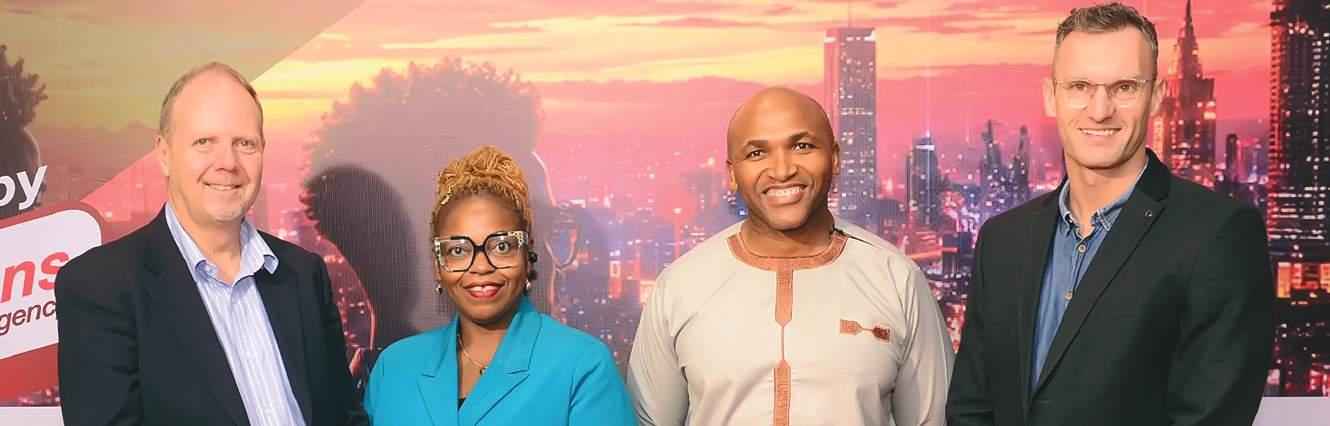
L-R: CEO, Lebara Nigeria, Mrs. Teniola Stuffman; Honourable Commissioner, Lagos State Ministry of Innovation, Science and Technology, Olatubosun Alake; Nigeria Advisory Board Chairman, Lebara Nigeria, Otunba Bimbo Ashiru; Chief Operating Officer, Lebara Nigeria, Mary Akin-Adesokan; and Director, Consumer Business, Lebara Nigeria, Yinka Isioye, during the launch of the Lebara Play app, a microdrama app that houses vertical content, movies and skits from various genres, at the British High Commission Residence, Ikoyi, Lagos...weekend.
PHOTO: ABIODUN AJALA
UMAHI: TINUBU USING ROAD PROJECTS TO FIGHT INSECURITY
77: THE FESTAC CONSPIRACY WORLD PREMIERE IN LUSAKA...
Dangote Cement Targets 20% Emissions
Cut, 80m Tonnes
Sunday Ehigiator
Dangote Cement Plc has unveiled a sustainability roadmap aimed at reducing its carbon emissions by 20 per cent and expanding its installed production capacity to 80 million tonnes per annum (MTPA) by 2030, as the company intensifies efforts to align industrial growth with environmental sustainability across Africa.
The plans were announced at the company’s 17th Annual
General Meeting (AGM) in Lagos, where Chairman, Emmanuel Ikazoboh, presented the 2025 Sustainability Scorecard to shareholders and reaffirmed the company’s commitment to embedding environmental, social and governance (ESG) principles at the core of its operations in line with Dangote Industries Limited’s Vision 2030.
Ikazoboh said sustainability had evolved from a compliance obligation into a central business strategy designed to drive growth,
Lebara, UK Dept of Trade Launch Nigeria's First Micro-Drama Platform ‘Lebara Play’
Sunday Okobi
Lebara Nigeria has reinforced its commitment to delivering more than traditional telecommunications services with the introduction of LebaraPlay, a new digital entertainment platform designed to create greater value for subscribers and creators alike in Nigeria and the world.
At the official launch of the micro-media facility, which took place at the British Deputy High Commission Residence in Ikoyi, Lagos, the Chief Executive Officer of Lebara Nigeria, Teniola Stuffman, said the platform reflects Lebara Nigeria's broader strategy of building a digitally enabled ecosystem that combines connectivity, innovation, and entertainment to meet the evolving needs of today’s consumers.
In her interview, she disclosed that Lebara Play is accessible to both Lebara subscribers and non-subscribers, offering a diverse range of premium content, including micro-drama, music, lifestyle programming, and other engaging formats tailored for mobile-first audiences.
According to her, “By
introducing LebaraPlay, Lebara Nigeria is expanding its value proposition beyond calls and data, creating meaningful experiences for customers while opening new opportunities for creators to showcase their talent and grow their audience.”
Speaking on the launch, Stuffman said: “Today is not simply the launch of another digital platform. Today, we make history. Tonight, Nigeria gives the world something entirely new. Lebara Play is the first micro-drama platform originating from Nigeria and one of the first telecommunications-led entertainment ecosystems on the African continent. It is a platform built on a simple but powerful belief: That African stories deserve a global audience.
“For decades, telecommunications companies connected people through voice; then through data, but today, connectivity alone is no longer enough.
“People don’t simply buy networks anymore. They buy experiences. They buy communities. They buy entertainment. They buy culture, and they buy emotion.
resilience and long-term value creation.
As part of its decarbonisation agenda, the company disclosed that it approved plans in 2024 to reduce its net carbon dioxide (CO2) emissions intensity by 20 per cent while accelerating the transition to cleaner transportation.
He said, “By 2027, all fleet trucks operating in Nigeria, except at the Gboko plant, will run on Compressed Natural Gas (CNG), with electric trucks scheduled for introduction in 2026.”
The company also announced plans to strengthen its position as Africa’s leading cement exporter through expanded port infrastructure at Apapa, Onne, and Lekki, alongside capacity expansion projects that will raise installed production capacity to 80 million MTPA by 2030, including new operations in Botswana and Zimbabwe.
According to the company, the expansion forms part of Dangote Group’s Vision 2030 to build a globally competitive industrial enterprise driven by sustainability
Capacity by 2030
and innovation.
On human capital development, Dangote Cement said it created 625 direct green jobs across its operations while increasing social investment spending by 56 per cent during the review period.
Graduate trainee recruitment also rose by 74 per cent as part of efforts to develop Africa’s next generation of industrial professionals.
The company added that it invested N2.1 billion in employee training and development to strengthen workforce capacity and promote an inclusive, highperformance workplace.
Dangote Cement also reported progress in reducing its environmental footprint, recording a 6.5 per cent reduction in CO2 emissions intensity from its 2021 baseline.
Energy intensity improved by 1.7 per cent, overall energy consumption declined by four per cent, while water consumption fell by eight per cent.
The company attributed the improvements to increased
use of alternative fuels, energy efficiency initiatives and lower clinker factor, describing them as critical elements of its long-term decarbonisation strategy.
In governance, the cement manufacturer said it strengthened its ESG framework by introducing an Artificial Intelligence Risk Management Policy, Biodiversity Policy and Disability Inclusion Policy, while integrating 297 local vendors into its ESG-focused supply chain programme.
Ikazoboh stated that sustainability governance within the company had matured significantly over the past decade through stronger executive accountability, climate risk oversight, and ESG performance management.
The company also highlighted progress under its DangCircular initiative, which promotes waste reduction, recycling and circular economy practices.
“The company co-processed more than 437,000 tonnes of waste as alternative fuel, reducing dependence on conventional fossil fuels while improving resource
efficiency,” Ikazoboh said.
As part of its biodiversity strategy, Dangote Cement announced the launch of the Dangote Tree-to-Forest Programme across all its operational locations during the 2025 financial year.
The initiative aims to afforest 200 hectares of land in each country where the company operates over the next five years by planting 700 trees per hectare to support ecosystem restoration and climate resilience through carbon sequestration.
The company traced its sustainability journey to 2017 when it established the Dangote Seven Sustainability Pillars and began reporting in accordance with Global Reporting Initiative (GRI) standards. It stated that subsequent initiatives, including executive ESG accountability systems, climate disclosure frameworks, biodiversity restoration projects, and sustainability policies, had integrated ESG considerations across all aspects of its operations.
FG Delivers N10bn Medical Intervention to Boost Efficient, Effective Healthcare Services Delivery in Bauchi
Segun Awofadeji in Bauchi
Hospital equipment, consumables, and critical commodities worth over N10 billion have been donated to Bauchi State by the federal government through the Federal Ministry of Health and Social Welfare as part of efforts to make quality, effective, and efficient healthcare delivery services accessible to the people, with a focus on women, children under five, and other vulnerable people.
The programme was under the Comprehensive Emergency Obstetric and Newborn Care (CEmONC) equipment
distribution held on Saturday at the premises of the Abubakar Tafawa Balewa University Teaching Hospital (ATBUTH).
The programme was led by Coordinating Minister of Health and Social Welfare, Professor Mohammed Ali Pate, supported by Governor Bala Mohammed of Bauchi State.
Speaking at the occasion, Pate said, "President Bola Ahmed Tinubu mandated us to change the health sector landscape of Nigeria three years ago. What we are doing here in Bauchi is one of what we have done in 35 states across the country, where we have contributed by the effort of the federal government, in
collaboration with states, efforts to improve primary healthcare, to invest in infrastructure, equip them, provide commodities, build human resources, provide ambulances so that our people will get services."
Pate added, 'Under the leadership of President Bola Ahmed Tinubu, more than 45 million Nigerians are getting services all over this country every quarter, 45 million visits. It is because of this effort that we are collectively doing together. So, we in Bauchi State, of course, have been privileged."
He disclosed, "The president's effort in Bauchi has been much more than what you would see in
many other places. So, on behalf of all of us that are here, the state government and all of us that are here, I want to thank President Bola Ahmed Tinubu also for his great consideration to Bauchi State.
"Since his administration, Bauchi State has enjoyed a lot of progress because of the interest of Mr. President to support this state. We have four federal institutions.
"He upgraded teaching hospital in Azare, built the National North-East VVF Centre in Ningi, brought a new Federal Medical Centre, and is upgrading our teaching hospital here in Bauchi.
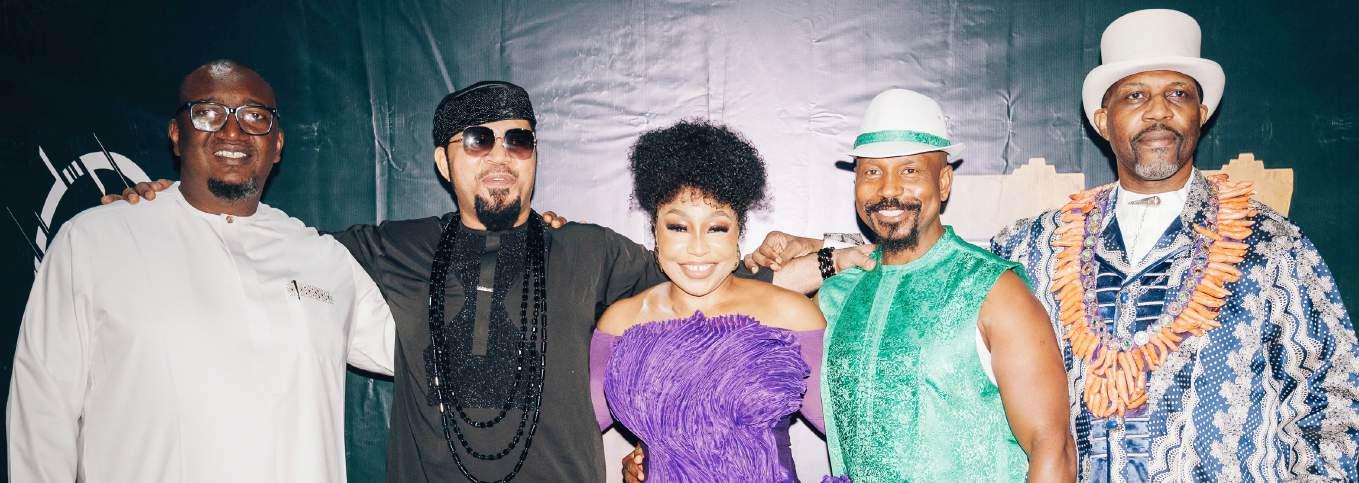
L-R: Movie Director, Izu Ojukwu; Nollywood stars, Ramsey Nouah and Rita Dominic; Producer, Adonijah Owiriwa; and Co-executive Producer, Prince Tonye T.J.T. Princewill, during the world premiere of 77: The FESTAC Conspiracy in Lusaka, Zambia...recently
STARZS INVESTMENT COMPANY MARKS 40TH ANNIVERSARY....
Nigerian Scientists Secure UK Recognition for Medical Imaging Innovation Device
A team of Nigerian scientists has earned international recognition after securing intellectual property protection in the United Kingdom for a medical imaging device designed to improve the accuracy and reliability of optical diagnostic systems.
The innovation, known as the Self-Calibrating Optical Imaging Photodetector, was registered by
the United Kingdom Intellectual Property Office (UKIPO) under UK Design No. 6482043 on November 18, 2025. Classified under International Design Class 24 for medical and laboratory equipment, the device integrates sensing, imaging and automatic calibration into a single platform.
A statement sent to THISDAY said the registered design was developed through an interdisciplinary collaboration
Arco Oil & Gas Boss Urges Nigeria to Abandon Oil Dependence for Knowledge Economy
Says investment in science, engineering, research and innovation holds key to sustainable prosperity
Sunday Aborisade in Abuja
Founder of ARCO Group Plc, Alfred Okoigun, has called on Nigeria to urgently shift its development strategy from dependence on oil and other natural resources to a knowledge-driven economy.
He warned the nation's long-term prosperity would depend on its ability to invest in science, engineering, research, innovation and human capital.
Okoigun made the call while delivering a keynote lecture titled, "From Resource Wealth to Knowledge Wealth: The Science of Nation Building – The Defining Question of Our Time," at the Nigerian Academy of Engineering Technology Dinner and Awards Night.
In the copy of his speech made available to THISDAY in Abuja on Sunday, Okoigun argued that although Nigeria is richly endowed with oil, gas and solid minerals, experience across the world has shown that countries achieve lasting economic
growth not by the resources they possess but by the knowledge and innovation they cultivate.
According to him, "The future will not belong to nations that merely possess resources. It will belong to nations that possess capabilities—those that can innovate, solve problems and continuously generate value through knowledge."
Okoigun lamented that for decades Nigeria had focused national attention on exploiting natural resources while paying insufficient attention to building a strong scientific and technological base capable of driving sustainable development.
He pointed to countries such as South Korea, Singapore and China as examples of nations that deliberately transformed their economies through sustained investments in education, engineering, manufacturing, research and technological innovation despite facing enormous developmental challenges at independence.
involving Prof. Okechukwu Erondu, Onuh Ijiga, Prof. Terver Sombo and Dr. Peverga Jubu.
The registration, the statement said, marks another milestone for Nigerian-led scientific research and highlights the growing contribution of African researchers to advances in medical technology, optical engineering and laboratory instrumentation.
Optical imaging systems are widely used in hospitals, research laboratories and universities for medical diagnosis and scientific investigations. However, maintaining accurate calibration remains a longstanding challenge, as even minor alignment errors can reduce image quality, compromise measurement accuracy and produce inconsistent results.
Conventional systems often require repeated manual calibration or external alignment equipment, processes that can
interrupt workflow and increase the risk of human error.
“The newly registered device addresses these limitations through an integrated selfcalibration mechanism that enables continuous alignment during operation. A built-in ALIGN indicator allows users to monitor and optimise optical alignment in real time, helping to maintain measurement accuracy without repeated manual adjustments,” the statement stressed.
The researchers said the integrated design combines an elevated optical sensing unit, a centrally positioned display and a multifunction control console into a single platform, allowing operators to monitor calibration and imaging simultaneously. They noted that the approach reduces optical drift, improves measurement repeatability and enhances operational efficiency in clinical and laboratory settings.
“Potential applications include biomedical imaging, fluorescence diagnostics, microscopy, laboratory photometry and other fields requiring high-precision optical measurements,” the release said.
According to the statement, leading the project was Erondu, a Professor of Radiography at Gregory University, Uturu, and Founder and Chief Medical Director of Image Diagnostics, Port Harcourt. He said the innovation was inspired by recurring challenges encountered in diagnostic imaging.
“My experience in diagnostic imaging has consistently shown that calibration drift and alignment inconsistencies compromise image reliability. This device integrates calibration directly into the imaging structure, reducing operator error and strengthening diagnostic confidence,” he said.
Erondu’s background
in computed tomography, ultrasound imaging, radiation protection and medical physics helped shape the device’s clinical functionality.
Another member of the team, Ijiga, an Applied Physics researcher at the Department of Physics, Joseph Sarwuan Tarka University, Makurdi, contributed expertise in semiconductor physics, environmental photonics and optical characterisation.
According to Ijiga, advanced materials science played a key role in improving the photodetector’s sensitivity and signal stability.
“Understanding semiconductor band structure and charge-carrier dynamics in nanomaterials informed how we approached optical sensitivity and signal stability. Precision photodetection depends on controlled lightmatter interaction, and that physics guided the structural orientation of the device,” he said.
Gov Eno: Through Transparency, Financial Prudence Akwa Ibom Saved Over N200bn
Okon Bassey in Uyo
Through strict adherence to due process, transparency and prudent financial management, the Akwa Ibom State Government has saved over N200 billion, Governor Umo Eno has said.
Eno disclosed this during the state Projects Delivery Meeting with stakeholders held at the Banquet Hall, Government House, Uyo, stating the money was discovered by the state’s in-house quantity surveying mechanism.
The governor said the money has been redirected to critical development priorities, reaffirming his administration’s commitment to transparency, timely project delivery and
sustainable development.
Eno told stakeholders the meeting was convened to provide the public with firsthand information on how government resources are being deployed for the benefit of the people.
He reiterated his administration remains accountable to the people through strict adherence to due process, transparency and prudent financial management.
Governor Eno cautioned against the deliberate spread of falsehoods about government projects, stressing that stakeholders were invited to independently witness the open and transparent project review process and receive updates directly from government.
Highlighting major milestones across critical sectors, the G
on Projects Cost
governor cited the unveiling of the 350-bed Ibom International Hospital, the commencement of twiceweekly Ibom Air flights to Accra, Ghana, the expected delivery of a new Airbus A220-300 aircraft, ongoing aviation infrastructure upgrades, rehabilitation of the Oron Maritime infrastructure, efforts to actualise the Ibom Deep Seaport, and other key development initiatives.
On road infrastructure, he said the administration is executing a total of 1,305 kilometres of roads and 40 bridges across the state; saying as at May 29, 2023, total payments on road projects, including inherited projects, stood at ₦743.315 billion, underscoring the administration’s
sustained investment in critical infrastructure development.
Governor Eno also announced the state has received a sixmillion-dollar reward under the World Bank-assisted State Action on Business Enabling Reforms (SABER) Programme for its outstanding performance in transparency, budget management and good governance.
He added the state also secured an additional three million dollars under the Nigeria for Women Project to support rural women.
The governor further highlighted the ARISE Compassionate Homes initiative and ongoing reforms designed to enable the state to take ownership of its electricity market.
Emmanuel Addeh in Abuja
L-R: Renowned gospel artiste, Moses Bliss; Member, Board of Directors, Starzs Investments Company Limited (SICL), AIG Hilda Harrison (rtd); Managing Director/CEO, SICL, Ms. Iroghama Ogbeifun; Founder and Chairman, SICL, Engr. Greg Ogbeifun; and Rev. Grace Ufuoma Samuel, during a thanksgiving service to commemorate the company's 40th anniversary in Port Harcourt, Rivers State...recently
Ogun Indigenes in the US Mobilise Support for Yayi ahead of the 2027 Guber Election
Goddy Egene
Ahead of the governorship election campaign, a group of Ogun State indigenes in the United States(US) has thrown its weight behind the All Progressives Congress (APC) state governorship candidate, Senator Solomon Olamilekan Adeola (popularly known as Yayi).
In a statement issued in Washington, D.C., yesterday and made available to THISDAY in Lagos, the
USA Ogun State Indigenes and Professionals Forum assured the APC governorship flagbearer that it would “work with him and his team to advance meaningful diaspora engagement, attract investment, support policy ideas, and promote initiatives that will contribute to the sustainable development of Ogun State.”
According to a statement signed by the Chairperson of its Board of Trustees (BoT), Chief Adeniyi Olukayode
Neo-Black Movement Distances
Oridate, its President/ CEO, Aare Stanford Aderibigbe Stanford; and the Secretary-General, Rotimi Oyekanmi, the forum said:
“As Ogun State indigenes and professionals in the United States, we remain deeply committed to the peace, progress, and prosperity of
our dear state. We recognise the diaspora’s critical role in advancing development through professional expertise, investment promotion,
NDC South-east Bloc Warns against Candidate Imposition
Sunday Aborisade in abuja
The South-east bloc of the Nigerian Democratic Congress (NDC) has warned the party’s leadership against delaying the release of outstanding primary election results
and imposing candidates, saying such actions could trigger internal crises and undermine the opposition’s preparedness for the 2027 general election.
The warning came as the countdown continued to the deadline for political parties to upload candidates’ names to the Independent National Electoral Commission (INEC) portal for the 2027 elections.
Addressing journalists in Abuja yesterday, the Chairman of the NDC SouthEast Geopolitical Zone in the Federal Capital Territory (FCT), Maxwell Igbokwe, urged the party’s national leadership to adhere strictly to internal democracy and ensure that only candidates who emerged through transparent primary elections are submitted to INEC.
Self from July 7 Celebration Delta EXCO Unfolds Big Plans for Health, Transport, Education
Felix Omoh-Asun in BeninCity
The leadership of the Neo-Black Movement (NBM) of Africa Worldwide has disowned the July 7 celebration, saying it’s not involved in any of the events.
The Movement declared that there is no such celebration, neither recognised nor authorised by the organisation, warning that anyone linking it to the celebration risks legal action.
The Legal Adviser of the organisation, Prince Ezekwesiri Nwauwa, made the declaration in a statement issued yesterday, saying the clarification became necessary to properly inform
security agencies, the media, and the general public of the organisation’s position.
The NBM stated that the purported July 7 celebration does not form any part of its constitution, official programmes, activities or calendar, stressing that it neither organises, sanctions nor endorses the event in any form.
The organisation reaffirmed that it has no affiliation, association or involvement whatsoever with the celebration, insisting that no individual or group has been authorised to represent it or associate its name, identity, or insignia with the event.
The Delta State Government has announced several approvals in health, education, transport and civil service welfare, emanating from the meeting of the State Executive Council (EXCO)
presided over by Governor Sheriff Oborevwori, at the weekend in Asaba.
Briefing newsmen after the Executive Council meeting presided over by Governor Sheriff Oborevwori at the weekend, the State Commissioner for Works
(Rural Roads) and Public Information, Mr. Charles Aniagwu, said that the council took far-reaching decisions in several critical areas
Aniagwu, who was flanked by the Commissioner for Health, Dr Joseph Onojaeme and their counterpart in
the Transport ministry, Mr Onoriode Agofure, said that the approval for payment of the ‘13th-month’ salary to the state employees would ensure the transmission of an executive bill to the Delta State House of Assembly for legislative backing.
Former Bauchi Deputy Gov, Baba Tela, Loses 2 Children in Fatal Auto Crash
Segun Awofadeji in Bauchi
The immediate-past Deputy Governor of Bauchi State, Senator Baba Tela, has lost two of his children in a fatal motor crash.
The tragic death of the two children, Mustspha and Ummi, occurred last Saturday
when the car they were traveling in crashed on the Bauchi-Azare road on their way back to Bauchi from Azare, the headquarters of Katagum Local Government Area.
It was reported that the two died on the spot following the impact of the fatal crash, and their corpses were moved to a hospital in Bauchi, where their deaths were confirmed.
Meanwhile, Bauchi State Governor, Senator Bala Mohammed, has expressed deep sorrow and heartfelt condolences to the bereaved family over the tragedy.
The governor, on behalf of his family, the state government, and the people of Bauchi State, extended his deepest condolences to Baba Tela over the tragic death of his beloved children, Mustspha and Ummi, who lost their lives while returning from Azare.
Omon-Julius Onabu in asaba
Pension Transitional Arrangement Directorate
RENEWED HOPE FOR FEDERAL GOVERNMENT DBS PENSIONERS: PRESIDENT TINUBU FULLY SETTLES INHERITED PENSION LIABILITIES OF OVER N39BN OWED TO NITEL/MTEL AND OTHER FEDERAL GOVERNMENT PARASTATALS.
In fulfilment of the Renewed Hope Agenda of His Excellency, President Bola Ahmed Tinubu,
GCFR, and hi
Government, through the Pension Transitional Arrangement Directorate (PTAD), has successfully settled the following long-standing pension liabilities;
· N25,053,703,604.12 representing the outstanding 35-month pension liability owed to eligible 9,675 Defined Benefit Scheme (DBS) Pensioners of the defunct NITEL/MTEL.
· N 9 , 4 8 1 , 8 8 6 , 5 7 6 . 5 3
Computation (BEC) arrears to 3,959 eligible PHCN DBS Pensioners.
· N5,094,784,054.27 representing the 50% balance payment of the 10.66% and 12.95% pension increment arrears due to 11,180 eligible DBS Pensioners of defunct Assurance Bank, NICON, NITEL and People's Bank of Nigeria. T
Government's unwavering commitment to safeguarding the welfare and dignity of DBS Pensioners. It is a clear demonstration of the visionary leadership of His Excellency, President Bola Ahmed Tinubu, GCFR, whose Renewed Hope Agenda places priority on social protection, inclusive governance, and the well-being of senior citizens.
Speaking on the development, the Executive Secretary, PTAD, Tolulope Odunaiya, expressed the Directorate's profound appreciation to His Excellency, President Bola Ahmed Tinubu, GCFR, for his steadfast support and visionary leadership, which have continued to strengthen DBS pension administration and restore confidence in the Defined Benefit Pension Scheme. She noted that, under the President's leadership, the Directorate has successfully resolved all longstanding inherited pension liabilities, bringing lasting relief to thousands of DBS Pensioners.
The Executive Secretary disclosed that the settlements were made possible following the Presidential approval granted to the Directorate in August 2025, with the required funding subsequently appropriated under the 2026 Appropriation Act. According to her, the successful liquidation of these liabilities underscores the Federal Government's resolve to sustain pension reforms and ensure that DBS Pensioners receive their rightful entitlements in a timely manner, consistent with the objectives of the Renewed Hope Agenda.
The Directorate sincerely appreciates all affected DBS Pensioners for their patience and confidence throughout the period the liabilities remained outstanding. PTAD remains dedicated to sustaining efficient, transparent, and Pensioner-centred service delivery, reinforcing the Federal Government's commitment to safeguarding the dignity and well-being of all DBS Pensioners.
Signed Management
NATIONAL C OMMERCIALISATION INTELLIGENCE AND EC OSYSTEM ENGAGEMENT WORKSHOPS
The Research, Innovation and Commercialisation Committee (RICC) was constituted by the Federal Ministry of Education and administered by the Tertiary Education Trust Fund (TETFund), to strengthen Nigeria's research, innovation, and commercialisation ecosystem. The Committee is mandated to promote stronger linkages among academia, industry, government, investors, and other ecosystem actors towards advancing the translation of research outputs, innovations, and inventions into commercially viable products, services, enterprises, and national development outcomes.
In furtherance of this mandate, the Committee is developing a National Research and Commercialisation Intelligence Ecosystem. Consequently, it hereby announces the commencement of the National Commercialisation Intelligence and Ecosystem Engagement Workshops across Nigeria's six geopolitical zones.
The workshops form part of the development and implementation of the National Research to Commercialisation (R2C) Initiative, which seeks to document and strengthen linkages between academia, industry, investors, and other ecosystem actors while supporting the translation of research outputs, innovations, and inventions into commercially viable products and services.
The engagements will provide a platform to generate research and commercialisation intelligence, identify industry demand and regional opportunities, map research and innovation capabilities, and obtain stakeholder inputs to support the development of a coordinated national framework and Digital Public Infrastructure for research commercialisation.
Key Objectives
Generate commercialisation intelligence and ecosystem insights across the 36 States and the Federal Capital Territory;
Identify barriers and opportunities affecting the movement of research outputs, innovations, and inventions into industry and markets;
Identify, determine, and recommend appropriate intervention points required to scale research, innovation, and inventions towards commercialisation;
Explore mechanisms for strengthening research-industry linkages and local production systems;
Expected Participants
• State Governments;
• Universities;
• Polytechnics;
• Colleges of Education;
Participation will involve representatives from:
• Research Institutes and Centres of Excellence;
• Private Sector Organisations and Industry Associations;
• Innovation Hubs, Incubators and Accelerators;
• Financial Institutions and Investors;
• Relevant Ministries, Departments and Agencies; and
• Development Partners.
Details of venues and participation arrangements will be communicated directly to registered stakeholders.
Identify pilot partnerships and commercialisation opportunities
Establish mechanisms for the real-time tracking, measurement, and monitoring of research, innovations, inventions, and commercialisation outcomes nationally.
Obtain stakeholder inputs to guide the National Research to Commercialisation Framework.
PFIPC Scandal and Culpability of 10th
Iyobosa Uwugiaren writes that The Presidential Foreign Intervention Promotion Council affair has exposed something that many Nigerians have long suspected but could rarely demonstrate so blatantly: legislative oversight is increasingly becoming a constitutional ritual rather than a constitutional responsibility.
There is a popular old saying that when something smells bad, you do not spray perfume over it; you find the source of the odour. Nigeria’s latest budget controversy surrounding the alleged Presidential Foreign Intervention Promotion Council (PFIPC) is producing an unmistakable political disgusting odour. The temptation is to look only toward the Presidency, where denials, counterclaims and allegations continue to dominate the headlines. But that would be only half the story. The other half sits comfortably inside the National Assembly.
The PFIPC affair has exposed something that many Nigerians have long suspected but could rarely demonstrate so blatantly: legislative oversight is increasingly becoming a constitutional ritual rather than a constitutional responsibility.
The institution that should serve as the nation’s first line of defence against questionable public spending now finds itself confronting difficult questions about whether it is still capable of performing that role effectively. This is not merely a partisan dispute between government and opposition; it is a fundamental question about institutional integrity and the credibility of Nigeria’s democratic architecture.
The Presidency’s attempt to contain the controversy has done little to answer those questions. Indeed, the statement issued by the Presidential spokesman, Bayo Onanuga, appeared to raise almost as many questions as it sought to answer. While the statement firmly dismissed the PFIPC as a fictitious organisation and sought to distance the Presidency from its activities, it offered little that advanced public understanding of the institutional issues now at the heart of the controversy.
If the council never legally existed, how did it reportedly gain sufficient recognition to engage public officials and present itself as operating within the corridors of power? More fundamentally, how did an entity now described as non-existent reportedly find its way into the 2026 Appropriation Act with a budgetary allocation of N1.3 billion; and opened an account with the Central Bank of Nigeria (CBN)?
Rather than confronting these questions directly, the official response appeared more concerned with repudiating the organisation and dismissing those associated with it. Consequently, it has done little to dispel public suspicion or strengthen confidence in the systems that are supposed to prevent such anomalies from occurring in the first place.
If, as the Presidency insists, the PFIPC never legally existed, Nigerians deserve to know how an allegedly non-existent body reportedly found its way into the 2026 Appropriation Act with a budgetary allocation of N1.3 billion. Budgets do not simply materialise. They pass through ministries, the Budget Office, the executive, standing committees, appropriation panels, harmonisation processes, plenary debates and, ultimately, the votes of elected lawmakers.
Somewhere along that chain, someone should have paused to ask the most basic question: under what law does this agency exist? Whether that question was never asked or was asked and ignored, either possibility raises serious concerns about the quality of legislative scrutiny. These are not political questions; they are constitutional ones.
The National Assembly cannot plausibly present itself as an innocent bystander in a controversy involving a document that it painstakingly debated, amended and enacted into
law. Appropriation is among the legislature’s most significant constitutional powers, and every budget line approved by parliament bears its institutional imprint. Every allocation represents a mindful exercise of legislative authority. That is precisely why this controversy should concern Senator Godswill Akpabio-led National Assembly far more than it appears to.
For years, legislators have defended the enormous cost of maintaining one of the world’s most expensive legislatures by arguing that democracy is inherently expensive because effective oversight is indispensable. Nigerians have repeatedly been told that parliament must rigorously scrutinise executive proposals, interrogate expenditure, investigate abuses and protect taxpayers’ money.
Those arguments are persuasive in theory. However, episodes such as the PFIPC controversy inevitably raise doubts about whether the scrutiny promised is consistently reflected in practice. The legislature cannot simultaneously enjoy the prestige that comes with constitutional authority while disclaiming responsibility whenever serious questions arise concerning the exercise of that authority.
Oversight should never be measured merely by the number of committee hearings convened or reports produced. Its real measure lies in outcomes. Did Parliament identify questionable allocations before they became law? Did it detect procedural irregularities? Did it insist that every agency receiving public funds possessed a proper legal foundation? Did it prevent waste before it occurred? These are the questions that define the effectiveness of
The National Assembly should regard this episode not as an attack upon its authority but as an opportunity for institutional renewal. Democracies become stronger when legislatures willingly subject themselves to the same standards of transparency and accountability that they expect of the executive.
legislative oversight. If the answer to too many of them is negative, Nigerians are entitled to ask what oversight has become and whether it is fulfilling the constitutional purpose for which it exists.
The PFIPC controversy is especially troubling because it does not stand alone. It arrives against a backdrop of recurring public concerns about budget padding allegations, cloudy constituency project allocations, duplicated projects, unexplained insertions into appropriation bills and legislative investigations that often generate considerable publicity but seldom produce lasting institutional reforms.
Each controversy gradually erodes public confidence, reinforcing the perception that transparency is frequently demanded from other arms of government while not always being demonstrated within the legislature itself. Perception, admittedly, is not always reality. Institutions should not be judged solely by public cynicism. Nevertheless, public trust cannot be sustained by declarations alone. It must be earned through openness, accountability and noticeable competence. Trust cannot be legislated into existence; it must be cultivated through conduct that consistently inspires public confidence.
This is where the National Assembly confronts its greatest challenge. Rather than embracing a transparent inquiry into how the PFIPC allocation emerged, there is a risk that familiar institutional instincts will prevail: committee referrals that disappear into bureaucratic silence, partisan exchanges that obscure constitutional questions and official statements that explain everything except what citizens most wish to understand.
Nigerians have witnessed this cycle repeatedly. A scandal erupts, investigations are announced, public attention gradually shifts elsewhere and, before long, another controversy emerges exposing many of the same institutional weaknesses. The cycle continues because its underlying causes remain insufficiently addressed.
The Renaissance Africa Energy Company Limited, operator of the Nigerian National Petroleum Company Limited (NNPC), Renaissance, TotalEnergies, AENR Joint Venture, is delighted to announce the seventeenth annual NNPC/Renaissance JV Niger Delta Postgraduate Overseas Scholarship for applicants from Bayelsa, Delta, Imo and Rivers States.
The objective of the scholarship programme is to provide postgraduate study opportunities in courses that are relevant to the oil and gas industry for qualifying students from these Niger Delta States.
In the 16 years of this programme, 116 scholars have won the opportunity to study at top-rated universities in the UK on full scholarship.
ELIGIBILITY CRITERIA
To qualify for the scholarship, applicants must:
Display intellectual ability and leadership potential.
Have an adequate standard of English (at least 6.5 in IELTS) and meet the university’s language requirements.
Have been offered admission to study on one of the eligible courses through the university’s normal admission process.
Already hold (or expect to hold before commencement) a degree equivalent to a UK Upper Second-Class Honours degree.
Have completed the National Youth Service Corps (NYSC) programme by September 2026.
Be an indigine of Bayelsa, Delta, Imo or Rivers State
Have not previously studied in the UK or another developed country.
Be aged between 21–28 years by 30 September 2026
Hold a Nigerian international passport valid until December 2027
Employees, employees’ relatives, or former employees (who left employment less than five years before) of Renaissance or the participating universities are not eligible to apply.
APPLICATION PROCESS
// 01.
Submit an application for admission to any of the participating universities for one of the qualifying courses.
// 02.
Scholarship application forms will ONLY be available through the websites of Newcastle University, Robert Gordon University and the University of Aberdeen, following a formal offer of admission.
// 03. The universities will process applications and select candidates who will attend interviews with Renaissance before final selection. // 04.
For the academic year commencing September 2026, Renaissance, in partnership with three universities in the UK—University of Aberdeen, Robert Gordon University and Newcastle University— will award scholarships for one-year postgraduate taught MSc studies.
THE FOLLOWING COURSES QUALIFY FOR AWARD OF SCHOLARSHIP AT THE TWO INSTITUTIONS:
• MSc Robotics and AI
Completed scholarship application forms must reach the participating universities not later than 17 July 2026
// 05.
The scholarship covers:
• Tuition fees
• One economy return flight from Nigeria to the UK
• A contribution towards living expenses
• MSc Sustainable Chemical Engineering
• MSc Environmental Engineering
• MSc Data Science and AI
• MSc Geophysics
• MSc Safety & Reliability Engineering for Oil & Gas
• MSc Advanced Chemical Engineering
• MSc Integrated Petroleum Geoscience
• MSc Data Science
• MSc Renewable Energy Engineering
• MSc Advanced Computing
• MSc Oil and Gas Engineering
• MSc Drilling and Well Engineering
• MSc Renewable Energy Engineering
IMPORTANT INFORMATION
More information on specific course admission requirements can be obtained from the websites of the participating universities.
Living expenses are based on the Association of Commonwealth Universities (ACU) published rates and are limited to those amounts.
This is a non-committal scholarship. Renaissance is under no obligation to offer employment upon graduation, nor are successful candidates bonded to Renaissance.
Renaissance will provide medical insurance in line with UK Student Visa requirements.
NIGERIA’S OIL WINDFALL HAS AN EXPIRY DATE
TOPE FASORANTI argues for prudent use of the recent gains to prop up the economy
THE FLAWED LOGIC BEHIND FTSE
RUSSELL’S DECISION
SOLA ONI contends that markets should not be judged solely by how convenient they are for foreign capital
Lagos road chaos persists because too many interests earn from the absence of order, argues
K. BOLANLE
ATI-JOHN
WHO GOVERNS LAGOS ROADS?
In the past month, I have twice seen a physically challenged man controlling traffic in Lekki. He wore no uniform, carried no statutory authority, no patrol vehicle or siren. Yet drivers watched him, trusted him, and obeyed. Cars slowed. Buses adjusted. Impatient motorists submitted, if only briefly, to the authority of a vulnerable citizen standing in the middle of a dangerous road.
The scene was moving because it showed that order is still possible in Lagos: even in a city famous for impatience and aggression, citizens can still respond to a visible call for discipline. It was an indictment because it raised a question the Lagos State Government should be forced to answer: why should one of Africa's busiest corridors require the courage of a disabled citizen to do what a functioning urban system should already have organised?
That image exposed something deeper than traffic failure: the collapse of credible road authority. Lagos traffic is usually discussed as congestion, bad roads, or poor planning; all are valid, but beneath them lies a deeper crisis: the breakdown of road culture. At too many junctions, the rule is no longer the Highway Code but force, speed, and survival.
This must be said carefully. The madness on Lagos roads is not an ethnic defect or some incurable national character flaw. That explanation is lazy, and it serves a political purpose: it lets the state off the hook by recasting a governance failure as cultural inevitability. Societies are not born orderly; they are trained into order by leadership, incentives, enforcement, and infrastructure. Singapore did not become orderly because its citizens were angels: Lee Kuan Yew treated public indiscipline as a threat to national development and backed that view with consistent rules and enforcement. The result was political will, not magic.
The lesson for Lagos is uncomfortable: people behave according to the system around them. Today, Lagos road life rewards disorder. The driver who obeys the lane is punished by those who jump it; the motorist who waits is overtaken by the aggressive. Over time this produces a dangerous psychology: people break rules not only from selfishness but from the rational fear of being cheated if they obey. Disorder becomes defensive. Aggression becomes a survival skill.
No group symbolises this more vividly than the danfo driver, who
stops where he wishes, blocks lanes, and treats the road as private workspace. But the analysis must go beyond outrage: the danfo driver is both culprit and creature. Before he turns the ignition, he must pay the vehicle owner a daily delivery, buy fuel at pump price, keep a constantly breaking bus running, and settle informal levies imposed by streetlevel actors who control the loading points.
These actors are known across Lagos as agberos, not merely a nuisance but the foot soldiers of an invisible revenue system. This is not supposition. I have watched it repeatedly, on highways across the city: agberos moving from vehicle to vehicle at loading points and in stalled traffic, collecting cash directly from bus drivers, openly and without any apparent fear of consequence. It is not an occasional lapse on Lagos roads. It is standard practice. The last major independent estimate, a 2021 investigation by the International Centre for Investigative Reporting, put agberos' take at roughly ₦123 billion a year from Lagos transport operators. No comparable audit has been done since, and the true figure today is almost certainly different, but that estimate and what plays out daily on the road point to the same conclusion: road disorder in Lagos is not merely a failure of enforcement. It is a revenue model.
Lagos road chaos persists not because there are too many vehicles or too few traffic officers, but because too many interests earn from the absence of order, and every Lagosian pays for it, in fares, in inflated costs, in lost time, and in the daily indignity of being treated as prey on a public road they did not choose and cannot audit.
This is why "agbero" understates the problem. In many parts of the
city, whoever controls the bus stop and the daily levy holds more power over movement than the formal state. His authority is written in no law but enforced daily, in cash, on the asphalt. That is not a transport problem. It is a governance crisis.
A commuter may not see this architecture, but feels its consequences: the higher fare, the unsafe boarding point, the sudden stop as the driver hunts passengers before nightfall. She is the final victim of this informal economy, and its financier. Every levy extracted at a park enters the price of her transport; the market woman's loading fee enters the price of tomatoes and fish. This is the cruelty of informal power: it extracts from the weakest while claiming to organise the street. State complicity must also be discussed honestly. No informal revenue system of this scale survives in a megacity without political tolerance. Transport union structures in Lagos have long been perceived as politically useful, especially at election time, when control of crowds and territory matters. The tolerance of informal road taxation is therefore not simply an enforcement gap; in too many places it appears to be an accommodation. A city serious about order cannot look away from who benefits from keeping the roads this way. That structural silence explains why decades of task forces have failed to dislodge the agbero system. You cannot defeat a revenue stream with a press release.
So what is to be done? Not more performative raids: Lagosians have watched touts arrested one week and back the next after "settlement." Not another code of conduct: drivers are undisciplined not from a lack of moral instruction but because the system punishes discipline and rewards predation. The reform agenda must be hard-headed about incentives.
First, the state must confront the revenue question directly. Formalising the billions flowing through informal road structures into audited, accountable systems is a political confrontation, not a technical exercise: it means choosing the city's long-term credibility over the short-term convenience of informal political arrangements.
Rear Admiral Ati-John (rtd) psc(+) fdc(+)* is a Distinguished Fellow of the National Defence College and writes from Lagos.
SOLA ONI contends that markets should not be judged solely by how convenient they are for foreign capital
THE FLAWED LOGIC BEHIND FTSE RUSSELL’S DECISION
When FTSE Russell announced its proposal to reclassify Nigeria from “Unclassified” to “Frontier Market” status, effective 21 September 2026, many Nigerians welcomed the move as long-overdue recognition of the remarkable progress made in the country’s capital market.
The performance of the Nigerian Exchange Limited (NGX), supported by broader macroeconomic and regulatory reforms, appeared to provide a compelling case for Nigeria’s return to the Frontier Market Index.
However, some market observers remained cautiously optimistic. They argued that the decisions of global index providers are not always driven solely by market fundamentals. Commercial considerations, institutional biases and the operational preferences of international investors often shape such classifications, sometimes at the expense of local market realities.
It is therefore hardly surprising that FTSE Russell has now halted Nigeria’s return to Frontier Market status because of the introduction of mandatory pre-funding for equity transactions under the Central Securities Clearing System’s new T+1 settlement cycle. The decision is disappointing and misguided.
While FTSE Russell is entitled to maintain rigorous standards, its assessment reflects an outdated interpretation of market development that undervalues reforms designed to strengthen financial stability. Rather than recognising Nigeria’s efforts to build a safer and more efficient capital market, it has chosen to penalise reforms simply because they require operational adjustments by foreign portfolio investors.
Nigeria’s transition from T+2 to T+1 settlement is one of the most significant reforms undertaken by its capital market in recent years. Combined with mandatory pre-funding, it seeks to reduce settlement failures, minimise counterparty risk, improve market discipline and enhance investor confidence.
These are not cosmetic changes. They are fundamental structural reforms aimed at making Nigeria’s capital market more resilient, transparent, efficient and credible. Faster settlement aligns Nigeria with global trends, while pre-funding strengthens the integrity of the trading process by ensuring that transactions are backed by available funds.
Yet FTSE Russell argues that because investors must fund trades before execution, Nigeria no longer satisfies one of its core Delivery versus Payment (DvP) criteria. In effect, a reform intended to improve market integrity has become the basis for denying international recognition.
That reasoning is difficult to justify.
The primary responsibility of every market regulator is to safeguard the stability and credibility of its domes-
tic financial system, not to maximise the convenience of foreign investors. Mandatory pre-funding reduces settlement risk, protects brokers and investors from failed transactions, and promotes confidence in the market.
A brief look at history puts the issue in perspective. In the aftermath of the 2008 global financial crisis, regulators across advanced economies introduced stricter safeguards, stronger risk controls and more robust settlement systems to protect the integrity of their financial markets. Those measures were widely applauded as prudent and necessary reforms. Nigeria deserves the same recognition for taking steps to strengthen the resilience and credibility of its capital market infrastructure.
FTSE Russell’s position appears to assume that foreign investors should be shielded from any meaningful operational adjustment, even where such adjustments arise from reforms that strengthen market resilience. That approach sends the wrong signal to developing economies striving to modernise their financial systems. No emerging market should be forced to choose between implementing sound regulation and securing inclusion in a global market index.
Much has also been made of the currency risk associated with pre-funding. Critics argue that investors must convert foreign currency into naira before executing trades, exposing them to exchange-rate volatility. But currency risk has always been an inherent feature of investing in frontier and emerging markets. It is an investment reality, not a regulatory defect.
Moreover, Nigeria’s foreign exchange market has improved considerably following reforms by the Central Bank of Nigeria. Liquidity has strengthened, price discovery has improved and distortions between official and parallel exchange rates have narrowed significantly. While challenges remain, it is unfair to judge today’s reforms solely through the lens of past foreign exchange difficulties.
Oni, an Integrated Communications Strategist, Chartered Stockbroker, Commodities Broker and Capital Market Registrar, is the Chief Executive Officer, Sofunix Investment and Communications
TOPE FASORANTI argues for prudent use of the recent gains to prop up the economy
NIGERIA’S
OIL WINDFALL HAS AN EXPIRY DATE
On the surface, the past few months have flattered Nigeria’s oil economy. Pro duction reached roughly 1.53 million barrels a day in May, a fifteen-month high and the first sustained move above the country’s OPEC quota in years. Brent has spent most of the spring comfortably above the price on which the federal bud get was built. And the Dangote refinery, after years of dependence on imported crude, is at last drawing more of its feed stock from home. Taken together, the fig ures invite a certain complacency.
They should not. Almost none of this improvement is of Nigeria’s own making. The gains are exogenous: they originate outside the domestic economy, and what arrives from outside can depart as abruptly as it came. A favourable accident is worth having. It is not the same as wealth deliberately set aside, and the distinction matters most precisely when conditions are benign.
Three supports, all temporary.
price that flattered the budget is receding even as it is being counted.
Consider how each gain actually arose. Production recovered chiefly because the Niger Delta grew calmer. Pipeline attacks eased, crude theft declined, and the producing region enjoyed a spell of relative security. The additional barrels came not from new wells or renewed investment in onshore fields, but from the simple absence of disruption. The capacity ceiling that has constrained Nigeria for a decade, a structural limit rather than a passing one, has not shifted. So when prices surged this spring, and the incentive to produce was overwhelming, the country could not respond. It could only recover ground already lost, restarting shut-in wells rather than commissioning new ones. A return to full capacity is a genuine achievement. It is not, however, the same as the capacity to expand, and that distinction is the crux of Nigeria’s predicament.
The second support was a conservative benchmark. The 2026 budget was based on an oil price of $60 per barrel, well below the $64.85 initially proposed. That restraint is the principal reason a declining oil price has not yet opened a gap in the public accounts. It appears prudent in hindsight. It affords the budget genuine fiscal headroom, revenue a higher assumption would have committed in advance, and it leaves a surplus worth safeguarding.
The third support was the war itself. Oil remained above 100 dollars for months because Iranian missiles closed the Strait of Hormuz and triggered the largest supply disruption on record. That elevated price was a geopolitical risk premium, value conferred by another country’s crisis rather than by any domestic strength, and it is now unwinding. With the United States and Iran holding to a ceasefire and negotiating towards a final settlement, and the Strait of Hormuz gradually reopening to normal traffic, Brent has retreated into the mid-70s, surrendering much of that premium within weeks. The
A subtler tension runs beneath all this. A growing share of Nigeria’s crude is now retained at home. The Dangote refinery requires thirteen to fifteen cargoes a month to run at full capacity, and NNPC has raised its supply to seven from five. Supplying the refinery is the correct longterm policy, a form of import substitution for a country that imported refined fuel for four decades. Yet each cargo directed to Lagos carries an opportunity cost: it is a cargo not sold abroad. Nigeria, therefore, captures less of any price increase precisely at the moment when such an increase would matter most.
The price floor gives way.
Strip away the war premium and examine the market into which Nigeria must now sell. OPEC is a major producer of lighter oil. The United Arab Emirates departed on 1 May after fifty-nine years, removing the group’s third-largest member. It did not leave on account of the war. It left because it had invested 150 billion dollars, lifting its capacity towards five million barrels a day, and saw little reason to keep that capacity idle. A low-cost producer will rationally choose to monetise its reserves now, while global demand persists, rather than defer them to a less certain future.
That decision is the more telling signal, and an uncomfortable one for a producer with Nigeria’s cost structure. The discipline that once held prices within a tolerable band, the very purpose of the cartel, is eroding. At its first meeting without the Emiratis, in early May, OPEC raised its output target rather than lowered it. Saudi Arabia, whose fiscal breakeven sits close to 90 dollars a barrel, the level it requires to balance its budget, is now left to defend the price largely alone. A smaller and more competitive OPEC may conclude that the way to protect market share is to produce more, not less. The precedent is not reassuring. In 2014, the same logic prevailed, Brent fell below 30 dollars, and Nigeria was driven into a recession from which its public finances never fully recovered.
Dr Fasoranti is an Economist, Banker, and Enterprise Transformation Strategist
Editor, Editorial Page PETER ISHAKA
Email peter.ishaka@thisdaylive.com
THE HEALTH SECTOR INTERVENTIONS
The upgrade of the Kaltungo Snakebite Treatment Centre is commendable
With a mortality of 12 per cent, hundreds of Nigerians die annually from snakebites, yet authorities in the health sector have for years not taken the challenge seriously. For this reason, the approval by the Federal Executive Council (FEC) to upgrade the Kaltungo Snakebite Treatment Centre into the National Snakebite Research and Medical Centre is a step in the right direction. It will be the first specialised snakebite research and treatment centre in Nigeria and the sub-region. The Coordinating Minister of Health and Social Welfare, Mohammed Pate confirmed that Nigeria records over 43,000 snakebite cases yearly, causing deaths, disabilities and severe socio-economic consequences. States with the most cases of snakebite in Nigeria are Gombe, Plateau, Adamawa, Bauchi, Borno, Nasarawa, Enugu, Kogi, Kebbi, Oyo, Benue, and Taraba.
But the snakebite issue is just part of a larger package of interventions in the health sector.
To improve blood collection, storage and distribution nationwide, FEC also approved the procurement of 10 compressed natural gas-powered blood donation mobile clinics for the National Blood Service Agency. The country requires about 1.8 million units of blood annually but currently collects only about 25 to 30 per cent. The mobile clinics, according to Pate, would support maternal healthcare, trauma management, surgeries and cancer treatment across the six geopolitical zones. There were also approvals for procuring tuberculosis commodities to strengthen Nigeria’s response to one of the world’s highest TB burdens while reducing dependence on foreign donors and pave the way for local production of tuberculosis medicines. FEC equally approved the procurement of reproductive health and family planning commodities through the National Primary Health Care Development Agency.
Venom (ASV) available and affordable but insisted on preventive strategies. That led to the establishment of the Nigeria/UK Echitab Study Group to research and develop ASV, while exploring ways of providing free treatment for snakebite victims. The inauguration of the structure that houses the Echitab Snakebite Control and Research Centre in Kaltungo (now upgraded) was part of the collaborative efforts aimed at finding lasting solutions to the menace of snakebite in the country. It has over the years developed three different brands of ASV, using venom extracted from local snakes purposely to address the Nigerian situation.
Nigeria records over 43,000 snakebite cases yearly, causing deaths, disabilities and severe socio-economic consequences
T H I S D AY
EDITOR SHAKA MOMODU
DEPUTY EDITOR WALE OLALEYE
MANAGING DIRECTOR ENIOLA BELLO
DEPUTY MANAGING DIRECTOR ISRAEL IWEGBU
CHAIRMAN EDITORIAL BOARD OLUSEGUN ADENIYI
EDITOR NATION’S CAPITAL IYOBOSA UWUGIAREN THE OMBUDSMAN KAYODE KOMOLAFE
EDITOR-IN-CHIEF/CHAIRMAN NDUKA OBAIGBENA
GROUP EXECUTIVE DIRECTORS ENIOLA BELLO, KAYODE KOMOLAFE, ISRAEL IWEGBU
DIVISIONAL DIRECTORS SHAKA MOMODU, PETER IWEGBU, ANTHONY OGEDENGBE
DEPUTY DIVISIONAL DIRECTOR OJOGUN VICTOR DANBOYI
SNR. ASSOCIATE DIRECTOR ERIC OJEH
ASSOCIATE DIRECTOR PATRICK EIMIUHI
While we commend all the initiatives, the intervention on snakebite is very significant. In 2011, the federal government promised to make Anti-Snake
DIRECTOR, PRINTING PRODUCTION CHUKS ONWUDINJO TO SEND EMAIL: first name.surname@thisdaylive.com
Earlier this year, the death of an Abuja-based rising singer, Ifunanya Nwangene, after she was bitten by a snake raised serious concerns about one of the most neglected public health problems in Nigeria today. Therefore, while the idea to increase research activities and prepare room for the development of ASV in the country is good, there is an urgent need for sustained public enlightenment, particularly among dwellers of rural communities. They should be told how to prevent snakebites and what to do as first aid when someone is bitten. As things stand, most health workers in Nigeria have little or no formal training in the management of snakebite. If properly treated, many snake bites will not have serious effects.
Since most of the victims are mainly subsistence farmers, it is important for the government to subsidise the treatment or make the anti-venom available in primary healthcare facilities. Besides, government, at all levels, must strengthen public clinics and hospitals as well as engage residents of rural communities in enlightenment campaign on preventive measures. To ensure the availability of the ASV before local production of the drugs begins, government should import large quantities. It is also important to train medical personnel to effectively manage cases of snakebite early since the venom usually worsens the health of victims by the minute and increases their likelihood of succumbing to death because of its potency.
Letters in response to specific publications in THISDAY should be brief (150-300 words) and straight to the point. Interested readers may send such letters along with their contact details to opinion@thisdaylive.com. We also welcome comments and opinions on topical local, national and international issues provided they are well-written and should also not be longer than (750- 1000 words). They should be sent to opinion@thisdaylive. com along with photograph, email address and phone numbers of the writer.
IS THE NYSC REFORM ANOTHER UNIFORM MAKEOVER?
In a country where “national service” has too often translated into national sacrifice, the Federal Government has rolled out what it calls the most comprehensive overhaul of the National Youth Service Corps (NYSC) in its 53-year history. Approved by the Federal Executive Council (FEC), the reforms promise a shift to civilian operational leadership, technology-driven call-ups, extended orientation camps, specialised career streams, and a spiffy new uniform to replace the threadbare, sweat-inducing khaki that has defined generations of reluctant graduates.
One can almost hear the applause in Abuja. Meanwhile, parents across the federation exhale a cautious sigh, wondering if this time, the scheme might stop sending their children into harm’s way dressed as moving targets.
Born with noble intentions after the Civil War to foster unity in a fractured nation, the 1973 relic has frequently functioned as a one-year lottery with appalling odds. The official rhetoric behind these new reforms aims to change that, transforming the NYSC into a "skills-driven, productivity-focused engine" capable of feeding a projected $1 trillion economy.
Under the new playbook, the traditional three-week camp stretches to six weeks, structured into neat, corporate-friendly fortnights. The first two week for civic responsibility and national values (the traditional patriotism booster shot); week 3-4, career mapping, business planning, and basic accounting (to teach corps members how to budget their allowances against skyrocketing inflation) and 5-6, specialised training across 11 career tracks, including tech, agriculture, and health.
Primary assignments will better align with academic backgrounds, reducing the spectacle of engineering graduates teaching primary school pupils with no materials. The traditional, sweat-soaked Passing Out Parade will also yield to a "formal graduation ceremony."
Sarcasm aside, these elements deserve genuine applause. Civilian leadership might inject fresh administrative energy, unburdened by military hierarchy, provided it doesn't devolve into another layer of political patronage. More importantly however, the corporate buzzwords dance gracefully around the elephant in the room, one that isn't wearing a newly redesigned uniform, but rather carrying an AK-47 on an unpoliced highway. Elvis Eromosele, corporate communications expert, elviseroms@gmail. com
1.0 BACKGROUND
1.1 The Federal Government of Nigeria has received a Facility from the African Development Bank (AfDB), International Fund for Agricultural Development (IFAD) and the Islamic Development Bank (IsDB) to finance the cost of the Special Agro-Industrial Processing Zones Program (SAPZ), and intends to apply part of the proceeds under IFAD towards engagement of prospective candidates to support the National Coordination Office, State Programme Implementation Units in Kano and Ogun States.
The use of any IFAD financing shall be subject to IFAD's approval, pursuant to the terms and conditions of the financing agreement, as well as IFAD's rules, policies and procedures. IFAD and its officials, agents and employees shall be held harmless from and against all suits, proceedings, claims, demands, losses and liability of any kind or nature brought by any party in connection with Special Agro –Processing Zones Program.
1.2 The Positions and scope of services include:
A. Technical Assistant to the National Rural Institutions Development Officer (NRIDO) Scope of Service and Responsibilities
Strategic and Technical Support
· Assist in the development and updating of strategies, guidelines, operational manuals and toolkits for rural institutions development, including group formation, legal registration, governance structures, and sustainability frameworks.
· Support the design and implementation of capacity-building programmes for FOs, cooperatives, MSMEs and MAFs, incorporating modules on business planning, financial management, climate resilience, gender mainstreaming, n u t r i t
· Facilitate the integration of rural institutions with ATCs, AIHs, and private sector actors for reliable feedstock supply, aggregation, and market linkages.
Coordination and Implementation
· Coordinate with PSIUs, ADPs' Rural Institution Development Departments, extension services, and service providers for the identification, mobilization, training, and strengthening of at least 3,000+ FOs across participating states.
· Organize and facilitate stakeholder workshops, training-oftrainers sessions, and field missions to promote inclusive participation (targeting ≥40% women-led or women-only groups and youth inclusion).
· Liaise with financial institutions, NIRSAL, and other partners to enhance access to finance and de-risking mechanisms for rural institutions.
Stakeholder Engagement & Partnerships
· Assist in mapping, profiling, and registering eligible rural i n s t i
( c o o p
participation in the SAPZ value chains.
· Support the facilitation of inclusive dialogue platforms to n
smallholder groups and private sector anchor firms.
· Serve as a secretariat for the Rural Institutions Working Group, preparing minutes, tracking action points, and disseminating information.
Financial Inclusion and Linkages
· Support initiatives to strengthen linkages between rural institutions and:
o Financial institutions (banks, microfinance institutions, FSAs)
o Input suppliers and service providers
o Off-takers and processors within SAPZ
· Assist in promoting access to credit, savings, and insurance products.
· Support implementation of financial literacy programmes.
Monitoring, Evaluation, and Reporting
· Support the NRIDO in tracking key performance indicators (KPIs) related to rural institutions, such as number of
percentage of women/youth-led enterprises, number of
increases, O&M fund contributions.
· Contribute to Programme Annual Work Plans and Budgets (AWPBs), quarterly progress reports, and other porting requirements for AfDB, IFAD, IsDB, and FGN.
· Conduct regular field monitoring visits (in coordination with M&E Unit) and prepare analytical reports on challenges,
lessons learned, and best practices.
· Assist in the documentation of success stories, knowledge products, and policy briefs on rural institutions development.
· Prepare high-quality technical reports, quarterly progress reports, and briefs for the NRIDO, NPCU Coordinator, and financing partners.
· Maintain a robust database (MIS) of all rural institutions engaged under the programme, including their governance structures, financial health, and production capacity
QUALIFICATIONS AND EXPERIENCE REQUIRED
· Master's degree (or equivalent) in Rural Development, Agricultural Economics, Agribusiness, Development Studies, S o c i o l o g y / A
discipline. Minimum of 7 years of progressive relevant professional experience in rural development projects, with at least 4 years focused on farmer organization/cooperative strengthening, group mobilization, institutional capacity building, or agribusiness development in Nigeria or similar African contexts.
· Proven track record in designing and implementing capacitybuilding programmes for smallholder groups, including experience with value chain development, market linkages, and financial inclusion (e.g., FSA or VSLA models).
· Familiarity with donor-funded agricultural projects (AfDB, IFAD, World Bank, etc.), including safeguards, gender mainstreaming, and M&E frameworks.
· Experience working with government institutions (FMAFS, ADPs, State Ministries) and multi-stakeholder platforms is highly desirable.
· Demonstrated field experience in at least 3 geo-political zones of Nigeria.
B. Technical Assistant to the National Gender & Social Safeguards Officer (G&SSO)
Scope of Service and Responsibilities
· Assist in the coordination and implementation of agricultural productivity-related interventions across SAPZ sites.
· Support the preparation and review of technical documents, concept notes, reports, and training materials.
· Assist in data collection, collation, and entry related to GAPs ( G o o d
productivity monitoring.
· Support in the maintenance of a comprehensive database of
indicators.
· Support monitoring and evaluation activities by ensuring timely reporting of field activities.
· Assist in liaison with farmer organizations, extension agents, service providers, and private sector partners.
· Support any additional tasks assigned by the APO or the National Program Coordinator to ensure the effective execution of productivity activities.
Qualifications and Experience
· A minimum of a Master's degree in Agriculture, Agronomy, Agricultural Extension, Rural Development, or a related field.
· At least 5 years of relevant experience in agricultural programmes, preferably in donor-funded or public sector agricultural initiatives.
· Experience working with smallholder far
advantage.
· Strong coordination, communication, and interpersonal skills.
· Proficiency in MS Office applications and familiarity with basic data tools (Excel, Kobo, etc.).
· Willingness to travel to field locations at short notice
C. Project Accountant at the National Coordination Office (NCO) The scope of service include:
Financial Management & Accounting
· Maintain accurate and up-to-date accounting records in line with IPSAS/cash-basis standards and donor requirements.
· Record all financial transactions into the accounting system
· Ensure proper documentation and filing of all supporting documents for expenditures.
· Monitor project bank accounts and prepare monthly bank reconciliation statements.
· Track commitments and expenditures against the approved Annual Work Plan and Budget (AWPB).
Payments & Disbursement Processing
· Prepare payment vouche
documentation. ·
procurement procedures, and government regulations.
Financial Reporting
·
Quarterly Financial Reports, Annual Financial Statements, and other donor-required reports.
· Support the preparation of financial inputs for missions, supervision visits, and project reviews.
· Ensure timely submission of accurate financial reports to the donor and the host government.
Budgeting & Planning
·
· Assist in preparing the annual budget and cash flow forecasts.
potential variances.
Internal Controls & Compliance
· Ensure adherence to internal control procedures and donor financial management policies.
· Support internal and external audit processes, including provision of documentation and responses to queries.
· Identify financial risks and recommend mitigation strategies More details on the assignment can be found in the respective Terms of Reference which can be obtained from the address below between the working hours of 9am – 4pm (local time) daily or uploaded from the SAPZ website: www. sapz.gov.ng
4 National Coordinating Office (NCO) of the Special Agro-Industrial Processing Zones (SAPZ) Program now invites eligible and interested c
appropriate skills, a written technical proposal (maximum 2 pages) and a financial proposal.
5. The estimated duration of the assignment is twelve (12) months with the possibility of extension based on program needs, satisfactory performance and conduct.
6. Eligibility criteria, establishment of the shortlist and selection procedure shall be in accordance with the individual consultant selection (ICS) method set out in IFAD' Project Procurement Handbook that can be accessed via the IFAD website at www.ifad.org/projectprocurement.
7 The proposals to be submitted by the consultants will be evaluated on the basis of the following technical criteria:
Only Candidates scoring a mark of 75 points or more will be considered for the respective assignment. The Consultant scoring the highest in each of the categories will be selected provided that the financial offer is within the limits of the available budget.
8. Interested Candidates may obtain further information at the address below during the office hours of 09:00am and 04:00pm (Local time; Mondays–Fridays).
9. Expression of Interest must be delivered to the address below in th person not later than 17 July, 2026 at 12:00 noon local time. Clearly indicate on your envelop the category you are applying for a
REQUEST FOR EXPRESSIONS OF INTEREST (REOI)
ENGAGEMENT OF A CONSULTANT FOR THE DESIGN, DEVELOPMENT, AND DEPLOYMENT OF AN ENTERPRISE SYSTEM MANAGEMENT (ESM) PLATFORM AND A CENTRAL KNOWLEDGE REPOSITORY (CKR) FOR THE SAPZ PROGRAMME. (INDIVIDUAL CONSULTANT SELECTION)
COUNTRY: Federal Republic of Nigeria
NAME OF PROJECT:
DESIGN, DEVELOPMENT, AND DEPLOYMENT OF AN ENTERPRISE SYSTEM MANAGEMENT (ESM) PL ATFORM AND A CENTRAL KNOWLEDGE REPOSITORY (CKR) FOR THE SAPZ PROGRAMME
Ref No: NPCO/SAPZ/IFAD/26/1023/588
The Federal Government of Nigeria has received financing from the International Fund for Agricultural Development (IFAD) towards the cost of the Special Agro – Processing Zones Program (SAPZ), and intends to apply part of the proceeds for the recruitment of consulting services, for which this REOI is issued.
The use of any IFAD financing shall be subject to IFAD's approval, pursuant to the terms and conditions of the financing agreement, as well as IFAD's rules, policies and procedures. IFAD and its officials, agents and employees shall be held harmless from and against all suits, proceedings, claims, demands, losses and liability of any kind or nature brought by any party in connection with Special Agro – Processing Zones Program.
The consulting services (“the services”) include to undertake a Requirements
A
o
; Dashboard and Reporting; Deployment and Infrastructure; Platform Design; Content Management System (CMS); Knowledge Content Organization; Search and Knowledge Discovery; Integration with SAPZ Website; Content Migration; Analytics and Reporting; System Interoperability; Implementation Methodology;
More details on this consulting services are contained in the Terms of Reference (TOR) which can be obtained from the address below between 10am – 4pm on working days or obtained from the website: sapz.gov.ng
It is expected that this consultancy service shall be for a period of 12 weeks within which the consultant shall accomplish all the tasks including submission of final report to the Client.
This request for expressions of interest (REOI) follows the General th Procurement Notice that appeared on the IFAD website on 17 April, 2023, th th on UNDB on 17 April, 2023 and on Thisday and Daily Trust of 17 April, 2023.
The attention of interested consultants is drawn to IFAD's Anti-Money Laundering and Countering the Financing of Terrorism Policy and the Revised IFAD Policy on Preventing Fraud and Corruption its Activities and Operations. The latter sets forth IFAD's provisions on prohibited practices. IFAD further strives to ensure a safe working environment free of harassment, including sexual harassment, and free of sexual exploitation and abuse (SEA) in its activities and operations as detailed in its IFAD Policy to Preventing and Responding to Sexual Harassment, Sexual Exploitation and Abuse.
Interested consultants shall not have any actual, potential or reasonably perceived conflict of interest. Consultants with an actual, potential or reasonably perceived conflict of interest shall be disqualified unless otherwise explicitly approved by the Fund. Consultants are considered to have a conflict of interest if they a) have a relationship that provides them with undue or undisclosed information about or influence over the selection process and the execution of the contract, or b) have a business or family relationship with a member of the client's board of directors or its personnel, the Fund or its personnel, or any other individual that was, has been or might reasonably be directly or indirectly involved in any part of (i) the preparation of the REOI, (ii) the selection process for this procurement, or (iii) execution of the contract. Consultants have an ongoing obligation to disclose any situation of actual, potential or reasonably perceived conflict of interest during preparation of the EOI, the selection process or the contract execution. Failure to properly disclose any of said situations may lead to appropriate actions, including the disqualification of the consultant, the termination of the contract and any other as appropriate under the IFAD Policy on Preventing Fraud and Corruption in its Projects and Operations.
The National Coordination Office now invites eligible Individual consultants (“consultants”) to indicate their interest in providing the services. Interested consultants should provide information demonstrating that they have the required qualifications and relevant experience to perform the services in the form of a curriculum vitae (CV). A consultant will be selected in accordance with the individual consultant selection (ICS) method set out in IFAD' Project Procurement Handbook that can be accessed via the IFAD website at w w w . i f a d . o r
conducted as part of the selection process.
The shortlisting criteria are: The criteria for shortlisting consultants will be based 1. General Qualification 2. General Working Experience 3. Adequacy for the assignment 4 Experience in Similar assignment in Donor Funded project. Details of the evaluation criteria is provided in Annex 1 which can be obtained from the website: sapz.gov.ng
Any request for clarification on this REOI should be sent via e-mail to the th address below no later than 4.00 pm local time on 9 July, 2026. The client will provide responses to all clarification requests by 4.00 pm local time on 13th July, 2026.
Expressions of interest in the form of curriculum vitae (CV) must be delivered st in a written form to the address below later than 12.00 Noon local time on 21 July, 2026. Late Submissions will NOT be accepted.
Signed Dr. Kabir Yusuf
National Program Coordinator, SAPZ National Program Co-ordination Office (NPCO) Federal Ministry of Agriculture and Food Security, No. 3, Aguleri Street, off Gimbiya Street, Area 11, Abuja, admin@sapz.gov.ng; +234 8168088308, +2348035949354
Kayode Tokede
Amidst uncertainty in the business environment, banks borrowing from Central Bank of Nigeria (CBN) dropped by 96.04 per cent Year-on-Year (YoY) to N2.33trillion in half year (H1) of 2026 from N58.91 trillion in the corresponding period of 2025.
Nigerian banks borrow from the CBN through Standing Lending Facility (SLF) window in a move to meet critical overnight obligations.
CBN data showed that banks use of SLF declined in 2026 half year compared to 2025, reflecting stronger
liquidity and reduced reliance on the apex bank.
Also, the data showed that banks took caution after the CBN withdrew regulatory forbearance letting them be more selective about extending credit to critical sectors.
The Monetary Policy Committee (MPC) of the central bank in its May 2026 meeting retained the Monetary Policy Rate (MPR) at 26.50 per cent and the Standing Facilities corridor around the MPR at +50/-450 basis points.
This means that when Nigerian banks need
overnight liquidity from the CBN, they typically borrow at 22.5 per cent per annum through the SLF.
CBN data revealed that N1.09 trillion in January 2026 and N1.66 billion in March 2026 emerged as the highest and lowest amount banks borrowed from the apex bank this year.
On the contrary, the CBN data, revealed that banks deposited an estimated N511 trillion in H1, as against N68.94 trillion in H1 2025.
Banks deposit excess cash with CBN using the Standing Deposit Facility (SDF) window and it comes with attractive
interest overnight, making it a preferred option for banks to earn risk-free returns.
Analysis of CBN’s data showed thaat banks’ deposit in March 2026 was the highest with about N128.92 trillion. In February 2026, it stood at N61.11 trillion,16.18 per cent increase when compared to N52.6 trillion deposited in January 2026. The total deposit, however, closed June 2026 at N89.33 trillion, about 479.4 per cent YoY increase over N15.4 trillion in June 2025.
With SDF remuneration rate at -50 basis points, the eligible overnight excess
liquidity deposit with the CBN through the SDF earns 27.50 per cent per annum on those deposits.
The decision by banks to reduce deposits with the CBN can be attributed to the recent cut in the Monetary Policy Rate (MPR) to 26.50 per cent in February 2026 from 27 per cent 2025.
It can also be attributed to lower opportunity cost of holding cash with the CBN compared to lending it out in the market.
The MPC of the CBN in February 2026 retained the Standing Facilities Corridor around the MPR at +50/-450
basis points. Analysts at Cordros Research in a report stated that by adjusting the asymmetric corridor to +50/-450basis points around the MPR indicates a reduction in interest rates for the SLF and the SDF to 27.5per cent (Previous: 29.5 per cent) and 22.5per cent (Previous: 24.5per cent), respectively.
“The adjustment is expected to ease monetary conditions and strengthen banks’ private sector credit expansion,” they explained.
The Stanbic IBTC’s Purchasing Managers’ Index (PMI) report for June 2026 stated that manufacturing recorded a decrease in output even though improving demand helped to support further increases in output of Nigeria’s private sector in the first half of 2026.
According to the report, the health of the private sector has now strengthened
in five successive months as business activity expanded across three of the four broad sectors covered by the survey, the exception being manufacturing.
It said: “As has been the case in each month since December 2024, business activity increased in Nigeria’s private sector during June. The latest rise was solid, albeit slower than that seen in May. According to respondents, higher output reflected a
range of factors including stronger client demand, rising customer numbers and the opening of new branches.”
The report said that June data pointed to a 13th consecutive monthly increase in employment in the Nigerian private sector.
“The latest rise was slight but the sharpest since February. Where new staff were hired, panellists linked this to increased workloads. Employment rose in three
of the four monitored sectors, the exception being agriculture,” it said.
It added that purchasing activity rose markedly again in June, with the rate of expansion unchanged from that seen in May.
“Input buying has now increased in each of the past 19 months. Higher purchasing generally reflected rising client demand, with some firms also reporting that inputs
had been secured ahead of expected increases in new orders in the months ahead,” the report said.
It, however, said that the rate of overall input cost inflation remained substantial in June and was slightly faster than in May as more than 41 per cent of respondents signalled a rise over the month, adding that sector data pointed to marked increases in input prices
across the board, with manufacturing posting the strongest pace of inflation.
“Although purchase costs continued to rise sharply during June, the rate of inflation eased for the third successive month from March’s recent peak and was the softest since February. Panellists reported higher costs for fuel, raw materials and transportation.
Dike Onwamaeze
Stakeholders Push for Collaborative AI Governance to Power Digital Economy
Industry stakeholders across policy makers, legal practitioners, regulators, technology experts, academics, and civil society organisations have called for a collaborative approach to Artificial Intelligence (AI) governance in Nigeria to unlock the country’s digital economy while safeguarding citizens’ rights.
The call was made at the 2026 AI Summit, hosted by T&A Legal Lagos, where
the summit theme tagged: ‘Artificial Intelligence in Nigeria: Balancing Regulation and Innovation,’ was discussed.
Delivering the welcome address, Co-founding Partner of T&A Legal, Oluseyi Adisa said while countries across the world were still experimenting with governance models, Nigeria has a unique opportunity to develop an AI framework tailored to its realities.
Adisa added that while AI would present enormous
economic opportunities, with projections indicating it could contribute billions of dollars to Nigeria’s Gross Domestic Product and transform agriculture, healthcare,
education, governance and other critical sectors, these gains must be supported by appropriate safeguards against emerging risks.
“Nigeria’s AI governance
framework must not be imported wholesale from another jurisdiction. It must be evidence-based, innovation-friendly, accountable, and designed to
reflect our national realities. Our goal is to strike the right balance between protecting citizens and enabling businesses to innovate and thrive,” Adisa said.
Sanusi: Govt., Private Sector Constructive Collaboration Will Spur National Devt
Chinedu Eze
The Chief Executive Officer of Aero Contractors, Captain Ado Sanusi, has said that if there is constructive collaboration between the federal government and the private sector in the aviation industry, it will lead to growth and national development.
Sanusi stated this when
the Special Adviser to the President on Policy Coordination and Head of the Central Results Delivery Coordination Unit (CRDCU), Hadiza Bala-Usman, visited Aero Contractors, Nigeria’s foremost commercial airline and embarked on facility tour of the company.
Bala-Usman toured the Maintenance, Repair and
Overhaul (MRO) facility of the airline and was impressed.
During the tour, she was intent on how government can support the private investors in the aviation industry to grow the sector and increase its contribution to the nation’s GDP.
Sanusi speaking about Bala Usman’s visit noted, “It was an honour to welcome
Hadiza Bala Usman to Aero Contractors. I had the pleasure of taking her on a tour of our operations — and in particular our Maintenance, Repair and Overhaul (MRO) centre, which continues to position Aero Contractors as a strategic aviation asset capable of supporting operators across West and Central Africa.
AfCFTA Secretariat, Bergmans Sign MoU on Customs Modernisation WACT-APM Terminals Nigeria Graduates First Cohort of EngineerHer Programme
The African Continental Free Trade Area (AfCFTA), the AfCFTA Secretariat has signed a Memorandum of Understanding (MoU) with Bergmans Security Consultant and Supplies Limited to implement a concession for the AfCFTA customs modernisation project (ACMP).
The signing ceremony took place in Lagos, recently, on the sideline of the Digital Trade
Forum 2026.
The Secretary General of the AfCFTA Secretariat, Wamkele Mene and the Chairman of Bergmans Security Consultant and Supplies Limited, Saleh Ahmadu, described the initiative as a pivotal moment in the digital transformation of African trade and Customs infrastructure, towards actualising the African Union Agenda 2063.
WACT-APM Terminals
Nigeria has marked the graduation of the first cohort of its EngineerHer programme, a one-year initiative designed to equip female graduates with practical skills, industry exposure and clear pathways into employment.
Launched in 2025, the
programme was designed to increase female representation across WACT and strengthen Nigeria’s local talent pipeline.
Through a combination of technical training, hands-on experience and structured mentorship, it equips participants with the skills, knowledge and confidence
needed to succeed in operational roles.
The first cohort began with eight participants selected for their potential and commitment to building careers in maritime.
Speaking on the milestone, WACT-APM Terminals
Nigeria Senior People Business
Partner, Chinelo Obienyem said: “WACT EngineerHer programme (WEP) was launched with a clear ambition, to increase female representation in WACT and empower Nigerian women with the technical skills and competitive advantage needed to thrive in their chosen fields.
Comms/e-Business
Asst.
Asst.
Correspondents
KayodeTokede
Ebere
Speaking on the agreement, Ahmadu said that the MoU forms the basis of a PublicPrivate Partnership (PPP) arrangement under which Bergmans will undertake the required investment in deploying a comprehensive, Pan-African digital and physical infrastructure to harmonize customs processes, enhance trade corridors, and streamline cross-border movement of goods across all State Parties.
According to him, “Recall that Bergmans Security Consultant and Supplies Limited is the parent company of trade modernisation project (TMP) Limited, the concessionaire to the Federal Government of Nigeria for the implementation of the Nigeria Customs Service (NCS) modernisation project.
Firm Introduces Initiative to Strengthen Safety, Trust During Rides
inDrive, a global mobility and urban services platform, has introduced a new in-app audio recording feature to enhance safety, promote respectful interactions, and support fair resolution of disputes between drivers and passengers during rides.
The new feature, which is already available in the
app, complements inDrive’s existing suite of safety tools, including in-trip monitoring, ride-sharing capabilities, and 24/7 customer support. Integrated into the app’s Safety Center, the feature can be activated manually by either the driver or passenger at any point during a trip, providing an additional layer
of protection and confidence for both parties.
Country Manager, inDrive Nigeria, Timothy Oladimeji, explained that while the vast majority of rides are completed without incident, there are occasional situations where misunderstandings arise, and evidence is limited, making it difficult
to determine what transpired. Oladimeji added that by providing an additional source of information, the feature enables support teams to conduct more thorough investigations and reach fairer resolutions, ultimately enhancing confidence in the platform for both drivers and passengers.
Baobab Tackles Period Poverty, Supports 500 Schoolgirls
Baobab Microfinance Bank has successfully concluded the first phase of its Menstrual Hygiene Awareness Project in Ilorin, Kwara State, reaffirming its commitment to improving the well-being of communities through impactful social interventions.
As part of the initiative, the bank distributed 500
reusable sanitary pads to schoolgirls at a carefully selected beneficiary school in Ilorin.
Speaking on the initiative, the Chief Business Development Officer of Baobab Microfinance Bank Nigeria, Joy Micheal-Oti, said: “At Baobab Microfinance Bank, we believe that every
girl deserves the opportunity to learn without interruption. Menstrual health is not a privilege; it is a basic right. This intervention in Ilorin marks the beginning of a broader commitment to addressing period poverty across Nigeria. We are determined to scale this initiative to multiple states
and ensure that no girl’s education is disrupted because of a lack of access to menstrual products.”
This initiative forms part of the bank’s broader Corporate Social Responsibility (CSR), aimed at promoting inclusive development and improving the quality of life for underserved populations.
Oluchi Chibuzor
Emma Okonji
L-R: Chief Executive Officer, Expressions Influencer Agency, David Boon; Managing Director, EXP Nigeria Limited, Rosemary Akpo; Chief Executive Officer, Nfinity Influencer, Albert Makoeng; and Co-founder, Webfluential, Murray Legg; at the Media Shift Nigeria Live conference and launch in Lagos… recently
Iroghama Ogbeifun: At 40, SICL Success Story Rooted in Our Founder’s Vision, People, Innovation, Indigenous Excellence
For four decades, Starzs Investments Company Limited (SICL) has been at the forefront of Nigeria’s maritime industry, building a reputation for operational excellence, innovation and indigenous capacity development. Established in 1986 by Engr. Greg Ogbeifun, the company emerged at a time when local participation in offshore marine logistics was limited and has since grown into one of Nigeria’s leading maritime and offshore logistics providers. At the heart of that journey is the vision of Ogbeifun, whose entrepreneurial philosophy has always extended beyond vessels and contracts to the development of people, institutions and industries. Through resilience, strategic leadership and an unwavering belief in the potential of indigenous enterprise, he built more than a maritime company; he built an institution founded on integrity, excellence and value creation. Long before local content became a national imperative, he was championing indigenous participation, investing in talent and demonstrating that Nigerianowned companies could compete successfully at the highest levels of the industry. As SICL marks its 40th anniversary, Managing Director/CEO, Iroghama Ogbeifun, reflects on the company’s remarkable journey, the values that have sustained its growth across generations, and the opportunities emerging within Nigeria’s maritime and Blue Economy sectors. She speaks on leadership, innovation, succession, capacity development and why she believes the company’s success story remains rooted in its founder’s vision, sustained by its people, and strengthened by a relentless commitment to excellence. Oluchi Chibuzor presents the excerpts
Over the last decade, Starzs Investments Company Limited (SICL) has recorded significant fleet expansion, increasing from three vessels to 11 vessels, first under the leadership of Engineer Greg Ogbeifun and subsequently under your leadership, from five years ago. How has the organisation been able to record such monumental growth?
Starzs Investments Company Limited (SICL) is Nigeria’s foremost indigenous maritime and offshore logistics company, founded by my father and our Chairman, the visionary Engr. Greg Ogbeifun. The company was established on July 1, 1986, and is celebrating 40 years of operations this year. I must commend his vision, resilience, resourcefulness and remarkable impact on the maritime landscape. Indeed, Engr. Greg is an architect of enduring legacies.
Back to your question, the company has been able to achieve significant growth because the vision for the business has always been clear: to build an enduring, globally renowned frontline organisation that thrives on value creation for stakeholders in the maritime industry. To achieve this vision, we recognised the need to expand our asset base and strengthen our capacity to meet the evolving needs of our clients. Once the vision was clear, strategy and execution naturally followed.
Having identified our niche, which was to become a renowned offshore tug company in Nigeria, we deliberately focused on building our capacity; not just as a tug company, but as a specialist operator of Azimuth Stern Drive (ASD) vessels. At the same time, we invested heavily in human capacity development in line with our founder’s vision because we understood that people drive our assets, systems and processes.
As an organisation operating in the maritime space, we have built a strong foundation for developing the next generation of maritime leaders through training and capacity building. Seafarers are the lifeblood of the industry, but they will not remain in active service forever. That is why preparing the next generation is so important. We have a robust cadetship programme designed to ensure a continuous pipeline of properly trained and qualified maritime professionals. Today’s cadets will become tomorrow’s captains, chief engineers, technical specialists and industry leaders. We see capacity building not as an obligation, but as a responsibility, and it remains central to our vision of shaping future maritime leaders.
Innovation has also played a significant role in our growth journey. STARZS continues to embrace technology to improve efficiency, strengthen safety performance and enhance the way we operate. In an industry such as ours, safety is a critical priority, and technology has become an important enabler
of safer and more effective operations.
Reputation is equally important. It is an intangible asset that drives trust and ultimately influences long-term business success. I can confidently say that STARZS has built a strong track record over four decades. Maintaining a leadership position in such a competitive industry is not something that happens by chance. It is the result of professionalism, consistency and operational excellence. We are proud that our long-standing clients continue to recognise and commend our commitment to these values.
The Anniversary Symposium is themed, “Anchoring Resilience: 40 Years of Private Indigenous Initiative, Shaping Nigeria’s Maritime Future.”
What informed this high-sounding theme?
The theme is deeply reflective of who we are as an organisation and what this milestone represents. One thing that has always resonated with STARZS is our commitment to capacity development and our contribution to policy advocacy, policy development and implementation within the maritime industry.
Our Chairman, Engr. Greg, has been a
strong voice and advocate for the growth and advancement of the maritime sector and for unlocking the immense potential of Nigeria’s Blue Economy. The development of the sector is something that is very close to his heart. Over the years, he has served on key presidential committees, pioneered industry initiatives, and played a leading role in championing indigenous participation within the maritime space. His passion has always been to see the Nigerian maritime sector grow, expand and take its rightful position as a leading maritime hub in Africa.
The theme,“Anchoring Resilience: 40 Years of Private Indigenous Initiative, Shaping Nigeria’s Maritime Future,” reflects that journey. It speaks to the resilience required to build and sustain an indigenous enterprise over four decades, while also recognising the role private sector operators have played in developing capacity, creating jobs and advancing the maritime industry.
The symposium itself is an opportunity to bring together key industry stakeholders to discuss not just the challenges facing the sector, but, more importantly, the opportunities that lie ahead. We are intentional about having the right people in
the room. We will have shipowners, investors, regulators and policymakers, including the Honourable Minister of Marine and Blue Economy, His Excellency Adegboyega Oyetola; the Director-General of the Nigerian Maritime Administration and Safety Agency (NIMASA), Dr. Dayo Mobereola; the Managing Director of the Nigerian Ports Authority (NPA), Dr. Abubakar Dantsoho; the Executive Secretary of the Shippers Council, Dr Pius Akutah ; as well as representatives of the Ministry of Finance and other critical stakeholders across the maritime value chain.
Discussions will also focus on issues such as fiscal incentives, investment opportunities, ease of doing business and the policy frameworks required to accelerate growth within the sector. Our expectation is that the symposium will generate meaningful conversations, practical recommendations and a communique that can contribute to shaping the future of Nigeria’s maritime and Blue Economy sectors.
While the event marks our 40th anniversary, it is equally an opportunity to look ahead—to explore how government and the private sector can work together to unlock greater value, build indigenous capacity and position Nigeria more competitively within the global maritime landscape.
Can you take us through the origins of the company, the journey over the past four decades, and the leadership qualities and values that enabled Ogbeifun to build such a successful and enduring enterprise?
The founder of the company, Greg Ogbeifun, is a highly disciplined marine engineer trained by Shell. He is a man who upholds the highest standards of quality and service delivery, ensuring that the company consistently delivers on its promises. Excellence is one of his defining values because he does not get involved in projects, assignments or responsibilities unless he is confident they can be delivered successfully and to the highest standard. In fact, he is not satisfied with giving 100%; he always strives to give 150%.
Integrity is another core value of his, which he has passed down to us both individually and as a business, including myself as his daughter. His mantra is the time-tested truism that a good name is better than silver and gold, and he has demonstrated that principle at every point. As a result, his name has become synonymous with integrity, and he leads by example.
Over the last four decades, he has consistently demonstrated the qualities that have contributed to the growth of STARZS, including strategic vision, innovation, resilience and the ability to align business decisions with his core values of integrity, reputation, relationships and, of course, his faith in God, which has also become one of our corporate values.
Managing Director/CEO, SICL, Ms Iroghama Ogbeifun
When Dead SIMs Died: How NCC Clean-up Made Telecoms More Honest
There are moments in the life of an industry when progress does not look like growth. It looks like a subtraction. It looks like pain. It looks like a sudden fall in numbers that once gave comfort to executives, investors, regulators, advertisers and the public. That is what happened to Nigeria’s telecommunications sector after the Nigerian Communications Commission’s customer data clean-up and the implementation of the NIN-SIM linkage exercise. Millions of mobile subscriptions disappeared from the industry’s active subscriber records. The headline was dramatic. The reactions were predictable. Some saw it as a collapse. Some saw it as punishment. Some interpreted it as weakness by affected operators. And because Globacom was the most visibly affected of the major mobile network operators, Glo became the easiest company to discuss. But the bigger story is not only about Glo. It is about the Nigerian telecoms industry finally moving from inflated comfort to cleaner truth. It is about MTN, Airtel, Glo and 9mobile all being forced to confront the same hard question: who exactly is an active telecom customer? Is it a SIM card printed, registered, distributed and sitting somewhere in a drawer? Is it a line that once made calls but has since gone silent? Is it a number in a database with no recent revenue-generating activity? Or is it a real, verified, reachable and commercially active customer?
This distinction matters because telecoms is no longer just about calls and SMS. Telecom identity now sits at the centre of
banking alerts, digital payments, fraud investigation, social media accounts, emergency communication, mobile money, national security, customer verification, credit scoring and government planning. In that kind of economy, a telecom subscriber database cannot be treated like a trophy cabinet. It is national infrastructure. That is why the clean-up was necessary. Every maturing industry eventually goes through this type of correction. Banks clean up dormant accounts. Fintechs separate registered wallets from funded and transacting wallets. Media platforms distinguish between sign-ups, monthly active users and paying subscribers. E-commerce companies learn that app downloads are not the same as orders. Telecoms could not remain permanently immune from that discipline. For many years, subscriber count was the loudest bragging right in Nigerian telecoms. The operator with the biggest number could claim scale, relevance and market strength. Subscriber leadership shaped headlines. It influenced public perception. It entered boardroom conversations. But the clean-up reminded the industry that not every number is equal. A verifiednand active customer is worth more than a dormant SIM. A smaller clean base may be more valuable than a larger contaminated one. This was good for the entire industry. For MTN, the clean-up reinforced the strength of a base that was already highly active and commercially deep. Its decline during the major correction was comparatively modest, which suggested that a large portion of its
customer base was already aligned with the regulator’s active-subscriber definition. For MTN, the exercise was not painless, but it was validating. It confirmed the resilience of its core subscriber base and strengthened the credibility of its market leadership.
For Airtel, the correction was also useful. Airtel experienced a more visible reduction than MTN, but not a collapse. That tells a different story. It suggests that Airtel, like every mass-market operator, had to absorb the consequences of NIN-SIM enforcement and active-line validation. But it also emerged with a cleaner base and a stronger platform for data-led growth. In a market where data consumption, digital services, mobile money and enterprise connectivity are becoming more important than simple SIM distribution, a cleaner base gives Airtel more reliable intelligence for pricing, segmentation and product design.
For 9mobile, the story was more painful. Its reduction was severe, and it came on top of years of commercial and operational pressure. But even for 9mobile, the clean-up may be better understood as a forced reset rather than only a decline. A struggling operator does not benefit from carrying illusions. If the base is weak, the numbers should say so. If customers are inactive, the market should know. If the business needs recapitalisation, network renewal, repositioning or strategic rescue, clean data makes that diagnosis more honest. Painful truth is better than comforting fiction. Then there is Globacom.
Glo’s reported reduction was the most dramatic, and because of that, it deserves the most careful interpretation. The temptation is to say that Glo “lost” tens of millions of customers. But that language may be misleading. If a line has no revenue-generating activity within the regulatory window, removing it from the active subscriber count is not the same as losing a paying customer. It is closer to removing inactive stock from a warehouse. The warehouse looks smaller after the cleanup, but the useful inventory may remain largely intact.
A telecom operator does not make money from a SIM that is not used. It does not fund network expansion from a line that generates no activity. It does not improve customer experience by pretending that dormant records are active citizens. It does not build a digital future on numbers that cannot be commercially engaged. Therefore, Glo’s headline reduction may have been more of a statistical shock than a revenue shock.
This is an important distinction. Losing active customers is a business problem. Losing inactive records is a data correction. Losing market trust is dangerous. But gaining a clearer view of your true customer base can become a strategic advantage if handled intelligently. For Glo, the clean-up may have provided exactly that: a clearer map. Before the correction, the company’s large subscriber number told one story. After the correction, the remaining base tells a more useful story.
• Lanre Basamta is the Senior Strategist & Analyst, Bodex Media. Bodexmedia@gmail.com.
The story continues online on www.thisdaylive.com
Beta Glass Posts N37.5bn Q1 Revenue, Unveils New Board
Sunday Ehigiator
Beta Glass Plc has reaffirmed its growth ambitions after reporting a first-quarter 2026 revenue of N37.54 billion and unveiling a reconstituted board to strengthen corporate governance and drive long-term value creation.
The company disclosed this at its 52nd Annual General Meeting (AGM), held in Lagos, where shareholders approved key resolutions and reviewed the company’s performance and future strategy.
Speaking at the AGM, the Chairman of the Board, Dr.
REA, Jigawa,
Vitus Ezinwa, said the new board composition would position the company for sustained growth.
According to him, “The newly reconstituted Board positions Beta Glass to accelerate sustainable growth, strengthen shareholder value, and enhance the resilience of its regional supply chains amid an evolving global business landscape.”
Beta Glass also cited findings from an independent socio-economic impact report by Deloitte, which indicated that the company had contributed more than N1 trillion to
economy over the past decade.
As part of its board renewal, the company announced the appointment
and
EXP Expands Frontiers of Media Influencer Marketing
EXP Agency, leading African experiential marketing company, has taken another bold step towards building a pulsating content and social media marketing industry to support clients and businesses across Nigeria and Africa.
Designed to shake up the traditional approach to media marketing and
content creation, Expressions Influencer Agency is part of a new business that highlights the opportunities imbedded in an innovative media environment as brands and customers increasingly embrace more social and influencer marketing content.
Chief Executive Officer of Expressions Influencer Agency, Dave Boon, in his
NCX Partner to Power Seven Industrial Clusters
The Rural Electrification Agency (REA) has signed a landmark Memorandum of Understanding (MoU) with the Jigawa State Government, the Nigerian Commodity Exchange (NCX), and Astound Power Limited to deliver 7MW of power.
The MoU, which was signed at the Jigawa Investment Summit (J-Invest 2026), will power a multi-state PPP
initiative comprising seven (7) Agro-Industrial Clusters across Jigawa, Taraba, Kaduna, Kebbi, Ekiti, Osun and Ebonyi states.
Under the agreement, the REA will deploy the energy infrastructure to power irrigation systems and processing facilities, while the NCX will issue NCX-backed warehouse receipts to eligible farmers and aggregators for
export.
Speaking during the MoU signing, the Managing Director of the REA, Dr. Abba Aliyu who served as a lead panelist at the summit asserted that reliable electricity remains one of the most critical foundations for attracting investment, driving industrialization, and generating jobs across Nigeria.
He noted that the MoU
reflects a shared conviction that clean energy and agriculture must be integrated to effectively strengthen food security, create sustainable employment, and unlock greater economic value for local farmers and rural host communities.
He further emphasised that energy is the vital catalyst enabling businesses to scale and communities to prosper.
remarks, described the day as a historic milestone for Nigeria’s media content creation and influencer marketing landscape as it opens a fresh vista of opportunities for economic growth through creative deployment of cuttingedge technology and innovations.
Boon, who is also the Chief Innovation and Marketing Officer of the EXP Group, noted that the African media landscape is rapidly changing; a situation that compels brands and content creators to have the requisite foresight and capacity to explore evolving tools to drive growth and profitability.
Besides the significant increase in the pool of social media entrepreneurs, in other climes, content creation has moved beyond social media posting to the
building of empires powered by studios, advertising campaigns and film production, among others. His words:“Expressions Influencer Agency is part of a new business that we have launched, and we are doing this event to help clients see and understand how to get more return from their marketing spend, in the space of the media of influencer marketing”.
“Our objectives are very clearly set out in our strategic plan. The overriding goal is to turn media influence into performance by increasing the pipeline of skilled content creators and analysts to meet the needs of the clientele and advance the future of the Nigerian content creation industry. Of course, an explicit knowledge of media influence is imperative to elevate brand awareness and grow market share.”
Nigeria’s
of four non-executive directors: Mr. Nitin Kaul, Ms. Olusola Carrena, Mr. Bolaji Olatunbosun Osunsanya,
Mr. Boye Olusanya, bringing
expertise spanning private equity, corporate finance, manufacturing, logistics, energy and infrastructure. The Chief Executive
Officer of Beta Glass, Alex Gendis, said the company’s performance reflected its resilience despite market challenges.
Lanre Basamta
Business Special
Domestic Investors Tighten Grip on Nigerian Stocks
The Nigerian stock market continued its impressive growth trajectory in May 2026, with domestic investors further consolidating their dominance amid rising market activity, improving investor confidence and sustained economic reforms that continue to attract capital into equities.
Latest trading statistics released by Nigerian Exchange Limited (NGX) showed that total transactions on the nation’s bourse climbed to N1.943 trillion in May 2026, representing a 7.79 per cent increase from N1.803 trillion recorded in April. Even more remarkable was the year-on-year performance, which revealed that market turnover surged by 177.42 per cent compared with N700.5 billion recorded in May 2025.
According to the NGX Domestic and Foreign Portfolio Investment Report, domestic investors remained the major drivers of trading activity in May, accounting for approximately 91 per cent of total transactions executed during the month. Domestic transactions rose by 13.15 per cent from N1.555 trillion in April to N1.760 trillion in May.
In contrast, foreign portfolio transactions declined by 25.9 per cent from N247.78 billion in April to N183.61 billion in May, suggesting a temporary slowdown in offshore participation despite growing interest in Nigerian assets. The report further indicated that the value of transactions executed by domestic investors exceeded those of foreign investors by about 82 per cent during the review period.
Market observers said the trend reflects stronger participation from local institutional investors, increased retail engagement, and renewed confidence in the domestic economy as macroeconomic reforms continue to take shape.
Speaking on the development, the Group Managing Director and Chief Executive Officer of NGX Group, Temi Popoola, said the sustained rise in domestic participation demonstrates the growing maturity and resilience of Nigeria’s capital market.
“The continued expansion in domestic market activity reflects increasing investor confidence in the long-term prospects of the Nigerian economy and the strength of our capital market ecosystem. We are particularly encouraged by the growing participation of institutional investors, whose activities contribute significantly to market liquidity, stability and efficient price discovery. While foreign portfolio flows remain important to market development, the strong performance of domestic investors highlights the success of ongoing efforts to deepen local participation and build a more resilient market capable of supporting economic growth and wealth creation,” Popoola said.
Similarly, industry stakeholders noted that the current structure of market participation is helping to insulate the Exchange from the volatility often associated with foreign portfolio flows.
Historically, frontier markets such as Nigeria have experienced periods of significant market fluctuations whenever
foreign investors entered or exited positions in large volumes. However, the increasing dominance of domestic investors is gradually reducing the market’s vulnerability to such shocks.
Institutional Investors Lead the Charge
A closer examination of domestic transactions showed that institutional investors remained the dominant force in the market during May.
Institutional participation increased by 18.59 per cent, rising from N871.38 billion in April to N1.033 trillion in May. Retail investors also increased their market activities, although at a slower pace, with transactions growing by 6.22 per cent from N683.74 billion to N726.27 billion. Consequently, institutional investors outperformed retail investors by approximately 18 per cent during the month.
Analysts attributed the surge in institutional activity to improved corporate earnings, attractive dividend yields, and the growing allocation of funds into equities by pension fund administrators, asset managers and other long-term investors seeking superior returns.
According to market analyst and Chief Executive Officer of APT Securities and Funds Limited, Mallam Garba Kurfi, the growing influence of institutional investors is a positive signal for the long-term development of the Nigerian capital market.
“What we are witnessing is a gradual strengthening of the domestic investment base. Institutional investors are becoming more active because
many listed companies continue to deliver impressive earnings despite economic challenges. At the same time, the reforms in the foreign exchange market and improving macroeconomic indicators are creating optimism about future corporate performance. The decline in foreign participation should not necessarily be viewed negatively. Global investors often adjust their portfolios based on international market conditions, interest rates and risk considerations. What is important is that domestic investors are increasingly filling the gap and providing stability to the market,” Kurfi said.
He added that sustained domestic participation would help improve liquidity and support long-term capital formation across key sectors of the economy.
Long-term Growth Story Remains Intact
Beyond the monthly figures, the latest data also highlighted the remarkable transformation of Nigeria’s equities market over the last two decades.
Over a 19-year period, domestic transactions increased by 160.83 per cent from N3.556 trillion in 2007 to N9.275 trillion in 2025. Foreign transactions recorded even stronger growth, rising by 329.87 per cent from N615.6 billion in 2007 to N2.648 trillion in 2025.
The long-term trend reflects the evolution of Nigeria’s capital market into one of Africa’s largest investment destinations, despite episodes of
economic downturns, exchange rate pressures and global financial uncertainties.
In 2025, domestic investors accounted for approximately 78 per cent of total market transactions, while foreign investors represented 22 per cent. The pattern has become even more pronounced in 2026.
As of May 31, cumulative domestic transactions stood at N6.922 trillion, representing 87.67 per cent of total market activity for the year. Foreign transactions amounted to N973.4 billion, accounting for just 12.33 per cent.
Market operators said this shift reflects the growing confidence of local investors in Nigerian listed companies, many of which have posted robust earnings and declared attractive dividend payouts over the last year.
Several banking, telecommunications, industrial and consumer goods stocks have continued to attract significant investor interest as market participants position for stronger earnings growth and economic recovery.
Foreign Investors Expected to Return
Despite the recent decline in foreign portfolio transactions, analysts remain optimistic that international participation could rebound in the coming months.
The ongoing liberalisation of the foreign exchange market, improving liquidity conditions and declining policy uncertainty are expected to enhance Nigeria’s attractiveness to offshore investors.
In recent months, global investment banks and emerging market funds have increasingly highlighted Nigeria as a potential beneficiary of capital reallocation flows into frontier and emerging markets.
Economic reforms aimed at improving fiscal sustainability, exchange rate transparency and investor confidence are also expected to support renewed foreign interest.
For now, however, domestic investors appear firmly in control of market activity.
The strong participation of pension funds, asset managers, insurance firms and retail investors is helping to sustain liquidity and reinforce confidence in the market’s long-term prospects.
As Nigeria seeks to mobilise capital for economic growth, infrastructure development and industrial expansion, experts believe the growing strength of domestic investors could become one of the market’s most significant advantages.
The latest NGX data suggests that the Nigerian equities market is increasingly becoming less dependent on foreign portfolio flows and more anchored on local capital. If the current momentum is sustained, market operators say the Exchange could witness another record year of activity, reinforcing its role as a critical platform for wealth creation and economic development.
For investors and policymakers alike, the message from May’s trading figures is clear: domestic confidence in Nigeria’s capital market remains strong, and that confidence is translating into unprecedented levels of market participation.
Popoola
Kayode Tokede
Transition to Sustainable Transport begins at Ports-APM Terminals Nigeria
Bonny Oriarehu
APM Terminals Nigeria has said the transition to sustainable transport should begin at Nigerian ports.
Chief Commercial Officer of APM Terminals Nigeria, Westtar Kapito made this remark during a Thematic Session on Sustainable transport at the 10th Nigeria–EU Business Forum which held in Lagos.
“At APM Terminals, we recognise that the transition to sustainable transport begins at our ports. This is why we have invested heavily in modernising Nigeria’s maritime infrastructure. Today, we are building the foundation for future electrification.
“Every modern crane, digital system, operational upgrade and infrastructure improvement brings us one step closer to the next generation of sustainable port operations. We understand that the port of the future will not simply be larger, it will be smarter, more connected,
more energy efficient and increasingly electrified,” Kapito said.
He added that APM Terminals Nigeria was proud to invest in that future through the modernisation of APM Terminals Apapa, the development of WACT Onne into Nigeria’s first green port, the investments in digitalisation and infrastructure, waterway solutions and the partnership with Barging Marine Solutions limited.
Describing the opportunity before Nigeria as larger than sustainability, Kapito said it is about positioning Nigeria as Africa’s leading gateway for sustainable trade.
“Sustainable transport represents one of the greatest economic opportunities before Nigeria today. Not simply because it can reduce emissions but because it can unlock investment, strengthen supply chains, improve energy infrastructure, create skilled jobs and position Nigeria as the leading maritime gateway for Africa,” he said.
Managing Director, NRC, Mr. Kayode Opeifa, described the agency’s efforts to optimise the use of the current rail infrastructure and called for investment in the Lagos-Kano narrow gauge line.
He said, “We want the Lagos-Kano line to be fully operational. The last trip made through this line was in September 2024.
However, we have been able to get this rail working again from Lagos to up until Ilorin. Just recently, we moved cement from Lagos to Ilorin a few times, making the fourth move in the last one month. Imagine being able to move cargo from Apapa port down to the Inland Dry Ports in Kaduna and Kano.”
Opeifa also announced the NRC’s plans towards decarbonising its locomotive fleet, aligning with the Federal Government’s drive towards cleaner energy. He encouraged investments in this area, saying Nigeria had a ready market.
Stransact to Reward 100 Varsity Students Nationwide
Stransact Chartered Accountants has said that it is targeting five exceptional graduating students from 20 top universities ranked by the Times Higher Education World University Rankings 2026, for Stransact Honours Roll.
“This initiative rewards academic brilliance with cash prizes and a fast track into the Stransact Talent Vault (STV) - the firm’s cornerstone programme for building a pipeline of future-ready talent. The top 20 Nigerian Universities selected from the Times Higher Education (THE) World University Rankings 2026 are Ahmadu Bello University (ABU), Afe
Babalola University (ABUAD), Babcock University, Bayero University, Kano (BUK), and Covenant University (CU).
“Others are: Delta State University (DELSU), Ekiti State University (EKSU), Federal University of Technology, Akure (FUTA), Federal University of Technology, Owerri (FUTO), Lagos State University (LASU), Ladoke Akintola University of Technology (LAUTECH), and Obafemi Awolowo University (OAU),” it said in a satemment.
“This laudable initiative will undoubtedly motivate students towards academic excellence and
positive contributions to society,” said Prof Wahab Egbewole, ViceChancellor, University of Ilorin while commending Stransact Chartered Accountants for the merit-based Honour Roll initiative aimed at celebrating and supporting exceptional final-year students.
Stransact Chartered Accountants, part of RSM International, a global network of Audit, Tax, Consulting, and Deals Advisory Professionals, recently launched the Stransact Honours Roll initiative to recognise and reward outstanding final-year students across Nigeria’s top-ranked universities.
Unilever Nigeria Appoints Femi-Okunbanjo as Director
The Board of Directors of Unilever Nigeria Plc has announced the appointment of Modupe Femi-Okunbanjo as director of the company effective June 30, 2026. The announcement follows the approval of Ibrahim Sodipe’s resignation from the board as contained in a notice sent to Nigeria Exchange Limited and the investing public, signed by the company secretary, Peter Dada.
Femi-Okunbanjo currently serves as the Financial Controller for Nigeria and Regional Controls Lead for West Africa at Unilever Nigeria PLC. In her role, she oversees financial governance,
regulatory compliance and enterprise risk management. With over 15 years of experience in the fastmoving consumer goods and telecommunications sectors, she has successfully steered finance teams, shaped strategic initiatives and strengthened risk management frameworks. She has been instrumental in embedding ethical leadership and data-driven decision-making at the board level, ensuring that organisations remain resilient amid shifting market dynamics. Recognised as an accomplished finance and governance leader, she has established a
strong reputation for elevating financial reporting standards, advancing audit excellence and enhancing governance frameworks, positioning organisations for sustainable growth and long-term value creation.
In her previous roles, she has a consistent track record of delivering margin expansion, enhancing governance & control environments, and leading transformation in challenging macroeconomic conditions, with a commitment to developing future talent and advancing financial literacy among younger generations.
following: Saharan Blend (Algeria), Djeno (Congo), Zafiro (Equatorial Guinea), Rabi Light (Gabon), Iran Heavy (Islamic Republic of Iran), Basrah Medium (Iraq), Kuwait Export (Kuwait), Es Sider (Libya), Bonny Light (Nigeria),
FCMB Group Shareholders Approve N23.08bn 2025FY Dividend Payout
Kayode Tokede
Shareholders of FCMB Group Plc have approved a total dividend payout of N23.08 billion for the 2025 financial year at the company’s 13th Annual General Meeting (AGM) held in Lagos.
Shareholders, attending both in person and online, approved all Board resolutions, including the re-election of Mr. Oladipupo
Jadesimi and the ratification of Mrs. Adepeju Adebajo as Directors. They also elected Audit Committee members and authorised Directors to set the auditors’ remuneration.
The AGM followed a year of strong earnings growth across the group’s businesses, despite challenging economic conditions.
FCMB Group reported profit before tax of N202.1 billion for the year ended Dec. 31, 2025, up 81per cent from NN111.9 billion
a year earlier. Profit after tax rose 142 per cent to N177.3 billion, while gross revenue increased 42.5 per cent to N1.13 trillion. Return on equity rose to 23.2 per cent.
The group reported doubledigit profit growth across all divisions. The Banking Group’s profit before tax rose 110per cent, while Consumer Finance, Investment Banking, and Investment Management grew by 107 per cent, 90 per cent,
and 29 per cent, respectively. This momentum continued into 2026, with all segments achieving strong first-quarter growth.
Shareholder representatives commended the Board and management for the company’s performance and dividend payout.
National Coordinator of the Pragmatic Shareholders Association of Nigeria, Mrs. Bisi Bakare stated that the
dividend reflects management’s commitment to shareholder value despite economic challenges.
National Chairman of the Progressive Shareholders Association of Nigeria, Mr. Boniface Okezie praised the group’s support for small businesses and women-owned enterprises. He noted that FCMB provided N537.5 billion in financing to SMEs in 2025, including N51 billion
to women-owned businesses.
In addition, another shareholder, Mr. Eric Akinduro highlighted improved asset quality, noting the group’s non-performing loan ratio declined to five per cent from 5.95per cent.
The Chairman, FCMB Group, Mr. Oladipupo Jadesimi stated that these results demonstrate the resilience of the group’s diversified business model.
PRICES FOR SECURITIES TRADED AS OF JULY 3/26
A Mutual fund (Unit Trust) is an investment vehicle managed by a SEC (Securities and Exchange Commission) registered Fund Manager. Investors with similar objectives buy units of the Fund so that the Fund Manager can buy securities that willl generate their desired return.
An ETF (Exchange Traded Fund) is a type of fund which owns the assets (shares of stock, bonds, oil futures, gold bars, foreign currency, etc.) and divides ownership of those assets into shares. Investors can buy these ‘shares’ on the
floor of the Nigerian Stock Exchange. A REIT (Real Estate Investment Trust) is an investment vehicle that allows both small and large investors to part-own real estate ventures (eg. Offices, Houses, Hospitals) in proportion to their investments. The assets are divided into shares that are traded on the Nigerian Stock Exchange.
GUIDE TO DATA:
Date: All fund prices are quoted in Naira as at 1st July 2026, unless otherwise stated.
DAILY PRICE LIST FOR MUTUAL FUNDS, REITS and ETFS
NNPC’s Four Diseased Fingers: The Refineries That Must Be Privatised FOCUS
An Open Letter to the President and Commander-in-Chief of the Armed Forces, Federal Republic of Nigeria
His Excellency President and Commanderin-Chief of the Armed Forces Federal Republic of Nigeria State House
Aso Rock Villa, Abuja, Nigeria
Good day, Mr President, Sir.
With the utmost respect and humility, I write this open letter to Your Excellency.
This is my first open letter to you since you assumed office as President and Commanderin-Chief of the Armed Forces of the Federal Republic of Nigeria.
I have chosen to write now because I firmly believe that, after the Almighty God, the Creator and Sustainer of all things, the next greatest earthly responsibility rests on the shoulders of a nation’s President.
The office you occupy carries not only immense constitutional authority but also the sacred responsibility of taking decisions that shape the destiny of millions of Nigerians.
It is from that deep conviction, and from my sincere love for our country, that I respectfully seek Your Excellency’s attention on a matter of profound national importance.
I write this as a patriotic Nigerian who still believes that leadership is sometimes proven not by what a President builds, but by what he has the courage to cut away.
You started by belling the cat through the removal of fuel subsidy and the liberalisation of the foreign exchange market, which no Nigerian President had ever succeeded in doing.
Mr President, NNPC Limited has four diseased fingers attached to the body of Nigeria. These four fingers are the government-owned crude oil refineries: Port Harcourt Refinery I, Port Harcourt Refinery II, Warri Refinery and Kaduna Refinery.
For decades, these refineries have failed to deliver dividends to the good people of Nigeria. Since the 1980s, they have consumed money, consumed hope, consumed public patience and consumed the proceeds of our upstream oil and gas sector. Yet they have failed to provide the nation with reliable refining security.
Mr President, these four fingers have become a burden Nigeria can no longer afford to carry.
Every year, substantial revenues are earned from our upstream oil and gas sector. Yet a significant portion of those resources disappears into the endless cycle of maintaining failed downstream assets.
Funds that should strengthen healthcare, education, security, roads, electricity and critical infrastructure are instead swallowed by refineries that continue to underperform.
This cannot continue.
The fifth finger used to be Eleme Petrochemicals. Former President Olusegun Obasanjo demonstrated courage by removing that asset from government control through privatisation.
Today, under Indorama’s management, Eleme has grown into one of Nigeria’s leading petrochemical success stories.
It stands as clear evidence that when government steps back from running commercial enterprises and allows competent investors to manage them, value is created, industries expand and jobs follow.
So why is NNPC Limited still holding on to the remaining four dead refinery fingers?
Why are Nigerians still being told the same
refinery story after more than two decades of disappointment?
Why do we continue to hear of turnaround maintenance, rehabilitation, technical partners, inspection visits, foreign experts, mechanical completion and yet another promise that operations will begin within the next 24 months?
Why should Nigerians believe another refinery promise when previous promises have consistently ended in silence?
Mr President, God and history have placed before you a rare opportunity. Your journey from humble beginnings to the highest office in our land is remarkable and inspiring.
But legacy is not built by avoiding difficult decisions.
Legacy is built by taking the decisions others feared to take.
The future of these four refineries is one of those decisions.
Mr President, I respectfully urge Your Excellency to direct the leadership of NNPC Limited to transfer these four refineries to the National Council on Privatisation and the Bureau of Public Enterprises for a lawful, transparent and competitive privatisation process to be concluded within one year.
Let the Bureau of Public Enterprises advertise the assets openly.
Let qualified transaction advisers be appointed.
Let reputable local and international investors compete on equal terms.
Let the valuation be transparent.
Let the terms of sale be made public.
Let Nigerians know who is buying these assets, what they are paying, what
they intend to invest, how they plan to operate the facilities and the guarantees they are prepared to provide.
A practical ownership structure could allocate 85 per cent to core investors, five per cent to the respective host states and retain 10 per cent for the Federal Government.
Such a structure would minimise political interference, attract long-term capital, protect host community interests, preserve a strategic national stake and give investors the confidence required to commit significant resources.
If the reported Chinese partners are genuinely interested, they should participate openly in the bidding process.
Let them compete fairly with every other qualified investor. Let them demonstrate their financial capacity, technical competence, refinery experience and commercial plans before the Nigerian people.
But national assets should never be transferred through the back door.
Do not call privatisation a “technical partnership.”
Do not call asset transfer an “evaluation.”
Do not call control “collaboration.”
Do not disguise a concession as a Memorandum of Understanding.
Nigeria has suffered too much from opaque public asset transactions. An arrangement that lacks transparency today may become tomorrow’s litigation.
A poorly structured transaction may expose Nigeria to arbitration, prolonged legal disputes and the possible seizure of national assets abroad.
We must not create another avoidable
national embarrassment.
The lawful route already exists through the National Council on Privatisation and the Bureau of Public Enterprises.
That is the path to transparency.
That is the path to investor confidence.
That is the path that best protects Nigeria’s long-term interests.
Mr President, NNPC Limited should not continue dragging Nigerians through another endless refinery journey. The corporation has had decades to prove that government ownership can work.
It has spent enormous public resources. It has made countless promises.
The refineries remain the verdict.
They are not monuments to industrial achievement.
They are monuments to failed public management.
Mr President, this is a defining moment.
Release Nigeria from the burden of these failed assets.
Allow competent investors to rebuild them. Allow the host states to participate in their future.
Allow the Federal Government to retain a strategic minority interest.
And allow NNPC Limited to focus on what it should be doing, expanding upstream production, securing crude supply, protecting national reserves, strengthening pipeline infrastructure and creating value for the Nigerian people.
Nigeria can no longer afford to spend productive upstream revenues sustaining unproductive downstream assets.
Those resources belong in our hospitals, our schools, our roads, our power sector, our security institutions and in creating opportunities for millions of young Nigerians.
The time for endless rehabilitation has passed.
The time for decisive reform has arrived.
Mr President, this is a legacy decision.
Privatise them transparently.
Concession them transparently where appropriate.
Liquidate those that can no longer be economically justified.
Above all, let every decision be guided by the law, openness and the national interest. The Chinese are welcome to compete. Nigerian investors are welcome to compete. Investors from every part of the world are welcome to compete.
But the process must belong to the law, not to administrative discretion.
History will record what is done with these four refineries.
Future generations will judge whether this administration finally ended decades of waste or merely prolonged them.
Mr President, the Nigerian people are watching with hope. They look to your administration not simply for another promise, but for the courage to make the decision that others postponed.
Sometimes, healing begins only when a diseased part is removed.
With courage, transparency and fidelity to the law, Your Excellency has the opportunity to remove these four diseased fingers, restore strength to the Nigerian economy and leave behind a legacy of bold reform that generations yet unborn will remember with gratitude.
Respectfully submitted.
*Dan D. Kunle writes from Abuja
Dan D. Kunle
FEaturEs Lieutenant General Waidi Shaibu: Advancing a More Professional, Adaptable, Combatready and Resilient Nigerian Army
When President Bola ahmed Tinubu appointed Lieutenant General Waidi Shaibu as the 25th Chief of army Staff on October 30, 2025, it was a well-deserved appointment. a seasoned officer with an operational record spanning counter-insurgency campaigns against Boko Haram and iSWaP, including deployments in the Lake Chad region and Sambisa Forest, he also holds several decorations, including the Purple Heart Medal for gallantry. So upon assumption of office, he set out a clear command philosophy: to transform the Nigerian army into a more professional, adaptable, combat-ready and resilient force capable of decisively discharging its constitutional responsibilities within a joint and multi-agency environment. Built on the pillars of professional excellence, robust administration, operational readiness, strategic cooperation and exemplary leadership, this vision has continued to shape the army's response to Nigeria's evolving security challenges. Over the weekend, at a media executives' chat on the sidelines of the 163rd Nigerian army day Celebration (NadCEL), moderated by Chiemelie Ezeobi, the army chief reflected on the progress made so far under his leadership, highlighting operational successes, force modernisation, troop welfare, manpower development and strengthened civil-military relations, while reaffirming the Nigerian army's commitment to safeguarding the nation's sovereignty and territorial integrity
How would you assess the Nigerian Army’s performance under your leadership?
The Nigerian Army has recorded significant progress in strengthening national security, largely due to the strategic direction and sustained support of the Commander-in-Chief, President Bola Ahmed Tinubu. His leadership has provided the necessary political will, resources and policy guidance required for operational success. Since I took over as the Chief of Army Staff, the Army has demonstrated renewed vigour, resilience and clarity of purpose. Through a combination of kinetic and non-kinetic operations, we have neutralised high-value targets, dismantled criminal networks and restored stability across several parts of the country. Importantly, these efforts have also created a more secure environment for socio-economic activities to thrive.
What has been the driving force behind the Nigerian Army’s recent operational successes?
Our successes are anchored on a clear Command Philosophy focused on transforming the Nigerian Army into a professional, adaptable, combat-ready and resilient force. This has been operationalised through improved intelligence fusion, enhanced joint operations, better-equipped troops and strong leadership at all levels. Additionally, the integration of both kinetic and non-kinetic approaches has allowed us to not only neutralise threats but also address underlying drivers of insecurity. The result is a more coordinated, effective and sustainable operational outcome across all theatres.
Can you highlight key operational achievements recorded across the country?
Across all six geopolitical zones, the Nigerian Army has recorded measurable and impactful outcomes. Thousands of terrorists and criminal elements have been neutralised, many surrendered, large numbers of suspects arrested and thousands of civilians rescued from captivity.
We have also recovered significant quantities of arms, ammunition and warlike stores, thereby degrading the operational capacity of hostile groups. In addition, enhanced operations have improved security along major highways and enabled displaced communities to
gradually return to their homes. These achievements reflect sustained pressure, improved coordination and growing operational efficiency.
How has logistics and equipment modernisation
improved Army operations?
Logistics remains a critical enabler of operational success, and we have made substantial progress in this area. With the support of the Federal Government, the Nigerian Army has inducted modern
Our successes are anchored on a clear Command Philosophy focused on transforming the Nigerian Army into a professional, adaptable, combat-ready and resilient force. This has been operationalised through improved intelligence fusion, enhanced joint operations, betterequipped troops and strong leadership at all levels
platforms including helicopters, MRAP vehicles, armoured personnel carriers and unmanned aerial systems. These assets have significantly enhanced our mobility, protection, surveillance and strike capabilities. Furthermore, investments in communication systems and counter-drone technologies have improved command and control across theatres. This modernisation drive has made our operations more efficient, responsive and effective.
What role does indigenous capacity and local defence production play in your strategy?
Local capacity development is a key pillar of our transformation agenda. We are increasingly leveraging indigenous defence industries such as DICON for the production and refurbishment of critical equipment. This includes locally produced armoured vehicles called the Vangusher Armour Tanks and the restoration of previously unserviceable platforms. Additionally, our engineers have successfully reverse-engineered some equipment, enhancing operational sustainability. This approach not only reduces dependency on foreign procurement but also strengthens national capacity and supports economic development.
How is the Nigerian Army enhancing manpower to meet current security challenges in the country?
We have significantly scaled up our manpower generation efforts in line with the directive of the Commander-in-Chief. This has involved sustained recruitment drives and a deliberate expansion of our training capacity through the establishment of additional Depot Nigerian Army facilities across the country. Recently, the Nigerian Army successfully passed out the first set of recruits trained at the newly established Depot Nigerian Army, Amasiri in Afikpo North Local Government Area of Ebonyi State. In the same vein, another set of recruits trained at the newly established depot in Ogbomosho is set to pass out shortly. These are in addition to the large number of personnel already trained at the pioneer Depot Nigerian Army in Zaria, Kaduna State.
The simultaneous training of recruits across these three key institutions, strategically located to cover major regions of the country, has significantly enhanced our capacity to generate the manpower required to confront evolving security challenges decisively. Beyond increasing numbers, the Nigerian Army remains firmly committed to quality.
The Chief of Army Staff, Lieutenant General Waidi Shaibu
t he COas flanked by media executives and his principal staff officers
We have prioritised modern, missionoriented training tailored to the realities of contemporary warfare. This approach ensures that our recruits are not only numerically sufficient but also professionally equipped, disciplined and combat-ready. As a result, the Army has maintained a steady pipeline of well-trained personnel capable of sustaining ongoing operations across various theatres nationwide.
We also express our profound appreciation to the President and Commander-in-Chief for his unwavering support, particularly in accelerating infrastructural development in the newly established Depot Nigerian Army, Amasiri in Afikpo North Local Government Area of Ebonyi State. This support has been instrumental in strengthening our training architecture and overall operational readiness.
You always highlight troops’ welfare as a top priority in your command philosophy, what concrete steps have you taken in this regard?
Troops’ welfare remains a cornerstone of my command philosophy, firmly anchored in our “Soldier First” approach. We recognise that morale is a decisive force multiplier in military operations. Therefore, the well-being of our personnel and their families is directly linked to operational effectiveness.
In practical terms, we have undertaken extensive barracks construction, renovation and infrastructural upgrade projects across all six geopolitical zones to improve living conditions for troops and their families. These projects span key locations including Plateau, Lagos, Lokoja, Gusau, Benin, Ibadan, Kano, Kaduna, Enugu, Port Harcourt, Sokoto, Niger, Abuja and Maiduguri. Notably, ongoing developments such as the Bola Ahmed Tinubu Barracks Phase II in Abuja are at an advanced stage and will significantly address accommodation gaps upon completion.
In addition, the Affordable Housing Ownership Option for All Soldiers (AHOOAS), introduced as a long-term housing solution, has recorded considerable progress. The pilot phase in Idu, Abuja, has delivered over 400 housing units, all
currently occupied by personnel and their families. Building on this success, the scheme is being expanded to other major cities including Ibadan, Benin, Jos, Gombe and Akwa Ibom, thereby ensuring that both serving and retired personnel, especially those wounded in action, have access to decent and affordable housing at almost no cost.
Beyond accommodation, we have strengthened healthcare delivery, educational support and insurance coverage for personnel and their dependents. Under the Group Life Assurance Scheme, we have cleared outstanding backlogs, ensuring that families of fallen heroes receive their entitlements promptly. Furthermore, the Education Sponsorship Scheme has supported over 15,000 children of deceased personnel across all levels of education as of May 2026.
We have also prioritised the welfare of wounded personnel through enhanced medical care and rehabilitation support, while recent increments in pay and allowances reflect a more responsive and inclusive welfare framework.
Collectively, these initiatives are designed to improve the overall quality of life of our personnel, boost morale and reinforce their commitment to duty. Our approach underscores a fundamental principle, that every soldier is a critical national asset whose welfare must be safeguarded to sustain a professional, motivated and combat-ready force
How effective have operations been across the different theaters of operation?
Operations across the various theatres have been highly effective, with measurable gains recorded nationwide. These successes are anchored on clear strategic direction from the Commanderin-Chief and a comprehensive approach that combines both kinetic and non-kinetic lines of operation, supported by enhanced civil-military cooperation.
In the North East, operations under Operation HADIN KAI have continued to yield significant results. Through sustained offensive actions, improved
Across all theatres, the integration of intelligenceled operations, improved mobility, enhanced surveillance, and joint collaboration has ensured sustained operational success.These achievements have not only degraded criminal and terrorist networks but also restored public confidence, facilitated economic activities, and strengthened national security
devices recovered and safely detonated. These efforts have improved security on major routes and enabled the return of normal socio-economic activities.
In the South West, sustained patrols and intelligence-driven operations have effectively addressed kidnapping, armed robbery, and pipeline vandalism. Within the period, 13 criminals were neutralised, 1,720 suspects arrested, and 131 civilians rescued, alongside the recovery of arms and ammunition. Enhanced inter-agency collaboration has further strengthened security in the region.
force projection, and the deployment of advanced combat enablers such as Armoured Mobile Strike Groups, Special Forces and Unmanned Combat Aerial Vehicles, troops have effectively degraded insurgent capabilities. Within the period under review, 1,993 terrorists were neutralised, 2,645 suspects arrested and 1,778 civilians rescued. Additionally, large quantities of arms and ammunition were recovered, including 676 AK-47 rifles and tens of thousands of rounds of ammunition. These efforts have contributed to the stabilisation of the region and facilitated the gradual return of displaced persons to communities such as Mallam Fatori, Kukawa, and Ngoshe.
In the North West, under Operation FANSAN YAMMA, sustained intelligence-led operations have significantly curtailed banditry and terrorism. Troops neutralised 1,717 bandits, arrested 2,660 suspects, and rescued 4,052 civilians. The recovery of over 527 AK-47 rifles and more than 156,000 rounds of ammunition has further degraded the operational capacity of criminal elements and restricted their freedom of action.
In the North Central, a coordinated and multi-dimensional approach has improved security across the zone. Operations such as ENDURING PEACE, WHIRL STROKE, and SAHEL SANITY, supported by new deployments and enhanced surveillance capabilities, have strengthened operational effectiveness. Notably, improved route security along critical corridors such as the Abuja–Kaduna axis has restored public confidence. Within this period, 576 criminals were neutralised, 8,837 suspects arrested, and 2,225 civilians rescued, alongside significant arms recoveries.
In the South East, operations under Operation UDO KA have recorded notable progress in dismantling criminal networks and restoring stability. Targeted offensives have cleared key enclaves such as Orsu Forest and the Okigwe axis. A total of 219 criminals were neutralised, 1,494 arrested, and large caches of arms and improvised explosive
Similarly, in the South South, coordinated operations with sister agencies have significantly degraded the capacity of criminal elements involved in militancy and oil theft. Troops neutralised 134 criminals, arrested 3,896 suspects, and rescued 341 civilians. Substantial recoveries of arms and ammunition have also been recorded, reinforcing the protection of critical national assets.
Across all theatres, the integration of intelligence-led operations, improved mobility, enhanced surveillance, and joint collaboration has ensured sustained operational success. These achievements have not only degraded criminal and terrorist networks but also restored public confidence, facilitated economic activities, and strengthened national security.
Overall, the Nigerian Army remains resolute in consolidating these gains and sustaining pressure on all threats to ensure lasting peace and stability across the country.
What role does civil-military cooperation play in your operations?
Civil-military cooperation is a vital component of our operational strategy. We recognise that lasting security cannot be achieved through kinetic operations alone it requires the trust and support of the people.
Accordingly, we have implemented various community engagement and intervention programmes aimed at building trust, supporting local populations and enhancing information flow. These initiatives have strengthened our relationship with communities, improved intelligence gathering and contributed to more sustainable security outcomes.
What is your message to Nigerians as the Army marks NADCEL 2026?
My message is one of assurance and collective responsibility. The Nigerian Army remains resolute in its commitment to defending the sovereignty and territorial integrity of our nation. We will continue to transform into a more professional, modern and combat-ready force capable of addressing all security challenges. However, security is a shared responsibility. We urge all Nigerians to support the Armed Forces through cooperation, unity and credible information sharing. Together, we can build a peaceful, secure and prosperous Nigeria.
t he media executives with the COas at the sidelines of the ongoing 163rd Nigerian a rmy Day Celebration
TUBERCULOSIS HEALTH TALK AND AWARENESS CAMPAIGN IN SCHOOLS...
Nigeria Issues Stern Warning to South Africa over Killings of Citizens
Says ‘all options remain on the table’ as xenophobic attacks escalate
Michael Olugbode in Abuja
Nigeria on Sunday sharply escalated diplomatic pressure on South Africa, warning it could activate unspecified measures against Pretoria if the persistent killings and targeted attacks on Nigerian nationals continued.
The reaction followed the death of two Nigerians within days amid renewed xenophobic tensions.
The warning, one of the strongest issued by Abuja in recent years over the safety of its citizens in South Africa, came as the federal government condemned what it described as a disturbing pattern of extrajudicial killings, hate speech, and growing Afrophobic violence, insisting that South African authorities must urgently bring perpetrators to justice.
The statement said, “We wish to place the government of South Africa on notice that if the situation continues to persist, all options remain on the table, some of which will be activated if the uncultured and provocative trend of intolerance and apartheid-style behaviour of South Africa against foreigners is not addressed.”
The statement was signed by the ministry’s spokesperson, Kimiebi Ebienfa.
The latest diplomatic row was triggered by the killing of two Nigerians on June 28.
One of the victims, Emeka Iroegbu, was allegedly tortured to death by officers of the Tshwane
In a statement issued by the Ministry of Foreign Affairs, the government said the continued attacks had reached an intolerable level, declaring that while Nigeria remained committed to diplomacy and African solidarity, its patience should not be mistaken for weakness.
Metro Police in Sunnyside, Pretoria, during what the ministry described as “gruesome interrogation techniques”.
The ministry alleged that the same officers had earlier, on April 20, been responsible for the extra-judicial killing of another Nigerian, Nnaemeka Ekpenyong, stating that despite the identities of the four officers being known to the South African Police Service (SAPS), no arrests had been made.
In a separate incident, Musa Yunana Joe, popularly known as “Big Joe,” was reportedly shot dead by unidentified gunmen outside his shop in Witbank, Mpumalanga.
Describing the incidents as part of a wider pattern of violence against foreigners, the federal government questioned the safety of Nigerians living in South Africa and accused nationals of that country of
deliberately criminalising Nigerian migrants to justify attacks against them.
It said the repeated killings, particularly those allegedly involving law enforcement officers, raised serious questions about state responsibility under international law.
The ministry also condemned recent remarks reportedly made by a spokesperson of the South African Government urging Nigerians leaving the country because of xenophobic protests to disclose where illegal drugs were hidden.
Nigeria described the comments as inflammatory, unprofessional, and capable of inciting hatred against Nigerians, warning that public officials should refrain from making sweeping statements that reinforce dangerous stereotypes.
It equally criticised antiimmigrant organisations,
Army Inaugurates Over 250 Intervention Projects Across Six Geopolitical Zones
As COAS seeks stronger civil-military relations for nation building
Blessing Ibunge in Port Harcourt
The Nigerian Army has inaugurated more than 250 Special Intervention CivilMilitary Cooperation (CIMIC) projects across the country's six geopolitical zones as part of activities marking the Nigerian Army Day Celebration (NADCEL) 2026, with the Chief of Army Staff (COAS), Lt. General Waibi Shaibu, reaffirming the Army's commitment to strengthening civil-military relations in support of national development.
Speaking during the inauguration of the renovated
Community Secondary School in Lussue, Khana Local Government Area of Rivers State, the COAS, said the intervention projects underscore the Nigerian Army's non-kinetic approach to addressing security challenges through community engagement and infrastructure development.
The Army Chief, represented by the Chief of Training (Army), Major General Valentine Okoro, stated the Nigerian Army recognises that national security cannot be achieved without the active support and cooperation of the people, stressing the Civil-Military Cooperation Projects Scheme
remains a cornerstone of its non-kinetic operations.
He disclosed the Army had successfully commissioned over 250 intervention projects nationwide, including the construction and rehabilitation of hospitals, schools, community town halls, laboratories and roads, as well as the provision of solar-powered street lights, boreholes and Information and Communication Technology (ICT) facilities.
The projects, he noted, were designed to complement government infrastructure and improve the living conditions of host communities.
The COAS explained that in Rivers alone, the Army executed the renovation of the Community Secondary School in Lussue, Khana LGA; Community Secondary School, Rumuomasi in Obio/ Akpor LGA; the Community Town Hall in Oyigbo LGA; and a solar-powered borehole in Degema LGA.
He commended the people of Lussue for their support and solidarity with the Nigerian Army, describing the large turnout at the event as a demonstration of the mutual trust and partnership existing between the military and the community.
such as March on March and Operation Dudula, accusing them of fuelling violence against fellow Africans through hate campaigns and xenophobic mobilisation.
The government demanded immediate investigations into the latest killings and other unresolved cases involving Nigerian victims, insisting that criminal allegations against anyone should be handled through due process rather than mob justice or extra-judicial executions.
Oak Homes Dispute: Engineer Heads to Appeal Court, Rejects N152m Refund, Seeks Apartment Handover
Wale Igbintade
A Nigerian-American engineer, Anthony Ehiedu Ugbebor, has asked the Court of Appeal in Lagos to overturn a judgment of the Lagos State High Court, Osborne, Ikoyi, which declared that his property purchase agreement with developer Olukayode Olusanya and Oak Homes Multinational Services Limited had been extinguished by the doctrine of novation and ordered the refund of the N152 million he paid for two luxury apartments in Victoria Island.
In a Notice of Appeal challenging the June 15, 2026 judgment delivered by Justice Akingbola George, Ugbebor contended that the trial judge misapplied settled principles of contract law, ignored material evidence, wrongly dismissed his counterclaim, and erroneously refused his claim for specific performance of the property sale agreement.
The appeal stems from Suit No. LD/4471LM/2023, instituted by property developer Olukayode Olusanya and Oak Homes against Ugbebor and the Economic and Financial Crimes Commission (EFCC), over alleged trespass on two second-floor three-bedroom apartments located at 14A
Although the High Court dismissed most of the developer's claims, it held that the parties' conduct had effectively terminated their original agreement through novation.
The court also ordered Olukayode and Oak Homes to refund the N152 million previously paid by Ugbebor, while dismissing the engineer's counterclaim seeking completion and delivery of the apartments or, alternatively, damages.
Dissatisfied with those findings, Ugbebor asked the Court of Appeal to overturn the judgment, restore the validity of the original contract and compel Oak Homes to honour its obligations under the agreement
In his appeal, however, Ugbebor urged the appellate court to set aside the judgment in its entirety, arguing that the trial court's findings were contrary to the evidence and established legal principles governing contracts.
He maintained that the original agreement remained valid and enforceable and asked the Court of Appeal to compel Oak Homes to honour its contractual obligations.
L-R: Wife of the Chairman, Lekki Local Council Development Area (LCDA), Mrs. Bola Rahmat Kasali; Chairman, Tuberculosis Steering Committee, Dr. Cecilia Mabogunje; Lagos State First Lady, Dr. Claudiana Ibijoke Sanwo-Olu; Permanent Secretary, Health District III, Dr. Monsurat Adeleke; and Chairman, Ibeju Lekki Local Government Area, Engr. Sesan Olowa, during the Tuberculosis (TB) Health Talk and Awareness Campaign in Schools programme held at Iwerekun Community Junior High School, Lokowe, Ibeju Lekki...recently
Musa Yar'Adua Street, Victoria Island, Lagos.
2- DAY FASHION, LEATHER AND CREATIVE ENTERPRISE SPOTLIGHT ...
Natasha Unveils 10,000 Trees Project, Free Campus Wi-Fi in Kogi Central
Senator Natasha AkpotiUduaghan has launched a 10,000 Economic Trees Project across Kogi Central Senatorial District and commissioned a free campus-wide Wi-Fi facility at the Federal College of Education (FCE), Okene, in what she described as a twin intervention aimed at tackling climate change, expanding digital access and empowering young people.
The initiatives, according to a statement by her Media Office on Sunday, was unveiled at the weekend.
The statement noted the development underscored the senator's push to combine environmental sustainability with digital inclusion as part of efforts to improve livelihoods and create long-term economic opportunities for residents of the district.
Speaking during the launch of the tree planting programme, themed "Growing Kogi Central, Building Our Future," AkpotiUduaghan said the project aligns with the climate action objectives championed under the United Nations Conference of the Parties (COP) process and represents Kogi Central's contribution to global efforts to combat climate change.
According to her, the initiative will involve the planting of 10,000 carefully selected economic trees, including mango, guava, orange, moringa, neem and other indigenous species valued for their environmental, nutritional, medicinal and commercial benefits.
She explained that beyond environmental conservation, the project would improve food security, restore degraded land,
enhance biodiversity, create jobs, boost agricultural productivity and increase household incomes across communities in the senatorial district.
"Today, Kogi Central is joining the global movement for climate action. Every tree we plant is a symbol of hope, resilience and our collective determination to leave behind a healthier environment and a stronger economy for future generations," the senator said.
She added the project reflected commitments made at successive United Nations climate conferences, where governments and stakeholders agreed to reduce the impact of climate change through ecosystem restoration, sustainable environmental practices and increased carbon sequestration.
"The United Nations has
consistently encouraged nations and communities to embrace nature-based solutions to climate change. Through this initiative, we are domesticating those global commitments here in Kogi Central by translating international climate goals into tangible community development," she stated.
Akpoti-Uduaghan stressed the selection of economic tree species was deliberate, noting that environmental protection and economic prosperity should complement one another rather than compete.
"Our people should not have to choose between protecting the environment and earning a living. These trees will provide cleaner air, healthier communities, increased food production, additional household income and lasting environmental protection," she
Alleged Certificate Forgery: Lawyers Demand Swift Prosecution of Ex-Minister Uche Nnaji
A coalition of concerned lawyers and public interest analysts has urged the federal government to ensure the swift prosecution of former Minister of Innovation, Science and Technology, Uche Nnaji, over alleged certificate forgery, insisting that his resignation from office should not shield him from criminal liability.
The group also called for the recovery of all salaries, allowances and other benefits allegedly received by Nnaji while serving as minister, arguing that if the allegations are proven, he occupied the
office under false pretense by presenting forged academic and National Youth Service Corps (NYSC) credentials.
Addressing a press conference yesterday in Lagos, the lawyers urged President Bola Tinubu to ensure that the case is not "swept under the carpet," warning that any attempt to shield the former minister from prosecution would undermine the rule of law and erode public confidence in public institutions.
In a statement signed by Liborous Oshoma, the group commended the Independent Corrupt Practices and Other Related Offences Commission (ICPC) for arresting the former
minister but criticised what it described as the slow pace of the investigation.
According to the lawyers, the disparity between the speed with which ordinary Nigerians are prosecuted and the treatment accorded politically exposed persons poses a serious threat to justice.
"While we commend the efforts of the ICPC so far, we condemn the undue delay in bringing the former minister to justice. This once again exposes the unequal administration of justice, where the poor and unconnected are swiftly prosecuted, while the rich and influential enjoy delays, silence
or inaction," the statement said.
The group maintained that Nnaji's resignation could not absolve him of the alleged offences, stressing that the allegations of multiple certificate forgeries deserve full criminal prosecution.
The lawyers recalled that an investigation published by Premium Times in October 2025 alleged that although Nnaji was admitted to study Microbiology/Biochemistry at the University of Nigeria, Nsukka (UNN) during the 1981/82 academic session, he did not graduate after failing a compulsory course, Virology (MCB 431AB).
said.
The senator observed the effects of climate change were already evident in many communities through rising temperatures, soil erosion, changing rainfall patterns and declining agricultural productivity, stressing that grassroots participation remained critical to reversing the trend.
She therefore called on traditional rulers, community
leaders, women, youths, schools, farmers and civil society organisations to take ownership of the initiative by ensuring that every tree planted survives.
"Government can initiate projects, but communities sustain them. I encourage every resident to see each tree as a legacy. Together, we can build a greener, healthier and more prosperous Kogi Central," she added.
Grandma, PhD Student Lead NDLEA’s Major Cocaine Busts as Agency Tightens Noose on Drug Syndicates
Michael Olugbode in Abuja
The National Drug Law Enforcement Agency (NDLEA) has intensified its nationwide crackdown on international drug trafficking networks with the arrest of a 67-year-old NigerianBritish grandmother attempting to smuggle 13 kilogrammes of cocaine to the United Kingdom, alongside the dismantling of a Malaysia-bound cocaine syndicate allegedly led by a Nigerian PhD student studying abroad.
The high-profile arrests, announced on Sunday, underscored the increasingly sophisticated methods employed by drug traffickers and the growing involvement of elderly persons and highly educated individuals in transnational narcotics operations.
The agency also intercepted large consignments of tramadol hidden inside vehicle fuel tanks, seized hundreds of kilogrammes of cannabis and methamphetamine across
several states, and arrested multiple suspects in coordinated operations nationwide.
The biggest airport seizure involved 67-year-old Mrs. Mary Barek, a Nigerian-British citizen employed as a caregiver in the United Kingdom.
She was arrested at the departure hall of Terminal 2 of the Murtala Muhammed International Airport (MMIA), Lagos, while preparing to board a Virgin Atlantic flight to London.
NDLEA operatives who searched her luggage discovered 31 large wraps of cocaine ingeniously disguised as fresh plantain peels and packed among other food items. The illicit drug weighed 13 kilogrammes.
According to the agency, the suspect admitted ownership of the cocaine during interrogation.
In another breakthrough, NDLEA operatives dismantled an international drug syndicate attempting to smuggle cocaine to Malaysia through a shipment concealed inside the walls of cartons of Orijin Bitters.
Sunday Aborisade in Abuja
Wale Igbintade
L-R: Lagos State Commissioner for Wealth Creation and Employment, Hon. Akinyemi Bankole Ajigbotafe; Business Consultant, Dr. Tosin Akinrele; and Lagos State Commissioner for Tourism, Arts and Culture, Mrs Toke- Benson Awoyinka, at a 2- Day Fashion, Leather and Creative Enterprise Spotlight, held at the Senator Oluremi Tinubu Industrial Leather Hub in Mushin, Lagos State... recently
16TH AFRICAN BUSINESS LEADERSHIP AWARDS AT HOUSE OF LORDS, UNITED KINGDOM...
L-R: Executive Director, Asset Management Corporation of
Lords, United Kingdom...recently
Oba of Benin Calls on Germany to Honour Pact as Royal Palace Receives 18 Artefacts from Switzerland
Felix Omoh-Asun in Benin
Omo N' Edo, Uku Akpolokpolo, Ewuare II, Oba of Benin, has called on the German government to honour its pact with the Palace of Benin to repatriate artworks in its possession.
The Benin monarch made the
call as the royal palace formally received 18 Benin artefacts that have been warehoused in Switzerland for the past 125 years.
The artworks form parts of broader artefacts that were looted from the Benin Palace in the 1889 expedition of the British government
Oba Ewuare called on the German government to honour the 2022 agreement it voluntarily entered in with the Nigerian government to return the over 1,000 Benin artworks domicile in the country.
The returned artefacts by the Switzerland include an ancestral head of a Benin Oba
looted during the 1897 punitive expedition against the Benin Royal Court by British Forces in modern day Edo State.
Speaking during the ceremony, the Benin monarch disclosed that the royal objects are not just for curiosity, but represent a people's record of governance, spiritual being and
Aisha Buhari Begins Construction of Computer Science Complex at Al-Qalam University
Says late Buhari's life defined by duty, discipline, integrity, commitment to national development
The former First Lady of Nigeria, Aisha Buhari, has flagged-off the construction of a multi-billion-naira Computer Science Complex at the Al-Qalam University in Katsina State to advance education.
Performing the ground breaking for the project Sunday evening, Aisha said she would use the proceeds of the 600-page book, “From Soldier to Statesman: The Legacy of Muhammadu Buhari”, to build the complex.
She said the computer science complex stands as a lasting testament to the enduring legacy of late Muhammadu Buhari whom she described as a
Oil
patriot whose “life was defined by duty, discipline, integrity, and unwavering commitment to national development.”
The former first lady described the project as the beginning of a vision that invests in the minds of future generations and equips them with the knowledge and skills required to thrive in an increasingly digital world.
She added that technology has become the language of modern civilization and nations that invest in computing, artificial intelligence, cyber security, software engineering and digital innovation are shaping tomorrow.
She, however, noted the book, which was launched in December 2025, celebrates
Buhari’s journey from military service to democratic leadership and reflected on his public service and legacy.
She said: “As we perform the groundbreaking today, let us remember that every great institution begins with a vision. Every great nation is built through education, and every lasting legacy is founded upon service to humanity.
“This is a powerful reminder that the greatest memorial we can build, not merely one concrete and still, but one that nurtures knowledge, character, and opportunity for generations yet unborn.”
Aisha, who said she was delivering her speech with
mixed feelings, added that: “As a saying, dirty water doesn't stop a plant from growing, so don't let negative thoughts stop your progress. I am that type of woman.”
In his welcome remarks, the Vice-chancellor of Al-Qalam University, Prof. Nasiru Musa Yauri, said the computer science complex would bring unquantifiable educational benefits to the institution and its host community.
He said the complex comprises two lecture halls of 156-capacity, a 200-seater auditorium, three computer laboratories equipped with 50 computers each, an office for 20 staff with furniture and computers and conveniences.
& Gas: Protection of National
artistry.
The royal palace also confirmed that the Benin Royal Court has received over 150 original looted Benin cultural objects since he ascended the throne of his forebears.
Giving historical account of the restitution, Oba Ewuare noted that the process began during the reign of his grand after, Oba Akenzua, the second. He said his father, Oba Erediawa received the first batch of repatriated Benin artefacts.
Oba Ewuare also charged officials of other Museums in other countries to return Benin artworks in their possession which were looted during the British expedition.
He said the request was logical to redress the colonial injustice against the cultural identity and values of the Benin people.
"The Benin bronzes are not curiosity. They are records of governance, spirituality and curiosity of the Edo people taken by force. To delay their return is to continue dispossession by other means," Oba Ewuare said.
Oba Ewuare in addressing the Switzerland delegation led by the Director General of National Commission for Museums and Monuments,
NCMM, Holloway Olugbile, said the Benin palace was appreciative of the Switzerland government, President Bola Ahmed Tinubu, Olugbile and members of his team, Edo State Governor Monday Okpebholo and other stakeholders for their effort towards the restitution process that led to the recovery of the priceless treasures. The traditional ruler particularly commended former President of Nigeria, late Muhammadu Buhari and President Bola Tinubu for their unwavering commitment to Nigeria's cultural sovereignty and their invaluable support in ensuring that the repatriation of looted artefacts came to light. Oba Ewuare, who made a rare move and danced around the cultural objects, added: "I commend the National Museum and Monuments and its Director-General, Mr. Olugbile Holloway for their steadfastness in securing the return of the looted artefacts." Earlier in his remarks, the National Museum and Monuments and its DirectorGeneral, Mr. Olugbile Holloway and leader of the delegation, congratulated Oba Ewuare during the symbolic presentation of the artworks for keeping faith in NCMM.
Assets Requires
Active Collaboration of Operators, Host Communities, Says NSA
Blessing Ibunge in Port Harcourt
Operators, as well host communities of oil and gas in the Niger Delta region have been encouraged to ensure active participation in the protection of critical national assets in their domain.
The Special Adviser to the National Security Adviser (NSA) on Niger Delta and Energy
Security, Mrs. Grace Osaretin, made the call during a strategic stakeholders’ meeting on oil and gas security held in Port Harcourt, Rivers State capital. The meeting was attended by the Minister of Defence, Gen. Christopher Musa, military commanders, security chiefs, traditional rulers, community leaders, and representatives of international and indigenous oil companies
Osaretin called for stronger collaboration among government, security agencies, oil companies and host communities to safeguard the Nigeria’s critical gas infrastructure and sustain production.
She said the federal government, working with frontline security agencies and the Working Committee on Gas, had recorded significant progress in protecting critical
gas assets through improved coordination and non-kinetic security measures.
According to her, the new approach has resulted in an 80 to 90 percent reduction in downtime along vulnerable sections of the GTS 4 gas transmission line.
"We are making significant progress in mitigating infrastructure sabotage through closer synergy with frontline commands, the Working
Committee on Gas, and the implementation of new nonkinetic security strategies" she said.
Osaretin noted that improved pipeline availability had enabled the Working Committee on Gas, the Joint Inter-Agency Response Framework, Operation Delta Safe (OPDS), security agencies and oil companies to sustain throughput across the gas
transmission network. She however observed that persistent vandalism and attacks on oil and gas facilities continued to impose additional operational costs on companies and undermine production efficiency.
She stressed the need to move beyond reactive responses to a proactive security framework anchored on public-private partnership.
Nigeria (AMCON), Dr. Aminu Muhtar Dan Amu; award recipient and Managing Director/CEO, AMCON, Mr. Gbenga Alade, and his wife, Mrs. Yetunde; Head,
Corporate Communications Department, Mr. Jude Nwauzor; and Non Executive Director and Board Member, AMCON, Mr. Charles Iyore, at the 16th African Business Leadership Awards (ABLA) held at the House of
Francis Sardauna in Katsina
WHEN IGP DISU VISITED ADELEKE...
PDP to Tinubu: Order Forensic Probe into PFIPC Scandal, Suspend Indicted Officials
SERAP seeks probe of N1.3bn budget allocation to fictitious agency, CDHR demands Gbajabiamila steps aside pending probe
The leadership of the Peoples Democratic Party (PDP) has called on President Bola Tinubu to order a forensic investigation into the scandal surrounding the Presidential Foreign Intervention Promotion Council (PFIPC) and suspend all officials linked to the controversy. In a statement by National Publicity Secretary, Ini Ememobong, the PDP described the controversy as “a damning revelation of the incompetence and negligence of the APC-led federal government”.
...How
The PDP faction said recent allegations made by Adeniyi
Adeyemi, convener of the contentious council against Femi Gbajabiamila, chief of staff to the president, and the presidency’s response through Bayo Onanuga, special adviser on information and strategy to the president, exposed “deep institutional failures within the federal government.”
The party said the allegations “have confirmed that the APC-led federal government is running the country with alarming recklessness, where nepotism and cronyism have displaced merit, and impunity has become standard practice.”
The party noted that the presidency’s position on the
FG Invited PFIPC as Part of Canada Delegation Despite Branding Office 'Fake'
Emmanuel
Fresh information yesterday raised questions over the federal government's previous recognition of the Presidential Foreign Intervention Promotion Council (PFIPC) and interacting with the organisation officially, despite recently publicly describing the body as "fake".
A letter obtained by THISDAY showed that the Office of the Secretary to the Government of the Federation (OSGF) formally invited the Director General of the PFIPC to join Nigeria's official delegation to the Canada-Africa Fintech Summit (CAFS), held in Toronto, Canada, from August 3 to 8, 2025.
The letter, dated June 24, 2025,
and signed by the Permanent Secretary, Political and Economic Affairs Office, Nadungu Gagare, on behalf of the Secretary to the Government of the Federation (SGF), was addressed to the Director General of the Presidential Economic Advisory Council/Presidential Foreign Intervention Promotion Council, at the Federal Secretariat Complex, Abuja.
The correspondence stated that the invitation was in line with President Bola Tinubu's Renewed Hope Agenda and Nigeria's economic strategy to deepen international investment, innovation and digital economy partnerships.
The document is the latest twist in the controversy surrounding the PFIPC, an organisation the
Presidency has now described as non-existent.
The controversy erupted after the Chief of Staff to the President, Femi Gbajabiamila, disowned the council and petitioned security agencies, alleging that Adeniyi Adeyemi, who claims to be its Director General, forged appointment letters and other official documents while operating what the Presidency has described as a fictitious government agency.
Adeyemi and two others are currently facing criminal charges bordering on forgery, impersonation and related offences before the Federal High Court in Abuja, while the Presidency has maintained that the PFIPC was never created by Tinubu.
But Adeyemi has consistently rejected the allegations, insisting
that both his appointment and the council are genuine. He has also accused Gbajabiamila of sundry infractions.
The claims and counter claims have fuelled calls by opposition parties, civil society organisations and legal practitioners for an independent investigation into the circumstances surrounding the council's operations and the apparent contradictions within government.
According to the letter inviting the ‘fake’ organisation, the summit would bring together high-level stakeholders in finance, technology and innovation and would help advance Nigeria's economic vision, strengthen bilateral trade relations and attract foreign direct investment (FDI).
controversy raised more questions than answers on how an alleged impostor could have secured office space in a government facility, been assigned staff, received budgetary allocations, operated Central Bank-registered accounts, and interacted with agencies such as the EFCC.
“From the appointment of deceased persons into government offices, to the inclusion of undeserving individuals on the presidential pardon list, the N800 billion Progressive Governors Forum scandal, and numerous other avoidable blunders, this administration has demonstrated a troubling pattern of institutional failure.
“If the Presidency’s account is correct, that Prince Adeyemi is an impostor, then it means the federal government is so porous and vulnerable.
“If, on the other hand, Prince Adeyemi’s account is accurate… then this is yet another act of shameless corruption added to a long and growing queue of unchallenged corrupt officials in this administration. Anyway this pendulum swings, the Nigerian people lose.”
SERAP Demands Probe of N1.3bn Budget Allocation to Fictitious Presidential Council
The Socio-Economic Rights and
Accountability Project (SERAP) has called on the leadership of the National Assembly to investigate the allocation of more than N1.3 billion to what the Presidency has described as a fictitious government body.
The organisation also demanded full disclosure of documents relating to the controversial budget provision.
In a Freedom of Information (FoI) request dated July 4, 2026, SERAP urged the Senate President, Godswill Akpabio, and the Speaker of the House of Representatives, Tajudeen Abbas, to immediately release certified copies of all records relating to the approval of the allocation.
The organisation said the N1,302,978,784 was allocated to the Presidential Foreign Intervention Promotion Council (PFIPC)/Presidential Economic Advisory Council in the 2026 Appropriation Act.
The organisation also asked the National Assembly to invoke its constitutional oversight powers under Sections 88 and 89 of the 1999 Constitution to investigate the circumstances surrounding the allocation and identify anyone responsible for any irregularities connected to the funding of what it described as a “fictitious presidential council.”
Kalu: S’East Alone Can’t Win Presidency
Urges Ndigbo to align with Tinubu
Senator Orji Uzor Kalu has Kalu urged the Ndigbo to align with the ruling All Progressives Congress (APC), because no single region could win the presidency in isolation.
He however predicted that the 2027 presidential election would be an easy ride for President Bola Tinubu, saying the opposition was "absolutely in tatters."
According to the Senator representing Abia North, President Tinubu has “no competitor, no rival” in the 2027 presidential election.
Speaking weekend during a tripartite stakeholders’ meeting comprising members of the All Progressives Congress (APC), Reality Organisation and OUK Movement at his Camp Neya country home in Igbere, Bende Local Government Area of Abia State, Kalu said he had scrutinised
the political landscape and found no credible opposition to the President.
“President Tinubu has no competitor, he has no rival. The opposition is in tatters, absolutely in tatters. I have checked and checked and I have not seen any challenge,” Kalu stated.
In a veiled reference to Mr. Peter
Obi, presidential candidate of the Nigeria Democratic Congress (NDC), Kalu said regional votes alone could not produce a president.
“Maybe, if Orji Uzor Kalu is running under ADC, I could have been the challenge to President Tinubu. But today, there is no
challenge, because you cannot use only the Southeast or somewhere else to challenge for President of Nigeria. It is not possible,” he said. The Senator, who urged Ndigbo not to waste their votes in 2027, said, “Let us not throw away our votes. Let our votes be valid, let nobody deceive us.
Osun State Governor Senator Ademola Adeleke( right) welcoming IGP Tunji Disu to the Osun State Government House, Okefia, Osogbo, Osun State...weekend
Chuks Okocha in Abuja
Addeh in Abuja
Boniface Okoro in Umuahia
INAUGURAL SAMUEL IBIYEMI MEMORIAL LECTURE...
Again, Senate Defends State Police, Insists Bill Has Strong Safeguards Against Abuse
Bamidele says decentralised policing imperative to tackle worsening insecurity
Sunday Aborisade in Abuja
Leader of the Senate, Opeyemi Bamidele, has once again put up a robust defence of the State Police Bill, insisting that the legislation contains comprehensive constitutional safeguards to prevent possible abuse by state governors, as
feared in some quarters.
Bamidele said the proposed legislation would provide Nigeria with a more effective security architecture to combat terrorism, banditry, kidnapping, and other violent crimes.
Responding to criticisms trailing the constitutional amendment seeking to
establish state police formations, Bamidele, in a statement in Abuja, stated that the country's highly centralised policing system had become overstretched. He said the system no longer possessed the operational capacity required to respond to the growing security challenges across the federation.
He maintained that the proposed decentralised policing structure was driven by national security imperatives rather than political expediency.
Bamidele stressed that the National Assembly acted after extensive consultation with critical stakeholders across
Monarch, Residents Commend Oyebanji over Release of 14 Abducted Ekiti Citizens
Gov visits dead victim's family Troops rescue additional six Lassa School students, pledge to free others unharmed Conducted 14,221 operations, eliminated 1,597 criminals, saved 1,516 hostages in six months
in Ado Ekiti
The Eleda of Eda Oniyo Ekiti, in Ilejemeje Local Government Area of Ekiti State, Oba Julius Awolola, and his subjects have commended Governor Biodun Oyebanji for playing a significant role in the release of the 14 abducted residents of the town from the kidnappers' den after 66 days in captivity.
Oyebanji, who visited the home of an 82-year old victim, Mrs Rachael Aina Olomi, who died in captivity, to commiserate with them, urged the family to take solace in the fact that the deceased served God till the end of her life.
Some gun-wielding kidnappers had on April 28 invaded an open church crusade in Eda Oniyo and kidnapped 15 worshippers, while the presiding pastor was shot dead on the spot.
While one person died in captivity, the 14 others were released on July 2 to reunite with their families and had been receiving medical care at a health facilitt in the state on the directive
of the governor.
Speaking during the governor's visit to the community on Sunday to congratulate them on the safe return of the hostages, Oba Awolola praised the governor for zealously pursuing the release of the victims.
He stated, "We thank Governor Oyebanji for what he did. In fact, we are really grateful to him. He did what a leader should do, because the issue of security can't be announced openly. We are coming to personally thank him in Ado Ekiti."
The second in command to Eleda, Chief Daramola Bankole, said the governor played the role he was supposed to discharge as a leader, saying those castigating him out of ignorance should not be taken seriously.
The lawmaker representing Ilemejemeje Constituency in the House of Assembly, Hon Iyabo Okiemen, also appreciated Oyebanji for putting high premium on the welfare of Ekiti residents, as demonstrated in the seriousness in ensuring that the captives regained freedom.
Oyebanji assured the people that
his administration won't succumb to the antics of kidnappers, saying the government has erected a security architecture that would smash the terror syndicates trying to terrorise citizens and spur tension in the system.
Oyebanji, represented by his deputy, Chief (Mrs) Monisade Afuye, said he had given a marching order to the security agencies to redouble their efforts and tame the activities of terror groups through intensive forest combing measures and 24 hours’ patrol across borders to stem the tide of kidnapping and banditry across the state.
The governor said the abductees would have been released long ago if the government had resorted to force, but said the security agencies decided to carry out subtle operations to prevent more casualties.
He saluted the security agencies, men of the Amotekun corps, local hunters, traditional rulers, community leaders, and religious leaders for their concerns and compassion for the victims throughout the period.
The governor stated, "Kabiyesi, I am happy that our people came back alive to reunite with their families. Their kidnap put all of us in serious trauma. As a leader, I am committed to ensuring that all our residents are safe and secure wherever they may be.
"I once again commiserate with the family of the person who died in the captivity. Her death was a sad event."
Troops Rescue Six More Lassa School Students, Pledge to Free Others Unharmed
The Headquarters of Joint Task Force (North East), Operation Hadin Kai (OPHK) announced that troops had rescued six additional abducted students of Government Day Secondary School, Lassa, and pledged to continue ongoing search and rescue operations until all the remaining victims were recovered unharmed.
The rescued victims, comprising four adults and two infants, were rescued at Talakawa in Chibok Local Government Area.
the country.
According to him, Nigeria's rising population, expanding security threats, and the limitations of the existing policing arrangement have made the establishment of state police inevitable if life and property are to be better protected.
"The present police structure often limits the ability of subnational authorities to respond effectively and promptly to security challenges within their jurisdictions," he said.
He added that retaining the current system would only worsen the country's security situation.
Bamidele stated that the economic and humanitarian costs of insecurity had become unbearable, citing estimates that violent extremism in the North-east alone has inflicted losses running into about $100 billion.
He said continued insecurity could cost the country substantially more through declining economic activities, destruction of businesses, and shrinking national output.
The senate leader lamented that beyond the financial implications, insecurity had displaced thousands of families, disrupted education, weakened local economies, and forced many citizens into internally displaced persons' camps, with devastating consequences for national development.
According to him, despite increased annual budgetary allocations to the Nigeria Police, recruitment of more personnel, and acquisition of security equipment, the country has yet to record the level of security desired under the present centralised policing framework.
He said the constitutional amendment separated the responsibilities of the proposed federal and state police services to eliminate jurisdictional conflicts.
Under the proposal, he explained, the federal police would retain responsibility for counter-terrorism, border security, organised crime, cybercrime, arms trafficking, protection of federal institutions, and other matters affecting national security.
However, the state police would enforce state laws, maintain public order, prevent crime, and protect life and property within their respective states.
To address concerns over possible political misuse of state police, Bamidele said the bill established multiple layers of oversight and accountability that would prevent governors from exercising arbitrary control over police operations.
He disclosed that the proposal created an independent State Police Service Commission empowered to regulate state police formations without the approval or control of state governors. According to him, the commission would make its own operational rules and supervise police administration independently, thereby preventing the use of security agencies for partisan, ethnic, religious, or personal interests.
He explained that the bill guaranteed financial autonomy for state police commissions by providing that funds due to them would be paid directly to the commissions, thereby preventing state governments from starving the agencies of operational funds.
L-R: Mr. Olugbenga Owotomo, Head, Brand Marketing, Polaris Bank; Hon. Rotimi Makinde, former Member of the House of Representatives representing Ife Federal Constituency; Prince Mathew Ibiyemi; Publisher, NewsDirect, Miss. Shindara Ibiyemi; MD, NewsDirect TV; wife of the late founding Publisher of NewsDirect, Mrs. Titilayo Ibiyemi; Miss. Favour Ibiyemi; Managing Director, Rural Electrification Agency, Dr. Abba Aliyu; Chairman, International Energy Services Limited, Dr. Diran Fawibe; Executive Director, Masters Energy Group, Mr. Charles; and GM, Corporate Communications, NCDMB, Dr. Obinna Ezeobi, at the inaugural Samuel Ibiyemi Memorial Lecture held in Lagos last Friday
Linus Aleke in Abuja and Gbenga Sodeinde
GRAND FINALE OF PROJECT BREATH CLEAN AIR ABUJA...
Nigeria, Guinea-Bissau Deepen Military Cooperation as COAS Rallies Unified Front Against Continental Threats
Aleke
The Chief of Army Staff (COAS), Lieutenant General Waidi Shaibu, has reinforced Nigeria's leadership role in advancing regional security and safeguarding democratic stability in West Africa as he held high-level bilateral talks with the Chief of the Armed Forces of Guinea-Bissau, Major General
Tomas Djass, in Port Harcourt. The development came as Lieutenant General Shaibu also convened African Army Chiefs and key defence stakeholders in Port Harcourt for the Third African Land Forces Forum, held in conjunction with the Nigerian Army Day Celebration (NADCEL) 2026, as part of efforts to strengthen continental security cooperation.
According to a statement by the Acting Director of Army Public Relations, Colonel Appolonia Anele, the strategic engagement formed part of activities marking the 163rd Nigerian Army Day Celebration (NADCEL 2026) and underscored a shared commitment to deepening military cooperation in response to evolving security challenges across the sub-region.
During the discussions, Lieutenant General Shaibu emphasised the imperative of sustained collaboration among West African militaries to effectively counter transnational threats, strengthen institutional capacity, and promote enduring peace.
He highlighted the Nigerian Army's pivotal role not only in
2027 Campaign Must Be Issue-based, Not Personal Attacks, Lamido Tells PDP Folks
Chuks Okocha in Abuja
the regional security architecture but also in supporting democratic processes through stability operations, civil-military cooperation, and adherence to constitutional responsibilities.
The COAS noted that Nigeria's experience in counter-terrorism, peace support operations and multinational engagements positions it as a critical anchor in fostering collective security across West Africa.
exchange, joint initiatives and capacity-building programmes.
The bilateral meeting reflects Nigeria's continued commitment to strengthening strategic alliances, promoting regional stability and enhancing collaborative frameworks that support peace, security and democratic consolidation across West Africa.
Lamido made the call when he received the PDP governorship candidates for Gombe, Kano, Bauchi and Yobe States in his hometown Bamaina, Birnin Kudi Local Government.
He said, focusing on issuebased campaign would help in
A former governor of Jigawa State and founding member of the Peoples Democratic Party (PDP), Sule Lamido, has called on aspiring politicians and candidates to conduct issue-based campaigns and avoid personal attacks as preparations for the 2027 general election gather momentum.
of hundreds of small industries, creating jobs for thousands of graduates and laying a solid foundation for economic development. But we cannot account for it."
He further alleged that the expenditure was not an isolated occurrence but part of a recurring pattern of financial mismanagement.
"This is not an isolated incident; it is part of a pattern of grand corruption that characterises this administration," he added.
Obi warned that the alleged erosion of due process in public finance posed a threat to national stability, insisting that corruption has become Nigeria's greatest challenge.
He stated, "We have much to worry about concerning the state of corruption under President Tinubu. The type of corruption that involves blatant disregard for fundamental rules of public
finance management poses a severe threat to national security and the stability of Nigeria.
"The capture of the Nigerian state and the plunder of its resources undermine the foundation of state stability, deepen poverty and risk state failure."
He accused the administration of failing to channel public resources towards addressing poverty and infrastructure deficits.
Obi said, "With increasing poverty and an urgent need for major improvements in social and physical infrastructure, a responsible and responsive government would ensure that N8.83 trillion is wisely used to address these issues. But this is not the case with the Tinubu administration."
Reiterating his position that the president should vacate office, Obi maintained that recent developments had strengthened
restoring unity and development of the country, especially when the country is facing serious problems.
“We want to redirect and restore the culture of politics in terms of issues not personality. We must know, we are all Nigerians, that’s very important, we are citizens of this country,
we all love Nigeria.
“It’s not about what someone did, it’s about what you will give as an individual or political party, what are you going to offer Nigerians?”
Lamido explained that, issues such as insecurity, education, economy, corruption among others required attention.
TO FIGHT INSECURITY
the case for resignation.
He said, "A few days ago, I called on President Tinubu to resign from office due to incompetence, lack of capacity, lack of compassion and failure to deliver on his campaign promises.
"Some people thought this call was excessive, but with the daily revelations of widespread corruption in this administration and its total lack of commitment to the welfare and security of Nigerian citizens, the only reasonable action is for President Tinubu to resign."
Obi also called on Nigerians to demand greater accountability from the government through lawful means.
He said, "The breakdown of basic due process under Tinubu and the continuous evidence of rampant looting of Nigerian finances highlight the urgent need for greater accountability.
“It is now time for Nigerian
citizens to step up within the law and hold this administration responsible. “A new Nigeria is possible."
HURIWA: Nigeria Can’t Ignore This Fiscal Emergency
Human Rights Writers Association of Nigeria (HURIWA) expressed concern over the revelations from IMF Article IV Consultation that public expenditure of about two per cent of Nigeria's GDP was not reflected in the official budget documents.
According to a statement by the National Coordinator of HURIWA, "If these revelations are accurate, they point to one of the gravest cases of fiscal opacity in Nigeria's democratic history.
“A constitutional democracy cannot permit trillions of naira
He stressed that stronger bilateral and multilateral partnerships remain essential to addressing shared threats and reinforcing democratic governance across the region.
The Chief of the Armed Forces of Guinea-Bissau, Major General Tomas Djass, commended the Nigerian Army's professionalism and leadership in regional peace and security efforts, expressing Guinea-Bissau's readiness to deepen cooperation through knowledge
in public expenditure to exist outside the statutory budgetary framework without legislative oversight, public accountability and constitutional scrutiny."
The group said the allegations, which had also been highlighted by former Vice President Atiku Abubakar, demanded far more than political exchanges or official denials.
HURIWA said, "They require a transparent, independent and forensic investigation to determine whether public funds were expended in violation of Nigeria's constitution, the Fiscal Responsibility Act, the Public Procurement Act and other extant financial regulations."
HURIWA also found the response credited to Minister of Finance and Coordinating Minister of the Economy, Taiwo Oyedele, to be insufficient and unsatisfactory considering the gravity of the allegations.
In his welcome address at the Third African Land Forces Forum, the COAS described it as a distinct honour to host military leaders from across Africa, including Angola, Cameroon, the Central African Republic, CongoBrazzaville, Ghana, Guinea-Bissau, Liberia, Mauritania, Morocco, Namibia, Sierra Leone, South Africa, Tanzania, The Gambia, Uganda and Zimbabwe.
He noted that their presence underscores a shared resolve to deepen unity, enhance collective security and promote lasting peace across the continent.
Rather than relying on broad assurances or technical explanations, the group said the federal government owed Nigerians a comprehensive public disclosure, backed by verifiable documentary evidence, detailing the legal authority, appropriation approvals, expenditure records and audit trail for every kobo allegedly spent outside the published budget framework.
Alliance:
Practice Undermines Fiscal Credibility
Alliance for Economic Research and Ethics (AERE) criticised the federal government's reported N8.8 trillion expenditure outside the approved budget framework, AERE warned that the practice posed a serious threat to fiscal credibility, macroeconomic stability, and investor confidence.
L-R: Representative of the Sarkin Bwari, Alhaji Dantani Dantsoho; Senior Vice President and Chief Corporate Services Officer, IHS Nigeria, Mr. Dapo Otunla; Etsu Bwari, HRH Dr. Ibrahim Yaro; beneficiary, Mrs. Kauna Monday; Mandate Secretary, FCT Health Services and Environment Secretariat, Dr. Adedolapo Fasawe; Representative of the Minister of state, FCT, Hajiya Maijida Adamu Kuku; and Director, Sustainability, IHS Nigeria, Titilope Oguntuga, during the symbolic presentation of free cooking gas cylinders at the grand finale of Project Breath Clean Air Abuja held at the Bwari Mini Stadium...recently
Linus
in Abuja
ROTARY PRESIDENTIAL INAUGURAL BALL…
l-r: trustee, the rotary Foundation 2024-2028, Ijeoma Pearl okoro; representative of President Bola ahmed tinubu/Secretary to the Government of the Federation (SGF), Sen. George akume; President of rotary International 2026-2027, yinka Hakeem Babalola, and Past district Governor, Kazeem mustapha, during the Presidential Inaugural Ball in honour of Babalola in abuja…yesterday
In Enugu, IG Reiterates Force’s Zero
Tolerance for Corruption, Abuse of Office
Linus Aleke in abuja
The Inspector-General of Police (IG), Olatunji Disu, has reiterated the Nigeria Police Force’s zero-tolerance stance on corruption, misconduct, abuse of office and all forms of unethical conduct capable of undermining public confidence in the Force.
Disu, who was on a working visit to Enugu State, said the Nigeria Police Force under his leadership remains committed to strengthening its forensic capabilities and deepening institutional partnerships to ensure its policing capacity keeps pace with the nation’s evolving security needs.
According to a statement by the Force Public Relations Officer, CSP Anietie Iniedu, the IG reaffirmed the Nigeria Police Force’s commitment to advancing intelligence-
led, technology-driven and evidence-based policing.
As part of the visit, the IG participated in the inauguration of the Centre for DNA Forensics, Criminal Investigation and Biotechnology (DeFOCI), where he described the facility as a strategic national asset that will strengthen criminal investigations, enhance the administration of justice, and support the adoption of scientific methods in modern policing.
The IG commended the Governor of Enugu State, Peter Mbah, Godfrey Okoye University, the DNA Learning Centre, and all partners whose collaboration led to the establishment of the Centre.
He noted that the facility would provide valuable opportunities for forensic research, capacity building and institutional collaboration,
Kwara APC Leaders Preach Peace After Party’s Primaries
Hammed Shittu in Ilorin
The Renewed Hope Ambassadors and leaders of the All Progressives Congress (APC) in Kwara State yesterday called on the aggrieved gubernatorial and other aspirants in the just concluded primaries of the party to embrace peace and unity in order to ensure its electoral victory in the forthcoming elections.
The state Coordinator of the group, Alhaji Abdulateef Alakawa, stated this in Ilorin yesterday during the thanksgiving road walk rally across major streets of Ilorin to thank all APC stakeholders and people of the state for the successful and peaceful conduct of the party’s primaries in the state.
He said the emergence of candidates through the
direct primary election process during the period reflected the wishes of party members. Alakawa maintained that the ruling party remained united and had already begun reconciliation efforts.
He said: “In every democratic process, there will be winners and others who may not emerge.
“As far as the APC is concerned, we have no losers. The party has already constituted a reconciliation committee, and we are confident all issues will be resolved.
“Power belongs to the people, and the people have spoken through the direct primary elections. We are grateful to God that the primaries were peaceful and successful, with our candidates emerging across the various positions.”
while supporting investigations into serious crimes, including homicide, kidnapping, terrorism, armed robbery, cybercrime, human trafficking and sexual offences. Addressing officers of the
Enugu State Police Command, the IG commended their dedication and sacrifices in maintaining peace and security across the state.
He charged personnel to remain vigilant, strengthen
intelligence gathering, embrace continuous professional development, and uphold the highest standards of discipline, integrity and respect for human rights in the discharge of their duties.
The IG further reassured officers that the Force would continue to prioritise personnel welfare, training, operational capacity and the provision of modern policing equipment.
Committee Mobilises Global Investment for Warri’s Socio-Economic Growth
Sunday Okobi
The Itsekiri Global Homecoming Organising Committee has officially launched its high-impact visual campaign tagged: ‘I Am Part of the Iwere Story’, which is set to signal a major strategic push to drive Diaspora investments, commerce, and sustainable development back to the region.
The campaign features an elite cohort of industry leaders, innovators, and
cultural advocates, including pioneering business leader, Tara Fela-Durotoye; commercial law expert, Ayuli Jemide; culinary entrepreneur, Chef Fregz; global entrepreneur, Ade Mabo; and celebrated actress and comedienne, Tomama (DatWarriGirl), among others.
The landmark seven-day economic and cultural convergence will take place from August 16 to 22, 2026, in the Warri Kingdom, Delta State, as international delegates,
corporate bodies, and Diaspora investors are urged to register via the unified portal at www. itsekiriglobalhomecoming. com and https://youtu.be/ OznDDhEvlsw.
However, the organisers stated that the inaugural gathering is a direct response to a historic mandate issued by His Royal Majesty, Ogiame Atuwatse III, the Olu of Warri, during his first royal address on August 21, 2021.
“Rather than seeking permanent repatriation,
the framework creates a structured pipeline for the global Diaspora to channel strategic capital, human resources, and intellectual equity into the socio-economic fabric of the Warri Kingdom.
“Crucially, the gathering coincides with the 5th coronation anniversary of the Olu of Warri, establishing a new era of regional integration, public-private synergy, and sub-national economic growth for the Iwere Nation,” the organisers stated.
ASEPA Boss Calls for Support to Make Abia Cleanest State
Boniface Okoro in Umuahia
Abia State Government has set its sights on making Abia the cleanest state in West Africa, with the Abia State Environmental Protection Agency (ASEPA), leading a sustained campaign to transform Aba into the cleanest city in the region.
The Deputy General Manager of ASEPA, Aba Zone, Elder Okezie Ezengwa, disclosed this during an interview
with newsmen in his office in Aba, urging residents to support Governor Alex Otti’s environmental transformation agenda.
“Our target is to make Aba, and indeed Abia, one of the cleanest cities or states in Nigeria and West Africa. We’re not there yet, but we will get there,” Ezengwa said.
He noted that the emergency environmental action declared by Governor Otti at the inception of his administration,
which led to the clearing of heaps of waste that had covered streets in Aba and Umuahia, would be sustained to achieve the clean city objective.
“When it comes to environmental sanitation in the South East, what is happening in Aba shows that indeed a new dawn is here and that Aba is on its way to be reputed as the cleanest city in Nigeria and indeed West Africa,” the ASEPA boss declared.
He regretted that Aba was
once tagged “a dirty, stinking city by the world” despite being the commercial hub of the South-east, but said the current efforts have restored the dignity of Abians. Ezengwa commended the governor for the ‘Keep Aba Clean’ initiative and for approving the acquisition of equipment, improved staff welfare, and infrastructure upgrades that have repositioned ASEPA for better service delivery.
Rotary Club of Ikeja Holds Investiture Ceremony for 59th President
All roads will lead to Sheraton Hotel and Towers, Ikeja, Lagos, on Sunday, July 12, 2026, as the Rotary Club of Ikeja hosts the investiture of Rotarian Olukayode Osokomaiya as its 59th President, alongside the inauguration of the Club’s Board of Directors and a special fundraising event for impactful community projects during the 2026–2027 Rotary Year.
According to Chairman Investiture Planning Committee, past President Kayode Situ, “The
Investiture ceremony promises to be a remarkable gathering of Rotary leaders, distinguished guests, captains of industry, philanthropists, and friends of Rotary who are passionate about service and community development.”
As the first and oldest club in Rotary International District 9111, the Rotary Club of Ikeja occupies a special place in the history of Rotary in Nigeria.
He disclosed that “Taking the
mantle of leadership is Rotarian Olukayode Osokomaiya, a seasoned professional and registered Quantity Surveyor with over 35 years of experience.”
“A respected figure within both Rotary and professional circles, Osokomaiya has demonstrated unwavering commitment to service throughout his 16 years as a Rotarian.”
“His impressive Rotary journey includes serving as Club
Secretary for two consecutive years, Project Services Director for two consecutive years, Vice President of the Rotary Club of Ikeja and President - nominee following his election in November 2024.”
According to him, beyond the club level, Osokomaiya serves on the District 9111 Conflict and Dispute Resolution Committee and is also the Chairman of the Fellows Forum of the Nigerian Institute of Quantity Surveyors.
MONDAYSPORTS
Group
Norway Eliminates Brazil 2-1 as England Beats Mexico 3-2, Set for Quaterfinals
Duro Ikhazuagbe
Brazil’s quests to win the 2026 FIFA World Cup and add a sixth star to their shirts ended last night with Manchester City striker, Erling Haaland, scored two late goals against the South Americans o book their quarter final berth ever.
The defeat condemned the Samba men to their earliest exit from the World Cup since 1990 edition hosted by Italy. The late stoppage time consolation goal scored by Neymar made no difference as the Vikings and their fans erupted in their traditional Scandinavian celebrations inside the MetLife Stadium in New Jersey.
Credit for the victory must also go to Norway goalkeeper Orlan Nyland who produced a sensational display and saved a first-half penalty by Newcastle United player Bruno Guimaraes before Haaland struck twice in the last 11 minutes.
The brace scored by Haaland
Belgium
last night took his tally to now level on seven goals with leading mask men, Lionel Messi and Kylian Mbappe. Norway are to play against either co-hosts Mexico or England in the quarter final game in Miami on July 11.
The last time Brazil failed to reach at least the quarter-finals was 36 years ago, when they lost 1-0 to arch-rivals Argentina in the last 16.
Carlo Ancelotti in his bid to end Brazil’s 24-year World Cup drought, only added Arsenal man Gabriel Martinelli as replacement for injured Lucas Paqueta. He maintained his squad that began the group stage campaign. But the Norwegians proved a tough customer last night.
From the blast of the whistler they effectively took charge of the game, dominating every department. They were mostly boosted by the return of Julian Ryerson, the Borussia Dortmund defender fit again after missing the past two games with a thigh
“Astonished” by
FIFA’s Suspension of Folarin’s Red Card
The Royal Belgian Football Association (RBFA) has said it is “astonished” by FIFA’s decision to suspend the straight red card awarded to USA player, Folarin Balogun, so that he can be eligible to play in today’s Last 16 fixture.
The 25-year-old striker with Nigerian ancestry was shown a straight red card for a foul on Bosnia-Herzegovina defender Tarik Muharemovic as the cohosts won their last-32 tie 2-0.
However, FIFA announced yesterday that the automatic one-match ban on Folarin will be suspended for a year.
But the Belgian football authorities insisting yesterday that it was “investigating all potential options” in response to the FIFA announcement.
FIFA said in the statement that ; “In line with article 27 of
the FIFA disciplinary code, the implementation of the match suspension is suspended for a probationary period of one year.”
“If Folarin Balogun commits another infringement of a similar nature and gravity during the probationary period, the suspension shall be revoked and the sanction enforced without prejudice to any additional sanction imposed for the new infringement.”
In appreciation of the decision to suspend the punishment for the red card, US President Donald Trump thanked FIFA for “reversing a great injustice” in a post on Truth Social.
Trump, a friend of FIFA President Gianni Infantino, wrote: “Thank you to FIFA for doing what was right, and reversing a great injustice! President DONALD J. TRUMP.”
Dokubo-Asari’s KASA Wins Milo Secondary School Basketball Championship
The Obuama boys of KASA, the basketball team, groomed and mentored by Da Amakiri Tubo, Alhaji Mujahid Abubakr Dokubo-Asari, Amanyanabo of The Source, Elem Kalabari, Torusarama Piri, have made history as national champions at Nigeria’s most prestigious Milo Secondary School Basketball Championship.
King Amachree Sports Academy, (KASA) of Obuama, Rivers State, and Government Secondary School (GSS), Gboko, Benue State, emerged champions of the boys and girls’ categories respectively
injury.
Patrick Berg thought he had given Norway the lead inside three minutes, but his effort was ruled out for offside in the build-up.
After a rocky start, Brazil won a penalty when Kristoffer Ajer’s sliding tackle caught Matheus Cunha’s ankle inside the box.
The Brazilians were left furious as referee Ismail Elfath initially waved away their appeals, but VAR intervened and the decision was overturned.
However, goalkeeper Nyland guessed correctly Guimaraes’ kick, diving low to his left to push away the Newcastle midfielder’s tame penalty.
Nyland again came to Norway’s rescue, getting a crucial touch to Martinelli’s low drive as it flashed across goal, denying Guimaraes a simple tap-in.
When Martin Odegaard lost possession on the edge of his own box, Nyland once more saved Norway as he stuck out a leg to thwart Vinicius Junior. Haaland had struggled to make a significant impact, but his strength created a glorious
opening for Norway before half-time.
The striker caused problems for Gabriel Magalhaes and Marquinhos in the Brazil defence before the ball broke kindly for Odegaard, whose effort was well saved by Alisson Becker in goal for the Samba men.
Norway coach Stale Solbakken brought on Oscar Bobb and Andreas Schjelderup at the break for Antonio Nusa and Alexander Sorloth, but it was
the introduction of Endrick that almost changed the game immediately.
It proved vital when Neymar converted a penalty in the 10th minute of stoppage time, preceded by an unseemly spat with ‘keeper Nyland, following an elbow on Casemiro.
It was the sixth time that Brazil was knocked out of the tournament by European opposition.
Meanwhile, Jude Bellingham’s
double inflicted a rare defeat on Mexico at their Estadio Azteca as 10-man England won a nerve-racking World Cup classic 3-2 to reach the quarter-finals. Harry Kane also scored from the penalty spot as the Three Lions overcame Jarell Quansah’s red card, high altitude and a fervent home support on Sunday to keep their quest for a first major tournament win in 60 years alive.
Nigeria’s D’Tigers Make Loud Statement with Blowout Win Against Rwanda
Nigeria’s D’Tigers made a loud statement in Luanda, Angola yesterday that they mean business as they delivered a blowout win over Rwanda, 62-106.
Playing the men from Kigali in the first-round game of the FIBA Basketball World Cup 2027 African Qualifiers inside the Pavilhao Multiusos de Luanda, D’Tigers seized control early, built a double-digit lead in the opening quarter, and extended the margin in every period.
The final score reflected complete control from start to finish.
Caleb Agada set the tone for the Nigerian senior men’s team with a stellar all-around performance, finishing with 13
as the curtain fell on the 26th Nestlé Milo Secondary Schools Basketball Championship at the Indoor Sports Hall of the National Stadium, Surulere, Lagos on Thursday. While GSS Gboko cruised to a convincing victory in the girls’ final by 68-36 points, the boys’ title was decided by one of the most dramatic finishes in the competition’s history, with King Academy Sports Academy staging a stunning comeback to edge defending champions Father O’Connell Science College, Minna, 56-54.
The National Sports Commission (NSC) has congratulated Nigeria’s athletics stars for their impressive performances at the Prefontaine Classic in Eugene, Oregon, USA, describing their achievements as a proud moment for the nation.
Director General of the National Sports Commission, Hon. Bukola Olopade, congratulated the athletes for flying the Nigerian flag proudly on one of athletics’ biggest stages.
“These performances are
FIBA WORLD CUP QUALIFIERS
points, 3 rebounds, and 8 assists in 24:32.
The guard added 4 steals
and 1 block, shot 5-of-7 from the field-including 3-of-5 from beyond the arc-and posted a
game-high +33 plus/minus and 25 efficiency. He orchestrated the offence and anchored the defence, putting on a show at both ends.
Uche Iroegbu provided a spark with 17 points, 6 assists, and 5 steals in 26:27, while Christian Mekowulu contributed 13 points and 7 rebounds in just 15:31. Chimezie Metu chipped in 10 points, 6 rebounds, 2 assists, 3 steals, and 1 block, and Ike Iroegbu added 10 points, 4 rebounds, and 5 assists. On the other side, Prince Twa led Rwanda with 16 points, 4 rebounds, and 3 assists, including an 8-point burst in a span of 1:52 spanning the end of the third and start of the fourth quarter.
great news for Nigerian athletics and further demonstrate the incredible talents of our athletes home or abroad. Without overstating, the my belong to the very top of their sports and it can only get better for them.”
“Also, the Eugene Diamond League made it very obvious that our athletes are in excellent shape ahead of the Commonwealth Games.”
Leading the outstanding performances was sprint sensation Kanyinsola Ajayi,
who announced himself on the Diamond League stage in spectacular fashion by winning the men’s 100 metres in his debut appearance.
Ajayi equalled the Nigerian Record with a blistering 9.84 seconds (0.1 m/s), finishing ahead of reigning World Champion Oblique Seville of Jamaica, who clocked 9.89 seconds, while American Christian Coleman placed third in 9.95 seconds.
Nigeria’s world record holder in the women’s 100 metres
hurdles, Tobi Amusan, also delivered another encouraging performance, finishing second in a highly competitive race with a time of 12.34 seconds. American Masai Russell won the event in 12.24 seconds, while Devynne Charlton finished third in 12.41 seconds. In the men’s 400 metres, Ezekiel Nathaniel recorded a Season’s Best of 45.32 seconds, placing eighth in a race won by Botswana’s Busang Collen Kebinatshipi in 44.00 seconds.
Nigeria’s D’Tigers defeated Rwanda 106-62 in the FIBA World Cup qualifiers in Luanda, Angola on Sunday.
Erling Haaland...orchestrated Brazil’s fall with his two goals against the South Americans last night
MEDIA A CRITICAL PARTNER IN NATIONAL DEVELOPMENT
to be friends when, in truth, we are often adversaries. Now, before tomorrow's headlines announce that the President has declared war on the media, let me quickly clarify.
We are adversaries only in the democratic sense, as the media constantly distrust those in power. In nation-building, we are partners.
Government exists to serve the people through leadership, policy, and public service. The media exists to serve society by watching those entrusted with power, asking difficult questions, and holding government accountable.
The Nigerian people have deliberately assigned us these roles. Government must act. The media must watch. Government must explain. The media must question. That arrangement guarantees a certain level of tension. It ensures that we are constantly at each other's throats—not because we dislike one another, but because democracy demands it.
This partnership and rivalry will not disappear as long as governments exist.
But tonight, the tables turn slightly. The media will take a few hits. For the record, I am both a lover and a long-time supporter of the Nigerian press. My courtship with the media began more than three decades ago and has not waned. The only difference is that I now find myself on the receiving end of the headlines.
Sometimes I genuinely wonder whether the media likes or hates me. One day, I read a headline that said:
"Tinubu Scores Big As Nigeria's Economy Expands."
The very next day, I encountered another headline:
"Nigeria's Economy Falters As Tinubu Loses Grip."
Both stories may come from the same media ecosystem. Between those two headlines, a lot must have happened. The question is: did the media do its homework? Did it provide citizens with the context, analysis, and insight required to understand what changed? Or are we increasingly drifting towards the old newsroom creed: "If it bleeds, it leads"?
After more than three decades in public life, I have learned that one should never underestimate the wiles of politics—or the improvisation of those
who report on it. Over the years, I have probably become one of the most analysed, scrutinised, investigated, predicted, and speculated-upon politicians in Nigeria's democratic history.
And then, of course, came the election season, when every rumour became a prediction, every prediction became a certainty, and every certainty became a breaking news alert. The opposition, understandably, sought every opportunity to challenge my candidacy and question my record. That is politics. I do not quarrel with that.
What fascinated me was how quickly speculation could become accepted wisdom, how allegations could become headlines, and how often conclusions arrived long before the facts.
Yet democracy eventually has its day.
The Nigerian people listened. They evaluated. They separated fact from fiction. And ultimately, they rendered their verdict. That experience reinforced my belief that while democracy depends on a free press, it also depends on a responsible press.
We live in an era where misinformation and disinformation travel faster than facts. The media must choose fact over falsehood. The media must choose substance over sensation. The media must choose credibility over clickbait and the endless race for followers, likes, and viral outrage.
The public depends on journalists not merely to report events, but to separate fact from fiction, truth from speculation, and evidence from opinion. In a world where everyone with a smartphone is now a journalist, the responsibility of professional journalism has never been greater.
Professional journalism must remain the standard by which truth is distinguished from rumour and facts from fiction. Let me also say clearly that freedom of expression is not freedom to defame. Freedom of the press is not freedom to deliberately mislead.
Rights come with responsibilities. Public trust is earned through fairness, professionalism, accuracy, and integrity. The media space is no longer an unregulated frontier. Nigeria has enacted laws, including the Cybercrimes Act and other relevant legislation, to protect citizens from malicious falsehoods, cyberstalking, identity theft, and other abuses that increasingly accompany the digital age.
These safeguards are not intended to weaken press freedom. Rather, they exist to protect citizens and preserve the integrity of our information ecosystem.
Tonight, however, is not about blame.
Tonight is about celebrating the media and the indispensable role it plays in our national life. My administration remains fully committed to the constitutional guarantees of freedom of expression and press freedom as enshrined in Sections 22 and 39 of the Constitution of the Federal Republic of Nigeria.
Section 39 guarantees every Nigerian the right to freedom of expression and the right to establish and operate media institutions. Section 22 places upon the media the noble responsibility of holding government accountable to the people. Together, these provisions form one of the strongest foundations of our democracy.
Equally important is the Freedom of Information Act, which continues to promote transparency, openness, and citizen access to information. Our commitment to these principles remains unwavering.
Distinguished ladies and gentlemen,
Nigeria today is undergoing one of the most ambitious periods of reform in its history. The difficult but necessary reforms undertaken by this administration are yielding results. Our economy is stabilising. Public revenues have strengthened significantly. State governments are receiving substantially higher allocations to support development. Investor confidence is returning.
Our foreign reserves have improved considerably. The oil and gas sector is attracting renewed investment. The stock market has witnessed remarkable growth. Key economic indicators are moving in the right direction. Through tax reforms, fiscal reforms, infrastructure investments, and improvements in the business environment, we are laying the foundations for a more competitive, productive, and prosperous economy.
The journey is not yet complete. Challenges remain. But the direction is clear, and the foundations for long-term growth are being firmly established. Regarding security, our administration has maintained a determined, multi-dimensional approach.
STATE POLICE: SEPARATING FACTS FROM FICTIONS
ramifications. We have canvassed this position over and over again, especially amid the escalation of armed violence in different parts of the federation. We have lost innocent lives in hundreds, even in thousands. Businesses have been crippled while families have been displaced from their comfort zones. Governments - both national and subnational - have suffered huge economic haemorrhage to these recurrent security challenges.
In its 2023 study, for instance, the United Nations Children’s Fund (UNICEF) estimated the cumulative economic loss to violent extremism in the North-East alone at $100 billion. We may lose between $150 and $200 billion more if the trend continues. This value, according to the study, is equivalent to a 2.5% contraction of our GDP. This does not include the economic cost of banditry, kidnapping and armed violence in the North-West as well as violent conflicts between farmers and herders in the Middle Belt, among others.
The human cost is perhaps unquantifiable. It has indeed eclipsed our human development index in an age when the real engine of growth and prosperity lies heavily in the quality of human minds a country can produce to drive innovation and development. Sadly enough, we are losing some of our bright and great minds to insecurity and armed violence directly and indirectly. The degree of humanitarian crises resulting from insecurity obviously remains a dark spot that still blights our national conscience till this moment.
The crises are daily fresh at the sight of women who are now constricted to IDPs in their thousands; active men whose household economies have crashed and children whose futures are gravely threatened and education truncated. These are the grim realities we have been living with for about two decades. We have increased police budgets annually to ensure its adequate funding. We have recruited more officers to boost police operations. We have invested heavily in security equipment to strengthen our combat and reconnaissance capability. Yet, we have not been able to tame the tide of insecurity sufficiently.
Do we surrender our sovereignty to violent non-state actors and look away from these grim realities? We cannot look away at all. The reason
is not far-fetched: We have the responsibility to act under the Constitution of the Federal Republic of Nigeria, 1999 (as amended). And the responsibility entails building a resilient political environment that can guarantee the safety and security of all regardless of their ethnic, political and religious leanings. So, our decision to act and recalibrate our sub-optimal police system and accommodate a decentralised police system that has turned the tides elsewhere did not emanate from mere partisan politics. It arose from the burden of duty that the Constitution places upon the National Assembly “to make laws for the peace, order and good government of the Federation or any part thereof…”
What exactly does the responsibility to act mean to us at the National Assembly? It suggests the exigency of acting with clarity and precision in the face of national challenges or unpleasant experiences. It also suggests the compelling need for a paradigm shift that guarantees the attainment of our collective goal. That shift entails an empirical analysis of the current police structure and also demands multi-tiered engagements with critical stakeholders to garner alternative views across the federation. While nearly all stakeholders agreed to the need to devolve policing powers to subnational governments, they demanded guardrails that will no doubt prevent the abuse of police powers at the subnational levels. We duly appreciate such honest demands, and we can never do less.
We truly recognise the strategic national significance of building accountability and oversight mechanisms that can prevent the abuse of state police by some political actors. In the first instance, we have clearly defined the constitutional mandates of federal and state police formations. Under the proposal, the federal police service will, among others, concentrate on the protection of federal institutions; policing of the Federal Capital Territory; counter-terrorism; organised crime, cybercrime; border security; arms trafficking; inter-state criminal activities; and other national security matters. Under Section 214, specifically, a state police service is proposed to enforce state laws; maintain public safety and public order; detect and prevent crimes within its jurisdiction; protect lives and property and discharge other policing
Military operations have intensified across several theatres. Intelligence gathering has improved. Inter-agency collaboration has strengthened. Regional and international cooperation has expanded.
As a result, thousands of criminal elements and terrorists have been neutralised. Numerous hostages have been rescued. Communities previously under threat have been reclaimed.
Security agencies continue to demonstrate courage and professionalism in confronting terrorism, banditry, kidnapping, oil theft, and other forms of criminality.
While Nigeria continues to face security challenges, we have moved steadily from reacting to threats toward systematically degrading them. We remain resolute in our commitment to securing every part of our country and ensuring that every Nigerian can live, work, and prosper in peace.
Ladies and gentlemen,
The media remains one of the most important pillars of any democratic society. But beyond its traditional role as watchdog, the media is also a critical partner in national development. It informs citizens, shapes public discourse, promotes civic participation, strengthens national cohesion, and contributes to economic and social progress.
As we look to the future, let us continue to strengthen the relationship between government and the media—not by abandoning healthy scrutiny, but by deepening mutual respect, professionalism, and responsibility, and by strengthening our shared commitment to the Nigerian people.
Let us replace needless hostility with constructive engagement. Let us replace sensationalism with professionalism. Let us replace the pursuit of outrage with the pursuit of truth. Together, let us continue building a nation where truth matters, accountability thrives, democracy flourishes, and every Nigerian has reason to believe in the promise of our country.
I thank you for your dedication, service, and contributions to our democracy.
May God bless the Federal Republic of Nigeria. Thank you and enjoy the evening.
*Remarks by President Tinubu at the Maiden edition of State House Press Corps Presidential Dinner in Abuja
responsibilities within a specific sub-national jurisdiction. This proposal, in essence, aims at preventing inter-agency conflict and frictions; speeding up response to distress calls and maintaining strong security presence in vast ungoverned territories that the present police formations have not been able to effectively secure before now.
Since every federation is founded on the dual principles of cooperation and diversity, the state police bill recommends a point of seamless intervention between federal police service and state police service. But it delineates clearly defined contexts where a state police service cannot guarantee order and stability within its jurisdiction and the intervention of the federal police becomes imperative. But the federal intervention is not automatic. There are conditions that must be satisfied before such an intervention can take place. One of such conditions requires a specific state government to make a formal request for federal intervention. Also, upon the request, the President and Commander-in-Chief of the Armed Forces must grant approval in writing before eventual deployment.
The proposal further creates carefully regulated mechanisms for the intervention of the federal police. The intervention can only be granted when there is an outright breakdown of public order; where a state police service is incapable of functioning; where there are serious abuses of fundamental rights; where there is partisan or electoral intimidation; and when national security is heavily strained and threatened.
To avoid any form of abuse, the bill creates the State Police Service Commission. In design, the Commission will serve as the regulatory authority of the state police system. Under this arrangement, the Commission will be authorised “to, without the approval or control of the governor, make rules regulating its own procedure or conferring powers and imposing duties on any officer or authority for the purpose of discharging its functions under the 1999 Constitution.” This simply aims at prohibiting the use of police powers for partisan, ethnic, religious, sectional or personal purposes.
The bill goes beyond the mere creation of the State Police Service Commission for the purpose of effective regulation. It equally provides for the
financial autonomy of the state police service. The bill recommends that any amount standing “to the credit of a State Police Service Commission established for a State shall be paid directly to the Commission.” This intends to prevent a situation whereby a state police service will be starved of funds, a situation that can create gaps in police operations and responses.
The state police formation will, according to the bill, be under the command of the Commissioner of Police. It thus creates a three-layer control mechanism that different independent authorities will midwife in order to guarantee quality assurance in combat operations, response and reconnaissance. First, it authorises the governor of a state to appoint or nominate a qualified individual that will play the role of police commissioner. Second, it also creates the National Police Council, a national constitutional body that will handle overall policy, funding and appointments of the police. Its roles are similar to the National Judicial Council, which serves as the clearing house for the appointments of all national and state judicial officers. Third, the recommendation of the Council is not final. Before it can be effective, it requires a two-thirds approval of the state legislature before the appointment process can be effective.
The bill, also, provides for the removal and suspension of a police commissioner under 215 Section. It recommends that a state police “shall not be suspended or removed except for stated cause, in accordance with a fair hearing, on the recommendation of the National Police Council and subject to approval by a resolution supported by not less than two-thirds majority of members of the House of Assembly of the State.” This is another guardrail designed and proposed to embolden every police operative at the state level to discharge their responsibilities with utmost professionalism and within the ambit of laws.
The bill further recommends the governor to “ authorise or give lawful directions in writing, being directions of general policy, to the Commissioner of Police on the need to ensure and guarantee public safety and public order in the state.” However, this proposal comes with a proviso that no direction “shall require the arrest, detention, investigation, non-investigation, deployment or
WHAT DID GBAJA KNOW, AND WHEN?
If the Presidency has already reached this conclusion, the cops would be wondering what else is there to investigate.
Matters are already muddled up because sensational charges of complicity, corruption and bribery have been made against a top government official, by a man who by many accounts is a con man, but whose trail has already sucked in many key government institutions, with a lot of document, financial, banking, budgetary, bureaucratic, video, photo op, office space and full colour newspaper ad trail, on top of the corpse of a key witness who is said to have mysteriously died in a hotel fire. What is the best way for the Presidency to respond to this fast developing scandal?
Two long press statements by presidential spokesman Bayo Onanuga and by presidential media aide Tope Ajayi did not quench the fire. In some ways they sprinkled it with, maybe not kerosene, but with a lightly flammable spirit. Why because, the two statements opened the Presidency to another legal and ethical danger, that it could be engaging in a cover up. This is unpleasant because the infamous Watergate scandal of the early 1970s that sucked in the Nixon White House was not so much because it was accused of orchestrating the Watergate Hotel Complex burglary, but because it tried to cover up the links between some of the burglars and Nixon’s Reelection Campaign Committee, called CREEP.
At the start of the long and intense Senate enquiry into the Watergate scandal in February 1973, Senator Howard Baker of Tennessee asked a question that became world famous, “What did the President know, and when did he know it?” In all criminal investigation, investigators always go after the biggest fish in the scandal pond, not the small fry. So, as the three agency cops set out this week to probe this saga, they must be asking themselves, “What did the Chief of Staff know, and when did he know it?”
The logical starting point of this investigation is the State House, since in there resides the power to create agencies such as PFIPC and to make appointments such as Mr. Adeyemi’s as its Director General. I saw a story saying that the council was actually created under the Buhari Administration to replace the defunct Economic Advisory Council, that it became dormant under the Tinubu Administration, before it was somehow revived. Who revived it? Few people have the power to revive a moribund agency. Presidency says Adeyemi’s appointment letter was forged. Which is plausible, because in Nigeria today, all kinds of key documents from birth, death, health, degree and NYSC discharge certificates are forged, right under city bridges. But while a
presidential appointment letter could plausible be forged, the shock element is how much spatial, staffing, financial, banking, budgetary, protocol, security and legislative impact this forged letter made before it exploded.
Our cops will now go to the Secretary to the Government of the Federation’s office to find out how Mr. Adeyemi secured posh office space in the heart of the Federal Secretariat, got it tastefully furnished, and also why SGF’s office tried to coax EFCC to release one of its confiscated buildings to PFIPC to serve as its office. Does the SGF’s office go out of its way to secure office space for an agency when it has no record of its creation or, for that matter, when it cannot establish the veracity of the appointment letter that the agency’s DG is brandishing? Let me ask SGF: if I bring a letter to you today and say it is from the Presidency and I need an office, will you give it to me and even furnish it?
Next, our investigative cops must walk into the office of the Head of the Civil Service of the Federation. The question they will ask is, if a man comes here brandishing an appointment letter from the Presidency, he is ensconsed in a choice office space high up in the Federal Secretariat, and he says he wants a waiver from the ongoing ban on employment to employ 300 staffers, will you give it to him, without so much as a phone
call to the Villa to ask for permission, since the ban on employment is a presidential order?
Cops will ask, if you got that permission in writing, where is the memo?
Next, our sprightly policemen will go to the Accountant General of the Federation’s office. They will ask, why did you put this man and his 300 staffers on the federal payroll, put them on IPIS, and authorize the opening of 34 agency accounts? Not being an accountant or a civil servant myself, I do not know the processes by which the Accountant General opens accounts for agencies, puts people on the payroll and pays them salaries. Could the process be less stringent than opening a microfinance bank account?
Once they are through with Accountant General, our Police, DSS and EFCC agents must walk, this time stealthily, into the Central Bank’s posh glass offices and ask a few questions of Governor Yomi Cardoso and his staffers in pinstriped suits. The question they will ask is, is it anybody who walks into CBN, brandishing a letter, that you quickly open an account for him, into which money of uncertain origin passes in and out?
I am not a Doubting Thomas, but I have my reason to doubt the tightness of CBN records. In 2010 when President Umaru Yar’adua appointed me as a member of NEITI’s National Stakeholder’s Working Group [i.e. Board], a British external auditor
STATE POLICE: SEPARATING FACTS FROM FICTIONS
use of force against any named person, political party, association or class of persons except in accordance with law; or require a police service or any member of a police service to act unlawfully, violate fundamental rights, suppress lawful political activity, discriminate against any person or group, or enforce the law for a partisan, ethnic, religious, sectional or personal.”
Under Section 216, also, the National Assembly is designated as the oversight authority that “will prescribe national minimum standards applicable to both federal and state police services.” It can only prescribe standards on such matters as police recruitment, vetting, training, certification, appointment, promotion, discipline, conduct, use of force, firearms, custody, complaints, criminal information, inter-governmental cooperation, public reporting and accountability. However, according to the proposal, the state legislature may pass a law that will prescribe standards for a state police service that are higher than or additional to national minimum standards, and that such standards shall not derogate from or fall below those standards.
These are just a synopsis of guardrails already provided for in the constitution alteration bill. We have done quite a lot to recalibrate the country’s current police structure. Our decision is based on the need to introduce a new system that can respond more decisively to security challenges at different levels. We must not forget that Nigeria is a federation, and every federation is built on
compromise and consensus codified in the Constitution. Even though the Constitution is final, it is subject to fine-tuning and review in order to reform key sections that no longer effectively serve our cultural, economic, political, social and technological interests. That is exactly one of the mandates to which we are utterly committed, and our commitment is in the national interests and not for any cynical or personal gain.
Contrary to observations by some sceptics, we must bear in mind that the state police bill is purely a child of necessity and not political expediency. It is obviously a product of national consensus and not cynicism, designed in response to violent non-state actors, whose heinous activities still endanger our collective peace and prosperity. It is thus compelling to quickly highlight the process that culminated in the passage of the state police bill at the National Assembly.
First, the process of accommodating state police in the country’s governance structure did not start recently. It was part of memoranda submitted to the Senate Ad-hoc Committee on the Review of the 1999 Constitution. This memorandum has been subjected to rigorous process and multi-tiered consultation across the federation due its sensitive nature. During this process, we broadly consulted the Executive, Nigerian Governors Forum, Conference of Speakers of the State Legislatures of Nigeria and the leadership of the Nigeria Police. In July 2025, we conducted
told us about a case he was encountering for the first time in his long auditing life. He said while auditing Nigerian oil sector accounts, he found accounts in CBN with millions of dollars in them. CBN said it was oil companies that paid the money. To his amazement, the oil companies all denied paying the money. The Whiteman said, “In all my career as an international auditor, I have heard people claiming to have paid money while the receiving party denied receiving it, but I have never heard of a case where someone was said to have paid in money but he denied paying it.”
Next, our cops must go to the National Assembly. I can see them hesitating, whether to go right to the House of Representatives or left to the Senate complex. They will ask the MPs, “You guys took several months to scrutinize and pass the federal budget 2026, through several committees and the Committee of the Whole. How did PFIPC sneak into it? Was it a Principal Officer’s constituency project?”
Before our cops go over to EFCC, the EFCC agent will pretend to go to the toilet, since he cannot question Mr. Olukayode, so the police and DSS men will go in alone. They will say, “EFCC Chairman, we saw your picture receiving Mr. Adeyemi in your office with full honours. You, who is supposed to fish out money launderers and scammers, how come that you were scammed by a con artist?”
As they leave EFCC offices to go to Police Headquarters, the EFCC agent will reappear but the policeman in the team will vanish and claim he has running stomach. I am not surprised because I remember a story from the 1970s, when a magistrate in Kaduna ordered a police sergeant in the court to produce an AIG who was involved in a land dispute. The police sergeant promptly did dubale in front of the magistrate and pleaded to be excused because there was no way he could go and arrest an AIG. Our policeman having chickened out, the DSS and EFCC agents will proceed to interview the Inspector General of Police. They will ask him, “IG, how and why did you give Mr. Adeyemi a police orderly? Isn’t there a presidential order to withdraw police escorts from all VIPs?” Finally, the cops from the three agencies will walk into State House, past the Guards Brigade, past the Mobile Police Unit and past the Presidential Bodyguards, into COS’s office and ask him, “Sir, what did you know about this agency, the appointment letter, the office space, the police orderly, the staff waiver, the budget, the account openings and the elegant conferences, and when did you know it?”
public hearings in all geo-political zones, and the participants unanimously demanded and overwhelmingly approved the creation of state police. At other levels of consultation, nearly all stakeholders embraced this initiative in the light of stark realities we are facing today.
Second, the Nigeria Police no longer sees the state police as an aberration. To its hierarchies, it is now a complementary public institution that will deepen and strengthen our national security. As a result, its leadership submitted a comprehensive memorandum that clearly lays out frameworks, guardrails and mechanisms that can make a decentralised police system work within our security context. The memorandum, specifically, proposes highly vital recommendations that helped the National Assembly to develop accountability and oversight mechanisms that can prevent the abuse of state police by some political actors. The resolve of the Nigeria Police to support this initiative, for me, highlights its strategic national significance to deal with insecurity at local and state levels.
Third, the state police bill was subjected to intense debates at the Senate and House of Representatives. Even though the All Progressives Congress (APC) is the majority party, opposition legislators actively took part in the process that approved the state police initiative. They exercised their discretion in favour of the proposal, mainly in the national interest and not on parochial basis. In the Senate, for instance, 84 out of 109 members voted clause
by clause in support of the Bill. This accounted for 77.06% approval at the Senate alone.
Globally, security is a collective public good that benefits citizenry across ethnic, political and religious divides. Political actors elsewhere always throw off their togas of partisanship and parochialism to support initiatives that seek to boost and reinforce national security. At this challenging time, this should be the approach of opposition parties. Even when they disagree with the majority authority on some grounds, they are under obligations to provide credible and useful alternatives that can make our fatherland better, greater and more prosperous.
Unfortunately, they have not passed this critical test of opposition democracy. Certainly, the state police initiative is an issue of urgent public importance, which cannot and should not take a back seat because it does not align with the aspirations of some interests. For me, I insist, every matter that borders on national security must be accorded top priority by all, and must never be sacrificed to partisan interests. Given our increasingly complex security context, state police can no longer pose a threat to national unity. Rather, it presents us with an alternative model that guarantees our internal stability.
Senator Opeyemi Bamidele, CON Leader of the Senate, Federal Republic Nigeria. 1st July 2026.
Gbajabiamila
LAUNCH OF SABIVEST BY AFRICA PRUDENTIAL IN LAGOS...
BOLA AHMED TINUBU
Media A Critical Partner In National Development
Iam happy to join you today for the maiden State House Press Corps Presidential Dinner. First, I apologise on behalf of the media department for not setting up a meeting like this earlier. The frenetic pace of work and the constant shifting of schedules, due to one challenge or another, have been responsible for this. I appreciate all of you here for your tireless efforts in covering the State House. I appreciate your dedication to ensuring Nigerians are informed about my government's activities.
Let me also assure you that my administration remains committed to ensuring you have the access, the resources, and the freedom to do your jobs as prescribed by the constitution.
Democracy rests on the pillars of freedoms:
Freedom of speech, freedom of the press, freedom of association, and others. I am an apostle of a
free press. I have defended and advocated for the rights of the media throughout my public life and will continue to do so. While press freedom and free speech remain the bedrock of an open and democratic society, journalists and citizens must also not forget the imperative of balancing rights with responsibility and the duty you hold to society to report and inform with care and accuracy to facts and in a manner that ensures the society is not set on fire.
Democracy is stymied without a free press. The fourth estate of the realm must be a free estate, and not a fief. However, where there is enormous power, there should be accountability and responsibility. The ethics of the profession must be considered sacred and upheld by
practitioners. The recurring incidents of misinformation, disinformation, fake news, voice and facial cloning and deep fakes are concerning. These are the drawbacks of the social media age. Media practitioners should not be willing couriers of falsehood or unverified information injurious to national security and the nation.
I hope this gathering becomes a cherished tradition—a unique occasion to celebrate the important relationship between government and the media and the indispensable roles both institutions play in sustaining our democracy. Tonight, we are gathered in one room pretending
State Police: Separating Facts from Fictions
Nigeria, the country of our collective heritage, is again at a point of inflection. This is a reality that viciously confronts this federation of six geo-political zones, 36 states and 774 local government areas with a population of 242.46 million. We all have the duty to confront this reality with facts and not fictions, courage and not trepidation, clarity of purpose and not mere scepticism.
At this point, we are confronted with two fundamental choices. The first deals with the choice of retaining the country’s heavily centralised police structure that can no longer respond decisively to the starkest realities of our federation. This does not suggest that the Nigeria Police has not discharged its core mandates well before now. But it is because the new security environment demands an entirely new approach given our population size and the emerging threats. It is
also because the present police structure often limits the ability of subnational authorities to respond effectively and promptly to security challenges within their jurisdictions.
The second lies with the choice of embracing a decentralised police structure that promotes and simplifies command and control, response and reconnaissance, deployment and synergy in the way we henceforth protect and secure lives, private assets and public installations. One vital
question remains: Do we continue with the current police structure? No, we cannot continue with it considering the scale of internal challenges that now threatens our vital, strategic and even peripheral interests more than any time in our recent history.
The cost of retaining such an overstretched structure far outweighs its benefits in all
What Did Gbaja Know, and When?
Three top security agencies, Nigeria Police, Department of State Service [DSS] and Economic and Financial Crimes Commission [EFCC] have been asked to jointly wade into the matter of the phantom Presidential Foreign Intervention Promotion Council [PFIPC], the
biggest scandal to envelop the three-year-old Tinubu Administration since Maryam Shetty, Betta Edu and the amnesty list. The cops must be wondering, “the terms of reference for the probe are severely limited.” The statement by Senior Special Assistant to the President on Media and Publicity Temitope
Ajayi, which announced the order, said the cops are to “unmask the internal criminal elements working with Prince Matthew Adeniyi to operate a fictitious presidential agency for prosecution.” The statement also concluded the probe before it started by saying that Adeniyi is “an irredeemable
con artist who is expertly exploiting Nigerian public psychology regarding corruption to shield himself from criminal accountability by dragging the name of the Chief of Staff into his multi-billion-naira fraudulent enterprise.”
Tinubu
L-R: Managing Director, Heirs Technologies, Mr. Obong Idiong; Group Chief Executive Officer, Transcorp Plc, Mrs. Owen Omogiafo; Chairman, Africa Prudential Plc, Mrs. Christabel Onyejekwe; Managing Director, Africa Prudential Plc, Mrs. Catherine Nwosu; Head, Diaspora Banking, UBA Group, Mr. Anant Rao; and Executive Director, Afriland Properties Plc, Mr. Kayode Odebiyi ,during the launch of Sabivest by Africa Prudential in Lagos ... recently