FG Lists Achievements in Gas Sector, Puts FID Projects at $3.5 Billion says total output now 7.5bcf/d, domestic supply at over 2bcf/d NLNG capacity utilisation climbs from 59% to 87% under Tinubu Ekpo
Emmanuel Addeh in Abuja
The federal government has listed a series of developments
in Nigeria’s gas sector, including about $3.5 billion in fresh
investments that have reached Final Investment Decision (FID)
under President Bola Tinubu, reiterating that it plans to turn
the country’s vast gas reserves Continued on page 7
Brazil's Presidential Race Goes to Run-off As Bolsonaro’s Son Wins First Round... Page 7 Monday, Monday, October January 5, 6, 2026 2025 Vol Vol29. 31.No No10865. 11502. Price: N400
www.thisdaylive.com TR
UT H
& RE A S O
N
Tinubu: Military Formations Now Closer to Vulnerable Communities in Osun, Kebbi, Oyo and Zamfara... Page 30
Okonjo-Iweala: Despite Global Stressors 72% of World Trade Still Under WTO Terms Says green trade has exceeded $2 trillion Remains optimistic about future of free trade
Emmanuel Addeh in Abuja
The Director General of the World Trade Organisation (WTO),
Dr Ngozi Okonjo-Iweala, has stated that in spite of mounting
disruptions to the global economy, including the aggressive tariff
policies of the Donald Trump administration, US-China tensions
Continued on page 7
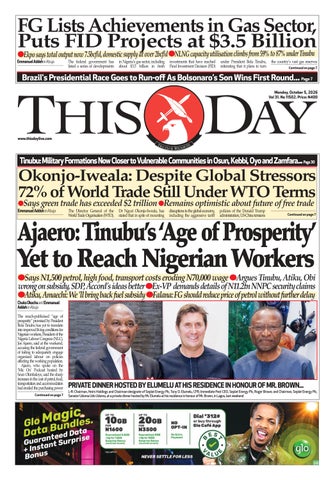
Ajaero: Tinubu’s ‘Age of Prosperity’ Yet to Reach Nigerian Workers Says N1,500 petrol, high food, transport costs eroding N70,000 wage Argues Tinubu, Atiku, Obi wrong on subsidy, SDP, Accord's ideas better Ex-VP demands details of N11.2tn NNPC security claims Atiku, Amaechi: We ’ll bring back fuel subsidy Falana: FG should reduce price of petrol without further delay
Chuks Okocha and Emmanuel Addeh in Abuja
The much-publicised “age of prosperity” promised by President Bola Tinubu has yet to translate into improved living conditions for Nigerian workers, President of the Nigeria Labour Congress (NLC), Joe Ajaero, said at the weekend, accusing the federal government of failing to adequately engage organised labour on policies affecting the working population. Ajaero, who spoke on the ‘Mic On’ Podcast hosted by Seun Okinbaloye, said the sharp increases in the cost of petrol, food, transportation and accommodation had eroded the purchasing power Continued on page 7
PRIVATE DINNER HOSTED BY ELUMELU AT HIS RESIDENCE IN HONOUR OF MR. BROWN...
L-R: Chairman, Heirs Holdings and Chairman-designate of Seplat Energy Plc, Tony O. Elumelu, CFR; Immediate Past CEO, Seplat Energy Plc, Roger Brown; and Chairman, Seplat Energy Plc, Senator Udoma Udo Udoma, at a private dinner hosted by Mr. Elumelu at his residence in honour of Mr. Brown, in Lagos, last weekend
2
MONDAY, OCTOBER 5, 2026 • T H I S D AY
MONDAY, OCTOBER 5, 2026 • T H I S D AY
3
4
MONDAY, OCTOBER 5, 2026 • T H I S D AY
more more than a word,
is our promise to you. ‘More’ is not simply something we say. It is the standard we work towards in every customer interaction. It is listening carefully before we respond. Acting with empathy and urgency. Taking ownership of your needs. And continually improving the experience we provide across our branches, digital channels, contact centres and relationship teams. This Customer Service Week, we thank you for your trust and reaffirm our commitment to going the extra mile for you.
Happy Customer Service Week
MONDAY, OCTOBER 5, 2026 • T H I S D AY
5
6
MONDAY, OCTOBER 5, 2026 • T H I S D AY
7
T H I S D AY • MONDAY, OCTOBER 5, 2026
PAGE SEVEN
Brazil's Presidential Race Goes to Runoff As Bolsonaro’s Son Wins First Round Emmanuel Addeh in Abuja
Brazil's presidential race will go to run a second round after the far-right candidate, Senator Flavio Bolsonaro, son of disgraced ex-President Jair Bolsonaro beat the incumbent leftwing President, Luiz Inacio Lula Da Silva but failed to secure the outright majority he needed to avoid a second round yesterday. With more than 99% of votes counted, the 45-year-old son of
the disgraced former president, Jair Bolsonaro, had won 47.1%, meaning he will now face a 25 October showdown with his 80-year-old rival. Lula received 45%. Bolsonaro will go into the second round as favourite and is likely to be boosted by the migration of votes from the election’s other rightwing candidates, who included Ronaldo Caiado, who secured 2.1%, and Renan Santos, who won 2.2%.
Brazil’s far-right put in a stronger than expected showing, with a succession of Bolsonarista politicians winning congressional or gubernatorial races. They included Jair Bolsonaro’s second son, Carlos Bolsonaro, and his wife, Michelle Bolsonaro, who both won seats in the senate. Bolsonaro’s youngest son, Jair Renan, was elected to the lower house of congress. Bolsonaro’s former infrastructure minister, Tarcísio de Freitas, was reelected
as governor of São Paulo, Brazil’s most populous and economically important state. Of the 54 senators elected, 34 were from the right or far right. Flávio Bolsonaro told supporters in the capital, Brasília, that the result signalled “the end of an era” for Lula’s Workers’ party. “Lula has fought seven presidential elections. He’s worried about power. I am worried about the future of Brazil,” he said. S peaking in Sao Paulo, Lula
put a brave face on a difficult night for the left. “We have just had a lesson in Brazilian democracy,” he said. “The result is often unexpected. We can never get everything we wanted. I confess to you that I was convinced I was going to win the election in the first round … But we have a second round.” Lula said Bolsonaro’s “dark past” would become clearer to voters in the lead-up to that
AJAERO: TINUBU’S ‘AGE OF PROSPERITY’ YET TO REACH NIGERIAN WORKERS
of workers, arguing that a so-called lower inflation rate did not mean Nigerians were experiencing cheaper prices. Tinubu, in his 66th Independence Day broadcast on October 1, 2026, had declared that Nigeria had moved beyond a period of emergency economic reforms into what he described as an “age of prosperity.” He said the “emergency treatment is over”, arguing that the foundation of the economy had been repaired. Using the biblical imagery of the Israelites crossing the Red Sea, Tinubu said Nigeria had “passed through its own Red Sea” and should not look back, with the “Promised Land” ahead representing abundance, opportunity and shared prosperity.
But Ajaero said that while the government had repeatedly pointed to falling inflation and other economic indicators as evidence of progress, ordinary Nigerians were still paying the higher prices created by previous rounds of inflation. “Prosperity is not (currently) with the Nigerian worker,” Ajaero said, while acknowledging that he remained hopeful that the government’s promise could eventually be realised. He challenged the administration to demonstrate where the gains of its economic reforms were being felt by workers, pointing particularly to the removal of petrol subsidy and the subsequent increase in the pump price of petrol. According to him, organised labour accepted the N70,000
minimum wage partly because of assurances that the government would cushion the consequences of subsidy removal through measures including cheaper Compressed Natural Gas (CNG) transportation, vehicle conversion kits, cash transfers and other interventions. But he argued that many of those promises had either not materialised at the required scale or had failed to provide meaningful relief to workers. He recalled that during negotiations over the minimum wage, Tinubu had indicated that he could pay as much as N250,000 but was constrained by the implications for the states and private sector. Ajaero said labour had deliberately avoided demanding an excessively high wage because it
understood that simply increasing nominal wages without addressing inflation and the exchange rate would not necessarily improve workers’ welfare. “We either peg the new minimum wage based on cost of living index or on inflation,” he said, arguing that future wage reviews should automatically reflect changes in the cost of food, accommodation and other basic necessities. The NLC president warned that even a N500,000 minimum wage could become inadequate if the cost of living continued to rise. “If I get N500,000 minimum wage, and I can’t pay my house rent, of what use?” he asked. He explained that the central problem was not simply the size of workers’ salaries but the declining
value of the naira and persistent increases in the cost of goods and services. Ajaero used the price of garri, one of Nigeria's staple foods to illustrate his argument, saying that if the price increased from N20 to N30 and subsequently rose from N30 to N32, the fact that the latest increase was smaller did not mean the price had fallen. He therefore rejected the interpretation that Nigerians were experiencing relief simply because the rate of inflation was slowing. “If they are now coming out with this one, they say, ‘Oh, in the last two weeks, it moved by N10, but in the last week, it moved by N2.’ The whole increase is a value on the consumer,” he pointed out. He also criticised the
Bolsonaro
vote. “From tomorrow we will launch a new campaign: [and in] a campaign with only two candidates we will be able to show the difference between our proposals for Brazil.” implementation of the N70,000 minimum wage, saying that in some states, the consequential adjustments had been poorly handled, leaving workers worse off than anticipated during negotiations. According to him, the N70,000 figure represented the minimum for the lowest level and step in the public service structure and was not necessarily the final salary received by every worker. He said the failure to properly implement consequential adjustments had contributed to dissatisfaction among public servants. On petrol prices, Ajaero argued that Nigeria’s status as an oil-producing country should Continued on page 37
OKONJO-IWEALA: DESPITE GLOBAL STRESSORS 72% OF WORLD TRADE STILL UNDER WTO TERMS and the impact of the Iran war on energy markets, 72 per cent of global goods trade is still being conducted under WTO rules. Okonjo-Iweala, who spoke with CNN’s Fareed Zakaria at the weekend, said the resilience of the multilateral trading system had surprised even officials of the WTO, arguing that businesses continued to rely on the stability and predictability provided by the organisation’s rules despite growing protectionism and geopolitical tensions “We are very truthful and say that even we are surprised by the resilience and grateful for it,” she said, explaining that the WTO had examined how much of global trade was still taking place according to its rules. “We find that 72 per cent of world trade, world goods trade, is still taking place on WTO terms, on most favoured nation terms. That's what we call predictable,
stable,” she emphasised. Her assessment comes against the backdrop of what she described as the worst disruption to global trade in 80 years, with the United States, historically one of the strongest proponents and beneficiaries of the multilateral trading system, increasingly turning towards protectionist policies. Okonjo-Iweala said businesses were helping to sustain the system because they needed stability and predictability to make investment and trading decisions. She also pointed to strongerthan-expected global trade growth as another indication of resilience. According to her, the WTO had initially projected growth in global goods trade of about 2.4 to 2.5 per cent last year, but actual growth came in at 4.6 per cent. A significant part of that expansion, she said, was driven by the rapid growth of artificial
intelligence-related goods, including semiconductors and processors. “Forty-two per cent of that growth last year was contributed by trading AI, semiconductors, processors, all the things,” she said. The WTO chief, however, cautioned against interpreting the strong performance as evidence that the global trading system was immune to current shocks. For 2026, the organisation had initially projected global goods trade growth of 1.9 per cent amid tariff disruptions, geopolitical tensions, energy price pressures and bottlenecks such as the Strait of Hormuz. But first-quarter figures showed growth of 3.2 per cent, again exceeding the WTO's expectations. Okonjo-Iweala said the strong performance of AI-related trade also required caution because the expansion was highly concentrated in East Asia and North America,
particularly the United States. “We don't know whether this can be sustained or it's a bit of a bubble. So we have to watch out for that,” she said, warning that the concentration of the benefits could become problematic if other regions were excluded from the AI-driven expansion. She nevertheless said the persistence of trade under WTO rules had strengthened her belief that the multilateral system retained a strong core, even as its robustness remained under pressure. “I used to think that with what is going on, the worst disruption for global trade in 80 years, that we wouldn't see these kinds of numbers, I'll be honest with you. But now I'm seeing some persistence in those numbers that lead me to believe that there's a core of the rules that really work, that it was largely well built, has benefited the world, you know,
FG LISTS ACHIEVEMENTS IN GAS SECTOR, PUTS FID PROJECTS AT $3.5 BILLION
into a major source of industrial growth. Minister of State for Petroleum Resources (Gas), Ekperikpe Ekpo, disclosed this in Abuja at the weekend during a media parley, mentioning the four projects that had reached FID as Iseni Project valued at approximately $122 million, Ubeta at $566 million, the HI Project at $2 billion and the Ima Project at $800 million. According to him, the four projects collectively represented approximately $3.5 billion in committed investment, while the approximately $3.5 billion Brass Methanol Project had also
advanced towards execution, following the resolution of its Gas Sales and Purchase Agreement (GSPA). Ekpo said the developments were evidence that investor confidence was returning to the gas sector, stressing that the federal government’s focus was now on increasing production, accelerating infrastructure development, expanding domestic utilisation and ensuring that gas resources translated into tangible economic benefits. “This administration will therefore remain accountable for turning these approvals —and
Nigeria’s gas wealth—into reliable energy, stronger industries, more jobs and lasting prosperity. The investment commitments now before us show that this next phase is already taking shape. “That confidence is evident in four major gas projects that have reached Final Investment Decision (FID): Iseni Project, at approximately $122 million; Ubeta Project, at approximately $566 million; HI Project, at $2 billion; and Ima Project, at $800 million. Together, they account for approximately $3.5 billion in committed investment. “The approximately $3.5 billion
Brass Methanol Project has also advanced towards execution following resolution of its Gas Sales and Purchase Agreement. These are not merely project milestones; they are evidence that responsible investment can create enduring domestic value, strengthen productive capacity and generate employment,” he stated. He reiterated Nigeria’s proven 2P gas reserves had risen from approximately 208.83 trillion cubic feet (TCF) in 2023 to 215.19 TCF as at January 1, 2026, while average gas production increased from about 6.86 billion cubic feet per day (bcf/d) to approximately
made prosperity, 1.5 billion people taken out of poverty as a result of this,” she stated. Okonjo-Iweala, however, drew a distinction between resilience and robustness, saying the system had proved capable of absorbing significant shocks but remained vulnerable to deeper structural pressures. “It doesn't mean that the system, it's resilient, but is it robust? And I don't think it is,” she said. Despite those concerns, the former Nigerian finance minister said she remained fundamentally optimistic about the future of free trade, although she acknowledged that the global trading system would not return to its previous form. She said member countries had nevertheless recognised the need to reform the organisation if it was to remain relevant and preserve the resilience of the global
trading system. “For whatever reason, they've come to accept that if we are going to be a modern organisation and maintain that resilience and robustness we talked about, they have to reform. So I'm optimistic,” she said. Beyond merchandise trade, Okonjo-Iweala highlighted the rapid expansion of digital trade and digitally delivered services, saying they represented important areas of opportunity in the evolving global economy. She also pointed to the growth of green trade, which she said had now exceeded $2 trillion, as another positive development. The WTO director general said the changing structure of global trade meant that the future would not be defined solely by traditional movement of physical goods, but increasingly by services, digital commerce, technology and green products.
7.5 bcf/d. Domestic gas supply, he added, had now crossed 2 bcf/d, with the federal government targeting production of 10 bcf/d by 2027 and 12 bcf/d by 2030. He explained that the expansion was critical to meeting growing demand from power generation, industries, fertiliser and petrochemical plants, LNG, transportation and other domestic and export markets. The minister also disclosed that Nigeria LNG’s nameplate capacity utilisation had recovered significantly, rising from approximately 59 per cent at the beginning of the administration
in 2023 to about 87 per cent year-to-date in 2026. He attributed the improvement partly to increased stability in the Niger Delta and greater participation by indigenous companies in upstream production. According to him, the momentum would be further strengthened by the Train 7 project, which is under construction and targeted for completion in June 2027. He said the project would add approximately 8 million tonnes per annum to the existing 22 million tonnes of LNG capacity, taking Continued on page 36
8
NEWS
T H I S D AY • MONDAY, OCTOBER 5, 2026
Group News Editor: Goddy Egene Email: Goddy.egene@thisdaylive.com, 0803 350 6821, 08074010580
WHEN CEMENT MAGNATES VISITED THE PRESIDENT...
President Bola Ahmed Tinubu (right) and President of Dangote Group, Aliko Dangote during his visit to the president at his Ikoyi residence in Lagos, last Friday
President Bola Ahmed Tinubu (right) and Founder and Chairman BUA Group, Abdul Samad Rabiu during his visit to the president at his Ikoyi residence in Lagos, last Friday
Shettima: Our Economic Reforms Must Translate into Greater Purchasing Power, Improved Quality of Life for Nigerians
Says Nigeria owes women an economy worthy of their labour Flags off Community Investment Fund to empower businesswomen in Katsina Inaugurates several road, public transportation projects, receives defectors into APC Deji Elumoye in Abuja
Vice President Kashim Shettima has stressed the need for government's economic reforms to translate into stronger businesses, greater purchasing power, and improved quality of life for Nigerians. Shettima spoke on Sunday in Katsina while flagging off the Community Investment Fund (CIF) disbursement, in a major push for women empowerment and financial inclusion under the Nigeria for Women Programme Scale-Up (NFWP-SU) Project. He declared during the event held at Muhammadu Dikko Stadium, "For the administration of President Bola Tinubu, economic reform must
find expression in the earning capacity of citizens. “We must connect national policy to the circumstances of the trader, the producer and the service provider. "Our task is to make their effort more rewarding, so that the pursuit of national growth becomes intelligible in the accounts of an ordinary household." The vice president also canvassed for a conducive business environment for Nigerian women to ply their trade, saying the country owes them an economy worthy of their labour. According to him, women should be given more space for their ambition to flourish, unlike in the past when they
carried heavy responsibilities with limited resources for their businesses to thrive. He also inaugurated 32 compressed natural gas-powered buses and 200 electric-powered tricycles under the Katsina State Comprehensive Urban Renewal Programme as well as several completed road projects undertaken to improve traffic flow, connectivity, and urban mobility in state metropolis. The vice president said the CIF fund disbursement answered a question that should trouble every government as it bordered on how much prosperity had been postponed by asking women to work miracles with too little capital. According to Shettima, over
40,000 women in Katsina are eligible to receive business capital after fulfilling the prescribed eligibility conditions and demonstrating satisfactory performance in their savings and group activities. Making a strong case for women empowerment, he said, "Our daughters should inherit their mothers’ determination without inheriting every obstacle their mothers endured. That is another reason to make this programme succeed. The girl who watches a business grow in her own household learns that skill can yield an income, and that ambition can survive contact with adversity. "We owe these women an economy worthy of their
ExxonMobil Pushes Integrated Workflows To Unlock More Nigeria Deepwater Value Says country's assets require cutting-edge technology
Peter Uzoho
American oil and gas giant, ExxonMobil, has said unlocking substantial value from Nigeria's deepwater producing fields, undeveloped discoveries, and yet-to-find resources will require cutting-edge technology and integrated workflows. Subsurface General Manager at Esso Exploration and Production Nigeria Limited, ExxonMobil's Nigerian affiliate, Mr. Nathan Harts, stated this at the Technical/Business Meeting of the Nigerian Association of Petroleum Explorationists (NAPE) in Lagos. The theme of the session was "From Seismic to Value: Leveraging Seismic Inversion & Forward Seismic Modelling in Geomodeling to Enable Field
Development." Harts said ExxonMobil continued to deploy integration, cross-discipline behaviours and advanced technologies to costeffectively develop its Nigeria portfolio. "ExxonMobil continues to deploy those same behaviours, techniques, and technologies as we continue to cost-effectively develop the resources in Nigeria," he said. Harts stated, "At ExxonMobil, we do strongly believe that successful development does require challenging ourselves for cutting-edge technology and integrated workflows, and we remain committed to continuing to do that for the resources we develop here in Nigeria. "We believe that that will also unlock substantial value from
the resources that are currently producing, those that have yet to be developed, and those that have yet to be discovered." The drive aligned with ExxonMobil's sharpened deepwater focus after its $1.28 billion onshore and shallowwater exit to Seplat in 2024, with capital now targeted offshore. Last July, the company announced a $1biilion Final Investment Decision (FID) commitment focused on revitalizing Usan deepwater field where it holds 30 percent via Esso Exploration and Production Nigeria (Offshore East). It is working with its partners to progress other assets in the deepwater to FID. For ExxonMobil, Harts said developing Nigeria's resources
required industry knowledge sharing. He explained, "I do appreciate the esteemed officers of NAPE for pulling together meetings like this so that we can transfer knowledge as an industry. It is certainly a requirement for us to develop the Nigeria resources that we all have been blessed to develop." Harts said, "On behalf of ExxonMobil, I would like to express my sincere appreciation to Michael McGlashan (the paper presenter) for his time and commitment to bringing knowledge to this organization. As a proud sponsor of this event, we are honoured to support initiatives that promote crossindustry collaboration, knowledge sharing, and professional development."
labour. They have carried heavy responsibilities with limited means; their ambition should now have more room to flourish. With confidence in their abilities, I hereby flag off the Community Investment Fund disbursement under the Nigeria for Women Programme Scale-Up Project in Katsina State. May Almighty Allah bless their efforts and grant our country enduring prosperity." The vice president hailed Governor Dikko Radda's sensitivity to what he described as an "economic necessity that reaches beyond the loudest
voices". He stated that the governor's "attention to women and vulnerable households honours an essential duty of leadership: to hear those whose difficulties seldom command a microphone". He said, "A government earns affection when the citizen with the least influence receives its fullest attention.” Shettima said, "Katsina’s concern for enterprise acquires deeper meaning when it reaches the woman whose ambitions have remained smaller than her abilities because her resources could carry her no further.
NAFDAC DG Seeks Foreign Partners' Support for Local Vaccine Production
Onyebuchi Ezigbo in Abuja
The Director General of the National Agency for Food and Drug Administration and Control (NAFDAC), Prof. Mojisola Adeyeye, has solicited the support of international partners to establish vaccine manufacturing facilities in Nigeria. She said that opening vaccine manufacturing companies will hasten the push by the agency to attain World Health Organisation (WHO) Maturity Level 4 for vaccine lot release. Adeyeye made the call at the 8th Nigeria Pharma Manufacturers' Expo in Lagos, jointly organised by the Pharmaceutical Manufacturing Group of Manufacturers Association of Nigeria (PMG-MAN) and PGE Expo Pvt Ltd. A statement signed by NAFDAC's Resident Media Consultant Sanyo Akintola said the DG acknowledged the continued support of international partners in NAFDAC's attainment
of Maturity Level 3, and challenged them to contribute to fill-and-finish modular vaccine manufacturing. According to Adeyeye, NAFDAC has nine functions to meet for full benchmarking for medicines and vaccines, but has only been benchmarked in eight, with lot release for vaccines outstanding. "We want to call on our international partners that have been of tremendous help. Without them we wouldn't have been here. I want to challenge them to contribute to fill and finish modular vaccine manufacturing so that we can get our vaccine lot release," she said. She said Nigeria has what it takes to attain the level except local vaccine manufacturing, adding that the cost has been estimated and will not be too high. "We cannot afford to go back to where we used to be," she said. Recalling that Nigeria used to manufacture vaccines, Adeyeye said it is time to return to local production.
MONDAY, OCTOBER 5, 2026 • T H I S D AY
9
10
MONDAY, OCTOBER 5, 2026 • T H I S D AY
MONDAY, OCTOBER 5, 2026 • T H I S D AY
11
12
MONDAY, OCTOBER 5, 2026 • T H I S D AY
Pension Transitional Arrangement Directorate
PTAD HEALTH INSURANCE SCHEME (PHIS) FOR DBS PENSIONERS STEP BY STEP REGISTRATION
I
n line with His Excellency, President Bola Ahmed Tinubu GCFR, Renewed Hope Agenda on improved welfare scheme for Defined Benefit Scheme (DBS) Pensioners, the Pension Transitional Arrangement Directorate (PTAD) has launched the PTAD Health Insurance Scheme (PHIS) for DBS Pensioners, a free, quality and reliable health insurance coverage for all Federal DBS Pensioners managed by PTAD and in collaboration with the National Health Insurance Authority (NHIA). To register: 1.
Go to www.phis.ptad.gov.ng using a smartphone or computer system.
2.
Start the process using the 2-step login validation process: a. Enter your PENSION NUMBER. b. Enter your SURNAME.
3.
Hold the phone or computer camera close to your face to take a live photo. Follow the instructions on the screen and/or listen to the instructions.
4.
When your photo is successfully captured, proceed to fill in your information completely and accurately. Your National Identity Number (NIN) is a mandatory field to complete the registration process.
5.
Update your information if there is an error or if it has changed since your last verification exercise with PTAD.
6.
Input the names and contact numbers of one (1) Caregiver and one (1) Next-of-Kin who can be reached in case you have a medical emergency.
7.
Select a hospital closest to your home address from the drop-down list. This is the hospital where you will receive treatment with your PTAD Health Insurance.
8.
Read and accept the terms and conditions by ticking the box.
9.
Click the submit button.
10.
You will receive a success notification on your screen. Further updates on your enrollment will be provided in due course through PTAD's approved communication channels.
Please note that your PTAD Health Insurance , which has a mandatory waiting period, covers NHIA approved/registered hospitals and health facilities in Nigeria. Spouses, Dependants, NoKs, and Caregivers are not covered by this insurance, and it is not transferable.
Signed: Tolulope A. Odunaiya Executive Secretary 02094621727, 07072173943
info@ptad.gov.ng & ptadhealthcare@ptad.gov.ng
www.ptad.gov.ng
MONDAY, OCTOBER 5, 2026 • T H I S D AY
13
14
MONDAY, OCTOBER 5, 2026 • T H I S D AY
MONDAY, OCTOBER 5, 2026 • T H I S D AY
15
He commenced his insurance journey in 1994 as a Management Accountant at Industrial and General Insurance Company (IGI). However, it was his transition to Standard Alliance Insurance Plc in 1997 as its pioneer Chief Financial Ofcer that set off a legendary trajectory.
His insatiable thirst for global administrative knowledge led him through elite institutions worldwide. He is an alumnus of the prestigious Chief Executive Programme at the Lagos Business School, the elite Owner/President Management (OPM) Program at Harvard Business School, Boston, USA, and holds a Certicate in Private and Alternative Investment from the Ivey Business School at Western University, Toronto, Canada.
Mr. Akinboye’s journey into corporate prominence began with a rigorous foundation in accounting and nancial management. A graduate of Accountancy, he is a highly decorated professional—a Fellow of the Institute of Chartered Accountants of Nigeria (FCA), a Fellow of the Nigerian Institute of Management (FNIM), a Member of the Chartered Institute of Directors (M.CIoD), and an Associate Member of the Chartered Insurance Institute of Nigeria.
A Foundation Layered in Global Best Practices
True to his reputation as an institutional builder, his current leadership has already triggered a massive shift in public trust. Speaking in a denitive August 2026 interview with Vanguard, Mr. Akinboye disclosed that Fortis Global has aggressively cleared more than N2 billion in outstanding retail customer claims, alongside nearly N700 million in outstanding pension benets, while maintaining seamless monthly payments to pensioners. By actively reconciling investment-linked policies and driving a tech-driven approach to timely claims administration, he is systematically proving that true transformation begins with honoring customer trust.
This profound focus on human capital forms the bedrock of his current assignment. In October 2025, the underwriting landscape witnessed a powerful corporate renaissance when the Board approved his appointment as the Group Chief Executive Ofcer of Fortis Global Holdco, effective 1st October 2025. Tasked with driving the overarching transformation and repositioning of the Fortis Global Group, Mr. Akinboye stepped into an arena requiring both clinical precision and the restoration of public condence. Under the new Fortis Global identity, the institution formerly known as Standard Alliance has embarked on a historic chapter of recapitalisation, structural renewal, and operational strengthening.
A Monumental Vocation of Corporate Rebirth
Today, a vast, widespread generation of leaders—many now steering major portfolios, heading corporate boardrooms, and disrupting the nancial ecosystem in their 40s and beyond—proudly trace their foundational growth, professional condence, and strategic execution back to his masterclasses. By investing his time, intellect, and trust into young professionals, he silently established a leadership academy that continues to feed the entire nancial services industry with top-tier talent.
He intentionally threw his teams into the deep end of complex corporate execution, but he never left them to drown. He guided them with a perfect, rare blend of strict discipline, unwavering professional integrity, and profound empathy. He did not just demand excellence; he provided the architectural blueprint for it.
Throughout his illustrious career, Mr. Akinboye’s greatest trademark has been his unyielding belief that institutions are only as strong as their people. He famously pioneered a unique style of leadership that prioritized human growth over mere administrative supervision. Under his wing, young and ambitious professionals were never just employees; they were future leaders in training.
The Master Mentor: Building the Industry’s Human Capital
As the Nigerian nancial services sector celebrates the milestone of an exceptional corporate catalyst, Mr. Oyebode Walter Akinboye, FCA, FNIM, M.CIoD, the spotlight naturally illuminates a career dened by over three decades of unbroken excellence. More importantly, it celebrates his enduring legacy as a premier "Architect of Men" who has built, mentored, and unleashed a generation of giants across the insurance landscape.
n the upper echelons of corporate governance and nancial engineering, leadership is rarely dened by numbers alone. While balance sheets tell a story of growth, the ultimate test of an industry titan lies in their capacity to reproduce leadership—the deliberate, seless act of taking raw talent, nurturing it with intellectual rigor, and turning protégés into corporate pioneers.
I
His rst thirteen-year tenure became the golden era of the rm. A 2015 Nigerian Stock
At Standard Alliance, Mr. Akinboye's rise was meteoric but deeply earned. Moving from Group Head of Financial Institutions, Oil and Energy, he was entrusted as the founding General Manager and CEO to establish the group’s life insurance subsidiary, Standard Life Assurance Company. He subsequently climbed the ladder to become Deputy MD/COO, Managing Director in 2003, and ultimately Group Managing Director in April 2007, overseeing a vastly expanding multi-billion naira portfolio.
The Golden Era of Institutional Growth
Happy Birthday, Sir!
We salute a magnicent enterprise leader, a corporate alchemist, a master mentor, and a true builder of men.
The industry is richer, bolder, and more secure today not just because of the companies he built, but because of the vast network of exceptional leaders he poured his life into training.
Today, as Mr. Oyebode Walter Akinboye steers the Fortis Global transformation agenda toward building a stronger, simplied, and deeply trusted insurance institution, the Nigerian business community stands on its feet to celebrate him.
A Legacy of Honor and Excellence
Beyond executive duties, his industry service includes membership on the Governing Council of the Nigerian Insurers Association (2004–2009) as its Honourable Treasurer. His expertise was recognized nationally when the Central Bank of Nigeria appointed him to the Technical Sub-Committee on the Nigerian International Financial Centre under the Financial System Strategy (FSS) 2020 initiative.
Thus, when he assembled an investment vehicle to acquire a strategic controlling stake and returned to Standard Alliance in 2015 as MD/CEO, he introduced his famous "Three Ps" philosophy—People, Process, and Product. He rmly maintained that sustainable corporate transformation is impossible without capable people, efcient processes, and products that solve real human needs.
When he stepped away after his rst tenure, Mr. Akinboye’s entrepreneurial instinct drove him into private equity, consulting, and technological frontier ventures, associating with trailblazing rms like Cellstop (telemetry and tracking solutions) and KBN Hydrogen Solutions (power optimisation), while serving as an African adviser to Airo Life Be Free Phone.
The Multi-Sectoral Vision and the Three Ps
Exchange (NSE) market bulletin credited his visionary leadership with catapulting the company’s asset base beyond N20 billion, facilitating an unprecedented US$20 million in Foreign Direct Investment (FDI), and masterminding the company’s landmark Initial Public Offering (IPO) and listing on the Exchange in 2003. Under his watch, the company proudly clinched the NSE President’s Merit Award in the Insurance category in 2005.
OYEBODE WALTER AKINBOYE’S Indelible Footprints on Insurance and Its Leaders
The Architect Of Men And Faithful Transformation:
16 MONDAY, OCTOBER 5, 2026 • T H I S D AY
17
T H I S D AY • MONday OCTOBER 5, 2026
Politics
Acting Group Politics Editor DEJI ELUMOYE Email: deji.elumoye@thisdaylive.com 08033025611 sms only
M O N D AY D I S C O U R S E
10th N’Assembly: Turning Repeated Budget Extension into Norm
For the fourth time, the National Assembly has extended the 2025 capital budget implementation, raising questions about fiscal planning, execution bottlenecks and whether repeated extensions are becoming Nigeria’s new budgetary norm. Sunday Aborisade reports.
Akpabio
W
hen a legislature extends the lifespan of a budget once, the decision may be understood as an administrative response to unforeseen circumstances. When it happens repeatedly, however, it becomes a question of policy, planning and institutional capacity. That is the dilemma confronting Nigeria following the Senate’s decision to extend, for the fourth time, the implementation period of the capital component of the 2025 Appropriations Act from September 30 to December 31, 2026. The extension, approved through an amendment to the Appropriations Repeal and Enactment Act 2025, was defended as necessary to prevent the abandonment of ongoing projects and ensure that appropriated and released funds are properly utilised. On the surface, the argument is compelling. Why should the government terminate projects that are already substantially completed merely because the legal window for spending the relevant appropriation has expired? Why should contractors who have executed substantial portions of their contracts be left unpaid? And why should Nigerians lose infrastructure simply because bureaucratic processes have outlived the calendar attached to a particular appropriation? Yet, beneath those legitimate concerns lies a bigger question: why does Nigeria repeatedly find itself in this position? The fourth extension has therefore moved the debate beyond whether the 2025 capital budget deserves additional time. It should compel the Federal Government, National Assembly and fiscal authorities to examine why budget implementation routinely falls behind schedule in the first place. Presenting the amendment in the Red Chamber, Senate Leader, Senator Opeyemi Bamidele, explained that several capital projects remained at different stages of implementation, while significant amounts of released capital funds had not been utilised. He noted that capital expenditure was not simply a matter of appropriating money. It involved procurement, contract award,
Abbas
mobilisation, execution, certification and payment, all of which had to be properly coordinated. According to him, allowing the September 30 deadline to expire could create difficulties for ministries, departments and agencies seeking to complete projects already at advanced stages. That reasoning is difficult to dismiss. A budget is ultimately a legal authority for government to raise and spend public money for specified purposes. If money has been appropriated and released for a legitimate project, and the project is substantially underway, abruptly shutting down implementation could produce precisely the waste the government claims the extension is intended to prevent. Senate President, Senator Godswill Akpabio made a similar argument, warning against allowing abandoned projects to proliferate across the country. He said several contractors had neither completed their projects nor received full payment for work executed under the 2025 Appropriations Act, arguing that it would be counterproductive to allow the September 30 deadline to pass without providing additional time for the Federal Government to settle outstanding obligations. But the argument also presents a
Bamidele
paradox. If extensions are repeatedly required to prevent projects from becoming abandoned, does the extension solve the underlying problem or merely postpone it? That is where the intervention of the Senate Chief Whip, Senator Tahir Monguno, becomes particularly significant. Monguno identified the centralised payment system domiciled in the Office of the Accountant-General of the Federation as one of the factors responsible for delays in budget implementation. His warning was blunt: unless the system is reviewed, Nigeria could continue returning to the National Assembly to seek extensions of budget implementation. He described the policy as a “cork in the wheel” of budget implementation and urged the Executive to reconsider it. The argument deserves serious attention because payment is one of the final but most critical links in the budget implementation chain. A ministry may complete procurement. A contractor may mobilise. Work may progress. Certificates may be prepared and approved. But if payment remains trapped in a slow administrative process, the practical outcome is still delayed implementation. Centralisation, in principle, can serve legitimate purposes. It can strengthen expenditure control, reduce leakages, improve visibility over government finances and prevent agencies from operating fragmented payment arrangements.
The objective should be straightforward: centralise oversight, not unnecessary delay. If the Accountant-General’s office must retain central control over public funds, it should have the technology, staffing, service standards and internal processes required to approve legitimate transactions promptly.
The problem, therefore, may not necessarily be centralisation itself but how centralisation is designed and operated. A system intended to improve fiscal discipline should not become so cumbersome that legitimate expenditure is delayed indefinitely. The Federal Government could consequently examine whether certain categories of already-approved payments can be processed through a more decentralised, technologydriven and accountable framework, while retaining central oversight. Such a reform would not mean returning to an era of weak financial controls. Rather, it would mean combining central oversight with institutional responsibility. There is also a need to distinguish between control and delay. A payment system that prevents fraud is valuable. A payment system that unnecessarily delays legitimate payments, however, can itself become a source of economic inefficiency. Contractors depend on timely payments to maintain cash flow, pay workers, purchase materials and remain on project sites. When government payment delays occur, projects can slow down, costs can rise and contractors may ultimately price future contracts to accommodate perceived payment risks. The consequences are eventually borne by the public. This is why the latest extension should not be treated simply as another legislative routine. The Federal Government should use the additional three months as an opportunity to complete eligible projects and settle genuine outstanding obligations, but equally as a deadline for fixing the institutional weaknesses that made the extension necessary. Otherwise, there is a legitimate fear that Nigerians may be having this same conversation again. And that is the uncomfortable question hanging over the December 31 deadline: what happens when December 31 arrives and some projects are still incomplete? NOTE: Interested readers should continue in the online edition on www.thisdaylive.com
18
FEatures
T H I S D AY • MONDay, OCTOBER 5, 2026
Group Features Editor: Chiemelie Ezeobi Email chiemelie.ezeobi@thisdaylive.com,
Nigeria @ 66 and the Imperative for NPF to Stay Ahead of Faster, Borderless Crime
Given that crime in Nigeria is no longer confined to familiar offences such as robbery, burglary and physical attacks but has become more organised, technology-driven, financially sophisticated and increasingly borderless, the need to create a security environment in which the police can adapt as quickly as new technologies emerge has become imperative. In commemoration of Nigeria’s 66th Independence Anniversary, Deputy Inspector-General of Police Frank Mba (Rtd) posits that the country’s policing architecture must evolve faster, with stronger investment in technology, intelligence, specialised training, digital forensics and international cooperation, if the police are to stay ahead of criminals rather than continually respond to them. Chiemelie Ezeobi reports
F
or years, crime in Nigeria was largely associated with offences that happened in physical spaces like robbery, burglary and assault. They involved criminals and victims meeting, often in identifiable locations, and investigations were largely built around physical evidence, eyewitness accounts and conventional police methods. Now, that picture has changed because crime has expanded beyond the street and the physical encounter. Technology, globalisation and sophisticated financial systems have opened new avenues for criminals, changing not only how offences are committed but also how far criminal activities can reach. It is against this changing security environment that a retired Deputy Inspector-General of Police, DIG Frank Mba, believes Nigeria must rethink the speed and capacity of its policing architecture. Mba, now a legal practitioner, security consultant and reputation management expert, gave the assessment while speaking on Nigeria’s security situation as the country marked its 66th Independence Anniversary. His concern is straightforward: while the police are changing, criminals are changing too and they may be doing so faster. Globalisation, Technological Advancement as Crime Enablers According to Mba, the crimes that once dominated Nigeria’s security landscape were largely conventional. Robbery, burglary and assault were among the offences that were predominantly physical and localised. But criminality has since evolved in its pattern, approach, spread, methodology, intensity, lethality and sophistication. He said the transformation was partly a reflection of changes in society, while globalisation and technological advancement had also become major enablers for criminals. Kidnapping, terrorism, cultism, organised crime and cyber-enabled offences have emerged and expanded within this changing environment. The significance of the change, in Mba’s assessment, is that criminal activity is no longer necessarily tied to a particular location or dependent on physical contact. “Crime has become more organised, globalised, more technology-driven, financially sophisticated and, in many cases, virtual, contactless and borderless,” he said. The words “virtual”, “contactless” and “borderless” capture the direction in which Mba says criminality has moved, adding that a criminal operation can increasingly involve technology, financial systems and networks that extend beyond the immediate environment in which an offence eventually becomes visible. That has also changed what policing requires and to that, the conventional tools of policing, Mba argued, are no longer enough on their own. The Police are Changing Too It would be inaccurate, however, to suggest that the Nigeria Police Force has remained unchanged while criminality evolved. Mba acknowledged that the Force had responded to the changing security environment in several significant ways. He cited the activities of the National Cybercrime Centre in tackling cyber-enabled offences as one example of the response to emerging forms of criminality. He also pointed to increased collaboration between the Nigeria Police Force and international organisations, including INTERPOL
staying ahead of criminals rather than merely responding to emerging threats. That distinction is important to his argument. A policing system that is constantly responding after criminals have changed their methods risks spending its time catching up. Mba wants the Force to develop the capacity to anticipate changes and prepare officers before those changes become major security problems.
DIG Mba (Rtd.)
and AFRIPOL. That cooperation, according to him, has become particularly relevant to intelligence sharing and advanced training in the investigation of terrorism, money laundering, human and narcotic trafficking and other transborder crimes. There has also been a change in police training. Mba said training programmes for police personnel were being modified to reflect emerging security realities, with greater emphasis now being placed on cybercrime investigation, digital forensics, financial crime, intelligence and counterterrorism. These developments, he said, showed that Nigeria’s policing architecture had evolved positively in significant ways. But that is not where his assessment ends. For Mba, the more difficult question is whether the pace of that evolution is fast enough. ‘The Criminals Are Not Waiting’ There is a race between the ability of law enforcement to respond to crime and the ability of criminals to find new ways of committing it. Mba’s warning is that the police cannot afford to assume that the improvements already made will automatically be enough for the threats ahead. Criminals, he said, are also constantly learning. They are exploiting new technology, adapting their methods and taking advantage of opportunities created by increasingly sophisticated systems. “The criminals are not waiting for the police,” he said. It is this reality that Mba said makes the speed of police adaptation important.
He stressed that the speed, spread, lethality, cyber capabilities and sophistication of criminal activities continued to pose serious challenges to the crime-fighting efforts of the Nigeria Police Force. The challenge, therefore, is not simply to respond whenever a new crime emerges. It is to ensure that the Force has the capabilities to understand and confront criminal methods as they develop. For Mba, that means a policing system that is equipped for a security environment where criminals can operate through technology, sophisticated financial systems and networks that may extend beyond national borders. The Gaps that Remain Mba identified inadequate training and a shortage of up-to-date digital forensic tools as major operational gaps requiring urgent attention. The gaps are significant because the changing nature of crime places new demands on police personnel. This means that an officer investigating a conventional robbery and an officer investigating a cyber-enabled financial crime may require very different skills, tools and investigative approaches. That is why Mba called for sustained investment in the Nigeria Police Force, particularly in personnel, specialised training, technology, intelligence capabilities and international partnerships. For him, investment cannot be separated from the need to keep pace with criminal innovation. He said the police must deliberately continue to evolve with changing technology and crime trends, with the objective of
Ultimately, the NPF leadership should remain futuristic. Our police officers should be prepared, not just for the crimes they are fighting today, but for the crimes that will emerge tomorrow
Beyond Equipment, There Is Trust Technology and specialised training form one part of Mba’s assessment. But he also drew attention to the relationship between the police and the people they serve. He stressed the need for the Nigeria Police Force to rebuild and regain the trust of Nigerians. For Mba, public confidence is an important component of effective policing. The call comes alongside his argument for greater investment in personnel, intelligence, technology and specialised capabilities, placing the public relationship within the wider requirements of contemporary policing. The police may have sophisticated tools and training, but Mba believes the relationship with citizens remains important to the effectiveness of the Force. His position also reflects the broader changes he identified in the nature of crime: as criminal activities become more organised, globalised and technology-driven, policing must respond with more than conventional physical operations. It must combine technology and intelligence with the confidence and cooperation of the public. Need to Prepare Officers for Crimes Yet to Come For Mba, perhaps the biggest test of Nigeria’s policing architecture is not how it responds to the crimes already confronting the country, but how prepared it is for those that have not yet emerged. He urged the leadership of the Nigeria Police Force to adopt a futuristic approach to policing. That means looking beyond the crimes that officers are currently dealing with and preparing for changes in criminality that could accompany further technological advancement and changing patterns of crime. It is also why he linked the future of policing to sustained investment including the fact that personnel must be developed; specialised training must continue; technology must be upgraded. Intelligence capabilities must be strengthened; and international partnerships be sustained. And the police must continue to understand how criminals are changing. Mba’s warning is not that the Nigeria Police Force has failed to evolve. Rather, it is that evolution must continue and at a pace that recognises that criminals are themselves adapting. The transformation from conventional, physical and localised offences to crimes that can be organised, financed and executed through sophisticated systems has already changed the security environment. The next challenge, as Mba sees it, is ensuring that the police do not arrive late to the next phase of that transformation. “Ultimately, the NPF leadership should remain futuristic. Our police officers should be prepared, not just for the crimes they are fighting today, but for the crimes that will emerge tomorrow,” he said.
19
T H I S D AY • MONDAY, OCTOBER 5, 2026
POLITY
Lagos Economic Council: Why Obafemi Hamzat Should Lead Nigeria’s Economic Capital
Opeyemi Eniola
abroad.
agos is not just Nigeria’s commercial hub. It is the country’s economic oxygen. It drives a disproportionate share of national output through trade, manufacturing, ports, financial services, and logistics. In plain terms, Lagos does not merely contribute to the Nigerian economy—it sets its pace. What happens here does not stay here. Policy decisions, infrastructure gaps, rising costs, and governance reliability in Lagos shape investment choices, jobs, supply chains, and fiscal behaviour far beyond the state. That is why the emerging talk of a Lagos State Economic Council, and the case for electing Dr. Kadri Obafemi Hamzat as governor in 2027, should not be dismissed as campaign talk. It is a question of national economic strategy. Who is best placed to keep Lagos competitive, cut unnecessary friction for businesses, and build on the gains made since 1999 without losing momentum?
The National Stakes
L
What Lagos gets right becomes a signal for the rest of the country. Investors often treat the state as a proxy for Nigerian risk. Clearer levies, better data for planning, more reliable public-private partnerships, and infrastructure that actually reduces friction create demonstration effects. Other states notice. Models for internally generated revenue and multi-tier economic coordination can travel. For the APC, putting a continuityminded, systems-oriented governor in charge of Nigeria’s economic capital fits a broader claim about delivery and reform. It also underscores a basic truth: sub-national engines of growth matter as much as federal initiatives. Lagos is positioned to lead that work if the right hands are on the wheel.
What Still Has to Be Got Right
Why a Lagos State Economic Council Matters Now Economic planning in Lagos can no longer be occasional or reactive. It has to be continuous, coordinated, and grounded in real data. Hamzat, the APC gubernatorial candidate, has pushed this idea with some clarity. The proposed council takes a cue from the National Economic Council but keeps the focus local: bringing state executives, local government leaders, and key stakeholders together regularly to review performance, track policies, and fix problems sector by sector. The strongest part of the proposal is not the creation of another body. It is the practical link to everyday business realities—coordinating government charges so they are less confusing, tackling multiple and unauthorised levies that still weigh on enterprises, and giving businesses a clearer picture of what they will actually pay. That kind of predictability matters. Lagos is competing for capital, talent, and long-term contracts. When costs are opaque or keep shifting, ambition becomes expensive. Weak coordination manufactures uncertainty even when the intentions are good. A properly empowered Economic Council could reduce friction, improve transparency, and give private capital the stability it needs.
Building on What Already Exists—More Systematically Lagos has tried versions of this before. Earlier administrations set up economic advisory groups that brought privatesector voices into government thinking. The current Sanwo-Olu administration has pushed further with platforms like the Lagos International Financial Centre Council, aiming to position the state as a serious global financial hub.
Hamzat
Hamzat’s version takes that tradition further. It moves beyond occasional consultation or branding exercises and tries to embed economic oversight into the regular work of government. It also recognises something operators on the ground already know: Lagos is not one uniform economy. The divisions have different strengths. A council that includes local government leadership and works across the state can help spread decision-making, ease the over-concentration around Alausa, and make development priorities more responsive to local realities.
Governor since 2019 he has been part of the THEMES+ effort that has pushed progress on rail, water, transport, and industrial policy. He is not offering a completely new Lagos. He is offering continuity with sharper focus—an approach a high-stakes economic centre needs. His recent talk of Digital Lagos 2.0, datadriven job matching, mini-secretariats outside Alausa, tailored strategies for the different divisions, and a longer development horizon all point in the same direction: structure and delivery over short-term noise.
Why Hamzat Is Positioned for This
Continuity as Economic Advantage
This proposal lands better because it does not sound theoretical. Hamzat’s background suggests he sees Lagos as both a political arena and an operational system that has to deliver. An engineer with a doctorate in process systems engineering, he came into public service after private-sector experience that included roles at major financial institutions and as Chief Information Officer at Oando. That mix is useful. Lagos needs more than political management. It needs people who understand systems—budgets, processes, data, agency coordination, and the discipline of actual implementation. As Commissioner for Science and Technology he drove digital reforms, including enterprise planning systems that tightened controls and reduced leakages. As Commissioner for Works and Infrastructure he was closely involved with major projects, including the Lekki-Ikoyi Link Bridge. As Deputy
One of Lagos’s real strengths since 1999 has been relative governance continuity. Sudden breaks are not just political events; they disrupt policy and execution. That risk is real right now. The state still has major work ahead—finishing transport links, expanding water and sanitation, improving power reliability, dealing with housing pressure, and building resilience against flooding. Lagos also carries the weight of rapid population growth and a large informal sector. Multiple taxation remains a genuine grievance with real costs. These problems do not vanish with slogans. They require coordination, clear authority, and steady administrative work. Hamzat’s emergence as the APC candidate after the party primary reflects a recognition that institutional memory and technical competence are assets in a state that has to stay credible to investors at home and
None of this pretends Lagos is problemfree. Congestion, housing shortages, flooding, and the sheer scale of the city remain hard facts. Multiple taxation is still a complaint with consequences. An economic council will only work if it has real authority, transparent data, and the political will to confront interests that benefit from the current confusion. Systems thinking improves the odds, but it does not guarantee results. Success will still depend on execution, building the necessary coalitions, and turning plans into outcomes people can feel—shorter journeys, clearer costs for businesses, and more reliable basic services.
The Choice in 2027 The decision facing Lagosians is therefore larger than party labels. It is about whether the economic capital will be led by someone who already understands how the system works, how to coordinate across agencies and tiers of government, and what institutional changes can make governance more predictable for business. Dr. Kadri Obafemi Hamzat’s candidacy, together with the idea of a Lagos State Economic Council, offers a coherent case: Lagos should treat its economic weight as a national responsibility, not just a local advantage. If the state gets the coordination of costs, data, and infrastructure right, its success can strengthen the economic trajectory of the rest of Nigeria. That is why this moment counts. Lagosians are not only choosing a governor. They are choosing the architecture that will shape how the state manages growth, competitiveness, and continuity so that Nigeria’s economic capital remains the engine of opportunity it needs to be. *Eniola, PhD in View, is the Senior Special Assistant to the Governor of Lagos State on Basic and Secondary
T H I S D AY MONDAY OCTOBER 5, 2026 20 TR
UT H
& RE A S O
Monday October 5, 2026 Vol 27. No 11494
N
opinion@thisdaylive.com
www.thisdaylive.com
NIGERIA AND THE POWER CRISIS
The power sector is still broken, but progress is being made, reckons TONY ERHA
See page 21
LEADERS WHO ARE ALWAYS RIGHT
Leadership requires the courage to believe strongly and the humility to reconsider, argues LINUS OKORIE
See page 21
EDITORIAL
PROTECTING THE TEACHING PROFESSION
See page 22
1
What policymakers consider economic reform translates into real hardship for many in the country, contends MAJORITY OJI
DRAINING THE POOR TO FEED THE RICH Government officials in Nigeria are actively engaged in driving progress. Across federal, state, and local levels, the focus remains on ongoing development, with officials asserting that they are diligently working to advance the economy and improve the nation. From the government’s perspective, there should be adequate food supplies, better road infrastructure, and other developments that facilitate a more comfortable life for Nigerians. In this context, the government claims that the Nigerian economy is on the path to recovery, representing its chosen benchmark for accountability. There is no doubt that the government is taking steps to address issues, a fact acknowledged by the World Bank. Together, they justify the need to eliminate the ‘costly fuel subsidy’. While Nigeria indeed faces significant fiscal challenges, the government argues that unsustainable exchange rate distortions must end. They claim the reforms aim to restore economic stability. Officially, they state that inflation is starting to stabilize and that economic growth is trending upward, even though measuring the real impact of these changes on the daily lives of ordinary Nigerians remains a significant challenge. Let's take a closer look at this issue from the standpoint of the average Nigerian, the common man who faces the daily challenges posed by the nation’s current economic situation. The government’s claims of success clash strikingly with the reality of an economy that has taken a significant downturn, leaving countless people grappling with uncertainty. The much-touted recovery often feels like an added burden rather than a relief. For ordinary Nigerians, these reforms are more than just abstract economic adjustments discussed in government meetings. They show up at the dinner table through rising household expenses, diminishing purchasing power, increasing financial strain, and a growing struggle to meet basic needs. What policymakers consider economic reform translates into real hardship for many in our communities. This dissonance is why Nigerians are increasingly pressing for clear answers regarding the removal of the fuel subsidy. They are eager to understand who actually benefits from this policy and, equally important, who bears its immediate and disproportionate costs. It is entirely reasonable for citizens to expect the government to look beyond mere calculations of fiscal savings and address the broader economic and social implications of such policies for the
people they affect. The central issue revolves around accountability. If the government has saved significant financial resources by removing the fuel subsidy, where exactly are those savings being allocated? What happens to the funds that were spent on the subsidy? How much of that actually benefits the Nigerian people through improved public services, better infrastructure, effective social intervention programmes, or direct financial assistance? It is not enough for the government to claim substantial savings; Nigerians deserve transparency regarding how these savings are being used, their effectiveness, and, most importantly, what real improvements they bring to the lives of citizens who have borne the immediate impacts of this reform. Many Nigerians are yet to feel the relief promised by the government’s reforms. Instead, they are confronted with a relentless proliferation of costs, as corporations and service providers erect towering ‘cost skyscrapers' above them. Ironically, every additional layer of cost imposed by profiteering and rentseeking interests places a further burden on already strained households. Take, for instance, the government’s increasing taxes and levies. The channels through which direct and indirect taxation hits citizens keep expanding. The stark truth is that Nigerian consumers now shoulder a heavy tax burden at almost every transaction, every purchase, and every instance of consumption. What was marketed as economic relief often feels like just another layer of financial pressure for many households. In light of this situation, the government's ability to address the financial crisis it has created seems questionable. Rather than providing credible explanations, the administration has resorted to flip-flopping and denying the evident difficulties. By refusing to acknowledge its economic missteps,
it continues to declare success, while millions of citizens wrestle with deepening poverty. Continuing with the cost skyscraper metaphor, let’s examine the next layer: fuel. The government's transition from subsidizing petrol to requiring consumers and businesses to pay market rates has had a dramatic effect on the Nigerian economy. Before the May 2023 reform, the government absorbed a significant portion of the gap between import costs and regulated pump prices. However, after the fuel subsidy was eliminated, petrol prices soared overnight from around ₦190 to over ₦500 per litre. For households and businesses already grappling with rising expenses, this was not just a price change; it was another substantial floor added to the already towering cost skyscraper, escalating the costs of transportation, production, distribution, and, ultimately, the basics of daily life. Since then, fuel prices have remained unpredictable, akin to an aircraft struggling with faulty engines. Currently, Nigerians are facing petrol costs around ₦1,500 per litre. Many may not realize that these elevated prices act as an unrecognized tax on transportation, mobility, manufacturing, and commerce, despite not being categorized as official taxes. This prompts important questions: Was petrol genuinely more affordable for the average person during the subsidy era? And considering wages, purchasing power, and inflation, has the removal of the fuel subsidy improved Nigeria’s fiscal situation enough to offset the significant decline in household purchasing power? Electricity supply constitutes yet another layer in the cost skyscraper metaphor, imposing a heavy burden on both households and businesses. Traditionally, the government subsidized electricity by bridging the gap between generation costs and what consumers paid. However, with deregulation came the privatization of distribution companies (DisCos) aimed at creating a self-sustaining and efficient market. Now, consumers are facing much higher rates, yet they must question: have these increased costs been accompanied by noticeable improvements in electricity supply, reliability, and service quality? Is the increased cost affordable by Nigerians? If not, the added financial strain on households and businesses warrants immediate attention. Oji is a Professor of Mass Communication, Delta State University, Abraka
T H I S D AY
321
MONDAY OCTOBER 5, 2026
The power sector is still broken, but progress is being made, reckons TONY ERHA
Leadership requires the courage to believe strongly and the humility to reconsider, argues LINUS OKORIE
NIGERIA AND THE POWER CRISIS LEADERS WHO ARE ALWAYS RIGHT There is no debate about Nigeria's power crisis. Millions still live on generators and inverters. Businesses run below capacity. Communities endure long outages. The national grid is fragile, and the gap between installed capacity and actual supply remains painfully wide. Managing Director of Leadership Newspapers and columnist, Azu Ishiekwene, is right about the problem. Nigeria has not solved its electricity crisis. No serious Minister of Power should pretend otherwise. But a system can be deeply broken and still begin to move in the right direction. That distinction is essential in assessing Joseph Tegbe's first 100 days. A minister who has spent barely three months in office cannot be expected to fix a failure of decades. He cannot be judged as if he inherited a working market, nor should he be dismissed because the lights have not suddenly come on everywhere. The fair question is: what has actually changed? Tegbe did not inherit an empty cupboard. He inherited a structurally weak sector. Nigerian Electricity Regulatory Commission [NERC] data for April 2026 puts installed grid-connected capacity at 13,625MW. Average available capacity that month was just 4,286MW. Only about a third was available for dispatch. That is the crisis in one number. The financials are worse. The sector's debt backlog is about N3.3 trillion, with only 27% of GenCos' invoices being paid. That chokes gas supply, generation, and maintenance across the entire value chain. His predecessor admitted it. In January 2025, then Minister Adelabu described the grid as old and dilapidated, saying government was merely managing it pending a major overhaul. Grid disturbances were frequent. In April 2024 alone, Nigeria had suffered its fifth collapse of the year. The starting point was ugly. Before June, generation and transmission hovered between 3,700MW and 4,700MW. In the weeks before Tegbe's 100-day briefing in September, it crossed 5,000MW, with a peak of 5,330MW in August and September. That does not mean 24-hour power. It does mean a measurable shift at system level. NERC's August factsheet corroborates it: average available capacity of 4,758MW, with 4,102MW utilised. Then Alaoji. A 375MW plant offline for three years is now back on the grid. On transmission, interventions in Lagos and Abuja have unlocked 912MW of additional capacity – 672MW from new transformers at Apapa, Ijora, Alausa and Lekki, and 240MW from a 300MVA transformer at Katampe. These are not promises. They are physical additions to the system. They will not light up every home tomorrow,
but they cannot be dismissed because Wuse Market still runs generators. Another telling intervention: over 300 containers of critical power equipment, long stranded at the ports, have been released for inspection and deployment. It is a quintessentially Nigerian paradox – unfinished projects in the field, equipment stuck in ports. Moving them is unglamorous, but essential. Metering, money and the hidden work, Consider 350,000. That is the number of meters installed in Tegbe's first 100 days, taking cumulative installations to 1,004,260 as of August 2026. Resolution of litigation around the AMMON programme has also unlocked procurement of 1.4 million smart meters, while 5,000 young Nigerians are being trained as installers. A meter does not generate power, but it fixes one of the market's most corrosive problems: estimated billing. It makes consumption measurable, billing defensible, and revenue more transparent. Then liquidity. The Federal Government has raised N1.23 trillion towards the N3.3 trillion debt backlog. It does not clear the debt, but it is a substantial injection into a value chain whose illiquidity threatened collapse. The Presidency had earlier confirmed a phased settlement of verified legacy debts through the domestic capital market. Along the Ikorodu-Sagamu industrial corridor, interventions are targeting energy theft and revenue losses estimated at N120 billion annually. No ribbon-cutting, but critical work. Power reform is often like that. The most consequential gains happen inside the machinery before consumers feel them. Tegbe's "freezer" comment – that some areas now enjoy up to 18 hours, with residents joking that their freezers are freezing too much – has been blown out of proportion. As a national claim, it would be absurd. Nigeria is not on 18 hours of supply. Tegbe himself has clarified: system-wide improvement does not mean improvement on every feeder. Comrade Erha is a journalist and columnist, thepinnaclenewsf24@gmail.com;
There is a dangerous point in leadership when confidence quietly becomes certainty. A leader begins with conviction. They make difficult decisions, take risks others are unwilling to take and eventually produce results. Success follows. People begin to trust their judgment. Their opinions carry more weight. Then something subtle can happen. The leader begins to believe that because they have been right before, they are probably right again. People around them notice it too. They become more careful about challenging decisions. Meetings become less about discovering the best answer and more about validating the leader’s answer. And eventually, the leader may find himself surrounded by agreement without realizing that disagreement has simply become too expensive. This is one of the great paradoxes of leadership: The qualities that make a leader successful can eventually become the qualities that limit them. Few leaders illustrate this tension better than Steve Jobs. When Jobs returned to Apple in 1997, the company was in serious trouble. Apple had an unwieldy product line, intense competition and an uncertain future. Jobs brought something the organization desperately needed: clarity. He simplified the product portfolio, focused the company on a smaller number of products and insisted on an uncompromising standard of design. The result was extraordinary. Over the years that followed, Apple would produce products that reshaped entire industries. The iMac. The iPod. The iPhone. The iPad. Jobs became celebrated for his extraordinary ability to see what others could not yet see. But the story of Steve Jobs is more interesting than the story of a visionary who was always right. Because he wasn’t. In fact, Jobs’s early career at Apple contains one of the clearest warnings about the danger of conviction without sufficient humility. In the 1980s, Jobs became deeply involved in the development of the Macintosh. He pushed the team relentlessly toward his vision of a computer that would be radically different from the machines dominating the market. The Macintosh became an important product and established Apple’s identity
around design and user experience. But Jobs’s intensity also created conflict. His management style was demanding. He could be dismissive of ideas he disliked and uncompromising when he believed he was right. His relationship with Apple’s leadership deteriorated, and in 1985 he left the company he had helped create. For years, Apple struggled without him. When Jobs eventually returned, however, something had changed. The older Jobs still had extraordinary conviction. He still had strong opinions. He still demanded excellence. But he had also gained something that many leaders only acquire through painful experience: perspective. His time away from Apple had exposed him to failure, uncertainty and the limits of his own judgment. And perhaps that is one reason his second act at Apple was so powerful. The lesson is not that leaders should stop being confident but it’s quite the opposite. Organizations need leaders who can make difficult decisions when others are uncertain. But conviction becomes dangerous when it removes the possibility of learning. Leadership requires the courage to believe strongly and the humility to reconsider. That distinction matters because every successful leader eventually faces a temptation: to turn experience into certainty. A leader succeeds with a particular strategy and begins to believe that the strategy itself is the source of success. A CEO builds a company using one leadership philosophy and assumes the same philosophy will work indefinitely. A manager makes several good decisions and gradually becomes less interested in the opinions of people below them. A political leader wins an election and begins interpreting every disagreement as opposition rather than feedback. Success can create an echo chamber. The more powerful the leader becomes, the more difficult it can be for people to say, “I think you are wrong.” And that is where intellectual humility becomes essential. Okorie MFR is a leadership development expert spanning 30 years in the research, teaching and coaching of leadership in Africa and across the world. He is the CEO of the GOTNI Leadership Centre.
22 4
T H I S D AY MONDAY OCTOBER 5, 2026
EDITORIAL
Editor, Editorial Page PETER ISHAKA Email peter.ishaka@thisdaylive.com
T
PROTECTING THE TEACHING PROFESSION Teachers should be adequately provided for
oday, Nigeria joins other countries to mark the 60th anniversary of the 1966 recommendation by the United Nations Educational, Scientific and Cultural Organisation (UNESCO) and International Labour Organisation (ILO) concerning the Status of Teachers. And the theme could not have been more apt: “Standing with teachers: 60 years of protecting the profession, advancing its status and shaping our futures”. Since education is, strictly speaking, not just learning but the nurturing of the human being into a responsible member of society, it is important that all stakeholders take the teaching profession and its practitioners more seriously. In that regard, we must also commend the federal government for recent policies. Concerned by the growing numbers of unqualified individuals in classrooms and the need to strengthen professionalism in the teaching sector, the federal government has directed all teachers across the country to be fully certified and licensed before the end of the 2026/2027 academic session. It will be enforced by the Teachers Registration Council of Nigeria (TRCN), ensuring that only professionally qualified educators are allowed to teach in Nigerian schools. In addition, certified teachers seeking employment opportunities outside Nigeria will be issued Letters of professional standing, to enhance their global mobility and competitiveness. Held annually on 5th October since 1994, the World Teachers’ Day commemorates the anniversary of the adoption of the ILO and UNESCO joint recommendation which “sets benchmarks regarding the rights and responsibilities of teachers, and standards for their initial preparation and further education, recruitment, employment, and teaching and learning conditions.” In recognition that the formal educational system is fed by a culture that could promote or undermine the efforts of the most hardworking of teachers, UNESCO has for a long time been advocating a collaboration between all stakeholders in the sector. Parents, the immediate and extended families, the kindred and the wider commu-
nity must all work together to impart the cocktail of information, knowledge, skills and values involved in truly educating the child. In societies that value quality education, a high premium is placed on teachers who are well-remunerated. But in Nigeria, the reward system does not seem tailored to take into full account the centrality of teaching and the sacrifices of teachers. We therefore enjoin the managers of educational structures and systems in the country to pay greater attention to the overall teaching and learning process, including policies and environmental factors that inhibit proper knowledge impartation. As Nigeria therefore joins other countries to mark the 2026 World Teachers’ Day, it is important for authorities at all levels to appreciate the essence of such collaboration among teachers, schools, and education systems. This is very important in any attempt to improve teaching and learning. Without such a collaboration, it would be difficult to expand the horizon of teachers or upscale their knowledge of emerging trends in the learning environment. The right type of collaboration will drive professional growth and enhance teachers' feeling of self-worth and job satisfaction. Going forward, collaboration among a wide spectrum of stakeholders, as envisaged by UNESCO, should go beyond teachers, schools, and education systems to the most elementary foundations of our society. Beyond improving academic teaching and learning, or promoting teachers' professional growth, we need policies that are in sync with global trends and sensitive to our peculiar educational needs. While we congratulate teachers at every level of the educational system in Nigeria, we also affirm their importance as nation builders. We call for better conditions of service for them, and we urge all stakeholders to support them, and invest in improving their expertise. On a day such as this, we must renew our commitment to helping teachers to be better equipped for the daunting task of nurturing the young minds who represent the future of Nigeria.
We must renew our commitment to helping teachers to be better equipped for the daunting task of nurturing the young minds who represent the future of Nigeria T H I S D AY
EDITOR SHAKA MOMODU DEPUTY EDITOR WALE OLALEYE MANAGING DIRECTOR ENIOLA BELLO DEPUTY MANAGING DIRECTOR ISRAEL IWEGBU CHAIRMAN EDITORIAL BOARD OLUSEGUN ADENIYI EDITOR NATION’S CAPITAL IYOBOSA UWUGIAREN THE OMBUDSMAN KAYODE KOMOLAFE
T H I S D AY N E W S PA P E R S L I M I T E D
EDITOR-IN-CHIEF/CHAIRMAN NDUKA OBAIGBENA GROUP EXECUTIVE DIRECTORS ENIOLA BELLO, KAYODE KOMOLAFE, ISRAEL IWEGBU DIVISIONAL DIRECTORS SHAKA MOMODU, PETER IWEGBU, ANTHONY OGEDENGBE DEPUTY DIVISIONAL DIRECTOR OJOGUN VICTOR DANBOYI SNR. ASSOCIATE DIRECTOR ERIC OJEH ASSOCIATE DIRECTOR PATRICK EIMIUHI CONTROLLERS ABIMBOLA TAIWO, UCHENNA DIBIAGWU, NDUKA MOSERI DIRECTOR, PRINTING PRODUCTION CHUKS ONWUDINJO TO SEND EMAIL: first name.surname@thisdaylive.com
Letters to the Editor
Letters in response to specific publications in THISDAY should be brief (150-300 words) and straight to the point. Interested readers may send such letters along with their contact details to opinion@thisdaylive.com. We also welcome comments and opinions on topical local, national and international issues provided they are well-written and should also not be longer than (750- 1000 words). They should be sent to opinion@thisdaylive.com along with photograph, email address and phone numbers of the writer.
LETTERS
YOUTHS, DRUGS AND THE DESIRE TO IMPRESS
For 25 -year- old Lovely Chukwulobelu, a period that should have consummated his marriage and marked the beginning of a greater responsibility has taken a different, totally unexpected turn, leaving well- wishers in shock and disbelief. Honeymoon is usually a brief period where newly weds are allowed to spend time with each other, enjoy and prepare for the journey ahead, but for Lovely, it has now become a time of regret, remorse, loneliness and bitterness which teaches the society a cruel lesson about greed, crime and the unwarranted need to impress people who in reality, do not really care. The desire to impress guests or meet perceived social standards can leave couples starting married life under considerable financial strain. This trend has set a difficult predicament for many young men who often breakdown from the mental and psychological pressures associated with such excessive borrowing. Aside the pressures of taking more debts to survive, many young people find themselves vulnerable to do almost
anything in a desperate attempt to make quick money in order to salvage the situation, where they now become easy targets for criminal financers or drug barons. Sadly, this sometimes leads to serious trouble with the law. The arrest of Chukwulobelu for alleged drug trafficking, should provoke more than headlines. It should compel society to reflect on the pressures young people face and the dangerous choices that can follow financial desperation. In this case, the reported decision to engage in drug trafficking in an attempt to offset wedding-related debts shows how financial pressure can create vulnerability to criminal exploitation. Whatever the situation, trafficking illicit drugs is not a legitimate solution to debt. It exposes individuals and their families to serious legal, social and personal consequences while contributing to a wider public-health and security problem. The tragedy is particularly painful because his new spouse will be the one at the receiving end. She may be forced to look elsewhere for a new partner because
the punishment for the crime her husband has allegedly committed is life imprisonment, especially with the quantity recovered; about 72 wraps of cocaine ingested. His wife will now be forced to eternally mourn a person who is still alive. There is therefore a need for a broader conversation about responsible wedding planning, financial literacy and the dangers of seeking quick money through illegal means. Families and communities should encourage young couples to live within their means rather than measuring the success of a marriage by the size or cost of its ceremony. Law-enforcement agencies, on their part, must continue to sensitize and educate young people about how criminal networks exploit financial vulnerability to recruit couriers and traffickers. A promise of quick money may appear attractive when debts are mounting, but the consequences can be devastating. Aernan Lubem, Makurdi, Benue State
23
T H I S D AY • MONDAY, OCTOBER 5, 2026
PERSPECTIVE
Olukoyede’s EFCC: Recoveries, Convictions, Institutional Renewal When Mr Ola Olukoyede assumed the leadership of the Economic and Financial Crimes Commission (EFCC) in October 2023, he inherited an institution at the centre of Nigeria’s long-running battle against corruption, financial crimes and illicit financial flows. Three years later, the figures emerging from his stewardship present a picture of an anti-graft agency that has significantly expanded its enforcement, prosecution and asset-recovery activities while simultaneously embarking on a broad institutional restructuring, writes Emmanuel Addeh found Mamman guilty on all 12 counts relating to the alleged diversion of funds earmarked for the Zungeru and Mambilla hydroelectric power projects. He was subsequently sentenced to a cumulative 75 years in prison. The case also demonstrated the EFCC’s willingness to pursue a suspect beyond the courtroom. After Mamman failed to appear for sentencing, the commission launched surveillance and intelligence operations that led to his arrest in Kaduna. Explaining the case, Olukoyede cited the Mamman case alongside the convictions of Robert Orya and Chukwunyere Nwabuoku as examples of the commission’s determination to prosecute influential Nigerians. His position on the matter has been unequivocal: “No office, title or social status should place anyone beyond the reach of the law.” That message has become one of the defining themes of his tenure.
Massive Recoveries Between October 2023 and July 2026, the EFCC reported receiving 49,673 petitions, investigating 39,615 cases, filing 14,476 cases in court and securing 10,872 convictions, giving the commission a 75.1 per cent conviction-to-filing ratio. In fact, in the first half of 2026 alone, the agency secured 1,370 convictions from 1,889 cases filed in court. But perhaps the most striking number associated with the Olukoyede era is the amount recovered from suspected proceeds of crime. Between October 1, 2023 and June 30, 2026, the EFCC recorded monetary recoveries of over N1.233 trillion, $684.48 million, £373,905.78 and €9.34 million, in addition to recoveries in other currencies. The significance of the figure goes beyond its sheer size. Of the N1.233 trillion, about N397.26 billion, representing 33 per cent, was recovered directly for the federal government, while N836.34 billion, or 67 per cent, was recovered on behalf of ministries, departments and agencies, state revenue services, companies, individuals and foreign victims. In other words, two out of every three naira recovered were for beneficiaries other than the federal government. That distinction is important in assessing the impact of the commission under Olukoyede. The EFCC’s job is not simply to seize money and properties. Its mandate requires it to trace the proceeds of crime, establish the financial trail, prosecute offenders, obtain forfeiture orders and ultimately return recovered value to the legitimate owners or deploy it for public purposes where the law provides. On that score, the commission says N661.32 billion and $492.37 million had been released to beneficiaries during the period under review. About N325.35 billion of the naira releases went directly to individuals and corporate bodies, while N335.97 billion was released to ministries, departments and agencies, the Nigerian Revenue Service (NRS) and state internal revenue services, among other public institutions and beneficiaries. The recovery operation has also produced a substantial fiscal dividend. Federal and state tax recoveries amounted to approximately N288.1 billion, comprising about N173.2 billion in federal tax recoveries and N114.9 billion attributed to state internal revenue services. A further N257.2 billion was recorded in recoveries for federal ministries, departments and agencies. This has enabled the anti-graft campaign to move beyond the traditional narrative of arrests and prosecutions to one of restitution and economic value. Recently, the federal government directed that some EFCC recoveries be allocated to the Nigerian Education Loan Fund (NELFUND) and the Nigerian Consumer Credit Corporation. Further allocations to each institution were subsequently approved in 2026. “Recovery is only meaningful when the value is ultimately returned to the public interest or rightful beneficiaries,” Olukoyede recently said. That philosophy has increasingly defined Olukoyede’s stewardship of the commission.
Courtrooms to National Development One of the most striking examples is the former NOK University in Kachia, Kaduna State. Following its recovery through the EFCC’s asset-forfeiture process, the institution was converted into the Federal University of Applied Sciences, Kachia. By December 2025, 1,909 students had matriculated into the institution. It is an example of the wider argument that has emerged around Olukoyede’s tenure: that the anticorruption war should ultimately produce tangible
Olukoyede
economic and social value. For a country struggling with fiscal constraints, the conversion of recovered criminal proceeds into education financing, consumer credit and public infrastructure provides a more tangible explanation of why asset recovery matters. Olukoyede has described the philosophy in broader economic terms. “Our approach has been anchored on properly focusing our mandate in the overall interest of Nigerians, using the anti-graft war to stimulate economic growth, strengthen the rule of law, improve transactional credibility, enhance Nigeria’s image and attract foreign direct investment.” This is a significant departure from viewing the EFCC exclusively as an arrest-and-prosecution agency.
10,872 Convictions If recovery is one pillar of the Olukoyede era, convictions are another. The 10,872 convictions recorded between October 2023 and July 2026 represent a major enforcement output. The commission’s 2024 performance was particularly notable, with 4,111 convictions recorded in one year, described by the EFCC as its highest annual conviction figure at the time. By October 2025, President Bola Tinubu had already publicly highlighted the commission’s performance, saying the EFCC had secured more than 7,000 convictions and recovered more than N500 billion during the first two years of his administration. That presidential endorsement provided perhaps the strongest external validation of the commission’s performance under Olukoyede. Tinubu said the recovered proceeds were being channelled into programmes such as the Students Loan and Consumer Credit Schemes. Olukoyede, in turn, credited the judiciary for helping the EFCC achieve its conviction record. The comment is revealing of the chairman’s approach. While the EFCC has often complained about delays in corruption cases, Olukoyede has also recognised that successful prosecution ultimately depends on a functioning judicial system. Perhaps no case better illustrates the commission’s determination to pursue highprofile corruption than that of former Minister of Power, Saleh Mamman. In May 2026, the Federal High Court in Abuja
Tackling Cybercrime, Protecting Digital Economy The EFCC under Olukoyede has also had to confront a changing crime environment. Financial crimes are no longer confined to bank accounts, physical documents and conventional fraud. Cryptocurrency, virtual assets, romance scams, digital identities and cross-border transfers have fundamentally altered the landscape. In 2024, the commission arrested 792 suspected cryptocurrency investment and romance fraud operators in Lagos, including 192 foreign nationals. Olukoyede has consequently placed technology and specialised financial intelligence at the centre of the commission’s enforcement strategy. The agency says it has established a Cybercrime Rapid Response Centre and digitalised about 60 per cent of its processes and operations. It has also introduced specialised structures covering fraud-risk assessment, security, immigration and cybercrime. The chairman’s philosophy is that the EFCC must evolve as quickly as the criminals it investigates. This is particularly important as the boundary between financial crime and cybercrime continues to disappear.
Fight against Money Laundering Another major area under Olukoyede has been the strengthening of Nigeria’s anti-money laundering architecture. The commission recorded 920 specialised cases involving money laundering, unlicensed bureaux de change, illegal mining, virtual assets and terrorist financing, resulting in 212 convictions. It also handled 234 cases involving bureaux de change and secured 73 convictions. Through the Special Control Unit Against Money Laundering, the EFCC has also intensified engagement with professionals and businesses regarded as vulnerable to illicit financial flows. A 2025 study visit by Kenya’s Financial Reporting Centre to Nigeria provided an unusual external endorsement of that work. Saitoti Kimerei Maika, Director-General of Kenya’s Financial Reporting Centre, described the Nigerian experience as one his country wanted to study, particularly in the supervision of designated non-financial businesses and professions. He described the Nigerian unit’s work as “exemplary” and said his team had come to Nigeria to understand how the country had implemented aspects of its anti-money laundering framework. That recognition is significant because it moves the assessment of the EFCC beyond
Nigeria’s political environment.
Cleaning EFCC from Within For Olukoyede, an anti-corruption agency cannot credibly fight corruption if its own personnel are compromised. More than 40 EFCC personnel have been dismissed for corruption and financial malpractice during his tenure, with more than five facing prosecution. His explanation is blunt: “You can’t be fighting corruption when your hands are soiled with corrupt practices.” That internal disciplinary drive has been accompanied by changes in the commission’s operating procedures, including new arrest and bail guidelines, a review of sting operations and the restructuring of internal oversight. The former Internal Affairs Department was transformed into the Ethics and Integrity Department, while new policies covering gifts and hospitality, conflict of interest and exhibit-room security were introduced. One of Olukoyede’s less visible achievements has been the attempt to expand the EFCC’s institutional footprint. New directorates have been established in Ekiti, Anambra and Katsina, while facilities in Enugu and Ilorin have been commissioned. When the EFCC’s new Ekiti zonal office was commissioned in June 2026, Tinubu used the occasion to make an unusually strong endorsement of the commission’s leadership. The President said Olukoyede and his team had demonstrated “persistence and professionalism” in advancing Nigeria’s anti-corruption agenda, stressing that the fight could not be won through rhetoric alone but required strong institutions, modern facilities and operational support.
Asset Trail Beyond cash, the EFCC under Olukoyede has secured forfeiture orders covering 10,053 tangible assets between October 2023 and July 2026. They included 8,198 electronic items, 1,177 real estate properties, 370 automobiles and 251 plots of land, as well as schools, factories, hotels, shops, oil rigs, barges, machinery and aircraft. The commission also recorded the forfeiture of 102 tonnes of solid minerals. The disposal of assets already subject to final forfeiture orders generated about N12.07 billion for the Federal Government. These figures provide another indication of how much the commission’s mandate has expanded under Olukoyede, from conventional investigations of bank fraud to complex cases involving real estate, natural resources, digital assets and sophisticated financial structures.
New Measure of Success Perhaps the most important aspect of Olukoyede’s stewardship is his insistence that the EFCC should be judged by outcomes rather than activity. Arrests can be announced. Investigations can be opened. Suspects can be paraded. But none of these, on their own, amounts to justice. The chairman’s preferred chain is considerably more demanding: intelligence should produce prevention; petitions should produce investigations; investigations should produce evidence; evidence should produce prosecution; prosecution should produce convictions; and recovered assets should ultimately return to their rightful beneficiaries. As he puts it: “The ultimate objective is to turn enforcement into measurable national value.” That idea increasingly defines the public case for the Olukoyede EFCC.
24
BusinessSpecial
T H I S D AY • Monday, October 5, 2026 Editor: Goddy Egene goddy.egene@thisdaylive.com 0803 350 6821
GTCO: Diversification Drives Impressive 2026 Half Year Performance
Kayode Tokede
G
uaranty Trust Holding Company Plc (GTCO) recently became the first financial institution to release audited financial statements for the half year (H1) period ended June 30, 2026. The H1 2026 results revealed that the Group’s diversification led to reinforce its balance sheet that is well structured, liquid and profit generation oriented. GTCO in the period under review reported gross earnings of N1.11 trillion, about 3.2 per cent increase over N1.07 trillion reported in H1 2025. The gross earnings growth continues to translate into strong earnings, supported by the breadth of the Group’s ecosystem and the business’s ability to leverage the Group’s structurally low-cost model. Also, the disciplined execution and operating leverage further support sustainable profitability. This growth was recorded in each jurisdiction where the Group operates a banking franchise, and across its payments, pension and funds Management businesses. From the H1 2026 results, the growth in gross earnings was driven by interest income of about N873.39 billion, a seven 7.5per cent increase over N812.36 billion in H1 2025, while interest expenses moved from N180.12billion, up by 24.24 per cent to N223.79billion in H1 2026. Consequently, net interest income grew at a more moderate pace to N649.60 billion in H1 2026, representing an increase of 2.7 per cent when compared to N632.24 billion in H1 2025. The Group booked a notably lighter loan impairment charge of N18.72 billion in H1 2026, down 65.9 per cent from N54.97 billion in H1 2025, a meaningful boost to profitability and a signal of improved asset quality. The Group’s operating expenses closed H1 2026 at N277.4 billion in H1 2026, up by 7.3 per cent from N258.5billion in H1 2025, with non-controllable costs accounting for 26.6per cent of total OPEX. The increase was driven largely by higher regulatory charges, depreciation and infrastructure-related costs, as well as continued investment in people and customer service. These pressures were partly mitigated by reductions across technology, marketing and other discretionary expense lines, reflecting continued focus on cost efficiency. Other factors that impacted on OPEX was regulatory and statutory charges that remained a significant component of the cost base, with AMCON expenses increasing 9.9per cent to N55.9billon and Deposit Insurance Premium rising 15 per cent to N18.0billion.
The increase reflects the scale of the Group’s balance sheet and deposit franchise, with these costs largely determined by regulatory and statutory requirements. Also, the Group continued to absorb higher infrastructure-related costs, with depreciation and amortisation increasing 41.8per cent to N54.3billion, while occupancy costs and repairs and maintenance rose 10.2per cent to N19.8billion. The movements reflect the continued build-out and maintenance of the Group’s physical and operating infrastructure. In all, the Group posted a profit before tax (PBT) of N603.03 billion in H1 2026, a 0.35 per cent increase over N600.90 billion reported in H1 2025. Geographically, Nigeria remained the Group’s largest profit contributor, accounting for 70.2per cent of the PBT. The rest of West Africa contributed 27.5per cent of PBT, indicating stronger profitability relative to its share of revenue. In contrast, East Africa and Europe collectively accounted for 2.4per cent of PBT, reflecting comparatively lower profitability from these markets. The management of GTCO, thus, declared an interim dividend of N1 per ordinary share for the half year ended June 30, 2026. The dividend payment is subject to applicable withholding tax and will be made to shareholders whose names appear on the register of members by October 12, 2026. Shareholders holding shares on the Nigerian Exchange Limited (NGX) will receive the dividend electronically on October 20, 2026, while foreign holders of Depositary Interests on the London Stock Exchange (LSE) will be paid on November 3, 2026.
Balance Sheet Continues To Expand On Deposit Growth The Group’s total assets crossed the N18 trillion mark to N18.6trillion as of June 30, 2026, an increase of 4.8 per cent from N17.76 trillion reported in 2025. Loans & advances to customers closed June 30, 2026 at N3.15 trillion, up by 0.48 per cent from N3.13 trillion reported in 2025. Also, deposits from customers stood at N13.96trillion as of June 30, 2026, a growth of 11.32 per cent from N12.55trillion in 2025. A 21.9per cent growth in investment securities reflects continued deployment of the expanded funding base while maintaining balance-sheet flexibility. Well-diversified asset base structure
across all the Group’s business verticals with loans accounting for 16.9per cent, a pointer to future opportunities for growth; investment securities - 36.9per cent, cash & cash equivalent - 25.4per cent, a testament of the Group’s strong liquidity position and robust earning capacity.
Income from Non-banking Subsidiaries In the period under review, GTCO generated a combined profit before tax of N15.94 billion from its three nonbanking subsidiaries, underscoring the growing contribution of its fintech, asset management and pension businesses to Group earnings. While the contribution remains relatively small compared to GTCO’s overall PBT of N603.03 billion, the results highlight the increasing role of the Group’s non-banking businesses in its diversification strategy. The performance came from HabariPay Limited, Guaranty Trust Fund Managers Limited (GT Fund Managers) and Guaranty Trust Pension Managers Limited (GT Pension Fund Administrator), according to notes accompanying the group’s audited H1 2026. The three subsidiaries collectively grew pre-tax profit by about 85 per cent from N8.62 billion recorded in the corresponding period of 2025, driven largely by strong earnings growth at HabariPay and GT Fund Managers. GTCO’s fintech and payment services subsidiary, HabariPay delivered the strongest earnings growth among the non-banking businesses during the period. Operating income rose to N9.44 billion in H1 2026 from N5.05 billion in the corresponding period of 2025. After operating expenses of N1.63 billion, profit before tax increased to N7.81 billion, compared to N4.02 billion a year earlier, representing a 94per cent increase. The company reported no tax expense for the period, leaving profit after tax unchanged at N7.81 billion. For GTFund Managers, it also recorded a strong performance, with operating income increasing to N8.83 billion from N4.61 billion in H1 2025. After operating expenses of N1.62 billion, profit before tax rose to N7.21 billion, almost double the N3.71 billion reported in the corresponding period of last year. Following a tax charge of N1.49 billion, profit after tax stood at N5.72 billion, up from N3.60 billion in H1 2025. In addition, GT Pension Fund Administrator posted more modest growth
compared to the Group’s fintech and asset management businesses. Operating income increased to N2.15 billion in H1 2026 from N1.96 billion a year earlier. After operating expenses of N1.22 billion, PBT rose slightly to N927.84 million from N900.03 million recorded in the corresponding period of 2025. The pension subsidiary recorded no tax charge during the period, resulting in a profit after tax of N927.84 million.
Key Ratios that Reflect Impressive Performance Capital Adequacy Ratio (CAR) remained very strong, closing at 34.9per cent (Bank 29.2per cent), and asset quality improved as evidenced by IFRS 9 Stage 3 Loans which closed at 3.5per cent and 4.6per cent at both Bank and Group Level in H1-2026 (Bank -3.4per cent, Group five per cent in FY-2025). Cost of Risk (COR) improved to 0.6per cent from 2.2per cent during the same period. Overall, the Group continues to post one of the best metrics in the Nigerian Financial Services Industry in terms of key financial ratios i.e., Pre-Tax Return on Equity (ROAE) of 35.9per cent, Pre-Tax Return on Assets (ROAA) of 6.6per cent, Capital Adequacy Ratio (CAR) of 34.9per cent (Bank: 29.2per cent) and Cost to Income ratio of 31.5per cent.
Group Chief Executives Officer Comments Commenting on the performance, Group Chief Executive Officer, GTCO, Mr. Segun Agbaje, said: “Our half year results speak to the strength of what we have built: a resilient franchise, a strong balance sheet and a business that no longer depends on banking alone. “Fair value movements weighed on reported earnings, but the core business held firm. Interest and trading income grew, deposits strengthened, and asset quality improved at Group level. The priority now is to execute with discipline and grow responsibly. Digital is our lever for scaling across Banking, Payments, Pension and Funds Management, and for building a more diversified and resilient financial services group.” GTCO is a leading financial services group with operations across Africa and the United Kingdom. Renowned for its strong corporate governance, innovative financial solutions, and customer-centric approach, the Group provides a wide range of banking and non-banking services including payments, funds management, and pension fund administration. The group is committed to delivering long-term value to stakeholders while driving growth and development across its markets.
25
T H I S D AY • Monday, October 5, 2026
BUSINESSWORLD R A T E S MONEY MARKET
A S
REPO
A T
Group Business Editor Eromosele Abiodun Email oriarehu.eromosele@thisdaylive.com
08056356325
O ctober
S & P INDEX
2 , 2 0 2 6
S & P INDEX
EXCHANGE RATE
OPR
25.34%
CALL
23.25%
INDEX LEVEL
595.26
1/4 to daTE
0.24%
N1,381/ 1 US DOLLAR*
OVERNIGHT
25.18%
1-MONTH
21.37%
1-DAY
0.10%
YEAR TO DATE
-10.99%
*AS AT Fri., October 2, 2026
3-MONTH
22.41%
MONTH-TO-DATE
0.24%
11 Blue-chip Firms Account for 75.14% of N163.10tn Stock Market Capitalisation
Kayode Tokede As the Nigerian equities market continues to hit record high, blue-chip stocks have continued to dominate in terms of market value with just 11 firms accounting for N122.56 trillion, or 75.14 per cent, of the Nigerian Exchange Limited (NGX) N163.105 trillion market capitalisation as of September 30, 2026. This was based on an analysis of market data tracking the performance of large-cap stocks quoted
on the local bourse. The 11 companies, spanning the cement manufacturing, oil and gas, information technology, banking, and agro-allied sectors, continued to deliver strong performance across key indicators, reinforcing their role as major drivers of market growth. The companies include; Airtel Africa Plc, Dangote Cement Plc, MTN Nigeria Communications Plc, Seplat Energy Plc, BUA Cement plc, and BUA Foods Plc. Others are: Aradel
Holdings Plc. HBM Nigeria Plc, First Holding Plc. Zenith Bank Plc, and Guaranty Trust Holdings Plc (GTCO). Their combined valuation rose significantly during the period under review, reflecting sustained investor interest and improving macro-economic conditions. Between December 2025 and September 2026, the market capitalisation of the 11 largest companies increased by 84.7 per cent, or N56.19 trillion, from N66.37 trillion in December 2025 to
about N122.56 trillion at the end of September 2026. Similarly, the market capitalisation of listed equities on the NGX advanced by N63.73 trillion in the first nine months of 2026, rising from N99.376 trillion to N163.105 trillion as of September 30. The growth underscored the continued concentration of market value among a relatively small group of dominant companies. As of September 30, 2026, Airtel Africa maintained its position as the most
capitalised stock on the NGX, followed by Dangote Cement Plc and MTN Nigeria Communications Plc. Seplat Energy Plc, Airtel Africa, Aradel Holdings Plc and Dangote Cement were also among the most expensive stocks on the Exchange. Meanwhile, six Nigerian companies — Dangote Cement, Aradel Holdings, FirstHoldCo, Guaranty Trust Holding Company (GTCO) Plc, MTN Nigeria Communications Plc and Zenith Bank Plc — joined the
50-stock benchmark effective at the close of trading on September 18, 2026. Driven by strong investor demand, Airtel Africa’s market capitalisation surged by 177.5 per cent from N8.53 trillion to N23.68 trillion as of September 30, 2026. The telecommunications company’s share price rose to N6,300 per share, representing a year-to-date gain of 177.53 per cent from N2,270 at the beginning of the year. The story continues online on www.thisdaylive.com
NFEM Records $12.98bn Turnover as Market Activity Remains Robust Nume Ekeghe
Trading activity at the Nigerian Foreign Exchange Market (NFEM) remained substantial in September, with total turnover reaching $12.98 billion across 22 trading days, according to market data. The market recorded an average daily turnover of $590.20 million during the month, reflecting sustained activity across the trading sessions, with several days recording turnover above
$600 million. On a month-on-month basis, however, total NFEM turnover was $1.69 billion lower than the $14.68 billion recorded across 20 trading days in August, representing an 11.5 per cent decline. The September figure nonetheless reflects significant trading activity in the market, with turnover spread across the 22 available trading sessions. The strongest trading session in September was recorded on September 10,
when NFEM turnover stood at $1.45 billion. This was followed by $933.78 million on September 8, $777.58 million on September 15, $732.45 million on September 23 and $694.58 million on September 22. Other notable sessions included September 18, when turnover reached $667.96 million, while September 21 recorded $482.24 million and September 30 closed with $537.97 million. The market also recorded
lower-volume sessions during the month, with turnover standing at $196.68 million on September 28, the lowest daily figure in the period. September 21 recorded $482.24 million, while September 14 posted $423.95 million. Meanwhile, interbank trading remained an important component of activity on the NFEM during the month. Total interbank turnover stood at about $2.95 billion in September, accounting for approximately 22.7 per cent
of the month’s total NFEM turnover. Interbank activity averaged about $134.22 million per trading day during the month. The highest interbank turnover during September was recorded on September 10, when activity stood at about $357.30 million. This was followed by approximately $279.19 million on September 23 and $262.12 million on September 15. Interbank turnover was lowest on September 28 at about $24.73
million, while September 8 recorded approximately $55.60 million. The September data also showed continued activity in the number of transactions, with the NFEM recording 6,831 deals during the month. The highest number of NFEM deals on a single day was 470 on September 10, followed by 389 on September 23 and 374 on September 15. September 28 recorded the lowest number of deals at 206. The story continues online on www.thisdaylive.com
M a r k e t d ata A s at F r i d ay, O c t o b e r 2 , 2 0 2 6 BONDS Description Price Yield Change Updated Time (%) ^13.98 23October 96.72 16.60 0.00 2, 2026 FEB-2028 October ^21.00 200.00 2, 105.70 16.60 2026 MAR-2028 ^19.30 17October 105.35 16.65 0.15 2, APR-2029 2026 ^14.55 26October 95.91 16.51 0.00 APR-2029 2, 2026 ^18.50 21October 105.62 16.65 -0.05 2, FEB-2031 2026
BILLS Maturity NTB 8-Oct26 NTB 5-Nov26 NTB 3-Dec26 NTB 7-Jan27 NTB 4-Feb27
Discount Yield
Change (%) Updated Time
Maturity
17.00
17.22
October -0.01 2, 2026
17.30
17.77
October -0.01 2, 2026
17.79
18.55
October -0.01 2, 2026
18.54
19.73
October -0.01 2, 2026
18.25
October -0.01 2, 2026
PCLL CP V 25-SEP-26 AGRO CP IV 7-DEC-26 DAIL CP II 26-NOV-26 JVIL CP XXIV 29-DEC-26 EMZO CP II 14-JAN-27
17.00
CLEARED NAIRA-SETTLED NDFS
CPs Discount Yield 22.92
23.14
22.74
24.06
21.09
22.07
22.21
23.80
21.69
23.44
Change (%)
Updated Time
October 0.00 2, 2026 October -0.01 2, 2026 October 0.00 2, 2026 October 0.01 2, 2026 October 0.01 2, 2026
Contract Tenor Contract (Month)
Current Rate ($/₦)
Updated Time
–
–
–
––
–
–
–
–
–
–
–
–
–
–
–
–
–
–
–
–
26
Monday, October 5, 2026 • T H I S D AY
BUSINESSWORLD
News
Decarbonizing Infrastructure…
L-R: Head, Government and Public Relations WACT-APM Terminals Nigeria, Innocent Ogbuji; Chief Executive Officer APM Terminals Nigeria, Koen De Backker; Deputy Chief of Staff and Chairman of the DIN 2026 Summit, Senator Ibrahim Hadejia; Chairman APM Terminals Nigeria, Frederik Klinke; Government Relations Manager APM Terminals Apapa and Personal Assistant to the President on Subnational Infrastructure and representative of the DIN Summit Steering Committee, Musaddiq Adamu at the second Decarbonizing Infrastructure in Nigeria (DIN) Summit in Abuja… recently
NPA to End Non-oil Export Bottlenecks to Boost FX Inflow Eromosele Abiodun
The Nigerian Ports Authority (NPA) has said that it has stepped up efforts to remove bottlenecks hampering Nigeria’s non-oil exports, with a renewed push to expand export channels, improve cargo processing and boost foreign exchange inflows into the economy. The Managing Director/ Chief Executive Officer of the
NPA, Dr. Abubakar Dantsoho, made this known while speaking at the 21st Abuja International Trade Fair. He said the NPA was strengthening port infrastructure and extending maritime logistics into the hinterland to enable exporters to access global markets more efficiently. Dantsoho said trade resilience required efficient infrastructure, predictable
fiscal frameworks and seamless supply chains. According to him, Nigeria’s economic resilience could no longer depend largely on imports and oil revenues, stressing that expanding non-oil exports and integrating businesses across the country into global value chains
remained critical to sustainable economic growth. He said the recent approval by the federal government for the transfer of Inland Dry Port (IDP) management and development functions to the NPA would bring port efficiency closer to businesses operating far
from the coastal ports. Dantsoho explained that the development would particularly benefit exporters in northern and central Nigeria, including Abuja, by reducing the need to transport raw commodities to coastal ports before completing port clearance and documentation.
He said, “By bringing Inland Dry Ports under the operational purview of the NPA, exporters in northern and central Nigeria, including right here in Abuja, no longer need to move raw commodities to coastal ports before undergoing port clearance and documentation.”
APM Terminals Calls for Accelerated Action on Green Maritime Infrastructure
transition to a low-carbon advancing maritime reforms projects that deliver both Abiodun Standard Chartered, Eromosele economy. and climate action but stressed economic and environmental APM Terminals Nigeria that the next phase must benefits. APM Terminals Nigeria Also speaking at the called for stronger Chairman, Frederik Klinke, focus on implementation. EDC Graduate 11 Female has collaboration among made the call at the second “Policy alone does not summit, CEO of APM industry, Decarbonising Infrastructure reduce emissions. Strategies Terminals Nigeria, Koen Founders in Tech Skills government, investors and development in Nigeria (DIN) Summit in do not decarbonize ports. De Backker, highlighted Emma Okonji
The Enterprise Development Centre (EDC) of Pan-Atlantic University, in partnership with the Standard Chartered Foundation and Village Capital, has graduated 11 women-led businesses at the 7th edition of the Women in Tech Incubator and Accelerator Programme. The graduation ceremony,
Group Business Editor Eromosele Abiodun Deputy Business Editor Chinedu Eze Comms/e-Business Editor Emma Okonji Asst. Editor, Energy Emmanuel Addeh Asst. Editor, Money Market Nume Ekeghe Correspondents KayodeTokede(CapitalMarkets) James Emejo (Finance) Ebere Nwoji (Insurance) Reporter Peter Uzoho (Energy)
held in Lagos, marks seven years of empowering womenowned tech and tech-enabled businesses in Nigeria. Speaking at the ceremony, Director, Enterprise Development Centre, PanAtlantic University, Dr. Nneka Okekearu, said empowering women in technology was beyond business. “When you empower a woman, you empower a nation. Over the last seven years, we have empowered numerous women in the tech and tech-enabled space. “Every year we see changes economically, socially, and in the tech space. This year, we introduced more specialised advisory services,” she said. Highlighting the impact on past beneficiaries, Okekearu said: “Many have grown their revenue, pivoted their business models, and won awards. It is not just about numbers, but impact in the lives of people and the communities they serve.” In the area of funding, she said: “We set up a board for each business to help them refine their model. When that is done, they become a magnet for funding.”
partners to accelerate the development of bankable green infrastructure projects capable of transforming Nigeria’s maritime sector and supporting the country’s
Abuja. Addressing policymakers, industry leaders and development partners, Klinke said Nigeria has made significant progress in
Frameworks do not attract investment. Projects do,” he said. Klinke emphasized the need to translate policy ambition into scalable, investment-ready
the critical role of ports and terminals in the energy transition, noting that reducing emissions begins with improving the efficiency of logistics systems.
Dangote Cement Transport Applauded for Championing Industry Development Dangote Cement Transport has been honoured with the Champion of Transport Industry Development Award by the Transport Correspondents Association of Nigeria (TCAN) in recognition of the company’s contributions to advancing road transport operations, safety standards and logistics efficiency in
Nigeria. Leader of the Dangote Cement delegation to the summit, Mr. Murilo Silva who is the Head of Dangote Cement Transport, received the award on behalf of the Transport management and reaffirmed Dangote Cement’s commitment to promoting safety, innovation and
excellence across the transport value chain. Silva described the recognition as a testament to the hard work, dedication and professionalism of the company’s transport workforce, drivers, safety teams and operational partners. “We are deeply honoured
to receive this award from the Transport Correspondents Association of Nigeria. This recognition reflects Dangote Cement Transport’s unwavering commitment to developing a safe, efficient and sustainable transport system that supports economic growth and national development,” he said.
Norrenberger Restates Ambition for Nigeria’s Capital Future Norrenberger will today mark eight years of operations, closing a chapter that took it from a modest capital market institution to an integrated financial services group spanning investments, trust, pensions, insurance, infrastructure and lending. The Group was
incorporated in 2017 and began operations in 2018. Speaking on the milestone, the Group Managing Director and Chief Executive Officer, Tony Edeh, said: “Eight years is not just a number to us. It is a record of decisions taken, risks managed and promises kept. We started as a modest capital market
institution with a big vision, and we have built a Group that serves Nigerians across investments, insurance, pensions, lending and digital banking. We take that seriously. We do not consider it finished.” “We believe capital must be intentional. The next eight years are about ensuring that
the capital we mobilise is structured wisely, deployed purposefully and managed with discipline, in service of Nigeria’s economic ambition. To our clients, our people, our regulators and our partners: thank you. The standard you hold us to is the reason we keep raising it,” Edeh added.
27
T H I S D AY • Monday, October 5, 2026
BUSINESSWORLD
NEWS
Fixed-income Trading Hits N41.07trn as FGN Bond Transactions Jump 51.6%
Nume Ekeghe
Trading activity in Nigeria’s fixed-income market strengthened in September, with the face value of transactions rising by 12.1 per cent to N41.07 trillion, from N36.62 trillion recorded in August. Analysis of data from the Fixed Income Dashboard showed that the increase was accompanied by a stronger pace of activity, as the number of trades rose to 11,652 in September, from 9,192 in the preceding month. The September figure covered transactions between September 1 and September 30, 2026, while the August data covered August 1 to 31. Further analysis showed that OMO bills remained
the dominant instrument during the month, accounting for N28.05 trillion of the total face value traded, compared with N26.30 trillion in August. The value of OMO bills traded therefore increased by about 6.7 per cent, while the number of trades rose more significantly, from 4,037 in August to 5,485 in September. The stronger overall market activity, however, was also supported by increased transactions in FGN bonds. Face value traded in FGN bonds climbed to N6.96 trillion in September, from N4.59 trillion in August, representing a 51.6 per cent increase. The number of FGN bond trades also jumped from 2,471 to 3,889 during the period, making the instrument one of the major contributors to the
NANS Commends NAICOM for Support to Tertiary Education Ebere Nwoji
The National Association of Nigerian Students (NANS), has expresses profound appreciation to the National Insurance Commission (NAICOM )for its longstanding support for tertiary education through the Insurance Education Fund and related interventions.
NANS also said it supported the transformative reforms put in place by NAICOM which it said is currently reshaping Nigeria’s insurance industry. The students made the commendations in a statement written by its leadership to the commission, in support of its various reforms targeted at repositioning Nigerian insurance sector.
month-on-month expansion in fixed-income activity. Treasury bills also recorded an increase, although at a more modest pace. Transactions in the
instrument rose to N5.99 trillion in September, from N5.69 trillion in August, representing an increase of about 5.2 per cent. The number of Treasury
bill trades, however, declined to 2,227, from 2,666 in August. Sukuk recorded the sharpest percentage increase in face value, although
from a much smaller base. Transactions rose to N66.79 billion in September, from N40.11 billion in August, while the number of trades increased from 18 to 51.
ProvidusUnity Bank Deepens Customer Engagement Across Northern Nigeria Nume Ekeghe
ProvidusUnity Bank has stepped up its engagement with customers across Northern Nigeria, hosting a series of forums that brought together more than 1,000 customers and prospective customers in
Kano, Sokoto and Abuja. The engagements form part of the bank’s nationwide stakeholder outreach following the successful merger and integration that created the new banking entity. The initiative is aimed at strengthening relationships
with customers, gaining a clearer understanding of their evolving financial needs and using their feedback to further improve service delivery. The bank in a statement noted that participants engaged with the Bank’s representatives across
key business segments, including credit, customer experience, digital banking, payments, trade services, and export financing, while also exploring opportunities to leverage the Bank’s solutions to grow their businesses and improve operational efficiency.
ASIS Takes Africa’s Development Financing Agenda to Global Stage
Nume Ekeghe
Africa’s development financing agenda took centre stage in New York as the inaugural Africa Social Impact Summit (ASIS) Global Action Forum brought together government leaders, investors, etc to explore ways of mobilising capital and partnerships to drive sustainable development across the continent.
The Forum, held on the sidelines of the 81st United Nations General Assembly (UNGA81), was convened by Sterling One Foundation in partnership with the United Nations Population Fund (UNFPA), with RALLY an Indianapolisbased coalition of InnoPower Global and Sagamore serving as Strategic Co-Hosts. Speaking at the Forum, Governor of Katsina State, Malam Dikko Umaru Radda,
said Africa’s development challenges required financing models capable of converting opportunities into tangible outcomes. “Africa’s development challenges require more than ambition; they require financing models and partnerships that can turn opportunities into results. Governments must create the conditions for investment, while the private sector, development institutions and
philanthropy bring capital, expertise and innovation to the table,” he said. Chief of Strategic Partnerships, UNFPA, Dr. Mariarosa Cutillo, stressed the importance of linking capital with partnerships, local ownership and measurable outcomes. “Development finance delivers greater impact when capital is connected to strong partnerships, local ownership and clear outcomes,” she said.
28
T H I S D AY • MONday, OCTOBER 5, 2026
business/MOnEYGUIDE
Obasanjo, Sanusi Advocate Government Intervention, Collaboration for Food Security Esther Oluku
Former President of Nigeria, Olusegun Obasanjo, has called on the government of Nigeria to expedite action towards restoring peace to farming communities troubled by insecurity saying that insecurity has a negative impact on the country’s food production capacity. He made these remarks while delivering his address at the 2026 AgriConnectX Summit held in Lagos over the weekend. According to him, the challenge of insecurity in farming communities rests on the government to address so as to ensure that farmers can peacefully cultivate food for the Nigerian public. “Today, farmers are in pain in some parts of the country because of insecurity. Some have abandoned their farms. Some are still crying, hoping that when they are producing their crops, some people will not come at gun point and take their
crops away. “Insecurity and agribusiness are strange bed fellows. They don’t go together. So, it’s now incumbent on our government and those who are in authority to make sure that farmers can go to their farm in peace and in security so that they can produce for us adequately and they can produce for us not just enough but at reasonable price,” he said. Delivering the Keynote address, the Emir of Kano, Sanusi Lamido Sanusi, stated that by creating the right infrastructure to support agri-systems and encouraging a value chain that locks in value, the economy will ultimately flourish. The Emir noted that policy inconsistencies in the agricultural sector weakens investor confidence, erodes trust and wipes out investments. “Opening up the market, which we have done, flooding the market with cheap imported food, is good for
the consumer and good for the headlines but it is very bad for the producer. “It is bad for the banks who lent money to that sector where there would be bad loans. It’s bad for the investors who trusted the system and brought in money to invest in paddies, in fertilizers. in rice mills. We have wiped out billions and billions of wealth. But most important, we have wiped out confidence. It’s going to take us a long time to get people to be confident enough to come back because they do know when next the policy is going to change,” he said. In his remarks, CoFounder AgriConnectX and Convener of the event, Temire Bob-Egbe, said that AgriConnectX hopes to close existing gaps in the agribusiness value chain by providing a platform for young people to access markets, get training, mentorship and also to give grants to agribusinesses to enable them scale.
Lagos ISACA Mark Community Day with Sanitation, Sensitisation, Donations Esther Oluku
The Lagos state chaper of the international organisation of professionals in the field of information technology, governance, assurance, risk management and privacy, ISACA, has celebrated its 2026 Community Day with a clean up exercise at Computer village, Ikeja, Lagos. They group also took the opportunity to sensitise members of the public on responsible disposal of electronic waste as a step forward towards a healthier environment while donating sanitary tools to members of the Lagos State Waste
Management Agency (LAWMA) and the Ikeja Computer Village division of the Lagos State Market Board. According to the Lagos chapter President, Justus Osuji, the community day event is celebrated by ISACA members every October as part of activities for the global cyber security awareness month. “Community Day is celebrated worldwide by ISACA community members every October as part of activities for the global Cyber Security Awareness month. Through the Community Day event, we create awareness about cyber security, cyber hygiene,
data protection and all aspects of technology that people need to be aware of and to enlighten the members of the public on what they need to know about security and about technology, about effective use of technology so that people will not use technology in a way that harms them,” Osuji said. LAWMA Area Manager, Emmanuella Omootemi, who received 30 pieces of coverall and seven cones on behalf of the LAWMA delegation expressed appreciation to Lagos ISACA team for the items. “Honestly, all this while, if you move around, you will see that some of the sweepers, their uniform are torn or worn out.
Sanwo-Olu Lauds Greenwich on Opening of Bank Branches Kayode Tokede The Lagos State Governor, Babajide Sanwo-Olu has commended Greenwich Bank Limited for opening its first three commercial banking branches in Lagos, describing the expansion as a positive development that would support financial inclusion, wealth creation and economic growth in the state. Greenwich Bank officially opened three branches marking the first major phase of its physical branch rollout following its transition from a Merchant Bank to a commercial bank with Regional
authorisation. The governor who was represented by the Commissioner for Finance, Abayomi Oluyomi, said Greenwich Bank had an important role to play in the economic development of the state, particularly given its decades of experience and contribution to Nigeria’s financial services industry. “Lagos needs banks like Greenwich to expand business opportunities, and we are confident that Greenwich Bank will support businesses and customers to grow. The entrance of the bank into the state’s financial ecosystem is very important to the business
enterprise of the state,” he said. Group Chairman of Greenwich Holdings Limited, Kayode Falowo, emphasised that the bank would establish additional branches in other locations within the regions approved by the Central Bank of Nigeria (CBN). According to him, Greenwich Bank would bring the discipline and professionalism of institutional banking to the everyday financial needs of Nigerians. “We will bring the discipline of institutional banking to bear on those everyday needs, so that a market trader and a corporate client can both expect the same professional service and respect,” Falowo said.
MARKET INDICATORS MONEY AND CREDIT STATISTICS (MILLION NAIRA) October 2025
Month
Money Supply (M3)
119,037,577.07
-- CBN Bills Held by Money Holding Sectors
9,291.49
Money Supply (M2)
119,028,285.58
Quasi Money
79,681,419.97
-- Narrow Money (M1)
39,346,865.60
---- Currency Outside Banks
4,646,794.28
---- Demand Deposits
34,700,071.33
Net Foreign Assets (NFA)
34,804,442.84
Net Domestic Assets(NDA)
84,233,134.23
-- Net Domestic Credit (NDC)
99,199,655.08
---- Credit to Government (Net)
24,787,980.96
---- Memo: Credit to Govt. (Net) less FMA
0.00
---- Memo: Fed. and Mirror Accounts (FMA)
0.00
---- Credit to Private Sector (CPS)
74,411,674.12
--Other Assets Net
2,603,854.03
Reserve Money (Base Money)
36,641,142.21
--Currency in Circulation
5,057,881.01
--Banks Reserves
31,583,261.21
--Special Intervention Reserves
284,361.95 • Source - CBN
Money Market Indicators (in Percentage) Month
October 2025
Inter-Bank Call Rate
October 2025
Minimum Rediscount Rate (MRR) Monetary Policy Rate (MPR)
27.00
Treasury Bill Rate
15.07
Savings Deposit Rate
7.43
1 Month Deposit Rate
11.37
3 Months Deposit Rate
11.32
6 Months Deposit Rate
11.12
12 Months Deposit Rate
11.78
Prime Lending rate
18.89
Maximum Lending Rate
29.56
NSE MARKET INDEX CAP
0.75%(52%YoY)
Index
0.9% (29%Y/D) • Monetary Policy Rate - 27%
OPEC DAILY BASKET PRICE As At 24TH NOVEMBER , 2025
The price of OPEC basket of twelve crudes stood at $63.14 a barrel on Monday, according to OPEC Secretariat calculations. The OPEC Reference Basket of Crudes (ORB) is made up of the following: Saharan Blend (Algeria), Djeno (Congo), Zafiro (Equatorial Guinea), Rabi Light (Gabon), Iran Heavy (Islamic Republic of Iran), Basrah Medium (Iraq), Kuwait Export (Kuwait), Es Sider (Libya), Bonny Light (Nigeria), Arab Light (Saudi Arabia), Murban (UAE) and Merey (Venezuela).
29
T H I S D AY • MONday, OCTOBER 5, 2026
mARKET NEWS
Stock Market Drops by N813bn on Profit-taking in BUA Foods Kayode Tokede
The stock market section of the Nigerian Exchange Limited (NGX) depreciated by N813billion last week amid profit-taking in BUA Foods Plc, MTN Nigeria Communication (MTNN) Plc, BUA Cement Plc and Airtel Africa Plc. The NGX All-Share Index dropped by 0.52 per cent week-
on-week (WoW) to close at 250,808.27 basis points, while the market capitalisation fell by N813 billion to close the week at N162.843 trillion. Despite the decline in the headline index, underlying market breadth remained positive, with 44 gainers against 37 losers. ABC Transport led the gainers table by 45.10 per cent to close at N7.40, per share.
P R I C E S MaiN Board
F O R DEALS
Critical Minerals Financing Corp followed with a gain of 37.73 per cent to close at N4.49, while Livingtrust Mortgage Bank went up by 32.69 per cent to close to N3.45, per share. On the other side, Sovereign Trust Insurance led the decliners table by 12.50 per cent to close at N2.10, per share. e-Tranzact International followed with a loss of 12.00
S E C U R I T I E S Market Price
quantity traded
per cent to close at N11.00, while Learn Africa declined by 11.05 per cent to close at N7.65, per share. Overall, a total turnover of 3.166 billion shares worth N155.023 billion in 206,662 deals was traded last week by investors on the floor of the Exchange, in contrast to a total of 4.689 billion shares valued at N240.824 billion that exchanged hands previous
T R A D E D
value traded ( N )
A S
MaiN Board
O F
week in 261,198 deals. The Financial Services Industry led the activity chart with 1.944 billion shares valued at N77.733 billion traded in 92,035 deals, contributing 61.41 per cent and 50.14 per cent to the total equity turnover volume and value respectively. The Investment Industry followed with 409.484 million shares worth N5.400 billion in 1,444 deals, while the ICT
S E P T E M B E R DEALS
Market Price
Industry pulled a turnover of 231.705 million shares worth N9.606 billion in 24,133 deals. Trading in the top equities, Fidelity Bank, VFD Group and Access Holdings accounted for 1.343 billion shares worth N27.580 billion in 15,771 deals, contributing 42.42 per cent and 17.79 per cent to the total equity turnover volume and value respectively.
3 0 / 2 6 quantity traded
value traded ( N)
30
T H I S D AY • MONDAY, OCTOBER 5, 2026
NEWS
MUTFWANG VISITS TINUBU...
President Bola Ahmed Tinubu (right) and Plateau State Governor Caleb Mutfwang during his visit to the president at his Ikoyi residence, in Lagos, last Friday
Tinubu: Military Formations Now Closer to Vulnerable Communities in Osun, Kebbi, Oyo and Zamfara Says construction of new barracks and depots on-going in Abuja, Ekiti, Ebonyi and Kogi Vows to ensure required resources are available for soldiers to perform optimally
Deji Elumoye in Abuja
President Bola Tinubu has disclosed that new formations are being established by the military in a bid to move such establishments closer to vulnerable communities across the country. The President, who stated this on Sunday via his verified X handle, @officialABAT, said already the Nigerian Army has operationalised new formations in Osun, Kebbi, Oyo and Zamfara States.
Tinubu added that new barracks are also being built in Abuja, Ekiti, Ebonyi and Kogi States while that of Osun is already completed. The President also stressed the importance of the welfare of the military personnel saying he was ready to make required resources for the officers and men to perform optimally. Tinubu, in the X message, stated, inter alia: "Over the past few days, servicemen and women of
the Armed Forces have shared what the recent pay increase means for them and their families. I am glad it is making a difference. "This week, the Nigerian Army @HQNigerianArmy operationalised new
The umbrella body of Ijaw youths worldwide, the Ijaw Youth Council (IYC) has called on the Nigerian Maritime Administration and Safety Agency (NIMASA) to urgently resolve the prolonged delay affecting Nigerian cadets sponsored under the Nigerian Seafarers Development Programme (NSDP), particularly beneficiaries sent to the Philippines between 2012 and 2014. The IYC made the demand in an open letter, addressed to the Director-General of NIMASA, Dr. Dayo Mobereola, urging him to personally intervene and bring the matter to a final and satisfactory conclusion. The NSDP was established to develop young Nigerians into professionally qualified seafarers capable of contributing to the Nigerian and global maritime industry. However, the IYC expressed concern that some beneficiaries of the governmentsponsored programme have remained unable to complete their professional requirements more than a decade after commencing their training.
In a statement signed its spokesman, Victor Ibanigo, the organisation said information obtained by the council indicates that more than 100 affected cadets have completed substantial parts of their academic and sea-time requirements but are still in Nigeria awaiting deployment to the Philippines for outstanding Certificate of Competency (CoC) examinations and related requirements. The council said the affected young Nigerians had invested years of their lives preparing for careers at sea and should not be left indefinitely waiting for administrative approvals, funding, travel arrangements and other processes required to complete their certification. IYC also said concerns raised by the affected NSDP cadets have raised concerns over outstanding examination requirements, deployment arrangements, funding, visa processing and travel logistics. The council also pointed to previous engagements and verification exercises, including arrangements reportedly made in 2022 and a further verification exercise in 2025.
the construction of new barracks and depots in Abuja, Ekiti, Ebonyi and Kogi, with Osun already completed. As we demand more from our men and women in uniform, we must do more to support them and their families. "Every deployment is a
sacrifice made by a family too. "As our Armed Forces stand watch over Nigeria, my duty as Commander-in-Chief is to ensure they have the resources and support to do their job, and that Nigeria stands firmly behind the families waiting for them at home."
Three Months to Elections, INEC Holds World Press Conference As Countdown to 2027 Begins Adedayo Akinwale in Abuja
Independent National IYC Demands NIMASA Action The Electoral Commission (INEC) has announced that it will over Stranded NSDP Cadets provide updates on preparations Olusegun Samuel in Yenagoa
formations in Zamfara, Kebbi, Oyo and Osun. Our troops are now closer to vulnerable communities in these areas, strengthening our ability to respond swiftly and decisively when our people are threatened. "We are also fast-tracking
for the 2027 general election at a world press conference scheduled for Tuesday in Abuja. The Chief Press Secretary to INEC chairman, Adedayo Oketola in a statement issued Sunday noted that the update would include voters’ register,
candidate nominations, logistics and critical measures to ensure the integrity of the electoral process to mark 100 days to the 2027 elections. He added that the World Press Conference and National Stakeholders’ meeting would be addressed by the INEC chairman alongside other key stakeholders involved in the electoral process. Oketola added: “The Commission will provide
updates on preparations for the elections, including the voters’ register, candidate nominations, logistics and critical measures to ensure the integrity of the electoral process. “The national stakeholders' meeting underlines the Commission's commitment to absolute transparency, proactive public communication, and collaborative engagement with key actors in the electoral ecosystem.”
Oketola examined that the meeting would bring together political party leaders, security agencies under the Inter-Agency Consultative Committee on Election Security (ICCES), members of the diplomatic corps, development partners, civil society organisations, observer groups, disability rights advocates, religious and traditional leaders, youth organisations and media executives.
FGN/IFAD-VCDP, Stakeholders Hold Policy Dialogue on Sustaining Project Gains in Kogi Ibrahim Oyewale in Lokoja Stakeholders in the agricultural sector have called for deliberate measures to sustain the gains of the FGN/IFAD Assisted Value Chain Development Programme (VCDP-AF) in Kogi beyond its lifespan. They made the call in Lokoja at a Policy Dialogue on Sustaining the Gains of VCDP and Followup Adoption of VCDP Key Initiatives, organised by the Kogi VCDP office at the weekend. In her keynote address, the National Programme Coordinator, IFAD-VCDP, Dr Fatima Aliyu,
said the dialogue was timely as the programme gradually winds down. She stressed that the focus must shift from what VCDP provides to what systems and institutions will continue to deliver. Aliyu said VCDP has demonstrated that smallholder farmers can become viable economic actors when provided with inputs, knowledge, infrastructure, finance and markets. Aliyu, represented by Mrs. Vera Onyeaka-Onyilo, IFAD-VCDP Knowledge
Management and Communications Advisor, noted the programme has strengthened rice and cassava value chains in Kogi. She said the most important achievements were not just infrastructure and inputs but the systems and relationships created, including stronger farmer organisations, market linkages and platforms for stakeholder collaboration. "Sustainability requires a deliberate transition from project-driven activities to institution-driven development," she said.
She listed five sustainability pillars to include institutionalisation of VCDP approach into state policies, infrastructure sustainability, market sustainability, financial sustainability and knowledge sustainability. "The true measure of VCDP's success will not be what we accomplished during the programme, but what continues to happen after the programme," she said. She called for collective responsibility among government, IFAD, private sector, financial institutions and farmers.
31
T H I S D AY • MONDAY, OCTOBER 5, 2026
NEWS
153RD ASSEMBLY OF THE IPU, IN ARUSHA CITY IN TANZANIA...
L-R: Deputy Speaker, House of Representatives, Benjamin Kalu; President, Inter- Parliamentary Union, (IPU), Tulia Ackson; President of the Senate, Godswill Akpabio; and Senator Titus Zam, at the 153rd Assembly of the IPU, in Arusha city in Tanzania, yesterday
Sterling Bank, Others Seek $300m to Unlock Africa’s Agricultural Value Chain Bank’s farm lending rises to N277bn as industry struggles to fund value addition
James Emejo in Abuja
Sterling Bank and partners are targeting a $300 million investment pipeline from the Agriculture Summit Africa (ASA) 2026 as the bank seeks to drive agricultural finance beyond farm production. The bank aims to attract financing into processing, logistics, storage, and other businesses capable of retaining more value within African economies. The initiative comes as Sterling's own agricultural lending climbed to N277 billion, representing 18 per cent of its loan book as of April 2026, up 30 per cent year-on-year. Despite the increase in agricultural credit, the sector continues to face a deeper financing problem converting production into commercially
viable businesses, industrial capacity, and higher-value exports. Managing Director/Chief Executive, Sterling Bank, Mr. Abubakar Suleiman, said the next frontier of agricultural finance must be the part of the value chain where much of the economic value was currently lost. Speaking at the summit in Abuja, Suleiman said, “The true measure of a summit is not the quality of its speeches, rather, it is the quantity of its consequences. "Our work is to convert conversations into projects, projects into finance, finance into productive capacity, and productive capacity into affordable food." Suleiman stressed that simply increasing the volume of agricultural credit would not be sufficient to transform the sector,
WAEC Appoints Suleiman Kum as Nigeria National Office Head Funmi Ogundare
The West African Examinations Council (WAEC) has appointed Mr. Suleiman Danlami Kum as the new Head of the Nigeria National Office, succeeding Dr. Amos Josiah Dangut. Kum, a seasoned test developer, administrator and executive, assumed the position after a career spanning 28 years with the council, where he rose from Assistant Registrar II to Senior Deputy Registrar. Before his appointment, he served as Deputy Registrar in the Head of National Office’s Office. He also previously served as Senior Deputy Registrar/Test Administration from September 2025 to August 2026 and Director of Administration from January 2024 to August 2025. The Head of Public Affairs,
Moyosola Adesina, in a statement, said Kum joined the council on July 17, 1998, and had held several strategic positions across its offices and departments. His career at WAEC has included serving as Assistant Registrar II/Head, Exams Security, Awka; Assistant Registrar I/ Head, Exams Security, Yola; Assistant Registrar I/Head, Exams Security, Makurdi; Senior Assistant Registrar I/ Branch Controller, Gusau; Principal Assistant Registrar/ Branch Controller, Kano; Deputy Registrar/Head, Security Printing Department; Deputy Registrar/ Zonal Coordinator, Port Harcourt; and Deputy Registrar/Zonal Coordinator, Ikeja. She said Kum had extensive experience in test development, test administration, examination security as well as branch and zonal office management.
unless capital also followed the commodity beyond the farm gate. Sterling’s experience provides a measure of how far agricultural financing has already moved. The bank said agriculture accounted for less than one per cent of its loan book when it began its deliberate push into the sector 14 years ago. By April 2026, the portfolio had risen to N277 billion, accounting for 18 per cent of total lending. Over the period, the bank said it had deployed over $500 million to support agricultural output in the country. The financing supported businesses that generated over one million jobs and added over one million metric tonnes to national agricultural output, while more than 150,000 smallholder farmers and businesses were brought into the formal financial system. The bank, however, considers more consequential opportunity beyond increasing production.
Suleiman cited cassava as a telling example, Nigeria being the world’s largest producer of cassava but accounted for only about two per cent of the global processed cassava market. He said, “We grow most of it, and we keep almost none of what it is worth. The gap, therefore, is not a farming problem, but one about ownership.” According to him, higher farm output can increase agricultural GDP, but local processing creates a much wider economic chain—manufacturing activity, jobs, tax revenues, export earnings and demand for transportation, energy, packaging, technology and financial services. It also offers a route out of the recurring contradiction in which African countries export relatively low-value commodities while importing higher-value products made from similar raw materials. In his submission, Managing Director, Sunbeth Global Concepts,
Olasunkanmi Owoyemi, said the company was moving beyond the export of raw cocoa and other commodities into domestic processing. Represented by Head of Sustainable Sourcing, Africa, at Sunbeth’s London-based trading arm, SFI Agri Commodities, Jason Green, Owoyemi disclosed that the company was developing two processing plants at its Sunbeth Industrial Park—a 70,000-tonne cocoa processing facility and an 80,000-tonne cashew processing facility—both expected to commence operations in 2027. The federal government is also seeking to support that transition by reducing some of the risks that discourage private investment. Minister of Agriculture and Food Security, Senator Abubakar Kyari, said Africa possessed about two-thirds of the world’s remaining uncultivated arable land but still spent over $100 billion annually on food imports.
Kyari said government’s responsibility was to make private investments bankable rather than displace private capital, pointing to interventions, such as, the Special Agro-Industrial Processing Zones (SAPZ) programme. Kyari disclosed that the first phase had mobilised $520 million in co-financing from development partners across seven states and the Federal Capital Territory. “Our task in government is to make those investments bankable, not to take your place,” he said. Minister of State for Agriculture and Food Security, Senator Aliyu Abdullahi, similarly linked food sovereignty to control of the food chain rather than simply eliminating imports. Suleiman said the bank would work to structure investment opportunities identified at ASA 2026, support financing for shortlisted projects, and track whether commitments ultimately translate into deployed capital.
NHIA Urges Early Detection as FG Steps Up Cancer Response
NHIA-Roche initiative cuts cost of selected drugs by 80%, expands support for radiotherapy, diagnostics
The National Health Insurance Authority (NHIA) has urged Nigerian women to prioritise early detection of breast cancer, while expanding financial protection for insured patients facing the high cost of oncology treatment. The call comes as the country joins the global community to mark Breast Cancer Awareness Month, with the latest Nigeria-specific estimates putting annual new breast cancer cases at 32,278 and deaths at 16,332, according to the federal government and Nigerian cancer stakeholders from the Global Cancer Observatory. Breast cancer remains the most
commonly diagnosed cancer among Nigerian women and one of the country's leading causes of cancer deaths. The federal government also disclosed in July that Nigeria accounts for about 10.5 per cent of Africa's cancer burden, placing the country among the three most affected on the continent. NHIA, under its Director General, Dr. Kelechi Ohiri, is seeking to strengthen the role of health insurance as a buffer against the financial shock associated with serious illnesses. For many families, the cost of comprehensive cancer care can
quickly exceed household income, while treatment abroad remains beyond the reach of most Nigerians. A key intervention is the expanded partnership between the NHIA and pharmaceutical company Roche, which is designed to reduce the cost of selected oncology medicines for eligible insured patients. Under the arrangement, Roche absorbs 50 per cent of the cost of selected medicines, the NHIA contributes another 30 per cent, while the patient pays the remaining 20 per cent. The cost-sharing structure effectively removes 80 per cent of
the medicine cost from the patient's direct financial burden, potentially making the difference between treatment being sustained and being interrupted for households already under economic pressure. The authority had also introduced additional support for radiotherapy, ranging from up to N400,000 to full coverage for eligible patients, while maintaining benefits covering key cancer-related diagnostics. These include mammography, CT and MRI scans, bone scans and laboratory investigations, alongside radiotherapy and other elements of cancer care covered under applicable benefit packages.
32
T H I S D AY • MONDAY, OCTOBER 5, 2026
NEWS
NIGERIA 66TH INDEPENDENCE CELEBRATION IN NEW YORK...
Mayor of New York, Zohran Mamdani (right) listening to the UN Budget Chairman and Nigeria Permanent Representative to the United Nations, Amb. Jimoh Ibrahim, during the celebration of Nigeria 66th Independence Day in New York...recently
Nigeria Can Earn More from Agriculture Through Local Processing, Says IFC Backs Johnvents’ drive to transform Nigeria’s agric value chains
Fidelis David in Akure
Nigeria can earn significantly more from its agricultural resources by expanding local processing and retaining greater value from commodities before they reached international markets, International Finance Corporation (IFC), a member of World Bank Group, has said. IFC made the assertion as it strengthened its collaboration with Johnvents Group to
accelerate agricultural value addition in Nigeria, with emphasis on local processing, sustainable supply chains, infrastructure, technology, regional trade, and access to global markets. The engagement was aimed at strengthening the link between agricultural production and industrial processing, creating opportunities for more value from African commodities to be created and retained
locally, while improving the competitiveness of Nigerian products in international markets. Speaking during the engagement, Olivier Buyoya, IFC Division Director for Nigeria and Central Africa, described Johnvents as an example of how private-sector investment could translate Nigeria’s agricultural transformation agenda into tangible results. “Johnvents Group shows
how that agenda can translate into results: a reliable buyer connecting smallholders to markets, a processor expanding domestic value addition, and a Nigerian company investing in higher standards and long-term sustainability,” Buyoya said. He also described Johnvents’ inaugural 2025 Sustainability Report, presented during the engagement, as “more than a corporate publication,” stating
Ogun Seaport Project Signals New Direction For Nigeria's Maritime Economy, Says Monarch
Kuni Tyessi in Abuja
A traditional leader and stakeholder, Otunba Adejare Rewane Adegbenro, has described the proposed $7 billion Gateway Deep Sea Port and Blue Marine Special Economic Zone in Ogun State as a major boost to Nigeria's maritime and industrial capacity. In a statement on the signing of agreements between the Ogun State Government and global ports operator DP World, Adegbenro said the projects, signed in Paris on September
24, 2026 in the presence of President Bola Ahmed Tinubu, are expected to attract over $7 billion in initial investment and create more than 50,000 direct jobs. He said the Gateway Deep Sea Port in Ogun Waterside will have a 4-kilometre berth and 18-metre draft to accommodate larger vessels, decongest the Lagos port corridor and reduce cargo delays and costs. The port, he noted, will be integrated with a 10,000-hectare Blue Marine Special Economic Zone to support manufacturing,
processing, logistics, warehousing and export-oriented businesses, creating an economic corridor linking maritime operations with industrial production. Adegbenro said Tinubu assured investors of regulatory clarity, policy stability and federal support, including road, rail and power connectivity, investment security and removal of bureaucratic bottlenecks He quoted the President as describing the project as a model of federal and sub national cooperation, with Ogun State providing land and investment
structure while private capital and international expertise drive implementation. He added that the LagosCalabar Coastal Highway will connect the port and economic zone to Lagos and the hinterland, with the 28-kilometre Ogun section critical to its commercial viability. According to him, Governor Dapo Abiodun has said construction will begin in November 2026 after a groundbreaking ceremony, with completion expected within two and a half years.
that it contributes to the broader ambitions of IFC’s AgriConnect initiative. Prepared in accordance with Global Reporting Initiative (GRI), the report detailed the group’s environmental, social and governance performance across its agricultural value chains, with emphasis on traceability, deforestation-free sourcing, climate governance, responsible sourcing, farmer capacity building and child labour prevention. According to the report, Johnvents reached 40,000 farmers through structured capacitybuilding programmes during the reporting period, while 122,916 hectares of land was verified as deforestation-free, reflecting the group’s efforts to promote responsible and sustainable agricultural production. Johnvents, which began as a cocoa-focused business, has since expanded into a diversified agribusiness and food manufacturing group with operations spanning cocoa, soybean, cashew, fastmoving consumer goods, and other agricultural value chains. Speaking on the company’s growth, Founder and Group Managing Director of Johnvents
Group, John Alamu, said the group currently operated 10 factories in Nigeria, had operations across 19 countries, and maintained relationships with more than 40,000 farmers. Alamu said the company’s integrated model, which spans agricultural sourcing, processing, manufacturing, and international distribution, was designed to deepen local value creation, while positioning African products for stronger competition in global markets. He added that Johnvents’ sustainability journey had been strengthened by its ongoing collaboration with IFC, including technical assistance in governance, environmental and social performance, institutional capacity, farmer training and traceability. Through the collaboration, Johnvents is seeking to further connect agricultural production with processing and valueadded manufacturing, with the broader objective of ensuring that more of the economic benefits generated from Africa’s agricultural resources are retained within the continent while opening greater access to regional and international markets.
Domestic Production Critical To Economic Resilience, Says Dangote Ibrahim Oyewale in Lokoja
The Dangote Group has reaffirmed the critical role of domestic production in strengthening Nigeria’s economic resilience. This was contained in a press statement issued by the Corporate Affairs Unit of the group, copy of which was made available to journalists in Lokoja yesterday. The Group General Manager, Mr. Abdullahi Bello Danmusa, who represented the Regional
Director/Senior Adviser to the Dangote Group President/CE, Fatima Wali-Abdurrahman disclosed this while speaking during the Dangote Special Day at the ongoing Abuja International Trade Fair. Speaking on the theme of this year’s Trade Fair, “Resilience: Trade, Taxation and the Economy,” Mr. Danmusa said taxation remains a fundamental component of national development, stressing that Dangote Group takes its
tax obligations seriously and contributes substantial revenues to government annually, while also supporting employment, enterprise and value creation across its operations. He said trade could achieve greater economic impact when it is supported by strong domestic productive capacity. “Trade becomes more meaningful when it is supported by production. No country can build lasting resilience by
depending excessively on imports that it has the capacity to produce competitively at home. “This is why Dangote Group continues to invest in manufacturing and industrial capacity across cement, sugar, salt and seasoning, packaging, fertiliser, petrochemicals and petroleum refining. “The theme of this year’s Trade Fair, ‘Resilience: Trade, Taxation and the Economy,’ speaks directly to the realities of our time.
“Nigeria’s economic resilience will ultimately depend on a fundamental choice: to continue to import what we can produce, or build the capacity to produce, compete and export.” Danmusa noted that strengthening domestic manufacturing capacity would help deepen economic activity, create jobs, support local enterprises and reduce excessive dependence on imported products. He added that the Group’s
investments across various sectors reflect its commitment to supporting Nigeria’s industrialisation and contributing to the development of a more productive and resilient economy. Also speaking at the Dangote Special Day, the First Deputy President of the Abuja Chamber of Commerce and Industry (ACCI), Prof. Adebisi Adesugba, commended Dangote Industries for its contribution to Nigeria’s economic development.
33
T H I S D AY • MONDAY, OCTOBER 5, 2026
NEWS
STRATEGIC MEETING INVOLVING THE LSSC, FEI AND NEF...
L-R: Vice President, Technical and Sports Development, Nigeria Equestrian Federation (NEF), Ms .Vanessa Asuni; Solidarity Project Manager, Fédération Equestre Internationale (FEI), Ms. Céline Starbanov; Director-General, Lagos State Sports Commission (LSSC), Mr. Lekan Fatodu; FEI Group XI Chair, Ms. Brigitte Matthias; and President, NEF, Dr. Anthony Obiorah, during a strategic meeting involving the LSSC, FEI and NEF on the development and advancement of equestrian sports in Nigeria, held at the Teslim Balogun Stadium, Lagos... recently
NDLEA Busts Italy-bound Cocaine Courier, Seizes N5bn Drugs at Ports 4.8kg cocaine hidden in shoe soles, bag rails, 1.4 tonnes of Loud intercepted in Lagos 16,440kg codeine seized at Onne, 20,234kg cannabis destroyed in Osun
Michael Olugbode in Abuja
National Drug Law Enforcement Agency (NDLEA) has smashed a series of major drug trafficking operations across Nigeria, intercepting an Italy-bound businessman with 4.8 kilogrammes of cocaine concealed in shoe soles and travelling-bag rails, while seizing illicit drugs worth more than N5 billion at the nation’s seaports. The operations, which stretched from international entry points in Lagos and Rivers to drug-producing forests and distribution networks across several states, also resulted in the destruction of 20,234 kilogrammes of cannabis, the seizure
of hundreds of thousands of opioid tablets and bottles of codeine syrup, and the arrest of a fugitive who had evaded trial for six years. The scale of the seizures underscores the continuing efforts by drug trafficking networks to exploit Nigeria’s airports, seaports, highways and commercial transport systems to move illicit substances into and across the country. At the centre of the airport operation, according to a statement issued on Sunday by the spokesman of the anti-narcotics agency, Femi Babafemi, was 38-year-old Philip Tunde, who was arrested on September 27 at the joint screening point of Terminal 2 of the Murtala Muhammed International Airport,
Varsity Rankings: UNILORIN Rated No 1 in Research Quality
Hammed Shittu in Ilorin
The University of Ilorin in Kwara State at the weekend emerged Nigeria's number one university in the realm of Research Quality in the just released Times Higher Education (THE) World University Rankings. The institution scored 69.4 per cent, the highest by any Nigerian university ranked this year. The latest ranking result was released last Wednesday at the World Academic Summit hosted by the University of Cape Town, South Africa. A statement issued in Ilorin by the management of the institution and made available to newsmen by the University's Director of Corporate Afaairs, Mr. Kunle Akogun, said the ranking assesses universities on five pillars such as teaching, research environment, research quality, international outlook and industry.
The statement quoted the University Ranking Implementation Project Manager, Prof. Suleiman Folorunso Ambali, as saying that "research quality is UNILORIN's strongest turf, and that the university aims to convert it into wider international recognition and work towards the 801–1000 band in the next edition." According to the university's spokesman, an analysis of the results shows that the University of Ilorin has been "lifted from the 1201–1500 band in 2026 into the 1001–1200 world band". "Our university is now one of the seven Nigerian universities in the global top 1,200", Mr. Akogun said, adding that UNILORIN is ahead of the University of Lagos, Bayero University, Kano and the University of Ibadan on quality research, which carries 30% of the overall score and measures how widely a university's research is cited by scholars worldwide."
Lagos, shortly before he was due to board a Royal Air Maroc flight to Milan, Italy. Babafemi said NDLEA operatives became suspicious and subjected his luggage and footwear to a thorough search, leading to the discovery of 16 parcels of cocaine hidden inside the soles of eight pairs of trainers and canvas shoes. He noted that a further 195 wraps of the same substance were found concealed in the railings of four travelling bags, which made the combined weight of the cocaine was 4.8 kilogrammes. According to Babafemi, the suspect allegedly told investigators during interrogation that he paid N16 million in cash for the cocaine hidden in the shoes, while the consignment concealed in the bags was intended for delivery to a partner in Italy.
He reportedly claimed that the money used to purchase the cocaine came from compensation he received after suffering an industrial injury at a plastic manufacturing company in Italy, where he lost the tips of two fingers. But while the airport interception exposed one method used to move relatively smaller consignments through international passenger routes, NDLEA operations at the country’s ports uncovered substantially larger shipments concealed among legitimate commercial cargo. At the Apapa Port in Lagos, Babafemi said NDLEA officers, acting on intelligence, subjected two containers shipped from Bangkok, Thailand, to 100 per cent examination alongside Customs and other stakeholders. He said the operation led to the
discovery of 161 parcels of Thai Loud weighing 124 kilogrammes and valued at N372 million, noting that the consignment was concealed inside two refrigerators and two cartons. Babafemi said at Onne Port in Rivers State, intelligence-led examination of two watch-listed containers yielded another major haul, stating that NDLEA operatives and other security agencies recovered 40 packs of Loud weighing 22 kilogrammes from one container. The drugs were concealed in a travelling bag and inside three vehicles — a Toyota Matrix, Toyota Corolla and Hyundai Elantra — among five vehicles shipped in the container. He said the second container contained a staggering 109,600 bottles of codeine-based cough syrup weighing 16,440
kilogrammes. According to the NDLEA, the container had originated from India and was subsequently shipped to Saudi Arabia, where its history of origin was deleted in an apparent attempt to prevent it from attracting scrutiny. The combined street value of the Loud and codeine consignments recovered at Onne was put at N833.2 million. The biggest single seizure was recorded at Tincan Island Port, Lagos, where NDLEA operatives on September 29 intercepted 2,595 parcels of Canadian Loud weighing 1,297.5kg. Babafemi said the consignment, worth more than N3.8 billion, was concealed inside a Toyota Sienna and a Hyundai Elantra, with 24 blue drums and six jumbo bags also found in the container shipped from Montreal, Canada.
2027: Tompolo Donates Campaign Vehicles for Tinubu's Re-election in Yobe, Taraba Says reforms yielding results, need consolidation Buni, Kefas declare 100% support for president's return Emmanuel Addeh in Abuja The PBAT Door-to-Door Movement, led by its Grand Patron, Government Ekpemupolo, popularly known as Tompolo, at the weekend donated campaign vehicles and other mobilisation equipment to its structures in Yobe and Taraba states to drive grassroots support for President Bola Tinubu. The movement, which launched its mobilisation campaign in Damaturu and Jalingo, said the vehicles would be deployed for door-to-door, ward-to-ward and community-
level campaigns ahead of the presidential election. Tompolo, who was represented at the two events by the Managing Director of Tantita Security Services, Kester Pondi, said Tinubu’s economic reforms were already producing results, but required more time to consolidate before their full benefits could be realised. Speaking at the launch in Damaturu, Yobe State, he said the reforms had increased the resources available to state governments and enabled them to undertake more projects and meet their obligations to workers.
“President Bola Tinubu's policies have been wonderful. They have helped our governors to have more money for projects. They have put more money in the states than ever before. Today, your state governors have money to execute projects, your governors don't owe salaries and pensions and that is because of the economic reforms of President Bola Tinubu which are yielding results,” he said. Tompolo likened the reforms to the rehabilitation of a road, arguing that although the process could be difficult, the benefits would become evident once the
work was completed. He said some of the gains were already visible in areas including local government autonomy and improved revenue to the states, urging Nigerians to allow the administration more time to consolidate the reforms. “We are telling you that if you want these reforms which have made local government autonomy and steady salary payment possible to be consolidated, you must vote for President Bola Ahmed Tinubu in 2027. Reelect the president for continuous reforms that will stand the test of time,” he said.
T H I S D AY • MONDAY, OCTOBER 5, 2026
34
NEWS
NORTH-EAST ZONAL STAKEHOLDERS MEETING ON TAX MATTERS...
L-R: Tax Ombud/Chief Executive of the Office of the Tax Ombud, Dr. John Nwabueze (middle), and other participants during the North-West Zonal Stakeholder Engagement on Tax Matters in Kaduna...recently
NGE Demands 50% Presidential Threshold, Pre-Inauguration Resolution of Election Disputes Sunday Ehigiator
Nigerian Guild of Editors (NGE) has called for constitutional and electoral reforms, including a requirement that presidential candidates should secure at least 50 per cent of votes cast to be declared winners, as well as the resolution of electoral disputes before the swearing-in of declared winners. NGE called for a review of the appointment process for Chairman, National Commissioners, and Resident Electoral Commissioners of the Independent National Electoral Commission (INEC), as well as State Electoral Commissioners, to strengthen the independence and credibility of electoral institutions. The resolutions were contained in a communiqué issued at the end of the 22nd All Nigeria Editors Conference (ANEC 2026), recently held in Enugu, and signed by NGE President, Eze Anaba, and General Secretary, Onuoha Ukeh. The conference, with the theme, “The Ballot, the Media and the Task of Keeping Democracy Alive,” was chaired by the Obi of Onitsha, His
Royal Majesty, Igwe Nnaemeka Alfred Achebe, while Archbishop Emeritus of Abuja, His Eminence John Cardinal Onaiyekan, delivered the keynote address. Vice President Kashim Shettima participated virtually as Special Guest of Honour, while Enugu State Governor, Peter Mbah, was Chief Host. More than 500 editors, publishers, and senior media practitioners from print, broadcast, and digital platforms, alongside political, traditional, religious, academic, regulatory and development-sector leaders, participated in the conference. The guild said the conference examined challenges confronting Nigeria’s electoral democracy ahead of the 2027 general election, particularly voter apathy, electoral insecurity, declining public confidence, misinformation, disinformation, and the growing threat posed by artificial intelligence. According to the editors, although the ballot remains the principal instrument through which citizens exercise their
sovereign will, its value depends on credible information, confidence in the electoral process, and the assurance that votes would be properly counted and respected. NGE attributed voter apathy to several factors, including poor governance, electoral violence and intimidation, administrative shortcomings, declining public, confidence, and concerns over the relationship between electoral outcomes and subsequent judicial decisions. It said judicial interventions in some electoral disputes had created perceptions in sections of the public that court decisions could displace outcomes recorded at the ballot box. NGE stressed the need to respect judicial independence, while advocating an electoral adjudication system that is “timely, transparent, predictable and impartial.” It called for electoral disputes to be resolved within appropriate timelines and, preferably, before the swearing-in of declared winners. The editors also recommended the consideration of a constitutional
threshold requiring a presidential candidate to secure up to 50 per cent of votes cast, with a run-off where no candidate attained the threshold. The guild further called for a review of limitations preventing ordinary voters from challenging electoral results and advocated a constitutional framework that would allow independent candidacy. On the independence of the election management body, NGE called for reforms to the process of appointing INEC Chairman, National Commissioners, and Resident Electoral Commissioners, as well as State Electoral Commissioners. It also urged INEC to sustain nationwide election-readiness assessments, strengthen technical partnerships for cybersecurity and electoral technology, ensure the technical integrity of the Bimodal Voter Accreditation System (BVAS), and safeguard the institutional independence of the commission. The editors said all technology deployed in elections must remain
Rainbow Coalition: Benue APC Petitions NWC, Demands Ex-Chairman’s Suspension Adedayo Akinwale in Abuja
Prominent leaders of the ruling All Progressives Congress (APC) in Benue State, under the auspices of APC Solidarity Group, have formally petitioned the party’s National Working Committee (NWC) demanding the immediate suspension of former Benue State APC Chairman, Austin Agada, for allegedly fraternising with “Rainbow Coalition". The “Rainbow Coalition” is the support group of the Minister of Federal Capital Territory (FCT), Nyesom Wike, aimed at galvanising support across party lines for the re-election of President Bola Tinubu in the
2027 elections. However, the coalition has put some governors of the ruling party in an uneasy situation because of the decision to support candidates against the APC in some states. The petition signed by the group's National Organising Secretary, Sa'idu Muhammad, accused Agada of cross party endorsement of Senator Abba Moro of the Peoples Democratic Party (PDP) and others. The petition dated 28th September, 2026, sighted by THISDAY was titled: “Petition against anti-party activities, public opposition to the APC governorship, Senatorial, House of Representatives and House of
Assembly candidates in Benue South Senatorial district, Zone C of Benue state: A conduct prejudicial to the interest of the APC at large.” The party leaders under the auspices of APC Solidarity Group said Agada, acting as leader of a prominent faction of the APC loyal to the Secretary to the government of the Federation (SGF), Senator George Akume, made a highly publicised move by cross-party endorsing Moro for the 2027 senatorial seat, where he boldly printed banners of Tinubu and Moro of the PDP. The group recalled that on the 28th September, 2026, Agada granted an interview on TVC Politics Today, where
he stated that he has no reason to campaign for the APC gubernatorial candidate in Benue, Fr. Hyacinth Alia, in the 2027 governorship election. To this end, the group called on the NWC to constitute an investigative committee, invite Agada to appear before it, constitute a disciplinary committee to discipline him if found guilty and publicise his disciplinary measures to serve as deterrent to others. “Agada's position is contrary to the position of the governors elected on the platform of the APC which was communicated through the Progressives Governor' Forum and also endorsed by the 36 State chapters
subject to “human oversight, transparency, accountability and legal verification”. NGE raised concerns over the growing use of artificial intelligence in election-related disinformation, warning that generative AI, deepfakes, voice cloning, and automated networks could undermine public confidence in the electoral process. It stated that synthetic content could now be rapidly produced and distributed, including fabricated election results, cloned voices of public officials, forged documents, manipulated result sheets, and fake reports attributed to established media organisations. “The greatest danger is not merely the circulation of individual falsehoods but the broader erosion
of public trust when citizens become unable to distinguish authentic information from fabricated content,” the guild said. It consequently urged newsrooms to institutionalise factchecking and verification systems and integrate digital verification, deepfake detection, and forensic tools into their editorial workflows ahead of the 2027 elections. The editors also reaffirmed the Nigerian Media Code of Election Coverage (Revised 2022), jointly endorsed by Newspaper Proprietors’ Association of Nigeria, Broadcasting Organisations of Nigeria, Nigeria Union of Journalists, NGE, Radio, Television, Theatre and Arts Workers Union, and Guild of Corporate Online Publishers.
2027: 3,000 APC Members, Baruten APC LG Chairman Defect to PDP in Kwara State Hammed Shittu in Ilorin
Ahead of the 2027 general election, about 3,000 members of the All Progressives Congress (APC) in Alanamu Ward, Ilorin West Local Government Area of Kwara State, weekend, defected to the Peoples Democratic Party (PDP). Also, the chairman of the APC in Baruten local government area of the state, Hon. Sani Isa Adamu, has resigned from the party and joined the PDP in the state. The defectors, who were supporters of Senator Saliu Mustapha under the aegis of Saliu Mustapha Supporters (SMS), were drawn from various polling units across the local government. They were officially received into the PDP on Saturday after a rally attended by key party stakeholders. Speaking at the party secretariat in Alanamu Ward, Alhaji AbdulRazaq Adio, who led the defectors, said their decision
to join the PDP was driven by their continued support for Senator Mustapha, as well as their confidence in the leadership of former Senate President, Dr Abubakar Bukola Saraki, and the direction of the party ahead of the 2027 elections. Adio said they decided to align with the PDP following Senator Mustapha’s defection from the APC and his emergence as the party’s senatorial candidate for Kwara Central. “We are here because of our principal, Senator Saliu Mustapha. He (Senator Mustapha) is a distinguished politician who is loved by all. We will continue to stand by him wherever he chooses to pursue his political career. "We are also encouraged by the leadership of our former Senate President, Dr Bukola Saraki, and the direction of the PDP in Kwara State. We believe in the party’s leadership and are ready to work with other members to achieve success in 2027.”
T H I S D AY • MONDAY, OCTOBER 5, 2026
35
NEWS
DANGOTE PETROLEUM INITIAL PUBLIC OFFERING INVESTOR ENGAGEMENT...
L-R: Managing Director/Chief Executive Officer (CEO), Central Securities Clearing System Plc (CSCS), Shehu Shantali; Group Chairman, Nigerian Exchange Group Plc (NGX Group), Alhaji (Dr.) Umaru Kwairanga; Chairman, Nairobi Securities Exchange, Tom Mulwa; President/Chief Executive, Dangote Industries Limited, Aliko Dangote; President (CEO, Africa Finance Corporation (AFC), Samaila Zubairu; Group Managing Director/ Chief Executive Officer, NGX Group, Temi Popoola; and Chief Executive Officer, Nairobi Securities Exchange, Fram Mwiti, at the Dangote Petroleum Refinery IPO High-Level Investor Engagement in Kenya…recently
Inuwa Yahaya Takes Stock of NNGF Gains, Regional Body Charts Next Phase of Action Lists security, infrastructure, economy Seeks stronger delivery mechanism to turn resolutions into measurable results
Segun Awofadeji in Gombe
Gombe State Governor and Chairman of Northern Nigeria Governors Forum (NNGF), Alhaji Muhammadu Yahaya, weekend, said North-East Governors’ Forum (NEGF) had recorded significant progress in regional cooperation since its establishment in 2020. Yahaya said the collective action had already begun to yield concrete results across infrastructure, energy, connectivity, and economic development. Yahaya cited the rehabilitation of strategic roads, renewed efforts on regional power and connectivity, the revival of the North-East Trade Fair, and progress towards establishing a regional airline, among others. He said the achievements reflected the value of the six states working together to address challenges that transcended individual state boundaries.
He spoke on Saturday in Maiduguri while delivering his opening remarks at the 13th meeting of the North-East Governors’ Forum. Yahaya, however, challenged the forum to build on the progress recorded by moving beyond policy resolutions and strengthening mechanisms that would ensure decisions translated into measurable outcomes for the people. He said the forum was established out of necessity, as challenges confronting the region, including insurgency, banditry, cross-border crime, infrastructure deficits, energy shortages, and the humanitarian crisis could not be effectively addressed by individual states acting in isolation. Six years and 12 meetings later, he said, NEGF had evolved into an institutional platform with a secretariat, Technical Working Committee of the Secretaries to State Governments, Technical
Working Group of experts, and sectoral committees responsible for advancing decisions between meetings. Yahaya said one of the clearest outcomes of the forum’s collective advocacy was the joint presentation of 17 strategic road projects, the Port Harcourt-Jos-Bauchi-Maiduguri rail corridor, and frontier oil exploration opportunities at Kolmani and the Lake Chad Basin to the federal government in September 2025. He stated that the federal government subsequently flagged off the rehabilitation of the Dikwa-Gamboru Ngala and Bama-Banki roads, covering nearly 99 kilometres of strategic corridors critical to security, recovery, and cross-border trade. He added that the Akwanga-Jos-Bauchi-GombeBiu-Maiduguri highway had also been adopted as a legacy road project of President Bola Tinubu. On energy, Yahaya said the
forum had helped shift the conversation from isolated state-level concerns to a regional energy agenda, stating that the Dadinkowa Hydropower Plant is now feeding the national grid. He said the new electricity law had also created opportunities for states to reform their electricity markets and expand renewable energy solutions, including solar power and mini-grids. He further cited the revival of the North-East Trade Fair in Bauchi in 2024 as another example of the forum’s resolution being translated into concrete action. According to him, the region’s ability to pool resources has also been demonstrated through the N30 billion financing plan, with each of the six states contributing N5 billion, for the establishment of a North-east regional airline. In his remarks, the host, Governor Babagana Zulum of Borno State, commended
GiveBack Backpacks Distributes 68 Laptops to Young Nigerians
Emmanuel Addeh in Abuja
Sixty-eight young Nigerians have received laptop computers through GiveBack Backpacks, an initiative founded by Joshua Peters to expand access to technology, education and opportunities for young people. The laptops were presented at SPAN Creative Hub in Ikoyi, Lagos, as part of a wider 200-laptop initiative supported by SPAN Nigeria and HP. The beneficiaries also received backpacks, water bottles and educational materials, with the overall initiative representing an investment of about $50,000. Peters, who founded GiveBack
Backpacks to help bridge the digital access gap facing young people, said the initiative was based on the belief that “talent is everywhere, but access is not.” He said his own experience growing up in Nigeria had shaped his understanding of the disparity between the potential of young people and the resources available to them, adding that the initiative was designed to provide practical tools that could help beneficiaries learn, develop digital skills and pursue opportunities. The Chibok girls, he said, have also been central to the thinking behind the initiative, with Peters focusing on expanding access to education, skills, confidence and
opportunities for young people whose circumstances may have limited their prospects. Addressing the beneficiaries at the handover, Peters challenged them to make meaningful use of the computers, urging them to remain curious, ask difficult questions, understand how the world works and think about ways to improve it. He encouraged the recipients to use the laptops not only for academic purposes but also to create, test ideas and develop skills that could open new opportunities, while urging them to support others when they eventually have the capacity to do so.
The partnership with SPAN Nigeria and HP facilitated the delivery of the laptops to the beneficiaries in Lagos, turning the initiative’s objective of expanding technology access into a tangible intervention. Peters said the broader objective of GiveBack Backpacks was to demonstrate that access to technology should not be regarded merely as a luxury, but as an important tool for unlocking human potential. With the distribution, the beneficiaries, according to the statement, now have access to computers that can serve as tools for learning, research, creativity and digital skills development.
the federal government for interventions supporting recovery and economic resilience in the North-east, particularly the One Billion Dollar Household Prosperity and Economic Social Protection Project (HOPE-SP). Zulum said the intervention was significant for a sub-region that had endured prolonged insecurity, displacement, disrupted livelihoods, and humanitarian dependence, stating that it could help vulnerable households rebuild their livelihoods and become economically self-reliant.
Zulum stressed the need for a deliberate shift from relief to recovery and sustainable prosperity, with the return of displaced persons backed by access to housing, education, healthcare and economic opportunities. He also acknowledged the considerable improvement in the security situation across the North-east, attributing the progress to the sacrifice of the armed forces and other security agencies, the resilience of the people, and the commitment of governments at all levels.
2027: Non-Indigenes, Hunters in Ogun, Youths in Kwara Pledge Support for Tinubu James Sowole in Abeokuta and Hammed Shittu in Ilorin Hunters and Non-Indigenes resident in Ogun State as well as youth group in Kwara State, weekend, pledged to vote massively for President Bola Tinubu in next year's general election. The hunters operating under the umbrella of Ilupeju Egba Hunters Assocition, Abeokuta and Association of Non Indigenes in Ogun State, expressed their positions during a separate meetings with the convener of Pan Nigerian movement campaigning for re-election of Tinubu, "The Alternative", Chief Segun Sowunmi. While Sowunmi met with hunters at a hall in ancient area of Itoko in Abeokuta, he held meeting with non indigenes comprising Igbo. Igede, Tiv, Igala among others at Leme area also in Abeokuta, Ogun State capital. Seriki Ode of Egbaland, Chief Bamigbose Olusegun, who spoke on behalf of the hunters, assured Sowunmi that they had no doubt that Tinubu would consolidate
on the good works that the All Progressive Congress (APC) administration was doing. Bamigbose said with Sowunmi, they were sure that he would carry their messages to the top. On behalf of non-indigenes, Chief Francis Nweze, urged Sowunmi to continue his support for non indigenes residing in the state. Addressing the meetings, Sowunmi described the 2027 election as an opportunity to demonstrate support for the rotation of political power to the South. Sowunmi, who emphasised his longstanding relationship with communities from different parts of Nigeria resident in Ogun, said he regarded them as part of what he described as the “Ogun tribe”—a broad identity encompassing everyone who lives, works and contributes to the development of the state. “That tribe called the Ogun tribe is the tribe that contains all of us that agree that this Ogun State is our home, our place of business, our place where we are living and doing everything we are doing,” he said.
36
T H I S D AY • MONDAY, OCTOBER 5, 2026
NEWS
PRESENTATION OF LETTER OF CREDENCE CEREMONY...
L-R: Wife of the Nigerian High Commissioner to Canada, Dr. Olubukola Adesina-Adewole; Governor General of Canada, Louise Arbour; and the Nigerian High Commissioner to Canada, His Excellency, Professor Isaac Folorunso Adewole, during his presentation of Letter of Credence ceremony at the Rideau Hall, Ottawa, Canada... recently
ADC PCC Tackles Shettima Over Claim Tinubu Saved Nigeria from Collapse
Knocks APC over AK-47 threat, says party plotting violence ahead 2027
Chuks Okocha in Abuja African Democratic Congress Presidential Campaign Council (ADC-PCC) has taken a swipe at Vice President Kashim Shettima’s claim that President Bola Tinubu
saved Nigeria from economic collapse. ADC-PCC stated that the Tinubu administration could not disown the record of the All Progressives Congress (APC) government under former President Muhammadu
Buhari. The council said Shettima’s assertion that Nigeria was heading towards “Caracas” before Tinubu assumed office was an indictment of the Buhari administration, which, like the Tinubu government, was
elected on the platform of APC. The reaction was contained in a statement issued on Sunday by Director of Media and Publicity of ADC-PCC, Kola Ologbondiyan. Ologbondiyan said Shettima, in an attempt to defend the
Nwifuru Charges NYSC Members on Skills Acquisition, Entrepreneurship Development Chuks Okocha in Abuja and Benjamin Nworie in Abakaliki Ebonyi State Governor, Chief Francis Nwifuru, has charged Corps Members to take full advantage of the Skills Acquisition and Entrepreneurship
Development programme of the NYSC, as tools that would make them self-reliant, create employment and contribute meaningfully to the economy. This was as the Human Rights Writers Association of Nigeria (HURIWA), has demanded the
immediate and safe rescue of the 19 prospective National Youth Service Corps (NYSC) members and other travellers abducted in Imo State. It urged the federal government to deploy every available intelligence, security asset and
specialist capability to secure their release. Nwifuru stated this during the swearing in of the 2026 NYSC Batch 'C' Stream 1 Corps Members held at NYSC Permanent Orientation Camp, Afikpo in the state.
FG LISTS ACHIEVEMENTS IN GAS SECTOR, PUTS FID PROJECTS AT $3.5 BILLION total capacity to about 30 million tonnes per annum. “Nigeria LNG is also recording a strong operational recovery. At the start of this administration in 2023, nameplate capacity utilisation stood at approximately 59 per cent. Year-to-date in 2026, it has risen to about 87 per cent. “That momentum will be strengthened by Train 7, now under construction and targeted for completion in June 2027. The project will add approximately 8 million tonnes per annum (MTPA) to the existing 22 MTPA capacity—taking total production capacity to about 30 MTPA,” he stressed. Ekpo said the expansion would strengthen Nigeria’s gas-processing capacity, increase export potential, support domestic LPG supply and reinforce the country’s position in the global LNG market. On the government’s wider gas policy, the minister said the institutionalisation of the Decade of Gas initiative recently approved by President Bola Tinubu would
provide an enduring framework for coordinating policies, implementation and accountability across the gas value chain. He said the initiative would focus on increasing supply, creating demand, expanding infrastructure, attracting investment, developing skills, reforming the market and reducing emissions. He stated that the ultimate objective was to use gas to support more reliable electricity, stronger industries, cleaner transportation and cooking, job creation, export earnings and economic diversification. On gas-to-power, Ekpo disclosed that the National Economic Council (NEC) had approved approximately N185 billion for validated legacy debts owed to upstream gas producers. He said the payment was not simply about settling old obligations but was intended to restore commercial discipline, improve gas supply reliability and rebuild investors’ confidence in the power and gas sectors.
According to him, some power plants that had previously struggled to secure gas because of the indebtedness of the power sector to gas producers were already recording improvements following the payment. On gas infrastructure, the minister said the OB3 gas pipeline was now 100 per cent complete, with pre-commissioning concluded in preparation for first gas after the completion of the technically challenging River Niger crossing. According to him, the pipeline has a capacity to transport about 2 bcf/d and is expected to unlock more than 500 million standard cubic feet per day (MMscf/d) of incremental domestic gas supply. The minister added that the Ajaokuta-Kaduna-Kano (AKK) gas pipeline was approximately 95 per cent complete and was expected to be rounded off in 2027. Ekpo further disclosed that through the Midstream and Downstream Gas Infrastructure Fund (MDGIF), N671 billion in public funds had attracted approximately N1.6 trillion in
private investment. He said the funding covered 31 projects and 205 infrastructure assets which, when fully operational, could deliver about 475 MMscf/d of gas to the domestic market. He put the government’s target for investment in the gas sector at approximately $30 billion by 2030. The minister also highlighted the expansion of Compressed Natural Gas (CNG) as part of the government’s effort to reduce transportation costs, noting that the number of converted CNGpowered vehicles had increased from approximately 11,000 in 2023 to more than 120,000. He said the target was to reach at least 1 million CNG-powered vehicles and up to 1,000 refuelling stations nationwide, but stressed that the CNG expansion would be largely driven by the private sector, with the government providing the regulatory framework and support needed to ensure safety and encourage investment. Ekpo pointed out that the government was also supporting
abysmal failures of the Tinubu administration, had resorted to rewriting the history of APC. He said if Nigeria was, indeed, heading towards economic collapse before Tinubu took office, as claimed by the vice president, then APC must accept responsibility for the situation because it controlled the federal government for eight years under Buhari. Ologbondiyan stated, “Vice President Shettima’s statement is self-indicting. If Nigeria was heading to Caracas under Buhari, it means Buhari and the APC deceived Nigerians for eight years. “And if that is the case, why should Nigerians believe Tinubu, who is of the same APC stock and was a major promoter and defender of the Buhari
administration?” He said APC could not disown its own record, recalling that Tinubu had repeatedly defended the Buhari administration and assured Nigerians that his government would build on Buhari’s legacy. According to Ologbondiyan, the attempts by Tinubu and Shettima to distance the present administration from Buhari amount to an admission that APC has failed Nigerians. “But Nigerians do not know Buhari as an individual; Nigerians know APC. It is the APC, on whose platform President Tinubu is seeking a second term, that has failed Nigerians for almost 12 years and is undeserving of another four years,” he said.
investors to establish mobile and daughter CNG stations, particularly in locations without direct access to conventional gas pipelines. On LPG, the minister said the government’s immediate ambition was to reach 5 million households by 2030, while the President had approved the extension of the National Grassroots LPG Penetration Programme to 2060. He said the long-term programme was expected to provide a pathway to reach more than 10 million households and sustain the adoption of cleaner cooking across the country. The minister also said the government had directed Nigeria LNG and other producers to prioritise the domestic market for LPG, arguing that Nigeria, as a major gas-producing country, should ensure that available domestic volumes were not diverted from local consumers. He disclosed that discussions were ongoing to resolve the challenge surrounding Chevron’s deep offshore LPG production, with
the government working towards ensuring that the relevant volumes were domesticated. “The only area we were having a little challenge because of the mix was Chevron. And it is deep offshore. So we are working on how to convert it to our mix within the country. What they are producing is not 80-20…I directed the NMDPRA to work out the way it should be done so that they will domesticate everything. And they are progressing,” he stated. On gas flaring, Ekpo stated that 42 companies had been awarded contracts to convert flare gas into energy, feedstock, LPG, CNG and power. He said about 20 of the companies had made significant progress, although some had encountered resistance and technical challenges in accessing flare sites. The minister said the government remained committed to ending routine gas flaring by 2030, adding that the volume of gas being flared had already reduced significantly compared with previous years.
37
T H I S D AY • MONDAY, OCTOBER 5, 2026
NEWS
MIP FELLOWS' VISIT TO HUAWEI OFFICE IN LAGOS...
L-R: Account Solutions Director, Huawei, Ma Tianyu; Class President, MTN Media Innovation Programme (MIP) Cohort 5, Veronica Dan-Ikpoyi; Senior Manager, External Relations, MTN Nigeria, Funso Aina; Senior Account Manager, Huawei, Ivy Junaid; Director, Media Innovation Programme, School of Media and Communication, Pan-Atlantic University, Dr. Chike Mgbeadichie; and Class Vice President, MTN Media Innovation Programme (MIP) Cohort 5, David Eluemunoh, during the MIP Fellows visit to the Huawei office in Victoria Island, Lagos… recently
AJAERO: TINUBU’S ‘AGE OF PROSPERITY’ YET TO REACH NIGERIAN WORKERS
allow it to shield its citizens from international price shocks by expanding domestic refining and ensuring local refineries have access to crude. He said petrol could potentially sell for about N500 per litre if crude oil produced in Nigeria was supplied to domestic refineries rather than forcing local refiners to source crude at international prices. “If you refine locally, you can even get N400,” he maintained. The NLC chief argued that the domestic supply of crude to Nigerian refineries would reduce costs and allow the country to retain more value from its oil resources. Ajaero also questioned the logic of exporting crude and importing refined petroleum products when Nigeria had increasingly developed domestic refining capacity. He cited the Dangote refinery and other private refineries, arguing that their ability to offer cheaper products would be constrained if they had to buy crude at international prices. The labour leader also maintained that higher crude oil prices following geopolitical disruptions should provide Nigeria with additional revenue that could be used to cushion citizens from the impact of higher domestic living costs. He noted that Nigeria’s budget benchmark was around $70 per barrel while international prices had risen substantially above that level, arguing that the additional revenue should be considered for intervention measures. Ajaero further criticised the government over the slow development of CNG infrastructure, saying the promise of cheaper transportation had not yet translated into widespread relief. He recalled that labour had agreed to the N70,000 minimum wage partly because of commitments by the government to expand CNG buses, conversion kits and refuelling infrastructure. He said the distribution of a relatively small number of CNG buses across the six geopolitical zones could not materially change the transportation situation in a country as large as Nigeria. “If you give me a CNG bus and I can’t get any CNG station to fuel it, I will still be buying the same PMS that the price is still going high and high,” he said.
The NLC president also accused the federal government of failing to maintain adequate engagement with organised labour, saying the lack of dialogue was contributing to tension between the government and workers. He disclosed that labour had written to the President over issues affecting workers and had, at one point, planned industrial action after receiving no response. According to him, the situation eventually required the intervention of some governors before discussions could resume. “The government, this government, doesn’t engage,” he said, alleging that labour had not been sufficiently consulted on major economic policies affecting workers. Ajaero also expressed concern over wage awards and other agreements reached with the government, saying some workers were still waiting for benefits that were intended to cushion the immediate impact of rising living costs. He said the current pressure on workers could eventually trigger broader industrial action if the government failed to respond to the concerns being raised by public and private sector workers. On the economy, Ajaero said Nigeria’s difficulties predated the Tinubu administration but argued that the deterioration in public infrastructure and social services had reached a point requiring urgent intervention. He cited the decline in public transportation, healthcare, roads, power supply and social safety nets, saying the deterioration had progressively increased the burden on ordinary Nigerians. He also called for greater attention to pensioners and retirees, arguing that the absence of adequate social protection was leaving many elderly Nigerians vulnerable. Ajaero said the government should recognise that workers support several dependants and that improving workers’ welfare could therefore have a wider economic impact. “Every worker takes care of at least six or five people who are not working,” he said. He also maintained that organised labour was not opposed to economic reforms but wanted the government to engage workers on how the reforms were implemented
and their consequences. On the 2027 elections, Ajaero said the NLC had not endorsed any presidential candidate or political party, stressing that the union would engage presidential candidates ahead of the election and present a workers’ charter of demands. He said any candidate whose programme aligned with the charter could receive the consideration of organised labour.
NLC Chief: Tinubu, Atiku, Obi Wrong on Subsidy Besides, Ajaero faulted the positions of President Tinubu, former Vice President Atiku Abubakar and former Anambra State governor, Peter Obi, on the controversial fuel subsidy issue. Ajaero also pointed to the ideas of Accord Party’s Gbenga Olawepo-Hashim and Social Democratic Party (SDP) candidate, Adewole Adebayo, as worthy of consideration, pointing out that the trio of Tinubu, Atiku and Obi held the same thoughts on subsidy withdrawal in the run-up to the 2023 election. Ajaero’s intervention came as Atiku, the presidential candidate of the African Democratic Congress (ADC), renewed his promise to restore fuel subsidy during an impromptu encounter with Nigerians at a filling station in Abuja. Ajaero said he had examined the economic positions of the major political contenders and found a broad similarity among Tinubu, Atiku and Obi, the presidential candidate of the Nigeria Democratic Congress (ADC) in next year's poll. “Peter Obi, Atiku and Asiwaju (Tinubu), they all have the same position and they have shown that they are market people from the far right,” he said. But Ajaero drew a distinction between the three and OlawepoHashim and Adebayo, pointing out that he had examined their economic propositions and found them sufficiently different to warrant attention. “I have looked at GbengaHashim’s position and I think he’s an expert to an extent. I also looked at Adebayo. I may listen to them,” he said. The NLC president’s comments came against the backdrop of the prolonged controversy over
the removal of petrol subsidy by the Tinubu administration and the subsequent escalation in fuel, transportation and food prices. Ajaero maintained that it is no longer simply whether subsidy should be removed, but how the government should protect workers and other Nigerians from the consequences of high energy costs.
Atiku Demands Details of N11.2tn NNPC Claims But while Ajaero was questioning the market-driven approach of the leading contenders, Atiku was escalating his criticism of the Tinubu administration over the alleged financial management of the petroleum sector, demanding a full account of the N11.2 trillion recorded by the Nigerian National Petroleum Company Limited (NNPC) as receivables from the Federation. In a statement issued yesterday by his Director of Strategic Communication, Phrank Shaibu, Atiku demanded that the government publish the contracts, payments and results associated with the expenditure, particularly the costs connected with protecting Nigeria’s oil and gas assets. Atiku argued that Nigerians deserved to know how much of the money associated with oil and gas asset protection was actually spent, who received it and what results were achieved. “Nigerians deserve to know how much of this enormous claim went to guarding pipelines, who received the money and what protection it bought,” Atiku argued. Atiku maintained that a mother should not have to pray that her child survives the journey to school while her government cannot plainly explain the billions it spends on security, pointing out that Tinubu must answer to the people living with these choices. “NNPC’s 2024 accounts recorded roughly N17.5 trillion across different claims on the Federation, including petrol under-recovery and other receivables linked to advances and asset protection. Its 2025 accounts now show approximately N11.2 trillion in other receivables from the Federation. “Nigerians cannot tell from these totals what was spent on
pipeline surveillance. What was paid? Who was paid? For what work? Where are the results?” Atiku asked. He stressed that the scale of the imbalance is indefensible, explaining that in 2025 the Ministry of Defence received about N3.1 trillion, while NNPC recorded N11.2 trillion in other receivables from the Federation, more than three times the defence allocation. These figures, he said, belong to different accounting categories, but stated that under Tinubu, sums tied to the oil sector dwarf the resources allocated to defend the country, describing it as a damning measure of this administration’s priorities. Atiku said the need for answers extends beyond NNPC’s accounts to the relationship between government contractors and Tinubu’s re-election effort. He also linked the issue to contracts awarded by the Tinubu administration, questioning whether companies connected to individuals supporting the president’s re-election had benefited from government contracts. Atiku specifically cited Tantita Security Services, whose founder is Tompolo, in connection with pipeline surveillance, and the company associated with the Chagoury family in relation to the Lagos-Calabar Coastal Highway. He demanded that the government disclose the relevant contracts, payments and procurement processes and also disclose whether any contractors had provided financial or material support for Tinubu’s 2027 campaign. “Look at the company Tinubu keeps. Tantita holds a pipeline security contract while its founder sends campaign vehicles out to seek another term for the President. The Chagourys’ company holds the Lagos–Calabar Coastal Highway contract, awarded without an open public tender. “Tinubu’s government says it used restricted bidding. Then show us the invitations. Show us the competing bids. Show us the evaluation. Show us the contract. Why must Nigerians drag every document out of a government spending their money? “And what are Nigerians to make of footage showing the Minister of Works greeting a
Chagoury as ‘my chairman’? A minister’s chairman should be the Nigerian people. Tinubu must disclose what these contractors have received from the government and whether they have given a naira, a vehicle or any other support to his re-election,” he stated. Atiku said a government asking hungry families to make sacrifices must be willing to account for every naira it claims on the public purse. “The roads are bad. The economy is bad. There is no light. There is no safety. Families are hungry. Yet Tinubu calls this progress. Nigerians are struggling to buy food, praying for electricity and afraid to travel. Nigerians have had enough hardship dressed up as reform,” he insisted.
ADC Candidates: We ’ll Bring Back Fuel Subsidy Also at the weekend, Atiku and Amaechi physically confronted the petrol-price issue when they stopped to refuel at an NNPC filling station in Guzape, Abuja. The routine stop turned into an impromptu interaction with people at the station, who raised the issue of the ADC candidate’s promise to restore fuel subsidy. Amaechi, who was driving the vehicle, told the crowd that an Atiku administration would reduce petrol prices by bringing down production costs. “We will reduce the cost of producing fuel. We will bring down the production cost, and this will make the price of petrol come down,” Amaechi said. When the crowd pressed Atiku on his subsidy pledge, the former vice president responded in Hausa: “Zan dawo da tallafi insha Allah,” meaning, “I will bring back the fuel subsidy, by God’s grace.” The declaration came less than two weeks after the presidency challenged Atiku to explain the legal, fiscal and practical basis of his proposal for a production subsidy on locally refined petrol. The State House had argued that the Petroleum Industry Act (PIA) provides for market-determined wholesale and retail prices unless statutory conditions for intervention are met. Here’s a tighter newspaper version, keeping the claims attributed and preserving the core figures and arguments in the statement.
monday OCTOber 5, 2026 • T H I S D AY
38
NEWS xtra
POWER LIST COFFEE TABLE BOOK PRESENTATION…
Chief of Staff to the President, Femi Gbajabimiala(right), receiving a copy of the Maddtimes Power List Coffee Table Book from Publisher, Joseph Edgar, in Lagos...recently
Nine Years after Man Vanished, His Wife Seeks Whereabouts from Police
Michael Olugbode in Abuja
Nine years after Chukwuemeka John-Anozie was allegedly taken from his family home in Lekki, Lagos, his wife, Mrs. Nnenna John-Anozie, has renewed her demand for answers, insisting that the Nigeria Police Force must explain what happened to her husband and allow the law to take its course. Mrs. John-Anozie alleged her husband was taken away
from their home on June 15, 2017, and has not been seen since then, leaving the family in an agonising wait over his whereabouts for nine years. In a statement issued yesterday, she alleged that a police officer, identified as Sgt Emeana Uzochukwu, made a chilling remark as he left the residence with her husband, telling her, in substance, to find someone to manage her husband’s business because she would
Constitutional Lawyer Backs State Police, Warns against Political Interference Ayodeji Ake
Constitutional lawyer and human rights activist, Emmanuel Umohinyang, has expressed support for the establishment of state police in Nigeria, saying the initiative could strengthen security at the grassroots level if properly structured and protected from political interference. Speaking on the country’s security challenges, Umohinyang said state police could provide a more responsive security system by bringing policing closer to communities and improving the ability of security personnel to respond to local threats. However, he warned that the
success of the initiative would depend largely on the safeguards put in place to prevent politicians from using state police for personal or partisan interests. According to him, the establishment of state police must be accompanied by strong institutional controls, accountability mechanisms and clear operational guidelines to ensure that security agencies remain focused on protecting citizens. His position comes amid renewed discussions over the possibility of establishing state-controlled police forces as part of efforts to address Nigeria’s persistent security challenges.
Temi Nkem Wins BBNaija Season 11 Temi Nkem has emerged as the winner of Big Brother Naija Season 11, tagged “Show Ya Sef”. The 21-year-old contestant, whose full name is Temitope Chigbue, was announced as the winner during the grand finale of the reality show on last night. She defeated Aikou and Sheba, who finished as the second and third finalists respectively, after 70 days of competition. Temi was among 24 housemates who entered
the Big Brother Naija house when the season premiered on July 26. The season featured a N160 million grand prize package, reportedly comprising cash, a car or SUV and other prizes from sponsors. Throughout her stay in the house, Temi became known for her outspoken personality, confidence and distinctive British accent. Born and raised in London, England, the contestant has Nigerian roots and is associated with Delta State.
never see him again. She further alleged that the officer warned her against going to court or engaging a lawyer, claiming that neither the courts nor anyone else
could do anything about the matter. Nine years later, JohnAnozie’s wife is asking a question that she said can no longer be ignored: ‘Where is
Chukwuemeka John Anozie?’ According to her, the statement allegedly made by the officer at the time of her husband’s removal raises fundamental questions about
the circumstances surrounding the disappearance, and whether anyone believed that the police institution could shield those involved from accountability.
Anosike Promises Abians Monthly ‘MeetYour-Governor’ Forum to Tackle Problems Boniface Okoro in Umuahia
The Peoples Democratic Party (PDP) governorship candidate in Abia State, Dr. Kelechi Anosike, has promised to institute a monthly public forum as governor to get first-hand information on the welfare and problems of the
Abia people with a view to addressing them directly. Anosike pledged his campaign office in Umuahia when members of one of his leading support groups, the Kelechi Anosike G’eme Karia Movement, paid him an interactive visit to brief him on their activities.
The PDP flag bearer said his administration would be anchored on accessibility and people-centred governance. Anosike said: “I can’t be the governor Abians cannot access. I will be very accessible. Many appoint Special Assistants who would receive mails, read them, and decide who
should see the governor or not. That is very wrong. Nobody reads my mails for me. You read your mail yourself.” He said the disconnect between the government and the governed often arises when those who worked for victory are abandoned after the election.
Bauchi Ministry of Justice, ATBU, UNFPA Charge Students to Report GBV Segun Awofadeji in Bauchi
The Bauchi State Ministry of Justice has charged tertiary students to discountenance the tradition of silence and report all instances of gender-based violence (GBV) on their campuses. The charge was delivered by the Solicitor-General and Permanent Secretary of the
Ministry, Sabiu Adamu Gumba, during a one-day sensitisation campaign held yesterday at the Abubakar Tafawa Balewa University (ATBU), Bauchi. The event was organised by the ministry in collaboration with ATBU’s Faculty of Environmental Technology, and supported by the United Nations
Population Fund (UNFPA). The campaign focused on educating the university community about the Violence Against Persons Prohibition (VAPP) Law and other legal frameworks protecting citizens from campus-based violence. Represented by the Director of Public Prosecutions (DPP), Gumba
clarified that while the ministry is fully committed to eradicating GBV, it must also uphold constitutional rights. He emphasised that the ministry would continue to protect the human rights of everyone involved, including the accused, until they are proven guilty by a court of competent jurisdiction.
Summit Targets Human Trafficking, Education Gaps for Girls in Edo Sunday Okobi
The Emmanuel Osemota Foundation (EOF) has stated that the upcoming Edo 1,000 Girls Summit will focus on human-trafficking prevention, menstrual health access, digital skills and school-to-career opportunities. The summit is coming as Nigeria confronts
persistent concerns over girls’ safety, educational attainment and economic inclusion. The Edo 1000 Girls Summit is scheduled for October 16 at the Victor Uwaifo Creative Hub in Benin City with the theme: ‘Invest in a Girl. Power the Future. Protect Her Freedom’. At the summit, the Edo
State First Lady, Edesili Anani Okpebholo, is expected to deliver the keynote address with a focus on safeguarding girls’ rights, strengthening support systems and encouraging female leadership. The summit is designed as a one-day intervention bringing together students
from across the state for mentorship, practical learning sessions, health information and access to educational resources. The organisers said the programme would combine public awareness with direct support, including planned laptop and scholarship awards.
Wakanow Travel Platform Attracts Recognition Gets Saudi Ministry Wakanow has received recognition from the Saudi Ministry of Hajj and Umrah for excellence in the performance of international travel platforms during the first quarter of the 1448 AH Season. The company received the Award for Excellence in Performance of International Travel Platforms, Q1 1448 AH,
highlighting its performance within the international travel ecosystem serving Umrah travellers. For Wakanow, the recognition is closely tied to its Umrah business, through which the company helps travellers arrange visa assistance, accommodation, airport transfers and ground
transportation for journeys to Makkah and Madinah. Commenting on the award, Group CEO of Wakanow, Bayo Adedeji, said the recognition reflects the importance of building travel services around the full customer journey. “Travel is changing, and customers increasingly expect
more than a transaction. They want convenience, clarity and confidence throughout the journey. Our recognition by the Saudi Ministry of Hajj and Umrah is meaningful because it reflects the importance of the work we are doing to build a more coordinated travel experience for our customers.
39
T H I S D AY • MONDAY, OCTOBER 5, 2026
MONDAYSPORTS Russia Sends Warning to Super Eagles with 6-0 Crushing of Namibia
Group Sports Editor Duro Ikhazuagbe
Email duro.ikhazuagbe@thisdaylive.com
08111813083 SMS Only
18 players in Eagles’ training in Nizhny Novgorod on Sunday
Duro Ikhazuagbe
Ahead of tomorrow’s international friendly in Nizhny Novgorod, Russia sent a warning to the Super Eagles at the weekend with a resounding 6-0 crushing of Namibia. In the game with the Southern African nation in Yekaterinburg, the Russian side coached by Valery Karpin led at half time with the opener scored by Lechi Sadulaev in the 37th minute. However, the 2018 World Cup hosts returned from the break energised. Danil Prutsev doubled Russia’s advantage in the 54th minute before Konstantin Tyukavin struck 11 minutes later. Maksim Glushenkov added Russia’s fourth in the 84th minute, Maksim Petrov converted a penalty three minutes later and Namibia’s misery was completed in stoppage time when Kamaijanda Ndisiro turned the ball into his own net. But Super Eagles’ Head Coach, Eric Chelle, who returned from 2027 AFCON qualifiers with Nigeria’s egos deflated by Guinea-Bissau, is having a different headache to contend with. The Franco-Malian is unable to call upon nine members of his preferred starting lineup for the friendly with Russia. While some of the players’ clubs have refused to release them for the friendly, others are battling injuries. At yesterday’s second training session in Nizhny Novgorod, only 18 players were available. Bursaspor forward, Kelechi Iheanacho; Paris FC winger, Moses Simon; and Chippa United goalkeeper, Stanley Nwabali were the only visible
names known to the Russians. Hard-as-nail defender Benjamin Fredericks who is just warming his way back to the team after a prolonged injury is another addition to the top Nigerian stars in Russia. With Victor Osimhen and Ademola Lookman unavailable, Chelle has had to contend with withdrawal from the friendly by invited players like Wilfred Ndidi, Bright Osayi-Samuel, Raphael Onyedika and Akpe Victory. The other players involved in Sunday’s training session were Akor Adams, Emmanuel Fernandez, Benjamin Frederick, Wilfred Igor, Samuel James, Kenneth Igboke, Chibuzor Nwoko, Umar Abubakar, Peter Edokpolor, Abdullahi Bewene, Umar Abdullai, Atata Michael, Aderemi Adeoye, Isaac James and Michael Stephen. The Super Eagles will face Russia at the Sovcombank Arena in Nizhny Novgorod on Tuesday, with kickoff scheduled for 1800 hours Nigerian time. Nigeria will be looking to return to winning ways after suffering a shock 3-0 defeat to Guinea-Bissau in their last outing. The team will have two more training sessions today before the encounter at the Nizhny Novgorod Stadium on Tuesday evening. On 6 June last year, Russia and Nigeria played to a 1-1 draw at Moscow’s Luzhniki Stadium, with the Russians going in front through an own goal by defender Semi Ajayi, before Tolu Arokodare levelled for the Super Eagles. EAGLES IN RUSSIA Moses Simon Akor Adams
Zenith Bank Reiterates Commitment to Devt of Women’s Basketball as MFM Emerges Champions It was Naira rain for winners of the 2026 NBBF/Zenith Bank Women’s Basketball League with the winners going home with prize money of N7.5million with the second and third place teams winning N5 million and N3 million respectively for their efforts. Speaking at the final, the Group Managing Director and Chief Executive Officer of Zenith Bank Plc, Dr. Adaora Umeoji, OON, ably represented by one of the Executive Directors of the financial institution, Adamu Lawani, described all the teams as winners while reiterating the
organisation’s commitment to the development of women’s basketball in the country after doing so for 20 years. “All of you already inspire every young girl watching from the stands tonight,” he said. “Zenith Bank remains committed to the game, we’ll be here next season and the seasons after. Once again, congratulations to all of us. To the champions (MFM), you earned this title with discipline and hard work. Congratulations to the runner up (First Bank), you tested the champion to the end, hold your head very high. We will celebrate together.”
Stanley Nwabali Kelechi Iheanacho Emmanuel Fernandez Benjamin Frederick Wilfred Igor Samuel James Kenneth Igboke Chibuzor Nwoko Umar Abubakar Peter Edokpolor Abdullahi Bewene Umar Abdullai Atata Michael Aderemi Adeoye Isaac James Michael Stephen
Eagles at a training session in Nizhny Novgorod …yesterday
Akor Adams Insists on Standard Playing Surfaces for African Football
Duro Ikhazuagbe
Super Eagles forward, Akor Adams, who has refused to use the poor pitch as excuse for Super Eagles 3-0 defeat in Guinea-Bissau last Tuesday, has urged African countries to develop their football playing surfaces in line with global best standards. Speaking yesterday to NFF Media in Russia, the Italian Serie A Venezia striker, insisted that African football should have a minimum standard for international games.
“I think a good pitch should be a bare minimum for African football. We all know this. I’m not making any excuses (for Nigeria’s 3-0 defeat in Guinea-Bissau), and I would not make excuses”, he added. Adams however stressed that as professionals, Super Eagles should have envisaged the kind of low quality pitches that countries take their opponents to play in. “We are professionals, and we should know that there are a lot of things that come with the game. The weather, the referee,
whatever the circumstances, we should be able to find our way. “But a good pitch should be the bare minimum for how big African football is, and that was not the case on that day in Bissau,” observed the former Sevilla forward. The AFCON 2025 bronze medalist insisted Nigeria ought not to have lost the qualifier last Tuesday to now put the Super Eagles three points behind the Wild Dogs in Group L standings. “I think there are many factors that happened in the game, but it’s not a game we
should lose, and we have to take responsibility for that. We have taken responsibility for it. “It’s a game we prepared very well for. We knew how important it was to us in the qualification phase. But looking back, we are already making corrections to what happened in the game. In the game of football, we were on the bad side on that day as a group and as a team. “We know our possibilities and how good we can be when we are at our best. But that wasn’t our best day. It’s something we have to take responsibility for.”
Torgah Survives Bako Charge to Win Lakowe Classic Ghana’s Vincent Torgah held off a stunning final-round charge from Nigeria’s Kamalu Bako to win the Lakowe Lakes Golf Classic in a sudden-death playoff on Sunday, claiming thWe landmark Sunshine Development Tour title and a brand-new electric car courtesy CIG Motors. Torgah had seen his advantage disappear as Bako stormed into contention with a six-under-par 66, forcing the $50,000 event into extra holes at the par-72 Lakowe Lakes Championship course. Oando, CIG Motors, ARM and Providus Unity Bank supported the Lakowe Lakes Golf Classic. Rain delayed the final round before the 33 finalists returned to action, but Bako quickly provided the drama with eight birdies and
two bogeys. His impressive putting erased the deficit and drew him level with Torgah for the playoff. Despite falling short in sudden-death, the Nigerian took considerable satisfaction from his performance. “I wished I could have executed the sudden-death play better, but I
was happy with my round where I putted well and was able to produce a six under par that gave me the chance at the title.” Torgah responded to the pressure with a final-round 70, completing rounds of 70, 71 and 70 to finish at three-under-par before sealing victory in suddendeath.
Winner of Lakowe Lakes Golf Classic, Vincent Torgah (2nd right) poses with CEO of Sunshine Developmental Tour, David Ndung’u and officials of CIG Motors and his car prize at Lakowe Lakes… on Sunday
NPFL: Enugu Rangers Maintain Lead as Rivers Utd, Bendel Insurance Win Big Marvelous David
The EuroMatch Nigeria Premier Football League (NPFL) produced a busy Sunday of Match-day 7 action, with defending champions Enugu Rangers and unbeaten Rivers United both securing important home victories while Bendel Insurance delivered one of the weekend’s biggest wins.
Rangers International strengthened their position at the top of the table with a convincing 3-1 home win over Abia Warriors in an Eastern derby. The Flying Antelopes continue to look solid as they chase another title. Rivers United kept pace with the leaders, defeating Ikorodu City 2-0 in Port Harcourt to remain undefeated this season.
The standout result of the day came from Benin City, where Bendel Insurance thrashed previously high-flying Barau FC 4-1. The victory lifts Benin Arsenal to fifth on the log. Bendel Insurance are on the same 12 points as Barau FC on fourth spot. Barau have a better goal difference of +3 as against Insurance’s +2.
First-day leader Celestine Nsanzuwera of Rwanda recovered strongly to share third place with Ezekiel Afisco, both finishing the week at two-under par, capping a leaderboard that reflected the depth of talent assembled from across the continent. Beyond the final-round drama, the week marked a significant milestone as the first Sunshine Development Tour event staged in West Africa, giving professionals in the region greater access to high-level competition and Official World Golf Ranking (OWGR) points.
T O D AY EUROMATCH NPFL Doma Utd 1–0 W’Wolves B’Insurance 4–1 Barau FC Rangers 3–1 Abia Warriors Rivers Utd 2–0 Ikorodu City KwaraUtd2–1RanchersBees N’Tornadoes 1–0 Kun Khalifat Inter Lagos 1–1 Katsina Utd Shooting 0–0 Nasarawa Utd Enyimba 2–0 Plateau Utd UEFA Nations League Greece 0-0 Germany Netherlands 2-1 Serbia Portugal 2-1 Norway Wales 0-1 Denmark
Price: N400
MONDAY, OCTOBER 5, 2026 • T H I S D AY BACK PAGE LEAD PHOTOGRAPH
INAUGURATION OF ARISE YOUTH DEVELOPMENT CENTRE, URUAN LGA...
L-R: Member representing Uruan State Constituency in the Akwa Ibom State, House of Assembly, Hon Itoro Etim; Chairman, Senate Committee on Diaspora Affairs, Aniekan Bassey; Managing Director/ CEO, South South Development Commission (SSDC) and Special Guest of Honour, Ms Usoro Akpabio and representative of Governor Umo Eno and Akwa Ibom State Commissioner for Youths, Dr. Ekerette Alphonsus Ekanem, during the commissioning of Arise Youth Development Centre, Uruan Local Government Area, Akwa Ibom State …yesterday. PHOTO: SSDC
MAHMUDJEGA VIEW FROM THE GALLERY
Album of Losers’ Faces A t the Los Angeles Olympic Games in 1984, there were hundreds of photographers in the stadium all of whom scrambled to capture the faces of event winners. But there was one photographer who, alone, decided so concentrate on capturing the faces of those who finished last in any event. When the Games ended, photographers offered for sale thousands of albums about winners, but this man offered for sale the only album that captured the faces of losers. It sold like hot cakes. On Thursday last week, October 1, all our leaders concentrated on counting the gains that Nigeria has recorded in 66 years of national independence. Like that LA photographer, I however decided to make a shortlist of the many things that we have lost as nation in the last three or four decades that I can remember. For one, we have since lost all our coins and small denomination naira notes. Even though Central Bank of Nigeria says they are still legal tender, I have not seen a one, five, ten or 20 kobo coin with my eyes for nearly two decades now. When last did anyone see the N5 Tafawa Balewa, the N10 Herbert Macaulay, the N20 Muri or the N50 Wazobia notes? Even the N100 Awo, the N200 Sardauna and the N500 Zik notes are rare these days. The only one still visible is what President Obasanjo said Abeokuta market women call “the one with two heads,” of former CBN governors Aliyu Modibbo Mai Bornu and Dr. Clement Isong. In our primary school days, we used to play “rounder,” a modified form of baseball brought here by American Peace Corps volunteers in the 1960s. Where is rounder today? National Sports Commission, where is Benin’s annual Ogbe Hard Court lawn tennis tournament; where is the Kaduna Clay Court; the Milo International Marathon race; Obudu International Mountain race? Where are the Academicals? Where are the replacements for Haruna Ilerika, Sam Garba Okoye, Sule Kekere and the legendary goalkeeper Inuwa Rigogo? Where are all our great football clubs Enugu Rangers, Ibadan’s IICC Shooting Stars, Benin’s Bendel Insurance, Mighty Jets of Jos, Stationery Stores of Lagos, NEPA, P&T Vasco da Gama of Lagos, Bauchi Wunti, El Kanemi Warriors of Maiduguri, BCC Lions of Gboko, Alyufsalam Rocks of Ilorin, Port Harcourt Red Devils, Abiola Babes of Abeokuta, Ranchers Bees of Kaduna, Zamtex of Gusau, Sahara Storms of Sokoto, Iwuanyanwu Nationale of Owerri, Kano Pillars or Niger Tornadoes of Minna? When last did we stage the Ghana-Nigeria Games? Generals Chris Musa and Waidi Shaibu, where is the Nigerian Army’s West African Social Activities [WASA] tournament? My sister the Minister of Culture, where
Tinubu
is Argungu Fishing Festival, Argungu Safari Rally, Zuru’s Uhola Festival, annual Ifa festival, Kagoro’s Afan festival or Calabar Carnival? I have not seen a great supermarket in Nigeria recently akin to Kingsway, K Chellarams, UTC, Bhojsons, Leventis or the great shoe store Bata. Where is the old leather firm Amburzin, which once scooped up all the hides and skins from our abattoirs? Before the coming of GSM, where are the firms that installed all our phone lines, D’Alberto and Bogialla, D’Alberto and Giampoli, Cappa & D’Alberto, and MKO Abiola’s ITT? Even though in Nigeria today we still have construction companies such as Julius Berger, Sterling Astaldi, Strabag, Setraco, Dantata and Sawoe and Impresit Bakolori, but where is Daral Handsah, Biwater Shellabear, Taylor Woodrow and Chiyoda? In 1980, after the Japanese firm Chiyoda finished constructing the Kaduna Refinery, it placed an advert in Newsweek magazine saying, “Chiyoda has just built Nigeria’s third and largest refinery in Kaduna. To do so, it had to move 600,000 tonnes of material from Lagos port to Kaduna in central Nigeria. We had to widen many roads and lift several power and telephone cables in advance… and we finished the project ahead of schedule.” In Nigeria today, who has ever finished a project ahead of schedule? Is it Mambilla power project, which has been under construction for 40 years? Our trade unionists, where are our once great labour unions such as Nigeria Union of Railway Workers [of Pascal Bafyau] or Dockworkers Union of Nigeria [of Haruna Agbonikhana]? Who replaced Labour Leader Number One Pa Michael Imoudu, Wahab Goodluck, Yunusa Kaltungo, Hassan Sunmonu and Adams Oshiomhole? Nigerian roads once sported a dazzling array
of vehicles of all hues, from every country that made vehicles. Most of them have long since disappeared, such as Mercedes 911 Man Diesel, Austin, Morris, Volvo, Opel Record, Ford Taunus, Lada, Moskovich, Citroen, Landrover, Fiat Mirafiori, Fiat Compagnola, Fiat Climatizatta, Volkswagen Beetle, Volkswagen Santana, Volkswagen Igala and Holden of Australia. Under the 2nd National Development Plan [1970-74], General Gowon established a string of vehicle assembly plants including Volkswagen in Lagos, Peugeot Automobile in Kaduna, Leyland in Ibadan, Mercedes ANAMCO in Enugu, Fiat Allis Trucks in Kano and Steyr in Bauchi. They are either vanished today or they are shadows of their former selves. Look, where are the vehicle service companies SCOA, UTC and J Allen’s? Did they run away because, at the height of the 1973-74 drought, New Nigerian Newspaper embarrassed them with a story headline: “Drought relief appeal fund: J Allen gives N20”? Why is our government no longer launching grand schemes with catchy titles? Such as, Indigenization Program, Universal Free Primary Education [UPE], Health for All by the Year 2000, Operation Feed the Nation [OFN], Jaji Declaration, Green Revolution, Ethical Revolution, Austerity Measures, Debt Equity Swap, Trade by Barter, Imo Formula, Local Sourcing of Raw Materials, Structural Adjustment Program [SAP], Second-tier Foreign Exchange Market [SFEM] and Right Sizing the Civil Service? I cannot remember when last our government did anything that is very pleasing to Nigerians. Such as, General Gowon’s “Adebo” salary increase of 1972; the much heftier “Udoji” salary increase of 1974; Gowon abolishing the cattle tax Jangali in 1974; Kano State governor Rimi and his Kaduna State PRP mate Balarabe Musa abolishing poll tax on October 1, 1979; IBB/Olikoye Ransome-Kuti’s Oral Rehydration Therapy [ORT] and Expanded Program on Immunisation [EPI] of the 1980s; Maryam Babangida’s Better Life for Rural Women; or even, General IBB distributing thousands of brand-new “IBB Spirit” Peugeot cars to military officers in 1993, probably to avert another Okar-style coup attempt. In Nigeria these days, we are even short of great armed robbers such as Dr. Oyenusi, Lawrence Anini, Monday Osunbor and Flog Them All. Our criminals of today, such as Billionaire Kidnapper Evans, bandit kingpins Dogo Gide, Bello Turji and Gwaska Dankarami; secessionists such as Nnamdi Kanu and Simon Ekpa, and Boko Haram leaders Abubakar Shekau and Al-Barnawi are no match for the olden ones. There is no criminal match today for Muhammadu Marwa Maitatsine, who serially sacked Kano’s Yan Awaki quarters, Maiduguri’s
Bulunkutu ward, Kaduna’s Tudun Wada, Yola, Gombe and Funtua. Nigerian laws of today, such as Petroleum Industry Act, Electoral Acts, and No Work, No Pay Act or restoring the old National Anthem are all bland instruments. There are no more Draconian laws in Nigeria that send the fear of God into criminals’ hearts. Such as, General Gowon’s Robbery and Firearms [Special Provisions] Decree of 1970, Buhari’s State Security [Detention of Persons] Decree 2 of 1984, Recovery of Public Property [Special Military Tribunals] Decree 8 of 1984, Public Officers [Protection Against False Accusation] Decree 4 of 1984; Miscellaneous Offences Decree 20 of 1984 and Abacha’s Failed Banks [Recovery of Debts and Financial Malpractices in Banks] decree of 1994. Thirty years ago, the open space landmark Tinubu Square, located on Broad Street, Lagos Island, which was earlier known as Independence Square, was mentioned almost every day in the newspapers. The Square was the melting point of different cultures, a place where indigenous Lagosians, people of Brazilian extraction as well as British administrators all melted. If you mention Tinubu Square today, young lads would think it is named after President Bola Tinubu. Not at all; it was named after Madam Efunroye Tinubu, described by Google as “19th Century Yoruba slave trader, merchant and aristocrat.” Not only Tinubu Square; do we hear much these days of Ahmadu Bello Stadium, Kaduna; National Stadium, Surulere; Kofar Mata Stadium, Kano; Liberty Stadium and Lekan Salami Stadium, Ibadan; Festac Town; Gidan Makama, Kano; Calabar’s Hope Waddell Training Institution or even Christ the King College, Onitsha? Even the newspapers that once told all the Nigerian stories are severely diminished today, either disappeared altogether or are shadows of their former selves. Daily Times, New Nigerian, Nigerian Observer, Daily Sketch, Lagos Weekend, Sadness and Joy, Spear, DRUM magazine, National Concord, Post Express, The Tide of Port Harcourt, Statesman of Owerri, Herald of Ilorin, The Voice of Makurdi, Standard of Jos, Triumph of Kano, Sokoto’s The Path, Kebbi’s Equity, Democrat and Reporter both of Kaduna, Daily Star of Enugu, Nigerian Chronicle of Calabar, Champion of Lagos, Newswatch, Tell [which once boasted that “Some people watch the news. We tell it], TSM, The Source, Classique, The News, Tempo, The Week, This Week and The Comet, are mostly vanished or are shadows of their former selves. Don’t mind the government’s long list of achievements. Only folks like me are still around to compile an Album of the races that Nigeria lost in 66 years of Independence.
Printed and Published in Lagos by THISDAY Newspapers Limited. Lagos: 35 Creek Road, Apapa, Lagos. Abuja: Plot 1, Sector Centre B, Jabi Business District, Solomon Lar Way, Jabi North East, Abuja . All Correspondence to P.O. Box 54749, Ikoyi, Lagos. EMAIL: editor@thisdaylive.com, info@thisdaylive.com. TELEPHONE Lagos: 0802 2924721-2, 08022924485. Abuja: Tel: 08155555292, 08155555929 24/7 ADVERTISING HOT LINES: 0811 181 3085 0811 181 3086, 0811 181 3087, 0811 181 3088, 0811 181 3089, 0811 181 3090. ENQUIRIES & BOOKING: adsbooking@thisdaylive.com (ISSN: 1117-871X).