2027: Total Shutdown as Enugu West Zone Endorses Tinubu, Mbah for Second Term
Cites
critical projects, policies, interventions
governor, Dr. Peter Mbah, for a second term in office, citing their policies,
Donates N100m for
Mbah’s nomination
projects, programmes, and interventions that have positively impacted the country, South-east, and Enugu State, in particular. To make good
form
the endorsements, the
Trump Vows Total Destruction of Iran's Bridges, Energy Infrastructure If No Deal
Reuters: 50 days of war led to loss of $50bn worth of oil Tehran rejects new talks after Trump threat US seizes Iranian ship trying to pass naval blockade American team heads to Pakistan for fresh talks Netanyahu: War not over yet
US President Donald Trump yesterday renewed his threat to "knock out" Iran's power plants and bridges, unless the Iranian regime reaches a deal to end the war, however revealing that he was sending representatives back to Pakistan for further peace talks. The US delegation is expected to arrive this evening, according to Trump. In a lengthy post on his
As Deadline Looms, Opposition Forces Consider PRP as Backup Platform
Party chair confirms negotiations ongoing Do-or-die week as Supreme Court hears ADC, PDP cases Wednesday ADC: FG’s terrorist reintegration plan exposes dangerous softness on terror
AND MBAH...
Emmanuel Addeh in Abuja
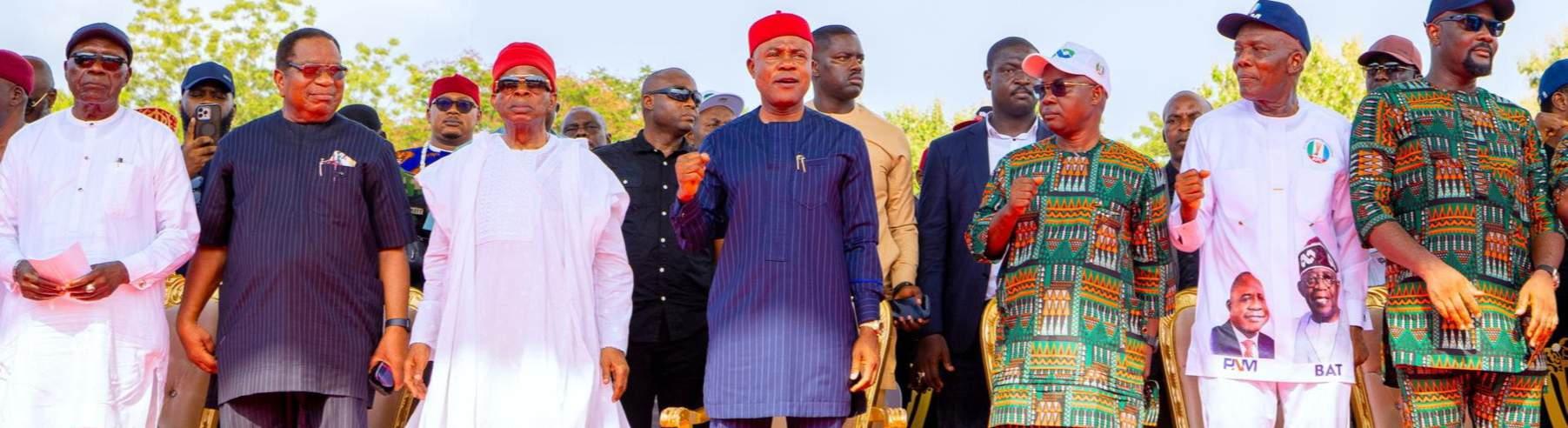
ENUGU WEST SENATORIAL DISTRICT ENDORSEMENT RALLY FOR TINUBU
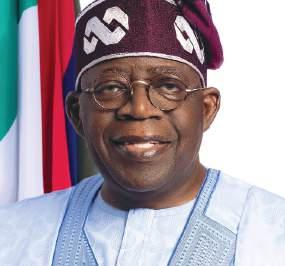
L-R: Former Military Administrator of Gombe State, Group Capt. Joseph Orji (Retd); former Chief of the Naval Staff, Rear Admiral Allison Madueke (Retd); former President of the Senate, Senator Ken Nnamani; Governor of Enugu State, Dr. Peter Mbah; Speaker of the State Assembly, Hon. Uchenna Ugwu; Chairman of the All Progressives Congress, Enugu State, Dr. Martin Chukwunweike, and the Senator representing Enugu West Senatorial District, Senator Osita Ngwu, during a mega second term endorsement rally for President Bola Tinubu and Governor Mbah at Awgu, Enugu State, weekend
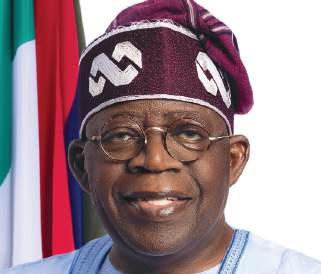
Gideon Arinze TThe people of Enugu West Senatorial District have endorsed President Bola Tinubu and the state
wellness within reach
with W Health loan
The W Health Loan provides women with access to financing for eligible healthcare services
*Terms and conditions apply
Rainstorm: TCN Declares Force Majeure on Ikeja West-Osogbo Line
Fall in transmission loss to 7.4% excites company
Emmanuel
Addeh in Abuja
The Transmission Company of Nigeria (TCN) has declared a force majeure on the Ikeja West–Osogbo 330kV transmission line following a severe rainstorm that damaged critical infrastructure along the corridor.
In a statement issued yesterday, signed by the General Manager, Public Affairs, Ndidi Mbah, the company said the incident occurred on Thursday, April 16, 2026, when the transmission line tripped
during the storm due to a fault detected about 14.9 kilometres from the Ikeja West (Ayobo) end of the line.
Subsequent inspection by TCN’s maintenance team, the company revealed, showed that Tower 515 had collapsed under the impact of the storm,
With just days to the deadline for submission of party membership register to the Independent National Electoral Commission (INEC), embattled opposition figures within the African Democratic Congress (ADC) have started to accelerate contingency plans, settling for the Peoples Redemption Party (PRP) as a fallback platform, THISDAY learnt yesterday.
The move came against the backdrop of a protracted leadership crisis rocking the ADC,
president, who responded directly to Iran closing the Strait of Hormuz again, which included some attacks on shipping, said many of the attacks were aimed at "a French Ship" and a UK "Freighter".
now entangled in multiple court cases, including an interlocutory matter before the Supreme Court, which has created a cloud of uncertainty over the party’s legitimacy heading into the electoral cycle.
It was gathered that key actors within the David Mark-led ADC have opened high-level talks with the PRP.
National chairman of the party, Dr Hakeem Baba-Ahmed, confirmed that key figures in the opposition have reached out to PRP and that discussions were ongoing.
A central factor driving the
Trump had earlier claimed, in another post at the weekend, that Iran had agreed to never close the strait again. But in the new post, Trump claimed that the US "loses nothing" from the closure of the strait, but said Iran was losing millions of dollars.
who swarmed the Awgu Local Government Secretariat field in their thousands on Saturday, presented a cheque for the sum of N100 million to Mbah for the purchase of his nomination form, vowing to defend their position with their last vote.
Former President of the Senate, Senator Ken Nnamani, speaking at the event, dismissed promises by some governorship and presidential aspirants to do just one term, saying they are not being sincere with Nigerians.
Leading the endorsement process, the senator for Enugu West Senatorial District, Senator Osita Ngwu, said their decision was based on conviction informed by evident results rather than sheer politics.
Ngwu stated, “Today, we can see the best Command and Control Centre to help improve our security in Enugu. We have Smart Schools in every one of our wards. We have seen Type-2 Healthcare Centres. We have
Recall that the American president had warned Iran that the US would bomb its power plants before in the conflict, before finding ways to back down from the threat. Striking power infrastructure is also widely condemned by the international community and considered to be a breach of international law, Sky News reported.
Trump's latest post ended with the all-caps message, stressing that: "It's Time for
seen roads.
“Before now, if you were going to Aguobu Owa through 9th Mile, it would seem like a journey of no return. But now, it takes you only a few minutes. It is the handiwork of Governor Peter Mbah.
“These are not promises; these are realities; these are dividends of democracy. This is what happens when leadership is bold. No weakness, no excuse, no apologies. Just results.”
Ngwu added, “At the national level, we have seen the transformational effects of the president. We are benefiting here in the South-east and Enugu State, in particular. We thank our governor, who was bold and did not delay to connect us to the centre.”
Speaking, former Chief of the Naval Staff and ex-military governor of old Anambra State, Rear Admiral Allison Madueke (rtd.), and former military administrator of Gombe State, Group Capt. Joseph Orji (rtd.), said they
current urgency among opposition politicians, it was gathered, was the set of timelines embedded in Nigeria’s electoral framework, which, while not always explicit on the surface, imposed strict procedural deadlines that could make or mar political ambitions.
Under the Electoral Act 2022, political parties were required to maintain a comprehensive register of their members and make this available to the INEC before the date fixed for their primaries, congresses, or conventions. This provision, contained in Section 77(3) of the Act, was designed to ensure transparency
The Iran Killing Machine to End!"
The president's latest intervention has been markedly more aggressive than his first reaction to Iran's closure of the strait. On Saturday, the US president appeared to shrug it off, saying Iran "got a little cute as they have been doing for 47 years". But he also stressed that both sides "have very good conversations going on".
"They wanted to close up the strait again, as they've
totally aligned with the sentiments expressed by their people in support of Tinubu and Mbah’s re-election.
“The testimonies today are accurate. The people have spoken. All we want to do is to ask you to go back and do more,” Madueke stated.
Nnamani and Deputy National Chairman (South) of All Progressives Congress (APC), Dr. Ben Nwoye, urged the people to be wary of those who promised to do one term, insisting they are not promise keepers.
Nnamani stated, “They will not keep to such promises. Some people tell lies with confidence. You should be careful.
“As for Enugu State, you have waited for four years, with another four years remaining. But any other candidate apart from Mbah does not guarantee Enugu West’s turn by 2031. Besides, currently on the stage, we have someone with integrity and performance. Even among his colleague governors, he is highly rated. And he is ready
with the structure failing at its midsection, thereby disrupting power flow along the affected line.
The declaration of force majeure indicates that the outage was caused by circumstances beyond the control of the transmission operator, effectively limiting its ability to guarantee normal operations on the line until repairs are completed.
and credibility in the nomination process, allowing INEC to verify the authenticity of party membership and participation in primaries.
INEC has recently fixed May 10 as the deadline for the submission of the registers, effectively making it about three weeks from today. Although the law did not expressly stipulate a deadline for when an aspirant must join a political party, this requirement has created a de facto cutoff point. Once a party submits its membership register to INEC ahead of its primaries, the window for new entrants effectively
been doing for years, they can't blackmail us," Trump said on Saturday.
“Iran decided to fire bullets yesterday in the Strait of Hormuz - A Total Violation of our Ceasefire Agreement! Many of them were aimed at a French Ship, and a Freighter from the United Kingdom. That wasn't nice, was it? My representatives are going to Islamabad, Pakistan - They will be there tomorrow evening, for negotiations.
“Iran recently announced
to continue to perform.”
Addressing the mammoth crowd, a visibly elated Mbah commended the people for always standing up for truth and justice, like their forebears.
He stated, “This rally is of epic proportions. Nothing prepared me for this. You have also become standard bearers for equity, justice, fairness, and unity. You are also showing that you are not lightheaded; that you are strategic.”
Mbah went on to enumerate his and Tinubu’s projects, programmes, and policies that were turning the fortunes of the people for good.
On Tinubu, he said, “You have shown that you cannot stand on the margins in recognising the programmes, the policies, and the projects that Mr. President has brought to us here in Enugu.
“By this endorsement, you are recognising the positive results of Mr. President’s efforts in the stabilisation of our macro indicators, making sure that our foreign exchange is stabilised; that our inflation
TCN explained that it has commenced emergency response measures, including the mobilisation of materials and personnel to the site for
narrows, as only individuals captured in that register would be eligible to participate in the nomination process.
Besides, any attempt to introduce new members after that stage could face legal scrutiny, particularly in the event of postprimary disputes. This is further reinforced by provisions governing candidate nomination. Section 29(1) of the Act mandates that political parties must submit the names of their candidates to INEC not later than 180 days before the date of the election. Those candidates must have emerged
that they were closing the Strait, which is strange, because our blockade has already closed it. They're helping us without knowing, and they are the ones that lose with the closed passage, $500 million a day! The United States loses nothing.
“ In fact, many ships are headed, right now, to the U.S., Texas, Louisiana, and Alaska, to load up, compliments of the IRGC, always wanting to be "the tough guy!" We're offering a very fair and reasonable
rate is trending downwards; that our foreign reserves are growing above the $50 billion mark, and that the states now have enough money to execute massive projects.
“The local governments in Enugu State are also executing numerous projects that I am being invited almost on a weekly basis to come and commission.”
He pledged to continue to justify the confidence reposed in him by the people, assuring that Tinubu would not let them down.
The motion for Tinubu’s endorsement was moved by the House of Representatives member representing Ezeagu/Udi Federal Constituency, Hon. Sunday Umeha, and seconded by Executive Director (Projects), South East Development Commission (SEDC), Hon. Toby Okechukwu. That for Mbah was moved by Speaker of Enugu State House of Assembly, Hon. Uchenna Ugwu, and seconded by the member representing Aninri State Constituency,
from valid primaries conducted by their respective parties, making prior membership a fundamental requirement. ADC’s case is even more complex in the context of internal party disputes. Where factions within a party submit conflicting membership registers or conduct parallel primaries, the question of which process was recognised by INEC, and ultimately upheld by the courts, could determine the validity of candidates. In several instances, Nigerian courts have nullified nominations
Continued on page 36
deal, and I hope they take it because, if they don't, the United States is going to knock out every single power plant, and every single bridge, in Iran.
“No More Mr. Nice Guy! They'll come down fast, they 'll come down easy and, if they don't take the deal, it will be my honour to do what has to be done, which should have been done to Iran, by other Presidents, for the last
Continued on page 34 the reconstruction of the damaged tower. Engineers are currently working to dismantle the collapsed structure to pave the way for its re-erection, it said.
Hon. Magnus Ede. Others who spoke to throw their support behind the respective constituencies were Chief of Staff to the Governor, Barr. Victor Udeh; Chairman, Enugu West Traditional Rulers Council, Igwe Godwin Madu; elder statesman, Igwe Lawrence Agubuzu; former Deputy Governor, Mrs. Cecilia Ezeilo; and former Minister of Aviation, Mrs. Fidelia Njeze.
The following also spoke: Chairman, Enugu State chapter of APC, Dr. Martin Chukwunweike; CEO of COMAG Construction Company Limited, Chief Cosmas Agu; the chairman of the organising committee, Dr. Charles Egumgbe; former Senator, Ben Collins Ndu; Board member of SEDC, Chief Ugo Agballa; as well as Chairman of Awgu Local Government Area, Hon. Uchenna Okolo, who spoke on behalf of the chairmen of Aninri, Awgu, Ezeagu, Udi, and Oji River local government areas, which constitute Enugu West Zone.
Chuks Okocha and Emmanuel Addeh in Abuja
TCN MD, Dr. Sule Ahmed Abdulaziz
CPPE: FG's New Fiscal Regime Will Transit Nigeria from Import Dependence to Industrial Production
Centre for the Promotion of Private Enterprise (CPPE) has commended the recently approved "2026 Fiscal Policy Measures and Tariff Amendments" as a calculated move to transition Nigeria from import dependent economy to industrial production.
CPPE made the commendation yesterday in its policy brief on "2026 Fiscal Policy Measures". It stated that
fiscal measures had created opportunities for deeper value-chain integration across manufacturing ecosystems by providing for higher tariffs on finished goods and lower tariffs on industrial inputs.
According to the centre, this has clearly signalled a structured industrialisation pathway and strengthened investors' confidence in policy direction.
It also canvassed instituting strong protective tariffs for
locally refined petroleum products in order to safeguard investments and deepen backward integration in the petroleum sector.
CPPE said, "The overarching message from the policy framework is clear: Nigeria is deliberately transitioning from an import-dependent economy to one anchored on domestic production and value addition."
Commenting on the new fiscal measures, Chief
Executive Officer of CPPE, Dr. Muda Yusuf, said, "The 2026 fiscal policy measures represent a bold and necessary step towards economic restructuring, industrialisation, and enhanced economic resilience," for the country.
Yusuf added, "For private investors, the framework presents substantial upside potential in manufacturing, agro-processing, recycling, and green industries.
"However, it also introduces
risks for import-dependent sectors and consumer-facing businesses.
"Ultimately, the beneficiaries in this evolving policy landscape will be investors who align with the domestic production agenda, integrate into local value chains, and proactively adapt to Nigeria’s shifting economic structure."
According to him, the recently approved fiscal policy framework by the federal government signals a decisive and strategic pivot towards strengthening domestic
production, deepening industrialisation, and reducing import dependence, which are consistent with Nigeria’s medium-term economic transformation objectives. He said the measures included the revisions of the Import Adjustment Tax (IAT) that covered 192 tariff lines, selective import restrictions, tariff reductions on critical industrial inputs, excise duty adjustments, and the introduction of a green tax on selected categories of imported vehicles.
Kuni Tyessi in Abuja
Nigerian Education Loan Fund (NELFUND) said it had disbursed N242.4 billion since the initiative became fully operational with the launch of its application portal on May 24, 2024. With that figure, NELFUND reached a major milestone in its student support intervention programme, with a total of 1,388,592 students benefiting from the scheme as of April 15, 2026.
The figures, according to the latest Student Loan Disbursement Status, covers
activities from the launch of the scheme on May 24, 2024 to April 15, 2026.
The exclusive report showed the rapid scale-up of the scheme, which was designed to improve access to tertiary education, reduce financial barriers, and strengthen human capital development under the Federal Government’s Renewed Hope Agenda.
It indicated that over 1.7 million applications had been recorded since the scheme’s inception. Of this number, 1,388,592 students successfully benefited from the loan scheme.
The cumulative sum disbursed under the scheme now stands at N242,400,915,093.25 (N242.4bn), comprising institutional fees and student upkeep allowances.
A breakdown of the figure shows that N157,455,283,093.25 (N157.4bn) was paid directly to beneficiary institutions as tuition and institutional charges, while N84,945,632,000.00 (N84.9bn) was disbursed as upkeep allowances to students to support their living expenses during the course of study.
The dual disbursement structure, covering both institutional fees and student
upkeep, is designed to ensure that beneficiaries are not only enrolled in school but also able to sustain themselves throughout their academic programmes.
The report further shows that 288 tertiary institutions across Nigeria are currently benefiting from the scheme. They include federal and state universities, polytechnics, and colleges of education.
The report stated, “Applications received since inception stand at 1,771,797. A total of 1,388,592 students have so far benefited from the loan scheme since its inception.
NALDA Set to Engage Rural Farmers to Boost Food Security Nationwide
The National Agricultural Land Development Authority (NALDA) at the weekend said it will engage rural farmers across the 36 states of the federation to boost food production and reduce insecurity in the country.
The agency has already secured 5,000 hectares of land in the rural community of Ora in Ifelodun Local Government Area of Kwara State, under the Renewed Hope Mega Farming programme for the initiative.
The 5,000 Hectare Renewed Hope Mega Farm estate is
designed to have infrastructure such as hostels, admin blocks, warehouses, gatehouses amongsts others.
The Executive Secretary of NALDA, Engineer Segun Cornelius Adebayo, stated this at Ora Community in Kwara State over the weekend while
addressing the stakeholders in Ora Community before he inspected the ongoing mega farm project in the community.
He said it was first of its kind in Nigeria designed not only to boost food security and rural development but as a strategy to end insecurity in Nigeria.
REA, Mente Energy Sign MoU to Optimise Clean Energy Market to Boost Industrial Growth, Jobs
The Rural Electrification Agency (REA) of Nigeria and Mente Energy Limited have signed a Memorandum of Understanding (MoU) to formally commence the Renewable Energy Localisation and Industrialisation Programme (RELIP).
RELIP is a national programme designed to structure Nigeria's rapidly growing renewable-energy market to catalyse investment, generate skilled industrial employment and build a domestic clean-energy manufacturing base in partnership with global capital.
The programme which is led by REA and guided by the Nigeria-first principles, seeks to establish data, institutional architecture and
demand signals required to allow capital of every origin - Nigerian, international, development finance and private institutional - to invest in the country’s clean-energy value chain with greater confidence and at greater scale.
Speaking at the signing ceremony in Abuja, Managing Director/Chief Executive, REA, Mr. Abba Aliyu, said, "Nigeria has built significant momentum in decentralised renewable energy but until now, the economic value of that deployment has largely flowed offshore.
“RELIP changes that. By organising our national demand and building the institutional architecture to support domestic manufacturing, we are creating the conditions for investment, jobs and industrial growth to take root on Nigerian soil.
James Emejo in Abuja
Dike Onwuamaeze
Hammed Shittu in Ilorin
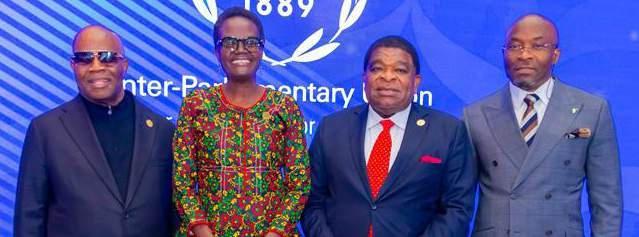
L-R: President of the Senate, Federal Republic of Nigeria, Godswill Akpabio; President of the Inter-Parliamentary Union (IPU), Dr Tulia Ackson; Secretary General of the IPU, Mr Martin Chungong and Deputy Speaker, House of Representatives, Benjamin Kalu, at the just concluded 152nd General Assembly of the IPU in Istanbul Turkiye, yesterday.
SIGNING THE MEMORANDUM OF UNDERSTANDING...
Managing Director and Chief Executive Officer of the
the
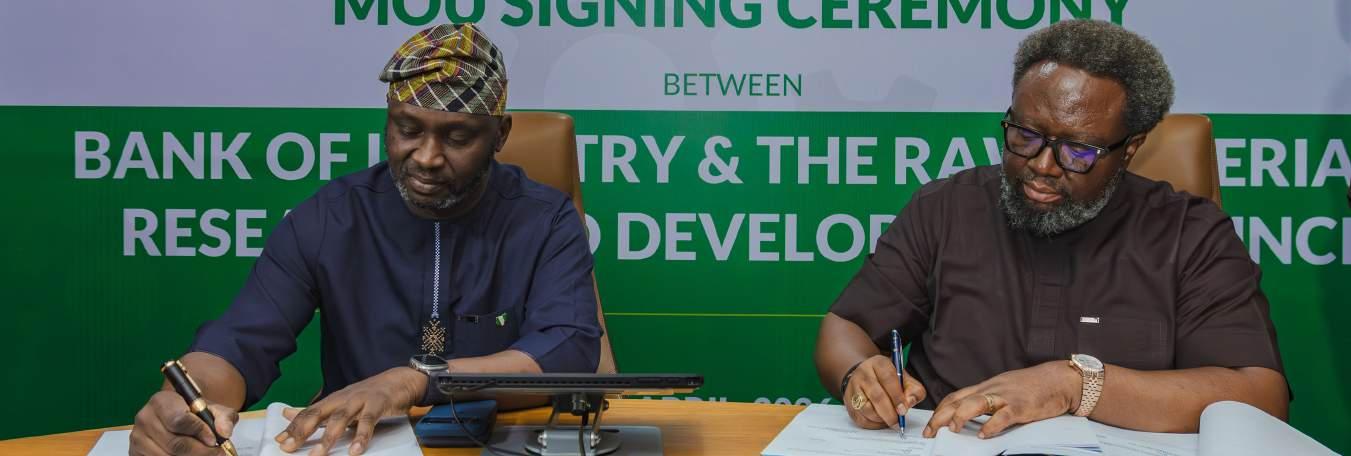
BoI, RMRDC Seal MoU to Clear Obstacles in Agriculture Value Chain
Bank of Industry (BoI) and Raw Materials Research and Development Council (RMRDC) have sealed a strategic partnership agreement to strengthen the country’s agricultural value-chain as well as boost the sector’s contribution to Gross Domestic Product (GDP).
The agreement also sought to address challenges in critical areas, including value chain development, harvesting, post-harvest losses, seedlings, cultivation, storage, processing, packaging, logistics, and marketing.
BoI pointed out that the initiative aligned with its mission to boost the Nigerian economy, entrench
The agreement, which was formalised between both organisations at the weekend, was the culmination of extensive engagements between key stakeholders of both institutions. It sought to enhance the value addition of key agricultural commodities and raw materials.
APE, PTDF, NMGS Honour Geology Icon, Prof Rahaman at 80
Cameroonian scholar urges Nigeria to protect its geological heritage
Various stakeholders, including the Nigerian Association of Petroleum Explorationists (NAPE), Petroleum Technology Development Fund (PTDF) and the Nigerian Mining and Geosciences Society (NMGS) at the weekend celebrated renowned geologist, Prof. Omar Rahaman, in recognition of his decades-long contributions to geoscience development in Nigeria.
Rahaman, one of the most prominent figures in Nigeria’s geology and geoscience community, widely regarded as a pioneer in the field, is an emeritus professor of geology, who has helped shape generations of geoscientists in the country.
His reputation rests heavily on his foundational work in understanding Nigeria’s ancient rock systems, particularly the ‘Precambrian Basement Complex’, which underpins much of the country’s geology,
while his research and mapping efforts are considered critical to how Nigeria’s geological structure is understood today.
Speaking in Abuja during the 5th edition of the Rahaman Seminar Series, organised in his honour, the Executive Secretary of the PTDF, Prof. Shuaibu Aliyu, lauded the octogenarian as a key architect of Nigeria’s human capital development in the energy sector.
Aliyu highlighted the octogenarian’s foundational role in shaping some of the PTDF's most impactful programmes, describing the event as a celebration of impact, legacy, and intellectual excellence.
Represented by the Deputy General Manager, Audit Division of the PTDF, Dr. Steve Agboyinu, Aliyu specifically mentioned the contributions of Rahaman as one of the architects of the Overseas Scholarship Scheme of the PTDF and his efforts in institutionalising transparent, merit-driven selection processes.
national goals of reducing postharvest losses, drive promotion of import substitution, improve the country's GDP, enhance wealth sustainability through job creation, and foster entrepreneurship and industrial capacity in the country.
Speaking at the signing event in Abuja, Managing Director/Chief Executive of BoI, Dr. Olasupo Olusi, said the partnership will help both institutions convert research into bankable projects that would add value, create jobs, and retain wealth within the economy.
Olusi said, “This partnership brings together two institutions with complementary strengths: RMRDC’s deep expertise in raw materials research and development, and BoI’s capacity to translate viable projects into financed, executable
industrial investments.
“Together, we can do what each institution cannot do as effectively on its own. We can convert research into bankable projects that add value, create jobs, and retain wealth within our economy.”
He added, “In practical terms, this means identifying and developing raw material-based opportunities across agro-processing, solid minerals, and industrial inputs, and channelling BoI financing to the entrepreneurs and enterprises ready to process local resources into finished and semi-finished goods. Nigeria’s raw materials should not be leaving our shores as commodities. They should be leaving as products.
“At BoI, we are ready. Ready to co-identify opportunities,
structure financing, and support the enterprises that will turn this framework into concrete industrial outcomes. Let this be the beginning of a collaboration that Nigerians will feel, in the factories that open, the jobs that are created, and the value that stays here at home.”
Director-General/Chief Executive, RMRDC, Professor Nnanyelugo Ike-Muonso, said the development served as the foundation for industrialisation, creation of prosperity, and the generation of employment.
Ike-Muonso stated, “We, at the Raw Material Research and Development Council, deeply appreciate this relationship, and we are thrilled to initiate the formalisation process. We are uniting on key aspects, primarily focusing
on value exchange development and promoting the advancement of process technologies.
“These elements serve as the foundation for industrialisation, the creation of prosperity, and the generation of employment, along with all the indicators that guarantee that people live the kind of lives that they deserve.
“The future, the prosperity, the happiness of this country, partially lies in your hands (BoI). So, by accepting to work with us to finance this, we are very grateful. We are also grateful that you're taking us in to work together in co-designing, in co-sharing, data sharing, co-service programmes, and joint implementation of these programmes, as well as joint efforts on advocacy.”
Ministers meet in Abuja to chart new path for regional group
Nigeria supplied about 68 per cent of the total gas volumes transported through the West African Gas Pipeline (WAGP) since its inception in 2011, as cumulative deliveries hit 613.7 million MMBtu, reinforcing the country’s dominant position in regional energy supply.
Speaking at the meeting of the Committee of Ministers of WAPG in Abuja at the weekend, Nigeria’s Minister of State for Petroleum Resources (Gas), Ekperikpe Ekpo, who chaired the session, said the figures demonstrate that the pipeline has moved beyond projections to delivering measurable outcomes for the sub-region.
Ekpo noted that the project, conceived under the Economic Community of West Africa States (ECOWAS) energy
integration framework, has helped expand energy access, deepen industrial activity and strengthen economic ties among member states, with supply to downstream markets in Benin, Togo and Ghana.
“Today, more than two decades after the Common Vision was formalised, and after 15 years of full operation of the WAGP, we can say with confidence that the project has delivered tangible and measurable results. Since inception, the West African Gas Pipeline has transported cumulatively a volume of 613,728,106 MMBtu of natural gas.
“Nigeria alone supplies more than 68 per cent of the total volume transported to the downstream market in Benin Republic, Togo and Ghana. In 2025, the WAGP infrastructure recorded a transported volume
of 80,023,582 MMBtu of natural gas, representing, from what we have in 2025, an increase of 22 per cent,” he explained.
He added that Nigeria remained committed to strengthening the legal and institutional framework of the pipeline, including ongoing amendments to the WAGP Act at the National Assembly to align domestic laws with evolving regional realities.
In his remarks, Managing Director of the West African Gas Pipeline Company (WAGPCo), Abiodun Bodunrin, said operational performance remained strong, with gas deliveries in 2025 rising by about 23 per cent compared to 2024 and system reliability hovering around 99 per cent.
He added that between 2011 and 2025, gas supplied through the pipeline to Ghana alone
generated approximately $3 billion in savings compared to the use of liquid fuels for power generation, underscoring the economic value of the infrastructure.
Bodunrin, however, warned that financial sustainability remains a concern, revealing that as of March 30, 2026, unsecured overdue invoices exceeded $50 million, a development he said threatens investor confidence and the long-term resilience of the regional gas market. Looking ahead, he said WAGPCo is targeting an additional 100 million standard cubic feet per day (MMSCFD) in capacity utilisation in 2026, representing a 45 per cent increase over 2024 levels, supported by ongoing transmission upgrades and efforts to secure supply and offtake commitments.
Emmanuel Addeh in Abuja
James Emejo in Abuja
Bank of Industry (BOI), Dr. Olasupo Olusi (left), and Director General/CEO, Raw Materials Research Development Council (RMRDC), Prof. Nnanyelugo Martin Ike-Muonso, signing the Memorandum of Understanding (MoU) between BOI and
council at BOI Headquarters in Lagos… recently
Emmanuel Addeh in Abuja
IHS NIGERIA AND ILORIN INNOVATION HUB SHOWCASE 19 HIGH GROWTH STARTUPS...
FG Denies Alleged Hidden Spending, Diversion of Federation Revenue
Says interpretations reflect misunderstanding of fiscal system
Ndubuisi Francis in Abuja
The federal government has debunked media reports and commentaries that tend to misrepresent the findings of the latest World Bank Nigeria Development Update (NDU), particularly claims suggesting that a significant portion of federation earnings is being “diverted” or constitutes “hidden spending”.
Minister of State for Finance, Dr. Taiwo Oyedele, in a
statement issued yesterday, said the interpretations misrepresented World Bank’s analysis and reflected a misunderstanding of the fiscal system.
In its latest Nigeria Development Update (NDU), which was launched recently, World Bank had raised concerns over Nigeria’s fiscal framework, stating that over N34.53 trillion was diverted from federation revenue over the past three years through
UNILAG Don Seeks Insulation of Education Governance from Partisan Politics
Funmi Ogundare
A Professor of Educational Administration and Leadership and Dean of the Faculty of Education, University of Lagos, Akoka, Simeon Adebayo Oladipo, has warned that political interference in policy formulation is undermining Nigeria’s education system and entrenching mediocrity.
He called for reforms to insulate educational governance from partisan influence.
Prof. Oladipo who made this known while delivering the 457th inaugural lecture of the university titled, 'Politics to Policy: Navigating the Power Dynamics in Educational Administration', argued that education policy in Nigeria has historically been shaped by political considerations rather than evidence-based planning.
The don explained that the persistent subordination of policy to political interests
has prioritised loyalty over competence, thereby weakening institutional performance.
According to him, “education policy in Nigeria has never been neutral. It has always been influenced by the ideological leanings of those in power."
He added that meaningful transformation of the sector would require restructuring the political context that shapes decision-making.
The professor described education as a political football and a bargaining chip for influence, warning that no nation can build a sustainable education system on the whims of political actors alone.
Emphasising structural challenges, the dean identified the widening urban–rural divide as a major concern, noting that a large proportion of out-of-school children are concentrated in rural communities where schools operate under dilapidated conditions.
pre-distribution deductions.
Although total federation revenue rose sharply to about N84 trillion between 2023 and 2025, the bank stated that about 41 per cent of the earnings did not reach the Federation Account for distribution to the federal, state and local governments.
According to the global institution, gross revenue increased from N17.08 trillion in 2023 to an estimated N37.44 trillion in 2025.
However, it observed that deductions, classified as “first-line charges”, also rose significantly, from N6.22 trillion to nearly N15 trillion within the same period, reducing the pool of funds available for distribution.
World Bank observed that
the development had created a paradox in which rising revenues had not translated into improved public spending capacity, as a substantial portion was automatically retained by certain agencies before allocation.
It explained that reforms, such as the removal of petrol subsidy and foreign exchange adjustments, boosted nominal revenues.
orld Bank added that much of the gains were offset by the structure of deductions tied to cost of collection and statutory transfers.
Following the World Bank report, some organisations and individuals had continued to call for a forensic inquiry.
ActionAid Nigeria demanded an urgent forensic audit of
Nigeria’s revenue management system.
It stated that the magnitude of the deductions—accounting for over 40 per cent of federal revenue in recent years –pointed to systemic weaknesses in public financial management and posed a serious threat to fiscal stability and development financing.
The group said findings by World Bank confirmed that a significant portion of government income was being absorbed through predistribution charges, including cost-of-collection frameworks and agency remittances, with limited transparency on their composition and utilisation.
ActionAid stated, “These findings reinforce longstanding concerns about
Nigeria’s widening fiscal constraints and rising debt burden.” It added, “The persistence of large-scale revenue leakages represents both a governance failure and a missed opportunity to strengthen fiscal stability.”
It stressed that the deductions, estimated at over N34 trillion, had continued to rise alongside government revenues, leaving federal, state, and local governments with significantly reduced resources to fund public services.
The group Nigeria warned that the trend was worsening Nigeria’s reliance on borrowing, citing projections by International Monetary Fund (IMF) that the country’s debt-to-GDP ratio can climb to 33.1 per cent by 2027.
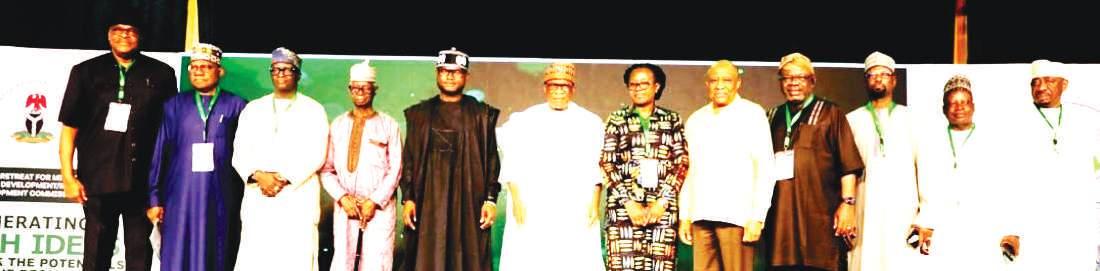
FG Charts New Course for Regional Growth at the 2026 Sectoral Retreat in Edo
Felix Omoh-Asun in Benin
The federal government has called on regional development commissions to chart a new course that will lead to the growth and transformation of the different zones of the country.
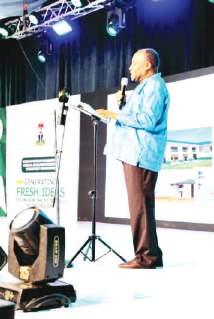
The call was made at the conclusion of a two-day highlevel sectoral retreat, themed, “Generating Fresh Ideas to Unlock the Potential of the Regions,” in Benin City, the Edo State capital.
The retreat brought together key stakeholders across government, including the leadership of all seven regional development commissions, National Assembly representatives, development
partners, and senior public sector officials.
The gathering focused on the need for all the commissions to invest in facilities that will generate revenue beyond statutory allocations so as not to rely on government alone to fund development efforts.
It emphasised that strengthening governance systems, enhancing institutional collaboration, and unlocking new financing strategies were pathways to sustainable development.
At the heart of the discussion was a clear consensus: Nigeria’s regional development architecture must evolve to deliver measurable economic impact.
Participants emphasised strict adherence to governance frameworks, including the Public Procurement Act, Public Service Rules, international accounting standards, and the Code of Conduct, as essential to restoring transparency, accountability, and efficiency in public service delivery.
The retreat produced farreaching resolutions aimed at transforming the operations of the regional development commissions.
They included strengthening the oversight functions of governing boards, institutionalising capacitybuilding programmes, and ensuring alignment between annual procurement plans and
budget cycles.
A major highlight was the strong push for economic diversification and self-sufficiency across regions.
The commissions were directed to scale up skills acquisition programmes in areas, such as agriculture and smallscale enterprises development to create jobs and stimulate local economies.
The communique at the end of the retreat also stressed the need to undertake structured stakeholder engagement across the regions on budgets, projects, and service delivery within the constituent states, involving key actors, such as governors, traditional rulers, youth groups, and women’s associations.
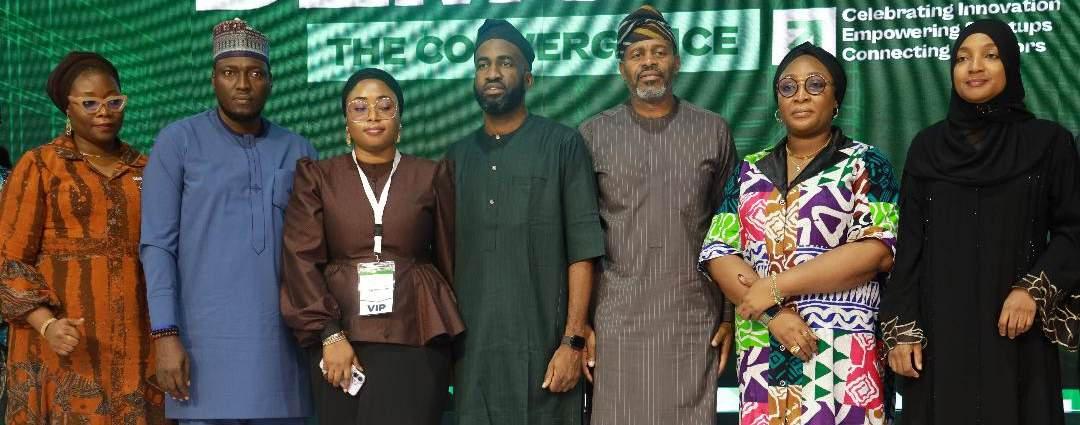
L-R: Vice President, Group Audit and Risk, IHS Nigeria, Temitope Yusuff; Chief Commercial Officer, IHS Nigeria, Akeem Adeshina; Commissioner, Business, Innovation, and Technology, Kwara State Ministry, Damilola Yetunde Yusuf-Adelodun; Managing Director, Ilorin Innovation Hub, Temi Kolawole; Senior Vice President and Chief Operating Officer, IHS Nigeria, Kazeem Oladepo; Commissioner, Communications, Kwara State Ministry, Bola Olukoju; and Commissioner, Health, Kwara State Ministry, Dr. Amina Ahmed El-Imam, during IHS Nigeria’s maiden demo at the Ilorin Innovation Hub in Ilorin, Kwara State …weekend
PHOTO: ABIODUN AJALA
OFFICIAL SUBMISSION OF APC CONVENTION REPORT TO THE PARTY...
Diezani Denies Ownership of Luxury Assets, Blames Associates as London Trial Resumes
Challenges
Wale Igbintade
integrity of Nigerian investigation in UK proceedings Says she
The trial of former Nigerian petroleum minister, Diezani Alison-Madueke, resumed on Day 21 at the Southwark Crown Court in London, with her defence launching a detailed challenge to the prosecution’s claims that she owned a range of high-value luxury assets and improperly received benefits.
At the centre of proceedings was a document prepared by the defence, which it described as a more accurate schedule of items linked to the former minister.
The document, which contrasts with the prosecution’s version, seeks to distinguish between items personally owned by Alison-Madueke and those allegedly acquired by associates or on behalf of third parties.
Under examination, AlisonMadueke acknowledged ownership of certain items, particularly clothing, accessories, and personal effects, but firmly denied ownership of several high-value assets, including expensive furniture and luxury goods.
She maintained that many of the costlier items were
purchased by associates, such as Benedict Peters, Kola Aluko, and Tunde Sanusi, often for their own properties or for shipment to Nigeria.
Throughout her testimony, the defence emphasised what it described as a consistent pattern: that the most expensive items listed by the prosecution were not hers, while her confirmed purchases were comparatively modest.
Many of the disputed items were said to have been delivered to locations, such as St Edmund’s Terrace in London or to storage facilities, or referenced in invoices and
was made
email correspondence.
a political scapegoat amid 2015 election tensions
The court also heard evidence relating to luxury shopping at high-end retailers, including Harrods, where Alison-Madueke described herself as a regular customer.
However, she insisted that not all purchases made in her name or linked to her accounts were for her personal use.
In several instances, she said transactions were carried out while she was out of the country, suggesting that others, particularly Aluko, may have acted independently.
Addressing the purchase of electronic items, including
SSANU Gives FG April 30 Deadline to Sign Renegotiated Agreement or Face Strike
Onyebuchi Ezigbo in Abuja
Non-academic staff of government-owned universities in the country under the auspices of the Senior Staff Association of Nigerian Universities (SSANU) has given the federal government April 30 deadline to finalize its renegotiation agreement or their members will embark on industrial action.
The union condemned what it described as attempt to portray the process of renegotiation as concluded, particularly through the circulation of a letter by the federal government suggesting approval of a 30 percent increase on allowances, when discussions are still in progress and no final agreement has been signed by the parties.
In a communique signed by SSANU President, Comrade Mohammed Haruna Ibrahim, the union said that
renegotiation process with the federal government is still ongoing and has not been concluded.
"The union has met with the government team seven times between October 2024 and now and that there are two broad areas of renegotiation, monetary and the non-monetary aspects, where it affects our welfare and wellbeing. So, for us, the discussion is still ongoing and that we have not concluded," he said.
While reading out the communique to journalists, Ibrahim said that SSANU was concerned over attempts in the public domain to portray the process as concluded, particularly through the circulation of a letter suggesting approval of a 30 percent increase on allowances, when discussions are still in progress and no final agreement has been signed by the parties.
"SSANU will not accept any
outcome that falls below the negotiated understanding reached in the course of the renegotiation process, and insists that fairness, due process, and collective bargaining principles must be respected.
"Consequently, NEC in session reaffirms its position by the Joint Action Committee of NASU and SSANU on the final ultimatum given to the federal government from 1st to 30th April, 2026 to conclude the renegotiation process and sign their respective agreements.
"Should the federal government fail to conclude the renegotiation process and sign the agreements within the stated period, SSANU will have no alternative but to, along with NASU, commence an indefinite, comprehensive, and total industrial action," he said.
The union called on all its members across the branches
to remain calm, vigilant, united, and prepared to fully comply with the decisions of the Union in defence of their welfare, dignity, and collective interest.
Speaking on how to execute the industrial action, Ibrahim said that SSANU is going also mobilize non-teaching staff of the polytechnic and colleges of education to join the strike.
"So, our members have spoken, and they have spoken with one voice, and that we expect the President of this country, President Bola Tinubu, being a democrat, he should listen to the voices of the masses.
"He should listen to the voices of workers in the universities. I think people should also understand that the non-teaching cadre or non-teaching workers in the universities are the ones in charge of the welfare and the wellbeing of our students.
headphones and speakers, she told the court they were often intended as gifts distributed by the Nigerian National Petroleum Corporation.
She explained that it was customary for the corporation to present gifts to a wide range of recipients, including traditional rulers, community leaders, and business associates, particularly during festive periods.
Proceedings also examined financial transactions linked to accounts associated with individuals said to have provided logistical support to the former minister.
One such account, linked to a man identified as Prince Momoh, showed multiple cash deposits totalling over $160,000, which were subsequently used for luxury purchases.
Alison-Madueke said the staggered deposits reflected common financial practices in Nigeria, where large sums are often paid in batches.
Questions were also raised over the funding of private jet travel, with evidence indicating that certain flights were paid for by third parties rather than NNPC.
She defended the arrangements, citing security considerations and the demands of international engagements, including meetings of the Organisation of the Petroleum Exporting Countries.
She added that some travel costs were later reimbursed by the corporation.
The court heard details of multiple international trips across Europe and the Middle East, some of which coincided with official duties.
In one instance, she said she had to urgently return to
Nigeria during the 2011 fuel subsidy crisis on the directive of then President Goodluck Jonathan, with the cost of the flight subsequently reimbursed.
In an emotional segment of her testimony, Alison-Madueke described the personal toll of the allegations and her arrest in London in October 2015.
She told the court she had been undergoing medical treatment at the time, including chemotherapy, and that her doctor intervened to secure her release from police custody.
She further alleged that she became a target of political persecution in the lead-up to Nigeria’s 2015 general elections, claiming that opposition figures had singled her out as a scapegoat for the administration of former President Jonathan.
According to her, the period was marked by intense media scrutiny and reputational damage.
Alison-Madueke also expressed a lack of confidence in investigations conducted by Nigeria’s Economic and Financial Crimes Commission, suggesting that key records may have been lost or mishandled during transitions between administrations.
She said this informed her decision to retain personal records relating to her official activities.
The former minister told the court that since relocating to the United Kingdom in 2015, she had been unable to return to Nigeria or secure employment, relying instead on the support of friends and family.
She said the prolonged legal battle had severely impacted her health, finances, and family life.
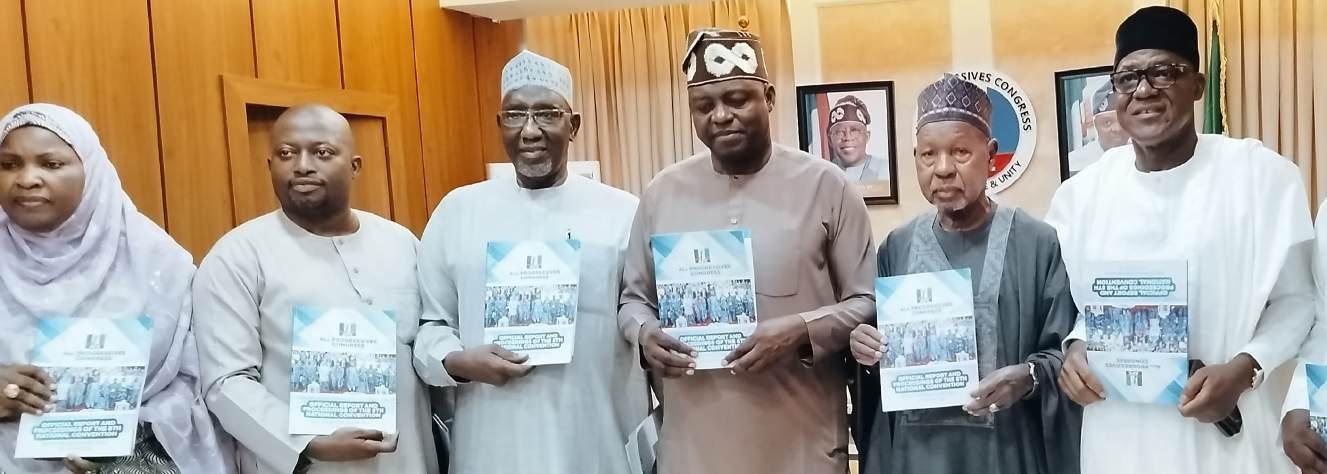
L-R: Deputy National Women Leader, All Progressives Congress (APC), Zainab Ibrahim; APC, National Youth Leader, Mr. Dayo Israel; APC, National Organising Secretary, Alhaji Suleiman Argungu; APC National Chairman, Prof. Nentawe Yilwatda;
Former Speaker, House of Representatives/ Chairman, APC National Convention Centre Coordination Committee (NCCC) Hon. Aminu Bello Masari and Former Speaker/ Secretary, NCCC, Hon. Yakubu Dogara, during the NCCC official submission of the report and proceedings of the 8th APC National Convention held in Abuja recently at the party's national headquarters ... recently
PHOTO: ENOCK REUBEN
SERAP Wants President Tinubu to Order Withdrawal of NBC’s Stifling Directives
Amnesty International: NBC must end its attacks on media
Chuks Okocha in Abuja
Socio-Economic Rights and Accountability Project (SERAP) has called on President Bola Tinubu to urgently order the withdrawal of what it described as an unlawful directive issued by the National Broadcasting Commission (NBC) against broadcasters across the country.
In a statement shared on Sunday, SERAP urged the president to instruct the Minister of Information and National Orientation, Mohammed Idris Malagi, alongside NBC, to “immediately withdraw the unlawful ‘Formal Notice’ issued last week,” warning that the directive threatens sanctions against broadcast stations and presenters on
“vague and unjustified grounds.”
Amnesty International (AI) also condemned the threat issued by NBC, saying it is authoritarian and unconstitutional.
The international watchdog, in a statement issued last night and signed by its Executive Director, Isa Sanusi, said the commission had no power or right to tell journalists how to do their job.
It stated that broadcasters must continue to do their job independently without fear.
AI alleged that the directive was, “The latest outrageous and desperate attempt by the NBC to gag journalists and the media through unlawful and repressive ‘formal notice to broadcasters’ dated 17 April 2026.”
Meanwhile, SERAP criticised the NBC notice for targeting issues, such as the expression of “personal opinions,” alleged “bullying or intimidation” of guests, and failure to “maintain neutrality,” arguing that such provisions could be used to stifle legitimate journalism.
SERAP called on the government to halt any form of prior censorship of media organisations and journalists, insisting that broadcasters should be allowed to freely carry out their constitutional duties and exercise their fundamental rights.
The demand followed a notice issued by NBC on April 17 in which the regulator cited a rise in breaches of the Nigeria Broadcasting Code in news and political programming,
warning that it would begin strict enforcement and impose sanctions for so-called “Class B breaches”.
In a letter dated April 18, 2026, and signed by its Deputy Director, Kolawole Oluwadare, SERAP described NBC’s action as “a dangerous attempt to impose prior censorship on the media and suppress legitimate journalistic expression.”
It stated, “The Nigerian constitution and international human rights law protect both the absolute right to hold opinions and the qualified right to express ideas of all kinds. Journalistic opinion is protected expression.”
It emphasised that value judgments, commentary, and analysis were core components of journalism and were not subject to proof,
NDLEA Busts Drug Rings, Intercepts Cocaine Hidden in Food Flasks, Arrests Fashion Designer, Others
Michael Olugbode in Abuja
Operatives of the National Drug Law Enforcement Agency (NDLEA) have intensified their crackdown on drug trafficking networks, intercepting cocaine ingeniously concealed in food flasks and cannabis hidden in snack packs, while arresting multiple suspects including a Lagos-based fashion designer.
The agency in a statement on Sunday by its spokesman, Femi Babafemi, said 12 large parcels of cocaine weighing 2.8 kilogrammes were uncovered at the export shed of the Murtala Muhammed International Airport (MMIA), Lagos.
Babafemi said the illicit
consignment, bound for the United Kingdom via a Virgin Atlantic flight, was discovered in the false bottoms of food flasks on April 9.
He disclosed that two cargo agents—Ama Ufeim, 33, and Ogabi Akorede, 39—were arrested at the point of interception, with subsequent investigations leading to the arrest of the alleged sender, 52-year-old freight forwarder Agoro Moninuola. In a related operation a day earlier, NDLEA operatives at the airport’s import shed intercepted 2.9 kilogrammes of “Loud,” a potent strain of cannabis, concealed in snack packs arriving from the United States aboard
a Delta Air Lines flight.
He noted that initial arrests of cargo clearing agents Animashaun Adetunji and Mercy Oluwasegun paved the way for the apprehension of the consignee, Saheed Adegoke, a 29-year-old fashion designer, who was later tracked and arrested in Ogba, Lagos. Beyond the airports, NDLEA operations extended across several states with significant seizures recorded. Along the Kaduna-Zaria highway, operatives intercepted a cementladen trailer transporting 847 kilogrammes of skunk. The driver, Umar Garba Haruna, was taken into custody.
In Cross River State, a joint
operation involving NDLEA officers and security personnel led to the destruction of 15,000 kilogrammes of cannabis cultivated on six hectares of farmland in Uwet community, Akamkpa Local Government Area.
A suspect, Alice Udoh, 53, was arrested, while 119 kilogrammes of the substance was recovered. Similarly, in Edo State, operatives raided a cannabis camp in Ovia North East Local Government Area, destroying over 2,281 kilogrammes of the drug and arresting three suspects. Additional arrests were made in Delta State, where over 87 kilogrammes of skunk and cannabis seeds were seized.
freedom
adding that they deserve heightened protection under the law.
SERAP warned that the provisions cited by NBC— particularly Section 1.10.3 of the Broadcasting Code, which restricts presenters from expressing opinions— amounted to unlawful prior restraint and failed to meet the legal standards of necessity, legality, and proportionality required in a democratic society.
Citing Section 39 of the Nigerian constitution, as well as Article 9 of the African Charter on Human and Peoples’ Rights and Article 19 of the International Covenant on Civil and Political Rights, SERAP stressed that the right to freedom of expression included the freedom to receive and impart ideas without interference.
“A blanket prohibition on the expression of personal opinio
One Universe Launches Secure Digital Marketplace to Boost Nigeria’s Payment System
One Universe has announced the official launch of its integrated digital marketplace designed to transform how individuals and businesses discover, engage, and pay for trusted services.
The One Universe app is now available for download on the Apple App Store and Google Play Store.
The platform launches at a time when Nigeria’s service-driven informal economy accounts for over 90 per cent of total employment, yet remains largely fragmented, cashbased, and dependent on unsecured trust.
One Universe introduces a structured, technology-enabled marketplace that combines verified service discovery, realtime engagement, and secure payments into a single ecosystem built for scale and safety.
Through the platform, users can find verified professionals across a broad range of service categories, communicate directly, agree transparently on pricing and timelines, and complete payments securely.
Funds are held through an escrow-style system and released only upon confirmed service delivery, providing protection for both buyers and service providers. All users and professionals are verified using national identity systems, enhancing platform security and accountability. Beyond service discovery and payments, the platform integrates embedded financial tools in partnership with licensed financial institutions, enabling features such asservicenowpaylater options, microloans, and business support for professionals.
These capabilities allow users to access urgent services immediately while empowering service providers to build transaction history, reputation, and longterm economic resilience.
As part of its growth strategy, One Universe has also introduced the Recruiter Program, a communitydriven model that allows individuals to earn incentives by onboarding new users and businesses to the platform.
L–R: Head, Youth & Women Banking Products, FirstBank Nigeria Plc, Mrs. Aderonke Adeyinka; Teacher, Graceland International School, Port Harcourt, Mr. Barnabas Adeyemi; Outstanding students, Adoga Agbo and Okpako-Onyokoko Ovie of the Grace lnternational school; and the President of the Mathematics for Life Foundation, Mr. Omoniyi Oshuntuyi, during the grand finale of the 2026 National Mathematics Tournament won by the grace school in Lagos....recently
IFB Number:
FEDERAL REPUBLIC OF NIGERIA
RIVERS STATE GOVERNMENT
PORT HARCOURT WATER CORPORATION
SPECIFIC PROCUREMENT NOTICE (SPN)
Invitation for Bids [IFB] Goods (Two-Envelope Bidding Process
PHWSSP/AFDB/G/NCB/2026/002
Employer: Port Harcourt Water Corporation, Port Harcourt, Rivers State
Project: Urban Water Sector Reform and Port-Harcourt Water Supply and Sanitation Project
Contract title: Design and Installation of ICT Information Management Systems for PHWC
Country: NIGERIA
Loan No. / Grant No.: 2000130011585
Procurement Method: Open Competitive Bidding (National) (OCBN)
LCBN No: PHWSSP/AFDB/G/NCB/2026/002
Issued on: April 20, 2026
1. The Federal Republic of Nigeria has received Financing from the African Development Bank towards the cost of Urban Water Sector Reform and Port Harcourt Water Supply and Sanitation Project. It is intended that part of the proceeds of this loan will be applied to eligible payments under the c o n t r a c t f o r t h e D e s i g n a n d I n s t a l l a t i o n o f I C T Information Management Systems for Port Harcourt Water Corporation (PHWC)
2.The Port Harcourt Water Corporation now invites sealed bids from eligible bidders for the execution of the Design and Installation of ICT Information Management Systems for Port Harcourt Water Corporation (PHWC)
3. Bidding will be conducted through the Open Competitive Bidding (National) (OCBN) procedures as specified in the Bank's [African Development Procurement Framework Bank, Standard Bidding Document Goods (Two-Envelope Bidding Process) August 2021] and is open to all Bidders as defined in the Procurement Framework.
4. Interested eligible Bidders may obtain further information f r o m C h i e f I b i b i a O ; Wa l t e r w i t h e m a i l a d d r e s s : watsanworks.phwssp@gmail.com and inspect the Bidding document during office hours (8:00 A.M. - 4 P.M.) on weekdays only at the address given below
5. The Bidding document in English may be purchased by all eligible Bidders upon payment of a nonrefundable fee of N600,000.00 or an equivalent of $400.00 The method of payment will be in Cheque or Bank Draft, made out in favor of PORT-HARCOURT WATER CORPORATION. The
document will be sent by courier on demand.
6. Bids must be delivered to the address below on or before Monday, May 18, 2026; Time: 10:30 AM. Electronic Bidding will not be permitted. Late Bids will be rejected. Bids will be publicly opened in the presence of the Bidders' designated representatives and anyone who chooses to attend at the address below on Monday, May 18, 2026; Time: 11:00AM.
7. All Bids must be accompanied by Bid Security of:
8. Information on the successful bidder's beneficial ownership, as part of the Contract Award Notice, using the Beneficial Ownership Disclosure Form as included in the bidding document.
9. The address referred to above is:
The Managing Director Attention: Chief Ibibia O' Walter JP Port-Harcourt Water Corporation, 6 Water Works Road, Port Harcourt, Rivers State, Nigeria.
E-mail: watsanworks.phwssp@gmail.com
IFB Number:
FEDERAL REPUBLIC OF NIGERIA
RIVERS STATE GOVERNMENT
PORT HARCOURT WATER CORPORATION
SPECIFIC PROCUREMENT NOTICE (SPN)
Invitation for Bids [IFB] Goods (One-Envelope Bidding Process)
PHWSSP/AFDB/G/NCB/2026/003
Employer: Port Harcourt Water Corporation, Port Harcourt, Rivers State
Project: Urban Water Sector Reform and Port-Harcourt Water Supply and Sanitation Project
Contract title: Procurement and Installation of ICT Tools, Equipment and Networking Systems at Area Offices (Rumuola, Diobu, Borokiri and Moscow)
Country: NIGERIA
Loan No. / Grant No.: 2000130011585
Procurement Method: Open Competitive Bidding (National) (OCBN)
LCBN No: PHWSSP/AFDB/G/NCB/2026/003
Issued on: April 20, 2026
1. The Federal Republic of Nigeria has received Financing from the African Development Bank towards the cost of Urban Water Sector Reform and Port Harcourt Water Supply and Sanitation Project. It is intended that part of the proceeds of this loan will be applied to eligible payments under the contract for the Procurement and Installation of ICT Tools, Equipment and Networking Systems for Area Offices (Rumuola, Diobu, Moscow, Borokiri, Water Production)
2. The Port Harcourt Water Corporation now invites sealed bids from eligible bidders for the execution of the Procurement a n d I n s t a l l a t i o n o f I C T To o l s , E q u i p m e n t a n d Networking Systems for Area Offices (Rumuola, Diobu, Moscow, Borokiri, Water Production)
3. Bidding will be conducted through the Open Competitive Bidding (National) (OCBN) procedures as specified in the Bank's [African Development Procurement Framework Bank, Standard Bidding Document Goods (Two-Envelope Bidding Process) August 2021] and is open to all Bidders as defined in the Procurement Framework.
4. Interested eligible Bidders may obtain further information f r o m C h i e f I b i b i a O ; Wa l t e r w i t h e m a i l a d d r e s s : watsanworks.phwssp@gmail.com and inspect the Bidding document during office hours (8:00 A.M. - 4 P.M.) on weekdays only at the address given below
5. The Bidding document in English may be purchased by all eligible Bidders upon payment of a nonrefundable fee of NGN600,000.00 or an equivalent of US$400.00. The method of payment will be in Cheque or Bank Draft, made o u t i n f a v o r o f P O R T- H A R C O U R T WA T E R CORPORATION. The document will be sent by courier on demand.
6. Bids must be delivered to the address below on or before Monday, May 18, 2026; Time: 10:30 AM. Electronic Bidding will not be permitted. Late Bids will be rejected. Bids will be publicly opened in the presence of the Bidders designated representatives and anyone who chooses to attend at the address below on Monday, May 18, 2026; Time: 11:30 AM.
7. All Bids must be accompanied by Bid Security of:
8. Attention is drawn to the Procurement Framework requiring the Borrower to disclose information on the successful bidder's beneficial ownership, as part of the Contract Award Notice, using the Beneficial Ownership Disclosure Form as included in the bidding document.
9. The address referred to above is: The Managing Director Attention: Chief Ibibia O' Walter JP Port-Harcourt Water Corporation, 6 Water Works Road, Port Harcourt, Rivers State, Nigeria.
E-mail: watsanworks.phwssp@gmail.com
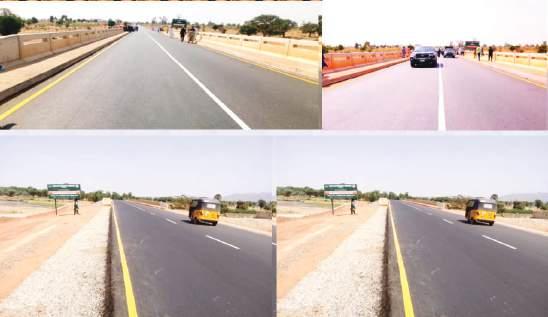
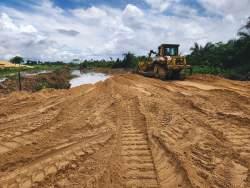
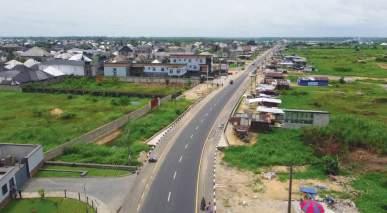
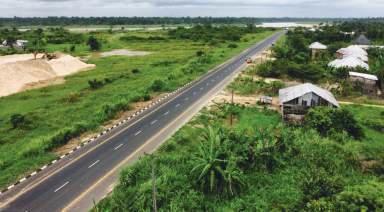
Some of the bridges constructed by the Commission in Bauchi- Gombe Road and Adamawa state
His Excellency Senator Douye Diri
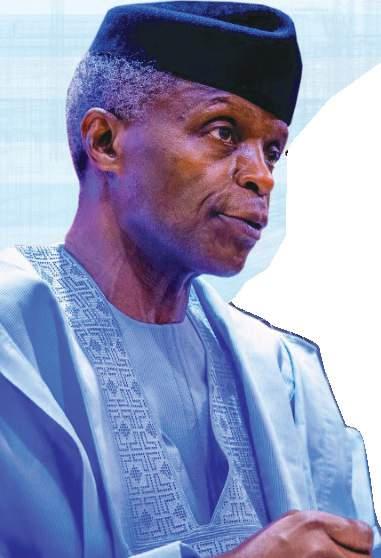
His Excellency Prof. Yemi Osibanjo SAN, GCON
IHS Towers Nigeria Supports
OKOBI Businesses In Imo State
The One Kindred One Business Initiative (OKOBI) is a programme of the Imo State Government under the leadership of His Excellency, Distinguished Senator Hope Uzodimma, to address unemployment and informality through formal group based enterprises.
Since its inception in 2023, OKOBI has created over 600 businesses, with over 20,000 members, contributing significantly to job creation and local economic development.
The OKOBI/IHS Business Support Programme, identified high-potential businesses based on innovation, impact, and growth. Selected entrepreneurs will be presented with grant funding to support and scale their ventures.
Event Details For Enquiries
21st April, 2026
CUN Auditorium Building, Claretian University, Nekede, Imo State 10:00am
Ms Jovita Agwu
Technical Adviser, Office of the Chief Economic Adviser, Imo State Government (+2347034020766 (WhatsApp))
Members of the public and media are invited to attend.
IHS Towers Nigeria remains dedicated to fostering innovation and supporting businesses that contribute meaningfully to economic growth and community development
RE: BLACKMAIL AND MALICIOUS ACCUSATION BY URENNA ABAZIE (DG ABIA STATE ORIENTATION AGENCY) AND FAMILY: SUBTERFUGE FOR UNSOLICITED BALKANISATION OF OHIYA AUTONOMOUS COMMUNITY
Ohiya Autonomous Community is an agrarian community, 10 minutes south of the Government House. We have contributed land and resources to the expansion of the Umuahia Capital Greater City Initiative, which is one of the laudable initiatives of your administ ration.
Let us use this opportunity, to thank you for the good work you are doing. Abia has truly arisen, and we also appreciate you for appointing our daughter as a member of your cabinet.
Urenna Abazie lost her brother (who is dear to us) suddenly to the cold hands of death, which from all indications appears to be a case of heart attack. Since this sudden event, Urenna and her cohorts have continued to subject the youth leadership and the Eze to malicious attacks and incitement, which are capable of breaking law and order. She and her cohorts have continued to lay accusations and make incendiary statements against innocent people, accusing them of killing her brother without any iota of proof, either through autopsy or unorthodox means.
She has become a rallying point for the destabilisation of a community that has been peaceful, under the nebulous and unsolicited, futile chase for an autonomous community - against your clear instruction at the inception of your tenure as Governor, that there is nothing li ke Ohiya Ukwu, and that there should be one unified Ohiya. It is bizarre that individuals whom the community has declared persona non grata, because of their activities in trying to dispossess indigent villagers of their lands - which resistance from the Eze-in-Council led to this futile chase for an autonomous community - have suddenly become her comrades in this despicable action of destabilising the community.
She unfortunately uses her access to you and your government, for the wrong reasons, and this is causing tension in the community that might lead to a breakdown of law and order.
This is even more worrisome and shows her lack of political sagacity, especially considering the timing of these actions, with elections around the corner, when she should know that her conduct could pose problems for we mobilisers during campaigns. Sir, we implore you to call her to order, because we are enjoying the peaceful and convivial atmosphere in Ohiya, and do not wish for that to be truncated. Let us use this medium to pronounce our unalloyed support for your government, and we will continue to do so, irrespective of the provocative actions of one leprous hand.
Alex Otti chiri ga wa ochichi gi di anyi mma. LongliveOhiya
THE PRINCE OF “VIRTU”
JOSHUA OCHEJA argues that President Tinubu has the skill and strategic resources to achieve his objectives
OLUSEGUN AYO ADEBANJO argues for a coherent, funded, time-bound National AI Strategy
TACKLING THE AI CHALLENGE TO EMPLOYMENT
Nigeria's AI employment challenge is different from that of advanced economies. The standard narrative focuses on white-collar displacement lawyers, accountants, coders. That affects only Nigeria's small formal sector elite. The greater Nigerian risk is more devastating: the jobs that historically absorbed developing country populations during industrialization repetitive manufacturing, basic data processing, call centers, routine clerical work are exactly the jobs AI is eliminating fastest. Nigeria is arriving at the industrialization party just as the factory is being automated.
fashion and textiles Aso-oke, Ankara, and adire represent cultural IP that AI cannot replicate artisanal food production with global market potential, Nollywood and creative content, and customized manufacturing where AI enables smallbatch production that Asian mass manufacturers cannot match.
WHEN MISTAKES KEEP KILLING
The repeated mistakes in precision strikes raise fundamental question of professionalism, argues PAT ONUKWULI
See page 21 See page 21
Nigeria therefore faces double jeopardy AI threatening the formal sector jobs it already has, while simultaneously eliminating the manufacturing and service jobs it was counting on to absorb its youth bulge. A third risk is technological colonialism: Nigerian workers and businesses displaced not by Nigerian AI but by foreign platforms that capture Nigerian markets without creating Nigerian employment or wealth.
Jobs at extreme risk already include bank tellers, call center agents, data entry workers, routine legal and accounting roles, and toll booth operators. Within ten years, truck drivers, retail cashiers, routine assembly workers, and basic journalism face high displacement risk.
Within twenty years, mid-level software developers, junior financial analysts, and basic engineering design roles are threatened.
Lower risk roles where human advantage remains include complex relationship work, senior nursing, social work, counseling creative and cultural production, physical trades in unpredictable environments, entrepreneurship, and genuine research and innovation.
But AI is not purely a threat. A Nigerian farmer with AI-powered market information, weather forecasting, and pest detection can produce significantly more with the same labor. Nigerian professionals can serve global markets at scale using AI tools, earning hard currency while living in Nigeria. AI can deliver healthcare and education services across Nigeria's vast underserved geography. And Nigeria's scale 241 million people makes it an enormous market for AI solutions built specifically for African contexts. That is an entrepreneurial opportunity of historic proportions. Nigeria's education system produces graduates perfectly suited for the routine cognitive jobs AI is eliminating fastest. This must change. Curricula must prioritize critical thinking and problem solving, creativity and design thinking, emotional intelligence, AI
literacy for everyone, data literacy, and entrepreneurship as a core competency rather than an elective.
Vocational education must be rebuilt around AI-era jobs: AI-augmented trades, drone operation, renewable energy installation, medical technology operation, cybersecurity, and AI system maintenance and oversight. Universities must shift toward genuine research, industry partnership, and interdisciplinary programs that produce graduates who can navigate complexity.
The worst outcome for Nigeria is being a passive consumer of foreign AI. Nigeria has over 500 languages most global AI systems work poorly in Yoruba, Igbo, Hausa, and Pidgin. Building AI that works in Nigerian languages requires Nigerian talent and investment, creates competitive advantage, and serves the 600+ million people across West Africa who share these language families.
Nigeria needs a National AI Research Institute modeled on Canada's Vector Institute, university AI centers of excellence, and structured diaspora engagement programs to connect the thousands of Nigerian AI engineers at Google, Microsoft, OpenAI, and DeepMind with domestic institutions. A national data strategy must establish that Nigerian data creates value for Nigerian entities not foreign companies that extract it and sell products back to Nigerians.
Nigeria's manufacturing strategy must be redesigned for the AI era rather than replicating 1960s East Asian industrialization which no longer exists. The most promising model combines Nigerian human capabilities creativity, craftsmanship, cultural knowledge with AI tools for quality control, demand forecasting, and design optimization, and appropriate automation of only the most dangerous and repetitive tasks. This human-AI collaborative model is more flexible, more resilient, and less capitalintensive than full automation.
Nigeria's genuine competitive advantages include premium African
Nigeria's 84% informal workforce is less threatened by AI in the short term but more vulnerable in the medium term because it lacks resources and connectivity to adapt. Mobile-first AI tools in Nigerian languages agricultural advice, market prices, weather, health information can dramatically improve informal workers' productivity and income. AI-powered market linkage platforms can connect farmers directly to buyers, eliminating exploitative middlemen. Digital credit scoring based on mobile money history can unlock formal credit for workers currently invisible to the financial system. Platform worker rights must be established as gig economy platforms expand.
Nigeria currently has no comprehensive AI policy. This gap is being filled by foreign companies by default. Nigeria needs an AI Governance Act establishing clear rules for high-stakes AI use, transparency requirements, liability frameworks, and mandatory human oversight for consequential decisions. Data protection legislation must be strengthened so Nigerian data creates value for Nigerian entities. Competition policy must prevent foreign AI monopolies from capturing Nigerian markets before domestic alternatives can develop. A coherent, funded, time-bound National AI Strategy comparable to those published by the UAE, Singapore, and Canada is urgently needed.
Even excellent policy will not prevent all displacement. A National Reskilling Fund financed by levies on companies deploying labor-displacing AI, government, and international development finance should deliver modular micro-credentials allowing workers to reskill in months not years. Learn-while-you-earn programs, conditional cash transfers linked to retraining, and public employment programs in infrastructure and community services are all needed. Nigeria's traditional social structures extended family networks, community associations, religious organizations provide genuine safety nets that formal institutions cannot. AI transition policy must work with these structures rather than bypassing them.
Adebanjo writes with the aid of Claude AI
The repeated mistakes in precision strikes raise fundamental question of professionalism, argues PAT ONUKWULI
WHEN MISTAKES KEEP KILLING
In matters of national security, language is often the first casualty. What is described as a “precision strike” increasingly leaves behind the unmistakable imprint of imprecision. What is labelled an “operational success” too often concludes with civilian funerals. And what is routinely framed as an “unfortunate incident” is, upon closer examination, beginning to resemble a pattern.
The recent airstrike at Jilli Market along the Borno–Yobe axis, reportedly killing over 100 civilians, many of them traders, has once again forced the nation into a familiar cycle: shock, denial, reluctant admission, and eventual silence. This sequence is no longer episodic; it is systemic.
It would be analytically insufficient, and morally evasive, to treat this tragedy as an isolated lapse. Over the past decade, Nigeria has witnessed a disturbing continuity of similar occurrences: Rann in 2017, where over 100 displaced persons and aid workers were killed; Tudun Biri in 2023, where a religious gathering was struck; and multiple incidents across Borno, Zamfara, Niger, and Nasarawa States, each marked by the same tragic constants, misidentification, civilian casualties, and institutional defensiveness.
At what point does repetition cease to be error and become evidence? The semantics deployed in official responses are instructive. “Collateral damage” replaces civilian death. “Mistaken identity” substitutes for flawed intelligence. “Regrettable incident” softens the perception of an operational failure. Through this linguistic reframing, the gravity of loss is moderated, and accountability is deferred. Yet for the families affected, there is no ambiguity, only absence.
The contradiction is stark. A military entrusted with protecting lives repeatedly becomes the inadvertent agent of their loss. A state that asserts control simultaneously reveals gaps in command, coordination, and consequence management. And perhaps most troubling, a system that acknowledges error rarely demonstrates visible sanction.
This is where the moral dimension sharpens into focus. Success in military operations is often measured in targets neutralised, territories secured, or threats degraded. But what constitutes success when the same system repeatedly fails in its most fundamental obligation, the protection of innocent life? Can a framework that delivers tactical gains alongside recurrent civilian casualties legitimately be described as successful, or does it represent a deeper failure disguised in operational language?
Repeated failure, when normalised, acquires a dangerous legitimacy. It begins to masquerade as inevitability. Each new incident is contextualised, explained, and absorbed into institutional memory without producing the level of disruption required for reform. Over time, the abnormal becomes routine, and the routine becomes tolerated.
The pattern of response reinforces this
concern. Initial denials or defensive posturing give way, under scrutiny, to partial acceptance. Investigations are announced, committees convened, and assurances issued. Yet beyond these formal gestures, there is little visible evidence of consequence, no clear lines of accountability, no public reckoning proportionate to the scale of loss. The cycle resets, awaiting the next “incident.”
This raises fundamental questions of professionalism and doctrine. Modern air operations, particularly in civilian-populated environments, are governed by rigorous protocols: multi-layer intelligence verification, real-time surveillance confirmation, and strict rules of engagement designed to minimise civilian harm. When these safeguards fail not once, but repeatedly, the issue transcends operational error. It becomes institutional.
In this context, the high-level security meeting convened by President Bola Tinubu assumes particular significance. The presence of service chiefs, intelligence heads, and national security leadership suggests recognition at the highest levels that the situation is untenable. Yet recognition, without recalibration, risks becoming ritual, an exercise in acknowledgement without transformation.
Compounding the urgency is the broader security environment. Nigeria continues to confront layered threats across its regions, including insurgency, banditry, mass abductions, and communal violence, while international partners signal concern about deteriorating conditions. In such a context, operational credibility is not merely a military asset; it is a national necessity. Each miscalculation does more than claim lives; it erodes public trust, weakens legitimacy, and complicates already fragile security dynamics.
There is, therefore, an unavoidable ethical tension at the core of this issue. The justification for the use of force rests not only on necessity but on precision, restraint, and accountability. When necessity is invoked, but precision repeatedly fails, the moral foundation of that force begins to erode. Protection cannot coexist indefinitely with preventable harm without demanding a reckoning.
Dr. Onukwuli
is a legal scholar and public affairs analyst. patonukwuli2003@yahoo.co.uk
JOSHUA OCHEJA argues that President Tinubu has the skill and strategic resources to achieve his objectives
THE PRINCE OF “VIRTU”
I recently returned to the archives to watch an old video of President Bola Tinubu during his tenure as governor of Lagos State. It was a state broadcast. What struck me wasn’t just the rhetoric but the gesticulations. They painted a picture of arrogance. However, it did not exhibit the vanity that is typical of the Nigerian political class. It was an "arrogance of thrift". In our clime, political arrogance is usually wasteful. Tinubu’s is different. It is calculated. This is the attitude of a man who intuitively sifts his words before speaking. Buy One, Get One Free" (BOGOF) Have we noticed that Tinubu does not seek affection? In November 2022, during the heat of the 2023 presidential campaign, he once stated that "I don't read social media anymore; they abuse the hell out of me. If I read it, my blood pressure will go up and I will get angry." This comment, as usual, generated controversies, but it didn’t determine the outcome of the 2023 presidential elections. In my previous article, "The Knife and Yam" (https://leadership. ng/the-knife-and-yam/). I used the “Knife and Yam” as a metaphor to describe how Tinubu holds the aces politically in Nigeria. Before he became president, he was already controlling the political space but without a grand title. As I wrote then, “Long before 2023, Tinubu held yams in his barns, and they were open to any politician willing to slice, regardless of party affiliation. He wasn't being charitable; he was interested in the hand that held the knife. By 2023, he secured it.”
Today, state governors are not just trooping to the APC because of a sudden ideological shift. They are chasing the Tinubu "Buy One, Get One Free" (BOGOF) promo. If a governor delivers his state to the APC at the presidential election, it is “buy one", and the governor’s re-election is also secured; this is “get one free”. This is the “promo package” on offer for the 2027 general election.
The Afenifere leverage: There is perhaps something about Tinubu that is not necessarily in the public space. Who is Tinubu’s political godfather? Some have argued that he was groomed by MKO Abiola. Tinubu might have been an admirer and shared some political ties with MKO Abiola. Such cannot pass for a mentor/mentee relationship. I can argue that he recognised Obafemi Awolowo’s golden place in the politics of the southwest region. He adopted a similar patten of Awolowo’s signature round eye frame. They were not contemporaries and no historical account of Tinubu relating with Awolowo physically. He was also in the good books of Abraham Adesanya and Ayo Adebanjo. Both men belonged to a group often referred to as the "Ijebu Mafia", and they were diehard Awoists. Adesanya was a member of Awolowo’s legal team during his treason trial. Adebanjo was also charged with a felony alongside Awolowo. These men were the face of Afenifere.
After the death of Sani Abacha in 1998, core Awoists like Abraham Adesanya, Ayo Adebanjo and Bola Ige played a great role in the formation of the AD. And Afenifere easily passed for a decider on who gets what
and how in the Southwest. A historical account stated that it was Abraham Adesanya and Ayo Adebanjo that endorsed Tinubu’s bid for governor of Lagos State on the platform of the AD. Interestingly, Kofo Bucknor-Akerele, who later became Tinubu’s deputy, also contested the primaries. There was a first primary that was allegedly won by Funsho Williams, but was cancelled due to violence in some local government areas. The AD constitution was explicit about results from conflict areas. There is an account that stated that “the powerful Afenifere bloc wanted Tinubu and the circumstances surrounding his emergence has remained unanswered”. Bucknor-Akerele’s emergence as Tinubu’s running mate also followed the same Afenifere influence pattern.
The NADECO advantage: The growing discontent that heralded the annulment of the 1993 presidential elections was an opportunity for Tinubu to join forces with the National Democratic Coalition (NADECO). Tinubu won elections under the Social Democratic Party (SDP) as a senator representing Lagos West Senatorial District in 1992. Afenifere boycotted the transition programme of General Sani Abacha, insisting on the validation of the MKO Abiola mandate. Afenifere and NADECO became united in purpose. This was a twin advantage for Tinubu. He was also resourceful and provided substantial funds for the operations of NADECO. That made him a democrat. He also had great influence in the media, and used it to amplify NADECO.
The pressure group became a thorn in the flesh of the military junta because of the role played by TheNews/Tempo magazine. Bayo Onanuga, Babafemi Ojudu, and Dapo Olorunyomi were the engine room at TheNews/Tempo. They also recruited some young witty journalists and they introduced the concept of guerrilla journalism. Some of these men have remained with Tinubu to date. Tinubu also associated with Radio Kudirat whose objectives aligned with that of NADECO. Kayode Fayemi and others did a great work with Radio Kudirat. The military junta could not silence the radio station. It was thus easy for Tinubu to be counted among those that fought for the restoration of democracy in 1999.
Ocheja, PhD, an alumnus of the Nigerian Defence Academy, is a military historian and creative writer. He is the author of “The Knife and Yam” (2026)
Editor, Editorial Page PETER
ISHAKA
Email peter.ishaka@thisdaylive.com
THE AVIATION FUEL PRICE CONUNDRUM
Government should provide temporary relief for the airlines
Domestic carriers in the country under the aegis of Airline Operators of Nigeria (AON) have written the Major Energies Marketers Association of Nigeria (MEMAN), urging the body on behalf of its members to review downwards the cost of aviation fuel, known as Jet A1, which the airlines put at N3,300 per litre. The airlines said they might consider suspending their operations if no action was taken to bring down the cost of the product. But it seems they have backed down on that threat. Meanwhile, MEMAN has denied that marketers sell product at such a price, while also indicating that there is no uniform sale price because that would be breaching the anti-competitive law.
Specifically, MEMAM states that the average cost of aviation fuel is N1000 less than what the airlines are reporting. Besides, as they also claim, and quite correctly, what is happening in the sector is not peculiar to Nigeria. Prices of petroleum products are surging globally due to the war between the US-Israeli and Iran. We agree with MENAM. Europe has "maybe six weeks of jet fuel left", the head of the International Energy Agency (IEA) warned last week in a British Broadcasting Corporation (BBC) report. “A spokesperson for the UK government told the BBC that it was working with fuel suppliers and airlines to ‘ensure people keep moving and businesses are supported’”, the report also stated.
To do this, the airline needs storage facilities. Big airlines survive by hedging fuel to protect their operations from oscillating fuel prices and also during the period of scarcity. Feelers indicate that the many marketers do not like the piecemeal sale of the product to our domestic airlines while some also default in prompt payment.
The Dangote Refinery is currently producing much of the petrol, diesel, aviation fuel and other related products consumed in Nigeria. It is also exporting refined products to other countries, especially in West and Central Africa. Under the prevailing regime, marketers buy avian fuel from Dangote Refinery in dollars and sell in Naira to the airlines. Even the freighting costs and charges are denominated in dollars.
The threat by the AON to suspend operations is misplaced because the challenge being faced in the sector is driven from outside
EDITOR SHAKA MOMODU
DEPUTY EDITOR WALE OLALEYE
MANAGING DIRECTOR ENIOLA BELLO
DEPUTY MANAGING DIRECTOR ISRAEL IWEGBU
CHAIRMAN EDITORIAL BOARD OLUSEGUN ADENIYI
EDITOR NATION’S CAPITAL IYOBOSA UWUGIAREN THE OMBUDSMAN KAYODE KOMOLAFE
T H I S D AY N E W S PA P E R S L I M I T E D
What this means is that even though the challenge is global, authorities in many countries are not just folding their hands. To solve the high price of aviation fuel problem in Nigeria, MEMAN has advised airline operators to adopt a more sustainable approach by moving away from spot pricing and entering into longer-term contractual arrangements with their suppliers. This is called fuel hedging, which is when an airline buys fuel in advance to protect itself from potential fuel spikes.
EDITOR-IN-CHIEF/CHAIRMAN NDUKA OBAIGBENA
GROUP EXECUTIVE DIRECTORS ENIOLA BELLO, KAYODE KOMOLAFE, ISRAEL IWEGBU
DIVISIONAL DIRECTORS SHAKA MOMODU, PETER IWEGBU, ANTHONY OGEDENGBE
The implication is that the federal government has allowed a situation in which marketers sell to airlines in naira after buying the product sourced locally in dollars. Therefore, government intervention is needed to address the increasing price of aviation fuel and provide temporary reprieve for the airlines at this most challenging operational period.
The threat by the AON to suspend operations is misplaced because the challenge being faced in the sector is driven from outside. And the challenges the operators face is nor peculiar to Nigeria. But to escape from the current quagmire, the federal government will have to make some interventions as other countries are doing. As a way of mitigating the challenge, stakeholders have called for the suspension of multiple charges in the sector. Without that, airline operators may be forced to pass on higher costs to passengers, in a manner that could further strain an industry that is already fragile. We also endorse the idea of the Federal Airports Authority of Nigeria (FAAN) and other agencies to reduce their levies, taxes on all local airlines, flight tickets, at least during this period.
Everything must be done to ensure that the aviation sector in Nigeria is not crippled.
Letters in response to specific publications in THISDAY should be brief (150-300 words) and straight to the point. Interested readers may send such letters along with their contact details to opinion@thisdaylive.com. We also welcome comments and opinions on topical local, national and international issues provided they are well-written and should also not be longer than (750- 1000 words). They should be sent to opinion@thisdaylive. com along with photograph, email address and phone numbers of the writer.
NEMA AND THE 2026 FLOOD THREAT
As Nigeria edges closer to the peak of the 2026 rainy season, a familiar but troubling question resurfaces: will the country once again be caught between early warnings and late responses? With fresh projections pointing to widespread vulnerability across thousands of communities nationwide, the stakes have never been higher. The challenge is no longer about the absence of forecasts, but about the nation’s readiness to translate those warnings into timely, coordinated action. In this unfolding reality, the role of the National Emergency Management Agency (NEMA) becomes not just important, but central to determining whether preparedness will finally take precedence over panic.
The 2026 Annual Flood Outlook has once again sounded a stark warning. Over 30,000 communities are at risk nationwide, with 14,118 classified as high-risk across 33 states and the Federal Capital Territory. A further 15,597 fall within moderate-risk zones, while 923
communities are considered low risk. These are not just statistics; they represent homes, livelihoods, and entire local economies that could be disrupted in a matter of days if proactive measures are not taken.
Flooding in Nigeria has evolved into a complex and recurring crisis, driven by a combination of climate variability and human factors. Increased rainfall intensity, rising water levels in major rivers, and the impact of climate change continue to heighten vulnerability. At the same time, rapid urbanisation, poor drainage systems, encroachment on waterways, and indiscriminate waste disposal worsen the situation. The result is a dangerous cycle where natural triggers meet human negligence, amplifying the scale of destruction. Against this backdrop, the federal government has signalled a renewed commitment to strengthening emergency response systems. President Bola Ahmed Tinubu, represented by the Minister of Environment,
Balarabe Lawal, has acknowledged existing challenges while reaffirming efforts to improve coordination among relevant ministries and agencies. The emphasis on faster, more effective response mechanisms reflects a growing recognition that disaster management must evolve alongside emerging risks.
At the centre of this evolving response is the National Emergency Management Agency (NEMA), which continues to play a pivotal role in coordinating preparedness and mitigation efforts. In recent years, the agency has shifted its focus from largely reactive interventions to a more proactive strategy anchored on early warning and early action. This approach recognises a critical reality: disasters may not always be prevented, but their impact can be significantly reduced with the right level of preparedness.
Abdulhamid Abdullahi Aliyu, Abuja
EXPRESSION OF INTEREST PROVISION OF LOGISTICS SERVICES
REF. NO. WFP-SC-LOG-ABJ-EOI-2026-001
CLOSING ON 4 MAY 2026 AT 23:59 HRS (NIGERIA LOCAL TIME)
Background
The United Nations World Food Programme (WFP) is the leading humanitarian organization saving lives and changing lives, delivering food assistance in emergencies and working with communities to improve nutrition and build resilience across the world.
Objective
As part of its humanitarian assistance activities in Nigeria and the region, WFP hereby seeks reputable and legally registered service providers for logistics services to express their interest in the provision of below services, for the update of its vendor shortlists.
Service Requirement
1. Transportation services to various locations:
i. Within Nigeria (inland)
ii. Outside Nigeria (overland) to neighboring countries - Chad, Niger, Cameroun, Benin, Lome, Togo, Ghana, Burkina Faso, etc.
2. Pest control services for food commodities and food storage facilities:
i. Fumigation, ii Spraying and fogging and
iii. Pest management (rodent, reptiles, etc.)
3. Lease of warehouses/ food grains storage facilities across Nigeria.
4. Warehouse management services:
I. Labor provision
ii. Handling of food and non-food items
iii. Third-party warehouse management
iv Quality and Quantity (Q&Q) Inspection services
v Warehouse waste management etc.
5. Ancillary Services:
i. Food reconditioning
ii. Food grains cleaning and bagging
iii. Food repacking
iv Milling
v Rental of warehouse equipment
vi. Disposal of food and non-food items by sale/destruction/recycling).
6. Clearing and forwarding services (import and export) for bulk/break-bulk/containerized shipments at:
i. Seaports, ii. Airports, iii. Land borders,
iv Free-trade zones
v Inland container deports
vi. Bonded warehouse services across Nigeria, etc.
7. Port superintendant services (Q&Q inspection services)
Eligibility Criteria
The evaluation criteria for shortlisting are as follows:
v Relevant experience (3 years minimum experience in provision of the service(s) of interest)
v Legal status to conduct the service(s) of interest (Valid business license etc.)
v Financial status (Minimum annual turnover of NGN250 Million)
v Office presence in Nigeria
How to prepare and submit your Expression of Interest
Interested companies MUST request for the logistics services questionnaire by writing to indicate interest to the email –logisticscontracting.nigeria@wfp.org with the mail subject “Request for Questionnaire- Logistics Services” not later than 26 April 2026. Requests after this date may NOT be considered. The questionnaire is NOT to be shared/transferred.
Submission MUST include the following documents:
1. Completed WFP Logistics questionnaire, signed and stamped
2. Letter of Expression of Interest on official letterhead.
3. Supporting documents:
I. Proof of legal registration of the business/company with relevant authorities. In the Nigerian context, proof of registration with the Corporate Affairs Commission-CAC: Certificate of Incorporation, Particulars of Directors and Shareholders, Memorandum and Article of Association reflecting the relevant nature of business for which interest is being expressed, etc.
ii. Company profile including contact details, organizational structure/organogram and a brief overview of the area(s) of interest.
iii. Audited financial statements for the last three (3) years: 2023, 2024 and 2025: duly stamped, sealed, and endorsed by a licensed Auditor
iv Valid tax clearance certificate (TCC): 2023,2024 and 2025
v Three (3) reference letters from organizations/ entities with whom you have executed/have ongoing relevant contracts, within the last 5 years.
Submission MUST specify the area(s) of interest, and the company's functional locations. submissions without these will not be considered for the selection process. All documents should be presented in English All responses and supporting documentation received will be treated as strictly confidential and will not be made available to the public.
All requested documents should be returned by e-mail to not later than logisticscontracting.nigeria@wfp.org 23:59 hours Nigeria local time on 4 May 2026 with the subject “WFP-SC-LOG-ABJ-EOI-2026-001 Logistics Services”
OR Sealed envelopes must be hand-delivered to the WFP registry in Abuja not later than 5:00 PM on 4 May 2026 with the subject clearly written on the envelope “WFP-SC-LOG-ABJ-EOI-2026-001 Logistics Services” at:
UN WFP Abuja Office, 23 Ibrahim Tahir Street, Cadastral Zone B05, Utako Abuja, Federal Capital Territory, Nigeria
Att. Head of Logistics
Submissions will be reviewed by WFP and only selected applicants will be contacted for further processing.
This is not an invitation to tender, nor does it imply an automatic selection for WFP's shortlist. Rates/prices are not required at this stage, and this invitation does not bind the World Food Programme to issue any tender or contracts to the companies expressing their interest. WFP reserves the right to change or cancel this process or any of its requirements at any time during the process. WFP does not charge any fee for companies to participate in the entire process.
WFP strongly encourages women and persons with disabilities who own logistics businesses to participate
REQUEST FOR EXPRESSIONS OF INTEREST (REOI) ENGAGEMENT OF A CONSULTANT TO DEVELOP GALS METHODOLOGY FOR K ANO
STATE SAPZ (INDIVIDUAL CONSULTANT SELECTION)
COUNTRY: Federal Republic of Nigeria
NAME OF PROJECT: ENGAGEMENT OF A CONSULTANT TO DEVELOPGALS METHODOLOGY FOR KANO STATE SAPZ
Ref No: NCO/SAPZ/IFAD/26/1020/579
The Federal Government of Nigeria has received financing from the International Fund for Agricultural Development (IFAD) and on - lend to Kano State Government towards the cost of the Special Agro –Processing Zones Program (SAPZ), and intends to apply part of the proceeds for the recruitment of consulting services, for which this REOI is issued.
The use of any IFAD financing shall be subject to IFAD's approval, pursuant to the terms and conditions of the financing agreement, as well as IFAD's rules, policies and procedures. IFAD and its officials, agents and employees shall be held harmless from and against all suits, proceedings, claims, demands, losses and liability of any kind or nature brought by any party in connection with Special Agro – Processing Zones Program.
The consulting services (“the services”) include:
· Stakeholder consultations and a detailed desk review of relevant program documents, policies, and baseline data. These activities will inform the development of an Inception Report that outlines the consultant's approach, methodology, work plan, and key deliverables.
· Conduct of a participatory Training Needs Assessment (TNA) to identify capacity gaps, training priorities, and contextual considerations among target groups, including farmers, extension agents, and community facilitators. The TNA will ensure that subsequent interventions are tailored to local needs and realities.
· Adapt and develop culturally appropriate GALS training materials, tools, and facilitator guides. Integrate nutrition and climate resilience modules into GALS tools (GALS+) as well as deploying the use of PWD adaptive materials for accessibility and ease of learning. These materials will be designed to reflect the socio-cultural context of Kano State, including language considerations and local norms, while maintaining the integrity of the GALS methodology
· The intervention is expected to directly reach approximately 1,000 beneficiaries, organized into 120 households, across selected SAPZ communities. Final beneficiary numbers and distribution w
consultations.Design and delivery of a comprehensive Training of Trainers (ToT) programme targeting extension agents and selected community facilitators. The ToT will equip participants with the knowledge, skills, and tools required to effectively implement GALS at the community level. Ensure gender-balanced selection of facilitators and champions.
· The consultant will facilitate the rollout of GALS activities within selected communities (Kura, Bagwai, Garun Mallam, Bebeji, Gezawa, Danbatta, Dawakin Tofa, Bichi).
More details on this consulting services are contained in the Terms of Reference (TOR) which can be obtained from the address below between 10am – 4pm on working days or obtained from the website: sapz.gov.ng
It is expected that this consultancy service shall be for a period of 3 months within which the consultant shall accomplish all the tasks including submission of final report to the Client.
This request for expressions of interest (REOI) follows the General Procurement Notice that appeared on the th th IFAD website on 17 April, 2023, on UNDB on 17 April, 2023.
The attention of interested consultants is drawn to IFAD's Anti-Money Laundering and Countering the Financing of Terrorism Policy and the Revised IFAD Policy on Preventing Fraud and Corruption its Activities and Operations. The latter sets forth IFAD's provisions on prohibited practices. IFAD further strives to ensure a safe working environment free of harassment, including sexual harassment, and free of sexual exploitation and abuse (SEA) in its activities and operations as detailed in its IFAD Policy to Preventing and Responding to Sexual Harassment, Sexual Exploitation and Abuse.
Interested consultants shall not have any actual, potential or reasonably perceived conflict of interest. Consultants with an actual, potential or reasonably perceived conflict of interest shall be disqualified unless otherwise explicitly approved by the Fund. Consultants are considered to have a conflict of interest if they a) have a relationship that provides them with undue or undisclosed information about or influence over the selection process and the execution of the contract, or b) have a business or family relationship with a member of the client's board of directors or its personnel, the Fund or its personnel, or any other individual that was, has been or might reasonably be directly or indirectly involved in any part of (i) the preparation of the REOI, (ii) the selection process for this procurement, or (iii) execution of the contract. Consultants have an ongoing obligation to disclose any situation of actual, potential or reasonably perceived conflict of interest during preparation of the EOI, the selection process or the contract execution. Failure to properly disclose any of said situations may lead to appropriate actions, including the disqualification of the consultant, the termination of the contract and any other as appropriate under the IFAD Policy on Preventing Fraud and Corruption in its Projects and Operations.
The National Program Coordination Office now invites eligible Individual consultants (“consultants”) to indicate their interest in providing the services. Interested consultants should provide information demonstrating that they have the required qualifications and relevant experience to perform the services in the form of a curriculum vitae (CV). A consultant will be selected in accordance with the individual consultant selection (ICS) method set out in IFAD' Project Procurement Handbook that can be accessed via the IFAD website at www.ifad.org/project-procurement Interviews will not be conducted as part of the selection process.
The shortlisting criteria are: The criteria for shortlisting consultants will be based 1. General Qualification 2. General Working Experience 3. Adequacy for the assignment 4 Experience in Similar assignment in Donor Funded project.
Any request for clarification on this REOI should be sent via e-mail to the address below no later than 4.00 pm rd local time on 23 April, 2026. The client will provide responses to all clarification requests by 4.00 pm local time 24th on April, 2026.
Expressions of interest in the form of curriculum vitae (CV) must be delivered in a written form to the address th below later than 12.00 Noon local time on 30 April, 2026. Late Submissions will NOT be accepted.
Signed Dr. Kabir Yusuf
National Program Coordinator, SAPZ
National Program Co-ordination Office (NPCO)
Federal Ministry of Agriculture and Food Security, No. 3, Aguleri Street, off Gimbiya Street, Area 11, Abuja, admin@sapz.gov.ng; +234 8168088308, +2348035949354
EXPRESSION OF INTEREST
1. INTRODUCTION
The Nigerian Content De elopment and Monitoring Board (NCDMB) ith headq arters in Yenagoa, Ba elsa State is mandated b la to s per ise, coordinate, administer, monitor, and manage the de elopment of Nigerian Content in the Nigerian oil and gas ind str The Board, hereb , in ites interested rep table companies/cons ltants ith good track record of performance and e perience to bid for the follo ing projects:
Fur ther details of the scope shall be contained in the Request for Proposals (RFP).
2. CONDITIONS FOR ELIGIBILIT Y
Interested firms sho ld s bmit the follo ing as a minim m:
i. E idence of compan registra on ith Corporate Affairs Commission (CAC) and s ppor ng doc ments (Forms CAC and CAC ).
ii. E idence of Compan Income Ta Clearance Cer ficate for the last three ( ) ears ( , , ) alid ll st December . st
iii. E idence of c rrent Pension Compliance Cer ficate alid ll December . st i E idence of c rrent NSITF Compliance Cer ficate alid ll December . st E idence of c rrent ITF Compliance Cer ficate alid ll December .
i. E idence of Registra on on the Na onal Database of Federal Contractors, Cons ltants and Ser ice Pro iders b s bmission of Interim Registra on Report (IRR) e piring on / / , or alid cer ficate iss ed b BPP;
ii. S orn affida it disclosing hether or not an officer of the rele ant commi ees of the Nigerian Content De elopment and Monitoring Board (NCDMB) or the B rea of P blic Proc rement is a former or c rrent director, shareholder or has an pec niar interest in the bidder, and to confirm that all informa on presented in its bid are tr e and correct in all par c lars.
iii. Compan A dited Acco nts for the last three ears ( , , );
i . E idence of financial capacit to e ec te the project b s bmission of Reference Le er from a rep table commercial bank in Nigeria, incl ding a illingness to pro ide credit facilit for the e ec on of the project, here necessar
. Compan Profile ith a list of ke technical personnel of the compan , the C rric l m Vitae of ke staff to be deplo ed for the project, incl ding copies of their academic q alifica ons and rele ant professional cer fica on.
i. Vendor m st be Microso� Clo d Sol on Pro iders CSPs/ Gold Partne r (Applicable onl for Lot A / )
ii. Verifiable doc mentar e idence of at least three ( ) similar jobs e ec ted in the last fi e ( ) ears, incl ding le ers of A ards, Val a on Cer ficates, Job Comple on Cer ficates.
iii. For Joint Vent res/Partnership, Memorand m of Understanding (MoU) sho ld be pro ided;
i All doc ments for s bmission m st be transmi ed ith a Co ering /For arding Le er nder the compan le erhead paper bearing, amongst others, the Registra on N mber (RC) as iss ed b the Corporate Affairs Commission (CAC), Contact Address, Telephone N mber (preferabl GSM No) and e-mail address.
3. SUBMISSION OF TENDER DOCUMENTS for EOI
Interested Firms in ser ices are to s bmit the E pression of Interest (EoI) for each of the lot desired in three ( ) hard copies each (one original and t o copies) packed in sealed en elopes clearl marked ith the cons ltanc tle and the lot n mber The re erse of each en elope sho ld bear the name and address of the bidder The EoI sho ld be addressed as indicated belo and s bmi ed not later than th Monda Ma , at noon.
General Manager, Proc rement Di ision, Nigerian Content De elopment and Monitoring Board, Nigerian Content To er, O -Bo Lake, S ali, Yenagoa, Ba elsa State, Nigeria.
th The tender doc ments m st be deli ered in the tender bo located on the Floor, NCDMB To er Office, S ali, O -Bo Lake, Yenagoa.
Kindl note that s bmission of Financial bid is not applicable at this stage. Hence, onl Technical s bmission is req ired.
4. OPENING OF TENDER DOCUMENTS for (EOI)
All recei ed pre-q alifica on doc ments for lots nder Categor A (EoI's) ill be opened immediatel a�er the deadline of s bmission on at th Monda Ma , at noon Nigerian Content To er in the presence of bidders or their representa es. (Preq alified firms ill be in ited to collect RFPs).
Please ens re that o sign the Bid S bmission Register at the Proc rement Di ision, as NCDMB ill not be held liable for misplaced or rongf ll s bmi ed bids.
5. GENERAL INFORMATION
a) Bids m st be in English Lang age and signed an official a thorised b the bidder b) Bids s bmi ed a�er the deadline for s bmission o ld be ret rned nopened.
c) All costs ill be borne b the bidder
d) Note: Onl pre-q alified bidders shall be in ited to collect the bid doc ments.
e) A compan cannot bid for more than t o ( ) Lots in each categor
f) The NCDMB is not bo nd to pre-q alif an bidder, and reser es the right to ann l the proc rement process at an me itho t inc rring an liabili es, in accordance ith Sec on of the P blic Proc rement Act .
Signed
General Manager, Procurement Depar tment, Nigerian Content Development and Monitoring Board (NCDMB)
stories by Kayode tokede
Following FTSE Russell reclassification of Nigeria’s from unclassified to Frontier Market status in its interim review, the market valuation of MTN Nigeria Communications Plc Plc and 12 others increased to N93.6 trillion on the Nigerian Exchange Limited (NGX).
These 13 stocks over the years have maintained high participation of foreign investors amid their impressive fundamentals on the bourse.
When it was announced on April 7, 2026 of Nigeria’s reclassification, the market
The Nigerian stock market closed last week on a largely positive note, as the market capitalisation increased by N8.67 trillion to close at N139.827 trillion to sustain its rally for the third straight week.
The performance last week was driven by buy interest in Aradel Holdings, MTN Nigeria Communication Plc and BUA Foods Plc that gained 28.9 per cent, 11 per cent and 3.3 per cent respectively.
As a result, the Nigerian Exchange Limited All-Share Index (NGX ASI) advanced by 6.6 per cent to 217,131.54 basis points, bringing the
valuation of the exchange crossed the N130 trillion mark to sustain its positive momentum this year.
Between April 7, 2026 to April 17, 2026, the stock price of these companies have seen significant increase, gaining N8.93 trillion, leading to the likes of Seplat Energy Plc crossing the N10,000 per share mark, while MTN Nigeria Communications Plc, Dangote Cement Plc and BUA Foods Plc moving towards the N1,000 per share each on the Exchange.
THISDAY learnt that these stocks as of April 17, 2026 contributed about 66.9 per cent of the N139.827
month-to-date and yearto-date returns to 12.6per cent and +39.5 per cent, respectively.
Sectors performance was broadly bullish, as the Oil & Gas (+17.6per cent), Banking (+11.9per cent), Consumer Goods (+3.4per cent) and Industrial Goods (+1.3per cent) indices advanced. The Insurance index closed the week flat.
Market breadth also closed positive, with 61 gainers compared to 36 decliners, indicating broad-based buying interest across the market.
trillion overall market valuation of the NGX.
THISDAY analysis of market data showed that MTN Nigeria Communications, followed by BUA Foods and Dangote Cement are still the most capitalised stock on the bourse.
Since the reclassification was announced April 7, 2026, the market valuation of MTN Nigeria has appreciated by N1.36 trillion as its stock price added N65.00 per share or 8.55 per cent to close at N825.00 per share.
This brings its market valuation to N17.32 trillion as of April 17, 2026.
The impressive 2025
Trans-Nationwide Express led the gainers table by 60.48 per cent to close at N6.05, per share.
Ecobank Transnational Incorporated (ETI) followed with a gain of 46.30 per cent to close at N67.30, while Stanbic IBTC Holdings went up by 36.63 per cent to close to N188.55, per share.
On the other side, Coronation Insurance led the decliners table by 14.38 per cent to close at N2.50, per share. Ikeja Hotel followed with a loss of 14.36 per cent to close at N33.40, while International Energy Insurance declined by 13.80 per cent to close at N3.06, per share.
Overall, a total turnover of 3.588 billion shares worth
financial year result and accounts also played a critical role in the MTN Nigeria stock. The telecommunication giant closed 2025 with N1.7trillion profit before tax, about 408.2 per cent increase over N550.3billion loss before tax in 2024. It reported N5.2trillion revenue in 2025, which is nearly 55 per cent increase over N3.36 trillion reported in 2024.
The 2025 financial year was described as a remarkable period of recovery and resilience for the firm. CEO, Dr Karl Toriola, noted that 2025 marked a significant turning point with a return to profitability and a resilient
N195.313 billion in 254,553 deals was traded last week by investors on the floor of the Exchange, in contrast to a total of 3.361 billion shares valued at N151.948 billion that exchanged hands previous week in 229,442 deals.
The Financial Services Industry led the activity chart with 2.498 billion shares valued at N94.005 billion traded in 111,052 deals: contributing 69.62 per cent and 48.13 per cent to the total equity turnover volume and value respectively.
The Services Industry followed with 329.034 million shares worth N3.452 billion in 14,050 deals, while the Oil
balance sheet, which ultimately supported, “accelerated network investment to enhance quality of service and user experience.”
For BUA Foods, its market valuation has appreciated by N478.8billion between April 7 to 17, 2026 as its stock price rose by N26.60 or 3.33 per cent to close April 17, 2026 at N824.60 per share.
BUA Foods saw its market valuation at N14.8 trillion as of April 17, 2026.
As global investors increasingly prioritise markets with strong infrastructure, transparency, and accessibility, Nigeria’s re-entry into the FTSE Frontier Market universe
and Gas Industry pulled a turnover of 152.472 million shares worth N42.511 billion in 19,022 deals.
Trading in the top equities, Sterling Financial Holdings Company, Access Holdings and Zenith Bank accounted for 1.038 billion shares worth N46.081 billion in 33,067 deals, contributing 28.92 per cent and 23.59 per cent to the total equity turnover volume and value respectively.
The Nigerian stock market, however, is expected to sustain its positive bias in the near term as investors continue to position in fundamentally sound stocks. Analysts said demand for
underscores the critical role of market infrastructure in enabling capital formation and connecting local opportunities to global capital.
The Group Managing Director/Chief Executive Officer of Nigerian Exchange Group Plc, Temi Popoola, said: “This milestone reflects the strength of collaboration across Nigeria’s capital market ecosystem, but importantly, the deliberate efforts to strengthen the underlying market infrastructure that supports efficient trading, transparency, and investor access.
companies with strong balance sheets and earnings visibility is driving momentum, with market participants rotating into quality names to anchor portfolios amid improving sentiment.
On market outlook, Cowry Assets Management Limited said, “the positive momentum in the Nigerian equities market is likely to persist in the near term, supported by strong investor sentiment, improving liquidity, and sustained interest in fundamentally sound and large-cap stocks.
Sunday Ehigiator
The federal government has directed Flour Mills of Nigeria Plc to scale up sugar production through its subsidiary, Golden Sugar Company, to 300,000 metric tonnes annually by 2030 as part of efforts to close Nigeria’s widening supply gap.
The Minister of State for
Industry, John Owan Enoh, gave the directive during a visit to the company’s facility in Sunti, Niger State, alongside the Executive Secretary of the National Sugar Development Council, Mr. Kamar Bakrin.
Enoh said Nigeria’s local sugar production remains far below its annual consumption of about 1.8 million metric tonnes, stressing that the
Domain Names: NiRA Seeks Policy Intervention to Curb Capital Flight
Emma Okonji
The Nigeria Internet Registration Association (NiRA), the body responsible for managing Nigeria’s country code Top Level Domain (ccTLD), has stressed the urgent need for policy intervention that will put a stop to huge capital outflows from the purchase of foreign domain names.
NiRA warned against the danger of losing billions of naira annually to foreign domain service providers, as Nigerians continue to
rely on foreign domain names like .com, .co.uk, .za, as against Nigeria’s .ng domain name, thus undermining Nigeria’s digital economy and contributing to foreign exchange outflows.
NiRA noted that the dominance of foreign domain names continues to drain economic value that could otherwise be retained within Nigeria’s digital ecosystem, despite the country’s fast growing internet population and expanding digital economy.
NACC to Honour Austen Peters with Excellence Award
The Nigerian American Chamber of Commerce (NACC) will confer the Excellence in Cultural Innovation and Global Creative Industry Trailblazer Award on Bolanle Austen-Peters (BAF) in recognition of her exceptional visionary leadership in inspiring Nigerian creativity, promoting Africa’s cultural influence, transforming the continent’s creative landscape, and globalising African stories through groundbreaking innovations in theatre, film, cultural showcase, and creative enterprise.
Previous recipients of the Creative Economy Award include Mo Abudu, Richard Mofe Damijo and Femi Odugbemi.
The award will be presented during the Chamber’s April 2026 International Roundtable, themed “Policy and Governance Reforms in Nigeria’s Immigration and Border Management Sector,” in Lagos.
Austen-Peters is a Nigerian lawyer, award winning film and theatre producer, director, and cultural entrepreneur whose work has redefined Africa’s creative sector.
Sunti-based operation must play a key role in bridging the deficit.
“It is a reflection of the implementation of the government’s Backward Integration Programme. It also demonstrates that there is a business going on; there
is an industry with all the elements that you can think about. People are gainfully employed. At its peak, I understand this facility has about 4,500 workers. So, government’s requirement for gainful employment is itself achieved here.
“I have never stopped getting amazed at what production can be. From the farm, you get to the factory and find sugar produced. This itself begins to demonstrate the ability of the country, of these business people, and of the industry to achieve set targets.
While we can praise this to be an implementation of the BIP, it still falls quite short in terms of what expectations are of that policy. But I am glad that there is an ambition that by 2030 the annual output is going to increase to 300,000 metric tonnes,” he said.
Pension Fund Return on Investment Surpasses Inflation Rate
Ebere Nwoji
The pension sector in the month of March this year achieved a major turning point in its investment activities with contributors’ savings as return on investment officially surpassed the national inflation rate.
Pension Fund managers
said among the five funds into which the funds are divided for investment, fund 1 yielded the highest returns of 24.92 per cent.
The Director General of PenCom, MS Omolola Oloworaran, confirmed this recently at a round table conference with the leadership of the Trade Union Congress
of Nigeria(TUC) . Oloworaran, said for the first time in over five years (specifically since March 2026), pension fund investment returns have officially surpassed the national inflation rate, marking a major turnaround for the Contributory Pension Scheme (CPS).
“For the first time in may
be over five to seven years, as of the month of March 2026, we have surpassed the inflation rate in terms of pension returns. This is to let you know that our reforms are working, and we will continue to ensure that we do everything we can to maximise returns for every contributor,” she assured.
LFZ, Firm Announce Joint Venture to Enhance Logistics in W’Africa
In line with their shared vision to drive growth and innovation in West Africa, Lagos Free Zone (LFZ) and CEVA Logistics have announced the signing of a Joint Venture (JV) agreement. This partnership marks a significant milestone in advancing integrated logistics solutions in Nigeria and the broader West Africa region.
The agreement, which has been approved by the Federal
Competition and Consumer Protection Commission (FCCPC) of Nigeria, was formally signed recently.
CEVA Logistics will hold a majority stake in the newly established joint venture.
Speaking on the strategic joint venture, the Chief Executive Officer and Managing Director, Lagos Free Zone, Adesuwa Ladoja said, “This partnership with CEVA Logistics underscores
our commitment to creating a one-stop solution for manufacturing and trade businesses in Nigeria.
By integrating Lekki Port, reliable industrial infrastructure, and efficient logistics solutions, we are building a logistics hub for West Africa. Collaborating with CEVA, a global leader in logistics, strengthens our ability to deliver on this vision.”
Ladoja noted that Lekki Port, with its modern infrastructure, serves as a critical entry point for goods entering West Africa. Importers leveraging the free zone warehouse facilities at Lekki Port will benefit from duty-free exports to the Economic Community of West African States (ECOWAS) markets, creating a streamlined and costeffective logistics solution.
IHS Showcases 19 Home-grown Startups to Global Investors
Emma Okonji
One year after establishing the state-of-the-art Ilorin Innovation Hub in collaboration with Kwara State Government, IHS, a global telecoms infrastructure
company, at the weekend, showcased 19 startups that have been trained in the last one year to global investors.
Out of the over 50 startups that have been groomed in the first cohort, IHS showcased 19 of them that were market
ready with their solutions to global investors that watched them pitch their solutions during the Ilorin Innovation Hub Demo Day, which was held at the innovation hub.
Speaking during the event, the Chief Commercial Officer, IHS Nigeria, Mr. Akeem Adeshina, said IHS partnered Kwara State Government in creating the innovation hub for the younger generation to have the place, the access, and the platform to actually flourish.
Lafarge Empowers 100 Persons with Disabilities in Vocational, Entrepreneurial
The event held in Lagos, marked the successful completion of intensive vocational and entrepreneurial training delivered in partnership with chess icon and changemaker, Tunde
Lafarge Africa Plc, a leading provider of innovative and sustainable building solutions and manufacturer of a wide range of cement, readymix, mortar, and Plaster of Paris brands, has successfully upskilled 100 Persons with Disabilities (PWDs) through its Disability to Ability (D2A) programme.
Onakoya, the Lagos State Employment Trust Fund (LSETF), the Lagos State Ministry of Youth and Social Development, and the Lagos State Office for Disability Affairs (LASODA).
Speaking at the event, the Group Managing Director/
CEO of Lafarge Africa Plc, Lolu Alade-Akinyemi, explained that the initiative reinforces the company’s commitment to fostering equity, empowering vulnerable groups, and supporting inclusive economic growth across Nigeria.
L-R: International Port Security Liaison Officer, Eric Hatfield; Deputy Director, International Ships and Ports Facility Security (ISPS) Code Nigerian Maritime Administration and Safety Agency (NIMASA), Mrs. Jane Gabriel-Ibeh; Director General, NIMASA, Dr. Dayo Mobereola; Chief of International Port Security Operations, Mr. Bryan Ullmer; Executive Director, Operations NIMASA, Fatai Taiye Adeyemi and Head, ISPS Unit, NIMASA, Mr, Isa Mudi after a visit to key port facilities in Lagos by the USCG team… recently
Cardoso: CBN Building on Existing Gains, Strengthening Institutions for Long-term Stability
In this concluding interview at the end of the IMF/World Bank Spring Meetings, Governor of the Central Bank of Nigeria, Olayemi Cardoso, spoke extensively on Nigeria’s reform agenda, the push to sustain macro-economic stability, banking sector recapitalisation, inflation management, diaspora remittances, external reserves, and ongoing efforts to strengthen institutional capacity amid a challenging global economic environment. Eromosele Abiodun and Nume Ekeghe present excerpts.
Can you speak on what transpired at the just concluded IMF/World Bank Spring meetings?
The Meetings provided an opportunity to take stock of Nigeria’s reform journey and reaffirm our focus on sustaining reform implementation, strengthening institutions, and consolidating macro-economic stability.
They were held amid heightened global uncertainty, characterised by tight financial conditions, subdued growth, and elevated geopolitical and financial risks. The protracted crisis in the Middle East continues to strain global markets through disruptions to energy, trade, shipping routes, and supply chainsexacerbating inflation, market volatility, and fiscal and external pressures, particularly in vulnerable, commodity-dependent economies.
Discussions facilitated peer learning on these challenges and response strategies. Nigeria’s experience indicates that spill over effects have been relatively contained, reflecting positive reform outcomes, including exchange rate stability, stronger reserve buffers, and an enhanced monetary policy framework.
Our engagements focused on sustaining reforms, strengthening financial system resilience, improving monetary policy effectiveness, and building institutional capacity - key pillars for entrenching stability and confidence over the medium term. We used all platforms to articulate our reform trajectory, reinforce policy credibility, and reaffirm our commitment to disciplined, forward-looking macroeconomic policies.
The delegation participated in key sessions, including the G-24, African Consultative Group Meeting, IMFC discussions, and bilateral engagements. As Chair of the G-24, Nigeria coordinated the Group’s affairs and advanced discussions on job-rich growth, mobilising development finance, reforming the global financial architecture, and fostering sustainable, employment-generating growth.
Since the Annual Meetings in October 2025, our message has remained consistent: sustain reforms and consolidate macroeconomic stability. Recent gains including lower inflation, FX market stability, and stronger reserves have boosted investor confidence and capital inflows.
A major milestone was the successful completion of the banking sector recapitalisation in March 2026, which raised N4.65 trillion, strengthening capital buffers, resilience, and banks’ capacity to support growth and intermediation.
The exercise attracted diversified participation, 72.55 per cent domestic and 27.45 per cent foreign - underscoring both international confidence and domestic ownership. Thirtythree banks met revised capital requirements, with adequacy ratios above Basel benchmarks, enhancing shock absorption and risk resilience. These achievements reflect our resolve to maintain a sound, well-capitalised, and competitive financial system capable of supporting Nigeria’s development ambitions in a volatile global environment. Another key outcome was Nigeria’s participation in advancing the operationalisation of the African Monetary Institute (AMI), to be headquartered in Abuja. Nigeria reaffirmed its strong institutional, political, and operational commitment to the AMI, which is a critical step toward establishing an African Central Bank and advancing monetary cooperation and macroeconomic convergence across Africa.
Additional engagements aimed at deepening partnerships included a Leadership Dialogue on Capacity Development in Africa, focused on strengthening institutional capacity and policy implementation. The CBN also signed an agreement acknowledging Nigeria’s contribution to AFRITAC West 2, reaffirming our commitment to workforce capacity building. We held bilateral engagements, including with the U.S. Chamber of Commerce’s U.S.Africa Business Centre, enabling candid private-sector discussions on monetary and financial priorities, FX management, financial stability, and steps to deepen trade and investment ties. These initiatives align with our broader objective of improving policy execution, institutional capacity, and long-term economic resilience. As we conclude the Meetings, our message is clear: the CBN remains firmly on track. We are focused on building on existing gains, sustaining reforms, and reinforcing institutional capacity to deliver long-term macroeconomic stability.
Inflation rate rose to 15.38 in March this year, up by 0.32% from February. The ongoing Gulf War has intensified inflationary pressures in the country, reversing earlier moderations. How is the central bank dealing with this development?
Very good and relevant question. The recent NBS showed an uptick in inflation, which shouldn’t be too surprising given the global disruptions taking place at this time. Much of that comes from global shocks. It is also important to remind ourselves that up to this point, we had consistent deceleration in inflation. We had also begun the process of reducing rates,
although we were quite cautious at the time. We did not want a situation where we eased too early and then these kinds of shocks come in to disrupt what we did. And that is exactly what happened. There was a feeling that we would be more aggressive with reducing rates because of the several months of deceleration. But many times, members of the MPC have access to data and see things that many people do not see. There was a concern that there were shocks which weren’t too clear, but we needed to be certain. The decisions of the MPC are based on data. This is not something anybody is emotive about. It is what the data tells us that we react to. I am pleased that at least that decision has been borne out things have played out. If not for the steps we had taken at the time, and if not for the reforms that had been embarked upon when we did, I think the outcome for the country would have been a lot more difficult and painful.
As a result of global shocks, we are not relenting on continuing to build resilience and to stay the course with respect to bringing down inflation to single digits. We will stay that course because it ties in with the issues of concern to Nigerians, particularly how people feel the impact of recent developments. Stability has begun to set in, so some of the negative consequences of instability are behind us.
Following the meetings you have had this week, could you give us the major takeaways, especially on Nigeria and for the CBN?
On the takeaways from the meetings, I have always been of the view that the World Bank/IMF meetings are a very good opportunity for us to tell our story.
If we don’t tell our story, it either doesn’t get told or is told in a way that is not reflective of what has truly transpired. It is not a place where we just come and go back. It is a place where we interact, meet leadership of institutions, and use the opportunity to clarify and amplify what Nigerian monetary and fiscal authorities are doing. The responses we have been getting on this trip have been to commend the bold but necessary reforms taking place by the Nigerian authorities. It also provides a platform to engage with peers in other countries facing similar or even worse challenges, and to learn how they have managed crises and how we can build alliances relationships with other countries. There were closed-door meetings where central bank governors and finance ministers had detailed conversations. One interesting issue discussed was the impact of AI globally. It was said that if AI is properly implemented, up to 40 per cent of jobs may be lost. That is a staggering statistic and requires preparation. On the flip side, there were discussions about what happens if huge investments in AI fail. The consequences could be far-reaching for banks, private credit, and the broader system. There was also discussion on heightened geopolitical and financial uncertainty and its likely impact, depending on how long it persists, and the responses required from institutions like the IMF. The issue of creating buffers was also stressed. If buffers were not created earlier, it becomes more challenging. In Nigeria’s case, we have created buffers that have helped minimize volatility. When tariffs emerged and many emerging market currencies were hit, we did not experience that significantly. That reflects prudent and well-implemented policies.
On policies, it was emphasised that at a time like this, you must be very careful in deploying policies because wrong moves can have far-reaching implications. On rating agencies, we have had good discussions. We have reaffirmed our commitment to stay the course. The numbers speak for themselves. Rating agencies have supported the reforms, and we have continued to clarify and give them confidence that results of reforms are beginning to show. First, on the newly signed memorandum of understanding with IMF AFRITAC, I would like to know more about that and how it would sharpen institutional capacity of the central bank. Secondly, the African Monetary Institute, which you alluded to earlier, how does Nigeria expect to extract maximum value from that institute? On IMF AFRITAC and institutional capacity building, this is very dear to me. The key thing in the macroeconomy and fiscal space is people. Just as we build financial buffers, we must build capacity buffers. Things are changing every day, AI, digital assets, crypto and we must ensure access to the best capacity-building efforts for our people managing these risks. We have already benefited from AFRITAC, but we felt it necessary to formalize the collaboration through an agreement, making clear where we are headed and how to collaborate better. They bring insights from different countries, which is valuable.
Cardoso
‘Nigeria Resilient to Global Shocks, Focused on Inclusive Growth’
In this interview on the side-line of the just concluded IMF/World Bank Spring Meetings, the Minister of Finance and Coordinating Minister of the Economy, Wale Edun said Nigeria’s reform programme is beginning to deliver stronger macro-economic stability, improved investor confidence, and greater resilience to global shocks, even as authorities acknowledge short-term inflationary pressures on households. He also spoke on other pertinent issues on the economy. Eromosele Abiodun and Nume Ekeghe repsents excepts:
Can you give us a brief of your deliberations at the IMF/World Bank Spring meetings?
The 2026 IMF Spring Meetings have been held at a very challenging moment for the global economy, geopolitical tensions, uncertainty, tighter financial conditions, and external shocks have renewed pressure on both developed and developing economies. It was therefore appropriate that this year we focused on building prosperity. For Nigeria, a range of micro fiscal policies led and steered through this process by His Excellency, President Bola Ahmed Tinubu, GCFR. We are firmly committed to disciplined, credible policy as the foundation for resilience, for growth, and for long-term prosperity, which, in the end, means lifting Nigerians out of poverty.
Nigeria came to these meetings with a clear message: our reforms are durable and self-sustaining. We are more resilient to global shocks. We are focused on inclusive growth. Due to the reforms undertaken under the leadership of His Excellency, Nigeria is well positioned to withstand external shocks such as the one we are witnessing at this time. Across our engagements this week, there was strong recognition and commendation, and Nigeria’s reform programme has been strengthening our economic outlook and restoring confidence.
And as I said, this has put us in a stronger, better position to withstand the ongoing Israel–Iran conflict, as we now operate marketreflective foreign exchange and petroleum products pricing systems. The economy is adjusting relatively smoothly, without destructive controls, without unsustainable subsidies, without rapid loss of reserves, according to the information and data available. This improvement in resilience was widely acknowledged all through the week at the various meetings, including at the IMF, development partners, and bilateral counterparts that we met.
We were also very clear that the main near-term risk from the current global tensions is inflation, particularly through energy prices, logistics, food, and fertilizer costs. And these pressures affect both households and businesses, particularly the most vulnerable households. The response remains targeted and fiscally responsible. We are working on initiatives, as directed by His Excellency, Mr. President, including scaling social protection and enhancing agriculture intervention programmes while maintaining reform discipline.
The mandate given is to come up with policies and initiatives that help to ameliorate the cost of living. Recent fiscal policy measures, including targeted tariff adjustments on selective items, were designed to alleviate rising price pressures. We will not return to broad, inefficient subsidies, as they undermine credibility and long-term stability.
The macro-economic indicators support this story. Economic growth has strengthened to about 4 per cent. Foreign exchange reserves have hit $50 billion, providing strong support for imports. Inflation, while still a concern, is broadly on a downward trajectory. Regarding public debt, it does remain sustainable, with debt-to-GDP ratios below 40 per cent. These reforms are also beginning to translate into stronger domestic productive capacity,
increasing private sector confidence in the economy, as demonstrated by flagship investments such as the Dangote Refinery, Shell’s $20 billion investment commitment, and others. These underscore how policy reform is creating space and setting the stage for large-scale private sector-led industrial transformation. The medium and small scale are also not left out, in the sense that incentives for them to invest and produce goods and services have improved.
Their business environment and incentives to invest have been heightened and made much more attractive. Importantly, Nigeria’s message in Washington wasn’t just about stability; it was about growth. We made it clear that our reform agenda is now transforming from stabilisation towards growth acceleration. We are moving forward with confidence investment, inclusive growth, and job creation with a medium-term growth ambition of about 7 per cent, driven by reforms in power, agriculture, transport, infrastructure, digital innovation, and human capital.
Our engagements reflected these priorities. There was support for Nigeria’s priorities in human capital.
Discussions with the IMF focused on sustaining reform momentum and macro stability. Conversations with the IFC and other partners highlighted growing investor interest in energy infrastructure, agribusiness, and digital innovation.
We also showcased practical platforms for delivery, energy access through Mission 300, with Nigeria already delivering approximately 3.6 million new connections to people who did not have electricity before. Stronger
agricultural value chains, innovative financing solutions, and the mass savings initiative will ultimately crowd in private capital at scale some of the practical ways in which we are delivering growth to the Nigerian economy. We also reiterated our support for reform of the global financial system, essentially to lower the cost of capital for developing countries.
His Excellency, Mr. President, has intervened quite robustly in discussions on ratings and how they elevate the cost of capital for developing countries. We seek a system that rewards credible policy action and better reflects the realities of developing countries, which are now largely impacted by global political tensions outside of their control.
The overall message from the Spring Meetings is encouraging. Nigeria’s global economic standing is improving. Our reform story is being taken seriously and indeed used as an example. Our resilience is better understood, and our investment case is strengthened, with confidence returning at a faster pace.
As we conclude these meetings, we do so with confidence and clarity. The reforms of His Excellency, Mr. President, have been, in some ways, difficult, but they have been necessary. They have built a more stable, more resilient, and more credible Nigerian economy, and they are laying the foundation for inclusive and sustainable growth that will drive industrialisation, produce jobs, and pull millions of Nigerians out of poverty in the medium term.
We commit to working assiduously with our development partners to seek out programmes, initiatives, and projects that will deliver much-needed resources
through affordable funding mechanisms. We will continue to highlight the immense opportunities Nigeria presents to the international investment community, the domestic investing community, and Nigerians in the diaspora, all in an aim to attract investment and develop programmes that build on stabilisation and deliver sustainable and inclusive growth for all Nigerians in a shared prosperity environment.
Inflation rate rose to 15.38 per cent in March this year, up by 0.32 per cent from February. How is Nigeria dealing with this development?
Yes, there was a decline in March, but you must look at where we are coming from over 12 months earlier. I know, we look to what the central bank has been done in building up reserves and so forth. But you know, the biggest enemy of growth and common man is inflation. Everybody knows. And to have consecutively for over 12 maybe 14 months, brought down inflation, I think, is what’s been pointed to by those who present awards to central bank governors. It has been highlighted by our development partners, multilateral, bilateral, the ratings agencies, because it is one thing to try to implement that mandate, which is commonly, as we know, monetary authorities, is to bring down inflation. Even today, the discussion has become of getting inflation below or at its target.
So, you know, Governor after Governor spoke about it today, and the reason is this: if you are normally fighting inflation, it will mean that interest rates will have to go up in order to squeeze out that excess that is causing prices to rise without the commensurate increase in output. So that means that the investment environment is constrained. So normally you don’t get growth and reduction in inflation. We have had consecutive reduction in inflation and acceleration in growth.
It points to the fact that the monetary and the fiscal authorities have somehow between them contrived to really cooperate in a way which has really benefited and strengthened the Nigerian economy. So, we all are hoping and praying that what is causing this current shock and inflationary pressure can be dealt with diplomatically, so that we don’t have inflation coming back and increasing. Rather, we look for it to return to the downward trajectory, which will really lead us to a good place inflation, more fiscal space for government and more room for the private sector to invest.
In light of ongoing global economic volatility and geopolitical tensions, how resilient is Nigeria’s economy to external shocks, and what evidence supports its ability to withstand such pressures?
On the issue of are we strong enough to withstand the shock, well, to date, I think the evidence speaks for itself. You have currently very constrained supply of petroleum products around the world. We all know why. Twenty percent of the world’s oil products pass through the Straits of Hormuz, which means that for some countries, it meant shortages, it meant queues, it meant rationing, it meant price controls.
Edun
DIGITAL ASSET MARKETS
with Nicky Okoye ( digitalassets@anabelgroup.com )
Blockchain Technology and National Development
My thesis on National Development over the years is very well known by my students and readers. I have consistently proposed national development from an interventionist standpoint, identifying clear areas of the economy that stimulate job creation, higher living standards, and a new basis for national income. In my previous article on Blockchain Technology, I provided a full understanding and identified core areas of advantage that policy makers must consider if they seek to stimulate National Development opportunities presented by Blockchain and Digital Assets.
National Development and Tokenisation of Everything
The rise of investment infrastructure, such as blockchain, has clearly demonstrated that the future direction of national development requires policymakers to view development strategies very differently.
I expect that over the next twenty-five years, as national development requirements increase, we will see a massive migration of real-world assets (RWAs) onto the blockchain. Assets such as global bond markets, securities, private equity, real estate, and artwork will be transformed into digital tokens or designed native digital representations. The global linkages of digital assets will be measured by efficiency metrics, such as 24-hour settlement, fractional ownership, and reduced administrative costs.
I expect to see more Central Banks worldwide move towards Central Bank Digital Currencies (CBDCs), whereas financial systems within Nation-States will adopt stablecoins for various reasons, including global trade, remittances and inflation hedges. Across the G20 nations, CBDCs are already beginning to take root, used mostly for wholesale interbank settlement. In the final analysis, I expect that regulated stablecoins will become the dominant medium for global trade and digital commerce. This will make Blockchain Technology the most significant backbone of global payment systems in the future.
The New Digital Asset Constitution
The most critical shift will be the rise of blockchain-verified digital identities. Investors will log in to systems worldwide using their verified digital wallets. Personal digital wallets will contain verifiable credentials, which may even include your creditworthiness, if you are transacting financial business or engaging globally. In this scenario, Blockchain becomes the root of trust for the digital identity of the future.
Artificial Intelligence integration with Digital Asset Markets
In 2026 and beyond, many companies, individuals, and organisations will have personalised AI agents, which will become commonplace. The AI agent will not open your bank account, but it can hold and control your digital wallet and go so far as to sign and approve transactions. As this trend grows globally, the World will start to witness a new economy known as the machine-to-machine (M2M) economy. The M2M economy implies that autonomous machines will integrate and interact with other machines and vehicles, paying for smart services, such as insurance, data, and fully autonomous supply chains. This will all be transparent and settled on-chain with little or no human interaction, except to set up the initial approval protocol in smart contracts, which will remain in effect until cancelled.
Decentralised Physical Infrastructure
Decentralised Physical Infrastructure Networks (DePIN) will enable communities or aggregated associations of persons or institutions to own and monetise physical infrastructure. These will include, but are not limited to, telecom towers, energy grids, estates, and solar panels. Using tokenised incentives, community investment schemes can reposition and redesign national development for the foreseeable future. Blockchain Technology will transition from purely financial use cases to governing the world’s physical infrastructure. This will be revolutionary, as it will completely redefine National Development, Sub-National Development, and Community Development.
Positioning the Nation-State for Unique Blockchain Infrastructure
This is what I call the geopolitical frontier. Nation-states such as Nigeria have three primary paths to adopting or building blockchains. Policymakers’ decisions will be determined by our underlying political philosophy: openness versus overriding control.
In recent times, El Salvador adopted Bitcoin as legal tender, whereas Switzerland (Canton of Zug) is currently using Ethereum for digital identity and municipal voting. Permissionless Blockchains are chosen by nations and communities that wish to signal a strong commitment to neutrality, openness, and hard-asset reserves. These permissionless Blockchain networks are very credible precisely because no single nationstate controls them. These open blockchain systems offer a neutral settlement layer that can enhance global trade and are immune to geopolitical sanctions. This has become an increasing concern for nations such as Russia and Iran. For a nation-state to fully adopt this path beyond the financial and capital markets, legislators will need to pass legislation recognising transactions on these public Blockchain ledgers as legally binding.
Adopting Regulated, Permissionedbased National Blockchains
In this case, a Nation-State is seeking to get the best of both Worlds, for instance, the efficiency of global blockchains, which includes auditability, programmability and settlement finality, but that also seeking to include control over identity, participation, compliance, and overall governance.
In designing implementation structures, the proposed nation-state can deploy a blockchain where the consensus nodes,
which are the entities that validate on-chain transactions, are all pre-approved government agencies, banks, and even licensed corporate institutions. This means that validators are not anonymous; they are verified licensed entities. CBDCs are programmable, which means that a combination of permissionless and permissioned blockchain systems can operate within the same jurisdiction. For instance, the Central Bank can program its digital currency to include special stimulus payments or payment vouchers that can be coded to expire on a certain date or to be redeemed only at certain vendors or geographic locations. In addition, a permissioned blockchain system can provide a single source of truth for import/export documentation, drastically reducing fraud and port delays.
Sovereign National Blockchain
This is the “Nation-State Chain” integrated system, and it is proposed to be a gamechanger for Nation-States that adopt this approach. The design, architecture and build-out are very complex and ambitious. For this approach to work, the nation-state would need to design and build its own layer-1 blockchain. This includes the consensus mechanism through to the virtual machines. Such enclosed systems can be specifically used for their legal, cultural, medical and economic needs.
Design and Architecture
The nation-state would have to design and define the consensus rules not just in code, but also in law. For instance, the design and architecture could mandate that “the national blockchain shall have 250 validator nodes, and these could comprise 150 elected by the parliament and 100 by the judiciary. In other words, a democratic approach to node implementation is achieved. Design can include citizenship database integration, which provides for digital identities as a non-transferable, soul-bound token (SBT) on the national chain. This could include national passports, driver’s licenses, and voter cards, all converted into on-chain cryptographic assets. This will be without prejudice to the physical versions of these documents.
Dual-Layer Architecture
As I said earlier, the best practice from a National Development strategy perspective would be to adopt a hybrid model. In the hybrid model, we will integrate two layers of blockchain with both permissionless and permissioned versions running independently.
Layer 1 (ideal for Settlement): This layer will be designed as a highly secure, permissioned
national blockchain run by the national and sub-national governments and select accredited institutions. On this layer, we can integrate land and real estate titles, programmable CBDCs, and all forms of national identity, such as passports, National Identity cards, voter cards, and driver’s licenses.
Layer 2 (Ideal for Commerce, Finance, Digital Asset Markets & Innovation): This layer can be designed as a public, permissionless chain that settles onto the national Layer 1 described above. This structure can support entrepreneurs and citizens in building startups, implementing DeFi and DOA applications, and issuing NFTs without requiring permission. At the same time, all critical assets ultimately settle on the secure, state-backed foundation.
Challenges for Nation-State Chains
A blockchain is only valuable if there is a vibrant global ecosystem of developers and applications. A nation-state that builds an isolated blockchain risks creating what we call a “ghost chain,” or a “walled garden” which may end up with no utility. A national blockchain must communicate with global blockchains such as Ethereum and Solana. This allows for integration with foreign investment and extensive global trade. Without bridges, the national blockchain becomes a digital island, isolated from the rest of the World. A question of a central paradox. For instance, if a government controls the validators, is it truly a blockchain, or is it just a slow, inefficient national database? The credibility of a national blockchain depends on its credible commitment to the “immutability” of the ledger. If a national government can unilaterally reverse transactions, it has simply recreated the current legacy system with higher costs, making the national blockchain unattractive for global use cases.
Global Investment Advisor’s perspective
In my opinion, over the next 25 years, blockchain technology will transition from a speculative pillar of investment infrastructure into the very foundation of settlement and the coordination layer for the entire global economy. The key questions to ask ourselves are “Which companies, protocols, and nation-states are building on this new investment infrastructure?” The answers will be the companies that will define and lead the future. In my final analysis, the long-term value will accrue to the digital collateral of this new investment infrastructure.
My key value points:
1. Infrastructure: The companies building the hardware, scalability solutions (Layer-2s), and interoperability protocols that will allow blockchains to communicate.
2. Real-World Asset Tokenisation: The technical platforms that will bring over $100+ trillion in traditional assets on-chain, not just in Nigeria or Africa but across the entire World.
3. Digital Identity: The protocols that will become the new standard for how individuals and corporations prove who they are and what they own in a digital-first world. The next 25 years will be defined by this tension between the open, decentralised ethos that birthed the technology and the inevitable forces of regulation, sovereignty, and institutional adoption that will shape its final form.
Indeed……Great Things are Happening.
•Dr Nicky Okoye Global Investment Advisor Founder, Global Investment Advisory Community (GIAC)
L - R: Dr Nicky Okoye, Founder Global Investment Advisory Community, Alhaji (Dr) Umaru Kwairanga, Chairman Nigerian Stock Exchange Group, Mr. Yusufu Modibbo, President of Council, Association of Investment Advisers and Portfolio Managers of Nigeria, John Briggs, Director Lagos Division, Securities and Exchange Commission of Nigeria. At a recent strategy session on digital assets for Investment Advisers
APMT, NPA Step Up Port Safety with Drug Testing for Truck Drivers
Eromosele Abiodun
Nigeria’s largest container terminal, APM Terminals Apapa, in collaboration with the Nigerian Ports Authority (NPA), has launched a drug and alcohol testing campaign targeting external truck drivers operating within the port.
Leading the initiative, Lagos Port Manager, Adebowale Lawal Ibrahim, emphasised the importance of driver fitness in ensuring safe port operations:
He said, “We must be certain that individuals operating heavy-duty trucks are fully alert and in the right state of mind. Safety within the port environment depends on this. Regular testing will act as a strong deterrent and help reduce substance abuse among truck drivers. We appreciate APM Terminals Apapa for driving this important collaboration, which aligns with our
shared commitment to maintaining a safe port ecosystem.”
The campaign, conducted at the port entrance with the support of Port Police and Port Health Services, screened truck drivers using breathalyzer tests. Out of 30 drivers tested during the latest exercise, three were found to be under the influence of alcohol, reflecting an improvement compared to previous exercises.
Managing Director of APM Terminals Apapa, Kamal Alhraishat, highlighted that the initiative is part of a broader safety commitment: He added: “We recently achieved a significant milestone of 636 days without a Lost Time Injury, and our priority is to sustain and build on this performance. Extending safety measures beyond our workforce to include external truck drivers is a necessary step.
“Driving under the influence puts the driver at direct risk, while also endangering other road users, terminal personnel, and critical port assets. A single lapse can lead to serious incidents involving trucks, container handling equipment, or cargo. This initiative is about protecting lives, safeguarding assets, and strengthening a safety-first culture across the port community.”
Describing substance abuse among some external drivers as a real concern, he noted that consistent testing, combined with awareness, will help drive behavioral change over time.
The campaign reinforces the shared commitment of APM Terminals Apapa and the Nigerian Ports Authority to proactive risk management, safer operations, and the protection of people, infrastructure, and cargo within Nigeria’s busiest port.
Home Options Hosts Plumbers’Connect with Leading European Brands
Home Options, a leading premium furniture and sanitary solutions provider in Nigeria, recently hosted Plumbers’ Connect, a focused industry session designed to engage and equip professional plumbers with practical knowledge on sanitary ware selection and installation.
The event took place at the Home Options flagship showroom in Victoria Island, Lagos, a professional hub for interior designers and building professionals in Nigeria.
It brought together a select group of plumbing professionals for an interactive and hands-on experience.
The session was delivered in collaboration with top European sanitary brands, Roca, Royo, Sonia,
and Tres, all of whom contributed to the technical sessions.
Plumbers’ Connect is regarded as one of its kind within this important construction sub-sector in Nigeria, reflecting a growing need for more structured engagement between manufacturers, suppliers, and trade professionals. The initiative was conceived as a response to a clear gap within the industry.
Participants were taken through practical discussions on how to choose the right sanitary wares for different applications, with a strong focus on durability, functionality, and long-term value.
Speaking on the initiative, Home Options’ Managing Director, Eric Ibini,
noted that the event is part of a broader commitment to building stronger relationships with trade professionals and supporting them with the knowledge needed to deliver better outcomes on projects.
“Plumbers are at the heart of every successful installation. By connecting them directly with the brands and equipping them with the right knowledge, we are not only supporting their work but also improving the overall standard of delivery across projects.”
The event also created an opportunity for meaningful engagement between plumbers and the brands, allowing for direct questions, shared experiences, and deeper product understanding.
Ecobank Adire Lagos Experience Returns to Celebrate Nigerian Craft
Nume Ekeghe
Ecobank Nigeria, has announced the fifth edition of the Adire Lagos Experience, its flagship cultural and creative industry showcase.
The bank in a statement noted that the event is slated to take place in Lagos.
Commenting on the upcoming event, Head, SMEs, Partnerships and Collaborations at Ecobank Nigeria, Omoboye Odu, highlighted the intentional balance between cultural authenticity and Pan-African inclusion.
“Adire is proudly Nigerian, and this platform remains firmly anchored in celebrating our local artisans
and creative enterprises. At the same time, Ecobank’s Pan-African mandate allows us to thoughtfully open the space to creators from other African markets, encouraging collaboration, shared learning, and trade connections that elevate African craftsmanship as a whole,” she said.
Beyond the exhibition booths, the Adire Lagos Experience 2026 will offer indigenous cuisine, African music and cultural performances, alongside curated networking and business engagement sessions designed to strengthen linkages across the Adire and wider creative value chain—from artisans and designers to merchants,
buyers, and cultural enthusiasts.
As part of its ongoing commitment to supporting SMEs and the creative economy, Ecobank has opened registration for prospective exhibitors, with selected applicants eligible to receive complimentary exhibition booths. Applications close on April 28, 2026.
Through the Adire Lagos Experience, Ecobank continues to champion Nigeria’s cultural leadership while advancing Pan-African collaboration—transforming heritage into enterprise and reinforcing its role as a truly Pan-African institution driving impact beyond banking.
The price of OPEC basket of twelve crudes stood at $63.14 a barrel on Monday, according to OPEC Secretariat calculations.
L-R: Port Occupational Health Officer, Lagos Port Complex, Mrs. Olanipekin; Port Manager, Nigeria Ports Authority, Mr. Adebowale Lawal; APM Terminals Apapa Managing Director, Kamal Alhraishat; Principal Manager Operations, Lagos Port Complex, Mrs. Oyeniran Adesuwa; and Medical Advisor, Dr. Olayiwola Ogunjobi, APM Terminals Apapa, at the Drug and Alcohol Testing Campaign at the Lagos Port...recently
The OPEC Reference Basket of Crudes (ORB) is made up of the following: Saharan Blend (Algeria), Djeno (Congo), Zafiro (Equatorial Guinea), Rabi Light (Gabon), Iran Heavy (Islamic Republic of Iran), Basrah Medium (Iraq), Kuwait Export (Kuwait), Es Sider (Libya), Bonny Light (Nigeria), Arab Light (Saudi Arabia), Murban (UAE) and Merey (Venezuela).
DAILY BASKET PRICE As At 24 t H n OV e M be R , 2025
CWG Shareholders Laud Board on 70 Kobo Dividend, Sustained Profitability
Kayode Tokede
Shareholders of CWG Plc have unanimously approved a final dividend of N0.70 kobo per share for the 2025 financial year, applauding the Board and management for sustaining a trajectory of rising profitability.
The approval came at the group’s 21st Annual General
Meeting held in Lagos, where the Board’s recommendation of 70 kobo per share, a 79 per cent increase on the 39 kobo paid for the prior year, was met with broad commendation by shareholders.
Chairman of the Board, Dr. Phillip Obioha, assured shareholders of the group’s continued focus on delivering stronger value to all stakeholders and growing
returns year on year.
“The Board is pleased to recommend a dividend of 70 kobo per share for the year ended 31 December 2025, representing an increase of approximately 79 per cent over 39 kobo per share paid in the prior year. This recommendation reflects the Board’s confidence in the sustainability of CWG’s earnings trajectory and our commitment to delivering
consistent and growing returns to our shareholders,” he said.
The company delivered robust financial results in 2025 despite a challenging operating environment. The group recorded a profit before tax of N7.8billion, a 78 per cent increase from the N4.42billion posted the previous year, while revenue rose 41.4 per cent from N46.35billion in 2024
to N65.56billion in 2025. Gross profit margins also strengthened, driven by disciplined cost management and operational efficiency.
Speaking on the sidelines of the AGM, Dr Obioha explained that CWG benchmarks its finances internally against the US dollar as a hedge against naira inflation, and that the target is to build a $500million business within
the next few years. Detailing the operational performance behind the year’s results and the trajectory that drives the company’s growth ambitions over the coming years, Group Managing Director and Chief Executive Officer Adewale Adeyipo pointed to strong regional performance, cost discipline, and expanding technology partnerships as the key engines of growth.
PRICES FOR SECURITIES TRADED AS OF APRIL 17/26
FEaturEs
Counting the Cost and Measuring the Gains in Nigeria’s War Against Terror
In Nigeria’s long and grinding war against terror, progress is rarely measured in simple victories. Across multiple theatres of operation, the Armed Forces have sustained pressure on insurgents, bandits, and criminal networks, steadily reclaiming territory and disrupting their ability to strike. Yet, behind those gains lies a quieter, more sobering reality, the cost paid by the men and women on the frontlines. Chiemelie Ezeobi reports
Across Nigeria’s troubled security corridors, from the forests of Plateau and Bauchi to the volatile theatres of the NorthEast and South-East, the Armed Forces have continued to press forward with renewed intensity, recording a string of operational successes that security analysts say reflect a shift from defensive containment to sustained offensive dominance.
These gains have not come by accident. They are the product of deliberate troop deployments, intelligence-driven operations, and an evolving strategy aimed at dismantling logistics networks, denying criminals safe havens, and restoring public confidence in communities long threatened by violence.
From the rescue of abducted civilians to the interception of deadly weapons and the destruction of terrorist strongholds, each week in this month of April have seen a steady tempo of operations across multiple fronts, reinforcing the message that the military remains determined to stay on the offensive until lasting peace is secured even at great personal loss.
More Troops Move Into Plateau as Military Reinforces Security Footprint
On April 2, in response to rising tensions in parts of Plateau State, the Nigerian Army moved swiftly to reinforce its presence, deploying more than 850 additional troops to strengthen ongoing operations under Operation ENDURING PEACE.
The reinforcement was designed to support troops already on ground in stabilising volatile communities and restoring law and order across affected areas, just as the deployment formed part of a broader effort to protect lives and property while reassuring residents of the military’s readiness to respond to emerging threats.
Beyond that, during his address to troops at the Headquarters Joint Task Force in Jos, the Chief of Army Staff, Lieutenant General Waidi Shaibu, delivered one of his strongest messages yet on the direction of ongoing operations. He reminded soldiers that professionalism and discipline remained the foundation of success on the battlefield.
The Army Chief told the troops that the nation depended on their resolve, stressing that the military leadership had provided the necessary logistics and combat enablers to ensure they could execute their mission effectively. He charged them to remain firm in dealing with criminal elements threatening the peace and security of law-abiding citizens, while maintaining the highest standards of conduct in their interactions with civilians.
Stop-and-Search Operations Yield Arrests and Weapons Recovery Across Jos
On April 4, security operations intensified days later as troops expanded their presence across flashpoints in the Jos metropolis, launching coordinated stop-and-search exercises aimed at preventing further escalation of violence.
The proactive security measures produced immediate results, with troops intercepting suspects and recovering a fabricated rifle, ammunition, and other weapons during targeted operations across key transit routes, including Dadinkowa, Old Airport Junction, Tudun Wada, and the State Low-Cost Housing Estate.
Troops responded swiftly to a distress call reporting sporadic shooting in the Yelwa Cattle Market area of Shendam. Upon arrival, the armed individuals retreated into surrounding bushes under sustained tactical pressure from advancing troops, demonstrating the effectiveness of rapid response capabilities in preventing further escalation and the command’s unwavering commitment to maintaining a dominant security presence until lasting peace is firmly re-established across affected communities.
Swift Military Response Saves Worshippers in Kaduna Church Attack
On April 5 in Kaduna State, troops demonstrated the life-saving impact of rapid mobilisation when terrorists stormed a church in Ariko Village, abducting worshippers during an Easter service.
Responding to a distress call, soldiers moved quickly to pursue the attackers, engaging them in a fierce confrontation that forced them to abandon 31 hostages, including an injured victim who received immediate medical attention.
Military officials noted that the success of the operation was made possible by close collaboration between troops and members of the local community, whose guidance helped security forces track the fleeing attackers and secure the safe release of the captives.
The incident highlighted the growing role of community cooperation in strengthening intelligence gathering and enhancing operational effectiveness in rural areas.
Clearance Operations Disrupt Terror Networks and Dismantle Hideouts in Plateau
April 6 saw sustained pressure on criminal elements continued with a series of coordinated clearance operations across villages in Wase Local Government Area of Plateau State.
Troops operating under the mandate of Operation WUTAN DAJI engaged armed groups in known insurgent corridors across Babangida, Adua, and Bokayi villages within the Dutsen Zaki forest. The superior firepower of the troops led to the neutralisation of
suspects and the recovery of significant quantities of ammunition, including belts containing more than 100 rounds of 7.62mm ammunition.
Troops acting on credible intelligence also intercepted suspected terrorists in the Namu District of Qua’an Pan Local Government Area, leading to the recovery of additional ammunition and the dismantling of criminal hideouts, thus demonstrating the military’s determination to deny criminals freedom of movement and disrupt their supply networks.
Troops Repel Coordinated Attack on Military Installation in Borno
On April 9, in the early hours of the morning, insurgents attempted to breach a military installation in Benisheikh, launching a coordinated attack on troops stationed at the Brigade Headquarters.
According to Major General Michael Onoja, Director of Defence Media Operations, the troops responded with exceptional courage and professionalism, engaging the attackers with superior firepower and forcing them to retreat in disarray.
He explained that the failed assault reflected the growing desperation of terrorist groups who, having suffered significant losses in recent operations, continue to attempt high-risk offensives against well-defended military positions.
Precision Air Strike Destroys Terrorist Logistics Hub and Disrupts Planned Attacks
On April 12, one of the most
significant blows against insurgent logistics networks occurred when the Air Component of Operation HADIN KAI conducted a precision strike on a known terrorist enclave near the abandoned village of Jilli in Borno State.
According to Lieutenant Colonel Sani Uba, sustained intelligence, surveillance, and reconnaissance missions had identified the location as a major movement corridor and logistics hub used by terrorist elements to coordinate attacks. He explained that the strike destroyed vehicles, equipment, and supply stockpiles, significantly degrading the operational capacity of the group and disrupting planned attacks on troop locations within the Gubio axis.
He added that the arrest of a suspected logistics courier shortly after the strike provided valuable intelligence that is now guiding follow-up operations across the region.
Troops Intercept Massive Cache of Ammunition on Kaduna–Jos Highway
On April 17, in what security officials described as a major disruption to terrorist supply chains, troops intercepted a vehicle transporting a large cache of ammunition and suspected explosive components along the Kaduna–Jos highway.
Vigilant troops conducting a precision stopand-search operation discovered hundreds of rounds of anti-aircraft ammunition and several high-velocity warheads concealed inside the vehicle. The recovery also included multiple mobile handsets commonly used in constructing remotely detonated explosive devices, further indicating the potential threat posed by the shipment.
Across these operations, the pattern is unmistakable. Camps are being cleared, logistics routes disrupted, and criminal networks steadily weakened under sustained military pressure. The tempo of operations has increased, intelligence coordination has improved, and troops across theatres are maintaining a firm hold on contested areas.
Gains at a Great Cost
Yet, behind the growing list of operational successes lies a sobering reality, the gains have come at a heavy cost. In the early hours of April 9, 2026, troops of Operation HADIN KAI stationed at the Brigade Headquarters in Benisheikh, Borno State, came under a coordinated terrorist attack. Although the assault was successfully repelled and the attackers forced into retreat, the encounter claimed the lives of two officers and two soldiers who stood their ground in defence of their position.
Barely days later, tragedy struck again in Monguno, also in Borno State, in the late hours of April 12, 2026, when troops repelled another infiltration attempt on a military location.
In the aftermath of the engagement, a courageous Commanding Officer, moving forward to personally assess the situation of his men encountered an Improvised Explosive Device. The explosion claimed his life alongside six other gallant personnel, underscoring the ever-present dangers that persist even after the guns fall silent. These incidents, occurring within days of each other in the North-East theatre, serve as a stark reminder that while the military continues to record measurable gains against terror networks, those victories are often secured at great personal sacrifice. And as operations continue across Nigeria’s security landscape, one reality remains clear: the path to peace is being carved not only through tactical victories, but through courage, resilience, and the enduring commitment of soldiers who continue to stand watch, often at great personal cost.
Troops with rescued survivors at Bachama, Taraba State
The Chief of Army Staff, Lieutenant General Waidi Shaibu (L) during a recent operational battle field assessment to Yobe State
Some of the recovered guns and ammunition from terrorists
PRESENTATION OF EXTERNAL QUALITY ASSESSMENT PROFICIENCY TESTING PERFORMANCE RESULT ...
L-R: Head of Department, Blood Bank and Component Production,
and
State Blood Transfusion Service (LSBTS), Mrs. Rasheedat Mecca; Medical Director /Chief Executive Officer, Pro-Lifer Diagnostics, Dr.
Nigeria Slashes Petrol Imports by 85%, Consumes
10.2bn Litres in Six
Months
Dangote refinery’s domestic supply rises from 31% to 72.3% 650,000 bpd facility supplies 5.5 billion litres of PMS to Nigerian market
Emmanuel Addeh in Abuja
In a significant economic pivot in Nigeria’s downstream history, the nation has successfully reduced its reliance on foreignrefined petrol by a staggering 85.14 per cent in just six months, underscoring the overriding impact of the 650,000 barrels
per day Dangote Refinery.
A THISDAY analysis of data from the Nigerian Midstream and Downstream Petroleum Regulatory Authority (NMDPRA) during the sixmonth period from October 2025 to March 2026 revealed that overall the refinery provided 54.32 per cent of the total petrol
consumed across the country, effectively ending decades of total import dependence.
Total national consumption during the period under consideration hit 10.277 billion litres, out of which the Dangote Refinery injected 5.582 billion litres of petrol into the domestic market, the data revealed. This
represents a monumental shift in Nigeria’s downstream sector, as a single local entity now provides more than half of the nation's energy requirements.
In percentage terms, the Dangote Refinery’s contribution ranged from a low of 31.23 per cent in October 2025 to a peak of 72.30 per cent in March 2026,
Shettima Extols Virtues Of Elumelu's Father-in-law at Funeral Ceremony
Conveys Tinubu's condolences, says late Pa Ogbue's values remain visible in his children Bags traditional title, Odoziani 1 of Aniocha
Deji Elumoye in Abuja
Vice President Senator Kashim Shettima has extolled the virtues of late Sir Israel Chinwuba Ogbue, father-in-law of Chairman of Heirs Holdings/UBA Group, Chief Tony Elumelu, saying he lived a life well spent, planting values that are visible in the lives of his children.
According to him, that Pa Ogbue, who passed away peacefully on February 18, 2026, was the only surviving child of his parent speaks
to a depth of strength many are unable to fully grasp, and to carry such a burden and still live with gratitude and grace is the mark of a man who understood life and made peace with it.
Shettima, who spoke at the weekend when he led the Federal Government delegation to the funeral ceremony of the late Sir Ogbue in Onicha-Olona community in Aniocha North Local Government Area of Delta State, also conveyed the condolences of President Bola Tinubu to the family
of the deceased, as well as the people and government of Delta State.
"On behalf of President Bola Tinubu, I extend our condolences and our respect to the family, the people of Onicha-Olona, and the government and people of Delta State. We honour the life he lived and the example he set," he said.
The Vice President observed, however, that the burial ceremony was a celebration of life, as the late Sir Ogbue lived a life of legacy that will outlive
generations yet unborn.
He said, "At a moment like this, we can list achievements, we can recount titles, but what matters most is the life behind them. Pa Ogbue lived a life of meaning. He served, he guided, and he left things better than he met them.
"And so, while we feel the weight of his passing, we must also recognise that this is a celebration. A celebration of a long life, well lived. A celebration of a legacy that will continue through generations."
as the refinery cleared technical hurdles and raised capacity utilisation which climbed to 93.62 per cent in March.
The trajectory of the refinery’s market share showed a rapid ascent. In October 2025, Nigeria’s total daily consumption stood at 57.74 million litres, with Dangote contributing a minute 18.03 million litres, a 31.2 per cent share of the market. By January 2026, even as national consumption rose to 60.2 million litres daily, the refinery’s rampup to 40.1 million litres daily pushed its market share to a staggering 66.6 per cent for that month.
This surge in domestic supply provided the muchneeded stability to the Nigerian economy. In December 2025, when national consumption peaked at 63.7 million litres per day due to festive season travel, the refinery hit its first major milestone by delivering nearly 1 billion litres in a single month, a review of the data showed.
Following the refinery's growing efficiency, the NMDPRA has now significantly scaled back import licenses. In March 2026, total national consumption was almost entirely covered by domestic production, with imports reduced considerably. By providing 5.58 billion litres in six months, the refinery stabilised Nigeria's petroleum distribution network, which consists of over 22,681 retail outlets, reducing the logistical "dead time" previously associated with waiting for offshore mother vessels to discharge products at coastal ports for imported fuels.
For decades, Nigeria, Africa's largest oil producer was ironically tethered to European and Middle Eastern refineries to meet its local energy needs. But the data confirmed that the era of total import dependence is effectively over.
The most aggressive decline occurred between December 2025 and February 2026. As local refining capacity at the Dangote Petroleum Refinery scaled up, the daily import bill was slashed from 42.2 million litres in December to a historic low of just 3.0 million litres per day in February 2026.
Besides, while national consumption fluctuated, hitting a low of 47.3 million litres daily in March 2026, the refinery’s production remained robust. The refinery’s capacity utilisation reached a record 93.62 per cent in March, even as it optimised its domestic evacuation to align with the lower national demand.
Board Chairman: Amend NYSC Act to Make Scheme Driver of Nigeria's Economy
Oghenevwede Ohwovoriole in Abuja
The Chairman-designate of the Governing Board of the National Youth Service Corps, (NYSC), Chief Hilliard Etta, has called on the federal government to amend the NYSC Act, and make it the
driver of the nation's economy. Etta, who made the call while speaking to journalists in Abuja on Sunday, said the scheme has outlived its purpose of unifying Nigerians.
He noted that although the scheme was created in 1972 by former Head of State, General Yakubu Gowon (retd.), to
promote unity after the civil war, Nigeria remains more divided today than it was at the time of its establishment.
He also dusclosed that the inauguration of the board is awaiting presidential directive.
The one-time Acting National Chairman of the All Progressives Congress, (APC),
said the legal framework establishing the NYSC must be amended to reflect current national realities.
“I believe that the legal framework of the scheme has to be amended and interrogate the essence for which it was established. The thought was to engender unity and cohesion
in Nigeria.
"The question is, many years down the line, have we as a nation achieved the goal for which the scheme was established?
"NYSC should now be repositioned to drive national economic development through industrial skills
acquisition, entrepreneurship and vocational training," he said.
Accordingto him, "the oneyear service period should be transformed into an intensive capacity-building programme that equips graduates with practical skills needed in today’s job market.
Lagos
Chidozie
Udeogu; Executive Secretary, LSBTS, Dr. Bodunrin Osikomaiya
Quality Assurance Manager, LSBTS, Mr. Taiwo Oloko, during the presentation of External Quality Assessment Proficiency Testing Performance Notification to successful Public and Private Blood Banks in Lagos State held at LSBTS Headquarters Gbagada , Lagos ... recently
PRIORITISING CUSTOMER-CENTRIC BANKING...
Nova Bank: Efficiency Not Size Will Define
Next Phase of Banking Competition
Reaffirms commitment to customer-centric services, corporate governance
James Emejo in Abuja and Kayode Tokede in Lagos
Chairman, NOVA Commercial Bank, Phillips Oduoza, has articulated a clear vision centered on superior customer experience, relationship-driven banking, and robust corporate governance for the bank.
and customer preference.
The bank also unveiled a bold strategic direction for the Nigerian banking industry—one anchored not on size, but efficiency, trust,
Oduoza spoke alongside Managing Director/Chief Executive of the bank, Jude Anele, during a media parley in Lagos over the weekend. The engagement formally
signaled the successful completion of the bank’s transition from a merchant bank to a fullservice commercial institution, underpinned by strong recapitalisation.
He said, “Our ambition has
Turkish Airlines, Air Peace Sign Interline Agreement to Strengthen Connectivity
Chinedu Eze
Turkish Airlines and Nigeria’s leading carrier, Air Peace, have signed bilateral interline agreement to enhance seamless connectivity between Nigeria, West/Central Africa and the Türkiye national carrier’s extensive global network.
A statement signed by both airlines said the interline
partnership would enable passengers enjoy frictionless, single-ticket travel, coordinated schedules and simplified baggage handling on selected routes.
It will also enable eligible itineraries, delivering a smoother and more convenient travel experience across multiple destinations.
“Through this agreement,
Turkish Airlines passengers arriving in Lagos can now connect seamlessly onto Air Peace’s extensive domestic and regional network across Nigeria and West Africa. Likewise, Air Peace passengers gain access to Turkish Airlines’ vast global route network via Istanbul, one of the world’s leading aviation hubs, with onward connections across Europe,
Asia,“ the Middle East, the Americas, and beyond, the airlines said.
They also noted the partnership would significantly strengthen travel options between Nigeria and Türkiye, while also unlocking new commercial and tourism opportunities by linking West and Central Africa more efficiently to global markets.
never been defined by scale alone. Since inception, Nova Bank has been driven by a vision to be Africa’s preferred financial solutions provider—and the operative word is ‘preferred.’ While many institutions can grow large, only a few earn trust. That is the institution we are building."
He reaffirmed the bank’s commitment to delivering highquality advisory and relationship banking, rather than prioritising transaction volumes.
Oduoza said, “Our experience in merchant banking has shown that capital is rarely the primary constraint for well-run businesses.
"What enterprises need is strategic clarity—partners who can look beyond the balance sheet, identify underleveraged opportunities, and co-create sustainable value without excessive leverage. That capability remains
TRUMP VOWS TOTAL DESTRUCTION OF IRAN'S BRIDGES, ENERGY INFRASTRUCTURE IF NO DEAL
47 years. It's Time For The Iran Killing Machine to End,” Trump wrote.
Report:
World
Lost
over $50bn Worth of Oil to War
Also, a report has said that the world lost over $50 billion worth of crude oil that has not been produced since the Iran war began nearly 50 days ago and the aftershock of the crisis will be felt for months and even years to come.
Iranian Foreign Minister Abbas Araqchi said on Friday the Strait of Hormuz was open following a ceasefire accord agreed in Lebanon, while
Trump said he believed a deal to end the Iran war would come “soon", though the timing remains unclear.
Since the crisis began at the end of February, more than 500 million barrels of crude and condensate have been knocked out of the global market, according to Kpler data - the largest energy supply disruption in modern history, Reuters reported. Put differently, 500 million barrels of oil lost to the market is equivalent to:nCurtailing aviation demand globally for 10 weeks; no road travel by any vehicle globally for 11 days; or no oil for the global economy for five days, said
Iain Mowat, principal analyst at Wood Mackenzie.
It's also nearly a month of oil demand in the United States, or more than a month of oil for all of Europe, according to Reuters estimates. It could also be compared to roughly six years of fuel consumption for the U.S. military, based on annual usage of about 80 million barrels from fiscal year 2021 or enough fuel to run the world's international shipping industry for around four months, the report showed.
Gulf Arab countries lost about 8 million barrels per day of crude production in March, nearly equivalent to the
combined production of Exxon Mobil and Chevron, two of the biggest oil companies in the world.
Jet fuel exports from Saudi Arabia, Qatar, the United Arab Emirates, Kuwait, Bahrain and Oman fell from about 19.6 million barrels in February, to just 4.1 million barrels for March and April so far combined, according to Kpler data. The loss in exports would have been enough for around 20,000 round-trip flights between New York's JFK airport and London Heathrow, according to Reuters estimates.
With crude prices averaging around $100 a barrel since the
conflict began, those missing volumes represent roughly $50 billion in lost revenues, said Johannes Rauball, a senior crude analyst at Kpler. That equates to a 1 per cent cut in Germany's annual gross domestic product, or roughly the entire GDP of smaller countries such as Latvia or Estonia.
Even as Iranian Foreign Minister Araqchi said the Strait of Hormuz was open, recovery of output and flows is expected to be slow. Global onshore crude inventories have fallen by about 45 million barrels so far in April, according to Kpler. Since late March, production outages
rare in commercial banking, and we are making it our signature.” On governance, he reiterated the bank’s uncompromising stance on institutional integrity According to him, “Corporate governance at NOVA Bank is foundational—not a box-ticking exercise. Institutional failures are rarely driven solely by market forces; they stem from lapses in governance.
"Our Board committees provide rigorous oversight across risk, audit, compliance, compensation, nominations, and human capital. Our whistleblowing framework remains fully independent. We are committed to absolute accountability to all stakeholders— customers, regulators, employees, and the public."
Hiwever, Anele further reinforced the bank’s positioning through a clear customer-first philosophy.
have reached roughly 12 million bpd.
Trump: US Navy Seized Iranian Vessel in Blockade Standoff
In the meantime, Trump said Sunday that US forces fired on and seized an Iranian-flagged cargo ship after it tried to get past the US naval blockade in the Gulf of Oman.
“Today, an Iranian-flagged cargo ship named TOUSKA, nearly 900 feet long and weighing almost as much as an aircraft carrier, tried to get past our Naval Blockade, and it did not go well for them,” Trump wrote in a post.
Chairman, NOVA Commercial Bank, Phillips Oduoza (left) and Managing Director/Chief Executive Officer, Jude Anele, during a media parley in Lagos…recently
ENERGY TIMES AWARD ...
PDP, APC Trade Words over Long-settled Offa Bank Robbery Incident in Kwara State
Hammed Shittu in Ilorin
Kwara State Chapter of Peoples Democratic Party (PDP), at the weekend, condemned what it termed attempts by All Progressives Congress (APC) to renew the long-settled Offa robbery incident in the state.
PDP stated that APC’s reliance on empty threats, such as “you will face the law” as not only laughable but also a clear demonstration of intellectual hollowness.
APC in the state had during a
news conference at the weekend described former Senate President Bukola Saraki's denial of involvement in the incident as "melodramatic", saying he is "characteristically deceitful". It insisted that the courtroom—not the media—was the proper venue for his defence. Addressing reporters at the party’s state secretariat in Ilorin, APC’s State Publicity Secretary, Alhaji Abdulwaheed Babatunde, asserted that the 20-count charge (Case No: KWS/114C/26) filed by the state government was a
legitimate exercise of the law, not political vendetta.
However, PDP, in a statement by the State Publicity Secretary, Olusegun Adewara, said, "In Dr. Saraki’s response to this renewed politically-motivated trial, he unequivocally reaffirmed his innocence and expressed readiness to meet any accuser in court, while also reiterating his confidence in the Nigerian judiciary. Against this backdrop, the APC posturing is not only redundant but illogical.
"For the sake of emphasis,
we hereby state that there is absolutely nothing new in the documents that Governor Abdulrahaman Abdulrazaq and his cohorts are currently parading in this renewed court process. These same claims have been previously investigated by the security agencies.
"It is instructive to remind the public that on two separate occasions, the Director of Public Prosecution (DPP) in the Office of the Attorney General of the Federation after thorough review of the police reports, not
Lagos Unveils All-Inclusive Cybersecurity Guidelines to Strengthen Digital Safety
The Lagos State Government has released a set of Cybersecurity Guidelines, a strategic framework designed to enhance digital safety for businesses, public institutions, and residents.
This development is said to represent another step in Lagos’ mission to become a SMART, secure, and globally competitive digital hub.
As Africa’s fastest-growing technology ecosystem – home to thousands of enterprises – Lagos faces increasing exposure to cyber risks.
only absolved Dr. Saraki of all allegations but explicitly stated that there was no link—direct or indirect—between him and the crime or the suspects involved in Offa robbery.”
PDP said, "What further proof does the APC require to accept that Dr. Saraki has fully submitted himself to the law even before Governor Abdulrahaman came into office?
"We challenge Governor Abdulrahman Abdulrazaq and the APC to answer a simple question: if this matter is genuinely about justice, why was this so-called trial not initiated alongside the original prosecution of the convicted offenders?
the court that they were coerced by police officials handling the case to implicate Dr. Saraki.
"According to them, they were promised visa to leave the country, money, removal from the trial list, and other rewards if they implicated Dr. Saraki. Is the Kwara State government conveniently blind to these revelations made under oath in open court?"
But Babatunde alleged that Saraki’s relationship with the individuals convicted for the robbery was a matter of public and judicial record.
The guidelines noted that while Lagos was rapidly evolving into a SMART City, this progress brought heightened vulnerability to cyber threats.
The newly issued guidelines outlined clear, practical, and scalable cybersecurity best practices for small businesses, medium and large enterprises, and Ministries, Departments, and Agencies (MDAs). They were aligned with
The National Information Technology Development Agency (NITDA) estimates that Nigeria loses over $500 million (approximately ₦250 billion) annually to cybercrime, underscoring the urgency for stronger, coordinated security measures.
key national frameworks, including the Cybercrime Act (2024), the Nigeria Data Protection Act (2023), and the National Cybersecurity Policy and Strategy (2021).
The document emphasised that these recommendations were not regulatory mandates but tools designed to empower stakeholders with practical, context-specific guidance.
Breaking the news, the Lagos State Government reaffirmed its commitment to fostering a secure digital environment that promotes innovation, investment, and public trust.
The guidelines further
strengthened Lagos State’s leadership in advancing digital trust and building a resilient, future-ready digital economy.
The Government praised the Lagos State Cybersecurity Advisory Council, chaired by Prof. Fene Osakwe, for its strategic leadership and technical expertise in developing the framework.
Special recognition was also extended to the Commissioner for the Ministry of Innovation, Science and Technology, Mr. Tubosun Alake, whose vision and support were instrumental in driving this initiative.
INEC Registers 4.1m in Ongoing Nationwide CVR Exercise
Adedayo Akinwale in Abuja
The Independent National Electoral Commission (INEC) has announced that a total of 4,121,835 eligible Nigerians have completed online and physical registration as at 28th April, 2026.
The commission, in the breakdown of the Phase II,
week 15 of the CVR exercise released on Sunday, in Abuja, revealed that 2,459,339 Nigerians completed online pre-registration, while 1,662,496 completed physical registration. Out of this figure, the commission disclosed that 1,841,494 males which constituted 44.68 per cent completed both online and physical registration; while
it also registered 2,280,341 females constituting 55.32 per cent.
It added: “This is a preliminary figure pending data clean up during the claims and objections by the citizens followed by the deployment of the Automated Biometric Identification System (ABIS).”
The commission noted that 864,270 elderly people
between the ages of 50-69 constituting 8.84 per cent have also completed both physical and online; while 875,939 middle age people between the age of 35-49 constituting 21.25 per cent and 2,836,995 youth between the the ages 18 and 34 constituting 68.83 per cent have completed their online and physical registration within the period under review.
"It is equally important to recall that the convicts, who initially made televised confessional statements, later told
He specifically referenced the testimonies of former Chief of Staff to the Governor, Yusuf Abdulwahab, and Ayo Akinnibosun, one of the convicts who previously headed a political group allegedly funded by the former senate president.
Gov Aliyu to Commence Tour of LGAs to Assess Devt Projects
Governor Ahmed Aliyu of Sokoto State has announced plans to embark on a tour of the 23 Local Government Areas (LGAs) of the state to assess the level of developmental projects being executed by local government councils.
The governor made this known while inspecting the construction of a Women and Children Welfare Clinic being executed by the Goronyo Local Government Council.
He explained the visit has become necessary in order to evaluate the extent and quality of developmental projects being carried out across the LGAs.
In another development, Governor Aliyu Sokoto also appealed to residents of the state to safeguard various developmental projects executed by the government across the state.
The governor made this
call at the commissioning the Kirare Izala Jumu’at Mosque in Goronyo Local Government Area. He reminded the people that improper handling of public projects by benefiting communities could lead to a waste of resources, noting that such projects are funded with taxpayers’ money. Meanwhile, Governor Aliyu noted that local government councils, being the closest tier of government to the grassroots, must impact the lives of rural dwellers through the provision of basic amenities, thereby complementing the efforts of the state government.
“At the state level, we are executing projects such as boreholes, rural roads, primary healthcare centres, blocks of classrooms, as well as providing support to farmers,” he said.
L-R: Chairman International Services Limited (IESL), Dr Diran Fawibe presenting an Award of Excellence to the Managing Director of Rural Electrification Agency (REA), Abba Aliyu at the Energy Times award in Lagos, … recently
WHEN GOLDBERG UNVEILED ITS NEW CONSUMER PROMOTION...
L–R: Former Head of the Lagos State Football Association,Mr. Waidi Akanni; Senior Brand Manager, Goldberg, Nigerian Breweries Plc, Mr. Kunle Aroyehun; Head of Marketing Communications, Nigerian Breweries Plc, Sandra Amachree;Cluster Media Lead, West Africa, Nigerian Breweries Plc, Mr. Wasiu Abiola; , former Super Eagles midfielder, Friday Elahor; and former Super Eagles Player, Victor Agali, at the Goldberg Back to Bar campaign press conference, where the brand unveiled its new consumer promotion in Lagos recently
AS DEADLINE LOOMS, OPPOSITION FORCES CONSIDER PRP AS BACKUP PLATFORM
arising from processes deemed to have violated the Electoral Act or party constitutions.
But the cut-off timelines gleaned from the PRP’s party guidelines were even tighter. For instance, while membership re-registration or revalidation was set for between April 10 to 30, submission of membership register to INEC is April 21 (tomorrow).
Baba-Ahmed told THISDAY that the party could not turn back persons, whatever their political leanings, who were interested in being members of the PRP from joining the party.
Sources familiar with the situation said the ADC crisis has forced many stakeholders to hedge their bets, as conflicting judicial outcomes remained a real possibility.
While a Federal High Court in Abuja is currently handling the substantive case challenging the legitimacy of the ADC leadership, the matter has also generated interlocutory issues that have reached the Supreme Court.
A legal analyst who did not want to be quoted last night told THISDAY that the apex court could rule in favour of one faction on interlocutory grounds, even as the lower court delivers a contrary judgement on the substantive suit, a scenario that could plunge the party into deeper confusion.
For context, the ADC dispute centres on the controversial emergence of a new leadership under former Senate President, Mark, which has been challenged by party members who argue that due process was not followed.
A suit before the Federal High Court is seeking to nullify the leadership arrangement, alleging violations of the party’s constitution and the Electoral Act.
INEC has also enforced the court order, immediately de-recognising the leadership of the Mark-led group in the party which has been home to some political heavyweights like former Vice President Atiku Abubakar; presidential hopeful, Peter Obi; ex- Governor of Rivers, Rotimi Amaechi; godfather of Kano politics Rabiu Kwankwaso, and Rauf Aregbesola, among others.
The crisis has effectively paralysed the ADC internal structures, with state congresses stalled, competing factions laying claim to authority, and uncertainty surrounding the party’s planned national convention. Amid this turmoil, opposition
leaders have intensified consultations with alternative platforms. Last week's closed-door meetings between ADC figures and PRP leadership further underscored the seriousness of the realignment efforts.
Baba-Ahmed said the PRP remained open to collaboration with like-minded political actors seeking a credible vehicle to contest upcoming elections, noting that the party’s structure and ideological roots made it a viable option.
Although he declined to disclose specific names, multiple sources indicated that prominent figures within the ADC and other opposition blocs were involved in the negotiations, reflecting a significant attempt to salvage a fragmented opposition landscape.
Aside from Baba-Ahmed, at last week's meeting were: ADC’s Mark, National Publicity Secretary, Bolaji Abdullahi, PRP’s National Publicity Secretary Muhammed Ishaq, and Malam Salihu Lukman, alongside other top party officials.
The PRP expressed strong solidarity with the ADC over its ongoing dispute with the INEC and other state institutions, raising concerns over what it described as interference in democratic processes.
“I am here with my colleagues. We have decided to meet the chairman of the ADC to express our sympathy over their fortunes in the last few days, and express our unhappiness over what appears to be involvement of critical state institutions in the affairs of political parties.
"To express our concern over what appears to be interference in democratic processes and to assure the ADC that PRP which is founded on the principle of democracy and fairness will stand by any party that appears to be suffering from unjust, unfair or purely partisan that will result in crippling the democratic process.
"When we see what is happening to parties like ADC, we cannot sleep in peace, we will continue to work so that in 2027 and by the grace of God, we will give Nigerian options.
"At the same time, we are demanding that all inhibitions that are being placed before the ADC and other parties that do not represent fair and legal restrictions in their operations should be removed," Baba-Ahmed said after the meeting.
Also, to show that the PRP was not averse to ADC members joining
the party, it has urged opposition leaders to unite under the party to safeguard Nigeria’s democracy.
Lagos State Chairman, Mr James Adeshina, while reacting to the leadership crisis rocking the party adopted by the prominent opposition leaders ahead of the 2027 general election, described the renewed ADC leadership crisis as a threat to opposition cohesion.
“Nigeria’s political landscape is once again witnessing turbulence—this time within the African Democratic Congress (ADC). What should have been a strong alternative platform is now entangled in internal disputes, leadership struggles, and uncertainty.
“This development is not just unfortunate; it is a stark reminder of a deeper problem within opposition politics in Nigeria—fragmentation. At a time when the nation urgently needs a strong, united front to safeguard democracy, internal crises like the one in ADC only weaken the collective ability of opposition forces to provide credible alternatives.
“The consequences are farreaching: it creates room for unchecked dominance and fuels the growing fear of Nigeria sliding toward a one-party state.”
According to him, now that the PDP and ADC are facing huge leadership crises that could affect their electoral goals, the PRP remains a credible alternative without internal wranglings.
Similarly, he said the current situation in the opposition platform called for bold and decisive action from its leaders to rescue the country.
“I, therefore, extend a sincere invitation to key figures and stakeholders within ADC and beyond, leaders such as Atiku Abubakar, Rauf Aregbesola, Peter Obi, Rabiu Kwankwaso and others to approach PRP,” he said.
Meanwhile, Nigeria’s opposition politics faces a defining moment this week as the Supreme Court of Nigeria prepares to hear and potentially determine critical leadership disputes rocking the ADC and the Peoples Democratic Party (PDP), in what could be a “do-or-die” showdown ahead of the 2027 elections.
The apex court fixed April 22 for the accelerated hearing of multiple appeals arising from deepening crises in both parties, compressing timelines and ordering all filings to
be concluded within days, a move that underscored the urgency and far-reaching implications of the disputes.
At the heart of the ADC case is a fierce leadership battle between factions loyal to former Senate President David Mark and rival claimant Nafiu Bala. Mark’s faction is asking the court to overturn earlier rulings that questioned its legitimacy, after lower courts ordered parties to maintain status quo pending final determination.
In parallel, the PDP is grappling with its own internal fracture, driven by disagreements over its controversial national convention. A faction led by Kabiru Turaki is challenging court decisions that nullified the exercise and restrained the party from proceeding without complying with statutory provisions and internal rules.
With both disputes now before the Supreme Court, the outcomes are expected to decisively determine which factions, if any, will control the structures of the two major opposition parties.
FG’s Terrorist Reintegration Plan Exposes Grievous Softness on Terror, Declares ADC
African Democratic Congress (ADC) has criticised the President Bola Tinubu administration’s plan to reintegrate almost 800 supposed repentant terrorists into Nigerian communities, describing it as evidence that the government is “soft on terror and clueless on security”.
In a statement by ADC National Publicity Secretary, Mallam Bolaji Abdullahi, the party stated that framing insurgents as “brothers” or “prodigal sons,” as some officials had done in recent weeks, in addition to Tinubu government’s terrorist reintegration plans, reflected a dangerous misunderstanding of terrorism as an existential threat.
It warned that reintegration without clear accountability and justice for victims indicated injustice and dangerously encouraged terrorism.
The party said it had taken note of reports that the Tinubu administration was proceeding with plans to reintegrate hundreds of so-called repentant terrorists into society.
ADC said, in the statement, ''Taken together, with a pattern of
official remarks over time describing such individuals as ‘brothers’ and even ‘prodigal sons’, this decision points to a deeper and more troubling reality: a government that does not fully grasp the nature or scale of the threat it faces.
''Terrorism is not a family dispute. It is not a moral metaphor. It is a sustained and organised campaign of violence against the Nigerian state and its people. It has taken lives, destroyed communities, displaced millions, and undermined the very foundation of security and economic stability in our country.
''To respond to such a threat with language that softens its meaning, and policies that appear to prioritise rehabilitation ahead of accountability, is not compassion. It is weakness.''
Abdullahi explained that what Nigerians were witnessing was not a coherent security strategy, ‘'It is, at best, confusion dressed up as policy; at worst, a dangerous policy of political appeasement that compounds the tragedy of victims of terror.''
On the one hand, Abdullahi said, ''The government claims to be prosecuting a war against terror. On the other, it appears eager to reintroduce insurgents, who have waged a war against the Nigerian state, into society without first establishing clear processes for justice, without transparent standards for determining genuine repentance, and without credible safeguards to protect the communities they are being returned to.
''This is not balance. It is a dangerous failure of judgment and political accommodation taken too far.
''A government that treats terrorists as errant family members is a government that is dangerously soft on terror. And a government that cannot take a clear stand against its enemy cannot defeat it.”
Abdullahi stated, ''Reintegration without justice is not reconciliation; it is injustice. It is facilitation. It sends the wrong signal to victims, who are still waiting for closure, and even worse, it is a signal to those who may be considering violence that the cost of terror can be negotiated after the fact.''
According to the ADC spokesman, ''The Tinubu administration has failed to answer the most basic questions that any serious government must confront in a matter of this magnitude.
Nigerians do not know who has been investigated, who has been prosecuted, or on what basis individuals are deemed safe for reintegration.
''There is no clarity on the systems that will monitor them after release, and no assurance that affected communities have been consulted or protected. In the absence of these answers, what is being presented as a strategy begins to look like abdication, if not collaboration.''
According to Abdullahi, ADC believes that terrorism must be treated as what it is: an existential threat to the Nigerian state. He stated, ''Our approach will be rooted in clarity, accountability, and competence. Those who have committed grave crimes will face the full weight of the law, because justice is not optional in a society governed by laws.
''Above all, the safety of Nigerian communities will come first, and the voices and rights of victims will be central to any national response. Nigeria cannot afford mixed signals in a fight that demands discipline and resolve.
“National security is not a guessing game, and it is not a space for sentiment to override judgment. It requires leadership that understands the stakes and is prepared to act with firmness and clarity.''
Abdullahi: Only ADC Has Final Say on 2027 Presidential Candidate
National Publicity Secretary of ADC, Malam Bolaji Abdullahi, said presidential aspirants of the party were free to express their intentions, but only the party could decide who would emerge as candidate.
Abdullahi spoke against the background of the flurry of reactions that trailed the comments by former Vice President Atiku Abubakar, a leading contender for the party’s ticket, that the current bid would be his last.
The comment had been interpreted to mean that Atiku would contest the primary with other presidential hopefuls, like Peter Obi, Chibuike Amaechi, and Rabiu Kwankwaso.
Abdullahi said the party was supreme and had the final say on how its presidential candidate would emerge.
2027: Group Demands Southern Presidency, Calls for INEC Chairman’s Immediate Resignation
A political advocacy group
Peter Obi Our President (PETOOP) has issued a series of forceful declarations aimed at reshaping the political landscape ahead of Nigeria’s 2027 general elections. Speaking at the Nigeria in Jos, the group’s National Convener, Magnus Oraka, delivered what he described as “two urgent, non‑negotiable advisories” concerning the African
Democratic Congress (ADC), former Vice President Atiku Abubakar, and the leadership of the Independent National Electoral Commission (INEC).
Addressing journalists, civil society leaders, and party supporters, Oraka said Nigeria was “at a crossroads,” insisting that silence in the face of political imbalance would be “mistaken for acceptance.”
Oraka urged the ADC to “act with equity and political wisdom” by zoning its 2027 presidential ticket to Southern
NGO to Build 500 Capacity Homeless Shelter Project in Ogun
JamesSowoleinabeokuta
Anon governmental organisation, the Everlasting Fountain Welfare Initiative (EFWI), has broken ground for its flagship project, ‘Everlasting Shelters for Homeless and Underprivileged.
The project, which sits on seven hectares of land, is located in Obafe Town, off Abeokuta–Ajebo Road in Ogun State.
The initiative, according to the Founder of EFWI, Mrs. Abiola Adeniyi, marks a significant step toward providing dignity, hope, and support for the needy and underprivileged in society.
She said the Christian based organisation is dedicated to addressing the welfare needs of individuals and communities through services such as food distribution, clothing support,
medical assistance, skill development, accommodation, and counselling.
Adeniyi said the project would involve a 500 capacity shelter designed for homeless individuals and families in Obafe Town in Obafemi /Owode Local GovernmentArea of Ogun State. She said the organisation has continued to expand its impact from local communities to a broader national reach, driven by a commitment to selfless service and volunteerism.
Adeniyi said: “Beyond providing temporary acco mmodation, the facility will serve as a rehabilitation and empowerment centre, offering vocational training in shoemaking, hairdressing, tailoring, farming, soap production, and decoration.
Darazo Urges APC to Back Wunti as Consensus Candidate for Bauchi Guber
Segun Awofadeji in Bauchi
An All Progressives Congress (APC) stalwart and loyalist to President Bola Ahmed Tinubu, Khamis Musa Darazo, has called on the presidency, the National Chairman of the APC, and key stakeholders in Bauchi State to adopt Dr. Bala Mai Jama’a Wunti as the party’s consensus governorship candidate ahead of the 2027 elections.
Darazo stressed that the call is in line with President Tinubu’s ‘Renewed Hope Agenda’, which prioritizes unity, good governance, economic growth, and people centred leadership across all levels of government.
Speaking to journalists in an interview at the weekend in Bauchi, he argued that for the agenda to fully take root, a state like Bauchi must present credible and capable leaders who can translate national policies into tangible development at the grassroots.
According to him, Dr. Wunti embodies the ideals of the Renewed Hope Agenda through his leadership capacity, administrative expe rience, and strong connection with the people.
“The Renewed Hope Agenda is about delivering results, restoring confidence in governance, and building a better future for Nigerians.
Dr. Bala Mai Jama’a Wunti has the vision and competence to
Nigeria. According to him, fielding a Northern candidate would fracture the opposition vote in the North and “hand the ruling All Progressives Congress (APC) a smooth, uncontested victory.”
He argued that with President Bola Ahmed Tinubu consolidating
drive this agenda effectively in Bauchi State,” Darazo stated.
influence in the North, any opposition party presenting a Northern candidate would “split the vote into two or three fragments,” leaving the South “divided and underrepresented.”
“Failure to zone the ADC ticket to the South is not a strategic error,” Oraka said.
“It is equivalent to gifting President Tinubu a second term on a silver platter.”
The group also responded sharply to former Vice President Atiku Abubakar’s recent comments on a television programme where he argued that the North deserved to produce the next president.
Oraka countered that Nigeria’s political history should be measured from independence in 1960, not from 1999. He presented a breakdown of leadership tenures showing that Northern leaders have governed the country for a longer cumulative period.
Sulaiman: AccessARM Pension Positioned to Meet Recapitalisation
Nume Ekeghe
The acting Managing Director/ Chief Executive Officer of AccessARM Pensions Limited, Abimbola Sulaiman, has expressed confidence that the company will meet the requirements of the ongoing pension industry recapitalisation policy well ahead of the regulatory deadline.
She made this known during a fireside chat session at the
Pension Conference 2026, where she spoke on ‘Deploying and Mobilising Capital and Investment in a Shifting Global Economy’.
At the conference with the theme: ‘Sustaining Confidence and Growth: Pension Reforms and Recapitalisation’, Sulaiman noted that AccessARM Pensions is well positioned within the industry, driven by its strategic focus and operational strength.
According to her, “The recapitalisation exercise is underway, and we are fully prepared. We expect to meet the new capital requirements before the end of the year, well ahead of the regulatory deadline, and this will be achieved through internal resources. Following this, our focus remains firmly on our customers.
“Our strategy is centred on delivering a superior customer experience and providing
competitive, risk adjusted investment returns. We are committed to maintaining disciplined investment processes while ensuring long term value for our customers.”
Sulaiman further stated that, as a relatively young organisation formed from the merger completed in late 2024, AccessARM Pensions is focused on building a resilient and forward looking institution.
Oborevwori Clinches a Double at Independent Newspaper Awards
Delta State Governor, Rt. Hon. Sheriff Oborevwori has been honoured with two major awards at the Independent Newspapers Silver Jubilee Awards, receiving recognition as Outstanding Independent Governor of the Year and the Best Independent Governor in Urban Renewal for 2025.
The awards ceremony with the theme: ‘Game Changers: Breaking Barriers, Shaping Tomorrow’, was held at the Eko Hotels and Suites, Lagos, as part of activities marking the
media organisation’s 25th anniversary. Represented at the event by his Deputy, Sir Monday Onyeme, Governor Oborevwori described the recognition as a strong endorsement of his administration’s performance and development driven agenda.
Speaking with journalists after the ceremony, Onyeme said the awards reflect the visible transformation across Delta State since the governor assumed office in 2023.
“It is clear to Nigerians, particularly Deltans, that the governor has reshaped the development narrative of the
state. His impact in urban renewal stands out, and the results are evident for all to see,” he said. He noted that Delta, one of Nigeria’s most urbanised states, has witnessed significant infrastructural growth, particularly in road construction and traffic management.
Yemi Kosoko in Jos
Ayodeji Ake
MONDAYSPORTS
Iheanacho Grabs Brace as Celtic Qualify for Scottish Cup Final
Duro Ikhazuagbe
Nigerian international forward, Kelechi Iheanacho grabbed a brace in extra time last night as Celtic defeated St. Mirren 6-2 to qualify for the final of the Scottish Cup.
‘Senior Man’ as Iheanacho is fondly called by his fans, came off the bench with barely seven minutes to end of regulation time, with St. Mirren coming back from two goals down to tie the game 2-2.
Six minutes into the first half of the extra time, Iheanacho rose highest at the
RESULTS
near post to head home a cross. He then got his brace in the 100th minute, when he curled home a stunning strike from just inside the box.
In all, four goals by Celtic in the space of seven minutes in the extra time qualified the Scottish giants for the final of the Cup competition to be played May 23.
While It is Celtic’s fourth straight Scottish Cup final in four seasons, the two goals scored by the former Super Eagles forward moved his total haul for the season to six since arriving from Sevilla last September.
Speaking to Celtic FC media after his heroics, Iheanacho thanked the fans for their support, while urging them to continue supporting the team as they gun for their 43rd Scottish Cup trophy next month against Dunfermline Athletic.
“We’re happy to go through to the final. We’re looking forward to the final. Thank you for your support today. Come out in the final to support us again,” ‘Senior Man’ gushed with excitement.
Bayern Win 35th Bundesliga Title
Bayern Munich clinched a 35th league title on Sunday by beating Stuttgart at the Allianz Arena - but could this prove to be the most impressive triumph of them all?
After nearest challengers Borussia Dortmund fell to defeat at Hoffenheim on Saturday, Bayern needed only a draw to win a 13th title in 14 seasons. But, as has been the case
all season, they turned on the style and came from behind to beat Champions League-chasing Stuttgart 4-2.
Victory keeps Bayern’s hopes of winning the Treble alive, with semi-finals against Bayer Leverkusen in the German Cup and Paris StGermain in the Champions League to come this month.
BBC Sport takes a closer look at the numbers behind Bayern’s dominant campaign.
NBF Refutes Call for Emergency Board Meeting in Abuja
The Nigeria Boxing Federation (NBF) has urged members of the public and the sports media to disregard any call for an emergency meeting of its board members in Abuja.
The disclaimer became necessary following a false claim of an emergency (NBF) board meeting in Abuja by some media outlets.
In reference to the “Malicious and Misleading” publication the Chairman of the (NBF) Ethics and Disciplinary Committee, Prof. Musa Yakasai, urged members of the public to disregard any information concerning the federation that did not emanate from the
official (NBF) communication channel.
“The ethics and disciplinary committee has already taken steps to address this falsehood. These selfish individuals have resolved to stop the ongoing reforms initiated by the current NBF board. Hence, the malicious and misleading information they are pushing to the public,” observed Prof. Yakasai.
The NBF General Secretary, Vivian Azimene, also condemned the move by some unscrupulous elements spreading falsehood to destabilise the very efficient operational system of our federation.
Tinubu, NSC, NFF Mourn as Ace Sports Administrator, Ibrahim Galadima, Buried in Kano
President Bola Tinubu has expressed sadness over the passing of Kano-born ace sports administrator and community leader, Alhaji Ibrahim Galadima.
The President, in a statement issued on Sunday by his Adviser on Information and Strategy, Bayo Onanuga, described the demise of the former football promoter and administrator as a loss to sports administration and to Nigeria as a whole.
He noted that Galadima’s
contributions to the development of Nigerian football at both grassroots and elite levels would be remembered by Nigerians for a long time.
Tinubu expressed condolences to his family, the government and people of Kano State and the sports community in Nigeria and beyond.
Galadima, who died on Saturday at the age of 74, had served the Kano State Government and the Federal
Government in various capacities, including as chairman of the Kano State Sports Council and a two-time commissioner, before holding various positions in sports administration at the federal level.
Galadima also served as president of the defunct Nigeria Football Association (NFA), the precursor of the Nigeria Football Federation (NFF), between 2002 and 2006.
Since leaving active service, Galadima was turbaned and
served as the Galadiman Fagge, the community head of his Fagge community in Kano State. He was buried yesterday in Kano with
In his tribute, Chairman of the National Sports Commission (NSC), Mallam Shehu Dikko, described the late Alhaji Galadima as a mentor, father figure, and a selfless patriot who placed national interest above personal gain and always worked for the collective good.
Panic in London as City Cut Arsenal Lead to Three Points
Manchester City closed in ominously on Premier League leaders Arsenal with 2-1 victory in a thrilling encounter at Etihad Stadium on Sunday evening.
Erling Haaland’s second-half strike proved decisive on an afternoon of gripping tension to leave City only three points behind Arsenal with a game in hand.
In a game where both sides created big opportunities, Rayan Cherki, who had already hit a post, showed supreme footwork and skill in a tight penalty area to put City ahead. Arsenal equalised only 107 seconds later when City
keeper Gianluigi Donnarumma hesitated before striking a panic-stricken clearance in off the incoming Kai Havertz.
Haaland struck a post for City after the break, while Eberechi Eze did likewise and Donnarumma saved crucially from Havertz before Haaland
swooped in trademark fashion from close range to put Pep Guardiola’s side back in front. Defender Gabriel saw a header deflected on to a post as Arsenal tried to respond, with Havertz missing a glorious headed chance before City closed out a win as they continue to reel in the Gunners.
Spires 5-Aside Tourney: Orion & Leon are Champions of Ikorodu Division
There were widespread celebrations in Ikorodu on Saturday as the grand finale of the Spires 5-Aside Naija Street Soccer Tournament took centre stage at Deeonis football courts Ota-Ona.
The final, which attracted hundreds of football fans, and spectators recorded plenty of
excitement as Orion and Leon Football Club annihilated New Generation FC 7-0 to emerge back-to-back champions of Ikorodu Division.
The coach Biyi Adesonya tutored side received a prize money of N500,000, as champions, while New Generation FC walked away with the sum of N300,000, as runner-up of the tournament.
Winner, Diamond football club went home with N100,000. Samuel Emmanuel of Orion and Leon football club won the Top scorer award and received the sum of N50,000. All three teams from 1st to 3rd will represent the Ikorodu division at the state tournament in October.
The initiator of the tournament, Dr. Bankole Allibay, expressed
delight on the overall fallout of the tournament in Ikorodu as he assures other divisions will be even better.
“We have started well in Ikorodu and the projection is to improve on the standard in other divisions, congratulations to the top three teams in Ikorodu, we look forward to see them at the state championship,” Allibay said.
Duro Ikhazuagbe
Third-Place
Kelechi Iheanacho...lifts Celtic to Scottish Cup final with his brace in the 6-2 defeat of St. Mirren on Sunday evening
PANIC ON THE STREETS OF LONDON... This is the massive banner rolled out by Manchester City’s fans shortly after the North London team lost 2-1 at Etihad to narrow their lead from nine points to just three points. City have a game at hand on Wednesday and a win may prove catastrophic to the Gunners dream of lifting the Premier League trophy
PREMIER LEAGUE
TWO CHIEFS IN ONE VILLAGE
political map?
Senator Wadada could be eminently qualified to succeed to the governorship of Nasarawa State; I am not doubting that. The problem is with the anointment. In recent weeks, the contest for the Nasarawa Government House has been one of the loudest in Nigeria, which somewhat surprised me, because it has one of the smallest treasuries of Nigerian states. I may [foolishly] be thinking only of the treasury, but Nigerian politicians sure know what else to look at, such as Nasarawa’s 13 local governments and 25 first class traditional rulers, its huge stock of solid minerals, its rich farmlands adjoining River Benue, its peaceable nature compared to all its neighbours, its gains from being adjacent to the FCT, and the struggle for ascendancy between its numerous ethnic groups.
At the last count, there was a former Police IG struggling to get the state’s top job; there is a man who abruptly resigned as Executive Secretary of a juicy federal agency to gun for the same post, and there is also a man, a professor of engineering, who once headed a huge federal engineering agency who is also gunning for the post.
I reflected on what Obasanjo said for a time. In Britain, Charles was Crown Prince for nearly 70 years and was Prince of Wales for 64 years and 44 days before he succeeded his mother in Buck House. In Japan, current Emperor Naruhito was Crown Prince for 30 years before he succeeded to the Chrysanthemum when his father, Emperor Akihito, abdicated. Akihito himself was heir apparent for 63 years [1926-1989] before he succeeded his father, Emperor Hirohito. In Thailand, current King Vajiralongkorn was Crown Prince for 44 years before he got to succeed his father, King Bhumibol Adulyadej. In Eswatini [formerly known as Swaziland], current King Mswati II
Nigeria easy?"
"We don't come to easy places. Have you been to Lebanon?" he said. "Easy places are full. We look for places where there is need and where many are too fearful to take on."
A conscious decision, renewed deliberately, to believe in the upside of a place that some investors treat as a risk footnote. Compare that to the Nigerian entrepreneurs I have encountered who entered sectors because they fell into them — because an official had briefly left a door open. Circumstantial businesses, built not on a view but on an accident. There is nothing wrong with opportunism. But it is not the same as intentionality, and in a market as volatile as Nigeria's, the difference reveals itself quickly.
Preparation and Optimism — Held Together
I have watched enough foreign investors arrive in Nigeria with optimism, survive the first six months on momentum, and then — somewhere around the fourteenth week a container sat in Apapa, or a promised approval went quiet — curdle into bitterness. Undone not by a single disaster but by the accumulated weight of friction.
My friend's answer was almost offhand. Before any member of his network opens a business in Nigeria, there is a period of what he called "mental loading" — an acceptance, in advance, of the specific costs Nigeria will impose. The generator will fail. The duty will change. The official will need to be managed. These are not surprises to be absorbed; they are variables to be budgeted.
"When it happens," he said, "we are not shocked. Shocked people make bad decisions."
pillars for sustaining societal positive change and national development. The unique thing about the church is that it has influence across all three dimensions mentioned above.
Nigeria today stands at a critical point in its history. Our nation faces significant challenges bordering on economic hardship; insecurity; unemployment; declining trust in institutions; corruption and governance deficits. Yet, beyond these structural problems lie deeper issues of crises of values, culture and leadership. Paradoxically, this moment of intense societal and economic pressure are also moments of possibility. History shows that nations do not change in comfortable times, but in moments of uncertainty and tension when institutions are compelled to rediscover their purpose. The question, however, is who will lead the societal, moral and ethical transformation that our society urgently needs? I believe strongly that the Church has a crucial role to play in answering this question because a journey through history, has shown the unequal
was lucky to succeed his father King Sobhuza when he was 18 years old, because Sobhuza, Son of the She-Elephant, was Ngwenyama [King] of Swaziland for 82 years and 254 days, the longest verifiable reign of any monarch in recorded history, according to Google. If it was in Nigeria here, who can wait for you for 82 years, one and a half times as long as the entire period of British rule in this country?
Every traditional throne in Nigeria, whether big or small, has many princes struggling to occupy it whenever it falls vacant. Some princes spend all their lives waiting. They don’t just wait; they jostle with other princes for the reigning monarch’s favours, including public recognition and a prominent chieftaincy title, endlessly pray and seek the help of babalawos, attend numerous social occasions in order to garner IOUs, and do everything they can to curry the favour of kingmakers. Trouble is, kingmakers are often old men who may die off before the next selection, so the investment is often a gamble.
Politics is slightly better than royal succession because at least it has a defined time span; you know that there will be another election after four years. The legal and political steps that an aspirant takes are also a bit clearer than for a person waiting for a traditional stool. However, kingmakers are a much smaller, and often much more honourable, circle than political kingmakers, who can drag you to shrines deep in the forest and could make you to sign post-dated resignation letters.
Next year, thirty Government Houses as well as State House in Abuja will be up for grabs in elections. Of these, incumbents in 19 states as well as in Aso Rock are expected to stand for re-election, provided they win their party primaries or if, in some cases, they successfully defect to
But here is where it gets interesting. You might assume that a community which prepares for friction would develop a siege mentality. The opposite is true. The mental preparation does not produce pessimism — it liberates optimism. Because the difficulties have already been priced in, he is free to focus entirely on the upside.
"The problems here are the opportunities. Every broken thing is a business waiting to be built. We just have to decide we are staying long enough to build it."
Two hundred million people with needs the formal economy has consistently failed to meet is not a crisis. It is an unserved market. Most people who fail in Nigeria fail not because Nigeria defeated them, but because they were surprised by the Nigeria that actually exists. Pre-acceptance of the cost is what turns friction from a shock into a schedule.
Nigeria Is Not Lebanon
Lebanon's economy has contracted by more than 38 per cent since 2019. The pound has lost over 98 per cent of its value. Banks are effectively insolvent, having accumulated losses north of $72 billion, with depositors locked out of their own savings for years. The country defaulted on its sovereign debt in 2020 — the first time in its history. The economy that was $54 billion in 2018 was worth around $28 billion in 2024.
I asked him, as carefully as I could: is the loyalty to Nigeria strategic, or is it simply that going home is no longer an option?
"Nigeria is not our consolation prize. Lebanon happened to Lebanon because Lebanon had no size to absorb the shocks. Nigeria can always
resilience of the church as a force in societal transformation. To comprehend the future, we need to learn from the past. In its earliest form, the Church was not just a religious gathering; it was a transformational community. From its beginning, the church combined proclamation with tangible transformation.
Jesus started his ministry by proclaiming the kingdom of God as good news to the poor, challenged religious and political elites, and reversed social hierarchies and inequalities as he unequivocally declared “the first shall be the last (Matt 20:16), the meek shall inherit the earth (Matt 5:5), Blessed are the poor in spirit (Matt. 5:3)”. The early church practised radical welfarism and redistribution of wealth.
“They sold their possessions and goods and distributed them to as many as had need,” (Acts 2:45) and “there was not a needy person among them.” (Acts 4:34). Christians cared for widows, orphans, enslaved people, prisoners, travellers, the sick, and the poor, and they developed a welfare system that catered for
other parties. However, in ten states, governors are completing their second and final terms in office. That is where the term anointing is most often heard, because in Nigeria, rulers about to vacate office unfailingly wish to be succeeded by their chosen ones.
Anointment is a tricky business in Nigeria. In other lands, a departing ruler endorses his preferred successor mostly with policy and ideological orientation in mind. Here however, the governing criteria are zoning, ethnic continuity and, most important of all, personal loyalty. In making an anointment decision, loyalty is the trickiest of all criteria for a godfather to assess. It is impossible to accurately determine loyalty from a man’s [or, for that matter, from a woman’s] face. Prostrating deeply, uttering the sweetest praises, swearing to God, running and jumping around to discharge errands, physical altercation with foes, showering of presents, doing dubale in front of parents and friends, marrying one’s daughter, all do not guarantee loyalty once the godson ascends the throne. This is probably because human behavior easily changes with changed economic, social and political circumstances.
Given that anointment has been the least successful phenomenon in Nigerian politics, it is a wonder that many outgoing presidents and governors still attempt it. Over the years, all over the country, dozens of departing governors in Nigeria succeeded in installing their chosen men as successors, but in very few places did it end well. Soon after the transitions, you begin to hear of betrayal, back biting, snubbing, not answering the godfather’s phone calls, ignoring the kingmaker’s list of cabinet appointees, refusing to share security vote with the godfather, and [a specific Kano invention] “standing on your feet.”
absorb the shock. That is the asset you people keep undervaluing."
Lebanon's commercial model depended on openness — the banking sector, tourism, remittances, regional transit. When those foundations cracked together, there was nothing structural underneath. Nigeria's famous problems — its infrastructure gaps, its institutional friction — are also, viewed from the right angle, the moat. They keep out the faint-hearted and make the businesses built here difficult to displace. "Lebanon has no moat," he said. "Anybody can come in and anybody can leave. That is why everybody left."
The Money Never Goes to the Bank Then I made the mistake of mentioning banks. His expression shifted in a way that only good manners prevented from becoming a laugh. His community does not put its money in banks. Not as a cultural quirk but as a lesson paid for by people they knew personally — depositors who worked forty years and could not withdraw their own savings from a machine on the street. So they use banks as transaction rails, nothing more. The actual capital circulates within the network.
"We lend to each other. If my cousin needs capital, I give it to him. If I need to bridge a gap, someone gives it to me. We know each other. We know who is good for it."
I told him Nigerians would recognise that — ajo, esusu, the thousand small arrangements by which money moves between people who trust each other more than they trust institutions. He shook his head gently. Correctively.
"You call it helping. We don't see it that way.
the needs of all including those that were sick through building of hospitals, and orphanages as acts of mercy. The early Christian communities created cross-cultural spaces where the Jews and Gentiles, enslaved persons and the free, male and female intermingled and shared equal status in Christ, thereby challenging the social hierarchies of the Roman Empire built on social class and inequalities.
The Church through this way, cared for the poor, shared resources, broke down social barriers, and restored dignity to the marginalised. In a deeply unequal Roman society, the Church became an alternative social order, thus quietly but powerfully redefining relationships and values. In the medieval era and with Constantine and the “Christian empire,” the Church acquired new political influence. Some reforms followed like restrictions on slavery, protection for widows and orphans, and an expansion of aid for people experiencing poverty. However, the feudal order and hierarchical structures often remained intact, implying that
On the side of the successors, you often hear words such as the godfather is overbearing, he wants to dictate all the appointments and the juicy contracts, he wants to personally control party structures, he does not want any investigation of the contracts he awarded, he does not want any of his policies to be reexamined, and he wants to be ushered with pomp into every social and political occasion. Quite alright, there have been a few states where anointment ended successfully. Kwara, Sokoto, Borno, Yobe, Kogi and Lagos [until recent rumours surfaced] have been some of the talked about success cases.
On the other hand, some of the most spectacular cases of failed anointment include Theodore Orji/ Kalu Uzor Kalu in Abia; a man who was rammed through to the Government House from prison still turned against his godfather. In Edo State, Governor Andrew Obaseki’s turning against Adams Oshiomhole brought added loyalty to the meaning of political betrayal. In Kano, the Abdullahi Ganduje/Rabi’u Kwankwaso fall out was spectacular, the former having been the latter’s two-time deputy governor, Special Adviser when he was Defence Minister and also chosen successor to the governorship. Still, for Kwankwaso, the latest failed anointment of Governor Abba Kabir Yusuf, his longtime personal assistant and reputed son-in-law, is probably even more painful.
Governors Abdullahi Sule and Dapo Abiodun have kicked off this year’s public anointing game. Many other second term governors may be doing the same, so far discreetly. This warning for an anointed candidate: you will have the political and financial weight of the Governor behind you, but you are also guaranteed the united hostility of all the other people angling for the same seat.
Helping is emotional. What we do is structural. If I put my money in a bank and the bank fails, I have nothing. If I put my money in my nephew and his business fails, I know where he lives. I know his father. That relationship is the security. The bank was never the security — it was just the place we pretended the security lived."
The $72 billion locked behind Lebanese bank counters belonged largely to people who trusted the institution over the network. The people who kept their capital in the family, in the cousin's trading account and the nephew's warehouse, lost far less. Not because they were lucky. Because they had decided, long before the crisis, that trust was the only bank that does not fail.
This is not a piece about why foreigners understand Nigeria better than Nigerians do. Indeed my work interviewing Nigerian entrepreneurs suggests otherwise. There are Nigerians putting serious capital to work in Nigeria and making money. The Lebanese community did not invent discipline or patience or long-term thinking. What they have done is systematise it — intentionality over accident, preparation over surprise, the network over the institution, and a generational commitment that outlasts any single political weather change. The good news is that what is transmitted can be learned.
It is the decision, made in advance and renewed daily, to stay.
•Kemi Adeosun is a former Minister of Finance of the Federal Republic of Nigeria and former Commissioner for Finance of Ogun State. She is the founder of Nidacity.com. She writes from Lagos.
the Church legitimised social stratification while promoting a paternalistic ethic in which the rich had obligations to the poor. Poverty was regarded as permanent; the Church concentrated on relief (alms, hospitality) rather than on dismantling structural causes. Monasticism emerged as a significant force for change and Monasteries combined prayer and labour (ora et labora), reclaimed land, developed agriculture and technology, preserved learning, and operated hospitals and schools. They modelled communities where work, discipline, shared life, and care for the vulnerable provided an alternative to the surrounding economic and social disorder. Yet, this medieval transformation was mostly conservative as it eased suffering, humanised parts of the social order, but seldom challenged the fundamental class structures or the institutional roots of poverty and deprivation.
Two Chiefs in One Village
Was it wise of Governors Abdullahi Sule of Nasarawa State and Dapo Abiodun of Ogun State, with the 2027 election season only just getting started, to publicly anoint Senator Ahmed Aliyu Wadada and Senator Solomon Olamilekan Adeola [alias Yayi] respectively, as their preferred successors? Governor Sule clarified in a statement at the weekend that his public endorsement of Wadada and in taking him to the State House and introducing him to President Tinubu was not an “anointment” but only that he is his “preferred” successor, and that all the state APC’s fourteen other aspirants are free to contest the upcoming primaries.
Watching video clips on social media in which
Sule and Abiodun made their anointments, reminded me of an occasion 26 years ago when
then President-elect Olusegun Obasanjo was asked to make a speech soon after the outgoing military Head of State General Abdulsalami Abubakar spoke. Obasanjo said, “No, in Africa, you cannot have two chiefs in the same village.” On another occasion, Obasanjo also said there are good reasons why we don’t have Crown Princes in Africa. Probably the only place in Nigeria where the heir apparent to be reigning monarch is known is Ibadan, which has an established line of succession to the Olubadan’s stool. That has to do with Ibadan’s history as an amalgamation of military camps; neither Nasarawa nor Ogun states have a similar military history.
Quite alright, Nasarawa was part of the Northern Region until 1967; was then part of
Benue Plateau State until 1976; was then known as Lower Plateau section of Plateau State until 1996, when General Sani Abacha yanked it out and made it a state of its own. Some katakata soon followed, because Doma and Awe LGAs found themselves in separate states and there is this old Hausa saying that “whatever eats Doma, also eats Awe,” so the military government had to make territorial amends and bring them back together in Nasarawa State. Even soldiers were forced to make amends and redraw Nasarawa’s territory; will Governor Sule also make amends to his controversial drawing of the Nasarawa
Before you scroll off in anger: calm down. He is real. He has been in Nigeria longer than some of you reading this have been alive. His children go to school here. His grandchildren may well be buried here. The Lebanese community in Nigerian business is not a rumour, not a colonial hangover awaiting apology, and not going anywhere. They are woven
into the fabric of commerce in this country. So pour yourself something cold and read on.
I will not name him — that was the price of the conversation, and I paid it gladly. As part of my work on Nidacity, I put together a board of advisers and concluded it would not be honest or representative without input from the Lebanese business community. So I assured him he would
only ever be identified as 'my Lebanese friend,' and in exchange he gave me something rare: the kind of unhurried candour that only becomes available when a man is not managing his reputation. I had expected the usual litany: the generators, the customs officials, the phone calls from people whose names you never quite catch. I thought I knew what he was going to say. I was wrong.
Intentionality
His family did not end up in Nigeria by accident or desperation. They chose it. After careful study conducted over generations — cousins sent ahead like scouts, findings reported back, sectors analysed for structural need. The question was never "Is
Role of the Church in Societal Transformation
Let me begin by congratulating the graduating leaders of Transforming Church International. The theme of this year’s graduation ceremony, “The Role of the Church in Societal Transformation” is both timely and profound. Today marks not merely the completion of a training programme but the beginning
of a deeper walk with God and a greater responsibility which is to serve as an agent of transformation within the Church and the wider society. In order to appreciate the topic under discourse, it would be appropriate to define the key concepts embodied in the theme. Societal transformation is the deep structural change in a society’s values, institutions,
systems and behaviourwhich leads to improved wellbeing, justice, and sustainable development. It goes beyond cosmetic reforms to fundamentally reshape how a society usually functions. Societal transformation is therefore not merely about economic growth or infrastructure development. True transformation involves three key dimensions captured thus: Radical shift in
values because no society rises above the values it tolerates and rewards; profound change in leadership as the quality of leadership of any society determines the direction of the society or nation; and the dramatic modification of institutions since strong institutions are the key
L-R: The Permanent Representative of Nigeria to the United Nations, Amb. Jimoh Ibrahim, the Minister of Finance and Coordinating Minister of the Economy, Mr. Wale Edun and the Governor, Mr. Olayemi Cardoso, at the Nigerian Press Briefing at the 2026 Spring Meetings of the International Monetary Fund and the World Bank, which ended over the weekend in Washington DC, United States of America