Renaissance Capital Raises Dangote Refinery's Valuation By 33.4% to N700 51 African Nations Participate in Dangote Refinery's Initial Public Offer Firm says subscriptions received from over 90 nations globally
Emmanuel Addeh in Abuja and Peter Uzoho in Lagos
Renaissance Capital Africa (RCA) has raised its valuation of Dangote Petroleum Refinery and
Petrochemicals FZE to N700.41 per share, representing a potential 33.4 per cent upside from the
refinery's initial public offering (IPO) price of N525 per share. The investment research firm
attributed the revised valuation to stronger refining margins and better-than-expected financial
and operational performance Continued on page 9
Taiwo Oyedele: Federal Revenue Grew By 72% Year on Year in Quarter 1 2026... Page 30 Monday, Monday,October January19, 6, 2026 2025 Vol 31.No No10865. 11516. Price: N400 Vol 29.
www.thisdaylive.com TR
UT H
& RE A S O
N
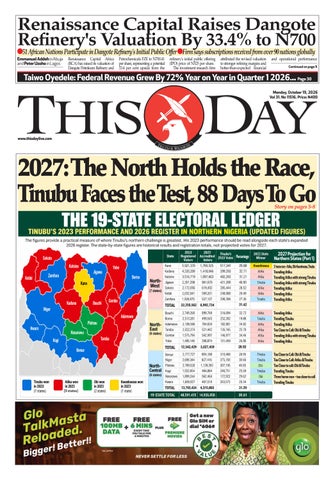
2027: The North Holds the Race, Tinubu Faces the Test, 88 Days To Go Story on pages 5-8
Percentage
2027 Projection for Northern States (Part 1) 3 horse race - Atiku, Obi-Kwankwaso, Tinubu Trending Atiku Trending Atiku with strong Tinubu Trending Atiku with strong Tinubu Trending Atiku Trending Atiku Trending Atiku Trending Atiku Trending Tinubu Trending Atiku Too Close to Call: Obi &Tinubu Trending Atiku with strong Tinubu Trending Atiku Too Close to Call: Obi &Tinubu Too Close to Call: Atiku &Tinubu Too Close to call: Obi &Tinubu Trending Tinubu Three horse race – too close to call Trending Tinubu
(9 states)
2
MONDAY, OCTOBER 19, 2026 • T H I S D AY
MONDAY, OCTOBER 19, 2026 • T H I S D AY
3
4
MONDAY, OCTOBER 19, 2026 • T H I S D AY
5
T H I S D AY • MONDAY, OCTOBER 19, 2026
NEWS ANALYSIS
2027:The North Holds the Race,Tinubu Faces theTest 88 DaysTo Go Olawale Olaleye
Finally, the die is cast. January 16, 2027, like the 2023 presidential run, promises another three-way electoral battle. And, as the countdown gathers momentum, the major political parties are already assembling their campaign machinery, preparing for what could become one of the most consequential presidential contests in Nigeria's recent history. Last Wednesday, October 14, the ruling All Progressives Congress (APC) inaugurated its Presidential Campaign Council, drawing membership not only from its ranks but also from prominent figures in opposition parties, who have thrown their weight behind President Bola Tinubu's re-election bid. Five days earlier, on Friday, October 9, the African Democratic Congress (ADC), had inaugurated its own campaign council for former Vice-President Atiku Abubakar. The third major contender, the Nigeria Democratic Congress (NDC), which is fielding the Peter Obi-Rabiu Kwankwaso ticket, has scheduled the inauguration of its campaign council for tomorrow, Tuesday, October 20, barring any last-minute changes. But beyond the elaborate ceremonies, curious membership lists, political endorsements and familiar declarations of confidence lies a more fundamental question: where will the election be won or lost? For all the political intrigues playing out across the country, the answer may lie substantially in the North, a region whose electoral strength was central to Tinubu's 2023 victory but whose political disposition towards his re-election bid has become an increasingly important subject of debate. Indeed, if the unfolding political developments are anything to go by, the contest for the North may well be the defining battle of 2027. Thus, with more than 54 million registered voters across its 19 states, the North remains central to Nigeria's presidential calculations. Next year’s presidential election is no different. But can President Tinubu retain the region's support amid Atiku's challenge, the Obi- Kwankwaso alliance and the growing scrutiny of his administration's record? The region that supplied nearly two-thirds of President Tinubu's votes in 2023 is confronting a different political reality ahead of the January 16, 2027 presidential poll. Between Atiku's northern credentials, Obi's alliance with Kwankwaso, the politics of defections, economic hardship and the president's formidable machinery, the contest for the North could determine whether Tinubu wins another four years or becomes a one-term president. There is something instructive about the renewed political activity in northern Nigeria. From Kano to Katsina, Sokoto to Zamfara, Kaduna to Borno, and across the North-Central states, politicians who ordinarily would have waited until the closing stages of an election to show their hands are already making their positions known. Some are openly mobilising for President Tinubu. Others are strengthening alliances with Atiku, a former vice-president, while a third force is emerging from the rather intriguing partnership between Obi, a former Anambra State governor and Kwankwaso, also a former governor of Kano State. The activity is hardly accidental. Beneath the endorsements, defections, consultations and increasingly familiar assurances of electoral victory hides an uncomfortable truth: the battle for the presidency in 2027 may be decided
substantially by what happens in the North. For Tinubu, the significance is particularly compelling. In 2023, his victory was built on a coalition that combined the electoral strengths of the South-West with the considerable political structure and goodwill associated with the late former president, Muhammadu Buhari, in the North. It was an arrangement whose origins could be traced to the alliance-building that produced the All Progressives Congress (APC) and its historic victory in 2015. But four years in politics is already looking like eternity. The political goodwill that helped Tinubu secure northern support in 2023 is not necessarily transferable to 2027. This time, he must defend his own record, explain the consequences of his economic policies, answer questions about the distribution of political power and convince a region struggling with insecurity and economic pressures that another four years would serve its interests. He must do so against a fellow northerner in Atiku and an ObiKwankwaso ticket that could introduce an entirely different dimension to northern voting behaviour. The question, therefore, is no longer merely whether Tinubu can win the North. He did not win a majority of its states in 2023, yet secured the presidency. The more far-reaching question is whether he can retain enough northern votes to prevent his national electoral coalition from unravelling. And the numbers explain why. The Mathematics of Power: 2023 Versus 2027
2027 Projection for Northern States (Part 1) South to follow
Kano Kaduna Katsina Jigawa Sokoto Kebbi Zamfara
3 Horse Race - Atiku, Obi-Kwankwaso, Tinubu Trending Atiku Trending Atiku with strong Tinubu Trending Atiku with strong Tinubu Trending Atiku Trending Atiku Trending Atiku
Bauchi Borno Adamawa Taraba Gombe Yobe
Trending Atiku Trending Tinubu Trending Atiku Too Close to Call: Obi &Tinubu Trending Atiku with strong Tinubu Trending Atiku
Benue Niger Plateau Kogi Nasarawa Kwara
Too Close to Call: Obi &Tinubu Too Close to Call: Atiku &Tinubu Too Close to Call: Obi &Tinubu Trending Tinubu 3 Horse Race – Too Close to Call Trending Tinubu
register alone exceeds those of the North-East and South-East combined. Second, Tinubu's dependence on northern votes in 2023 was enormous. Of the 8,794,726 votes that he received nationally, approximately 5,507,784 came from the 19 northern states. That translates to about 62.6 per cent of his total votes. The figure is significant enough without exaggeration. It also reveals a political irony. Tinubu won only seven of the 19 northern states in 2023, while Atiku won nine, Obi won two and Kwankwaso won one – Kano. Yet, Tinubu obtained more votes across those 19 states than Atiku, whose northern total was approximately 5.06 million. Thus, winning more states does not necessarily translate into winning more votes. Electoral margins matter, just as the distribution of votes does. For context, Tinubu's national margin over Atiku in 2023 was 1,810,206 votes. A hypothetical 20 per cent reduction in Tinubu's 2023 northern tally, without compensating gains elsewhere, would represent the loss of roughly 1.10 million votes. That would be equivalent to more than 60 per cent of his previous national victory margin. This is not a forecast. It is an illustration of how sensitive the president's re-election arithmetic could become to even a moderate shift in northern voting preferences. Of course, registration is not turnout. Ten million additional names on the register do not automatically translate into ten million additional votes. PVC collection, voter motivation, security, accessibility and the efficiency of election-day operations remain decisive. But the numbers leave little doubt about where the largest reservoir of electoral opportunity, and potential danger, lies.
According to the Independent National Electoral Commission (INEC), Nigeria entered the 2023 presidential election with 93,469,008 registered voters. The latest reported register, released in October 2026 ahead of the January 16, 2027 presidential election, contains 103,428,715 registered voters. That represents an increase of 9,959,707 voters, or approximately 10.66 per cent. More strikingly, the North, comprising the North-West, North-East and North-Central geopolitical zones, including the Federal Capital Territory, accounts for 56,014,673 registered voters. That is approximately 54.16 per cent of the national register. Excluding the FCT, the 19 northern states alone have 54,282,630 registered voters. In 2023, their combined register stood at approximately 48.59 million. In other words, the northern states have added about 5.69 million registered voters since the last presidential election. The regional breakdown is revealing. In North-West, the 2023 registered voters were 22,255,562 and they rose to 25,083,411 in 2026 while Tinubu garnered 2,652,235 votes in 2023. North-East had 12,542,429 voters in 2023 and by 2026, they had risen to 13,965,475. Yet, Tinubu had 1,185,458 votes in 2023 from the zone. The North-Central, however, excluding the FCT, boasted 13,793,424 in 2023 and as of last year, it has in its kitty, 15,233,744 registered voters. Tinubu had 1,670,091 votes from this number in 2023. Over all, the 19 northern states had 48,591,415 in 2023 and by 2026, the number was 54,282,630. But across the states, Tinubu only polled 5,507,784 votes in 2023. These numbers establish two important points. First, the NorthWest, with more than 25 million registered voters, is the country's Northern Mobilisation: A Sign largest geopolitical electoral bloc. Its of Strength or Anxiety?
The emergence of some pro-Tinubu northern political groups deserves closer examination. On October 12, prominent northern political figures operating under the banner of Arewa for Asiwaju declared their support for the president's reelection after visiting Vice-President Kashim Shettima at the Presidential Villa. Former Kano State Governor, Ibrahim Shekarau, spoke for the group, which is positioning itself to challenge perceptions that the North has been neglected under the Tinubu administration. Shettima, has therefore urged northern leaders to unite behind the president, maintaining that the region stands to benefit from another term. There is also the Tinubu Again Movement promoted by the Minister of State for Defence and former Zamfara State governor, Bello Matawalle. In Zamfara, figures including former governors Mahmuda Aliyu Shinkafi, Abdulaziz Yari and Ahmed Sani Yerima have also participated in political efforts supportive of Tinubu. Senator Yari is the Director-General of the campaign council for Tinubu’s re-election. These are not inconsequential names. They represent decades of political experience, organisational networks, traditional relationships and an understanding of northern electoral behaviour. But political endorsements are one thing. The ability to deliver the electorate is another. Indeed, the proliferation of support groups raises a question that Tinubu's strategists should not dismiss: if the president's standing in the North were as secure as some of his supporters insist, why has convincing the region become such an urgent political undertaking? There is a plausible answer from the president's camp. Early mobilisation is evidence of preparation, not necessarily weakness. Having benefited from organisation and alliance-building in
previous elections, Tinubu's supporters could reasonably argue that they are merely refusing to leave anything to chance. Still, the existence of electoral machinery does not extinguish popular resentment, where it exists. For many northern voters, the election may become a referendum on the cost of living, the effectiveness of security operations, the availability of jobs, the condition of agriculture and the perceived fairness of federal appointments. The allegation that the administration has disproportionately favoured the South-West has acquired political currency in sections of the region, although it must be distinguished from an established statistical conclusion. For example, a 2025 Federal Character Commission assessment reported 401 northern appointments against 311 southern appointments within the positions it reviewed. That finding challenges any blanket assertion that northerners hold fewer federal positions. But it does not settle arguments over the strategic importance of individual offices, nor does it cover every category of presidential appointment. Electoral politics frequently operates in the uncomfortable space between perception and proof. Tinubu may insist that his administration has treated the North fairly. The question is whether enough northern voters agree. North-West: Where the Toughest Battle May Be Fought The North-West is the centre of gravity of the northern contest. Its seven states of Kano, Kaduna, Katsina, Jigawa, Zamfara, Sokoto and Kebbi, have a combined 25,083,411 registered voters. In 2023, Tinubu obtained 2.65 million votes from the zone, making it his largest northern source of support.
Yet, he won only Jigawa and Zamfara. Atiku won Kaduna, Katsina, Sokoto and Kebbi, while Kwankwaso dominated Kano. The region could consequently become a three-way contest in which Tinubu attempts to consolidate APC's incumbency advantages, Atiku seeks to deepen his northern support, and the Obi-Kwankwaso ticket tries to turn Kwankwasiyya's formidable organisation into a broader presidential movement. Kano: The State That May Rewrite the Poll With 6,570,276 registered voters, Kano is Nigeria's second-largest electoral state after Lagos. Its register has increased by 648,906 since 2023 – the largest absolute gain recorded by any state. In the last presidential election, Kwankwaso received 997,279 votes in Kano on the platform of the New Nigeria Peoples Party (NNPP). Tinubu obtained 517,341, Atiku 131,716 and Obi a mere 28,513. The political circumstances have since changed fundamentally. Now, Obi and Kwankwaso constitute the presidential ticket of the NDC, while Governor Abba Kabir Yusuf, elected on the NNPP platform and previously identified with Kwankwasiyya, defected to the APC in January 2026. Yusuf moved with a substantial number of state and federal lawmakers, bringing the APC an important institutional advantage. But he also left behind an unresolved political question: did the governor take the movement's followers with him, or merely its elected officials? That distinction could be the difference between victory and defeat in Kano. The reconciliation of Yusuf with political interests historically opposed to Kwankwaso, including those associated with former governor Continued on page 6
6
T H I S D AY • MONDAY, OCTOBER 19, 2026
NEWS ANALYSIS
2027: THE NORTH HOLDS THE RACE, TINUBU FACES THE TEST 88 DAYS TO GO
TOTAL REGISTERED VOTERS AS OF OCTOBER 2026
TOTAL REGISTERED VOTERS NATIONWIDE IN 2023
Abdullahi Ganduje, has given the state's politics the unmistakable character of a struggle over loyalty, patronage and political succession. If Kwankwaso retains the grassroots loyalty that delivered almost one million presidential votes in 2023, his presence on Obi's ticket could make Kano an unexpected battleground for the NDC. But votes cannot simply be transferred from one candidate to another by political arithmetic. Some Kwankwasiyya supporters may resist Obi, while others may follow Yusuf into the APC. Atiku also has historical relationships in Kano that could become useful if the rivalry between its dominant camps deepens. Whoever eventually wins Kano may not secure the presidency solely on that account. But losing it badly could seriously damage any candidate's national prospects. Kaduna: El-Rufai, Uba Sani and an Unsettled Electorate Kaduna currently has 4,662,640 registered voters, compared with 4,335,208 in 2023. Atiku won the state in 2023 with 554,360 votes. Tinubu received 399,293, while Obi secured a substantial 294,494. The state's ethnic, religious and geographic divisions make it resistant to simplistic predictions. Governor Uba Sani's APC administration gives Tinubu an incumbent structure. But former governor Nasir El-Rufai's political alignment with the Atiku camp introduces another powerful network. There is also Southern Kaduna, where voting behaviour has historically reflected grievances over security, representation and communal relations. The 2027 outcome may depend less on endorsements made in Kaduna city than on how competing parties navigate these interests across the state's local governments.
Katsina: Buhari's Political Homeland Without the Same Electoral Certainty Katsina has 3,876,051 registered voters in 2026, an increase of 359,332 from 2023. But despite Buhari's enormous influence in his home state, Tinubu lost narrowly to Atiku in 2023. Atiku obtained 489,045 votes to Tinubu's 482,283 – a margin of only 6,762. That narrow result makes Katsina one of the most competitive northern states. Governor Dikko Radda and the APC establishment will seek to prevent an opposition breakthrough. Atiku, however, has already demonstrated that he can compete successfully in the state. Security challenges affecting farming communities, the cost of agricultural inputs and rural livelihoods could prove more decisive than the sentiments of 2023. Katsina may well be one of the clearest tests of whether the political goodwill associated with Buhari can survive as an independent advantage for Tinubu. Jigawa: Can the APC Protect Its 2023 Advantage? Jigawa's register has increased from 2,351,298 in 2023 to 2,807,811 in the new register, a substantial 19.42 per cent growth. Tinubu won the state in 2023 with 421,390 votes against Atiku's 386,587. The difference was 34,803 votes. The APC, therefore, has an existing advantage to defend, supported by its political structures in the state. However, the relatively narrow margin means Jigawa cannot be taken for granted. Rural economic conditions, agricultural productivity, local leadership networks and the mobilisation of newly registered voters will be critical. An opposition gain of several tens of thousands of votes could change
the result.
Meets Incumbency
Zamfara: The Weight of Political Heavyweights
Kebbi has 2,309,503 registered voters. Atiku obtained 285,175 votes in 2023, defeating Tinubu, who received 248,088. Governor Nasir Idris and the APC political establishment will seek to reverse that outcome. However, Kebbi's agricultural economy, insecurity in vulnerable communities and the purchasing power of rural households create important electoral pressure points. If Atiku maintains his existing support while expanding into dissatisfied APC constituencies, Kebbi could remain favourable to him. This is coupled with the growing influence of a former Minister of Justice and Attorney-General of the Federation, Abubakar Malami, who is also the governorship candidate of the ADC in the state. His persona may alter some of the existing equation. There seems to be a shifting sentiment in his way against his perceived persecution by the Tinubu administration. This is certain to count in its small way. But a disciplined APC mobilisation effort could also make the state competitive. The North-West, therefore, cannot reasonably be assigned wholesale to any one candidate. Of its seven states, Kano presents the most dramatic realignment, Katsina and Sokoto were extraordinarily close in 2023, and Kaduna has developed a formidable opposition challenge. Yet, the APC controls important state machinery and remains capable of recovering lost ground if it buckles up its chin strap. That is precisely why the zone matters so much.
Zamfara has 2,224,017 registered voters, up from 1,926,870 in 2023. Tinubu won the state with 298,396 votes, ahead of Atiku's 93,978. The president's support network includes the campaign DG, Yari, Matawalle, Shinkafi and other prominent politicians. Their collective experience could make Zamfara one of APC's more promising northern battlegrounds. Yet, the challenge here is particularly severe. For communities affected by banditry, kidnappings and displacement, politics is frequently measured by the ability to travel, farm, trade and sleep without fear. The APC political advantage will be tested against those realities. An endorsement by a former governor may open doors. It cannot, by itself, make an insecure road safe. Sokoto: A Narrow 2023 Defeat, an Enlarged Register Sokoto now has 2,633,113 registered voters, compared with 2,172,056 in 2023 – a remarkable 21.23 per cent increase, the highest proportional growth among the states. Atiku won Sokoto with 288,679 votes against Tinubu's 285,444. Just 3,235 votes separated the candidates. Governor Ahmed Aliyu's APC administration and the political influence of former governor Aliyu Wamakko provide Tinubu with considerable organisational strength. But the margin from 2023 suggests that neither side can afford complacency. A small shift in turnout, particularly in rural communities, could determine the state's presidential winner. Kebbi: Opposition Advantage
North-East: Atiku's Advantage, Shettima's Burden If the North-West is the largest electoral battlefield, the North-East may be Atiku's strongest regional
opportunity. The six states now have a total of 13,965,475 registered voters, up from 12,542,429 in 2023. Atiku won five of the six states in the last presidential election. Tinubu won only Borno. The vice-president's personal electoral credibility will consequently come under particularly close scrutiny, again in 2027. Adamawa: A Home Advantage for Atiku Adamawa has 2,431,146 registered voters. Atiku secured 417,611 votes in the state in 2023, while Tinubu obtained 182,881. Obi received 105,648. Indeed, Tinubu secured approximately 25.01 per cent of valid votes in Adamawa, barely exceeding the constitutional spread threshold. As Atiku's home state, Adamawa remains a difficult territory for the APC. The president's task will be to retain enough of his 2023 coalition to remain competitive, while Atiku seeks to widen the margin. Bauchi: A Large Opposition Reservoir With 3,012,547 registered voters, Bauchi is the North-East's largest electoral state. Atiku won it in 2023 with 426,607 votes against Tinubu's 316,694. The PDP longstanding political structure, associated with Governor Bala Mohammed, remains an important part of the state's political history, although the new party alignments require the opposition to rebuild or negotiate its support networks. Tinubu is not without opportunities. His 2023 tally demonstrates that he has an existing constituency in the state. But he would need to do considerably better to overturn Atiku's advantage. Borno: Shettima's Political
Scrutiny Borno has 2,765,165 registered voters, and Tinubu won the state in 2023 with 252,282 votes, compared with Atiku's 190,921. That represented approximately 54.2 per cent of valid votes. The result owed much to APC's established structure, including the influence of Governor Babagana Zulum and Vice-President Shettima. Whether that majority can be repeated is an important question, but not one that can be answered credibly by just declaring that Shettima will fail to deliver 50 per cent. Borno's electorate will also be judging progress against insurgency, displacement, resettlement and economic reconstruction. As the president's running mate, Shettima carries a dual burden: he must defend the administration's record across the North while protecting his own state – Borno's electoral base. Gombe: A Steep APC Deficit Gombe has 1,768,566 registered voters. In 2023, Atiku polled 319,123 votes against Tinubu's 146,977. That was a substantial difference. The APC benefits from Governor Muhammadu Inuwa Yahaya's incumbency, but the size of the opposition's previous advantage suggests the president will require an exceptional improvement in voter mobilisation to win the state. Taraba: A Three-Way Competition Taraba has 2,254,380 registered voters. Atiku won in 2023 with 189,017 votes, Obi obtained 146,315 and Tinubu received 135,165. The vote distribution demonstrates Continued on page 7
7
T H I S D AY • MONDAY, OCTOBER 19, 2026
NEWS ANALYSIS
2027: THE NORTH HOLDS THE RACE, TINUBU FACES THE TEST 88 DAYS TO GO
6,992,734
ACCREDITED VOTERS
that Taraba is more competitive than a simple North-East versus South-East electoral narrative would suggest. Its diverse religious, ethnic and local political interests could produce a vigorous contest among the ADC, NDC and APC. The Obi-Kwankwaso ticket may also complicate Atiku's attempt to consolidate opposition votes. It is worthy of mention of that Atiku did well Taraba in 2023 because certain forces like General TY Danjuma were visibly onboard. But now that it appears allegiance has switched, it is yet to be seen how that development will impact Atiku’s standing. Yobe: Atiku’s Strong Ground, But Not an Automatic Victory Yobe has 1,733,671 registered voters, up from 1,485,146 in 2023. Atiku obtained 198,567 votes in the previous election against Tinubu's 151,459. His advantage is clear from the historical result. However, the APC enjoys an incumbent political structure under Governor Mai Mala Buni, a politician with experience in party organisation. Yobe is therefore a state in which Atiku starts from a favourable electoral precedent, but one where Tinubu still has meaningful routes to improving his performance. This is because some of those who made the Atiku victory possible like Governor Buni, alleged to have struck a deal, had since made up with the ruling party and and president and things may no longer stay the same. Collectively, the North-East presents Atiku with a stronger historical foundation than the APC. Yet, Tinubu has a vice-president from the zone, established governors and influential political networks. The eventual result will depend on whether these institutions can overcome the opposition's demonstrated electoral strength. North-Central: Where Margins May Decide Everything The North-Central region is perhaps
the most politically diverse of the three northern zones. Across Benue, Plateau, Nasarawa, Niger, Kogi and Kwara States, the latest register stands at 15,233,744 voters, excluding the FCT. In 2023, Tinubu won four of the six states, while Obi won Plateau and Nasarawa. But a closer reading of those results reveals several vulnerabilities. Benue: A Victory of Just 2,096 Votes Benue has 3,057,225 registered voters. Tinubu won the state in 2023 with 310,468 votes. Obi followed with 308,372. The margin was only 2,096 votes. That is almost the definition of a competitive state. Governor Hyacinth Alia's APC administration, the influence of Secretary to the Government of the Federation, Senator George Akume, and internal rivalries within the governing party will all matter. But the dominant local issue may be insecurity, especially attacks on farming communities, displacement and the agricultural economy. The 2027 election could turn on whether the electorate believes the government has addressed these concerns. Plateau: Can Endorsements Reverse an Obi Victory? Plateau has 2,906,570 registered voters. Obi won with 466,272 votes in 2023. Tinubu secured 307,195 and Atiku 243,808. The result was a powerful indication that northern voting preferences are not homogeneous. Governor Caleb Mutfwang's participation in the APC North-Central endorsement of Tinubu illustrates the significant political realignment that has occurred since 2023. But changing party affiliation or endorsing a candidate does not automatically change the voting preferences of the electorate. Plateau's communities have continuing concerns about insecurity and displacement. Their assessment
of government performance may be more important than the position of political leaders. Nasarawa: Another State Tinubu Lost Nasarawa has 2,137,699 registered voters. Obi received 191,361 votes in 2023, defeating Tinubu, who obtained 172,922. Atiku followed with approximately 147,000. Governor Abdullahi Sule's APC machinery offers Tinubu an opportunity to reverse that defeat. However, Nasarawa is sufficiently diverse and competitive to resist confident predictions. Its proximity to Abuja, expanding urban communities, traditional political structures and security concerns could produce a fragmented electoral outcome. Niger: A Critical APC Stronghold Niger has 2,983,476 registered voters. Tinubu won it in 2023 with 375,183 votes against Atiku's 284,898. Governor Mohammed Umaru Bago's political structure and APC's existing electoral base give the president an advantage. However, unceasing insecurity in parts of the state and the disruption of farming activities as with other parts of the north, remain consequential issues. Niger will be a test of whether incumbent political organisation can coexist with widespread concerns about security and livelihoods without suffering significant electoral damage. Kogi: The APC Organisational Test Kogi has 2,232,398 registered voters. President Tinubu secured 240,751 votes in 2023, comfortably ahead of Atiku's 145,104. The governing party retains substantial institutional advantages, supported by Governor Usman Ododo, his godfather, Yhaya Bello, and the established APC networks.
Nevertheless, Kogi's ethnic diversity, the contest for local political influence and the appeal of alternative presidential tickets could affect turnout and voting patterns. The APC begins from a position of strength, but the margin it eventually delivers may be as important as whether it wins. This does not leave out the fact that the Bello factor is not one to gloss over, given his combative disposition to election, more so that he is on the ballot. But some former PDP leaders, who have pitched tent with Atiku and others in the PDP that are still sympthetic to him, are sure to create some balance should there be any eventuality. Kwara: Strong APC Foundations, Emerging Competition Kwara has 1,916,376 registered voters. Tinubu won the state in 2023 with 263,572 votes, against Atiku's 136,909. Governor AbdulRahman AbdulRazaq's political structure gives the APC a significant advantage. Yet, the involvement of prominent Kwara figures in the ADC, including its National Publicity Secretary Bolaji Abdullahi, creates an opportunity for the opposition to challenge established loyalties. There is also the Dr. Abubakar Bukola Saraki factor, which remains constant. With the PDP fast pushing back in the run-up to 2027, the competition in Kwara is going to be a very tough one, especially that Saraki not only has name recognition but considered a thorough strategist in ‘political science’ and its operations. The significance of Kwara, therefore, extends beyond the presidential vote. Competing ambitions over the state's succession politics and control of local structures could influence how enthusiastically party stakeholders prosecute the national contest. The North-Central cannot be written off by Tinubu's opponents, nor can the president take it for granted. In a close national election, relatively small
shifts in Benue, Plateau or Nasarawa could prove decisive. The 25 Per Cent Question: A Constitutional Calculation There is another important dimension to the 2027 election analysis. Under Section 134 of the 1999 Constitution, as amended, a presidential candidate must satisfy the relevant national vote requirement and secure at least one-quarter of votes in no fewer than two-thirds of the states. In practical terms, the geographical spread requirement has been interpreted to mean at least 25 per cent in 24 states, with the FCT not enjoying a separate mandatory veto over the outcome. This matters because a candidate does not have to obtain 25 per cent in every northern state to become president. Nor does winning a majority of the 19 northern states guarantee the presidency. What matters is the national vote total and the required geographical spread. Tinubu's 2023 performance in Adamawa illustrates why relatively small changes in the distribution of votes may acquire constitutional significance. The president secured approximately 25.01 per cent there, an extraordinarily narrow clearance of the threshold. But the broader lesson is that electoral strategy must be based on the total number of qualifying states, rather than isolated assumptions about northern performance. Atiku, Obi and the Problem of Opposition Arithmetic Although Atiku possesses a substantial electoral history across northern Nigeria, his claim to the region is compounded by the emergence of Obi and Kwankwaso on a joint ticket. INEC's published presidential candidates’ list confirms the contestants rather than leaving their political alignments to speculation. Tinubu is running with Shettima
on the APC platform. Atiku is contesting under the African Democratic Congress with a former Rivers State governor, Rotimi Amaechi, as his running mate. Obi is the NDC candidate with Kwankwaso as his running mate. Oyo State Governor Seyi Makinde is contesting on the platform of the Allied Peoples Movement, among other fringe candidates and parties. These arrangements create a dramatically different electoral environment from 2023. For Atiku, the advantage is that he remains the most prominent northern presidential candidate among the leading contenders, with demonstrated support in many of the region's states. The disadvantage is that northern voters are not obliged to vote along geographical lines. Tinubu has already proved that a southern candidate can secure a majority of his national votes from the North except that in 2027, he will run, not on promises, but his record. Obi, meanwhile, must demonstrate that his 2023 appeal can travel beyond its strongest constituencies, particularly through Kwankwaso's organisational network in Kano and neighbouring states. There is a temptation to assume that the votes Obi and Kwankwaso secured separately in 2023 will simply combine in 2027. Such a calculation is attractive but potentially misleading. Different party platforms, voter turnout, religious considerations, personal loyalties, candidate preferences and the political circumstances of the election will all affect whether that combination materialises. Besides, Kwankwaso's political machine is no longer operating under the same conditions as 2023, following Yusuf's departure. For Tinubu, there is an obvious advantage in opposition fragmentation. If Atiku and Obi compete for substantially the same pool of voters in Kano, Kaduna, Plateau or other Continued on page 8
8
T H I S D AY • MONDAY, OCTOBER 19, 2026
NEWS ANALYSIS
2027: THE NORTH HOLDS THE RACE, TINUBU FACES THE TEST 88 DAYS TO GO competitive states, the APC could benefit from a divided opposition even where the majority of voters prefer change. But this advantage is not automatic. The two opposition tickets are capable of attracting different constituencies. Their rivalry might also energise additional voters rather than merely divide existing support. What is clear is that the battle for the North now has more than two serious political dimensions. And the president's survival may depend, in part, on his opponents' inability to translate their dissatisfaction with his government into one overwhelming electoral alternative. Can the S’East Governors Contain Obi? Although the North is central to the presidential arithmetic, the outcome will not be determined there alone. The South-East remains one of the most important regions for testing the effectiveness of political realignment. However, Obi’s performance in the zone was not without some machinations from certain unseen hands. A former Rivers State governor, Nyesom Wike, recently shed light on this when he said the G-5, a group of governors he set up in the lead up 2023 intentionally worked for Obi to cut down Atiku’s votes. Obi's dominance in 2023 was extraordinary. In Anambra, he received 584,621 votes against Tinubu's 5,111. In Enugu, Obi secured 428,740 votes against Tinubu's 4,772. In Abia, he obtained 327,095 votes, compared with Tinubu's 8,914. Those were not ordinary victories. They were electoral landslides. Yet, the region's political leadership has undergone significant changes. Some of those factors are no longer available. What is therefore likely to happen to Obi in the zone in 2027? Governor Charles Soludo of Anambra, Obi’s home state, has openly supported Tinubu. Governor Hope Uzodinma of Imo remains a prominent figure in the APC eastern political structure, although he is fighting his own demons internally. Governor Peter Mbah of Enugu and other regional leaders have also become important factors in the shifting alignment around the president. Even the Abia State Governor, Alex Otti, is believed to be sympathetic to the Tinubu cause. But there is a profound distinction between political endorsement and electoral conversion. The challenge for Soludo, Mbah, Uzodinma and other pro-Tinubu interests is not merely to announce support for the president. It is to persuade voters who overwhelmingly rejected the APC in 2023 to reconsider. That is altogether a different undertaking. If Tinubu substantially improves his performance in the South-East, even without winning the region, he could compensate for some northern losses, which seem to stare him in the face at the moment. Conversely, if Obi retains his overwhelming advantage, the president would have fewer opportunities to offset significant damage elsewhere. The 25 per cent threshold is particularly relevant here because Tinubu's previous results in several South-East states were nowhere near that level. The question, therefore, is not whether governors can mobilise some support for Tinubu. It is how much support they can realistically generate against an opponent, who remains deeply identified with the region's presidential aspirations. South-West: Tinubu's Homeland No Longer a Guaranteed Sanctuary
The assumption that Tinubu's South-West base will automatically compensate for any northern losses also requires careful examination. It’s more an unrealistic gamble. In 2023, Tinubu won four SouthWest states: Ekiti, Ogun, Ondo and Oyo. He lost Lagos, his political home state to Obi, and Osun, his alleged state of origin to Atiku. Those results make it inaccurate to suggest that his chances may be confined to one state – perhaps Ekiti – in 2027. He entered the present contest with substantial electoral support across the zone. But that support is being tested by new realities. In Lagos, Obi defeated Tinubu by 582,454 votes to 572,606 – a margin of 9,848. The defeat was politically symbolic because Lagos had been the foundation of Tinubu's national political influence. If Obi can repeat that success, it would deny the president an important opportunity to rebuild his national tally. However, Lagos's 2027 outcome will depend on turnout, party organisation, the mobilisation of its diverse electorate and whether the political enthusiasm that powered Obi's 2023 performance can be sustained. Osun, however, presents a separate challenge. Tinubu lost the presidential election there in 2023, receiving 343,945 votes against Atiku's 354,366. More recently, Governor Ademola Adeleke won re-election in August 2026 on the Accord Party platform (after he was frustrated out of the PDP and prevented from entering the APC), securing 511,067 votes against APC's 444,815. The result suggests that Osun's electorate is prepared to resist the APC even where the ruling party commits considerable resources. But Adeleke's governorship victory does not establish how every Osun voter will behave in a presidential election. In fact, some of the voters have started warning him to stop promising Tinubu what is arguably not in his hand. Ogun and Ondo, too, present their own internal political complications, including rivalries among influential figures within the governing party. In Ondo, for example, Governor Lucky Aiyedatiwa's political relationships and the state's internal APC alignments will help determine how effectively Tinubu's support is mobilised. There are concerns about the governor’s true standing in the scheme of things. In Ogun, the capacity of competing interests to work together will be important, and that’s looking already like an uphill task. The president is believed to have done a terrible job keeping Ogun APC as one house/ family. He consciously made his choice, perhaps. Yet, both states voted for Tinubu in 2023, and neither can responsibly be described as already lost or won again. Oyo is potentially more problematic and the reason is not far-fetched. Tinubu won the state in 2023 with 449,884 votes. But Makinde, who commands substantial political influence as governor, and worked tirelessly for Tinubu is now an actual presidential candidate on the platform of APM. His candidacy introduces the possibility of a serious contest for votes that might otherwise have gone to Tinubu or the leading opposition candidates, but will ultimately go to waste. Whatever personal disagreements or alleged political understandings that may have existed between Makinde and Tinubu, the more important question is whether Makinde can convert his state-level popularity into a presidential vote large enough to weaken the APC.
Tinubu's supporters may regard Makinde's presidential ambition as unrealistic. But a candidate does not have to win the presidency to determine who loses it. Working to be a spoiler is food for thought. That is one of the potential complications in Oyo and, by extension, the South-West. More importantly, Vice-President Kashim Shettima’s recent warning about internal wrangling is a note for file for the Southwest leaders, who have continued to paper the cracks. South-South: Atiku's Electoral Dilemma
In the South-south exists a clinical contrast to Tinubu’s northern challenge. If the North presents a formidable political test for the president, the South-South offers an equally intriguing examination of Atiku Abubakar's electoral relationships. The region, once a dependable stronghold of the PDP, has undergone a remarkable political transformation, with all six governors now belonging to the ruling APC. In Akwa Ibom, Governor Umo Eno, has abandoned the PDP for the APC, while Bayelsa's Douye Diri has followed the same path. Delta Governor Sheriff Oborevwori has equally crossed over, taking with him former governor Ifeanyi Okowa, who was Atiku's running mate in 2023. In Edo and Cross River, Governors Monday Okpebholo and Bassey Otu are already established APC figures. The implications are interesting. In 2023, Atiku won Akwa Ibom with 214,012 votes and Bayelsa with 68,818. But Peter Obi carried Delta, Edo and Cross River, polling 341,866, 331,163 and 179,917 votes, respectively. Across these five states (excluding Rivers), Obi secured more than one million votes, against Atiku's approximately 629,000 and Tinubu's 568,000. Now, with the governors united under the APC, Tinubu has acquired a significant organisational advantage. But whether that political realignment translates into corresponding electoral support remains an entirely different question. For Atiku, the challenge is particularly delicate. His former running mate is now working within the opposing political establishment, while his new partner, Rotimi Amaechi, must help rebuild an opposition coalition in a region where the old PDP machinery has substantially changed hands. Yet, governors do not necessarily determine presidential voting preferences, as the 2023 results in Delta, Edo and Cross River demonstrated. The decisive question is whether these governors can transfer their political structures and influence to Tinubu, or whether voters will once again distinguish between their preferred governors and presidential candidates. Either way, the South-South deserves attention, not merely because of its governors' political affiliations, but because of the considerable difference between the region's 2023 voting patterns and its present political leadership. Rivers, the FCT and the Wike Complication No serious analysis of the 2027 presidential election can ignore Nyesom Wike, the Minister of the Federal Capital Territory. He has declared that he will coordinate Tinubu's campaign operations in Rivers and the FCT. He went ahead to describe himself as the commander, field operations. His willingness to support the president while navigating complicated relationships with the PDP has made him one of the more unusual political
actors of the present cycle. Wike commands resources, political relationships and an established record of aggressive electoral organisation. But his position also comes with complications. His longstanding conflict with Rivers Governor, Siminalayi Fubara, has created competing centres of influence. Atiku's running mate, Rotimi Amaechi, is himself a former Rivers State governor with his own political history and network in the state. Rivers could consequently become yet another battleground state, involving three familiar political figures whose rivalries predate the present presidential contest. Tinubu won Rivers in 2023 with 231,591 votes. Obi received 175,071, while Atiku obtained 88,468. Those numbers demonstrate why Rivers matters to all three leading camps. Putting the FCT in focus, Obi's previous advantage was far more pronounced. He secured 281,717 votes against Tinubu's 90,902. Wike's declaration that he will deliver the FCT for the president must therefore be judged against the scale of the electoral reversal it would require. As with other governors, ministers and political heavyweights, Wike's organisational influence is a relevant factor as much as a burden, but it is not an electoral result. The voters still have the final say. The Economy and the Politics of Everyday Survival
There is a danger in reducing the coming election entirely to personalities, ethnic relationships and the disposition of political godfathers. For millions of voters, the question may be more immediate. Can they afford food? Are their communities secure? Can they farm, travel and conduct business without fear? Have government policies improved their lives? But Tinubu's defenders have an economic argument to make. The World Bank's October 2026 Nigeria Development Update reported that real GDP grew by 4.2 per cent in the first half of 2026, compared with 3.9 per cent in the corresponding period of 2025. Higher public revenues and improving macroeconomic fundamentals offer the administration evidence of economic progress. But the World Bank has also stressed the need to translate these gains into jobs, poverty reduction, better public services and improved living standards. That is where economic statistics meet electoral politics. Macroeconomic improvement may impress investors and policymakers. A household struggling with transport fares, food prices or agricultural costs may ask a different question. Indeed, one of the government's principal political challenges is the delay between the implementation of difficult economic reforms and the delivery of benefits that ordinary citizens can recognise. This challenge is especially important in northern communities affected by insecurity, low household incomes and dependence on agriculture and informal trade. The administration may be able to defend its reforms as necessary. It must also convince voters that the sacrifices are producing tangible rewards or that the ruling class is leading by personal examples. The opposition, on the other hand, cannot rely entirely on public hardship. It must establish that its candidates possess credible and coherent alternatives. Atiku has attempted to position himself around policy disagreements with Tinubu. Obi continues to stress governance, prudence and economic
management. But elections are not won simply by identifying problems. Voters will also judge whether those offering themselves as alternatives are capable of delivering the improvements they promise. Traditional Institutions, Clerics and the Limits of Political Influence
The place of traditional institutions and religious leaders in northern politics is another important consideration. Emirs, district heads, influential clerics and community leaders possess networks of trust that politicians often seek to cultivate. Their counsel can affect public attitudes, particularly in communities where religious and traditional authority remains strong. But their political preferences are not uniform, and their influence is not absolute. Northern voters have repeatedly demonstrated an ability to distinguish between the wishes of political elites and their own electoral choices. Kano, in particular, has a history of fierce grassroots political independence. Patronage, campaign spending and endorsements may affect mobilisation, but they cannot be assumed to purchase a predictable electoral outcome. The same caution applies to speculation that political appointees who fear losing office may divert campaign resources for personal use, even though the practice is common in some places. Such conduct, unfortunately, can be counterproductive. Nevertheless, campaign coordination and the reliability of political intermediaries are legitimate strategic concerns. Money spent on political mobilisation is not the same thing as votes delivered. And the closer the election becomes, the more important that distinction may prove. Plausible Anxiety, Not Established Forecast One of the more dramatic suggestions circulating in political discussions is that Tinubu may struggle to secure average – say some 34 per cent of votes across the North in 2027. It is a claim that speaks to anxiety within his political coalition and confidence among his opponents, given some of the happenings across the north of Nigeria. But without a credible, representative opinion poll or a transparent state-by-state forecasting model, it remains a political proposition rather than a statistically established prediction. Even the phrase "34 per cent of the North" needs definition. Does it mean 34 per cent of all registered voters, 34 per cent of votes cast or 34 per cent of valid votes? The distinctions are substantial. What the 2023 results allow one to establish is that Tinubu's northern strength was uneven, concentrated in particular states and dependent on margins that were sometimes surprisingly narrow. What the 2026 registration figures establish is that the northern electorate has expanded considerably. Neither dataset, by itself, establishes how those voters intend to vote in January. That judgment requires reliable surveys, constituency-level intelligence, turnout analysis, assessments of party organisation and continuous monitoring of campaign developments. The most serious warning to the APC is therefore not an unsupported prediction that Tinubu will collapse to a particular percentage. It is the possibility that an erosion of his 2023 northern vote, combined with continued opposition strength in
the South-East and losses in selected southern battlegrounds, could become difficult to recover from. Equally, the greatest danger to the opposition is the assumption that public dissatisfaction will automatically produce a united vote against the incumbent. It may not, actually. The Final Equation With the presidential election scheduled for January 16, 2027, the outlines of the contest are becoming clearer, albeit slowly. Tinubu has the advantages of incumbency, access to an extensive political organisation, war chest, the support of several governors, some established northern allies and a record of successful national alliance-building. Atiku brings a long electoral history, considerable northern recognition, experience and the advantage of having carried nine northern states in 2023. Obi, now paired with Kwankwaso, introduces a new possibility: combining the former's powerful southern support with the latter's northern grassroots strength, most notably in Kano. Makinde's candidacy complicates the South-West, while Wike's alignment with Tinubu, alongside the competing ambitions of Rivers politicians, adds another layer to the national calculation. There is also the question of whether the president's economic policies, skewed appointments and security record have created sufficient resentment to overwhelm the organisational advantages of the APC. These are important variables, but none can yet be translated responsibly into a certain outcome. The election, therefore, remains open. Yet, one conclusion appears increasingly difficult to dispute. For Tinubu, 2027 is not simply about retaining his home region or persuading a collection of political heavyweights to endorse him. It is about reconstructing the northern coalition that played such a decisive role in his emergence as president. The remarkable thing about the 2023 election was that Tinubu did not need to win most northern states to secure more northern votes than Atiku. The danger in 2027 is that this arrangement may no longer hold in the same form. The president will need to defend his territory in Jigawa, Zamfara and Borno; remain competitive in places like Katsina and Sokoto; protect gains in Niger, Kogi, Kwara and Benue; and prevent the opposition from opening decisive margins in Kano, Kaduna, Bauchi, Gombe, Adamawa and Yobe. He must also prepare for the possibility that Obi's partnership with Kwankwaso could disrupt familiar electoral calculations in the region. For Atiku, the task is to turn his northern recognition into an advantage sufficiently large to overcome APC's incumbency and the competing appeal of the NDC. Obi and Kwankwaso are to demonstrate that two distinct political followings can become one effective national coalition despite evident limitations. None of these is easy. The essential lesson from the figures is unmistakable: the North remains too large, too politically diverse and too electorally consequential for any serious presidential candidate to treat as an automatic inheritance. In 2023, the North helped to make Tinubu president. In 2027, it may determine whether he remains one. The 2027 election battle, without doubts, is in the North. But unlike four years ago, the president must now fight it on the strength of his own record.
9
T H I S D AY • MONDAY, OCTOBER 19, 2026
PAGE NINE
FG Retrieves Benin-Asaba Road, Tinubu Orders Full Reconstruction Umahi says 136km highway to be redesigned, rebuilt as dual carriageway
Emmanuel Addeh in Abuja
The federal government has reclaimed the Benin-Asaba Road from concession arrangements, with President Bola Tinubu ordering the comprehensive redesign and reconstruction of the 136-kilometre highway as a dual carriageway, Minister of Works, David Umahi, has disclosed. Umahi announced the development during the reopening
of the First Niger Bridge on the Asaba-Onitsha Road, saying the federal government would also begin permanent reinforced concrete pavement works on critical sections of the BeninAsaba highway to address its deteriorating condition. “What stopped the Ministry of Works from reconstructing BeninAsaba Road, the concessioning of that route, has been unsealed. We now have our route back to the Ministry of Works,” the
minister said. He explained that the return of the highway to the ministry would enable the federal government to take direct responsibility for its comprehensive reconstruction, adding that the redesign process was ongoing and construction would begin after its completion. “The legacy of President Bola Tinubu, you will see it ongoing on this road. Never again will our people suffer on this road,”
Umahi said. The Benin–Asaba expressway was initially concessioned under the federal government’s Highway Development and Management Initiative (HDMI), designed to attract private investment into federal road infrastructure. However, the arrangement subsequently ran into difficulties over the pace and quality of construction. During inspections in August 2026, Umahi accused
the concessionaire of slow progress, inadequate technical capacity, substandard work and construction methods that worsened sections of the road. The federal government initially sought to negotiate an intervention but said the concessionaire rejected proposed options and did not grant permission for the ministry to undertake emergency repairs. The announcement came as the minister outlined measures taken to rehabilitate and secure
Umahi
the First Niger Bridge, a critical transport link connecting the South-east and South-south, following reports that individuals had been removing bolts and cutting iron components from its steel structure.
$5bn Bonga North Deepwater Project Advances as Tenaris Completes Pipe Coating Work Project proves world-class coating no longer needs trip abroad, says NUPRC Lokpobiri: reforms restoring investor confidence as EPC firms return after exit
Peter Uzoho
Shell's $5 billion Bonga North deepwater development has recorded major progress with the completion of its pipe coating campaign at Onne, Rivers State, by the subcontractor, Tenaris. The milestone positions Nigeria to unlock 110,000 barrels per day in new production from the subsea tie-back to the Bonga Main Floating Production, Storage and Offloading (FPSO). The achievement was celebrated recently alongside the 25th anniversary of Tenaris in Nigeria and the inauguration of the upgraded five-layer thermal insulation plant by Pipe Coaters Nigeria Limited (PCNL), a subsidiary of Tenaris, an investment of $10 million. THISDAY learnt the coating campaign, executed entirely in-country, involved coating of production lines with five-layer thermal insulation and water injection lines with three-layer polypropylene anti-corrosion
systems to international standards, confirming Nigeria's capacity to deliver complex deepwater infrastructure locally. Speaking at the occasion, Bonga North Project Director, Ian Kellagher, representing the Managing Director of Shell Nigeria Exploration and Production Company Limited (SNEPCo), Ronald Adams, said the completion had national implications beyond the project. Kellagher described Bonga North as a subsea development tied back to the Bonga Main FPSO facility in 1,000 metres water depth, with recoverable reserves expected to deliver peak production of 110,000 bpd following Final Investment Decision (FID) in December 2024. Shell expects first oil from the asset by end of the decade. Bonga North development holds estimated recoverable resource volumes of more than 300 million barrels of oil equivalent (boe). The project is one of the mega deepwater projects on which
the federal government and the industry are banking on to lift Nigeria's oil production to 3 million barrels per day by 2030. Kellagher said the successful coating in Onne means PCNL now possessed a world-class five-layer system able to compete for future deepwater projects globally, with partners working seamlessly to address technical, health, safety, environment and logistics challenges. He said the development demonstrated that Nigeria had both the people and industrial capability to execute highest quality deepwater projects without exporting jobs and expenditure. Managing Director of Tenaris Nigeria, Rosario Osobase, described the day as three milestones telling a single story of commitment, capability, and partnership. Osobase said Tenaris was celebrating 25 years of growth, partnership, innovation, and shared success in Nigeria,
moving from a service provider to a deepwater coating and insulation hub at Onne. She said the inauguration of the thermal insulation plant reflected Tenaris' confidence in Nigeria, while the Bonga North coating campaign demonstrated what world-class technology and local expertise could achieve when combined. She stated that every milestone was made possible by employees past and present and by institutions championing local capability, adding that the new facility is an investment in people and long-term partnerships for the next generation of deepwater projects. Minister of State for Petroleum Resources (Oil), Senator Heineken Lokpobiri, who inaugurated the plant, said government had changed the narrative from investment decline to recovery, with Engineering Procurement and Construction (EPC) companies returning and several projects coming on stream
between 2023 and 2026. Lokpobiri said priority will now be given to companies with proven in-country capacity and equipment, stressing that retention of petroleum expenditure, skilled jobs and technology transfer must drive project execution. Executive Commissioner for Production and Development, Nigerian Upstream Petroleum Regulatory Commission (NUPRC), Enorense Armadasu, representing Commission Chief Executive, Oritsemeyiwa Eyesan, said Bonga North answered the question of whether Nigeria could deliver complex deepwater projects to global standards. Armadasu said the project showcaseed partnership where SNEPCo and joint venture partners worked shoulder to shoulder with indigenous capacity, a model he said the commission was institutionalising under the Petroleum Industry Act (PIA) 2021 with over 15 high impact regulations.
He said several offshore projects, including Bonga SouthWest, Zabazaba, Bosi and Preowei, were expected to draw tens of billions of dollars by 2030, all requiring subsea infrastructure and facilities, like the Onne plant. "The pipelines that will carry Bonga North production have been coated and qualified to international standards right here in Onne,” Armadasu said. He added, “That is not merely a project milestone, it is a declaration of industrial capability." Armadasu stated, "This plant is not built for one campaign; it is built for a generation of them. Its presence tells every operator that world-class deepwater coating no longer requires a voyage abroad. "To Tenaris, you have positioned yourself at the front of a decade-long queue of opportunity that will define Nigeria's next deepwater chapter."
RENAISSANCE CAPITAL RAISES DANGOTE REFINERY'S VALUATION BY 33.4% TO N700 in the first nine months of 2026, with revenue, earnings before interest, taxes, depreciation and amortisation (EBITDA), and net profit all exceeding its projections. In an update at the weekend titled: “Stronger Refining Margins Drive Earnings Outperformance,” RCA highlighted the refinery's robust earnings growth and improving financial position as key factors underpinning its more optimistic assessment. For the nine months ended September 30, 2026, Dangote Petroleum Refinery reported revenue of $22.5 billion and net profit of $4.7 billion, marking a significant turnaround from the $117.2 million loss recorded in the corresponding period of 2025. Revenue increased by 144 per cent from $9.2 billion in the preceding year, while EBITDA surged nearly nine-fold to $5.5 billion from $627.6 million. The refinery's operating cash
flow also rose more than ten-fold to $3.68 billion, reflecting its growing capacity to generate cash from operations amid stronger refining margins and improved performance. The improved earnings translated into a stronger balance sheet, with the company moving from a net debt position of $1.73 billion as of September 2025 to a net cash position of $651 million by September 2026. The shift, alongside the stronger cash flow, it said, points to an improvement in the refinery's liquidity and financial resilience as it consolidates its position in the domestic and international petroleum products markets. RCA's revised valuation offers a more bullish assessment of the refinery's prospects following its strong nine-month performance. However, the projected upside depends on the sustainability of refining margins, operating
performance and broader market conditions. Meanwhile, Dangote Petroleum Refinery & Petrochemicals yesterday announced that its ongoing Initial Public Offer (IPO) has attracted overwhelming participation from investors across Africa and the global investment community, with subscriptions received from more than 90 countries, including investors from 51 of Africa’s 54 nations. The scale and geographical spread of participation make the transaction Africa’s first truly pan-African public offering, demonstrating growing confidence in African-led industrial development and an increasing appetite among Africans to take ownership of strategic assets built on the continent. Dangote Refinery disclosed this in a statement, saying the offer has already rewritten the record books, becoming the largest
public offering ever launched in the Nigerian capital market on its opening day and surpassing the previous African record within its first ten days. It said the achievement has been driven by strong demand from retail investors, pension funds, institutional investors, asset managers, fintech platforms, and members of the investing public. A source close to the management of Dangote Petroleum Refinery described the milestone as a defining moment for Africa’s capital markets and economic future. “This offering is far more than a capital-raising exercise. It represents a historic opportunity for Africans and global investors to participate directly in the ownership of one of the continent’s most transformative industrial assets. The impressive participation from investors across Africa reflects a shared belief that Africans should not
merely consume the benefits of industrialisation but also own the assets that drive it and share in the wealth they create,” the source said. The remarkable investor response comes amid the refinery’s strong operational and financial performance. According to the source, the refinery’s current performance has substantially outpaced the assumptions used in arriving at the IPO valuation. “The refinery’s financial and operational performance has progressed significantly beyond the baseline assumptions underpinning the IPO. The combination of scale, efficiency, market reach and operational momentum continues to create substantial value for shareholders and reinforces confidence in the company’s long-term growth trajectory", the source said. The transaction has also
accelerated the integration of African capital markets through pioneering cross-border collaborations involving Botswana, Egypt, Ethiopia and Kenya, helping to simplify participation and broaden investor access across the continent. Management said it views the IPO as a powerful demonstration of the growing sophistication, depth and interconnectedness of African capital markets, while also providing a template for future continent-wide investment offerings. The refinery reiterated that the IPO offers investors a unique opportunity to participate in the ownership of one of Africa’s largest and fastest-growing industrial enterprises, with the potential for USD-linked dividends, subject to the company’s dividend policy and applicable regulatory approvals.
10
NEWS
T H I S D AY • MONDAY, OCTOBER 19, 2026
Group News Editor: Goddy Egene Email: Goddy.egene@thisdaylive.com, 0803 350 6821, 08074010580
UNVEILING OF THE AREWA 4 ASIWAJU CAMPAIGN HEAD OFFICE...
L-R: Secretary to the Government of the Federation (SGF), George Akume; Deputy Senate President, Barau I. Jibrin; Vice President Kashim Shettima; former Kogi State Governor, Yahaya Bello; National Chairman, All Progressives Congress (APC), Professor Nentawe Yilwatda; Minister of Health and Social Welfare, Professor Mohammed Ali Pate; Kano State Governor, Abba Kabir Yusuf; former Kano State Governor, Mallam Ibrahim Shekarau; and Special Adviser to the President on Policy and Coordination, Hadiza Bala Usman, during the unveiling of the Arewa 4 Asiwaju (A4A), Campaign Head Office in Abuja Saturday PHOTO: KINGSLEY ADEBOYE
Dele Oye Faults Chike-Obi, Says Nigeria Not Losing $10bn on Foreign Reserves
Insists foreign reserves not ordinary savings, but protection against disruptions Admits Nigeria needs more rigorous assessment of cost of maintaining reserves Calls for transparent reserve adequacy benchmarks, quarterly disclosures Emmanuel Addeh in Abuja
The Chairman of the Alliance for Economic Research and Ethics (AERE), Dele Oye, yesterday faulted claims that Nigeria could be losing more than $10 billion annually from holding
foreign reserves, arguing that the calculation fails to account for the different currencies, financing arrangements and risks involved. Oye, a lawyer, said although the country’s reserve accumulation carries a cost and should be subjected to rigorous economic
scrutiny, subtracting an estimated 3 per cent return on foreign assets from an assumed 20 per cent naira funding cost does not establish the Central Bank of Nigeria (CBN) actual cost of maintaining its external reserves. Responding to comments by
former Fidelity Bank chairman and former Managing Director of the Asset Management Corporation of Nigeria (AMCON), Mustafa Chike-Obi, Oye said Nigeria needed a more rigorous assessment of how much it costs to maintain its reserves, what
Sanwo-Olu Unveils Five-Point Food Security Strategy for Lagos Segun James Governor Babajide Sanwo-Olu of Lagos State has unveiled a five-point food security strategy to galvanise growth for the agricultural sector in the state. Speaking during the grand finale of the World Food Day held at the Police College, Ikeja, the governor who was represented by his Deputy, Dr. Kadiri Hamzat emphasized that despite Lagos being Nigeria’s smallest state by
landmass with a population exceeding 22 million, food security will be driven by intensity and efficiency rather than land expansion. The strategy according to the governor include technology, inter-state partnerships, investment in farmers, reducing post-harvest losses through better storage as well as pursuing affordability, nutrition and sustainability. "Lagos is Nigeria’s smallest state by landmass, yet it is home to over 22 million
people. We cannot achieve food security by expanding farmland. We achieve it by producing more on the land we have, sourcing efficiently from partner states, processing more of what we consume, and moving food from farm to household with less waste. "This year’s World Food Day theme, “Innovate Today, Nourish Tomorrow,” highlights the need for new ideas and practical solutions to address hunger and malnutrition. "The 16th of October
is observed annually to commemorate the founding of the Food and Agriculture Organization of the United Nations in 1945. The day also calls for sustained commitment and decisive action to ensure that everyone has access to adequate, nutritious food. "Achieving this requires innovation that goes beyond ideas and research to produce practical results. It must reach the farm, processing center, marketplace, and the kitchen of every household." he said.
LPG Marketers Push Safety, Digitalisation to Reduce Operational Risks Call for stricter compliance, preventive maintenance
Emmanuel Addeh in Abuja The Nigerian Association of Liquefied Petroleum Gas Marketers (NALPGAM) has called for stricter safety standards, stronger regulatory compliance and wider adoption of digital technologies to reduce operational risks and improve efficiency in Nigeria’s Liquefied Petroleum Gas (LPG) industry. The association said the sector’s
growth must go beyond increased consumption and supply volumes to address unsafe practices, product losses, poorly maintained facilities and gaps in regulatory compliance. Speaking at NALPGAM’s 2026 webinar on: “Downstream LPG Operational Excellence and Compliance”, the association’s National President, Edu Inyang, said safety must become a permanent feature of industry
operations rather than an occasional campaign. “The future of Nigeria’s LPG industry cannot be achieved by increasing volumes alone. We must grow safely, responsibly, efficiently and sustainably. Safety is not an occasional campaign; it must become a continuous industry culture,” Inyang said. The webinar brought together industry operators, regulators and other stakeholders to examine
safety risks, market volatility, operational inefficiencies and regulatory requirements in the downstream LPG market. One of its key outcomes was the adoption of a proposed “NALPGAM Standard of Operational Excellence”, anchored on four principles: safe and wellmaintained facilities, competent and adequately trained operators, compliant processes and customer protection.
risks they protect the economy against and how much the country should hold to withstand external shocks. In a policy essay dated October 18, 2026, Oye said Chike-Obi had raised an important question about the economic implications of accumulating foreign reserves, but argued that the conclusion drawn from the interest-rate differential was not supported by sufficient evidence. More fundamentally, Oye argued that the calculation compared the return on dollardenominated assets with an assumed naira funding cost without establishing how the reserves were financed or the actual costs and risks associated with maintaining them. “The useful conclusion is therefore neither that reserves are free nor that Nigeria is burning US$10 billion every year. The useful conclusion is harder and more valuable: Nigeria needs a transparent, country-specific answer to the question, adequate for what, against which shocks, and at what marginal cost?” he maintained. Chike-Obi had argued that Nigeria's foreign reserves earned about 3 per cent annually while the cost of naira funds used to support them was around 20 per cent, creating a potential 17-percentage-point annual loss if the exchange rate remained unchanged. But Oye said the argument contained an important economic consideration but could not, without further evidence, be treated as an accurate measure of the country's annual financial loss. He explained that the naira interest rate and the return on dollar assets reflected different
currencies, risks and financing arrangements. A proper comparison, he explained, would have to account for exchange-rate movements, hedging costs, the maturity of the instruments involved and the actual yields on the liabilities used to finance or sterilise reserve accumulation. Oye maintained that the cost of reserve accumulation should be measured against the protection the assets provide when oil receipts decline, foreign investment retreats, external borrowing becomes difficult or pressure mounts on the naira. He argued that foreign reserves were not ordinary savings that could be judged solely by the interest they earned, but a form of protection against disruptions that could otherwise destabilise the economy. “An insurance policy appears wasteful in calm weather because the storm has not yet arrived,” he said. “The question is never whether insurance earns as much as risk capital in fair weather. The question is whether the country can survive the event for which the insurance exists,” he pointed out. Oye acknowledged that Nigeria's reserve position had improved significantly, but said the headline figure needed to be assessed alongside the amount readily available for use, existing foreign obligations and the country's exposure to external shocks. The former President of the Nigerian Association of Chambers of Commerce, Industry, Mines and Agriculture (NACCIMA) said the size of the gross reserve balance did not mean that the entire amount was freely available to the federal government for expenditure.
MONDAY, OCTOBER 19, 2026 • T H I S D AY
11
12
MONDAY, OCTOBER 19, 2026 • T H I S D AY
MONDAY, OCTOBER 19, 2026 • T H I S D AY
13
14
MONDAY, OCTOBER 19, 2026 • T H I S D AY
MONDAY, OCTOBER 19, 2026 • T H I S D AY
15
16
MONDAY, OCTOBER 19, 2026 • T H I S D AY
MONDAY, OCTOBER 19, 2026 • T H I S D AY
17
18
MONDAY, OCTOBER 19, 2026 • T H I S D AY
MONDAY, OCTOBER 19, 2026 • T H I S D AY
19
T H I S D AY MONDAY OCTOBER 19, 2026 20 TR
UT H
& RE A S O
Monday October 19, 2026 Vol 27. No 11508
N
opinion@thisdaylive.com
www.thisdaylive.com
THE APC PRESIDENTIAL CAMPAIGN INAUGURATION
An interesting takeaway is that governance will not come to a halt on account of the campaign, writes FREDRICK NWABUFO
See page 21
THE CBN'S RATE RESET
It was a well-taken decision, argues TOPE FASORANTI
See page 21
EDITORIAL
GROWING FATALITIES FROM LASSA FEVER
See page 22
1
We must not allow disappointment with civilian government to blind us to the dangers of military rule, argues GODWIN SOGOLO
HOWEVER BAD THINGS GET, MAY THE MILITARY NEVER RETURN!
Under difficult circumstances, we continue to give thanks to God in the recognition that things could have been much worse. Although this belief cannot be empirically verified, it remains both logically conceivable and practically meaningful. Indeed, the recognition that our circumstances could have been worse constitutes one of the fundamental premises underlying human faith and religious belief. At the individual level, the thought that “things could have been worse” offers consolation rather than satisfaction with our present circumstances. It invites us to envisage a possible world in which our situation is less favourable than it is in reality — a world that is logically conceivable, even if it does not exist. This perspective helps us appreciate that, however unpleasant our present condition may be, circumstances could have been even less favourable. While we pray that our situation does not deteriorate further, our ultimate aspiration remains to overcome the challenges we face and improve our lot in life. At the broader socio-political level, however, this way of thinking can serve purposes that go beyond personal consolation. Politicians frequently appeal to the fear of a worse alternative to persuade citizens that their policies, decisions, or continued stay in power are preferable to the consequences of choosing otherwise. The argument is simple but powerful: whatever the shortcomings of the present administartion, changing it might produce something even worse. The possibility of a greater disaster thus becomes an instrument of political persuasion, and sometimes a convenient means of defending an otherwise indefensible situation. The crucial question, however, is whether the possibility that things could have been worse is sufficient justification for accepting things as they are. More importantly, does the fact that one situation might have been worse establish that the alternative is necessarily better? These questions are particularly relevant to the debate over military intervention in African politics and, indeed, beyond. Examples of political leaders invoking the prospect of a greater disaster to justify controversial decisions abound in contemporary international politics. President Donald Trump of the United States, for instance, has justified military action against the Islamic Republic of
Iran on the grounds that it was necessary to protect America and the wider Western world from the potentially catastrophic consequences of Iran acquiring and using nuclear weapons. The underlying argument is that the costs and dangers of military action must be weighed against the potentially catastrophic consequences of failing to act. In such reasoning, war is presented not necessarily as a desirable outcome in itself, but as a means of preventing something worse. Military apologists in Africa employ similar reasoning to justify the intervention of the armed forces in the political systems of African states. Their arguments rest, broadly, on two principal claims. The first is that democratic institutions, largely inherited or adapted from Western political traditions, are structurally ill-suited to the socio-cultural realities of African societies. According to this view, liberal democracy does not adequately reflect Africa’s indigenous political traditions, communal values, historical experiences, and patterns of social organisation. It is argued that the transplantation of such institutions onto African soil has contributed to political instability, electoral manipulation, corruption, and ineffective governance. The second argument, which follows from the first, is that the military – by virtue of its hierarchical structure, discipline, organisational coherence, and capacity for decisive action – is better equipped to govern than civilian politicians. Advocates of military rule often invoke the failures of civilian administrations – particularly corruption, abuse of power, ethnic and religious divisions, electoral fraud, and economic mismanagement – to suggest that military intervention, however undesirable in principle, may be necessary to rescue a nation from political and economic collapse. The underlying reasoning is familiar: if civilian democracy has brought a country to the brink of disaster, military rule may
be justified as the lesser evil, preventing circumstances from becoming much worse. Both arguments, however, rest on assumptions that require critical examination. The first argument requires us to distinguish between the historical origins of democratic institutions and their suitability for African societies. The fact that certain democratic institutions were developed in the West does not, in itself, establish that they are incompatible with African values or political traditions. Nor does it follow that Africa must choose between an uncritical adoption of Western models and a wholesale rejection of democratic governance. The more pertinent question is how democratic institutions can be adapted to the historical, cultural, and socio-political circumstances of individual African states while preserving the principles of accountability, popular participation, and the rule of law. The second argument – that military governments are inherently better equipped to govern – also rests on questionable assumptions. Military organisations may be highly effective in maintaining internal discipline and executing commands, but the qualities required to command an army are not identical to those required to govern a complex, pluralistic society. A country is not a military barracks, and its citizens are not soldiers expected to obey orders without question. Similarly, the claim that military governments have performed better than civilian administrations cannot be sustained merely by pointing to the shortcomings of particular civilian governments. Military regimes are not immune to corruption, authoritarianism, economic mismanagement, or the abuse of public power. Indeed, the concentration of political authority in the hands of military rulers may weaken the very mechanisms of accountability needed to prevent such abuses. The suspension of constitutional government may therefore replace one set of political problems with another, sometimes more serious, rather than resolve the difficulties that originally prompted intervention.
Sogolo is an Emeritus Professor who has taught and conducted research in Philosophy for over five decades – at the University of Ibadan, Cardiff University of Wales and currently at the National Open University of Nigeria.
T H I S D AY
321
MONDAY OCTOBER 19, 2026
It was a well-taken decision, argues TOPE FASORANTI
THE CBN'S RATE RESET The decision by the Central Bank of Nigeria (CBN) on September 22, 2026 to reduce the Monetary Policy Rate (MPR) by 350 basis points, from 26.5 per cent to 23 per cent, was the right call. It was decisive and well-timed. Its real significance, however, lies beneath the size of the cut, and it rewards closer examination than the headline has so far received. Assessed through the effective policy stance, the real interest rate, a standard policy rule and the mechanics of liquidity management, it stands out as a carefully calibrated decision, anchored in sound economics and built for the next phase of Nigeria's monetary framework. I argued recently that the price stability gains of the past two years would soon face a tougher test in reviving credit and growth. The September decision meets it with care. Start with the effective operating rate. When a banking system holds surplus liquidity, as Nigeria's has for much of this year, overnight rates gravitate towards the floor of the policy corridor, because banks holding surplus reserves have the option of placing them at the deposit facility. Under the previous corridor of plus 50 and minus 450 basis points, that floor, the Standing Deposit Facility (SDF), stood at 22 per cent, and interbank pricing settled close to it. The new corridor of plus 50 and minus 300 basis points places the SDF at 20 per cent. The floor has therefore fallen by 200 basis points, well short of the headline 350, and the market has followed it. According to Cordros Research, the overnight rate closed the week to September 25, 2026 at 20.77 per cent. The rest of the cut realigns the official signal with rates already prevailing. A large headline move paired with a modest change in market conditions is the mark of a central bank adjusting with caution. The real interest rate reinforces this reading. A central bank that holds its nominal rate unchanged while inflation falls is tightening passively, because the real interest rate rises with every month of disinflation. In August 2025, the MPR stood at 27.5 per cent against headline inflation of 23.14 per cent on National Bureau of Statistics (NBS) data, a backward-looking real rate of about 4.4 percentage points. Today the MPR of 23 per cent sits against headline inflation of 15.39 per cent, a real rate of about 7.6 points. The comparison holds on the effective rate. In August 2025, the corridor of plus 500 and minus 100 basis points placed the SDF at 26.5 per cent, about 3.4 points above inflation. Today's SDF of 20 per cent sits about 4.6 points above it. On either measure, real rates remain higher than a year ago. The cut returns only part of the passive tightening that disinflation has delivered. The CBN has described the deci-
sion as an operational recalibration and not a change in its underlying stance, and the real-rate evidence is consistent with that description. A simple policy rule offers a useful benchmark. The Taylor rule, a standard reference for central banks, sets the policy rate according to the neutral real interest rate, current inflation and the distance between inflation and its target. Applying it across the 6 to 9 per cent target the Bank has signalled for its inflation-targeting regime, assuming output is broadly close to potential, a neutral real rate of 2 to 4 per cent and either headline or core inflation, gives an illustrative range of roughly 17 to 24 per cent. The new MPR of 23 per cent sits within it, towards the cautious end. The Bank has calibrated its move on the side of prudence while disinflation completes its course. International comparison places this calibration in perspective. Measured against August inflation, the real policy rate stands at about 2 percentage points in Kenya, where the Central Bank Rate is 8.75 per cent and inflation 6.6 per cent, and close to 3 points in South Africa, where the repo rate stands at 7.25 per cent after its September increase and inflation at 4.4 per cent. In Egypt, whose policy corridor of 19 to 20 per cent sits against urban inflation of 14.5 per cent, it is about 5 points. Only Ghana, at roughly 9 points with a policy rate of 14 per cent and inflation of 5 per cent, holds a higher real rate, the result of the same passive tightening as inflation there fell faster than policy adjusted. Within this group of Africa's leading economies, Nigeria's monetary stance remains among the most restrictive in real terms after the reset. The timing rests on the quality of disinflation as much as its pace. Persistence in core inflation is what typically keeps central banks on hold, because it signals second-round effects in wages and services. NBS data show that core inflation has moderated for three consecutive months, from 16.82 per cent in May to 13.29 per cent in August, and core prices declined slightly on a monthly basis in August. Dr. Fasoranti is an Economist, Banker, and Enterprise Transformation Strategist.
An interesting takeaway is that governance will not come to a halt on account of the campaign, writes FREDRICK NWABUFO
THE APC PRESIDENTIAL CAMPAIGN INAUGURATION Beyond its political significance, the APC Presidential Campaign Council Inauguration held last Wednesday was an avouchment of the complexion of leadership in Nigeria today — expansive leadership. A leadership that pulls together, not puts asunder; which opens itself to new ideas, not keeps out divergent voices; and which considers all Nigerians, irrespective of political affiliation, as a monolith of national development and equal shareholders in nation-building. In recent history, it is uncommon for political leaders from opposing platforms to converge and affirm their support for the presidential candidate of another party. Governor Chukwuma Soludo of Anambra State put it perspicuously when he said that never before in our history had there been such an elite consensus regarding the political future of the nation. It takes rare leadership to possess such an enchanting rallying power. President Bola Tinubu has embraced all. By his body language, bold rhetoric, leadership style, and policies, he has shown he is the leader for all Nigerians. The broad consensus today is that Nigeria is in trained hands, and its political future is auspicious with the President as its Oracle. A fact well-honed at the inauguration was the need to keep the campaign grounded in the sublime. The APC National Chairman, Professor Nentawe Yilwatda, established a fine rule of engagement when he said: "Let the coming election be a contest of ideas, records, and policies and be conducted peacefully and with respect for the Nigerian people, because we know we have done so much for the Nigerian people, and the Nigerian people always respect us." In campaigns, managing rhetoric is often a fine line, as the opposition may lack the discipline to engage in reasoned conversations. However, it is imperative that ideas govern the public discourse. An interesting development from the inauguration is that governance will not come to a halt on account of the campaign. It is a common experience in our country for the apparatus of government to sputter to a halt during campaign seasons. Campaigns do not have to be run at the expense of governance. The President will remain focused on governance — delivering results to citizens whose mandate subsists until May 29, 2027—and, upon its renewal, until 2031. The duty of leadership is to the people, and governance must not be abandoned under any circumstances. This decision by the President is not only patriotic, but judicious.
Women represent over 52% of newly registered voters in Nigeria, and they constitute the largest voting bloc of actual voters who brave the vagaries of the weather to cast their ballot. Beyond statistics, from inception, the President Tinubu administration has prioritised women and their welfare, with eight serving as ministers, and many heading agencies and holding other key positions across sectors in the administration. In addition, a raft of support programmes for women have been implemented, such as the Nigeria for Women Programme Scale-Up and the Renewed Hope Initiative (RHI) spearheaded by First Lady Senator Oluremi Tinubu, which implements national economic empowerment, agricultural support, and scholarship programmes for women, among others. In his speech, President Tinubu pledged to support the Reserved Seats for Women Bill. He thanked them for their continued support, acknowledged their strength, and canonised them as pivotal mobilisers of the campaign. The indubitable role of the youth in Nigeria's development was not left on the fringes of the conversation. President Tinubu, as always, emphasised this sovereign Nigerian resource. A stirring moment came when he referenced the recent 'Shaping the Future Together Colloquium' organized by Mr Seyi Tinubu. He said: "I saw my son, Seyi's Colloquium, and I am like, very good. That is the way to go; to start to listen to elders and be committed to the nation and nation-building." Other speakers, including Governor Hope Uzodimma of Imo State and Honourable Tajudeen Abbas, acquitted themselves creditably, emphasising that current reforms are staving off crises for both present and future generations. Nwabufo is the Senior Special Assistant to the President on Public Engagement
22 4
T H I S D AY MONDAY OCTOBER 19, 2026
EDITORIAL
Editor, Editorial Page PETER ISHAKA Email peter.ishaka@thisdaylive.com
GROWING FATALITIES FROM LASSA FEVER
W
All stakeholders should do more to contain the scourge
that claims the lives of dozens of our citizens hen in June this year a meon an annual basis, authorities in the health dical doctor in Benue State sector need to do more work. died following complicaLassa fever is an acute febrile illness which tions from Lassa fever, we is caused by a virus with an incubation period admonished health authoriof between six to 21 days. The onset of the dities in the country to work sease is usually gradual, starting with fever, towards averting what could be another harvest general weakness, before being followed by of deaths. There is no indication that the adheadache, sore throat, muscle pain, vomiting, monition was heeded. According to the latest cough, and bleeding from mouth, etc. Howestatistics from the Nigeria Centre for Disease ver, because the symptoms of Lassa fever are Control and Prevention (NCDC), no fewer than so varied and non-specific, clinical diagnosis 268 deaths have so far been recorded in 2026, is often difficult, especially early in the course with the case fatality rate rising to 23.6 per cent, of the disease. For that reason, steps should up from 18.6 per cent during the same period be taken by the government, at all levels, to in 2025. The situation report also reveals that emphasise routine infection prevention and confirmed cases have increased from 924 during control measures. Healththe corresponding period care workers should also be in 2025 to 1,138 this year. advised to always be careful The NCDC attributed the The onset of the disease is usually gradual, starting to avoid contact with blood challenge partly to late and bodily fluids in the propresentation of cases at with fever, general weakness, before being followed by cess of caring for sick perhealth facilities, high cost sons. of treatment, and poor headache, sore throat, muscle pain, vomiting and cough Experts have also advised health-seeking behaviour that people should ensure in affected communities. T H I S D AY their food is properly coWe consider it rather unfortunate that Lassa EDITOR SHAKA MOMODU vered, while regular handwashing should be fever has been a serious health challenge in NiDEPUTY EDITOR WALE OLALEYE adhered to always. The bush around the home MANAGING DIRECTOR ENIOLA BELLO geria since it was first diagnosed in Lassa (the DEPUTY MANAGING DIRECTOR ISRAEL IWEGBU should also be cleared regularly while winvillage for which it was named) in Borno State CHAIRMAN EDITORIAL BOARD OLUSEGUN ADENIYI dows and doors of the house should be closed, in 1969. Even though there have been efforts EDITOR NATION’S CAPITAL IYOBOSA UWUGIAREN especially when it is nighttime. The public in the past to contain the scourge, the country THE OMBUDSMAN KAYODE KOMOLAFE should be adequately enlightened on the danhas been witnessing frequent outbreaks in regers posed by rats, the major carriers of the dicent years. This, according to the World Healsease, in their homes. th Organisation (WHO) “could be attributed to T H I S D AY N E W S PA P E R S L I M I T E D With the enormous resources available to reduced response capacity in surveillance and EDITOR-IN-CHIEF/CHAIRMAN NDUKA OBAIGBENA them now, authorities in the 36 states and laboratory testing.” GROUP EXECUTIVE DIRECTORS ENIOLA BELLO, KAYODE KOMOLAFE, 774 local government areas should be able to Not only is it egregious that Nigerians die ISRAEL IWEGBU mount a campaign on the disease. But the real DIVISIONAL DIRECTORS SHAKA MOMODU, PETER IWEGBU, needlessly from a preventable disease like LasANTHONY OGEDENGBE challenge is to work towards the containment sa fever, what the latest figures indicate is that DEPUTY DIVISIONAL DIRECTOR OJOGUN VICTOR DANBOYI of the disease. The authorities should take both if indeed there have been any preventive strateSNR. ASSOCIATE DIRECTOR ERIC OJEH preventive and long-term measures so that we ASSOCIATE DIRECTOR PATRICK EIMIUHI gies, they are not working. Early detection and do not continue to lose our citizens to the virus CONTROLLERS ABIMBOLA TAIWO, UCHENNA DIBIAGWU, NDUKA MOSERI prompt treatment remain critical to survival. DIRECTOR, PRINTING PRODUCTION CHUKS ONWUDINJO that has for decades been an emblem of shame. But to rid the nation of a preventable disease TO SEND EMAIL: first name.surname@thisdaylive.com
Letters to the Editor Letters in response to specific publications in THISDAY should be brief (150-300 words) and straight to the point. Interested readers may send such letters along with their contact details to opinion@thisdaylive.com. We also welcome comments and opinions on topical local, national and international issues provided they are well-written and should also not be longer than (750- 1000 words). They should be sent to opinion@thisdaylive.com along with photograph, email address and phone numbers of the writer.
LETTERS
THE COST OF BROKEN PROMISES IN POLITICS
There is a curious dynamic in Nigeria. Often, before the government fully implements a new policy, citizens are already suffering its psychological and economic consequences. Before a new tax takes effect, families calculate how much poorer they will become. Before an electricity tariff hike is finalised, households brace for darkness. Before an economic reform lands, traders hike prices, transport operators raise fares, and families cut back on meals. The policy may be fresh, and promised benefits may still lie on the horizon, yet the pain has already arrived. Welcome to nocebo politics. In medicine, the nocebo effect occurs when negative expectations cause real physical symptoms or worsen an illness. This is the opposite of the placebo effect. Transferred to politics, the concept describes what happens when years of broken promises, policy reversals, and poor communication condition citizens to expect the absolute worst from their government.
This is not to suggest Nigeria’s economic hardships are imaginary. Inflation, insecurity, unemployment, and declining purchasing power are brutally real. However, negative political expectations amplify these difficulties, reshaping behaviours and eroding faith in the future. Consider a typical Nigerian household. A wage earner’s salary barely covers rent, food, transport, and school fees, while a spouse’s small business is squeezed by rising energy costs. Then comes another government announcement, perhaps regarding taxation, fuel pricing, or foreign exchange reform. Officials frame the measure as essential for long-term prosperity. The household hears something very different: another reason to panic. Parents anticipate higher expenses. Suppliers raise prices expecting steeper transport costs. Landlords consider rent hikes. Business owners freeze hiring. Long before every anticipated cost materialises, negative expectations drive decision-making.
When government officials insist the economy is turning a corner, citizens hear an advertisement for a product they have bought before and found broken. Trust, once depleted, becomes an expensive commodity. Nigeria’s political system suffers from a severe credibility deficit. Successive administrations have promised economic transformation, steady power, affordable food, and quality healthcare. While genuine policy interventions exist, the gulf between official pledges and daily reality remains vast. Consequently, new announcements are never received in a vacuum; they are filtered through accumulated national trauma. A pledge of lower prices is judged against the cost of the next market trip. A promise of job creation is measured against unemployed graduates on the street. Elvis Eromosele, elviseroms@gmail.com.
23
T H I S D AY • Monday, October 19, 2026
BUSINESSWORLD R A T E S MONEY MARKET
A S
A T
REPO
Group Business Editor Eromosele Abiodun Email oriarehu.eromosele@thisdaylive.com
08056356325
O ctober
S & P INDEX
1 6 , 2 0 2 6
S & P INDEX
EXCHANGE RATE
OPR
25.34%
CALL
23.25%
INDEX LEVEL
595.26
1/4 to daTE
0.24%
N1,381/ 1 US DOLLAR*
OVERNIGHT
25.18%
1-MONTH
21.37%
1-DAY
0.10%
YEAR TO DATE
-10.99%
*AS AT Fri., October 16, 2026
3-MONTH
22.41%
MONTH-TO-DATE
0.24%
Amid Tax Reforms, 20 Blue-chip Firms Remit N3.0 4 tr n to N R S, O t her s
Kayode Tokede The major overhaul of Nigeria’s tax system by the federal government has started to yield fruits as just 20 firms listed on the Nigerian Exchange Limited (NGX) paid a whooping N3.04 trillion as income tax to Nigeria Revenue Service (NRS) and other agencies in first half ended June 30, 2026. This represents an increase of 79.5 per cent from N1.69 trillion remitted in first half of 2025. The firms cut across banking sector, cement manufacturing, Fast Moving Consumer Goods (FMCG),
telecommunication, among other sectors in Nigeria economy. The standard corporate income tax rate remains 30 per cent, but the reforms by NRS introduced a 4 per cent development levy on assessable profits for companies within scope. This levy replaced several separate federal levies, so the net impact depends on what each company paid previously. Nigeria’s tax reforms, particularly the Nigeria Tax Act 2025 and related legislation that took effect on January 1, 2026, have important implications for
companies listed on the NGX. They affect corporate tax costs, cash flow, dividend capacity, investment decisions, compliance expenses and, potentially, share-price performance. But expert believe the impact will not be the same for every company. “It will depend on profitability, sector, tax incentives, capital expenditure, financing structure and how effectively each company adapts to the new rules,” said a tax expert. Meanwhile, analysis of the financial results of the 20 firms showed that Seplat Energy Plc, followed by Aradel Holdings paid
the highest tax to revenue agencies in the period under review. Seplat Energy in the H1 2026 declared N564.94 billion tax expenses, a 37.2 per cent increase over N411.59 billion reported in H1 2025, while Aradel Holdings announced N561.7 billion tax expenses in H1 2026, up by 1150.4 per cent from N44.92billion in H1 2025. Seplat in a statement said, “In accordance with IAS 34: Interim Financial Reporting, income tax expense for the interim period has been determined using the estimated weighted average annual effective income tax
rate expected for the full financial year. This estimate is reviewed at each interim reporting date and adjusted, where necessary, to reflect changes in the expected annual tax rate. “Income tax expense for the group is analysed by Oil segment - Half year ended N533.7 billion (H1 2025: N353.5 billion); 3 months ended N372.9 billion (H1 2025: N97.5 billion) and Gas Segment - Half year ended N31.2 billion (H1 2025: N58.1 billion); 3 months ended N15.4 billion (H1 2025: N34.8 billion). The company said it has applied the provisions of the
Nigeria Tax Act 2025, which became effective in January 2026 and require Education Tax, the NASENI levy, and the Police Trust Fund Levy to be consolidated into Development Levy. In the period under review, MTN Nigeria Communications Plc declared N384.05billion tax income, which is 85 per cent increase over N207.41 billion in H1 2025. Dangote Cement announced N342.85 billion income tax expense in H1 2026, a growth of 63.6 per cent from N209.6billion reported in H1 2025. The story continues online on www.thisdaylive.com
Hamzat: African Governments, Private Sector Must Increase Investment in Digital Infrastructure Kayode Tokede
The Lagos State Deputy Governor, Dr Kadri Hamzat, has called on African governments and the private sector to increase investment in digital infrastructure, stressing that the continent’s major challenge in technological development is not a lack of innovation but the inability to scale successful ideas to reach
millions of people across the continent. Speaking at Texcellence in Lagos, Hamzat said African countries must dismantle bureaucratic bottlenecks, establish predictable policies and implement institutional reforms that would enable technology-driven businesses to grow and deliver widespread economic and social benefits.
Texcellence is an annual tech summit attracting public and private sectors with technology experts. The fifth edition attracted international speakers from some African countries like Uganda, Kenya, South Africa among others. Hamzat said governments must provide reliable infrastructure, predictable regulations and adequate funding to enable technology
businesses to grow and deliver measurable benefits to citizens. He outlined measures being taken by Lagos State to accelerate digital development and called for stronger collaboration between government and the private sector. Hamzat stated, “Africa does not have an innovation problem. I will repeat that again. Africa does not have
an innovation problem. We have a scaling problem. And it goes across all sectors.” He cited CWG, a Nigerian technology company that began operations in Lagos in 1992, as an example of how businesses could grow in a supportive environment. He said the company had expanded from a computer warehouse with six employees to a business listed on the
Nigerian Exchange Limited (NGX), with subsidiaries in Ghana and Uganda and clients across Africa. According to him, CWG’s growth demonstrated the importance of a large market and a stable business environment that rewarded excellence and encouraged long-term investment. The story continues online on www.thisdaylive.com
M a r k e t d ata A s at F r i d ay, O c t o b e r 1 6 , 2 0 2 6 BONDS Description Price Yield Change Updated Time (%) ^13.98 23October 97.83 15.78 0.00 16, 2026 FEB-2028 October ^21.00 200.00 16, 106.51 15.70 2026 MAR-2028 ^19.30 17October 105.33 16.61 0.00 16, APR-2029 2026 ^14.55 26October 97.85 15.60 0.00 APR-2029 16, 2026 ^18.50 21October 105.02 16.80 -0.20 16, FEB-2031 2026
BILLS Maturity NTB 5-Nov26 NTB 3-Dec26 NTB 7-Jan27 NTB 4-Feb27 NTB 4-Mar27
Discount Yield
Change (%) Updated Time
Maturity
17.90
18.08
October -0.01 16, 2026
17.01
17.40
October -0.01 16, 2026
16.55
17.20
October -0.01 16, 2026
16.79
17.69
October -0.01 16, 2026
17.72
October -0.01 16, 2026
AGRO CP IV 7-DEC-26 DAIL CP II 26-NOV-26 JVIL CP XXIV 29-DEC-26 EMZO CP II 14-JAN-27 SKIS CP II 1-APR-27
16.60
CLEARED NAIRA-SETTLED NDFS
CPs Discount Yield 22.60
23.35
21.09
21.61
21.89
22.90
22.27
23.44
20.02
22.03
Change (%)
Updated Time
October -0.01 16, 2026 October 0.00 16, 2026 October -0.01 16, 2026 October -0.02 16, 2026 October -0.64 16, 2026
Contract Tenor Contract (Month)
Current Rate ($/₦)
Updated Time
–
–
–
––
–
–
–
–
–
–
–
–
–
–
–
–
–
–
–
–
24
Monday, October 19, 2026 • T H I S D AY
BUSINESSWORLD
News
R-L: Executive Director, Operations, Nigerian Maritime Administration and Safety Agency (NIMASA), Fatai Taiye Adeyemi; Director General, NIMASA, Dr. Dayo Mobereola; Sustainability Lead and Senior Advisor, Maritime Energy, Water and Environment Trade Council of Denmark, Tumi Onamade and Consultant on the Danish Maritime Security Programme, Mark White; during a follow-up meeting on the future scope of Denmark-Nigeria cooperation on maritime security in the Gulf of Guinea in Lagos… recently
Fidelity Bank Champions Digital Adoption, Sustainable Growth f o r L a g o s S M E s Kayode Tokede Fidelity Bank Plc, has called on Small and Medium-scale Enterprises (SMEs) to embrace digital solutions, maintain sound financial management practices and adopt structured business models to enhance competitiveness and drive sustainable growth. The call was made at the Fidelity Bank SME Quarterly Business Forum held in Lagos. Speaking at the event, the bank’s Regional Bank Head, Ikeja, Mr. Jude Monye, who represented the Executive Director, Lagos and South-West, Dr. Ken Opara, described Lagos as a dynamic
business hub with immense growth opportunities despite prevailing economic and operational challenges. According to him, while Lagos remains one of Africa’s most vibrant commercial centres, entrepreneurs must navigate rising operating costs, intense competition, shifting consumer preferences, infrastructure limitations and working capital constraints. “Yes, there are challenges, but that is why we are here, to see how we can guide you, support you and make sure that you bring your dreams to fruition. Building a competitive business in this environment
requires more than ambition. It requires reliable products, consistent service, proper records, disciplined cost management, efficient inventory control and a deep understanding of customers,” Monye said. He further emphasised
the role of technology in improving business performance and decisionmaking. In her remarks, the Divisional Head, SME Banking, Fidelity Bank Plc, Mrs. Ugochi Osinigwe, described SMEs as the
backbone of Nigeria’s economy and highlighted the forum’s role as a platform for knowledge sharing, networking and business development. “At Fidelity Bank, we are committed to helping entrepreneurs build, scale and
transform their businesses into profitable and sustainable enterprises. Innovation and digital transformation are important parts of that journey, particularly in an increasingly competitive business environment,” she said.
Kayode Tokede
The Lagos Commodities and Futures Exchange (LCFE) is positioning organised commodities trading as a strategic instrument for
promoting transparent petroleum pricing, strengthening competition and improving investment decisions in Nigeria’s evolving downstream petroleum market.
Following its recent licence from the Nigerian Midstream and Downstream Petroleum Regulatory Authority (NMDPRA) to facilitate the trading and clearing of petroleum liquids,
the Exchange is seeking to connect the physical petroleum market with Nigeria’s capital market through a structured, technology-enabled trading platform.
Investment expert and Chief Economist, United Capital Plc, Mr Ayodele Akinwunmi, has said that Nigerian Insurance sector has one of the biggest untapped opportunities among other sectors of the
Akinwunmi, who stated this while presenting a key note address on Post Recapitalisation and Market Dynamics in Insurance and Pension Sectors at the Annual National Conference of the Nigerian Association
Editors (NAIPE), noted that the winning insurers in Nigeria’s next decade would be those who deploy capital into underwriting excellence, inclusive products, digital infrastructure and productive long-term investment, not
largest balance. He noted that at 0.4 percent to 0.5 percent of GDP, Nigeria’s insurance penetration was one of the lowest in the world and that made it one of the biggest untapped opportunities.
LCFE Harps on Commodities Exchange for Transparent Petroleum Pricing, Market Efficiency
CHI Farms Marks Two Decades Insurance Sector Has Biggest Untapped Opportunities in Nigeria Economy of Partnership with Aviagen Expert: economy. of Insurance and Pension those who simply hold the Ebere Nwoji CHI Farms Limited, a leading integrated agribusiness company in Nigeria and member of Tropical General Investments (TGI) Group is marking 20 years of partnership with Aviagen,
Group Business Editor Eromosele Abiodun Deputy Business Editor Chinedu Eze Comms/e-Business Editor Emma Okonji Asst. Editor, Energy Emmanuel Addeh Asst. Editor, Money Market Nume Ekeghe Correspondents KayodeTokede(CapitalMarkets) James Emejo (Finance) Ebere Nwoji (Insurance) Reporter Peter Uzoho (Energy)
the global poultry breeding company behind Arbor Acres®, supporting poultry farmers across Nigeria with access to breeding quality breeding stock and technical expertise. Since 1986, CHI Farms has worked with poultry producers across Nigeria, helping them improve flock performance and meet the growing demand for poultry products. Through its partnership with Aviagen®, CHI Farms has made Arbor Acres genetics available to Nigerian poultry farmers while providing the technical support required to achieve strong results under local conditions. Over the past two decades, the partnership has grown beyond the supply of breeding stock to include training, knowledge sharing, and close engagement with customers. These efforts have helped poultry producers improve productivity while contributing to the growth of Nigeria’s poultry industry.
Sunbeth Global Concepts Announces N150bn Commercial Paper Issuance
Sunbeth Global Concepts Limited has announced plans to raise up to N150 billion under its approved N500 billion Commercial Paper Issuance Programme to finance cocoa procurement for the new 2026/27 cocoa season.
The proceeds will fund short-term working capital requirements for cocoa purchases at origin, supporting the company’s international trading commitments and the procurement of cocoa inventory for its
70,000-metric-tonne-perannum processing facility, scheduled to commence operations in March 2027. With the new cocoa season underway, the proposed issuance will support timely purchases and the availability of inventory for export and
processing requirements. Sunbeth has secured approval for its N500 billion Commercial Paper Issuance Programme, providing a framework for accessing the domestic debt capital market to support its working capital requirements.
Chinedu Eze
support the Association in the professional training of its members. The pledge was made when the national executive of NANTA paid a courtesy visit to the newly opened Country Office of British Airways in Lagos. The delegation was led by
NANTA National President, Dr. Yinka Folami, in company with other members of the National Executive Council. The visit was to congratulate the airline on its new strategic office and explore fresh areas of collaboration for the growth of the travel
trade in Nigeria. Speaking during the visit, Folami commended British Airways for its decades of resilience, professionalism, and unwavering confidence in the Nigerian market. He described the move to the new country office as selfrenewing and strategic.
British Airways Supports NANTA in Professional Training of Members The long-standing partnership between the National Association of Nigeria Travel Agencies (NANTA) and British Airways received a major boost as the European major carrier promises to
T H I S D AY • Monday, October 19, 2026
BusinessSpecial
25 Editor: Goddy Egene goddy.egene@thisdaylive.com 0803 350 6821
Nigerian Bottling Company and the Business of Growing with Nigeria Raheem Akingbolu writes on remarkable 75-year journey of Nigerian Bottling Company, exploring how a brand born in Lagos has grown alongside Nigeria, becoming a major player in the beverage industry and a driver of value across its broader economic ecosystem
I
n 1951 when Nigeria was still under colonial rule, a business journey that began in Lagos would eventually become intertwined with the country’s economic story. Nigerian Bottling Company(NBC) was established by Greek-Cypriot entrepreneur A.G. Leventis, with production commencing two years later. Seventy-five years on, the company has become much more than a bottler. The significance of that journey lies partly in its longevity. Nigeria has changed dramatically since those early years, passing through independence, political upheavals, economic crises, structural reforms and democratic transitions. Through these chapters, NBC has continued to manufacture, distribute, employ people, develop suppliers, and invest in communities, making its history a useful lens for viewing Nigeria’s changing business landscape. There is, however, another way to understand the NBC story. A factory does not exist in isolation. Behind the products that eventually reach consumers are manufacturers supplying packaging, engineers maintaining equipment, transporters moving goods, distributors taking them to market and retailers selling them. Around this chain are thousands of people whose livelihoods depend, directly or indirectly, on the activity it generates. That wider economic relationship is captured in a 2025 economic impact assessment by Steward Redqueen. The study examined the Coca-Cola System’s operations in Nigeria through its suppliers, distribution network, and downstream partners, rather than focusing solely on activity within factories and offices. Its findings provide an important economic dimension to NBC’s 75-year story and the value created around its operations. The study found that the Coca-Cola System supported an estimated $1 billion in value added across its Nigerian value chain in 2024, equivalent to 0.55 per cent of the country’s GDP. It is also estimated that 160,200 jobs were supported across the value chain, showing how the economic footprint extends well beyond the System’s 2,989 direct employees. The numbers become more revealing when the value chain is followed beyond production. According to the report, the System spent $601 million on goods and
services from Nigerian suppliers in 2024. Of that amount, $482 million went into manufacturing-related sectors, including packaging materials, machinery, equipment and sugar processing, while energy and business services also received significant spending. This is where the story of NBC becomes a story about local enterprise. Local procurement creates demand for companies that employ their own workers and purchase from their own suppliers. The effect can therefore extend beyond the original transaction, connecting a major manufacturer with businesses that may never carry the Coca-Cola name but participate in the economic activity surrounding it. Employment tells a similar story. The Steward Redqueen assessment identified 2,989 direct employees within the Coca-Cola System in Nigeria and an additional 157,200 jobs supported across the value chain. Of these, 72,200 were linked to upstream activities such as procurement, while 85,000 were associated with distribution and sales nationwide. The distribution network is particularly significant in a country where consumers buy everyday products through supermarkets, neighbourhood shops, open markets, restaurants and other outlets. The report estimated that 78,000 jobs were supported among distributors and selling outlets. In effect, the movement of beverages through the economy creates work well beyond those employed directly within the manufacturing system itself. The report also offers an insight into how that economic relationship has changed. Compared with 2021, total value added associated with the Coca-Cola System increased by 28 per cent by 2024, while employment supported increased by 77 per cent. The assessment attributed much of the increase in upstream impact to a substantial rise in local procurement. For Nigeria, this matters because manufacturing ambition cannot depend solely on the number of factories operating within the country. The deeper question is whether factories
can stimulate competitive ecosystems of Nigerian suppliers, technicians, logistics companies, service providers, distributors and entrepreneurs. Industrial development becomes more meaningful when investment creates relationships that extend beyond individual transactions and strengthen productive capacity. NBC’s physical footprint illustrates that long-term approach. The company now operates eight plants, 11 depots and more than 52 commercial territories across Nigeria. Its manufacturing presence stretches from Lagos to Port Harcourt, Benin, Asejire, Abuja, Maiduguri, Challawa and Owerri, creating a national network that connects production with consumers and markets across different regions. Investment has remained central to that expansion. The company said it had invested about $1.5 billion in Nigeria over the past decade, directed towards expanding operational capacity, transforming supplychain infrastructure, and strengthening its workforce. More recent investments at Asejire in Oyo State and Challawa in Kano reflect the continuing push to expand production while supporting a wider manufacturing ecosystem. Yet the economic story is not limited to factories, procurement and employment. NBC’s presence in Nigeria has also evolved through programmes addressing water and sanitation, youth development, women’s empowerment, and recycling. Its Supply Chain Academy, established in 1996, has trained more than 1,400 young people, while newer initiatives have focused on employability, entrepreneurship and practical business skills. Water offers another dimension of the relationship between business and community. NBC’s sustainability initiatives include projects aimed at improving access to clean water and sanitation, such as solar-powered boreholes and partnerships that support water, sanitation, and hygiene infrastructure. Such programmes show how corporate responsibility can move beyond one-off philanthropy towards
longer-term interventions thataddress community needs and support sustainability. The same thinking is evident in the company’s approach to packaging and recycling. Its World Without Waste ambition includes collecting and recycling bottles and cans. At the same time, recent initiatives have included neighbourhood recycling banks in Lagos and Abuja, as well as a plastics collection hub in Apapa. Beyond environmental considerations, these efforts can create economic opportunities within Nigeria’s developing recycling and circulareconomy ecosystem. The human story behind the statistics is equally significant. The study estimated that households across the value chain received $509 million in salaries associated with the System’s activities in 2024, while the government received an estimated $267 million in taxes. It is also estimated that Nigerian companies across the value chain made $256 million in profits from their cooperation with the System. This makes the 75th anniversary more than a celebration of corporate survival. At the Abuja anniversary event, President Bola Ahmed Tinubu, represented by the Secretary to the Government of the Federation, George Akume, called for deeper local production, stronger supply chains, skills development, and investment. Those priorities provide a natural context for considering what NBC’s next chapter could mean for Nigeria. The question now is what the next 25 years should produce. If the first 75 years established NBC as a national manufacturing and distribution enterprise, the next phase can be measured by theextent to which it strengthens local capabilities. More Nigerian suppliers, better skills, greater technological capacity, stronger recycling systems and productive jobs would give the centenary story an even larger meaning. Seventy-five years after a business began its journey in Lagos, the most revealing part of the NBC story may therefore lie beyond the bottle itself. It lies in the factories, suppliers, workers, retailers, entrepreneurs and communities connected to its operations. That is the broader story of a company that has grown with Nigeria, and of an economy still seeking lasting shared value.
26
T H I S D AY • MONDay, OCTOBER 19, 2026
business/MOnEYGUIDE
Firm Bets on $100bn Revenue, 5M Homes, Eyes NGX, London Listings Michael Olugbode in Abuja
A Nigerian conglomerate, Wisdom Kwati Group, has unveiled an ambitious plan to generate $100 billion in consolidated revenue by 2036, develop five million homes across four continents and pursue listings on the Nigerian Exchange (NGX) and London Stock Exchange in 2027. The group, which is expanding into real estate, agriculture, financial technology, aviation, manufacturing and artificial intelligence, unveiled its 10-year growth blueprint, Vision 2036, at the inauguration of its corporate headquarters in Abuja and the presentation of Wisdom Kwati Smart City Plc as a public limited company. The group’s chairman, Wisdom Kwati, acknowledged that the $100 billion revenue target was an aspiration, not a reflection of its current financial position, pledging stronger
corporate governance, independent oversight and internationally audited accounts as the organisation pursues expansion. “It is not a claim that we are already a $100 billion enterprise. We are not. We will report under IFRS, audited internationally. Related-party transactions will go to independent directors. If we cannot defend that figure, we will not claim it,” he said. The proposed expansion is anchored by Wisdom Kwati Smart City Plc, which the group says operates across seven locations in Adamawa, Rivers, Abuja, Lagos, Kaduna, Nasarawa and Oyo states. Management put the subsidiary’s asset valuation at about N74 billion, although the figure, alongside other financial projections announced at the event, was not independently verified. For Kwati, however, the group’s long-term prospects depend on building credible institutions and
businesses capable of delivering tangible results. “Africa does not lack visions. What it lacks is the operating machine that will turn visions into houses with bedrooms, flights that land on time, and cities that will have water and title, not only renders,” he said. Kwati urged the federal government to strengthen property rights protection, improve land administration, ensure transparency in land transactions and expand access to long-term financing. The group’s Group Chief Operating Officer, Pastor Baba Yerima Ballah, offered an account of the difficulties that can confront developers attempting to mobilise foreign capital for such projects. Ballah said the company had approached the German government about a decade ago with a proposal to develop smart cities in Nigeria and subsequently received a grant for the initiative.
Initiative Unveiled to Give Businesses Flexible Access to Professional Accounting Business leaders, entrepreneurs and industry stakeholders gathered in Lagos as TheWhy Consulting introduced a flexible alternative to traditional accounting support for SMEs and MSMEs and financial advisory support whenever they need it. The service was unveiled in Sabo-Yaba, Lagos, at an event themed, “Beyond the Shoebox: From Chaos to Clarity.” Speaking at the event, Adewale Adetunji Kehinde, Managing Consultant of TheWhy Consulting, said the idea came from his first role as a supervisor of bank
tellers. He saw business owners make regular cash deposits, then return months later complaining of poor growth and low profitability. The experience convinced him that businesses need proper accounting to understand where they stand. Kehinde said he also received calls from business owners about accountants who presented themselves as professionals but could not go beyond recordkeeping and bookkeeping, with WhatsApp messages as their main way of working.
This, he said, showed the need for accounting support that goes further than keeping records. “TheWhy is a business solutions firm that helps businesses grow. We don’t just work for you; we work with you,” Kehinde said. Former Executive Director of Wema Bank and Managing Partner of Obioha Obiagwu and Co., Emeka Obiagwu, who was chief launcher, said many entrepreneurs unknowingly deplete their capital because they do not distinguish between revenue, profit and money available for spending.
Oyetola, Agbakoba, Omatseye, Others for SCAN Summit The Minister of Marine and Blue Economy, Adegboyega Oyetola, will attend the 2026 Summit of the Shipping Correspondents Association of Nigeria (SCAN) as Special Guest of Honour, with stakeholders expected to explore solutions to the financial and regulatory challenges confronting indigenous shipowners. The summit, scheduled for October 29, 2026, at Rockview Hotels, Apapa, Lagos, will focus on the theme, “Low-Risk Capital For Indigenous Shipowners: Overcoming Regulatory, Financial Bottlenecks.” The gathering is expected to bring together key government officials,
maritime regulators, financial institutions, industry experts and shipowners to examine practical strategies for improving access to affordable financing and strengthening indigenous participation in Nigeria’s shipping industry. Oyetola’s participation comes amid growing calls for improved access to funding and a more enabling regulatory environment to support Nigerian shipowners and expand the capacity of the country’s indigenous fleet. The event holds under the Distinguished Chairmanship of Barr. Temisan Omatseye, former Director General, Nigerian Maritime Administration and Safety Agency (NIMASA),
Keynote Speaker is Dr. Olisa Agbakoba(SAN), Founding Partner, OAL, and former President, Nigerian Bar Association. (NBA) In a statement issued on Sunday, SCAN President, Moses Ebosele said all is set to hold the event, adding that despite Nigeria’s rich maritime potential, foreign operators have continued to dominate the nation’s maritime domain, controlling over 95% of the carriage of Nigerian imports, exports, and associated freight earnings, while the local participation remains critically low, with indigenous ship owners capturing only about 4% to 5% of the market.
MARKET INDICATORS MONEY AND CREDIT STATISTICS (MILLION NAIRA) October 2025
Month
Money Supply (M3)
119,037,577.07
-- CBN Bills Held by Money Holding Sectors
9,291.49
Money Supply (M2)
119,028,285.58
Quasi Money
79,681,419.97
-- Narrow Money (M1)
39,346,865.60
---- Currency Outside Banks
4,646,794.28
---- Demand Deposits
34,700,071.33
Net Foreign Assets (NFA)
34,804,442.84
Net Domestic Assets(NDA)
84,233,134.23
-- Net Domestic Credit (NDC)
99,199,655.08
---- Credit to Government (Net)
24,787,980.96
---- Memo: Credit to Govt. (Net) less FMA
0.00
---- Memo: Fed. and Mirror Accounts (FMA)
0.00
---- Credit to Private Sector (CPS)
74,411,674.12
--Other Assets Net
2,603,854.03
Reserve Money (Base Money)
36,641,142.21
--Currency in Circulation
5,057,881.01
--Banks Reserves
31,583,261.21
--Special Intervention Reserves
284,361.95 • Source - CBN
Money Market Indicators (in Percentage) Month
October 2025
Inter-Bank Call Rate
October 2025
Minimum Rediscount Rate (MRR) Monetary Policy Rate (MPR)
27.00
Treasury Bill Rate
15.07
Savings Deposit Rate
7.43
1 Month Deposit Rate
11.37
3 Months Deposit Rate
11.32
6 Months Deposit Rate
11.12
12 Months Deposit Rate
11.78
Prime Lending rate
18.89
Maximum Lending Rate
29.56
NSE MARKET INDEX CAP
0.75%(52%YoY)
Index
0.9% (29%Y/D) • Monetary Policy Rate - 27%
OPEC DAILY BASKET PRICE As At 24TH NOVEMBER , 2025
The price of OPEC basket of twelve crudes stood at $63.14 a barrel on Monday, according to OPEC Secretariat calculations. The OPEC Reference Basket of Crudes (ORB) is made up of the following: Saharan Blend (Algeria), Djeno (Congo), Zafiro (Equatorial Guinea), Rabi Light (Gabon), Iran Heavy (Islamic Republic of Iran), Basrah Medium (Iraq), Kuwait Export (Kuwait), Es Sider (Libya), Bonny Light (Nigeria), Arab Light (Saudi Arabia), Murban (UAE) and Merey (Venezuela).
27
T H I S D AY • MONDay, OCTOBER 19, 2026
mARKET NEWS
Transcorp Hotel Grows Profit Before Tax by 0.55% in Q3 Kaode Tokede
Despite a drop in revenue, Transcorp Hotels Plc has announced a profit before tax of N22.53 billion, for the third quarter ended September 30, 2026, a growth of 0.55 per cent from N22.4 billion reported in 2025. The company posted N69.46 billion revenue in Q3
2026, a 2.66 per cent drop from N71.3 billion reported in Q3 2025. The company’s operating segment, hospitality, with its operations located in Nigeria. Room revenue remained the largest contributor, generating N46.29 billion, equivalent to approximately 66.6per cent of total revenue. This was down from N46.65 billion a year earlier.
P R I C E S MaiN Board
F O R DEALS
Food and beverage revenue declined to N19.27 billion from N21.02 billion, a decrease of approximately 8.32per cent . It accounted for about 27.7pe cent of total revenue. Event-centre hall rental revenue fell to N981.52 million from N1.15 billion, while shop rental revenue was broadly flat at N1.36 billion. One of the subsidiaries of
S E C U R I T I E S Market Price
quantity traded
Transcorp Incorporated listed on the Nigerian Exchange Limited (NGX) declared N15.5 billion in Q3 2026, about 4.8 per cent increase over N14.8 billion reported in Q3 2025. In the period under review, the company’s finance income stood at N4.46 billion, a growth of 756.2 per cent from N520.68 million in the corresponding period,
T R A D E D
value traded ( N )
MaiN Board
A S
O F
The breakdown of finance income showed that interest on bank deposits closed Q3 2026 at N269.89million from N18.1million in Q3 2025, while interest on intercompany loan receivables moved significantly from N502.6 million in Q3 2025 to N4.2 billion in Q3 2026. The growth in profit was also driven by cost of sales that dropped to N16.15 billion
octo b er DEALS
in Q3 2026, a decline of 6.4 per cent from N17.3 billion reported in Q3 2026. The balance sheet expanded during the period, with total assets rising to N206.82 billion from N159.91 billion at the end of 2025. Current trade and other receivables increased to N50.53 billion from N11.00 billion, while cash and bank balances reached N20.34 billion.
1 6 / 2 6
Market Price
quantity traded
value traded ( N)
28
T H I S D AY • MONday OCTOBER 19, 2026
Politics
Acting Group Politics Editor DEJI ELUMOYE Email: deji.elumoye@thisdaylive.com 08033025611 sms only
M O N D AY D I S C O U R S E
How Realistic is Tinubu’s Directive to Military Ahead of 2027 Polls?
As Nigeria approaches another general election, repeated presidential directives to the military and security and intelligence agencies to dismantle terrorist networks, curb insecurity and rescue abducted citizens raise critical questions about their effectiveness and why kidnappings and armed violence persist despite successive administrations’ promises to restore peace, writes Linus Aleke.
Tinubu
P
resident Bola Tinubu’s latest directive to the military and other security agencies to dismantle terrorist networks and rescue Nigerians still held captive by violent extremists has reignited debate about the government’s response to insecurity and the effectiveness of repeated presidential orders. Speaking through the Minister of Defence, General Christopher Musa (rtd), after a National Security Council meeting at the State House, Abuja, the President also assured Nigerians of his commitment to free, fair and credible elections in 2027. He directed security agencies to remain neutral during the elections, allowing citizens to exercise their franchise without intimidation or coercion. Addressing newsmen after the meeting, Musa said the security chiefs had briefed the President on the country’s security situation ahead of the forthcoming polls. “We had an intensive discussion, and Mr President made it very clear that he wants a free, fair and credible election. We must do everything possible to ensure that the country is safe and secure for citizens to go out and vote,” he said. The minister assured political parties and other stakeholders that security personnel would remain impartial, adding that Nigerians should feel safe enough to vote for candidates of their choice without fear of intimidation. However, the latest directive has reignited questions about the gap between presidential promises and security outcomes. Critics argue that successive administrations have repeatedly ordered security agencies to restore peace, particularly ahead of elections, only for kidnappings and armed violence to persist. Since assuming office on May 29, 2023, Tinubu had issued several directives to combat terrorism and banditry and rescue abducted citizens. On 8 March 2024, following abductions in Borno and Kaduna states, he ordered security
Musa
and intelligence agencies to secure the victims’ release. The following day, he specifically directed security agencies to leave no stone unturned in rescuing pupils and teachers abducted from Kuriga, Kaduna State. On 30 October 2025, amid persistent attacks, he charged newly appointed service chiefs to intensify operations against terrorism and banditry. On 25 November, following the abduction of schoolgirls in Maga, Kebbi State, and other kidnapping incidents, he ordered intensified efforts to rescue those still in captivity. On 8 December, he reportedly issued another directive concerning students abducted from St Mary’s Catholic School in Papiri, Niger State. On 4 January 2026, following an attack involving killings and abductions in Niger State, he directed the military, police and Department of State Services to track down the perpetrators and rescue the victims. On 25 August, following another mass abduction and killings in Niger State, he ordered an immediate rescue operation and demanded regular updates from security chiefs. Most recently, on 15 October 2026, following a security meeting
at the Presidential Villa in Abuja, Tinubu directed service chiefs and other security agency heads to dismantle terrorist and bandit camps, rescue abducted Nigerians and strengthen security ahead of the 2027 general elections. These reported occasions illustrate the recurring nature of presidential security directives amid persistent kidnappings, attacks on schools and communities, and threats from armed groups. The pattern predates the Tinubu administration. Since Boko Haram emerged as a major security threat in 2009, successive Nigerian presidents have repeatedly ordered security agencies to combat terrorism, curb banditry and rescue abducted citizens. Under former President Goodluck Jonathan, the abduction of 276 schoolgirls from Chibok, Borno State, on 14 April 2014, triggered national and international outrage and intensified scrutiny of the government’s handling of the insurgency ahead of the 2015 general elections. His successor, Muhammadu Buhari, faced similar pressure following the abduction of 110 schoolgirls from Dapchi, Yobe State, on 19 February 2018, less than a year before the 2019 elections. Although the timing of such incidents does not establish that they were politically motivated, insecurity during election periods
As the country approaches the 2027 general elections, the effectiveness of Tinubu’s latest directive will ultimately be judged by its outcome: fewer kidnappings, safer communities, dismantling of criminal networks, successful rescues and accountability for perpetrators.
heightens public scrutiny of government performance and the credibility of security promises. It also raises concerns about whether the persistent threat of violence could discourage voter participation or undermine confidence in the electoral process. Commenting on Tinubu’s latest directive, security analyst, Umar Bologi argued that successive presidential orders had failed to deliver lasting security because the problem extended beyond political pronouncements to shortcomings in implementation, intelligence coordination, operational capacity and accountability. He acknowledged that security agencies had recorded successes in counter-terrorism, anti-banditry and anti-kidnapping operations, including rescuing abducted citizens and neutralising armed groups. However, he said these gains were frequently undermined by criminal networks that retained access to weapons, ransom money, local informants and ungoverned spaces where they could regroup. “The real test is not the forcefulness of a presidential directive, but whether it is backed by genuine political commitment, sustained operations, reliable intelligence, effective policing, the prosecution of financiers and collaborators, and the protection of communities after military operations end,” Bologi said. Without these measures, he argued, security forces might disrupt criminal groups without dismantling the networks that sustain them. He also raised concerns about the possible exploitation of insecurity during election periods, warning that political sponsorship, illegal arms proliferation, weak border controls and violence intended to intimidate opponents or influence electoral outcomes must not be overlooked. NOTE: Interested readers should continue in the online edition on www.thisdaylive.com
29
T H I S D AY • MONDAY, OCTOBER 19, 2026
NEWS
REX INSURANCE CUSTOMER APPRECIATION CELEBRATION...
L-R: Chief Finance Officer, Rex Insurance Limited, Mr. Abayomi Kayode; Executive Director, Technical, Rex Insurance Limited, Mrs. Adesola Akintayo; Rex Insurance Customer since 1976, Mr. Olalekan Sodeinde; Managing Director/CEO, Rex Insurance Limited, Mrs. Ebelechukwu Nwachukwu; and Head, Corporate Marketing and Upcountry, Rex Insurance Limited, Ms. Udoka Eze-Martins, during the Rex Insurance Customer Appreciation Celebration as part of the 2026 Customer Service Week, held in Lagos...recently
Goldman Sachs: Brent to Average $80 in 2027 Amid M’East Oil Supply Recovery Bank raises December forecast to $90 amid escalation risks
Emmanuel Addeh in Abuja
Brent crude oil prices are expected to moderate in 2027 as supplies from the Middle East recover from disruptions caused by the conflict involving the United States, Israel and Iran, Goldman Sachs has projected, although the risk of renewed escalation could keep prices elevated. The investment bank stated that it expects Brent crude to average $80 per barrel in 2027, while raising its December 2026 forecast to $90 from $85 previously, according to a report published at the weekend by its commodities research team. The projection comes amid
a significant recovery in oil shipments from the Persian Gulf, even as fears of further attacks on energy infrastructure, depleted global inventories and demand for oil as a financial hedge continue to support prices. Goldman Sachs' co-head of global commodities research and head of oil research, Daan Struyven, said the bank maintained its expectation that the gradual adjustment of Middle Eastern supplies would eventually ease crude prices, while renewed hostilities remained a major upside risk. “We maintain our base case that continued adaptation of Middle East supply will
eventually reduce crude oil prices, while potential renewed escalation still poses significant net upside risk,” Struyven and his team wrote. The report estimated that Persian Gulf oil exports had recovered to around their 2025 average by late September, following the initial disruption caused by the conflict. The estimate includes approximately
Sunday Aborisade in Abuja
The Peter Obi Media Office, has
The Nigeria Social Insurance Trust Fund (NSITF) and Independent Corrupt Practices and Other Related Offences Commission (ICPC) said they will work together to check corruption and enhance public trust in the operations of the social security agency. Managing Director/Chief Executive of NSITF, Mr. Oluwaseun Faleye, said during the inauguration of Fund's AntiCorruption and Transparency Unit (ACTU) in Abuja that the Fund was renewing its commitment to building an institution guided by integrity and public trust. While welcoming a delegation of ICPC to his office, Faleye described ICPC as friend of Fund and commended its role in driving compliance and transformative initiatives. "It has truly been a long day coming. We have been at this for a bit, and I am glad we have finally found a way to do this," he said. He said presence of ICPC
delegation was testament to collaborative relationship between both agencies, noting that while many organisations run when they hear ICPC, NSITF sees collaboration as pathway to learning and improvement. "Our shared commitment to protecting and promoting transparency, accountability and ethical conduct in public service is one reason we feel collaboration is very important," he said. Faleye stressed inauguration was more than formal exercise but statement of kind of institution NSITF wants to be. "One where integrity guides our conduct, accountability defines our actions, and public trust remains central." He allayed fears among staff that Unit was set up for witchhunting, explaining its role is preventive and collaborative. "There is really no cause for concern. It is not a witch-hunt, not an investigative or interrogative process. It is rather a collaborative process that guides us from making mistakes we will regret down the line," he said.
near-term delivery, was trading above $130 per barrel, while benchmark Brent futures had recently exceeded $100. Struyven attributed the elevated prices to the threat of further supply disruptions and exceptionally low global inventories, which have encouraged buyers to replenish stocks. Potential attacks by Iran or
Yemen's Houthi movement on regional oil infrastructure, including ports, pipelines and oilfields, could further restrict supplies and deepen inventory losses, it predicted. Goldman Sachs estimated that Brent's spot price contained a risk premium of nearly $25 per barrel, reflecting the possibility of renewed escalation and additional supply disruptions.
Peter Obi Media Office Faults Shettima Over Remarks on Its Presidential Candidate
Vice-President Kashim NSITF, ICPC Partnership to Promote criticised Shettima over his description Integrity, Public Trust, Says Faleye of the presidential candidate Onyebuchi Ezigbo in Abuja
four million barrels per day of so-called dark exports, comprising shipments carried by tankers that switch off their transponders to conceal their movements. Despite the recovery in exports, physical crude prices remain substantially higher than the bank's projected longer-term levels. The report said dated Brent, representing physical crude scheduled for
of the New Democratic Congress (NDC), Peter Obi, as “diminished,” urging political leaders to focus on candidates’ records, policies and ideas rather than personal attacks. In a statement by its spokesman, Idris Zekeri Jnr, the media office described the remark as inconsistent with the standards of political engagement expected of leaders, particularly at a time when
political parties are positioning themselves ahead of the 2027 general election. The office took exception to what it considered a contrast between Shettima’s call for Northerners to respect former Vice-President Atiku Abubakar, an opposition figure, and his description of Obi, another opposition leader. “Although Shettima has the right to oppose Obi, it is difficult to understand why he would demand respect for one opposition leader while casually dismissing another,” the statement said. It added that political
disagreements should not prevent public officials from recognising the contributions and political standing of their opponents. “As a man of great decency, our candidate has conducted his campaign professionally and decorously. He has consistently focused his remarks on issues and has neither discussed nor used abusive language against anyone,” it said. The statement also drew attention to the records of Obi and Shettima as former governors of Anambra and Borno States, arguing that their performances should be assessed
against verifiable evidence rather than political rhetoric. “However, Obi’s performance in Anambra State across key areas of governance surpassed Shettima’s record in Borno State, as demonstrated by performance statistics and the awards he received,” the office said. It cited Obi’s record in fiscal management and investments in education and healthcare as areas that, in its view, distinguished his administration. The office, however, did not provide comparative statistics in the statement to substantiate its assessment of the two former governors’ performances.
CAN Honours Oborevwori for Contribution to Church, Humanity Okoh cites governor’s ethical leadership, commitment to nation-building Delta gov says politics must not undermine faith
Emmanuel Addeh in Abuja
The Christian Association of Nigeria (CAN) at the weekend honoured Delta State Governor, Sheriff Oborevwori, with its Christian Icon Award in recognition of his contributions to public service, ethical leadership and the growth of Christianity in Nigeria. Presenting the award at
CAN’s 50th anniversary celebration at the National Christian Centre, Abuja, the association’s President, Archbishop Daniel Okoh, said Oborevwori had demonstrated a commitment to Christian values, integrity and nation-building through his public service. Okoh said the governor’s contributions, anchored on compassion, ethical leadership
and service to humanity, had continued to inspire people across the country. The award recognised Oborevwori’s commitment to Christian principles in governance and his contributions to the Christian community, he added. Okoh said the Christian Icon Award was reserved for leaders who demonstrated excellence,
integrity, commitment to nationbuilding and the values of faith and service in their political engagements. He said Oborevwori’s record in public service reflected the importance of compassion, integrity and ethical leadership, adding that the award acknowledged his contributions to governance and the Christian community.
30
T H I S D AY • MONDAY, OCTOBER 19, 2026
NEWS
EIB GLOBAL AND FIRST CITY MONUMENT BANK JOIN FORCES TO SUPPORT PRIVATE SECTOR...
L-R: Managing Director/Chief Executive Officer, First City Monument Bank (FCMB), Yemisi Edun; Vice-President, European Investment Bank (EIB), Ambroise Fayolle; and Deputy Director-General , European Commission, Marjeta Jager, at the signing ceremony of an €85 million credit facility to support private-sector companies across agricultural value chains in Nigeria. The signing took place on October 14, 2026, in Bangkok, Thailand, during the Annual Meetings of the International Monetary Fund
Taiwo Oyedele: Federal Revenue Grew By 72% Year on Year in Quarter 1 2026
Ndubuisi Francis in Abuja
Minister of Finance and Coordinating Minister of the Economy, Mr. Taiwo Oyedele, said federal revenue grew by 72 per cent year-on-year (Y-o-Y) between the first half of 2025 and the first half of 2026, from N3.6 trillion to N6.2 trillion. Over the same period, he said interest payments rose by a slower 38 per cent, from N5.6 trillion to N7.7 trillion, signalling that government’s income was growing almost twice as fast as the cost of its debt. The minister made the disclosure in a statement on Sunday, in response to recent analysis and public commentary which lent credence to the World Bank’s October 2026 Nigeria Development Update (NDU). According to the commentary,
federal government’s interest payments reached 124 per cent of revenue in the first six months of the year. Oyedele described the conclusion as “misleading", saying the figures behind the claim were mismatched and that the country’s finances were improving, not worsening. In the statement titled, “Setting the Record Straight: Interest Payments and Revenue in H1 2026,” he advanced three reasons to justify its stance. He argued that the comparison sets the wrong figures side by side, noting that the interest bill includes debt the federal government pays on behalf of other tiers of government, including external loans taken for states. According to the him, measuring that bill against federal
Abiodun to Break Ground for Lee Group’s 450-Hectare Industrial Park in Ogun Ogun State is set to host another major industrial development as Lee Group, a multinational conglomerate, prepares to establish an ultra-modern industrial park on 450 hectares of land acquired along the Lagos-Ibadan Expressway, around Makun Village near the Sagamu Interchange. Governor Dapo Abiodun is scheduled to perform the groundbreaking ceremony for the project on Thursday, November 12, 2026, marking another step in the state government’s drive to attract large-scale investments, expand industrial capacity and create employment opportunities. The industrial park, designed to accommodate 29 factories alongside supporting commercial and recreational facilities, is expected to add to Ogun State’s growing industrial base and strengthen its appeal to local and international investors. The proposed factories will manufacture a range of products,
including footwear and leather goods, plastics, packaging materials, personal care products and household items, among others. The development will also feature conference halls, hospitality facilities and recreational amenities to support business operations and provide complementary services within the industrial complex. Its strategic location along the Lagos-Ibadan Expressway, close to the Sagamu Interchange, is expected to facilitate access to the large consumer markets of Ogun and Lagos states, while providing businesses with an important gateway to markets across the West African corridor. Beyond its manufacturing capacity, the project is expected to generate direct and indirect employment, stimulate commercial activities and create business opportunities for local suppliers, logistics operators, contractors and service providers.
revenue alone, “overstates the ratio which is only meaningful when debt and revenue cover the same level of government.” He further argued that the revenue figure used was incomplete, adding that the figure left out income already earned by government agencies and enterprises but yet to be remitted into the treasury. The government, he noted, records more revenue during the second half of the year than the first because of the legal timing
of some tax payments. He referenced 2025 where the ratio stood at 156 per cent in the first half while the full-year 2025 ratio of debt service to revenue came in “below 60%,” down from 97 per cent before the reforms kicked in. Oyedele described this as “a clear sign of the progress delivered by the current administration’s reforms.” According to the finance minister, between the first half of 2025 and the first half of 2026,
federal revenue rose by 72 per cent, from N3.6 trillion to N6.2 trillion. Over the same period, he said interest payments rose by a slower 38 percent, from N5.6 trillion to N7.7 trillion. In plain language, the minister stated that government’s income was growing almost twice as fast as the cost of its debt, adding that as a result, the interest-to-revenue ratio fell by 32 percentage points in one year, from 156 per cent to 124 per cent.
Oyedele stated that the gap between what the government paid in interest and what it earned also narrowed, from N2.0 trillion to N1.5 trillion, explaining that “this is the result of reforms working, not a sign of fiscal distress." He further argued that a six-month snapshot should not be used as the sole basis for determining Nigeria’s debt sustainability, which he said should be assessed using fullyear figures.
Detached Aircraft Door: Experts Warn of Regulatory Laxity in Private Jets Operation in Nigeria Chinedu Eze
Experts in the aviation industry have attributed the many incidents involving private jet operations in Nigeria to laxity in safety regulation. They warned that if the seeming complacency in safety regulation continues, the country may witness more serious accidents that will damage the reputation of the country as a safe operational environment. On Thursday, October 15, 20026, a Triton Aviation Challenger jet lost an entire cabin door mid-flight over Abuja before returning for an emergency landing at the Nnamdi
Azikiwe International Airport. In recent years, Nigeria, known for its strict regulation of commercial airlines, has recorded many incidents and accidents involving private jets and helicopters, which include the Flint Aero HS125 accident in Ibadan on November 3, 2023; the Challenger CL-601 runway overrun in Ibadan on January 26, 2024 and the Bombardier Challenger 604 door separation in Abuja on October 15, 2026, involving Triton Aviation. There is also the Eastwind Aviation Sikorsky Crash in Finima near Bonny in October 2024; the Quorum Aviation Bell 206B3 that
crashed into residential building in Lagos in 2016 and the Bristow Helicopters Sikorsky S-76C that was ditched in the Atlantic Ocean in February 2016. Some of these accidents recorded fatalities, especially those involving helicopters. Industry experts attribute it to the flexibility given to private jet operators and poor regulatory oversight by the Nigeria Civil Aviation Authority (NCAA). Industry consultant and former Rector of the College of Aviation Technology (NCAT), Zaria, Captain Samuel Caulcrick, told THISDAY that commercial airlines on schedule service face stringent
regulatory scrutiny than those in general or business aviation. “There is a critical structural reality in the aviation industry, whereby commercial passengers disproportionately subsidise the operational costs of the shared aviation infrastructure; hence it receives more scrutiny from the regulator than private jets. “While all civil aircraft remain subject to strict safety, airworthiness, and competency regulations, the funding mechanisms and regulatory oversight frameworks differ drastically between commercial airlines and business aviation,” Caulcrick said.
FG Begins 16MW Solar Mini-grid Project in Gombe, Inaugurates New Facility Emmanuel Addeh in Abuja
The federal government through the Rural Electrification Agency (REA), in partnership with the Gombe State Government and a private developer, has begun construction of a 16MW network of four interconnected solar mini-grids across Dukku, Bajoga, Kumo and Kaltungo
communities in Gombe State. A statement at the weekend by Adeola Adelabu, spokesman to the Minister of Power, Joseph Tegbe, said the government also ended a 17-year electricity blackout in Tallasse, Balanga Local Government Area of the state, following the commissioning of a 1 megawatt solar mini-grid equipped with a 2.4-megawatt-hour battery
energy storage system. The project currently serves 6,028 connections and includes electric-powered groundnut oil processing, rice milling and flour grinding facilities, as well as electric tricycles. The commissioning also featured the groundbreaking for a 16-megawatt network of four interconnected solar mini-grids serving Dukku,
Bajoga, Kumo and Kaltungo communities across the state. Speaking at the event, the Minister of Power, Tegbe, said the projects reflected President Bola Tinubu's Renewed Hope Agenda, adding that expanding renewable energy access would help improve livelihoods, stimulate local businesses and strengthen rural economies.
31
T H I S D AY • MONDAY, OCTOBER 19, 2026
NEWS
THIRD NIGERIA DIGITAL PR AWARDS...
L-R: Manager, External Communications, IHS Nigeria, Olufunso Adeolu; Director, Data Governance & Compliance, IHS Nigeria, Richard Ebuetse; Convener, Nigeria Digital Public Relations Summit, Segun McMedal; Chairman, Lagos Chapter Nigeria Institute of Public Relations, Dr. Samuel Ayetutu, presenting the Best Culture Moment Campaign Award to IHS Nigeria, Associate Director, Government and External Relations, Bond Abbe; Analyst, Corporate Communications, Dolapo Ashimi; Manager, Internal Communications, Malobi Adia Akpan-Ita; all from IHS Nigeria, during the Third Nigeria Digital PR Awards held at the Zone, Gbagada, Lagos...weekend PHOTO: ABIODUN AJALA
Presidency, Oyo Gov Bicker Over Allegations of Withholding N250bn NLNG Dividend Due Each State FG says report is false and should be disregarded Describes as basically illogical and lacking economic reality the claim that a supposed single pay-out exceeds company’s entire 25 years lifetime distribution to govt purse Makinde stands by his claim, says presidency's response side stepped central issue Wants breakdown of how the $3bn NLNG revenue gotten under Tinubu’s govt was shared Says findings show a N9trn shortfall due to states and local governments, which federal govt acknowledged
Deji Elumoye in Abuja and Kemi Olaitan in Ibadan The presidency and Governor Seyi Makinde of Oyo State on Sunday disagreed over the reported withholding of Nigeria Liquefied and Natural Gas (NLNG) dividends of N250 billion due to each state by the federal government. While the presidency dismissed the claim by the Oyo State governor as false, saying it
should be disregarded, Makinde, in another response, said he stood by his claims, while asking for a breakdown of how $3 billion that accrued under the Tinubu’s government was shared among the three tiers of government. Makinde had on Friday at the 2027 Budget Stakeholders’ Consultative Engagement, held at Olola Ogunlana Hall, International Conference Centre, University of Ibadan, alleged that the NLNG funds would not be released until
after the 2027 elections, adding that the federal government has spent the money. Makinde said, “Each state was supposed to get N250 billion. We had already identified projects that would expand Oyo State’s economy. But they have now said the money will not be paid until after the election. Is the election more important than the people of Nigeria?” Reacting to the claim, the presidency, in a release issued
by presidential spokesperson, Bayo Onanuga, stated that Makinde's claim that the federal government was withholding the NLNG dividend windfall was untrue and should be ignored. Onanuga explained how the Federation Account was managed and how money was shared among the three tiers of government. According to him, "Even as a one-off distribution, N250 billion to each of the 36 states amounts
NILDS DG Charges Leaders to Build Strong Institutions, Deliver Results Highlights expansion of institute’s departments, training programmes, international partnerships
Sunday Aborisade in Abuja
The Director-General of the National Institute for Legislative and Democratic Studies (NILDS), Professor Abubakar Sulaiman, has challenged leaders across the world to prioritise institution-building, human development and measurable results, declaring the true test of leadership lies not in the authority individuals exercise but in the strength of the institutions they leave behind. Sulaiman made the call while
delivering a keynote address titled, “Leadership in Practice: Making Decisions, Managing People and Delivering Results,” at the International Leadership Summit held at the University of Brighton, United Kingdom, on October 14, 2026. A statement by the institution on Sunday, explained that Sulaiman addressed an international audience of leaders, academics and development practitioners. The statement added that the NILDS director-general drew
on his experience in academia and public service to argue that leadership must be defined by the capacity to transform institutions, improve people's lives and establish structures capable of sustaining progress beyond an individual's tenure. He said, “Leadership is not the privilege of those who occupy high office; it is the discipline of those who accept responsibility for changing the trajectory of institutions and improving the lives of people.
“Titles confer authority, but only character, competence and vision confer leadership.” He identified sound decisionmaking, effective people management and the delivery of measurable results as the three essential pillars of leadership, stressing that institutions operating in an increasingly complex environment require leaders capable of navigating uncertainty, developing human potential and translating ideas into tangible public benefits.
to N9.0 trillion, excluding the Federal Government, the FCT, and the 774 local councils. "Under the Federation Account Allocation Committee (FAAC) formula, states receive 26.72 per cent of the distributable Federation Account revenue. For the states’ share alone to reach N9 trillion, total NLNG dividends paid into the Federation Account would have to exceed N33.68 trillion (about $25 billion) in a single declaration." The presidency added that NLNG had never paid $25 billion in dividends to the Federation Account in a single pay-out. It delved into NLNG and its historical dividend context, saying NLNG has paid approximately $21.5 billion in dividends to the federation over the last 25 years, with less than $3 billion realised since President Bola Tinubu assumed office. The presidency also stated that any claim that a single pay-out exceeded the company’s entire lifetime distribution to the Federation—and was being withheld—defied basic logic and economic reality. Onanuga stated, "We expect Governor Makinde to be more measured in his public conduct and utterances. Since
he embarked on his presidential bid, he has chosen to play politics by making misleading claims rather than presenting verifiable facts. Indeed, he has turned false, unguarded statements and claims into an art form. "He once described the huge financial flow from the federation account to states, including Oyo, as 'voodoo'. "Under Nigerian law, Governor Makinde is free to pursue his presidential ambition. He should desist from making falsehoods and disinformation the hallmarks of his campaign. "We urge the public to disregard these unfounded claims, which serve only to mislead citizens and stoke needless disaffection against the Federal authorities." In a swift reaction on Sunday, Makinde said he stood by his submission, saying Presidency's response sidestepped the central issue at hand. In a release by his Special Adviser on Media, Dr Sulaimon Olanrewaju, Makinde called for a breakdown of how the $3 billion received under Tinubu’s government were shared among the three tiers of government.
HOMEF: Hunger Amid Abundance Exposes Failure of Nigeria’s Food System Michael Olugbode in Abuja
The Health of Mother Earth Foundation (HOMEF) has called for urgent reforms to Nigeria’s food system, warning that industrial agriculture, restrictions on farmers’ rights to indigenous seeds and the neglect
of agroecology are undermining food sovereignty, nutrition and climate resilience. The environmental organisation said hunger amid abundant natural and human resources reflected deeper failures in political and economic choices, stressing that tackling food
insecurity required more than increasing agricultural output. In a statement to mark World Food Day, HOMEF urged governments to address the root causes of hunger and malnutrition, protect farmers’ rights, strengthen local food systems and ensure that
smallholder farmers retain control over the seeds they plant. The organisation said climate change, economic instability and conflicts continued to disrupt food production and distribution, exposing the vulnerability of food systems that prioritise
industrial uniformity over agricultural diversity. Its Executive Director, Nnimmo Bassey, said the annual observance should serve as an opportunity to confront the structural problems within the food system rather than merely celebrate food production.
“World Food Day should be a day of reflection. It must also be a day of structural reckoning,” Bassey said, criticising what he described as a food system dominated by monoculture and cash cropping at the expense of biodiversity and farmers’ independence.
32
T H I S D AY • MONDAY, OCTOBER 19, 2026
NEWS
MEETING TO RESTRUCTURE HOPE PROGRAME...
L-R: Permanent Secretary, Federal Ministry of Budget and Economic Planning, Dr. Deborah O. N. Odoh; Minister of state for Budget and Economic Planning, Dr. Doris Uzoka-Anite; and National Coordinator, HOPE Governance Program, Dr. Assad Hassan, during the meeting held with the Commissioners for Budget and Planning from the 36 States of the Federation, and the Mandate Secretary of the FCT Health and Environment Secretariat on the proposed restructuring of the HOPE Program in Abuja over the weekend
ECOWAS, AES Move to Salvage Regional Trade, Security Ties Joint teams to negotiate cooperation deal after Burkina Faso, Mali, Niger exit
Michael Olugbode in Abuja
The Economic Community of West African States (ECOWAS) and Confederation of Sahel States (AES) have agreed to establish joint working groups to negotiate a cooperation deal, in a move to protect cross-border trade, security collaboration, and other regional ties strained by the withdrawal of Burkina Faso, Mali, and Niger from ECOWAS. The agreement was reached on Saturday in Dakar, Senegal, at the first ministerial meeting of the ECOWAS-AES Dialogue on Cooperation, with both sides committing to technical discussions towards a framework that would safeguard their respective interests. The talks seek to provide a structured channel for engagement
between ECOWAS and the three Sahelian countries, whose departure from the regional bloc has raised concerns over trade routes, the movement of people and goods, and cooperation against insecurity across West Africa. In a joint communiqué issued at the end of the meeting, the parties said the working groups would examine areas of common interest, with their findings to be submitted to the ministers for consideration before the next session. No date or venue was announced for the next meeting. The meeting was co-chaired by Senegal’s Minister of African Integration, Foreign Affairs and Senegalese Abroad, Cheikh Niang, President of the ECOWAS Council of Ministers, and Burkina Faso’s Foreign Affairs Minister, Karamoko
NAFDAC Probes Death of Enugu NYSC Member, Rejects Fake Medicine Allegation Onyebuchi Ezigbo in Abuja The National Agency for Food and Drug Administration and Control (NAFDAC) has commenced investigation into the death of a member of the National Youth Service Corps (NYSC) at the orientation camp in Awgu, Enugu State. The deceased was alleged to have died from effects of substandard and falsified medicines. However, NAFDAC has dismissed the claims saying preliminary investigations indicate death may have resulted from complications linked to severe dehydration and shock. In a statement issued on Saturday and signed by its Director-General, Prof. Mojisola Christianah Adeyeye, NAFDAC said it has commenced full investigation, with its officers already visiting the camp clinic,
interviewing doctors and other health workers, and collecting samples of drugs administered to deceased corps member for laboratory analysis. The statement, titled "Unfortunate Death of NYSC Corper: Putting the Circumstances of His Death in Proper Perspective," explained sequence of events leading to death. According to NAFDAC, a corps member was brought to Camp clinic on Wednesday, 7th October, 2026 at about 9:00 pm, supported by two other corps members, presenting symptoms suggestive of severe malaria in a known peptic ulcer disease patient. He was stabilised with intramuscular antimalarial injections and other supportive medications given intravenously. He was placed on bed rest for observation till Thursday morning when he was discharged with oral medications.
Jean-Marie Traoré, chairman of the AES Ministerial Steering Committee. The initiative follows consultations held in Bamako, Mali, on May 22, 2025, and comes amid efforts to manage the consequences of the three countries’ withdrawal from ECOWAS, which took effect on January 29, 2025. Burkina Faso, Mali and Niger announced their intention to leave the bloc in January 2024 after prolonged disputes with ECOWAS over military rule, sanctions and demands for a return to constitutional government.
The three countries subsequently consolidated their separate regional arrangement, established initially as the Alliance of Sahel States, into the Confederation of Sahel States in July 2024. Their departure has complicated the outlook for regional integration, given the countries’ longstanding commercial and social links with coastal West African states and their dependence on cross-border transport corridors for trade. The security implications are also significant. The Sahel continues to face militant violence, while the movement of armed groups across
porous borders makes coordination among neighbouring countries an important regional concern. The Dakar communiqué, however, did not specify whether trade, border management or security would be the first priorities of the working groups. Nor did it indicate that the negotiations would lead to the reversal of the withdrawals or the restoration of the three countries’ ECOWAS membership. The parties said their future relations would be guided by good-neighbourliness, respect for sovereignty, dignity and the welfare
of West African populations. They also welcomed what they described as an atmosphere of fraternity, mutual respect and openness during the discussions. Both sides reaffirmed the historical, socio-cultural and economic ties linking their peoples and expressed a commitment to a balanced and realistic cooperation framework. They thanked Senegalese President Bassirou Faye, the government and people of Senegal for hosting the meeting and supporting West African integration.
NDLEA Intercepts Saudi-Bound Cannabis in Palm Oil Keg, Seizes N7bn Tramadol at Lagos Port Arrests 85-year-old grandmother with 179kg of skunk in Edo, destroys 7.5 tonnes of cannabis at Ondo farm
Michael Olugbode in Abuja The National Drug Law Enforcement Agency (NDLEA) has intercepted a Saudi Arabiabound consignment of cannabis concealed in a gallon of palm oil at the Mallam Aminu Kano International Airport, Kano, while uncovering 8,725 kilogrammes of powdered tramadol worth more than N6.98 billion at the Apapa Port in Lagos. The nationwide crackdown also led to the arrest of an
85-year-old grandmother with 179 kilogrammes of cannabis in Edo State, the destruction of 7,500 kilogrammes of the substance at a farm in Ondo State and the seizure of hundreds of thousands of opioid pills and capsules across several states. The operations, which spanned Lagos, Kano, Edo, Ondo, Bauchi, Kaduna and the Federal Capital Territory (FCT), targeted drug trafficking networks operating through airports, seaports, markets,
highways, residential communities and cannabis plantations. At the Kano airport, NDLEA operatives last Friday, intercepted a female passenger, Fatimah Ahmad, during the outward clearance of an Ethiopian Airlines flight to Jeddah, Saudi Arabia, via Addis Ababa. A search of her luggage revealed 511.75 grammes of cannabis, commonly known as skunk, concealed in a gallon of palm oil.
A statement on Sunday by the spokesman of the agency, Femi Babafemi, said Ahmad told investigators that her cousin, Abubakar Yahaya, had given her the gallon. Yahaya was subsequently arrested at the airport car park. The airport interception came amid a major seizure at the Apapa Port, where NDLEA operatives and other security agencies uncovered a shipment of powdered tramadol imported from India and falsely declared as maize starch.
Bauchi Inaugurates N625m Medical Equipment to Reduce Maternal, Child Mortality Segun Awofadeji in Bauchi
The Bauchi State Government has commissioned 20 digital 4D ultrasound machines and 73 anti-shock garments worth N625 million for distribution to health facilities across the
state. Speaking during the commissioning ceremony held at the Government House, Bauchi, recently, the deputy governor, Rt. Hon. Muhammad Awwal Jatau, said the intervention
will boost maternal and child health, reiterating the administration's commitment to quality and standardized healthcare delivery for women and children. The equipment, procured under the World Bank-
supported IMPACT project in 2025, had suffered distribution delays due to logistics challenges now resolved, according to the Executive Chairman of the State Primary Healthcare Board, Dr. Rilwanu Mohammed.
T H I S D AY • MONDAY, OCTOBER 19, 2026
33
NEWS
SECOND TERM INAUGURATION CEREMONY OF EKITI STATE GOVERNOR...
Imo State Governor, Hope Uzodimma and President of the Senate, Sen. Godswill Akpabio smile heartily at the Ekiti Airport Lounge as the duo made for the second term inauguration ceremony of Governor Abiodun Oyebanji of Ekiti State in Ado Ekiti, last Friday
2027: Keke Operators Support Mbah, Tinubu for Second Term, Commend Sterling Performances As Ugwuanama Farms MD attributes large-scale farming in Enugu to Mbah’s policies Gov reciprocates with scrapping of daily Keke ticketing, extending operational time Reiterates Enugu’s zero tolerance for political violence
Emmanuel Ugwu-Nwogo in Enugu
Members of the Tricycle Riders Association, Enugu State Chapter, have endorsed Governor Peter Mbah for a second term in office, citing improved security, expansion of road infrastructure, and social amenities in the state. The association, whose members are popularly known as Keke riders, also endorsed President Bola Tinubu, pointing to the Enugu-Onitsha Road, Enugu-Port Harcourt Expressway, New Artisan Bridge, Obinagu Flyover, and strategic appointments. Meanwhile, in another development, the Managing Director/Chief Executive Officer of Ugwuanama Farms Ltd, Alhaji Sani Friday Nnaji, has credited stated the impactful policies on security and creation of investmentfriendly environment by Governor Peter Mbah as accelerating agricultural transformation, boosting food production and encouraging large-scale farming across Enugu State. Nnaji who spoke in a chat with newsmen against the backdrop of the 2026 World Food Day, celebrated for the third time in Enugu under the Mbah administration lauded the later for the land reforms that had simplified access to land and strengthened the conditions necessary for commercial farming and agricultural expansion. Meanwhile the Keke riders laudatory endorsement was promptly reciprocated by Governor Mbah, who announced the scrapping of the N750 daily fees levied on tricycle operators by government, meaning that they would now be making additional gain of N22, 500 every month. Mbah also lifted the restriction placed on the operational period for Keke operators, extending the time from the previous 9.00pm to 10.00pm, adding that they would
continue to operate at no cost at all the state's modern transport terminals. The endorsement of both Governor Mbah and President Tinubu was done at a huge rally held on Saturday at Okpara Square, Enugu, which climaxed the conclusion of a "One Million March" organised by the Tricycle Riders Association of Nigeria. The state Chairman of the association, Comrade Kingsley Edeh, said the endorsements were based on verifiable achievements, especially those that have positively impacted the lives and businesses of tricycle riders, their families, and the people of Enugu State in general. He wondered “which one (among Mbah’s achievements) will we reel out and leave the other" given that they traverse all sectors. "Is it the security and good roads, which now enable us to ply our trade without any problems, the 267 Smart Green Schools, the completion of longabandoned projects such as the International Conference Centre, Nigergas Limited, Sunrise Flour Mills, Hotel Presidential, and many more?," Edeh asked rhetorically. He acknowledged that “we can also see the infrastructure President Tinubu is building in the South East and the support he is giving to our governors". “So, we will vote APC from top to bottom come 2027,” he declared. The National Secretary of the Tricycle Riders Association, Comrade Sumday Esang, who was at the rally, corroborated the stance of the Enugu chapter. He described Mbah as a ‘magician’ in the art of governance, stressing that no governor anywhere had done what he was able to accomplish in three years. “Your ‘Tomorrow Is Here’ vision is evident in the construction of modern transport terminals,
the establishment of Enugu Air, investment in an asphalt plant, intra- and inter-city road construction, and efforts to improve traffic flow and urban transportation. “These initiatives are promoting safer, more organised, and more efficient movement across the state," Esang said. The National Secretary of the Tricycle association also commended Mbah’s policy of allowing tricycle operators to use designated terminals without paying toll fees. According to him, "this support recognises their contribution to the economy and the livelihoods of thousands of families". “These practical policies reflect disruptive innovation and demonstrate how effective leadership can turn vision into tangible opportunities,” he added. While responding to the speeches of the leaders of the tricycle
association, Mbah Mbah described tricycle operators as critical players in the state’s economy hence the various interventions to increase their disposable incomes. He said: “You are the powerhouse of our economy because you set out early in the morning, working long hours, navigating traffic, taking our workers to work, taking our students to school, moving our people from urban areas to rural communities, connecting businesses, and helping traders get to their businesses. A lot of people earn their living because of what you do". The Enugu chief executive assured the tricycle operators that “we also see your struggles. So, I have started engaging with your executives on how we can make life better for you", citing the abolition of payments by "our tricycle riders" at any of the transport terminals. “Let me also recognise something. Our government,
as you know, is not just about growth. We are also interested in ending poverty and making sure that you have more money or disposable income to take care of your family. And so, the issue of tickets is sealed. No more tickets for you," he said. Mbah explained the reason for extending the operational period of tricycle operators by one hour saying that “when we came into the office in 2023, we inherited a curfew on tricycle operators such that they could only operate from 6am to 9pm". "There was a sit-at-home, but we have ended that with your support. Today, Enugu State is safe. So, we will be shifting your operational time limit from 9pm to 10pm,” he announded to the cheering of the Keke operators. Mbah, who acknowledged the encomiums poured on him by the Keke operators for the rapid construction of roads in the
state, noted that it was intended for holistic growth of the state’s economy, including personal disposable incomes. “Because I understand how bad roads can be terrible, not only for your tricycles and the money you spend on repairs, but also for the time you spend at the mechanic, all the roads in Emene, Abakpa, Idaw River, Trans-Ekulu, Awkunanaw Area, Coal Camp, New Haven, Thinkers Corner, Uwani, among others, are paved or being paved. “I can assure you that there will be no road in our city that will be unpaved. We are going to pave all the remaining 1,022 roads,” he stated. Alluding to the recent political violence reported in Enugu Meanwhile, Mbah again vowed that his administration would take every step within the law to preserve the security and peace that the people of Enugu had worked to build in the state.
SERAP Sues INEC Over Alleged N126.46bn Missing Electoral Funds Seeks court order for disclosure of payments, contractors, procurement records
Chuks Okocha in Abuja The Socio-Economic Rights and Accountability Project (SERAP) has sued the Independent National Electoral Commission (INEC) over its alleged failure to account for N126.46 billion appropriated for electoral operations, including the procurement of election materials, equipment and vehicles. SERAP is asking the Federal High Court in Abuja to compel INEC to disclose comprehensive details of the expenditure, utilisation and disbursement of the funds, which the organisation says were allegedly diverted, lost, mismanaged or otherwise
unaccounted for. The suit, marked FHC/ABJ/ CS/2507/2026, was filed last week following findings contained in the 2023 audited report of the Auditor-General of the Federation, published on August 7, 2026. According to SERAP, the funds were earmarked for the procurement of ballot boxes, electoral devices, sensitive election materials, result sheets, vehicles and accreditation devices, as well as payments for audit and consultancy services, digital archiving and other goods and services required for the conduct of elections. The organisation is seeking
an order of mandamus directing INEC to provide a full financial and documentary account of the funds, including the amounts released and paid, the beneficiaries of the payments, details of contractors and their beneficial owners. SERAP, in the suit filed by its lawyers, Kolawole Oluwadare, Kehinde Oyewumi and Andrew Nwankwo, maintained that electoral funds are public resources that must be transparently managed and accounted for. “Electoral resources are public resources. INEC must be able to account for every naira,
demonstrate that it was lawfully spent and show that it served the purposes for which it was appropriated,” twhe organisation argued. It described the allegations as particularly disturbing, given INEC’s constitutional responsibility for managing Nigeria’s electoral system. SERAP further argued that transparency and accountability in the management of electoral funds were crucial as the country approaches the 2027 general elections, warning that unresolved questions about public expenditure could undermine confidence in the electoral process.
T H I S D AY • MONDAY, OCTOBER 19, 2026
34
NEWS
MEMORIAL DINNER ORGANISED BY COMMITTEE OF FRIENDS FOR LATE BEN IKIMI...
L-R: Minister of Power, Nigeria, Mr. Joseph Olasunkanmi Tegbe and Group Managing Director, Arco Group, Mr. Alfred Okoigun during a memorial dinner organised by committee of friends for the late Chief Ben Ikimi in Lagos...recently
PHOTO: ABIODUN AJALA
HURIWA to Oyedele: Stop Campaigning for Tinubu, Save Nigeria from Economic Ruin
Chuks Okocha in Abuja
Human Rights Writers Association of Nigeria (HURIWA) has condemned Minister of Finance, Taiwo Oyedele, over what it described as a misplaced fixation on President Bola Tinubu’s secondterm prospects while Nigerians endured crushing poverty,
soaring petrol prices, and an escalating cost-of-living crisis. HURIWA, in a statement by its national coordinator, Emmanuel Onwubiko, said Oyedele should stop acting like a political promoter for the president and concentrate on the economic responsibilities for which he was appointed. The association observed
that Nigerians needed urgent answers to their economic problems, not assurances about what international investors supposedly think of Tinubu’s chances in the 2027 election. HURIWA maintained that the minister’s suggestion that markets and the international community were already pricing in a Tinubu second term was,
at best, his own assessment and could not be presented as a verdict on Nigeria’s political future. Onwubiko said the power to elect the country’s next president belonged to Nigerians, not foreign investors, global financial institutions or powerful boardroom interests. The association further said
Obasanjo: Late Dele Cole One of Nigeria’s Finest Intellectuals
James Sowole in Abeeokuta
Former President Olusegun Obasanjo has described the late Ambassador Dele Cole as one of Nigeria’s finest intellectuals and a trusted ally whose contributions to the country’s diplomacy, politics and public service were immense. Obasanjo, in a tribute to the late diplomat, said Cole’s death at the age of 86 was a profound personal loss and a significant loss to Nigeria, particularly given his contributions to the country’s foreign policy and international relations. The former president said that
his relationship with Cole dated back several decades, when he was military Head of State and the late diplomat worked in the Cabinet Office. He said that their relationship deepened during the civilian administration from 1999 to 2007, when Cole served as his Special Adviser on International Relations. Describing Cole as an indispensable member of his administration’s foreign policy team, Obasanjo said the late diplomat played a significant role in efforts to restore Nigeria’s international standing after years of diplomatic isolation.
“Nigeria has lost one of its finest intellectual pillars, and I have lost a trusted ally whose counsel shaped pivotal moments in our nation’s history,” he said. Obasanjo explained that when he assumed office in 1999, his administration faced the challenge of reintegrating Nigeria into the international community, making Cole’s diplomatic expertise particularly valuable. “When I took office in 1999, Nigeria was emerging from isolation and desperately needed to be reintegrated into the global community. I knew I needed the finest diplomatic minds beside
me, which led to his appointment as my Special Adviser on International Relations,” he said. The former president noted that advising a president with a strong personal interest in foreign policy required exceptional diplomatic skills, adding that Cole’s sophisticated understanding of international affairs made him a crucial member of his administration. According to Obasanjo, Cole travelled extensively with him on official engagements and worked behind the scenes to rebuild Nigeria’s diplomatic relationships and advance the country’s international interests.
2027: Northwest Targets Six Million Voters for Accord Party Presidential Candidate Gbenga Olawepo-Hashim Chuks Okocha in Abuja The Hashim Progressive Movement (HPM) has set a target of at least six million votes for Accord Party Presidential candidate, Dr. Gbenga OlawepoHashim, across Nigeria’s NorthWest region in the 2027 general election. Hon. Aminu Aminu, HPM coordinator and Accord’s senatorial candidate for Jigawa Central, announced the target, saying the movement was mobilising supporters across
the seven states of Jigawa, Kano, Kaduna, Katsina, Kebbi, Sokoto and Zamfara. “We will prove he is our own in this region and the face of the New North,” Aminu said, describing the campaign as an effort to demonstrate Hashim’s connection with the region and his appeal as a presidential candidate with a national outlook. “This is a homecoming. For decades, the North has searched for a leader who understands its people and their challenges while offering a National vision
for all Nigerians. We believe Dr. Gbenga Hashim represents that possibility,” he said. Aminu said HPM’s mobilisation strategy would involve ward by ward and door to door engagement, with youth and women mobilisers working alongside Accord’s legislative candidates to strengthen the party’s presidential campaign. The movement plans to link its presidential mobilisation efforts with Accord’s Senatorial and House of Representatives candidates to improve
coordination and expand grassroots engagement across the region. “We are connecting presidential hope to grassroots reality,” Aminu said. He added that the movement believed voters were seeking practical solutions to insecurity and economic hardship, issues on which Hashim had continued to outline policy proposals. The six-million-vote figure represents HPM’s stated target for the North-West ahead of the 2027 election.
it was disturbing that a senior economic official would use an international economic gathering to project the President’s reelection prospects when he should be explaining how the government intended to arrest worsening hardship, revive productive sectors, create jobs and restore the purchasing power of ordinary citizens. HURIWA observed that the Nigerian economy could not be defended with political projections while citizens were being battered by the consequences of policies they can barely survive. The association, therefore,
challenged Oyedele to explain how the administration intended to make life bearable for workers whose wages have been overwhelmed by the cost of food, transportation, electricity and other essential needs. HURIWA added that the government must confront legitimate concerns about its growing reliance on borrowing. It observed that reports of increased revenue collections by government agencies should provoke questions about expenditure priorities, fiscal discipline and why borrowing remains a recurring feature of public finance.
Sani, CJN: Healthy Judicial Personnel Vital to Justice Delivery
John Shiklam in Kaduna
Governor Uba Sani of Kaduna State has said the wellbeing of judicial officers and staff is vital to the effective administration of justice. He stated this in Kaduna on Saturday at the opening ceremony of the 32nd Annual Judiciary Sports Competition organised by the National Sports Association of Judiciary (NASAJ). Represented by the Attorney General and Commissioner for Justice, James Kanyip, Sani said sports provided judicial personnel an opportunity to stay fit, build professional relationships and promote teamwork. “The strength of our courts rests not only on laws, procedures, precedents and facilities, but on the competence, integrity and well-being of the people who serve in the courts,” Sani said. The governor said the values promoted through sports were equally important in the courtroom. “This competition gives judicial
personnel a valuable opportunity to promote physical fitness, build professional relationships and enjoy healthy recreation. “It also reinforces values that matter in the courtroom as much as on the field. Fairness, respect for rules of law, discipline, teamwork and regards and respect for others,” he said. Sani described the judiciary as central to Nigeria’s constitutional democracy, saying the courts play vital roles in interpreting the law, resolving disputes, protecting rights and upholding the constitutional order. He commended the Chief Justice of Nigeria (CJN), Justice Kudirat Kekere Ekun for her attention to the welfare of judicial personnel. The governor said hosting the competition in Kaduna demonstrated the state’s commitment to cooperation among public institutions. He urged participants to compete with determination, respect the rules and honour one another.
35
T H I S D AY • MONDAY, OCTOBER 19, 2026
NEWS
MEDIA COLLABORATION FOR WOMEN DEVELOPMENT....
L-R: Chairperson, Nigeria Association of Women Journalists (NAWOJ), FCT Chapter, Comrade Bassey Ita-Ikpang; Chairman NUJ FCT Council, Comrade Grace Ike; Director-General and Chief Executive Officer, Maryam Babangida National Centre for Women Development (MBNCWD), Dr. Adedayo Benjamins-Laniyi; and Director Planning Research and Statistics, MBNCWD, Mrs. Ijioma Duru, during the courtesy visit by the Chairman NUJ FCT Council to the DG/CEO on the media–centre collaboration for women’s development, held in Abuja, last Friday. PHOTO: ENOCK REUBEN
2027: Kwara is No Go Area for PDP, Says AbdulRazaq, Yari’s Campaign Train Visits DG meets Emir of Ilorin, Ooni
Hammed Shittu in Ilorin and Adedayo Akinwale in Abuja
Kwara State Governor and Chairman of Nigeria Governors Forum (NGF), Alhaji AbdulRahman AbdulRazaq, yesterday, said Kwara remained the stronghold of All Progressives Congress (APC) since 2019, adding that the party's unmatched popularity and consistent victory have made the state a no-go area for the opposition Peoples Democratic Party (PDP). AbdulRazaq said the inauguration of the PDP national leader and FCT Minister, Nyesom Wike, as member of the APC Presidential Campaign Council would widen the margin of APC’s victory in Kwara. The governor spoke in Ilorin while receiving the delegation of the APC Presidential Campaign Council (PCC) led by DirectorGeneral, Senator AbdulAziz Abubakar Yari, at Ahmadu Bello House, yesterday.
The team also paid homage to the Emir of Ilorin and Chairman Kwara State Council of Chiefs, Dr. Ibrahim Sulu-Gambari, CFR. At least, 10 former governors, former members of the National Assembly, and former party executives were part of the delegation, including Alhaji Aminu Bello Masari (Katsina), Senator Rochas Okorocha (Imo) and Ali Modu Sheriff (Borno). Others were Kebbi Adamu Aleiro (Kebbi), Abubakar Badaru (Jigawa), Danjuma Goje (Gombe), Ibrahim Shema (Katsina), Sani Yerima (Zamfara), Abdullahi Ganduje (Kano), Olusegun Mimiko (Ondo), Hon. Dimeji Bankole, and Hon. Olubunmi Ette. AbdulRazaq commended the PCC’s composition and their preparedness for the task ahead, attesting to their capacity and contributions to nation building. The governor also appreciated them for their engagement that featured the Speaker of Kwara House of Assembly and APC
gubernatorial candidate, Hon Salihu Yakubu Danladi, his running mate, Hon Seun Oguniyi Adato, other top government officials and the state APC Chairman, Sunday Fagbemi. He said, "We know that you've been going around the country, hitting the ground running. Even before inauguration, you were out doing your work. That shows the seriousness which you've attached to the job. "I congratulate you for being nominated into PCC, the highest organ of our campaign. It's because the party recognises your capacities, your contribution to nation building and what you can achieve. “Now, we appreciate this courtesy visit. It's important to know, to hit the ground running, you're going to campaign, and to know that Kwara is solidly on the APC’s side of defence. "The leader of PDP made our job much easier. The balance of the equation here is 70-30. 70%
APC and 30% PDP. And that's consistent from 2019 until the election. Nothing has changed except that PDP has continued to weaken. “With the national leader of PDP being a member of our (APC) campaign council and declaring that his party, the PDP, will vote for President Bola Ahmed Tinubu, it means that the PDP 30% versus our 70% is now adding up to 100 per cent. "So, this will be one of the easiest states for our party, because the two main parties in the state are voting for President Tinubu.” Yari, on his part, said the visit was to appreciate the governor for his roles and to seek his continued support to make the APC succeed nationwide. He thanked him for giving his team “a great reception” right from the General Tunde Idiagbon International Airport, Ilorin, saying that was their first time to earn such an executive honour since they started the tour.
2027: Tinubu, APC Underestimate Northern Voters, Declares PRP Chair, Baba-Ahmed
Ibrahim Shuaibu in Dutse
The National Chairman of the Peoples Redemption Party (PRP), Dr Hakeem BabaAhmed, has accused supporters of President Bola Tinubu and the All Progressives Congress (APC) of underestimating voters in Northern Nigeria ahead of the 2027 general election. Baba-Ahmed, in a statement published on his verified Facebook page, yesterday, questioned what campaign leaders seeking Tinubu’s reelection would tell residents
of Zamfara, Kebbi, Sokoto, Katsina, Borno, Yobe, Kwara, Kaduna, Plateau, Kogi and Nasarawa States. He alleged that the ruling party’s campaign would involve distributing money on an unprecedented scale in an attempt to influence voters. “Their problem is that they underestimate the people of Northern Nigeria. They believe they can buy us off and make us forget the humiliation and neglect we have experienced under Tinubu’s administration,” he said.
The PRP chairman said Northern voters would demonstrate that their voices and dignity mattered, insisting that financial inducements would not necessarily erase their grievances against the government. “We will show them that we, too, are citizens whose voices and dignity matter,” he said. Baba-Ahmed also warned against any attempt to manipulate or overturn election results, saying the outcome must reflect the choices made by voters. “If we reject the APC and
Tinubu, nobody should attempt to manipulate or overturn the outcome of the election,” he said. He further challenged supporters of the President and the ruling party to prepare for the political contest ahead. “As for those carrying the banner of Tinubu and the APC, you are welcome. Here we are, and here you are. Let the contest begin,” he added. He concluded his message with a prayer for deliverance from oppression. “May Allah deliver us from oppressors,” he said.
“Your Excellency, we are here to pay homage. We know, particularly I personally know what you are doing to ensure that APC succeeds not only in Kwara but also in Nigeria. "We know the role you are playing in terms of advice to Mr President and to the Council. Your concern is how this journey will be successful. I really appreciate
all this, and we are going to continue working together,” Yari said. At the Emir's Palace, Yari reiterated the purpose of their visit to the state, saying the homage was to seek his blessing and prayers for the victory of APC candidates, particularly President Bola Ahmed Tinubu.
2027: Opposition Coalition Came Too Late, Tinubu Will Win Re-election, Plang Boasts Yemi Kosoko in Jos
Senator Diket Plang, the senator for Plateau Central Senatorial District, has dismissed concerns over the emerging opposition coalition ahead of the 2027 general election, insisting that it poses no threat to President Bola Tinubu and the ruling All Progressives Congress (APC). Speaking during an interactive session with journalists in Jos, the Plateau State capital, Plang argued that opposition’s efforts came too late, maintaining that the APC had already consolidated its political structures, expanded its reach and strengthened its alliances across the country. According to him, developments within the ruling party, including the composition of its presidential campaign machinery and what he described as broad-based acceptance of President Tinubu across party lines, indicated that the APC remained firmly positioned ahead of the next electoral cycle. “The coalition came deeply late because opinions, positions, strategies, inclusiveness and APC’s ability to dominate have already been consolidated,” he said. Plang expressed confidence that
the APC would secure victories not only in the presidential election but also in governorship, National Assembly and state assembly contests. “I am very sure that APC will get the majority support of this nation. Other parties may win some positions, but they will not win the presidency,” he stated. The lawmaker further declared that President Tinubu’s return in 2027 was not in doubt, adding that many political stakeholders within the APC were equally optimistic about the return of Vice President Kashim Shettima and key leaders of the National Assembly. On the debate over whether President Tinubu should personally traverse the country to campaign, Plang said such arguments misunderstood the realities of political mobilisation in a democracy as large as Nigeria. He maintained that no presidential candidate could physically visit every polling unit in the federation and that campaigns were traditionally conducted through layers of political representation extending from national and zonal structures down to states, local governments, wards and polling units.
36
T H I S D AY • MONDAY, OCTOBER 19, 2026
NEWS
EDGE AWARD 2026 WHERE NEXUS EMERGED OUTSTANDING CONSUMER ELECTRONICS BRAND....
L-R: SBU Head, Maple Leaf, Mr. Sriram Rangaswamy; Managing Director, Deekay Group, Mr. VVs Prasad; Group Managing Director, Deekay group, Mr. Kavine Vaswani; General Manager, Sales and Operations, Mr. Gaurav Asija; and SBU Head, Nexus Appliances, Mr. Sudhadhar Dwivedi, at the Edge Award 2026 where Nexus emerged Outstanding Consumer Electronics Brand of the Year, held in Lagos... recently
Kwankwaso Rules Out Withdrawal from Presidential Election, Rejects ADC Alliance Dismisses speculation over last-minute deal with opposition party Says neither APC nor ADC offers Nigerians the alternative his ticket represents You can’t distract us, your response exposes alleged alliance with Tinubu, says ADC-PCC
Chuks Okocha and Sunday Aborisade in Abuja
The vice presidential candidate of Nigeria Democratic Congress (NDC), Senator Rabiu Kwankwaso, has ruled out withdrawing from the 2027 presidential race in favour of African Democratic Congress (ADC) or any other political party, insisting that his joint ticket with Mr. Peter Obi, remained committed to contesting the election. Kwankwaso, who is running alongside a former Anambra State governor, Peter Obi, said the NDC would not surrender its candidacy to another party, dismissing speculation about a possible last-minute arrangement with the ADC as unfounded. In a statement expressing
concern over the recent exchanges between the two opposition camps, the former Kano State governor criticised what he described as unnecessary attacks by the ADC Presidential Campaign Council on him, Obi and the NDC. He argued that opposition parties should concentrate on presenting their candidates' credentials and policy alternatives to Nigerians rather than engaging in exchanges that could undermine cooperation among parties challenging the ruling All Progressives Congress (APC). "The attacks directed at me, our presidential candidate, His Excellency Peter Obi, and our party, the Nigeria Democratic Congress (NDC), are unnecessary and unhelpful," Kwankwaso said. He accused the ADC campaign
council of diverting attention from its candidate's qualifications by raising questions about NDC's intentions and suggesting that the party might eventually step aside for the ADC presidential candidate. "Rather than focusing on presenting the competence, credibility and capacity of their own candidate, as we have consistently done by placing our credentials and record of achievements before Nigerians, the ADC Presidential Campaign Council appears intent on creating mischief against our party and ticket," he said. Kwankwaso maintained that the NDC would neither work for the APC nor enter into an arrangement to withdraw its presidential ticket for the ADC. He said, "Let me state clearly
and unequivocally: we will not withdraw our candidature for the ADC or any other party. We remain confident in our capacity, competence and readiness to lead Nigeria." The NDC candidate also cautioned his supporters against being misled by any suggestion that the party intended to abandon the contest as election day approached. "We are aware that the ADCPCC may try to mislead our supporters on the eve of the election by claiming that we intend to withdraw in their favour. "The OK ticket is neither working for nor acting on behalf of the APC or any of its candidates. We see no possibility or reason to withdraw from the presidential race in favour of the ADC candidate or any other.
Right to Be Registered as Political Party Not Absolute, Federal High Court Informs AAA Affirms non-registration by INEC
Alex Enumah in Abuja
A Federal High Court in Abuja, has ruled that the right of any association to be registered as a political party in Nigeria was not absolute, despite constitutional provisions. According to the court, an association seeking registration as a political party by the Independent National Electoral Commission (INEC) must fully comply with the provisions of the Constitution and the Electoral Act. Justice James Omotosho held this position in a judgment delivered in the suit challenging
the non-registration of the association, All Allies Alliance (AAA), as a political party, in the 2027 general election. An aggrieved member of the association, Mr Jyde Adelakun, had dragged the electoral umpire to court for failing to register the AAA as a political party, for purposes of contesting the forthcoming general election. Among the reliefs sought in the suit marked: FHC/ABJ/ CS/1049/2026, are a declaration that, by virtue of the operation of Section 75(4) of the Electoral Act 2022, INEC having failed to notify the AAA in writing within the 90 days statutory
period (which expired on May 21, 2026) of any noncompliance with the relevant provisions of the Constitution and the Electoral Act, the association All Allies Alliance is statutorily deemed registered as a political party in Nigeria for all intents and purposes. In the originating summons filed May 26, the plaintiff, while urging the court to hold that the association had duly complied with all relevant provisions of the law and had rightly brought this application for the enforcement and protection of their fundamental rights, prayed the court for an order, "compelling
the defendant forthwith and without any further delay to register, or in the alternative to recognise and treat as registered, the association All Allies Alliance" as a political party in Nigeria, and to include the said political party in the list of political parties qualified to participate in the 2027 general elections and all electoral processes incidental thereto. Plaintiff further sought an order of perpetual injunction restraining INEC from doing any act that would exclude, prevent, hinder or impede the participation of the association AAA in the 2027 general election and the electoral processes incidental thereto.
These claims are unfounded and should be treated as such," he added. The NDC candidate sought to establish a clear distinction between his party's proposed agenda and the records of both the APC-led federal government and the ADC. He argued that neither party offered the kind of alternative the NDC claimed to represent, insisting that his joint ticket with Obi had the experience and national reach required to address Nigeria's challenges. "The APC-led government has failed Nigerians. The ADC offers no better alternative. We believe the OK ticket presents a credible and viable option, backed by proven capacity, a strong track record, credibility and broad support across both Northern and Southern Nigeria. "We believe the OK ticket is a healing ticket committed to uniting our country and tackling critical challenges in security, education, agriculture, infrastructure, healthcare, the economy and other key sectors," he said.
ADC-PCC: Kwankwaso Can’t Distract Us, His Response Exposes Alleged Deal With Tinubu But the African Democratic Congress Presidential Campaign Council (ADC-PCC) has dismissed Kwankwaso’s response to its earlier statement as diversionary, insisting that his reaction has further raised questions about his political alignment with the All Progressives Congress (APC) and President Bola Tinubu. The ADC-PCC had earlier
advised Kwankwaso to stop attacking the ADC presidential candidate, Alhaji Atiku Abubakar, and redirect his energy towards holding the ruling APC accountable for its failures. The Council maintained that, as an opposition figure, Kwankwaso should be challenging the Tinubu administration over the worsening economic hardship, insecurity and declining living standards confronting Nigerians, rather than repeatedly targeting Atiku and the ADC. In a statement, yesterday, the Director of Media and Publicity of the ADC-PCC, Kola Ologbondiyan, said Kwankwaso’s response had failed to address the substance of the Council’s concerns. According to the ADC-PCC, Kwankwaso casually mentioned the APC in his defence but devoted much of his response to attacking the ADC, a development it said raised questions about his priorities as an opposition leader. “Why is Senator Kwankwaso making our candidate the issue instead of confronting the ruling APC, whose policies have made life increasingly difficult for millions of Nigerians?” the Council asked. It argued that Nigerians were more concerned about hunger, insecurity, high fuel prices, the depreciation of the naira and the crushing economic hardship under the APC-led government than political exchanges among opposition figures. The Council insisted that these national challenges should be the priority of any politician genuinely committed to providing an alternative to the Tinubu administration.
37
monday OCTOber 19, 2026 • T H I S D AY
NEWS xtra
HONORARY DOCTORATE DEGREE AWARD FOR RAFIU EBITI…
L-R: Vice-Chancellor, Crescent University Abeokuta, Prof. Ibrahim Gbajabiamila; Wife of the Pro-Chancellor, Alhaja Rofiat Adebisi Ebiti; Pro-Chancellor and Chairman of the Governing Council, Alhaji Rafiu Adisa Ebiti; Proprietor and Chairman, Board of Trustees (BOT), Prince Muhammed Ma’ruf Adesegun Ajibola, and Registrar, Zakariyya Ajibola, during the investiture and conferment of an Honorary Doctorate Degree on Rafiu Adisa Ebiti, at the 18th convocation ceremony in Abeokuta, Ogun State...recently
PDP Demands Answer from Gov Alia over Wike’s N30bn Monthly FAAC Revelation Says no accountability in Benue since May 29, 2023
George Okoh inMakurdi
The People Democratic Party (PDP), Benue State chapter, has challenged the state Governor, Hyacinth Alia, to explain his administration’s silence following the disclosure by the Federal Capital Territory (FCT) Minister, Nyesom Wike, that Benue State now receives as much
as N30 billion monthly from the Federation Account. According to the PDP state Publicity Secretary, Bright Yima Antyo, the allegation is a weighty statement from a serving federal minister, and he wondered why the Benue State Government has failed to offer a clear public response to the disclosure. The PDP asked if the governor
Alleged Ogu PDP Aspirant Denies Contesting Party’s Guber Race James Sowole inAbeokuta
As the Peoples Democratic Party(PDP) in Ogun State continues to drag the Independent National Electoral Commission (INEC) over the omission of its governorship candidate, Ladi Adebutu, from the list of contestants, a chieftain of the party, Topa Olusegun Peter, has raised the alarm over the alleged unauthorised use of his name as a governorship aspirant ahead of the 2027 electionS. Peter, who is the Baale Olorunsogo, Ilara in Imeko Afon Local Government Area of the state, insisted that he never purchased a nomination form or authorised anyone to represent him in the purported political
race. He also alleged that the Chairman of the All Progressives Congress (APC) in the council area, Ramoni Adebolu, and some other APC chieftains approached him with a political offer before his name allegedly surfaced in newspaper publications as a PDP governorship aspirant. The traditional titleholder, who addressed journalists in Abeokuta, claimed that Adebolu subsequently urged him to remain calm and allegedly promised him financial benefits, a car and a major political appointment after the emergence of the APC governorship candidate, Senator Solomon Adeola, popularly known as Yayi.
disputes the figures, “and if he does, why has he not come forward with the actual figures? If he agrees with the minister, why has he not considered
divestment of its 75 per cent equity interest in Axxela and Sojitz Corporation’s sale of its remaining 25 per cent stake through the exercise of its tag-along rights, resulting in the transfer of full ownership to BlueCore. As one of the significant private equity exits in Nigeria’s midstream energy sector in recent years, the transaction highlights the role of strategic capital and investor participation in supporting the development of critical energy infrastructure.
of fuel subsidy,” he asked. He alleged that since taking office on May 29, 2023, Governor Alia has not delivered a comprehensive
public accountability briefing on the revenues received, expenditure incurred, projects executed and results achieved by his administration.
Kwankwasiyya Movement Kicks against Proposed N55bn LGA Loan in Kano Ahmad Sorondinki in Kano
The Kwankwasiyya Movement has questioned the reported plan by the Kano State Government to compel the 44 local government councils in the state to take a combined loan of about N55 billion from a commercial bank. In a statement issued last Saturday and signed by its
spokesperson, Dr. Habibu Mohammed, the movement said each council may be required to assume a debt of about N1.3 billion to fund Computer-Based Test (CBT) centres, an unspecified project and an empowerment programme. According to the movement, the proposed breakdown includes about N632.57 million
per council for CBT centres; N500 million for an undisclosed project, and N117.41 million for empowerment. While supporting educational infrastructure and empowerment, the group said such projects must be pursued transparently and lawfully, and asked why councils should borrow for projects reportedly to be controlled by the state.
The movement queried the timing of the loan ahead of the electoral cycle, and asked the government to disclose its revenue position and why existing allocations cannot fund the projects. It said that, though it was not alleging the loan was meant for election financing, safeguards must be in place to prevent diversion to partisan activities.
Oyebanji Unveils Industrialisation Blueprint, Targets Small Businesses Growth
Gbenga SodeindeinAdo-Ekiti
Ekiti State Governor, Mr. Biodun Oyebanji, has unveiled an ambitious industrialisation blueprint for his second term in office, declaring that his administration will shift from building infrastructure to driving industrial growth, expanding local value addition
and supporting small businesses as part of efforts to transform the state’s economy. The governor said the next phase of his administration would focus on ensuring that agricultural produce grown in Ekiti is processed locally into finished products capable of generating higher economic value, creating jobs and
stimulating private sector-led development. Speaking on his second-term agenda during an interview in Ado Ekiti, Oyebanji said the foundation for economic expansion had already been laid through massive investments in roads, electricity, agriculture and other critical infrastructure during his first term.
According to him, the priority now is to convert those investments into productivity and shared prosperity through industrialisation. “Our next major focus is industrialisation and support for small businesses. That is the only way we can deepen our shared prosperity agenda,” the governor said.
CRMI Seeks Mandatory Risk Reporting, Management Units in MDAs Oluchi Chibuzor
Chartered Risk RMB Nigeria Wins AIHN The Management Institute (CRMI) has M&A Deal of the Year Award ofcalledNigeria for mandatory risk RMB Nigeria has been awarded M&A Deal of the Year 2025 by the Association of Issuing Houses of Nigeria (AIHN), recognising its role as exclusive financial adviser to Helios Investment Partners on the US$583 million acquisition of Axxela Limited. RMB Nigeria advised Helios on the landmark acquisition of Axxela, a leading energy infrastructure company in West Africa, by BlueCore Gas InfraCo Limited. The transaction involved Helios Investment Partners’
it necessary to explain to the people what his administration has done with the enormous resources available to Benue State, following the removal
management reporting by organisations registered in Nigeria and the establishment of dedicated risk management
functions across ministries, departments and agencies (MDAs) to strengthen institutional resilience, safeguard public trust and promote sustainable national development. Speaking at the 25th anniversary and annual international conference held in Lagos recently,
the President of CRMI, Mr. Kevin §ºUgwuoke, said that risks don’t arrive one at a time, but they connect, and a failure in one place could diffuse through an entire organisation. The event, with the theme: ‘The Resilience Edge’, he affirmed, means that identifying risks and
writing controls is no longer enough. “Resilience is the ability to make sound decisions under pressure, to keep essential activities working, to adapt as circumstances change, and to recover, while continuing to create value. That is the edge,” he stated.
Euromoney Awards: Coronation Named Nigeria’s Best Sales, Trading Team Coronation Merchant Bank has been named Nigeria’s Best Sales and Trading Team at the Euromoney Markets Awards 2026, recognising the strength of its Global Markets and Treasury franchise and its contribution to Nigeria’s financial markets. The award recognises the
bank’s work in delivering fixed income market solutions, including Eurobonds, bonds and Treasury Bills, to institutional clients such as brokers, pension fund administrators (PFAs), asset managers and financial institutions, providing market access, liquidity and efficient
execution. In 2025, the bank broke into the top 10, and January 2026 broke into the top 3 on the overall FMDQ fixed income league table, while retaining the No. 1 ranking in both Bonds and Treasury Bills trading. The team delivered a 140.6
per cent year-on-year increase in trading volumes and 65.81 per cent growth in annual income. Active institutional clients grew from 43 at the end of H1 2025 to 50 by yearend, and the share of orders meeting client benchmarks rose from 90 per cent to 95 per cent.
38
T H I S D AY • MONDAY, OCTOBER 19, 2026
MONDAYSPORTS
Madueke’s Late Strike Lifts Arsenal out of Forest with Maximum Points R E S U LT S CAF CHAMPIONS LEAGUE Rangers 2-0 MC Alger CAF CONFED CUP El Kanemi 2-2 Raja EUROMATCH NPFL Enyimba 0-0 W’Wolves Inter Lagos 0-2 Nasarawa K’Pillars 1-0 Katsina N’Tornadoes 2-1 Ikorodu Plateau 2-3 Sporting Lagos River Utd 0-0 Barau FC PREMIER LEAGUE Bo’mouth 2-0 Sunderland Brighton 5-0 Cry’Palace Leeds 1-1 Man Utd N’Forest 0-1 Arsenal SERIE A Udinese 0-3 Lecce Fiorentina 1-3 Como AC Milan 3-2 Atalanta Juventus 0-3 Lazio LA LIGA Osasuna 2-0 Santander Celta Vigo 2-1 Alaves Malaga 2-5 Sociedad R’Madrid 4-1 Sevilla
Arsenal broke Nottingham Forest’s resolve as a secondhalf strike by substitute Noni Madueke earned the defending champions a sixth Premier League 1-0 win of the season. The Gunners looked in danger of being held to their first draw of the campaign as they struggled to break down the home side’s defence. A dreadful first half did not feature any shots on target from either side, which is only the second time that has happened in the Premier League this season. The first time was in a game that also involved Arsenal - at Aston Villa on 31 August, when the Gunners went on to win 1-0 thanks to Bukayo Saka’s second-half strike. Once again they ultimately found a way to secure all three points as Madueke - who had replaced Eberechi Eze at half-time - saw his shot deflect off Daniel Munoz and find the back of the net. That was Arsenal’s first shot on target and will have been a frustrating blow for the hosts, after they had looked like potentially upsetting the Gunners after making the better start to the second half. But Forest paid the price for poor finishing as their search
Catholic Golfers to Hold 2nd Edition of Marian Classic Tournament The Catholic Golfers Association is expected to attract accomplished of Nigeria will hold the second edition of its golf tournament, tagged the Marian Classic Tournament, on Friday, October 23, 2026, at the prestigious Lakowe Golf and Country Estate, Lagos. The tournament, which is open to golfers across the country, seeks to bring together Catholic golfers and players from diverse backgrounds, fostering fellowship, unity and networking through the game of golf. In a statement, the Chairman of the Organizing Committee, Sir Emmanuel Okene, disclosed that this year’s tournament would, for the first time, honour a departed priest, Rev. Fr. Anthony Mario Ozele of the Catholic Diocese of Warri, who recently passed away. The Marian Classic Tournament
golfers and business leaders from various sectors of the Nigerian economy, providing an avenue for sporting excellence, social engagement and the promotion of the Catholic faith. Speaking further, Sir Okene said, “As we tee off for this year’s Marian Classic Tournament, we are coming together as a community to honour a shepherd we dearly miss — the late Fr. Mario Ozele. Fr. Mario showed us the true meaning of authentic evangelization. To keep his mission alive, a portion of our donations and tournament proceeds will go directly towards his ministry’s efforts to publish and distribute his evangelization materials, just as he passionately did during his lifetime.”
for a first home win of the season continues. Arsenal, meanwhile remain second in the Premier League, three points behind leaders Manchester City. Elsewhere, In a season that is forcing Manchester United fans to dig deep for reasons to be positive, Bryan Mbeumo scored again at Elland Road. That is four goals in seven Premier League games for the Cameroon forward. Apart from Bruno Fernandes, who scored a hat-trick against Ipswich in August, no-one else in Michael Carrick’s squad has scored more than one. But it’s meagre fare. It is
Group Sports Editor Duro Ikhazuagbe
Email duro.ikhazuagbe@thisdaylive.com
08111813083 SMS Only
true to say Manchester United did reasonably well in their 1-1 draw at Leeds United, just as they did at Atletico Madrid on Tuesday after conceding inside the first minute. Carrick told BBC Radio 5 Live afterwards he “had the headphones on” this week so he hasn’t heard the external noise created by Lisandro Martinez’s rant. However, he knows his side have to win matches at some point. That is six without a victory now, the worst run since 2018-19, when form nosedived after Ole Gunnar Solskjaer was confirmed as Noni Madueke...scorer of the only goal in Arsenal clash with Nottingham permanent manager. Forest at the City Ground...yesterday
Enugu Rangers Gain Advantage Against Algeria’s MC Alger
CAF Confed Cup: El Kanemi walk tight rope with 2-2 draw with Morocco’s Raja
Duro Ikhazuagbe
Enugu Rangers, Nigeria’s representatives in the CAF Champions League secured a vital home win yesterday against MC Alger of Algeria in the second round first leg match played in Abeokuta. The Flying Antelopes achieved the feat with a 10-man squad as their goalkeeper, Lucky Jimoh, was sent off early in the game. They played almost an hour with a man down. Rangers showed character to fight on to get two late goals and keep a clean sheet going into the return leg in North Africa. First half was scoreless with the visitors enjoying more of the ball. Super Eagles defender Kenneth Igboke opened scoring for Rangers
in the 84th minute from the penalty spot, before James Emo doubled the advantage three minutes later. An Algerian player and an official also saw red in this encounter. The overall winners of this tie will advance to the mini-league stage of the competition. Elsewhere yesterday, Nigeria’s team in the CAF Confederation Cup, El Kanemi Warriors of Maiduguri forced visiting Morocco giants, Raja Club Athletic to a 2-2 draw in Ikenne. The Moroccans were on the verge of achieving an away victory at the Remo Stars Stadium in Ikenne, but for the hosts El Kanemi to grab a late equaliser with all to play for in the second leg next weekend in Casablanca. El Kanemi took an early
lead after just six minutes, but Mohammed Sharara found the equaliser for the CAF Confederation Cup two-time winners Raja after 24 minutes as both sides went to the break tied. At the hour mark, Nigerian-born
forward, Mathias Oyewusi gave Raja the lead, and the Green Eagles kept ahead but for El Kanemi Warriors to find the back of the net again eight minutes from time, as the game ended in a 2-2 stalemate.
Enugu Rangers FC Captain, Chidiebere Nwobodo, in a one-on-one tussle for ball with MC Alger defender during their CAF Champions League second round first leg clash in Abeokuta...on Sunday
Sanwo-Olu Pledges Support for Successful CAF Awards Ceremony in Lagos Segun James Governor of Lagos State, Mr. Babajide Sanwo-Olu, has pledged the government’s full support for the successful hosting of the prestigious 2026 Confederation of African Football (CAF) Awards in Lagos. Sanwo-Olu assured a CAF delegation visiting Lagos that
key arrangements, including security, logistics, branding and venue access, would receive the necessary attention, even as he gave the assurance while receiving the delegation, led by the Project Lead for the CAF Awards and CAF General Assembly, Dr. Christian Emeruwa, during a courtesy visit at Lagos House, Marina, on Sunday. The Governor described Lagos
as a major commercial, cultural, entertainment and technology hub in Africa, highlighting its diversity, youthful population and economic significance as key assets for hosting international events. He said Lagos had committed to giving CAF officials, football stakeholders and international visitors a positive experience, adding that the event would
provide an opportunity to showcase the state’s hospitality and capacity to host major international engagements. Speaking earlier, Emeruwa said the CAF delegation was in Nigeria for a five-day mission to inspect proposed venues and assess preparations for the CAF Awards in Lagos and the CAF General Assembly in Abuja.
Grassroots Summit: NESG Comes 15 African Table Tennis Stars for on Board as Technical Partners 2026 Youth Olympic Games in Dakar
The Office of Senior Special Assistant to President Bola Ahmed Tinubu on Grassroots Sports Development has confirmed the coming on board of Nigeria Economic Summit Group as technical partners of the sports summit billed for next month in Abuja. Prince Adeyinka Adeboye who is President Tinubu’s SSA on Grassroots Sports disclosed
yesterday that his office has held several meetings with the NESG ahead of the two-day summit billed for November 18 and 19 at the Banquet Hall of Aso Rock Presidential Villa. “As we speak, I can confirm to you that the NESG are our technical partners and we are more than impressed with what they are contributing to this all-important event,” Adeboye
stated. He stressed that the summit which has President Tinubu’s approval would attract major stakeholders from within and outside the country. “We are looking forward to a summit that would draw a new road map for sports in this country and getting the NESG to partner with us clearly shows that we are on course.”
As anticipation builds for the first Olympic event ever to be staged on African soil, 15 of the continent’s most promising young table tennis players have secured places at the Youth Olympic Games Dakar 2026 in Senegal. The athletes are among the 64 competitors selected for the table tennis event, which will take place from 31 October to 5 November
during the Games scheduled for 31 October to 13 November 2026 in Dakar. A total of 41 National Olympic Committees (NOCs) from across the five continents will be represented in the table tennis competition, with 32 male and 32 female players set to battle for honours in the Senegalese capital. Table tennis at Dakar 2026
will feature three medal events: men’s singles, women’s singles and mixed doubles. The singles competitions will each feature 32 players, while 23 NOCs will be represented in the mixed doubles event. Every mixed doubles pair will comprise athletes already competing in the singles events, ensuring a demanding schedule for many competitors.
39
T H I S D AY • MONDAY, OCTOBER 19, 2026
BACKPAGE CONTINUATION CONDITION MAKE CRAYFISH BEND campaign in 12 states [one third of the total] beginning in Kaduna on October 25 and rounding up in Lagos on January 9. The large number of today’s states must be a factor. In the Second Republic, Shagari had only 19 states to visit. In the Third Republic, MKO Abiola and Bashir Tofa had 30 states to visit, but since 1999, Olusegun Obasanjo, Umaru Yar’adua, Goodluck Jonathan, Muhammadu Buhari and Tinubu too in 2023 have had to personally campaign in 36 states. A presidential campaign rally in a state is politically important because it energises party supporters, attracts the greatest media attention and elicits the greatest youth excitement. But beyond the podium speeches, it also enables private meetings with party leaders and personal promises. On the flip side, it affords candidates more opportunity for gaffes. The President said at the event that he will refrain from touring the whole country so that he will concentrate on governance issues. I can imagine the sweat on the brows of top presidential aides and communicators as they worked out how to present this bombshell announcement. In a liberal democracy, governance and campaigning are not mutually exclusive. This spin further raised eyebrows at a time when television pictures show US President Donald Trump vigorously campaigning across his country for the midterm elections, even though he himself is not on the ballot. President Tinubu said he will leave governors and other APC leaders to take the campaign to the LGAs and wards. One mischievous young lad asked if it means governors will abandon governance while they campaign. A curious presence at the APC council inauguration were three men: Governors Charles Soludo of Anambra and Ademola Adeleke of Osun, and FCT Minister Nyesom Wike, an alleged member of the opposition PDP. Adeleke entertained the event with his sartorial dance steps. The three men were later additions to the
campaign council, a first in Nigerian politics, when prominent members of opposition parties openly campaigned for the ruling party’s candidate. Adeleke’s Accord Party even has a presidential candidate, Gbenga Olawepo-Hashim, even though the party disowned him. This was reminiscent of 2003, when Alliance for Democracy [AD] refused to field a presidential candidate and instead supported PDP’s candidate, President Obasanjo. Curiously, then Lagos State Governor Bola Tinubu was the only AD governor who disagreed with his colleagues’ dangerous gambit. Accord and APGA may be towing AD’s path to ruination today. Only three serving governors remained outside the APC umbrella. One of them is Oyo State governor Seyi Makinde, who is APM’s presidential candidate. Another is Bauchi’s Bala Mohammed, who is an APM senatorial candidate. Third one is Abia State governor Alex Otti, who remarkably remained in LP despite the defection of its former presidential candidate and top rallying point Peter Obi, now NDC’s presidential candidate. Otti apparently believes he can win reelection on the strength of his own record and on the apparent unpopularity of APC in the Southeast region. Three days after the APC council launch, there was another grand ceremony in Abuja to launch Arewa for Asiwaju, A4A. It was an impressive array of Administration officials and lots of former governors and ministers of Northern extraction. Although it was not expressly stated, the launch of this group, led by former Kano State governor Ibrahim Shekarau, is a response to the slipping popularity of the Administration in the North, mostly occasioned by insecurity, the difficult socio-economic conditions, as well as perceptions of regionally lopsided projects and appointments. Vice President Kashim Shettima’s statement at the launch, that “the North
has nothing to fear” from a Tinubu second term was, without saying so, an apparent response to what other regional groups were saying, that “if he did this to us in his first term, what will he do to us in his second term?” While APC national chairman Nentawe Yilwatda said the North will award the APC ticket 70% of its votes [how did he arrive at that figure?], Shettima rather carefully said the North will support the ticket but that the support is not unconditional, but will be earned through “facts, radical transparency, measurable results and honest engagement with citizens about ongoing reforms.” The ruling party having opened the way, major opposition parties ADC and NDC are set to launch their own campaign councils and kick off their rallies soon. Even as they gear up for that, there was still talk in the air of their presenting a single candidate to confront the APC behemoth. A committee led by former APC Northwest zonal chairman Salihu Lukman has been working on this through the G100 group. It is however difficult to see if this could be still be done given the short time remaining. There is also the problem of the apparent non-transferability of the major candidate’s political bases. In the 2023 elections, Peter Obi generated his most support in the Southeast, Lagos, Plateau and Nasarawa; Atiku Abubakar swept the Northeast and majority of Northwest states as well as Osun, while then NNPP candidate Rabiu Kwankwaso swept Kano. Given the regional slant of their support bases, it is not at all clear that if one of the major opposition candidates were to step down, he could transfer his base of support to the other. Right now, NDC presidential running mate Kwankwaso has a big problem on his hands in the disqualification of Kano NDC’s governorship candidate Aminu Abdussalam Gwarzo. His name was excluded from INEC’s final list of candidates,
alongside others, on the grounds that his name was not on the membership register that NDC submitted to INEC in May, as per the recent Supreme Court ruling. If this stance stands, Kwankwaso’s bid to dislodge his former protégé Governor Abba Kabir Yusuf has developed a big K-leg. The old warhorse that he is however, he might yet throw his weight behind one of the small parties’ candidates. APM’s presidential candidate Seyi Makinde caused further bending of the crayfish by nominating former DSS director general Lawal Daura as his running mate. Daura has been lying low since 2017, when then Acting President Yemi Osinbajo sacked him because he sent DSS agents to storm the National Assembly. President Buhari did not restore him when he returned from his sick leave, but Daura is now hankering after Osinbajo’s old seat. Late last week, Senate President Godswill Akpabio bent the crayfish until its back almost snapped when he got the Senate to adopt a resolution saying the Senate to be inaugurated in June next year, after the elections, must retain him and other leaders of the current Assembly in their seats. Constitutional, administrative, legal, procedural, parliamentary, political and ethical eyebrows were all raised following the announcement. Not to be outdone, Works Minister Dave Umahi announced last week that President Tinubu had done a “wondering engineering decision” by approving the bending of the Lags-Calabar coastal highway road project to enter the existing East-West road. In other words, the coastal road bent like a crayfish until its carapace, chelipod, telson and antennae snapped, eliciting loud protests from Bayelsa State government officials. They said their state’s marshy terrain is not unconquerable by road engineers because Governor Duoye Diri built one road with up to 20 bridges on it. Talk about condition making crayfish to bend.
ISSUES IN UBER’S ‘EXIT’ FROM NIGERIA it shows how even something as simple as getting paid can become complicated. And it’s not like the drivers are making a fortune either. I spent the entire summer in Nigeria and I engaged with many of the cab drivers. Since the removal of fuel subsidy in 2023, petrol has become much more expensive in the country. Yet, drivers still have to maintain their cars, pay for repairs, and sometimes make payments on vehicles they are financing. At the same time, passengers are also dealing with rising prices and don’t want to spend too much on transport. So,you have drivers trying to earn enough, passengers trying to save money, and Uber trying to make its commission. Everyone wants the numbers to work, but they don’t always add up. You can build a better app, but you can’t use technology to make fuel cheaper. The Delivery Hero deal makes this even more interesting. Uber’s ride-hailing business has generally been more profitable than Uber Eats globally. So, it isn’t as simple as saying delivery makes more money than rides. Uber clearly still believes in ride-hailing. But maybe the bigger issue is figuring out which services make sense in which countries. Food delivery has other ways of earning money, including restaurant commissions and advertising, although it comes with its own problems. If the deal goes through, Uber could still have a business connected to Nigeria through Glovo, even after leaving ride-hailing in the country. That’s a strange position to be in. The decision by Moove is also worth thinking about. The company started in Lagos in 2020 because there was a real problem to solve. Many people want to drive for a living but can’t afford to buy a car upfront. Moove found a way to finance those vehicles, attract investors,
Uber CEO, Dara Khosrowshahi
and expand internationally. By 2026, the company was reportedly valued at $2.1 billion. Yet it has now decided to leave Nigeria while continuing to operate in other countries. I also don’t know the full reasons behind that decision. But it does make me wonder how a company can start by solving a Nigerian problem, become successful internationally, and then decide it no longer wants to operate in Nigeria. That is strange. Very strange! I think one thing we get carried away with in Nigeria is our population. We always talk about having over 200 million people and how that makes us such an attractive market. And it does, to an extent.
However, having millions of potential customers doesn’t automatically mean those customers can afford your service. If someone needs a ride but can’t afford the fare, that demand doesn’t really help the driver or the company. The same applies to food delivery, online shopping, and a lot of other businesses. There is a difference between having a lot of people who need something and having a market where a company can actually make money providing it. Meanwhile, something else that gets lost in these conversations is what happens to the drivers. When companies leave, we talk about investment, market conditions, and business decisions. But for drivers,
it’s their actual livelihood. Some have cars they’re still paying for, and many depend on driving to support their families. The decision by Moove to transfer vehicles to eligible customers is significant, but not everyone who depends on these platforms will be in the same position. A company can decide to leave a country, but the people who built their lives around that company still have to figure out what comes next. I am not saying that Uber and Moove leaving proves Nigeria is a terrible place to do business. Companies leave countries for all sorts of reasons, and we don’t know exactly what went into these decisions. But I do think we should ask more questions. We celebrate whenever a startup raises millions of dollars or an international company announces it is entering Nigeria. We see it as a sign that our economy is growing. But maybe we should spend just as much time asking why some of these companies eventually leave. What I keep coming back to is this: we always say Nigeria’s biggest advantage is its population. But is having a large population enough? If companies can still make money from Nigerians without really operating in Nigeria, what happens to the jobs and opportunities we expect them to create? And if companies that started in our country are finding better opportunities elsewhere, what does that mean for young Nigerians who want to build the next big thing? Maybe the conversation shouldn’t just be about why Uber left. It should be about what would make the next Uber want to stay. •Adeniyi, an ex-Uber Engineer is currently a Claude Corps Fellow In Santa Clara, United States and can be reached at oadeniyi2024@gmail.com
Price: N400
MONDAY, OCTOBER 19, 2026 • T H I S D AY BACK PAGE LEAD PHOTOGRAPH
LADIES GOLF ASSOCIATION OF NIGERIA ON COURTESY VISIT TO SANWO-OLU...
L-R: President, Ladies Golf Association of Nigeria (LGAN), Dr. Lami Ahmed and Patron of LGAN, Chief (Mrs) Bintu-Fatima Tinubu presenting a recognition plaque to Governor of Lagos State, Mr. Babajide Sanwo-Olu, during a courtesy visit to the governor ahead of the 2026 All Africa Challenge Trophy (AACT) in Abuja, held at the Lagos House in Marina, ... yesterday
MAHMUDJEGA VIEW FROM THE GALLERY
Condition Make Crayfish Bend
M
any of the [on the one hand] spectacular and [on the other hand] curious events and statements that dominated the national political scene last week recall the old saying of hard-pressed city proletarians, that “na condition make crayfish bend.” Beginning with the late start of this year’s election campaign. With about 90 days to the start of 2027 general and presidential elections, it was a curiosity that campaigns by political parties, both ruling and opposition, were hardly in full swing. By this time in previous elections, every inch on walls and buildings were splashed with posters; huge campaign billboards welcomed you into every town; vehicles blaring with campaign music were positioned in all markets and street corners; radio and TV stations engaged in endless political programs while campaign rallies,
Tinubu
the most conspicuous element of Nigerian campaigns, were holding in every town, with motorists and motorcyclists charging through city streets and often knocking down by-standers.
Probably the most hectic national campaign we ever had was in 1978-79, which lasted from November 1978, when the five registered parties nominated their candidates, until July-August 1979, when five rounds of elections were held. The late Dr. Rufai Ibrahim wrote in Daily Times that he went on a national political reporting tour and ran into GNPP candidate Waziri Ibrahim nearly 20 times. NPN candidate Alhaji Shehu Shagari visited not only state capitals but every major town in every one of the then 19 states and, according to Ibrahim, he was always lodged in the best house in a town, belonging to an NPN chieftain. UPN’s Chief Awolowo also made a big splash by hopping around the country in a helicopter, which always attracted great curiosity. This year, campaigns are starting quite late. Better late than never, is another common
Nigerian saying. On Wednesday last week, October 15, the ruling APC inaugurated its Presidential Campaign Council [PCC] at a major ceremony in Abuja. Major, because the entire Federal cabinet, National Assembly leaders and most of its members, 33 serving state governors [out of 36] and numerous former governors and ministers, as well as the Vice President and the President, were all present. Yet, the biggest curiosity to come out of the occasion was the revelation, earlier speculated by a newspaper, then confirmed by the campaign’s director general and finally endorsed by the President, was that President Bola Tinubu will not visit all the states during this campaign. Indeed, the schedule of rallies later released by the campaign team said he will personally
OLUWAKOREDEADENIYI
Continued on page 39
GUEST COLUMNIST
Issues in Uber’s ‘Exit’ From Nigeria
W
hen news broke early in September that Uber was leaving Nigeria after twelve years, I remembered something I had read a few weeks earlier. In July, Uber announced plans to acquire Delivery Hero, the company that owns Glovo, in a deal valuing the business at about $14.8 billion. Now, Glovo operates in Nigeria. I therefore found it a bit strange that Uber was leaving the business of transporting people in Nigeria while trying to buy a company that delivers food to those same people. I am aware that the acquisition is a global deal and not necessarily about Nigeria, but the Uber CEO, Dara Khosrowshahi timing still caught my attention. Then, Moove is a Nigerian-founded company a few weeks later, Moove announced it that helps drivers get access to cars they was leaving Nigeria too. Now, that was otherwise might not be able to afford. Uber a big deal. actually led a $100 million investment round
in the company in 2024. What surprised me was that Moove said it would transfer vehicles reportedly worth N35 billion to eligible customers without requiring further payments. So, within a short period, two companies connected to Nigeria’s ridehailing industry were leaving our country, while Uber was also looking to expand its delivery business globally. Until the end of April this year, I was a software engineer at the Uber headquarters in San Francisco, so I have a little understanding about how these things work from a technology perspective. When people think about Uber, they probably think about how easy it is to open an app, request a ride, and have a driver show up. But there is a lot more happening behind the scenes, especially when it comes to making the business work financially.
Something that works well in one country might be much harder to run in another. One example is cash payments. Say you take an Uber that costs N10,000 and pay the driver in cash. If Uber’s commission is 20 per cent, the company is supposed to receive N2,000 from that trip. But the driver has collected all N10,000, so Uber has to recover its share later. With a card payment, that deduction is much easier to handle. Uber even has Nigerian driver-support documentation explaining how drivers can settle outstanding fees from cash trips. Now imagine having to manage that across thousands of drivers. I am not saying that drivers refusing to pay Uber was the reason the company left Nigeria, because we don’t know that. But Continued on page 39
Printed and Published in Lagos by THISDAY Newspapers Limited. Lagos: 35 Creek Road, Apapa, Lagos. Abuja: Plot 1, Sector Centre B, Jabi Business District, Solomon Lar Way, Jabi North East, Abuja . All Correspondence to P.O. Box 54749, Ikoyi, Lagos. EMAIL: editor@thisdaylive.com, info@thisdaylive.com. TELEPHONE Lagos: 0802 2924721-2, 08022924485. Abuja: Tel: 08155555292, 08155555929 24/7 ADVERTISING HOT LINES: 0811 181 3085 0811 181 3086, 0811 181 3087, 0811 181 3088, 0811 181 3089, 0811 181 3090. ENQUIRIES & BOOKING: adsbooking@thisdaylive.com (ISSN: 1117-871X).