Dangote Refinery Raises Capacity to 700,000 Bpd, Boosts Africa’s Energy Outlook
Aliko reiterates plan to transform plant into world’s largest refinery by 2028
The Dangote Petroleum Refinery & Petrochemicals has successfully increased its crude oil processing capacity to 700,000 barrels per day (bpd) in a performance test conducted by the Process Licensors.
Edwin: It reflects deliberate move towards continental, global refining dominance
www.thisdaylive.com
Has No Answers to Nigeria's Security Crisis, Says Hakeem
imprisonment
Alex Enumah in Abuja
Mr. Abubakar Sulu-Gambari, SAN, was on wednesday in his office, slammed with contempt of court notices, following what has
been described as a brazen and calculated defiance of a subsisting order of court; an act many legal
The development marked a significant milestone in the facility’s operational expansion and has further cemented its position as the world’s largest single train petroleum refinery. Continued on page 8
The increase has now seen the
Disobedience of Court in Nestoil Case: FBN Receiver, Sulu-Gambari, Slammed Contempt Notice Risks
observers have condemned as a direct assault on the authority of the judiciary.
Recall that by its Order of December 1, 2025 in Suit No. FHC/ABJ/CS/2534/2025, the Federal
High Court in Abuja unequivocally directed all parties to maintain the status quo ante bellum, pending the hearing and determination of the motions on notice, while expressly suspending the purported powers
Continued on page 8 of the Receiver. In the contempt notices filed Wednesday in Abuja, it was stated that despite the subsistence of the
FG: Kidnappers, Terrorists Aim to Weaken National Unity, Undermine Our Institutions
Says terrorism has no tribe, religion or political affiliation ONSA declares security agencies relying on intelligence to rescue victims UN demands immediate release of pupils, teachers, others NHRC calls for justice, safer schools NSCDC chief orders intelligence overhaul
Chuks Okocha, Michael
The federal government has urged Nigerians to unite against terror, saying the objective of insurgents, bandits, and other terrorists is not only to kill or kidnap, but also to weaken national unity and undermine confidence in the nation’s institutions.
Minister of Information and National Orientation, Mohammed Idris, made the plea yesterday at a special briefing on national security, themed, “Unite Against Terror,” held in Abuja.
Idris stated that the fight against insecurity could not be won by any single institution acting alone, saying it requires partnership, trust, and a common purpose.
He advised Nigerians to remain
Continued on page 8
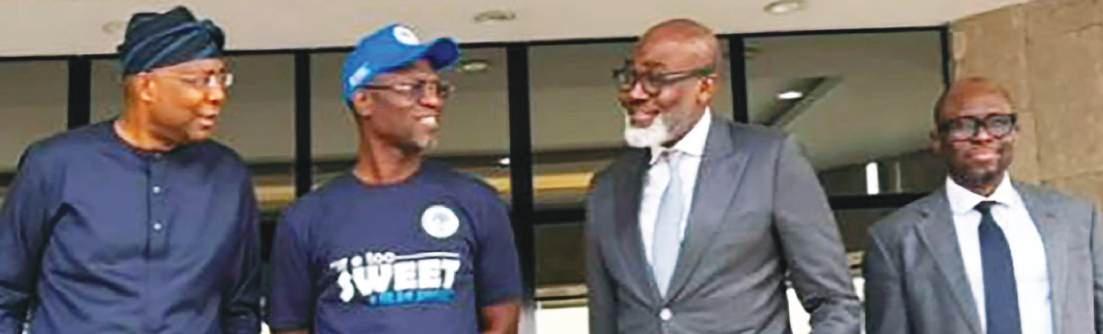
DURING MEETING BETWEEN CORONATION TEAM AND SEC...
L-R: Chairman, Coronation Group, Aigboje Aig-Imoukhuede; Director General, Securities and Exchange Commission, Dr. Emomotimi Agama; Managing Director, Coronation Asset Management, Aigbovbioise Aig-Imoukhuede; and MD/CEO, Coronation Group, Wole Onasanya, during a meeting between the Coronation team and the Commission in Abuja, yesterday
Emmanuel Addeh in Abuja, Peter Uzoho and Sunday Ehigiator in Lagos
Olugbode, Olawale Ajimotokan and Linus Aleke in Abuja
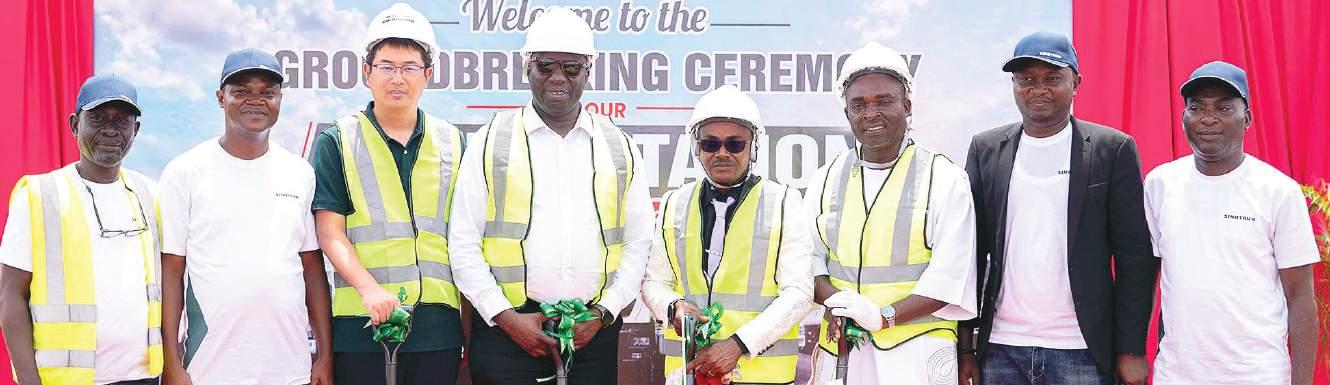
NIGERIAN SINOTRUCKS LIMITED BREAKS NEW GROUND IN BENIN...
L-R: Project Manager, Nigerian Sinotrucks Limited, Bankole Owoade; Head, After Sales Services, Nigerian Sinotrucks Limited, Olabode Ishola; Representative of Sinotrucks International, Steven Lan; Managing Director and Chief Executive Officer, Nigerian Sinotrucks Limited, Alfred Okugbeni; Regional Manager, East, Nigerian Bottling Company, Anthony Nestor Udom; Managing Director, Chico Trust Ventures Limited, Columbus Chukwu; Head, Legal and Company Secretary, Nigerian Sinotrucks Limited, Almond Waive; and Chief Financial Officer, Nigerian Sinotruck Services, Hassan Alimi, during the groundbreaking ceremony of Nigerian Sinotrucks Limited in Benin...recently
London Courts Africa’s Rising Economic Power
as Khan Hosts Historic Business Summit
African companies have invested over £30m in London through FDI since Mayor Khan’s visit in 2025
Michael Olugbode and Sunday Ehigiator in Abuja
In a bold push to cement London’s status as the premier global gateway for African investment, business and innovation, Mayor Sadiq Khan on Wednesday convened the first-ever London-Africa Business Summit, bringing together leading investors, policymakers and entrepreneurs from across the African continent and the United Kingdom amid intensifying global competition for Africa’s rapidly expanding markets.
More than £30 million in African foreign direct investment has flowed into London since 2025, Mayor Khan revealed, as the UK capital seeks to further deepen its position as a leading global hub for African businesses and investors.
The landmark gathering, hosted at City Hall and attended by more than 200 business and political leaders, marks a new chapter in economic relations between London and Africa, as both sides seek to capitalize on growing trade opportunities, rising investment flows and the continent’s emergence as one of the world’s most significant engines of future growth.
The summit comes at a time when Africa’s economic importance is attracting unprecedented international attention. With its youthful population, expanding middle class, accelerating urbanization and increasing digital transformation, the continent is widely projected to account for a significant share of global economic growth in the
coming decades.
Against this backdrop, London is moving aggressively to position itself as Africa’s preferred international financial and commercial hub.
Addressing delegates, Khan described Africa as one of the world’s most dynamic growth regions and reaffirmed London’s commitment to supporting African companies seeking global expansion.
“I am proud to host City Hall’s first-ever London-Africa Business Summit, bringing together investors, entrepreneurs and businesses to showcase London as the best city in the world for African companies to expand internationally and attract investment,” the mayor said.
The summit represents a major outcome of Khan’s groundbreaking
2025 trade mission to Nigeria, Ghana and South Africa — the first official African trade mission by a serving Mayor of London.
The visit was designed to strengthen commercial partnerships and deepen engagement with some of Africa’s largest and fastest-growing economies.
The strategy is already delivering measurable returns.
Mayor Khan disclosed that African companies have invested more than £30 million in London through foreign direct investment since the mayor’s visit last year, strengthening confidence in the city as a destination for African capital andTheenterprise. summit also underscored London’s dominance as the leading
international marketplace for African businesses.
According to figures presented at the event, 117 African companies are currently listed on the London Stock Exchange, more than on any other stock exchange worldwide.
Those listings span strategic sectors including telecommunications, banking, energy, mining, technology and infrastructure, reflecting London’s long-standing role as a bridge between African enterprise and global capital.
The significance of that position becomes even more evident when compared to other financial centres.
Fewer than 20 African firms are listed on the New York Stock Exchange, highlighting London’s unique relationship with African
markets and investors.
Beyond financial markets, participants examined growing opportunities for collaboration in technology, renewable energy, healthcare, education, creative industries, agribusiness and infrastructure development.
Representatives from Ghana’s Ministry of Trade, the Nigerian Exchange Group, the London Africa Network, SOAS University of London and investment firms from both regions participated in discussions focused on unlocking new avenues for growth and investment.
Economic experts at the summit noted that Africa’s transformation is no longer viewed solely through the lens of development but increasingly
as a strategic economic opportunity. Home to some of the world’s fastest-growing cities and a population expected to surpass 2.5 billion by 2050, Africa is becoming a focal point for global investors seeking new markets, innovation hubs and long-term returns.
The growing importance of the continent is already reflected in trade figures.
Despite a challenging global economic environment, total UKAfrica trade reached approximately £52 billion in 2025, while British exports to African countries climbed to nearly £26.2 billion, demonstrating the increasing strength of commercial ties between both regions.
For Britain, the relationship extends beyond economics.
CAPPA Raises the Alarm Over Rising Nicotine Products, Warns Against Youth Targeting
Sunday Ehigiator
Corporate Accountability and Public Participation Africa (CAPPA) has raised concerns over the growing proliferation of new and emerging nicotine and tobacco products in Nigeria.
CAPPA warned that tobacco companies were increasingly targeting young people through attractive packaging, sweet flavours, social media marketing, and cultural
influences.
Speaking at a press conference held recently in Lagos to commemorate the 2026 World No Tobacco Day, CAPPA Executive Director, Akinbode Oluwafemi, urged the federal government and regulatory agencies to take urgent action to curb the spread of nicotine products, which he described as a major public health threat.
The event, held under the theme, “Unmasking the Appeal: Countering Nicotine and Tobacco Addiction,”
was part of activities marking the annual anti-tobacco campaign of the World Health Organisation (WHO) and the Make Big Tobacco Pay Global Week of Action.
Oluwafemi said the tobacco industry had merely changed its tactics rather than its core objective of profiting from addiction.
According to him, while the industry once promoted cigarettes using terms, such as “ultra-light,” “low tar,” and “low nicotine,” it now
Blue Economy: FG Reiterates Commitment to Actualisation of Agge Deep Sea Port
Kasim Sumaina in Abuja
The federal government, Thursday reaffirmed its commitment to actualisation of the Agge Deep Sea Port project in Bayelsa State.
While describing the project as strategic infrastructure initiative, government said that it will drive economic growth, create jobs, and attract both local and foreign investments to the Niger
Delta region.
In a statement issued in Abuja, the Minister of Marine and Blue Economy, Dr. Adegboyega Oyetola, noted that the Agge Deep Sea Port remains a key priority of the federal government as part of ongoing efforts to unlock the immense potential of Nigeria’s marine and blue economy sector.
According to him, the realisation of the port aligns with the broader
vision of President Bola Tinubu’s administration to revitalise the economy through transformative projects that promote trade, industrialisation, and sustainable development.
“The Agge Deep Sea Port project is a critical component of our strategy to expand Nigeria’s maritime infrastructure and strengthen the nation’s competitiveness in regional and
international trade.
“It will significantly contribute to job creation, economic development, and investment inflows into the Niger Delta region.”
He assured the Ministry of Marine and Blue Economy is working closely with the Bayelsa State Government and other relevant stakeholders to ensure the full actualisation of the project within the shortest possible time.
markets products under labels, such as “tobacco-free,” “clean nicotine,” “smoke-free,” and “harm reduction.”
He stated that tobacco companies had expanded beyond traditional cigarettes to aggressively market products like nicotine pouches, snus, electronic cigarettes, disposable vapes, and heated tobacco products.
Oluwafemi stated, “These products come sweetened, flavoured and wrapped in stylish and colourful packages designed to appeal to the eyes, smell and taste.
“But the industry’s objective remains the same: to make profit by making people addicted to products of death and disease.”
Citing findings from CAPPA’s recent report, titled, “New Smoke Trap: New and Emerging Nicotine and Tobacco Products, Youth Exposure and Policy Gaps in Nigeria,” Oluwafemi disclosed that the organisation documented 781 nicotine and tobacco-related products across Lagos, Enugu, and the Federal Capital Territory, with 573 categorised as new and emerging nicotine products.
He warned that many of the products were sold in bright colours and attractive flavours, such as mango,
strawberry, bubble gum, mint, vanilla and candy, making them particularly appealing to children and adolescents.
“The industry is targeting your children, your siblings, Nigeria’s future as its next addicts and source of income,” he stated.
According to CAPPA, many of the products resemble flash drives, pens, toys, cosmetics, and small electronic gadgets, enabling them to pass unnoticed in schools, homes, and social settings.
The organisation also criticised what it described as the tobacco industry’s attempt to promote “World Vape Day”, stating that unlike World No Tobacco Day, the observance has no recognition from WHO, United Nations, or any reputable international health body.
Oluwafemi described the campaign as “a fraudulent marketing hoax” aimed at rehabilitating the image of tobacco companies, portraying nicotine addiction as harmless, and recruiting a new generation of consumers.
CAPPA further expressed concern over what it called the growing normalisation of smoking through culture, entertainment, and lifestyle marketing.
PRESENTATION OF A BOOK, MAGAZINE AND DOCUMENTARY IN HONOUR OF LOWE IN THE GAMBIA...
L-R: Bayelsa State Commissioner for Women and Children’s Affairs, Social Development and Empowerment, Joanna Gigi; Chairman, Yenagoa Local Government Area, Bulodisiye Ndiwari; his Kolokuma/ Opokuma Local Government Area counterpart, Tariye Lelei; Senator representing Kaduna South Senatorial District, Sunday Katung; his wife and former Mayor of Leeds, United Kingdom, Abigail Katung; Governor of Bayelsa State, Senator Douye Diri; Mayor of Banjul, The Gambia, Mrs. Rohey Lowe; Mayor of Dakar, Senegal, Adama Sarr; and Deputy Mayor of Banjul, Abdul Aziz Gaye, during the formal presentation of a book, magazine and documentary in honour of Lowe at the Dawda Jawara International Conference Centre in The Gambia on Wednesday
FG Mulls Refinancing of High-cost Debts Amid Soaring Oil Prices
Oyedele says market conditions
Nigeria is considering refinancing some of its expensive debt obligations and raising fresh funding to bridge its budget deficit, buoyed by improved investor confidence and elevated crude oil prices triggered by tensions in the Middle East.
Minister of Finance and Coordinating Minister of the Economy, Mr. Taiwo Oyedele, disclosed that the federal government was looking to take advantage of favourable market conditions to restructure costly legacy debt and secure additional financing for development projects.
Speaking in an interview with
right for planned move US may slam additional 12.5% tariff on Nigerian exports
Bloomberg TV, Oyedele said the current environment presented a unique opportunity for Nigeria to improve its debt profile while mobilising resources to support economic growth.
“We think that this timing is good for us to be able to maybe even refinance some of our expensive past debts, but also to raise more funding for our development at this critical time. You don’t know what happens tomorrow. But as of today, market conditions are actually very good,” he pointed out.
The renewed optimism stems largely from the sharp rise in crude oil prices following the conflict involving Iran, which has boosted
the fortunes of oil-producing countries outside the Middle East, including Nigeria.
Higher oil prices have strengthened Nigeria’s external earnings position and improved investor perception of the country’s creditworthiness. The premium demanded by investors to hold Nigerian dollar-denominated bonds over comparable United States Treasury securities has fallen significantly, reflecting growing confidence in the economy.
Despite improvements in government revenue, Oyedele noted that Nigeria still faces a budget deficit of about N30 trillion this year, necessitating the search
for additional financing sources.
The minister explained that the government was keeping its financing options open, including access to concessional loans from multilateral institutions. “We’re keeping our options open, we know the size of the deficit, including less-costly concessionary loans,” he said.
According to him, discussions are ongoing with the World Bank and other development finance institutions, while reforms implemented by the Bola Tinubu administration have continued to attract investor interest.
The government has undertaken a number of reforms since assum-
NERC Orders Discos to Compensate Band ‘A’ Customers Impacted by Gas Shortage, Vandalism
Fixes June 30 for final reimbursement
The Nigerian Electricity Regulatory Commission (NERC) has directed electricity Distribution Companies (Discos) to compensate eligible Band ‘A’ customers who suffered service shortfalls between February and March this year due to generation constraints caused by inadequate gas supply and vandalism of critical infrastructure.
The regulator, in a public notice announcing Directive No. NERC/2026/002 on the Special ‘Compensation of Band A Customers Arising from Grid Generation Constraints’, said the measure was designed to address the impact of widespread generation shortfalls across the Nigerian Electricity Supply Industry (NESI) during the period.
NERC explained that the disruptions significantly affected the ability of Discos to meet the minimum service commitments guaranteed to customers under the Band ‘A’ classification, which is expected to receive at least 20 hours of electricity supply daily.
According to the commission, the generation shortfalls were
largely triggered by inadequate gas supply to power plants as well as acts of vandalism targeting key gas and transmission infrastructure, circumstances it noted were beyond the direct control of the electricity distribution companies.
“The directive was introduced in recognition of the significant generation shortfalls experienced across the Nigerian Electricity Supply Industry (NESI) between February and March 2026, which affected the ability of Distribution Companies to meet the committed service levels for some Band A customers,” NERC stated.
Under the directive, customers on Band ‘A’ feeders that recorded an average daily supply of between 18 and 20 hours during the affected period will continue to be compensated under the existing framework contained in Addendum No. NERC/2024/003.
The commission said the compensation would apply to both Maximum Demand (MD) and Non-Maximum Demand (Non-MD) customers.
However, NERC introduced a special compensation package for
Band ‘A’ feeders that received less than 18 hours of supply per day during the period under review. The regulator clarified that affected feeders would not be downgraded despite the service shortfalls recorded during the two months.
For non-maximum demand customers, compensation will be equivalent to 20 per cent of the approved February 2026 energy cap applicable to the affected
feeder. Similarly, maximum demand customers will receive compensation equivalent to 20 per cent of the average energy billed per MD customer in February 2026.
NERC further directed that compensation for prepaid customers must be delivered through electricity token credits, while postpaid customers are to receive bill adjustments reflecting the approved compensation amounts.
ing office in May 2023, including fuel subsidy removal, tax policy changes, foreign exchange reforms and efforts to improve fiscal revenues.
However, while rising oil prices have boosted government earnings, they have also contributed to inflationary pressures globally, complicating monetary policy decisions and increasing the cost of delivering critical infrastructure and social services.
The US-Israeli war on Iran has pushed the price of Brent crude up as much as 63 per cent this year, creating an opportunity for producers outside the Middle East like Nigeria, while the premium investors demand to hold Nigerian dollar bonds rather than US Treasuries has fallen 80 basis points since the start of the war to 262, the lowest in more than a decade.
Meanwhile, Nigeria may face fresh trade headwinds from the United States after the Office of the United States Trade Representative (USTR) proposed imposing an additional 12.5 per cent tariff on Nigerian exports over concerns relating to alleged forced labour regulations.
The proposal forms part of action targeting 60 economies under Section 301 of the US Trade Act of 1974, following investigations into what Washington described as inadequate measures by several trading partners to combat forced
labour in international supply chains.
In a statement issued by the USTR, Nigeria was listed among 54 economies found to have “failed to impose and effectively enforce a prohibition on the importation of goods produced with forced labour.” As a result, the agency proposed additional duties on products originating from the affected countries.
The agency explained that countries with existing forced labour import prohibitions or those that have committed to implementing such measures through trade agreements would face a lower tariff of 10 per cent. However, countries categorised as having no effective prohibition regime, including Nigeria, could be subjected to a 12.5 per cent additional duty should the proposal be adopted.
U.S. Trade Representative, Ambassador Jamieson Greer, said the failure of major trading partners to adequately address the importation of goods produced with forced labour created unfair competition for American workers and businesses.
“The failure of our most important trading partners to address the importation of goods made with forced labour is unacceptable. This creates a dynamic where American workers are forced to compete globally on an unlevel playing field,” Greer said.
Olawale Ajimotokan in Abuja
Minister of the Federal Capital Territory (FCT), Nyesom Wike, yesterday disclosed that the FCT Administration will commission over 30 projects across the nation’s capital to commemorate the third year anniversary in office of the Bola Tinubu administration.
Wike spoke during an inspection tour of some of the projects, which included the Gwarinpa-Jahi Interchange, the Airport-Kuje Road, the Kuje-Gwagwalada
Road, the Outer Southern Expressway main carriageways and the aesthetic redesign of the Abuja City Gate.
He expressed delight with the quality of all the projects inspected and confirmed that they were 100 per cent completed.
“From what we have seen, we are set to go. I can say all the projects we inspected are 100 per cent ready...I am very happy with the quality of the job. We believe that the City Gate will be inaugurated sometime in the night so
that we can see the beauty of the place.
“We are very happy indeed, and I am sure that the residents of Abuja are also happy. This is governance in action, and you can see the dividends of democracy. You can see the Renewed Hope working, and we believe by the grace of God, from Monday (June 8) we will start the commissioning of these projects”.
The minister clarified that the Presidency will determine the projects Tinubu will commission, as it is not
possible for him to commission every project. He also hinted that, as was the practice in previous years, senior officials in government would be involved in the commissioning exercise.
Wike also spoke concerning the current situation in his party and on a press statement claiming that the Appeal Court had invalidated the High Court decision recognising the caretaker committee that produced the current National Working Committee (NWC) of the Peoples Democratic Party (PDP).
The Bekee about him to its list before
Emmanuel Addeh in Abuja
Emmanuel Addeh in Abuja
2026 ANNUAL GENERAL MEETING OF CHARTERED INSTITUTE OF TAXATION OF NIGERIA...
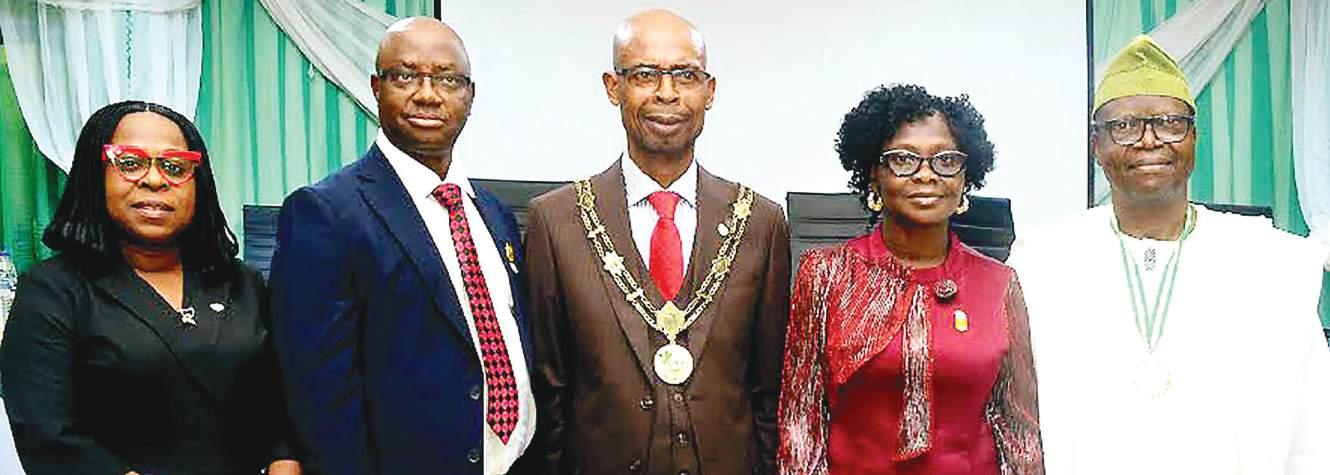
L-R: Registrar/Chief Executive, Chartered Institute of Taxation of Nigeria (CITN), Mrs. Afolake Oso; Honorary Treasurer, Mr. Ishola Akingbade; 17th President/ Chairman of Council, Mr. Innocent Ohagwa; Deputy Vice President, Titilayo Fowokan; and Past President, Mr. Foluso
of
of
of
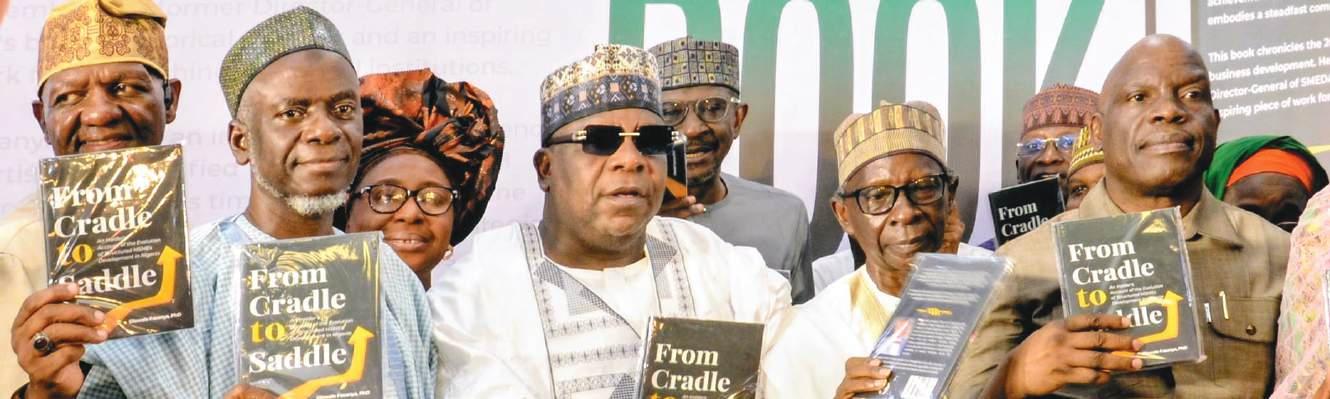
SMEDAN Has Impacted Over 39 Million
Small-scale Businesses, Says Ex-DG
The immediate past DirectorGeneral of Small and Medium Enterprises Development Agency of Nigeria (SMEDAN), Dr. Olawale Fasanya, said the agency had been able to assist in stabilising the operations of over 39 million small businesses across the country.
Established in 2003, Fasanya said SMEDAN had initiated several policies and programmes aimed at promoting the growth of small and medium enterprises, thereby boosting their contribution to the country's Gross Domestic Products (GDP).
The former director-general spoke during the launch of his book, "From Cradle to Saddle," a book that chronicled the progress recorded by SMEDAN in the last 23 years.
Fasanya, who started off as a pioneer staff of SMEDAN, said the agency had empowered many Nigerians to set up small businesses of their own, which were helping to create wealth and employment for young people.
He stated, "We initiated a lot of things, we achieved so much. I mentioned a few, the national
policy on MSME. I was part of it and I took the lead, the ‘One Local Government, One Product’, and for many other things, you know, that when you read the book, you will see.
“We recorded a lot of feats because it was an agency that was created out of necessity."
Tracing the history of the agency, the author said former President Olusegun Obasanjo felt that small and medium enterprise agencies had not been given the right attention.
Fasanya said, "So that was what led to the birth of that agency, and when that agency was created, like I said in the documentary, we had nothing, no platform, no funding, not even an office.
“It started from the guest house of the first director-general. So you can imagine an agency like that, that we now built from scratch to what it is today."
While answering questions from journalists on his journey as a technocrat, Fasanya said he was once mocked by his friends when he ditched a million Naira job in the petroleum sector to accept the one in SMEDAN that offered him less than N300,000.
He stated, "Some people felt I
was mad by leaving. It was actually roughly about N1.2 million, and I went back. I went back to a job that's paying less than 300,000 but, you know, I was working with a chief executive who is also a Yoruba person, who also found me useful, said I should not leave, but I wasn't in charge.
“He wanted me there just to be there as figure, so that's why
I said I can't be where I will not be able to be on top of things.
"You cannot warehouse me, so I would rather go to where I'm getting less and I'm not warehoused, and I can impact, so I went back, not even knowing that God has something in stock for me, that I will become the director-general one day."
Guest of Honour at the book
launch and Governor of Kastina State, Malam Dikko Umaru Radda, described Fasanya's book as a compendium on the evolution of SMEDAN as a driving force for small and medium enterprises in the country.
Radda, who was represented by his deputy, Alhaji Farouk Lawal, said development of small and medium enterprises was a critical
factor in the economic growth of every nation.
As a former Chief Executive of SMEDAN, the governor said he had the privilege of working closely with Fasanya and "witnessing his first hand commitment, discipline, loyalty, and uncommon passion for the development of Nigeria's small businesses in every institution”.
NSE President Charges Government to Address Insecurity, Economic Hardship
Seeks improved welfare for Nigerian workers
Emmanuel
Addeh in Abuja
The President of the Nigerian Society of Engineers (NSE), Ali Rabiu, has called on the federal government to take urgent and decisive measures to address the escalating security challenges and worsening economic hardship facing Nigerians.
Speaking yesterday at the Society’s 2026 Second Quarter Dinner, during which 214 distinguished engineers were formally admitted into the Fellowship cadre of the NSE, Rabiu
expressed deep concern over the increasing wave of kidnappings and other criminal activities that continue to endanger the lives and livelihoods of citizens across the country.
In a statement in Abuja by Abdulkadir Aliyu, the acting Executive Secretary of the NSE, Rabiu noted that while the organisation remains steadfast in its commitment to supporting government at all levels in the pursuit of national development objectives, there was an urgent need for greater responsiveness to the welfare and security needs of the populace.
to supporting government at all levels in the pursuit of national development objectives, we firmly believe that effective collaboration among government, professional bodies, academia, industry and other critical stakeholders is essential for addressing the multifaceted challenges confronting our nation.
“However, at this moment, we must also charge the federal government of Nigeria to be more alive to its obligations to the citizenry.
“We are deeply concerned about the rising rate of inflation and the increasing cost of living. Many Nigerians can hardly afford transportation to their places of work due to the soaring cost of petroleum products, with petrol currently selling at an average of about N1,350 per litre. This situation has placed tremendous pressure on households and businesses alike.
Value
Glo Unveils Massive Data Boost Offer, ‘More Data More
Ayodeji Ake
Nigeria’s telecommunication and digital services company, Globacom, has unveiled a new data offer, tagged, “More Data More Value only on Glo,” designed exclusively to enrich digital experience of its subscribers.
Globacom is reasserting its leading position by offering nearly 10 per cent more data across its bundles as the Nigerian telecom landscape shifts towards a data-led economy.
In a statement released in Lagos yesterday, Globacom explained, “The new offer is designed to ensure that every Naira spent by a Nigerian consumer yields the highest possible digital return.”
It said the offer reinforced Globacom’s long-standing reputation for affordability and empowerment.
According to the company, “More Data More Value” offers a variety of weekly and monthly options planned to balance daytime and night-time usage.
The weekly plan includes N1,000 option, which provides 3.7GB of total data, consisting of 1.7GB main data and 2GB night data, while that of N2,000 offers 9GB in total, divided into 6.5GB main data and 2.5GB night data.
The monthly plan also comes with different options, including N1,500, which delivers a total of 5.2GB (2.2GB main data paired with 3GB night data); N2,000 option offering 6.25GB data, a combination of 3.25GB main data and
3GB night data; and 16.5GB, comprising 14.5GB main data and 2GB night data, which goes for N5,000.
There is also the N10,000 and N15,000 options, with N10,000 providing 42GB total, 38GB main data and 4GB night data, while N15,000 offers 64GB in total, consisting of 62GB main data and 2GB night data.
The company explained that its enhanced bundles provided the necessary incentive for students, remote workers, and entrepreneurs to browse longer, whether for TikTok trends, Instagram aesthetics, YouTube streaming, or high-stakes gaming, and stream without fear, ensuring their professional and social lives remain uninterrupted.
He said: “The Nigerian Society of Engineers remains fully committed
While we recognise that elections are drawing near and political campaigns have commenced in earnest, citizens must be safe, healthy and economically empowered for democracy to thrive.
“We also decry the growing wave of insecurity that is rapidly spreading across the country. The indiscriminate abduction of teachers, pupils, and other innocent citizens is unacceptable and demands urgent and sustained action by the relevant authorities.”
At ILO Conference, Nigeria Seeks Inclusive AI Policies to Safeguard Jobs
Onyebuchi Ezigbo in Abuja
Nigeria has advocated inclusive and human-centred artificial intelligence (AI) policies that protect jobs and safeguard workers' rights while harnessing the transformative potential of technology to drive economic growth and decent work.
Minister of Labour and Employment, Dr. Muhammad Maigari Dingyadi, made the call while delivering Nigeria's statement at the 114th Session of the International Labour Conference in
Geneva, Switzerland.
The minister who spoke in response to the report of the Chairperson of the Governing Body and the DirectorGeneral of the International Labour Organization (ILO) titled, "A Moment of Choice: Harnessing Artificial Intelligence for Decent Work," commended the ILO leadership for its resilience and commitment to advancing the organisation's mandate despite global challenges.
A statement signed by Head Press and Public Relations, Annah Daniel,
said Dingyadi described the theme of the Director-General's report as timely, noting that rapid advancements in artificial intelligence are reshaping labour markets, employment relationships, and workplace practices across the world.
According to the Minister, while AI presents significant opportunities for economic expansion, innovation, and improved productivity, it also raises concerns about job displacement, widening inequalities, and the diminishing role of human labour in certain sectors.
Fasoto, during the 2026 Annual General Meeting
the Chartered Institute
Taxation
Nigeria in Lagos on Wednesday
PHOTO: ETOP UKUTT
Onyebuchi Ezigbo in Abuja
NUPRC Urges Financial Institutions to Support Funding for Gas Sector
NBS seeks deeper collaboration with commission on industry data
Emmanuel Addeh in Abuja
The Nigerian Upstream Petroleum Regulatory Commission (NUPRC) has called on financial institutions to support operators in expanding domestic gas production, emphasising the importance of collaboration among regulators, financiers and players to unlock investment and accelerate growth in the sector.
The Commission Chief Executive, NUPRC, Oritsemeyiwa Eyesan, said this when top executives of Rand Merchant bank (RMB) visited the commission’s headquarters in Abuja, a statement by the NUPRC said yesterday.
“One critical element will be financing, and we are hoping that you and the financial world will be there to support us. We will ensure that the industry operates in accordance with the Petroleum Industry Act and all other regulatory instruments,” Eyesan said.
She disclosed that the industry’s appetite for investment is very strong, as demonstrated by the interest in the ongoing 2025 licensing bid round, which witnessed almost 300 applications from International Oil Companies (IOCs) and indigenous operators.
The NUPRC chief executive also highlighted ongoing initiatives
around energy transition, including the issuance of Permits to Access Flare Gas (PAFG) to 28 firms and a target of 60 per cent reduction in fugitive methane emissions by 2031, among other initiatives aimed at promoting sustainable development in the upstream sector.
Responding, the Head of Oil and Gas Coverage at Rand Merchant Bank, Jonathan Ross, said the bank was keen on supporting Nigeria’s efforts to grow oil and gas production, with a particular focus on gas development.
He described gas as a strategic priority for the bank, citing major infrastructure projects such as the
OB3 Gas Pipeline as critical to unlocking the country’s vast gas potential.
The bank also acknowledged recent regulatory reforms and improvements in security in host communities, noting that Nigeria is in a stronger position to attract investment than in previous years.
Meanwhile, the National Bureau of Statistics (NBS) has named a team from the institution that will interact more closely and regularly with the NUPRC, especially with regards to data on crude production, gas reserves, oil spill incidents and exploration and production companies.
Statistician-General of the Federation, Adeyemi Adeniran, who also lauded the commission for the partnership over the years, spoke when he visited the NUPRC headquarters in Abuja.
Adeniran, who was accompanied by top management of the NBS, said oil and gas contribute significantly to Nigeria’s economy and thus cannot be ignored in data collation, noting that the NBS is not only the central custodian of data in Nigeria but also the apex agency responsible for developing, managing, and disseminating official statistics to guide government policies and national development.
FG: KIDNAPPERS, TERRORISTS AIM TO WEAKEN NATIONAL UNITY, UNDERMINE OUR INSTITUTIONS
vigilant, support security agencies with credible information, and reject narratives designed to divide communities along ethnic, religious, or political lines.
The minister said the federal government remained steadfast in its commitment to protecting life and property. He assured citizens that ongoing security operations would continue until terrorism and violent criminality were decisively defeated.
Idris stated, “Nigeria has faced difficult moments before and emerged stronger. We shall overcome this
challenge as well.
“United in purpose and unwavering in resolve, we will ensure that terrorism has no future in Nigeria.”
The minister described the recent abduction of students in Oyo and Borno states as a sobering moment that had once again tested Nigerians’ collective resolve.
He said the abduction of innocent school children and their teachers was not merely an attack on families or communities, but also an attack on the future of the nation, education, and the values that bind the people
together as Nigerians.
He also assured Nigerians that President Bola Tinubu was fully committed to securing the safe return of all the schoolchildren and teachers recently taken captive in separate attacks in Oyo and Borno states.
Idris said, “On behalf of President Bola Ahmed Tinubu, GCFR, and the Federal Government of Nigeria, I wish to assure all Nigerians that the safe return of every child and every teacher currently in captivity remains a top national priority.
“The president has made it clear
DISOBEDIENCE OF COURT IN NESTOIL CASE: FBN RECEIVER, SULU-GAMBARI, SLAMMED CONTEMPT NOTICE
said Order, Mr. Sulu-Gambari continued to act and or hold himself out as Receiver/Manager, particularly by issuing multiple public press release dated June 3, 2026 and June 4, 2026 published in national media, wherein he asserted that he remain Receiver / Manager over Nestoil Limited and Neconde Energy Limited; and warned the general public against dealing with any other person.
Mr Sulu-Gambari was instructed to take further notice that his said acts constitute a willful disobedience of the Order of the Court.
The contempt notice was served on the purported Receiver in his office.
In addition, the recent landmark judgement of the Supreme Court on June 1, 2026, in SC/CV/1130/2025 set aside all the ex parte Orders of the Court of Appeal dated November 27, 2025 which had been in favour of the purported Receiver.
Also, the same Supreme Court, by its previous judgement of April 10, 2026 in SC/CV/46/2026 held that the authority of the purported receiver to act is at the heart of and subject of interrogation of the suit filed by his appointors at the Federal High Court and he therefore cannot purport to exercise powers of a receiver in the face of such suit.
The Supreme Court reiterated similar sentiments in its judgement of June 1, 2026 whilst setting aside the ex parte orders which had given Mr. Sulu-Gambari judicial cover.
The Form 48 Notice of Consequences of Disobedience to Order of Court delivered on December 1, 2025, was brought pursuant to Order ix, Rules 1-3 of the Judgement Enforcement Rules, Section 72 of the Sheriff and Civil Processes Act, 2004 and under the inherent powers of the court.
It reads, "Take Notice that unless you stop further disobedience and comply with the direction
contained in the order of the Federal High Court Abuja made on the December 1, 2025, in Suit No. FHC/ABJ/CS/2369/2028 which ordered as follows:
“That all parties in this suit are ordered to maintain the status quo ante bellum, pending the hearing and determination of the motions on notice, as the purported powers of the 2nd Defendant is hereby put on hold.”
Legal analysts say the current actions of Mr Sulu-Gambari SAN, go beyond mere non-compliance and amount to a deliberate, sustained, and contemptuous challenge to the Courts itself.
Such conduct, they warn, strikes at the very foundation of the rule of law and is unacceptable in a constitutional democracy.
While pointing out that the consequences of contempt proceedings are severe, they stressed that continued defiance in the face of a subsisting court order and pending proceedings exposes the Receiver to immediate custodial sanctions, including imprisonment, as well as heavy fines and other punitive orders.
It has been alleged that Mr. Sulu-Gambari had deliberately concealed or failed to disclose that the exercise of any powers purportedly arising from the alleged Deeds of Appointment has since been restrained, suspended and placed in abeyance by subsisting Orders of the Federal High Court, Abuja Division, presided over by Justice P. O Lifu in Suit No.FHC/ ABJ/CS/2534/2025, since December 1, 2025.
Mr. Sulu-Gambari is a defendant in that suit in person, he is aware of the orders and the orders are extant and unchallenged till date.
“This is not just disobedience, it is a frontal attack on the justice system,” a senior legal practitioner noted, adding that, “If left
unchecked, it undermines the very fabric of judicial authority.”
The unfolding situation sends a clear and unmistakable message: no individual, regardless of status or title, is above the law, and the courts retain both the power and the will to enforce compliance.
that no child belongs in captivity and that no effort will be spared in ensuring that those responsible for these heinous crimes are brought to justice. He has directed that every lawful instrument available to the Nigerian state be deployed towards achieving this objective, including the deployment of a specialised rescue team.
“He has also authorised the recruitment of 1,000 forest guards to strengthen security presence across vulnerable communities and forests within the state.”
Idris underlined the theme of the briefing, stressing that whether in Oyo, Borno, Zamfara, Kaduna, Plateau, Benue, or any other part of Nigeria, an attack against one Nigerian is an attack against all Nigerians.
He stated, “Terrorism has no tribe. Terrorism has no religion. Terrorism has no political affiliation. Its only purpose is destruction.
“As citizens, we must, therefore, reject divisive narratives, support our security agencies by providing credible information, and remain vigilant in our communities. We must continue to promote national unity and strengthen the bonds that connect us as one people under one nation.”
The minister charged the media to be careful not to inadvertently amplify the objectives of terrorists by giving undue prominence to their atrocities.
He said, “Terrorist groups seek publicity, fear, and psychological impact far beyond the immediate
scene of their crimes. Responsible reporting, guided by professionalism and national interest, can help deny them this objective.
“We, therefore, urge media organisations to exercise restraint, verify information before publication, and avoid sensationalism. At the same time, citizens must work closely with the government and security agencies by sharing credible information and reporting suspicious activities.
“Defeating terrorism requires a whole-of-society approach. Nigeria must remain secure and united, because only in an atmosphere of peace and stability can our democracy, economy, media, and national aspira- tions continue to flourish.”
Director of Legal Services, Office of the National Security Adviser (ONSA), Zachary Bijinyawa, affirmed in relation to the plight of the students and teachers in captivity in Oyo State, that security agencies relied on intelligence and required time to do an assessment of threats.
Bijinyawa made the remarks yesterday in response to growing insinuations that the security agencies lacked the capacity to track down kidnappers in their hideouts.
He faulted the assumption, saying the armed forces and police have to consider the security and safety of victims before carrying out rescue operation.
Bijinyawa stated, “The objective of security to save lives is not to impress. It's to ensure that the victims come back safe, sound to their families and to their communities. So, it's not political. The capacity exists, but
Oritsemeyiwa Eyesan
This, he said, is done in collaboration with all 774 local governments, the 37 sub-nationals including the FCT, academia, multi-lateral organisations, non-governmental organisations and other federal agencies.
security agencies cannot respond just to political demands or to popular outcry.
“They must use their best training to do threat assessment and to know when it is time to move in or when the intelligence is appropriate to make a move. So, these are the angles that the public does not always understand in the difficult work of security planning. And this is what is happening even today.”
UN Demands Immediate Release of Victims
United Nations (UN) expressed deep concern over the recent abduc- tions of schoolchildren and teachers in Oyo and Borno states, calling for the immediate and safe release of all victims, while urging the Nigerian authorities to intensify efforts to secure schools across the country.
Speaking in Abuja, yesterday, United Nations Resident and Humanitarian Coordinator in Nigeria, Mohamed Fall, condemned the attacks, which also resulted in the killing of two educators, describing the incidents as a grave assault on children’s right to education and safety. Fall said the continued captivity of the schoolchildren and their teachers was deeply troubling. He stressed that educational institutions must remain safe spaces for learning rather than targets of violence and fear.
“The recent incidents underscore the urgent need to strengthen the protection of children, educators and learning environments,” he said.
Continued on page xx
DANGOTE REFINERY RAISES CAPACITY TO 700,000 BPD, BOOSTS AFRICA’S ENERGY OUTLOOK
refinery surpass its nameplate capacity of 650,000 bpd, underlining the facility’s engineering capability and operational efficiency. The achievement, the firm said, demonstrates the refinery’s ability to process additional feedstock while optimising performance across its production units.
Vice President for oil and Gas, Dangote Industries Limited (DIL), Devakumar Edwin, explained that the ramp-up is part of a broader, ambitious strategy to more than double capacity to 1.4 million bpd within 30 months, positioning the facility as potentially the largest refinery globally.
According to him, the expansion is expected to boost Nigeria’s energy self-sufficiency, eliminate the country’s dependence on imported refined products and strengthen its position as a regional export hub.
Edwin pointed out that the refinery’s growth trajectory
reflects a deliberate move toward continental and global refining dominance, not just domestic supply sufficiency.
Owned by Nigerian industrialist and philanthropist, Aliko Dangote, the refinery commenced fuel production in 2024 and has steadily increased output of petrol, diesel, aviation fuel and other refined petroleum products.
The facility has rapidly established itself as a major supplier to both domestic and international markets, exporting refined petroleum products to several African countries and key European destinations, including the United Kingdom, France, Spain, Italy, and the Netherlands, among others. It has supplied petrol to the American market and jet fuel to Saudi Arabia, among others.
Besides, the Dangote Refinery has strengthened its role as a stabiliser in the oil and gas industry given the ongoing disruptions caused by the Middle-East tension as a result
of which many African countries are now patronising the facility for energy security.
In a further demonstration of its growing global significance, Dangote Petroleum Refinery became the world’s largest exporter of jet fuel in April, according to S&P Global Commodities.
In the same vein, the refinery has played a pivotal role in stabilising fuel supplies in Nigeria, helping to eliminate dependence on imported petroleum products and easing pressure on the country’s foreign exchange reserves. Its expansion also aligns with broader national objectives to enhance local refining capacity and maximize value from Nigeria’s abundant crude oil resources.
Growing production volumes have also attracted increased interest from global crude suppliers and commodity trading firms, with the refinery sourcing feedstock from both domestic and international
producers to sustain its rising output.
Looking ahead, Aliko Dangote has outlined ambitious plans to transform the facility into the world’s largest refinery by 2028, targeting a processing capacity of 1.4 million barrels per day.
Such expansion is expected to deliver substantial economic benefits, including job creation, increased industrial activity and improved trade balances.
The refinery is also expected to strengthen downstream manufacturing by ensuring a reliable supply of Liquefied Petroleum Gas (LPG) and other key industrial feedstocks, including polypropylene which are widely used in the production of packaging materials and other consumer goods.
Similarly, the refinery has said that it has future plans for the supply of Linear Alkylbenzene (LAB) which is used in the production of detergents.
Sulu-Gambari
NDDC LAW AND DEVELOPMENT SUMMIT 2026...
L-R: The Niger Delta Development Commission (NDDC) 7th Governing Board Chairman, Mr Chiedu Ebie; NDDC Managing Director, Dr Samuel Ogbuku; the Deputy Governor of Rivers State, Prof. Ngozi Odu; and Keynote Speaker, Mr. Henry Odein Ajumogobia (SAN), during the NDDC Law and Development Summit 2026, held in Port Harcourt, Rivers State…recently
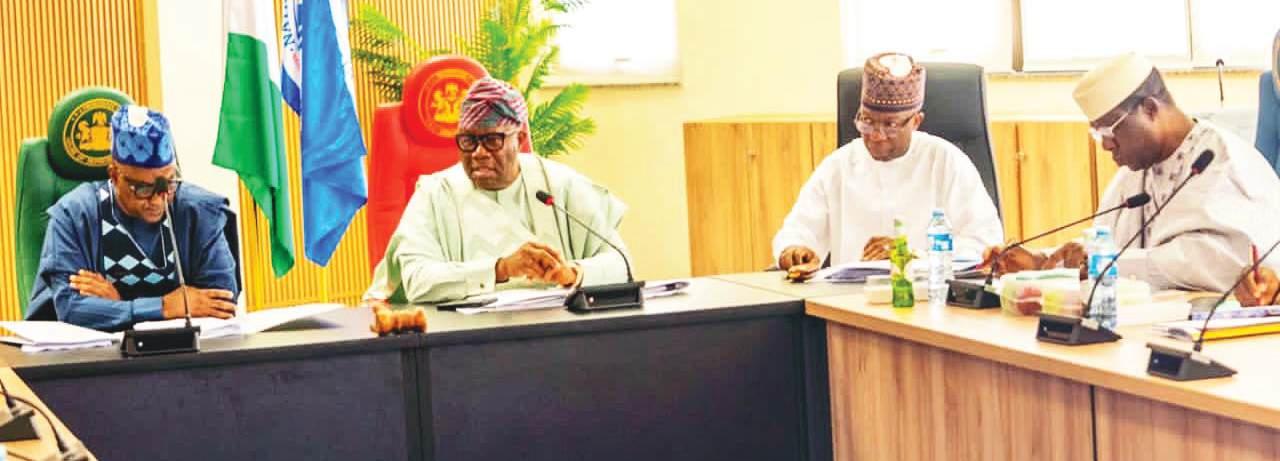
State Electricity Regulators Warn 2026 Amendment Bill Will
Disrupt Sector Decentralisation, Undo $1bn Capital Investment
Say Senate committee's proposed reversals can trigger constitutional crisis, stall reform gains
Peter Uzoho
Sixteen State Electricity Regulatory Commissions (SERCs) have raised strong objections to the proposed Electricity Act Amendment Bill 2026, warning that the legislation seeks to reverse the devolution of powers to states.
They also warned that the move could plunge the country's power
sector back into the regulatory gridlock that stalled progress for 20 years.
The SERCs gave the warning in their memorandum contained in a letter dated May 26, 2026, addressed to Chairman of Senate Committee on Power.
The letter obtained by THISDAY, was jointly signed by the SERC chairmen and chief executive of-
ficers in Abia, Anambra, Bayelsa, Edo, Ekiti, Enugu, Gombe, Imo, Kogi, Lagos, Nasarawa, Niger, Plateau, Ondo, Ogun, and Oyo,
The SERCs said a review of the bill showed a clear intention to reconsolidate federal control over electricity matters that were constitutionally within states’ jurisdiction.
They stated that move directly
contradicted the 5th Alteration of the Nigerian Constitution and the Electricity Act 2023, which devolved legislative, governance, and regulatory authority for electricity markets operating solely within states.
The SERCs stated regarding the amendment bill, “The general intention is to reverse the devolution of legislative, governance and
Tinubu Nominates Zainab Marwa to Fill North-east Vacancy on NDDC Board
Seeks Senate confirmation in line with NDDC Act Nomination follows Namdas' resignation to contest Adamawa governorship Senate begins screening process, directs committee to report within two weeks
Sunday Aborisade in Abuja
President Bola Tinubu has forwarded the name of Dr. Zainab Marwa to the senate for confirmation as a member of Governing Board of the Niger Delta Development Commission (NDDC), representing the North-east geopolitical zone.
The nomination was to fill a vacancy created by the resignation of the zone's former representative, Hon. Abdulrazak Namdas.
The request was formally conveyed to the upper chamber in a letter read during Thursday's plenary by Senate President Godswill Akpabio.
In the correspondence, Tinubu stated that the nomination was made
in accordance with the provisions of Section 2 of the Niger Delta Development Commission Establishment Act, which empowers the president to appoint members of the commission's governing board subject to Senate confirmation.
The president explained that Marwa's nomination became necessary following the departure of Namdas, who resigned his position on March 30, 2026, to pursue his governorship ambition in Adamawa State.
According to Tinubu, the appointment is intended to ensure that the North-east zone retains its representation on the board and that the commission continues to function without disruption.
The letter stated, “In compliance with the provisions of Section 2 of the Niger Delta Development Commission Establishment Act, I am pleased to present for confirmation by the Senate the nomination of Dr. Zainab Marwa as member representing the North-East in the Governing Board of the Niger Delta Development Commission.
“The Senate is invited to note that the appointment of Dr. Zainab Marwa is to fill a vacuum created by the resignation of the immediate past member of the board, Hon. Abdulrazak Namdas, from the North-East Zone, who resigned on the 30th day of March, 2026, to contest for the position of Governor
UNIOSUN Biotech Student Secures International Research Grant for Lassa Fever Detection Innovation
Yinka Kolawole in Osogbo
A 400-level Biotechnology student of Osun State University (UNIOSUN), Philip Ayomide Ogundele, has secured an international research grant worth 950 US dollars from Sigma Xi – The Scientific Research Honor Society for an innovative project aimed at improving Lassa fever detection and surveillance.
According to a statement issued by the University Public
Relations Officer, Ademola Adesoji, the grant was awarded to support Ogundele’s research proposal titled, “Wearable Biosensor Prototype for the Detection and Surveillance of Lassa Fever Infection in Low-Resource Settings.”
The project is designed to explore innovative approaches to disease monitoring and early detection, particularly in resourceconstrained environments where access to healthcare facilities and
diagnostic tools remains limited.
The development marks another milestone for the university in its efforts to promote research, innovation and global academic engagement among students.
Sigma Xi Grants-in-Aid of Research (GIAR), established in 1922, is an internationally recognised programme that supports undergraduate and postgraduate students in conducting scientific research and advancing innovative ideas with societal relevance.
of Adamawa State.
“On this note, it is my hope that the Senate will consider and confirm the appointment of Dr. Zainab Marwa as member of the Governing Board of the Niger Delta Development Commission to represent the North-East Zone.”
Following the reading of the president's letter, Akpabio referred the nomination to Senate Committee on Niger Delta Development Commission for legislative consideration.
regulatory powers over electricity matters that occur solely within the respective states to the state governments, in favour of a reconsolidation of powers at the federal level.
“Effectively, it appears that the intention of the Bill is that Nigeria should continue with the same regime that, for twenty years, has not led to any significant increase in power availability of per capita consumption for Nigerians, despite ever increasing and unsustainable federal debt."
They criticised Section 2 of the bill as “based on a shocking miscomprehension of Nigerian Constitutional Law.”
According to them, the provision attempts to make the National Assembly the source of states’ power to legislate on electricity, requiring the National Assembly approval for State Houses of Assembly (SHA) to make laws.
They stated, “There is no legal framework for the NASS to ‘empower’ state governments to make law by ordinary legislation, as the language of the Bill attempts to do.
“The respective legislative powers of NASS and the SHAs are derived directly from the constitution… This power can
only be added to or restricted by constitutional amendment, and not by an Act of NASS."
The state power regulators warned that the bill’s proviso eliminating Section 2(2) of the 2023 Act — which protected state laws from invalidation — and seeking to prohibit state laws from conflicting with federal provisions, undermined federalism.
They stated that only the courts, not National Assembly, could determine if a state law conflicted with federal law under the “covering the field” doctrine in Section 4(5) of the constitution. While drawing attention to the risks the amendment could pose to investment and market stability, the SERCs said the proposed amendments threatened over $1billion investments already committed under the 2023 Act. They stated, “This will defeat the key objectives of the Electricity Act, and the various states’ electricity laws, even before the regime introduced by them has taken any root.
“It will introduce avoidable disruption in the industry as significant investment decisions have already been taken based on the Electricity Act 2023, and which investments are now put at risk."
Felix Omoh-Asun in
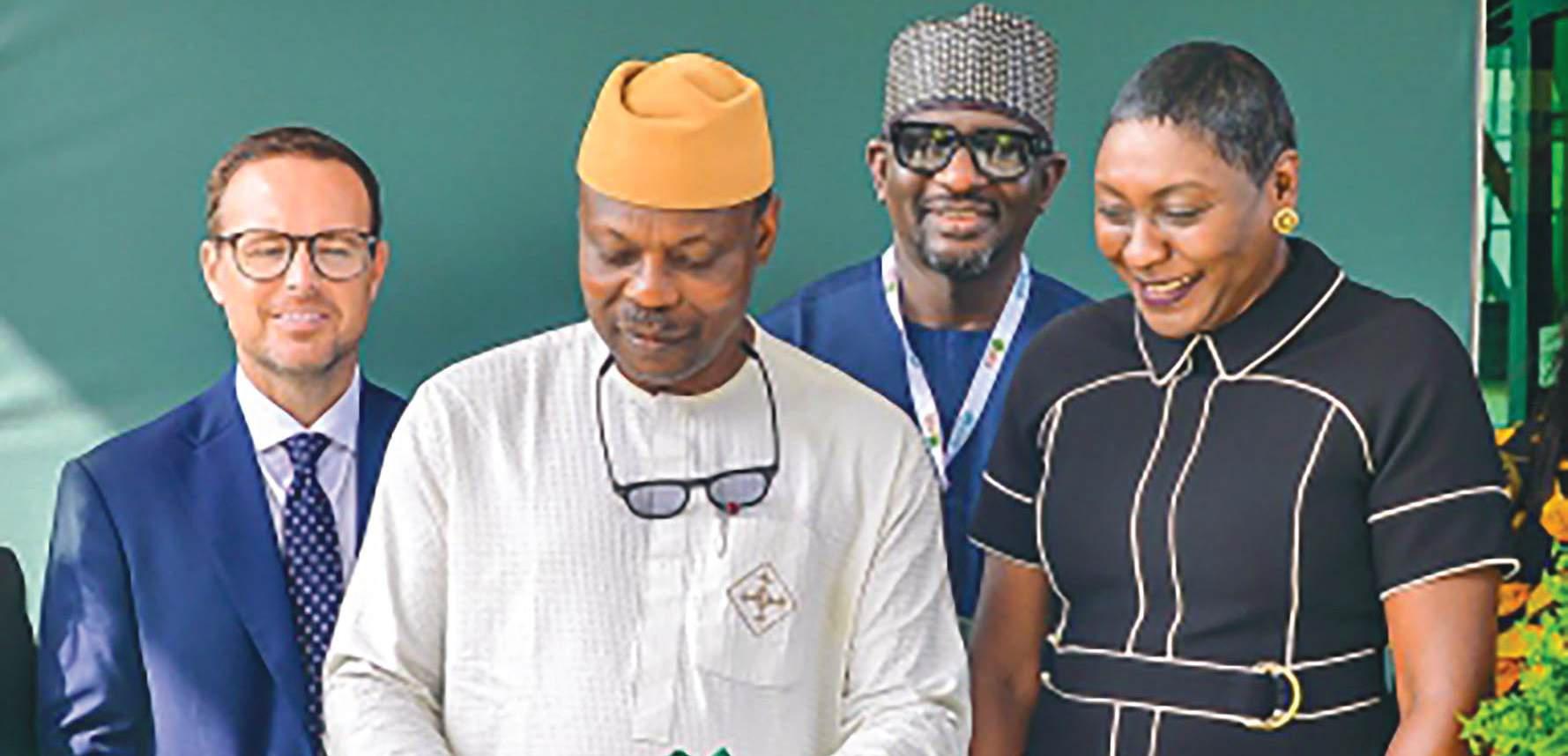
Nigerian Sinotrucks Limited has said Edo State capital, Benin, is a regional business hub where every investor should be interested to invest.
The Managing Director Nigerian Sinotucks Limited, Alfred Okugbeni, disclosed the choice of Benin for the multi- dimensional investment is strategic.
During the ground breaking ceremony in Benin yesterday, Okugbeni praised the state government for business-friendly environment, noting that Benin City has been a regional investment destination and also adding that the company’s investment in Edo is very significant.
“Edo State stands as an economic strong hold within Nigeria. It’s geographical advantage in a thriving population, improving infrastructure, industrial potentials make it an idea location for this kind of investment.
“This facility we begin to construct today will be more than physical structure of attraction, it will stimulate local supply chain, it will support artisans, transporters, fabricators, welders, engineers and small businesses whose livelihood depends on these industrial activities.”
According to him, the choice of Edo State is equally strategic. For years, analysts have increasingly identified Edo as one of Nigeria’s emerging industrial and logistics
corridors.
Located within the South South region and connected to key commercial routes across the country, the state possesses significant geographic advantages.
Its proximity to major transport arteries positions it as an attractive destination for manufacturing and distribution activities.
Beyond geography, Edo State has steadily cultivated a reputation for enterprise, technical talent, and investment friendliness. The state’s growing infrastructure profile, expanding urban economy, and improving investment climate have strengthened its appeal to industrial operators seeking long term operational stability, he affirmed.
Benin
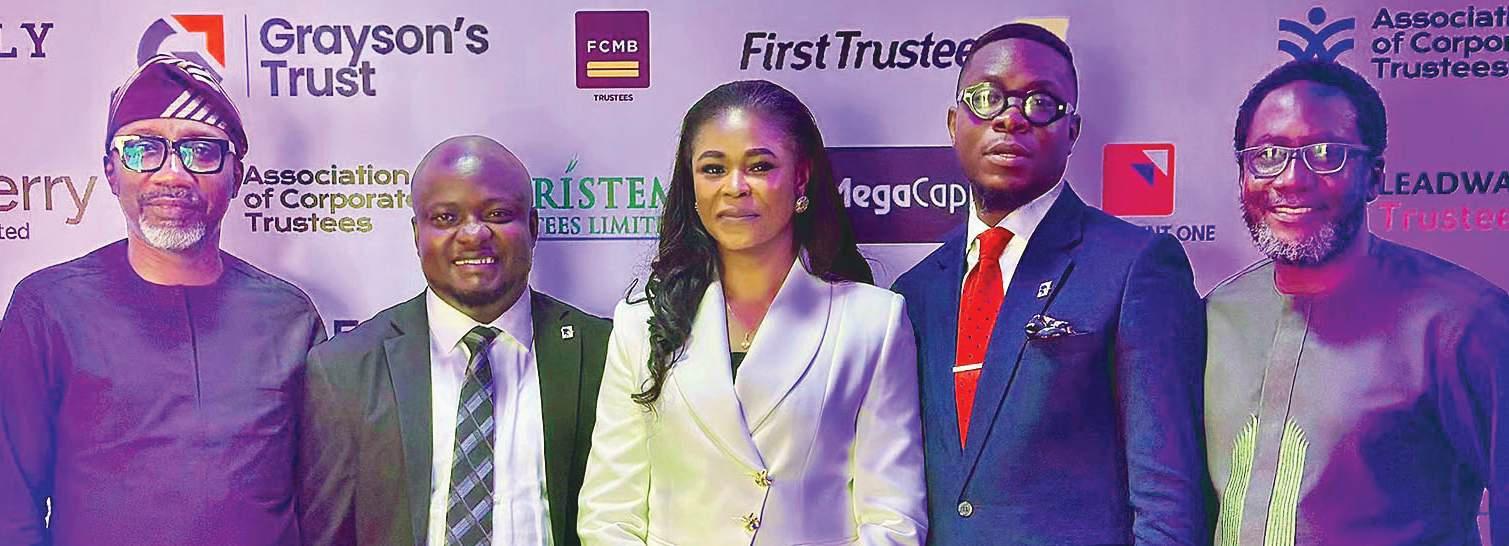
ANNUAL CONFERENCE OF THE ASSOCIATION OF CORPORATE TRUSTEES...
ECOWAS Targets Rice Independence by 2035 as West Africa Moves
to End Multi-billion Dollar Import Dependence
Determined to reverse decades of dependence on imported rice and strengthen food security across the sub-region, the Economic Community of West African States (ECOWAS) and its development partners have launched an ambitious drive to mobilise investments aimed at achieving rice self-sufficiency in West Africa by 2035.
The initiative took centre stage at a high-level Regional Round Table on Investment in the Rice Sector held in Accra, where policymakers, financiers, development institutions and private sector stakeholders gathered to chart a pathway for transforming one of the region’s most strategic agricultural commodities.
The two-day meeting, organised by ECOWAS through its Department of Economic Affairs and Agriculture, with support from World Bank and African Development Bank (AfDB), seeks to unlock public, private, and blended financing required to implement national and regional rice development plans.
The gathering comes at a critical moment for West Africa, a region where rice has become a staple food for millions but where domestic production continues to lag behind demand, forcing countries to spend
billions of dollars annually on imports.
Opening the roundtable on behalf of Ghanaian President, John Dramani Mahama, Vice President Jane Naana Opoku-Agyemang said the challenge before the region transcended ag- riculture and touched on broader issues of economic sovereignty and sustainable development.
Opoku-Agyemang stressed that the quest for rice self-sufficiency was fundamentally linked to Africa’s ability to transform its economies, deepen regional integration, and build resilience against global supply disruptions.
“Beyond rice, this meeting is about economic transformation, regional integration and Africa’s capacity to achieve self-sufficiency with dignity,” she said.
For decades, West African nations have struggled with the paradox of possessing vast arable land, favourable climatic conditions, and a large agricultural workforce, yet remaining heavily dependent on imported food.
Global shocks—including the COVID-19 pandemic, supply chain disruptions, geopolitical conflicts and rising food prices—have exposed the vulnerability of relying on external markets to feed growing populations.
The urgency of addressing this challenge became even more
apparent in recent years as food inflation continued to exert pressure on households across the region.
In his remarks, President of ECOWAS Commission, Omar Alieu Touray, described the initiative as a defining moment in the bloc’s efforts to attain food sovereignty.
According to Touray, ECOWAS is committed to building competitive, inclusive and sustainable agri-food systems capable of generating employment, creating wealth and strengthening regional food security.
He stated, “Our ambition is to establish competitive, inclusive and sustainable agri-food systems that strengthen food sovereignty, create jobs and promote shared prosperity while achieving regional self-sufficiency in rice by 2035.”
Touray said the roundtable must go beyond declarations and serve as a catalyst for concrete investments and actions capable of transforming the rice value chain across member states.
The meeting also featured con-
tributions from Ghana’s Minister of Food and Agriculture, Eric Opoku; Deputy Finance Minister Thomas Nyarko Ampem; World Bank Vice President for Global Environment, Guangzhe Chen; and AfDB Director of Agricultural Finance and Rural Development, Richard Ofori-Mante.
A major highlight of the event was the presentation of the “Vision for Rice Self-Sufficiency in West Africa by 2035” by Kalilou Sylla.
The vision outlines a comprehensive strategy to boost rice production,
improve seed systems, expand irrigation infrastructure, strengthen mechanisation, enhance processing capacity, and improve market access across the region. Experts say achieving selfsufficiency will require unprecedented levels of investment in agricultural infrastructure, research, climate-smart farming techniques, and value-chain development. It will also depend on stronger collaboration among governments, development partners and private investors.
Military Pension Board Raises Fraud Alert, Warns NOKs Not to Divulge Sensitive Information to Fraudsters
Linus Aleke in Abuja
The Military Pension Board (MPB) has issued a fraud alert, cautioning retirees and next of kins (NOKs) against disclosing sensitive personal or financial information to fraudsters who may seek to exploit pension-related processes for unlawful gain.
In a statement on Wednesday, the Public Relations Officer of the Military Pensions Board, Squadron Leader Aliyu Mohammed, alerted all military pensioners, retirees, and
next of kins (NOKs) to the activities of unscrupulous individuals who have been contacting pensioners and requesting sensitive personal information under various pretexts, including promises of facilitating loans, processing benefits, or providing other financial services.
He said, “The Board has received reports that some of these individuals are demanding personal details such as Bank Verification Numbers (BVN), National Identification Numbers (NIN), bank account details, ATM card information, and
other confidential data. Pensioners are hereby strongly advised not to disclose such information to any individual, group, or platform that is not officially authorised by the Military Pensions Board.
“The Military Pensions Board does not engage third parties to collect pensioners’ personal or banking information for the purpose of processing loans, pension payments, gratuities, or any other benefits. Any request for such information from unofficial sources should be treated
with caution and reported to the appropriate authorities.”
The Board encouraged pensioners and NOKs to conduct all official business relating to their pensions and benefits only through recognised MPB channels and designated contact lines.
Squadron Leader Mohammed said the Board remains committed to safeguarding the interests of military retirees and will continue to work with relevant agencies to protect pensioners from fraudulent activities.
Bills on Free Maternal Healthcare, Environmental Sanitation Pass Second Reading in Kogi
Ibrahim Oyewale in lLokoja
The Kogi State House of Assembly has passed for second reading a bill seeking to provide free maternal and neonatal healthcare services for pregnant women and newborns in state-owned health facilities across the state.
The Assembly also advanced a separate bill aimed at preventing public littering and the defacement of public and private properties, describing it as a crucial step toward improving environmental sanitation and public health.
Both private member bills were sponsored by the member representing Omala State Constituency, Hon. Umar Yahaya, popularly known as “Connect.”
The lawmaker noted the bill will complement the about 90
Primary Health Care Centres the Kogi State Government has built and commissioned across the state.
He described the effort of the state government as one that is unprecedented being the reason why after the appraisal of the state government efforts, it was agreed the bill aligns with the vision of the Gov. Usman Ahmed Ododo’s administration.
He added that when passed, the bill will enable citizens enjoy the full utilization of the Primary Health Care Centres in the state.
The maternal healthcare bill, titled “A Bill for a Law to Provide for Free Maternal and Neonatal Healthcare Services for Pregnant Women and Newborn Children in State-Owned Health Facilities in Kogi State and Other Matters Connected Therewith, 2025,”was
first read on October 14, 2025.
The proposed legislation comprises seven parts and 31 clauses.
At the plenary session, Yahaya said the legislation seeks to guarantee free antenatal care, skilled delivery services, including caesarean sections, obstetric and neonatal care, immunisation, diagnostic services, essential drugs, and comprehensive newborn care in all state-owned healthcare facilities.
According to him, the bill is designed to eliminate financial barriers that compel many families to pay out-of-pocket for maternal healthcare services.
He noted that Nigeria accounts for about 14 per cent of global maternal deaths and lamented that many maternal and neonatal deaths in Kogi State occur because expectant mothers are unable to
afford treatment.
The lawmaker cited instances where pregnant women reportedly lost their lives after being denied access to medical care due to inability to make upfront payments.
He commended the state government over the initiatives such as the Maternal and Neonatal Mortality Reduction Innovation Initiative and the Maternal, Newborn and Child Health Week programme, Yahaya stressed the need for legal backing to ensure sustainability and accountability.
“This Bill provides that frame- work. It ensures that access to life-saving maternal and neonatal healthcare is not a privilege but a guaranteed right for every pregnant woman and newborn child in our state,” he said.
He further expressed confidence
that existing partnerships with the World Health Organisation (WHO) and related healthcare interventions would support effective implementation of the proposed law.
Members of the House, including Speaker Rt. Hon. Aliyu Umar Yusuf and Deputy Speaker Rt. Hon. Comfort Nwuchiola Egwaba, commended the initiative, describing it as a landmark intervention capable of significantly reducing maternal and neonatal mortality and related complications across the state.
Following extensive deliberations, the bill was passed for second reading and referred to the relevant House committees for further legislative scrutiny. Similarly, the House passed for second reading “A Bill for a Law to Provide for the Prevention
and Control of Public Littering, the Defacement of Public and Private Places and for Other Related Matters, 2025.”
The bill, which was also first read on October 14, 2025, is structured into seven parts and 22 sections. It seeks to establish a comprehensive legal framework for environmental sanitation enforcement, define responsibilities for citizens and businesses, prescribe penalties for violations, and encourage public participation in maintaining a clean environment.
Presenting the bill, Hon. Yahaya expressed concern over the growing menace of indiscriminate waste disposal, blocked drainage systems, and vandalised public infrastructure, noting that such practices contribute significantly to flooding and the spread of diseases.
From L-R: Head, Business Development First Trustees Ltd, Abimbola Ajinibi; Head, Public Trust, First Trustees Ltd, Olufemi Okin; Managing Director/CEO, First Trustees Ltd, Ereifemi Akeredolu; Head, Corporate Trust, First Trustees Ltd, Babatunde Adewolu; and, Head, Private Trust, First Trustees Ltd, Rotimi Obende at the 2026 Annual Conference of the Association of Corporate Trustees in Lagos...recently
Michael Olugbode in Abuja
Acting Group Politics Edito r DEJI ELUMOYE
Email: deji.elumoye @thisdaylive.com
08033025611 s M s O n LY
Increasing Incidence of Kidnapping as Threat to National Security
Afakriya Gadzama writes that recent times have witnessed a troubling rise in the incidence of kidnapping across parts of Nigeria, posing significant threats to public safety, national security, and socio-economic stability.
Many of us in the National Security Establishment have been taken aback by the sudden emergence of kidnapping and the abduction of schoolchildren in some parts of the country in the last few months. Of particular note are the abduction of over 40 school children in Musa, in Askira Uba Local Government Area of Borno State, and a nearly similar incident at Oriire, Oyo State.
Also very unsettling was the abduction of retired Brigadier-General Abubakar Rabe and his wife in Matazu Local Government Area Council in Katsina State. There have also been several unconfirmed reports of abductions in several states. Also very disheartening were the killings of some military and police personnel in Yobe State by people suspected to be terrorists. These, candidly, are some of the few security incidents that have dented the commendable performance of some security agencies in the country over the past two months.
An honest review of the performance of agencies in the National Security Sector reveals that many of them have performed exceptionally well despite the occasional eruption of some incidents. As repeatedly observed, even pathological critics of some of the security agencies and the Government have sought to know what led to some of the incidents. We, however, caution that these incidents should not be used as parameters for measuring the performance of the security agencies and the state of security in the country. Political sentiments, as consistently observed, should also not be used to measure the performance of the Government of the day.
This is because some of the critics of the President Bola Tinubu government could be beclouded and blindfolded by their parochial biases against the present government.
As previously observed, a charged political atmosphere such as the one the country is passing through at the moment is not helpful for an objective and balanced view of the performance of security agencies in the country. It should be noted that the government and the security agencies are equally concerned with the security situation in the country.
All concerned stakeholders are calling for a balanced appreciation of the handling of the current incidents of abduction in parts of the country. It is our view that President Tinubu should not be blamed for the abduction incident in Musa, Borno State, and the one at Oriire in Oyo State. If anything, those to be blamed are the security and paramilitary agencies that have statutory responsibilities for handling such criminal incidents. It is also important to note that those in political leadership cannot totally exonerate themselves from the incidents in question.
This is because of poor security management in the country and the recent handling of crime and security issues in the country. The reason, basically, is that poor governance and depriving the citizenry of the minimal benefits of democracy are what have pushed the citizenry into criminality, among other things. Some of us believe that criminality and anti-social behaviour will significantly decline if there is equity and provision of the minimal needs of the citizenry, particularly the downtrodden. Relatedly, it has also been observed that the mode of kidnapping, abduction and attacks on people and communities in the country is a result of inherent weaknesses in the security infrastructure and the lack of working tools. These are major handicaps for those in law enforcement and security agencies in the country. It is important to note that almost all paramilitary and security agencies in the country are, at the moment, poorly equipped and terribly understaffed.
It is important to note that the present government has tried to address the critical needs of nearly all security and paramilitary organisations in the country.
However, as previously observed, re-equipping the various security and police agencies does not stop at buying and equipping them with outdated guns and ammunition. Many in
the security sector have also raised questions about what has happened, for example, with the Safe School Programme.
The major security threat at the moment is the
abduction of school children. Our fears are that kidnapping in places of worship could be the next target. Stakeholders in the political circle could be the next victims. This underscores the need to heighten security presence in all States and the National Assembly.
The incidents in question have also brought to the fore the absence of the expected state of preparedness of security agencies in the country. The government and the citizenry therefore need to be reminded that the country is fast approaching an election period. This could be characterised by unexpected incidents in the political space.
The citizenry and other stakeholders, if they have to competently handle all the threats that are likely to emerge before then, should have started preparing by now. It is however sad to note that only agencies like the DSS and a few others have commenced honest rehearsing of their personnel on election management. The many others should take a cue.
An informed analysis meanwhile points to the political class as the likely targets of kidnapping by criminal groups. Stakeholders with responsibilities for protecting political office holders should also do well by effectively securing the political office holders, especially the legislators at the State and National levels.
An appropriate advice at a time like this is that the State Government should sit down with the security agencies to deliberate on some critical security threats. A major area that needs to be thoroughly discussed is security in the various schools and places of worship. Proper management of electoral campaigns should equally be looked into to forestall untoward incidences.
-Gadzama, a former Director-General of the Department of State Services, writes from Abuja.
Onuigbo: A Man of Honour Beyond Office, Politics and Time
Charles Nnaji writes that influence, impact and problem solving rather than titles held or political offices occupied, should define leadership as demonstrated by host community by recognizing Rt. Hon. Sam Onuigbo as a mbassador Plenipotentiary of Michael Okpara University, Umudike in recognition of his efforts for the relisting of management courses like accountancy, Banking and Finance, Economics in the iniversity.
Certain things are beyond the calendar. Indeed, in every generation, history reserves a special place for leaders whose influence transcends the boundaries of public office. Consequently, such individuals are wont to be remembered, not merely by the positions they occupied, but above all, for the lives they transformed, the institutions they strengthened, and the enduring values they embodied.
It is against such lofty background that one feels compelled to recognise the giant strides of Rt. Hon. Sir Sam Onuigbo. Noted for his legendary sponsorship of Nigeria’s signature legislation on Climate Change-the Climate Change Act 2021, Onuigbo belongs unmistakably to that distinguished category of statesmanlike leaders.
Experts argue that in contemporary political discourse, where leadership is often assessed through the narrow prism of electoral victories and official titles, focus is often trained on poll numbers rather than influence and impact. But, if primeval leadership comes into reckoning, such servants like Onuigbo present a compelling alternative narrative that is rooted in service, sacrifice, vision, and enduring impact.
For instance, even before he joined competitive partisan jostle for public office, Onuigbo had left behind a trail of public service that consistently demonstrated how true leadership is neither transactional nor seasonal. It is this lifelong commitment to the advancement of people and society that commends his contribu-
tion to public appreciation.
And so, it goes without saying that Onuigbo and his type are not defined by their sterling achievements in public office. Therefore, it could be said that what distinguishes him is not merely the legislative milestones he achieved as the sponsor of the Climate Change Act or the developmental interventions associated with his name.
Rather, much stress is laid on the depth of humanity that underpins his leadership philosophy. That also encompasses his approach to governance, which has always reflected a profound understanding that public office is ultimately a platform for service and not self-
glorification.
It could be said that same conviction has earned him respect across political, academic, professional, and community circles, reinforcing his reputation as a man whose honour is earned beyond political affiliation. Perhaps, no appraisal better captures the essence of Onuigbo’s leadership acumen than the testimonials from respected scholars and administrators, whose paths have crossed with his:
Prof John Ihendinihu, a former Dean, College of Management Sciences, Michael Okpara University of Agriculture, Umudike, Abia State, after reflecting on Onuigbo’s contributions to the society, said he represents the “most honourable and the people’s active voice,” stressing that he deserves every noble and befitting tribute due to a leader whose impact transcends the conventional boundaries of politics.
Those who heard the Don speak, agreed that his summation aptly captures the essence of statesmanship, which highlights Onuigbo’s prowess. This includes legislative achievements and developmental strides, as well as the enduring values of service, accessibility, and visionary leadership that characterize his public life.
Trends and Threads Oil Companies and the Transition Imperative
By many measures, Nigeria remains an oil and gas nation. Petroleum still accounts for a significant share of export earnings, government revenue, and foreign exchange. Yet the global energy landscape is changing rapidly. Investors are demanding lower-carbon operations, governments are tightening climate regulations, and consumers are increasingly asking difficult questions about sustainability.
For Nigeria’s leading oil and gas companies, the challenge is no longer whether the energy transition will happen, but how they will respond to it. The country’s largest operators—including NNPC Limited, Shell, Seplat Energy, TotalEnergies, Chevron, ExxonMobil, Eni/ NAOC, Oando, Renaissance Africa Energy and Nigeria LNG—now find themselves navigating two realities at the same time: the need to continue producing hydrocarbons that power the economy, and the growing pressure to reduce environmental impacts, mitigate climate change, and validate their social license to operate.
The result is a transition story that is both promising and complicated.
A New Era for Nigeria’s Energy Industry
The most important shift in recent years has come from policy and regulation. The Petroleum Industry Act (PIA) of 2021 fundamentally reshaped the governance of Nigeria’s petroleum sector. Beyond commercial reforms, it created a framework that increasingly recognizes environmental responsibility, gas utilization, methane reduction and sustainable resource management.
The Nigerian government also launched the Energy Transition Plan, setting a pathway toward net-zero emissions by 2060. Complementing this ambition are the Nigerian Gas Flare Commercialisation Programme and the Gas Flaring, Venting and Methane Emissions Regulations of 2023, which require operators to eliminate routine flaring and submit flare elimination plans. These policies have influenced boardroom conversations across the industry. Companies that once focused almost exclusively on oil production are now speaking about decarbonization, gas monetization, methane reduction and renewable energy investments. But policies alone do not guarantee outcomes.
The Companies Moving Fastest
Among indigenous firms, Seplat Energy has perhaps positioned itself most clearly around the transition narrative. The company openly describes itself as supporting Nigeria’s transition through gas development and domestic energy supply. Major investments such as the ANOH Gas Project are designed to increase gas availability for power generation while reducing dependence on more carbon-intensive fuels.
Seplat’s strategy reflects a broader industry belief that natural gas will serve as Nigeria’s transition fuel. The company has also emphasized reductions in gas flaring and investments in gas infrastructure aimed at lowering emissions while supporting economic development.
NNPC Limited has similarly embraced transition language. Since becoming a commercially oriented company under the PIA, it has publicly committed to a low-carbon future through renewables, energy efficiency, carbon-neutral fuels and expanded gas utilization. The company’s sustainability framework appear to align with Nigeria’s climate commitments, including ending routine gas flaring and supporting emission reduction targets.
International companies are also adjusting their strategies. Shell continues to emphasize gas development, environmental responsibility and lower-carbon energy solutions. TotalEnergies has expanded renewable energy activities in Nigeria through solar electrification and distributed energy projects while maintaining its significant oil and gas operations.
These efforts suggest that transition is
no longer treated as a public relations exercise alone. Increasingly, it is becoming part of business strategy.
Why Gas Has Become the Centrepiece
One striking trend among almost all major operators is the emphasis on natural gas.
Shell, NNPC, Seplat, TotalEnergies, Chevron and Eni have all increased attention toward gas development. The rationale is straightforward. Nigeria possesses one of the largest natural gas reserves in Africa, although millions of citizens still lack reliable electricity access.
For industry leaders, gas represents a practical compromise. It generates lower emissions than coal or heavy fuel oil, supports industrialization, provides feedstock for manufacturing and helps reduce routine flaring.
From an energy security perspective, this argument is compelling. Gas projects are creating opportunities for power generation, fertilizer production, industrial growth and cleaner cooking solutions. Yet critics argue that gas should be viewed as a bridge rather than a destination. A transition built entirely around expanded gas production risks locking Nigeria into another generation of fossil fuel dependence. The question therefore becomes whether today’s gas investments are genuinely enabling future decarbonization or merely extending the lifespan of the hydrocarbon economy.
The Progress That Deserves Recognition
It would be unfair to suggest that the industry has made no progress.
Gas flaring, though still a challenge, has received greater regulatory attention than at any point in Nigeria’s history. The Gas Flare Commercialisation Programme seeks to convert previously wasted gas into productive economic use. New methane regulations require operators to monitor and reduce emissions. Companies increasingly disclose sustainability data and climate-related information in annual reports.
Several operators have invested heavily in gas gathering infrastructure, flare reduction technologies and energy-efficiency measures. Renewable energy projects, particularly solar initiatives supported by TotalEnergies and other companies, are also beginning to emerge.
Community engagement has improved in some areas, aided by the Host Community Development provisions of the Petroleum Industry Act. While implementation remains uneven, the framework provides a stronger foundation for local participation than previous arrangements.
These developments demonstrate that regulatory pressure can drive corporate action.
The Persistent Gaps and Uncomfortable Questions
Yet significant concerns remain. Perhaps the biggest challenge is the gap between commitments and measurable outcomes. Many companies speak confidently about sustainability and net-zero ambitions, but relatively few have demonstrated large-scale transformation of their business models.
Most capital expenditure continues to flow toward oil and gas production. Renewable energy
investments remain modest when compared with spending on upstream petroleum activities. For many operators, sustainability initiatives still represent a small fraction of core business operations.
Environmental remediation also remains a major issue. Decades of oil spills and ecosystem degradation in parts of the Niger Delta continue to affect communities and livelihoods. While some cleanup efforts are ongoing, progress has often been slow, and concerns about accountability persist. There is also the issue of transparency. Although reporting has improved, independent verification of environmental performance remains inconsistent. Communities, civil society organizations and investors increasingly demand clearer data on methane emissions, flare reduction and environmental restoration.
The sector must recognize that credibility is earned not through sustainability reports but through demonstrable results.
The Regulatory Test
The real test may not be corporate ambition but regulatory enforcement. Nigeria has introduced several commendable policies, yet implementation remains a recurring weakness. Historically, environmental regulations have sometimes suffered from inconsistent enforcement, limited institutional capacity and political interference.
The success of the Petroleum Industry Act, methane regulations and flare reduction initiatives will depend on whether regulators can maintain independence and ensure compliance. This means monitoring emissions rigorously, enforcing penalties where necessary, publishing reliable environmental data and resisting pressure from vested interests.
Strong regulations without enforcement create expectations. Strong regulations with enforcement create change.
What the Future Demands
The future of Nigeria’s oil and gas sector will not be determined by production volumes alone. Increasingly, it will be judged by how effectively companies manage environmental risks while contributing to economic development.
For industry leaders, the challenge is clear. Transition efforts must move beyond gas expansion toward broader investments in renewable energy, carbon management, energy efficiency and sustainable infrastructure. For policymakers, consistency and enforcement must become priorities. For investors, support should increasingly flow toward companies demonstrating measurable progress rather than ambitious rhetoric.
Nigeria does not face a choice between development and sustainability. The country needs both. Millions still require affordable energy, jobs and economic opportunities. At the same time, environmental degradation, climate risks and global market shifts cannot be ignored.
The leading oil and gas companies operating in Nigeria have begun taking steps toward transition. Some have moved faster than others. Some have embraced innovation more convincingly than their peers. But the journey just got started. The next decade will reveal whether the industry’s transition agenda becomes a genuine transformation or simply another chapter in a long history of promises. That distinction matters—not only for investors and regulators, but for communities, future generations and the long-term resilience of Nigeria’s economy.
• Heineken Lokpobiri, Minister of Petroleum Resources (Oil)
• Mrs Oritsemeyiwa Eyesan, Chief Executive of NUPRC
• Sen. Udoma Udo Udoma, Board Chairman of Seplat Energy
Edited by Oke Epia | e-mail:
Ripples of the BP Board Chair Sack
News of the sacking of Albert Manifold as chairman of British oil giant BP sent ripples through the industry last week. The terse language of the announcement has fuelled speculations that will be debated for weeks to come.
The company statement based the action on serious concerns about “important governance standards, oversight and conduct.” The media has been interpreting this to suggest unethical behaviour – in fact, the BBC report spoke of bullying and overbearing behaviour.
It is not clear why BP withheld details of such an important decision, but what is hardly in doubt is that the issue of governance and ethics has been raised as a basis for the
Rejoinder
action. That is a crucial red flag. The public needs to know what those governance breaches were; who was impacted; and what remedies have been provided. Such details would provide lessons not only within BP but to the corporate world, especially the fossil fuel industry that pretty much thrives on opacity.
Full disclosure would also help strengthen efforts towards transparency, as some reports have suggested that Manifold is disputing the reason for his sacking. In all, the unfolding episode has raised serious questions about the ESG practices of BP. Leaving doubts hanging in the air does no good to both corporate reputation and the balance sheet in the long run.
Nigerian Banks and ESG: Moving from Optics to Evidence
By Motunrayo Simeon
SOStainability’s weekly article, “Nigerian Banks and ESG: Between Optics and Practice,” raises a necessary and timely question: are Nigerian banks truly embedding Environmental, Social, and Governance principles, or merely presenting ESG as reputational polish?
The answer, regrettably, is that both realities exist at once. Nigerian banks have made visible progress in governance language, sustainability reporting, financial inclusion programmes, board-level policies, and responsible banking commitments. But the deeper issue is whether those commitments are sufficiently measurable, comparable, independently assured, and linked to lending, investment, and risk-management decisions. That is where the real conversation must begin.
The Fair Finance Nigeria policy assessment provides a useful provocation. By examining Access Bank, Standard Chartered Bank, United Bank for Africa, and Zenith Bank against more than 400 international ESG criteria, it draws attention to gaps between public sustainability commitments and the policy depth expected under global responsible finance standards. The finding that the assessed banks averaged 1.7 out of 10 should not be dismissed as civil society criticism. It should be treated as a baseline for reform.
However, the discussion must go beyond scoring. ESG in banking is not simply about whether banks publish sustainability reports. It is about what those reports prove. In IPMC’s Nigeria
Companies ESG Ratings Report 2025, the assessment similarly finds that Nigeria’s ESG landscape is policy-rich but verification-poor. Governance remains the strongest pillar across the Nigerian market, but environmental and social indicators are still weakly quantified. Within financial services, banks show stronger governance maturity than many other sectors, yet financed emissions, climate-related credit exposure, Scope 3 impacts, and independent assurance remain major gaps. This distinction matters. A bank may have an ESG policy, but without financed-emissions disclosure, it is difficult to know whether its loan book supports a credible transition. A bank may report community investment, but without outcome metrics, it remains closer to philanthropy than measurable
social impact. A bank may disclose board structures, but without ESG-linked executive accountability, sustainability remains peripheral to corporate strategy. The next phase of Nigerian banking ESG must therefore shift from optics to evidence.
Three reforms are urgent. First, banks should publish clear climate risk and financed emissions disclosures aligned with IFRS S1/S2 and TCFD expectations. The financial sector’s greatest environmental impact is often not on its office buildings, but on the activities it finances. Second, sustainability reporting must be independently assured. Investors, regulators, and citizens should not have to rely only on self-reported ESG narratives. Verification is what turns disclosure into trust. Third, regulators should harmonize ESG expectations across the CBN, SEC, NGX, FRCN, and other relevant
institutions. Fragmented guidance creates reporting fatigue, but unified standards create market discipline. There is also a wider opportunity. Nigerian banks can become catalysts for national ESG transformation. Through credit policies, project finance, SME lending, green bonds, gender-lens finance, and climate-risk screening, banks can shape how Nigerian businesses transition. But this requires moving ESG from corporate communications departments into credit committees, risk functions, treasury decisions, board scorecards, and executive incentives.
The Fair Finance Nigeria report has done the sector a service by opening the debate. The challenge now is to ensure that debate does not end with reputational defensiveness. The banking industry should respond with data, reforms, and measurable commitments. Nigeria does not lack ESG frameworks. What remains weak is auditability, comparability, and enforcement. Until those gaps are closed, ESG will continue to appear more advanced in language than in practice.
The future of responsible banking in Nigeria will not be defined by how many sustainability reports banks publish. It will be defined by how convincingly they can prove that capital is being allocated in ways that protect people, communities, climate stability, and long-term economic resilience. That is the conversation worth continuing.
•Motunrayo, an ESG & sustainability professional, wrote this rejoinder from Lagos.
• Yemi Cardoso, CBN Governor
• Albert Manifold
• Rabiu Olowo FRC Executive Secretary
DELTA,
OMOAGEGE AND 2027
The people of Delta State will determine who leads them, argues ALFRED AKACHUKWU
CLASSROOMS AS FRONTLINE OF INSECURITY
Government must bring the children home from the bush, argues JOSHUA J. OMOJUWA
The Enugu State-style, AI-driven security structure, holds lessons for the nation, writes TUNDE OLUSUNLE
A PETER MBAH MODEL FOR NATIONAL SECURITY
Typical of the reactive style of our defence and security agencies, Nigeria's Chief of Defence Staff, General Olufemi Oluyede, Tuesday May 26, 2026, ordered the deployment of special forces and advanced surveillance assets to Oyo State. The Director of Defence Media Operations, Major-General Michael Onoja disclosed this during an engagement with the press, exactly one week after armed men abducted 39 students and seven teachers from schools in Ori-Ire local government area in the state. The bloodhounds would eventually behead one of the teachers, Michael Olugbade Oyedokun, to reinforce their mean-spiritedness. Such terrorism, such bloodletting has, very sadly, become normalised in contemporary Nigeria. *Statisense* estimates that 35,432 lives have been lost in the first three years of the administration of President Bola Tinubu. This works out at an average of 35 deaths per day.
Sunday May 31, 2026, the Chief of Staff to the President, Femi Gbajabiamila, led a federal government delegation to the aggrieved communities and the families. Optics are critical to perception in communication and politics. That Gbajabiamila and National Security Adviser, (NSA), Nuhu Ribadu chose to appear in billowing *agbada* in the rural Esiele and Yawota communities where the victims were forcefully taken from weeks before, was totally at variance with the sombreness of the occasion. They were received by Abdulfatai Omotayo Buhari, Senator representing Oyo North Senatorial District, who has barely had a good night's sleep since the unfortunate incident. He was dressed in simple *ankara* fabric, like the generality of his constituents. The federal government team should have seen the Oyo State Governor, Seyi Makinde who had earlier visited to share in the anguish and trauma of his people, who turned up in a tee-shirt and jeans trousers.
In consonance with the *ase han* style, the loud exhibitionism which has characterised and compromised the administration's knee-jerk approach to security management, Gbajabiamila, Ribadu and company were loud on government's plans to rescue the victims and subsequently boost security in rural areas. Thrice in the past few months, December 2025 and May 2026, the United States of America, (USA), has collaborated with Nigerian intelligence and defence in hitting terrorist strongholds in Nigeria. On all occasions, Nigerians get to hear about the planning and implementation, until after the deed had been done, usually via tweets by the US President and Commander-in-Chief, Donald Trump. But Tinubu’s emissaries, just like the
CDS who publicised the deployment of drone assets and special forces, have put terrorists on notice now that they will be chased about henceforth by 1000 forest guards in Oyo State, and should expect a military base in the Oke-Ogun district soon, to combat their trade.
In a recent postmortem on the President’s visit to Jos, the Plateau State capital after the Rukuba killings earlier in the year, I alluded to his proclivity for impulsive pronouncements, which lack requisite thinking through. The President had directed relevant government departments to ensure the total coverage of Jos and its environs with "AI-powered security surveillance gadgets." In that piece which I titled *Still On Tinubu’s Whistlestop In Jos,* I observed that whereas the President’s spontaneous pronouncement in the course of that Jos visit was borne of a desire for a sustainable prescription to mitigate security breaches in the city, a more rigorous, more pan-Nigerian surveillance coverage is urgent and imperative. Every other part of Nigeria suffers some kind of security encroachment or the other.
It was Ori-Ire, Oyo State two weeks ago; Yashikara in Baruten local government area of Kwara State where the Emir's palace was burnt by marauders and 10 people kidnapped. Saturday May 30, 2026, former Director of Defence Information, retired Major-General Rabe Abubakar and his wife were abducted by bandits in Matazu local government area, Katsina State. It was the turn of the sleepy Aiyegunle-Bunu community Ijumu council area, Kogi State, where two people were killed in their homes and 30 others marched into the forests. What Nigeria is facing at the moment is a rampaging national insecurity epidemic inimical to its overall wellbeing. Less than two weeks ago, the National Drug Law Enforcement Agency, (NDLEA), uncovered Nigeria's largest clandestine methamphetamine plant, buried in the bowels of the Abidagba forest in Ijebu East council area
of Ogun State. The Nigerian-led cartel included three Mexican technical experts and methamphetamine and precursor chemicals valued at nearly N500 Billion were seized. One week after, a Fulani cell tucked away in Omugbawojo in Ijebu North East and home to an estimated 2000 undocumented herdsmen, was also uncovered. Nigeria's security emergency is real and dreadful to say the least. Closely related to this is that vandalism of public infrastructure has become a palpable national security threat. A video clip trended recently of the metal expansion joints on the freshly built Second Niger Bridge in Onitsha, Anambra State, removed and exposing dangerous spiky, studs and putting drivers and commuters at mortal risk. Also trending is a video clip of a whole solar street lamp, complete with its metal pole, uprooted and hoisted on the shoulder by a street urchin, ostensibly for disposal for pittance, in a scrap market. The skeletal remains of the KatsinaMaradi rail line, one of the star projects of the Muhammadu Buhari administration, has also featured prominently on the social media in recent days, compounding confoundment about the scope and gravity of our security issues. The metal meshes being installed by Nyesom Wike, Minister of the Federal Capital Territory, (FCT), to protect green areas are being simultaneously mutilated and stolen by miscreants in broad daylight. The DNA of a certain specie of Nigerians seems totally antithetical to growth and development.
May 11, 2026, President Tinubu appointed Adeyinka Famadewa, a retired Major-General, as Special Adviser on Homeland Security. It is a novel creation in Nigeria's security and governance system, which is expected to strengthen internal security coordination, improve intelligence integration and deepen interagency collaboration across the country's security architecture. This additional bureaucracy may not be unconnected with the failure of existing structures and their operators to tame the spawning ogre of national insecurity. Whereas his appointment as Minister of Defence last year was expected to have an immediate bearing on reining in insecurity, General Christopher Musa has been more famous for rhetoric than tangibles. He recently drew loud public criticism when he scored the Tinubu government 70 percent in security management in his assessment of its three-year sojourn, a proposition which borders on misrepresentation in the face of empirical reality.
Olusunle, PhD, Fellow of the Association of Nigerian Authors, (FANA), teaches Creative Writing at the University of Abuja
The people of Delta State will determine who leads them, argues
ALFRED AKACHUKWU
DELTA, OMO-AGEGE AND 2027
Politics often produces strange spectacles, but few are as intriguing as the recent intervention by former Deputy Senate President, Ovie Omo-Agege, on national television. Appearing on Arise News on Wednesday morning, OmoAgege ostensibly sought to respond to remarks made a day earlier by Delta State Governor, Sheriff Oborevwori, who had dismissed him as posing no significant threat in the 2027 political calculations in Delta State.
Yet, rather than directly address the governor's challenge, Omo-Agege chose a different route. He introduced President Bola Ahmed Tinubu into the conversation by alleging that there had been a presidential directive prescribing a 60:40 sharing formula between the old APC structure and new entrants into the party in Delta State.
According to Omo-Agege, this arrangement was respected elsewhere but allegedly ignored in Delta State, where the camp of Governor Oborevwori supposedly moved to dominate party structures and positions.
The former Deputy Senate President's intervention raises more questions than it answers. More importantly, it reveals a troubling tendency to substitute political sophistry for political reality.
The first question is simple: why is President Tinubu being dragged into what is essentially an internal struggle for influence within the APC in Delta State?
Political parties routinely experience tensions following defections and realignments. Such disagreements are usually resolved through negotiations among stakeholders, consultations with party leadership, and the democratic processes established by the party itself. To elevate a local dispute over political offices into an issue allegedly involving presidential directives appears designed to create the impression that certain promises were made and subsequently broken.
The implication is unmistakable. If indeed there was a presidential preference or directive, then someone must be responsible for ensuring compliance. By introducing the President into the discussion, Omo-Agege appears to be subtly suggesting that those who stood by the President in difficult times have somehow been abandoned.
Whether intended or not, that narrative amounts to a form of political blackmail. It places the President in an uncomfortable position, portraying him as either unwilling or unable to protect loyal supporters. Such framing does not advance party unity. Instead, it risks creating divisions between long-standing APC members and more recent entrants into the party.
The reality is that politics is not governed by entitlement. No politician, regardless of past sacrifices, is guaranteed perpetual ownership of party structures or electoral tickets. Perhaps the most revealing aspect of Omo-Agege's interview was his emphasis on his political strength
and continued popularity. He pointed to his victory in 84 out of 85 wards during the Delta Central Senatorial primaries as evidence that his organic support base remains intact.
If that is indeed the case, then one wonders why he failed to clinch the APC Delta Central Senatorial District primary election. And even more instructively, why the preponderance of reports from the Nigeria Democratic Congress (NDC) senatorial district primary election, to which he had defected to after failing to get the APC nomination was also reportedly lost by him. Why pivot the discussion in a way to revolve around a 60:40 sharing formula in the first place?
Political capital is ultimately tested at the ballot box and through party primaries. A politician who commands overwhelming grassroots support should have little reason to rely on negotiated allocations or formula-driven arrangements to secure relevance.
The contradiction is difficult to ignore. On one hand, Omo-Agege presents himself as a politician whose popularity remains undiminished. On the other hand, he complains about the distribution of offices and influence within the party structure that failed to pander to his whims and caprices. Both arguments cannot comfortably coexist.
If the grassroots remain firmly behind him, then political contests should provide sufficient opportunity to demonstrate that support. If, however, there is anxiety about losing influence, then perhaps the challenge lies not in broken agreements but in changing political realities.
Indeed, if the truth must be told, the political landscape in Delta State has undergone significant transformation in recent months. Governor Oborevwori's political moves have altered long-standing alignments. The governor has consolidated considerable influence across the state, attracting politicians from different tendencies and creating new equations within the APC since he joined. Even when he was a member of the Peoples Democratic Party (PDP), Governor Oboorevwori always made it clear that he is a governor for all Deltans. And take it or not, that has really earned him the love and support of hitherto political opponents.
Akachukwu, a public affairs commentator and Democracy Advocate, writes from Asaba, Delta State
Government must bring the children home from the bush, argues JOSHUA J. OMOJUWA
CLASSROOMS AS FRONTLINE OF INSECURITY
These are not the best of times. There is a two-year-old child in the bush somewhere in Oyo State. She was taken from a nursery school on May 15. She has been out there for nearly three weeks. She does not understand what ISWAP is. She does not understand migration routes or command structures. She understands cold, rain, and the absence of her mother. This two-year-old and the several others in the captivity of these terrorists are the latest victims of our country’s endless challenge with insecurity.
On May 15, 2026, over 40 teachers, pupils and students were kidnapped from three schools in Ogbomoso and Oriire communities of Oyo State: a Baptist Nursery and Primary School, a Community Grammar School, and an L.A. Primary School. This reportedly happened on the same day that 42 school children were abducted in Askira-Uba Local Government Area of Borno State. A mathematics teacher, Mr Michael Oyedokun, was beheaded. An assistant headmaster was killed. An abducted vice principal, Mrs Alamu, recorded a distress video from the bush on the 13th day of captivity, kneeling and pleading for negotiation: "We are in the cold, we are under the sun and inside the rain, the children and adults as well. We are begging you."
Then came the demand that strips away any remaining ambiguity about who these people are and what they want. Reports indicate the kidnappers are not simply asking for money. They are demanding the release of colleagues arrested for bomb-making. Children are being used as leverage to free people who build weapons designed to kill civilians. Beyond banditry with economic motivations, this is a terrorist negotiating tactic and it tells you something precise about the ideological infrastructure behind what happened in Oriire.
In Oyo, the attackers used explosives during the abduction. Rescue team members sustained injuries after encountering explosive devices planted by the kidnappers during operations. These were not opportunistic criminals who stumbled upon three schools. This was a planned, coordinated, ideologically motivated operation, in Oyo State, which was not supposed to be a high-risk zone.
That geographical spread is the story beneath the story. Contrary to the belief that school abductions are purely a Northern problem, the Oyo attack confirms that the crisis has reached the South-West. Since the Chibok abduction of 2014, over 1,600 schoolchildren have been kidnapped in Nigeria. Approximately 597 students were abducted within 2023 to 2026 alone. These are the accumulated costs of a national security architecture that has been structurally insufficient for almost two decades now.
On May 16, 2026, the United States and Nigeria launched a joint military operation against ISWAP and Boko Ha-
ram in northeastern Nigeria, including special forces raids and multiple rounds of airstrikes. By May 19, 175 ISWAP and Boko Haram militants had been eliminated. Among the dead was Abu-Bilal al-Minuki, described as one of the most significant ISIS operatives in the world, alongside several other senior commanders killed in rapid succession. Al-Minuki coordinated terrorist financing, recruitment, logistics and attack planning. His death severely disrupts ISIS command, operational coordination and external attack networks.
The most telling confirmation of the pressure came from ISWAP itself. As security analyst Brant Philip first reported, through their unofficial media channels, the group announced that all routes of hijrah — migration corridors for foreign fighters — are now closed. Their stated reason was the attacks of what they called "the American dogs and the apostates of Nigeria." The situation, they declared, was too dangerous.
As recently as February 2026, ISWAP was actively recruiting foreign fighters, with Caucasian fighters confirmed in their ranks. By June, the same organisation is telling potential recruits the journey is no longer survivable. That is a recruitment freeze imposed by operational reality. When a terrorist organisation closes its own doors and names the enemy as the reason, it is being honest about its condition.
This context reframes the Oyo abductions in an important way. The classroom attacks are not evidence of a confident, expanding insurgency. They are, at least in part, evidence of what cornered organisations do. When command structures are decapitated, when logistics networks are disrupted, when migration routes close under military pressure, groups pivot to the tactics requiring the least infrastructure: terror, hostage-taking, the exploitation of civilian vulnerability. The demand for bomb-makers' release is itself a sign of operational stress; an organisation losing trained personnel it cannot easily replace and willing to use children as the price of getting them back.
is chief strategist, Alpha Reach/BGX Publishing
Omojuwa
Editor, Editorial Page PETER ISHAKA
Email peter.ishaka@thisdaylive.com
PRESERVING THE GIFTS OF NATURE
We must take good care of the environment
To mark the 2026 World Environment Day (WED) with the theme, ‘Inspired by Nature: For Climate. For Our Future’, the Nigerian Conservation Foundation (NCF) has urged the government, communities, businesses, and citizens to turn global commitments into local actions. The Foundation has also called on President Bola Tinubu to urgently act on the National Biodiversity Strategy and Action Plan and immediately sign the Endangered Species Conservation and Protection Bill into law. We endorse their position, even as we call on all authorities in the country and critical stakeholders to take the environment more seriously.
The WED was established in 1972 to promote worldwide awareness and action on environmental issues such as climate change, pollution, biodiversity loss, deforestation, and sustainable living. According to the United Nations Environment Programme (UNEP), this year focuses on the urgent signals the earth is sending, and the signals humanity chooses to send back. Meanwhile, in terms of overall biodiversity richness, Nigeria ranks 36th globally, with particularly high diversity in birds, mammals, and vascular plants,” according to the NCF which expressed concern about the mounting threats to biodiversity in the country.
ing attention to the fact that many plants and animals are going into extinction. Perhaps because there is so much preoccupation with today there is hardly a thought about tomorrow. Yet we need to stress the importance of the preservation of nature's gifts for the future. Nigeria is located within the rainforest of tropical Africa, which extends from the coast of West Africa to the basin of River Congo. The area, as documented by conservationists, has about 8,000 species of which more than 80 per cent are endemic. Regardless, there is no recent record of the status of plants and animal species in the country.
The last known documentation of the nation’s plants and animal species was done in 1992 by the Federal Environment Protection Agency (FEPA).
Species of high medicinal and food value are stripped from our forests through commercial activities that cause rapid
deforestation at about 400,000 hectares per annum
T H I S D AY
EDITOR SHAKA MOMODU
DEPUTY EDITOR WALE OLALEYE
MANAGING DIRECTOR ENIOLA BELLO
DEPUTY MANAGING DIRECTOR ISRAEL IWEGBU
CHAIRMAN EDITORIAL BOARD OLUSEGUN ADENIYI
No fewer than 171 Nigerian plant species have been classified as endangered and vulnerable by the World Bank. These species of high medicinal and food value are stripped from our forests through commercial activities that cause rapid deforestation at about 400,000 hectares per annum. Experts have warned that their disappearance could disrupt the nation’s genetic resource with a resultant threat to our biodiversity. Therefore, signing the Endangered Species Conservation and Protection Bill, 2025 into law will provide the legal backbone needed to prosecute wildlife crimes, regulate trade, and deter the exploitation of threatened species.
Unfortunately, it would seem the nation is not pay-
EDITOR NATION’S CAPITAL IYOBOSA UWUGIAREN THE OMBUDSMAN KAYODE KOMOLAFE
T H
EDITOR-IN-CHIEF/CHAIRMAN NDUKA OBAIGBENA
GROUP EXECUTIVE DIRECTORS ENIOLA BELLO, KAYODE KOMOLAFE, ISRAEL IWEGBU
DIVISIONAL DIRECTORS SHAKA MOMODU, PETER IWEGBU, ANTHONY OGEDENGBE
DIRECTOR, PRINTING PRODUCTION CHUKS ONWUDINJO TO SEND EMAIL: first name.surname@thisdaylive.com
The document titled ‘Biological Diversity in Nigeria: A Country Study’ states that two species of animals and 20 species of plants had become extinct since 1950. Contemporary record documented in the study shows that 305 species of plants are endemic, 48 species of animals and 431 species of plants are endangered; 16 species of animals and 45 species of plants are categorised as rare; 30 species of animals and 20 species of plants are vulnerable. The study shows that plants that are gravely depleted are species exploited for natural medicine and food, timber, woodcarving, cane furniture, dyes, and cosmetics. The cause of the decrease in population is given in each case as over exploitation.
This makes the call for the intervention of all critical stakeholders in conservation efforts very important. Government, at all levels, should also encourage the establishment of botanical gardens and horticultural centres where these endangered plants would be grown. These plant species usually grow in the wild, but there will be sustainability if they are cultivated deliberately. But much more importantly, as Nigeria joins other countries to mark the 2026 World Environment Day, we must control the trade in plant species, particularly through cross-border activities.
Letters in response to specific publications in THISDAY should be brief (150-300 words) and straight to the point. Interested readers may send such letters along with their contact details to opinion@thisdaylive.com. We also welcome comments and opinions on topical local, national and international issues provided they are well-written and should also not be longer than (750- 1000 words). They should be sent to opinion@thisdaylive. com along with photograph, email address and phone numbers of the writer.
ADC PRIMARIES IN KADUNA STATE
The just concluded ADC primaries in Kaduna were a "sham". The party was formed and nurtured by a group of selfless Nigerians who are poised to salvage the country. It is sad to note that some new entrants hijacked the party for their own selfish interest. In less than two months, these desperate politicians pushed out the real members who laboured to make the party what it is today.
In Sabon-Gari Local Government where I hail from, out of eleven wards, it was only in six wards direct primaries took place. However, a returning officer who is an academic from reputable University presented his result and declared a candidate with highest scores as the winner. Unfortunately, the results were doctored. One had expected the committee from Abuja to do justice and reverse the flawed elections. It has been reported that this " kangaroo" primaries were conducted in all the 23 local government
of the state. With the manipulation of results in favour of new comers, internal democracy has been subverted, while imposition of unpopular candidates promoted.
The committee from the national body in the name of providing justice to candidates who participated in the primaries left without addressing their grievances. Those who organised the shoddy elections got away with their impunity.
Notwithstanding, I will like to congratulate our ADC Presidential candidate Wazirin Adamawa, Alhaji Atiku Abubakar, for being declared the winner and the only candidate that will face the ruling party in 2027 general election.
Jamilu Bello Dogarawa, Kaduna State
AN INTELLIGENCE SOLUTION?
Robert F. Kennedy Jr., Lawyer, no medical training, now in charge of medicine.
Linda McMahon, previously professional wrestling executive, no teaching experience now in charge of education.
Sean Duffy, lumberjack, TV personality, no transport expertise, now secretary of transportation.
And finally, Bill Pulte, housing and construction, no intelligence experience, now acting US intelligence director.
Donald Trump, various occupations, now President, level of intelligence? Self reported as a 'stable genius'.
Sometimes reality is very scary and unreal.
Dennis Fitzgerald, 28 Landale St, Box Hill, Vic, Australia
RATES AS AT J UNE 4,2026
PMI: Manufacturing, Agriculture Experience Higher Output Prices as Economic Activities Rose to 54.1
Dike Onwuamaeze
The Purchasing Managers’ Index (PMI) report of the Stanbic IBTC Bank has shown that manufacturing and agriculture sectors experienced the steepest increase in output prices in May 2026.
The PMI also recorded increase in productivity in the Nigerian private sector as its headline rose to 54.1 in May from 52.4 it recorded in April.
According to the report, “Employment rose in
the agriculture and services sectors, but fell in manufacturing, wholesale and retail” though growth in output was recorded across all four broad sectors that were covered by the PMI survey.”
According to the PMI, higher fuel costs continued to cause sharp increases in input costs and output prices, “but rates of inflation softened from April.”
It said that with input costs increasing rapidly, Nigerian companies raised their selling prices accordingly
as the steepest increases in charges were seen in the manufacturing and agriculture categories.
It said: “The headline PMI rose to 54.1 in May from 52.4 in April, signalling a solid monthly improvement in business conditions and one that was the most pronounced since August 2025. The health of the private sector has now strengthened in four consecutive months.
“Central to the solid improvement in business conditions were marked
and accelerated expansions in both output and new orders during May. Rates of growth hit seven- and ninemonth highs respectively and anecdotal evidence pointed to improving customer demand and the launch of new products.
“Improving demand, and the prospect of further growth in the months ahead, led companies to expand their purchasing activity and inventories in May. Here too, rates of expansion quickened from April and were sharp.”
The report also said that employment continued to rise only slightly midway through the second quarter, although sustained job creation has now been recorded in each month for a year.
According to the report, increasing fuel costs, following the outbreak of war in the Middle East, have continued to drive up purchase prices in May.
It said: “Purchase costs rose rapidly again, despite the rate of inflation easing to a three-month low. Purchase
prices increased at a much quicker pace than staff costs, which rose modestly again in May.”
The PMI added, “overall input costs continued to increase sharply during May, although the rate of inflation eased for the second month running. Underlying data indicated that higher purchase prices were the main driver of rising overall input costs, while employee expenses increased only modestly.
chinedu eze
Aviation industry stakeholders are worried about the weak financial capabilities of aviation agencies, allegedly caused by the internal revenue deductions from their earnings to the Consolidated Revenue Fund (CRF), by the federal government. According to the stakeholders, such heavy deductions have brought severe financial distress on the operations of the agencies, and could force
them into bankruptcy.
Industry sources informed THISDAY that the Federal Airports Authority of Nigeria (FAAN), the Nigeria Civil Aviation Authority (NCAA), and the Nigeria Airspace Management Agency (NAMA) have become insolvent adding that this has affected their ability to carry out some of their financial obligations, including execution of critical projects and salaries and allowances to their workers.
Workers of the agencies have alleged that the huge
monies paid to the federal government by the agencies as remittances, run into billions of naira revealing that this has impaired their operations.
In 2024, FAAN remitted the sum of N281,881,317.34 into the federal government’s Consolidated Revenue Fund account and the payment was part of the 50 per cent revenue remittance policy mandated by the federal government for revenuegenerating agencies.
Also in 2025, FAAN remitted N150.4 billion
to the CRF during that fiscal year.
Also, in 2024, NCAA was expected to generate and remit of N372.23 billion to the federal government’s Consolidated Revenue Fund Account but was able to remit N218 billion that year.
There is no published data on the amount NAMA has been remitting to the CRF account but the agency said that the remittances have left it cash strapped such that it cannot carry out its obligatory responsibilities.
THISDAY investigation revealed that NCAA is currently in prolonged period of economic stagnation because after the deductions from source by the federal government, airlines owe the agency monies accruing from the five per cent Ticket Sales Charge and Cargo Sales Charge (TSC/CSC), which is collected by airlines in trust and then remitted to the NCAA to be shared with other aviation agencies.
A NAMA insider told THISDAY that the agencies
were practically in the red because the federal government “seemed insensitive about our operations and they are deducting our revenue at source.”
“We basically have installations at strategic areas and at the airports in order to maintain communication in the airspace and we power these installations with diesel. You know how much diesel costs now.”
Grimaldi Clarifies Position on Sale of Containers, Customs Duty Responsibility
Esther Oluku
Grimaldi Agency Nigeria has issued a clarification regarding reports concerning the sale of empty shipping containers by Grimaldi Deep Sea S.p.A.
In a statement, Grimaldi Agency Nigeria said claims suggesting that the seller was liable for customs duties following the sale of a few empty containers are inaccurate and inconsistent with the terms of sales.
The company also refuted reports that it sold 2,500 empty containers, describing
such claims as false and unsupported by facts.
According to the company, empty containers were sold strictly in their international customs status, commonly referred to as a “foreign customs position”, and were not transferred as domesticated equipment intended for local use within Nigeria.
The agency explained that the terms of the sale were clearly outlined in the documentation provided to the purchaser. The invoice expressly stated that the
containers were being transferred in foreign customs position and that the buyer was meant to use the equipment solely for international carriage of goods without altering their original customs status.
Grimaldi further noted that the sales agreement specifically provided that if any local customs regulations required the containers to be regularised or domesticated for local use, such procedures would be carried out entirely at the buyer’s responsibility and expense.
United Nigeria Airlines Gifts Passengers with Samsung Phones
Stories by Chinedu Eze
United Nigeria Airlines has rewarded its passengers with the recently released Samsung Galaxy phones, as part of its ‘Awesome Row’ partnership with the mobile phone the company.
The winners, Hamid Ibrahim, Chidi Chinedu, and Gbenga Bello, were among passengers selected through an on-board lucky dip on the Lagos–Abuja and Abuja–Lagos flights on that day.
Passengers also got exclusive in-flight access to the new Samsung Galaxy A57 and
A37 and winners emerged from the live experience.
Speaking on the outcome of the initiative, United Nigeria Airlines’ Chief Commercial Officer, Dayo Olawuyi, expressed delight at the success of the promotion, saying that it reflects the airline’s deepest commitment to its passengers and the values that drive the brand.
“At United Nigeria Airlines, we fly to unite. Every route we operate, every flight we run, is about bringing Nigerians together, whether for business, work or family functions.
“The partnership with Samsung is an extension of that mission because they share our belief in delivering the very best to Nigerians, and together, we wanted to create a moment that passengers would never forget. We are very thrilled for Hamid, Chidi, and Gbenga, and we congratulate them on their wins.
“We are very passionate about ensuring our customers have the best experience, and that is exactly the kind of thing we want people to associate with flying United Nigeria Airlines,” he said.
IATA, ICAO Deepen Cooperation on Sustainable Aviation Fuel
The International Air Transport Association (IATA) and the International Civil Aviation Organisation (ICAO), have announced enhanced cooperation at ICAO Aviation Climate Week to advance transparency and integrity in tracking progress and accelerating the development and deployment of Sustainable Aviation Fuels (SAF).
Close collaboration between industry and states, underpinned by robust systems and high-quality data, will aim to enable transparent and credible tracking of aviation cleaner energies and their contribution towards net zero carbon emissions by 2050, in alignment with the
respective IATA and ICAO ambitions and commitments.
Both organisations agreed to explore how SAF registries and the data they collect can support the implementation of the ICAO Long-Term Aspirational Goal (LTAG) Monitoring and Reporting (LMR) methodology, as well as the consideration of fuel accounting systems for international aviation.
The Secretary General of ICAO, Juan Carlos Salazar,
said: “Credible tracking is necessary to know the emissions reductions delivered by SAF. The data collected by the CADO SAF Registry, among others, has the potential to meet this need. By working with ICAO to strengthen how progress on SAF use is measured and reported, we can accelerate deployment, build trust across stakeholders, and put aviation on track for net zero by 2050.
Mitchell Elegbe Rejoins Global Jury for 2026 Awards
Founder and Group Managing Director/CEO of Interswitch Group, Mr. Mitchell Elegbe, has again been re-appointed as the only entrepreneur from Africa into the global jury of the 2026 Ernst & Young (EY) World Entrepreneur of The Year Awards.
Group
Deputy
Comms/e-Business
Asst. Editor,
Emmanuel Addeh
Asst. Editor, Money Market
Nume Ekeghe
Correspondents
Kayodetokede(CapitalMarkets)
James Emejo (Finance)
Ebere Nwoji (Insurance)
reporter Peter Uzoho (Energy)
The award takes place annually in Monte Carlo, Monaco, and Elegbe has been re-appointed for the third consecutive year, following his inaugural jury duties at the 2024 awards.
According to EY, the World Entrepreneur of the Year Hall of Fame is an elite corps of men and women who have been recognized for their exceptional entrepreneurial achievements.
For 40 years, since 1986, EY has been celebrating ingenuity
Air WAtCh
Calabar Carnival as Pivot of Tourism in Nigeria
Chinedu Eze
Calabar Carnival has become the pivot of tourism development in Nigeria, given its antecedents in recent times.
It is a tourism event that has been recognised globally as emanating from Nigeria.
It is also number one carnival in Africa, followed by Cape Town carnival, Harare International Carnival, Quelimen Carnival in Mozambique, Goree Island Festival and, of course, Fanti Carnival in Nigeria; a centuryold, Afro-Brazilian street carnival revived recently by the state government after a long hiatus.
The Calabar Carnival has confirmed that carnivals drive tourism development by boosting local economies, generating jobs, ad preserving cultural heritage. In those early days when the carnival started in 2004, many saw it as upstart enterprise that would fade as government programmes are known to disappear over time in Nigeria.
their investments, which would be richer, noting that the event would provide wider visibility of their products.
through the Entrepreneur of the Year program.
“The programme has recognised more than 10,000 outstanding entrepreneurs for their vision, innovation, courage, and leadership in building and growing successful businesses — businesses that influence the way people live, the products and services we depend on, and the economic vibrancy of our local communities and global markets,” he said.
In June of 2023, Elegbe, alongside 48 other accomplished entrepreneurs from 45 countries across the world were inducted into the 2023 WEOY Hall of Fame with Interswitch’s Elegbe holding the unique distinction of being the only black and African global finalist.
But two factors nullified this assumption. One, Donald Duke, the then governor of Cross River state established it very firmly and other governors embraced it because of its uniqueness and the recognition it gave the state and two, it also succeeded because Calabar has unique, cosmopolitan tradition. It dovetailed with the character of the city and the disposition of the people.
There are other key issues about the Calabar Festival. It created jobs for youngsters who look forward to it towards the end of the year and it unearthed hidden talent, which many of the participants never envisioned.
One fact may not have been given a thought. The impression of Africa changed in the Caribbean when their people started attending Calabar Festival.
This is why the unveiling of the 2026 Carnival Calabar at the Eko Hotel and Suits in Lagos attracted massive turnout made up of tour operators, travel agents, journalists, ambassadors and renowned tourism stakeholders and government officials.
With the theme: ‘Rethinking Our Collective Destiny’, the unveiling event was a success which confirmed the importance of the festival and also the dexterity of the organisers who year after year ensured a more successful outing.
The Carnival has attracted many business organisations that sponsor different events during the festival, from banks, manufacturers and service providers. It is a major tourism event that has attracted the international community, as ambassadors representing different countries have keyed into it and use it to showcase what Nigeria can offer to the world in the area of culture and tourism.
During the unveiling in Lagos, the Governor of Cross River State, Senator, Bassey Out, assured sponsors of the 2026 Carnival Calabar and Festival that there would be return on
The governor therefore solicited for the continuous support of both existing and potential sponsors, urging them not to relent in their efforts as the state strives to maintain its enviable position in the national and international tourism landscape, adding that Cross River State is the proud organisers of the “Africa’s Biggest Street Party”, the Carnival Calabar.
The governor said in order to have a robust outing in this year’s Carnival Calabar and Festivals, the state would be galvanising the efforts of Cross Riverains in the Diaspora in terms of participation; propagation of the Carnival brand abroad as well as securing material support.
He also disclosed that a framework for the streaming of the carnival and the monetisation of its contents have also been worked out.
“In order to remain competitive in the tourism ecosystem, the Creative Economy of Cross River State is currently undergoing a comprehensive overhaul, by creating more tourism assets which in turn will facilitate employment opportunities and generate revenue. These will immensely have a pull on repeat and new tourists to the state,” the governor said.
Otu also noted that the unveiling of the theme: ‘Rethinking Our Collective Destiny’, is the beginning of the 2026 Carnival Calabar activities.
Also, the President, Federation of Tourism Associations of Nigeria (FTAN) Dr. Badaki Aliyu, in his speech at the event said that tourism stakeholders would support the 2026 Carnival Calabar to make it a huge success.
Aliyu promised that the 2026 Carnival Calabar Festival woulld be greater than the 2025 edition with the full participation of the tourism body with its member associations.
the story continues online on www.thisdaylive.com
How Diageo, AMVCA Partnership is Rewriting Africa’s Creative Future
Raheem Akingbolu writes on the relevance of creativity in the Nigerian business environment and how the recent partnership between Diageo and the promoters of AMVCA is changing the narratives
Africa has a rich storytelling tradition. For generations, our ancestors shared countless stories beneath the shade of trees on bright, moonlit nights. Today, the children continue this legacy through various digital platforms. The power of storytelling is profound. It not only reflects societal values but also shapes the continent’s identity. Storytelling drives and entrenches culture.
The Africa Magic Viewers’ Choice Awards (AMVCA) has today emerged as the premier platform for recognising and celebrating excellence in storytelling across the continent. When the lights came on at the 2026 edition of the AMVCA, the spectacle was unmistakable, dazzling fashion, emotional acceptance speeches, viral social media moments, and a celebration of African storytelling at its finest. But beneath the glamour was something far more significant unfolding quietly: a powerful corporate-cultural alliance that is helping reshape Africa’s entertainment economy.
The partnership between Diageo and the Africa Magic Viewers’ Choice Awards has evolved beyond conventional sponsorship. It now represents a strategic investment in Africa’s cultural influence, creative industries, and economic future. For years, African entertainment fought for legitimacy on the global stage. Today, Nollywood, African music, fashion, and digital storytelling are commanding worldwide attention. Streaming platforms are investing heavily in African content. African actors and filmmakers are gaining international recognition. Audiences across continents increasingly want authentic African stories told through African voices.
What makes the Diageo partnership
particularly important is its understanding that modern brands can no longer exist only as advertisers. They must become active participants in culture itself. By deploying a full portfolio of brands including Don Julio, Johnnie Walker, Guinness, Smirnoff, Orijin, and Malta Guinness across multiple AMVCA experiences, Diageo positioned itself not merely as a sponsor of entertainment, but as a supporter of African creativity and identity.
That distinction matters. Across the world, cultural industries have become instruments of economic power and national influence. Hollywood became one of America’s greatest soft-power exports. South Korea transformed K-pop and film into global economic assets. India built cultural influence through Bollywood. Africa is now approaching a similar moment. The continent’s creative economy is rapidly becoming one of its most promising growth sectors, especially for young people. Behind every AMVCA-winning production lies a vast network of writers, directors, editors, makeup artists, costume designers, sound engineers, photographers, digital marketers, stylists, event planners, and technology providers.
So, while the red carpet may last one night, the ecosystem it supports sustains thousands of livelihoods day in, day out. This is precisely why corporate investment in entertainment is increasingly viewed not as philanthropy, but as strategic economic participation.
Now, Diageo’s involvement also elevated the symbolism of African storytelling. Through sponsorship categories celebrating
indigenous language films and cultural heritage, the partnership reinforced the importance of preserving African identity in a rapidly globalising world. At a time when authenticity has become a global currency, African creators are discovering that audiences are drawn not to imitation, but to originality, local languages, folklore, fashion, traditions, humour, and uniquely African experiences.
Importantly, the partnership also created spaces where business and creativity intersected meaningfully. Exclusive networking events, after-parties, mentorship sessions, and filmmaker engagements helped promote conversations around distribution, intellectual property, co-productions, and scaling African entertainment globally. In many ways, this is where the real long-term value lies. Entertainment ecosystems thrive when creatives are treated not merely as performers, but as entrepreneurs and cultural exporters.
By creating premium experiences around the AMVCA, Diageo helped reinforce a new mindset within the industry, one that positions African creators as global professionals capable of building internationally competitive brands and productions. The significance of this shift can not be overstated. For decades, African entertainment has operated with limited institutional support despite its enormous influence.
Today, stronger partnerships between the private sector and the creative industry are helping close that gap. Better-funded platforms attract better productions, higher standards, larger
audiences, and greater international attention. This creates a cycle of growth that benefits the broader economy. The impact extends beyond film. African fashion designers gain visibility. Music artists reach wider audiences. Tourism receives a boost. Social media conversations amplify African culture globally. Young people see viable career opportunities in storytelling, animation, content creation, and digital media. In effect, the entertainment industry has become both a cultural and economic engine. For Diageo, the partnership also reflects an evolving understanding of consumer engagement. Younger audiences increasingly align with brands that participate authentically in the passions and communities shaping their lives. Entertainment offers one of the most emotionally powerful spaces for that connection.
By aligning itself with moments of celebration, creativity, aspiration, and cultural pride, Diageo strengthened its relevance within one of Africa’s most influential cultural platforms.
As the curtains close on another successful AMVCA edition, the larger story remains unfinished. The films will continue streaming. New filmmakers will emerge. African stories will travel farther. More global audiences will discover the richness of African storytelling. And partnerships like Diageo X AMVCA will continue to prove that the future of Africa’s creative economy will not be built by creatives alone, but through bold collaborations between culture and corporate vision. In the end, the true legacy of this partnership goes beyond the glamour of awards night. It lies in the confidence it gives an entire generation of African storytellers to dream bigger, create boldly, and believe their stories deserve the global stage.
Akinyemi: Automated Wealth Tools Will Cushion Inflation in Nigeria
Head of Treasury at FairMoney Microfinance Bank, Feyishetan Akinyemi, spoke about the importance of customer savings and the need to leverage automated wealth tools to hedge against rising inflation in Nigeria. Emma Okonji
Inflation acts as a ‘stealth tax’ on idle cash. For the average Nigerian who is used to traditional savings, how does FairMoney MFB specifically quantify the difference in real value between a standard bank account and your high-yield wealth products?
We quantify it by focusing on real returns—what your money is actually worth after inflation, and not just the interest you earn. At FairMoney MFB, we make that difference explicit. For each product, we compare the nominal return to prevailing inflation and show the real value outcome: A standard bank account might deliver less than five per cent, which translates to a significant negative real return.
Internally, we track this using a simple real return framework, essentially adjusting all product yields for inflation, so we’re not just optimizing for headline rates, but for customer purchasing power over time.
So, the shift we’re driving is from ‘my money is growing’ to ‘my money is actually keeping up or beating the cost of living.’ That’s how we make the impact of inflation tangible and measurable for our customers.
In simple terms: traditional savings grow your balance, but shrink your lifestyle, and our goal is to close and where possible, eliminate that gap.
With core inflation sitting at a double digit, many Nigerians are afraid about keeping their wealth in Naira. Beyond just interest rates, what specific ‘wealth track’ features within the FairMoney app, offer users a strategic shield against the constant threat of currency devaluation?
presents the excerpts:
In a high-inflation environment, we know interest rates alone don’t solve the problem, so we focus on structure, we address behavioural risk, provide yield structuring, enable laddering and diversification within the naira and finally focus on consistence and compounding. Yes, interest rates alone don’t solve the problem, so with products like FairSave and FairTarget, we guide customers into ‘wealth tracks’ that combine higher yields, disciplined saving, and smart fund allocation. For example, FairTarget locks in goal-based savings to ensure customers stay invested long enough to earn inflation-beating returns, while FairSave provides flexible, high-yield options for liquidity. We also enable customers to split funds across different tenors, effectively creating a simple portfolio that balances access and returns. So, while we’re operating in Naira, what we’re really offering is a structured way to preserve and grow real value.
Wealth management is traditionally seen as a service for the elite. How is FairMoney leveraging tech to offer retail users access to competitive interest yields that were previously out of reach for someone starting with low income?
We’re essentially unbundling what used
to make wealth management ‘exclusive’ and rebuilding it with technology.
Traditionally, high yields were reserved for wealthy clients because of high operating costs, manual processes, and large minimums. At FairMoney, we remove those barriers by being fully digital in such a way that onboarding, account management, and transactions happen at near-zero marginal cost.
That allows us to lower entry thresholds significantly, so even customers starting with small amounts can access the same yield structures that were previously reserved for high-net-worth clients.
We also use automation and data to manage funds efficiently—so instead of relationship managers and bespoke mandates, customers get pre-structured products like FairSave and FairTarget that replicate disciplined investment strategies in a simple, app-based format.
And importantly, we embed compounding and consistency directly into the user experience through goal-based savings, reminders, and easy reinvestment so customers don’t need sophistication to benefit from it. So, in simple terms: we’re using technology to turn what was once a high-touch, high-minimum service into a low-cost, high-access platform, where anyone can start building wealth with competitive returns, regardless of income level.
Akinyemi
Stakeholders Rally for Cleaner, Safer Ports at 2026
Sunday Ehigiator
Maritime industry stakeholders yesterday, rallied support for cleaner, safer and more sustainable port operations, while calling for greater investment in workers’ welfare, training and inclusion as Nigeria marked the 2026 Dockworkers Day celebration.
The event, organised by the Shipping Correspondents Association of Nigeria (SCAN) in Apapa, Lagos, brought together labour leaders, government officials, terminal operators, maritime workers and industry stakeholders under the theme, ‘Green Ports: Sustainable Practices for Dockworkers’.
Speaking as chairman of the occasion, Immediate Past President-General of the Maritime Workers Union of Nigeria (MWUN), Deputy President of the Nigeria Labour Congress (NLC),
and Vice President of the International Transport Workers’ Federation (ITF), Comrade (Prince) Dr. Adeyanju Adewale, said the global drive towards environmentally sustainable ports must not leave dockworkers behind.
According to him, “The chosen theme, ‘Green Ports: Sustainable Practices for Dockworkers’, is both timely and strategic. It reflects the realities of our changing world and the urgent need for the maritime industry to embrace environmental sustainability while safeguarding decent work for those who keep our ports running.”
In a goodwill message, the Managing Director of the Nigerian Ports Authority (NPA), Dr. Abubakar Dantsoho, described dockworkers as indispensable to the maritime value chain and global trade.
“I count it a great honor and a good fortune to be part of this noble cause of reiterating the irrefutable fact that dockworkers are the linchpin of the maritime value chain,”
Dantsoho said.
He praised SCAN for institutionalising the annual celebration and highlighted the strategic importance of dockworkers to economic development.
“With ports being the key facilitator of economic development, and dockworkers constituting the backbone of port operations, it is undoubtedly clear that their labour which ensures the smooth functioning of international trade is the key pillar of economies and communities worldwide.”
According to him, the maritime transportation system would be unable to function effectively without dockworkers.
“Whether you want to refer to them as stevedores, longshoremen, dock hands, loaders or off-loaders, without the essential functions performed by dockworkers, the maritime transportation system and the global trade it supports would come to a grinding halt.”
FCMB Supports Launch of FMYD-IITAYouth in Agribusiness Land Trust Fund
The Federal Ministry of Youth Development (FMYD), in partnership with the International Institute for Tropical Agriculture (IITA), has launched the National Youth in Agribusiness Land Trust Fund (YiALTF). This initiative aims to improve land access and unlock opportunities for over 500,000 young Nigerians building sustainable agribusiness enterprises.
Supported by First City Monument Bank (FCMB), the initiative addresses a major barrier for young agripreneurs—access to land. It also creates pathways for financing, enterprise development, job creation, and longterm economic growth.
Speaking at the launch, the Honourable Minister of Youth
Development, Ayodele Olawande, described the initiative as a major step towards transforming youth participation in agriculture and positioning agribusiness as a key driver of economic empowerment.
Earlier, the Minister of Budget and Economic Planning, Senator Atiku Bagudu, described the launch of the Youth in Agribusiness Land Trust Fund as a testament to Nigeria’s collective commitment to empowering the next generation of entrepreneurs and strengthening the country’s agricultural sector.
He said the initiative will break down longstanding barriers to land ownership and access, creating an environment where
youth-led agribusinesses can thrive.
Representing FCMB at the event, the Divisional Head, Agribusiness and Non-Oil Export, Kudzai Gumunyu, reiterated the Bank’s commitment to supporting initiatives that make agriculture more attractive, profitable, and financeable for young people.
“The future of Nigerian agriculture depends on how well we structure financing and support systems around the realities of young people and the sector. Agriculture must be presented as a modern, technologydriven business offering opportunities in logistics, processing, commodity trading, mechanisation, digital platforms, and innovation,” he said.
‘Maximedia Adapting Wothout Losing Core Vision’
After Fifteen years in media and marketing, the Managing Director, Maximedia, Femi Adefowokan, has said the firm is adapting without losing its core vision despite new consumer habits, new expectations.
Speaking recently, Managing Director, Maximedia, Femi Adefowokan, said that tue company over the last 15 years have adapted to several challenges in the sector.
He also said that Maximedia has adapted along the way, leaning more into data, technology,
and evolving tools, noting that the original idea still holds.
“Fifteen years ago, what we had was a vision: clear, ambitious, and deeply intentional. We set out to build not just another media independent, but a creative media agency, one that goes beyond mere data to truly understand what makes the consumer tick.
“That ambition continues to shape the agency’s future. We are evolving into a more agile, innovation-led organization, positioned to help brands achieve
not just visibility, but meaningful impact and growth.”
According to him, while technology and data have become more central to the business, the company remains committed to balancing analytics with human understanding.
“The future of Maximedia is one driven by data, powered by technology, and enriched by deeper human insight. This milestone is not mine alone. It belongs to every member of our team, past and present, and to our clients and partners who trusted us,” he said.
The price of OPEC basket of twelve crudes stood at $63.14 a barrel on Monday, according
Saharan Blend
Djeno (Congo), Zafiro (Equatorial Guinea), Rabi Light (Gabon), Iran Heavy (Islamic Republic of Iran), Basrah Medium (Iraq), Kuwait Export (Kuwait), Es Sider (Libya), Bonny Light (Nigeria), Arab Light (Saudi Arabia), Murban (UAE) and Merey (Venezuela).
Investors Lose N5.15trn in Frist Four Trading Days in June
Kayode Tokede
Foreign and domestic investors who invested in the stock market section of the Nigerian Exchange Limited (NGX) have seen N5.15 trillion of their investment wiped out in the first four days trading activities in June 2026.
This is coming on the backdrop of investors profit
taking in blue chip listed stock such as MTN Nigeria Communications Plc, among others.
The market capitalization that opened for trading in June 2026 at N160.509 trillion, dropped by -3.21 per cent or N5.15 trillion to close yesterday at N155.359 trillion.
The market capitalization had opened June 2026, dropping by N1.8 trillion on surge investors’
profit-taking in BUA Cement Plc, Red Star Express Plc, First Holdco Plc, Oando Plc and Zenith Bank Plc.
It also suffered another heavy downward performance midweek, dropping by N2.28 trillion to make it the third consecutive decline, on investors profit-taking in MTN Nigeria Communications, 42 others. Consequently, the NGX AllShare Index (NGX ASI) dipped
by 3.3 per cent or 8,158.16 basis points to close at 242,227.31 basis points yesterday from 250,385.47 basis points when the stock market opened for trading in June 2026.
This brings the NGX ASI performance to 55.7 per cent in its investors Year-to-Date (YtD) performance.
The index had gained 3.35 per cent in May 2026, the lowest gain on a month-on-month
performance and 60.90 per cent in its first five months growth.
Capital market analysts have urged investors to trade cautiously on the Nigerian Exchange Limited in June 2026, shifting focus to fundamentally strong stocks with attractive valuations.
Cordros Securities Limited in a report stated that “looking ahead, we expect market
sentiment to remain broadly cautious in the near term, in the absence of a clear catalyst to drive momentum.”
Also, a group of analysts at Cowry Assets Management Limited said, “the Nigerian equities market is expected to remain cautiously positive, with performance likely driven by stock-specific factors rather than broad market momentum.
PRICES FOR SECURITIES TRADED AS OF JUNE 4/26
A Mutual fund (Unit Trust) is an investment vehicle managed by a SEC (Securities and Exchange Commission) registered Fund Manager. Investors with similar objectives buy units of the Fund so that the Fund Manager can buy securities that willl generate their desired return.
An ETF (Exchange Traded Fund) is a type of fund which owns the assets (shares of stock, bonds, oil futures, gold bars, foreign currency, etc.) and divides ownership of those assets into shares. Investors can buy these ‘shares’ on the
floor of the Nigerian Stock Exchange. A REIT (Real Estate Investment Trust) is an investment vehicle that allows both small and large investors to part-own real estate ventures (eg. Offices, Houses, Hospitals) in proportion to their investments. The assets are divided into shares that are traded on the Nigerian Stock Exchange.
GUIDE TO DATA:
Date: All fund prices are quoted in Naira as at 3rd June 2026, unless otherwise stated.
DoNNA MAISoN: redefining Modern Femininity Through Timeless Fashion
With a distinctive blend of elegance, sophistication, and contemporary style, dONNa MaISON is steadily redefining the fashion experience for the modern woman. Founded by Emmanuella Njobi, the Creative director of dONNa MaISON, the fashion house is dedicated to designing sophisticated pieces thoughtfully curated for the cosmopolitan woman, who embodies confidence, elegance, individuality, and effortless style. royce okolie reports
Donna Maison is a contemporary fashion brand redefining feminine elegance through timeless designs, refined craftsmanship, and intentional sophistication.
Built on the principles of grace, confidence, and individuality, the brand has steadily positioned itself as a symbol of modern luxury for women who desire fashion that speaks powerfully without saying a word.
Founded with a passion for creating pieces that celebrate the beauty, strength, and uniqueness of women, Donna Maison is more than a fashion label. it is a lifestyle brand dedicated to empowering women through style.
Every collection reflects a deep understanding of the modern woman. From impeccably tailored corporate wear to striking statement outfits, Donna Maison creates fashion that allows women to feel elegant, seen, and unforgettable in every room they enter.
The brand’s commitment to premium finishing, detailed craftsmanship, and sophisticated structure has earned it recognition among women who appreciate quality, refinement, and effortless style.
At the heart of Donna Maison is a philosophy that fashion should not only beautify but also inspire confidence and self-expression.
Each design is carefully crafted to embody femininity with intention, ensuring that every woman wearing Donna Maison feels empowered and elevated. Based in Abuja, the brand continues to build a growing community of stylish and influential women who connect deeply with its vision of elegance and modern femininity.
Donna Maison is steadily becoming a name associated with class, sophistication, and timeless fashion excellence in Nigeria’s evolving fashion industry.
The Story Behind the Passion
The creative journey behind Donna Maison began at a very young age. The founder’s passion for fashion started at just five years old, sparked by an admiration for elegance, creativity, and intentional dressing.
Watching her parents dress stylishly for different occasions inspired an early fascination with personal style and how clothing could transform presence and confidence.
A major influence in shaping this passion was her aunty, a talented fashion seamstress who unknowingly nurtured her creativity. During holidays, she would spend hours playing with sewing machines and leftover fabrics, carefully creating miniature outfits for dolls.
Those early experiences introduced her to the artistry of fashion design and cultivated a lifelong appreciation for craftsmanship, textures, and detail.
As a child, fashion magazines, clothing illustrations, and runwayinspired looks became a constant source of fascination. She loved recreating styles, experimenting with combinations, and imagining her own concepts. At home, she often organized playful fashion shows with her siblings, transforming ordinary moments into imaginative runway experiences.
Those childhood memories became the foundation upon which Donna Maison was built.
Fashion as a Lifestyle and Art Form
For Donna Maison, fashion goes beyond clothing. It is a language of identity, confidence, and creativity. Every fabric tells a story, and every design is an opportunity to transform simplicity into beauty.
The brand’s creative process is deeply inspired by culture, nature,
textures, fabrics, architecture, and everyday life experiences. This unique blend of influences allows Donna Maison to create pieces that are both meaningful and visually captivating.
Designing comes naturally because fashion is viewed not merely as business, but as art brought to life.
One of the most remarkable aspects of the brand’s creativity is its spiritual connection to inspiration.
Many of Donna Maison’s most successful and distinctive designs have emerged through dreams, visions, and spontaneous moments of inspiration.
Whether while driving, exercising, dining, waking up in the morning, or sitting in meetings, creative ideas often appear unexpectedly and later evolve into best-selling pieces loved by women.
This deep spiritual perspective fuels the brand’s originality and gives every collection authenticity and emotional depth.
Above all, Donna Maison remains grounded in gratitude to God for the gift of creativity and the ability
to create designs that make women feel beautiful, confident, and empowered.
Building a Legacy of Sophisticated Femininity
In an industry constantly driven by trends, Donna Maison stands out by focusing on timeless elegance and intentional fashion.
The brand understands that true style is not temporary. It is enduring, graceful, and deeply personal.
Donna Maison is building a legacy centered on empowering women through fashion that reflects sophistication, confidence, and individuality.
Every collection is designed for women who lead, inspire, nurture, and create impact in every environment they enter. As the brand continues to grow within Nigeria’s fashion industry and beyond, its vision remains clear, creating a global community of women connected by elegance, confidence, and refined femininity.
Donna Maison is not simply designing clothes. It is shaping identity, confidence, and a lifestyle of elegance for the modern woman.
Emmanuella Njobi
Africa Day 2026: reinforcing Commitment to Connecting Africa and the World the uBA Way
As Africa continues to assert itself as a major force in global commerce, innovation and culture, United Bank for Africa (UBA) Plc has reaffirmed its role as one of the continent’s foremost institutions driving integration and economic transformation. Marking Africa Day 2026 with a groupwide celebration across its operations in 20 African countries, the bank highlighted its commitment to connecting markets, people and opportunities while showcasing the diversity, resilience and potential that define the African continent. Chiemelie Ezeobi reports
L - R: Group Executive, Treasury and Financial Institutions, United Bank for Africa (UBA), Samuel Ocheho; Chief Risk Officer, Awele Ajibola; Winner, Traditional African Muse (Jury’s Choice), UBA Africa Day 2026, Temitayo Abayomi; Group Managing Director/CEO, UBA, Oliver Alawuba and Executive Director Designate, Corporate Banking, Tosin Adewuyi during the presentation of prizes to winners at UBA’s Africa Day 2026 celebration held at UBA House, Lagos
Africa’s Global Bank, United Bank for Africa (UBA) Plc, marked Africa Day 2026 with a group-wide celebration across its offices in 20 African markets, reaffirming its commitment to connecting people, businesses and opportunities across the continent.
The celebration brought together employees from across UBA’s African operations in a vibrant display of cultural pride, unity and shared identity, reflecting the bank’s longstanding presence and influence across the continent.
Celebrating Africa’s Diversity and Shared Identity
For UBA, which has spent more than seven decades expanding its footprint from Lagos to Nairobi, Accra to Abidjan, Dakar to Douala, and Maputo to Kinshasa, Africa Day provided an opportunity to reflect on its journey, impact and aspirations for the future.
The event featured a rich blend of cultural showcases, fashion displays, music and food presentations representing the Group’s operating markets, with participation from all 20 African countries where the bank has a presence.
The celebrations highlighted the diversity that defines both Africa and the institution itself, reinforcing UBA’s position as a truly pan-African financial services group.
UBA as a Bridge Across Africa
Speaking during the event, UBA Group
Managing Director and Chief Executive Officer, Oliver Alawuba, underscored the strategic role the bank plays in connecting African economies and communities.
“As a Group with presence in 20 African countries, UBA is more than a bank. We are a bridge across markets, cultures, people and opportunities,” Alawuba said.
“Every day, through our people, our technology, our capital and our customer relationships, we connect Africa to itself and Africa to the world.”
His remarks came at a time when the African banking landscape is experiencing significant transformation, driven by the rapid growth of digital finance, increasing cross-border trade and rising demand for strong African-owned institutions capable of competing on the global stage.
Driving Africa’s Economic Transformation
Alawuba noted that the continent is undergoing profound change, driven by innovation, entrepreneurship and a new generation of leaders shaping Africa’s future.
“Africa’s story is changing,” Alawuba noted. “Young people are innovating, entrepreneurs are
Group Managing Director/CEO, United Bank for Africa, Oliver Alawuba during the presentation of prizes to winners at UBA’s Africa Day 2026 celebration held at UBA House, Lagos
creating new businesses, women are leading boldly, creatives are taking our culture global, and institutions are beginning to reimagine the future of trade, finance, technology and development. At UBA, we must continue to see ourselves as enablers of this transformation.”
He stressed that UBA’s extensive presence across the continent positions it uniquely to support economic growth, financial inclusion and development while fostering stronger links between African markets
Harnessing Diversity as
a Competitive Advantage
The Group Managing Director challenged employees to view UBA’s diversity of languages, cultures and geographical reach as a key strength that distinguishes the institution in the African financial services landscape.
According to him, the bank’s understanding of local markets across different regions of Africa provides a competitive edge that external institutions cannot easily replicate.
Alawuba also urged staff to channel the enthusiasm displayed during the Africa Day celebrations into their daily responsibilities and customer engagements, emphasising excellence, responsiveness and purposeful execution.
“Let us bring the same energy we display today into our work, with excellence, enterprise and execution,” Alawuba said. “Let us continue to prove that African institutions can be world-class, trusted, innovative and globally competitive”.
Supporting African Businesses Through Red Vault
UBA also used the occasion to showcase Red Vault, its lifestyle rewards platform designed to connect customers with African brands and businesses.
The initiative featured a carefully selected range of brands, including Lush Hair, Zayith, Tobi’s Closet and Sweet Tooth Cafe, giving employees first-hand experience of the platform’s offerings.
The showcase demonstrated how Red Vault seeks to build a rewards ecosystem centred on African enterprises and everyday consumer experiences, while creating opportunities for businesses to reach a wider audience through the bank’s extensive customer network.
Strengthening Africa’s Global Connections
As one of Africa’s largest employers in the financial sector, UBA has a workforce of 25,000 employees and serves more than 45 million customers globally.
The bank operates in 20 African countries as well as the United Kingdom, the United States of America, France and the United Arab Emirates, providing retail, commercial and institutional banking services.
Through its growing international presence, commitment to financial inclusion and adoption of cutting-edge technology, UBA continues to strengthen its role as a bridge connecting Africa to global markets while supporting the continent’s economic transformation and development.
SENATE, HOUSE LEADERSHIP CONVENE NILDS BOARD MEETING...
L-R: Speaker House of Representatives,
Olawepo-Hashim Promises Improved Naira-to-Dollar Exchange Rate, as Massive Crowd Converges on Abuja
Former presidential candidate and global energy entrepreneur, Dr. Gbenga Olawepo-Hashim, has pledged to restore the value of the naira to an exchange rate of between N500-N525 to one US dollar if elected president of Nigeria.
He disclosed this when thousands of Accord Party supporters in FCT converged in Dawaki, Abuja, on Thursday, to reaffirm their loyalty and support for his 2027 presidential ambition.
However, in another development, the Gbenga Hashim Solidarity Movement has raised concerns over what it describes as external interference
in the Accord Party’s presidential nomination process, insisting that Dr. Gbenga Olawepo-Hashim remains the party’s duly elected candidate for the 2027 general elections.
The group said recent statements by sections of the Accord Party leadership disputing Hashim’s emergence were “unfounded and contrary to documented facts and democratic procedures already concluded within the party.”
Meanwhile, addressing the mammoth gathering in Abuja on Thursday, Hashim thanked party members and supporters for what he described as their resilience, steadfastness and courage throughout the recent primary processes of the Accord Party.
The former presidential candidate used the occasion to launch a scathing criticism of the administration of President Bola Ahmed Tinubu, accusing the government of failing to address the country’s worsening economic situation and the hardship confronting millions of Nigerians.
According to him, the economic realities facing citizens continue to deteriorate daily, with rising costs of living, declining purchasing power with growing unemployment deepening the suffering of ordinary families across the country.
Hashim alleged that those currently in power were more preoccupied with retaining political control than addressing the pressing needs of the
people. He further claimed that elements within the government had become involved in the internal affairs of opposition parties, including the ADC, PDP and Accord Party, in a bid to weaken alternative political platforms ahead of future elections. He warned that attempts to restrict democratic participation and undermine political competition could have serious consequences, arguing that history had repeatedly shown that leaders who sought to cling desperately to power often faced public rejection and divine judgment in Nigeria.
Drawing historical parallels, Hashim referenced the late military ruler, General Sani Abacha, stating
Gov Diri Makes Case for African Women in Leadership
Knocks xenophobia in South Africa Yenagoa, Banjul sign pact
Governor of Bayelsa State, Senator Douye Diri, has advocated greater inclusion and opportunities for women in governance and leadership positions across Africa.
Senator Diri contended the continent’s progress will be accelerated when women with potential and vision were integrated into critical spheres of decision-making.
The Bayelsa governor spoke during the formal presentation of a book, magazine and documentary in honour of the first female Mayor of the City of Banjul, Mrs. Rohey Malick Lowe, at the Dawda Jawara International Conference Centre in The Gambia on Wednesday.
Governor Diri eulogised Lowe, the country’s popular advocate for women’s rights and empowerment, describing her as a woman whose accomplishments stood as evidence of purposeful leadership.
He said: “May I use this platform to encourage leaders across our continent to deliberately create opportunities for women to contribute at the highest levels of governance and public service.
“The progress of our nations will be accelerated when leadership is inclusive and when merit, competence, and vision are allowed to flourish irrespective of gender.
“Indeed, one is compelled to
ask whether some of the developmental challenges confronting our continent stem from our failure to sufficiently integrate women into governance and other critical spheres of decision-making.
“Africa cannot afford to leave half of its human capital on the sidelines while seeking solutions to complex social, economic, and political challenges.
“Across communities, institutions, and governments, women have consistently demonstrated resilience, innovation, compassion, and an uncommon commitment to service. Yet, leadership in Africa has not fully explored or harnessed this immense reservoir of talent and potential.
“As I reflect on this, I must confess that I have long been an advocate for greater participation of women in leadership. This conviction is not rooted in sentiment but in experience and observation.
“As governor, I am committed to playing my part in this regard. In Bayelsa State, we have consciously expanded opportunities for women and young people to participate meaningfully at all levels of governance because sustainable development is best achieved when every segment of
society has a seat at the table and a stake in the future.”
According to the Bayelsa helmsman who was the special guest at the event, cultural practices that inhibit women in leadership should be discarded in order for them to unleash their full potential.
Diri described the mayor’s success story, as attested to by many of the speakers, as making a strong case for the empowerment of women everywhere.
“It is therefore fitting that today we celebrate a leader whose accomplishments stand as evidence
of what purposeful and inclusive leadership can achieve.
“The book, documentary, and magazine do more than commemorate. They provide a benchmark of service, a record of what deliberate, citizen-centred leadership can produce. They will serve as both inspiration and instruction for those who follow.”
On the ongoing xenophobic incidents against fellow Africans in South Africa, Diri expressed concern that such developments destroy the fabric of the continent’s unity.
that no individual could permanently suppress the will of the people or obstruct the course of democracy.
The Accord Party chieftain also expressed disappointment with sections of the party leadership over their recent position regarding his presidential aspiration, maintaining that the timing and content of their public statements had raised questions about the integrity and transparency of the process.
He insisted that his political involvement was driven not by personal ambition but by a commitment to improving the welfare and living conditions of Nigerians, which he said had significantly worsened under the current administration.
Hashim lamented the growing difficulties faced by parents in meeting basic responsibilities, particularly the payment of school fees, noting that many families were being forced to make painful sacrifices to keep their children in school.
Reflecting on his formative years, he recalled a period when quality education was more accessible and affordable, stressing that today’s economic realities had placed education beyond the reach of many low-income households.
He said a responsible government must prioritise economic growth, job creation and educational opportunities for young people, arguing that these were essential ingredients for national development and social stability.
The former presidential candidate urged his supporters to remain peaceful, law-abiding and actively engaged in the democratic process,
despite the challenges confronting the opposition and the nation at large.
He expressed confidence that justice would ultimately prevail, adding that leaders who manipulate institutions and abuse power would eventually be held accountable by history and by God.
Hashim concluded by thanking the enthusiastic crowd for what he described as their unwavering love, loyalty and support, assuring them that their sacrifices and commitment to the cause of national renewal would not be in vain.
Meanwhile, in a statement issued by the Gbenga Hashim Solidarity Movement National Coordinator, Abdulrazaq Hamzat, the movement maintained that Hashim’s emergence as presidential candidate was the outcome of a legitimate internal process involving party members across the country. It stated that his participation followed a formal invitation by the Accord Party national leadership, after which he joined the party in March 2026 following consultations on strengthening Nigeria’s multiparty democracy.
The group added that Hashim subsequently mobilised nationwide support, contributed resources to party development, and participated fully in activities leading to the presidential primary.
According to the statement, the party leadership had repeatedly assured Hashim that Accord would field a presidential candidate in line with the Electoral Act and internal party guidelines.
Widow of Slain Lagos-based Businessman Sues IG, FCT Police Commissioner over Children’s Detention
Alex Enumah in Abuja
Lovelyn Chizoba Adimike, the Widow of slain Lagos-based businessman, Chief Lucky Chinedu Adimike, has along with two of her children sued the Inspector-General (IG) of Police, Olatunji Disu, and the Commissioner of Police for the Federal Capital Territory (FCT), Ahmed Sanusi, over allegations bordering on unlawful detention.
Anthony Odirachukwumma Ad-
imike, Stephanie Chinyere Adimike (children of the late businessman) and Comfort Ajibade, who are 2nd, 3rd and 4th plaintiffs in the suit filed at the Abuja division of the Federal High Court, have been in custody since last month, when they were arrested and detained by the Police over Adimike’s death in his Abuja residence, last month.
The suit filed by their lawyer, Chibuzor Obiajunwa, is specifically seeking the immediate release of
the detainees from police custody, or be taking to court for trial, if investigation establishes a prima facie case against them.
Besides the Police, the AttorneyGeneral of the Federation (AGF), Mr. Lateef Fagbemi, SAN, is also sued as a respondent in the suit marked: FHC/ABJ/CS/1149/2026.
The Lagos businessman was said to have been stabbed to death in his house in Guzape, however, his wife claimed he was shot and died
of several bullet wounds. Following Adimike’s death on May 15, 2026, his two children, Anthony and Stephanie, including Comfort, a friend to his daughter were taken into custody for interrogation.
They were alleged to be in detention at the FCT Intelligence Response Team (IRT) detention facility, formerly called, Special Anti-Robbery Squad (SARS) Headquarters, Behind Area 3 Police Station, Gudu District, Abuja.
Tajudeen Abass; President of the Senate, Godswill Akpabio; Director General of National Institute for Legislative and Democratic Studies ( NILDS), Professor Abubakar Suleiman and Senate Leader, Opeyemi Bamidele, during the meeting of the Governing Board of NILDS yesterday in Abuja. PHOTO: SENATE PRESIDENT’S OFFICE
Chuks Okocha in Abuja
SOLIDARITY ROYAL VISIT...
L-R: Queen of the Okobaro of Ughievwen Kingdom, Olorogun (Mrs.) Okiemute Matthew-Ediri; Owahwa II Okobaro of Ughievwen Kingdom, HRM Odjaberen, Dr Matthew Ediri Igbi (JP); the Ohworode of Olomu Kingdom, HRM Albert Akpomudje (SAN); and his Queen, Olorogun Clementina Albert Akpomudje, during a Royal visit by HRM Ediri to HRM Akpomudje (SAN) at his Palace in Ughelli South Local Government Area of Delta State... recently
ADC Sues Tsoho over Alleged Disobedience of Court, Asks NJC to Probe Him for Graft
Alex Enumah in Abuja
African Democratic Congress (ADC) has commenced legal action against Chief Judge (CJ) of the Federal High Court (FHC), Justice John Tsoho, over allegations of corruption, disobedience of the orders of courts, as well as manifest bias against the party, in respect of a pending case at the Abuja division of the Federal High Court.
The suit, dated and filed on June 4 by National Welfare Secretary of ADC, Nkemakolam Ukandu, had as defendants National Judicial Council (NJC), Tsoho, and Justice Peter Lifu, a judge newly assigned to hear the suit challenging the Senator David Mark-led leadership of ADC.
The plaintiff, who was seeking to be joined in the Suit No: FHC/ ABJ/CS/1819/2025, brought by Nafiu Bala Gombe against the Mark-led leadership, accused the chief judge and Lifu of manifest bias, and willingness to do the biddings of persons against the interest of the party.
Ukandu, in the suit he personally filed at the Federal High Court, Abuja, faulted the chief judge for reassigning the suit to Lifu, in alleged disregard of the orders of the Supreme Court as well as Justice Emeka Nwite of the
Abuja division of the Federal High Court, who initially heard the suit brought by Gombe against the party.
The plaintiff, in the suit marked FHC/ ABJ/ CS/ 1165/2026, recalled that an appeal from an interlocutory decision of Nwite rose to the Supreme Court, wherein the apex court on April 30, 2026, "made an order of remittance of Suit No: FHC/ABJ/ CS/1819/2025: Nafiu Bala Gombe VS. ADC & 4 ORS back to Justice Emeka Nwite for continuation of hearing of pending applications challenging the jurisdiction of the trial court."
He stated that upon resumption of hearing before Nwite, the plaintiff wrote to the chief judge praying for a reassignment of the matter to another judge of the Honourable Court.
Ukandu stated, "All the defendants’ counsel, including counsel to the applicants seeking to be joined in this matter, opposed the said application by the plaintiff’s counsel and Hon. Justice Emeka Nwite thereafter adjourned the matter sine die pending the service of the said letter by the plaintiff’s on all the parties in the matter, outcome of the letter by the 2nd defendant and the furnishing of the CTC of the judgement of the
Supreme Court to the court.
"Without complying with the orders of the Supreme Court and Hon. Justice Emeka Nwite, the 2nd Defendant in abuse of his judicial powers reassigned this matter," to Lifu.
He added that the third defendant, on his part, pretending not to see the order of Nwite, went ahead and fixed the matter for hearing for June 3, 2026.
Ukandu further recalled that ADC had on May 7 informed the whole world through a press release that the chief judge had planned to reassign the case to another judge favourable to the plaintiff.
He said the party had "warned against such unethical practice but the 2nd Defendant despite the public outcry reassigned the suit to
the 3rd Defendant who have been nick-named as ‘Wike Judges’.”
He stated that the third defendant had started presiding over the matter, despite taking judicial notice of the orders of the Supreme Court and Nwite, and that the matter came up for hearing before the third defendant. Claiming that no hearing notice was served on his counsel, Kalu Kalu Agu, in respect of the proceedings June 3, 2026, Ukandu alleged that the second defendant was accused by a renowned Professor of Law, Professor Chidi Odinkalu, of assigning all political cases that Nyesom Wike had interest in to the third defendant to hear and determine.
Ukandu stated, "The latest accusation made by the erudite Professor of Law against the 1st and 2nd Defendants was published by
The GUARDIAN Newspaper and the Claimant hereby reproduces same hereunder and it is hereby pleaded: "The Plaintiff believes as his matter, pending before the 3rd Defendant’s Court in Suit No: FHC/ ABJ/CS/1819/2025, affects Nyesom Wike’s interest, he would not get justice."The 3rd Defendant has consistently disregarded the doctrine of stare decisis which is one of the hallmarks of the judicial system and has displayed clear bias against me.
"The 3rd Defendant is on a dangerous mission to destroy all the opposition parties in Nigeria to serve the interest of Nyesom Wike, the ruling APC and Bola Ahmed Tinubu whom he visited shamelessly begging for landed property in Abuja which is against the code of conduct
for judicial officers in Nigeria.
"Nyesom Wike is the Minister of the Federal Capital Territory in the cabinet of the President of Nigeria and he supports the president’s re-election aspiration.
"Nyesom Wike is believed to be the cause of the protracted internal crises bewildering the Peoples Democratic Party (PDP) and does not want a strong opposition political party to exist to contest against the president of Nigeria in 2027 presidential election.” Ukandu added, "The 3rd Defendant, in his proceedings had shown disdain to the ethics of judicial officers and the legal profession.
"The 2nd and 3rd Defendants are handling the Plaintiff’s matter as if they are untouchable and no judicial consequences for their wrongful actions and/or inactions."
Police Boost Officers’ Capacity in AI Use for Enforcement, Secure N2bn Court Victories
Nigeria Police strengthened the capacity of its officers in the use
Fayose: Opposition Chasing Shadows, Tinubu and Oyebanji Already Ahead
Oluyede tackles ex-governor
Gbenga Sodeinde in Ado Ekiti
Former Ekiti State Governor, Ayodele Fayose, has declared that opposition politicians seeking to unseat President Bola Tinubu and Governor Biodun Oyebanji were "chasing shadows", because both leaders had already secured significant political advantage through their performance and growing public support.
Fayose, a major supporter of the president, said the political realities on the ground showed that Tinubu and Oyebanji currently enjoyed widespread acceptance among Nigerians and Ekiti residents, respectively,
making them formidable forces ahead of future electoral contests.
The former governor explained that his support for the two leaders was not based on party affiliation but on what he described as their demonstrated commitment to governance, development, and responsiveness to the needs of the people.
According to him, Oyebanji has succeeded in building political bridges across party lines while sustaining peace, stability, and development in Ekiti State, a development he said had endeared the governor to many stakeholders,
including those outside the ruling party.
Fayose said, "Oyebanji has carried everyone along. His style of leadership has reduced political tension and promoted inclusiveness. When a leader is doing well, it is only fair to acknowledge it regardless of political differences."
On the national scene, the former governor maintained that Tinubu had shown courage in confronting longstanding economic and governance challenges, adding that while some of the reforms may be difficult, they are necessary for the country's long-term stability and growth.
of artificial intelligence (AI) for law enforcement, following the successful conclusion of the Second AI-POL Leadership Dialogue Workshop on Advancing Innovation, Governance, and the Responsible Use of Artificial Intelligence in Policing.
According to a statement by the Force Public Relations Officer, DCP Anthony Placid, the workshop brought together senior law enforcement officers, technology experts, and international partners in a productive exchange on the growing role of artificial intelligence in modern policing.
Placid said participants examined practical applications of AI in security operations, considered the challenges associated with its adoption, and drew on global experiences to develop workable strategies for the Nigeria Police.
Speaking during the workshop, Inspector-General of Police, Olatunji Disu, described the engagement as both timely and transformative.
Disu stated that the discussions underscored the reality that artificial intelligence was already reshaping policing and security operations
globally.
He expressed appreciation to all participants, facilitators, experts, and partners for their contributions, and reaffirmed the force’s commitment to sustaining such collaborations.
A key feature of the workshop was a special presentation based on outcomes from the 5th Global Meeting for AI and Law Enforcement, which identified Nigeria as a priority partner for the African AI Policing Pilot initiative.
Participants were further encouraged to ensure that the knowledge gained during the workshop was not confined to discussions but translated into practical application within their respective commands.
In another development, the police recorded significant judicial successes at the Federal High Court, Abuja, in two separate rulings that reinforced the country’s criminal jurisprudence and strengthened law enforcement authority.
In the first judgement delivered on Tuesday, May 14, 2026, Justice Emeka Nwite granted a permanent forfeiture order on assets valued at over N2 billion linked to a financial
sector staff member, Alonge Opeyemi Yetunde, and her associates in Suit No. FHC/ABJ/CS/274/2026. According to another statement by Placid, the forfeited assets—spread across Lagos, Osun, Delta states, and the Federal Capital Territory—included bank accounts, digital wallets, vehicles, and real estate properties. The principal suspect, who was currently remanded at the Suleja Correctional Custodial Centre, faced charges bordering on fraud and money laundering.
In a related development, the court, on Monday, May 13, 2026, dismissed a N100 million Fundamental Rights Enforcement Suit filed by United States-based suspect, David Imole Averehi, against the Nigeria Police and the Assistant Inspector-General of Police, INTERPOL, in Suit No. FCT/HC/ CV/4119/45.
Delivering the ruling, Justice Bello Kawu held that the court could not be used to obstruct lawful statutory duties of the police or shield individuals alleged to be involved in criminal activities from prosecution.
Linus Aleke in Abuja
PREMIERE OF WHX LAGOS 2026...
L-R: Portfolio Director, Informa, Tom Coleman; Minister of State for Health & Social Welfare, Dr. Iziaq Adekunle Salako; Special Regional Representative of the DG AfCDC Western Regional Coordinating Centre, Prof. Aliko Ahmed; and President of Healthcare Federation of Nigeria and Country Director, PharmAccess, Njide Ndili during the premiere of WHX Lagos 2026, Tuesday, at Landmark Event Center, Victoria Island, Lagos
Presidency: Significant Progress Already Made Towards Establishing State Police
President to receive comprehensive report on outcome of meeting by Barau, Kalu, Disu
Deji Elumoye in Abuja
The presidency, yesterday, disclosed that reasonable progress had been made towards the establishment of state police, with a constitution amendment expected soon, following months of consultations among the executive, National Assembly, and security authorities.
Chief of Staff to the President, Hon. Femi Gbajabiamila, disclosed the development to newsmen after a consultative meeting on state police convened by the presidency, at State House, Abuja.
Gbajabiamila said deliberations on the proposed state police framework began several months ago following a directive by President Bola Tinubu, stating
that the process has gained considerable traction.
According to him, establishing state police requires careful consideration of constitutional and legal issues and cannot be implemented hastily.
Gbajabiamila stated, "We started deliberations in the last three or four months on how to go about the establishment of state police
as directed by Mr President. "Establishing state police is not something that you do with the snap of the fingers. There is a lot involved in terms of constitution and legalities, and, thank God, we have now gained a lot of traction.
“Hopefully, the amendment will come shortly, and the details of the amendment will come after that."
Protest: Security Officers Restrict Access to Villa, Allow Only Workers and Residents
Police, DSS, soldiers mount
There was heavy presence of armed security officers at the entry points to the seat of power, the presidential villa in Abuja, on Thursday.
Officers from various security agencies, including the army, police, and Department of State Services (DSS), restricted access to only residents and persons with official business within the area. This followed concerns about a planned protest on the recent abduction of schoolchildren and teachers in Oyo State.
A combined team of military personnel cordoned off the country's seat of power, turning back motorists and pedestrians, who could not establish legitimate reasons for entering the area.
The unusually tight security measures affected the two major access routes to State House; the road from the Federal Secretariat
and Supreme Court axis and the route from the Asokoro end, where armed security personnel were deployed in large numbers from as early as 7am on Thursday.
Access to the area was limited strictly to residents of the presidential villa community, government officials, workers, and other persons with verifiable engagements within State House and adjoining offices.
Security operatives at the various checkpoints subjected visitors to thorough scrutiny, demanding identification and explanations of their destinations before allowing them to pass.
Many motorists without official business in the area were denied entry and directed to take alternative routes, resulting in disruptions to vehicular movement around parts of the Three Arms Zone and adjoining roads.
The heightened security around the villa was not un-
sentry at key entry points
connected to the threat by rights activist and presidential candidate of African Action Congress (AAC), Omoyele Sowore, to lead a protest march to the presidential villa if the schoolchildren and teachers abducted in Oyo State were
not rescued by Thursday.
Sowore had declared, “On Thursday, we are going to Aso Rock Villa if the children are not rescued. You cannot claim to be president of Nigeria and refuse to do the job of the commander of the armed forces.”
According to him, discussions have now advanced to the point of considering the necessary constitutional amendments, with the enabling legislation to follow afterwards.
The chief of staff stated, "Right now, what we are looking at is the constitutional amendment itself, and then the enabling law would follow thereafter. That is what we have been deliberating on in the last couple of hours."
Gbajabiamila highlighted broad national support for the initiative, emphasising that the debate is no longer about whether state police should be established, but about creating the appropriate legal and institutional framework for its operation.
He said Tinubu, who had consistently advocated state police as part of efforts to strengthen Nigeria's security architecture, would receive a comprehensive report on the meeting's outcome.
The meeting was part of a series of consultations convened by the
federal government to develop a workable framework for the establishment of state police, an initiative aimed at strengthening internal security, improving local intelligence gathering, and enhancing the capacity of sub-national governments to address emerging security challenges across the country.
Tinubu had maintained in the last few months that state police was a necessary response to Nigeria's evolving security challenges, advocating that a decentralised policing structure would strengthen grassroots security, enhance intelligence gathering, and improve the protection of life and property across the country.
The meeting was attended by Deputy President of the Senate, Jibrin Barau; Deputy Speaker of the House of Representatives, Benjamin Kalu; and InspectorGeneral of Police, Tunji Disu, among other top government officials.
Hamzat Appoints Obanikoro Campaign DG
The governorship candidate of All Progressives Congress (APC) in Lagos State, Dr. Obafemi Hamzat, has announced Nigeria’s former High Commissioner to Ghana, Senator Musiliu Obanikoro, as Director-General of his campaign ahead of the 2027 election.
The appointment was disclosed at an expanded meeting of the campaign council, presided by Hamzat on Wednesday.
THISDAY gathered that the choice of Obanikoro had been pre-approved by President Bola Tinubu before it was made public by the candidate
himself at a recent meeting of the council.
The choice of Obanikoro, sources within the council disclosed, was informed by the fact that he was a veteran politician and election general, who had been tested at different times.
Apart from the fact that his choice apparently had the approval of the president, THISDAY also gathered that no member of the council had an objection, as they all described the former senator for Lagos Central as a man they could work with.
Considered one of the most
experienced politicians in the state, with several offices – elective and appointive – to his credit, his choice was said to have been carefully made.
A former chairman of Lagos Island Local Government, Obanikoro was appointed Commissioner for Home Affairs and Culture in Lagos in 1999 by then Governor Bola Tinubu, and served for four years before he was elected senator.
After his appointment as High Commissioner to Ghana, which followed his defeat as a governorship candidate in Lagos on the platform
of Peoples Democratic Party (PDP), Obanikoro had also been appointed junior minister twice. He was first Minister of State for Defence and later Minister of State for Foreign Affairs under the administration of former President Goodluck Jonathan.
A grounded Lagos politician and former elected secretary of the Justice Forum, with name recognition, Obanikoro is believed to come to his latest appointment with a bag full of experience, competence, and capacity, enough to lead the party to electoral victory in the state.
Deji Elumoye in Abuja
PRESENTATION OF THE BOOK "FROM CRADLE TO SADDLE" IN ABUJA...
L-R: Author of the book and former Director General, Small and Medium Enterprises Development Agency of Nigeria (SMEDAN), Olawale
Governor of Katsina State, Malam Faruk Lawal Jobe; CEO, AUDI-NEPAD Nigeria, Salisbury
Petroleum Regulatory Commission, Mr. Gbenga
and
Tinubu Has No Answers to Nigeria's Security Crisis, Says Hakeem Baba-Ahmed
Calls for his resignation as anti-Tinubu protest breaks out in Abuja
Chuks Okocha in Abuja
National Leader of People’s Redemption Party (PRP), Dr Hakeem Baba-Ahmed, says President Bola Tinubu has lost control of Nigeria’s worsening security situation, warning that the leadership failure would ultimately lead to public rejection if urgent action is not taken.
Speaking during an interview with ARISE NEWS yesterday, Baba-Ahmed said Nigeria was facing a rapidly deteriorating security situation, with violent attacks and kidnappings spreading across all regions of the country.
The UN official acknowledged ongoing efforts by the Nigerian government and security agencies to address the situation, but insisted that more must be done to secure the swift return of all abductees and ensure that those responsible were brought to justice.
He emphasised that children should never become victims of armed conflict or criminal violence, stating that attacks on schools threatened not only lives but also the future of communities and the country's development.
Fall reaffirmed the commitment of the United Nations to supporting initiatives aimed at creating safe, inclusive, and violence-free learning environments across Nigeria.
He stressed the importance of protecting children’s rights and guaranteeing access to education in conditions of safety and dignity.
UN also called for the full implementation of Nigeria’s Minimum Standards for Safe Schools, stronger emergency response systems, and improved use of data-driven strategies to identify and mitigate threats against schools and vulnerable children.
The remarks followed a meeting between the UN Resident and Humanitarian Coordinator and a delegation from National Safe Schools Response Coordination Centre, led by Commandant Samuel Umanah, in Abuja on Wednesday.
The meeting focused on the worsening security situation in schools and provided an opportunity for the United Nations to express solidarity with affected families, school authorities, and communities grappling with the trauma of abductions.
He stated, “President Tinubu has no handle on the escalating violence, every part of Nigeria is now vulnerable to insecurity.
“In a civilised democracy, President Tinubu’s record on insecurity would have cost him his seat a long time ago.”
Baba-Ahmed accused the government of failing to confront the reality of escalating violence, as insecurity became widespread and unchecked across the country.
He stated, “Every time children from generals to toddlers are stolen, every inch of Nigeria is now vulnerable to insecurity. Children, toddlers
NHRC Calls for Justice, Safer Schools
National Human Rights Commission (NHRC) called on the federal government to urgently secure the release of all abducted schoolchildren in Oyo State and other parts of the country, while ensuring that those responsible for such crimes are brought to justice.
The appeal was made by Executive Secretary of NHRC, Tony Ojukwu, as Nigeria joined the rest of the world in commemorating the 2026 International Day of Innocent Children Victims of Aggression on June 4.
Condemning the recent abductions of schoolchildren and teachers in Oyo and Borno states, Ojukwu described the incidents as serious violations of children’s rights and an assault on their rights to education, safety, and human dignity.
He stated that abductions, sexual violence, trafficking, child labour, recruitment of children by armed groups, and corporal punishment contravened Nigeria’s obligations under the United Nations Convention on the Rights of the Child, African Union Charter on the Rights and Welfare of the Child, as well as Child Rights Act, 2003. Ojukwu said, “Every child has the right to life, dignity, protection and education. Attacks on schools and children constitute a breach of these rights, and the NHRC demands zero tolerance for attacks and violence against schoolchildren.”
He called for full implementation of the federal government’s Safe Schools Initiative through adequate funding for security infrastructure, deployment of trained personnel,
in school have been stolen.”
He said the administration and its inner circle appeared to be normalising the crisis.
Baba-Ahmed said everything that needed to said by the media, civil society, and the public, generally, had been said, “except, of course, the National Assembly, Tinubu himself, and his tiny circle of supporters appear to believe that this is a problem that we can live with.”
He stated that the government had failed in its most basic responsibility of protecting citizens, adding, “Now, President Tinubu has spectacularly failed to protect anybody. Again, like
provision of safe transit routes, and establishment of community-based protection systems.
He also urged Senate to expedite passage of the Safe Schools Bill proposed by NHRC and other stakeholders, describing it as a criti- cal step towards strengthening the protection of children in educational institutions.
According to him, effective enforcement of the Child Rights Act, 2003 across all states and proper implementation of the Universal Basic Education Act, 2004, would help reduce children’s vulnerability to exploitation and abuse.
Ojukwu reaffirmed the commission’s commitment to monitoring, investigating, and seeking redress for violations against children, while advocating increased psychosocial support services and the creation of safe learning environments free from fear, violence, and neglect.
He declared, “As we mark this day, we reaffirm that no child should be left behind. Rescue the abducted, prosecute the perpetrators and protect every Nigerian child.”
NSCDC Chief Orders Intelligence Overhaul
The leadership of Nigeria Security and Civil Defence Corps (NSCDC) launched a renewed push to strengthen intelligence gathering and inter-agency collaboration, with Commandant General, Ahmed Audi, directing commanders nationwide to prioritise actionable intelligence in tackling Nigeria’s growing security challenges.
The directive was issued yesterday during the corps’ quarterly strategic
I said, every part of Nigeria is now vulnerable.”
He warned that insecurity would continue to worsen if urgent intervention was not made.
“We are in trouble. We haven’t been safe under him and we are likely to be even more exposed to criminality between now and the elections,” he stated.
The PRP leader said the party’s position, calling for the president’s resignation, was not driven by politics but what he described as a national emergency in governance and security.
Baba-Ahmed declared, “We said everything else. And we say this with
management meeting in Abuja, where senior officers gathered to review security developments and assess operational performance across the country.Addressing Deputy Commandants- General, Assistant CommandantsGeneral, Zonal Commanders, and State Commandants, Audi described intelligence as the most effective tool for preventing and neutralising threats before they escalated into crises.
He stressed that the changing nature of insecurity required a proactive approach built on accurate information, rapid response, and stronger cooperation among security institutions.
According to the NSCDC chief, no single agency could effectively confront the complex threats facing the country without sustained collabo- ration, coordination, and cooperation among all stakeholders in the security sector. Audi challenged commanders at all levels to deepen intelligence networks within their jurisdictions and strengthen partnerships with sister agencies to improve operational effectiveness.
Earlier, in his welcome address, Deputy Commandant-General in charge of Technical Services, DCG Zakari Ningi, said the gathering was convened to critically review the corps’ operational engagements and develop practical responses to emerging security threats.
Atiku’s Aide Asks DSS to Tell Igboho to name Those Behind Oyo Abduction
Media aide to former Vice President Atiku Abubakar, Mr. Paul Ibe, called on Department of State
all sense of responsibility. President Tinubu should resign.”
He added that public frustration would eventually translate into political consequences for the president.
“If we project what he’s doing, how he’s performing between now and the elections, we don’t even need to wait. Nigerians will reject him,” Baba-Ahmed said.
He insisted that Nigeria had reached a point where leadership failure could no longer be ignored or excused, stating that insecurity has become a defining national crisis.
Baba-Ahmed stated, “What else is there? What else is there to say to
Services (DSS) and other security agencies to invite Yoruba nation agitator, Sunday Igboho, to disclose the identities of those responsible for the recent abduction of students and teachers in Oriire Local Government Area of Oyo State.
Ibe made the call in a post on X yesterday, stating that if Igboho possesses information about the kidnappers, security agencies should engage him to assist in efforts to secure the victims’ release.
Igboho had while receiving members of National Association of Nigerian Students (NANS) claimed he knew politicians behind the abduc- tions, saying he would name them if they do not stop.
Reacting to Igboho’s claims, Ibe said all available options should be explored to facilitate the safe rescue of the abducted students and teachers.
He also questioned the Tinubu administration’s response to the reported abduction of more than 50 schoolchildren in Mussa, Borno State, last month.
Ibe accused the government of keeping silent over the incident and asked when it would extend the same level of attention given to the Oriire abduction to victims in Borno State.
He stated, “Since Sunday Ighoho claims to know those behind the abduction of students and teachers in Oriire, Oyo State, I think that the State Security Service (SSS) and other security agencies should invite him to release those names to them.
“Every option should be on the table to fast-track the safe release of the school children and teachers.
“By the way, who knows those behind the abduction of over 50 school children in Mussa, Borno
President Tinubu and to Nigerians? I listened to your programme. You dwelt extensively on the escalation of these kidnappings and violent crimes all over the country.” He defended PRP’s internal selection process for its presidential candidate, and insisted that former Cross River State Governor Donald Duke was properly screened and fairly chosen as the party’s candidate through established procedures. Baba-Ahmed said Duke went through all required stages of the party’s nomination process, including screening and consensus-building discussions among aspirants.
State on May 15, 2026?
“Why is Tinubu and his govern- ment mute over the Borno abduction? Are those schoolchildren not Nige- rians? When will the Commanderin-Chief and Consoler-in-Chief send a delegation to Mussa, like it did in the case of Oriire?
“When will Borno and other vulnerable states get their own forest guards? Why wait for a tragedy to occur before the Tinubu government takes action to stem insecurity in our country?”
Experts Urge Govt to Leverage Technology to Secure Release of Pupils, Teachers
Security experts urged the government to deploy modern technology to facilitate the safe and swift rescue of the kidnapped pupils and teachers in Oriire. They said advanced surveillance systems, geolocation tools, intelligence-gathering platforms, and real-time data analytics could significantly enhance ongoing rescue efforts.
According to the experts, the effective use of technology would not only improve the prospects of locating the victims quickly and safely but also strengthen broader efforts to combat kidnapping and other security threats across the country.
Speaking at a world press conference in Abuja, Convener of National Private Security Conference (NPSC) 2026, Dr Charles Awuzie, called for stronger collaboration between the federal government and social media companies to facilitate the tracking of the IP addresses of bandits, who publicised their criminal activities online.
Fasanya; representative of the Guest of Honour and Deputy
Tsuari; former Director General, SMEDAN, Nadada Umar; former Chief Executive Officer, Nigerian Upstream
Komolafe;
others, during the presentation of the book, From Cradle to Saddle, in Abuja, yesterday
PHOTO: KINGSLEY ADEBOYE
Akpabio Lauds NILDS, Says Institute to Handle 2027 Lawmakers’ Induction
sunday aborisade in abuja
Senate President, Godswill Akpabio, yesterday proposed that the National Institute of Legislative and Democratic Studies (NILDS) should become the permanent venue for the induction of newly elected members of the National Assembly beginning from the 2027.
Akpabio made the proposal while presiding over a meeting of the Governing Board of NILDS at the institute’s headquarters in Abuja, where he also commended the management of the organisation for what he described as its impressive
performance in fulfilling the mandate for which it was established.
The Senate President, who chairs the NILDS governing board, particularly praised the Director General of the institute, Prof. Abubakar Suleiman, and his management team for deepening legislative capacity-building and sustaining academic programmes designed to strengthen democratic governance.
He noted that the institute had continued to justify its existence through the training and retraining of legislators and parliamentary staff, as well as the provision of advanced academic
Group: Threat to Nwoko’s Re-election May Jeopardise Anioma State Creation Bid
The Anioma State Creation movement has warned that any threat to the re-election of Senator Ned Nwoko could undermine the long-standing quest for the creation of Anioma State, a campaign that has spanned seven decades.
The group expressed concern that the aspirations of the people across the nine local government areas of Anioma in Delta State could be jeopardised at a critical stage of the state creation process, attributing the challenge to the actions of opponents of the initiative.
In a statement signed by the Media Director of Anioma State Creation, Tonnie Oganah, the group described Senator Nwoko as a committed advocate of the cause, noting that he had devoted considerable time and personal resources to advancing the campaign.
According to the statement, “No person in the history of
Anioma has ever sacrificed half as much of his time and personal resources into liberating his people. His brother senators have serially decorated him for his bills and seminal contributions to the Senate.”
The group further argued that delays in the state creation process were largely the result of divisive and unpatriotic politics by individuals opposed to the initiative.
“That the state creation has been delayed is due to the divisive nature of the unpatriotic politics of the opponents of the state creation guaranteed to empower the people as well as liberate them,” the statement said.
It also maintained that Senator Nwoko emerged convincingly from the All Progressives Congress (APC) primaries because the people recognised the significance of the Anioma State project and its potential benefits for future generations.
programmes.
According to him, the original objective behind the establishment of NILDS was gradually being realised.
“The essence of creating this institute is being realised,” Akpabio said,
South-west
Kemi Olaitan in Ibadan
pointing to the postgraduate and doctoral programmes being run by the institute in collaboration with Nigerian universities.
The meeting was attended by the Speaker of the House of Representatives,
Tajudeen Abbas, who serves as Alternate Chairman of the Governing Board, alongside other members.
Akpabio expressed satisfaction that NILDS had commenced structured training programmes for
National Assembly staff and urged the board to consider entrusting the institute with the responsibility of conducting induction courses for incoming federal lawmakers after the 2027 elections.
Imams Task Security Agencies to Protect Nigerians
The League of Imams and Alfas in Yorubaland yesterday enjoined security agencies to intensify efforts in securing the lives and property of all Nigerians irrespective of their sex, age, tribe, or religion.
This is just as it appealed to the security agencies to arrest and prosecute those it described
as criminal elements who are fueling kidnapping, ritual killings, armed robberies, as well as other criminal activities in the country.
The league made the declarations in a statement in reaction to the recent cases of abductions in Oyo State and other parts of the country.
The statement was signed by the President of the League and
Chief Imam of Ekiti State, Sheikh Jamiu Kewulere; Vice President and Chief Imam of Ogun State, Sheikh Saadullah Bamgbola; Life Grand Patron and Chief Imam of Oyo State, Sheikh AbdulGaniy Agbotomokekere; Chief Imam of Osun State, Sheikh Musa Rabiu Animasahun; Chief Imam of Ondo State, Sheikh AbdulHakeem Yayi Akorede; Chief Imam of Ikorodu Division
and Chairman Rabita, Lagos, Sheikh Seifudeen Oloworibi Ademoritan; Mudiru-l-Markaz and Chairman, Board of Trustees, Sheikh Muhammad Habibullah Adam Abdullahi El-Ilory; Grand Mufti of Yoruba Land, Sheikh AbdulRasaq AbdulAzeez Ishola; and Secretary-General, League of Imam and Alfas in Yoruba Land, Sheikh Mustapha Oseni Adewale Hamzat.
Lagos APC Crisis Deepens as Aspirant Claims Candidate Declared Winner Finished Third
igbintade
An aspirant in the All Progressives Congress (APC) primary election for Agege Constituency 01, Alhaji Ganiyu Kola Egunjobi, has accused the party leadership in Lagos State of overturning his victory and imposing another candidate as the party’s flagbearer.
Boniface Okoro in umuahia
A House of Representatives aspirant for Ikwuano/ Umuahia North/Umuahia South federal constituency on the platform of the Nigeria Democratic Congress (NDC), Nkasiobi Madumere, has alleged gross discrimination and disenfranchisement
According to him, the results collated from various voting centres showed that he won the election by a wide margin.
Egunjobi claimed that records available to electoral authorities and security agencies supported his victory,
Addressing journalists yesterday, Egunjobi expressed disappointment over what he described as an electoral injustice, alleging that despite being declared the winner of the primary election by electoral officials, the party subsequently announced Mr. Gbenga Michael Abiola as its candidate.
insisting that the mandate was freely given to him by party members who participated in the primary.
“It is on record that I scored 9,132 votes, while Oladipo Tunde Shola and Gbenga Michael Abiola secured 560 and 434 votes, respectively,” he said.
NDC House Aspirant Alleges Gender Discrimination in Abia Primary
during the party’s May 29, 2026, primaries in the constituency, claiming she was ignored by officials “simply because I am a woman.”
Addressing journalists in Umuahia last Wednesday evening, Madumere, a legal practitioner from Old Umuahia, Umuahia South Local Government Area,
said she was the only female aspirant contesting for the NDC ticket for a federal seat in the entire Southeast and the only aspirant physically present at the primaries.
She alleged that officials sent to conduct the exercise deliberately skipped her line after counting that of her six male co-aspirants, despite
having over 500 supporters still queued behind her at 4:30 p.m.
She said: “When they got to my line and saw the massive turnout, the queue, the supporters behind me, they quickly turned and moved back without counting me and my followers.
Morka: Disregard Fake List of APC Senatorial Candidates in Circulation
adedayo akinwale inabuja
The All Progressives Congress (APC) has called on party stakeholders to disregard the purported Senatorial Candidates currently circulating on social media and some online platforms.
Its National Publicity Secretary, Felix Morka, in a statement issued yesterday, said the said list is fake, and did not emanate from the party.
He noted: “Accordingly, party members, stakeholders, the media, and the general public are advised to disregard
the publication in its entirety.
“The Party reiterates that only the National Working Committee (NWC) of the APC, acting through its duly authorised channels of communication, is empowered to announce the list of candidates emerging from its primary elections and other constitutionally prescribed processes.
“We urge all party members and stakeholders to refrain from circulating unverified information capable of causing confusion, misleading the public or undermining the integrity of the Party’s democratic processes.”
Folalumi alaran in abuja
Wale
GOC sECONd diVisiON, NiGERiaN aRMy, VisiTs EKiTi GOVERNOR…...
L-R: Ekiti State Governor, Mr. Biodun Oyebanji(left), and the General Officer Commanding (GOC) 2nd Division of the Nigeria Army, Major-General Chinedu Nnebeife, during his courtesy visit to the governor in Ado-Ekiti...yesterday
NiGERiaN BaR assOCiaTiON BENiN BRaNCH LaW WEEK...
Police Arrest Suspected Kidnapping Gang Leader, Others in Kwara
Arrest suspected bandit in Kogi
ibrahim Oyewale in Lokoja and Hammed shittu in Ilorin
The Kwara State Police Command has reportedly arrested a suspected kidnapping gang leader and three others who had been terrorising the people of the Kwara North senatorial district of the state in the past few months.
ß Similarly, the Kogi State Police Command has disclosed that the operatives of the Command have arrested the suspected bandits who perpetrated the
CHANGE OF NAME
I, formerly known and addressed as MISS ROSE IDOKO, now wish to be known and addressed as MRS ROSE ODABA SAMUEL. All former documents remain valid. The general public should please take note.
I, formerly known and addressed as MRS BASIL RUTH TOBI, now wish to be known and addressed as Ms IDEHEN RUTH TOBI. All former documents remain valid. The general public should please take note.
I, formerly known and addressed as MISS OLOPADE BOLUWATIFE HAMIDAT, now wish to be known and addressed as MRS OGUNDUYI BOLUWATIFE IFEOLUWAPO. All former documents remain valid. The general public should please take note.
I, formerly known and addressed as OKE OLUFUNMILAYO TAIWO, now wish to be known and addressed as MRS. MICHAEL OLUFUNMILAYO TAIWO. All former documents remain valid. The general public should please take note.
I, formally known and addressed as Bala Ishaya, now wish to be known and addressed as Zira Ishaya. My date of birth is 3rd July 1996. All former documents remain valid. The general public should please take note
coordinated attack on Ayegunle community in Kabba/Bunu Local Government Area of the state. The suspect in Kwara, according to the Police Command, was nabbed at the Tabida area of Okuta in the Baruten Local Government Area of the state. A statement issued in Ilorin yesterday by the Police
‘Nigeria’s Problem isFailure’System
Oghenevwede Ohwovoroile in abuja
An author, Chuka Modebe, has stated that Nigeria’s problem is not corruption but system failure.
He stated this at the launch of his book ‘It Starts with A Plan’ last Wednesday in Abuja.
Modebe said corruption is a byproduct of system failure, adding that what we need is to fix our systems, and corruption will go.
“Here, we have system failure, not corruption. Corruption is what comes from system failure.
“That system failure is because we’re using colonial frameworks in modern times. It is designed to extract, keep us placated, and extract our minerals. So, we need to develop and produce,” Modebe said.
He stated that all we’re getting is too much politicisation and brainless economics, and no social input apart from sharing money, stating that those who pretend to be fighting for us are not doing anything about it.
Command, signed by its state Public Relations Officer, SP Adetoun Ejire-Adeyemi, stated that the Command
FG
also recovered two AK-47 rifles with fully loaded magazines from the suspect and believed to have been used by the
criminal gang in carrying out their operations.
The statement said that the success recorded on
the arrested leader of the kidnappers was through the Command’s Violent Crime Response Unit (VCRU).
Recommits to Poverty Reduction as 278,727 Imo Households Get N6.6bn Cash Transfer
Kuni Tyessi in abuja
The federal government has reaffirmed its commitment to building a system that restores dignity, creates opportunity, strengthens resilience, and provides sustainable pathways out of poverty for vulnerable Nigerians.
Minister of Humanitarian Affairs and Poverty Reduction, Dr. Bernard Doro, gave the assurance in Imo State last Wednesday during a stakeholders’ engagement with beneficiaries of the Household Prosperity and Empowerment Cash Transfer Programme (HOPE-CT).
He applauded President Bola Tinubu for his continued support for those who need it most while creating opportunities for improved livelihoods and sustainable economic participation.
The minister also commended the state Governor, Hope Uzodimma, for his steadfast leadership and commitment to the welfare of Imo people through infrastructure development, economic empowerment, social investment, and support for programmes that directly impact vulnerable households.
Rivers ADC Charges INEC on Free, Fair, Credible 2027 Elections
Blessing ibunge in Port Harcourt
Rivers State chapter of the African Democratic Congress (ADC) has charged the Independent National Electoral Commission (INEC) with its constitutional responsibility to “conduct free, fair, and credible elections.”
The state Chairman of the ADC, Dr. Chukwudi Dimkpa, who gave the charge in Port Harcourt yesterday, expressed the expectation that the commission would discharge its responsibility professionally.
He said the credibility of the 2027 elections would not only be important for
political parties; “it will be important for the stability and democratic future of Nigeria. At the end of the day, Nigerians deserve elections in which every vote counts and every voter matters.
“We acknowledge that there have been concerns and controversies surrounding previous elections, but democracy requires us to continue engaging constructively with the electoral process.
“We will support every effort aimed at improving transparency, accountability, and voter confidence. We will also continue to advocate for strict adherence to electoral laws and procedures.”
BAS, Ojiudu Foundation Offer Free Health Coverage to Families
ayodeji ake
BAS and ALLY, in partnership with the Ojiudu Foundation and the Ojiudu Pride Initiative, have gifted one full year of comprehensive health coverage to families from underserved communities across Abuja, thereby removing the financial
wall that has long stood between those families and dignified medical care.
Speaking on this development, Chief Marketing Officer of BAS Group, Chidera Muoka, said the gifting of the health coverage represents more than a charitable gesture.
“It is a deliberate, coordinated
act of community investment, one that brings together BAS, ALLY, the Ojiudu Foundation, and the Ojiudu Pride Initiative in shared recognition that health is not a luxury and that underserved communities deserve more than goodwill: they deserve infrastructure, access, and dignity.
By ensuring that these families can access accurate diagnoses, appropriate treatments, and consistent medical guidance for a full year, this initiative plants a seed of trust between communities and the healthcare system and between organisations and the people they serve,” she said.
COFFHA President-elect Promises More Humanitarian Services
yusuf Ebiti
The Committee of Friends for Humanity (COFFHA), has concluded plans for the investiture ceremony of its president-elect Augustina Igbokwe. Speaking ahead of her investiture Igbokwe outlined an ambitious plan to expand
the organisation’s reach to more vulnerable women, children, and families across Nigeria. She pledged to build on COFFHA’s 33-year legacy of service and position the association to deliver humanitarian interventions with greater dignity and speed. She stressed that the organisation
would remain committed to serving the poorest communities while upholding the values of integrity and selflessness that have defined it since inception. Outlining her priorities, the incoming president said her administration would focus on three key areas. The first is the completion and activation of the
300-capacity Skill Acquisition Centre in Okun-Ajah, Lekki. According to her, economic empowerment remains the fastest route out of poverty, as the centre will equip widows, young women, and underserved youth with practical skills for decent work and self-reliance.
ChAnge of nAMe And AffIrMATIon of dATe of BIrTh
L-R: Vice Chairman, Nigerian Bar Association (NBA) Benin Branch, Itohan Ekama; past Chairman, Ede Asenoguan; past Chairman, Nosa Francis Edo-Osagie; past Chairman, Ken Ekene Mozia, SAN; Hon. Justice A.T. Momodu; Hon Justice Theresa Eghe-Abe; Ferd Orbih,SAN, and Lateef Omoyemi Akangbe, SAN at the ongoing Law Week activities of the NBA Benin Branch in Benin City…yesterday
Iwobi Joins Eagles As Team Arrives in Lisbon for Portugal Friendly
Genk defender Chris Akpan also in camp, Chukwueze expected to arrive today
Duro
Ikhazuagbe
After missing the Poland friendly in Warsaw on Wednesday night, Fulham midfielder, Alex Iwobi, has linked up with the rest of the Super Eagles as the team touched down in Lisbon on Thursday evening.
Nigeria and Portugal will engage in an international friendly next week Wednesday at the Estadio Dr. Magalhães Pessoa in Leiria with kickoff at 8.45pm (Portugal on same time zone as Nigeria).
Unlike Poland, Portugal qualified for the 2026 World Cup and will be
parading most of their top stars like Cristiano Ronaldo, Paris St-Germain quartet of Vitinha, Joao Neves, Nuno Mendes and Goncalo Ramos amongst other stars.
Media Officer of the Super Eagles, Promise Efoghe, confirmed the arrival of Iwobi last night.
He also admitted that AC Milan winger, Samuel Chukwueze who played on loan at Fulham last season, is also expected in camp in Lisbon this morning.
“Alex Iwobi and Genk defender Christian Akpan have joined others in Lisbon; Samuel Chukwueze is
NFF Empathises with Rivers Utd as Players, Officials Injured in Auto Accident
The Nigeria Football Federation (NFF) has expressed empathy towards players and officials of Rivers United FC of Port Harcourt who sustained minor injuries in a road accident while heading to Awka, capital of Anambra State for a 2026 President Federation Cup Round of 16 game against Nasarawa United of Lafia.
“The NFF received with shock the news of the road accident involving your players and officials around Obiri-Ikwerre Airport Road on the outskirts of Port Harcourt while on the way to a President Federation
Cup Round of 16 match in Awka, Anambra State.
“While we thank God that there were no fatalities, we empathise with those who sustained minor injuries in the accident and wish them quick recovery,” NFF General Secretary, Dr Mohammed Sanusi, said on Thursday evening.
According to the fixtures released by the NFF, Rivers United FC are to take on Nasarawa United FC in Awka on Saturday with kickoff set for 4pm, with the winner going through to the quarter-finals of this year’s competition.
Adeboye, Polish Ambassador Celebrate Friendship at Historic Abuja Watch Party
It was an unforgettable evening of friendship, diplomacy, football, and cultural unity as top government officials, diplomats, sports administrators, ex-internationals, and distinguished guests gathered at the VIP Lounge of the Moshood Abiola National Stadium, Abuja, for the historic Nigeria–Poland Football Match Viewing Party on Wednesday.
The event was hosted by the Office of the Senior Special Assistant to the President on Grassroots Sports Development, Hon. Adeyinka Adeboye, in collaboration with the Polish Embassy in Nigeria.
The event, which many guests described as one of the most symbolic sports diplomacy gatherings in Abuja this year, delivered a perfect blend of football excitement, networking, entertainment, and international friendship as Nigeria and Poland
played out a thrilling 2-2 draw in the international friendly encounter.
Among the dignitaries present were Rt Hon. Philip Shaibu, Director General of the National Institute for Sports; Engr. Cornelius O. Adebayo, CEO of the National Agricultural Land Development Authority; Senator Gbenga Elegbeleye, Chairman of the Nigeria Premier Football League (NPFL).
The event also attracted ambassadors from several European Union countries, alongside notable Nigerian football legends including Victor Ikpeba, Samson Siasia, and Waidi Akanni.
Speaking after the event, the Senior Special Assistant to the President on Grassroots Sports Development, Hon. Adeboye, described the evening as a major success and a clear demonstration of how sports can unite people beyond borders, politics, religion, and culture.
Thursday
friendly are in camp in Lisbon ahead of their June 10 fixture.
Although he’s not yet in camp, there were speculations last night that Bright Osayi-Samuel could rejoin the squad. Osayi’s position was well defend by new boy, Abdullahi Bewene as he didn’t respect the Polish front line led by Robert Lewandowski.
Speaking about his first game for the Nigerian side, Bewene said he was proud to make his Super Eagles. The Czech-based defender played the entire duration as Nigeria were held to a 2-2 draw by the home team in Warsaw.
“I’m very happy and proud to represent my country, I’m ready to give more of this,” Bewene said. Meanwhile, following the loss of focus towards the last few minutes of the game that led to the equalizer from Poland, both Calvin Bassey and Wilfred Ndidi have insisted that it was time such habits should give way.
In separate interview after the match, Bassey submitted that the Super Eagles seemingly lack of mental strength to hold on their leads is something that must be worked on. “It is important that we must see out our games, this is something we must have to work on,” Bassey said. He noted that maintaining concentration until the final whistle remains a key lesson for the team as they continue to develop their chemistry and tactical understanding.
Team captain, Ndidi, stressed that the Super Eagles must till the last whistle c in all their games. “We always try as much as possible to get a win in every game. With our philosophy, with our vision, and most importantly, we must try to be at our best and try to see if we win our games, most especially, when we are leading, always.”
Liverpool Appoint Iraola as Head Coach on Two-year Deal
Liverpool have appointed Andoni Iraola as their head coach on a twoyear contract following the sacking of Arne Slot.
The Reds announced Slot’s exit on Saturday, a year after the Dutchman guided them to the Premier League title.
Former Bournemouthmanager Iraola, 43, joins after delivering the Cherries’ finest top-flight season to date, finishing in sixth place.
That was only one position and three points behind Liverpooland gave Bournemoutha place in next season’s Europa League.
The Spaniard announced in April
that he would leave Bournemouththis summer and he had been linked with Crystal Palaceand AC Milan.
Now he moves to Merseyside, with Liverpoolhaving qualified for next season’s Champions League despite finishing the Premier League season with 60 points - their lowest tally since 2015-16 and a distant 25 points behind winners Arsenal.
“Really excited, really excited,” said Iraola. “Because obviously you know about Liverpool, you know that it’s a big club, a massive club, one of the biggest in the world.
“You don’t need a lot of things to
get attracted by Liverpool. Liverpoolis Liverpool.”
He added: “I think Liverpoolgives me the chance to coach top players, and top players give you the chance to fight for titles. To win titles.
“Obviously when you arrive at a place, you cannot promise everything. You cannot promise. But it’s true that I understand where I’m coming and what is expected. I’m ready for the challenge.”
Iraola is understood to be keen to bring Tommy Elphick and Shaun Cooper, his assistants at Bournemouth, to Anfield as part of his coaching staff.
French Open: Qualifier Chwalinska Sets up Final against Andreeva
expected on Friday,” the Media Officer confirmed on the team’s WhatsApp page on
night. Apart from Rafiu Durosinmi who was excused to attend to private matters, all 19 players from the Poland
Alex Iwobi...back in the Eagles fold for the fixture against Portugal on June 10
Qualifier Maja Chwalinska has reached her first ever grand slam final
Andoni Iraola
Qualifier Maja Chwalinska is one win away from a fairytale French Open triumph after setting up a final showdown with Russian teenager Mirra Andreeva.
The Polish world number 114, who had only ever won two matches at a Grand Slam before this tournament, continued her astonishing run at Roland Garros by beating 25th seed Diana Shnaider 7-6 (7-4) 6-4.
Three weeks and nine matches after her French Open campaign began, Chwalinska dropped to the ground after firing in the 32nd and final winner of another scintillating display.
With that, she became the first qualifier in history to reach the women’s singles final at Roland Garros, and the crowd chanted her name as she spoke in her post-match interview. On Saturday, she will attempt to
become only the second qualifier in the Open era to win a Grand Slam after Britain’s Emma Raducanu at the 2021 US Open. It would be a fitting conclusion to a French Open filled with spectacular shocksfrom the outset. But, on the evidence of her dominant victory over Ukraine’s Marta Kostyuk, the in-form Andreeva will provide the sternest test of her credentials to date.
A beaten semi-finalist in 2024, the 19-year-old was hugely impressive in a 6-1 6-3 victory that made her the third-youngest woman to reach the Roland Garros showpiece this century, after Coco Gauff and Kim Clijsters. Should she prevail in her first major final, eighth seed Andreeva would become the third-youngest first-time Grand Slam champion this century, after Maria Sharapova and Raducanu.
PRESENTATION OF AFRICA QUALITY MARK FOR ELIGIBLE MADE IN NIGERIA PRODUCTS...
L-R: Former Kano State Governor, Umar Abdullahi Ganduje; Permanent Secretary, Ministry of Industry, Trade and Investment, Dr. Chris Osa Isokpunwu; Special Assistant to the President on Export Expansion, Aliyu Bunu Sheriff; Director General/Chief Executive, Standards Organisation of Nigeria (SON) Dr. Ifeanyi Okeke and Secretary General, African Organisation for Standardisation (ARSO) Dr. Hermogene Nsengimana, during the presentation of African Quality
CHIDI ANSELMEODINKALU
Before Judicial Anarchy Returns to Nigeria
The year 1993 changed Nigeria’s judiciary. Over a period of a mere five months, the military that year contrived to overthrow the government twice. First, in June, Ibrahim Babangida, the army General who was Nigeria’s military ruler at the time, nullified an election his regime reorganised to determine who would succeed him. Five months later, in November of the same year, Sani Abacha, another General and then Defence Minister, overthrew the Interim National Government (ING), which Babangida had installed following his shameful abdication from power. On both occasions, the judiciary authored the overthrow.
At the end of his interminable transition, the Babangida regime had scheduled a vote to elect his civilian successor on 12 June 1993. But two days before the election, on 10 June, the regime procured a group known as the Association for Better Nigeria (ABN) to secure a court order prohibiting the National Electoral Commission (NEC) from undertaking the election.
The defendants in that suit included the NEC and its chairman, Humphrey Nwosu, a professor of political science, as well as Babangida and his federal Attorney-General, Clement Akpamgbo, a Senior Advocate of Nigeria (SAN). Rather unusually, both Babangida and Akpamgbo failed to enter an appearance or contest the case. Lawyers from the Federal Ministry of Justice, who usually represented their government in such cases, were strangely missing in action. Prof Omo Omoruyi, a close adviser to Ibrahim Babangida at the time, recalled that “this ambivalent position of the President and the Attorney-General has never been explained.”
According to Omoruyi, the judge, Bassey Ikpeme, “was mobilised to commit (mischief) in the name of the judiciary.” He did not disclose by whom, but it was known that Ikpeme had worked in the law office of Clement Akpamgbo. Ikpeme decided to issue what was described as a “candle-light judgment,” because she delivered that judgment “between 9 p.m. and 10 p.m.…” Those are not court-sitting hours.
In her decision, Ikpeme observed that “the planned election can no longer be free and fair.” Without saying why or how so, she casually restrained the NEC “from conducting the presidential election pending the determination of the substantive suit before the court.”
The military decrees under which the election was to be
Chief Justice of Nigeria, Justice Kudirat Kekere-Ekun
organised expressly prohibited such orders.
A coincidence of public pressure and disagreement among members of the ruling Armed Forces Ruling Council (AFRC) stayed the hand of the regime, allowing voting to proceed as originally scheduled. But, four days after the vote, while the NEC was busy collating the returns, the ABN returned to court in Abuja, the Federal Capital Territory (FCT), and secured another court order prohibiting the Commission from continuing with the collation and declaration of the results.
Ten days after the ballot, on 22 June 1993, the regime announced the annulment. The following day, Babangida issued two military decrees effectively terminating the transition to civil rule. In its official explanation, the regime claimed it took those steps to save the country from “judicial anarchy” and “rescue the judiciary from.... an unfortunate and unwarranted situation, which is fast eroding the esteem, honour and confidence with which the public holds the nation’s judiciary.”
The nullification of that election terminated the raison d’être of the Babangida regime. Civic unrest later forced him to “step aside” on the eighth anniversary of his regime on 27 August 1993. The day preceding his departure from power, however, Babangida issued four decrees. Among these, Decree No. 59 terminated his rule, while Decree No. 61 instituted an Interim National Government (ING). On 10 November 1993, the High Court of Lagos ruled
that, having abrogated his power to rule by Decree 59 of 26 August, Babangida thereafter lacked the power to institute the ING by Decree 61. Consequently, the Court held that the ING was illegal and void. Seven days after this judgment, Abacha toppled the ING and installed himself as the new military ruler
Three things were significant about the judicial interventions that created these outcomes. First, all the decisions and orders came from the High Courts. They may not have required the actions that followed, but it was sufficient that their orders created chaos abhorrent to the political vacuum. Second, the developments crystallized the political relevance of judges, whether acting alone or in cahoots with those in power. Third, if judges could be used to terminate power in this manner, it was only a matter of time before they could become themselves the explicit authors or determinants of who took or seized power.
Nigeria’s return to civil rule in 1999 handed politicians the levers of control over this logic. Kano State provides a recent theatre of the politics of judicial anarchy. When the state government decided to engineer succession to the stool of the Kano Emirate in 2024, the matter rapidly evolved into a legal dispute. On a chieftaincy matter ordinarily determined by the State High Court, one judge of the Federal High Court chose to invent federal jurisdiction over it.
This judge confectioned a succession of bizarre orders that could only exist in the realm of judicial sorcery. His profusion of court orders saddled Kano State with two Emirs presiding over one Emirate; one under the authority of the State government and another under the authority of the Federal High Court. For his efforts, the judge involved would get elevated to the Court of Appeal and may even have come within a hair’s breadth of becoming Chairman of Nigeria’s Independent National Electoral Commission (INEC).
The latest example of judicial disorder appears to be the political timetable for Nigeria’s 2027 general elections. On 20 May, Mohammed Garba Umar, a judge of the Federal High Court, nullified substantial parts of the guidelines and timetable released by the INEC for the election. The judge held that the powers of the Commission “do not extend to fixing or prescribing the timetable within which political parties may conduct their primary elections
for the purpose of nominating candidates for the 2027 general elections.” He also ruled that the Commission cannot “lawfully abridge or limit that statutory period” of 120 days to the election, which the Electoral Act 2026 requires political parties to submit the personal details of their candidates.
Six days later, James Omotosho, another judge of the same court, hit back, ruling that “the timetable and schedule of activities for the conduct of the 2027 General Elections issued by the (INEC) is valid and legally issued.” He held that political parties must comply with INEC’s abridged timetable for the conduct of primaries, but ordered the Commission to adjust its timelines for submission of candidates’ information to comply with the statutory 120 days under the Electoral Act. Like the federal judge who gave Kano State two Emirs for one stool, this judge has given the political parties two timetables for one election. He has also been recently named for elevation to the Court of Appeal.
The real question for the judges was whether INEC could lawfully compress the time within which the political parties must organise their primaries. The Commission’s timetable insists this must be completed by the end of May. That begs the question of why they must wait until September or October to submit the names of their candidates to the INEC candidates’ portal. From one court, two different cases have produced two mutually contradictory answers to this question. Instead of clarity, the Federal High Court offers confusion to the candidates and their parties.
The convenient answer from lawyers is that this confusion will be remedied on appeal. By the time that happens, however, the political parties, their candidates and citizens would have made massive commitments in resources and emotion. If the issues get resolved after the elections, they could even alter the destination of electoral outcomes. Such a result could be more than an injustice. It could also produce political instability.
In 1993, Nigeria escaped ruination by the skin of its teeth. That would have been a prohibitive price to pay for what the soldiers indelicately called “judicial anarchy”. Whether they will be as lucky in 2027 could be a matter for the sorcerers.
•A lawyer and teacher, Odinkalu can be reached at chidi.odinkalu@tufts.edu.
Mark (ARSO Dual Mark) for Eligible Made in Nigeria Products, held in Abuja yesterday