
Tinubu Oversees Historic Resolution
of 15-year-old OPL 245 Dispute


Emmanuel Addeh and Michael Olugbode in Abuja
L–R: Head of Sub Saharan Region, Eni, Mr. Mario Bello; Special Adviser to the President on Energy, Ms. Olu Verheijen; Chief
Officer, Eni, Mr. Claudio Descalzi;
Bola Ahmed Tinubu; Managing Director, Nigeria Agip Exploration, Mr. Fabrizio Bolondi; and Chief Operating Officer, Eni, Mr. Guido Brusco,
Emmanuel Addeh and Sunday Aborisade in Abuja Zamfara State Governor, Dauda Lawal, has concluded plans to defect from the opposition Peoples




ORIGIN AUTOMOBILE WORKS LAUNCHES CORPORATE FARM MODEL...
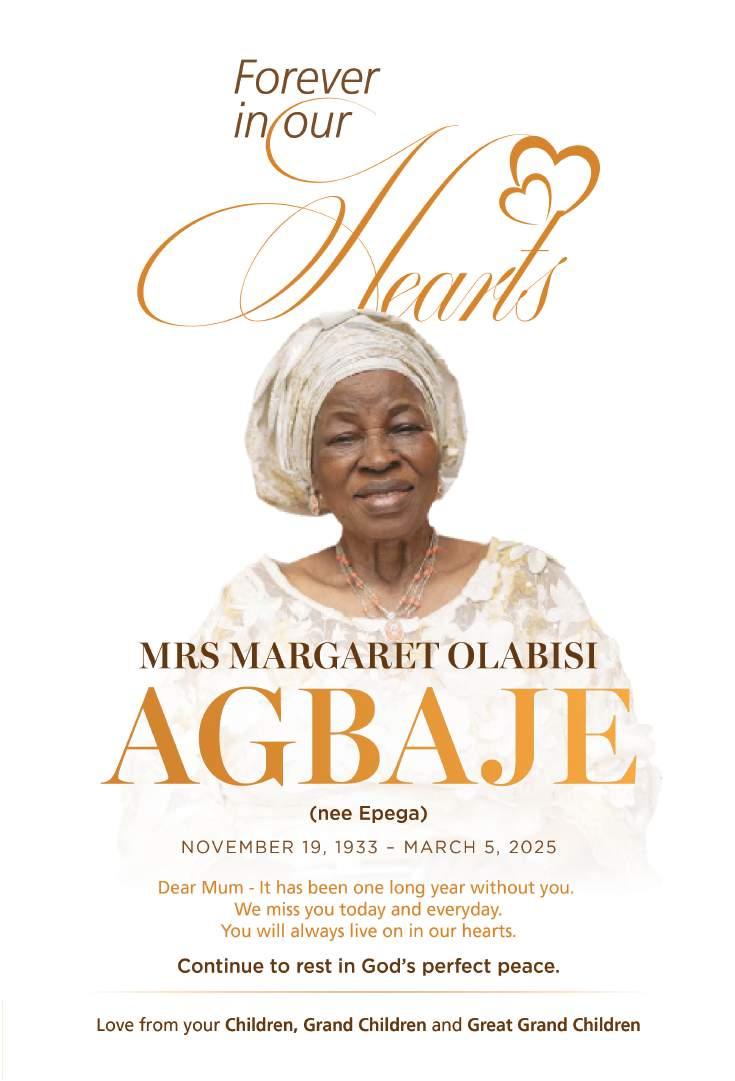
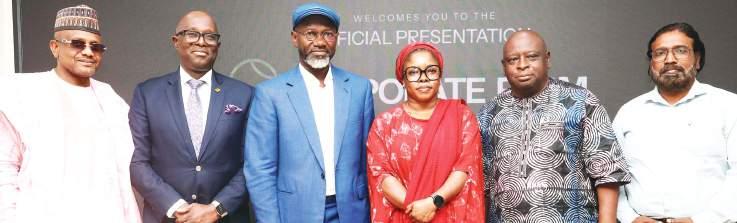
L–R: President, Maize Association of Nigeria, Alhaji Bello Abubakar Annur; Executive Director, Retail Banking South Division, First Bank Plc., Mr. Oluseyi Oyefeso; Executive Chairman, Origin Tech Group, Prince Samuel Joseph Samuel; Lagos State Commissioner for Agriculture and Food Systems, Ms. Abisola Olusanya; Director, News, TVC, Mr. Babajide Kolade Otitoju; and Chief Operating Officer, Origin Automobile Works, Mr. Leo Edwards, during the official launch of the Corporate Farm themed: 100% Agric, 100% Value by Origin Automobile Works in Lagos, yesterday
Iran Accuses UN, EU of Silence as US, Israel Continue Pounding of Tehran
Trump insists he must be involved in picking next Iran leader Israel closes Al Aqsa mosque, citing safety concerns China urges refiners to suspend fuel exports US senate vote fails to rein in Trump war powers
American president fires homeland security secretary UK refuses to rule out joining strikes, more nations dragged into conflict
Emmanuel Addeh and Michael Olugbode in Abuja
Iran yesterday accused the United Nations (UN) and the European Union (EU) of maintaining a troubling silence as the US and Israel intensified coordinated air and missile strikes on Tehran and the escalating war entered day six.
The accusation came as Donald Trump declared that Washington must play a decisive role in determining Iran’s future leadership, insisting the US could not allow a hostile regime to re-emerge after the current conflict.
In Jerusalem, Israeli authorities shut down the Al-Aqsa Mosque compound to worshippers, citing security concerns as tensions escalated across the region and fears grew of possible retaliatory attacks.
Besides, China called on domestic refiners to suspend exports of refined petroleum products in a move widely interpreted as an effort to protect domestic energy supplies amid the growing instability in global oil markets triggered by the conflict.
In Washington, an attempt by lawmakers to limit the president’s authority to conduct the war failed after the United States Senate rejected a resolution aimed at curbing Trump’s
war powers.
In the same vein, the US political landscape has been further shaken after Trump dismissed the country’s homeland security secretary in the midst of the escalating crisis, a move that deepened tensions within his administration.
In Europe, the United Kingdom refused to rule out joining the military campaign against Iran, as diplomatic efforts faltered and more countries appeared at risk of being drawn into the expanding conflict.
Iran Accuses UN, EU of Silence
Iran has accused major international institutions of failing in their responsibility to safeguard global peace, sharply criticising the United Nations and the European Union for what it described as “silence” over escalating tensions in the Middle East.
Speaking during a media briefing with journalists in Abuja, the Ambassador of Islamic Republic of Iran in Nigeria, Gholamreza Mahdavi Raja alleged that the lack of decisive action by global bodies has emboldened aggression in the region and weakened confidence in the international security system.
According to the envoy, the failure of the United Nations Security Council to convene an urgent session on the crisis raises serious concerns about the credibility of institutions tasked with maintaining global stability.
“The whole region is facing conflict, yet there has been no urgent meeting of the Security Council, no strong reaction and no clear statement,” he said. “Where is the United Nations? Where is the European Union? These institutions were created to manage global security, but today they are silent,” he added.
The Iranian ambassador argued that the absence of strong diplomatic intervention has created the perception that international institutions are influenced by powerful states, particularly the United States.
He claimed that global organisations risk losing legitimacy if they fail to respond impartially to acts of aggression or political assassinations. “If international bodies remain silent in the face of such developments, they risk losing their credibility,” he said.
He also accused Western powers of pursuing destabilisation policies across the Middle East, pointing to conflicts in Lebanon, Syria, Yemen and Iraq as evidence of what he described as a broader geopolitical strategy.
The Iranian official maintained that Tehran’s recent military actions targeting American bases in the region were acts of self-defence following attacks against Iranian leadership. He insisted the strikes were directed solely at military facilities and not civilian infrastructure. “Our response is defensive. We are targeting military installations used against our country,” he said.
Iran had also informed neighbouring states in the Persian Gulf that its operations would focus on American facilities within their territories rather than their cities, he added.The Iranian official warned that the ongoing crisis could have far-reaching consequences for the global economy, particularly energy markets.
He noted that instability around the strategic Strait of Hormuz could disrupt energy shipments from the Persian Gulf, a route that carries a significant share of the world’s oil and gas supplies.
“Any conflict in this region will inevitably affect oil prices, transportation and the global economy,” but insist that it was not caused by Iran by the aggressors, US and Israel and solely in their hands to stop the crisis.
While reiterating that Iran does not seek war, the official said the current
situation has pushed diplomacy to the background. “For now, our priority is defending our sovereignty and national security,” he said, adding that Tehran believes responsibility for de-escalation lies with those who initiated the conflict.
Trump
Rejects Khamenei’s Son as Father’s Successor
Also, Trump told Axios on Thursday that he needed to be personally involved in selecting Iran’s next leader.
“Khamenei’s son is unacceptable to me. We want someone that will bring harmony and peace to Iran,”
Axios quoted Trump as saying in an interview.
“I have to be involved in the appointment, like with Delcy (Rodriguez) in Venezuela,” Trump said. Mojtaba Khamenei, son of Iran’s late Supreme Leader, has survived the US and Israeli airstrikes on Iran in which his father Ayatollah Ali Khamenei was killed, Iranian sources told Reuters on Wednesday.
A mid-ranking cleric with close ties to Iran’s elite Revolutionary Guards, hardliner Mojtaba is one of the most influential figures in the Iranian clerical establishment and is seen as a possible successor to his father. Iran has not
NERC Amends Order on Meter Tampering, Power Bypass for Discos
NISO blames 60% gas shortfall for nationwide electricity supply decline
Emmanuel Addeh in Abuja
The Nigerian Electricity Regulatory Commission (NERC) has amended its order on the Standard Operating Procedure (SOP) guiding Distribution Companies (Discos) in handling cases of unauthorised electricity access, meter tampering and power bypass across the country.
The move comes as the Nigerian Independent System Operator (NISO) disclosed that a sharp decline in gas supply to thermal power plants to the tune of as much as 60 per cent was responsible for the
latest round of electricity shortages on the national grid.
In the new directive, NERC outlined stricter operational procedures that Discos must follow in identifying, investigating and penalising electricity theft and related infractions within the Nigerian Electricity Supply Industry (NESI).
According to the commission, Discos are now required to systematically identify areas suspected of unauthorised electricity access through anomalies in consumption patterns, irregularities in billing records or other suspicious indicators.
The amended order directed electricity distributors to conduct comprehensive analysis of electricity consumption data and billing records to detect discrepancies that may indicate illegal connections or tampering.
As part of the enforcement measures, NERC said that Discos are also expected to deploy surveillance techniques to monitor suspicious activities in affected areas and gather additional evidence where necessary.
The regulator further mandated that meters in suspected premises must be physically inspected and
subjected to integrity tests to confirm whether tampering or illegal modifications have occurred. Where suspicious activity is identified, Discos, according to NERC, are required to capture evidence of meter tampering through photographic and video documentation in the presence of the customer or their representatives.
The order also requires electricity distributors to conduct field inspections of distribution infrastructure, including power lines, transformers and distribution boxes, to detect unauthorised connections.
In addition, the apex electricity regulatory agency in Nigeria stated that Discos may interview residents, witnesses or local authorities in affected communities to gather information on suspected electricity theft or illegal access to the distribution network.
NERC said power companies should also leverage advanced technologies such as advanced metering infrastructure, monitoring systems and data analytics tools to detect abnormal electricity consumption patterns that may indicate bypass or tampering.
yet announced a new leader. Israel Closes Al Aqsa Mosque
The temporary measure, during the holy Muslim fasting month, followed tensions as Jewish activists increasingly encroached on the contested religious site. The police said the closure was intended to ensure the safety of civilians while Israel was coming under Iranian missile attacks. The closure was the latest blow for Muslims from Israeli-imposed measures at the disputed and volatile site. And it comes during a sensitive time, with the region at war again.
“The Muslim worshipers who associate Ramadan with praying at Al-Aqsa Mosque are very heartbroken by this closure,” said Mustafa Abu Sway, a Palestinian Islamic scholar and deputy head of the Islamic Waqf, the religious trust that manages the Muslim shrines. “If the issue is the safety of worshipers, then Al-Aqsa Mosque has massive subterranean halls that can host thousands of people,” Sway added. “Our prayers are for a quick end of this war and for a comprehensive peace in the Middle East,” he said.
The hotly contested plateau is revered by Jews as the location of two ancient temples, and by Muslims as the Noble Sanctuary, containing the mosque and other shrines, including the golden-capped Dome of the Rock. The compound is both Judaism’s holiest site and Islam’s third holiest site. It has long been a flashpoint in the Arab-Israeli conflict, a crucible of Jewish-Muslim religious and political tensions that have often devolved into violence, the New York Times reported.
US Senate Vote Fails to Rein in Trump War Powers Besides, a bipartisan resolution aimed at limiting Trump’s ability to wage war in Iran has failed in the US Senate, as the strikes continue. The war powers measure was rejected in a 53-47 vote largely along party lines. It would have halted US military
Continued on page 40
PHOTO: ABIODUN AJALA
SANWO OLU AS GUEST SPEAKER AT JOHN F. KENNEDY JR. FORUM...
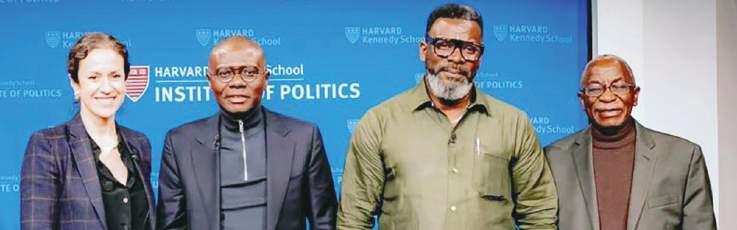
L–R: Oppenheimer Faculty Director, Centre for African Studies and Lecturer in Public Policy, Harvard Kennedy School, Ms. Zoe Marks; Governor of Lagos State, Mr. Babajide Sanwo Olu; Mayor of Monrovia, Liberia, Hon. John Charuk Siafa; and Professor of African Religious Traditions, Harvard Divinity School, and Professor of African and African American Studies, Faculty of Arts and Sciences, Prof. Jacob Olupona, during the John F. Kennedy Jr. Forum themed: Africa’s Urban Future: Cities at the Crossroads of Growth and Resilience, organised by the Harvard Kennedy School Institute of Politics in Massachusetts, United States of America, on Wednesday
Sanwo-Olu: Lagos Stands Out as Key Driver of Africa’s Cities’Transformation
Gov speaks at John F. Kennedy Jr. Forum on Africa’s urban future
Segun James
Governor Babajide Sanwo-Olu of Lagos State has described the state as a key driver of Africa’s cities, affirming that the city is transforming and reshaping the economic path and patterns of urban development with rapid expansion.
Sanwo-Olu said Lagos stood at the heart of the transformation shift,
serving as Africa’s clearest signal that the urban future has begun.
He said, “Lagos’ trajectory is not just aligned with Africa’s rise; it is defining its urban future.”
The governor said the Lagos State government, through the THEMES+ agenda of his administration, was delivering impactful projects across transportation, tourism, technology, security, and social inclusion.
Sanwo-Olu spoke at the John F. Kennedy Jr. Forum hosted by Harvard Kennedy School Institute of Politics, themed, “Africa’s Urban Future: Cities at the Crossroads of Growth and Resilience,” held in Boston, Massachusetts, United States.
Sanwo-Olu, who was Guest Speaker at the forum co-sponsored by Harvard University Centre for African Studies and Bloomberg
Centre for Cities, said, “Africa is entering a historic urban expansion, with its cities growing faster than any region globally, urbanising at 3.5 per cent annually, driven by a youthful population and rising innovation hubs.
“As one of the world’s fastestgrowing regions (second to Asia) and home to 30 per cent of global critical minerals, Africa is poised for
President Directed Improvement of Cashless Process, Not Suspension
Chinedu Eze
Managing Director and Chief Executive Officer, Federal Airports Authority of Nigeria (FAAN), Mrs. Olubunmi Kuku, has given further clarification on the suspension of cashless payment at Murtala Muhammed Airport, Lagos tollgate.
Kuku said President Bola Tinubu did not ask FAAN to necessarily suspend the “Go Cashless” initiative, but told the agency to make sure the process itself was improved before being rolled out.
Minister of Aviation and Aerospace Development, Festus Keyamo, had during a briefing with State House Correspondents on Wednesday said Tinubu directed the immediate suspension of FAAN’s cashless policy. When the cashless payment process
was introduced last Sunday, it led to vehicular traffic gridlock, from the popular 7&8 Bus Stop, along Airport Road, Lagos, over 900 meters, to the tollgate, which links the international and domestic wings of the airport.
Many passengers travelling to domestic destinations missed their flights.
Kuku, who spoke yesterday during a press conference at the Lagos airport, said she considered the development a major win for FAAN and Ministry of Aviation, adding that the cashless policy started last year with a lot of enlightenment.
She stated, “We started a lot of enlightenment, even the National Orientation Agency had publicised it as far back as October last year. We were asked to implement a federal government directive, which was done
at the Federal Executive Council. This was what we were pushing towards, but unfortunately, we were given a deadline.
“We had actually asked for a hybrid approach that allows us to do both cashless as well as automated. So, for me and the agency, we actually thank Mr. President for this laudable initiative. The fact is that the president is not just talking of federal government initiatives or policy rollouts but understanding the nature of every environment.”
She explained that the president saw the traffic gridlock as a result of the cashless policy and asked them to revert to status quo or the hybrid approach.
“That’s what we’re doing. So, this is a win for the industry,” she said.
Kuku disclosed that Tinubu had
Tinubu to Inaugurate Rivers
1.2-Km Kaa-Ataba Bridge
Blessing Ibunge in Port
The Niger Delta Development Commission (NDDC), has assured that the 1.2-kilometre Kaa-Ataba Bridge linking the Khana to Andoni Local Government Areas of Rivers State, would be inaugurated by President Bola Tinubu as part of activities marking his third anniversary in office.
The NDDC Managing Director, Dr Samuel Ogbuku, made the
disclosure during inspection of the project by members of the Commission’s Governing Board, led by the Chairman, Mr. Chiedu Ebie.
The NDDC boss restated the Commission’s commitment to the presidential mandate to complete all legacy projects in the Niger Delta region.
He affirmed that the NDDC would do all that was necessary to enable the contractor to complete the project on schedule.
Ogbuku declared that the KaaAtaba Bridge is one of the Commission’s most ambitious legacy projects, standing as the longest bridge in the Niger Delta region and one of the longest in the country.
The Managing Director, who expressed satisfaction over the progress of work, noted the project was among the legacy projects the President directed the Commission to complete as part of the Renewed Hope Agenda.
given FAAN some time to go back and refine the process and ensure there were more users accessing the airport, which would further boost the revenue of the agency.
She said despite all the enlightenment by FAAN, a lot of passengers and commuters did not realise that FAAN would stick to the March 1 deadline.
She stated, “From October to March 3rd, we had over 100,000 enrolled users, of which 60,000 of those users were enrolled in the last three days. So, for me, that is a major win.
transformational growth. Africa’s cities are reshaping the economic path and patterns of urban development with their rapid expansion, and Lagos stands out as a key driver of this transformation.
“Africa’s and Lagos’ urban futures are being shaped now, and with the right partners and investments, we can build cities that are innovative, inclusive, and resilient.”
Speaking on the importance of Lagos as the key driver of transformation in Africa, Sanwo-Olu stated, “Lagos State has been ranked as Africa’s second-largest city in terms of population after Cairo, Egypt.”
The governor mentioned the impact of rapid population growth and the challenges it posed to the environment and waste management. But he added that his administration was committed to addressing every environmental challenge through a well-articulated blueprint in line with the THEMES+ agenda.
Sanwo-Olu highlighted the strengths of Lagos, which included the rail revolution – the blue line and the red line technology – stating that the state boasts several start-ups and unicorns as well as diaspora returns during the festive season in December. This, he said, had been popularly
christened as Detty December.
The governor stated, “Lagos was recently ranked as the world’s fastest-growing tech ecosystem in 2025, being a home to over 2000 startups in Nigeria. Lagos State attracted $2.73 billion, representing 45 per cent of total national capital inflows (Q3 2025).
“With 26 tertiary institutions, Lagos places among Nigeria’s top states for university count. Lagos is home to five FinTech unicorns, each with over $1 billion in value, and together they account for a large portion of its tech ecosystem.
“Lagos’ Internally Generated Revenue accounted for 35 per cent of total IGR, amounting to $821.9 million (N1.26 trillion) in Nigeria (2024). Lagos accounts for 10 per cent of Nigeria’s population, and 40 per cent of Lagos’ total population consists of youth aged 15-34 years.”
The John F. Kennedy Jr Forum, attended by Sanwo-Olu and other global leaders and stakeholders, like Mayor of Monrovia, Liberia, Mayor John-Charuk Siafa, among others, explores how African cities are responding to challenges—from climate adaptation and public health to governance and infrastructure—while advancing innovative, context-driven solutions.
Establishment of Six New Centres of Excellence in AI, Robotics, Cybersecurity Underway,
Kuni Tyessi in Abuja
The federal government has unveiled plans to establish six additional Centres of Excellence in robotics, coding, artificial intelligence, machine learning, and cybersecurity across selected tertiary institutions. Executive Secretary of Tertiary Education Trust Fund (TETFund), Sonny Echono, disclosed this in Abuja during the inauguration of the TETFund Advisory Committee on Robotics, Coding, AI, Machine Learning Centres, and Cybersecurity.
With the proposed additions, the total number of TETFund-supported Centres of Excellence nationwide will increase from 30 to 36, further strengthening Nigeria’s capacity in
cutting-edge technology and innovation.
The committee is chaired by the immediate past Secretary-General of Committee of Vice Chancellors of Nigerian Universities, Professor Yakubu Ochefu.
Echono said the committee’s primary responsibility was to guide the selection process for institutions that will host the new centres.
According to the terms of reference, the committee is mandated to identify institutions with proven strengths and demonstrable capacity in robotics, coding, artificial intelligence, machine learning and cybersecurity.
It is also expected to develop clear criteria and conditions for the selection
Says FG
process and recommend up to six public universities to host the centres, ensuring representation across the six geopolitical zones as stipulated in the TETFund Act of 2011.
Echono said, “We are not only addressing issues around national security, but we are also preparing future generations of our youthful population to contribute meaningfully to national development and to fill knowledge and skills gaps globally.
“We secured Mr. President’s approval to establish at least six additional centres of excellence across the country. This is deliberate, as we aim to reflect all six geopolitical zones, while tapping into the abundant talents that exist in Nigeria.”
Harcourt
OBASANJO’S 89TH BIRTHDAY ANNIVERSARY AND LECTURE...
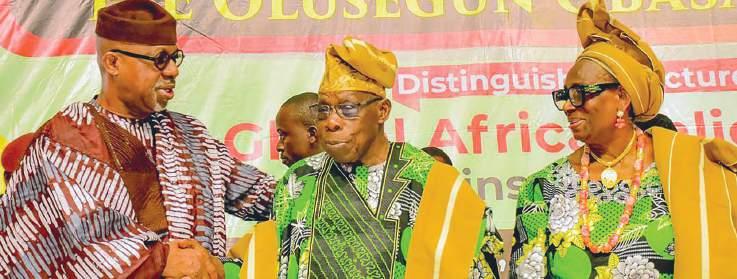
L–R: Ogun State Governor, Prince Dapo Abiodun; former President Olusegun Obasanjo; and his wife, Chief Mrs. Bola Obasanjo, during the 89th birthday anniversary and lecture themed The Global Africa Enlightenment: From Chains to Renaissance held at the Olusegun Obasanjo Presidential Library in Abeokuta, Thursday
Senate Threatens Arrest Warrant for Kyari, Others over N210trn NNPCL Spending
Sunday Aborisade in Abuja
Senate has threatened to issue a warrant of arrest against the immediate past Group Chief Executive Officer of Nigerian National Petroleum Company Limited (NNPCL), Mele Kyari, and two other former top officials of the company if they fail to appear before its Committee on Public Accounts to explain alleged unaccounted expenditure of N210 trillion.
Equally summoned by the committee were former Chief Financial Officer of the company, Umar Ajia Isa, and former Group General Manager of the National Petroleum Investment Management Services (NAPIMS), Dr. Bala Wunti.
The committee said the former officials must appear before it alongside the current management of the company to respond to audit queries relating to the financial activities of the national oil company between 2017 and 2023.
Chairman of the committee, Senator Aliyu Wadada Ahmed (Nasarawa West), disclosed the summons while briefing journalists on the outcome of the panel’s meeting held in Abuja on Thursday.
Wadada said the committee would not hesitate to invoke its constitutional powers to compel the appearance of the former officials if they failed to honour the summons.
He explained that the committee decided to invite the former management team following concerns raised in audit reports indicating that a combined sum of N210 trillion reflected in the accounts of the company had not been properly explained.
According to him, the committee resolved that the former management team of the company should appear before it and be led by the current Group Chief Executive Officer, Bayo Ojulari, together with all the external auditors that handled the company’s accounts within the period under review.
He said the committee also directed the company to provide detailed explanations regarding the figures contained in the audit report.
Wadada said, “The NNPCL should refund the sum of N210 trillion, being the combined figure of N103 trillion and N107 trillion, which were not properly accounted for as contained in the audit reports. NNPCL should and must account
for the two figures.”
He added that the committee had also resolved the company should remit to the treasury all production costs charged against crude oil revenues during the period under review.
He said the committee questioned the basis for charging such costs against crude oil revenue, stating that the former Nigerian National Petroleum Corporation (NNPC) and its subsidiaries, including NAPIMS, were not directly involved in crude oil production.
Wadada further disclosed that the committee had directed Auditor-General of the Federation to carry out a forensic audit review of the audited financial statements of the company for the period under investigation.
He said the directive was issued in line with Section 85 of the 1999 Constitution (as amended), which empowers the Auditor-General to examine the accounts of public institutions.
The committee also raised concerns over the reported expenditure of N5
billion by the national oil company on the transition of its name from Nigerian National Petroleum Corporation (NNPC) to Nigerian National Petroleum Company Limited (NNPCL).
“This, to us in the committee, is unacceptable and satisfactory, explanations must be given,” Wadada said.
According to him, the committee arrived at its resolutions after the company failed to provide satisfactory responses to 19 queries raised from its audited financial statements.
He explained that in its response
to one of the queries, the company stated the N103 trillion represented cumulative amounts expended by its Joint Venture partners through cash calls since 2017. However, the committee rejected the explanation. Wadada stated, “NNPCL responded that the N103 trillion represented cumulative amounts expended by NNPCL Joint Venture partners from JV cash calls since 2017. This response is unacceptable and the figure of N103 trillion is still hanging and must be properly explained.”
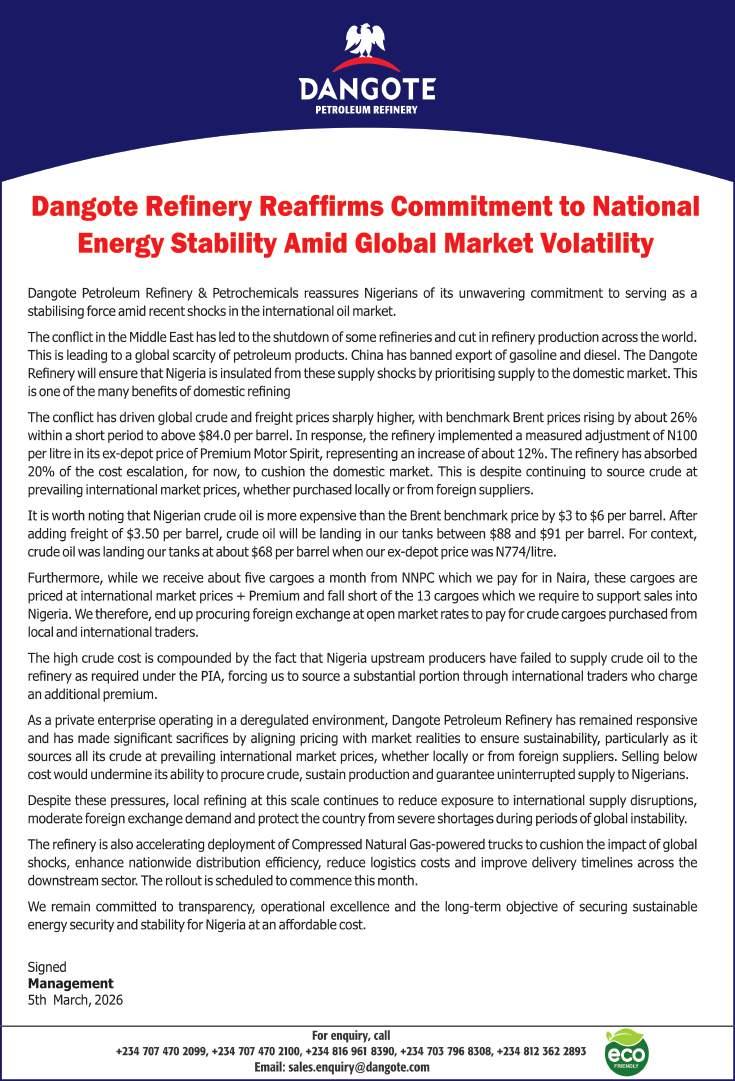
Dangote Refinery Recommits to Nigeria’s Energy Stability Amid Global Oil Market Volatility
Dangote Petroleum Refinery and Petrochemicals has reassured Nigerians of its unwavering commitment to serving as a stabilising force in the supply of petroleum products amid current shocks in the international oil market fuelled by the ongoing United States and Israeli war against Iran.
Steel Development Minister Seeks EU’s Strategic Economic Partnership to Unlock Sector
Delivers keynote address at German–Nigeria Economic Forum
Kasim Sumaina in Abuja
Minister of Steel Development, Prince Shuaibu Abubakar Audu, has sought the strategic partnership of European Union (EU) to advance Nigeria’s steel and minerals sector value chain and attract long-term foreign direct investment in line with the Renewed Hope Agenda of President Bola Tinubu.
Audu made the appeal when he delivered a keynote address at the ongoing Nigeria–German Economic Forum in Dortmund.
He stated that Nigeria was transitioning from a raw materials exporter to a value-adding industrial economy and was, therefore, seeking credible, long-term partners to support this transformation.
While highlighting that Nigeria’s strategic positioning, combined with a population of nearly 250 million people— characterised by a large and youthful workforce—positioned the country as a regional hub for African trade, Audu said Nigeria possessed abundant reserves of
steel inputs and energy-transition minerals.
He emphasised that Nigeria had strong domestic demand for steel, with approximately $10 billion in annual utilisation, underscoring the scale of market opportunity.
The minister stated that Nigeria was seeking credible partners in steel and aluminium production, and mineral beneficiation and processing, as well as industrial infrastructure development, including power, rail, gas and ports.
The conflict in the Middle East had led to the shutdown of some refineries and cut in refinery production across the world.
The conflict is feared to cause global scarcity of petroleum products, as China has banned export of gasoline (petrol) and diesel.
In a statement issued yesterday, Dangote Refinery pledged to ensure that Nigeria was insulated from the supply shocks by prioritising supply to the domestic market, describing the intervention as one of the many benefits of domestic refining
The conflict had driven global crude and freight prices sharply higher, with benchmark Brent prices rising by about 26 per cent within a short period to above $84.0 per barrel.
In response, the refinery said it implemented a measured adjustment of N100 per litre in its ex-depot price of Premium Motor Spirit (PMS), commonly known as petrol, representing an increase of about 12 per cent.
The refinery said it had absorbed 20 per cent of the cost escalation, for now, to cushion the domestic market, adding that this was despite continuing to source crude at prevailing international market prices, whether purchased locally or from foreign suppliers.
Dangote Refinery argued that Nigerian crude oil was more expensive than the Brent benchmark price by $3 to $6 per barrel.
It stated that after adding freight of $3.50 per barrel, crude oil would be landing in its tanks between $88 and $91 per barrel.
For context, the company maintained that crude oil was landing its tanks at $68 per barrel when its ex-depot price was N774/litre.
The refinery stated, “Furthermore, while we receive about five cargoes a month from NNPC which we pay for in Naira, these cargoes are priced at international market prices + Premium and fall short of the 13 cargoes which we require to support sales into Nigeria.
“We, therefore, end up procuring foreign exchange at open market rates to pay for crude cargoes purchased from local and international traders.
“The high crude cost is compounded by the fact that Nigeria upstream producers have failed to supply crude oil to the refinery as required under the Petroleum Industry Act (PIA), forcing us to source a substantial portion through international traders who charge an additional premium.”
The company stated, “As a private enterprise operating in a deregulated environment, Dangote Petroleum
Refinery has remained responsive and has made significant sacrifices by aligning pricing with market realities to ensure sustainability, particularly as it sources all its crude at prevailing international market prices, whether locally or from foreign suppliers.
“Selling below cost would undermine its ability to procure crude, sustain production and guarantee uninterrupted supply to Nigerians.”
Despite the pressures, Dangote Refinery stated that local refining continued to reduce exposure to international supply disruptions, moderate foreign exchange demand, and protect the country from severe shortages during periods of global instability.
The refinery said it was also accelerating deployment of Compressed Natural Gas-powered trucks to cushion the effect of global shocks, enhance nationwide distribution efficiency, reduce logistics costs and improve delivery timelines across the downstream sector.
It stated that the rollout was scheduled to commence this month.
“We remain committed to transparency, operational excellence and the long-term objective of securing sustainable energy security and stability for Nigeria at an affordable cost,” the Aliko Dangote-owned firm stated.
Peter Uzoho


Acting Group Politics Edito r DEJI ELUMOYE
Email: deji.elumoye @thisdaylive.com
08033025611 s M s O n LY

First Lady to Govs’ Wives: Ensure RHI’s Impact Gets to Grassroots
First Lady, Senator Oluremi Tinubu has met in abuja with wives of the 36 State Governors under the Renewed Hope Initiative with a charge on them to ensure that the impact of the Initiative are felt by the people at the grassroots in their respectiive states.
Wife of the President, Senator Oluremi Tinubu has charged the wives of the 36 state governors to deepen grassroots interventions and take greater ownership of social programmes in their respective states.
She spoke while presiding over the first quarterly meeting of wives of state governors under the Renewed Hope Initiative (RHI), held at the State House, Abuja, which brought together the state First Ladies to review the activities, programmes, events and targets set for the year under the RHI platform.
Addressing newsmen after the opening session, Mrs Timubu said the gathering marked the first time in 2026 that the governors’ wives would collectively review their roles and contributions as partners in advancing social development across the country.
According to her, while significant groundwork had been laid since the launch of the initiative, the time had come for the programmes to mature and deliver visible results at the state level.
Her words: “It’s like giving birth to a baby, the teething stage and learning how to walk. After a while, the baby is supposed to walk unaided, and that is what I want to see.”
She said the objective of the meeting was to hear from the governors’ wives about initiatives they are implementing in their states and how they are complementing government efforts through social and humanitarian programmes.
The First Lady noted that both she and the wife of the Vice President, Hajia Nana Shettima, had served as First Ladies of their states in the past and understood the unique challenges associated with the role.
Mrs Tinubu said the title of “First Lady” carried expectations of leadership and social responsibility, urging the governors’ wives to justify the position by initiating impactful programmes.
“They wanted the title ‘First Lady of the state.’ Before, people would say wife of the governor. But if you want that title, then we want to see you actually reach out and be independent in what you are doing.”
Relieving her experience as former First Lady of Lagos State, she encouraged them to develop initiatives that support young people, promote mentorship and foster self-reliance.
Mrs Tinubu recalled how programmes such as the Lagos Spelling Bee competition were introduced to encourage pupils to remain in public schools at a time when educational infrastructure faced serious challenges.
“I started some small initiatives like spelling competitions and leadership programmes for girls to encourage young people and complement what government was doing”.
She also urged the governors’ wives to address emerging social concerns, including the need to positively reshape the mindset of young boys through targeted mentorship and support programmes.
Mrs Tinubu cited initiatives already underway in some states,
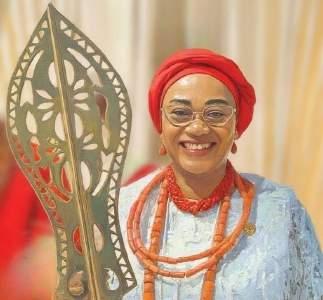
including programmes focusing on the boy-child, being run by the current Lagos First Lady, Dr Ibijoke
Sanwo-Olu, describing them as important steps toward addressing societal challenges.
The First Lady further identified child nutrition as one of the major priorities of the Renewed Hope Initiative this year, saying the issue would be tackled aggressively across the country.
“It is sad that a nation as rich as ours is still talking about child malnutrition at this level. We are going to go at it aggressively and do the best we can to tackle it,” she said.
Mrs Tinubu also encouraged the governors’ wives to promote women’s economic empowerment through agriculture, skills development and small-scale enterprises tailored to the strengths of their states.
She cited examples of initiatives in some states, including the development of an adire production hub in Ekiti and opportunities in cassava processing and fish production in other regions.
According to her, such locally driven programmes can help women generate income while strengthening community economies.
The quarterly meeting, she said, would also serve as a platform for sharing success stories and best practices that could be replicated across states.
“We want to hear their stories; what they are doing in their states, so that we can tell people and encourage others to do more,” she further explained.
What Does Ojelabi’s Re-election Portend for Lagos APC?
In a political landscape where party congresses often ignite disputes and factional rivalries, the Lagos State chapter of the all Progressives Congress charted a different course on March 3, 2026, re-electing Pastor Cornelius Ojelabi for a second term as state chairman, writes Wale Igbintade.
The expansive indoor stadium of the Mobolaji Johnson Arena reverberated with chants of solidarity as delegates of the All Progressives Congress (APC) Lagos State reaffirmed their confidence in Pastor Cornelius Ojelabi, returning him unopposed for a four-year term.
The smooth congress not only reinforced Lagos’ reputation as a political stronghold but also highlighted the party’s efforts to balance youth inclusion, gender representation, and grassroots engagement across the state.
The atmosphere was less about competition than affirmation. Party faithful, dressed in vibrant attires, exchanged handshakes and slogans, collectively witnessing what had long been anticipated, the re-election of their chairman.
Over 2,000 delegates, drawn from the state’s 20 local government areas and 37 Local Council Development Areas, endorsed Ojelabi and other members of the State Executive Committee through a consensus arrangement ratified by voice affirmation.
The applause that followed was not merely procedural; it reflected a deeply cultivated culture of internal alignment that has come to define the Lagos APC.
For Ojelabi, the moment was both validation and responsibility. Re-elected unopposed, he addressed the delegates with visible gratitude, framing the achievement as a collective journey rather than a personal triumph.
“As I reflect on the journey of the past four years, I am filled with pride in all we have accomplished together from strengthening our party structure to securing victories at the
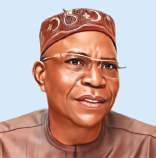
polls. We have demonstrated that the APC is not just a party, but a movement, a movement for progress,” Ojelabi said.
His remarks balanced celebration with caution. Acknowledging past successes, he reminded members that the challenges ahead would require greater unity and engagement.
He said “The future of Lagos State and Nigeria depends on our dedication and our ability to work together. Let us strengthen our bonds, reach out to every community, and ensure that no voice is left unheard.”
The congress proceeded smoothly under the supervision of Mrs. Stella Okotete, who chaired the state congress committee. In announcing the consensus list, she emphasised adherence to the party’s constitutional guidelines, clarifying that consensus does not negate procedure.
“This congress is not a contest of enemies,”
she told delegates. “It is a contest of progressive family members united by ideology.”
She reminded aspirants and delegates that participation was guided by registration and compliance with eligibility requirements, urging respect for both process and outcome to preserve the unity that has positioned Lagos as a leader in progressive politics.
Describing Lagos as the “heartbeat of progressive politics” and the proud home of President Bola Tinubu, Okotete framed the congress as more than a routine party exercise. It was a reaffirmation of the State’s strategic role within the APC’s national architecture.
Lagos State governor, Babajide Sanwo-Olu echoed that sentiment in his address to a hall filled with party leaders, grassroots mobilisers, and elected officials. Praising the state chapter for demonstrating “party supremacy anchored on unity of purpose,” he underscored Lagos’ unique political weight.
“In the entire country, we have demonstrated that the party is supreme,” the governor said. “For us in Lagos, we are strengthened by unity of purpose.” He also paid tribute to President Tinubu, describing him as an enduring leader who has fostered a political culture accommodating new entrants while preserving core principles.
Sanwo-Olu’s address carried an undercurrent of responsibility. As the President’s political base, Lagos bears symbolic weight within the party. Maintaining cohesion in the state chapter is seen as essential for projecting stability at the national level.
Passengers Narrate Ordeal on Abuja-Kaduna Rail Corridor
some passengers aboard the abuja-Kaduna rail line have narrated unpleasant and shocking experiences along the corridor, ranging from alleged ticket racketeering and overbooking to operational and mechanical failures.
The passengers who spoke to recently in Abuja said they were left standing for more than three and a half hours on a journey designed to last not more than two hours.
More alarming were claims that attendants on the train were forced to pour buckets of water on an overheating locomotive engine mid-journey; each time plunging coaches into darkness as cooling systems and coach lights tripped off.
They expressed the disappointment that the service, meant to be a safer alternative to the reported insecurity on the Abuja-Kaduna highways, has turned into a gruelling ordeal.
Mr Solomon Abiona told News Agency of Nigeria (NAN) that his ordeal began four days before his planned journey from Abuja to Kaduna.
Abiona said he made repeated attempts to purchase tickets on the Nigerian Railway Corporation (NRC) booking platform, but was told all seats were fully booked.
He explained that he needed five tickets for companions travelling with him to Kaduna for a ceremony, but was unable to secure even a single seat online.
With his guests unwilling to travel by road due to fears of kidnapping and attacks along the Abuja–Kaduna highway, Abiona said he sought alternatives.
“A regular passenger on the service told me that purchasing tickets online is a big challenge because the site is down most of the time, and when you are lucky enough to log in, the tickets are already fully booked.
“He sent me the number of one of the racketeers, an NRC official, who assured me of tickets upon payment of N6,000 per ticket instead of the official fare of N3,600.
“Eventually, the six of us were issued tickets that were not in our names,” he said adding that on the day of departure, an official was already on standby at the Kubwa station to facilitate their entry and escort them to the coach.
Abiona narrated that the return journey from Kaduna to Abuja was even worse as they were issued tickets without seat numbers and were instructed to board and occupy any available seat.
“When the passengers whose names were on the seats we occupied eventually located their seats, we had no choice but to join others standing in the aisle for over three hours.”
Tickets were sold to Abiona and his companions with different names and without seat numbers.
Another passenger, Ibrahim Bulus, described the situation as more chaotic on weekends due to the high influx of travellers.
He attributed the overcrowding to the reduction in daily train services from six trips (three departures and three arrivals) to just two.
Bulus urged the NRC’s management to step up operations and increase daily trips to meet the growing demand along the corridor.
Beyond ticketing and overcrowding, passengers also reported alarming mechanical issues during the journey.
They claimed that the train engine malfunc-
tioned repeatedly and overheated to the extent that attendants were seen pouring buckets of water on it. The passengers added that, each time this happened, the cooling system and lighting in the coaches would shut down, causing the train to slow significantly.
A first-time passenger on the service, Chief John Fabunmi, said he was deeply disappointed and frightened by the experience.
“At this stage of our development, and with the way God has blessed this country, how can we subject Nigerians to such harrowing experiences on a train service that I once considered a major democratic dividend?
“We were more than 100 people standing in the coaches. When I could no longer bear the pain, I had to sit on my luggage in the rear coach.
“I was shocked to see officials carrying buckets of water and pouring it on the engine because it was overheating.
“Each time this happened, the cooling system and the lights in the coaches would go off, and the locomotive would crawl at a snail’s pace,” he said.
Fabunmi added: ‘Out of curiosity, I asked one of the officials if a train could be switched off while in motion and jump-started while approaching hilly terrain, the way some commercial drivers do to conserve fuel, but I got no response.
“I feared that, at such a slow speed, we could easily be attacked and face an even deadlier situation than what we were trying to avoid on the road.
“This was my first experience on the service, and I have vowed not to use the train again until there are improvements”.
Another passenger, Mr Wusi Lawrence lamented that the Abuja–Kaduna railway, a standard-gauge service, was not significantly different from the narrow-gauge rail services of the 1980s.
He noted that the service pales in comparison to rail systems in developed countries and even in some African nations such as South Africa and Kenya.
“It is unfortunate that while many countries are talking about high-speed trains moving at 360 kilometres per hour with top-class comfort and hospitality services, we are still this far behind.
“I really do not know what we will get right in this country,” he said.
For many of the commuters, the Abuja–Kaduna rail line was expected to represent progress, a safer and more efficient transportation alternative.
Instead, their testimonies reveal a service struggling with overcrowding, alleged corruption, mechanical challenges and deep public dissatisfaction.
Responding to the development, Mr Abubakar Bunma, Personal Assistant on Media to the NRC Managing Director, Kayode Opeifa, said there was no provision in the corporation’s operations for issuing a ticket without a seat number.
He explained that tickets are booked and paid for online, with an automatically generated number that captures the passenger’s name, National Identification Number (NIN), and phone number.
“If your name and your NIN do not match, you cannot even get a ticket,” he said.
Bunma acknowledged that there may be instances of failed bookings in which passengers were debited.
In such cases, he said, affected passengers who show up at the station may have their trips rescheduled.“Those who insist on travelling could be given the option to stand, but only if no seats are available,” he said.
Clarifying reports about overheating, he said it was not the locomotive engine that was being cooled with water, but the power car that supplies electricity for onboard services.
“If the engine is off, the train will not move. That is what people do not understand.
NOTE:
APC Convention: Oyebanji Heads Aspirants’ Screening Committee
Governor Biodun oyebanji of Ekiti state is at the head of the 42-man committee set up by the national secretariat of the all progressives congress to screen aspirants for the fothcoming national convention of the ruling party.
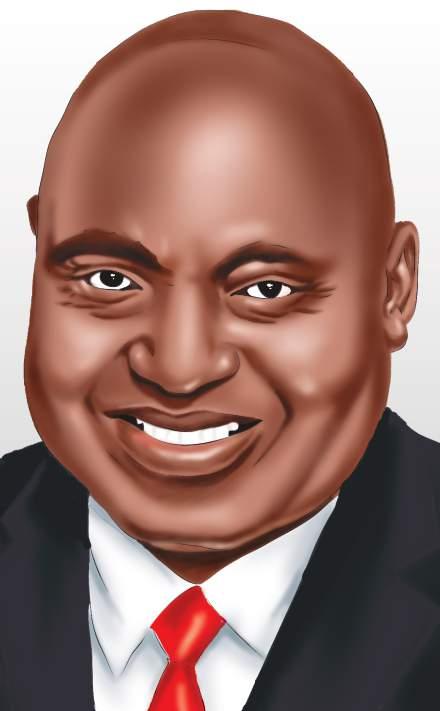
Ekiti State Governor, Mr Biodun Oyebanji has been named the Chairman of Aspirants’ Screening Committee of the 2026 National Convention of the ruling All Progressives Congress (APC). This followed his inauguration alongside other members of the committee at a ceremony held at the National Headquarters of the party in Abuja.
The 42-member Aspirants’ Screening Committee is saddled with the task of screening and verification of aspirants for all elective positions at the National Convention in accordance with the Constitution of the party, guidelines and applicable regulations.
Other members of the committee include Kogi State Governor, Usman Ododo (Co-Chairman); former Senate President, Senator Ken Nnamani
Chairman); former Bauchi State Governor, Isah Yuguda (Secretary); former Edo State Deputy Governor, Philip Shuaibu (Assistant Secretary). Others include Senators Orji Uzor Kalu, Gbenga Daniel, Ben Ayade, Osita Izunaso, Sarafa Alli, Hon Adebayo Adelabu, Dr isa Muhammed, and Senator Uche Lilian Ekwunife. Other committees inaugurated at the colourful event, presided over by the National Chairman of the party, Prof. Nentawe Yilwatda, are the the Screening Appeal Committee, Election Committee, Venue Committee, Security Committee, Election Appeal Committee, Finance Committee, Media and Publicity Committee, Ceremonial, Programme and Event Committee, Delegates Accreditation Committee, Protocol Committee, Accommodation and Transportation Committee, Entertainment and Welfare Committee, among others.
(Vice
INTERVIEW
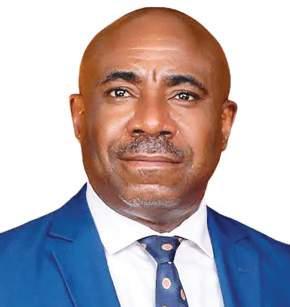
Amb Oma Djebah: My Thailand Story
Eminent journalist-diplomat, Ambassador Oma Djebah, whose excellent career span the media, governance, public administration and diplomacy, is Nigeria’s former Ambassador to Thailand with concurrent accreditation to the United Nations Economic and Social Commission for Asia and the Pacific (UNESCAP), Bangkok and Myanmar, and a two-time former Honourable Commissioner for Information, Delta State. He has been called to public service at the sub-national, national and international levels. Between 2002-2004, he served on the federal government Council on the New Partnership for Africa’s Development (NEPAD). In 2006, he served on the United Nation’s headquarters experts panel on NEPAD. Educated in Nigeria, Sweden and the United States, Oma Djebah holds a Bachelor’s degree in Theatre Arts from the University of Calabar, a Master’s degree in International Law and Diplomacy from the University of Lagos, and another Master’s degree in Global Journalism from Orebro University, Sweden as well as a Certificate in Creating Collaborative Solutions (Harvard Executive Program), Harvard, USA. He joined the public sector after an illustrious journalism career, notably at The Guardian and THISDAY, where he held various editorial roles. He has delivered lectures across North America, Asia, Europe and Africa, and currently chair of The New Diplomat, a global think tank devoted to policy and energy security - conveners of the UNGA80 High-level Roundtable on the Gulf of Guinea. He spoke with LOUIS ACHI in Abuja recently. Excerpts:
You served as Nigeria’s Ambassador extraordinary and plenipotentiary to the Kingdom of Thailand. What was your experience during your tour of duty in Thailand?
I assumed my tour of duty at an unusual time in the history of the world in 2021. The covid-19 pandemic was raging and Thailand, like many countries across the world then, had imposed restrictive measures to minimize the spread of the deadly disease. I very was excited assuming that high role. But my excitement was initially cut short as I was neither able to immediately meet my counterparts nor had the opportunity to attend the usual diplomatic functions because of the global restrictions on account of covid-19. We had to innovate and hit the ground running in advancing the strategic interests of Nigeria in all its ramifications in Thailand and in Myanmar to which I was concurrently accredited as well as the UNESCAP. I considered myself fortunate to have had the privilege to serve at that highest level of representation as Ambassador Extraordinary and Plenipotentiary of the Federal Republic of Nigeria to the Kingdom of Thailand.
As a result of the pandemic, my team had to switch to remote working format. Having overcome the initial challenges, I was able to settle in to the business of fostering the very cordial relations subsisting between Nigeria and Thailand as well as advancing Nigeria’s strategic interests in all its ramifications.
I did so by focusing on pertinent areas, including economic diplomacy, soft power diplomacy, cultural diplomacy, citizen diplomacy, technological diplomacy, etc. That was after I presented my Letters of Credence to the King of Thailand, His Majesty King Maha Vajiralongkorn Phra Vajiraklaochaoyuhua, at the Ambara Royal Palace, in Bangkok, on Thursday 4th November, 2021, a date I remember very vividly. I first focused on economic diplomacy premised on my mandate. For example, I was able to restore the relations between NNPCL and PTT, Thailand’s national oil company, which is one of the global 500 Fortune companies, providing energy security in Southeast Asia. That business cooperation was in limbo for ten years. I succeeded in leveraging my predecessor’s earlier efforts and great initiative, to bring the two energy giants to the discussion table- NNPCL and PTT in 2022, beginning with their KYC processes. I must say that the insights offered by my predecessor, the current Emir of Zazzau, His Highness, Ambassador
Ahmed Nuhu Bamalli, were very helpful in this regard. I feel very happy that I accomplished ground-breaking and far-reaching diplomatic successes during my tour of duty in Thailand, notwithstanding the short duration of two years coupled with the restrictions associated with Covid-19. Through-out the two years of my tour of duty in Thailand, I worked so hard that my accomplishments are still very visible. I changed the negative perceptions about Nigerians. The
speed of work was electrifying and when I was leaving, Nigerians from all walks of life organized resounding farewell parties for me.
As soon as I assumed duty, I set up training programs for my officers to enable them align with my speed and vision. I must say that I was very fortunate to have a very dedicated and competent team of Home-based officers and locally recruited staff.
Within the first week of my arrival, I met with the Nigerian community in Thailand and
I enjoined them to be of good behaviour. I also hosted a Nigerian whose PhD dissertation in Mathematics in Thailand was adjudged as the best in the country. On Consular, working with the team, I simplified the process for passport renewal, introduced same day data capture and passport collection system.
That was a huge relief to many. With the support of our Mission Officers and locally recruited staff, I upgraded processes. I provided a functional digital communication system, including a TV system with well packaged documentaries about the business and investment opportunities in Nigeria, our tourism sites, highlighting the power of education, Nollywood, Nigeria’s food, costumes, global icons of Nigerian origin. I ensured that Nigerians who visited were treated with utmost courtesies and served tea or coffee. Through these gestures and diplomatic dexterity, I was able to unite the divided Nigerian community. Within two years, I had fruitful engagements with the Prime Minister of Thailand, the Senate President, Deputy Prime Minister and Minister of Foreign Affairs, the Permanent Secretary, Ministry of Foreign Affairs, other Ministers, and other senior officials in the Thai Ministry of Foreign Affairs. In order to promote trade and investment between Nigeria and Thailand, I engaged with top Thai companies including the umbrella association of Thai industries, facilitated partnerships with Nigerian companies.
I also had productive engagements with the leadership at the Ministries of Energy; Trade, Agriculture; Thailand International Cooperation Agency (TICA) as well as captains of industry and presidents of the various chambers of commerce. Some of these led to cooperation in key sectors, and education through TICA as Nigerian students got Thailand’s study scholarships. My engagements as Ambassador were very productive despite the relative short duration of my tour of duty as I was able to highlight the opportunities in and potentials of Nigeria as the most consequential country in Africa in terms of population, size of her economy, purchasing power nobility, regional capabilities, the educated and talented youthful population, amongst others. I established a monthly Mission publication called The Mission Post, which was devoted to promoting Nigeria. My deputy, Dr. Mohammed Haidara, who is now an ambassador, was awesome and brilliant as editor.
Would you say your core journalism
AMB OMA DJEBAH: MY THAILAND STORY
background prepared you for this bracing assignment?
There is no doubt that my over three decades experience in journalism equipped me for the role. The field experience I garnered over the years as a journalist who rose from a reporter to the commanding heights of the industry, prepared me for some critical aspects of the assignment as Nigeria’s Ambassador to Thailand. As a journalist, you are trained to engage with people from all walks of life including leaders, politicians, business executives, diplomats, rural folks, community people, etc. As a senior editor who covered politics for about three decades, I encountered and know many political leaders and policy makers of consequence, dating back to the SDP, NRC era.
For example, as a political reporter with CLASSIQUE magazine between 1991-1992, I was privileged to interview our current President, Commander-in-Chief, His Excellency Bola Ahmed Tinubu, GCFR. I first met him in 1992 at the Ikoyi home of late General Shehu Musa Yar’Ardua, whom I went to interview, having interviewed Alhaji Umaru Shinkafi of NRC, for our Classique Interview.
Yar’Adua’s home was full of top politicians of the Peoples Front persuasion, including Titi Ajanaku, Senator Kanti Bello, Dr Chuba Okadigbo, SL Buhari, Yomi Edu, Lamidi Adedibu, Dr. Farouk, Dapo Sarumi and many others. After interviewing the General that night and I was about to depart, when I was introduced to Asiwaju who had resigned from Mobil and joined the SDP. I requested for an interview to which he graciously obliged me and we exchanged complimentary cards that night and he gave me an appointment for the next day at his office then on Saka Tinubu. I admired the fact that he was coming from a very solid private sector background with awesome experience and exceptional skills to join politics, and from his views, I could sense a very visionary and pragmatic political leader.
The next day I arrived at his office at 10:00pm which was the time he gave me. However, I never left his office until about 1:30am. He was very warm and would marshal his points! His PA then, Dr. Benson, who later became a Commissioner in Lagos State, was always on hand to attend to me whenever Asiwaju gave me an appointment. From my engagement with Asiwaju Tinubu, now President Tinubu, as a journalist, I would say that he is a great leader with great empathy, committed vision and foresight.
I recall after my first interview with him that night in 1992, he asked me: how did you come? At that time, I had a fairly used brown Volkswagen Beetles, which I bought from a colleague, who bought a Mercedez Benz car. That was 34 years ago! I told him, I drove in my Beetles car.
Even still, he was concerned about how I was going to drive home safely as I lived in the mainland, that late night. I assured him I was safe. When the five-page interview was published on the Personality Interview Section of CLASSIQUE magazine, I presented two copies to him. His PA then, Benson was on hand to receive me and ensure I delivered them to him personally and thereafter, I started interviewing him more frequently as I never misquoted him. I became a regular caller at his office then.
Contrary to what some say, I would say that President Tinubu is a visionary, foresighted and compassionate leader who wants the best for Nigeria. Given another four years to consolidate upon his major policies, I very am convinced that Nigeria and indeed Nigerians will reap
the benefits in positive ways. So, I will say my journalism background also equipped me for my role as an Ambassador.
What do consider your biggest challenges during your time as Ambassador while serving in Thailand?
As you may be aware, to superintend over the affairs of the interest of a country abroad comes with a lot of challenges. However, my greatest challenge had to do with the negative press Nigeria received in Thailand as a result of uncomplimentary activities of some of our citizens – some of whom were serving various jail terms or held in Immigration Detention Centers (IDCs) awaiting deportation.
I periodically made out time and visited these Nigerians in Prisons to address some of their concerns, in addition to other visits at the inmates’ request, to cater to their very urgent needs. On the other hand, there was an impressive array of Nigerians pursuing legitimate businesses and making Nigeria proud in Thailand. I established strong relations with the media in Thailand as a journalist. I consistently put out the positive narratives about Nigeria and highlighted accomplished Nigerians in various fields who were doing Nigeria proud in addition to our standing as the most consequential country in Africa.
My officers distributed The Mission Post, both print and digital content, highlighting the inspiring strides of Nigeria, in sports, music, business, investment, leadership and governance, mining, energy, oil and gas, etc to critical audiences and stakeholders in Thailand including government officials, etc.
Within a short time, Nigeria’s reputation became very impressive in Thailand. Looking back, I feel very delighted that I was able to accomplish these historic feats. My upcoming book focusing on my diplomatic journey, will deal with this in details. That would be my second book, the first being, The Niger Delta Crisis: Media & Peace building Options, published in 2007.
Juxtaposed with what you met on the ground, how were you able to navigate the maze and made impact in Thailand before you left?
Prior to my assumption of duty, I did a comprehensive study of the Mission. I had
productive meetings with my predecessors. I had very useful meetings with His Highness, Ambassador Ahmed Nuhu Bamalli, the Emir of Zazzau. I had very extensive meetings with Ambassador Chudi Okafor, who preceded His Highness, Ambassador Bamalli. They had their perspectives, and I was able to draw from their insights. I bought books about Thailand and I read them all. From these, I was able to design my blueprint, focused on the state of the Mission, likely challenges, goals including short-term, medium-term and long-term goals, etc. This guided my focus and what impact I made.
There have been calls for the Nigerian government to reduce Nigeria’s foreign missions around the world by scrapping some of them. Do you subscribe to this suggestion as part of cost-cutting measures, using your experience as point of reference?
No, not at all. I will not support such a move. As an ambassador who holds advanced degrees in International Law and Diplomacy, as well as in Global journalism, and therefore has both the theoretical and practical knowledge of both worlds, I will not support such a proposal for a cut in the number of missions.
A nation’s global strength and capabilities rest strongly on her presence and voice in diplomacy. I will give you an example. As small as Bhutan which is roughly less than a million people, it has a voting right in the United Nations just like any densely populated country.
And if we aspire to be a permanent member of a reformed United Nations Security Council or broadly, a critical voice in the UN system and the regional powerful house in Africa, reducing the number of Nigeria’s diplomatic representation abroad should not be encouraged. It should be underlined that no member of the international community that seeks to be reckoned with would cut down the number of its diplomatic missions. On the contrary, nation states always seek to increase their footprint in the global arena as a mark of power projection. It is not just a mark of power projection but a strong voice in the global arena. And don’t forget that our foreign policy under the President Tinubu’s administration is anchored on the 4Ds doctrine, a pragmatic and inspiring approach which reflects our contemporary times. I do know that the case for the reduction in the number of our missions
abroad is informed by the need to save costs. Regrettably, this singular focus often does not take into account the adverse consequences of such measures on the country’s diplomatic aspirations and boosting of its global standing, as well as service delivery.
Calls for reducing our foreign missions often flow from funding challenges. How did you survive in Thailand?
The calls for reduction of diplomatic missions often flow from lack of proper understanding of the importance of their functions in the pursuit of Nigeria’s national interest. This inadequate understanding even extends to the way and manner funds are allocated to missions. This practice has been in existence for many years before the coming of President Tinubu’s administration. But going by a recent statement by the Ministry of Foreign Affairs, I am happy that government is now taking a realistic view.
Today, what is the Nigeria/Thailand relationship like?
I left post three years ago. However, Nigeria and Thailand have enjoyed 64 years of unbroken bilateral relations. Bilateral relations between Nigeria and Thailand date back to 1962. Thailand established a resident diplomatic Mission in Nigeria in 1972. Nigeria reciprocated by establishing a resident diplomatic Mission in Bangkok in 2000. In terms of economic partnership, the two countries have maintained a robust relationship. During my time, I ensured that our Embassy, advanced this co-operation by exploring and attracting investment opportunities into Nigeria. I recall that the Embassy provided very strategic services and guidance to many Nigerian investors and the business community to optimize existing business opportunities for investments and economic cooperation. Considering the strategic role of Thailand as the economic gateway to South-East Asia, and given the fact that Bangkok is host to UNESCAP, which serves as a platform for coordinating economic and social agenda for Asia and Pacific countries, it only makes sense to continue to not only maintain cordial relations with Thailand but to also deepen it.
Peer into the future. What do you see between Nigeria and Thailand?
In diplomacy, consistent and sustained engagement at various levels hold the key to deepening relations and building confidence. It is by so doing that irritations can easily be addressed whenever they develop between two countries. I strongly recommend the establishment of a Joint or Bi-national Commission that will create a platform for periodic engagement. Beyond the imperative of fostering south-south cooperation, I consider the relations between Nigeria and Thailand as intrinsic. Nigeria is the most populous country, with high purchasing power nobility in Africa, Thailand is the largest economy, after Indonesia, in southeast Asia. Given the impressive achievements that Thailand has recorded in agriculture, manufacturing, mining, telecommunication, ICT, hospitality, industry, tourism, small and medium enterprises, it would be of great advantage if Nigeria continues to deepen the relations with her. I believe that relations between both countries should focus more on technical cooperation in the above areas. The engagement of the development agencies of both countries, namely Nigeria’s Technical Aid Corp (TAC) and Thailand International Corporation Agency (TICA) should also provide a further pathway for engagement.
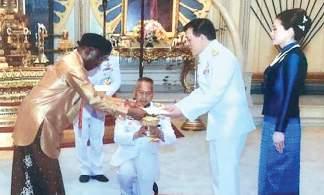
Ambassador Oma Djebah, presenting his letters of credence to His Majesty Maha Vajiralongkorn, King of Thailand
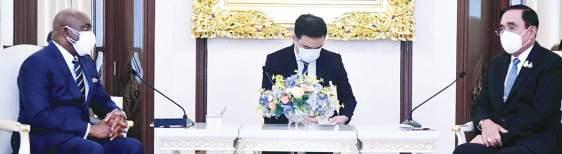
Ambassador Oma Djebah,when he paid a courtesy call on the Prime Minister of Thailand, Gen. Prayut Chan-O-Cha


2027 AND THE FCT VERDICT
UDE OBIOHA contends that the FCT council elections provide reasonable clue to next year general elections

SAUCE FOR SUCCESS
ABBA DUKAWA gives some tips to IGP Disu towards building a professional Police Force
JOSHUA J. OMOJUWA argues that all stakeholders should do more to ensure the gains of economic recovery reflect on the masses

THE OTHER SIDE OF THE ECONOMY
Politicians don’t see contradictions; that is why a politician can cry about high food prices and, months later, moan about low food prices with the same fervour. In our political climate, nuance is seen almost as a weakness. Something is either entirely bad or unquestionably good—no middle grounds, no space for measured evaluation. Government is either performing exceptionally well or it is a monumental disaster. The economy is either booming beyond imagination or rapidly heading toward an iceberg, ready to crash like the Titanic. But when seen through a clearer, more honest lens, national issues are rarely ever so absolute. Most realities are a blend of multiple truths coexisting at the same time, overlapping in ways that do not fit neatly into clear divides.
The unfortunate consequence of our refusal to embrace nuance is that public discourse becomes shallow, combative, and increasingly unproductive. This is broadcast live everyday on morning shows. It becomes harder than ever to have honest conversations about the country’s most pressing issues.
Take the economy, for instance. Some insist the economy is doing great. But the moment you ask, “great for who?” the conversation changes entirely. And that question is not only important— it is justified before you even push further. Still, let us start with the good side, because there is a good side. The economy, in several measurable ways, is picking up. The numbers say as much, and the numbers are difficult to ignore.
Inflation, after punishing Nigerians relentlessly, has now been on a downward trajectory for a full year. Food prices, which have been the source of despair for households across the country, have begun to follow in the same direction. On the monetary side, the results have been nothing short of astounding. Our net reserves have grown by over 750 percent—from $3.99 billion in 2023 to $34.8 billion today. This growth has taken us from a dangerously precarious position, one where we struggled to meet our forex obligations, to one of the strongest positions we have held in years. The stability of the naira is directly tied to this improvement in reserves. So is the renewed confidence of foreign investors and multinational companies who need assurance that Nigeria can meet its payment obligations reliably.
None of this would have been possible without dismantling the old corrupt forex subsidy regime. This system was a breeding ground for corruption. The word “corrupt” in this context is almost redundant because corruption was inevitable in such an arrangement.
When the government handpicks who gets access to forex and who does not, corruption becomes embedded in the very structure of the process. Some acts of corruption are not even the result of malicious intent; they are simply a consequence of a flawed system. Reforming this system was not optional, it was necessary and credit to President Tinubu for taking that bold step.
In this regard, the Governor of the Central Bank, Olayemi Cardoso, deserves the accolades coming his way too. He is arguably the president’s best appointment so far. His approach has been consistent, disciplined, and focused on long-term stability rather than quick political wins.
On the fiscal side, the appointment of Taiwo Oyedele as Minister of State for Finance and Coordinating Minister of the Economy has been widely interpreted as a sign that the government is finally ready to strengthen its fiscal agenda. Compared to the progress on the monetary side, the contrast is stark. But with Oyedele now in position, there is a renewed sense of optimism that fiscal policy will finally gather the momentum it has been lacking.
Despite these reforms and positive indicators, one group remains unconvinced—and for good reason: the poor. While businesses are declaring record profits and the Nigerian Stock Exchange continues to soar, the average Nigerian is still waiting for relief. Foreign portfolio investments are flowing in, boosting confidence in the markets, yet these gains feel distant from the daily realities of ordinary citizens. The poor are justified in asking, “when will it be our turn?” It is a question this administration must take seriously.
Economic progress means very little if it does not translate into improved living conditions for the majority.
This is the next critical layer the Bola Tinubu administration must prioritize: ensuring that the gains of economic recovery are extended to the masses. State governments must also play their
part. As the Senate President Godswill Akpabio recently pointed out, states are currently receiving record amounts from the Federation Account. That money must count for something meaningful. Unlike some powerful countries that can trigger military conflicts to stimulate parts of their economy, Nigeria does not have that option, nor should it desire it. We must create jobs by more sustainable and ethical means. One opportunity that holds promise is the creation of state police. Although implementation will vary from state to state, even an average recruitment of three thousand officers per state would create over one hundred thousand jobs nationwide. This would expand employment opportunities at the subnational level while strengthening internal security, which itself is a major catalyst for investment and economic growth.
The establishment of state police is not just about security; it has economic implications. A safer environment attracts businesses, boosts confidence, and encourages long-term investments. While this policy will require careful planning, legislative coordination, and significant investment, the potential benefits are substantial. The recent committee set up by the Inspector General of Police, Olatunji Disu, marks a meaningful step toward making this long-discussed idea a reality. The narrative must be nuanced and amidst that, we can be clear about progress and the challenges that remain to be met. There is improvement on several fronts, yet millions remain excluded from the gains. Acknowledging both truths at once is the only way to have an honest conversation about where we are and where we need to be. The poor must not remain on the other side of the economy. We need to carry everyone along, if for nothing, for the long-term stability and prosperity of our country.
Omojuwa is chief strategist, Alpha Reach/BGX Publishing
UDE OBIOHA
contends that the FCT council elections provide reasonable clue to next year general elections 2027 AND THE FCT VERDICT
The 2027 presidential election may still be months away, but its contours are already visible to anyone willing to read the signs. Politics, like history, leaves clues. And the recent Federal Capital Territory (FCT) Area Council elections, alongside parallel electoral exercises in parts of Rivers and Kano States, have provided more than clues. They have offered a preview.
The message from the FCT was neither ambiguous nor accidental.
The All Progressives Congress (APC) secured five of the six chairmanship seats, flipping the Abuja Municipal Area Council (AMAC), Bwari, and Kuje from the Peoples Democratic Party, leaving the opposition with only Gwagwalada. In AMAC, the most populous and politically symbolic council in the nation’s capital, the APC did not merely win; it dominated, polling over 40,000 votes, more than triple the tally of its closest challenger. In Nigeria's political heartbeat, voters spoke with clarity.
This was not just a council election. It was a temperature check. And the temperature suggests that President Bola Ahmed Tinubu’s political machinery is not only intact but also expanding.
Those who dismiss local elections as inconsequential misunderstand Nigerian political dynamics. The FCT is not just any territory; it is the seat of power, the melting pot of Nigeria’s elite and grassroots political currents. When the ruling party strengthens its grip there, it signals organisational discipline, voter mobilisation capacity, and strategic coherence. It also reveals something more uncomfortable for the opposition: fragmentation. What even makes the victory more compelling is that APC has never won AMAC or the FCT in Presidential elections. But just as it flipped in 2026 for AMAC, this could be the trajectory in 2027, not only in the nation's capital but across the country.
While the APC consolidates, the opposition continues to splinter. Personal ambitions eclipse collective strategy. Coalition talks rise and collapse in cycles of distrust. Meanwhile, key political figures across party lines quietly align with Tinubu’s centre of gravity. Today, more than 30 governors, including some outside the APC fold, are considered allies of the President. In Nigerian politics, that is not a coincidence. It is architecture.
Tinubu did not arrive at this moment by accident. For over two decades, he has cultivated alliances, mentored political actors, built networks that transcend ethnicity and region, and demonstrated a rare capacity for long-term strategy. From Lagos to the national stage, he has shown an ability to think beyond electoral cycles. His 2023 victory was the product of patience and preparation. His governance since then reflects consolidation. Critics predicted collapse when he removed fuel subsidies and unified the exchange rate. They foresaw a political

implosion as reforms tightened liquidity and global inflation surged. Yet, against a backdrop of inherited fiscal strain and near-monetary instability, the administration has steadied the ship of macroeconomics. The Naira has shown signs of recovery. Food prices, while still sensitive, have begun to ease in several markets. Investor confidence is cautiously returning. None of this suggests perfection. But it does signal resilience.
Politics rewards resilience. The FCT results, therefore, are not merely about council chairpersons. They are about perception. Voters in the capital had an opportunity to register a protest. Instead, they reinforced the ruling party. That reinforcement carries symbolic weight. It suggests that, at least for now, the reform pain has not translated into wholesale rejection.
Beyond Abuja, similar patterns in Rivers and Kano further underscore a broader national trend: the ruling party is organised; its rivals are reactive.
If elections were solely about sentiment, 2027 might still be unpredictable. But elections are about structure: polling units, ward agents, coalition discipline, voter databases, and resource mobilisation. On those metrics, the APC appears several steps ahead.
One might even argue, cautiously but realistically, that the next presidential contest is shaping up less like a battlefield and more like a procession, with the final destination a “coronation” of President Bola Ahmed Tinubu for his second term.
This is not to diminish the democratic imperative of competition. Democracy demands opposition. It thrives on alternatives. But effective opposition requires coherence, not cacophony. At present, Nigeria’s opposition landscape is characterised more by internal recalibration than collective mobilisation.
Tinubu, meanwhile, continues to consolidate elite consensus while maintaining grassroots engagement. His style may be deliberate, sometimes opaque, but it is rarely impulsive. He understands the arithmetic of power: governors influence state machinery; state machinery influences turnout; turnout influences outcomes.
Obioha is the Director of Strategy at the Hope Alive Initiative (HAI), a group dedicated to good governance in Nigeria
ABBA DUKAWA gives some tips to IGP Disu towards building a professional Police Force
SAUCE FOR SUCCESS
With due respect to your esteemed office and in recognition of the noble role of the Nigeria Police Force in maintaining law, order, and the protection of citizens, permit me to congratulate you on your appointment as the new InspectorGeneral of Police. Your emergence at this critical moment in our nation’s history carries immense responsibility and presents a rare opportunity to restore confidence in the police institution.
Leadership is measured not by rhetoric, but by reform. This moment demands courage, consistency, and clarity of purpose. By confronting corruption headon, restoring meritocracy, and enforcing lawful directives, your tenure can mark a turning point in the history of the Nigeria Police Force.
In a video posted on the Force’s official X account in September, former IGP warned officers against intervening in civil disputes or serving private interests: “Let me reiterate without ambiguity: the Nigerian Police Force is not, and will never become, an enforcer for private interests. Officers have no business escorting parties for land recovery, disrupting legally existing occupations, or meddling in civil claims that lack a demonstrable criminal element. Every such incident erodes the neutrality of the Force and exposes us to disrepute.”
This memo respectfully draws attention to three urgent areas requiring decisive action under your leadership.
A firm and visible fight against corruption in the Nigeria Police Force. Corruption remains the single greatest threat to the credibility and effectiveness of the police force. From bribery at checkpoints to compromise in investigations and promotions, the perception and reality of corruption continues to erode public trust. For you to decisively confront this challenge, your office may consider:
Strengthening internal disciplinary mechanisms and ensuring swift, transparent punishment for misconduct. Establishing anonymous reporting channels for both officers and civilians. Deploying technology to reduce human discretion in processes prone to abuse. Publicly prosecuting high-profile cases to send a strong deterrent message. A corruption-free police force is not only a moral necessity but a strategic imperative for national security improvement.
Enforce the Presidential Directive on Police Withdrawal. The continued deployment of police officers to unauthorized private individuals and entities weakens operational capacity and contradicts existing presidential directives. Given the rising and multifaceted security challenges facing the country, Nigerians are keenly watching how the new Inspector General of Police will implement President Tinubu’s directive ordering the withdrawal of police officers assigned to guard VIPs and their redeployment to core policing duties. President Bola Tinubu's directive to
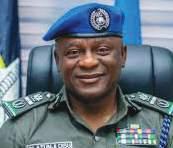
withdraw police officers from VIP duties has not been effectively implemented and most . worryingly, certain officials including the children of political officeholders still retain police orderlies.
Here is a piece of advice for the IGP: he could borrow a leaf from the late General Patrick Aziza who, as Commander of the Lagos Garrison Command in 1997, ensured strict discipline. Any soldier found roaming the streets of Lagos in uniform during working hours without authorization was promptly rounded up and placed on the next available flight to Sierra Leone to join Nigerian troops fighting rebels.
Similarly, enforcement teams could be deployed to VIP events, airports, shopping malls, and other locations frequently visited by prominent individuals to identify officers who choose to ignore the President’s clear directive and remain attached to their “ogas” and “madams.” Once apprehended, such officers could be reassigned to frontline areas such as Sambisa Forest, Lake Chad, Malam Fatori, Geidam, Gwoza, Birnin Gwari, and Shiroro—areas that continue to face persistent attacks from bandits and insurgents. Such decisive action could significantly reinforce security operations and send a strong message about discipline and commitment within the force.
Strict enforcement of withdrawal policies will: Return manpower to core policing duties. Improve response times and community patrol coverage. Reinforce the principle that public security resources are not for private privilege. Compliance should be monitored through regular audits and command accountability, with sanctions for violations.
End the Practice of Special Promotions: It appears that you were affected by an unwarranted special promotion that placed officers junior to you ahead of you before your elevation to IGP. Yet, in God’s divine will, you have now risen to the position of IGP.
Under the immediate past IGP, there has been significant controversy surrounding recent rapid promotions. Critics have raised intense backlash over what has been described as a “secretive” promotion list, alleging it disproportionately favors loyalists and certain ethnic groups.
Dukawa writes from Abuja
Editor, Editorial Page PETER ISHAKA
Email peter.ishaka@thisdaylive.com
MINING TRAGEDY ON THE PLATEAU
Government should ensure safety protocols are adhered to
The federal government has commenced investigation into the tragedy in Zurak, a community in Wase local government area of Plateau State where 37 miners died of suspected carbon monoxide and sulphite gas emissions. But Nigerians demand accountability. Toxic gas is believed to have built-up underground in apparently poorly ventilated tunnels, causing the workers to collapse just before the end of their night shift. The bodies of the victims were discovered by workers the following morning. They also rescued about 20 survivors who were rushed to a hospital for treatment. The victims, all able-bodied men in their prime, were buried shortly after, a tragedy that has again heightened renewed concerns over safety standards in the country's mining sector.
While we commiserate with families of the victims, the Zurak tragedy is particularly painful because it could have been avoided. As minister of Solid Minerals, Kayode Fayemi visited the Zurak mines operated by Solid Unit Nigeria Limited, alongside then National Security Adviser (NSA) Babagana Monguno in 2017 following numerous complaints from the community. Thereafter, Fayemi ordered the immediate closure of the mining site, and the arrest of illegal Chinese operators, including Alhaji Dan China, the purported owner of the mine. But not for long. Dan China soon regained his freedom and went back to the dormant mines where accumulated minerals had released lethal fumes shortly after Fayemi left office as minister.
though mining activities on the Plateau have declined considerably, the region is still active, particularly with unlicensed artisanal mining of tin, shadowed by a cycle of mining disasters.
Despite the dangers inherent in illegal mining, the business is booming because it brings food to the table of many
EDITOR SHAKA MOMODU
DEPUTY EDITOR WALE OLALEYE
MANAGING DIRECTOR ENIOLA BELLO
DEPUTY MANAGING DIRECTOR ISRAEL IWEGBU
CHAIRMAN EDITORIAL BOARD OLUSEGUN ADENIYI
EDITOR NATION’S CAPITAL IYOBOSA UWUGIAREN
THE OMBUDSMAN KAYODE KOMOLAFE
EDITOR-IN-CHIEF/CHAIRMAN NDUKA OBAIGBENA
Despite the dangers inherent in illegal mining, the business is booming because it brings food to the table of many. In the past year alone, so many mining pits had collapsed, trapping and killing hundreds of people, who were driven mainly by hunger and poverty. We should be concerned that mining disasters are widespread, particularly in the north of the country, essentially due to lack of government oversight and basic safety tools. Even
GROUP EXECUTIVE DIRECTORS ENIOLA BELLO, KAYODE KOMOLAFE, ISRAEL IWEGBU
DIVISIONAL DIRECTORS SHAKA MOMODU, PETER IWEGBU, ANTHONY OGEDENGBE
DEPUTY DIVISIONAL DIRECTOR OJOGUN VICTOR DANBOYI
SNR. ASSOCIATE DIRECTOR ERIC OJEH
ASSOCIATE DIRECTOR PATRICK EIMIUHI
CONTROLLERS ABIMBOLA TAIWO, UCHENNA DIBIAGWU, NDUKA MOSERI
DIRECTOR, PRINTING PRODUCTION CHUKS ONWUDINJO
TO SEND EMAIL: first name.surname@thisdaylive.com
Letters to the Editor
In June last year, a mining pit in Galkogo Community, Shiroro Local Government Area of Niger State, collapsed, burying dozens of people whose bodies were never recovered. But the epicentre of the tragedy is Zamfara State - where repeated scenes of funeral due to illegal mining activities have not persuaded the workers to give up the dangerous business. Dubbed the headquarters of illegal mining in the country, Zamfara holds numerous armed gangs who control gold fields and other minerals, fuelling violence and deadly accidents. Indeed, an added concern is often the nexus between unregulated mining, banditry and other criminal activities, such as kidnappings for ransom and community unrest. According to a government source, there are about 20,000 illegal miners from within and outside of the country who have taken over the mining sites in the state.
Beyond the issue of the cost of indiscriminate digging to the environment, the country is losing money to the tunes of billions on an annual basis. Some of the illicit revenues from the business reportedly rival state budgets. The House of Representatives ad hoc committee on illegal mining recently estimated the money lost to unregulated mining operations at $9 billion yearly. But while artisanal mining makes a huge percentage of all mining activities, the sector is not properly defined, despite the efforts of the current government to standardise the procedure and terms of artisanal mining.
There is bound to be more problems in the sector, particularly in Zamfara as the federal government, last week, lifted the ban imposed on mining since 2019 at the height of insecurity in the state amid illegal mining activities. Beyond the new operational guidelines that have been issued, there is need for government to underline safety standards to prevent future and avoidable tragedies.
Letters in response to specific publications in THISDAY should be brief (150-300 words) and straight to the point. Interested readers may send such letters along with their contact details to opinion@thisdaylive.com. We also welcome comments and opinions on topical local, national and international issues provided they are well-written and should also not be longer than (750- 1000 words). They should be sent to opinion@thisdaylive. com along with photograph, email address and phone numbers of the writer.
THE ARROGANCE OF PUBLIC OFFICERS
In developed democracies, elected government officials treat requests and inquiries from the people with supreme courtesy, respect, and responsiveness. In Nigeria, the reverse is sadly the case.
Recently,at a public event, pressed to explain his aloofness and inaccessibility to the people who elected him, Eno Umo, governor of Akwa Ibom lashed out. While letting loose a fusillade of rhetorical questions, he was desperate to stress that he was not a receptionist who should be taking calls from people.
Nigeria’s leadership problems and failures are as multifaceted as their government is multi-tiered. While the federal government sits atop the pile, the state government occupies the middle position while the local government comes in third place. This is as constitutional as it is convenient in Nigeria. The problem is that it appears that the arrangement has become too convenient.
For many Nigerians, the toxicity, and intensity of their criticism is reserved for the federal government. This is
understandable as the buck stops there. It may also be justified as Nigeria’s flawed federalism gives a huge chunk of resources and responsibilities to the federal government. Concentrating the volume and venom of criticism on the federal government has largely let state governments off the hook despite the enormous resources that go to them and their abysmal failure to justify the receipt of same.
In the darkness bred by a lack of scrutiny on state governments, many governors have become demigods, doing as they please and viewing those who elected them with condescension and contempt. Governors should always be available to field questions and inquiries, listen to people’s problems and address their grievances. This is what they are sworn to do. It is the duty they owe the electorate.
The place of a governor of a state is not in Abuja where they seek political patronage with the president. Neither is the place of the governor in the media where endless
noise swell into the tale of the idiot full of sound and fury signifying nothing.
The place of the governor Is also not in aimless foreign trips which burn tax payer’s money with nothing to show for it. The place of the governor is in his state, fielding questions from his people and finding ways to make their lives more meaningful and comfortable.
Therefore, all those public officers who are perpetually perched on their high horse will do well to climb down without further delay. They are nothing without those who elected them and soon the tyrannical transience of power will return them to their nebulous nothingness unless they make the most of the opportunities they have now. Their entire public lives for which they are paid astronomically must be framed around service to the people who elected them. To do this effectively, they have to learn to talk less and do more.
Ike Willie-Nwobu, Ikewilly9@gmail.com
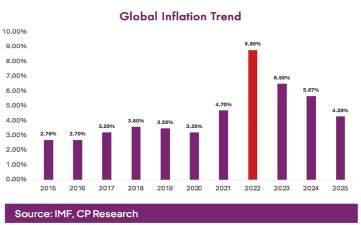
A report by Comercio Partners has declared that the Central Bank of Nigeria’s (CBN) monetary discipline, independence and reliance on data will further stablise the foreign exchange market and reduce inflationary pressure on the economy in 2026.
Comercio Partners in its macro economic outlook titled, “Policy Shock to Structural Reset: Charting
a Sustainable Economic Path,” projected that under best case scenario the exchange rate may narrow further to N1,200 per Dollar while inflation rate will further decline to between 10 per cent and 11 per cent in 2026. It also projected 4.5 per cent GDP growth for the economy this year.
Commenting on the monetary policy decisions of the CBN, Research Analyst, Ms. Olamide Ologunagbe.
said that the apex bank demonstrated improved independence and datadriven policy decisions in holding rates for much of 2025 and implemented a 50-basis-point cut toward the year-end.
Ologunagbe said that the best case “inflation outlook for 2026 will be around 10 per cent to 11 per cent in H1 2026 driven by CBN’s “monetary discipline, improved agricultural output, stable oil prices and continued FX stability.”
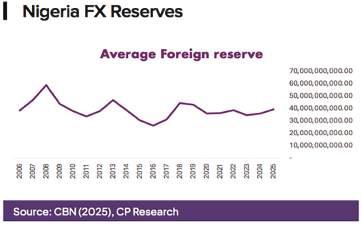
The Comercio Partners macro economic outlook report stated that Nigeria’s growth outlook is constructive but constrained. It said: “Real GDP growth is projected to approach 4.5 per cent, supported by momentum in the non-oil sector, improved credit conditions, and stable external balances.”
The report highlighted that the services would remain the primary growth driver in 2026 with ICT, trade, transport, and finance
continuing to expand faster than headline GDP.
It stated that agriculture is expected to recover modestly, assuming stable weather conditions and gradual improvements in logistics and security.
For the manufacturing sector, the report said that it’s growth would remain positive, but sub-optimal, constrained by energy costs and limited domestic demand elasticity.
The report stated that monetary policy is expected
to transition from tight to calibrated easing in 2026.
“As inflation moderates and FX stability holds, the CBN is likely to gradually reduce policy rates to improving credit transmission and investment appetite. This shift should support consumption, private investment, and equity market valuations, but the pace of easing will remain cautious given inflation risks,” it said.
Chinedu Eze
The sudden declaration of war against Iran by the United States of America and Israel on February 28, 2026, has reset air travel globally, thereby inflicting pains on stranded international air travellers, following the closure of United Arab Emirates (UAE) and Qatar airspace, the biggest hubs
in the Middle East.
Air travellers that arrived in Doha and Dubai on February 28 became stranded because they could not connect flights to their final destinations, even though the government of UAE offered to lodge most of them in Dubai in hotels.
As at Tuesday, Dubaibased mega carrier, Emirates operated skeletal service but the war still raged and
wafting the gulf airspace with uncertainty, as Gulf carriers continue to record losses.
In Nigeria, Qatar Airways, the Middle East carrier, which operated the highest flight frequency from Nigeria, including Emirates, Saudia of Saudi Arabia and Middle East Airlines (MEA) of Lebanon, have transferred some of their passengers to some
African carriers, especially Ethiopian Airlines and Kenya Airways.
Travel agents said the war has empowered Ethiopian Airlines, Africa’s biggest airline with large global network, and it is now helping the gulf airlines to distribute passengers to farther destinations.
Travel expert and organiser of Akwaaba African Travel Market,
Ambassador Ikechi Uko, told THISDAY in a telephone interview that the war gave rise to global reset in air travel, remarking that the war has disrupted a 15-year lead of Gulf carriers that dominated the air travel market with Ethiopian Airlines making remarkable in-road. According to him, with the war, Ethiopian Airline has become a go-to airline from Africa because
of its reach in terms of destinations and capacity. Ambassador Uko stated that at the start of the war, Emirates moved its planes outside Dubai to Kenya, Egypt and Europe; and Kenya Airways operated flights on Emirates behalf, helping to carry its passengers to their destinations.
Dike Onwuamaeze
Nigeria Aircraft Acquisition, Investment Summit to Hold in Lagos
Chinedu Eze
The Minister of Aviation and Aerospace Development, Festus Keyamo, is set to host the maiden edition of the Nigeria Aircraft Acquisition and Investment Summit (NAAIS) on the 1st and 2nd of April at the prestigious Federal Palace Hotel, Victoria Island, Lagos.
The first-of-its-kind summit will convene international aircraft lessors, global aviation financiers, airline operators, airport concessionaires, policymakers, and institutional investors to explore Nigeria’s rapidly expanding aviation market and unlock new pathways for aircraft acquisition and
infrastructure investment.
Nigeria presents one of Africa’s most compelling aviation investment opportunities. With a population exceeding 220 million people and air transport serving as an essential mode of mobility, the country offers a balanced return profile across airline operations and long-term airport infrastructure concessions.
Africa is projected to be the fastest-growing aviation region globally, with passenger traffic expected to grow at approximately 6% annually through 2044. Within this trajectory, Nigeria stands as a natural anchor market for long-term aviation and airport infrastructure expansion.
Air
Despite its demographic and economic scale, Nigeria remains structurally underserved in aviation capacity. The market currently supports approximately 15–16 million annual air passengers, with projections indicating growth to 25.7 million passengers by 2029 — a clear reflection of strong underlying demand.
A statement signed by Special Adviser on Media and Communications to the Minister, Tunde Moshood, said the Minister has consistently emphasized the need to create sustainable financing structures for Nigerian airlines and modernize airport infrastructure through transparent public-private partnerships.
Ibom Air Enforces NCAA’s Ban on Power Banks in Flights
Nigeria’s rising carrier, Ibom Air has started strict enforcement of the new directive issued by the Nigerian Civil Aviation Authority (NCAA), placing ban on the use of power banks for charging of mobile devices, in line with on-board safety compliance.
Under the updated regulation, power banks of up to 100 watt-hours are
permitted in the cabin without restriction. However, devices rated between 100Wh and 160Wh require prior airline approval before travel and any power banks exceeding 160Wh are completely prohibited on board aircraft. These thresholds are mandatory and apply to all passengers.
Beyond capacity limits, the directive also restricts how power banks are stored during
flight. Passengers must not place them in overhead compartments. Instead, approved devices must be kept in the cabin within immediate reach, either under the seat, inside the seat pocket, or in a carryon bag stored beneath the seat. The long-standing prohibition on placing power banks in checked baggage remains in force.
NCAT Secures 2026 International Accreditation
The Nigerian College of Aviation Technology (NCAT) has been awarded the 2026 Certificate of Accreditation by the Aviation Accreditation Board International (AABI).
The accreditation, which is valid from February 19, 2026 to February 28, 2031, covers major programmes including Aircraft Maintenance Engineering Technology (Airframe & Powerplant, Avionics) and the Postgraduate Diploma in Aviation Management.
The College said the
achievement further strengthens the resolve of the Rector/Chief Executive, Dr. Danjuma Ismail, to sustain high standards and continue advancing the growth of NCAT in line with global best practices.
NCAT, Zaria is a premium aviation training institution, one of the earliest of such
organisations in Africa. It was set up in 1964, and charged with the responsibility of training Pilots, Air Traffic Controllers, Aircraft Maintenance Engineers, Aeronautical Telecommunications Engineers, Cabin Crew, Flight Dispatchers and several other aviation professionals.
IATA: 2026 Begins with 3.8% Air Passenger Demand Growth
Group Business Editor
Eromosele Abiodun
Deputy
chinedu Eze
Comms/e-Business
Asst. Editor,
Emmanuel Addeh
Asst. Editor, Money Market
Nume Ekeghe
Correspondents
Kayodetokede(CapitalMarkets)
James Emejo (Finance)
Ebere Nwoji (Insurance)
reporter Peter Uzoho (Energy)
The International Air Transport Association (IATA) has released data for January 2026 global passenger demand, which showed an increase of 3.8 per cent in total passenger demand, measured in revenue passenger kilometers (RPK), compared to January 2025. It also showed total capacity, measured in available seat kilometers (ASK), which increased 3.5 per cent year-onyear. The load factor was 82.0 per cent (+0.2 ppt compared to January 2025), a record high for January. According to the global body, international demand rose 5.9 per cent compared to January 2025. Capacity was up 5.8 per cent year-on-year,
and the load factor was 82.5 per cent (+0.1 ppt compared to January 2025); while domestic demand increased 0.1 per cent compared to January 2025.
IATA’s Director General, Willie Walsh, said: “The timing of the Lunar New Year partly explains the slightly slower 3.8 per cent expansion in January, but the fundamentals are in place for demand to continue strong growth in 2026. Schedule data, for example, indicate a 5.2 per cent increase in global seat capacity by March, which would be the fastest expansion since April 2024. Events over the weekend have, however, introduced some uncertainty into the evolution of traffic and fuel costs.

NIMET Exposes Climate Change Induced Health Risks
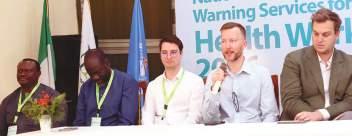
Chinedu Eze
Climate change is intensifying public health risks, including heat stress, airborne infections and vector-borne diseases.
This has attracted a meeting of local and international agencies to deliberate on how to tackle the problem, especially on how to build climate-resilient health systems informed by inclusive early warning and risk management services.
The meeting which took place earlier in the week, was a three-day workshop hosted by the Nigeria Meteorological Agency (NIMET) in its Lagos training school.
It brought together key national and international agencies to share expertise and co-develop a multi-hazard early warning system for Nigeria.
Experts observed that climate change is intensifying public health risks, including heat stress, airborne infections, and vector-borne diseases. While National Meteorological and Hydrological Services (NMHSs) provide climate risk information to the health sector, gaps remain in integrated surveillance, coordinated planning, and evidence-based decision-making.
So, the workshop was a significant step toward closing these gaps and strengthening climate services for the health sector. The participants pushed that weather and climate information must be translated into actionable guidance for health agencies and communities and called for effective collaboration between meteorological, hydrological, health institutions, which are essential for building a weather-resilient health sector.
The Director General of NiMet, Professor Charles Anosike, in his opening remarks at the workshop reaffirmed the agency’s commitment to strengthening weather and climate information services as a critical pillar for public health protection.
Anosike who was represented by Mrs. Glory Onyegbule, said: “Building an efficient early warning system is not just a scientific responsibility; it is a national imperative. Through collaboration with the health sector and strategic partners (national and international), we are working to ensure that timely, accurate, and impact-based forecasts translate into early action that saves lives and safeguard livelihoods across Nigeria. Together, we can transform climate intelligence into resilience for healthier communities nationwide.”
Resource persons observed that the impacts of climate change, pollution, and ecosystem degradation are already driving respiratory illnesses, water- and vector-borne diseases, food insecurity, and disaster-related health risks in Nigeria. This underscores the urgent
need to build climate-resilient health systems informed by inclusive early warning and risk management services.
In 2025, the Nigerian government published the third Nationally Determined Contribution (NDC 3.0), which calls for, “Delivering a national integrated climate change, health and environmental early warning system with implementation in at least 18 states by 2030.”
So, the National Early Warning Services for Health (WISER) workshop marks an important first step toward this goal, bringing together key national agencies to share expertise and co-develop a multi-hazard early warning system for Nigeria.
The workshop was hosted by NiMet in partnership with the Federal Ministry of Health and Social Welfare, the National Emergency Management Authority (NEMA), the National Hydrological Services Agency (NIHSA), and the National Orientation Agency (NOA).
The workshop embodied a truly crosssectoral collaboration with additional representatives from the Ministry of Agriculture and Food Security, the Ministry of Budget and Economic Planning, and the Lagos State Government also contribute to the effort.
A community-level survey conducted across Nigeria’s regions provided activities for the workshop and trainings, ensuring that early warning services were peopleled and tailored to the needs of the most vulnerable Nigerians.
There was also effective cross-sectoral coordination, which was at the heart of NiMet and its partners’ efforts to co- produce an early warning service for health that was usable, useful, and inclusive of all Nigerian society.
International experts were invited to share policy and operational experience, including representatives from the UK Government, the UK Met Office, the Rockefeller Foundation, the World Bank, the World Meteorological Organization, the World Health Organization, and the UK Health Security Agency. This workshop is part of WISER Health (Weather and Climate Information Services for Health), a global initiative co-funded by the UK and Rockefeller Foundation, with the Met Office leading implementation.
Head of Health at the British High Commission in Abuja, Juliet Whitley, said: “Nigeria is leading the way in developing an early warning system that will better enable its health sector to prepare for and respond to extreme weather. The UK is proud to support Nigeria’s commitment to building a health system that is more resilient to climate change.”
FMITI Targets Improved Productivity via Policy Implementation
After years of policy research and design, the Federal Ministry of
Investment is set to make 2026 a year of improved economic
focused policy implementation, writes Dike Onwuamaeze
There is a major paradigm shift in the operations of the Federal Ministry of Industry, Trade and Investment (FMITI) in 2026. The shift is a transition from “policy design to policy delivery.”
The Minister of State, FMITI, Senator John Owan Enoh, said: “If 2025 focused on policy architecture, 2026 is positioned as the first full year of implementation. Performance will be measured by outcomes.
“Accordingly, the ministry’s industrial priorities are focused, sequenced, and execution driven. 2026 is the year Nigeria demonstrates credibly and consistently, that industrial policy delivers production, jobs, and competitiveness.”
According to the FMITI outlook for the year, “2026 is positioned as a year of consolidation and scale.” The objective is to create and maintain an enabling environment and good regulation for development and the expansion of industry, trade and investment to increase non-oil exports, boost trade revenue, mobilise foreign direct investments (FDIs) and foreign portfolio investments (FPIs) and generate more export led jobs.
It said: “The 2026 Outlook marks a deliberate shift: from policy design to policy delivery. If 2025 focused on policy architecture, 2026 is positioned as the first full year of implementation.
“Accordingly, the ministry’s industrial priorities are focused, sequenced, and execution-driven, anchored on building a credible evidence base, activating demand, and strengthening domestic productive capacity. Implementation will concentrate on productivity, scale, and execution across priority value chains.
“Industrial cluster development will be piloted through shared infrastructure and services to

unlock efficiency and competitiveness, complemented by dedicated long-term financing frameworks that expand patient capital for women-led businesses and Micro, Small and Medium Enterprises (MSMEs) and integrate them into priority value chains.”
The FMITI’s 2026 Outlook said that the ministry would be focusing on sustaining reform momentum while tightening execution, with emphasis on disciplined implementation, sub-national delivery, and closer integration of trade, investment, and industrial policy to translate consolidation
into sustained growth, exports, and jobs. Therefore, the ministry’s priorities for the year are centred on four reinforcing pillars. These pillars are “unlocking global and regional demand through trade facilitation,” and “strengthening domestic supply of export ready goods and services.” Others are “mobilising investment through policy coherence and execution” and “leveraging data, digital infrastructure and strategic communications.”
The implementation of these four pillar are further broken into eight priority areas, which are national MSMEs’ census, the Made-in-Nigeria national campaign, industrial cluster development and women led-business long term finance. Others are value chain transformation, Artificial Intelligence (AI) digital industrial park, privatised industry performance review and holding of Industrial Revolution Working Group (IRWG) roundtables.
It said: “A core priority is the launch of a National MSME Census” that will replace “estimates with evidence and providing a reliable data backbone for industrial planning, targeted incentives, and measurable impact.
“To improve productivity and scale, industrial cluster development will be piloted through the Idu Industrial Park, providing shared infrastructure, processing, logistics, and quality support. The Cotton, Textile and Garment sector will serve as a flagship execution pilot, transitioning from fragmented interventions to a coordinated, demand-anchored value chain.”
The FMITI said that it would be, “Working
Industry, Trade and
productivity through
with the Bureau of Public Enterprises, to review the performance of privatised enterprises. This priority area will see the structured evaluation of privatised industrial assets to assess performance against original privatisation objectives, including operational efficiency, investment commitments, job creation, and value-chain contribution.”
The ministry said that the roll-out of the Made-in-Nigeria national campaign will give practical expression to the federal government’s “Nigeria First” policy, mobilise market discipline, consumer confidence “and, therefore, national pride towards elevating local industry, stimulating domestic demand, and progressively reducing Nigeria’s reliance on imports through aligned procurement signals, standards enforcement, and consumer awareness.”
Furthermore, there will be dedicated financing frameworks for women-led industrial and MSME enterprises that will address access to patient capital while integrating these firms into priority value chains.
The ministry said it will strengthen service delivery by deploying artificial intelligence and digital systems to enhance data analytics, programme monitoring, regulatory coordination, and accountability.
The FMITI also committed itself to convening four additional IRWG Ministerial Roundtables in 2026. These engagements will provide focused, high-level platforms to resolve binding constraints that are militating the competitiveness of the country’s manufacturing sectors and businesses.
The story continues online on www.thisdaylive.com

Dr. Jumoke Oduwole
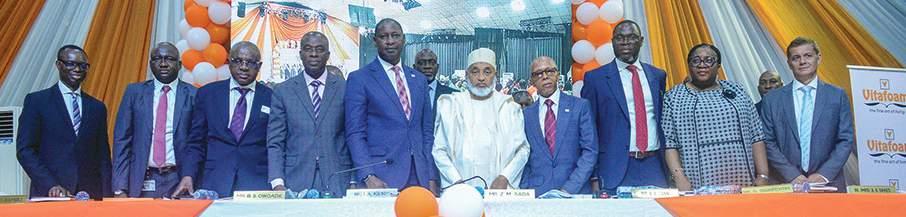
L–R: Independent Non-Executive Director, Vitafoam Nigeria Plc, Abdul Bello; Commercial Director, Dahiru Gambo; Non-Executive Director, Achike Umunna; Technical Director, Bamidele Owoade; Group Managing Director/CEO, Taiwo Adeniyi; Chairman, Zakari Sada; Company Secretary/Legal Adviser, Olalekan Sanni; Supply Chain Director, Ola Ogunfeyitimi; Non-Executive Director, Dr. (Mrs.) Abiola Davies and Non-Executive Director, Gerson Silva, during the 64th Annual General Meeting (AGM) of Vitafoam in Lagos yesterday
Vitafoam Shareholders Approve N3.75bn Dividend, Bonus Payout
The shareholders of Vitafoam Nigeria Plc, yesterday
approved N3.75billion dividend and N125.08 million bonus payout for 2025 financial year, among other resolutions at the company’s 64th Annual General Meeting
(AGM) held in Lagos.
The shareholders praised the management for an impressive 2025 financial year performance that led to a N3.00 per ordinary share of
50kobo each dividend payout (amounting to a total of N3.75 billion) as against N1.05 per ordinary share of 50kobo each dividend paid in 2024.
The shareholders
FG Flags Off Fisheries Forum to Catalyse Sector Value Chain
Oluchi Chibuzor
The Ministry of Marine and Blue Economy has flagged off the Nigeria National Fisheries Stakeholders Forum Programme as part of efforts to catalyse engagement on fisheries development in the country and the value chain.
The two-day event, themed, ‘Strengthening Inclusive and Sustainable Fisheries, Aquaculture and Blue Economy for Job Creation in Nigeria”, was led by the African Continental Free Trade Area
(AfCFTA) Secretariat in partnership with TradeMark Africa and funded by the Mastercard Foundation.
Speaking, the Permanent Secretary, Ministry of Marine and Blue Economy, Mrs. Fatima Mahmood, explained that while the challenges faced by women
and youth across Africa are similar.
She also explained that the forum hopes to garner insights from players within the fisheries ecosystem in Nigeria, spotlight the challenges and curate objectives that will help the Ministry and its international partners drive the implementation of IMAP in Nigeria.
authorised the capitalisation of N125,084,406 from retained earnings for the issuance of bonus shares to existing investors. The bonus shares will be distributed on the basis of one new ordinary share for every five shares held by shareholders whose names appeared in the register of members at the close of business on February 6, 2026.
The group recorded turnover of N111.3 billion, representing an increase of about 34.7 per cent from N82.6 billion in 2024. Profit before tax surged to N21.3 billion from N1.1 billion, reflecting an increase of over 1,830 per cent, while profit after tax jumped to N14.5 billion
From N952 million, representing a rise of about
1,423 per cent.
Speaking to shareholders at the AGM, the Chairman, Vitafoam Nigeria, Mr. Zakari Sada said the dividend paid to shareholders reflected the board’s confidence in the company ‘s financial stability and disciplined capital allocation.
“While the operating environment remains challenging , the board considers it appropriate to reward shareholders for their patience and support,” he said. He noted that the company closed 2025 on a positive trajectory, with renewed confidence and solid foundations for sustainable future growth.
Customers Cart Away Items in DavoDani MFB Promo
Lucky customers of DavoDani Microfinance Bank Limited, carted away various rich items at the company’s Save and Win Promo draw.
The event which took place at Haddasah Hall, Ogudu, Ojota, Lagos was another way of saying thank you to the teeming loyal customers.
The MD/CEO DavoDani Microfinance Bank, John Ologe, who disclosed that the event was also to mark the 11th Anniversary of the bank and 7th edition of the Save and Win Draw, averred that the customer is king. “The customer is the king, without the customers we don’t have a bank, so we continue to make our customers happy so that we continue to have a bank. If the customers don’t come we don’t really have a bank, so this
is why we are making them happy, and they are very very loyal to us, they have saved from the beginning of the year to the end of the year, it is a great one.
“Seeing my customers cart away various items, I am happy, I am so excited, because they would go and tell the story, the best marketing is when one customer goes to tell another person, it is happening there. So this can attract more customers,”Ologe stated.
In his message to Lagosians Ologe said, “This bank is a bank to beat, therefore we are number one Microfinance Bank in Lagos and we want our customers to go and tell Lagosians please come to DavoDani Microfinance Bank where all your needs would be met.
“If you have needs that are not met, once you come to DavoDani Microfinance Bank, your business would grow, you make more money, and make more progress in your life. Even today DavoDani Microfinance Bank is enlisted in the capital market for a N5billion commercial paper, we have been approved, we were in the market last week and for the first time of that paper we have raked in N2.5 billion to further support the bank, so that shows acceptability of our brand in the market because it is not easy to appear in the capital market to raise capital; it requires a lot of regulatory approval, CBN will approve you, the best rating agencies in Nigeria will approve too,” he said.
Babajide Leads Charge to Empowers Women in Nigeria’s Digital Future
Mary Nnah
As Nigeria joins the global community to mark International Women’s Month, a pressing issue takes center stage: the persistent gender gap in technology and innovation.
Despite progress, women remain underrepresented in STEM fields, and those who dare to venture often face significant barriers to success. But amidst the challenges, a glimmer of hope emerges.
Founder and CEO of
Female Techpreneur, Bukky Babajide, is leading the charge to empower women in tech.
“We are providing women with access to funding, mentoring, and career support, empowering them to lead and innovate,” said Dere Oritsejafor-Ereku, representing Babajide at a press conference announcing The Guardian Woman Festival.
“We are not just bridging the gap; we’re creating a pipeline of talented women who can drive innovation and growth in Africa,” said Oritsejafor-Ereku.
The Guardian Woman Festival Creator and Executive Director, Federal Palace Hotel/ Chief Strategy Officer, Global, The Guardian, Anita Athena Ibru, emphasised the importance of creating a platform for women to share their stories.
“I wanted to find a way to have people who could attend for free, so the wider population could come and learn the content,” she said, explaining the inspiration behind the festival. “It’s a festival, not just an eventcome and experience it!”
Kayode Tokede

A Mutual fund (Unit Trust) is an investment vehicle managed by a SEC (Securities and Exchange Commission) registered Fund Manager. Investors with similar objectives buy units of the Fund so that the Fund Manager can buy securities that willl generate their desired return.
An ETF (Exchange Traded Fund) is a type of fund which owns the assets (shares of stock, bonds, oil futures, gold bars, foreign currency, etc.) and divides ownership of those assets into shares. Investors can buy these ‘shares’ on the
floor of the Nigerian Stock Exchange. A REIT (Real Estate Investment Trust) is an investment vehicle that allows both small and large investors to part-own real estate ventures (eg. Offices, Houses, Hospitals) in proportion to their investments. The assets are divided into shares that are traded on the Nigerian Stock Exchange.
GUIDE TO DATA:
Date: All fund prices are quoted in Naira as at 4th March 2026, unless otherwise stated.
Stakeholders Call for Collective Action on Gas Decarbonisation for Climate Sustainability in Africa
Esther Oluku and Light Nwobodo
The Director General, National Council on Climate Change (NCCC), Omotenioye Majekodunmi, has called for collective action towards gas decarbonisation to accelerate Africa’s climate sustainability goal.
The NCCC DG made the submission in her keynote address at the 2026 Green Conference held in Lagos themed, “Decarbonising Africa: Pathway to Climate Finance, Sustainable Growth and Green Economy.”
According to her, while the task of investing in industrialisation while ensuring climate sustainability are pressing, African economies must embrace both concurrently while maintaining responsible development
and fair use so that both can advance together.
“The role of gas and natural gas systems has not been to create highemission greenhouse gas. It must become wind gas. This means ending heating and flaring, deploying advanced green sector technologies, integrating carbon capture, utilization, and storage, and designing future-ready wind and solar systems,” she said.
Gas, she said, provides a reliable source of energy required to power industrial activities, from steel and cement to chemicals and fertilizers, while also serving as a stabilising factor for the rapid expansion of renewable energy.
She opined that Africa must look towards decarbonising gas to bridge its energy needs while supporting her climate targets.
“Africa must therefore approach the global climate
challenge, not from a position of a policy. The future is decarbonised gas working alongside the global energy needs while meeting climate targets,” she said.
She mentioned that the Nigerian government has already taken concrete steps towards gas decarbonisation in Nigeria.
“This framework establishes a robust architecture for maintaining, monitoring, emission, reduction, capacity building, and climate awareness.
On his part, the Director General, Niger State Agency for Green Initiatives, Mr. Daniel Galadima, who also signed a Memorandum of Agreement (MoA) with GreenPlinth to deliver 2 million clean cookstoves to indigent residents in Niger state, expressed confidence in GreenPlinth Africa’s clean cookstoves campaign noting that it is a step towards democratising access to clean energy.
FMN Deepens France–Nigeria Trade Ties at Paris Agricultural Fair
Sunday Ehigiator
Flour Mills of Nigeria (FMN) has strengthened bilateral economic relations between Nigeria and France through its partnership with the French Government at the 62nd edition of the Paris International Agricultural Show, also known as Salon International de l’Agriculture recently held in Paris.
Speaking on the strategic importance of the partnership, the Group Chairman of FMN, Mr. John G. Coumantaros, described the France–
Nigeria relationship as mutually beneficial and growth-driven.
He said, “The France–Nigeria relationship is a valuable partnership built on a shared value agenda that fosters remarkable intercontinental trade growth. Also, as an organisation with over six decades of transformational footprint in Nigeria and progressively across the African continent, FMN has been unwaveringly committed to product and process innovation. Therefore, our continuous partnership with France for the success of the Paris
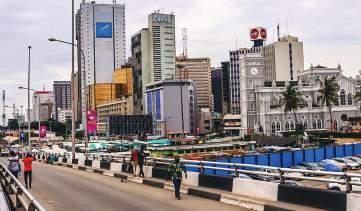
International Agricultural Show further buttresses the thriving relationship between both countries.”
At the inauguration of the Nigerian Pavilion, the Managing Director, FMN Agro, and Director, Strategic Engagement/Stakeholder Relations, Mr. Sadiq Usman, said the company’s presence at the fair aligns with its corporate mission.
“At FMN, our mission is Feeding and Enriching Lives Every Day. This is a mandate we have fulfilled through decades of economic shifts, rooted in a culture of deep resilience and constant innovation.
Zichis to Reward Shareholders With Dividend, Bonus Shares
Kayode Tokede
The management of Zichis Agro-Allied Industries Plc has proposed a 20 kobo dividend and a onefor-one bonus issue for shareholders amid impressive 2025 financial year result and accounts.
The reward to shareholders came days after the management of the Nigerian Exchange Limited (NGX) suspended trading of the company’s shares.
The dividend and bonus reward is estimated at N120 million in 2025 financial year, about 300 per cent increase over N30 million in 2024 financial year.
Also, Zichis AgroAllied Industries proposes bonus shares in the ratio of one (1) new share for every one (1) existing share held by shareholders whose names appear in the Register of Members at the close of business on March 16, 2026, “subject to the approval of the shareholders at the annual general meeting”.
The company announced its audited
“A Final Dividend of 20 kobo per 50 kobo ordinary share, subject to withholding tax, and on approval will be paid to shareholders whose name appear in the share register of members as at the close of business on March 16, 2026,” the company said in its corporate announcement, noting the dividend is for the period ended December 31, 2025.
financial results 2025, showcasing a substantial turnaround in profitability. The company reported a pre-tax profit of N364.21 million in 2025, a 420.8per cent increase compared to the N69.93 million recorded in 2024.
Executive Director, Finance & Strategy, Zichis Agro-allied Industries, Mr. Chris Ogbaisi expressed that the company has commenced its 2026 execution plans.
“Zichis feedmilling plant, which is one of our cash cow has been increased to five tonnes per hour and we are estimating 600 tonnes in a monthly basis. We are hoping it is commissioned in the next two weeks in March 2026,” he added.
The price of OPEC basket of twelve crudes stood at $63.14 a barrel on Monday, according to OPEC Secretariat calculations.
The OPEC Reference Basket of Crudes (ORB) is made up of the following: Saharan Blend (Algeria), Djeno (Congo), Zafiro (Equatorial Guinea), Rabi Light (Gabon), Iran Heavy (Islamic Republic of Iran), Basrah Medium (Iraq), Kuwait Export (Kuwait), Es Sider (Libya), Bonny Light (Nigeria), Arab Light (Saudi Arabia), Murban (UAE) and Merey (Venezuela).
OPEC DAILY BASKET PRICE As At 24 t H n OV e M be R
Stock Market Appreciates by N221bn on Demand for Nestle, Others
Kayode Tokede
The stock market section of the Nigerian Exchange Limited (NGX), yesterday gained N221 billion over investors’ demand for Nestle Nigeria Plc, and 32 others.
As Nestle Nigeria gained N150 per share or 4.84per
cent to close at N3,250.00 per share, the market capitalisation of listed companies on NGX moved to N126.32 trillion, about N221 billion or 0.18 per cent increase from N126.1 trillion it opened for trading.
Consequently, the NGX All-Share Index closed at 196,807.15 basis points,
representing an increase of 343.93 basis points or 0.17 per cent from 196,463.22 basis points the market closed for trading activities the previous day.
This brings the NGX ASI Month-to-Date and Yearto-Date returns higher at +2.1per cent and +26.5per cent, respectively.
Sectoral performance
was mixed as the NGX Banking Index gained 0.5per cent and NGX Consumer Goods up by 0.1 per cent while the NGX Insurance Index dipped by 1.6 per cent and NGX Oil & Gas declined by 0.2per cent.
In addition, the NGX Industrial Goods index closed flat.
The total volume traded declined by 21.3per cent to 634.01 million units, valued at N29.11 billion, and exchanged in 66,286 deals.
Jaiz Bank was the most traded stock by volume at 137.30 million units, while GTCO was the most traded stock by value at N5.41 billion.
As measured by market breadth, market sentiment was negative (0.8x), as 37 stocks lost relative to 31 gainers.
Tripple G Plc (-9.9per cent) and Multiverse (-9.9per cent) led the laggards, while NPF Microfinance Bank Plc(+10.0per cent) and Eterna Plc (+10.0per cent) posted the most significant gains.
PRICES FOR SECURITIES TRADED AS OF MARCH 5/26
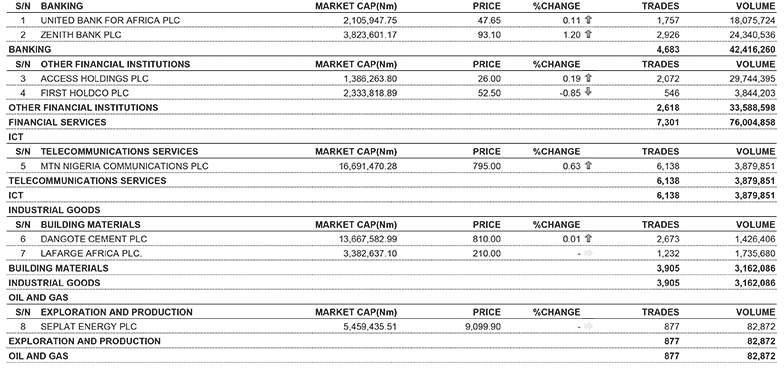
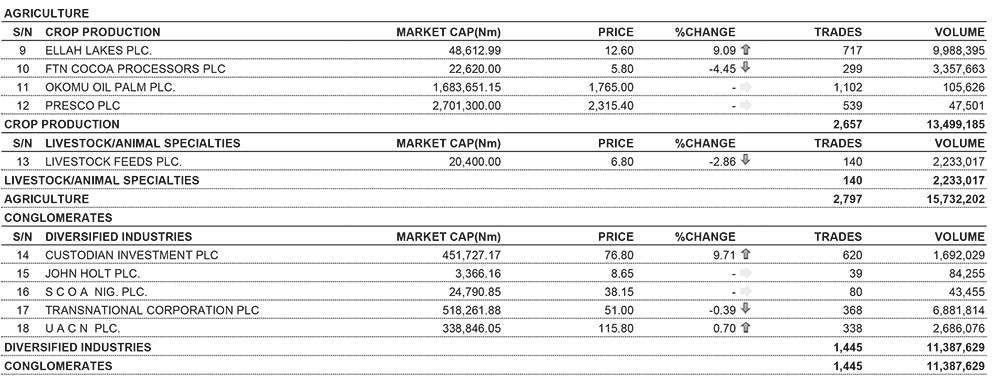
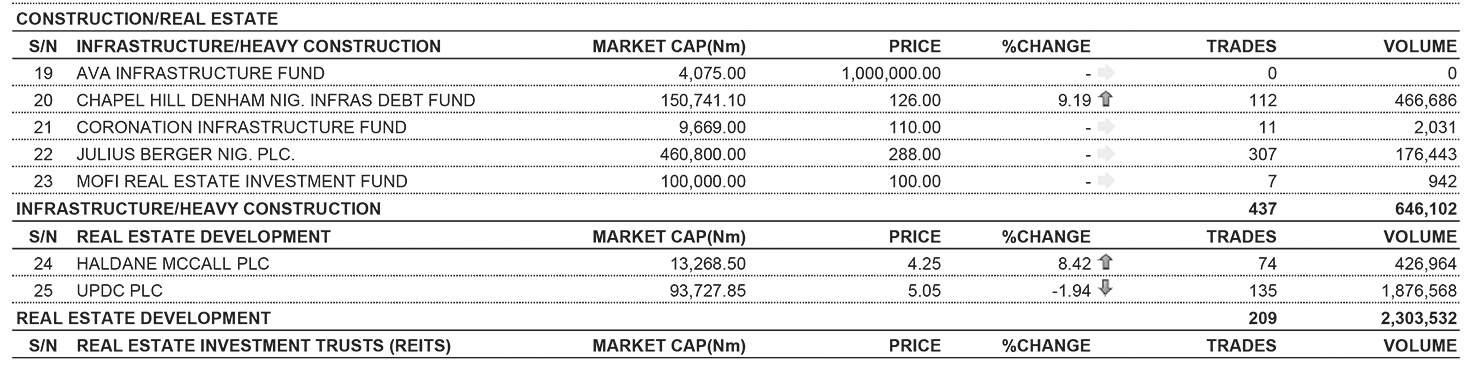
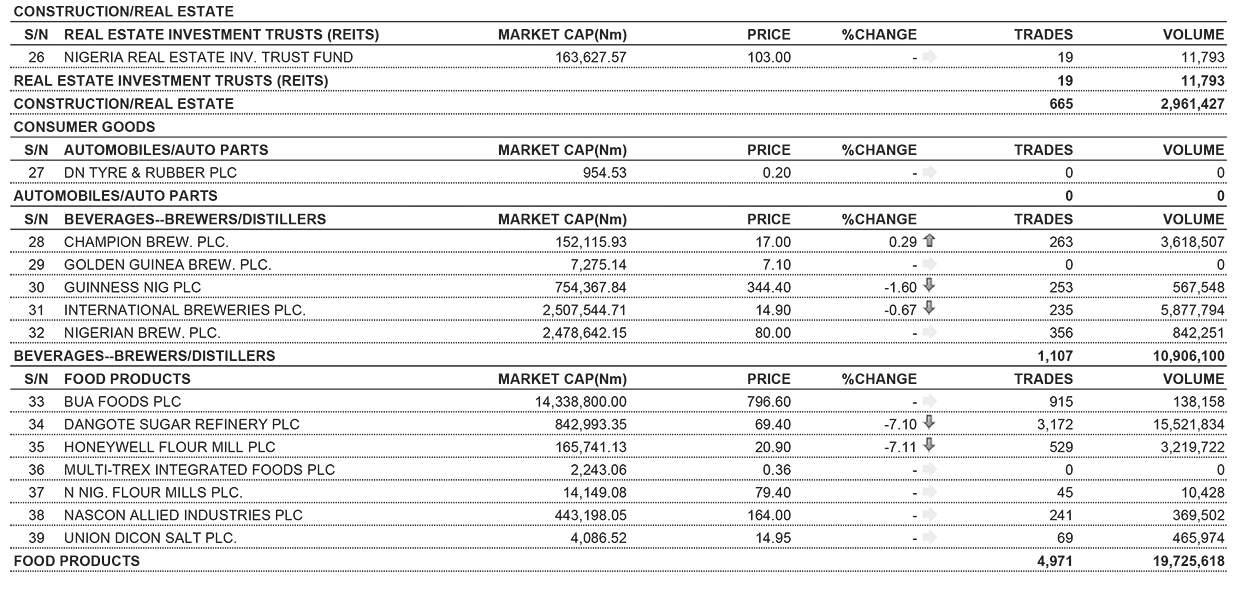
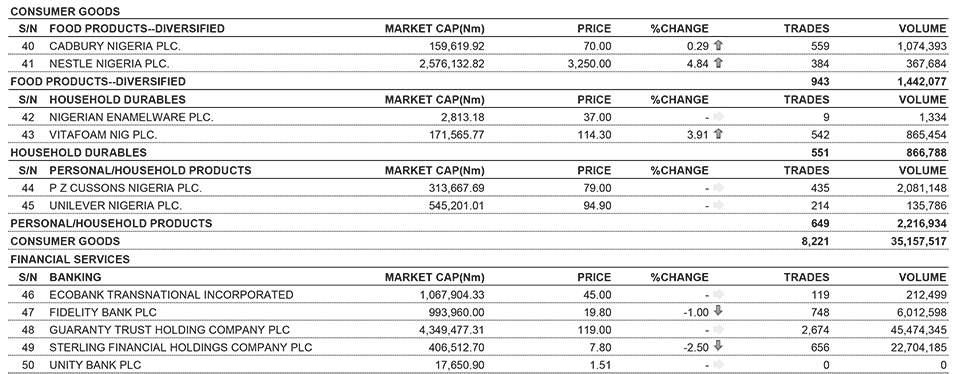
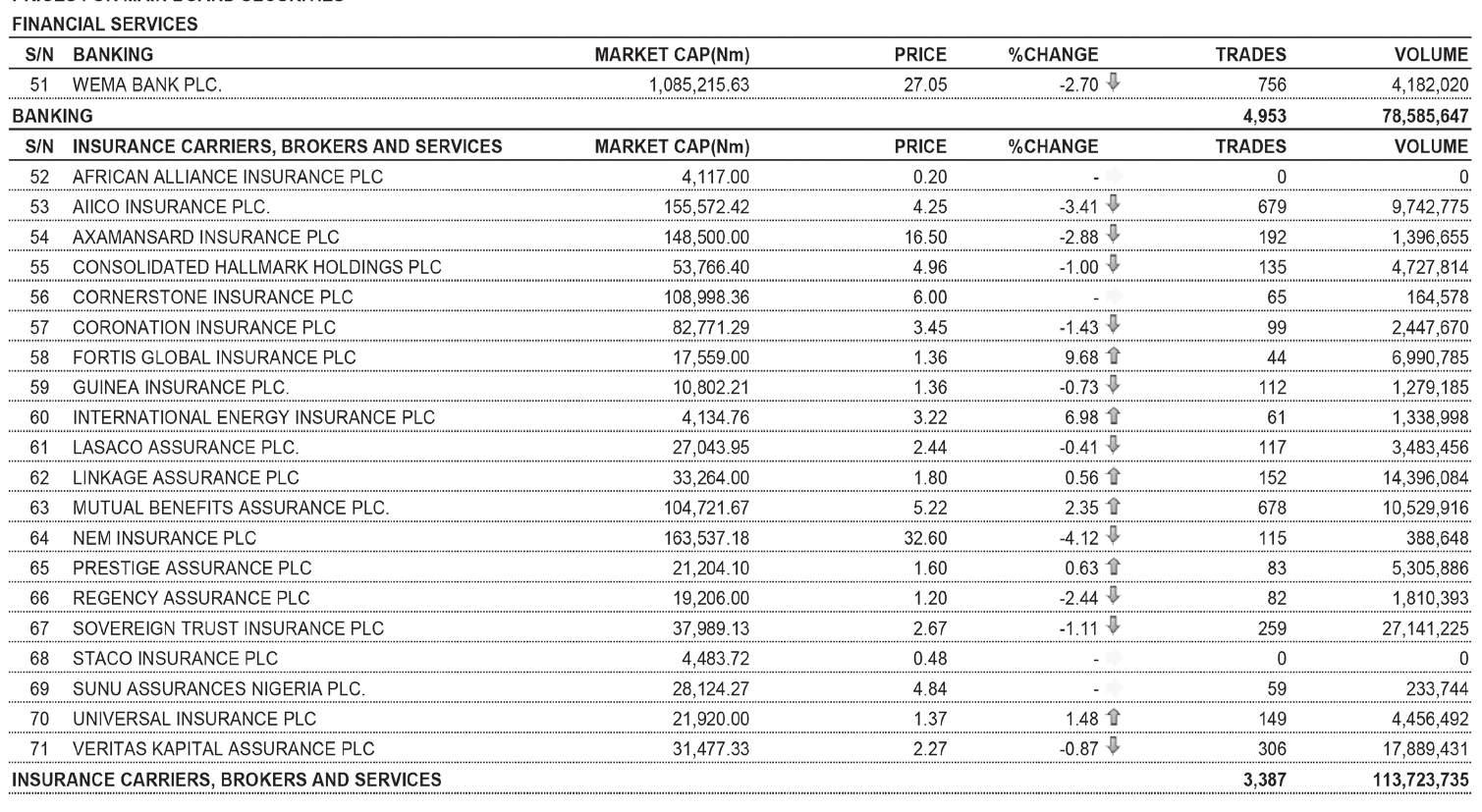

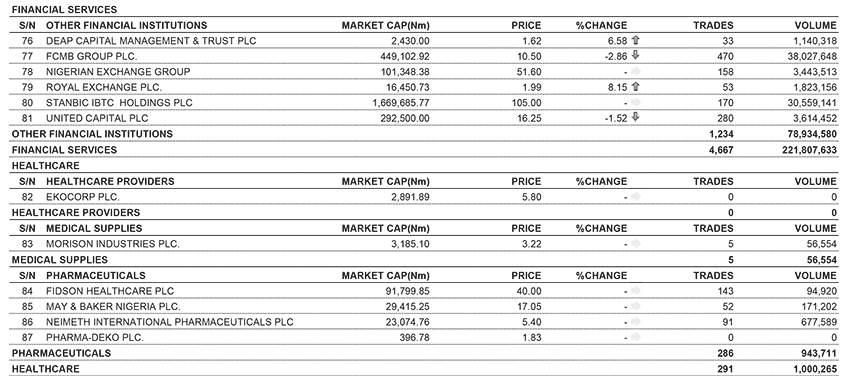
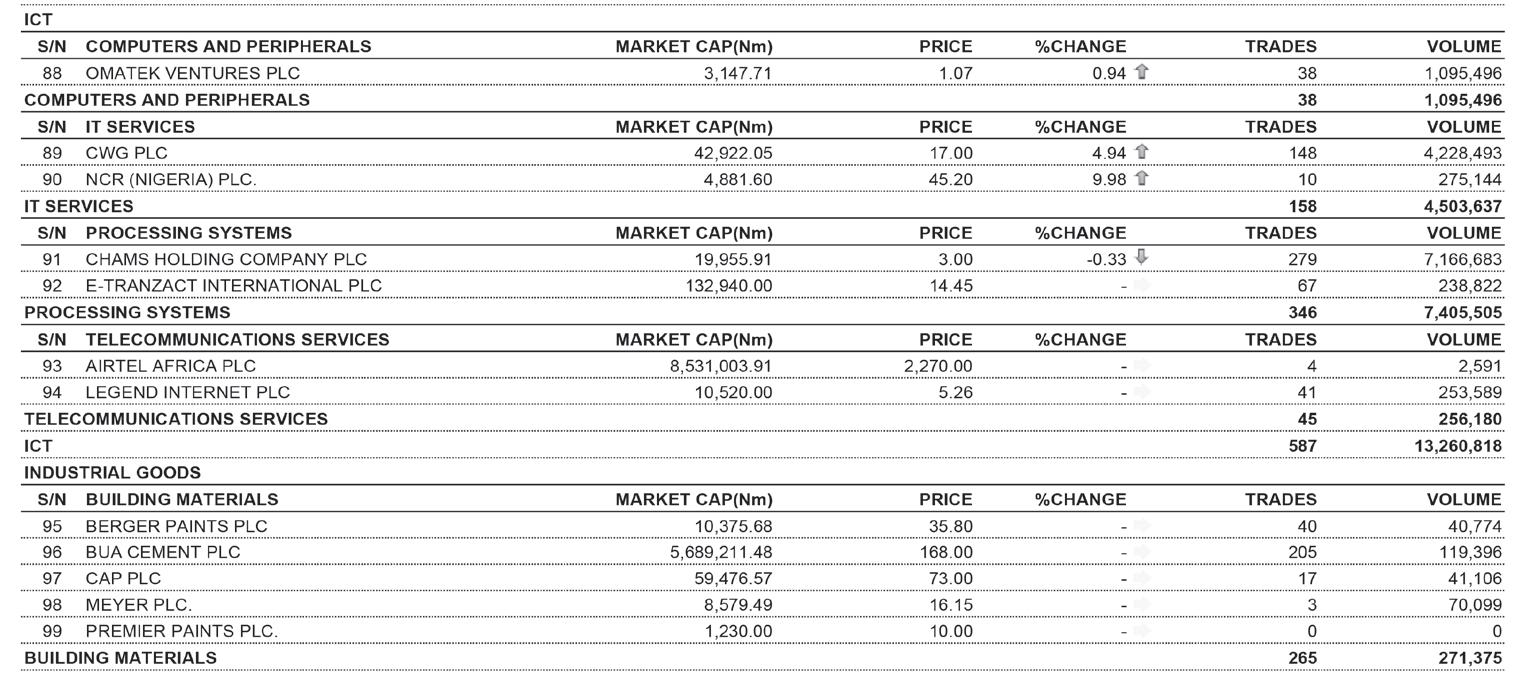
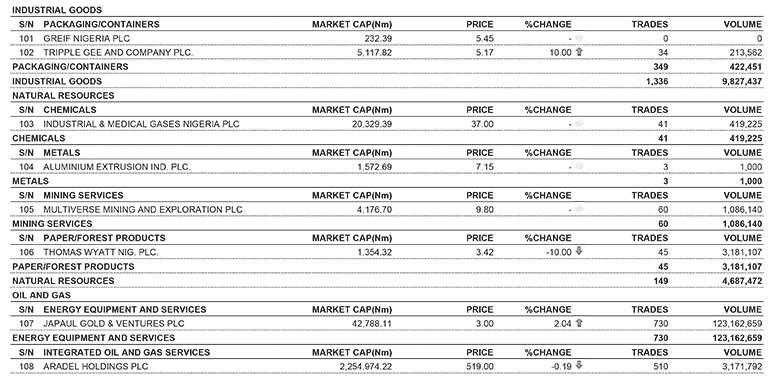
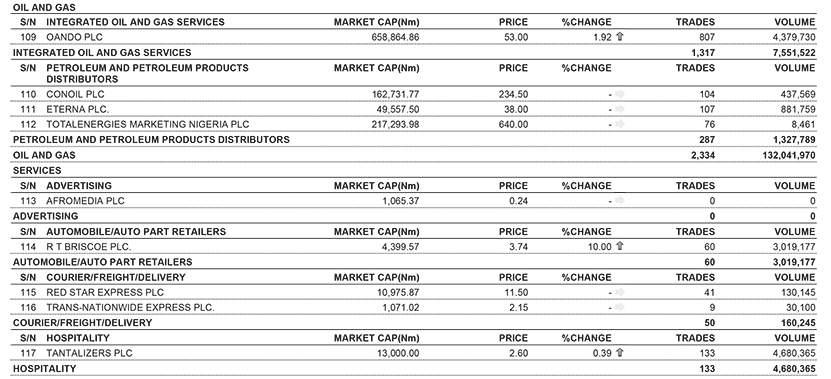
72 Hours of Hell, almost
By Emeka Oparah
For 72 hours, the fragile equilibrium of the Middle East has given way to the terrifying choreography of missiles, drones, sirens and counterstrikes. What began as coordinated strikes by Israel and the United States on Iran quickly spiralled into retaliatory barrages across Israel and US interests in the Gulf. The escalation was swift. The consequences, immediate.
From where I live in the United Arab Emirates, this is not an abstract geopolitical chess game. It is lived reality.
The UAE has absorbed a significant share of Iran’s retaliatory fire. Dubai, Abu Dhabi, Sharjah, Ras Al Khaimah and Al Ain have all witnessed either direct strikes or debris from intercepted projectiles. The country’s air defence architecture — the Terminal High Altitude Area Defense (THAAD) system — has functioned with remarkable efficiency, intercepting ballistic and cruise missiles and neutralising hundreds of drones. Official updates from the Ministry of Defense detail a technically impressive record of detection and interception.
But even the most sophisticated missile shield cannot intercept fear.
Dubai, arguably the Gulf’s most cosmopolitan hub, has felt the strain acutely. Strategic infrastructure — including Dubai International Airport and Jebel Ali Port — became early targets. Residential districts have not been spared from falling debris. While authorities have maintained disciplined communication and operational control, the psychological toll is palpable.
Emergency alerts flash across mobile phones. Residents are urged to seek shelter. Moments later, the sky erupts with loud booms — interceptions, we are told. Necessary reassurances. Yet each explosion is a reminder that steel and fire are arcing overhead.
Beyond the fear lies paralysis.
Airspace closures have grounded flights across the region. Thousands are stranded. Supply chains are wobbling. If hostilities persist beyond days into weeks, the effects will cascade: food logistics, medical supplies, fuel distribution. Global markets will not remain insulated. The Gulf is too central to energy and trade flows for the world to pretend otherwise.
War does not merely destroy buildings. It suspends normalcy.
Businesses have shifted to remote operations. Streets are quieter. Families calculate movements. Parents rehearse evacuation drills with children. Freedom — the mundane freedom to step outside, to drive, to gather — suddenly feels conditional. Government’s asurances of adequate food security are exactly what they are-assurances-because if the ensuing disruption of supply chains persist, then it will be a matter of time before hunger will be added to the equation.
And then there is the human ledger.
Casualties mount across Iran, Israel, the United States and parts of the Gulf. Lebanon has been dragged in. Lives have been cut short. Service personnel, civilians, bystanders — missiles do not discriminate. No defence system guarantees perfection. The mathematics of war always includes loss. Compounding the crisis is a secondary contagion: AI-amplified misinformation. Fabricated memos, recycled videos, digitally manipulated footage — all circulating at velocity. In an age where synthetic media can manufacture panic, the information battlespace is as volatile as the physical
one. Governments must fight on two fronts: intercepting projectiles and intercepting falsehoods.
Yet beneath the noise lies an uncomfortable truth: escalation is easier than restraint.
The assassination of leadership figures, retaliatory doctrine, alliance obligations — each side frames its actions as strategic necessity. But history is littered with conflicts that began as limited operations and metastasised into generational disasters.
Winston Churchill — hardly naïve about war — observed in 1954: “To jaw-jaw is better than to war-war.” It was a call for diplomatic engagement at the height of Cold War tension. The principle endures. Dialogue is slower, messier and politically inconvenient. But it is infinitely cheaper than reconstruction and burial.
The Middle East does not need another prolonged theatre of destruction. The global economy, already strained by supply shocks, regional wars and health crises, cannot easily absorb another protracted conflict. Nor can ordinary citizens — in Tehran, Tel Aviv, Dubai or beyond — afford the psychological and economic attrition of sustained hostilities.
War romanticised from afar is easy. War experienced from within is clarifying.
When sirens pierce the night and families descend into basements, abstractions disappear. What remains is a simple hierarchy of needs: safety, stability, survival.
Freedom, we are reminded, is not theoretical. It is the ability to move without calculating missile trajectories. It is the absence of emergency alerts at 2 a.m. It is the quiet assumption that tomorrow will resemble today.
Seventy-two hours have already altered that assumption.
The question now is not who can launch more missiles or intercept more drones. The question is who will summon the strategic courage to de-escalate. Who will choose jaw-jaw over war-war. Because in the end, no missile defence system can shield a region — or a world — from the cumulative consequences of pride, miscalculation and prolonged conflict. War is not good. It never has been. It never will be. Let no one deceive you otherwise, whether in the Middle East or South East Nigeria or South Sudan or war-weary Ukraine! And 72 hours are more than enough to prove it.
•Oparah, a public affairs analyst, sent this piece from the UAE.
Dubai’s Palm Jumeirah hit by missiles and drones
Burj Al Arab hotel, Dubai, hit by missiles and drones

Adesunmbo Adeoye: e mpowering Women, Strengthening Nigeria
adesunmbo adeoye is a powerhouse of inspiration, driving change and empowering women across Nigeria and beyond with her unstoppable passion for uplifting others. as we celebrate International Women’s day, her story highlights the impact one person can have on their community - her dedication to empowering women through the Inspiring Change Initiative has created a ripple effect, strengthening families, uplifting communities, and building a better nation. With a career spanning over 15 years, adeoye has founded a movement that has empowered thousands of women across Nigeria and beyond. Her approach to mentorship is holistic, focusing on creating systems of dignity, access, and real opportunity for women to thrive. Her commitment to empowering women has earned her numerous awards, including the “Outstanding Woman Entrepreneur” award. She’s a Cherie Blair Foundation ambassador, a Goldman Sachs scholar, and a recipient of the WEMa BaNK “She Empowers Her award”.
On March 7th, she will be hosting the 13th annual Inspiring Change Conference, a catalytic gathering of women in business, ministry, and career, focused on transformation, strategy, and spiritual renewal. In this interview with MArY NNAH, she speaks about her passion for empowering women, saying, “Empowering women is not a gender agenda, it’s a nation-building strategy
How has your experience as a woman in business shaped your approach to leadership and mentorship?
It has made me empathetic but firm. I understood early that empowerment without discipline produces dependency. So, I mentor women to become builders. I understand the silent battlesjuggling children, expectations, funding struggles, and self-doubt. So I mentor with structure, accountability, and compassion.
What are some of the most significant lessons you’ve learned from your experiences as a leader and entrepreneur?
I have learned that generosity accelerates growth. The truth is simple: when women are excluded, society operates below its potential. But when women gain access to finance, knowledge, and opportunity, households stabilize, children thrive, businesses expand, and communities prosper. That is why financial inclusion for women is not a gender issue. It is a development strategy, and above all, obedience to God sustains everything.
What inspired you to start the Inspiring Change Initiative?
The Inspiring Change Initiative was born out of my ceaseless desire to support entrepreneurial ideas through mentorship, advisory services, and training. It was a responsibility I took up after I completed a course in Entrepreneurial Management at the Enterprise Development Centre (EDC), Pan Atlantic University, 15 years ago.
Having seen incredibly gifted women shrink because of financial limitations, lack of exposure, or simply because no one believed in them, I realised something powerful: empowerment must be holistic. It is not just about preaching inspiration; it is about creating systems of dignity, access, and real opportunity.
That moment pushed me to pray, to dream bigger, and to begin building what has now become a life-transforming movement that has empowered thousands of women across Nigeria and beyond.
As the founder of the Inspiring Change Initiative, what drives your passion for empowering women?
I am driven by personal conviction. I believe without a doubt that when a woman rises, her home stabilises, society is better, and a nation is built.
As a wife and mother of four, I see daily how influential a woman’s stability, confidence, and financial strength can be. So, empowering women is not a gender agenda; it is, in fact, a nation-building strategy. I also want my daughter and sons to grow up in a society where women are equipped, confident, and economically empowered.
The 13th Annual Inspiring Change Conference is just around the corner. Can you tell us more about the event?
The 13th Annual Inspiring Change Conference is more than an event; it is a catalytic gathering. Each year, we bring

together women in business, ministry, and career for transformation, strategy, funding access, and spiritual renewal.
This year’s edition tagged : REFIRE TO HER’DVANCE will feature seasoned business leaders, wellness experts, and mentors who will address entrepreneurship, financial growth, mental resilience, and sustainable scaling.
We are also continuing our tradition of Empowerment grants, free training, and strategic partnerships. We have also included a Next Gen panel session in this edition to further highlight how people in their 20’s can RE-FIRE when life doesn’t go as planned.
Panelists include: Life Coach, David Adeoye; Culinary Expert and CEO, Diary of a Kitchen Lover Studio, Omotolani Tayo Osikoya; Manager, Internal Audit at Starsight Energy, Olujumoke Sowole; Group CEO of Lifepage, Dr. Oladipupo Clement; and MD, Bags Warehouseeng, Ijeoma Mojisola Helen.
Others are next generation panelists: Nino Idibia; Ese Ughulu; Ajaba Aderonke; Ayomide Ogunyomi, and Alademomi Princess.
What makes this conference unique?
I will say authenticity because the Inspiring Change platform is for real people with real issues, and we connect with them by being vulnerable with our stories of advancement, too.
Our speakers bare it all in a way that ignites hope in the attendees. We discuss how we lose and how we pick ourselves back up again.
It also gives our attendees access, and
I mean genuine access to mentors, access to the market, and access to possibilities. We don’t just motivate; we equip. We provide practical business tools, funding opportunities, skill acquisition programmes, and mentorship through platforms like the Inspiring Change deliberately. Mentor meets mentees and the entrepreneurial advancement trainees as a follow-up to the adoption of the women and girls in our community.
These communities cut across Lagos, Ilorin, Abeokuta, Ibadan, Port Harcourt, the UK, USA, Canada, and South Africa. It’s a powerful network of women committed to growth and accountability.
As a recipient of numerous awards, including the “Outstanding Woman Entrepreneur” award, what advice would you give to women aspiring to make a mark in their industries?
Awards are beautiful, but competence is greater. So build substance before visibility. Invest in personal development. Master your craft and be super competent. Building integrity as well as competence, with good character, is the greatest capital. Be consistent even when no one is clapping. And most importantly, don’t compete - collaborate.
How do you balance your various roles as a wife, mother, entrepreneur, and leader?
Balance is intentional, not accidental. I prioritise what matters per season. I delegate. I protect my spiritual life. I rest. And I accept that I cannot do everything at once. My family is my first ministry.
When that foundation is strong, every other role flows better.
What are some of the key challenges facing women in Nigeria today, and how can they be addressed?
Financial exclusion, limited access to funding, burnout, and policy instability are major challenges. Women need community, not just capital. Women don’t want handouts. They want platforms and an ecosystem that fortifies her through coaching, mentorship, accountability, and networks.
What message do you have for women who will be attending the conference?
Come expectant. Many past attendees have attested to the fact that the conference is a platform for progress, and a great way to key into this is to come prepared. Prepare to learn, unlearn, and prepare to network. Come ready to execute. This is not just a conference you attend; it is a decision point for your next level.
Can you share a personal story of a woman who has been inspired and empowered through your work?
We have had women who started with small-scale businesses - selling from home - who, after attending the conference and going through our training, expanded beyond Nigeria into international markets.
Women like Oluwatemilorun of Oretide Foods, attended the conference as someone who was just starting her crayfish packaging business with a paint bowl size and after the conference she got the courage to apply for a BOI grant for women and business and with the right access to mentorship she got the grant, scaled her business, infused digital tools into her sales to attract global market and she started exporting to UK, Canada and many other African countries.
Just 5years after, she has created jobs for so many others and built a food processing and packaging complex in Yaba, where they package and ship all kinds of African foods abroad. That shared access to knowledge and funding opportunities is what converted her small business into a scalable enterprise.
Today, she joins us to empower other women-led businesses, too, and I am so happy because it is shared prosperity. When Impactful giving should create another giver. One participant once told me she almost gave up on her business before attending. Today, she employs others. That is the ripple effect of empowerment. When a woman rises economically and then turns around to lift others, that is mobility.
How do you see the Inspiring Change Initiative evolving in the next few years? In the next few years, we are building structured funding pipelines, expanding our digital mentorship platforms, and increasing international collaborations.
Adesunmbo, husband, David and children
Dr. Esther Tonlagha: Bringing Hope and Succour to the Needy
In a society where many vulnerable people struggle for opportunity and support, individuals who dedicate their lives to uplifting others stand out as beacons of hope. One such person is deaconess (dr.) Esther Tonlagha, a respected humanitarian and community development advocate whose work continues to transform lives across delta State and beyond. Through the Esther Matthew Tonlagha (EMT) Foundation, she has championed initiatives focused on youth empowerment, healthcare support, education, and economic opportunities for underserved communities. driven by compassion and a strong belief that leadership must be rooted in service, dr. Tonlagha has positioned herself as a voice for the voiceless and a catalyst for meaningful social change. Uzoma Mba reports
In Africa, the genre of caring minds is mostly women, who for spiritual and moral burdens are silently doing so much to close the gap in political governance by promoting projects and programmes aimed at alleviating poverty and empowering the needy. This they do not just to earn a living but also, through creativity and entrepreneurship, add value to their communities and national development.
By all assessment parameters, Nigeria is blessed with scores of such caring women who are lifting up the hands of the needy in their communities by committing their financial resources, time and energy to transforming lives. Among these women with compassionate hearts, Deaconess (Dr.) Esther Tonlagha is, by God’s grace, standing out in view of her irrepressible zeal to transform lives and communities in Delta State and, by extension, other states across Nigeria.
The frontline advocate for community development and respected humanitarian leader has, for the past few years, been working to protect and promote the fundamental rights of people globally through her civil advocacy group, the Esther Matthew Tonlagha (EMT) Foundation.
A FOUNDATION DRIVEN BY COMPASSION
The EMT Foundation, which aims to reduce delinquency, promote self-reliance, and foster the transformation of rural communities, has since its establishment remained committed to empowering individuals and fostering sustainable transformation in underserved communities.
Through a wide range of programmes and initiatives, the foundation has continued to provide opportunities for people who otherwise might not have access to resources capable of improving their lives and livelihoods.
Tonlagha emphasised the vital role women continue to play in nurturing families and shaping societies. She said: “With all sense of joy, I know that our women have consistently exhibited this trait at family level through the proper upbringing of the young ones and at social, economic and political levels by other value-laden roles that cannot be denied by even the most gender-insensitive people globally.
“As global leaders, particularly the men, join billions of women in the world on this very special day that holds great promises for women and young girls and great potential of transforming our lives, families and communities, I want to align my views with Melinda Gates’, one of the world’s gender-sensitive and social justice crusaders, who said ‘when we invest in women and girls, we are investing in the people who invest in everyone else’.”
Since establishing her foundation, Dr. Tonlagha has continued raising her voice not so she can shout, but so that those without a voice can be heard, maintaining that society cannot succeed when half of its population is held back.
EMPOWERING COMMUNITIES FROM THE NIGER DELTA
From her Effurun, Delta State operational base, Dr. (Mrs.) Tonlagha has been leveraging the EMT Foundation platform to foster community development through youth empowerment programmes, education support initiatives, and health interventions.
Her work has also extended to actively supporting entrepreneurs, schoolchildren, and sickle cell warriors, particularly in the Niger Delta region.
Spurred by her strong belief that genuine leadership is rooted in service and the capacity to transform lives, this woman leader of substance has, through her unwavering commitment to social justice and community empowerment, inspired scores of young men and women to become agents of positive change.
These young people, many of whom have benefited from the foundation’s initiatives, are now contributing to socioeconomic development within their communities, demonstrating

resilience and determination in building better futures.
SKILLS ACQUISITION AND YOUTH DEVELOPMENT
According to Tonlagha, some of the key initiatives recently undertaken by the foundation include the training of 36 graduates in July 2025 in various vocational skills.
The trainees were equipped with practical knowledge in cake-making, fashion design, makeup artistry, gele styling, culinary arts, and salon services.
Speaking during the graduation ceremony, Dr. (Mrs.) Tonlagha described the occasion as a celebration of courage, growth, and possibility.
She enthused: “These are not just skills; they are tools of empowerment. Whether you start a business, support your family, or teach others, your hands now carry the power to build something meaningful.
“Keep learning and stay curious. Let your creativity flow. Do not be afraid to take up space, your talent deserves it.”
The programme, according to the foundation, was designed to give participants practical tools that would enable them to build sustainable livelihoods and become financially independent.
COMMENDATION FROM GOVERNMENT LEADERS
The initiative also attracted commendation from public officials and community leaders who acknowledged the positive impact of the EMT Foundation.
In his remarks during the event, the Speaker of the Delta State House of Assembly, Rt. Hon. Emomotimi Dennis Guwor, who was represented by Pastor Ambrose Omafuwe, praised Dr. Mrs. Tonlagha for her humanitarian contributions and commitment to societal
development.
The lawmaker emphasised the significance of the empowerment initiative, stating:
“This is more than a graduation—it is a statement of hope, dignity, and transformation. From free medical outreaches in creek communities to renovating the Okenrekonko Cottage Hospital, EMT’s work continues to impact lives.”
His remarks reflected the growing recognition of the foundation’s efforts in improving lives and strengthening communities.
BENEFICIARIES SHARE THEIR STORIES
For many beneficiaries, the EMT Foundation’s programmes represent life-changing opportunities.
One of the beneficiaries, Alero Excel Efi, described her selection for the programme as a life-changing opportunity. She recounted how she came across the programme unexpectedly and expressed deep appreciation to the EMT Foundation for what she described as a transparent and impactful initiative.
Similarly, in December 2025, the foundation organised a Youth Empowerment Programme through which 30 young entrepreneurs and market women were empowered with N500,000 each to expand their businesses, bringing the total support to N15 million.
One of the beneficiaries, Onochie Dumebi Elvis, expressed heartfelt appreciation to the foundation while sharing his experience and plans for the future.
He said: “I am one of the students who were empowered for the small scale business program. It is really impressive, and it’s a very huge something. This is not small and at least for someone who is starting a small scale business, this is a strength and I believe it will boost everything I am going to do in my business.
“It will help my business, and it will give me all the energy I deserve. So I want to say thank you very much, ma, God bless you, may you never lack, may things go well for you and your family, may you live long to see every of your children grow in peace and unity. Thank you very much once again, Mrs. Esther Matthew Tonlagha.”
HEALTH AND WELLNESS INTERVENTIONS
Beyond economic empowerment, the EMT Foundation has also prioritised healthcare support through medical outreach programmes and health initiatives designed to bring essential care to underserved communities.
These interventions aim to ensure that vulnerable populations have access to quality healthcare services regardless of their circumstances.
In a country where over 150 million Nigerians lack access to primary healthcare, the foundation has also provided N20 million in support to about 200 individuals living with sickle cell challenges.
This intervention has provided financial relief and renewed hope to families struggling with the burden of managing the condition.
EDUCATION AND COMMUNITY DEVELOPMENT
The EMT Foundation has also demonstrated strong commitment to education by distributing learning materials including school bags, books, and pens to students in local schools in the Gbaramatu Kingdom in Delta State.
Through skills training in areas such as culinary arts, fashion design, events management, and salon services, the foundation has continued empowering hundreds of individuals with the knowledge and practical expertise required to build brighter futures.
In furtherance of its economic empowerment goals, the foundation has introduced mentorship and guidance programmes aimed at equipping people with the tools, confidence, and opportunities required to achieve financial independence.
Its community development initiatives also prioritise strengthening social bonds, encouraging collaboration, and creating environments where dignity, resilience, and shared growth can flourish at the grassroots.
A MISSION ROOTED IN EQUALITY AND INCLUSION
According to information sourced from the foundation’s platform, compassion remains the driving force behind its interventions.
“At EMT Foundation, compassion is more than a feeling, it is a force that transforms lives. Guided by empathy, we turn care into action by supporting individuals and families facing hardship in our community. From providing essential resources to offering emotional support and advocacy, we strive to alleviate suffering and restore hope.
“Every initiative we undertake is rooted in the conviction that no one should feel alone in adversity. By standing with those in need, EMT Foundation helps build resilience, dignity, and a stronger, more compassionate community for all.
“At EMT Foundation, our objectives come to life through practical programs that directly serve individuals and communities.”
Commenting on the guiding principles of the foundation, Dr. (Mrs.) Tonlagha maintained that the EMT Foundation remains dedicated to improving the quality of life for individuals and communities through a holistic approach that combines healthcare services, educational advancement, economic empowerment, and sustainable community development.
She explained that the foundation was created to provide young people with the training, support, and financial assistance needed to build sustainable livelihoods, noting that many young entrepreneurs possess innovative ideas but lack the capital required to turn them into viable ventures.
Speaking further on equality and inclusion, she stated:“At EMT Foundation, we believe that equality is more than a principle, it’s a promise. It means ensuring that every individual has the same opportunities and rights, regardless of race, gender, ethnicity, religion, sexual orientation, disability, or socioeconomic background. Equality is the foundation of a fair society, and it’s at the core of everything we do.
“But equality alone is not enough. That is why we champion inclusion. Inclusion is about belonging, making sure that diverse voices are not only present but empowered. It means actively involving those who have been historically marginalized or disadvantaged, and creating spaces where everyone feels valued.
Supporting women and children through the Esther Mathew Tonlagha Foundation
Dr. (Mrs.) Tonlagha
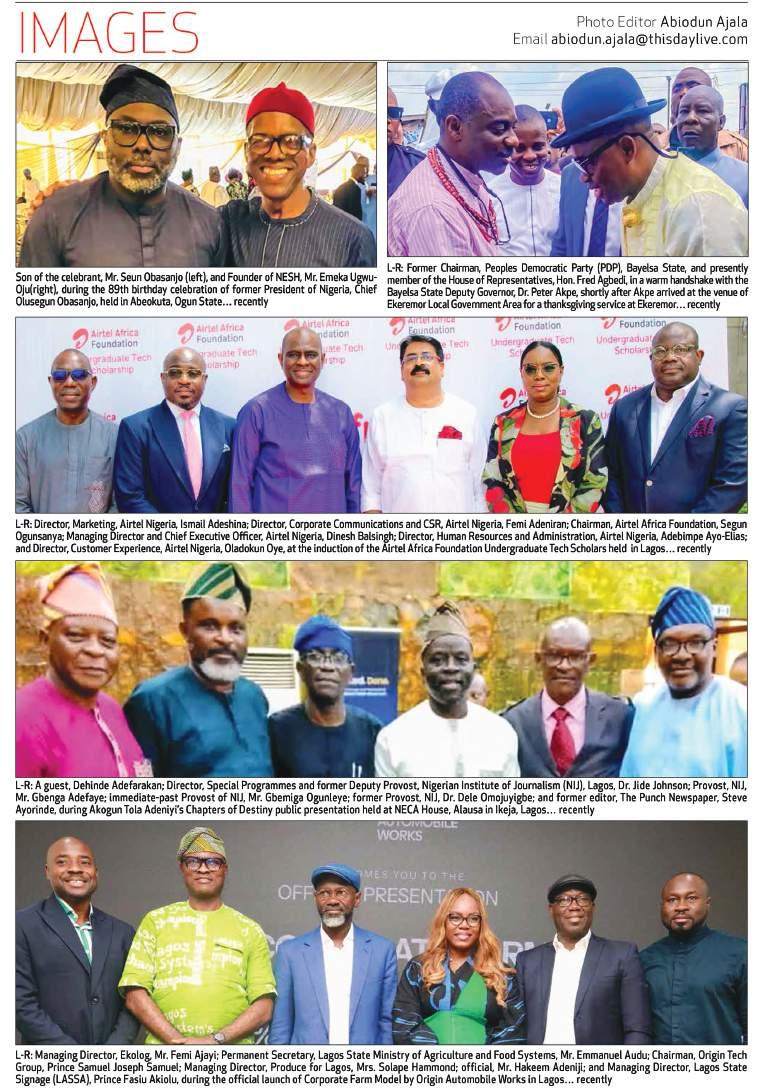
Summit: Benue Stakeholders Re-commit to Ending Out-of-School Crisis
George Okoh in Makurdi
The Benue government, through the State Universal Basic Education Board (SUBEB), recently held an educational summit to achieve the goal of zero out-of-school children.
It was organised in collaboration with the Universal Basic Education Commission (UBEC), the National Commission for Almajiri and Outof-School Children Education (NCAOOSCE) and Universal Learning Solutions (ULS).
The summit, held at the Moses Orshio Adasu University, Makurdi, with the theme ‘Innovative Strategies for Addressing the Menace of Outof-School Children: Enhancing Enrolment and Retention of Children in Basic Schools’, brought together key stakeholders in the education sector, religious and traditional leaders, to chart a new course for tackling the growing challenge of out-of-school children.
Governor Hyacinth Alia, in his opening remarks, reaffirmed his administration’s commitment to free and compulsory basic education for every child in Benue State, saying that access to education remains a fundamental right that must not be denied to any child.
He commended UBEC for supporting Benue and choosing the state for the flag-off of the distribution of school kits, and promised that the gesture would not be taken for granted. He noted that the quality of basic education in the
state greatly improved under his watch.
“We must now move from building schools to building futures. It is in this spirit that we convened this summit,” the governor said, stressing that the gathering was designed to generate actionable strategies anchored on international best practices.
He described the summit as more than a policy dialogue, saying that it marked the launch of a historic project aimed at guaranteeing access to compulsory education and ensuring that every Benue child is enrolled in school.
As part of efforts to curb the menace of out-of-school children, Governor Alia launched the Brace Up Project and inaugurated student marshals across all local government areas to monitor and identify out-of-school children within their communities.
“To demonstrate our political will, I will donate a bus and a Hilux van for Project Brace Up,” he announced.
The governor reassured citizens that basic education in the state remains free and urged parents and guardians to take advantage of the opportunity.
He also commended teachers for their tireless dedication to advancing education in the state.
Alia commended the Chairman of Benue SUBEB, Dr Grace Adagba, for her “dedication and relentless effort in ensuring that basic education in the state remains a moving train,” urging stakeholders and community leaders to forge partnerships to strengthen the system.
He said that since Adagba assumed office, enrolment in schools has increased and school infrastructure has greatly improved.
The governor also thanked the NCAOOSCE for handing over data of out-of-school children to the state government, saying that school supplies have already been provided for the first 525 children reintegrated into the school system.
“Let me assure the commission that the government will continue with the initiative until out-of-school children are fully reintegrated,” he said, while thanking UBEC, UNICEF and ULS for providing additional school materials.
Former Governor Gabriel Suswam identified poverty as a major factor driving the out-of-school crisis in Nigeria, describing the national figures as alarming and requiring decisive intervention.
The Tor Tiv, Prof James Ayatse, called for the integration of religious and traditional leaders in the campaign against out-of-school children, saying that they would play a critical role in reversing the trend. He solicited support for the governor, saying that he has done so much for the sector and should be encouraged to do more.
The Executive Secretary of NCAOOSCE, Dr
Muhammad Idris, disclosed that the commission had identified over 700,000 out-of-school children nationwide and described Alia as “the only governor in the country to have those discovered in this state registered in school”.
“It is our prayer that at the end of your tenure as governor, Benue will record zero out-of-school children,” Idris added.
The Executive Secretary of UBEC, Hajiya Aisha Garba, commended Benue for its tangible reforms in the basic education sector. She also highlighted the recent reforms introduced by UBEC, which enabled states to access over N100 billion in counterpart funding.
“What we are doing is to ensure that no child is left behind, and central to what we are doing is the reform of UBEC,” she said.
Presenting the governor’s scorecard, Adagba said the state had aligned with national education targets, revived free nursery public schools, expanded early childhood education and improved infrastructure and security in schools. She disclosed that over 9,000 teachers have been employed, with improved welfare packages, including the payment of Teachers Registration Council of Nigeria (TRCN) allowances and the implementation of a harmonised retirement age for teachers.
NOTE: Interested readers should continue in the online edition on www.thisdaylive.com
Gov Mbah to Construct Access Road for FEDPOLY Ohodo
Governor Peter Mbah recently hosted members of the governing council and management of Federal Polytechnic, Ohodo, Igbo-Etiti LGA of the state, pledging his government’s support for the institution’s infrastructural development.
He promised to construct the seven-kilometre road leading to the polytechnic from the OtukpoObollo-Afor-9th Mile-Enugu Road, promising that his administration would support the institution in becoming a citadel of excellence in technological, engineering, and skills training.
Members of the governing council and management, led by the Chairman, Senator Emmanuel Ocheja, had on February 12 visited the governor for the first time since the institution’s establishment to inform him of the progress and challenges facing the institution.
The visit was facilitated by the member representing Nsukka Igbo-Eze South Federal Constituency at the National Assembly, Hon. Chidi Mark Obetta.
In his response to Ocheja’s requests, the governor further directed the Commissioner for Education, Prof Ndubueze Mbah, to liaise with the polytechnic’s authorities to determine critical areas of need where the state government could render support. He also promised to resolve the lingering issue of non-payment of compensation to landowners who had donated hectares of land for the institution’s permanent site.
The governor added that the institution will be a highly valuable partner in the realisation of the government’s science, technical and vocational capacity development for youth under the Smart Green School Initiative of the administration,
which is expected to produce 260,000 technically inclined students annually.
While commending the polytechnic for the giant strides it has made in its short period of existence, he noted that the state government has a robust scholarship scheme that will encourage youths in their academic endeavours.
Ocheja highlighted in his presentation the achievements recorded by the institution within five years of its existence, especially the commencement of academic programmes, the accreditation of some courses by the National Board for Technical Education, and the subsequent admission of students across four schools.
He also recounted the construction of classroom blocks through TETFund sponsorship and sought the support of the state government and other stakeholders in addressing the institution’s challenge of low student enrolment.
“Our polytechnic was designed to bridge skills gap, expand access to quality technical education and empower our youths to become self-reliant contributors to national and state development,” he stated.
The council chairman noted that the polytechnic took cognisance of the Enugu landscape and keyed into the state government’s policy initiative to produce skilled graduates who would become drivers of technical development. He commended the governor for
prioritising education as the pillar of the government’s development initiatives, describing the allocation of 33 per cent of the state’s annual budget to the education sector as remarkable.
“A thriving Federal Polytechnic Ohodo would produce skilled, job-ready graduates who directly fuel your agenda for industrial growth, entrepreneurship and a knowledge-driven economy, thereby complementing your Smart Green Schools and new Science Technical and Vocational (STV) institutions,” he explained.
He applauded the ultra-modern science, technical and vocational schools constructed by the Mbah administration in each of the 260 wards of the state as legacy projects capable of turning the state into
a hub of science and technical growth. According to him, these transformative efforts resonate with the polytechnic’s core mandate to equip young Nigerians with practical, industry-related skills that drive job creation, entrepreneurship, and sustainable economic growth.
The chairman said that 105 hectares of land had been secured for the institution’s permanent site, but noted that no compensation had been paid to the landowners. He said that the host community had approached the management with their reservations and had appealed to the governor to use his good office to resolve the matter and ensure the requisite compensation for the landowners.
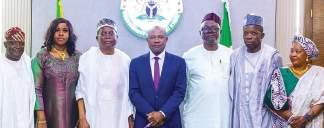
WISCAR Graduates 11, Strengthens Push for Structured Female Leadership
Funmi Ogundare
Eleven mentees graduated over the weekend at the WIN-with WISCAR mentoring programme, aimed at building leadership capacity among women and expanding their professional network.
Speaking with journalists at the graduation ceremony of the WIN 3 cohort five mentees in Lagos, versatile business leader and founder of Women in Successful Careers (WISCAR), Mrs Amina Oyagbola, expressed satisfaction with the growing impact of the organisation’s mentorship programme and its transformative value.
She noted that WISCAR’s continuous improvement model has ensured stronger outcomes in each successive cohort. According to her, feedback from beneficiaries remains the most credible measure of the programme’s success.
“I think we improve with every single cohort. We get better because we have a model of continuous
improvement,” she said.
Oyagbola explained that the initiative was deliberately designed not only to build leadership capacity among women but also to expand their professional networks and access to opportunities.
“We are designing a programme that will not just build capacity and capability for women in leadership to advance in their careers in an accelerated fashion, but also provide a platform to expand and enhance their networks,” she stated.
She expressed excitement about the WISCAR team and advisory board for sustaining the programme’s quality, adding that the organisation intentionally deepens the mentorship experience through activities such as speed mentoring, structured networking, and cross-generational conversations.
She noted that discussions at the event, particularly on reverse mentoring, offered valuable insights into the evolving world of work and the mindset of different generations.
The founder explained that the idea for WISCAR was inspired by her participation in the Africa Leadership Initiative, West Africa (ALIWA), where she was challenged to move from personal success to societal significance through a venture that would positively impact others.
Oyagbola noted that although she had informally mentored many women in the past, she identified a gap in structured mentorship and set out to build a clear, values-driven framework that busy professional women could commit to.
Restating key achievements, she said that WISCAR remains focused on scaling its programmes to reach more women through its WIN1, WIN2 and WIN3 streams, as well as newer specialist initiatives.
She cited the Women-in-Law mentorship programme, focused on advancing gender justice and increasing women’s representation across the legal ecosystem, as one of the organisation’s recent expansions. The programme completed its first batch last year and is expected to graduate its second batch this year.
Looking ahead, Oyagbola disclosed that “WISCAR is preparing a series of activities for International Women’s Day and its annual conference, where the theme and distinguished WISCAR awardee for the year will be announced”.
The Executive Director of Operations at Stanbic IBTC Bank, Funke Amobi, encouraged the mentees to transition from ambition to structured execution, stressing that sustained impact in leadership requires discipline, accountability and intentional growth. She described the event as “a movement from intention to execution, from aspiration to structure and clarity, from potential to disciplined leadership”.
From Left: Member, Governing Council, Federal Polytechnic Ohodo, Hon. Lawrence Adekunle; council member, Mrs. Vicky Ume; Chairman Governing Council, Senator Emmanuel Ocheja; Enugu State Governor, Peter Mba; Rector, Dr. Emmanuel Agada; council members, Rt. Hon. Abdulmumini Mohammed Kundak and Hajiya Jamila Salman, during the council and the management’s visit to the governor recently

Atiku, Mark, Abiodun, Adeleke Felicitate Former President Olusegun Obasanjo at 89
Okocha in
Prominent Nigerians have continued to celebrate former President Olusegun Obasanjo on his 89th birthday, praising his lifelong service and dedication to Nigeria.
Former Vice President Atiku Abubakar, in a message on X, described Obasanjo’s life as “defined by service, courage, and an enduring commitment to Nigeria”.
He highlighted the former president’s contributions to national unity and development, calling his journey “remarkable” and his impact “truly significant.”
Atiku wrote regarding Obasanjo, “His life stands as a testament to leadership and devotion to the
Nigerian project. I pray that God continues to bless him with good health, strength, and many more years of impactful service to our nation and humanity.”
David Mark
National Chairman of African Democratic Congress (ADC) and former President of the Senate, Senator David Mark, described Obasanjo as a statesman of remarkable courage, discipline, and enduring commitment to the unity, stability, and progress of Nigeria.
In a goodwill message, Mark stated that Obasanjo’s decades of service to the country, both in military and civilian leadership, had left an indelible mark on Nigeria’s political history and democratic development.
“Chief Olusegun Obasanjo remains one of the most prominent figures in Nigeria’s national journey. His dedication to nation-building, democratic governance and the pursuit of peace and stability in Africa continues to inspire generations of leaders,” Mark stated.
He added that the elder statesman’s wealth of experience, forthright counsel, and consistent advocacy for good governance had continued to shape national discourse and strengthen democratic institutions.
Dapo Abiodun
Ogun State Governor, Dapo Abiodun, described Obasanjo as an enduring study in leadership, public service, and national responsibility for younger generations.
Abiodun spoke during the 89th birthday lecture in honour of the elder statesman, with the theme, “The Global Africa Enlightenment: From Chains to Renaissance,” held at Olusegun Obasanjo Presidential Library (OOPL), Abeokuta.
According to the governor, national development depends on strong institutions and leaders who are willing to think beyond immediate interests.
He stated that the theme of the lecture reflected Africa’s historical journey — from the experience of colonial domination to the ongoing pursuit of dignity, development, and progress.
Abiodun stressed that the future of Africa lay in strengthening institutions, investing in knowledge, and building societies that upheld justice,
innovation, and unity.
Ademola Adeleke
Governor of Osun State, Senator Ademola Adeleke, praised Obasanjo’s lifelong commitment to Nigeria.
Adeleke said Obasanjo bled himself on the field as a military officer to secure and preserve the country, and as a civilian leader, he undertook initiatives that healed wounds and enhanced unity.
He applauded the former president for harnessing the immense potential that came with Nigeria’s diversity during his administration.
The governor saluted Obasanjo for the discipline and courage he showed in the face of daunting challenges, implementing reforms and actionable policies to get Nigeria
TINUBU OVERSEES HISTORIC RESOLUTION OF 15-YEAR-OLD OPL 245 DISPUTE
Deji Elumoye in Abuja
President Bola Tinubu yesterday supervised the successful conclusion of a historic settlement agreement between the Federal Government of Nigeria, ENI, and Nigerian Agip Exploration Limited (NAEL).
The resolution, according to a release issued by presidential spokesperson, Bayo Onanuga, was at a closed-door meeting
held in the president’s office at State House, Abuja.
The crucial meeting was attended by Chief Executive Officer of Eni, Claudio Descalzi; Chief Operating Officer of Eni, Guido Brusco; Head of Sub-Saharan Region, Mario Bello; Managing Director of Nigerian Agip Exploration, Fabrizio Bolondi; and Special Adviser to the President on Energy, Olu Verheijen.
The agreement brought to a
close the long-standing dispute over Oil Prospecting Licence (OPL) 245, paving the way for the development of one of Nigeria’s most significant deepwater resources.
The agreement, signed in Abuja, marked the resolution of a dispute spanning more than 15 years and restored clarity and stability to an asset widely recognised as one of Nigeria’s most commercially promising deepwater blocks.
With the dispute now settled, the pathway is clear for Final Investment Decision on the Zabazaba–Etan development, a project capable of adding approximately 150,000 barrels per day to Nigeria’s oil production capacity and strengthening the country’s long-term energy outlook.
Tinubu described the agreement as a strategic milestone in Nigeria’s economic reform agenda, reaffirm-
ZAMFARA GOVERNOR, DAUDA LAWAL, SET TO JOIN APC, DICKSON DUMPS PDP, JOINS NDC
the opposition parties struggle to find their footing.
Authoritative sources within the APC disclosed to THISDAY yesterday that the governor had recently held meetings with members of his cabinet, political associates and other stakeholders in the state capital, Gusau, to deliberate on the political direction of the state and the implications of remaining in the PDP amid the opposition party’s lingering internal challenges.
According to the insiders, the possibility of defecting to the ruling party featured prominently during the consultations, with the movement expected to happen latest by the end of the Muslim fasting period.
The development comes amid growing pressure from political groups and influential figures in Zamfara who have been urging Lawal to align with the ruling party at the federal level. The groups argue that such a move would strengthen cooperation with the federal government and improve access to resources needed to tackle the state’s security and development challenges.
Zamfara has for years battled persistent banditry, kidnapping and rural violence, issues that have strained the state’s finances and security infrastructure. Some stakeholders believe that aligning politically with the party controlling the federal government could enhance collaboration in addressing these challenges.
Several political groups and community leaders in the state have in recent weeks openly appealed to the governor to consider joining the APC, arguing that political alignment with the centre could accelerate development projects and security interventions.
The pressure intensified following recent defections involving some political actors in the state, including lawmakers and party
leaders who have switched allegiance from the PDP to the APC.
Fueling the speculation further, Lawal recently hinted at the political disadvantages of remaining outside the ruling party, suggesting that his refusal to join the APC had affected Zamfara’s access to certain benefits at the national level.
Speaking during a recent interaction with stakeholders, the governor lamented that the state had not been “sharing in certain things nationally” because he had chosen not to join the ruling party. Though he did not explicitly mention defection plans, the comment was widely interpreted as a reflection of the political pressures facing opposition governors.
The governor said Zamfara had not received any federal intervention funds beyond statutory allocations since he assumed office in 2023.
“I know states that have received over N500 billion from the federal government as palliative, but I have never received anything. I think the reason I don’t get it is because I’m not in the APC,” he said.
He alleged that states controlled by the ruling APC had received significant financial support meant to cushion the impact of the fuel subsidy removal and rising cost of living.
Such remarks have been interpreted as preceding major party switches in Nigeria’s political landscape, where governors sometimes seek alignment with the federal ruling party to strengthen their bargaining power and access to federal programmes.
Lawal, a former banker, won the 2023 governorship election on the PDP platform after defeating the incumbent APC administration in Zamfara, a victory that was seen at the time as a significant upset in the North-west political landscape. However, with the PDP facing persistent internal divisions at
the national level and the APC consolidating power in several states, speculation has grown that more opposition governors could consider switching camps as political calculations ahead of future elections begin to take shape.
When the defection eventually materialises, it would mark a major political shift in Zamfara and strengthen the APC’s influence in the North-west. It would also represent another setback for the PDP, which has been struggling to maintain cohesion amid internal disputes and defections.
Meanwhile, a former Bayelsa State governor and Senator representing Bayelsa West, Seriake Dickson, has formally defected from the PDP to the Nigeria
of the UN House solar project.
Aliyu said a comprehensive nationwide mapping exercise by the agency identified approximately 143,000 communities at varying levels of electricity access. While some are fully electrified, many remain underserved, and a significant number have no access at all.
The mapping, he explained, cuts across Nigeria’s demographic spectrum — from sprawling urban centres with over 2.5 million households in Lagos State to remote settlements with as few as two households.
By layering technical data with cost analysis, the REA concluded that $23 billion represents the least-cost pathway to strengthening supply in underserved areas and connecting those without power.
Aliyu described the funding requirement not as an abstract figure but as a clear signal of the work ahead if Nigeria is to achieve universal electricity access while pursuing a cleaner energy future.
The United Nations’ Resident and Humanitarian Coordinator in Nigeria, Mohammed Fall, described
Democratic Congress (NDC), citing the deepening crisis within the opposition party and the need to build a credible democratic alternative.
Dickson announced his decision while addressing journalists and supporters, saying the move followed extensive consultations with political associates across the country.
He expressed gratitude to his constituents and the people of Bayelsa State, who had supported his political career over the years, including his two-term tenure as governor and his current mandate as senator representing Bayelsa West.
Continued on page 42
the solarisation of the complex as both symbolic and strategic.
He said the installation, a 400-kilowatt peak solar photovoltaic microgrid expandable to 700 kilowatts, supported by 650 kilowatt-hours of lithium-ion battery storage — would cut electricity costs by about 40 per cent annually.
Before the solar upgrade, electricity costs at the UN House ranged between N432 million and N540 million annually. With the new system operational, annual savings are projected between N173 million and N216 million, alongside a reduction of nearly 1 million kilowatt-hours in grid electricity consumption each year and an estimated 300 tonnes cut in carbon emissions.
Also, a former President of the National Industrial Court of Nigeria (NICN) and Administrator of the National Judicial Institute (NJI), Abuja, Justice Babatunde Adejumo (rtd), has described electricity shortage as Nigeria’s most pressing challenge, warning that economic growth, healthcare, education and security cannot thrive without stable power supply.
out of uncomfortable situations.
He stated that Obasanjo’s contributions to Nigeria’s unity and economic growth remained outstanding and worthy of acknowledgement.
ing the administration’s commitment to resolving legacy disputes, restoring investor confidence, and ensuring that Nigeria’s natural resources deliver sustainable value to the Nigerian people.
“This resolution sends a clear signal to global investors that Nigeria is prepared to address legacy issues transparently, uphold the rule of law, and create a stable environment for long-term capital,” the president said.
Tinubu commended all institutions and stakeholders who contributed to achieving the settlement, including Office of the Attorney General of the Federation, Ministry of Petroleum Resources, Special Adviser to the President on Energy, Nigerian Upstream Petroleum Regulatory Commission (NUPRC), NNPC Limited, and the leadership of ENI.
The successful resolution underscores the Tinubu administration’s determination to unlock Nigeria’s strategic energy assets, attract responsible investment, and ensure that the country’s resources translate into growth, jobs, and long-term prosperity for Nigerians.
Commenting on the resolution, presidential adviser on energy, Olu Arowolo-Verheijen, said,
“The settlement also represents a significant improvement on
Adejumo made the remarks during a visit to the REA in Abuja, where he commended ongoing efforts to expand electricity access, and sought collaboration to enhance power supply at the institute.
Adejumo maintained that sustainable national development would remain difficult without reliable power, explaining that electricity is fundamental to driving productivity, particularly in a private-sector-driven economy, which he said is the hallmark of developed nations.
“The number one problem of Nigeria is power,” he said, noting that small businesses such as barbers, hairdressers and tailors depend heavily on electricity to operate efficiently.
He argued that countries with thriving economies rely less on government employment and more on private sector productivity, which in turn depends on stable infrastructure, particularly electricity.
“In many civilized countries, how many per cent are civil servants? Not much. It is the private-sector-driven economy that makes a country okay,”
the 2011 Resolution Agreement, reflecting the policy framework established under the Petroleum Industry Act (PIA) and the administration’s broader fiscal and governance reforms in the energy sector.”
Arowolo-Verheijen added, “The revised terms strike a balanced outcome providing investors with the clarity and predictability required to proceed with major deepwater investments, while ensuring stronger value accretion and safeguards for the Federation.”
The agreement is part of a wider programme of reforms undertaken since 2023 to restore Nigeria’s competitiveness in global energy markets.
The reforms, anchored on the Petroleum Industry Act (PIA) and supported by targeted executive actions, have already contributed to renewed investor interest and significant capital inflows into Nigeria’s oil and gas sector.
Arowolo-Verjeihen stated, “By resolving the OPL 245 dispute, the Federal Government has removed one of the most prominent legacy risks in Nigeria’s upstream sector and reinforced its commitment to predictable regulation, transparent governance, and commercially viable investment frameworks.”
Adejumo emphasised.
Drawing comparisons with major emerging economies such as China and India, the retired jurist noted that automation and modern production systems depend entirely on stable power supply.
“In those countries, production processes are automated. You put in the raw materials and the system works. But that is because electricity is stable,” he added.
Despite the challenges, Adejumo expressed optimism that Nigeria was gradually moving toward improved electricity access. “We are getting there. We are getting to that tunnel and we are seeing the end of the tunnel. Light will come,” he said. He praised the REA for its role in expanding electricity access through renewable energy projects, community electrification initiatives and partnerships with private sector investors.
The retired judge said the agency’s programmes were helping to uplift communities through infrastructure development, job creation, support
Continued on page 42
NIGERIA FACES $23BN POWER ACCESS GAP AS REA MAPS
Chuks
Abuja, Yinka Kolawole in Osogbo and James Sowole in Abeokuta
Obasanjo
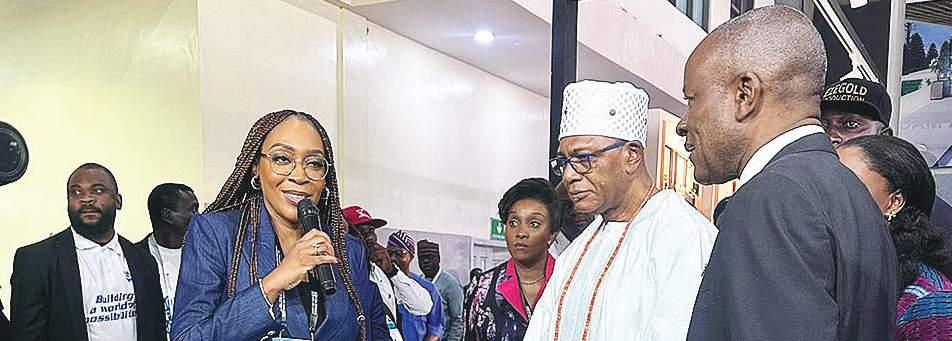
WEST AFRICA INDUSTRIALISATION MANUFACTURING & TRADE & EXHIBITION SUMMIT...
Chief Operating Officer, Nigeria Machine Tools Limited, Mrs.
the company capabilities to the
&
of
&
FG: Prosperity Without Security is House Built on Shifting Sands
Tasks private sector on strengthening national security
The federal government said Thursday private businesses and organisations should join hands in strengthening the country’s security system because prosperity without security was a house built on shifting sands.
Relatedly, President of Lagos
Chamber of Commerce and Industry (LCCI), Mr. Leye Kupoluyi, stated that insecurity had become a measurable economic burden in Nigeria and a macroeconomic variable that directly shaped growth outcomes.
The government made the call in Lagos in a goodwill message delivered by Special Adviser to
the President on Economic Affairs, Dr. Tope Fasua, who represented Vice President Kashim Shettima at the “2026 LCCI Security Meets Business Dialogue Series.”
Fasua said, “We are gathered today at a pivotal junction in our history. We have seen that in recent global economic forecast that Nigeria has been earmarked as
LCCI: insecurity now measurable economic burden in Nigeria
a top contributor to global growth.
“But any student of entrepreneurship in this room will tell you that prosperity without security is a house built on shifting sands.
“Economic history is replete with wreckages of nations that mastered their weaknesses in trade but not the grammar of security.
“President Bola Ahmed Tinubu is
Female CEOs of Federal Agencies Recommit to Women Mobilisation, Tinubu’s Re-election
Adedayo Akinwale in Abuja
A delegation of female Chief Executive Officers heading key federal government agencies yesterday paid a courtesy visit to the National Chairman of the All Progressives Congress (APC), Nentawe Yilwatda where they pledged their commitment to the success of President BolaTinubu.
The delegation, led by the Chairman/Chief Executive Officer of the Nigerians in Diaspora Commission, Abike Dabiri-Erewa, comprised 37 women occupying strategic leadership positions across federal government agencies and parastatals.
The Special Adviser to the Chairman on Media and Communications Strategy, Abimbola Tooki, in a statement issued Thursday, said the visit served as a platform for the women to showcase their contributions to national development, express solidarity with the APC leadership, and advocate greater inclusion of women in the nation’s political structure.
During the meeting, the women highlighted their contributions to governance and grassroots development while emphasizing the pivotal role women play in strengthening the party’s electoral base across the country.
Speaking on behalf of the delegation, Dabiri-Erewa stressed that they remained the backbone of political mobilisation in Nigeria, particularly at the grassroots level,
yet often received limited recognition and support in political structures and appointments.
They observed that despite their dedication to party activities and governance, women frequently face challenges including inadequate funding, limited political backing, and underrepresentation in leadership positions.
The delegation reiterated that women constitute the voting bloc in Nigeria and remain instrumental in mobilising grassroots support for the APC.
They pledged their readiness to intensify mobilisation efforts nationwide as the country approaches the next election cycle.
The female CEOs also expressed appreciation to President Tinubu for giving women significant opportunities to serve in leadership roles within government, noting that their appointments reflect growing recognition of women’s capabilities in governance.
However, they appealed for greater gender balance in political appointments and party structures to ensure broader representation.
Dabiri-Erewa explained the group came together to support one another and showcase the collective impact of women in government leadership.
She said the women were united in their commitment to support the APC and the administration of President Tinubu, adding that they were prepared to contribute actively toward the party’s success
in the 2027 general elections.
According to her, the women believe strongly in the leadership capacity of the APC National Chairman and expressed confidence that his disciplined and inclusive approach would further strengthen the party.
Responding, Yilwatda commended the delegation for their leadership and for showcasing the contributions of Nigerian women in governance.
He congratulated them on their appointments and assured them
of the party’s support, noting that women play an indispensable role in strengthening democratic participation and political mobilisation.
The APC Chairman emphasized the importance of visibility in politics and encouraged the women to participate actively in party programmes and activities.
According to him, increased participation and visibility would help amplify the contributions of women and provide greater opportunities for recognition and advancement.
a man whose DNA is intertwined with the complexities of both commerce and governance and understands that the vital noise of the market place can only be sustained by the silent vigilant guardianship of state.”
He said Tinubu was convinced that security was not a standalone sector but the prerequisite for every other sector.
Fasua added, “We cannot talk about the African Continental Free Trade Area if our highways are contested; we cannot speak of digital Nigeria if our servers are under siege.”
He said Tinubu had moved Nigeria from a doctrine of containment to a doctrine of pre-emption, adding that the recent appointment of the new Inspector General of Police (IGP) is a testament to this shift.
Fasua stated, “The appointment was not based on traditional dictates of turn-by-turn but on a serious assessment of strategic competence and the ability to lead a 21st century police force that is data driven and community aligned.”
He said the most significant
development in Nigeria’s recent security discourse was Mr. President’s clarion call to the National Assembly to consider the constitutional framework for state policing.
According to him, “For too long we have operated a centralised policing model in a decentralised federal reality.
“The atavistic adherence to unitary security structure has left our local communities and businesses vulnerable.
“State policing is not an invitation to regional fragmentation. It is an invitation to regional responsibility. It is about creating a multi-layered shield where the federal, state and local forces operate in a symphony of intelligence and action.”
He explained that Nigeria’s current collaboration with the United States’ forces was not about surrender of sovereignty but sharing of strength.
Fasua said, “Our partnership with Washington is hinged on capacity building.
“This synergy ensures that Nigeria’s forces are equipped with the best tools to protect both our domestic and foreign investments.
FG Announces N5m - N20m Award for Outstanding Undergrad, Masters, Doctoral Thesis on Data
The federal government has rolled out an annual Nigerian Education Repository and Data Bank, NERD, loyalty awards and has announced prizes of N5 million to N20 million for outstanding undergraduates, Master’s and Doctoral Thesis on data.
It says by tying institutional access to verified records which the government aims to turn into a practical deterrent against certificate forgery, it will serve as a strategic national infrastructure designed to secure, standardise, digitise, and
authenticate academic records across post-secondary and tertiary institutions in Nigeria.
Minister of Education, Dr. Tunji Alausa who announced this in Abuja on Thursday at the 2026 national capacity building programme on the implementation and enforcement of the Nigeria Education Repository and Data Bank policy, said the November maiden event will spotlight students whose verified credentials exemplify the platform’s push for academic integrity.
Speaking on the theme, “Strengthening institutional compliance and
academic records integrity”, Alausa said compliance with the repository data bank has become mandatory for participation in the National Youth Service Corps and for accessing funds from NUC, NBTE, NCCE and TETFUND.
With over 350 tertiary institutions now linked to the system which issues national credential numbers and runs real-time verification for more than 133,000 students, Alausa stated that the programme is a covenant with citizens, noting that recent investigations due to data has removed civil servants found with fraudulent degrees.
According to the minister: “To further promote academic excellence, I have approved the establishment of the NERD Annual National Laureate Prize and Awards Programme, which will reward outstanding Undergraduate, Master’s, and Doctoral theses with prizes ranging from N5 million to N20 million. The maiden edition will hold in November 2026.
“It is important to clarify that while NERD compliance is now a prerequisite for participation in, or exemption from, the National Youth Service Corps (NYSC), enforcement extends far beyond NYSC.
Obehi Ojeaga, showcasing
Minister
State for Industry H.E. Sen. John Owan Enoh and the President Manufacturers Association of Nigeria (MAN) Otunba Francis Meshioye, at the West Africa Industrialisation Manufacturing
Trade
Exhibition Summit in Lagos
Kuni Tyessi in Abuja
Dike Onwuamaeze
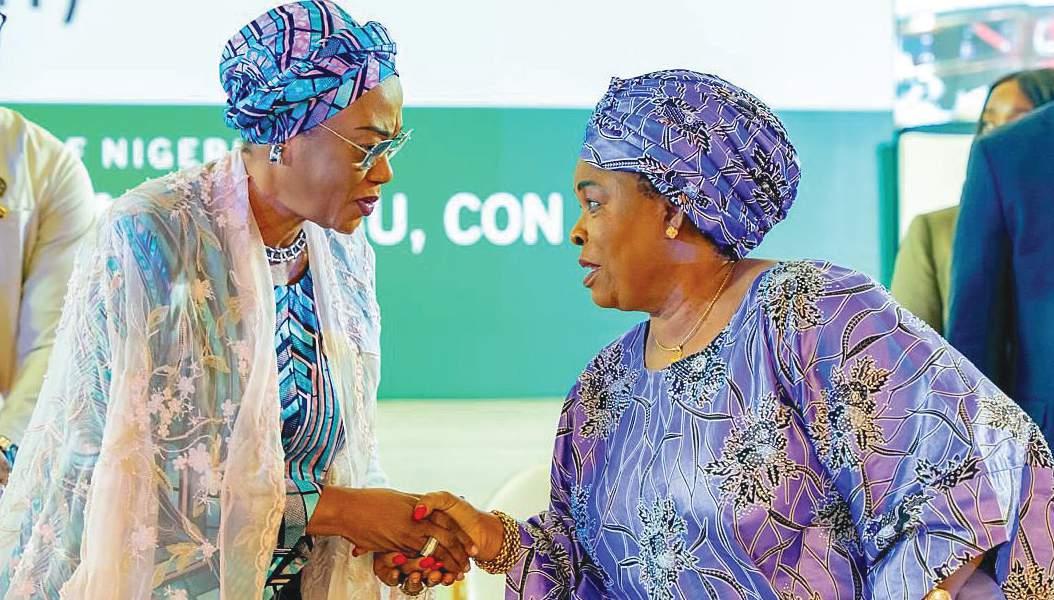
REMI TINUBU AND PATIENCE JONATHAN AT THE INTERFAITH BREAKING OF FAST...
First Lady of Nigeria, Senator Oluremi Tinubu, exchanging pleasantries with former First Lady of Nigeria, Dame Patience Jonathan, at the Interfaith Breaking of Fast (Iftar/Lent) held at the State House, Abuja, yesterday
FG Clarifies FEC Decision on PG Medical College ACT, Says PhD Compliments, not Equivalent to Medical Fellowship
The Federal Ministry of Education has issued a clarification regarding reports circulating across traditional and digital media platforms on the approval granted by the Federal Executive Council (FEC) to amend the Act governing the Nigerian Postgraduate Medical College.
In a statement released on Thursday night and signed by the director of media and public relations, Folashade Boriowo, the Minister of Education, Dr. Tunji Alausa explained that the approval granted by Council enables the College to seek accreditation from the National Universities Commission (NUC) to award Doctor
Shettima, Wike to Headline Housing Ministry’s Summit in Abuja
Emmanuel Addeh in Abuja
The Federal Ministry of Housing and Urban Development in conjunction with Shelter Advisory Services Limited is set to convene the second edition of the ‘Renewed Hope Housing Summit’ to accelerate large -scale housing delivery.
To be headlined by Vice President, Kashim Shettima, the event is scheduled for April, 2026 at the Yar’Adua Centre, Abuja under the theme: “From Policy to Projects: Financing and Delivering Housing at Scale through PPPs”.
The summit is a high-level policy and transaction platform, dedicated to advancing structured Public-Private Partnerships for housing delivery in Nigeria, a statement from the ministry stated.
The objective is for stakeholders from federal and state policy makers, legislators, institutional investors, developers, and development partners to review and
align policy frameworks with implementable housing projects.
It will also provide a practical, transaction-focused platform where the stakeholders would engage on how to structure, finance, and implement viable housing PPPs, with emphasis to be placed on project pipelines, financing instruments, risk-allocation frameworks, and successful delivery models that can be replicated across states.
This year’s theme, it said, reflects the central objective of the second Edition of the Renewed Hope Housing PPP Summit: to bridge the gap between well-articulated policies and tangible, bankable housing projects on the ground.
“It recognises Public–Private Partnerships (PPPs) as the most viable pathway for mobilising long-term finance, aligning public land and infrastructure with private sector expertise, and delivering housing at the scale Nigeria urgently requires.
of Philosophy (PhD) degrees in relevant medical and research disciplines.
It says the Minister noted the development has been widely misinterpreted in some reports as suggesting that a PhD degree would replace or be considered equivalent to medical fellowship. He emphasised that this interpretation is incorrect.
According to the statement, “Dr. Alausa clarified that medical fellowship remains a distinct and higher professional qualification in clinical practice, awarded to physicians who have successfully completed rigorous residency training and other postgraduate medical education requirements required for specialist practice.
“The decision of the Federal Executive Council simply expands the academic mandate of the Nigerian Postgraduate Medical College. In addition to its long-standing responsibility of awarding professional fellowships to qualified physicians, the College will now be able—upon accreditation by the National Universities Commission—to offer PhD programmes for candidates who wish to pursue advanced academic research alongside their professional medical training.
“Under the proposed framework, physicians undergoing postgraduate medical training will have the option to integrate a structured doctoral research pathway with their fellowship
programmes where appropriate.
“This approach is expected to strengthen Nigeria’s capacity for high-level medical research, academic medicine, and specialist knowledge development, while preserving the integrity and prestige of professional medical fellowships.”
The Federal Ministry of Education explained that the clarification has become necessary to correct misconceptions suggesting that the PhD degree is being placed on the same level as fellowship qualification.
Rather, the reform introduces an additional academic pathway that complements the existing professional training structure.
The Ministry further empha-
sised that the reform reflects the Federal Government’s commitment to strengthening postgraduate medical education, expanding opportunities for advanced research and innovation, and aligning Nigeria’s specialist medical training framework with global best practices.
It therefore reassures the public, the medical community, and academic institutions that the approval does not diminish the value or status of medical fellowship in Nigeria, instead, it represents a strategic effort to deepen academic scholarship within the country’s medical training system and enhance Nigeria’s competitiveness in global medical research and education.
NCDC Issues Health Advisory on Cerebrospinal Meningitis Outbreak
The Nigeria Centre for Disease Control and Prevention (NCDC) has issued a Public Health advisory on the spread of Cerebrospinal Meningitis (CSM). It said that the caution is particularly for states within the African Meningitis belt.
In a statement by the Corporate Communications Division of NCDC urged all Nigerians to remain vigilant and adopt preventive measures.
The statement said: “As Nigeria continues through the peak dry season months, the Nigeria Centre
for Disease Control and Prevention (NCDC) alerts the public to the ongoing risk of Cerebrospinal Meningitis (CSM), particularly in states within the African meningitis belt.
“Cerebrospinal meningitis occurs more frequently between December and April, when dry, dusty conditions, overcrowding, and poor ventilation increase the risk of transmission.
“The NCDC urges all Nigerians to remain vigilant and adopt preventive measures. Surveillance and response activities remain ongoing nationwide, and laboratory testing is being
conducted at the state level while national laboratory capacity is being strengthened.
It explained that Cerebrospinal meningitis is a serious infection of the protective membranes covering the brain and spinal cord.
According to NCDC the affliction is most commonly caused by bacteria, particularly Neisseria meningitidis.
“Bacterial meningitis can progress rapidly and may be fatal within hours if untreated.
“However, early diagnosis and prompt antibiotic treatment significantly improve survival
and reduce complications. CSM spreads through respiratory droplets during close contact, especially in overcrowded or poorly ventilated environments.”
It said that symptoms to watch out for include sudden high fever, severe headache, and neck stiffness.
It said other symptoms may include: nausea or vomiting, sensitivity to light, confusion or altered consciousness and seizures.
For In infants and young children, NCDC said the symptoms could bulging soft spot on the head.
The Centre said that early recognition and treatment can save lives.
Kuni Tyessi in Abuja
Onyebuchi Ezigbo in Abuja
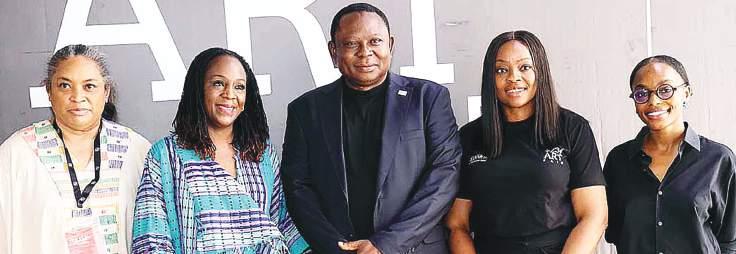
+234 ART FAIR INCLUSIVITY WIDENING FRAME EXHIBITION...
L–R: PR, +234 Art Fair, Ms. Maeva Sabot; Founder, Soto Gallery, Ms. Tola Akerele; Head, Marketing and Corporate Communications, Ecobank Nigeria, Mr. Austen Osokpor; Head, SMEs, Partnerships and Collaboration, Ecobank Nigeria, Ms. Omoboye Odu; and Project Manager, +234 Art Fair, Ms. Joan Oyefeso, at the opening of the +234 Art Fair held at Ecobank in Lagos, yesterday
IRAN ACCUSES UN, EU OF SILENCE AS US, ISRAEL CONTINUE POUNDING OF TEHRAN
action in Iran without congressional approval.
Democrats argued that Trump has sidelined Congress and offered shifting reasons for the war. Most Republicans blocked the resolution, but some said they could change course if the war expands in the coming weeks.
Two senators crossed the aisle during the vote. Democratic Senator John Fetterman of Pennsylvania opposed the measure, while Republican Senator Rand Paul of Kentucky voted for it. Otherwise, everyone else voted along party lines.
Senator Susan Collins, a moderate Republican from Maine, voted against the measure, saying afterwards that passing the legislation would have sent the wrong message to Iran and US troops.
“At this juncture, providing unequivocal support to our service members is critically important, as is ongoing consultation by the administration with Congress,” she said.
Senate Democratic leader Chuck Schumer said before voting in favour
of the measure: “Do you stand with the American people who are exhausted with forever wars in the Middle East or stand with Donald Trump and Pete Hegseth as they bumble us headfirst into another war?”
Trump Fires Homeland Security Secretary
Trump on Thursday redeployed Homeland Security Secretary, Kristi Noem, making her the first Cabinet secretary to exit her post and capping off a tumultuous year in which she oversaw the president’s increasingly unpopular mass deportation agenda.
The president said he would tap Senator Markwayne Mullin, R-Okla., to be her replacement, elevating a fiercely loyal first-term senator.
“I am pleased to announce that the highly respected United States Senator from the Great State of Oklahoma, Markwayne Mullin, will become the United States Secretary of Homeland Security (DHS), effective March 31, 2026,” Trump wrote in a post on
Truth
He added that Noem, who he said “has served us well,” will take over a new role called “Envoy for The Shield of the Americas.” The president described that position as one that will lead “our new Security Initiative in the Western Hemisphere.”
An administration official told NBC News that the president decided to fire Noem due to “a culmination of her many unfortunate leadership failures including the fallout in Minnesota, the ad campaign, the allegations of infidelity, the mismanagement of her staff, and her constant feuding with the heads of other agencies, including CBP and ICE.”
UK
Refuses to Rule Out Joining Strikes
Britain’s defence minister refused to rule out British jets joining strikes on Iran amid a buildup of forces in the Middle East threatening escalation.
John Healey, speaking at the RAF Akrotiri, was asked whether he could rule out Britain getting involved in an
offensive capacity - after the prime minister said the government had learned from the “mistakes of Iraq”.
Healey told Sky News: “As circumstances in any conflict change, you’ve got to be willing to adapt the action you take.”
Asked later whether he would rule out British aircraft taking part in offensive strikes against Iran, Healey replied: “Everything that we have done is defensive, is legal, and is coordinated with other allies.”
Keir Starmer also stood by the decision not to get involved in the USIsraeli strikes, saying the government had “the strength to stand by our values and our principles no matter the pressure to do otherwise”.
He said the UK’s position was that a “negotiated settlement” was the best way forward, and called for de-escalation.
The prime minister also announced the UK was sending an additional four Eurofighter Typhoons to Qatar, and that Wildcat helicopters with anti-drone capabilities would arrive in Cyprus tomorrow.
Notorious Kidnapper Killed in Edo as Troops Rescue Four Kidnapped Victims
A notorious kidnapper in Edo State met his waterloo, when troops of 4 Brigade under 2 Division Nigerian Army in collaboration with Edo State Security Corps engaged his gang in a gun duel inside Warake Forest in Owan East Local Government Area of the state.
Four kidnapped victims were rescued during the operation while a suspected kidnapper was arrested in separate operations.
A statement yesterday by Captain Kennedy Anyanwu, Assistant Director Army Public Relations 4 Brigade Nigerian Army, said the troops during Operation IGBO DANU 1 working alongside personnel from the Nigerian Army School of Electrical and Mechanical Engineers and local vigilantes, carried out a night operation on 3 March 2026 in Warake Forest, in Owan East Local Government Area.
“The troops responded to gunshots heard in the forest during a night patrol with aggressive pursuit and minimum use of fire arms. The gallant troops neutralised a notorious kidnapper that has been terrorising Auchi and environs during the encounter.
“The superior firepower of troops forced the remaining criminals to abandon their victims and flee into the bush. Four victims including Stella Abbas (Age 29), Tina Ododa (Age 19), Razak Rashid (Age 27) and Mutanibi Kalifa (Age 16), were rescued unhurt and later reunited with their families. Items recovered from the neutralised kidnapper are cash amount of Six Hundred and Fifty Thousand Naira (#650,000) only, foot-wear, power bank and mobile phones,” the statement said.
The statement stated further that in a separate operation, troops in collaboration with the Edo State Security Corps, raided a house in Ujemen, Esan West Local Government Area suspected to be a kidnapper’s hideout, where a 39-year-old suspect, Omogbegha Solomon, was arrested. During the operation, troops discovered a shrine containing charms and photographs of various individuals in an abandoned room within the compound.
The shrine was destroyed in-situ, and the suspect was handed over to the Nigeria Police Force Ekpoma Division for further investigation.
The Commander 4 Brigade, Brigadier General Ahmed Balogun, commended the troops for their
courage and urged them to sustain the aggressive onslaught against all criminal elements in line with directives from the General Officer Commanding 2 Division, Major
General Chinedu Nnebeife. He further reassured the residents of Edo State of the Brigade’s commitment towards the protection of lives and property in the state.
China Urges Refiners to Suspend Fuel Exports
Critically, China has asked refiners to halt signing new contracts to export fuel and to try to cancel shipments already committed as tight oil supply due to the Iran war curbs refinery output, several people with knowledge of the matter said on Thursday.
The guidance does not apply to jet fuel refuelling for international flights, bonded bunkering or supplies to Hong Kong or Macau, the industry and trade sources said.
China’s National Development and Reform Commission did not respond to a Reuters request for comment.
Lower exports from China, one of Asia’s biggest fuel exporters, are likely to further tighten fuel supply in Asia, pushing refining margins even higher, as the impact from the war in the Middle East reverberates across the top oil importing region.
Diesel processing margins hovered at three-year highs near $49 a barrel on Thursday, LSEG pricing data showed, while jet fuel cracks were more than $55 a barrel.,
With most March exports already fixed and the difficulty in recalling cargoes, the new directive is expected to cut into exports from April onwards, the sources said. For March, exports of gasoline, diesel and jet fuel combined were expected to remain in line with earlier industry estimates of around 3.8 million metric tons, as companies cashed in robust
Asian margins, multiple sources said. China, the world’s top oil importer, manages fuel exports with a quota system to balance domestic supplydemand fundamentals, with its first batch of quota issuance for 2026 little changed from a year ago at 19 million tons.
US, Israel Continue to Pound Iran, over 1,200 Dead
The United States and Israel continued to bombard Iran yesterday, killing at least 1,230 people since Saturday, as the Israeli military issued forced evacuation orders for the entirety of Beirut’s southern suburbs, home to hundreds of thousands.
Trump said he supports Kurdish forces launching an offensive against Iran, in comments made during an interview with Reuters. “I think it’s wonderful that they want to do that. I’d be all for it,” Trump said. When asked whether the United States would provide air cover for such an operation, Trump declined to confirm, saying, “I can’t tell you that.” He added that if Kurdish forces chose to move forward with an attack, their objective would be “to win”. The comments come as Iranian Kurdish militias have held discussions with the United States in recent days about whether and how to attack Iranian security forces in western Iran, according to unnamed sources, cited by Reuters. The groups are based along the Iran-Iraq border in Iraq’s semi-autonomous Kurdish region.
FUTA Teaching Hospital to Curb Medical Tourism with Cancer Care, Dialysis, Neurosurgery, Says CMD
The management of the Federal University of Technology, Akure (FUTA) Teaching Hospital on Thursday unveiled plans to introduce specialised medical services including cancer care, dialysis and neurosurgery as part of efforts to reduce medical tourism and improve access to advanced healthcare in Ondo State and Nigeria as a whole.
The Chief Medical Director of the hospital, Prof. Olusegun Ojo, disclosed this while addressing journalists in Akure during a press conference heralding the hospital’s first anniversary.
Prof. Ojo said the hospital was embarking on major infrastructure upgrades, acquisition of modern
diagnostic equipment and the launch of residency and fellowship training programmes to strengthen healthcare delivery and medical education.
According to him, the hospital is currently transitioning from a general hospital structure to a fullyfledged federal tertiary academic medical centre with emphasis on professionalism, improved work ethics and patient-centred care.
“Currently, we are in the process of transitioning from a general hospital organogram and modus operandi into a structured federal tertiary academic medical centre. For this purpose, we are promoting attitudinal reorientation, improved work ethics, professionalism, patient-centred accountability and excellence.”
The CMD noted that the
transformation of the hospital followed the directive of President Bola Ahmed Tinubu, implemented through the Federal Ministry of Health and Social Welfare, which led to the establishment of the teaching hospital in Akure.
He also acknowledged the support of the Ondo State Governor, Lucky Aiyedatiwa, noting that collaboration with the state government enabled the takeover of the former UNIMED Teaching Hospital annex facility now serving as the take-off site for the federal institution.
Ojo explained that the hospital evolved from the old State Specialist Hospital established in 1951, which for decades served residents of Akure and surrounding communities but later became overstretched due to rapid population growth and the
increasing demand for specialised healthcare services. According to him, the absence of advanced services such as cardiology, cancer treatment, neurosurgery and renal therapy previously forced many patients to seek treatment in cities such as Ibadan, Lagos, Abuja and even overseas.
“These have often led to delays in accessing care, high personal medical costs and economic drain for the country,” he said.
The CMD said the hospital had recorded several milestones within its first year, including the signing of a memorandum of understanding with the Ondo State Government for the takeover of the facility, documentation of inherited staff and the constitution of a management team to provide strategic leadership.
PHOTO: SUNDAY ADIGUN
Fidelis David in Akure
Felix Omoh-Asun in Benin
Social.
ADENIYI’S CHAPTERS OF DESTINY PUBLIC PRESENTATION...
L-R: Dehinde Adefarakan; Director, Special Programmes, and former Deputy Provost, NIJ, Lagos, Dr. Jide Johnson; Provost, NIJ, Mr. Gbenga Adefaye; Immediate Past Provost NIJ, Mr. Gbemiga Ogunleye; Immediate Past Provost, NIJ, Dr. Dele Omojuyigbe; and former editor, PUNCH, Steve Ayorinde, at
Chapters of Destiny Public Presentation, NECA House, Alausa, Ikeja, Lagos... recently
ADC: APC Running the Most Incompetent Federal Govt in the History of Nigeria
Says inability to implement budgets, policy and appointment flip-flops are clear evidence
Chuks Okocha in Abuja
African Democratic Congress (ADC) has described the President Bola Tinubu-led All Progressives Congress (APC) federal government as the most incompetent in Nigeria’s history.
ADC cited the fiscal confusion that had seen the government running three national budgets simultaneously while effectively implementing none, and the several policy and appointment flip-flops as evidence.
In a statement by the party’s National Publicity Secretary, Mallam Bolaji Abdullahi, ADC said the government’s obsession with the politics of re-election, at the detriment of governance, had done incalculable damage to the country in a manner not seen before.
ADC highlighted recent reports that signified utter confusion and alleged incompetence in the Tinubu administration’s implementation of national budgets since 2024.
According to Abdullahi, “This is the first time in Nigerian history that any government would be running three budgets at the same time while implementing none.
“Available reports indicate that while the 2024 budget was rolled
over to 2025, as at the third quarter of 2025 only 17.7 per cent of the capital budget had been released, while overall implementation hovered at less than 30 per cent, even as internal disbursements continued to lag.
‘’Government has argued that this absurdity is a ‘deliberate strategy’ and ‘transition cost’ to ensure that multiyear capital projects are completed. This is a blatant falsehood that cannot hold up to any scrutiny.
‘’Even as we speak, 30 per cent of the 2025 budget is billed to run from February 2026 to November 30, 2026, while the remaining 70% is simply rolled over to the 2026 budget, which is still being debated at the National Assembly three months into the year.
‘’This situation becomes even more alarming when we recall that President Tinubu promised last year that all capital components of the 2024 and 2025 budgets would be concluded by March 31, 2026, less than a month away, knowing quite well that this is not possible.”
The statement added, ‘’As of today, capital budget implementation for the Ministry of Power stands at a mere 3.6 per cent, that of Communications Technology at 8.9 per cent, while Education and Health stand at 23.5
per cent and 32.5 per cent, respectively.
“Certainly, no serious government would leave these sectors, which are crucial to national human capital development, largely unfunded while select government officials continue to live in obscene opulence in the midst of unprecedented poverty and human misery.”
ADC stated, ‘’It is noteworthy that the only ministry that has outperformed its budget, up to 113.45 per cent, is the Ministry of Defence, largely due to emergency
funding through the inscrutable Service-Wide Vote.
“Yet, rather than abate, insecurity has continued to spread across the country. Recent reports indicate that in this month of Ramadan alone, up to 500 Nigerians may have been killed by terrorists in Borno, Yobe, Adamawa, and Kebbi.”
The opposition coalition said, ‘’Government has continued to boast of historic revenue collection and unprecedented foreign reserve balances. This government has borrowed
more aggressively than any other government in the country’s history. Yet, budgets remain unimplemented and contractors remain unpaid.
‘’This is the reason Nigerians are suffering like never before and asking the most important questions: what is this government doing with all the money that accrues from all the loans, all the revenues, and all the increased taxes? Why are we worse off today than we were three years ago?”
the statement said, ‘’Since this government came on board, analysts
have identified at least seven appointments and several policy decisions that the government has announced and reversed either almost immediately or after public uproar. This is what happens when a government is distracted.
‘’The Tinubu government has proven that to them everything is about politics and power for its own sake. This is why Nigerians are being slaughtered at an industrial scale across the country while the government feasts.
Kano Deputy Gov Faces Impeachment as State Assembly Issues 2-Week Ultimatum
Ahmad Sorondinki in Kano
Kano State House of Assembly has issued a two-week ultimatum to state’s Deputy Governor, Comrade Aminu Abdussalam, to respond to financial allegations or face impeachment.
A petition submitted by the executive had triggered the impeachment process, urging the Assembly to take
action against the deputy governor over alleged irregularities during his tenure as Commissioner for Local Government Affairs from 2023 to 2024.
Abdulsalam is accused of diverting funds meant for local government administrations for personal gain.
Med Pharmaceutical Limited, in violation of public procurement laws and state fiscal regulations.
on Him
Bamidele Heads Oyebanji’s Re-election Campaign, Says Poll is Referendum
Sunday Aborisade in Abuja
The All Progressives Congress (APC) has appointed the Senate Leader, Opeyemi Bamidele, to lead the campaign council for the re-election bid of the Ekiti State Governor, Biodun Oyebanji.
The Ekiti state governorship election is scheduled to hold on June 18, 2026.
The ruling party also named the Ekiti State APC Chairman, Sola Elesin, and the governor’s Chief of Staff, Oyeniyi Adebayo, as key members of the campaign structure, with Adebayo serving as secretary of the council.
In total, the party constituted a
57-member high-powered campaign council to coordinate activities aimed at securing another term for the governor.
Other prominent members of the council included the Chairman of the Senate Committee on Media and Public Affairs, Senator Adeyemi Adaramodu; Chairman of the Senate Committee on Establishment and Public Services, Senator Cyril Fasuyi.
Also included is the Speaker of the Ekiti State House of Assembly, Hon. Adeoye Aribasoye; and former Deputy Governor of the state, Senator Biodun Olujimi, among others.
In a statement by his Directorate of Media and Public Affairs,
Bamidele confirmed his acceptance of the role, describing the assign- ment as both an honour and a major responsibility.
He expressed appreciation to the party leadership for entrusting him with the responsibility of leading the campaign council, noting that the task presented an opportunity to showcase the achievements of the Oyebanji administration as well as the performance of the APC at the national level.
Bamidele said the campaign council would work closely with the Ekiti State chapter of the APC and the party’s national secretariat to ensure a successful re-election campaign for the governor.
Majority Leader of the Assembly, Lawan Hussaini Dala, who read the petition, said, “The notice complies with Section 188 of the Constitution of the Federal Republic of Nigeria (1999, as amended). The allegations relate to Abdulsalam’s activities while overseeing the state’s 44 local government areas.”
The petition listed the following allegations, “Breach of Public Trust:
Between June 2023 and January 2024, he allegedly received kickbacks totalling N462 million over seven months.
“Diversion of Funds and Misuse of Official Capacity: From February 2024 to July 2024, he reportedly received N726 million from local government councils under the guise of executing special assignments.
“Abuse of Office: Abdulsalam allegedly facilitated the improper release of N440 million to North
“Gross Misconduct: These actions are said to constitute gross misconduct under Section 188(2) of the Constitution, representing serious breaches of constitutional norms and ethical standards for public office holders.”
The majority leader stated that based on the evidence presented, Abdussalam should be impeached and removed from office in accordance with constitutional procedures.
Chief of Army Staff, Waidi Shaibu, Deploys More Troops to Tackle Insecurity in Benue
George Okoh in Makurdi
The Chief of Army Staff, Waidi Shaibu, has reassured Nigerians of improved security in communities affected by bandits’ attacks in Benue State.
He gave the assurance during his maiden operational visit to army formations in Makurdi.
He revealed that additional troops had already been deployed to reinforce ongoing military operations and
strengthen security efforts in the state.
According to him, the visit was intended at evaluating the operational preparedness of army formations and ensuring they were well positioned to address the security challenges in Benue.
The army chief also praised troops stationed in the state for their professionalism and resilience in carrying out their duties.
He reminded personnel that their core responsibility remained the
protection of Nigeria’s territorial integrity and safeguarding the nation. Shaibu further assured the soldiers that their welfare would remain a top priority under his leadership, noting that the Nigerian Army would continue to create a supportive environment for personnel to excel in their careers.
Describing the military as a noble profession, he urged soldiers to stay disciplined, alert and committed to their responsibilities.
Akogun Tola Adeniyi’s
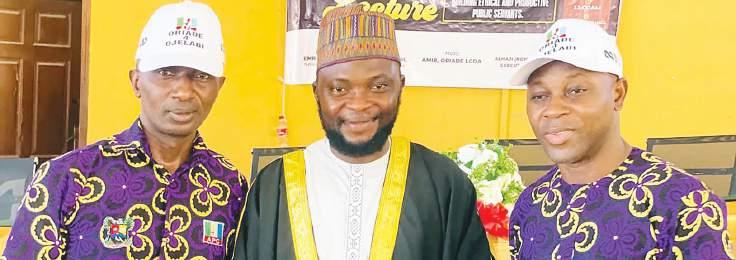
L-R: Vice Chairman, Ori-Ade Local Council Development Area (LCDA), Hon. Adebayo
Igbobi-Lagos, Engr. Lukmon Raji; and Chairman, Ori-Ade LCDA, Alh.
Peter Obi: Nigerians Poor Because They Chose to Be Poor
Chuks Okocha in Abuja
A presidential front-runner in African Democratic Congress
(ADC), Peter Obi, has said the reason more than half of Nigeria’s population live below the poverty line, despite
the country’s wealth of natural and human resources, is that they chose poverty. Obi spoke while receiving
the leadership of Association of Skilled and Vocational Artisans of Nigeria (ASVAN), led by its National President,
At Break of Fast with Christians, Sani Vows to Restore Legacy of Peaceful Coexistence
John Shiklam in Kaduna
Kaduna State Governor, Senator Uba Sani, has pledged to restore the state to its past glory, where people of different ethnic and religious groups lived peacefully and pursued their livelihoods in harmony.
Sani made the pledge on Wednesday night while hosting Christian leaders to Iftar at Government House, Kaduna.
The governor lamented that the state was gradually losing its status as “home for
for education and healthcare services.
According to him, electricity plays a critical role in modern healthcare delivery, particularly in operating advanced medical equipment.
“If there is a hospital and they put MRI machines and other equipment, without electricity to run them, everything will go to naught,” he said.
Adejumo also called for a broader definition of rural communities in Nigeria, arguing that lack of basic infrastructure such as electricity and water should qualify any location as rural regardless of its geographical location. “Rural does not mean the bush. A city without light and water is a rural area,” he argued.
He therefore urged the REA to extend its interventions to such underserved communities as well as to the NJI, the intellectual and education arm of the country’s judiciary.
Highlighting the importance of electricity to the judiciary, Adejumo noted that modern judicial training
all Nigerians” following years of ethno-religious crisis, vowing to reverse the situation.
He said restoring government sponsorship of Christian pilgrimage was in line with his administration’s philosophy of justice, equity and fairness.
Sani explained that hosting religious leaders and other stakeholders to the breaking of the Ramadan fast was to create an opportunity to interact and obtain feedback on government policies and programmes.
According to him, this year’s
and operations rely heavily on technology and digital infrastructure. He said the NJI, which was established in 1992 to coordinate training and retraining of judicial officers, currently trains about 1,500 judges annually.
The institute, he explained, hosts about 900 residents and operates more than 300 buildings, including training facilities and a hospital equipped with modern medical equipment. However, he warned that the effectiveness of these facilities depends on steady electricity supply. Besides, he emphasised the role of the judiciary in maintaining order and protecting property rights, noting that a functioning legal system ensures public safety and economic stability. He urged continued collaboration between institutions to address national development challenges.
Responding, the Managing Director and Chief Executive Officer of the Rural Electrification Agency, Abba Aliyu, said the federal government had launched the most
“Iftar is significant because both Muslims and Christians faithful are observing fasting and Lent at the same time”.
The governor appealed to religious leaders to support his administration and President Bola Tinubu in order to deliver the dividends of democracy and promote sustainable development.
Earlier, Chairman of Kaduna State chapter of Christian Association of Nigeria (CAN), Rev. Caleb Ma’aji, described Sani as a listening leader who fulfiled
comprehensive electricity access programme in Nigeria’s history.
Aliyu disclosed that the government was currently implementing what he described as the world’s largest publicly funded renewable energy electrification initiative.
According to him, the programme involves a $750 million investment that is expected to attract an additional $1.1 billion in private sector funding. The initiative, he said, will support the deployment of about 1,350 mini-grids across the country, including 250 interconnected systems designed to supply electricity to underserved communities.
Aliyu explained that the agency had also made significant progress under the Energising Education Programme (EEP), which provides solar-powered electricity infrastructure to universities and teaching hospitals.
He said the REA had already completed power projects in 15 universities across the country, including installations that supply
promises.
Ma’aji recalled that during a similar event in 2025, CAN requested the governor to restore government sponsorship of Christian pilgrimage to Jerusalem, which was suspended in 2015 by the administration of former Governor Nasir El Rufai.
He stated that following the request, Sani restored the sponsorship of Christian pilgrimage to Jerusalem, add-ing, “This year, 49 people have gone to Jerusalem and are back.”
electricity to campuses, hospitals and water treatment facilities.
In addition, he revealed that President Bola Tinubu had approved N100 billion for the National Public Sector Solarisation Initiative, which targets government institutions struggling with electricity access or high energy costs.
Aliyu assured Adejumo that the Institute would be considered for inclusion in the programme, explaining that the agency is currently conducting an energy audit to determine the appropriate mini-grid capacity required for its priority projects.
Aliyu expressed appreciation for Adejumo’s contributions to Nigeria’s judicial system and pledged continued collaboration to improve electricity access across the country.
He maintained that the ongoing renewable energy projects marked a turning point in Nigeria’s efforts to resolve its longstanding electricity challenges and expand power supply to underserved communities.
Comrade Obijuru Everest, who paid him a courtesy call in Abuja.
According to a statement by his spokesman, Ibrahim Umar, Obi said, “We are poor because we have chosen to be poor. We give titles and front-row seats of honour to those who steal public funds, and yet we expect to grow.” Obi recalled a conversation he had with political leaders in Indonesia, a country similar in size and population to Nigeria, which was now thriving due to its better leadership.
He recounted how the Indonesian leader advised him to combat the theft of public funds, invest in education and healthcare, and observe the positive outcomes as healthy, educated individuals contribute to the economy. Obi emphasised that in every viable economy, Small and Medium Enterprises (SMEs) drove growth, supported by a responsible and corruptionfree government that created an enabling environment. He stated, “Join the fight for a great Nigeria. Stop worshipping those who steal your money, stop giving them titles, and stand up for what is right. Vote, defend your votes, and help produce good leaders at all levels, from Councillor to President, and you will see the country change.”
According to him, his political career has always been guided by principles, loyalty to democratic causes and a willingness to challenge the political establishment when necessary.
Dickson said he had remained committed to the PDP for nearly two decades, having joined the party in 2005 after earlier political engagements during the country’s democratic transition in the late 1990s.
He recalled his involvement in youth mobilisation during the period, when the military began the process of restoring democratic governance in Nigeria, noting that he led a group of young Nigerians who encouraged youth participation in the evolving democratic process.
The former governor said the PDP had once served as a broad political platform that accommodated Nigerians across social and political divides.
He noted that the party played a significant role in promoting the
Earlier, Everest said they had been following Obi’s journey and believed it was important to associate with and support his aspirations to lead the country towards progress.
interests of minority groups and expanding democratic participation across the country.
However, Dickson said the party had in recent years become weakened by internal conflicts and poor leadership decisions, a development he described as a selfinflicted crisis that had undermined its capacity to function effectively as a national opposition platform. He expressed concern that the continuing instability within the party could weaken its ability to compete effectively in future elections, particularly the 2027 general election.
Dickson also warned against the danger of Nigeria drifting toward a one-party political system, stressing that the country’s diversity required a vibrant multi-party democracy.
He said he had resisted several attempts in the past to persuade him to defect to the ruling APC, including during his tenure as governor, because of his belief that Nigeria must sustain a strong opposition.
2026 RAMADAN LECTURE OF THE UNIFIED MUSLIM STAFF ASSOCIATION OF LAGOS...
Abolore Ariyoh; Guest Lecturer and Chief Imam, National Orthopaedic Hospital,
(Hon.) Rasaq Akorede Olojede, during the 2026 Ramadan Lecture of the Unified Muslim Staff Association of Lagos State, Ori-Ade LCDA branch, held at Satellite Town, Lagos…Tuesday
ZAMFARA GOVERNOR, DAUDA LAWAL, SET TO JOIN APC, DICKSON DUMPS PDP, JOINS NDC
IGP DISU RECEIVES FCT SERVICE COMMANDERS AT FORCE HEADQUARTERS...
IGP Olatunji Disu, psc, with FCT Service Commanders led by Commissioner of Police, FCT Police Command, CP Dantawaye Miller at the Force Headquarters, Abuja. The delegation comprised Brig. Gen. Onosanya O.A, Commander, Guards Brigade FCT; Commodore Oladipo Oluseyi, Commander, Naval Base Abuja; Air Commodore Imoke
NCN Sets Up Committee to Develop Funding Structure for Nation’s Nutrition Interventions
Shettima demands ring-fencing financing to bridge gap between promises made and lives changed Says national nutrition bill must be pursued with urgency
National Council on Nutrition (NCN), chaired by Vice President Kashim Shettima, on Thursday set up a Nutrition Financing Subcommittee to develop a funding structure to finance Nigeria’s nutrition interventions.
Shettima called for ring-fencing nutrition financing in order to bridge the gap between promises made and lives changed, saying the National Nutrition Bill should be pursued with urgency.
The committee set up during a meeting of NCN held virtually is expected to come up with a financing roadmap within 30 days and present the document to the nutrition council and National Economic Council (NEC) for review and final adoption.
Members of the sub-committee, chaired by Coordinating Minister of Health and Social Welfare, Professor Muhammad Ali Pate, include the Ministers of Education, Water Resources, Women Affairs, and Science and Technology, as well as Deputy Chief of Staff to the President and Senior Special Assistant to the
The sociopolitical implications may, in fact, be even more combustible than the economic ones. Nigeria has already suspended Christian pilgrimages to Israel because of the deteriorating security environment. NiDCOM says it has received enquiries from Nigerians in Iran, Qatar, and the UAE about possible evacuation. And the emotional spillover is no longer hypothetical: Reuters footage and reporting show members of Nigeria’s Shi’ite Islamic Movement protesting in Kano after the reported killing of Iran’s supreme leader. That matters because Nigeria does not process Middle East conflicts as neutral foreign events. They are often filtered through faith, identity, grievance, and solidarity networks. Once that happens, external war acquires internal life. History warns against dismissing this as symbolic theatre. Nigeria has a record of deadly confrontations involving the Islamic Movement of Nigeria and security agencies. Reuters reported serious clashes in Abuja in 2019, and again in March 2025, when security forces and Shi’ite protesters
President on Public Health, while Ministry of Budget and Economic Planning will serve as the secretariat.
Chairman of the council, Shettima, also directed the involvement of development partners and private investors in the committee, including Aliko Dangote Foundation.
Disclosing the outcome of the meeting, Shettima said, “Council recognises the importance of establishing a strong legal and institutional framework to sustain coordination, financing, and accountability across sectors. Council, therefore, resolves that the National Nutrition Bill should be pursued with urgency.
“The Ad-hoc Technical Committee will continue its work and will be co-chaired by the Federal Ministry of Budget and Economic Planning and the Federal Ministry of Agriculture and Food Security, reflecting the central role of both financing and food systems in improving nutrition outcomes.”
NCN, according to the vice president, also resolved that “budget allocations must be matched with timely releases and effective utilization”.
violently confronted one another in the capital. So when the current Iran crisis triggers demonstrations in Kano and elsewhere, the risk is not merely that people gather; it is that old fractures find a new script. A tense economic environment, polarised rhetoric, and an over-militarised response can quickly convert protest into disorder. That is how geopolitical shock migrates into domestic security strain. Nigeria’s diplomatic response, therefore, must be guided less by emotion than by strategic sobriety. The country has reasons to preserve relations across multiple poles. Israel matters to Nigeria in areas such as security cooperation, technology, water management, and agriculture; the United States and Europe remain important sources of investment, trade, and diplomatic leverage. Yet Nigeria also has domestic constituencies that read Middle East conflicts through moral and religious lenses, not through the cold grammar of statecraft. This is why non-alignment, restraint, and a clear call for de-escalation are not
The nutrition council said Ministries, Departments, and Agencies (MDAs) must ensure that approved funds for nutrition-related programmes were released and implemented.
Acknowledging the strategic importance of the Accelerating Nutrition Results in Nigeria (ANRiN) 2.0 Project in addressing urgent service delivery gaps in high-burden states, Shettima, on behalf of the council, encouraged state governors “to fast-track the necessary actions at the state level to ensure timely implementation and
effective utilization of the available resources”.
He said, “If our efforts are to succeed, they must not stop at the federal level. Nutrition outcomes are ultimately determined within households and communities. This requires stronger subnational ownership and deeper grassroots engagement, ensuring that states, local governments, community leaders, and frontline workers play their full role in implementation.”
NCN further resolved that women must remain at the centre of the ef-
forts since they were the backbone of household nutrition, childcare, and food systems.
The vice president observed that “their voices, leadership, and participation must be fully integrated into planning, decision-making, and programme delivery”.
He stated, “Our collective responsibility is to ensure that the policies and commitments we make here translate into real improvements in homes and communities across all 774 Local Government Areas of Nigeria.”
Shettima stated that while the issue was no longer about whether nutrition mattered, “the central reform issue before us is financing, not as theory, but as execution.” He said there must be clarity on how funds were budgeted, released, ring-fenced, and tracked, as well as how every naira was accounted for across MDAs and states. According to him, “Budgeting without release is not financing. Allocation without predictability is not reform. Nutrition must be protected.
Court Frees Suspended Supercop, DCP Abba Kyari from Non-Asset Declaration Charge
As NDLEA insists drug case continues
Alex Enumah and Michael Olugbode in Abuja
A Federal High Court in Abuja has discharged and acquitted the suspended ‘Supercop’ DCP Abba
signs of weakness. They are the only sane posture for a plural country that already imports too much volatility. The task of Nigerian diplomacy is not to perform indignation. It is to protect room for manoeuvre.
That caution is especially important because Nigeria’s external position, while improved, is still fragile in composition.
The Central Bank reported a $6.83 billion balance-of-payments surplus for 2024, supported by a $13.17 billion trade surplus and $20.93 billion in remittances. But the same data show that while portfolio inflows more than doubled to $13.35 billion, foreign direct investment fell 42.3% to just $1.08 billion. That distinction matters. Portfolio money is fast money; it arrives quickly and leaves quickly. FDI is slower, stickier, and more developmentally valuable. In a world darkened by war risk, shipping disruption, and oil-price volatility, investors often retreat first from places where policy signals are noisy and political risk is hard to price. Nigeria cannot assume that an oil rally automatically outweighs geopolitical
Kyari of the non-declaration of assets charge filed against him and his two brothers by the National Drug Law Enforcement Agency (NDLEA). This is just as the NDLEA clarified that the acquittal has nothing
anxiety.
So the real lesson of this war for Nigeria is not that high oil prices are good or bad. It is that they are never enough. If Abuja treats this moment as a lucky revenue break, it will repeat the habits that made earlier booms evaporate into patronage, inflation, and debt. But if it treats this moment as a warning, then the path becomes clearer. Save part of the windfall. Publish the numbers transparently. Protect poor households before transport and food costs rise again. Accelerate refining, gas infrastructure, and renewable alternatives. Keep diplomacy calm and language disciplined. Above all, rebuild public trust through fairer elections, more credible institutions, and a state that is seen to serve rather than merely control. Iran’s agony teaches that a government can be armed and yet brittle, rich and yet weak, feared and yet hollow. Nigeria still has time to choose a different fate.
•Dr Dakuku Peterside is the author of two bestselling books “Leading in a Storm” and “Beneath the surface”.
to do with the ongoing trial on alleged drug trafficking, assuring that the agency would pursue the drug case to the end.
In a judgment delivered on Thursday in the non-disclosure of asset charge, Justice James Omotosho, freed the defendants from all the allegations, shortly after dismissing the suit on the grounds of absence of a prima facie case against them.
The anti-narcotics agency had filed charges against Kyari and his younger brothers, Mohammed Kyari and Ali Kyari, alleging failure to disclose properties linked to the suspended Supercop.
But, in his judgment on Thursday, Omotosho noted the evidence tendered by the prosecution as well as the testimonies of prosecution witnesses was not strong enough to prove the ingredients of the charge.
According to the court, the burden of proving a case beyond reasonable doubt falls on the prosecution, a task which it failed to prove.
While describing the case against Kyari and his brothers as “persecution”, the judge went ahead to discharge and acquit the defendants of the charge.
The NDLEA had prosecuted Kyari, the former head of the Inspector General (IG) of Police
Intelligence Response Team (IRT), and his two brothers on allegations bordering on non-disclosure of assets.
The agency, in the 23-count charge, named Abba, Mohammed and Ali as 1st to 3rd defendants respectively.
According to the charge, the defendants failed to make full disclosure of their assets, including shopping malls, residential estate, polo playground, lands and farmland belonging to Kyari. Kyari was alleged to have failed to disclose his ownership of the property in different locations in the Federal Capital Territory (FCT), Abuja and Maiduguri in Borno State. Besides, the agency claimed that over N207 million and Є17, 598 were also discovered in Kyari’s various accounts in Guarantee Trust Bank, United Bank for Africa and Sterling Bank.
In the charge marked: FHC/ ABJ/CR/408/2022, the defendants were also accused of “disguising of ownership of properties and conversion of monies.”
The offences the NDLEA disclosed are punishable under Section 35 (3) (a) of the National Drug Law Enforcement Agency Act, and Section 15 (3) (a) of the Money Laundering (Prohibition) Act, 2011.
I.E, Commander, 045 Headquarters Abuja; Adamu Gwari, Director of Security, FCTA; Corps Commandant Felix Theman, Sector Commander, FCT; Dauda Usman, Director, DSS FCT; and Dr. Odumosu Olusola, Commandant, NSCDC Abuja
Deji Elumoye in Abuja
IRAN’S PALAVER, NIGERIA’S DILEMMA
aT ENUGU TECHNiCaL FEsTiVaL…
L-R: Ambassador to the Swedish Embassy, Anna Westerholm; Divisional Head, Merchant and Payment Services eTranzact Plc, Abimbola Reis, and General Consular Head of Trade, Denmark, Jette Bjerrum, at the Enugu Tech Festival held in Enugu… recently
Group Calls on New IG to Strengthen Respect for Human and Civil Rights of Young People
Kuni Tyessi in abuja
The West African Youth Protection and Advocacy Network (WAYPAN) has called on the new Inspector General of Police (IG), Tunji Disu, to view his appointment as an opportunity to initiate meaningful reforms that will strengthen respect for human and civil rights within the police system.
The group stated that there is a need for a review of documented cases of rights violations involving citizens, particularly young people, and a resolve to discontinue unjust or unnecessary prosecutions.
In a statement signed by the Regional Coordinator of
WAYPAN, Rafiu Adeniran Lawal, the group said that while there is a need to strengthen accountability mechanisms within the Force, it is important to retrain officers on human rights standards and lawful engagement procedures, especially in relation to profiling and public demonstrations.
It lamented that reports by local and international human rights organisations consistently show that young Nigerians continue to face police harassment, unlawful arrest and detention, wrongful profiling, and physical assault. Moreover, it said of particular concern is the
increasing use of cybercrime law (2024) to prosecute young people on behalf of powerful individuals, including politicians, influencers, and
wealthy elites. Among other concerns, the group also urged the new IG to, as a matter of urgency, “establish functional and
accessible human rights desks across all police formations to promptly address complaints of misconduct. “Promote a youth-friendly
policing approach that recognises young people as partners in national development rather than as potential criminals.”
Court Sentences Two Men to Death by Hanging over Kidnapping in Kwara
Hammed shittu in Ilorin
A Kwara State High Court in Ilorin yesterday sentenced two men to death by hanging.
The defendants, Abubakar Sodiki and Abubakar Mohammed, were prosecuted on a six-count charge, including criminal conspiracy, armed robbery,
kidnapping, and illegal possession of firearms.
Delivering judgment, Justice Ahmed Aliyu Gegele said the evidence before the court clearly established the involvement of the defendants in the offences.
The victim, Alhaji Saheed Arowasi of Boniya in Baruten Local Government Area of Kwara State, had
earlier narrated his ordeal in the hands of the kidnappers while testifying before the court.
He told the court that the kidnappers initially demanded a ransom of N100 million, but after negotiations, the amount was reduced to N10 million before he was eventually released.
The Judge also admitted the statements made by the defendants and the victim at the police station as part of the evidence considered in the case.
On the charge relating to illegal possession of firearms, Justice Gegele convicted the defendants under counts three and four.
NNPP Charges INEC to Address Its Image Crisis Instead of Party Disputes
Chuks Okocha in abuja
Ojokoro LCDA and Epe Local Government Area, respectively.
There was tension within the All Progressives Congress (APC) in Ifako-Ijaiye Local Government Area of Lagos State following the aborted swearing-in of two supervisor nominees alleged to be nonresidents of the council.
Concerned youths and stakeholders in the party have issued a strong communiqué rejecting what they described as the “imposition and importation” of individuals who are neither residents nor active members of the party structure in the local government area.
In a communiqué released yesterday after the halted swearing-in ceremony, the group appealed to the state leadership of the party to intervene and halt the practice of imposing political appointees from outside the council area.
According to the stakeholders, the controversy centres on the nomination of Lekan Obayomi and Dele Abayomi, said to be from
The group commended the leaders and stakeholders of the APC in Ifako-Ijaiye for distancing themselves from the development, noting that their stance reflects a commitment to fairness and respect for the party’s grassroots structure.
They, however, alleged that the nominations were facilitated by the Secretary of the State Congress Committee and Special Adviser to the Governor on Works, Dr. Adekunle Olayinka, whom they accused of repeatedly influencing the imposition of candidates in the area.
According to the communiqué, the development has contributed to the growing frustration among long-serving party members who feel sidelined despite years of loyalty and participation in party activitºies.
The stakeholders warned that such actions could further deepen apathy within the party and weaken its grassroots support base.
The National Publicity Secretary of the New Nigeria People’s Party (NNPP), Ladipo Johnson, has reacted to recent concerns raised by the Independent National Electoral Commission (INEC) regarding the impact of internal party disputes on the Commission’s operations.
In a statement, Johnson
acknowledged the administrative burden these legal battles place on the electoral umpire, but insisted that INEC must prioritise addressing its own image crisis.
He said: “It is, in a sense, understandable that INEC complains about the disturbances caused by internal party disputes. Because the Commission is often joined
as a necessary party in these suits, it inevitably drains its time and resources. However, the NNPP spokesperson pivoted to what he described as the “existential threat” to the Nigerian democracy-the plummeting level of trust in the electoral process itself.
“While administrative hurdles are real, I strongly urge the INEC chairman to recognize a far more
dangerous reality. The greatest cause of voter apathy in Nigeria is not internal party friction; it is the widespread perception that INEC is complicit in subverting the will of the people,” Johnson remarked.
He continued: “A large percentage of the voting public remains convinced that the system is rigged and that their ballots do not count.”
Smile360 Expands Access to Free Dental Care for Nigerians
sunday Okobi
A leading dental healthcare organisation in Nigeria, Smile360, yesterday restated its commitment to transforming lives with the launch of the 2026 edition of its annual Project Smile initiative.
The 2026 Project Smile Nigeria CSR programme
convened beneficiaries, partners, and advocates to highlight the importance of oral health and its impact on physical, social, and emotional well-being.
The Chief Executive Officer of Smile360, Dr. Amy Shumbusho, said the organisation is focused on empowering individuals
by expanding access to quality dental care, that the life-changing healthy smile.
According to him, “Project Smile is a CSR initiative where we transform lives by changing smiles, and this is a way of us making an impact in the community through dental treatment, because we know that dentistry is not affordable, and
not everybody can afford to have a full mouth transformation.” Shumbusho added that many Nigerians are unable to reach their full potential because of untreated dental problems, “which can undermine confidence, limit social acceptance, affect career opportunities, and diminish overall quality of life.
Osun Concerned Muslims Stakeholders Call for Redress in FG
yinka Kolawole in Osogbo
Concerned Muslim Stakeholders and the League of Alfas in Osun State yesterday expressed worry that the Muslim Ummah in Yoruba land has faced challenges, particularly
concerning federal political appointments.
Speaking jointly at this year Ramadan lecture and distribution of Ramadan packages for Muslims Ummah in Osogbo, the President of Concerned Muslim Stakeholders and League of Alfas, Osun
State, Sheikh Qozeem Abdul Rahaman, and the Secretary-General, Mallam Abdulganiy Sahid Olaide Ezra, therefore, earnestly implored President Bola Ahmed Tinubu to uphold principles of fairness and equity in the distribution of such opportunities, ensuring that the community’s voice is adequately represented. They both noted that “as we stand on the precipice of an election year in Osun State, we must remember our duty as Muslims-to reciprocate the generosity that has been extended to us by President Tinubu.
ayodeji ake
Alleged N9bn Debt: Court Freezes Petrocam Accounts, Targets Director’s BVN
Wale igbintade
The Federal High Court in Lagos has ordered the freezing of bank accounts linked to Petrocam Trading Nigeria Limited and its principal, Patrick Ilo, over an alleged N9.05 billion debt owed to Zenith Bank Limited.
Justice Chukwujekwu
Aneke granted the interim order in Suit No: FHC/L/ CS/393/2026 following an ex parte application filed by Zenith Bank seeking to preserve funds allegedly owed as of May 31, 2025.
The court restrained the defendants, whether acting personally or through agents, privies, or assigns, from withdrawing, transferring, dissipating,
or otherwise dealing with funds up to the sum of N9,057,511,855.63 pending the hearing and determination of the Motion on Notice.
A major aspect of the order targets Bank Verification Number (BVN) 22141926401, which the bank claims is used by Patrick Ilo to operate Petrocam’s accounts.
Justice Aneke directed all financial institutions within the jurisdiction of the court to place a lien, also known as a ‘Post-No-Debit’ restriction, on all accounts linked to the BVN.
The order also extends beyond conventional banks to include major payment infrastructure operators.
Listed as respondents
Nwoye Missed Wider Context of SEDC’s 2026 Budget, Says CEO
sunday Ehigiator
The uproar caused by Senator Tony Nwoye, who represents Anambra North senatorial district at the National Assembly, with his mild rebuke of the South East Development Commission (SEDC) at the Senate Committee hearing of the 2026 Budget of the SEDC may have been a needless overreaction by the senator, the Managing Director and Chief Executive Officer of the commission, Mark Okoye, has said.
In a recent far-ranging interview with Enugu-based Afia TV, Okoye stated that
CHANGE OF NAME
I formerly known and addressed as MRS MERCY OMOBOLA AGBEBI now wish to be known and addressed as MRS MERCY OMOBOLA OGBOLU. All former documents remain valid. The general public should please take note.
AUGUSTINA NWAOZICHI was
AUGUSTINA NWAZICHI in
Nigerian passport. Henceforth, I wish to be known & addressed as NWOGU AUGUSTINA NWAOZICHI in the passport re-issue. All documents remain valid. The Nigerian immigration service & other relevant authorities should please take note.
I formerly known and addressed as MISS. ONYEME JOY IFEOMA, now wish to be known and addressed as MRS.EKENE JOY IFEOMA. All former documents remain valid. The general public should please take note.
I formerly known and addressed as MISS OKECHUKWU VIRGINIA TOCHUKWU, now wish to be known and addressed as MRS VIRGINIA TOCHUKWU SYLVANUS All former documents remain valid. The general public should please take note.
I formerly known and addressed as ABDULWADUD HAMEENAH ADEDAMOLA, now wish to be known and addressed as ANJORIN ADEDAMOLA AMEENAT All former documents remain valid. The general public should please take note. I formerly known and addressed as AKINBOBOLA Igbagboyemi Serah Nifemi, now wish to be known and addressed as AKINYEDE Igbagboyemi Serah Nifemi. All former documents remain valid. The general public should please take note.
are the Nigeria Inter-Bank Settlement System (NIBSS), Interswitch Limited, and Interswitch Financial Inclusion Services Limited.
NIBSS, which manages the interbank settlement framework and the BVN database, is expected to ensure enforcement across the banking system, while Interswitch and its subsidiary are to enforce the restriction across digital
wallets and electronic payment platforms.
Court documents filed by Zenith Bank indicate that the disputed credit facility was subject to extensive Conditions Precedent before disbursement.
All security documentation relating to the facility was also required to be executed before any disbursement.
The facility also contained foreign exchange obligations,
Group Dismisses
adedayo akinwale in abuja
Nwoye would not have made scathing remarks about the budget if he had understood the wider contexts that informed the line items he raised objections to.
Said he: “There were about eight senators in the room who were there for two hours. But my big brother and friend Senator Nwoye with whom I had had a relationship for the past 12 years popped in for about 10 to 15 minutes and perhaps may not have understood the wider context of the budget. I am almost certain that if he had spent more time at the meeting, he would have understood the context upon which we were trying to design our programmes,” Okoye said, further pointing out that Nwoye may have latched onto two or three lines that had already been expunged from the budget as the basis for his critical remarks.
Loss of Document
This is to inform the general public of the loss of the original land document of Plot No 593 Gwarimpa II CO3 while in transit, belonging to one Lt Col Paul Edor Obi (Rtd) Of Road 3 H138 VGC, Lekki, Lagos State.All efforts to recover the land document has been futile hence this report. If found please report to the nearest police station.
CONFIRMATION OF NAME
That my name was written as UKAOBASI BRIGHT CHISOM, also appears as UKAOBASI BRIGHT AZURUWA, that same person bearing the names. All former document remain valid general public and Authorities concerned should take note.
A group, the Youth Renaissance for Good Governance, has rejected the allegations levelled against the Deputy Speaker of the Federal House of Representatives, Hon. Ben Kalu, by the Coalition of South East Youth Leaders (COSEYL) regarding his National Youth Service Corps (NYSC) certificate and Nigerian Law School records.
It is alleged that the issue was a political desperation emanating from certain
authorising Zenith Bank to settle maturing Usance obligations at an interest rate of 12 per cent if Petrocam failed to provide the necessary funds.
Justice Aneke further directed the respondent institutions to file an Affidavit of Return within seven days, disclosing all accounts linked to the BVN, their balances, and six months’ transaction history.
The court also granted Zenith Bank leave to serve the defendants through substituted means at their last known address in Victoria Island, Lagos. The application was argued by Chief A.A. Aribisala (SAN) on behalf of Zenith Bank. The matter has been adjourned to March 17, 2026, for mention.
Allegations against Deputy Speaker
quarters in Abia State.
The group said Kalu’s potential, including an undeclared but widely speculated gubernatorial ambition, had alarmed rival political interests that they had gone as far as sponsoring protest groups from outside the South-east to agitate against him using public funds.
It could be recalled that former First Vice President of the Nigerian Bar Association (NBA), Mr. John AikpokpoMartins, had dragged Kalu before the Legal Practitioners’ Disciplinary Committee
(LPDC) and the NYSC concerning allegations that he enrolled in Nigerian law school while serving with the NYSC.
However, the group, in a statement issued yesterday by its National President, Dr. Ebekuo Madu, and National Secretary, Paul Nwachukwu, used the 2023 NYSC verification exercise as dispositive of the matter. It claimed that a senior NYSC director who participated in the investigation confirmed that Kalu’s certificate was duly obtained in full compliance
with the NYSC Act, adding that the NYSC had already issued a verification letter to that effect.
It described the COSEYL statement as a nauseating report that bore enormous falsehood, and demanded that the group produce the source of its so-called indicting report.
It said: “We wish to place before the Nigerian public and all well-meaning citizens of the South-east region the irrefutable fact that there exists no credible, official, or verified report indicting Rt. Hon. Benjamin Kalu.”
APC Congress: Niboro Hails Oborevwori for Uniting Party
Former presidential spokesman and ex-Managing Director of the News Agency of Nigeria (NAN), Mr. Ima Niboro, has commended the Delta State Governor, Sheriff Oborevwori, for stabilising and unifying the All Progressives Congress (APC) in Delta State, following the successful conduct of the party’s ward, local government, and state congresses.
Niboro said the peaceful and coordinated manner in which the just-concluded APC congresses were conducted across the state was clear evidence of Governor Oborevwori’s leadership capacity and his ability to bring together different political tendencies within the party.
Speaking while assessing the
Correction of Name:
My name was formerly written as ANYA CHIDERA MARY instead of ANYA CHIDERA MARYANN Henceforth, I wish to be known and addressed as ANYA CHIDERA MARYANN and date of birth 20th October, 2006. All former documents remain valid. The general public should please take note.
I, Abdulkarim Abdulrahim Timilehinoluwa, my date of birthday was wrongly written as April 28th 2009, instead of April 28th 2012. All former documents remain valid, the general public should please take note.
PUBLIC NOTICE
LOSS OF DOCUMENTS
This is to notify the general public that Margaret Igbinobaro residing in Abuja, reported the loss of the Original Landed documents in respect of Plot No. DA118, located at Dutse Alhaji/Dawaki Hillside Extension, Abuja, bearing Joshua Daniel, with file No. JG40818 allocated in 2007 . All efforts to trace the documents proved abortive. If found kindly return to the nearest police station. The general public should please take note.
outcome of the congresses, the former presidential aide noted that before the governor’s defection from the Peoples Democratic Party (PDP) to the APC, the party in Delta State was on the verge of disintegration due to internal divisions.
According to him, Oborevwori’s entry into the APC rescued the party from what he described as an impending collapse.
He said” “Before the governor joined the APC, the party in Delta State was practically on the brink of total disintegration. Many members were already becoming disillusioned, and some were even resigning from active politics because of the deep divisions within
the party.
“But when Governor Sheriff Oborevwori moved into the APC, it changed the entire political landscape in the state. His coming stabilised the party and provided the leadership needed to bring everybody together.”
Niboro said the unity displayed during the ward, local government,t and state congresses held recently was a direct reflection of the governor’s inclusive leadership style.
“The evidence is very clear in the congresses that have just taken pla,ce from the ward level to the local government and the state congress we concluded a few days ago.
The processes were peaceful and widely accepted because
the government had succeeded in uniting the party,” he said. He explained that part of the strategy adopted by the governor to achieve unity was ensuring neutrality in the management of the congress process, allowing members from different tendencies within the party to align and work together.
“There were claims from some quarters about the background of certain individuals involved in the process, but the reality is that bringing in neutral figures who can command the confidence of all tendencies is often the best way to resolve internal disagreements. That was part of the strategy that helped unify the party,” he added.
Foundation Empowers 200 Widows in Rivers
Blessing ibunge in Port harcourt
A non-governmental organisation, Tekena ThankGod Ikpaki Foundation, has handed out foodstuffs and monetary assistance to over 200 widows in Rivers State.
The widows were drawn from Okujagu-Ama and Ibaka Communities of Okrika Local Government Area of the state.
Speaking at an outreach where the palliatives were distributed in Okrika, the Director of the foundation, Teken Ikpaki, said the event was an extension of the Christmas outreach of his foundation, adding that the beneficiaries are those who were not reached during the yuletide.
Ikpaki hinged his motivation to carry out the initiative on biblical injunctions.
According to him, “My delight in doing this is that God said he will bless us so that we become a blessing to others; the reason why God blesses us with resources is that after using it to serve Him, the next is to bless humanity. Anything you don’t use to serve God and bless humanity, for me, has no future.”
He said he has been involved in charity for over 20 years, utilising his personal resources solely and without support from any quarter. “I’ve been in this business for over 20 years now. I’ve not gotten a dime or sponsorship
from any source. It’s been my own resources independently, and I derive so much joy
“When I do these things when I attend to the widows, I attend to humanity in different dimensions, “ he added.
Ikpaki, however, charged widows who are still young and active to get involved in skilled enterprise, adding that the foundation is always available to help anyone who wants to get involved in any venture that will make life easier for them and their family.
A beneficiary, Ruth Josiah, thanked the director and members of the foundation for always remembering them and prayed for God’s continuous provision for them.
Oparanozie Expresses Disappointment with Postponed 2026 WAFCON
Duro Ikhazuagbe
Former Super Falcons Captain, Desire Oparanozie, has expressed profound disappointment with the postponement of the 2026 Women’s
Africa Cup of Nations (WAFCON) earlier scheduled to begin in 10 days time in Morocco.
The Confederation of African Football (CAF) that announced the postponement, confirmed yesterday
Nigeria’s C’wealth Games Boxing Contingent to Emerge Today
Today promises to be a blockbuster as the battle for the 10 available boxing tickets at the Commonwealth Games trials reaches its climax at the grand finale of the championship.
From the 128 boxers, comprising 101 men and 27 women, who began the competition on Tuesday, March 3, the final squad that will represent Nigeria in the boxing event of the Commonwealth Games will be decided at the Brai Ayonote Boxing Complex, located at the National Stadium in Lagos.
According to the Nigeria Boxing Federation (NBF), the final bouts in the 10 weight categories will be contested today amid excitement from both home-based and foreign-based boxers who are participating in the four-day tournament.
The Secretary-General of the NBF, Vivian Azimene, stated that the selected boxers who made the final cut would be invited to a training camp.
She added that some outstanding athletes who participated in the trials would also be invited to serve as sparring partners for the selected boxers.
“We are excited about the turnout of the event, and we hope we can continue our exploits at the Games
this year because Nigeria has always been among the outstanding teams whenever boxing is featured at the Games,” she said.
In one of the bouts held yesterday in the men’s 75kg category, Wahab Abdulrahman defeated Qudus Adeniji to advance to the last four, while Quadri Ilori beat Israel Ogbodo by split decision to progress to the semifinals.
More than 80 bouts have already been decided in the tournament, with some diaspora athletes making their presence felt through impressive performances against their homegrown counterparts.
Nigeria is expected to present boxers in 10 weight categories—five for men (55kg, 65kg, 70kg, 80kg, and 90kg) and five for women (51kg, 57kg, 65kg, 70kg, and +70kg).
Nigeria was among the medalwinning teams at the 2022 Commonwealth Games in Birmingham. With nine boxers led by captain Abdul-Afeez Osoba, the West African boxing giant returned home with four medals: one silver medal won by Elizabeth Oshoba and three bronze medals won by Cynthia Ogunsemilore, Jacinta Umunnakwe, and Ifeanyi Onyekwere.
Ezechukwu Hits World U20 Standard at MTN CHAMPS Calabar
The first day of competition at the MTN CHAMPS Athletics Classics in Calabar, the Cross River State capital, delivered thrilling action as the U.J. Esuene Stadium buzzed with competition across the Cadet, Youth, Junior, and Senior categories, respectively.
Miracle Ezechukwu posted the fastest time overall in the Junior Girls’ 100m, clocking 11.67s into a -1.3m/s headwind. Her teammate Rosemary Chigozie followed closely in 11.89s with a -2.4m/s headwind while Team MTN’s Lucy Nwankwo was third overall with a time of 12.22s. Ezechukwu’s performance also secured her qualification for the U20 World Championships set to be held in the US in August.
In the Junior Boys’ 100m, Godwin
Oghenerunor led the field with a time of 10.75s, ahead of Liberty Okon (10.97s) and Team MTN’s Alvin Onyeama. The Youth Girls’ category saw Miracle Festus Okon top the qualifiers in 12.26s, ahead of Glory Bassey (12.41s) and Team MTN’s Rebecca Enilolobo (12.55s).
On the Boys’ side, Team MTN’s Emmanuel Akolo dominated his heat in 11.50s to emerge as one to watch. Otobong Patrick (11.52s) and Nwabueze Kenechukwu (11.99s) followed as the next top qualifiers. In the men’s 100m heats, Wisdom Alexander set the pace with 10.71s. Team MTN’s Showers Ushie ran 10.83s, while Nkereuwem Ibok (10.85s), Iwara Mathias (10.87s), and Emmanuel Ojeli (10.87s) also won their respective heats.
that the 2026 edition of the WAFCON will now take place from 25 July to 16 August 2026, instead of the earlier scheduled dates of 17 March to 3 April 2026.
Speaking on the postponement, Oparanozie wonders why the women’s game in the continent keeps having recurring setbacks on the continent.
“I’m very much worried and I would say I’m disappointed because this keeps happening with women’s football,” she told BBC Sport Africa.
“During Covid the WAFCON was postponed (but)the men went on to play the 2021 Africa Cup of Nations in Cameroon.
“I think it’s because it’s women’s football, people really don’t give that much importance to it,” observed
Oparanozie who played and won the 2010, 2014, 2016 and 2018 WAFCON editions with the Super Falcons. She insisted that it was also disappointing that CAF depends on Morocco for the hosting of the last two 2022 and 2024 (2025) editions which saw record attendance figures and strong television audiences across Africa.
“It’s disappointing that we’re depending so much on Morocco.
“CAF should start looking for possible countries that will actually come up to take the spot if Morocco were to pull out,” stressed the Nigerian forward.
Oparanozie said the postponement could have a physical and mental impact on players, who were already preparing for the tournament.
Teams like Nigeria, Cameroon and Ghana had continued their preparations with high-profile friendlies, with the Black Queens of Ghana on a training tour in the United Arab Emirates.
“They (players) will be very worried considering the amount of work they’ve put in so far physically and mentally.”
“They’ve put their lives on hold just to focus for this tournament and prolonged uncertainty could demoralise some,” she said.
The escalating conflict in the Middle East, which has caused airspace closures and flight cancellations, had further raised concerns about the tournament, with the Ghanaian team needing assurances and support from the country’s foreign mission.
“We are currently safe, our mission is in touch with us and working on ensuring our safety and we shall leave as soon as possible, when our flight gets scheduled,” the team’s Media Officer, Matilda Dzifo Dimedo, told BBC Sport Africa yesterday.
“But for the meantime as we wait for the schedule, we will train and play the last match in a safe space,” she added.
Nigeria’s Super Falcons just at the weekend concluded a two-legged friendlies with Cameroon’s Lionesses in Yaounde.
The 2026 edition of the WAFCON doubles as the qualification tournament for the 2027 Women’s World Cup in Brazil as the top four finishers will feature in the global event in South America.

Asian Cup: Previously Silent Iran Players Sing, Salute Anthem
Iran’s players saluted while singing the country’s national anthem before their Asian Cup match against hosts Australia yesterday, in contrast to the silence at their opening match on Monday.
Before that defeat by South Korea, the Iranian players had stood still, amid the wider context of escalating conflict following air strikes from the United States and Israel on their homeland.
No official explanation has been offered for their differing approaches but on Wednesday, striker Sara Didar spoke emotionally about being separated from their loved ones.
However, Alireza Mohebbi, an Australia-based correspondent for Iran International TV, told the BBC’s partner ABC Newsthere was “no doubt” the players were under
instruction to sing.
“It’s completely obvious that the Islamic Republic’s regime, and the security team which is with the players in Australia, forced them to sing and do the military salute,”
he said.
The Iranian team arrived in Australia well before the air strikes on their country by the US and Israel began last Saturday.
More than 1,100 Iranian civil-

ians are estimated to have been killed according to the US-based Human Rights Activists News Agency(HRNA).
“No-one likes what’s happening, no-one wants war,” said head coach Marziyeh Jafari. In the same news conference however, she insisted Iran have “come here to play football”.
A 4-0 defeat by Australia on Thursday means they now must beat Philippines on Sunday to have a chance of progressing to the knockout stages. Their approach to the national anthem has matched that taken by the men’s team at the 2022 World Cup in Qatar, where they were silent before their first game against England and then sang along before their next match against Wales.
Edo Gov, Dikko, Others to Storm Auchi for Kadiri Ikhana’s Academy Launch
State Governor,
Shehu Dikko and his Director General, Bukola Olopade, the Nigeria Football Federation (NFF) President, Alhaji Ibrahim Gusau and other top sports
dignatories are expected to storm Auchi, Edo State for the official launch of the Kadiri Ikhana Football Academy on March 28.
According to a statement signed by Coach Kadiri Ikhana(MON), the Academy, which started skeletal operation late last year would come
on stream fully after the launch.
The former Africa Coach of the Year, who led Enyimba International FC of Aba to win the hitherto elusive CAF Champions League for Nigeria in 2003, said the Edo State Deputy Governor, Hon. Dennis Idahosa; the Executive Chairman of
the Edo State Sports Commission, Hon. Amadin Desmond Enabulele and his board members are also expected at the launch.
Also billed to attend the launch is the Chairman of the Nigeria Premier Football League (NPFL), Hon. Gbenga Elegbeleye and all
the Chairmen of the 20 Premier League teams in the country as well as their counterparts in the Nigeria National League (NNL) led by its Chairman, Mr George Aluo.
Leading security expert and philanthropist, Chief Peter Dunia
will also attend the launch just as all the active members of Nigeria’s 1980 Africa Cup of Nation’s winning Green Eagles led by Mathematical Segun Odegbami, Adokiye Amiesimaka , Felix Owolabi e.t.c. have been confirmed for the Auchi event
Nigeria’s Super Falcons are the defending champions having won their 10th title in Morocco last July in Morocco
Iran players singing and saluting their flag as the country’s anthem was been played yesterday
Edo
Senator Monday Okpebholo, Chairman of the National Sports Commission (NSC), Malam
OPPOSITION WITHOUT THE YORUBA
to the sociocultural reality of the peoples of the continent. National coherence and cohesiveness was discarded at the whim of imperial power politics. The colonies had no say in the creation of the states to which they were enjoined and enforced to pledge loyalty and citizenship.
Typically, Nigeria, for instance, did not organically evolve from a prior Nigerian society. Nigeria was corralled from the culturally and nationally divergent and disparate societies of the Yoruba, Hausa, Tiv, Fulani, Ijaw and others. The amalgam was as alien to these societies as it was alien to its colonial progenitor. The inherent tension of pulling them together to engage in a multi-party system confrontation had the element of dysfunctional double jeopardy to it. Nigeria and its constitution (to which multi party pluralism is integral) amounted, ab initio, to making the best of a difficult incoherent situation.
Yet, according to Richard Sklar, there is the isolated instance of the Oyo empire which thrived on an in-built concept of checks and balances.
Argues Sklar, “In theory and in practice, the powers of the Yoruba kings were regulated by custom and limited institutionally by countervailing organs of the state. Unlike the Northern emirates, the Yoruba monarchies were constitutional rather than despotic. All decisions of the Alafin (King) of Oyo required the approval of his council of chiefs. In former times, a gift of parrot’s eggs from the leader of the council was a sign to the Alafin that his death was desired by the chiefs and the people. Invariably the Alafin complied by taking poison, so the threat of a dread gift was a safeguard against tyrannical rule. As remarked in an authoritative study, the proscription of this custom by the British “dislocated the checks and balances of the old constitution.”.
It is intriguing to note that in post colonial Nigeria, sustainability and viability of national opposition political platforms has tended to be anchored on the Yoruba political elite as a core element. In the First Republic, from 1960 to 1966, formal political opposition was synonymous with the late Chief Obafemi Awolowo and the Action Group, AG. The Second Republic (1979-1983) followed suit and featured Awolowo and the Unity Party of Nigeria, UPN, as the opposition. In the Fourth
Republic, all the Yoruba comprising states of the South West uniformly belonged to the Alliance for Democracy, AD, in ‘opposition’ to the federal government spawned by the Peoples Democratic Party, PDP. The attenuated AD continued with the mutations of the Action Congress of Nigeria, ACN and the All Progressives Congress, APC.
In the First Republic, the AG was not just the national opposition, it equally constituted the leading opposition platforms to the ruling parties in the Eastern and Northern regions. This pattern of political display coincided with the design of the British colonial government to foster an entitlement mentality for the Hausa-Fulani political oligarchy leaving the two dominant parties in the Eastern and Western regions in play for the role of the junior partner to the former. The apparent indifference of the Yoruba to opposition politics may find explanation in various factors.
First (not in order of significance ) is the sociocultural flexibility enabled by the cross-cutting cleavages of religion in which the Yoruba is almost evenly split between Christianity and Islam unlike the mono religion dominance of Islam in the Sokoto caliphate and Christianity in the Eastern region (now comprising the South East and the South South zones). “In the Western Region, in 1953, 37 per cent of the population professed Christianity, 33 per cent espoused Islam and the two faiths coexist in amicable rivalry” .
The other possible predisposing factor is the unintended consequence of the monarchical rivalry between the Ooni /Aláàfin rivalry . Although no survey has been conducted, the likelihood is that intra Yoruba supporters of both camps are nearly evenly spread. The capacity to contain this division has developed into an inherent skill to manage the house of commons style division culture. Relatively easy adaptation of the Yoruba to formal opposition mentality hacks to this kind of pedigree. There is the element of geopolitical centrality and concomitant capacity for autonomous action. At the level of socioeconomic development and continuity to globalisation, the Lagos (coast)-Ibadan-Ife axis is the predominant locus in Nigeria. It embraces the pan Nigeria economic conurbation status of Lagos and the contiguous Ogun state industrial corridor. This economic powerhouse status is complemented
by significant revenue remittances and disbursement from the Yoruba diaspora. In pre-colonial Nigeria, the cosmopolitan accretion of the returnee Yoruba diaspora played a similar role.
Another possible facility is the factor of urbanisation..”the proportion of urban dwellers in Yorubaland is higher than among any other people in tropical Africa. In 1953, nine of the eighteen cities in Nigeria with populations exceeding 50,000 were predominantly Yoruba communities of pre-commercial origin”. My thinking is that It is to this urbanisation and urban centres that the National Council of Nigerian Citizens, NCNC, owes its electoral success and foremost political opposition status in the Western region.
The Tinubu Emergence
The viability of a Nigerian political opposition platform attained a peak in the accomplishment of the unprecedented defeat of an incumbent president by the opposition in the 2015 general elections. Central to this feat was the role of a certain Bola Ahmed Tinubu as the ultimate kingmaker. How he managed to recreate and sustain the pre APC opposition platform is deserving of a critical case study in any fulsome account of the political development of Nigeria. The unlikely journey began with the rout of the AD governors in five of the six states comprising the South West in the 2003 general elections. The only surviving state was Lagos state where Tinubu was governor and he remained as one till 2007. His subsequent efforts to recreate and rebuild the AD legacy party benefited from the facility of two institutions, the Media and the Judiciary. With an element of plausibility, the story was propagated in the media, that the AD governors were rigged out of office by the machinations of President Olusegun Obasanjo and the PDP. This belief fostered and perpetuated the perception of the victorious PDP governors as illegitimate usurpers. It created a conducive atmosphere for their subsequent removal through any means. The Judiciary, apparently, took a cue from this propagation to oust three of the PDP governors in an aggressive display of judicial activism. The campaign for the delegitimisation of the PDP and the mobilisation of institutional and public sympathy for ACN would amount to little without the means to prosecute the realisation. Did the scripture not say ‘faith
GOVERNOR OTTI: OF BRICKLAYING AND JOURNALISM
edge. He alluded to it that the interviewer was pandering to the opposition.
But even if it were so, a governor is not allowed to show such a level of emotionality which borders on tantrums, in public, in the purview of life telecast.
There are a thousand and one ways Otti could have responded with utmost dignity and equanimity.
One: I pass. I would rather not answer that question because I consider it tendentious.
Two: sorry, we don’t have such data yet.
Three: we are still grappling with an acute infrastructure deficit neglected since 1999.
Four: Most Abians can feel the impact of our work in such a short time and I would rather you ask them directly, etc.
In other words, the question doesn’t call for abuse or insults. It doesn’t need to raise the hackles of the governor. It’s a question he could have dismissed with a gentle smile especially if he was sure, it was being orchestrated by the opposition. At Alex’s level and his walk through life, no question, whatsoever should unsettle him, even if it were on HARDtalk, the inimitable BBC interview show.
A LOOK AT OTTI IN ABIA: There’s no doubt Governor Otti is the shining star among his peers and contemporaries today. He hit the ground running on May 29, 2023. He has never looked back since then. Otti’s trick was that he may have vowed to himself to deploy Abia’s resources for the good of the people. He has lived up to that credo to the admiration of the world.
Abia had been a wasteland worsted by unconscionable leaders like Orji Uzo Kalu and Okezie Ikpeazu who was the immediate past.
Aba particularly, the potentially most viable commercial
cum industrial city in the southeast was left in ruins until Otti came along. He has done in Abia State, so many things people thought couldn’t be done. Most important, he has rendered most governors in Nigeria shamefaced, making many look stupid and out of sorts.
ANOTHER LOOK AT OTTI: Back to that touchy question about data and impact by that ‘annoying’ fellow, Chika Nwabueze.
As pointed out earlier, it’s by miles, the smartest question on the day and shorn of political underpinnings, Gov. Otti knows it. His background and trajectory point to the fact that he knows about data and digital governance. The question is simply about the Human Development Index (HDI) of Abia State.
NO GOVERNOR IN NIGERIA CAN STAND DATA POWER: Every state in Nigeria ought to have a well established Statistics Office. But because most Nigerian governors are wired roguishly, they make sure that all important office is not only nonexistent, they obliterate traces of it. Why. No governor in Nigeria can stand accurate data generation in his state. Data is power. It eliminates rubbish. It even cures madness in governance! It is the pristine and rarefied level of modern work, administration and governance.
GOV OTTI THE BRICKLAYER: Until the day a state government can produce and publish monthly/quarterly HDI reports of activities, what’s going on today can still be called child’s play.
This is why Governor Otti, in all his exertions and glowing performance, he can still be described as a bricklayer because his work is not data-backed.
IRAN’S PALAVER, NIGERIA’S DILEMMA
but erodes legitimacy.
That is where the mirror turns toward Nigeria. We, too, are a richly endowed but institutionally strained republic. Our problem is not a lack of promise; it is the chronic weakness of the machinery that should convert promise into resilience. Afrobarometer’s recent findings are sobering: 80% of Nigerians say corruption worsened over the past year, 90% say the government is performing poorly in fighting it, and only 10% believe people can report corruption without fear of retaliation. The same research shows a telling hierarchy of trust: 60% of Nigerians say they trust religious leaders “somewhat” or “a lot,” compared with just 27% for the president, 19% for the National Assembly, and 23% for the electoral commission. That gap is more than a polling curiosity. It reveals a country where moral authority is migrating away from public institutions. A state can survive hardship; it struggles to survive sustained disbelief.
This is why the Iranian crisis matters to Nigeria far beyond oil. Yes, the first-order effect is fiscal. Nigeria’s 2026 budget is built on a benchmark oil price of $64.85
per barrel and a production assumption of 1.84 million barrels per day. At $81.40, Brent is about $16.55 above that benchmark, roughly 25.5% higher. In theory, that should brighten government revenue, ease financing pressure, and strengthen external buffers. The country already has a somewhat sturdier starting point than it did not long ago: the Central Bank says net FX reserves rose to $34.8 billion at the end of 2025, while gross reserves reached $50.45 billion by February 2026. On the surface, then, this war looks like a windfall. But windfalls are only blessings in countries with discipline; elsewhere, they become invitations to complacency.
Even on strictly economic grounds, the good news is less clean than it appears. Nigeria cannot fully monetise a high-price moment if it underproduces. Reuters reported that Nigeria pumped 1.48 million barrels per day in January against an OPEC+ crude quota of 1.5 million, while average daily production in the fourth quarter of 2025 was 1.58 million barrels per day. In other words, the country is still below the level assumed in the federal budget. That means Abuja may earn more per barrel,
without works is dead’ and that money answereth all things? And so it became the utility of Lagos state which towers above all other states in financial muscularity.
The state of the race
At the last count, the waves of an ongoing political capitulation to President Bola Ahmed Tinubu in his reelection bid has resulted in the swelling of state governors in the ranks of the APC to thirty one. Given the resources, power of patronage, government and party structures at the beck and call of the governors, it is difficult to exaggerate the instrumentality of the governors to the potential victory of the President.
For the governors as well as Tinubu, it is a case of you rub my back, I rub yours. The former are vulnerable to the latter on two accounts. Those seeking reelection do not believe that the presumption of a free and fair election is enough to guarantee victory for them at the polls. Many of them know that they do not merit reelection on account of their records in office. Those who do (merit reelection) would not want to take chances with possible subversion by the federally controlled agents of the state. Less amenable to specification but nonetheless consequential are the following. One is the political deduction that Tinubu will receive a bloc vote from the Yoruba in the forthcoming January elections. His philosophy of Emilokan (projecting his presidential aspiration as synonymous with the turn of the Yoruba back in the 2023 presidential campaign) has proved brutally effective. If the allegations of Yoruba lopsidedness in his appointments and patronage is correct, it will be unrealistic to believe he will not get a commensurate compensation from the latter in the 2027 elections.
Another one stems from the controversy generated by the intervention of President Donald Trump in the security crisis of Nigeria which he framed as the persecution of the Northern Christians by the wielders of Islamic hegemony. To the long suffering peoples of the Middle Belt, Trump’s intervention and the frame of Christian persecution in particular is like manna from heaven, a once in a lifetime opportunity to break free the Fulani Islamic yoke. Following the logic of my enemy’s enemy is my friend, they seem to have cast their lot with the President.
This column therefore seizes this space, this day and this opportunity to proffer that if he didn’t have a statistics bureau, he must have one ready by the end of Q2.26. If he does, it would be his badge of honour, his bona fides as a true pacesetter and his defining place in history as the man who broke the rules and reset them.
For instance, what’s the current population of Abia? How valid is that figure? Can the government plan with it? What is the birth rate in Abia, the death rate, malefemale ratio? Infant mortality? What’s the current school enrollment at all levels? What shall it be five years down the line. How many students are in primary school in Abia today? How many primary schools are there? How many primary schools teachers are there? What exactly is the overall income of LGAs in Abia State? What percentage is deployed to education, health, agriculture and human development?
This is the whole gamut of the social impacts question Journalist Nwabueze asked Governor Otti. Again and again, it was a most brilliant question. Otti simply needs to put a proper Bureau of Statistics in place to mine these enormous data and deploy them.
Mr Nwabueze is not stupid nor irresponsible, Otti was the one actually responding like a bricklayer.
Nigerian governors must begin to benchmark against the world’s best standards and govern with impact and planned outcomes.
Finally, this column suggests that Gov Otti should make a show of apologising to. Mr Nwabueze, his wife and children; his employers and and the NUJ in Abia State generally for the public assault on a journalist carrying out his Legitimate duty. We were taught in journalism school that no question is stupid. It’s actually answers to questions that get murky.
but not as much as headline prices suggest in aggregate. It also means that a surge in oil prices can coexist with continued fiscal frustration. This is the old Nigerian paradox in modern dress: the nation is lifted by price but limited by volume, cheered by the market but constrained by its own structural weaknesses.
Nor should anyone imagine that local refining has fully insulated Nigeria from the global storm. Dangote’s refinery is operating and was still issuing March tenders for gasoil and jet fuel this week, which is important because it gives the country more domestic processing capacity than in previous crises. But the deeper truth remains: crude, freight, and insurance are globally priced, and refined-product markets react to international shocks.
Reuters reported that U.S. diesel prices jumped to $4.04 per gallon, the sharpest one-day rise since March 2022, with about 900,000 barrels per day of diesel and 350,000 barrels per day of jet fuel from the Gulf at risk. For Nigeria, where diesel powers logistics, farms, telecom towers, factories, banks, hospitals, and countless generators, that pattern is a warning. Even where local refining softens the blow,
A generous apology as espoused above would hold up Otti as truly the statesman he is aspiring to right now. Lastly, we also look forward to reading monthly reports of ASBS: Abia State Bureau of Statistics.That would be the day for this column and indeed, for Nigeria!
LAST LINE: UPDATE ON SUPERTANKER SKIPPER, PLEASE
Some stories don’t die, they merely bide their time. One such example is the crude-laden supertanker, Skipper which was arrested by the US Coast Guards and Navy , December 10th, 2025.
The very large crude carrier (VLCC) was believed to be hauling about 1.8 million barrels of stolen crude oil suspected to emanate from Nigeria. Though stateless, the ship was traced to a Nigeria registered firm, Thomarose Global Ventures.
Though Nigeria’s government through NIMASA had rushed to deny knowledge of the supertanker, the story lingers and versions continue to emerge daily fingering NNPC, the Nigerian state oil firm, as well as security agents, including the pipelines security guards.
While we await results of a thorough investigation by NNPC, this column suggests that time is now to establish a proper coast guard army to secure our pipelines and our enormous coasts. Enough said.###
it does not cancel the transmission mechanism. Higher energy costs still flow through to transport fares, food distribution, manufactured goods, and household survival. That is how a foreign war becomes domestic inflation. And that inflationary danger is arriving at a delicate time. Nigeria’s headline inflation had only just eased to 15.10% in January 2026, down from 15.15% in December, while food inflation slowed to 8.89%. The central bank responded with a small rate cut in February, suggesting policymakers believed the worst of the price spiral might be passing. A prolonged Middle East energy shock could interrupt that fragile descent. The damage would not be evenly shared. Wealthier Nigerians can absorb higher transport and food bills with discomfort; poorer households absorb them with skipped meals, school absences, reduced clinic visits, and deeper resentment toward the state. The political consequences of inflation in Nigeria are rarely immediate and dramatic. They are cumulative, granular, and corrosive. They erode faith one market day at a time.
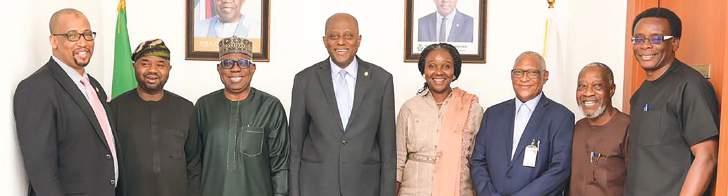
A STRATEGIC MEETING ON THE ECONOMY...
L-R: The Deputy Governor, Operations, Central Bank of Nigeria (CBN), Dr. Bala Bello; the Chairman, Nigeria Revenue Service (NRS), Dr. Zacch Adedeji; the Group Chief Executive Officer of the Nigerian National Petroleum Company Limited, Engr. Bayo Ojulari; the CBN Governor, Mr. Olayemi Cardoso; the Chief Executive Officer of Nigerian Upstream Petroleum Regulatory Commission (NUPRC), Mrs. Oritsemeyiwa Eyesan; the Nigerian Midstream and Downstream Petroleum Regulatory Authority (NMDPRA), Engr. Saidu Aliyu Mohammed; the Executive Director, Finance and Accounts, NMDPRA, Abiodun Adeniji; and the Chief Financial Officer, Mr. Adedapo Segun, after a strategic meeting at the CBN Head Office, Abuja... yesterday
OSUNTOKUN

Opposition Without the Yoruba
Nine months to the January 2027 D Day general elections, this electoral cycle is distinguished by the poverty of the opposition platform. It was predictable. The moment they could not commit to the prescription of the North /South power rotation principle, the opposition lost its most potent instrument of political mobilisation. Says the scripture “There is a time for everything, and a season for every activity under the heavens: a time to be born and a time to die, a time to plant and a time to uproot,
a time to kill and a time to heal…. “.
Borne, more or less, of an entitlement mentality, the political elite of the North is quite angry with President Bola Ahmed Tinubu for disregarding their status quo claims to preferential treatment. This anger is deepened by the fact that the region is the least prepared for grappling with the harsh living conditions spawned by the twin economic policies of the floatation of the Naira and the termination of the oil subsidy regime.
Whatever the degree of disappointment with the
STEVE OSUJI
incumbent government, those proposing its exit must meet with two conditions. One is measurable commitment to constitutional reforms with emphasis on decentralisation and devolution of powers. The other is the adoption of the North/South power rotation principle under which dispensation, the presidency is ceded to the South until 2031. So far, I have not seen any serious commitment to either on the part of the putative grand coalition platform of the African Democratic Coalition, ADC.
A historical perspective
In post colonial Africa, the argument has been repeatedly made that multi party pluralism is culturally ill suited to the African society, that the concept of institutional opposition is reckoned as enmity. It is viewed as emblematic of colonial rule whose artificiality is written all over the Berlin conference in which Africa was partitioned without regard
Continued on page 47

Governor Otti: Of Bricklaying And Journalism
Last Friday, the well spoken Abia State governor caused a ruckus. Gov. Alex Otti barred his teeth at a journalist he considered impetuous and irresponsible. Mr. Otti’s public shower of invectives on an innocent journalist and the ensuing conversations that trailed the event has thrown up the need to take a bit more look at the duties of governors in Nigeria, their attitude to journalism practice and their impact on the society at large.
First, more background: Journalist Chuka Nwabueze who represents BON Media Group was at the Abia State government monthly media chat last Friday. As the story went, it was his turn to pose his question to Gov. Otti.
His query went thus: “Sir, can you provide concrete
quantifiable evidence - beyond visible infrastructure projects - to demonstrate how your policies have impacted the lives of the average Abian since you got to office.”
Yours truly was not at the media chat but can feel the deadly silence that may have ensued.
When the governor “reacted”, it was like a tornado.
“You cannot come to a media chat and ask me to provide data about measurable impact on work that’s being done in the state that you live in. It’s irresponsible,” the governor bellowed.
He dug in: “That we throw this open for people to ask questions doesn’t mean that people should be stupid. So
DAKUKU PETERSIDE
let’s take this very seriously. So when you come to my media chat, you must be prepared: if you don’t have a question then you don’t raise your hand,” the governor surmised, seething with self righteous anger, as reported. This column avers straightaway that that’s a most intelligent question. One wonders why Governor Alex Otti, himself a very brilliant and, highly cerebral mind couldn’t see it as such.
Perhaps it’s the political atmosphere in the state which is so charged that the incumbent seems perpetually on
Iran’s Palaver, Nigeria’s Dilemma
Some wars begin with missiles and end with maps. Others begin far away and end up in the kitchen, the fuel station, the church, the mosque, the market stall, and the national mood. The escalating U.S.-Israeli confrontation with Iran is that kind of war for Nigeria. As of March 4, 2026, Brent crude had risen to about $81.40 a barrel after several days of disruption around the Strait of Hormuz, the narrow maritime chokepoint through which about 20 million barrels per day moved in 2024, roughly
20% of global petroleum liquids consumption. Once that artery convulses, the shock does not remain in the Gulf. It travels through shipping costs, insurance premiums, refined-product prices, exchange-rate expectations, and investor psychology. Nigeria, for all its distance from Tehran, sits directly in the path of those aftershocks. Iran itself is a lesson in the tragedy of squandered possibility. The country remains one of the most naturally endowed states in the world: the U.S. Energy Information
Administration says Iran ranked as the world’s third-largest oil reserve holder and the second-largest natural-gas reserve holder in 2023, with an estimated 1,200 trillion cubic feet of proved gas reserves. Yet abundance has not translated into serenity or broad-based prosperity. The same EIA brief notes that sanctions and underinvestment have constrained production and infrastructure, even as petroleum remains central to state revenue. The political story is harsher still. A 2024 U.N. fact-finding mission concluded that Iranian
authorities were responsible for egregious abuses during the 2022 protest wave, documenting 551 deaths in 26 of 31 provinces, mass arrests, torture, sexual violence, and at least 22,000 people later “pardoned,” implying an even larger dragnet of detention and prosecution. Iran’s predicament is therefore not simply about geopolitics. It is about what happens when a state accumulates power
Governor Otti