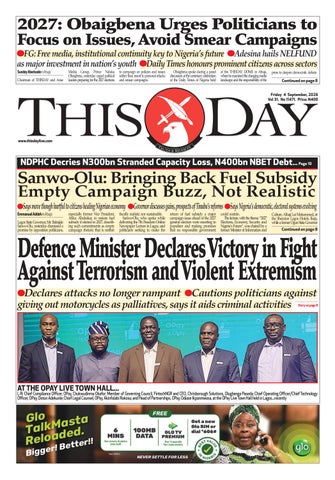
2027: Obaigbena Urges Politicians to Focus on Issues, Avoid Smear Campaigns
FG: Free media, institutional continuity key to Nigeria’s future Adesina hails NELFUND as major investment in nation’s youth Daily Times honours prominent citizens across sectors Sunday Aborisade in Abuja
Chairman of THISDAY and Arise
Media Group, Prince Nduka Obaigbena, yesterday urged political leaders preparing for the 2027 elections
to campaign on policies and issues rather than resort to personal attacks and smear campaigns.
Obaigbena spoke during a panel discussion at the centenary celebration of the Daily Times of Nigeria held
at the THISDAY DOME in Abuja, where he examined the changing media landscape and the responsibility of the
press to deepen democratic debate. Continued on page 8 Friday 4 September, 2026 Vol 31. No 11471. Price: N400
www.thisdaylive.com TR
UT H
& RE A S O
N
NDPHC Decries N300bn Stranded Capacity Loss, N400bn NBET Debt... Page 10
Sanwo-Olu: Bringing Back Fuel Subsidy Empty Campaign Buzz, Not Realistic Says move though hurtful to citizens healing Nigerian economy Governor discusses gains, prospects of Tinubu’s reforms Says Nigeria’s democratic, electoral systems evolving
Emmanuel Addeh in Abuja
Lagos State Governor, Mr. Babajide Sanwo-Olu, yesterday dismissed a promise by opposition politicians,
especially former Vice President, Atiku Abubakar, to restore fuel subsidy if elected in 2027, describing such commitments as empty campaign rhetoric that is neither
fiscally realistic nor sustainable. Sanwo-Olu, who spoke while delivering the 7th Freedom Online Newspaper Lecture in Lagos, said politicians seeking to make the
return of fuel subsidy a major campaign issue ahead of the 2027 general election were resorting to populism and making promises that no responsible government
could sustain. The lecture, with the theme: “2027 Elections, Economy, Security and Nigeria’s Future”, was chaired by a former Minister of Information and
Culture, Alhaji Lai Mohammed, at the Sheraton Lagos Hotels, Ikeja, while a former Ogun State Governor Continued on page 8
Defence Minister Declares Victory in Fight Against Terrorism and Violent Extremism Declares attacks no longer rampant Cautions politicians against giving out motorcycles as palliatives, says it aids criminal activities
Story on page 8
AT THE OPAY LIVE TOWN HALL...
L-R: Chief Compliance Officer, OPay, Chukwudinma Okafor; Member of Governing Council, FintechNGR and CEO, Chrisborough Solutions, Olugbenga Paseda; Chief Operating Officer/Chief Technology Officer, OPay, Dotun Adekunle; Chief Legal Counsel, OPay, Akinfolabi Rokosu; and Head of Partnerships, OPay, Odiase Ikponmwosa, at the OPay Live Town Hall held in Lagos...recently
2
FRIDAY, SEPTEMBER 4, 2026 • T H I S D AY
FRIDAY, SEPTEMBER 4, 2026 • T H I S D AY
3
4
FRIDAY, SEPTEMBER 4, 2026 • T H I S D AY
5
THISDAY • FRIDAY, SEPTEMBER 4, 2026
Group News Editor: Goddy Egene Email: Goddy.egene@thisdaylive.com, 0803 350 6821, 0807 401 0580
NEWS
THE REAL AFRICA’S GREATEST INVESTMENT OPPORTUNITY, SPONSOR BY DANGOTE INDUSTRY...
L-R: One of the Panelists, Olufemi Awoyemi; Keynote Speaker Session 1, Bismarck Rewane; Chairman of Board, Ecobank Nigeria, Bola Adesola; Chief Economist, Dangote Industries Limited, Dr. Hassan Mahmud; and Keynote Speaker 2, Dr. Muda Yusuf, at The Real Africa’s Greatest Investment Opportunity, sponsored by Dangote Industry Ltd, held in Lagos, yesterday
FTSE Russell Lists First HoldCo, Dangote Cement, MTN Nigeria, Zenith, GTCO, Others in Frontier Index Series Kayode Tokede
FTSE Russell has admitted 10 Nigerian companies worth N67.14 trillion by market capitalisation in its FTSE Frontier Index Series after reclassification of the country from “Unclassified” to “Frontier Market” status. The 10 companies in FTSE Russell September 2026 index review include First Holdco Plc, Dangote Cement Plc, MTN Nigeria Communications Plc, Guaranty Trust Holding Company (GTCO), and Zenith Bank Plc. The other Nigerian companies added to the index are: Aradel Holdings Plc, Nestlé Nigeria Plc, Nigerian Breweries Plc, Presco Plc, and Stanbic IBTC Holdings Plc. Nigeria is preparing to return to Frontier Market status on September 21, 2026 after a three-year absence from the global index provider’s classification. As of the close of trading activities September 3 on the Nigerian Exchange Limited (NGX), the market value of Dangote Cement led the chart, followed by MTN Nigeria Communications and First Holdco. The market capitalisation of Dangote Cement as of September 3, 2026 stood at N17.45 trillion, MTN Nigeria Communications, N16.85 trillion, and First Holdco, N6.82 trillion. Aradel Holdings stood at N6.3trillion; Zenith Bank, N5.24trillion; GTCO, N4.85 trillion;
Stanbic IBTC Holdings, N2.44 trillion; Presco, N2.39 trillion; Nestlé Nigeria, N2.37 trillion; and Nigerian Breweries, N2.32 trillion. The FTSE Frontier Index Series provides benchmarks covering large, mid and small cap companies across eligible Frontier markets and is designed to serve as a performance benchmark for investors and as a basis for index tracking products. FTSE Russell noted that the Indices can be segmented by Size, Region, country, and Industry Sectors and are calculated on a price and total return basis. Nigeria was removed from Frontier Market to Unclassified status in September 2023 following significant and continuing delays affecting the ability of international institutional investors to repatriate capital and execute foreign exchange transactions. However, the journey to reclassification began in October 2025, when FTSE Russell placed Nigeria on its Watch List for potential reclassification following improvements in foreign exchange liquidity, capital repatriation, and market accessibility. In April 2026, FTSE Russell announced that Nigeria would return to Frontier Market status, setting September 21, 2026 as the effective date. That transition plan was later paused and subjected to an additional assessment following Nigeria’s move from a T+2 to T+1 settlement cycle on June 1, 2026.
The review followed concerns from market participants that the shorter settlement cycle could create a de facto prefunding requirement for international institutional investors trading Nigerian securities. That prompted an extensive engagement involving NGX Group, Securities and Exchange Commission (SEC), FTSE Russell, global custodians, and international institutional investors. In July 2026, a delegation from
NGX Group engaged directly with global custodians and institutional investors to explain the operation of the T+1 settlement framework. The discussions enabled NGX Group to provide evidence on the implementation of the new settlement cycle, respond to concerns raised by international investors and custodians, and outline measures being taken to ensure that Nigeria’s market infrastructure remained aligned with international best
The federal government has pledged to protect Nigerian-owned investments in Angola and strengthen support for Nigerians living and doing business in that country. Minister of Foreign Affairs, Ambassador Bianca Odumegwu-Ojukwu, gave the assurance during an inspection of the Cidade De Motores (City of Engines) auto spare-parts market in Golf 2, Luanda, established by Nigerian auto parts dealers. Odumegwu-Ojukwu, who visited the facility on the side-lines of the 21st
Extraordinary Session of the Assembly of Heads of State and Government of the African Union, expressed satisfaction with the scale of investment by Nigerian entrepreneurs, describing the project as evidence of the pioneering spirit of Nigerians abroad. She stated, “We are very proud of you having seen the worth of the enormous investment you have put on ground. We do not want a situation where people will invest and later some phony stories would be told about their investment.” The minister said the protection of Nigerian businesses in Angola would
Market status is the opportunity it creates for the next phase of our market’s development. “We have to turn greater international visibility into broader participation, deeper liquidity, and more capital for Nigerian businesses. That is the opportunity before us.” Popoola said NGX continued to focus on building a market that is increasingly competitive globally and more relevant to Nigeria’s economic growth.
Nigeria, IEA Concretise Partnership, Sign Agreement On Security, Energy Policy Shettima hails pact as justification of Tinubu’s policy choices, gains of his economic reforms
Deji Elumoye in Abuja
Nigeria and the International Energy Agency (IEA) on Thursday signed an agreement for a Joint Work Programme to strengthen strategic partnership in the development of data for energy policy and investment across the value chain for economic growth and energy security. Vice President Kashim Shettima declared that Nigeria’s formal admission into IEA as an Association Country was a significant milestone for the country and another testament to the gains of the economic reforms of the administration of President Bola Tinubu. Shettima spoke at State House,
Abuja, while signing the agreement for the Joint Work Programme between Nigeria and IEA, signalling the formal commencement of the partnership. Speaking on behalf of Tinubu, the vice president stated that Nigeria’s formal entry into the fold of the Paris-based non-governmental organisation justified the administration’s policy choices and efforts aimed at leveraging the country’s abundant energy resources scattered across the country. Commending IEA for the important role it was playing in shaping the global energy landscape, Shettima said the efforts of the agency in the global energy conversation and in supporting countries to navigate the challenges of energy
FG Moves to Protect Nigerian Investments in Angola Michael Olugbode in Abuja
practices. On the reclassification, Group Managing Director/Chief Executive Officer of NGX Group, Temi Popoola, said the priority now was to translate renewed global visibility into deeper participation, stronger liquidity, and greater capital formation. Popoola stated, “This is an important moment for Nigeria’s capital market. But the real significance of returning to Frontier
receive priority in future bilateral discussions, particularly at the next Nigeria-Angola Joint Commission. She added that President Bola Tinubu remained committed to the welfare and protection of Nigerians wherever they lived, assuring the traders that the government is taking steps to address challenges confronting Nigerians abroad. Odumegwu-Ojukwu urged the traders to obey Angolan laws and conduct their businesses in ways that would enhance Nigeria’s image. She also warned against ethnic discrimination in the management of the market, stressing that the facility
should remain inclusive. “There should be no room for tribalism,” she said. Earlier, President of the United Auto Parts Dealers Association, Chuks Ukachi, thanked the minister for visiting the market and explained that the project was established after Angolan authorities stopped Nigerian traders from conducting business along the roadside. According to him, the restriction left many Nigerian traders without businesses for nearly two years, prompting the association to establish a formal market where they could operate legally.
security, affordability, sustainability, and economic development cannot be overstated. According to him, “Nigeria’s admission as an association country with the IEA is a significant milestone for our country and it reflects Nigeria’s strategic importance in the global energy landscape and the confidence that IEA has placed in our commitment to constructive international energy cooperation.” He added that given Nigeria’s potential, “The country will benefit from IEA’s institutional knowledge, the intellectual resources, the reach and expertise to support our nation’s ambitions in this sector.” The vice president acknowledged Nigeria’s abundant renewable energy resources and Tinubu’s commitment to repositioning the economy, leveraging available resources, which were already manifesting across different sectors of the economy. Shettima also assured the IEA team of the current administration’s commitment to continue to partner with other stakeholders within the setting to contribute to the global energy debate on a fair and just energy transition. Earlier, leader of the IEA delegation, Dr. Fatih Birol, explained that his organisation was an organisation of governments that covered all technological fields, including oil, gas, solar, nuclear power, artificial intelligence, and electric cars based in Paris. Working with top 500 energy experts
of the world in terms of giving policy advice, sharing data and expertise, Birol said to be a member of the IEA family was not an easy task, as it required a lot of considerations and tests. According to Birol, after detailed discussions with Minister of State for Petroleum (Gas), Mr. Ekperikpe Ekpo, the board, comprising the governments of the United States, Japan, Germany, Italy, and UK, voted and accepted Nigeria unanimously as a member. He stated, “The IEA will accompany the Nigerian energy sector for the next few years to come for a much better energy future. We will provide policy advice from clean cooking to gas markets, from gas markets to training Nigerian experts at the IEA on our own.” Ekpo stressed that Nigeria’s admittance into IEA was based on the performance of the Tinubu administration reflected in the reforms undertaken in the economy. He said the signing of the Joint Work Programme, which portends the involvement of the technical team of the IEA with Nigeria in the development of data for energy policy and investment across the value chain and targeted for economic growth and energy security. For his part, Minister of State for Foreign Affairs, Ambassador Sola Enikanoaiye, described IEA’s partnership with Nigeria as strategically important, stating that the Nigerian mission in Paris played a critical role in ensuring its success.
6
FRIDAY, SEPTEMBER 4, 2026 • THISDAY
NEWS
DAILY TIMES CENTINARY AWARD CEREMONY...
L-R: Governor Mohammed Umar Bago of Niger State; Oni of Ife, HRM Oba Ojaja II, Adeyeye Enitan Ogunwusi; Keynote Speaker, Dr. Akinwumi Adesina; Secretary to the Government of the Federation, George Akume; Deputy Speaker, House of Representatives, Honourable Benjamin Kalu; Governor Abdullahi Sule of Nasarawa State; and Governor Dauda Lawal of Zamfara State, at the Times Heroes Award to mark 100 years of Daily Times Newspapers held at the THISDAY Dome, Abuja, yesterday PHOTO: GODWIN OMOIGUI
Uber Exit: Tinubu Has Turned Nigeria into Graveyard of Businesses, Says ADC
Lists several firms that closed or scaled down operations in the country Atiku says IPMAN has put president’s subsidy argument to shame
Chuks Okocha in Abuja The African Democratic Congress (ADC) yesterday attacked the Bola Tinubu-led federal government for the exit of ride-hailing company, Uber, from Nigeria and the closure or scaling down of operations by several multinational companies. In a statement in Abuja, the National Publicity Secretary of the ADC, Mallam Bolaji Abdullahi stated that the development showed that the country had
become a “graveyard of businesses”. The opposition party said the growing number of businesses shutting down, scaling back operations or leaving Nigeria represented a vote of no confidence in the Tinubu administration and its capacity to manage the economy. According to the ADC, the exit of Uber, alongside the shutdown or scaling down of operations by several major companies, exposed the widening gap between the government’s claims
of economic progress and the reality confronting businesses and ordinary Nigerians. The party said it was particularly astonishing that the Tinubu administration was celebrating what it described as a marginal 0.2 percentage-point improvement in Gross Domestic Product (GDP) at a time businesses were closing, jobs were disappearing and millions of Nigerians were sinking deeper into poverty. “Certainly, a 0.2 per cent growth does
not justify the extreme hardship that Nigerians are suffering,” the party said. According to the ADC spokesman, Nigeria’s poverty rate had risen to 63 per cent, affecting an estimated 140 million Nigerians. The party challenged Tinubu to explain the significance of the GDP growth to Nigerians who had sunk into poverty, workers who had watched the value of their salaries diminish, businesses struggling with rising energy costs and millions of households forced
Oando Calls for Stronger Partnerships to Unlock Africa’s Upstream Potential Says relationships must extend beyond regulatory compliance
Emmanuel Addeh in Abuja
Oando Energy Resources, the upstream subsidiary of Oando Plc, Africa’s leading indigenous energy solutions provider, has called for stronger partnerships between governments, regulators, operators, and host communities. Speaking during a panel discussion at African Oil Week (AOW) 2026 in Accra, Ghana, General Manager, Security, Government & External Relations, Kofo Olagunju, said such collaboration was critical to unlocking investment and driving sustainable growth across Africa’s upstream sector. Olagunju spoke during the panel session: “Building Dialogue, Leadership: Exploring the Challenges of Both Government and Private Sector Frameworks for Upstream Development,” where he joined Cany Jobe, Director General, Petroleum Commission, The Gambia; Innocent Kihika, Board Member, Petroleum Authority of Uganda; Joe Kofi Mensah, Senior Vice President & Head, Ghana Business Unit, Kosmos Energy; and Liz Ross, GM, New Ventures Exploration & M&A, Africa & Europe, CNOOC International. The discussion examined how African governments and private sector players can better align policies, regulatory frameworks, and commercial priorities to create the certainty required to attract investment and accelerate upstream development across the
continent, a statement by Oando stated. Olagunju argued that the relationship between regulators and operators must evolve beyond traditional oversight towards a more constructive partnership built on mutual understanding and shared responsibility. He said: “What we have seen in recent years is a growing recognition by both operators and regulators that we are ultimately working towards a shared objective. Real progress requires genuine partnership, one in which regulators understand the operational realities and challenges faced by the industry, while operators remain mindful of the broader developmental and regulatory priorities governments are seeking to advance.” Turning to the role of host communities, Olagunju highlighted the shift towards deeper community participation in the success and sustainability of upstream operations. “Host communities have evolved from being neighbours to the resources, to stakeholders in the development process, and increasingly, to shareholders in the success of our operations,” he emphasising. He stressed that sustainable operations depend on relationships that extend beyond regulatory compliance and transactional engagement. “For our operations to thrive, host communities must be integral partners in the journey. That
requires more than compliance. It requires transparency, trust, and a shared understanding of the value that responsible resource development can create,” Olagunju said. The AOW brings together African governments, energy companies, investors and industry stakeholders for critical dialogue on the opportunities and challenges shaping the continent’s upstream energy sector. Its 2026 edition provided a platform for dialogue on investment, policy, exploration, and the development of Africa’s energy resources. From an investor perspective, Mensah, SVP & Head, Ghana Business Unit, Kosmos Energy, outlined the conditions required to create an environment capable of attracting long-term capital. Mensah said: “Creating an environment that attracts and sustains investment requires four critical elements: regulatory stability, speed, ease of doing business, and competitive fiscal terms. These factors must work together to create the certainty investors need to commit capital for the long term.” Addressing the regulatory perspective, Jobe, Director General, Petroleum Commission, The Gambia, challenged the notion that governments must choose between protecting national interests and attracting investment. “Protecting national interests and enabling investment should not be viewed as competing objectives. A
strong regulatory framework must achieve both, creating value for resource owners while providing investors with the clarity, predictability and commercial viability required to operate successfully,” Jobe explained. The panel concluded with a call for African energy stakeholders to move beyond dialogue towards practical action, strengthening partnerships, and aligning regulatory and commercial frameworks to unlock responsible investment and long-term growth.
to reduce both the quantity and quality of food on their tables. “When the President and his party say things are getting better, we expect them to tell us what has improved in the lives of Nigerians. “They should tell us how much food their ‘GDP growth’ has put on the tables. They should tell us which bill it has paid. If 0.2 per cent is a mark of success in their books, President Tinubu and the APC should tell us what they consider as failure,” the ADC said. The party said Uber’s exit after 12 years in Nigeria reflected what it described as the increasingly hostile operating environment confronting businesses, particularly the soaring cost of energy and transportation following the removal of petrol subsidy and the devaluation of the naira. “This is precisely why the ADC presidential candidate, Alhaji Atiku Abubakar, has proposed the restoration of a targeted fuel subsidy to bring down the cost of fuel, transportation and production,” the party said. The ADC also cited an earlier report by the Manufacturers Association of Nigeria (MAN), which it said indicated that 767 manufacturing companies, including 20 iconic global brands, had shut down or ceased operations in Nigeria, while hundreds more were distressed. It listed companies that had shut
down or scaled down their operations in the country to include Microsoft, Jumia and Bolt Food, Pick n Pay, Shoprite, GlaxoSmithKline (GSK), Sanofi-Aventis, Bayer AG, Procter & Gamble, Unilever and PZ Cussons, among others. “Therefore, when the President announces that Nigeria has turned the corner, we wonder which corner he is talking about. “If indeed the economy is improving, or the slightest hope exists in the minds of those who run these businesses that this APC government can improve the economy, why are they closing shop and moving elsewhere?” the party asked. “The painful truth is that Tinubu has turned Nigeria into a graveyard of businesses. Every business that shuts down or pulls out is a vote of no confidence in the Tinubu administration and its capacity to manage the economy. “Each exit delivers a blow to the economy. But perhaps, more importantly, each one represents a massive loss of jobs and increased poverty,” it added. Meanwhile, Atiku has welcomed the call by the Independent Petroleum Marketers Association of Nigeria (IPMAN) for government intervention to reduce petrol prices, saying the association had put Tinubu’s argument against his proposed targeted subsidy policy to shame.
Abuja Trade Centre Launches Export Bootcamp for SMEs Amid $6.1 Billion Non-oil Trade
Emmanuel Addeh in Abuja
The World Trade Centre (WTC) Abuja yesterday launched the Export Launchpad Bootcamp aimed at equipping Nigerian small and medium-sized enterprises (SMEs) with the knowledge, tools and practical skills required to access international markets and grow their export businesses. The programme, which is based on the World Trade Centers Association’s (WTCA) Deep Dive Global Series, the organisers said, is designed to help businesses move from export ambition to actual execution by addressing key areas including market selection, export readiness, entry strategies,
logistics, documentation, compliance, payments and risk management. Delivering his welcome address to the participants at the launch, Vice President of the World Trade Centre, Abuja, Karim Adelaja, said the initiative was developed in response to the growing opportunities for Nigerian businesses in global markets. He disclosed that Nigeria recorded its highest formally documented non-oil export performance in 2025, valued at $6.1 billion, with 281 non-oil products exported to 120 countries. “These figures demonstrate that Nigerian products are already finding markets around the world,” he said. Karim said Nigerian enterprises across agriculture, manufacturing,
technology, the creative economy and professional services were producing goods and services with the potential to compete internationally. He however, said possessing competitive products was only the beginning, stressing that businesses must also understand their target markets, international standards, certification requirements, logistics, documentation, payment systems and how to deliver consistently and profitably. “The more important question is whether our businesses have the knowledge, systems, standards and consistency required to enter those markets successfully and remain competitive,” he said.
7
THISDAY • FRIDAY, SEPTEMBER 4, 2026
NEWS
7TH YEARLY LECTURE OF FREEDOM ONLINE...
L-R: Aare Ona Kakanfo of Yorubaland, Iba Gani Adams; Host/MD and Editor-in-Chief, Freedom Online, Gabriel Akinadewo; former Ogun State Governor, Senator Gbenga Daniel; Lagos State Governor, Mr. Babajide Sanwo-Olu; Chairman of the occasion, Alhaji Lai Mohammed; former President, Nigerian Guild of Editors (NGE), Mrs. Funke Egbemode; Editor, Vanguard/ President, Nigerian Guild of Editors (NGE), Mr. Eze Anaba; and Ogun State PDP Governorship Candidate, Oladipupo Adebutu, during the 7th Yearly Lecture of Freedom Online entitled, “2027 Elections: Economy, Security And Nigeria’s Future,” held in Lagos, yesterday
NAICOM Unveils Initiative to Raise Insurance Penetration to 10% of GDP by 2031 Insurers target 25 million Nigerians, 6,000 professionals, 250,000 MSMEs in 5-year ISSP blueprint Omosehin demands stronger underwriting, governance, claims settlement Leadway Assurance: programme will deepen penetration, confidence, trust James Emejo in Abuja National Insurance Commission (NAICOM), yesterday, unveiled a five-year industry-wide programme to significantly deepen insurance coverage in the country, targeting an increase in insurance penetration from the current 0.5 per cent of Gross Domestic Product (GDP) to 10 per cent by 2031. The ambitious target is contained in the Insurance Sector Strengthening Programme (ISSP), a 36–60-month initiative launched by the commission in partnership with stakeholders in the insurance industry. The programme seeks to tackle low public awareness, weak consumer confidence, distribution gaps, inadequate capacity, and limited access to insurance among women, youths, and Micro, Small and Medium Enterprises (MSMEs). Speaking at the launch, Commissioner for Insurance/ Chief Executive of NAICOM, Mr. Olusegun Ayo Omosehin, said the industry had reached a point where reform could no longer remain at the level of policy intentions but must translate into measurable improvements in coverage and consumer confidence. Omosehin said despite the nation’s large economy and population, insurance penetration remained significantly below its potential, with many Nigerians either uninsured or underinsured. He identified limited understanding of insurance products, trust
deficit, capacity constraints and fragmented distribution channels as some of the factors holding back the industry’s growth. According to him, the new programme would provide a structured response through six pillars covering advocacy and policy, awareness and education, capacity building, gender inclusion, youth engagement, and MSME and value-chain development. He stressed that NAICOM’s regulatory mandate would remain anchored on policyholder protection and market stability, warning that industry expansion must not come at the expense of solvency, transparency and ethical conduct. Omosehin said, “Regulation must serve as both a shield for policyholders and a compass for responsible market development.”
Omosehin stressed that operators must earn public confidence through compliance, professionalism and service excellence. He further challenged insurers to strengthen underwriting, governance and claims administration, stressing that the next phase of industry growth must be built around adequate capitalisation, responsible underwriting, transparent operations, and prompt settlement of genuine claims. The commissioner also identified digitalisation as critical to the industry’s expansion, stating that changing consumer expectations are making convenience, transparency and personalised financial solutions increasingly important. He said the integration of digital platforms, insurtech solutions, and data-driven approaches would
help make insurance products more accessible and position the industry to compete effectively in a rapidly changing financial services environment. Supporting the initiative, Head, Commercial Division, Leadway Assurance, Mr. Olawale Alao, described the ISSP as a timely initiative capable of addressing the structural and perception challenges limiting insurance penetration in Nigeria. Alao said the programme provided the industry with a structured platform to identify critical gaps in the insurance market and develop practical solutions to improve public understanding and participation. He said the initiative was particularly important in changing the perception of insurance from an optional financial product to an
essential component of everyday life and financial planning. According to him, Leadway Assurance sees the programme as an opportunity to contribute to efforts aimed at widening insurance coverage and making insurance more relevant to Nigerians across different segments of society. He said, “Over the next five years, we believe this initiative can deepen awareness, particularly among young Nigerians, build stronger trust in the sector and encourage more people to see insurance as an essential tool for protection and financial resilience.” Alao stressed that increased awareness and trust would be critical to achieving a broader transformation of the sector, particularly among younger Nigerians who represent a significant segment of the country’s future consumer and investment
population. He stated that beyond expanding the number of people with insurance policies, the sector needed to ensure that Nigerians understood the value of insurance and were able to integrate it into their everyday financial decisions. He said the programme’s structured approach would enable stakeholders to move beyond identifying challenges to implementing practical measures capable of producing sustainable improvements in insurance uptake. Alao added that Leadway remained committed to supporting initiatives that would strengthen confidence in the industry and promote insurance as a key instrument for protecting households, businesses and livelihoods against financial shocks.
Tinubu Backs October Launch of African Credit Rating Agency Describes it as right step towards building financial institutions to assess continent’s economies and risks
Deji Elumoye in Abuja
President Bola Tinubu has lent his support for the October, 2026 launch of the African Credit Rating Agency (AfCRA), describing it as another step towards building African financial institutions capable of properly assessing the continent’s economies and risks. The President stated this on
Thursday in a message posted on his verified official X handle, @OfficialABAT, while reacting to the African Union’s announcement that AfCRA will officially launch on October 7. According to Tinubu: “AfCRA is another step towards that goal.” He recalled that in February, 2026,he made the case in the Financial Times for an African credit
rating agency and reiterated the call in May at the Africa CEO Forum in Kigali, Rwanda. Tinubu stressed that Africa needs financial institutions that understand the continent’s economies and can properly assess its risks, taking into account its economic fundamentals and ongoing reforms. The President emphasised that Africa is not seeking preferential treat-
ment from credit rating institutions but fair assessments that accurately reflect the realities of its economies. His words: “Africa is not asking for favourable ratings. We are asking for fair ratings, grounded in our fundamentals and in the reforms our economies are actually carrying out.” Tinubu also maintained that AfCRA must earn the confidence of global capital through the
independence and rigour of its assessments. “AfCRA must now earn the confidence of global capital. That confidence will rest on its independence and the rigour of its work,” he said. The President, therefore, expressed optimism about the initiative, saying he looks forward to AfCRA’s official launch on October 7, 2026.
Nigerian Scientist Wins Best Paper Award for Neural Networks Research
Olusegun Samuel in Yenagoa
Nigerian Artificial Intelligence (AI) expert, Dr. Domor Mienye and his co-authors have won the annual Best Paper Award of Information, a peer-reviewed international journal published by Switzerland-based academic publisher, Multidisciplinary Digital Publishing Institute (MDPI. Mienye, who is also the All Progressive Grand Alliance
(APGA), gubernatorial hopeful for Bayelsa State, has authored and co-authored research across artificial intelligence, machine learning and deep learning and has worked in both academic and technology environments in Africa and Europe. The award was given for their paper:;“Recurrent Neural Networks: A Comprehensive Review of Architectures, Variants, and Applications,” published in
August 2024, a statement made available in Yenagoa said. The work brought together Mienye and Prof Theo Swart of the University of Johannesburg’s Institute for Intelligent Systems in South Africa and Dr George Obaido, affiliated with the Centre for Human-Compatible Artificial Intelligence and Berkeley Institute for Data Science at the University of California, Berkeley. The research provided a detailed
review of recurrent neural networks and some of their best-known variants, including Long Short-Term Memory and Gated Recurrent Unit models. It also looked at how the technology is being used in natural language processing, speech recognition, forecasting, autonomous vehicles and other applications involving sequential data. The annual award is open to papers published in Information
during the eligible period. MDPI assesses eligible works using measures that include scientific quality, originality, research impact, citations and readership, making the award one of the journal’s main recognitions for published research. The winning paper has become one of the journal’s most widely read and cited recent publications. It has recorded more than 80,000 views and over 700 citations within two years of publication.
Information also ranked it first among its highly cited papers from 2024, while its academic editors selected it for the journal’s Editor’s Choice collection. Its reach has extended beyond the journal. The preprint version of the research was recently named among 30 shortlisted works in Computer Science and Mathematics for Preprints.org’s Popular Preprints of the Decade Award 2016–2026.
8
FRIDAY, SEPTEMBER 4, 2026 • THISDAY
EIGHT
GDP Report: MAN Raises Concern Over Widening Disconnect Between Macroeconomic Figures, Real-sector Vitality Says we must raise a critical alarm about precipitous plunge in overall industrial growth
Dike Onwuamaeze Manufacturers Association of Nigeria (MAN) raised concerns that while headline growth suggested economic resilience, a critical analysis revealed a widening disconnect between macroeconomic figures and real-sector vitality. MAN stated this position following the recently released “Second Quarter 2026 Gross Domestic Product (GDP)”, which indicated an overall year-on-year real GDP growth rate of 4.43 per cent, up from 3.89 per cent in Q1 2026 and 4.23 per cent in Q2 2025. It said the growth trajectory remained disproportionately servicedriven, which constituted 56.62 per cent of the GDP), “while the broader industrial sector that made up 17.23 per cent of GDP is visibly suffocating under severe structural headwinds.” MAN said, “The Q2 2026 GDP performance serves as a reminder that sustainable national prosperity
must be anchored in active domestic manufacturing, not just service consumption and extraction.” It added, “We must raise a critical alarm about the precipitous plunge in overall industrial growth, which has nearly halved, from a robust 7.46 per cent in Q2 2025 to a troubling 3.96 per cent in Q2 2026. “This was further compounded by a drastic drop in manufacturing’s share of real GDP, which fell from 9.57 per cent in Q1 2026 to 7.72 per cent in Q2 2026, alongside a marginal decline in real manufacturing growth from 3.29 per cent to 3.24 per cent.” MAN said the rapid industrial erosion was driven mainly by electricity, gas, steam, and air conditioning supply that recorded the sharpest contraction of -10.63 per cent in Q2 2026. MAN stated, “Ultimately, headline GDP growth driven by non-tradable service activities will fail to strengthen foreign exchange reserves, reduce
structural inflation, or create sustainable mass industrial jobs. “Therefore, Nigeria cannot sustain its growth momentum on services and extraction alone. A nation that trades and consumes what it does not produce builds prosperity on quicksand.” MAN explained that the drop in manufacturing’s contribution to GDP, from 9.57 per cent to 7.72 per cent in a single quarter, highlighted severe cost pressure, a high exchange rate, outrageous interest rates, and exorbitant electricity tariffs facing domestic manufacturers. It said, “Although manufacturing expanded year-on-year by 3.24 per cent, its declining relative share indicates that industrial expansion is lagging behind broader economic activity. “The Q2 2026 GDP performance serves as a reminder that sustainable national prosperity must be anchored in active domestic manufacturing, not just service consumption and extraction.”
According to MAN, a disaggregated view of the manufacturing sub-sector reveals a clear structural divergence where growth is concentrated in capital-intensive and heavy industrial segments, notably oil refining, +43.94 and cement, +12.75. MAN said high-employment sub-sectors were either stalling or contracting. For instance, textile, apparel and footwear, which accounted for 22.95 per cent of manufacturing real GDP, contracted by -1.23 per cent and motor vehicles and assembly also contracted by -1.02 per cent. “Meanwhile, the largest manufacturing group, Food, Beverage and Tobacco (36.58 per cent share), grew modestly by 2.79 per cent, weighed down by weak consumer purchasing power and food inflation,” the association said. MAN also highlighted the major effects of the poor showing of the manufacturing sector on the economy
to include employment fragility as “contraction in labour-intensive sectors like textiles and vehicle assembly directly threatens wage employment and risks triggering job losses across lower- and middle-income demographics”. It said other effects were inflationary spiral, foreign exchange (FX) vulnerability, erosion of industrial capacity, and technological obsolescence. It stated, “Without an expanding export-oriented manufacturing base, foreign exchange inflows will remain bound to volatile primary commodity exports, perpetuating pressure on the Naira. “Suffocating under exorbitant energy tariffs and prohibitive borrowing costs, manufacturers, particularly small and medium industries, are operating far below installed capacity. Instead of expanding production lines or acquiring modern technology, most factories are fighting to keep the lights on, leaving
MAN President, Otunba Francis Meshioye Nigerian industries less competitive globally.” MAN recommended that to halt the industrial erosion, pivot the economy away from import dependency, and unlock sustainable real-sector expansion, government should direct the Nigerian Electricity Regulatory Commission to immediately approve eligible customer status for contiguous industrial clusters, and allow direct bulk Power Purchase Agreements (PPAs) with GenCos to bypass DisCo inefficiencies and eliminate arbitrary charges.
DEFENCE MINISTER DECLARES VICTORY IN FIGHT AGAINST TERRORISM AND VIOLENT EXTREMISM
Nume Ekeghe in Lagos and Linus Aleke in Abuja
The Minister of Defence, General Christopher Musa, has declared victory in the ongoing fight against insurgency and other forms of violent extremism in the country. These, he added, was because attacks by terrorists and extremist groups were no longer as rampant or brazen as they were in the past. Speaking during an interview on Channels Television’s Politics Today , Musa observed that terrorist
attacks had drastically reduced, giving way to kidnappings. Responding to a question on whether Nigeria had defeated terrorists or merely displaced them, the minister said, “Frankly speaking, we have defeated terrorists because now, like I said, the attacks are not as rampant and it is now kidnapping. “Like I said, kidnapping is a social ill where you now see wives kidnapping husbands and husbands kidnapping children.” Musa insisted security had
improved in Nigeria under President Bola Tinubu, adding that reports of terrorist attacks were no longer as frequent as they used to be. “I can tell you there is improved security. Maybe if you noticed, you don’t hear so much of Boko Haram attacks, ISWAP attacks and all these things here and there, maybe one-off. “Now, I say, the trajectory is this: from criminality to kidnapping to terrorism, insurgency; once you are able to hit them, it goes back
downwards. “So, we are now back into the stage of abductions and kidnappings because that is the easiest way for them to try and raise money.” The minister stressed that troops were now moving into the terrorists’ enclaves and recovering many of the abducted individuals. He, however, cautioned political actors against giving out motorcycles as palliatives, explaining that the motorcycles often ended up in the hands of terrorists, who used them for their nefarious activities.
He said if politicians must give out motorcycles, they should provide low-capacity ones that would not give terrorists an advantage if they get hold of them. He said, “We try to appeal to politicians to stop giving out motorcycles as palliatives because these motorcycles are still the same ones that will end up with these terrorists. “Even if you are to give, don’t give them the big-capacity motorcycles; give them the small-capacity ones that they won’t be able to use
2027: OBAIGBENA URGES POLITICIANS TO FOCUS ON ISSUES, AVOID SMEAR CAMPAIGNS
The event themed: “Honouring the Past, Shaping the Future,” also featured the unveiling of the Nigerian Grand Book and the recognition of Nigerians, who have contributed significantly to the development of the country. The media mogul participated in the session with a former Managing Director of the Daily Times, Dr. Yemi Ogunbiyi, and business executive, Mustafa Chike-Obi. Speaking on the 2027 elections, Obaigbena challenged presidential candidates and other political leaders to engage Nigerians in substantive debates on policies, rather than spend time on frivolities. He said: “I believe I should implore our leaders to fight the election on policies. Should we have subsidy or should we not? Let us debate it. “Should we go back to the command-and-control exchange rates, or should we allow the markets? Should we have tax reforms such that we can equalise the gaps between the rich and the poor? “How do we deal with insecurity? Is state police an answer? What does Abubakar Atiku think? What does Peter Obi think? Let us debate our future on policies.” Obaigbena cautioned politicians against returning to the era of smear campaigns, insisting that Nigerians deserve to know the alternatives being offered by competing political parties and candidates. “Let us not return to any smear campaign. Let us domesticate our fight in Nigeria and debate policies that affect people especially poverty, hardship. What is your alternative?” he added. On the changing dynamics of the media space, Obaigbena argued that although the methods of distributing news had changed dramatically because of technology, the fundamental
responsibilities of journalism remained the same. “Journalism remains the same yesterday, today and tomorrow. The forms of distribution have changed. The audiences have expanded as distribution is now in individual hands. That’s what technology has done,” he said. He further called on the media to insist on presidential debates, arguing that Nigerians have a right to hear directly from those seeking to govern them. “We want to hear from them. We want to see the debates. The media must insist on it because the Nigerian people need it,” he stated. For his part, President Bola Tinubu underscored the importance of a free media, including the preservation of national memory and institutional continuity in the growth and development of Nigeria.
Represented by the Secretary to the Government of the Federation (SGF), Senator George Akume, the president used the occasion to highlight the critical role of the media in a democracy, while drawing attention to the importance of preserving Nigeria’s history and strengthening institutions for future generations. According to Tinubu, the media remains indispensable to democracy because of its role in informing citizens, holding the government accountable and preserving the history of the nation. He described the centenary of Daily Times, which he called the “flagstaff of Nigerian journalism,” as not merely a celebration of longevity but a testament to “endurance, relevance and institutional resilience. “For a century, the Daily Times has not only reported the Nigerian story; it has been an important part of the history of our country,” Tinubu said.
He noted that the newspaper had documented the colonial era, the struggle for independence, nation-building and the evolution of contemporary democracy, capturing personalities and events that shaped Nigeria’s national identity. The president said the lessons of history should guide present and future generations, warning that a country that forgets its past risks repeating its mistakes. “A nation that forgets its history is at risk of repeating its mistakes. But a nation that understands its history can draw wisdom from its successes, learn from its setbacks and confidently design its future,” he said. Tinubu linked the lesson of historical continuity to his administration’s reform agenda, insisting that the government’s policies were designed not merely to alter existing arrangements but to change the country’s economic
trajectory. “The reforms of the present administration are not simply about changing policies; they are about changing the trajectory of our nation,” he said. According to him, the reforms seek to establish a stronger fiscal foundation, create a more productive economy, strengthen institutions, attract investment, improve infrastructure and expand opportunities for young Nigerians. He added that the ultimate objective was to position Nigeria to compete more effectively in the global economy. The president also endorsed the Nigerian Grand Book unveiled at the event, describing it as important to preserving Nigeria’s institutional memory and enabling Nigerians to tell their own story from their own perspective. Continued on page 10
to run around because that gives them leverage. They can easily enter anywhere and then disappear at the same time.” Speaking on local government autonomy, Musa emphasised the need to allow local governments to function effectively, stating that the failure of local governments was among the factors aggravating insecurity in the country. On the 2027 general election, he said insecurity would not derail Tinubu’s campaign for a second term, while defending his inclusion in the All Progressives Congress (APC) presidential campaign council in charge of security. Musa insisted that his involvement would not compromise his responsibilities as Defence Minister, stressing that his professional obligation was to Nigeria rather than to any political party. “I am a professional, I will never succumb to that level (being partisan against opposition). Nigeria is my unit, whatever it takes to protect Nigeria that is what we stand for. “We want a peaceful election, so we are going to work towards that and we are going to work with all the parties because that is why I am Minister of Defence, to ensure that every security force does what is right. “So like I said, we are going to support INEC to ensure that the election is free, fair and credible because we want Nigeria to come out of all these election issues. We have gone past that.”
SANWO-OLU: BRINGING BACK FUEL SUBSIDY EMPTY CAMPAIGN BUZZ, NOT REALISTIC and Senator representing Ogun East, Gbenga Daniel, was the Special Guest of Honour at the event. Sanwo-Olu, who examined the ongoing economic reforms, security situation and electoral reforms being undertaken by the federal government, argued that the removal of the subsidy was a difficult but necessary decision to prevent the continued depletion of public finances, a statement by his Special Adviser on Media, Gbenga Akosile, said. According to him, the subsidy regime was originally conceived as a temporary intervention to address shortcomings in domestic fuel supply arising from the inefficiency of state-owned refineries, but had over time become an unsustainable drain on the country’s resources. “The oil subsidy was not removed
because anybody enjoyed removing it. It was removed because it had become a hole in the national purse through which the money for roads, schools and hospitals was draining away. “The intervention was never reaching the ordinary motorist it was supposed to help. In the build up to the 2023 elections, every major candidate promised to remove it. Only one of them was in a position to do it, and he did it on his first day in office. “I will not stand here and tell you that oil subsidy removal has been painless. It has not. Lagosians particularly have felt it at the pump, at the market, and in the price of a bag of rice. “Any governor who tells you otherwise has not been listening to his own people. But, the measure
of a reform is not whether it hurts. It is whether it heals. And the evidence that this one is healing is now arriving, quarter by quarter,” Sanwo-Olu said. The Lagos governor said President Bola Tinubu took a decision that previous administrations had avoided because of its potential political consequences, despite the enormous financial cost of maintaining the subsidy regime. He maintained that the savings from the removal had significantly improved revenues accruing to the states and local governments, insisting that subnational governments now had greater resources to address infrastructure and social needs. “Under President Tinubu, the states have had it very good. Since the subsidy was removed, the monthly allocations to States
and local governments have more than doubled in Naira terms. The President has done his part; the money is arriving. “Barely two weeks into the season of presidential election campaign, opposition politicians have reached for the fuel subsidy as their instrument of choice. We will see more of this. We will see promises that no treasury on earth could honour,” he added. Sanwo-Olu said he remained convinced that the reforms introduced by the Tinubu administration were beginning to produce positive outcomes, despite the hardship and pain associated with the adjustment process. He pointed to recent economic indicators, including improved growth, increased external reserves, a trade surplus, declining inflation
and improved credit ratings, as evidence that the reforms were gradually stabilising the economy. “In nominal terms, the national economy is more than 18 per cent larger than it was 12 months ago. Our external reserves stood at $53 billion last week, the highest they have been since January 2009. “We are running a trade surplus. Both Fitch and Moody upgraded Nigeria’s credit rating. Inflation, which peaked at almost 35 per cent at the end of 2024, was 15.9 per cent last June. The Naira has held its ground against the dollar for the better part of a year. “This week, too, the Central Bank reported that Nigerians abroad sent home $947 million through formal channels in the month of July. That Continued on page 28
9
THISDAY • FRIDAY, SEPTEMBER 4, 2026
NEWS
COURTESY VISIT TO KADUNA GOVERNOR...
Tax Ombud/Chief Executive, Office of the Tax Ombud, Dr. John Nwabueze (left) and Kaduna State Governor, Senator Uba Sani, during Ombud’s courtesy visit to the Kaduna State government House... recently
Alausa Disputes 15 Million Out-of-School Children Data, Pegs Figure at Around 7m Says polytechnics to award B.tech degrees in engineering, others FG: Medical school admission has risen from 5,000 to 12,000 annually, targets 20,000 N250bn invested in new student accommodations nationwide
Emmanuel Addeh in Abuja The federal government has commenced moves to conduct a nationwide, grid-based household survey to establish the actual number and locations of out-of-school children in Nigeria, with the Minister of Education, Dr Tunji Alausa, saying the widely quoted figure of between 15 million and 17.5 million may be significantly overstated. Alausa, during an interview on the Afropolitan Podcast, disclosed that the government was preparing to sign
a Memorandum of Understanding (MoU) with the National Bureau of Statistics (NBS) to conduct the exercise across the 36 states of the federation and the Federal Capital Territory (FCT). According to Alausa, preliminary information available to the ministry showed that the final figure may not exceed between 7 million and 8 million out-of-school, adding that even at that it remains unacceptable. According to him, the exercise, which is expected to take about eight months, will provide the government
with verifiable data on the number of children who are genuinely out of school, their households and their precise locations. “We do not have 15 million outof-school children, and we’re going to prove it. We’re working on clear data to do this. Our out-of-school population, by the time we complete a full count, will be about 7 million to 8 million. But it’s still too many. It’s still too many. We want the international community to know that we don’t have that number. UNESCO should
not be giving us that data. UNICEF should not be giving us that data. We should be telling the world our own data, very good data that is verifiable,” Alausa said during the interview. The minister argued that the figures currently being used to estimate Nigeria’s out-of-school population were substantially based on projected population figures, rather than an actual count of children and their educational status. He noted that Nigeria had not conducted a national population census
OPay Reaffirms Commitment to Nigeria, Says No Plans to Exit Sunday Ehigiator OPay has reaffirmed its commitment to Nigeria, dismissing reports circulating on social media that the fintech company planned to suspend or discontinue its operations in the country. The company gave the clarification at its Live Town Hall recently held in Lagos, where its senior executives, industry stakeholders and media representatives addressed the misinformation and reassured customers and merchants of the continuity of its services. Speaking at the event, the Chief Operating Officer and Chief Technology Officer, OPay, Dotun Adekunle, said the company remained fully operational, describing the reports of its planned exit as false. “OPay is here, OPay is operating, and OPay is going nowhere. The message circulating online is false. There is no decision by OPay to shut down its operations in Nigeria, and there is no indefinite leave.” Adekunle said the false message had claimed that OPay would stop operating from September 1, but noted that the company remained operational on September 2, with its services continuing normally. He urged Nigerians to verify information through OPay’s official communication channels before
acting on messages circulated online, adding that the Central Bank of Nigeria (CBN) had also acknowledged the information as fake news. The fintech company also warned that it would not allow deliberate misinformation capable of causing fear, financial losses or damage to confidence in Nigeria’s financial system to go unchallenged. Its Chief Legal Counsel, Akinfolabi Rokosu, disclosed that the company had commenced legal action against those responsible for creating and circulating the false information. “OPay is taking legal action against those responsible for deliberately creating and circulating this false information. We will pursue them and ensure that the law takes its full course. There will be no impunity.” Rokosu said the Department of State Services and the Nigeria Police Force were investigating the matter and working to identify those responsible, adding that OPay had provided relevant evidence to support the investigations. He, however, stressed that the company’s action was not aimed at preventing legitimate criticism or scrutiny of its operations. “This is not about silencing anyone. It is about accountability,
customer protection and respect for the rule of law.” The misinformation also drew concern from industry stakeholders, who warned that false reports concerning licensed financial institutions could undermine confidence in the wider digital payments ecosystem. The Financial Secretary, Association of Licensed Mobile Payment Operators (ALMPO) and an executive at eTranzact Plc, Olalekan Disu, said trust remained fundamental to the growth of digital payments. “Trust is the foundation of digital payments. False information about a major player can weaken confidence in the wider industry and discourage people and businesses from using digital payments.” Similarly, the President, FintechNGR and Group Chief Innovation and Technology Officer at Meristem, Stanley Jacobs, said accurate information and responsible communication were essential to sustaining trust in Nigeria’s fintech ecosystem. Beyond addressing the misinformation, OPay used the town hall to highlight its long-term investments in Nigeria, particularly in education, technology and financial inclusion. The company reiterated its N1.2 billion, 10-year scholarship commitment aimed at supporting students in tertiary institutions across
the country and reducing financial barriers to education. The programme has supported students at institutions including the University of Ibadan, Ahmadu Bello University, Obafemi Awolowo University and Lagos State University, with OPay saying the broader Scholars Programme also incorporates innovation, skills development and career opportunities.
in decades, making estimates based on population projections potentially unreliable for planning educational interventions. Alausa explained that while a national census remained the gold standard for establishing the country’s population, a General Household Survey conducted on a grid basis represented the closest available alternative for determining the actual number of out-of-school children. He said the proposed nationwide exercise would go beyond merely producing a national figure, as it would enable the government to identify the specific households where the affected children live. Alausa said results from similar exercises conducted in some states had already demonstrated significant differences between estimates and actual household-based counts. He cited Kaduna State, where the estimated number of out-of-school children was put at about 585,000 before a household survey was conducted, but the figure reportedly dropped to about 190,000 following the exercise. The minister also said Kano State recorded a significant difference between its estimated out-of-school population and the figure produced after its household survey. According to him, Zamfara and Sokoto states
had equally conducted similar counts, with results that differed substantially from previously projected figures. Besides, Alausa disclosed that the federal government is working with the National Assembly to finalise legislation that will empower polytechnics to award Bachelor of Technology (B.Tech) degrees in engineering and science-related disciplines. Alausa said the bill, which had been expected to reach President Bola Tinubu for assent, was returned to the National Assembly for some amendments, expressing optimism that the legislative process would be concluded and the bill forwarded to the President before the end of the year. He explained that the proposed reform was part of efforts to restore parity among universities, polytechnics and colleges of education, while making tertiary education more practical and skills-oriented. According to him, the government had resisted the longstanding practice of converting polytechnics into universities because such conversions reinforced the perception that polytechnics were inferior institutions. He said the government was instead seeking to create a continuum in which students could progress from technical education to higher qualifications without having to abandon their vocational or technological training.
Devt Goals: NILDS DG Decries Youth Exclusion, Unimplemented Policies, Electoral Manipulation
Sunday Aborisade in Abuja
The Director-General of the National Institute for Legislative and Democratic Studies (NILDS), Prof. Abubakar Sulaiman, has called for a fundamental shift in Nigeria’s approach to youth development, insisting that young Nigerians must move from being mere beneficiaries and electoral tools to active co-creators and monitors of public policy and finance. Sulaiman made the call yesterday in Abuja at the 2026 State of the Nigerian Youth Dialogue, organised around the theme, “A Youth-Centred
Nigeria: From Policy Commitments to Meaningful Investment and Action.” The DG was represented at the occasion by Mrs. Joke Akinsanmi, the Institute’s Director Training and International Cooperation. The programme was jointly organised by the Federal Ministry of Youth Development, NILDS, Democracy Convening Alliance, ActionAid and Plan International Nigeria. The Director of Programme and Influencing, Plan International Nigeria, Dr. Helen Idiong, also participated in the dialogue. Sulaiman said the integrated approach adopted for the pro-
gramme, combining the experience of youth organisation experts with practical public policy knowledge and institutional placements, was consistent with global best practices. He expressed confidence that the dialogue would become a catalyst for actionable policies, sustainable development and meaningful change for Nigerian youths. He reaffirmed NILDS’ commitment to the initiative and called on stakeholders to work collectively towards building a generation of young Nigerians capable of strengthening and safeguarding the country’s democracy.
10
FRIDAY, SEPTEMBER 4, 2026 • THISDAY
NEWS
COURTESY VISIT...
L-R: Partner, Victoria Island Carnival, Zayn Godwill; Grand Patron, Victoria Island Carnival, Princewill Utchay; Lagos State Commissioner for Tourism, Art and Culture, Mrs. Toke Benson Awoyinka; Founder, Victoria Island Carnival, Abiodun Ayorinde; and Partner, Victoria Island Carnival/Veteran Musician, Tee Mac, during a courtesy visit to the commissioner’s office, at Alausa, Ikeja, Lagos... recently
NDPHC Decries N300bn Stranded Capacity Loss, N400bn NBET Debt
Says only 500MW of 1,500MW available capacity allocated Recovers $12m from cross-border bilateral customers Seeks regulatory intervention, lawmakers’ help Eyes solar, mini-hydro projects for North in NIPP phase 2
Emmanuel Addeh in Abuja and Peter Uzoho in Lagos
The Niger Delta Power Holding Company (NDPHC) has said it’s suffering a revenue loss estimated at more than N300 billion resulting from suppressed and stranded generation capacity, disclosing that the company is also grappling with over N400 billion in unpaid liabilities by the Nigeria Bulk Electricity Trading Plc (NBET), Distribution Companies (Discos) and other market players. Managing Director and Chief Executive Officer of NDPHC, Jennifer Adighije, revealed this in Abuja during an oversight visit to the company’s headquarters by the House of Representatives Committee on Power, chaired by Hon. Victor
Nwokolo. In a statement issued yesterday in Abuja, and signed by the Head of Corporate Communications and External Relations, Nazo Agim, Adighije said the company currently contributes about 4,000 megawatts to Nigeria’s installed generation capacity of approximately 12,000MW, representing about 30 per cent. However, she identified transmission constraints, low tariffs, inadequate market settlements, gas supply challenges, unpaid debts and vandalism as major challenges affecting operations. She said the most pressing challenge was suppressed dispatch. “NDPHC had more than 1,500MW of mechanically available generation capacity but was allocated an hourly dispatch of about 500MW, resulting in
2027: OBAIGBENA URGES POLITICIANS TO FOCUS ON ISSUES, AVOID SMEAR CAMPAIGNS
He said the publication would help future generations appreciate the resilience, creativity, sacrifice and possibilities that had characterised Nigeria’s journey. Tinubu said the government attached great importance to national identity, social inclusion and collective memory, stressing that Nigeria’s diversity should be deployed as an asset rather than allowed to become a source of division. “Our diversity is one of Nigeria’s greatest assets, and our history provides us with countless examples of what Nigerians can accomplish when our differences are transformed into strength rather than division,” he said. He challenged Nigerians to look beyond immediate challenges and consider the country they wanted to build over the next century. Tinubu also drew attention to Nigeria’s projected population growth, saying the country’s population could reach about 450 million by 2050, with significant implications for food security, water supply and human survival. He said the Renewed Hope Agenda was therefore focused on building an economy that created opportunities rather than dependency, while strengthening infrastructure and connecting communities and markets. In his keynote address, former President of the African Development Bank (AfDB), Dr. Akinwumi Adesina,
described the Nigerian Education Loan Fund (NELFUND) as one of the most consequential initiatives for expanding access to tertiary education in the country. Adesina, who served as Nigeria’s Minister of Agriculture and Rural Development from 2011 to 2015 before leading the AfDB from 2015 to 2025, said NELFUND could help remove financial barriers preventing qualified Nigerians from accessing higher education. “The NELFUND is one of the most consequential initiatives in Nigeria’s history for expanding access to tertiary education. “By reducing financial barriers to higher education, it advances the principle that no qualified Nigerian should be denied the opportunity to pursue tertiary education because of financial circumstances,” Adesina said. He commended Tinubu for championing the initiative, arguing that investment in education and young people was ultimately an investment in Nigeria’s human capital and future prosperity. Adesina, whose keynote was titled: “Daily Times at 100: Lessons in Nation Building,” said nation-building was not the responsibility of one person, administration or generation, but a process requiring continuity and the strengthening of institutions inherited from previous generations.
significant suppressed and stranded capacity”, she said. Adighije estimated that the situation had cost the company more than N300 billion and called for regulatory intervention to review the dispatch merit order. The NDPHC boss also appealed to the committee to intervene in outstanding debts owed NDPHC by electricity market participants, including the Nigerian Bulk Electricity Trading Plc (NBET), which she said had accumulated liabilities of more than N400 billion. She said the company was also seeking the settlement of obligations arising from its assets recognised in the regulated asset base of the Transmission Company of Nigeria (TCN). Under NIPP Phase 1, she said NDPHC built 10 power plants, seven of which are commercially operational, while two are under construction and one is undergoing upgrades. She also highlighted interventions in transmission and distribution, mentioning that NDPHC had completed 120 transmission projects, comprising 60 330kV substations, 31
132kV substations and 37 expansion projects, with installed transformer capacity exceeding 10,000MVA. According to her, the company has also undertaken hundreds of distribution projects, including the installation of distribution transformers and 33kV and 11kV lines across the country. Further on the achievements under her administration, Adighije said NDPHC had recovered 110 abandoned containers and 216 packages within its first 100 days, saving the company more than N30 billion. She also listed debt recovery, digitalisation, improved procurement practices, asset restoration, completion of distribution projects and the recovery of several generation units among the administration’s key achievements. According to her, NDPHC had also recovered several turbines across its power plants, contributing about 470MW to the national grid. She said the company had recovered about $12 million from cross-border bilateral customers in Togo and other debtors from an outstanding debt of more than $50 million.
Looking ahead, she said NDPHC was preparing to transition to the second phase of the National Integrated Power Project (NIPP) with a focus on renewable energy for northern Nigeria. “Where we are currently is NIPP Phase 1, which is power generation from fossil fuels, from gas. The NIPP Phase 2, in line with the Energy Transition Plan, is where we are diversifying our generation mix and preparing to transition to renewable energy”, she stated The NDPHC CEO assured that the phase would harness solar and tidal resources in northern Nigeria, and would include off-grid solutions and mini-hydropower projects as part of the strategy to address power supply gaps across the country. Responding to the presentation, the Chairman of the House Committee on Power, Nwokolo, commended NDPHC management for its efforts, describing the company’s work as critical to the entire power value chain. “We have also been to their power stations. And, honestly, they are taking some reasonable, very reasonable actions towards making Nigeria’s
access electricity”, he said. He noted that the success of the power sector depended on the effective performance of generation, transmission and distribution. “If they don’t generate, there’s nothing to transmit. If they don’t transmit, there’s nothing for me to distribute. So I must commend them”, the lawmaker stated. Nwokolo cited the Alaoji power plant as an example of proactive intervention by NDPHC management and assured the company that the committee would examine the concerns raised and work with relevant stakeholders to address them. He said the oversight visit was intended to understand the challenges confronting NDPHC and support the company in finding solutions, rather than create an adversarial relationship. The committee chairman further commended NDPHC for welcoming legislative oversight, noting that such visits provided an opportunity for public agencies to demonstrate their achievements, explain their challenges and receive necessary support from the legislature.
N480bn Meth Lab: Court Denies Bail to 3 Mexicans, 7 Nigerians Over Flight Risk Wale Igbintade
Justice Akintayo Aluko of the Federal High Court, Lagos, has refused to grant bail to 10 defendants facing trial over their alleged involvement in the production of methamphetamine at a clandestine laboratory in Ogun State. The defendants comprise three Mexican nationals and seven Nigerians. Ruling on their separate bail applications, Justice Aluko held that the defendants had failed to place sufficient materials before the court to justify the exercise of its discretion in their favour. The judge stressed that although bail in criminal proceedings is discretionary, such discretion must be exercised judicially and judiciously, based on the materials presented before the court. Justice Aluko said one of the primary purposes of bail was to ensure that an accused person remained
available to face trial, adding that bail could be refused where there were reasonable grounds to believe that a defendant might abscond, commit another offence, interfere with the investigation or trial, destroy evidence or otherwise undermine the administration of justice. The judge noted that the prosecution had made specific allegations in its counter-affidavit which, given the circumstances of the case, constituted relevant factors in determining whether the defendants should be released. He observed that some of the allegations had not been effectively denied by the defendants. Justice Aluko further noted that some of the defendants admitted that chemicals were found in their possession but claimed that the substances were meant for legitimate purposes and were not connected with the production of methamphetamine. Relying on judicial authorities, the
judge held that failure to effectively deny material facts contained in a counter-affidavit could amount to an admission of those facts. He consequently held that the allegations which the defendants failed to effectively controvert constituted sufficient material for the court to decline to exercise its discretion in their favour. The judge also rejected the defendants’ reliance on alleged medical conditions as a basis for their release. He noted that the defendants had failed to attach medical reports to substantiate their claims of ill health. Justice Aluko also found that there was no evidence before the court indicating that the detention facility was incapable of providing adequate medical care or accommodating the defendants’ medical needs. “The application for bail is not well made out,” the judge held. The court further referred to deci-
sions of the Court of Appeal cautioning trial courts against granting bail where there was reason to believe that an accused person was likely to abscond and evade trial. Justice Aluko said the peculiar facts of the case also made it necessary for him to rely on the Supreme Court’s decision in Bamaiyi v. State, particularly its emphasis on safeguards within the criminal justice system for the prosecutor, accused person and victim. According to the judge, those safeguards recognise the need to ensure that an accused person awaiting trial remains available to face proceedings and does not interfere with the administration of justice. Justice Aluko held that where there was good reason to believe or strongly suspect that an accused person might abscond or interfere with the administration of justice, the court was entitled to take appropriate measures within its jurisdiction.
11
THISDAY • FRIDAY, SEPTEMBER 4, 2026
NEWS
JIMOH IBRAHIM TAKES OVER AS CHAIRMAN, UN BUDGET AND ADMINISTRATION...
Nigeria Permanent Representative to the United Nations, Jimoh Ibrahim (centre, in traditional agbada), took over as the Chairman of Budget and Administration of the United Nations in New York, yesterday
Nigeria Assumes UN Budget C’ttee Chair, Jimoh Ibrahim Pledges Reforms Says body’s $110bn staff pension fund will receive attention
Emmanuel Addeh in Abuja Nigeria has assumed the chairmanship of the United Nations General Assembly’s Fifth Committee, with the country’s Permanent Representative to the organisation, Ambassador Jimoh Ibrahim, pledging to pursue transparency, accountability and far-reaching administrative reforms in the management of the global body. The Fifth Committee, formally known as the Administrative and Budgetary Committee, is responsible for considering the financial and administrative affairs of the United Nations and plays a central role in decisions relating to the organisation’s budgets, financial governance, human resources, institutional efficiency and oversight.
Speaking on Nigeria’s assumption of the leadership of the influential committee, Ibrahim said the country would not approach the assignment as business as usual, stressing that reforms in budgetary and administrative processes would be central to his tenure. “Nigeria’s priority is to ensure that we have reforms around the budget and administration that will showcase transparency and accountability,” he said. “We will insist that the United Nations should impact Member States and not just the Secretariat. For us, every dollar is important. There must be justification for the utilisation of funds, because every dollar is key to UN reform,” he added. The Nigerian envoy said his
leadership would promote a resultsoriented approach to ensure that resources deployed by the United Nations translate into tangible benefits for its 193 Member States. He identified efficiency within the UN system as another major priority, stressing the need to continually examine whether the organisation’s institutional structures were delivering optimum value. “We will look at the heavy nature of the UN Secretariat at the top that does not give enough room for new job creation. Efficiency of the United Nations will be a focus of attention,” he stressed. According to him, the Fifth Committee would examine how the organisation’s administrative structures
and expenditure patterns could be better aligned with the priorities and expectations of Member States. Jimoh stressed that accountability should not be limited to explaining how funds were spent, but should also demonstrate what such expenditure had achieved for countries and the people the United Nations was established to serve. The Permanent Representative also identified the United Nations Joint Staff Pension Fund, with assets estimated at about $110 billion, as an important area that would receive careful attention. “The approximately $110-billion staff pension fund will be a focus of attention. It cannot simply be business as usual,” he said. He said the objective would be
N750m Food Bank Project Launched as Lions Clubs International, District 404B5 Takes on Hunger in Ekiti, Kwara, Oyo, Lagos Mary Nnah Faced with a growing crisis of food insecurity and limited access to basic health services, Lions Clubs International, District 404B5 was launched in Lagos on Wednesday, with a commitment to deliver immediate relief to vulnerable households in Ekiti, Kwara, Oyo and Lagos States. Pioneer District Governor, Lion Phina Origho, who addressed Lions leaders, past district governors and members of the press, said the inauguration of the new district comes at a time when economic hardship is forcing families to skip meals and hospitals are overwhelmed with preventable cases of diabetes and blindness. She announced that the flagship project for the 2026/2027 Lions year will be the construction of a state-of-the-art food bank and district secretariat, to be funded through a major N750 million fundraising event scheduled for Saturday, September 5th, 2026. According to DG Origho, the food bank is designed to provide structured nutritional support to struggling families across the district, while the secretariat will serve as the administrative and volunteer training hub to drive
service delivery. She noted that in a season of severe economic and social challenges, the resolve of Lions to step up for vulnerable communities must be stronger than ever. Lions Clubs International, District 404B5 will also align with Lions International’s eight global causes. Origho said plans are in place to intensify awareness and free screening for diabetes, sponsor cataract surgeries, and distribute free glasses to those in need. She added that preventable blindness and late detection of diabetes remain major burdens, and that Lions must take interventions directly to communities rather than wait for patients to seek help. On the environment, DG Origho said blocked drainages, poor waste management and deforestation are worsening flooding and disease in many neighborhoods. To address this, Lions Clubs International, District 404B5 will embark on mass tree planting in schools and open spaces, while running advocacy campaigns on recycling and sanitation. She also pledged increased awareness and support for childhood cancer, and said disaster relief teams will be positioned to respond quickly to communities affected by emergencies.
Youth unemployment was another key focus. Origho described young people as the backbone of the communities Lions serve, and announced that Lions Clubs International, District 404B5 will roll out targeted skill acquisition schemes, leadership mentoring and entrepreneurial workshops to equip them with
practical tools to earn a living and reduce the pressure to migrate. In line with Lions Clubs International’s Mission 1.5 to grow global membership to 1.5 million, the pioneer governor called on professionals, corporate organizations and philanthropic bodies to partner with Lions Clubs International, District 404B5.
to promote sound governance, sustainability and transparency, while protecting the interests for which the resources were being administered. According to him, Nigeria’s emergence as chair of the Fifth Committee carried significant diplomatic importance for the country. “It means a lot for Nigeria. It shows that Nigeria is relevant in the geopolitical system, particularly in the financial architecture of the United Nations system,” he said. He noted that the position offered Nigeria an opportunity to help build consensus among Member States at a period when the United Nations was facing mounting financial pressures and increasing demands for institutional reforms. “Nigeria will ensure that every Member State has a stake in the Budget and Administrative Committee through a strong social-capital network,” he said. “We want an inclusive committee in which Member States feel ownership of the process and in which decisions reflect transparency, accountability and collective responsibility,” he pointed out. The ambassador said Nigeria would rely on consultation, dialogue and consensus-building to bridge differences among delegations and advance the collective interests of the UN membership. He stressed that the chairmanship would be exercised on behalf of the entire membership rather than in
pursuit of narrow national interests. “Our responsibility is to provide leadership that strengthens confidence in the United Nations and its financial and administrative system. The resources of this organisation belong, ultimately, to Member States. Therefore, their utilisation must be defensible, transparent and tied to results.” he stated. Ibrahim said improving efficiency had become increasingly important as the United Nations was being challenged to accomplish more despite financial constraints and growing global crises. He added that administrative reforms must ensure that resources were directed towards areas where they could generate the greatest impact rather than being disproportionately absorbed by bureaucracy. The Fifth Committee occupies a strategic position within the General Assembly, given that decisions relating to peace and security, development, human rights, humanitarian operations and other pillars of the UN system ultimately require financial and administrative backing. Its recommendations therefore have significant implications for how mandates approved by the General Assembly are financed and implemented. Nigeria’s leadership of the committee comes amid wider discussions on UN reform, institutional effectiveness, financial sustainability and the capacity of the multilateral system to respond efficiently to increasingly complex global challenges.
Exam Malpractice: FG Warns Parents, Teachers, School Owners
Kuni Tyessi in Abuja
The federal government has warned parents, teachers, school proprietors, principals, invigilators and students involved in examination malpractice that they will face the consequences as it intensifies efforts to restore credibility to Nigeria’s public examination system. The Minister of Education, Dr. Tunji Alausa, issued the warning on Thursday in Abuja during a meeting with the National Association of Proprietors of Private Schools (NAPPS) and other education stakeholders. Alausa declared that the era of allowing dishonest candidates to gain an unfair advantage over students who prepared genuinely for examinations must end. He said examination malpractice had become deeply rooted in the
education system, with its consequences extending beyond individual candidates to the credibility of certificates issued by Nigerian institutions. According to him, the federal government’s decision to strengthen examination administration was driven by President Bola Tinubu’s determination to restore standards, strengthen accountability and reposition the education sector. Alausa stressed that the fight against examination malpractice could not be left to students alone, saying adults who facilitated, encouraged or ignored cheating were equally responsible for undermining the system. He therefore charged parents, teachers, school owners, principals, invigilators and other stakeholders to create an environment that promotes genuine learning rather than shortcuts
to academic success. The minister said the government was implementing measures to make public examinations more secure and ensure that grades awarded to candidates reflected their knowledge and abilities. He said the reforms were necessary to protect students who prepared honestly from being disadvantaged by candidates who obtained examination materials through illicit means. Alausa said the government would continue to collaborate with private schools, examination bodies and other stakeholders to strengthen the assessment system, insisting that academic qualifications must be earned through knowledge, hard work and merit. Also speaking, the Minister of State for Education, Prof. Suwaiba
Said Ahmad, urged private school proprietors to embrace the reforms, warning that tighter examination controls could initially expose weaknesses in the preparation of some students. She said some candidates who performed exceptionally well in internal examinations could struggle in external examinations because they had allegedly become accustomed to accessing leaked questions. According to her, eliminating such avenues would require schools and students to return to genuine preparation, sustained learning and proper coverage of the curriculum. Ahmad disclosed that the introduction of serialised examination questions was among the measures being adopted to make it more difficult for candidates to benefit from leaked examination materials.
12
FRIDAY, SEPTEMBER 4, 2026 • T H I S D AY
FRIDAY, SEPTEMBER 4, 2026 • T H I S D AY
13
14
T H I S D AY • FRIday SEPTEMBER 4, 2026
Politics
Acting Group Politics Editor DEJI ELUMOYE Email: deji.elumoye@thisdaylive.com 08033025611 sms only
As Federal Roads in South-South Get Worse... Etim Etim laments the deplorable state of federal roads in the South-South region despite the zone’s huge contributions to the Federation Account.
D
espite their huge hydrocarbon deposits and massive contributions to Nigeria’s foreign exchange earnings, the six states of the South-South geopolitical zone have the worst network of federal roads in the country. Nothing has been done to fix the situation in the last 10 years or more. Apart from the recently completed 40-km highway linking Bonny Island with Rivers State (Bonny-Bodo Road) which was awarded by the Buhari administration, this region has not had a major investment in federal road infrastructure for over 25 years. Before the Bonny-Bodo highway, the last time a federal highway was constructed in the region was in the early days of the Obasanjo administration when Benin-Asaba expressway was built. A son of the soil, Chief Tony Anenih, from Edo State, was then Minister of Works. Under President Goodluck Jonathan, another Edo son, Mike Onolememen also served as the Minister of Works. Appointed in July 2011, he served till Jonathan left office in 2015. Unfortunately, the Jonathan administration did very little or nothing in terms of federal roads in the region. Since 2001 when the Benin-Asaba Highway was opened, all federal roads in the SouthSouth region have fallen into a terrible state of disrepair. Last week, a video of travelers clearing bush paths in Delta State to allow the buses in which they were travelling to meander out of a traffic logjam caused by bad spots on the Benin-Asaba Road provided the most touching evidence yet of the ordeal the people of South-South and South East have been going through. Travelers were stranded for days near Agbor in Delta State. Men, women and children had to sleep in the bush and in their buses because they could not proceed on their journey to and from Lagos. They prayed, cursed and lamented for four days. Such nightmares explains why many Nigerians do not like their country. When David Umahi, Minister of Works, eventually showed up on the road, he blamed the concessionaire who was contracted to reconstruct the road on the basis of Build, Operate and Transfer (BOT). “You manipulated the process to get the job. You have no knowledge of road construction. You don’t know what you are doing. You have no technical staff or competence,” Umahi told the Chief Executive Officer of the Benin-Asaba Expressway Concession Company (BAECC), Samuel Daramola, accusing him of lacking the basic technical capacity to execute a major highway project. At the heart of Umahi’s frustration was BAECC’s decision to strip existing asphalt off sections of the highway without first constructing adequate side drainage — a move he said exposed the road to erosion and effectively destroyed public infrastructure. “The Ministry of Works does not allow the removal of asphalt. We begged them not to remove it. The concessionaire should have been arrested for destroying public property,” Umahi said, adding that he had since directed the ministry to arrest any concessionaire found removing asphalt from federal roads without authorization going forward. Turning to the commuters who have borne the brunt of the crisis, Umahi offered a direct apology. “I apologize to commuters plying this road. I am disappointed with the concessionaire. I take full responsibility for their misdeed and destruction of public assets,” he said. He confirmed that President Bola Tinubu had personally directed the Ministry of Works to intervene urgently, and that the Federal Government would bring in competent contractors — including China Civil Engineering Construction Corporation (CCECC) — to carry out emergency repairs and make the road motorable in the short term, particularly
around the worst-hit sections near Asaba. In defending himself, Daramola attributed his sloppy work to heavy rainfall and the huge volume of traffic on the highway, insisting that he was committed to completing the project. Umahi, however, announced that a stakeholders’ meeting would be convened to review the concession arrangement and assess whether BAECC is complying with the terms of its agreement.
The Benin-Asaba Highway was contracted to BAECC in 2025 as part of plans to transform it into a 10-lane expressway, with toll gates expected to become operational by September 2027, allowing the company to recoup its investment and maintain the road for 25 years. But the Asaba-Benin Road is not an isolated case of a major road failure in the zone. Federal roads like Benin-Sapele; Benin-Warri; Port Harcourt-Aba-Enugu; Ikot Ekpene-Umuahia
and Calabar-Itu-Uyo are in terrible states. In July, Senator Adams Oshiomhole openly accused Umahi of regional bias and neglect of the federal roads in Edo and Delta States. During a plenary session on July 29, Oshiomhole stated that major highways such as Auchi - Okene; Benin – Auchi; Benin-Warri; Benin-Asaba have become impassable. He criticized the Ministry of Works under Umahi for seeking approval and funding for dozens of new road projects while older, critical economic corridors remain completely neglected. Former Governor Donald Duke and many other leaders and commentators in the zone have also made the same point. Clearly, Umahi has paid very little attention to federal roads in the South-South. He seems more engrossed with the Lagos-Calabar coastal road which was awarded to HiTech Construction without following due process. He has also constructed several major roads in the South East and Ebonyi State, his home state, in particular which explains why Oshiomhole accused him of ‘’regional bias’’. But Umahi is far better than Rotimini Amaechi who was Minister of Transportation under President Buhari with responsibility to building rail networks in the country. Amaechi did not build a single rail line in the whole of South-South and South East. He did not only favour the South West and Northern Nigeria, but also went further to establish University of Transportation in Daura, Buhari’s village. With the 2027 elections approaching, Amaechi, now ADC Vice Presidential running mate, will find it difficult to convince the people of these two regions to vote for him. -Etim writes from Uyo, Akwa Ibom state
Will China’s Zero-tariff Regime Inspire Nigeria to Build Factories, Create Jobs? China’s decision to grant duty-free access to its vast market to 53 African countries has opened a new front in the continent’s long-running struggle to break out of the commodity trap. For Nigeria, Africa’s largest economy and most populous nation, the opportunity comes with a sharper political question: can Abuja convert preferential access to one of the world’s biggest consumer markets into factories, jobs, technology and value-added exports, or will the country remain largely a supplier of raw materials to Chinese industry? That question took centre stage in Abuja at an international seminar on China’s zero-tariff treatment for African countries, where Chinese diplomats and senior Nigerian officials offered converging but subtly different prescriptions on how the historic opening should reshape Nigeria-Africa-China economic relations, Michael Olugbode reports.
C
hina has opened its vast consumer market to 53 African countries, but for Nigeria, the real significance of the initiative lies not in the tariff concession itself, but in what the country does with it. The political question now confronting Abuja is straightforward: can Nigeria turn preferential access to China’s 1.4 billion-consumer market into factories, jobs, technology, value-added exports and a fundamental restructuring of its economy? That question dominated an international seminar in Abuja on China’s zero-tariff treatment for African countries and its implications for the structural economic transformation of Africa, bringing together diplomats, government officials, farmers, manufacturers, exporters, traders, financial institutions and other stakeholders. The discussions revealed a striking convergence of views: China can open its market, but Africa must build the productive capacity to supply it. For Nigeria, that means moving decisively from exporting resources to exporting value. From preferential access to a strategic opening
Chinese Ambassador to Nigeria, Yu Dunhai, described Beijing’s zero-tariff initiative as a major milestone in China-Africa relations and an instrument for accelerating Africa’s economic transformation. President Xi Jinping announced the policy in February, with implementation beginning on May 1, 2026, extending zerotariff treatment to all 53 African countries with which China maintains diplomatic relations. But the initiative has a much longer history. According to the Director of the Centre for China Studies, Charles Onunaiju, China’s preferential trade policy towards Africa dated back to 2003, when Beijing began implementing zero tariffs for least devel-
oped African countries, initially covering 194 tariff lines across 25 countries. Between 2022 and 2024, China expanded zero-tariff treatment to 98 per cent of tariff lines for exports from 27 African countries in four batches, covering more than 8,000 tariff lines. At the 2024 Forum on China-Africa Cooperation summit in Beijing, President Xi subsequently announced that China would extend zero-tariff treatment to 100 per cent of tariff lines for all least developed countries with diplomatic relations with China, including 33 African countries. NOTE: Interested readers should continue in the online edition on www.thisdaylive.com
FRIDAY, SEPTEMBER 4, 2026 • T H I S D AY
15
19
T H I S D AY • FRIday, September 4, 2026
BUSINESSWORLD R A T E S
MONEY MARKET
A S
A T
REPO
Group Business Editor Eromosele Abiodun Email oriarehu.eromosele@thisdaylive.com
08056356325, 07034471123
S eptember
S & P INDEX
3 , 2 0 2 6
S & P INDEX
EXCHANGE RATE
OPR
25.34%
CALL
23.25%
INDEX LEVEL
595.26
1/4 to daTE
0.24%
N1,358/ 1 US DOLLAR*
OVERNIGHT
25.18%
1-MONTH
21.37%
1-DAY
0.10%
YEAR TO DATE
-10.99%
*AS AT THUR, September 3, 2026
3-MONTH
22.41%
MONTH-TO-DATE
0.24%
Report: Agriculture, Manufacturing Lead in Output Expansion as Price Inflation Ticks Higher
Dike Onwuamaeze Agriculture and manufacturing took the lead in output expansion as price inflation ticks higher in August. This is reported in the Purchasing Managers’ Index (PMI) of the Stanbic IBTC, which showed that the headline index rose to 54.3 in August, up from 52.5 in July. This, according to the report, signalled a solid monthly strengthening in the health of the Nigerian private sector. It said the latest
improvement was the largest in just over two-and-a-half years, and only equal with that seen in March 2025. “August data pointed to stronger expansions in both output and new orders in the Nigerian private sector. Output increased across all four broad sectors covered by the survey, with rates of expansion particularly marked in the agriculture and manufacturing categories. Business activity increased for 21 successive months, and at a marked pace that was the fastest since May,”
the report said. It said that key factors leading to the latest rise in output higher new orders were the introduction of new products and some firms’ effort to grow activity. “The provision of new products and improving customer demand meanwhile contributed to a sharp increase in new orders. New business has now risen in seven successive months, with the latest expansion the joint-strongest in just over two-and-a-half years, equal with that seen in August
2025,” the PMI said. It reported that input costs have continued to rise sharply in August, with companies raising their selling prices accordingly. The latest rise in overall input prices was slightly faster than in the previous survey period. According to the report, manufacturing posted the sharpest increase, with services recording the slowest rise. “In line with the picture for overall input prices, purchase cost inflation also quickened in August. Higher
fuel prices were widely mentioned, pushing up transportation costs. Some firms also reported rising raw material prices. Wages meanwhile increased slightly in August, and at the slowest pace in nine months. “Where companies raised staff pay, they linked this to efforts to motivate workers to finish jobs more quickly, and cost-of-living payments. Higher costs led companies to increase their selling prices accordingly in August. In line with the picture for input prices, the pace of charge
inflation ticked up from July and was sharp. Agriculture posted the fastest rise in output prices,” the PMI said. Commenting on the report, the Head of Equity Research West Africa at Stanbic IBTC Bank, Mr. Muyiwa Oni, said companies reported availability of materials as a factor that supported overall growth in August, with output now rising above the 50.0 points expansionary threshold for the 21st consecutive month. The story continues online on www.thisdaylive.com
Experts: Nigerian Airlines Can Generate $1bn Annually from Developed West/Central African Destinations Chinedu Eze Aviation experts are of the view that Nigerian airlines are looking at rekindling the viable air travel market across West and Central Africa, projecting that it can generate $1 billion annually when fully developed. For about 20 years, the West Coast was a very lucrative market for Nigerian carriers, but the emergence of Asky Airlines, the diminishing of Nigerians airlines before the current rebirth, ceded
the large chunk of the market to other carriers outside Nigeria. Studies carried out by the International Air Transport Association (IATA) and African Airlines Association (AFRAA) indicated that there is on-going economic revamp that is going on in some countries in West and Central Africa and they need air travel to rev the economy. The countries, the experts said, are picking up economically at a time there is bourgeoning growth
of Nigerian carriers with the de-risking of the legal environment through the Cape Town Convention practice directions and the implementation of the Irrevocable de-registration and Export Request Authorisation (IDERA) framework that has now made it possible for Nigerian carrier to acquire aircraft on dry lease. So, Nigerian airlines are geared towards rebuilding the regional market and have mainly Asky Airlines as major competitor.
Studies also indicated that there is increase in air transport demand in the two sub-regions. According to Official Airline Guide (OAG) schedule data, Central and Western Africa posted some of the fastest yearon-year regional capacity growth rates globally, expanding by 15.7 per cent to 16.9 per cent AFRAA places Central and Western Africa at 17.4 per cent of the continent’s total scheduled airline seat capacity distribution
Also, air travel demand across the broader African continent grew by 6.4 per cent year-on-year, outpacing the global average, with international capacity leading the expansion, as reported by the International Air Transport Association. According to a study on traffic distribution, approximately 43 per cent of the region’s traffic is domestic (heavily anchored by Nigeria), while intraAfrican international routes account for 44 per cent. Beyond the African
continent, Europe remains the primary international destination for travellers from West and Central Africa, capturing nearly 39 per cent of external traffic from West and Central Africa Intra-regional connectivity within West Africa stands at roughly 34 per cent when paired with North Africa, but drops to single digits (around three per cent to seven per cent) for direct connections to Southern and Central African zones. The story continues online on www.thisdaylive.com
M a r k e t d ata A s at T h u r s d ay, S e p t e m b e r 3 , 2 0 2 6 BONDS Description Price ^13.98 23FEB-2028 ^21.00 20MAR-2028 ^14.55 26APR-2029 ^14.55 26APR-2029 ^18.50 21FEB-2031
96.21 105.35 104.74 94.89 104.43
Change Updated Time (%) September 0.00 3, 16.98 2026 September 16.90 0.00 3, 2026 September 16.95 -0.10 3, 2026 September 17.00 0.20 3, 2026 September 17.03 0.01 3, 2026
Yield
BILLS Maturity NTB 8-Oct26 NTB 5-Nov26 NTB 3-Dec26 NTB 7-Jan27 NTB 4-Feb27
Discount Yield 17.00
17.28
17.30
17.83
17.79
18.62
18.54
19.81
17.10
18.43
CPs
Change (%) Updated Time
Maturity
September -0.02 3, 2026 September -0.02 3, 2026 September -0.01 3, 2026 September -0.02 3, 2026 September -0.02 3, 2026
HAAI CP X 7-SEP-26 PCLL CP V 25-SEP-26 AGRO CP IV 7-DEC-26 DAIL CP II 26-NOV-26 JVIL CP XXIV 29-DEC-26
Discount Yield 22.86
22.92
22.80
23.11
22.82
24.26
21.22
22.31
22.20
23.89
CLEARED NAIRA-SETTLED NDFS Change (%)
Updated Time
September 0.00 3, 2026 September -0.01 3, 2026 September 0.01 3, 2026 September -0.01 3, 2026 September -0.02 3, 2026
Contract Tenor Contract (Month)
Current Rate ($/₦)
Updated Time
–
–
–
–
–
–
–
–
–
–
–
–
–
–
–
–
–
–
–
–
20
FRIday, September 4, 2026 • T H I S D AY
BUSINESSWORLD
Air watch
Obasanjo Calls for Stronger Tourism Collaboration in Africa
Chinedu Eze
Former President of Nigeria, Olusegun Obasanjo, has called for stronger collaboration, investment, and connectivity to unlock the economic potential of aviation and tourism across West and Central Africa. Similar calls were also made by Barbados’ High Commissioner to Nigeria and Ghana, Juliette BynoeSunderland. They made the call at the AeroWest Summit 2026 in Lagos, with the theme: ‘Financing Connectivity: Unlocking Aviation & Tourism Growth in West and Central Africa,’ where they stressed the need to move beyond discussions and translate the region’s
enormous tourism, cultural, and aviation potential into jobs, investment, and sustainable economic growth. Declaring the summit open, Obasanjo said Africa already possessed the attractions, culture, and heritage required to become a major global tourism destination, but lacked sufficient knowledge and commitment to preserve and promote what it has. “We do not lack anything. For tourism, we have it all. The problem is we don’t even know what we have,” Obasanjo said The former president cited Adire production in Abeokuta, Ogun State, recalling an instance where foreign tourists who wanted to see how the traditional
textile was produced were reportedly turned away from a family compound. He questioned whether such visitors would return or recommend the experience to others, stressing that communities must understand their role in developing tourism. According to him, tourism destinations require not only attractions but also trained people to receive, welcome, and interact positively with visitors. Obasanjo said aviation and tourism must be treated as interconnected sectors, arguing that aviation depends on passenger and cargo traffic, while passenger demand is ultimately linked to economic prosperity.
A i r Watch Ibom Air Targets Domestic, Regional Market Dominance
I ATA R e p o r t s 0 . 2 % R i s e i n Global Passenger Demand in July Global air passenger demand increased by 0.2 per cent yearon-year in July 2026, despite declines in North America and the Middle East, according to figures released by the International Air Transport Association (IATA). Excluding the Middle East, total demand, measured in revenue passenger kilometres, rose by 1.2 per cent compared with July 2025. Meanwhile, total capacity, measured in available seat kilometres, increased by 0.3 per cent, while the passenger load factor slipped by 0.1 percentage points to 85.2 per cent.
International passenger demand fell by 0.1 per cent, although it would have risen by 1.5 per cent without the Middle East. International capacity increased by 0.3 per cent, while the load factor declined by 0.3 percentage points to 85.2 per cent. Domestic demand performed slightly better, growing by 0.6 per cent. Capacity increased by 0.2 per cent and the load factor rose by 0.3 percentage points to 85.3 per cent. IATA senior vice president for sustainability and chief economist, Marie Owens Thomsen, described the
peak Northern summer travel season as “a mostly positive story for air travel.” She said the overall increase was achieved despite collective year-on-year declines among carriers in North America and the Middle East, adding that traffic through Gulf hubs continued to recover. Although high fuel costs, economic uncertainty and geopolitical tensions remained, Owens Thomsen said airlines were expressing confidence in demand for the last part of the year, with seat capacity expected to expand by almost three per cent in September.
KingMakers, Afara Initiative Train Bridge Fellowship Participants on Leadership Devt KingMakers, the leading Sports and Digital Entertainment platform in Africa, has partnered with Afara Initiative to train ‘The Bridge Fellowship’ 2026 participants. The programme, sponsored by KingMakers, marks a significant milestone and
Group Business Editor Eromosele Abiodun Deputy Business Editor Chinedu Eze Comms/e-Business Editor Emma Okonji Asst. Editor, Energy Emmanuel Addeh Asst. Editor, Money Market Nume Ekeghe Correspondents KayodeTokede(CapitalMarkets) James Emejo (Finance) Ebere Nwoji (Insurance) Reporter Peter Uzoho (Energy)
presented opportunity for the young leaders to embark on the transformative journey in August 2026. The Bridge Fellowship, renowned for its impactful leadership development programming and its innovative curriculum, is dedicated to nurturing the next generation of leaders in Africa. With KingMakers’ support, the fellowship aims to expand its reach further and enhance its program, providing young leaders selected for the prestigious program with unparalleled opportunities for personal and professional growth. “We are thrilled to partner with The Afara Initiative for a 4th time as the title sponsor for The Bridge Fellowship and are excited to welcome the newest fellows,” said Gossy Ukanwoke, Managing Director of KingMakers. “At KingMakers, we believe in the power of technology and education to drive positive change. By supporting The
Bridge Fellowship, we are investing in the future leaders of Nigeria, empowering them with the skills and knowledge needed to create a brighter future for our country.” The 2026 cohort of The Bridge Fellowship will benefit from a comprehensive curriculum designed to equip them with essential leadership skills, critical thinking abilities, and a deep understanding of the broader socioeconomic trends that can empower these leaders to make lasting change for their communities. Through workshops, mentorship sessions, and realworld projects, the fellows will be prepared to tackle pressing real-world challenges. “We are incredibly grateful to KingMakers for their generous support,” said Ms. Lara Rabiu, Founder and CEO of The Afara Initiative. “This partnership will enable us to scale our impact and reach more young leaders than ever before.”
Chinedu Eze With modern airport facility, advanced aircraft fleet, Ibom Air is pushing for domestic and regional dominance of the air travel market from Nigeria. With long-term vision from the state through succeeding administrations, Akwa Ibom has prioritised aviation as vehicle for economic development and job creation. It has consistently trained its citizens in different areas of aviation with a view to playing dominant role in taking people from one place to another by air, and the state is gradually realising the ultimate goal of that vision. With a new airport terminal, which is arguably the best in Nigeria and one of the bests in West Africa, Uyo has established itself as a hub, meeting all the critical requirements of hub operations, which include a terminal, a maintenance facility and a good aircraft fleet. This was however, not realised in a day. It followed years of gestation, planning and actualization. Today, Ibom Air is connecting cities in Nigeria and it has tested a regional operation with Lagos-Accra and later Uyo-Accra flights, which served as harbinger to its plan to add more regional destinations in the coming months. On Tuesday the airline welcomed another brand-new Airbus A220-300 at the Victor Attah International Airport in Uyo, Akwa Ibom State. With the additional state-of-the-art equipment in its fleet, the airline said it would resume flight service to hitherto suspended destinations, and expand operations to regional networks. The sophisticated Airbus A220-300, known for its fuel-efficiency, was flown home directly from the Airbus assembly facility in Mirabel, Canada. Speaking during the event, the Governor of Akwa Ibom State, Umo Eno, disclosed some operational statistics which illustrated the airline`s consistent progress from inception and now rearing to become major regional operator. According to the governor, the airline has airlifted about 4,953,512 passengers to date across 65,152 scheduled flights and Ibom it is set to cross the 5 million passenger threshold before the close
of September 2026. The Governor said the addition of the new A220-300 has increased the airline`s fleet to 10 aircraft, comprising seven Bombardier CRJ-900s and three Airbus A220-300s. Five of these aircraft were acquired under the current Governor, Eno`s administration. “Over N60 billion has been directly spent in the Akwa Ibom local economy through airline operations. The carrier maintains 753 full-time direct employees, with Akwa Ibom indigenes making up 64 percent (478 personnel) of the workforce, alongside an estimated 2,000 indirect jobs sustained across the state,” Eno said. The governor disclosed that the Ibom Air, which currently services seven domestic destinations and one regional service, which is Accra, Ghana, will expand its network from eight to 12 destinations and grow its route operations from eight to 15. This includes one new domestic connection and three new regional routes to Douala (Cameroon), Libreville (Gabon), and Malabo (Equatorial Guinea). Ibom Air’s Chairman, Mfon Udom, said the arrival of the high tech A220 immediately restored core domestic frequencies while laying the operational foundation for intra-African connectivity. “With the arrival of our new A220-300, we are going to expand our activities both domestically and regionally. Immediately, we will return to our normal frequencies in the domestic system, such as three daily flights to Uyo from Lagos and Abuja, and restoring our Lagos–Abuja service back to seven daily frequencies. “Most important is the regional route. At the moment, we are only flying Uyo to Accra. We will be going to Douala, Libreville, and Malabo in the first phase, and expand further across Africa over the next two years as we receive the remainder of our 10 ordered aircraft via direct purchase and lease-to-own structures,” Udom said. Addressing market dynamics, Udom emphasised that domestic passenger throughput directly correlates with economic momentum, asserting that Ibom Air is positioned to capture a dominant share of regional growth. The story continues online on www.thisdaylive.com
FRIDAY, SEPTEMBER 4, 2026 • T H I S D AY
21
MARKET NEWS A Mutual fund (Unit Trust) is an investment vehicle managed by a SEC (Securities and Exchange Commission) registered Fund Manager. Investors with similar objectives buy units of the Fund so that the Fund Manager can buy securities that willl generate their desired return. An ETF (Exchange Traded Fund) is a type of fund which owns the assets (shares of stock, bonds, oil futures, gold bars, foreign currency, etc.) and divides ownership of those assets into shares. Investors can buy these ‘shares’ on the
floor of the Nigerian Stock Exchange. A REIT (Real Estate Investment Trust) is an investment vehicle that allows both small and large investors to part-own real estate ventures (eg. Offices, Houses, Hospitals) in proportion to their investments. The assets are divided into shares that are traded on the Nigerian Stock Exchange. GUIDE TO DATA: Date: All fund prices are quoted in Naira as at 2nd September 2026, unless otherwise stated.
Offer price: The price at which units of a trust or ETF are bought by investors. Bid Price: The price at which Investors redeem (sell) units of a trust or ETF. Yield/Total Return: Denotes the total return an investor would have earned on his investment. Money Market Funds report Yield while others report Year- to-date Total Return. NAV: Is value per share of the real estate assets held by a REIT on a specific date.
DAILY PRICE LIST FOR MUTUAL FUNDS, REITS and ETFS MUTUAL FUNDS / UNIT TRUSTS
AFRINVEST ASSET MANAGEMENT LTD aaml@afrinvest.com Web: www.afrinvest.com; Tel: +234 818 885 6757 Fund Name Bid Price Offer Price Yield / T-Rtn Afrinvest Equity Fund 883.71 889.88 42.78% Nigeria International Debt Fund 421.52 421.52 13.00% Afrinvest Plutus Fund 100.00 100.00 15.71% Afrinvest Dollar Fund 120.22 120.22 8.30% Afrinvest Halal Fund(AHF) 118.88 118.88 14.36% Web: www.alphamorgan.com, Tel: +2347018898523 Fund Name Bid Price Offer Price Yield / T-Rtn ALPHA MORGAN BALANCED FUND 3,214.13 3,238.37 45.44% AIICO CAPITAL LTD ammf@aiicocapital.com Web: www.aiicocapital.com, Tel: +234-1-2792974 Fund Name Bid Price Offer Price Yield / T-Rtn AIICO Money Market Fund 100.00 100.00 16.87% AIICO Balanced Fund 9.66 9.85 23.21% AIICO Eurobond Fund 108.84 8.84% 108.84 Web:www.anchoriaam.com, Tel: 08166830267; 08036814510; 08028419180 Fund Name Bid Price Offer Price Yield / T-Rtn Anchoria Money Market 100.00 100.00 0.00% Anchoria Equity Fund 1.84 1.84 13.31% Anchoria Fixed Income Fund 588.24 596.82 43.75% ARM INVESTMENT MANAGERS LTD enquiries@arminvestmentcenter.com Web: www.arm.com.ng; Tel: 0700 CALLARM (0700 225 5276) info@anchoriaam.com Fund Name Bid Price Offer Price Yield / T-Rtn ARM Aggressive Growth Fund 1.00 1.00 17.66% ARM Discovery Balanced Fund 1.25 1.25 5.17% ARM Ethical Fund 1.44 1.44 12.06% ARM Eurobond Fund 1.29 1.29 13.25% ARM Fixed Income Fund 1.22 1.22 13.40% ARM Short Term Bond Fund 1.07 1.07 5.04% ARM Shariah Fixed Income Fund 1.06 1.06 4.55% ARM Short Term Eurobond Fund 71.97 74.14 35.89% ARM Specialized Dollar Fund 1,412.25 1,454.83 33.85% ARM Money Market Fund 146.90 151.33 41.07% AVA GLOBAL ASSET MANAGERS LIMITED info@avacapitalgroup.com Web: www.avacapitalgroup.com; Tel 08069294653 Fund Name Bid Price Offer Price Yield / T-Rtn 122.71 122.71 9.49% AVA GAM Fixed Income Dollar Fund 1,397.02 1,397.02 17.63% AVA GAM Fixed Income (Naira) Fund 1.00 1.00 17.50% AVA GAM Money Market Fund AXA MANSARD INVESTMENTS LIMITED investmentcare@axamansard.com Web: www.axamansard.com; Tel: +2341-4488482 Fund Name Bid Price Offer Price Yield / T-Rtn 359.16 359.16 43.52% AXA Mansard Equity Income Fund 1.00 1.00 15.78% AXA Mansard Money Market Fund CAPITAL EXPRESS ASSET AND TRUST LIMITED info@capitalexpressassetandtrust.com Web: www.capitalexpressassetandtrust.com; Tel: +234 803 307 5048 Fund Name Bid Price Offer Price Yield / T-Rtn 2.99 2.99 13.64% CEAT Fixed Income Fund 8.80 9.02 74.28% Capital Express Balanced Fund(Formerly: Union Trustees Mixed Fund) CARDINALSTONE ASSET MANAGEMENT LIMITED mutualfunds@cardinalstone.com Web: www.cardinalstoneassetmanagement.com; Tel: +234 (1) 710 0433 4 Fund Name Bid Price Offer Price Yield / T-Rtn 1.12 1.12 10.96% CardinalStone Fixed Income Alpha Fund 1.30 1.30 6.96% CardinalStone Dollar Fund 2.88 2.92 61.09% CardinalStone Equity Fund 1.75 1.77 44.76% CardinalStone Balanced Fund 1.00 1.00 18.73% CardinalStone Money Market Fund CHAPELHILL DENHAM MANAGEMENT LTD investmentmanagement@chapelhilldenham.com Web: www.chapelhilldenham.com, Tel: +234 461 0691 Fund Name Bid Price Offer Price Yield / T-Rtn Chapel Hill Denham Money Market Fund 100.00 100.00 18.25% Nigeria Bond Fund 112.45 113.04 3.68% Nigeria Dollar Income Fund 1.06 1.12 -2.67% Paramount Equity Fund 72.15 72.40 51.84% CORDROS ASSET MANAGEMENT LIMITED assetmgtteam@cordros.com Web: www.cordros.com, Tel: 019036947 Fund Name Bid Price Offer Price Yield / T-Rtn Cordros Money Market Fund 100.00 100.00 16.15% 116.49 116.49 11.91% Cordros Fixed Income Fund 129.40 129.40 14.09% Cordros Halal Fixed Income Fund Cordros Dollar Fund ($) 118.18 118.18 6.22% Cordros Milestone Fund 303.99 306.22 35.75% CORONATION ASSETS MANAGEMENT investment@coronationam.com Web:www.coronationam.com, Tel: 012366215 Fund Name Bid Price Offer Price Yield / T-Rtn Coronation Money Market Fund 1.00 1.00 20.53% Coronation Balanced Fund 2.74 2.79 39.02% Coronation Fixed Income Fund 1.60 1.60 9.05% Coronation Premium Fixed Income Fund 1.08 1.08 10.18% Coronation Dollar Fund 1.03 1.03 4.76% CFG Asset Management Limited Portfoliomanagers@cfgafrica.com Web:https://cfgafrica.com/cfg-am/ , Tel: 02018870020 Fund Name Bid Price Offer Price Yield / T-Rtn CFG Ethical Fund 1,267.64 1,267.64 20.51% CFG AM Naira Fixed Income Fund 1,099.07 1,099.07 14.99% CFG AM Fixed Income Dollar Fund 0.00 0.00 0.00% EDC FUNDS MANAGEMENT LIMITED mutualfundng@ecobank.com Web: www.ecobank.com Tel: 012265281 Fund Name Bid Price Offer Price Yield / T-Rtn EDC Nigeria Money Market Fund 0.00 0.00 0.00 EDC Nigeria Balanced Fund 0.00 0.00 0.00 EDC Nigeria Halal Fund 0.00 0.00 0.00 assetmanagement@emergingafricafroup. EMERGING AFRICA ASSET MANAGEMENT LIMITED com Web:www.emergingafricagroup.com/emerging-africa-asset-management-limited/, Tel: 08039492594 Fund Name Bid Price Offer Price Yield / T-Rtn Emerging Africa Money Market Fund 0.00 0.00 0.00 Emerging Africa Bond Fund 0.00 0.00 0.00 Emerging Africa Balanced Diversity Fund 0.00 0.00 0.00 Emerging Africa Eurobond Fund 0.00 0.00 0.00 Emerging Africa Halal Fund 0.00 0.00 0.00 FBNQUEST ASSETS MANAGEMENT LIMITED invest@fbnquest.com Web: www.fbnquest.com/asset-management; Tel: +234-81 0082 0082 Fund Name Bid Price Offer Price Yield / T-Rtn First Asset Money Market Fund 100.00 100.00 15.82% First Asset Bond Fund 1,777.57 1,777.57 10.20% First Asset Dollar Fund 134.60 134.63 7.98% First Asset Halal Fund 155.50 155.50 14.27% First Asset Specialised Dollar Fund 131.33 131.35 8.12% First Asset Balanced Fund 592.88 597.77 38.23% First Asset Smart Beta Equity Fund 595.48 603.99 31.36% First Asset Blended Dollar Fund 113.49 113.49 1.52% FCMB ASSET MANAGEMENT LIMITED FCMBAMhelpdesk@fcmb.com Web: www.fcmbassetmanagement.com; Tel: +234 1 462 2596 Fund Name Bid Price Offer Price Yield / T-Rtn FCMBAM Money Market Fund 0.00 0.00 0.00 FCMBAM USD Bond Fund 0.00 0.00 0.00 FCMBAM Debt Fund 0.00 0.00 0.00 FCMBAM Equity Fund 0.00 0.00 0.00 FCMB-TLG Private Debt Fund 0.00 0.00 0.00 FSL ASSET MANAGEMENT LIMITED Adeniran.Daniel@fsl.ng Web: https://www.fsl.ng/asset-management ; Tel: +2348062727759 Fund Name Bid Price Offer Price Yield / T-Rtn FSL Money Market Fund 0.00 0.00 0.00 FSL Euro Bond 0.00 0.00 0.00 FIRST ALLY ASSET MANAGEMENT LIMITED blossom.omojughare@first-ally.com Web: https://first-allyasset.com/ ; Tel: +2348023217850 Fund Name Bid Price Offer Price Yield / T-Rtn FAAM Money Market Fund 1.00 1.00 18.23% FSDH ASSET MANAGEMENT LTD coralfunds@fsdhgroup.com Web: www.fsdhaml.com; Tel: 01-270 4884-5; 01-280 9740-1
Fund Name Bid Price Offer Price Yield / T-Rtn Coral income fund 5,065.27 5,065.27 9.84% Coral money market fund 100.00 100.00 16.52% FSDH HALAL FUND 1,437.92 1,437.92 12.77% FSDH dollar fund 1.40 1.40 6.98% Coral Balanced Fund 14,501.11 14,614.05 44.64% HILLCREST CAPITAL MANAGEMENT dabbey@hillcrestcapmgt.com Web: https://hillcrestcapmgt.com/; Tel: +2348075144540, 0214540094 Fund Name Bid Price Offer Price Yield / T-Rtn Hillcrest Balanced Fund 0.00 0.00 0.00 LOTUS CAPITAL LTD fincon@lotuscapitallimited.com Web: www.lotuscapitallimited.com; Tel: +234 1-291 4626 / +234 1-291 4624 Fund Name Bid Price Offer Price Yield / T-Rtn LOTUS HALAL FIXED INCOME FUND 1,318.30 1,318.30 10.60% 3.84 LOTUS HALAL INVESTMENT FUND 3.91 38.60% 96.48 LOTUS HALAL EQUITY EXCHANGE TRADED FUND 106.64 64.54% LOTUS WAQF ENDOWMENT FUND 1,596.88 1,596.88 27.95% MERISTEM WEALTH MANAGEMENT LTD info@meristemwealth.com Web: www.meristemwealth.com/funds/; Tel: +2348028496012 Fund Name Bid Price Offer Price Yield / T-Rtn Meristem Equity Market Fund 46.74 46.90 44.26% Meristem Value ETF 135.18 135.80 62.20% Meristem Growth ETF 61.12 61.44 50.89% Meristem Fixed Income Fund 10.00 10.00 Meristem Dollar Income Fund 112.79 112.79 16.67% Meristem Money Market Mutual Fund 10.81 10.81 7.78% MANGO ASSET MANAGEMENT jetadafe@mangoam.com Web:https://mangoam.com/; Tel: +234 7030839517 Fund Name Bid Price Offer Price Yield / T-Rtn Mango Naira Money Market Fund 1.00 1.00 16.85% NORRENBERGER INVESTMENT AND CAPITAL MANAGEMENT LIMITED enquiries@norrenberger.com Web: www.norrenberger.com, Tel: +234 (0) 908 781 2026 Fund Name Bid Price Offer Price Yield / T-Rtn Norrenberger Money Market Fund (NMMF) 0.00 0.00 0.00 Norrenberger Islamic Fund (NIF) 0.00 0.00 0.00 NORRENBERGER DOLLAR FUND (NDF)-----($) 0.00 0.00 0.00 NORRENBERGER TURBO FUND (NTF)-----(N) 0.00 0.00 0.00 PAC ASSET MANAGEMENT LTD info@pacassetmanagement.com Web: www.pacassetmanagement.com/mutualfunds; Tel: +234 1 271 8632 Fund Name Bid Price Offer Price Yield / T-Rtn PACAM Balanced Fund 10.00 10.00 15.07 PACAM Fixed Income Fund 13.05 13.24 65.65% PACAM Money Market Fund 4.40 4.43 24.22% PACAM Equity Fund 2.93 2.97 1.24% PACAM EuroBond Fund 158.83 164.93 -0.31% SCM CAPITAL ASSET MANAGEMENT LIMITED info@scmcapitalng.com Web: www.scmcapitalng.com; Tel: +234 1-280 2226,+234 1- 280 2227 Fund Name Bid Price Offer Price Yield / T-Rtn The Frontier Fund 303.22 313.09 81.70% SFS CAPITAL NIGERIA LTD investments@sfsnigeria.com Web: www.sfsnigeria.com, Tel: +234 (01) 2801400 Fund Name Bid Price Offer Price Yield / T-Rtn SFS Fixed Income Fund 1.09 1.09 16.04 SFS REIT 334.23 334.23 1.30 UH REIT/SFS 152.03 152.03 5.40 UPDC REIT 14.50 14.50 0.00 STANBIC IBTC ASSET MANAGEMENT LTD assetmanagement@stanbicibtc.com Web: www.stanbicibtcassetmanagement.com; Tel: +234 1 280 1266; 0700 MUTUALFUNDS Fund Name Bid Price Offer Price Yield / T-Rtn Stanbic IBTC Money Market Fund Stanbic IBTC Guaranteed Investment Fund Stanbic IBTC Bond Fund Stanbic IBTC Dollar Fund (USD) Stanbic IBTC Shariah Fixed Income Fund Stanbic IBTC Enhanced Short-Term Fixed Income Fund Stanbic IBTC Balanced Fund Stanbic IBTC ETF 30 Fund Stanbic IBTC Ethical Fund Stanbic IBTC Imaan Fund Stanbic IBTC Nigerian Equity Fund SIAML Pension ETF 40 Stanbic IBTC Aggressive Fund Stanbic IBTC Conservative Fund
STL ASSET MANAGEMENT LIMITED Web: WWW.STLASSETMGT.COM; Tel: 8136115170 Fund Name STL MONEY MARKET FUND STL BALANCED FUND STL DOLLAR FUND
UNITED CAPITAL ASSET MANAGEMENT LTD Web: www.unitedcapitalplcgroup.com; Tel: +234 01-6317876 Fund Name United Capital Money Market Fund United Capital Sukuk Fund United Capital Fixed Income Fund United Capital Nigerian Eurobond Fund United Capital Global Fixed Income Fund United Capital Stable Income Fund United Capital Equity Fund United Capital Balanced Fund United Capital Wealth for Women Fund United Capital Children Investment Fund VETIVA FUND MANAGERS LTD Web: www.vetiva.com; Tel: +234 1 453 0697 Fund Name Vetiva Banking Exchange Traded Fund Vetiva Consumer Goods Exchange Traded Fund Vetiva Griffin 30 Exchange Traded Fund Vetiva Money Market Fund Vetiva Industrial Goods Exchange Traded Fund Vetiva S&P Nigeria Sovereign Bond Exchange Traded Fund Vetiva USD Fixed Income Fund QUANTUM ZENITH ASSET MANAGEMENT & INVESTMENTS LTD Web: www.quantumzenith.com.ng; Tel: +234 1-2784219 Fund Name Zenith Balanced Strategy Fund Zenith Income Fund Zenith Income Fund Zenith Money Market Fund ZEDCREST INVESTMENT MANAGER LIMITED Web: www.zedcrestwealth.com; Tel: +2348075881240 Fund Name Zedcrest Money Market Fund Zedcrest Fixed Inocme Fund Zedcrest Dollar Fund Zedcrest Equity Fund
REITS Fund Name SFS REIT UPDC REIT EXCHANGE TRADED FUNDS Fund Name Chapel Hill Denham Nigeria Infrastructure Debt Fund
1.00 400.06 260.67 1.71 159.46 179.70 13,421.51 497.48 6.75 1,453.54 60,801.62 723.69 17,260.00 11,096.16
1.00 400.06 260.67 1.71 159.46 179.70 13,553.80 505.98 6.85 1,473.58 61,615.80 736.15 17,518.02 11,150.19
16.29% 6.27% 1.11% 2.72% 11.82% 12.08% 39.21% 60.07% 51.11% 3197.32% -27.49% 75.51% 36.07% 18.25%
jemenike@stlassetmgt.com Bid Price 0.00 0.00 0.00
Offer Price Yield / T-Rtn 0.00 0.00 0.00 0.00 0.00 0.00 unitedcapitalplcgroup.com
Bid Price 0.00 0.00 0.00 0.00 0.00 0.00 0.00 0.00 0.00 0.00
Offer Price Yield / T-Rtn 0.00 0.00 0.00 0.00 0.00 0.00 0.00 0.00 0.00 0.00 0.00 0.00 0.00 0.00 0.00 0.00 0.00 0.00 0.00 0.00 funds@vetiva.com
Bid Price Offer Price Yield / T-Rtn 88.02 88.22 46.36% 25.40 25.50 62.59% 40.08 40.18 5.17% 103.69 103.89 62.10% 145.81 147.81 1.00% 1.00 1.00 16.94% 1.19 1.19 2.93% service@quantumzenithasset.com.ng Bid Price Offer Price Yield / T-Rtn 0.00 0.00 0.00 0.00 0.00 0.00 0.00 0.00 0.00 0.00 0.00 0.00 investmentoperations@zedcrest.com Bid Price 1.00 1.50 1.58
Offer Price 1.00 1.50 1.58
Yield / T-Rtn 19.17% 14.46% 8.94%
1.90
1.92
86.57%
NAV Per Share
Yield / T-Rtn
14.20 0.00
0.00% 0.00%
Bid Price
Offer Price
Yield / T-Rtn
0.00
0.00
0.00
The value of investments and the income from them may fall as well as rise. Past performance is a guide and not an indication of future returns. Fund prices published in this edition are also available on each fund manager’s website and FMAN’s website at www.fman.com.ng. Fund prices are supplied by the operator of the relevant fund and are published for information purposes only.
22
WEDNESDAY, MARCHSEPTEMBER 11, 2026 • T H 4, I S2026 D AY T H I S D AY • FRIday,
business/MOnEYGUIDE
Axxela Releases 2025 Sustainability Report, Showcases Strong Performance across Key Indicators Nume Ekeghe
Axxela Limited, a leading gas and power portfolio company in sub-Saharan Africa, has published its 2025 Sustainability Report, providing a comprehensive overview of the company’s environmental, social and governance performance across its operations during the year. The report, themed, “Enabling Access, Deepening Impact,” highlights Axxela’s performance across key metrics and underscores its efforts to expand its infrastructure footprint, deepen stakeholder engagement and strengthen responsible business practices. In the year under review, Axxela expanded its gas pipeline network by 39km, enhancing connectivity across Lagos, Ogun and Rivers states. The company also recorded zero fatalities and achieved 9.6 million Lost Time Injury (LTI) free man-hours across its operations. In addition,
Axxela strengthened its customer portfolio by connecting new industrial and commercial customers to its network. Other significant milestones include achieving Great Place to Work certification and receiving a Gold Medal rating in the EcoVadis Sustainability Assessment, placing Axxela among the top 5% of companies assessed globally. Commenting on the report, Moshood Olajide, Group Chief Executive Officer of Axxela, emphasised that Axxela’s 2025 performance reflected the company’s commitment to responsible growth and long-term value creation. “Expanding domestic gas utilisation remains central to our strategy. Each new customer connection supports cleaner and more efficient energy use, helping industries improve efficiency and reduce reliance on traditionally dirtier fuels. Our growth remains anchored in responsible infrastructure development and long-
term value creation. We will continue to support Nigeria’s transition towards a more sustainable gas-powered economy,” he said. The report also outlines Axxela’s approach to environmental management, including environmental monitoring, operational controls and rehabilitation programmes designed to minimise environmental disturbance and protect biodiversity. The company maintained environmental compliance registers, conducted annual compliance audits and risk assessments, and carried out quarterly emerging risk scans across its operations and projects. Axxela’s 2025 Sustainability Report, its ninth consecutive edition, was prepared in line with the core requirements of the Global Reporting Initiative (GRI) Standards and builds on the reporting discipline and frameworks established over previous reporting years.
FCMB Honoured by ISACA for Advancing Digital Trust First City Monument Bank (FCMB) has been honoured by the Lagos Chapter of the Information Systems Audit and Control Association (ISACA) for its contributions to technology governance, cybersecurity, risk management, audit, assurance, and digital trust in Nigeria. The honour reflects FCMB’s partnership with ISACA to promote knowledge sharing, professional development, and stronger standards across Nigeria’s technology sector. Managing Director and Chief Executive Officer of FCMB, Yemisi Edun, accepted a commemorative plaque recognising the
Bank’s contributions to digital trust and professional development at the chapter’s 30th anniversary celebration in Lagos on August 21. “We value our partnership with ISACA,” Edun said. “This honour reflects our shared commitment to strengthening the professional capabilities and standards that underpin digital trust. As financial services become more technology-driven, sound governance, cybersecurity, risk management, and assurance will remain essential to institutional resilience, customer protection, and sustainable economic growth.” ISACA Global CEO, Erik Prusch highlighted
the experience and resilience of Nigeria’s information technology and cybersecurity professionals. He said organisations need trained, capable employees to support growth, respond to change, and take advantage of emerging technologies. President of the ISACA Lagos Chapter, Justus Osuji, said the anniversary provided an opportunity to reflect on three decades of professional service, leadership, and knowledge development. He also highlighted the chapter ’s contributions to information systems auditing, cybersecurity, governance, risk, compliance, and emerging technology in Nigeria and beyond.
ASA Convenes Global Coalition to Accelerate Africa’s Food Power Play Oluchi Chibuzor
Africa’s drive to transform from a net food importer into a global agricultural powerhouse takes center stage this September as Agriculture Summit Africa (ASA) returns for its ninth edition. Operating under the theme ‘Building the Next Superpower: Africa’s Food Power Play,’ the continent’s premier agricultural event will hold in Abuja on 15th to 16th, September 2026. In his remarks, Group Executive, Corporate and Investment Banking at Sterling Bank, Dele Faseemo, located agriculture at the centre of the bank’s HEART strategy, covering Health, Education, Agriculture, Renewable Energy and Transportation. He noted that in 2025,
Sterling’s financing across these sectors grew by 39 percent to N331.7 billion, with agriculture recording one of the sharpest increases. “When Sterling talks about agriculture, we are speaking as a bank that puts its balance sheet where its convictions are; behind the farmers, processors, off-takers and agribusinesses doing the hard, unglamorous work of turning Nigeria’s land into livelihoods,” Faseemo stated. Speaking to the strategic importance of ASA 2026, Group Head, Agric Finance and Solid Minerals at Sterling Bank, Dr. Olushola Obikanye, framed the continent’s food story as a massive economic opportunity, pointing out that Africa holds roughly 60 percent of the world’s uncultivated arable land yet spends tens of billions of
dollars every year importing food it could produce itself. “Food is jobs. Food is trade. Food is foreign exchange, industrial policy, climate resilience, and increasingly, geopolitical power. Hence, the continent that feeds itself and competes globally will hold real strategic weight. That is Africa’s food power play,” he said. Commenting, Principal Country Officer for Nigeria at the International Finance Corporation, Christian Mulamula, underscored that Africa’s agricultural transformation must go beyond increasing production to building an enabling ecosystem where farmers and agribusinesses can access the finance, technology, inputs, infrastructure, and markets required to thrive.
MARKET INDICATORS MONEY AND CREDIT STATISTICS (MILLION NAIRA) October 2025
Month
Money Supply (M3)
119,037,577.07
-- CBN Bills Held by Money Holding Sectors
9,291.49
Money Supply (M2)
119,028,285.58
Quasi Money
79,681,419.97
-- Narrow Money (M1)
39,346,865.60
---- Currency Outside Banks
4,646,794.28
---- Demand Deposits
34,700,071.33
Net Foreign Assets (NFA)
34,804,442.84
Net Domestic Assets(NDA)
84,233,134.23
-- Net Domestic Credit (NDC)
99,199,655.08
---- Credit to Government (Net)
24,787,980.96
---- Memo: Credit to Govt. (Net) less FMA
0.00
---- Memo: Fed. and Mirror Accounts (FMA)
0.00
---- Credit to Private Sector (CPS)
74,411,674.12
--Other Assets Net
2,603,854.03
Reserve Money (Base Money)
36,641,142.21
--Currency in Circulation
5,057,881.01
--Banks Reserves
31,583,261.21
--Special Intervention Reserves
284,361.95 • Source - CBN
Money Market Indicators (in Percentage) Month
October 2025
Inter-Bank Call Rate
October 2025
Minimum Rediscount Rate (MRR) Monetary Policy Rate (MPR)
27.00
Treasury Bill Rate
15.07
Savings Deposit Rate
7.43
1 Month Deposit Rate
11.37
3 Months Deposit Rate
11.32
6 Months Deposit Rate
11.12
12 Months Deposit Rate
11.78
Prime Lending rate
18.89
Maximum Lending Rate
29.56
NSE MARKET INDEX CAP
0.75%(52%YoY)
Index
0.9% (29%Y/D) • Monetary Policy Rate - 27%
OPEC DAILY BASKET PRICE As At 24TH NOVEMBER , 2025
The price of OPEC basket of twelve crudes stood at $63.14 a barrel on Monday, according to OPEC Secretariat calculations. The OPEC Reference Basket of Crudes (ORB) is made up of the following: Saharan Blend (Algeria), Djeno (Congo), Zafiro (Equatorial Guinea), Rabi Light (Gabon), Iran Heavy (Islamic Republic of Iran), Basrah Medium (Iraq), Kuwait Export (Kuwait), Es Sider (Libya), Bonny Light (Nigeria), Arab Light (Saudi Arabia), Murban (UAE) and Merey (Venezuela).
23
T H I S D AY • friday, SEPTEMBER 4, 2026
mARKET NEWS
Interest in Seplat Energy, Others Lift Stock Market by N238.37bn Kayode Tokede
Amid high demand for Seplat Energy Plc and 20 others, the market capitalization of listed companies on the Nigerian Exchange Limited (NGX), yesterday gained N238.37 billion to sustain its positive momentum. As the stock price of Seplat Energy gained 10 per cent, the market capitalisation that opened for trading at
N158.915 trillion, gained per cent or N238.37 billion to close at N159.153 trillion, CAlso, NGX ASI advanced by 0.15 per cent or 369.05 basis points to close at 246,388.22 basis points from 246,019.17 basis points the stock market closed for trading the previous day as the Month-to-Date and Year-to-Date returns settled higher at +0.9per cent and +58.3per cent, respectively. Sectoral performance was
P R I C E S MaiN Board
F O R DEALS
broadly negative as the NGX Insurance Index dropped by two per cent, NGX Banking Index dipped by 0.3per cent and NGX Consumer Goods Index declined by 0.2per cent, while the NGX Oil & Gas Index advanced by 2.2per cent. The NGX Industrial Goods index closed flat. However, investor sentiment remained negative as 33 decliners outpaced 21 advancers. Seplat Energy
S E C U R I T I E S Market Price
quantity traded
recorded the highest price gain of 10 per cent to close at N13,552.60, per share. Learn Africa followed with a gain of 9.49 per cent to close at N8.65, while Regency Alliance Insurance rose by 4.76 per cent to close at 88 kobo, per share. Jaiz Bank NPF went up by 4.22 per cent to close at N8.65, while Wapic Insurance appreciated by 4.18 per cent to close at N2.49, per share. On the other hand, RT Briscoe led the losers’ chart by 10 per cent,
T R A D E D
value traded ( N )
MaiN Board
A S
O F
to close at N9.90, per share. Critical Minerals Financing Corporation (CMFC) followed with a decline of 9.86 per cent to close at N2.56, while Sovereign Trust Insurance declined by 9.73 per cent to close at N2.04, per share. Abbey Bank depreciated by 9.68 per cent to close at N7.00, while Daar Communications declined by 8.28 per cent to close at N1.55, per share. The total volume traded rose by 1.68 per cent to
S E P T E M B E R DEALS
Market Price
434.024 million units, valued at N29.3 billion, and exchanged in 42,303 deals. Transactions in the shares of United Bank for Africa (UBA) topped the activity chart with 123.262 million shares valued at N5.227 billion. Guaranty Trust Holding Company (GTCO) followed with 34.254 million shares worth N4.552 billion, while Access Holdings traded 24.883 million shares valued at N747.764 million.
4 / 2 6 quantity traded
value traded ( N)
This
Weekend
FRIday, september 4 • T H I S D AY
Group Features Editor: Chiemelie Ezeobi chiemelie.ezeobi@thisdaylive.com
07010510430
TR
N
Weekly Magazine UTH
& R E ASO
Mimi Chaka on Acting, Grief, and Choosing Healing
FRIday, september 4 • T H I S D AY
25
Cover
Mimi Chaka on Acting, Grief, and Choosing Healing Mimi Chaka doesn’t just tell stories; she holds space for them. Actress. Playwright. Filmmaker. Wellness advocate. From To Kill A Monkey to The Men’s Club, to creating Moments in the Sun, Mimi’s work lives at the intersection of culture, healing, and truth. Shaped by grief, guided by intention, she is on a mission to make us feel more, heal better, and talk honestly about the things we usually avoid. In this interview with MARY NNNAH, she talks about roles, vulnerability, Nollywood’s women, and how she protects her peace in a loud world. You have played Tumini, Queen Mofe, Abigail, and most recently, “The Teacher’s Daughter”, in To Kill A Monkey. What draws you to a character, and what part of you do you always bring to them? hen I receive an offer, I take on roles different from my last one to avoid typecasting. Sometimes, when you pour your all into your work, people love your performances, and then the casting directors know you will deliver, and that can be a catch-22, so I like some variety. I tend to bring authenticity to my characters no matter how ridiculous they might seem. I believe authenticity in their motive brings the character to life.
and given experiences that speak to them too. That moment stayed with me because it reinforced why creating these kinds of spaces matters.
W
As both an actress and playwright, which feels more vulnerable: Performing someone else’s story or telling your own? I would have to say that, in my experience, telling your own story feels more vulnerable. When it’s someone else’s story, you can only perform as much as they are able to understand and express the complexities of their experience or the story they want to bring to life. But when it’s your own, you’re in a much more vulnerable position - you understand the outcome you want while also having to assess your creative abilities throughout the process. I’m currently working on a play about grief called The Things We Kept, and it has been a deeply vulnerable experience, from writing to casting. Because it draws from a personal experience, the emotional and creative stakes feel that much higher. In addition, I also have a film that will be showcased at an international film festival in a couple of months. I’m really looking forward to audiences really feeling the depth of that story. Theatre is such an intimate medium. What’s the most memorable audience reaction you’ve had during one of your plays? I think that moment is still forthcoming. The Things We Kept delves into some profound emotional depths, and I believe it will take audiences on a real rollercoaster journey. There are moments of tenderness, tension, vulnerability, and perhaps even discomfort-moments that I hope will resonate with people long after they leave the theatre. I’m really looking forward to experiencing those reactions firsthand and seeing what stays with the audience when the curtain comes down. From REDTV to Netflix to Showmax how have you seen Nollywood’s approach to complex female characters evolve in the last 5 years? I believe the approach to writing more complex female characters still has a lot of room to grow, and I think it will. Women are having more honest conversations now about the responsibilities they carry, the choices they make, their relationships, and the increasingly different futures they are creating for themselves compared to the generations that came before them. As those conversations continue to evolve, I believe we’ll see that complexity reflected more authentically in the female characters we see on screen and on stage. In your writing and plays, you explore grief, identity, healing, and love. Which of those themes feels most personal to you right now? Right now, I would say healing. This is my fourth year on my grief journey, and I understand now that it never truly ends. But
For people navigating difficult seasons, what are 3 intentional practices you personally use for emotional well-being? Tough it out: Understand that this might be the worst thing you’ve experienced after a difficult experience or phase, but it will pass. And no, it’s not punishment. It’s refining, and you are about to become the most precious gemstone. Do not compare: We are not all supposed to live the same lives. It’s small-minded and, frankly, strange to even want that. Maybe your journey starts alone and you meet your tribe a little later; it doesn’t mean you are doomed. Hold your head high and learn to understand the life experience you are having, rather than comparing yourself to others and moving yourself further away from your purpose. Be grateful for you: I have always heard, “Be grateful for what you are given and for where you are,” but I’d like to say that gratitude for who you are and where you are in your journey goes the longest.
Mimi Chaka
after the shock, confusion, and anger, there has to be a healing of the different parts of yourself. And most times, healing starts with forgiving the parts of yourself that may still hold resentment. I don’t believe these are things we should shy away from. We are very much in our minds 24/7, so our minds have to be a safe space for us. I think that starts with understanding how we have been operating, forgiving ourselves for what we need to, and then permitting ourselves to draw up new rules for how we want to live going forward. What inspired Moments in the Sun, and what was happening in your own life that made you need that space? Grief and community were the biggest inspirations for Moments in the Sun. A shake-up like the loss of a loved one can be incredibly disruptive, and sometimes that grief is compounded by other things in our lives that we are also grieving. I felt a strong desire to create a creative community that could help people navigate these experiences together, while also entertaining them and demystifying some of the realities of life. Fear can do a lot of damage, and sometimes, familiarising ourselves with real-life circumstances and seeing how others have navigated them can make those experiences feel less frightening and easier to navigate ourselves. You’ve spoken about caring for a loved one through terminal illness. What’s one lesson from that season that still guides you today? Patience, patience, patience. I used to be very impatient, and as hard a season as that was, I felt like it was a crucial life experience I had to learn. I have been able to reflect that in my career, my wellness journey, and almost every aspect of my being. Your state of mind while you wait is very pivotal to your quality of life, the decisions you
make, everything. And we are all on a journey we cannot predict, so I think patience, even on the hardest days, is very rewarding on this kind of journey. How do we have healthier conversations around grief in Nigeria without it feeling taboo or performative? I think we just have to start. I don’t see how constructive conversations around grief can be performative. If death is guaranteed and, in the course of our lives, we will love, then grief is the receipt of that love. Avoiding conversations around it is almost as ridiculous as saying, “I will try to live and not love anyone.” I believe there is a kind of restoration that comes from handling grief healthily and productively, even if it is not something we are used to. We are very much a “replace” culture here, and a lot of grief requires repair and reflection. So yes, these conversations may feel unusual, uncomfortable, annoying, or raw, but they exercise a new muscle-one that could ultimately make this life journey a lot better for us collectively. When you host Moments in the Sun, what’s one small moment from a past gathering that stayed with you? I had a Christmas Village called “Tinsel Town” at the 2025 Lagos Foodie Festival, and Moments in the Sun had a theatre space within it where we staged Christmas plays for children. It was a real success, and I loved seeing the Christmas spirit come alive for younger people and children. It’s very easy to overlook that demographic in this day and age, so creating a space that was solely for their entertainment felt particularly meaningful to me. I also enjoyed seeing young adults have a space created specifically for them. A lot of Lagos’ hospitality and entertainment culture sits heavily on the clubbing axis, and I think younger people deserve to be entertained, inspired,
What does a “rest day” actually look like for Mimi Chaka? Walk us through it. I usually get up between 8 and 9 a.m., read my devotional, and meditate. Then I’ll have some tea-no coffee-and spend some time journaling outside on my balcony. Sometimes I just write down my thoughts, plan my week, or map out events for Moments in the Sun while listening to a motivational podcast. I usually get a workout in at some point during the day. Nothing crazy-I go to the gym three times a week, and on the other days, I do an at-home workout. Physical wellness has been so helpful to me over the last four years. Sometimes, it’s necessary to quiet your mind. I usually have my first meal around noon. I like to fast a little, and then I’ll record some content for my page or Moments in the Sun. I used to do an “Ask Me Anything” segment, and I should probably bring that back! Afterwards, I’ll probably run some errands for my home or work, head back home, make dinner, and have some doom-scrolling time or catch up with a friend over the phone. I’m usually in bed by 10 p.m. I like to read before bed, sometimes a chapter or three, and that’s pretty much my rest day. As a wellness influencer, how do you protect your own peace and mental health while being so visible online? I’ve come to understand that I function better when I use the internet the way I did when I was a teenager. I’m a millennial, so I grew up with all the “stranger danger” talks about the internet, and access wasn’t as robust as it is now. One of my hacks is to consume certain things online with a sense of balance. I don’t read comments, lol. I also actively enrich my life offline, so I’m not compelled to seek validation online. I have a tea line in the works that focuses on helping the body from the inside out, with edible teas and tea baths. I do a lot of research online, but I also try to experiment and experience things for myself. So many people share their opinions online, and I think it’s important to balance that with figuring things out for yourself. The story continues online on www.thisdaylive.com
26
FRIDAY, SEPTEMBER 4, 2026 • THISDAY
NEWS
25TH MIKE OKONKWO ANNUAL PUBLIC LECTURE AND NATIONAL ESSAY COMPETITION...
L-R: Chairman of the Occasion, Barrister Femi Falana (SAN); Guest Speaker, Mrs. Ayo Obe; Presiding Bishop of The Redeemed Evangelical Mission (TREM), Dr. Mike Okonkwo; First Position, Agburum Clinton Chimenem; Bishop Peace Okonkwo; Second Position, Almighty Adeiga Mosorisoluwa; Third Position, Oloruntimilehin Elijah Oladipupo; and Chief Examiner, Mike Okonkwo Essay Competition, Prof. Akachi Ezigbo, during the Democracy at the Crossroads lecture to commemorate Dr. Mike Okonkwo’s 81st birthday, held in Lagos, yesterday
Tinubu, Gowon, Obasanjo Pay Glowing Tributes to Ex-SGF, Boss Mustapha, at 70
President: He’s an exceptional leader, statesman, devoted public servant, patriot Obasanjo: He has profound record of dedicated service to Nigeria Gowon: He’s a compelling testimony to excellence in public service, national devt
Deji Elumoye in Abuja
President Bola Tinubu, former President Olusegun Obasanjo and erstwhile Head of State, General Yakubu Gowon, yesterday, paid tributes to a former Secretary to the Government of the Federation, Boss Mustapha, as he marks his 70th birthday tomorrow, August 5, 2025, in Yola, Adamawa State capital. The President, in a congratulatory message dated August 27, 2026 entitled: “A Statesman And Patriot With Institutional Memory”, described Mustapha as an exceptional leader, statesman, devoted public servant, and patriot with institutional memory. “Today, I join family, friends, and millions of Nigerians to celebrate an exceptional leader, devoted public servant, a patriot, and a brother, Boss Mustapha, as he marks his 70th birthday. “Most of Boss Mustapha’s seven decades on earth have been defined by service, humility, and an unwavering commitment to Nigeria. “As Secretary to the Government of the Federation from 2017 to 2023 during the late President Muhammadu Buhari’s tenure, he was the calm head and steady hand during some of our nation’s most turbulent moments. “From steering the Federal Executive Council to coordinating government policies and initiatives, he worked efficiently and effectively. As Chairman of the Presidential Task Force, he led our national response to the COVID-19 pandemic and helped save millions of lives. “Boss discharged his duties in a way that made Nigeria a shining example in Africa and beyond in combating that public health emergency. For this, our country must remain forever grateful to him. “Boss approaches every task with diligence, integrity, and
grace, even under pressure. Boss Mustapha embodies the best of the Nigerian civil service tradition: a lawyer, a manager, and a bridge-builder. “He managed the complexities of government with tact, kept the machinery of state running, and earned the respect of colleagues across party lines. “Beyond public office, he is a devoted family man, a community leader from Adamawa, and a man of deep conviction. “To me, he is a friend and brother with whom we navigated different political struggles, including the June 12 debacle. During this time, he chaired the Adamawa State Chapter of our defunct Social Democratic Party. “Boss was also the Deputy National Chairman of our Action Congress of Nigeria (ACN), working with the then Chairman of the party, Chief Bisi Akande, myself and others, to consummate the merger with late President Buhari’s Congress for Progressive Change and other legacy parties that gave us the All Progressives Congress. “We thank Boss for his efforts in that regard and for his invaluable services to Nigeria. At 70, he leaves behind a legacy of quiet effectiveness and institutional memory that our country will continue to draw from. “On behalf of the Federal Government and the people of Nigeria, I congratulate Boss Mustapha on this milestone. “May God Almighty grant him many more years in good health, wisdom, and strength to continue to counsel and serve our nation. Happy 70th Birthday, Boss.” Obasanjo, in his tribute said Mustapha, has a profound record of dedicated service to Nigeria. Obasanjo, in his letter dated August 17, 2026, stated, “I received your letter dated July 22, 2026, formally informing me of your attainment of the landmark age of seventy years.
“Let me seize this early opportunity to congratulate you most heartily on reaching this platinum jubilee with grace, good health, and a profound record of dedicated service to our fatherland. “Your kind invitation to join you, your family, and friends for the thanksgiving and celebration scheduled to take place in Yola, Adamawa State, on Saturday, September 5, 2026, is deeply appreciated. “I have marked the date in my calendar, and barring any
last-minute, unavoidable exigencies or overlapping commitments on the domestic or international front, I look forward with gladness to being physically present in Yola to share in the joy of your special day. “As you step intofthis new decade of your life, I pray that Almighty God continues to bless you with robust health, sound wisdom, and renewed strength to keep contributing to our community and nation. With warm personal regards.” On his part, former Head of
State, Dr. Gowon, wrote in the congratulatory letter to Mustapha, “I write to congratulate and rejoice with you on your 70th birthday. Attaining the age of 70 is quite a remarkable milestone as your life becomes a compelling testimony to excellence in public service and dedication to national development. “Your tenure as Secretary to the Government of the Federation demonstrated your loyalty, integrity and commitment as an extraordinary public servant and a bridge builder.
“I particularly remember your unwavering resilience and devotion to duty when you were appointed as the Chairman of the Presidential Task Force on Covid 19. “You worked tirelessly with your team and succeeded in curtailing the spread of the virus thereby saving the lives of millions of Nigerians. We thank you for your service to the nation. “I pray that God will grant you continued health and peace of mind in the years ahead. Happy birthday to the Boss.”
Tinubu Recommits to Credible Information as Cross River Revives Nigerian Chronicle Bassey Inyang in Calabar
President Bola Tinubu has reaffirmed the federal government’s commitment to strengthening public communication, preserving institutional records and restoring public trust in government as Cross River State reactivated its moribund newspaper corporation and commissioned a new government printing press in Calabar. Tinubu’s position was conveyed by the Minister of Information and National Orientation, Mohammed Idris, at the official reactivation of the remodelled Cross River State Newspaper Corporation, now renamed the Cross River Information Hub, and the commissioning of the state’s new Government Printing Press at Barracks Road, Calabar, on Thursday. Idris commended Governor Bassey Edet Otu for investing in the revival of the state-owned media institution, describing information infrastructure as an important component of development. He said the transformation was about more than reopening a building, stressing that it
represented an effort to restore an institution, preserve institutional memory and renew confidence in credible journalism and effective communication. The minister said the newspaper corporation, established in the early 1970s, had played an important role in documenting the affairs of Cross River and its people through publications including the Nigerian Chronicle and Weekend Chronicle. He noted that the information environment had changed dramatically, with news now travelling within seconds across newspapers, radio, television, websites and social media, while artificial intelligence was rapidly changing the production and distribution of content. Despite these technological changes, Idris said, credibility remained indispensable. “Technology may change the tools of journalism, but it cannot replace truth, accuracy, fairness and professional judgement,” he said. The minister urged the Cross River Information Hub to become a centre for credible journalism,
digital innovation, professional development and public engagement capable of telling the Cross River story to Nigeria and the world. Governor Otu said the revival of the Nigerian Chronicle was in fulfilment of his administration’s commitment to ensuring the free flow of information between government and citizens. He recalled that during his first media parley after assuming office, he promised to revitalise the state’s information assets. According to him, the administration had already upgraded transmission equipment at the Cross River Broadcasting Corporation, CRBC, and renovated its office facilities. He said the Nigerian Chronicle, which had remained moribund for about two decades, represented another crucial component of the state’s information infrastructure. Otu said his administration had invested in state-of-the-art printing equipment and renovated the newspaper complex, which was damaged during the 2020 EndSARS protests. He, however, challenged the
newspaper’s management and staff to justify the investment through professionalism, hard work and protection of the facilities against vandalism. The governor directed the editorial board to develop a Critical Response Initiative, CRI, to provide rapid responses to breaking news, misleading information and emergencies within and outside the state. Former Cross River State governor and veteran journalist, Clement Ebri, described the occasion as deeply personal, recalling that his journalism career began at the Chronicle in August 1978 after his National Youth Service. Ebri said he worked under renowned journalist Ray Ekpu and rose to become Features Editor and later Acting Editor in 1980. He recalled that the newspaper once had a daily circulation of up to 120,000 copies and correspondents in major Nigerian cities. “The Nigerian Chronicle of that era was not merely a newspaper. It was an institution,” Ebri said, describing its journalism as vibrant and intellectually strong.
27
THISDAY • FRIDAY, SEPTEMBER 4, 2026
NEWS
ATTAH ONOJA LISTENING TO PROTESTER AT THE MINISTRY OF SOLID MINERALS DEVELOPMENT...
Minister’s representatives—Director, Mines Inspectorate, Engr. Imam Ganiyu (right); Director, Special Duties, Engr. Frank Odom (middle); and Commander, Mining Marshals, Attah Onoja, listening to a protester at the Ministry of Solid Minerals Development, Abuja, on Thursday
Dangote: Refinery’s Initial Public Offer Set in 10 Days IEA: Nigeria could double energy investments in five years
Emmanuel Addeh in Abuja The Initial Public Offer (IPO) of Nigeria’s Dangote refinery, the largest on the continent, will open in the next 10 to 12 days, its owner, Aliko Dangote, said yesterday. “So our dream is that we want to make sure we double the capacity
of the refinery ... which will take us to 1.4 million barrels per day. “The IPO will open in the next 10 to 12 days,” Dangote told investors and analysts in Botswana, while visiting the Southern African country, a Reuters report said. The refinery, owned by Africa’s richest man, is expected to seek to
raise about $5 billion in what could become the continent’s largest IPO. Dangote does not disclose refinery margins, but the refining industry has benefited from stronger profits as turmoil in the Middle East boosted demand for alternative fuel supplies. The 650,000-barrel-per-day refinery reached full nameplate capacity in
February and has already tested output at 700,000 barrels per day, the Reuters report stated. The businessman also said the secondary listing of Dangote Cement, another flagship company in his industrial empire, on the London Stock Exchange would most likely be in October, a move that could
2027: ADC Demands INEC Explanation on Redeployment of Rivers Electoral Officers Blessing Ibunge in Port Harcourt
The Rivers State Chapter of the African Democratic Congress (ADC), has called on the Independent National Electoral Commission (INEC) to explain the recent redeployment of electoral officers in the state, amid concerns raised by the party over alleged political influence in preparations for the 2027 general election. Speaking with journalists at the party’s Secretariat in Port Harcourt, yesterday, the party’s Publicity Secretary, Chizy Enyi, said the ADC
recognised INEC’s administrative authority to deploy and redeploy personnel, but maintained that such decisions should be transparent and capable of sustaining public confidence. According to the party, information available to it indicated that seven Electoral Officers previously serving in Rivers State had been redeployed to other states. The ADC said it had also received allegations that some officers were considered unsuitable by unnamed political interests because of perceptions about their professional
independence. It, however, stressed that the claims had not been established as facts and urged INEC to confirm or refute them. The party further raised questions about alleged political representations concerning subsequent postings, including claims involving an individual and alleged arrangements concerning electoral operations in Obio/Akpor Local Government Area. The ADC called on “INEC to disclose who authorised the redeployments, the official reasons
for the decisions, where replacement officers were transferred from and the criteria used in selecting them.” It also asked the commission to clarify “whether any political actor, coalition, government official or intermediary influenced or attempted to influence the redeployment or posting of electoral personnel in Rivers State.” The party linked its concerns to the alleged wider political atmosphere in Rivers State ahead of the 2027 elections, citing public statements by some politicians about the expected political outcome of the election.
broaden its access to international investors and capital. Dangote is also planning to build a new refinery on Kenya’s coast in partnership with East African governments. The project, which is expected to take up to three years to complete, would supply refined petroleum products to Kenya and neighbouring countries, helping reduce East Africa’s reliance on imported fuels. It would mark Dangote Group’s biggest refining investment outside Nigeria. “We are launching it on September 30,” he told Reuters. Meanwhile, Nigeria could double investment into its energy sector within five years after joining the International Energy Agency, (IEA) its chief, Fatih Birol, said on Thursday, as nations seek partners they can “trust” after supply disruptions from the wars in Iran and Ukraine. Speaking during a visit to Abuja, Birol told Reuters that Nigeria’s admission as an associate member of the Paris-based energy watchdog would help attract investment, deepen technical cooperation and give Africa’s largest oil producer a stronger voice in global energy
policy discussions. “My goal is, in a very short period of time, in five years, at least doubling the energy investments Nigeria is receiving today,” Birol said. Nigeria, Africa’s top oil producer, needs substantial capital to unlock opportunities across oil, gas and renewable energy, particularly solar power, he said. Birol said Nigeria’s resource base, together with shifting global energy trade patterns, could help attract capital from governments and private investors seeking reliable energy partners. “The most scarce commodity is not oil, not gas, not uranium, not lithium. It is trust,” he said. “Countries are looking for partners they can rely on,” he added. He described Nigeria as a credible energy supplier and said exports from the Dangote refinery, which processes about 700,000 barrels of crude a day, had helped ease fuel-supply pressures in Europe in recent months. Nigeria aims to nearly double oil production to 3 million barrels per day by 2030 and is counting on energy sector reform, infrastructure upgrades and improved security to prevent oil theft to help attract foreign capital after years of underinvestment.
Convince Your Elders to Stop Backing Illegal Miners, Alake Advises Kogi Youths The Minister of Solid Minerals Development, Dele Alake, has urged youths in Kogi State to prevail on their elders, traditional rulers, community leaders and local government authorities to withdraw their support for illegal miners operating in the state. Alake, who spoke when members of Concerned Kogi Youths Against Environmental Degradation protested to the Ministry, said the continued backing of illegal miners by community stakeholders was frustrating efforts to curb illegal mining and worsening environmental
degradation. The minister, who commended the youths for joining the federal government’s campaign against illegal mining, assured them that the ministry was deploying technology and strengthening the Mining Marshals to intensify the fight against the menace. He said Kogi State remained a particular concern to the ministry, recalling that the first operation of the Mining Marshals was the dislodgement of illegal miners from the area covered by Mining Licence 19325, belonging to North-South Extractive Industries
in Yagba East Local Government Area of the state. According to him, the Mining Marshals had also assisted several mining companies in removing illegal miners from their licensed areas and prosecuting those arrested. He said between March 2024 and August 2026, the Mining Marshals identified 374 illegal mining sites, out of which 108 had been cleared. Alake disclosed that 743 suspects had been arrested within the period, while 165 cases involving 430 accused persons were being
prosecuted, with five convictions secured so far. The minister said investigations by several committees constituted by the ministry and led by its permanent secretaries to examine complaints of illegal mining in Kogi had revealed that many of those involved were indigenes of the affected communities. He said the illegal miners were often able to operate because of the support and protection provided by some elders, traditional rulers and local government functionaries. Alake warned that the activities
of illegal miners were undermining legitimate mining operations and depriving the government of revenue. “Their illegal activities are killing the mining companies. In the coal fields, they are stealing the minerals of mining companies which have paid money to obtain licences and will still pay royalties for the minerals extracted. “Illegal miners don’t pay for licences. They don’t pay royalties. They enrich themselves at the expense of the Nigerian people,” he said. Earlier, the Coordinator of
Concerned Kogi Youths Against Environmental Degradation, Comrade Isaiah Davies Ijele, said the protest was organised to draw the minister’s attention to the worsening environmental degradation in Kogi East Senatorial District, particularly in Ankpa and Omala Local Government Areas. Responding, the Director, Mining Environmental Compliance, Dr Vivian Okono, said the ministry was already compiling a list of mining companies defaulting on their Community Development Agreements following the minister’s directive.
28
FRIDAY, SEPTEMBER 4, 2026 • THISDAY
NEWS
PRESENTATION OF A ₦1 MILLION CASH PRIZE TO THE WINNER...
L-R: Head, Corporate Communications, Sustainability and CSR, Guinness Nigeria Plc, Olukemi Ogunsakin; Senior Brand Manager, Guinness, Mr. Ife Odedere; winner of the Guinness Open for More National Consumer Promo, Mr. Sylvester Gunbor; and Category Head, Beer, Guinness Nigeria Plc, Mr. Mayor Esiaba, during the presentation of a ₦1 million cash prize to the winner held in Lagos... recently
Nigeria Rejects Alleged Support for Niger Coup, Reaffirms Vows to Democratic Ethos Michael Olugbode in Abuja
The federal government has rejected claims that Nigeria or the Economic Community of West African States (ECOWAS) backed the recent failed coup attempt in Niger Republic, describing the reports as false, mischievous and intended to damage Nigeria’s image. Minister of State for Foreign Affairs, Ambassador Sola Enikanolaiye, said Nigeria had never supported, and would not support, any military coup or unconstitutional change of government in any country. In a statement yesterday, Enikanolaiye said Nigeria remained a defender of constitutional order, democracy and regional stability, stressing that the country would
not endorse illegality “no matter who is involved or which country is concerned.” He recalled the ministry’s August 30 statement on the situation in Niger, in which Nigeria expressed concern over developments in the neighbouring country and called for a peaceful, inclusive and participatory return to stability and constitutional order. According to him, Nigeria’s position on unconstitutional changes of government remained unequivocal, adding that the use of force to resolve political differences was contrary to the country’s longstanding foreign policy. “While Nigeria is a proud and committed member of ECOWAS, it is unfair, mischievous and entirely
Schools Raise the Alarm over 2026 WASSCE Results, as WAEC Defends Outcome Funmi Ogundare
Several schools, yesterday, raised concerns over the 2026 West African Senior School Certificate Examination (WASSCE) results, questioning unexpectedly low grades recorded by some of their high-performing students, particularly in English Language and Mathematics. The concerns, which have also been echoed by parents and education stakeholders, centred on alleged technical glitches and possible irregularities in the processing of results from the newly introduced computer-based examination. Some schools reportedly said the results did not correspond with the students’ academic records, mock examination performances and previous achievements. The development has prompted calls for WAEC to review the affected results. But the Head of the Nigeria National Office (HNO) of the West African Examinations Council (WAEC), Dr Amos Dangut, has dismissed suggestions that glitches affected the 2026 results. He insisted that the examination body’s marking, processing and moderation procedures remained
credible. Speaking during a virtual dialogue organised by Education Writers Association of Nigeria (EWAN), themed: “Addressing Concerns over 2026 WASSCE Results, Other Matters”, Dangut acknowledged the concerns surrounding the results but urged stakeholders to seek clarification directly from the council rather than relying on unverified claims circulating on social media. He stated that the council had introduced major innovations into the conduct of the examination, including computer-based assessment, randomisation and serialisation of questions, as part of efforts to strengthen the integrity of WASSCE. According to him, the transition to technology-driven assessment has also contributed to a reduction in examination malpractice. The HNO disclosed that the malpractice rate fell from 9.7 per cent in 2025 to 8.59 per cent in 2026, representing a decline of about 1.1 per cent. He said the reduction should be viewed as one of the positive outcomes of the reforms introduced by WAEC.
false to suggest that Nigeria endorsed or condoned the military coup,” the minister said. He urged Nigerians at home and abroad to disregard videos and narratives circulating online which, he said, were aimed at sowing discord and misleading the public. Enikanolaiye reaffirmed Nigeria’s commitment to the ECOWAS Protocol on Democracy and Good Governance as well as the African Union’s zerotolerance policy on unconstitutional changes of government. He said Nigeria would continue to work with ECOWAS, the AU
and the international community to defend democracy, uphold the rule of law and promote peace and stability across West Africa, the Sahel and the wider African continent. Niger, a country that shares a large land boundary with Nigeria, has remained a major focus of regional diplomatic and security concerns following the military takeover that ousted President Mohamed Bazoum in July 2023. The coup triggered a serious political and diplomatic crisis between Niger and ECOWAS, with the regional bloc demanding a return to constitutional order and
imposing sanctions as part of its response. Nigeria being a leading member of country and a key regional power, played a prominent role in the bloc’s efforts to address the crisis. The situation subsequently strained relations between Niger and several of its West African neighbours and deepened political divisions within the region. Against this backdrop, allegations that Nigeria or ECOWAS could have supported a fresh military intervention or unconstitutional change of government in Niger have attracted attention, particularly
on social media. The federal government’s latest clarification is therefore aimed at restating Nigeria’s longstanding opposition to military rule and distinguishing its position from claims being circulated online. Nigeria has consistently maintained that political disputes in the region should be resolved through constitutional and democratic means. The government said its engagement with Niger and other regional partners would continue to focus on dialogue, stability, respect for the rule of law and the restoration of democratic governance.
SANWO-OLU: BRINGING BACK FUEL SUBSIDY EMPTY CAMPAIGN BUZZ, NOT REALISTIC is the largest monthly figure in our history, and it is within touching distance of the $1 billion-a-month target that many people laughed at when it was set two years ago. “ These statistics are not my numbers; they belong to the National Bureau of Statistics (NBS) and the Central Bank of Nigeria, and every journalist seeking facts can check them,” the governor stated. On the country’s democratic journey, Sanwo-Olu said Nigeria’s democratic and electoral systems had continued to evolve significantly since the return to civilian rule in 1999. He noted that Nigeria had maintained democratic stability at a period when military takeovers had disrupted constitutional governance in several countries in the West African sub-region, including Mali, Guinea, Burkina Faso, Niger and Guinea-Bissau. According to him, reforms in the electoral process, including legislative changes and the deployment of technology, had helped to strengthen the country’s democratic institutions and correct weaknesses that contributed to the collapse of previous republics. “Our elections have improved. Anyone who covered the elections of the 2000s knows how far we have come. Much of that distance was travelled under the All Progressives Congress’ watch. The ruling party initiated the Electoral Act of 2022 and now the Electoral Act of 2026, and the technology that verifies voters
and transmits results. “This is not the moment to rest on our oars. INEC must be ready in every polling unit on January 16, 2027, and again on February 6, 2027. Each of us has a duty to help the electoral umpire be ready,” Sanwo-Olu said. On security, the governor acknowledged that perceptions of safety differed across the country but argued that the Tinubu administration had given the security architecture considerable attention. He said the federal government had strengthened the capacity of the armed forces and other security agencies while simultaneously addressing poverty and unemployment, which he described as major drivers of insecurity. “Consider what has been done in the last three years. In July, President Tinubu approved the expansion of the Nigerian Army from eight divisions to twelve, with 28,000 additional personnel and new divisional headquarters in Makurdi, Ilorin, Jalingo and Benin City, closer to the theatres where they are needed. “The Navy has a new Special Operations Command. Police training has been decentralised. Forest Guards and Mining Marshals now operate in spaces that were, for years, simply ungoverned,” he said. Sanwo-Olu further argued that job creation remained one of the most effective long-term responses to insecurity, saying the administration’s youth-focused interventions were
designed to reduce poverty and provide economic opportunities for young Nigerians. He listed the Nigerian Education Loan Fund (NELFUND), the Nigerian Consumer Credit Corporation, the 3-Million Technical Talent programme and reforms to the National Youth Service Corps (NYSC) among initiatives aimed at improving the prospects of young people. “The President believes the most effective security policy is job creation, and the surest guarantee of a job is a country safe enough to invest in. The President’s interventions have gone straight at the poverty that feeds insecurity, and straight at the demographic with the most to gain or to lose, which is our young people. “NELFUND is keeping students in school who would otherwise have dropped out. The Consumer Credit Corporation is building the credit culture without which no modern economy functions,” he stated. Mohammed, in his remarks, described the Freedom Online lecture as an intellectual platform and a staple for national reflection, saying Sanwo-Olu was well suited to speak on the challenges of governance, security, infrastructure and economic development. He stressed that political stability depended substantially on economic inclusion and security, noting that sustainable economic growth could not flourish in an atmosphere of uncertainty. “When young people are gain-
fully employed and see a clear path to self-actualisation, the political space becomes far less susceptible to manipulation and electoral violence. The 2027 election must be viewed not merely as a contest for power, but as a commitment to continuity and nation-building. “Politics must never be allowed to override governance. The real measure of our democratic progress is whether our electoral outcomes strengthen institutions, bolster investor confidence and guarantee peace across our communities,” Mohammed said. The former minister acknowledged that the federal government was confronting difficult challenges in the areas of security and economic reform, but said the problems could not be resolved overnight. “They require consistency, patience, institutional strengthening and, above all, national cooperation,” he added. Earlier, the Convener and Editorin-Chief of Freedom Online, Mr. Gabriel Akinadewo, said the lecture was organised against the backdrop of renewed political activities and the need for political leaders to place national development above partisan interests. Akinadewo also called for the modernisation of Nigeria’s laws to bring them in line with 21st-century realities and aspirations, stressing the need to discard obsolete laws and build a stronger legal framework capable of protecting the freedoms and rights of citizens.
FRIday september 4, 2026 • T H i s d ay
29
NEWS
PEOPLES DEMOCRATIC PARTY BEGINS CAMPAIGN IN OGUN ...
L-R: Deputy State Chairman, Peoples Democratic Party(PDP), Hon. Abiodun Ogunremi; Chairman, Dr. Abayomi Tella; Deputy Governorship Candidate, Hajia Yemi Sowunmi-Kolapo; Governorship Candidate, Hon. Ladi Adebutu; Ogun Central Senatorial Candidate, Prof Iyabo Obasanjo; House of Representatives Candidate, Abeokuta South Senatorial District, Hon. Toyin Amuzu, and Director, Media and Publicity, Ladi Adebutu Campaign Organisation, Hon. Afolabi Orekoya, at the flag-off of the PDP National Assembly Campaign in Abeokuta…recently
Troops Recover More Boko Haram/ISWAP Items after Failed Attack in Borno
Linus Aleke in Abuja
Troops of the Joint Task Force North-East, Operation Hadin Kai (OPHK) have recovered additional items belonging to Boko Haram/ISWAP terrorists during follow-up operations after the failed terrorist attack on troops at Kukawa, Borno State. According to the Acting Military Information Officer of Joint Task Force North-east, Operation Hadin Kai, Captain Mohammed Goni, the recovery was made on September 2, 2026, during exploitation operations conducted by troops in the Alagarno axis, North-east of Kukawa. During the operation, troops recovered additional
motorcycles, three blankets, a jackknife, an extra-large prayer mat, cups, tea-making items, a rope, a head warmer and a pair of trousers with bloodstains, among other personal effects. Captain Goni said the bloodstained clothing and abandoned items further indicated that the fleeing terrorists had suffered casualties during the earlier encounter and were compelled to abandon some of their equipment and personal belongings as they withdrew from the area. The latest recovery, he said, followed the successful repulsion of the terrorist attack on Kukawa, during which coordinated ground and air
operations inflicted significant losses on the attackers and disrupted their withdrawal. The spokesperson of the theatre command said
troops have continued to conduct exploitation and clearance operations within the general area to deny the terrorists freedom of action and
prevent them from regrouping. Captain Goni assured the people that the Joint Task Force remained resolute in sustaining operational pressure
on terrorist elements and consolidating recent gains towards restoring lasting peace and security across the North-east.
N750m Dispute: Kudiwave Takes Protest to PalmPay, Demands Return of Funds
Wale Igbintade
Kudiwave Technologies Limited yesterday took its N750.36 million dispute with PalmPay to the streets, protesting at the payment platform’s Opebi Road office in Lagos and demanding answers over the transfer of the funds pursuant to a Federal High Court order that
was subsequently vacated. The company is demanding the immediate return of N750,369,439.04, which it said was debited from its PalmPay settlement account on July 15, 2026— two days after its challenge to the court order had been argued and ruling reserved. The dispute has raised questions over the execution
of court orders affecting funds held by payment platforms, particularly where the order is subsequently set aside. Kudiwave’s Company Secretary, Prince Oko Kalu, said the entire balance in the company’s PalmPay account, number 8889232516, was debited at 3:38:31am on July 15.
He said the transaction description on the company’s statement read: “Judicial Adjustment – Cash_Access Bank_0552 Business_Account.” Kalu said Kudiwave had moved the Federal High Court to set aside the order and stay its execution, with the application argued on July 13 and ruling reserved.
Sokoto Moves to Tame Farmer-Herder Tensions The engagement, which was Mr. Surajo Abubakar, said the “The measure of success will
Onuminya Innocent in Sokoto
held in Sokoto, was organised training was designed to equip ultimately be how much of this ECOBA Foundation Celebrates by L-PRESS in partnership with participants with practical tools knowledge is translated into The Livestock Productivity Khadilad Support Services. It for early warning, dialogue practical action in our villages Outstanding Graduates and Resilience Support Project brought together traditional facilitation, mediation and and markets,” Abubakar stated. Edo College, Benin City has honoured graduating students and exceptional performers for their academic excellence, character, and outstanding achievements. The honour was given to the students at a colourful and memorable Graduation
CHANGE OF NAME
I formerly known and addressed as HAMIDAT OMOLOLA POPOOLA now wish to be known and addressed as HAMIDAH OMOLOLA POPOOLA. All former documents remain valid. The general public should please take note.
I,formerly known and addressed as Godfrey Maureen Catherine, now wish to be known and addressed as MBA Maureen Catherine. All former documents remain valid. The general public should please take note. I, formally known and addressed as Mrs OSINACHI VICTORY ABRAHAM now wish to be known and addressed as Miss OSINACHI VICTORY SAMUEL. This is following the High Court judgment order that nullified the marriage in May 2023. All documents remain valid. NTA, general public please take note.
and Award/Prize Giving Day at the College Hall in Benin City, Edo State. The event, was attended by parents, guardians, alumni, invited guests, members of the Board, and well-wishers who gathered to celebrate another milestone in the history of the prestigious institution. With the inspiring theme, “The Eaglets Take Flight,” the ceremony highlighted the transition of the graduating students into a new phase of their educational journey. The atmosphere was filled with pride, joy, and celebration as graduates received their certificates, while deserving students were presented with various academic and leadership awards. A major highlight of this year’s ceremony was the continued partnership of the Ecoba Lagos Education Foundation (ELEF), which marked its 11th consecutive year of supporting the Graduation and Prize Giving Day.
(L-PRESS) has launched a fresh drive to de-escalate farmerherder conflicts in Sokoto State with a training programme for 110 key community actors on Alternative Dispute Resolution mechanisms.
rulers, pastoralists, crop farmers, host communities, and government officials drawn from across the state. Speaking at the opening ceremony, the state Project Coordinator of L-PRESS,
conciliation before disputes spiral into violence. According to him, the initiative is part of L-PRESS’ broader mandate to strengthen livestock productivity while building community resilience.
He lamented that unresolved resource-use conflicts have continued to fuel killings, property destruction, displacement and the collapse of livelihoods in many rural communities.
NCAA Backs eSIM to Address Air Passengers’Connectivity Challenges
Sunday Okobi
The Nigeria Civil Aviation Authority (NCAA) has given a “no objection” to Univasa Nigeria Limited’s eSIM service, citing its potential to address internet connectivity challenges experienced by Nigerian air passengers travelling abroad. The NCAA said the
initiative could improve passengers’ travel experience by making it easier for them to access internet services and communicate while travelling outside the country. The Director of Public Affairs and Consumer Protection at the NCAA, Mr. Michael Achimugu, said the authority’s position followed an assessment
of the service and feedback from users. Speaking at a UNIVASANCAA stakeholders’ engagement in Abuja recently, Achimugu said the decision was based on the need to support solutions to problems affecting passengers’ travel experience. According to him, internet
connectivity has been a recurring challenge for Nigerian travellers, particularly those who need to purchase data after arriving in foreign countries. He said the initiative also falls within the federal government’s policy of supporting local businesses that provide solutions to identified needs.
Aiyedatiwa Ushers in New Era of Digital Governance with Ondo Pay The Ondo State Government officially launched Ondo Pay, an Artificial Intelligence (AI)-enabled human resources and payroll platform, designed to modernise workforce administration, strengthen payroll integrity and improve the experience of civil servants across the state. The launch of the new
product marks a major step in the administration’s drive to build a more innovative, responsive, and data-led public service. Speaking at the launch, the Head of Service of Ondo State, Chief Segun Odusanya, described the platform as more than a technology project and underscored the quality of
information required to make it effective. He said: “Good governance requires good information, and good information begins with reliable records.” Chief Odusanya said the system would create a stronger foundation for managing personnel records, support better workforce planning, enable
timely decision-making and reduce delays associated with traditional procedures. He also acknowledged the contributions of Ministries, Departments and Agencies, the technical team, and the state’s partners, as well as the governor’s support and vision in advancing reforms that strengthen the machinery of government.
30
FRIDAY, SEPTEMBER 4, 2026 • THISDAY
FRIDAYSPORTS
Group Sports Editor: Duro Ikhazuagbe Email: duro.ikhazuagbe@thisdaylive.com
0811 181 3083 SMS ONLY
Amusan Chasing History as Ezekiel, Ajayi Aim for First Diamond League Glory in Brussels Duro Ikhazuagbe
Three Nigerian athletes, Oluwatobiloba Amusan, Kanyisola Ajayi and Ezekiel Nathaniel, can change the country’s current sports narrative this weekend should any of the trio emerge champion of their various events at the 2026 season-ending Wanda Diamond League grand finale at the Allianz Memorial Van Damme in Brussels today and Saturday. It will be a refreshing news, away from the controversy generated by the resignation of the Ibrahim Gusau-led
board of the Nigeria Football Federation (NFF). Four years ago, Amusan shot to the top of the women’s100m hurdles with a world record of 12.12secs set at the 2022 World Athletics Championship in Eugene, USA. However, Tobi Express’ reign as the world record holder ended last week in Zurich as Masai Russell, the American lady who has been on her heels all through this year, snatched the top honour with a new 12.09sec. Russell who won the Olympic Games gold medal of the event in Paris two years ago is arriving in
Falconets in Katowice, Countenance Opening Match against Spain Nigeria’s U20 Women’s National Team, the Falconets, departed their training base in Trzebnica on Thursday and arrived at the Novotel Katowice Centrum as preparations enter the final stretch ahead of the 2026 FIFA U20 Women’s World Cup kicking off in Poland on Saturday. The team spent 10 days days in Trzebnica, where Head Coach Moses Aduku and his technical crew intensified work on the squad’s tactical organisation, technical execution, physical conditioning and overall team cohesion. The period also provided the players with valuable time to acclimatise to the Polish environment and build match sharpness ahead of the global tournament. As part of their final build-up, the Falconets played two international friendly matches against quality opposition. They recorded an impressive
U20 WOMEN’S WORLD CUP
Brussels armed with four defeats of Amusan this season. However, in this winner-takes-all grand finale, nothing is impossible! The 29-year-old Amusan who is fired by the Nigerian spirit, has done it before. She makes hay when least expected. Competing in her first Diamond League final since 2023 could be the tonic that the Sagamu, Ogun State-born barrier sprinter needed to reclaim her world title and add her fourth Diamond League title to her rich CV. It therefore remains to be seen how this petit hurdler can make this possible on Saturday evening in the Belgium capital. Other challengers include world indoor champion Devynne Charlton and Nadine Visser of the Netherlands. Today in the men’s 100m grand finale, Kanyisola Ajayi who was tipped
to win the Commonwealth Games gold in Glasgow, Scotland but settled for the bronze may use this finale of the Diamond League to prove a point. The 21-year-old Nigerian record holder will contest the men’s 100m after securing his place as a global wildcard. He has already won two Diamond League meetings this season, clocking 9.84 seconds in both Eugene and London, and will now attempt to become the first Nigerian man to win the Diamond League 100m title. Ajayi also goes into the final with a strong record against several of his expected rivals. He has beaten Jamaica’s Oblique Seville three times in five meetings, holds a 4-1 advantage over South Africa’s Akani Simbine and leads Cameroon’s Emmanuel Eseme 4-2. He is also unbeaten against American
Trayvon Bromell, while his records against Christian Coleman, Lachlan Kennedy and Gift Leotlela are more closely contested. Those numbers provide Ajayi with confidence, but the Nigerian knows the final will be decided by one race. Seville, the reigning world champion, and a host of other elite sprinters will stand between him and a historic Diamond Trophy. Nathaniel Ezekiel, meanwhile, returns to the Diamond League Final determined to go one better than he did last year. The 23-year-old Nigerian finished runner-up in the 400m hurdles at last year’s final and has earned another opportunity to fight for the title. He has run 47.37 seconds this season and owns a personal best of 47.11. His biggest obstacle in Brussels
will be Brazil’s Alison dos Santos, who arrives in extraordinary form after smashing the world record with 45.80 seconds in Zurich last week. Dos Santos will line up in Brussels as the new world-record holder, having taken 0.14 seconds off Karsten Warholm’s previous mark. Warholm will not compete in Brussels, giving Ezekiel one fewer major rival to contend with, but the Nigerian will still need a career-best performance if he is to challenge the Brazilian for the Diamond League crown. The final night in Brussels gives the Diamond League winners in events contested at the World Athletics Ultimate Championship automatic qualification to the US$10million showdown the following week in Budapest, Hungary.
1-0 victory over hosts Poland last Friday with Mary Mamudu scoring the decisive goal in first-half. The team followed that result with a 1-1 draw against Korea Republic on Tuesday in their final warm-up match, with Mamudu also the goalscorer. The two matches provided the technical crew with an opportunity to assess the team against different types of opposition, while allowing the players to further adapt to the pace, intensity and conditions expected at the World Cup. With the Trzebnica phase now completed, attention turns to Katowice, where the Falconets will establish themselves ahead of their opening Group F encounter against Spain on Monday.
Argentina League to Pause Ajayi, Tobi Amusan and Ezekiel Nathaniel will be aiming to do Nigeria proud by getting to the podium at the Wanda Diamond Matches to Honour Messi Kanyinsola League grand finale in Brussels, Belgium starting today The Argentine league will pay tribute to Lionel Messi after his retirement from international football by pausing all of their matches in the 10th minute this weekend for a minute of applause. The 39-year-old, who wore the number 10 shirt for Argentina, announced his retirement from the national side on Monday. The eight-time Ballon d’Or winner’s final game for his country, who he captained to World Cup glory in Qatar in 2022, was the 2026 World Cup final defeat by Spain in July. “In tribute and homage to Lionel Messi’s career with the Argentina national team, at the 10th minute of play in all matches the referees
will stop the game and a general minute of applause will be held,” the Argentine Football Association said. “We look forward to seeing you on the fields - join us in this recognition!” Messi, who is Argentina’s appearances record holder with 207 caps, first retired from international football in 2016 before reversing his decision. That followed a defeat by Chile in the Copa America final, in which he missed a penalty in the shootout as Argentina lost a fourth major final in nine years. The former Barcelona forward went win the World Cup and two Copa America titles with Argentina, scoring a record 125 goals.
Arsenal vs Chelsea London Derby Clash Tops Premier League Weekend on DStv, GOtv The Premier League enters its third week, with Arsenal and Chelsea meeting in the first major London derby of the season. The game is the biggest on the weekend’s fixture list. Both sides will look to maintain their perfect starts when they meet on Sunday. Arsenal, the defending champions, beat Aston Villa 1-0 on Monday, while Chelsea edged Brighton 4-3 to make it two wins from two. The London derby, alongside all Premier League matches, will air live on SS Premier League (DStv Ch. 203, GOtv Ch. 65). Both sides will now look to take an early advantage in what could be an
important meeting at the top end of the table. Liverpool begin the weekend away to Ipswich on Friday at 8:00 pm, looking for their first win after consecutive 2-2 draws. Ipswich, meanwhile, will look to respond after their 2-5 loss to Manchester United. Newcastle host Bournemouth on Saturday at 12:30 pm, with the hosts coming off a 2-0 win over Tottenham. Bournemouth are still searching for their first win after drawing 1-1 with Everton. At 3:00 pm, Manchester City host Coventry. Last weekend, City beat Cystal Palace 4-1, while Coventry lost 0-1 to Hull City.
Organisers Promise Carnival-like 2026 Nigeria Cup Golf Tournament The organisers of the prestigious Nigeria Cup Golf tournament have promised a vibrant, carnival-like atmosphere packed with premium entertainment and top-tier competition for its 29th edition. Speaking at the event’s Pretournament Press Conference at the golf section of Ikoyi Club 1938 during the week, Chairman of the events Organising Committee, Mohamed Oyibo said, this year’s edition of the prestigious tournament is designed to offer a unique blend of sportsmanship amidst celebration and networking. Tagged ‘Born of Legacy, Built for Greatness,’ Oyibo said with the theme, organisers are not just hosting another golf tournament, but are out to elevate the benchmark and push the boundaries for competitive amateur golf, corporate hospitality, and sporting excellence in Nigeria.
“This year’s event will raise the bar by transforming the traditional fairways into a dynamic hospitality hub. It’s going to be carnival-like, a mini festival as we look forward to the
nation’s independence anniversary,” Oyibo stressed. The tournament structure, he explains further, will feature specialised game days, including dedicated rounds
for Children, the Caddies, Ladies and Veterans. Professional golfers are also included in the event that will culminate in the highly anticipated Grand Finale on Saturday.
Co-Chairman and Vice Captain, Golf Section of Ikoyi Club 1938, Obinna Okoli; Golf Captain, Afolabi Balogun; Chairman, 2026 Nigeria Cup Organising Committee, Mohamed Oyibo; Chairman, Ikoyi Club 1938, Akinwumi Akintola; and Lady Captain, Annie Eimiakhen at the Nigeria Cup press briefing in Lagos….on Wednesday
Quadri Aruna Endorses Eko 2026 to Unearth Nigeria’s Next Generation ofTalents Quadri Aruna, Africa’s table tennis trailblazer and the only player from the continent to break into the world’s Top 10, has thrown his weight behind the 1st National Intermediate Games, tagged Eko 2026. For him, the initiative is more than a competition; it is a pathway to uncovering Nigeria’s next generation of sporting talents.
From October 1 to 15, Lagos will host the maiden edition of the Games, welcoming over 15,000 athletes from across the country to compete in 28 sports spread across 10 venues. The city, long celebrated as Africa’s sports hub, is once again preparing to showcase its capacity to stage world class events. Aruna’s endorsement came during a courtesy visit to Lagos State Com-
missioner for Information and Strategy, Gbenga Omotoso, in Alausa, Ikeja. With his wife, Ganiat, and their children by his side, Aruna spoke with enthusiasm about the multi sports fiesta. “Sports in Nigeria has faced challenges, but this initiative is the best way to restore our lost glory,” he said, stressing the importance of returning to the grassroots. He reflected on Lagos’ role in his
own career, noting the state’s consistent support for sports under Governor Babajide Sanwo Olu. For Aruna, the Games represent a golden opportunity for young athletes to test themselves, learn, and grow. “They should embrace it, give their best, enjoy the experience, and learn as much as possible to succeed in life,” he urged.
T H I S D AY • FRIDAY, SEPTEMBER 4, 2026
31
BACK PAGE CONTINUATION ADENIYI, ADAMU CIROMA AND TONY ELUMELU the appointment of a Yoruba, Olowolayemo (who had spent his entire public career in Borno state) as Secretary to the Borno state government (in 1979) in his unique pithy remonstration, “the Yoruba secretary to the Borno government should hurry home to the Yoruba country where he belongs” At the personal level, my mother used to call my uncle, Jide Osuntokun, who was much junior to her in age, with the endearment “my dear”. It was a decoy to avoid falling foul of the Yoruba tradition which forbids the wife of your brother to call you by name. So my mother’s friends took a cue and started calling him “dear mama Tinu”! (dear of Mama Tinu) , Tinu being my eldest senior sister. There are two cumulative pertinent cultural backgrounds to the universal understanding of the engagement between the young lady and Tony Elumelu. One appertains to the distinctive sociocultural disparity inherent in the amalgamation of Nigeria. The amalgamation was derived from the fusion of the Eastern, Northern and Western protectorates and they corresponded to the dominant linguistic groups of Igbo, Hausa and Yoruba respectively. One of the unintended consequences of the indirect rule policy of the British colonialists was that it served as an indication of the varying cultural predisposition of the three societies, to Westernization. The more socio-culturally egalitarian and liberal the ethnoregional group was, the greater the potential of their cultural assimilation to the secular Euro-America ethos of modernization. According to the pundit of colonial rule in Nigeria, Margery Perham, “The Hausa have their large and historic city states and their Islamic traditions of law and discipline. The Yoruba have their happy and fertile marriage of aristocratic and democratic principles and of urban and rural societies. The Ibo, lacking in society cohesion, supply their egalitarian outlook and their intense individual vitality”. Richard Sklar elaborated “The Ibo culture magnifies the value of individual achievement and they are famous for their exceptional receptivity to change. A trait shared with the Yoruba whose amenability to modernisation was further indicated in their unique proclivity for urbanisation. He noted “Probably the proportion of urban dwellers in Yorubaland is higher than among any other people in tropical Africa. In 1953, nine of the eighteen
Late Mallam Adamu Ciroma cities in Nigeria with populations exceeding 50,000 were predominantly Yoruba communities of precommercial origin. Government was a communal interest and at some point every adult had a say”. On the other hand ‘emirate rule exemplifies the principle of clientage, defined by M. G. Smith as “an exclusive relation of mutual benefit which holds between two persons defined as socially and politically unequal…. The Northern leaders claimed for their region an exclusive character and the British policy of indirect rule protected
Tony Elumelu the authority of the Muslim princes who feared that the impact of the more democratic South would erode their authority’ From the Nigerian profile sketched above, it can be inferred that the group most amenable to liberal ideological assimilation was the Igbo followed closely by the Yoruba while the least amenable was the Hausa-Fulani. A measure of the cultural liberation and mobility of the Igbo is the anecdotal remark that there is no nation on earth without the presence of an Igbo person. Indeed,
WHEN A GIANT LEAVES: WHAT UBER’S EXIT SAYS ABOUT NIGERIA
shrank. Other costs were less visible but no less punishing. Bad roads accelerated wear. Gridlock consumed fuel and reduced the number of trips possible in a working day. Naira depreciation made imported vehicles, spare parts, smartphones, and softwarelinked services more expensive. Multiple levies, shifting rules and disputes over access to strategic locations introduced uncertainty. Layer by layer, friction turned a large and energetic market into a difficult commercial equation. Nigeria could supply millions of potential customers and still fail to supply the conditions that make serving them sustainable. This is the paradox policymakers must confront. Market size is not the same as market quality. Population figures may attract investors, but purchasing power, infrastructure and regulatory predictability determine whether they stay. A country cannot endlessly advertise 200 million consumers while ignoring how many of them can afford the products and services being offered. Nor can it assume that digital companies float above the material economy. Every app ultimately meets a road, a fuel pump, an exchange rate, a tax demand, and a household budget. The immediate consequences will not fall evenly. Riders can migrate to Bolt, inDrive, LagRide and other operators, and many drivers will do the same. The closure of a platform is not identical to shutting a factory; some of the economic activity can be redistributed. But transition is not painless. A driver who depends mainly on Uber may lose crucial days or weeks of earnings while registering elsewhere and learning a new system. If more drivers crowd onto fewer platforms, each may compete for a smaller share of trips. Behind every driver may be dependants, a vehicle owner awaiting daily remittance, a lender expecting repayment and small businesses sustained by the car’s continued movement. Riders, too, lose more than a logo on a phone. Competition gives consumers leverage. One fewer major platform may mean fewer options during rain, late evenings, fuel scarcity, or airport travel; it may also mean longer waits, weaker service incentives or greater fare pressure. Companies that use Uber for Business must replace established tools for staff transport, client logistics, receipts, and duty-of-care oversight. The remaining opera-
Dara Khosrowshahi tors may absorb the demand efficiently, but that possibility should not obscure the principle: an economy becomes less resilient whenever citizens have fewer credible choices. The wider signal to investors may matter even more than the immediate disruption. No single corporate exit proves that an entire economy is uninvestable. Uber is a global company reallocating capital across markets, and its decision in Nigeria must be understood within that broader strategy. Intellectual honesty requires that caveat. But intellectual honesty also requires us to notice patterns. When businesses repeatedly struggle with foreign-exchange risk, falling consumer purchasing power, infrastructure deficits and regulatory inconsistency, each departure adds another data point to a story the country cannot afford to dismiss.
The correct response is neither panic nor defensiveness. It is diagnosis. Government should ask what combination of costs made the market less compelling after 12 years, what those pressures reveal about adjacent sectors, and which reforms would prevent the next exit. That inquiry must go beyond pleading with individual companies to remain. Investors stay where the operating environment makes it rational to stay. Transport policy is an obvious starting point. Private ride-hailing should complement public transport, not indefinitely compensate for its failures. Nigeria’s cities need integrated mobility systems built around dependable buses, expanding rail connections, safer roads, pedestrian access and transparent rules for taxis and app-based operators. Airport and city regulations should be coherent rather than episodic. Vehicle finance
it is a documented fact that they are the most culturally mobile sub national group in Nigeria. I do not know the ethno-nationality to which the young lady in question belongs but it is highly unlikely that she is from the Northern region. Cultural mobility and secular egalitarianism have also been given fillip by the phenomenon of globalisation or the Western biased unipolarity postulation of the thesis of “the end of history” by Francis Fukuyama, symbolised by the collapse of the Berlin Wall in 1990.
arrangements should recognise the realities faced by commercial drivers. Standards for safety, insurance, data, and driver welfare should be firm, stable and developed with those who must implement them. The economic agenda is broader still. Exchangerate stability matters to a driver buying a brake pad just as surely as it matters to multinational remitting earnings. Inflation is not merely a monetary statistic when it destroys the rider’s capacity to pay and the driver’s capacity to operate. Regulatory coordination is not bureaucratic housekeeping when conflicting demands can erase an investment case. Infrastructure is not an ornamental achievement when every pothole becomes a private tax on productivity. Uber’s departure should therefore serve as a moment of reflection on what economic progress means. Growth that does not widen opportunity is fragile. Reform that improves a headline while shrinking household choices is incomplete. An economy is not truly working because it can point to demand; it is working when enterprises can meet that demand sustainably, workers can earn with dignity, and consumers can choose among safe, affordable services. The lasting question is not whether Nigerians will still find rides. They will. Entrepreneurs and competitors will adapt, as Nigerians always do. The more troubling question is why adaptation is so often required in response to systems that should have worked. Resilience is admirable, but it must not become an excuse for policy failure. A nation should aspire to more than citizens and businesses surviving its operating environment. Uber’s app may have gone silent in Nigeria, but the message left on the screen is loud. Large markets do not retain investment by size alone. Technology cannot indefinitely outrun broken infrastructure. And citizens cannot live inside macroeconomic averages. If policymakers treat this exit as a passing corporate footnote, another warning will eventually arrive. If they treat it as evidence, however, it can help provoke the harder, more useful conversation: how to build an economy in which businesses have a reason to stay, and ordinary people have more—not fewer—ways to move, work and prosper. •Dr Dakuku Peterside is the author of Leading in a Storm and Beneath the Surface.
T H I S D AY • FRIDAY, SEPTEMBER 4, 2026
Price: N400
BACK PAGE LEAD PHOTOGRAPH
NIGERIA, IEA SIGN AGREEMENT FOR JOINT WORK PROGRAMME...
Vice President Kashim Shettima with Minister of State for Petroleum Resources (Gas),Rt. Hon. Ekperikpe Ekpo and Executive Director, International Energy Agency, Dr Fatih Birol during the signing of the agreement for the Joint Work Programme between Nigeria and International Energy Agency (IEA) in the Office of the Vice-President... yesterday
AKINOSUNTOKUN DIALOGUE WITH NIGERIA
akin.osuntokun@thisdaylive.com
Adeniyi, Adamu Ciroma and Tony Elumelu T he ramifications of the recent public engagement between Tony Elumelu and a graduate trainee of the United Bank of Africa, UBA, go beyond a controversial public encounter to the sociocultural disparities inherent in the amalgamation of Nigeria. Many years ago, Segun Adeniyi of the Thisday fame, dropped by my office looking quite distraught. He did not wait for me to inquire of him what might have gone wrong. He had gone to see the late Malam Adamu Ciroma, a ranking functionary of the Nigerian power elite. But first, a word on the fascinating and colorful public career of Ciroma who was somewhat a permanent fixture in the corridors of power in Nigeria since the era of the late Sardauna of Sokoto and Premier of the Northern region, Sir Ahmadu Bello. He had the reputation of a disciplined and credible public figure and proudly wore the tag of an unapologetic ideologue of Northern Nigerian supremacy. Never mind that he studied history
Segun Adeniyi at the University of Ibadan and was married to a Yoruba lady. He was one of the first generation
highly educated Northerners which made him and others like him a highly prized commodity in a milieu where such attainment was in scarcity. He belonged to a peer group of bright young adults whom Ahmadu Bello recruited and groomed for political leadership on the platform of the ascendant conservative wing of the Northern political establishment. At the sudden and premature exit to the great beyond of Bello, the young proteges, who doubled as the vanguard of Northern Nigerian intelligentsia rallied to fill the vacuum created by the loss of their patriarch and morphed into a mythologised powerful Northern nationalist pressure group which came to be known as the Kaduna mafia. One aspect of Nigerian power politics in which the Northern region was lacking, was publicity and propaganda. In response, Ciroma was tapped to become the Editor of the then newly established ‘New Nigeria’ newspaper at which commissioning, Bello articulated the rationale for
DAKUKUPETERSIDE
the newspaper’s establishment with the jibe that if you do not blow your trumpet, others will not blow it for you because they are busy blowing their own trumpet. In manifestation of the regime of the norm breaking privileges bestowed on the mafia by their rumoured subsequent mentor (military head of state, General Olusegun Obasanjo), was the appointment of Ciroma, with a background in history and journalism, as the Governor of the Central bank. At the time of Adeniyi’s visit, he was the Minister of Finance in the civilian administration of President Olusegun Obasanjo. On being ushered to the presence of Ciroma, Adeniyi prostrated full length (a reverent Yoruba obeisance to elders). Shockingly, the Minister took offence and lashed out at the journalist to get up, as he didn’t know or care to know what his prostration was all about. Prior to this, he had taken umbrage at Continued on page 31
BENEATH THE SURFACE
When a Giant Leaves: What Uber’s Exit Says About Nigeria
T
here are economic signals that look modest on a government spreadsheet but should sound like alarm bells in the corridors of power. Uber’s departure from Nigeria after 12 years is one of them. It is tempting to file the event under corporate strategy, intense competition, or the natural churn of the technology industry. Uber itself said the decision followed a review of its business, without offering a detailed public explanation. Yet companies do not leave economies in the abstract. They leave behind interrupted incomes, diminished choices, and questions that official statistics cannot easily answer. For most Nigerians, the economy is not a quarterly growth rate, a reserve figure, or a line on an inflation chart. It is the price of petrol before dawn, the cost of getting to work, the condition of the road and what remains of a salary after the daily commute. It is the civil servant who drives at night to supplement wages, the graduate using a borrowed car to build a livelihood, and the parent
Uber CEO, Dara Khosrowshahi relying on a tracked journey for a child’s school run. The distance between economic performance
on paper and economic life on the street is where Uber’s exit acquires its real meaning. When Uber arrived in Lagos in 2014, it carried a distinctly modern promise. With a smartphone, a rider could request a car, see an estimated fare, follow a route, pay digitally, and review the driver. The platform did not solve Nigeria’s transport crisis, but it introduced a degree of visibility, convenience, and accountability into an often-fragmented urban system. It also created a marketplace around mobility: drivers, vehicle owners, mechanics, car-wash operators, insurers, phone vendors, data providers, and corporate travel managers all found a place somewhere in its orbit. That promise collided, over time, with the stubborn economics of operating in Nigeria. Ride-hailing may appear to be an asset-light digital business, but every trip rests on a heavy physical foundation: affordable fuel, serviceable roads, accessible vehicle finance, dependable
digital payments, stable exchange rates, sensible regulation, and customers with enough disposable income to pay. When these foundations weaken, technology cannot make the costs disappear. It merely distributes them among the platform, the driver, and the passenger. Fuel illustrates the dilemma. Subsidy removal, inflation, and currency weakness raised the cost of running and maintaining a vehicle. Drivers needed higher fares and lower commissions simply to remain on the road. Passengers, already pressed by food, rent, electricity and school bills, could not comfortably absorb repeated price increases. The platform stood between two parties whose demands were both reasonable but increasingly irreconcilable: a driver for whom the old fare no longer covered the trip, and a rider for whom the new fare had become unaffordable. Demand could remain vast while profitable demand steadily Continued on page 31
Printed and Published in Lagos by THISDAY Newspapers Limited. Lagos: 35 Creek Road, Apapa, Lagos. Abuja: Plot 1, Sector Centre B, Jabi Business District, Solomon Lar Way, Jabi North East, Abuja . All Correspondence to POBox 54749, Ikoyi, Lagos. EMAIL: editor@thisdaylive.com, info@thisdaylive.com. TELEPHONE Lagos: 0802 2924721-2, 08022924485. Abuja: Tel: 08155555292, 08155555929 24/7 ADVERTISING HOT LINES: 0811 181 3085, 0811 181 3086, 0811 181 3087, 0811 181 3088, 0811 181 3089, 0811 181 3090. ENQUIRIES & BOOKING: adsbooking@thisdaylive.com (ISSN 1117-871X)