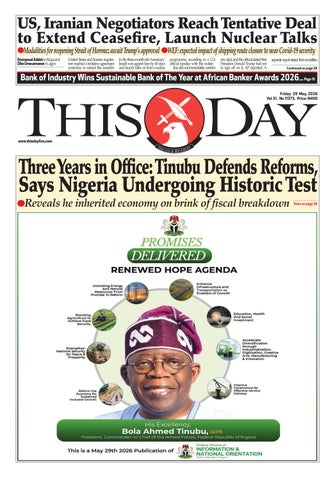
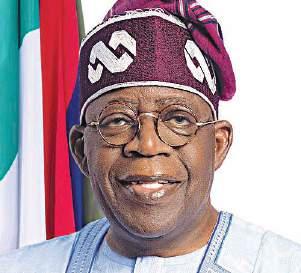
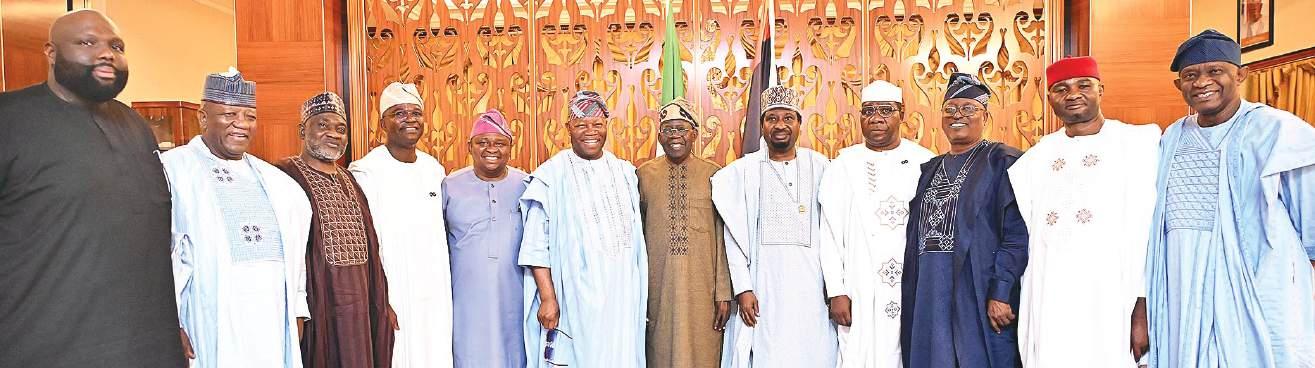
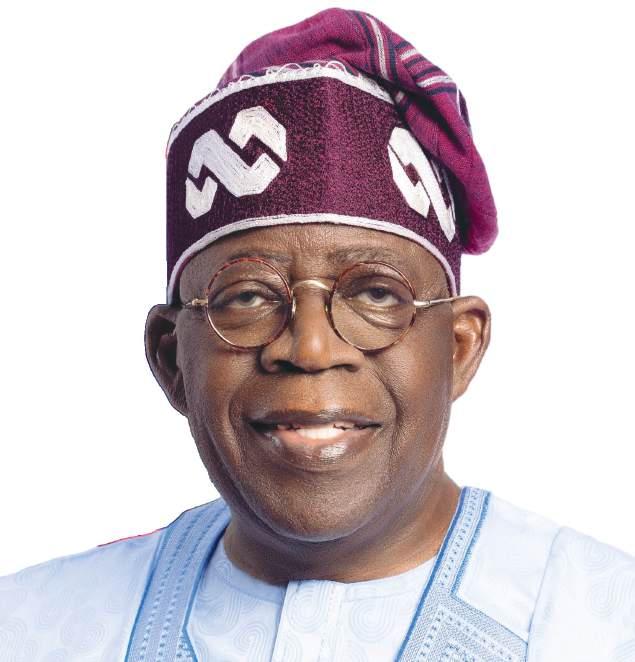
Three Years in Office: Tinubu Defends Reforms, Says Nigeria Undergoing Historic Test
Emmanuel Addeh in Abuja and Dike Onwuamaeze in Lagos
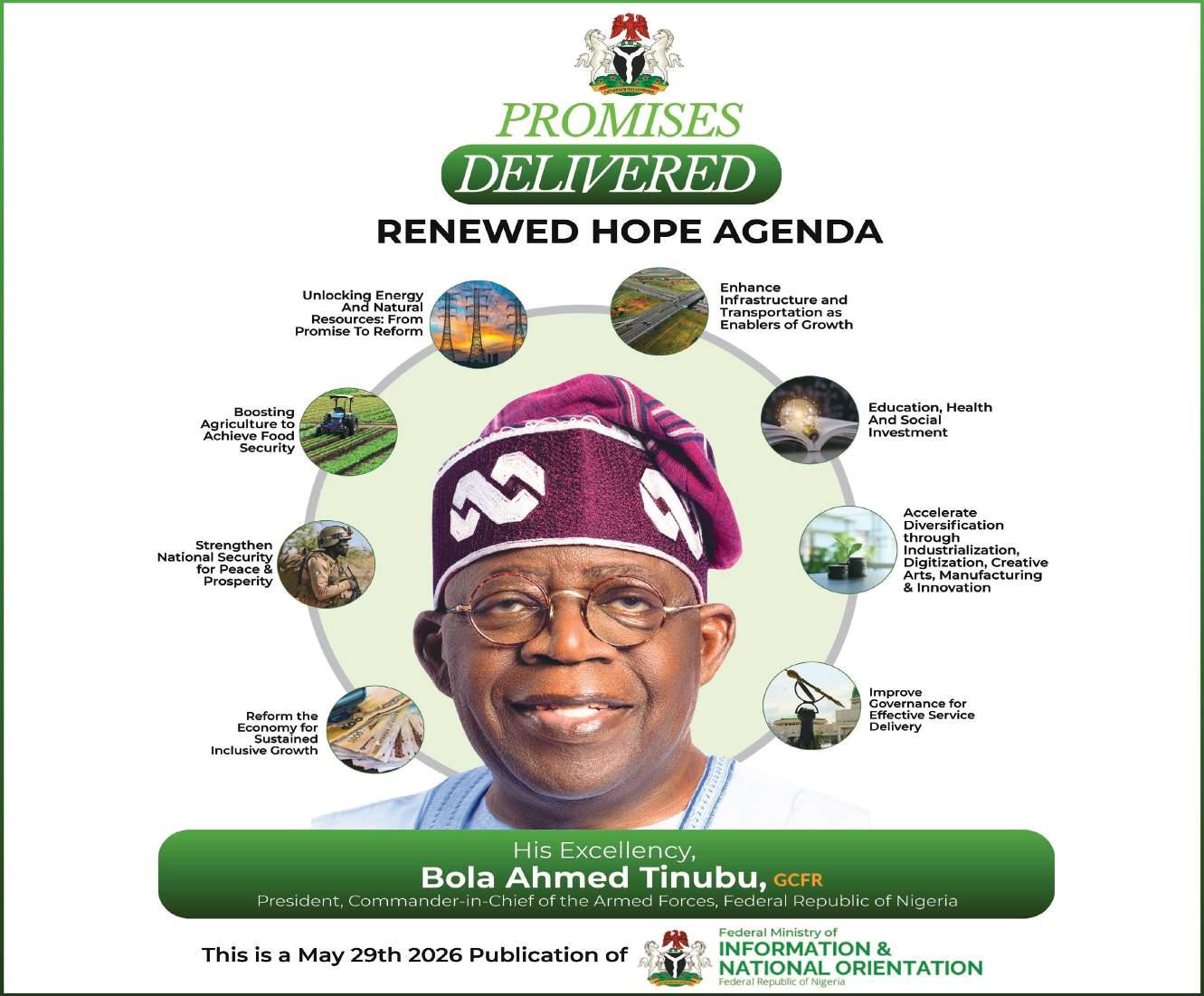
THE ECONOMY FOR SUSTAINED INCLUSIVE GROWTH
Under President Bola Ahmed Tinubu, GCFR, this priority area focused on stabilising Nigeria’s macroeconomic fundamentals, improving fiscal sustainability, restoring investor confidence, and laying the foundation for longterm inclusive growth. Key reforms included removing the fuel subsidy, unifying the foreign exchange market, implementing tax reforms, and tightening fiscal management.
In just three years, Nigeria has begun to record measurable economic gains. The economy grew by 3.4 per cent in 2024, its strongest non-COVID growth performance in a decade, while Gross Domestic Product (GDP) expanded further by 3.89 per cent year-on-year in the first quarter of 2026. Government revenue also increased significantly, rising from about ₦16.8 trillion in 2023 to an estimated ₦35 trillion in 2025. Nigeria’s foreign exchange reserves have also rebounded strongly, climbing to about $50 billion, the highest in 13 years. These gains have been driven largely by difficult but necessary reforms, including the removal of fuel subsidies, improved tax administration, and exchangerate adjustments aimed at stabilising the economy and restoring investor confidence.
The IMF also acknowledged that Nigeria undertook major structural reforms, including the removal of fuel subsidies, unification of foreign exchange windows, and stronger revenue mobilisation efforts aimed at restoring macroeconomic stability and supporting inclusive growth.
A major confidence boost came with Nigeria’s removal from the Financial Action Task Force (FATF) Grey List in October 2025, following reforms to strengthen antimoney laundering and financial transparency systems. This improved Nigeria’s global financial credibility and reinforced investor confidence.
These reforms have repositioned Nigeria toward stronger fiscal discipline, improved financial transparency, and more sustainable long-term growth.
SECURITY
STRENGTHEN NATIONAL SECURITY FOR PEACE & PROSPERITY
Over 8,000 terrorists and bandits were neutralised, while about 11,600 criminals were arrested in nationwide security operations.
More than 10,000 weapons and ammunition were recovered from terrorists
Over 124,000 Boko Haram and ISWAP fighters and their families reportedly surrendered during intensified counterinsurgency operations in the North-East.
Security forces rescued more than 11,250 kidnapped victims across affected states including Kaduna and Zamfara.
The administration established the Multi-Agency AntiKidnap Fusion Cell (MAAKFC) to improve intelligence sharing among security agencies.
More than 1,900 illegal refineries were dismantled to combat oil theft and pipeline vandalism in the Niger Delta.
Nigeria’s crude oil production increased from about 1 million barrels per day to roughly 1.8 million barrels per day following improved protection of oil infrastructure.
The government approved new military equipment, including Mine-Resistant Ambush Protected Vehicles (MRAPs) and the refurbishment of over 100 Armoured Fighting Vehicles.
In 2025 operations alone, troops arrested 4,375 suspected terrorists and rescued 2,336 kidnapped victims.
Security agencies intercepted stolen crude oil and illegal petroleum products valued at over ₦8.9 billion.
The administration expanded military deployments and reinforced security operations in terrorism and banditry hotspots nationwide.
Cybersecurity and financial intelligence operations were strengthened to disrupt terror financing and organised criminal networks.
Improved security in some farming communities enabled displaced farmers to gradually return to agricultural activities.
AGRICULTURE
BOOSTING AGRICULTURE TO ACHIEVE FOOD SECURITY
The Tinubu Administration identified agriculture and food security as a central pillar of the Renewed Hope Agenda, aimed at tackling hunger, reducing food inflation, creating jobs, and strengthening national self-sufficiency in food production. Since assuming office in May 2023, President Bola Ahmed Tinubu has pursued reforms focused on mechanised farming, increased cultivation, farmer support, and agricultural investment.
One of the administration’s earliest actions was the declaration of a state of emergency on food security in July 2023, which accelerated interventions across the agricultural value chain.
A major achievement under this priority area is the launch of the Renewed Hope Agricultural Mechanisation Programme in 2025, regarded as the largest mechanisation drive in Nigeria’s history. Under the initiative, the Federal Government deployed over 2,000 tractors, 50 bulldozers, 12 mobile workshops, and more than 9,000 specialised farming implements to support farmers nationwide. The programme is expected to cultivate over 550,000 hectares of farmland, produce more than two million metric tonnes of food, and benefit over 550,000 farming households.
The administration has also intensified dry-season farming and wheat production programmes to reduce dependence on food imports while promoting year-round farming. In Katsina State, President Tinubu commissioned a mechanised agricultural centre with 400 assembled tractors to further expand modern farming practices.
These reforms demonstrate the administration’s commitment to achieving food security, empowering farmers, modernising agriculture, and positioning Nigeria as a leading agricultural economy.
ENERGY REFORM
UNLOCKING ENERGY AND NATURAL RESOURCES: FROM PROMISE TO REFORM
Remember when President Bola Ahmed Tinubu said Nigeria could no longer continue spending trillions of naira on fuel subsidy while critical sectors remained underfunded? Shortly after taking office, his administration removed the subsidy and introduced major reforms in the oil and foreign exchange sectors to stabilise the economy and attract investment.
The decision triggered economic hardship and rising prices, but the government argued that the reforms were necessary to prevent fiscal collapse and free resources for infrastructure and development projects. By late 2025, Nigeria’s external reserves had risen to more than $50 billion, while the economy recorded a 3.89 percent GDP growth rate during the first quarter of 2026, the fastest pace recorded in about four years.
Tinubu also promised to unlock Nigeria’s natural resources to drive industrialisation, improve energy security, and create jobs. Since then, the administration has intensified efforts against crude oil theft and pipeline vandalism while encouraging investment in local refining and gas infrastructure. Officials say the broader objective is to ensure that Nigeria’s natural wealth supports electricity supply, industrial growth, job creation, and sustainable national development for millions of citizens nationwide.
Supporters of the administration argue that, despite the painful adjustment period, the reforms are beginning to restore investor confidence and strengthen public finances. They believe that increasing domestic refining capacity, improving transparency in the petroleum sector, and expanding gas production will help Nigeria reduce dependence on imported fuel, generate more revenue, support manufacturing industries, and position the country for long-term economic stability and inclusive growth.
INFRASTRUCTURAL DEVELOPMENT ENHANCE INFRASTRUCTURE AND TRANSPORTATION AS ENABLERS OF GROWTH
Under President Bola Ahmed Tinubu, GCFR, this priority area focused on expanding critical infrastructure, modernising transportation networks, improving national connectivity, and leveraging infrastructure development as a catalyst for economic growth, trade, and investment. The administration prioritised strategic road construction, housing development, alternative transport initiatives, and innovative infrastructure financing mechanisms to close Nigeria’s infrastructure deficit.
In the past three years, several landmark projects and reforms have been initiated. One of the most significant is the commencement of the Lagos–Calabar Coastal Highway, a transformative 700km superhighway designed to connect major economic corridors across Nigeria’s
2,000+ 8,000
9,000+ 11,600
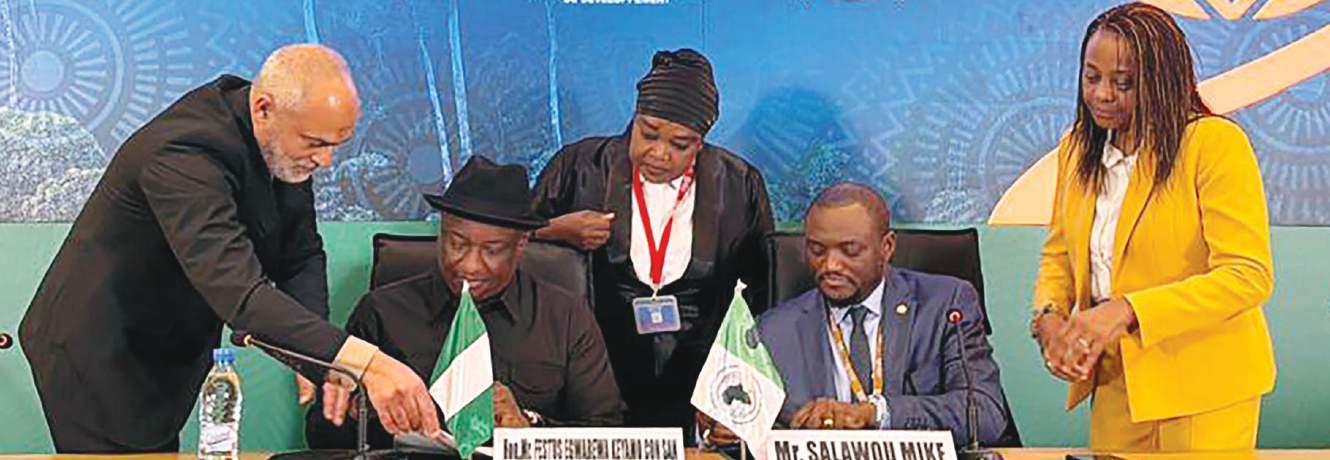
KEYAMO SIGNS LETTER OF INTENT...
L-R: Nigeria Minister of Aviation and Aerospace Development, Festus
of the Letter of Intent in Congo, Brazzaville, yesterday
Global Investment in Energy to Hit $3.4tn in 2026, Renewables Attract
$665 Billion
Oil spending falls below $500bn for third straight year Coal investment to reach $180bn
Emmanuel Addeh in Abuja
Global energy investment is projected to reach $3.4 trillion in 2026, with electricity infrastructure, renewable energy, storage and nuclear power accounting for the bulk of spending, a new report by the International Energy Agency (IEA) has said.
In its latest World Energy Investment 2026 report, the Paris-based agency stated that around $2.2 trillion of global energy spending this year would go into electricity grids, storage, low-emissions fuels, nuclear, renewables, energy efficiency and electrification.
By contrast, investments in fossil fuels, including oil, natural gas and coal are expected to total about $1.2 trillion. The report highlighted a major shift in global energy priorities, with electricity-related investments now dominating overall spending trends.
According to the IEA, investment in electricity supply and infrastructure is expected to reach nearly $1.6 trillion in 2026, rising to almost $2 trillion when end-use electrification is included.
Spending on electricity grids alone is projected to approach $550 billion this year, representing nearly 20 per cent growth year-on-year, while investment in battery storage is expected to exceed $100 billion.
The agency explained that growing concerns over energy
security and disruptions to global supply chains are forcing countries to increasingly prioritise domestic energy sources and electricity systems.
Renewable energy remains one of the biggest beneficiaries of the global transition, with investment in renewable power projects projected at approximately $665 billion in 2026. Out of that figure, solar energy alone is expected to attract about $365 billion globally.
The IEA noted that despite slower growth after several years of rapid expansion, low-emissions technologies still account for more than 70 per cent of total global power generation investment.
Nuclear energy is also experiencing renewed momentum, with annual investment now exceeding $80 billion. The report also disclosed that close to 80 gigawatts of new nuclear capacity are currently under construction across 15 countries worldwide.
Despite elevated oil prices, investment in crude oil projects is expected to decline for the third consecutive year in 2026, falling below $500 billion.
The IEA attributed the drop to uncertainty surrounding the duration of current price increases, long project development timelines, supply-chain constraints and tighter offshore drilling markets. Natural gas, however, is expected to attract stronger capital
inflows, with investment projected to rise to $330 billion, the highest level recorded in a decade.
Coal investment is also projected to rise sharply this year, reaching $180 billion, the highest level since 2012.
According to the report, China accounts for almost 70 per cent of global coal supply spending, while some Asian countries are expected to extend the lifespan of existing coal-fired plants to strengthen energy security.
The IEA further estimated that around $350 billion is currently being invested globally each year in energy efficiency improvements. It added that at least 20 countries have already announced fresh efficiency policies in response to ongoing disruptions in global energy markets.
The report warned, however, that geopolitical tensions and market volatility are increasing financing risks for future energy projects, particularly in emerging and developing
economies where borrowing costs remain significantly higher than in advanced economies.
The IEA also identified the rapid expansion of artificial intelligence and data centres as an emerging force shaping energy investment trends.
Commenting on the outlook, IEA Executive Director, Fatih Birol, said the current energy security challenges were already reshaping global investment strategies.
“We are in the midst of the
largest energy security crisis the world has ever faced – and I believe this will reshape investment strategies globally, with parallels to the major changes the energy world witnessed after the oil shocks of the 1970s,” he said.
“We are already seeing intensified efforts by both producer and consumer countries to diversify trade routes and energy sources – such as advancing new pipelines and other supply infrastructure…,” he added.
Brazzaville: Keyamo Signs LOI on Behalf of Nigeria at AfDB Conference
Minister of Aviation and Aerospace Development, Festus Keyamo, Thursday in Brazzaville, Congo, signed a LETTER OF INTENT (LOI) between African Development Bank (AfDB) and Federal Republic of Nigeria, in which both sides committed to work diligently to operationalise the bank’s Integrated Aviation Transformation Programme (IATP), a well-received plan for aviation in Africa.
Keyamo, in his new role as African Champion of IATP, attended a dialogue session with the President and Governors of AfDB, where he addressed them on the opportunities presented by the $7 billion IATP plan for Africa and, especially, Nigeria.
He unveiled President Bola Tinubu’s Renewed Hope Agenda for the aviation sector and rolled out the potential of the sector, especially the newly approved Nigeria Aircraft Leasing Company and why
Chuks Okocha in Abuja and Onuminya Innocent in Sokoto
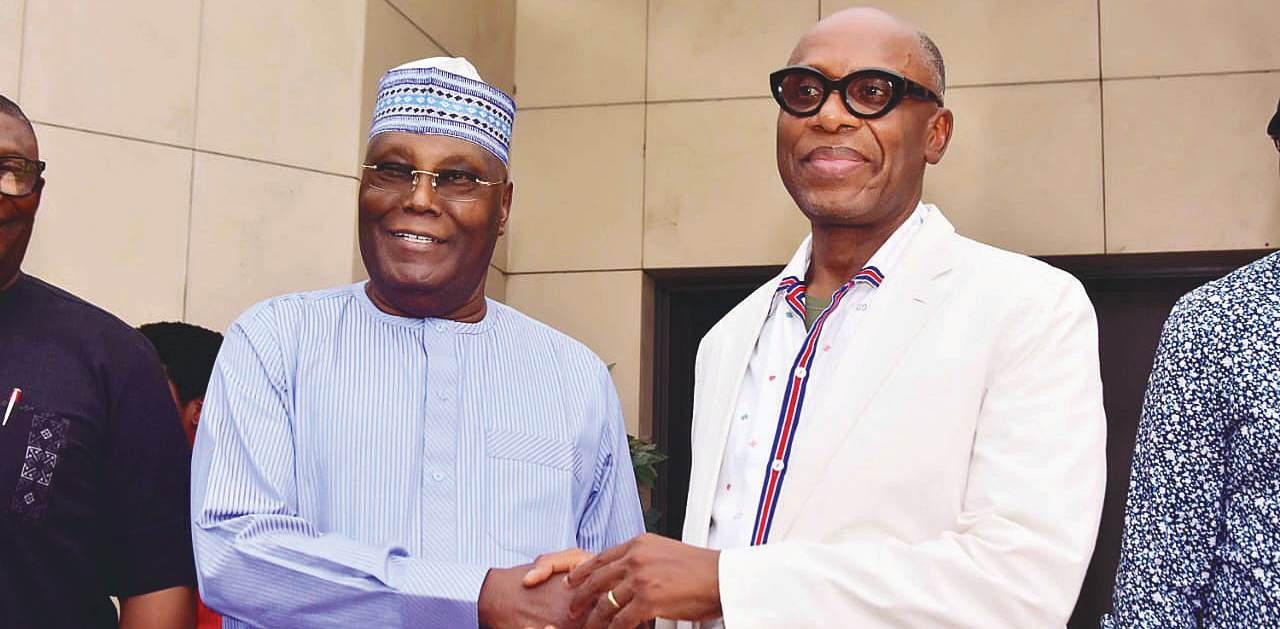
Presidential candidate of African Democratic Congress (ADC), Atiku Abubakar, yesterday, visited his first run-ner-up in the primary election, Chibuike Amaechi, at his residence in Abuja.
In a video making the rounds, Atiku is seen warmly shaking hands with Amaechi.
the bank should mobilise capital to support it.
In a statement issued by his Special Adviser on Media and Communications, Tunde Moshood, Keyamo explained that the Renewed Hope Agenda for the aviation sector could form the template for other African nations to emulate.
He stated that Nigeria had done the groundwork to enable the take-off of the initiative, “including domesticating the Cape Town Convention, updating its IDERA and
reworking its aviation insurance policies to meet global industry standards.”
President of AfDB, Dr. Sidi Ould Tah, expressed delight at the presentation and gave his commitment to the success of IATP in Africa and, particularly, Nigeria.
After the session, Keyamo unveiled the COUNTRY COMPACT for Nigeria’s Aviation sector and proceeded to a signing ceremony of the LETTER OF INTENT (LOI) between AfDB and Nigeria.
Guber Candidate Hails Ex-VP
The two politicians exchanged pleasantries with smiles on their faces as they stood outside Amaechi’s residence.
Atiku later walked alongside Amaechi and other individuals as he prepared to leave the compound.
The visit was not unconnected with reconciliations after the disagreement that trailed the party primary, which Amaechi rejected, and alleged that the outcome was rigged.
The meeting came hours after Atiku publicly stated that he would personally visit Amaechi and Mohammed Hayatu-Deen, who came third in the primary, to appeal to them to join his 2027 presidential bid under the ADC platform.
Confirming the visit, Atiku tweeted, “This afternoon, I visited my brother and compatriot, former Governor of Rivers State and exMinister of Transportation, Chief Rotimi Amaechi, at his Abuja residence.
“Beyond the warmth and camaraderie, we had deep and honest conversations about the troubling state of our nation, the growing economic pain, insecurity, and the urgent responsibility on patriotic Nigerians to continue engaging in the search for solutions
that can rescue our country from drift and despair.
“I also felicitated with him on the occasion of his birthday yesterday and teased that Arsenal’s historic triumph could not have arrived at a better time. Chief Amaechi, a thoroughly well-loaded Gunner, took the banter in very good spirits.
“In true Rivers hospitality, he apologised for not having enough time to prepare Fisherman Soup, a delicacy I have now been promised on our return for the second leg.”
The visit is a strategic move by Atiku to mend fences and build a
stronger coalition, especially after reports of dissatisfaction from some quarters following the ADC presidential primary.
Amaechi had been unhappy with how the primary played out.
Meanwhile, the Sokoto State governorship candidate of ADC, Hon. Manir Muhammad Dan’iya, hailed Atiku on his presidential nomination by the party.
Dan’iya described Atiku’s candidacy as a major milestone for the party and a pivotal step towards repositioning Nigeria for economic growth, national unity,
and peace.
In a statement by his special adviser on media and publicity, Aminu Abdullahi, Dan’iya lauded Atiku’s decades-long commitment to democracy, economic reforms, and inclusive governance, calling him one of the country’s most tested political figures.
Dan’iya said in the statement, “Alhaji Atiku Abubakar remains one of Nigeria’s most experienced political leaders with a proven track record of public service, private sector success, and dedication to the Nigerian project.”
Kasim Sumaina in Abuja
Keyamo, and President, African Development Bank (AFDB) Dr. Sidi Ould Tah, during the signing
CHIEF RAZAKI
AKANNI OKOYA
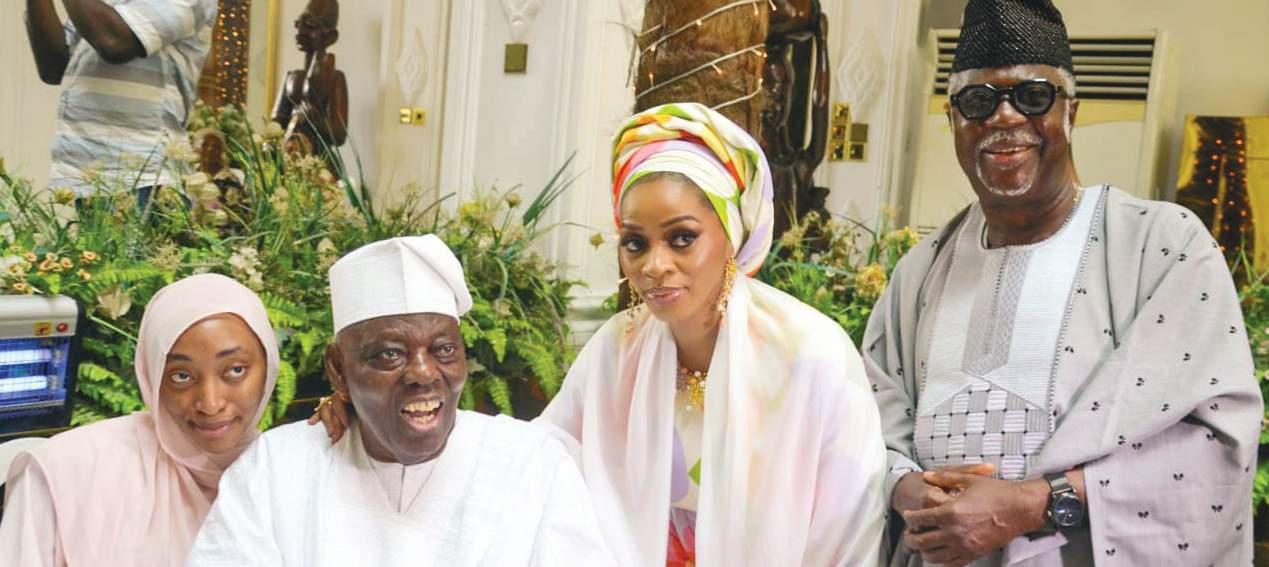
2026 EID-EL-KABIR PRAYER...
L-R: Olamide Okoya; Founder/Chairman of Eleganza Group of Company, Chief Razaki Akanni Okoya; Managing Director, Eleganza Industrial City Limited, Chief (Dr.) Folashade Noimat Okoya; and Chief Gbenga Obasa, during the 2026 Eid-el-Kabir prayer organised by Chief Okoya at Oluwanishola Estate, Lekki–Ajah Expressway, Lagos... recently
Passenger
Demand: African Airlines Record
2.2% Increase amid Global Decrease of 3.4% due to Middle East Crisis
As FAAN strengthens collaboration with justice stakeholders on airport security, prosecution
In April 2026, African airlines recorded 2.2 per cent year-on-year increase in passenger demand, as capacity grew by 1.2 per cent, while load factor was 77.9 per cent, compared to last year, according to International Air Transport Association (IATA).
In the same period, global air
passenger demand recorded by the association decreased by 3.4 per cent compared to the same period in 2025.
The development was contained in a report made available by IATA yesterday, where it reported that airlines capacity also went down by 5.1 per cent year-on-year, and the load factor was 83.9 per cent, down by 0.2 point compared to April 2025.
In a related aviation sector develop-
ment, Federal Airports Authority of Nigeria (FAAN) reinforced its commitment to strengthening security enforcement and judicial processes within the country’s airports.
FAAN stated that the commitment was the highlight of a high-level justice stakeholders’ engagement focused on arrest, prosecution, and judicial administration in the aviation sector.
The engagement, themed, “Strength-
ening Arrest, Prosecution and Judicial Administration within the Airport Environment,” brought together legal professionals, security agencies, prosecutors, and other critical stakeholders to deliberate on strategies for improving justice administration and regulatory enforcement across airport facilities.
On the African-global passenger demand oscillation, IATA disclosed that on regional basis, the drop was
Bank of Industry Wins Sustainable Bank of The Year at African Banker Awards 2026
The Bank of Industry (BOI), Nigeria’s leading development finance institution, has been named Sustainable Bank of the Year at the 20th edition of the prestigious African Banker Awards 2026, held on the sidelines of the African Development Bank Annual Meetings in Brazzaville, Congo.
The award reinforces BOI’s growing reputation as a leading player in sustainable finance, responsible banking, and development impact across Africa. BOI emerged as the clear winner in a highly competitive category that featured some of the continent’s most respected financial institutions, including Access Holdings, Commercial International Bank (CIB) Egypt, Co-operative Bank of Kenya, Nedbank South Africa, and Rawbank of the Democratic Republic of Congo, underscoring the Bank’s rising continental profile and the strength of its sustainability agenda.
The recognition reflects the Bank’s strategic commitment to embedding sustainability at the core of its operations and financing activities, particularly through the implementation of its Sustainability Financing Framework (SFF). A major milestone in this journey was the successful independent Second Party Opinion secured from S&P Global Ratings, validating the framework’s credibility and alignment with
international sustainability standards and market expectations. BOI was also shortlisted for the Development Finance Institution (DFI) of the Year Award, further underscoring its rising influence within the continent’s financial and development landscape.
Commenting on the achievement, the Managing Director/Chief Executive Officer of BOI, Dr. Olasupo Olusi, described the award as a strong validation of the Bank’s long-term vision for sustainable development and economic transformation.
“This award is a strong endorsement of the Bank of Industry’s commitment to financing sustainable and impactful development across Nigeria and Africa. At BOI, we recognise that the future of development finance lies in balancing economic growth with environmental responsibility and social inclusion.
“Our Sustainability Financing Framework represents a significant step in aligning our operations with global best practices while supporting industries and enterprises that create lasting value. We remain committed to mobilising capital that drives industrialisation, empowers businesses, creates jobs, and strengthens climate resilience and inclusive growth across the continent,” he said.
Dr. Olusi also commended the Bank’s Management, staff, and stakeholders for their dedication and strategic contributions to advancing
BOI’s sustainability agenda, noting that the recognition reflects a collective commitment to strengthening the institution’s position as a forwardlooking development finance leader in Africa.
Widely regarded as one of Africa’s most prestigious banking honours, the 20th edition of the African Banker Awards celebrated institutions driving innovation, transformation, and sustainable growth across the continent. The event, attended by the Prime Minister of the Republic of Congo on behalf of President Denis Sassou Nguesso, alongside leading financial figures including the President of the AfDB, Dr. Sidi Ould Tah, honoured
18 winners during an evening of recognition and celebration, capped by a performance from Congolese music legend Koffi Olomide.
BOI’s recognition comes at a criti- cal time when financial institutions globally are under increasing pressure to align capital deployment with environmental sustainability, social inclusion, and long-term economic resilience. As the Bank continues to strengthen its development mandate, it remains committed to mobilising finance that drives industrialisation, MSME growth, job creation, climate resilience, and sustainable economic transformation across Nigeria and Africa.
expectedly highest in the Middle East, with a whopping 46.6 per cent; the highest in the last one decade in the region.
IATA Director-General, Willie Walsh, stated, “The 46.6 per cent fall in demand for carriers in the Middle East due to war in the region was so acute that it dragged overall demand down -3.4 per cent.
“The situation for air transport remains highly volatile. The cost of jet fuel more than doubled in April, which is pushing airfares up. Forward schedule data is showing a reduced offering in the coming months, indicating that airlines are balancing high fuel costs and weaker demand.”
In the area of cargo, IATA reported that Africa recorded a 7.7 per cent year-on-year increase in demand for air cargo in April, against a -9.4 per cent year-on-year decrease in capacity, with a 12.8 per cent year-on-year rise in demand for air cargo movements from Africa to Asia, the 10th consecutive month of growth on the trade lane.
During the period under review, global cargo demand rose by four per cent year-on-year, but capacity decreased by 0.4 per cent.
Walsh said, “Air cargo demand grew four per cent year-on-year in April, driven by strong Asia-linked trade flows. But this positive news masks
a more complex operating environment.
“Severe disruption at major Gulf hubs due to the war in the Middle East continued to reshape trade routes and constrain capacity on key corridors.
“With dedicated freighters carrying much of the growth, air cargo is once again keeping supply chains moving amid trade disruptions. The coming months will test how well the sector can absorb continued geopolitical uncertainty and elevated operating costs.”
Meanwhile, representing Managing Director of FAAN, Olubunmi Kuku, Director of Aviation Security Services, ACP Afegbai Igbafe, stressed the critical role of effective law enforcement and inter-agency collaboration in safeguarding airport infrastructure and maintaining public confidence in Nigeria’s aviation system.
Kuku said the airport environment must continually reflect order, safety, discipline, and strict compliance with established regulations.
She stated that offences committed within airport facilities should never be treated lightly due to their potential effect on passenger confidence and national security.
The managing director, in a statement issued on Thursday by the agency, said it remained fully committed to ensuring the safety and security of passengers, staff, and airport users.
Oborevwori’s Tenure Extension for DESOPADEC Excites
Sylvester Idowu in Warri
Indigenous Contractors in Delta
Delta State Oil Producing Areas Development Commission (DESOPADEC) Indigenous Contractors Forum has congratulated members of the Board of the interventionist agency following extension of their tenure by one year.
Delta State Governor, Rt. Hon. Sheriff Oborevwori, had announced the DESOPADEC Board tenure extension recently with a promise to send a bill to the State House of Assembly for approval.
However, DESOPADEC Indigenous Contractors Forum, in a statement signed by its Chairman, Engr. Ogie Samson and Secretary, Prince Charles Ebigbagha, issued yesterday, said the gesture by the governor was in the right step considering the revitalization of the agency by the Board in recent times.
The forum described the extension as a well-deserved recognition of the Board’s contributions to community development within the commis- sion’s mandate areas as well as the
cordial relationship established with stakeholders.
The forum was full of praises to the Executive Director, Finance and Administration (EDFA), Chief Kome Okpobo, for his excellent representation of the governor in achieving the objectives for which the commission was set up which in turned germinated into the extension of tenure by one year.
It specially commended the Executive Director, Finance and Administration (EDFA), Chief Kome Okpobo, for
fostering positive relationship between the interventionist agency and the Indigenous Contractors Forum.
“We want to state categorically that the decision to extend the Board’s tenure, led by Chief John Nani, along with the EDFA, Chief Kome Okpobo and the Managing Director, Chief Festus M. Ochonogor is a confirmation of the Governor, Rt. Hon. Sheriff Oborevwori’s confidence in their ability to run DESOPADEC successfully and this we can attest to”, it added.
James Emejo in Abuja
Chinedu Eze and Kasim Sumaina in Abuja
Sulaiman-Ibrahim: Expanding National Influence through Grassroots Governance
Jonathan Eze writes that the Minister of Women a ffairs, Imaan Sulaiman- Ibrahim’s volume of programmes, and deliberate attempt to connect governance with ordinary citizens at the grassroots may unlock women’s votes for President Bola Tinubu in 2027.
In the often turbulent terrain of Nigerian politics, performance in public office is frequently overshadowed by noise, propaganda, and endless political brinkmanship.
Yet, every once in a while, a public official emerges whose work begins to speak louder than the politics surrounding governance.
That conversation is increasingly being built around Imaan Sulaiman-Ibrahim, Nigeria’s Minister of Women Affairs and Social Development, whose expanding influence within the gender, humanitarian, and social protection ecosystem is gradually positioning her as one of the most strategic figures in the administration of Bola Tinubu.
Since assuming office in October 2024, Sulaiman-Ibrahim has approached the ministry not as a ceremonial institution, but as a vehicle for social engineering, political inclusion, and grassroots mobilization.
At a time when economic hardship and public dissatisfaction continue to shape national conversations, the Minister has quietly built a broad-based intervention framework targeted at women, children, families, and vulnerable populations across Nigeria.
What distinguishes her approach is not merely the volume of programmes initiated, but the deliberate attempt to connect governance with ordinary citizens at the grassroots.
In political terms, that strategy may eventually prove invaluable to President Tinubu’s reelection calculations ahead of 2027.
Social Protection Programmes
The ministry under her leadership has become unusually visible and active. From social protection programmes to gender advocacy, economic empowerment, child protection, and climate inclusion initiatives, the ministry has expanded its operational footprint beyond Abuja into communities that often feel disconnected from federal governance.
Perhaps the most politically significant achievement is the empowerment of more than 4.6 million women, families, and children through palliatives, cash support, farming equipment, sewing machines, and livelihood interventions distributed across all 36 states and the Federal Capital Territory.
In a country where women constitute one of the most decisive voting blocs, such interventions are not merely humanitarian gestures; they are gradually becoming instruments of political trust-building.
Beyond the numbers lies a deeper political reality. Nigerian women have historically been underutilized in political mobilization despite constituting a major electoral force.
The Tinubu administration appears to understand this reality, and Sulaiman-Ibrahim may be emerging as one of the administration’s strongest connectors to that constituency.
Her leadership style combines technocratic coordination with grassroots engagement. She has led town hall meetings, citizens’ engagement programmes, women-focused empowerment forums, and high-level international advocacy engagements, all while ensuring the ministry maintains visibility among ordinary Nigerians.
Combination of Policies and Populist Outreach
That combination of policy and populist outreach is increasingly rare in governance circles.
The Minister’s interventions have also extended into areas many previous administrations handled only rhetorically.
Under her watch, the ministry intensified actions against gender-based violence, rolled out child safeguarding frameworks, and strengthened implementation of the Violence Against Persons Prohibition Act.
She also coordinated Nigeria’s participation at the 69th and 70th Sessions of the United Nations Commission on the Status of Women, reinforcing Nigeria’s diplomatic visibility on
gender inclusion and women empowerment. Yet, her strongest political asset may lie in her ability to humanize governance.
APGA Primaries:
Tales
The continued sponsorship and psychosocial rehabilitation of rescued Chibok girls, empowering victims of sexual abuses, intervention
of
for detained minors during protests, and rehabilitation support for vulnerable families reflect a governance model rooted in empathy and restorative justice.
In a political environment often criticized for elitism and detachment, such interventions create emotional connections between government and citizens.
Critics may dismiss these efforts as routine government responsibilities, but politically, perception matters.
Responding to social realities
Nigerians are more likely to identify with leaders who appear accessible, compassionate, and responsive to social realities. On that score, Sulaiman-Ibrahim has steadily cultivated a public image of competence blended with empathy.
Another major strength of the Minister is her understanding of modern development politics. Her initiatives are not confined to traditional welfare systems alone. Through programmes such as the Happy Woman App, digital inclusion projects, Women in Green Economy Programme, and the Women in Agro Value Expansion initiative, she has attempted to integrate women into emerging economic and technological ecosystems. This matters politically because the future of electoral influence increasingly depends on youth and digital engagement. By targeting women in digital innovation, agro-processing, climate adaptation, and entrepreneurship, the ministry is indirectly cultivating a new generation of economically conscious female stakeholders who may become politically influential in the coming years.
NOTE: Interested readers should continue in the online edition on www.thisdaylive.com
Discontent, Gale of Jubilation in Anambra
David-Chyddy Eleke reports that the recent primary election of all Progressives Grand alliance for all elective positions in anambra state was that of mixed feelings as losers complained while the victorious jubilated.
Saturday, May 23, 2026 was not just a normal weekend for members of All Progressives Grand Alliance (APGA) in Anambra State. It was indeed a big day, and a miniature of the general election of February 2027. The party is dominant in Anambra and has remained in power for 20 years now, consolidating its strangle-hold on the state and her people through successive governor.
In Anambra, the ticket of the party is as good as victory in the main election and this is because of the belief that Anambra is APGA and APGA is Anambra. Not minding who is standing election in the party, one is wont to see rural women on election day asking to be assisted to vote for APGA, which they fondly refer to as Ojukwu’s party.
All of these contributed to make the primary election of the party in Anambra a steep contest, with many contestants believing that a ticket of APGA is as good as victory in the general election. Though regarded as a family affair, the exercise generated tension, complaints, lots of intrigues, as well as violence. There was also a gale of withdrawal from the race by many of the aspirants who had earlier boasted of huge followings, while many openly confessed that they were coerced, cajoled and intimidated into stepping down for less popular aspirants who had bigger and stronger godfathers.
Meanwhile, a lot more celebrated their victory, while describing the election as being smooth, transparent, credible and
devoid of interferences.
Some of the earliest aspirants to show discontentment included Hon Ifeanyi Ibezi, Hon Afamefuna Ezenwafor, Chief Akai Egwuonwu and others.
Ibezi, an aspirant of the House of Representatives for Idemili North and South Federal Constituency, who was squared against Hon Ikenna Iyiegbu, also known as Ike Cubana and elder brother of Chief Obinna Iyiegbu aka Obi Cubana threw in the towel early, resigning from the race. Though
Ibezi did not mention the reason for his withdrawal, he simply cited deference to the supremacy of the party, but sources said it became obvious that the leaders of the party had ordained Iyiegbu to fly the party’s flag in the main election, leaving Ibezi with no choice than to step down to avoid disgraceful defeat. Our source said it would be difficult for Iyiegbu to face Ibezi in a fair contest, hence believing that Ibezi may have been arm-twisted into withdrawing.
Ibezi’s withdrawal letter read: “In deference to the supremacy of our great party and in respect of the decision communicated to me by the leadership of the All Progressives Grand Alliance (APGA), I wish to inform my supporters, APGA faithful and the general public that I will no longer be participating in today’s primary election for the idemili North and South Federal Constituency. I sincerely appreciate the overwhelming support, encouragement, and goodwill I have received from party faithful and critical stakeholders in the course of this journey, particularly during our flash stops across the 24 wards of the Federal Constituency, where you all came out en masse to show solidarity. Your belief in me remains deeply valued. I urge all my supporters to remain steadfast, committed, and united in the overall interest of our shared vision for a greater future.”
The Dangote License to Fight for Nigeria
Crusoe Osagie explains that Dangote has earned the right to a duel with unscrupulous employees of Nigerian regulatory institutions, individuals with virtually no skin in the game, yet hellbent on making decisions capable of consigning Nigeria to the abyss while dragging Dangote along with it.
Nigeria at the moment is clearly overleveraged. A recent report released by the Alliance for Economic Research and Ethics stated that in the past 24 months, the Nigerian state has borrowed about N66 trillion, a figure it revealed was more than all the debt Nigeria accumulated during the previous 55 years combined.
This debt figure is clearly alarming, but even more troubling is the fact that it is difficult to identify the critical infrastructure, security improvements, or transformational economic programmes that these borrowings were undertaken to finance. Across the country, roads remain largely decrepit, electricity generation continues to fluctuate below 5,000 megawatts for over 200 million citizens, insecurity persists in several regions, and inflation has continued to erode household income and business profitability.
According to the Alliance for Economic Research and Ethics, the recent borrowings have pushed the nation’s total public debt to about N159.2 trillion. When broken down, this translates to roughly N670,000 owed by every Nigerian alive today. Nigeria’s debt service-to-revenue ratio has also remained among the highest in the world, with reports from the Debt Management Office and international financial institutions showing that a significant percentage of government revenue is now used simply to service debt obligations.
For many citizens, should Nigeria fail
economically, this N670,000 exposure may represent the full extent of their stake in the country. Others have far greater exposure through savings in banks, investments in the capital market, ownership of bonds, treasury bills, pension assets, and other financial instruments tied directly to the survival of the Nigerian economy.Meanwhile, some Nigerians carry even greater exposure than the aforementioned categories in the event of an insolvent Nigeria: owners of businesses ranging from micro and small enterprises to industrial conglomerates. However, with a total investment portfolio estimated at over 35 billion United States dollars within Nigeria, Aliko Dangote, President of Dangote Industries Limited, is arguably the single most invested individual in the Nigerian state today.
To put this in plain language, if Nigeria as a nation goes belly up today, the individual who most likely stands to suffer the greatest personal financial loss is Aliko Dangote. His exposure to Nigeria probably exceeds that of any current or former president, minister, or policymaker taking decisions that steer the Nigerian economy, sometimes recklessly, toward uncertainty.
Dangote’s investments are not speculative portfolio holdings that can be moved overnight to offshore accounts or foreign safe havens. They are hard assets physically rooted in Nigeria: cement plants, fertilizer plants, refineries, petrochemical complexes, agricultural ventures, logistics infrastructure, and thousands of kilometres of distribution networks employing tens of thousands of Nigerians directly and indirectly.
The Dangote Refinery alone, reputed to be
the largest single-train refinery in the world with a refining capacity of 650,000 barrels per day, represents one of the most ambitious industrial projects ever undertaken on the African continent. The refinery was conceived largely to solve Nigeria’s embarrassing dependence on imported petroleum products despite being Africa’s largest crude oil producer. Nigeria has spent decades exporting crude oil only to import refined products at enormous cost, placing immense pressure on foreign exchange reserves and weakening the naira.
This is the reason why it is quite disingenuous when some people, most recently officials and interests linked to the Nigerian National Petroleum Company Limited (NNPCL), attempt to portray Dangote as a monopolist unwilling to tolerate competition in his business lines.
Competition is healthy in every economy, but there is a difference between genuine competition and policy sabotage. Flooding the Nigerian market with imported petroleum products from economies enjoying lower production costs, better infrastructure, cheaper financing, and stronger regulatory systems while undermining local refining capacity cannot reasonably be described as patriotism or economic wisdom.
It may even be argued that Dangote is not necessarily the wealthiest Nigerian in terms of hidden assets and offshore holdings. There may be individuals with enormous fortunes concealed in foreign jurisdictions and tax havens. However, unlike many of those fortunes parked safely outside the country, Dangote has taken the boldest gamble possible by tying the overwhelming majority of his wealth to Nigeria’s survival and
economic future.
This singular commitment is why Nigerian leaders, if they truly mean well for the country, must treat Dangote as a national economic asset. Alongside much of his fortune, his survival is deeply intertwined with the survival of the Nigerian economy itself.
Industrialisation has historically been the pathway through which nations achieve sustainable economic growth. Countries such as South Korea, China, Singapore, and even the United Arab Emirates built strong domestic industries before becoming global economic powers. Nigeria cannot industrialise by discouraging its largest indigenous investor while rewarding import dependency.
Therefore, when NNPC, its subsidiaries, and regulatory officials issue unnecessary import licences that flood Nigeria with petroleum products from Europe and elsewhere, Nigerians must remember who bears the greatest risk should the country fail because of these unpatriotic decisions.
The stakes are far beyond Dangote as an individual. The real issue is whether Nigeria wishes to build local industrial champions capable of transforming the economy or remain perpetually dependent on imports financed by debt, weakening the naira and exporting jobs to foreign economies.
In the final analysis, Dangote has earned not only the right to defend his investments but also the moral licence to challenge policies and institutional actors whose actions threaten Nigeria’s economic future. His fight, ultimately, may well be Nigeria’s fight for industrial survival.
Rabiu Abdullahi Umar, Chief Executive, NMDPRA
Alhaji Aliko Dangote
Aviation Fuel: Domestic Airlines
Imperilled Despite Hike in Flight Ticket
There are strong indications that some Nigerian airlines are in danger of going under unless the price of aviation fuel is reduced.
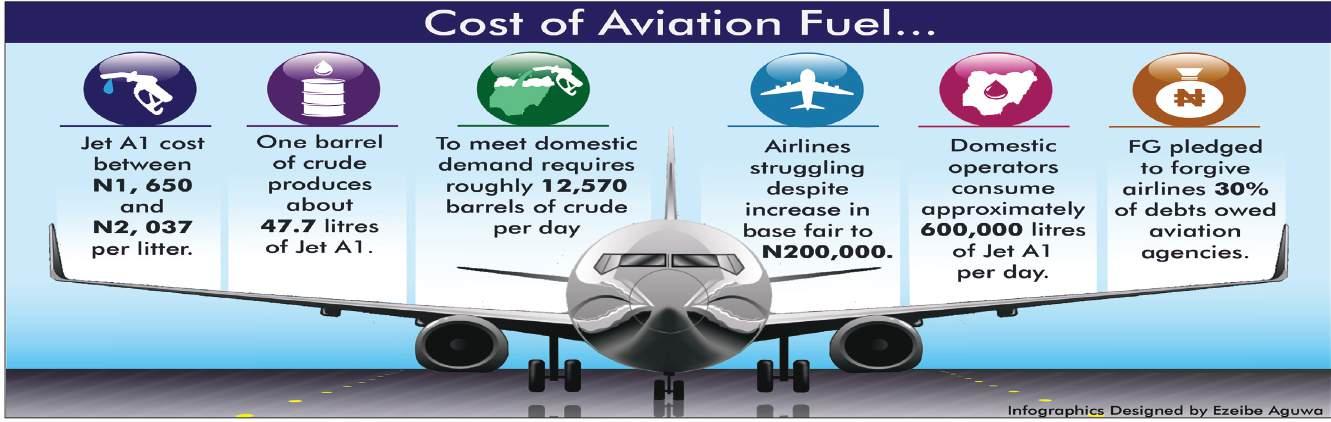
Aviation industry experts have observed that despite the increase in base fair to N200,000 by some airlines, the situation remains very dire for them
High cost of flight ticket, experts said, cannot help operators who are already
steeped deeply in debt.
Their cost of operation, he stated, exceed their revenue since March 2026, when the price of crude oil went up due to Iran-US war.
The experts were of the view that as long as the airlines buy aviation fuel, known as Jet A1 between N1, 650 and N2, 037 per litter, they would continue to face fiscal uncertainty.
They also noted that the high cost of flight ticket would drastically reduce
the number of air travellers after the Sallah festivities, regretting that the financial challenge airlines are facing is already affecting other organisations in the aviation industry, including aviation agencies, handling companies and other service providers.
Industry analyst and second Vice President of Aviation Round Table, Dr. Alex Nwuba, said the escalating cost of Jet A1 fuel takes nearly half of total airline operating expenses
and has forced domestic carriers to raise fares to levels that many Nigerians can no longer afford.
“Unlike international carriers, domestic operators have a much smaller fuel footprint, consuming approximately 600,000 litres of Jet A1 per day,” Nwuba said, adding that as long as the cost of aviation fuel is still high, airlines will continue to accumulate debts because the revenue they are generating
cannot defray their cost of operation.
Recently the federal government pledged to forgive airlines 30 per cent of the debts they owe aviation agencies in a bid to remedy the situation
According to the statement, “As an interim response, President Bola Ahmed Tinubu graciously granted us a 30 per cent concession. We are still waiting for the government decision on the other aspects of the AON
intervention request. While the AON acknowledges and appreciates this gesture, we had appealed for a meeting with Mr. President to discuss further reliefs, a request that is yet to be granted.”
Nwuba said Aviation Round Table, has developed and is putting forward the Fuel for Stability Programme (FFSP) as a policy recommendation to the federal government.
Customs Agents Seek Suspension of Local Shipping Charges Increase by NSC
eromosele abiodun
Customs agents in the country have called on the federal government to compel the Nigerian Shippers’ Council (NSC) to suspend the planned increase in shipping charges pending the review by the standing committee.
Customs Agents, the umbrella body of customs agents in Nigeria, Mr. Lucky Amiwero stated this in a petition to President Bola Tinubu.
service approved by the federal government.
“The Memorandum of Understanding under Articles 2(b)&4 clearly states that any other charges shall require agreement between the Parties concerned through the Nigerian Shippers Council, which must be complied with.
Understanding there is the need to follow the prescribed procedure as contained in the MOU.
“We refer the government to the usual procedure of initiating increase of local shipping charges.” chinedu
President of the National Council of Managing Director of Licensed
The increase, he said, is a clear contravention of the Memorandum of Understanding (MOU) signed in respect of local shipping charges between providers and users of shipping/Port and related
“In line with provision of Article 2 and 4 of the Memorandum of
First is by submitting the information of increase to the standing committee of the detailed information, why the Increase and the percentage must be submitted to the standing committee for consideration and review any increase
“We hereby request the
suspension of any Local Shipping Charges increase, pending the review by the standing committee, which entails the detailed information of the increase the Percentage (%) and if the Increase is necessary, to be sent to the standing Committee as approved by the Federal Government,” he said.
The Nigerian Shippers Council, he said, is to
forward all detailed information of increase for the local shipping charges to the standing committee who are signatory to the MOU, who are to review in line with the approved federal dovernment MOU.
MMIA Vows to Strengthen Airside Safety, Operational Discipline
Stories by Chinedu Eze
The safety committee at the Murtala Muhammed International Airport (MMIA) has unveiled sweeping new safety measures following an emergency-style stakeholder meeting of its Airport Safety Committee, signalling a zero-tolerance approach to reckless driving, debris hazards, and safety violations across Nigeria’s busiest airport.
The committee is a group of safety managers from various airport stakeholders, who meet regularly to
discuss safety issues and propose solutions collectively.
In a decisive move, the committee has slashed airside speed limits from 15km/h to 10km/h within the International Terminal Zone 1 construction areas, where on-going rehabilitation of the E-Wing and D-Wing has dramatically reduced operational space. The 15km/h limit remains in effect for ITZ 2 zones.
Officials confirmed that adequate signage will be installed immediately to enforce compliance.
The newly inaugurated
Airside Taskforce has commenced full operations, tasked with strict monitoring of all vehicles, equipment, and personnel. Industry sources say the Taskforce represents a renewed commitment to ending years of lax enforcement that have plagued the airport’s operational areas.
In a stern warning to ground handlers, fuel marketers, and catering services, the Committee declared that drinking, smoking, and reckless driving on the airside remain strictly prohibited, with regular alcohol testing now mandated.
Air Peace Expands Fleet with Boeing 737-800 Acquisition
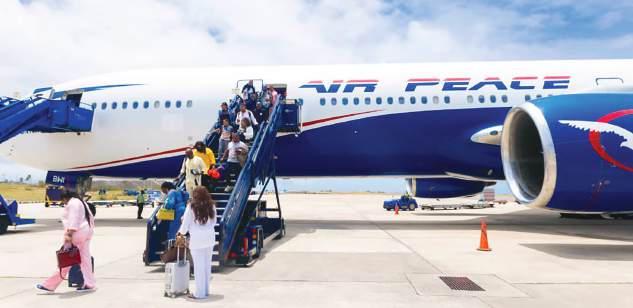
As part of its strategic drive to meet rising passenger demand across domestic and regional markets, Nigeria’s largest airline, Air Peace, has taken delivery of another Boeing 737-800 Next Generation aircraft, further strengthening its operational capacity and network expansion efforts.
The newly acquired aircraft, with registration number 5N-CGD, touched down at the Murtala Muhammed International Airport, Lagos, on Sunday, May 24, 2026, marking another significant milestone in the airline’s
continuous fleet growth and modernization programme.
Configured with 189 Economy Class seats, the Boeing 737-800 NG is designed to deliver enhanced passenger comfort, operational efficiency, and scheduling flexibility across both domestic and regional routes. The aircraft features a spacious cabin layout, generous overhead storage, advanced avionics, modern safety systems, and fuel-efficient engines, making it one of the world’s most dependable and successful narrow-body aircraft.
Statement from the airline said that beyond improving passenger experience, the aircraft would bring substantial operational advantages to the airline. Its fuel-efficient performance supports lower operating costs and reduced carbon emissions, aligning with Air Peace’s commitment to sustainable and efficient aviation operations. Its versatility and range capabilities will also enable the airline to optimize route deployment while maintaining schedule reliability across its expanding network.
United Nigeria Airlines’ Passengers Set to Win Samsung Phones Today
Passengers flying United Nigeria Airlines on the Lagos–Abuja–Lagos route on May 29, stand a chance of winning a new Samsung phone, the airline has said.
The airline has announced a partnership with Samsung as part of the “Awesome Row” plan where passengers on the route will get access to the new Samsung Galaxy A57 during the flight, and winners that emerge will get new devices.
Speaking on the initiative, the Chief Commercial
Officer for the airline, Dayo Olawuyi, said the partnership is about creating value that passengers feel from the moment they check in.
“We partnered with Samsung because of our shared values of excellence and most importantly, to reward our loyal passengers with a live device experience. Passengers who fly with us
Air WAtCh
Boosting Trade with West Africa-Caribbean Connectivity
Chinedu Eze
For many years there has not been scheduled flight connectivity between West Africa and the Caribbean despite the huge trade potential between the sub-region and the Caribbean.
It is that latent market that Nigeria’s leading carrier, Air Peace, has opened with scheduled flight service to the route.
For starters, the Caribbean is a sub-region of the Americas located in and around the Caribbean Sea. It is positioned south of the United States and the Gulf of Mexico, east of Central America and Mexico, and north of South America. Most of the people who live in the sub-region have Africa ancestry but it is becoming a more diverse society, as many other races find home in the sub-region.
on May 29 either from Lagos to Abuja or from Abuja to Lagos in the morning will stand a chance to win a Galaxy phone. We are very passionate about ensuring our customers have the best experience and that is exactly the kind of thing we want people to associate with flying United Air,” Olawuyi said.
FAAN Moves to Strengthen Airport Security through Collaboration
Group
Comms/e-Business
Asst.
Asst.
Nume Ekeghe
Correspondents
Kayodetokede(CapitalMarkets)
James Emejo (Finance)
Ebere Nwoji (Insurance)
reporter Peter Uzoho (Energy)
The Federal Airports Authority of Nigeria (FAAN) has reinforced its drive to improve security enforcement and judicial coordination within the nation’s airports through a high-level stakeholders’ engagement aimed at strengthening arrest procedures, prosecution processes, and the administration of justice in the aviation sector.
The engagement with the themed” ‘Strengthening Arrest, Prosecution and Judicial Administration Within the Airport Environment’, convened legal professionals, security operatives, prosecutors, and other key stakeholders to examine practical measures for
improving law enforcement, regulatory compliance, and justice delivery across airport facilities nationwide.
Representing the Managing Director of FAAN, Mrs. Olubunmi Kuku, the Director of Aviation Security Services, ACP Afegbai Albert Igbafe, said the protection of airport infrastructure and the preservation of public confidence in Nigeria’s aviation industry require stronger collaboration among security and justice institutions.
He observed that airports are highly sensitive operational environments where strict security standards, discipline, and compliance with aviation regulations must be upheld at all times.
Potentially, trade between Nigeria, West Africa and the Caribbean is expected to unlock massive economic opportunities, including boosting tourism and connecting the people who were forcefully shipped from West Africa back to their motherland.
So, due to shared climates, culinary heritages, and a growing demand for niche health foods, farm produce grown in West Africa could have excellent export potential in the Caribbean, and such connectivity will significantly boost tourism, as many in the Caribbean have shown their zest to identify with their routes.
For about three years Air Peace has developed this route and currently has started scheduled service to the destinations.
According to the spokesman of the airline, Efeoghene Osifo-Whiskey, Air Peace, has successfully operated its first scheduled commercial flight from Lagos to Barbados, marking the launch of a direct air service designed to simplify travel between both regions.
“The historic flight was operated on the carrier’s luxurious Boeing 777 aircraft on 24 May 2026, and it departed Lagos with over 284 passengers on board the 315-capacity aircraft, underscoring the growing demand for more seamless travel options between Nigeria and the Caribbean,” Osifo-Whiskey said.
Among the dignitaries and notable personalities on the flight, were Air Peace Chief Commercial Officer, Mr. Nowel Ngala; the High Commissioner of Barbados to Nigeria, Ghana and Liberia, Juliette BynoeSutherland; renowned Nigerian actress, Temitope Olowoniyan; alongside other airline delegates and passengers.
The airline noted that beyond the launch of a new route, the service addresses a longstanding challenge experienced by travellers moving between Africa and the Caribbean,
particularly the burden of multiple stopovers, lengthy transit times, and complex visa requirements associated with connecting through several foreign destinations.
“The Lagos-Barbados service is expected to significantly improve accessibility by providing a more direct and convenient travel option for tourists, business travellers, diaspora communities, and cultural exchange initiatives across both regions,” Osifo-Whiskey further stated.
Industry stakeholders have described the development as another bold milestone in Air Peace’s expanding international operations and a strategic move toward positioning Nigeria as a stronger aviation gateway within Africa.
The airline said it has continued to grow its international footprint by prioritizing routes that create practical value for travellers while improving connectivity across underserved markets.
“The Barbados route also opens new opportunities for tourism, trade, investment, and deeper people-to-people engagement between West Africa and the Caribbean, further strengthening cultural and economic ties across both regions.
“Following the successful Lagos-Barbados inaugural operation, Air Peace is scheduled to operate the first commercial return service from Barbados to Lagos on May 25, with subsequent flights planned twice monthly, establishing the route as a growing air bridge between Africa and the Caribbean,” OsifoWhiskey added.
On arrival in Barbados, THISDAY learnt that the government of Barbados, with the support of African Export-Import Bank (Afreximbank), formally welcomed Air Peace at a high-level forum and media launch held at the Indigo Hotel in Barbados, following the airline’s inaugural commercial flight from Lagos.
The forum brought together senior government officials, diplomatic representatives, tourism executives, airline delegates, members of the media and key stakeholders, reflecting growing institutional support for enhanced connectivity between Africa and the Caribbean.
Among the dignitaries that welcomed Air Peace included the Minister of Tourism and International Transport, Hon. Ian GoodingEdghill and many other dignitaries.
Air Peace said the engagement marked a major milestone in on-going efforts to strengthen commercial, tourism and cultural ties between Africa and the Caribbean through direct air connectivity.
the story continues online on www.thisdaylive.com
Dr. omopeju Afanu: energy, Dignity, and the Girl Who Couldn’t Study at Night
She remembers the girl who couldn’t study after dark, not for lack of will, but for lack of light. That image shaped dr. Omopeju afanu’s response when adebusuyi Olumadewa, founder of doThedream youth development Initiative and lead strategist of the Girls in Energy Project (GIE Funds, GIE Village), asked her to co-chair the Global Working Group and CSW70 Planning Committee. For her, it was never about titles, but about girls left in the dark. With a career spanning business transformation, technology, and multi-stakeholder engagement across Nigeria and North america, she saw CSW70 as a space to turn advocacy into measurable impact. She describes Girls in Energy as a platform for women’s empowerment, energy access, and community transformation. In this interview with MArY NNAH, she discussed energy and gender equality, the role of sport in CSW70, what a 10MW mini-grid means for a 13-year-old girl, and why the $20M fund is critical
What made you say yes to chairing the CSW70 Planning Committee?
When Adebusuyi Olumadewa, the Founder of DoTheDream Youth Development Initiative and Lead Strategist of Girls in Energy Project, GIE Funds, GIE Village approached me to Co-Chair the Global Working Group I was pretty excited and I further agreed to chair the CSW70 Planning Committee because I understood how important the Girls in Energy Project was, not only as an advocacy platform, but as a practical vehicle for women’s economic empowerment, energy access, and community transformation.
As someone deeply passionate about women’s economic empowerment, I knew there was no better global stage than CSW to amplify the message, build strategic partnerships, and move the project from conversation to measurable impact. For me, it was an opportunity to bring together the right voices, the right institutions, and the right level of urgency around a project that has the potential to transform communities through girls, women, energy, and sustainable development.
When did you first realise energy and gender equality had to be solved together?
I realised it through the everyday realities of women and girls in underserved communities. When a girl cannot study at night because there is no electricity, when a health centre cannot safely deliver care because power is unreliable, and when women’s businesses cannot scale because there is no affordable energy, it becomes clear that energy is not just an infrastructure issue. It is a gender equality issue.
I also saw how energy poverty directly affects the lives of women and children at critical moments. Reliable 24-hour power in healthcare facilities can save lives. It allows vaccines to be stored safely, enables emergency clinical care, supports women in difficult labour, makes surgical intervention possible when required, and strengthens neonatal care for babies who need urgent support.
Energy affects education, health, safety, income, digital access, productivity, and leadership. You cannot speak seriously about women’s empowerment without addressing the systems that limit women’s and girls’ access to opportunity. Energy is one of those systems. That was when it became clear to me that gender equality and energy access must be solved together.
Why was sport part of the CSW70 side event theme?
Sport was part of the CSW70 side event theme because sport also depends on energy. Stadiums need power. Training facilities need power. Broadcasting needs power. The millions of fans across the world who watch their favourite athletes and teams cannot experience those moments without electricity.
More importantly, when young girls have access to electricity, they can watch global sporting events, see women athletes excel, and begin to imagine possibilities beyond their immediate environment. They can see how sport can transform lives, open doors, build confidence, and create global opportunities,
regardless of where a girl comes from. In essence, energy powers sport, and sport can power dreams. That connection was important to the message we wanted to share.
What was the biggest thing you wanted people to remember from CSW70?
The biggest thing I wanted people to remember was that Girls in Energy was not just an event or a conversation. It was, and remains, an implementation movement.
CSW70 gave us a platform to elevate the message, but the real goal was to drive partnerships, funding, policy support, and community-level implementation. I wanted people to leave understanding that energy access is central to dignity, education, healthcare, economic empowerment, and leadership - and that girls and women must be intentionally included in the future of energy.
What does the Girls in Energy Project mean to you personally?
Personally, Girls in Energy means possibility, responsibility, and transformation.
It represents the possibility that a girl from an underserved community can see herself differently - not as limited by her environment, but as a future engineer, technician, innovator, entrepreneur, policymaker, athlete, or community leader.
It also represents responsibility because it challenges us to move beyond speeches and create real pathways. Girls need access to education, mentorship, digital tools, skills, infrastructure, and opportunity. Girls in Energy gives us a platform to connect those pieces in a structured and meaningful way.
How do you explain a 10MW minigrid to a 13-year-old girl?
I would say to her: Imagine being able to read at any time of day without relying on candles or struggling with the darkness. Imagine having access to information beyond what is available in your immediate community. Imagine not having to walk to a community water point because water can be pumped directly into homes, schools, and health centres.
Imagine having cold water at home.
Imagine your school having lights, fans, computers, and internet access so you can research, learn, and discover innovations happening around the world. Imagine being able to watch television, charge your mobile phone, access the internet, and communicate with people beyond your community.
Now imagine the streets in your community lit up at night, businesses staying open for longer, hospitals providing 24-hour service, vaccines stored safely, and young people having more opportunities to learn, work, and create.
That is what a 10MW mini-grid can do. It is not just electricity. It can transform a community, making it safer, more productive, more economically viable, more prosperous, and more connected to the world.
What’s the hardest part about getting girls into the energy sector?
The hardest part is not that girls lack ability. Girls are intelligent, curious, and capable. The real challenge is removing the barriers around them.
Many girls grow up without exposure to energy careers, STEM role models, mentorship, practical training, or the confidence to believe that technical fields are for them. There are also cultural stereotypes that make girls feel that engineering, energy, and technology are male spaces.
So, the work is not only about telling girls to join the energy sector. It is about
building an ecosystem that introduces them early, supports them consistently, gives them practical experience, and connects them to visible pathways into careers, entrepreneurship, and leadership.
Why do you think the $20M fund is important right now?
The $20M fund is important because it is time to move from talk to action. With 2030 around the corner and the SDGs still significantly off track, we cannot continue to rely on fragmented interventions, small-scale pilots, or conversations that do not translate into measurable community transformation.
Girls in Energy can serve as an implementation engine, demonstrating what is possible when energy access, gender equality, education, healthcare, skills development, enterprise, sport, and community development are brought together under a single structured model.
The $20M fund would provide the catalytic capital needed to activate the GiE Village model, support practical interventions, and prove that a well-designed implementation approach can deliver real outcomes. More importantly, it can help unlock additional capital, especially from the private sector, by showing that investing in girls, women, and energy access is not only a social good but also a pathway to economic growth, productivity, innovation, and sustainable community prosperity.
For me, the fund is not just about financing activities. It is about building a scalable proof of impact that can attract stronger partnerships, mobilize more resources, and accelerate implementation where change is needed most.
What does “energy is dignity” look like in real life for women?
Energy is dignity when a woman can give birth safely in a healthcare facility that has reliable power. It is dignity when vaccines are stored properly, neonatal care is available, and emergency medical procedures can be performed when needed.
It is dignity when a girl can study at night without inhaling smoke from unsafe lighting. It is dignity when a woman can run a business, preserve food, access digital banking, charge her phone, and use technology to improve her income.
Energy is dignity when women are no longer forced to organize their lives around darkness, scarcity, unsafe cooking methods, or unreliable systems. Reliable energy gives women safety, productivity, time, income, and choice.
What’s one myth about girls in STEM you wish would disappear?
The myth that girls are not naturally suited for STEM should disappear completely. Girls lack neither intelligence, creativity, discipline, nor technical ability. What they often lack is access, encouragement, exposure, mentorship, and opportunity. When girls are given the right environment, they innovate, solve problems, lead teams, and build solutions that can transform communities.
Dr. Omopeju Afanu
How NAF Logistics Command Deepened Combat Readiness, Unit Cohesion through Sports
The Nigerian Air Force Headquarters Logistics Command recently reinforced its commitment to operational effectiveness and teamwork through the 2026 Intra Command Sports Competition which highlighted the role of physical fitness and sports in deepening combat readiness and strengthening unit cohesion across the command. Chiemelie Ezeobi reports
The atmosphere at the Amao Basketball Court, Sam Ethnan Air Force Base, Ikeja, Lagos, was recently charged with excitement and healthy rivalry as personnel of the Headquarters Logistics Command of the Nigerian Air Force gathered for the grand finale of the 2026 Intra Command Sports Competition.
The competition, which featured badminton, table tennis, lawn tennis and volleyball, was organised as part of efforts to boost combat readiness, physical fitness and unit cohesion among personnel of the Command and co located Nigerian Air Force units in Lagos.
Physical Fitness Key to Operational Effectiveness
While speaking as the Special Guest of Honour, the Commandant of the Nigerian Armed Forces Resettlement Centre (NAFRC), Oshodi, Air Vice Marshal Nnaemeka Ignatius Ilo, who was represented by Air Commodore S.U. Bello, described the competition as a significant platform for strengthening the physical capabilities and resilience of personnel.
He said: “The purpose of this competition is clear. It is designed to assess and enhance the physical capabilities of our personnel, ensuring they are better prepared for the demands of military service. It also provides an avenue for socialisation and the selection of sportsmen and women who will represent the command at the forthcoming Inter Command Sports Competition.
“In this regard, I say well done to you all and congratulations, particularly to those who distinguished themselves through outstanding performances.
“As we are all aware, the military should consider physical exercise and fitness not merely as a requirement, but as a cornerstone of operational effectiveness.
“Please note that an airman who is physically fit is more resilient, better able
The winners of the Nigerian Air Force Headquarters Logistics Command 2026 Intra Command Sports Competition flanked by Chairman of the Organising Committee and Headquarters Logistics Command Sports and Physical Education Officer, Group Captain M. Habibu; Air Commodore S.U. Bello, rep of NAFRC Commandant ( third left); AOC Logistics Command, AVM Abubakar Sule (third right); Commander, 661 Nigerian Air Force Hospital, Air Commodore A.S. Oyenusi (first on the right); Principal Staff Offs, Federal Airport Authority of Nigeria, Mrs. Mercy Bello and other senior officers
to endure the rigours of training, combat ready, and more equipped to handle the unpredictable challenges that arise in the line of duty.”
The commandant further urged personnel to maintain consistent training ahead of the forthcoming Inter Command Sports Competition in order to record great success.
According to him, sporting events within the military environment are not limited to physical exertion alone but are also aimed at developing mental toughness and teamwork among personnel.
“The events you participated in, including the newly introduced archery, are not only tests of strength and endurance, but also of mental fortitude and teamwork.
“As you prepare for the
upcoming Inter Command competition, remember that your camping, training, and selection challenges are designed to push you beyond your limits. They are opportunities to build resilience, develop determination, and foster a spirit that will serve you well throughout your military career,” he added.
Component of Operational Preparedness
Earlier at the sporting event, the Air Officer Commanding (AOC) Logistics Command (LC), Air Vice Marshal Abubakar Sule, harped that the periodic sporting activities remain an important component of operational preparedness, discipline and teamwork within the service.
While commending the command sports officer, he had urged participants to intensify efforts ahead of future competitions.
“I also appeal to the participants to
work hard because it is their team that will represent Logistics Command at the forthcoming Headquarters Command Sports Competition later in the year,” just as he challenged the athletes to aim for podium finishes at the next competition by putting in their best effort, remaining fit, and winning medals for the command.
CAS’ Commendation for Commitment to Sports
The commandant also commended the Chief of the Air Staff, Air Marshal S.K. Aneke, for his commitment to sports development in the Nigerian Air Force through sustained support for sporting activities and initiatives across units and formations.
Reiterating this, the AOC LC, AVM Sule noted that the backing by the chief of air staff has continued to promote physical fitness, teamwork, unit cohesion and healthy competition among personnel. Also in his vote of thanks, the Chairman of the Organising Committee and Headquarters Logistics Command Sports and Physical Education Officer, Group Captain M. Habibu, expressed gratitude to God as well as the Chief of the Air Staff, Air Marshal S.K. Aneke, for his directive and for providing the enabling environment for the successful conduct of the competition.
Final Standings of the Competition
After several bouts, the Group B made up of personnel drawn from 631 ACMD, NADC, 301 HAG and 355 RW, clinched the 2nd RunnerUp/3rd Position), while Group C made up of personnel from 651 BG, 057 PIG, 051 PMG and 015 SIG clicked the 1st Runner-Up/2nd Position). For the winner of the competition, which was the Group A, the champions made up of personnel from HQ LC, 641 CIS, AFSS IKJ and 613 FPG, left the venue elated at the feat they had achieved.
Choose Milk Campaign Launch and FG, Partners’ Nudge to Prioritise Real Milk
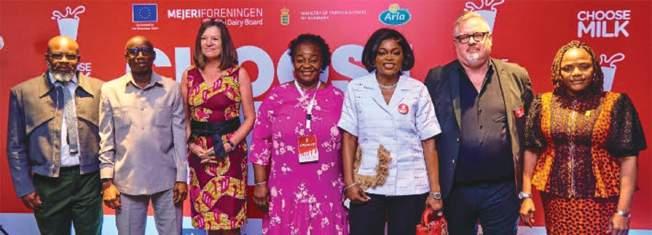
Senior government officials, nutrition experts, healthcare professionals, regulators, development partners, and industry stakeholders, on Monday, convened at the Lagos Marriott Hotel Ikeja for the official launch of the Choose Milk Campaign.
The campaign is a strategic national initiative focused on helping Nigerian households make informed dairy choices by strengthening consumer education and awareness on the nutritional benefits of milk and the differences between real milk and creamers.
The campaign launch was led by stakeholders from the Danish Dairy Board, European Union, alongside senior representatives from the Federal Ministry of Health and Social Welfare and Ministry of Livestock Development.
The event also brought together key institutions including the Standards Organisation of Nigeria (SON), National Agency for Food and Drug Administration and Control (NAFDAC), leading nutritionists, key sector organisations, healthcare experts, development stakeholders, and prominent media and influencers.
Among the notable personalities present at the launch were the Director and Head of Food and Drug Services at the Federal Ministry of Health and Social Welfare, Mrs. Olufowobi-Yusuf Adeola MNI, Deputy Director and Head of Nutrition, Mrs Victoria Nsofor from the Standards Organisation of Nigeria, acclaimed actress and filmmaker Funke Akindele, popular Paediatrician Dr. Ayodele Renner (Noisy Naija Paediatrician), as well as several senior government officials, respected media personalities, digital creators, and lifestyle influencers who joined the campaign to amplify awareness around dairy nutrition and informed consumer choices.
Speaking during the launch, Mr. Lars
L-R: Paediatrician, Dr. Ayodele Renner (The Noisy Naija Paediatrician); Special Adviser to the Minister of Livestock Development, Dr. Ishaq Bello; Consul General of Denmark to Nigeria, Her Excellency Ms. Jette Bjerrum; Deputy Director and Head of Nutrition, Standards Organisation of Nigeria(SON), Mrs. Victoria Nsofor; Nollywood Actress and Choose Milk Campaign Ambassador, Funke Akindele; Senior Marketing Manager, Danish Dairy Board Representative, Mr. Lars Jensen, and Director of Food and Drug Services, Federal Ministry of Health and Social Welfare, Mrs. Olufowobi-Yusuf Adeola, during the launch of Choose Milk Campaign held in Lagos, on Monday
Jensen, Senior Project Manager from the Danish Dairy Board, noted that the initiative seeks to address widespread misconceptions about dairy consumption while drawing a clear distinction between dairy milk and creamers commonly found in the Nigerian market.
“Not all products marketed within the dairy category deliver the same nutritional value,” he said.
“It is important for consumers to understand that creamers do not offer the key nutrients found in dairy milk. This campaign is about clarity, transparency, and better health outcomes. We are taking this message directly to communities, schools and nutrition
advocates because education at the grassroots level is key to driving lasting behavioral change.”
In her opening remarks, the Danish Consul General to Nigeria, Her Excellency Ms. Jette Bjerrum, emphasized the importance of stronger collaboration between the public and private sectors in driving nutrition awareness and improving health outcomes. She noted that sustainable progress in nutrition education and dairy development can only be achieved through partnerships among governments, healthcare institutions, development organisations, and
responsible industry stakeholders.
Echoing this call for collaboration and shared responsibility in improving nutrition outcomes, the Honourable Minister of Livestock Development, Alhaji Idi Mukhtar Maiha, in a video message played during the event commended the initiative and reaffirmed the Ministry’s commitment to improving nutrition and strengthening the dairy sector in Nigeria.
“This ‘Choose Milk’ campaign strongly aligns with the Ministry’s objectives to improve national nutrition, promote sustainable dairy consumption, and strengthen the local dairy value chain,” he said.
“By encouraging Nigerians to prioritize dairy milk, we are taking a significant step towards building a healthier and more food-secure nation.”
In her remarks, the Director Food and Drugs Services of the Federal Ministry of Health and Social Welfare Mrs. Olufowolabi-Yusuf Adeola MNI, described the campaign as timely and aligned with the Federal Government’s broader efforts to tackle malnutrition and improve nutrition outcomes across the country.
“Nutrition remains one of the most important public health priorities for any nation seeking sustainable growth and development. Consumers are faced with numerous food options and varied information about nutrition.
Therefore, people must understand what to consume, why it matters, and how it contributes to their health and well-being. Campaigns like this help bring the nutrition literacy gap by empowering consumers with accurate information that enables them to make informed dietary choices for themselves and our entire families.
SOStainability Week ly
Edited by Oke Epia
Trends and Threads
Six Steps Nigeria Must Take to Win the Race for Climate Cash
Climate finance is no longer a technical jargon reserved for negotiators at global summits. It is now about survival, economic power, energy security, food systems, debt, and the future of developing countries. For Africa, and especially for Nigeria, the debate is no longer whether climate finance matters. The real question is whether the continent can assertively and strategically demand its fair share of global climate capital even as climate vulnerability deepens poverty, instability, and economic inequality.
The uncomfortable truth, however, is that the countries least responsible for climate change are paying the highest price, while those most responsible control the direction of climate finance flows, technologies, and investment decisions. That imbalance sits at the heart of the global climate finance debate. Big promises, unequal flows
Globally, climate finance has grown significantly over the last decade. Latest global assessments show that climate finance flows have crossed the trillion-dollar threshold, driven largely by investments in renewable energy, electric mobility, and low-carbon infrastructure. On paper, this appears encouraging, but beneath the headlines lies a deeper structural problem: climate finance is heavily concentrated in developed economies and emerging industrial powers, including the United States, China, and parts of Europe. Africa, despite being the continent most vulnerable to climate impacts, receives only a tiny fraction of global flows. According to the United Nations, Africa receives roughly 1 percent of annual global climate finance despite facing devastating climate-related losses. This is not merely a funding gap. It is a justice gap; the global climate finance architecture still operates largely through the logic of profit, risk ratings, and investor confidence rather than vulnerability and moral responsibility. Countries already struggling with debt, infrastructure deficits, and weak institutions are often considered ‘high-risk’ destinations for climate investment, even when they possess enormous renewable energy potential. As a result, climate finance has become paradoxical: countries that need it most receive the least; countries suffering the harshest impacts pay the highest borrowing costs; and adaptation, which matters most to vulnerable countries, receives far less funding than mitigation projects that generate commercial returns. This imbalance exposes the political reality behind climate negotiations. Climate finance is not charity. It is power.
The unpleasant reality facing Africa and Nigeria
Africa accounts for less than 4 percent of global greenhouse gas emissions, yet the continent remains among the hardest hit by floods, droughts, heatwaves, desertification, food insecurity, and displacement. The economic implications are staggering: reports by the World Meteorological Organization and the UN show African countries are losing between 2 and 5 percent of GDP annually due to climate impacts. In some countries, climate-related disasters
consume up to 9 percent of national budgets. The continent’s climate finance crisis is not simply about insufficient money. It is also about: expensive capital, unfair lending systems, debt-heavy financing, weak institutional readiness, and a global financial architecture designed without Africa in mind. Even where financing exists, much of it arrives as loans rather than grants, increasing debt burdens for already vulnerable economies. This has created a dangerous cycle where African countries borrow money to survive climate disasters they did not create, and that is economically unsustainable and morally indefensible.
The African Development Bank (AfDB) has attempted to bridge some of these gaps. In 2024 alone, the Bank committed $5.5 billion to climate finance, representing nearly half of its total approvals, with adaptation receiving a slightly larger share than mitigation. But even this is nowhere near sufficient for the continent’s actual needs. Africa does not need symbolic climate financing. Africa needs structural climate investment.
Nigeria represents one of the clearest examples of the contradictions shaping climate finance in Africa. On one hand, Nigeria is highly vulnerable to climate impacts: severe flooding, desertification, coastal erosion, food insecurity, energy poverty, and urban climate stress. On the other hand, Nigeria remains heavily dependent on fossil fuels for government revenue and foreign exchange earnings. This creates a difficult but unavoidable transition dilemma: Nigeria cannot ignore climate transition pressures, yet it also cannot abruptly abandon oil and gas without destabilizing its economy and worsening poverty. Now this is why Nigeria’s climate finance conversation must become deeply strategic.
According to a 2025 assessment by Climate Policy Initiative, Nigeria attracted about $2.5 billion in climate finance in 2021/2022, making it one of Africa’s top climate finance destinations. While this places the country among Africa’s leading climate finance destinations, the figure remains insignificant compared to actual financing needs, as the same report reveals that the country faces an estimated annual climate finance gap of $27.2 billion. The structure of existing finance is said to be about 70 percent from public actors, with much of it secured as debt. The report also says adaptation finance remains grossly underfunded, while several critical sectors receive little or no climate investment. Meanwhile, the country still spends billions on fossil fuel-related expenditures while climate-resilient infrastructure remains weak. This is where the contradiction
becomes impossible to ignore: Nigeria cannot simultaneously claim climate leadership while maintaining weak climate governance, inconsistent energy policies, and limited transparency around green investments.
Nigeria’s Energy Transition Office has presented one of Africa’s most ambitious transition plans, which aims for net-zero emissions by 2060. But the financing requirement is massive, with approximately $410 billion above business-as-usual spending estimated to execute the plan. Where will the money come from? Can private investors finance a large-scale transition in a high-risk macroeconomic environment? Will international partners provide grants or more loans? Can Nigeria build investor confidence fast enough? Answers to these questions determine whether Nigeria’s transition becomes transformational or merely aspirational.
What Nigeria must do differently
Nigeria’s biggest climate finance challenge is not only access to capital. It is how it positions for the cash, what it spends on, and evidence of the benefits. The country must make these six critical shifts to make strong, legitimate claims to climate cash. First is to build bankable climate projects. Investors cannot fund vague ambitions; they fund structured opportunities. Nigeria needs stronger project preparation facilities, climate investment pipelines, and technical expertise capable of translating climate priorities into commercially viable investments. Secondly, the country must strengthen climate governance and transparency. Let’s put this simply: climate finance flows where people trust systems. Right now, one of Nigeria’s biggest challenges is not just getting climate money but convincing investors that the money will be well-managed, properly tracked, and used for the right projects. So, when we talk about strengthening governance, we are really talking about fixing the “trust system” around climate action. Nigeria needs to clearly know and show: how much carbon is being emitted and from where (this is emissions reporting in simple terms); what climate projects are being funded and whether they are actually working (project monitoring); whether climate money is being spent transparently, without leakages or confusion (procurement transparency); how climate spending is recorded in the national budget so it can be tracked easily (climate budget tracking); and reliable climate data that policymakers and investors can trust when making decisions. That is what is meant by the line: without trust, capital becomes expensive. It means uncertainty increases risk, and risk increases the cost of money. Thirdly, the country must prioritise adaptation
financing. The reality is that most global climate cash is going into things like solar, wind, and clean energy projects because they can generate profit. That is called mitigation finance, which focuses on reducing emissions. For Nigeria, the more urgent issue is not only reducing emissions. It is surviving climate impacts already happening: floods destroying homes and roads; farmers losing crops due to unpredictable rainfall; communities struggling with water shortages; people forced to move because land is no longer livable; and weak infrastructure collapsing under climate pressure. The problem is: adaptation projects (like drainage systems, climate-resilient roads, irrigation systems, coastal protection) usually don’t make quick profits, so they attract less global investment. That is why Nigeria must deliberately and strongly push for adaptation financing (money to help communities withstand climate impacts). Fourthly, play smart on the diplomatic front. Nigeria must build stronger alliances through regional and geo-political cooperation to demand fairer financing structures, lower borrowing costs, and more grant-based financing. Fifthly, the country must mobilize domestic green finance as reliance on international sources alone will not cut it. Domestic pension funds, sovereign instruments, green bonds, insurance markets, and private sector financing must become part of the climate finance ecosystem. Recent moves toward climate investment platforms and national climate funds indicate some progress, but scale remains the issue. Lastly, climate finance must be linked to development outcomes on jobs and social stability.
Why NCIS London is important
This discussion makes the Nigeria Climate Investment Summit (NCIS) both timely and necessary. At a moment when climate conversations are becoming increasingly dominated by finance, accountability, energy transition, ESG standards, and economic restructuring, platforms like NCIS are critical for shaping serious national dialogue. SOStainability and GLOBE Legislators are co-convening the Summit during this year’s London Climate Action Week (LCAW). The Summit provides a platform to challenge shallow climate conversations and push for deeper institutional thinking around sustainability, ESG performance, transition financing, and corporate accountability. It also provides an important opportunity to confront difficult questions many institutions avoid: Are Nigerian financial institutions genuinely supporting climate resilience? Are corporations treating ESG as substance or public relations? Is climate governance being institutionalized or merely discussed? Can Nigeria realistically mobilize the scale of climate financing required for transition?
• President Bola Tinubu
• Taiwo Oyedele, Minister of Finance and Coordinating Minister of the Economy
• Amb. Bianca Odumegwu-Ojukwu, Minister of Foreign Affairs
SOStainability Week ly
Edited by Oke Epia |
WashingandHushing
Emerging Technologies to Tackle Climate Change
Technology has been hailed as the savior of humanity. Since its advent, tech has helped humanity attain heights and breakthroughs previously thought impossible: from medical solutions to agricultural breakthroughs. Today, it is helping to shape our fight against climate change. As nations navigate through the challenges of a warming planet, technological breakthroughs present an unprecedented opportunity to accelerate progress and achieve inconceivable feats. From enhancing the efficiency of renewable energy sources to redefining humanity’s relationship with the Earth’s resources, these advancements mark significant milestones in our quest for a greener future. This page presents some amazing technological innovations that, if harnessed, can change the tide in the fight against climate change.
Enhanced geothermal systems
Geothermal energy, harnessed from the Earth’s natural heat, has been utilised for millennia. However, traditional geothermal systems are limited by specific geological conditions, constraining their widespread adoption. Enter enhanced geothermal systems (EGS), a novel approach that seeks to expand access to geothermal energy through human intervention. By drilling into deep rock formations and stimulating them with fluid injections, EGS creates artificial reservoirs of geothermal energy, effectively unlocking new sources of clean, renewable power. While still in the early stages of development, recent pilot projects demonstrate the feasibility of this innovative approach, signalling a promising future for geothermal energy on a global scale.
Artificial Intelligence
AI is playing a pivotal role in the fight against climate change across various fronts. From monitoring the melting of icebergs to predicting climate disasters and facilitating reforestation efforts, AI’s capabilities are being leveraged to address the multifaceted challenges posed by global warming. One significant application of AI lies in its ability to rapidly assess changes in icebergs, a task that would typically be time-consuming for humans. With AI, scientists can analyse satellite images and measure iceberg movements at a pace 10,000 times faster than traditional methods, providing critical insights into the rate of ice melt and its impact on rising sea levels. Moreover, AI is instrumental in mapping deforestation patterns, tracking emissions, and predicting weather patterns, enabling proactive measures to mitigate climate risks. Companies are utilising AI algorithms to analyse satellite data and quantify deforestation rates, thereby aiding conservation efforts and preserving vital carbon sinks. Additionally, AI-driven initiatives such as the IKI Project in Africa harness predictive analytics to anticipate climate-related challenges, empowering vulnerable communities to adapt and thrive in the face of environmental uncertainties. As climate change continues to pose existential threats, AI emerges as a powerful ally, offering innovative solutions to safeguard the planet for future generations.
Here are specific ways AI is aiding in the fight against climate change:
1. Iceberg Monitoring: AI algorithms analyse satellite imagery to track the movement and melting of icebergs, providing valuable data on sea level rise and polar ice loss.
2. Deforestation Mapping: By processing satellite data, AI algorithms detect changes in forest cover and quantify deforestation rates, facilitating conservation efforts and preserving carbon sinks.
3. Emissions Tracking: AI-powered systems track and analyse emissions data from industrial processes, enabling companies to monitor and reduce their carbon footprint.
4. Weather Prediction: AI models leverage historical weather data to forecast extreme weather events, helping communities and authorities prepare for and respond to climate-related disasters.
5. Ocean Cleanup: Environmental organisations deploy AI-enabled technologies to detect and map ocean litter, facilitating targeted cleanup efforts and mitigating the impact of plastic pollution on marine ecosystems.
6. Climate Disaster Prediction: AI platforms analyse various factors to predict the occurrence and severity of climate-related disasters, aiding businesses, governments, and communities in disaster preparedness and response planning.
7. Decarbonization in Industries: AI-powered emissions-tracking platforms assist industries like metal and mining, oil, and gas in monitoring and reducing their carbon emissions, contributing to overall decarbonization efforts.
8. Reforestation: AI-driven drones are employed to reforest degraded areas quickly and efficiently, enhancing carbon sequestration and biodiversity conservation.
9. Agricultural Sustainability: AI applications in agriculture optimise resource use, improve crop yields, and reduce environmental impact through precision farming techniques.
10. Renewable Energy Integration: AI models forecast renewable energy output and optimise grid operations, facilitating the integration of solar, wind, and other renewable sources into the energy mix.
11. Climate Modelling: AI techniques enhance climate modelling capabilities, improving predictions of long-term climate trends and informing policymaking and adaptation strategies.
Super-efficient solar cells
Solar power has long been heralded as a cornerstone of renewable energy, but the quest for even greater efficiency has led to the emergence of super-efficient solar cells. Among them, perovskite tandem solar cells stand out for their potential to further optimise the conversion of sunlight into electricity. By combining traditional silicon with perovskite materials in a stacked configuration, these next-generation solar cells offer a compelling solution to improve performance and reduce costs. While challenges remain in commercialising this technology, recent strides suggest that we are closer than ever to
unlocking its full potential. Companies are actively pursuing ways to overcome manufacturing obstacles and address concerns about durability, bringing us one step closer to a future powered by clean, renewable energy.
Internet of Things (IoT)
The Internet of Things (IoT) refers to the network of interconnected devices embedded with sensors, software, and other technologies, enabling them to collect and exchange data. In the context of tackling climate change, IoT plays a pivotal role in promoting energy efficiency, resource management, and environmental monitoring. IoT devices are deployed in various sectors such as smart cities, agriculture, energy, and water management. For example, in smart energy infrastructure management, IoT sensors gather data on energy consumption, allowing for real-time monitoring and optimization of energy usage. Similarly, in urban water supply management, IoT-enabled sensors monitor water quality, flow rates, and detect leaks, facilitating efficient water distribution and reducing water losses. Furthermore, IoT devices enable remote monitoring and control, allowing for proactive maintenance and timely interventions. By leveraging IoT technologies, cities and organisations can make data-driven decisions, optimise resource utilisation, and mitigate the environmental impact of their operations.
Digital twin technology
Digital twin technology involves creating virtual replicas or simulations of physical assets, systems, or processes. These digital twins are connected to their real-world counterparts and continuously receive data from sensors, enabling real-time monitoring, analysis, and simulation. In the context of climate change, digital twin technology offers valuable insights
for environmental resilience, disaster risk planning, and infrastructure management. For example, cities can create digital twins of their infrastructure, including buildings, transportation systems, and utilities. These digital twins can simulate various scenarios, such as extreme weather events or sea-level rise, to assess their impact on infrastructure and develop effective response plans. Moreover, digital twins enable predictive maintenance, allowing organisations to identify potential issues before they occur and optimise the performance of their assets. By integrating real-time data and advanced analytics, digital twins help improve operational efficiency, reduce environmental risks, and enhance overall resilience to climate change impacts.
Heat pumps
In the realm of climate technologies, few innovations rival the longevity and impact of heat pumps. These versatile devices, capable of both heating and cooling spaces using electricity, have become indispensable tools in the fight against carbon emissions. While not a new invention, heat pumps are experiencing a renaissance of sorts, with sales surpassing traditional gas furnaces and momentum building for widespread adoption. With the potential to significantly reduce emissions and alleviate pressure on conventional heating and cooling systems, heat pumps exemplify the enduring legacy of innovation in the climate technology landscape. As we strive to meet ambitious decarbonization goals, these reliable workhorses continue to play a vital role in shaping a sustainable future.
Space 2.0 technologies
Space 2.0 technologies encompass the latest advancements in satellite technology, data analytics, and remote sensing capabilities. These technologies enable the collection of vast amounts of data from space, providing valuable insights into Earth’s climate system, environmental changes, and natural disasters. For instance, satellites equipped with advanced sensors and instruments, such as radar and lidar, can monitor changes in Earth’s surface, including ice sheets, glaciers, and sea levels. This data is essential for understanding the dynamics of climate change and its impact on ecosystems, water resources, and coastal regions. Additionally, space-based technologies play a crucial role in disaster risk management and response. Satellites can provide real-time imagery and data during natural disasters such as hurricanes, floods, and wildfires, enabling authorities to assess damage, plan evacuation routes, and coordinate emergency response efforts.
Robotics
Robotics involves the design, development, and deployment of autonomous or semi-autonomous machines capable of performing tasks in various environments. In the context of climate change, robotics offers innovative solutions for environmental monitoring, disaster response, and biodiversity conservation. For example, underwater robots equipped with sensors and cameras can explore marine environments, collect data on water quality, and monitor marine life. These robots enable scientists to study the impacts of climate change on oceans, coral reefs, and marine ecosystems. Similarly, aerial drones equipped with advanced imaging technologies can survey landscapes, map deforestation, and monitor wildlife populations. These drones provide valuable data for conservation efforts, habitat restoration, and ecosystem management. Overall, robotics plays a critical role in enhancing our understanding of climate change, mitigating its impacts, and promoting sustainable environmental practices. By leveraging robotics technologies, researchers, policymakers, and environmentalists can work towards building a more resilient and sustainable future.
As humanity stands at the frontier of climate action, the symphony of innovation crescendos with promise and possibility. Enhanced Geothermal Systems, Artificial Intelligence, and Super-efficient Solar Cells emerge as champions in the fight against climate change. They are not mere technologies but beacons of ingenuity, illuminating our path towards a sustainable future. As we work towards scaling progress in the fight against climate change, let us not forget the power of collaboration, the strength of innovation, and the boundless potential within each of us to shape a world where sustainability reigns supreme. For it is not just the technologies we wield, but the spirit of humanity driving us forward, that will ultimately steer us towards a greener, more vibrant tomorrow.
• Kingsley Tochukwu Udeh, Minister of Science, Innovation and Technology
• Bosun Tijani, Minister of Communication and Digital Economy
• Ayodele Olawande, Minister of Youth Development
66 Hearty Cheers for Dapo Abiodun, the People’s Governor TRIBUTE
By Kayode Akinmade
Today, as Dapo Abiodun turns 66, Ogun State joins family, friends, political associates, and admirers in celebrating a leader whose journey has been defined by resilience, vision, and an unwavering commitment to the progress of the Gateway State.
For the Iperu-born prince, the road to leadership has not been without trials, betrayals, and moments of intense political turbulence. Yet, through every challenge, Governor Abiodun has remained steadfast, drawing strength from faith in God and an abiding belief in the promise of a greater Ogun State. Today therefore is not merely a birthday celebration; it is a moment of gratitude, reflection, and renewed hope for a people who continue to witness transformative governance under his watch.
Governor Abiodun’s philosophy of governance is rooted in inclusion and collaboration. His administration’s mantra, “Building Our Future Together,” reflects a deliberate effort to place the people at the center of development. From civil servants to investors, artisans to development partners, the Governor has consistently emphasized partnership as the key to sustainable growth.
Under his leadership, Ogun State has emerged as Nigeria’s industrial capital and one of the nation’s fastest-growing economies. Factories continue to spring up across the state, while investor confidence has remained strong due to policies that encourage enterprise, infrastructure development, and ease of doing business.
Unlike the politics of noise and division, Governor Abiodun has governed with calmness, tolerance, and strategic focus. In a state once associated with intense political violence and instability, Ogun has witnessed a remarkable atmosphere of peace and stability. Even critics acknowledge his accommodating disposition and commitment to democratic engagement.
Infrastructure development has become one of the defining legacies of the administration. Across the state, over 1,700 kilometres of roads have reportedly been constructed or rehabilitated, connecting communities, markets, and industrial corridors. From federal roads to rural access routes linking farms to markets, the administration has pursued equitable
development across all senatorial districts.
The establishment of the Gateway International Airport stands as one of the boldest economic initiatives in the state’s recent history. Combined with rail connectivity and expanding transport infrastructure, the project reflects a broader vision of positioning Ogun as a strategic economic hub in West Africa.
In housing and urban renewal, the transformation is equally visible. Thousands of affordable housing units have been developed across locations such as Kobape, Kemta, Ibara, Sagamu, Ijebu-Ode, Ota, Ilaro, and Iperu. The
2027: THE ARITHMETIC OF AMBITION
The defining question of 2027 is not which party has the better manifesto or deeper war chest. The question is whether Nigerians will convert their suffering into ballots or endure four more years of what the ruling establishment calls “reform.” For too many, reform is now indistinguishable from hardship. That is the real political arithmetic, and no amount of incumbency, patronage, or engineering can make it disappear.
That argument carries risk. Nigerians are patient only when sacrifice seems meaningful, fairly distributed, and tied to visible improvement. They may endure pain, but they will not accept suffering without signs of progress. If inflation, hunger, unemployment, insecurity, and the cost of living remain high, continuity becomes a hard sell. The voter does not ask if reform is elegant on paper. He asks whether his children can eat, whether his shop can survive, whether his farm is safe, whether his salary has value, and whether tomorrow is less frightening than today.
margins and must avoid collapse in the South. Obi must turn passionate support in cities and the South into a national reach. The South-South and North-Central may become decisive battlegrounds. Lagos will remain symbolically important because Obi’s 2023 performance there changed the psychology of Nigerian elections. It punctured assumptions about political ownership.
A rematch would also be a stress test for Nigeria’s electoral institutions. After 2023’s controversies, voters will arrive with sharp expectations. They will demand more transparency, faster results, and clearer communication. Trust is no longer just desirable. It is a democratic asset. Without it, electoral outcomes lose authority.
administration’s urban renewal drive has significantly reshaped the physical outlook of many communities while stimulating confidence in the real estate sector.
Education has also received unprecedented attention. Through the construction of modern classroom blocks, digital learning initiatives, teacher support programmes, and reforms like the Learner Identification Number (LIN), Ogun’s education sector has witnessed major innovation. Programmes such as OgunLEARN have strengthened curriculum delivery and improved learning outcomes across public schools.
There is also the deeper issue of candidate fatigue. Nigerians are increasingly tired of seeing the same familiar faces dominate the highest level of national politics. As voters grow weary of repeated candidacies, scrutiny now centres on the candidates themselves: their credibility, competence, freshness, and capacity for genuine renewal. This does not automatically make experience a disadvantage, but places the onus on candidates to prove the value of their record. Longevity must align with relevance, and ambition must clearly serve a national purpose rather than personal destiny.
In healthcare, Governor Abiodun’s administration has aggressively pursued the vision of functional Primary Healthcare Centres across the state’s political wards. Hundreds of PHCs have been upgraded with modern equipment, solar systems, ambulances, and digital facilities, bringing healthcare closer to ordinary citizens.
Security remains another major area of intervention. By supporting security agencies with logistics, operational vehicles, and welfare packages, while also strengthening the Amotekun Corps, the administration has reinforced Ogun’s reputation as one of the safer states in Nigeria.
The Governor’s economic reforms have equally extended into agriculture and agroindustrialisation. Ogun today remains a leading producer of cassava, poultry, eggs, cocoa, and other agricultural products. Through strategic partnerships with institutions such as Afreximbank and the Islamic Development Bank, the state is advancing plans for agro-processing zones capable of creating jobs and boosting food security.
Perhaps most remarkable is the state’s economic expansion under the Abiodun administration. Ogun’s internally generated revenue has witnessed significant growth, while the state’s GDP has risen sharply, reflecting increased industrial activities and investment inflows. Investor-friendly policies, public-private partnerships, and industrial expansion across Ota, Sagamu, Abeokuta, and Ijebu-Ode continue to position Ogun as a preferred destination for manufacturing and commerce.
These achievements have earned the administration several recognitions in infrastructure, housing, ICT, security, agriculture, and industrial development.
As Governor Abiodun himself once noted, Ogun State is a precious mineral whose true value is only beginning to emerge. That optimism continues to define his leadership style and developmental agenda.
At 66, Prince Dapo Abiodun stands not just as a political leader, but as a symbol of perseverance, stability, and purposeful governance. As Ogun State continues its march toward greater economic prosperity and social development, many believe the Governor remains determined to finish strong and leave behind a legacy of enduring progress.
Indeed, for many residents of the Gateway State, today is more than a birthday celebration. It is a celebration of leadership, vision, and hope. •Akinmade is Special Adviser, Information and Strategy to Governor Dapo Abiodun
Regional politics will be decisive. Tinubu must protect his South-West base and improve Northern numbers. He must also contain Obi’s appeal in the South-East and Christian Middle Belt, while staying competitive in the South-South. Atiku needs commanding Northern
The uncomfortable truth is that public confidence in INEC has hit a historic low. Both the political class and ordinary citizens are sceptical of the commission’s independence. The consequences of this credibility gap are not abstract. If citizens enter the election convinced that the result is predetermined, apathy deepens, turnout drops, and post-election tension is likely. If INEC can show—not just claim—a credible, tamper-proof process, the winner will inherit more than office. They will inherit legitimacy: the only currency that makes governance possible and power sustainable.
This is where the generational question becomes unavoidable. Tinubu and Atiku represent the endurance of established political networks. Obi represents a bridge between establishment experience and outsider-style mobilisation. But the real youth question is not simply whether a young person is on the ballot. It is whether the concerns shaping young lives are central to the campaign: jobs, education, security, digital opportunity, migration, policing, housing, entrepreneurship, and dignity. A country that cannot persuade its young people to believe in its future is losing its most valuable asset.
A rematch could sharpen democratic debate or deepen national cynicism. At its best, it would force Tinubu to
defend his record, Atiku to justify his persistence, and Obi to mature his movement into a credible governing proposition. It could produce a serious contest over federalism, economic reform, production, security, social protection, institutional trust, and national cohesion. At its worst, it could collapse into ethnic suspicion, religious mobilisation, elite bargaining, online abuse, recycled slogans, and the familiar theatre of personality warfare. Nigeria has too many urgent problems for another election reduced to identity arithmetic.
My reading is that a three-way rematch would initially favour Tinubu, not because he is unbeatable, but because divided opponents rarely defeat incumbents. Separately, they appeal to different anxieties within the electorate. Together, they could convert dissatisfaction into a national alternative. The question is whether either man is prepared to subordinate personal ambition to collective strategy. That question may determine the election before the formal campaign begins.
The next election must not merely ask who wants power. It must ask who understands the weight of a nation that can no longer afford political repetition without renewal. •Dakuku Peterside is the author of Leading in a Storm and Beneath the Surface. BACK PAGE CONTINUATION
Dapo Abiodun
100 MOST INFLUENTIAL AFRICAN CMOS EVENT...
Report: Global Banking Industry
Posted $1.3trn Net Income in 2025 Says fintechs among industry’s four rising challenges
Ndubuisi Francis in Abuja
A new report by leading international management consulting firm, McKinsey & Company, has revealed that the net Income of the global banking industry rose to $1.3 trillion, up from 2024’s record-setting tally of $1.2 trillion, clearly making it the highest net income of any industry.
According to the 2026 Global Banking Annual Review, which was released on Thursday, as rates began to fall in major markets, net interest margins (NIM) declined slightly, globally, from 1.65 per cent in 2024 to 1.63 per cent in 2025.
The report stated, “However, some markets improved their margins. US banks’ NIM rose 9 basis points (bps), Japan’s banks (7 bps), and UK banks (6 bps). Emerging markets were not quite as fortunate, as margins slipped slightly, and in Brazil, dramatically (from 3.55 per cent to 2.93 per cent.)
“Balances (deposits, loans, and assets under management) grew by 6.5 percent in 2025, up from 6.2 per cent annually in 2020–24. Investors benefited from higher dividends and share buybacks; and banks socked away another $853 billion in surplus
free cash flow to equity, which, while somewhat lower than previous years, continued the record-setting trend begun in 2022.”
The firm, which advises corporations, governments, and institutions on strategy, operations, and technology, and has maintained an active presence in Nigeria since 2002, about two months ago projected that Nigeria’s banking industry was on course for a structural transformation that would see market size rise to $16 billion by 2030, driven by
consolidation, digital expansion, and regulatory tightening,
The report acknowledged the geopolitical dynamics that had been making the headlines recently, adding that for the most part, banks have adapted well.
It said, “Investment banks have done exceptionally well from volatility in 2025 and 2026. The new frictions are far from settled, of course, and doubtless will require even more agility from banks.
“Meantime, the industry also faces
NCF Urges Tinubu
four rising challenges to its most vital asset: the customer relationship. Fintechs (including neobanks, like Revolut and Nubank) were mostly an irritant to incumbents for the past 20 years—until 2025, when irritation became something more acute.
“A new breed of mature fintechs has, by one measure, claimed 17 per cent of industry revenues and is looking for more.
“Neobanks pose a second challenge.
“The call is coming from inside
the house, is a troupe of many horror films, and banking is experiencing a version of it.
“Neobanks, such as Revolut and Nubank, have broken through the growth/performance frontier and rewritten the expectations of incumbent institutions.”
The report added, “Agentic AI and digital assets, such as stablecoins, are a two-headed technological revolution that make it easier for retail and corporate customers to bank without banks.
“Finally, customers’ attitudes are reaching a tipping point; they now not only favour but also trust more the new entrants delivering everyday reliable services.”
On finetechs, the global banking report stated that while their revenues still trailed the traditional banks by far, the strongest fintechs were growing fast, becoming profitable, and moving into banks’ most lucrative pools—payments, wealth management, capital markets, and lending.
to Act on Nigeria’s Biodiversity Strategy
Seeks signing of endangered species conservation bill
Bennett Oghifo
The Nigerian Conservation Foundation (NCF) has called on President Bola Tinubu to urgently act on the National Biodiversity Strategy and Action Plan and to immediately sign the Endangered Species Conservation and Protection bill into law.
The NCF made the call on World Biodiversity Day 2026,
“On this World Biodiversity Day, NCF calls on the President of the Federal Republic of Nigeria to immediately sign the Endangered Species Conservation and Protection Bill, 2025 into law as passed by the national assembly.
“This legislation is long overdue and will provide the legal backbone
needed to prosecute wildlife crimes, regulate trade, and deter the exploitation of threatened species. We call on the government at all levels to fully fund and implement NBSAP targets and enforce existing wildlife protection laws without delay,” the Director General, NCF, Dr. Joseph Onoja, said.
According to the Foundation, the government, communities,
Ebola: NCDC Issues Guidelines for Health Workers, Cautions Against Importing Disease
Lists Lagos, Enugu, Borno, others as high risk states
Onyebuchi Ezigbo in Abuja
The Nigeria Centre for Disease Control and Prevention (NCDC) yesterday released a Public Health Advisory for Healthcare Workers on Ebola Virus Disease (EVD) preparedness and readiness.
As of Thursday, the NCDC said Nigeria had not recorded any confirmed case of the disease, associated with the current regional outbreak.
However, in the advisory signed by the Corporate Communications Division, the agency warned
that Nigeria faces a high risk of importing the virus due to increased international travel, porous borders and heavy population movement across the region.
It advised healthcare workers to maintain a heightened level of vigilance and strengthen preparedness measures to ensure early detection and prompt response should a case occur.
The advisory highlighted areas like risk assessment and national preparedness, stating why healthcare workers must prepare and be able to recognise Ebola infection early.
The Centre also provided information on transmission risks and what healthcare workers should do to prevent the spread.
It advised healthcare workers to contact their State Ministry of Health or designated public health authorities for additional guidance.
The agency warned that Nigeria has a high risk of importing the virus due to increased international travel, porous borders and heavy population movement across the region.
States listed as high-risk include: Lagos, Enugu, Borno, Akwa Ibom,
Cross River, Taraba and Adamawa because of their international airports, seaports and border routes. NCDC said the immediate objective of the preparedness efforts was to ensure that every state and the FCT can detect, contain and respond swiftly to any suspected case in the event of an outbreak in the country.
At the moment, NCDC said that 1,077 suspected cases and 247 deaths have been reported in Uganda and the Democratic Republic of Congo (DRC), with a fatality rate of 24.6 per cent.
businesses, and citizens should turn global commitments into local actions.
“Nigeria is one of Africa’s most biodiverse nations. Our savannahs, montane forests, rainforests, freshwater swamps, floodplains, and coastal and marine habitats support nearly 8,000 plant species across 338 families and over 22,000 animal species.
“These include insects, fish, birds, mammals, reptiles, and amphibians. In terms of overall biodiversity richness, Nigeria ranks 36th globally, with particularly high diversity in birds, mammals, and vascular plants.
“Yet this natural wealth is disappearing at an alarming rate. Nigeria has one of the highest deforestation rates in the world, with over 90 per cent of its original forest cover already lost. Habitat fragmentation, climate change, overexploitation, pollution from oil spills and gas flaring, and invasive alien species continue to drive species decline and ecosystem degradation.
“Illegal, indiscriminate and unsustainable wildlife hunting and exploitation, often facilitated through social media and informal markets, further undermine conservation gains,” the organisation stated.
Onoja added: “Biodiversity loss is not an abstract global problem.
It is happening in our forests, wetlands, and communities, and it affects food security, water, health, and livelihoods. World Biodiversity Day 2026 is a reminder that global targets are only achieved when local actors take responsibility.”
He said Nigeria’s revised National Biodiversity Strategy and Action Plan (NBSAP) aligns with the 23 global targets of the Kunming–Montreal Global Biodiversity Framework and commits the country to halting biodiversity loss by 2030 through effective management of high-priority areas and protecting at least 30 per cent of land, inland waters, and coastal and marine habitats in well-connected networks.
The plan, according to the NCF, tackles direct drivers of loss such as unsustainable harvesting, pollution, and invasive species, while prioritising ecosystem restoration, enhanced ecosystem services, and the mainstreaming of biodiversity values into development planning and budgeting across all sectors. NCF emphasised that action must be inclusive, evidence-based, and well-funded. While biodiversity research in Nigeria is increasing, it said it remains far below global output, stressing that without urgent investment and integration with poverty reduction strategies, the window to reverse loss will close.
L-R: President, Ethiopian Marketing Professional Association, Fana A. Abay; Marketing Director, FrieslandCampina WAMCO, Maureen Ifada; and Founder and Chairman Brand Africa, Thebe Ikalafeng. at the 100 most influential African CMOs event held in Addis Ababa, Ethiopia ... recently
Three Years in Office: Tinubu Defends Reforms, Says Nigeria Undergoing Historic Test
Reveals he inherited economy on brink of fiscal breakdown Lists gains in infrastructure, energy, telecoms,
President Bola Tinubu Friday morning defended the sweeping economic reforms implemented by his administration over the last three years, declaring that Nigeria is passing through a historic national test that requires sacrifice, courage and difficult decisions to prevent economic collapse.
In a nationwide address to commemorate the third anniversary of his administration, Tinubu said he inherited a nation weighed down by profound structural and economic distortions, including crippling fuel subsidies, exchange-rate manipulation, rising debt service obligations, declining revenues and worsening insecurity.
The president maintained that without the decisive policies introduced since he assumed office on May 29, 2023, Nigeria would have drifted into fiscal breakdown, deeper poverty and severe economic
uncertainty.
However, the president acknowledged the pain triggered by the reforms, especially the sharp rise in the cost of living, but insisted that the sacrifices Nigerians had made were already yielding results across critical sectors of the economy.
“My fellow Nigerians, history tests nations before it elevates them. Nigeria is passing through such a test. But I believe with all my heart that we shall emerge stronger, fairer, more united, and more prosperous than ever before,” Tinubu stated.
Addressing Nigerians in a speech heavy on economic data, infrastructure projections and reform milestones, the president said the country is now more competitive and fiscally stable than it was three years ago.
“When this administration assumed office, our nation faced profound economic and structural difficulties. Mounting fiscal pressures, unsustainable fuel subsidies, declining
revenues, exchange-rate distortions, rising debt-servicing costs, insecurity in several parts of the country, energy supply constraints, and declining public confidence in institutions all threatened our progress,” he said.
Tinubu disclosed that at the peak of the subsidy regime, Nigeria was spending as much as N18.4 billion daily on petrol subsidies, amounting to over N4 trillion in 2022 alone.
According to him, the continuation of the subsidy programme would have crippled public finances and denied the country resources needed for infrastructure, healthcare, housing and education.
The president further revealed that the multiple exchange-rate system inherited by his administration created widespread distortions and encouraged speculative activities that cost Nigeria more than N8 trillion within three years.
The Nigerian leader said his administration was forced to take “difficult but necessary decisions”
to stabilise the economy and restore confidence in the country’s financial system.
“The easy choices would have been politically convenient. But leadership demands courage, especially when the right decisions are difficult,” he declared.
Defending the reforms, Tinubu said the government deliberately chose “reform over ruin” and “decisiveness over hesitation”, insisting that avoiding the hard choices would have plunged Nigeria into a far more devastating crisis.
He admitted that the policies imposed enormous hardship on citizens, businesses and workers, especially through rising inflation and increased transportation costs.
“Had we refused to act, our nation would have drifted toward fiscal breakdown, worsening poverty, and severe economic uncertainty. Together, we chose reform over ruin and decisiveness over hesitation. We chose long-term national recovery
over short-term comfort.
“These decisions came with sacrifice. The rising cost of living triggered by our measures placed enormous pressure on families, workers, and businesses. Young people searching for jobs felt discouraged.
Many questioned whether these difficult decisions would lead to a better future,” the president stated.
Nonetheless, Tinubu maintained that the economy had stabilised considerably and was beginning to show signs of sustainable recovery. He cited improvements in public finances, rising investor confidence and strong growth in the capital market as evidence that the reforms were working.
According to him, the Nigerian stock market has recorded unprecedented expansion under his administration, with the All Share Index rising from 53,000 points in 2023 to 250,000 points in 2026, while market capitalisation surged from N30 trillion to N160 trillion.
Highlighting what he described as one of the largest infrastructure expansion programmes in Nigeria’s recent history, Tinubu disclosed that over 2,700 kilometres of highways and major roads are currently under construction, rehabilitation or reconstruction nationwide.
He added that rail modernisation projects were also progressing across the federation to improve logistics, national integration and economic productivity.
In the oil and gas sector, Tinubu said reforms introduced by his administration had helped restore investor confidence and attract billions of dollars in fresh investments from international oil companies previously reluctant to commit capital to Nigeria. He noted that the $5 billion NLNG Train 7 project was nearing completion and would significantly expand Nigeria’s liquefied natural gas export capacity.
Continued on page 41
Akpabio: Presidency, National Assembly to Fast-track Constitutional Template on State Police
Deji Elumoye in Abuja
The presidency and the National Assembly are currently working on a constitutional template to hasten the establishment of state police in the country. President of the Senate, Senator Godswill Akpabio, disclosed this on Thursday.
Akpabio said both the legislative and executive arms were considering a constitutional framework for the establishment of state police to strengthen Nigeria’s security architecture and enhance protection of life and property nationwide.
The senate president spoke with newsmen after leading Principal Officers of the red chamber on a Sallah homage to President Bola Tinubu at his Ikoyi, Lagos residence.
He said the proposed framework for state policing would ensure effective participation of states in securing life and property, while maintaining national standards through a central regulatory mechanism.
According to him, “We can’t do it alone. National Assembly will assist him to ensure that we improve on the area of security. But it has actually improved.
“Except guerrilla warfare here and there. Attacks here and there. Because in reality, what we see now are insurgents going to areas of soft targets.
“Imagine schools. Going to churches. Going to mosques. And those areas that nobody would think, you know, security agents would not be there. But he has done very
well. There is no part of Nigeria today that you have the flag of any insurgents, whether Boko Haram, being hoisted. And then all those organised bomb blasts everywhere have been brought to an end.
“So the security services have done so well. But a lot still needs to be done. Because you know how it is. Nigeria is very vast. So with a population of over 240 million, whenever something happens, outsiders do not know.”
Akpabio disclosed that federal lawmakers were considering a structure that would establish a national state police commission to regulate recruitment, promotion, training and operational conduct of state police formations across the country.
He stated that although the
country’s security situation had improved significantly under Tinubu, more collaborative efforts were required to tackle emerging threats, especially attacks on soft targets, such as schools, churches and mosques.
Akpabio emphasised that insurgent activities had been largely curtailed, stressing that no part of Nigeria was currently under the control of terrorist groups.
He said, “But we believe that working with him, the National Assembly can come up with a solution, a framework that will enable the states to also partake in securing the life and property of the citizens and that is in the area of the state police and we are looking at ways of creating a positive and not a
negative state police and something that can have a national state police commission that will regulate the conduct of state policing and also promotion, training and all.
“So we will do our best to assist in that direction and sensitisation, also. The citizens also need to know that they have to watch out for bad acts in their society because they all know it’s a very unfortunate situation but we do know that the president is poised and the security services are poised so that area will need serious improvement with all of us working together.”
He explained that the National Assembly would continue to support the president in strengthening the country’s security architecture, including plans to increase funding for
for the reopening of the Strait of Hormuz and removing all mines along the route were also being discussed.
The emerging memorandum of understanding came as the fragile ceasefire in the war appeared to be wavering. The latest flare-up in fighting happened less than a day earlier, when Kuwait intercepted missiles fired from Iran, according to U.S. Central Command.
The memorandum makes clear that Iran will not be able to impose tolls on the Strait of Hormuz and that Iran will have to remove all mines from the vital waterway within 30 days, according to the official, who was not authorised to comment publicly and spoke on condition of anonymity.
The U.S., meanwhile, would gradually lift its naval blockade on the strait, the conduit for about a fifth of all traded oil and natural
gas before the war. Its closure has sent oil prices skyrocketing, driving up fuel prices around the world.
The U.S. would also agree to relax sanctions, allowing Iran to sell more of its oil.
Among the first issues to be negotiated during the 60-day ceasefire is what will happen to Iran’s highly enriched uranium, the official said. Iran has 440.9 kilogrammes (972 pounds) of uranium that is enriched up to 60 per cent purity, a short, technical step from weapons-grade levels of 90 per cent, according to the International Atomic Energy Agency (IAEA).
Iran has not publicly committed to giving up the stockpile, which is believed to be buried under a trio of nuclear sites that were badly damaged by U.S. airstrikes last year, the AP report added.
Nuclear analysts have said Iran might consider China or Russia,
which have close relations with Tehran, to be a potential acceptable third party to take possession of the enriched uranium as part of a potential deal. But Trump said Wednesday that he “wouldn’t be comfortable” with such a plan.
A second U.S. official, who also spoke on condition of anonymity, said the broad outlines of an agreement had been reached but stressed that until Trump signed off on it, there was no deal. The official said there still were questions about whether Trump will accept the proposal.
Kuwait had earlier announced an attack on its territory, and Iran said it had retaliated for strikes earlier in the week by firing on a U.S. base in a Gulf state it did not name. The Kuwaiti Foreign Ministry condemned Iran for what it called “blatant aggression,” and U.S. Central Command called the
attack on one of America’s top allies in the Persian Gulf an “egregious ceasefire violation”.
The exchange unfolded after U.S. officials said in Washington that American forces launched more strikes on Iran, shooting down four one-way attack drones that posed a threat around the strait and hitting an Iranian ground-control station in Bandar Abbas that was about to launch a fifth drone.
Washington and Tehran have repeatedly accused each other of violating the seven-week ceasefire and have traded strikes throughout the week. But they haven’t returned to full-scale hostilities and kept negotiating.
Meanwhile, World Economic Forum (WEF) Chief Economists’ Outlook stated that the closure of the Strait of Hormuz would approach the severity of the COVID-19 crisis if it persisted in the second half
of 2026.
The outlook published yesterday in Geneva warned that the global economic outlook hung in the balance between geopolitical headwinds and Artificial Intelligence (AI) boost. The outlook said 94 per cent of the chief economists it surveyed expected global inflation to rise as the closure of the Strait of Hormuz drove up energy and food costs and disrupted supply chains.
It also said 92 per cent of the chief economists expected greater AI adoption over the coming year, even though the optimism about the speed of its productivity impact across industries had cooled.
The report said, “Chief economists already rank the current closure duration of the Strait of Hormuz as significantly
Continued on page 40
policing infrastructure and equipment.
The senate president revealed that the legislature was considering raising allocations to the Police Trust Fund from 0.5 per cent to one per cent of revenue from the federation’s production account, with additional contributions expected from state governments.
He stated, “Police in the country itself is a major issue that the National Assembly is looking at. You are actually looking at from 0.5 per cent to one per cent of revenue from the production account going into the police trust fund.”
Commenting on the economy, Akpabio applauded the president’s reforms, including the removal of fuel subsidy, harmonisation of exchange rates, and tax reforms, describing them as difficult but necessary measures that had repositioned the economy for sustainable growth.
He said the administration had also ended the era of indiscriminate monetary expansion through Ways and Means financing and addressed longstanding distortions in the foreign exchange market.
Akpabio stated, “We also appreciated Mr. President for his reforms, which have done a lot to reposition Nigeria on the trajectory of growth, constrain the kind of economy that we met when he came on board in 2023.
“It’s very difficult to grow a non-oil economy because what we met on ground, we had what they call future sales and we’re not making money on the crude oil that we produce because of future sales. And then we also had a situation of continuous expenses in the country as a result of what they call ways and means, which in a layman’s language was expending money and printing money without earning income.
President Bola Tinubu
ATIKU VISITS AMAECHI...
ADC Presidential Candidate and former Vice President Atiku Abubakar, shares a warm moment with former Rivers State Governor and ex-Minister of Transportation, Chief Rotimi Amaechi, during a courtesy visit in Abuja, yesterday
Tinubu Lauds Ogun Governor, Dapo Abiodun’s People-Centred
Approach to Governance at 66
Rejoices with aide, Sunday Dare at 60 Says he demonstrates fine leadership, innovative thinking and courage Recognises his selfless contribution to formation of APC by people of like minds in 2014
Deji Elumoye in Abuja
President Bola Tinubu has felicitated
Governor Dapo Abiodun of Ogun State as he clocks 66 on May 29, 2026.
The President, in a congratulatory message on Thursday, lauded Abiodun’s people-centred approach to governance in the Gateway State.
Tinubu, in a six-paragraph message stated, inter alia: “I extend my warmest congratulations to Prince Dapo Abiodun, Governor of Ogun State and Chairman of the Southern Governors’ Forum, on his birthday, May 29.
“Notably, Governor Abiodun’s birthday coincides with his seventh
year in office. I commend him for his people-centred approach to governance in Ogun State.
“His implementation of the “Building Our Future Together” Agenda—anchored on five development pillars: infrastructure, social wellbeing and welfare, education, youth empowerment and job creation, and
agriculture—is especially commendable.
“From transforming the state’s infrastructure, including the construction of a modern airport and the establishment of an airline, to adopting CNG and electric vehicles for transportation, expanding healthcare, improving access to education, and creating an enabling environment for investment, Prince
AFRIMA, AU Celebrate Emerging African Talents at Diamond Party
The All Africa Music Awards (AFRIMA) in partnership with the African Union Commission (AUC) is set to host The Diamond Party and Prize Presentation on Wednesday, June 3, 2026, at Voyage Lagos, Nigeria, as part of its broader commitment to sustainable talent development and the long-term growth of Africa’s creative and cultural industries.
The event will celebrate seven outstanding emerging African artistes whose stage names are Ellacentric, Black Astro, Yamayeh Vibez, Mayowa Afolabi, DELLFIRE, El Nayaan and Blinkz Baba. They are collectively known as The AFRIMA Diamonds, discovered through the AFRIMA Talent Discovery and Promotion Initiative, one of the institution’s strategic development pillars designed to identify, nurture, empower and elevate the next generation of African music stars.
The Diamond Party represents the culmination of a year-long talent discovery and development process that attracted entries from emerging artistes across the continent.
Following a rigorous selection
process conducted by AFRIMA’s International Jury, seven exceptional talents were selected and subsequently given the opportunity to perform at the AFRIMA Music Village during the 9th AFRIMA Awards held in Lagos, Nigeria.
The performances introduced the young artistes to an audience of over 10,000 music fans physically present at the venue, while also extending their reach to millions of viewers across global broadcast networks and digital streaming platforms within Africa and the diaspora.
Speaking ahead of the Diamond Party, Member of the International Jury of AFRIMA representing Northern Africa, Marwane Fachane, stated that AFRIMA’s developmental focus goes far beyond celebrating established stars, emphasizing the organisation’s commitment to building sustainable pathways for emerging African creatives.
“AFRIMA is not only focused on rewarding excellence in African music; we are equally committed to creating structures and opportunities that support the future of the industry.
“Through the Talent Discovery
and Promotion Initiative, we are intentionally investing in young African talents by providing visibility, mentorship, industry access and platforms that can accelerate their growth and global competitiveness,” Fachane said.
He noted that the initiative forms part of AFRIMA’s wider agenda to contribute meaningfully to the
sustainable growth of Africa’s creative economy by connecting emerging artistes to critical stakeholders across the music value chain.
“These young talents are being exposed to record label executives, producers, promoters, broadcasters and other key industry players who can guide their careers and open doors to greater opportunities.
Abiodun has significantly elevated the standard of governance in Ogun State.
“I acknowledge his efforts in advancing Ogun State’s industrial revolution and ‘Ease of Doing Business’, feats which are clearly in tandem with the Renewed Hope Agenda of my administration.
“As the Governor celebrates this special occasion, I join his family, friends, and the good people of Ogun State to wish him good health and renewed strength as he continues to serve his state and the nation.”
The President also on Wednesday rejoiced with one of his media aides, Sunday Akin Dare, on his 60th birthday on May 29, 2026.
Tinubu, in paying tribute to his Special Adviser on Media and Public Communications, Dare, said as his personal staff, he demonstrated fine leadership, innovative thinking and courage.
He also recognised his selfless contribution from 2013 to 2014 toward the formation of the All Progressives Congress (APC) by people of like
minds from both the South and Northern part of the country.
The President, in the birthday message, stated, inter alia: “Today, I celebrate Chief Sunday Akin Dare, renowned journalist, communications expert, and my Special Adviser on Media and Public Communications, on attaining 60 on May 29, 2026.
“Sunday has come a long way with me as an ally and partner in our long and arduous struggle to establish a progressive democratic order in the country.
“Since he returned from the United States of America to join us, he has neither relented nor looked back in his resolve to contribute significantly to the entrenchment of democratic good governance in the land.
“Together, day and night, from 2013 to 2014, we were in the crucible, planning, strategising, consulting, and engaging with like-minded people in our bid to forge an alliance between progressives in the North and South of Nigeria, until the birth of our governing All Progressives Congress. Experts canvass urgent action
Decades of Oil Pollution in Bayelsà Triple Cancer Risk, Reduce Life Expectancy
A recent toxicological audit has uncovered a silent health crisis in rural oil-bearing communities in Bayelsà State, revealing alarming statistics such as increase in cancer, infant mortality, pediatric stunting, and a reduced life expectancy to just 50 years.
During a stakeholders’ forum
organized by the International Working Group (IWG), Social Action and Health of Mother Earth Foundation (HOMEF), experts from public health, civil society organizations, and international partners came together to demand immediate action.
The forum held at Chief Harold Dappa-Biriye Hall, Government House Annex, Onopa, Yenagoa, Bayelsa State, focused on advanc-
ing health research and policy engagement following the initial findings of the Bayelsa State Oil and Environmental Commission (BSOEC) on the health impacts of fossil fuel pollution in the Niger Delta.
They called for a $12 billion cleanup fund and the implementation of state-wide electronic medical tracking to address the dire situation.
The findings presented at the
forum highlighted the devastating health consequences of nearly 70 years of continuous crude oil exploration and gas flaring in Bayelsà State. They agreed that data revealed a concerning correlation between oil exposure and health issues, with communities in high-exposure areas experiencing significantly higher cancer rates and other health complications.
Olusegun Samuel in Yenagoa
INAUGURATION OF CSR PROJECTS AND EDUCATIONAL MATERIALS TO ANSAR-UD-DEEN PRIMARY SCHOOL...
L-R: Mr. Olufisayo
AfDB: Nigeria’s Economy to Grow
4.1%
Amid Inflationary Pressures
Puts Africa’s annual development financing gap at $1.3 trillion Debt hits $1.9tn as external shocks worsen Says continent must grow by 7% annually to reduce poverty
The African Development Bank (AfDB) has projected that Nigeria’s economy will grow by 4.1 per cent in 2026 despite mounting geopolitical tensions, rising inflation, worsening global trade fragmentation and persistent supply chain disruptions threatening economies across Africa.
In its flagship African Economic Outlook 2026 report titled: “Mobilising Africa’s Development Financing at Scale in a Fragmented World”, the continental lender however warned that Nigeria’s growth is expected to slow to 3.7 per cent in 2027 as global shocks continue to pressure oil-importing economies, financial markets and trade flows.
The report painted a mixed outlook for Nigeria, forecasting inflation at
16.2 per cent in 2026 before easing slightly to 13 per cent in 2027, while projecting a current account surplus of 5.8 per cent of GDP in 2026 and 4.1 per cent in 2027. Nigeria’s fiscal deficit was projected at 2.3 per cent of GDP in 2026 and 2.5 per cent in 2027.
“Growth in Nigeria, the region’s largest economy, is projected to increase marginally from an estimated 4.0 percent in 2025 to 4.1 percent in 2026, supported by increasing oil prices and production, growth in the services sector, and increased public investment on electricity, transport, and logistics.
“In 2027, growth is projected to decelerate to 3.7 percent on account of the anticipated easing of global oil prices and thus reduced external revenue in flows,” the report emphasised.
The AfDB noted that although
Africa remained one of the world’s fastest-growing regions, the continent was increasingly vulnerable to geopolitical fragmentation, conflict in the Middle East, declining aid flows, elevated debt burdens and tightening financial conditions.
According to the report, Africa’s average real GDP growth rose to 4.4 per cent in 2025 from 3.5 per cent in 2024, placing the continent among the fastest-growing regions globally.
“In 2025, economic growth improved in Africa, despite heightened trade and geopolitical tensions. Average real gross domestic product growth accelerated to an estimated 4.4 per cent in 2025, up from 3.5 per cent in 2024,” the report stated.
The bank projected continental growth at 4.2 per cent in 2026 before recovering to 4.4 per cent in 2027, but
stressed that the outlook remained threatened by prolonged conflict in the Middle East and continued disruptions in global shipping routes.
It disclosed that about 13 per cent of Africa’s imports, mainly oil and fertiliser, pass through the Strait of Hormuz, warning that disruptions along the corridor had already pushed freight costs sharply higher and intensified inflationary pressures across the continent.
According to the report, crude oil prices have surged by more than 50 per cent since the latest global supply chain crisis began, while urea fertiliser prices climbed by 35 per cent within weeks.
The AfDB noted that several African currencies had come under pressure as a result of the shocks, with at least 29 currencies depreciating against the
VC: FUL to Establish Centre for Artificial Intelligence, Robotics, Cyber Sciences, Secures N3bn TETFund Intervention
The new Vice Chancellor of Federal University, Lokoja, Professor Gbenga Ibileye, has disclosed that a total of N3 billion Tertiary Education Trust Fund TETFund intervention has been secured for the establishment of a Centre of Excellence in Artificial Intelligence, Robotics and Cyber Sciences.
Professor Ibileye made this known while speaking during the 100-day celebration in office at the permanent site of institution, Felele in Lokoja yesterday.
He explained the Centre positions the university at the frontier of the technologies reshaping the global economy and will serve as a hub for advanced research, postgraduate training and high-value skills development for the institution and the wider region.
The Vice Chancellor noted that during the period under review, the Institution has achieved a lot, vowing to continue to maintain high academic standard among Nigerian universities.
He explained that TETFund Annual Intervention and a N335 million
NEEDS Assessment intervention have been secured, providing dedicated resources for infrastructure, academic facilities and the assessed priority needs of the university.
The Vice Chancellor noted that Special interventions of N700 million and N400 million from TETFund have been committed to the upgrade of laboratories and classrooms, directly enhancing the teaching and research environment available to staff and students, noting that a N300 million Zonal intervention by TETFund has also been secured in further support of the university’s special infrastructure Also a N3 billion Public-Private Partnership investment for the development of a model hotel - a project initiated under the previous administration - has been consolidated and decisively advanced, reflecting a deliberate strategy of pairing public funding with private capital to secure the university’s long-term financial sustainability.
He added that as the Federal University, Lokoja, poises for academic advancement, full National Universities Commission accreditation has been se-
cured for eight academic programmes - Mass communication, Computer science, Education Mathematics, Integrated Science, Biochemistry, Biotechnology, Microbiology and Sociology, an outcome that strengthens the university’s academic standing and affirms the quality of its teaching, facilities and faculty.
“The pioneer cohort of the College of Health Sciences has passed the Basic Medical Examination and progressed to Basic Clinical Training. Upon completion of their programme, they are positioned to become the first generation of medical doctors trained entirely within Kogi State - a milestone of historic significance for the university and the state it serves.
“A Centre for Translational Humanities has been established - a visionary initiative that repositions humanities scholarship to address real-world social, cultural and developmental challenges and affirms the administration’s commitment to research with measurable societal impact.
“The culture of inaugural and memorial lectures has been sustained, with the university hosting the 4th Engineer Joseph Oyeyani Makoju
Memorial Lecture and maintaining its tradition of inaugural lectures as a celebration of scholarly attainment and intellectual life, Vice Chancellor posited .
US dollar as of March 2026.
The report stated that the rerouting of global shipping lines from the Suez Canal to the Cape of Good Hope had increased transit time between Asia and Africa by between 10 and 15 days, while freight costs had risen by between 20 and 40 per cent.
However, the bank said oilexporting countries such as Nigeria could derive temporary gains from elevated crude prices, particularly because of recent investments in domestic refining capacity.
The AfDB nevertheless warned that those gains could be offset by imported inflation, weaker global demand and continued macroeconomic instability.
The report also revealed that Africa’s total public debt stock rose to $1.9 trillion in 2024 from $1.6 trillion in 2020, reflecting rising government spending needs and growing dependence on borrowing.
Although the continent’s debt-toGDP ratio eased slightly to 62 per cent in 2025 from 63.9 per cent previously, the bank warned that debt service obligations were becoming increasingly unsustainable.
According to the report, the share of government revenues devoted to external debt servicing rose from 23.7 per cent in 2017 to 31 per cent in
2024, thereby squeezing fiscal space and crowding out spending on infrastructure, healthcare and social investments.
The AfDB further disclosed that Africa faces an estimated annual development financing gap of about $1.3 trillion, arguing that the continent must dramatically scale up domestic resource mobilisation and investment to sustain meaningful economic transformation.
It stated that Africa would require growth rates of at least 7 per cent annually over several decades to create jobs at scale and significantly reduce poverty. To attain that target, the report estimated that Africa must increase annual capital stock growth from about 3.3 per cent currently to roughly 8.7 per cent by 2030. The bank argued that the continent could unlock as much as $1.43 trillion annually in additional financing through reforms targeted at tax collection, public investment efficiency, domestic financial markets and resource mobilisation.
According to the report, nearly $469 billion in annual revenues remain untapped because of weaknesses in tax compliance, policy implementation and revenue administration systems across Africa.
Ize-Iyamu Threatens to Sue Okpebholo’s Aide Over Defamatory Publication, Demands N2bn
Felix Omoh-Asun in Benin
One of the senatorial aspirants of the All Progressives Congress (APC) in Edo South, Pastor Osagie Ize-Iyamu, has threatened a suit against the Special Adviser to Governor Monday Okpebholo on Digital Media, Mr. Collins Osaghae, over an alleged defamatory publication circulated on social media against him.
He is therefore demanding the sum of N2 billion as damages for the alleged defamation.
Counsel to Ize-Iyamu, Emmanuel Usoh, who gave the hints in Benin on Thursday accused Okoebholo’s aide of circulating
what he described as a forged and AI-generated newspaper front page purportedly linked to Vanguard Newspaper, containing damaging allegations against his client.
In a letter dated May 28, 2026, Ize-Iyamu alleged that the viral publication falsely portrayed him as engaging in fraudulent political activities and desperate lobbying ahead of the Edo South Senatorial race.
He described the publication as malicious and capable of damaging his political reputation and public image.
According to the notice, the publication contained damaging allegations against the former APC
governorship candidate and was deliberately designed to “malign, denigrate and injure” his reputation and political standing.
“The publication, which allegedly circulated across multiple WhatsApp groups and social media platforms, was entirely fake and did not exist on Vanguard Newspaper’s official website, e-paper, or verified publications,” he said The notice further stated that the alleged publication, which reportedly circulated across several WhatsApp groups and social media platforms, was entirely fake and could not be found on Vanguard Newspaper’s official website, e-paper or verified publications.
Adelekun, Head, Strategic Communications & Media Relations, Union Bank of Nigeria; Mr. Halilu-Rahman Ogala, Product and Sales Manager, Union Bank of Nigeria, (Third left); Mrs. Oluwatosin Finnih, Head, HR Business Advisory, Union Bank of Nigeria; Mrs. Olufunmilo Aluko, Chief Brand and Marketing Officer, Union Bank of Nigeria; Barrister Tajudeen Tijani, Education Secretary, Lagos Mainland Local Government Area; Mr. Kareem Runsewe, Head Master, Ansar-Ud-Deen Primary School and other teachers of Ansar-Ud-Deen Primary School during the commissioning of CSR Projects and donation of educational materials to the pupils of Ansar-Ud-Deen Primary School, Ebute Metta, Lagos, on Tuesday
Emmanuel Addeh in Abuja
Ibrahim Oyewale in Lokoja
ODU’A GROUP VISIT TO THE TGCG...
L-R: Chairman All Progressives Congress, APC Diaspora China Chapter, Hon. Ade-Peters Olanrewaju Ibrahim; Director General, Oduduwa Development & Integrity Organisation, Hon. Otunba Olusola Orelaja; Director-General, The Game Changer Group, TGCG and Chairman, Blackwell Petroleum Limited, Alhaji Bolaji Raji; Hon. Adewale Fasade and Ibrahim Aduke Mariam, during the visit of ODU’A Group to the TGCG office at Guzape in Abuja ... recently
MCE Faults INEC’s Appeal against Judgement
Nullifying Aspects of Election Time-table
Warns move will erode public trust, credibility
A civil society group has faulted the Independent National Electoral Commission (INEC’s) appeal against the judgement of a Federal High Court, Abuja, which nullified some sections of the commission’s revised time-table for the conduct of the 2027 general elections.
The group, Movement for Credible Election (MCE), pointed out
that the judgement of the trial court did not impose any new demands on the electoral umpire but, simply ordered INEC to act in accordance with the provisions of the Electoral Act, in respect of those aspects of the time-table said to be inconsistent with the law.
Justice Mohammed Umar had in a judgement last week, nullified the time-frames imposed by INEC in its Revised Timetable and Schedule
of Activities for the 2027 General Election, on the grounds that, “INEC cannot lawfully abridge or limit” the statutory period for some activities by prescribing a shorter timeframe in its 2027 election timetable.
The specific aspects in the timetable that was struck down by the court included; the time-frame for the conduct of primaries; submission of personal particulars of candidates by their political parties for the 2027
general elections; the withdrawal and replacement of candidates by political parties for the 2027 general elections; the publication of the final list of candidates for the 2027 general elections; and campaigning for the 2027 general elections, for being “inconsistent with the provisions of the Electoral Act, 2026”.
Responding, the commission on Monday, approached the Abuja division of the Court of Appeal,
Children’s Day: FG Pledges Commitment to Inclusive Child Protection Policies
The federal government has stressed the need for inclusivity, equal opportunities and stronger protection mechanisms for every Nigerian child, regardless of gender, disability or background.
Minister for Women Affairs, Imaan Sulaiman-Ibrahim, stated this in Abuja while hosting children at the Annual Children’s Carnival held at the Monoliza Amusement Park in Garki as part of activities marking the 2026 National Children’s Day celebration.
At the event, themed, “Future Now: Promoting Inclusion for Every Nigerian Child,” Sulaiman-Ibrahim said the federal
Stop
government remained committed to strengthening legal and social protection frameworks to enable Nigerian children compete favourably globally and achieve their full potential.
“The Nigerian child is valued. We adore you. We are cheering for you because the future is so bright,” she said.
The minister explained that the week-long activities lined up for the celebration reflected ongoing reforms targeted at child welfare, care and inclusion.
She noted that government had introduced the National Care Policy, which she described as the first of its kind in Nigeria and aligned with global best practices.
“We started with a press confer-
ence where we highlighted the theme. The theme is all about inclusivity. No child will be left behind,” she said.
According to her, children also have responsibilities toward nation-building through discipline, patriotism and positive conduct.
“Even the children have their role. They have the responsibility to be good children, to be lawabiding, forward-thinking and progressive when it comes to the Nigerian project,” she stated.
Sulaiman-Ibrahim urged children to embrace gender inclusion and mutual respect from an early age, stressing the need to cultivate positive masculinity and partnership between boys and girls.
Stigmatising Girls in their Menstrual Cycle, Governor Soludo’s Wife Warn
David-Chyddy
Eleke in Awka
Wife of the governor of Anambra State, Dr. Nonye Soludo, has warned against stigmatizing young girls during their menstrual cycle by isolating them, excluding from society or even mocking them.
Mrs. Soludo stated this yesterday in an event she organized to celebrate this year’s Menstrual Hygiene Day, which was attended by female students from various
secondary schools and female members of her NGO, who were known as Healthy Living Ambassadors.
She encouraged girls not to be ashamed when experiencing the cycle, insisting there was nothing wrong in undergoing menstruation.
She said some girls are mocked, made to feel unclean and even restricted from certain activities because they were experiencing
their monthly flow. She warned that such would not be tolerated.
“Today, I lend my voice strongly to the call for an end to every form of discrimination, stigma, and harmful practices against menstruating women and girls.
“I stand before you not just as a mother, a woman, or the wife of the governor of Anambra State, but as an advocate for dignity, health, confidence, and the future of our children, especially girls.
“Inclusivity starts from now. I want every Nigerian child to see the opposite sex as a partner in progress.
“Let the boys get used to having the girls around and let the girls get used to being partners in progress and prosperity with the boys,” she said.
The minister also praised the resilience and talents of Nigerian children in sports, the creative industry and the digital sector, describing them as worthy ambassadors of the country.
to challenge the decision of Justice Umar.
Besides, the electoral umpire, also filed a motion seeking for the stoppage of the execution of the judgement of the Federal High Court, pending the hearing and determination of the appeal.
Reacting, the Movement for Credible Election while reiterating its commitment to electoral integrity, appealed to INEC not to proceed with the appeal, stating among others that the judgement of the trial court was a declaratory judgement that cannot be stayed.
“Justice Umar’s ruling is declaratory. It does not impose new obligations on INEC; it merely restates the clear provision of Section 29 of the Electoral Act, which allows political parties to submit their final list of candidates not later than 120 days before the election”, the group said.
In a statement jointly issued by the group’s chairman, Dr. Usman Bugaje, Co-chair, Dr Obiageli ‘Oby’ Ezekwesili, deputy chairman, Hadjia Bilikisu Magoro, and Head of National Secretariat, Olawale Okunniyi, MCE, warned that attempting to appeal such a judgement raises the question of whether the commission is seeking
to overturn the law itself instead of clarifying its application and in whose interest.
Meanwhile, MCE claimed that INEC does not require early submission of the names of candidates as it prints ballot papers using party names and logos, and not names of candidates.
According to the civil group, there is “no operational basis for compelling political parties to conclude primaries in May or submit candidate lists months earlier than the law requires”.
Similarly, MCE claimed the timetable was “unnecessarily early”, thereby creating avoidable pressure on political parties, undermining internal democracy, and increasing the risk of procedural errors that will later fuel pre election litigations. While stressing that public trust is the most valuable asset of any electoral umpire, the group noted that when INEC becomes a litigant against political parties over a timetable issue, it risks being perceived as an interested party rather than a neutral regulator, adding that, “Such perceptions - even if unintended- can weaken trust and confidence among political actors and voters ahead of the 2027 elections”.
TETFund, Army Deepen Partnership to Boost Education, Security, Technology Education
Kuni Tyessi
The Executive Secretary of Tertiary Education Trust Fund (TETFund), Arc. Sonny Echono, has reaffirmed the agency’s commitment to strengthening collaboration with the Nigerian Army in advancing education, security and technological development in the country.
He emphasised the need for sustained partnership between TETFund and the military in ensuring a safer environment for educational institutions and national development.
According to Echono, the visit was also aimed at appreciating the military’s continued strategic role
in safeguarding the country and supporting the education sector.
He noted that beyond security operations, the military has increasingly become an important contributor to educational advancement and technological innovation in Nigeria.
“We also want to underscore the role the military is playing in our education sector. We look forward to deepening our collaboration with the military,” he added.
The TETFund boss emphasised the importance of emerging technologies and expressed the agency’s readiness to explore areas of innovation being driven by
the Armed Forces.
“As technology advances, a lot of technological innovations are being carried out by the military and we are looking forward to exploring areas such as robotics, Artificial Intelligence and other advancements being pioneered by the military,” he said.
Echono further assured the Nigerian Army of TETFund’s commitment to supporting the Armed Forces in areas that align with national development priorities.
“We want to reiterate our assurances that we will continue to support the Armed Forces in every way possible,” he said.
in Abuja
Kuni Tyessi in Abuja
Alex Enumah in Abuja
PHOTO: ENOCK REUBEN
EID MUBARAK CELEBRATION HOSTED BY GOVERNOR ABIODUN...
L-R: The Akarigbo and Paramount Ruler of Remoland, Oba Babatunde Ajayi; Chief Imam of
Sheikh Sa’dalah Bamgbola; Chief Imam of Ijebuland, Sheikh Muftaudeen Ayanbadejo;
of Gbaguraland, Prof. Kamaldeen Balogun,
Sheikh
Aso Rock Chaplain Defends Govt over Oyo Abductions, Says They’re Not Folding their Arms
Chaplain of Aso Rock Villa Chapel, and Executive Secretary of Nigeria Christian Pilgrims Commission, Bishop Stephen Adegbite, yesterday, rose in defence of the federal government over the current security situation in the country, specifically citing the recent Oyo school kidnapping, and declared that the government was not sitting idle.
Adegbite said the kidnappers who murdered teachers and snatch schoolchildren were “agents of evil and enemies of humanity”.
The Christian leader also warned that the country could not overcome insecurity through prayer alone without urgent action, national unity, and political resolve.
Speaking at a media briefing in Lagos, Adegbite, who is also Chairman of Christian Association of Nigeria (CAN), Lagos State Chapter, said the country was “passing through challenging times, especially in the area of insecurity”.
Pushing back against growing public frustration that the federal government was passive, Adegbite maintained that the President Bola Tinubu administration was responding, even if many of those responses could not be made public.
He said, “It is important to state clearly that the federal government, under the leadership of President Bola Ahmed Tinubu, GCFR, Commander-in-Chief of the Armed Forces, is not folding its arms in the
face of these security challenges.
“Many strategic measures are being implemented to address insecurity and rescue victims, even though not every security operation can or should be made public for obvious tactical reasons.”
He described the recent wave of kidnappings and attacks, including the abduction of schoolchildren in Oyo State, as events that had “understandably generated anxiety among citizens” and tested the nation’s faith and resilience.
The bishop’s most searing remarks centred on the murder of a mathematics teacher killed in the Oyo kidnapping saga, Mr. Michael Oyedokun.
He stated, “We are particularly saddened by the gruesome killing of a Mathematics teacher, Mr. Michael
Oyedokun, during the unfortunate Oyo kidnapping saga.
“Such an inhuman act further confirms that the perpetrators are agents of evil and enemies of humanity, not representatives of any true religious teaching or value system. No genuine religion promotes the shedding of innocent blood or the torment of helpless citizens.”
Extending condolences to the teacher’s family, colleagues, students, and the entire education community, Adegbite prayed for the repose of Oyedokun’s soul and for divine comfort for all bereaved families, adding that justice must follow.
He said, “We strongly believe that the government will not allow his death, and the deaths of other innocent Nigerians lost to insecurity,
to be in vain as efforts continue to bring perpetrators to justice and strengthen national security.”
Adegbite urged Nigerians not to lose hope in the capacity of the government and security agencies to decisively tackle the crisis, pointing to the recent appointment of a Special Adviser on Homeland Security as a commendable step towards stronger coordination, intelligence gathering, and response mechanisms.
Affirming that citizens had a constitutional right to voice their anger over insecurity, economic hardship, and perceived failures of government, the bishop drew a firm line between legitimate protest and actions that threatened the stability of the state.
He stated, “Nigerians are
entitled to voice their concerns over insecurity, economic hardship and other perceived failures of government. Democracy thrives when citizens can freely express themselves within the law.
“However, we must also caution that protests should not become instruments of political destabilisation, incitement, or attempts to seize power
“Nationalunlawfully.interest must remain paramount. While constructive criticism is healthy for democracy, actions capable of creating chaos, deepening division or undermining national stability must be discouraged.”
As religious leaders, Adegbite said their role at the moment was to call for restraint, dialogue, and patriotism from all stakeholders.
He said, “This is the time to build the nation together and not pull it apart. We encourage political actors and interest groups to pursue legitimate aspirations through democratic means and constitutional processes.”
The bishop commended All Progressives Con-gress (APC) for granting Tinubu the party’s presidential ticket to contest for a second term, describing it as a decisive move for the country’s future.
“We consider this a step in the right direction for continuity, stability, and the consolidation of ongoing reforms and laudable policies aimed at repositioning Nigeria for sustainable growth and development, and we laud it,” he said.
Presidency Says It Has Uncovered Deliberate Attempt to Weaponise Religion for Politics Ahead 2027
Vows to identify culprits for appropriate authorities to investigate and take action
Deji Elumoye in Abuja
The presidency, yesterday, accused some unnamed politicians in the country of embarking on a deliberate attempt to weaponise religion for politics ahead of the 2027 polls. In a public announcement by Office of Digital Engagement and Strategy, the presidency warned against the destabilisation of national cohesion through digitally amplified disinformation.
The statement said, “We are aware of yet another deliberate attempt to weaponise religion for politics across various online platforms.
It promised to identify the said politicians with the aim of reporting them to the appropriate authorities for investigation and necessary action.
“Yesterday, it was a manipulated video overlaid with fake audio and false attributions intended to portray President Bola Ahmed Tinubu in a negative light through
more disruptive than last year’s tariff turmoil. If the closure persists into the second half of the year, they expect its impact could approach the severity of the COVID-19 crisis, compounding effects across global supply chains, energy and food costs.
“An overwhelming 94 per cent of the surveyed chief economists expect global inflation to increase over the coming year.”
The report said global economic outlook had deteriorated sharply in recent weeks, adding that nearly nine in 10 chief economists surveyed expect global growth to weaken over the next 12 months, reversing
the cautious optimism seen at the start of the year, as conflict in the Middle East and the closure of the Strait of Hormuz fuel concerns over a major global economic shock.
Managing Director of WEF, Saadia Zahidi, said only months ago, the chief economists’ community was cautiously optimistic but the conflict in the Middle East changed that.
“The longer the disruption lasts, the heavier the long-term cost for those who can least afford it,” Zahidi said.
The report added, “Inflation expectations have climbed sharply in sub-Saharan Africa, now the highest of any region surveyed,
while Europe faces mounting stagflation risks as growth weakens and inflation fears mount.
“By contrast, India and the United States are expected to remain relatively resilient, supported by domestic demand and investment.”
The report said most of the chief economists did not expect a recession within the next 12 months, even as they saw little prospect of the economy growing more resilient in the near term.
It stated, “Much will depend on the length of the disruption: a shorter shock could leave room for recovery, while a prolonged closure would deepen the strain
on the global economy. Financial markets are expected to come under increasing strain, with 79 per cent of respondents anticipating rising volatility in private debt markets over the next year, as signs of stress in private credit emerge.
“Seventy-four per cent also expect public debt market volatility to increase and 68 per cent expect stock market volatility to increase.”
Besides, the report said AI optimism was high, but cooling, as it remained a source of tailwinds in the global economy, with 92 per cent of chief economists expecting greater artificial intelligence adoption over the coming year.
the use of an influencer’s identity. Today, it is another deepfake video falsely framing a religious leader in a calculated attempt to provoke Muslims against the president.
“The pattern is becoming increasingly obvious. As the political season approaches, desperate actors will continue to manufacture outrage, distort faith, manipulate context, spread falsehoods, and push dangerous emotional bait across social media platforms and WhatsApp groups in an attempt to divide Nigerians for political gain.”
The presidency stated, “President Bola Tinubu has never hidden who he is. He is a Muslim. He is married to a Christian. He leads a multi-religious nation built on constitutional freedom of worship, mutual respect, and peaceful coexistence.
“His position has always been clear: Nigeria belongs to Christians, Muslims, and citizens of every faith and background who believe in peace, progress, and national unity.
“In his 2026 Lent and Ramadan message, President Tinubu reminded Nigerians that both Christianity and
Islam share common values rooted in compassion, sacrifice, justice, peace, and love for humanity.
“Before sharing such inflammatory content, Nigerians must pause and ask one simple question: who benefits from setting citizens of different faiths against one another? This is not faith or patriotism. Neither is it politics. This is coordinated manipulation at scale.”
The statement urged Nigerians “to reject divisive propaganda, verify information before sharing, and remain vigilant against attempts to destabilise national cohesion through digitally amplified disinformation”. It said, “In line with the laws of the Federal Republic of Nigeria, including provisions relating to cybercrime, incitement, public mischief, and the malicious spread of false information capable of threatening public peace and national security, relevant cases and digital actors involved in such activities will be identified and reported to the appropriate authorities for investigation and necessary action.”
Remoland,
Abdul Quadri Junaid; Governor Dapo Abiodun; Chief Imam of Egbaland,
the Senator representing Ogun Central Senatorial District, Shuaib Afolabi Salisu; and Chief Imam
during the Eid Mubarak celebration hosted by Governor Abiodun at his country home in Iperu-Remo on Wednesday.
CHILDREN’S DAY PARTY...
L-R: Chairman, Association of Primary School Teachers of Nigeria, Agege branch, Lawal Semiu; Chief Executive Officer, Margaret Modinat Foundation, Olanrewaju Osibote; Head of Section (Social Mobilisation), Agege Local Government Education Authority, Mrs Ibrahim Adenike; and Head Teacher, Sango Primary School, Agege, Mr Badmus Mustapha, at the 2026 Margaret Modinat Foundation Children’s Day party in Lagos... on Tuesday.
Tinubu Has Failed on Security, Says Atiku
Olawpo-Hashm: We’re Back to Abacha Era
Chuks Okocha in Abuja
The presidential candidate of African Democratic Congress (ADC), Atiku Abubakar, says President Bola Tinubu has failed woefully on security.
Atiku called on the federal government to expedite action on the safe release of school children abducted in Oyo and Borno states.
Presidential hopeful, Gbenga Olawepo-Hashim, also alleged that Nigeria was gradually sliding back into the “dark days” of the late General Sani Abacha. Olawepo-Hashim accused powerful political forces of attempting to cripple opposition parties ahead of the 2027 general election.
No less than 42 schoolchildren were kidnapped on May 15 in terrorists’ raids on Government Day Secondary School,
Mussa Central Primary School, and State Universal Basic Education Board (SUBEB) Secondary School in Mussa town, Askira-Uba Local Government Area of Borno State.
On the same day, over 40 students and teachers were abducted from Community High School, Ahoro-Esiele; Primary School, Esiele; and Yawota Baptist Nursery and Primary School, all in Oriire Local Government Area of Oyo state.
A mathematics teacher, Mr. Michael Oyedokun, was later beheaded in a gruesome manner.
Atiku, in a statement yesterday, expressed concern over the worsening insecurity in the country, stressing that it poses a direct threat to the education system and makes a mockery of the so-called Safe Schools initiative.
Abbas Asked to Produce Evidence of Kingsley
Chinda’s
Defection to APC
Chuks Okocha in Abuja
Speaker of the House of Representatives, Tajudeen Abbas, has been asked to produce records of proceedings in the House of Representatives showing that a letter announcing Kingsley Chinda’s defection to All Progressives Congress (APC), and resignation as Minority Leader, was read on the floor of the House.
The request was made by the Incorporated Trustees of the Association of Legislative Drafting and Advocacy Practitioners, who recently filed a lawsuit asking an Abuja Federal High Court to stop the Independent National Electoral Commission (INEC) from recognising Chinda as a governorship candidate of APC.
Chinda, an ally of Federal Capital Territory (FCT) Minister, Nyesom Wike, emerged the governorship candidate of APC in the May 21 primary election, following the last-minute withdrawal of
other contestants, including incumbent Governor Siminalayi Fubara, Tonye Cole, and Alabo Dakorinama George-Kelly.
The Incorporated Trustees of the Association of Legislative Drafting and Advocacy Practitioners, whose members included indigenes of Chinda’s Obio/ Akpor Federal Constituency of Rivers State, approached an Abuja Federal High Court seeking to stop him from taking part in the 2027 poll.
The plaintiff argued that the lawmaker’s defection was inconsistent with the provisions of Section 68 (1) (g) of the Constitution of the Federal Republic of Nigeria, 1999, and pronouncements of the Supreme Court of Nigeria on the defection of legislators.
To back up the claim that Chinda’s defection did not follow due process, the plaintiff requested Speaker of the House of Representatives to produce evidence that a letter notifying the House of the development was read on the floor during plenary.
Atiku said he was embarrassment at the frequency with which terrorists were threatening citizens with impunity without an appropriate response by the government.
While stating that the primary responsibility of any government was the security and welfare for the governed, Atiku urged Tinubu to step down from office in the interest of Nigerians.
He stated, “President Tinubu has no moral or political latitude to stay in Aso Villa a day longer if tens of hundreds of abducted citizens languish in captivity across the country.
“What type of government will allow non-state actors to turn its national territory into killing fields and a haven
Also, Tinubu pointed to improvements in domestic refining, saying operational large-scale and modular refineries were helping Nigeria reduce dependence on imported petroleum products and conserve foreign exchange.
“Local refining capacity has improved our energy security. With large-scale domestic and modular refineries operational, Nigeria is reducing its dependence on imported petroleum products and conserving foreign exchange,” he stated.
In the power sector, the president said his administration had begun addressing longstanding structural problems, including debts, weak transmission infrastructure and underinvestment.
According to him, the government was investing heavily in transmission infrastructure, renewable energy and grid expansion to support industrialisation and economic growth.
Tinubu further highlighted interventions in agriculture, education, housing, healthcare and telecommunications as part of his administration’s broader economic recovery strategy. He disclosed that millions of farmers had benefited from government-supported agricultural
for kidnapping and extortion?”
The Waziri of Adamawa said security should not be treated as a political slogan and citizens could only be impressed by prompt and effective response to security challenges.
He said if you the terrorists’ abductions were allowed to linger, they would create incentives for future attacks on schools by criminal elements.
Atiku said, “Impunity makes the terrorists bolder and more determined to carry out future attacks. The citizens look up to the government for urgent and prompt interventions to banditry and terrorist attacks.
“The government must project confidence in the minds of the citizens that it is capable of protecting them at all times.”
interventions involving improved seedlings, fertilisers, mechanisation and irrigation support.
The president also revealed that the Nigerian Education Loan Fund (NELFUND) had provided financial support to more than 1.5 million students, disbursing over N282 billion to support access to higher education.
In housing, Tinubu said that major housing projects in Abuja, Lagos and Kano were progressing steadily under the Renewed Hope Cities initiative. He also said the administration’s consumer credit initiative, CREDICORP, was helping expand economic opportunities for workers and families.
In the same vein, he highlighted major strides in healthcare, disclosing that thousands of primary healthcare centres were being revitalised nationwide, while health insurance coverage was being expanded for vulnerable Nigerians. Tinubu further claimed that confidence was gradually returning to the telecommunications sector after years of operational challenges and declining investment.
The president used the occasion to address young Nigerians directly, assuring them that the administra-
Atiku said official condemnations of terrorist abductions was not enough, if it was not followed up with prompt rescue action.
He regretted the delay in the country’s criminal justice system, which terrorism trials to drag on endlessly.
Atiku stated, “We urgently need special courts to speed up the trial of terrorists and bandits in the country.
In addition, the death penalty must be applied to terrorism offences in the country.
“But the death penalty itself cannot be effective if the government lacks the political will to promptly sign the death warrants for convicted terrorists.”
tion was investing in digital skills, technical education, innovation and entrepreneurship.
On security, the Nigerian leader said the military and security agencies had intensified operations against terrorists, kidnappers, oil thieves and bandits, leading to improved safety in several communities and highways.
“Our Armed Forces and security agencies have intensified operations against terrorists, bandits, kidnappers, oil thieves, and criminal networks.
While challenges remain, many communities and highways are becoming safer and more economically active. We continue investing in intelligence, surveillance, logistics, technology, and inter-agency coordination.
“We are improving the capabilities of our armed forces and security agencies, and reclaiming the authority of the Nigerian state wherever criminality threatens peace and order.
While we continue to confront the challenges head-on, progress is being made. I want to assure you that this government will not relent until every Nigerian can live, work, travel, and dream in safety,” he added.
But the president admitted that his administration had not solved every
Gbenga Hashim: Nigeria Sliding Back to the Sani Abacha Era, But We Will Defeat Them Presidential candidate of Accord Party, Gbenga Olawepo-Hashim, alleged that Nigeria was gradually sliding back into the “dark days” of Abacha. He accused powerful political forces of attempting to cripple opposition parties ahead of the 2027 general election. In a statement issued ahead of the Accord Party presidential primary scheduled for May 30, Olawepo-Hashim stated that there were deliberate efforts by influential figures to weaken opposition platforms and prevent the emergence of credible challengers to the ruling establishment.
problem confronting the country, but insisted that the foundations for long-term recovery had been laid. He stressed that the next phase of governance would focus on ensuring that the benefits of ongoing reforms are felt more directly in the lives of ordinary Nigerians through lower food prices, reduced transportation costs and expanded employment opportunities.
He disclosed that the government was promoting the conversion of commercial vehicles from petrol to compressed natural gas and electric alternatives in a bid to lower transport costs.
Calling for unity and collective sacrifice, the president urged Nigerians not to surrender to cynicism or division. Tinubu pointed out that national prosperity could only be sustained if every Nigerian, irrespective of ethnicity, religion or region, feels included in the national project.
The president reiterated that Nigeria remained committed to democratic governance, economic reform and responsible leadership, while assuring local and foreign investors that the country remained open for business and investment partnerships.
PHOTO: ELLIOT OVADJE
THREE YEARS IN OFFICE: TINUBU DEFENDS REFORMS, SAYS NIGERIA UNDERGOING HISTORIC TEST
ROTARY DISTRICT 9111 COMMITTEE’S INAUGURATION...
L-R: Rotary District 9111 Executive Secretary, Felix Nwagu; member Humanitarian Reporting Awards Committee, Omolabake Yekini; District Governor-elect, Bukola Bakare; Chief of Staff 2026-2027, Tonia Tayo Taiwo; and Rotary District 9111 Public Image Committee Chairman, Olalekan Otun, at the Committee’s Inauguration held at Rotary Centre, Ikeja- GRA, Lagos... recently
Former Deputy Senate President, Ovie
Omo-Agege, Victor Ochei Join NDC
Party grants them waivers for 2027 Senate race APC: Their exit won’t diminish our strength, reaffirms loyalty to Oborevwori
and delivers results that can be seen and felt in daily life.
Former Deputy Senate President, Senator Ovie Omo-Agege, and former Speaker of Delta State House of Assembly, Hon. Victor Ochei, have announced their resignation from APC and membership of Nigerian Democratic Congress (NDC).
Media Adviser to Omo-Agege, Mr Sunny Areh, confirmed the development yesterday.
Omo-Agege joined NDC about six days after resigning from APC, saying the decision would give vent to his desire to return to the senate, especially in the interest of his constituents in Delta Central Senatorial District.
“Senator Ovie Omo-Agege will team up with Mr Peter Obi, the party’s presidential candidate of the NDC,” Areh assured.
In the statement, Omo-Agege said his decision followed painstaking reflection and broad consultation.
He stated, “Today, I formally announce my decision to join the National Democratic Congress (NDC). This decision is the product of weeks of reflection, wide consultations and honest conversations with the people I serve.
“I have consulted with my political associates nationwide; supporters, and stakeholders who are the backbone of our communities. Across all these engagements, one truth stood out: Deltans want leadership that listens first, acts with integrity,
“I thank the leadership of the NDC for reaching out and engaging me in this process: Senator Seriake Dickson, Leader and Founder; Senator Moses Cleopas, National Chairman; Governor Peter Obi, Presidential Aspirant; and Senator Rabiu Musa Kwankwaso, Leader of the Kwankwasiyya Movement and NDC Chieftain.
“Their commitment to building a credible, people-first alternative gives me confidence that the NDC is the right platform for Delta State and Nigeria.”
Ochei: Broader Growth Inspired Decision
Former Speaker of Delta State House of Assembly, Hon. Victor Ochei, formally resigned his membership of APC, citing the need for broader political growth and continued commitment to service.
According to his media aide, Dr Austin Edemodu, Ochei announced his resignation in an exit statement addressed to his APC Ward 4 Chairman in Onicha Olona, Delta State.
He described his decision as coming after “deep reflections and wide consultations” with political associates and supporters.
Ochei said he joined the APC in 2016 with sincerity and strong belief in the vision of the party, adding that he spent the last 10 years contributing significantly to the growth and strengthening of
the party at various levels.
“Together with many committed party faithful, we expanded the party’s reach, deepened its structures, mobilized support across communities, and worked tirelessly to give the party relevance and visibility within our political environment,” he stated.
The former lawmaker stated that long before many current leaders in the party joined APC, he had already dedicated himself to the ideals of leadership, grassroots development, and public service.
Ochei said he was leaving the party proud of the progress achieved through years of political engagement, youth inclusion, women participation, and democratic development.
NDC Grants Omo-Agege, Ochei Waivers
NDC, yesterday, granted waivers to Omo-Agege and Ochei to contest
the Delta Central and Delta North senatorial seats, respectively, in the 2027 general election under the party’s platform.
In a statement by National Publicity Secretary of the party, Osa Director, NDC said the waivers were granted in recognition of the political experience, leadership capacity, and grassroots influence of the two politicians.
The party expressed confidence that Omo-Agege and Ochei possessed the competence and electoral value required to secure victory and provide quality representation for their respective senatorial districts.
“The decision to grant the waivers was taken in recognition of their political experience, leadership capacity, and commitment to democratic ideals, good governance, and service to the people,” the statement stated.
NDC described the defections as a boost to its growing political strength in Delta State and reaffirmed its commitment to internal democracy, transparency, and inclusiveness.
The waiver approval coincided with growing tension within the party over allegations that some aspirants were being prevented from participating in the ongoing primaries despite having been screened and cleared by the party.
In a separate statement, the party’s leadership warned state chapters and officials against denying cleared aspirants access to the primary election process, declaring that any such action would be “null, void, and of no effect whatsoever.”
The party insisted that all aspirants who successfully passed through the screening exercise remained eligible to contest and directed officials at all levels to ensure peaceful, transparent, and credible primaries nationwide.
NDC said the presidential, governorship, National Assembly, and State Assembly primaries would hold across the country on May 29, 2026, in line with the party’s constitution and guidelines.
Delta State chapter of APC declared that the resignation of Senator Ovie Omo-Agege from the party would not affect its strength, unity or political fortunes in the state.
APC, in a statement issued yesterday by Delta State Publicity Secretary, Valentine Onojeghuo, said the party in Delta State remained “strong, united, and irrevocably aligned” with the leadership and political direction of Delta State Governor, Hon. Elder Sheriff Oborevwori.
The party said the Delta State APC received news of Omo-Agege’s resignation with “unbothered equanimity,” while wishing him well in his future political pursuits.
APC maintained that the party had witnessed unprecedented growth, renewed political relevance, and wider grassroots acceptance since Oborevwori aligned with the ruling party.
Crush Terrorists, Bandits, Others in Kwara, Neighbouring States, COAS Orders Troops
The Chief of Army Staff (COAS), Lieutenant General Waidi Shaibu, has ordered troops of the Joint Task Force North Central (JTF-NC), Operation Savannah Shield, to
crush terrorists, bandits, kidnappers, and other criminal elements operating in Kwara State and neighbouring states.
The Army Chief also directed the troops to intensify ongoing operations aimed at decisively
PDP Ratifies Garba Biggs as Consensus Governorship Candidate for Plateau in 2027
Yemi Kosoko in Jos
The Plateau State chapter of the Peoples Democratic Party (PDP), Wednesday, formally ratified Sunday Garba Biggs as its consensus candidate for the 2027 governorship election, following what party officials described as a transparent, statewide consultative process.
The affirmation took place at a well attended party gathering in
Jos, where elders, stakeholders, youth groups, women leaders, and delegates from all 17 local government areas endorsed Biggs as the party’s flagbearer.
The event also featured the symbolic handover of the PDP flag to the candidate, marking the official start of his journey towards the 2027 polls.
Biggs, a former senior government official and previous governorship aspirant, delivered
an acceptance speech in which he expressed gratitude, humility, and what he called “a renewed determination to serve Plateau State.”
He said, “Today is not about personal victory. It is a triumph of unity, dialogue, and shared purpose. Our party has shown that Plateau is PDP and PDP is Plateau.”
Speaking with journalists shortly after the ratification, Biggs said
the moment came with mixed emotions.
“Ordinarily, I should be happy. However, based on my experience, I know that this is a call to duty,” he said. “While there is joy in being the candidate, I have to reflect deeply on the enormity of the work that lies ahead.”
He urged Plateau citizens to rally behind the party, insisting that the PDP remains the political home of the state.
routing criminal elements threatening peace and security within the Joint Operations Area.
According to a statement by the Acting Director of Army Public Relations, Colonel Apollonia Anele, the COAS gave the directive while addressing troops at Sobi Barracks, Ilorin, during his maiden operational visit to the Headquarters of JTF North Central Operation Savannah Shield in Kwara State.
Waidi stressed that the Nigerian Army remained committed to its constitutional responsibility of safeguarding lives and property across the country.
He noted that troops had continued to sustain operational momentum aimed at denying criminal elements the freedom to terrorise innocent citizens, infiltrate communities, or undermine national security.
He further assured the troops that the necessary combat enablers
and operational resources were being deployed to strengthen ongoing clearance operations and dismantle criminal hideouts across Kwara and Niger States. The COAS, however, reaffirmed his commitment to the welfare of troops and their families, describing improved welfare as critical to sustaining high morale, operational effectiveness, and combat readiness.
He urged the personnel to remain disciplined, professional, and unwaveringly loyal to the Constitution of the Federal Republic of Nigeria and the democratically elected government. Earlier, the Theatre Commander, Joint Task Force (North Central) Operation Savannah Shield, Major General Y. Yahaya, expressed appreciation to the COAS for his timely interventions, strategic leadership, and sustained support towards enhancing the operational capacity of the Joint Task Force.
Sunday Aborisade in Abuja, Omon-Julius Onabu in Asaba and Sylvester Idowu in Warri
Linus Aleke in Abuja
TINUBU, THE MAN WHO TOOK THE BULLET FOR NIGERIA
have increased the states’ fortunes, said President Tinubu “has taken the bullets for all of them.”
In May 2023, President Tinubu inherited acute petrol scarcity, an unsustainable petrol subsidy regime due to expire in June 2023, multiple exchange rates, arbitrage, and low revenue, with at least 30 states unable to pay workers, let alone fund infrastructure and social projects. Debt servicing consumed 97 per cent of Federal revenue. Additionally, food scarcity and inflation plagued the country as farmers abandoned their fields, recording massive losses amid the currency squeeze introduced by former CBN Governor Godwin Emefiele.
President Tinubu, guided by the Renewed Hope Agenda, wasted no time. He threw the ruinous subsidy out of the window from Day One. Days later, he floated the Naira and ended the artificial fixing of the Naira-to-dollar exchange rate, a system that had enabled well-connected individuals to profit effortlessly. Tinubu declared a food emergency and announced the Presidential Committee on Fiscal Policy and Tax Reforms to examine our outdated tax laws, some of which date back to the colonial era. Immediate gains included encouraging dry-season farming, with subsidies and inputs provided for farmlands abutting dams and irrigation sites in at least 14 states.
Even by President Tinubu’s admission, the early months and the first year were tough as the government implemented its programme. The cost of living went up, and businesses claimed the harmonised exchange rate had put them in the red. A few companies even closed shop and left our shores. On the streets, some Nigerians claimed that the policies have left them hungry, a sentiment the opposition still parrots to this day, without any empirical proof. If not sure of the salience of his reforms, President Tinubu would have taken a reverse gear in fright and abandoned all the new reform policies amid the avalanche of attacks from critics and opposition elements in the media. Instead, he persisted.
Two years after the first challenging year, the story has changed for good. However, some opposition elements are stuck in the sentiment of 2023/24, unyielding and adamant about acknowledging the many gains and milestones achieved by the Tinubu administration. But only the blind will fail to admit that this government has taken the country miles away from the state it inherited in 2023.
The stock market is clear proof of the administration’s economic success. In May 2023, Tinubu met the All-Share
Index at 53,000 points and the market capitalisation at N30 Trillion. Today, the ASI has risen five times, to a record 250,000 and a market capitalisation of N160 Trillion. Blue-chip companies, including those initially negatively impacted by government policies, are declaring record profits and dividends. Equally, foreign portfolio investors are flocking in to partake in the Nigerian boom. This is not a bubble. It shows that a fundamental paradigm shift has occurred in the economy, all thanks to the Tinubu administration’s policy direction.
In recent weeks, I revisited the manifesto and policy ambitions that won us the election. The Tinubu administration has faithfully implemented its Renewed Hope Agenda, striving to resolve in three years the cumulative problems of decades.
Roads that will outlast this generation are being built nationwide. I recently went home to Ijebu-Ode, Ogun State, and was amazed that the highway to my town from the Shagamu intersection now has a concrete pavement, thick enough to withstand the traffic of trailers from the West to the East. The most audacious road projects ever undertaken by any administration since independence are the Illela-Sokoto-Badagry and the Lagos-Calabar coastal superhighways. President Shehu Shagari conceived the Sokoto-Badagry highway in the early 80s. Succeeding administrations, afraid of the huge cost, abandoned the road. The Lagos-Calabar has also been on the map for decades, but no leader has ever dared to turn the idea into reality. President Tinubu has proven to be a transformative leader who has decided to turn the roads into reality, adding new roads to our road network for the first time, beyond those we inherited from the colonialists. Myopic critics of the two roads have assailed the Tinubu administration for taking loans to accomplish them. How else could the roads have been built if we rely only on FG’s share from FAAC? Relying solely on federal allocations would mean waiting 50 years or more, with costs ballooning out of reach, as in the metro-rail to nowhere started by presidential aspirant Rotimi Chibuke Amaechi in Port Harcourt, Rivers State. In the states, governors are building roads of similar standards. I saw some of these in Ogun, Kaduna, Ebonyi and Enugu. As with roads, the Tinubu administration is also investing heavily in rail transportation, with the Kaduna-Kano-GusauMaraadi rail network scheduled for completion next year. City rail networks in Kaduna, Lagos, Kano and Enugu have been approved for construction, along with the
Lekki-Ibadan rail.
When historians write about the Tinubu administration in 2031, they will not remember it only for audacious road and rail networks, but also for historic reforms. The oil and gas sector is one area in which the administration has impacted the country. Apart from ending the regime of wasteful subsidies, the government has instituted reforms that have made the sector attractive to fresh investment. International Oil Companies(IOCs) that once shunned our country are returning with billions of dollars in investment. Domestic refining and the innovative Naira-for-crude policy are ensuring energy security, thereby avoiding acute scarcity arising from the disruptive war against Iran and the closure of the Strait of Hormuz. More recently, the administration enacted a policy requiring the NNPC to remit oil sales proceeds to the Federation account.
Confronted by the administration’s stellar performance, the opposition and media propagandists dredged up a campaign video of the President promising a 24/7 power supply. They distorted his words. What he actually said was: “Whichever way, by all means necessary, you will have electricity, and you will not pay for an estimated bill anymore. A promise made will be a promise kept. If I don’t keep the promise and I come for a second term, don’t vote for me, unless I give you adequate reasons why I couldn’t deliver.”
What the distorters failed to admit was that the Discos, privatised since 2013 by President Goodluck Jonathan, are responsible for delivering power to the end consumers, not the Federal Government. What this government has done in the last three years has been to address the problems hindering the capacity of Discos to deliver, such as bringing Siemens to strengthen the grid, activating idle GENCOs, and planning to clear the N4 trillion legacy debts owed to GENCOs and GASCos, which will encourage new investments in the sector. The government has also massively implemented its metering policy, providing over 2.5 million meters to homes. Recently, the Tinubu administration announced the establishment of GAMCO, the Grid Asset Management Company, which will optimise power supply and activate idle facilities.
One of the administration’s impactful programmes, apart from issuing passports in less than a week, is the introduction of NELFUND and CREDICORP in 2024. While Credicorp is making loans available to civil servants to buy Made-In-Nigeria products, NELFUND, with N282 billion
TINUBU: IT’S THREE YEARS OF HELLISH REGRESSION
building a rambling, ugly grid of solar panels to light up his abode.
This action says simply, that our president is not only incompetent, he is callous and lacking in any iota of empathy.
In three years, Tinubu only succeeded in exonerating himself from his failure. In better ordered climes, Tinubu would not dare to contest for a second term of office. Indeed, his political career would have been abruptly short- circuited. He would have gone home ignominiously if he didn’t go to jail.
NOTHING
TO REPORT:
Beyond Tinubu’s colossal failure to sort Nigeria’s electricity, he has really not shown acumen in any sector of the economy. If Tinubu prepared to be president of Nigeria, he hasn’t manifested it yet.
There’s nothing really positive to report so far by this government.
In fact, Nigeria is at her worst place in her 66 years of history. Here’s an abridged checklist:
*Insecurity Ravages the land and the president is
clueless as to what to do. It took the direct intervention of the US President, Donald Trump to push back the rampaging Fulani and Isis marauders who threatened to overrun Tinubu’s Nigeria.
Trump had to brazenly launch a guided missile attack all the way from the US without the express permission or even knowledge of Nigeria’s president.
Nigerians and indeed, the world were at once scandalised and relieved. While her sovereignty was assaulted, she was rescued from shame and derision.
The recent attack of pupils in a school in Oyo State and the gruesome beheading of a teacher is the latest testament to the prostrate position Nigeria is three years after Tinubu.
*Corruption Rages on with fingers pointing upwards to the seat of power.
*Debt piles up as if there’s no tomorrow.
*Tinubu seems to know nothing about production, productivity and value addition. Big manufacturers have been squeezed so much that many have relocated. Crazy taxes, spike in costs of production have stymied production. Agriculture has been virtually abandoned
2027: THE ARITHMETIC OF AMBITION
rent, medicine, and electricity bills. Unemployment and insecurity also matter. Citizens do not live in economic models; they live in consequences. If suffering is severe and hope is deferred, continuity will require more than party loyalty or calculation.
Atiku’s challenge is distinct. If he returns, it may be his last, most critical moment with history. Few Nigerian politicians match his experience, networks, elite ties, and endurance. He is known nationwide—especially among the political class. Yet that recognition can tie him to the old order. Nigerians trust little.
Atiku must persuade voters he is not chasing an old ambition but offering national rescue. Many will ask: Is he a bridge to stability or the last flagbearer of a fading generation? Experience isn’t enough. He needs humility, renewal, sharper policies, and real empowerment of youth.
Without this, he risks being the old answer to new questions.
Obi faces distinct moral and strategic tests. In 2023, he disrupted by channelling anger among young, urban, educated, anxious, reform-seeking Nigerians. He changed the election’s tone and proved enthusiasm can upend political machinery.
A second run is tougher for insurgents. Novelty fades, opponents target weaknesses, supporters demand structure, critics want detail. Disruption must evolve into a disciplined organisation. Obi must show his movement can become a machine without losing its soul.
That means deeper North penetration and stronger rural networks. He needs a more persuasive security plan, broader engagement with traditional political actors, and a clearer electoral strategy. The Obidient movement remains significant in recent Nigerian history. But energy alone cannot
in the last three years with food imports killing off the little gains of the Buhari era.
*His idea of economic reforms are impulsive pronouncements and slogans that lead nowhere and are shorn of positive deliverables. Mercifully, the administration has quietened down about reforms in the last few months. This is probably because the so-called reform is yielding only extreme poverty and misery.
*Official wastages and Recklessness in the management of public funds are the signposts of this administration.
*Nigeria has never been more divided along ethnic and religious lines at no other times than now. The list is endless.
Nigeria has been reported to be the second most terrorised country in the world today. More Nigerians have been slaughtered in cold blood under Tinubu’s watch than at any other time.
Final Analysis: There’s really nothing redeeming about the Tinubu government so far. Tinubu’s country is already a lost cause. Nothing can be done in the last one year but politics... Crude politics!
Again, we must close with that singular incident of
govern. Outrage can mobilise, but only structure sustains.
A three-way rematch means Nigeria’s opposition problem may persist. In 2023, Atiku and Obi split anti-APC votes, aiding Tinubu. If this recurs, Tinubu can win without broad enthusiasm by holding the APC base, consolidating key states, and benefiting from fragmented opposition.
This is why the relationship between Atiku and Obi may become the single most important variable in 2027. Their differences are stark: Atiku brings structure, national reach, Northern depth, and ties to the elite, while lacking youth appeal. Obi, in contrast, delivers excitement, moral distinction, youth enthusiasm, and urban-reformist credibility, but lacks rural and Northern machinery. Atiku supplies machinery but not youth energy; Obi brings youth but not machinery. Both assets are needed for a winning opposition, but each man pursues his own presidential ambition.
committed so far, has made tertiary education more accessible for our children. About 1.6 million Nigerian students have benefited. Payment of school fees and stipends is assured for the children, and the government has also renegotiated the 2009 ASUU-FG agreement, such that in the last three years, our universities, along with the Polytechnics and Colleges of Education, have been spared the disruptive academic strikes. Let’s give the Tinubu government some slack: a four-year programme is now a four-year programme. He promised it during the campaign and has delivered. The government has also invested in technical schools, offering students pursuing vocational education allowances. In the universities, TETFUND is once again funding research grants for dons willing to pursue ideas that will be useful to our society.
Among impactful programmes, apart from issuing passports in less than a week, are NELFUND and CREDICORP, introduced in 2024. Credicorp makes loans available to civil servants for Made-In-Nigeria products, while NELFUND, with N282 billion committed, has made tertiary education more accessible. About 1.6 million students have benefited. School fees and stipends are assured, and the government has renegotiated the 2009 ASUU-FG agreement, sparing universities from disruptive strikes. Today, a four-year programme in the universities, polytechnics and colleges of education is completed in four years. Technical schools offer allowances to vocational students, and TETFUND is funding research grants to academics.
It has not been all rosy the past three years, especially in the area of making our people safe from the band of bandits and terrorists. While the armed forces have been locked in an asymmetrical war against these heartless elements, neutralising their leaders and foot soldiers in several theatres of conflict, the displaced terrorists are attacking vulnerable areas in some of the states, killing and kidnapping. The government is unrelenting in providing the armed forces, intelligence agencies, and police with the tools they need to wage the war. With support from friendly governments like the US, France, and the UK, there is hope that the menace of kidnappers and their political sponsors will become history. The man who has taken the bullets to make Nigeria survive a fiscal disaster is even more willing to take additional bullets to make all Nigerians safe.
•Onanuga is Special Adviser to President Tinubu on Information and Strategy
America launching a missiles attack on terrorists in Nigeria without the knowledge of the government. It presents Nigeria as a hollow edifice that has no claims to basic defence system.
Let’s just conclude that Tinubu’s era is irredeemable. There’s no direction. There’s no thought leadership. This column wagers it’s the likes of Gilbert Chargoury who are thinking for this government. This failure has no measure in Nigeria’s history.
LAST LINE
Today, yours truly commits his dear mother, Mama, Jemimah Iheonunekwu OSUJI to earth. It is a sobering moment though she was 91. She was my rock and abiding strength. She taught me to pray, most especially, and she represented the perfect feminine beauty for me. I miss her already.
But beautiful memories of her will longer through time. Go well Mama m.##
Tinubu’s strategy would be predictable but potent: keep the APC unified, prevent defections, deepen elite deals, and frame hardship as the price of reform. He will present himself as the leader who made tough choices. Against Atiku, he is the decisive one; against Obi, he is the realist who understands Nigeria’s complexity.
For the first time, a single party controls 31 governorships and a legislative majority. The opposition, if strategically coherent, can reframe this as a stark numerical indictment. Roughly 2,000 officials and their privileges stand against 200 million hungry, impoverished, and visibly discontented Nigerians. Strip away constitutional language and euphemisms. The arithmetic is brutal: 2,000 against 200 million.
Continued on page 34
SENATE LEADERSHIP’S SALLAH HOMAGE TO THE PRESIDENT...
President Bola Ahmed Tinubu received in audience Senate leadership led by Senate President, Godswill Akpabio; Deputy Senate President, Jubril Barau; Senate Leader, Opeyemi Bamidele; Senator Solomon Adeola; Senator Abdul’aziz Yari and other Senator, during their Sallah homage to the president in Lagos ... yesterday
BAYOONANUGA
Tinubu, the Man Who Took the Bullet for Nigeria
With politicking intensifying ahead of the January 2027 election, opposition politicians have escalated their campaign of misinformation and calumny to diminish the impact and achievements of this administration over the last three years.
Two years ago, when the administration was struggling to deal with the unintended consequences of its historic reforms, the campaign would have made sense. But not anymore, as the administration can rightly claim bragging rights for what it has achieved against all odds and why the international community is applauding it for putting Nigeria irrevocably on the path of growth and development.
The impact of the three-year-old government is best
felt at the subnational level - state and local levels. States that hitherto were unable to pay salaries by May 2023,
STEVE OSUJI
with months of unpaid obligations to their workers and pensioners, are now doing so with ease and dreaming big about infrastructure. In every state I have visited, I have seen this development. Ogun, my state, Oyo, Nasarawa, Enugu, Ebonyi, Kaduna, Kano, Kebbi, Katsina, and others have witnessed development projects spring up, thanks to President Tinubu’s re-engineering of the federation’s finances and increased allocation to the states. When local councils begin to receive their allocations directly from the Federation Account, the Tinubu effect will ensure that more governance cascades down to the 774 local councils. State governors who have benefited from this policy have openly admitted that increased allocations have enabled them to bring social and infrastructural development to
their states. Many opposition PDP governors who joined the APC did so for this reason—not for the baseless claim that President Tinubu bribed them. Governor Abdulrazak said in December 2024 that his administration embarked on more projects in the first 18 months of Tinubu’s presidency than in his first four years. The Governor of Ebonyi, Nwifuru, who is building iconic underpasses and overpasses in Abakaliki, credited his ambition to President Tinubu. Governor Peter Mbah similarly attested to this, crediting the Naira rain from the centre for his programmes. And Nasarawa State Governor Abdullahi Sule, who understands how Tinubu’s financial re-engineering and the end of the subsidy regime
Continued on page 45
Tinubu: It’s Three Years of Hellish Regression
Today is exactly three years since President Bola Tinubu was installed as Nigeria’s president. For the country and her citizens, these years have been defined by hellish regression and hopelessness.
Sad times may be okay if the road ahead was bright and beautiful. But nay, President Tinubu didn’t only cause pains all round, he also quenched the lights for most of the population, leaving them disoriented and hapless.
WHERE’S THE LIGHT YOU PROMISED US:
Talking about offing the lights of Nigerians, everyone in the country remembers vividly, President Tinubu’s vow that he be chased out of office by Nigerians should he fail to resolve Nigeria’s electricity conundrum.
Tinubu didn’t only fall on his face on this promise, he epitomised ineptitude by this very vow. Hardly any additional lines or sub-stations have been added successfully to the national grid. Not even the much vaunted Siemens
project initiated by President Mohammadu Buhari was followed up to any logical conclusion till today. The power grid, such strategic infrastructure has therefore operated more in the breach since May 2023.
While we remember Buhari’s Power Minister, Babatunde Fashola for further driving grid expansion and inviting new power plants, Tinubu’s Minister in charge of power Ademola Adelabu was more interested in building his Oyo guber political structure than power infrastructure.
DAKUKU PETERSIDE
The possibility of Atiku Abubakar, Peter Obi, and Bola Ahmed Tinubu meeting again on Nigeria’s 2027 presidential ballot is now a defining scenario for the next political cycle. If it happens, 2027 will not simply replay 2023; instead, it will be a rematch under harsher skies. The contest will be shaped by memories of economic pain, political disappointment, and insecurity. Growing national anxiety questions whether democracy can still improve lives.
The 2023 election was fought on hope, resentment, identity, party loyalty, protest, and fragmentation. If these three men—Obi, Tinubu, and Atiku—return, the contest will hinge on voters’ memories. Nigerians will weigh what they accomplished, what they failed to deliver, and what they still represent, not just campaign promises. The race will shift from ambition to a test of credibility. The numbers from 2023 remain instructive. Tinubu won 8,794,726 votes. Atiku came second with 6,984,520. Obi followed with 6,101,533. Tinubu’s 36.61 per cent share
secured victory in a fragmented race. That fragmentation was central to the outcome. If the same three men meet again in 2027, the key question may not be who is most popular. It may be who has learned most from the arithmetic of division.
For Tinubu, a rematch is a referendum on incumbency. In 2023, he ran as the strategist who overcame party resistance, touted Lagos as proof of competence, and promised the courage to take tough decisions. In 2027, he stands as president of record, not a candidate of possibility. The
If any metric defines Tinubu’s lack of capacity and indeed, his dereliction as number one, it’s this matter of power.
The electricity situation got so bad under Tinubu’s watch in the last three years that Presidential Palace has to be taken off the national grid.
Three years in office, Tinubu has removed himself from his failure and the power failure he created by
Continued on page 45
shield of promises will be gone. Nigerians may ask a harsh question: has his government improved lives? Tinubu has formidable advantages: visibility, control of federal patronage, party machinery, appointments, elite networks, and office authority. Yet incumbency strips politicians of ambiguity. Every policy has a face; every hardship has an address. Every reform must be defended in market prices, transport fares, school fees,
Continued on page 45
PHOTO: STATE HOUSE
President Bola Tinubu
coastal states. The project, alongside the Sokoto–Badagry Super Highway, represents one of the largest road infrastructure investments in the country’s history and is expected to boost interstate commerce, tourism, logistics, and regional integration.
The administration also expanded nationwide road rehabilitation and intervention programmes, with the Federal Ministry of Works confirming interventions on over 260 federal roads and critical transport corridors across the country. Existing inherited projects, including major highways and bridge infrastructure, were sustained and accelerated to improve project completion rates and reduce abandonment of national assets.
In the housing sector, the Renewed Hope Housing Programme was launched to address Nigeria’s housing deficit through the development of affordable housing estates in Abuja, Lagos, Kano, and other parts of the country. The programme has also stimulated constructionsector employment and local economic activities.
To improve transportation affordability and sustainability following fuel subsidy removal, the administration launched the Presidential Compressed Natural Gas (CNG) Initiative. This included the establishment of conversion centres nationwide and the rollout of CNG-powered transportation alternatives aimed at reducing transport costs and dependence on petrol.
The administration also strengthened infrastructure financing through Public-Private Partnerships (PPP) and innovative EPC+F (Engineering, Procurement, Construction and Finance) arrangements, attracting over $1 billion in financing commitments for strategic infrastructure projects such as the Lagos–Calabar Coastal Highway. These efforts have improved investor confidence in Nigeria’s infrastructure sector and enhanced the country’s capacity to execute large-scale development projects.
Collectively, these initiatives have reinforced the administration’s commitment to modern infrastructure development, enhanced national connectivity, expanded housing delivery, and improved transportation systems as key enablers of sustainable economic growth and national development.
SOCIAL DEVELOPMENT
EDUCATION, HEALTH, AND SOCIAL INVESTMENT: TINUBU’S PROMISE, TINUBU’S DELIVERY
Remember when President Bola Ahmed Tinubu promised that his administration would invest heavily in education, healthcare, and social welfare because “people are the real wealth of every nation”? Nearly three years later, the administration says measurable results are beginning to justify that promise.
In education, the government created the Nigerian
1.5million
students benefited from NELFUND
disbursed for tuition fees and upkeep allowances across universities, polytechnics, and colleges of education nationwide
Education Loan Fund to ensure that students are not forced to abandon tertiary education because of poverty. By 2026, more than 1.5 million students had benefited from the programme, with over ₦300 billion disbursed for tuition fees and upkeep allowances across universities, polytechnics, and colleges of education nationwide.
Tinubu also promised to improve healthcare delivery through stronger primary healthcare services and better funding. Government figures released in 2025 showed that visits to primary healthcare centres increased from 10 million to more than 45 million within one year. The administration additionally recruited over 20,000 frontline health workers nationwide.
To cushion economic hardship caused by reforms, the government expanded social investment programmes and direct cash transfers.
According to official figures, more than ₦330 billion has been distributed to about eight million vulnerable households across Nigeria. Supporters say these interventions demonstrate that Tinubu is gradually fulfilling his promise to place human development at the centre of governance and national progress.
For many Nigerians struggling with school fees, hospital bills, and rising living costs, the programmes represent evidence that government support is reaching citizens. The administration maintains that investment in human capital will reduce poverty, improve productivity, strengthen stability, and create long-term development opportunities.
DIVERSIFICATION OF ECONOMY
ACCELERATE DIVERSIFICATION THROUGH INDUSTRIALIZATION, DIGITIZATION, CREATIVE ARTS, MANUFACTURING & INNOVATION
Nigeria’s diversification agenda under the administration of President Bola Ahmed Tinubu has recorded measurable progress, driven by reforms aimed at reducing oil dependency and expanding production based sectors of the economy.
Amajor industrial financing milestone was achieved through the Bank of Industry, which disbursed about ₦636 billion in 2025 to over 7,000 businesses across manufacturing, agriculture, ICT, services, and infrastructure, with ₦79 billion specifically directed to manufacturing and ₦202 billion to agro allied enterprises . This reflects a deliberate push to expand domestic production capacity and job creation.
In the digital economy, the 3 Million Technical Talent programme (3MTT) recorded over 1.8 million applications, positioning Nigeria to build a large pool of globally competitive tech workers and strengthen its digital export capacity .
On trade performance, Nigeria’s non oil exports reached
3MTT
about $6.1 billion in 2025, the highest recorded level in the country’s history, reflecting stronger industrial output and export diversification.
In addition, reforms have attracted over $5 billion in investments into manufacturing, fintech, and energy related sectors, reinforcing investor confidence and expanding innovation driven enterprises.
Special Agro Industrial Processing Zones, industrial clusters, and startup support programmes are also strengthening local value addition.
GOVERNANCE
IMPROVE GOVERNANCE FOR EFFECTIVE SERVICE
DELIVERY
Nigeria’s governance reforms under the administration of President Bola Ahmed Tinubu have focused on digitisation, institutional efficiency, transparency, and faster public service delivery, with measurable outcomes across key federal agencies.
One of the most visible reforms is in passport administration, where over 3.5 million passports were issued within less than two years, while a legacy backlog of over 200,000 applications was cleared and a debt of nearly ₦20 billion was fully settled. The system also recorded annual savings of over ₦1 billion through automation of document processing and removal of duplicated contractor payments.
Service delivery capacity was further strengthened through the expansion and automation of passport production and issuance infrastructure, improving turnaround time and reducing bottlenecks in both domestic and diaspora processing centres. Nigeria now processes passports through a more centralised and digitalised system, improving efficiency and accountability.
In public finance and service transparency, the government integrated a larger share of federal revenue and payment systems into digital platforms, reducing manual leakages and improving traceability of government transactions across Ministries, Departments, and Agencies.
Institutional reforms also strengthened identity management systems through enhanced biometric verification and digital identity integration, improving accuracy in citizen records and reducing duplication in government databases.
Additionally, the expansion of digital public service channels has enabled more Nigerians to access government services remotely, reducing physical queues and improving administrative responsiveness.
Overall, these reforms reflect a gradual shift toward a modern governance model anchored on efficiency, digital transformation, and measurable service delivery outcomes for citizens.
applications, positioning Nigeria to build a large pool of globally competitive tech workers and strengthen its digital export capacity businesses across manufacturing, agriculture, ICT, services, and infrastructure, with ₦79 billion
3.5million
1.8million recorded over passports were issued within less than two years legacy backlog of over applications was cleared.
Renewed Hope, Delivered: Three Years of the Tinubu Administration
By Mohammed Idris
Today marks the third anniversary of the inauguration of President Bola Ahmed Tinubu, and an opportunity to reflect on the very concrete achievements of the Renewed Hope agendaa comprehensive eight-point vision designed to touch the lives of every Nigerian and reposition our country.
The agenda – spanning energy and natural resources, agriculture, national security, macroeconomic reform, infrastructure, human capital, economic diversification, and improved governance and public service delivery – is both strategic and comprehensive, ensuring that no one is left out.
On this third anniversary we are very proud to affirm that President Tinubu has kept faith with the Nigerian people on all counts.
We have an economy that has grown to N441.5 trillion in 2025, up from N309.5 trillion in 2023. Inflation has more than halved – from the 34.80% recorded in December 2024 to 15.69% in April 2026. Nigeria’s non-oil exports surged to $6.1 billion in 2025, an 11.5% increase over 2024; while Federation tax revenue collection rose from ₦19.9 trillion in 2023 to ₦28.3 trillion in 2025.
Monthly disbursements by the Federation Account Allocation Committee (FAAC) have doubled to over ₦2 trillion, from less than ₦1 trillion in 2023, while foreign capital inflows have grown nearly 90% – from $12.32 billion in 2024 to $23.22 billion in 2025. External reserves have this year hit a thirteen-year high of $50 billion.
Under President Tinubu, the Nigerian Exchange Group’s All Share Index (ASI) has surpassed the 250,000 mark – up from 55,000 in May 2023. Equity market capitalisation is up five-fold, to ₦160 trillion.
Oil and gas continue to be a mainstay of our national economy, even as we pursue diversification and grow our nonoil exports and revenues. Our oil production increased by 400,000 barrels per day between 2023 and 2025, delivering the highest onshore production level in 20 years. In 2024 and 2025, Nigeria captured 40% of the value of Africa’s upstream petroleum final investment decisions (FIDs), amounting to over $8 billion.
In the midstream petroleum sector, the Presidential CNG and Electric Vehicle initiative has mobilised over $2 billion in public and private investments, creating tens of thousands of new jobs while providing transport relief to hundreds of thousands of Nigerian commuters and households.
The National Education Loan Fund (NELFUND) has now benefited over 1.5 million students across 301 institutions, disbursing close to ₦300 billion in student loans and upkeep allowances.
In 2025, Nigeria formally exited the Financial Action Task Force (FATF) grey list, marking a new era in the fight against money laundering and terrorist financing.
Looking at where Nigeria stood when President Tinubu came into office, and where it stands today, there is no
doubt that carefully designed reforms have helped the country navigate one of the most challenging eras in its history. We have resolved the previously intractable fuel subsidy problem, brought our tax laws into the 21st century, and built a more transparent and accountable fiscal architecture.
A new and enhanced chapter of cooperation with the United States and other partners is delivering significant security gains. Just a few weeks ago, this collaboration helped neutralise one of the most wanted terrorists in the world.
There is still so much to be done, especially in the area of security, which is why it has been one of the biggest areas of recent focus for the President. In addition to investments that will strengthen security and intelligence
There is much more to highlight than space will permit, but the message is clear and irrefutable: President Tinubu and his administration have boldly confronted Nigeria’s toughest challenges, and the country is emerging victorious on all fronts “
capabilities, welfare and morale, President Bola Ahmed Tinubu is determined to be the Nigerian President who accomplishes the long-awaited fundamental restructuring of Nigeria’s security architecture at its very roots.
One of the most practical manifestations of this reform is the establishment and implementation of State Police –reordering a longstanding system so that the security and safety of our communities emerges organically from within, instead of being imposed from far away.
In August 2023, President Tinubu handed me a mandate as Nigeria’s Minister overseeing the information and national orientation portfolio. We have worked very hard to advance the Ministry’s priorities: restoring credibility to public communications, amplifying the government’s policies and programmes, putting our national values back on the national agenda, creating a more enabling environment for the media industry, and modernising technology and talent in our public information systems.
Last November Nigeria received the formal affirmation from UNESCO to host a first-ofits-kind International Media and Information Literacy Institute in Abuja. And next month, we will usher in one of the biggest technology leaps ever seen by Nigeria’s broadcast industry – the completion of the long-delayed transition from analogue to digital.
Through partnership and dedication, we have successfully leveraged satellite technology to break a decades-long jinx, and Nigerians will see the impact on their television screens starting next month: a surge in the quality of content, transmission, and competition.
There is much more to highlight than space will permit, but the message is clear and irrefutable: President Tinubu and his administration have boldly confronted Nigeria’s toughest challenges, and the country is emerging victorious on all fronts. We will not slow down or rest –instead we will double down to advance the gains until they cannot be reversed or undone.
Mohammed Idris, fnipr, is the Minister of Information and National Orientation