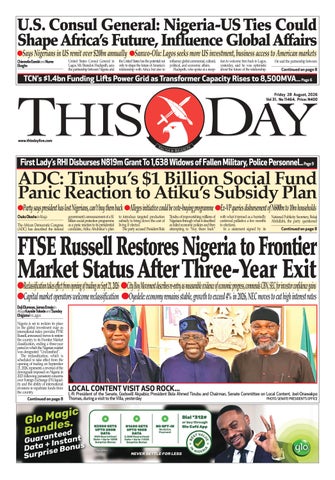
U.S. Consul General: Nigeria-US Ties Could Shape Africa’s Future, Influence Global Affairs Says Nigerians in US remit over $20bn annually Sanwo-Olu: Lagos seeks more US investment, business access to American markets
Chiemelie Ezeobi and Nume Ekeghe
United States Consul General in Lagos, Mr. Brandon Hudspeth, says the partnership between Nigeria and
the United States has the potential not only to shape the future of America’s relationship with Africa but also to
influence global commercial, cultural, political, and economic affairs. Hudspeth, who spoke at a recep-
tion to welcome him back to Lagos, yesterday, said he was optimistic about the future of the relationship.
He said the partnership between Continued on page 8
TCN’s $1.4bn Funding Lifts Power Grid as Transformer Capacity Rises to 8,500MVA... Page 6 Friday 28 August, 2026 Vol 31. No 11464. Price: N400
www.thisdaylive.com TR
UT H
& RE A S O
N
First Lady’s RHI Disburses N819m Grant To 1,638 Widows of Fallen Military, Police Personnel... Page 9
ADC: Tinubu’s $1 Billion Social Fund Panic Reaction to Atiku’s Subsidy Plan Party says president has lost Nigerians, can’t buy them back Alleges initiative could be vote-buying programme Ex-VP queries disbursement of N600bn to 10m households
Chuks Okocha in Abuja The African Democratic Congress (ADC) has described the federal
government’s announcement of a $1 billion social protection programme as a panic reaction to its presidential candidate, Atiku Abubakar’s plan
to introduce targeted production subsidy to bring down the cost of living if elected. The party accused President Bola
Tinubu of impoverishing millions of Nigerians through what it described as failed economic policies and then attempting to “buy them back”
with what it termed as a hurriedly contrived palliative a few months to elections. In a statement signed by its
National Publicity Secretary, Bolaji Abdullahi, the party questioned Continued on page 8
FTSE Russell Restores Nigeria to Frontier Market Status After Three-Year Exit Reclassification takes effect from opening of trading on Sept 21, 2026 City Boy Movement describes re-entry as measurable evidence of economic progress, commends CBN, SEC for investor confidence gains Capital market operators welcome reclassification Oyedele: economy remains stable, growth to exceed 4% in 2026, NEC moves to cut high interest rates
Deji Elumoye, James Emejo in Abuja Kayode Tokede and Sunday Ehigiator in Lagos Nigeria is set to reclaim its place in the global investment map as international index provider, FTSE Russell, announced moves to restore the country to its Frontier Market classification, ending a three-year period in which the Nigerian market was designated “Unclassified”. The reclassification, which is scheduled to take effect from the opening of trading on September 21, 2026, represents a reversal of the downgrade imposed on Nigeria in 2023 following persistent concerns over Foreign Exchange (FX) liquidity and the ability of international investors to repatriate funds from the country. Continued on page 8
LOCAL CONTENT VISIT ASO ROCK...
L-R: President of the Senate, Godswill Akpabio; President Bola Ahmed Tinubu and Chairman, Senate Committee on Local Content, Joel-Onawakpo PHOTO: SENATE PRESIDENT’S OFFICE Thomas, during a visit to the Villa, yesterday
2
FRIday AUGUST 28, 2026 • T H I S D AY
FRIday AUGUST 28, 2026 • T H I S D AY
3
FRIday AUGUST 28, 2026 • T H I S D AY
4
bucket list to bthoo e k d is summer from
Whether you're planning a getaway, sending money across borders, or upgrading your travel experience, enjoy convenient banking solutions this summer.
Visit www.accessbankplc.com/summer to get started
5
THISDAY • FRIDAY, AUGUST 28, 2026
Group News Editor: Goddy Egene Email: Goddy.egene@thisdaylive.com, 0803 350 6821, 0807 401 0580
NEWS
TINUBU SWEARS-IN THE NEW HEAD OF SERVICE...
L-R: Wife of the New Head of Service, Esther Enitan; New Head of Civil Service of the Federation, Mr. Abel Olumuyiwa Enitan; President Bola Ahmed Tinubu and immediate past Head of Service, Mrs. Didi Esther Walson-Jack, after the swearing in of new head of service at the presidential villa, yesterday PHOTO: GODWIN OMOIGUI
MTN Records 62% Local Procurement, Spends N2.7trn on Nigerian Suppliers in 2025 Says country constitutes 99.9% of its workforce, has four expatriate staff May seek 30% investment from Nigerian investors to acquire $1.1bn IHS stake Emma Okonji and Dike Onwuamaeze The MTN Nigeria Plc has disclosed that it has 99.9 per cent Nigerian workforce, achieved over 62 per cent local procurements, and has reduced the number of expatriates in its employment to four compared to over 300 foreign experts it had in 2021. These revelations come as strong indications emerged that the MTN Group is seeking Nigerian investors to acquire up to 30 per cent stake in IHS Nigeria, to enable the group conclude the acquisition of IHS Holding Limited. The telecommunications company said it executed over N1 trillion expenditure on digital infrastructure in 2025 alone and pointed out that the next frontier was to export technology, services, platforms and intellectual property (IP) across Africa. The Chief Financial Officer of MTN Nigeria, Mr. Modupe Kadri, disclosed these in his presentation titled, “Building Local Content Together: 25 Years of Shared Growth” at the Nigerian-South Africa Chamber of Commerce (NSACC) August 2026 Breakfast Forum.
Kadri explained that MTN Nigeria treats procurement as a pathway to engendering stronger Nigerian standards, skills and capacity, adding that the promise of local content is the building of Nigerian enterprises that can compete anywhere in the world. He said: “In 2001, Nigeria opened a market, investment followed and Nigerian capability turned that investment into an ecosystem. “The story of 25 years was not only how MTN grew in Nigeria. It is how Nigerian enterprise, capability and ownership grew alongside it.” He emphasised that local content does not simply mean “where we buy but what we build,” adding that “local procurement tells us where money was spent and what that expenditure helped to build.” He said the real measure of local content was the capability that remains in the economy after the contract has been delivered, noting that the goal was not to create vendors that need MTN but to build Nigerian businesses that could compete anywhere in the world. Kadri said: “Today, most of our technology needs are fulfilled by local suppliers in contrast to what was
available at our inception when we relied on foreign suppliers.” He explained that a truly local contents enabled environment would procure goods and services locally, engender high-level standards and governance, enhance skills development where people learn, specialise and build technical capability and finally achieve market competition. Among the companies that
The National Boundary Commission (NBC) has called for stronger cooperation among African governments, academia, border communities and development partners to tackle growing security and governance challenges across the continent’s borderlands. The Director General of the NBC, Adamu Adaji, made the call at the opening of the 2026 International Conference of the African Borderlands Research Network (ABORNE) in Lagos, a statement by the NBC spokesperson, Chinwe Udouwem,
Employees are Nigerians. Our suppliers are Nigerians. “Our shareholders include Nigerian individuals and institutions. Our network is also embedded in Nigerian communities. “Our future is, therefore, inseparable from Nigeria’s future. So, shared growth is not charity. “It is not public relations. It is enlightened investment.”
Promises regular gratuity payments, lists 35th anniversary milestones Commends founding fathers, canvasses collective duty to build ‘Better Abia
Boniface Okoro in Umuahia Abia State Governor, Dr. Alex Otti, has appealed to all Abians to commit to building and handing over a better Abia, where value creation, rather than minerals buried in the bowels of the earth, will drive growth and development. In a state-wide broadcast on Thursday, to mark the 35th anniversary of the creation of Abia State, Otti said
Adaji seeks joint action against terrorism, banditry, others said yesterday. The conference, which holds from August 24 to 28, is themed: “The Connected Borderlands, Socio-Cultural Integration, and the Centrality of Policy, Research, and Security.” Adaji described borderlands as strategic zones of interaction, cooperation, opportunity and, at times, contestation, stressing that their effective management required more than physical infrastructure and security measures. He said border governance must be supported by rigorous research and evidence-based policies, given the growing intersection of security,
Kadri said: “So, most of the people who started with us in 2001 are today dealing with other countries in West Africa and beyond. “Local content is where a Nigerian company becomes strong enough to compete anywhere in the world. “I always say that MTN Nigeria cannot succeed sustainably if Nigeria itself does not succeed. “Our customers are Nigerians.
Otti: Abia’s Future will be Driven by Creative Opportunity, Not Minerals
NBC: Stronger Border Cooperation Needed to Tackle Africa’s Security Threats Emmanuel Addeh in Abuja
partnered with MTN Nigeria that have grown to international competitors are the SO&U, which is MTN’s brand manager; Seams& Stitches; the Black House Media; the Computer Warehouse Group. According to MTN Nigeria, these companies are proof that long term opportunity, capability and entrepreneurship can reinforce one another.
trade, migration, environmental sustainability, identity, citizenship and regional integration along Africa’s borders. “The effective management of these borders requires not only physical infrastructure and security measures but also informed policies grounded in rigorous research and evidence-based analysis,” he said. The NBC, a major partner of the conference, also participated in a plenary roundtable titled, “Frontiers: Border Demarcation, Maritime Governance and Cross-Border Cooperation in a Changing Security Landscape.”
the task before the current generation was to prepare the next generation to function and thrive in a new age where value creation will be the driving force. The broadcast was titled, “Abia and the Miracle of Resilience.” Despite being confronted by challenges on every side, OttI said Abians had to resolve that they will not hand over “a broken society to our children”. He said, “As parents, we are duty-bound to prepare them to function and thrive in the new age where value creation, and not what is buried beneath the earth, is the ultimate ticket to sustained relevance.”
To try to address injustices of the past, the governor painted the picture of an “El Dorado” for senior citizens with his promise that the era of unpaid gratuities was over. He announced the commencement of payment of accumulated gratuity arrears dating back to 2001, and directed that henceforth, any worker leaving service should be paid their gratuity immediately documentation was completed. “You can take it for granted that henceforth, no senior citizen shall be denied what is due them,” Otti assured, saying the administration shall continue to honour retirees for their role in the evolution of the state
since 1991. The governor said the broadcast was a moment to celebrate the resilience that had carried Abia through 35 years, and to list milestones recorded in the last three years of his administration. He stated that over 1,000 kilometres of roads had been fixed across urban and rural communities to open up the economy and attract investments. In education and health, he said thousands of teachers and health workers had been recruited and trained, with enhanced salary packages and capital projects, including the building and equipping of smart schools and primary, secondary, and tertiary health facilities.
All On Launches Programme for Start-ups in Clean Energy Ecosystem Olusegun Samuel in Yenagoa An off-grid energy impact investment company, All On, has launched its Innovation Ecosystem Development Programme (AOIEDP) aimed to support clean energy start-ups and entrepreneurs within the organisation’s hub. The 12-month incubation and prototype development programme will provide technical expertise,
hands-on development, access to appropriate equipment and facilities, mentorship, and necessary support to the participants. All On Hub was set up by All On with support from Rockefeller Foundation and The Global Energy Alliance for People and Planet. It is a facility established to provide non-financial support and build the capabilities of nascent ventures operating in the Nigerian energy
sector. Flagging off the programme, Chief Executive Officer of All On, Caroline Eboumbou, stated that the exercise funded by Global Energy Alliance for People and Planet shall address a critical gap in Nigeria’s clean energy ecosystem by providing the technical and infrastructural support needed by promising ventures at the ideation and prototype development stage.
6
FRIDAY, AUGUST 28, 2026 • THISDAY
NEWS
AVIATION STAKEHOLDER ENGAGEMENT...
L-R: Special Senior Assistant to the DG, Nigerian Civil Aviation Authority (NCAA), Ifueko Abdulmalik; World Tracer Coordinator Nacho Aviance, Michael Raimi; Station Manager Lagos Domestic, SAHCO Plc, Awuamhobor Paul; Director, Public Affairs and Consumer Protection, NCAA, Mr. Michael Achimugu; General Manager ICT, FAAN, Mr. Enyinna Onyeukwu; CEO Slim Autos, Mr. Mathas Ituah; and NCAA, Lagos Regional Head, Alhaji Ibrahim Jafare, during the stakeholder engagement on the benefit of RFID for Flight Status, Luggage and Cargo Tracking by NCAA and FAAN in Lagos...recently
TCN’s $1.4bn Funding Lifts Power Grid as Transformer Capacity Rises to 8,500MVA Vandalism, ageing assets threaten sustainability Manpower, logistics funding remain major constraints FG: We’ve metered 60% active electricity consumers nationwide
Deji Elumoye and Emmanuel Addeh in Abuja
The Transmission Company of Nigeria (TCN) has expanded its transmission capacity through more than $1.4 billion in multilateral and development financing, with over 8,500 megavolt-amperes (MVA) of transformer capacity added to the national grid. The company, which currently has 8,700 megawatts (MW) of electricity wheeling capacity, also recorded a
peak transmission of 5,801.84MW on March 4, 2025, while 89 new transformers have been commissioned across the country. The figures were contained in a presentation by TCN’s Executive Director, Transmission Service Provider (TSP), Oluwagbenga Ajiboye, at a media workshop for Abuja energy correspondents in Keffi, Nassarawa state. Besides, the federal government has disclosed that it has deployed 668,000 electricity meters, represent-
ing about 60 per cent of the 1.033 million meters delivered under Phase 1 of the $500 million World Bank-financed Distribution Sector Recovery Programme (DISREP). Director General, Bureau of Public Enterprises (BPE), Ayodeji Gbeleyi, disclosed this yesterday while briefing the National Council on Privatisation (NCP) at its second meeting for 2026, chaired by Vice President, Kashim Shettima, at the State House, Abuja. TCN also reported a maximum daily energy transmission of
128,370.75 megawatt-hours (MWh), reflecting increased grid throughput following investments in transformers, substations and transmission corridors. According to the company, the additional transformer capacity has improved bulk power delivery to distribution load centres, reduced loading constraints and strengthened redundancy across the network. Among the major projects delivered was a 300MVA, 330/132kV transformer commissioned at the
Chargé d’Affaires: China Imported $2.3bn Nigerian Goods in Six Months Michael Olugbode in Abuja
Asian economic giant, China, imported almost $2.3 billion worth of Nigerian goods in just six months, marking an almost 80 per cent increase over the same period in 2025, the Chargé d’Affaires of the Chinese Embassy in Nigeria, Zhou Hongyou, said yesterday. The sharp rise comes as total trade between both countries surged by 75 per cent year-onyear to $18 billion. The figures are significant for Nigeria, which has long struggled to translate its enormous agricultural, mineral and manufacturing potential into sustained export earnings. Zhou, speaking at the Nigeria-
China Food Festival at the China Cultural Centre, said Beijing’s zerotariff policy for African countries with diplomatic relations with China presented Nigeria with an opportunity to dramatically expand its exports to the Chinese market. “This is a great chance for Nigeria to expand exports to China,” the diplomat declared. For decades, Nigeria’s export earnings have been heavily dependent on petroleum, while China has emerged as one of Nigeria’s most important trading partners. The latest figures indicate that the relationship is expanding beyond the traditional pattern of trade. Zhou said the growing economic relationship was being matched
by increasing cultural and peopleto-people exchanges, noting that 2026 marks 55 years of formal diplomatic relations between Nigeria and China. He urged both countries to deepen cooperation in education, culture, technology, the arts and youth affairs, arguing that stronger people-to-people ties would help sustain the bilateral relationship for future generations. The Chinese envoy’s remarks came against the backdrop of the Nigeria-China Food Festival, where food was used to demonstrate the potential of cultural exchange and the economic value of Nigeria’s culinary heritage. Representing the Minister of
Arts, Culture, Tourism and the Creative Economy, Hannatu Musawa, the Permanent Secretary, Abdulkarim Ibrahim, said Nigeria’s food industry represented a major economic opportunity, particularly through tourism, hospitality and job creation. He said food and beverages constituted the largest subsector of Nigeria’s tourism economy and called for greater Nigeria-China collaboration in gastronomy, tourism, hospitality, culinary education and creative entrepreneurship.
Katampe Transmission Substation in Abuja in May 2026. The project increased the substation’s capacity from 450MVA to 750MVA and provided additional capacity for bulk supply to the Abuja Electricity Distribution Company (AEDC) and surrounding areas. TCN also commissioned a 75MVA transformer at the Mile 50 Abakaliki Transmission Substation, increasing the facility’s capacity to 135MVA, while a 60MVA mobile transformer commissioned at Damaturu raised the substation’s capacity from 120MVA to 180MVA. In Edo State, the company commissioned two additional 330kV transmission routes covering 40 kilometres under the Benin-Ihovbor and Ihovbor-Ajaokuta Turn-In Turn-Out projects, strengthening evacuation from the Niger Delta generation corridor. In Lagos, where TCN said about 30 per cent of national power offtake occurs, the company stated that it has undertaken capacity expansion involving 100MVA at Ijora, 300MVA at Lekki and 125MVA at Agbara, alongside rehabilitation of other substations. TCN said development partners including the World Bank, African Development Bank, Japan International Cooperation Agency (JICA) and Agence Française de Développement
(AFD) were supporting the expansion, rehabilitation and modernisation of the transmission network. It added that preventive maintenance had been carried out on more than two-thirds of its substations and transmission lines in 2026, as part of efforts to improve reliability and extend the life of ageing assets. However, the company acknowledged that vandalism, ageing infrastructure, funding and liquidity constraints, right-of-way and compensation issues, rising demand and project execution remained major challenges to sustaining the gains. TCN noted that it reported 151 vandalism incidents and disclosed that 12 tower members and angle irons were recovered during a July 2026 theft attempt. It said it was working with security agencies and host communities to protect transmission infrastructure. The company said the priority is now to convert the additional capacity and infrastructure investments into dependable and resilient electricity transmission while protecting its assets. Also speaking, TCN’s General Manager, Material Control and Stores, Abdulkadir Adamu, disclosed that the company had deployed critical transmission equipment and materials to its regions to support grid maintenance and repairs.
NCC Pushes for Digital Inclusivity to Grow $1 Trillion Economy
persons should be excluded from innovation is harnessed to ensure Ohwovoriole in Nwachukwu Backs Soludo’s Vision, Calls for Oghenevwede the digital economy. that no one is left behind in our Abuja He stated, “For persons with nation’s digital transformation Communications Com- disabilities, barriers to accessing journey. Often, several interconStronger Institutions, Infrastructure in Anambra Nigerian mission (NCC) has stated that digital technologies and services nected barriers continue to shape Sunday Aborisade in Abuja
A member of the National Assembly representing Anambra South Senatorial District, Senator Emmanuel Nwachukwu, has backed Governor Charles Chukwuma Soludo’s vision for the state. He has also called for stronger institutions and infrastructure capable of meeting the needs of present and future generations. Nwachukwu made the call in a
goodwill message to the people of Anambra State to mark the 35th anniversary of the state’s creation, which was made available to journalists in Abuja on Thursday. He expressed confidence that Soludo’s development agenda would continue to yield positive results, stressing that consolidating the gains of the past 35 years required sustained investment in institutions, infrastructure and human capital. The senator described Anambra as a state defined by resilience, enterprise,
courage and an enduring spirit of excellence, saying its people had continued to distinguish themselves nationally and internationally. He noted that the state’s rich cultural heritage, reputation for innovation, commerce, education and human capital development had remained major sources of strength and pride. According to him, Anambra’s achievements over the past 35 years demonstrate that greatness is built through vision, determination and a sustained commitment to progress.
attaining President Bola Tinubu’s $1 trillion economy target would revolve around the inclusion of every individual and sector in the digital ecosystem. Executive Vice Chairman of NCC, Dr. Aminu Maida, stated this at the end of the 4th edition of NCC Hackathon Live Show, on Thursday in Abuja. Maida, who was represented by Executive Commissioner, Stakeholders Management, Rimini Makama, disclosed that if Nigeria must achieve the $1 trillion economy, no sector or
can mean exclusion not just from connectivity but from education, employment, financial services, healthcare and participation in society. “Nigeria today stands at a pivotal crossroad. As we work to build a resilient and diversified one trillion-dollar economy, we must recognise that true national progress is impossible if some of our citizens remain locked out. “This hackathon is our strategic response as it is a platform where
the digital experiences of persons with disabilities (PWDs).” Speaking on the challenges faced by PWDs, he said, “There are digital platforms that were never designed with accessibility in mind. There are gaps in digital skills and high costs with limited availability of assistive technologies, and essential services that are increasingly moving online without always considering whether everyone can access them. It’s against this backdrop that this hackathon has taken place.
7
THISDAY • FRIDAY, AUGUST 28, 2026
NEWS
INAUGURATION OF THE NEUROPSYCHIATRIC HOSPITAL AND GENERAL HOSPITAL COMPLEX...
L-R: Permanent Secretary, Rivers State Ministry of Health, Dr. Vincent Wachukwu; Governor of Rivers State, Sir Siminalayi Fubara; outgoing President, Nigeria Bar Association (NBA), Mazi Afam Osigwe and Deputy Governor of Rivers State, Prof. Ngozi Odu, during the inauguration of the Neuropsychiatric Hospital and General Hospital Complex in Port Harcourt, yesterday
NCDMB Seeks Pan-African Local Content Collaboration to Drive Economic Diversification, Industrial Growth Peter Uzoho
Nigerian Content Development and Monitoring Board (NCDMB) has called for deeper collaboration among African nations to unlock the continent’s enormous local content potential and accelerate economic diversification, industrial growth, and sustainable development across the oil and gas value chain. Executive Secretary of NCDMB, Felix Ogbe, advanced the position during a strategic engagement in Namibia focused on African Local Content Opportunities and crossborder partnerships, according to a statement by NCDMB’s Corporate Communications department. Representing by a director at the agency, Dr. Abdulmalik Halilu, Ogbe highlighted the importance of leveraging African capabilities, harmonising local content policies, and fostering strategic partnerships among African businesses to maximise value retention within the continent. Speaking on the theme, “African Local Content Opportunities: Pathway to Economic Diversification and Development,” he stated that several African countries had established legal and regulatory frameworks for local content development, creating a foundation for greater regional integration and industrial cooperation.
He emphasised that African local content should promote the development and utilisation of cross-border capacities and capabilities as a catalyst for the industrialization of Africa. Ogbe referenced key aspirations of the 2025 African Petroleum Producers Organisation (APPO) Ministerial Council Brazzaville Declaration, which encouraged African nations to strengthen supplier capacity, support skills development and knowledge transfer, promote joint ventures and partnerships, harmonise local content regulations, and encourage public-private partnerships to enhance African participation in the oil and gas industry. Ogbe also highlighted existing African capabilities across fabrication, engineering, manufacturing, subsea services, marine operations, and project execution, demonstrating that the continent possesses significant capacity that can be leveraged through strategic collaboration among African companies and institutions. Drawing from Nigeria’s local content success story, Ogbe emphasised the transformative impact of a data-driven implementation framework, underlining the significant growth achieved since the enactment of the Nigerian Oil and Gas Industry Content Development (NOGICD) Act. He stated that robust data systems, compliance monitoring, supplier
development initiatives, and strategic investments had strengthened local participation and enhanced industry competitiveness. According to him, the future of African local content lies in practical business-to-business partnerships that enable companies from different African countries to jointly pursue and execute major projects. He outlined partnership models, such as prime-subcontractor arrangements, incorporated local content joint ventures, contractual consortium bids, and reciprocal market access
The Chairman of the Nigerian Upstream Petroleum Regulatory Commission (NUPRC) Board, Senator Magnus Abe, has declared that the speedy completion of the commission’s ongoing 1,000-capacity permanent headquarters will put an end to the national embarrassment of hosting multibillion-dollar international energy investors in rented blocks of flats. Speaking during a high-level inspection of the construction site in Abuja’s Central Business District, Abe pointed out that the regulator’s current fragmented operational setup severely undermines Nigeria’s
economic credibility and dampens its global investment drive. The development was contained in a statement issued by the Head of Media and Corporate Communications at the NUPRC, Eniola Akinkuotu. “It is a thing of great embarrassment to this country when major oil and gas companies come to Nigeria to discuss investments worth billions of dollars, only to meet the regulator in a block of flats and from there proceed to other parts of the city to see different departments to conduct transactions with the NUPRC. This image is not just bad for the country, but bad for business,” he stated.
and showcase African capabilities. He stated, “The opportunities available across Africa can only be fully unlocked through deliberate and synchronised efforts that enable cross-border service delivery and industrial collaboration. “The Brazzaville Declaration represents an important starting point, but implementation, partnership, and policy alignment will ultimately determine the success of Pan-African local content.” He said the board believed that leveraging the African Continental
Free Trade Area (AfCFTA) framework and strengthening cooperation among African institutions and businesses will create new opportunities for indigenous companies to compete, collaborate, and deliver world-class projects across the continent. During the first panel session, Director, Monitoring and Evaluation, NCDMB, Mr. Esueme Kikile, shared his views on global best practices, perspectives on strategies for strengthening local participation, and maximising in-country value in the oil and gas industry.
Sahara Power Advances Nigeria’s Energy Infrastructure with $12m Lagos IPP 12MW plant to enhance electricity supply across Ogba
Peter Uzoho
Sahara Power Enterprise Group (SPEG), one of Africa’s largest private power businesses, has commenced construction of a 12-megawatt (MW) Independent Power Plant (IPP) at the Ogba Undertaking of Ikeja Electric Plc, Lagos, reinforcing efforts to strengthen electricity infrastructure and improve power supply reliability. The $12 million project, scheduled for completion in the first quarter of
NUPRC Chair: Ongoing 1,000-capacity Office ‘ll End Nigeria’s Embarrassment Emmanuel Addeh in Abuja
alliances as effective mechanisms for expanding African participation in large-scale energy projects. He stressed that realising a truly integrated African local content ecosystem would require coordinated action across multiple sectors, including regulatory harmonisation, trade facilitation, customs cooperation, immigration reforms, and access to sustainable financing. Ogbe also endorsed initiatives aimed at creating a Pan-African supplier database and interactive opportunities platform to aggregate
The ongoing complex dubbed “The Barrel” is a 10-storey architectural masterpiece designed in the shape of a convex, curved cylinder bulging outward at its centre. Initiated in 2020, the project has suffered delays, forcing the Commission to operate out of multiple smaller, residential-style properties scattered across the Federal Capital Territory (FCT). Abe emphasised that consolidating the NUPRC’s operations under a single modern roof will streamline regulatory processes, project regulatory authority, and stand as a symbol of national pride and investor confidence in Nigeria’s petroleum industry.
2027, will comprise six 2MW gas-fired generating units and provide reliable, cost-effective electricity to industrial clusters, businesses, residential communities, and public institutions across Ogba, Acme Road, Wemco Road, and surrounding areas. Speaking at the ground-breaking ceremony, Group Managing Director of Sahara Power Enterprise Group, Kola Adesina, said the project demonstrated Sahara’s commitment to delivering practical solutions that support Nigeria’s energy future. Adesina stated, “This initiative is about much more than breaking ground for a new power plant. It represents a bold commitment to Nigeria’s energy future and our determination to deliver dependable,
efficient, and sustainable electricity to businesses and communities. “Improving the availability and reliability of power will enhance productivity, growth, and value creation.” Adesina said the facility will deploy modern gas-powered generating technology aligned with established environmental, operational, and safety standards. He also commended the federal government, Lagos State Government, Lagos State Electricity Regulatory Commission (LASERC), Ikeja Electric, Cummins, and other stakeholders for supporting the project. Acting Chief Executive Officer of Ikeja Electric Plc, Ogochukwu Onyelucheya, said the IPP represented
an important step towards improving the quality, reliability, and sustainability of electricity supply to customers. Onyelucheya described the project as a strategic investment that will provide a more dependable and cost-effective source of electricity while supporting business growth and economic development within the designated areas. She stated, “At Ikeja Electric, our priority is to partner with forwardlooking investors and developers such as SPEG to deliver innovative solutions that improve customer experience and reliable electricity supply across our network. SPEG’s investment in this IPP demonstrates the value of strategic collaboration in creating sustainable energy solutions for our customers.”
Ibom Air Takes Delivery of Third Airbus A220-300
Okon Bassey in Uyo
Ibom Air has taken delivery of its third Airbus A220-300 aircraft, to further strengthen its modernization and fleet expansion program, the Managing Director/Chief Executive Officer of Ibom Air, Mr George Uriesi said. Uriesi disclosed that the aircraft, registered 5N-CDC, was formally handed over to Ibom Air at the Airbus A220 final assembly facility in Mirabel, Canada, following the signing of the Transfer of Title (TOT) documents.
Group Manager, Marketing and Communication Ibom Airlines Limited, Aniekan Essienette in a statement said the latest delivery marks another milestone for Ibom Air and further positions the airline for enhanced operational efficiency and network growth. Speaking after the Transfer of Title ceremony, the Managing Director/ CEO of Ibom Air, Mr Uriesi, said “we are most delighted to receive the third A220-300 into our growing, modern fleet.”
“We thank our Shareholder, the Governor of Akwa Ibom State, Pastor Umo Eno, without whose strong support this would not have been possible. We appreciate his continued confidence in Ibom Air and his commitment to the airline’s growth.” He stressed that the addition of new A220 will have a significant positive impact on the business, making Ibom Air’s operations safer, more passenger-friendly, more environmentally responsible, and far more efficient.
8
FRIDAY, AUGUST 28, 2026 • THISDAY
EIGHT
Nigeria to UN: Protect National Sovereignty at International Arbitration As Fagbemi says P&ID case would have crippled nation’s economy
Alex Enumah in Abuja
The federal government has called on the United Nations (UN) to evolve reforms that will protect national sovereignty in arbitration disputes between investors and member-states. The federal government also sought reforms that would reinforce, rather than by-pass, domestic courts in Investors-States Disputes Settlement (ISDS). Attorney-General of the Federation (AGF) and Minister of Justice, Prince Lateef Fagbemi (SAN), made the appeal on Thursday during the heads of delegations roundtable at the Chief Legal Advisors Forum
(CLAF) 2026 in Singapore. According to Fagbemi, the reforms sought in the ISDS would address the inadequacies and imbalances in legal framework, and protect investments and country’s taxpayers. In a statement issued to journalists, Fagbemi, while commending the forum convened by Ministry of Law of Singapore, said as global investment flows evolved and states confronted new development challenges, the need for a modern, balanced, and credible dispute settlement system had never been more urgent. The statement signed by the minister’s media aide, Kamarudeen Ogundele, recalled how the AGF, upon assuming office, took steps
to address the challenges by constituting a committee of experts to review Nigeria’s bilateral treaties and Nigeria’s commitment under multilateral treaties and conventions in order to promote and protect investments in Nigeria. He disclosed that Nigeria became a strong proponent for clarity concerning calculation of damages because of the experience in the Process and Industrial Developments Ltd. (P&ID) case, which would have crippled the country’s economy. Fagbemi said, “States consistently express concern about the opacity of arbitral proceedings and the unpredictability of awards. Nigeria continues to support reforms that
enhance transparency of proceedings, consistency in arbitral reasoning, and predictability in outcomes. These elements are essential for investor confidence and state trust alike. That is why Nigeria is a strong proponent for clarity concerning calculation of damages. “The current position largely relies on the whims of each arbitrator or tribunal. For example, in the notorious case of P&ID, damages were calculated on the basis of compound interest, which would have had a crippling effect to the tune of billions of dollars. “It is with this belief that Nigeria reformed its Arbitration Act to reflect the importance of transparency.
There is growing openness to fresh approaches beyond traditional arbitration.” The minister said states had acknowledged that ISDS reform was not optional, as It was essential for maintaining the legitimacy of the international investment regime. The minister stated, “Nigeria sees this consensus as a positive development: it signals that the global community understands the need for recalibration to ensure fairness, predictability, and development alignment. “Many states, Nigeria included, believe that incremental adjustments will not address the structural imbalances embedded
Prince Lateef Fagbemi in the current system. There is increasing support for systemic reform, including clearer treaty standards, improved procedural safeguards, stronger accountability mechanisms, and more balanced rights and obligations for investors and states. This reflects a desire for a dispute settlement system that is durable and future proof.”
FTSE RUSSELL RESTORES NIGERIA TO FRONTIER MARKET STATUS AFTER THREE-YEAR EXIT City Boy Movement (CBM) and capital market operators welcomed the development, which they described as positive for the economy. Relatedly, Minister of Finance and Coordinating Minister of the Economy, Mr Taiwo Oyedele, declared that the country’s economy remained stable, assuring that Gross Domestic Product (GDP) will exceed four per cent by the end of the year. Oyedele who briefed newsmen after the monthly meeting of the National Economic Council (NEC) on Thursday in Abuja, said the country had achieved significant macroeconomic stability. But he stressed that the next challenge was translating the gains into shared prosperity. FTSE Russell had in March 2026 confirmed Nigeria’s return to Frontier Market status after determining that the country had met the five Quality of Markets criteria required under its classification framework. It had stated that market participants reported the clearing of FX backlogs and an end to material delays faced by international institutional investors seeking to repatriate capital.
The latest development followed a period of uncertainty after FTSE Russell in June placed the planned reclassification under further review following the country’s transition from a T+2 to a T+1 settlement cycle. The global index provider had raised concerns that the shorter settlement period could effectively make Nigeria a prefunded market for international institutional investors, an arrangement considered negative under its Delivery versus Payment criterion. However, Securities and Exchange Commission (SEC) subsequently clarified that foreign portfolio investors were not required to prefund their accounts, while trades cleared and settled through Central Securities Clearing System remained subject to the standard Delivery versus Payment framework. SEC had introduced the T+1 settlement regime from June 1, 2026, as part of efforts to modernise the Nigerian capital market, improve efficiency, and align the market with international standards. With the concern addressed, the planned reclassification is now set to proceed, effectively restoring Nigeria
to a market category from which it was removed in September 2023. FTSE Russell’s 2023 decision followed prolonged difficulties in Nigeria’s foreign exchange market, particularly the inability of international institutional investors to execute FX transactions and repatriate investment proceeds at rates that could support the replication of FTSE index changes. At the time, FTSE Russell said the lack of liquidity in the Investors’ and Exporters’ FX Window was adversely affecting international investors and had resulted in the suspension of index changes involving Nigerian equities since September 2022. Nigeria was subsequently removed from the Frontier Market indices effective September 18, 2023. The return, therefore, marked a significant turnaround in the conditions that had previously undermined Nigeria’s standing among international portfolio investors. Reacting to the development, City Boy Movement (CBM), a youth advocacy organisation, described the reclassification as an important validation of the economic reforms
ADC: TINUBU’S $1 BILLION SOCIAL FUND PANIC REACTION TO ATIKU’S SUBSIDY PLAN
where the government suddenly found the money after three years of asking Nigerians to endure hardship, while also demanding clarity on the programme’s funding. It also questioned the role of the First Lady, Senator Oluremi Tinubu in the launch of the programme. ‘’We find this sudden discovery of compassion, and money quite remarkable. For three years, Nigerians have cried under the weight of food prices, transport costs and collapsing purchasing power, while this government insisted that there was no money to cushion the effects of its reforms. ‘’Now that elections are approaching, it has suddenly found $1 billion for the poor. If the government could somehow conjure up this money, why did it remain indifferent to the suffering of Nigerians for three years? Or did the poor only become visible when their votes become valuable?’’ the ADC asked. It pointed out that even more instructive is the Tinubu government’s own admission that Nigerians now require protection from the economic shocks associated with its ‘failed reforms’, including the removal of fuel subsidy. “ This is precisely what our Presidential Candidate, Alhaji Atiku Abubakar, has been saying
in proposing a targeted production subsidy to bring down the cost of living. The government dismissed that proposal and its officials told Nigerians that subsidy, in whatever form, was impossible. Yet, almost immediately, it has announced a billion-dollar programme to support Nigerians from the consequences of its evil policies. ‘’Why did it take Atiku’s widely accepted plan for this wicked government to remember that economic reforms must protect human beings?’’, the party stated. Abdullahi said that Nigerians will not forget that President Tinubu’s ill-conceived and terribly executed reforms have made their lives a living hell. ‘’They will not forget that under Tinubu, economic reforms mean seven out of 10 Nigerians have found it difficult to feed themselves; that businesses have collapsed; that Nigeria has become one of the top poorest countries of the world; that mortuaries have become fuller, that the blood of Nigerians have flowed freely under this administration. “No amount of palliative, by whatever fancy names they are called, will make them forget this painful period. ‘’There is also the small matter of accountability, which this administra-
tion has found quite abhorrent. The Minister of Humanitarian Affairs says that more than N600 billion has already been disbursed in cash transfers over the last three years, reaching slightly more than 10 million households. ‘’What evidence exists of actual beneficiaries, and what measurable impact did that N600 billion have? Have these numbers ever been independently verified?,’’ he queried. The spokesman of the APC said that every objective analyst, including international development agencies have lamented the ‘catastrophic’ delivery of social intervention programmes in Nigeria, especially due to lack of robust, verifiable social register and mismanagement due to corruption. ‘’This government has not told us what it is going to do differently. But no one is in doubt what this $1 billion intervention is about: a political programme by a government desperate to show something as the election approaches after spending three years getting richer while the people get poorer. ‘’A government whose so-called reform has destroyed purchasing power through higher food, fuel, transport and energy costs, cannot Continued on page 36
being implemented by the administration of President Bola Tinubu. Director-General of the movement, Hon. Francis Shoga, said the development was particularly significant when viewed against the foreign exchange and capital repatriation challenges inherited by the administration. “When our grand patron, President Bola Tinubu, took office, Nigeria’s foreign exchange market was under severe pressure, with billions of dollars in investor funds trapped in the country,” Shoga said. According to Shoga, the latest assessment by FTSE Russell that FX queues had been cleared and international institutional investors were no longer experiencing significant delays in repatriating their capital amounts to measurable
evidence of progress. He said, “Three years on, FTSE Russell reports that FX queues have cleared, and international institutional investors no longer face significant delays in repatriating their capital. Nigeria is re-joining the global investment benchmark after being removed. “That is measurable progress, independently assessed by one of the world’s leading index providers.” Shoga commended SEC, Central Bank of Nigeria (CBN), and other capital market stakeholders for their contributions towards improving the functioning of the financial market and rebuilding investor confidence. He said the development should, nevertheless, not be interpreted as the end of the reform process, stressing that the ultimate test remains the
extent to which improved macroeconomic and financial conditions would translate into better welfare for Nigerians. “There is still work to be done, particularly in ensuring that these gains translate into better living standards for Nigerians but we should still acknowledge progress when independent global institutions recognise it,” he said. The CBM DG also called on state governments to complement the reforms at the federal level by increasing investments in human capital and social development, particularly given Nigeria’s large youthful population. He said the return to the FTSE Frontier Market classification should be seen as an opportunity Continued on page 35
U.S. CONSUL GENERAL: NIGERIA-US TIES COULD SHAPE AFRICA’S FUTURE, INFLUENCE GLOBAL AFFAIRS both countries could have an impact far beyond their bilateral ties. Hudspeth stated, “I believe that this partnership between the United States and Nigeria will not just shape the future of the U.S. relationship with the continent of Africa, but it also has the power to influence in every manner, commercially, culturally, politically, and economically on a global level.” He identified commercial opportunities, the creative economy, and the strength of diplomatic ties as key areas that could further deepen the relationship between both countries. On the commercial front, Hudspeth said American companies were making long-term investments in Nigeria because they recognised the opportunities in the Nigerian market. He stated that the two-way trade between the two countries had reached nearly $15 billion annually, adding that more than 100 American companies operate in Lagos. He said the trade relationship was not just about the value of transactions but also about jobs and opportunities on both sides of the Atlantic. Hudspeth also highlighted the strength of Nigeria’s creative economy, particularly in Lagos, citing Nollywood, Afrobeat, fashion, arts, food, culture, sports, and design. He described Lagos as a “frontier cultural powerhouse”, stating that influences rooted in the city have found their way into mainstream cultural trends across the world. He said, “Our consulate is and will be a genuine partner to these artists, musicians, and filmmakers. And we, through this consulate, are helping put this Nigerian creativity
on the world stage.” The consul general also spoke on people-to-people ties between both countries, saying Nigerians constitute one of the largest and most successful diaspora groups in the United States. He said about 750,000 Nigerians in the United States contributed more than $20 billion in diaspora remittances annually. Hudspeth stated that 2026 marked 250 years of American independence and 67 years of the U.S.-Nigeria partnership, describing the relationship as one built on rich cultural connections between the two countries and their peoples. He said he could not be more optimistic about the future of the partnership, citing collaboration in the creative sector, investments by American companies in Nigeria’s technological and economic landscape, and the strong cultural ties between both countries. Lagos State Governor, Mr. Babajide Sanwo-Olu, called for stronger economic ties between Lagos and the United States, particularly increased investment by American companies and greater access for Lagos businesses to the U.S. market. Sanwo-Olu, who was represented by Secretary to the Lagos State Government, Bimbola Salu-Hundeyin, at the event, said the return of Hudspeth to Lagos provided an opportunity to build on his previous experience in the state. He said Lagos wanted to move beyond an already strong relationship with the United States and make it “stronger, more practical, more productive, and more mutually beneficial”.
Sanwo-Olu stated, “We want to see more Lagos businesses finding their way into American markets, more American businesses discovering the depth of opportunity in Lagos, more partnerships in technology and innovation, and stronger connections between our creative industries and the enormous global markets that the United States represents.” The governor also called for the removal of obstacles that could limit stronger economic ties, including improving the ease of doing business, strengthening intellectual property protection, facilitating legitimate mobility and skills exchange, and making it easier for entrepreneurs, investors, and creative professionals to connect across both economies. Sanwo-Olu said Hudspeth’s previous experience in Lagos was an advantage, stating that he was returning to a city he already knew but which had “changed, grown, and moved forward” since his last posting between 2020 and 2022. Hudspeth, who previously served in Lagos between 2020 and 2022 as Political Economic Section Chief, also spoke about the transformation he had observed since returning to the city. He cited the emergence of highrises and cranes, the new airport terminal under construction, and the growth of restaurants, institutions, and other establishments across Lagos. He also disclosed that the new U.S. Consulate at Eko Atlantic was expected to open in 2028. The consul general said he looked forward to inaugurating the new facility, describing it as another reflection of the continuing importance of the U.S.-Nigeria relationship.
9
THISDAY • FRIDAY, AUGUST 28, 2026
NEWS
UNVEILING CEREMONY OF THE 7UP HARVARD BUSINESS SCHOOL SCHOLARSHIP...
L-R: Head of Legal and Corporate Affairs, Seven-Up Bottling Company (SBC), Nkemdirim Agboti; 16th recipient of the 7UP Harvard Business School Scholarship, Jochebed Angbazo; Chief Finance Officer, SBC, Muhammed Ahmad; and Head of People and Culture, SBC, Olayinka Olufade, at the unveiling ceremony of the 7UP Harvard Business School Scholarship in Lagos...recently
First Lady’s RHI Disburses N819m Grant to 1,638 Widows of Fallen Military, Police Personnel Describes the widows, who got N500,000 each, as women of extraordinary courage Deji Elumoye in Abuja Wife of the President, Senator Oluremi Tinubu, through her social intervention programme, Renewed Hope Initiative, disbursed N819 million to 1,638 widows of fallen personnel of the Nigerian military and police, in the second edition of the empowerment programme. The exercise, under RHI Social Investment Programme for widows of fallen heroes, saw each beneficiary
receiving N500,000 to either start a business or recapitalise an existing one. The first lady, who announced the intervention in Abuja on Thursday, said N657.5 million was given to 1,315 widows of fallen military personnel, while N161.5 million went to 323 widows of deceased police officers. Mrs. Tinubu said the beneficiaries were families of security personnel who lost their lives in the line of
duty from 2023 to date, adding that the intervention is intended to help the widows rebuild their livelihoods and provide for their children. According to her, “Today, we are providing financial support of N500,000 each to 1,638 widows of our fallen heroes, covering those who have lost their husbands in line of duty since the assumption of office of Mr. President. “This will enable you to recapitalise an existing business or start a
business of your choice to care for your families. “Today, we will make a presentation of the sum of N657,500,000 to the Chief of Defence Staff for 1,315 widows, and the sum of N161,500,000 to the Inspector-General of Police for 323 widows, totalling N819 million.” She disclosed that the beneficiaries’ bank accounts were already being credited, explaining that the presentation at the event was only symbolic. Mrs. Tinubu stated, “As I speak,
Tinubu Directs Comprehensive Reform of Nigerian Football to Overcome Repeated Failures to Qualify for Tournaments Tasks NSC chairman to work with NFFsecretariat and relevant stakeholders, including FIFA and CAF, for a broad, consultative reform process
Deji Elumoye in Abuja
President Bola Tinubu on Thursday directed a comprehensive reform of Nigerian football to overcome repeated failures to qualify for major regional, continental, and world tournaments. Tinubu said, “The reform must respond to a longstanding need to strengthen governance, administration, stakeholder representation, development pathways, domestic competitions and accountability across Nigerian football.”
The president, in a release issued by presidential spokesperson, Bayo Onanuga, stated that while other sports had recorded meaningful progress since the reset of the sports sector under the re-established National Sports Commission (NSC), football had continued to struggle because of structural weaknesses within the system. “Football, Nigeria’s most popular sport and the greatest beneficiary of public support, investment and national attention, has continued to struggle basically
due to structural deficits within the system,” the president said. He stressed that Nigerian football must begin to match the country’s exceptional talent, passion, and resources with stronger institutions and sustained performance. Tinubu directed the chairman of NSC to work with the NFF secretariat and relevant football stakeholders to ensure continuity in essential football administration and facilitate a broad, consultative reform process. The process will include ap-
propriate engagement with FIFA and CAF while safeguarding Nigeria’s obligations within the international football framework. The president called on football stakeholders and Nigerians to support the transition and work together to build a stronger, more accountable and successful football system.
your accounts are being credited by Zenith Bank. This is just a symbolic presentation today. God bless and prosper whatever business venture you all engage in.” Mrs. Tinubu, who is also National Chairman of RHI, said the intervention was conceived not only to remember the sacrifices of personnel who died protecting the country but also to provide tangible support and opportunities for the women and families they left behind. According to her, Nigeria remains indebted to members of the security forces who work under difficult and dangerous conditions to preserve the nation’s peace and security. She acknowledged the peculiar sacrifices made by spouses of military and police personnel, stating that their lives are often marked by uncertainty and the knowledge of the risks faced by their loved ones in the course of duty. She said, “The path of a military spouse is not an easy one; it is a journey filled with uncertainty, sacrifice, and ever-present awareness of the inherent risk that comes with loving someone who serves a dear nation. “You brave women have stood by your husbands, keeping the home front, offering unwavering support
and love. Also, you have felt the immense pain of losing your loved ones in line of duty. “I applaud and acknowledge the strength, resilience, and sacrifices you too have made for our dear country.” The first lady recalled that RHI had, on November 14, 2023, under its Social Investment Programme, provided N250,000 each to 1,420 widows and orphans of fallen heroes selected through the Defence and Police Officers’ Wives Association. She said the initiative had originally targeted 1,710 beneficiaries during the first edition, but irregularities in names and bank details prevented some of those listed from receiving the financial assistance. Mrs. Tinubu said the latest exercise was designed to expand the intervention and capture families of security personnel who had paid the supreme price. She thanked the Chief of Defence Staff, General Olufemi Oluyede, and the Inspector-General of Police, Tunji Disu, for assisting RHI in compiling the list of beneficiaries. The first lady also conveyed President Bola Tinubu’s appreciation to the families, saying the president recognised the sacrifices of those who died in service to Nigeria.
Stanbic IBTC’s “Together4ALimb”Touches 250 Children, Marks 12 Anniversary
Dike Onwuamaeze
the total number of children supported
Claudiana Sanwo-Olu, in her keynote
“Together4ALimb,” which is now in its 12th year, is dedicated to making impactful changes in the lives of children living with limb loss. Stanbic IBTC Holdings has invested over N800 million in the project. It said, “This year, the initiative welcomed 50 additional children – each receiving a custom-designed prosthetic limb along with a Stanbic IBTC Education Trust fund each valued at N1.5 million. “In total, Stanbic IBTC has increased
with the theme, “Be Un’limb’ited”. The exercise attracted a significant turnout, with employees, beneficiaries, families, partners, and members of the public coming together for a commemorative awareness walk in the heart of Victoria Island, Lagos. The walk celebrated the achievements of beneficiaries while raising awareness and underscored the message that losing a limb did not equate losing one’s future. First Lady of Lagos State, Dr. Ibijoke
physical condition. The first lady, who was represented by Mrs. Ibitoye, said, “As a mother and as a woman who cares deeply about the well-being of children, I understand how much support can mean to a child and to the entire family. “A prosthetic limb can help a child move more freely, return to school, play with friends, and take part in everyday activities with greater confidence.”
the programme’s inception to speech during the event, emphasised LASUTH Doctors Give Lagos Government 7-Day Stanbic IBTC Holdings has touched 250 since an impressive 250 beneficiaries.” the importance of the initiative. Stanbic IBTC Holdings disclosed the She stated that every child deserved children with its “Together4ALimb” after welcoming 50 additional developments when it hosted the 2026 the opportunity to live, learn, dream, Ultimatum Over Unpaid Allowances, Salary Arrears projects edition of its “Together4ALimb Walk”, and succeed, regardless of their children this year. Ayodeji Ake
The Association of Resident Doctors, Lagos State University Teaching Hospital (LASUTHARD), has issued a seven-day ultimatum to the Lagos State Government to resolve outstanding issues involving specialist allowances and salary arrears owed to resident doctors. The association warned that failure to address the demands
within the stipulated period could lead to further industrial action and create industrial disharmony in the state’s health sector. LASUTH-ARD made the demand during a press briefing yesterday lead by the President, Dr. Akerele Alaba Gabriel. The latest development follows a three-day warning strike embarked upon by the doctors from June 15 to 17, 2026, over concerns about their welfare and
working conditions. Among the issues raised during the warning strike were the immediate resumption of construction of resident doctors’ quarters within LASUTH, implementation of the Professional Allowance Table (PAT) for Lagos State-employed doctors, payment of specialist allowance for Grade Level 14 resident doctors, also known as Senior Registrar 1 (SR1), and payment of salary shortfalls and advancement arrears.
10
FRIDAY, AUGUST 28, 2026 • THISDAY
NEWS
ASSUMPTION OF DUTY...
The Nigeria Ambassador to the Republic of Mozambique, Ambassador Okechukwu Kingsley Onaga, right, presenting his Letters of Credence to the President of Mozambique, Mr. Daniel Francisco Chapo at the Presidential palace in Maputo...recently
SEDC Moves to Launch 15 Agromechanisation Projects Across S’East
Says ‘We’re bringing back Okpara’s agro-industrial revolution’ Hails Gov Mbah’s proactiveness, promises communities bountiful benefits Nomeh community welcomes initiative, says ‘FG, Mbah bringing back our glorious days’
Emmanuel Ugwu-Nwogo in Umuahia South East Development Commission (SEDC) has said it is set to bring back the agro-industrial revolution era that made the defunct Eastern Region the fastest growing economy in the world between 1954 and 1964. To realise the objective, the commission said it was embarking on 15 agro-mechanisation projects, one in each of the three senatorial zones of Enugu, Abia, Imo, Anambra, and Ebonyi states, in partnership with the state governments, starting with Enugu. The commission revealed the intention at Nomeh, Nkanu East Local Government Area of Enugu State, during a community engagement with leaders and stakeholders of the community on the proposed Nomeh Agro-mechanisation Project. In his detailed presentation, Executive Director, Natural Resources, Agriculture, and Rural Development (NRARD) at SEDC, Dr. Clifford Ogbede, said the project would also provide numerous direct and indirect jobs and business opportunities, making agriculture attractive to the youth again
Ogbede, who was represented by his Technical Adviser at the commission, Dr. Chris Uwadoka, explained that the projects would also attract local and foreign investors, giving Ndigbo in diaspora the opportunity to be part of the rebuilding of the South-east. Ogbede recalled the prominent role that agriculture played in the defunct Eastern Region under the leadership of its late Premier, Dr. Michael Okpara, when the region was “at a point rated as the fastest growing economy in the world”. he said, “That means that we were ahead of many leading economies of today in term of growth. And at the root of it was agriculture.” Ogbede added, “So, after thorough brainstorming sessions, the SEDC came up with a blueprint to restore the region’s lost glory, starting with agriculture.” He commended Governor Peter Mbah of Enugu State for his proactiveness in laying out a robust and elaborate agricultural blueprint for the state. Ogbede said in addition to Nomeh, the agro-mechanisation projects would also be cited at Elugwu Akwu, Oji River Local Government Area in
Enugu West Senatorial District, and Nkpologwu, Uzo Uwani Local Government Area in Enugu North Senatorial District to the benefit of the host communities and the South-east. He stated, “Governor Mbah nominated Nomeh for the programme. It is a good thing for this community because SEDC is going to bring the best possible agricultural knowledge into the territory, bring specialists, agro-entrepreneurs, improved seeds
The MD/CEO of Wema Bank, Moruf Oseni, has been announced as the Chairman of the Consultative Committee for the CIBN 19th Annual Banking and Finance Conference. The conference is scheduled to hold on Tuesday, September 8 and Wednesday, September 9, 2026, at the Congress Hall, Transcorp Hilton, Abuja, Nigeria. The Annual Banking and Finance Conference is the Chartered Institute of Bankers of Nigeria’s (CIBN’s) foremost knowledge-sharing and solutiondriven platform where policymakers, regulators, financial institutions, development partners, technology
providers, academics, business leaders and other stakeholders within and outside the financial services industry, convene to exchange ideas. They also share experiences, and develop practical solutions to contemporary challenges affecting the sector and the broader economy. The 2026 Conference marks the 19th edition of this annual gathering, Themed “Building a Resilient Economy in an Era of Disruptions: Strategic Imperatives for the Banking and Financial Services Industry”, the CIBN 19th Annual Banking and Finance Conference will generate meaningful conversations, provide practical insights and deliver actionable recommendations
culture that their parents depended on because it is back-breaking,” he lamented. Ogbede said SEDC was going to change the old narrative about agriculture, which is perceived to be labour intensive, with low yield that can hardly support enterprises, companies that are running on the back of agricultural produce. According to him, the agromechanisation project “is going to
attract agricultural enterprises that will give employment to the youth, and give them knowledge. They will see how it is done. They will earn a living for themselves”. He dismissed the insinuation that the agro-mechanisation project was a ploy to grab grazing lands for cattle herders. “There is absolutely nothing like that,” Ogbede said, adding, “It is very untrue and not part of the blueprint.”
NHRC Demands Arrest, Prosecution of Kuje Chairman Over ‘Leave If Not APC’ Threat Michael Olugbode in Abuja
National Human Rights Commission (NHRC) has demanded the immediate arrest and prosecution of Chairman of Kuje Area Council, Hon. Samuel Shekwolo, over his alleged directive that residents who did not support All Progressives Congress (APC) should leave the council. NHRC described Shekwolo’s remarks as an unconstitutional
Wema Bank CEO, Oseni to Chair CIBN 19th Annual Banking, Finance Conference Bennett Oghifo
with greater yields, and support the local farmers. “So, it is a good thing that has come to the Nomeh community. It’s something to be cheerful about.” The executive director, NRARD, stated with regrets the aversion of youths to agriculture, especially in the South-east zone, hence the need to rekindle their interest. “They are averse to agriculture. They are walking away from agri-
for strengthening institutions and positioning the Nigerian banking industry for sustained growth. Resolutions reached at the Conference will be documented and forwarded to relevant stakeholders and policymakers in form of a communique, to aid and enable informed decision-making, policy formulation, and strategic alignment with global best practices. Detailing the focus areas for the 2-day Conference, at a press conference, Oseni said, “This year, we have curated what is set to be the biggest edition of the CIBN Annual Banking and Finance Conference in years—and by biggest, I am not just speaking about size.
assault on citizens’ fundamental rights and a dangerous threat to democratic participation ahead of the 2027 general election. NHRC Executive Secretary, Chief Tony Ojukwu, SAN, said the statement, which had circulated in a video online, amounted to intimidation and an attempt to weaponise public office against citizens holding political views different from those of the council chairman. In a video that is now viral, Shekwolo is heard saying that residents must either support APC or leave the area council, adding that he would not accept opposition
to the party during the election. Reacting to the development, Ojukwu said the position was incompatible with the 1999 Constitution, which guarantees citizens’ freedom of association, movement, and protection from discrimination on the basis of political opinion. He specifically cited Sections 40, 41 and 42 of the constitution, which respectively protect the right to freedom of association, freedom of movement, and freedom from discrimination. According to him, no council chairman, governor or even the president has the constitutional
power to banish Nigerians from their communities because of their political affiliation or opinions. The chief human rights officer stated that the alleged remarks could have criminal implications, citing the provisions of the Electoral Act 2022, the Penal Code and the Cybercrimes Act dealing with threats, intimidation, incitement, and communications capable of causing public disorder. He warned that political rhetoric that created an “us versus them” environment could escalate into violence, particularly as the country approached another highly contested election cycle.
3,256 Women Benefit from Value Chain Development Programme in Kogi Ibrahim Oyewale in Lokoja Kogi Value Chain Development Programme has empowered no fewer than 3,256 women in the Rice and Cassava Value Chains through access to inputs, productive assets, and market linkages. The State Project Coordinator, FGN/IFAD-VCDP Kogi, Stella Adejoh disclosed this while speaking at 2026 International day of Women farmers celebration in Lokoja ,
said the UN declaration of 2026 was a historic recognition of women’s indispensable role in agriculture. Adejoh described Women farmers in Kogi State as the backbone of food security and rural prosperity as the Federal Government/IFAD Value Chain Development Programme (VCDP) commemorated the 2026 International Year of the Woman Farmer. The event, held in Lokoja under the theme - “Celebrating Women
Farmers: Driving Food Security, Inclusive Agri-food Systems and Rural Prosperity” brought together hundreds of Women Entrepreneurs, Producers, Processors and Markers of Rice and Cassava commodities, across the five benefiting LGAs. Other stakeholders include government officials, lawmakers, development partners, traditional and religious leaders, CSOs, and representatives of financial institutions.
FRIday AUGUST 28, 2026 • T H I S D AY
11
12
FRIday AUGUST 28, 2026 • T H I S D AY
FRIday AUGUST 28, 2026 • T H I S D AY
13
14
FRIday AUGUST 28, 2026 • T H I S D AY
FRIday AUGUST 28, 2026 • T H I S D AY
15
16
FRIDAY, AUGUST 28, 2026 • THISDAY
POLITY
Wale Adeniyi and The Eminence of Nigeria in Global Customs Governance By Kehinde Olaosebikan
W
hen history is written about 21st-century trade, Nigeria’s name will appear not just as a market of over 230 million people, but as a country that helped write the rules. At the centre of that story is the Comptroller General of Nigeria Customs Service, Dr. Bashir Adewale Adeniyi, MFRthe first Nigerian, and third African, to be elected to lead the World Customs Organization, WCO. His re-election on July 4, 2026, for a second term to lead the 74-year-old Council was not a coincidence. It was validation. The world looked at what Nigeria was doing at its borders and ports, and decided: we want more of this.
From Abuja to the World Stage WCO is the global authority on customs. It is an amazing colossus of 187 countries; the leading light for 98% of world trade. The standards it sets determine how fast goods move, how secure supply chains are, and how much revenue governments collect. For decades, these standards were written mostly in Brussels, Washington, and Beijing. Now, a Nigerian sits at the head of the table. As Chair of the WCO Council, Bashir Adewale Adeniyi does not just represent Nigeria. He presides over negotiations that affect $35 trillion in global trade. He guides policy on everything from digital customs and e-commerce to anti-smuggling, climate, trade facilitation and wildlife protection. That a Nigerian holds this office confirms two things: the world trusts our expertise, and Nigeria’s reforms are being noticed.
The Nigerian Model Going Global What exactly did the world see in Nigeria? Three main things: First, technology. Under Adeniyi’s leadership, NCS built B’Odogwu, an indigenous trade platform designed for Nigeria’s realities. It cut clearance times, reduced human interface, and increased transparency. The WCO took note. Today, elements of Nigeria’s digital approach are being studied as a model for developing economies that might not afford or want expensive foreign systems. When the African Continental Free Trade Area decided to build a single digital system for trade across Africa, it turned to technology developed by Nigeria Customs. Second, enforcement with intelligence. The last 3 years have seen a decisive push against smuggling, arms proliferation, Illicit Financial Flows and wildlife protection. But it is not brute force. It is data-driven targeting, risk management, and interagency cooperation. This is the new global standard: secure borders without killing trade. Nigeria is showing it can be done. Third, trade facilitation. The Authorized Economic Operator program, advance rulings, and stakeholder engagement have made it easier for compliant businesses to move goods. Revenue is up. So is investor confidence. The WCO’s core mandate is -Facilitating Trade, Enforcing the Law, and Protecting Society. Nigeria Customs, under Adeniyi,
Wale Adeniyi
is living that mandate.
The Gains for Nigerians A Nigerian leading the WCO is not just symbolic. It is strategic. 1. Influence: Nigeria now helps draft the rules that our importers and exporters must follow. We are no longer rule-takers. We are rule-makers. 2. Market Access: As WCO Chair, Nigeria can strategically push for standards that favour African trade, reduce non-tariff barriers, and make AfCFTA work. 3. Reputation: Global investors watch who sets the rules. A Nigerian at the WCO signals that Nigeria is serious about ease of doing business and security. 4. Capacity: The office brings training, partnerships, and best practices back home. What Nigeria learns at the WCO, Nigeria Customs applies at Apapa, Tin Can, Seme, and other ports. President Bola Ahmed Tinubu captured it best when he commended the CGC and
the Service for “keying into the Renewed Hope Agenda and delivering outstanding results.” This is Renewed Hope with a global footprint.
The Burden of Leadership Leading the WCO is not a tea party. The world is facing new challenges: e-commerce fraud, climate-related trade measures, supply chain disruptions, and the push for green customs. Countries will look to the Chair for direction. For Nigeria, this is both an opportunity and a responsibility. The opportunity is to ensure African voices are heard in global trade. The responsibility is to keep reforming at home so that Nigeria remains credible abroad. From all indications, the WCO Chairperson understands this. His tenure at WCO has been marked by bridge-building: between developed and developing nations, between security and facilitation, between government and the private sector. He has been very efficacious.
A Legacy in the Making Twenty years or more from now, students of public policy will ask: when did Nigeria start punching above its weight in global governance? Part of the answer will be: 2025, when Bashir Adewale Adeniyi became WCO Chair. And 2026, when the world asked him to do it again. This is about more than one man. It is about what is possible when competence meets opportunity. When a public servant rises through the ranks - from Public Relations to Head of Training to CGC - and takes Nigerian experience to the world. Wale Adeniyi is not just leading Nigeria Customs. A Nigerian is helping to shape how the world trades and how the world stays secure. And that should make every Nigerian proud. I write this with great pride. •Olaosebikan is a journalist, public affairs analyst and publisher of The Globe Now.
FRIday AUGUST 28, 2026 • T H I S D AY
17
18
T H I S D AY • FRIday AUGUST 28, 2026
Politics
Acting Group Politics Editor DEJI ELUMOYE Email: deji.elumoye@thisdaylive.com 08033025611 sms only
2027: As Mustapha-led Kwara APC Coalition Defects to PDP...
The defection of a member of the National Assembly, Senator Saliu Mustapha, from the All Progressives Congress to the People’s Democratic Party, has deepened the ruling party’s crisis in Kwara state ahead of 2027 elections, exposing deep governorship succession wounds. Sunday Aborisade reports.
T
he simmering crisis within the All Progressives Congress (APC) in Kwara State boiled over last weekend, as Senator Saliu Mustapha, representing Kwara Central Senatorial District, formally resigned from the ruling party and defected to the main opposition party, the Peoples Democratic Party (PDP), dealing the APC its most damaging blow yet ahead of the 2027 general elections. Mustapha’s exit, announced after weeks of speculation, was quickly followed by that of another prominent APC figure, Hon. Kolo Jiya of Patigi Local Government Area, who has also defected to the PDP and is reportedly eyeing the party’s senatorial ticket for Kwara North. Their departure signals that months of internal reconciliation efforts by the APC have failed to heal the wounds inflicted by a bitterly contested governorship primary. The defections did not emerge in a vacuum. They followed sustained protests by no fewer than 10 APC governorship aspirants who had accused the party leadership of railroading the process to impose the Speaker of the Kwara State House of Assembly, Hon. Salihu Yahaya Danladi, as Governor AbdulRahman AbdulRazaq’s anointed successor. That grievance, aggrieved members say, was never adequately addressed by the party’s reconciliation committee, leaving the field open for an exodus. Mustapha, who chairs the Senate Committee on Agriculture and Rural Development, has been at pains to frame his departure not as a personal rebellion but as the coordinated action of a broader political bloc. Speaking on a nationally televised interview monitored by THISDAY, the senator disclosed that his move was backed by an alliance he described as the “Rainbow Coalition,” bringing together the G15 group of aggrieved governorship aspirants, the Otoge Progressives (TOP), and the party’s elders’ caucus in the state. Among those he listed as members or associates of the coalition were Senator Yahaya Oloriegbe, Dele Belgore (SAN), Senator Lola Ashiru, and Senator Sadiq Umar, alongside other APC heavyweights whose disillusionment with the state chapter’s leadership style has evidently reached a boiling point. “I did not abandon the APC. But I have left the APC with a collective understanding. I’m representing the group in PDP so as to reset what AbdulRazaq thinks he wants to do,” Mustapha said, framing his exit as an act of political recalibration rather than betrayal. He was equally emphatic that the coalition’s quarrel was with the governor’s management style, not with President Bola Tinubu, whose 2027 re-election ambition, he insisted, remains firmly backed by the group even from within PDP ranks. In a twist that underscores the unusual texture of Nigeria’s coalition politics, Mustapha maintained that the PDP was chosen deliberately as the platform most sympathetic to Tinubu’s national ambitions, even as the coalition works to dislodge the APC’s structure in Kwara. “President Tinubu will even garner more votes this time around for himself. But at the state level, Tinubu will win at the national, while at the state, APC is a goner,” he declared, painting a picture of a split-ticket strategy in which loyalty to the president and hostility to the state chapter can coexist. He dismissed as false reports that the Presidency had endorsed Speaker DanladiSalihu as the party’s preferred governorship candidate.
“The Villa did not endorse Danladi as the candidate for us. Nothing like that. I’m 100 per cent sure because I’m an active participant in this process,” he said, seeking to detach Aso Rock from what he portrayed as a Kwara-specific leadership failure.
At the heart of Mustapha’s complaint is an allegation of manipulated primaries and shifting goalposts. He claimed AbdulRazaq initially threw his weight behind a different aspirant before Danladi-Salihu emerged less than 48 hours later, and that the governor
had quietly encouraged multiple Kwara Central aspirants to contest solely to frustrate his ambition. He also took exception to the governor’s late resort to zoning arguments, insisting that Kwara’s politics had historically rewarded competence over rotation. “With all due respect, like I said, Kwara has not been driven by rotation. It’s about competence,” he said, rejecting the zoning logic that many believe was deployed to justify Danladi-Salihu’s emergence. Mustapha further alleged that the speed with which voting, collation and results were announced after Friday prayers at the primary raised serious credibility concerns, and he distanced himself from a purported document suggesting he had agreed to serve only one Senate term in exchange for staying out of the governorship race, describing the document as containing a misspelling of his name and misrepresenting the actual understanding he had signed onto. For Mustapha, a former Deputy National Chairman of the defunct Congress for Progressive Change (CPC) and one of the political actors involved in the merger talks that birthed the APC, the decision to walk away from the party he helped build was, by his own admission, far from easy. “This is not an easy decision for me because it’s a collective decision that we must stop this shenanigans,” he said, adding that his ambition had always been to govern Kwara State rather than merely warm a Senate seat. He expressed unwavering confidence that the coalition would prevail against AbdulRazaq in the 2027 governorship race while he retains his senatorial seat under the PDP banner. “I will have won the election 12 o’clock before 1 o’clock,” he boasted. NOTE: Interested readers should continue in the online edition on www.thisdaylive.com
2027: Adeleye’s Organic Goodwill, a Strategic Advantage for Ogun APC
Beyond the excitement that naturally follows party primaries lies a more compelling political question: what makes a former Ogun State Commissioner for Women Affairs, Ms Motunrayo Adijat Adeleye, a formidable contender in Ifo/Ewekoro Federal Constituency? Jonathan Eze writes.
I
n representative democracies, political parties are often judged not merely by the manifestos they publish but by the calibre of candidates they present before the electorate. Elections are ultimately contests of ideas, competence, credibility and public trust. It is against this backdrop that the emergence of Hon. Motunrayo Adijat Adeleye, former Ogun State Commissioner for Women Affairs and Social Development, as the All Progressives Congress (APC) candidate for the Ifo/Ewekoro Federal Constituency has attracted considerable political interest across Ogun State. Her victory at the APC primary election was more than an internal party exercise; it represented an endorsement by party stakeholders who evidently believe she possesses the political capital, administrative experience and grassroots appeal required to retain the constituency for the ruling party. While only the electorate can determine the outcome of the 2027 general election, there is a growing perception among political observers that the APC has positioned itself strongly by presenting a candidate whose
profile combines governance experience with broad-based public engagement. Beyond the excitement that naturally follows party primaries lies a more compelling political question: what makes Motunrayo Adeleye a formidable contender in Ifo/Ewekoro? A close examination of her political trajectory suggests that her appeal rests not on rhetoric
alone, but on a combination of administrative competence, political intelligence, grassroots relationships and an uncommon ability to connect with diverse segments of society. Politics of Acceptability Political acceptability is not manufactured overnight. It is cultivated through years of visibility, accessibility, consistency and public engagement. In Nigerian politics, where voters increasingly scrutinise not only party labels but also individual records, candidates who command organic goodwill often enjoy a strategic advantage. Adeleye appears to have built such goodwill over time. Her years in public office exposed her to the realities of governance while simultaneously expanding her interactions with traditional institutions, community leaders, market associations, faith-based organisations, professional groups and civil society actors. This has contributed to an image of a politician who is neither distant nor inaccessible but one whose political identity is rooted in community engagement. NOTE: Interested readers should continue in the online edition on www.thisdaylive.com
19
T H I S D AY • FRIDAY, AUGUST 28, 2026
ANALYSIS
Beyond Tinubu: Buratai’s Case for Nigeria’s Sovereignty, Dignity By Louis Achi
A
t a period when Nigeria’s political fever is rising ahead of the 2027 elections, former Chief of Army Staff, Lt.-Gen. Tukur Yusufu Buratai (rtd.), has introduced a more consequential question into the controversy surrounding a United States legal proceeding over the possible release of documents relating to President Tinubu. His intervention which significantly leans on the diplomatic tradition is not, in essence, a plea for immunity for a president. It is a challenge to Nigerians to distinguish between defending an individual office-holder and defending the dignity, sovereignty and institutional standing of the Nigerian state. Only few will forget that General Buratai’s last official tour of duty was as Nigeria’s Ambassador to the Republic of Benin. In a recent position paper: “Nigeria First: A Case for Protecting National Sovereignty and Dignity - A Patriotic and Non-Partisan Perspective,” Buratai pithily argues that the developing legal controversy should not be reduced to another episode in Nigeria’s increasingly combustible partisan politics. His central proposition is stark: Nigeria must not become collateral damage in a controversy concerning the personal history of a sitting president. This distinction matters. Reports concerning the American proceedings indicate the United States District Court for the District of Columbia has scheduled August 28, 2026 for responses concerning the possible release of documents involving Tinubu, the Federal Bureau of Investigation and the US Department of Justice. The FBI’s reported assertion that some of the material is highly sensitive, together with its request for private judicial review, has inevitably scaled up public interest in the matter. But Buratai’s argument begins precisely where partisan arguments usually end: whatever the court ultimately decides, Nigeria must retain its capacity to protect its national interest without confusing sovereignty with impunity. The president is not the republic This is the most important philosophical point in Buratai’s intervention. President Tinubu is the occupant of Nigeria’s highest elected office. He is not Nigeria itself. Consequently, defending Nigeria’s dignity does not mean suppressing legitimate questions about the president. Nor does criticism of a president constitute an attack on the nation. The danger lies at either extreme. One extreme is the temptation to transform every allegation concerning the president into an existential indictment of Nigeria. The other is the equally dangerous impulse to invoke sovereignty as a shield against scrutiny. A mature democracy must reject both. General Buratai’s formulation - “We are not protecting Tinubu; we are protecting ourselves” - seeks to locate the controversy in that difficult middle ground. His concern is that Nigerians who had no connection whatsoever with allegations relating to events said to date back more than three decades could nevertheless inherit the reputational consequences of a controversy involving their president. This concern deserves serious consideration. A Nigerian entrepreneur seeking international capital, a student applying to a foreign university, a professional travelling abroad, an airline seeking international partnerships or a technology company attempting to attract foreign investors does not want the identity of Nigeria permanently reduced to the latest political controversy involving its ruling class. But sovereignty cannot mean insulation from accountability. There is however an important qualification to the Buratai position. Sovereignty is not a legal magic word. Nigeria’s sovereignty cannot legitimately be deployed to prevent another country’s courts from exercising jurisdiction under their own laws. Equally, the Nigerian government cannot dictate what an American court should disclose or withhold. Nor should Nigeria ask its citizens to suspend their judgment simply because a foreign institution is involved.
Lt.-Gen. Tukur Yusufu Buratai (rtd.)
The stronger statesmanlike argument is therefore not that American judicial processes should be stopped. It is that Nigeria should be confident enough in its own institutions to subject the matter to evidence, law and due process rather than hysteria, partisan propaganda or nationalist reflexes. This is where Buratai’s intervention can be taken further. If there are credible allegations, they should be examined. If documents are authentic, their contents should be assessed. If allegations are false, they should be exposed as false. If information is incomplete or misleading, it should be contextualised. But none of these processes requires Nigerians to surrender their national dignity. Thirty-three years is a long historical distance. Buratai also raises a question that deserves careful treatment: how much weight should contemporary judgment place on allegations concerning events said to have occurred roughly 33 years ago? Three decades can transform an individual, a society and an entire political system. Nigeria itself has passed through military rule, democratic transition, constitutional reforms, economic crises, insurgencies, institutional restructuring and profound demographic and technological change during that period. But time alone does not erase responsibility. Nor does subsequent public service automatically absolve earlier conduct. The appropriate question is therefore not whether an allegation is old, but what the evidence establishes, what the law says and what relevance the facts have to the public responsibilities of the person concerned today. This is precisely why evidence should take precedence over insinuation. The real sovereignty test is institutional strength The deeper lesson from Buratai’s argument is that Nigeria’s sovereignty will ultimately be measured less by what foreign courts do than by what Nigerian institutions are capable of doing. If Nigerians believe that allegations concerning their leaders can only be properly investigated in Washington, London or elsewhere, then the problem is not principally foreign interference. It is domestic institutional weakness. A sovereign democracy should possess credible
mechanisms for investigating allegations against public officials; independent courts capable of determining facts without political pressure; a professional law-enforcement architecture; a parliament willing to exercise oversight; and a media environment capable of separating evidence from political theatre. This is the institutional sovereignty that Nigeria needs. The question, therefore, should not simply be: Why is an American court examining matters connected to a Nigerian president? The more uncomfortable question is: Why do Nigerians so often regard foreign institutions as more credible arbiters of questions concerning Nigerian public figures than their own institutions? That question goes to the heart of Nigeria’s democratic development. The fact that the 2027 dimension cannot be ignored gives the unfolding debate or conversation an unavoidable political context. Nigeria is moving toward the 2027 presidential election. Any document involving the incumbent president, particularly material carrying the imprimatur of American law-enforcement institutions, is almost certain to become political ammunition. Social media will compress complicated legal questions into slogans. Opposition actors will seek political advantage. Government supporters will denounce the controversy as foreign interference. International media organisations may interpret the development through the familiar prism of corruption, narcotics, political intrigue or democratic fragility. The danger is that the evidentiary question could become subordinate to the political narrative. This is where statesmanship is required. General Buratai’s intervention amplifies that imperative. The opposition should not be expected to suspend scrutiny merely because national dignity has been invoked. But neither should political opponents exploit an unresolved foreign legal proceeding as though every allegation contained in an undisclosed document were already a judicially established fact. Likewise, supporters of the administration should not dismiss every uncomfortable disclosure as an international conspiracy. The democratic standard should be simple: Evidence first. Law second.
Politics last. Equally important is that Nigeria must prepare, not panic. Hence, Buratai’s call for Nigeria to prepare for all possible outcomes is perhaps the most practical aspect of his intervention. The federal government and relevant institutions should develop a coherent legal and diplomatic strategy capable of responding to whatever the American court ultimately determines. That does not mean attempting to interfere with judicial proceedings. It means ensuring that Nigeria understands the legal, diplomatic, reputational and economic implications of the matter and is prepared to communicate accurately with international audiences. The Presidency should provide clarification where clarification is legitimately required. Nigeria’s diplomatic missions should be equipped to counter demonstrably false or misleading narratives. Legal representatives should vigorously protect the president’s lawful interests. And the Nigerian media should resist becoming an amplifier for unverified claims. At the same time, the government should avoid the familiar Nigerian temptation to treat every difficult question as an attack on the country. Sometimes the best defence of national dignity is transparency. Buratai is also right to draw attention to the diaspora dimension - Nigerians living abroad. Millions of Nigerians contribute positively to the global economy in medicine, science, technology, finance, academia, entertainment and entrepreneurship. Their reputation is inseparable from Nigeria’s international image. But this argument must also be handled carefully. The answer to negative perceptions about Nigeria is not to demand silence concerning allegations against Nigerian leaders. It is to produce enough institutional credibility that one political controversy cannot define an entire country. Nigeria’s global reputation will ultimately be secured not by public relations alone, but by the quality of its institutions and the conduct of its leaders. Buratai’s intervention mirrors a statesmanlike position. It is strongest when understood as an appeal for national maturity rather than presidential protection. Nigeria should neither kneel before foreign institutions nor hide behind sovereignty. It should engage them as a sovereign nation. It should neither prejudge evidence nor fear evidence. but should examine it. It should neither canonise political leaders nor demonise them but hold them accountable under law. This is the difference between patriotism and partisanship. Patriotism asks what protects the enduring interests of Nigeria. Partisanship asks what helps my candidate. The distinction will become increasingly important as 2027 approaches. The president will eventually leave office, as every elected president must. Political parties will rise and fall. Governments will change. Campaign slogans will disappear. But Nigeria will remain. This is why the central question raised by Buratai transcends Tinubu. Can Nigeria defend the dignity of the Nigerian state while simultaneously defending the principle that no Nigerian leader is above legitimate scrutiny? The answer must be yes. Indeed, that is the essence of a confident republic. Nigeria should have enough sovereignty to resist humiliation, enough democracy to tolerate scrutiny, enough institutions to investigate allegations, enough legal sophistication to distinguish fact from insinuation, and enough national self-confidence to understand that criticism of a president is not necessarily criticism of Nigeria. Buratai’s final appeal therefore deserves to be read beyond the immediate political contest. “We are not protecting Tinubu; we are protecting ourselves,” he says. The most useful extension of that proposition is this: Nigeria must protect itself not by shielding its leaders from accountability, but by building institutions so credible that neither domestic politicians nor foreign jurisdictions can become the ultimate custodians of Nigeria’s truth. This encapsulates sovereignty worth defending and a national dignity worth preserving. And this, ultimately, is the Nigeria First argument.
T H I S D AY FRIDAY AUGUST 28, 2026 16 TR
UT H
& RE A S O
Friday August 28, 2026 Vol 27. No 11454
N
opinion@thisdaylive.com
www.thisdaylive.com
THE POLITICS OF 'NO MASS DEATH'
What is the greater good of restoring fuel subsidy? asks JOSHUA J. OMOJUWA
See page 17
THE ARCHITECTURE OF OUR UNDOING ISAAC MEGBOLUGBE discusses the tragic irony of the Nigerian State
See page 17
EDITORIAL
DOLLY PARTON: A LEGACY FOR THE WORLD
See page 18
1
Nigeria’s latest mental health announcement is no cause for celebration, argues AG AHMED
DECRIMINALISING ATTEMPTED SUICIDE
The Federal Government’s announcement that President Bola Ahmed Tinubu has approved a proposed amendment to the National Mental Health Act to decriminalise attempted suicide would ordinarily deserve applause. Treating a person in suicidal crisis as a criminal is cruel, medically indefensible and incompatible with a modern understanding of mental illness. But Nigeria must resist celebrating another announcement while the government continues to disregard the mental health law already in force. The proposal approved by the Federal Executive Council is not yet law. It is an executive bill that must still be transmitted to, debated and enacted by the National Assembly. More importantly, it comes from a government that has failed, for almost four years, to activate some of the most important institutions mandated by the existing National Mental Health Act. This is not reform. At best, it is the renovation of a building the government has refused to open. At worst, it is another exercise in legislative theatre._ Nigeria’s journey to this point was painfully slow. The colonial Lunacy Ordinance of 1916, later incorporated as the Lunacy Act of 1958, governed mental healthcare for more than six decades. It was custodial, discriminatory and concerned principally with confinement rather than treatment, autonomy or recovery. Its deficiencies and the repeated efforts to replace it have been extensively documented in the academic literature (Ozota et al., 2024 ). An initial Mental Health Bill introduced in 2003 did not become law. Further legislative efforts followed, including the Mental Health and Substance Abuse Bill introduced in the Senate in January 2020. The National Assembly eventually passed the National Mental Health Bill in 2021. It was enacted as Act No. 46, with a commencement date of December 28, 2022, and presidential assent was publicly announced on January 5, 2023 (National Mental Health Act 2021; Nigeria Health Watch, 2023. The new law was rightly celebrated as a historic break with colonial thinking. It promised protection from discrimination, degrading treatment, arbitrary detention and abuse. It recognised informed consent, community-based care, access to treatment, confidentiality, legal representation and independent review (Akanni et al., 2024. Most importantly, section 2 did not merely suggest the creation of an administrative body. It expressly declared: “There is established a
Department of Mental Health Services in the Federal Ministry responsible for Health.” That Department was not an optional aspiration. It was intended to be the principal mechanism through which the Act would be administered. It was assigned responsibility for coordinating mental health services, developing national programmes, protecting the rights of people with mental health conditions, monitoring implementation and facilitating a national suicideprevention strategy (National Mental Health Act 2021. The Act also established a Mental Health Assessment Committee to protect people receiving care, review involuntary and long-term admissions, investigate complaints and guard against arbitrary detention. It provided for a Mental Health Fund and contemplated the integration of mental healthcare into primary, secondary and tertiary health services (Nigeria Health Watch, 2023. Nearly three years and eight months after the Act commenced, where are these institutions? Where is the visibly operational Department of Mental Health Services, with a director, staff, office, budget, implementation programme and publicly accessible reporting system? Where is the Mental Health Assessment Committee hearing complaints, reviewing involuntary detention and inspecting facilities? Where is the Mental Health Fund? Where are the regulations, national implementation timetable, minimum standards, enforcement reports and statelevel structures? As early as May 2024, the Centre for Health Ethics Law and Development issued an urgent call for the establishment of the Department and constitution of the Mental Health Assessment Committee (CHELD, 2024. A 2026 academic review of Nigeria’s mental health-policy implementation found that progress between 2023 and 2025 remained limited, with no
operational budget, minimal state adoption, weak or non-functional state structures and no robust national implementation plan. The review contrasted Nigeria’s approach with countries that followed legislation with defined implementation roadmaps and timelines (Damul et al., 2026). The government’s failure is not merely administrative incompetence. It is a continuing violation of its own law. When legislation says that a department “is established,” the executive cannot treat its operationalisation as a matter of political discretion. The Federal Ministry of Health is not free to obey the sections it finds convenient and ignore the institutional obligations upon which the entire Act depends. A government that refuses to establish and operationalise a body expressly created by statute undermines the rule of law. This is the central deception of Nigeria’s mental health reform. The country possesses a shiny law but has withheld the machinery required to make it work. A law without an implementing institution is a press release. A right without a remedy is a slogan. An independent review mechanism that does not sit cannot protect anyone. A mental health fund that contains no identifiable resources cannot purchase medication, employ professionals or establish community services. A prohibition against degrading treatment means little if no authority regularly inspects the places where people are detained. The consequences are not abstract. Before the Act was enacted, Human Rights Watch documented people with mental health conditions being chained in state institutions, psychiatric facilities, rehabilitation centres and traditional and religious establishments across Nigeria. Some were reportedly restrained for weeks, months or years and subjected to forced treatment, seclusion, beatings and unsanitary conditions (Human Rights Watch, 2019. A subsequent international investigation described people with psychosocial disabilities being locked in confined spaces, forced to eat, sleep, urinate and defecate in the same small areas, and exposed to involuntary fasting, forced medication and physical or sexual violence (Human Rights Watch, 2020). Ahmed, MD, LLM is a Forensic Psychiatrist, Professor and Chair of Psychiatry, College of Medicine, University of Saskatchewan, Canada
T H I S D AY
317
FRIDAY AUGUST 28, 2026
ISAAC MEGBOLUGBE discusses the tragic irony of the Nigerian State What is the greater good of restoring fuel subsidy? asks JOSHUA J. OMOJUWA
THE POLITICS OF 'NO MASS DEATH'
Atiku Abubakar has vaulted to the top of the opposition pack, riding on the softest of Nigeria’s under bellies, fuel subsidy. The presidency has issued a formal rebuttal, and columnists who agree on nothing else have lined up to knock it. When a government spends a whole week arguing with one man, it is clear they take him serious. It has also been a week in which Peter Obi's long-standing defence of the 13 months Anambra spent without state doctors came back into view, and it has not aged well. The strike was the price of reform, and in any case, he has said, it did not affect a great many of the sick. Nobody died en masse. Therefore nothing much happened. There are similarities in these stories. Both measure success as the absence of suffering rather than the presence of anything. Neither promises to build. Each promises, in its own way, that things will not get worse, and each expects to be thanked for it. This is the politics of no mass death, and it is practised across every party, by government and opposition alike. We have set the bar of national ambition at survival and are happy to celebrate it at times. A doctors' strike that runs for 13 months kills quietly, and in ones. The mother who does not survive childbirth. The child lost in a delivery that should have been routine. The patient whose treatable illness turns terminal in the months of waiting. None of these becomes a headline. None registers on the crude instrument of mass death, which counts only the disasters loud enough to embarrass a government and ignores the attrition that is how failure actually kills here. To govern by that standard is not to govern at all. It is to preside, and to hope the catastrophes stay small enough to deny. The promise itself has been cleverly framed this season. Restore the subsidy to cut your costs, the argument goes, not to feed the powerful and their friends. Headline inflation eased to 15.43 per cent in July, but food inflation rose to 20.31 per cent, its fifth consecutive monthly climb. At the level of feeling, a promise to make life cheaper tomorrow is close to unanswerable. But feeling is not policy. Notice the word carrying the entire weight: targeted. Atiku insists he is not restoring the old import regime but a targeted intervention aimed at domestic production, and he has disowned an aide who suggested it would be restored and later withdrawn. But targeted is the part nobody has been asked to explain. Targeted how? To whom? Through which register, verified by whom, at what price per litre, and at what monthly cost against national
consumption of roughly 47.4 million litres a day? History is not gentle here. The subsidy was never the friend of the poor it is now claimed to have been. For decades it was among the most efficient machines this country ever built for moving public wealth to the connected few, and the market woman paid for it in taxes and in inflation while the importers and the holders of allocation collected. A further fact has gone missing from the argument entirely. The Petroleum Industry Act made the subsidy regime illegal from the end of June 2023. To restore it is not merely to spend. It is to amend the law in order to rebuild an instrument the country abolished because it was looting us. Lest this be read as a case against one side, the government governs by the identical bar from the opposite direction. The opposition offers relief from pain today. The government offers relief tomorrow in exchange for pain today. Both negotiate with the electorate in the currency of suffering. And the cushion promised at removal was never built at anything close to the scale of the pain it was meant to absorb, which is why a promise to turn the pump price back is landing as well as it is. Why do we accept it? Because we are tired, and a tired people will choose relief over vision every time. When the days are hard, "I will stop the pain" beats "I will build the future," and any honest campaigner knows it. The low bar is ratified by an electorate too exhausted to demand more, and the two feed each other in a loop that produces, election after election, managers of decline rather than builders of anything. The question we are trained to ask is which candidate will hurt us less? It is the wrong question, and asking it is how we keep arriving here. The question that changes a country is the one we almost never put to those who seek to lead it. What will exist at the end of your term that did not exist at the beginning? What is the greater good, to Nigeria, of restoring fuel subsidy? Omojuwa is chief strategist, Alpha Reach/BGX Publishing
THE ARCHITECTURE OF OUR UNDOING Editors often demand palatable truths. They ask for optimism in the face of structural decay and call for incremental hope where systemic overhaul is required. Both THISDAY and The Sun have implicitly challenged the sharp edge of my pen, questioning the urgency of my verdicts on the Nigerian state. I accept that challenge. This is the unvarnished reality that our national commentary so often avoids: Nigeria has become a textbook case of tragic irony. It is a nation whose ruling class is actively, aggressively engineering its own destruction, fiercely protecting the very informality that guarantees its ultimate ruin. To understand this national paralysis, one must look past the superficial chaos of politics and dive into the structural and epistemological foundations of how value is created—and destroyed— in our society. In any modern economy, the real estate value chain serves as the primary operational engine of national wealth. It is the mechanism that translates abstract legal, spatial, and economic theories into tangible, lifecycle-based assets. From conceptualization and construction to management and redevelopment, a functional real estate value chain transforms land into capital, provides security, and anchors the macroeconomy. In Nigeria, however, the historical evolution of this value chain since independence in 1960 reveals a profound structural perversion. We have built an economic house divided against itself. On one hand, our political and economic elite celebrate a hyper-dynamic, highly localized "10% transformation layer." This is the insular world of luxury commercial real estate, high-end residential enclaves, and financialized islands of wealth designed to absorb elite capital and expatriate investments. This ultra-rich layer is paraded as a sign of progress. On the other hand, this glittering facade can no longer mask the rot, stagnation, and brutal informality that characterizes the remaining 90% of the domestic economy. For the vast majority of Nigerians, the formal real estate value chain does not exist. There is no reliable access to long-term housing finance, no seamless property titling, and no institutional protection. For the 90%, the built environment is a site of infrastructural collapse, systemic exclusion, and economic dead ends. Herein lies the tragic irony—a literary mechanism where characters hasten their own doom precisely through the actions they believe will save them. Nigeria’s ruling class has a fatal systemic blind spot (hamartia). To preserve their exclusive spatial monopolies and extract short-term, untaxed rents, the elite fiercely protect and defend this brutal informality. They actively resist institutional formalization, transparent
property registries, and scalable mortgage markets. They believe that by keeping the system opaque, informal, and difficult for the masses to navigate, they protect their own wealth and privilege from redistribution or scrutiny. But economic laws are unyielding. Wealth cannot exist in a vacuum. By deliberately paralyzing the real estate value chain for 90% of the population, the elite have starved the entire Nigerian state of broad-based capital formation. Land that should be leveraged for credit remains dead capital. Millions of citizens who should be active consumers in a formal housing market are relegated to economic survivalism. Because the broad base of the economy has been hollowed out, the macroeconomy is collapsing under its own weight. The structural paralysis of the 90% has triggered systemic inflation, catastrophic currency devaluation, and deep-seated market volatility. Now, the tragic trap springs shut. The hyper-inflation and currency devaluations generated by a broken, informal economy are rapidly eroding the value of the elite's luxury assets. A dollar-denominated luxury tower in Lagos yields little comfort when the surrounding macroeconomic landscape is in freefall and local purchasing power has vanished. The powerful have built a fortress out of sand. By choking off a functional, inclusive economic engine for the masses to safeguard their own monopolies, they have guaranteed the collapse of the very nation-state required to sustain their wealth. They are the chief architects of their own undoing. This is the verdict of a rigorous, fivepart epistemological dive into the architecture of our nation. It is an invitation to move beyond lazy narratives of "bad governance" and look at the deliberate structural inhibitions holding Nigeria back. Megbolugbe, PhD, FRICS, is Senior Advisor and Managing Principal, GIVA International, a retired Professor at Johns Hopkins University, and a former business executive at Fannie Mae and PricewaterhouseCoopers in the United States
18 4
T H I S D AY FRIDAY AUGUST 28, 2026
EDITORIAL
Editor, Editorial Page PETER ISHAKA Email peter.ishaka@thisdaylive.com
T
DOLLY PARTON: A LEGACY FOR THE WORLD Dolly Parton, country music legend, dies at 80
he passing of American country singer, Dolly Parton, is a loss to the global music industry. To music lovers, Parton was an icon. For decades, her melodious voice and scintillating tunes became the anthem for successive generations from baby boomers to Gen Z. It is this recognition that has sparked a worldwide outpouring of grief over her demise. In the United States, President Donald Trump has ordered flags at half-mast to mourn her. In the rest of the world, there are spontaneous vigils and street concerts in celebration of her legacy. Renowned for her uncommon creativity, Parton wrote over 3000 songs and recorded about 950 of them. Her most popular songs included, ‘Jolene,’ ‘Coat of many colours’, ‘Here you come again’ and ‘I will always love you’ which became an international hit for the late Whitney Houston, sold 40 million copies worldwide and was the signature tune for the movie, ‘Bodyguard’ where she (Houston) played the leading role. Parton also starred in many movies, including 'The Best Whorehouse in Texas', 'Rhinestone', 'Straight Talk', and 'Joyful Noise'. On Television, she played Aunt Dolly in 'Hannah Montana' (2006–2010), hosted ‘Saturday Night Life' (1989) and produced and starred in ‘Christmas on the Square' (a 2021 musical film), for which she won a Primetime Emmy Award. Throughout her remarkable career, Parton played to multiple audiences across the world, but her personal life was no less remarkable. Though she had no children of her own, she sought to empower children through her global library foundation which at the time of her death had over three million books in libraries across the world. In late 2022, Parton received a $100-million Courage and Civility Award from the founder of Amazon, Jeff Bezos. According to Bezos, the award was given to Parton because of her charity work which fo-
cused on improving children's literacy around the world. A generous giver, Parton’s Dollywood Foundation awarded several educational scholarships and endowment, including a cancer research foundation. Ironically, she reportedly died of complications from a brief encounter with cancer. Remarkably, unlike many of her colleagues in the entertainment world, Parton stayed out of partisan politics, but she supported worthy public causes like the ‘Black Lives Matter’ campaign. During Trump's first term, Parton turned down the Presidential Medal of Freedom twice due to her husband's illness and the ongoing pandemic at the time. She would later turn down the same Honour (for a third time) during the Joe Biden presidency to avoid the appearance of politics. And responding to a 2021 proposal by the Tennessee legislature to erect a statue in her honour, Parton released a statement asking the legislature to remove the bill from consideration. "Given all that is going on in the world, I don't think putting me on a pedestal is appropriate at this time," she said. Born on 19 January 1946, Parton won eleven Grammy Awards and three Emmy Awards, as well as nominations for two Academy Awards, six Golden Globes and a Tony Award. With more than 100 million records sold, Parton was among the best-selling music artists of all time. From a very early age, Parton thrilled the world with her iconic ringing voice and her songwriting skills. She wrote her first song aged six, performed regularly on TV by age 10, made her first recording at 11, and became a professional songwriter at 16. And until her death, Parton was adored not only by Americans but also by millions of people in several countries across the world. The lasting legacy of Dolly Parton is that she sang in a typically American musical idiom but in the process, she became a cultural ambassador of the world. May her legacy endure.
She sought to empower children through her global library foundation, which at the time of her death had over three million books in libraries across the world T H I S D AY
EDITOR SHAKA MOMODU DEPUTY EDITOR WALE OLALEYE MANAGING DIRECTOR ENIOLA BELLO DEPUTY MANAGING DIRECTOR ISRAEL IWEGBU CHAIRMAN EDITORIAL BOARD OLUSEGUN ADENIYI EDITOR NATION’S CAPITAL IYOBOSA UWUGIAREN THE OMBUDSMAN KAYODE KOMOLAFE
T H I S D AY N E W S PA P E R S L I M I T E D
EDITOR-IN-CHIEF/CHAIRMAN NDUKA OBAIGBENA GROUP EXECUTIVE DIRECTORS ENIOLA BELLO, KAYODE KOMOLAFE, ISRAEL IWEGBU DIVISIONAL DIRECTORS SHAKA MOMODU, PETER IWEGBU, ANTHONY OGEDENGBE DEPUTY DIVISIONAL DIRECTOR OJOGUN VICTOR DANBOYI SNR. ASSOCIATE DIRECTOR ERIC OJEH ASSOCIATE DIRECTOR PATRICK EIMIUHI CONTROLLERS ABIMBOLA TAIWO, UCHENNA DIBIAGWU, NDUKA MOSERI DIRECTOR, PRINTING PRODUCTION CHUKS ONWUDINJO TO SEND EMAIL: first name.surname@thisdaylive.com
Letters to the Editor
Letters in response to specific publications in THISDAY should be brief (150-300 words) and straight to the point. Interested readers may send such letters along with their contact details to opinion@thisdaylive.com. We also welcome comments and opinions on topical local, national and international issues provided they are well-written and should also not be longer than (750- 1000 words). They should be sent to opinion@thisdaylive.com along with photograph, email address and phone numbers of the writer.
LETTERS
CHIDIMMA ADETSHINA: PLAY BY THE RULES
Beauty queen Chidimma Adetshina is digging in her heels in South Africa. She is the slender spike spearing the dead conscience of some jobless South African criminals who have turned xenophobia to employment. The abuse has been torrential. In no uncertain terms, the xenophobes have asked her to go home. The attacks got physical when a few of them attempted to assault her as she left court in a deportation case that has drawn global attention. The optics doom South Africa. A glorious symbol of resistance to prejudice turned hotbed of discrimination. The immortal fathers of the anti-apartheid struggle must be turning in their graves over what a handful of defiant criminals are doing. No one is playing by the rules. Not the South African government; not the rampaging xenophobes.
The rules of the game matter little to Chidimma Adetshina. Other Africans have been forced to flee the country, but she remains. She refuses to let hate win. When her citizenship was questioned before a global contest, she did not waver. She tapped into her Nigerian roots, contested and finished as runner up thereby taking her dreams and story to a global audience. This drama has gone global. It is the unfamiliar tragedy of a global face and a constructive statelessness. The criminals did not notice Adetshina until she stood on the brink of global recognition victory. Then they struck and are digging in. The irony should not be lost. A beauty queen attacked outside of court by criminals who should be in the dock.
They organized and orchestrated a physical attack meant to demoralize her and deter the law and thereafter they walked free. It indicts the government. The South African government has failed to stand up to the criminals. It is a case of state sponsored cowardice at the worst possible time with the government caught between its varying obligations. Some debts are unpayable. What South Africa owes the rest of Africa can never be truly quantified. In its darkest days when the stygian darkness of apartheid threatened to abort the future of the country, Africa provided the lone bright light. It is not about migration. Kene Obiezu is a lawyer and writer
23
T H I S D AY • FRIDAY, AUGUST 28, 2026
BUSINESSWORLD R A T E S
MONEY MARKET
A S
REPO
A T
Group Business Editor Eromosele Abiodun Email oriarehu.eromosele@thisdaylive.com
08056356325, 07034471123
A U G U S T
S & P INDEX
2 7 , 2 0 2 6
S & P INDEX
EXCHANGE RATE
OPR
25.34%
CALL
23.25%
INDEX LEVEL
595.26
1/4 TO DATE
0.24%
N1,358/ 1 US DOLLAR*
OVERNIGHT
25.18%
1-MONTH
21.37%
1-DAY
0.10%
YEAR TO DATE
-10.99%
*AS AT THUR, AUGUST 27, 2026
3-MONTH
22.41%
MONTH-TO-DATE
0.24%
AMCON Justifies Sale of Arik Air Aircraft as Shareholders Kick Chinedu Eze
As the controversy over the sale of Arik Air aircraft rages, the Asset Management Corporation of Nigeria (AMCON), has justified the sale insisting that the aircraft is subject to security in favour of Access Bank. Last week, reports disclosed that Arik Air under receivership with AMCON dismantled a Boeing B737-700 and sold it. The PR Consultant to Arik
Air in Receivership, Simon Tumba, who confirmed the sale, told THISDAY, “The aircraft was subject to security in favour of Access Bank. The bank provided the relevant security documentation to Arik Air and subsequently to AMCON, and the documentation was verified as genuine. Accordingly, Arik Air and AMCON did not object to Access Bank’s exercise of its security rights, including the sale of the aircraft. We understand that the bank has now completed the sale.”
Tumba also made available to THISDAY the certificate of registration of the aircraft with serial number 36073 and 2007 as date of manufacture with registration mark, 5N-MJD and with the Nigeria Civil Aviation Authority (NCAA) certificate number 1243. It was entered into the register of the federal government on November 30, 2007. He also sent document of a second aircraft under Access Bank security, another Boeing B737 with
registration mark, 5N-MJC, aircraft serial number 33932 and certificate number 1248, manufactured in the same year. The inscription on the aircraft indicated, “This aircraft is owned by Arik Air Limited and is subject to a charge in favour of Intercontinental Bank Plc. Nigeria (later Access Bank). However, the Arik Air founder and shareholders have insisted that the Access Bank guaranteed a loan the airline accessed from
US Exim bank and it had finished servicing the loan before AMCON took over the airline in February 2017. In a statement signed by Godwin Aideloje from the media office of Arik Air shareholders, it stated that a clarification was made on the alleged indebtedness to Access Bank by the receiver manager (Mr. Oluseye Opasanya SAN) in his letters of 22 October 2024 to the shareholders, where he requested for clarification on the alleged
Access Bank claim, the shareholders “mindful that he did not obtain a verified inventory, a statutory statements of affairs at the commencement of the receivership, offered to assist to set the records straight and assist him to make informed decision in a reply of 31 December by demanding the supporting documents of that claim which he did not supply with his letter.”
The story continues online on www.thisdaylive.com
L-R: Brand and Communications Manager, Leadway Assurance, Niyi Abiola; Executive Director, Retail, Sales and Partnerships, Kikelomo Fischer; Executive Director, Technical and Operations, Olufunmilayo Amanwa; Head, Life Underwriting and Life Business, Rosetta Aryeetey; and National Agency Coordinator, Joseph Lawal, during the Leadway Lifetime Plan press briefing held at in Lagos...recently.
NIMASA Strengthens Enforcement of Requirements for Indigenous Participation in Cabotage Trade Eromosele Abiodun
The Nigerian Maritime Administration and Safety Agency (NIMASA), has announced enhanced enforcement of the statutory requirements for indigenous
participation in Nigeria’s Cabotage trade and maritime activities. This disclosure was contained in a marine notice issued pursuant to the agency’s statutory mandate of implementing
applicable laws including the NIMASA Act 2007 and the Coastal and Inland Shipping (Cabotage) Act 2003, in addition to the Cabotage regulations and implementing guidelines. Under the enhanced
enforcement regime, all persons and entities requiring vessels for Cabotage operations are required to use vessels that meet applicable Nigerian ownership, registration, manning and construction
requirements and are duly other stakeholders engaged registered in the Special in Cabotage activities to Register for Vessels and maintain valid statutory Ship Owning Companies certificates, licenses, Engaged in Cabotage. registrations and other NIMASA further requires required documentation. all vessels, owners, operators, The story continues online on charterers, managers and www.thisdaylive.com
M A R K E T D ATA A S AT T H U R S D AY, A U G U S T 2 7 , 2 0 2 6 BONDS DESCRIPTION Price ^13.98 23FEB-2028 ^21.00 20MAR-2028 ^14.55 26APR-2029 ^14.55 26APR-2029 ^18.50 21FEB-2031
95.04 104.60 102.64 92.76 101.44
Change Updated Time (%) August 27, 0.00 2026 17.58 August 27, 17.67 0.00 2026 August 27, 18.00 0.00 2026 August 27, 17.92 0.00 2026 August 27, 18.00 -0.02 2026
Yield
BILLS MATURITY NTB 6-Aug26 NTB 3-Sep26 NTB 8-Oct26 NTB 5-Nov26 NTB 3-Dec26
Discount Yield 16.22
16.42
16.25
16.67
16.02
16.69
16.45
17.38
16.89
18.12
CPS
Change (%) Updated Time
MATURITY
August 27, -0.01 2026 August 27, 0.00 2026 August 27, -0.21 2026 August 27, -0.07 2026 August 27, -0.01 2026
DANS CP XVI 14-JUL-26 HAAI CP X 7-SEP-26 PCLL CP V 25-SEP-26 AGRO CP IV 7-DEC-26 UACN CP II 16-JUL-26
Discount Yield 20.70
20.76
21.88
22.70
21.50
22.53
20.93
22.91
18.67
18.74
CLEARED NAIRA-SETTLED NDFS Change (%)
Updated Time
August 27, 0.07 2026 August 27, -0.10 2026 August 27, -0.16 2026 August 27, -0.43 2026 August 27, 0.07 2026
CONTRACT TENOR Contract (MONTH)
Current Rate ($/₦)
Updated Time
–
–
–
–
–
–
–
–
–
–
–
–
–
–
–
–
–
–
–
–
24
FRIDAY, AUGUST 28, 2026 • T H I S D AY
BUSINESSWORLD
Firm Launches Programme to A I R Fast-track Clean Energy Start-ups WATCH
Blessing Ibunge in Port Harcourt
Off-grid energy impact
investment company, All On, has launched the Innovation Ecosystem Development Programme (AO-IEDP), a 12-month initiative designed to accelerate the growth of clean energy start-ups and entrepreneurs in Nigeria. Speaking at the launch in Port Harcourt, Rivers State, the Chief Executive
Officer of All On, Caroline Eboumbou, said the programme was designed to address a critical gap in Nigeria’s clean energy ecosystem by supporting promising ventures at the ideation and prototype development stages. She disclosed that 10 participating entities would receive venture creation training, technical guidance, mentorship and access to equipment and fabrication facilities to develop and test
their solutions. Eboumbou said: “While access to capital remains important for growing energy businesses, many early-stage ventures require more than funding to turn an idea into a viable solution. “Innovation does not happen simply because someone has a good idea. It takes the right environment, the right technical support and the opportunity to build, test and learn iteratively in the right conditions.
AIR WATCH
F A A N P l e d g e s Pa s s e n g e r Facilitation, Security at Airports
United Nigeria Airlines Honours Chinua Achebe with Sculpture
Stories by Chinedu Eze
United Nigeria Airlines has
fully funded the sculpture of the renowned novelist, Chinua Achebe. The giant sculpture is located in the quiet town of Ogidi, in Anambra State’s Idemili North Local Government Area, the home of the late sage. It is a bronze sculpture which now stands watch over the Ugwunwasike Roundabout. It depicts Achebe, a novelist
and essayist, widely regarded as the father of modern African literature. The sculpture was unveiled in July by the Ogidi community, courtesy of the airline. It is the latest chapter in a sustained campaign by United Nigeria Airlines to keep Achebe’s memory alive in the land that produced him. The airline’s Executive Chairman, Prof. Obiora Okonkwo, is from Ogidi, Achebe’s hometown, and regards the author as a kinsman whose legacy he
feels responsible for protecting. This relationship explains why United Nigeria Airlines’ tribute to Achebe is not a one-time gesture but an ongoing, layered commitment. It began in June 2026 when the airline unveiled two Boeing 737-800NG aircraft at Murtala Muhammed Airport in Lagos, with registration numbers 5N-CFC and 5N-CFB. One was named after His Royal Majesty Igwe Nnaemeka Achebe, the Obi of Onitsha, and the other bore Achebe’s name.
FCMB Supports Peak Performer Leadership Summit First City Monument Bank (FCMB) supported and participated in The Peak Performer Emerging Leaders’ Summit 2026, which brought together 1,000 National Youth Service Corps members for practical sessions on employment, entrepreneurship, financial management and leadership. Convened by Dr Abiola Salami and organised by The Peak Performer Africa, the summit was held on August 19 at Solution Arena in Lagos. Themed, “I Move with G.R.I.T. – From Potential to Performance,” the programme delivered its
Group Business Editor Eromosele Abiodun Deputy Business Editor Chinedu Eze Comms/e-Business Editor Emma Okonji Asst. Editor, Energy Emmanuel Addeh Asst. Editor, Money Market Nume Ekeghe Correspondents KayodeTokede(CapitalMarkets) James Emejo (Finance) Ebere Nwoji (Insurance) Reporter Peter Uzoho (Energy)
main training session at the summit. It focused on the workplace competence, financial discipline, adaptability, and execution skills young graduates need to turn academic potential into career progress. Participants explored five pathways: Get Hired, Get Digital, Get Financially Strong, Build Something and Create Impact. The sessions covered workplace expectations, artificial intelligence and digital skills, personal finance, entrepreneurship, responsible leadership, and community
problem-solving. Founder of The Peak Performer Africa and Convener of the summit, Dr Abiola Salami, said the programme was designed to help young people convert potential into measurable performance. “Potential is a starting point, not an outcome. Young people need the mindset, capability, and discipline to take deliberate action and produce evidence of progress. The real measure of this summit will be what participants execute after leaving the venue,” he said.
ASKY Launches New Air Service Connecting Kano, Niamey ASKY, the Pan-African Airline, has announced a new route: Kano-Niamy, saying it will strengthen historical, cultural, and commercial ties between Kano, Nigeria, and Niamey, Niger. The launch of the new air service linking the two cities will start on September 2, 2026. With this addition, Kano becomes the 31st destination on ASKY’s growing network, spanning more than 30 cities across 28 countries. Routed through
the airline’s hub in Lomé, the new service will give passengers travelling to and from Kano seamless onward connections to key business and leisure destinations throughout West and Central Africa, extending the city’s reach well beyond the region. The airline said the route woulld revive a historic trade corridor that has linked the region for more than a thousand years, once travelled by foot and camel caravan and later by road.
Chinedu Eze The Federal Airports Authority of Nigeria (FAAN) has said that one of the primary duties of airport management is ensuring that the passenger who just arrived at the airport from any part of the world leaves the airport safe and secure till his final destination. It is the same responsibility the agency owes to the departing passenger who must be processed seamlessly to the aircraft that will take him or her to his or her desired destinations. This explains why FAAN is interested in the taxi service operators that take arriving passengers out of their airports and intends to structure a system, whereby those who operate at airport exercise some levels of responsibility by being accountable to the passenger. This is why the agency streamlined taxi operations at the major airports in the country, an action that stirred misunderstanding between the agency and the e-hailing taxi providers like Uber and Bolt who alleged that they have been excluded from operating at the airport. The Director, Public Affairs & Corporate Protocol, Federal Airports Authority of Nigeria, Henry Agbebire, explained that the continuing public conversation around the operations of Uber, Bolt and other e-hailing services at Nigerian airports deserves a little more context and a broader perspective. He said passengers want convenient, affordable and readily available transportation when they arrive at an airport, noting that e-hailing platforms have transformed urban mobility and have become an important part of the travel experience for many Nigerians and FAAN also recognises this. It is this reality that has prompted FAAN to open up negotiation with the e-hailing service provider with the expectation that they will align with the philosophy behind the agency’s new policy on taxi operations at the airports under its management. The director said the issue before the agency was not whether passengers should be able to use Uber, Bolt or other platforms. It is how commercial transportation operates within a highly regulated airport environment. “That distinction is important,” he said. He argued that an airport should not be a pick-up point because airports are security-sensitive environment where thousands of passengers, employees,
vehicles and service providers interact every day. Consequently, every commercial vehicle operating within the airport environment must be identifiable and accountable. The airport authority needs to know, where necessary, who is operating the vehicle, what vehicle is involved, where passengers are being picked up and how the activity can be tracked if a security or passengerrelated incident occurs. “This is not peculiar to Nigeria. Even Uber’s own published guidance recognises that airports operate under specific rules, including designated pick-up locations, staging areas and other airport-specific requirements. The principle is simple: the convenience of digital mobility does not remove the need for airport-specific safety and operational controls,” he said. He said that one of the reasons why FAAN decided to rein the hitherto independent taxi operators is to be able to answer the questions, what happens when things go wrong. “If a passenger reports an incident involving a vehicle that picked him or her up at an airport, the relevant question cannot simply be whether the trip was booked through an app. There must also be an operational framework through which the airport authority can establish the identity of the vehicle and driver, the circumstances surrounding the pick-up and the appropriate channel for intervention. “This is why FAAN has been seeking an arrangement that gives the Authority adequate visibility over commercial transportation activities within its airports. It is about accountability. It is about security. And ultimately, it is about the passenger.” Agbebire said. He also threw light on the operations of FAAN’s Airport Car Hire Rank Management System (ACHRAMS), saying that ACHRAMS is not FAAN’s attempt to create an alternative e-hailing platform; rather, it was developed to provide greater operational visibility and tracking within the airport environment, while facilitating the accountable management of applicable concession and related airport charges. According to him, the broader objective is to bring greater structure to airport ground transportation and address some of the long-standing challenges associated with unregulated activities, passenger solicitation and touting. The story continues online on www.thisdaylive.com
25
T H I S D AY • FRIDAY, AUGUST 28, 2026
BUSINESSWORLD
PERSPECTIVE
AIR PEACE PICKETING:
Questions That Still Demand Answers
Fred Chukwuelobe
T
he targeted violent disruption of Air Peace operations by the unions may have disappeared from public consciousness, but the consequences remain. Air Peace has put its losses at about N2 billion. Passengers were stranded and flights disrupted. The Ministry of Aviation and Aerospace Development and the Nigeria Civil Aviation Authority (NCAA) have not condemned what happened, fuelling questions about the motives behind the action. The meeting convened by the Minister, Festus Keyamo, may have produced a temporary truce, but it did not answer the question:
Why Air Peace? When did industrial unions become debtcollection agents of the NCAA? Why did the Federal Airports Authority of Nigeria (FAAN) allow unions to invade its facilities, disrupt an airline’s operations and allegedly assault workers and damage equipment? If what happened was picketing, was it consistent with the law? Section 43 of the Trade Unions Act permits peaceful picketing to communicate information or peacefully persuade people. It does not authorise force, intimidation or restrictions on another person’s freedom. The episode is particularly difficult to understand against the background of a Federal High Court judgment obtained by the employees of Air Peace restraining the unions perpetually from picketing Air Peace and/or using coercion to force the employees and their employer, Air Peace, to join any union. What happened on August 11, 2026, was a total disregard and violation of that judgement. What we told the world on that day was that we are a lawless country. Nigeria embraced anarchy on that day. Industrial action in aviation cannot be treated casually. Disrupting an airline affects passengers, schedules, international connections, lessors, financiers and confidence in the market. The most revealing part of the episode was the meeting between the unions, the Ministry and the airlines. Air Peace Chief Operating Officer, Mrs Toyin Olajide, reportedly presented the airline’s position on its alleged indebtedness to the NCAA. She disclosed that Air Peace had paid about N17 billion to the NCAA in 2025 alone. She said the alleged outstanding amount arose from international-operation invoices
the NCAA had failed to provide despite repeated requests over about one and a half years. The authority subsequently produced an invoice said to be about N13 billion. A payment plan was agreed and Air Peace began paying. Olajide reportedly said the airline was paying more than N1 billion monthly and had already paid about N7.5 billion this year. Air Peace had also reportedly received a letter of commendation from the NCAA for prompt payments in the past. Unions are not debt collectors. If the NCAA believes an airlines owe it money, there are lawful avenues for recovery: statutory notices, enforcement or the courts.
Regulatory disagreement as industrial confrontation? Air Peace says the alleged debt was not the result of a refusal to pay, but arose because the regulator failed to provide the relevant invoices on time. Once presented, the airline entered into a payment arrangement and began paying.
Again: why picket Air Peace? I am also told Air Peace is not the only airline with outstanding obligations to the NCAA. If that is so, why single out one airline? Selecting one airline and sending unions after it is neither sound regulation nor responsible industrial relations. There is also the claim that what happened was ordinary picketing. I disagree. There was a total forceful lockout of Air Peace from operating in both Lagos and Abuja airports. The airline’s operations in both airports were massively disrupted. The staff of the airline were attacked by the unions. The evidence of their actions abound everywhere. Passengers were stranded. Peaceful picketing could not have resulted to all these. Why has the Ministry not condemned such conduct? Why has the NCAA not condemned the disruption? Where were the security agencies? An airport is a sensitive security environment. No group should be allowed to shut down an airline’s operations and create an atmosphere of confrontation and chaos. Air Peace was also targeted in Lagos in 2024. Its operations were brazenly disrupted while their equipment damaged. What was the airline’s offence? The NLC
and the unions claimed that Air Peace operated a scheduled flight into Owerri when, in fact, they, the unions, called for a total boycott of Imo State following a dispute they had with the Governor of the state ! Why target a Nigerian airline for operating a legitimate domestic route? Regulatory and labour disputes affect the industry generally. Yet Air Peace repeatedly finds itself at the centre of such confrontations.
Why? The unions say they are fighting for workers’ rights. But Air Peace workers have indicated that they were not interested in being unionised. Section 12(4) of the Trade Unions Act makes union membership voluntary and bars forcing or victimising an employee over union membership. If workers do not want a particular union, is shutting down their employer the answer? There is another question concerning FAAN. If FAAN officials were involved in locking facilities or obstructing Air Peace’s operations, Nigerians deserve to know why, who gave the instruction and under what law. This matters because we cannot build a serious aviation industry where an airline’s operations can be paralysed by an industrial dispute. This is bigger than Air Peace. Nigerian airlines depend on international lessors, financiers, insurers and partners. If an airline can be shut down during a labour dispute, investors will question the safety of their investments. The unions also need to address the plight of former Nigeria Airways workers. Nigeria Airways was liquidated in 2003, yet more than 4,000 former workers are still awaiting entitlements, according to concerns raised by the Aviation Safety Round Table Initiative. Many are elderly. If workers’ welfare
is the principle, it should apply to all workers. There is also the subsisting Federal High Court injunction following the 2024 picketing. Why was it allegedly disobeyed, and why did government agencies allow the situation to proceed? There are courts, regulators and established procedures. Use them. I have also heard allegations that some unionists involved were sponsored. That is serious and should be investigated. If nobody sponsored them, let that be established; if somebody did, Nigerians deserve to know who and why. The Ministry, NCAA and FAAN owe explanations. The unions do too. What could have been resolved through documents, meetings and the normal regulatory process ended with passengers stranded and an airline losing billions of naira.And so I return to the question that refuses to go away: Why Air Peace? Until Nigerians receive convincing answers, I would not describe what we are seeing as a resolution. It is only a lull. The industry is quiet, but quiet does not necessarily mean settled. Sometimes, it is simply the peace of the graveyard. • Fred Chukwuelobe, fnipr, journalist/ public affairs commentator writes from Lagos
22 26
MARCH 2026• •TTHH I SD2026 DAY AY TWEDNESDAY, H IFRIDAY, S D AY •AUGUST THURSDAY, AUGUST 27, 28,11,2026 IS
BUSINESS/MONEYGUIDE BUSINESS/MONEYGUIDE
Ekeh: FirstLegacy, Policy Major Protection Creatively Ambitious Entrepreneurs SIATNigeria Celebrates Leadership andforPeople Behind the Group’ s Journey
Emma Okonji Nume Ekeghe Chairman of the Zinox Group, Leo Stan Ekeh, argued that thea Nigeria SIAT Group, leading First Policy represented African agro-industrial a group major and protection for majority creatively shareholder ambitious of Presco Nigerian entrepreneurs. Plc, recently hosted He stated this during a an intimate and session on: ‘E-Commerce thoughtfully curated and event to Procurement: celebrate its Transforming Public legacy, leadership and Contracting through the people whoDigital have Systems, shaped itsTransparency journey at and Local Capacity the SIAT Forward event. Development,’ the just Themed, at“Legacy, concluded Nigerian Leadership & Bar the Association’s 66th Future,” the Annual event General Conference. brought together Ekeh’s founding position family, was SIAT’s anchored a simple retired on Directors, but important members, principle: Board Nigeria cannot build a company executives, sustainable economy financialdigital partners and ifother indigenous businesses stakeholders. are pushed Theconsistently evening was an aside in favour of opportunity to foreign reflect alternatives. He advocated on the Group’s history, for a policy framework that recognise those who would require government helped build and Ministries, Departments sustain the business, and (MDAs)the to andAgencies celebrate prioritise homegrown goods, continuity of a legacy services innovations that hasand evolved across where local countries capacity generations, exists, while maintaining and communities. the Reflecting standards required on for the significance of the event,
global competitiveness. Group Chief For Ekeh, theExecutive value of Officer, Saroafrica the Nigeria First Policy International Limited extends beyond protecting and Chairman, local companies. Presco It can Plc, create Rasheed Sarumi, help a dependable said ‘’We are gathered domestic market for this evening innovators, not simply Nigerian to markexcessive an occasion, but reduce reliance to celebrate milestone. on importedatechnology For decades, Group and channel this significant has grown across economic value into the bordersBy and generations country. giving credible through the businesses vision of indigenous the founding family greater opportunities and the dedication to participate in public of those who came procurement, government before uscanand thosea spending become who have catalyst carried that powerful for vision forward. Many investment, innovation, of you in this room skills development and were part job of building sustainable creation, that said. story. Today is Ekeh about thank you The saying discussion also to those who built it, examined the evolving stayed, served,systems and to role of digital those who continue to in public contracting. carry it forward. do According to We Ekeh, not stand as something e-procurement platforms, new, but as something government cloud continued’. infrastructure, data Speaking on behalf protection safeguards of the founding and digital family, audit Marie are Vandebeeck trails increasingly said: “When I think important tools for of the legacy of SIAT improving transparency, Group, I don’t first accountability and think of efficiency. Thesehectares systems and tons of palm oil.
can reduce opportunities Ifor think of people, manipulation while because this creating ultimately, clearer records business was built over of procurement decisions many years. Often, in and transactions. places building The where legal profession, successful companies other speakers noted, requires more than has an equally important capital ambition, role to and play in the this is the greatest transformation. Lawyers achievement of SIAT. must increasingly Above all, you need the to understand believe in the between future. intersection This philosophy became technology, procurement the of SIAT, and DNA regulation as and they nowhere is it ensure more draft contracts, visible than in Presco. compliance, manage What Presco risks became procurement and today did not emerging happen navigate overnight. It is result mechanisms forthe resolving of decades of disputes, persistence, procurement the investment and the role speakers said. ofAexceptional Nigerian critical issue that organisations. emerged from There the was certainly risk and conversation was uncertainty; that’spolicies part enforcement. While of entrepreneurial canthe establish preference journey. there was for local But capacity, their also fundamental impact aultimately depends conviction thatEkeh it was on compliance, said. possible to called build for a He therefore world-class agricultural stronger enforcement, business Africa. I including in appropriate am proudby of the the Bureau many sanctions talented who of Public people Procurement joined company, against this entities that fail stayed, developed to comply with applicable and assumed great procurement requirements. responsibilities.”
Firms, Providus Bank Deepen Elite Pro Brings Global Career Conversation to Nigerian Women Agricultural Investment Platform
After making its mark in London, the Elite Pro Summit is coming home to Lagos, Oluchi Chibuzor bringing together ambitious women in the corporate sector A4S and Natari, have for a day-long conversation on reaffirmed how to buildtheir careersstrategic that do commitment not merely rise,tobutNigeria’s endure. agricultural Organisedsector, by spanning Visible agricultural technology, food Strengths Co., the inaugural production, agro-processing, Lagos edition of the summit will hold October in Lagos. farmer productivity, women’s The summit, designed economic empowerment, for womenand in the early to investment sustainable mid-stages of their corporate wealth creation. careers, will focusaccording on the The collaboration “Builtis strengthened to Last”—a totheme both firms theme that challenges the by a strategic relationship conventional approach to with Providus Bank which career advancement by is coming as A4S relaunched women4Tree to look beyond itsasking innovative and 4Soil organic products to farmers in the country. Speaking with journalists Onuminya Innocent in Lagos, Pradithisuphakorn Withisuphakorn who serves The Zamfara State Government has commenced town hall meetings for the Ultimum a preparationLimited, of the fast-growing 2027 Annual beverage Budget manufacturer, officially Estimate, hassignaling announced the relaunch a shift toward more ofinclusive its 60cl governance bottle for its in flagship softThe drink brand, the state. opening Razzl, reintroducing ceremony was held the on upgraded pack toinconsumers Wednesday Gusau, asthe “Razzl-Boss.” state capital. The relaunch the Speaking at moves the event, 60cl beyond a routine thebottle Commissioner for size extension, it Budget andpositioning Planning, asProfessor an unbeatable value-forYahaya Zakari, money empowers said choice the that engagement young consumers to be was designed to ensure their boss, celebrate that own the budget reflects originality, and letof their the real needs the individuality people. Heshine. noted that
promotion, visibility and Explaining the decision professional performance to bring the summit to to the often-overlooked Lagos, Adeyemi said the on the advisory board toof Nigerian wealth-creatio foundations required edition industry. represents A4S and Natari, said they He explained that their sustain long-term success. a homecoming as much as anThe agricultural technology interest is in building event will be led by it does an expansion of and innovation company productive assets, processing Mary Mosope Adeyemi, a the platform.= developing andInternational distributing capacity and in value chains Nigerian-born, “I built this London, agricultural solutions including that generate sustainable Coaching Federation (ICF) but Lagos is home, and 4Tree and career 4Soil. coach who the economic returns. accredited women here have He 16 years said in investment that the always The CEO, Niti spent beenA4S, onMr.my opportunity before A4S and mind. Sawangsap, said their focus banking with Goldman Sachs, Nigerian women Bank of America and Deutsche corporate of Natari in Nigeria is much inremains to are helpsome farmers, Bank Visible the mosttechnology capable I has haveno biggerbefore than founding the introduction noting Strengths Co. Her professional worked with,not andsolve too a of an agricultural product ever value if it does experience internationalof many are rising or the across development real problem foron thetalent person financial institutionsinvestment and career alone and wondering individual producing the food. why development not hold. is the projects. gives the summit it does “4Tree is This designed a distinctive blend of corporate room I wish I had walked He noted that they currently around plant productivity, experience, leadership insight in my own support producers across more into butearlier our objective in career, Nigeria and career strategy. I am bringing it home.” thanpractical 34 African countries and and is to demonstrate its value cover more than 19 crops. under Nigerian conditions Commenting the CEO, and measure the results. Natari, Mr. Ibiam Nigeria isthe notgovernment a test market the exercise alignsNatari, with between said agriculture must move for A4S, it is an anchor the administration’s and the governed. from subsistence to a modern market,” he said. commitment to Also speaking, the transparency and Permanent Secretary, accountability. Ministry of Budget and Zakari disclosed that Planning, Sani Abubakar the town hall meetings Bukkuyum, highlighted Offering Adesina “Razzl 60cl would be 20% held extra acrossvalue the the role said, of the budget at N400, Razzl-Boss invites in is guiding our way of giving three senatorial districts government youths bringAccording Razzl along spending. consumers He more of thetostate. saidvalue the for the journey, fueling without asking them to him, the consultations process helps align their ambitions available to compromise the will everyday cover Zamfara resourcesonwith while strengthening refreshment they needs enjoy. Central, Zamfara North, the most pressing Razzl’s connection with of Consumers and Zamfara West to give the state.get 20% extra contemporary Nigerian value, with our noted Cola, equal opportunity to all Bukkuyum youth culture. Orangethe and Lemon communities. that town variants hall There some people you meeting offering something for He are stated that the provides an do not needreflects to introduce. different tastes moods. initiative the opportunity forand dialogue The moment they Beyond sizegovernment and flavour, commitment of arrive, His between the room knows.Governor The energy and Razzl-Boss represents the Excellency, citizens. He said changes. confidence, originality and Dauda Someone Lawal, shouts, to a it creates room for the “Oga Boss!” and boldness that Razzl stands government thatsuddenly, listens. government to listen everyone is smiling. for. It is about showing up He said involving citizens while citizens present of Marketing, as yourself, makingand the atHead the planning stage ideas, observations, Ultimum Limited, Elizabeth most of every moment. would strengthen trust priority projects.
Zamfara Kicks Off 2027 Budget Preparation With State wide Town Hall
Ultimum Relaunches Product, Upgraded Pack
MARKET INDICATORS MONEY AND CREDIT STATISTICS (MILLION NAIRA) October 2025
Month
Money Supply (M3)
119,037,577.07
-- CBN Bills Held by Money Holding Sectors
9,291.49
Money Supply (M2)
119,028,285.58
Quasi Money
79,681,419.97
-- Narrow Money (M1)
39,346,865.60
---- Currency Outside Banks
4,646,794.28
---- Demand Deposits
34,700,071.33
Net Foreign Assets (NFA)
34,804,442.84
Net Domestic Assets(NDA)
84,233,134.23
-- Net Domestic Credit (NDC)
99,199,655.08
---- Credit to Government (Net)
24,787,980.96
---- Memo: Credit to Govt. (Net) less FMA
0.00
---- Memo: Fed. and Mirror Accounts (FMA)
0.00
---- Credit to Private Sector (CPS)
74,411,674.12
--Other Assets Net
2,603,854.03
Reserve Money (Base Money)
36,641,142.21
--Currency in Circulation
5,057,881.01
--Banks Reserves
31,583,261.21
--Special Intervention Reserves
284,361.95 • Source - CBN
Money Market Indicators (in Percentage) Month
October 2025
Inter-Bank Call Rate
October 2025
Minimum Rediscount Rate (MRR) Monetary Policy Rate (MPR)
27.00
Treasury Bill Rate
15.07
Savings Deposit Rate
7.43
1 Month Deposit Rate
11.37
3 Months Deposit Rate
11.32
6 Months Deposit Rate
11.12
12 Months Deposit Rate
11.78
Prime Lending rate
18.89
Maximum Lending Rate
29.56
NSE MARKET INDEX CAP
0.75%(52%YoY)
Index
0.9% (29%Y/D) • Monetary Policy Rate - 27%
OPEC DAILY BASKET PRICE AS AT 24TH NOVEMBER , 2025
The price of OPEC basket of twelve crudes stood at $63.14 a barrel on Monday, according to OPEC Secretariat calculations. The OPEC Reference Basket of Crudes (ORB) is made up of the following: Saharan Blend (Algeria), Djeno (Congo), Zafiro (Equatorial Guinea), Rabi Light (Gabon), Iran Heavy (Islamic Republic of Iran), Basrah Medium (Iraq), Kuwait Export (Kuwait), Es Sider (Libya), Bonny Light (Nigeria), Arab Light (Saudi Arabia), Murban (UAE) and Merey (Venezuela).
23 27
TT H AUGUST 27, 2026 H II S SD D AY AY •• THURSDAY, FRIDAY, AUGUST 28, 2026
MARKET NEWS MARKET
Stock Market GainsDown N305.6bn as FTSEon Moves to Reclassify Nigeria’ s Frontier Cap Market Status Stock Market N260bn Decline in Large, Medium Stocks Kayode Tokede Kayode Tokede
The domestic stock market
Opening tradingN305.6 after yesterdayforgained the Eid ul Mawlid public billion amid reports holiday, the stock market that FTSE Russell is section of the Nigerian set to proceed with the Exchange Limited yesterday reclassification of note, Nigeria closed on a weaker as from “Unclassified” to investors’ investment went “Frontier Market” status. down by N260 billion. With Nigerian the announcement, The Exchange Limited All-Share Index the market capitalisation (NGX ASI) declined by 402.25 of listed stocks on Nigerian basis points or 0.17 per cent,
to close at 238,682.92 basis Exchange Limited (NGX) points. Month-to-Date movedAs tothe N154.442 trillion, and returns about Year-to-Date N305.6 billion or 0,2per settled at -2.7per cent and cent increase over N154.137 +53.4per cent, respectively. trillion closed for market trading Also, itthe overall the previous day. capitalisation value lost N260 Similarly, NGX billion to closethe at N 154.137 All Share Index closed trillion. forSectoral trading atperformance 239,156.09 was the NGX basisnegative points, aasgrowth of Insurance (-0.9per NGX 473.17basis pointscent), or 0.2per Banking (-0.4per cent), NGX cent from 238,682.92 basis Consumer points it Goods closed (-0.3per as the cent), and NGX Oil & Gas
P R I C E S MAIN BOARD
(-0.1per cent) indices declined, Month-to-Date and Yearwhile NGX Industrial to-Datethereturns settled at Goods closed flat. -2.5per index cent and +53.7per The market negative cent, respectively. performance was driven by Sectoral performance was price depreciation in large mixed as the NGX Banking and medium capitalised index (+1.6per stocks which cent) are; closed FTN higher, Processors, while theZenith NGX Cocoa bank, PZ Cussons Consumer GoodsNigeria, Index Zichis Agro Industry (-0.2per cent)Allied and NGX Oil and Oando. & Gas Index (-0.1per cent) Investor was declined. Thesentiment NGX Insurance negative 39 decliners and NGX as Industrial Goods outpaced 17 advancers.
F O R
S E C U R I T I E S
DEALS
MARKET PRICE
QUANTITY TRADED
Neimeth indices closedInternational flat. Pharmaceuticals However, therecorded FTSE the highest price renewed gain of Russell report 9.66 per cent to close at investors’ as N7.95, per confidence share. NEM the stockfollowed market for Insurance withthe a 10th of consecutive daytotrading gain 6.67 per cent close session at N32.00,has whilewitnessed Regency downward movement. Alliance Insurance rose by 6.25 per cent to at 85 According toclose a report, kobo, per share. the global index provider isLinkage expected toAssurance formally appreciated by 5.62 per announce the decision cent closeweek, at N1.88, while latertothis clearing Critical Minerals Financing
T R A D E D
VALUE TRADED ( N )
MAIN BOARD
A S
O F
Corporation (CMFC) rose the uncertainty surrounding by 2.84 per cent toreturn close at Nigeria’s planned to N2.90, per share. the Frontier Market category. On the other hand, Fidson The decision means Healthcare led the losers’ Nigeria’s reclassification, chart by 9.99 per cent to whichat had initially been close N84.20, per share. scheduled to take effect in FTN Cocoa Processors Septemberwith 2026, is followed a expected decline of per despite cent to concerns close at to 9.94 proceed N7.79, International raised while over the country’s Energy declined transitionInsurance to a T+1 settlement by 9.74 per cent to close at cycle. N3.15, share. had in FTSEperRussell Livestock Feeds dropped
AU G U ST DEALS
by 9.43 per cent toNigeria’s close at June placed N7.20, while Omatek entures reclassification underV“further depreciated by 9.42 per cent review” after the Nigerian to close at N1.25, per share. capital market moved from a Meanwhile, total traded T+2 to T+1 settlement volume rose by 9.7 cycle per on June 2026. million cent to 1,733.350 The global provider units, valuedindex at N34.524 had expressed concerns that billion, and exchanged in 49,210 deals. Transactions the shorter settlement period in theeffectively shares turn of Nigeria Fortis could Global Insurancemarket topped into a prefunded for the activity chart with international institutional 134.006 investors. million shares valued at N267.979 million.
2 6 / 2 6 MARKET PRICE
QUANTITY TRADED
VALUE TRADED ( N)
28
FACTFILE
FRIDAY, AUGUST 28, 2026 • THISDAY
with Lanre Alfred
Give Tony His Flowers… …truth behind the headlines, conspiracies, cover-ups, trials and triumphs
I
have often wondered what truly distinguishes Tony Elumelu from every other wealthy Nigerian. Is it the size of his fortune? The market value of his companies? The private jets, sprawling estates, investment portfolios and invitations to the rooms where presidents, monarchs and captains of industry redraw the world’s economic map? Or is it something less visible, something that refuses to appear on a balance sheet? To get a fair idea about the immensity of his wealth, one simply has to look beyond his massive fortune and storied worth. The real wealth glimmers from very deep within his heart. Yes, I said it: Tony’s heart is his greatest wealth. Consider, for instance, the recent incident involving him and the young lady who addressed him by his first name. While the commentariat and the digital salons of the continent were busy hyperventilating over the social media storm of the hour. While many set up their ring light and obsessed with the perceived breach of decorum of a young lady who had dared to address Tony Elumelu by his first name, the man himself had already moved past the noise. Where others saw an opportunity for a public lecture or a display of billionaire pique, Elumelu saw no reason to belabour the moment. Perhaps because he saw a human being behind the viral headline, and a young woman who had experienced a rather bruising public spell. While everyone was obsessed with the incident, he moved on, hoping his terse paternal counsel was enough to set the young lady right. And that is the hallmark of a truly secure leader. Those who work in close quarters with the UBA chairman attest that his refusal to exploit the encounter resonates with his true spirit as a humane mentor. It was, indeed, a masterclass in modern nobility, a classy demonstration of grace that instantly shrunk the surrounding cyber-babble into utter irrelevance. That singular episode captures the essence of the man, Tony Elumelu. It revealed the instinctive, reflex-like generosity of spirit that separates him from the rest of the contemporary plutocracy. Certainly, the Chairman of the United Bank of Africa (UBA), operates at the summit of a rare league exclusive to his breed. Thanks to Elumelu, I have come to understand that extraordinary wealth is never the final measure of extraordinary success. Wealth is simply accumulated value while legacy is accrued impact. The two are rarely the same. Very few men of affluence are built to understand the difference. And those who do commit to rare acts of generosity that outlive them. Hence Andrew Carnegie built libraries and John D. Rockefeller elevated philanthropy into an institution. Bill Gates, on the other hand, redirected one of the greatest fortunes in modern history towards global health, even as Warren Buffett pledged almost his entire estate to causes that would outlive him. Their wealth made them remarkable; but it was what they chose to do with it that made them consequential. On this side of the Atlantic, I increasingly find myself returning to one name whenever I think about that rare intersection where enterprise melds with humaneness and of course, purpose: Tony Elumelu. There is no gainsaying that this literary venture of mine may be misconstrued. But it’d take a very mischievous soul and a heart filled with malice to read negativity into this. Undoubtedly, we live in an era where the public frequently mistakes the mere accumulation of capital for consequence, spending endless hours debating the exact dimensions of private fortunes, counting the tail numbers of executive jets, and comparing the sprawling architecture of coastal mansions. The global public remains endlessly fascinated by who sits highest on the league tables of wealth, yet this measure of vanity tells us nothing about how that wealth permeates the lives of ordinary citizens or otherwise. When the conversation segues from the passive hoarding of billions to the deliberate, painstaking deployment of opportunity, capital, and unyielding belief into the hands of the next generation, Tony Elumelu enters an entirely separate, solitary tier of global significance. This is the portrait of the alpha of that rare, endangered breed of billionaire titans; a man who, despite having reached the absolute summit of
Tony Elumelu
corporate achievement, refuses to retreat into the icy isolation of the ultra-wealthy. Instead, he remains perpetually on the frontlines of human development, recording remarkable new industrial feats while simultaneously sharing his deep corporate wisdom, his hard-won business savvy, and his profound entrepreneurial depth with the next generation. My fascination with Elumelu’s approach stems from its total departure from the historical patterns of African philanthropy. For generations, the wealthy on this continent approached giving through the lens of paternalistic charity. Many billionaires would rather give handouts designed for immediate relief or, more cynical still, corporate social responsibility initiatives engineered primarily for the cameras. Elumelu shattered that paradigm by introducing Africapitalism, an economic philosophy which posits that the African private sector must play the leading role in the continent’s socio-economic transformation through long-term investments that create both economic prosperity and social wealth. To experience the practical manifestation of this philosophy is to understand how deeply he has thought about the deep layered vulnerabilities of our society. I recall sitting in a packed auditorium during one of his annual forums, looking out at thousands of young faces drawn from all fifty-four African nations. The energy in the room was not the desperate, supplicant air of people begging for alms; it was the electrifying, ambitious atmosphere of a nascent corporate army preparing to conquer the markets of the world. It was inspiring to see Tony tower before them like a general reviewing his troops, speaking their language, dissecting balance sheets, and injecting them with an intoxicating dose of self-belief. So many other billionaires would fail at such venture, and that is because their approach to charity is always self-serving; they’d address such a gathering like a distant monarch delivering a decree. And what about his constructions through the Tony Elumelu Foundation? The latter has become an institutional engine of unprecedented scale. It is a system that identifies talent in the forgotten corners of the continent, from the tech hubs of Nairobi to the agricultural heartlands of Malawi, and provides them with a structured, intensive twelve-week business management training program. Their applications receive rigorous independent evaluation before successful candidates embark upon
months of structured business training through TEFConnect, receive intensive mentorship from accomplished business leaders. More than 265,000 applications were received for the 2026 cohort alone, with 3,200 entrepreneurs selected from all fifty-four African countries. This is followed by the provision of $5,000 (five thousand dollars) in non-refundable seed capital, alongside lifetime access to a digital ecosystem of mentors, advisors, and peer networks. The annual impact of this intervention is massive, rewriting the economic destiny of thousands of households every single year. Consider the young agricultural entrepreneur in rural Rwanda who, through this fund, acquires her first mechanized processing equipment, thereby scaling her production, employing twenty of her peers, and securing the food supply chain of her immediate community. Or consider the tech innovator in Lagos who utilizes the seed capital to launch a fintech platform that brings banking services to hundreds of thousands of previously unbanked traders. These represent a massive, compounding wave of transformation that ripples across the continent year after year. To observe Elumelu move through the world is to witness a rare harmony of high-society elegance and grassroots accessibility. He occupies the absolute pinnacle of corporate power as the chairman of Heirs Holdings, United Bank for Africa, and Transcorp, yet his public persona remains completely devoid of the stuffy, unapproachable arrogance that so often characterizes the ultra-wealthy. He moves with equal ease through the corridors of the World Economic Forum in Davos and the bustling markets of downtown Accra, maintaining a genuine, empathetic connection with the real world that keeps his insights sharp and his interventions relevant. This authentic engagement extends deeply into the cultural fabric of the continent. Long before supporting the creative arts became a fashionable corporate branding exercise, Elumelu recognized that Africa’s writers, musicians, filmmakers, and fashion designers were the ultimate custodians of our soft power. Through his extensive banking and corporate ecosystems, he has provided the financial infrastructure, the sponsorship platforms, and the strategic advisory services that have enabled Nigeria’s creative economy to explode into a dominant global force. He understood early on that a song, a film, or a fashion piece could create as many jobs and generate as much pride
as a manufacturing plant or a banking franchise. I am aware that in an age of social media cynicism, it has become fashionable to distrust praise. Every compliment is assumed to be sponsored and the most deserving tribute is dismissed as hero worship. It is for this reason that public figures are by default expected to bear an invisible asterisk. I have no interest in participating in that performance. Thus, when someone deserves applause, I’d applaud him generously. Many have become remarkably proficient at celebrating people only after they are gone, when our tributes can no longer embarrass us into sincerity. I do not subscribe to such destructive culture of criticism that crucifies our legends while alive and celebrate them, posthumously, while maliciously confining their feats to the history books. So, I choose to celebrate Tony Elumelu. I’d celebrate him for many things. Tony Elumelu belongs to that small fraternity of Africans whose influence extends well beyond the companies they own. His corporate accomplishments are already well documented. He transformed United Bank for Africa into a genuinely pan-African financial institution. Through Heirs Holdings, he assembled investments spanning banking, hospitality, healthcare, energy and power. He continues to redefine indigenous participation in Africa’s energy industry through Heirs Energies and his strategic leadership within Seplat Energy. Those achievements alone would secure his place in the story of African capitalism. Yet they are not what fascinate me most. What continues to arrest my attention is something far less common among billionaires. Tony has institutionalised hope. Yes, that expression may sound poetic or even a tad corny, until one examines what it actually means. At this point, I’d draw us back to his remarkable and immeasurable contributions to continental growth through youth empowerment. Thanks to Tony Elumelu, millions of young men and women, across Africa, wake each morning with ideas capable of solving problems in agriculture, technology, healthcare, manufacturing, education, logistics and renewable energy. Their limitation is rarely imagination. More often, it is access to capital, mentorship, networks, and someone willing to look beyond an unfinished business plan and see possibility. Most never find that person. Until Tony Elumelu decided to become that person. Elumelu understands that his legacy is not what his beneficiaries say about him, but how they live differently because they knew him.
This
Weekend
FRIday, AUGUST 28, 2026 • T H I S D AY
Group Features Editor: Chiemelie Ezeobi chiemelie.ezeobi@thisdaylive.com
07010510430
TR
N
Weekly Magazine UTH
& R E ASO
Dolly Ohanyere: On The Storm, The Healing, and Writing 6 Books To Change Homes
FRIday, AUGUST 28, 2026 • T H I S D AY
30
Cover
Dolly Ohanyere: On The Storm, The Healing, and Writing 6 Books To Change Homes
Author and lawyer Dolly Ohanyere recently launched The Becoming Collection - a six-book series on Identity, Purpose, and Relationship aimed at building healthy homes and a healthy nation. In this interview with MARY NNAH, she reflects on the emotional moments of the July 26 launch, the personal healing that shaped the books, and her vision to spark a generational shift - starting with who we are, so we can love and lead better at home. The launch is done. Looking back at 26 July 2026, what was the moment in the room that undid you the most? did not go to that room planning to cry. I went as an author, prepared, ready to present. I had done the work; the books were written; the speech was ready; the room was set. I thought I was in control of myself, and then the room filled up. Not just filled; it was full of engaged, curious, hungry people. People asking questions, leaning in, wanting more. I had hoped for that. I had not let myself fully believe it would happen, and seeing it, actually seeing it, was the first thing that cracked me open. But what completely undid me was my husband. When he stood up to speak, I was not prepared for what came out of him. He spoke about who I am to him. What this work has meant in his life. What he believes these books will do for people. He validated me, not as a professional, not as a public figure, but as a woman - his woman, and I could not hold it together. I was not expecting that level of being seen by the person who sees me most. And then, as if God wanted to make sure I had nothing left, my children sang the Boyz II Men “ Mama “ song beautifully for me. I have written six books about identity, purpose, and relationships. About being seen from the start. About what it means to be known and chosen and loved. And in that moment, in that room, everything I had written became completely personal. I did not plan to cry, but some moments do not ask for your permission.
I
What did you personally have to heal to write about thriving marriages with authority? I want to answer this question honestly because it deserves honesty. You cannot write about thriving marriages from a library. You cannot write about healing from a place of comfort. You cannot write about what it means to survive a storm by reading about storms. The authority to speak into someone else’s pain only comes from having actually been in the water yourself, and I have been in the water. In Wells and Encounters, I write about what I call the purposeful storm. I take it from Acts 27 - Paul on his way to Rome, obeying God, going exactly where God sent him, and the ship was still wrecked. The storm was still violent. The cargo still went overboard. For days, they saw neither sun nor stars, and all hope that they would be saved was gradually abandoned. That was my marriage season. I did not name it the purposeful storm at the time. When you are in it - when the cargo is going overboard, and the sun has disappeared for days, and every human calculation is pointing toward the worst outcome, you do not have the luxury of theological categories. You just hold on. You pray with whatever you have left. You get up in the morning and do the next thing and try not to let the children see how afraid you are. What I had to heal to write about thriving marriages with authority was the wound of a marriage that almost broke. The trauma of building something that came apart. The identity crisis that follows when the life you constructed around a particular version of your story suddenly has to be dismantled and rebuilt from the ground up. I had to heal the places in me that had never been honestly examined - the insecurities I had dressed up as strength, the self-awareness I thought I had but did not, the things I brought into the marriage that I had never named or owned. This is
Dolly Ohanyere with husband and children
because you cannot write The Mirror without having looked in one yourself. You cannot write Meaningful Choosing without having made choices that cost you something and then had to sit honestly with what those choices revealed about where you were choosing from. But here is what I know now, from the other side. The storm was purposeful. It was not about the marriage that almost broke. It was not even about me. It was about the 276 people on the boat - the women who would read these words in the middle of their own storm and need to know that someone else had been here and come through. It was about the book I could not have written from a place of comfort. It was about the credibility that only comes from having actually been in the water, not just having read about it. I made one decision in the middle of that storm that I did not fully understand until I was on the other side of it. I decided that whatever God was doing or allowing or building, I was going to name it something other than punishment. I was not going to call it abandonment. I was not going to call it the end of my story. I did not always feel the truth of what I was naming, but I named it anyway, and the naming held me when the feeling could not. The ship was lost. Everything I thought my life was built on had to go overboard for God to get me to the island He had already prepared, and on that island - in the rebuilding, in the encounter, in the slow and sometimes painful work of becoming the woman God designed- I found what Paul found on Malta. Not what I expected, something better. Something that could only have been reached by shipwreck. That is what I had to heal, and that healing is the authority behind every word in this collection. Where did you feel God the most during the launch? I have said it before, and I will keep saying it: God gave the vision, He sustained the process, He brought it to completion, but saying it and then standing in the middle of the completion are two completely different things. The moment the books were unveiled - when they appeared on that screen in front of everyone- I found myself praising God before I had even made a conscious decision to. It just came
out of me because in that moment, I understood something at a depth I had not understood before. He did not just help me write these books. He wrote them for me. Before I wrote a single word for anyone else, He was writing something into me, and the books were the evidence. I thought about something I had written in 2012. I wrote that I was going to be a columnist in a national newspaper. I wrote it as a declaration, a prayer, a hope - I am not even sure which one it was at the time and on the screen that day, at my book launch, there it was. The Guardian column, displayed for the room to see, and I stood there thinking - He remembered. He kept it. He made it happen, and then He made sure I saw it happen. That is not a coincidence; that is a God who is personal. But the moment I felt His presence most tangibly, most physically, was when Apostle Isi Igenegba prayed over my husband and me and then asked everyone in the room to stretch their hands toward us. I felt God in that room, not metaphorically, not as a feeling I am trying to describe politely. I felt Him there. In the hands stretched toward us. In the prayer being spoken over our lives and our work. In the weight of that moment. He showed me this day before it happened, and then He made sure I was present enough to feel every single part of it. What’s the biggest lie you’ve seen people believe about love that you’re now committed to correcting? The biggest lie I have seen people believe about love, and I have seen it destroy marriages, justify abuse, and keep people in situations that were slowly killing them, is this: Love is all that matters. It sounds beautiful. It has been sung, written, filmed, and preached for decades, and it is one of the most dangerous things a person can believe when they are deciding who to spend their life with. Not because love does not matter; it does, but the question I always ask - the question that Meaningful Choosing is built around - is this: what kind of love are we talking about? Because love is not one thing. The Greeks understood this better than we do. There is filial love - the love between family members. There is
eros - romantic and passionate love. There is philia - the love between deep friends and then, there is agape - the love that is not a feeling but a decision, the love that honours a covenant even when the feeling has quieted, the love that 1 Corinthians 13 describes - patient, kind, not self-seeking, not easily angered, keeping no record of wrongs, enduring all things, believing all things, hoping all things. That is the kind of love that can hold a marriage. But that is not the love that has been sold to us. The love that has been sold to us is the eros version - the feeling, the passion, the butterflies, the electricity and when people make the most consequential decision of their lives based on that kind of love alone, they discover, sometimes very quickly, sometimes after years, that feelings fluctuate. Passion quiets. Electricity becomes ordinary, and if the only thing holding the marriage together is the feeling, the marriage is suddenly in trouble. I see this play out in specific ways in my coaching room. A man is unfaithful to his wife and says - But it does not mean I do not love you. The wife, because she has been taught that love is all that matters, tries to make that sentence mean something. She stays and suffers because she believes that love - even this broken, self-serving version of it- is sufficient reason to remain. Or a woman is emotionally absent, controlling, or unkind, and justifies it by saying - But you know I love you. As if the declaration of love cancels the evidence of its absence. This is what happens when we accept love without definition. When we never ask - what kind of love? What does this love actually require of you? What does it produce in your life? Does it make you more of who God designed you to be or less? Agape love - the 1 Corinthians kind. Is not a feeling you fall into; it is a character you grow into. It is not something that happens to you; it is something you choose, consistently, daily, especially on the days when choosing it costs you something. That is the love that can hold a covenant. That is the love worth choosing. And that is the love that Meaningful Choosing is trying to point people toward, not just choosing the right person, but choosing to become the kind of person who can love the way God designed love to be expressed. Love is not all that matters; the right kind of love is everything. You said identity, purpose, and relationships are “one conversation, not three.” Which story or message after the launch showed you that again? I have always believed that identity, purpose, and relationships are not three separate conversations. They are one conversation happening at different depths. You cannot know what you are for until you know who you are. You cannot build anything lasting with another person until both of those questions have been honestly engaged. The launch proved that again, but it was what happened after the launch that confirmed it most deeply. The very next day, less than twenty-four hours after the books were in people’s hands, the messages began coming in. One woman said to me: Dolly, I am so happy I came to your launch. I have been struggling with purpose and identity for a long time. I have been in and out - confused, uncertain, going in circles but as I read your books, something is becoming clear to me. The story continues online on www.thisdaylive.com
31
FRIday, AUGUST 28, 2026 • T H I S D AY
Entrepreneur
Glo @23: Delivering More Value Beyond the Conventional with “Never Settle for Less” Campaign As Globacom marks 23 years of operations in Nigeria, the telecommunications company is looking beyond the milestone to how it can continue delivering more value to its subscribers. Its new “Never Settle For Less” philosophy captures that direction, building on the company’s long-standing emphasis on innovation and translating it into new products and digital solutions designed around everyday customer needs, from calls and data to customer service. Chiemelie Ezeobi writes
L-R: Fashion icon, Mai Atafo; Digital Content Creator, Sultana Auduson; CEO of The Niche Newspaper, Ikechukwu Amaechi; TV personality, Morayo Brown; Head, Retail Marketing, Globacom, Viju Unnithan; Head of Web 1 Sales, Globacom, Uche Ogwuda; Singer, Chike; Fashion Designer, Yolanda Okereke; Journalist and Arise TV Anchor, Dr. Reuben Abati; and Content Creator, Chika Uwazie at the unveiling of “Never Settle for Less” and a suite of unique products by Globacom in Lagos, recently
Music icon, Chike, giving his endorsement at the unveiling of “Never Settle for Less” and a bouquet of innovative products by Globacom in Victoria Island, Lagos, recently. He is flanked on the left by Head of Web 1 Sales, Globacom, Uche Ogwuda; and Head, Retail Marketing, Globacom, Viju Unnithan (right)
T
value without paying separately for it. In a market where subscribers routinely look for ways to stretch their data further, Globacom is betting that an unexpected bonus can make the difference between an ordinary bundle and one that feels worthwhile.
wenty-three years after it disrupted Nigeria’s telecommunications landscape, Globacom has become part of the country’s everyday story of connectivity, innovation and enterprise. From taking mobile communication beyond the preserve of a few to driving competition, expanding access and repeatedly introducing products and services that have changed how Nigerians communicate and do business, the company’s journey has been marked by a willingness to challenge the conventional. Now, as it marks its 23rd milestone, Globacom is turning that same spirit towards delivering even more value to its subscribers through the “Never Settle for Less” campaign. “Never Settle for Less” Campaign For the average Nigerian subscriber, the value of a telecom service is often measured in very practical terms: how long the data lasts, how much a recharge delivers, how easily a complaint is resolved and whether there is enough value to keep talking, browsing and staying connected. It was against this backdrop that Globacom recently unveiled its new brand philosophy, “Never Settle For Less”, alongside a range of products and digital upgrades aimed at putting more value in the hands of its subscribers. To commemorate its 23rd anniversary, the company unveiled the latest offerings at its corporate headquarters at the Mike Adenuga Towers in Victoria Island, Lagos, on August 19, 2026, which was less about looking back and more about what it believes customers should expect going forward. The message behind the new campaign is that settling for what is merely acceptable should not be the end of the conversation. For Globacom, the philosophy is also a continuation of the company’s long-standing emphasis on innovation, but this time expressed through specific offers designed around calls, data and digital customer service. Welcome Bonus: Starting With More The first point of contact between a new subscriber and a telecom network can shape the experience that follows. Globacom is now trying to make that first experience more rewarding with its enhanced Glo Welcome Bonus.
New customers who purchase and activate a Glo SIM receive 20 minutes of calls to all networks, 2GB of data and one month of free access to GloTV Premium. In practical terms, the offer gives new subscribers a package of voice, data and entertainment benefits from the moment they join the network. It is also a fitting starting point for the company’s new proposition: if a customer is coming onto the network, the experience should begin with more rather than less. Talkmasta Reloaded: Six Minutes, More to Take Home Globacom has also revisited one of its established tariff offerings. Talkmasta Reloaded, the upgraded version of its “6 for 6” plan, continues to reward subscribers with six free call minutes after they accumulate six minutes of calls in a day. But there is now an additional reward. Subscribers receive 100MB of bonus data, twice the previous 50MB allocation, as well as one month of free GloTV Premium access. The change reflects the way Nigerians increasingly move between voice and data in their daily communication. A customer who spends on calls can now get something extra for staying connected online. Rather than replacing the familiar offer, Globacom has chosen to add to it. Magic Data: When the Bonus is the Attraction Data remains one of the biggest considerations for mobile subscribers, and this is where Globacom’s Magic Data Bundles take a different approach. Available at ₦1,600 and ₦3,500, the bundles come with a guaranteed data allocation and additional Magic Bonus Data. At the N1,600 level, customers can receive up to 10GB in additional bonus data, while the ₦3,500 option can deliver up to 20GB, according to the company. The attraction is not simply the size of the bundle. It is the idea that the customer gets additional
Glo Café And Gloria: Putting AI in the Customer’s Hands If the Magic Data proposition is about giving customers more, the revamped Glo Café App is about making it easier for them to access and manage what they already have. The redesigned app comes with a modern interface, enhanced security and more payment options. But its most notable addition is Gloria, Globacom’s AI-powered voice and text assistant. Gloria is designed to respond to customer enquiries, help users find answers and point them towards available offers. Its ability to communicate in English, Yoruba, Igbo, Hausa, French and Spanish is particularly significant in a country where language can sometimes determine how easily people interact with digital services. The company describes Gloria as one of the first multilingual AI customer service assistants introduced by a Nigerian telecommunications company. The app also comes with introductory incentives for first-time users, including 100GB free, a 100 per cent recharge bonus on every recharge, 10GB for ₦2,500 and an additional 10 per cent on selected data bundles. Relatable Experiences Globacom did not leave the “Never Settle For Less” philosophy as a corporate slogan. At the launch, individuals whose careers have involved taking difficult decisions and pushing beyond familiar territory shared their experiences. Fashion entrepreneur Mai Atafo recalled walking away from a secure corporate career to pursue fashion. “That decision to not settle was scary, but today it has positioned me as one of the best suit makers in Africa,” he said. For veteran journalist and broadcaster Dr. Reuben Abati, the decision to keep challenging himself and move beyond his comfort zone helped shape his career. He also praised Globacom’s commitment to innovation, describing “innovation”
as “the soul of business”, whether in technology, business development, entertainment or other fields. Music star Chike provided another example. He recalled performing at a time when audiences were sometimes almost non-existent. Encouragement from a supportive media personality, Ebuka, helped him persist. His journey eventually took him to a point where his concerts now consistently sell out. Their stories gave the campaign a meaning beyond telecoms. “Never Settle For Less” became a reflection of choices—leaving security for passion, pushing beyond professional comfort and continuing when the immediate reward is not obvious. A Philosophy Built Around the Customer For Uche Ogwuda, Head of Web 1 Sales at Globacom, the campaign represents a new chapter in a 23-year journey. “As Globacom approaches its 23rd anniversary, we gather not merely to celebrate longevity, but to reflect on a remarkable journey and, more importantly, to announce the spirit with which we intend to embrace the future,” he said. According to Ogwuda, Globacom entered Nigeria’s telecommunications landscape 23 years ago believing that communication could be more than a service and connectivity could become an instrument of possibility. He said the company had since been part of Nigeria’s story of enterprise, resilience, innovation and aspiration. But he stressed that the new philosophy is not simply a communication line. “It is an invitation to aspiration; a call to reject complacency, challenge limitations and continually seek what is better,” he said. That thinking runs through the products unveiled at the anniversary event. The Welcome Bonus offers more from the beginning. Talkmasta Reloaded adds data to voice rewards. Magic Data gives subscribers bonus data. The Glo Café App and Gloria seek to make customer interaction faster and more accessible. Ultimately, Globacom’s challenge is to make “Never Settle For Less” more than a campaign people see and hear. For a telecom subscriber, the philosophy will mean little if it does not translate into the everyday experience of having more value, easier access and fewer frustrations. And that is where the real test of Globacom’s latest promise begins.
32
FRIDAY, AUGUST 28, 2026 • THISDAY
PERSPECTIVE
Starting Small: Obafemi Hamzat’s Blueprint for Building Real Progress By Opeyemi Eniola
I
n Lagos, a city defined by high costs, intense competition, and relentless pressure, one radio exchange has reignited an old but often uncomfortable conversation about housing. Lagos State Deputy Governor, Dr. Kadri Obafemi Hamzat, was asked a straightforward question: how does a 22-year-old earning around N100,000 monthly afford self-contained accommodation that now costs approximately N1 million per year? His response was clear, rooted in cultural reality, and intentionally unsentimental. The core message was simple: don’t start from the top. If you are unmarried, live with parents or relatives, share accommodation, and keep housing expenses to no more than 40% of your income. The reasoning is practical, after rent, you still need resources for essentials like food, clothing, transportation, and the savings required for long-term progress. In short: begin at a manageable level, save deliberately, and move up as your financial capacity grows. Reactions were swift and divided. Some viewed the comments as an avoidance of responsibility for a housing crisis that has made decent accommodation less of a right and more of a privilege. Others saw in the statement a rare moment of honesty from a public figure willing to say what many families already know: that progress is usually incremental, not instantaneous. Both views contain partial truth. However, the deeper value of Hamzat’s intervention is the principle he emphasized real growth rarely happens in leaps. Starting small is not defeat. It is strategy. Lagos is a city of unmatched energy, but also unmatched pressure. Rents have risen faster than many wages, and upfront costs remain punishing. Young professionals, fresh from school or national service, often discover a market that seems designed to exclude them. In this environment, the cultural expectation of immediate independence, having an apartment, living alone, and projecting status, collides harshly with basic arithmetic. Housing should not consume such a large portion of income that it undermines other necessities and delays savings. Spending more than 40% of earnings on housing is not ambition; it is self-sabotage. It reduces financial stability, limits mobility and opportunity, and weakens long-term resilience. The 40% guideline is not a political invention or a government directive. It reflects basic household economics advice echoed for decades by financial advisers globally. The purpose is not to discourage aspiration, but to protect the foundation needed to sustain it. One aspect that made the statement especially resonant, and controversial, was its appeal to culture. “We are cultural people,” Hamzat said. Many Nigerian youths traditionally live with parents or extended family until marriage or until they are financially ready. Similar patterns exist in other countries and regions, including parts of Asia, Southern Europe, Turkey, and even high-cost Western cities where adult children remain longer under the family roof. Multigenerational living is not uniquely Nigerian, nor is it inherently a sign of failure. For many families, it is a rational response to economic constraints and a form of social security. Of course, the challenge arises when support meant to be temporary becomes permanent, or when overcrowding and strained household resources make the arrangement harmful. Those realities are real and cannot be ignored. Yet acknowledging them does not invalidate the broader principle: starting modestly can be a dignified path, especially when it preserves resources while building capacity. Starting small has long been the ordinary route to eventual independence. The graduate who shares a room, the early-career worker who stays with relatives while strengthening skills and networks, and the professional who chooses a modest one-bedroom over a flashy
Dr. Kadri Obafemi Hamzat
unit they can barely afford are not examples of diminished ambition. They are examples of delayed gratification and disciplined planning an approach that compounds over time. Many people who later own property, build businesses, or gain genuine financial breathing space began by choosing temporary trade-offs in order to secure lasting benefits. By contrast, the habit of stretching every naira to display “arrival” often leads to debt, anxiety, and stalled progress. Social media may distort expectations by presenting adulthood as if it begins with private apartments and curated lifestyles—but real life rarely cooperates. Hamzat’s own public story also reflects progressive steps rather than sudden leaps. Trained as an engineer, with advanced studies abroad and experience in the private sector before entering public service, he has moved through stages of increasing responsibility. The model he described is familiar to many successful people: achievement usually works best when it is matched with preparation and capacity. “You don’t start from the top; you start from the average depending…” is less a slogan than a restatement of how durable progress typically happens. That said, personal discipline alone cannot solve a structural housing shortage. Lagos—and Nigeria—needs more affordable housing supply, better mortgage options, improved land administration, and an economy that raises real incomes. Hamzat has spoken about mortgage financing, including the possibility of putting down a modest deposit and spreading the remaining balance across time. For many, a property of around N7 million with a 10% initial
payment and reasonable instalments is far more attainable than the demand for full upfront rent on an expensive self-contained unit. Improving these systems and strengthening incomes are essential complements to any advice about starting modestly. are right to insist that government cannot hand over the housing challenge to extended families. Rising costs, currency pressures, infrastructure gaps, and population growth have intensified the problem. Young workers should not be told to simply “manage better” while systemic constraints remain unresolved. Still, it is equally unrealistic to claim that every new entrant to the workforce can, or should, immediately access independent, high-standard housing. The tension between aspiration and means is real. Ignoring either side produces harmful outcomes. What Hamzat touched, therefore, is a cultural conversation worth continuing, especially as transitions to full independence lengthen across many societies due to longer education periods, rising housing costs, and sustained economic uncertainty. Nigeria is not an exception. Treating early-career living arrangements as a phase rather than a life sentence, and prioritizing savings and skill-building as much as status, can reduce needless pressure. Parents who can offer temporary support without enabling indefinite delay provide a valuable service. Young people who accept support with clear goals and timelines transform a cultural resource into personal capital. “Starting small” is not a call to lower ambition. It is a call to sequence ambition wisely. Ambition without structure often collapses under its own weight. A young professional who conserves resources early gains the freedom to take
calculated risks later, whether in career decisions, entrepreneurship, or eventual home ownership. The person who spends everything on appearances may discover that the appearance was purchased at a financial cost, while the deeper capacity to sustain progress never developed. This is not moralizing; it is observation drawn from many ordinary lives. Hamzat’s remarks will not, by themselves, reduce rents or expand housing supply. They cannot replace coherent policy, private investment, and broader economic growth. But they can recalibrate expectations. In a city that prizes speed and spectacle, the quieter virtues of patience, proportionality, and incremental improvement still matter. Greatness, whether personal or collective, is rarely built by starting at the summit. More often, it is created by beginning where one actually is, conserving strength, building steadily, and refusing the expensive fiction that independence must look a particular way from day one. The model is clear, realistic, and ultimately empowering: start average, live within current means, save the difference, invest in capacity, and expand as conditions allow. In the hard arithmetic of Lagos life, it remains one of the more reliable routes from constraint toward greater freedom. It is not the only route, and by itself it is not sufficient but it is a model worth defending against the loud insistence that anything less than immediate, visible independence is failure. For most people, most of the time, starting small is not the opposite of greatness. It is often the necessary beginning of it. •Eniola, PhD in View, is the Senior Special Assistant to the Governor of Lagos State on Basic and Secondary
33
THISDAY • FRIDAY, AUGUST 28, 2026
NEWS
STAKEHOLDER MEETING WITH EXECUTIVE MEMBERS OF THE ASSOCIATION OF WASTE MANAGERS OF NIGERIA...
L-R: The Secretary General of the Association of Waste Managers of Nigeria (AWAMN) Mr. Taiye Kolade; AWAMN President, Dr. Olugbega Adebola; and the Honourable Commissioner for the Environment and Water Resources, Mr. Tokunbo Wahab, during a stakeholder meeting with executive members of the Association of Waste Managers of Nigeria held in Ministry of the Environment and Water Resources conference room, yesterday
Nigeria Eyes $12bn Halal Economy, Pushes to Tap into $7tn Global Market Kayode Tokede
The federal government has moved to convert Nigeria’s potential in the $7 trillion global halal economy into investment, jobs and exports, with a new national strategy targeting $12 billion in capital mobilisation. This is as the country has declared its intention to become a leading player in the global halal economy,
leveraging its large consumer market, agricultural resources, manufacturing capacity and access to the African Continental Free Trade Area (AfCFTA). Speaking in Lagos on Wednesday, Vice President Kashim Shettima said Nigeria could no longer afford to remain a consumer of halal products while other countries dominate production and trade. Shettima, who was represented
by the Minister of State for Budget and Economic Planning, Dr Doris Uzoka- Anite, said Nigeria must not remain a consumer of halal products while other countries capture the greater value generated from the sector. The reception was organised by Halal 360 and The Metropolitan Law Firm, in partnership with the Islamic Chamber of Commerce and Development (ICCD), the Halal
Products Development Company (HPDC), the Nigeria Halal Economy Strategy Implementation Committee Secretariat (NHESICS), and the Nigerian Association of Chambers of Commerce, Industry, Mines and Agriculture (NACCIMA). The Vice President said the global halal economy had expanded beyond food and beverages to encompass Islamic finance, pharmaceuticals,
FG: December Inauguration of KanoKatsina Rail Project Sacrosanct As Train ride from Kano-Katsina achieved
Kasim Sumaina in Kano The federal government has reaffirmed its determination to complete and commission the 284-kilometre Kano-Katsina railway project by December 2026, despite challenges earlier posed by insecurity, land disputes and the seasonal slowdown in construction activities. The assurance was given on Thursday during a joint inspection of the project by officials of the Federal Ministry of Transportation, Federal Ministry of Finance, representatives of lending institutions, the project contractor. The inspection provided an update on the progress of the strategic rail corridor, with officials putting the level of physical completion at 80
per cent. The inspection also involved the test running of the completed track from Kazuare, Jigawa to Daura, Katsina State. Speaking on the sidelines shortly after the inspection, the Permanent Secretary, Ministry of Transportation, Engr. Funso Adebiyi, said the project remained firmly on course despite some setbacks. Adebiyi, noted that the rainy season had slowed construction activities slightly, but stressed that significant work had already been accomplished even as he explained that the current level of physical progress remained around 80 per cent, and that materials required for track laying had already been stockpiled at the project camp.
The Perm Sec, represented by the Director, Rail Transport Services, Engr. Habibat Buhari, asserted that the government was working to ensure the remaining activities were completed within the approved timeline. His words: “We have done a lot of work for just one per cent physical progress and the project had reached a stage where major construction activities could be accelerated. “Though insecurity in some sections of the corridor and disputes over land and canal areas as the two major issues affecting the pace of construction. “The security concerns had disrupted day-to-day activities in some areas, while some communities were yet to accept provisions relating
to the Land Use Act.” Adebiyi, however, assured that the challenges would only delay the project temporarily and would not stop its completion. “These will only cause delays, not stop the project. We have had similar cases in the past and they have been attended to and the government was intensifying engagement with affected communities and other stakeholders to resolve the land-related disputes and enable contractors to move into the affected sections.”
Coalition backs Tinubu’s choice of former Borno governor as North-East campaign coordinator, alleges political motive behind renewed attacks
UNICEF Renovates Three Primary The Grassroots Coalition for Change (GCC) has thrown its behind President Bola Healthcare Facilities in Katsina weight Tinubu’s appointment of former The United Nations Children’s Fund (UNICEF) has renovated three Primary Health Care (PHC) facilities in Daura, Batagarawa and Funtua Local Government Areas of Katsina State to improve healthcare delivery and accessibility in the state. The facilities, renovated under the Global Fund, are the Maternal and Child Health Centre (MCHC), Ba-
kiyawa in Batagarawa; Sabon Gari Primary Health Centre in Daura and Dandutse Primary Health Centre in Funtua respectively. While handing over the renovated Bakiyawa MCHC on Thursday, the Health Manager, UNICEF Field Office Kano, Dr. Serekeberehan Seyoum, called for sustained investment in the healthcare sector in order to tackle health challenges bedeviling women and children.
He urged the Katsina State Government to ensure adequate staffing, regular provision of essential medicines and supplies, routine maintenance and the prompt commencement of quality services at the renovated facilities. Seyoum stressed that the sustainability of the investment depended on effective management and continued commitment by relevant government authorities and community stakeholders.
Council, while Osun, Katsina and Kano States had indicated interest in domesticating the strategy at the subnational level. He disclosed that Nigeria was also deepening international partnerships, including engagements with the Islamic Development Bank, the Arab Bank for Economic Development in Africa (BADEA), the D8 Halal Forum and other international institutions. Shettima further said proposals were being considered for Nigeria’s Halal Accreditation and Verification Platform to serve as a model for the continent, while discussions were also advancing on establishing a regional capacity building centre in Nigeria in collaboration with international partners. He said the federal government was working to present the Governance Framework, National Halal Mark, Halal Accreditation and Verification Platform and related fees architecture to the Federal Executive Council (FEC). The Vice President, however, warned that policies and partnerships would have little impact without actual businesses, investments, exports and jobs, stressing that the private sector must remain at the centre of the halal economy.
Group Defends Sheriff, Says Boko Haram Allegations Unproven Michael Olugbode in Abuja
Francis Sardauna in Katsina
cosmetics, tourism, logistics, manufacturing and digital commerce. He said Nigeria possessed the resources and market strength required to compete for a significant share of the expanding global market, particularly with its population, agricultural and livestock resources, entrepreneurial private sector and strategic position within Africa. According to him, President Bola Tinubu’s administration views the halal economy as a significant component of its Renewed Hope Agenda, particularly its objectives of economic diversification, non-oil export expansion and job creation. Shettima recalled that the Nigeria Halal Economy Strategy Implementation Committee was inaugurated on March 3, 2026, with a mandate to coordinate the development and implementation of the national strategy. He said the committee’s four workstreams had been activated, while the Secretariat had consolidated its implementation plan into 13 delivery clusters with defined milestones and a target of mobilizing more than $12 billion in investment. The Vice President added that the federal government had taken the initiative to the National Economic
Borno State Governor, Senator Ali Modu Sheriff, as the All Progressives Congress (APC) North-East Zonal Campaign Coordinator for the 2027 presidential election, describing the decision as a strategic move aimed at strengthening the party’s grassroots mobilisation in the region. The coalition, in a statement signed by its National Coordinator, Bello Johnson, also rejected renewed allegations linking Sheriff to the Boko Haram insurgency, describ-
ing them as unsubstantiated and politically motivated. The GCC said Sheriff’s extensive political experience, knowledge of the North-East and relationships with political stakeholders across the region made him well positioned to coordinate the APC’s campaign in the six-states in the zone. It, however, accused unnamed political interests of launching a fresh media campaign against the former governor immediately after his appointment, arguing that the timing raised questions about the motive behind the attacks. “Why did these allegations not become an issue then?” the coalition asked, noting that Sheriff
had previously occupied senior positions in Nigerian politics, including national chairman of major political parties. The group alleged that an individual from Katsina State had sustained attacks against Sheriff for about 15 years without producing what it described as credible evidence to substantiate the allegations. According to the GCC, the renewed campaign against the former Borno governor appeared designed to damage his reputation and weaken his capacity to mobilise political support for President Tinubu in the North-East ahead of the 2027 election.
34
FRIDAY, AUGUST 28, 2026 • THISDAY
NEWS
TRADITIONAL MARRIAGE CEREMONY...
R-L: Former Governor of Delta State, Chief James Ibori; Mother of the groom and wife of the Delta State Governor, Deaconess Tobore Oborevwori; Father of the groom and the Delta State Governor, Rt. Hon. Sheriff Oborevwori; the bride, Tobore Arigbodi; the groom, Innocent Oborevwori; Father of the bride, Chief Broadrick Arigbodi; and Mother of the bride, Chief Kelechi Arigbodi, during the traditional marriage ceremony of their children at Isiokolo, Ethiope East... recentlyy PHOTO: SAMUEL JIBUNOR
At Meeting With Seyi Tinubu, Yari Charts Youths Mobilisation Plan Ahead 2027 Polls Adedayo Akinwale in Abuja
The Director-General of the All Progressives Congress (APC) Presidential Campaign Council, Senator Abdul’aziz Yari, yesterday, met son of the president, Seyi Tinubu, to deepen collaboration between the Campaign Council and youth-focused stakeholders ahead of the 2027 general election. Seyi was accompanied on his visit to Yari in Abuja by the Minister of Youth Development, Ayodele Olawande. Speaking, Yari noted that if they were going to tell the true story of what this administration has achieved – from infrastructure to the economy to security – the youth who would carry that message furthest, fastest, and most convincingly. Yari, in a statement by the Media Office of the APC PCC, commended Seyi for his role in fostering youth engagement within the party’s structures. He expressed optimism that the collaboration would translate into stronger grassroots visibility for the administration’s programmes as the campaign season intensifies. The director-general noted that
Nigeria’s youth population remained the most critical constituency for communicating the achievements of Tinubu’s Renewed Hope Agenda to every corner of the country. “Young people are not just the future of this country, they are the present. If we are going to tell the true story of what this
administration has achieved, from infrastructure to the economy to security, it is our youth who will carry that message furthest, fastest, and most convincingly. They understand the language of today’s Nigeria in a way that no press statement alone ever could. “My engagement with Seyi
Tinubu today was about building bridges. He has consistently demonstrated genuine commitment to youth empowerment, and that is exactly the kind of energy this campaign needs. “We are not just asking young Nigerians to vote, we are asking them to become ambassadors of
the Renewed Hope story in their communities, online and offline,” Yari stated. Yari further disclosed that the Campaign Council was finalising a nationwide youth outreach framework designed to harness social media, community networks, and grassroots structures to amplify
government achievements and counter misinformation. “Every young Nigerian with a phone and a voice is a potential messenger for this administration’s impact. Our job is to equip them with the facts and the platform to tell that story authentically,” he added.
Ohanaeze Commends Tinubu for Urgent Intervention on Benin–Agbor–Asaba Road
Benjamin Nworie in Abakaliki
The Ohanaeze Ndigbo, has commended President Bola Tinubu for his swift intervention and urgent directive towards addressing the deplorable condition of the Benin– Agbor–Asaba Expressway, a major national transportation corridor that connects the South-South, Southeast, and other parts of Nigeria. In a statement by the Deputy President General, Okechukwu Isiguzoro, the body acknowledged the hardship experienced by motorists and transport operators arising from prolonged delays, traffic congestion, vehicle damage, and
increased travel challenges caused by the condition of the highway. Isiguzoro called on Nigerians, particularly commuters, transport operators, and residents who rely on the Expressway, to remain calm, patient, and confident as the federal government has taken decisive steps to restore the critical highway to acceptable standards. Ohanaeze also appreciated the Minister of Works, Senator Dave Umahi, for his prompt response, personal inspection, and practical engagement following President Tinubu’s directive. He added that the Minister’s onsite assessment of the Benin–Asaba
of past administrations, traditional institutions, the private sector and other stakeholders to the growth of the state. Reflecting on Edo’s creation on Aug. 27, 1991, from the defunct Bendel State, Okpebholo said the anniversary provided an opportunity to assess the state’s progress, consolidate existing gains and renew the collective commitment to its development. “Edo’s 35 years represent both an achievement and a responsibility. We inherit a state with deep cultural roots, economic potential and people with proven capacity. Our task is to translate these assets into tangible improvements in the
lives of Edo citizens,” he said. The governor maintained that his administration had strengthened collaboration with security agencies to tackle criminal activities, while prioritising healthcare through the upgrading of facilities and training of health workers, particularly at primary healthcare centres. He said education remained a major priority of the administration, noting that the government had increased subvention to Ambrose Alli University, Ekpoma, and Edo State University, Uzairue, to strengthen the institutions and improve the quality of teaching and learning.
corridor on Tuesday, 25th August 2026, has demonstrated the seriousness, commitment, and urgency being attached to resolving the challenges confronting road users. “Ohanaeze Ndigbo Worldwide commends President Bola Ahmed Tinubu for his swift intervention and urgent directive towards addressing the deplorable condition of the Benin–Agbor–Asaba Expressway, a major national transportation corridor that connects the South-South, Southeast, and other parts of Nigeria. “The organisation recognises
the strategic importance of the road as a vital economic route that supports the movement of people, agricultural produce, industrial goods, and commercial activities across the country.” “The apex Igbo sociocultural organisation acknowledges the hardship experienced by motorists and transport operators arising from prolonged delays, traffic congestion, vehicle damage, and increased travel challenges caused by the condition of the highway. “These concerns are genuine and deserve the urgent and responsible
attention they are currently receiving from the Federal Government. “Ohanaeze Ndigbo Worldwide appreciates the Honourable Minister of Works, Senator Dave Umahi, for his prompt response, personal inspection, and practical engagement following President Tinubu’s directive. “The Minister’s on-site assessment of the Benin–Asaba corridor on Tuesday, 25th August 2026, demonstrates the seriousness, commitment, and urgency being attached to resolving the challenges confronting road users.
Nwifuru’s Govt Has Impoverished Ebonyi, Edo @35: Okpebholo Urges Edo Citizens to be No Visible Feats in Three Yrs, Odii Alleges United, Committed to Building Stronger State Benjamin NworieinAbakaliki in Nigeria, and described it as them that it is actually my desire Felix Omoh-Asun in Benin
Governor Monday Okpebholo of Edo State has urged citizens of the state to remain united and committed to building a stronger and more prosperous state. The governor, while celebrating Edo people on the occasion of 35 years of the state creation, described the anniversary as “a celebration of unity, resilience and shared progress.” In a message to residents, the governor reaffirmed his administration’s commitment to accelerating development through the SHINE Agenda, while acknowledging the contributions
Governorship candidate of the Peoples Democratic Party (PDP) for 2027 elections, Chief Ifeanyi Chukwuma Odii, has criticised the present administration in the state, alleging that Governor Francis Nwifuru, has impoverished the people since he assumed office. Odii, who stated this Wednesday evening while addressing supporters in his Isu Achara community, Onicha Local Government Area of the state, added that nothing was working under the All Progressives Congress (APC) administration in the state. Odii, who lamented that the state was rated one of the poorest
alarming, challenged Nwifuru to show the state his achievements since he assumed office for the past three years. “I know that we are now ready to take our destiny by our hands, I have seen Ebonyi that is very determined about tomorrow, I have seen Ebonyi that is hungry for transformation. “I have seen Ebonyi that is bringing about hope for the success, I have seen Ebonyi that is bringing about ways to remove poverty in our midst, I have seen Ebonyi that rejected bad governance. “This is why when I spoke with people few months ago, I told
to see Ebonyi working. If I have seen Ebonyi working, I may have concentrated on my business, I may have not be interested about delving into politics. “But I am a humanist by nature, I am somebody who loves the people, I am someone who is born in making sure changes are made, I am someone who was born to make difference are made. “And each time we are not accomplishing it, I try to put my money and I have been putting my money over the years. But when my money cannot do it, I decided to put myself. So, today I have put myself and I want Ebonyi to work.
35
THISDAY • FRIDAY, AUGUST 28, 2026
NEWS
TECHSURVE POSTGRESQL FORUM...
L-R: Chief Executive Officer, BluDive-Technologies, Mr. Abdul-Azeez Musa; Chief Information Officer, MTN Nigeria, Bukola Ajayi; Chief Executive Officer, Techsurve PTY, Claudine Els; Chief Executive Officer, Brinclinks Limited, Mr. Mohammed Buhari; and Senior Manager Growth and New Platforms MTN Nigeria, Mr. Ebuka Ezewuzie, at the TechSurve PostgreSQL forum held in Lagos ... recently
Police Reject Purported Collusion with Criminals, Invite Otse to Validate Allegation RULAAC seeks independent probe
Linus Aleke in Abuja and Sunday Ehigiator in Lagos
The Nigeria Police Force, has rejected allegations of collusion with kidnappers and criminals to abduct unsuspecting road users for ransom. The police insisted that the allegations were not only unsubstantiated but also unfairly damaging to an institution entrusted with the protection of millions of Nigerians. The Force stated that police personnel deployed to checkpoints and other locations nationwide were there to prevent crime, detect criminal activity and protect citizens, not to facilitate kidnapping. The Force, therefore, invited Mr.
Martins Vincent Otse, popularly known as “VeryDarkMan” (VDM), to produce, without delay, the evidence upon which he based these serious allegations, including any evidence that police personnel at checkpoints identify wealthy individuals and subsequently transmit information about them to kidnappers for the purpose of facilitating their abduction. The Force assured the people that any such information would be treated with urgency and investigated thoroughly. According to a statement by the Force Public Relations Officer, CSP Anietie Iniedu, the Force said: “The attention of the Nigeria Police Force has been drawn to comments made
by Mr Martins Vincent Otse, popularly known as ‘VeryDarkMan’ (VDM), at the recent Nigerian Bar Association (NBA) Conference in Port Harcourt, in which he alleged that police officers manning checkpoints along major highways relay information to kidnappers and bandits regarding the identity and movement of travellers, thereby facilitating abductions for ransom.” Noting that the Nigeria Police Force took all allegations concerning the conduct of its personnel seriously, CSP Iniedu said allegations of this gravity demanded a corresponding standard of evidence, and that standard has not yet been met. “Indeed, these same police officers
routinely confront the very criminal elements alleged to be receiving such information. Police personnel have been ambushed, attacked and killed, while police stations, formations and operational assets have equally been targeted by terrorists, kidnappers and other violent criminals. “Our officers deserve better than blanket accusations. The Nigeria Police Force is made up of hundreds of thousands of officers who report for duty daily under difficult, underfunded and often dangerous conditions, many of them at checkpoints exposed to the very criminal elements they are trying to keep off our roads. “Sweeping public accusations that paint the entire Force as complicit
in the crimes it exists to prevent are deeply demoralising to these officers and unfair to the majority who serve with integrity. “Where individual officers are found to have compromised their duty, they will face the full weight of internal discipline and the law. But an entire institution should not be condemned on the strength of a public statement made without evidence. “Accordingly, the Nigeria Police Force hereby invites Mr Martins Vincent Otse to produce, without delay, the evidence upon which he based these serious allegations, including any evidence that police personnel at checkpoints identify wealthy individuals and subsequently transmit information about them to kidnappers for the purpose of facilitating their abduction. Any such information
will be treated with urgency and investigated thoroughly. “We encourage any member of the public with credible evidence of officer misconduct to come forward through these channels rather than through public allegations alone, so that appropriate action can be taken,” the statement said.
RULAAC Calls for Independent Probe into Alleged Police Complicity in Kidnapping The Rule of Law and Accountability Advocacy Centre (RULAAC), has called for an independent investigation into allegations of police complicity in kidnapping made by social media personality Martins Vincent Otse, popularly known as VeryDarkMan (VDM).
FTSE RUSSELL RESTORES NIGERIA TO FRONTIER MARKET STATUS AFTER THREE-YEAR EXIT to consolidate investor confidence, deepen the capital market, and attract productive investment capable of supporting employment and economic growth. Shoga said, “On behalf of the City Boy Movement, we commend President Bola Tinubu for staying the course, appreciate the SEC, CBN and capital market stakeholders for their contributions, and congratulate Nigerians on this important milestone.” The reclassification is expected to restore Nigeria’s eligibility for the relevant FTSE Frontier Market indices, although the broader impact on capital flows will ultimately depend on investor appetite, market liquidity, and the sustainability of the reforms underpinning the country’s improved market accessibility. Two major capital market stakeholders, Chartered Institute of Stockbrokers (CIS) and Association of Securities Dealing Houses (ASHON), commended FTSE Russell over the reclassification. The 14th President and Chairman of Council, Chartered Institute of Stockbrokers (CIS), Dr. Fiona Ahimie, stated that the country’s return to Frontier Market status should, over time, be a positive development for foreign portfolio investment, as it restores the country’s visibility and eligibility within the FTSE Russell global index framework. Ahimie stated that the immediate impact should not be overstated, stressing that reclassification does not automatically translate into a significant surge of foreign capital.
She explained, “Rather, it places Nigerian equities back on the radar of global frontier-market investors and gives index-tracking funds the opportunity to consider Nigerian stocks within their investment universe. “This is particularly significant because Nigeria was moved to Unclassified status in 2023, largely due to challenges around foreign exchange liquidity and capital repatriation, which made it difficult for international investors to enter and exit the market efficiently.” She stated that for the domestic market, the more meaningful benefits could emerge gradually through improved liquidity, broader investor participation, and stronger valuations. Ahimie explained that increased foreign participation could boost trading activity and potentially reduce the valuation discount attached to Nigerian equities, especially large and liquid stocks that are more accessible to international investors. She stated, “Nevertheless, the reclassification should be regarded as a catalyst, not a cure-all. Sustained foreign inflows will ultimately depend on Nigeria’s ability to maintain adequate FX liquidity, facilitate the efficient repatriation of investment capital, ensure policy consistency, deepen the capital market and achieve greater macroeconomic stability. “In other words, Frontier Market status reopens the door to international capital, but the quality of the investment environment will determine how many investors
ultimately walk through it.” For his part, Chairman, ASHON, Sehinde Adenagbe, said the return to Frontier Market status was significant because it enhanced the international visibility and credibility of the Nigerian capital market. Adenagbe stated, “It signals that some of the market-access concerns that previously limited Nigeria’s participation in global investment indices are being addressed. This could encourage international fund managers, institutional investors and research analysts to pay greater attention to Nigerian equities. “Over time, increased visibility can improve price discovery, deepen market participation and strengthen the ability of Nigerian companies to attract international capital through the equities market.” Adenagbe said the latest development could strengthen Nigeria’s position within the global capital-market ecosystem. He said, “Greater foreign participation would potentially increase market liquidity, broaden the investor base and improve the efficiency of capital allocation. It could also encourage Nigerian listed companies to improve corporate governance, disclosure and investor-relations practices as they compete for international capital.” Adenagbe stated that the longterm significance would depend on whether Nigeria could sustain the reforms that underpinned market accessibility, particularly foreign liquidity, capital repatriation, regulatory predictability, and
macroeconomic stability. “The reclassification, therefore, represents an important vote of confidence, but its full value will be realised only if the market can convert renewed global attention into sustained investment and deeper liquidity.”
Oyedele: Economy Remains Stable, Growth to Exceed 4% in 2026, As NEC Moves to Cut Interest Rates, Spur Economy Oyedele said the economy had stabilised, and the task ahead was how to convert economic stability to shared prosperity. The minister said real GDP growth stood at 3.89 per cent in the first quarter of 2026, compared with 3.13 per cent a year earlier, while growth for the full year was projected to exceed four per cent. He explained that headline inflation declined to 15.43 per cent at the end of July, from 24.94 per cent a year earlier, although food inflation remained elevated at 20.31 per cent, against 26.2 per cent in the corresponding period last year. Oyedele said external reserves had risen to $51.96 billion, their highest level since January 2009, and 38 per cent higher year-on-year. He added that the naira had appreciated by 13.5 per cent year-on-year by the end of the first half of 2026, with the exchange rate now below N1,400 to the dollar and showing relative stability. The minister said net Federation Account Allocation Committee
revenues rose by 44 per cent, from N15.2 trillion in 2024 to N21.9 trillion in 2025, and were projected to increase by at least another 50 per cent in 2026. He also reported that Nigeria’s trade surplus had nearly doubled from N17.7 trillion in 2025 to N34.7 trillion by the first quarter of 2026. According to Oyedele, total public debt remained below 37 per cent of GDP at N159.28 trillion, while the debt-service-to-revenue ratio declined from nearly 100 per cent in 2022 to below 60 per cent in 2025. He said improvements in the economy had also received international recognition, citing upgrades of Nigeria’s sovereign credit ratings by Fitch, Moody’s and S&P between April 2025 and May 2026. He described this as the first coordinated alignment by the three major rating agencies in more than a decade. Oyedele stated that Nigeria exited the Financial Action Task Force grey list in October 2025 and European Union’s Anti-Money Laundering and Countering Financing of Terrorism deficiency list in January 2026, developments he said would reduce the cost and friction associated with cross-border capital flows. The minister also said the spread between United States Treasury bonds and Nigeria’s Eurobonds had narrowed to a historic low of less than 200 basis points, while the Nigerian capital market emerged among the world’s best performers, with market capitalisation almost doubling within one year.
He described the recent reclassification of Nigeria by FTSE Russell from unclassified status to frontier market status as another major positive development capable of opening the country to a broader pool of global institutional capital. Explaining the significance, Oyedele said many international institutional investors were restricted by investment classifications and could not deploy capital in countries outside approved categories. He stated, “So when FTSE Russell says they’ve now reclassified Nigeria to frontier markets, that automatically makes us eligible for investment. “Or, put differently, we become investable to many institutional investors globally.” He said the Nigerian capital market had returned more than 60 per cent in dollar terms over the past year, notwithstanding a recent correction, adding that the new classification could attract both foreign portfolio and foreign direct investments. Oyedele also disclosed that Thursday’s NEC meeting directed the consideration of fiscal and monetary policy measures to moderate high interest rates, particularly for priority sectors of the economy, as part of efforts to accelerate growth, investment, and job creation. The council, chaired by Vice President Kashim Shettima, expressed concern that prevailing lending rates remained a major constraint to businesses and the real sector despite improvements in key macroeconomic indicators.
36
FRIDAY, AUGUST 28, 2026 • THISDAY
NEWS
NATIONAL ECONOMIC COUNCIL MEETING...
L-R: Nasarawa State Governor, Abdullahi Sule; Chairman of the Nigeria Governors’ Forum (NGF) and Governor of Kwara State, AbdulRahman AbdulRazaq; and Minister of Budget and National Planning, Senator Abubakar Atiku Bagudu, during the National Economic Council meeting, held at the Presidential Villa Abuja, yesterday PHOTO: GODWIN OMOIGUI.
Disu Deploys Rescue Team to Borgu After Abduction, Catholic Bishops Decry Attacks Onyebuchi Ezigbo in Abuja and Laleye Dipo in Minna
The Inspector General of Police Tunji Disu has deployed a rescue team to Niger State following the abduction of scores of people from communities in Borgu Local Government Area of the state. The rescue team is headed by by an Assistant Inspector General of Police, Victor Olaiya. The rescue team also has the components of the state tactical team, counter terrorism squad, the Director of State Security DSS, and the military. The Coordinator of the newly
established Niger State Security Situation Room, who is also the Commissioner for Homeland Security, Mr Maurice Magaji, said government has provided every logistic needed for the operation of the rescue team. Other members of the situation room are the State Director of State Security DSS, and the Commissioner of Police CP. Magaji lamented the incident that led to the mass abduction of the villagers but said government was determined to rescue all the victims. The Commissioner of Police, represented by the Police Public
Oborevwori: Delta Has Progressed at 35 Adeleke: I vow political healing in Osun
Yinka Kolawole in Osogbo and Omon-Julius Onabu in Asaba
Delta State Governor, Sheriff Oborevwori an his Osun State counterpart, Ademola Adeleke, have spoken on the bstate of the states 35 years after creation, expressing satisfaction with the level of developments. Oborevwori, who claimed to be impressed with the progress so far recorded since Delta State was created on August 27, 1991, said successive administrations and the people deserved commendation for the enduring peace in the state. He said that it had been 35 years of remarkable journey, and pledged his administration’s determination to continue on the progressive trajectory towards an even stronger state. The governor said he would not take the contributions of past administrations for granted, going forward. “Gratitude for the past must be accompanied by responsibility for the future,” he said. Speaking at the Government House Chapel, Asaba, during the thanksgiving service to mark the 35th anniversary of the state’s creation, Oborevwori described the event as an opportunity to celebrate
Delta State’s achievements, generally take stock and poject on the way forward to building a greater Delta of the future.
Adeleke:I’ll Work Not to Disappoint Osun
Governor Senator Ademola Adeleke of Osun State has promised to commence a political healing process in the state, pledging to unite residents across political divides and govern with equity, fairness and inclusiveness. The governor also announced the setting up of a Commission of Inquiry into the violence that accompanied the recent governorship election, saying the body would investigate the causes of the violence and recommend measures to prevent a recurrence. Adeleke made the disclosure in a statewide broadcast to mark the 35th anniversary of the creation of Osun State. The broadcast came barely two weeks after the August 15 governorship election, which was preceded by months of intense political activities, allegations of violence and intimidation, and heightened tension among supporters of the major political parties.
Relations Officer, Superintendent of Police, Wasiu Abiodun, said the rescue operation commenced yesterday, adding that all available platforms had been deployed to ensure quick rescue of the victims. Abiodun who said the police were still working with the locals to know the number of those abducted and those that lost their lives, debunked claims that there was no police presence in the sacked communities. He appealed to Nigerians to be patient while the rescue operation
lasted because “rescue operation is delicate to save lives, we should not lose lives”
Catholic Bishops Decry Borgu Attack The Catholic Bishops’ Conference of Nigeria (CBCN), has expressed concern over what it described as unabated violence sweeping across the country. The bishops condemned the violent abduction of over 60 Muslim worshippers from a mosque in Borgu, Niger State.
In a statement by the CBCN President, Most Rev. Matthew Man-Oso Ndagoso, on behalf of the Catholic hierarchy, the bishops said as part of their prophetic mandate, which extended to every Nigerian, regardless of creed, they were rallying support for attacked Muslim worshippers. The Bishops said they were worried over the fresh wave of terror, including the violent abduction of over 60 Muslim worshippers from a mosque in Borgu, Niger State, and a horrific massacre in Ukum, Benue
State, where 47 citizens were killed and 17 others critically wounded. While extending deep sympathies to the bereaved in Benue, the Bishops aligned themselves directly with the Muslim community in Niger State, praying for and demanding the immediate, safe release of all 60 abducted worshippers. Quoting Genesis 4:10, “The blood of your brother cries out to me from the ground,” they said, adding that no political, ethnic, or religious cause could ever justify such cruelty.
ADC: TINUBU’S $1 BILLION SOCIAL FUND PANIC REACTION TO ATIKU’S SUBSIDY PLAN now return with a one-off N40,000 per family, which it cynically tagged ‘shock-response payment.’ This makes one wonder if this is not indeed a vote-buying programme. ‘’Which makes one ask: What is the role of the First Lady in this programme? How come she is the one launching the federal government’s ‘social intervention programme’? While it is not unusual for the wife of the president to recognise to lend her voice to worthy humanitarian causes or even run her own pet projects, we find it quite strange that an unelected, and therefore unaccountable individual, is launching a social intervention programme involving $1 billion in the name of the federal government. ‘’Which makes us ask again: Is this a federal government programme or a project of the First Lady? Who exactly is funding it? Under which budget head or financing arrangement was the money approved? What was the approval process? Which public institution is the accounting authority? Who controls disbursement and who answers to the Auditor-General and the National Assembly? the ADC further asked. According to the party, every expenditure of the government can only be undertaken based on established guidelines by people constitutionally authorised to do so, stressing that although the ADC supports every genuine effort to protect vulnerable Nigerians, it does not think that Nigeria can
build prosperity by manufacturing poverty through failed reforms and then distributing palliatives to its victims. “The real choice before Nigerians is becoming clearer every day: between a government that is content on managing poverty and an alternative determined to restore purchasing power, production and dignity. ‘’If the Tinubu administration has suddenly discovered that Nigerians need protection from the cost of its failed reforms, then perhaps the first thing it should do is admit that Atiku was right: reform without relief is not courage; it is cruelty,’’ the opposition party said. Meanwhile, Atiku has challenged the Tinubu administration to explain the contradictions surrounding its claim that more than N600 billion has been disbursed to “slightly over 10 million households” under its cash-transfer programme. Atiku, in a statement issued by his Senior Special Assistant on Public Communication, Shaibu, said the figures expose an administration increasingly defined by governmentby-press-release, arithmetic by convenience and accountability by imagination. “On 16 July 2026, the Presidency officially declared that expanded cash transfers had reached 15 million vulnerable households. It repeated essentially the same figure on 2 August 2026. Yet on 26 August 2026, the Minister of Humanitarian Affairs suddenly
told Nigerians that only ‘slightly over 10 million households’ had been reached. “So where did five million households go? These are not opposition figures. They are Tinubu’s figures contradicting Tinubu’s figures. “The arithmetic is even more troubling. Nigerians were told qualifying households would receive N25,000 monthly for three months — N75,000 per household. If 10 million households received the full payment, that would be about N750 billion. If 15 million households did, it would exceed N1.1 trillion. Yet the government says it spent just over N600 billion. “So how many received one tranche, two tranches or all three? How many payments failed or were reversed? How many names were merely lifted from an existing social register and presented as evidence of actual payment? A name on a social register is not a bank alert. Counting people in a database is not the same thing as proving money reached them,” the ADC presidential candidate said. But beyond the arithmetic, it said, lies a bigger indictment, stressing that a government boasting that tens of millions of households require emergency cash transfers should not be congratulating itself, but should be explaining why its economic policies pushed so many people into desperation. “Tinubu has turned poverty into a government programme: make fuel expensive, transport
rises; transport rises, food rises; food rises, medicine expensive, the family basket shrinks. Businesses face higher energy and logistics costs, workers lose purchasing power, and when millions become poorer, the government registers them as ‘vulnerable,’ gives some of them cash and calls it reform. “That is not prosperity. It is the industrial production of poverty followed by the bureaucratic management of the poor. This is precisely why Atiku proposes a targeted, capped and transparent intervention in the domestic petroleum value chain. It is designed to reduce fuel and transportation costs at source. “When petrol becomes cheaper, the bus driver spends less, the farmer moves produce more cheaply, the trader pays less for haulage, businesses face lower logistics costs and the savings travel through the economy to the family kitchen. “That is the difference. Tinubu waits until poverty enters the home and arrives with a cash-transfer form. Atiku wants to reduce the cost pressures that drove the family into poverty in the first place. “A serious anti-poverty policy should reduce the number of people needing palliatives, not celebrate how many millions have become vulnerable. “If N600 billion truly moved, then the government must show the trail: unique verified households, payment tranches, state-by-state distribution, failed transactions, reversals and an independent audit,” Atiku said.
37
NEWS
PEOPLES DEMOCRATIC PARTY’S CAMPAIGN IN OGUN STATE…
L-R: Deputy State Chairman, Peoples Democratic Party(PDP), Hon. Abiodun Ogunremi; Chairman, Dr. Abayomi Tella; Deputy Governorship Candidate, Hajia Yemi Sowunmi-Kolapo; Governorship Candidate, Hon. Ladi Adebutu; Ogun Central Senatorial Candidate, Prof Iyabo Obasanjo; House of Representatives Candidate, Abeokuta South Senatorial District, Hon. Toyin Amuzu, and Director, Media and Publicity, Ladi Adebutu Campaign Organisation, Hon. Afolabi Orekoya, at the flag-off of the PDP National Assembly Campaign in Abeokuta…on Wednesday
YPP, Benyeogor Tackle Kuje Council Chairman over ‘Vote APC or Leave’ CHANGE OF NAME
I formerly known and addressed as IBOJIEMENMEN LORETA ORIYOMI now wish to be known and addressed as IBOJIEMENMEN LORETA NYLEPTHA. All former documents remain valid, and the general public should please take note. This is to notify the general public that while registering for my BVN, my name was wrongly captured as NZE GREG UCHECHUKWU instead of NZE GREGORY UCHECHUKWU as captured on my NIN. Therefore, the names NZE GREG UCHECHUKWU and NZE GREGORY UCHECHUKWU refers to one and the same person. All former documents remain valid. The relevant authorities should please take note.
I formerly known and addressed as MISS OKEMEFULE PERPETUA CHIZARAM now wish to be known and addressed as MRS EMEKA--EHIEZE PERPETUAL CHIZARAM. All former documents remain valid. The general public should please take note. I formerly know and addressed as AMUSA CHIBUZOR MERCY, now wish to be known and addressed as CHIBUZOR OBIAELI JOHNSON. All former documents remain valid, the general public should please take note. I formerly known and addressed as Nweke Uche Irene, now wish to be known and addressed as Efangwu Uche Irene. All former documents remain valid, the general public should please take note. I formerly known and addressed as Oke Ruth Oluwatosin, now wish to be known and addressed as Abraham Ruth Oluwatosin. All former documents remain valid, the general public should please take note. I formerly known and addressed as Titilope Toluwalase Sanyaolu now wish to known and addressed as Titilope Toluwanimi Sanyaolu. All former documents remain valid. The general public should please take note. I formerly known and addressed as Soyoye Olabisi Akanke now wish to known and addressed as Bayode Olabisi Akanke. All former documents remain valid. The general public should please take note. I formerly known and addressed as Angela Nwagbogwu now wish to known and addressed as Angela Elvis-Aliogo. All former documents remain valid. The general public should please take note.
Alex EnumahinAbuja
The Young Progressive Party (YPP) has condemned the Chairman of Kuje Area Council, Samuel Danjuma Shekwolo, over his alleged threat to residents planning to vote against the All Progressives Congress (APC) in the 2027 general election. The Federal Capital Territory (FCT) chapter of the YPP, alongside its senatorial candidate, Hon. Blessing Ufedojo Benyeogor, in a statement, said public office holders should uphold the rule of law, respect citizens’ rights, and promote peace, dialogue and democratic values. While they observed
that statements capable of intimidating citizens, political opponents or members of the public are unacceptable, they noted that any such conduct should be addressed through legal and democratic channels. They, therefore, called on relevant authorities and security agencies to investigate the
allegations and ensure the safety and protection of the rights of all citizens. “As young progressives committed to a better FCT, we will continue to advocate peaceful participation, accountability, responsible leadership and the protection of democratic values,” the statement read in part.
It also urged supporters and members of the public to remain calm, peaceful and law-abiding while the appropriate authorities address the matter. Shekwolo was seen in a viral video some days back warning residents to either vote for the All Progressives Congress (APC) in the 2027
general election or relocate from the area. “I have said in my area council, it’s either you’re doing APC or leave the area council. I am not arguing with you. With confidence, I am saying it. You know why? I cannot have the minister and president doing for us what they are doing,
Govt, Lawmakers Disagree over Diphtheria Death Toll in Kano Ahmad Sorondinki in Kano
A disagreement has erupted between Kano State lawmakers and the state government over the number of children who have died from the diphtheria outbreak in Rano Local Government Area of the state. Ibrahim Muhammad, the member representing Rano
constituency in the Kano State House of Assembly, told plenary that at least 50 children have died from the disease, warning that the outbreak is already spreading to other communities. Moving a motion of urgent public importance, Muhammad said Ridin and Sabuwar Kaura communities
are the worst affected, and called for immediate government action. According to him, some emergency steps have already been taken, including buying drugs and sending health workers to the affected areas. But he said more support is urgently needed. “We want to inform the
state governor and the Commissioner for Health to send further emergency aid to the affected areas because the disease has spread heavily in the place,” Muhammad stated. However, the Kano State Centre for Disease Control (KNCDC) gave a different figure.
The presidential candidate of the People’s Redemption Party (PRP) in the 2027 general election, Donald Duke, has stressed the importance of competence, integrity, and capacity over political loyalty in addressing Nigeria’s mounting
Duke, a former governor of Cross River State, said his administration, if elected, would place competence at the centre of appointments into key government positions, ending what he described as the culture of rewarding
served between 1999 and 2007, said his record in public office reflected his commitment to leaving institutions and the state better than he met them. “My record speaks of my intention to leave a place better than I met it,” Duke
an election should mark the end of politics and the beginning of serious governance, with the president expected to assemble the best team capable of delivering on the country’s development objectives.
NIsBEC Drives Innovation in Behavioural Donald Duke: Nigeria Needs Competence, Not Political Loyalty challenges and building strong political patronage. said during an interview. Sunday Ehigiator Science institutions. The former governor, who According to him, winning
Raheem Akingbolu
The Nigerian Institute for Behavioural Science, Education and Care Professionals (NIsBEC) has officially flagged off its operations in Lagos, heralding a new chapter in the advancement of behavioural science, special education, and care practice in Nigeria. NIsBEC is an organisation created to uphold the highest standard of competencies and practice of applied behaviour analysis, special education and allied care professionals. The institute was established to serve as a central body for professionals working in behavioural health, special education, and care services, with the vision of promoting access, transparency, professional development, public awareness and dedication to best practices by care professionals, behaviour specialists, special education teachers, and others. It also seeks to advance knowledge, set standards, and promote ethical and evidence-based practices that improve individual and societal wellbeing.
Delta NDC House Candidate Flags Off Campaign in Warri Sylvester IdowuinWarri
The candidate of the National Democratic Party (NDC) in Delta State, Chief Mulade Sheriff, yesterday formally flagged off his campaign for the Warri federal constituency seat in the House of Representatives, as he promised to provide quality representation and
attract greater federal attention to the constituency if elected in the 2027 general election. The flag-off marked the commencement of his campaign ahead of the 2027 elections, with the candidate presenting his aspiration as a platform for peace, development, employment creation and inclusive representation while
unveiling his campaign in Warri before his supporters drawn from the Ijaw, Itsekiri and Urhobo communities. Mulade, while addressing the gathering, said his decision to contest was informed by what he described as the long-standing developmental and representational challenges confronting Warri federal
constituency despite its enormous contribution to Nigeria’s economy. He pledged to use constructive advocacy and stakeholder engagement to attract federal projects and interventions capable of opening up economic opportunities for residents, particularly youths and women.
Group Urges Rivers Women to Obtain PVC, Prepare for Election Blessing Ibunge in Port Harcourt
As electioneering for the 2027 general election kicks off in the country, a political-pressure group in Rivers State, Rivers Women Unite for Sim (RWUS), has
called on women in the state to go all out to obtain their permanent voter’s card (PVC) and prepare to participate actively in the polls. RWUS is a political pressure group loyal to the state Governor, Siminalayi
Fubara; however, the group recently declared its support for the Renewed Hope Family and the Rainbow Coalition in the state. The Convener of the group, Sotonye Toby-Fulton, gave the charge during the monthly prayer meeting of
the group held yesterday in Port Harcourt with the theme: ‘Peace Be Still’. She reminded the women that without PVCs, their participation in the polls will be limited, urging those with temporary cards to go and obtain permanent ones.
38
FRIDAY, AUGUST 28, 2026 • THISDAY
FRIDAYSPORTS
Group Sports Editor: Duro Ikhazuagbe Email: duro.ikhazuagbe@thisdaylive.com
0811 181 3083 SMS ONLY
Gusau, Sanusi, Others Step Down from NFF Board Nigeria dumps NIKE, seals $4.5m per year partnership with Adidas
Olawale Ajimotokan in Abuja The embattled Ibrahim Gusau yesterday confirmed his resignation as the President of Nigeria Football Federation (NFF), three years and 11 months after he was elected to lead the country’s football. General Secretary of the federation, Dr Mohammed Sanusi, along with the other 11 members have also been confirmed to have stepped down from the NFF board after weeks of national disenchantment over strings of embarrassing outings of the national teams. Gusau’s resignation at a press conference inside the NFF Secretariat
in Abuja yesterday has now put paid to his bid for a second-term as NFF president. The now immediate past president of the NFF who doubles as President of WAFU B, was elected at the Annual General Assembly of Nigeria Football held in Benin City, Edo State on 30th September 2022. Gusau, who spoke for nearly 22 minutes, and in company with the NFF Deputy General Secretary, Emmanuel Ikpeme, who stood in place of the Dr Sanusi, the FA Chairman of Gombe State, Philibus Yakubu Sarma, President, Nigeria Beach Soccer Federation, Mahmoud
Hadejia , the FA Chairman of Benue State, Paul Ede and FA Chairman of Kaduna State, Faisal Abdullahi, said he decided to resign from his position in the interest of the country. “My resignation is intended to give way to a comprehensive and orderly reform process aimed at addressing the longstanding institutional, governance and developmental challenges confronting Nigerian football.” Gusau said he was leaving office with a sense of satisfaction over what his administration had been able to achieve during his tenure. He highlighted the renewed and
vigorous focus on coaching education, noting that coaching courses have been organised in virtually all the license categories, with the long-awaited CAF A-License course set to commence on 13th September. Gusau also pointed to the improved stability in the domestic league calendar, progress in the refereeing sector and infrastructure in the form of a 68-room Players’ Hostel and new training pitches at the MKO Abiola National Stadium, not forgetting silver- -and-bronze medal earnings of the Super Eagles from the past two Africa Cup of Nations tournaments, and the Super Falcons’
Ibrahim Gusau at the press briefiing in Abuja where he announced his resignation from the NFF role... yesterday WAFCON triumph in Morocco in 2025. The Zamfara State-born administrator had to bow out following new lows in the results of some of the National
Teams, the most recent and poignant being the failure of the senior women national team, Super Falcons, to reach the 2027 FIFA Women’s World Cup finals.
Tobi Amusan Dethroned as Sprint Hurdles World Record Holder Duro Ikhazuagbe
Nigeria’s Tobi Amusan has been dethroned as the world record holder in the women’s 100m hurdles event at the final regular-season Wanda Diamond League Meeting of the year in Zurich last night. American sprint hurdler, Masai Russell, stopped the clock at 12.09sec in the event in Zurich, to take 0.03 off the previous world record set by Amusan at the World Athletics Championship in Eugene, USA in 2022. Russell who won the Olympic gold in the event in Paris two years ago, had already come close to the world record twice this year, and in Zurich she finally took it down. Producing a flawless run over the barriers. Amusan who is second in the overall standing of the 100m hurdles event, placed second behind Russell in 12.23secs. European champion, Nadine Visser, finished third in a season’s best time of 12.34secs. Russell’s new world record, though
to be ratified by World Athletics, is second of such records to tumble in Zurich yesterday. Brazilian Alison dos Santos joined Russell in producing the headline performances of an extraordinary night at the Weltklasse meeting in Zurich. Dos Santos opened the recordbreaking sequence with a stunning 45.80 in the men’s 400m hurdles. Dos Santos, the 2022 world champion, made up the stagger on multiple global champion Karsten Warholm by halfway, then continued to forge ahead. The Brazilian charged through the line in 45.80, taking 0.14 off the world record set by Warholm at the Tokyo Olympic Games in 2021. Warholm finished a distant second in 46.69 – still one of the fastest times in history – but this was Dos Santos’ night, and one of the defining performances of the season. In the women’s 100m, A photo-finish was needed to separate Olympic champion Julien Alfred and world champion Melissa Jefferson-Wooden.
LSSC Boss, Allibay, Laud Spires 5-Aside, IHS Partnership Spires 5-Aside Naija Street Soccer Tournament has unveiled major telecommunications infrastructure company (IHS) as its partners ahead of the 2026 state championship in October. The unveiling ceremony was held in collaboration with the Lagos State Sports Commission (LSSC) on Wednesday with the Director General, Mr. Lekan Fatodu and other top LSSC officials in attendance. Also present at the event are members of the media. The PR Manager for Spires Media, Mr. Victor Ottah, in his presentation, detailed the partnership with (IHS) as one that ticks all the boxes. He said the global telecommunications infrastructure providers that
manage over 16,000 mobile-phone towers and sites across the country will drive the Spires 5-Aside project beyond the football pitch through numerous initiatives. In his words: “This partnership is better described as one made in heaven, IHS is known for bringing people closer with their excellent work in the telecommunications industry, now they are with Spires Media for a collaboration that will propel the Spires 5-Aside project with significant innovations. “ On his part, the Director General of The Lagos State Sports Commission Mr. Lekan Fatodu, praised IHS for its vision to partner a credible brand in Spires Media to grow the Naija Street Soccer Tournament.
LSSC Director General, Lekan Fatodu (left) and CEO OF Spires 5-Aside, Dr Bankole Allibay at the ceremony to unveil the partnership between Spires 5-Aside and IHS in Lagos...recently
Both ladies clocked 10.70secs but Alfred took victory by five thousandths of a second in a national record. It
was just the second time in history that two women had run 10.70secs or faster in the same race.
US sprinter Kenny Bednarek looked a class apart in the men’s 200m, striding clear to victory in a world-leading
19.62. Bednarek finished just 0.05 shy of his PB and 0.20 ahead of South Africa’s Sinesipho Dambile.
Masai Russell snatched the women’s 100m hurdles world record from Nigeria’s Tobi Amusan last night in the Wanda Diamond League Meeting in Zurich, Switzerland. She clocked 12.09secs to erase Amusan’s 12.12sec set four years ago in Eugene
Cup Holders PSG to Take on Man City, Aston Villa, Barca in League Phase European champions Paris St-Germain will face Premier League duo Manchester City and Aston Villa as well as five-time winners Barcelona in the league phase of this season’s Champions League. The back-to-back Champions League winners will welcome Barca to Parc des Princes, while they were also handed trips to Villa Park and Manchester in the draw for the league phase. Premier League champions Arsenal, meanwhile, will host 15-time winners Real Madrid at Emirates Stadium, and have also been handed a trip to Bayern Munich. Mikel Arteta’s men, who were beaten by PSG on penalties in the final last season, will face Borussia Dortmund, Real Betis, Lille, Napoli, Azerbaijan champions Sabah and Slavia Prague as well. Enzo Maresca’s City will welcome PSG to Etihad Stadium and travel to Barcelona, where they will have a reunion with Spanish World Cupwinner Rodri, who moved to the Nou Camp in a £65m deal this summer. City will also be up against another of their former midfielders in Kevin de Bruyne when Napoli visit Manchester, with Sporting, Porto, RB Leipzig, AEK
C H A M P I O N S L E AG U E Athens and Lens their other opponents. Europa League winners Villa, returning to the competition after a season away, will host PSG and Dortmund and travel to Barcelona and Galatasaray. Unai Emery’s side also face Club
Brugge, Fenerbahce, Viking and Slavia Prague. Manchester United, returning after a two-year hiatus, will meet Bayern, Atletico Madrid, Roma, Sporting, Leipzig, Villarreal, Sabah and Como. Liverpool, meanwhile, host Atletico,
Porto, Villarreal and Lens while visiting Inter Milan, Brugge, Fenerbahce and LASK. The first league-phase matches will be played on Tuesday, 8 September and the last round of games will take place on 27 January 2027, with the exact schedule to be released on Saturday. This season’s final will be held in Madrid on 5 June.
UEFA Preparing Criminal Legal Action against Infantino UEFA is preparing criminal legal proceedings against FIFA President Gianni Infantino over the now scrapped plan to sell off stakes in the World Cup and its other competitions to private investors. Documents seen by BBC Sport show an application has been made by European football’s governing body requesting access to evidence and documents for use in proceedings in Switzerland against the embattled president himself, who UEFA accuses of “criminal mismanagement”. UEFA also says it is considering pursuing criminal action against other
FIFA officials. Shortly after this summer’s World Cup, Infantino proposed creating a new company, FIF Forward Enterprise (FFE), which would have sold off stakes in FIFA’s football competitions to private investors. The plan was scrapped after widespread backlash. In the application for evidence, UEFA said: “In truth, it was a vehicle for Infantino and that small circle to acquire a permanent stake in and otherwise profit from FIFA’s most valuable assets to the detriment of FIFA, its members, and
other parties within the football family,” UEFA’s application says. “Infantino pushed the plan through internal FIFA approval only days earlier at a hastily convened meeting where a limited number of FIFA’s management officials and employees - some of whom had never heard of the plan - were given mere hours to sign off on an unprecedented multi-billion dollar scheme.” Key figures at UEFA and in European football met on Thursday in Monaco before the Champions League draw, where Infantino’s status was one item on the agenda.
T H I S D AY • FRIDAY, AUGUST 28, 2026
39
BACK PAGE CONTINUATION AND IYALOJA SETS THE MARKET ON FIRE
Mama’s aide raises her arm, seeking silence. She tells them that Gold Standard has not only been produced to Mama’s perfection, it has indeed, been produced in her image. She even dressed the part when she visited earlier in the day. Gold Standard is available both in wholesale and retail in all Star Shops. (These are Iyaloja’s personal shops run on her behalf by aides.) These are in their dozens in all sections of the market. In a few days, not only is every woman (and some men) applying Gold Standard Cream, almost everyone is stocking and retailing it. It was selling like wild fire, in the mother market, and in many markets in the land. Mama’s cream is the new buzz. However, the story behind Gold Standard is that some business sharks had approached Mama with the million dollar idea and a sample of the cream. The plan is for Mama to make every denizen of her market purchase the cream. Deal struck, dozens of containers were shipped in from the notorious far east country that could produce and ship any order in a flash! The cream is basically concentrated hydroquinone but the pack and packaging says it’s full of egg-yoke apparitions with milk ‘N’ honey nuggets... By the end of November, the market has lightened up with shades of ‘yellow’. Mid December, the behemoth of a market has caught fire! Iyaloja has virtually set the market on fire! In the stalls across the dinghy labyrinth, Christmas has come early for all the women, it seems. Every woman proudly displays her ‘Mama colour!’ like a rare prize! “My colour” rents the market at every turn where two or three women gather. They would compare their tones and texture and ‘whitenning’ progress! ‘This Christmas will memorialize us,’ they would boast! By the third month, calamity has struck the large, bustling community. For many women, their skin, especially their faces have turned to parboiled meat of sort. Ugly patches of black and bluish-green mark the facial map of all the women who had lavishly
doused themselves with Gold Standard body cream. Nobody seems to have any remedies as the skin conditions continue to deteriorate, morphing into lesions for many. Mama seems to have disappeared, having made no appearance since the debacle. She has travelled abroad to find remedy, her aides hint to those who cared to listen. But the reality is that she has gone to Europe for her routine full body-bath. It’s a process of gradual Caucasification of her skin. The aim is to achieve a total denudation of her negroid origin. The foregoing is parody of course. Recall that it was World Skin Health Day recently (July 8) and the carnage that goes on among women and men over skin health were highlighted and addressed using that annual UN platform. For most Nigerians and indeed African women, the skin has become a fetish - an altar for lifelong worship. Like the women of the market, many damage themselves through a lifetime of applying ‘whitening’ (toning) chemical substances on their skin. From adolescent years, girls begin to apply these harmful body creams and continue till senior years when the residual effects of prolonged use begins to manifest. Some of the outcomes are carcinogenic, meaning that cancer may result. Yetunde Olumide, the first Nigerian professor of Dermatology and now first female professor emeritus of medicine spent her entire career teaching and preaching skin health among Nigerian women. She shouted herself hoarse about the heedless use of harmful chemicals by African women. Prof. Olumide never got tired of telling women that mere petroleum jelly, shea butter and simple baby lotions are all that is required to keep the human skin beautiful. All that the African skin needs is protection from harsh weather conditions, especially, extreme sunshine. Any simple ‘vaseline’ applied lightly daily would do the magic for a lifetime. But for most women, if a cream has no chemical substances and toning ingredients, it’s not good enough. The multi-billion dollar cosmetics industry will
forever play on the insecurity of women, selling them harmful substances packaged milk, honey, butter, serum, aloe Vera and all such. These are all superfluous and excess to the requirements of the human skin. All of these do more damage than good, especially to the textured African skin. These chemicals destroy the melanin-rich negroid skin, leaving it spare and coarse. Beyond the skin, it’s about the entire vanity fair of African women: the quest for harmful and expensive long hairs, nails, lashes, lipsticks, make ups and more. Over the ages, all of these have been proven to diminish, instead of adding value to women’s wellbeing. When you hear women speak excitedly about ‘foundation’ you would think they are building mansions. But no way, it’s about the layers of cosmetics required before the real makeup is applied. The women’s beauty regime has developed a rich lexicon of strange words and phrases. When you hear about highlighters, hydration, elasticity, tired texture, exfoliation, breakouts, ingredients, glow-enhancers, double-cleanse, undertones, beige nudes, bronzers, etc, these are not medical science registers. They are about the feminine skin. For many women today, the skin, (especially the face), hairs, nails, and indeed, every aspect of their body) has become some sort of fatal obsession. Half of their waking hours are spent tending them. And of course, a chunk of their earnings go into these ‘beauty regimen’. It doesn’t matter the level of education or enlightenment. In fact, it seems as if the more educated women are, the more obdurate they become about abusing their skins. And the more expensive treats they indulge in including taking full body-baths. But do all these harsh cosmetics, unnatural long hairs and all, make our women more beautiful? No. At least not from the perspective of the menfolk. From experience, most men would prefer natural skin tone devoid of heavy cosmetics. Most men find long weaves offensive and superfluous. Most are more comfortable with short, simple, natural hair. The long eyelashes, loud lipstick and talon nails are a no for most men.
It’s no wonder many men don’t seem to notice elaborate hairdos on their partners. They don’t seem to signify beauty to them. Beauty for most men is natural, unencumbered and something emanating from within more than without. This column will wager that many men merely endure all of these for the sake of peace. But most women insist they do it not for male attention but for their comfort and wellbeing. A woman must be a woman and indeed, look like a woman, many proclaim defiantly. We guess it’s called feminine fancy, but what about the increasing health hazards?
LAST LINE:
SHOULD WE SET UP AN ELECTION OFFENCES TRIBUNAL?
It may seem that our current justice system does not have the capacity to bring election offenders to book. Perhaps we need a special police and court system to tackle this growing menace. Consider the last governorship election in Osun state. It was reported that over 50 people died or were killed. The level of violence and malfeasance was unduly high. Yet no person or group of people are known to be facing prosecution. A clear example is a certain Senator Ayo Fadaunsi who openly urged the supporters of the ruling APC to kill members of the ruling Accord party and their families as well. It was a most chilling incitement to genocide. In an ordered society, such a fellow would remain in protective detention until he is marched to jail. Because we didn’t make an example of someone like the Senator, a local council chairman in Abuja has issued a quit order on any resident who wouldn’t vote for his ruling party. “Either you vote for us or you leave the Council.” Apart from the system falling short and the police failing in their duties, the parties, especially the ruling APC must rein in their supporters. Parties must begin to suffer some consequences for the actions of their members too, the way football teams are fined for the bad behaviour of their fans. Election should never be a do-or-die affair.##
ABATI’S MISREPRESENTATIONS OF THE ICPC ‘FAKE AGENCY’ INVESTIGATION
unfairly into question. First, Dr Abati says that “it is not the job of the ICPC Chairman to speak on behalf of the President within the premises of the Villa, and announce Executive decisions about arrest and suspension of Federal Permanent Secretaries”. This is a very strange and troubling claim. The Press Gallery in the Presidential Villa is a highly regulated space. No government official can speak to the press there without express authorization from the President. The ICPC Chairman addressed the press on the arrest of Nwabueze and the suspension of the three Perm. Secs. only because President Tinubu personally authorized him to do so. The Villa has a robust team of spokespersons, yes, but the President can also authorize other officials to speak on his behalf if and when he chooses to do so. Moreover, news coverage of the announcement explicitly and accurately cited the President, not the ICPC Chairman, as ordering the arrest and suspensions. As a former Presidential Spokesman and a towering figure in Nigerian political journalism, Dr Abati knows all of these, yet chooses to misrepresent the facts to Nigerians. The second is the question of why the Head of Service did not first query the suspended Perm Secs to get their responses before their suspension and the unfair assertion that “the ICPC chief was the complainant, and he was the same person who came out to convey the orders of the President”. This is explicitly questioning a President’s authority to suspend Perm Secs without input from the Head of Civil Service. The truth is that if President Tinubu is satisfied with the details of a report and chooses to act on it by appointing, removing, or suspending a Permanent Secretary, he is acting within his constitutional rights and prerogatives. He may or may not consult with the Head of Service, and certainly does not require their recommendation. The President of the Federal Republic of Nigeria does not need the input of the Head of Service to appoint, suspend, or remove a Perm Sec. Section 171 of the Nigerian Constitution is quite clear that the power to appoint and remove Permanent Secretaries rests solely with the President. Indeed, the same Section 171 also vests the power to appoint and remove even the Head of Service with the President, as the Chief Executive of the Federal Government. The power to suspend a Permanent Secretary, therefore, goes without saying in the same constitutional provisions. As a senior figure in Nigerian public affairs, Dr Abati know this, and one can only wonder what are the motivations for misrepresenting simple facts so grossly. Again, it is not true that “the ICPC chief was the complainant”. The ICPC Chairman was not and is
Prince George Buchi Nwabueze not a complainant against anyone in this case. As noted above, the ICPC Chairman was only briefing President Tinubu on the findings of an objective investigation the President personally and publicly assigned to him. He was not there to complain to the President about any official. His involvement in announcing the suspension of the Perm Secs was entirely incidental in that President Tinubu directed him to do so. The orders were President Tinubu’s, not the ICPC Chairman’s. And so too was the announcement. No more, no less. Third, Dr Abati relies on Nwabueze’s appointment letter and claims that his agency had been in existence since 2010 to say that the ICPC investigation was probably rushed to the President. It surprising that a veteran journalist would rely exclusively on the social media claims of a wanted suspect on the run to make such a sweeping but inaccurate assertion against one of Nigeria’s leading anti-corruption agencies. An appointment letter to an agency is no evidence of the legal foundation of the agency. All agencies of the federal government are either established by an Act of the National Assembly, an Executive Order of the President, or some similar statutory mechanisms which not only establish them
Prince Adeniyi Adeyemi Matthew but also guide their operations. Which laws or other legal instruments established Nwabueze’s agency? Where are the details of the legal provisions backing his agency? Why is he on the run if he has nothing to hide? How is an investigation intended to unravel one unauthorized agency, but which uncovered three more be said to have been rushed? Is anyone saying that the President of the Federal Republic of Nigeria is incapable of reading between the lines of a rushed report? These are the proper to ask in the interest of truth-seeking, not to use the claims of a wanted man to drag public institutions that are doing their best to reign in corruption in Nigeria. Finally, if it is true that the so-called agency has been operating since 2010, has nationwide office structures and staff, then where is the list of previous heads of the agency dating back to 2010 and which former head handed over to him in October 2025? Why is a 16-year-old agency only being allocated office in 2025? Most importantly, Dr Goodluck Jonathan was already President of Nigeria by July 2010 when Nwabueze claims his agency was established. Thank God President Jonathan is still alive, and Dr Abati was his spokesperson. Did
President Jonathan authorize the agency? Perhaps the people behind this unauthorized agency are merely trying to drag the former President needlessly into their own mess by clutching on all straws? In the end, this case is not complicated. The President of the Federal Republic of Nigeria tasked the ICPC to conduct an investigation that falls within the Commission’s lawful remit. The Commission and its Chairman took the task seriously and did a thorough job. They followed the facts objectively wherever it led and reported their findings timely. President Tinubu, in turn, announced certain actions arising from the investigation, including the order of arrest for the principal suspect and the suspension of three Perm Secs. These are presidential actions and would be carried out by other authorities, not ICPC. Anti-corruption agencies in Nigeria do not usually get enough credit for the difficult job they do. But it helps enough if important voices in the national conversation do not drag them into unnecessary controversies. •Dr. Suleiman A. S. was a DFID Research Fellow in Media and Anti-Corruption Policy at the Independent Corrupt Practices and Other Related Offences Commission ICPC in 2019.
T H I S D AY • FRIDAY, AUGUST 28, 2026
Price: N400
BACK PAGE LEAD PHOTOGRAPH
PRESENTATION OF FINANCIAL SUPPORT TO WIDOWS OF FALLEN HEROES OF THE ARMED FORCES AND POLICE...
L-R: Chief of Defence Staff, General Olufemi Oluyede; First Lady of Nigeria Senator Oluremi Tinubu, and President, Defence and Police Officers’ Wives Association (DEPOWA), and Wife of Chief of Defence Staff, Mrs Mernan Femi Oluyede, during the Presentation of Financial Support to Widows of the Fallen Heroes of the Armed Forces and Police Across the Nation, Under the RHI Social Investment Programme, held, at the State House, Conference Centre, Abuja, yesterday PHOTO: GODWIN OMOIGUI.
STEVEOSUJI EXPRESSO
And Iyaloja Sets The Market on Fire T he market supremo, better known as Iyaloja has her fancy office on a loft near the centre of the market. It’s the biggest market in the largest city in the land. From that elevated perch, she can see pretty much what goes on in the buzzing bazaar. But she’s hardly ever at her desk. Almost never makes an appearance unless there’s a national or international event where she must speak. Ironically, the commercial hub is her estate, yet it’s beneath her dignity to be seen around it. Probably too smelly, too putrid. But her fixers and dainty aides are ever present in their dozens, taking care of business. They note every penny accruing to Madam; ticking off bank alerts streaming in furiously to dedicated bank accounts. Levies and dues from numerous markets - totalling tens of millions daily - are recorded and annotated right there on the loft. Call it Iyaloja’s treasury centre. Then one fateful day in early November, Mama
Prof. Yetunde Olumide made a grand appearance. She showed up in glowing resplendence, the likes of which the market had
SULEIMANA. S.
never seen. The went raucous as she traipsed around key corners of the massive complex. Looking better than even the gentle morning sun, she could have descended straight from the moon going by the translucent texture and tone of her skin. Her sleeveless, midi, gold-plated bodycon highlights an equally golden skin. The entire arena is her globe and in a moment, she had appeared to the major stakeholders like a fleeting fairy, and presently, she vanished where she emanated from. It’s just as well because her presence aroused the market and a frenzied crowd was already trailing her. No sooner had she disappeared than her dainty aides took charge. All the sectional leaders were summoned. “Mama has graciously endorsed Gold Standard Body Cream,” a top aide announced, packs of the product on display. “She’s not imposing it on anyone, but if you know
her, she would always have a way of knowing any woman in this market who is not using the cream. “She may also be able to fathom which man hasn’t bought it for his wife or fiancé or even girlfriend or mistress.” The aide announced with barely veiled pomposity, to the men and women gathered. The top aide now standing at the balcony of the loft, brandishes the cream. She removes it from its pack for better display. “Look at it,” she says, “isn’t it beautiful?” “Wow, beautiful, wonderful,” the audience chorus. “Mama is always ahead of her time!” “Did you see her this morning?” “The cream is made in her golden image!” “Where can we get it to buy!” The market leaders are talking all at once, making a bedlam. Continued on page 39
RIGHT OF REPLY
Abati’s Misrepresentations of the ICPC ‘Fake Agency’ Investigation D r Rueben Abati’s “The Menace of Fake Agencies” syndicated column in THISDAY and TheCable this week makes an interesting, but also an alarming reading. As is usual for a commentator on Nigerian public affairs spanning nearly four decades, the article was well-argued and thought-provoking. Quite unusually, however, the article contains factual misrepresentations of the work of the Independent Corrupt Practices and Other Related Offences Commission (ICPC) and its leadership which require clarification in the interest of the public and the integrity of Nigeria’s anti-corruption efforts. The said piece makes three important points about the historical and current state of the Nigerian public sector. First, Nigeria’s long-standing problem of “ghost workers” has now evolved into wholesale “fake agencies”, as the recent discoveries of unauthorised agencies within the Nigerian government demonstrate.
Dr. Reuben Abati Both happen, he argues further, because the Nigerian public sector is characterised by poor record-keeping,
weak institutional memory, inadequate verification, and non-implementation of the Oronsaye Report. All of these, he concludes, have had serious consequences for both domestic service delivery and Nigeria’s international partnerships, given where we still are with public management. These are legitimate arguments about weak governance structures in Nigeria over decades, and few could have stated them better. These points also speak directly to the mandate of the ICPC as one of Nigeria’s leading anti-corruption agencies: to root out corruption and improve integrity, transparency, and accountability in government, economy, and society. However, some inaccuracies in the piece require clarification in the interest of truth-seeking. On July 7, 20206, President Bola Ahmed Tinubu directed the ICPC to investigate—and report within 30 days—the controversy surrounding the “Presidential Foreign Investment Promotion Council” (PFIPC).
The ICPC took this directive seriously, conducted a thorough investigation, interrogated all involved actors, and submitted its report timely to the President on August 6. While investigating the PFIPC, the ICPC uncovered two more unauthorized agencies: the “FCT Investment Promotion Agency” (FIPA) and the “Foreign Investment Promotion Agency/ Public-Private Partnership” (FIPA-PPP). Then, on August 21, the ICPC Chairman, Dr Musa Adamu Aliyu (SAN), further briefed President Tinubu on additional findings of the investigation which uncovered a third unauthorized agency, the National Brands Development and Made in Nigeria Special Project Office, promoted by one George Buchi Nwabueze. These are the substantive facts of the case, but Dr Abati’s column, instead, contains four misleading inaccuracies that call ICPC’s work in this investigation Continued on page 39
Printed and Published in Lagos by THISDAY Newspapers Limited. Lagos: 35 Creek Road, Apapa, Lagos. Abuja: Plot 1, Sector Centre B, Jabi Business District, Solomon Lar Way, Jabi North East, Abuja . All Correspondence to POBox 54749, Ikoyi, Lagos. EMAIL: editor@thisdaylive.com, info@thisdaylive.com. TELEPHONE Lagos: 0802 2924721-2, 08022924485. Abuja: Tel: 08155555292, 08155555929 24/7 ADVERTISING HOT LINES: 0811 181 3085, 0811 181 3086, 0811 181 3087, 0811 181 3088, 0811 181 3089, 0811 181 3090. ENQUIRIES & BOOKING: adsbooking@thisdaylive.com (ISSN 1117-871X)