Alex Enumah in Abuja Nestoil and Neconde have instituted
Drawcok slams N100bn action against FBNQuest, three others for alleged forceful seizure of property processes for a $1.8 billion damages suit against FBN Quest, FBN Trustees, Firstbank, their Receiver,
and
www.thisdaylive.com
The Conference of Speakers of State Legislatures, yesterday, welcomed the
Oyedele: Nigeria Still Not Getting Enough Revenue from Tax
Adedeji seeks stronger partnership with CITN to deepen tax education, broaden compliance Ohagwa: tax reform success depends on citizens’ understanding, voluntary participation CITN launches coordinated nationwide sensitisation drive to demystify taxation
Continued on page 8 the country’s inability to generate adequate revenue from taxation despite ongoing reforms, stressing that a significant number of eligible
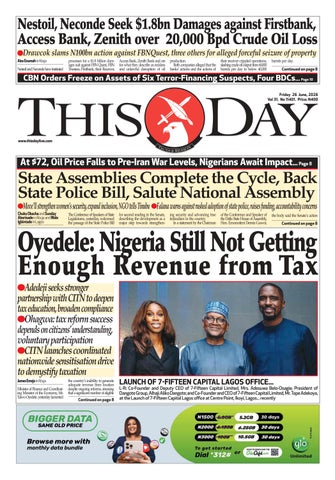
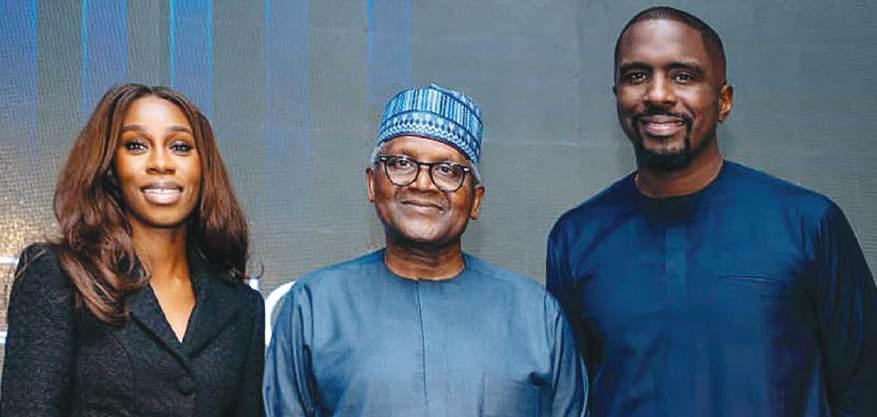
LAUNCH OF 7-FIFTEEN CAPITAL LAGOS OFFICE...
L-R: Co-Founder and Deputy CEO of 7-Fifteen Capital Limited, Mrs. Adesuwa Belo-Osagie; President of Dangote Group, Alhaji Aliko Dangote; and Co-Founder and CEO of 7-Fifteen Capital Limited, Mr. Tope Adekoya, at the Launch of 7-Fifteen Capital Lagos office at Centre Point, Ikoyi, Lagos... recently
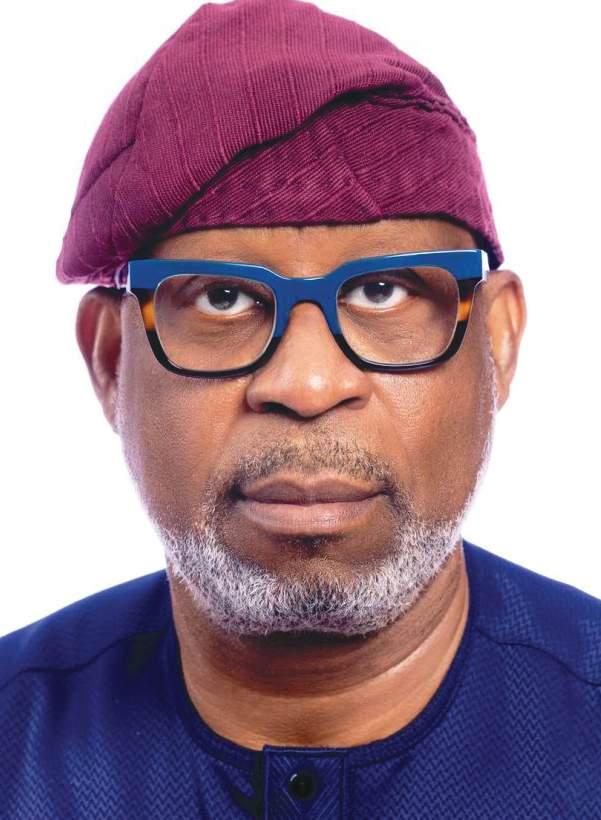
James Emejo in Abuja Minister of Finance and Coordinating Minister of the Economy, Mr. Taiwo Oyedele, yesterday lamented
Chuks Okocha and Sunday Aborisade in Abuja and Wale Igbintade in Lagos
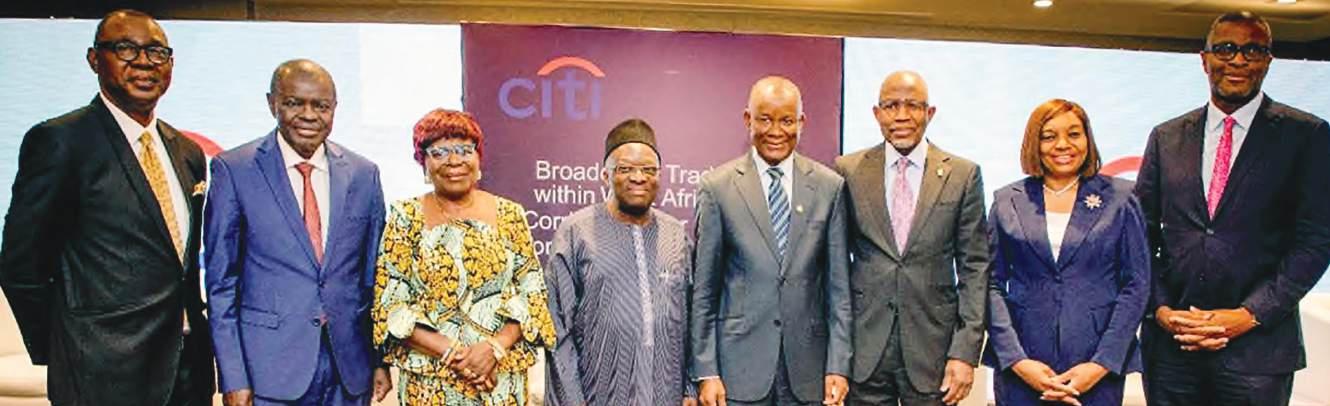
CITI BANK HIGH LEVEL BUSINESS SYMPOSIUM...
L-R: Independent Non Executive Director, Citibank Nigeria Limited, Dr. Evans Woherem; Ambassador of Côte d’Ivoire to Nigeria, His Excellency Kalilou Traoré; Deputy High Commissioner of Ghana to Nigeria, Dr. Mrs. Gladys Mansa Yawa Feddy Akyea; Chairman, Board of Directors, Citibank Nigeria Limited, Dr. Mahmoud Isa-Dutse; Minister of State for Industry, Senator John Owan Enoh; Deputy Governor, Financial System Stability, Central Bank of Nigeria (CBN), Lamido Yuguda; MD/CEO, Citibank Nigeria Limited, Nneka Enwereji; and CEO, Citi Sub Saharan Africa, Akin Dawodu, at the Citi Bank High Level Business Symposium in Abuja... recently
Citibank Urges W’African Leaders to Deepen Regional Trade Under AfCFTA
Explores investment opportunities in Nigeria’s blue economy Oyetola says Nigeria open for business
Nume Ekeghe in Lagos and Kasim Sumaina in Abuja
Citibank has rallied policymakers, regulators and business leaders across West Africa to accelerate efforts aimed at deepening regional trade and unlocking the full potential of the African Continental Free Trade Area (AfCFTA).
The bank disclosed this in a statement following its high-level Business Symposium themed: “Broadening Trade Flows within West Africa’s Main Corridors under the African Continental Free Trade Area (AfCFTA)”, which brought together senior public and private sector leaders from Nigeria, Ghana and Côte d’Ivoire.
According to the statement, discussions at the forum focused on practical measures to strengthen trade corridors, address implementation challenges and create new opportunities for cross-border commerce.
Speaking at the symposium, the Deputy Governor, Financial System Stability, Central Bank of Nigeria (CBN), Lamido Yuguda, said efficient financial intermediation would be critical to scaling trade across the continent.
“As intra-African trade scales under AfCFTA, the efficiency of financial intermediation will play a pivotal role. Strengthening cross-border payment systems, improving FX market functionality, and deepening
access to trade finance are essential to reducing transaction costs and enabling smoother trade flows. The Central Bank of Nigeria will continue to support initiatives that enhance financial stability while promoting greater regional integration,” he said.
Yuguda added that central banks must continue to build sound payment and trade systems while expanding access to finance for businesses operating across borders.
Also speaking, the Minister of State for Industry, Senator John Owan Enoh, said AfCFTA presents a major opportunity for Nigeria to expand its industrial base and increase exports to regional markets.
“AfCFTA presents a significant opportunity to accelerate Nigeria’s industrial growth and expand market access for our businesses. Our focus is on strengthening the competitiveness of Nigerian industries, improving the ease of doing business, and implementing policies that support export growth and regional value chains.
“Through sustained collaboration with the private sector, we are positioning Nigeria to play a leading role as a net exporter of manufactured goods and a driver of intra-African trade and economic integration.”
The minister urged African countries to move beyond exporting raw materials and focus on value-added production, describing industrial
policy as a critical missing link in unlocking greater value from the continent’s resources.
Enoh also highlighted the strategic importance of the Lagos-Abidjan corridor, particularly for industries such as cocoa, noting that the transition from exporting raw cocoa beans to producing branded chocolate would help African economies capture more value locally.
Representatives of Ghana and Côte d’Ivoire echoed similar concerns, calling for stronger regional cooperation to address non-tariff barriers, improve connectivity and harmonise standards across the region.
The Ambassador of Côte d’Ivoire to Nigeria, Kalilou Traoré, noted that while AfCFTA seeks to create
a market of more than 1.3 billion people, challenges such as inadequate infrastructure, fragmented regulations and limited financing continue to slow progress.
Similarly, Ghana’s Deputy High Commissioner to Nigeria, Dr. Gladys Mansa Yawa Feddy Akyea, said the true measure of AfCFTA’s success would be its ability to facilitate trade, mobilise finance, improve connectivity and strengthen regional value chains.
According to Managing Director and Chief Executive Officer of Citibank Nigeria Limited, Nneka Enwereji, Nigeria remains central to the success of AfCFTA and presents significant opportunities for businesses seeking regional expansion.
“Nigeria plays a pivotal role in the
success of the African Continental Free Trade Area (AfCFTA), presenting significant opportunities for businesses. The AfCFTA aims to facilitate the efficient cross-border movement of goods, capital, and payments. Citi is committed to providing practical financial solutions that empower our clients to expand regionally and enhance their competitiveness in new markets,” Enwereji said.
The statement added that discussions also identified customs bureaucracy, fragmented standards, limited currency convertibility and the continent’s persistent trade finance gap as major constraints to intra-African trade.
Meanwhile, the Minister of Marine and Blue Economy, Adegboyega
Oyetola, yesterday reaffirmed that Nigeria is open for business, structural transformation, and strategic international partnerships capable of unlocking the vast potential of the nation’s marine and blue economy. The minister made this known during a visit by a high-level delegation from Citibank, led by Akin Dawodu, Citibank’s Sub-Cluster and Banking Head for Sub-Saharan Africa (SSA), and Enwereji, Managing Director of Citibank Nigeria, at the Ministry’s headquarters in Abuja. Oyetola underscored the federal government’s commitment to accelerating the development of Nigeria’s marine and blue economy as a key pillar of national economic diversification and sustainable growth.
Lagos Targets Completion of 2,000 Housing Units by May Next Year
Segun James
The Lagos state government has reiterated its commitment to completing and delivering 2,000 housing units to residents, especially housing units currently under construction in Abraham Adesanya and Sangotedo area of Ibeju Lekki, which will be completed before the end of its tenure.
Commissioner for Housing, Moruf
Akinderu-Fatai, gave the assurance during an inspection tour of ongoing housing projects, where he expressed satisfaction with the progress recorded but stressed the need for contractors to accelerate work.
Akinderu-Fatai said the government was closely monitoring the projects to ensure timely delivery and value for money. “We are here with the Permanent Secretary, directors and
Appeal Court Hears ADC, Accord, Three Others Appeal against Deregistration July 7
Alex Enumah in Abuja
The Court of Appeal, Abuja division will July 7, hear the appeals filed by the African Democratic Congress (ADC), Accord and three other political parties against their deregistration.
A three-member panel of the appellate court fixed the date on Thursday, shortly after it ordered parties in the various suits to file and exchange their processes of arguments.
At yesterday’s proceedings, Musibau Adetunbi, SAN, who stood for the Accord party informed the three-member panel that the record of appeal and final judgement of the Federal High Court were just obtained on Monday and transmitted to the Court of Appeal as required by law. The senior lawyer subsequently applied for a short adjournment to enable him and others in the matter file their briefs of argument and exchange same for the matter
to be heard.
Since the application for adjournment was not opposed by parties in the suits the Presiding Justice, Abubakar Mohammed, subsequently adjourned to July 7, for hearing in all the Justiceappeals. Peter Lifu of the Federal High Court had in a judgement ordered the Independent National Electoral Commission (INEC) to deregister the ADC and four other political parties on the ground that they did not fulfill Constitutional
requirements in the previous election. Although INEC opposed the move on the ground that the parties met required Constitutional requirements and even provided evidence, the Judge nonetheless deregistered the five parties.
However, the Court of Appeal on June 16 ordered suspension of execution of the judgement by INEC on the ground that it was delivered in flagrant disobedience to its order that proceedings in the matter should be put on hold.
members of the ministry’s technical team to inspect the projects and assess the level of work done,” he said.
According to the commissioner, the housing developments are being executed through Public-Private Partnership (PPP) arrangements aimed at increasing access to affordable housing for Lagos residents.
He disclosed that four major housing schemes are currently ongoing across the state, with a combined capacity of over 2,000 housing units.
“It is the intention of this government to ensure that these projects are completed as quickly as possible before the end of this administration,” he said.
The commissioner, however, expressed concerns over the pace of work on some of the projects and revealed that the ministry had identified a number of technical issues requiring immediate attention.
“We are not completely satisfied with the current pace of work. We have noticed some technical issues which we will resolve with the contractors. We intend to intensify our inspections and push the contractors to meet the agreed timelines,” he said.
Akinderu-Fatai said that some of the projects could be ready for delivery
between October and November this year if contractors improve their performance. He warned that the state government would not hesitate to sanction or replace non-performing contractors.
“If the government has provided the necessary funding and a contractor is still not delivering as expected, we will take appropriate action. Contractors must cooperate with the government’s determination to complete these projects,” he stated.
The commissioner explained that inflation and the sharp rise in the cost of building materials significantly affected project timelines, forcing contractors to seek cost reviews and extensions.
“These projects should have been completed about three years ago, but inflation and the increase in the prices of construction materials affected progress. We have addressed those challenges, and our focus now is on delivery,” he said.
He reiterated the commitment of Governor Babajide Sanwo-Olu’s administration to expanding housing infrastructure and ensuring that ongoing projects are completed for the benefit of Lagos residents.
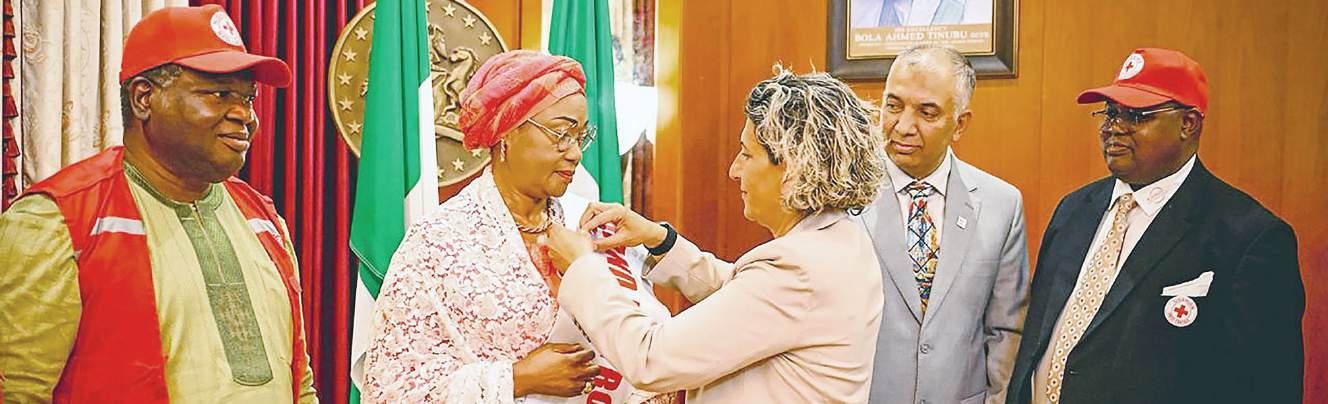
COURTESY VISIT/INVESTITURE OF FIRST LADY AS GRAND MATRON OF NIGERIAN RED CROSS SOCIETY...
First Lady of Nigeria,
during
being
Federation of
Illicit Financial Flows: ANEEJ, SecFin Rally
Media Amid
$17.8bn
Annual Loss to Nigeria
Oil theft, exports under-invoicing, over-invoicing of imports create major leakages
The Africa Network for Environment and Economic Justice (ANEEJ) and SecFin Africa on yesterday sought stronger collaboration with journalists in the fight against Illicit Financial Flows (IFFs), as Nigeria continues to lose as much as $17.8 billion annually to the illicit movement of funds.
The call was made at a two-day capacity-building workshop for journalists in Abuja aimed at strengthening media participation in exposing financial
crimes, promoting accountability and supporting efforts to curb illicit financial flows in the country.
Speaking at the event, SecFin Africa Representative, Prof. Abdullahi Shehu, said the scale of illicit financial flows from Nigeria and the wider African continent remains a major threat to economic development, governance and public welfare.
“The fight against illicit financial flows is not abstract. When public resources are stolen, laundered or illegally transferred, citizens pay
the price. Communities are denied basic amenities. Young people lose opportunities. Public institutions become weaker,” he stated.
According to him, estimates by the United Nations Economic Commission for Africa (UNECA) and the African Union (AU) indicate that Africa loses about $50 billion annually through illicit financial flows, with Nigeria accounting for roughly 20 per cent of that amount.
“According to the UNECA and AU (Mbeki Panel), Africa loses about $50
billion annually through illicit financial flows. Nigeria accounts for 20 per cent of this amount, which is about $10 billion annually, while some research puts the figure at $17.8 billion annually.
“Other estimates suggest that Africa loses $88 billion through IFFs 70 (with) per cent from commercial activities. It means that IFF has both domestic and international dimensions,” he said.
Shehu explained that illicit financial flows involve money that is illegally earned, transferred, concealed or utilised across borders, noting that the
NASENI Moves to Digitise CCB’s Assets Declaration, Operations
5 million public servants to benefit across Nigeria
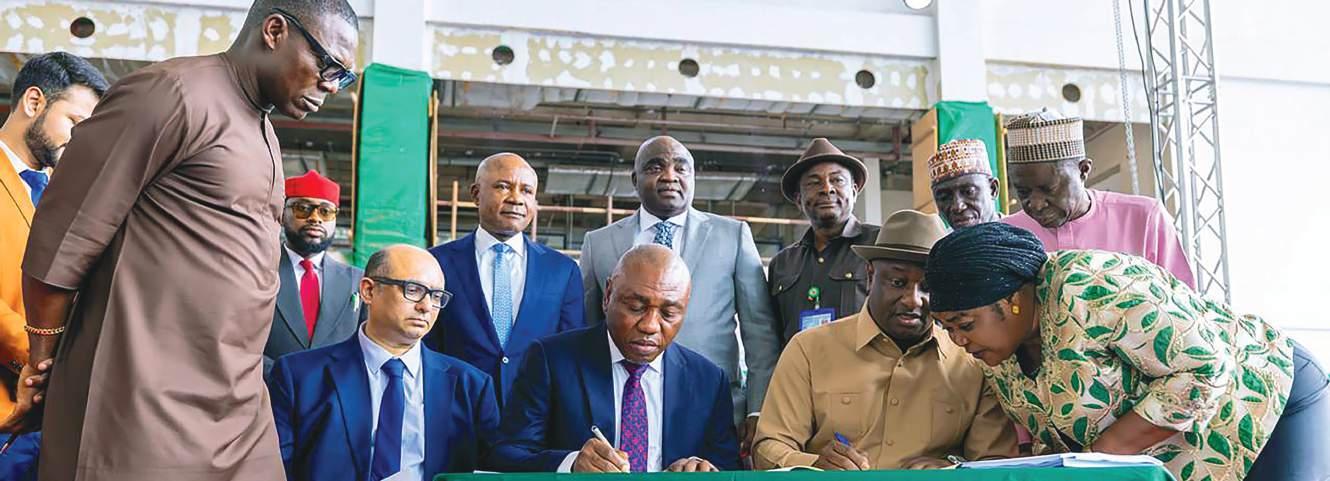
The National Agency for Science and Engineering Infrastructure (NASENI) and the Code of Conduct Bureau (CCB) have signed a Memorandum of Understanding (MoU) framework for cooperation in institutional digital systems, capacity building and technical advisory.
The agreement which was signed at NASENI headquarters, Idu, Abuja, and would see both agencies work together more closely, strengthen their operation and improve service delivery in line with their respective mandates.
Welcoming the delegation, the Executive Vice Chairman/Chief Executive Officer of NASENI, Khalil Halilu, noted that discussions between both institutions had crystallised into the MoU agreement and emphasised the importance of ensuring a sustainable framework for collaboration.
In his response, the Chairman, Code of Conduct Bureau, Dr. Abdullahi Bello, expressed appreciation to NASENI for embracing the partnership, noting that it would significantly support the Bureau’s
modernisation efforts, particularly in the digitisation of asset declaration processes and deployment.
Bello mentioned that the Bureau faces significant challenges in administering asset declaration forms to more than 5 million public servants across the country, noting that digitising the processes would improve accessibility and efficiency. He described the MoU implementation as a potential game changer for the Bureau.
Also speaking at the event, the Director-General of the Budget Office of the Federation, Mr. Tanimu Yakubu, commended both institutions
for pursuing a partnership that would strengthen transparency, accountability, and effective governance.
He observed that the Code of Conduct Bureau’s mandate requires modern reliable technological systems capable of managing large volumes of information and expressed confidence that NASENI’s expertise would provide valuable support in this regard.
The high point of the ceremony was the formal signing of the agreement by the Executive Vice Chairman/CEO of NASENI, Halilu, and the Chairman of the CCB, Bello.
phenomenon is driven by corruption, tax evasion, trade misinvoicing, money laundering, cybercrime, smuggling and other criminal activities.
He stressed that the losses have severe consequences for developing economies such as Nigeria, depriving governments of resources required for infrastructure, healthcare, education and social services.
“IFFs transfer wealth from productive and lawful uses, weaken governance, fuel criminal activities and reduce a country’s ability to improve the welfare and well-being of the population,” he stated.
Shehu identified crude oil theft, profit shifting by multinational corporations, under-invoicing of exports, over-invoicing of imports and public sector corruption among the major channels through which illicit funds leave Nigeria.
He urged governments, civil society organisations and the media to work together to strengthen anti-money laundering measures, improve transparency and enhance accountability in public resource management.
In his remarks, Deputy Executive Director of ANEEJ, Mr. Leo Atakpu, said the workshop was organised to equip journalists with the skills and knowledge needed to investigate and report illicit financial flows more effectively.
According to him, resources lost through corruption, tax evasion, money laundering, procurement fraud and illicit asset transfers should ordinarily be deployed to improve the living
conditions of Nigerians.
“These are resources that should have been used to build schools, equip hospitals, provide jobs, improve infrastructure, strengthen security and reduce poverty,” he said.
Atakpu noted that journalists occupy a strategic position in the fight against illicit financial flows because of their ability to uncover hidden financial crimes, expose procurement abuses and track suspicious financial transactions.
“Through investigative journalism, data-driven reporting, public interest storytelling and sustained editorial attention, journalists can uncover hidden financial crimes, expose procurement abuses, follow suspicious money trails, interrogate official claims, amplify citizens’ concerns and demand accountability from public and private actors,” he added.
He argued that while institutions such as the Economic and Financial Crimes Commission (EFCC), Independent Corrupt Practices and Other Related Offences Commission (ICPC), Nigeria Financial Intelligence Unit (NFIU) and the Nigeria Customs Service have critical roles to play, their efforts must be reinforced by responsible journalism and informed citizen engagement.
Also speaking, representatives of the NFIU and the EFCC’s Special Control Unit Against Money Laundering (SCUML) underscored the importance of collaboration among anti-corruption agencies, civil society groups and media organisations in tackling illicit financial flows.
Gombe Gov Flags Off 2026 Wet Season Fertilizer, Farm Inputs Distribution
Segun Awofadeji in Gombe
Governor Muhammadu Inuwa Yahaya of Gombe State has officially flagged off the 2026 wet season sales and distribution of fertilizer and other agricultural inputs to farmers across the state as part of efforts to boost food production and strengthen agricultural productivity. Under the programme, the state government has procured 12,000 metric tons of NPK 20:10:10 fertilizer, equivalent to about 240,000 bags, which will be sold
to farmers at a highly subsidised rate of N32,000 per 50kg bag, representing a 50 percent discount on the prevailing market price.
Speaking during the flag-off ceremony Tuesday, Governor Inuwa Yahaya described the timely procurement and distribution of fertilizer as a clear demonstration of his administration’s commitment to revitalizing the agricultural sector and sustaining Gombe State’s position as one of Nigeria’s leading agricultural hubs.
The governor announced that, in
addition to fertilizer distribution, the government will provide several agricultural machines and tools free of charge to farmers across the state.
These include 833 water pumps, 450 motorised weeders, 544 motorised sprayers, 550 rice transplanters, 350 peanut shellers, 50 rice and maize planters/harvesters, 50 rice milling machines, 45 walking tractors, as well as 20 oil filtering and oil press machines.
Governor Inuwa Yahaya stressed the provision of subsidised farm
inputs alone would not guarantee agricultural transformation unless farmers embrace modern, knowledge-driven farming practices.
He urged farmers to move away from traditional rain-dependent agriculture and adopt climate-smart and technology-driven farming methods capable of improving productivity, increasing resilience, and guaranteeing sustainable food production.
“In this regard, I encourage all farmers to embrace dry season
farming and pay close attention to weather advisories and early warning systems provided by agricultural extension services and meteorological agencies.
Aligning farming activities with scientific forecasts will help reduce the risks of drought, flooding, and pest infestations,” he advised.
The governor also emphasized the importance of peaceful coexistence between farmers and herders, describing Gombe State as a longstanding model of harmony and mutual understanding.
He called on security agencies, traditional rulers, community leaders, and youth groups to intensify dialogue, vigilance, and collaboration at the grassroots level in order to sustain peace across farming communities.
“Let me make it clear that this administration will not tolerate any act capable of disrupting the peace and stability of our communities. We remain committed to protecting the lives and livelihoods of all citizens, whether crop farmers or livestock herders,” he warned.
Senator Oluremi Tinubu,
decorated by Head of Delegation, International Committee of the Red Cross, Doris El-Doueihy. With them are National President, Nigerian Red Cross Society, Prince Oluyemisi Adeaga; Head of Country, International
the Red Cross, Dr. Awan Muhammad; and Secretary General, Nigerian Red Cross Society, Abubakar Ahmed Kande,
the courtesy visit and investiture of the First Lady as Grand Matron of the Nigerian Red Cross Society at the Presidential Villa, Abuja, yesterday
PHOTO: STATE HOUSE
Emmanuel Addeh in Abuja
Emmanuel Addeh in Abuja
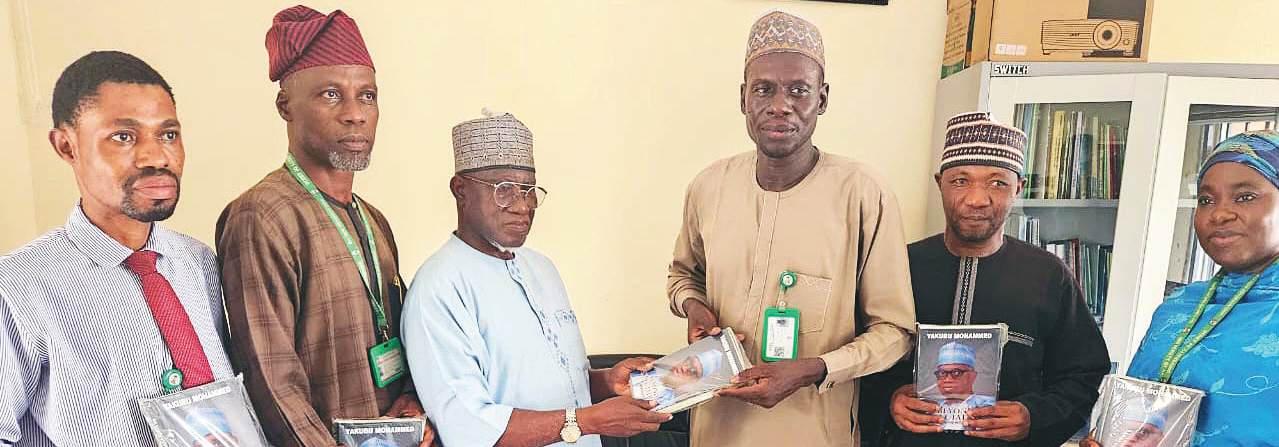
PRESENTATION OF LATE YAKUBU MOHAMMED’S BOOK TO ABUJA VARSITY...
L-R: Acting Head of Department(HOD), Information, Journalism and Media Studies, University of Abuja, Dr. Yusuf Sulieman; HOD, Public Relations and Advertising, Dr. Kamaldin A. Babatunde; Barrister Tijani Mohammed; Dean, Faculty of Communication and Media Studies, Prof Abdullahi Bashir; Prof Jibril Abdullahi Elisha and HOD, Broadcasting and Film Studies, Dr. Aisha
Salau, during the presentation of late Yakubu Mohammed’s book to the Faculty of Communication and Media Studies, University of Abuja… recently
CCB Investigates Assets Declaration of 19 Ministers,
37 Perm Secs, Other High-risk Officials
Concludes investigations on five local government chairmen over council funds FAAC allocations to 774 council areas hit N38.79tn in 25 years Agora Policy unveils portal to track funds at grassroots level
Ndubuisi Francis in Abuja
In a bid to strengthen integrity and accountability in public service, the Code of Conduct Bureau (CCB) yesterday disclosed that it had completed the verification of asset declarations for high-risk public servants, covering 19 ministers, 37 permanent secretaries, 20 heads of agencies, and 32 other high-risk officials.
It also investigated no fewer than five local government chairmen in the country in connection with the utilisation of funds.
CCB Chairman, Dr. Abdullahi Usman Bello, who made the disclosure in Abuja during the graduation of the second cohort of the Policy Writing Fellowship and the official unveiling of the Local Governance Accountability (LGA) Portal and Policy Registry by Agora Policy, noted that as part of efforts to strengthen integrity and accountability in public service, the Bureau had completed verification of asset declarations for high-risk public servants.
He said, “This exercise covered 19 Ministers, 37 Permanent Secretaries, 20 Heads of Agencies, and 32 other high-risk officials. I am also pleased to announce that our Online Asset and Liabilities Declaration
System is now 100% developed and ready for deployment and testing. This platform will hold the asset declaration database of all public servants in Nigeria.”
According to him, a part of its enforcement drive, the CCB also secured the forfeiture of several assets, including a property in London.
“We have referred numerous cases to the Code of Conduct Tribunal, and just yesterday (Wednesday) we arraigned the Chief of Staff to a State Governor before the Tribunal. These actions demonstrate our firm resolve to hold public officers accountable regardless of their position or status,” he said.
He applauded Agora Policy’s commitment to strengthening an evidence-driven, inclusive, and robust approach to policymaking and policy engagement as both timely and impactful.
He added The LGA Portal, which provides free access to financial allocations to local councils from 1999 to date, together with council profiles and the names of elected officials, is a powerful instrument for promoting transparency and accountability at the grassroots level.
“The LGA database is particularly important to the Code of Conduct
Bureau. At the Code of Conduct Bureau, we firmly believe that sustainable national development and the fight against corruption must begin with strong, accountable local governance,” Bello explained.
In a keynote address, the Special Adviser to the President on Policy Coordination, Hadiza Bala Usman, observed that Nigeria does not suffer from a shortage of ideas across sectors, adding that over time, there have been plans, strategies, committees, reports, white papers
and reform proposals.
However, she pointed out that the more difficult task has always been to convert ideas into priorities, priorities into institutions, institutions into implementation, and implementation into measurable improvements in the lives of citizens.
Usman described this as the central challenge of governance as well as the central opportunity before public policy scholars, practitioners, civic actors and public officials.
Democracy, she argued, is not
exhausted by elections, procedures or institutions, but is sustained by participation, communication, shared responsibility, and the continuous engagement of citizens in the affairs that shape their lives.
While applauding Agora Policy for graduation of the second cohort of the Policy Writing Fellowship and the official unveiling of the Local Governance Accountability Portal and Policy Registry, she explained that policymaking is a critical skillset for nation building,
sustainable development and global competitiveness.
Earlier in his remarks, the Founder/Executive Director of Agora Policy, Mr. Waziri Adio noted that if the country was really interested in good governance and development, it should not continue ignore what is going on in the local councils.
Citing the Fourth Schedule of the 1999 Constitution, Adio said it spells out their functions, which are not trivial.
Gbajabiamila: N70,000 Minimum Wage No Longer Meets Current Realities
Oghenevwede
Chief of Staff to the President, Femi Gbajabiamila, has expressed the federal government’s readiness to embark on the upward review of the N70,000 National Minimum Wage, saying the amount no longer reflects current economic realities.
Gbajabiamila disclosed this on Thursday in Abuja at the Good Governance Summit 2026,
organised by the Working People United (WoPU), with the theme, “Policies and Governance: Impact on the Working People.”
He said, “This administration has delivered a new national minimum wage. In July 2024 President Bola Tinubu signed into law a minimum wage of 70,000 naira, with more than double the 30,000 naira that workers had endured for years, and recognising that the cost of living does not stand still, the President
The Nigerian Association of Petroleum Explorationists (NAPE) has urged oil and gas operators in the country to invest in improved reservoir modelling, warning that weak understanding of submarine channel architecture was increasing uncertainty and cutting into recovery. The association noted that deepwater drilling costs had exceeded $1 million per day, making accurate subsurface characterisation essential for reducing exploration and develop-
ment risks.
President of NAPE, Mrs Olajumoke Ajayi and a geoscientist with TotalEnergies EP Nigeria, Dr. Busari Olarewaju made the calls at the NAPE’s June Technical session held in Lagos.
Busari presented the technical paper titled, “Geomorphology and Evolution of a Pleistocene Submarine Channel-Levee Complex in Deepwater Nigeria: Implications for Reservoir Modeling and Field Development Strategy”.
He said detailed knowledge
of how deepwater channels form and change over time was critical to reducing subsurface uncertainty, improving reservoir connectivity assessment, and optimising hydrocarbon recovery.
“The message here is that we understand the detailed interactive presence of the flow to make sure to maximise the production and you delay water cut as much as possible,” Busari said.
The study focused on a north-south erosive-constructive channel-levee complex in eastern deepwater Nigeria.
Using seismic datasets covering more than 1,000 square kilometres, alongside well data, gamma ray logs and high-resolution near-surface seismic, Busari and his team examined over 40 three-dimensional channel systems across the Niger Delta in a research programme that lasted three to four years.
Their findings, he said, revealed complex architectural elements within the channel system, including lateral accretion packages, vertically stacked channels, outer levees, mass-transport deposits and hemipelagic drapes.
reduced the strategic review cycle from five years to three years, so that wages may keep closer pace with economic reality.
“The 70,000naira wage, which was a milestone in 2024 must be honestly reassessed against today’s realities, and I can confirm to you that when the time comes to begin the process of reviewing the national minimum wage, this administration will approach that endeavor not as an adversary of labour, but as a partner.
“President Tinubu has said time and again that the custodians of the nation’s machinery deserve a fair and commensurate wage, and as you all well know by now, this is the president who means precisely what he says and does exactly what he means.
“It must be said that good governance is not a performance stage by government for the benefit of a passive audience. It’s a partnership between those who govern and those who are governed. Nowhere is that partnership more vital than the relationship between government and the working people of Nigeria.
“It is with this understanding in mind that I ask the leaders of organised labour and the members of working people united to remain
what you have so often been at your finest, partners in progress rather than antagonist in perpetuity.
“Let us choose to dialogue over disruption, because as we have proved again and again, we achieve far more when we sit together than when we retreat; retreat to our separate corners.”
In his goodwill message, the Minister of Labour and Employment, Mohammad Dingyadi said governance is not just about written policies but, on the impact, they have of the workers.
“Let me begin by commending the organiser for choosing a theme that is both timely and significant: policies and governance impact on the working people. This theme falls to the heart of the relationship between government decisions, economic transformation, and the everyday realities of Nigerian workers.
“Governance is not merely about policies written in documents or programmes announced from government offices. The true measure of governance is the extent to which policies translate into improved livelihoods, central of increased productivity, social protection, economic opportunities, and dignity for the working people,” he said.
Abdulrauf-
Ohwovoriole in Abuja
At $72, Oil Price Falls to Pre-Iran War Levels, Nigerians Await Impact
Trump orders probe into reasons pump prices remain high Baker Hughes strikes long-term deal with ANOH gas
Emmanuel Addeh in Abuja
International crude oil prices have tumbled to levels last seen before the outbreak of hostilities involving Iran earlier this year, with Nigerians looking forward to a corresponding reduction in domestic petrol prices, which have remained stubbornly high despite the sharp decline in the global oil market.
Brent crude, the global benchmark against which Nigeria’s oil is priced, briefly fell below $72 a barrel yesterday before recovering slightly to about $73, effectively erasing the war premium that had pushed prices significantly higher following the conflict and fears of disruptions to global energy supplies.
The decline followed improving conditions around the Strait of Hormuz, one of the world’s most strategic oil shipping routes, as vessel
movements gradually resumed after months of uncertainty triggered by tensions in the Middle East.
For many Nigerians, however, the sharp drop in crude prices has yet to translate into relief at filling stations, where petrol continues to sell for between N1,250 and N1,360 per litre depending on location and marketer.
The development has reignited calls for downward price adjustments, especially as crude oil accounts for the largest component of petrol production costs and import pricing. Since the outbreak of the conflict, domestic fuel prices have remained elevated, worsening inflationary pressures and increasing transportation, food and production costs across the economy.
The cost of crude has been moving sharply lower since the US and Iran signed a Memorandum of Understanding (MoU) on June
17, which set out a 60-day period for negotiations on Tehran’s nuclear programme and other measures to end the war.
Representatives from the two sides met in Switzerland last weekend for talks to end the war, which resulted in the US partially lifting sanctions on Iranian oil exports. The number of vessels crossing the Strait of Hormuz has risen significantly since the MoU was signed, according to maritime intelligence firm Kpler.
Its latest data suggests 284 vessels have made the transit from June 18, the day after the deal was signed, although that is still well below the pre-conflict average of some 138 crossings each day.
The ships passing through the waterway in recent days include those carrying crude oil, liquefied natural gas (LNG), fertiliser and other goods, Kpler told the BBC.
The price of crude rose rapidly above $80 from early March and peaked at just below $120 in April. The current rate as of Jun 25, 2026 was back down to below $80, similar to before the Iran war began.
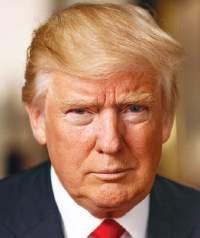
Also, US President Donald Trump on Wednesday ordered an investigation into major energy companies, accusing Shell, ExxonMobil and other firms of “gouging” drivers by not reducing fuel prices even as oil costs fell.
“Oil prices have come down so much and we are not seeing anything at the pump by comparison the way they should be,” Trump told reporters in the Oval Office.
The American Petroleum Institute, which represents the oil and gas industry in the US, said fuel prices “don’t move in lockstep with crude oil”. British energy firms have faced similar accusations of unfairly hiking
petrol prices since the Iran war.
Meanwhile, in a separate development, global energy technology company, Baker Hughes, has secured a long-term service agreement with the ANOH Gas Processing Company (AGPC) for the operation and maintenance of critical equipment at the ANOH Gas Processing Plant in Imo State.
The agreement covers lifecycle support services, engineering advisory services and digital monitoring solutions for the facility, which is regarded as one of Nigeria’s key gas infrastructure projects.
Managing Director of ANOH Gas Processing Company, James Makinde, said the partnership would help ensure reliable operation of critical turbomachinery equipment required for the plant’s operations and support Nigeria’s domestic energy objectives.
OYEDELE: NIGERIA STILL NOT GETTING ENOUGH REVENUE FROM TAX
taxpayers are yet to fulfil their civic obligations.
He said the challenge facing the country was not necessarily about raising tax rates but ensuring that individuals and businesses that ought to pay taxes do so in a fair and transparent system.
Oyedele spoke in Abuja while receiving the leadership of the Chartered Institute of Taxation of Nigeria (CITN), led by its President, Mr. Innocent Ohagwa, as part of activities marking the institute’s maiden National Tax Awareness Day road walk.
The minister commended the institute for supporting the federal government’s tax reform agenda and promoting public understanding of taxation but urged it to intensify its advocacy efforts, noting that many Nigerians still harbour misconceptions about taxation.
According to him, many citizens continue to view taxation merely as a tool for government to take money from the people rather than as a critical instrument for national development.
Oyedele said, “We are still not getting enough revenue from
tax. It is not about increasing tax, but making sure that those who are supposed to pay tax pay. We want to promote fairness in tax administration.”
Oyedele stressed that if Nigeria succeeds in building an efficient and equitable tax system, the impact on infrastructure, public services and economic development would be transformative.
He also challenged the institute to introduce annual awards for the country’s most tax-compliant individuals and organisations as a means of encouraging voluntary
STATE ASSEMBLIES COMPLETE THE CYCLE, BACK STATE POLICE BILL, SALUTE NATIONAL ASSEMBLY
represented a significant milestone in the ongoing national conversation on policing reforms and constitutional restructuring.
The conference reiterated its support for the establishment of state police, noting that community-based policing would improve security response, enhance intelligence gathering and better address local security challenges across the country.
“As Speakers of the 36 State Houses of Assembly, we had earlier indicated our support for the proposed legislation because we believe that community-based policing, properly structured under law, will enhance safety and response time across our states,” the statement said.
According to the Conference, security challenges were often local in nature and required policing structures that understood the terrain, culture and peculiar circumstances of communities.
With the bill now advancing to the next stage of the constitutional amendment process, the Speakers assured Nigerians that State Houses of Assembly would give the proposal thorough and objective consideration in line with Section 9(2) of the 1999 Constitution.
The body pledged to engage relevant stakeholders, conduct public hearings, where necessary and deliberate on the legislation in a manner that would promote national unity and safeguard lives and property.
The Conference also commended the Senate for what it described as a bold and patriotic step, urging
Nigerians and other stakeholders to continue discussions on state policing with objectivity, patriotism and a shared commitment to improving security nationwide.
“We remain committed to working with the National Assembly, the Executive and all arms of government to deliver a constitutional amendment that strengthens democracy and governance at all levels,” the statement added.
State Police Will Strengthen Women’s Security, Expand Inclusion, Declares NGO
A non-governmental organisation, iTeach Africa Initiative, has urged President Bola Tinubu to swiftly assent to the State Police Bill, declaring that the proposed legislation would significantly improve the security of women and girls while advancing gender inclusion in Nigeria’s law enforcement architecture.
The group said the Senate’s passage of the bill marked a major milestone in the country’s efforts to address growing insecurity and create a policing system that’s more responsive to the needs of local communities and vulnerable groups.
In the statement issued in Abuja, the Founder of iTeach Africa Initiative, Ebimoboere Alaibe Elezieanya, said women across the country stood to benefit immensely from the establishment of state-controlled police services, particularly in rural areas where security presence remained inadequate.
According to her, insecurity has continued to exact a heavy
toll on women through incidents of gender-based violence, domestic abuse, sexual exploitation, human trafficking and other criminal activities that often went unreported or inadequately addressed.
She argued that bringing policing closer to communities would strengthen the capacity of law enforcement agencies to respond to such crimes and improve access to justice for victims.
“The State Police Bill, when implemented within an effective legal and operational framework, will be a major victory for women.
“It creates an opportunity for greater female representation in law enforcement institutions and will have a positive impact on efforts to combat gender-based crimes and
Continued on page 33
Besides, Nestoil and Neconde maintained that the action also impacted the planned new oil wells drilling campaign with the Pathfinder 500 Drilling Rig with devastating financial consequences and wider economic impact.
This was as the bid by Firstbank to orchestrate the reassignment of the ongoing trial court suit between FBNquest Merchant Bank Ltd/First Trustees Ltd and Nestoil/Neconde has completely collapsed under the full weight of the Supreme Court’s authority, with the Honourable Chief Judge firmly rejecting the reassignment application as baseless and legally untenable.
Relying squarely on the apex court’s judgment in Neconde
compliance and recognising responsible taxpayers.
Earlier, the Nigeria Revenue Service (NRS) and CITN renewed their commitment to promoting tax awareness, voluntary compliance and fiscal sustainability as part of activities commemorating the 2026 National Tax Awareness Day.
Speaking while receiving the CITN delegation, Executive Chairman of NRS, Dr. Zacch Adedeji, described the occasion as particularly significant as it coincided with the first anniversary of the signing of the country’s landmark tax reform legislation.
He said the reforms marked the beginning of a new era in tax administration built on simplicity, fairness, transparency, efficiency and improved service delivery.
According to him, the reforms go beyond legislative changes and represent a fundamental shift in the relationship between government and taxpayers.
Represented by NRS Executive Director, Finance and Corporate Services, Mr. Mohammed Abubakar, Adedeji said the service was focused on building a tax administration system that is trusted, technologydriven and responsive to the needs of businesses and citizens.
He explained that tax awareness remained central to achieving that objective, stressing that sustainable revenue mobilisation cannot be driven by enforcement alone.
He said taxpayer education, trust, transparency and confidence in public institutions are critical to
Energy Limited v. FBNQuest Merchant Bank Ltd & 4 Ors., the Chief Judge made it clear that the Supreme Court found no fault with Hon. Justice Osiagor and gave no hint—directly or indirectly—that the case should be reassigned.
Instead, the Supreme Court ruling condemned the very tactics deployed by Firstbank describing their attempt to stall proceedings they initiated as suggestive of ulterior motives and a misuse of judicial process. That damning pronouncement has now sealed the fate of the reassignment bid.
Backed by the binding force of Section 235 of the Constitution, the court held that there is absolutely no legal basis to displace the trial
“It is a pleasure to collaborate with a globally trusted energy technology leader like Baker Hughes on this critical project. The reliable performance of critical turbomachinery equipment is essential to the successful operation of the ANOH Plant and to delivering on Nigeria’s domestic energy supply goals,” he stated.
improving compliance and strengthening the country’s revenue base.
He said, “Tax awareness is the foundation of voluntary compliance. Voluntary compliance is the cornerstone of a sustainable tax system, and a sustainable tax system is indispensable to national growth and shared prosperity,.”
The NRS boss noted that over the past year the service had accelerated its modernisation programme through digital transformation, process automation and enhanced taxpayer services designed to simplify compliance, reduce costs and improve transparency.
He said initiatives such as the newly launched NRS 360 platform would further support the drive towards a more efficient and citizenfocused tax administration system.
Adedeji also underscored the importance of collaboration between the tax authority and professional bodies, describing the partnership with CITN as strategic to deepening tax education and strengthening public confidence in the tax system.
He urged tax practitioners across the country to serve as ambassadors of tax awareness in their various organisations and communities.
However, the CITN President said the institute’s National Tax Awareness Day was conceived as a coordinated nationwide campaign to deepen tax education, encourage voluntary compliance and support the implementation of Nigeria’s tax reform agenda.
He said the initiative was approved by the institute’s council
judge. The attempt has been exposed for what has been termed a failed strategy to derail and manipulate the proceedings, with the consequences escalating fast.
With the Supreme Court’s rebuke now echoing through the case and a $1.8 billion claim on the way, the stakes have shifted dramatically, turning the matter into a high-impact legal and commercial show-down with far-reaching implications.
Meanwhile, a firm, Drawcok Estate Ltd has instituted a whopping N100 billion lawsuit against FBNQuest Merchant Bank Ltd, First Trustees Ltd, Mr Abubakar Sulu-Gambari (SAN) and the Deputy Sheriff, Federal High Court
earlier in the year, with the last week of June designated annually for tax awareness activities.
According to him, the 2026 edition is being observed simultaneously across the institute’s 49 district societies covering all 36 states of the federation, the Federal Capital Territory, as well as its international districts in the United Kingdom and North America.
Ohagwa said activities lined up for the campaign include tax walks, roadshows, radio programmes, symposiums, town hall meetings, market sensitisation campaigns, quizzes and debates aimed at demystifying taxation and improving public understanding of tax obligations. He explained that June 25 was deliberately chosen for the event because it coincides with the anniversary of the signing of the tax reform legislation as well as a critical period for the filing of corporate tax returns.
The CITN president said the initiative was designed to promote tax awareness across all segments of society, strengthen voluntary compliance, showcase the institute’s role in supporting fiscal sustainability and engage citizens through inclusive public enlightenment programmes. He reiterated the institute’s commitment to partnering the NRS and other stakeholders in broadening the tax net, strengthening compliance and supporting national development through effective taxpayer education and professional engagement.
of Nigeria, Lagos division, over the alleged unlawful and forceful seizure of its property.
The firm in the suit marked: FHC/L/CS/22/26, claimed that the action of the defendants injured its business reputation, and caused it untold hardship, embarrassment, public odium, economic hardship and occasioned a breach of its right to fair hearing and the right to own moveable and immoveable properties.
According to the plaintiff, the defendants knowingly levied execution of a court order on its property No. 41, No. 42 Akin Adesola Street and 60 Saka Tinubu Street, Victoria
Continued on page 34
US President Donald Trump
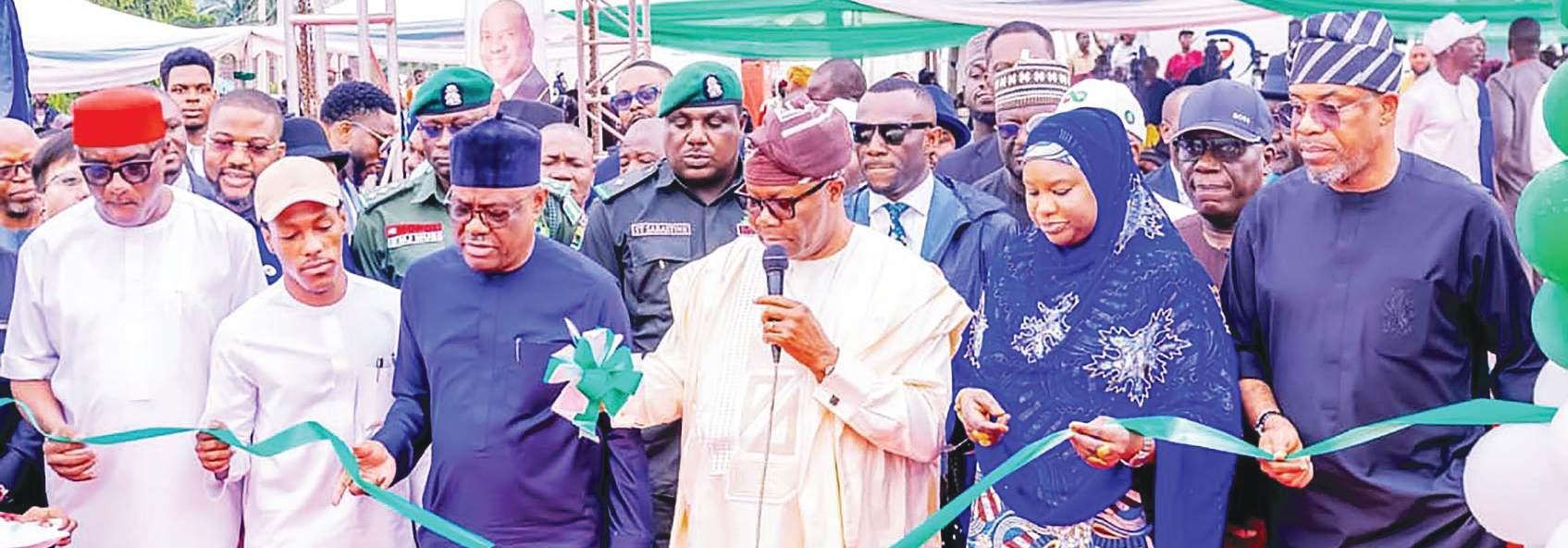
INAUGURATION OF INTERCHANGE AT ARTERIAL ROAD N16...
L-R: Chairman, Board of Trustees, Peoples Democratic Party (PDP), Mao Ohuabunwa; Minister of the Federal Capital Territory, Nyesom Wike; President of the Senate, Godswill Akpabio, representing President Bola Tinubu; Minister of State, Federal Capital Territory, Mariya Mahmoud; and Chairman, Senate Committee on Works, Onyesoh Allwell, during the inauguration of the Interchange at Arterial Road N16, Ring Road II Intersection, linking Jahi District to Gwarinpa District, yesterday
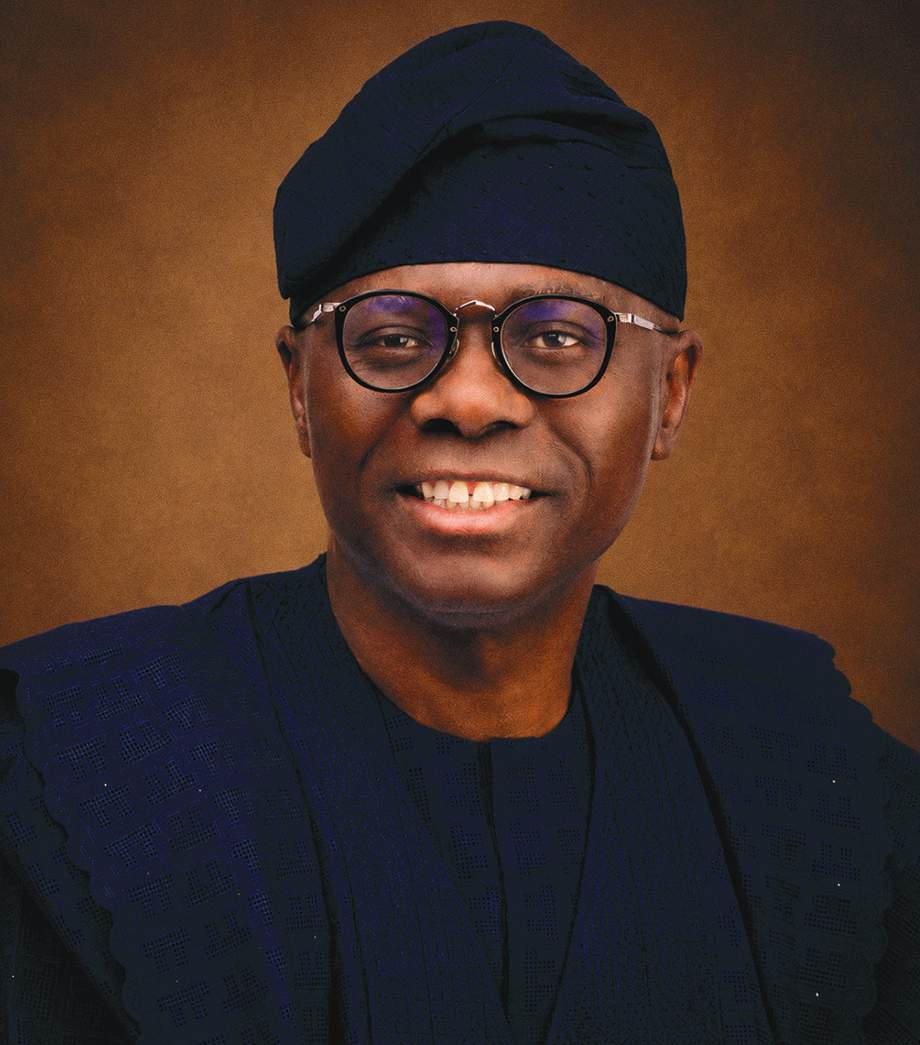
Tinubu Felicitates Gov
Sanwo-Olu at 61, Chief of Staff, Hon Gbajabiamila at 64 and House Leader, Hon Ihonvbere at 70
President Bola Tinubu on Thursday rejoiced with Governor Babajide Sanwo-Olu of Lagos State, his Chief of Staff (CoS), Hon Femi Gbajabiamila and Leader of the House of Representatives, Hon Julius Ihonvbere as they add another year to their age.
The President extended warm felicitations to Governor Sanwo-Olu on the occasion of his 61st birthday, congratulated his Chief of Staff, Gbajabiamila, on attaining 64 and hailed House Leader, Ihonvbere at 70.
Rejoicing with Governor SanwoOlu, his family members, the State Executive Council, business and political allies, and the people of the state as he celebrates the milestone, Tinubu, in a release by presidential spokesperson, Bayo Onanuga, noted
the diligence, wisdom and excellence that have defined Sanwo-Olu’s service to Lagos State and the country.
He stated that Governor Sanwo-olu is brilliantly combining his private and public sector experiences to set new records of accomplishment in governance.
“Governor Sanwo-olu’s efforts in consolidating on the economic, infrastructural, and cultural transformation of Lagos State into a vibrant, dynamic and structured global city, with growing influence across the country, and the world are remarkable.”
The President also commended the Governor for further strengthening and positioning Lagos State as a centre of excellence and home for all.
Tinubu also lauded Sanwo-Olu’s loyalty to the All Progressives
Congress (APC) and the Renewed Hope Agenda, ensuring inclusivity, diversity, and harmony in all political activities and transitions in the state.
The President prayed that God Almighty will grant the governor a longer life, good health, increased wisdom, and that his impact and legacy will endure.
While congratulating his Chief of Staff on turning 64, Tinubu praised his remarkable life of service, leadership, and unwavering commitment to the country.
He said: “As you celebrate your 64th birthday today, I deeply appreciate your loyalty, dedication, and sacrifice.
“Throughout the years, you have demonstrated capacity for service, placing national interest above personal considerations and working tirelessly for the progress of our country.
“Your dedication to duty and ability to coordinate complex governmental processes have contributed immensely to the realisation of our Renewed Hope Agenda.”
The President noted Gbajabiamila’s journey in public service and the invaluable contributions he has made to strengthen Nigeria’s democracy.
Tinubu lauded Gbajabiamila’s exemplary service as Minority Leader of the House of Representatives, his contributions to the process leading to the formation of the APC, and his emergence as Speaker of the House, which marked a defining chapter in the history of the National Assembly.
He prayed that Almighty Allah will grant the Chief of Staff good health, wisdom, strength, and many more years of impactful service to
#EndSARS: DNA Confirms Unidentified Body as Journalist, Pelumi Onifade
A DNA result presented to the Coroner Court by the Lagos State DNA and Forensic Centre has confirmed that a previously unidentified body is that of Pelumi Onifade, a journalist who went missing during the #EndSars protest in October 2020.
Mrs. Adebose Onifade, mother of the journalist wept after investigating Magistrate, Mrs. Temitope Oladele, said she had received a sealed DNA report confirming a match between the body and the sample provided by Mrs. Onifade.
The inquest follows a wrongfuldeath suit filed by Media Rights Agenda (MRA) and the Onifade family against the Police and Lagos State Government, and was ordered by the Federal High Court after Justice Ayokunle Olayinka Faji’s July 19, 2024 judgment directing the Attorney-General to investigate Pelumi’s death and conduct a coroner’s inquest to determine cause and responsibility.
On May 22, 2026, at the request of MRA lawyer Alimi Adamu, the coroner ordered the Chief Medical Examiner at Lagos State University
Teaching Hospital (LASUTH) to submit the autopsy report for a body tagged No. 1385 within 21 days.
LASUTH’s March 24, 2026 report had stated that autopsies were conducted on six bodies brought to the hospital on November 3, 2020, and that DNA samples from those bodies and reference samples from grieving families were forwarded to the DNA centre for identification.
When proceedings resumed on June 23, 2026, both parents of the late journalist attended. Counsel for MRA and the family informed the court that the orders had been served and sought guidance on compliance.
The coroner said she had received no response from LASUTH but had in her possession a sealed docu- ment from the DNA and Forensic Centre confirming the match to the journalist’s mother.
Oladele acknowledged LASUTH’s strain, saying, “In all honesty, LASUTH is overwhelmed,” but added she believed the autopsy had been or should have been completed.
Adamu argued the family has endured a prolonged wait for answers and that the need for follow-up orders illustrated non-
compliance with earlier directives. He noted continuing police denials of custody and a growing public and media concern over the journalist’s disappearance and death while covering #EndSARS protests on October 24, 2020.
The coroner warned she might order coercive action if necessary but urged administrative steps first,
promising another reminder and courtShefollow-up. directed a final administrative reminder to LASUTH and advised MRA’s lawyers to visit the hospital in person to expedite compliance. Failure to comply would force the court to use its full powers to compel the autopsy report. The matter was adjourned to July 7, 2026.
the nation.
The President also paid glowing tribute to Leader of the House of Representatives as he clocks 70. Tinubu, in a 12-paragraph special tribute to mark Hon Ihonvbere’s birthday stated, inter alia: “Today, I join millions of Nigerians, the Ihonvbere family, National Assembly members, and the good people of Owan East/West Federal Constituency of Edo State to celebrate a statesman, scholar, politician, and patriot - Professor Julius Ogar Ihonvbere - as he marks his 70th birthday today, Thursday.
“Professor Ihonvbere’s life story at 70 is, in many respects, a story of service. From the lecture halls as a renowned Political Scientist, he was elected to the House of Representatives, where his experience and integrity propelled him to the House leadership.
“Previously, he also served with the Ford Foundation as a program officer in the Peace and Social Justice Program, and was responsible for the “Pluralism and Governance” portfolio until 2002, when he voluntarily withdrew from the program to return to Nigeria to serve the government of former President Olusegun Obasanjo.
‘While at Ford, he helped attract foreign aid to Nigeria’s pro-democracy NGOs, including the Truth Commission established by President Olusegun Obasanjo.
“Ihonvbere has brought dignity, intellect, civility, and principle to public life. He has demonstrated
that excellence in academia can also be replicated in public life.
“At 70, your legacy can be distilled into four or more categories. One, you have provided direction and leadership in the Green Chamber. As Leader of the House, you have helped stabilise the 10th Assembly, foster bipartisan cooperation, and ensure the Renewed Hope legislative agenda moves with focus and patriotism.
“Two, your academic pedigree and advocacy for tertiary education reform continue to inspire a generation of young Nigerians.
“Three, the people of Owan East/ West Federal Constituency of Edo State know you as a leader who never forgets his roots, one who delivers representation with humility.
“Four, and perhaps more importantly, your steadfastness in the All Progressives Congress and your counsel have strengthened our collective resolve to build a more prosperous Nigeria.
“On this milestone, I commend your wisdom, dedication, and the grace with which you carry the burdens of leadership. Nigeria needs more of your kind of statesmanship at this critical time.
“As you celebrate this 70th birthday, may God Almighty grant you renewed strength, good health, and many more years of impactful service to our nation and people.
“Happy 70th birthday, Leader Ihonvbere. May your light continue to shine for Nigeria.”
First Lady: I’m Optimistic That With The Right Will, Nigeria’ll Overcome Its Challenges
Deji Elumoye in Abuja
The First Lady, Senator Oluremi Tinubu, has expressed optimism that with the right will, Nigeria would overcome all challenges facing her.
Speaking yesterday after her investiture as the Grand Matron of the Nigerian Red Cross Society at the State House, Abuja, the First Lady, while acknowledging the enormous role being played by the Red Cross in Humanitarian efforts in the country, expressed optimism that various challenges confronting the nation
would be surmounted.
According to her, “There is no challenge that is unsurmountable if we have the right will, and we have strong political will, to do right by the nation. Our assignment is a daily call to duty and we have to rise everyday to do the work”.
Mrs Tinubu stressed the need to use voluntary organisations to change the mindset of youth by getting them to actively participate in their activities. She said the voluntary organisations should be used to change the mindset of youth through getting them to
actively participate.
Her words: “If they learn to help from an early age, it would not be hard on them to do it when they are old,” she said, adding that as the Grand Matron of the NRCS, which she takes as a call to greater service, it was an opportunity for her to add her quota to the Society
“I encourage people, if you have the capacity to help a neighbor in whatever way you can, do so,” she said.
The First Lady explained that her office has initiated the National
Food Bank Programme across the six Geo-political zones of the country which is expected to eliminate or reduce to the barest minimum, child malnutrition in the country.
Earlier, NRCS National President, Oluyemisi Adeaga, who led the team, thanked Mrs Tinubu for continually rendering humanitarian services to the citizens through her Renewed Hope Initiative, saying the Society recognised her strong dedication to the welfare of women, children, families and vulnerable Nigerians in general.
PHOTO: SENATE PRESIDENT’S OFFICE
Esther Oluku
Deji Elumoye in Abuja
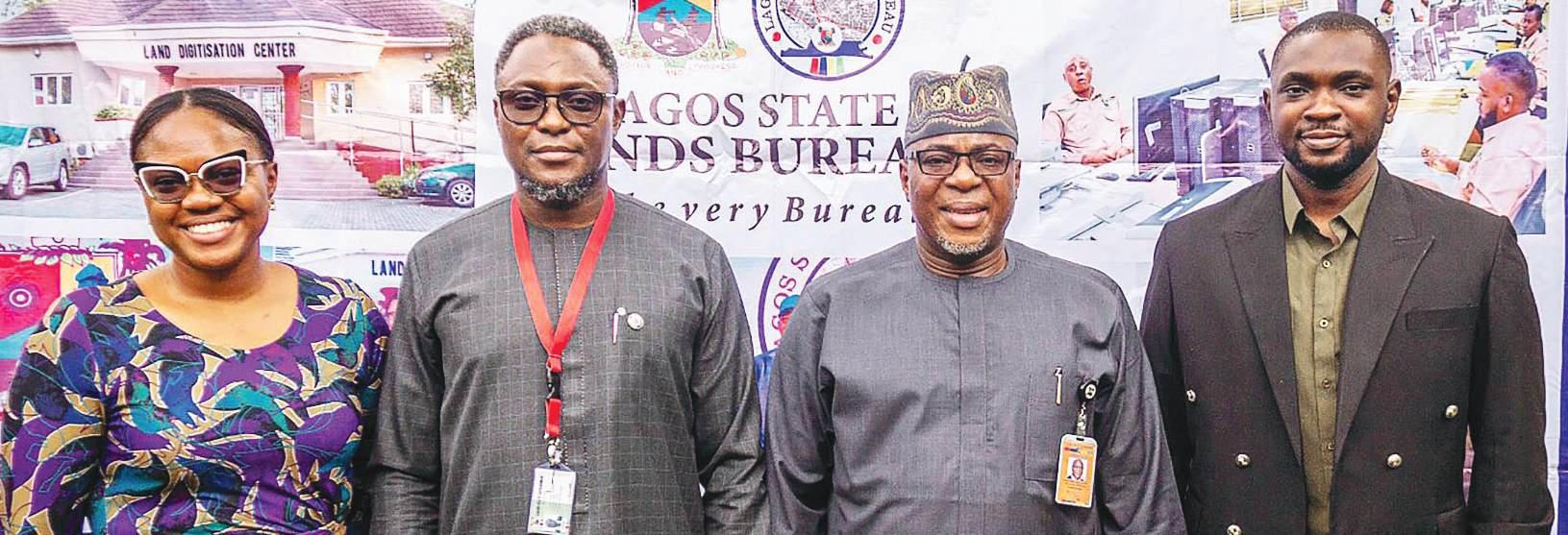
LAGOS STATE LANDS BUREAU MONTHLY REGULATORY CLINIC...
L-R: Stakeholder, Amara Ojiaka; Director, Land Regularisation Department, Lagos State Lands Bureau, Hakeem Bakare; Permanent Secretary, Lagos State Lands Bureau, Kamar Olowoshago; and stakeholder, Eriduwa Adebayo, at the Lagos State Lands Bureau Monthly Regulatory Clinic held at the Bureau’s Quadrangle, Alausa, Ikeja, yesterday
CBN Orders Freeze on Assets of Six Terror-Financing Suspects, Four BDCs
Nume Ekeghe
The Central Bank of Nigeria (CBN) has directed banks, payment service banks and other financial institutions to immediately freeze accounts, funds and assets linked to six individuals and four Bureau de Change (BDC) operators recently designated under terrorism and terrorism financing sanctions, intensifying efforts to disrupt financial networks suspected of supporting extremist groups.
The directive issued in a circular to all banks and financial institutions follows recent sanctions designations by the Nigeria Sanctions Committee (NIGSAC) and the United States Department of the Treasury’s Office of Foreign Assets Control (OFAC) under Executive Order 13224, as amended.
The move comes days after U.S. authorities designated several Nigerians and Nigeria-based foreign exchange businesses for allegedly facilitating financial transactions for the Islamic State West Africa Province (ISWAP), a terrorist organisation operating in the Lake Chad region.
The U.S. Treasury said the sanctions targeted an ISIS financing network that used money transfer channels and currency exchange businesses to move funds across multiple jurisdictions in support
of terrorist activities. In the circular signed by Olubunmi Ayodele-Oni for the Director, Compliance Department, the apex bank identified the individuals named on the Specially Designated Nationals (SDN) and Blocked Persons List are Muktar Muhammad Adamu, Babangida Muhammed Adamu Hammajam, Abdullahi Umar Usman, Ibrahim Abubakar, Adamu Chiroma and Yakubu Ogirima Ibrahim.
Also designated are four Nigeriabased Money Service Businesses and Bureau de Change operators identified as being owned or controlled by the sanctioned individuals.
They include Generation Currency Bureau de Change Limited, Manhattan Bureau de Change Limited, Nine to Nine Exchange Bureau de Change Limited and Abbal Bako & Sons Bureau de Change Limited.
It stated: “The Central Bank of Nigeria (CBN) hereby notifies all banks and other financial institutions of recent sanctions designations issued by the Nigeria Sanctions Committee (NIGSAC) and the United States Department of the Treasury, Office of Foreign Assets Control (OFAC) pursuant to Executive Order 13224 (as amended), relating to terrorism and terrorism financing.
“The Nigeria Sanctions List has been updated as at June 18, 2026.
These designations constitute binding sanctions measures requiring immediate implementation by all regulated entities. The following individuals have been designated and included on the Specially Designated Nationals (SDN) and Blocked Persons List. Muktar Muhammad Adamu, Babangida Muhammed Adamu Hammajam, Abdullahi Umar Usman, Ibrahim Abubakar, Adamu Chiroma, Yakubu Ogirima Ibrahim.
“The following Nigeria-based Money Service Businesses (MSBs)
/Bureaux de Change (BDCs), have also been designated as owned or controlled by the above individuals, Generation Currency Bureau de Change Limited, Manhattan Bureau de Change Limited, Nine to Nine Exchange Bureau de Change Limited and Abbal Bako & Sons Bureau de Change Limited.”
The regulator specifically ordered banks to “identify and immediately freeze, without prior notice, all funds, assets, and other economic resources belonging to, owned, held, or controlled (directly
or indirectly) by the designated persons and entities.”
The directive extends beyond assets directly owned by the sanctioned persons, covering entities owned 50 per cent or more, either individually or collectively, by the designated parties.
The CBN further warned financial institutions to ensure that “no funds, financial services, or economic resources are made available, directly or indirectly, to or for the benefit of the designated persons or entities.”
To ensure swift compliance, banks are required to file Suspicious Transaction Reports (STRs) immediately with the Nigerian Financial Intelligence Unit (NFIU) for any confirmed or attempted matches involving the sanctioned individuals or entities.
The apex bank also directed institutions to submit reports to it within 48 hours of the circular, detailing whether matches were identified, affected accounts, amounts frozen or restricted and actions taken.
NCDC Opposes Proposed Public Health Institute Bill, Warns Against Duplication of Functions
Juliet Akoje in Abuja
The Nigeria Centre for Disease Control and Prevention (NCDC) has strongly opposed the proposed National Institute for Public Health and Infectious Diseases (Establishment) Bill, 2025 (HB 2629), warning the creation of a new public health institution could duplicate existing responsibilities, create governance conflicts, and weaken Nigeria’s disease control and emergency response framework.
The agency stated its position on Thursday during a public hearing
FG Brings Back Another Batch of Nigerian Returnees from South Africa
The federal government has brought another batch of Nigerians from South Africa.
The returnees who were 66 in number arrived the Murtala Muhammed International Airport (MMIA), Lagos, at about 8:50 pm yesterday.
Foreign Affairs Ministry said the evacuation exercise was approved by President Bola Ahmed Tinubu, as part of government’s commitment to the safety and welfare of Nigerian citizens abroad.
The first batch of 262 returnees arrived on Thursday, June 11, 2026, via a chartered Air Peace flight.
The second batch, comprising 66 returnees, was facilitated by the Chairman/CEO of Value Jet, Otunba Kunle Soname.
The returnees were accompanied by officials from the Nigerian Embassy/ High Commission in South Africa. Upon arrival, the returnees expressed profound gratitude to President Tinubu for his swift approval and intervention and Otunba Kunle Soname for his humanitarian support.
The Nigerian Ambassador and acting High Commissioner to South Africa, Amb. Temitope Ajayi, Chairman/CEO of the Nigerians in Diaspora Commission (NiDCOM), Dr. Abike Dabiri-Erewa, and her staff
who were on ground to receive them and provide immediate support.
Speaking on behalf of the NiDCOM Chairman/CEO, Mr. Dipo Onabowale, commended President Tinubu for his citizen-centred leadership in facilitating the safe return of the returnees.
He noted that logistical challenges encountered after the first evacuation are being addressed proactively by the Minister of Foreign Affairs, Amb. Bianca Odumegwu-Ojukwu, who has assured that all registered Nigerians will be evacuated.
THISDAY learnt that the returnees, particularly those from Imo State, received N1,000,000 each courtesy of Governor Hope Uzodinma.
on the bill organized by the House of Representatives Committee on Infectious Diseases at the National Assembly in Abuja.
Presenting the NCDC’s memorandum, the Director-General of the agency, Dr. Jide Idris, said while the Centre fully supports efforts aimed at strengthening Nigeria’s health security, epidemic preparedness, disease surveillance, and outbreak response capacity, the proposed institute, as presently drafted, seeks to perform functions already assigned to the NCDC by law.
Idris reminded lawmakers that Nigeria already has a legally established and internationally recognized National Public Health Institute through the NCDC, which was created under the NCDC
Establishment Act of 2018.
According to him, the agency’s statutory responsibilities include disease surveillance, outbreak detection and response, laboratory coordination, emergency preparedness, implementation of International Health Regulations (IHR), public health research, workforce development, and the coordination of national responses to epidemics and pandemics.
He noted that the major responsibilities proposed for the new institute substantially mirror those already vested in the NCDC, warning that the bill raises serious concerns about duplication of mandates, institutional overlap, governance challenges, and longterm financial sustainability.
The NCDC boss stressed that effective management of public health emergencies requires a single, clearly recognized national authority.
Establishing another federal institution with similar responsibilities, he argued, could generate uncertainty over leadership, accountability, and operational command during disease outbreaks.
The agency further pointed out that the bill designates the proposed institute as Nigeria’s National Focal Point for the International Health Regulations and empowers it to coordinate national responses to infectious disease outbreaks assigned to the NCDC under existing legislation and recognized by the World Health Organization (WHO).
Governor Aliyu Recommits to Fighting Drug Abuse in Sokoto
Governor Ahmed Aliyu of Sokoto State has reaffirmed his administration’s commitment to combating drug abuse and illicit trafficking across the state.
The governor made this known while speaking at the 2026 United Nations International Day Against Drug Abuse and Illicit Trafficking held at the Auditorium of Sultan Maccido Institute for Qur’an and General Studies, Sokoto.
Dr. Ahmed Aliyu described drug
abuse as one of the most serious challenges confronting society, noting that it destroys families, deprives young people of their potential, contributes to criminal activities, and poses serious health and social risks.
He also expressed concern over the growing threat of illicit drug trafficking which he said fuels organized crime and undermines national and international security.
The governor emphasized that the fight against drug abuse cannot
be left to law enforcement agencies alone, stressing the need for collective action involving parents, teachers, religious and traditional leaders, civil society organizations, healthcare professionals, community leaders, and the media.
As part of efforts to tackle the menace, he disclosed that the state government has established the Office of the Senior Special Assistant on Substance Abuse Control and Prevention.
Chinedu Eze
Acting
First Lady to Nigerians: Sustain Hope in Tinubu’s Transformation Policies
Wife of the President, Senator Oluremi Tinubu has met with wives of the 36 state governors in abuja during which he canvassed for people’s support for the policies of President Bola Tinubu-led government at the centre.
The First Lady, Senator Oluremi Tinubu has risen in stout defence of the economic reforms agenda of President Bola Tinubu’s administration, saying the policies being implemented are meant to build lasting foundations that would benefit generations of Nigerians yet unborn.
Spealing at the opening of a meeting to review the second-quarter activities of the Renewed Hope Initiative (RHI) at the State House, Abuja, Mrs Tinubu said the government at the centre had focused on rebuilding and strengthening critical structures necessary for sustainable national development.
According to her, the President had undertaken difficult but necessary reforms, including the removal of fuel subsidy, to reposition the country for long-term growth.
Her words: “What we are doing in this administration is to make sure that even generations unborn would benefit. I believe there are a lot of foundations that the President has had to rebuild and rejig so that we can build lasting legacies that will transcend this administration”.
She stressed that though the reforms initially imposed hardships on citizens, Nigerians demonstrated resilience and confidence in the government’s direction.
“Take subsidy removal, for example. It was tough, very, very tough, which we all know, but the challenges were surmounted. We haven’t gotten to cruising level yet, but we are getting there”.
Mrs Tinubu also urged young Nigerians to take advantage of opportunities available through government ministries, departments and agencies, noting that many programmes and vacancies are now accessible through digital platforms.
The First Lady said youths should actively seek information on available initiatives rather than assume opportunities do not exist.
“We have to inform the youth. They say there are no jobs. Have you visited any ministry to ask what they have for the people? That is what the ministries and agencies owe the public. They can go there and ask, ‘What do you have for us? What can I key into?’”
She further noted that many government agencies are being led by young Nigerians who are contributing significantly to economic growth and innovation.
Speaking on the achievements of the Renewed Hope Initiative over the past three years, Mrs Tinubu said the programme had impacted thousands of lives across the country through interventions in agriculture, education, healthcare, social investments and economic empowerment.
She cited the distribution of disposable sanitary pads to schoolgirls, grants for smallscale businesses, support for elderly citizens and persons with disabilities, scholarships, ICT training programmes and healthcare interventions.
The First Lady added that the initiative had also committed substantial resources to tackling health challenges, including tuberculosis, breast cancer and malnutrition.
According to her: “I gave N2 billion for tuberculosis, N1 billion for breast cancer and N500 million for food and nutrition programmes. These are some of the things we have been doing to ensure that whatever this government is trying to do will see the light of day.”
She said the initiative remained committed to expanding its interventions and empowering more Nigerians, particularly women and vulnerable groups.
Mrs Tinubu also encouraged Nigerians to embrace agriculture and innovation, stressing that food production and self-reliance remain critical to national development.
She expressed optimism about Nigeria’s future, urging citizens not to lose faith in
the country despite prevailing challenges.
“We have to renew our hope. Nigerians should not give up. We are a very proud nation and we have what it takes. We are
more than enough. God bless Nigeria and God bless our children.”
The First Lady also stressed that children must not be allowed to go hungry, as she
unveiled fresh steps by the Renewed Hope Initiative (RHI) to expand National Food Banks, nutrition support and community interventions for vulnerable families across the country.
She said the initiative is designed to tackle child malnutrition from the grassroots and ensure that pregnant women and nursing mothers also get support.
Mrs Tinubu disclosed that following the Inauguration of the National Food Bank Program in Abuja on February 17, 2026 and its subsequent flag-off for the North – East geo-political zone on April 27, 2026 the next zone would be the North East and South West respectively.
She charged the wives of governors to look out continually for these vulnerable children in their various States.
“Our children are not supposed to be going hungry. No matter what, when you see a child that is malnourished in your state, you have to take them and make sure that they are properly cared for”.
She explained that the food banks being rolled out under RHI across the six geopolitical zones would be located very close to primary health care centres to make it easier for families to access nutrition support alongside medical care.
“These food banks are built next to the primary health care centres so that the ones that need supplement can get their supplements, lactating mothers and pregnant women too will be given food items from the food bank”.
NOTE: Interested readers should continue in the online edition on www.thisdaylive.com
Nigeria-Ethiopia INFF Partnership as Focus for Development Financing in Africa
african leaders and development stakeholders have emphasised the need to rethink development financing by strengthening domestic resource mobilisation and deepening cooperation through the Nigeria–Ethiopia Integrated National Financing Framework (INFF) partnership, writes Linus Aleke
Africa’s development challenge is often framed as a shortage of resources. Yet a growing consensus among policymakers and development experts suggests that the continent’s real challenge lies not in the absence of capital, but in its ability to mobilise, align and deploy available resources effectively.
This conviction shaped discussions at the Ethiopia–Nigeria Experience Exchange Visit on the Implementation of the Integrated National Financing Framework (INFF) in Abuja, where stakeholders argued that Africa must rethink how it finances development if it is to achieve sustainable growth and meet the aspirations of its people.
At the heart of the conversation was the belief that domestic resource mobilisation must become the foundation of Africa’s development strategy. Minister of Finance and Coordinating Minister of the Economy, Professor Taiwo Oyedele, stressed that Africa’s future would be determined not by the volume of resources available, but by how effectively they are utilised to advance national priorities.
According to him, “No nation can finance its development on the basis of external dependence alone.”
That statement reflects a reality confronting many African countries. Development financing gaps continue to widen as concessional funding becomes increasingly constrained, debt burdens rise and global economic uncertainties limit investment
flows. For governments seeking to fund infrastructure, healthcare, education and social protection, reliance on external support is proving increasingly unsustainable. It is against this backdrop that Nigeria and Ethiopia are embracing the Integrated National Financing Framework as a mechanism for aligning public and private finance with national development priorities.
Oyedele described the INFF as more than a policy framework. “The Integrated National Financing Framework is not bureaucratic nomenclature. It is a fundamentally different way of thinking about how nations mobilise, align and deploy financing for sustainable development. The future of development financing will not be determined solely by the resources available to us, but by how
effectively we mobilise, align and deploy those resources in support of national priorities,” he said.
Globally, the INFF has gained traction as a tool for helping countries coordinate domestic and international financing around development goals. Countries such as Indonesia have used the framework to identify financing opportunities for sustainable development and support innovative instruments, including sustainability-linked financing. The approach has helped governments better align public spending, private investment and development priorities.
For Nigeria, however, the success of the framework will depend significantly on the strength of sub-national institutions responsible for delivering public services.
This point was underscored by the Senior Special Assistant to the President on Sustainable Development Goals, Princess Adejoke Orelope-Adefulire, who argued that states remain at the forefront of development delivery.
“Across Nigeria, sub-national governments are at the forefront of delivering essential public services. They bear constitutional and primary responsibility for critical sectors such as primary healthcare, basic education, water and sanitation, agriculture, infrastructure, and local economic development,” she said.
NSHA: Celebrating Eight Years of Recognising Nigeria’s Unsung Nation Builders
In an era where visibility often attracts more attention than value, the Nigerian Silent Heroes Award (NSHA), has spent eight years championing a different narrative. As the initiative prepares to honour 60 distinguished Nigerians in Abuja on June 27, it once again shines a light on individuals whose contributions to governance, security, business, philanthropy, media and community development have helped shape the nation, often far from public acclaim. More than an awards ceremony, the programme has evolved into a celebration of integrity, sacrifice and service, recognising the men and women whose quiet efforts continue to keep the wheels of national progress turning. Chiemelie Ezeobi reports
Sixty Nigerians drawn from government, business, philanthropy, media, traditional institutions and the security sector will take centre stage in Abuja on June 27 as the Silent Heroes Award celebrates individuals whose contributions to national development have largely taken place away from public attention.
The eighth edition of the award, scheduled for the Wells Carlton Hotel, Asokoro, Abuja, will honour men and women described by organisers as those “oiling our nation’s wheel of progress” through selfless service, integrity and commitment to the common good.
Far from being a conventional awards ceremony, the initiative has built its reputation over the past eight years by recognising individuals whose work often goes unnoticed despite its impact on institutions, communities and national development.
Celebrating Service
Beyond The Spotlight
Since its inception in 2018, the Silent Heroes Award has carved a distinctive niche by deliberately focusing on people whose achievements are rarely amplified in public discourse.
Rather than rewarding visibility or celebrity status, organisers say the award seeks out Nigerians whose dedication and sacrifice continue to strengthen society without fanfare.
The process involves identifying individuals across various sectors whose contributions have produced measurable impact despite attracting little public attention.
Recipients over the years have included people who have strengthened institutions, supported vulnerable communities, driven
reforms and promoted national development without seeking recognition.
According to the organisers, the award serves as a reminder that many of the values essential to nation-building, including integrity, patriotism and sacrifice, are often demonstrated quietly.
Recognition Rooted in Values
Speaking ahead of the 2026 edition, the Project Coordinator of the initiative, Mrs Ozioma Sonia Odita-Sunday, said the award remains focused on character and service rather than popularity.
“The Silent Heroes Award is about values—decency, honesty, and a commitment to the common good. And it is a reminder that patriotism isn’t always loud. Sometimes, the biggest impact is in little things we do correctly, selflessly and consistently every day,” she said.
Her comments reflect the central philosophy of the initiative, which holds that meaningful service does not require public applause to make a lasting difference.
Leaders Across Sectors Make The 2026 List
This year's edition will recognise 46 principal honourees alongside 14 other distinguished Nigerians.
The list cuts across public service, business, philanthropy, traditional institutions, media, governance and security.
Among the technocrats selected for recognition are Managing Director and Chief Executive Officer of the Nigeria Social Insurance Trust Fund, Oluwaseun Faleye; DirectorGeneral of the Infrastructure Concession Regulatory Commission, Jobson Oseodion Ewalefoh;
and Executive Director of the Nigeria Revenue Service, Bolaji Akintola.
The business and entrepreneurial category includes Dr Aisha Achimugu, Chief Executive Officer of Felak Concept Group; Ifeanyi Matthew Ihebom, Managing Director of El & Matt Nigeria Ltd; and Dr Nwangwa Uzonna, Founder and Chief Executive Officer of Irvin Global and Investment Group.
In philanthropy, the award recognises individuals including Romanus Ajefu, Chief Executive Officer of Deroche Ventures Ltd; Chief (Dr) Folashade Shona Aluko; Hajia Saadatu Sani Musa, Founder of Future Pathways Foundation; and Dr Aderemi Oseni, Founder of the Remi Oseni Foundation.
The 2026 honourees also include Governors Dauda Lawal of Zamfara State, Umaru Mohammed Bago of Niger State and Abba Kabir Yusuf of Kano State. Traditional institutions are represented by figures such as Dr Vincent Iwobi and His Royal Majesty Oba Rilwan Olawale Aremu Yekini, the Olora of Ora in Kwara State.
In the media category, recipients include Deputy Editor of Global TV, Kikelomo Adeola Okere; Chief Operating Officer of Ayekooto Reporters, Prince Tunde Ayekooto; and Chairperson of the Nigeria Union of Journalists, FCT Council, Grace Ike.
The security sector is equally prominent, with awardees including Air Vice Marshal Mikail Abdulraheem, Chairman
of the Military Pensions Board, and Assistant Comptroller of Corps Attah John Onoja of the Nigeria Security and Civil Defence Corps Mining Marshals, alongside other senior military and security personnel.
Other notable recipients include Deputy Governor of Borno State, Dr Umar Usman Kadafur; Secretary to the Government of Yobe State, Dr Muhammed Goje; former Managing Director of the Niger Delta Power Holding Company, Chief Chiedu Ugbo; and several senior public administrators and development advocates.
Eight Years of Building a Moral Archive
Organisers say the Silent Heroes Award has continued to expand its reach without the commercial trappings associated with many high-profile ceremonies.
Its enduring appeal, they argue, lies in recognising substance over publicity and contribution over prominence.
The June 27 ceremony will also feature the unveiling of Volume 4 of the Nigeria's Silent Heroes compendium, further documenting the stories of individuals whose efforts have helped shape national progress. Eight years after its launch, the initiative has evolved into what organisers describe as a moral archive of service, preserving the stories of Nigerians whose impact is often felt more than it is seen.
As the latest recipients prepare to be honoured in Abuja, the award once again turns the spotlight on a simple but enduring message: nations are sustained not only by those who command attention, but also by those who quietly dedicate themselves to the work of building a better society.
THE DARK SIDE OF THE GREEN REVOLUTION:
Could Nigeria’s Lithium Wealth Be Fueling Violence and Illegal Exploitation?
By Gloria Fraser
As the world races for critical minerals, Nigeria must ensure that bloodshed and displacement do not become the hidden price of global prosperity.
The massacre that devastated communities in Bokkos Local Government Area of Plateau State left hundreds dead, homes reduced to ashes and entire villages displaced. As with many such tragedies, familiar explanations quickly emerged—farmer-herder clashes, reprisals and religious tensions.
Yet beneath these narratives lies a question Nigeria can no longer afford to ignore. Could competition over strategic mineral resources be aggravating insecurity in parts of the country?
The question deserves rigorous investigation—not speculation, not conspiracy theories, but a comprehensive, evidence-based national inquiry.
History offers sobering lessons. Across Africa, valuable natural resources have repeatedly become catalysts for conflict rather than development. Sierra Leone’s civil war was financed by blood diamonds. Liberia experienced a similar tragedy. In the Democratic Republic of Congo, cobalt, coltan and other strategic minerals have financed armed militias for decades, contributing to one of the world’s deadliest humanitarian crises. Millions have died or been displaced while criminal networks and foreign commercial interests exploited weak governance to seize mineral-rich territories.
Nigeria is now emerging as one of Africa’s most promising sources of lithium, tantalite, tin and other critical minerals required for electric vehicles, renewable energy storage systems, smartphones, defence technologies and advanced manufacturing. As the global transition to clean energy accelerates, the strategic value of these minerals continues to rise.
With opportunity, however, comes vulnerability.
One aspect deserving urgent international attention is the limitation of existing conflictminerals regulations. The U.S. Dodd-Frank Wall Street Reform and Consumer Protection Act, particularly Section 1502, together with European Union Regulation 2017/821 on Conflict Minerals, requires companies to con-duct due diligence and disclose whether tin, tantalum, tungsten and gold (3TG) originate from conflict zones, particularly the Democratic Republic of Congo and adjoining countries.
Nigeria, however, is not specifically designated under Section 1502 despite its growing strategic mineral deposits, although the broader EU framework extends to conflict-affected and high-risk areas. This creates a regulatory gap that deserves urgent international attention before criminal actors exploit it further.
It is important to state clearly that there is currently no publicly established evidence proving that the massacres in Bokkos or elsewhere in Nigeria were orchestrated to facilitate lithium or critical-mineral exploitation. Such allegations remain unproven and require thorough investigation by Nigeria’s security agencies and independent authorities.
However, neither should such possibilities
be dismissed outright in a country where illegal mining has become an increasingly serious national security challenge.
Recent operations by the EFCC, Mining Marshals and other security agencies have resulted in the arrest of several foreign nationals, including Chinese operators, over allegations involving illegal mining, mineral smuggling, economic sabotage and related offences. These developments demonstrate that Nigeria’s solid minerals sector has become increasingly attractive to organised criminal interests.
Communities blessed with mineral wealth should never become victims of what economists describe as the resource curse—the tragic paradox whereby abundant natural resources generate conflict, dis-placement and poverty instead of prosperity.
Nigeria must not allow its critical minerals to become tomorrow’s blood diamonds.
The Federal Government should immediately establish a National Critical Minerals Security Task Force comprising the Armed Forces, Nigeria Police Force, DSS, EFCC, Mining Marshals, NSCDC and other intelligence
agencies. Satellite surveillance, drone technology, geospatial mapping, forensic audits and community intelligence should be integrated to monitor activities around strategic mineral belts before criminal networks become entrenched.
The National Patriots also recommends the immediate adoption and full implementation of the Cargo Tracking Note (CTN) system as proposed by Eden & Frabemar for all mineral exports from Nigeria. The proposed CTN initiative would provide end-to-end traceability of mineral shipments from the point of extraction to their final destination, significantly strengthening transparency across the supply chain. Beyond improving Customs oversight and increasing government revenue, the CTN would make it substantially more difficult for illegal mining syndicates, smugglers and unscrupulous foreign operators to exploit Nigeria’s strategic mineral resources. As global demand for critical minerals continues to surge, Nigeria cannot afford to operate without a robust cargo traceability system capable of safeguarding its economic and national security interests.
Equally important, Nigeria should
immediately commence diplomatic engagements with the United States, the European Union, the OECD and other international partners to ensure that Nigeria is brought within the scope of global conflictminerals due diligence frameworks, including Section 1502 of the U.S. Dodd-Frank Act and EU Regulation 2017/821. If criminal networks or foreign interests are exploiting insecurity to gain access to Nigeria’s strategic minerals, the international community must not look away. Nigerian communities deserve the same level of protection accorded to conflict-affected mining regions elsewhere.
Consumers in America, Europe and Asia increasingly demand ethically sourced minerals. The batteries powering electric vehicles, smartphones and renewable energy technologies should never carry the hidden cost of violence, displacement or human suffering. History has already warned the world. Blood diamonds prolonged Sierra Leone’s civil war. Conflict minerals sustained decades of violence in the Democratic Republic of Congo.
Nigeria still has an opportunity to write a different story.
National Patriots’ Position
The National Patriots calls for a comprehensive investigation into any possible nexus between insecurity and illegal mining across Nigeria’s mineral-rich communities. No credible line of inquiry should be ignored without evidence, and no vested interests—local or foreign—should be allowed to profit from bloodshed. We urge the Federal Government to strengthen the Mining Marshals, EFCC, Police, DSS and other intelligence agencies, conduct forensic audits of mining activities, and champion international traceability standards. The National Patriots further urges the Federal Government to immediately pursue Nigeria’s inclusion within global conflict-minerals due diligence frameworks, particularly Section 1502 of the U.S. DoddFrank Act and EU Regulation 2017/821. As Nigeria emerges as a major source of critical minerals, its communities deserve the same international protections afforded to other conflict-affected mining regions. If investigations establish that criminal networks or foreign interests are exploiting insecurity to gain access to strategic mineral deposits, such frameworks would strengthen transparency, improve supply-chain accountability and discourage illicit exploitation. Nigeria’s critical minerals must drive industrialisation and shared prosperity—not become incentives for violence, displacement or economic sabotage. The Federal Government should treat this as an urgent national security and strategic eco-nomic priority.
Natural resources are meant to build nations, not bury communities. If insecurity is being exploited anywhere as a pathway to mineral extraction, then Nigeria may be con-fronting not merely banditry or communal violence, but the emergence of a new form of economic war-fare hidden beneath the soil. The appropriate response is not assumption, but a thorough, independent and evidence-driven investigation that protects both Nigeria’s people and its strategic national assets.
•Dr. Gloria Fraser. MFR The National Patriots.
Dr. Dale Alake, Minister of Solid Minerals Development
Sunday ehigiator
Nigeria’s fast-moving consumer goods (FMCG) sector has been valued at $25 billion, making it one of Africa’s largest consumer markets and positioned for significant growth driven by technology, digital finance and improved distribution systems.
This was disclosed in the 2026 FMCG Industry Report titled, ‘Decoding the Nigerian FMCG Sector,’ released by
Omni, which examined the opportunities, challenges and future outlook of the country’s consumer goods ecosystem.
According to the report, Nigeria remains the secondlargest FMCG market in Africa behind South Africa, which is valued at $27.5 billion, while Egypt, Morocco and Kenya trail behind.
expanding workforce and increasing internet penetration continue to fuel strong consumer demand across the country.
chinedu eze
Concessionaires at the Terminal 1 of the Murtala Muhammed International Airport (MMIA), Lagos, have decried the lack of effort by the Federal Airports Authority of Nigeria (FAAN) to compensate them for the huge loses they incurred during a fire incident, which destroyed the facility on February 22, 2026.
The concessionaires
a small fraction have access to formal lending facilities. The report highlighted the growing role of embedded finance, digital payments, data analytics and artificial intelligence in addressing these challenges, noting that technology is increasingly becoming the connective infrastructure linking manufacturers, distributors, retailers and consumers. RATES AS AT J UNE 25,2026
The report noted that Nigeria’s growing population, estimated at over 230 million people, rapid urbanisation,
“Nigeria’s fast-moving consumer goods sector remains one of the world’s most promising, and most complex, growth frontiers,” the report stated, adding that the country remains “the beating heart of consumer demand in West Africa.”
The report observed that
while demand for consumer goods remains resilient and continues to expand, major inefficiencies within the supply chain are preventing the sector from reaching its full potential.
It identified poor infrastructure, limited visibility across distribution networks, high operating costs and fragmented supply chains as key challenges confronting manufacturers, distributors and retailers.
“Demand is abundant, but
access is broken. The real opportunity lies in closing this gap,” the report said.
According to the report, retailers frequently struggle with stock-outs and working capital shortages, while manufacturers face distribution bottlenecks that slow product movement and increase costs.
It further revealed that 56 per cent of retailers face active working capital gaps that directly affect their ability to restock inventory, while only
informed THISDAY that because of their inability to get any place to operate, about 5000 Nigerians who work at about 200 concession businesses are now disengaged.
It was learnt that fire engulfed the terminal two days before the deadline given to the concessionaires to relocate from the building.
But FAAN had not provided alternative place for
almost 200 concessionaires with subsisting concessions.
It was also learnt that the fire, which started at about 2:00 pm on February 22 and was supposedly put off by 4:00 pm, continued to burn until in the early morning of the following day, damaging items from the 6th floor to the basement.
As a result, many of the concessionaires incurred incalculable losses; yet, out of about 200 concessionaires
that operate at the terminal, only 25 were accommodated in the new terminal, known as Terminal 2.
“No plan was made for majority of the concessionaires who had already lost so much in the fire and even after the fire, the terminal was vandalised by thieves who disguised as labourers working for the Chinese company rebuilding the terminal,” said a concessionaire who
do not want his name in print for fear of persecution.
It was learnt that although FAAN security operatives arrested 14 in April following a swift and intelligence-driven response by FAAN’s security architecture, working in close coordination with the Joint Military Task Force (JMTF) and other security agencies deployed at the airport, vandalisation of items continued.
FAAN had reported that the theft was foiled through the vigilance, surveillance, and rapid intervention of FAAN security operatives and their partners and that the individuals were intercepted with vandalised materials, including copper wires and iron components, which had been illicitly removed from the construction site.
FAAN Gives Deadline for Vehicle Standards, Tariff for Airport Taxis
Chinedu Eze
The Federal Airports Authority of Nigeria (FAAN) has given October 2026 deadline for taxis operating at the Lagos and Abuja airports to abide by its directives of complying with the standard of vehicles allowed and the increase of tariff from N500 to N1, 500.
A statement from FAAN’s management explained that as an organization committed to delivering safe, secure,
efficient, and world-class airport services, FAAN considers it necessary to provide clarification on the issues raised and to reassure the travelling public that every action being taken is aimed at enhancing passenger experience and maintaining acceptable service standards at our airports.
“Airports are the gateways to any nation and often provide the first and last impression of a country’s
image. Consequently, FAAN has a responsibility not only to ensure safety and security but also to uphold service quality across all touch-points that passengers encounter, including airport transportation services.
So, “the directive requiring airport cab operators to upgrade to newer vehicle models is informed by the need to improve reliability, comfort, safety, and overall passenger satisfaction.”
Firm Drives National Payment Innovation at Digital Pay Expo
Nigeria’s sovereign domestic card scheme showcases Cowry terminal payment cards, virtual cards, tokenisation engine, loyalty platform, and a landmark initiative with Bank of Agriculture at the country’s premier digital payments gathering.
AfriGO, Nigeria’s sovereign domestic card scheme, made a strong presence at the Digital Pay Expo 2026, held in Lagos.
In a keynote session, Executive Director and Chief Commercial Officer (ED/CCO) of AfriGO, Mr. Ugo Obasi, delivered a compelling address titled, “The AfriGO Journey: Driving Financial Inclusion Through Innovative Payment Solutions.”
“AfriGO’s story is one of conviction, resilience, and a deep belief in Nigeria’s capacity to own and drive its payment future. Every
Air
WAtCh
AON: Regulations Must be Reviewed to Accommodate Inevitable Changes in Aviation
product we are unveiling here is a direct response to the needs of Nigerians from the farmer in Benue to the student in Kano to the entrepreneur in Lagos. We are building infrastructure that works for everyone, powered by technology that is ours. The partnerships, the innovations, the platform we are building, this is what it means to put Nigeria first in payments,” Ugo Obasi.
Institute Inducts 66 New Members to Revalidate Certificates
Chinedu Eze
The national president of Institute of Safety Professionals of Nigeria (ISPON), Chief Stephen Udezi, has inducted 66 members at the body’s Lagos branch to reinforce efforts to inculcate safety culture in Nigeria’s corporate business community.
Udezi during the induction has admonished
newly inducted members of the profession to be good ambassadors of the institute, noting that the revalidation of members certificates will commence soon to checkmate quacks in the system.
Udezi also warned, that anyone not qualified to practice safety when caught will be adequately visited with the punishment prescribed by law.
He said the institute only needs the best in learning as certificates are awarded in character in learning and commended the zeal shown by the inductees.
In his message to the inductees, the Lagos branch chairman of ISPON, Mr Shola Ogunleye, urged them to prove themselves noting that ISPON Lagos was a work in progress with a long journey ahead of them.
NAHCO Extends Relationship with Qatar, Saudia, Asky
The Nigerian Aviation Handling Company Plc (nahco aviance), has announced further
consolidation of its dominance in the ground handling segment of Aviation industry with the extension of its contract with Qatar Airways, Saudia Airlines and ASKY.
The company also signed a fresh contract with new entrant into Nigerian market, FlyGabon.
Group Business Editor
Eromosele Abiodun
Deputy Business Editor
chinedu Eze
Comms/e-Business Editor
Emma Okonji
Asst. Editor, Energy
Emmanuel Addeh
Asst. Editor, Money Market
Nume Ekeghe
Correspondents
Kayodetokede(CapitalMarkets)
James Emejo (Finance)
Ebere Nwoji (Insurance)
reporter Peter Uzoho (Energy)
This is as the company announced the commencement of solar cells export to the United States of America.
NAHCO in a statement during the week disclosed that BGE (Nigeria) Solar FZE commenced the export of solar cells from Lagos to the United States in January 2026 using NAHCO facilities.
The Group Executive Director, Commercial and Business Development, NAHCO Plc, Prince Saheed
Lasisi, expressed great pride in the company’s ability to secure long-term trust from such a diverse group of operators. He stated that these contracts prove that NAHCO remains heads and shoulders above any other service provider in the industry.
Speaking on the development, the Group Managing Director/CEO of the Company, Mr. Olumuyiwa Olumekun, emphasized that the company’s focus on value addition to its clients and shareholders. Olumekun noted that the continuous deployment of new technology by the company ensures that NAHCO’s service delivery will only get better, providing the high-efficiency handling required for the precision operations of airlines.
Chinedu Eze
There have been strident calls for the review of the Nigeria Civil Aviation Regulations (Nig. CARs). The regulation provides statutory and operational framework for civil aviation in Nigeria, which is enforced by the Nigeria Civil Aviation Authority (NCAA).
The regulation in addition to many functions standardizes safety, personnel and equipment certification, airspace and aerodrome oversight, economic regulation and enforcement.
The major force behind the review of the Nigeria Civil Aviation Regulation are domestic airlines under the umbrella of Airline Operators of Nigeria (AON). The operators said that there is strong argument to review the civil aviation framework to redefine issues concerning high operation costs, safety and technology dynamics, legislative alignment.
This push may not be unconnected to the outcome of the Middle East crisis, which led to the high cost of aviation fuel, thus forcing airlines to borrow money to fund their operations, as revenues generated from flight tickets and cargo could not fund the cost of operation. In the crisis, the operators failed to pay their 5% ticket sales charge (TSC) and cargo sales charge (CSC), which they pay to NCAA, which shares it with for other aviation agencies.
The operators are also pushing for the end of the remittances by aviation agencies to the federal government statutory account. Since 2020, the federal government insisted that the aviation agencies must pay a percentage of their earnings to the Single Treasury Account of the federal government.
About six years ago, a directive from the Office of the Accountant-General of the Federation, precisely in April 2020, required parastatals like the Federal Airports Authority of Nigeria (FAAN), the Nigeria Civil Aviation authority and the Nigerian Airspace Management Agency (NAMA) to remit 25% of their inflows into the federation account, a policy that escalated to 50% deductions under the Treasury Single Account (TSA). The percentage was later reviewed downwards but the remittances are collected from source by government.
The airlines said that the revenues generated in the industry should be used
to develop the sector. This is in tandem with International Civil Aviation Organisation (ICAO) recommended practice. ICAO stipulates that revenues generated from the aviation industry should be ploughed back to the sector to further develop it. And there is so much to do with money but the money is not there.
Many of these issues were encapsulated in the exclusive interview the Chairman and CEO of Air Peace, Dr Allen Onyema, granted Arise TV on Tuesday. Onyema said that it is very expensive running airline business in Nigeria and that is why the country records very high airline casualties.
“Some will start operation but within 10 years they will go under. This is why the International Air Transport Association (IATA) stated that it is very expensive to operate airline business in Nigeria. In order to generate money for the federal government, airlines are made to pay very high charges and IATA warns that such high charges and taxes impede the growth of air transport in Nigeria.
“That comment (from IATA) was not complimentary, but we welcome it because over the years, airlines in Nigeria have been crying to governments for its support. Aviation is a catalyst of national strategic importance. There is no UAE without Etihad and Emirates. They might not be making money for themselves, but they are doing other things that are engineering the ecosystem to make money for the country. That is what they are doing.
“They supported the airlines during COVID-19, America doled out billions of dollars to their airlines. Maybe the least got about $5 billion just to help them to recover. The entire 34 airlines in Nigeria we were given N4 billion. That was less than $2 million, all the airlines in Nigeria. Some airlines got 8 million naira only. Tell me what you’re going to do with that. Over 70 airlines have come and gone in this country. Nigeria has the highest mortality rate of airlines worldwide,” he said.
Onyema called for the review of the charges as contained in the Nigeria Civil Aviation Regulations, saying that if those charges are not reviewed, “airlines will continue to crumble in this country.”
Babajide Sanwo-olu and the Business of Building Lagos
a t 61, and with one year left in office, Babajide Sanwo-Olu is still selling Lagos the only way he knows how: calmly, deliberately and with one eye on the future. Konye Chelsea Nwabogor writes
Governors are often remembered for the moments that define their tenure. Sometimes those moments are crises. Sometimes they are projects. Sometimes they are the ideas they leave behind.
In Governor Babajide Sanwo-Olu’s case, the story has been shaped by all three. His years in office have unfolded against some of the most significant events in Lagos’ recent history, from a global pandemic and the EndSARS protests to an ambitious push to expand infrastructure, strengthen public services and position Lagos for its next phase of growth. With one year left in office and his 61st birthday offering a natural moment for reflection, the record is now substantial enough to be assessed on its own terms.
No assessment of seven years in office is complete without considering the man at the centre of it.
Projects, policies and performance indicators tell only part of the story. Over the years Sanwo-Olu himself has become the most familiar figure in the Lagos landscape.
His round glasses are instantly identifiable. So too are the blue suits and agbadas that have become something of a signature over the years.
Together, they have become part of a public image that many Lagosians associate with his years in office.
But image alone does not explain his place in the state’s history. Sanwo-Olu is, above all, a people person. He works a room. He remembers names. He can deliver a policy speech to bankers in the morning and trade easy Yoruba banter at a market in the afternoon without changing gears. There is an ease to the way he moves through different audiences that has become one of his most recognisable political strengths. That quality is perhaps unsurprising when viewed against the path that brought him to the governor’s office.
Long before he became governor, Sanwo-Olu built a career that spanned both the private and public sectors. His years in banking were followed by appointments covering economic planning, commerce and industry, establishments and pensions within the Lagos State Government. He would later serve as Managing Director of the Lagos State Development and Property Corporation, adding urban development to a portfolio that already offered a broad understanding of how Lagos functions. By the time he was elected governor in 2019, he was not approaching Lagos as an outsider. He had spent years inside the system, observing its strengths, frustrations and possibilities. That familiarity would shape both his governing style and the framework he introduced upon taking office.
Known as T.H.E.M.E.S, and later expanded into T.H.E.M.E.S Plus, the agenda served as the blueprint for his administration’s priorities, covering transportation, health, education, economic growth, security, governance and social inclusion. More importantly, it provided a structure through which the administration sought to connect individual projects to a broader vision for Lagos.
Seven years later, those projects form the strongest argument for his record.
The clearest example can be found in transportation.
For decades, rail transport in Lagos existed largely as a promise. Under Sanwo-Olu, that promise became reality. The Blue Line transformed a long-standing ambition into a functioning rail service, while the Red Line reinforced the state’s commitment to mass transit and reduced dependence on roads alone.
The rail projects have understandably attracted the most attention, but they represent only one part of a broader infrastructure story.
Roads have been rebuilt, bridges have improved connectivity, housing projects have continued across the state and urban renewal efforts have sought to improve both functionality and aesthetics in a city that continues to grow at a remarkable pace.
Education has been another major focus. The reconstruction of the Tolu Schools Complex in Ajegunle stands as one of the administration’s most ambitious investments in public education. Equipped with modern classrooms, laboratories and sports facilities, it represents a significant effort to improve educational opportunities in one of Lagos’ most densely populated communities.
The same commitment can be seen across healthcare, technology, youth development and public services. Together, they reflect an administration that has attempted to build across multiple sectors simultaneously.
Looking back, two events continue to stand apart from every other chapter of Sanwo-Olu’s administration: COVID-19 and EndSARS.
When COVID-19 reached Nigeria in
concrete, steel and kilometres of road.
According to the 2025 Dealroom Global Tech Ecosystem Index, Lagos emerged as the world’s fastest-growing tech ecosystem, outperforming cities such as Istanbul, Mumbai and São Paulo. The state was also ranked Nigeria’s best-performing state in the 2025 Phillips Consulting State Performance Index, becoming the only state to achieve a five-star rating.
Young people have also featured prominently in his vision. Through investments in technology, digital skills, innovation and entrepreneurship, the administration has sought to prepare a new generation for an economy increasingly shaped by knowledge, creativity and enterprise.
Beyond business and technology, Sanwo-Olu has also placed greater emphasis on one of Lagos’ most valuable assets: its cultural influence.
Lagos is not only Nigeria’s commercial capital; it is also its cultural engine. Music, fashion, film, theatre, hospitality and entertainment have become central to the city’s identity and global appeal. Under his administration, the creative economy has received greater recognition as a contributor to growth, employment and tourism rather than merely a source of entertainment.
2020, Lagos immediately found itself at the centre of the country’s response.
As the nation’s commercial capital and busiest gateway, the state carried enormous responsibility during a period of uncertainty and anxiety.
As Incident Commander, SanwoOlu became the public face of Lagos’ response. Through regular briefings and coordinated interventions, his administration guided the state through one of the most challenging periods in its recent history. The pandemic tested governments around the world, but many Lagosians would agree that Sanwo-Olu handled the crisis with a steady hand, helping to maintain public confidence during a period when fear and uncertainty were widespread.
If COVID tested governance, EndSARS tested leadership.
The protests and their aftermath remain among the most painful chapters in Lagos’ recent history.
The memory continues to sit between government and a generation that once saw protest as hope before it became trauma. Whatever conclusions people draw from that period, it remains an unavoidable part of the Sanwo-Olu story and one of the greatest tests of his years in office.
Those episodes remain central to understanding his administration. They challenged institutions, tested public trust and shaped how many Lagosians remember those early years in office.
But they are only part of the story.
The other part lies in the Lagos that continued to evolve during that period: a city seeking to strengthen its economy, nurture its creative industries, expand opportunities for young people and position itself for a more competitive future.
Some of the clearest signs of that progress can be found beyond
Taken together, these efforts point to a governor increasingly focused on positioning Lagos for its next phase of growth.
That thinking was evident at Invest Lagos 3.0, where Sanwo-Olu stood before investors, business leaders, development finance institutions and government representatives to make the case for Lagos as Africa’s business gateway. The message was straightforward: Lagos is open for business.
Of course Lagos still remains a work in progress. Housing continues to present challenges. Flooding remains a concern in many communities. Transportation requires deeper integration. Public services must continue evolving to keep pace with a growing population.
That is the reality of governing one of Africa’s largest and fastest-growing cities. Every administration inherits unfinished work and leaves some behind for those who follow.
At 61, Sanwo-Olu stands at an interesting point in his public life. He is young enough to have a future beyond Alausa and experienced enough to know that legacy is rarely as tidy as politicians would like.
He will leave with applause from many, criticism from others and unresolved questions that will continue to follow the city he governed. That is the nature of Lagos. It gives praise with one hand and holds a complaint in the other.
Still, there is no denying that he has shaped the city in important ways. He has made Lagos feel more connected, more deliberately planned and more conscious of itself as a city with a future to engineer. He has carried the pressure of governing Nigeria’s loudest state with a temperament that often softened the edges of power. He has shown that amiability need not be weakness, and that calm, in a city addicted to noise, can be its own form of authority.
Many shades of Governor Babajide Sanwo-Olu
Dr. Seyefar Clement: Behind Every Struggling Hustle is a Missing p iece
The thank-you photo is posted.The grant money comes in. and six months later, the shop is closed. It’s a cycle, dr. Seyefar Clement says he has seen too often. as an SME finance expert and principal lecturer at the University of Bedfordshire, he argues the issue isn’t always a lack of capital. In Nigeria, SMEs account for 96% of businesses and employ millions of people. yet many struggle because support is often viewed as free money rather than capital meant to grow, be repaid, and fund the next entrepreneur. To dr. Clement, the analogy is simple: if a water bottle is never refilled, everyone eventually goes thirsty. In this interview with MArY nnAH, ahead of World SME day, celebrated annually on June 27, dr. Clement shares a decade of hard lessons from advising SMEs across Nigeria and the UK. He points to mindset as the missing piece. He notes that without financial literacy, accountability, and support targeted at real community needs, even the most promising hustles break. For him, turning Nigeria’s everyday entrepreneurs into lasting businesses will take more than cheques. It will take a shift in how growth is approached.
How would you simply explain what an SME is, and why it matters to an economy?
SMEs, which stand for Small and Medium-sized Enterprises, are businesses that are larger than micro-enterprises but smaller than large corporations. They can be found in virtually every sector of the economy, including retail, agriculture, manufacturing, technology, logistics, and professional services.
SMEs are the backbone of any economy because they create jobs, stimulate innovation, support local communities, and contribute significantly to economic growth. In Nigeria, their importance is even more pronounced. According to recent estimates, MSMEs account for approximately 96% of businesses in the country and remain a critical driver of employment and economic activity.
Their success has a direct impact on the well-being of millions of Nigerians. When SMEs grow, they create more jobs, generate income, increase tax revenues, and contribute to poverty reduction. Conversely, when they struggle, the effects are felt across households, communities, and the wider economy. This is why supporting SMEs through targeted initiatives, improved access to funding, and better financial literacy is essential for Nigeria’s long-term economic development.
What are the key challenges you think SMEs in Nigeria are facing today, and why?
Several challenges certainly exist for SMEs in Nigeria. It is important to identify them because Nigerians are naturally entrepreneurial and have the capacity to drive significant economic growth if some of these barriers can be addressed.
One of the biggest challenges is access to finance. Despite the critical role SMEs play in the economy, many still struggle to access affordable funding. This is due to several factors. First, there is limited financial literacy. Some SME owners lack the knowledge required to secure funding, manage it effectively, and deploy it in ways that support sustainable business growth.
There is also the issue of limited funding and support reaching SMEs at the scale required. While the government has established agencies and programmes to support small businesses, funding constraints and implementation challenges often limit their impact. In addition, Nigeria’s credit information infrastructure for small businesses remains relatively underdeveloped. Unlike large corporations, many SMEs do not have readily available financial records or established credit histories, making it difficult for lenders to assess their creditworthiness and extend credit with confidence.
Another challenge is the politicisation of some SME support programmes. In some cases, funding is influenced by political considerations rather than business viability. This can create a situation where beneficiaries view the funds as a gift rather than capital intended to support enterprise development and economic growth.
That said, it is not always the government’s fault. The sustainability of SME financing programmes also depends on the repayment behaviour and performance of the businesses that receive support. A useful way to think
about this is to imagine a refillable water dispenser. To continue drawing water, the bottle must be replaced when it is empty. In the same way, when SME loans are repaid, those funds can be recycled to support new businesses. However, when repayment rates are poor or businesses fail, the pool of available capital shrinks, limiting the ability of government and financial institutions to support future entrepreneurs.
Beyond finance, SMEs also face challenges relating to inadequate infrastructure, rising operating costs, inflation, and economic uncertainty. Addressing these issues is critical because MSMEs account for approximately 96% of businesses in Nigeria and remain a major driver of employment and economic growth.
We have seen several privatesector initiatives in Nigeria, such as the Tony Elumelu Foundation and similar programmes, providing grants and support to entrepreneurs. What do you make of the impact of these private-sector-driven interventions?
These avenues are definitely helpful. They serve as additional sources of capital for new and existing SMEs. Several individuals and organisations are making similar contributions. For example, the Kestin Pondi Foundation reportedly commits significant resources each year to support SMEs and entrepreneurs.
These platforms demonstrate how individuals and private institutions can help bridge the funding gap facing small businesses. Importantly, they do not simply provide money; they also invest time and resources in assessing applicants and evaluating the viability of their business ideas. This helps ensure that support is directed towards individuals who are genuinely committed to building sustainable businesses.
However, one of the limitations of some of these interventions is that the support is not always end-to-end. Unlike programmes such as the Tony Elumelu Foundation, which combine funding with training, mentoring, networking, and ongoing support, many initiatives focus primarily on disbursing capital. To improve the chances of success, grant providers should consider offering more structured mentorship, business development support, and post-funding monitoring. Access to capital is important, but entrepreneurs are far more likely to succeed when funding is complemented by guidance, accountability, and continuous support.
In the past year, we have seen the institutionalization of regional development commissions by the Federal Government. Do you think these agencies are positioned to support and stimulate SME growth in ways the country hasn’t been able to do so far?
From what I have gathered about these commissions so far, I believe they have the mandate to support SMEs and are well-positioned to do so. In fact, the South East Development Commission (SEDC) has already launched initiatives aimed at
supporting startups and entrepreneurship, while its counterpart in the South West has announced plans and investments geared towards driving regional development, including improvements to transportation infrastructure. The South South Development Commission, on the other hand, is still in its early stages following its inauguration and has yet to fully commence operations. However, I am hopeful that it will become fully functional soon and play a significant role in supporting SMEs and driving economic development across the South South region. I mention these examples because SME growth should be viewed as more than simply injecting capital into businesses. Access to finance is important, but it is only one part of the equation. SMEs also need reliable infrastructure, efficient transportation networks, access to markets, stable power supply, and a business environment that enables growth. Support for SMEs should therefore encompass all the factors that contribute to enterprise development, and the regional development commissions have the potential to complement government efforts in this regard.
That said, these commissions must also invest in reorienting mindsets, particularly among beneficiaries of SME funding programmes. There needs to be a shift in how such support is perceived. In some cases, grants or funding are viewed as “free money” or as a reward for the effort involved in applying, rather than as capital intended to build sustainable businesses and create economic value.
The second challenge is ensuring that these programmes are not used as a vehicle for political patronage. Funding should be allocated based on merit, viability, and potential impact, rather than political affiliation or support. Capital provided to individuals who see it as free money is unlikely to generate the desired economic outcomes. More importantly, it diverts scarce resources away from entrepreneurs who could have used that support to build successful businesses, create jobs, and contribute meaningfully to economic growth.
Ultimately, the success of these commissions will depend not only on the amount of funding they provide but also on the quality of their governance, the transparency of their programmes, and their ability to create an environment in which businesses can thrive and grow sustainably.
Given the challenges facing SMEs, what do you consider to be the key catalysts for stimulating SME growth in Nigeria today?
I will mention three key elements. First, government support and catalytic funding are critical. As I mentioned earlier, we have agencies that have been established to provide the technical and financial support SMEs need to grow, but many of them are not adequately funded. If we are serious about stimulating SME growth, these institutions must be properly resourced and empowered to fulfil their mandates.
Dr. Seyefar Clement
FCMB Turns Everyday Banking into Rewards with New Mobile App
Nume Ekeghe
First City Monument Bank (FCMB) has introduced a set of new features on its mobile app, led by a reward points system that turns everyday transactions into tangible benefits for customers.
With this update, FCMB shifts the focus from routine banking to value creation, giving customers a stronger reason to engage, transact, and stay within its digital ecosystem.
“In line with its financial inclusion drive, FCMB has simplified account upgrades from Tier 1 to Tier 2, allowing customers to access enhanced banking services without visiting a branch. Additionally, the introduction of instant virtual card request and activation ensures customers can immediately create and use secure digital cards for online transactions.”
The Divisional Head, Personal Banking, Adetunji Lamidi, emphasised the
Speaking on the update, Divisional Head, Payments and Solutions, Oladipo Alabede said: “At FCMB, we are constantly innovating to meet the evolving needs of our customers. These features are designed to provide convenience, reward loyalty, and empower our customers to do more with their finances, right from their mobile devices.
Bank’s digital transformation journey: “These upgrades reflect our technologydriven strategy to build a smarter, more intuitive banking platform. By integrating intelligent support systems like Temi and enabling instant services such as virtual card activation, we are redefining convenience and accessibility in banking.”
The comprehensive upgrade, he said, reflects FCMB’s ongoing commitment to innovation, customer focus, and digital excellence, positioning the mobile app as a one-stop platform for seamless, rewarding, and future-ready banking.
Firm Unveils Africa’s One-stop Platform for Payments, Business Services
Dasamonie, a Nigerian and U.S.-registered fintech company, has officially launched its next-generation financial super app designed to unify personal and business banking, digital payments, business registration, and financial infrastructure within a single platform.
The company said the app would provide instant access to Naira, US Dollar, Euro and British Pound accounts, international transfers, Visa card services, merchant payment solutions,
lending, savings, expense management, and developer APIs.
Through its integration with the Corporate Affairs Commission (CAC), entrepreneurs can also check business name availability, register companies, and receive CAC certificates within 24 hours, while automatically activating business banking services.
Speaking about the platform, Co-founder of Dasamonie, Terry Edet, said: “We aren’t just building another digital wallet; we are building
the operational operating system for the modern African enterprise and consumer. By merging certified local compliance infrastructure like rapid company registration and biometric services with borderless multicurrency banking and Virtual POS systems, we are removing the friction that holds back economic velocity on the continent. Our goal is to empower an entrepreneur to move from ideation to global commerce seamlessly on a single platform.”
‘Mathesis Analytics Making Personal Equity Practical Reality’
Founder and Chief Executive Officer, Mathesis Analytics, Mr. Winston Osuchukwu has explained how the company has built the infrastructure to make personal equity a practical reality. According to him the platform integrates directly with the core banking systems of financial institutions, enabling the automatic, continuous updating of an individual’s profile
and score as new data is generated.
“Critically, our architecture is not limited to a single institution: we aggregate behavioural signals across multiple relationships and enrich them with alternative data—telco usage, utility payments, and other indicators of financial character outside the formal banking system. This matters in a market
where a substantial share of the economically active population remains underbanked or thin-file.
To date, Mathesis has scored over 40 million individuals and enabled more than $272 million in credit disbursements across Nigeria.”
According to him, the case for Personal Equity is not merely one of borrower fairness; it is equally an argument for market efficiency.
Stakeholders to Chart Growth Strategies at ESG Summit
ESG Impact Consulting Ltd, a leading sustainability and impact advisory firm, has announced the 2026 Edition of the Nigeria ESG Sustainability Summit scheduled to hold in Lagos.
Themed: ‘Beyond Greening: Strategies for Sustainable World’, the summit reflects ESG Impact Consulting’s commitment to advancing responsible business practices and building a more
inclusive, resilient economy. It aims to move conversations beyond symbolic environmental actions toward full integration of Environmental, Social, and Governance principles across public and private institutions.
As Nigeria faces climate, economic, and governance challenges, the summit will provide a platform for dialogue, collaboration, and knowledge sharing through keynote
sessions, executive discussions, and networking focused on ESG adoption and sustainable development across key sectors.
CEO, ESG Impact Consulting, Desmond Esorougwue, said: “A major highlight is the Nigeria ESG Exhibition and Promotion 2026, showcasing companies, startups, and government institutions driving sustainable solutions.”
Saharan Blend (Algeria), Djeno (Congo), Zafiro (Equatorial Guinea), Rabi Light (Gabon), Iran Heavy (Islamic Republic of Iran), Basrah Medium (Iraq), Kuwait Export (Kuwait), Es Sider (Libya), Bonny Light (Nigeria), Arab Light (Saudi Arabia), Murban (UAE) and Merey (Venezuela).
L-R: MD Sterling Specialist Hospital, Dr Kennedy Nyengidiki; Regional Business Development Manager (Anglophone West Africa), WomenCare Global, Paul Eden; Deputy Vice Chancellor University of Port Harcourt, Prof Rosemary Ogu; Director, Business Development DKT International Nigeria, Titilayo Ajayi; Sales Director, DKT International Nigeria, Kola Oluwabiyi and Head of Unit, Family Planning, University of Port Harcourt Teaching Hospital, Prof Cosmas Eyindah during the Official Launch of Avibela Hormonal IUD in Port Harcourt…recently
Stock Market Down N959bn on Profit–taking in Aradel Holdings, Others
Kayode Tokede
The Nigerian stock market extended its downward trend as investors’ profit–taking in Aradel Holdings Plc and 33 others pulled the market capitalization lower by N959 billion.
As the stock price of Aradel Holdings fell by 10 per cent, the Nigerian Exchange Limited
All-Share Index (NGXX ASI) lost 1,493.71 basis points, or 0.64 per cent to close at 233,580.83 basis points from 235,074.54 basis points it opened for trading.
Also, market capitalisation declined by N959 billion to close at N149.89 trillion as against N150.85 trillion it closed the previous day.
The market breadth was broadly negative, as 34
decliners comfortably outpaced 14 advancers. Red Start Express emerged the highest price gainer of 9.60 per cent to close at N24.55, per share.
Legend Internet followed with a gain of 9.09 per cent to close at N6.00, while Neimeth International Pharmaceuticals rose by 7.10 per cent to close at N8.30, per share.
Abbey Mortgage Bank increased by 5.45 per cent
to close at N8.70, while Ellah Lakes up by 4.65 per cent to close at N9.00, per share.
On the other side, Deap Capital Management & Trust and Aradel Holdings led the losers’ chart with 10 per cent each to close at N4.05 and N1,575.00 respectively, while Trans-Nationwide Express followed with a decline of 9.90 per cent to close at N3.64, per share.
Regency Alliance Insurance depreciated by 9.57 per cent to close at 85 kobo, while C & I Leasing down by 9.48 per cent to close at N5.25, per share.
Also, the total volume of trades decreased by 19.35 per cent to 393.649 million units, valued at N19.212 billion, and exchanged in 45,813 deals. Transactions in the shares of Access Holdings led the activity with 39.053 million shares
PRICES FOR SECURITIES TRADED AS OF JUNE 25/26
Alfred
…truth behind the headlines, conspiracies, cover-ups, trials and triumphs
The Year of Abdul Samad Rabiu: When the Market Stopped to Count His Camels with Lanre
There is a saying among the old traders of Kano that when a man’s fortunes rise too quickly, the market pauses to count his camels. This has been the year of counting Abdul Samad Rabiu’s camels. Yes, 2026!
Everywhere one turns, his name seems to appear: on the lips of bankers in Victoria Island, in hushed conversations at Abuja dinner tables, in the murmurs of boardrooms, and in the deliciously curious chatter of society circles forever fascinated by the movements of the very rich.
“Did you hear?” “Did you see?” “Can you imagine?” The stories arrive one after another, like heavy coins falling into a brass bowl. About N189 billion in dividends from BUA Cement. A gleaming new Bombardier Global 8000—the aircraft aviation enthusiasts describe as the Rolls-Royce of private jets.
Another leap up the global rich list. And then that delightful headline that drifted through the social circuits of Abuja and Lagos like expensive perfume: Abdul Samad Rabiu is now Africa’s second-richest man.
If money had a social season, this would be his. I have spent much of this year listening to conversations about Rabiu. They occur in curious places: airport lounges, dinner tables where the wine is expensive and the gossip free, and those corners of Abuja where every third person claims to know someone who knows someone in the billionaire’s inner circle.
“Did you hear about the jet?” “How much did he make again?” “Second-richest in Africa? Just imagine.” The fascination says as much about us as it does about him. Nigerians love a spectacle. We adore successful men, particularly those wrapped in a measure of mystery. We have a weakness for wealth, but an even greater weakness for wealth that appears effortless.
I should confess something here. My interest in this story is not the interest of a praise singer. Nigeria is full of professional praise singers. A wealthy man celebrates a birthday and suddenly essays emerge describing him as a philosopher-king, a national treasure, a messiah of capitalism and—if the writer is particularly ambitious—the second coming of Mansa Musa. The tributes arrive with such speed and enthusiasm that one suspects some were written months in advance.
I have no desire to join that queue. Money in this country has a peculiar ability to attract worshippers. We do not merely admire wealth; we often kneel before it. Billionaires become secular saints, and proximity to them becomes a social credential. A photograph with a billionaire can elevate someone’s standing in certain circles more effectively than years of actual accomplishment. Such is the curious arithmetic of elite society.
But the Rabiu story is interesting for an entirely different reason. He is an industrialist. The word sounds almost antique now. We live in an era that worships apps, celebrates disruption and often mistakes attention for achievement. Everybody dreams of building the next digital unicorn; few dream aloud about limestone deposits, milling plants or sugar estates. Venture capital chases algorithms while factories—with their smokestacks and grinding machinery—appear to belong to another century.
Yet countries are still built by people who make things. Nations do not eat software. Roads are not paved with hashtags, and cities are not raised by social media engagement. Every society ultimately rests upon stubbornly physical things: cement, steel, food, electricity, fertilizers and infrastructure. Prosperity, however unfashionable it may sound in the age of artificial intelligence, remains fundamentally industrial.
This is what makes Abdul Samad Rabiu such an interesting figure. He belongs to a class of entrepreneurs that has become increasingly rare in Africa: builders of productive capacity. It is easier to import than to manufacture, easier to speculate than to invest, easier to trade than to build factories that require years of patience and billions in capital before yielding returns. Industrialists wager not merely on markets but on the future of entire countries.
The public sees the dividends and the rankings. It seldom sees the years spent navigating infrastructure deficits, unreliable power supplies, foreign exchange volatility and shifting government policies. There is nothing glamorous about a cement plant or a sugar refinery. They do not lend themselves to the mythology of overnight success. Their language is one of logistics, machinery, supply chains and patient execution. They demand a temperament almost opposite to the culture of immediacy that defines our age.
Industrialists also possess a unique relationship with their environment. A factory cannot migrate at the touch of a button. A production plant cannot
simply relocate to another continent because market sentiment changes. Factories have roots. They tie capital to communities and create ecosystems around themselves—transporters, suppliers, technicians, artisans and thousands of livelihoods that rarely make it into annual reports. When an industrialist succeeds, entire communities often rise with him. There is another point worth making.
The modern world has become increasingly enamoured of wealth that appears weightless. We celebrate fortunes created by code and digital platforms because they seem almost magical. Yet there is something reassuring about industrial wealth. It is visible.
You can point to the plant, the trucks, the warehouses and the products. You can touch the evidence of enterprise. It is wealth that leaves footprints on the landscape. Perhaps this explains why Rabiu’s rise resonates beyond the usual fascination with billionaires.
In a country where so much economic activity has become speculative, and where many young people dream of quick exits and instant fortunes, his story serves as a reminder that patient capital still matters.
It reminds us that there remains dignity in making things, building things and creating enterprises that outlive quarterly trends and market fads. Perhaps that is why the word industrialist, old-fashioned as it may sound, deserves rehabilitation. Every nation eventually discovers that prosperity cannot be imported indefinitely. It must be manufactured, processed and built at home.
The future may belong to artificial intelligence and digital innovation, but it will still require cement to build its data centres, sugar to feed its workers and flour to sustain its cities. In that sense, men like Abdul Samad Rabiu are not relics of an older economy.
They are custodians of the foundations upon which every modern economy ultimately stands. Countries are still built by people who make things. Bridges are still made from cement. Bread still comes from flour. Cities still need factories.
And economies, despite all our modern rhetoric, still depend on men and women who understand production. Rabiu belongs to that increasingly rare tribe. He beams like a sun-lit god. Whether in Africa
or the Middle-East, his radiance pierces and illumines, the nooks and crannies of burgeoning economies. Some would liken him to a light-weaver, who stitches Nigerian light into the global fabric of entrepreneurship. These past months, Rabiu once again summoned the spirit of possibility, crafting mighty alliances that promise to lift Nigeria’s industrial spirit.
Amid the bustle of Dubai’s Middle East financial district, Rabiu forged visionary trade alliances. There, under the arc-lit gaze of the world, the Nigerian industrial colossus inked a constellation of agreements. From an audacious 20MW gas power plant with Green Power International, to a sprawling 1,000 metric ton-per-day palm oil refinery with Alfa Laval, and a bold leap into food manufacturing with Qingdao ZhengYa Technology and Shanghai Poemy Machinery, Rabiu’s latest exploits resonate with promise and purpose.
Each deal, a stone cast into the still waters of Nigerian industry, sending ripples of job creation, technological advancement, and economic diversification far beyond the point of impact. At the heart of these achievements lies energy—the vital ether through which industry breathes. With the signing of the partnership with Green Power International, BUA Group redefines what it means to build with foresight.
The 20MW gas power plant is not merely an infrastructural addition; it is a defiance of Nigeria’s perennial power woes. While others curse the darkness of epileptic electricity, Rabiu strikes a match and builds a bonfire. More than that, it stands as a silent dare to Nigeria’s industrial class: “Power yourself—or perish.”
This model of embedded power generation is the invisible architecture of advanced economies—and now, thanks to BUA, Nigeria edges closer to that ideal.
Yes, Rabiu’s vision does not end with gas turbines. He sees with panoramic clarity the urgent need to bolster Nigeria’s food processing capabilities—especially for a burgeoning youth population whose appetite and aspirations grow by the day. He is not merely building businesses; he is engineering an entire industrial renaissance. Each new factory, each refinery, each gas turbine is a new hymn in a swelling chorus of national revival.
That is why his rise feels solid—almost reassuring. Nothing about it appears accidental. There is no sense of a lucky break or speculative frenzy. His wealth has the appearance of something assembled slowly, factory by factory, investment by investment, year after year. Still, I cannot help wondering what our collective fascination with his success says about us. Perhaps it is because good economic news has become so scarce.
This is a country where millions are counting every naira and recalculating every household expense. Parents are anxious. Businesses are struggling. Families are making difficult choices. Inflation has altered the emotional climate of everyday life.
Against that backdrop, the fortunes of billionaires become emotionally complicated. While many admire them, some envy them. And many more resent them. Often they do all three before breakfast. The story of Abdul Samad Rabiu sits inside that contradiction. He is prospering in a country still searching for prosperity. And then there is the matter of the jet.
The Bombardier Global 8000 has already acquired the status of society folklore.
I have heard conversations about it that bordered on reverence. “When is it arriving?” “Who has seen it?”“Who else in Africa owns one?” The rich fascinate us because they seem to inhabit another geography altogether.Private jets are not merely aircraft; they are symbols of escape. They suggest a life in which distance is negotiable and inconvenience can be outrun. Yet even here, Rabiu’s case feels different.
The excitement surrounding the aircraft exists precisely because he is not known for conspicuous display. If another flamboyant billionaire purchased the same jet, it might simply become another expensive toy. With Rabiu, it becomes a story. And then came the rankings. Africa’s second-richest man. Those lists have become the football tables of capitalism. We follow them with the seriousness of sports fans.Who is number one? Who moved up? Who slipped down? Who overtook whom? But rankings, for all their glamour, are merely symbols. The more important story is that another Nigerian has climbed to the summit of African enterprise through industry.
For all our dysfunction, Nigeria remains an astonishing factory of entrepreneurs. Something in the national temperament refuses defeat.People keep building. They keep investing. They keep imagining possibilities that our politics often seems incapable of imagining. Abdul Samad Rabiu is one of the most compelling expressions of that instinct. To describe Rabiu merely as a businessman is to mistake a cathedral for a stone. He is an institution, yes, but more so, an inheritance. His legacy will outlive markets. His name will nest in villages where his feet may never tread, but where his heart already dwells.
He embodies the sacred symmetry of power and service. He teaches us that to be truly great is not to be known but to be felt, deep in the marrow of the forgotten, where philanthropy is not showmanship but sacrifice. Yes, It takes courage to be Rabiu. You have to travel aeons back perhaps to encounter a charitable heart like his. Much of his gestures stem from his ability to feel, visualise, and appreciate the miseries of society’s underprivileged and build livable lives for them from the ground up. Rabiu defies stereotypical projections of the billionaire as the shark next door, the deal-maker or the calculating prospector.
There’s something about the feeling he imparts in all his acquaintances, that triggers a change in their circumstances. From his humane approach to business to his selfless philanthropy, Rabiu brilliantly humanises the intricate and savage world, upholding piercing truths about the infinite bounds of compassion.
If you ask him, he would tell you that he has not lived in a day, until he has done something for someone who can never repay him. His footprints are prevalent in the humanitarian sector. An army of donees and devotees hang on to his beneficence. Unassuming yet indomitable, Rabiu redefines philanthropy and affluence.
At the tweak of his vision and the flick of his finger, the stock market soars or swoons hence he redesigns the paradigm of industry too.
Little wonder he has amassed an intimidating fortune. Contrary to pervasive notions of affluence that hold most billionaires as glassy, shallow creatures, furloughed from reality all the time, Rabiu is unmistakably different. In other words, his generosity may be the best measure of his humanity. Rabiu understands that to become fabulously wealthy and to earn great fame are triumphs not of humanity but of vanity.
L-R: Permanent Secretary, Lagos State Ministry of Tourism, Arts and Culture, Bopo Oyekan Ismaila; student of Lagos State University of Education, Goodness Popoola; Chairman, Lagos State House of Assembly Committee on Tourism, Arts and Culture, Solomon Bonu; and representative of the Permanent Secretary, Lagos State Ministry of Tertiary Education, Olubunmi Ibidapo-Obe, during the presentation of a scholarship to the winner in the tertiary institutions category at the grand finale of the Eko Schools Arts and Crafts Competition for Secondary Schools and Tertiary Institutions, Lagos, Season 2.0, held at Adeyemi Bero Auditorium, Alausa, Ikeja... recently
Flooding: Shettima Directs ATTF, NEMA, Others to Activate Early Action, Coordination Platform
Tasks relevant agencies to review budget within approved allocations, establish clear implementation priorities Wants states to participate actively, lead implementation within their jurisdictions and to establish clear priorities for implementation.”
Vice President Kashim Shettima on Thursday directed the activation of the Fusion and Trigger Room concept for the coordination and early action to combat flooding in Nigeria.
This became necessary as the rainy season peaks with its torrential downpour across the nation.
Accordingly, the Vice President has asked the Anticipatory Action Task Force (AATF), National Emergency Management Agency (NEMA), and other relevant agencies to immediately review and update
the budget in line with approved allocations, and establish clear priorities for implementation.
Shettima, who gave the directive during a meeting of the AATF at the State House, Abuja, maintained that Nigeria needs an institutional mechanism that enables the nation “to anticipate hazards, consolidate data, coordinate decisions, and activate action before emergencies escalate beyond our reach.
“I am directing that technical consultations begin at once to operationalise the Fusion and Trigger Room concept within NEMA as a national platform for coordination
and early action. This platform should anchor our monitoring, our forecasting, the activation of triggers, the coordination across agencies, and the decisions that follow from them.”
He insisted on a shift from reactive response to proactive preparedness, saying the direction of the administration of President Bola Tinubu leaves no room for ambiguity in combating flood and other climate-related disasters.
According to him, preparedness, coordination, and early action must become the standard practice of how risk is governed in the country.
The Vice President, who is also Chairman of the AATF observed that while climate and disaster risks are becoming more frequent and more severe every passing season, government’s responsibility should no longer be confined to responding only when emergencies arrive.
“We are called to act early, to reduce losses before they multiply, and to protect vulnerable communities before crises unfold around them.”
Shettima also asked NEMA and other relevant agencies as well as technical teams “to review and update the budget immediately in line with approved allocations,
NHRC Calls for Electoral Reforms, Declares Ekiti Guber Poll Credible
The Nigerian Human Rights Community (NHRC) yesterday called for far-reaching reforms aimed at strengthening Nigeria’s electoral process, even as it described the June 20 governorship election in Ekiti State as credible, free and fair.
Addressing journalists, on its assessment of the Ekiti governorship election in Lagos, leaders of the coalition, including Martins Adeleke, Fred Ojinika and Akinwale Kasali, recommended the introduction of special voting arrangements for essential workers such as journalists, healthcare personnel and security operatives.
The group also called for the amendment of the Electoral Act to accommodate independent candidacy and special consideration for elderly persons, pregnant women, nursing mothers and persons living with disabilities during elections.
It urged the Independent National Electoral Commission (INEC) to create more polling units in several communities across Ekiti State to ease access to voting centres and reduce
voter inconvenience.
The group.expressed concern over what it described as low voter turnout despite the peaceful atmosphere that characterised the election, attributing the trend to economic hardship, transportation challenges, insecurity concerns and declining public confidence in democratic dividends.
According to the coalition,
“both INEC and political parties must intensify voter education and mobilisation efforts to encourage greater participation in future elections.”
It noted that it had deployed 200 election monitors across the state, adding that the outcome of the election reflected the true democratic aspirations of the people of Ekiti State and met
both national and international standards of credibility, transparency and accountability.
The coalition also commended voters for their peaceful conduct throughout the exercise, saying that the poll was devoid of violence, ballot snatching and other irregularities that had characterised previous elections in the state.
He also implored them to “work closely together to expedite the release and deployment of approved resources, and to ensure that implementation timelines are never held hostage by administrative delay.”
Insisting on proactive prepared- ness, the Vice President said, “Anticipatory Action, therefore, rises or falls on speed and readiness. Resources intended for preparedness and early response must be available at the precise moment they are required.
“To wait until disaster strikes before releasing what we have already approved is to defeat the very purpose of acting early. I am therefore directing the relevant institutions to work closely together to expedite the release and deployment of approved resources, and to ensure that implementation timelines are never held hostage by administrative delay,” he maintained.
Addressing the issue of political support and state participation, Shettima implored the state governments to participate actively, noting that preparedness cannot succeed without ownership at the subnational level.
According to him: “I call on our State Governors and state institutions to participate actively and to
lead implementation within their jurisdictions. Federal coordination on its own will never be sufficient.
“As Chairman of the national coordination effort, I will continue to engage with stakeholders to ensure that political leadership is translated into practical outcomes and into preparedness that can be measured on the Earlier,ground.”Minister of Humanitarian Affairs and Poverty Reduction, Dr Bernard Doro, said the approval of funds by the government for the anticipatory action on floods was a timely and bold step in the right direction.
He also emphasized the need for the implementation of proposed programmes and activities under the anticipatory action on floods to be centrally coordinated, leveraging existing national social register and digital payment platforms, working in collaboration with the subnational.
On his part, United Nations Resident and Humanitarian Coordinator, Mr Mohamed Fall, commended President Tinubu and the Nigerian government for the approval of funds for the anticipatory action on floods, noting that it was a demonstration of political commitment, national ownership and practical action by Nigeria.
Tinubu Raises Conditional Cash Grant to N25,000 as 154,412 Jigawa
No fewer than 154,412 vulnerable households in Jigawa State have been enrolled under the Federal Government’s Renewed Hope Conditional Cash Transfer Programme, as President Bola Ahmed Tinubu reviews the grant from N10,000 to N25,000 per payment cycle to cushion the impact of economic hardship on vulnerable Nigerians.
The Commissioner for Special Duties and Humanitarian Affairs, Auwal Sankara, disclosed this
on Wednesday while briefing journalists in Dutse, the Jigawa State capital.
According to him, the programme, which is being implemented across the state’s 27 local government areas, is aimed at improving household welfare, boosting nutrition, supporting small-scale businesses, and strengthening the rural economy.
“So far, 154,412 vulnerable households have been registered as beneficiaries of the Renewed Hope unconditional social security grant across Jigawa State’s 27 local
government areas,” Sankara said.
He revealed that the distribution process was progressing steadily, noting that the ministry commenced the first phase of the exercise in January and had already moved into the second phase.
The commissioner stated that 126,636 beneficiaries had collected their payment cards, while arrangements were being made to ensure that the remaining 27,776 beneficiaries received theirs without delay.
“So far, over 126,636 registered households have collected their
payment cards across the 27 local government areas of the state.
“As the exercise continues, we hope to complete the distribution of the remaining 27,776 cards in time to ensure that the common man benefits from the social security package,” he added.
Sankara disclosed that the federal government recently reviewed the grant upward from N10,000 per two-month payment cycle to N25,000 per payment cycle in a move designed to enhance the programme’s impact on beneficiaries.
“President Tinubu reviewed the grant from N10,000 per two-month payment cycle to N25,000 per payment cycle,” he said. He explained that each beneficiary household would receive three payment cycles, bringing the total support package to N75,000.
“Each beneficiary is entitled to three payment cycles, totaling N75,000. The President reviewed the amount to enhance the impact of the programme, which is designed to help households improve their nutrition and family economy,” he stated.
Ibrahim Shuaibu in Dutse
Funmi Ogundare
Deji Elumoye in Abuja
NIGERIAN CONSERVATION FOUNDATION SYMPOSIUM...
L-R: Director, Communication, Policy and Advocacy, Nigerian Conservation Foundation (NCF), Kunle Olawoyin; Conservation Educator, National Park Service, Ilesanmi
Development and Partnership, NCF, Uchenna Achunine; Chief Brand and Marketing Officer, Union Bank of Nigeria, Olufunmilola Aluko; Divisional
Department of Pollution Control and Environmental Health, Federal Ministry of Environment, Olabimpe Adenaike; and Partner, KENNA Legal
Foundation Symposium held on June 19, 2026, at the Lekki Conservation Centre, Lekki, Lagos, to commemorate World Environment Day
Corporate
the
Sanusi to ECOWAS: Don’t Launch ECO on Weak Economies, Poor Fiscal discipline and Fragile institutions
As NILDS DG says monetary union demands evidence-based assessment, protection of Nigeria’s interests
Sunday Aborisade in Abuja
The Emir of Kano and former Governor of the Central Bank of Nigeria (CBN), Muhammadu Sanusi II, on Thursday cautioned leaders of the Economic Community of West African States (ECOWAS) against rushing into the launch of the proposed ECO common currency.
He warned that a monetary union founded on weak economies, poor fiscal discipline and fragile institutions was destined to fail.
The Emir gave the warning at a one-day Policy Dialogue on “ECO Currency and Monetary Integration in West Africa: Implications for Nigeria,” organised by the National Institute for Legislative and Democratic Studies (NILDS) in Abuja.
Sanusi said the region remained far from meeting the fundamental requirements for a successful common currency arrangement.
He said, “A currency is only as strong as the economy behind it. History shows us that successful monetary unions are built on economic convergence, institutional credibility and shared prosperity, not aspiration alone.”
The former CBN governor acknowledged the potential benefits of the ECO project, including lower transaction costs, increased intra-regional trade and enhanced competitiveness.
He, however, stressed that monetary integration should not be driven by political symbolism but by sound economic fundamentals.
According to him, West Africa’s estimated population of about 450 million people and combined Gross Domestic Product of nearly $900 billion present enormous opportunities for economic growth and market expansion.
“The challenge before us is transforming this population into purchasing power, productivity and market integration,” he said.
Sanusi argued that the region’s youthful population should be viewed as an economic asset rather than a burden.
“These children have been born. These youths are alive. We are not going to bury them. What do you do with them? Do you turn them
into economic agents that add to your productivity, or do you leave them as idle bandits, terrorists and thugs?” he asked.
He maintained that a common currency could make West Africa a more attractive destination for global investment by creating a larger integrated market free of exchange-rate barriers.
“Investors are better off looking at a West African economy with a single currency and no trade barriers than looking at Nigeria, Ghana or Sierra Leone alone,” he said.
Despite the potential gains, Sanusi insisted that the ECO must come at the end of a broader process of economic integration rather than serve as its starting point.
He said, “The common currency is often the most visible feature of a monetary union, but success depends on deeper economic and institutional foundations.
“While the common currency is listed as number one, it is actually the last step at the top of a pyramid,” he stated.
He identified political commitment, strong institutions, fiscal discipline, financial integration, labour mobility and trade integration as critical pillars for any sustainable monetary union.
Sanusi also warned that ongoing tensions between ECOWAS and the Alliance of Sahel States (AES), comprising Niger, Burkina Faso and Mali, could undermine efforts to establish a regional currency.
He said, “You cannot be talking about a common currency with Niger, Burkina Faso and Mali when you are threatening them with force in their internal matters. They will not even listen to you.
“Politics is so dominant in world affairs. If we do not manage the politics well, the economics can never work,” he added.
Calling for reconciliation among member states, the seasoned Economist stressed that regional unity remained indispensable to the success of the integration agenda.
“The unity of West Africa is sacrosanct. Whatever issues you have, you resolve them within the framework of a united ECOWAS,” he added.
Drawing lessons from the Eu-
rozone, Sanusi noted that Europe first achieved significant economic convergence and institutional harmonisation before adopting a common currency. He further defended the independence of central banks, warning against political interference in monetary policy and excessive money creation.
He said, “The central bank is not there as a printing press. You cannot print money and have a strong exchange rate. You cannot print money and have stable prices.”
Reflecting on his tenure as CBN governor, Sanusi disclosed that the late president Umaru Musa Yar’Adua and former president Goodluck Jonathan respected the autonomy of the apex bank and refrained from dictating monetary policy decisions.
He also expressed concern over rising public debt levels, warning that excessive borrowing could threaten long-term fiscal sustainability.
He said, “We are borrowing today like there is no tomorrow. We need to know where the money is going.
We need fiscal sustainability.”
Presenting data on inflation, fiscal deficits and trade flows within the sub-region, Sanusi argued that ECOWAS economies were still far from achieving the convergence required for a viable monetary union.
According to him, intra-regional trade currently accounts for only about 10 to 12 per cent of total trade in West Africa, compared to roughly 60 per cent within the European Union.
He asked, “Would you give up
monetary independence when trade is only 10 per cent?
“For you to get to ECO, you need trade of 60 per cent where we can clearly see the benefits outweighing the costs,” he said. He concluded that the ultimate objective of the ECO project should be regional prosperity rather than the mere introduction of a common currency.
Sanusi said, “The ultimate objective is not a common currency but a more prosperous, connected and globally competitive West Africa.
IGP Orders Security Assets Reinforcement in Bokkos, Deploys AIG Zone 4 to Plateau
Experts tell FG to stop illicit financial flows to end terrorism
The Inspector-General of Police (IGP), Olatunji Disu, has ordered the reinforcement of security assets in Bokkos Local Government Area of Plateau State, following recent attacks in the area.
He has also deployed the Assistant Inspector-General of Police in charge of Zone 4 Headquarters, Makurdi, AIG Dankombo Morris, to the state for an operational assessment.
The move came weeks after the IGP directed all Deputy InspectorsGeneral of Police to relocate to their respective zones to coordinate ongoing operations against terrorists, bandits, kidnappers and other criminal elements threatening communities across the country.
According to a statement by the Force Public Relations Officer, CSP Anietie Iniedu, AIG Morris visited AKawel Community in Mushere District, Bokkos Local Government Area, where he engaged community leaders, traditional rulers and other key stakeholders to assess the security situation and strengthen ongoing efforts aimed at restoring peace and stability in the affected communities.
During the visit, the AIG conveyed the condolences of the Inspector-General of Police and the Force Management Team to families
affected by the attacks.
He assured residents of the Nigeria Police Force’s unwavering commitment to bringing the perpetrators to justice, stressing that all lawful measures were being deployed to apprehend those responsible and prevent further acts of violence.
Morris further disclosed that, on the directive of the IGP, additional security assets had been deployed to Plateau State, particularly to communities affected by the attacks in Bokkos, to bolster ongoing operations, enhance security presence and support efforts to restore normalcy.
He urged residents to remain law-abiding and refrain from reprisals capable of undermining ongoing peace and security initiatives.
As part of the operational visit, the AIG also paid courtesy calls on the Governor of Plateau State, Barrister Caleb Mutfwang, and the Gbong Gwom Jos, His Royal Majesty Da Jacob Gyang Buba.
During the engagements, he conveyed the condolences of the Force leadership and reaffirmed the commitment of the Nigeria Police Force to sustained collaboration with the state government in addressing security challenges across Plateau State.
The Nigeria Police Force reiterated its commitment to working closely with relevant stakeholders and sister
security agencies to protect lives and property, maintain public safety and support lasting peace in Plateau State and across the country.
Experts Tell FG to Stop Illicit Financial Flows to End Terrorism
The Africa Network for Environment an Economic Justice, ANEEJ has warned that in the face of increasing acts of banditry, insurgency and other forms of criminality, the federal government must stop Illicit Financial Flows, noting that it has been a bane to the Nigerian economy.
“With blocking IFF, there will be no money to sponsor terror, purchase of gums will be starved and illegal cash flow which have been crucial to the nations security will be tackled.
“Illicit Financial Flows, IFF is the Illegal movement of money across borders from corruption, crime, or tax evasion which drains funds meant for development in diverse sectors such as education, healthcare, agriculture, etc.”
Speaking in Abuja on the topic, “Strengthening CSOs and media capacity to contribute to the gift against IFF in Nigeria” during a two-day workshop for journalists on addressing IFF in Nigeria, Deputy Executive Director of ANEEJ, Dr. Leo Atakpu, said the IFFs has remained the key issue of concern in Nigeria.
He cited the United Nations and African Union report that 148 billion
dollars was stolen from Africa annually and 40 billion dollars between 2001 and 2010 in Nigeria alone. Atakpu stated that beam lights should be focused on money laundering, financial terrorism and proliferation financing which have continued to pose as significant threats to the global financial system. He lamented on weak capacity on the part of many civil society organizations for their failure to engage the issues and contribute meaningfully by holding the government accountable in tacking the menace.
“If we stop terrorism in Nigeria, we must stop illicit financial flow. Resources don’t have to be in only crude, but can also be natural minerals such as gold, lithium, copper and others.
“Nigeria remained on the grey list in 2004, up till recently in 2025 when Nigeria was delisted. There are documented effort by the Nigerian government to tackle IFF, however, IFFs persists as there are gaps. It has not fully solved the problem,” he added.
In his presentation, SecFin Africa representative, Prof Abdullahi Shehu revealed that the reports of the International Monetary Fund, IMF 2025 estimated that Nigeria is the third largest economy in Africa with GDP of 290 billion dollars.
Zuliat Hussain; Director, Business
Head,
Affairs, FCMB, Diran Olojo; Director,
Practitioners, Daze Nga, at
Nigerian Conservation
Linus Aleke and Kuni Tyessi in Abuja
AIRPORT TO CONCESSIONAIRES, AERO ALLIANCE...
L-R (Front row): Director, Public Affairs and Consumer Protection, Federal Airports Authority of Nigeria (FAAN), Mr. Henry Agbebire; Managing Director, Aero Alliance Limited, Saleem Hussain; Member, Board of Directors, Aero Alliance, Barr. Kester Enwereonu; Minister of Aviation and Aerodrome Development, Festus Keyamo, SAN; and Director, Legal Services, FAAN, Barr. Jumai Yahaya... Back row: Commissioner for Transport, Enugu State, Dr. Obi Ozor; Governor of Enugu State, Dr. Peter Mbah; Director General, Infrastructure Concession Regulatory Commission (ICRC), Dr. Jobson Ewalefoh; Regional General Manager, FAAN, Mr. Hilary Umunna; Director, Aerodromes, Federal Ministry of Aviation and Aerodrome Development, Engr. Peter Vembe; and the Assistant Director, PPP, Mr. Yunusa Abdulsalami; during the formal handover of the Akanu Ibiam International Airport to the concessionaires, Aero Alliance Limited, under a Public-Private Partnership in Enugu, ... yesterday
New Vista of Economic Growth Opens in S’East as FG Hands over Enugu Airport to Concessionaires, Lauds Mbah for Role
Says Enugu-Guangzhou direct cargo flights to commence in a few months Mbah: Concession opens new economic opportunities to S’East Aero Alliance pledges to transform AIIA into Africa’s leading aviation hub
Kasim Sumaina in Abuja and Emmanuel Ugwu-Nwogo in Enugu
The federal government yesterday officially handed over the Akanu Ibiam International Airport (AIIA), Enugu, to the concessionaires, Aero Alliance Limited, under a publicprivate partnership arrangement.
With the execution of the handover certificates, assets register, and other relevant documentation, Aero Alliance would henceforth take full responsibility for the running of the airport. This entails financing, rehabilitation, expansion, operation, and management of the airport, ensuring that it meets and sustains internationally recognised standards of safety, efficiency, and passenger experience.
The actualisation of the concessioning of AIIA sparked a wind of optimism with Governor Peter Mbah of Enugu State describing it as a major breakthrough and opener of new economic opportunities for the South East, while Aero Alliance vowed to transform AIIA into one of Africa’s leading regional aviation, logistics, and commercial hubs.
Speaking at the handover ceremony held at the international terminal of AIIA, Minister of Aviation and Aerospace Development, Festus Keyamo, SAN, highlighted the roles played by both President Bola Tinubu and Enugu State Governor, Peter Mbah towards the realisation of the long-awaited concession plan.
“For 20 years, various governments have tried to concession some of our airports because of the belief that the private sector would run them more professionally and in a more commercially driven way,” he said.
However, Keyamo recalled that “during the time of the previous administration when almost all the airports were advertised for concession, all the bidders avoided Enugu and Port Harcourt airports.
“There was not one bidder for
Enugu and Port Harcourt. Everybody was rushing Lagos, Kano, and Abuja because many people want food that is ready”.
According to the aviation minister, the situation has changed “under the able leadership of President Bola Ahmed Tinubu and under the visionary leadership of people like Dr. Peter Mbah”.
He noted that the reverse is now the case such that “Guess what? We have no bidder presently for Lagos, Abuja, and Kano. But Enugu and Port Harcourt are gone”.
Keyamo narrated the process leading up to the FG’s decision to concession the AIIA Enugu, highlighting how Mbah had ignited the process after he assumed office.
He said: “Dr. Mbah went straight to Mr. President a few weeks after his inauguration and said, ‘This is my plan for the airport.’ The President minuted and said that we should give him all the assistance he needs to turn Enugu into an aviation and investment hub.
“Mbah started with Enugu Air, and now he has brought in capital, brought in investors for the airport.
“So, I just want to say that Dr. Peter Mbah came with a plan for Enugu. He did not come and begin to assess the situation. He is a governor who came into office with a plan. And today, we are glad that we have found in him the perfect partnership we need between the federal and the state governments”.
On what is expected of the concessionaire, Keyamo said that “we expect Aero Alliance Limited to discharge its responsibilities with the highest standards of professionalism, transparency, operational excellence, and commitment to safety”.
He also allayed fears over possible job losses, noting that the terms of agreement reached with Aero Alliance were such that they would create new jobs rather than trigger job losses.
In his remarks, the Director-
General of the Infrastructure Concession Regulatory Commission (ICRC), Dr. Jobson Ewalefor, thanked President Tinubu for making the concession happen, describing it as historic and special for Nigeria.
He commended Mbah for his commitment to building infrastructure, extolling his international credibility and tenacity.
“That we are here today is because of the reputation of the governor. His reputation attracted the capital. Governor Peter Mbah is a miraculous governor.
“He has been coming to Abuja all the time for this. You can see when someone is prepared. You can see that he is very strategic and methodical in what he is doing,” he said.
The ICRC DG expressed optimism on the economic prospects of AIIA, saying that the establishment of
“The Enugu Air and an agreement being signed from Guangzhou to Enugu(for direct flight) are enough traffic to create viability”.
Governor Mbah, who was visibly pleased with the outcome of his partnership with the FG, lauded the Tinubu Administration for the successful concession.
He said that the concession marked the beginning of a new chapter in the journey to unlock the immense economic potential of the South East region.
“So, today is a dream come true as we herald the promise of a South East that will be more connected, more competitive, more prosperous, and more visible on the global stage,” he said.
Mbah listed the benefits of concessioning the AIIA, saying that it has opened “a new chapter of economic possibilities because
businesses across our region have for long grappled with logistics constraints that increased costs, lengthened delivery timelines, and limited competitiveness.
“We hope that future generations will look back to this day as the moment when Akanu Ibiam International Airport began its transformation into a truly world-class gateway serving the South East, connecting Nigeria to the world and opening new pathways to prosperity for millions of our people”.
While appreciating the Aero Alliance consortium for believing in the promise and potential of the Enugu airport, he urged undecided investors to come and invest in Enugu State.
The Managing Director of Aero Alliance, Saleem Hussain, assured that the consortium would put its over three decades’ experience in the
aviation sector to work in ensuring that He said that the stated goal would be realised by focusing on connectivity, cargo and logistics, passenger experience, commercial development, and technology and operational excellence to transform AIIA into one of Africa’s leading aviation hubs.
The Managing Director of the Federal Airports Authority of Nigeria (FAAN), Mrs. Olubunmi Kuku, represented by the Director of Public Affairs and Consumer Protection, Mr. Henry Agbebire; Commissioner for Transport, Enugu State, Dr. Obi Ozor; and the Regional General Manager, FAAN, Hillary Umunna, all graced the event.
In their respective remarks, they all pledged commitment to making the concession work for the socioeconomic benefits of the region and the nation as a whole.
STATE ASSEMBLIES COMPLETE THE CYCLE, BACK STATE POLICE BILL, SALUTE NATIONAL ASSEMBLY
other forms of violence against women and girls,” she added.
Falana Warns Against Rushed Adoption of State Police, Raises Funding, Accountability Concerns
Human rights lawyer and Senior Advocate of Nigeria, Femi Falana, has cautioned against the hurried adoption of State Police in Nigeria, warning that the proposal could create new challenges unless issues of funding, accountability, equipment, and potential abuse of power were addressed.
Falana spoke during an interview on Politics Today, a current affairs programme on Channels Television, where he examined the ongoing national debate on the establishment of State Police as part of efforts to tackle insecurity across the country.
According to him, the discussion has largely ignored fundamental questions relating to
how the proposed police structure would be funded, equipped, and managed.
He argued that effective policing was not primarily about increasing the number of police officers or establishing additional police formations, but about providing law enforcement agencies with the resources and technology needed to combat modern crime.
“Policing the country is not about increasing the number of policemen or police stations. It is about equipping the current police force. The issue is not whether you have State Police or Local Government Police but whether you have the necessary gadgets and technology to police society effectively”, Falana said.
The senior lawyer noted that many criminal networks now operate with sophisticated technological capabilities, while Nigerian law enforcement agencies continue to struggle with inadequate equipment
and intelligence-gathering tools.
He cited reports that funds approved for the acquisition of advanced surveillance technology, including satellite-based systems, had yet to be fully deployed, arguing that such deficiencies undermined efforts to address growing security threats.
Falana stressed that regardless of whether policing remained centralised or becomes decentralised, authorities must first address the welfare, motivation, and operational capacity of personnel responsible for maintaining law and order.
He also questioned the financial viability of State Police, particularly in states that already face difficulties meeting their existing obligations.
“Can governments that cannot pay salaries regularly afford to fund State Police services?” he asked.
Falana said the issue of funding remained one of the strongest arguments raised by opponents of State Police and should not be overlooked
in the ongoing constitutional and policy discussions.
Beyond funding, Falana expressed concern over the possibility that State Police could be abused by political office holders if adequate safeguards were not established.
Drawing from Nigeria’s political history, he warned that governors could potentially exert undue influence over state-controlled police formations, thereby undermining democratic freedoms and civil liberties. According to him, the fears expressed by many Nigerians regarding the misuse of State Police powers deserved serious consideration.
“People at the local level must be allowed to express their fears and concerns. We cannot simply sit in Abuja and conclude that because the Federal Government wants State Police, everyone must support the proposal,” he said.
AT A BREAKFAST MEETING IN LAGOS...
L-R: Acting CEO, Standard Chartered Bank Nigeria (SCBN) Limited, Ayodeji Adelagun; Group CEO, Standard Chartered, Bill Winters; GCON, President & Chief Executive, Dangote Group, Alh. Aliko Dangote; Chairman, Board of Directors, Standard Chartered Bank Nigeria Limited; Mr. Foluso Phillips; CEO and Head of Coverage, Africa, Standard Chartered, Dalu Ajene and Vice President, Dangote Industries Limited, Devakumar Edwin, at a breakfast meeting in Lagos ... recently
Nyesom Wike Knocks David Mark, Defends Tinubu’s Agenda on Infrastructure
Olawale Ajimotokan in Abuja
Minister of the FCT, Nyesom Wike, has berated a former Senate President, David Mark, saying his leadership record while in office could not in any way match the achievements of President Bola Tinubu on road infrastructure within three years in office.
Wike made the criticism yesterday at the commissioning of the Interchange at Arterial Road N16–Ring Road II Junction linking Jahi and Gwarimpa districts in Abuja, where Tinubu was represented by Senate President Godswill Akpabio. His remarks followed the recent tide of criticisms by the opposition African Democratic Congress (ADC), which he said had nonetheless acknowledged the administration’s achievements in road infrastructure.
“ADC has conceded that in terms of road infrastructure, Mr. President has done very, very well. Without roads, you cannot go to hospital, you cannot go to school, and you cannot go to farm. Roads are the bedrock of development in any society,” he said.
He questioned the infrastructural record of the National Chairman of ADC in his eight years in
Island, Lagos, when the Plaintiff was neither a party to the court proceedings, the Order granted, nor are the property part of the assets contained in the Common Terms Agreement (CTA), under which the Order of the Court was sought and obtained.
Recall that the defendants are currently locked in a legal battle with Nestoil Ltd, Neconde Ltd and two others over an alleged indebtedness.
Following the orders of Justice Dipeolu of the Lagos division of the Federal High Court, the defendants through the support of security personnel had taken over and sealed the property known as No. 41, No. 42 Akin Adesola Street and 60 Saka Tinubu Street, Victoria Island, Lagos, belonging to the plaintiff.
“On Monday, October 28, 2025, the Plaintiff’s officers and staff received a barrage of calls from
leadership position, noting that the Akwanga-Makurdi road remained in deplorable condition despite being awarded during Mark’s tenure as Senate President under a ruling party’s government.
Wike said: “The poor people could not afford to travel to Makurdi because there was no road. But David Mark, as Senate President then was flying helicopters.
“Today, because of the intervention of this administration, people can drive freely to Makurdi and Otukpo. The same David Mark, who once relied on helicopters can now travel by road too.”
The minister emphasised that the Tinubu administration had demonstrated what could be achieved through political will and commitment to continuity in governance.
He affirmed that the JahiGwarimpa interchange project was awarded by the immediate past administration without any mobilisation or significant progress until the present government intervened.
“One of the problems of development in Nigeria is that new administrations often abandon projects initiated by their predecessors.
“But President Tinubu has shown that government is a continuum. What matters is completing projects for the benefit of the people, regardless of who awarded them,” he said.
Wike disclosed that residents of the area had long doubted the project would ever be completed, describing its delivery as a significant milestone in the ongoing transformation of the Federal Capital Territory. He also rejected claims that the administration’s development efforts were limited to road construction, citing investments in water infrastructure across satellite towns.
Legal Practitioner, Olajengbesi Petitions IGP over Political Killings in Osun, Seeks End to Trend
Yinka Kolawole in Osogbo
The Spokesperson for Imole Campaign Council ( TICC) Pelumi Olajengbesi has petitioned the Inspector General of Police IGP, Tunde Disu praying the police authority to intervene in the ongoing incessant political killings in Osun state by political thugs with a view to bringing trend to an end.
Pelumi, an Abuja based lawyer also expressed worry over the incident and pleaded passionately with the police boss to deploy his tactical force to the state to put the unprovoked killings to an end for the innocent
Plain-tiff’s security personnel at its property, the Property in issue, that the 1st, 2nd and 3rd Defendants led the 4th Defendant with heavily armed security personnel of the Nigeria Police Force, accompanied by personnel of the State Security Services, to the property in issue, sacked the Plaintiff’s security personnel and in a commando fashion broke into the property in issue.
“In the process of forcefully gaining access into the property in issue, the Defendants molested the security personnel at the premises, destroyed the plaintiff’s electronic gates, mutilated the property by painting inscriptions on the walls to the effect that the property had been taken possession of vide order of the Federal High Court, the Court, granted by His Lordship, Hon. Justice Dipeolu in Suit No. FHC/L/CS/2127/2025 between 1.
FBNQUEST MERCHANT BANK LIMITED 2. FIRST TRUSTEES
people to have their peace.
In the petition delivered to the IGP on Thursday at the Force Headquarters in Abuja, Olajengbesi noted with regret that the killings posed enormous threat to public safety, democratic governance, and the credibility of the August 15 governorship election.
Olajengbesi also called the attention of the IGP to the pattern of election-related violence which according to him, has resulted in the loss of innocent lives, injuries to several citizens, destruction of property and widespread fear across various communities in Osun State.
LIM-ITED and NESTOIL LIMITED and Others”, the plaintiff claimed.
In an eight-paragraph affidavit deposed in support of the suit plaintiff stated that upon a cursory examination of the processes and order granted by the court, it was never in any way affected by the orders of the court.
The deponent, Mr Akinniyi, who is the legal counsel to the plaintiff argued that FBNQuest Merchant Bank Ltd, First Trustees Ltd and Mr Abubakar Sulu-Gambari (SAN), who are 1st, 2nd and 3rd defend-ants knew or had cause to know that the Plaintiff and its assets, including No. 41, No. 42 Akin Adesola Street and 60 Saka Tinubu Street, Victoria Island, Lagos, is expressly exempted from the CTA, and not covered by the Order granted by the Court in Suit No. FHC/L/CS/2127/2025.
Akinniyi added that despite knowing this they withheld that
He Decried the Osun state Police Command of being complacent and unconcerned in the killings despite several reports lodged to the Command and demanded the redeployment of the Police Commissioner out of the state.
However , some of his his demands are immediate and comprehensive investigation into every incident of political violence outlined in the attached schedules.
“The identification, arrest, and prosecution of every individual found to have participated in, sponsored, financed, or facilitated acts of political violence, irrespective of political
information and willingly misled the Court to grant the Order against the Plaintiff’s property and also misled 4th Defendant to levy execution on the Plaintiff’s property No. 41, No. 42 Akin Adesola Street and 60 Saka Tinubu Street, Victoria Island, Lagos to the chagrin and embarrassment of the Plaintiff.
“The 1st to 3rd defendants deliberately caused the security cameras in the Plaintiff’s property to be sprayed with paint, effectively rendering them useless and exposing the property to security risks.
“The 1st to 3rd defendants also prevented Plaintiff’s tenants from gaining access to their offices and equally prevented the Technical Staff manning the building from egress and ingress even to buy food as they have been surviving on snacks since they cannot leave the building unmanned,” he argued.
Among the issues raised for determination are: Whether by
affiliation or status.
“The immediate deployment of additional tactical and conventional police personnel to identified flashpoints across Osun State.
“A comprehensive review of the security architecture in Osun State to guarantee peaceful elections.
“The immediate redeployment of the Commissioner of Police, Osun State Command, in order to restore public confidence in policing and election security.
“Appropriate directives to all police formations within Osun State to enforce the law impartially and without fear or favour throughout
the provisions of Section 34 of the Sheriffs and Civil Process Act, Cap. S6, Laws of the Federation of Nigeria 2004, and the Order II Rule 29(2) of the Judgements (Enforcement) Rules, the Plaintiff is forthwith entitled to restitution of his property No. 41, No. 42 Akin Adesola Street and 60 Saka Tinubu Street, Victoria Island, Lagos and damages arising out of the wrongful execution of the Order of the Federal High Court in Suit No. FHC/L/CS/2127/2025.
The plaintiffs are also asking for “An order of injunction restraining the defendants from further trespassing or in any way interfering with the plaintiff’s property No. 41, No. 42 Akin Adesola Street and 60 Saka Tinubu Street, Victoria Island, Lagos.
They are also asking for “An order awarding damages of N100,000,000,000.00 (One Hundred Billion Naira) only against the 1st, 2nd and 3rd defendants jointly and severally to the plaintiff.
the electoral period. The petition reads in part “ I write in my capacity as a legal practitioner, a concerned citizen of the Federal Republic of Nigeria, and the Spokesperson of the Imole Campaign Council (TICC), to respectfully draw your attention to the deteriorating security situation in Osun State and to seek your urgent intervention in view of the alarming pattern of political violence that now poses enormous threat to public safety, democratic governance, and the credibility of the forthcoming Governorship Election.
“The purpose of this Petition is not merely to complain about political developments, but to bring to your attention a disturbing pattern of election-related violence which has resulted in the loss of innocent lives, serious injuries to several citizens, destruction of property, and widespread fear across various communities in Osun State.
“The right to life remains the most fundamental right guaranteed under the Constitution of the Federal Republic of Nigeria, 1999 (as amended).
“The Nigeria Police Force bears the constitutional responsibility of protecting lives and property, maintaining public order, preventing crime, and ensuring that every citizen enjoys equal protection under the law irrespective of political affiliation.
“Over the past few months, Osun State has witnessed an alarming increase in incidents of political violence. The killing of fourteen-year-old Ezekiel Olapade in Ilobu, Irepodun Local Government Area represents one of the most heartbreaking incidents.
“Sadly, this tragedy forms part of a wider pattern of violent occurrences affecting several Local Government Areas across the State.
Building Collapses: REDAN Chairman Blames Compromise, Govt Failure , Demands Criminal Prosecution
yusuf Ebiti
The Chairman of the Real Estate Developers Association of Nigeria (REDAN), Lagos Chapter, Dr. Tony Aspire Kolawole, has condemned the recurring spate of building collapses across the country, declaring that the latest incidents in Rivers and Lagos States were avoidable disasters driven by negligence,
regulatory failure and a culture of impunity.
Reacting to the collapse of a five-storey building in Rivers State on June 24 and a three-storey structure in the Alakija area of Lagos yesterday, Kolawole said the nation could no longer afford to treat building collapses as unfortunate accidents when they were, in reality, the consequences of human
Lagos Commissioner Hails QLife as Model for Family Medicine
Lagos State Government has reaffirmed its commitment to strengthening primary healthcare through quality private sector participation, with the Commissioner for Health, Prof. Akin Abayomi, disclosing that the state requires about 30,000 family physicians to meet global standards but currently has only about 5,000.
Abayomi spoke at the relaunch and dedication of the new headquarters of QLife Family Clinic in Victoria Island, where he described family medicine as the cornerstone of an efficient healthcare system and hailed QLife as a model for patient-centred care.
He said:”The mission
of government is to bring the private sector into the spectrum of understanding of how we deliver healthcare in Lagos. The Sanwo-Olu administration is creating an enabling environment for quality healthcare providers while weeding out substandard operators.”
Delivering a keynote address titled, “The Power of First Contact,” the commissioner said nearly 80 per cent of a community’s healthcare needs can be met through family medicine.
“I have a real regard for healthcare professionals that specialise in the discipline of family medicine,” he said.
recklessness and institutional failure.
Describing the twin incidents as a national emergency, he lamented that innocent Nigerians continue to lose their lives because established building standards are routinely compromised without consequences for those responsible.
“Buildings do not collapse by accident,” he said. “They collapse because individuals deliberately cut corners, substitute quality materials
with substandard ones, manipulate approval processes, ignore professional advice and evade statutory inspections. Every building collapse is a tragic indictment of failed regulation, failed ethics and failed enforcement.”
The REDAN Lagos chairman maintained that unless government agencies abandon what he described as a pattern of “reactive governance without accountability,” the country would continue to witness preventable disasters.
After about threemonths of inactivity, the Rivers State House of Assembly received the 2026-2028 Medium Term Expenditure Framework (MTEF) document from Governor Siminialayi Fubara, following resumption of legislative sitting yesterday.
The MTEF, which provides the fiscal framework for
government spending and revenue projections over a threeyear period, was transmitted to the Assembly through a letter read by the Speaker, Rt. Hon. Martin Amaewhule, during the first legislative sitting of the Fourth Session of the Tenth Assembly.
Reading the letter, Amaewhule informed the House that he was in receipt of the MTEF document, which was later laid before the House
by the Majority Leader, Hon. Major Jack, who is also the leader of government business.
According to the Speaker, the letter from Governor Fubara conveyed the administration’s proposed Medium Term Expenditure Framework for 2026–2028, a document expected to guide the preparation of the 2026 Appropriation Bill and subsequent annual budgets.
However, lawmakers
deferred debate on the framework to a later legislative day to allow for detailed examination and scrutiny of its contents.
The submission is regarded as a crucial statutory requirement in the budgeting process, as the MTEF sets out the government’s economic assumptions, projected revenues, expenditure ceilings and development priorities over a medium-term period.
NiMRA Tasks Brands on Consumer Intelligence, AI for Growth
ayodeji ake
Marketing research professionals and business leaders have called on organisations to deepen investments in consumer and social intelligence to remain competitive and profitable amid Nigeria’s challenging economic environment.
The call was made at the 2026
International Conference of the Nigerian Marketing Research Association (NiMRA), held in Lagos, with the theme: ‘Consumer and Social Intelligence as Transformative Power’.
The two-day event brought together market researchers, brand managers, business executives, technology experts, field workers, and
other stakeholders to explore emerging trends shaping consumer behaviour and business decision-making.
Speaking at the conference, the Vice President of NiMRA, Mrs. Ajibike Seun-Ajayi, said the gathering provided a platform for professionals to examine developments in the marketing research industry, the evolving
Nigerian economy, and the growing influence of technology, particularly artificial intelligence (AI), on business operations. According to her, participants spent the two days discussing innovative ways to help organisations navigate economic uncertainty and derive greater value from research-driven insights.
CaPaCiTy BUiLdiNG WORKsHOP...
L-R:(Front row): Commissioner for Finance and Economic Development,Kano State, Dr.Ismail Aliyu DanMaraya; Head of Service, Kano State, Hajiya Bilkis Maimota; Director General , Administrative Staff College of Nigeria (ASCON), Dr(Mrs) Funke Adepoju Olayomi; Secretary to State Government, Alhaji Farouk Ibrahim, and Commissioner for Planning and Budget, Alhaji Musa Shanono at the opening of the 25th edition of the ASCON 2- week capacity building workshop for non- administrative officers of the Kano State Civil Service in Kano...recently
Police Arrest Suspected Killers of Ex-OGTV Worker
James sowole inabeokuta
The Ogun State Police Command yesterday paraded three suspects who allegedly killed a former worker of the Ogun State Television (OGTV), Olakitan Oyesiku, and her guard, Mr. Pelumu Adetayo. The two deceased were murdered in Oyesiku’s residence located in Agodo Town in Obafemi/Owode Local Government Area of the state on June 20, 2026. Addressing journalists
at the Ogun State Police Command headquarters in Eleweran, Abeokuta, the state Commissioner of Police, Bode Ojajuni, said the suspects. After committing the dastardly act, he drove the woman’s vehicle, a Lexus RX 330, which was later recovered by the police during the investigation, and which also provided the lead for the arrest of the principal suspect.
The suspects, according to Ojajuni, are Sodeinde Olajuwon Philip, 22; Sakirudeen
Yikodeen Celebrates 10th Anniversary
ayodeji ake
Leading indigenous safety footwear producer, Yikodeen Company Limited, has celebrated its 10th anniversary, marking a decade of remarkable growth, innovation,
CHANGE OF NAME
I formerly known and addressed as ANDREW UKANWA ONUOHA now wish to be known and addressed as ANDREW UKANWA BONIFACE-ONUOHA. All former documents remain valid. The general public take note.
I formerly known and addressed as NGOZI STEPHINA ONUOHA now wish to be known and addressed as NGOZI STEPHINA BONIFACE-ONUOHA. All former documents remain valid. The general public take note.
That I was formerly known, called and addressed as EBITARI CHIWENDU BENIAH OJUM. That I now wish to be known, called and addressed as OJUM EBITARI CHINWENDU. All documents bearing my former name remain valid, general public should take note.
I formerly known and addressed as MISS. AWESU SADIyA HAlIMOT, now wish to be known and addressed as MRS. AKAEZE SADIyA HAlIMOT All former documents remain valid. The general public take note.
and impact within Nigeria’s industrial manufacturing sector.
The milestone was commemorated at the company’s Corporate Dinner and Awards Night held recently in Lagos, where industry leaders, corporate executives, and stakeholders from the manufacturing, oil and gas, construction, and industrial sectors gathered to celebrate the company’s achievements.
Speaking at the event, the Founder and Chief Executive Officer of Yikodeen Company Limited, Atunde Shamsideen Olayinka, reflected on the company’s journey and its commitment to redefining local manufacturing standards.
I, Imasuen Kennedy Osarabo wish to state that my Date Of Birth is June 5th, 1978 and not June 12th, 1978. All former documents remain valid. The general public should please take note COrrECtiON OF NAME COrrECtiON OF dAtE OF birtH
I, SALIU ABDULYEKEEN OLATUNJI, my name was wrongly written as SALIUH ABDULYEKEEN OLATUNJI, instead of SAlIU ABDUlyEKEEN OlATUNJI., now my correct name is known as SAlIU ABDUlyEKEEN OlATUNJI. All former documents remain valid STANBIC IBTC and the general public should please take
Abdulraheem Ayoola, 27, a security guard, and Sobu Obafunsho, 36, who is a bricklayer.
Ojajuni said the suspects were arrestedin sequencel to
critical and forensic analysis of pieces of evidence gathered at the scene of the incident, the recovered Lexus RX 330, and past conversations between the principal suspect and the
deceased woman. He said the principal suspects had confessed that he was the one who recruited two other suspects for the murder, which the suspect said was done to
“teach her a lesson.” The police commissioner said the principal suspect was fond of requesting money from the deceased, and complained that his salary was too small.
NLC Slams DSS Over Alleged Maltreatment of Sowore
The Nigeria Labour Congress (NLC) has condemned the alleged intimidation and humiliation of an activist, Omoleye Sowore, by agents of the Department of State Security Services (DSS) within the premises of the Federal High Court in Abuja.
In a statement signed by NLC President Joe Ajaero,
the labour movement described the alleged acts as “s unnecessary and embarrassing.”
He said: “We are appalled by the conduct of the DSS at the Federal High Court, Abuja, while taking into custody Mr. Omoyele Sowore.
“The rowdy scene, bullish behaviour, the
mass intimidation by the personnel, and the humiliation of Sowore were unnecessary and embarrassing to an organisation that carries with it a certain level of sophistication or elegance.
“We are opposed to this kind of drama by our Secret Service, as there was no need for it. Who were they
re-enacting this for, anyway?
“Beyond this, we are worried by the interest of the DSS in this matter and the way it has prosecuted it, as the accuser and the jailer.
“We have the Ministry of Justice, or precisely the Attorney General of the Federation,n to care for matters of this nature.”
Tinubu Inaugurates Re-modelled Premier Hotel
Kemi Olaitan in Ibadan
TPresident Bola Tinubu yesterday said the signs of progress in the country are becoming increasingly evident as the reforms undertaken by his administration are laying the foundation for a stronger, more competitive, and more
Senior
resilient economy.
This is just as he assured the people that every realistic measure, including international collaboration, is being taken to ensure that the kidnapped victims in Oriire Local Government Area of Oyo State are safely brought home without harm or avoidable loss of life.
The President said these in his address at the inauguration of the newly transformed Premier Hotel in Ibadan undertaken by the Odu’a Investment Company Limited.
President Tinubu, who was represented at the event by the Secretary to the Federal Government (SGF),
Senator George Akume, said while the country has confronted difficult structural challenges that constrained growth and investment for many years, the present administration under his leadership is building a more stable platform for sustainable growth and shared prosperity.
Police Officers Urge to Embrace Mentorship
Okon Bassey in uyo
The Commissioner of Police(CP), Akwa Ibom State Command, Baba Mohammed Azare, has called on senior police officers to embrace mentorship as a fundamental leadership responsibility and a critical tool for building the next generation of professional
police leaders within the Nigeria Police Force.
The Commissioner made the call while delivering a lecture titled, “Mentorship in Policing: Building the Next Generation of Professional Police Leaders” during the Command’s Endof-the-Month Conference with senior officers held at the Command Headquarters,
lkot Akpan-abia, Uyo.
Addressing the officers drawn from Area Commands, Divisions, Tactical Units, Departments, and Formations across the State, CP Azare emphasised that the future strength, effectiveness, and credibility of the Nigeria Police Force depend largely on the quality of leadership being
cultivated today. The commissioner noted that mentorship remains one of the most powerful instruments for institutional growth, stressing that policing is not merely about enforcing the law but also about developing capable, disciplined, ethical, and service-oriented officers who will sustain the vision and values of the Force.
FG Unveils 160-shop Vegetable Market in Gombe
segun awofadeji in Gombe
The federal government, through the National Agricultural Land Development Authority (NALDA), has inaugurated a modern vegetable market in Kwadon, Yamaltu-Deba Local Government Area
of Gombe State, aimed at strengthening market access for farmers and boosting the agricultural value chain.
The market, which comprises 160 shops, was developed by NALDA, while the Gombe State Government provided complementary infrastructure, including
perimeter fencing, roads, solar-powered streetlights, and water facilities.
Speaking shortly after the handover yesterday, the Executive Secretary and Chief Executive Officer of NALDA, Cornelius Adebayo, described the project as a model of
collaboration between the federal government and subnational governments.
“This project shows a typical example of what synergy can look like. It is a pure example of cooperation between the federal government and the sub-nationals,” Adebayo said.
YORUBA ARE KEEPING QUIET?
Fair enough, but how do you remedy this anomaly without constitutional reforms that target the fountain of this deviant behaviour i.e. hypercentralizatio of powers at Abuja?. The fact that this omission is deliberate is discernible from their studied silence on the most prescriptive contemporary security measure in Nigeria today, namely the recommendation of state police whose introduction unavoidably entails constitutional reform. When the issue of decentralisation and devolution of powers is mooted, the stock response is leadership is the problem, not the constitution. But then how do you ensure the emergence of good leadership-when the factors that determine the outcome of elections in Nigeria are hardly noble.
The realistic alternatives to President Bola Ahmed Tinubu in the near future are Atiku Abubakar and to a lesser extent, Peter Obi. Right away and even before the election, the former spectacularly fails the test of moral leadership, a Northern hegemonic defiance of presidential power rotation between the North and the South, not to mention other conspicuous baggage. And If, by some quirk of fate, the latter emerges the President, would he not have to grapple with the challenge of status-quo compromised National Assembly and Judiciary? How does he, for instance, get his budget passed in the face of respondents, many of whom expended billions to get a seat in the Senate and House of Representatives? As I keep saying, this poses the problem Nigeria faces as a systemic crisis requiring a wholesale constitutional overhaul of the polity.
If, at all, the Yoruba are keeping quiet and all the criminalisation of Tinubu is valid then it is a sad commentary on the capacity of Nigeria to endure as a nation. You can force a horse to the river, you cannot force it to drink. It has to do with the fact that there is a difference between a Yoruba Presidential aspirant and a sitting President of Yoruba extraction. Without the certainty of the restructuring of power relations in the constitution and given the context of Nigeria’s realpolitik, it is a tough call to make.
The Igbo had been locked in separatist isolation until the emergence of Peter Obi and I have flagged this emergence as a desirable newfound moment of Nigerian political development. But here is a caution. The inevitable sugar high enthusiasm for Obi must not be allowed to fade into the perception of incipient regional chauvinism.There is a lesson to learn from history. The ‘first love’ instinct of the North is a bromance with the South West and the logic is predicated on the amalgamation of Nigeria and the concept of overlapping cleavages of tribe and religion. We do not need a repeat enactmentant of transferred aggression.
I once randomly came across a quiz that asked
the question of what factor mostly binds communal relations, the answer was religion, more so in Islam where the concept of Umaa (community of Islamic faith) transcends any other consideration. It is far more convenient for the North to gang up with the South West against the South East. This is the enduring lesson from the civil war and the trap was set by the British colonialists. This follows from what was bequeathed to us by the colonial begotten Independence constitution, that the federal government would require a gang up of two against one.
The other is the population census contrivance which gives the North the choice of first refusal in political decisive situations. Dr Taslim Olawale Elias made the point on the floor of the Nigerian house of representatives in 1962-”I think I would remind you that the only region, perhaps in practice not in theory, it may be difficult for the house to secure a two thirds majority to deal with is the Northern region” (reference p 39 in Awolowo ‘travails of democracy’. In my capacity as the campaign manager of the Peter Obi presidential campaign, I once tried to woo a foremost theocrat from the North to Obi’s political platform. He retorted with
E KOH E RE: WHAT CAN KADIRI HAMZAT DO? of a state surrounded by a GAC telling him what to do. That sounds like a GAG! That’s no longer democracy.
Bola Ahmed Tinubu, the first governor at the dawn of the 4th Republic in 1999 didn’t have a GAC. He would never have accepted one. You wouldn’t dare. He was like an emperor. But today, he is the god_father of the state. He has hamstrung all the governors after him with GAC, a bunch of party stalwarts who have little vision for the state and very narrow ideas about development. They think politics, they eat politics. But policy is almost anathema to them.
Yet an elected governor is supposed to take direction and indeed, directives from this crowd that in turn, derives its powers from one man. What manner of democracy is this?
POOR, POOR LAGOS
Lagos has suffered immensely from this twisted arrangement. Most of her contemporaries have left her far behind in the last three decades.
For instance, Shenzhen in Guangdong Province, China was a fishing village in 1979. Lagos was already a major city basking in petrodollars.
Today, Shenzhen is described as a ‘hypermodern metropolis’ with its population jumping from a mere thirty thousand to about 17 million. It leads innovation and technology with futuristic facilities and amenities. Lagos is a slum in comparison On the contrary, Lagos has deteriorated so much in the last 30 years of Tinubu’s iron clasp hegemony.
Today, Lagos still contends with mundane things like managing of human wastes, unpaved dirt roads and primitive environmental stench.
The last seven years have been a curse in the annals of Lagos State. These are years better to be forgotten. With the ousting of Ambode after the first term and the installation of Jide Sanwoolu, it was as if the state shut down. One wonders if the incumbent is allowed to dream dreams or actualise a project of his own vision. It’s obvious that he’s devoid of a mind of his own and probably can’t sign off on a couple of millions without clearance from above. A state governor who has little influence on the state legislator and who has no say on the
precisely the premise that the North will be insulated against the replication of the Western modernisation model of the South.
Further evidence transpired at the inauguration of Dr Nnamdi Azikiwe as Governor General of Nigeria in 1960.
“At the ceremony, the Prime minister, Sir Abubakar Tafawa Balewa unleashed a derisive attack on me “He referred to me as ‘someone who called himself Leader of Opposition’, and proceeded to pour scorn on my role. I gave an impromptu speech, as he did, and do not now recall the exact words I used”.
“I said that I did not call myself the Leader of the Opposition. It was the electorate of Nigeria who decided the place I then occupied in the affairs of the country. Besides, in regard to the occasion that we were celebrating, it was ironic that Sir Abubakar occupied the office of Prime Minister. Because, it was on record that it was only recently that he was persuaded to support and embrace the demand by Nigerian and African nationalists, who were fully represented at the luncheon that Nigeria should become an independent sovereign State”.
the exclamation, Haram!
The trap I mentioned earlier finally sprung in 1962. The irony of history is that it snapped from the omission and commision of arguably the most intellectually productive commentator on the politics of Nigeria namely Obafemi Awolowo. The bait was his decision to exit his most utilitarian position as Premier of the Western region for an awkward ambition to become the Prime Minister of Nigeria. Because it takes two to tango, we have to ask the question, was Nigeria ready and structurally designed to become amenable to his desire to replicate his transformational leadership at the national level?
The answer of course is no. Despite Ahmadu Bello’s unparalleled leadership impact on the Northern region, the truth is that the region was potentially unresponsive to the utility of Awolowo’s vision. The irony again is that this observation can be extrapolated from his scholarship on the uniqueness of Nigeria. It would have taken nothing short of a revolution for the ‘North’to accept the offer of the modernisation model of the Western region. Recall that the first successful negotiation between Frederick Lugard and the Sokoto caliphate was
running of the LGAs is obviously, not fit to be.
But this is the state of Lagos today. Yet Lagos generates enough resources to track benchmark cities like Dubai even if it doesn’t match them.
Naira has rained in trillions in the last three years. Local councils can be mandated to pave a hundred streets each per year. But they hardly do anything. For many years, our communities are bereft of any form of government presence in Lagos. And nobody cares. Yet LGA receive hundreds of billions monthly. Where’s all the money gone?
WHAT CAN HAMZAT DO?
It’s too early and even presumptuous to talk about KOH as governor now but the earlier these questions are asked, the better for all. What really
is the seat in Alausa worth today?
Before Tinubu became president, a governor in Lagos could bluff a little, hiding under Abuja. But when your godfather has become a god, you might as well worship him on all fours.
So long as Tinubu remains president of Nigeria, any governor in Lagos is a robot with its console in Aso Rock, Abuja.
Just as Sanwoolu has been a puppet, so will Femi Hamzat be for four years if he wins. And one wagers that all things being equal, he may serve for just four years as a placeholder (fidihe) for a certain Mr. SEYI YOUKNOWWHO.
The hegemony has to be sustained onto generations doesn’t it!
KOH, EKO E RE!
Kadiri Obafemi Hamzat, this is your Lagos today,
On the third leg of the triad leadership that once made Nigeria proud, I reserved the best for the last, Obafemi Awolowo. I did because in addition to his practical transformational leadership of the Western region was his luminous exegesis on the case for Federalism in Nigeria. I hereby quote excerpts from his ‘thoughts on the Nigerian constitution’ as represented by my mentor, Lade Bonuola, in his RAM column in the Guardian.
‘As it has been continually proven, Nigerians have not moved away from Awolowo as the issue and they do not seem to be in the mood to move away from him as a reference point. They refer to his exemplary discipline, exertion, his application to work, and, as some would say, to his effulgent dignity and integrityI Hear the objections. “It’s impossible. The northern elites will never agree. The political class benefits too much.”
‘These are the same objections they raised against Awolowo in 1951 when he proposed free education. He did it anyway… They said Cocoa House would collapse. It still stands. They said Western Region would go bankrupt. It prospered. Awolowo said a unitary constitution would “have the effect of repressing healthy rivalry among different regions.” He then said: “Rivalry is the soul of development and progress.”.. “Any experiment with a unitary constitution in a bilingual or multilingual country must fail in the long-run.”.. “If a country is bilingual or multilingual, the constitution must be federal and the constituent states must be organised on a linguistic basis.” If a country is unilingual and uni-national, the constitution must be unitary.”
as we say in Lagos. Your hands would be tied to your back as governor. Even Fashola with his high-octane work ethic was able to snatch some legacy from the jaws of the godfather.
Ambode too moved earth massively in just a few years, laying some markers before he was short-circuited.
You’re never gonna get a moment in the sun. You will bear the title governor but you would be voided of the power and authority to governnir execute.
You have a good education; great hands-on experience, technical capacity (though not Fashola’s charisma, you’re accused of a touch of haughtiness) but these qualities will amount to nought without executive powers. E KOH E RE!
LASTLINE:
HOW MANY NIGERIANS ARE HELD IN THE FOREST?
In some thick, dark forests in Zamfara, Borno, Kwara and Oyo, to name the ones we know, hapless Nigerians are held in captivity without any hope of coming out alive.
Oyo is particularly pathetic. Little children who are still under the shadows of their mothers, taken away 40 days on. Trauma what is thy colour?
In Zamfara, frustrated elders who couldn’t go to their farms anymore chose to dialogue with the bandits to strike a truce.
At the venue, on the appointed day, the elders were marched into the bush by the bandits. All fifty of them. Their governor, Mohammed Lawal has disowned them. “You’re on your own,” he told them in a public statement. They are still there. But if the elders know the bandits, how come Mr Governor doesn’t know them?
In Kwara, there are at least three different cases in three different communities of Omugo, Woro Adanla with varying numbers of compatriots still stranded in the bush with their captors. For many, ongoing since last year, the state may have given up on them, or forgotten them even. Who will deliver the people?
Whence a country?###
President Tinubu
Hamzat
Finidi Says Adding U23 Job to Chelle’s Role as Super Eagles Boss Cumbersome
Duro Ikhazuagbe
Former Nigeria’s senior national team coach, Finidi George, has voiced his disagreement with adding the
National Under-23 coaching role to Eric Chelle’s primary duty as Super Eagles supremo.
The Franco-Malian was handed an improved new contract recently,
despite failing to lead the Eagles to qualify for the 2026 World Cup in North America,
Speaking on Brila FM during the week, the former Ajax Amsterdam
winger argued that handling both teams simultaneously would place excessive demands on the gaffer and likely become a distraction.
Finidi George who had a sterling
Nicolas Pepper Curaçao with Brace as Côte d’Ivoire Book Historic Knockout Ticket
scored twice as Côte
beat Curacao 2-0 last night to reach the 2026 World Cup knockout rounds for the first time ever and bring the tiny Caribbean country’s run at the tournament to an end.
Former Arsenal forward Pepe, now playing in Spain for Villarreal, opened the scoring for the Elephants after just seven minutes in Philadelphia and netted again just after the hour mark.
Côte d’Ivoire finished on same six points as Group E leaders Germany who lost 2-1 to Ecuador last night also. The Elephants had earlier beaten Ecuador 1-0 in their opening game before losing 2-1 to Germany.
They therefore go through in second place behind Germany on head-to-head.
The 2024 African champions had never previously got out of their group in three previous appearances at the World Cup, and their reward for this historic performance is a last-32 tie next Tuesday in Dallas.
That will be against the runners-up in Group I, which means a very tough test against either France — the country where Pepe and several other Ivorian players were born — or Norway.
Curacao, with its population of barely 160,000, had already made history just by being at the World Cup, but the smallest nation ever to reach the finals go home after finishing bottom of the section without a win.
Dick Advocaat’s team were thrashed 7-1 by Germany on their tournament debut, but the high point came in their next game as they withstood a barrage to hold Ecuador to a 0-0 draw.
Nicolas Pépé (left) in a one-on-one tango with Curaçao ‘s defender, Sherel Floranus during their final Group E clash yesterday night. Côte d’Ivoire won 2-0 to reach knockout stage
South Africa’s Coach, Hugo Broos, Says Bafana Bafana Have Shamed Critics
After waiting for their last Group A match to beat South Korea 1-0 and book ticket to the knockout stage of the ongoing 2026 FIFA World Cup in North America, South Africa Belgium Coach, Hugo Broos, has said that his wards have shut up the “big mouths”.
The African team, playing in the tournament for the fourth time, finished second in Group A behind co-hosts Mexico, who had a perfect record of three wins out of three.
South Africa, who last featured at the World Cup when they hosted it in 2010, were widely written off after their 2-0 loss to Mexico in their opening match.
But they battled to a draw against the Czech Republic and came out on top in what was effectively a shootout for second place in Monterrey, thanks to Thapelo Maseko’s second-half strike.
“I’m very proud of the performance of my team and I think we gave an answer to all those big mouths of the last weeks that thought that we had to change something,” said a defiant Broos.
“We just did what we did. We just did what I wanted to do and this is
the result.”
The 74-year-old, who has been at the helm since 2021, said reaching the second round was an emotional moment for South Africa.
“I said it already in the past that probably it will be one of the last games of my career and when you can end a career like I had in this way, I think everybody or every coach dreams of it.”
The Belgian said he had always
believed in his players despite harsh criticism aimed at them.
“Between me as a coach and them as players is yes, maybe something unique – I’m the coach, but I’m not a coach,” he said.
“I think I’m a friend of theirs. So the relationship between the players and me, this is very good.”
South Africa will face Canada, one of the tournament co-hosts, in Los Angeles
on Sunday, with a place in the last 16 up for grabs.
“I just know that the players will be ready again and try to achieve the third round,” said Broos.
“It should be even more historic.
But those players are chasing those things. Those players want to prove to everyone and to show that they are a good team. So we will see next Sunday if we can go further.”
club career here in Nigeria and Europe before hanging his boots to become a coach, insisted that the U-23 national team deserves a dedicated head coach who can focus entirely on its development, preparation, and qualification campaigns.
Finidi further stressed that managing the senior national team alone is a challenging responsibility, and combining it with the U-23 role could affect efficiency and performance at both levels.
The AFCON 1994 winner advised the Nigeria Football Federation (NFF) to have a separate coaching structure would be more beneficial for Nigerian football, particularly in nurturing young talents and ensuring adequate attention is given to the U-23 side.
The NFF recently handed Chelle
RESULTS
Czech Rep 0-3 Mexico
TODAY
FRIDAY, JUNE 26
Japan v Sweden Tunisia v Netherlands Paraguay v Australia Turkiye v USA Norway v France Senegal v Iraq
Eric Chelle...tasked with more work with improved pay on the Nigerian job
the dual responsibility of overseeing the Super Eagles and the Olympic Eagles, a move that has generated mixed reactions among football stakeholders.
A similar experiment in the past when the then NFA entrusted the U23 job to Jo Bonfrere to tinker, resulted in Nigeria becoming the first African country to win the Men’s Olympic football gold at the Atlanta ‘96 games. Although Bonfrere had other Nigerian assistants on the team, he called the shots and had final say on game plan and other sundry decisions. It worked wonders.
Another former Super Eagles Head Coach, Samson Siasia, handled the Olympic Eagles twice at Beijing 2008 and Rio de Janeiro in 2016. He won semi and bronze at the Games respectively.
Durosinlorun Attributes Exit from Prime Atlantic Squash to Lack of Confidence
Junior squash player, Khadijat Durosinlorun, says a lack of confidence contributed to her quarterfinal exit at the ongoing Prime Atlantic Squash Tournament at the Teslim Balogun Stadium, Surulere, Lagos.
In spite of her disappointed going by the result, she remained optimistic about her development in the sport.
“I am yet to build my confidence to the level I want, but I believe that with consistency, I will get there.
“My dad is my coach and I know that once I become more confident on the court, I will perform much better.
“Squash is a very interesting game and I intend to match the achievements of my sisters in the sport,” she said.
The youngster made the remarks after suffering a 3-0 defeat to Lagos State’s Zainab Ishola in the U-19 quarterfinals of the fourth edition of the championship.
...Canada Beg Their Fans to Cross Border into USA for Support against S’Africa
Canada are calling on their red-clad army of supporters to follow them to the United States and cross a border many of them have been deliberately avoiding, after losing the chance to play a World Cup knockout game on home soil.
“We’re sorry we have to leave you. But you don’t have to leave us,” the team posted on social media on Thursday alongside a letter to fans a day after their 2-1 loss to Switzerland in Vancouver ended any hope of a fourth consecutive game in Canada.
Instead, Canada are headed to Los Angeles for a round of 32 showdown against South Africa on Sunday and are hoping, for one weekend at least, that the pull of a World Cup knockout game will prove stronger than the politics.
The request comes at a delicate moment. Relations between Canada and the United States have been strained since President Donald Trump began threatening to absorb Canada as the 51st U.S. state shortly after winning the 2024 election.
Trump has since imposed sweeping tariffs on Canadian steel, aluminum and automobiles, and repeatedly referred to Prime Minister Mark Carney as “governor”. Many Canadians have responded by boycotting U.S. products and cancelling trips south of the border.
Canada needed only a draw against Switzerland on Wednesday to win Group B and keep their World Cup campaign on home soil for at least one more game. Now they are making their case to fans weighing patriotism
against politics.
In their letter, addressed “Dear Canada”, the team acknowledged the electric atmosphere at their first three World Cup matches.
Thousands of fans paraded to Toronto Stadium for Canada’s 1-1 opener against Bosnia and Herzegovina, turning the city’s streets into a rolling wave of flags and chanting.
Similar scenes followed in Vancouver, where Canada beat Qatar 6-0 before the loss to Switzerland ended their home run.
In spite of the loss, Durosinlorun’s performance reflected the growing competitiveness among emerging players at the tournament, which has witnessed several impressive displays from junior athletes.
Ishola, who progressed to the semifinals, credited her victory to hard work, improved training and increasing confidence.
“I have worked hard on my game and I am happy with the improvement. Every match has helped me gain confidence and become more focused.
“The semifinals will be difficult because the remaining players are very strong, but I am ready to give my best and fight for a place in the final,” she said.
Meanwhile, the Chairman of the Media and Publicity Committee of the Nigeria Squash Federation (NSF), Yusuf Durosinlorun, said the emergence of new talents and a series of upsets at the championship underscored the bright future of squash in Nigeria.
According to him, “we have seen a lot of new players this year and the number of entries is far higher than what we recorded in the previous edition. The growth is encouraging.
“The improvement among the players is obvious. When you watch the matches, you can see the quality. It shows that Nigerian squash has a promising future,” he said.
Durosinlorun noted that several junior players had demonstrated their readiness to challenge established stars, resulting in a number of surprise outcomes.
Nicolas Pepe
d’Ivoire
Kunle Adewale
Senegal in Make or Mar Final Group Fixture Against Iraq Tonight
After successive defeats to France and Norway, Senegal face a must-win clash against Iraq in Group I.
The Lions of Teranga remain capable of progressing, but only victory will keep their hopes alive, with qualification also likely to depend on results elsewhere and the final ranking of third-placed teams.
Having reached the knockout stages in Qatar four years ago, Senegal will be determined to keep Africa’s challenge alive.
Although Africa’s second highestranked side had to contend with one of the pre-tournament favourites in France and a Norway team boasting arguably the competition’s best centre-forward, the Lions of Teranga were still backed to emerge from those encounters with something.
However, the Lions have floundered spectacularly, with Pape Thiaw’s side effectively finding themselves on the brink of elimination due to self-inflicted
wounds.
Having failed to capitalise on their strong first-half showing against Les Bleus before an inspired Kylian Mbappe turned the game in the 2018 champions’ favour, the African side then paid the price for a glut of defensive mistakes against Norway.
Kalidou Koulibalybore much of the brunt for Senegal’s 3-2 defeatagainst Erling Haaland and company, with the experienced defender eventually put out of his misery against the
Norwegians when he was withdrawn in the 72nd minute.
Fresh from that error-strewn Koulibaly display, Senegal now head into their final group game ranked bottom of all 12 third-placed teams, while the Czech Republic occupy eighth in that mini table after picking up a point.
The task is simple: secure a convincing victory over Iraq to improve their chances of sneaking through to the first knockout round.
Iran
Legend, Sadegh
Varmiziar, Says
it’s
‘Life or Death’ against Egypt
Former Iran international Sadegh Varmiziar has declared his outfit upcoming 2026 World Cup clash against Egypt as a ˜life or death’ affair as the battle for knockout stage heats up. Egypt will face Iran on Saturday morning in the third round of Group G, with both sides approaching the fixture from very different positions in the standings and momentum.
The Pharaohs arrive full of confidence after securing a historic 3-1 victory over New Zealand in their
second group match, their first-ever World Cup win, boosting morale significantly after a challenging start to the tournament.
Iran, meanwhile, enter the match following a disciplined and hardfought 0-0 draw against Belgium, a performance that showcased their defensive organisation and resilience despite not securing all three points.
According to Khabar Sport, Varmiziar admitted the pressure surrounding the fixture but insisted Iran still have a
chance to produce a positive outcome.
“The day of the match against Egypt is undoubtedly difficult for the national team players, but this difficult day may end with a happy ending for us,” said Sadegh Varmiziar.
He went on to analyse Iran’s recent performances, pointing out both weaknesses and improvements across their opening two matches.
“We had the opportunity to win the first match, but unfortunately the young players were a bit nervous and
Spain’s Nico Williams Ready to Start against Uruguay
Winger Nico Williams said yesterday that he was ready to join teammate Lamine Yamal in Spain’s starting 11 in their crucial Group H game with Uruguayan the early hours of Saturday. Spain top the group ahead of the match in Guadalajara, Mexico -- after beating Saudi Arabia 4-0 in their last game, with back-from-injury Yamal playing a starring role -- but still need a result to confirm their qualification in first place, and avoid a potential clash with Argentina in the round of 32. Yamal played 45 minutes against Saudi Arabia in Atlanta, while Williams was limited to a half-hour cameo.
“Physically I feel good,” Williams
told journalists ahead of Spain training in Guadalajara on Thursday. “But I still need to find competitive rhythm, that spark that defines me. That will come, with the extra training I’m doing.”
Williams, who was key to Spain’s success at Euro 2024, said whether he comes into the starting line-up or not will be decided by coach Luis de la Fuente.
“I’ll keep working as I have been,” he said. “If the boss gives me a chance, that will be welcome, if not, I’ll keep working hard and supporting my teammates ... No, [there’d be no problem starting].”
“[Messi] doesn’t surprise me,” he said. “Messi is Messi. He does the
things he does, he’s incredible. And as well there’s Vinícius [Junior], [Erling] Haaland, [Kylian] Mbappé, competing for the Golden Boot ... I hope we can be clinical in front of goal, and see the best of Lamine, too.”
In Spain’s game with Saudi Arabia, Pedro Porro came into the side at right-back and linked up well with Yamal. “It’s a privilege to play with him,” Porro said. “There are various aspects of the game which you have to bear in mind when you have a player like Lamine in front of you, but that’s all. I’ve played a lot of games with him already, and over time we understand each other better.”
the coach did not put together a solid defensive plan for the team. Nemati and Khalilzadeh were not a successful duo, and we saw how their performance improved in the next match despite the Belgian pressure. There is no need to regret the first match. We implemented a good defensive tactic in the second match and were able to collect two points.”
Varmiziar also suggested that Iran’s tactical evolution in the tournament will force Egypt to rethink their approach, particularly after observing contrasting Iranian styles against Belgium and New Zealand.
“Now that we have shown two styles of play against Belgium and New Zealand, the Egyptian coach will reconsider his view of both styles. He will certainly have a plan to open up these lines after seeing how our team keeps its goal with 9 players in defense.”
He added that Egypt’s attacking quality will make the contest even more demanding, warning that focusing on only a few star players would be a mistake.
“I heard that besides Mohamed Salah and Marmoush, they have another player called Zico who is also a good goalscorer, so we should not focus all our attention on stopping Salah and Marmoush only, but we should also think about the Egyptian national team’s wingers, as they are very dangerous.”
Senegal’s Teranga Lions have an arduous tasks ahead of them tonight as they aim to reach the knockout stage with defeat of Iraq
GLOBAL CRUSADE WITH KUMUYI...
L-R: General Superintendent, Deeper Life Bible Church, Pastor William Kumuyi; Former Minister of Information, Prof. Jerry Gana and Former Minister of Transportation and Vice Presidential candidate, Africa Democratic Congress, Hon Rotimi Amaechi, during the opening ceremony Global Crusade with Kumuyi themed “Christ Wonder Working Power” in Abuja ... yesterday
AKIN OSUNTOKUN
Yoruba are Keeping Quiet?
First the good news, there is an often ignored critical dimension to debates on the political history of Nigeria and on which Nigeria can justifiably take pride. The default preference of (International) Western scholarship is the evasion of any evidence that runs counter to their narrative of the unrelieved incapacity of Africa in general and Nigeria in particular for exemplary political leadership. (The last on which local and foreign scholars now swear is ‘Nigeria and Prebendal politics by Richard Joseph) Before I go to my inference, I will ask the question of how any honest observer of Nigerian politics will characterise the decade running from the 1950s to the early in terms of political leadership in Nigeria? . When I asked this question of the one and only Premier of the Northern region, Sir Ahmadu Bello from AI, this was the response I got:
“The creation of the civil service during the period of Ahmadu Bello is one of his major achievements. He regarded the Northern civil service as a meritocracy, which
should be above petty political quarrels, and certainly above corruption. The civil service had a rigorous code
of ethics, and came to serve as a counterbalance to both politicians and traditional leaders. The trans-ethnic nature of the civil service provided the backbone for Northern Regionalism and for northern development efforts, which were based on the principle of equal distribution of opportunities”
When I asked the same question of the Eastern region from AI as well, I was referred to the testimony of Dr Sam Amadi. It goes as follows: “The path to this future goes through the past. We need to go back to the 1960s when Eastern Nigeria was the fastest growing economy in the world, outperforming the likes of Singapore, Bangladesh, and Taiwan. There was something different about that burst of entrepreneurial energy by the government of Eastern Nigeria under Dr Nnamdi Azikiwe and M.I. Okpara and Nnamdi Azikiwe and a clique of well-educated technocrats”.
I have no reason not to concur with this testimony
Representative of Northern opinion leadership, a group of ten opinion and intellectual leaders the
E KOH E RE: What can
Nothing really. Yes, for one who has watched Lagos evolve from Baba Lateef Kayode Jakande, the inimitable LKJ, to the current charade in the Round House, we can confidently say nothing. Kadiri Obafemi Hamzat, KOH, who will be the next governor of Lagos State in 2027 if our Lord tarries, may never be able to impact the mega state appropriately no matter how hard he tries.
THE MONSTER THAT VANQUISHED LAGOS...
Let’s start from the beginning. As we say in my place when a problem becomes intractable and defies all solutions, it is said that the monster that vanquished him is still holding him. In street parlance, we say: the thing wey kill am, still hol’ am. More appropriately, the thing wey kill Lagos no gree release am!
Femi Hamzat as we knew him is the current deputy governor of Lagos State. He’s a hard-core Lagos establishment fella having been in the system since 2005. He is a dyed-in-the-wool Tinubu acolyte
though more educated and technocratic than the ‘apes obey’ kind. Though a naturalised Lagosian,
‘North’(Attahiru Jega, et all) issued a press release recently “expressing our alarm at the increasing threats to the Nigerian Nation, its democratic order and the rule of law’. The most germane observation was:
“Our assessment of the state of the Nation reveals that Nigeria stands at a dangerous crossroads where rising insecurity, an alarming level of electoral manipulation by government, and the weakening of democratic institutions are converging into a national crisis that threatens the country’s survival. The legislative branch has been placed under near total control of the executive branch. The judiciary appears to have lost both its independence and its integrity. There are no checks on the powers of the executive who now govern as they please without accountability or respect for the people’s concerns. Institutions have been compromised, weakened, and subordinated to the interests of the executive arm of government”.
Kadiri Hamzat Do?
he’s of Ogun roots and indeed, he’s royalty.
Well read, studied up to doctoral level in IT and Computing in England, he is steeped in the Lagos state bureaucracy. Femi is arguably the best man for the Lagos top job come 2027.
But as the whole world knows, the big job in Lagos has long ceased to be owned by the man on the seat. Since 1999, this most important subnational assignment in Nigeria has been hijacked by a godfather, a leviathan who determines whom to hand it to each election circuit.
Right now, Femi has been graciously given the nod. He’s the anointed one and it’s a fait accompli. By hook or by crook, Femi will be the next governor of Lagos State.
So long as there’s a semblance of an election, whether the people want him or not. If you don’t vote, they will vote on your behalf. This has been the pattern since 1999. The owner of Lagos has seized the entire space. He commands all the strongholds in the state so much so that no opposing party can win election in Lagos state today. It’s doubly difficult now that Baba is the lord of Asia Rock, Abuja. It’s not enough to be in his party, you will do
well to be in his corner, then in his good books and finally, work your pants off to earn his approval for the guber diadem.
This is what Femi has achieved. He has Baba’s nod, he has the party ticket in his suit pocket. Odds are that he will win the election.
Then what?
TICKET TO NOWHERE:
Nigerians know too well what happens when a godfather avails you an election ticket and goes on to help you grab the chair. The Lagos example is in full view of all.
Babatunde Fashola and Akinwunmi Ambode lived in the days of innocence. They managed to get away with some exploits - developmental exploits for the state and people.
But Governor Ambode was almost going to overreach himself. He got on the overdrive in his first term. He sidelined the bogus Governor’s Advisory Council, GAC.