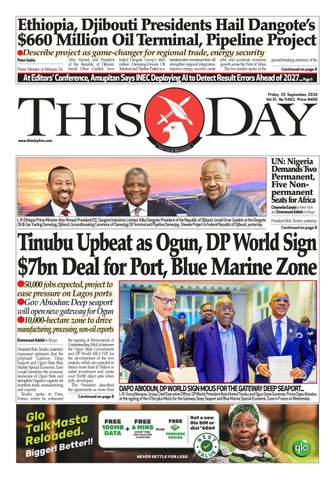
Ethiopia, Djibouti Presidents Hail Dangote’s $660 Million Oil Terminal, Pipeline Project Describe project as game-changer for regional trade, energy security
Peter Uzoho
Prime Minister of Ethiopia, Dr.
Abiy Ahmed, and President of the Republic of Djibouti, Ismaïl Omar Guelleh, have
hailed Dangote Group’s $660 million Damarjog-Dewele Oil Terminal and Pipeline Project as a
transformative investment that will strengthen regional integration, improve energy security, create
jobs, and accelerate economic growth across the Horn of Africa. The two leaders spoke at the
ground-breaking ceremony of the Continued on page 8
At Editors’ Conference, Amupitan Says INEC Deploying AI to Detect Result Errors Ahead of 2027... Page 6
Friday 25 September, 2026 Vol 31. No 11492. Price: N400
www.thisdaylive.com TR
UT H
& RE A S O
N
UN: Nigeria Demands Two Permanent, Five Nonpermanent Seats for Africa Chiemelie Ezeobi in New York and Emmanuel Addeh in Abuja
L-R: Ethiopia Prime Minister Abiy Ahmed; President/CE, Dangote Industries Limited, Aliko Dangote; President of the Republic of Djibouti, Ismail Omar Guelleh; at the Dangote Oil & Gas Trading Damerjog, Djibouti, Groundbreaking Ceremony of Damerjog Oil Terminal and Pipeline Damerjog - Dewele Project in Federal Republic of Djibouti, yesterday
President Bola Tinubu yesterday Continued on page 8
Tinubu Upbeat as Ogun, DP World Sign $7bn Deal for Port, Blue Marine Zone
50,000 jobs expected, project to ease pressure on Lagos ports Gov Abiodun: Deep seaport will open new gateway for Ogun 10,000-hectare zone to drive manufacturing, processing, non-oil exports Emmanuel Addeh in Abuja President Bola Tinubu yesterday expressed optimism that the proposed Gateway Deep Seaport and Ogun State Blue Marine Special Economic Zone would transform the economic landscape of Ogun State and strengthen Nigeria’s capacity for maritime trade, manufacturing and exports. Tinubu spoke in Paris, France, where he witnessed
the signing of Memoranda of Understanding (MoUs) between the Ogun State Government and DP World MEA FZE for the development of the two projects, which are expected to attract more than $7 billion in initial investment and create over 50,000 direct jobs when fully developed. The President described the agreements as more than Continued on page 8
DAPO ABIODUN, DP WORLD SIGN MOUS FOR THE GATEWAY DEEP SEAPORT...
L-R: Yuvraj Narayan, Group Chief Executive Officer, DP World; President Bola Ahmed Tinubu; and Ogun State Governor, Prince Dapo Abiodun, at the signing of the $7bn-plus MoUs for the Gateway Deep Seaport and Blue Marine Special Economic Zone in France on Wednesday
2
FRIDAY, SEPTEMBER 25, 2026 • T H I S D AY
FRIDAY, SEPTEMBER 25, 2026 • T H I S D AY
3
4
FRIDAY, SEPTEMBER 25, 2026 • T H I S D AY
Pay for Dangote Refinery Shares through Access Bank
ooer price
Please read the Prospectus on ipo.dangote.com and, where in doubt, consult your stockbroker, fund/portfolio managers, accountant, banker, solicitor or any other professional adviser registered by the SEC for guidance before subscribing. Payment does not guarantee or automatically result in the allotment of shares. Allotment is subject to the applicable terms and conditions.
Multiple channels. One opportunity.
Scan for:
• Risk Disclosures • Terms & Conditions • FAQs
07030000000
5
THISDAY • FRIDAY, SEPTEMBER 25, 2026
Group News Editor: Goddy Egene Email: Goddy.egene@thisdaylive.com, 0803 350 6821, 0807 401 0580
NEWS
CAVISTA US-AFRICA LEADERSHIP DINNER...
L-R: Executive Director & Chief Investment Officer at Africa Finance Corporation, Sameh Shenouda; President/CEO, Corporate Council on Africa (CCA), Florie Liser; President & CEO; Nigeria’s Minister of Education, Dr. Tunji Alausa; Former President of Bostwana, Mokgweetsi Eric Masisi; Chairman, Cavista Holdings, Niyi John Olajide; Zamfara State Governor, Dauda Lawal; Nigerian Ambassador to the U.S.A, H.E. Ambassador Kayode Are; Chairman, Flour Mills of Nigeria, John Coumantarous; former Chairman of Odu’a Investment Company Limited, Otunba Bimbo Ashiru; Immediate Past Head of the Civil Service of the Federation, Mrs. Didi Walson-Jack, O.O.N mni; and CFO Cavista Holdings, Ron Olajide, at the Annual Cavista Holdings US-Africa Leadership Dinner, held in New York on the sidelines of the 81st UN General Assembly on Monday
In Landmark Move, S&P Opens New Abuja Office, Cautions against Subsidy Return FG vows deeper partnership with global energy intelligence firm
Emmanuel Addeh in Abuja In what could deepen Nigeria’s engagement with one of the world’s leading energy intelligence and market information providers, S&P Global Energy yesterday officially opened its new Abuja office, with the Minister of State for Petroleum Resources (Oil), Heineken Lokpobiri, pledging closer collaboration between the company and Nigeria’s energy sector. The opening brought together senior Nigerian oil and gas stakeholders and executives of S&P Global, with the company signalling a growing focus on Nigeria and the wider West African energy market amid major changes in the region’s refining and petroleum products landscape. In his remarks, Lokpobiri described S&P Global as strategic to Nigeria’s energy sector, saying the federal government was committed
to strengthening the existing relationship with the global energy intelligence and consulting firm. “S&P Global is very strategic to our energy sector. We have an existing relationship, and we are committed to ensuring that Nigeria does not take that relationship for granted,” he said. The minister expressed satisfaction that S&P Global had chosen Abuja as the location for its new office, noting that he had previously advocated a stronger presence of the company in Nigeria’s capital. It is our pleasure that you chose to come to Abuja, in particular. I have always wanted S&P Global to be here,” Lokpobiri said. Recalling his previous engagement with representatives of the company in Cape Town, the minister said the new office would provide a platform for deeper interaction between S&P Global and stakeholders in Nigeria’s energy industry.
“I am very happy that you and your colleagues from all over the world have decided to come to Abuja to be part of this occasion. I congratulate you, and we look forward to working very closely with S&P Global,” he added. Lokpobiri said Nigeria would continue to position itself
within the changing global energy landscape, stressing the importance of partnerships with international companies with expertise in energy intelligence, market data and analysis. The opening of the office comes as Nigeria’s refining capacity expands and the structure of the West African
Delta oil host communities under the auspices of the OML 30 Flow Stations PresidentsGeneral Forum has given Heritage Energy Operational Services Limited (HEOSL) a two-week ultimatum to address issues concerning payments to indigenous contractors, engagement of qualified residents, scholarship programmes and the implementation of Host
Communities Development Trust (HCDT) projects. The forum also called for more engagement of competent indigenous contractors in the execution of OML 30 projects, immediate review and implementation of a scholarship programme and creating employment opportunities for qualified graduates from the host communities. The ultimatum is further hinged on demands for prompt payment of agreed stipends
important energy pricing hub. Hanley said the growth of domestic refining capacity, particularly the Dangote refinery, had altered the regional petroleum products market and created a case for pricing benchmarks that more closely reflected local market conditions.
Energy Leaders to NUPRC: Award Oil Assets on Capacity, Expertise to Grow Production PETAN chair decries some assets given to firms without capacity
Peter Uzoho Energy leaders have urged Nigerian Upstream Petroleum Regulatory Commission (NUPRC) to make proven technical capacity the primary criterion for awarding oil and gas blocks and fields, warning that handing prolific assets to unqualified companies is
at the heart of Nigeria’s production underperformance and missed revenue. Chairman of Petroleum Technology Association of Nigeria (PETAN) and Chief Executive Officer of Geoplex Drillteq, Mr. Wole Ogunsanya, made the call in Lagos at the Nigeria Energy Leaders Summit 2026 organised by
OML 30: Heritage Energy Gets Ultimatum Over Contract Debts, Jobs, HCDT Projects Omon-Julius Onabu in Asaba
petroleum products market changes, creating new opportunities for regional pricing and market benchmarks. Speaking at the event, the Executive Director, Strategy and Benchmarks, S&P Global Energy, Joel Hanley, said Nigeria and the wider West African region has the potential to emerge as an
and appreciation payments to traditional rulers and relevant stakeholders, as well as the immediate implementation and award of contracts for alreadyscoped HCDT community projects. The forum’s demands are contained in a letter signed by the Presidents-General of the respective communities, including the Evwreni P-G, Chief Kenneth Ukpebitere and his counterparts in Afiesere, Mr Luke Umukoro, in Owhe, Engr
Wilfred Atunu, that of Kokori, George Eghwrude, and that of Effurun-Otor, Chief Godwin Ikolo. Others are the presidentgeneral of Uzere, Chief Onyagbodor E; the Eriemu CDC Chairman, Mr Ibebe Matthew; the P-G of Oleh, Chief Unuafe Believe; the P-G Olomoro, Chief Anthony Ukpagha; P-G Igbide, Ven. Hon. Augustine Aziakpono Ovie JP and the P-G of Eruemukohwarien, Mr Anigboro Godwin.
The Energy Year, a London-based business intelligence company. Speaking on what Nigeria must do to raise oil and gas production from the current 1.7-1.8 million barrels per day to the federal government’s 3 million barrels target by 2030, Ogunsanya said Nigeria is uniquely positioned to extract value across upstream, midstream and downstream. In midstream alone, he said, Dangote Refinery’s 650,000 barrels per day capacity ramping to 1.4 million, BUA’s 300,000-350,000 barrels under construction, a cluster of modular refineries, and NNPC’s 450,000 barrels, put the country on track to refine close to 2 million barrels per day. That volume, he noted, is outside the Organisation of Petroleum Exporting Countries (OPEC) quota, leaving room to sell 1.5 million barrels of crude while refining another 1.5 million domestically. But he said the upstream sector is held back by poor asset stewardship. According to him, many assets with huge potential were awarded to companies without the needed expertise, funding or equipment
to operate them, and years after acquisition they still produce below the level at which they were bought. “We’ve got assets that have huge potential awarded to people that were not prepared or did not have the expertise to do the work. And that’s why we are behind in some of the production today. Even where we are today, are the assets that were producing two to three times what they are producing”, Ogunsanya said. “And for years, even when they bought these assets, they were producing less than the volume that they bought it at. “If we truly want to increase oil and gas production in Nigeria, let’s give those assets to people that have the capacity to do it,” he stressed. Ogunsanya argued that the problem is not lack of Nigerian expertise but misallocation of opportunity. He said Nigerian professionals are sought globally, from Qatar to Aberdeen to the United States, and the industry must match the Petroleum Industry Act (PIA) and regulations with that expertise.
6
FRIDAY, SEPTEMBER 25, 2026 • THISDAY
NEWS
US,NIGERIA SIGN MINERAL INVESTMENT PACT IN NEW YORK...
L-R: Lagos State Governor Babajide Sanwo-Olu; Nigeria’s Minister of Solid Minerals Development, Mr. Dele Alake; and US Deputy Secretary of State, Christopher Landau after the two countries signed a mineral investment pact in New York, USA, yesterday
L-R: Nigeria’s Minister of Solid Minerals Development, Mr. Dele Alake and US Deputy Secretary of State, Christopher Landau, after the two countries signed a mineral investment pact in New York, USA
At Editors’ Conference, Amupitan Says INEC Deploying AI to Detect Result Errors Ahead of 2027 Says deepfakes may erode confidence in polls Engages Microsoft, google on cybersecurity resilience Onaiyekan: Elections increasingly decided in courts, not at polls Demands independent INEC, special election tribunal Seeks 50% threshold for presidential victory Igwe Achebe: Media must be ‘last man standing’ in defence of democracy
Emmanuel Addeh iin Abuja
The Chairman of the Independent National Electoral Commission (INEC), Prof. Joash Amupitan, yesterday disclosed that the electoral umpire has begun deploying artificial intelligence tools to detect discrepancies and administrative errors in election results, with Nigeria’s 2027 general elections barely four months away.
Amupitan, who spoke at the 24th All Nigeria Editors Conference in Enugu, said the commission was simultaneously strengthening its defences against AI-generated disinformation capable of producing fake result sheets, cloned voices of electoral officials, fabricated videos and forged official documents within minutes. He warned that the greater
danger was not simply that voters might believe fabricated information, but that the proliferation of convincing falsehoods could make Nigerians lose confidence even in genuine results. Amupitan said the commission had established a dedicated Artificial Intelligence Division within its ICT Department and developed an AI Roadmap and
Governance Framework based on human oversight, transparency and accountability, data protection, cybersecurity and public trust. “We have commenced deploying intelligent AI tools directly within our results management process. This technology automatically scans and detects discrepancies or administrative errors in result records before final validation.
N30 Trillion Valuation Gap Threatens Nigeria’s Tax Revenue, Asset Management Folalumi Alaran in Abuja
Nigeria risks losing substantial revenue from property-related taxes and weakening its management of public wealth due to an estimated N30 trillion gap in the valuation and documentation of assets across the country, Estate Surveyors and Valuers Registration Board of Nigeria (ESVARBON) has warned. The Board said the failure to establish credible values for properties and other assets
was undermining effective tax administration, public-sector accounting, insurance, estate management and government’s ability to determine the true worth of national assets. Speaking at the 2026 Valuers Assembly in Abuja yesterday, Acting Chairman of ESVARBON, Dr Aminu Waziri, said the scale of the valuation gap underscored the need for government agencies and public institutions to systematically identify, value and document assets in accordance
with internationally recognised standards. Waziri specifically urged Ministries, Departments and Agencies (MDAs) to embrace the International Public Sector Accounting Standards (IPSAS), saying the framework would help government build a credible inventory of public assets and establish their actual value. “With the International Public Sector Accounting Standards (IPSAS) being part of the Nigerian developmental pathway, all the
Chappal Energies CEO Remanded Over Alleged N600m SUV Theft Wale Igbintade
The Chief Executive Officer of Chappal Energies, Ufoma Emmanuel, was yesterday arraigned before the Ikeja Special Offences Court, Lagos, over the alleged theft of a Lexus SUV valued at N600 million. Emmanuel was arraigned by the police on a two-count
charge of conspiracy to commit felony and stealing. He pleaded not guilty to the charges. Police prosecutor, Musa Usman, told the court that Emmanuel allegedly conspired with others still at large to steal the Lexus SUV, which the charge identified as property of Chappal Energies Offshore Ltd.
According to the prosecution, the alleged offences were committed on January 6 and 12, 2026, in Lagos. Usman alleged that Emmanuel, who was a director of the company and was on suspension at the time, dishonestly converted the SUV, valued at N600 million, to his personal use.
parastatals, departments and agencies that are supposed to be valuing and documenting our assets need to key into this,” he said. According to him, regular and professional valuation would provide government with a clearer picture of the assets under its control and strengthen accountability, planning and decision-making. He said the valuation challenge also had implications for Nigeria’s housing sector, which he said was facing a deficit of more than 21 million units. Also speaking, a former Chairman of the ESVARBON Education Committee and Board Member of the International Valuation Standards Council, Dr ESV Uche Egwuatu, said professional valuation could help government unlock additional revenue from the property sector. Egwuatu said estate surveyors and valuers possessed the technical expertise required to determine the market and taxable values of properties but were still largely underutilised by government.
“Technology must complement, rather than replace constitutional institutions…AI must strengthen electoral integrity, improve public service, and always remain under human control. Every automated result check remains strictly subject to human auditing and legal verification,” he said. The INEC chairman said the commission had also engaged senior executives of Microsoft and Google on cybersecurity resilience, cloud infrastructure protection and threat mitigation, while discussions with the International Foundation for Electoral Systems had focused on technical capacity building, risk management and responsible AI integration ahead of the 2027 elections. He warned that synthetic disinformation could create the appearance of electoral fraud before genuine results were even collated. “The primary danger of synthetic disinformation is not merely that it tricks citizens into believing a specific falsehood, but it causes the systemic destruction of public trust. When everything can be faked, citizens begin to doubt genuine, verified facts provided by constitutional authorities. “When deepfakes render lies believable, real truth is greeted with skepticism. Cynicism replaces civic engagement, leading voters to ask: Why stand in line for hours if the outcome is already manipulated on a screen? That mental retreat is where democracy begins to decay,” Amupitan said. He gave examples of possible attacks ahead of 2027, including fabricated videos of electoral officials announcing false results, cloned audio recordings of resident electoral commissioners allegedly directing manipulation of voting
devices, forged letters announcing postponement of elections and manipulated result sheets circulated immediately after voting. Amupitan said the challenge was particularly serious because the 2027 elections would be conducted nationwide, unlike the recent Osun governorship election. He disclosed that during the August 15 Osun election, 3,556 of the state’s 3,763 polling units, representing 94.5 per cent, opened for accreditation and voting by 8:30 a.m., while INEC deployed 5,130 BVAS devices, including 1,328 backup units. “Osun was a single-state exercise, 2027 will be across 36 states and the Federal Capital Territory. The Presidential and National Assembly Elections holds on Saturday, 16th January 2027. The Governorship and State Houses of Assembly Elections holds on Saturday, 6th February 2027. The statutory timeline is fixed, and the clock is ticking,” he said. The INEC chairman subsequently challenged editors to make verification a central part of their election coverage, saying the media remained the principal gatekeeper between fabricated information and the electorate. “The pressure on modern newsrooms to be first is immense. But in national elections, it is vastly more important to be right than to be first. Rushing to publish unverified, sensational claims, whether a fake result sheet on social media, a doctored video, or an unconfirmed statement, grants institutional legitimacy to deliberate deception, causing damage to public peace that is almost impossible to reverse,” Amupitan said.
7
THISDAY • FRIDAY, SEPTEMBER 25, 2026
NEWS
39TH-ANNIVERSARY CELEBRATION OF THE CREATION OF AKWA IBOM...
President of the Senate, Godswill Akpabio GCON (right), in a warm exchange of pleasantries with the former governor of Akwa Ibom State, Obong Victor Attah, his predecessor, during the 39th-Anniversary Celebration of the creation of the state in Uyo, yesterday
Nigeria, US Sign Framework to Unlock Investment in $700bn Minerals Sector Alake: Deal marks shift from Nigeria’s role as raw materials exporter US: We regard Nigeria as regional power
Folalumi Alaran in Abuja
Nigeria and the United States have signed a framework agreement to deepen American investment in Nigeria’s solid minerals sector, with cooperation spanning geological data and exploration, mineral development and processing, infrastructure and technical capacity. The agreement, signed by the Minister of Solid Minerals Development, Dele Alake, and the US Deputy Secretary of State, Christopher Landau, at Nigeria’s Mission House in New York, is expected to provide a framework for business-tobusiness transactions aimed at developing Nigeria’s mineral value chains. The framework is also expected to leverage the bilateral relationship between both countries to attract investment into Nigeria’s estimated $700 billion mineral resource base and promote greater value addition
within the country. Speaking at the ceremony, Alake said the agreement marked a shift from Nigeria’s traditional role as an exporter of raw materials, stressing that the government’s objective was to retain more value from the country’s mineral resources through local processing, skills development and job creation. He said: “Some agreements manage the present, and some agreements shape the future. The framework we sign today belongs to the second kind. In signing this framework, Nigeria and the United States affirm a shared conviction: that the supply chains for these critical minerals must be secure, resilient and built on responsible investment.” The minister said Nigeria was not seeking to remain merely a source of raw materials for industries elsewhere, but wanted to develop domestic processing and manufacturing capacity around its mineral resources.
According to him, the framework would facilitate cooperation in geological data and exploration, mineral development and processing, infrastructure development and technical capacity building. He said the initiative would support the economic diversification objectives of President Bola Tinubu’s Renewed
The National Examinations Council (NECO) has released the results of the 2026 Senior School Certificate Examination (SSCE) Internal, with 804,948 candidates, representing 58.67 per cent, obtaining five credits and above, including English Language and Mathematics. Registrar of NECO, Prof. Dantani Wushishi, announced the results at a press conference in Minna, Niger State, on Thursday.
Wushishi said 1,378,048 candidates registered for the examination, while 1,371,992 candidates sat for the exercise, which commenced on June 15 and ended on July 23, 2026.The results now released 63 days after the last paper of the examination was written. He disclosed that 1,162,118 candidates, representing 84.70 per cent, obtained five credits and above irrespective of their performance in English Language and Mathematics. The NECO registrar also announced a significant
a promise, results are the proof,” he said. He added that Nigeria and the United States would, in the months ahead, identify viable projects, mobilise investments and develop commercial partnerships capable of delivering measurable benefits to both countries. Responding, Landau said the United States regarded Nigeria
as a regional power and was committed to strengthening its partnership with the country. He said the agreement would support greater prosperity in both countries, adding that Washington was pleased to support Nigeria’s economic growth. “The signal we are sending is that the United States and Nigeria are partners,” Landau said.
JBS $2.5 Billion Livestock Deal: Civil Society Demands MoU Disclosure, Impact Assessment Michael Olugbode in Abuja A coalition of Nigerian civil society organisations, farmers’, and pastoralist groups, as well as youth, women, environmental and animal-welfare organisations have demanded full disclosure of the federal government’s proposed $2.5 billion investment deal with global meat company,
2026 SSCE: NECO Releases Results, 58.67% Pass English, Maths Kuni Tyessi in Abuja
Hope Agenda and contribute to industrial growth. Alake, however, said the signing was only the beginning, stressing that the success of the framework would depend on its implementation. “Now comes the harder and more important work: moving from agreement to implementation. A signature is
decline in examination malpractice, saying 1,406 candidates were involved in various forms of malpractice in 2026, compared with 3,878 candidates recorded in 2025. He said the figure represented a 64.74 per cent reduction in examination malpractice. Wushishi thanked President Bola Tinubu for reappointing him for a second tenure as NECO registrar, as well as the Minister of Education, Dr. Tunji Alausa, for his confidence in his leadership.
JBS. They warned that decisions being taken behind closed doors could reshape Nigeria’s land, water, and food systems. The coalition made the demand at the end of a threeday strategy workshop on JBS engagement and industrial livestock expansion held in Abuja from September 22 to 24. The groups said the proposed investment, which would establish six industrial meat-processing facilities across Nigeria, was linked to the federal government’s National Livestock Transformation Plan and Nigeria Livestock Master Plan 2026–2040. They said nearly two years after the federal government signed a Memorandum of Understanding (MoU) with JBS, the agreement had yet to be made public, while no Environmental and Social Impact Assessment (ESIA) relating to the project had been published. The coalition said it was not opposed to agricultural investment but insisted that an investment capable of transforming the country’s livestock and food systems
must be transparent, accountable, and subject to meaningful participation by affected communities. It expressed concern over the lack of public access to the project’s financing arrangements, environmental and social assessments, land allocation agreements, incentive packages, and records of consultations with communities. According to the coalition, the headline figure of $2.5 billion may be publicly known, but the lender terms, allocation of funds, and beneficial ownership of private investment vehicles involved in the project remain undisclosed. The groups further said Freedom of Information requests submitted to the Federal Ministry of Livestock Development, Ogun State Ministry of Agriculture and Food Security, and Niger State Ministry of Livestock and Fisheries seeking the MoU, related agreements, ESIAs, and records of engagement with JBS had not been honoured. The coalition warned that without access to such
information, Nigerians could not determine whether public land and resources were being committed in ways that primarily benefitted private interests. It said it would pursue lawful avenues available under the Freedom of Information Act 2011 to secure disclosure. Of particular concern to the coalition were communities in Niger State, which it said were at the frontline of the livestock expansion and had reported grievances relating to land acquisition, including resettlement issues, unfulfilled promises, and access to water. The groups also expressed solidarity with communities in Niger and Ogun states, saying their rights must be protected as the industrial livestock expansion proceeded. They called for comprehensive and independent environmental and social impact assessments covering the cumulative effects of the proposed development on land, water and ecosystems before any further land allocation, approval or construction.
8
FRIDAY, SEPTEMBER 25, 2026 • THISDAY
EIGHT
FG Cuts Interest Rate for Late Payment of Tax from October 1 New order applies uniformly across federal, state, FCT tax authorities, ties interest charges on unpaid taxes to borrowing costs Zacch Adedeji: New NRS tagline to inspire taxpayer confidence, boost revenue collection, growth aspiration, others
Ndubuisi Francis and James Emejo in Abuja
The federal government yesterday issued the Nigeria Tax Administration (Interest on Late Payment of Tax) Order, 2026, which set the applicable interest rate for delayed payment of tax, as provided under Section 65 of the Nigeria Tax Administration Act, 2025. Minister of Finance and Coordinating Minister of the Economy, Mr. Taiwo Oyedele, issued the order, which becomes effective October 1, 2026. Oyedele said the order applied uniformly across federal, state and
Federal Capital Territory (FCT) tax authorities. The new directive came as Executive Chairman, Nigeria Revenue Service (NRS), Dr. Zacch Adedeji, yesterday, unveiled a new institutional tagline, “Inspiring Trust, Sustaining Growth,” in a concerted drive to deepen taxpayer confidence, improve revenue collection, and support Nigeria’s ambition of building a $1 trillion economy by 2030. Adedeji said the tagline represented a shift in the identity of NRS as it moved beyond its traditional tax-collection role to a broader revenue-administration mandate under the new NRS
establishment framework. He stated that the new identity was designed to address a fundamental requirement for stronger revenue mobilisation — trust between the revenue authority, taxpayers, and the wider economy. The Federal Ministry of Finance said the tax order linked the cost of late payment more closely to market rates, and gave taxpayers certainty about what late payment cost, together with applicable default penalty. According to the ministry, it ensures that holding on to tax that is due is not cheaper than borrowing from the market.
For naira-denominated tax, interest is charged at the Central Bank of Nigeria’s Monetary Policy Rate plus one percentage point. This is a reduction from the spread of five percentage point previously applicable, although the rate will not fall below the yield on 364-day Treasury Bills, which reflects what it costs government to fund itself when taxes are paid late. For tax payable in foreign currency, interest is charged at the Secured Overnight Financing Rate (SOFR), the international benchmark for United States dollar rates, plus six percentage points. The statement explained that if SOFR was discontinued, its official
TINUBU UPBEAT AS OGUN, DP WORLD SIGN $7BN DEAL FOR PORT, BLUE MARINE ZONE a ceremonial commitment, planned for Ogun Waterside, serve a continental market of significance, stressing that the saying they represented the will have a proposed 4-kilometre approximately 1.4 billion people. port was being conceived as beginning of an integrated berth and an 18-metre draft, The proposed 10,000-hectare part of an integrated industrial economic corridor linking which Tinubu said would Blue Marine Special Economic ecosystem rather than simply maritime infrastructure with enable it to accommodate Zone, he added, would a cargo-handling facility. industrial production, logistics, larger, deeper-draft vessels complement the port by “A port moves cargo; a energy and transportation. while helping to decongest providing an industrial base port integrated with a special “We are doing more than the Lagos port corridor. for manufacturing, processing economic zone helps to build signing agreements; we are Tinubu specifically identified and export-oriented activities. an economy. Each reinforces laying the foundation for Apapa and Tin Can Island ports “Within the zone, imported the other,” he said. a new chapter in Nigeria’s as beneficiaries of the additional inputs will be transformed into The President also identified development,” Tinubu said. capacity, saying the Ogun facility finished goods, Nigerian raw the Lagos-Calabar Coastal The projects, according to would reduce costs and delays materials will be processed for Highway as critical to the the President, are intended to for importers and exporters. export and, most importantly, commercial viability of the address longstanding constraints Beyond serving as a port, our young men and women emerging corridor. around port congestion, Tinubu said the project would will find dignified, productive According to him, the inadequate draft capacity and provide a competitive trade and sustainable employment,” 28-kilometre Ogun section of logistics bottlenecks that have and logistics gateway for he said. the 700-kilometre highway, raised the cost of doing business the African Continental Free Tinubu said the relationship scheduled for completion before in Nigeria. Trade Area (AFCTA), giving between the two projects was the end of the year, would The Gateway Deep Seaport, Nigeria an opportunity to central to their economic provide a vital transport link
successor rate will apply, adding that one rate will apply for each calendar month. NRS was directed to publish the applicable rates on its website by the third business day of every month. Speaking on the new order, Oyedele explained the link between unpaid taxes and government borrowing costs, adding, “Tax that is due belongs to the public. When it is paid late, the government may have to borrow to fill the gap, and the cost falls on everyone.” He stressed, “This order ties the cost of late payment to real market rates, so that delaying tax does not become a cheaper form
Adedeji of credit than the market itself. “Every taxpayer, whether dealing with the Nigeria Revenue Service or a state revenue service, Continued on page 29
“Agreements must lead to between the port and zone, Lagos, the Nigerian hinterland action; commitments must and the wider African market. translate into investment; “Without reliable access, the investment must deliver projects; coastline’s economic potential and projects must create jobs, would remain difficult to opportunity and prosperity,” he added. realise,” he said. He said the more than Tinubu further linked the projects to the proposed $7 billion initial investment Nigerian Navy Operating Base envisaged for the projects, and Dockyard and the OK LNG together with the projected Project, saying the developments creation of over 50,000 direct would form part of a wider jobs at full development, strategic corridor connecting would make the initiative maritime infrastructure with a practical expression of Nigeria’s energy and gas-export the federal government’s economic diversification and ambitions. He said the agreements industrialisation drive. “This is economic brought together vision, expertise, capital and execution diversification made tangible. capacity, while specifically This is industrialisation made welcoming DP World as a global visible. This is Renewed Hope in action,” he said. port and logistics operator. UN: NIGERIA DEMANDS TWO PERMANENT, FIVE NON-PERMANENT SEATS FOR AFRICA Tinubu commended Ogun The President also demanded a fundamental from its permanent membership,” States (ECOWAS), the African development could not be acknowledged Sky Capital, State Governor, Dapo Abiodun, restructuring of the United the Nigerian leader argued. Union (AU) and Gulf of Guinea separated from Africa’s progress the financial advisers, investors for securing the land, structuring Nations Security Council (UNSC) The President said Nigeria’s partnerships in mediation, or Nigeria’s responsibility to and other partners involved the investment framework and declaring that Africa could no demand was anchored on the democratic governance, counter- contribute to a peaceful and in bringing the projects to the reducing project risks for global longer continue to shape the Ezulwini Consensus and the Sirte terrorism and maritime security. prosperous international system. agreement stage. investors. council’s agenda without having Declaration, adding that greater The President linked Nigeria’s On climate change, Tinubu He described the initiative But Tinubu stressed that the permanent representation at the African representation must foreign policy to its domestic rejected what he described as a signing must be followed by as an example of cooperative highest level of the global body. come with both the authority economic reforms, saying the false choice between development implementation, saying the federalism, with a subnational Tinubu, in his address to the and responsibilities attached to country was pursuing sound and climate action, arguing that federal government would government providing the vision General Debate of the 81st United permanent membership. macroeconomic management, developing countries must be hold itself and all parties and the federal government Nations General Assembly in “Nigeria demands, in stronger institutions, private-sector allowed to industrialise, eradicate accountable. “Today we make facilitating projects with wider New York, called for at least two accordance with the Ezulwini development and strategic public poverty and expand energy firm commitments; from national economic implications. permanent seats for Africa, with Consensus and the Sirte investment. access through low-carbon tomorrow, implementation all the rights and responsibilities of Declaration, at least two According to him, national pathways. Continued on page 27 must gather pace,” he said. permanent membership, including permanent seats for Africa, with the veto for as long as it exists, all the rights and responsibilities of ETHIOPIA, DJIBOUTI PRESIDENTS HAIL DANGOTE’S $660 MILLION OIL TERMINAL, PIPELINE PROJECT as well as five non-permanent permanent membership, including seats for the continent. the veto for as long as it exists, project held at the Damerjog needs of Ethiopia and the wider investment will generate access to energy resources. This significant value for Djibouti pipeline will provide a modern, The President’s statement was and five non-permanent seats in Industrial Development Free Trade region. Zone in Djibouti. They praised the Guelleh described the project through increased trade volumes, dependable, and cost-effective delivered on his behalf by Vice total. The authority to speak for vision and commitment of African as a milestone in Djibouti’s stronger commercial activity, and system for transporting refined President Kashim Shettima, who humanity carries an obligation represented him at the General to represent it,” he pointed out. industrialist and President/Chief ambition to become a leading enhanced investor confidence. petroleum products into the Debate themed: “Restoring Trust, Tinubu also used the address Executive of Dangote Industries logistics, industrial, and energy It will create jobs, support local country, thereby enhancing our businesses, and further strengthen energy security and reducing Managing Transformation: A to outline Nigeria’s wider Limited, Aliko Dangote, for hub for Africa. championing one of the region’s He said, “Today marks an our position as a critical gateway supply-chain vulnerabilities.” United Nations That Delivers position on global security, The Ethiopian leader said for All.” development, climate change, most significant privately funded important chapter in Djibouti’s connecting regional economies. “We are proud to partner with the project would eliminate Tinubu said the composition of technology, financing and African energy infrastructure investments. journey toward becoming a A statement by Dangote premier centre for logistics, energy, the Dangote Group in delivering transportation bottlenecks, the security council must reflect economic integration, insisting Group said the project comprised and industrial development. a project that demonstrates the improve efficiency within the the realities of the contemporary that international institutions “The Damarjog-Dewele Pipeline strength of African-led investment petroleum distribution network, world rather than preserve the must evolve to respond to a modern 120-kilometre multiproduct pipeline linking Project is not merely infrastructure; and practical African solutions and ensure a more stable supply distribution of power established contemporary challenges. of fuel for key sectors of the at the end of the Second World He said Nigeria was prepared marine and coastal storage it is an investment in the future to African challenges.” facilities at Damarjog in prosperity of our region.” Ahmed described the project economy. War. to assume greater responsibility in According to the Djiboutian as a strategic infrastructure He explained, “The impact of “The reform of this institution international peace and security, Djibouti with inland storage and must begin with the reconstitution citing its historical contributions distribution facilities at Dewele leader, the project will stimulate development that will significantly this investment extends beyond economic activity, expand strengthen Ethiopia’s energy the energy sector. Reliable access of the Security Council, for the to peace efforts in Liberia, Sierra in Ethiopia. Upon completion, it will port operations, attract new security while supporting the to petroleum products will world of 2026 cannot remain Leone, Darfur, Mali and The facilitate the efficient transportation investments, and create thousands country’s industrialisation agenda. support aviation, transportation, captive to the distribution of Gambia. He stated, “Ethiopia’s agriculture, manufacturing, power in 1945. Africa cannot He also highlighted Nigeria’s of refined petroleum products, of direct and indirect employment enhance supply chain reliability, opportunities. continued economic expansion construction, and broader continue to fill the Council’s role through the Economic and support the growing energy Guelleh added, “This depends on reliable and efficient industrial development. agenda while remaining absent Community of West African
9
FRIDAY, SEPTEMBER 25, 2026 • THISDAY
NEWS
CHARTERED INSTITUTE OF DIRECTORS FELLOWS’ INVESTITURE...
L-R: The Director General/CEO, Chartered Institute of Directors (CIoD) Nigeria, Dr. Taiwo Nolas-Alausa; Second Vice President, CIoD, Mr. Lamis Dikko; First Vice President, CIoD, Mrs. Amina Oyagbola; President & Chairman of Governing Council, CIoD, Otunba Adetunji Oyebanji; Director, Payments System Policy Department of Central Bank of Nigeria (CBN), Mr. Musa Jimoh, who represented the Deputy Governor, Economic Policy, CBN, Mr. Philip Ikeazor, and immediate Past President of CIoD, Alhaji Tijjani Borodo, at the 2026 CIoD Fellows’ Investiture ceremony in Lagos on Wednesday
Tinubu Eulogises Chairman of Access Holdings, Aig-Imoukhuede, at 60
Congratulates NCMM DG, Olugbile Holloway, on TIME100 Art Recognition Deji Elumoye in Abuja President Bola Tinubu has paid glowing tribute to Chairman of Access Holdings Plc and Coronation Group, Aigboje Aig-Imoukhuede, on the occasion of his 60th birthday. Tinubu, in a congratulatory message issued on Thursday, lauded the investment banker for committing his experience and
personal resources towards the development of Nigeria. Tinubu, in the 10-paragraph release, stated, “I warmly congratulate Aigboje AigImoukhuede, on his 60th birthday. “I have followed Aigboje’s journey in business and public life over the years. He has earned his place among a generation of Nigerians who took bold bets on our country and proved
that Nigerian institutions could compete at the highest levels. “His years at Access Bank are an important part of that story. He became Group Managing Director and Chief Executive Officer in 2002 and led the bank through a period of significant growth. Today, he is Chairman of Access Holdings Plc and Coronation Group. “Aigboje also gave his time and
experience to the development of our financial markets. He served as President of the Nigerian Stock Exchange and founding Chairman of FMDQ Securities Exchange. He currently serves as Co-Chairman of EnterpriseNGR. “He has been equally willing to take on public responsibilities. In 2012, he chaired the Presidential Committee on the Verification and Reconciliation of Fuel Subsidy
Petrol Imports Drop 29% as Dangote Supplies Rise to 71% Domestic petrol inflow increases 39% to 35.9m litres/day PMS consumption falls 14% to 41.5m litres daily despite 50.5m litres daily receipts Cooking gas imports rise 44%
Deji Elumoye in Abuja
Nigeria’s petrol supply structure shifted sharply towards domestic refining in August, with locally refined Premium Motor Spirit (PMS) accounting for 71.1 per cent of total daily receipts, while imports fell to 28.9 per cent. According to the latest data from the Nigerian Midstream and Downstream Petroleum Regulatory Authority (NMDPRA), domestic PMS receipts rose by 39 per cent from 25.8 million litres per day in July to 35.9 million litres per day in August, while imports declined by 26 per cent from 19.7 million litres daily to 14.6 million litres daily. Overall, petrol receipts increased 11 per cent from 45.5 million litres per day in July to 50.5 million litres per day in August, indicating that the rise in domestic refining more than offset the reduction in imported volumes.
The August figure represented a major shift from the previous month when domestic supply accounted for about 56.7 per cent of total PMS receipts, compared with 43.3 per cent from imports. The NMDPRA’s 13-month PMS supply data further showed that the August domestic refinery inflow of 35.9 million litres per day was significantly above the 13-month domestic average of 29.7 million litres per day, while imports at 14.6 million litres daily were below the 13-month import average of 20.6 million litres per day. The data also showed that the Dangote Refinery was responsible for all the PMS received from domestic refineries during the month. According to the regulator, the refinery produced an average 41.94 million litres of PMS daily in August, of which 35.87 million litres per day were recorded as
domestic receipts, while 9.73 million litres per day were exported. Its average capacity utilisation was put at 105.21 per cent. Against total domestic refinery PMS receipts of 35.9 million litres daily, Dangote’s 35.87 million litres daily domestic receipt amounted to about 99.9 per cent of the entire domestic refinery inflow. The development represented a substantial change in the country’s petrol supply mix, coming alongside a corresponding reduction in dependence on overseas supplies. The NMDPRA data showed that oil marketers and NNPC imports dropped from 19.7 million litres per day in July to 14.6 million litres daily in August. The shift, however, did not translate into an equivalent increase in petrol consumption. Rather, PMS consumption declined by 14 per cent month-on-month, from 48.3 million litres per day in July to
41.5 million litres daily in August. The regulator’s August demand benchmark was 50 million litres per day, putting actual PMS consumption at 83 per cent of the benchmark and leaving a shortfall of 8.5 million litres per day, or 17 per cent. The figures meant that August’s average PMS receipts of 50.5 million litres daily were about 9 million litres above the 41.5 million litres consumed each day, although the country’s average PMS stock sufficiency remained below the regulator’s 30-day benchmark. Besides, NMDPRA put petrol stock sufficiency at 22.9 days in August, up marginally from 22.4 days in July, but still 7.1 days below the required 30-day threshold. By comparison, diesel stocks covered 51.6 days, while aviation fuel stocks stood at 82.3 days. LPG stocks, at 17.2 days, were also below the 30-day threshold.
Payments, a difficult assignment at an important time for our country.” The president added, “I particularly commend the work Aigboje and his wife, Ofovwe, have done through the Aig-Imoukhuede Foundation. They have invested in improving public service, preparing public servants for greater responsibility and supporting better healthcare. I am pleased that after considerable success in private enterprise, Aigboje continues to devote his experience and resources to the progress of our country. “Sixty is an important milestone. For Aigboje, it is also an opportunity to reflect on a career that has touched many institutions and opened doors for many people. “I join Ofovwe, their children, family, friends and associates in celebrating him today. “I wish Aigboje good health, happiness and many more years of service to Nigeria and humanity. “Happy 60th birthday, Aigboje.” On Thursday, also, Tinubu congratulated Director-General of National Commission for Museums and Monuments, Mr Olugbile Holloway, on his inclusion in the inaugural TIME100 Art list of the 100 most influential people shaping the future of art. The president, according to a release issued by his Adviser on Information and Strategy, Bayo Onanuga, said the recognition reflected the important work Holloway and the commission had undertaken to recover Nigeria’s cultural treasures and renew the institutions responsible for preserving them. Since his appointment in March 2024, Holloway has worked with His Royal Majesty, Oba
Ewuare II, the Oba of Benin, to establish a clear framework for the retrieval, conservation, and exhibition of returned Benin artefacts. The understanding strengthened Nigeria’s position in negotiations with foreign governments, universities and museums. Under his leadership, the commission secured the return of 119 Benin Bronzes from the Netherlands and the legal transfer of 116 Benin Bronzes from the University of Cambridge. Eighteen Benin Bronzes and four Ikom monoliths were also recently returned from Switzerland. The commission also launched Nigeria’s first digital museum of antiquities, with more than 200 objects from the National Museum, Lagos, scanned in three dimensions and made available through an immersive online platform. Tinubu commended the renovation of the National Museum, Lagos, including its upgraded galleries, modern display systems, and improved facilities for preserving and presenting Nigeria’s cultural heritage. The president described the return of Nigeria’s cultural property as an important act of historical justice and a restoration of the dignity and memory of the communities from which the objects were taken. He applauded Holloway for the diplomacy and institutional leadership he had brought to the commission and congratulated the NCMM staff on the international recognition of their work. Tinubu urged the commission to sustain its efforts to recover Nigeria’s cultural property, improve museums across the country and make the nation’s history more accessible to young Nigerians.
10
THISDAY • FRIDAY, SEPTEMBER 25, 2026
NEWS
81ST UNITED NATIONS GENERAL ASSEMBLY...
L-R: Former President of Bostwana, Mokgweetsi Eric Masisi; Co-founder Amandla Institute for Policy and Leadership Advancement/former First Lady of Ekiti State, Erelu Bisi Fayemi; Deputy Secretary-General of the United Nations, Amina Mohammed; and former Chairman of Nigeria’s Governors’ Forum, Dr. Kayode Fayemi, at the 81st session of the United Nations General Assembly in New York on Wednesday
Stakeholders Fault CBN’s January Timeline on Data Localisation, Call for Extension Emma Okonji
Industry stakeholders have raised concern over the January deadline given by Central Bank of Nigeria (CBN) on data localisation. CBN had directed all Fintech companies to return all payments data currently being hosted outside Nigeria, and host such data in Nigeria with effect from January 1, 2027. Worried about the timing, some industry stakeholders said yesterday that the timing was too short and warned that CBN’s six-month deadline for full data localisation by January 2027 was virtually impossible to achieve. They called for extension of time to meet up with the directive. Citing severe infrastructure constraints, complex technical migrations, skyrocketing compliance costs, and largely poor engagement from CBN, the stakeholders stated that forcing such an aggressive timeframe would risk widespread service
disruptions and standard compliance failures across the digital economy. The stakeholders stated their position in Lagos during a panel session at the GrowthX Forum, organised by TechEconomy. Although the directive was aimed at enhancing data sovereignty and security by keeping citizen data within Nigeria, the stakeholders maintained that building compliant cloud architecture would require years, not months. They stressed that without a phased implementation roadmap, major service providers might be forced to suspend operations. Panellists said forcing full migration onto local servers by January 2027 would risk forcing institutions into superficial “boxticking” compliance rather than building operational resilience. Chief Technology Officer, FCMB, Blessing Ehize, highlighted a major regulatory gap. According to Ehize, a major
point of friction is the perceived lack of direct regulatory engagement trailing the policy announcement. Ehize disclosed that despite attempts through groups like Committee of Bank CIOs, clarity remained elusive regarding what specific data must sit on-premise versus what could reside in hybrid cloud environments. He stated, “Now, this is the problem. To bring payment data
A Federal High Court sitting in Lagos has convicted a Lagosbased trader, Elijah Chigbogu, and two companies over the alleged possession, display for sale, importation and distribution of fake and unregistered drugs. Justice Musa Kakaki convicted the defendants after they pleaded guilty to a four-count charge brought against them by the National Agency for Food and Drug Administration and Control (NAFDAC). Following the guilty plea, the
prosecution informed the court of a plea bargain agreement reached with the defendants and urged Justice Kakaki to adopt its terms as the judgment of the court. After reviewing the agreement, the judge convicted the defendants and sentenced the first defendant, Chigbogu, to a fine of N1.5 million. The two corporate defendants are Prolife & Well Pharmaceutical Limited and God of Elijah Nigeria Limited. The defendants were arraigned before the court on
financial sector?’ This is where we need to start from: draw a roadmap. By this milestone, we should have done this. We really have the capacity to do this as a country, but we just need to plan it and not rush the Nigerian way.” Deputy Managing Director, eTranzact, Hakeem Adeniji-Adele, said CBN had been engaging the Fintech community. But Adeniji-Adele frowned
on the six months’ deadline, stressing that the timing is too short, looking at the enormous data sitting in the cloud somewhere. He said, “I believe it is quite short, simply because of the amount of load that needs to be moved. I feel the solution should be a phased approach. Computer and storage should be divided into two, as opposed to telling everyone to move at once.”
FG Holds Workshop on Gas Maturity, Targets 24-month Timeline to End Regulated Market
Decade of Gas secretariat seeks roadmap for willing buyer, willing seller market
Emmanuel Addeh in Abuja
The federal government yesterday set a 24-month target to transition Nigeria’s domestic gas market to a fully commercial ‘willing buyer, willing seller’ regime. The Authority Chief Executive, Rabiu Umar, disclosed this
Court Convicts Trader, Companies Over Possession, Distribution of Fake Drugs Wale Igbintade
back on-premise, for the last three months, we’ve not been able to engage effectively with the Central Bank of Nigeria as the Committee of Bank CIOs to get clarity on these issues. I mean, you can ask, I’m representing banks. “From what I know, there’s not been a meeting held to say, ‘This is what it means’ in terms of clarity. So it’s vague. You start thinking, ‘Are we really trying to play with the
allegations bordering on the unlawful possession and display for sale of fake drugs, as well as the importation and distribution of unregistered pharmaceutical products. The prosecution was represented in the matter by NAFDAC counsel, Anita Madu, who urged the court to order that the four-count charge be read to the defendants so they could take their pleas. After the charge was read, Chigbogu and the two companies pleaded guilty to all four counts.
yesterday at a Gas Market Maturity Workshop, where stakeholders across the gas value chain deliberated on the conditions and milestones required to move the market from heavy regulatory coordination towards commercial contracting and competition. Umar said the Petroleum Industry Act (PIA), particularly Section 167, provided for a gradual transition to a market where commercial agreements between willing buyers and sellers would take precedence over price regulation. “The journey we are starting today should lead us to a place where we should target a 24-month, at best, period within which we will be able to declare the market to be truly a willing buyer, willing seller market,” Umar said. He said the transition would not be based solely on a timeline but would depend on measurable indicators, including the availability and diversity of gas supply, the number and quality of buyers and sellers, access to transportation infrastructure, the
strength of commercial contracts, payment reliability, market information and the emergence of credible price signals. Umar said Nigeria’s domestic gas market remained constrained by inadequate supply and infrastructure gaps, warning that the completion of major pipeline projects would have limited impact without sufficient gas to utilise the infrastructure. “Completing pipelines such as the Ajaokuta-Kaduna-Kano project is important, but what is the point of having the pipeline if there is no gas to fill it?” he asked. The NMDPRA chief executive said different segments of the domestic gas market were at varying levels of maturity and should not necessarily be transitioned to a fully commercial regime at the same time. “We need to determine which segments should move first, what thresholds they must meet, what safeguards are required and how each segment will be monitored after transition,” he said. According to him, the role of
the regulator would also evolve as competition, infrastructure, liquidity and market information improve. “Our focus should shift towards setting the rules of the market, guaranteeing fair access, protecting competition, watching conduct and keeping confidence in the system,” Umar said. He disclosed that the authority had commenced consultations on draft regulations to address anti-competitive practices, describing the regulations as necessary to translate the competition provisions of the PIA into enforceable rules. The NMDPRA boss also said the authority was working to expand domestic utilisation of Liquefied Petroleum Gas (LPG) and Liquefied Natural Gas (LNG), while supporting investments in Compressed Natural Gas (CNG), LNG and gas-fired power projects. He stressed the need for Nigeria to increasingly utilise its gas resources domestically rather than focus predominantly on exports.
11
FRIDAY, SEPTEMBER 25, 2026 • T H I S D AY
CAREER OPPORTUNITIES AT JAMES HOPE COLLEGE, LAGOS James Hope College is a private world class day and residential co-educational secondary school in the tranquil area of Lekki, Lagos State. We offer a Nigerian/British curriculum. We require suitably qualified and experienced professionals to occupy the positions below. Our ideal candidates should possess the specific educational qualifications and experience as specified in this advertisement.
TEACHING STAFF •
Teacher of Computer Science/Digital Technologies/Computer Hardware & GSM Repairs
Minimum of B.A./B.Sc. (with PGDE/PGCE) or B.Ed. in the subject concerned with at least five years of teaching experience up to Cambridge IGCSE, WASSCE & Cambridge Advanced (AS/A2) programmes.
ADMINISTRATION •
Receptionist
Minimum of B.A./B.Sc. in any subject with at least five years of front office experience in a school and, or corporate system, however, secondary school experience will be an advantage system. The successful candidate will effectively carry out the College’s reception duties and fulfil other administration duties. He/she will be courteous and professional with all visitors, and maintain strong relationships with students, parents and other staff. We are an exceptional school with exceptional stakeholders and therefore require exceptional professionals. If you think you are capable of: ◦ Being a contributing member of a dynamic team. ◦ Exhibiting skills needed to shape an evolving school. ◦ Showing confidence in your ability to communicate the school’s ethos and vision to a wide audience. Please forward the following information to us: ◦ A current Curriculum Vitae. ◦ Copies of academic qualifications (minimum qualification of a second-class upper degree). ◦ Contact details of three (3) referees (two must be professional referees). ◦ A two-page cover letter justifying why you should be the successful candidate. Please send your application to principal@jameshopecollege.edu.ng not later than Wednesday, 30 September 2026. Please visit www.jameshopecollege.edu.ng for more information about James Hope College, Lagos.
Follow us on all our social media handles @jameshopecollege
James Hope
@JHCLekki
www.jameshopecollege.edu.ng
12
FRIDAY, SEPTEMBER 25, 2026 • T H I S D AY
MASTERCARD CHAMPIONS A MORE CONNECTED DIGITAL FUTURE FOR AFRICA AT GITEX NIGERIA 2026 As Africa's digital economy continues to evolve, the conversation is shifting from adoption to value creation. At GITEX Nigeria 2026, held in Abuja and Lagos from August 31 to September 3, Mastercard brought together perspectives on interoperability, financial innovation, local capability, and cybersecurity, highlighting the critical building blocks needed to create a more connected, inclusive, and trusted digital economy.
150 currencies, connecting bank accounts, cards, digital wallets and cash endpoints. At the same time, AI is creating opportunities to make financial services more intelligent. Mastercard Threat Intelligence uses AI to assess transaction risk in real time, helping issuers identify suspicious activity while approving genuine transactions. Together, these capabilities point to a financial ecosystem where connectivity and intelligence can help services move faster, reach further and respond more effectively to customers and businesses.
Across discussions on digital government, technology ownership, financial innovation and cybersecurity, Mastercard executives examined what it will take to move Africa from digital adoption toward greater participation, value creation and economic opportunity. Mastercard also hosted key stakeholders at its exhibition booth, including the Deputy Governor of Lagos State and the U.S. Consul General. These engagements reinforced the growing importance of public- and private-sector collaboration in building a more connected, inclusive and trusted digital economy across Nigeria and Africa.
Trust is the foundation The expansion of digital services also brings one fundamental requirement: people and businesses must be able to trust the systems they are using. Trust remains one of the most important enablers of digital adoption, making resilience, fraud prevention, and consumer protection essential components of Africa's digital future. Cybersecurity, therefore, cannot sit separately from digital transformation. As more identity information, payments and business activity move through connected platforms, security, fraud prevention, data protection and consumer confidence need to be built into the infrastructure from the outset.
Connecting the digital ecosystem Africa has made significant investments in digital identity, real-time payments and digital government platforms. The next opportunity is to connect these systems so they can work together rather than operate as separate digital services.
Mastercard reinforced this focus through its cybersecurity workshop at GITEX Nigeria, complementing the discussions on stage with a practical look at the evolving cyber threat landscape and the importance of strengthening resilience as organizations adopt new technologies.
When identity, payments and service delivery are interoperable, a citizen can verify their identity, access a service and make or receive a payment through a more seamless interaction. For businesses, digital transactions can also create records that contribute to financial profiles and open pathways to credit and other financial services. This was a key theme of the eGov and digital interoperability discussion featuring Kari Tukur, vice president, Core Payments, West Africa, Mastercard. During the discussion, Tukur highlighted the importance of designing identity, payments and service delivery systems to work together from the outset, noting that interoperability is critical to creating seamless digital experiences for citizens and businesses. Mastercard’s Community Pass illustrates how connected digital infrastructure can translate into economic participation. Through secure digital credentials, the platform connects underserved communities with financial institutions, governments and service providers, helping farmers and small traders build digital profiles that can support access to payments, markets and financial tools. From digital adoption to greater local value For African economies, working with global technology companies can accelerate access to capabilities and infrastructure. But the longer-term opportunity lies in ensuring these collaborations also strengthen local skills, infrastructure, innovation and businesses. That was the focus of the discussion on “What the Digital Future Requires – From Dependency to Ownership,” featuring Olusola Olakanmi, vice president, Account Management and head of Sales, West Africa, Mastercard. Olakanmi emphasized that while global partnerships remain important for accelerating access to technology, infrastructure and expertise, their long-term value should be measured by the extent to which they strengthen local capability, develop infrastructure and create opportunities for African businesses to generate sustainable value. This approach extends beyond deploying technology. It includes capability transfer, engineering and cybersecurity skills, product development, local supplier participation and stronger pathways for African businesses to create and retain value.
Mastercard is supporting this through its role as a technology partner by connecting local banks, fintechs, governments, merchants and consumers to global capabilities. Its acceptance network across Africa grew by 45% in 2025, extending digital payment participation to consumers and merchants, including smaller and informal businesses. The shift from adoption to ownership is ultimately about ensuring that digital participation translates into local capability and economic opportunity. Making financial innovation scalable Africa’s financial technology ecosystem continues to generate new ways for people and businesses to transact and access financial services. But innovation only reaches its full potential when the infrastructure beneath it can support scale. At “Africa’s Financial Reset: The New Architecture of Money, Markets and Movement,” Unwana Esang, vice president, Service Business Development, Mastercard, spoke about the importance of infrastructure, trust and ecosystem collaboration in helping financial innovation move beyond pilots and achieve scale. The discussion explored how interoperable infrastructure enables new solutions to reach more people, businesses and markets while supporting sustainable growth across the financial ecosystem. As banks, fintech companies, mobile-money operators and emerging payment rails increasingly converge, interoperability can help reduce the cost and complexity of connecting different systems. This becomes particularly important for cross-border commerce, remittances and business payments. Mastercard Move supports money movement across more than 200 countries and territories and more than
Can Elbeyli, senior vice president, Security Solutions, EEMEA, Mastercard, presented at the workshop, sharing insights on the changing threat environment, AI-driven risks and the need for organizations to integrate cybersecurity, fraud prevention and resilience into their broader transformation strategies. The discussion explored how organizations can strengthen trust, improve cyber readiness, and build the capabilities required to safely adopt AI and other emerging technologies while supporting long-term growth and innovation. This emphasis on trust connects the different strands of Mastercard’s GITEX engagement. Interoperability creates connection; local capability creates value; financial infrastructure enables scale; and cybersecurity creates the confidence for the ecosystem to grow. Building Africa’s next digital chapter Africa’s digital opportunity is therefore about more than moving services online or increasing digital transactions. It is about creating the infrastructure and conditions that allow digital participation to translate into broader economic opportunity. For Mastercard, this means working with the ecosystem to connect technology, innovation and local expertise, helping create digital environments in which businesses can grow, financial institutions can innovate, governments can deliver services more effectively and consumers can participate with confidence. “Africa’s digital future will be shaped by the partnerships that bring together technology, innovation and local expertise to create real opportunities for people and businesses,” said Gabriel Swanepoel, division president, Africa at Mastercard. “GITEX Nigeria provides an important platform for those connections, bringing together the innovators, entrepreneurs and organisations driving Africa’s digital transformation. Mastercard is proud to support this ecosystem and play our part in building a more connected, inclusive and trusted digital economy across Nigeria and Africa.”
FIRDAY, SEPTEMBER 25, 2026 • T H I S D AY
13
14
T H I S D AY • FRIday SEPTEMBER 25, 2026
Politics
Acting Group Politics Editor DEJI ELUMOYE Email: deji.elumoye@thisdaylive.com 08033025611 sms only
Olawepo-Hashim: How My Hausa Identity was Concealed from Me for About Three Decades The presidential candidate of Accord Party, Gbenga Olawepo-Hashim, narrates how his Hausa origin was concealed from him for 27 years by his father who was an ex- Commissioner of Police, late Hashim Abdullahi Yauri.
P
residential candidate of the Accord Party, Gbenga Olawepo-Hashim, has revealed the extraordinary family secret behind why his Hausa and royal identity remained concealed from him for almost three decades. Olawepo-Hashim, grandson of the 40th Seriki of Yauri, in a statement issued in Abuja, said his late father, Alhaji Hashim Abdullahi Yauri, deliberately kept his royal heritage away from him as a child after receiving a warning from an Islamic cleric about possible dangers within the royal family. According to him, the cleric advised his father against exposing the child’s identity prematurely, prompting him to take what was ultimately a life changing decision, to protect his son by keeping his identity secret. “He chose protection over inheritance,” he said. As a result, Olawepo-Hashim explained that he was relocated and raised in the Borgu Emirate under a different identity. According to the presidential candidate, although he was named Abdulmalik at birth, he grew up within a Yoruba cultural environment, largely removed from the Hausa traditions, royal connections and family history of his paternal lineage. For almost 27 years, he said, he lived without knowing the full circumstances surrounding his identity. Olawepo-Hashim had previously spoken publicly about his unusual childhood. In an earlier interview with THISDAY, he disclosed that he was born in Yelwa, Yauri, in 1969, while his father was a young police officer. and subsequently grew up with the family of his stepfather, Julius Bamidele Olawepo. He also paid tribute to his late father whom he described as a highly influential police officer who rose to become a Police Commissioner and Commandant of the Police College, Kaduna. He added that his father opularly known as “Zaki” the Lion, was widely respected across Northern Nigeria. Olawepo-Hashim said the nickname reflected his father ’s courage, discipline, strength and commanding personality. He went further to say that he and his siblings recently marked the 30th anniversary of their father ’s passing. For Olawepo-Hashim, the story of his father is inseparable from the story of his own identity. The father who kept his royal lineage secret was also a man who, in his account, carried a formidable reputation in public service. Olawepo-Hashim’s account also took him further back into the history of his paternal family, to his grandfather, Seriki Abdullahi Jibril, popularly known as Maiy Yauri. He described his grandfather as one of the prominent traditional rulers of Northern Nigeria in his era and part of a generation of educated Northern royals who combined traditional authority with modern education, administration and commerce. According to Olawepo-Hashim, Seriki Jibril, the 40th ruler of Yauri in
Yauri local government area of Kebbi State was particularly distinguished by his knowledge of finance and trade,
financial prudence, transparency and commitment to education. He described him as a prominent
royal of Hausa ancestry who was honoured with the Officer of the Order of the British Empire (OBE) during the colonial period. Olawepo-Hashim further recalled that British records portrayed his grandfather as an unusually independent traditional ruler who, during the Second World War, exercised a degree of administrative autonomy that distinguished him from many of his contemporaries. But for him, the story is ultimately bigger than royalty. It is the story of a father who chose secrecy as an act of protection; a child who grew up between cultures without knowing the full story of his origins; and a family history that eventually returned to him decades later. “For 27 years, I lived without knowing the full story of who I was,” Olawepo-Hashim said. He said discovering his Hausa and Yauri heritage did not diminish the Yoruba cultural environment in which he was raised. Rather, it gave him a deeper understanding of the different cultural and historical strands that shaped his identity. His story, Olawepo-Hashim said, is ultimately about family, sacrifice, identity, heritage and the strange ways in which history can remain hidden for decades before finding its way back into a person’s life.
Okotete: Building Political Influence in Delta When the political weather is favourable, many can mobilise; the real test is who remains effective when the tide runs against them. Stella Okotete built much of her political reputation in precisely such circumstances, and her enduring influence among Delta State women and grassroots actors now places her at an intriguing point in the state’s 2027 political calculus. Jonathan Eze writes.
I
n the fluid and increasingly competitive political architecture of Delta State, few figures have demonstrated the combination of resilience, grassroots mobilisation and organisational tenacity associated with Hon. Stella Erhuvwuoghene Okotete. Her political relevance did not emerge with the recent realignment of forces in the state; it was forged during the years when the All Progressives Congress (APC) operated without the comfort of incumbency. That history is significant as the political parties position themselves for the 2027 general election. Okotete’s trajectory has taken her from elected councillor in Ughelli North to an aide in the Delta State Government, National Women Leader of the APC Caretaker/Extraordinary Convention Planning Committee and Executive Director, Business Development at the Nigerian Export-Import Bank (NEXIM). Her official profile records her appointment as National Women Leader in 2020 and her continuing executive role at NEXIM. But beyond these titles lies the more consequential political currency: relationships. Okotete has spent years cultivating networks among women, grassroots actors, party stakeholders and community leaders. Her understanding of politics is therefore not confined to boardrooms or high-level meetings. It is rooted in the communities where political loyalty is tested and ultimately translated into votes. Forged in the Years of Opposition
This was particularly evident when Governor Sheriff Oborevwori moved from the Peoples Democratic Party to the APC in 2025. Rather than allowing the influx of new members to deepen existing fault lines, Okotete became involved in efforts to harmonise old APC structures with the political bloc accompanying the governor. Reports from Agbarho and other parts of Ughelli North showed her engaging party stakeholders and preaching reconciliation and unity between the old and new political constituencies. That bridging capacity is important in a party experiencing rapid expansion. Political coalitions do not automatically become electoral structures. They require in-
tegration, communication, trust and sustained grassroots engagement. Okotete’s activities suggest an understanding of this distinction. Her resilience is another defining feature The APC’s years in opposition in Delta provided a different political environment from the one it occupies today. Yet Okotete remained active in party organisation and grassroots engagement. That experience matters because political structures built without the immediate advantages of incumbency often depend more heavily on personal relationships, persuasion and organisational commitment. Her activities in Agbarho provided another illustration. During a 2025 visit, she engaged traditional and community stakeholders while simultaneously working to consolidate political support. A report from the engagement also noted her interaction with women in the Agbarho market and her efforts to recognise party supporters. Women’s Network and the Electoral Ground Her most visible constituency remains women. In June 2025, she convened a strategic APC women’s unity meeting in Delta Central where women endorsed President Bola Tinubu and Governor Oborevwori for reelection in 2027. She subsequently called for mobilisation from house to house, unit to unit, ward to ward and local government to local government. NOTE: Interested readers should continue in the online edition on www.thisdaylive.com
FRIDAY, SEPTEMBER 25, 2026 • T H I S D AY
15
T H I S D AY FRIDAY SEPTEMBER 25, 2026 16 TR
UT H
& RE A S O
Friday September 25, 2026 Vol 27. No 11483
N
opinion@thisdaylive.com
www.thisdaylive.com
WIKE AND THE BALLOT Who decides Nigeria’s elections: the voter, the politician, or the system standing between them? asks PAT ONUKWULI
See page 17
NIGERIA AND THE ENEMY WITH THE SEAL
The verdict on the Mambilla dispute has once again shown the extent public officials undermine their country, writes JOSHUA J. OMOJUWA
See page 17
EDITORIAL
THE CASE FOR ROUTINE IMMUNISATION
See page 18
1
ABAYOMI SILAS argues the urgent need to reclaim the city
LAGOS’ WASTE MANAGEMENT CRISIS
For a city that never stops growing, Lagos cannot afford a waste management system that stands still. Every day, millions of residents generate refuse from homes, markets, offices, factories, restaurants and construction sites. As the population expands and economic activity intensifies, the volume of waste inevitably rises. But when the system for collecting, transporting, receiving and processing that waste fails to keep pace, the consequences become visible on the streets. The refuse challenge threatens public health, obstructs drainage channels, worsens flooding, degrades the environment and undermines the quality of life in one of Africa’s most important cities. It is against this backdrop that Governor Babajide Sanwo-Olu’s declaration of a state of emergency on waste management deserves to be understood. The announcement is significant becauseitrepresentsanacknowledgement that the recent deterioration in waste collection has reached a point where routine administrative responses are no longer sufficient. The governor’s intervention is not limited to asking residents to keep Lagos clean. It is a broad attempt to attack the problem from several directions at once, expanding dumpsite capacity, increasing the number of waste trucks, opening additional receiving locations, restructuring the Lagos Waste Management Authority, reviewing private-sector operators and strengthening enforcement. In other words, the state is treating waste as an infrastructure challenge. That is precisely what it has become. The inspection of the Olusosun dumpsite offered a revealing picture of one of the immediate problems confronting the system. Olusosun currently receives between 220 and 250 trucks every day. SanwoOlu wants that capacity increased dramatically, to between 350 and 450 trucks, through an expansion of tipping points from the existing two or three to four or five. The significance is straightforward. When waste trucks spend excessive hours waiting to discharge their loads, they are not collecting refuse from homes and streets. A truck stuck at a dumpsite is effectively removed from the collection cycle. That creates a domino effect. Household waste remains uncollected. Refuse accumulates on roadsides. Residents become frustrated. Illegal dumping increases. Drainage channels
become convenient disposal points. And the city begins to experience a waste crisis that appears to be everywhere at once. Increasing the turnaround time of trucks, therefore, may sound like a technical intervention, but it could have a direct impact on what residents see outside their homes. The proposed activation or improvement of Solous 3 in Alimosho, Ewu Elepe in Ikorodu, Oke Osho in Epe and Erekiti in Badagry is equally important. Lagos needs a waste system that is geographically distributed rather than excessively dependent on a handful of facilities. The plan to have multiple operational waste-receiving locations within 30 to 60 days points towards a more decentralised system in which trucks can dispose of waste closer to the areas they serve. That could substantially reduce the time and cost involved in transporting refuse across the metropolis. The government's order for 160 new compactor trucks represents another attempt to address the capacity gap. More trucks mean little, however, if the infrastructure receiving the waste cannot process the increased volume efficiently. This is why the intervention at the dumpsites and the expansion of the collection fleet must be viewed as parts of one system. The proposed acquisition of landfill compactors and the encouragement of waste operators to invest in additional equipment are also important because Lagos cannot solve a metropolitan waste problem through government resources alone. The private sector has long been a critical component of waste collection in the state. But the governor's message to private-sector participation operators was unequivocal: capacity must matter. The proposed review of PSP operators, including the removal of those who no
longer have the capacity or willingness to provide effective services, could become one of the most consequential elements of the intervention. A waste management contract should not become an entitlement. If an operator cannot provide the required service, residents should not be forced to live with the consequences indefinitely. Creating room for new investors could inject competition, professionalism and fresh capacity into the system. But accountability must work both ways. Sanwo-Olu's appeal for residents to pay for waste collection services introduces an uncomfortable but necessary dimension to the conversation. Waste management costs money. Collection trucks require fuel and maintenance. Personnel must be paid. Dumpsites and transfer stations require investment. Equipment must be replaced. New technologies require capital. Residents cannot reasonably demand a functioning waste collection system while refusing to contribute to its operation. At the same time, payment cannot become an excuse for poor service. The relationship must be reciprocal: residents pay, and operators deliver. That social contract must be strengthened. Equally important is the governor's warning against indiscriminate dumping. The failure of a PSP operator to collect refuse within the expected period cannot justify throwing waste onto highways, roads or drainage channels. That behaviour creates a second problem out of the first. A missed collection may leave a bag of refuse outside a home. Dumping that same refuse into a drainage channel can contribute to flooding that affects an entire neighbourhood. This is why enforcement must accompany education and service delivery. The announcement of tougher enforcement, including prosecution through mobile and public courts, signals that environmental responsibility will no longer be treated as optional. Perhaps the most striking part of the governor's intervention is his decision to restructure LAWMA. Sanwo-Olu's criticism of an organisation with too many senior officials in offices while operational needs persist on the streets and at dumpsites touches on a fundamental principle of public administration: agencies must be structured around their core mission. Silas writes from Ikeja, Lagos State
T H I S D AY
317
FRIDAY SEPTEMBER 25, 2026
Who decides Nigeria’s elections: the voter, the politician, or the system standing between them? asks PAT ONUKWULI
WIKE AND THE BALLOT Some statements politicians make disappear with the news cycle, while others linger because they touch the foundations of public trust. Recent remarks by FCT Minister Nyesom Wike fall into the latter category. Taken separately, they may be dismissed as political bravado. Taken together, however, they raise uncomfortable questions about Nigeria’s elections and voters' sovereignty. Speaking recently about the 2023 presidential election, Wike explained that the G5 governors had a strategy to deny Atiku Abubakar the traditional PDP advantage in the South-South. According to him, Peter Obi was effectively allowed to benefit in Edo and Cross River. Rivers was different: “Obi will not win here,” he said, adding, “we stopped it.” Wike has since rejected interpretations of his remarks as an admission of electoral manipulation. He says he was describing political strategy: mobilising voters, weakening an opponent, and directing political support. That distinction matters. Campaigning to defeat an opponent is democracy; subverting the electorate’s freely expressed choice is not politics but an assault on democracy. The concern deepens when those words are set alongside his other comments following the recent Osun governorship election. He said that if President Bola Tinubu had wanted to win Osun “at all costs”, he would have been there and “we would have won it”, adding that the governor could have done nothing. He also invoked the formidable notion of “federal might”. Again, this is not proof that Wike manipulated either election, nor should rhetoric be treated as evidence of an electoral offence. Yet the recurrence is troubling. Rivers was supposedly a place where an outcome could be “stopped”; Osun, one where presidential determination and his presence could supposedly have produced a different result. Different elections, different circumstances, but an unsettlingly similar vocabulary of political power. One is reminded of Icarus, whose tragedy was not that he had wings but that exhilaration made him forget their limits. Political influence is legitimate; political omnipotence is not. Leaders may persuade voters, organise supporters and build coalitions. But a profound difference exists between influence and control, persuasion and prescription, and mobilisation and manipulation. Democracy survives within these distinctions. This inevitably turns attention to INEC. Wike’s statements, on their own, would not provide sufficient evidence to conclude that the electoral commission was an accomplice. But Nigerians are entitled to ask questions. If politicians can publicly speak of allowing one candidate to gain votes here, stopping another there, or invoking federal might
elsewhere, what exactly does this language mean in elections administered by an ostensibly independent umpire? INEC cannot reasonably account for every politician’s boast. Yet public confidence requires more than holding elections and announcing figures; it requires citizens to believe that those figures stem from their votes rather than from arrangements among powerful men. The ballot must travel from voter to result, not from the strategy room to the collation centre. That distinction is the crux of electoral legitimacy. The mythology of Cassandra offers another warning. She could see catastrophe approaching but was condemned never to be believed. Nigeria risks a different tragedy: citizens hear so many allegations, denials, boasts and counterclaims that they may eventually believe nothing. When trust collapses, even a genuinely credible election struggles to gain legitimacy because institutional truth has become indistinguishable from partisan narrative. The issue therefore transcends Wike, Obi, Atiku, Tinubu, or any political party. It concerns who owns the Nigerian vote. Votes are cast, not allocated; mandates are earned, not dispensed; elections are contested, not assigned. Politicians are entitled to seek power vigorously, but the moment their language suggests ownership of electoral outcomes, democracy begins to resemble theatre rather than choice. Wike may well argue that his words merely describe political sophistication, the machinery, alliances and grassroots organisation through which elections are fought everywhere. That interpretation deserves consideration. But public officials also bear responsibility for the implications of their words. When power speaks repeatedly as though outcomes are within its gift, citizens are entitled to wonder whether they are hearing metaphor, boastfulness or something more consequential. Dr. Onukwuli is a legal scholar and public affairs analyst. patonukwuli2003@yahoo.co.uk
The verdict on the Mambilla dispute has once again shown the extent public officials undermine their country, writes JOSHUA J. OMOJUWA
NIGERIA AND THE ENEMY WITH THE SEAL
What chance does a country have when its Attorney General is dancing with those who would undermine its interests at the highest level? That is not a rhetorical flourish. It is the question left standing after a three-member tribunal of the International Chamber of Commerce delivered a 616-page final award in Paris on 16 September, and Nigeria won a case that never should have been. Sunrise Power and Transmission Company Limited commenced arbitration against Nigeria on 10 October 2017, claiming roughly 2.35 billion dollars over a 2003 agreement for the Mambilla hydroelectric project in Taraba State. The tribunal, chaired by Melaine van Leeuwen with Stavros Brekoulakis and Simon Nesbitt as co-arbitrators, dismissed the claims entirely. It rejected Sunrise's demand for 400 million dollars, being a 200 million dollar settlement sum and a 200 million dollar default sum. It assessed Nigeria's legal costs at 11,819,506 dollars and ordered Sunrise and its promoter Leno Adesanya to reimburse 9,319,506 dollars of that, with interest at ten per cent compounded annually until paid. The tribunal found that the 2020 settlement agreement and its addendum were products of corruption and therefore unenforceable. It found that Abubakar Malami, then Attorney General of the Federation and Minister of Justice, and Adesanya had reached a corrupt arrangement, though it could not establish the precise sum allegedly promised. It found that Malami acted against Nigeria’s interest. Adesanya’s own evidence was that Malami and the then Minister of Power, Sale Mamman, demanded half of the settlement as a bribe. Malami rejects all of it. Through his media aide Mohammed Bello Doka, he has made a set of points that deserve to be stated properly. The proceedings were a commercial arbitration, not a criminal prosecution, and the award is not a conviction. He was not a party to them and was given no opportunity to state his own case. The 200 million dollars was never paid. No evidence was placed before the tribunal showing that he received money or any benefit from Sunrise or Adesanya. Adesanya claimed to hold audio and video recordings of the alleged solicitation and never produced them. Buhari declined to approve the settlement on 20 April 2020. And the negotiation itself, he says, was an attempt to close a dispute that had become an obstacle to China Exim Bank financing, with Sunrise opening at 500 million dollars and Nigeria countering at 100 million. Some of that is fair. A man found against in proceedings he was not par-
ty to has a real complaint, and anyone who cares about due process should say so. That’s where it ends for him. It still does not answer the question. Even on Malami’s own telling, here is what the Federal Government of Nigeria was doing simultaneously in 2020. Its Attorney General was negotiating a nine-figure payment to Sunrise. Its own case, ultimately vindicated in Paris, was that no valid contract ever existed, and two former presidents, credit to them, would testify to that. Olusegun Obasanjo and Muhammadu Buhari both told the tribunal that the 2003 award was invalid, and that the letter relied upon was issued about twenty four hours after the Federal Executive Council had rejected the contract. Meanwhile the EFCC was prosecuting Olu Agunloye, the minister who signed that letter, and had at various points sought to have Adesanya himself arrested. So one arm of the Nigerian state was trying to jail the people behind the claim while another arm, headed by the country's chief law officer, was preparing to pay them. Even absent a single naira changing hands, that is not statecraft. Whatever was being cooked was never going to serve Nigeria’s interest. The counterfactual is what should keep us awake. Had that settlement been approved and paid, Nigeria would have transferred 200 million dollars in respect of a claim that a tribunal has now valued at nothing, and would today be owed a refund by nobody. The margin between that outcome and this one was a presidential refusal, not an institution. As with most issues of this nature. That is the real indictment, and it is structural rather than personal. Nigeria's entire defence against billion-dollar claims runs through one political appointee who serves at the pleasure of a president, holds the roles of chief law officer and cabinet minister at once, and can open settlement talks without ratification by anybody. We built a single point of failure and then acted surprised when it failed. Omojuwa is chief strategist, Alpha Reach/BGX Publishing
18 4
T H I S D AY FRIDAY SEPTEMBER 25, 2026
EDITORIAL
Editor, Editorial Page PETER ISHAKA Email peter.ishaka@thisdaylive.com
T
THE CASE FOR ROUTINE IMMUNISATION
Immunisation shields dangerous infections and prevents unnecessary deaths
he Minister of Health and Social Welfare, Mohammed Pate, has been proactive on the issue of children immunisation. Two years ago, Nigeria became the first country in the world to roll out a new vaccine (called Men5CV) recommended by the World Health Organisation (WHO), which protects people against meningitis. But perhaps due to the security challenge that plagues the nation, routine immunisation and the inability to access certain areas remains a major problem. Health authorities therefore need the support of critical stakeholders, including the media, religious and traditional leaders as well as the civil society, to succeed in the campaign for the routine immunisation of children in the country. Preventable and infectious diseases that children are routinely immunised against through the National Primary Health Care Development Agency (NPCHDA) include Polio, Measles, Yellow Fever, Tuberculosis, Hepatitis B and Diphtheria. The current outbreak of Diphtheria that has led to several deaths across some Northern states shows how fatal it can be to ignore such immunisation. Over the years, there have been reports that the country’s childhood vaccination coverage falls short of Global Vaccine Action Plan (GVAP) targets, making many children in Nigeria vulnerable to death and vaccine-preventable diseases. Lending his weight to the campaign, the Sultan of Sokoto, Muhammad Sa’ad Abubakar has highlighted the immense benefits of vaccination for children. We need other important voices. The United Nations Children’s Funds (UNICEF) recently revealed that 67 million children across the world missed out on either some or all routine vaccinations between 2019 and 2021. More disturbing is that on the number of children at the risk of death and vaccine-preventable diseases, Nigeria is second only to India, although we must commend Pate for his efforts. “We cannot allow confidence in routine immunisations to become another victim of the pan-
demic. Otherwise, the next wave of deaths could be of more children with measles, diphtheria, or other preventable diseases,” UNICEF Executive Director, Catherine Russell warned. The WHO report that Nigeria still has about two million zero-dose children who are yet to receive any form of vaccination is deeply concerning. More worrisome is that cases of polio virus have also been reported in Nigeria. “Every day, Nigeria loses about 2,300 under five years old children and 145 women of childbearing age. Most of these deaths are occurring in northern Nigeria,” according to the NPHCDA Executive Director, Muyi Aina who lamented the avoidable deaths being suffered by the country as a result of poor vaccination. Meanwhile, the Paediatric Association of Nigeria (PAN) has kept warning about the danger of high number of zero-dose children in our country. “The statistics of children who have received all the vaccines in the national programme is 23 per cent which is low. It is not surprising that our under-five mortality rate is so high,” said PAN president, Ekanem Ekure who disclosed that most of these children are in urban slums, conflict areas, and remote and hard-to-reach communities. “We have the highest under-five mortality rate in the world, and unfortunately, these children are dying from diseases that can be prevented, for which the government has made vaccines available for free.” Immunisation as a measure used to track progress towards lowering child morbidity and mortality is one of the most cost-effective public health initiatives. It is thus essential that the health authorities do more to ensure that all children are immunised and protected. Government at all levels as well as other critical stakeholders must also act to “catch up” with those missed vaccinations to prevent more deadly disease outbreaks. More importantly, there is an urgent need to intensify education and awareness of the deadly consequences of avoiding childhood vaccinations. Prevention, which is the whole idea of vaccination, is better than cure.
Immunisation as a measure used to track progress towards lowering child morbidity and mortality is one of the most cost-effective public health initiatives T H I S D AY
EDITOR SHAKA MOMODU DEPUTY EDITOR WALE OLALEYE MANAGING DIRECTOR ENIOLA BELLO DEPUTY MANAGING DIRECTOR ISRAEL IWEGBU CHAIRMAN EDITORIAL BOARD OLUSEGUN ADENIYI EDITOR NATION’S CAPITAL IYOBOSA UWUGIAREN THE OMBUDSMAN KAYODE KOMOLAFE
T H I S D AY N E W S PA P E R S L I M I T E D
EDITOR-IN-CHIEF/CHAIRMAN NDUKA OBAIGBENA GROUP EXECUTIVE DIRECTORS ENIOLA BELLO, KAYODE KOMOLAFE, ISRAEL IWEGBU DIVISIONAL DIRECTORS SHAKA MOMODU, PETER IWEGBU, ANTHONY OGEDENGBE DEPUTY DIVISIONAL DIRECTOR OJOGUN VICTOR DANBOYI SNR. ASSOCIATE DIRECTOR ERIC OJEH ASSOCIATE DIRECTOR PATRICK EIMIUHI CONTROLLERS ABIMBOLA TAIWO, UCHENNA DIBIAGWU, NDUKA MOSERI DIRECTOR, PRINTING PRODUCTION CHUKS ONWUDINJO TO SEND EMAIL: first name.surname@thisdaylive.com
Letters to the Editor Letters in response to specific publications in THISDAY should be brief (150-300 words) and straight to the point. Interested readers may send such letters along with their contact details to opinion@thisdaylive.com. We also welcome comments and opinions on topical local, national and international issues provided they are well-written and should also not be longer than (750- 1000 words). They should be sent to opinion@thisdaylive.com along with photograph, email address and phone numbers of the writer.
LETTERS PLATEAU STATE: IT’S TIME TO ACT
The Governor of Plateau State, Caleb Mutfwang, is hereby urged, in keeping with the highest standards of public responsibility, to address the ongoing violence and killings directed against Plateau indigenes. These acts are not only unacceptable; they constitute a direct assault on the safety, dignity, and constitutional rights of the affected communities. Plateau indigenes must be afforded full protection through effective security deployment, prompt investigation of incidents, and decisive enforcement of the law so that they are no longer exposed to further harm. Accordingly, I call upon all meaningful stakeholders to act in concert to restore and sustain peace in Plateau State. This includes the federal and state governments, security agencies, tradi-
tional leaders, civil society organizations, and community representatives. They should convene urgently to coordinate security strategies, strengthen early-warning mechanisms, and implement community-based conflict prevention measures. Traditional and community leaders must be engaged to reinforce local peace structures, while civil society should support dialogue, reconciliation, and credible reporting. A lasting peace will not be achieved through statements alone. It will require coordinated action, measurable security outcomes, and sustained commitment from every responsible actor. Al Amin Gamandi, alamingamandi@gmail.com
DON'T LOOK NOW
As one of the more than eight billion unknown, unseen, basically anonymous, people on this planet I wonder why some people are so enthusiastic, or desperate, to be seen. The UK has the Sussexes who are loudly asking for their privacy to be respected although releasing regular photos and comments and hardly reclusive. The US has President Trump who seems more selective, only banning media companies that have not always praised him. His need to be seen has led to the Kennedy Art Centre facing the risk of destruction because it hasn't got his name
on it too. His face is now visible on passports, coins and too many other things. Some might say too much of a good thing but most wouldn't. Who do the other countries have that must be seen? If you can't name anyone then be grateful. Many of the best and most valuable people are those that turn up and do their jobs quietly rather than telling others how well they are doing their jobs. They are the ones that should be spoken of. Dennis Fitzgerald, 28 Landale St,Box Hill, Vic. Australia
19
T H I S D AY • FRIday, September 25, 2026
BUSINESSWORLD R A T E S
MONEY MARKET
A S
A T
REPO
Group Business Editor Eromosele Abiodun Email oriarehu.eromosele@thisdaylive.com
08056356325, 07034471123
S eptember
S & P INDEX
2 4 , 2 0 2 6
S & P INDEX
EXCHANGE RATE
OPR
25.34%
CALL
23.25%
INDEX LEVEL
595.26
1/4 to daTE
0.24%
N1,358/ 1 US DOLLAR*
OVERNIGHT
25.18%
1-MONTH
21.37%
1-DAY
0.10%
YEAR TO DATE
-10.99%
*AS AT THUR, September 24, 2026
3-MONTH
22.41%
MONTH-TO-DATE
0.24%
Aviation Stakeholders Identify Nigeria as Most Competitive Market in Africa
Chinedu Eze Nigeria has been identified as the most competitive market in Africa, following the increase in its international passenger throughput yearon-year. Apart from Nigerian experts, foreign airlines operating in Nigeria have described the nation’s international travel market as the most competed for in Africa. This submission is supported by the progressively
increasing passenger throughput year-on-year and the multi-designation of international carriers that operate to Nigeria. In 2025, the total number of in-bound and outbound passengers travelling to international destinations from Nigeria peaked at about 4.85 million. 20 foreign airlines operate about 200 flights weekly from Nigeria through its major gateways in Lagos, Abuja, Kano and Port Harcourt airports.
Passenger throughput increased by 12.01 per cent from 2024, which has a total arrival and departure passengers of 4.33 million, according to the harmonised passenger movement report released by the Federal Airports Authority of Nigeria (FAAN). This was also a 6.48 per cent increase from 2023, which had a total number of 4.07 million passengers. The records show yearly increase, which is an indication that despite the undulating
economic growth, more Nigerians travel overseas. There are indications that the 2026 international passenger throughput will be higher than the previous years because data from Official Aviation Guide (OAG), indicated that total scheduled airline capacity into and out of Nigeria reached 1.19 million seats in September 2026, reflecting a 37.4 per cent surge compared to the same period in the previous year. Also, in terms of hub
performance, the Murtala Muhammed International Airport (MMIA) in Lagos, led airport performance metrics with a 24.1 per cent increase in scheduled seat capacity, representing the fastest growth among Africa’s ten largest aviation hubs. Industry insiders said foreign airlines literally scramble for the Nigerian routes because it remained lucrative without significant competition from local carriers. As a result, foreign airlines dominate over 90
per cent of the country’s international passenger market, as indicated by data from the Federal Airports Authority of Nigeria. A core group of roughly 18 to 20 foreign airlines, led by giants like Ethiopian Airlines, Emirates, British Airways, and KLM, operate over 200 weekly frequencies, pulling in an estimated $1.7 billion in revenue annually from the Nigerian market. The story continues online on www.thisdaylive.com
Shipping Firms Applaud Lifting of 12-year Condition of Entry on Vessels Originating from Nigerian Eromosele Abiodun International Shipping Lines operating in the Nigerian maritime environment have applauded the United States Coast Guard (USCG) decision to lift the 12-year Condition of Entry imposed on vessels originating from Nigerian ports and destined for the United States. These shipping firms described the removal of
the restriction as proof of the improved security situation in the Nigerian maritime environment capable of stimulating more businesses between Nigeria and the United States. Reacting to the development, one of the world’s largest shipping companies, Maersk noted that the removal of the Condition of Entry on Nigeria by the United States Coast Guard
would further strengthen Nigeria’s position in global shipping trade. Maersk’s Terminal Planning Lead -WAF, Srijesh Subramanian said “this is a welcome move which will enable better trade both for the importers as well as the exporters because we have quite a lot of exports going on, lots of Nigerians in the US. Shipping companies will be a little more bold in their
expansion plans for the future. With the US removal of the Condition of Entry (COE), it is saying that Nigeria looks more like a safer environment than previously perceived.” According to him, the lifting of the restriction reflects an improved confidence in the Nigerian maritime security urging relevant authorities to sustain these gains. On his part, the Nigeria Director of Ocean Network
Express (ONE), Mr. Stefan Pedersen congratulated Nigeria for the feat even though his company does not have direct services to the United States. “Congratulations to Nigeria on the lifting of the Condition of Entry. It shows the work that NIMASA has been doing all these years has actually paid off so that is good. At the moment ONE does not have any direct sailings to and
from the US so we are not really impacted by this. I’m certain that it would make direct trade with the US through the ports easier. When restrictions go away, it usually improves trade, so for our colleagues in the industry that have direct sailings to the US, it’s going to make it easier for them,” the Director said. The story continues online on www.thisdaylive.com
M a r k e t d ata A s at T h u r s d ay, S e p t e m b e r 2 4 , 2 0 2 6 BONDS Description Price ^13.98 23FEB-2028 ^21.00 20MAR-2028 ^14.55 26APR-2029 ^14.55 26APR-2029 ^18.50 21FEB-2031
96.21 105.35 104.74 94.89 104.43
Change Updated Time (%) September 0.00 24, 16.98 2026 September 16.90 0.00 24, 2026 September 16.95 -0.10 24, 2026 September 17.00 0.20 24, 2026 September 17.03 0.01 24, 2026
Yield
BILLS Maturity NTB 8-Oct26 NTB 5-Nov26 NTB 3-Dec26 NTB 7-Jan27 NTB 4-Feb27
Discount Yield 17.00
17.28
17.30
17.83
17.79
18.62
18.54
19.81
17.10
18.43
CPs
Change (%) Updated Time
Maturity
September -0.02 24, 2026 September -0.02 24, 2026 September -0.01 24, 2026 September -0.02 24, 2026 September -0.02 24, 2026
HAAI CP X 7-SEP-26 PCLL CP V 25-SEP-26 AGRO CP IV 7-DEC-26 DAIL CP II 26-NOV-26 JVIL CP XXIV 29-DEC-26
Discount Yield 22.86
22.92
22.80
23.11
22.82
24.26
21.22
22.31
22.20
23.89
CLEARED NAIRA-SETTLED NDFS Change (%)
Updated Time
September 0.00 24, 2026 September -0.01 24, 2026 September 0.01 24, 2026 September -0.01 24, 2026 September -0.02 24, 2026
Contract Tenor Contract (Month)
Current Rate ($/₦)
Updated Time
–
–
–
–
–
–
–
–
–
–
–
–
–
–
–
–
–
–
–
–
20
FRIday, September 25, 2026 • T H I S D AY
BUSINESSWORLD
Air watch
Keyamo Calls for Stronger Intra-African Air Connectivity A i r
Stories by Chinedu Eze
The Minister of Aviation and Aerospace Development, Festus Keyamo, has called for stronger intra-African air connectivity, stressing that aviation must play a central role in deepening economic integration across the continent. He made the call in Abuja while declaring open the 35th Airports Council International (ACI Africa) Annual General Assembly 76th Board and Committee Meetings, Regional Conference and Exhibition. In a statement signed by his Special Adviser on Media
and Communications, Tunde Moshood, the minister said it should not be easier to travel between an African city and a destination outside the continent than to travel between two African cities. He called for stronger cooperation among African governments, airlines, airport operators and regulators to develop commercially viable airports, appropriate regulatory frameworks and improved connectivity across the continent. According to him, the Single African Air Transport Market (SAATM) provides an important framework for achieving stronger
intra-African connectivity, while the African Continental Free Trade Area (AfCFTA) is creating a larger economic space in which aviation must play a critical role. “When African airports connect Africa more effectively, Africa becomes smaller, and opportunity becomes larger,” the minister said. Keyamo also highlighted Nigeria’s ongoing aviation transformation, including the country’s 91.45 per cent Effective Implementation score following the 2026 ICAO Coordinated Validation Mission, describing it as Nigeria’s highest-ever result.
Watch
Addressing High Mortality Rate of Airlines
‘Disinflation to Extend into September as Harvest Season Boosts Food Supply’
Esther Oluku
Nigeria’s disinflationary trend is expected to continue into September, supported by improved food supply associated with the harvest season, according to Anchoria’s macro-economic update for the month of August 2026 . The firm said increased availability of staple crops across major producing regions would likely moderate prices of cereals,
tubers, vegetables and other agricultural commodities that have contributed significantly to food inflation. “We expect the disinflation trend to remain broadly intact in September, supported by improvement in food supply associated with the harvest period,” part of the report read. It noted that the combination of exchange rate stability and improved liquidity conditions should help contain cost pressures
facing manufacturers and businesses that depend heavily on imported inputs. However, it warned that external risks could slow the pace of disinflation, particularly amid evolving geopolitical developments in the Middle East. “Sustained escalations disrupting global energy markets would mean elevated oil prices, potentially feeding through to domestic fuel and transportation costs,” the report stated.
United Nigeria Airlines’ Boss Wins Travel Personality Award The Executive Chairman of United Nigeria Airlines, Prof. Obiora Okonkwo, has been named Travel Personality of the Year and selected as one of Nigeria’s Top 100 Travel and Tourism Icons for 2025/2026. The award, which was done through public voting, celebrates Okonkwo’s role in steering United Nigeria Airlines to success since its inception. The airline’s Chief Commercial Officer, Adedayo Olawuyi, received the award on his behalf at the 22nd Akwaaba African
Group Business Editor Eromosele Abiodun Deputy Business Editor Chinedu Eze Comms/e-Business Editor Emma Okonji Asst. Editor, Energy Emmanuel Addeh Asst. Editor, Money Market Nume Ekeghe Correspondents KayodeTokede(CapitalMarkets) James Emejo (Finance) Ebere Nwoji (Insurance) Reporter Peter Uzoho (Energy)
Travel Market, which held in Lagos. The awards’ organiser, Ikechi Uko, said the recognition was to celebrate the phenomenal rise of United Nigeria Airlines in less than six years and the remarkable impact it has made on Nigeria’s travel industry over the past year. Uko stated that under Okonkwo’s leadership, the airline has prioritised what matters most to passengers, which is greater access to air
travel, improved connectivity, operational efficiency, convenience, and seamless travel experiences. “The recognition honours the airline’s commitment to providing Nigerian travellers with greater access, improved connectivity, efficiency, convenience, and seamless travel experiences, while contributing significantly to the growth and development of domestic air travel in Nigeria,” Uko said.
Akwaaba Returns to Travel Expo as African Tourism Exchange Grows The Lagos-based Akwaaba African Travel Market, West Africa’s leading international travel and tourism fair, will participate in the 16th Magical Kenya Travel Expo (MKTE) as an exhibitor in Nairobi, Kenya. The 2026 MKTE is scheduled to hold from October 6 to 8 at the Uhuru Gardens National Monument and Museum in Nairobi. Akwaaba, which has spent more than two decades promoting intra-African travel and tourism, first exhibited at MKTE in 2025 and will return this year to strengthen its engagement with tourism stakeholders across Kenya and
the wider African market. Over the years, the Lagos travel fair has participated in major international tourism exhibitions, including World Travel Market London, ITB Berlin, EMITT Travel Expo in Istanbul, Magical Kenya Travel Expo, Pearl of Africa Tourism Expo in Uganda, Kilifair Expo in Tanzania, Sanganai in Zimbabwe and South Africa Travel Indaba. The organisers said Akwaaba’s participation in international travel fairs was aimed at creating stronger links among African tour operators, hospitality businesses, airlines and other professionals within the travel industry.
Keyamo Chinedu Eze Former Managing Director/CEO of Skyway Aviation Handling Company (SAHCOL) Plc and currently Lead Consultant/CEO of The Onward Public Relations, Basil Agboarumi, has identified key factors responsible for the high mortality rate of Nigerian airlines. He attributed it to high operational cost and lack of intentionality by government to protect the operators. Agboarumi also attributed the high mortality rate of Nigerian airlines to astronomical cost of operations, high and multiple taxation, saying that over the last four decades, more than 100 Nigerian airlines have gone under. “Between 2000 and 2020, the average lifespan of a Nigerian airline was calculated at just five years. In the last 25 years alone, over 30 airlines have closed shop, with the likes of ADC Airlines, Afrijet, Albarka Air, Bellview, Chanchangi, Sosoliso, and Virgin Nigeria joining the graveyard of airlines. “Nigeria has produced over 100 airlines in four decades, and their average operational lifespan is between five and ten years. Some, like Aero Contractors (founded 1959), have defied the odds, but they are exceptions that prove the rule,” he said. According to him, the reasons for the short life span are “not mysterious”. He said: “Fuel costs are believed to account for 35 – 40 per cent of airline revenue in Nigeria. A Lagos - Abuja return flight requires about 8,000 litres of fuel, costing approximately eight million naira before a single salary or maintenance bill is paid. Add to this the exchange rate trap: Jet A-1 and aircraft leases are dollar-denominated, while airlines earn in naira. When the naira slides, costs balloon, while revenue dwindles. “Then there is the C-check problem. Every 18 months, each aircraft requires a maintenance check costing between $1 million and $3 million. With no heavy maintenance facilities in Nigeria, aircraft must be ferried abroad, draining foreign exchange and grounding capacity for weeks.” The former SAHCO boss however said that there was high record of air safety in Nigeria, noting that Nigeria has recorded only two fatal accidents in the past 10 years, giving it the best aviation safety record in Africa. He said that Nigeria first earned US FAA (Federal Aviation Administration) Category One status in August 2010, retained it in
2014 and 2017, and has undergone ICAO audits with no Significant Safety Concerns (SSC) or Significant Security Concerns (SSeC). However, in September 2022, the FAA implemented a policy revision that de-listed countries that had not provided indigenous airline services to the US or carried a US operator’s code within a two-year period. Nigeria was de-listed - not because of safety deficiencies, but because no Nigerian carrier was flying to the US. He stated that the Nigeria’s safety oversight was compliant with international standards, adding that the de-listing is a commercial and diplomatic issue, not a safety verdict. On unionism in the aviation sector, Agboarumi observed that the Nigerian Civil Aviation Act 2023 contains clauses that aviation unions have described as anti-labour, including restrictions on the right to strike and picket. “In mature aviation markets, unionism is institutionalised and regulated. The International Labour Organisation (ILO) protects the right to freedom of association. In the US, the Railway Labor Act governs airline labour relations, requiring mediation before strikes. In Europe, union participation in airline governance is common. “Collective bargaining protects workers welfare, ensures safety standards are maintained, and provides a structured channel for grievance resolution. Unregulated strike action can cripple operations. When unions become politicised, they can hold the industry hostage,” he said. On taxation, Agboarumi said the airline operators have consistently complained of multiple taxation. “The five per cent Ticket Sales Charge (TSC) was introduced over 45 years ago. The question of whether the defunct Nigerian Airways paid this charge is instructive: it did not, because the charge was introduced specifically to fund the regulator after the national carrier’s decline. “Beyond the TSC, airlines face charges from Nigerian Airspace Management Agency (NAMA) (navigation), Federal Airports Authority of Nigeria (FAAN) (landing and parking), Nigeria Meteorological Agency (NiMet) (weather), and various state government levies. In 2026, the NCAA projected N1.129 trillion from TSC and Cargo Sales Charge alone,” Agboarumi further said. The story continues online on www.thisdaylive.com
This
Weekend FRIday, september 25 • T H I S D AY
Group Features Editor: Chiemelie Ezeobi chiemelie.ezeobi@thisdaylive.com
07010510430
TR
N
Weekly Magazine UTH
& R E ASO
IGP Olatunji Disu @ CARSPO: Setting Agenda for the Police for 2027 Elections
22
FRIday, september 25 • T H I S D AY
Cover
IGP Olatunji Disu @CARSPO: Setting Agenda for the Police for 2027 Elections At the heart of the just concluded Conference and Retreat for Senior Police Officers (CARSPO 2026) in Owerri was the Nigeria Police Force’s preparation for the 2027 General Elections, with IGP Olatunji Rilwan Disu setting out a six-pillar election-security roadmap anchored on intelligence, training, inter-agency coordination, technology, community partnership and absolute neutrality. and resolutions into practical action across Commands and Formations. Chiemelie Ezeobi writes that it afforded the police opportunity not just to map out its priorities for managingsecurity butto challengeseniorofficers toturnthose priorities intopracticalaction across the country
F
or Inspector-General of Police, IGP Olatunji Rilwan Disu, the just concluded sixth Conference and Retreat for Senior Police Officers (CARSPO 2026) in Owerri, Imo State, was more than a three-day gathering of senior officers and security stakeholders. It was an opportunity to set out the Nigeria Police Force’s priorities for managing security during the 2027 General Elections and to challenge senior officers to turn those priorities into practical action across the country. Coordinated by Lenders Consult International and led by its Managing Director, Shina Philips, the conference provided senior police officers and experts with a platform to examine emerging security challenges, refine operational strategies and strengthen collaboration with sister agencies and other stakeholders. With the theme, “Developing a Nigeria Police Roadmap for Effective Management of Security During Elections,” the three-day conference placed election security at the centre of discussions, while also examining technology, intelligence, public demonstrations, communication and community partnership. Day One: Setting The Election Security Agenda The conference opened on Monday, September 21, with President Bola Ahmed Tinubu declaring CARSPO 2026 open. Represented by the Secretary to the Government of the Federation, Senator George Akume, the President reaffirmed the Federal Government’s commitment to supporting the Nigeria Police Force towards peaceful and secure 2027 elections. He stressed professionalism, impartiality, intelligence-led operations and effective inter-agency coordination, while assuring the Force of continued support in training, technology, operational logistics, welfare and institutional reforms. For Imo State Governor, Senator Hope Uzodimma, hosting the conference for the fourth time was an opportunity to support a platform devoted to strategic engagement and solutions to contemporary security challenges. But the central policing agenda came from the Inspector-General of Police, IGP Olatunji Rilwan Disu, who outlined six pillars for the Force’s election-security roadmap. They include strengthened intelligence and early-warning systems; intensive training and preparedness; joint command and inter-agency coordination; effective communication and deployment of technology; sustained community partnership; and absolute neutrality. The IGP also linked the opening of the conference to the International Day of Peace, whose 2026 theme was “Invest in Peace: For Everyone, Everywhere, Every Day.” For the Police, he said, investing in peace required professionalism, public trust and proactive measures to prevent violence. The practical assignment for Commissioners of Police was equally clear: identify and map electoral flashpoints, criminal networks and emerging threats in their respective Commands while strengthening early-warning and community-based intelligence systems. The Force also announced that an official public election complaints line would be released on October 12, 2026, ahead of the 2027 elections. Disu further reiterated the neutrality of the Police, warning against political violence, voter intimidation, vote-buying and other electoral offences. Officers who take sides, harass voters, collude with political actors
IGP Disu, Governor Uzodimma and Secretary to the Government of the Federation, Senator George Akume
Inspector-General of Police, IGP Olatunji Rilwan Disu flanked by Imo State Governor, Senator Hope Uzodimma; President of the Nigerian Bar Association, Oyinkansola Badejo-Okusanya and the management team at the just concluded sixth Conference and Retreat for Senior Police Officers (CARSPO 2026) in Owerri, Imo State,
Inspector-General of Police, IGP Olatunji Rilwan Disu; Managing Director, Lenders Consult International, Shina Philips and the management team
or abuse police powers, he said, would be held accountable. Also speaking, Chairman of INEC, Prof. Joash Amupitan, stressed that adequate funding remained critical to providing the security and logistics required for the 2027 election, noting that INEC’s responsibilities extend beyond conducting elections to voter registration and registration of political parties, while the Commission also has statutory powers to request security deployment during elections and voter registration. The President of the Nigerian Bar Association, Oyinkansola BadejoOkusanya, also urged the Police to work closely with INEC chairman, Prof. Joash Amupitan, stressing that effective policing support was necessary for free, fair, credible and transparent elections.
Day Two: Technology, Protests And Election Governance The second day shifted attention towards the tools and operational knowledge required to implement the emerging roadmap. Senior officers participated in strategic lectures, discussions and an interactive session with the IGP, with the sessions addressing smart policing, strategic communication, public demonstrations and election-security governance. Ross Alabo-George examined “Smart Policing: How AI and Digital Technologies Are Transforming Law Enforcement,” focusing on the growing role of technology in strengthening police capabilities and operational efficiency. AIG Fimihan Adeoye (rtd) addressed “Law Enforcement Guidance for Policing Public Demonstrations and Protests in Nigeria,” with emphasis on professional
policing, public safety and respect for citizens’ rights.. Former Inspector-General of Police, IGP Usman Alkali Baba (rtd), spoke on “Election Security Governance: Role of the Nigeria Police, Challenges and Way Forward for the 2027 General Elections,” examining the responsibilities and challenges facing the Force. Communication also featured prominently. Reuben Abati’s lecture, “Managing Media Relations: Communication Skills for Police Managers,” underscored the importance of effective communication in police-media relations and public trust. The day therefore broadened the election-security conversation beyond deployment of personnel. It brought technology, communication, policing of public demonstrations and institutional responsibility into the same discussion. Day Three: From Conference to Action By Wednesday, September 23, the focus had shifted from discussion to implementation. At the closing session, IGP Disu charged senior officers to translate the knowledge and resolutions of the three-day retreat into practical action across their Commands and Formations. He said the real measure of CARSPO 2026 would not be the quality of discussions in Owerri, but the changes recorded across the Force after participants returned to their respective Commands. The IGP directed officers to adopt a train-the-trainers approach by cascading lessons from the conference to Deputy Commissioners of Police, Area Commanders, Divisional Police Officers, tactical commanders and other personnel. Ahead of the 2027 elections, he urged Commands to strengthen operational planning, intelligence gathering, personnel training and community engagement. He also restated that the loyalty of the Nigeria Police Force was to the Constitution, the law and the Nigerian people, rather than any political party, candidate or interest group. The conference resolutions subsequently provided for a comprehensive Nigeria Police Election Security Roadmap anchored on intelligence, political neutrality, professionalism, technology, community partnership, accountability and inter-agency collaboration. Early warning, operational coordination, personnel preparedness and responses to election-related threats were also identified as key areas. When The Curtain Drew Close The closing dinner, hosted by Governor Uzodimma at the Government House, Owerri, brought the three-day gathering to an end. But for IGP Olatunji Disu, the conclusion of CARSPO 2026 was not the end of the exercise. The next phase is the implementation of the roadmap he placed before the senior leadership of the Force—strengthening intelligence and early warning, improving operational preparedness, deploying technology, deepening community engagement, maintaining interagency coordination and enforcing political neutrality. The effectiveness of Disu’s CARSPO agenda will ultimately be measured by how these resolutions are translated into action across Police Commands and Formations as Nigeria moves towards the 2027 General Elections.
The story continues online on
23
FRIday, september 25 • T H I S D AY
Entrepreneur
Street Food Boom Opens New Front for Beverage Brands in Nigeria
From the smoke of suya grills in Lagos to boli stands in Port Harcourt, Nigeria’s street food scene has become more than food; it is where young Nigerians gather. Now beverage brands are following the crowd, turning these nightly hangouts into their next battleground for relevance. Writes MARY NNAH
A young lady enjoying a chilled Tiger Beer at a street food hangout in Lagos, as the brand continues to connect with social moments built around Nigeria’s vibrant grill culture
I
t is 8 pm in Yaba, and the air is already thick with smoke, banter and bargaining. A boli seller fans her charcoal grill as ripe plantain hisses and caramelizes. Two stalls away, a suya mai sharpens his knife, the pile of yaji spice beside him glowing red under a bare bulb. A small crowd gathers, not just to buy, but to linger. Phones are out, jokes fly, a Bluetooth speaker hums in the background. Dinner here is never just about eating. This nightly ritual, repeated on streets from Opebi to Wuse to Diobu, is quietly powering a shift in how big beverage brands fight for relevance in Nigeria. What was once classified as informal trade has become one of the country’s most potent cultural currencies. Street food has turned into nightlife, into community, into identity for a generation of young urban Nigerians who crave experiences that feel local, unscripted, and shared. And the nation’s beverage companies are paying attention. In boardrooms where marketing budgets are being redrawn, street food is no longer an
Peppeered snails and fried plantains
Suya
afterthought, it is strategy. As traditional advertising loses its grip on Gen Z and millennial audiences, brands are moving their battle from billboards to grill spots, from TV commercials to the smoke-filled corners where real social life happens. The reason is clear. Few foods capture social connection like Nigerian street food does. The smoky sweetness of boli paired with well-seasoned grilled fish and palm-oil pepper sauce. The theatre of suya, meat seared over open flame, dusted in yaji, crowned with sharp onions, meant to be torn apart and shared among friends. The indulgence of peppered snail with golden fried plantain that balances serious heat with a touch of sweetness. The crowd puller that is asun and fried yam, smoky goat meat tossed with peppers that has become a permanent fixture at viewing centres and late-night hangouts. And the comforting depth of goat meat pepper soup, now often served with chopped potatoes, that turns a quick roadside stop into a satisfying, lingering meal.
These combinations work because they are bold, textured and communal. They are not plated to be eaten alone. They are ordered for the table, argued over, paired with long conversations and even longer nights. That shared ritual is exactly what beverage brands are looking to tap into. Market insiders say Tiger Beer is among those making the most deliberate push into this space. With a positioning built around street credibility and contemporary culture, the brand has been anchoring its consumer engagement around street food occasions, weaving together food festivals, neighbourhood grill experiences and digital storytelling that puts vendors and their communities at the centre. It is part of a wider industry pivot. Across Africa, beer brands are shifting from productfirst messaging to culture-first presence, showing up where their legal drinking age consumers already gather, rather than trying to pull them into new spaces. Food is proving to be one of the most effective passports.
Boli and fish
The economic undercurrent is significant. While largely informal, Nigeria’s street food economy fuels millions of micro-businesses and accounts for a substantial share of daily urban spending. Social media has amplified its reach, food bloggers and TikTok creators now turn once-hidden suya spots into viral destinations overnight, creating queues that stretch down the street. For brands, aligning with this ecosystem offers both authenticity and scale. For vendors, it brings visibility and new foot traffic. Analysts believe the competition is only going to intensify. The next phase will likely see deeper collaborations, from curated street food festivals and city-wide grill tours to vendor support programmes and content platforms that celebrate the people behind the grills. In a market where attention is fragmented, and loyalty is hard-won, the most powerful connection may no longer come from a perfect advert, but from understanding where Nigerians already come together to eat, talk and stay a little longer.
Street Food Boom Opens New Front for Beverage Brands in Nigeria It was more than a rave; it was a runway, a dancefloor, and a statement all at once. When Desperados partnered with Roadblock at the EUI Centre in Port Harcourt, young people came dressed to express, not just to impress. Writes Mary Nnah
S
elf-expression was the real dress code at the EUI Centre in Port Harcourt on Sunday, September 6, as Desperados, the Beer with Latin Vibe, partnered with Roadblock to deliver an eight-hour immersive experience that the city will not forget in a hurry. A City Ready To Show Up And Show Out By evening, the venue was already filling up. Young people in Port Harcourt came ready, interpreting the signature all-black and all-white dress code in their own unique ways. Some wore sleek all-white sets; others, edgy all-black fits; many mixed textures, accessories, and makeup to stand out while still belonging. The unified colours created a striking visual statement - different, yet together. An Eight-Hour Non-Stop Experience Inside, the atmosphere was electric. Roadblock, known for its signature Afro-Electronic music, brought its full production to Port Harcourt - striking lights, special effects, and a sound system that kept the energy pulsing. From the first set to the last, it was a non-stop dance marathon that kept the crowd buzzing throughout the night. On the decks were some of the biggest
Roadblock resonate with Gen Z. It is not just about a party, but about creating spaces where young people can connect, discover new experiences, and express themselves authentically.
Ravers at the event
names driving the culture: Spinall, DJ Big N, WannixHandi, DJ Chelar, DJ Ice Cue, DJ Kelvin Kelvin, and Deejay Kaydee. Each DJ brought a different flavour, blending Afro-fusion, electronic, and street anthems that had the entire hall on their feet. More Than Music, A Feeling Of Freedom But beyond the music, Roadblock Port Harcourt was about the moments that
made people feel free. The dazzling visual effects that lit up the stage, the fire-dance performances that drew loud cheers, the spontaneous dance circles where strangers hyped each other up- each moment permitted guests to create experiences that feel authentic to our audience and keep the brand relevant, letting them let go and enjoy themselves without holding back. That freedom is what has made the partnership between Desperados and
Why Port Harcourt Was The Right Move Speaking on the experience, Senior Brand Manager for Desperados, Onyebuchi Allanhah, said, “Bringing the Roadblock experience to Port Harcourt allowed us to connect with young people in a city with a vibrant culture and a strong sense of self-expression. At Desperados, we create experiences that feel authentic to our audience and keep the brand relevant in the culture. Roadblock is about giving our consumers a space to connect, express themselves, and enjoy the moments that matter to them.” For a city known for its vibrant energy and bold spirit, the Roadblock debut felt right at home. As the night wound down at the EUI Centre, the crowd was still dancing, still taking photos, still holding on to the feeling that this was more than just a rave - it was a statement. Port Harcourt did not just host Roadblock. It owned it
24
T H I S D AY • FRIday, SEPTEMBER 25, 2026
business/MOnEYGUIDE
NASDTargets N12bn in Rights Issue to Fund Next Phase of Growth Kayode Tokede
NASD Plc has said it is seeking to raise N12 billion through a Rights Issue as the securities exchange strengthens its capital base and positions itself for its next phase of growth. The capital raise will support NASD’s regulatory recapitalisation requirements while providing additional financial capacity to invest in its technology infrastructure, working capital and broader market-development strategy. Under the offer, NASD will issue 480 million ordinary shares of N1 each at N25 per share, on the basis of four new shares for every five existing shares held by shareholders as at the qualification date. If fully subscribed, the Rights
Issue will raise N12 billion in gross proceeds. Speaking at the signing ceremony marking the commencement of the offer process, NASD Chairman Kenechi Ezezika said the transaction represented an important step in strengthening the Exchange’s capacity to respond to the changing needs of Nigeria’s capital market. “This transaction is about building the capacity NASD needs for its next phase of growth. Capital markets are evolving rapidly, and issuers and investors increasingly expect markets that are efficient, transparent and supported by strong technology. This recapitalisation gives NASD greater capacity to respond to those opportunities.” Acting Managing Director and Chief
Executive Officer Arese Ugwu said the capital raise should be viewed not simply as a regulatory exercise, but as an investment in NASD’s ability to play a larger role in financing Nigerian enterprise. He said, “For me, recapitalisation is not simply about meeting a regulatory requirement. It is about building the institution we need for the market we want to create. Nigeria has no shortage of ambitious businesses or capital; the opportunity is to build stronger, more efficient markets that connect the two. This capital gives NASD greater capacity to invest in the infrastructure, technology and talent required to deepen market participation, develop new markets and make NASD a stronger platform for capital formation.”
Experts Charge SMEs to Leverage AI to Build Competitiveness Oluchi Chibuzor
With Nigerian SMEs contributing more than half of the nation’s GDP, experts have urged them to adopt sector specific AI that would enable them to scale their process, profit, and build a structure that is globally competitive. Speaking at the 11th FATE Business Conference, Executive Director of Fate Foundation, Ayomide Akindolie-Igwe, cautioned entrepreneurs in following technology trends that are not tailored towards their business, sector and value chain. According to her, “So entrepreneurs should be careful not to follow trends for the sake of trends. They
should pay attention to the details of their business, be intimately familiar with the details of their business, so their performance, their processes, and then get to know what the gaps are. And then pick on technology that’s trending, et cetera, to plug their own gaps. “Because what’s working for somebody else may not be what works for them. So they have to start with learning what their own business needs before making any decision on technology, and not choosing things just because they’re trending. “Because limiting ourselves to just this market puts us in a difficult position when we’re competing with local and global brands and global policy. And so
thinking beyond borders is just to make sure you get to the kind of policy that allows you to compete globally. Maybe you may make the decision to actually just maximise locally, but even locally, you have to be globally competitive because we have so many imports now, right? Dean & Director, FATE School of Entrepreneurship, Bambo Adebowale, said enterprise without structure is throwing money away. “But an enterprise without structure is almost throwing money away. So what we do is to provide structure for entrepreneurs so that they’re starting, they’re growing, they’re scaling it all with a purpose. And that is why the Fate Foundation was set up originally,” he said.
Boosting Primary Education...
L-R: Chairman of Egun community in Ikpoba Okha LGA of Edo State, Nosa Afimagbon; Head Teacher of Ozuola Primary School, 0sagie Roseline 0layinka; Director of Public Relations of Yongxing Nigeria Steel Company Limited, Hazel Han; Chairman of Ikpoba Okha LGA Nigerian Union of Teachers, Kennedy Ehimatie and Secretary of Ikpoba Oka LGA Nigeria Union of Teachers, Etinosa Eruhuwense, at the Commissioning of the Ozuola Egun Primary School, renovated by Nigeria Yongxing Steel Company Limited…recently
MARKET INDICATORS MONEY AND CREDIT STATISTICS (MILLION NAIRA) October 2025
Month
Money Supply (M3)
119,037,577.07
-- CBN Bills Held by Money Holding Sectors
9,291.49
Money Supply (M2)
119,028,285.58
Quasi Money
79,681,419.97
-- Narrow Money (M1)
39,346,865.60
---- Currency Outside Banks
4,646,794.28
---- Demand Deposits
34,700,071.33
Net Foreign Assets (NFA)
34,804,442.84
Net Domestic Assets(NDA)
84,233,134.23
-- Net Domestic Credit (NDC)
99,199,655.08
---- Credit to Government (Net)
24,787,980.96
---- Memo: Credit to Govt. (Net) less FMA
0.00
---- Memo: Fed. and Mirror Accounts (FMA)
0.00
---- Credit to Private Sector (CPS)
74,411,674.12
--Other Assets Net
2,603,854.03
Reserve Money (Base Money)
36,641,142.21
--Currency in Circulation
5,057,881.01
--Banks Reserves
31,583,261.21
--Special Intervention Reserves
284,361.95 • Source - CBN
Money Market Indicators (in Percentage) Month
October 2025
Inter-Bank Call Rate
October 2025
Minimum Rediscount Rate (MRR)
‘Dangote Refinery IPO Opens Ownership to Nigerian Investors’ Nigerians can invest in Dangote Petroleum Refinery and Petrochemicals with a minimum subscription of N5,250 under an initial public offering launched recently. The company is offering 4.1 billion ordinary shares at N525 each. The offer, valued at about N2.15 trillion if fully subscribed, opened September 14 and is scheduled to close October 13. FCMB Group Chief Executive, Ladi Balogun, said the offer gives Nigerians access to a world-scale business while demonstrating the growing reach of the country’s capital market. “It presents an
opportunity for every Nigerian to experience the benefits of investing in world-class and world-scale businesses that would otherwise be inaccessible,” Balogun said at the opening gong ceremony and Facts Behind the Offer presentation at the Nigerian Exchange in Lagos. Balogun said Nigeria’s capital market was deepening as it attracted retail, high-net-worth, institutional and international investors through a widening range of channels. “Retail investors are buying shares on their mobile phones through fintechs, banks and brokers,” he said. “High-
net-worth individuals and institutional investors such as pension funds are bringing depth to the market, while international investors are bringing scale.” He said the breadth of participation demonstrated the market’s capacity to help credible Nigerian companies raise capital at scale. Balogun also described the refinery as largely insulated from the macroeconomic and currency risks associated with the Nigerian economy. “The number of such companies on our Exchange is growing,” he said. “This indicates the potential and direction of the Nigerian economy.”
Monetary Policy Rate (MPR)
27.00
Treasury Bill Rate
15.07
Savings Deposit Rate
7.43
1 Month Deposit Rate
11.37
3 Months Deposit Rate
11.32
6 Months Deposit Rate
11.12
12 Months Deposit Rate
11.78
Prime Lending rate
18.89
Maximum Lending Rate
29.56
NSE MARKET INDEX CAP
0.75%(52%YoY)
Index
0.9% (29%Y/D) • Monetary Policy Rate - 27%
OPEC DAILY BASKET PRICE As At 24TH NOVEMBER , 2025
The price of OPEC basket of twelve crudes stood at $63.14 a barrel on Monday, according to OPEC Secretariat calculations. The OPEC Reference Basket of Crudes (ORB) is made up of the following: Saharan Blend (Algeria), Djeno (Congo), Zafiro (Equatorial Guinea), Rabi Light (Gabon), Iran Heavy (Islamic Republic of Iran), Basrah Medium (Iraq), Kuwait Export (Kuwait), Es Sider (Libya), Bonny Light (Nigeria), Arab Light (Saudi Arabia), Murban (UAE) and Merey (Venezuela).
25
T H I S D AY • FRIday, SEPTEMBER 25, 2026
mARKET NEWS
Positive Sentiments Continued to Dominate as Stock Market Gains N622bn Kayode Tokede Positive sentiments continued to dominate the Nigerian stock market yesterday as gains in 28 stocks lifted the market capitalisation by N622 billion. As a result, the Nigerian Exchange Limited All-Share Index (NGX ASI) rose by 0.38 per cent to close at 252,150.01 basis points.
Similarly, the overall market capitalisation value gained N622 billion to close at N163.679 trillion. The market positive performance was driven by price appreciation in large and medium capitalised stocks which are; Seplat Energy, Nigerian Aviation Handling Company (NAHCO), NASCON Allied Industries, Fidson Healthcare and The Initiates Plc (TIP).
P R I C E S MaiN Board
F O R DEALS
Investor sentiment was positive, as 28 gainers outpaced 24 losers. Critical Minerals Financing Corp. (CMFC) recorded the highest price gain of 10 per cent to close at N2.97, per share. R.T. Briscoe followed with a gain of 9.55 per cent to close at N9.75, while Caverton Offshore Support Group rose by 8.75 per cent to close at N4.35, per share. NAHCO appreciated by 8.57 per cent to close
S E C U R I T I E S Market Price
quantity traded
at N152.00, while Linkage Assurance up by 7.36 per cent to close at N1.75, per share. On the other hand, Neimeth International Pharmaceuticals led the losers’ chart by 7.23 per cent to close at N7.70, per share. Ellah Lakes followed with a decline of 5.33 per cent to close at N8.00, while Mutual Benefits Assurance shed 4.65 per cent to close at N3.28, per share.
T R A D E D value traded ( N )
A S
MaiN Board
O F
Lasaco Assurance depreciated by 4.44 per cent to close at N1.72, while Wema Bank lost 3.93 per cent to close at N30.55, per share. The total volume traded declined by 38.5 per cent to 978.29 million units, valued at N50.16 billion, and exchanged in 48,558 deals. Transactions in the shares of Fidelity Bank topped the activity chart with 335.203 million shares
S E P T E M B E R DEALS
Market Price
valued at N6.914 billion. VFD Group followed with 122.056 million shares worth N1.397 billion, while Transnational Corporation (Transcorp) traded 65.936 million shares valued at N2.438 billion. Access Holdings traded 43.718 million shares valued at N1.333 billion, while Chams Holding Company transacted 42.601 million shares worth N139.899 million.
2 4 / 2 6 quantity traded
value traded ( N)
26
FRIDAY, SEPTEMBER 25, 2026 • THISDAY
NEWS
SENIOR POLICE OFFICERS SUMMIT IN OWERRI...
L-R: Inspector General of Police, Olatunji Disu; Secretary to the Government of the Federation (representative of President Bola Tinubu), Sen. George Akume; and Governor Hope Uzodimma of Imo State, during the senior police officers summit in Owerri... recently
Benin-Asaba Highway: Senior Lawyer Cautions against Unilateral Revocation of 25-year Concession FG orders immediate intervention, re-concessioning
Felix Omoh-Asun in Benin City Senior Advocate of Nigeria (SAN), Abiodun Olatunji, has cautioned the federal government against recent pronouncements and actions concerning the state of the Benin-Asaba Expressway and the ongoing intervention activities on the highway. He advised that the government should tread cautiously in considering any revocation of the subsisting concession agreement governing the expressway. According to him, the absence of evidence of abandonment, repudiation, or unreasonable delay in the execution of repair works may not constitute sufficient grounds for the unilateral revocation of the 25-year concession. Olatunji provided his legal opinion on the issues surrounding the Benin-Asaba Expressway concession, including the dispute between the Federal Ministry of Works and the Benin-Asaba Expressway Concession Company Limited (BAECC). In formulating his opinion, he reviewed a summary of the Concession Agreement and assessed the relevant contractual and legal implications.
His review considered, among other things, the extent of the federal government’s powers to intervene in the project, the circumstances under which the concession may be terminated, and the distinction between emergency intervention measures and termination of the concession itself. Importantly, his opinion was subject to the provisions of the full Concession Agreement, including clauses relating to default, cure periods, step-in rights, termination, compensation, lender protections, and other contractual safeguards governing the relationship between the Federal Government and the concessionaire. The legal opinion comes amid an escalating dispute between the Federal Ministry of Works and BAECC over the condition and reconstruction of the 125-kilometre highway. The Ministry had alleged breaches of certain provisions of the concession agreement by the concessionaire and has reportedly proposed a mutual termination of the arrangement. Olatunji cautioned that while the federal government’s concerns regarding the condition of the
Benin-Asaba Expressway may justify urgent intervention, they may not, in themselves, provide a legal basis for the unilateral revocation of the concession. According to the ministry, deteriorating road conditions have contributed to severe gridlock and hardship for motorists travelling between Benin and Asaba. Minister of Works, David Umahi, had previously expressed dissatisfaction with the state of the project following an inspection of the road alongside Edo State Governor Monday Okpebholo. In his opinion, Olatunji stated that the Minister of Works does not possess a general or personal power to revoke the concession at will, noting that the contracting party is the federal government acting through the ministry. “Our considered opinion is that the minister has no general or personal authority to revoke the concession at will,” the senior lawyer stated. He further argued that the fact that construction activities are ongoing could make allegations of abandonment, repudiation, or total failure of performance more difficult to establish. The legal opinion nevertheless recognised the federal government’s
NSITF Registers Over 7.8m Workers on Social Insurance Scheme, Says Faleye Onyebuchi Ezigbo in Abuja The Managing Director/Chief Executive of the Nigeria Social Insurance Trust Fund (NSITF), Mr. Oluwaseun Faleye, said that the Fund has enrolled more than 7.8 million workers under it’s social insurance Scheme as at July 2026 A statement signed by the Deputy General Manager
Corporate Affairs Alex Mede quoted Faleye as having said that more workers were enrolled under the Scheme, adding that current figure has risen to over 7.8 million. Faleye stated this on Thursday while delivering NSITF’s position at the Policy Dialogue session of the 2026 National Pre-Retirement Summit with the theme:
“Own Your Retirement: From Planning to Action” held in Abuja, He said the Fund is moving from isolated registration exercises toward sustained participation and compliance through partnerships with Federal institutions, State Governments, regulators, employers and organisations in the informal economy.
responsibility to intervene where road conditions pose a danger to motorists and the public. According to Olatunji, the condition of the highway may justify “immediate and proportionate emergency intervention,” particularly where the concession agreement grants the government step-in rights. He explained that any emergency step-in action would ordinarily be limited to addressing the immediate danger while preserving the underlying concession arrangement. Meanwhile, President Bola Tinubu has vowed to put an end to the suffering of commuters on on the Benin-Asaba Road. The president, who made this promise on Thursday, has ordered an emergency intervention on the 125-kilometre Benin-Asaba Road following worsening deterioration, severe gridlock and prolonged delays experienced by motorists and communities along the corridor. Represented by the Edo State Governor, Monday Okpebholo,
the President said the intervention was aimed at responding to the hardship suffered by road users on the critical highway linking Edo and Delta states with other parts of the country. The President spoke in Benin during the inauguration of the emergency intervention on the road. He said the Benin-Asaba corridor had been concessioned under a Public-Private Partnership arrangement to the Benin-Asaba Expressway Concession Company (BAECC) with the expectation that the road would be completed within three years. Tinubu, however, said the pace and manner of execution had fallen short of the terms of the concession agreement, resulting in worsening road conditions and hardship for motorists. “We are here today not to witness the commencement of another road project. We are witnessing the response of a government that has heard the cries of its people and has
chosen to act. That is why today’s intervention is truly a rescue operation,” he said. On his part, Okpebholo, on behalf of the people of Edo, thanked President Tinubu for responding to the concerns of commuters and communities along the corridor. He also commended the Minister of Works, David Umahi, for his commitment and personal intervention in efforts to restore the road. The governor urged the contractors handling the emergency works to ensure quality construction, comply strictly with approved specifications and complete the work within the agreed timeframe. “To the new contractor, this is a road of great economic importance to Edo, Delta and Nigeria. We expect quality work, strict compliance with the approved project specifications, and delivery within the agreed timeframe, there must be no excuses,” he said.
Alternative Bank Opens Gwarinpa Branch, Deepens Financial Inclusion Push Kuni Tyessi in Abuja Alternative Bank has opened a new branch in Gwarinpa, Abuja, expanding its footprint as part of a drive to bring non-interest financing closer to households, small businesses and underserved communities. The branch was formally launched in the presence of traditional leaders, government representatives and institutional partners, with discussions focused on poverty, youth employment, rural banking access and the
role of finance in expanding economic opportunity. Speaking at the event, Executive Director of Alternative Bank for NorthCentral, South-East and SouthSouth, Garba Mohammed, said Gwarinpa was chosen for its large residential population and strong commercial activity. He said the branch would advance the bank’s model of partnership-based banking and wider distribution of capital. Mohammed linked financial exclusion to broader social
challenges. “Violence and poverty are the root cause of violence. When people are hungry, they become angry,” he said. “That is why we have this model of banking that requires us to look around, share and spread capital all around by way of partnership and financial inclusion,” he added. In his remarks, the Emir of Nasarawa, Ibrahim Usman Jibril, welcomed the expansion but urged the bank to look beyond urban centres.
27
THISDAY • FRIDAY, SEPTEMBER 25, 2026
NEWS
AWARD PRESENTATION...
L-R: Editor, SB Events Magazine, Mr. Adeyemi Adebowale; Editor, SB E-news,Mr. Toye Shofoluke; Executive Chairman, Yaba New Local Development Council Area and Recipient of 18th Efficiency Award for Excellence (EAE) 2026 Humanitarian Icon of the year, Dr. Adebayo Adefuye; and Founder, EAE, Otunba Ojo-Isaac Olusola Michael, during the award presentation to Dr. Adebayo Adefuye held in Lagos...recently
2027: Tinubu Must Go, Atiku Declares, Woos Ondo Voters as Jegede Joins ADC
Names Kashim Ibrahim-Imam presidential campaign chair, El-Rufai to serve as deputy, Akobundu DG, Momodu is media and communications director 2027 polls present another opportunity to prevent Nigeria from ex-vice president’s ravenous plunder, says APC Chuks Okocha, Adedayo Akinwale in Abuja and Fidelis David in Akure Presidential candidate of African Democratic Congress (ADC), Atiku Abubakar, has declared that President Bola Tinubu must vacate the presidential villa in 2027, accusing his administration of worsening the hardship faced by Nigerians. Atiku made the declaration in Akure yesterday, while welcoming the former governorship candidate of Peoples Democratic Party (PDP) in the state, Eyitayo Jegede, SAN, and his supporters into ADC. He said ADC was committed to providing an alternative government that would address insecurity, economic hardship, and other challenges confronting the country, promising that his administration would restore the petrol subsidy if elected. According to him, “We are committed to restoring subsidy; we are committed to restoring security all over this country. If we are elected, no part of this country would feel insecure anymore.” Atiku, who served as Vice President between 1999 and 2007, also recalled the economic performance of the country during the period, stating that Nigeria has moved from being Africa’s largest economy to a lower position under successive administrations. He stated, “You know what we did between 1999 and 2007. We took Nigeria to be the first finest economy in Africa. Today, we are number five. Who is responsible for taking us down and backward? Is it not APC?” The former vice president
urged Nigerians to use the 2027 elections to change the government, saying, “This is the moment for us to vote them out. And there’s this popular saying now that Tinubu must go.” Atiku also cited the August 2026 Osun State governorship election as an example of the importance of voter mobilisation and protection of ballots. He urged ADC supporters across the country to replicate what he described as the high voter turnout and efforts to protect votes during the poll. He said ADC would build its strength from the grassroots and expressed confidence that Jegede’s defection, alongside the movement of his supporters, would strengthen the party in Ondo State ahead of the 2027 elections. Atiku stated, “We warmly receive Jegede and his team from the PDP to ADC. We enjoy the support we have received from the people of Ondo State, and I want to see that support reflected in the next election.” He added that the party was determined to protect its votes and mobilise Nigerians across the country, saying the outcome of the 2027 election would depend significantly on voters turning out and ensuring that their ballots counted. Earlier, ADC National Secretary and former Governor of Osun State, Ogbeni Rauf Aregbesola, who represented the national chairman, Senator David Mark, urged party members and supporters to intensify grassroots mobilisation ahead of the elections. Aregbesola charged them to “go from house to house” to campaign for ADC candidates,
promising that the party would address the rising cost of living if elected. “You can see things are costly; we are going to bring it down,” he said, urging Nigerians to support ADC at the polls. He added, “It is our vote that would determine the strength of our political party. As we came out today, let’s vote ADC massively.” Jegede said he defected from PDP to ADC to contribute to the party’s efforts to provide a democratic alternative ahead of the 2027 elections. Jegede said unemployment, economic hardship, and rising living costs had made the situation difficult for many Nigerians, insisting that the
time has come for citizens to mobilise for political change. He said, “There is unemployment in Nigeria; you can all see it. There is hardship; you can all see that. The suffering is too much. The journey has begun. We want a democratic government.” The former PDP governorship candidate expressed confidence in ADC’s prospects in the 2027 elections, saying the party would mobilise and unite its supporters to contest the presidential, senatorial, and House of Representatives elections. “We are sure of winning the Senate, House of Representatives and presidency. We are going to mobilise and unite to win
come 2027,” Jegede added. Atiku Names Kashim Ibrahim-Imam Campaign Chair, El-rufai eputy, Akobundu DG and Momodu Director Media, Communications Relatedly, Atiku named and approved his presidential campaign council, with Kashim Ibrahim-Imam as presidential campaign chairman. He also named former governor of Kaduna State, Mallam Nadir El-rufai, to serve as Ibrahim-Imam’s deputy. Former National Organising Secretary of PDP, a serving senator, Austin Akunbundu, was named campaign DirectorGeneral. In a statement by his Senior Special Assistant on Media
and Public Entertainment and Director, Strategic communications, Phrank Shauib, Atiku announced the composition of a lean and strategically structured National Campaign Council and Presidential Campaign Management Committee. He said the size and character of the council deliberately reflected the mood of the nation and the severe economic realities confronting millions of Nigerians. According to Atiku, ‘’At a time when families were being compelled to do more with less, the campaign must demonstrate the same discipline, prudence and sensitivity it seeks to bring to government.
TINUBU UPBEAT AS OGUN, DP WORLD SIGN $7BN DEAL FOR PORT, BLUE MARINE ZONE He assured investors that Tinubu to move it from would stimulate small and stressed that the real test would the federal government would aspiration to reality,” Abiodun medium-sized enterprises, be implementation. provide regulatory clarity and said. strengthen supply chains, “History will judge us policy stability, facilitate road, He commended the Minister expand export capacity and not by the elegance of rail and power connectivity, of Marine and Blue Economy, attract foreign direct investment, documents signed, but by the strengthen investment security Adegboyega Oyetola, the while creating opportunities transformation that follows. and the maritime domain, Nigerian Ports Authority across maritime services, Ceremonies proclaim intentions; and remove unnecessary and other federal institutions logistics, manufacturing and only implementation creates bureaucratic obstacles. for their support, saying technology. prosperity,” he said. Earlier, Abiodun described the project demonstrated He also described the Blue Abiodun assured DP World the signing as a defining alignment between the federal Marine Special Economic and other partners that Ogun moment in the economic history government’s Renewed Hope Zone as a platform for capital, was ready for business, of Ogun State and Nigeria’s Agenda and Ogun State’s technology, innovation and partnership and delivery, engagement with the global development programme. talent, pointing to DP World’s while stressing the importance economy. Abiodun said the deep Jebel Ali Free Zone as an of host-community participation, The governor said the deep seaport was part of a wider example of the potential of environmental sustainability and seaport vision had remained strategy to deepen trade, integrating ports, logistics and security. largely unrealised for more attract investment, improve special economic zones. Aside from Tinubu and than three decades, crediting connectivity and strengthen Abiodun said the Abiodun, the signing Tinubu with providing the Nigeria’s maritime economy. development would form was witnessed by the political leadership that had “Our ambition is not merely part of a wider multimodal Managing Director of the helped move the project from to berth ships. We are building a infrastructure network Nigerian Ports Authority aspiration towards reality. gateway for Ogun and Nigeria’s incorporating the Gateway (NPA), Abubakar Dantsoho, “It has taken the foresight, productive strength to reach International Airport, dry ports, alongside representatives of courage and dogged leadership Africa and the world,” he said. the coastal highway and the DP World, Sky Capital and of President Bola Ahmed The governor said the project deep seaport. He, however, other partners.
28
FRIDAY, SEPTEMBER 25, 2026 • THISDAY
NEWS
PEAK MILK BACK-TO-SCHOOL EXPERIENTIAL EVENT...
L-R: Marketing Manager, Peak Milk, Omolara Banjoko; Officer, Lagos State Education District 1, Agege, Mrs. Adegbenro Kudirat; Student of Dairy Farm Senior Secondary School, Agege, Miss. Mogaji Abimbola Emmanuella; Teacher, Dairy Farm Senior Secondary School, Agege, Mr. Akinola Oluwatobi Kazeem; and Student of Dairy Farm Senior Secondary School, Agege, and Grand Prize Winner of the Peak Milk School Challenge, Mohammed Miracle Obiye; Educative Medical Content Creator, Dr. Adefunke Arowolo; and Brand Manager, Peak Milk, Boluwatife Ayano, during the Peak Milk Back-to-School Experiential Event, as Dairy Farm Senior Secondary school was celebrated as the Grand Prize Winner, receiving a cash prize of ₦1 million and two brand-new laptops, held at the National Theatre, Iganmu, Lagos ... recently
Obi: I Didn’t Leave Anambra With $123.7m Debt, Charge is Wrong Public Accounting Backs party leadership, rejects OK Movement’s parallel campaign structure Says Opposition must unite to defend democracy
Nume Ekeghe and Sunday Aborisade in Abuja
Presidential candidate of the Nigeria Democratic Congress (NDC), Mr Peter Obi, has rejected claims that he left Anambra State with $123.7 million in debt when he handed over power in 2014, describing the figure as “very, very wrong public accounting.” Obi, who spoke in an interview on Arise News last night, said the loans being attributed to his administration were largely concessionary development facilities obtained
by the federal government and subsequently on-lent to qualified states for specific projects. He explained that such facilities were multi-year programmes, repayable over long periods, and that the amounts cited as Anambra’s liabilities did not necessarily represent funds drawn down or personally borrowed by his administration. According to him, when he assumed office as governor, Anambra’s recorded foreign debt stood at about $18 million, while it was approximately $30 million when he left office
in March 2014. He said: “As of the time I assumed office in the state, our foreign debt record was about $18 million. As I left office in March 2014, our foreign debt position was about $30 million. “In fact, in December 2014, nine months after I left office, Anambra’s total foreign debt was $45 million. So how it is now being said that as at the time I left office I left $123.7 million is wrong. It is very, very wrong public accounting.” Obi also distinguished between approved facilities and actual drawdowns, saying
the state could not properly be described as owing the full amount of a facility that had not been accessed. He illustrated his argument with hypothetical bank facility, saying: “If I went to a bank and borrowed N10 billion, but I only drew down N500 million, you cannot say I am owing N10 billion. You know the amount that was drawn down.” The former Anambra governor further argued that the state was left in a strong financial position, claiming that he handed over more than $150 million in investments
Atiku Donates N20m to Families of Minna Custody Death Victims, NSCDC CG Visits Chuks Okocha and Michael Olugbode in Abuja
Presidential candidate of the African Democratic Congress (ADC), Atiku Abubakar, yesterday, visited Minna, Niger State, where he condoled with His Royal Highness, Alhaji (Dr.) Umar Farouk Bahago, Emir of Minna and Chairman of the Minna Emirate Council. He also visited former military president, General Ibrahim Badamasi Babangida (rtd.), and met with families and survivors of the recent deaths of 37 suspected artisanal miners in the custody of the Nigeria Security and Civil Defence Corps (NSCDC). During his meeting with the affected families, Atiku announced a donation of N20 million in support of those who lost loved ones in the tragedy. The former Vice President said Nigeria could not secure
its future without deliberately investing in its young people, expanding opportunities for them and enabling them to pursue legitimate and productive livelihoods. In a statement by his Senior Special Assistant on Public Communication, Phrank Shaibu, Atiku described the tragedy as a painful reminder of the vulnerability of young Nigerians struggling to survive amid severe economic pressures. Atiku said it was particularly harrowing listening firsthand to the account of one of the survivors. “It was a gory tale listening to one of the survivors. He told us that more than 68 of them were crammed into one small detention facility and that conditions became so desperate that they had to drink one another’s urine just to stay hydrated. “No Nigerian should ever be
subjected to such indignity in the custody of his own government. These were human beings in the care of the state. Whatever accusations may have been made against them, they were entitled to their lives, their dignity and the protection of the law.” Atiku said the fact that many young Nigerians were being driven into hazardous and poorly regulated occupations should compel government to confront the deeper questions of poverty, unemployment and the cost-of-living crisis. “Thirty-seven young Nigerians entered the custody of the state alive and did not return alive to their families. That tragedy demands truth, justice and accountability. “Beyond establishing what happened in that detention facility, we must also ask why so many of our young people are being pushed into dangerous
and precarious livelihoods simply to survive.” Atiku said the deaths should force the Tinubu administration to reflect on the human consequences of economic policies that have placed enormous pressure on households and diminished opportunities for millions of young Nigerians. “When families can no longer afford the basics and young people are forced to take extraordinary risks just to earn a living, government cannot pretend that everything is working. “Economic reform must ultimately be measured by what it does to the lives of ordinary people. If life becomes progressively more difficult for families, workers and young people, then government has a responsibility to reconsider the choices producing those outcomes.”
and other funds capable of generating substantial annual income. He said even if the higher debt figure being attributed to his administration were accepted for argument’s sake, the funds he allegedly left behind would have been sufficient to clear the obligation while retaining a substantial balance for the state. “Even if you assume the worst-case scenario, which is false, that there was $123.7 million owed as at the time I left, I left over $150 million that was earning about $10 million,” Obi said. He challenged the Anambra State Government to publish its records alongside his handover documents, insisting that the figures could be independently verified from banks and international development institutions. He said, “Please publish the documents. The World Bank is in Abuja. They can give you the history of the drawdown. The banks I mentioned here are Nigerian banks. You have access to their headquarters. Ask them whether this money was there.” Obi also said he never approached the Debt Management Office or the federal government for approval to obtain foreign loans during his tenure, stressing that state governments could not independently contract such facilities without federal approval. On the controversy, he said he had no problem with the incumbent Anambra administration and urged Governor Chukwuma
Soludo and other governors to concentrate on governance as Nigerians faced serious economic and security challenges. On the growing disagreement between the NDC leadership and the ObiKwankwaso (OK) Movement over the structure of the 2027 campaign, Obi sided with the party leadership. He described the OK Movement and other platforms supporting his candidacy as support groups rather than parallel party structures. His position came amid a public disagreement after the OK Movement unveiled a 59-member presidential campaign council, which the NDC subsequently disowned. The movement has insisted that it was an independent political organisation with its own leadership and internal processes. Obi said, “NDC is the political party we all belong to, and I agree entirely with the position of the leader. OK Movement, Obidient Group, Kwankwaso and other supporting groups are supporting groups. “They must play their role as supporting groups, supporting the party. They should not play the role of the party,” he said. When asked if the OK Movement campaign council was created with his approval, Obi responded: “Not at all. And I say it here, it is wrong,” adding that activities undertaken in the name of the joint Obi-Kwankwaso ticket should have the express approval of both candidates.
29
THISDAY • FRIDAY, SEPTEMBER 25, 2026
NEWS
IMPACT OF THE UK GOVERNMENT’S MANUFACTURING AFRICA PROGRAMME IN NIGERIA ON THEIR MINDS...
L-R: BDO Partner for Manufacturing Africa, Iain Nettleton; Senior Programme Manager, Manufacturing Africa, Emma Sauvanet; British Deputy High Commissioner in Lagos, Jonny Baxter; Nigeria Country Manager, Manufacturing Africa, Yasmin Osaghae; British High Commissioner to Nigeria, Pete Vowles; Manufacturing Africa Adviser Nigeria, FCDO, Nicola Tofowomo; and Team Lead, Manufacturing Africa, Thomas Pascoe, at a reception in Lagos marking the impact of the UK Government’s Manufacturing Africa programme in Nigeria and the launch of the Fundraising Toolkit...recently
UNGA 81: Nigeria Makes Case for Sustained Support for Victims of Extremism Linus Aleke in Abuja
and justice efforts, the Defence Minister disclosed that the country had secured 865 terrorism-related convictions in 2026 alone, demonstrating its commitment to accountability. He reaffirmed that Nigeria continues to prioritise the liberation of captives alongside comprehensive post-rescue support, including medical care, psychosocial rehabilitation, economic assistance and community reintegration. Drawing on Nigeria’s operational experience, General
Musa presented a three-point framework for strengthening international cooperation: enhanced peer learning, inclusive partnerships and targeted United Nations support. On enhanced peer learning, the minister advocated the establishment of institutional mechanisms through which Member States could share operational models, referral systems and lessons learned, including candid assessments of approaches that have failed to produce their intended outcomes.
He explained that establishing direct feedback channels and strengthening partnerships among national authorities, civil society organisations and victims’ associations would ensure meaningful survivor participation in justice and rehabilitation efforts. He also called for expanded United Nations technical assistance, capacity-building and resource mobilisation to be specifically tailored to countries bearing the heaviest burdens of terrorism.
FG CUTS INTEREST RATE FOR LATE PAYMENT OF TAX FROM OCTOBER 1 will know the rate in advance, see of all outstanding tax liabilities. revenue administration. reforms in tax administration. it published every month, and be Nigeria Tax Administration He said, “For increased revenue He stressed that the current charged in the same way. (Interest on Late Payment of generation and collection, Nigerians reform programme was not “Clear rules make compliance Tax) Order, 2026, does not change need to trust the service.” predicated on continually easier and support a fair, the 10 per cent penalty for late Adedeji added that such trust increasing tax rates, stating that predictable tax system.” payment under Section 65 of the must begin within the organisation, the emphasis is increasingly on Oyedele stated that the Act. Relevant tax authorities also with staff understanding that improving collection efficiency and framework would also give retain their power under Section revenue collection ultimately expanding the effectiveness of the taxpayers greater certainty about 66 of the Act to waive penalty depended on relationships between revenue system. the financial consequences of or interest where good cause is the government and the citizens He said, “The new tax law paying their taxes late. shown. who fund it. and the broader reforms have Providing further clarity on the The finance ministry urged He said the service was provided stability in terms of order, the minister said the new taxpayers to file their returns and seeking to build a system in tax rates. There is no new rate rates applied to interest arising pay applicable taxes on time, and which taxpayers could engage increase. It is about the ability of from October 1, 2026, including to check the monthly rates on the with the authority with greater the service to do better in terms interest on tax that became due Nigeria Revenue Service website. confidence, while NRS improved of how we collect from taxpayers, before that date. “Those with outstanding its own capacity to deliver efficient while improving productivity and According to the ministry, liabilities are advised to settle them services. tax administration in the country.” interest that arose before October promptly or engage the relevant Adedeji linked the initiative to Adedeji identified digital 1, 2026 is not affected to the extent tax authority,” it admonished. the broader economic ambition of transformation as a major that it is specifically provided for Nonetheless, Adedeji said the administration, saying President component of the strategy, under the rules in force at the time. sustainable improvement in Bola Tinubu has articulated a target pointing to electronic invoicing “The order supersedes the 2017 revenue collection could not be of building a $1 trillion Nigerian and the new Rev 360 tax payment notice on interest on unpaid taxes achieved simply through higher tax economy by 2030. platform as initiatives intended to and any other earlier notices on rates. He said taxpayers must have He said achieving the target reduce the time businesses spent the subject,” the ministry said. confidence that their information required Nigerians to trust public complying with tax obligations It was a veiled reference to the would be protected, assessments institutions and the systems and minimise disruptions to their Voluntary Assets and Income would be fair, and interactions with through which government operations. Declaration Scheme (VAIDS) the tax authority would remain revenue was collected and He said the combination under late President Muhammadu professional and responsive. deployed. of improved administration, Buhari, which formally took off According to the NRS boss, the The NRS chairman also technology, and productivity July 1, 2017, and was designed tagline encapsulates the culture the attributed the service’s revenue had created an avenue for the to ensure voluntary disclosure of service seeks to build internally performance to the resilience country to increase revenue previously undisclosed assets and and externally as it pursues higher of the economy, productivity without relying primarily on income for the purpose of payment productivity and more efficient improvements, and ongoing higher tax rates.
Adedeji said, “All these have come together to enable the country to collect more revenue without raising tax rates, simply by improving efficiency across the entire ecosystem.” He expressed confidence that the approach would enable NRS to meet its revenue target for the year. The chairman also disclosed that the service was strengthening its internal capacity under his drive to make the organisation increasingly self-reliant, saying the new tagline itself is the product of an in-house, bottom-up process. He cited the development of the NRS tax observatory and electronic invoicing system as examples of initiatives being developed internally. According to him, the service’s workforce is undergoing training and skills development, with a growing number of young professionals being equipped to support the transformation of the revenue administration. He described the emerging NRS workforce as agile and capable of helping the institution achieve its ambition of becoming one of the leading tax administrations globally.
Earlier, Chief of Staff to the NRS Chairman, Mr. Tayo Koleosho, said the new tagline was deliberately designed as more than a communications phrase, describing it as an expression of the institution’s identity and the culture it intended to build. Koleosho said the process that produced the tagline reflected the NRS management philosophy of encouraging ideas from across the organisation rather than imposing institutional decisions from the top. He likened the structure to an octopus, with multiple arms working towards a common objective. He said the competition through which the tagline emerged drew ideas from across the service, demonstrating that the new identity was a collective product rather than the creation of a single department. “A tagline is more than a phrase. It is an expression of all we are, what we stand for and the identity we seek to build together,” Koleosho said. He said the process also demonstrated the organisation’s ability to adapt, adding that technology has played a central role in enabling staff participation.
Nigeria has called on the international community to move beyond short-term humanitarian relief and establish sustained, long-term support systems for victims and survivors of violent extremism. Nigeria made the call at the Ministerial Meeting of the Group of Friends of Victims of Terrorism, held at the United Nations Headquarters in New York. Addressing international
delegates at the meeting, which was co-convened by Spain and Iraq on the sidelines of the ongoing United Nations General Assembly, the Minister of Defence, General Christopher Gwabin Musa, emphasised the disproportionate impact of terrorism on the African continent. He noted that sub-Saharan Africa alone accounted for approximately 60 per cent of global terrorism-related deaths in 2025. According to a statement by
the Special Assistant on Media to the Honourable Minister of Defence, Leah KatungBabatunde, General Musa, said, “Behind these figures are families displaced, livelihoods destroyed, communities fractured, and lives permanently changed. “Our task now is to ensure that the identified priorities and needs of victims, as well as lessons and good practices, are translated into sustained action.” Highlighting Nigeria’s domestic counter-terrorism
30
T H I S D AY • FRIDAY, SEPTEMBER 25, 2026
FRIDAYSPORTS Moses Simon Chasing 100th Cap as Eagles Ambush Madagascar in Uyo
Group Sports Editor Duro Ikhazuagbe
Email duro.ikhazuagbe@thisdaylive.com
08111813083 SMS Only
Ikpeme pumps up Eagles spirit ahead of Barea clash in Group L
Duro Ikhazuagbe
Paris FC forward, Moses Simon, is to be honoured as he will win his 100th cap for Nigeria at senior level if selected to feature in today’s 2027 Africa Cup of Nations qualifying match against Madagascar in Uyo. Friday’s encounter will kick off at 5pm. The Benue-born Moses Simon played his first match for the Super Eagles on 25th March 2015, and as at today,
2027 AFCON QUALIFIERS
has amassed 99 caps during June when he clocked his 100th which he scored 12 goals. cap in Portugal. He will be joining the ranks A diligent, dedicated and of Alex Iwobi, Joseph Yobo and resilient servant of the beautiful Ahmed Musa who are the only game, Moses Simon has been senior players to have made involved in 64 competitive the century mark in Super matches for Nigeria, as well Eagles colours. as 35 friendly games. He has The former Nantes player featured in a total of 23 matches in the French Ligue 1, will for Nigeria at the AFCON be serenaded by the Nigeria finals, and played in 22 FIFA Football Federation just as the World Cup qualifying matches. Glass House did for Iwobi last One of his first matches for Nigeria was the 2018 FIFA World Cup preliminary qualifying fixture against Swaziland, the return leg of which was played in Port sports facilities, sportswear Harcourt. After a scoreless draw Yemi Kosoko in Jos production, athlete branding in Mbabane, the Eagles needed Former Super Eagles Captain, and a wide range of goods to win to enter the real race for the qualification campaign. Chief Segun Odegbami, and services. Properly developed, he said, The match dragged towards has called on the Federal Government to unlock the the sector could generate jobs, the end before Simon scored vast economic potential create wealth and significantly direct from a 22-yard free-kick embedded in Nigeria’s sports boost national economic growth. to set Nigeria on the path to Describing sports as an a 2-0 win. sector, describing it as a critical “I can testify that Moses driver of the country’s emerging “untapped territory,” the Orange Economy, sustainable football legend highlighted its Simon is an incredible player development and national potential to strengthen national and a wonderful human being, having related with him at unity and social cohesion. integration. Odegbami called for close quarters for several Odegbami made the appeal on Thursday, while delivering deliberate investment in sports years. He is a patriot to the a lecture titled “The Role infrastructure that remains core, and forever passionate of Sports as an Enabler of functional and productive and dedicated to the Nigeria the Orange Economy” to beyond major tournaments, cause. The NFF celebrates participants of Senior Executive rather than becoming him on this special occasion Course 48 (SEC 48) at the abandoned or underutilised and wish him many more caps with the Super Eagles.” National Institute for Policy facilities. He cited Kenya, Ethiopia NFF’s Acting General Secretary, and Strategic Studies (NIPSS), and Scandinavian countries Dr Emmanuel Ikpeme, said Kuru, Plateau State. He argued that Nigeria must as examples where sports and build the structures, capacity physical activity are integrated and confidence required to into infrastructure planning, participate competitively in including road design. Nigeria, he said, must Victor Osimhen may have been the global economy, stressing dropped for the 2027 AFCON CHANGE OF NAME that the nation must “earn the adopt similar forward‑looking I formerly known and addressed right to become co-diners with strategies to ensure that stadia qualifiers against Madagascar CHIKERE as and NWAKWE other facilities serve and Guinea Bissau due to injury, the rest of the world.” now wish to CHIMA, communities continuously.be but he has flown in to Nigeria According to him, a major known and addressed as Drawing from his personal to support the Super Eagles. obstacle remains the country’s NNAKWE CHIKERE experience, spoke limited appreciation of the CHIMA. All Odegbami former documents general about hisvalid. effortsTheto nurture economic value of sports, despite remain take note. youngshould talentplease through his The Super Eagles begin their the enormous opportunities the public Isports formerly known and academy and advocated sector presents. 2027 Africa Cup of Nations AMEDE as expanded opportunities for qualifying campaign with a Odegbami explained that addressed MARY OTARAGHOGHO female athletes. sports should not be viewed and crucial Group L double-header AMEDE MAY At 74, he noted that henow still against Madagascar and Guineamerely through the lens of OTARAGHOGHO, jogs to regularly, young Bissau within the next five days. football or competition, but as wish be knownurging and addressed Nigerians to embrace fitness MAY OTARAGHOGHO a broad ecosystem comprising as The Super Eagles will host All and healthy living. ticketing, branding, insurance, NOTOMA-JEFIA. Madagascar today at 5:00 pm, former documents remain with Nigeria looking to make valid. The general public should please take note. a strong start to the qualifying CHANGE OF NAME CHANGE OF NAME campaign. They then travel to I formerly known and addressed I formerly known and addressed I formerly known and addressed
Odegbami Urges FG to Harness Sports for Orange Economy
30
0
Super Eagles Head Coach, Eric Chelle (left) having last minutes game-plan review with his wards after training in Uyo...yesterday evening
yesterday. Meanwhile, Dr Ikpeme has charged the Super Eagles to go all out and earn victory for Nigerians in today’s 2027 Africa Cup of Nations qualifying match against the Barea of Madagascar at the Godswill Akpabio Stadium in Uyo. “We are back to the familiar surroundings of Uyo, Akwa Ibom State for another qualifying race. It was here in Uyo that the Super Eagles won the tickets to the 2019 and 2025 AFCON finals. The NFF has absolute confidence in the team to run another good race and win the ticket with matches to spare.” Already, Super Eagles camp in Ikot Ekpene is brimming with confidence with the return to fold of dependable defender
Ola Aina and utility youngster Benjamin Fredricks, as well as forward Taiwo Awoniyi. Awoniyi was late call up for injured Victor Osimhen. Head Coach, Eric Sekou Chelle, is expected to hand over the number 1 shirt to Stanley Nwabali with main rival not in camp until yesterday. At the rear, Fredericks, Aina, Bruno Onyemaechi, Calvin Bassey, Semi Ajayi and Bright Osayi-Samuel are all good to start, not forgetting Turkeybased Chibuike Nwaiwu. At the fore, Moses Simon, Ademola Lookman, Akor Adams, Samuel Chukwueze and newboy George Ilenikhena are all in great form to snap up the first three points of the 2027 AFCON qualifiers.
TODAY’S MATCHES 2027 AFCON Qualifiers Mozambique v Senegal Tanzania v Guinea-Bissau Niger v Lesotho Gambia v Somalia Malawi v S’ Sudan Nigeria v Madagascar Rwanda v Liberia Sudan v Ethiopia Togo v Burundi Algeria v Zambia B’Faso v Benin Rep. Egypt v Angola Mali v Cape Verde Morocco v Gabon UEFA Nations League Italy v Belgium Turkey v France Hungary v Ukraine Poland v Bosnia & Herz. Sweden v v Romania
Osimhen in Town to Cheer Eagles against Madagascar According to Fotomac, Osimhen flew into Nigeria in a private jet along with Benin international Junior Olaitan of Besiktas. The Galatasaray striker is
sidelined by injured muscle and will not be available in Nigeria’s first two 2027 AFCON qualifiers against Madagascar today and Guinea-Bissau on Tuesday.
Osimhen has also missed a couple of games for Galatasaray in the Turkish Super Lig and is expected to return to action after the international window break in early October.
Guinea-Bissau for their second fixture on Tuesday at 5:00 pm. Nigeria head into the qualifiers after finishing third at the 2025 AFCON in Morocco, having reached the final at the previous edition in Côte d’Ivoire. However, their failure to qualify for the 2026 FIFA World Cup after a difficult start to the qualifiers has added importance to the
opening games of this campaign. Both matches will air live on SuperSport, with Nigeria vs Madagascar and GuineaBissau vs Nigeria available on SS La Liga (DStv Ch. 204) and SS Pop-up (GOtv Ch. 59) for DStv Access and GOtv Value subscribers. With Tanzania already guaranteed a place at AFCON
2027 as a co-host, Nigeria, Madagascar and Guinea-Bissau will compete for the remaining qualifying spot in Group L. After struggling to build momentum early in their previous World Cup qualifying campaign, the Super Eagles will be keen to avoid another slow start and establish themselves early in the race for qualification.
...Super Eagles AFCON 2027 Qualifiers to Air Live on DStv, GOtv
NWAKWE asCHIKERE as CHIKERE ALAPE KEHINDE NWAKWEOF asCHANGE NAME to be now wish to be OSANATU, I formerly known and addressed now CHIMA, wish to now be wish CHIMA, NWAKWEknown CHIKERE as andas addressed known and as addressed as ALAPE known and addressed CHIMA, now wish to be NNAKWE CHIKERE OSENATU. All KEHINDE NNAKWE CHIKERE known and addressed as All former documents CHIMA. NNAKWE CHIKERE former documents remain All former documents CHIMA. documents CHIMA. All former remain valid. The valid. general The general public remain valid. The general remain valid. The general publictake should take note. should please take note. public should should please please take note.please public note. I formerly known and known I formerly I formerlyand known and addressed Iaddressed formerly asknown and AMEDE AMEDE NURENI BANKE AMEDEas as MISS addressed asaddressed MARY OTARAGHOGHO MARY MAY OTARAGHOGHO and AMEDE RUTH, now wish to be MARY OTARAGHOGHO now OTARAGHOGHO, and AMEDE known MAY and addressed as MRS and AMEDE MAY wish to be known and addressed now BANKE RUTH. OTARAGHOGHO, as MAY OTARAGHOGHO now ADEWALE OTARAGHOGHO, All and NOTOMA-JEFIA. wish be known All addressed former documents remain wish to be known and to addressed former documents remain OTARAGHOGHO as MAY public valid. The general public should MAYThe OTARAGHOGHO as valid. general should please NOTOMA-JEFIA. take note. note. All please takeAll NOTOMA-JEFIA. documents remain I formerly documents knownformer and addressed former remain as ALAPE valid.KEHINDE The general public valid. The general public OSANATU, now wish to be should please take note. should take note. known andplease addressed as ALAPE KEHINDE OSENATU. All formerly known and addressed Iformer formerly documents knownI and addressed remain
Long-awaited Fury v Joshua Clash Fixed for December 11 in Cardiff
Anthony Joshua and Tyson Fury will contest their long-awaited all-British heavyweight fight at Cardiff’s Principality Stadium on December 11, 2026. The bout, more than a decade in the making, will be broadcast globally on Netflix. BBC Sportunderstands the main event could take place in the early
hours of Saturday morning in the UK, with organisers considering a late start to cater for audiences in the United States. Joshua and Fury will come face-to-face at a news conference in London on Wednesday, 30 September, as the build-up begins to one of the most anticipated fights in British boxing history.
“I am inspiring a generation,” Joshua, 36, posted on Instagram. Fury, 38, is yet to comment on the announcement. The event is being promoted as a collaboration between Saudi boxing powerbroker Turki Alalshikh’s The Ring and UFC chief Dana White. “Two of the best heavyweights of this generation, finally in the
ring together,” Alalshikh said. “This will be one of the biggest fights in boxing history. I am very happy to make this fight happen for the fans.” The former two-time world champions had already signed contracts for the bout earlier this year, but the date and venue had yet to be confirmed.
31
FRIDAY, SEPTEMBER 25, 2026 • T H I S D AY
BACK PAGE CONTINUATION FROM MACROECONOMIC STABILIZATION TO SHARED PROSPERITY: WHY FISCAL-MONETARY COORDINATION AND LOWER INTEREST RATES MATTER FOR NIGERIA This is why the new framework should go beyond the signing of an MoU. The collaboration should be institutionalized through a permanent Fiscal-Monetary Policy Coordination Council comprising the Ministry of Finance, the CBN and other relevant economic management institutions, with clearly defined terms of reference. Such a body should meet regularly, operate on the basis of transparent protocols and focus on macroeconomic forecasts, debt-management implications, liquidity conditions, inflation risks, foreign-exchange developments and the financing implications of major government programmes. There should also be systematic sharing of highquality data and economic projections. Differences in assumptions about oil prices, exchange rates, revenue performance, liquidity, debt-service costs and inflation can produce conflicting policy signals. A common macroeconomic information framework would help reduce such inconsistencies without compromising the confidentiality of monetary-policy deliberations. Another useful reform would be to strengthen the transparency of the coordination process. The public should know the broad objectives and institutional responsibilities, even though the CBN’s confidential deliberations and market-sensitive information must remain protected. Parliamentary oversight can also play a constructive role by requiring periodic reports on macroeconomic coordination, without seeking to direct monetary-policy decisions. The National Assembly, in particular, has an important constitutional role to play here. Through legislation, budget scrutiny and oversight, Parliament can help create the institutional environment in which fiscal discipline, debt sustainability and monetary-policy credibility reinforce one another. The objective should be a system in which coordination is predictable and rules-based, rather than dependent upon informal relationships between individual officeholders.
The Case for the 350-Basis-Point Rate Reduction The MPC’s decision to reset the MPR at 23 percent from 26.5 percent is equally significant. The decision followed several months of monetary restraint. At its July 2026 meeting, the MPC had retained the MPR at 26.5 percent, after a 50-basis-point reduction in February. The latest decision therefore represents a much more substantial recalibration of the policy rate. The CBN simultaneously adjusted the standing facilities corridor while retaining the existing cash reserve requirements. The timing is important. The Nigerian economy has spent a considerable period under aggressive monetary tightening. That tightening was painful, but it was necessary to restore macroeconomic credibility and address significant inflationary and external imbalances. The results are increasingly visible: headline inflation has fallen to 15.39 percent in August 2026, from 15.43 percent in July and 23.14 percent a year earlier. Monthon-month inflation declined much more sharply, from 1.57 percent in July to 0.71 percent in August, while core inflation also moderated. The external position has strengthened materially. Nigeria’s overall balance of payments recorded a surplus of $3.51 billion in the second quarter of 2026, while the current-account surplus rose to $7.54 billion. Foreign-exchange conditions have also improved. The gap between official and parallel-market rates has narrowed considerably, reflecting improved price discovery and greater liquidity in the formal market. In September, for example, the reported parallel-market premium was around 4.6 percent at one point, while
Olayemi Cardoso the CBN has previously reported periods in which the gap between the formal and bureau-de-change markets remained below 5 percent. External reserves have also been rebuilt impressively. Gross reserves stood at $55.25 billion as of September 18, 2026, according to the CBN, representing the highest level in about 18 years and sufficient to finance over 11 months of imports of goods and services. The banking system is stronger as well. The CBN’s recapitalization exercise concluded with 33 banks meeting the new capital requirements and the sector raising approximately N4.65 trillion in fresh capital, with participation from both domestic and international investors. This has materially strengthened the industry’s capital buffers and its capacity to absorb shocks and support economic activity. Investor confidence has likewise benefited from the broader reform process. Moody’s recently revised Nigeria’s sovereign outlook from stable to positive, citing improvements in the country’s external position, foreign-exchange market, reserves and monetary-policy transmission. S&P Global Ratings upgraded Nigeria to B in May 2026, while Fitch affirmed its B rating with a stable outlook in April. Economic growth has also remained positive. Real GDP expanded by 4.43 percent year-on-year in the second quarter of 2026, up from 3.89 percent in the first quarter, reflecting improved performance in both the oil and non-oil sectors. These developments should not be interpreted to mean that Nigeria’s economic challenges have disappeared. Inflation remains well above the levels Nigerians would consider comfortable; food prices remain a major concern; energy costs are volatile; unemployment and household purchasing power remain serious issues; and fiscal and structural constraints continue to limit the economy’s productive capacity. Indeed, renewed increases in international oil prices and domestic fuel costs illustrate how vulnerable the economy remains to external shocks. But there is an important distinction between an economy in macroeconomic distress and an economy that has achieved sufficient stability to begin recalibrating policy. Nigeria increasingly belongs in the latter category.
From Stabilization to Welfare This is where the next phase of economic management becomes critical. Macroeconomic stability is not an end in itself. It is a platform for improving the lives
of citizens. For the ordinary Nigerian, lower inflation, a more stable naira, stronger reserves and better sovereign credit assessments are important, but they become truly meaningful only when they translate into jobs, affordable credit, increased production, lower business costs, higher real incomes and improved household purchasing power. Consistent with the renewed Hope Agenda of President Bola Ahmed Tinubu, the central question before the fiscal and monetary authorities should therefore now be: How do we convert macroeconomic stability into improved welfare and productive economic activity? This is particularly important because there are already signs that demand remains weak in important segments of the economy. The Manufacturers Association of Nigeria has reported that manufacturers were struggling with nearly N2 trillion in unsold inventory, with firms reportedly cutting prices and margins in an effort to move products amid weak consumer demand. This is a warning that deserves serious policy attention. An economy cannot achieve sustainable growth simply by producing goods; there must be sufficient purchasing power and access to finance to enable those goods to be bought. If manufacturers cannot sell, they will reduce production. If production falls, employment suffers. If employment and incomes weaken, demand becomes even weaker. This can create a damaging cycle of low demand, reduced production and declining investment. The significant reduction in the MPR is therefore welcome because, if effectively transmitted through the financial system, it can help reduce the cost of borrowing for businesses, improve access to credit, encourage investment and working-capital financing, reduce the cost of government domestic borrowing and stimulate aggregate economic activity. But the crucial phrase is effective transmission. A reduction in the policy rate that does not translate into lower lending rates and increased productive credit would have only a limited impact on the real economy. Monetary policy must therefore move beyond the announcement of a lower benchmark rate to ensuring that the financial system actually transmits the benefit to households and businesses. This is especially important following the successful recapitalization of the banking industry. The recapitalization was designed not merely to make banks bigger and safer, but also to create institutions with greater capacity to finance the expansion of the Nigerian economy. Banks raised N4.65 trillion in new capital precisely to strengthen resilience and enhance their capacity to support economic growth. The next test, therefore, is credit deployment. If banks have stronger balance sheets but private-sector credit remains prohibitively expensive or inaccessible, an important objective of recapitalization and monetary easing will have been missed.
Building a Sustainably LowerInterest-Rate Economy Nigeria must, however, recognize that the CBN alone cannot create a permanently low-interest-rate economy. The policy rate is only one component of the price of credit. Sustainable reduction in lending rates requires an ecosystem in which inflation, fiscal deficits, government borrowing, bank operating costs, credit risk, infrastructure constraints and expectations all move in a favourable direction. First, fiscal authorities must strengthen fiscal discipline. Government borrowing competes with
the private sector for available domestic liquidity. A credible medium-term fiscal framework, stronger revenue mobilization and better expenditure efficiency will reduce pressure on domestic financing and create more room for private-sector credit. Second, government must deepen the domestic debt market while extending the maturity profile of public borrowing. Predictable debt issuance and effective cash management can reduce volatility in the money market and help establish a more stable yield curve. Third, the CBN should strengthen monetary-policy transmission. Banks must be able to price loans transparently, while competition in the financial system should be encouraged. Greater development of credit infrastructure, including reliable credit information and collateral-registration systems, can reduce the risk premium embedded in lending rates. Fourth, Nigeria must address the structural cost of doing banking business. Electricity, security, technology, logistics and compliance costs ultimately enter into the price of financial services. A more efficient economy will produce a more efficient financial system. Fifth, the country should expand targeted creditguarantee and risk-sharing mechanisms for productive sectors such as manufacturing, agriculture, housing, small and medium-sized enterprises and export-oriented businesses. Such interventions should be transparent, commercially disciplined and designed to address identifiable market failures rather than become vehicles for politically directed lending.
A New Policy Compact for Shared Prosperity The Nigerian economy now requires a new policy compact. The first phase of the reform process was necessarily about restoring macroeconomic stability and rebuilding confidence in an economy facing significant internal and external pressures. The next phase must be about consolidating those gains and translating them into shared prosperity and improved welfare for Nigerians. I commend President Bola Ahmed Tinubu for the courage and determination with which his administration has pursued some of the most consequential economic reforms in recent decades. These reforms have not been without significant short-term costs, but the emerging evidence of lower inflation, stronger external reserves, improved foreign-exchange market conditions, a stronger banking system, improved investor sentiment and sustained economic growth suggests that the economy is increasingly responding to the reforms. The reforms, however, must be sustained. Economic confidence is hard won but can be easily eroded by policy reversals. What Nigeria needs at this stage is continuity, predictability and institutional discipline. The objective should be to consolidate the foundations that have been laid while making the necessary adjustments to ensure that the benefits of reform are increasingly felt by ordinary Nigerians. The hard work of stabilization has produced meaningful gains. The responsibility now is to preserve those gains, sustain the reform momentum of the Tinubu administration and ensure that macroeconomic stability becomes a durable foundation for investment, job creation, lower-cost finance and better livelihoods. •Mukhail Adetokunbo Abiru is an Economist, Chartered Accountant and a Distinguished Senator of the Federal Republic of Nigeria. He currently chairs the Senate Committee on Banking, Insurance & Other Financial Institutions.
KING JAJA’S CHALLENGE TO NIGERIA: POWER, DEFIANCE AND ECONOMIC SELF-DETERMINATION hostility to foreign investment or a retreat from global commerce. Jaja himself traded internationally and understood the value of external relationships. The lesson is not to close the door, but to negotiate through it with clarity and strength. Foreign capital should enlarge domestic capability rather than permanently replace it. Partnerships should leave behind skills, technology, supply chains, tax value, and competitive Nigerian enterprises. Trade should be a bridge to production, not a substitute for it. This requires something more demanding than patriotic rhetoric: organisation. Jaja’s power did not rest on courage alone. It rested on system commercial networks, political relationships, rules, and a disciplined community capable of coordinated action. His story therefore exposes one of Nigeria’s deepest contradictions. The country does not lack exceptional individuals; it lacks enough durable institutions capable of turning individual brilliance into collective progress. Too much of Nigerian public life is built around personalities. A reform gathers momentum because a particular minister, governor or agency head is committed to it, then weakens when that individual leaves. Programmes are announced with ceremony but without the budgets, data, professional capacity, and accountability needed to survive. Roads are commissioned without maintenance systems. Training is delivered without pathways to jobs. Policies change before businesses can plan around them. In such an environment, ambition produces episodes, not transformation. Jaja’s example challenges leaders to build beyond themselves. Are they creating personal networks or
public institutions? Are they distributing favours or expanding productive opportunity? Are they reacting to the latest crisis or reducing the nation’s vulnerability to the next one? The difference between governance and nation-building lies precisely here. Governance can manage today. Nation-building equips tomorrow. For Nigeria, the practical implications are clear. Population must be converted into human capital through serious investment in education, health, and technical competence. Ports, roads, railways, waterways, and digital systems must connect producers to markets. Reliable energy must become an economic foundation rather than a private burden carried by every household and enterprise. The law must protect contracts and property regardless of status. Public policy must reward those who produce, innovate and employ—not merely those with privileged access to power. The lesson is especially urgent in the Niger Delta. The region that supplied the palm oil at the centre of Jaja’s power later became the heart of Nigeria’s petroleum economy, yet many of its communities remain marked by pollution, poverty, unemployment, and inadequate infrastructure. This is more than a development failure; it is a moral contradiction. A region cannot indefinitely bear the environmental and social costs of national wealth while receiving only fragments of its productive promise. Honouring Jaja in the Niger Delta should therefore mean more than preserving palaces, titles, and ceremonies. It should mean building a new regional economy around modern ports, maritime services,
fisheries, agro-processing, gas-based industries, environmental restoration, and youth enterprises. It should mean enabling host communities to participate meaningfully in the governance and benefits of the resources around them. Heritage is most alive when it becomes a platform for human progress. Jaja’s fate also supplies a warning. His resistance to expanding British commercial and imperial power culminated in his arrest and exile in 1887. This episode reminds us that economic power is never uncontested. Nations that occupy strategic territory, possess critical resources, or command large markets must expect pressure. The answer is neither theatrical defiance nor timid compliance. It is intelligent statecraft: knowing what must be defended, what can be negotiated and what capabilities must be built so that negotiation is not conducted from weakness. This is why Nigeria’s diplomacy cannot be separated from its domestic competence. A country dependent on others for essential goods, critical technologies, capital, and even basic infrastructure enters international negotiations with limited room to manoeuvre. Sovereignty is proclaimed in constitutions, but it is strengthened in factories, laboratories, farms, classrooms, ports, and reliable institutions. Flags symbolise independence; productive capacity sustains it. Still, Jaja should not be romanticised. He belonged to a particular era, and no nineteenth-century politicalcommercial order can simply be transplanted into a diverse modern federation. The purpose of history is not imitation. It is illumination. Jaja helps us see that resilience is not merely surviving adversity;
it is converting adversity into organised capacity. Leadership is not merely occupying authority; it is using authority to expand a people’s agency. The coronation of King Charles Douglas MacPepple Jaja, Jeki VI, therefore offers Nigeria more than a cultural spectacle. It offers a moment of national reflection. The Opobo tradition represents dignity anchored in achievement, authority joined to responsibility and sovereignty reinforced by economic capability. Those values deserve more than ceremonial praise. They demand expression in the choices of governments, businesses, communities, and citizens. If King Jaja were alive today, he might recognise Nigeria’s predicament immediately: a gifted people operating below their collective power; a resource-rich nation capturing too little of the value it creates; a sovereign state still negotiating too often from dependence. He would probably understand, too, that outrage without organisation changes little. His challenge to the present generation would not be to recreate his world. It would be to recover his strategic imagination—to build institutions that outlive their founders, enterprises that compete beyond Nigeria’s shores, and an economy that gives citizens a meaningful stake in national prosperity. Jaja’s legacy remains unfinished because Nigeria’s central task remains unfinished: turning potential into power, resources into shared value and political independence into economic self-determination. •Dr Dakuku Peterside, Leadership Architect and Management Turnaround Expert, is the author of the book Leading in a Storm
T H I S D AY • FRIDAY, SEPTEMBER 25, 2026
Price: N400
BACK PAGE LEAD PHOTOGRAPH
NIGERIA ENERGY LEADERS SUMMIT 2026...
L-R: Director of Client Relations, The Energy Year, Georgiana Mihal; Managing Director, Visal Reinsurance Broker,Mr. Sam Sali; Chief Executive Officer, Petrovision, Dr. Lekan Aluko; Chief Executive Officer, Mudozangi, Mr. Chidi Amudo; Innovation Expert, Cyphercrescent, Dr. Nadia Albanna; Chairman, Platform Capital, Dr. Akindele Akintoye; and Country Director, Nigeria, The Energy Year, Anesa Mesnikovic, at the Nigeria Energy Leaders Summit 2026 held in Victoria Island, Lagos ... recently
MUKHAIL ADETOKUNBOABIRU GUEST COLUMNIST
From Macroeconomic Stabilization to Shared Prosperity: Why FiscalMonetary Coordination and Lower Interest Rates Matter for Nigeria
N
igeria’s economic management has reached an important inflection point. After a difficult period of painful but necessary macroeconomic adjustment, there are now clearer signs that the foundations of greater stability are being established. Inflation has fallen substantially, the foreign exchange market is functioning with greater efficiency, external buffers have been rebuilt, the banking system has been recapitalized, investor confidence has improved and economic growth has strengthened. Against this background, two recent developments deserve particular attention: the Memorandum of Understanding between the Federal Ministry of Finance and the Central Bank of Nigeria on fiscal-monetary policy coordination, and the decision of the Monetary Policy Committee (MPC) to reduce the Monetary Policy Rate (MPR) by 350 basis points, from 26.5 per cent to 23 per cent.
CBN Governor, Olayemi Cardoso I commend both developments. Taken together, they suggest that Nigeria’s economic policy conversation is
gradually moving from emergency stabilization towards the more difficult task of converting macroeconomic stability into broad-based prosperity. The signing of the Memorandum of Understanding between the Ministry of Finance and the Central Bank of Nigeria is particularly significant. The agreement provides for greater consultation, information sharing and joint assessment of policies between the fiscal and monetary authorities, with the stated objectives including inflation control, improved government borrowing and liquidity management, and protection of private-sector access to credit. Importantly, the initiative is intended to make coordination more institutional and less dependent on the personalities occupying public offices at any particular time. This is the right direction. It goes without saying that fiscal policy and monetary policy are different instruments, operated by different institutions and governed by different mandates, but
DAKUKUPETERSIDE
they ultimately operate on the same economy and affect the same citizens, businesses and investors. Fiscal policy influences aggregate demand through taxation, public expenditure and borrowing, while monetary policy influences financial conditions through interest rates, liquidity, credit conditions and the foreign exchange environment. It is therefore neither desirable nor realistic for the two arms of economic policy to operate in complete isolation. Coordination, however, must not be confused with subordination. The independence of the Central Bank of Nigeria, particularly its operational independence in the conduct of monetary policy, must remain sacrosanct. The purpose of coordination should be to ensure that fiscal and monetary policies do not inadvertently work at cross-purposes. Continued on page 31
BENEATH THE SURFACE
King Jaja’s Challenge to Nigeria: Power, Defiance and Economic Self-Determination
I
f King Jaja of Opobo were alive in Nigeria today, where would he stand in a country wrestling with diplomatic pressures, economic uncertainty and deepening social tensions—and what would he do about them? Would he negotiate, confront, build, or find a way to turn adversity into leverage? History is most useful when it refuses to stay in the past. More than a century after his rise in the Niger Delta, Jaja’s story still speaks with surprising urgency to the Nigerian present: to the enduring struggle over power and resources, the quest for economic independence, the demands of leadership, and the harder, quieter work of building institutions when the odds are stacked against them. His life raises a question as contemporary as it is historical: what might Nigeria look like if its leaders approached power, sovereignty, and economic independence with Jaja’s audacity? That question acquires added meaning as Opobo Kingdom prepares for the coronation of His Majesty, King Charles Douglas MacPepple Jaja, Jeki VI, as Amanyanabo on September 26, 2026. A coronation naturally looks backwards—to ancestry, memory, and tradition. But the most fitting tribute to the Opobo legacy would be to look forward: to ask what King
King Charles Douglas MacPepple Jaja, Jeki VI Jaja’s example demands of a nation still struggling to convert abundance into prosperity and formal sovereignty into genuine economic agency. Jaja’s achievement was extraordinary not merely
because he rose from adversity to become a powerful king and merchant. It was extraordinary because he understood the architecture of power. Palm oil was not simply a commodity; it was the foundation of a political economy. Whoever controlled access to the hinterland, the channels of trade, the terms of exchange, and relationships with foreign merchants possessed more than wealth. He possessed leverage. From Opobo, Jaja built a formidable commercial and political order. He organised people, secured trading routes, cultivated alliances, and resisted efforts by European interests to bypass African middlemen and dictate the terms of commerce. His struggle was not an argument against trade with the outside world. It insisted that engagement must not become surrender, and that partnership must not strip a people of the right to defend their interests. This is where Jaja ceases to be merely a historical figure and becomes a mirror held up to modern Nigeria. The commodities have changed; the underlying question has not. Who determines the terms on which Nigerian resources enter the world economy? Who owns the technology? Who provides the finance? Who processes the raw materials? Who controls distribution? Who captures the most profitable stages of the value
chain? And how much of the wealth generated from Nigerian soil remains in Nigerian hands? For decades, the country has often mistaken possession for power. Yet having crude oil is not the same as controlling the petroleum value chain. Growing cocoa, sesame, cashew, or tomatoes is not the same as building industries that process, package, brand and distribute them. Deposits of lithium, gold or iron ore do not automatically confer prosperity. A resource becomes national power only when knowledge, capital, infrastructure, and institutions are organised around it. Jaja grasped that distinction in the nineteenth century. Nigeria still struggles with it in the twenty-first. We export too many raw materials and too many talented people, then import finished goods, technology, and expertise at a premium. We celebrate production figures while neglecting the deeper question of value retention. We speak proudly of a large market, but a market that mainly consumes what others produce is not yet an economic power; it is an opportunity someone else has captured. Economic self-determination does not mean isolation, Continued on page 31
Printed and Published in Lagos by THISDAY Newspapers Limited. Lagos: 35 Creek Road, Apapa, Lagos. Abuja: Plot 1, Sector Centre B, Jabi Business District, Solomon Lar Way, Jabi North East, Abuja . All Correspondence to POBox 54749, Ikoyi, Lagos. EMAIL: editor@thisdaylive.com, info@thisdaylive.com. TELEPHONE Lagos: 0802 2924721-2, 08022924485. Abuja: Tel: 08155555292, 08155555929 24/7 ADVERTISING HOT LINES: 0811 181 3085, 0811 181 3086, 0811 181 3087, 0811 181 3088, 0811 181 3089, 0811 181 3090. ENQUIRIES & BOOKING: adsbooking@thisdaylive.com (ISSN 1117-871X)