
N’Assembly Updates Inland Waterways Law to Align with Recent S’Court Ruling
Sunday Aborisade in Abuja
In Rebuilding Security, Tinubu Expands Army to 12 Divisions, 28 Thousand New Men
Lauds COAS, officers, others for their commitment to defend nation’s sovereignty Reorganisation exercise in two phases to be completed by September, December this year
Deji
and
President Bola Tinubu has approved the expansion of the Nigerian Army’s structure from eight to 12 divisions—a move designed to enhance the country’s security architecture and improve the operational effectiveness of the Nigerian Army.
Presidential spokesperson, Bayo Onanuga, in a release stated that the approval underscored President’s unwavering commitment to equipping the Armed Forces to address Nigeria’s evolving security challenges effectively and to strengthen national defence capabilities further.
The expansion built on the ad- ministration’s sustained investments in the Armed Forces, including
Continued on page 8
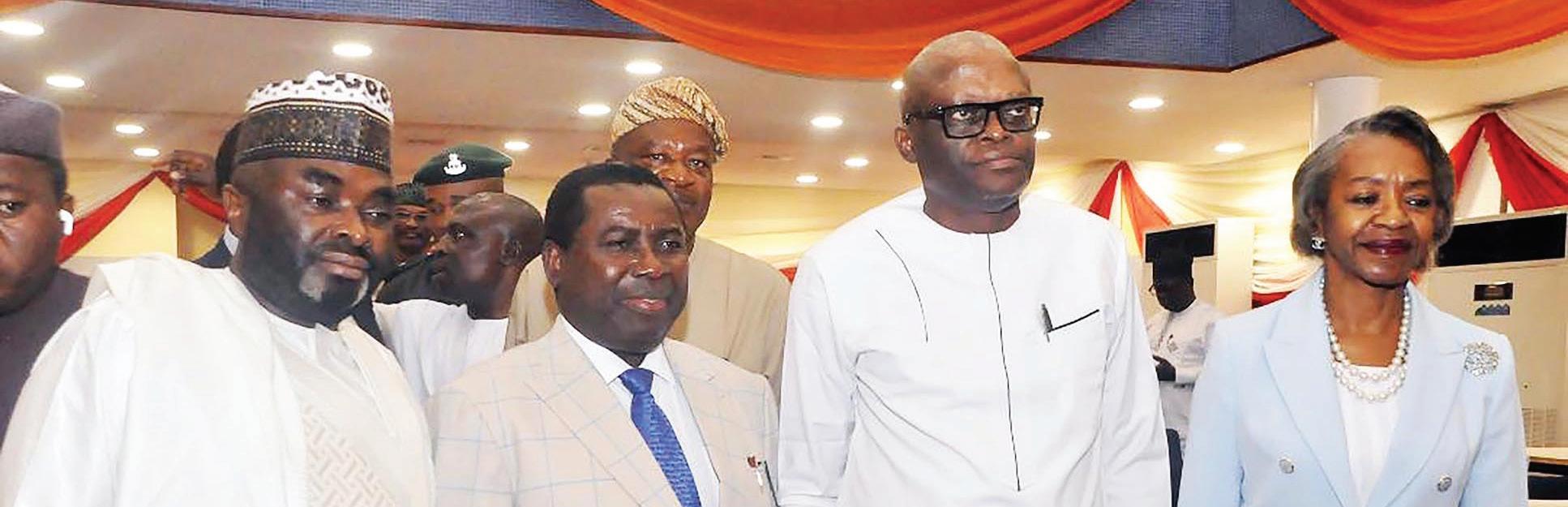
UNVEILING OF ENIOLA BELLO’S BOOK TITLED, SHADOWS
L-R: INEC Commissioner, Professor Sani Adams; Chairman of INEC, Professor Joash Ojo Amupitan; the author and Managing Director, THISDAY Newspaper, Eniola Bello; and INEC Commissioner, May Agbamuche at the unveiling of the book titled “Shadows” at the Shehu Yar’Adua Center, Abuja ... yesterday (Story on page 12)

Emmanuel Addeh in Abuja and Peter Uzoho in Lagos
PHOTO: GODWIN OMOIGUI
Elumoye
Linus Aleke in Abuja



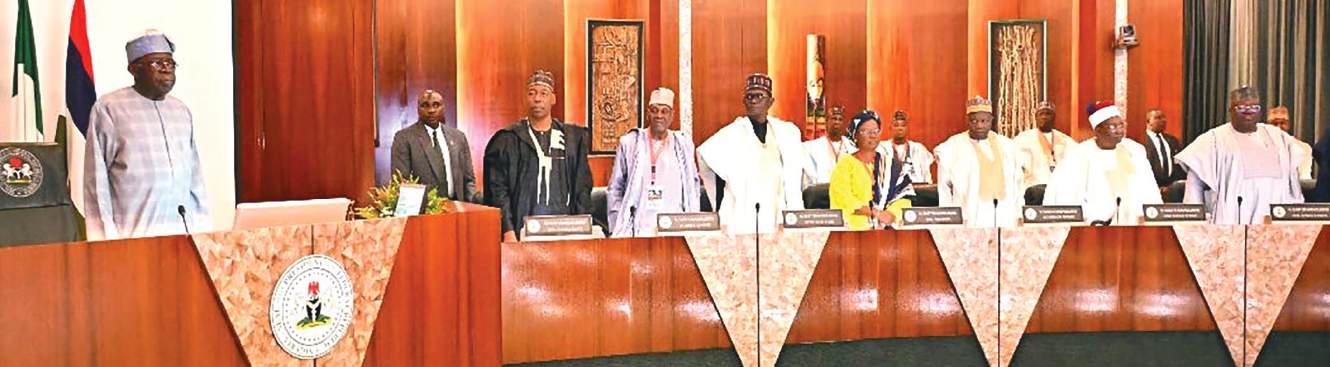
NORTH-EAST LEADERS PLEDGE SUPPORT FOR TINUBU’S SECOND TERM BID...
and others during President
audience with stakeholders
the
Oil Hits $100 for First Time Since May After Attacks by Iran-backed Militants
Trump vows punishment
Emmanuel Addeh in Abuja
Oil prices hit $100 a barrel yesterday for the first time since May, after attacks by Iranian-backed Houthi militants in the Red Sea threatened to squeeze global supplies further and reignite a global inflation shock.
Brent crude, Nigeria’s benchmark, rose more than 6 per cent to $100, extending a blistering rebound this month amid fears that the US and Iran are headed for a return to full-blown conflict.
Oil’s rally accelerated after the Houthis said they had attacked two Saudi Arabian tankers in the Red Sea following their move to impose a maritime blockade on the kingdom this week.
The targeting of the Saudi ships raised the spectre of the Houthis closing the Bab al-Mandab Strait, which connects the Red Sea with the Gulf of Aden and the Indian Ocean, Financial Times report said.
It has become a vital route for Saudi Arabia’s oil exports since Iran seized control of the Strait of Hormuz in the early days of the
war. The attacks also risk unravelling a four-year ceasefire between the Houthis and Saudi Arabia.
Brent crude last traded at $100 on May 26 but tumbled in June after Washington and Tehran’s agreement to extend their ceasefire and reopen the strait raised hopes that oil sup-
plies through the waterway would be swiftly restored.
The intervention from the Houthis comes following the breakdown of the ceasefire, with the US and Iranian forces trading fire for almost two weeks.
US President Donald Trump on
Thursday warned the Houthis and Iran that they would face “major military punishment” if the attacks continued.
The Houthis are one of the most potent members of Iran’s so-called axis of resistance. But they have largely stayed out of the conflict, apart from firing several barrages of missiles and drones at Israel in March and early April.
There have been concerns,
however, that the Houthis will co-ordinate with Tehran to close Bab al-Mandab to pile pressure on energy markets and global trade.
Oil prices had been falling following a temporary ceasefire between the US and Iran. They dropped back to levels last seen before the US and Israel began military action against Iran on February 28.
However, the ceasefire has failed and this week US Secretary of State,
Marco Rubio, said the people in charge in Iran were “not ready to make a deal”. The ongoing conflict risks pushing up inflation for many countries, including Nigeria, as higher oil prices typically lead to petrol and diesel becoming more expensive. Households are also seeing prices of goods, such as food, increase as businesses pass higher transportation costs to customers.
Host Community Trusts Hit 163 as NUPRC Inaugurates PML66 Board
Blessing
Ibunge in Port Harcourt
The Nigerian Upstream Petroleum Regulatory Commission (NUPRC) yesterday revealed that not less than 163 Host Communities Development Trusts (HCDTs) had been incorporated nationwide under the Petroleum Industry Act (PIA).
The commission stated that billions of naira had already been remitted to their accounts, with over 1,100 development projects ongoing and more than 200 projects commissioned across the Niger Delta.
The development was disclosed
during the inauguration of the Board of Trustees (BoT) of Petroleum Mining License (PML) 66 HCDT by Ingentia Energies Limited in Port Harcourt.
Speaking at the event, Assistant Director, Host Communities Development and Administration at NUPRC, Kingsley Ehiaguina, described the HCDT framework as one of the most transformative provisions of PIA, saying it has begun to change the development narrative of oil-bearing communities.
Ehiaguina congratulated Ingentia Energies Limited for successfully
FG Targets 26,961 Beneficiaries Under Phase 3 of NDE Employment Initiative
Agency develops 5-year intervention plan
The federal government has flaggedoff the third phase of the Renewed Hope Employment Initiative meant to help reduce youth unemployment in Nigeria.
The initiative being implemented by the National Directorate of Employment (NDE) is seeking to train 26,961 unemployed Nigerians on 70 highly demand-driven skill areas spanning agriculture, entrepreneurship development public works, information technology, technical and vocational skills.
Speaking during the unveiling of the initiative, the Minister of Labour and Employment, Alhaji Mohammed Maigari, said the skill acquisition programme is being implemented to ensure that many Nigerians, particularly the youths
are gainfully employed.
The minister said that attention must be paid to the rapidly changing pattern of work with technological advancement, digitalisation, climate change, demographic shifts, and global economic transformations redefining labor market access the world over.
His words: “Nigeria must therefore position its workforce to compete effectively in evolving in this evolving environment. In this regard, I want to encourage NDE to continue strengthening its focus on future-oriented skills, particularly in digital technologies, innovation, agri-agri business, green jobs, renewable energy, entrepreneurship, and other sectors with high employment potential.”
While commending NDE for the hosting its operational portal and digital infrastructure, the minister
described the strategic partnership for ICT skills development, the successful resettlement of beneficiaries in several states, and the revitalisation of training facilities as a major boost in country’s quest for sustainable job creation.
He said the efforts of the management of NDE demonstrates the agency’s determination to improve program quality, transparency, accountability, and impact.
The minister also expressed the hope that NDE will incorporate valuable lessons learnt from previous phases, including the adoption of demand-driven training programs, enhanced monitoring mechanisms, extended training durations, strengthened beneficiary verification processes, and expanded digital skills opportunities that will undoubtedly improve and expand the scope and benefits of the scheme.
completing the process leading to the inauguration of the board, despite earlier challenges that delayed the exercise.
According to him, the inauguration of PML 66 board demonstrates that the PIA framework is delivering results through collaboration between operators and host communities.
He said, “Since the implementation of the HCDT, 163 HCDTs have been incorporated. Billions of naira have been remitted into the various accounts, over 1,100 projects are ongoing across the Niger Delta and we have commissioned over 200 projects. I can tell you that the PIA HCDT framework is working. Today is another testament.”
Ehiaguina said unlike previous intervention models, PIA placed the responsibility for determining development priorities directly in the hands of host communities.
He urged the newly inaugurated trustees to use the opportunity responsibly by ensuring transparency, accountability, and sustainable development rather than pursuing personal interests.
Ehiaguina stated, “The ownership of your destiny has been committed into your hands. The destiny and posterity of your communities are now in your hands.
“Let posterity remember your tenure for transformational projects, roads, hospitals and improved livelihoods.”
He charged the board to immediately constitute the Management Committee and Advisory Committee as required by law to ensure the smooth operation of the trust.
Managing Director and Chief Executive Officer of Ingentia Energies Limited, Charles Odita, described the inauguration as a major milestone
in strengthening the relationship between the company and its host communities.
Odita said the trust would accelerate development because the communities themselves would determine how funds accruing from the statutory three per cent contribution would be utilised.
He stated, “With the inauguration of this trust, there will be a jump-start to the impact of our operations on the communities.
“Under the Petroleum Industry Act, the government has mandated operators to set aside three per cent of the previous year’s operating expenditure for the Host Community Development Trust, and it is the trust that determines what happens with the funds.
“This is going to be a major game changer for the accelerated development of the communities.”
OPSN: Planned Increase in Pension Contribution Greek Gift to Workers
Dike Onwuamaeze
The Organised Private Sector of Nigeria (OPSN), has described the recent announcement by the Director General of the National Pension Commission (PenCom) regarding a proposed increase in mandatory pension contributions and introduction of an additional 3.0 per cent mandatory annual contribution as a Greek gift. The OPSN comprises the Manufacturers Association of Nigeria (MAN); the National Association of Chambers of Commerce, Industry, Mines and Agriculture (NACCIMA);
the Nigeria Employers’ Consultative Association (NECA); the Nigerian Association of Small and Medium Enterprises (NASME); the Nigerian Association of Small Scale Industrialists (NASSI) and 25 sectoral employer associations.
A press statement yesterday jointly signed by MAN, NECA, NACCIMA, NASME and NASSI, said that any reform that promises improved retirement outcomes while placing additional pressure on the businesses and jobs that fund those outcomes would ultimately amount to a “Greek gift” to Nigerian workers.
It said: “While the proposal may
be presented as an effort to improve retirement benefits, the OPSN warns that under the prevailing economic conditions, it could become a Greek gift to Nigerian workers.”
According to the OPSN, the proposal will ultimately threaten employment, wage growth, business sustainability and escalate compliance risks.
It maintained that the strength of any contributory pension system depends fundamentally on the survival of businesses, the availability of decent jobs and the capacity of employers and employees to make consistent contributions.
L-R: President Bola Ahmed Tinubu; Borno State Governor, Babagana Zulum; former SDP National Chairman, Ambassador Baba Gana Kingibe; Yobe State Governor, Mai Mala Buni; Adamawa State Deputy Governor, Kaletapwa Farauta; Gombe State Governor, Inuwa Yahaya; Shehu of Borno, Alhaji Abubakar Ibn Umar Garbai El-Kanemi; former Senate President, Ahmad Lawal; former Speaker, House of Representatives, Yakubu Dogara;
Tinubu’s
from
North-east, held at the Presidential Villa, Abuja, on Thursday
Onyebuchi Ezigbo in Abuja

PRESS BRIEFING ON 16TH ANNUAL GTCO AUTISM CONFERENCE...
L-R: Board Certified Behaviour Analyst, Dr. Eziafakaku Nwokolo; International Behaviour Analyst, Solape Azazi; Chief Communications Officer, GTCO Plc, Oyinade Adegite; International Behaviour Analyst, Osezusi Bolodeoku;and Corporate Communications Officer, GTCO Plc,Oluwatosin Onobanjo, during the press briefing for the 16th Annual GTCO Autism Conference, held in Lagos on Wednesday
For Retaining Shettima, N’East Leaders Vow to Deliver Zone to President, APC in 2027
For choosing to retain Vice-President Kashim Shettima as his running mate in 2027, elder statesmen, ministers, lawmakers, traditional rulers and political stakeholders from the North East geo-political zone, yesterday, promised to mobilise massive grassroots support for President Bola Tinubu and the ruling All Progressives Congress (APC) across the zone.
The leaders, drawn from the six North East states, converged on the State House, Abuja, to formally endorse the Tinubu-Shettima ticket, hailing the president’s decision to retain Shettima
as his running mate and reaffirmed their commitment to delivering the region for the ruling party in the 2027 general election.
The delegation, led by Borno State Governor, Professor Babagana Zulum, and former Secretary to the Government of the Federation (SGF), Ambassador Babagana Kingibe, also lauded the Tinubu government for ongoing infrastructure projects, security interventions and economic reforms, which they claimed, were beginning to transform the region after years of insurgency and underdevelopment.
Speaking on behalf of the delegation, Zulum described the visit as one of appreciation and renewed
political commitment, saying the president’s decision to retain Shettima demonstrated confidence in the North-East and recognition of loyalty, competence and dedicated service.
“We are here for one overriding purpose, to show our appreciation and thank you most profoundly for the re-nomination of an accomplished son of our region, His Excellency, Senator Kashim Shettima, as your vice-presidential running mate in the forthcoming 2027 presidential election.
“By this decision, you have once again demonstrated your outstanding qualities as a leader, who recognises and rewards loyalty, competence and commitment.”
The governor described Shettima as a dependable deputy, who has served the President with distinction over the last three years, adding that retaining him reflected continuity, political maturity and strategic leadership.
According to him, although the APC zoning arrangement allowed the president to choose a running mate from any of the three northern geo-political zones, Tinubu’s decision to retain Shettima further strengthened the confidence of the North-East in his administration.
Zulum also lauded leaders from the North-West and North-Central regions for supporting the decision, describing it as a demonstration of
NSIB Begins Investigation into Enugu Air Flight Runway Excursion Incident at Benin Airport
in Enugu
The Nigerian Safety Investigation Bureau (NSIB) said it has commenced an investigation into a runway excursion involving an Enugu Air Embraer E170 aircraft at Benin Airport.
NSIB in a statement said the aircraft, operating as Flight 4264 (registration 5N-ENR) from Lagos (LOS) to Benin (BNI), was involved in a runway excursion after overrunning the end of Runway 05 during landing at approximately 1510 hours local time (1410 UTC) yesterday.
NSIB confirmed that there were 63 passengers and five crew members on board the aircraft and all passengers and crew have been accounted for, and no injuries have been reported.
“The NSIB’s Go Team was mobilised and on the ground at the occurrence site within minutes of notification, underscoring the Bureau’s commitment to a rapid and effective emergency response.
“The team is gathering and preserving evidence, interviewing the flight crew and other relevant personnel, examining the aircraft, assessing runway conditions, and reviewing all other relevant operational and technical information to determine the circumstances and contributing factors to the occurrence,” NSIB said.
It also noted the Nigerian Civil
Aviation Authority (NCAA) and relevant airport authorities have been notified, and the aircraft has been secured.
Commenting on the occurrence, the Director General of the NSIB, Captain Alex Badeh Jr., said: “We are relieved that all passengers and crew members are safe and that no injuries were reported. While this is reassuring, every runway excursion is a serious occurrence that deserves a thorough and independent investigation.
“Our Go Team was on the ground within minutes of notification, and that speed of response reflects the readiness and professionalism of our investigators. We urge the public to refrain from speculation as our investigators carry out their work in accordance with international standards.”
NSIB assured that a preliminary report will be issued within 30 days, in accordance with regulatory requirements, adding that the final investigation report, including safety recommendations, would be published upon completion of the investigation.
Meanwhile, Enugu Air in its X account confirmed the incident in a statement, saying, “Enugu Air wishes to inform the public that one of our aircraft operating into Benin experienced a runway incursion after landing today.
“We confirm that all passengers
and crew have safely disembarked and there were no injuries or casualties,” the airline stated.
Enugu Air further explained that the aircraft was secured after the incident and the relevant aviation authorities have been notified in line with established procedures and an assessment of the aircraft and the circumstances surrounding the occurrence was currently underway.
The airline noted that as a result of the incident, there might be temporary adjustments to some
flight schedules.
“Passengers affected by any changes will be contacted directly and provided with the necessary assistance. The safety of our passengers, crew, and operations remains our highest priority. We appreciate your understanding and will continue to provide updates through our official communication channels,” it noted.
However, according to eye witness account, there was panic at the Benin Airport when the aircraft, skidded off the runway.
unity within the ruling party.
The governor also praised federal government’s interventions across the region, citing the ongoing AkwangaJos-Bauchi-Gombe-Biu-Maiduguri Expressway, investments in agriculture, education, youth empowerment and the rehabilitation of internally displaced persons (IDPs) as evidence of the administration’s commitment to rebuilding the North-East.
“We sincerely appreciate your efforts. We see and feel the impact of your administration and remain grateful for your commitment to the development of our region,” he said.
He assured the president that the region would spare no effort in mobilising support for his re-election.
“On behalf of the governors, ministers, members of the National Assembly, party leaders, women, youths and our teeming supporters, I assure Your Excellency that the North-East remains solidly behind your administration.
“We will continue to support your policies and programmes and mobilise our people at the grassroots to embrace the Renewed Hope Agenda.
“By the grace of God, come 2027, the North-East will massively deliver your presidential ticket and all APC candidates at every level.”
Earlier, Kingibe said the delegation represented respected leaders whose influence transcended politics and whose voices continued to shape public opinion across the region.
“It is a great honour to be here today with my brothers and sisters from the North-East to publicly
acknowledge the leadership, vision and commitment of President Bola Tinubu and to reaffirm our commitment to partnering him in moving Nigeria forward.”
According to him, many members of the delegation were no longer active politicians but remained trusted leaders who would continue to explain government policies, rally public support and strengthen confidence in the administration.
“Our people trust us. They know where we stand, and we will continue to mobilise support for this administration because we believe it is working in the national interest.”
Responding, Tinubu described the endorsement as both emotional and reassuring, saying it reflected the enduring partnership between his administration and the North-East. He paid tribute to former National Chairman of the defunct Social Democratic Party (SDP), Alhaji Bamanga Tukur, recalling the elder statesman’s role in shaping his political philosophy during Nigeria’s struggle for democratic governance.
The President thanked governors, ministers, lawmakers, traditional rulers and political leaders from the region for their confidence in his administration and pledged to consolidate ongoing reforms.
“As a President nominated for a second term, I hold democracy, consistency, dedication and steadfastness very dearly. Our focus is to stabilise the country, strengthen the polity and grow the economy. The economy is already stabilised.”
Senate Directs Sweeping Mining Safety Reforms after Kogi Landslide Kills 20
Sunday Aborisade in Abuja
The Senate on Wednesday directed far-reaching reforms to improve safety standards in Nigeria’s mining sector following the deaths of 20 artisanal miners in a landslide at Alufele in Ankpa Local Government Area of Kogi State, urging the federal government to tighten regulation of mining operations and establish compensation and insurance schemes for workers.
The resolution followed the adoption of a motion of urgent national importance sponsored by Senator Isah Jibrin (APC, Kogi East), who warned that unsafe min-
ing practices and weak regulatory oversight had continued to expose miners and host communities to avoidable disasters.
Leading debate on the motion, Jibrin said the July 14 landslide at Alufele in Enjema District trapped dozens of artisanal and small-scale miners underground, leaving 20 dead, several others injured and heavy-duty trucks submerged in collapsed mining pits during loading operations.
He noted that coal mining remains a major economic activity in communities such as Enjema, Okaba and Ikah, as well as parts of Omala and Olamaboro Local
Government Areas within the Ankpa Coal Block of the Anambra Basin.
He warned that the area’s fragile geological formation makes it particularly vulnerable to landslides and ground collapse when mining is carried out without adequate safety measures. According to him, many of the recurring accidents in the area are linked to unsafe mining methods, including the use of the room-andpillar extraction system without sufficient structural reinforcement, as well as the location of loading points too close to unstable mining pits.
He also lamented the plight of artisanal miners, many of whom operate without formal employment, health insurance, life insurance or occupational hazard protection, leaving victims of mining accidents and their families without compensation or social support.
Following the debate, the Senate urged the Federal Ministry of Solid Minerals Development, through its Artisanal and Small-Scale Mining Department, to carry out a nationwide audit of licensed miners and mining sites to strengthen monitoring, enforcement and compliance with safety regulations.
Chinedu Eze in Lagos, Felix OmohAsun in Benin and Emmanuel Ugwu-Nwogo
Deji Elumoye and Linus Aleke in Abuja
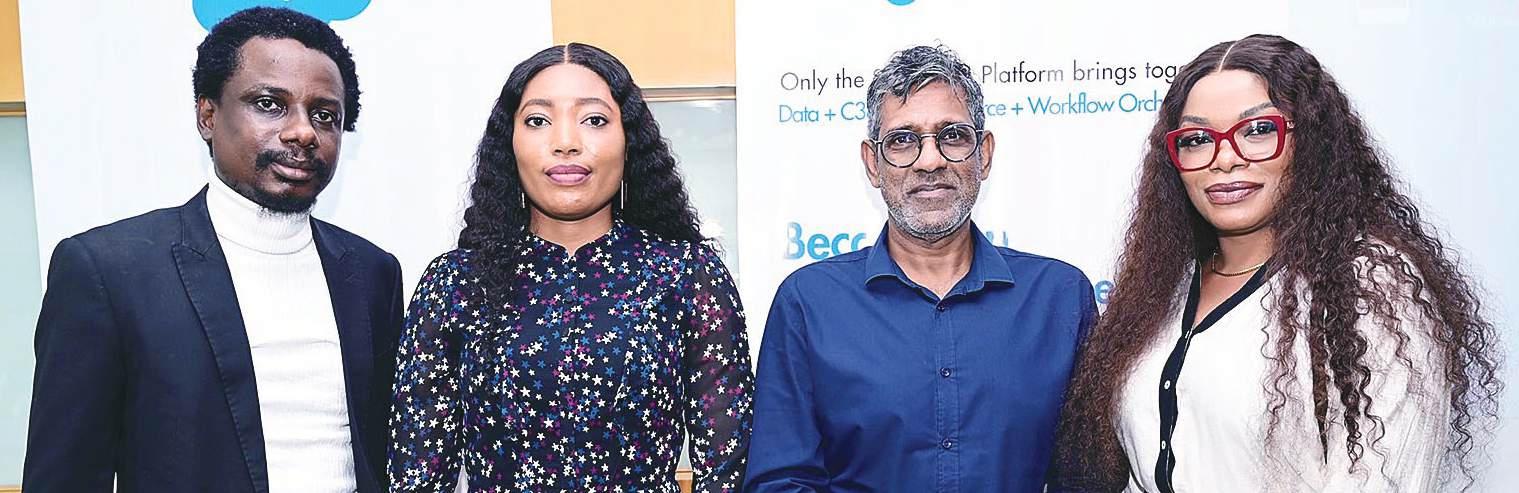
C- SUITE BREAKFAST MEETING TITLED UNBLOCKING AGENTIC ENTERPRISE...
L-R: VP, Enterprise Business, Arravo, Ayantola Olaayan; Territory Account Manager - Nigeria at Salesforce, Sandra Ebere; Lead Solutions Engineer, and financial services at Salesforce, Kenneth Mangal and Director, Sales, Arravo, Oyinlola Okunfolami at the C- Suite breakfast meeting titled Unblocking Agentic Enterprise: Elevating Customer Experience in the Artificial Intelligence (AI) Era organised by Arravo in partnership with Salesforce in Lagos...recently
Nigeria Unveils 10-Year Agrifood Roadmap, Targets Food
Sovereignty, Poverty Reduction, $100bn Investment
The Minister of Agriculture and Food Security, Senator Abubakar Kyari, on Thursday unveiled Nigeria’s 10-year Agrifood System Strategy and Action Plan, declaring the federal government was determined to move beyond fragmented agricultural interventions and build a resilient food system capable of guaranteeing food sovereignty, reducing poverty and driving inclusive economic growth.
Kyari, who spoke at the Agrifood System Working Group (ASWG) meeting in Abuja, said the strategy, developed under the Comprehensive Africa Agriculture Development Programme (CAADP) Kampala Declaration (2026–2035), represented a new direction for Nigeria’s agricultural sector by shifting focus from isolated projects to an integrated food systems approach.
He said the plan would address the entire agrifood chain, including production, processing, markets, resilience, investment, nutrition and governance.
According to the minister, President Bola Ahmed Tinubu considers food security a national security imperative and had directed the development of a comprehensive roadmap with measurable targets and implementation pathways capable of transforming Nigeria’s food system.
“The President has given us a clear and urgent charge: to move beyond rhetoric, beyond pilot projects, and beyond fragmented interventions, and instead deliver a coherent, bankable, and implementable plan that will
fundamentally transform Nigeria’s agrifood system for the long term,” Kyari said.
He disclosed the strategy, developed through extensive consultations across Nigeria’s six geopolitical zones and national engagements, would be presented for adoption by stakeholders before being forwarded to the Federal Executive Council (FEC) for approval.
The minister said such approval would ensure that Ministries, Departments and Agencies align their programmes, policies and budgets with the country’s agrifood trans- formation vision.
Kyari noted that Nigeria’s agrifood system supports more than 70 per cent of the population, drives rural economies, contributes significantly to GDP and provides opportunities for job creation, industrialisation and foreign exchange earnings.
He explained that the CAADP Kampala Declaration builds on previ- ous continental commitments but introduces a broader approach that focuses on sustainable production, resilience, value-chain development, inclusivity and accountability.
The declaration, he said, commits African countries to increasing agrifood output, tripling intraAfrican trade in agrifood products and inputs, reducing post-harvest losses by 50 per cent, improving nutrition outcomes, ensuring access to healthy diets, mobilising $100 billion in investments and narrowing the gender productivity gap by 2035.
Kyari identified governance as the foundation for achieving these targets, stressing that strong
coordination, effective institutions and accountability mechanisms would determine the success of Nigeria’s implementation plan.
While government outlined its transformation agenda, ActionAid Nigeria’s Food Systems Specialist, Azubike Nwokoye, warned that inadequate agricultural investment at federal and state levels could undermine the implementation of the new strategy.
Nwokoye, speaking at the meeting, said an analysis conducted by the organisation through a newly developed dashboard showed poor performance in agricultural capital spending across many states between 2023 and 2025.
He said the assessment, which covered Nigeria’s 36 states and the Federal Capital Territory, revealed that in 2025, 16 states recorded very low
performance in agricultural capital spending, eight states recorded medium performance, while only 10 states achieved high performance.
“The findings are not encouraging. Between 2023 and 2025, Nigeria has performed poorly in terms of capital spending on agriculture,” he said.
Nwokoye stressed that beyond budget allocations, stakeholders must examine where agricultural funds were being deployed to ensure they deliver maximum impact.
He said the analysis showed that many states were spending only about three per cent of their capital budgets on agriculture, while federal capital spending on the sector was also below what was required to meet national and continental commitments.
He warned that Nigeria’s combined agricultural allocation
by the 36 states and the FCT for 2026 stood at only 4.58 per cent, far below the 10 per cent benchmark under the Maputo, Malabo and Kampala commitments.
“As a country, we must act quickly, including through complementary budgets where necessary, if we are to meet these commitments,” he said.
Nwokoye however said increased investment in agriculture could significantly boost employment creation.
According to him, ActionAid’s analysis showed that if states fully implement their 2026 agricultural budgets, Nigeria could generate about 1.4 million direct quality jobs across the states.
He added that projected federal government spending could generate another 2.1 million direct jobs, bringing the potential national total
to about 3.5 million direct jobs.
“Increasing investment would raise this figure significantly,” he said. He disclosed the findings would be transmitted to state governors to encourage stronger commitment towards agricultural financing and improved returns on investment.
On his part, the Minister of Budget and Economic Planning, Senator Atiku Bagudu, said Nigeria’s ability to achieve food security depended largely on strengthening the country’s more than 42 million agricultural households.
Bagudu said the CAADP Kampala Declaration reflected African leaders’ recognition that food security required a systematic approach, adding that Nigeria was pursuing an even more ambitious goal under President Tinubu’s directive to lift Nigerians out of poverty by 2030.
REA Eyes 3.7GW Solar Panels Manufacturing Capacity By End of 2027
Zanzibar utilities regulatory agency visits to understudy Nigeria Aliyu: Nigeria must prepare for AI driven surge in electricity demand
Emmanuel Addeh in Abuja
The Rural Electrification Agency (REA) has reiterated the organisation’s commitment to the ambitious roadmap aimed at achieving universal electricity access in Nigeria by 2060 while developing 3.7 gigawatts of local renewable energy manufacturing capacity as part of efforts to deepen energy access and industrialisation.
Managing Director of the REA, Dr Abba Aliyu, disclosed this while presenting the agency’s electrification strategy to a visiting delegation from the Zanzibar Utilities Regulatory Authority (ZURA) in Abuja, saying Nigeria was accelerating investments
Ogun Attracts $250m Dairy Farm Investment
James Sowole in Abeokuta
The Ogun State Government has attracted a landmark $250 million investment by Pure Dairy Herd for the establishment of a world-class dairy farm in Itoro, Yewa South Local Government Area.
The farm will further strengthen the state’s position as Nigeria’s leading destination for strategic agricultural investments.
The Commissioner for Agriculture and Food Security, Hon. Bolu Owotomo, disclosed this during a community engagement meeting
between the investors and residents of Itoro, held at the palace of the Onitoro of Itoro, Oba Nathaniel Fasina.
According to the Commissioner, the project, upon completion, would become the largest dairy farm in Nigeria, with an initial capacity of approximately 10,000 dairy cows, significantly expanding domestic milk production, create substantial employment opportunities, stimulate economic activity and strengthen Nigeria’s livestock and dairy value chain.
Owotomo said the investment
further reflects the success of the investor-friendly policies and business environment created by the Ogun State Government under the leadership of the Governor, Prince Dapo Abiodun.
He noted that Ogun State had continued to attract major investments across its agricultural landscape, including the proposed revitalisation of Apoje Plantation in Ijebu-Igbo, as well as investments in Obafemi Owode, Ikenne and Kajola in Ewekoro, among others.
The Commissioner disclosed that the investors had also committed
to undertaking palliative repairs on roads leading to the project site to improve accessibility and facilitate the smooth commencement of operations.
Addressing concerns raised by members of the host community, Owotomo assured affected landowners that adequate compensation would be paid in accordance with applicable laws and established procedures, explaining that the compensation framework would distinguish between owners of undeveloped land and those with economic trees and other cash crops on their properties.
in renewable energy to close its electricity access gap and position itself for the rapidly growing global demand for power.
The REA chief executive said agreements signed during the 2025 Nigeria Renewable Energy Innovation Forum would unlock a combined manufacturing capacity of 3.7 gigawatts across six states in partnership with seven companies.
The projects, he said, include photovoltaic manufacturing facilities in Kano, Abuja, Ogun, Bayelsa and Akwa Ibom states, alongside a recycling plant in Lagos.
“We are about to inject 3.7 gigawatts of manufacturing capacity in Nigeria. Already many of Nigeria’s PV panels produced in Lagos have been exported to Ghana.
“We want to reduce the importation of PV panels from China. We are asking Chinese companies to come to Nigeria and establish their factories. By the end of next year, we will have 3.7 gigawatts manufacturing capacity. This is one of the biggest achievements that we have recorded,” Aliyu said.
He attributed the falling cost of renewable energy technologies largely to advances in Chinese manufacturing, noting that declining prices for photovoltaic panels and lithium batteries were making renewable energy the most economically viable option for expanding electricity access.
“One of the reasons is credit goes to the Chinese. They have really demystified renewable energy technology. They have crashed the cost of PV panels. Even lithium battery pricing has gone down and will continue to go down,” he stated.
Aliyu argued that global electricity demand was entering an unprecedented phase driven by population growth, widespread electrification and the rapid expansion of artificial intelligence and data centres.
“The demand for electricity has never been seen before. There are three critical reasons: electrification of everything, population growth and AI and data centres. Electricity is going to determine how health services, education, agriculture and virtually everything else will be done,” he said.
Michael Olugbode in Abuja
Metering: FG Launches Initiative to Train
5,000 Youths, End Estimated Billing
Tegbe says skilled workforce critical to closing existing gap Verheijen: Initiative will create jobs, accelerate deployment of smart meters
Deji Elumoye and Emmanuel Addeh in Abuja
The federal government yesterday officially launched the Power Force Programme under the Presidential Metering Initiative (PMI), with plans to train 5,000 young Nigerians in smart meter installation as part of efforts to bridge the country’s metering gap and create employment opportunities.
Speaking at the flag off of the programme in Abuja, the Minister of Power, Chief Joseph Tegbe, described the initiative as a landmark intervention that combines investment in critical electricity infrastructure with the development of skilled manpower needed to drive reforms in the Nigerian Electricity Supply Industry (NESI).
Tegbe stressed that inadequate metering remains one of the biggest structural problems confronting the power sector, noting that it has contributed significantly to the persistent liquidity crisis by preventing accurate billing and revenue collection.
“Where electricity consumed cannot be accurately measured, revenue cannot be accurately collected. Where revenue is uncertain, investments decline, infrastructure deteriorates, and ultimately, consumers suffer.
“The metering gap, therefore, is not just a technical problem; it is one of the principal causes of the liquidity challenges that have constrained the growth of our power sector,” he said.
According to the minister, the administration of President Bola
Tinubu has prioritised reforms aimed at restoring financial sustainability to the electricity market through fairness, transparency and accountability.
He stated that smart metering would eliminate estimated billing, improve consumer confidence, strengthen Disco revenues and ultimately support greater private sector investment in the industry.
Tegbe also welcomed the recent withdrawal of the lawsuit by the Association of Meter Asset Providers of Nigeria (AMMON), describing it as a major breakthrough that has removed a significant obstacle to the accelerated deployment of electricity meters nationwide.
“I wish to sincerely commend AMMON for embracing dialogue in the national interest. I equally appreciate the Presidential Metering
Initiative, the Nigerian Electricity Regulatory Commission, Bureau of Public Enterprises, Meter Asset Providers and every stakeholder whose constructive engagement made this breakthrough possible,” he stated.
The minister emphasised that the shortage of skilled technical personnel has long hindered the country’s metering drive, making the Power Force Programme an essential component of the government’s strategy.
“The 5,000 young Nigerians being trained under this initiative will become the backbone of Nigeria’s smart metering workforce. They will help ensure that millions of households and businesses receive professionally installed meters that meet the highest technical and safety
standards,” he added.
Beyond supporting the electricity sector, Tegbe said the initiative would generate meaningful employment, promote local content development and equip young Nigerians with technical skills required in a modern electricity industry.
Also speaking, the Special Adviser to the President on Energy and Executive Secretary of the Presidential Metering Initiative, Olu Verheijen, described Power Force as the flagship workforce development programme under the PMI.
She explained that the initiative is designed to train 5,000 young Nigerians in smart meter installation to build the skilled workforce required to accelerate the country’s smart meter rollout while creating sustainable employment opportunities.
N’ASSEMBLY UPDATES INLAND WATERWAYS LAW TO ALIGN WITH RECENT S’COURT RULING
Attorneys-General of Lagos State and the federal government.
In its judgment, the Supreme Court had in May this year, ruled that the federal government could only regulate inland waterways that fall within its constitutional powers.
The decision invalidated several provisions of the existing NIWA Act that gave the federal government wider regulatory authority than the Constitution permits.
To address this, the new legislation clearly defines the areas where the National Inland Waterways Authority has legal jurisdiction.
It also removes the sections of the old law that were struck down by the Supreme Court and eliminated areas of conflict between the federal government and state governments over the control and regulation of inland waterways.
The bill is also designed to encourage greater private sec-
tor investment in inland water transportation by creating a clearer legal framework. In addition, it strengthens provisions on navigation safety, environmental protection and the sustainable development of Nigeria’s waterways.
The legislation, which was earlier passed by the House of Representatives was concurred to by the Senate yesterday.
With the Senate approval, it has now been passed by the National Assembly and would be transmitted to President Bola Tinubu for his assent before it becomes law.
The Supreme Court had two months ago, declared Sections 12 and 13 of the National Inland Waterways Authority (NIWA) Act unconstitutional to the extent that they empower the Federal Government to exercise control over lands adjoining waterways for purposes unrelated to navigation
IN REBUILDING SECURITY, TINUBU EXPANDS ARMY TO 12 DIVISIONS, 28 THOUSAND NEW MEN
approval for the recruitment of 28,000 additional personnel, acquisition of critical military platforms and equipment, improvements in troop welfare, and ongoing support for operational readiness and force modernisation.
Under the new structure, the Nigerian Army will operate 12 divisions, strategically positioned across the country.
They are 1 Division Headquarters – Kaduna (Kaduna, Kano, Katsina and Jigawa States), 2 Division Headquarters – Ibadan (Oyo, Osun, Ekiti and Ondo States), 3 Division Headquarters – Jos (Plateau, Bauchi and Gombe States), 5 Division Headquarters – Makurdi (Benue, Nasarawa and Kogi States), and 6 Division Headquarters – Port Harcourt (Rivers, Akwa Ibom and Cross River States).
Others are 7 Division Headquarters – Maiduguri (Borno and Yobe States), 8 Division Headquarters –Sokoto (Sokoto, Kebbi and Zamfara States), 9 Division Headquarters – Ilorin (Kwara and Niger States), 10 Division Headquarters – Jalingo (Taraba and Adamawa States), 81 Division Headquarters – Lagos (Lagos and Ogun States), 82 Division Headquarters – Enugu (Enugu, Anambra, Abia, Ebonyi and Imo States) and 83 Division Headquarters – Benin City (Edo, Delta and Bayelsa States).
The establishment of the new
Divisions in Makurdi, Ilorin, Jalingo and Benin City will significantly improve command and control, decentralise operational decisionmaking, strengthen border security, enhance the protection of critical national infrastructure, improve counter-insurgency and internal security operations, and ensure faster military response to emerging threats nationwide.
Implementation of the new force structure will be done in two phases.
The first phase, covering the establishment of the 5, 9, and 10 Divisions and the reorganisation of existing formations, will be completed by September 2026. The second phase, involving the establishment of the 83 Division and further reorganisation, is expected to be completed by December 2026.
The President commended the Chief of Army Staff, Lieutenant General Waidi Ibrahim Shuaibu, and all officers and soldiers of the Nigerian Army for their dedication, professionalism, and steadfast commitment to defending Nigeria’s sovereignty and territorial integrity.
Tinubu reaffirmed his administration’s determination to continue investing in the Armed Forces, ensuring they remained adequately equipped, motivated, and fully capable of protecting the nation and guaranteeing the safety and security of all Nigerians.
and maritime activities.
The apex court delivered the judgment in Suit No. SC/ CV/541/2025 filed by Lagos State against the Federal Government over the constitutional limits of federal authority on inland waterways and adjoining lands within states. Legal
The matter was determined by a seven-member panel led by Justice Mohammed Lawal Garba, JSC, with Justice Abubakar Sadiq Umar, JSC, reading the lead judgment. The panel also included Justices Emmanuel Akomaye Agim (Dissenting), Chidiebere Nwaoma Uwa, Haruna Simon Tsammani, Stephen Jonah Adah and Mohammed Baba Idris (Dissenting).
Senior Advocates of Nigeria, including Babatunde Raji Fashola, Olasupo Shasore and Muiz Banire, appeared for Lagos State, while Akin Olujimi represented the Federal Government.
The court overruled preliminary objections challenging its jurisdiction and proceeded to determine the substantive issues raised in the suit.
In its findings, the Supreme Court held that Sections 12 and 13 of the NIWA Act exceeded the legislative powers of the National Assembly because they purported to regulate lands adjoining waterways beyond matters connected with navigation, maritime activities
billion in new equity and marked the refinery’s first equity capital raise involving external investors beyond its legacy shareholder base.
According to the statement, the capital raise represented a significant milestone in the company’s long-term funding strategy and is expected to support the continued expansion of its refining and petrochemical operations while contributing to the development of African capital markets.
It explained that proceeds from the private placement would be deployed to support the ongoing expansion of the refinery and petrochemical complex, strengthen the company’s capital structure and provide additional financial flexibility for future growth initiatives.
The company disclosed that the offering attracted strong participation from a broad range of international and African institutional investors, sovereign-related investment vehicles, development finance institutions and longstanding strategic partners.
and fishing. Legal
According to the court, the National Assembly acted ultra vires by extending federal control to adjoining lands for non-navigational purposes, contrary to the provisions of the 1999 Constitution.
However, speaking after the passage of the bill, Senate President Godswill Akpabio described the legislation as a major milestone that would provide a clear framework for the administration of inland waterways while opening up new economic opportunities for states and private investors.
He said the new legal framework would eliminate the recurring conflicts over control of inland waterways, create a more coordinated transportation system and encourage greater investment in the sector.
According to him, the reform has become imperative in view of the increasing importance of inland water transportation to Nigeria’s economy and the urgent need to improve safety standards.
Akpabio expressed optimism that the legislation would significantly reduce the frequent incidents of boat mishaps and loss of lives recorded across the country.
He said: “This legislation brings a clear sense of direction to the management of inland waterways in Nigeria. It allows greater par-
Among the key investors were Africa Finance Corporation (AFC) and India Infra Buildco, an investment vehicle facilitated by the African Export-Import Bank (Afreximbank), alongside a mix of institutional and individual investors, reflecting what it described as strong market confidence in the refinery’s long-term strategy.
President and Chief Executive of Dangote Industries Limited and Chairman of Dangote Petroleum Refinery and Petrochemicals, Aliko Dangote, described the transaction as a major step in broadening the company’s ownership structure while supporting its expansion plans.
He said: “This is a strategic step to deepen and further institutionalise the Enterprise’s shareholder base, while raising capital to complement our internal cash flows and external funding, as DPRP advances its expansion agenda.
“This further demonstrates our profound commitment to
ticipation by state governments as well as the private sector in the management of our inland waterways.
“I believe this law will help reduce the recurring cases of boat accidents and the needless loss of innocent lives on our waterways. It will also improve revenue generation for the states and encourage a more robust and sustainable transport system.”
The Senate President further noted that the law would strengthen cooperation between federal and state authorities by removing areas of overlapping responsibilities that had often resulted in disputes.
He commended the relevant Senate committees and the Senate Leader for successfully steering the legislation through the parliamentary process.
The Senate also passed amendments expanding the judicial structure of the Federal Capital Territory to accelerate the dispensation of justice.
Akpabio said the increasing population of the FCT and the growing volume of litigation had made the expansion of the courts inevitable.
He noted that the measure would reduce delays in the justice delivery system and reinforce public confidence in the judiciary.
“Justice delayed is justice denied.
developing domestic refining and petrochemical capacity, reducing Africa’s reliance on imported refined products and strengthening the continent’s energy security.”
Also commenting, Managing Director and Chief Executive Officer of Dangote Petroleum Refinery and Petrochemicals, David Bird, said the level of investor interest reflected confidence in the company’s operations and leadership.
“The exceptional demand we saw is a testament to our operational excellence, execution capacity, and investor confidence in DPRP’s leadership,” Bird stated.
The company noted that with the successful completion of the transaction, it is well positioned to continue executing its long-term growth strategy while expanding Africa’s refining and petrochemical capacity.
It added that the strong investor response reinforces confidence in its strategic direction and strengthens its platform for sustainable longterm value creation.
Expanding the courts will ensure quicker dispensation of justice and strengthen the confidence of Nigerians in the judiciary, which must remain the last hope of the common man,” he said.
The Senate also approved amendments to the National Tobacco Control Act aimed at tightening the regulation of tobacco and other non-combustible products.
Akpabio linked the abuse of tobacco products to rising health challenges, particularly among young people, stressing that stricter regulation would contribute to improved public health and national development. He said stronger enforcement of the law would help reduce smoking-related illnesses and protect non-smokers from the harmful effects of passive smoking Before proceeding on recess, the Senate also approved the recommendations of its Ad Hoc Committee on the National Security Summit, paving the way for the final phase of the initiative.
Presenting the committee’s report, Senate Leader, Senator Opeyemi Bamidele, said the summit had been scheduled to hold from September 21 to 23, 2026, subject to the availability
Besides the private placement, the Dangote Petroleum Refinery is preparing for what is expected to be one of Africa’s biggest Initial Public Offerings (IPO), with plans to offer a minority stake to public investors later this year.
The proposed listing is aimed at broadening the refinery’s ownership base, deepening Nigeria’s capital market and raising fresh capital to support expansion, while giving institutional and retail investors an opportunity to participate in the country’s largest private industrial project.
Reports indicate the offer could value the refinery at about $40 billion, although the final valuation and offer size will be subject to regulatory approvals and market conditions.
Beyond providing access to capital, the IPO is also expected to strengthen the company’s corporate governance through enhanced disclosure and reporting requirements associated with a public listing.
“Today in Abuja, we officially flagged off training for the first cohort, a significant step towards empowering young Nigerians with in-demand skills and driving sustainable progress in the power sector,” Verheijen said on her X handle. Joseph Tegbe
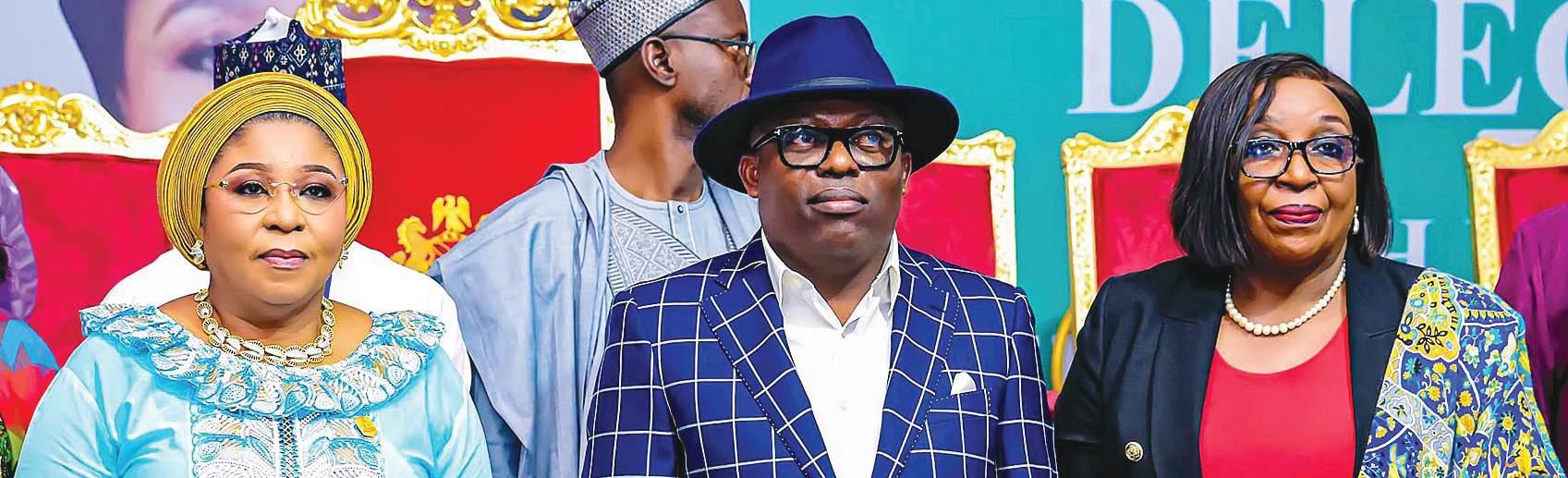
OPENING CEREMONY OF THE 48TH NATIONAL COUNCIL ON ESTABLISHMENTS...
L-R: Head of the Civil Service of the Federation, Mrs. Didi Esther Walson-Jack; Governor of Rivers State, Sir Siminalayi Fubara; and Deputy Governor of Rivers State, Prof. Ngozi Odu, at the opening ceremony of the 48th National Council on Establishments in Port Harcourt, yesterday
Senate Threatens MDAs, GOEs with Sanctions for Defying Legislative Summons
Directs immediate compliance with committee invitations, directs SGF, ministers
to enforce resolution
As Reps warn NRS chairman Zacch Adedeji of sanctions over recruitment, recalcitrance
The Senate on Thursday escalated its confrontation with government-owned enterprises (GOEs) and Ministries, Departments and Agencies (MDAs), warning that any institution that refuses to honour its invitations or obstructs legislative oversight will face constitutional sanctions and enforcement measures.
In another related development, the House of Representatives Committee on Federal Character also condemned what it described as the persistent disregard for the constitutional powers and authority of the National Assembly by the Executive Chairman of the Nigeria Revenue Service (NRS), Dr. Zacch Adedeji.
The Reps committee also directed the immediate suspension of recruitment activities by the NRS, warning
it would invoke Sections 88 and 89 of the 1999 Constitution to enforce its oversight mandate if the revenue service chairman continued to ignore its directives.
Section 88 empowers both chambers of the National Assembly to conduct investigations into alleged corruption, inefficiency and waste in government, while Section 89 gives the legislature the power to compel the attendance of witnesses, demand testimony and
issue warrants where necessary.
Meanwhile, the Senate also directed all MDAs and GOEs to comply with summons issued by the Senate and its committees, appear whenever required and submit all records and documents needed for oversight, insisting that continued defiance would no longer be tolerated.
The resolution followed the adoption of a motion moved by the Chairman of the Senate Committee on Finance,
NCG Summit: Shettima Seeks Stronger PublicPrivate Partnership to Accelerate Nigeria’s Economy
Ayodeji Ake
Vice President Kashim Shettima has declared that Nigeria’s ambition of building a $1 trillion economy will only be realised through the implementation of sound governance across both the public and private sectors.
Represented by the Special Adviser to the President on Economic Affairs, Dr. Tope Kolade, the Vice President made the assertion at the 2026 National Corporate Governance Summit, themed “Implementing Good Governance for Economic Acceleration: Consolidating Public/ Private Sector Partnership,” organised by the Institute of Directors Centre for Corporate Governance (IoDCCG) in collaboration with
the Financial Reporting Council of Nigeria (FRC), the Ministry of Finance Incorporated (MOFI) and the Institute of Chartered Secretaries and Administrators of Nigeria (ICSAN), held recently in Lagos Addressing government officials, regulators, board chairmen, corporate executives and governance experts, Shettima said the Tinubu administration had already embarked on sweeping reforms, including foreign exchange liberalisation, tax reforms and fuel subsidy removal, stressing that sustainable economic growth would only come when governance standards improve across every sector.
“This government is big on reforms. Whether you’re talking about foreign exchange, tax reform
Soludo’s Daughter
Graduates
or subsidy reform, so many reforms are already ongoing. But the upshot of today’s discussion is that public sector reforms must also meet private sector reforms. Good governance on both sides, from the public and the corporate side, is what will take Nigeria forward,” Kolade said on behalf of the Vice President.
He noted that beyond macroeconomic reforms, the government has rolled out industrial and investment policies while pursuing reforms in the power sector to create a more competitive economy.
Rather than focusing on shortterm economic targets, the Vice President urged Nigerians to embrace innovation and adapt to emerging global realities, particularly
from
Nottingham University with First Class Honours in Neuroscience
David-Chyddy Eleke in Awka
Daughter of the governor of Anambra State, Miss Oduko Soludo has graduated from University of Nottingham with first-class Honours in Neuroscience.
Wife of the governor, Mrs. Nonye Soludo, who disclosed this praised Oduko for her hard work, sacrifice, and steadfast faith in God.
She celebrated her saying: “You have shown that true success is not
a product of chance but of hard work; watching you blossom into an intelligent, compassionate, and purpose-driven young woman has been one of my greatest joys.
“As you embark on the next phase of your journey, I pray that God continues to guide your path, enlarge your coast, and use your knowledge and gifts for the service of humanity.
“Never stop learning, never stop striving, and always remain
humble and kind.
“Today, my heart is filled with immense gratitude to God as we celebrate our beloved daughter, Oduko, on her graduation with a First-Class Honours in Neuroscience from the University of Nottingham.
“Your father, your siblings and I are super, super proud of you. Congratulations, our dear Oduko, on this outstanding accomplishment. May this be the beginning of even greater heights,” she said.
the rapid evolution of artificial intelligence and changing labour markets.
“The world is changing. Artificial intelligence is transforming industries, and Nigerians must begin to think differently and prepare for the future,” he said.
On transparency and investor confidence, Shettima said increased public scrutiny and ongoing anti-corruption efforts would strengthen accountability and improve Nigeria’s investment climate.
Senator Sani Musa (APC, Niger East), who accused several revenue-generating agencies of persistently frustrating legislative oversight by refusing to appear before the committee or provide requested financial records.
As part of the resolution, the Senate mandated the Clerk of the National Assembly to formally communicate its decision to all affected agencies for immediate compliance.
It also called on the Secretary to the Government of the Federation (SGF), the Head of the Civil Service of the Federation and all ministers to ensure that agencies under their supervision honour Senate invitations and summonses without delay.
Leading the debate, Musa reminded lawmakers that Sections 88 and 89 of the 1999 Constitution (as amended) empower the National Assembly to investigate the administration and expenditure of public funds in order to expose corruption, inefficiency and waste, as well as ensure accountability in the management of government resources.
He further cited Order 97 of the Senate Standing Orders, 2023 (as amended), which authorises senate standing committees to conduct oversight of ministries, departments, agencies and government-owned enterprises within their jurisdictions.
According to him, the Senate Committee on Finance routinely conducts investigative hearings on the financial operations of public institutions, focusing on internally generated revenue, stamp duty collections, operating surpluses and deficits, statutory remittances into the Consolidated Revenue Fund (CRF), and compliance with the Fiscal Responsibility Act and successive Finance Acts.
Musa however lamented that several agencies had repeatedly ignored invitations issued by the committee despite their constitutional obligation to appear and provide relevant information.
He described the development as a direct challenge to the constitutional authority of the National Assembly.
“Despite duly issued invitations and notices, several government-owned enterprises and ministries, departments and agencies have persistently failed, neglected or outrightly refused to honour invitations extended by the Senate Committee on Finance in the exercise of its oversight functions,” he said.
He warned the continued refusal of public institutions to cooperate with the legislature undermined the doctrine of separation of powers, weakened accountability and transparency in public finance, and eroded confidence in democratic governance.
Sam Adeyemi Warns Clergy against Founder-centred Ministries, Canvasses Strong Church Governance
Sunday Ehigiator
The Senior Pastor of Daystar Christian Centre, Pastor Sam Adeyemi, has cautioned church leaders against building ministries around their personalities, urging them to institutionalise strong governance structures and succession systems that will ensure churches remain impactful long after their founders are gone.
Adeyemi gave the charge at the inaugural Global Church Systems Conference (GCSC) held recently in Lagos, where over 1,000 clergymen and women gathered to examine leadership, governance and sustainability within the church.
Addressing what he described as a major leadership challenge confronting churches across Africa, Adeyemi said many ministries have failed because they were built around individuals rather than enduring principles.
According to him, “Healthy churches run on principles, not personalities. We need to build systems that will outlive founders.
Too many churches have died with the founders. Many have even died before the founders.”
He said Africa’s prevailing leadership culture has encouraged personality-driven institutions, making succession difficult and preventing organisations from achieving lasting impact.
“Africa’s prevailing monarchical leadership culture, in which leaders operate unquestioned and institutions are closely tied to individuals, has crippled transgenerational impact across both the religious and corporate sectors,” he said. The cleric warned ministers against turning their churches into personal empires, stressing that the true measure of leadership is whether an institution thrives after its founder has left.
“Don’t build an empire. Build God’s kingdom. The real measurement of your success will be after you have gone. So design systems. Not things that will make you a hero,” Adeyemi charged.
Sunday Aborisade and Juliet Akoje in Abuja
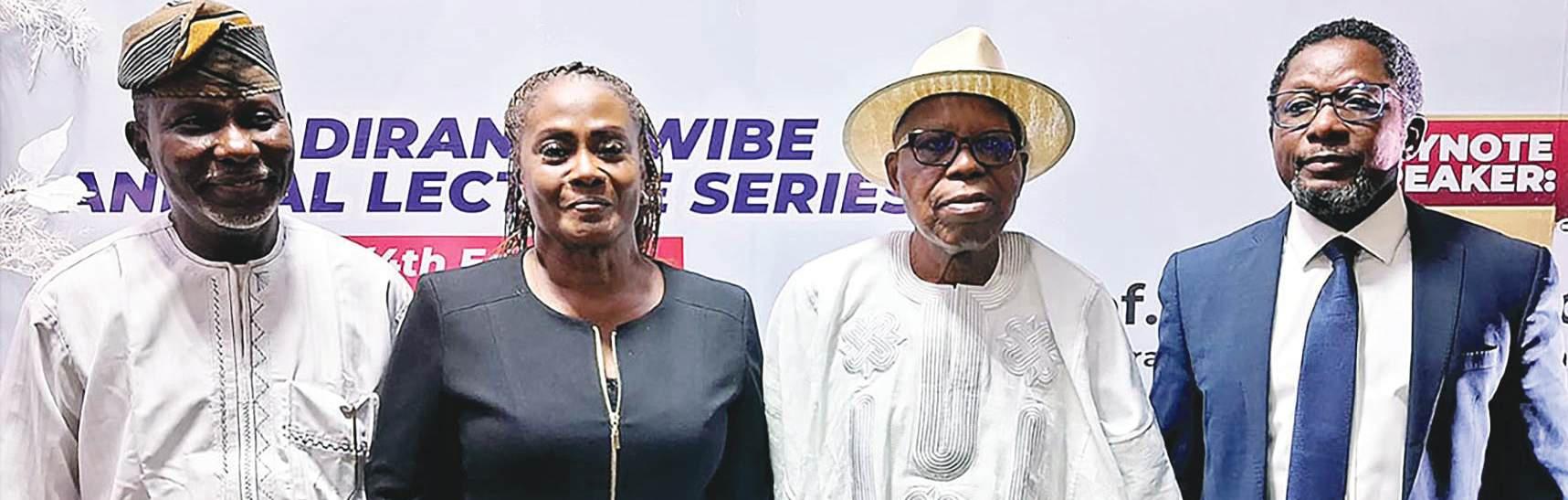
4TH DIRAN FAWIBE ANNUAL LECTURE SERIES...
L-R: Director, Centre for Petroleum, Energy Economics and Law (CPEEL), University of Ibadan (UI), Prof. Olugbenga Falode; Keynote Speaker/Chief Executive Officer, EtinPower Limited and Principal Partner, Terra Cotta Legal Associates, Prof. Yinka Omorogbe, SAN; Chairman, International Energy Services Limited (IESL), Dr. Diran Fawibe and Managing Director, IESL, Engr. Adebayo Ige during the 4th Diran Fawibe Annual Lecture Series organised by IESL, CPEEL and University of Ibadan at the International Conference Centre, UI on Wednesday
Private Sector Employers Fault Proposed Increase in Pension Contributions
Say it will threaten business survival
Onyebuchi Ezigbo in Abuja
The Organized Private Sector of Nigeria (OPSN), has expressed deep concern over the recent announcement by the Director-General of the National Pension Commission (PenCom) regarding a proposed increase in mandatory pension contributions and introduction of an additional 3 percent mandatory annual contribution equivalent to 3 percent of the total wage bill.
The body comprising the Manufacturers Association of Nigeria (MAN), the National Association of Chambers of Commerce, Industry, Mines and Agriculture (NACCIMA), the Nigeria Employers’ Consultative Association (NECA), the Nigerian Association of Small and Medium Enterprises (NASME), the Nigerian Association of Small-Scale Industrialists (NASSI), and 25 sectoral employer associations described the measure as a “Greek gift” to Nigerian worker.
It said that, “while the private sector is not entirely opposed to future adjustments, any increase must be the product of constructive, transparent social dialogue among all critical stakeholders and delayed until broader economic stability is achieved”.
A statement, jointly signed by MAN NACCIMA, NECA, NASME, NASSI, the group said while the
proposal may be presented as an effort to improve retirement benefits, “under the prevailing economic conditions, it could become a “Greek gift” to Nigerian workers: an apparently beneficial policy that ultimately threatens employment, wage growth, business sustainability and escalate compliance risks”.
“The OPSN maintains that the strength of any contributory pension system depends fundamentally on the survival of businesses, the availability of decent jobs and the capacity of employers and employees to make consistent contributions,” it said.
Under the Pension Reform Act 2014, Nigeria’s minimum pension contribution already stands at 18 per cent of an employee’s monthly emoluments, comprising 10 per cent from the employer and 8 per cent from the employee.
OPSN said that Nigeria’s existing contribution rate cannot reasonably be regarded as inadequate, based on contribution percentages alone, adding that any proposal for an increase, “must be supported by Nigeria - specific actuarial evidence demonstrating that the current rate is insufficient and that a higher rate would not undermine employment, wages, compliance and enterprise sustainability”.
The statement quoted the DirectorGeneral of NECA, Mr. Adewale-Smatt
Oyerinde, as having emphasized that the proposed hike is both premature and counterproductive:
“The OPSN supports efforts aimed at strengthening Nigeria’s pension system and improving retirement outcomes for workers.
“However, announcing that contribution rates will increase while consultations are still ongoing risks prejudging the outcome of the process and reducing subsequent stakeholder engagements to a mere formality.”
Smatt Oyerinde stressed that previous adjustments to pension contribution rates were preceded by extensive engagement among government, employers, organised labour
and other relevant stakeholders.
“Any proposed adjustment must be supported by credible actuarial, economic and employment-impact assessments. It must also emerge from genuine and transparent social dialogue. Retirement security should not be pursued in a manner that threatens the businesses and jobs upon which the pension system itself depends,” he stated.”
On his part, the Director-General of MAN, Mr. Segun Ajayi-Kadir, highlighted the macroeconomic consequences, saying it will constitute a direct threat to enterprise viability and worker earnings.
He said that businesses are already contending with high energy costs,
elevated interest rates, exchange-rate volatility, multiple regulatory obligations, weak consumer demand and rising production expenses, noting that imposing an additional statutory payroll cost without a comprehensive impact assessment will place further pressure on already struggling enterprises.
He explained that higher employment costs could compel businesses to slow recruitment, postpone wage reviews, reduce staff strength, increase outsourcing, suspend expansion plans or pass additional costs to consumers through higher prices.
“The proposed increase may directly raise the existing employee contribution, but its wider consequences could still be borne by workers through weaker wage growth, reduced employment op-
portunities, job losses and higher prices of goods and services,” he added.
Similarly, the statement said that the Director-General of NACCIMA, Mr. Sola Obadimu, cautioned against imposing additional financial levies on a struggling business environment. According to him: “At a time when businesses are struggling to recover from prolonged economic pressures and the Federal Government is implementing reforms intended to improve competitiveness, imposing another statutory financial obligation on employers could undermine the benefits of those reforms.” He maintained that government policies must be properly coordinated and evaluated based on their cumulative impact on businesses.
Tinubu to Jimoh Ibrahim: Be Focused and Avoid Distraction in Your New Assignment
Deji Elumoye in Abuja
President Bola Tinubu has charged Nigeria’s Permanent Representative to the United Nations (UN), Ambassador Jimoh Ibrahim, to be focused in his assignment at the international body and avoid every form of distraction.
The president gave the charge yesterday while receiving in audience
a delegation of a research group, Aseyori Tinubu, led by Jimoh Ibrahim at the State House, Abuja
Addressing the leader of the delegation, the President urged Ibrahim to continue to be focused in his assignment at the UN and avoid every form of distraction.
“Your capacity is exceedingly reliable, and your performance at the
Senate Pushes Bigger FERMA Budget, Orders Emergency Rescue of Failed Federal Roads
Approves N15.06bn intervention on Benue road, warns Works Ministry to prioritise rehabilitation over new projects
Sunday Aborisade in Abuja
The Senate on Thursday mounted fresh pressure on the federal government to significantly increase funding for the Federal Roads Maintenance Agency (FERMA), insisting that deteriorating federal highways across the country require urgent rehabilitation rather than continued emphasis on new road construction. The resolution came as the upper chamber approved emergency intervention on the badly damaged 28-kilometre Oyagede–Ogobia Road
in Benue State and urged the federal government to rehabilitate at least two critical federal roads in each of the 36 states and the Federal Capital Territory.
The decision followed the adoption of the report of the Senate Joint Committee on FERMA and National Security on the condition of the Oyagede–Ogobia Road in Ohimini Local Government Area of Benue State.
Presenting the report, Chairman of the Joint Committee, Senator Shuaib Salisu Abdullahi, disclosed that only
two kilometres of the road remained motorable after an on-the-job assessment by lawmakers.
He said extensive structural failure, erosion and inadequate drainage had rendered most sections of the road impassable, crippling transportation, commercial activities, access to healthcare and education, while also hampering security operations.
The committee recommended immediate emergency rehabilitation of the road pending full reconstruction at an estimated cost of N15.06 billion.
It also called for improved drainage infrastructure, erosion control measures and enhanced security along the corridor.
The Senate adopted all the committee’s recommendations and further resolved that FERMA should receive increased budgetary allocations to enable it respond more effectively to the growing number of failed federal roads nationwide.
The lawmakers also approved periodic legislative oversight of road maintenance projects to ensure accountability and timely execution.
United Nations are very impressive. You have achieved a lot at the UN within a short period. I am very proud of that.
“You know, this is an evolution that may not come back to our history in a very, very short time, as you have mentioned. So, I want you to work harder and get a permanent seat at the UN,” he said.
Tinubu promised the delegation that he would continue to push for greater economic stability, building on recent achievements.
“I could say the economy of our nation has passed the darkest tunnel. The twists and turns of democracy are there. We will continue to push for improvement. The economic recovery is here, proudly. We are running a very stable economy right now.”
He declared that the reforms instituted by his administration have been receiving global attention and commendation, assuring Nigerians that more benefits from the reforms will come very soon.
Tinubu attributed the multinationals’ interest in partnering and investing in Nigeria to a collective effort by Nigerians in various sectors, working tirelessly towards achieving the success of his administration’s reform agenda.
He informed his guests that
the students’ loan (NELFUND) is flourishing, having just approved additional funding from monies recovered by the EFCC.
“We have a production line going on well; we just need to stimulate the economy for growth. We can beat our chests with the bragging rights—no more ASUU strike. Today, our children are in school. The security is getting better, not getting worse,” the President reassured.
The president urged the research body to continue to come up with findings that will make Nigeria stronger politically and economically.
Earlier, Ibrahim acknowledged the president’s leadership style in advancing peace and progress in the country.
He said the economic reforms of the administration have now projected Nigeria in a different light, adding that foreign investors were now partnering with the country across many sectors.
The envoy attributed his own successes so far at the United Nations to the tremendous support he received from the president. Ibrahim, however, assured the president of his commitment towards ensuring that Nigeria succeeds in getting a seat on the United Nations Security Council.

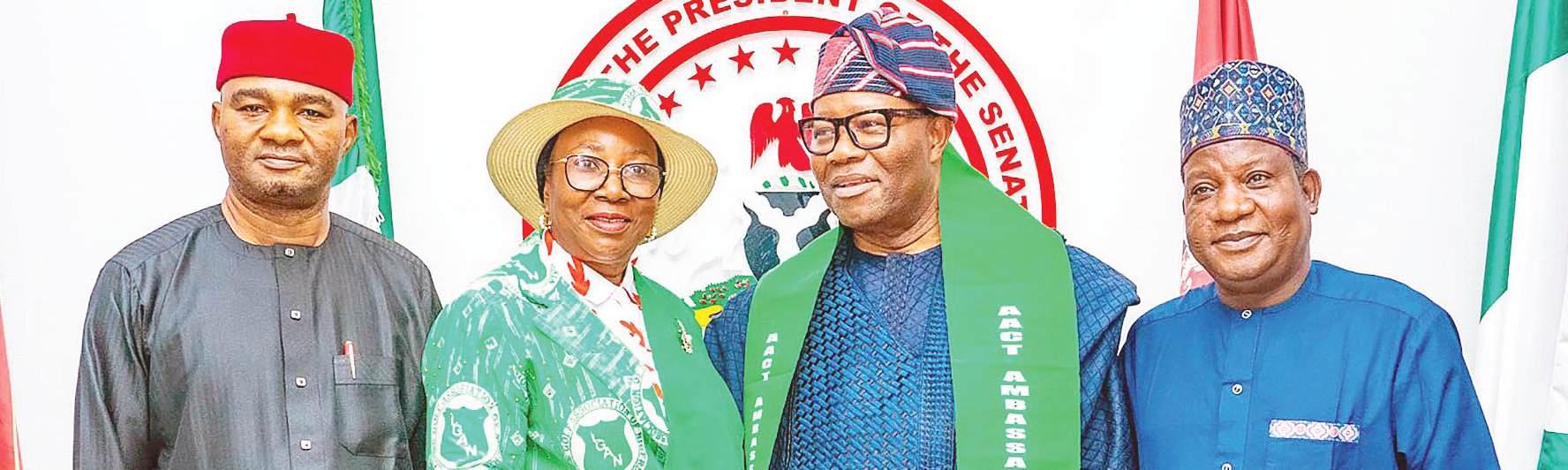
LADIES GOLFER VISIT AKPABIO...
L-R: Deputy Senate Whip, Onyekachi Nwaebonyi; National President, Ladies Golf Association of Nigeria, Dr. Lima Ahmed; President of the
Senate Committee on INEC, Simon Lalong, during a courtesy visit by the Ladies Golfer to the president of the
and
At Bello’s Book Launch, Amupitan Seeks INEC’s Independence, Seamless Operations
Insists commission needs financial autonomy for free, fair, credible elections Shettima: trust grows when citizens feel seen, heard, valued, and protected.d Says Fourth Republic has been long conversation between hope and disappointment Masari: constructive criticism bedrock of democracy Ikechukwu: author is an elder statesman in journalism as Onyema, Okonkwo hail him
Chairman of the Independent National Electoral Commission (INEC), Joash Amupitan, has advocated the tinkering of relevant constitutional and electoral provisions, including embedding the funding of the commission’s activities in the Federation Account, to guarantee greater independence and seamless operations.
Amupitan made the appeal while delivering a keynote speech in Abuja at the public presentation of “Shadows: Protest Essays on Africa’s Most Consequential Country (1999-2023),” authored by Managing Director of THISDAY Newspapers, Mr. Eniola Bello.
The INEC chairman said being on first-line charge was not enough to address some of the fundamental challenges facing the commission.
He explained that despite its current
status on first-line charge, the election management body still grappled with funding challenges due to its reliance on the normal appropriation process and the envelope system.
In the speech titled, “Strengthening Electoral Institutions: Pathways to Free, Fair, and Peaceful Elections in 2027,”
Amupitan called for the amendment of the Electoral Act to ensure that the nomination of candidates was concluded one year before the general election
Amupitan stated, “We need to rethink the operators of the institution, and so in strengthening our democratic institutions especially INEC, what we should be rethinking is not the provisions as we have— whether the spirit and the letters of the constitution and the Electoral Act, but rather those of us that operate the constitution itself.
“Now, can INEC be independent without financial autonomy? Talking about strengthening the institution, if
we truly want to conduct a free, fair and credible elections, there is also a need for INEC to have financial autonomy.
“Let me say that under the provisions of the constitution, specifically Section 81(3), INEC is put on the First-Line charge and a lot of people felt that that is sufficient to make INEC financially independent.
“However, the experience over the years has shown that as long as INEC is still subjected to the normal envelope system; so long as INEC is subject to the processes of appropriation, having to go to the National Assembly and at the end of the day, it is what is desired by another agency that should be the budget of INEC that is given to INEC, it is very difficult to operate in such a situation.”
Amupitan stressed that as long as the commission’s funding was domiciled with the Consolidated Revenue Fund (CRF), the federal government still reserved the responsibility to finance the commission
and, by extension, elections.
He stated, “Although the constitution places INEC on the first-line charge, it is not strong enough because the responsibility of INEC to conduct elections, register political parties, and also to register voters and provide register of voters even for the local government election by State Independent Electoral Commissions, INEC should come as part of Federation Account so that it can have a seamless operation and what we call operation efficiency.”
Amupitan decried the quality of internal democracy being practised within political parties.
According to him, where party primaries are characterised by imposition, opaque procedures, or disregard for established rules, disputes are almost inevitable.
He added that many election-related court cases had their roots in disagreements that arose long before the first ballot was cast.
Shettima: Africa Must Play More Prominent Role in Shaping Global Digital Agenda
Oghenevwede Ohwovoriole in Abuja
Vice President Kashim Shettima has stated that Africa must play a more prominent role in shaping global digital agenda, stating that for too long, the continent has not adequately contributed to the global digital agenda.
He spoke at the 7th Ordinary Session of the African Telecommunications Union (ATU) Conference of Plenipotentiaries (CPL-26) on Thursday in Abuja, Shettima, represented by the Deputy Chief of Staff, Sen. Ibrahim Hadejia, said, “Africa must assume a more prominent role in shaping the global digital agenda. For too long, global technology policies have been developed without adequate representation of African priorities and perspectives. That must change.
“Nigeria is proud of its contributions within both the African Telecommunications Union (ATU) and the International Telecommunication Union (ITU), and we remain committed to ensuring that Africa is not merely present at
global discussions but actively shaping decisions that define the future for digital technologies.”
In his address, Nigeria’s Minister of Communications, Innovations and Digital Economy, Dr. Bosun Tijani said Nigeria developed a platform called N-ATLAS for Nigerian languages, adding that the platform has been incorporated to ATLAS OMOJA to cover the entire African continent through a partnership with the Global Systems Mobile Association (GSMA).
“The ATLAS Network is a continental initiative announced to accelerate the development of locally relevant Large Language Models across Africa, building on Nigeria’s pioneering N-ATLAS initiative.
“The Network will bring together governments, researchers, academia, innovators, and ecosystem partners to ensure that Africa’s languages, cultures, and knowledge systems are reflected in the AI technologies shaping the continent’s future. Member states were invited to join the initiative as a collaborative platform for advancing
African AI capabilities.”
Senior Director of Public Policy and Communications, GSMA, Caroline Ngugwa, also spoke on ATLAS OMOJA.
“Today we celebrate the launch of ATLAS OMOJA, the Minister of ICT in Nigeria, has clearly outlined the need of approaching this from a Pan-African perspective.
“Africa needs to ensure that we are not just consuming AI, but we are shaping how AI is evolving, how it’s developing, and ensuring that we are able to participate with our uniqueness.
“African languages are unique. And so, Atlas OMOJA is a platform that brings together these different languages for us to be able to interact. And we’ve got founding members that have signaled their intention to actually want to pull this and make it a reality in their countries. The founding members are, of course Nigeria, Kenya, Namibia, and Togo,” she said.
The Secretary General of the African Telecommunications Union, John Omo, welcomed delegates and described the
conference as a pivotal moment for the continent’s digital future.
“We are deeply grateful to the Government and people of the Federal Republic of Nigeria, whose support made this Conference possible.
“The Union’s work rests on the commitment of its member states and the partnerships we continue to build to place ATU on a firmer and more sustainable footing. The Union recognises the important role of partnerships in the achievement of its mission.
“We therefore recognise GSMA, QUALCOMM, ICANN, and our Tower Companies who extended their hand of collaboration to ATU during this CPL-26,” he said.
Meanwhile, the African Telecommunications Union (ATU) and the Global System for Mobile Association (GSMA) are working on modalities to reduce challenges facing the telecom industry as part of overall efforts to shore up the current revenue base of $240 billion the telecoms sector contributes to the African economy.
The INEC chairman said political parties strengthened democracy when they upheld their own constitutions, conducted transparent primaries, and gave members a genuine voice in selecting candidates.
He stated that if INEC was strengthened enough, some of the problems bedevilling political parties at the moment would have been resolved at least a year before the upcoming general election.
Vice President Kashim Shettima, in his speech, titled, “The Country and Its Shadows,” stated that a nation was held together by the stories it was brave enough to tell about itself.
Shettima added that no democracy grew by hiding its shadows from the light.
He stated that it had often been said that leadership was a practice and not a title, expressing his belief that the same rings true for journalism and literature.
Shettima, who was represented by his Special Adviser on General Duties, Aliyu Modibbo, stated that democracy must accommodate dissenting positions, adding that any government that cannot listen to the people will eventually lose the confidence of the people.
He said Nigeria’s Fourth Republic had been a long conversation between hope and disappointment, between protest and patience, and between the promises of power and the expectations of citizens.
According to the vice president, “Every administration has faced the judgement of history, and every generation has had to decide whether to treat criticism as hostility or as an instrument of democratic improvement.
“The media has been central to that process. When it is responsible, courageous, and fair, it does not weaken the state. It strengthens the state by compelling public officials to remember that power is held in trust.
“This is why His Excellency, President Bola Ahmed Tinubu, GCFR, has remained firm in his belief that democracy must accommodate disagreement.
“He understands, from personal experience, that the press, civil society, activists, writers, and citizens who ask hard questions belong to the architecture of a free society.”
Shettima added, “A government that cannot listen will eventually lose the confidence of the people, because trust is not built by authority alone. Trust grows when citizens feel seen, heard, valued, and protected.
“Our administration came into office
at a difficult time, when Nigeria had to confront hard economic truths that had been postponed for too long. The removal of the petrol subsidy and the unification of the foreign exchange system were not easy decisions, and we have never pretended that they carried no pain.
“But leadership, at its most serious level, is the courage to choose repair over applause, and to do today what prevents a deeper crisis tomorrow.
“Distinguished ladies and gentlemen, we are beginning to see the foundations of that difficult repair.”
Referencing the reforms by the federal government, the vice president said, “Nigeria’s Gross Domestic Product grew by 3.89 per cent in the first quarter of 2026, after a growth of 3.4 per cent in 2024 and an expansion of 4.6 per cent in the fourth quarter of that year. Oil production has rebounded to about 1.5 million barrels per day, while debt servicing has declined from 96 per cent to below 65 per cent of revenue.
“These figures do not mean that all hardship has disappeared, but they show that the economy is finding firmer ground.”
According to him, “Today, more than 100,000 Nigerians have accessed the national consumer credit scheme, with hundreds of thousands more in the pipeline. The student loan programme is opening the door of higher education to children who might otherwise have been locked out by poverty.
“In infrastructure, the administration is pushing major arteries such as the Lagos-Calabar Coastal Highway, the Sokoto-Badagry Superhighway, and the Abuja-Kaduna-Kano Road, while hundreds of road projects and rural road interventions are being pursued to connect communities, markets, farms, and industries. In the 2026 budget, capital expenditure is projected at N26.08 trillion, which is a firm statement that this government is investing in the physical foundations of growth.”
Shettima stated, “Yet figures alone do not tell the full story of a nation. That is why books like Shadows matter. They remind us that policy must be understood through people, that reform must be explained with honesty, and that democracy must never become a conversation among politicians alone. Writers and journalists help us to connect statistics to suffering, policy to memory, and governance to the human condition.”
Senate, Godswill Akpabio;
Chairman,
Senate on Wednesday
PHOTO: SENATE PRESIDENT’S OFFICE
Ndubuisi Francis, Chuks Okocha and Adedayo Akinwale in Abuja

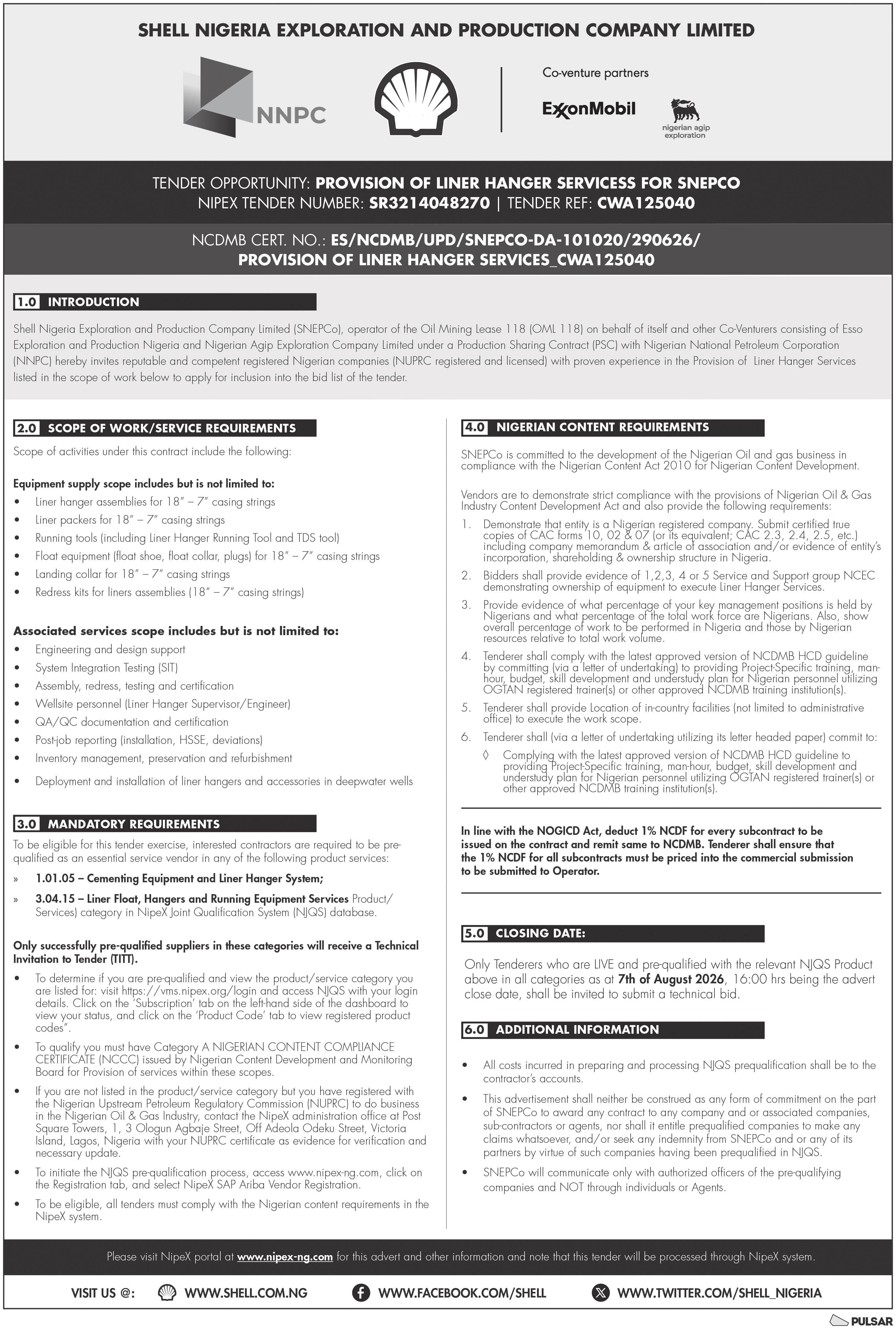
Acting Group Politics Edito r DEJI ELUMOYE
Email: deji.elumoye @thisdaylive.com
08033025611 s M s O n LY
2027: Shettima’s Pick, a Testament of Unwavering Loyalty to His Boss
In the annals of Nigerian politics, loyalty is no doubt a rare currency. It is often tested by fire, traded for convenience, and often discarded when power shifts. However, once in a while, a story emerges that reminds us what conviction looks like. Therefore, the recent confirmation that President Bola Tinubu will retain Vice President Kashim Shettima as his running mate for 2027 poll is not just a political decision. It is a verdict. a verdict on loyalty, strategy, and the long game. It closes two years of whispers, plots, and “poisonous enmity,” and opens a new chapter of trust that began long before 2023, writes Ismail Omipidan
Politics is influenced by interests, sentiments, and emotions. According to the late Maxim Gorky, a Russian-Soviet writer and one of the proponents of Socialism, politics is “the soil in which the nettle of poisonous enmity, evil suspicions, shameless lies, slander, morbid ambitions, and disrespect for the individual grows rapidly and luxuriantly. Name anything bad in man and it is precisely in the soil of political struggle that it grows with particular liveliness and abundance.”
Gorky’s observation aptly captures what Nigerians have witnessed over the past two years regarding the intense speculation over whether President Bola Tinubu would retain Vice President Kashim Shettima as his running mate for the 2027 presidential election.
Not even President Tinubu’s unequivocal tribute to Shettima last year was enough to silence the rumour mill and make the Rottweilers back off. However, last Friday, the President effectively brought to an end the season of “poisonous enmity, evil suspicions, shameless lies, slander, and morbid ambitions” surrounding the issue.
To me, President Tinubu’s decision to retain his loyal co-traveller as running mate is a testament to Shettima’s steadfast loyalty to his boss and his commitment to the success of the Renewed Hope administration. It also reflects Tinubu’s strong conviction about strategy.
For those who may have forgotten, 2023 was not the first time the APC considered a MuslimMuslim presidential ticket before it eventually became a reality. In the build-up to the 2015 general election, President Tinubu made no secret of his desire to run alongside the late President Muhammadu Buhari. It was widely reported that Buhari was initially receptive to the idea, but influential forces within the party ultimately frustrated the plot. Rather than allow the setback to define him, Tinubu waited patiently for his time. Today, that chapter belongs to history.
Shettima’s belief in President Tinubu did not start in 2023. I can attest that his unapologetic loyalty to Tinubu dated back to well before 2015. He often shared with me valuable insights about some of the groundwork they carried out with Tinubu, both locally and internationally, in the build-up to unseating the PDP government in 2015.
And in the buildup to the 2023 elections, Shettima stood out and boldly identified with Asiwaju at a time when most northern APC politicians considered it politically risky, if not outright sacrilegious, to publicly support his presidential aspiration. Shettima chose conviction over convenience, and history will remember him for that.
Shettima belongs to the zodiac sign Virgo, the only sign represented by a female and often associated with humaneness. Shettima embodies many of its traditional traits. Virgos are described as modest and reserved, meticulous and reliable, practical and diligent, intelligent and analytical. With my association with him over the years, I can say with confidence that these qualities are evident in his personality and approach to leadership.
He stands out as one of the few truly brilliant, intelligent, witty, and friendly leaders from the North. He is very cosmopolitan and understands the concept of absolute loyalty. He continues to distinguish himself in leadership and public service.
In the corridors of power, it is not uncommon to see some people in authority wield influence carelessly. They not only do anything they like but also use all available tools to settle perceived scores, all in the name of politics. And in doing so, they often forget past favours and long-standing loyalties. Vice President Shettima is an exception.



Having known him long before he ventured into politics, I can attest that he understands both the dynamics of power and the essence of unwavering loyalty. Shettima gives his all to any
cause he believes in, 100 per cent commitment, with sincerity and unwavering dedication.
The story of how the All Progressives Congress (APC) was birthed and the pivotal role played
by Shettima, driven by his unwavering loyalty to President Tinubu, is well known to some of us. It was him who first told me about the APC’s Muslim-Muslim ticket game plan in January, 2019. At the time, he never imagined himself as part of that ticket. What he did emphasise, however, was his total commitment to doing anything and everything necessary to ensure the success of Tinubu’s presidential project. That very day, he even requested that I join him in prayer for its success.
When Tinubu eventually emerged as the presidential candidate of the APC, and reports began to filter in that Shettima might be considered as his running mate, some of us saw it as God’s way of rewarding a man who had worked for a cause with sincerity of purpose, without the intention to benefit from the project.
As expected, those who believe they hold the power of life and death in politics tried to throw a spanner in the works. They waged an intense political war against him, but God came to his rescue. Shettima is a firm believer in the power of the unseen, and he has held fast to that conviction over the years. Allah has never failed him, and will never fail him because despite all that God has done for him, and through him in the lives of others, he has remained humble. Yaya na, as I fondly call you, congratulations for surviving yet another political coup. I pray that Almighty Allah continues to guide your steps and bless you with the knowledge and wisdom to navigate our country’s murky political waters.
-Omipidan writes from Abuja.
Will Onuigbo Bridge Climate Policy Gap among Global Legislators?
Former Chairman of House of Representatives Committee on Climate Change, Hon Sam Onuigbo, becomes first african president of GLOBE Legislators. Emameh Gabriel, in this piece, dissects his climate advocacy but warns of challenges bridging global commitments with Nigeria’s domestic action.
On June 24, 2026, at the Parliament of the United Kingdom, Hon Sam Onuigbo was formally inducted as President of GLOBE Legislators, becoming the first African to lead that global parliamentary network in its 35-year history. The ceremony was hosted by former UK Minister for Climate Change and Net Zero. Also former President of GLOBE Legislators, Rt. Hon. Graham Stuart MP, formed part of the London Climate Action Week.
For those who may not track these international organisations, GLOBE is not some obscure diplomatic club. It is the organisation founded in 1991 by the former United States Vice-President Al Gore, and John Kerry, alongside legislators from the European Parliament, Japanese Diet, and Russian Duma, with a singular vision: that international climate agreements mean nothing without legislative action. Today, it convenes parliamentary networks across the world, having hosted the first Parliamentary Pavilion at COP28 in Dubai, repeated it at COP29 in Baku, and is on course to do so again at COP31 in Antalya.
It was a significant moment—not just for Onuigbo, not just for Nigeria, but for the entire African continent. And it raises a question that deserves careful consideration: what does this appointment mean for the global climate policy landscape, and is Onuigbo the right man to bridge the gap between international commitments and domestic legislative action? Making of a Climate Champion
Perhaps the most instructive phase of Onuigbo’s professional life was his 18-year stint
at the United States Embassy (now ConsulateGeneral) in Lagos, where he rose to the position of Supervisory Fraud Prevention Specialist. During that period, he was elected twice as President of the Foreign Service National Advisory Committee. These were roles that demanded integrity, attention to detail, and a deep understanding of how systems work—qualities not always abundant in Nigerian public life.
He served as Commissioner for Lands and Survey, and later Commissioner for Finance in Abia State before being elected to the House of Representatives in 2015, representing Ikwuano/ Umuahia North and Umuahia South Federal Constituency. He was re-elected in 2019, becoming the first representative from that constituency
to serve two terms. But it was his work as Chairman of the House Committee on Climate Change that would define his legislative legacy. In the 8th Assembly, he sponsored Nigeria’s Climate Change Bill. It was passed by both chambers but denied assent by late President Muhammadu Buhari. Many lawmakers would have given up. They would have accepted the setback, moved on to other matters, and waited for the next opportunity to make noise about something else. Onuigbo did not give up. He re-sponsored the bill in the 9th Assembly, addressing all the areas of conflict and expanding its scope. On November 17, 2021, late President Buhari signed the Climate Change Bill into law. It established Nigeria’s first comprehensive legal framework for climate governance, creating the National Council on Climate Change (NCCC) and institutional mechanisms for emissions reduction.
Many of us have watched the National Assembly turn itself into a rubber stamp for executive whims, more interested in constituency projects than in the hard work of legislation. But the Climate Change Act is different. It placed Nigeria among nations with dedicated climate legislation, giving us a seat at a table where decisions affecting our future are being made. It was a landmark achievement, and it did not happen by accident. It happened because one legislator refused to take no for an answer.
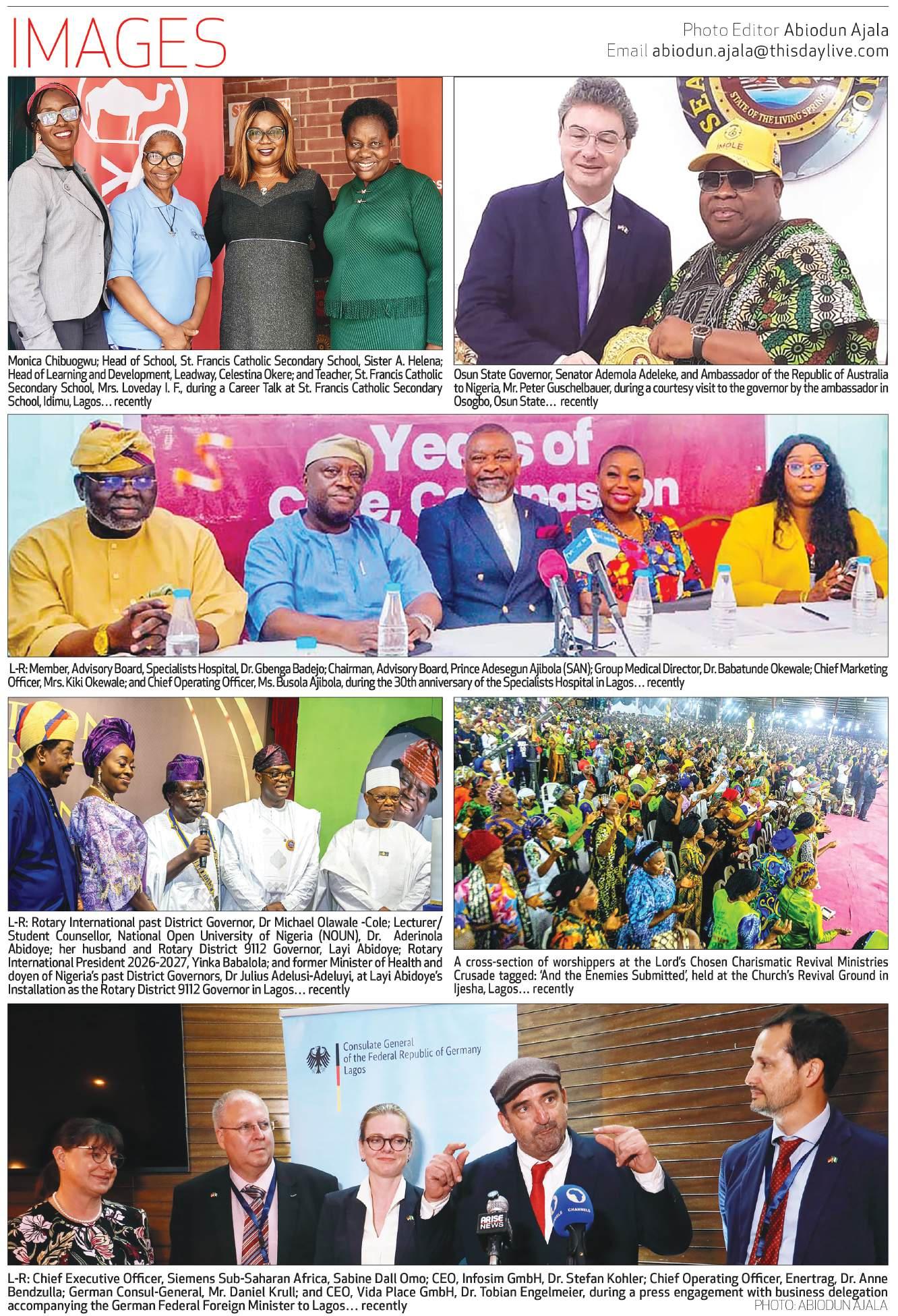
with Lanre Alfred
…truth behind the headlines, conspiracies, cover-ups, trials and triumphs
Femi Gbajabiamila: The Weight of Power, The Grace of Restraint
Every country produces politicians but only a few produce custodians. Nigeria, unfortunately, has seen too many of the former and too few of the latter.
I have spent enough years around the machinery of power to know its peculiar chemistry. Power changes the tenor of a man’s voice and alters his gait. It also expands his appetites and shrinks his patience. Sometimes, it creates an invisible moat around him, separating him from ordinary suffering. Thus, it can turn decent men into emperors and public servants into minor deities.
Yet every once in a while, you encounter someone who seems curiously resistant to its intoxication.
That, perhaps, is why I have found myself repeatedly drawn to the story of Femi Gbajabiamila.
I know, I know. In our society, praise is always greeted with suspicion. The moment one says something generous about a public official, somebody somewhere begins to calculate what contract has been awarded, what favour is being sought, or what office has been promised. We have become so accustomed to betrayal by our leaders that admiration itself has become suspect.
But not every reflection is a transaction. Sometimes, one simply encounters a public figure whose journey compels contemplation.
Gbajabiamila is one of those figures. I have watched him for years. I have observed him in moments of triumph and while he handled criticism. I have listened to those who adore him and to those who distrust him. And I have come to one conclusion: his greatest political talent is not strategy, not eloquence, not even longevity.
It is empathy. Not the sentimental, performative empathy that politicians suddenly discover during election season. Not the kind that arrives with television cameras and disappears with the last ballot paper.
I mean power empathy, the ability to understand that authority is not ownership and that the true owners of political office are the people.
The Chief of Staff (CoS) to President Bola Ahmed Tinubu understands that governance is not merely about ruling but about carrying the anxieties of millions as though they were your own. In a country where power often behaves like a private inheritance, this quality is almost revolutionary.
I have seen powerful men who entered office with noble intentions and emerged with palaces of ego. They stopped hearing ordinary people and became prisoners of protocol, protected by layers of aides, insulated by convoys and convinced that their importance was proof of their infallibility.
Gbajabiamila has never struck me as that kind of man. The first thing people notice about him is restraint. The second thing they notice is discipline.
The third is something harder to explain. It is the sense that he understands the burden of office and carries it with unusual seriousness.
He does not perform power, rather he inhabits his office and the responsibilities it imposes upon him. And this distinction matters.
It explains why he can move through the corridors of influence without appearing intoxicated by them. It also explains why he can occupy powerful offices without becoming their captive.
Look at his political journey: Twenty years in the House of Representatives. Twenty years. In Nigeria, that kind of longevity is usually accompanied by scandal, fatigue or arrogance. Yet he managed to remain politically relevant while steadily deepening his institutional influence.
That alone deserves study, because our politics is littered with brilliant sprinters and very few marathon runners.
Gbajabiamila was once a minority leader, and subsequently, a majority leader. Then Speaker of the House. Now he sits at the nerve centre of executive power as Chief of Staff to President Bola Ahmed Tinubu.
What this means is that he is close enough to power to shape its daily rhythm, and distant enough to avoid its vanity. Those who follow society and politics in equal measure understand that influence in Nigeria is rarely a solo performance. It is a terpsichore of trust, calculation, alliances forged in private rooms
FemiGbajabiamila
and tested in public storms.
Gbajabiamila has mastered that waltz without reducing or sullying himself. He knows when to speak. More importantly, he knows when silence does the heavier lifting.
It was this quality that compelled me, eventually, to undertake a serious portrait of the man in the form of a book: The Power Empath. Not because he is flawless, but because he represents a type increasingly rare in our national theatre: the institutionalist. The man who believes that structures matter more than slogans.
The first chapter of the book, A Boy Raised Between Law and Ledger, traces the early currents that shaped him. Lagos in the 1960s and 70s was not merely a city; it was a proving ground. Raised in a household where business sense met intellectual discipline, he absorbed two parallel educations: the pure mathematics of enterprise and the moral syntax of law. Those twin influences would later define his political temperament.
From there, The Making of a Lawyer examines the long apprenticeship to the law, University of Lagos, the discipline of the Bar, the further sharpening abroad. America further refined him. There, in courtrooms far removed from Surulere’s crowded streets, he learned the muscularity of argument and the necessity of preparation. Law taught him patience. It also taught him that institutions, however flawed, are stronger than impulse.
Yet the most telling decision of his early life was chronicled in The Return. He could have remained in the United States, built a comfortable career, and enjoyed the anonymity of distance. Instead, he came back. That return was not romantic. It was deliberate. He chose to test himself in the rough-and-tumble of Nigerian politics, where pedigree guarantees nothing and survival demands stamina. The book treats that decision as a hinge moment, the point at which ambition met obligation.
Entering the Green Chamber revisits 2003, when he first walked into the House of Representatives as a young legislator from Surulere. The chapter lingers on his early days, when observation mattered more than volume. There is a misconception that
effective politicians must begin loudly. Gbajabiamila began attentively. He studied procedure. He mapped personalities. He learned that in Parliament, mastery of rules can outlast mastery of rhetoric.
By the time we arrive at June 2019, The Gavel, the narrative shifts from apprenticeship to authority. His election as Speaker of the 9th House was not merely a personal triumph; it was a referendum on endurance. This chapter explores how he handled the office, restoring order to the budget cycle, accelerating long-delayed reforms, steering contentious bills through debate without reducing the chamber to chaos. He forged a working relationship with the Executive that critics feared would compromise legislative independence. Instead, he attempted something subtler: cooperation without surrender. This did not please everyone. It was not designed to.
But if Abuja gave him altitude, Surulere gave him grounding. Surulere as Moral Compass argues that his constituency has never been a political ornament. The roads he reconstructed, schools he renovated, and the health facilities that he upgraded, became, in the book’s telling, a moral accounting system. In Surulere, performance is visible. The constituents remember, and Gbajabiamila, to his credit, understood early that representation must translate into brick, asphalt, and light.
Education emerges as a recurring motif. In Mindbuilder: On Gbajabiamila’s Educational Legacy, the focus turns to ICT centres in secondary schools, support for tertiary institutions, grants for students. The chapter suggests that his educational interventions reflect a private conviction: that politics without investment in minds is merely noise.
Equally compelling is Empowering the Youth, which chronicles job fairs, entrepreneurship support, and vocational initiatives. Critics may question scale; supporters point to impact. What cannot be denied is consistency. He has returned repeatedly to the question of youth opportunity, aware that Nigeria’s demographic dividend can just as easily become a demographic storm.
Then comes Leaving the Chamber Well. Few politicians know how to exit gracefully. Fewer still resign from a seat they have held for twenty years
without clinging to its privileges. His departure from the House to assume the role of Chief of Staff is treated as a momentous transition rather than an abandonment. That chapter reads almost elegiac: twenty years distilled into a final speech while his colleagues rose to honour him, out of respect.
Power, however, is never static. Tinubu, Trust, and Shared Burden delves into his relationship with President Bola Tinubu, a relationship rooted in progressive politics and shared battles. Trust in politics is a rare currency, and the book does not romanticize it; rather, it interrogates it. What does it mean to stand so close to the centre of executive authority? What compromises luck? What responsibilities multiply? Gbajabiamila’s new role demands discretion, coordination, and a willingness to absorb pressure without public applause.
Still, the most human portrait may be found in Still Among His Own. Despite the altitude of office, he returns—physically and symbolically—to Surulere. The chapter suggests the significance of proximity to ordinary. A politician who forgets his street loses his compass.
And because Nigerian politics is also a theatre, the book does not neglect his quieter passions. Champion of Grassroots Sports explores his facilitation of mini-stadia and support for local athletic initiatives. Sports, in his worldview, become both social glue and economic opportunity.
So why write this book? Why risk being accused of proximity, of praise, of alignment? Because I believe we must document not only flamboyant leaders but also the high-achieving, methodical ones. Because the Nigerian story is too often told through crises and rarely through craftsmanship.
Yet, I must say, Gbajabiamila is not beyond criticism. No politician is. His cooperative stance with the Executive has unsettled purists who prefer perpetual antagonism between arms of government. His loyalty to party has earned him both admiration and suspicion. Yet even his critics concede that he has approached public office with preparation and seriousness.
Gbajabiamila’s appeal lies in continuity. In his refusal to defect when defection was convenient, in his patience to climb the legislative ladder rung by rung, and his ability to leave an office without diminishing it.
As I wrote, I found myself less interested in his victories than in his habits. Victories are public; habits are private. Victories can be counted; habits must be observed. It is easy to catalogue bills passed, offices held, titles earned. It is harder, and more revealing, to examine how a man prepares before he enters the room where those outcomes are decided.
It’s inspiring to see Gbajabiamila with documents. Not the ceremonial folders waved before cameras, but the dense briefs that arrive without glamour: policy notes layered with footnotes, fiscal projections heavy with implication, and legal drafts whose commas can alter national consequence. Gbajabiamila does not skim. He reads with the caution of a lawyer and the suspicion of a legislator who knows that every paragraph contains both a promise and trap. Then there is the way he negotiates tension. Nigerian politics is not merely competitive; it is combustible. Ego collides with ego, region presses against region, while ideology yields to survival instinct. In such an atmosphere, many leaders mistake volume for strength. Gbajabiamila has built a different reflex. He lowers the temperature before he raises a point. He listens longer than his critics expect and allows others to exhaust their outrage before he introduces structure into the conversation. He understands that resolution requires oxygen, and oxygen rarely survives shouting. When crises erupt, he avoids the temptation to dramatise his involvement. Instead, he works corridors rather than podiums. He calls meetings instead of press conferences and absorbs criticism without staging a counter-spectacle. This has preserved his credibility. In the end, the spine of his story is not a single election or appointment. It is the accumulation of these disciplines; small, repeated acts of seriousness. Power may elevate a man, but habit sustains him. And in Gbajabiamila’s case, habit explains far more than triumph ever could.
After Diezani, Others’ Acquittal, What Next?
David Onyeri
Following the discharge and acquittal of the former Minister of Petroleum Resources, Mrs Diezani Allison-Madueke by a UK court after she and other former key players and other stakeholders in Nigeria’s oil and gas industry had suffered reputational damage, the Nigerian government owes them restitution and an additional obligation of ensuring that their successors also clear themselves of allegations surrounding the N210 trillion alleged to be missing in the NNPC Limited.
Last month, the London’s Southwark Crown Court cleared Diezani, who was Nigeria’s petroleum minister between 2010 and 2015 and the first female president of the oil exporters group, Organisation of Petroleum Exporting Countries (OPEC), of five counts of accepting bribes from wealthy oil executives in the form of luxury home stays and lavish spending sprees in the UK.
Also cleared by the court were her older brother, Doye Agama, 69, an archbishop at a Pentecostal church in Manchester, who was acquitted of conspiracy to commit bribery; and oil industry executive, Olatimbo Ayinde, 54, who was cleared of allegations of bribery of a foreign public official.
The verdict was a blow for the UK’s National Crime Agency (NCA), which investigated one of Africa’s most prominent political figures for 13 years.
From the start of the trial in January, her defence lawyers questioned the fairness of the prosecution’s case, alleging that vital documents showing her innocence had gone missing in Nigeria, revealing an official conspiracy by agents of the Nigerian government to ensure she was jailed unjustly.
After leaving office in 2015, Diezani, alongside her family members and associates became the worst victims of former President Muhammadu Buhari’s vindictive anti-corruption campaign.
For several years, Diezani, her associates, family members and former oil and gas industry stakeholders, including bankers, were maligned, tried in the media and declared guilty of humongous corruption without any iota of evidence except mere speculations.
Some of the other victims of the vicious corruption allegations include her son, Ugonna Alison-Madueke; her cousin and private lawyer, Donald Chidi Amamgbo; some of Nigeria’s bestknown indigenous oil businessmen - Kolawole Aluko and Olajide Omokore.
Others include several senior banking executives, including former Fidelity Bank Managing Director, Nnamdi Okonkwo; a former First Bank Executive Director, and current Governor of Zamfara State, Dauda Lawal, as well as a former Sterling Bank Executive Director, Lanre Adesanya,
These vicious campaigns also attempted unsuccessfully to taint the hard-earned reputation of other distinguished oil and gas industry professionals across finance, legal, engineering, exploration, procurement and commercial operations, including a former Managing Director (GMD) of the NNPC, Andrew Yakubu, who was also discharged and acquitted by the courts; and another distinguished former GMD, Austen Oniwon.
Others include a former Deputy Group Managing Director of NNPC, Bernard Otti; a former Executive Secretary of the defunct PPPRA, who introduced landmark reforms that cleaned up the subsidy frauds, Reginald Stanley; and a former Director of the defunct DPR, Babs Omotowa, among other distinguished
professionals.
Agents of the administration of the late President Buhari and the Economic and Financial Crimes Commission (EFCC) effectively used media trials to slander the former minister and some of these oil and gas industry professionals, as well as reputable business and banking executives.
Many Nigerians believe that Buhari’s inept leadership used allegations of corruption against key actors in the administration of former President Goodluck Jonathan and some private sector players to distract the attention of Nigerians from its obvious cluelessness and mismanagement of the Nigerian economy.
During her tenure, the former minister and her team initiated and implemented some of the most successful reforms in the history of Nigeria’s oil and gas industry.
To their credit, some of these maligned official’s superintended over the signing of the Nigerian Oil and Gas Industry Content Act (NOGICD) Act by former President Jonathan in April, 2010, which has tremendously increased the participation of indigenous facilities and local manpower in the oil and gas industry. They also played key roles in the initial drafting of the Petroleum Industry Bill (PIB), signed into law as the Petroleum Industry Act (PIA), which replaced all the obsolete legislations in the Nigerian oil and gas sector.
Diezani and her team also facilitated major landmark deals in the sector, including the first divestment of major onshore oil-producing assets by the International Oil Companies (IOCs), with the sale of Oil Mining Leases (OMLs) 4, 38 and 41 by Shell Petroleum Development Company (SPDC) to Seplat Petroleum Development Company (now Seplat Energy) in 2010.
This successful deal between SPDC (now renamed Renaissance Africa Energy Company Limited) and Seplat, opened the floodgates for the divestments of onshore assets to indigenous companies, which have made the Nigerian independents major players in the upstream sector of the industry, which was the exclusive preserve of the IOCs.
Under these former officials, Nigeria also launched major oil and gas projects, including Usan and Egina deep water projects in 2010 and 2013 respectively, which collectively added about 400,000 barrels to Nigeria’s daily crude oil output.
It is on record that after Total launched Egina in June 2013, it took Diezani’s successors 13 years to create enabling environment for a similar deepwater project - Bonga Southwest Project/Aparo - to be launched by Shell Nigeria Exploration and Production Company (SNEPCo) in 2026.
President Bola Tinubu, in March 2026, granted presidential approval that resolved the longstanding fiscal and commercial bottlenecks that stalled gigantic deepwater projects in Nigeria since Usan and Egina were launched in 2010 and 2013, paving the way for the Bonga South West/Aparo deepwater project.
But Bonga Southwest, which is designed for a peak production capacity of 150,000 barrels per day, is still below Egina’s 200,000bpd production capacity.
In terms of the Nigerian Content Development, Egina scored firsts on many fronts, setting a new record in local content development as a large scope of the jobs involved in the development of the oilfield was executed in Nigeria by Nigerian professionals, generating
employment opportunities, curbing flight and increasing the country’s GDP.
For Bonga Southwest, oil and industry players believe that the presidential waiver designed to encourage the IOCs to launch the project, empowers them to export most of the jobs abroad.
There is no doubt that the glorious days of the Nigerian oil and gas industry ended after Diezani’s tenure.
Despite their laudable achievements, the former minister and her allies were rewarded with allegations of corruption, which tainted their reputation globally.
With their discharge and acquittal by the UK court, the Nigerian government owes them restitution and an additional obligation of ensuring that their successors also clear themselves of allegations surrounding the N210 trillion alleged to be missing in the NNPC Limited.
The Senate’s investigation into alleged ₦210 trillion discrepancies in the audited financial statements of the NNPC Limited has once again placed Nigeria’s national oil company under intense scrutiny, reviving familiar questions about transparency, governance and institutional accountability.
The Senate Public Accounts Committee had recently issued a one-week ultimatum to the external auditors of the NNPC Ltd. to provide a comprehensive breakdown of more than N210 trillion recorded as receivables and payables in the company’s audited financial statements, insisting that the figures remained unexplained and cannot be left unreconciled
Although NNPC Ltd has disputed interpretations that the figures represent missing funds, the controversy has reinforced a perception that the institution struggles to escape allegations of financial opacity.
The latest episode echoes earlier chapters in NNPC’s history, particularly the Diezani’s era, when corruption allegations dominated public discourse.
Lately, the immediate past GMD of NNPC, Mele Kyari and the current Group Chief Executive of the state-owned national oil company, Bayo Ojulari—have all faced serious corruption allegations, having inherited the challenge of leading an institution whose public image has often been shaped as much by controversy as by its commercial mandate.
The Petroleum Industry Act (PIA) was designed to transform the old NNPC into NNPC Ltd., promising a commercially driven, transparent and accountable enterprise.
But these recent developments showed that even the rebranding has not escaped controversy, with persistent debates over governance, audited accounts, board oversight and financial disclosures continuing to fuel public scepticism.
The recurring cycle raises difficult questions that extend beyond any single investigation or individual. Is NNPC fundamentally an accountable institution? Can structural reforms and stronger oversight ever restore confidence in its brand? And can the reputations of the many professionals who have served within its ranks ever be judged independently of an institution that, for decades, has remained synonymous with Nigeria’s biggest oil-sector controversies—even where no personal wrongdoing has been established against them?
But one thing remains certain: Those who rode to power on the back of vicious anti-corruption campaigns designed to malign others must account for this N210 Trillion missing funds. Nigerians must resist the ongoing attempts to bury the matter under the carpet.
•David Onyeri, a communications consultant writes from Abuja
Mrs Diezani Allison-Madueke

THE DARK SIDE OF 2027
JOSHUA J. OMOJUWA expresses so much anxiety about the forthcoming elections

See page 21
YARI AND THE POLITICS OF IMPACT ISIDORE MAYAKI contends that despite all the distractions, Abdula’aziz Yari is engaged in worthwhile ventures
See page 21
EDITORIAL
The National Assembly should insist on robust safeguards before the state police becomes operational, argues ABIODUN OLUWADARE
WHY NIGERIA MUST CONFRONT ITS FEAR OF DECENTRALISED SECURITY
Nigeria is once again standing before a question it has avoided for decades: should policing be decentralised by the creation of state police?
The question has generated apprehension, suspicion and, in some quarters, outright alarm. To some Nigerians, state police is a dangerous instrument waiting to be placed in the hands of politically ambitious governors. They fear that a governor may deploy the police against political opponents, intimidate dissenters or manipulate the security architecture during elections. Others worry that the emergence of state police alongside the Nigeria Police Force may produce a clash of authority, competing chains of command and institutional confusion.
These fears are not imaginary. They deserve to be taken seriously. But there is an equally important question that Nigeria must not avoid: can a country of Nigeria's size, population and security complexity continue to police itself through an excessively centralised structure designed around a different historical and administrative reality? The debate, therefore, should not be reduced to a simplistic choice between "state police" and "no state police". The real question is whether Nigeria is capable of designing a decentralised policing architecture with sufficient constitutional safeguards, professional standards and democratic accountability to serve the citizen rather than the governor. That is where the debate ought to begin.
Under the existing constitutional arrangement, Nigeria has a single national police force. Section 214 of the Constitution provides for the Nigeria Police Force and prohibits the establishment of another police force for the Federation or any part of it. The Nigeria Police Force is organised and administered under federal authority, and its operational command structure is headed by the Inspector-General of Police. This arrangement has produced a highly centralised policing system. The problem is that Nigeria has changed dramatically since the architecture of policing was consolidated.
The security threat confronting a community in Zamfara is not identical to that facing a neighbourhood in Lagos. The security challenges of Borno cannot be approached in precisely the same manner as those of Enugu. The security realities of Rivers, Kaduna, Benue and the Federal Capital Territory are different in character, intensity and social context. Yet the same national structure is expected to
coordinate policing across all of them.
A centralised system can, of course, possess important advantages. It can preserve national standards, the fragmentation of law enforcement and maintain a common professional identity. But centralisation also has costs. Decisionmaking may be too distant from local realities. Intelligence may travel slowly through bureaucratic channels. Officers deployed to communities may possess limited knowledge of local geography, language, social networks and conflict dynamics.
Security is ultimately experienced locally. A farmer is not attacked by "Nigeria's insecurity". He is attacked in a particular village. A child is kidnapped from a particular road. A community is threatened by a particular criminal network operating within a particular geographical environment. The question is whether the institutions responding to these threats are sufficiently close to the communities they are expected to protect.
There is a tendency to discuss state police as though it were an alien concept being imported into Nigeria. That is historically inaccurate. Nigeria's First Republic operated a dual policing arrangement. While the Federal Government retained the Nigeria Police Force, regional and local policing structures also existed. The Nigeria Police Force itself acknowledges that Nigeria operated a regionalised policing system in the 1960s, before the structure was subsequently centralised and transformed into a national police system. Historical accounts similarly show that regional governments maintained local police forces alongside the federal force during the First Republic.
The historical experience, however, was not entirely successful. The regional police structures were accused of being used for partisan purposes, and the military governments that emerged after the 1966 coups abolished the local police arrangements. By 1972, the local police forces had been fully integrated into the Nigeria Police Force.
This history is important for two reasons. First, Nigeria has experience with decentralised policing. Second, that experience teaches us that state police without adequate safeguards can be abused. The lesson, therefore, is not that Nigeria must reject state police because the First Republic experienced difficulties. The more intelligent lesson is that the mistakes of the past must inform the design of the future. We must not confuse historical failure with permanent impossibility.
One of the strongest arguments against state police is that governors may abuse it. This concern is legitimate. But we must also interrogate the assumption behind the argument. A governor is an elected political office-holder. The state, however, is a constitutional entity. The governor is not the state. The state police, if created, must therefore not become the personal security apparatus of the governor. This is the central principle around which the entire debate must be constructed. The real issue is not whether governors should have some influence over state policing. The real issue is what kind of influence the Constitution should permit and what forms of political interference it must prohibit.
The National Assembly's current constitutional amendment process is already attempting to confront this concern. The proposed framework contemplates a federal and state policing structure, national minimum standards and safeguards relating to recruitment, training, vetting, discipline, use of force, complaints and professional conduct. The Senate has also approved safeguards against partisan, ethnic, religious or personal abuse of state police. This is the right direction. A governor may have a constitutional responsibility to provide political direction on public safety. But the governor should not have unrestricted power to recruit party loyalists, deploy police against opponents or arbitrarily determine the professional career of every police officer in the state. The solution is institutional design. We do not abolish elections because politicians can abuse power.
We establish electoral laws and institutions to constrain abuse. We do not abolish the judiciary because judges may err. We create appellate mechanisms and judicial standards. Why should policing be treated differently?
Oluwadare
is a Professor of Political Science, Nigerian Defence Academy, Kaduna
JOSHUA J. OMOJUWA expresses so much anxiety about the forthcoming elections
THE DARK SIDE OF 2027
I returned from the NATO Summit in Ankara with a sentence lodged in my head: we are at war in the information domain. I wrote then that Nigeria is already inside that war, mostly as territory rather than as combatant. That column was about the state of the world and our place in it. This one is about a date unique to us. Nigerians vote in less than six months, and 2027 will be the first Nigerian general election conducted while generative artificial intelligence sits in every pocket that holds a phone.
Nigeria closed 2025 with roughly 148 million internet users. More than half of surveyed voters now take their political news primarily from social media rather than from newspapers, radio or television. And when asked, two thirds of Nigerians say they are worried about AI-generated political misinformation. The audience is enormous, the channel is unmediated, and the anxiety is already widespread. What is missing is any serious capacity to do something about it.
It is not a forecast, it has started. Fact-checkers at Dubawa have documented accounts openly experimenting with deepfake political content, including fabricated material aimed at certain political figures, produced by influencers who describe themselves in the language of reputation management. A manufactured video does not need to survive scrutiny. It only needs to travel, and it travels from WhatsApp to Telegram at the speed of outrage, which is considerably faster than the speed of correction. By the time a verification desk publishes its finding, the video has already done its work in ten thousand family groups.
Three features make Nigeria unusually easy to attack.
The first is that our political conversation lives in closed rooms. WhatsApp, an encrypted platform, is where Nigerian politics actually happens. Nobody outside those groups can see what is circulating, which means nobody can measure it, counter it, or even confirm it exists until the damage surfaces in the streets. A country cannot defend a space it cannot observe.
The second is that our fault lines are pre-dug. I made this point in Ankara’s aftermath and it bears repeating, because it is the whole vulnerability in one sentence: group identity moves people more powerfully than argument ever will. Ethnicity, faith and region are the oldest exploits in our national operating system. An actor seeking to inflame Nigeria in 2027 does not need to invent a single grievance. The grievances are stocked, labelled and ready. All that is required is amplification, and amplification is now free.
The third is language. Whatever de-

tection tools exist were built for English. The content that will move Nigerian voters will move in Hausa, Yoruba, Igbo and Pidgin, and the platforms have never seriously resourced moderation in any of them. If safeguards exist at all, they do not yet exist in our local languages.
Now consider the shape of our defence. It is fact-checking, and fact-checking is structurally late. It is a profession of arriving second. You cannot debunk your way out of an information war, because the debunk is always downstream of the lie, and the audience that saw the lie is almost never the audience that reads the correction. A scholar in Ankara put it more usefully than I can: the democratic instinct toward facts and transparency is necessary but insufficient, because it is permanently defensive. The alternative is prebunking. You warn people what is coming before it arrives, you build the expectation of manipulation into the electorate, and you act first so that you own the story rather than chase it.
Some of the machinery is stirring. INEC has begun building an artificial intelligence unit for voter engagement and disinformation response. The Nigeria Data Protection Commission has warned publicly that AI-driven manipulation threatens the credibility of 2027. Civil society has been convening around information integrity frameworks drawn up for West Africa and the Sahel. All of this is welcome. None of it is sufficient, and the gap is not one of intention but of law and speed.
Nigerian law addresses misinformation as our parliaments have always understood it, which is to say a false statement made by a person. It does not adequately address synthetic media, algorithmic amplification or coordinated inauthentic behaviour. There is no rule compelling a political party to disclose that a campaign advertisement was generated rather than filmed. There is no obligation on any platform operating here to report what it removes, or to explain what it declines to remove.
Omojuwa is chief strategist, Alpha Reach/BGX Publishing
ISIDORE MAYAKI contends that despite all the distractions, Abdula’aziz Yari is engaged in worthwhile ventures
YARI AND THE POLITICS OF IMPACT
Those who are imagining that Senator Abdul’aziz Abubakar Yari will be consigned to a second order position in Zamfara State politics must be deceiving themselves. In fact, those who know the stuff he is made of will readily know that he is not perturbed by the evil machinations of those who do not wish him well. He is a cat with nine lives who has a way of upsetting the odds stacked against him. The man has become a political Iroko that cannot be dismantled easily. Before becoming Zamfara State Governor in 2011, Yari, in a way, operated under the political structure of Ahmad Sani Yarima who served as governor of the state from 1999 to 2007. But as a sagacious politician, Yari cannot afford to play the rookie longer than necessary. He learnt the ropes fast enough and was able to chart his own course in no time.
In 2019, he was able to prove to his political opponents that he was actually in charge of the politics of the state. He almost effortlessly produced his successor but for the unfortunate annulment of that election by the Supreme Court. Even though that political accident saw Yari’s annointed Governor give way to someone else, he proved a point to those who doubted his capacity. By the outcome of that election, Yari left no one in doubt that his political stature has soared highly. Many believed that he had, by that singular effort of producing his successor, displaced his former boss, Ahmad Yarima as the political leader of Zamfara state.
For Yari, the unfortunate incident of 2019 was a setback. But as a practical politician who knows how to take charge of situations, Yari did not allow that development to slow him down. He trudged on with single-mindedness, blocking loopholes wherever one existed. Today, the former governor has bounced back with amazing grace and candor. You would therefore be stating the obvious if you say that Senator Yari, who now represents Zamfara West in the Senate, cannot be mistaken for an accidental politician. He is not. Instead, he is a well-honed political tactician whose exploits usually leave many wondering in amazement. It is for this reason that he has continued to ride the crest regardless of the many distractions from political jobbers.
As governor, Yari was easily one of the very visible and impactful governors that Nigeria could boast of. As a strong manager of men and institutions, Yari presided over the affairs of the Nigeria Governors’ Forum with amazing competence. Under him, the Forum was more united than ever. It also made remarkable impact by giving the governors a strong voice. As chairman of the senate committee on Water Resources, Yari is leaving no stone unturned in his effort towards ensuring that that critical sub sector is given a new lease of life.
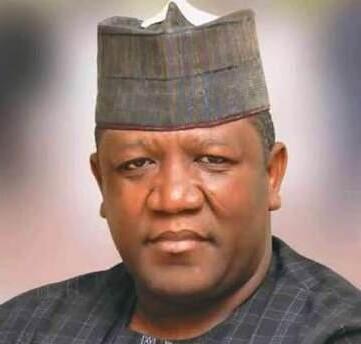
Apparently stupefied by Yari’s steady political ascendancy, those who do not wish him well have resorted to cheap blackmail as an instrument of destruction. They are worried that Senator Yari, the man of means, could swallow whatever that is left of them if he is not checkmated. They are therefore searching far afield, scavenging for reasons and sources of Yari’s wealth. Unable to hold on to something tangible, they are querying his investments in Geregu Power and Amperion Power. They are also accusing him of illegal gold mining. For them, Yari’s riches can be traced to his alleged involvement in illegal gold mining.
But Yari, ebullient as ever, has shrugged off these distractions. He has told those who care to listen that he has no hand whatsoever in illegal gold mine. He also has nothing to do with the gold bars that were recently seized by the Economic and Financial Crimes Commission (EFCC) at the Mallam Aminu Kano International Airport, Kano. To prove that Yari is not joking, the anti-graft agencies that chose to investigate the allegations against him have not seen any substance in those allegations. All said, the allegations against the senator have turned out to be only a fluke.
But his detractors have a target. They want to diminish his political impact and, at the same time, set him on collision course with President Bola Tinubu. Right now, Yari enjoys a robust relationship with Mr President. Tinubu as a smart politician knows that Yari is an asset. With the likes of Yari around the president, his efforts at penetrating the North West in the 2027 presidential election would get a big boost. Yari’s detractors are not comfortable about this. Unfortunately, they cannot do for Tinubu what Yari can do for him.
At the Senate, Yari is a very strong force to reckon with. During the race for the Senate Presidency under the Tinubu administration, Yari was on top of the situation. He was head and shoulder above most of those that indicated interest in the high office.
Mayaki writes from Lagos
Editor, Editorial Page PETER ISHAKA
Email peter.ishaka@thisdaylive.com
ADDRESSING THE BORNO CHOLERA EMERGENCY
The authorities must do more to contain the scourge
For more than four decades, cholera has not only been a recurring disease in Nigeria but has also led to the death of thousands of our people, especially children. There is an ongoing emergency in Borno State that should command the attention of health authorities. On Wednesday, Medecins Sans Fronteires (Doctors Without Borders), released a statement on how healthcare facilities in the state are under increasing pressure following a rise in suspected cholera cases, with more than 35,500 people infected and 198 deaths recorded since May. The challenge has been attributed to overcrowded informal settlements, limited access to safe drinking water, poor sanitation and inadequate waste management.
Mostly contracted through drinking contaminated water and eating waste products, cholera often leads to the infection of the small intestine. That Nigerians are still afflicted by such a disease in this age tells a compelling story about the state of the country. The sad part is that in many of the states, the villagers and rural dwellers are left to rely on streams as the only source of drinking water, and there are no provisions for disposing waste.
is not treated and when sanitation is not taken seriously. According to the NCDC, in communities affected by the outbreak of the infectious disease, open defecation is a common practice. “There is also an inadequate WASH infrastructure and supplies including wastewater management facilities,” the agency said.
In many of the states, the villagers and rural dwellers are left to rely on streams as the only source of drinking water, and there are no provisions for disposing waste
Fortunately, with effective coordination, the disease can be contained quickly but the real challenge is to work towards its total eradication from Nigeria as it has been done in many other countries. More surveillance, more awareness, more resourcing, and better coordination will be necessary to reduce deaths from cholera and other preventable diseases. The World Health Organisation (WHO) has consistently stressed that no human should die from preventable diseases like cholera. But to address this challenge, there is an urgent need for public enlightenment on healthy living. Experts have advised that people should ensure their food (cooked or uncooked) is properly covered while regular handwashing should be adhered to always.
A few weeks ago, the Nigeria Centre for Disease Control and Prevention (NCDC) Director-General, Jide Idris, warned that the country has entered the seasonal window when cholera cases historically surge, with early surveillance data already showing increasing infections across several states. “These forecasts are particularly concerning because they coincide with the period when cholera transmission typically accelerates,” Idris said. The problem becomes more compounded when and where there are no modern medical facilities to assist in the treatment of the disease. But authorities in many of the states don’t seem to have paid attention.
The spread of cholera becomes worse when the environment is not clean; when the water system
EDITOR SHAKA MOMODU
DEPUTY EDITOR WALE OLALEYE
MANAGING DIRECTOR ENIOLA BELLO
DEPUTY MANAGING DIRECTOR ISRAEL IWEGBU
CHAIRMAN EDITORIAL BOARD OLUSEGUN ADENIYI
EDITOR NATION’S CAPITAL IYOBOSA UWUGIAREN THE OMBUDSMAN KAYODE KOMOLAFE

EDITOR-IN-CHIEF/CHAIRMAN NDUKA OBAIGBENA
GROUP EXECUTIVE DIRECTORS ENIOLA BELLO, KAYODE KOMOLAFE, ISRAEL IWEGBU
DIVISIONAL DIRECTORS SHAKA MOMODU, PETER IWEGBU, ANTHONY OGEDENGBE
DEPUTY DIVISIONAL DIRECTOR OJOGUN VICTOR DANBOYI
SNR. ASSOCIATE DIRECTOR ERIC OJEH
ASSOCIATE DIRECTOR PATRICK EIMIUHI
CONTROLLERS ABIMBOLA TAIWO, UCHENNA DIBIAGWU, NDUKA MOSERI
DIRECTOR, PRINTING PRODUCTION CHUKS ONWUDINJO
TO SEND EMAIL: first name.surname@thisdaylive.com
Letters to the Editor
Indeed, Nigerians should not neglect the issue of personal hygiene. Cholera kills when a person loses too much body fluids, meaning such deaths are preventable if victims are quickly rehydrated. Since no vaccine has been developed to work against cholera, what is commonly used is oral rehydration salts (ORS) as part of measures to mitigate the problem. But prevention is still very much better than cure. To that extent, our rural dwellers and the urban poor should be taught the rules of basic hygiene.
The world has moved ahead of the era where cholera kills citizens. Healthcare officials and other critical stakeholders in Nigeria must therefore do more in providing adequate clean water for the citizens, especially for those that are in the rural areas. Beyond addressing the current emergency in Borno State, we must work towards banishing cholera from the country.
Letters in response to specific publications in THISDAY should be brief (150-300 words) and straight to the point. Interested readers may send such letters along with their contact details to opinion@thisdaylive.com. We also welcome comments and opinions on topical local, national and international issues provided they are well-written and should also not be longer than (750- 1000 words). They should be sent to opinion@thisdaylive. com along with photograph, email address and phone numbers of the writer.
FEDERAL CAPITAL TERRITORY: 50 YEARS ON
As the Federal Capital Territory (FCT) marks 50 years of its creation, Abuja stands today as a compelling symbol of national unity, strategic planning, and purposeful governance. From a modest vision conceived in 1976, the nation's capital has evolved into one of Africa's fastest-growing cities.
Yet, perhaps no period in its recent history has witnessed the scale, speed, and geographical spread of infrastructure delivery recorded under the administration of President Bola Ahmed Tinubu through the Renewed Hope Agenda, implemented in the FCT by the Minister of the FCT, Barrister Ezenwo Nyesom Wike.
The unprecedented 31-day commissioning and flag-off of landmark infrastructure projects across the Federal Capital Territory represent far more than ceremonial activities. They demonstrate a government translating policy into tangible development outcomes and mark a defining chapter in Abuja's 50-year jour-
ney of growth and transformation.
The completion and commissioning of strategic projects—including the Outer Southern Expressway (OSEX), Arterial Road N5, the Airport Expressway-Kuje Dual Carriageway, the Katampe District Road Network, the Karu Water Supply Scheme, judicial infrastructure, and several other roads and public facilities—have significantly improved connectivity, reduced travel time, lowered transportation costs and unlocked new opportunities for investment across the territory. These projects have also opened previously inaccessible districts to residential, commercial and industrial development while improving security and urban mobility.
For thousands of commuters, traders, civil servants, farmers, students and entrepreneurs, these projects represent increased productivity through reduced congestion and easier access to markets, schools, health-
care facilities and government institutions. They equally boost property values, encourage real estate development and improve the ease of doing business. One of the most remarkable aspects of the current administration's development strategy is its deliberate emphasis on extending infrastructure beyond the city centre to the satellite towns.
Communities such as Karu, Kurudu, Jikwoyi, Orozo, Kuje, Bwari, Kwali and other suburban districts are increasingly being integrated into Abuja's economic ecosystem. This approach aligns with the original Abuja Master Plan by ensuring that development is inclusive rather than concentrated only within the city centre.
Dr. Jumai Ahmadu, Director, Reform Coordination and Service Improvement Department, FCTA
Experts: Akwa Ibom, Enugu Investments in Aviation Will Expand Air Travel Market
Experts in aviation industry are of the view that the investments in state-owned airport hubs by Akwa Ibom and Enugu states will likely expand air travel market, increase evolving capital in the sector and effectively service hitherto underserved destinations.
The experts said stateowned carriers like Ibom Air and Enugu Air have injected billions of naira and
vital operational capacity into Nigeria’s aviation industry, fundamentally changing regional connectivity and economic growth.
According to the experts, both states have also created hundreds of jobs in the industry and have trained a lot of technical personnel, including pilots, cabin crew and engineers in addition to ground staff stationed at different airports in the country.
Akwa Ibom has modernised
its airport, which was recently designated international by the federal government and it is now Victor Attah International Airport Uyo.
The state established Ibom Air, which many industry observers described as promising carrier, already operating regional service, using Uyo airport as operational hub.
Also, Enugu State government established its own carrier, Enugu Air and this year obtained Air
Operator Certificate (AOC) after its affiliation with Xejet.
The state is also developing the Akanu Ibiam International Airport, Enugu, recently concessioned to Aero Alliance, which is serving as operational hub to Enugu Air.
Industry observers said that the two states may push for new trajectory that may shift attention from the popular triangular destinations of Lagos, Abuja and Port Harcourt dubbed the most lucrative destinations in the
domestic market.
Travel expert and organiser of Akwaaba African Travel Market, Ambassador Ikechi Uko, said there were vacuums in the domestic air travel markets that have not been exploited because private investors who establish airlines are desirous of making profits and may not want to expend resources developing new routes. So, they go for already established, profitable routes in order to have quick return on their investment.
He recalled that during the time of the Nigeria Airways Limited, the nation’s defunct national carrier, every part of the country was connected by the airline, which served all the airports, including the ones that might not have good returns.
According to him, the two states can develop destinations that are currently underserved and in future they may become lucrative destinations.
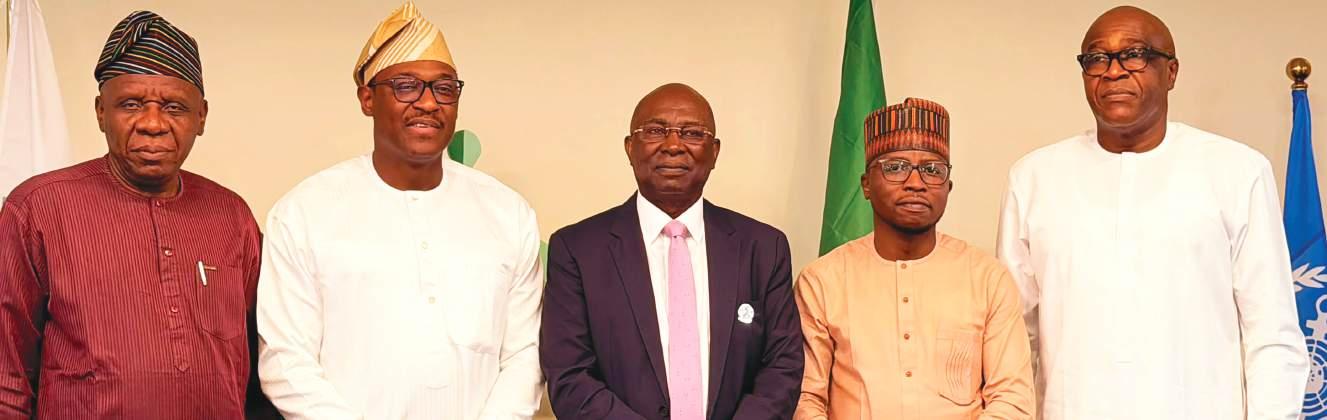
and Jessica
The World Trade Organisation, (WTO) Fish Fund Steering Committee at its seventh meeting, has approved $2.2 million grants to 17 developing and least-developed country (LDC) WTO members to help implement Agreement on Fisheries Subsidies. The new grants, totalling nearly $2.2 million, were approved under the Fund’s
second Call for Proposals, which closed on 8 May, as disclosed in a statement by the WTO. As expected, the newly approved projects will help beneficiary members to implement the agreement on fisheries subsidies by conducting needs assessments, improving reporting procedures, enhancing data collection and strengthening regulatory frameworks. With this second round of
approvals, more than 40 WTO members are now benefiting from Fish Fund support.
According to the statement, the Steering Committee also reviewed progress under the first Call for Proposals, further to which 26 grants amounting to nearly USD 2.9 million were approved. Most of these projects are already being implemented.
In her opening remarks, Deputy Director-General, WTO, Jennifer Nordquist,
highlighted the progress achieved so far: “In under ten months, the Fund’s grants are now delivering results across the world - the Caribbean, South and Central America, Africa, Asia, the Middle East and the Pacific. I find that quite an achievement. Several of the preparation grants are still underway, and as they mature, they will lead to a further set of projects to help implementing members give practical
effect to the disciplines of the Agreement.”
However, the steering committee also endorsed recommendations related to implementation of the Agreement, such as the needs assessments required for Category 2 proposals, and ensuring that the Fund’s assistance is targeted and aligned with its mandate and with the disciplines of the Agreement.
The statement also
noted that members also recognized the contributions made by the Fund’s core partners - the Food and Agriculture Organization of the United Nations (FAO), the International Fund for Agricultural Development (IFAD), the World Bank Group and the WTO - and in particular their role in the technical assessment of project proposals.
Oluchi chibuzor
erobomhan
chinedu eze
Executive Director Operations, Nigerian Maritime Administration and Safety Agency (NIMASA), Fatai Taiye Adeyemi; Director General, Nigerian Safety Investigation Bureau (NSIB), Captain Alex Sabundu Badeh Jnr.; Director General, NIMASA, Dr. Dayo Mobereola; Executive Director, Maritime Labour and Cabotage Services, NIMASA, Mr. Jibril Abba and Executive Director, Finance and Administration, Mr. Chudi Offodile; during a courtesy visit by Badeh to the headquarters of NIMASA in Lagos… recently
NIMASA, NSIB Deepen Collaboration to Enhance Maritime Safety
Oluchi Chibuzor
The Nigerian Maritime Administration and Safety Agency, NIMASA has reaffirmed its commitment to strengthening institutional collaboration with the Nigerian Safety Investigation Bureau (NSIB) to enhance maritime safety, security and marine casualty investigation in Nigeria.
The commitment was made by the Director General of NIMASA, Dr. Dayo Mobereola, when he
received the Director General and Chief Executive Officer of the NSIB, Captain Alex Sabundu Badeh Jnr., on a courtesy visit to the Agency’s headquarters in Lagos.
Speaking during the meeting, Mobereola affirmed that the Agency recognises the strategic role of the NSIB and the importance of stronger collaboration in advancing maritime safety and security.
According to him, “NIMASA understands the critical role of the NSIB in promoting transportation
ASKY Expands
safety. Strengthening safety and security within our maritime domain requires commitment, collaboration and practical frameworks that deliver sustainable results.
“Our shared responsibility is to build a maritime sector that operates on global best practices while protecting lives, vessels and the marine environment. Ultimately, our collective goal is to contribute to making Nigeria greater through stronger institutions and effective inter-agency cooperation.”
Fleet Size with Two New Boeing 737 MAX8 Aircraft
Stories by Chinedu Eze
ASKY has marked a major milestone with the delivery of two brand-new Boeing 737 MAX 8 aircraft in July 2026, reinforcing its commitment to operational excellence and sustainable connectivity across Africa.
The first jet, registered ETBCJ, arrived in Lomé on July 5, followed by ET-BCK on July 16. Both feature a dualclass configuration with 16
Business and 144 Economy seats, delivering superior passenger comfort while setting new benchmarks in fuel efficiency and CO2 reduction.
With the acquisition, ASKY’s fleet now stands at 17 aircraft, including 8 Boeing 737 MAX 8s, underscoring its resolve to operate one of the youngest, most fuel-efficient fleets in the region.
Speaking at the welcome
ceremony in Lomé, ASKY’s CEO Mr. Esayas Woldemariam HAILU stated: “This delivery is a powerful statement of our resilience and long-term vision. It reflects the trust of our strategic partners, the dedication of our team, and the exemplary supportive environment fostered by the Government of Togo, which continues to champion Lomé as a premier aviation and logistics gateway.
Kenya Airways Prioritises Nigeria, Rewards Trade Partners
Kenya Airways (KQ) has reaffirmed its commitment to the Nigerian market and its strategy to boost capacity and connectivity between Nigeria and Kenya and beyond through its hub at Nairobi.
Speaking at a dinner and award celebration to recognise and appreciate travel trade and industry partners who have collaborated and worked closely with the airline over the past year, its Country Manager, Mr. James Nganga, acknowledged their role in ensuring the airline’s impressive performance
in the market.
“We are enhancing our connectivity out of Lagos. We are also supporting more business into Kenya because we feel there are a lot of opportunities. We are promoting Kenya as a holiday destination and more recently as a medical destination in partnership with Aga Khan University Hospital in Nairobi, Kenya,” Nganga said.
The General Manager, West Africa and Americas, Mr. Stephen Ngamau noted that Kenya Airways remained committed to service and
plans to invest more in the Nigerian market in terms of capacity and connectivity, adding that with effect from the coming week the airline will start operating the Dreamliner service six times weekly to Lagos.
He disclosed further that KQ plans to open flights into Abuja in the near future and is exploring partnership opportunities with local Nigeria Airlines to connect passengers to various parts of the country. He noted also that with KQ Holidays, the airlines will drive more leisure travel into Kenya.
SAHCO Launches Pilot Programme for Passengers with Reduced Mobility
Air WAtCh

FAAN’s Global Push for Carbon Emission Reduction
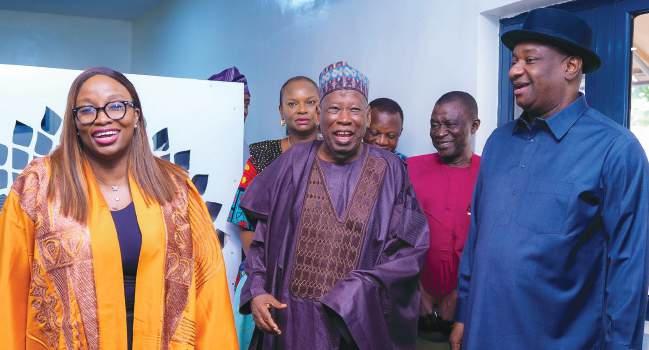
opportunity. That chapter closes today.
Group Business Editor
Eromosele Abiodun
Deputy Business Editor
chinedu Eze
Comms/e-Business
Emma Okonji
Asst. Editor, Energy
Emmanuel Addeh
Asst. Editor, Money Market
Nume Ekeghe
Correspondents
Kayodetokede(CapitalMarkets)
James Emejo (Finance)
Ebere Nwoji (Insurance)
reporter Peter Uzoho (Energy)
Skyway Aviation Handling Company (SAHCO) Plc has again demonstrated its commitment to innovation, safety, and inclusive service delivery with the acquisition of the EVAC+CHAIR emergency evacuation chairs for passengers with reduced mobility.
With this latest investment, SAHCO becomes the only aviation ground handling company in Nigeria to deploy specialised mobility equipment, further enhancing its ability to provide safe, dignified, and efficient assistance to passengers with
reduced mobility.
The EVAC+CHAIR, recognised globally as the world’s leading stairway evacuation chair since 1982, is specially designed to provide a safe and comfortable means of moving passengers with reduced mobility during emergencies or when navigating stairways. Using an advanced gravity and friction control system, the chair safely ascends and descends stairs without the need for heavy lifting, reducing physical strain on operators while ensuring maximum safety and comfort for passengers.
The Federal Airports Authority of Nigeria (FAAN) in line with Airport Council International (ACI) and the International Civil Aviation Organisation (ICAO) has joined the push for zero carbon emission with the establishment of digital waste management system at the Murtala Muhammed International Airport (MMIA), Lagos.
The aviation industry is spearheading the Net Zero 2050, which is the globally recognised, science backed target to balance the greenhouse gases emitted in the atmosphere to avoid catastrophic climate change by limiting global warming to 1.5°C.
At the unveiling of the digital waste system on Wednesday, the Managing Director of FAAN, Mrs. Olubunmi Kuku, said the initiative was part of a circular economy programme aimed at reducing carbon emissions, improving recycling and aligning Nigeria’s airports with global environmental standards.
She said the initiative also formed part of the Airports Council International’s five-level Airport Carbon Accreditation Programme, with FAAN currently implementing Level Three of the framework.
Kuku emphasised that the programme represented a major shift from the traditional method of indiscriminate waste disposal to a technology-driven system that promotes waste sorting, recycling and resource recovery.
According to her, the authority had introduced indoor digital waste bins that would enable waste segregation at source, marking the first phase of a comprehensive circular economy strategy that would eventually cover all international airports in Nigeria.
Kuku explained that the initiative was beyond installing waste bins, stressing that it is a complete transformation of airport waste management involving passengers, airlines, concessionaires and airport workers.
According to her, Lagos airport alone generated 1,446 tonnes of waste in 2023, which declined slightly to 1,383 tonnes in 2024.
However, she lamented that virtually all the waste ended up in landfills without sorting or recycling.
“However, the sobering reality remains that regardless of the volume, every single ton was consigned to the landfill, completely unsorted, entirely unrecycled and representing a monumental lost
“From this moment, we’re overhauling our approach with the strategic precision our operations demand. This milestone inaugurates phase one, embedding source sorting across our terminals by initiating separation at the point of generation. We’re transforming every passenger, every partner and every staff member into an active guider of our shared environmental destiny,” she said She disclosed that under the new programme, waste would be sorted at the point of generation before being transferred to outdoor collection points in the second phase.
The third phase, she noted, involved certified recycling companies that would collect plastics, glass, cans and organic waste for processing into reusable materials.
While unveiling the digital waste management system. the Minister of Aviation and Aerospace Development, Festus Keyamo, said the programme has aligned Nigeria with global best practices being championed by ICAO and ACI.
Keyamo said airports around the world were increasingly adopting cleaner and greener technologies, including renewable energy, to reduce their environmental footprint.
The minister stressed that he had directed contractors handling new airport projects to incorporate solar-powered roofing systems into airport designs to reduce dependence on fossil fuels.
“I have directed the China Civil Engineering Construction Corporation (CCECC) that is handling our new terminal at the Lagos airport that the rooftops must be powered by solar. My point is, when we are designing, at the point of design, the roof of that new effort must be solar panels.
“This is to at least power the nonaeronautical parts of the airport. And so, I want to congratulate all of you for this mission, for aligning with the global best practices. Of course, my sincere thanks go to the Chairman of the Board of FAAN, Abdullahi Ganduje, for aligning with this mission,” the minister said.
Ganduje, on his part, said the initiative was a technology-driven solution capable of transforming waste into economic value. He said proper recycling would reduce methane emissions from landfills while creating useful by-products, including electricity generation.
the story continues online on www.thisdaylive.com
Chinedu Eze
Robertson: Blue Seal to Increase FDIs in Nigeria with Two More Chemical Manufacturing Plants
With 48 years experience working in the oil and gas and industrial sectors across six continents in multicultural environments, and managing multicultural employees with over 10 of those years spent in Nigeria and Africa, the Chief Operating Officer of Blue Seal Energy Group, Lloyd Robertson, truly understands the marketplace, client’s needs, the business drivers and how to be successful. In this exclusive interaction with Peter Uzoho, Robertson shares his experiences, the company’s investment in Nigeria as well as future plans. Excerpts:
Blue Seal Energy Group is into the manufacturing of chemical products that serve the oil and gas and other industrial sectors. How has the experience been working in Nigeria and leading this company as the Chief Operating Officer?
Well, it’s interesting because I have substantial previous experience in Nigeria. This is not my first experience. My first experience in Nigeria was as district manager in Warri in 1988 for Baker Hughes. And then I left, because Baker Hughes was going through a merger and acquisition, and they hadn’t decided how they were going to structure the the company. I left and went to Papua New Guinea for two years, seconded to Chevron, and then they asked me to come back in 1990 as the technical manager for all of Nigeria, and I was in Port Harcourt for four years.
Then I was transferred to other places around the world. I went from Nigeria to Tunisia, Tunisia to Indonesia, from Indonesia to Aberdeen, Scotland, from Aberdeen, Scotland to Luanda, Angola as sub-sahara region manager. And they transferred the regional office from Luanda to Lagos. And I came back to Lagos as managing director of Baker Hughes in Nigeria, as well as holding the responsibility for Sub-Saharan region drilling fluids manager. So I am quite comfortable with the Nigerian environment. I know it well.
Blue Seal opened its chemical manufacturing plant sometime last year. What is the business like now with the company since the commissioning of the facility?
Well, we are just getting started, really. I mean, we’ve had some delays in production due to some conflicts within the organization. We’re about to get to the point where we will be doing full production in the very near future. Market dynamics have been a major driver in our slow start. But we look forward to establish our foundation and grow. And I think our growth will be very quickly.
Blue Seal’s plant in Ibeju-Lekki has the capacity of about 35 million metric tonnes per annum. Have you now ramped up to 100 per cent production capacity, as we speak?
No, not yet. As I said, we’re starting slowly. The capacity of the plant is 1.7 million liters per day. So we can do substantially more than what you have just stated. However, And one thing I need to say going forward is that we are not competing with the people who are the end users. We want to be collaborators with the end users who need those products. The service companies that have long-term relationships with the operators in Nigeria, we want to support them.
We want to be there OEM reguonal manufacturer. So we are reaching out to those companies that need our support. And trying to break through to make them more efficient economically. And to give them the inventory they need in a just-in-time manner, rather than having to order and wait for it to ship and be cleared and to be in their warehouse.
Because I’ve managed investors in Nigeria, I know that when I first came to Nigeria, that from the time you ordered product to the time it was in your warehouse, it could take as long as five to six months. We were
Robertson
able to improve that efficiency slightly, but we never got to a point where it was over four turns of inventory in a year. With the capabilities of manufacturing in Nigeria, you can bring that inventory turns to a matter of nine or 10 turns of inventory in a year on the products that we make. Our plans are to expand our manufacturing capability to a point where we can provide more of the products they need, to substantially help their return on net capital employed and, then profitability. All of our products are made to international quality standards, according to API, according to ISO. So when we bring our products to the marketplace, we stand behind our products from a quality standard, making sure that they are not losing anything if they buy from us rather than importing.
Who are your major clients or customers in Nigeria, across the oil and gas, and industrial sectors?
Our primary targets as clients are the drilling fluids companies, the production chemistry companies, the turnkey operators who provide the services to the major operators.
Dangote Petroleum Refinery and Fertiliser are there in Ibeju-Lekki as your neighbours and I know they too require some chemical supplies to work. Are you into any contracts with them? Are you supplying them right now?
Yes, Dangote has been a client of Blue Seal Energy group for many years before we even built the plant. Before we built a plant, we had a group called Blue Seal Energy Services. And they provided products and services to Dangote long before we even built the plant. This goes back over 10 or 15 years.
What are the different kinds of chemical products that Blue Seal
manufactures and provides?
We manufacture drilling fluids products, emulsifiers, rheology modifiers, Welding agents. And we do completion fluids, chemistry such as corrosion inhibitors and scale inhibitors and packer fluid products. And then we do production chemistry, which is demulsifiers, scale inhibitors, H2S inhibitors, iron scavengers, H2S scavengers. I don’t have it in front of me, but mostly production chemistry, oxygen scavengers.
And then we also do water treatment in the industrial sector, for corrosion inhibition and passivation of water systems and cooling systems, industrial water management from refining, those kind of things, demulsifiers. So those are the three primary areas, drilling, completions, production, and industrial. Those four are our major areas of manufacturing.
Blue Seal Energy Group could be regarded as one of the companies that are bringing foreign direct investment in Nigeria. So today, how much of investment would you say the company has put in in Nigeria?
Well, our current investment is the plant that is in Ibeju-Lekki. But we have plans for developing an additional two plants in Nigeria. And then a total of 10 to 15 plants across Sub-Sahara Africa in the next 10 to 15 years. The actual investment in Nigeria is kind of a moving target at the moment. I’m not going to publicly disclose all our investments at this point in time. But we paid cash for the plant in Lekki. So it’s substantial.
What informed the company’s decision to invest and set up a manufacturing plant in Nigeria instead of taking the easy way of just importing chemical products into Nigeria?
Well, you have to realise that the owner of the company is Nigerian, and he cares
very much about the Nigerian people. As such, he wants to have a positive impact on the economy of Nigeria through jobs, through training of personnel, internships from the universities, improving the playing field from a cost perspective. Improving the cost to the indigenous operators, reduce their overhead, reduce their operational cost, help them be more efficient. It’s a major economic umbrella where we try to help general economics of Nigeria and the people who live here.
Is supporting Nigerian local content drive also part of it?
Very much so. The local content is one of our most important aspects that gives us credibility in the marketplace. You know, most of the service companies and the operators are being pressured by the local content governing body to use as much Nigerian content as possible. So we bring that aspect to the chemical business in Nigeria. I am the only expat involved in this business at the moment. And everyone else involved in our company is Nigerian.
So you’re saying that almost 100 per cent of your workforce are Nigerians? Absolutely.
How much local content level has the company achieved so far?
That varies, but I would say we’re probably 60 per cent Nigerian content, if not more. We import some of our intermediates and reagents from international sources and try as much as possible to use chemistry that’s available in Nigeria to help us with our manufacturing process.
Are you getting enough support and encouragement from the Nigerian Content Development and Monitoring Board (NCDMB), which regulates and supervises manufacturing and service companies in Nigeria’s oil and gas sector?
Absolutely. Last year at the Practical Nigerian Content Seminar in Yenagoa, Blue Seal was showcased as an example of how to do it the right way. And Dr. Edeni, the owner of the company spoke at that conference. Yes, we have gotten a lot of support from NCDMB.
What particularly differentiates Blue Seal’s chemical products from other producers in Nigeria or elsewhere?
Well, as I said before, we make the products to international quality standards. It provides a reduced cost of goods to the people who are operating here, giving them the ability to drive down cost for the operators. That in itself is a lot.
As the Chief Operating Officer of Blue Seal, you have staff members and material resources to manage. What kind of leadership and managerial skill do you bring to ensure that these are managed in a way that enhances productivity for the company?
Well, in September, I’ll have 48 years in the industry. I’ve lived and worked on six continents in multicultural environments, managing multicultural employees. I have over 10 years in West Africa and experience. I understand the marketplace.
FAAN’s Impact on Airport Safety
Chinedu Eze posits that the Federal Airports Authority of Nigeria has concentrated on improving critical facilities at the airside of the major airports, which has enhanced operations
The airside infrastructure consists of all secure, restricted areas dedicated to aircraft operations and ground servicing.
It serves as the technical foundation where planes take off, land, taxi, park, and are serviced. This part of the airport is not comprehensively open to people, except when boarding the aircraft or inside the aircraft cabin but it is the most critical part of the airport infrastructure.
Nigeria’s major gateway, the Murtala Muhammed International Airport (MMIA), Lagos had its runway shut down for repairs when the Managing Director of the Federal Airports Authority of Nigeria (FAAN), Mrs. Olubunmi Kuku, was appointed to head the agency on December 13, 2024.
At that time, both international and local airlines were using the domestic runway, known as Runway 18L, while 18R, the international runway was shut down.
This adversely affected the airlines. The airlines said they incurred losses due to delays caused by flight traffic, as all flights take off and land on the only operational runway, Runway 18L, traditionally meant for domestic flight service.
Foreign airlines also said they consumed much fuel taxiing to the domestic runway to take off and also from there to the international terminal after landing, which took longer time and also added to the delays.
Work Interruption
By the time the FAAN Managing Director took over, work at the runway was kept in abeyance. The runway was one of the victims of half-hearted political transition, as the Bola Ahmed Tinubu administration took over from

his predecessor, the late Muhammadu Buhari. So, rehabilitation work at the runway was interrupted, but resumed after Kuku took over the management of the agency.
By the time Kuku completed work on the runway and its related facilities, the Lagos airport became highly improved.
The taxiways were rehabilitated with new lighting, new markings to clearly guide the pilots. Hitherto, once aircraft exited the runway in the night, it was enveloped by darkness until it approached the terminal but the whole aside was lighted by Kuku.
The management also improved the apron (ramp), where aircraft are parked. It was rehabilitated with new asphalt, lighted and marked it with improved aesthetics and better guide for pilots.
FAAN installed new airfield lighting, which
is precision system located on the runway, edge lights, approach lights that guides the aircraft to the runway, taxiway guidance lights.
Years of Neglect
So, for decades, Nigeria’s airport terminals have attracted public attention while many of the airports’ critical airside assets quietly aged under the weight of increasing aircraft movements, changing climate conditions and years of deferred capital investment.
Some runways had exceeded their design life. Taxiways required extensive rehabilitation, airfield lighting systems needed modernization, engineering interventions became increasingly urgent as airport traffic continued to grow.
Under the leadership Kuku, the Authority embarked on one of the most ambitious programmes of airside rehabilitation and
safety-critical infrastructure renewal in recent years, a transformation that is reshaping not merely airport facilities but the very foundations of aviation safety in Nigeria.
Because the infrastructure at the airside does not beacon at the public as airport terminal does, many do not know the enormous work that go into providing safe and secure airside facilities. It is arguably the most capital intensive.
Industry insiders said that since Kuku became FAAN Managing Director, she adopted deliberate shift in philosophy.
“What FAAN has done in the provision of infrastructure, especially at the airside of the major airports under the Kuku management, aligns closely with President Bola Ahmed Tinubu’s Renewed Hope Agenda, which identifies infrastructure renewal as a catalyst for economic growth, investor confidence and national competitiveness, with the Federal Airports Authority of Nigeria as one of the key institutions translating that vision into reality,” said a senior FAAN official.
He noted that Mrs. Kuku has repeatedly emphasised that sustainable airport development cannot be achieved by focusing solely on passengerfacing facilities like the terminal, while neglecting operational infrastructure.
“One of the administration’s earliest milestones was the successful completion of the rehabilitation of Runway 18R/36L and Taxiway B at the Murtala Muhammed International Airport, Lagos. The project restored a critical operational asset that had long required major engineering intervention and significantly improved the airport’s capacity for uninterrupted flight operations, particularly during night-time services,” he said.
The story continues online on www.thisdaylive.com

v ictor Nwokeji: Double Laurels for Championing Africa’s Industrial Future through Zotmann
Recognition is often a reflection of sustained impact rather than a single achievement. For Zotmann International Limited, receiving two prestigious international awards on two continents within 48 hours underscores years of strategic investments, responsible corporate leadership and growing influence in sectors critical to africa’s economic future. The honours, presented in London and Banjul, The Gambia, reinforce the company’s emergence as one of Nigeria’s leading indigenous conglomerates making an impact on the continental and global business landscape. Anayo okolie reports
Between July 21 and July 22, 2026, Zotmann International Limited received two major international honours recognising not only its commercial success but also its contribution to Africa’s economic transformation.
At the heart of the company’s growth is its Founder and Group Managing Director, Victor Nwokeji, whose vision has positioned Zotmann among Nigeria’s foremost indigenous conglomerates.
Through strategic leadership and long-term investments, Nwokeji has championed the development of critical sectors, particularly mining, which is increasingly viewed as central to Nigeria’s economic diversification agenda.
Under his leadership, Zotmann has expanded across the mining value chain, promoting responsible mineral exploration, local value addition, technological innovation and sustainable resource management.
Beyond building a successful enterprise, Nwokeji has consistently advocated investments in industries capable of accelerating industrialisation and strengthening local capacity.
By positioning Zotmann as a key player in mining, manufacturing, logistics and real estate, he has demonstrated how indigenous companies can drive economic transformation while adhering to responsible corporate governance and sustainable business practices.
African Achievers Award for Excellence and Visionary Leadership in Africa
The first honour came in London at the 2026 African Achievers Award for Excellence and Visionary Leadership in Africa, one of the continent’s leading platforms for recognising outstanding contributions to governance, enterprise, innovation and development.
The event began with a Leadership Roundtable at the House of Lords, Palace of Westminster, where policymakers, investors, diplomats, business leaders and development experts discussed industrialisation, youth empowerment, sustainable growth and investment opportunities across Africa.
The awards ceremony later took place at the Royal Society of Arts, where organisations and individuals shaping the continent’s future were honoured.
Among the recipients was Zotmann International Limited, recognised for its visionary leadership, strategic investments, ethical corporate governance and commitment to sustainable economic development.
Beyond commercial success, the award highlighted the company’s focus on creating long-term value through industrial growth, employment generation and national development.
The London honour also reflected a broader shift in Africa’s business environment, where companies are increasingly assessed not only by financial performance but also by their social
L-R: Founder, Royal News Enterprise, Prince Anayo Royce Okolie; Uboma Elonna Richmond, Real Homes Limited; Prof. Thean Potgieter, Centre for Military Studies, Stellenbosch University, South Africa; Group General Manager, Zotmann International Limited, Benjamin Uzoka; Chief Executive Officer, Vtrack Tech Nig Ltd, Engr. Victor Ibekwe; Lifegate Mining Ltd, Mr. Ogbonna Okechukwu; Plant Engineer, Zotmann Mining Ltd, Chief Engr. Ikechukwu Nwokeji; Quarry Manager, Zotmann International Limited, Onyeazor Henry; and Chief Operations Manager, Zotmann International Limited, Iwuji Chukwuebuka, receive the Golden Star Award for Zotmann’s Outstanding Contribution to Nigeria’s Mining Sector in 2025 at the 19th African Security Watch Awards held in Banjul, The Gambia, yesterday
impact, innovation and commitment to sustainability.
For Zotmann, it affirmed that indigenous African businesses can compete globally while delivering meaningful local impact.
Golden Star Award for Outstanding Contribution to Nigeria’s Mining Sector
Barely a day later, Zotmann was again recognised on the international stage, this time in Banjul, The Gambia, where it received the Golden Star Award for Outstanding Contribution to Nigeria’s Mining Sector at the 19th Africa Security Watch Conference.
The conference brought together government officials, security experts, business executives and policymakers to examine issues surrounding economic security, responsible resource management and sustainable development.
The award recognised Zotmann’s growing role in transforming Nigeria’s solid minerals sector through strategic investments, responsible mining practices, environmental sustainability and local content development.
Its significance extends beyond one company.
Nigeria’s mining industry is increasingly seen as a vital pillar of economic diversification, with vast untapped mineral resources capable of generating employment, increasing export earnings and reducing dependence on crude oil.
Achieving this potential, however, requires investment, technology, strong governance and responsible operators.
By investing across the mining value chain and related industries, Zotmann is contributing to a more diversified economy while promoting local capacity and value addition.
The Banjul recognition therefore
acknowledged not only business excellence but also the company’s contribution to a key national economic objective.
Building an Indigenous Industrial Champion
Over the years, Zotmann International Limited has expanded steadily across sectors regarded as essential to sustainable development. Its investments in solid minerals, manufacturing, logistics and real estate support industrial growth, infrastructure development and job creation while strengthening the company’s resilience.
Its strategy of investing in productive sectors capable of generating longterm value reflects the changing priorities of African economies, where industrialisation, local production and value addition are receiving renewed attention.
Zotmann’s journey demonstrates how indigenous enterprise can move beyond commercial success to become a catalyst for broader economic transformation.
Sustainability as a Business Imperative Another common thread linking both awards is the growing importance of sustainability. Across Africa and globally, governments, investors and development institutions are placing greater emphasis on environmental, social and governance standards.
Zotmann’s commitment to responsible resource management, ethical leadership and sustainable investments reflects this shift, particularly in sectors such as mining and manufacturing, where balancing economic growth with environmental stewardship has become increasingly important.
A Win for Nigerian Enterprise
Beyond celebrating one company, Zotmann’s double international recognition sends a strong message about the growing competitiveness of Nigerian businesses.
Despite infrastructure challenges, rising production costs and economic volatility, indigenous companies continue to demonstrate resilience, innovation and global relevance.
For Zotmann International Limited, the honours from London and Banjul represent more than corporate achievements. They affirm a business philosophy rooted in innovation, industrial growth and sustainable development.
As Africa advances its economic diversification and industrialisation agenda, companies capable of translating vision into lasting impact will remain at the forefront.
Zotmann’s double laurels stand not only as a celebration of corporate excellence but also as evidence that Nigerian enterprises are increasingly shaping industries, attracting global recognition and helping define Africa’s industrial future.
The Zotmann delegates to the 19th Africa Security Watch Awards in the Banjul, The Gambia
How Project Breathe Clean Air Abuja is Transforming Health, Homes in the FCT
Project Breathe Clean air abuja is proving that access to clean cooking energy can do far more than replace traditional fuels as it can improve public health, protect the environment and transform lives. Through a partnership between the Federal Capital Territory administration (FCTa) and IHS Nigeria, the initiative has provided 10,000 households with LPG cylinders while generating scientific evidence that cleaner cooking significantly improves indoor air quality and reduces exposure to harmful pollutants, particularly among women and children. Chiemelie Ezeobi reports
For thousands of families across the Federal Capital Territory (FCT), cooking no longer has to come with clouds of smoke, burning eyes and the hidden danger of respiratory disease. Through Project Breathe Clean Air Abuja (PBCAA), the Federal Capital Territory Administration (FCTA), with the support of IHS Nigeria, is demonstrating that access to clean cooking energy can significantly improve household health while contributing to environmental sustainability.
The initiative, which culminated in the distribution of 10,000 Liquefied Petroleum Gas (LPG) cylinders and refill vouchers to households across 18 communities in the six Area Councils of the FCT, has gone beyond simply replacing traditional cooking fuels.
Evidence from its monitoring and evaluation exercise now shows measurable improvements in indoor air quality, providing local proof that cleaner cooking methods can reduce harmful pollution and improve public health.
A Response to a Silent Public Health Threat
Indoor air pollution remains one of the least recognised public health challenges in many Nigerian homes, where firewood, charcoal and kerosene continue to be the primary cooking fuels.
While these energy sources are affordable and readily available, prolonged exposure to the smoke they generate has been linked to respiratory infections, asthma, chronic lung diseases and even certain cancers.
The project was conceived to tackle this growing concern by encouraging households to transition from biomass fuels to LPG, a cleaner and more environmentally friendly alternative.
Speaking at the grand finale held at Bwari Mini Stadium on July 2, 2026, the Honourable Minister of State for the FCT, Dr. Mariya Mahmud, represented by Hajiya Maijida Adamu Kuku, said the initiative was designed to reduce respiratory diseases associated with indoor air pollution.
She noted that women and children bear the greatest burden of exposure to smoke from traditional cooking methods and explained that wider adoption of LPG would not only improve public health but also protect the environment and contribute to climate change mitigation.
From Distribution to Lasting Behavioural Change
Unlike many intervention programmes that end with the distribution of equipment, Project Breathe Clean Air Abuja placed equal emphasis on education, community engagement and long-term sustainability.
According to the Mandate Secretary of the FCT Health Services and Environment Secretariat, Dr. Adedolapo Fasawe, the project, launched in November 2025 with sponsorship from IHS Nigeria, reached 10,000 households spread across 18 communities in the six Area Councils.
She explained that the intervention was prompted by increasing cases of respiratory tract infections among women and respiratory allergies in children linked to prolonged exposure to smoke from firewood, charcoal and kerosene.
To ensure safe adoption of LPG,
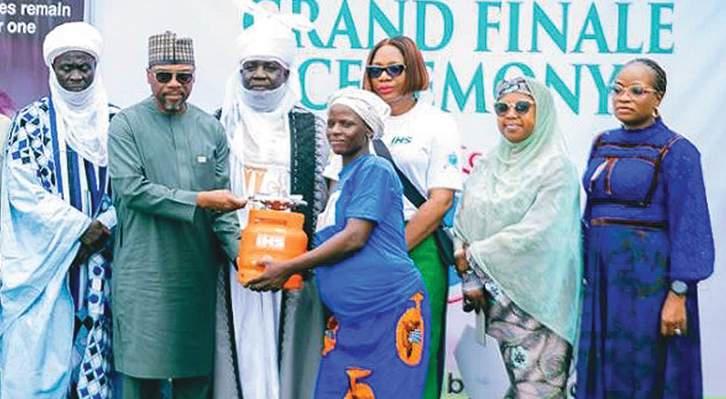

Beneficiaries with their gasses and refil vouchers at the event
sustainability teams from the FCTA and IHS Nigeria carried out advocacy visits to traditional rulers and community leaders while also conducting awareness campaigns on the safe use of cooking gas.
The programme also incorporated monitoring and evaluation exercises to determine whether the transition to LPG was making a measurable difference in household health and air quality.
Scientific Evidence Behind the Success
One of the defining features of the initiative was its reliance on scientific evidence rather than assumptions.
Using handheld air quality monitoring sensors, officials assessed 30 households in Kurudu and Pyakasa communities within Abuja Municipal Area Council (AMAC).
The devices measured concentrations of fine particulate matter, specifically PM2.5 and PM10, before and after beneficiaries switched from biomass fuels to LPG. The baseline findings painted a worrying picture.
Homes that relied on firewood and charcoal recorded PM2.5 levels that exceeded the World Health Organization’s recommended limits, exposing women and children to dangerous pollutants known to increase the risk of respiratory
illnesses.
However, follow-up assessments after households adopted LPG recorded significant improvements in indoor air quality.
The findings confirmed that clean cooking energy substantially reduces exposure to harmful pollutants, improves respiratory health and lowers the likelihood of developing chronic diseases associated with prolonged smoke inhalation.
Dr. Fasawe said the data generated by the project would provide valuable local evidence to guide future policies on clean energy, environmental management and public health.
She also disclosed that two outdoor air quality monitoring sensors had been procured for installation across the FCT to provide real-time environmental data for better public health decision-making.
Partnership Driving Sustainable Development
For IHS Nigeria, the project represents more than corporate social responsibility. It reflects the company’s broader sustainability agenda focused on environmental protection and community well-being.
Representing the Executive Vice President and Chief Executive Officer of IHS Nigeria Limited, Mr. Mohamed Darwish, the company’s Senior Vice
President and Chief Corporate Services Officer, Mr. Dapo Otunla, said the successful completion of the initiative reaffirmed IHS Nigeria’s commitment to creating lasting social impact.
“At IHS Nigeria, sustainability is embedded in how we think, how we operate, and how we create long-term value. Our approach is guided by four sustainability pillars that define our priorities and impact areas. This initiative directly aligns with two of those pillars: Environment and Climate Change and People and Communities,” he said.
According to him, replacing firewood and charcoal with LPG contributes to reduced carbon emissions, cleaner air and less pressure on forests, while simultaneously improving the quality of life of beneficiaries by reducing exposure to indoor air pollution and enhancing safety and dignity, particularly for women and children.
Health Experts See Long-Term Benefits
Medical experts believe the benefits of the project extend beyond cleaner kitchens.
Consultant Clinical and Radiation Oncologist at the National Hospital Abuja, Dr. Ayuba Hannatu Usman, described the initiative as a life-changing intervention capable of reducing the burden of lung cancer and other respiratory diseases. She stressed that preventing disease through cleaner household energy is far more affordable than treating advanced illnesses and urged governments, development organisations and private companies to replicate similar interventions across the country.
Her comments reinforce growing evidence that environmental health interventions can significantly reduce healthcare costs while improving quality of life.
Building Healthier Communities Beyond Cooking
The initiative also recognised that environmental health awareness should begin early.
As part of the project, pupils and students in primary, secondary and tertiary institutions received Project Breathe Clean Air Abuja branded educational materials aimed at promoting environmental consciousness and healthy living. Pregnant women also received baby care kits in support of maternal and child health.
The grand finale attracted representatives from government, corporate organisations and traditional institutions, including representatives of the Bwari and AMAC Chairmen, the Head of Service of the FCTA, the Director General of the Maryam Babangida Women Development Centre, the Area Commander and the Etsu Bwari, HRH Dr. Ibrahim Yaro, among other dignitaries.
Beyond the distribution of LPG cylinders, Project Breathe Clean Air Abuja has demonstrated that carefully designed, community-based interventions backed by scientific evidence can improve household air quality, protect vulnerable populations and support environmental sustainability.
As Nigeria continues to seek practical solutions to public health and climate challenges, the initiative offers a scalable model capable of transforming lives—one household at a time.
L-R: Representative of Sarkin Bwari Alhaji Dantani Dantsoho; Senior Vice President & Chief Corporate Services Officer IHS Nigeria Mr. Dapo Otunla; Etsu Bwari HRH Dr. Ibrahim Yaro; Mrs. Kauna Monday (Beneficiary); Mandate Secretary FCT Health Services and Environment Secretariat, Dr. Adedolapo Fasawe; Representative of Minister of State FCT, Hajiya Maijida Adamu Kuku; and Director Sustainability IHS Nigeria, Titilope Oguntuga, during the symbolic presentation of free cooking gas cylinders at the Grand Finale of Project Breath Clean Air Abuja at the Bwari Mini Stadium
Pathway Announces Launch of Pivot Integrated Energy’s N100bn
Kayode Tokede
Pathway Advisors Limited, the Lead Arranger and Issuing House, has announce the opening for subscription, the Pivot Integrated Energy Services Limited Series 1 Commercial Paper issuance of up to N100 billion under its N300 billion Commercial Paper Programme.
The Offer, it said, is expected to close on July 31, 2026. Rated by Agusto & Co. - A3, Global Credit Rating - A3 and DataPro Limited - A1, the offer comes in Tranche A (180 days), Tranche B (270 days), Tranche C (364 days).
The company in a statement said the proceeds from the Issuance will be applied towards working capital finance, supporting Pivot’s ongoing operations in the importation, trading,
storage, distribution and supply of refined petroleum products across Nigeria and selected African markets.
“The Offer presents investors with an opportunity to participate in the growth of a leading indigenous downstream energy company with a strong track record of revenue growth, robust off-take arrangements, and improving profitability,” the statement read in parts.
Pivot Integrated Energy Services Limited (“the Company” or “Pivot”) is an indigenous integrated downstream energy company engaged in the importation, trading, storage, distribution, and supply of refined petroleum products across Nigeria and selected African markets.
The Company supplies Premium Motor Spirit (“PMS”), Automotive Gas Oil (“AGO”) and Aviation Turbine Kerosene
(“ATK”) to a diversified customer base comprising bulk buyers, distributors, industrial users, logistics operators, manufacturers and retail-linked channels across major cities including Lagos, Calabar and Port Harcourt.
Pivot is one of the 20 approved off-takers under the Dangote Refinery PMS Consortium, with an allocated target volume of 300 million litres per quarter.
Pathway Advisors Limited, a leading issuing house, financial advisory and capitalraising firm registered and regulated by the Securities and Exchange Commission (SEC), Nigeria. The firm’s services cover transaction advisory, capital raising, project finance, mergers and acquisitions advisory, and strategic financial solutions to corporate and institutional clients.
Afriland Properties Champions Collaborative Action to Unlock Affordable Housing
The Managing Director/ Chief Executive Officer of Afriland Properties Plc, Azubike Emodi, has reaffirmed the Company’s commitment to partnering with governments, investors and industry stakeholders to advance sustainable urban development, expand access to quality housing and deliver real estate solutions that create lasting value.
Speaking during a high-level panel session at the 20th Africa International Housing Show (AIHS) on “Housing Models for the Informal Sector and the Ecosystem Changes Required to Unlock Affordable Housing,” Emodi called for a comprehensive overhaul of the affordable housing
ecosystem, stating that sustainable housing delivery will only become achievable through coordinated action by governments, financiers, developers and policymakers.
He noted that the affordable housing conversation must evolve beyond expectations placed solely on developers and instead focus on creating an enabling ecosystem that makes affordable housing commercially viable. According to him, meaningful progress can only be achieved by addressing the housing challenge from every angle across the value chain.
He stated, “The real shift starts with bringing everyone into the housing conversation because we keep hitting this problem from one end while the other stays
unresolved. We must address it holistically, from three angles: cheaper builds, policy reform and financing options. That’s what gives developers a fair playing field to build on.”
Emodi further emphasised that affordable housing must ultimately be defined by the needs and realities of its intended beneficiaries.
He said, “Homes can only be considered truly affordable when they align with the purchasing power and aspirations of the people they are designed to serve. While developers are ready to do more, rising construction costs, high financing costs, infrastructure deficits and regulatory bottlenecks continue to constrain large-scale delivery.”
Tantalizers Assures Shareholders of Long-Term Sustainability
Kayode Tokede
The board of Tantalizers Plc has assured shareholders that the company’s emerging growth trajectory was founded on strong operational foundations that would ensure sustainable long-term profitability and returns to investors.
At the Annual General Meeting (AGM), Its Chairman, Adam Nuru said the company’s rebound to profitability in 2025 was as a result of a strategic decision to focus on stronger operational foundations that would support future growth and reduce execution risks.
He said the company’s turnaround reflected stronger revenue generation, improved finance income, disciplined cost management and sustained
focus on operational excellence, all which would remain priorities in the period ahead.
According to him, the company recognises that while the return to profitability represents an important milestone, it is only one step in a longer journey of sustained value creation for shareholders.
“The board remains focused on improving the quality, sustainability and scalability of earnings while maintaining prudent financial management,” Nuru said.
Tantalizers recorded a modest net profit after tax of N73 million in 2025, breaking a losing streak that saw net loss of N265.59 million in 2024.
The company recorded turnover of N2.90 billion
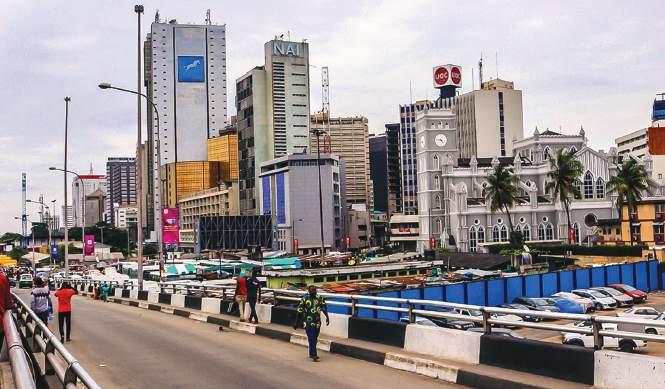
in 2025. Grossman profit stood at N463.78 million while profit before tax closed at N83.70 million.
Nuru said the 2025 business year marked a defining periodically for the company as the company focused on transforming from its respected quickservice restaurant operator status into a diversified consumer-focused enterprise with multiple engines for sustainable growth.
He said: “Today, Tantalizers is no longer defined solely by its legacy business. We are steadily building a broader platform capable of participating in multiple sectors of the consumer economy while maintaining the operational discipline necessary to create long-term shareholder value”.
Kayode Tokede
(Equatorial Guinea), Rabi Light (Gabon), Iran Heavy (Islamic Republic of Iran), Basrah Medium (Iraq), Kuwait Export (Kuwait), Es Sider (Libya), Bonny Light (Nigeria), Arab Light (Saudi Arabia), Murban (UAE) and Merey (Venezuela).
Guinness Announces 57.3% Profit Increase, Declares Additional N7 Interim Dividend
Kayode Tokede
Guinness Nigeria Plc has announced its unaudited financial results for the second quarter (Q2) ended June 30, 2026, delivering another quarter of strong financial performance.
The company declared profit after tax of N14.91 billion in Q2 2026, up by 57.3 per cent from N9.5 billion reported in Q2 2025.
Consequently, profit before tax closed Q2 2026 at N22.59 billion, representing an increase of 66.7per cent from N13.55 billion in Q2 2025.
Earnings per share improved to N6.81, up from N4.33 in the corresponding period last year.
Reflecting the Company’s sustained profitability and strong financial position, the Board of Directors have approved an additional
interim dividend of N7.00 per ordinary share, representing a distribution of approximately N15.33 billion.
This follows the N2.00 per ordinary share interim dividend paid after the first quarter, bringing the total interim dividend declared for shareholders to N9.00 per ordinary share.
Together with the N2.00 per share interim dividend paid earlier this year, the total interim dividend
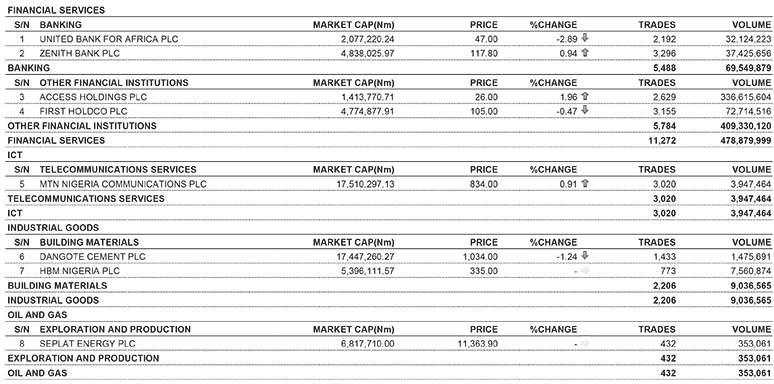
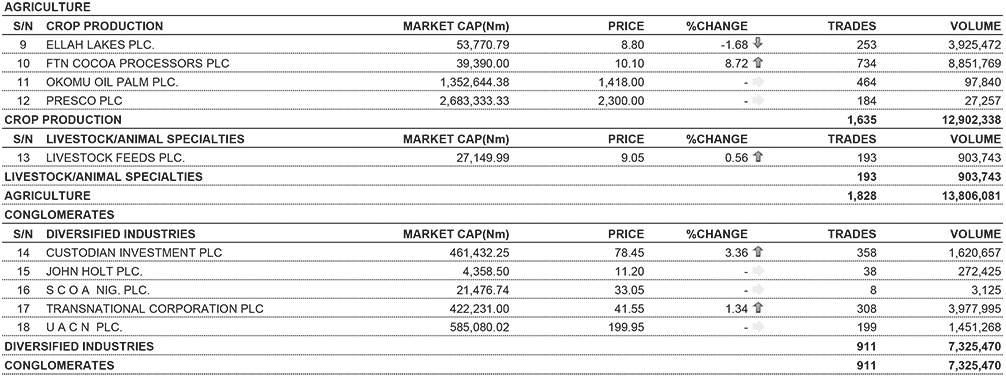
declared now stands at N9.00 per ordinary share, underscoring the Board’s confidence in the Company’s sustained earnings performance, healthy cash generation, and long-term growth prospects.
Building on the strong start to the financial year, Guinness Nigeria sustained positive momentum across its business, recording revenue of N142.27 billion
in Q2 2026, a 20per cent increase from N118.66 billion reported in the corresponding period of 2025.
Gross profit grew to N53.99 billion, while operating profit increased to N24.34 billion, driven by disciplined execution, improved commercial performance, and continued focus on operational excellence.
The Company’s financial
position also continued to strengthen during the quarter, with net finance costs reducing significantly to N1.75 billion from N4.61 billion in the prior-year period.
Commenting on the results, Chairman of the Board, Prof. Fabian Ajogwu, in a statement said: “Our performance in the first half of the financial year demonstrates the resilience of our business and the effectiveness of our long-term strategy.
TRADED AS OF JULY 23/26

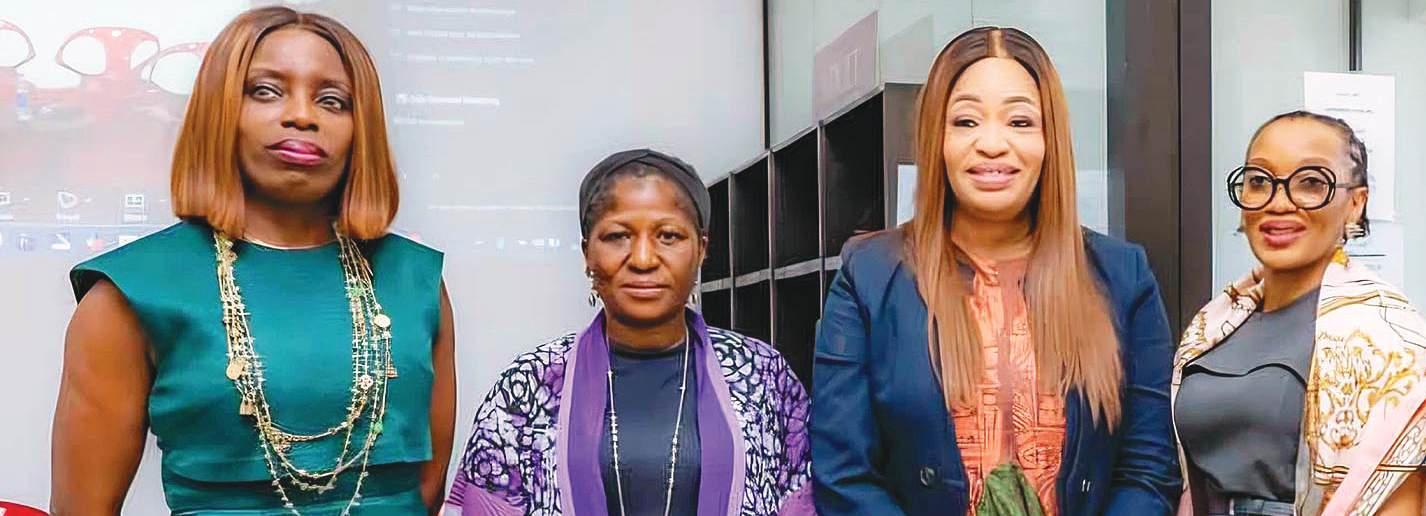
INTERNATIONAL WOMEN’S SOCIETY NIGERIA’S DISCUSSIONS...
L-R: Former Ogun State Commissioner for Economic Budget and Planning, Mrs. Aderele Adesina; representative of the Lagos State Commissioner for Tourism, Arts and Culture, Mrs. Bisi Omojare; President of the International Women’s Society, Ms Ifemena Oji; and Senior Gender and Economic Inclusion Advisor, International Finance Corporation (IFC Africa), Mrs. Adaorie Osademey Udechukwu, at the International Women’s Society Nigeria’s discussion meeting in Ikoyi, Lagos... recently
LPPC Elevates 68 to SAN Rank, Prof. Obiaraeri Emerges Sole Academic Conferee
Alex Enumah in Abuja and Wale Igbintade in Lagos
The Legal Practitioners’ Privileges Committee (LPPC) has approved the elevation of 68 legal practitioners to the prestigious rank of Senior Advocate of Nigeria (SAN), with 67 advocates and one academic making the list for the 2026 conferment exercise.
The successful applicants included Professor Nnamdi Onyeka Obiaraeri, who emerged as the sole successful academic applicant, and Mustapha Olayinka Ajenifuja, who was ranked 63rd in the order of seniority at the Bar among the successful advocate applicants.
The decision was reached at the 174th Plenary Session of the LPPC held yesterday under the chairmanship of Chief Justice of Nigeria (CJN), Hon. Justice Kudirat Kekere-Ekun, GCON.
Announcing the outcome in a press release, Chief Registrar of the Supreme Court of Nigeria and Secretary of the LPPC, Kabir Eniola Akanbi, said the rank of Senior Advocate of Nigeria was conferred in recognition of outstanding professional excellence on legal practitioners, who had distinguished themselves either as advocates before the courts or as academics who had made significant contributions to legal scholarship.
Akanbi stated that, in line with
the directives of the Body of Senior Advocates of Nigeria (BOSAN), all successful applicants were required to attend and successfully complete the mandatory pre-swearing-in induction programme before they could formally be conferred with the rank.
He added that the date for the induction programme would be announced in due course.
LPPC also cautioned the successful applicants against publishing or encouraging the publication of congratulatory advertisements, goodwill messages or notices relating to their nomination or conferment.
According to the committee, the directive is in accordance with Paragraph 25(1) of the Legal Practitioners’ Privileges Guidelines and Rule 39(3) of the Rules of Professional Conduct, 2023. It warned that any violation might attract sanctions under the applicable statutory and ethical rules.
The committee further announced that the swearing-in ceremony for the 68 successful applicants would take place on Monday, October 12, 2026.
Those elevated to the rank of Senior Advocate of Nigeria, in order of seniority at the Bar were Ibrahim Gamdeh Adamu, Jude Chukwuemeka Okafor, Godwill Achibong Umoh, Sunday Samuel Obende, Adebayo Olugbenga Adaralegbe, Jimson Ejovi Okodaso, Olalekan
Lawrence Bade-John, Olaotan Thomas Olusegun, Philemeon Audu Daffi, and Adenrele David Adegborioye.
Others were James Eromosele Agbonhese, Alexander Nduka Muoka, Onome Okodiya, Emmanuel Akunke Akomaye, Ikhide Ehighelua, Mas’ud Mobolaji Alabelewe, Ogunmuyiwa Olayinka Balogun, Anthony Auditz Iroagalachi, Mohammed Tajudeen Mohammed, and Odion Peter Odia. Equally elevated were Gbemiga Adaramola, Moses Okoh Onyilokwu, Charles Azubuike Obodozie, Hakeem
Obafemi Agaba, Bimbo Felix Atilola, Okechukwu Steve Emelieze, Joshua Demilade Olaniyan, Igonikon Abiola Adekunle, Christian Nnadozie Nwokorie, and Sadiku Momoh Ilegieuno. Also among the new SANs were Sarafa Kolawole Idowu, Olujoke Enitan Alwus, Oliver Onyenucheya Amuzie, Adebisi Emmanuel Adeniyi, Faruk Abdullah, Sagir Gezawa Suleiman, Ifeanyi Godwin Ezeuko, Adebayo Folorunsho Ologe, Sabiu Gumba Adamu, and Eric Keme Egolukumor Omare.
Soibi Ideriah Ovia, Somina Peter Johnbull, Chinedum Ikenna Umeche, Emmanuel Eghiegba Ekhasemomhe, Mohammed El Hassan Sheriff, Junaidu Bello Marshall, Olawale Sunday Fapohunda, Adebiyi Alaba Adetosoye, Senior Sulyman Ibrahim, and Agba Eimunjeze were also elevated. The list included Ayobamidele Oyekunle Akande, Adetunji Taiwo Adedoyin Adeniyi, Olamide Mojigbotoluwa Adekunle, Umaru Yunusa, Akorede Habeeb Lawal, Darlington Nnabuike Ozurumba,
Nnaemeka Francis Patrick Egonu, Kayode Orire Omosehin, Mitchel Akinrinsola Aribisala, and Bolu Agbaje Akadri. Equally on the list were Oluwaseun Asimiyu Alao, Olugbenga Olusanya Ajala, Mustapha Olayinka Ajenifuja, Afees Hassan Adebayo, Mohammed Abiodun Adelodun, Jonathan Akintola Makinde, and Olajide Salami. LPPC announced Professor Nnamdi Onyeka Obiaraeri as the sole successful academic applicant for the 2026 SAN conferment exercise.
Tuggar Campaign Refutes Allegiance to Abubakar, Denounces Outcome of Bauchi APC Guber Primary
Emmanuel Addeh in Abuja
The campaign organisation of Ambassador Yusuf Tuggar Thursday refuted a report that supporters of the erstwhile Minister of Foreign Affairs had decided to back the All Progressives Congress (APC) candidate, Mohammed Abubakar, in the 2027 governorship election in Bauchi.
In a statement issued by the Senior Special Assistant on Media to Tuggar, Alkasim Abdulkadir, the
Obi Decries New Killings in Benue, Plateau
Presidential Candidate of the Nigeria Democratic Congress (NDC), Peter Obi, has decried the renewed killings in Benue and Plateau States.
Obi, writing on X, Monday morning, said the unending violence in the region was worrisome and deserved special attention.
According to the former Anambra State Governor, “The tragic news of yet another round of killings in Benue and Plateau States is both painful and deeply disturbing.
“The reported murder of at least sixteen innocent Nigerians in the Otukpo-Nobi community of Benue State, alongside the horrific killing of nine members of the same family, including a two-month-old baby, in Riyom Local Government Area of Plateau State, once again reminds us
that the relentless cycle of bloodshed in parts of our country has persisted for far too long.
“For years, families in Benue, Plateau and other communities across Nigeria have lived under the constant shadow of fear, violence and displacement.
“Mothers have buried their children, children have become orphans overnight, farmers have abandoned their lands, and entire communities have been left devastated. We cannot continue to accept this tragic cycle as though it were normal. It is not.
“The primary responsibility of any government is the protection of lives and property. Every Nigerian life is sacred, and every life lost is one too many. These are not mere statistics; they are fathers, mothers,
children, breadwinners and future leaders whose dreams have been violently cut short.
“The time has come to move beyond routine condemnations after every attack. Nigerians deserve a security architecture that is proactive rather than reactive, driven by intelligence, rapid response and accountability. Those responsible for these atrocities must be identified, arrested and prosecuted. The culture of impunity must end.
“I extend my heartfelt condolences to the bereaved families and to the governments and people of Benue and Plateau States. I pray that God grants comfort to all who mourn, healing to the injured, and strength to every community struggling to rebuild after these repeated tragedies.
campaign described the reports as false, insisting they did not reflect the position of the Tuggar Campaign Organisation.
According to the statement, those who addressed the press and claimed to be speaking for Tuggar’s supporters had themselves acknowledged that they were not authorised to represent the former minister or make declarations on his behalf.
“Our attention has been drawn to reports claiming that supporters of Ambassador Yusuf Maitama Tuggar have accepted the outcome of the APC governorship primary in Bauchi State and shifted their allegiance. This claim is false and does not represent the position of
the Tuggar Campaign Organisation,” the statement said.
It added: “The individuals who addressed the press openly admitted they were not speaking on behalf of Ambassador Tuggar and had no authority to make declarations in his name. Their views are personal and cannot be presented as those of the Ambassador or his supporters.”
The campaign further maintained that no valid APC governorship primary election took place in Bauchi State, arguing that the process being described as a consensus did not satisfy the requirements of internal party democracy.
According to the organisation, the purported consensus was neither
preceded by extensive consultations nor based on the voluntary agreement of all aspirants and critical stakeholders within the party.
“The Tuggar Campaign Organisation maintains that no valid APC governorship primary election was conducted in Bauchi State. The so called consensus was neither preceded by broad consultation nor based on the voluntary agreement of all aspirants and key stakeholders.
“It therefore cannot be regarded as a legitimate consensus under the principles of internal party democracy. Ambassador Tuggar remains committed to the APC, its constitution, and the rule of law,” the statement added.
Fubara Calls for Civil Service Reforms in Nigeria
Blessing Ibunge in Port Harcourt
Governor Siminalayi Fubara of Rivers State has called for a reform of the country’s civil service to meet modern day service realities.
He said the 21st century requires a civil service that’s innovative, agile, digitally-enabled, accountable, and driven by excellence.
Fubara who made the call during the opening ceremony of the ongoing 48th Conference of the National Council on Establishments (NCE) in Port Harcourt, yesterday, noted that an efficient civil service is the
bedrock on which every effective government strives.
He emphasised that without a competent, motivated and effective public service, no government can fully realize its vision for sustainable development.
Fubara said: “The strength of any government is ultimately reflected in the quality of its public service. A professional, disciplined, motivative, and performance-driven civil servant remains the foundation upon which sustainable economic growth, institutional stability, and public confidence are built.
“The demand of the 21st century requires us to continuously rethink and reposition our public institutions.
“Rapid technological advancement, changing workforce dynamics, increasing citizen expectations, and emerging global reality call for public service that is agile, digitally-enabled, accountable, and driven by excellence.
“These underscore the urgent need for sustained reform, strategic capacity development, digital transformation, and policies that reward competence, innovation, integrity, and exceptional performance.
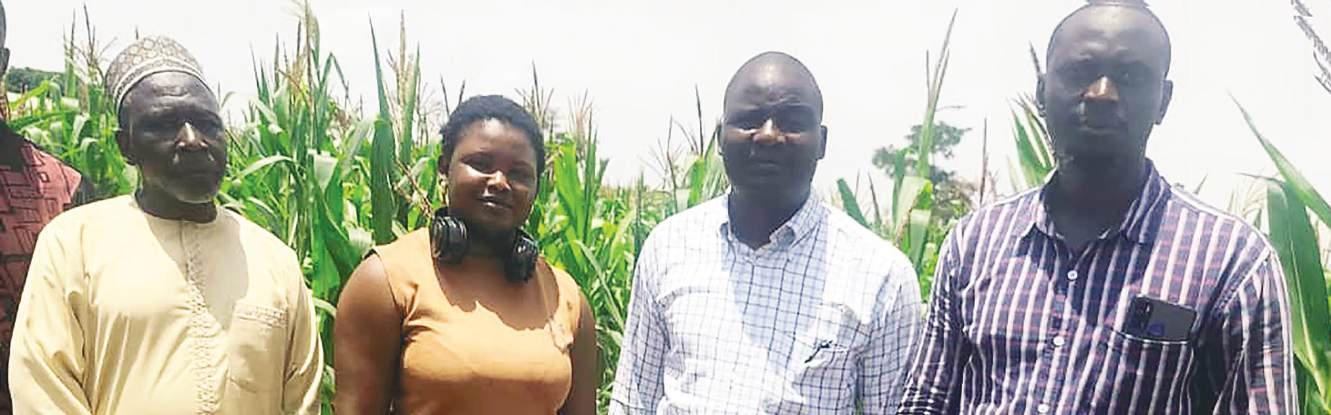
BATTLE AGAINST FALL ARMY WORMS...
L-R: Agricultural Researcher and Lecturer, Professor Isiaku Sani; Agronomist and General Manager, Prexea Technologies Limited, Martha Solomon; an official of the Federal Ministry of Agric and Food Security, Dr. Jalal Maihula; and Engr. Aminu Haruna, Head of Extension, Optimum Consult Nigeria Limited, and Consultant on Sentinel X Agricultural Technology, during the validation of a maize farm ahead of the trial deployment of Sentinel X, a new agricultural technology against Fall Army Worms, in Saminaka, Kaduna State, yesterday
Military Exonerates Suspected Foreign Terrorist Arrested During Their Operation
ADC mocks Tinubu, says Trump’s letter won’t help him APM: US President didn’t laud Nigerian counterpart on fight against terrorism NNCYA hails FG over America’s commendation on security efforts
Chuks Okocha, Linus Aleke and Folalumi Alaran in Abuja
The military has cleared a foreign national, who was arrested during an exploitation operation by troops of Operation Hadin Kai (OPHK), confirming that investigations found no evidence linking him to any terrorist group.
The clarification followed media reports published on 14 July 2026
concerning an individual intercepted by troops of 68 Battalion during an exploitation operation after the terrorist attack at Cross Kauwa.
In a statement, the Acting Military Information Officer of Joint Task Force North East, Operation Hadin Kai, Captain Mohammed Goni, identified the individual as Aboubakar Muhammad Zein-Nur, also known as Houdairi.
According to the statement, the
suspect was taken into custody in line with established operational procedures, given the prevailing security situation and the frequent use of border corridors by terrorist elements for movement and logistics.
“In view of the prevailing security environment and the exploitation of border corridors by terrorist elements for movement and logistics, troops acted in accordance with established operational procedures by taking him
into custody for profiling and further investigation,” the statement said.
Captain Goni disclosed that comprehensive intelligence assessments and other investigative processes did not establish any affiliation between the individual and any known terrorist organisation.
He added that investigations confirmed that Zein-Nur was a resident of Shattu Anguba Village in Bosso, Republic of Niger, where
House Minority Caucus Walks Out of Plenary over Tinubu’s State Police Bill
311
lawmakers vote in favour of amendment
The Minority Caucus of the House of Representatives, yesterday, staged a walkout from plenary in protest against the passage of the constitutional amendment bill seeking to establish State Police Services.
They alleged that the House leadership violated provisions of the 1999 Constitution and the Standing Orders of the chamber.
The lawmakers, who clarified that their action was not motivated by opposition to the creation of state police, protested a disregard for established parliamentary procedures in the consideration and passage of constitutional amendment legislation.
Speaking to journalists after the walkout, Minority Leader, Fredrick Agbedi, flanked by other leaders of the caucus, said the Speaker, Abbas Tajudeen, while presiding over the Committee of the Whole, failed to comply with constitutional provisions guiding the alteration of the nation’s Constitution.
Agbedi argued that the attendance of lawmakers in the chamber was established through the registers signed by members on each legislative day, rather than through the reading of lawmakers’ names during proceedings.
He said, “The Constitution is
the grund norm. It is the rule book from which even our Standing Orders derive their powers. For the Speaker, acting as Chairman of the Committee of the Whole, to disregard the clear provisions of Section 9(2) of the 1999 Constitution, as amended, is a great affront to the workings of the House of Representatives.”
The Minority Caucus maintained that every constitutional amendment bill must undergo clause-by-clause consideration, with each individual provision receiving the support of a twothirds majority of the House, as required by the Constitution and the chamber’s Standing Orders.
The lawmakers cited Order 13 Rule 15(a) of the House Rules, which provided that during clause-by-clause consideration in the Committee of the Whole, a clause could only be regarded as passed if it received a positive vote from two-thirds of the members of the House.
They therefore criticised the procedure adopted for the state police bill, alleging that the House leadership only read the long title of the proposed legislation before putting it to a voice vote without subjecting its individual clauses to detailed consideration.
The caucus stressed that it was not opposed to the establishment
of state police, noting that it would support any measure capable of helping to tackle insecurity across the country.
However, the lawmakers insisted that every legislative action, particularly one involving constitutional amendment, must strictly follow due process.
According to the Minority lawmakers, they had previously met with the Speaker to discuss
proposed amendments to the bill, during which, they said, the Speaker acknowledged that there were areas where the opposition could seek changes.
The caucus said the speaker, however, failed to allow the proposed interventions when he presided over the Committee of the Whole, instead reading only the long title of the bill before subjecting it to a voice vote.
OPay Unveils Tech
he engaged in camel rearing beyond the River Komadougou.
Consequently, Operation Hadin Kai formally exonerated the individual of any terrorist links.
The Theatre Command reiterated that all persons intercepted under suspicious circumstances during military operations were subjected to due process and thorough security screening to ensure that innocent civilians are distinguished from terrorist elements.
ADC to Tinubu: Trump’s Letter Won’t Help You
The African Democratic Congress (ADC), has said the letter from the US President, Donald Trump’s letter to President Bola Tinubu would not save him from defeat in next year’s general election.
ADC rather said the claimed endorsement by the American, was merely celebrating a diplomatic communication from the President of another country only betrays the President’s “desperation for any form of validation.”
In a statement by its National Publicity Secretary, Mallam Bolaji Abdullahi, the ADC said the letter did not reflect the country’s worsening
insecurity and ignored the painful reality that hundreds of women and children were still being held captive in Borno and Kaiama in Kwara State, while several communities in Benue and other parts of the country continued to live under constant fear.
According to the ADC, it has noted the Presidency’s attempt to present President Donald Trump’s letter to President Bola Tinubu as though it were a referendum on the state of the nation.
“It is not. While we hold the office and person of the President of the United States in high esteem, it is important to note that diplomatic correspondence between heads of state is a normal feature of international relations. Countries cooperate, leaders exchange views, and letters are exchanged.
“What is apparent, however, is this administration’s desperation to seize upon any gesture of international recognition as proof of success at home. A letter from a foreign president, however well-intentioned, cannot substitute for the verdict of the Nigerian people. The true measure of any government is not what is written about it abroad, but what its citizens experience every day.
behind 99% Transaction Success, Sets Sight on Global Expansion
Sunday Ehigiator
OPay has revealed the technology infrastructure powering its digital payment platform, saying years of investment in engineering, security and payment systems have enabled it to process millions of transactions daily with a 99.9 per cent success rate while positioning the company to serve one billion users globally.
The company disclosed this during its recent Media Parley in Lagos, where executives spoke with media stakeholders about the technology behind its financial services platform. Rather than focusing on products, OPay said the session aimed to showcase the engineering systems
that support digital payments for tens of millions of Nigerians.
Speaking at the event, OPay’s Chief Commercial Officer, Elizabeth Wang, said the company’s vision extends beyond building a payment application to creating an inclusive financial ecosystem powered by technology.
According to her, OPay aims to serve one billion users, support 10 million merchants and create one million jobs by making digital financial services safer, easier and more accessible.
“People may only see a successful transfer or payment notification, but behind that moment are years of investment in technology, infrastruc-
ture and innovation.
“Our goal is to make digital finance so dependable that customers can move money confidently without ever needing to think about the technology making it possible.”
The company’s Chief Operating Officer and Chief Technology Officer, Dotun Adekunle, said OPay’s engineering philosophy prioritises solving customer challenges, particularly failed transactions, delayed payment notifications and security concerns.
“We don’t begin with technology. We begin with the customer’s experience. Every failed transfer, delayed alert or security concern is treated as an engineering challenge. Where oth-
ers accept these problems as normal, our teams work until the problem disappears from the customer’s experience,” Adekunle said.
He explained that OPay’s payment infrastructure is built with multiple layers of redundancy, including dedicated direct connections to payment switching partners, backup systems and automatic failover mechanisms that reroute transactions during disruptions without affecting customers.
According to the company, these investments have enabled 99.9 per cent of transactions to complete successfully, making digital payments reliable enough for millions of Nigerians.
Juliet Akoje in Abuja
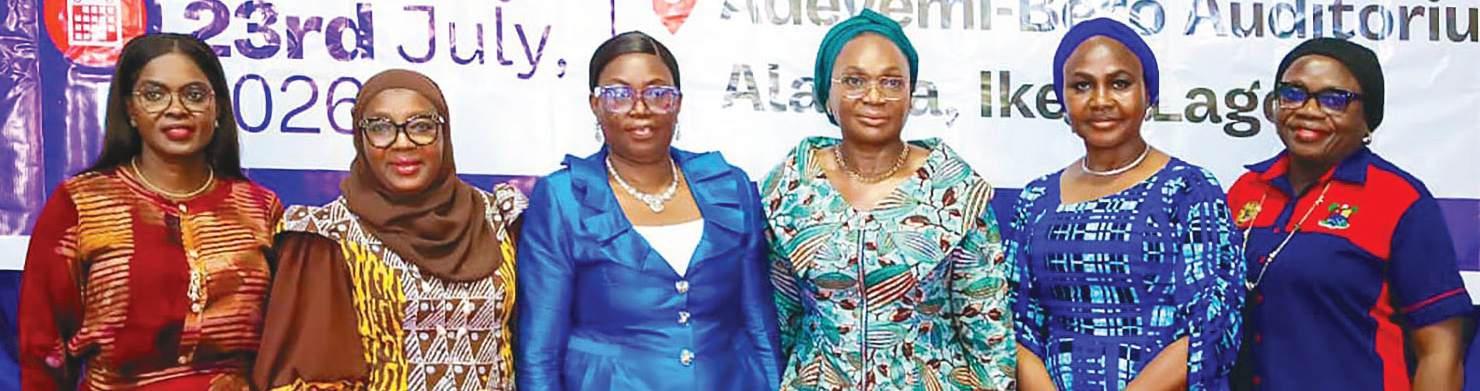
2026 PRE-RETIREMENT SENSITISATION...
L-R: Head, Technical Department, Lagos State Pensions Commission (LASPEC), Mrs. Morenike Makinde; Permanent Secretary, Office of the Deputy Governor, Lagos State, Mrs. Bibilomo Olushekun; Permanent Secretary, Lagos State Local Government Service Commission, Mrs. Bukonla Durodola; Permanent Secretary, Office of Local Government Establishment and Training, Lagos State, Ms Toyin Ogunlana; Permanent Secretary, Ministry of Local Government, Chieftaincy Affairs and Rural Development, Lagos State, Mrs. Kikelomo Bolarinwa; and Director, Service Matters, Lagos State Public Service Office, Mrs. Ololade Ashimi, during the 2026
Pre-Retirement Sensitisation for retiring officers in the Unified Local Government Service, held at Alausa, Ikeja, yesterday
11 Writers Jostle for $100,000
NLNG’s Nigeria Prize for Literature
Eleven poetry collections have been long-listed for the 2026 edition of the Nigeria Prize for Literature, setting the stage for a keen contest for the prestigious $100,000 award regarded as one of Africa’s richest literary prizes.
The announcement, made by the Chairman of the Advisory Board for the prize, Prof. Akachi Adimora-Ezeigbo, followed the assessment of 223 entries submitted for this year’s competition, which is dedicated to poetry.
The 11 longlisted works, arranged alphabetically, are: Adult Love by Tanure Ojaide; Bakandimiya by Saddiq Dzukogi, Black Passport by Paul Akpomuje, 2000 Blacks by Ajibola Tolase and Ceremony of The Nameless by Theresa Lola.
Others are Corpus: Animistic Verses by Ayo Oyeku; Floral’s Love Colony by Tares Oburumu; The Origin of Wounds by Malik Gbolahan; The Years of Blood by Adebayo Agaru, Unbind Me Now by James Ugwu
Eze; and Why Does God Need a Gun by Ogaga Ifowodo. Adimora-Ezeigbo described the unveiling of the longlist as an important milestone in the 2026 edition of what she called arguably Africa’s biggest and most prestigious literary prize.
According to her, the selected collections showcase the extraordinary capacity of poetry to illuminate human experience through thoughtful reflection, cultural memory and artistic expression.
She said the works revisit history while questioning dominant historical narratives and exposing the forces that shape collective identities and social relations.
“Despite their varied emphases, the books share a commitment to exploring the endurance of individuals and communities in the face of violence, oppression, and social fragmentation,” she said.
Commenting on the literary qualities of the longlisted books, Adimora-Ezeigbo said they display
N’ASSEMBLY UPDATES INLAND WATERWAYS LAW TO ALIGN WITH RECENT S’COURT RULING
of the venue and the President’s itinerary.
He disclosed that the summit would build on the zonal interactive sessions conducted across the six geopolitical zones in November 2025, whose interim report was adopted by the Senate.
According to him, the summit, themed “Strengthening Nigeria’s National Security Architecture: Innovation, Collaboration and Resilience in a Changing World,” will bring together top government officials, security chiefs, governors, members of the diplomatic corps, traditional and religious leaders, academics, civil society organisa- tions, the media and the private sector.
He said President Bola Tinubu is expected to declare the summit open, while Senate President Akpabio will deliver the welcome address.
Bamidele disclosed that members of the ad hoc committee had voluntarily agreed to cut short their annual recess to ensure adequate preparations for the summit.
He also announced the establishment of five sub-committees covering logistics and protocol, accommodation, media, finance, and conference management to coordinate the event.
During deliberations, some
senators urged the leadership to ensure that all members of the Senate, and not only members of the planning committee, actively participate in the summit.
Responding, Bamidele clarified that the early resumption applied only to members of the planning committee, while the summit itself would take place after the Senate reconvenes in September, allowing all senators to participate.
Akpabio commended the com- mittee for the speed with which it carried out the assignment and subsequently put the recommenda- tions to a voice vote, which received overwhelming approval.
Following the conclusion of legislative business, the Senate Leader moved the motion for the annual recess, thanking senators, the Senate leadership and the National Assembly bureaucracy for what he described as a productive legislative year.
The Minority Leader, Abba Moro, seconded the motion.
In his valedictory remarks, Akpabio prayed for the safety of senators during the break and urged them to remain committed to serving their constituents.
The Senate thereafter adjourned its plenary until September 15, 2026, when it is expected to resume for a new legislative year.
an impressive diversity of poetic techniques characterised by lyrical intensity, symbolic depth and artistic innovation.
She said: “Many employ densely poetic, allegorical, and elegiac modes that invite multiple layers of interpretation, while others draw extensively on folklore, oral traditions, and contemporary realities to create a compelling fusion of past and present.
“Their language is generally fluid, evocative, and aesthetically refined, relying on vivid imagery, emotional resonance, and intellectual sophistication to communicate complex ideas. “These works demonstrate how poetic language can illuminate social realities, challenge established perspectives and give voice to both individual and collective experiences. The next stage will demand a closer reading of each work, with attention to
language, form, originality and lasting literary value.”
She also commended the panel of judges for their work and reaffirmed the Advisory Board’s commitment to maintaining a credible selection process, promoting literary excellence and encouraging a strong reading culture.
With the release of the longlist, the competition now moves to the next stage, with a shortlist of three
finalists expected in August before the eventual winner is announced in October.
Sponsored by the Nigeria LNG Limited (NLNG), the Nigeria Prize for Literature carries a cash award of $100,000 for the winning author. Now in its 22nd year, the prize rotates annually among four genres, prose fiction, poetry, drama and children’s literature, with the 2026 edition dedicated to poetry.
Senate Pushes to Compel Social Media Giants to Open Nigeria Offices
Akpabio: Move will strengthen national security, data protection, jobs Stakeholders back Adaramodu, Nwoko’s bills
Sunday Aborisade in Abuja
The Senate on Thursday won overwhelming stakeholder support for a landmark legislative proposal that would compel global social media and technology companies operating in Nigeria to establish physical offices in the country.
The move is aimed at strengthening national security, improving data protection, enhancing regulatory oversight and creating thousands of jobs.
The endorsement came during a public hearing organised by the Senate Committee on Information and Communications Technology (ICT) and Cyber Security on a bill sponsored by Senator Ned Nwoko (APC, Delta North) seeking to amend the Nigeria Data Protection Act, 2023 to mandate social media platforms operating within Nigeria to maintain physical offices in the country.
Stakeholders at the hearing also threw their weight behind a separate bill sponsored by Senator Yemi Adaramodu (APC, Ekiti South) seeking to establish a National Artificial Intelligence (AI) Academy in Omuo-Ekiti as a centre of excellence for AI education, research and innovation.
Speaking at the hearing, Senate President Godswill Akpabio, represented by Deputy Senate Leader, Senator Oyelola Ashiru, described both bills as forward-looking legislative initiatives that would reposition Nigeria for leadership in the digital economy.
Akpabio dismissed fears that compelling global technology companies to establish offices in Nigeria would
amount to censorship or an attack on freedom of expression.
He said the proposed amendment was intended to ensure accountability, responsiveness to lawful requests, compliance with Nigerian laws and stronger protection of citizens’ digital rights.
“In an era defined by rapid digital transformation, social media platforms have opened unprecedented opportunities. However, they have also introduced complex challenges relating to data privacy, data protection, national security, consumer protection and digital rights,” he said.
According to him, requiring social media platforms operating in Nigeria to maintain physical offices is “a strategic step towards strengthening regulatory oversight, improving responsiveness, promoting transparency and contribut-
ing to economic growth through local investment and job creation.
Akpabio stressed the proposal was not designed to undermine constitutional rights.
He said, “It is pertinent to clearly state that this amendment is not intended to prevent or undermine the fundamental right to freedom of expression, nor is it designed to stifle innovation.
“Rather, it seeks to ensure responsibility, responsiveness to lawful requests, accountability and compliance with Nigeria’s legal framework,” he added.
Chairman of the Senate Committee on ICT and Cyber Security, Senator Shuaib Salisu (APC, Ogun Central), said the Data Protection Amendment Bill was intended to strengthen Nigeria’s cyberspace while the AI Academy Bill would create a national centre of
excellence for artificial intelligence education and research.
On the proposed National AI Academy, Adaramodu said Nigeria must invest aggressively in artificial intelligence if it hopes to remain competitive in the rapidly evolving global digital economy.
He said AI had become central to governance, healthcare, education, manufacturing, business and national competitiveness, adding that with over 65 per cent of Nigerians being young and digitally inclined, the country could not afford to lag behind.
He urged support for the proposed institution, saying it would serve as a national hub for knowledge, innovation, research and capacity building capable of positioning Nigeria among leading countries driving the global AI revolution.
....Confirms Yuguda’s Appointment as AMCON Board Chairman
Sunday Aborisade in Abuja
The Senate on Thursday confirmed the nomination of Lamido Yuguda for appointment as the Chairman of the Board of the Asset Management Corporation of Nigeria (AMCON).
The resolution of the red chamber followed its consideration and adoption of the recommendation of the Senate Committee on Banking, Insurance and Other Financial Institutions that screened Yuguda for the appointment.
The Chairman of the Committee, Senator Mukhail Adetokunbo Abiru
(Lagos East) presented the report duringPresidentplenary.Bola Tinubu had forwarded Yuguda’s nomination to the Senate on July 9, 2026, for confirmation in accordance with the provisions of the AMCON Act.
With the Senate’s approval, Yuguda assumes the chairmanship of the board of one of Nigeria’s most critical financial institutions, established in 2010 to stabilise the banking sector following the 2008–2009 financial crisis by acquiring non-performing loans from deposit money banks and helping preserve confidence
in the country’s financial system.
Over the years, AMCON has played a central role in preventing the collapse of distressed financial institutions, restructuring troubled assets and recovering outstanding debts from obligors, as part of efforts to safeguard financial stability and minimise the long-term cost of banking sector interventions.
A seasoned economist and financial regulator, Yuguda comes with more than four decades of experience in banking, financial markets and public sector management to the position.
Emmanuel Addeh in Abuja
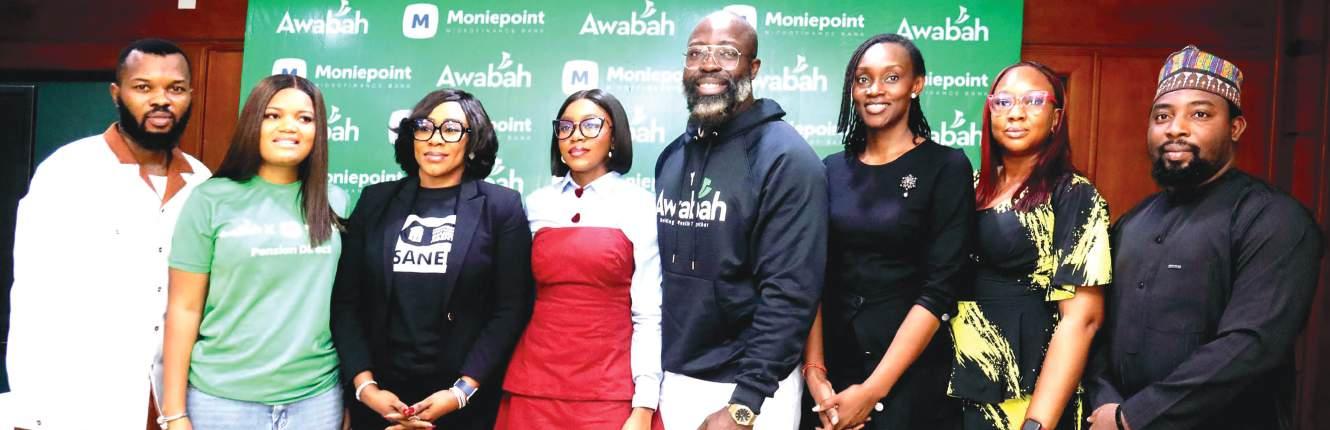
UNVEILING PENPAY ‘DIRECT DEBIT VIA POS’...
L-R: Lead, QA Engineer, Debit Direct, Mr. Ibrahim Fatai; Chief Commercial Officer, Awabah, Yemisi Obitayo; Chief Executive Officer, SANEF, Uche Uzoebo; Product Delivery Manager, Teamapp, Emmanuella Edeh; Chief Executive Officer, Awabah, Mr. Tunji Andrews; Advocacy and Communications Lead, EFInA, Chinasa Collins-Ogbuo; Programme Manager, EFInA, Norah Igwe; and MEL Manager, EFInA, Mr. Babajide Daimi, when Awabah unveiled PenPay ‘Direct Debit via POS’, partnering with Moniepoint, enabling seamless recurring pension contributions across 26 banks and advancing financial inclusion for Nigeria’s informal sector, held in Victoria Island, Lagos, yesterday
Presidency to Atiku: Clarify Your Legal
Status in US; Ex-Vice President Fires Back
Says whitewashing Tinubu’s drugs scandal won’t erase
The Presidency, yesterday, reacted to recent steps taken by former Vice President Atiku Abubakar to report President Bola Tinubu to the United States President and State Department.
Atiku’s lobbying group in the US had submitted petitions to President Donald Trump and the US State Department over a civil forfeiture case from 1993.
The Presidency in a reaction via a statement by presidential spokesperson, Bayo Onanuga, said it was baffling and disappointing that Atiku who has sought the presidency for over three decades now resorted to reporting the President of Nigeria to US President Donald Trump and members of the US Congress.
“In his latest act, Atiku Abubakar’s lobbying group in the US has submitted petitions to President Trump and the US State Department regarding a civil forfeiture case from 1993—a matter long settled, with no criminal
conviction or finding of guilt,” he said. It asked the former Vice President to go and clarify his legal status in the United States as he had been accused of improper dealings with top US officials in the past.
According to the Presidency: “If Atiku Abubakar can spend $1.2 million on American lobbyists to report President Tinubu, perhaps he should also clarify his own legal standing in the United States.
Atiku featured most prominently in the William Jefferson bribery scandal, a matter which saw the American congressman jailed. He, along with his former wife Jennifer Douglas, was one of the subjects of an elaborate US Senate Investigation, “Keeping Foreign Corruption Out of the United States: Four Case Histories”.
The report of the investigation, chaired by Senator Carl Levin, was released in February 2010. It documented how Atiku used offshore companies to bring suspect funds,
including bribes from multinationals, running into millions of dollars, into the United States.”
Onanuga emphasised that Atiku was obsessed with presidency for diplomatic immunity to evade potential legal issues abroad
“Atiku’s obsession with the presidency is driven not just by his marabout-fuelled ambition, but by a desire for diplomatic immunity and to evade potential legal issues abroad. Recycling discredited allegations and documents from the 2023 campaign will not improve his chances in 2027.”
While acsusing the ex-Vice President of presiding over an egregious privatisation heist, selling national assets to cronies for peanuts, the Presidency stressed for emphasis that Tinubu remains focussed and won’t be distracted by failed politicians reckless public statements and desperate political manoeuvres.
The Presidency, in the 11-paragraph release entitled: ‘When Will Atiku Abubakar Report Himself to
Presidebt Trump?’, stated, “Former Vice President Atiku Abubakar’s relentless desire to become President of Nigeria has regrettably closed his eyes to the virtues of statesmanship, decorum, and propriety expected of an elder statesman.
“Instead of embracing the dignity and maturity that come with his standing, he continues to diminish himself through reckless public statements and desperate political manoeuvres.
“It is baffling and disappointing that someone who has sought the presidency for over three decades now resorts to reporting the President of Nigeria to US President Donald Trump and members of the US Congress.
“In his latest act, Atiku Abubakar’s lobbying group in the US has submitted petitions to President Trump and the US State Department regarding a civil forfeiture case from 1993—a matter long settled, with no criminal conviction or finding of guilt.
“This issue was resolved over 30 years ago in the United States and has
Ex-President Obasanjo Clashes with Osoba over Alleged Claims of 2003 Elections Deceit
James Sowole in Abeokuta
Former President Olusegun Obasanjo, yesterday, replied to claims by former Ogun State governor, Aremo Olusegun Osoba, that he deceived leaders of the Alliance for Democracy (AD) during the political realignments preceding the 2003 General Election.
Obasanjo declared that he neither misled nor deceived anyone in processes that led to the Election but he only held wide consultations to consolidate on the success of the Peoples Democratic Party (PDP).
Obasanjo’s strongly worded and lengthy letter dated July 23, 2026, was entitled: “Reply to Your Inaccurate Posture: ‘How Obasanjo Deceived Us in 2003’.
He described Osoba’s account, published in The Legal Observer on July 20, as “farfetched” and riddled with inaccuracies, omissions and misconceptions.
The former President took particular exception to Osoba’s allegation that
he deceived Yoruba political leaders, insisting that his political engagements had always been guided by openness and national interest.
He said, “I take strong and serious objection to your calling me a deceiver because I deceived nobody. I always presented my case and all issues as I had them and as I understood them, no matter whose ox is gored.”
Obasanjo argued that several political developments preceding his emergence as President in 1999 were unknown to Osoba because they were handled by senior leaders of Afenifere and the AD.
He disclosed that after his release from prison, several groups from across the country urged him to contest for the presidency, including delegations led by Lawan Katsina, the late Chief S.M. Afolabi and Chief Martins Kuye.
According to him, those consultations informed his eventual decision to join the Peoples Democratic Party (PDP) after extensive consultations
with political leaders across the South-West, North and South-East.
Recalling his engagements with the late Afenifere leader, Chief Abraham Adesanya, Obasanjo said despite being repeatedly told that Yoruba people would not vote for him, he continued to maintain cordial relations with the elder statesman.
“There was no time I called on Papa Adesanya that I was not well entertained. Yet Papa stood on no vote for me, and I stood on my respect and what was due to him,” he stated.
The former President defended his decision to invite the AD into what he described as a broad-based national government after winning the presidency, saying it was motivated by a desire to promote national unity rather than political weakness.
“Bringing PDP and AD to join me for a sort of national government was not out of weakness; rather, it was out of strength and for the unity and progress of the country.”
Obasanjo also rejected Osoba’s
account of events surrounding the attempted impeachment of then Speaker of the House of Representatives, Ghali Na’Abba, alleging instead that the impeachment plot originated from within his own administration.
He claimed that his then VicePresident had encouraged the move while simultaneously pursuing his own presidential ambition.
“The game continued to be played on with me treating it with contempt as I had committed no impeachable offence,” he wrote.
On the 2003 elections, Obasanjo disputed Osoba’s suggestion that the defeat of AD governors resulted from political manipulation by the Presidency.
Instead, he maintained that the electoral outcome reflected the political realities at the time.
“Your loss or defeat in 2003 was genuine in all the six states except the one where the figures were successfully and murderously changed,” he asserted.
been thoroughly litigated, explained, and rendered moot by the electoral mandates conferred on President Bola Tinubu by the people of Lagos and Nigeria at large. Reviving this matter today is an affront to the intelligence of Nigerians and an attempt to rewrite history for personal gain.
“It is important to remind Atiku and his associates that Nigeria is a sovereign nation, not a satellite of any foreign power. Reporting the President of Nigeria to another country’s leader is not only inappropriate but also undermines the nation’s dignity and independence. Such actions are incongruous with the responsibilities of a statesman and are ultimately self-defeating.
“If Atiku has chosen to disregard his own sense of self-respect and self-worth, he should, at the very least, show respect for the country he aspires to lead and the office he so ardently seeks.
“While lobbying is a legitimate part of American politics, employing paid foreign agents to peddle discredited documents against a sitting Nigerian President is not advocacy—it is an attempt to externalise domestic politics and undermine Nigeria’s sovereignty. Nigerians resolved this matter at the ballot in February 2023 and in the Supreme Court. That verdict stands, and Atiku’s latest fishing expedition would amount to nought.
“Furthermore, if Atiku Abubakar can spend $1.2 million on American lobbyists to report President Tinubu, perhaps he should also clarify his own legal standing in the United States.
“He featured most prominently in the William Jefferson bribery scandal, a matter which saw the American congressman jailed.”
Whitewashing Tinubu’s Drugs
Scandal Won’t Erase Records of Forfeited $460,000
Meanwhile, the media office of Atiku has said no amount of denials or whitewashing would erase Tinubu’s records that he forfeited 460,000 United States Dollars linked to drug trafficking.
A statement by Atiku’s media office, stated “Our attention has been drawn to a reckless and shameful press statement signed on behalf of President Bola Tinubu by his media aide, Bayo Onanuga.
$460,000
“The statement attempts to bury the records of the narcotics trafficking case against Bola Tinubu in the US under an unwieldy and hollow essay.
“We are shocked that the Presidency would claim that the narcotics trafficking charges against Tinubu have ‘long been settled’ and rendered moot by an electoral mandate.
“This argument essentially admits that Tinubu indeed faced investigation on narcotics trafficking, but suggests that his current position as President grants him immunity, thereby wiping the records of his links to the heroin scandal clean.
“As the popular Yoruba adage goes: an aged bowl of pounded yam can still steam. We challenge Bayo Onanuga and the Tinubu media team: if the case against their principal is truly time-barred, why are they so panicky about any attempt to revisit it? Why is President Tinubu blocking every move to unravel what is in his FBI/ DOJ US files?
“The Office of the President is more than a mere political position. It is an office that mirrors the soul of the society it governs. Having an alleged ex-trafficker in that office inflicts serious reputational damage on Nigeria’s image and on every Nigerian on the global stage.
“The Presidency’s media team should be reminded that issues of criminal justice are never completely thrown out. They can be revisited at any material time, especially when new circumstances arise.
“Between 2023 and 2027, there has been a change of leadership in the United States. It is the duty of law enforcement agencies to determine whether the case can be reopened in the interest of justice.
“Revisiting the narcotics case against a sitting president is not an affront to the intelligence of Nigerians. Rather, it is a bold attempt to ensure that the wheel of justice continues to turn.
“If President Tinubu has nothing to hide about his records in the US narcotics scandal, he should submit himself to the process of revisiting the case instead of resorting to his usual tactics — frustrating disclosures through frivolous court appeals or deploying his media team to issue long, hollow essays aimed at rewriting history for personal gain,” Atiku’s media office stated.
Deji Elumoye in Abuja
PHOTO: ETOP UKUTT
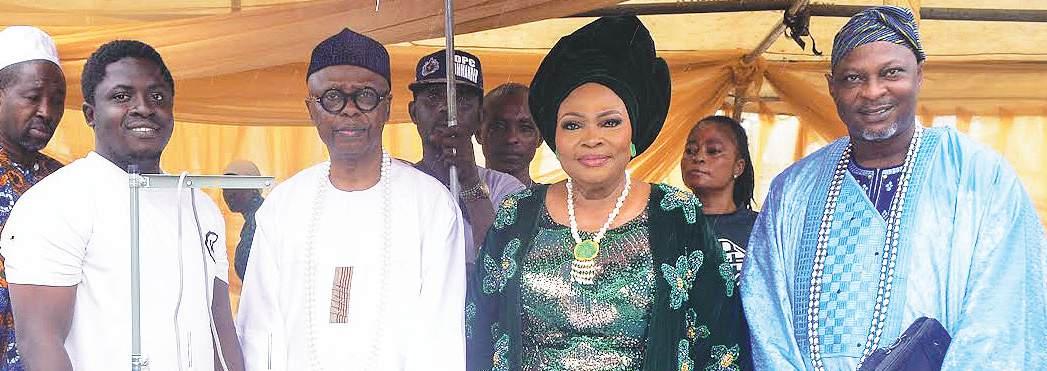
OBa LaTEEF adaMs MaRKs 10TH CORONaTiON aNNiVERsaRy...
L- R: Beneficiary of industrial sewing machine, Mr. Farouk Ogunrinola; Onikate of Ikate Surulere, Lagos, Oba Lateef Adams; his wife, Olori Risikat Adams, and Lisa of Ikate Surelere, Chief Olayemi Salami, during the empowerment initiative programme as part of activities to mark the 10th coronation anniversary of Oba Adams in Surulere, Lagos…yesterday
NHRC, Federal High Court, APC, Others Declare Support for Credible Elections
Consortium unveils independent election results platform
alex Enumah in abuja
The National Human Rights Commission (NHRC), Federal High Court of Nigeria, and the All Progressives Congress (APC) yesterday declared support for the efforts by civil society groups to ensure credibility and integrity in the 2027 general election.
They made the declaration yesterday in Abuja during the inaugural stakeholders’ meeting of the National Electoral Accountability Consortium (NEAC) and launch of the Independent Election Results Platform (IERP).
The IERP, according to the civil groups, is designed to allow citizens to independently upload and verify polling unit results,
which will in turn strengthen electoral transparency, curb manipulation and restore public confidence in Nigeria’s elections.
Speaking at the occasion, the National Human Rights Commission (NHRC), while declaring support for the initiative, maintained that credible elections remain fundamental to the protection of citizens’ civil and political rights.
The Executive Secretary of the NHRC, Dr. Tony Ojukwu (SAN), commended TAP Initiative and the National Electoral Accountability Consortium for spearheading the project, noting that the innovative platforms that promote transparency, accountability and public participation would
TranESS C&I Unveil Youth Energy Talent Programme
TranESS C&I, the commercial and industrial energy storage business unit of Transsion Holdings, has reinforced its commitment to Nigeria’s education and clean energy sectors through the launch of a Youth Talent in Energy Storage Programme and the signing of a strategic Memorandum of Understanding (MoU) with Al-Ansar Foundation.
The announcements were made during the company’s inaugural “Empowering Education, Illuminating the Future” Education Industry Summit held in Abuja.
The summit convened private school proprietors, university administrators, education leaders, industry experts, and government stakeholders to address the impact of unreliable electricity on educational institutions across Nigeria.
The summit served as a platform for stakeholders to examine practical solutions
to one of the sector’s most pressing challenges, the rising financial and operational burden of inconsistent power supply and explored how energy storage technologies can support more resilient learning environments.
Opening the summit, , C&I Sales Director at TranESS, Charlie Wang, reaffirmed Transsion Holdings’ long-term commitment to Africa and its investment in sustainable infrastructure that supports economic and social development across the continent.
Delivering the keynote address, President and Founder of Al-Ansar Foundation, Dr. Mohammed Kyari Dikwa, highlighted the critical role of reliable electricity in modernising Nigeria’s education sector, noting that dependable energy infrastructure is essential to improving teaching, learning, and institutional productivity.
significantly strengthen Nigeria’s democracy. Represented by the Commission’s Chief
Legal Officer, Uzoamaka Ifechi-Fred, the executive secretary promised that the Commission would work
with relevant stakeholders to advance free, fair, inclusive and peaceful elections while protecting every Nigerian’s right to participate in governance without fear, intimidation or discrimination.
Plateau PDP’s Candidate Rejects Regional Security Fund, Seeks N500m Monthly for State
sunday aborisade in abuja
The Peoples Democratic Party (PDP) governorship candidate in Plateau State, Chief Kefiano Kefas Ropshik, has urged the state government to channel about N500 million monthly into strengthening the state’s internal security architecture instead of committing resources
to the proposed Northern Nigeria Security Trust Fund.
Ropshik said Plateau State should prioritise direct investments in security measures capable of protecting lives and property, arguing that the state would achieve more measurable results by investing in its own security than contributing to a regional initiative over which
it has limited control.
In a statement issued yesterday, the PDP standardbearer endorsed the position of the Middle Belt Forum on the proposed regional security fund, maintaining that Plateau’s immediate concern should be addressing persistent attacks, killings, and displacement affecting communities across the state.
According to him, the primary constitutional responsibility of any government is to safeguard its citizens, stressing that available resources should first be deployed to secure Plateau State communities before being committed to regional arrangements.
Ogidigben Killing: Ugborodo Community Petitions Army Chief
sylvester idowu in Warri
The Ugborodo Management Committee (UMC) has petitioned the Chief of Army Staff, Lieutenant General Waidi Shaibu, to thoroughly investigate the circumstances surrounding the release of some suspects arrested with sophisticated
weapons during the invasion of Ogidigben community in December last year, leading to the killing of a youth leader, Onuwaje Emiko.
The community stated that the petition, made available to journalists in Warri, Delta State, yesterday, became necessary
following attempts by some prominent Itsekiri figures, in connivance with operatives ofthe Department of State Services (DSS), to pervert the course of justice in the case.
In the petition, a copy made available and sent on behalf of the UMC by their attorney, P. O. Aihiokhai
Esq., they stated that personnel of the Nigerian Army were part of the team that effected the arrest of the suspects during the invasion of Ogidigben community and transferred the matter to the DSS but were surprised that they were let free without investigation.
NIJ Provost, Caleb VC Advocate Digital Reinvention for Local Newspapers
ayodeji ake
Leading media professionals have warned that community newspapers in Nigeria must urgently embrace digital innovation, diversify their revenue streams and strengthen community engagement or risk becoming obsolete in an increasingly
technology-driven media landscape.
The call was made at the Journalism Outlook Conference 2026, held at Caleb University, Lagos, under the theme “Reinventing Local Newspapers in the Digital Age: Innovation, Sustainability and Global Community Impact.” The conference brought together newspaper proprietors, editors, academics, media entrepreneurs and communication scholars to chart a new course for local journalism.
Adefaye, challenged local newspaper publishers to rethink their business models, warning that innovation has become a matter of survival rather than choice.
Delivering the keynote address, Provost of the Nigerian Institute of Journalism (NIJ), Mr. Gbenga
According to him, newspapers that fail to reinvent themselves for the digital era face an uncertain future.
Group Roots for Northern Christian as Tinubu’s Campaign DG
Onuminya innocent in Sokoto
As political permutations toward the 2027 general election intensify, the Northern Christian Progressive Group has called on the All Progressives Congress (APC) and President Bola Tinubu to appoint a Christian from Northern Nigeria as the directorgeneral of the presidential campaign council.
only consolidate support for the president’s re-election bid but also demonstrate the administration’s commitment to inclusivity, fairness, and national unity ahead of the polls.
The group said the appointment would not
In a statement issued and signed by its Secretary, Rev. Hayap Musa Danladi, the group urged Tinubu to toe the path of 2023 when he appointed former Plateau State Governor, Rt. Hon. Simon Bako Lalong, as the DG of the Tinubu/Shettima Presidential Campaign Council.
NSCDC Arrests Six for Abuja Pipeline Vandalism, Fuel Theft
Michael Olugbode inabuja
The Nigeria Security and Civil Defence Corps (NSCDC) has arrested six suspected petroleum pipeline vandals allegedly caught siphoning petrol from vandalised Nigerian National Petroleum Company (NNPC) pipelines in the Federal Capital Territory (FCT), Abuja.
The suspects, all males, aged between 20 and 32, were paraded yesterday at the crime scene in Pagada I, Dobi Ward, Gwagwalada Area Council, where the illegal operation was uncovered.
Addressing journalists, the FCT Commandant of
the NSCDC, Dr. Olusola Odumosu, said operatives of the Command’s Anti-Vandal Squad acted on credible intelligence and a tip-off about suspicious activities around the pipeline corridor.
According to him, the suspects were apprehended while allegedly scooping petrol from pipelines they had punctured using drilling equipment and loading the product into jerrycans and plastic bags.
Recovered exhibits included two motorcycles, two locally fabricated firearms, four 25-litre jerrycans containing suspected stolen petrol, two empty jerrycans, a shovel and
hand drilling machines used to puncture the pipelines.
Odumosu disclosed that preliminary investigations revealed the suspects had carefully studied the terrain and identified points where underground pipelines contained fuel residue. He added that one of the suspects, an indigene of Pagada I, allegedly recruited two accomplices from the Lambata area to participate in the operation.
He further alleged that three members of a local vigilante group were involved in the crime by providing protection and support for the vandals during the illegal operation.
Osun ALGON Backs Suspension of All Motor Parks
yinka Kolawole inOsogbo
The Association of Local Governments of Nigeria (ALGON), Osun State chapter, yesterday backed the suspension of all motor parks in the state following the leadership crisis that rocked the National Union of Road Transport Workers (NURTW) and the subsequent suspension of the union’s leadership and all transport union activities in Osun State.
The union stated this during a meeting jointly held by NURTW, RTEAN, Motorcyclists and Tricyclists Union, Chairmen of the 30 Local Government Councils and Ife East Area Office, Modakeke, where it was resolved to back the suspension.
It would be recalled that the crisis within the union has become a security threat to the state, especially to members of the public who largely rely on public transportation. In a statement issued and jointly signed by Hon. Samuel Idowu Abiodun, chairman, ALGON, Osun State; Olubisi Oladosu, General Secretary, and the union spokesperson, Hon Mufutau Adegbite, said the suspension of the union leadership by the local government chairmen was in the exercise of their constitutional powers and authority over public motor parks in line with Paragraph 1(e) of the Fourth Schedule of the 1999 Constitution (as amended), which should remain in force pending further review.
They remarked that as a temporary measure, there should
be a leadership for transport services in the state to protect the businesses of transport operators and members of the public who rely on the public transportation system.
According to them, “After extensive deliberations with all units and branches of National Union of Road Transport Workers, (NURTW) Road Transport Employees Association of Nigeria (RTEAN), Motorcycles and Tricycle Unions in the state and consultations with relevant stakeholders, including traditional rulers, the another members of transport unions have been appointed as Caretaker Management Committee in the state pending further consultations with the National Secretariat of the transport unions to elect substantive state leaders for the union.”
FG Hailed as NBC Mediates in Ekiti, Kwara Border Dispute
Gbenga sodeinde inadoEkiti
The Ekiti State Government has hailed the federal government over the National Boundary Commission (NBC) resolve to mediate in the lingering border dispute between Eda Oniyo in Ekiti State and Obbo-Ayegunle in Kwara State, describing the gesture as the best way to de-escalate tension and avert unwarranted carnage.
The Ekiti State Deputy Governor, Chief Monisade Afuye, who spoke at an Ekiti /Kwara joint meeting held to resolve the knotty boundary crisis between the two communities, assured them
that the Ekiti State Governor, Biodun Oyebanji, would work relentlessly to ensure that the dispute doesn’t strain the smooth relationship between the two states.
Mrs. Afuye, represented by the Permanent Secretary in her office, Mr. Leke Adefolaju, noted that the areas under contention were demarcated bythe Colonial Administration as the boundary between the Northern and Southern Protectorates, saying the crisis stemmed from the planting of economic trees by Kwara State farmers in areas that fall within the Ekiti State province.
Afuye, who acknowledged
the pivotal role of agriculture in the economic survival of any country, said the government didn’t expect the farmers to exhibit actions suggesting that they were the rightful owners of the occupied regions, despite seeing the features erected to demarcate the region, which she said could be a recipe for anarchy.
She commended the states and the traditional institutions of the two communities for dousing tension and adopting diplomacy to tackle some of the raging crises, saying dialogue remains the most potent instrument that can be deployed to settle the tussle.
Accord Party Elders Set Committee to Resolve Crisis
Chuks Okocha in abuja
The political crisis brewing within the Accord Party (AP) in Osun State has deepened as elders and stakeholders loyal to the party’s presidential
candidate, Dr. Gbenga Olawepo-Hashim, constituted a seven-member high-powered committee to determine its next political direction following the expiration of its seven-day ultimatum to Governor Ademola Adeleke.
The move marks a significant escalation in the face-off between the governor and a powerful bloc within the party over what the stakeholders describe as Adeleke’s refusal to identify with the Accord Party’s 2027 Presidential Project.
The stakeholders had earlier demanded that Governor Adeleke publicly endorse Dr. Hashim’s presidential ambition and openly dissociate himself from support for the presidential candidate of the
All Progressives Congress (APC), President Bola Tinubu, arguing that no governorship candidate seeking election on the platform of the Accord Party should campaign, fraternize, or identify with the presidential candidate of another political party.
They warned that failure to comply would force them to reconsider their political support for the governor ahead of the August 2026 governorship election.
With the ultimatum now expired, the stakeholders declared that Governor Adeleke had failed to demonstrate the expected commitment to the party’s national leadership and resolved to activate what they described as the “next phase” of their political response.
Edited by: MJO Mustapha Email deji.mustapha@thisdaylive.com
From Qabil’s Jealousy and Murder to Islamophobia (2) WORLD OF ISLAM
By: Spahic Omer/IslamiCity
When Heraclius, the Emperor of the Byzantine Empire, afforded Abu Sufyan - the leader of Makkah, who was yet to accept Islam and who was a sworn enemy of Prophet Muhammad - an opportunity to vilify and speak ill of Muhammad, he admitted that there was nothing he could say, even though at the time Muhammad lived as a prophet more than twenty years. Abu Sufyan said that the “only negative” thing he could say was that there was a truce between Muhammad and Makkah and he was not sure what Muhammad will do next.
The dialogue between Heraclius and Abu Sufyan was long and complex, almost philosophical. Heraclius asked Abu Sufyan - among other things: “Does he (Muhammad) break his promises?” Abu Sufyan replied: “No. We are at truce with him, but we do not know what he will do in it.” Abu Sufyan later added: “I could not find opportunity to say anything against him (Muhammad) except that” (Bukhari)
Similarly, Prophet Musa (Moses) declared to Pharaoh as part of a hard-hitting conversation between the two: “You have already known that none has sent down these (signs) except the Lord of the heavens and the earth as evidence, and indeed I think, O Pharaoh, that you are destroyed” (al-Isra’, 102).
If the truth was compellingly obvious, both at the level of theory and the level of it being practiced in the lives of its devotees, the only thing that could keep people rejecting the truth and subscribe to its antitheses was jealousy subtly woven with arrogance and self-regard. In the process, all rationality, discretion and splendour lost sense and absurdity commenced to reign supreme. There was then little authentically positive to hope and work for.
All Habil’s efforts to bring Qabil to his senses fell flat, and the tragedy became unavoidable. However, what is worrisome is that after the tragedy Qabil still failed to realize what was actually going on and what was happening to him. He did not get a hold on himself. Jealousy - and all the other supportive lesser disorders - was not recognized, nor accepted, as the root cause. It therefore was left unchecked and self-sufficient. Qabil never established that he was wrong and his brother right.
Accordingly, the Qur’an reveals that jealousy is the main culprit for the disbelief of many Jews and Christians. Qabil was their inspiration and role model: “Many of the followers of the Book wish that they could turn you back into unbelievers after your faith, out of jealousy (envy) from themselves, (even) after the truth has become manifest to them; but pardon and forgive, so that Allah should bring about His command; surely Allah has power over all things” (al-Baqarah, 109).
In consequence, the Qur’an points out: “You will surely hear from those who were given the Scripture before you (the Jews and the Christians) and from those who associate others with Allah much abuse” (Alu ‘Imran, 186).
Also: “And they will continue to fight you until they turn you back from your religion if they are able” (al-Baqarah, 217).
“And never will the Jews or the Christians approve of you until you follow their religion. Say: ‘Indeed, the guidance of Allah is the (only) guidance.’ If you were to follow their desires after what has come to you of knowledge, you would have against Allah no protector or helper” (al-Baqarah, 120).
The Case of Islamophobia
This somewhat predetermined behaviour of the Jews and the Christians - and their international partners - was a chief reason for the creation of the scourge of Islamophobia, which, in equal measure, feeds on inanities, prejudice and fabrications. Regardless of how much people tried, however, Islamophobia will never be justifiable, nor empirically demonstrable. Its instance is that of undue jealousy and murder.
It is no wonder that in the realm of Islamophobia, too, diverse forms of jealousy preponderate over other factors. Many people cannot accept that while the rest of religions, ideologies and systems of life are either tumbling or are continuously being reviewed and “upgraded”, Islam is the only religion “standing”, with its systems increasingly called upon as the only potential saviour of the beleaguered world. In addition, despite the fact that basically everything is succumbing to the destructive pulling power of the “black-holes” of modernity and post-modernity, Islam keeps standing tall, ever more generating a
civilizational centre of gravity of its own accord. And finally, although everything is shrinking, Islam keeps growing; although everything recoils from the aggressive, albeit most of the time phoney, advances of present-day scientism, materialism, secularism and atheism, Islam persists and even tries to embark on the offensive and offer alternatives. In the age when sanity is more threatened than any endangered species, Islam and Muslims live on as the only normal entities.
As such, Islam and its people are seen as potential threats, theoretically and practically, to the prevalent world order(s). They are perceived as inhibitions and dangers, and hence, need to be tackled accordingly at all levels of their religious, cultural and civilizational presence. A deep sense of fear had to be instilled, so that people would become more gullible and more receptive of the dished-up allegations. However, the more Islam and Muslims persevered, the more extreme measures were resorted to on the other end of the spectrum.
The options were decreasing conspicuously, making conflicts and aggression all the more viable, comparatively effective and trusted preferences. It is feared that sheer antagonism and hostilities may one day become the only option, reverberating the dramatic finale of the Qabil and Habil incident. The recent hoax of the democratization of the Muslim world, especially the Middle East, and that of the “war on terror” are steps in this (wrong) direction.
If one reads and contemplates the story of Qabil and Habil thoroughly, one can easily distinguish the essence of the history of man, human society and civilization-building processes. He can also sense the quintessence of the nature of Prophet Muhammad’s mission and the nature of its relations with other members of the humanity family. It is by no means a far-fetched proposition to say that even the spirit of what is called nowadays Islamophobia is featured in the said story.
Since Islam is the only religion before Allah, and since every prophet throughout history was sent to his people to convey the monotheistic message of Islam, there were constantly profiles and degrees of Islamophobia as well.
Every age contains its army of Qabils whose main goal is to destroy and kill persons, ideals, hopes and even entire societies. The perennially primary source of those people’s ostensible legitimacy is to hide and manipulate the heavenly command given in conjunction with the Qabil-versus-Habil account, wherein any form of murder is condemned in the most unequivocal terms.
Preserving life is about respecting and upholding humanness. It is about human nature as it should be, human dignity and honour. Valuing and preserving life ought to be colour, status, nationality and class blind. Taking anybody’s life is the supreme act of dehumanization and debasement. It is the greatest evil. This same command pertaining to the preservation of life is given both to Muslims and the People of the Book (the Jews and the Christians). The question remains as to why the command is non-existent in the Bible, who removed (concealed) it and why. Certainly, it was the spirit and hands of the Qabils in a particular time and context that did it. Without the command, the Qabils enabled themselves to manipulate, relativize, desacralize, devaluate and politicize the matter, making it subservient to their ideological and socio-political constructs. Because of the hidden hands - and agendas - of the Qabils, everyone speaks about the inviolability of human life and how taking it is the cruellest and most merciless act. However, not many expand the topic to encompass mankind entirely. Therefore, double standards in the ambits of justice and benevolence are rampant. For the most part, only certain lives matter, while others are less important and even completely irrelevant, simply because they belong to different religious, cultural, or socio-economic groups. To unjustly kill yet sometimes becomes an act of religious, along with national loyalty and devotion. The Qur’an thus says, exposing the Jews and Christians: “Because of that (Qabil’s murder of Habil), We decreed upon the Children of Israel that whoever kills a soul unless for a soul or for corruption (done) in the land - it is as if he had slain mankind entirely. And whoever saves one - it is as if he had saved mankind entirely. And our messengers had certainly come to them with clear proofs. Then indeed many of them, (even) after that, throughout the land, were transgressors” (al-Ma’idah, 32).
Oluwafemiayo, Ezuruike, Others Set to Win Team Nigeria’s First Medals Today in Glasgow
Team Nigeria will begin medals chase this morning inside the SEC Armadillo Hall of the Hydro Stadium here in Glasgow, Scotland with six of our para-powerlifters in actions for medals in the first competition day of the 2026 Commonwealth Games.
Expectedly, two-time Paralympic champion, Folashade Oluwafemiayo, will lead the medals chase when competes in the heavyweight category.
Oluwafemiayo set a world record of 155kg in Birmingham four years ago, which she extended to 168kg a year after winning gold at Paris 2024 Paralympic Games.
Speaking ahead of the one-day para powerlifting event yesterday, she admitted that heavy training is key to her success.
“I feel good – there’s no champion forever, but if you keep training, you’ll keep to your standard,” the 41-year-old said.
“I’m very happy to be a role model to others. I want those out there to
look at my dream and go after it.”
She is the favourite to win the gold medal and continue her dominance of the event till the next Games in India.
In the Women’s Lightweight category, two other Nigerians Esther Nworgu and Esther Oyema will be in action in the 50kg category. They will face stiff challenge from England’s Olivia Broome, the bronze medallist in the 50kg at both Tokyo 2020 and Paris 2024. She is aiming to go one better than the Commonwealth Games silver she won four years ago.
In the men’s lightweight category, Team Nigeria will also have two para powerlifters in action.
Nigeria’s veteran powerlifter Roland Ezuruike will most likely be the obstacles to Bonnie Bunyau Gustin of Malaysia’s successful title defence.
Gustin confirmed last night that he’s very much aware of Ezuruike’s threat today.
Like Anthony Joshua, Okoh Aiming to Win Boxing Gold for England
Like several other athletes of Nigerian ancestry have done in the past, Isaac Okoh is another boxer who is trying to emulate former heavyweight champion, Anthony Joshua by also winning boxing gold for England.
Already, Okoh is catching the eyes here along with another femaler boxer
Ruby White, aged 19. White is a four-time European champion and seven-time national champion, in 2024 she became 48kg world champion at the U19 boxing championships.
Okoh, on the other hand won the 90kg title at the 2025 World Boxing Cup Finals, and like White, could not be more pumped.
“I’ve been buzzing,” Okoh stressed yesterday. “I feel like most amateur boxers in the UK - the Commonwealth Games and the Olympic Games are two of the biggest tournaments you can compete in.
“It’s an amazing opportunity, to say you’ve competed there and hopefully bring home a medal.”
He admitted that boxing is a family affair for Okoh. His father Chris
Okoh was a former Commonwealth cruiserweight champions way back in 1995.
“My dad (Chris Okoh) used to be a boxer. He won the Commonwealth title, so he knows what it’s like to get in there.
“I’m full of confidence. I’m big, tall, southpaw, tricky, very quick counter boxer.”
Okoh will also try to emulate Anthony Joshua, another boxer who won both the Commonwealth Games gold medal before stepping up to also win the 2012 Olympic Games gold medal in the heavyweight category for England.
Boxing at Glasgow 2026 is fought over three rounds of three minutes.
Ten points are available each round and the boxer with the highest score takes the match – unless a knockout blow is delivered.
Athletes are split into weight categories, from Bantamweight to Super Heavyweight for men and Flyweight to Middleweight for women.
CANAL+ Secures Broadcast Rights for Glasgow 2026
CANAL+ has confirmed that the Glasgow 2026 Commonwealth Games will be broadcast live on SuperSport across Sub-Saharan Africa, giving DStv and GOtv subscribers access to the 11-day multi-sport event.
More than 500 African athletes are expected to compete across 10 sports and six para sports, with SuperSport providing dedicated coverage of the Games, including a curated feed focusing on African medal contenders.
Additional events will also be available across overflow channels and streaming platforms.
The Games, scheduled to take place from 23 July to 2 August in Glasgow, Scotland, will be available to subscribers on DStv, DStv Stream, GOtv and GOtv Stream.
In Nigeria, coverage will air on
SS Africa 1 and SS Africa 2, which will be temporarily rebranded as SS Commonwealth 1 and SS Commonwealth 2 for the duration of the Games.
David Mignot, CANAL+ Africa and MultiChoice CEO, said: “We are pleased to confirm the broadcast rights for the Glasgow 2026 Commonwealth Games, which will be available on SuperSport to our DStv and GOtv subscribers, with a dedicated focus on the African athletes who will aim to do their countries and the continent proud at this major global athletics showpiece.
“The broadcast of the Commonwealth Games is a continuation of our investment in ensuring that our viewers and subscribers receive the sports and entertainment content that resonates with them the most.”
“Roland (Ezuruike) is like my older brother,” Gustin said of the Nigerian, 23 years his senior. “In Powerlifting, I look up to him as my idol. We are very close. He has the same spirit, the same sport. So I must be prepared for him.”
Ezuruike is the Rio 2016 Paralympic gold medallist in the 54kg category and won Commonwealth Games gold at Lightweight in 2018.
He’s still lifting big two months after turning 50 – and is certainly not short on confidence.
“I’m getting old now, but I’m a legend in my category,” Ezuruike said. “I still feel good because when you engage yourself in sport, you will look younger than your age. Yeah,
I feel good about that.
“It’s going to be a tough one but I will never give up. Anything can happen that day. The platform decides,’ concludes the confident Nigerian star lifter.
In other events, Team Nigeria will also have two boxers in action today in the men’s 70kg Round of 32 with Ayomide Hassan Foly taking on Lesotho’s Refiloe Thai.
In the men’s 65kg, Nigeria’s Abdulrahnan Abdulwahab will try to knockout Uganda’s Nuhu Batte for a place in the next round.
One Nigerian swimmer, Clinton Opute will kick off his quest for Nigeria’s first medal in swimming when he compete in Heat 1 o the
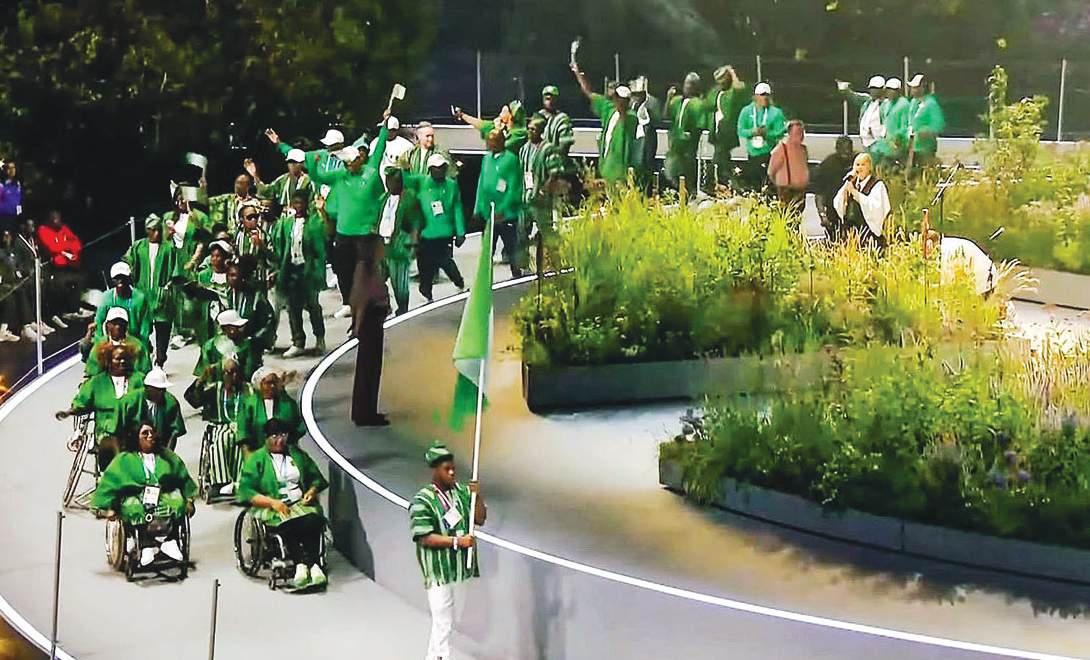
Nigeria at the opening ceremony of 2026 Commonwealth Games
Glasgow, Scotland last night. Competitions will formally kickoff this morning
Python Club, Port
The race to the World Final of this year’s International Pairs Golf Championship is gathering momentum following the official announcement of Python Golf Club, Port Harcourt, as the host venue for the Nigerian National Finals.
Billed for July 31 to August 2, the elite club tournament will see amateur golfers from across the country battle for the exclusive ticket to represent Nigeria at the global finals in Tenerife, Canary Islands in Spain between October 5 and 9, 2026.
Falcon Golf Development Company
Harcourt to Host Nigerian National Finals
(FGDC), the official franchise holder of the event in Nigeria, is organizing the prestigious tournament.
Speaking on the preparations, FGDC Chief Executive Officer Remi Olukoya assured participants of a world-class golfing experience.
“All necessary arrangements to ensure the tournament goes as planned have been firmly put in place,” Olukoya stated, promising an exceptional outing for the competing pairs.
To deliver successful national finals, Falcon Golf Development Company is partnering with a premium lineup of corporate sponsors, including Singleton by Diageo, CyberspacePay, CyberCloud, Spar Market, Pepsi, Trueblue Energy, Jotun Paints, Sterling Global Oil Resources Limited, CAGL Global Company Limited, Alltrade Post Express among other major brands.
“We also want to thank all our
partners, corporate outfits helping us to prosecute this year’s finals. We appreciate their support”, Olukoya said, promising Premium experience. Founded in England in 1998, the International Pairs is globally recognized as the world’s largest amateur pair’s golf tournament. The championship gives everyday club golfers holding an official handicap a unique opportunity to compete at a highly competitive level, wear their national colors, and represent Nigeria on the global stage, this time on the road to Tenerife.
Balogun Ban: Norway Consider Filing Complaint to FIFA’s Ethics Committee
The Norwegian Football Federation is considering filing a formal complaint to FIFA’s ethics committee about the decision to suspend Folarin Balogun’s automatic one-match ban during the World Cup.
United States forward Balogun was expected to miss his side’s last-16 tie against Belgium after being shown a straight red card during their 2-0 win over Bosnia-Herzegovina.
But, after an intervention from US President Donald Trump, the one-match ban was suspended for 12 months. No reason was given, beyond citing a rule that allows punishments to be suspended.
Balogun started the match, which Belgium won 4-1.
In a statement provided to the BBC, NFF President Lise Klaveness said the federation had reacted with “strong concern” and a decision on whether or not to make a complaint would be made at its next board meeting.
The federation has already filed a complaint about FIFA’s first Peace Prize being awarded to President Trump.
“It is appropriate to include the Balogun case in the inquiry to FIFA’s ethics committee that we made before the World Cup regarding Fifa’s so-called
peace prize award during the draw in Washington before Christmas last year,” Klaveness said. The statement followed reports the International Olympic Committee (IOC) could also investigate FIFA President Gianni Infantino. Infantino has been an IOC member since 2020.
Section two of the Olympic charter states: “Members of the IOC will not accept from governments, organisations, or other parties, any mandate or instructions liable to interfere with the freedom of their action and vote.”
preliminary round of the 200m Individual Medley event. The country’s 3x3 basketball team are also listed for preliminaries of the basketball event, starting this afternoon.
Team
in
Folarin Balogun
SEYI MAKINDE AND CONSPIRACY THEORIES
is local government, there is state, state has security votes and there are people that are supposed to be working… “In Oyo State, I strongly believe though I might be wrong but this sometimes might be orchestrated. The governor of Oyo State had his nomination and that of his candidates in the face of this abduction,”.
“He did not take any action, no steps were taken, it was after those nominations that he went to the families to visit them.”“I sometimes believe that the abduction at Oyo School was orchestrated by the Oyo State Government to blackmail President Tinubu,”.
The Tinubu/Makinde
cold war
It was an open secret that Makinde reached an accord concordia with Tinubu in the 2023 elections in which the former backed the then presidential candidate of the All Progressives Congress, APC to win the presidential election in Oyo state. He didn’t do so out of the goodness of his earth. In the spirit of quid pro quo, it was in the anticipation that the president would return the favour in his own hour of need. The anticipated reciprocity was that Tinubu would tacitly back the desire of the Oyo governor to produce his successor. This is the utmost desire of any outgoing governor, never mind that the fulfilment of this desire has seldom worked together for the good of such outgoing governors.
Since the commencement of the home run to the 2027 general elections, there has been no evidence that the president was going to meet his end of the political bargain. Not being privy to the health of the general
relationship between the two protagonists, I hesitate to accuse the president of bad faith. Nonetheless,there can be no better explanation for the extant estrangement between the two other than the president’s failure to keep his own side of the bargain.
OTTI, HOPE, MBAH: GOOD JOB, POOR PARADIGM
hyperbolic. Well paved and dualized roads ushered us into Abia down to Abia Tower and all the way down to Uzuakoli.
Apart from this first hand experience, Governor Otti’s infrastructure upgrade all over Abia in the past three years has no comparison. He readily trumps all other governors across the country.
And it’s not only the urban roads. We have seen modern bus terminals and the one trending currently is the smart school. One was awed watching the documentary showing what a modern school looks like.
MBAH THE
SPHINX RISING FROM THE ASHES OF A FLAWED MANDATE
A senior professional colleague operating from Enugu said over a year ago that Enugu people have been doing serial thanksgiving to God for giving them Peter Mbah. “We almost made a grievous mistake,” he said, lowering his tone.
Governor Mbah of Enugu has put up a decent performance in three years. He has proved that a serious governor can easily deliver and impact a state in just three years.
His urban renewal projects, roads infrastructure, schools, hospitals and transportation amenities mark him out as a serious and inspirational leader.
Indeed, it has been conjectured that both Otti and Mbah may have pushed Uzodimma into a difficult position, forcing him to brace up to work. It was the talk of the town that these two men delivered more in three years than Hope presented in six years.
But it’s most salutary that Uzodimma has bounced back to life and is bent on finishing strong. History may well remember him for good.
NONDESCRIPT SOLUDO AND NWIFURU
Since we seem to be x-raying SE governors, one really cannot report authoritatively on the performances of Governors Chukwuma Soludo (Anambra) and Francis Nwifuru (Ebonyi).
Soludo’s first four years was rather calamitous. He was like a fish out of water, thrashing about breathlessly. He didn’t quite seem to understand the job. Or shall we say it is beyond his ken.
He’s still thrashing (trashing if you prefer) about even in his second term not sure of the legacies he wishes to leave behind. Of course his Taiwan and Dubai campaign promises have long fizzled, showing him up as the vacuous bombast he truly is.
Governor Nwifuru on his part, seems like a pathetic case. The permanent scowl on his visage speaks of a young man eternally confused.
Said to be former Governor Dave Umahi’s mason who rose rapidly from bricklaying to Speaker of Ebonyi State House in a short span. Not satisfied, his godfather ensconced the rustic young man on the apex of state power - Government House. But he may have discovered to his utter pain that setting blocks is a bit different from setting up a state administration.
We may also make an exception that Umahi’s dark aura may be rubbing off badly on Governor Nwifuru. The optics out of Ebonyi are unsightly. Nwifuru may well be doing a bit but what we see mostly are clips of Umahi’s mammoth airport abandoned or used for church services and as a soccer pitch.
On contemporary Ibadan politics, I had another occasion to remark “If one were to map the theatrical cast of recent Ibadan politics, Dr. Omololu Olunloyo (of blessed memory) once supplied a neat script. He characterised the triumvirate that for a time steered the city — himself, the late Azeez Arisekola Alao and Lamidi Adedibu — as the pendulum upon which the city swung. The division of labour, in his laconic summary, was brain (Olunloyo), brawn (Adedibu) and kudi (Arisekola). As with all theatrical casts, these players had their entrances and exits. They have played their parts and exited the stage. It is not clear who and who now correspond to these roles save the notion that Governor Seyi Makinde has dominated contemporary Ibadan politics and appears answerable to no one. Not quite.
Enters Ladoja
As a political heavyweight in Ibadan politics in his heyday, Ladoja must have been instrumental to the emergence of Makinde as Governor of Oyo State. With his eyes set on becoming the Olubadan of Ibadan, he could not afford not to pay serious attention and be in the good books of whoever occupies the seat of Oyo state governor. It is in the nature of realpolitik however, that once he secured the Olubadan throne, there would have been less need for him to kowtow and pander to the Olubadan appointing authority namely the governor. This narrative is evocative of the Yoruba political playbook of Awolowo vs Akintola supremacy politics as ‘a ti foje bolosa lowo, ó ku baba eni tí ó bo (once an aspirant secures the throne, it
These are heart-rending pictures.
A POOR DEVELOPMENT MODEL ALBEIT
In spite of the best efforts of Otti, Uzodimma, MBAH and indeed all the governors in Nigeria, their development model is poor and therefore, have left Nigerians stranded in perpetual poverty.
Have you wondered why in spite of the good deeds of governors like Otti, Babagana Zulum (Borno) Mbah and the rest, more Nigerians remain extremely poor and besieged by such vicissitudes of life like insecurity and poor standards of living.
OUTPUT OF LGAs IS BEST MEASURE OF PERFORMANCE
Unless the local government areas are pressed to operate the way they are structured to operate, Nigeria will never develop.
While the best governors may deploy state allocations and internally generated revenues at their whims and caprices, the real measure of development is the naira and kobo that gets to the grassroots; to the last man in every corner of the country. Most, indeed, all Nigerian governors have failed over the years in the management of the funds accruing to the third tier of government. It is criminal that not one, yes, not one since 1999 has shown class in this respect.
Not one governor in the current dispensation (from 1999) has managed to account for LGA funds. Neither has anyone of them tried to organise the 3rd tier to operate according to their statutory requirements. Whether elected or selected is immaterial. Get them structured; fund them, supervise them!
LGAs are supposed to have a legislative council, annual budgets and projects outlay. Their monthly federal allocations and IGR are supposed to be deployed to administer and develop their areas of jurisdiction. But this has not been the case in Nigeria since 1999.
Governors across the spectrum have simply allowed
becomes an uphill battle for any godfather to undo the deed). More so, (in this instance), with the ascendance of Ladoja’s political ally and good friend (Tinubu) to the presidential throne.
With this empowerment and with the political stars aligned in his favour, anyone in Ladoja’s position was apt to think that, why not go the whole hog and close the deal with the sponsorship of his protege, Senator Sarafadeen Alli, for the governorship of Oyo state. Thus left high and dry, what does the governor make of the bad card dealt him? One consideration is that political acumen sometimes consists of cutting your losses and live to find another day. So far, he has taken the decision to take the battle directly to Tinubu with the appropriate but ultimately futile gesture of manoeuvring himself to become the Presidential candidate of the APM. The other is his unbelievable recourse to dealing in the abject conspiracy theory of somehow insinuating Tinubu’s collusion in the Orire kidnapping incident. To achieve what?
And if there is anything worse than this conception, it is the manner in which it was presented “calling on the appropriate international human rights and accountability mechanisms, including those within the United Nations system, to closely examine the facts surrounding this abduction and the circumstances of its resolution… “The circumstances surrounding this incident are sufficiently grave and unusual to warrant independent scrutiny”
Pray, how are the circumstances any different and more grave than countless precedents which were even more spectacular?. He almost sounded unhappy at the resolution and outcome of the whole ordeal
the 3rd tier to descend into atrophy. This column can wager that most of the LGAs are currently moribund and cannot deliver service to the people. Governors grab about 90 per cent of funds accruing to States and LGAs and play around with it according to their whims.
GOVERNANCE BY IMPULSE
The import of it all is that state governors are merely running their domains on impulse.
Dave Umahi, immediate past governor of Ebonyi state built a bogus airport that’s as good as abandoned today. Enugu to Abakaliki is almost a stone throw away. An airport in Abakaliki is therefore grandiose and misplaced.
In the same manner, the sprawling bus terminal in popular Oshodi, Lagos has never been put to viable use nearly a decade after it was built. Today it’s an eye sore, already falling apart. White elephant. Otti’s smart school is great but it’s wrong-headed. What is needed in Abia (as in all states) is a gradual (graduated) education reform. Building a bogus and expensive smart school is like climbing a tree from the leaves.
Can these so-called smart schools be replicated in hundreds of communities across Abia? No. Not even in all the 17 LGAs?
So a phased reform ( fixing the basics) culminating into a state of the art smart schools in 5 to 10 years. How could any governor conceive of a smart school when primary and early education in Nigeria is comatose in all states?
It’s not only in the education sector. Most rural roads and back streets from Lagos to Kaura Namoda are untouched. Rural/primary health care is in limbo. Rural electric is gravy for the boys like Ayo Fayose, Ndudi Elumelu...etc.
All the governors in the land spend millions of dollars annually sponsoring things as foolish as religious pilgrimages. These are LGAs funds hijacked by governors and frittered away. No governor can
impact an LGA like an LGA chairman! Most Nigerian governors have proved to be haphazard and unstructured in carrying out projects. But even at that, you can only do so much and mainly in the urban areas.
However, every piece of space in a State is on an LGA. This means that it’s easy to cover every inch of space if LGAs are structured and galvanized to work. It may sound so simplistic yet getting the LGAs working is the missing link.
In the final analysis, thinking governors like Otti and Mbah will have to set up their LGAs to be effective and devolve more powers to them to deliver deep-reaching development to the people. This is the model that would make sense. This has to be the new Nigerian governance paradigm and we want to see Mbah and Otti lead the way soon.
LASTLINE: WHO KILLED BABATUNDE DOLAPO TANIMOLA?
Why is the DSS and the police playing the ostrich over the killing of this fellow?
Tanimola has been named as the link between the Chief of Staff to the president, Femi Gbajabiamila and Adeniyi Adeyemi Matthew, DG of the alleged fictional federal agency, PFIPC.
The burning heist, known as Gbaja-Gate, has claimed the life of Tanimola in a horrid and most brutish manner about eight months ago. Tanimola reportedly died in an Abuja hotel inferno. The remains of the hotel is said to have been pulled down to boot. Tanimola was a well heeled socialite and social climber. The digital space is full of his footprints and images with the who’s who in Nigeria. On account of this alone, the police and DSS should have definitive information on Tanimola right now. Especially as it concerns Gbaja-Gate. It’s a simple and straightforward stuff and Nigerians are watching this closely.###
Seyi Makinde
Governor Hope Uzodimma of Imo State
Governor Peter Mbah of Enugu State
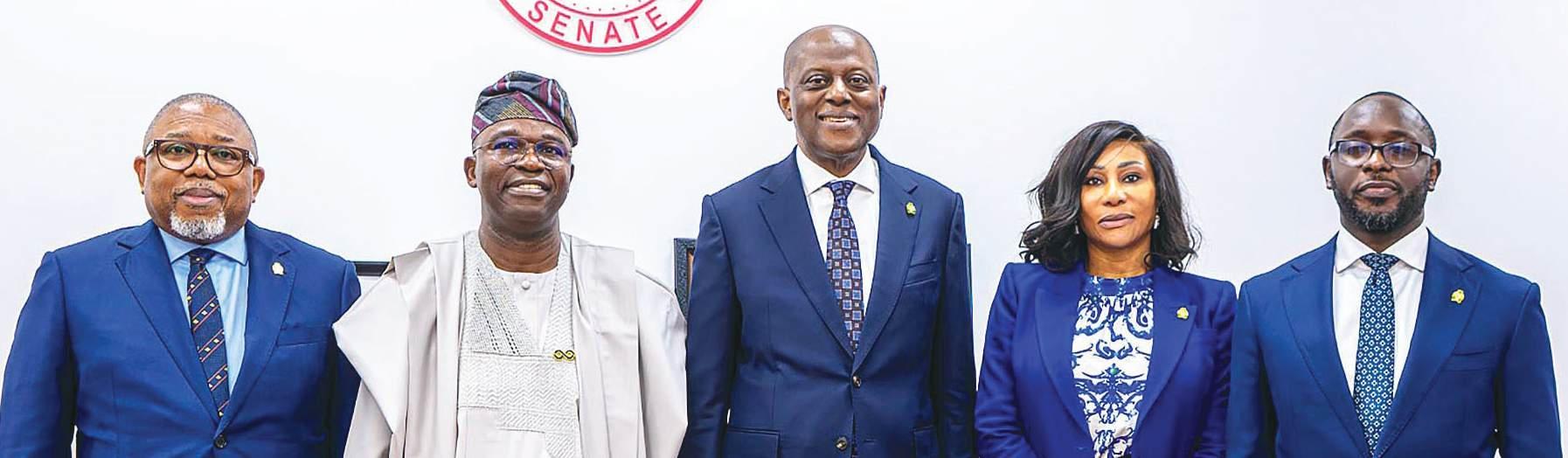
CBN’S FIRST HALF 2026 STATUTORY BRIEFING...
L-R: Mr. Philip Ikeazor, Deputy Governor, Economic Policy, Central Bank of Nigeria (CBN); Senator Mukhail Adetokunbo Abiru, Chairman, Senate Committee on Banking, Insurance and Other Financial Institutions; Mr. Olayemi Cardoso, Governor, Central Bank of Nigeria; Ms Emem Usoro, Deputy Governor, Operations, CBN; and Dr. Muhammad Sani Abdullahi, Deputy Governor, Corporate Services, Central Bank of Nigeria, at the bank’s First Half (H1) 2026 Statutory Briefing to the Senate Committee on Banking, Insurance and Other Financial Institutions, on Wednesday
AKIN OSUNTOKUN
Seyi Makinde and Conspiracy Theories
First, let me rejoice with the Orire local government school abductees for living up to the full meaning of Orire-which means good fortune. As the Yoruba would say, E kú Oríre (I salute you on your good fortune). May good fortune continue to guide your path. Ogbomoso has tended to play a significant role in Yoruba history. In Yoruba antiquity, the name of the city itself was derived from the circumstances of the valiant rescue of metropolitan Oyo from the siege of a seemingly invincible terrorist called Elemosho. Not until it ripens, does the fruit of fate drop and so it became for a local hunter called Soun.
This hunter had physically engaged with an intruder who had sneaked into his abode (under the cover of darkness) while he was away. The intruder turned out to be a loan shark to whom Soun was indebted. Before the hunter recognised him as such, he had overpowered and killed the Oshomalo (the Ijesha vocational money lenders). The penalty for the wrong
Seyi Makinde
he had committed was capital punishment. In a plea bargain with the ultimate judicial authority of the
realm, the Aláàfin of Oyo, Soun offered to take on the dreaded Elemosho. He was obliged. In the epic struggle between the two, the hunter prevailed and decapitated the terrorist.
In gratitude, the supreme monarch granted him clemency and named the local community of Soun’s origin, after the hunter’s ’s exploit-Ogbori Elemosho (He who decapitated the Elemosho subsequently abbreviated to Ogbomoso) and enthroned him as the coronet king. In pre-colonial Yoruba history, Ogbomoso equally played a central role in the defence of the Yoruba Northern frontier against the insurgency of the forefathers of the latter day terrorists who perpetrated the mass abduction of the Orire school children and their tutors. This martial reputation was reflected in the fact that three Ogbomoso warlords namely Toyeje, Ojo Aburumaku and Ladoke Akintola went on to clinch the meritorious title of the Are Ona Kánkánfo (Commander-in-Chief of the Oyo empire army). No other Yoruba community measured up
to this achievement.
The militarily triumphant way and manner the Orire kidnap victims were rescued was evocative of this chivalrous history. Bragged President Bola Ahmed Tinubu, “I am profoundly happy that our security forces successfully rescued the abducted pupils and teachers from Orire, Ogbomoso in Oyo State today after a military, police and intelligence-driven operation that neutralized some of the terrorists that perpetrated the evil act and the arrest of eight of them”
Fayose’s conspiracy theory
Serving as proxy for President Tinubu, former Ekiti state governor, Ayo Fayose, was the first to inject conspiracy theory into the saga. He garbled “Let me branch to Oyo State, before you get to the President in the hierarchy of leadership and governance, there
Otti, Hope, Mbah: Good Job, Poor Paradigm
Hope Uzodimma Was Here: One was in Owerri, Imo State recently and was pleasantly surprised that my favourite hotel now has adequate power supply. I have lodged intermittently in this serene, capacious facility since 2007.
That’s nearly 20 years.
But up until my last sojourn, the hotel was plagued with consistent electricity failure. Initially, it was power outages of the remorseless kind. It was as if a deranged kid in the power station was toying with the public power switch; flicking it off and on every ten minutes.
For instance, immediately there’s power failure and the hotel generator is switched on, public power is switched on again in a space of 5-10 minutes. This is like a vicious, cynical roulette. And this would go on for a whole day. Indeed, it went on for over a decade. It was a most pernicious and unforgiving public work routine one ever experienced.
At a point, the hotel stopped putting on the air conditioning system in the daytime. They would
only do so at night using the generators. At my last visit early in the month, the receptionist was beside himself, announcing to me that they are now on Governor Hope Uzodimma’s Urashi
Power grid. Now “our AC is on round the clock,” the young man enthused.
I was also elated, understanding the prospect of a prosperous time that would soon return to my old redoubt.
One can also see the fresh burgeoning of the New Owerri axis of the Imo State capital as the organic hospitality hub of the southeast. That part of Owerri already had a dense cluster of fine hotels, night clubs, eateries, lounges, up scale restaurants and supermarkets.
This area grew into what it is in spite of almost zero, and indeed, disruptive public power supply. With Uzodimma’s Urashi Electricity Company, this area will blossom into the economic power house of Imo State.
But the pricing of the energy must be deliberate with the motive of boosting the state’s economy and helping that natural hub to grow to its full potential. This way, Owerri will no sooner, become the hospitality capital of Nigeria with all the attendant economic benefits.
But beyond breaking the power jinx in Imo
State to some extent, Governor Uzodimma has also accomplished some important infrastructure feats especially in the last three years.
He has indeed outperformed some of his predecessors, apart from only Chief Sam Mbakwe. With this power feat, we can easily say that Uzodimma Was Here!
Ironically, the last time any governor conceived off-grid power was during the era of Dee Sam Mbakwe in the early 80s.
STAR BOY ALEX OTTI:
There’s no doubt that the incumbent Abia State governor, Dr Alex Otti has proved to Nigerians that state governance can deliver far more than they have been getting in this dispensation.
Yours truly traveled to Uzuakoli, Abia State, some distance after Umuahia for a burial ceremony.
The trip starting from Isiala-Mbano was a bit rough until we crossed the boundary between Imo and Abia. The transformation is transcendental. And that’s not
Governor Alex Otti of Abia State