After Tinubu’s Intervention, Rivers Assembly Suspends Fubara’s Impeachment
Blessing Ibunge in Port Harcourt
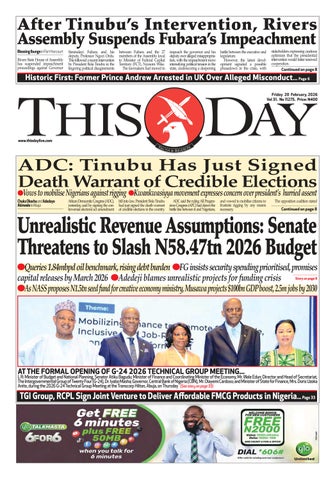
Blessing Ibunge in Port Harcourt
Vows to mobilise Nigerians against rigging Kwankwasiyya movement expresses concern over president’s hurried assent
Queries 1.84mbpd oil benchmark, rising debt burden FG insists security spending prioritised, promises capital releases by March 2026 Adedeji blames unrealistic projects for funding crisis
As NASS proposes N1.5tn seed fund for creative economy ministry, Musawa projects $100bn GDP boost, 2.5m jobs by 2030
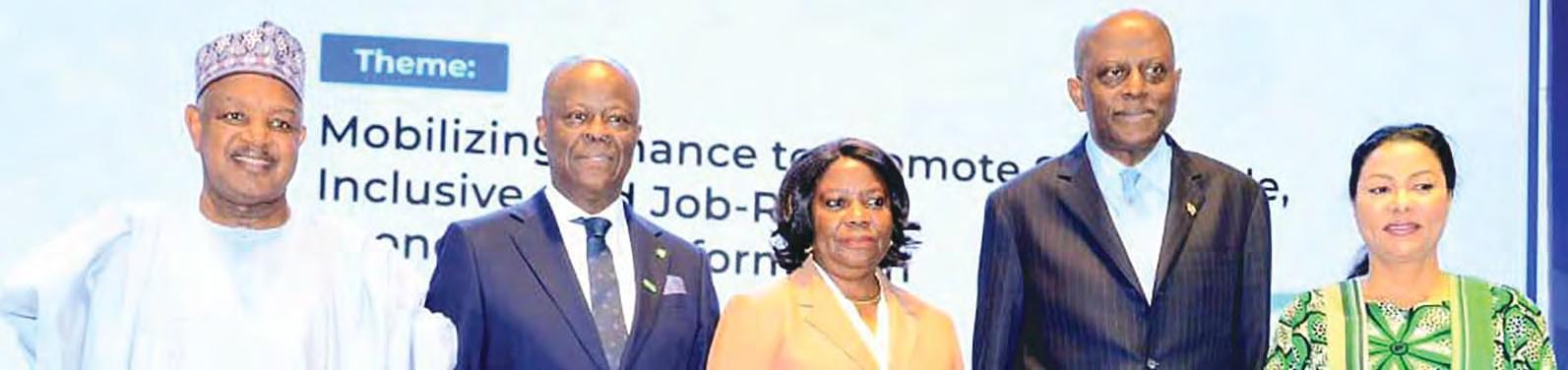




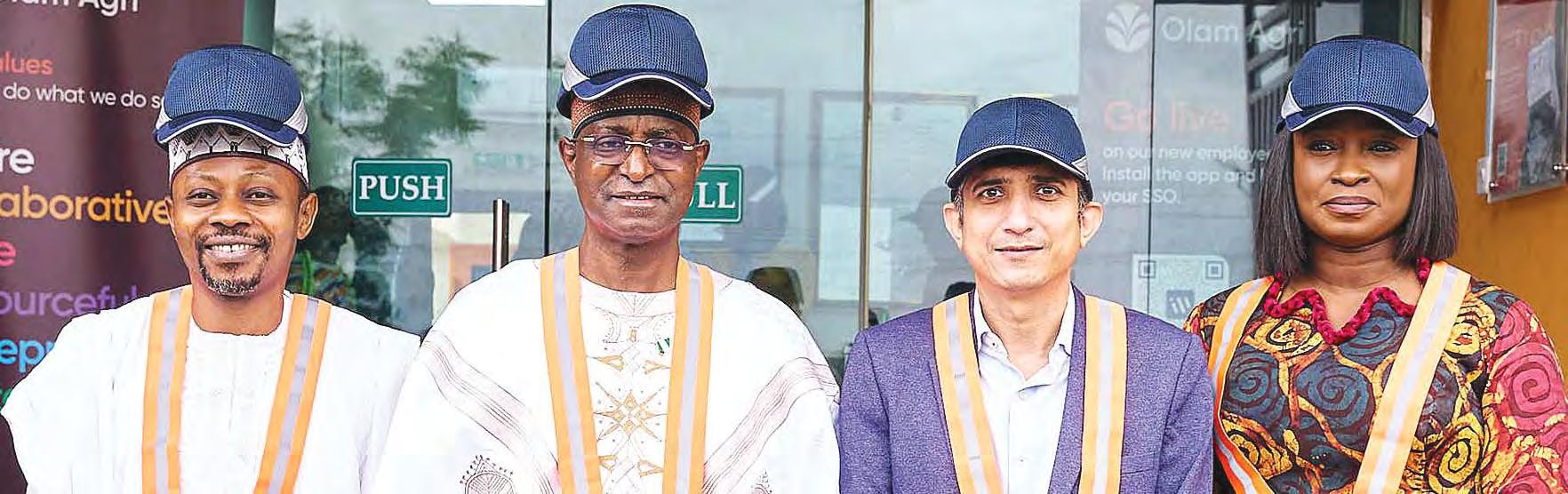
L R: Commissioner for Agriculture and Rural Development, Kwara State, Dr. Hafeez Abolore Alabi; Honourable Minister of Livestock, Mr. Idi Mukhtar Maiha; Senior Vice President and Business Head, Integrated Feed and Protein Business, Olam Agri, Mr. Amit Agarwal; and Commissioner for Livestock, Kwara State, Hon. Oloruntoyosi Thomas, during the courtesy visit of the Minister to Olam Agri’s animal feed and soy crushing plants in Ilorin, Kwara State… recently
Registers over 139,000 new contributors Net operating surplus hits N19.5bn,
Emmanuel Addeh in Abuja
The Federal Mortgage Bank of Nigeria (FMBN) recorded N152.4 billion in National Housing Fund (NHF) collections in 2025, representing a 48 per cent increase over the N103 billion generated in 2024.
The Managing Director of the mortgage bank, Usman Osidi, disclosed this in Abuja during a press briefing to mark two years into the tenure of the current executive management.
“I am proud to say that our stewardship in the last two years has seen renewed confidence in the National Housing Fund Scheme. Before we came in, the highest annual collection ever made into the NHF was N100 billion recorded in 2023. In 2024, we moved it to N103 billion.
“In the outgone year 2025, our NHF collections reached N152.4 billion, representing over 48 per cent growth on the 2024 collection and the highest annual collection in the history of the scheme,” he stated
He attributed the growth to reforms anchored on financial sustainability, customer impact, operational efficiency and institutional renewal.
According to him, the bank also expanded its contributor base, registering over 139,000 new contributors in 2025, bringing total new contributors
under the current management to well over 300,000 Nigerians in two years.
On refunds, Osidi said the bank paid N15.6 billion to 55,068 beneficiaries in 2025, compared to N14.4 billion paid to 44,333 beneficiaries in 2024 and N13.2 billion to 40,426 beneficiaries in 2023.
“This positive growth trajectory shows that the reforms we have embarked upon have engendered better turnaround times with improved operational efficiency in refund processing,” he said.
He also announced the return of Oyo State workers to the NHF scheme after 27 years of withdrawal.
“Just last month, we received confirmatory correspondence from the Oyo State Government that the governor has approved the return of state workers to the NHF scheme. Oyo workers had ceased contributing since 1999,” he said.
Osidi added that Kano State, which withdrew in 2002, was also on the verge of returning to the scheme after signing a memorandum of agreement with the bank.
“All these milestones indicate improved confidence in the scheme generated through the positive turnaround FMBN is witnessing under this management,” he said.
Beyond NHF operations, Osidi said
the bank financed 6,911 housing units in 2025, up from 2,165 units in 2024, while project loan disbursements rose to over N79 billion from N31.5 billion within the same period.
On financial performance, he said the bank recorded a net operating surplus of about N19.5 billion in 2025, representing a 68.4 per cent increase over the N11.58 billion surplus posted in 2024.
“In 2023, only N226,000 was made as surplus in our management account
before the current management assumed office. In 2024, we recorded an operational surplus of N11.58 billion, the first in over 30 years. In 2025, we consolidated these gains with about N19.5 billion,” he said.
Osidi, however, noted that the bank remains undercapitalised with a paid-up capital of about N2.56 billion, while also reaffirming the bank’s commitment to expanding affordable housing finance and deepening digital transformation in 2026.
“This is why our recapitalisation drive, targeting up to N750 billion, remains central to our reform agenda,” he added.
He acknowledged the strategic guidance and support of the Federal Ministry of Housing and Urban Development, under the leadership of the Minister, Ahmed Dangiwa, as well as all stakeholders who continue to believe in the vision of a stronger, more impactful FMBN.
According to Osidi, in 2025 alone,
the bank financed 6,911 housing units, representing about 96 per cent of annual delivery target. “These housing developments cut across different project loan categories including the Cooperative Housing Development Loan, the Ministerial Pilot Housing Scheme, the collaborative FMBN/ NLC/TUC/NECA Affordable Housing Development projects and the Mega/Mini Cities and Estate projects under the Renewed Hope Housing Programme,” he stated.
Emmanuel Addeh in Abuja
Nigeria’s currency is expected to strengthen further against the dollar in the next week to Thursday, while those of Kenya, Ghana, Uganda and Zambia should be little changed, traders said, a Reuters report said yesterday.
Nigeria’s naira could extend its recent gains, lifted by strong forex inflows and central bank dollar sales to bureau de changes (BDCs), which have helped tighten the spread
between official and parallel market exchange rates, it said.
The naira was quoted at 1,344 to the dollar on the official market on Thursday, compared with 1,357 a week ago. The unit was changing hands at 1,385 to the dollar in street trading on Thursday.
“We expect the naira to remain strong in the coming week, boosted by improved foreign exchange inflows and dollar sales to BDCs that (are) helping to further deflate the parallel market premium,” one trader said.
Besides, Kenya’s shilling is expected to extend its long-running stable trend. Commercial banks quoted the shilling at 128.80/129.10 to the U.S. currency, compared
with last Thursday’s close of 128.90/129.20.
In Ghana, the cedi is likely to be broadly unchanged as corporate dollar demand has slowed. LSEG data showed the cedi trading at 10.95 to the dollar compared with 10.99 a week ago.
“The currency is likely to remain range-bound in the week ahead, supported by improved interbank liquidity and softer corporate demand,” said Bertrand Baazeng, a trader with Absa Bank Ghana.
Ronald Mensah, a trader at Stanbic Bank Ghana, said: “Range-bound trading is likely to persist barring any significant external shocks.
Also, Uganda’s shilling is seen
trading around its current levels, supported by dollar inflows from charities and commodity exporters. Commercial banks quoted the shilling at 3,575/3,585 to the dollar, compared to last Thursday’s close of 3,535/3,545.
“We normally see an uptick in (dollar) flows as we move toward the end of the month, mainly from NGOs and some commodity exporters,” a trader said. In the same vein, Zambia’s kwacha is likely to remain steady due to improving economic conditions and investor sentiment. Commercial banks quoted the currency of Africa’s second-largest copper producer at 19.08 per dollar on Thursday from 19.04 a week ago.
Onyebuchi Ezigbo in Abuja National Agency for Food and Drug Administration and Control (NAFDAC) has sealed no fewer than 18 warehouses in Bida, Niger State, following the discovery of large quantities of expired food and beverage products valued over N100 million.
A statement signed by NÀFDAC’s Resident Media Consultant, Sayo Akntola, said the warehouses located around Ndazabo White House, along Minna Road, and behind Bida Modern Market, were shut after NAFDAC’s investigation and enforcement team acted on credible intelligence.
It listed Items recovered during the raid to include expired non-alcoholic beverages, dairy milk, candies, bottled water, and pasta, some of which were already packaged for distribution. According to the agency, about 80,000 packets of expired nonalcoholic drinks, 5,000 packets of dairy milk, 16,000 packets of bottled water, 28 cartons of pasta, and other assorted expired products were uncovered during the operation. Managers of the affected warehouses were arrested for interrogation, during which preliminary findings linked the facilities to a company identified as BY Ventures.
That prompted NAFDAC officials to extend their operation to supermarkets owned by the company in Minna, where additional expired products and counterfeit Goya oil were allegedly found.
Both supermarkets were subsequently sealed, while the managing director of the company, Alhaji Yusuf Nadabo, was invited for further questioning.
The agency said Nadabo admitted ownership of the expired products during interrogation.
NAFDAC said investigation was ongoing and appropriate regulatory sanctions would be imposed at the conclusion of the process to serve as a deterrent to others.
Bennett Oghifo
Nigeria’s medical diagnostic equipment distributor, ISN Medical, hosted its 2026 Consumer Healthcare Unit (CHU) Partner Appreciation Forum, recognising 36 top-performing partners for their contributions during the 2025 financial year. The forum themed “Collaboration for Continued Growth,” was held at the company’s head office
in Ilupeju, Lagos, bringing together the Top 36 National Winners in acknowledgment of their performance and strategic partnership.
As part of the recognition segment, all qualifying partners received commemorative gifts, while the Top Two National Winners were each presented with a car in recognition of their outstanding performance.
The 2025 National Partner Award was presented to Mrs.
Olachi Anaka of Medi Scan Tech Support Ltd as the No. 1 National Partner, and Mr. Chinwuba Ezennia of Pipette Nigeria Ltd was named the No. 2 National Partner. ISN Medical is the authorised distributor of Accu-Chek glucometers and test strips in Nigeria, with the portfolio managed by the Consumer Healthcare Unit under the leadership of its Director, Mrs. Ify Chioke.
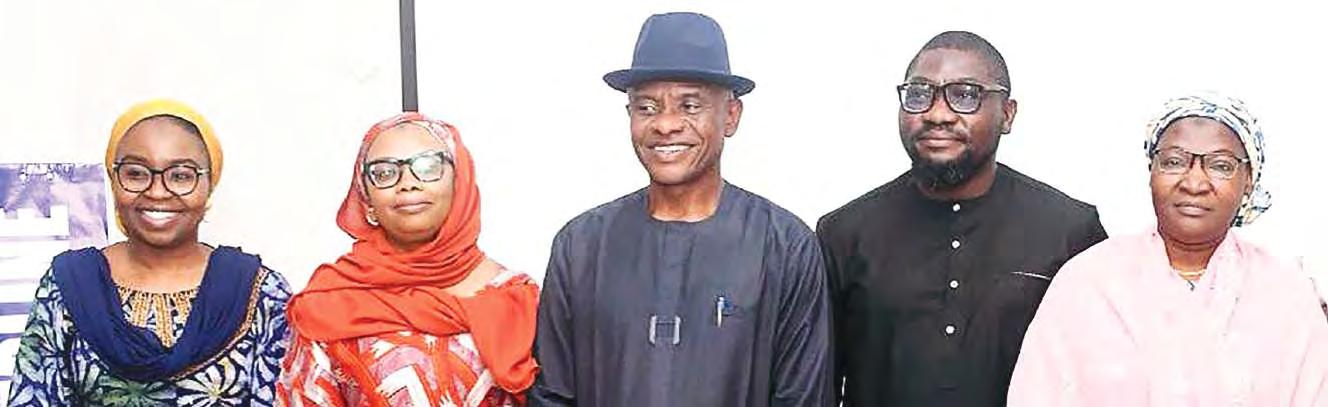
L R: Senior Programme Officer, Child Survival Advocacy and REACH, Gates Foundation, Ms. Fatima Abba; Senior Programme Officer, Child Health Global Opportunity, Gates Foundation, Dr. Laila Umar; Director, Family Health Department, Federal Ministry of Health and Social Welfare (FMoHSW) and Co Chair, SARMAAN Steering Committee, Dr. John Ovuoraye; Project Lead, SARMAAN Advocacy Project Team, Mr. Ikechukwu Ofuani; and Director, Child Health Division, Federal Ministry of Health and Social Welfare, Dr. Amina Mohammed, during the Safety and Antimicrobial Resistance of Mass Administration of Azithromycin in Children (SARMAAN) Roundtable Meeting in Abuja, yesterday
First
Wale Igbintade
In a historic and unprecedented development, former Prince Andrew, now styled Andrew Mountbatten Windsor, was arrested yesterday by British police on suspicion of misconduct in public office, a serious offence under UK law.
The 66 year old was taken into custody at his Sandringham Estate
residence in Norfolk, a dramatic turn that coincided with his birthday and has intensified scrutiny of his long-standing ties to the late financier Jeffrey Epstein.
Thames Valley Police, leading the investigation, confirmed the arrest while adhering to national law enforcement protocols that prevent naming suspects at this stage.
Officers stated that the action was
“part of an ongoing investigation” into alleged misconduct during Andrew’s decade-long tenure as the UK’s trade envoy (2001–2011). Searches were conducted at properties in Berkshire and Norfolk.
Unmarked police vehicles and plain-clothes detectives were seen entering Wood Farm, Andrew’s Sandringham residence, early Thursday morning before he was
“The law must take its course,” King Charles
taken into custody.
This marks the first time in nearly 400 years that a senior British royal has been detained by police, a symbolic moment reflecting the decline of automatic deference toward the monarchy and growing public demands for accountability.
Authorities are examining allegations that Andrew may have shared confidential government information
Yinka Kolawole in Osogbo
No fewer than 1,00 Retirees under the Osun State Contributory Pension Scheme have sought solutions for severe hardship on members in Osun and appealed to the President Bola Ahmed Tinubu, to intervene and help save the souls of contributory pensioners in the state.
Speaking at a press conference jointly held in Osogbo by Alhaji Ayinde Toyeen, State Coordinator, Pastor Adepoju Sunday Chairman and Alhaja Abidoye Chairperson 2 noted that Osun retirees are suffering severe hardship, and sadly, deaths are occurring daily due to financial distress and lack of access to adequate medical care.
According to them “We, the retirees under the Osun State Contributory Pension Scheme, humbly appeal to the President Bola Ahmed Tinubu to kindly intervene and help save our souls.”
“We passionately appeal to Mr. President, President Bola Ahmed Tinubu, who is the father of the nation, to kindly intervene in the Osun local Governments imbroglio in the interest of the Osun contributory pensioners who are suffering.”
They equally called on the president to work out amicable resolution to the problem, to enable the payment of outstanding entitlements to retirees, particularly Primary
School and Local Government retirees between 2017-2026, Secondary School, Tertiary Institutions, and Civil Service retirees 2020-2026.
They remarked: “We respectfully urge Mr. President to also appeal to leaders and members of his political party in Osun State to cooperate in resolving these issues and help avert further avoidable and untimely deaths among retirees.”
“We remain law-abiding citizens and loyal Nigerians who have served the state and nation diligently. We plead for urgent intervention in the interest of humanity, justice, and fairness.”
The pensioners eulogised and appreciated the Governor Ademola
Adeleke, for his remarkable efforts and commitment towards alleviating the suffering of retirees in the State. They equally acknowledge with the actions taken by the present administration on the Payment of 28 months of half salaries owed by the previous administration, Payment of 12 months of half salaries to bonded retirees, registration of retirees under the State Health Insurance Scheme and the ongoing payment of a #10,000 monthly palliative to each retiree.
with Epstein, who was a convicted sex offender and died in 2019.
Newly released documents from the U.S. Department of Justice suggest that emails from 2010–2011 indicate Andrew forwarded official government briefings, including trade and investment reports from visits to Vietnam, Singapore, China, and Afghanistan to Epstein.
Investigators are also reviewing claims that Epstein facilitated travel to the UK in connection with Andrew’s activities, including a new witness report regarding a 2010 encounter.
Under UK law, misconduct in public office is a serious common-law offence, traditionally applied to public officials who willfully abuse their position.
Conviction can carry a maximum sentence of life imprisonment, though such outcomes are rare.
Police have indicated that Andrew remains in custody as investigators continue questioning him and consider whether to seek formal charges, which would require authorisation from the Crown Prosecution Service (CPS).
King Charles III, Andrew’s older brother, issued a statement expressing “deepest concern” about the arrest but underscored that “the law must take its course.”
The monarch affirmed that the Royal Family is fully cooperating with authorities.
Meanwhile, the family of Virginia Giuffre, the late American woman who accused Andrew of sexual abuse when she was 17, a claim Andrew has consistently denied, welcomed the arrest as a step toward accountability.
Years of Scrutiny and Fallout
Andrew’s arrest follows years of public and legal scrutiny.
In 2025, he was stripped of his remaining royal titles and honours and asked to vacate Royal Lodge in Windsor following the public release of millions of Epstein-related documents.
He had previously settled a civil case in 2022 with Giuffre over abuse allegations, without admitting guilt. His association with Epstein and past controversies severely damaged his reputation and standing within the monarchy.
Police are expected to continue interviewing Andrew under criminal caution and determine whether the evidence supports formal charges. Depending on the outcome, he may be released on police bail, formally charged, or released without further action, guided by the CPS.
James Sowole in Abeokuta
Aleke in Abuja
The President of Sierra Leone, Julius Maada Bio, has conferred national honours on two senior Nigerian military officers in recognition of their contributions to peace and regional stability.
The awards were presented during the 17th Armed Forces Day celebration of the Republic of Sierra Leone Armed Forces, held in Freetown. Nigeria’s Chief of Defence Staff,
Olufemi Oluyede, and a former Chief of Defence Staff, Martin Luther Agwai, were decorated with the prestigious Grand Commander of the Order of the Rokel.
The honour recognised their roles in promoting peace and stability in Sierra Leone, particularly during the country’s civil war. According to a statement by the Director of Defence Information, Major General Samaila Uba, the award bestowed on General Oluyede was
in acknowledgement of his service under the Economic Community of West African States Monitoring Group (ECOMOG).
The statement noted that his efforts, alongside those of other Nigerian officers and soldiers, were instrumental in restoring peace and safeguarding Sierra Leone’s sovereignty.
While his citation was read, Oluyede was recognised for serving in Sierra Leone as part of ECOMOG between 1992 and 1994.
No fewer than 96 out of 1,924 that graduated during the 15th Convocation of Caleb University, Imota, made First Class.
In the same vein, 719 students graduated with Second Class (Upper Division), 728 with Second Class (Lower Division) while 82 students graduated with Third Class.
The performances of the graduands were contained in the convocation speech delivered by the Vice Chancellor, Professor Lekan Asikhia.
The vice chancellor expressed delight that the university had been growing in leaps and bounds since its humble beginning.
Asikhia, who highlighted his seven-point agenda and what had
Graduates 1,924 with 92 First Class
been achieved since his assumption of office in June 2025, commended the vision of the promoters of the university.
Delivering his convocation lecture, the General Overseer of Foursquare Gospel Church, Reverend Sam Aboyeji, charged the graduates to consciously unlock and deploy their God-given potentials for global relevance.
The lecture was entittled “Positioning your God-Given Potentials for Global Impact.”
According to the lecturer, every individual is endowed with extraordinary capacities meant to be discovered, developed and strategically positioned for the benefit of humanity.
Drawing from faith, science and leadership insights, he noted that
potential represents the capacity to become everything one is capable of becoming.
He admonished graduates that beyond academic certificates, their upbringing, faith, values, networks, skills and life experiences constitute “talents” entrusted to them.
Buttressing his position with biblical passages, Aboyeji emphasised that God rewards faithful deployment and multiplication of abilities, not mere possession.
He said, “The tragedy of life is not lack of opportunity, but misplaced or unused potentials. Every human being is born with potentials; sadly, not all are opportune to fulfill theirs, Potential is your capacity to become everything you are capable of becoming,” he said.
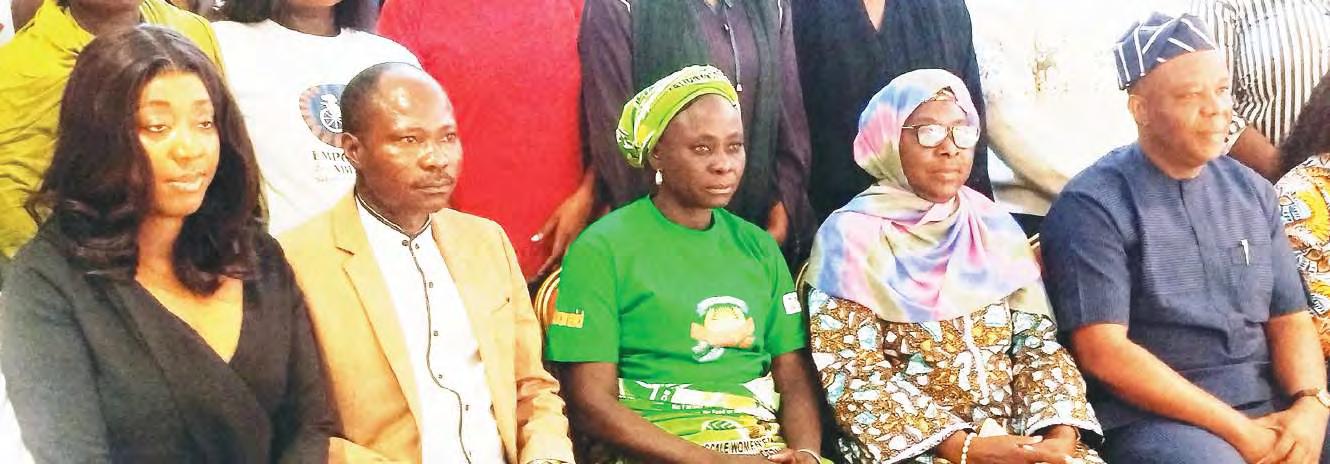
R:
Rabiu Olowo: initiative will boost capital inflows, identify risk concentrations, potential misstatements, strengthen enforcement with data-driven oversight
James Emejo in Abuja
Executive Secretary/Chief Executive, Financial Reporting Council of Nigeria (FRC), Dr. Rabiu Olowo, has signed a tripartite agreement for the development of a national digital platform for sustainability regulatory reporting in the country.
The agreement involves FRC and UK-based SALI Technologies, which specialises in AI-driven sustainability assessments and reporting.
The partnership also includes Regulatory Compliance Readiness Advisors (RCRA) Limited, which ensures that the sustainability ecosystem — regulators, reporting entities, and assurance professionals, — possesses the knowledge, skills, and institutional readiness to use the digital platform effectively and responsibly.
Speaking at the signing ceremony, Olowo described the move as regulatory modernisation in action. He stated that the framework signified a commitment to the future of transparency, accountability, and sustainable economic growth, helping to attract global capital into the country.
He said the platform positioned the country firmly within the global movement towards credible,
technology-enabled sustainability regulation, enabling structured sustainability reporting across Public Interest Entities (PIEs).
He stated that the deployment will further enhance regulatory monitoring, strengthen enforcement capability, and generate actionable analytics as well as support assurance activities that enhance credibility and trust.
Olowo said, “For too long, sustainability reporting has often been fragmented, manual, inconsistent, and difficult to verify.
“Today, we are replacing fragmentation with integration. We are replacing opacity with transparency. We are replacing manual inefficiency with digital intelligence.
“Through this platform, the Financial Reporting Council will be able to standardise sustainability disclosures in alignment with globally recognised frameworks; monitor compliance in real time, identify risk concentrations across sectors, detect inconsistencies and potential misstatements.”
He added that the platform will strengthen enforcement with data-driven oversight, support assurance professionals with structured reporting architecture.
Commenting on the broader significance of the platform, Olowo stressed that global capital was increasingly sustainability-sensitive.
According to him, development finance institutions, multilateral lenders, private equity investors, and international banks are integrating sustainability metrics into their financing decisions.
He stated that countries that could demonstrate credible, digital, regulator-backed sustainability reporting frameworks will enjoy greater investor confidence.
Olowo said, “By establishing this national digital platform, Nigeria sends a powerful signal: We are serious about credible reporting.
“We are serious about regulatory integrity. We are serious about datadriven governance. We are serious about sustainable development.
“This platform will also enable aggregated analytics at a national level. It will provide policymakers with insights into climate risk exposure, sectoral sustainability performance, and emerging environmental and social trends.
“It will support evidence-based policymaking and national development planning. In essence, we are not only building a reporting tool. We are building national infrastructure for sustainable economic intelligence.”
He commended SALI and RCRA for their partnership and technical
collaboration, stating that publicprivate cooperation is essential in building systems of the scale and ambition.
Olowo stated, “The success of this platform will depend not only on technology, but on governance, data integrity, and sustained institutional commitment.
“The Financial Reporting Council remains committed to fostering high-quality reporting, strengthening public confidence, and aligning Nigeria with international best practices while respecting our local realities.
“This concession agreement marks the beginning of a journey — a journey toward transparency powered by
technology, governance strengthened by data, and sustainability embedded in economic decision-making.
“Let this platform stand as a symbol of Nigeria’s resolve to lead responsibly, regulate intelligently, and grow sustainably.”
Founder/Chief Executive, RCRA Limited, Dr. Iheanyi Anyahara, said the initiative represented a future where “sustainability reporting is not feared, but understood; not resisted, but embraced; not superficial, but credible”. Anyahara said the partnership marked a significant milestone — not only in regulatory modernisation – but also national capacity development.
The Lagos State Government has described the proposed Lagos State Wealth Fund (LSWF) as a blueprint for sustainable investment, fiscal stability and long-term wealth creation for the state, as well as
Kuni
Nigerian universities have recorded a significant milestone in global digital trust identity infrastructure following the admission of the Nigerian Research and Education Network (NgREN) into the Education Global Authentication Infrastructure.
Managing Director, NgREN, Dr. Joshua Atah, announced the development after signing the declaration of membership, formally ushering Nigeria into one of the world’s largest academic identity federations, according to a statement in Abuja.
The eduGAIN inter-federation
service connects identity federations across the globe, simplifying secure access to digital content, services and resources for the international research and education community. It comprises participation from over 100 countries and more than 10,000 identity and service providers worldwide.
The approval followed a rigorous assessment and voting process conducted by the eduGAIN Assembly.
Operating under the auspices of GÉANT, eduGAIN enables secure, trusted and seamless cross-border access to online research and education services.
In a statement, Dr. Atah
described the admission as a landmark achievement that would significantly enhance collaboration opportunities for Nigerian institutions.
He noted that membership would provide secure access to international scholarly resources and strengthen digital trust frameworks for services used by the global academic community.
According to him, the move positions Nigeria’s higher education system firmly on the global stage, allowing universities and research institutions federated under NgREN to participate fully in the global inter-federation ecosystem.
a strategic investment vehicle to safeguard Lagos State’s future and secure the prosperity of generations yet unborn.
Speaking to journalists during a Lagos State Wealth Fund (LSWF) Bill Harmonisation Session, themed “Designing a Coherent and Bankable Wealth Fund Architecture for Lagos”, held at the Four Point by Sheraton Hotel, Oniru, Lagos, the Commissioner for Finance, Mr. Abayomi Oluyomi, described the initiative as part of efforts to secure Lagos’ long-term financial stability and development.
Oluyomi said the harmonisation session organised by the Ministry of Finance in conjunction with the Lagos House Assembly was designed to align all comments and recommendations into a unified framework that would strengthen the bill before final legislative action.
Oluyomi, who commended the economic reform drive of Governor Babajide Sanwo-Olu, explained the model draws inspiration from the sovereign investment framework of the Nigerian Sovereign Investment Authority, which manages Nigeria’s Sovereign Wealth Fund established in 2011 and has recorded steady
profitability over the years.
He noted the Lagos State Wealth Fund Bill outlines four major investment windows that will help to boost infrastructure financing, enhance economic diversification, strengthen fiscal buffers during downturns and build long-term savings for future generations.
He said: “The idea behind the Lagos State Wealth Fund, basically, is to promote a savings culture and provide for the future generations.
The Lagos State Wealth Fund, by its design, will catalyse capital globally as additional funds for investment purposes
“Specific sub funds include Technology and Innovation Fund.
Lagos State, described as the largest tech hub in Africa will benefit tremendously from the Fund. It will generate employment opportunities for its teeming population and attract strategic attention globally.
“Today, many Nigerian youths are engaged in AI, blockchain technology and innovation in the space. This fund is an opportunity to scale up and change the landscape permanently.
“There will also be an Infrastructure Fund directed at financing
gigantic infrastructure such as the fourth mainland bridge, the Lagos International airport and for establishing Lagos airline. These are economic agents that promote growth and development.
“The Stabilisation Fund primarily is to provide buffer and stability to the fiscal operations of the government during emergencies such as the COVID pandemic. The bill is very intentional with provisions for financing any budget shortfall of over 50 per cent. Drawdown from the stabilization fund shall provide augmentation for such imbalances
“When the Lagos State Wealth Fund Bill is eventually passed into law, it will take Lagos State to the next level. The Lagos State Wealth Fund will also generate revenue to the government by way of dividends.
“Lagos State as the financial, economic, and commercial capital in the sub-Saharan Africa is desirous of scaling up on its capacity and capability to become globally recognized. Lagos state focus is no longer predominantly domestic but has upscale and upgraded to a regional and global player.”
Dike Onwuamaeze
Chairman of Nigeria Sovereign Investment Authority (NSIA), Dr. Segun Ogunsanya, has revealed that Nigeria is targeting doubling its sovereign wealth fund, from $3billion to $6 billion.
NSIA started 12 years ago with $1 billion.
Ogunsanya spoke yesterday when he featured as guest speaker of Nigerian-British Chamber of Commerce’s (NBCC) “Sharing Experience Series, Transformational Leadership,” where he stated that strong governance framework and independence of the board had kept NSIA free of fraud and corrupt practices.
He said, “We will continue to grow by investment activities. I have given them the challenge that I will
like the fund to be doubled in my tenure, which is in the next three years because I have done one year.
“And I am very optimistic that we are going to double the size of the fund to $6 billion, which is not really out of this world. Libya has about $70 billion dollars.”
Ogunsanya also revealed that NSIA was looking for ways of engaging other sovereign funds in creating a funnel of funds for its investment activities.
He extolled the strong governance framework that had kept NSIA free of fraud and corrupt practices.
Ogunsanya stated, “NSIA is probably one of the best institutions in this country that is still very relevant, and I can say one of the most transparent institutions I have ever seen.
“We have a perfect score when it comes to governance and trans-
parency, and we are scored by the international body.
“We are also very clear as to what the objectives are as we are meant to create a wealth for the future generation. So, we are very clear on what we do with the funding.
“What I love is the framework that is being created. Though we make some bad investment like everybody does.”
He added, “But it is very fraudproof, very corruption-proof because of the governance system, the way the directors are selected, their accountability and the independence of the board.
“It is unbelievable that this is a Nigerian institution, honestly.
“I think all of us should continue to guide the independence of NSIA.”
Ogunsanya, who had served as chief executive officer of Coco-Cola
in Ghana and Kenya, also advised Nigerian corporates eager to make forays into the African markets to understand that not every large population was a large market.
He said, “People confuse a large population with a large market. So be very careful in determining the metric you are looking at. The population is good, but how many of those folks have money to buy what you are going to be selling?
“So, for me, it is addressable population, which is what percentage of those folks going to buy your goods?”
He also advised corporates to be very conscious of each country’s regulatory limitations, whether it was friendly or reckless.
“I am not saying you should run away when there is recklessness. You must figure the right risk mitigation
framework to mitigate against that recklessness, but very clear about the regulatory environment,” he said.
Ogunsanya also advised Nigerian investors to have an eye on the depth of their host country’s financial system and foreign exchange scheme to avoid difficulty in getting their money out.
He said, “I also recommend having some sort of a local partnership. It is very important to have a local touch. Having the right local partner will give you a lot of soft landing and to just get through local nuisances.”
In his welcome address, President of NBCC, Mr. Abimbola Olashore, said the theme, “Sharing Experience with Dr. Segun Ogunsanya: Transformational Leadership,” spoke directly to the demands of the time.
Olasore said leadership was being tested by rapid economic
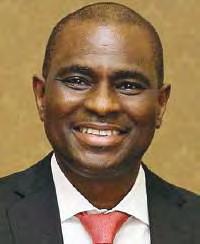
Dr. Ogunsanya
shifts, technological disruption, and evolving stakeholder expectations across industries, institutions, and nations.
He said, “Transformational leadership is, therefore, no longer optional, it is essential. It requires vision, courage, adaptability, and the ability to inspire meaningful change while sustaining growth and stability.”
Sunday Aborisade in Abuja Senate on Thursday threatened to reduce the proposed N58.472 trillion 2026 Appropriation Bill over what it described as unrealistic revenue projections,
poor oil performance benchmarks, and persistent failures in capital budget implementation.
The warning came during a tense interactive session between Senate Committee on Appropriations and the federal government’s
economic team, where lawmakers openly questioned the credibility of key assumptions underpinning the record budget proposal.
In a related budget defence development earlier, National Assembly proposed a take-off grant
that Tinubu’s hasty assent to the controversial electoral act amendment had corrupted Nigeria’s democracy.
In a statement by its National Publicity Secretary, Mallam Bolaji Abdullahi, ADC questioned the undue haste with which the president signed the bill into law, even in the face of widespread objections by citizens across the country.
The opposition coalition declared that the hasty assent was part of the ruling party’s elaborate schemes to rig the 2027 elections.
The statement said, “With the alarmingly speedy assent to the Electoral Act Amendment Bill, Tinubu has signed the death warrant on credible elections and by so doing set Nigeria’s democracy back by several decades.
‘’At a time when Nigerians across generations and political affiliations are calling for stronger accountability and the full modernisation of our electoral system, it is sad to see a president, who likes to boast of his pro-democracy credentials, hurriedly approving amendments that not only fail to improve citizens’ confidence in the electoral process.
‘’In signing the bill into law, the president claimed to be consolidating the country’s democracy, but in reality, he has simply corrupted it further by introducing ambiguity and permitting excessive discretion in the collation and transmission process.’’
Abdullahi said it was quite instructive that despite claiming to control more than 30 state governments, and commanding a majority in both chambers of the National Assembly, a government that wrongly boast-ed about being so politically dominant would rush changes to the electoral framework to hinder transparent polls.
It said the extraordinary haste with which the amendment was passed and signed confirmed widespread suspicion that the government harboured deep-seethed doubts about submitting itself to a truly transparent and competitive process.
ADC said, ‘’By refusing to slow
down, listen, and meaningfully engage the concerns of Nigerians, President Tinubu and the APC-led National Assembly have shown that they are afraid of what the Nigerian people will do to them in a free and fair election, and they have reacted by demonstrating outright disregard for the very citizens whose mandate sustains their democratic authority.”
The statement said, ‘’The African Democratic Congress (ADC) is also deeply concerned about what this amendment portends for Nigeria’s forthcoming elections.
“In the absence of firm guarantees of electronic transparency, vigilant citizens may feel compelled to physically safeguard their votes to prevent discrepancies between polling units and collation centres, as has been witnessed in the past.
“No government that is confident in its democratic mandate and cares about its citizens should place its people in a position that risks heightening tension during elections.”
ADC declared, ‘’As a duly constituted political party in the Federal Republic of Nigeria, with the actions taken by President Bola Tinubu on Wednesday, 18th February, moving forward, the ADC affirms in the strongest and clearest possible terms that we are ready, willing, and prepared to defend the sanctity of Nigeria’s democracy using every constitutional and lawful means available to us.
‘’We will mobilise Nigerians toward vigilance, toward lawful participation, and toward unity in defence of their constitutional rights. We stand firm in the belief that the will of the people must prevail and that no law, however hastily enacted, can extinguish the democratic aspirations of a free nation.”
Kwankwasiyya Movement Concerned About Tinubu’s ‘Hurried’ Assent to Electoral Act
The Kwankwasiyya Movement has expressed serious concern over
the recent passage and accelerated presidential assent to the controversial amendments to the 2022 Electoral Act, despite widespread public protests.
The movement stated that the assent was in spite of consistent civil society advocacy, expert warnings, and clear public sentiment in favour of stronger electoral safeguards. It stressed that the development laid bare the dangers of unchecked one-party dominance.
The Kwankwasiyya Movement, in a statement by its spokesperson, Habibu Sale Mohammed, stated that it was now evident that APC exercised an overwhelming influence across the executive and the National Assembly, a dominance significantly strengthened by defections from elected officials, who secured their mandates on the platforms of other political parties.
It stated that the sequence of events reinforced the perception that the growing numerical dominance in the legislature was translating into diminished accountability, adding that the defections are not merely political movements; but raised serious moral and constitutional concerns.
The statement stressed that Nigeria’s democracy belonged to its people, and must not be weakened by convenience, nor compromised by concentration of power.
The Kwankwasiyya Movement stated, “When elected representatives abandon the political platforms upon which they were entrusted with the people’s mandate without clear ideological justification or constituency consultation, it amounts to a distortion of democratic representation. The mandate belongs to the electorate, not to the personal convenience of officeholders.
“Nigeria’s democracy was designed to function on the principles of checks and balances. A vibrant opposition, legislative independence, and responsiveness to public opinion are foundational pillars of constitutional governance.
of N1.5 trillion for Federal Ministry of Art, Culture, Tourism and the Creative Economy (FMACTCE) to reposition the sector as a key driver of economic diversification and reduce Nigeria’s dependence on oil revenue.
The proposal was unveiled during the ministry’s 2025 budget defence before the Joint Committee on Culture, Art and Creative Economy. During the session, lawmakers expressed strong confidence in the sector’s capacity to generate massive revenue, create jobs, and earn foreign exchange, if properly structured and funded.
In her presentation, Minister of Art, Culture, Tourism and the Creative Economy, Hannatu Musa Musawa, projected that the sector could contribute $100 billion to Nigeria’s Gross Domestic Product (GDP) and generate over 2.5 million jobs by 2030.
Chairman, Senate Committee on Appropriations, Senator Solomon Adeola (Ogun West), questioning the credibility of key assumptions underpinning the federal governments 2026 budget proposal, said budget document originated from the executive and must reflect realistic and implementable projections.
Adeola expressed concern over what he called a recurring gap between projected and realised oil revenues, citing instances of 18 per cent performance in one fiscal year and 36.5 per cent in another, figures far below expectations.
“How do we explain this level of underperformance?” Adeola asked.
He added, “Do we reduce this N58.472 trillion budget or proceed and make adjustments? If we are not reducing it, then you are telling Nigerians you will meet these targets.”
He warned that with Nigeria’s debt stock hovering around N152 trillion and debt servicing costs consuming a significant portion of revenue, the legislature would not rubber-stamp projections that could worsen fiscal pressures.
Adeola suggested that strategic asset sales could help cut down the debt portfolio and reduce future borrowing costs. He stressed that the National Assembly required clarity on whether the revenue figures presented were for the federation or strictly for the federal government.
First to face scrutiny was Minister of Finance and Coordinating Minister of the Economy, Mr. Wale Edun, who defended the oil production benchmark of 1.84 million barrels per day as a “stretch target” designed to drive performance.
Edun said, “It is a stretch target so that authorities do not settle for lower output.”
He added, “But as long as we do not spend what we do not have, we are within safe limits.”
He maintained that security spending had been prioritised under the 2026 proposal, disclosing that emergency funding has been released for critical military procurements, including foreign acquisitions.
Edun stated, “We all agree that security is to be prioritised. Emergency funding has been given. Critical foreign payments for security equipment have been made, at least twice this year, including as recently as yesterday.”
Edun also said Nigeria’s debt challenge was less about the debt-to-GDP ratio and more about the high pricing of debt for developing countries in international markets.
According to him, Nigeria is currently chairing a technical
group meeting of the G24, where debt sustainability and high interest rates remain dominant concerns.
He said the economy was showing signs of recovery, with growth of about four per cent, easing inflationary pressures, improved foreign reserves, and greater exchange rate stability.
The minister added that renewed investor confidence, including a reported $20 billion commitment by Shell, signalled positive momentum.
Chairman of Nigeria Revenue Service (NRS), Dr. Zacch Adedeji, appeared to align partially with lawmakers, cautioning that unrealistic revenue assumptions inevitably undermine budget performance.
Adedeji said, “Budget efficiency is not in the size of the budget; it is in what you can implement. If we think we have 10 naira and we plan with 100 naira in mind, we will create problems for ourselves. The starting point must be realistic assumptions.”
Adedeji explained that under the Petroleum Industry Act framework, government revenue from oil now largely came from taxes and royalties rather than gross crude sales, stating that high production costs significantly affect net revenue to the federation. He disclosed that projections indicated about 47 per cent of total oil company output translated into government revenue under current arrangements, urging lawmakers to scrutinise cost structures and enforce fiscal discipline.
The senate also revisited concerns over poor capital releases in previous budgets, particularly the 2024 and 2025 appropriations, which lawmakers said recorded minimal implementation.
Continued on page 36
THISDAY learned that the decision to withdraw the impeachment proceedings was announced dur-ing yesterday’s plenary, shortly after the Assembly concluded deliberations in a committee of the whole convened to address the lingering political crisis in the state.
Speaker of the Assembly, Martin Amaewhule, told lawmakers that the decision to withdraw the impeachment notice was reached in deference to Tinubu’s intervention aimed at restoring
stability and constitutional order.
Amaewhule also informed the house that all pending court cases filed by the governor, his deputy, and the Assembly in relation to the dispute had been withdrawn as part of the peace effort.
He said the move reflected a collective commitment by the legislative and executive arms of government to de-escalate tensions and prioritise governance.
While suspending the impeachment process, lawmakers emphasised that the executive
arm must operate strictly within constitutional boundaries. They expressed hope that Fubara and his deputy would henceforth align their actions with the provisions of the country’s constitution.
Members maintained that the Assembly remained committed to its constitutional mandate of oversight and law-making, stressing that the suspension of impeachment should not be misconstrued as a waiver of legislative authority.

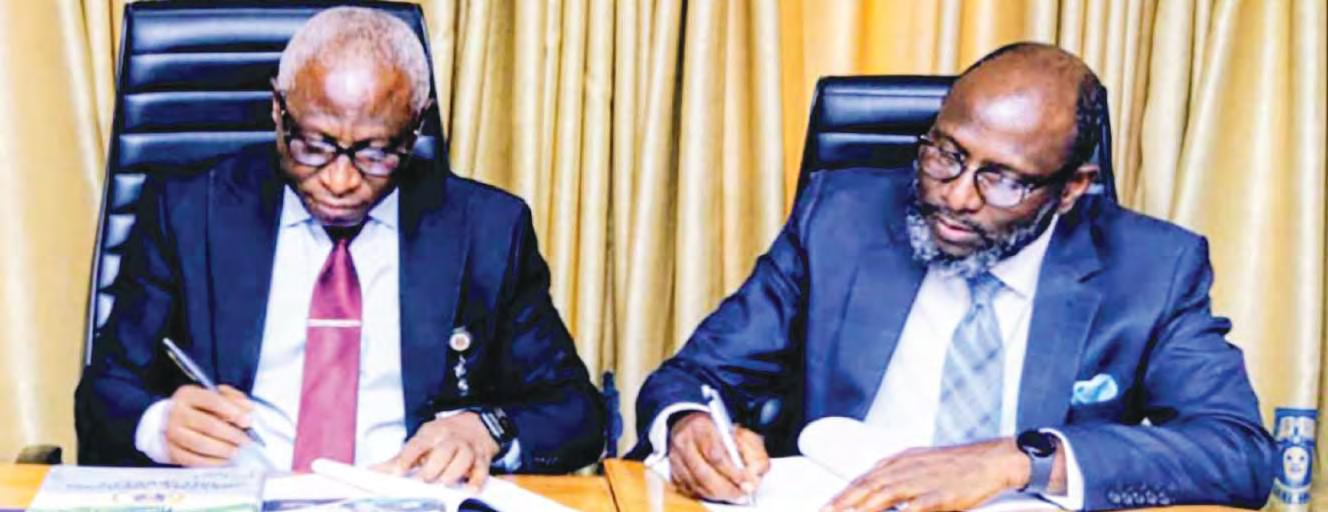
L R: Vice Chancellor, Obafemi Awolowo University (OAU), Prof. Adebayo Bamire; and Executive Director, Corporate Services, Origin Tech Group Nigeria, Mr. Olusesan Ayeni, during the signing of the partnership agreement via a Memorandum of Understanding (MoU) for the establishment of a Centre of Excellence in Agriculture in OAU, Ile Ife, Osun State… recently
Emmanuel Addeh in Abuja
To ensure statutory coherence, energy expert and Chair of Oil, Gas, and Energy Policy Forum, Prof. Emeritus Wunmi Iledare, has urged President Bola Tinubu to engage federal lawmakers and other stakeholders on the recent executive order restructuring oil
and gas revenue remittances to the Federation Account.
In a note yesterday, the Executive Director of Emmanuel Egbogah Foundation (EEF), said he had reviewed the order, explaining that it represents a significant fiscal intervention within Nigeria’s petroleum governance framework. Besides, he explained that it signals a renewed effort to strengthen revenue transparency, reduce discretionary retention, and improve statutory remittances to the three tiers of government.
implementation guidelines to safeguard contractual obligations.
“We therefore encourage: Prompt legislative consultation to ensure statutory coherence; transparent stakeholder engagement with operators and investors; clear
A sequenced reform approach that balances fiscal urgency with institutional stability,” the professor argued.
He acknowledged the administration’s stated objectives, including safeguarding public revenues, curbing inefficiencies,
The Alternative Bank (AltBank) has strengthened its support for Micro, Small and Medium Enterprises (MSMEs) by addressing one of the most persistent barriers to business growth which includes cash friction, missed transfers, delayed payments, weak transaction records, and limited credit history.
At the 47th Kaduna International Trade Fair, the Bank moved beyond advocacy by deploying more than 300 free Point-of-Sale (POS) devices to MSMEs operating across trade, retail, and service clusters.
It says the initiative is designed to help merchants transition more quickly to traceable digital payments.
Speaking at the event, Executive Director, Commercial and Institu-
tional Banking (South and Central) Garba Mohammed, stressed the need for practical interventions that enable small businesses to operate efficiently and build sustainable growth pathways.
Addressing business leaders, entrepreneurs, traders, members of the Kaduna Chamber of Commerce, Industry, Mines and Agriculture (KADCCIMA), and government officials at the Kaduna International Trade Fair Complex, Mohammed who was represented by AltBank’s Head of Corporate Social Investment, Solomon Okonkwo, noted that while policy reforms provide direction, real economic progress occurs when businesses gain access to structured financial systems and modern payment infrastructure.
“Reforms set direction. But reforms alone are not results,”
he said. “Results happen when MSMEs are formalized, transactions are traceable, and businesses can access finance without friction.”
He noted that MSMEs account for more than 96 percent of businesses in Nigeria and employ over 80 percent of the workforce, yet access to finance and digital infrastructure remains a major constraint, particularly in NorthernBeneficiariesNigeria.were onboarded instantly and integrated into digital transaction systems designed to improve efficiency, reduce cashhandling risks, generate verifiable payment records, and strengthen their eligibility for future financing.
“An MSME that cannot accept digital payments is structurally limited. Our responsibility is not to make speeches about inclusion,
Adedayo Akinwale in
The Inspector-General of Police, Kayode Egbetokun, has said the security landscape in Nigeria demanded continuous improvement, adding that threat actors were becoming increasingly sophisticated. Egbetokun made this known in Abuja at a meeting with the Chairman of the House of Representatives Committee on Petroleum Resources (Downstream), Hon. Imo
Ugochinyere. The meeting formed part of ongoing engagements between security agencies and the National Assembly aimed at fortifying the downstream petroleum sector against vandalism, theft and other forms of economic sabotage.
“The security landscape in Nigeria demands continuous improvement. Threat actors are becoming increasingly sophisticated, and we must match that sophistication with
intelligence-driven policing and advanced operational capacity,” he stated.
Egbetokun emphasised that effective protection of the downstream sector could not be achieved without robust legislative backing, particularly in the area of funding.
“To effectively confront these challenges, legislative support to improve funding for the Nigeria Police Force and indeed other security agencies is indispensable,” he added.
but to provide the infrastructure that enables it,” Mohammed said.
He added: “The free POS terminal offering does not end at the Trade Fair complex. Eligible MSMEs can access the service at our branches in Kaduna and nationwide. Our goal is to remove bottlenecks that limit business growth and bring more entrepreneurs into the formal financial ecosystem.”
The bank also commended KADCCIMA and the Kaduna State Government for sustaining a platform that promotes enterprise development and regional commerce, reaffirming its commitment to long-term partnership in support of MSMEs.
and enhancing fiscal discipline, particularly in a period of budgetary strain and debt sustainability concerns.
Strengthening remittance accountability and improving visibility of petroleum inflows to the Federation Account, he said, are legitimate public finance priorities.
However, Iledare argued that certain aspects of the Executive Order intersect directly with provisions of the Petroleum Industry Act (PIA) 2021, explaining that the Frontier Exploration Fund (FEF) the Midstream and Downstream Gas Infrastructure Fund (MDGIF), and existing Production Sharing Contract (PSC) fiscal structures are statutory constructs established by the National Assembly.
“While executive authority under Section 5 of the Constitution empowers the President to implement and enforce laws, PEWI observes that substantive alterations to statutory fiscal frameworks may require legislative amendment to ensure constitutional alignment and institutional certainty.
“PEWI further notes the technical importance of distinguishing between: Contractual revenue allocations embedded in PSC agreements, Corporate retained earnings of NNPC Limited, and Statutory earmarked funds
created under the PIA. Clarity in these distinctions is critical to avoid conflating contractual entitlements with discretionary fiscal practices,” he stressed.
On the question of direct remittance of royalty oil, tax oil, and profit oil to the Federation Account, he recognised the potential benefits in enhancing transparency and reducing intermediation. However, implementation, he said, must be carefully sequenced to preserve contractual stability and avoid unintended legal or investor confidence challenges.
He also observed that the structural dual role of NNPC Limited as both commercial operator and concessionaire under certain arrangements has long presented institutional tensions within the post-PIA framework, explaining that any reform aimed at reinforcing NNPC’s commercial identity must be anchored in legal clarity and predictable governance mechanisms.
“Nigeria’s petroleum sector remains central to national economic stability. Reforms that improve transparency and fiscal integrity are welcome. However, sustainable reform must align with constitutional processes, statutory frameworks, and investor predictability,” Iledare stated.
Concerned stakeholders have pleaded with Governor Monday Okpebholo of Edo State over the prolonged delay in payment of pen- sion shortfalls to retired Permanent Secretaries under the Contributory Pension Scheme (CPS) in the state.
Sources within the civil service maintain the governor whose administration has consistently demonstrated commitment to the timely payment of salaries and pensions to serving and retired workers may not be aware that retired permanent secretaries are
experiencing delays of up to seven months.
Investigations reveal that a memo authorising the release of outstanding pension shortfalls, along with a proposal concerning their migration back to the Defined Benefit Scheme (DBS), is yet to be forwarded to the governor for approval.
Insiders say the document has overstayed in the Office of the Head of Service.
Under the Pension Reform Act 2014, Permanent Secretaries enrolled in the Contributory Pension Scheme (CPS) are entitled to retirement
benefits based on their Retirement Savings Accounts (RSAs). Where the RSA balance falls short of their full statutory entitlement, the employer is legally required to fund the deficit through budgetary allocations.
Guidelines issued by the National Pension Commission further provide that such shortfalls must be paid promptly to ensure retirees receive their full benefits without undue delay. Pension experts note that once provisions have been made in the budget, administrative processes should not hinder disbursement.
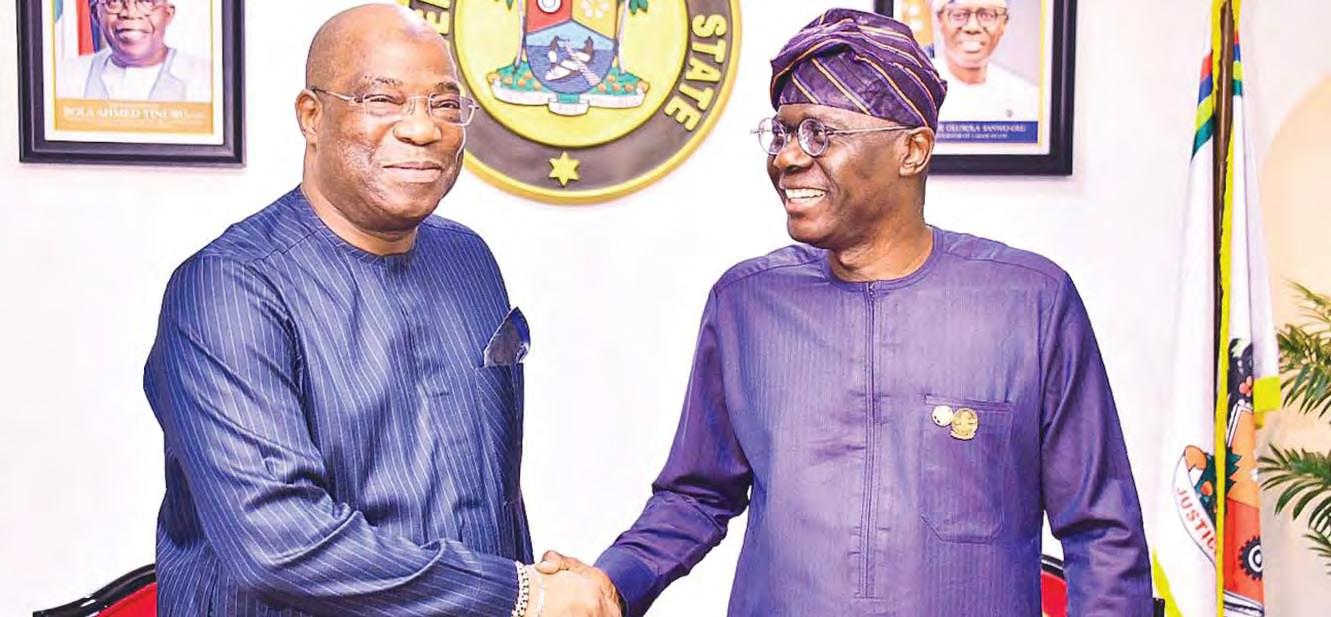
New Board Chairman, Lagos State Sports Trust Fund, Mr Enitan Oshodi (left) and Governor of Lagos State, Mr. Babajide Sanwo-Olu during the inauguration of new board for the Sports Trust Fund, at the Lagos House, Marina, on Wednesday
a big relief to our people, says gov CDS seeks public support for operation
Operation Savannah Shield officially took off in Kwara State on Thursday, in what is a combined effort of the government and security forces to rout “all enemies of state” in Kwara and neighbouring states.
The flag-off was done by Governor AbdulRahman AbdulRazaq, the Chief of Defence Staff, General Olufemi Olatubosun Oluyede, and the Chief of Army Staff Lieutenant General Waidi Shaibu at the Sobi Barracks in Ilorin, the headquarters of the multiagency operations which President Bola Ahmed Tinubu had approved for Kwara in the wake of the deadly terrorist attack in Kaiama and parts of Niger State a few weeks ago.
Governor AbdulRazaq commended the president for the swift response to his distress call on the activities of terror groups and other criminal networks such as kidnapping gangs. He called the take-off of the operations a big relief to the people of the state, saying the banditry and terrorism are not just about the national security but a big threat to food security because the most affected areas are among the farming belts of the country.
His words: “Let me first of all thank the Commander in Chief President Bola Ahmed Tinubu for the deployment of Operation Savannah Shield which will cover the entire Kwara State and parts of Niger State. This is a great relief.
“We have seen the escalation of bandit activities especially in Kwara North, South and parts of Niger State over the past one year. But we have also seen that the security agencies have stepped in and the situation in Kwara South has vastly improved. Kwara North remains a greater challenge, and that is why we have Operation Savannah Shield being inaugurated today.
“One is really impressed at the short time this deployment has taken place. I thank the Chief of Defence Staff for making this happen very quickly. We are truly relieved and people will sleep better now.
“One could go on and on about the challenges that we face but these go beyond national security. We are driving into the road of food security because the vast area in which this operation command will cover is our farming belt and farmers have been challenged with the ongoing disturbances. But you
have brought relief to us and we truly appreciate it.”
In a brief interview with reporters when the CDS visited the governor in Ilorin on Thursday, he said: “I am here in Kwara; first, to visit His Excellency and to personally commiserate with him over some recent occurrences; and to inform him that we are here to see how we can checkmate all
the atrocities committed by the enemies of state.
“So, we are here to flag-off a joint task force nicknamed Operation Savannah Shield and under that umbrella we’ll have the Army, Navy and Air Force components and we believe that with our robust approach we should be able to checkmate the activities of these enemies of state going forward.
That’s simply why I’m here.”
The CDS said the operation is a proactive kinetic response to end kidnapping and related criminal activities in Kwara State, adding that the troops will sweep through the Kainji National Park to dislodge terrorist networks in the forests.
“Operation Savannah Shield is a proactive and coordinated response.
The joint task force will cover the
entire Kwara state and parts of Niger state,” he said.
“Its primary mandate is to secure lives and property, neutralise terrorist and criminal elements, disrupt kidnapping networks and restore law and order within the joint operational area. This operation will be intelligencedriven, community-focused and inter-agency in execution.
A pro Tinubu political group, the South East Renewed Hope Agenda (SERHA), has embarked on a scholarship scheme that will purchase the Joint Admissions and Matriculation Board (JAMB) registration forms for 10,000 indigent students in Imo State, as part of a broader 50,000 indigent student programme across the South East.
Speaking at the unveiling of the project in Owerri on Thursday, SERHA National Coordinator,
Mr. Belusochukwu Enwere, said the initiative, backed by President Ahmed Tinubu’s Renewed Hope Agenda, aims to ameliorate financial burden some parents face towards securing higher education for their children, noting “each scholarship covers the full cost of JAMB registration, giving 10,000 deserving students per state the chance to step confidently into university or polytechnic.”
The 50,000 scholarship package, he explained would be shared equally among Abia, Anambra,
Ebonyi, Enugu and Imo, describing the scheme as a partnership between public leadership and private philanthropy, citing “Chidi’s generous vision” as a key driver. He urged beneficiaries to “seize this launchpad, study with passion and dream with audacity,” while calling on parents, educators and community leaders to support the students.
According to him, SERHA’s programme aligns with Tinubu’s national education agenda, which includes student loans and school
Bennett Oghifo
As International Women’s Day (IWD) approaches, Wema Bank has announced plans to host its 2026 IWD Grand Event on March 4, 2026. The bank, Nigeria’s oldest indigenous financial institution and pioneer of Africa’s first fully digital bank, ALAT, said this year’s celebration is inspired by the global IWD 2026 theme, “Give To Gain.”
The event will be held under the sub-theme, “When Women Gain, We Grow,” focusing on the importance of supporting women and amplifying the impact of sustained efforts toward gender inclusion.
Announcing the event, the Managing Director and Chief Executive Officer of Wema Bank, Moruf Oseni, reaffirmed the institution’s commitment to advancing women’s inclusion and empowerment. According to him, the bank
has consistently prioritised gender inclusion through deliberate initiatives and tailored opportunities for women.
He noted that empowering women is central to building a thriving society, adding that the launch of the bank’s women-focused proposition, SARA by Wema, in 2019 reflects its long-standing dedication to promoting gender equality in line with the United Nations Sustainable Development
Goal 5 (SDG 5).
Oseni described the 2026 IWD theme as particularly significant to the bank, stating that its continued investment in women has revealed the transformative potential women hold both personally and professionally.
He explained this year’s event is designed to spotlight and celebrate impact while encouraging individuals and institutions to prioritise meaningful support for
women in everyday actions and large-scale initiatives alike.
The 2026 IWD event will convene women from diverse industries and sectors, alongside emerging female leaders and professionals navigating contemporary challenges.
The gathering aims to provide a platform for networking, knowledge sharing, access to opportunities, and dialogue on shared and differing experiences, all toward reinforcing the value of investing in women.
infrastructure upgrades.
Enwere said the South East, known for its entrepreneurial spirit, will use the scholarships to nurture future leaders, engineers, doctors and innovators.
The event drew government officials, traditional rulers, private sector partners and hundreds of students, who welcomed the intervention as a timely boost for families struggling with the cost of tertiary education entry.
SERHA pledged to monitor and mentor recipients to ensure the scholarships translate into tangible academic success.
“SERHA, your dedication to uplifting the next generation echoes the very essence of Igbo ingenuity: onye aghala nwanne ya: no one leaves a brother or sister behind.
On behalf of President Tinubu and the entire SERHA family, I extend our deepest gratitude to you for fueling this engine of change.
“President Tinubu, in his wisdom, has made education a cornerstone of the Renewed Hope Agenda. From the Student Loan Scheme to infrastructure revamps in our schools, his administration is weaving a tapestry of progress that includes every region, every tribe, every child.

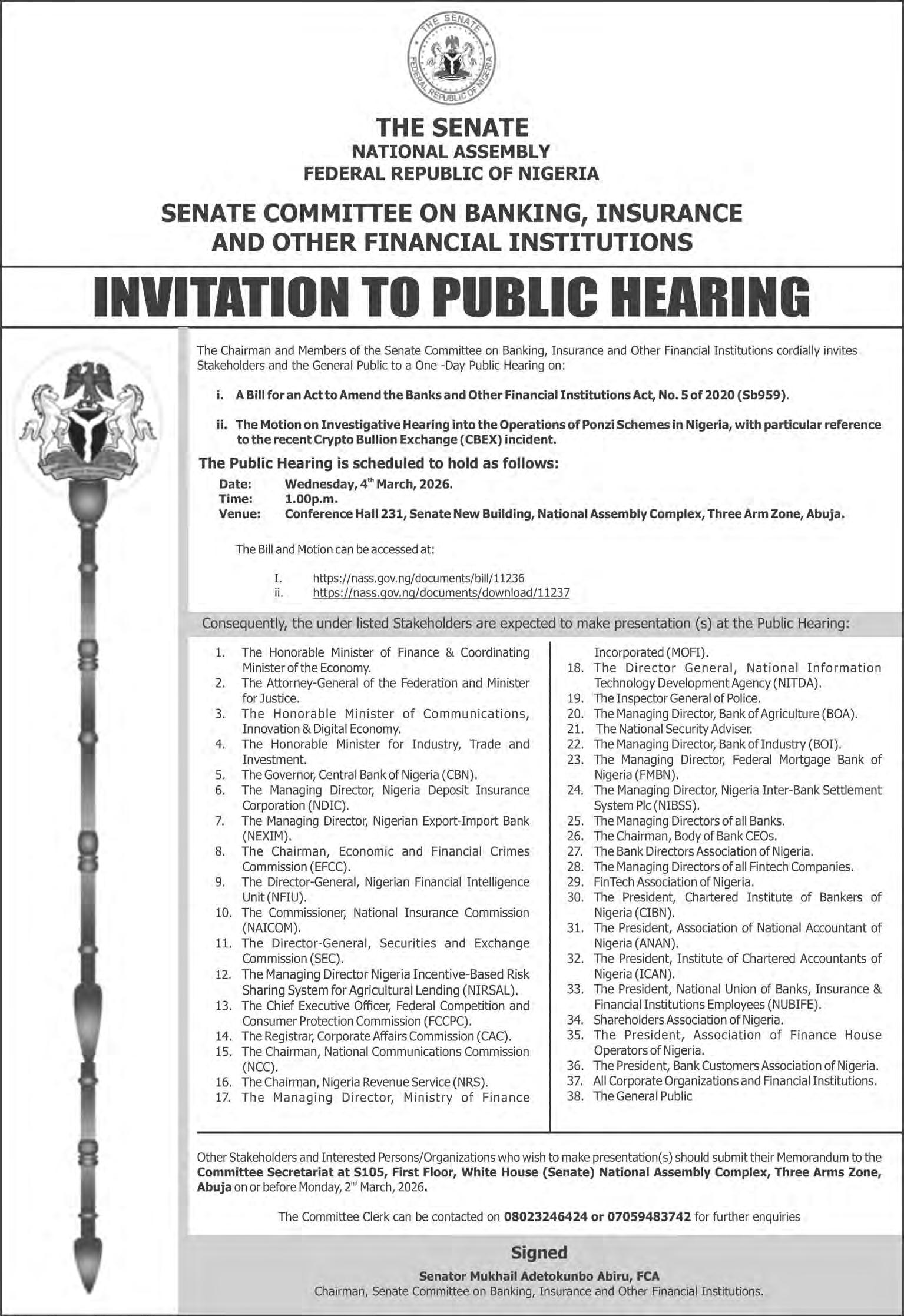
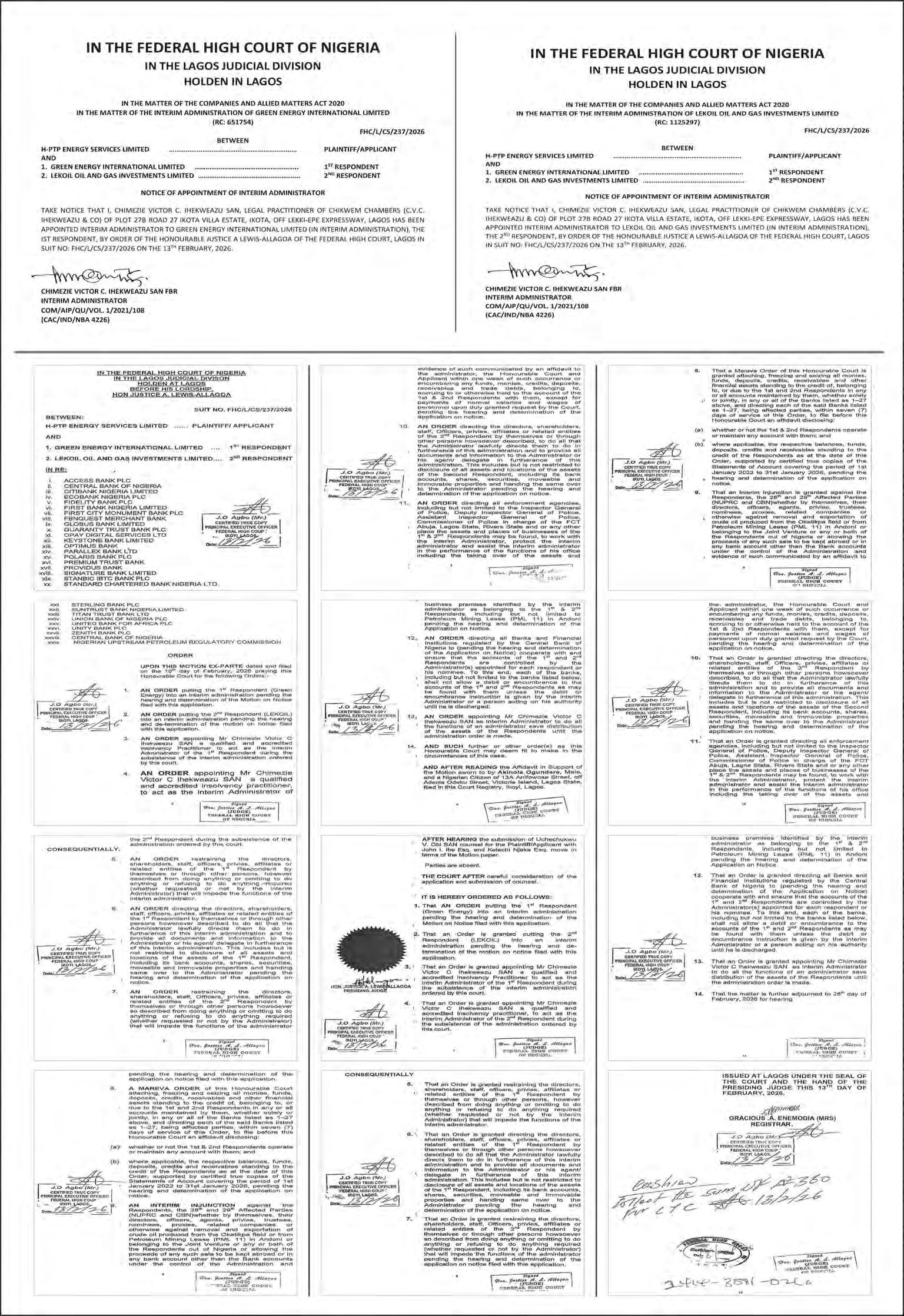
At the Supreme Court, where legal doctrine often intersects with commercial reality, Neconde Energy Limited has placed before the apex court a dispute that could redefine the limits of receivership and corporate self-representation in Nigeria. In Appeal No: SC/ CV/48/2026, the company poses a seemingly simple yet far-reaching question: can a company under receivership be stripped of the right to appoint its own counsel when the validity of that receivership is itself under judicial challenge? Wale Jacobs writes
Ehat began as a commercial dispute involving an oil asset has evolved into a constitutional and corporate law contest with significant implications for secured lending, insolvency practice, and access to justice. At the heart of the matter is Neconde’s insistence that receivership does not extinguish corporate personality, nor does it silence a company in proceedings that determine its fate.
This high-stakes legal battle, is expected to have far-reaching consequences for corporate insolvency, lender enforcement, and company law in Nigeria.
The dispute arose from the alleged approximately $1 billion indebtedness of Nestoil to a consortium of lenders. The Lenders allegedly also took a second ranking charge over an oil Asset belonging to Neconde, as part of security for loan. Following an alleged default on repayment obligations by Nestoil, a Receiver/Manager was appointed to take control of both companies’ operations and assets, including oversight of their financial affairs and legal representation. The appointment immediately became a flashpoint, as the companies’ promoters and management sought to maintain some degree of control—particularly in instructing legal counsel to represent them in ongoing proceedings.
The core legal question became whether a company retains the residual power to appoint its own counsel during a receivership, especially when the validity of the Receiver’s appointment is itself under judicial challenge.
Neconde, through a legal team led by Chief Wole Olanipekun, SAN, alongside Bode Olanipekun, SAN, Mofesomo Tayo-Oyetibo, SAN, and four other senior lawyers, insisted on the right to engage counsel independently of the Receiver. The team argued that the companies, as separate legal entities, retained residual powers to act, sue, and be sued under the Companies and Allied Matters Act (CAMA), notwithstanding the receivership.
They contended that excluding them from appointing counsel would undermine their fundamental rights as corporate entities and potentially prejudice their interests in the ongoing financial and contractual disputes.
In response, the Receiver/Manager Abubakar Sulu Gambari SAN appointed by the lenders represented by FBN Quest Merchant Bank Ltd and FBN Trustees Ltd argued that, once a receivership is triggered, the company’s power to instruct counsel transfers exclusively to the Receiver. Any independent legal instruction by the company or its promoters, the Receiver asserted, could conflict with the overarching mandate of the receivership and compromise the integrity of the enforcement process.
The dispute over legal representation became so critical that the Supreme Court intervened. In an earlier directive, the apex court ordered all parties to return to the Court of Appeal to resolve the contentious issue of counsel representation before reporting back on 26 January 2026. This instruction aimed to clarify procedural authority within the receivership and ensure further litigation adhered to the proper legal framework.
The Court of Appeal delivering its ruling on Friday, 23 January 2026, stated that the Receiver/ Manager has exclusive authority to appoint counsel on behalf of the companies. In that ruling, the appellate court explicitly disqualified Chief Wole Olanipekun, SAN, and Muiz Banire, SAN, from representing Neconde and Nestoil, respectively. The court reasoned that allowing directors or promoters to brief separate counsel while a receiver is in place would undermine the essence of receivership and
could lead to conflicting legal strategies, compromising creditor interests.
The Court of Appeal stressed that a Receiver/ Manager, once appointed, assumes comprehensive responsibility for the management of the company’s assets and legal affairs—including the engagement of lawyers to represent the company.
Dissatisfied with the Court of Appeal’s ruling, Neconde and Nestoil sought recourse at the Supreme Court. They argued that the lower court failed to recognise a key exception under Nigerian law: when the validity of a Receiver’s appointment or the scope of their powers is under judicial challenge, the company retains the right to appoint counsel to protect its interests.
From the outset, Neconde has maintained that its obligations under the relevant security instruments had not crystallised. The company argues that the charge relied upon by the respondents, (FBNQuest Merchant Bank Limited and First Trustees Limited) was subordinate, expressly designated as secondranking, and therefore incapable of justifying enforcement steps as drastic as receivership without prior exhaustion of senior security rights.
Even the holders of the senior security rights , allege that the junior second – ranking security charge was created without their consent and is therefore invalid.
A central plank of Neconde’s appeal is a forensic examination of the deed of charge. Clause 1.4 acknowledges Neconde Energy Limited as a significant player in Nigeria’s upstream oil and gas sector, with interests tied to Oil Mining Lease 42. The dispute arose when the first and second respondents—FBNQuest Merchant Bank Limited and First Trustees Limited, acting as facility agents for a consortium of creditors—purportedly appointed Abubakar Sulu-Gambari, SAN, as receiver-manager over certain Neconde assets, including OML 42
joint venture contracts.
The respondents argued that the appointment flowed naturally from the security documents allegedly executed by Neconde in relation to certain financing arrangements. Neconde, however, insists that the appointment was premature, legally unfounded, and inconsistent with the express terms of the security documents, which explicitly subordinated the charge to senior security instruments.
Accordingly, Neconde argues that it does not owe the Nestoil Lenders and also that its obligations under the alleged second- ranking security charge had not crystallised. Therefore, there was no lawful basis for the lenders acting through FBN Quest and First Trustees to appoint a receiver. Importantly, it contends that where the receivership’s foundation is disputed, the law cannot proceed on the assumption that the receiver’s powers are valid and unassailable.
The dispute entered the judicial arena when the respondents filed an originating summons before the Federal High Court in Lagos, seeking declarations on the receivership and the receiver’s powers.
Neconde responded by filing a joint preliminary objection, spanning pages 1780 to 1835 of Volume 4 of the record.
The objection challenged the competence of the action, the validity of the receiver’s appointment, and the enforceability of the security documents.
Of particular note was a relief seeking suspension of the receiver—an assertion that Neconde viewed the receivership as legally infirm and incapable of withstanding judicial scrutiny.
Neconde also highlighted that the alleged obligations under the security documents had not crystallised. The respondents, Neconde argued, were attempting to enforce immature rights through receivership rather than through legally justified remedies.
It was against this backdrop that the procedural battle over who could appoint counsel emerged. While the validity of the receivership was being contested, the respondents maintained that only the receiver could instruct counsel, a position Neconde emphatically rejected. The company asserts that Nigerian law does not preclude a company under a contested receivership from appointing counsel to represent it in proceedings questioning the receiver’s authority. This assertion forms the doctrinal spine of the appeal now before the Supreme Court.
Uncontested valid receiverships does affects directors’ powers. Upon valid appointment, certain managerial powers are suspended to enable a receiver to carry out their mandate. But where the appointment is invalid or contested, there lies an issue. Indeed, the Federal High Court acknowledged that the suspension of directors’ powers during receivership is not absolute. It is therefore argued that this principle should have been the starting point for judicial analysis, not the conclusion. Legal experts point to the well-established exception that, when a receiver’s appointment or authority is contested, directors retain residual powers, chief among them the authority to appoint counsel.
They stress that a company retains rights, obligations, and procedural capacities during receivership. To suggest it cannot appoint counsel to defend itself in proceedings that challenge the receiver’s authority, is to deny the company’s existence for the duration of the dispute.
The appeal also raises fundamental fairness issues. The same respondents who appointed the receiver also placed the receiver’s powers before the court for judicial determination. Neconde argues it would be unjust to insist that the receiver alone can appoint counsel, as this would allow the receiver to control the defence in a case questioning their own legitimacy.
Denying the company the right to independent counsel, Neconde submits, undermines its constitutional right to fair hearing. A company unable to choose its legal representation in proceedings that determine its rights, assets, and future is effectively denied meaningful access to justice.
While the Court of Appeal in its ruling acknowledged the principle that directors’ powers are not absolutely suspended, they allegedly failed to give effect to the exception preserving directors’ residual authority when receivership is contested. Neconde contends this led to the erroneous conclusion that only the receiver could appoint counsel. Now before the Supreme Court, the case carries heightened significance. Represented by a formidable team led by Chief Wole Olanipekun, SAN as lead counsel, Neconde seeks clarity on a legal principle with broad implications for future receiverships and enforcement actions across Nigeria.
The outcome is likely to resonate beyond Neconde, Nestoil and its creditors. For lenders, it reinforces that enforcement powers, however robust, are not immune from judicial scrutiny. For companies, it underscores that corporate voice and autonomy cannot be extinguished by a disputed receivership. Ultimately, Neconde Energy’s appeal asks whether receivership, as powerful as it is, can erase corporate personality or the right to appoint counsel to defend the company.
The case stands poised to become a defining authority on receivership, residual powers, and the right to counsel in Nigeria’s corporate and commercial jurisprudence.
…truth behind the headlines, conspiracies, cover-ups, trials and triumphs
There is a particular kind of humiliation that belies drama. It slips in quietly, somewhere between boarding gate announcements and the stale chill of recycled cabin air. It is the humiliation of realising, yet again, that the rules change when the flight departs from Lagos, Abuja or Port Harcourt. That the same airline which treats you like a valued global citizen in London, Dubai, Morocco, or Atlanta suddenly regards you as excess baggage the moment your journey originates from Nigeria.
I have flown enough to know the difference between turbulence and turbulence of attitude. I have experienced the polished charm of airline hospitality abroad and then braced myself for the subtle downgrade that seems to occur on the return leg home. And before anyone accuses me of exaggeration, let me say this: this is not an isolated complaint from one disgruntled passenger nursing a bruised ego. This is a pattern whispered in lounges, dissected at dinner tables in Ikoyi and Maitama, and exchanged knowingly among frequent flyers who have memorised seat maps and aircraft codes like second languages.
Something shifts when the departure board reads Nigeria.
Let us begin with the obvious theatre of disparity. On flights inbound to Nigeria from global hubs, you are likely to find newer aircraft, cleaner cabins, crew members who smile with their eyes, and service that, while not extraordinary, is competent and courteous. The wine is poured without attitude. The requests are handled without sighs. You feel, if only briefly, like the fare you paid meant something. Then comes the outbound experience. The plane is suddenly older, the cabin visibly tired. The seats recline with reluctance. The overhead bins look like they have survived a minor war. The entertainment screens blink with a nostalgia no one asked for. It is as if the airline rummaged through its fleet and decided that Nigeria could manage with the aircraft equivalent of a hand-me-down. We notice these things. Nigerians are not naïve travellers dazzled by winged machinery. Many of us have flown extensively. We know what a well-maintained Boeing or Airbus feels like. We know when an aircraft has been rotated from prime routes to secondary ones. We know the difference between industry-standard service and what I can only describe as operational indifference.
And please, let us retire the convenient excuse about infrastructure. Yes, Nigeria may not accommodate the double-decker spectacle of the A380 in every airport, but that is hardly the issue. No one is demanding chandeliers at 35,000 feet. What we are asking for is parity. The inability to host a particular aircraft model does not justify assigning visibly older, poorly maintained planes to Nigerian routes when newer options exist within the same fleet category. What stings most, however, is not the age of the aircraft but the atmosphere onboard. There is a subtle recalibration of tone once the manifest is predominantly Nigerian. Courtesy becomes conditional. Warmth becomes scarce. Economy class passengers in particular are treated like an inconvenience that must be endured rather than customers who have paid, often dearly, for the right to occupy their seats.
Let us talk about fares, because money has a way of clarifying hypocrisy. Nigerians frequently pay comparable, sometimes higher, prices for tickets than passengers departing from Europe or the Middle East on similar routes. Exchange rates are unforgiving. Taxes are layered. Demand is high. Yet the product delivered often feels discounted. Why does the service shrink when the revenue does not?
There is a quiet hierarchy in the skies. Business and first-class passengers, regardless of nationality, tend to receive a baseline of respect because their tickets command it. Even then, I have heard stories of subtle shifts in attitude when the cabin is filled with Nigerians in premium seats. The surprise on some faces when a Nigerian passenger requests a particular wine or inquires about meal ingredients can be faint but detectable, as though sophistication were an imported trait rather than an indigenous reality. In economy class, the disparity is harder to disguise.
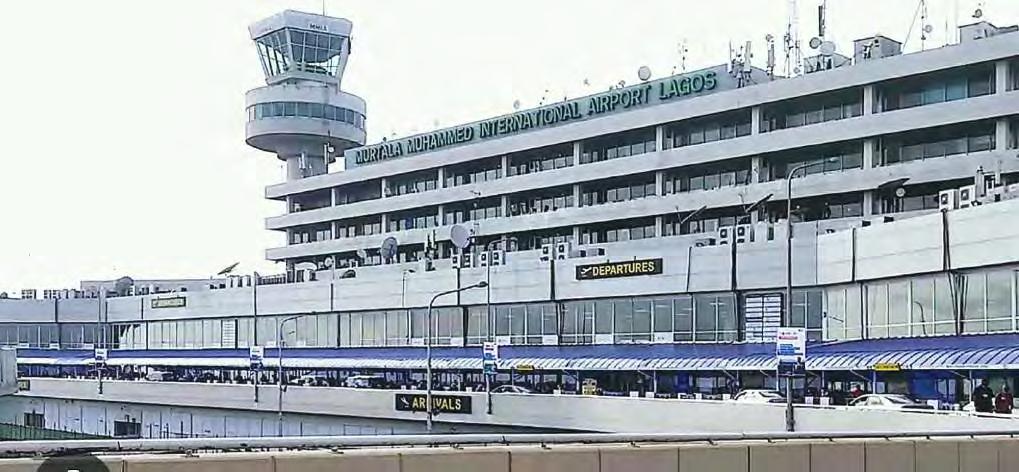
MurtalaMuhammedInternationalAirport,Lagos
Announcements are barked rather than delivered. Questions are met with impatience. Requests for basic amenities are treated as bothersome interruptions. There is a performative politeness that barely conceals irritation. And while airline staff everywhere deal with difficult passengers, it is disingenuous to suggest that such challenges are unique to Nigeria. Yes, let us address the elephant in the cabin. Some Nigerian travellers carry ambitious hand luggage. Some argue loudly on their phones until the aircraft door is practically closing. Some test the limits of baggage allowances with admirable creativity. These habits can frustrate crew members and disrupt boarding efficiency. I have seen it. I have winced at it.
Anyone who has flown out of New York during peak season or navigated a crowded European holiday route knows that entitlement and excess are global traits. Airlines train their staff precisely to manage such scenarios with professionalism. Operational challenges do not excuse collective disdain.
There is a difference between enforcing rules and wielding them as weapons. On certain outbound flights from Nigeria, the line blurs. Luggage is policed with a zeal that feels punitive. Tone becomes sharp. Smiles evaporate. The message, implicit but unmistakable, is that you are fortunate to be here at all.
And that is where the insult crystallises. Nigeria is not a charity case in global aviation. It is one of Africa’s largest travel markets. Our diaspora is vast and mobile. Our business class is robust. Our appetite for international travel is not a passing trend but an established fact. Airlines compete fiercely for Nigerian passengers because we fill seats consistently. We sustain routes. Yet the respect accorded to us does not always reflect this commercial reality.
I have often wondered whether this disparity is the result of internal route economics, where airlines assume that Nigerian demand is relatively inelastic and therefore less sensitive to service variations. If passengers will continue to fly regardless, the incentive to maintain premium standards weakens. It is a cold calculus, but corporations are not sentimental institutions.
There may also be unconscious bias at play, a residual cocktail of stereotypes about African travellers that quietly informs expectations and behaviours. The assumption that standards can be relaxed because complaints will be muted or fragmented. The belief that indignation will dissipate in private conversations rather than coalesce into sustained consumer pressure.
But Nigerians are not as passive as some airlines might hope.
Social media has become an unofficial tribunal. Stories of shoddy treatment travel faster than aircraft. Photographs of outdated cabins, screenshots of dismissive responses, and detailed accounts of poor service circulate widely. The brand damage is real, even if airlines prefer to measure impact in quarterly reports rather than reputational bruises.
What fascinates me is how inbound flights often tell a different story. When crew members board in Paris, Frankfurt, New York, Kigali, London or Doha for the leg to Lagos, the service frequently aligns with global norms. The same airline, the same corporate manual, the same brand promise. The contrast suggests that the problem is not structural incapacity but selective execution.
Which raises uncomfortable questions. Are the crews flying to and from Nigeria given the same training and oversight as their counterparts abroad?
Are aircraft rotations to Nigeria influenced by internal hierarchies of route prestige? Is there an implicit ranking system in which certain destinations are deemed worthy of flagship service while others are assigned leftovers?
We deserve transparency on these issues.
This conversation is not about wounded pride; it is about consumer rights and market dignity. When you pay for a service, you are entitled to the standard advertised, not a diluted version calibrated to your passport. The global aviation industry prides itself on consistency. A brand that promises excellence cannot afford to deliver it selectively.
I also believe that part of the responsibility rests with us. Nigerians are quick to adapt to inconvenience. We shrug, laugh, and move on. We normalise what should be unacceptable. We tell ourselves that at least we arrived safely, as though safety and dignity are mutually exclusive luxuries. We do not escalate complaints systematically. We rarely demand accountability beyond fleeting outrage.
Airlines notice this tolerance.
Imagine if Nigerian passengers documented disparities meticulously, lodged formal complaints consistently, and leveraged consumer protection channels strategically. Imagine if corporate offices were inundated with structured feedback rather than sporadic rants. Markets respond to organised pressure.
There is also a role for regulators. Aviation authorities in Nigeria must be more assertive in monitoring not just safety compliance but service standards on international routes. Bilateral air service agreements are not merely about frequencies and landing rights; they are about reciprocal respect. A country that provides market access should expect fair treatment of its citizens.
Some will argue that this is an overreaction, that service variability is a global phenomenon and not uniquely Nigerian. To them I say: frequency matters. Patterns matter. When the same downgrade appears consistently on flights departing from one country, it ceases to be anecdotal.
I remember a particular journey from Lagos to a European capital. The aircraft felt weary before we even taxied. The cabin crew moved with a stiffness that suggested they were enduring rather than serving.
A simple request for water was met with visible irritation. Yet on the connecting flight onward to North America, the atmosphere transformed. Smiles reappeared. Attentiveness returned. The difference was so stark it felt choreographed.
I found myself wondering whether respect, in aviation, is geographically assigned.
Let us be clear: this is not an indictment of every airline or every crew member. There are professionals who uphold standards regardless of route. There are flights departing Nigeria that meet expectations. But the inconsistency itself is the problem. A global brand should not feel like a lottery.
The tragedy of this disparity is psychological as much as practical. Travel is inherently vulnerable. We surrender control at airports. We trust strangers with our safety. We sit in confined spaces for hours, dependent on the competence and goodwill of others. In that suspended world above the clouds, dignity matters profoundly.
When an airline communicates, subtly or overtly, that your comfort is secondary because of where you began your journey, it chips away at something deeper than brand loyalty. It reinforces a hierarchy of worth that many Nigerians already battle in global spaces.
I am not asking for special treatment. I am asking for equal treatment. Airlines must confront this issue honestly by auditing aircraft allocations to Nigerian routes. They can evaluate crew performance metrics comparatively across departure points, solicit anonymous passenger feedback specifically on outbound experiences and publish commitments to service parity and track compliance.
The commercial logic is compelling. Nigeria’s travel market will only expand. A rising middle class, a dynamic diaspora, and increasing business connectivity make our skies lucrative. Airlines that treat Nigerian passengers with respect will not merely earn revenue; they will secure loyalty. And loyalty, in aviation, is gold. For Nigerian travellers, the task is to demand better without theatrics but with persistence. Travellers should document experiences, engage airlines formally and support carriers that demonstrate consistency. Nigerian travellers should, henceforth, refuse to internalise substandard treatment as inevitable.
We are not excess cargo. We are customers. The runway from Nigeria should not be a corridor of diminished expectations. It should be a departure point like any other in the global network, governed by the same standards, animated by the same professionalism, and infused with the same respect. Until that parity becomes routine rather than exceptional, I will continue to raise this inconvenient conversation in drawing rooms and departure lounges alike. Because dignity at 35,000 feet is not a luxury add-on. It is part of the ticket price. And Nigerians, whatever cabin we occupy, have paid in full.
Acting Group Politics Edito r DEJI ELUMOYE
Email: deji.elumoye @thisdaylive.com
08033025611 sM s On LY

ambassador-designate from Kogi state, dr. Sanusi abubakar, who is a seasoned private-sector player with over three decades of experience in business management and strategic leadership, in this interview, speaks on Nigeria’s evolving diplomatic and economic engagements culminating in the nation’s global image changing for good. Folalumi Alaran brings excerpts:
Many people still judge Nigeria by past occurrences. Do you think the country’s image is really changing?
Yes, I believe it is changing—slowly, but positively. A very recent example is the comment made late last year by President of the United States, Donald Trump, describing Nigeria as a “country of particular concern.” That remark attracted global attention and understandably raised questions about Nigeria’s standing. What is important, however, is not the label itself but how Nigeria responded. Since then, Nigeria has strengthened engagement with the United States through structured security cooperation, intelligence sharing, and joint efforts on regional stability. You do not move from being publicly labelled a concern to being treated as a partner unless deliberate diplomatic work is done. That shift was intentional, timely, and instructive.
Beyond the United States, where else do you see evidence of this recalibration?
We are seeing it in Nigeria’s renewed engagement with key global partners. Recent collaborative diplomatic and economic engagements with Turkey and the United Kingdom are good examples.
These were not ceremonial visits. Discussions focused on practical areas—trade, defence cooperation, energy, manufacturing, and investment. When countries like Turkey, now a major global manufacturing and defence hub, or the UK, Nigeria’s longstanding partner, engage Nigeria at that level, it reflects confidence not just in Nigeria’s diplomacy, but also in its economic direction.
How much of this shift is connected to the current administration?
A great deal of it. Under President Bola Tinubu, there is a clearer alignment between diplomacy and economics. Foreign policy is no longer pursued for symbolism alone; it is increasingly deployed as a tool for economic recovery, national security, and global credibility.
Put simply, foreign policy is no longer about protocol alone; it is now directly tied to economic recovery and national security. That clarity matters. International partners respond better when they understand a country’s direction, even when the path involves difficult reforms.
Many Nigerians are experiencing the strain of economic reforms. How do you reconcile that with positive international feedback?
That concern is valid, and it should not be dismissed. Economic reforms are rarely painless. However, what is different now is that Nigeria is confronting long-standing structural issues instead of deferring them.
Institutions like the World Bank have acknowledged Nigeria’s reform direction—particularly in fiscal discipline, revenue mobilisation, exchange-rate transparency, and macro-economic correction. These are technical assessments, not political endorsements, and they matter to investors and development partners.
Internally, there are early signs of stabilisation: improved coordination between fiscal and monetary authorities, clearer policy signalling, and renewed investor engagement. These developments may not immediately ease daily pressures, but they shape the medium- and long-term health of the economy.
So, is Nigeria being given another chance globally?
I would say Nigeria is earning another look. The tone of international conversations has shifted—from scepticism to cautious engagement, from doubt to conditional
confidence.
What is encouraging is that Nigeria is no longer denying its challenges. Acknowledging problems and taking responsibility for fixing them is the foundation of credibility
in governance and diplomacy.
What should Nigerians and international observers watch going forward? Consistency. Reforms must be sustained,
diplomacy must remain purposeful, and communication must be clear and humane. This is not about quick applause; it is about laying a foundation that future administrations and generations can build upon.
What will be your focus as an ambassador representing Nigeria?
The role of an ambassador today goes beyond the traditional functions of representation, treaty facilitation, and cultural diplomacy. In the contemporary global environment, economic diplomacy has become central.
By the grace of God, my focus will be on the aggressive promotion and marketing of Nigeria as a destination for investment, trade, and strategic partnerships. My goal is to complement Mr. President’s efforts at nation-building by actively driving investment inflows into the country.
While the efforts of Renewed Hope Global in projecting Nigeria’s image internationally are commendable, I will work in close collaboration with such initiatives to further market Nigeria’s vast economic potential. This represents a clear shift from past narratives shaped by misinformation or limited understanding, to a confident, fact-based presentation of Nigeria as a country of opportunity.
This approach will include creating structured deal rooms, facilitating investor engagement, and establishing experience and liaison desks focused on key sectors, particularly solid minerals, trade, investment, and value-chain development, so that Nigeria’s foreign missions function as active platforms for economic value creation.
NOTE: Interested readers should continue in the online edition on www.thisdaylive.com
as the Independent National Electoral Commisson gets set to conduct elections into the six area Councils in the Federal Capital Territory on Saturday, Friday Olokor takes a look at the high stakes, the politics of the 2027 general election, tension among contenders and political parties and reports that the FCT has become a symbolically elevated battleground that cannot be ignored by politicians as abuja is regarded as a morale boost and measure of national sovereignty.
Although elections to fill vacan cies in all the six Area Council seats for the chairmanship and councillorship seats are held offseason, the February 21, 2026 exercise in the Federal Capital Territory are special because the FCT has no state government or state electoral commission and so residents vote under stringent rules as if it’s a federal contest and what observers describe as a kind of experiment in directly administered local democracy. Documents obtained indicate that the election will involve 1,680,315 registered voters in 2,822 polling units spread across the six Area Councils of Abaji, Abuja Mu nicipal Area Council, Bwari, Gwagwalada, Kuje and Kwali. A total of 570 candidates are contesting 68 constituencies for the positions of Chairmen and Vice-Chairmen as well as 62 Councilorship seats, comprising 10 wards each in five Area Councils and 12 wards in the Abuja Municipal Area Council.
In Bwari, 11 parties are contesting for chairmanship and is going to be contested by Aloysius Ekele, a University of Benintrained medical doctor on the platform of the All Progressives Grand Alliance (APGA) who was said to have empowered youths and widows. Other contenders are Joshua Ishaku of the APC who was recently declared a candidate by the Supreme Court; Adamu Julius of the PDP and Musa Josiah Abinlo of the ADC.
A breakdown shows that Abaji has 135 Polling Units, 79,471 voters; Bwari 485 PUs, 295,711 voters; Gwagwalada 338 PUs, 208,057 voters; Kuje 262 PUs, 148, 286 voters; Kwali 201 PUs, 107,203 voters and AMAC 1,401 PUs, 841,587 voters. While FCT male registered voters stand at 909,912, there are 770,403 female voters and 3,000 for Persons With Disabilities as voters.
Political pundits believe that the contest is going to be fierce for some reasons especially in AMAC with 12 parties fielding candidates where Zakka Christopher popularly known as Maikalangu of the All Progressives Congress (APC) will slug it out with Paul Moses Ogidi of the African Democratic Congress (ADC) and Dantani Zadna of the People’s Democratic Party (PDP). However, keen watchers of the unfolding scenario believe that the AMAC is an APC stronghold. Another strong point is the defection of its candidate from the PDP to the ruling party following the latter’s prolonged internal crisis.
In Abaji, the APC candidate, Umar Abubakar will lock horns with Sokodabo Musa Bil Yaminu of the PDP and Mohammed Ibrahim of the ADC. For Gwagwala with 11 parties fielding candidates, Yahaya Usman Shehu of the APC will face Danjuma Iko Afanyibada of the ADC, Mohammed Kasim of the PDP, Bala Gano Haladu Khalid of the Social Democratic Party (SDP) and Dada Mohammed Wumi of the New Nigeria People’s Party (NNDP). Danjuma Samuel Shekwolo of the APC will go to battle with Zakwoyi Danlami of the PDP and Knabayi Stephen Adalo of the ADC in Kuje, although he is said to be a popular candidate.
In Kwali, Bandoji Jeremiah of the ADC will confront Daniel Nuhu Kwali of the APC and Haruna Pai Mohammed of the PDP.
Chido Nwangwu writes about the life and times of United s tates rights activist and servantleader, Reverend Jesse Jackson, who passed on t
death, early that morning of Tuesday, February 17, 2026.
I believe that the Rev. Jesse Jackson’s historic roles in the battles of his time to “bend the arc of justice” towards the liberation of the oppressed, the empowerment of the exploited and dispossessed, will remain commendable chapters in any factual, historical chronicles of these United States and worldwide.
To millions of people around the world, Rev. Jackson, civil rights leader, pan-Africanist, and ordained Baptist minister, as a matter of fact, achieved a legacy of fighting for the rights of all people, all people, not only for Blacks during his decades of advocacy and activism against racism, supremacist zealotries and rights. He did not just stand up to fight for Blacks/AfricanAmericans, he fought hard, also for Whites and “Brown” people (Latinos).
It is such a broad and inclusive array of interests that led to the establishment of his political and socio-economic vehicle, which he named “The Rainbow Coalition.”
Rev. Jackson’s elevated vision and message, in his peculiar and colorful words, sought to empower and uplift the “desperate, damned, disinherited, disrespected, and despised,” across America. He led beyond racial and economic lines. The man waged the battle for labor rights and joined workers on picket lines and in the seemingly endless fight against poverty. Amidst all the monumental progress, there’s substantial poverty in many parts of the United States.
Jackson understood and in some ways, knew better than most of his generation and those before him, how to extend the message of the late, great mentor, Martin Luther King, Jnr. In a practical sense, too, served as a historical bridge between the message of racial equality fundamentals in Dr. King’s vision and demands for economic justice to Barack Obama’s election as the first African-American elected President of the United States. Obama was elected the 44th President, on November 4, 2008. Jackson was a presidential candidate for the Democratic Party presidential nomination in 1984 and 1988.
Aniefiok Isat writes about the need to ensure only opposition politicians who have the ideal and interest of the ruling all progressives congress at heart are allowed to defect to the party in akwa ibom state.
-tary of State Hillary Rodham Clinton, in a tribute stated that “We were friends for almost fifty years since we met in 1977 at the 20th anniversary of the integration of Little Rock Central High. ... Reverend Jackson championed human dignity and helped create opportunities for countless people to live better lives. Throughout it all, he kept marching to the music of his conscience, his convictions, and his causes.”
As a global champion for rights, he was very involved in the long-drawn but worthy battle against apartheid in South Africa.
As I noted in my forthcoming book, MLK, Mandela & Achebe: Power, Leadership and Identity, I met Rev. Jackson a couple of times, here in the U.S., in Senegal and in South Africa — during former President Bill Clinton’s visit to South Africa. We visited, among other places, inside the prison cell where the great Nelson Mandela was unjustly jailed at the ignoble Robben Island operated by the goons of apartheid. Houston’s late Congresswoman Sheila Jackson Lee, business executive Dr. Kase Lawal and several others were at the event.
On Jackson, South Africa’s President Cyril Ramaphosa, a former trade unionist, in his tribute recalls that “His campaigns for an end to apartheid included disinvestment from the apartheid economy and challenging the support the regime enjoyed in certain circles and institutions internationally. We are deeply indebted to the energy, principled clarity and personal risk with which he supported our struggle and campaigned for freedom and equality in other parts of the world.”
I acclaim the tribute by the Jackson family regarding “His unwavering belief in justice, equality, and love uplifted millions, and we ask you to honor his memory by continuing the fight for the values he lived by.”
The 2017 tribute by Rev. Al Sharpton about Rev. Jackson’s unique roles in public service is worthy of recall: “I watched him, I thought about the greatness of this man. How he continued Martin Luther King’s movement for justice, how he cemented it in the North and made the King movement truly national. ... He changed the nation. He served in ways he never got credit. No one in our lifetime served longer and stronger. We pray for him, because he’s given his life for us.”
Rest in peace, big Brother, Jesse!
Akwa Ibom State has been under PDP control since 1999. For more than 20 years, PDP ruled the state, controlled the system, and shaped the political mindset of the people.
A few months ago, Governor Umo Eno dumped PDP for APC. Since then, we have been seeing a flood of defections—not only in Akwa Ibom, but across Nigeria. Big names, big men, former PDP power brokers are all running into APC.
But let’s be honest with ourselves.
Most of these people are not joining APC because they believe in APC. They are joining APC because there is nowhere else to go. PDP is weak, divided, and confused. Other parties are irrelevant. So APC has become the only political shelter in town.
Just recently, Barrister Enoidem also defected.
Why?
Because many of his contacts and privileges from the state government were reportedly cancelled. The political pipe supplying relevance was turned off—so the next option was to run to APC. This is not ideology. This is political survival.
And this is where the danger lies. APC is gradually becoming a party filled with people who were once
its enemies, critics, and attackers. People who fought APC with everything they had yesterday are now singing its praise today—not because their hearts have changed, but because their interests are threatened. Let us not deceive ourselves.
You cannot pour PDP into APC and expect APC to remain the same.
In Akwa Ibom today, what we are seeing is not a genuine APC structure growing. What we are seeing is PDP people changing uniforms. Same mindset. Same habits. Same desperation for power.
History has taught Nigeria this lesson before:
A ruling party is not destroyed only by opposition outside—it is destroyed faster by enemies inside. As 2027 approaches, APC must wake up. Numbers alone do not win elections. Loyalty matters. Conviction matters. Discipline matters.
If APC continues to accept everyone without asking questions, it may soon discover that it has built a house where the termites are already inside the wood. Power gained by convenience is power lost by betrayal. Akwa Ibom people are watching. Nigeria is watching. And history is recording everything.
-Isat writes from Uyo


If properly implemented, it can reduce post-election disputes and enhance confidence in the democratic process, contends FELIX OLADEJI
Sheriff Oborevwori emerges as Governor of the Year in two separate awards, writes ADAMSON EMMANUEL
JOSHUA J. OMOJUWA reckons that there are different battles out there. But the more you look, the less you see
The signing of the Electoral Act 2026 into law by President Bola Ahmed Tinubu marks a defining moment in Nigeria’s democratic evolution. With a single stroke of the pen, the legal framework governing how Nigerians choose their leaders has been recalibrated. Yet as with all electoral reforms in this country’s turbulent political history, the question is not merely what has been signed, but what will be implemented.
Electoral reform in Nigeria has never been an abstract exercise. It is born out of controversy, contestation, and at times, crisis. From the annulment of the June 12 election in 1993 to the disputed general elections of the Fourth Republic, the credibility of Nigeria’s democratic process has often stood on fragile ground. Each reform cycle has promised to fix what the last failed to resolve.
The Electoral Act 2026 arrives within that historical continuum. It represents an attempt to consolidate gains made in previous amendments while addressing loopholes exposed in recent electoral cycles. On paper, it strengthens institutional clarity, refines procedural ambiguities, and seeks to deepen the use of technology in election management. But Nigeria has long learned that legal text alone does not secure democratic integrity.
The Independent National Electoral Commission (INEC) sits at the heart of this reform. Laws can empower an institution, but they cannot substitute for competence, transparency, and courage. If the Act expands INEC’s technological tools or clarifies its operational independence, those gains will matter only if they are matched by administrative discipline and resistance to political pressure.
One of the central debates surrounding Nigeria’s elections in recent years has been the reliability of technology. Electronic transmission of results, biometric accreditation, and digital collation systems have generated both optimism and controversy. When they function, they enhance transparency and speed. When they falter, they breed suspicion. The new law must therefore be accompanied by rigorous testing, redundancy planning, and public communication. Trust in elections depends not just on innovation, but on reliability.
There is also the matter of enforcement. Nigeria does not suffer from a shortage of laws; it suffers from selective accountability. Electoral offences; vote buying, intimidation, falsification of results are widely documented yet
rarely prosecuted with consistency. If the Electoral Act 2026 introduces stiffer penalties or clarifies prosecutorial mechanisms, it must be paired with political will. Without consequences, reform becomes ritual.
Political parties, too, are implicated. Electoral integrity does not begin on election day. It begins in party primaries, candidate selection, and internal governance. The credibility of a general election is undermined when party primaries are opaque or manipulated. If the Act addresses internal party democracy, it touches the foundation of the broader electoral ecosystem. But legislation cannot manufacture democratic culture; parties must choose to practice it.
Beyond institutions, there is the citizen. Nigeria’s voter turnout has fluctuated, often reflecting disillusionment. When citizens believe their votes do not count, apathy sets in. Electoral reform must therefore be accompanied by civic education and visible improvements in transparency. Confidence is cumulative; it grows when voters see disputes resolved fairly and results respected.
The geopolitical context cannot be ignored. Nigeria is Africa’s largest democracy by population and a bellwether for the continent. Its electoral credibility influences regional perceptions of democratic viability. Each reform, therefore, carries significance beyond national borders. The 2026 Act signals an awareness that democratic legitimacy is both a domestic necessity and a diplomatic asset.
Yet skepticism persists and not without reason. Nigerians have witnessed reforms before. The Electoral Act 2022 was hailed as a watershed, promising technological breakthroughs and tighter procedures. While it delivered improvements, controversies during implementation reignited doubts. The lesson is clear:
reform is iterative. Each cycle reveals new weaknesses that must be addressed honestly.
President Tinubu’s assent to the Act places a responsibility squarely on his administration. Electoral reform must not be interpreted as a partisan maneuver but as a national obligation. In mature democracies, incumbents strengthen systems that could one day remove them from office. That is the ultimate test of democratic commitment.
The National Assembly also bears responsibility. Oversight cannot end with passage. Continuous review, public hearings, and bipartisan engagement are essential. Electoral laws should not become battlegrounds of partisan advantage but instruments of national stability.
Civil society organizations and the media must remain vigilant. Transparency thrives under scrutiny. Independent observation, investigative reporting, and policy analysis ensure that reforms are not quietly diluted during implementation. Democracy is not self-executing; it demands active guardianship.
It is equally important to recognize that elections alone do not define democracy. Governance between elections shapes public perception of the ballot. When citizens experience insecurity, unemployment, and corruption, electoral participation can feel symbolic rather than transformative. Strengthening the electoral framework is necessary, but it must coexist with broader institutional reform.
There is an opportunity embedded in the Electoral Act 2026. It can serve as a platform to institutionalize lessons learned, modernize administrative processes, and clarify gray areas that previously fueled litigation. If properly implemented, it can reduce post-election disputes and enhance confidence in outcomes.
But there is also risk. If the law is celebrated without adequate preparation in training, funding, logistics, and public sensitization lag behind its ambitions; it could repeat the cycle of expectation and disappointment. Nigerians have grown weary of promises unaccompanied by performance.
Ultimately, democracy is sustained not by statutes alone but by culture. A culture of concession when defeated. A culture of restraint by incumbents. A culture of accountability for violators. Laws can guide behavior, but they cannot enforce conscience.
Oladeji writes from Lagos
JOSHUA J. OMOJUWA reckons that there are different battles out there. But the more you look, the less you see
For Governor Sheriff Oborevwori, the recent national honours appear to reflect a widening acknowledgement of his governance style, development priorities, and commitment to inclusive leadership. His emergence as Governor of the Year 2025 in separate awards by New Telegraph Newspapers and Leadership Newspapers has brought renewed attention to an administration increasingly associated with infrastructure expansion, economic inclusion, and social development across Delta State.
These recognitions, culminating in award ceremonies held in Abuja and at the Oriental Hotel in Victoria Island, Lagos, underscore what many observers describe as a steady consolidation of developmental governance in one of Nigeria’s most economically strategic states. The honours also reflect broader national interest in leadership models that prioritise tangible benefits for citizens amid evolving socio-economic challenges.
Since assuming office, the governor has consistently emphasised inclusiveness as the cornerstone of policy implementation. His administration’s MORE Agenda, focused on Meaningful development, Opportunities for all, Realistic reforms, and Enhanced peace and security, has guided interventions across sectors.
This approach has been particularly evident in grassroots engagement, where community consultations and stakeholder partnerships, including youth groups, traditional leaders, and civil society organisations, have shaped project selection and execution. Such participatory governance has helped reduce friction around development projects while strengthening local ownership.
Analysts note that this emphasis on inclusion has contributed to relative political stability within the state, allowing policies to be implemented with fewer disruptions. Stability, in turn, has encouraged investment confidence and facilitated smoother project delivery.
One of the most visible aspects of the administration has been its infrastructure drive. Road construction, urban renewal initiatives, and rural connectivity projects have aimed to improve mobility, stimulate commerce, and reduce travel time across communities.
Beyond roads, investments in public buildings, flood control systems, and housing initiatives have signalled a broader commitment to improving living standards. Such infrastructure expansion is widely seen as critical for unlocking economic potential, especially in oil-producing communities seeking diversification beyond extractive industries.
Observers also highlight the admin-
istration’s attention to balanced development, ensuring that both urban centres and riverine or rural areas benefit from public investments.
Economic revitalisation has remained a central focus. Support for small and medium enterprises, vocational training programmes, and entrepreneurship initiatives have targeted youth employment and economic self-reliance.
Skills acquisition centres, empowerment schemes, and partnerships with private sector investors have been designed to stimulate local enterprise while reducing unemployment pressures. These initiatives aim not only to create jobs but also to build sustainable livelihoods capable of weathering economic volatility.
Additionally, agricultural support programmes have encouraged food production, rural incomes, and value chain development, an important strategy for economic diversification and food security.
Education and healthcare have featured prominently in development priorities. School renovation projects, teacher support initiatives, and scholarship programmes have sought to enhance educational access and quality.
Healthcare investments have included facility upgrades, medical outreach programmes, and expanded access to primary healthcare services. These efforts are intended to improve health outcomes while reducing disparities between urban and rural communities.
Social welfare interventions, including targeted assistance for vulnerable groups, reflect a broader human-centred governance approach that prioritises quality of life alongside economic indicators.
Security remains a critical factor in development, and the administration has invested in collaborative strategies involving security agencies, community leaders, and local stakeholders. Peacebuilding initiatives, dialogue platforms, and proactive conflict resolution mechanisms have contributed to maintaining relative calm.
Emmanuel writes from Asaba
Something happened in 1998; it should teach everyone a lesson. I will be back to this in seconds. It has not generated the usual excitement, but that does not change the fact that this is a World Cup year. The why of this assertion is not the import of this piece, so I’d rather leave you wondering. Nigeria will not be participating at the 2026 World Cup, but we did appear in 1998. At that France World Cup, Nigeria had shoddy preparations that resulted in some of our most embarrassing results in exhibition games. We lost 3-0 to Yugoslavia and with just five days to the World Cup kicking off, we were demolished by the Netherlands, 5-1. Fans of the Super Eagles had little to no expectations going to our first game against Spain, a team that was just as strong, if not stronger than the European teams that had just embarrassed us. What happened next is not why I am re-telling this story here.
Nigeria, as it often seems to do when its back is against the wall, shocked the world. We surprised Spain 3-2, Sunday Oliseh closing the argument with a thunderbolt long ranger. After that, we humbled Bulgaria 1-0. We had beaten Bulgaria 3-0 at our first ever World Cup game four years earlier, so a lot of our fans must have expected us to walk that game, especially after what we did to Spain. Bulgaria was tougher than expected but we prevailed and in essence not only qualified for the next round, but because of results in the other group game, we were guaranteed top spot in our group with a game to spare. We rang the changes for our last group game, with squad players stepping in whilst our first team players were rested. Paraguay beat us 3-1 but it did not matter. It should have. We were already looking past Paraguay because Brazil was on the horizon.
The Brazil game mattered, not only because Brazil is Brazil, but because this was still under two years since we shocked them at the Atlanta ’96 Olympics. Nigerians were excited about the prospects of playing Brazil again. Before Brazil, we had to play Denmark in the round of 16, but fans and pundits alike hardly spoke about Denmark. We were looking past Denmark, toward Brazil, because we felt we had a score to settle. In the context of 2027, not every politician is stepping out thinking of 2027, they are interested in 2027 because you cannot get to 2031 without passing through 2027 but left to them, they’d rather 2027 gets out of the way quickly. Denmark handed Nigeria its heaviest beating at a World Cup and a big lesson for people like me to hold for life. 2027 is Denmark, or denouement. Nigeria never got to play Brazil.
The battle for the soul of Nigeria in 2027 is being fought in the open, whilst that of 2031 is in the shadows. As you’d find in some mirrors, ‘objects are closer than they appear,’ 2031 is closer than it appears and some of the things that have come to the fore may look to be about the next election, but they could be about the one that comes after. Atiku Abubakar, on account of his age at least, cannot afford to look past 2027.
Peter Obi, for geo-political considerations
knows that it is 2027 or never but there are other players who only invest political capital in 2027 because of what they intend to reap in 2031. Their hope is that the investment compounds into getting them the presidency when that year comes around. It is not every politician battling Tinubu that wants him to lose next year, and it is not everyone coming against Nuhu Ribadu, Tinubu’s National Security Adviser (NSA), that cares about his position as much as the suspicion that he could be Tinubu’s joker for 2031. To the normal citizen, how can people be playing 2031 games when the 2027 elections have not even held? To the politician, the mathematics is ongoing.
Everyone is fighting a different battle, even when they appear to be in the same ADC flight flying to one destination. The unsaid one is the battle to be the preeminent northern candidate in 2031, with the north guaranteed a return to power then. For instance, there are folks with Atiku today just to trade their support for his in 2031. They aren’t genuinely supporting him, not because they hate or don’t hate him, but because they can’t afford for him to win. To see him win is to watch their own presidential dreams poof and vamoose into the discomfort of oblivion, mathematically beyond solution.
The whole idea then is to dent Ribadu’s chances with President Tinubu specifically, by making him a political liability and with the northern political class and people generally, by making him appear to be an enemy of his people. Ribadu will face multiple dimensions of this. It will also find expression in his primary duty as NSA. So, there are/will be collaterals. Note that for every time you see Ribadu’s name attached to 2031, it is always from the point of antagonism, even though the man himself has never directly or indirectly declared such ambition.
There are subliminal issues, like the politicization of routine anti-corruption processes, which is a normal game with the political opposition, irrespective of party. But the ultimate shadow battle being fought in the Nigerian political arena is the one being directed at the NSA. It will yet give way to the direct political games of 2027 but in this moment, this is all 2031. Omojuwa is chief strategist, Alpha Reach/BGX Publishing
Editor, Editorial Page PETER ISHAKA Email peter.ishaka@thisdaylive.com
should do more to ensure our indigenous languages endure
As countries around the world mark the International Mother Language Day 2026 tomorrow with the theme, "Youth voices on multilingual education,” it is important for all stakeholders in Nigeria to pay attention to the growing extinction of many of our indigenous languages and the implication for the future. Since embedded in our indigenous languages is our rich culture, history, traditions, and values, government at all levels must take deliberate and concrete steps to enforce the national policy on education with regard to learning and teaching of mother tongue.
Marking international mother language day every year is both symbolic and significant, even when many Nigerians seem to gloss over it. To the extent that languages are the most powerful instruments of preserving and developing both tangible and intangible heritage, “all moves ” according to the United Nations, “to promote the dissemination of mother tongues will serve not only to encourage linguistic diversity and multilingual education but also to develop fuller awareness of linguistic and cultural traditions throughout the world ….”
One of the ominous signs of danger today is the incremental loss of our rich arts forms, particularly in music, dance and fashion as our youths have taken to the Western genre, threatening our cultural identity as African people
T H I S D AY
EDITOR SHAKA MOMODU
DEPUTY EDITOR WALE OLALEYE
MANAGING DIRECTOR ENIOLA BELLO
DEPUTY MANAGING DIRECTOR ISRAEL IWEGBU
CHAIRMAN EDITORIAL BOARD OLUSEGUN ADENIYI
Since education is the base of the future of every society, that must be the starting point in the country. Incidentally, long before the intervention by the United Nations Educational Scientific and Cultural Organisation (UNESCO) on the promotion of indigenous languages, the federal government had shown concerns for the plight of Nigerian languages when it sought to encourage their teaching and learning in our schools under the national policy on education. Section 1 (8) of the policy emphasises that “the federal government shall take official interest in, and make policy pronouncements on the teaching of the indigenous languages, instead of concerning itself solely with English Language’’.
Accordingly, the policy stipulates that every pupil
EDITOR NATION’S CAPITAL IYOBOSA UWUGIAREN THE OMBUDSMAN KAYODE KOMOLAFE

EDITOR-IN-CHIEF/CHAIRMAN NDUKA OBAIGBENA
GROUP EXECUTIVE DIRECTORS ENIOLA BELLO, KAYODE KOMOLAFE, ISRAEL IWEGBU
DIVISIONAL DIRECTORS SHAKA MOMODU, PETER IWEGBU, ANTHONY OGEDENGBE
DEPUTY DIVISIONAL DIRECTOR OJOGUN VICTOR DANBOYI
SNR. ASSOCIATE DIRECTOR ERIC OJEH
ASSOCIATE DIRECTOR PATRICK EIMIUHI
CONTROLLERS ABIMBOLA TAIWO, UCHENNA DIBIAGWU, NDUKA MOSERI
DIRECTOR, PRINTING PRODUCTION CHUKS ONWUDINJO
TO SEND EMAIL: first name.surname@thisdaylive.com
must in the course of primary school education, study two languages, namely, his/her mother-tongue, if available for study, or any other indigenous language of wider communication in his/her area of domicile alongside English Language. The policy also requires that students in Junior Secondary School (JSS), (which is of three-year duration) must study three languages, namely, mother tongue, if available for study, or an indigenous language of wider communication in his/ her area of domicile, alongside one of the three major indigenous languages in the country, namely, Hausa, Igbo, and Yoruba, provided the language chosen is distinct from the child’s mother-tongue. In Senior Secondary School (SSS), which also lasts three years, a Nigerian child, according to the policy, must study two languages: an indigenous language and English Language. The challenge, of course, is that this policy is not scrupulously enforced due to so many factors. For instance, many schools are unable to offer these indigenous languages because of lack of teachers, a cumulative effect of several years of indifference. Obviously, the policymakers were aware of this acute shortfall when they used the phrase “if available for study” in the policy. This optional nature of the policy continues to undermine its implementation. Meanwhile, as we have consistently reiterated, several studies have shown a relationship between level of development and language with the attendant result that those countries that use their indigenous languages, called Mother Tongue, as their lingual franca have a faster rate of development than those that use a second (foreign) language.
One of the ominous signs of danger today is the incremental loss of our rich arts forms, particularly in music, dance and fashion as our youths have taken to the Western genre, threatening our cultural identity as African people. Critical stakeholders must therefore ensure that our indigenous languages are preserved as they are crucially tied to other aspects of our culture, history, traditions and values.
Letters in response to specific publications in THISDAY should be brief (150-300 words) and straight to the point. Interested readers may send such letters along with their contact details to opinion@thisdaylive.com. We also welcome comments and opinions on topical local, national and international issues provided they are well-written and should also not be longer than (750- 1000 words). They should be sent to opinion@thisdaylive. com along with photograph, email address and phone numbers of the writer.
There is an unyielding feeling that Nigeria’s failure to take its place as Africa’s great country and a crucial player in the comity of nations is the chief reason Africa as a continent has struggled badly with underdevelopment. There are many who would argue that the surging insecurity here and worsening poverty engulfing the African continent are largely byproducts of Nigeria’s epic struggle to realize its potential.
Conflicts, climate change, and corruption have worsened Africa’s affliction, plaguing its countries and casting a long pall over more than a billion people. Then, there are the wars.
In the global village that the world has become, what affects one person or one country often reverberates across others. Nigeria’s war with terrorists has rapped the West African subregion hard, echoing all the way to the other continents. In the same vein, the war in Ukraine continues to have consequences for Nigeria and Nigerians.
In addition to launching airstrikes against terrorists in Nigeria, the United States recently confirmed the deployment of about 200 troops in a move that could drastically change the complexion of a conflict that has taken a particularly heavy toll on women and children. In the wake of the deployment of the troops, customary questions about sovereignty have arisen as expected.
Russia’s war in Ukraine especially took a heavy toll on Nigerian students. At the onset of the war, Nigerian students in Ukraine suddenly found themselves in the eye of the storm. Their hasty evacuation spoke to the peculiarly potent perils of war.
Nigeria did not record any student casualties from the war. In recent days, however, two Nigerians have been confirmed killed in the war while fighting on the side of Russia. Another Nigerian has since cried out, stating that he was deceived into joining the Russian army to fight against Ukraine. He has since appealed to the Nigerian
government to bring him home.
Nigeria is neither an island nor a pariah state, and it is clear that the country is being affected by conflicts embroiling parts of the country as well as other countries. What do Nigerians make of these conflicts? The biggest lesson is that what affects one affects all. It is the greatest incentive to work towards a peaceful world. Because the actions of people anywhere in the world have a way of traveling across countries and continents, everyone ought to commit to working towards a better world.
Conflict, especially armed conflict, which disproportionately affects women and children, should be eschewed, as should a world order that places power and profits ahead of people.
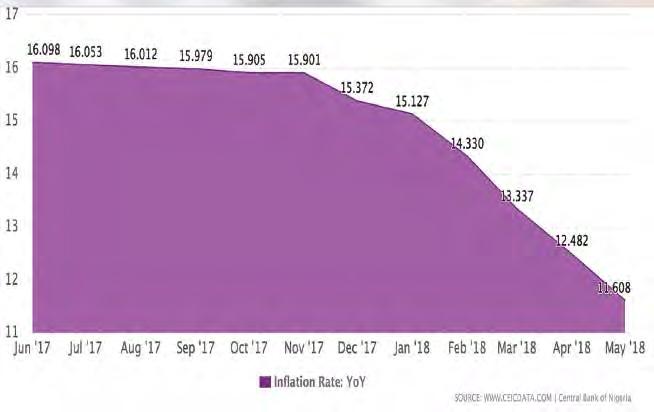
Kayode Tokede
Analyst at KPMG has said that political spending towards 2027 general elections will give birth to inflation, foreign exchange instability and cost pressures in 2026, stressing that cautious wait-and-see sentiment may dominate the way investors approach the Nigerian market.
Speaking to shareholders’ right groups at audit committee seminar 2026 in Lagos, Partner, Strategy & Customer Solutions, Advisory Service, KPMG
Chinedu Eze
Airline operators have over the years, lamented the menace of bird strikes, which constitute threat to flight safety, disrupt flight operations and force operators to incur huge losses in aircraft repairs.
Every week, one of the operating airlines in domestic service, records bird strike and sometimes, two aircraft belonging to one airline may suffer bird strike within one week.
Last year, two aircraft
West Africa, Mr. Oluwole Adelokun stated that international pressure and strategic support for Nigeria’s counter-insurgency campaign will increase, but risks of sabotage remain due to election dynamics. According to him, counterinsurgency campaign could impact operational continuity and people safety for businesses with high geographical spread. Adelokun, who was speaking on, “2026 Budget and Macro-economy Review,” further stressed that 2026 would test the federal
belonging to Air Peace suffered bird strike within four hours and that led to the grounding of the two aircraft, which was a major disruption to the airline’s flight operations.
Last week United Nigeria Airlines disclosed that two of its aircraft recorded bird strike in less than 24 hours, making it the fourth aircraft that suffered bird strike since January 2026.
United Nigeria Airlines, in a statement, said: “In line with our strict and uncompromising safety
government’s resolve and discipline in macro-economic reform execution amid risks of reforms slippage and political spending ahead of the 2027 election.
He stated that Nigeria’s economy is expected to maintain its resilience and deliver sustained growth in 2026, stressing that the economy is expected with a forecast growth rate of 4.5 per cent this year.
“Suppoorting this outlook are less-restrictive credit conditions amid easing inflationary pressures, expectations of sustained
standards, the affected aircraft has been withdrawn from service for comprehensive technical inspections before returning to operations. This brings the total number of Airbus aircraft withdrawn from service in less than 24-hours to TWO (2). As a result, some flights across our network will be disrupted and may not operate as earlier scheduled. This is indeed another bird Strike too many.”
In a telephone interview with THISDAY, the Executive Director/Chief
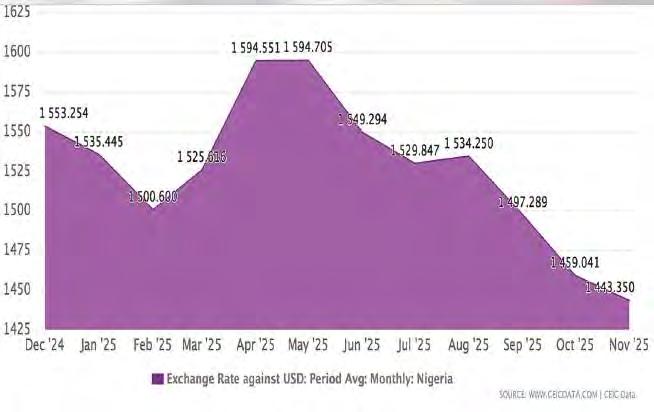
stability of the Naira, higher investments, sustained stability in oil production and expansionary fiscal spending in the eve of election,” he said.
He noted that inflation is expected to decline to an annual average of approximately 11per cent-13 per cent by 2026, while the Naira is expected to remain stable at an average of N1,400 per dollar in 2026.
In another presentation titled, “AI Governance & Ethics,” Mr. Lawrence Amadi , Partner, Tech Risk, PwC stated that AI has become embedded
Operating Officer, United Nigeria Airlines, Chief Osita Okonkwo, recalled the meeting the airline management had with the Federal Airports Authority of Nigeria (FAAN) on how the bird strike could be significantly curbed.
After listening to the FAAN management on the new plans to drastically reduce the incidents of bird strike, Okonkwo expressed optimism that FAAN was committed to eliminating bird strikes incidents through new measures it is adopting.
in core processes and it begins to shape how risk emerges and how decisions are made.
“Risk is no longer driven by politics, processes and controls, but also by models, data and automated decision logic. This does not make AI a threat; it makes it a critical enterprises capacity that must be well-governed,” he said..
He noted that key messages to the audit committee that include shareholders are that AI is a strategic enabler, increasingly embedded in core banking decisions, stressing that as AI shapes decisions, it also shapes enterprises’ risk
FAAN said that it has identified the kind of birds that are ubiquitous at the Lagos airports (where more than 70 per cent of the bird strike incidents happen); they are black kites, which tend to appear in the late hours of the day into the night.
The agency explained that the major reason why birds stayed around the Murtala Muhammed Airport, Lagos is because of its closeness to the residential areas.
FAAN said it would adopt the use of Phoenix airport wailers, which creates
and must be well governed.
“The audit committee plays a critical role in the enabling responsible, trusted use of AI,” he added. According to him, the roadmap for designing and implementing an AI governance framework include appointing an AI governance committee, educating and increasing awareness, integrating risk management & internal contents and evaluation of current state.
different noises and cries, to keep the birds away. It said it has commissioned studies, gathered data about the species of birds that come to the airport, adding that it will reinforce its bird-scare strategies to ensure that bird strike is significantly curtailed.
Okonkwo said United Nigeria Airlines recorded a lot of bird strikes last year, disclosing that bird strike had led to the grounding of one of its aircraft for eight days with a loss of 50 flights.
Stories by Chinedu Eze
The Managing Director/ Chief Executive of the Federal Airports Authority of Nigeria (FAAN), Mrs. Olubunmi Kuku, has reiterated FAAN’s resolve to fully implement a cashless payment system across all airport payment points nationwide, effective February 28, 2026.
The reaffirmation came during a visit by executives and members of the National Union of Air Transport Employees (NUATE), who sought clarification on the decision to discontinue cash transactions at airports. The engagement provided an opportunity for robust
dialogue, reflecting FAAN’s open-door policy and commitment to inclusive stakeholder consultation.
In her address, the MD/ CE emphasised that the transition to a cashless system is not only in line with global best practices in aviation management but also consistent with Federal Government directives aimed at enhancing transparency, accountability, and operational efficiency.
She referenced a Treasury Circular dated November 24, 2025, issued by the Office of the Accountant General of the Federation and signed by the Accountant General, Shamseldeen Ogunjimi,
mandating the cessation of cash transactions in all government dealings. The directive followed approval by the Federal Executive Council for Ministries, Departments and Agencies (MDAs) to discontinue physical cash collections and payments as part of broader public finance reforms.
According to the MD/CE, “There is no going back on this decision.” She stressed that the cashless initiative aligns FAAN with national financial management reforms while positioning Nigeria’s airports for greater operational integrity, improved service delivery, and stronger revenue assurance.
Skyway Aviation Handling Company PLC (SAHCO) has achieved the ISO/IEC 27001:2022 Information Security Management System (ISMS) certification, becoming the only aviation ground handling company in Nigeria, and one of the very few in Africa to attain this globally recognized standard.
ISO/IEC 27001:2022 is the international benchmark for information security management, providing a comprehensive framework for protecting sensitive data,
managing cybersecurity risks, and ensuring the confidentiality, integrity, and availability of information. In the highly interconnected and technology-driven aviation industry, this certification is critical for safeguarding operational systems, passenger and cargo data, airline partner information, and regulatory communications. The certification followed a rigorous audit and compliance assessment conducted by a globally accredited certification body, during which SAHCO
successfully met all stringent requirements. This milestone reflects the Company’s unwavering commitment to cyber resilience, operational excellence, and world-class service delivery. The company explained that in aviation ground handling, where digital systems drive flight operations, cargo processing, passenger handling, and safety procedures, robust information security is fundamental to safe, reliable, and efficient operations.
Veteran Journalist, Mr. Segun Shonubi has been conferred with the 2025 Outstanding Resource Person Award by the Lagos Country Club.
The award was presented during the Club’s 2026 New Year Party by the Lagos State Commissioner for Information and Strategy, Mr. Gbenga Omotoso, who represented the Executive Governor of Lagos State, Mr. Babajide Sanwo-Olu, as the Special Guest of Honour, In his citation, the president of the club, Mr. Seyi Adewunmi, noted that Mr. Shonubi was singled
out for the honor for exemplifying the institution’s core values through his unwavering dedication and selfless service, qualities that fundamentally advance the


Chinedu Eze
The rebirth of democracy in Nigeria, marked by what is termed the 4th Republic, which started in 1999, brought forth some invisible but important benefits.
It accentuated the rise of women in the public service without hindrances and on their own terms, defined by competence, knowledge and skills.
In those days, it is said that when there was opening for a major managerial position and a woman was next in line, series of consulting would start and sometimes the woman would have bypassed and the next man behind her would be given the position. Sometimes the women would grumble and the “oppression” would be allowed to passed, dismissed with aphorisms and lopsided quotes to justify the injustice.
noted their significant contribution in the growth of the industry.
Udoh said women keep the aviation industry flying—women who manage aircraft, airports, air traffic, safety systems, policies, finances, crews, and operations, “often under immense pressure and unforgiving timelines.”
“Aviation is not just a career. It is a calling. It demands precision, discipline, resilience, and sacrifice. But today, I want to speak about something just as critical to safety and sustainability as regulations and procedures—work–life balance. For professional women in aviation, work–life balance is not a luxury; it is a necessity.
Group Business Editor
Eromosele Abiodun
Deputy Business Editor
chinedu Eze
Comms/e-Business Editor
Emma Okonji
Asst. Editor, Energy
Emmanuel Addeh
Asst. Editor, Money Market
Nume Ekeghe
Correspondents
Kayodetokede(CapitalMarkets)
James Emejo (Finance)
Ebere Nwoji (Insurance)
reporter Peter Uzoho (Energy)
ideals of the Lagos Country Club.
As the Chairman of the Media and Publicity Committee, Mr. Shonubi has been a visionary leader.
United Nigeria Airlines team led by the Chairman, Prof. Obiora Okonkwo and the Federal Airports Authority of Nigeria (FAAN) team led by the MD/CEO Olubumi Kuku held a strategic meeting at FAAN Headquarters in Lagos to strengthen collaborations and address aviation environmental safety, Maintenance, Repair and Overhaul (MRO) support, airport operating hours, infrastructure upgrades and United Nigeria Airlines growth plans.
During the meeting, Okonkwo highlighted the rising incidence of bird strikes, describing them as a major operational and financial challenge for airlines. He also highlighted the constraints of sunrise and sunset airports, state of category II airports, noting that limited operating hours and lack of adequate facilities often disrupt schedules and cause delays.
FAAN Managing Director/ CEO Olubunmi Kuku emphasised collaboration as key to improving safety and efficiency. She said FAAN has identified major causes of bird strikes and is implementing environmental measures, including improved grass and habitat management, while also strengthening corporate responsibility around airport environments.
Commenting on the meeting, United Nigeria Airlines Executive Director/ COO, Osita Okonkwo, said sustained cooperation between airlines and airport authorities remains essential for safe and efficient industry growth.
Other members of the United Nigeria Airlines leadership team include Linus, Awute, Director of Administration; Capt. Ahmad Mahmoud, Director of Flight Operations; Raphael Uchegbu, Kelechi Violet Asuquo, amongst other Directors.
But that belongs to the past, women have taken up the gauntlet and they are hitting hard everywhere and taking over the reins of power in every field of endeavour with hard work, discipline and commitment.
In the aviation industry, there are chief executives, pilots, aeronautical engineers, airspace managers, aviation security experts, marshallers, schedulers and others.
Some years ago, Women in Aviation (WIA) the Nigerian chapter was formed to serve as umbrella body for all women working in the aviation industry. But globally, Women in Aviation as an organisation, started in the early 20th Century in France and spread to the rest of Europe and the United States. Today, it has become a global body protecting the interest of women in the industry.
The number of women in aviation in Nigeria has grown tremendously that the top members of the association who spoke to THISDAY projected that women occupy about 40% of the managerial workforce in the aviation industry, from top flight executives, airport management, senior technical crew and senior administrative portfolios.
“But when you talk about the number of women working in the aviation industry, including lower cadre personnel, administrative, it should be over 50% of the workforce of the industry. Some jobs are basically left for women, like flight attendant; men are becoming scarce in the area,” one of them said.
During the meeting last Sunday, which peaked with awards to women who had recorded exceptional achievements in the last one year, the former Managing Director of the Nigerian Airspace Management Agency (NAMA), Nnamdi Udoh, spoke on work-life balance for professional women in aviation and said that women have become outstanding in the aviation industry and
“Our industry operates 24 hours a day, across time zones, weekends, holidays, and emergencies. Many of us juggle shift work, irregular schedules, long duty hours, constant recertification, and high-stakes decisionmaking—while also carrying responsibilities at home, in our communities, and within ourselves.
Too often, we are praised for “doing it all,” but rarely supported in doing it well and healthily,” the former NAMA boss said. He emphasised that work–life balance does not mean working less or caring less about the profession. It means working smarter, setting boundaries, and recognising that a fatigued, burnt-out professional is a risk—not only to herself, but to the entire aviation system.
“In aviation, we understand the dangers of fatigue. We regulate crew duty times, mandate rest periods, and investigate human factors. Yet many women quietly ignore their own exhaustion, believing they must prove themselves constantly in a traditionally male-dominated industry. Your value is not measured by how much of yourself you sacrifice. Balance looks different for each of us. For some, it means flexible scheduling. For others, it means supportive leadership, reliable childcare, mental health awareness, or the courage to
Speaking, the Lagos Regional Manager of the Nigeria Civil Aviation Authority, Mrs. Bukola Teriba, urged women in the aviation industry to take advantage of the federal government’s favourable policy toward women in the sector to aim for greater heights in their various careers.
Teriba said the Bola Ahmed Tinubu’s administration has given room for Nigerian women to showcase their capabilities and professionalism as many women now occupied various managerial positions in the different agencies under the ministry of aviation.
In a media chat to mark its fifth anniversary, the Chairman of United Nigeria Airlines, Professor Obiora Okonkwo, spoke about how the airline has brought Nigerians together by connecting more cities. He also enumerated the airline’s achievements and challenges faced in the industry. Chinedu Eze was there and brings the excerpts:
Despite being a young airline, you said you have scored many firsts. How do you feel about these achievements?
Yes, we are the first airline to touch down in Ekiti, and also the first commercial airline in Bayelsa. You see, this experience of being the first to fly to these destinations, actually is a very powerful one. I recall our first flight to Bayelsa, when I sat next to the Governor of Bayelsa State, Douye Diri. When we were descending into Bayelsa, seeing the landscape of that beautiful state, the man with deep sentiment told me, chairman, you don’t know what you have done for the people of Bayelsa State. Can you imagine that this is the first time 90 per cent of the people in this aircraft have seen Bayelsa from the air? It was very, very powerful.
I will now relate that to our visit to Ekiti. During the novel flight, Chief Afe Babalola of Afe Babalola University did everything possible for us to pay him a courtesy visit because he couldn’t come out to the airport. But because of time, we could not go but we promised him that we would be back.
And we made it during our retreat. We went to pay a courtesy visit to him when we signed the MoU (United Nigeria Airlines signed a 10-year MoU with Afe Babalola University (ABUAD) in February 2026 to train engineering students in aeronautical and aerospace maintenance). Amongst so many other sentiments, when I finished speaking, during his response, with almost tears in his eyes, like he confessed, he said that was one of the happiest days of his life. Because United Nigeria brought to reality his long-time prayer, we could think of even going to Ikogosi (Ekiti state). And they have said, even the admission into their school this year cannot be compared. The parents are happy, the students are happy. And ladies and gentlemen, all this alone for me is worth more than financial gain.
It is a good sense of fulfilment that we are contributing to the development of this country and creating opportunities. We are living our dream uniting Nigerians by connecting the cities. And we have a whole lot more of other routes that we are going to open from now till December.
We also remember that we were the first to fly to Ebonyi. So, I really think that for these people to find us worthy, put their trust in us, we are very, very happy. And we are promising that more of these will come, we will never let them down.
How many passengers have you airlifted since you started operation, and how hopeful are you in your plans to acquire more aircraft?
Starting from the last question, yes, that is correct. It is a big concern for us operators that we don’t have transit facility at our airports.
It makes it very difficult to create a hub in Nigeria. What that simply means is that if those things are not in place, it will be very, very difficult for us to achieve our aim of flying continental and intercontinental service.
But the engagement we are having with Minister of Aviation will address that. He is very, very interested in this and I am hopeful it will yield the expected results before we kick off.
This is because we must be able to get people from other regions into Nigeria, the way it is done in other places. That is, you don’t need to check out and check in before you board the next flight.
We are engaging with the Minister and we are getting positive results
We have a new product now in United Nigeria. This new product is flying to more cities. We want to take a student leaving in Ekiti, but going to Port Harcourt, Kano or Enugu to his final destination. We don’t want the student journey to terminate in Lagos or Abuja, which is just a local hub now. We want to be able to take the person beyond Lagos and Abuja. That is, get into Lagos, Abuja, move in a transit arrangement to Kano, Port Harcourt to Enugu.
So that discussion is going on and we are hopeful that within the very shortest possible time we shall have that arrangement in place because it will definitely help our plan.
Yes, we are aware of the progress being made with the Cape Town Convention, the new practice direction, the new rating that we have now is
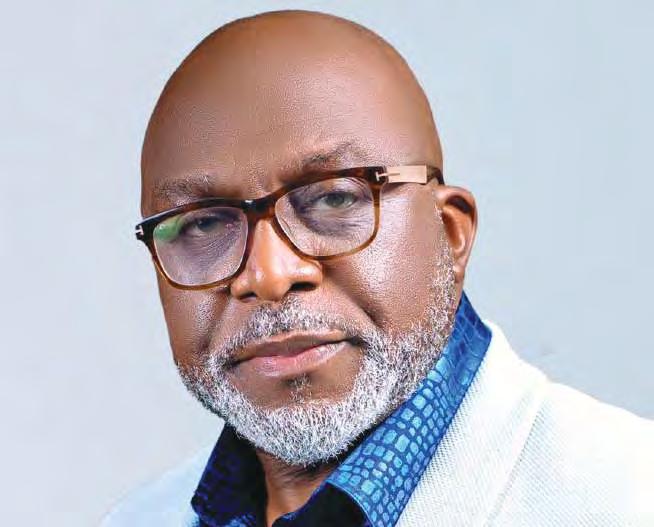
Okonkwo
higher than most countries in Europe.
Thanks to the Minister of Aviation. United Nigeria has been an integral part of it, all the meetings locally and internationally. And yes, we are very, very well positioned to be the early beneficiaries. We have a lot of positive discussions going on in that direction. But you know, aircraft is not something that is put in the warehouse, or a store for you to pick. By the time this agreement was made, a whole lot of these lessors have their aircraft committed with different operators. It will take a while to kick in, but we are aware.
And we have gone into agreement signing with some lessors that the first set of aircraft that will come in from them, in a very short time, we will be one of the beneficiaries. But we see this more or less materializing to a very fruitful position from the year 2027, when some of the aircraft that already committed will be returned to the lessors.
Because OEMs (Original Equipment Manufacturers) are meeting with us and some of them are factoring expectations. Because it is only when the lessee gets a new supply that you release the old contract. So, we are very hopeful that it will benefit us. We are in the forefront of it.
On the number of passengers carried since we started, so far, we have done about 2.5 million over a five-year period. With the size of fleet, we have now, we are definitely going to exceed one million passengers within this year.
How will you assess the situation of unruly passenger’s behaviour in recent years and what are the measures put in place to address it?
I don’t know how many of you can recall what I said in my interview on television in January 2025. I had said that the worst thing that was happening to our aviation then was unruly passengers. We had overcome the problem of policy instability, and so on and so forth. If there is anything really, anything that is not pleasant to me in this sector, it is the problem of unruly passengers. Every other thing I can tell you, I don’t mind. I am even okay with working 24 hours.
Let me tell you guys my last journey. I travelled in January to Dublin. I flew our great airline, Air Peace to London. Everything was family, everything was great.
On arrival, I had to take another airline to Dublin. On arrival in Dublin, I was on business class, had only one luggage. I did not see my luggage. This was happening last month. The worst was that I did not even see anyone to complain to. The nearest
person I could talk to referred me to a system that was standing there. They said, go and fill in the complaint. In my desire to talk to somebody, I even claimed that I am not computer literate, so that I could get help, the person walked away from me. I went back to my hotel and I did not get
my luggage. I managed to fill the form. Around 6:00 am they sent a message; when I woke up the next day by 8:00 am, I saw a message that I could come to the airport to pick up my bag. Not minding that I have filled the form that I wanted my bag to be delivered to the hotel. I hurriedly went to the airport, I got there and there was nobody to talk to.
This time I was given a phone. I should just call the phone and whoever talked to me, I should tell him my problem.
At the end of the day, I got another message while I was there, that my bag would be delivered to my hotel.
Each message I got, I forwarded it to the minister and DG NCAA because we were on the same trip in the same hotel. And as a matter of fact, DG NCAA, in that conference the year before, did not get his luggage too. He had to go to the airport the next day to get his luggage 24 hours later.
On the day of my departure, my flight was supposed to be 12: 00 pm. We rescheduled a lot of appointments for me to meet my 12: 00 pm flight. Only for me to wake up around 8:00 am and got a message that my flight had been cancelled and rescheduled for 8:40 pm that evening. Meanwhile, my connecting flight from Gatwick was 9:00 pm. They scheduled my flight at 8: 40 pm. Yet nobody to talk to, nobody to call. And then I was asking myself, how I would have reacted if this was Nigeria? Maybe I would have had more opportunity to beat some people back there.
The story continues online on www.thisdaylive.com
Dike Onwuamaeze
The Lagos State Government has stated that the coming into effect of the new tax reforms has put the construction and real estate sector at a defining inflection point.
The state government also emphasised that navigating this reform landscape would require a deliberate shift in approach because the era of passive compliance is over.
The Lagos State Commissioner of Housing, Mr. Moruf AkinderuFatai, stated these in his presentation as the special guest at the “Nigerian -British Chamber of Commerce’s (NBCC) Construction and Real Estate Outlook 2026.”
Akinderu-Fatai said: “As of January 1, 2026, when the new tax reforms have taken effect, the construction and real estate sector finds itself at a defining inflection point.”
He explained that these reforms are designed
to strengthen fiscal sustainability, improve compliance, enhance risk management, and align Nigeria’s regulatory environment with global best practices.
According to him, “Construction and real estate are not peripheral sectors. They are structural pillars of economic development. They support industrial activity, absorb labour at scale, stimulate domestic supply chains, deepen capital markets, and provide the physical foundation for productivity, commerce, and human dignity.
“Shelter, after all, is not merely an asset class; it is a social good. The health of this sector therefore has direct implications for economic stability, social inclusion, and long-term national competitiveness.”
The commissioner explained that at the core of the tax reform is an attempt to improve efficiency, broaden the tax base, and reduce administrative
fragmentation.
He said, “For the construction and real estate sector, taxation intersects with virtually every stage of the value chain: land acquisition, development approvals, construction inputs, corporate income, value-added tax, capital gains, property transactions, and estate management. The challenge, therefore, is not the existence of taxation, but the clarity, predictability, and coordination of tax obligations across institutions and tiers of government.”
In his welcome address, the President of NBCC, Mr. Abimbola Olashore, said that the theme of the NBCC Construction & Real Estate Outlook 2026, is “Navigating Reforms, Driving Resilience: Tax, Insurance & the Future of Nigeria’s Construction & Real Estate Sector in 2026,” Olashore said that the theme captured the reality before us as Nigeria is undergoing significant fiscal and regulatory reforms.
Fast-rising live-learning and creator-economy platform, Hallos, has called for stronger strategic partnerships with government agencies, educational institutions, development organisations, media houses and private-sector stakeholders to advance the creator economy as a credible engine for mass employment, youth prosperity and inclusive economic growth.
The call was made during a sensitisation and stakeholder engagement forum held recently in Enugu, where participants
examined how the creator economy is unlocking new income streams for young people, many of whom are earning significantly above conventional minimumwage levels.
Speaking at the event, Hallos Co-founder and Chief Executive Officer, Alexander Oseji Uzoma, emphasised the urgent need for deliberate investment in digital infrastructure and youth innovation support systems.
“The creator economy is one of the most accessible and scalable employment frontiers globally. With basic tools such as a smartphone, internet access and creative skills,
young people can build audiences, monetise knowledge and generate sustainable income without heavy capital investment or long career pathways,” he said.
Uzoma stressed that governments and stakeholders must prioritise enabling infrastructure to maximise opportunities for young Nigerians.
“We need stronger investment in internet penetration, reliable power supply, digital infrastructure, creative studios and youthfocused innovation hubs, particularly across the South-East, to unlock the full potential of young people in the digital economy,” he added.
The Akin Fadeyi Foundation (AFF) has launched the next edition of its ‘Not In My Country Project’, designed to address the major causes of road accidents across the country.
The foundation launched three advocacy drama documentaries that will help motorist and other road users to guide against road accidents that can be avoided.
The one-minute advocacy drama is a clarion call, a civic alarm designed to interrupt dangerous habits that Nigerians have regrettably normalised.
Speaking during a webinar for the media presentation of the next ‘Not In My Country Project’, the AFF Executive Director/Founder, Mr.
Akin Fadeyi, identified various reasons for road accidents on Nigerian roads, which he attributed to individual behaviour of road users.
According to him, in order to tame further road accidents, the safety awareness campaign must begin with citizen’s behavioural change.
The three advocacy drama include: campaign against drinking while driving, wrong parking of vehicles on the road, and driving against traffic flow. He said the campaign would help to reduce road accidents and therefore called on individuals and government agencies like the Federal Ministry of Information and National Orientation to amplify the campaign across national
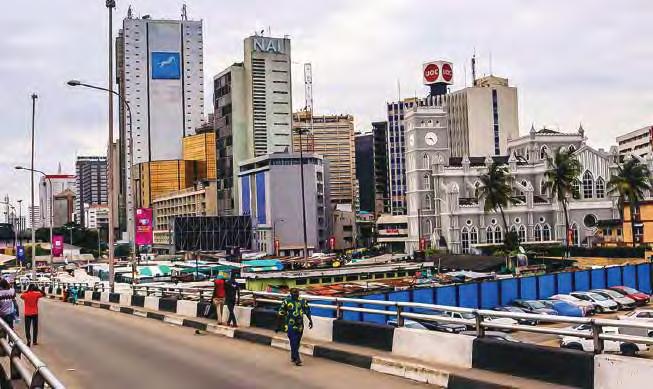
platforms such as NTA, AIT, Channels TV, ARISE TV, and across digital ecosystems that shape modern consciousness.
“Globally, road crashes is responsible for approximately, the loss of 1.2 million lives every year at an average of 3,200 deaths per year. This cuts across the US, the UK, Canada, Dubai etc. In Nigeria, the 2025 FRSC data reveals a chilling picture of 10,446 crashes, 38,689 casualties, and 5,289 deaths, a 9.2 per cent rise. Over-speeding, improper overtaking, driving under impairment, illegal parking, overloading, are not accidents, but behavioural infractions masquerading as fate,” Fadeyi said.
Kayode Tokede
The Nigerian stock market yesterday extended upward movement with a gain of N1.7trillion, as portfolio managers and income investors deepened their buy interests in MTN Nigeria Communications plc, among other fundamentally rooted stocks.
The Nigwrisn Exchange
Limited All Share Index (NGX ASI) rose by 1.39 per cent to close at 193,073.57 basis points. Consequently, the market capitalisation gained N1.7 trillion to close at N123.934 trillion.
Market breadth closed positive with 49 advancing stocks outpacing 28 declining counters. DEAP Capital Management & Trust, Okomu Oil and Fortis Global Insurance recorded the highest price gain of 10 per cent each to close at
N6.93, N1, 459.70 and 55 kobo respectively, per share.
Infinity Trust Mortgage Bank and Zichis Agro Allied Industries followed with a gain of 9.96 per cent each to close at N14.35 and N15.79 respectively, while Japaul Gold & Ventures rose by 9.91 per cent to close at N3.66, per share.
On the other hand, McNichols, Multiverse Mining & Exploration, Secure Electronic Technology and Tripple Gee &
Company led the losers’ chart by 10 per cent each to close at N8.28, N25.20, N1.80 and N5.40 respectively, per share.
Meyer followed with a decline of 9.80 per cent to close at N20.70, while John Holts declined by 9.43 per cent to close at N9.60, per share.
Meanwhile, the total volume traded fell by 75.51 per cent to 898.481 million units, valued at N38.476 billion, and exchanged in 61,953 deals. Transactions in
the shares of Japaul Gold & Ventures topped the activity chart with 80.122 million shares valued at N293.248 million.
Secure Electronic Technology followed with 71.774 million shares worth N136.487 million, while Mutual Benefits Assurance traded 58.678 million shares valued at N277.559 million.
Zenith Bank traded 53.224 million shares valued at N4.515 billion, while Guaranty Trust Holding Company sold 52.628
million shares worth N6.198 billion.
On market outlook, a group of analysts at Imperial Asset Managers Limited stated that “we anticipate sustained interest in fundamentally sound equities in next session. However, considering that tomorrow is the last trading day of the week, we may likely see an increased profit taking, compared to the numbers seen today.
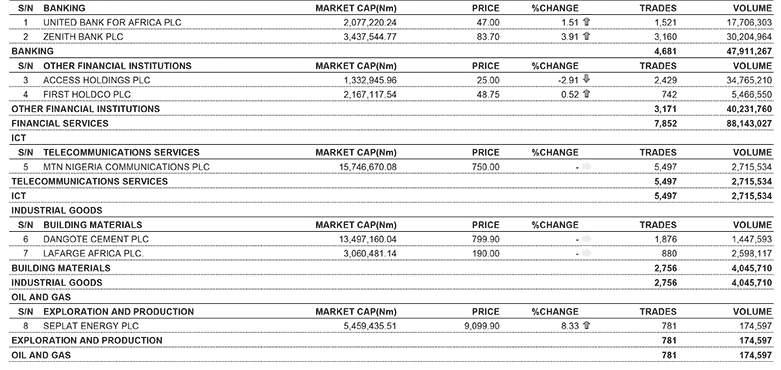
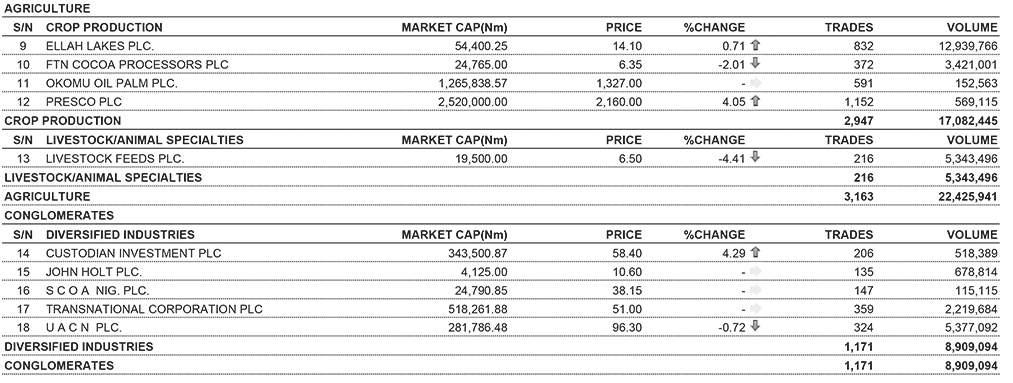
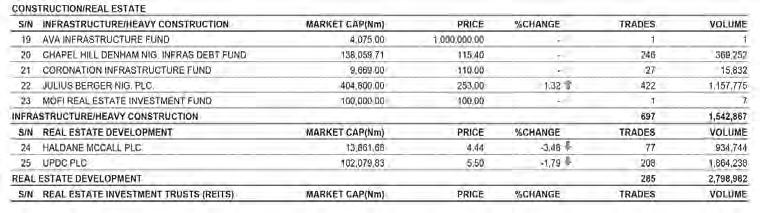
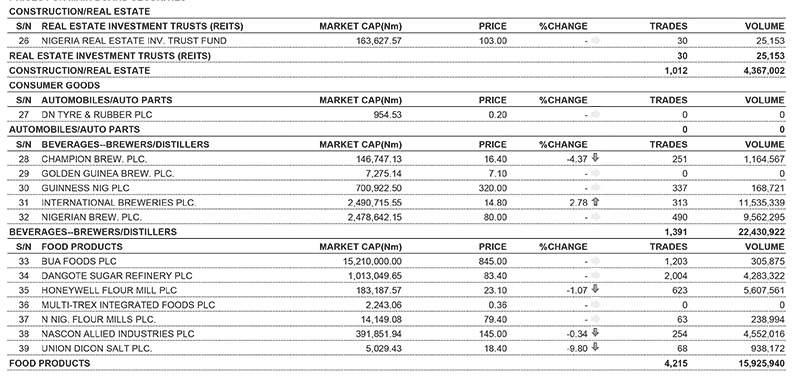
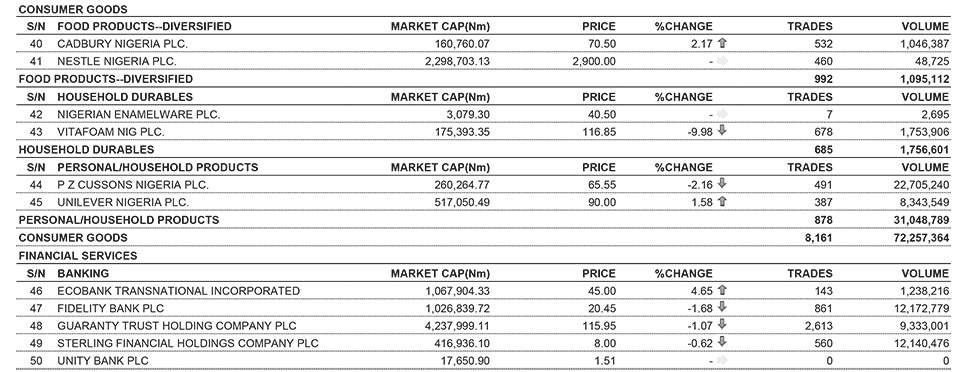
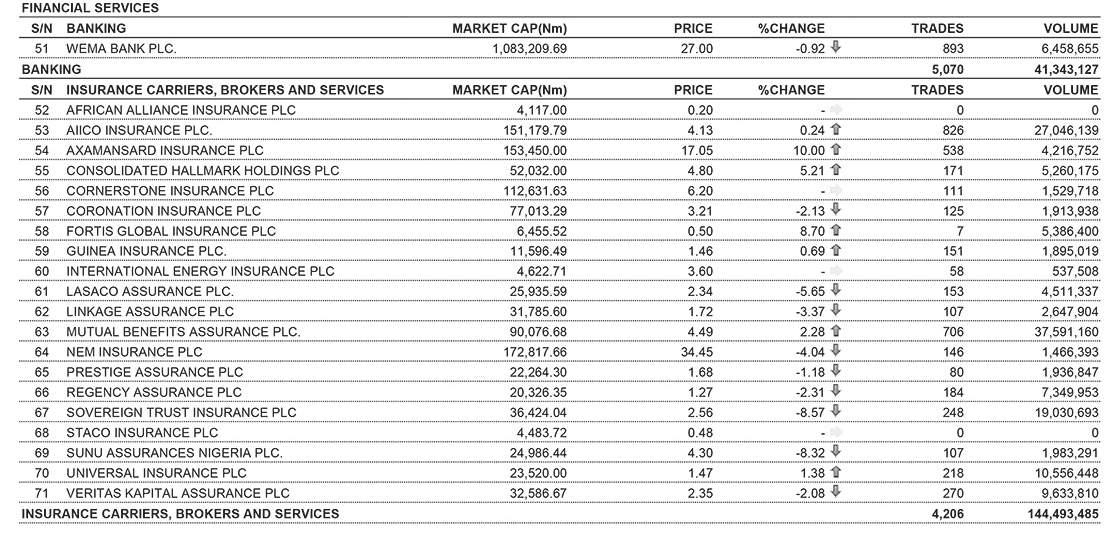

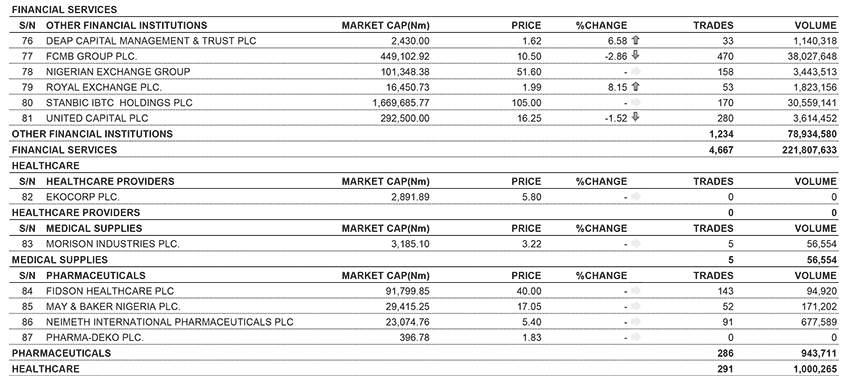
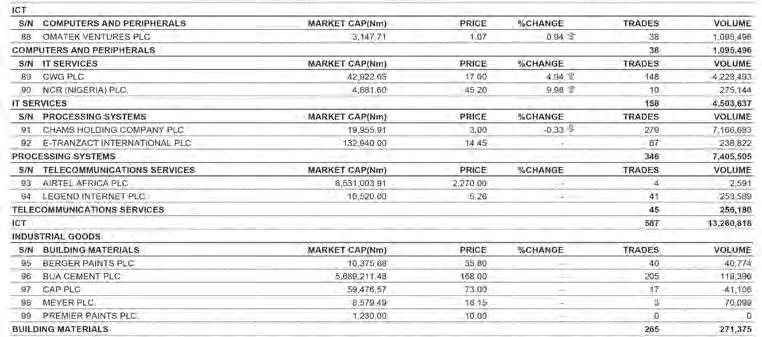
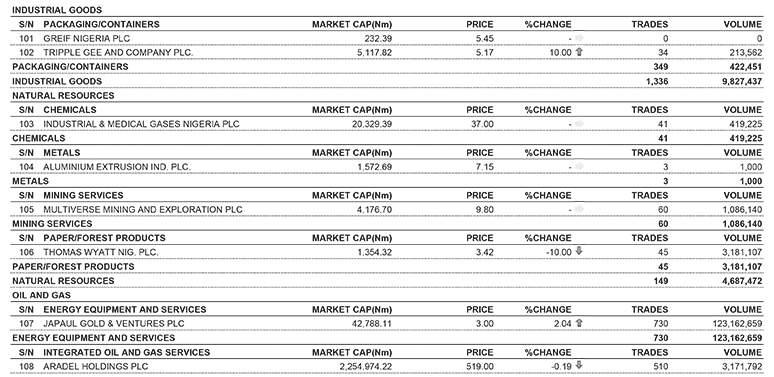
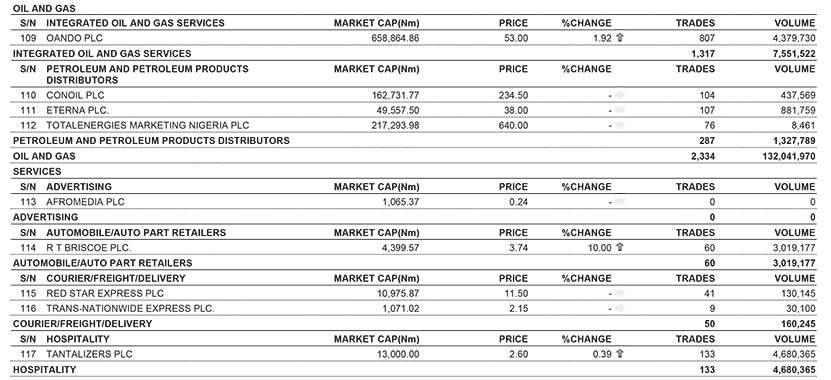
A Mutual fund (Unit Trust) is an investment vehicle managed by a SEC (Securities and Exchange Commission) registered Fund Manager. Investors with similar objectives buy units of the Fund so that the Fund Manager can buy securities that willl generate their desired return.
An ETF (Exchange Traded Fund) is a type of fund which owns the assets (shares of stock, bonds, oil futures, gold bars, foreign currency, etc.) and divides ownership of those assets into shares. Investors can buy these ‘shares’ on the
floor of the Nigerian Stock Exchange.
A REIT (Real Estate Investment Trust) is an investment vehicle that allows both small and large investors to part-own real estate ventures (eg. Offices, Houses, Hospitals) in proportion to their investments. The assets are divided into shares that are traded on the Nigerian Stock Exchange.
GUIDE TO DATA:
Date: All fund prices are quoted in Naira as at 18 Febuary 2026, unless otherwise stated.
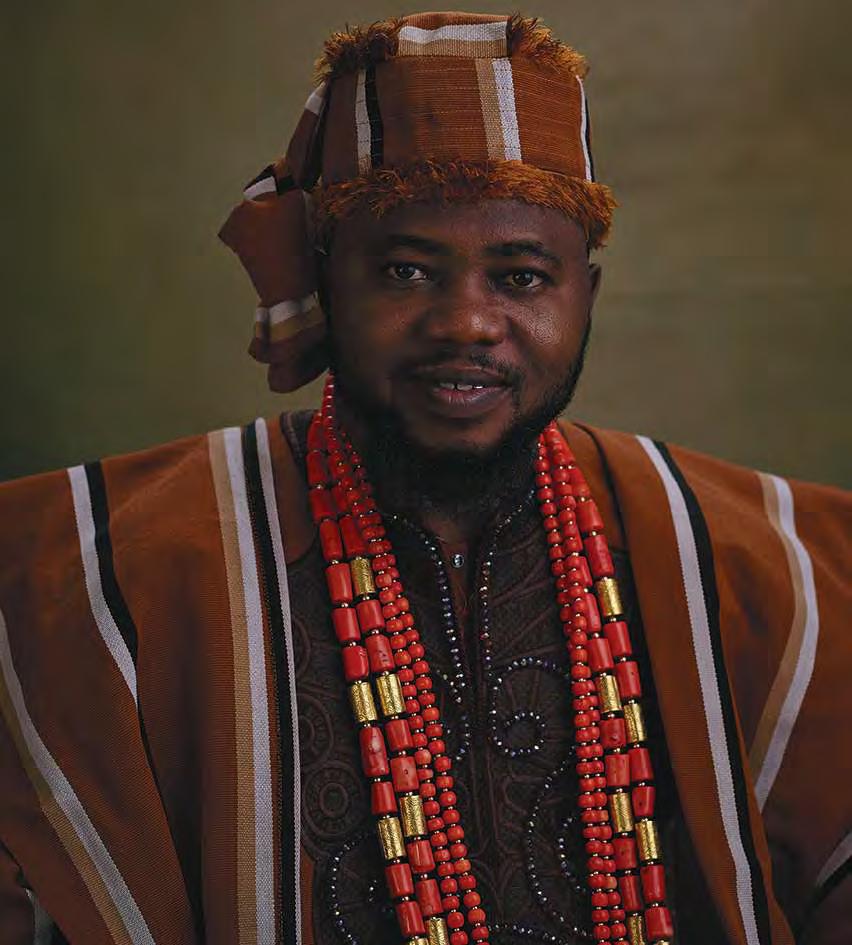
Nume ekeghe writes on the journey to the stool of Olu Omo of Ijebu Igbo, examining how enterprise, integrity and community service shaped alhaji Olawale abiodun Lawal abinugbola into a modern traditional leader
By any measure, the journey of Alhaji Olawale Abiodun Lawal Abinugbola is one of audacity, foresight and deeprooted loyalty to community. It is the story of a young man who took an industry long dismissed as crude and unstructured and, with discipline and vision, turned it into a modern, globally connected enterprise, lifting an entire town along with him.
On February 5, 2026, when the Orimolusi of Ijebu Igbo installs him as the Olu Omo of Ijebu Igbo at the palace, the moment will not merely crown a businessman. It symbolised the recognition of a son who carried his people on his back, transformed their dominant trade, and returned prosperity and pride to its source.
Born Into Trade, Trained for Transformation
Abinugbola’s story begins not in boardrooms or foreign markets, but beside his mother, Alhaja Bello Olorunbunmi Rasheedat, in the hides and skins trade. From infancy, he watched, learned and absorbed the rhythms of the business—its negotiations, its risks, its resilience. Yet even then, he was clear about one thing: he never wanted paid employment. That passion for enterprise was sharpened by formal education. Armed with a degree in Business Administration from Babcock University, he returned not to abandon the family trade, but to radically reimagine it. His mother operated at the lowest rung of the supply chain. His ambition was to scale it structurally, geographically and reputationally.
In 2015, in what would become a defining inflection point, Abinugbola made an intentional leap. He researched sourcing, pricing and global supply routes, obtained his first international passport, and travelled solely to understand how to take the business beyond local buying and selling. That decision marked the birth of a new era for the hides and skins industry in Ijebu Igbo.
Today, Abinugbola controls about 60 per cent of Nigeria’s hides and skins market, making him the dominant player in the sector. More significantly, he was the first in Ijebu Igbo to import hides and skins directly by container, bypassing middlemen and opening international channels previously thought inaccessible.
By sourcing superior-quality products from Kenya and Tanzania, markets known for their premium hides, he not only improved standards but also changed customer expectations across Nigeria. The ripple effect was profound. His bold move demystified international trade for local players and inspired over 100 entrepreneurs in Ijebu Igbo to scale up, professionalise and begin importing at larger volumes.
What was once regarded as a “dirty” trade became structured, respected and profitable. Offices replaced roadside sheds. Warehouses replaced makeshift storage. Trained staff replaced informal
labour. For the first time, educated youths many of whom had once shunned the business began to see it as a viable legacy worth sustaining.
Despite his scale, those who work with Abinugbola describe a leader anchored in clear principles. Fairness, transparency and honesty guide his business decisions. Dishonesty, he insists, is non-negotiable something he totally loathes.
He describes his leadership style as autocratic, but attentive. He listens more than he speaks, weighs opinions carefully, but ultimately makes firm decisions, monitoring outcomes closely and holding people accountable. For senior colleagues, expectations are clear: honesty, responsibility and performance. “Business is business,” he says simply do the work and get paid for it.
Unsurprisingly, people frequently come to him to resolve supplier disputes and cases of fraud, trusting his reputation for fairness and decisive intervention.
Rewriting the Future of an Industry
Beyond personal success,
Abinugbola sees himself as a custodian of the future. He believes the hides and skins industry is on course to become a N1 trillion annual market within the next decade, driven by better structure, increased education and the return of diaspora Nigerians eager to invest at home.
For him, “doing it right” means an industry that is organised, globally competitive and deeply rooted in community prosperity.
It also means ensuring that Ijebu Igbo remains a strategic national hub serving the entire country.
His ultimate ambition is simple but profound: that his name be etched in history for advancing, structuring and elevating the hides and skins industry, and for positioning Ijebu Igbo as its undisputed heartbeat.
If business defines his scale, philanthropy defines his soul. Inspired by his mother’s generosity, Abinugbola believes wealth has no meaning if it is not spent for good. That conviction gave birth to the Abinugbola Foundation, which he finances entirely on his own. Through the foundation,
1,500 people are fed daily during Ramadan, while N150 million is disbursed annually in SME grants and empowerment for petty traders.
Looking ahead, plans are underway for a free vocational training centre, equipped with global faculty, where participants will be trained at no cost and empowered with tools upon graduation.
The vision is bold: to position Ijebu Igbo as a community driven by industrialisation, where being born underprivileged does not determine a child’s future.
As the drums rolled at the palace on February 5, the installation of Alhaji Olawale Abiodun Lawal Abinugbola as Olu Omo of Ijebu Igbo stands as more than a ceremonial honour. It was a regal acknowledgment of service of a man who transformed an industry, unified a community, and proved that true royalty is earned through impact.
From the tutelage of his mother to the corridors of global trade, Abinugbola’s journey is a reminder that when vision meets discipline and compassion, a single individual can indeed carry an entire town and still return home to be crowned by it.
If you have spent enough time around entrepreneurial events, you know how easy it is for bold ideas to remain theoretical. Big words are said, applause follows, and everyone goes home unchanged.
The Audacity Conference 2026, held in Lagos on January 24, refused to sit in that space.
The conference was convened by Olushola Olaleye, a business strategist and serial entrepreneur, who chose to mark his 30th birthday not with celebration for its own sake, but with service.
From the moment the conversations began, it was clear the conference was not designed as a motivational pit stop, but as a practical confrontation with fear, hesitation, and the habits that keep people playing small. The theme, Turning Bold Ideas into Breakthroughs, was treated as a responsibility.
The audience reflected that intention. Entrepreneurs, creatives, professionals, and emerging leaders showed up with notebooks open and real questions on their minds. They were not there to be impressed but to be
equipped with invaluable resources and insights.
One of the strongest contributions came from Tricia Olufemi Olumide, popularly known as TriciaBiz. Her session avoided abstract encouragement and focused instead on execution. She spoke about building sustainable businesses, making branding decisions that actually convert, and leading with clarity rather than chaos.
The underlying message was simple but uncomfortable: audacity without structure leads
nowhere. If you want growth, you must be willing to build systems, learn marketing properly, and make decisions that hold up under pressure.
Mrs Ibukun Awosika brought a different but equally necessary perspective. Drawing from decades of leadership across manufacturing, banking, and boardrooms, she addressed a tension many young leaders struggle with.
How do you take bold steps without burning bridges or disrespecting systems that already exist? Her answer was
Uzoma Mba
The KIMT University, Georgia, USA & Franklin International Business School has conferred Honorary Professor of Conflict Management Institution(s) to Tunji Ajibola, the Lead Faculty/ Chief Executive Officer of LPP School of Corporate and Business Law, Lagos.
not “rebellion” but the application of wisdom. Audacity, she emphasized, does not mean arrogance, it means knowing when to challenge, when to learn, and when to earn the right to change things.
Apostle Emmanuel Iren added depth to the conversation by grounding ambition in purpose. His reflections on leadership and impact reminded attendees that growth without direction eventually collapses. Many people want success, but far fewer take the time to define why they want it and who it should
Precious Ugwuzor
Not less than 600 widows and 20 physically challenged military veterans benefited from the Nigerian Legion, Lagos State Council’s palliative distribution, gifted by Governor Babajide Sanwo-Olu.
The distribution, which included rice, educational materials, and cash gifts, took place during the Lagos Legion Day celebration on Tuesday at the MultiAgency Office Complex Hall, Bolade, Oshodi, Lagos State.
Widows of the Military Fallen Heroes Association (MFHA) and the Military Widows Association (MIWA) praised the Nigerian Legion, Lagos State Council, for ensuring that Governor Sanwo-Olu’s gifts reached them.
Physically challenged military personnel, as well as elderly veterans, also thanked the Lagos Legion Council Chairman, Mr Akeem Wolimoh, for ensuring that everyone was included in the sharing of the gifts.
The Chief of Army Staff (COAS), Lt.-Gen. Waidi Shaibu, graced the occasion and presented a token gift to Wolimoh to support the activities of the Lagos Legion Council. Shaibu was represented by the
Director of Veteran Health, Nigerian Army, Brig.-Gen. Edet Effiong.
The COAS urged veterans to remain active even in retirement to encourage blood flow and prevent joint complications in old age. He also encouraged military veterans to take advantage of the Defence Health Maintenance Limited (DHML) to ensure that their health and that of their families were always attended to when needed.
Mr Wolimoh said that Governor Sanwo-Olu had recently donated 500 bags of 25kg rice and pledged N100 million to the council to support the activities of the legion.
He added that the food items and educational materials procured from the governor’s pledge would go a long way in meeting the needs of the widows and council members.
“The Nigerian Legion is established to foster comradeship among military veterans, sustain sociability, and bring members together in peace and harmony. The Lagos Legion Veterans Day was held to fulfil this purpose as well as meet the needs of our widows and members. The governor of Lagos State has been immensely supportive, and we appreciate him for making all these donations possible,” he said.
The chairman added that the council had put in place an initiative to support the education of students, pledging that every year 25 students would receive financial assistance from the Nigerian Legion. He also urged members to continue promoting harmony and unity within the council.
Mrs Esther Leko, Coordinator of MFHA, said that life without her husband had been difficult, particularly with feeding, school fees, and other household expenses. She, however, appreciated Wolimoh for his efforts in alleviating their hardships through the provision he made.
Professor (Hon.) Dr. Tunji Ajibola is a seasoned legal scholar, conflict management expert, educator, and institution builder with over 20 years of sustained contribution to legal education, professional training, youth development, and peace-building across Nigeria and internationally.
Born into the Ayoloye Ruling House of Owu Kingdom, Abeokuta, and grandson of Late Oba Salami Adewunmi Ajibola, the 9th Olowu of Owu Kingdom, Ogun State, Professor Ajibola’s lineage reflects a long tradition of leadership, public service, and governance.
This heritage has translated into a lifelong commitment to education, institutional development, and societal stability.
Professor Ajibola commenced his teaching career in 2004, while still an undergraduate at Olabisi Onabanjo University, where he tutored students in Business Law, Labour Law, and allied legal courses. This early entry into academic service highlights both intellectual capacity and pedagogical dedication.
He has held formal and visiting lecturing appointments across universities, polytechnics, professional institutions, and accredited centres, including Olabisi Onabanjo University (Consult and External Programmes), Mountain Top University, Ronik Polytechnic (where he served for over 15 years), Wesley University Distance Learning Programme, Universal School of Aviation, Ekocity Polytechnic, and several ICAN-accredited institutions.
His teaching spans Law, Corporate Governance, Conflict Management, Professional Ethics, and Leadership, with consistent emphasis on practical application and dispute resolution.
As a Fellow of the Institute of Global Peace and Conflict Management (FIGPCM), Professor Ajibola has made notable contributions to the theory and practice of conflict management, particularly within corporate, community, family, and institutional contexts.
His work bridges law, mediation, governance, and leadership, equipping professionals and youth
leaders with tools for dispute prevention, negotiation, and sustainable peace. Institution Building and Global Engagement.
Ajibola is the Founder and Lead Faculty/CEO of the LPP School of Corporate and Business Law, an institution dedicated to executive legal education and professional development, operating under the guiding philosophy:
“Learn the Law. Lead with Confidence.”
He is also the founder of Future Minders International, which evolved into the PAA Youth Development Foundation, a platform that has mentored millions of young people through leadership training, education advocacy, and capacitybuilding initiatives.
He is a respected public intellectual and columnist, with numerous publications in leading national newspapers on law, governance, youth development, leadership, and social order. His writings contribute meaningfully to public discourse and policy awareness. Through academic teaching, institutional leadership, publications, mentorship, and youth development programmes, Professor (Hon.) Dr. Tunji Ajibola has impacted directly and indirectly over five million young people, both within and outside Nigeria.
In view of his sustained academic engagement distinguished teaching and mentoring record, Contributions to conflict management and peacebuilding,institutional leadership and global outlook,significant societal and youth impact Professor (Hon.) Dr. Tunji Ajibola eminently qualifies for the conferment of Honorary Professor of Conflict Management, and the award is fully justified on academic, professional, and societal grounds.
The newly honoured professor, said that LPP School of Corporate and Business Law is a professional legal education and capacity - building institution established to bridge the critical gap between legal knowledge and real-world leadership, governance, business, and professional practice.
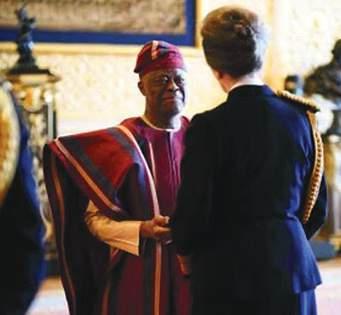
Timothy Enietan-Matthews
The ceremony at Windsor Castle was rich in pageantry, but its significance ran far deeper than tradition. Acting on behalf of King Charles, Princess Catherine bestowed the honour of Commander of the Royal Victorian Order on Wale Edun, Nigeria’s Minister of Finance and Coordinating Minister of the Economy.
The award, given in recognition of distinguished personal service to the Crown, placed Edun among an exclusive circle of individuals whose work has earned international esteem.
Sharing the moment with other honourees — including Lydia Tischler, a Holocaust survivor and child psychotherapist; Rhys McClenaghan for services to gymnastics; and John Whiston for services to broadcasting — Edun’s investiture carried particular resonance for Nigeria. It signalled not only personal recognition, but a broader global acknowledgement of Nigeria’s renewed seriousness about reform, stability, and economic governance.
Edun’s path to Windsor was shaped by decades of institution-building and international engagement. As a former trustee of the Duke of Edinburgh’s International Award, he has long worked at the intersection of leadership development, public service, and global cooperation.
Those same values now define his role at the heart of Nigeria’s economic management.
Since taking office, Edun has overseen a period of consolidation following some of the most far-reaching economic decisions in recent history. Nigeria is gradually emerging from years of macroeconomic strain, with foreign direct investment showing renewed momentum as policy clarity improves. External reserves have strengthened, providing a firmer buffer against global volatility, while inflation — which surged in the aftermath of fuel subsidy removal and exchange-rate unification — has begun to ease, reflecting improving monetary and fiscal coordination.
These shifts have translated into growing international confidence.
Abuja’s selection as host city for the 2026 Technical Meeting of the
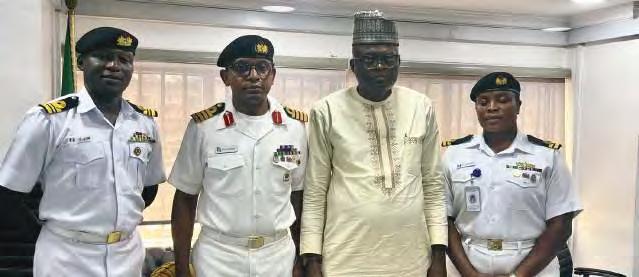
Chiemelie Ezeobi
The Director of Information (DINFO), Nigeria Navy, Captain Abiodun Folorunsho, yesterday paid a courtesy visit to THISDAY Newspaper in Lagos, emphasising the critical role the Nigerian Navy (NN) has been playing in fighting piracy as well as in national security.
and tracked, and how their activities are monitored.
Intergovernmental Group of TwentyFour (G-24) placed Nigeria at the centre of global discussions on development finance, debt sustainability, and growth across emerging economies. Addressing delegates, Edun underscored that the outcomes of the meeting would shape access to capital, investment flows, and job creation — pillars of Nigeria’s reform and growth agenda.
Global partners have echoed that assessment. The World Bank Group, through its Managing Director of Operations Anna Bjerde, has described Nigeria as a global reference point for “steady, credible reform leadership,” highlighting the government’s resolve to remain consistent despite early challenges. Edun reinforced that message at the Al Ula Conference for Emerging Market Economies in Riyadh, noting that Nigeria’s reforms are yielding results and must now be anchored for long-term resilience.
His national leadership draws heavily from experience at the subnational level.
As a commissioner in Lagos State under then-Governor Bola Ahmed Tinubu, Edun was part of the team that reshaped Lagos’ fiscal architecture, expanded revenue generation, and embedded institutional discipline. That Lagos experience — reform-driven, data-focused, and execution-oriented — now informs his approach to managing Africa’s largest economy.
Today, Edun’s priorities are firmly outcome-driven: energy-led growth, digital tools to strengthen revenue assurance, improved fiscal–monetary alignment, and an investment climate that rewards transparency and productivity. Under his watch, Nigeria is steadily repositioning itself as a credible reformer capable of attracting capital and delivering sustainable growth in an uncertain global environment.
In that sense, the honour conferred at Windsor Castle mirrors the trust being rebuilt at home. It reflects a public servant whose credibility resonates internationally, even as he works quietly to stabilise, reform, and restore confidence in Nigeria’s economy. As the country moves from reform to results, Wale Edun stands at the intersection of global recognition and national responsibility — helping to shape a more stable economic future.
The captain, who also harped on the strategic role of media partnerships in advancing national maritime security and economic development, was accompanied by Lieutenant Commander Ernest Jim, Command Information Officer of the Western Naval Command, and Lieutenant SU Stephen.
Captain Folorunsho was received by the Managing Director of THISDAY, Mr. Eniola Bello, in a meeting aimed at fostering closer collaboration between the Nigerian Navy and media stakeholders.
Speaking on the occasion, Folorunsho said, “I assumed duty as Director of Information on 27 January 2026. The appointment itself was on November 4, 2025.
“I need your support. I need your support because with THISDAY on my side, the victory is almost already won. I bring compliments of the Chief of Staff, Vice Admiral Idi Abbas, Admiralty Medal, who approved this tour.
“I have been directed to go around and meet critical stakeholders to see how we can partner to advance the course of the Nigerian Navy, which in itself will have a corresponding effect on the economy of the country. It is an economic force.
“ If we do our job well, you will see it in the amount of money spent on goods and services, in terms of national revenue, because sea trade is where most things really happen. If the maritime environment is safe, the impact is clear.”
Furthermore, the DINFO highlighted that 2026 marks the 70th anniversary of the Nigerian Navy, adding that preparations for celebrations are already underway. “A major highlight of the celebration is an International Fleet Review.
“Navies from all over the world will participate, and the President and Commanderin-Chief of the Armed Forces of the Federal Republic of Nigeria will review the fleet. We have been to Brazil, Australia, and the Trafalgar Centenary celebrations. Now it is our turn to host the world.”
Another central feature of the anniversary is the 6th Seapower for Africa Symposium.
“This is the sixth iteration. The fifth was held in South Africa, and Nigeria is hosting this year’s edition. The theme of the conference is ‘Leveraging Technology to Enhance Maritime Security in Africa.’
“Rightly so, because in recent times the Nigerian Navy has leveraged the Falcon Eye system where our trinity of maritime awareness works, how ships have miniature systems, how vessels can be interrogated
“There are repeater systems in places like Calabar, Port Harcourt, Bonny, Ibaka, and others. There are also over-the-horizon radar systems. This does not mean that nefarious actors cannot still attempt illegal activities, but for the most part, production figures have stabilised, and that is due to the best efforts of the Nigerian Navy.”
On ship building he said: “We are also building response capacity through shipbuilding. We are in the fifth iteration, which started in 2007, and this year we are building two ships simultaneously. We are now pivoting towards more advanced capability-based platforms.
“Navy ships are capability-driven. We are already maintaining ships for the Republic of Benin, and other countries in the region are engaging us to procure ships.
“These are small but notable contributions that the average Nigerian may not be aware of. When we do our work well, it often goes unnoticed because we are out at sea. But people also need to know what we are doing.”
Captain Folorunsho also highlighted the Navy’s success in tackling piracy. “In 2022, with the help of the Falcon Eye system and deliberate investments by the Nigerian state, we were able to defeat piracy in Nigerian waters.
“The International Maritime Bureau subsequently delisted Nigeria from the piracy-prone list. Five years on, we have not recorded a single piracy incident in Nigerian waters, which is a testament to our vigilance and professionalism.”
He also noted that the Global Firepower Report recognised the Navy’s efforts earlier this year, ranking Nigeria as the 22nd strongest naval force globally and first in Africa.
“The ranking is based on naval strength and the number of ships. We currently have 152 vessels. While countries like South Africa, Algeria, and Egypt operate submarines, acquisitions are driven by operational needs, not prestige.”
Reflecting on naval history, Folorunsho said, “We have had three major recapitalisation programmes. One immediately after the civil war, another between 1977 and 1982. The 1982 acquisitions were largely prestige-driven, which was why we procured the flagship NNS Aradu, corvettes, and minesweepers intended for interstate conflict.
“Ships are not like cars. Some vessels built in 1945 are still operational today. As long as they are properly maintained, they remain functional. NNS Aradu is still in the fleet.”
On questions about Navy involvement in Northeast combat operations, Folorunsho said, “The Nigerian Navy Special Boat Service (SBS) is the best special force in Africa. It is truly a special force. What we do is clandestine, which is why we cannot talk about it in the press.
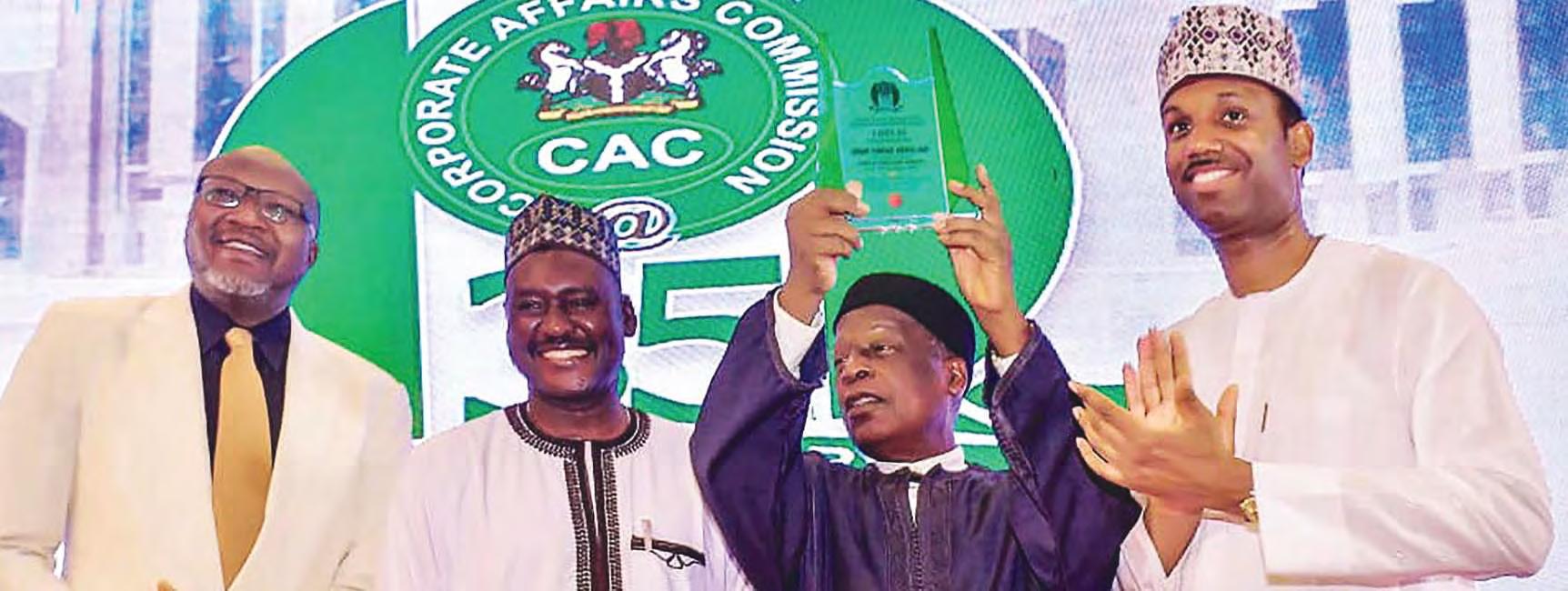
L-R: Registrar General, Corporate Affairs Commission (CAC), Hussaini Ishaq Magaji; Executive Director Civil Society Legislative Advocacy Centre (CISLAC)/ Transparency International Nigeria, Auwal Musa Rafsanjani; Former CAC Registrar General, Barrister Umar Farouk Abdullahi and Chairman, House of Representatives Committee on Commerce, Hon. Ahmed Munnir, during the CAC 35th Anniversary held in Abuja ... recently
Cardoso: effective cross border payment system key to inclusive growth Warns uncoordinated digital inter-territorial payments pose risks to monetary sovereignty, others, restates confidence towards $1 billion monthly remittance Says CBN to unveil new payment system vision 2028
Minister
ing Minister of the Economy, Mr. Wale Edun, has called on G-24 economies to articulate a united, robust, and solutions-oriented
reform agenda for the global financial system, as the two Bretton Woods institutions – World Bank and International Monetary Fund
(IMF) – turn 80. Edun made the call in a keynote address at the 2026 G-24 Technical Group Meetings in Abuja, yesterday,
Nigeria’s leading conglomerates, Tropical General Investments (TGI) Group, has entered into a Joint Venture (JV) agreement with Reliance Consumer Products Limited (RCPL), the fast-moving consumer goods arm of India’s industrial giant, Reliance Industries Limited, to expand access to affordable, high-quality consumer products across Nigeria and the West African region.
In a statement released yesterday, the new JV entity is expected to focus on manufacturing and distributing global-quality fast-moving consumer goods (FMCG) targeted at millions of consumers, while also strengthening local manufacturing capacity and developing human capital in the region.
The partnership is designed to leverage RCPL’s strong research and development capabilities and extensive product portfolio across South Asia, the Middle East, and Africa, alongside TGI Group’s manufacturing expertise and extensive distribution network in Nigeria and West Africa.
Director of RCPL, T. Krishnakumar, described the collaboration as a major step in the company’s global expansion strategy.
“The Joint Venture with TGI Group will be a pivotal milestone in RCPL’s journey towards becoming a global FMCG player. Our mission is to establish RCPL as a leading global FMCG company from India and offer global quality products at affordable prices, and this mission will be instrumental in expanding RCPL’s market presence globally as we enter the crucial market of Nigeria,” he said.
Krishnakumar added that TGI’s long-standing presence and experience across key sectors, including FMCG, culinary, and agribusiness, would provide critical support in scaling operations across the region.
The agreement, is said to remain subject to customary legal and regulatory approvals.
Vice Chairman of TGI Group, Farouk Gumel, expressed optimism about the partnership, noting its potential impact on consumers and the economy.
“We are very excited to work with RCPL to develop and deliver quality and affordable products to the millions of consumers across West Africa. By combining RCPL’s expertise in developing a wide range of innovative products with TGI’s own deep knowledge of the local markets will no doubt be a gamechanger for consumers in this region,” Gumel said.
He further noted the collaboration is expected to create employment opportunities and strengthen Nigeria’s position as a leading manufacturing and industrial hub in Africa.
RCPL, established in 2022, has rapidly grown into one of India’s fastest-expanding FMCG companies, offering a wide range of products including beverages, home care, packaged staples, and personal care items. Its parent company, Reliance Industries, reported a consolidated revenue of $125.3 billion in the 2024–2025 financial year and ranks among the world’s largest publicly traded companies.
TGI Group, on the other hand, maintains operations across Africa, the
Tony Icheku in Owerri
The Commissioner of Police, Imo State Command, CP Audu Garba Bosso, has decorated four hundred and sixty-two (462) newly promoted Assistant Superintendents of Police (ASPs) during CP’s Conference held at the
Command Headquarters, Owerri.
Middle East, and Asia, with business interests spanning food production, FMCG, agricultural inputs, industrial chemicals, homecare products, and pharmaceuticals. The group is also known for its export of agricultural and processed commodities sourced from Africa.
The joint venture is expected to deepen regional value chains, improve access to quality consumer goods, and drive inclusive economic growth across West Africa.
Meanwhile, Chairman and Managing Director of Reliance Industries, Mukesh Ambani, and Gumel were present during the announcement of the strategic partnership.
with the theme, “Mobilising Finance for Sustainable, Inclusive, and Job-rich Transformation.”
Governor of Central Bank of Nigeria (CBN), Mr. Olayemi Cardoso, also declared that a robust and effective cross-border payment system was crucial for achieving job-rich inclusive growth.
Cardoso, at the G-24 meetings, said, “If people cannot move money easily, affordably, and safely, across towns, borders, and continents, then they cannot fully participate in modern economic life.”
He said central banks must help drive job rich growth, productive investment, and real sector transformation. He said this required policy coherence across monetary, fiscal, and financial reforms, echoing the G 24’s emphasis on integrated, scalable solutions to development challenges.
The minister, whose address was titled, “The Global Economy: Fragmentation, Integration and Harnessing South-South Cooperation,” stated that in an era of geo-political realignments, the Global South must
expand collaborative mechanisms to strengthen collective economic resilience.
Edun, who currently chairs the G-24, urged the group to demand the reform of the global financial architecture through the expansion of the multilateral development banks’ (MDBs) concessional lending as well as revising capital adequacy rules.
He also canvassed the strengthening of the Global Financial Safety Net at IMF, prioritising local currency financing, digital payments modernisation, and regional development banks.
“These reforms are essential to support countries that have lost access to international capital markets,” he said, even as he underscored the need to ensure climate finance equity, among others.
Edun stated that the G-24 meetings being hosted by Nigeria came at a defining moment for the global economy, one marked by profound
Continued on page 35
The Deputy High Commissioner of Canada to Nigeria, Carlos RojasArbulu, has led a delegation on a strategic visit to Osun State University to explore areas of collaboration between the Canadian Government and the institution.
Canada is eager to deepen ties.
He however, emphasized that the central issue is identifying practical pathways for engagement.
“Nigeria is a very great country that Canada is looking up to collaborate with. The key question is how do we connect, collaborate, and partner in ways that will benefit both countries,” he stated.
Addressing Area Commanders, Divisional Police Officers (DPOs), Tactical Team Commanders, and Heads of Departments during the event, the Commissioner reiterated his administration’s zero tolerance for misconduct and unprofessional conduct and warned against extortion, harassment, high-handedness, and any abuse of office in interactions with the public.
Rojas-Arbulu, who was accompanied by his second-in-command, Benedicta Emavoun, said the visit was driven by Canada’s interest in strengthening bilateral cooperation with Nigeria through impactful institutional partnerships.
The decoration ceremony marked a significant milestone for the officers, who were recently elevated from the rank of Inspectors.
Speaking during a meeting with the university management, the deputy high commissioner described Nigeria as a great nation with enormous potential, noting that
Responding, the Vice-Chancellor, Professor Odunayo Clement Adebooye, affirmed that the university possesses strong capacity in education, ICT, and healthcare, assuring the delegation that the institution is fully prepared to ensure any collaboration succeeds and yields measurable impact.
The Vice-Chancellor expressed appreciation to the Government of
Canada for its sustained support to the university, particularly in the areas of food security and information technology through various Canadian foundations. He noted that such support has contributed significantly to the Institution’s development trajectory. Professor Adebooye further highlighted opportunities for broader regional cooperation, pointing out that Manitoba is globally recognized for its strength in power generation. He suggested that, given the evolving legal framework that allows states greater participation in electricity generation, the Osun State Government could partner with Manitoba to address electricity challenges and provide sustainable power solutions for the state.
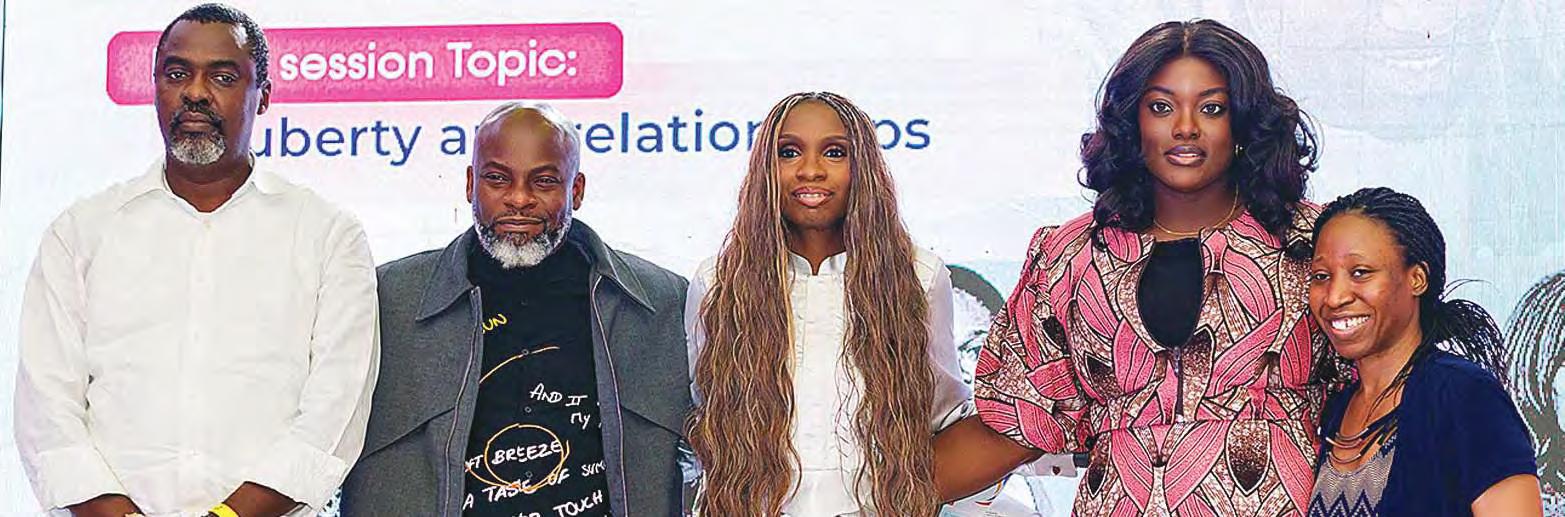
L R: Panelist, Mr. Gabriel Aigbokhaode; Moderator, Mr. Ayodele Renner; Founder of Rhimamory and Convener, SENTE Conference and Trade Fair, Mrs. Mudi Nwachukwu; Panelist, Mrs. Yeside Olayinka Agboola; and Panelist, Mr. Tobiloba Ajayi, during a panel discussion on the topic “Puberty and Relationships”, at the SENTE 2026 Conference and Trade Fair, themed “Preparing for Adulthood: For Parents and Caregivers of Children with Special Needs”, held in Lagos… recently
Onyebuchi Ezigbo in Abuja
The Nigeria Labour Congress (NLC) has expressed opposition to plans by the federal government to grant bailout of three trillion Naira (N3trillion) to privately owned
electricity generation companies as part of efforts to address the power supply challenges in the country.
In a statement signed by its president, Joe Ajaero, NLC said it remains insistent that the state
must return as the primary driver of the power sector.
The labour movement criticised the federal government’s planned bailout for the power generating companies describing it as economically unwise and fraught
Alex Enumah in Abuja
An Investigation Police Officer, ASP Monday Onoja, yesterday narrated how a travel agent, Mr. Waliyu Shitta, allegedly arranged a fraudulent marriage for one Miss Dolapo Yusuf in order to facilitate her travel abroad using the identity of one Mr. Emmanuel Makinde, a Nigerian based in the United Kingdom.
Onoja made the disclosure while giving evidence before Justice Ademuyiwa Oyeyipo of a High Court of the Federal Capital Territory (FCT), sitting in Asokoro, Abuja.
The witness informed the court the defendant, Shitta, and his company, Fanzine Educational Consult, falsely represented to the British authorities that Miss Yusuf was legally married to Makinde.
However, Makinde has consis-
tently denied any knowledge of or involvement in any marriage with Miss Yusuf.
In his Evidence-in-Chief, the witness, who was led by prosecution counsel, Imoedemhe Vincent, stated the complainant, shortly after he got lawfully married, attempted to bring his legitimate wife abroad, but her visa application was refused on the ground that he had previously declared another marriage in his earlier visa application.
It is alleged the defendant had obtained a visa for the said lady (Yusuf), without the knowledge or consent of the complainant.
“Our investigation further revealed the defendant falsely added Miss Yusuf as the complainant’s wife in the visa application”, the witness said.
He disclosed further that the Nigerian Police formally contacted
the British authorities for verification, and subsequently discovered the fraud. “We wrote to the British Government requesting relevant information and supporting documents.
“When we questioned the suspect about the marriage certificate, he informed us that everything was done online and that he did not have a physical copy of the certificate”.
At the trial, the nominal complainant, Makinde was represented in court by Muhydeen Adeoye, while Kehinde Giwa represented the defendants; Shitta and Fanzine Educational Consult.
The matter has been adjourned to March 23, 2026 for continuation of hearing, including an application for leave for the Nominal complainant to give evidence via virtual hearing.
Governor Monday Okpebholo of Edo State has appointed a Nollywood star, Mrs. Mercy JohnsonOkojie, as Special Adviser on Public Engagement and Advocacy.
A statement by Umar Musa Ikhilor, Secretary to the State Government (SSG), yesterday, said Mrs. Johnson-Okojie as Special Adviser will deploy her vast public influence, communication expertise, and grassroots reach to strengthen citizens’ engagement with government policies and programmes.
According to him, the appointment underscores the governor’s
commitment to harnessing the expertise, credibility, and public goodwill of distinguished Nigerians in advancing the administration’s vision for a prosperous and united Edo State.
Ilkhilor emphasised that as an accomplished Nigerian actress, producer, entrepreneur, and philanthropist, Mrs. Okogie will bring her wealth of experience to bear on her new role
“She is one of Nollywood’s most celebrated figures, with a career spanning nearly two decades and featuring in over 200 films. Her outstanding contributions to the Nigerian film industry have earned her numerous awards and
nominations, including recognition at the Africa Magic Viewers’ Choice Awards (AMVCA) and other prestigious platforms.
“Beyond her achievements in the entertainment industry, Mrs. Johnson-Okojie is widely respected for her humanitarian and advocacy work. Through the Mercy Johnson-Okojie Foundation, she has championed causes focused on women empowerment, child welfare, education support, and healthcare outreach. She has consistently leveraged her platform to promote social responsibility, civic awareness, and community development,” the statement added.
with contradictions.
According to NLC, whereas the entire power sector assets were sold for about four hundred billion Naira (N400 billion), “Yet, we are now told that the Federal Government is contemplating a bailout of three trillion Naira (N3 trillion) for the very same GENCOs. who have failed to generate additional megawatt above pre-privatisation installed capacity”
It described the response by the Association of Power Generation Companies (APGC) as a self-serving narrative and a misleading characterization of the patriotic demands of organized Labour.
“We reject the failed privatisation model. Electricity is a social service, not a commodity to be auctioned to the highest bidder. We reject the impudent demand for N6 trillion and this planned N3trillion bailout
“The Nigerian people cannot and will not continue to pay for darkness”.
NLC accused the operators of the GENCOs of conniving with those that executed the privatisation of power assets to shortchange the Nigerian people through an opaque privatisation process.
While responding to APGC’s press statement on February 17, 2026 accusing it of lacking the competence to understand the power sector, NLC said the association was merely attempting to justify what is clearly a brazen move to loot the public treasury.
“We reject entirely their selfserving narrative and its misleading characterization of our patriotic demands.
“First, let us state unequivocally; the NLC stands by every word of our initial press statement. The
privatisation of the power sector was, and remains, a grand deception and a well-orchestrated robbery of the Nigerian people.
“The APGC’s whining about “victimisation” cannot mask the stench of failure that has enveloped the sector since they took over.
“APGC and Co need to explain to Nigerians why they bought the entire Power assets for around N400 billion, but GENCOs alone are demanding N6 trillion as APGC admitted not even the N3 trillion the Federal Government wanted to pay!
“The APGC’s press statement conveniently avoids the most scandalous contradiction at the heart of this debate.
The APGC speaks of outstanding payments, but let us talk about the grotesque mathematics of plunder,” said NLC.
“When defections systematically weaken opposition ranks, legislative scrutiny diminishes, and executive proposals face reduced resistance regardless of public sentiment.”
Stakeholders expressed shock and alleged betrayal as Tinubu assented to the controversial electoral bill.
Conference of Nigeria Political Parties (CNPP) had earlier called on Tinubu to withhold assent to the Electoral Act 2026 (Amendment) Bill, citing what it described as dangerous ambiguities capable of undermining electoral transparency ahead of the 2027 general election.
In a statement, after consultations with political stakeholders, civil society organisations, election observers, and constitutional experts, CNPP expressed deep concern over a controversial provision in the amendment that allowed Presiding Officers to rely on Form EC8A for result collation in cases of alleged network failure preventing electronic transmission.
The coalition, in the statement signed by its Deputy National Publicity Secretary, James Ezema, said while technological limitations might exist in remote areas, the amendment failed to establish a
clear, transparent, and verifiable framework for determining when network failure had genuinely occurred.
According to CNPP, the bill did not provide any independent or technological verification procedure to confirm network availability or outage at polling units.
The group warned that leaving the determination of network failure solely at the discretion of polling officials created a loophole that could be exploited for electoral manipulation.
“In modern electoral governance, transparency must be anchored on measurable, auditable and tamperproof procedures,” the statement said, adding that the amendment weakens safeguards introduced through recent electoral reforms.
CSOs: 2026 Electoral Act Undermines Integrity, Offers Incumbency Advantages
A coalition of Civil Society Organisations (CSOs) said Electoral Act 2026 contained significant flaws that would undermine electoral integrity, entrench incumbency advantage, and exclude millions of Nigerians from meaningful political participation.
It said the act was incomplete and
left dangerous loopholes open, while erecting new barriers to participation.
The CSOs, which included Centre for Media and Society (CEMESO), The Kukah Centre, International Press Centre (IPC), ElectHer, Nigerian Women Trust Fund, The Albino Foundation (TAF) Africa, and Yiaga Africa, expressed their dissatisfaction while addressing a press conference in Abuja.
Speaking on behalf of the CSOs, Founder of TAF Africa, Mr. Jake Epelle, they acknowledged the passage of the Electoral Bill 2026 by the National Assembly and the presidential assent to the bill, which formally repealed and replaced the Electoral Act 2022.
Epelle stated that the CSOs could not ignore the deeply troubling manner in which the legislation was processed and passed.
He stressed that the speed and opacity raised serious concerns about legislative transparency and the commitment of lawmakers to genuine electoral reform.
Epelle stated, “We must, therefore, state clearly and without equivocation: the Electoral Act 2026 that has now been signed into law is a missed opportunity for the transformative electoral reform that Nigeria requires and that Nigerian citizens deserve.”
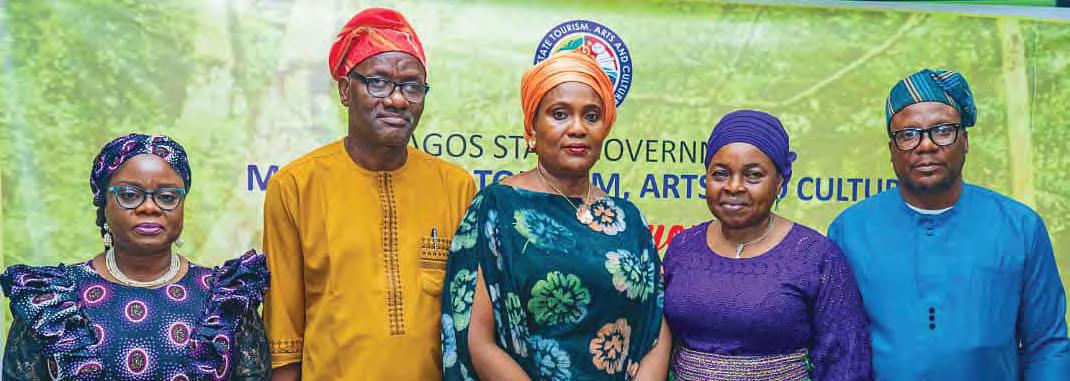
L R: Deputy Director, Tourism, Mrs. Folashade Oyeshola; Director, Administration and Human Resources, Ministry of Tourism, Arts and Culture, Mr. Taoreed Dosunmu; Lagos State Permanent Secretary, Ministry of Tourism, Arts and Culture, Mrs. Bopo Oyekan Ismaila; Deputy Director, Administration and Human Resources, Ministry of Tourism, Arts and Culture, Mrs. Adebimpe Ojikutu Balogun; and Assistant Director, Tourism, Mr. Peter Olaide Mesewaku, during a two day in house specialised training for Tourist Guides, organised by the Ministry at the J. Randle Museum Centre for Yoruba Culture and History, Onikan, Lagos Island… recently
The Chief of Defence Staff (CDS), Olufemi Oluyede, has emphasised that while kinetic military operations created the conditions for stability, lasting peace could only be secured through structured disarmament, rehabilitation and reintegration (DRR) of repentant terrorists to prevent a circle of violence.
He disclosed that the Defence Headquarters (DHQ), in collaboration with Operation Safe Corridor (OPSC), has finalised modalities for
transferring rehabilitated clients to relevant national and state authorities for reintegration into society.
Speaking at a high-level stakeholders’ meeting at the Nigerian Army Resource Centre, the CDS reaffirmed Nigeria’s commitment to a whole-of-government and wholeof-society approach to peacebuilding and national recovery.
Represented by the Chief of Defence Operations, Major General Jamal Abdusalam, Oluyede—who also chaired the OPSC National Steering Committee—described
Operation Safe Corridor as a critical pillar of Nigeria’s security architecture.
“Since its inception in 2016, Operation Safe Corridor has processed thousands of clients under a controlled and integrity-driven DRR framework. Properly screened surrender pathways weaken insurgent cohesion, generate actionable intelligence and contribute to long-term stability,” he said.
In a statement, the Director of Defence Information, Major General Samaila Uba, noted that
the meeting drew participants from key federal ministries, the Office of the National Security Adviser, state governments and neighbouring countries including Burkina Faso, Chad, Niger and Cameroon. International partners present included Norway, United Kingdom, the European Union, the Foreign, Commonwealth & Development Office, the International Committee of the Red Cross and the International Organisation for Migration, among others.
Earlier, the Coordinator of
Operation Safe Corridor, Brigadier General Yusuf Ali, commended the CDS for his leadership, stating that the programme’s expansion was anchored on enhanced jointness, improved welfare and sound administration.
He described OPSC as a multi-agency humanitarian stabilisation initiative involving 17 services, ministries, departments and agencies, operating within constitutional and international humanitarian frameworks.
Ali revealed that 117 clients from
Borno State recently completed the DRR process at Mallam Sidi Camp, while similar initiatives were expanding to the North West and North Central regions.
He added that ongoing consultations aimed to strengthen community reconciliation, psychosocial support and structured reintegration monitoring nationwide.
The meeting concluded with renewed commitments to coordinated rehabilitation efforts as a pathway to consolidating Nigeria’s security gains.
AT G-24 MEETINGS, EDUN CANVASSES UNITED, RESULTED-ORIENTED AGENDA TO REFORM GLOBAL FINANCIAL ARCHITECTURE uncertainty, systemic vulnerabilities, and a historic contest between fragmentation and integration.
He said, “This gathering is not a routine technical engagement. It is an opportunity to re-shape the development trajectory of the Global South at a time when global risks are converging faster than institutions can respond.”
According to him, the global economic landscape is rapidly evolving into what analysts increasingly describe as an “Age of Competition.”
He explained that half of surveyed global experts by the World Economic Forum (WEF) expected the world to remain turbulent over the next two years, adding that 57 per cent foresee continued instability over the next decade, while only one per cent anticipate calm.
“This underscores a global environment defined by geopolitical rivalry, structural distrust, and weakening multilateral institutions,” Edun said.
Cardoso, nonetheless, revealed that the apex bank will soon conclude work on a new Payment System Vision 2028, developed in close collaboration with industry stakeholders and built around five strategic priorities to boost innovation, strengthen system resilience, and advance financial inclusion.
Cardoso spoke on “Digital CrossBorder Payments, Global Finance, and Economic Transformation –Opportunities and Risks” during a plenary speech he delivered at
the opening of the G 24 Technical Group Meetings (TGM), with the theme, “Mobilising Finance for Sustainable, Inclusive, and Job-rich Transformation,” in Abuja.
Cardoso emphasised that reforms in digital payment systems had boosted the country’s monthly remittance inflows to an average of about $600 million, stressing that CBN remains confident of reaching a $1 billion monthly milestone in the near term.
He said a central part of the 2028 agenda was to improve the cross border payments environment, where Nigeria had made concrete, measurable progress.
The central bank governor pointed out that across the world, cross border payments were becoming the backbone of the international monetary and financial system.
As a result, Cardoso said improving cross border payments was not simply a technical reform but a macroeconomic and development priority, adding that the channels through which capital, remittances and trade flows move now form a critical part of global financial stability architecture.
However, he said, “For G 24 economies, inefficiencies in these systems translate directly into higher remittance costs, costly FX transactions, fragmented settlement processes, and barriers to MSME participation in global trade.
“Today, cross border payments remain too slow, too costly, and too fragmented, especially for developing economies. With
global remittance corridors costing over 6.0 per cent, settlement lags of several days, and compliance burdens that exclude MSMEs, millions remain disconnected from global opportunity.”
However, he said digital innovation currently presented a historic opportunity to correct the frictions, adding that modern payments infrastructure, instant payment systems, interoperable digital platforms, distributed ledger technology, and robust digital identity frameworks, can reduce transaction costs for remittances and trade, shorten settlement times, improve transparency, compliance, and auditability, and expand access for households and MSMEs traditionally excluded from the formal financial system.
Cardoso said the interoperable digital systems also strengthened the transmission of monetary policy, expanded financial inclusion, and reduced informality, if designed with resilience and strong governance.
The CBN governor, however, warned that the inherent opportunities of digital payments also carried significant risks to monetary and price stability.
He stated that the expansion of private digital payment platforms and stablecoins raised concerns about currency substitution and weakened monetary transmission, increased FX volatility and capital flow pressures, systemic importance of non-bank payment providers, and regulatory arbitrage and fragmentation.
He stressed that without coordination, digital cross-border payments risked becoming fragmented across jurisdictions, entrenching dominant currencies and platforms, reducing interoperability, increasing costs and undermining the ability of Emerging Market and Developing Economies (EMDEs) to safeguard monetary sovereignty.
Cardoso stated that Nigeria’s experience demonstrated that the digital potential could be realised through deliberate and sustained policy action.
He said, “At the Central Bank of Nigeria, we have systematically modernised our regulatory and supervisory frameworks to keep pace with the rapidly evolving digital financial landscape.
“We strengthened operational oversight of switching and payment infrastructure providers, enhanced agent banking regulations to better address AML/CFT risks, and significantly improved interoperability across payment channels to support efficiency and scale.
“To deepen regional integration, the CBN introduced the simplified KYC/AML requirements for low value cross border transactions to encourage broader participation in PAPSS.
“This has eased transaction processes for Nigerian SMEs by reducing paperwork and enabling faster, more seamless intra African trade“Wepayments. have also embraced fintech innovation to drive the next generation of secure, instant cross
border payments. Our Regulatory Sandbox now allows payment focused fintechs to test new cross border solutions under close CBN supervision, ensuring innovation proceeds without compromising stability.”
Cardoso added, “In June 2025, Nigeria launched the National Payment Stack, our next generation real time payment system built on ISO 20022 messaging and designed to support multi currency and cross border transactions.
“We have also strengthened our AML/CFT frameworks in line with FATF guidelines, requiring strict dual screening of cross border transactions to mitigate risks. On remittances, we worked with domestic and international stakeholders in 2024 to remove long standing bottlenecks and expand efficient corridors.
“This has led to the introduction of new instruments such as the Non Resident Nigerian Ordinary Account (NRNOA) for remittances and family support, the Non Resident Nigerian Investment Account (NRNIA) for diaspora investments, and the Non Resident BVN platform to allow Nigerians abroad to open and service accounts digitally.”
Cardoso said, “Beyond regulation, we have engaged globally, through platforms like the Strategic Fintech Dialogue at the 2025 IMF annual Meetings, to ensure Nigeria contributes to shaping emerging global standards.
“The results are already evident: Digital financial reforms have sup-
ported millions of new entrants into Nigeria’s formal financial system, strengthened confidence, and improved market integrity.
“Extending these gains across borders represents the next frontier for inclusive growth, provided it is underpinned by robust regulation and strong institutions.”
He said, “Beyond efficiency gains, digital cross border payments are reshaping global finance itself. They are enabling local currency settlement in cross border trade, new channels for South-South financial integration, reduced dependence on a limited set of reserve currencies; and more efficient transmission of global and regional capital flows.”
Cardoso said experiments, such as mBridge, Dunbar, and other multi CBDC platforms, demonstrated the growing potential for real time, local currency settlement among central banks. He stated that these innovations were especially relevant for G 24 countries seeking a more balanced, inclusive global payments architecture.
The CBN governor stated that Africa’s experience with the Pan African Payment and Settlement System (PAPSS) offered a powerful lesson for the G 24 in building modern, inclusive payment systems. According to him, “PAPSS demonstrates how developing regions can create home grown, interoperable infrastructure that reduces reliance on external correspondent banks, lowers settlement costs, and enables instant local currency cross border payments.
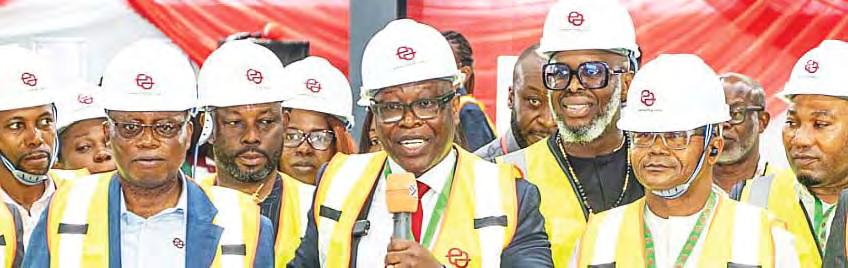
L R: Managing Director and Chief Executive Officer, Engineering Automation Technology Limited (EATL), Dr. Emmanuel Okon; Deputy Director, Development, Nigerian Upstream Petroleum Regulatory Commission (NUPRC), Mr. Manuel Ibituroko; and Director, Monitoring and Evaluation, Nigerian Content Development and Monitoring Board (NCDMB), Mr. Silas Ajimijaye, during the inauguration of the Gravimetric Multifaceted Flow Metering Calibration Facility built by EATL in Eket, Akwa Ibom State… recently
Chuks Okocha and Olawale Ajimotokan in Abuja
Less than 24 hours to the FCT Area Council elections, a Peoples Democratic Party (PDP) Chairmanship candidate has announced he was stepping down for the All Progressives Congress (APC) candidate.
Hon. Zadna Dantani is the latest PDP chairmanship candidate to join the bandwagon after announcing he was withdrawing for the APC candidate, Hon. Christopher Zakka Maikalangu in the Abuja Municipal Area Council (AMAC), Chairmanship election.
His withdrawal came on the heel of similar action by PDP Chairmanship candidate for Bwari Area Council, Julius Adamu, who stepped down for the All Progressives Congress (APC) candidate, Joshua Ishaku Musa. Dantani, said his decision to step down followed the intervention of the FCT Minister, Nyesom Wike.
He also explained that he had also submitted a letter of withdrawal to the Independent National Electoral Commission (INEC).
In a separate video recording, he stated: “My name is Hon. Zadna Dantani, the Chairmanship
Responding, Minister of State for Finance, Dr. Doris Nkiruka Uzoka-Anite, assured the committee that outstanding capital components of the 2024 and 2025 budgets would be fully implemented before March 31, 2026.
Uzoka-Anite disclosed that payments for 2024 capital projects were commencing immediately, adding that Ministries, Departments and Agencies (MDAs) have been directed to upload their cash plans to facilitate disbursement for 2025 projects.
“The financial management system is back online. We are ready to start, but MDAs must complete their documentation requirements,” she said.
The engagement later moved into a closed-door session lasting nearly two hours, attended by Minister of Budget and Economic Planning, Senator Atiku Bagudu,
candidate of the Peoples Democratic Party (PDP) in the Abuja Municipal Area Council for the Saturday’s Area Council elections.
“I want to sincerely appreciate everyone who supported us and by the grace of God, we are doing it not because of our personal interests.
“I am here to tell my people that as a candidate who is standing for this election, I have today, agreed based on the intervention of the Honourable Minister of FCT, Barrister Nyesom Wike, who is our leader in the party and the leader in FCT, who has called my attention to let us know that this is a brotherhood election.
“I am also doing this in support of the good works of the President, Asiwaju Bola Ahmed Tinubu. I have consulted widely and by the grace of God we have agreed that we are no longer going to contest against my brother, Hon Christopher Zakka Maikalangu.
“By doing so, I also submitted a letter of withdrawal to the Independent National Electoral Commission (INEC) today. I therefore call on all my supporters a cross the 12 wards in the Abuja Municipal Area Council to come out enmasse to support Hon
and Accountant-General of the Federation, Shamsedeen Babatunde Ogunjimi.
By the close of deliberations, the senate signalled that unless the executive revised its assumptions and provided firmer revenue guarantees, the National Assembly might be compelled to trim the N58.472 trillion proposal in the interest of fiscal realism and sustainable economicMeanwhile,management. Chairman, National Assembly Joint Committee on Culture, Art and Creative Economy, Senator Mohammed Onawo, said the legislature was prepared to engage Tinubu through the leadership of the National Assembly on the need to provide a substantial seed capital that would enable the ministry operate independently and become self-sustaining.
Onawo challenged the ministry to determine the level of funding
Christopher Maikalangu, who is the candidate of APC.”
Atiku, Obi in Joint Campaigns for ADC
A former Vice-President, Atiku Abubakar and a former governor of Anambra State, Peter Obi yesterday, joined the campaigns for the African Democratic Congress (ADC) ahead of the FCT elections.
Atiku, in a post on X, said the the FCT Council election would signpost how ready the Independent National Electoral Commission, (INEC) was for 2027 general election.
He also said the Saturday election would show how Nigerians would chase out the All Progressives Congress, APC from government in 2027.
According to the former vicepresident, “This morning, I was in Gwarinpa with other leaders of our party, the African Democratic Congress (ADC), including my brother, H.E. Peter Obi, ahead of the Saturday, February 21 FCT Council elections.
“We have been speaking with voters about why this election is important and why ADC candidates should be the right choice.
required to function without recurring dependence on federal allocations.
He said, “If the federal government decides to take you off the national budget, how much take-off grant would you need to become independent?
“You cannot start with nothing. Whatever we agree here, we will discuss with the senate leadership and Mr President.”
Following deliberations, the committee proposed a N1.5 trillion take-off funding package, stating that the creative and tourism sectors possess enormous untapped potential capable of transforming the country’s economic landscape.
Lawmakers maintained that with adequate capital injection, policy clarity and institutional reforms, the ministry could emerge as one of the highest revenuegenerating agencies of government.
“This election is very important. It will say a lot about how ready the managers of our elections are to deliver free, fair and credible polls. It will also say a lot about how ready people are to chase the APC out.
“I have encouraged voters to come out in large numbers to vote for ADC candidates across all FCT Councils in the elections. Our party has fielded candidates with competence, capacity and character to offer quality leadership across local councils in Abuja.
“Voters have the responsibility to defy all forms of intimidation and make the right choice,” he stated.
Wike Declares Friday Work Free
Minister of the FCT, Nyesom Wike, has declared Friday as work-free day for all in FCT in preparation for the Area Council Elections billed for Saturday, February 21.
In a special broadcast made on national television and radio stations, yesterday, the minister also announced a restriction of movement from 8pm on Friday to 6pm on Saturday.
He entreated residents of the FCT to come out in large numbers and exercise their right to vote for their preferred candidates . He said the election was momentous occasion for residents to shape the future of the Federal Capital Territory by either electing new or returning the incumbent Chairmen and Councilors for the
six area councils.
“I urge you to go to the polls with a sense of purpose and responsibility. As we exercise our democratic right, let us do so in an orderly and lawful manner.
“Let us respect the rules, respect each other, and respect the outcome of the election. We must show the world that we are a mature and responsible electorate, capable of conducting ourselves with dignity and decorum.
“At this juncture, with the approval of the President Asiwaju Bola Ahmed Tinubu, GCFR, I hereby declare Friday, February 20, 2026, as a Work Free Day to enable movement of residents to their various communities to participate in the elections.
Typically, the nearer he got to the hour of reckoning with the anti-corruption agencies, the higher the decibel of his Kangaroo debate trickery, ignoring the ball and kicking the leg. I seldom find myself in agreement with press releases from the public communications office of the presidency. Today is an exception to that rule.
“The former governor’s outburst, wrote Bayo Onanuga, comes amid ongoing federal investigations into his own administration. A June 2024 report by the Kaduna State House of Assembly accused his government of mismanaging N423.2 billion in loans and grants. The EFCC has since invited El-Rufai and several former officials who served under him for questioning. He is expected to appear voluntarily at the EFCC headquarters in Abuja on February 16, 2026”.
“The truth is: Mallam El-Rufai has two clear intentions behind his recent actions and tantrums. One, to create political tension in the country, create an atmosphere of fear and unrest, and then damage the government through deliberate misinformation. Two, to divert attention from his domestic problems in Kaduna State, where he is facing massive corruption allegations. To draw attention to himself and project himself as a victim of persecution, he wants to nationalise his personal problems with his home state government, knowing that Nigerians will not be
on his side over corruption charges”.
Rotimi Fasan had similarly written “He is being asked to account for some N432 billion, mostly loans incurred in the name of the Kaduna state government. The state legislators, up to the last man, signed a petition demanding the investigation of El-Rufai. How this transformed into a planned arrest is a matter only he can explain”.
“Yet, he is far from being the paragon of integrity he advertises himself as. He is not a man by whose words much store can be set. He looks out solely for himself and would go to any length to ruin what he cannot get. It is why he has pivoted from the main point of his invitation by the EFCC to launch personal attacks against the NSA, accusing him of being behind his woes”
I have asked this question elsewhere: even if the complaint of political persecution is genuine, does this exonerate anyone so accused from criminal allegations of theft and corruption?
Brimming with hubris in his letter to the NSA, El-Rufai said “The government believes it is the only one that listens to calls, but we also have our ways. He made the call and gave the order. Someone tapped his phone. The government listens to our calls all the time without a court order. Someone tapped his phone and told us that he gave the order,” It is against this backdrop
that I conclude with the citation of Max Weber’s definition of the state ‘as the sole legitimate repository of the power of coercion, claiming a monopoly on the legitimate use of physical force within a given territory’ This monopoly is personified by whichever government is in power. It is within the context of this monopoly that arms and other weapons of coercion and warfare are imported into the country. Assuming that the claim of El-Rufai is correct, the Nigerian government has done nothing wrong by importing Thallium into the country subject to international law and convention, just as it has done nothing wrong by importing machine guns. We do not know the content of the Tomahawk missile launched by Donald Trump on the muster point of the terrorists who were aiming to launch coordinated attacks on Nigeria the other day. For all we know it may or may not contain toxic portions like Thallium and it is irrelevant.
The real worry for Nigeria security, if his megalomaniac diatribes are true, is the vulnerability of its security communications to interception and the audacity of El-Rufai to blab about it. May be, just may be, it is the same source from which Nigerian terrorists obtain critical information on the plans and movements of the Nigerian army, hence the seeming intractability of the current Nigerian civil war.
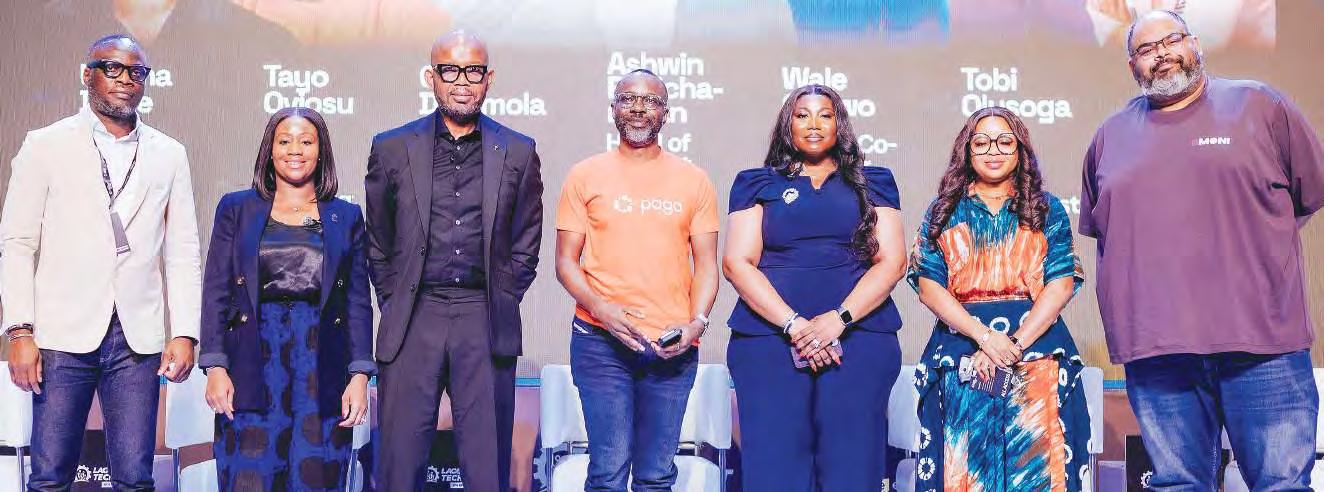
L-R:
Wale Oyewo;
Oluwaseun Oladimeji; Co-Founder/COO,
Gbenga sodeinde in ado ekiti
The family of seven abducted persons in Erinmope-Ekiti, Moba Local Government Area of Ekiti State, has been thrown into mourning following the death of one of the victims in captivity, even as six others regained their freedom after a N25 million ransom was paid.
It was gathered that although the abductors released six of the victims, the remains of the deceased woman have yet to be recovered and handed over to her family for burial.
The victims were kidnapped on January 24, 2026, when gunmen stormed ErinmopeEkiti and abducted five women, including a nursing
Blessing ibunge in Port Harcourt
Governor of Rivers State, Siminalayi Fubara and former Director-General of the Nigerian Maritime
I, formerly known and addressed as INEGbENOSE EHICHOYA, now wish to be known and addressed as INEGbENOSE EHICHOYA GODSTIME. My Date of Birth was wrongly stated as 13th of July 2001, the Correct Date of birth is 13th of July, 2000. All documents remain valid. The general public should please take note
I, whose name was wrongly spelt as Nnang Jesse Mbangisha, now wish to be known and addressed as Nnang Jesse Mbangishor. All former documents remain valid. The general public should please teke note
I formerly known and addressed as ADEMOLA MUSTAPHA ADEDOYIN as it appears on my BVN, now wish to remove "MUSTAPHA" from my names and wish to be known, called and addressed as ADEMOLA ADEDOYIN as it appears on my International Passport and other documents. The general public, Authority and to whom it may concern should please take note.
I, formerly known and addressed as QUEENETTE ArCHIbONG, now wish to be known and addressed as QUEENETTE DUrOSINMI-ETTI. All formal documents remain valid. The general public should please take note
COrrECTION Of DATE Of bIrTH
I, DIDIMUS EbHOMENYA OSAGIE, my date of birth was wrongly written as 2nd of July 2005, instead of 8th of November 2008. All former documents remain valid, the general public should please take note.
Administration and Safety Agency (NIMASA), Dr. Dakuku Peterside, have expressed sadness over the demise of Senator Barinada Mpigi, the senator representing the South East senatorial district of Rivers State.
Governor Fubara expressed shock over the death of the Rivers Senator in a statement signed by his Chief Press Secretary, Onwuka Nzeshi, yesterday.
In the statement, Fubara described Mpigi as a brother, a consummate politician, and one of the leading lights in Rivers State.
He said that Mpigi died at a critical time when his services were still needed by the people of Rivers State, and prayed God Almighty to grant him eternal rest.
The governor, however, commiserated with Mpigi’s immediate family, the Rivers South East senatorial district, and the Senate at large, asking them to “take solace in the fact that the deceased lived a good life and impacted positively on the people.”
Senator Mpigi died at the age of 64. Until his death, he was the chairman of the Senate Committee on Works.
Meanwhile, in the 9th Assembly, Mpigi was appointed chairman of a joint Senate Committee established to investigate crude oil theft in the Niger Delta region.
mother and an expectant mother. The kidnappers initially demanded N100 million for their release.
In a bid to secure their freedom, family members
reportedly raised N10 million and took it to the abductors.
However, the kidnappers rejected the amount and detained the two relatives who delivered the ransom,
thereby increasing the number of captives to seven.
After days of negotiation, the sum of N25 million was eventually paid, leading to the release of six of the abductees.
sunday Okobi
A South African investor and Chief Executive of a United States incorporated firm, John Townley-Johnson, has accused some Nigerian institutions of failing to protect foreign investors, warning that the situation could further deter foreign direct investment (FDI) into the country.
Townley-Johnson, who is the CEO of Houses for Africa Holdings (HFAH), alleged in a statement made available to THISDAY yesterday that his prolonged ownership dispute over HFAN and the River Park Estate project in Abuja illustrates systemic weaknesses in regulatory and judicial safeguards.
Townley-Johnson, who noted that he is locked in a long-running dispute with a Ghanaian businessman, Sam Jonah, over the control of HFAN-the investment vehicle behind the 500-hectare River Park Estate near the Abuja International Airport-alleged that documents bearing forged signatures were used to transfer
shares in HFAN from HFAH Inc. to Jonah and that his complaints to the Corporate Affairs Commission (CAC) were not adequately investigated. In the statement, he said that fresh forensic evidence obtained in February 2026 supports his forgery claims, and that earlier police forensic tests had validated the alleged irregularities.
The Chief Operating Officer of i-Invest, Tobi Olusoga, has urged fintechs to prioritise trust and long-term value creation in their service delivery.
Olusoga stated this at the 2026 Lagos TechFest where she joined a panel of notable industry leaders that included Uzoma Dozie of Sparkle, Tayo
Oviosu of Paga and Wale Oyewo of TetradPay.
The panel explored the theme, “Starting at Home: Making African Fintech Truly Global” and examined what it takes for African platforms to scale with credibility.
Olusoga reiterated that the mission at i-invest remains consistent for users everywhere.
“Whether they are in the
Diaspora or on the continent, the fundamentals are the same: trust is everything,” she said.
The COO explained that regulation is not treated as a peripheral task but as the core of the company’s operating philosophy, noting that “regulation is our bedrock. It is not a box we tick on the side; it is foundational to building the confidence users need to trust our system.”
According to her, this regulatory-first mindset guides the company’s work both within Nigeria and across borders.
“By prioritising transparency, identity verification and consumer protection, i-invest ensures that global users receive the same level of assurance as local investors,” she said.
Chiemelie Ezeobi
To recalibrate strategy, tactics, techniques, and procedures to boost the defence of the Nigerian maritime domain, the Western Naval Command (WNC) yesterday flagged off Operation Awkward 2026. WNC Flag Officer Commanding (FOC), Rear
Admiral Abdullahi Abubakar Mustapha, who flagged off the operation onboard Nigerian Navy Ship (NNS) KADA in Apapa, Lagos, said the harbour defence exercise would test men and equipment to know their real state of readiness for real-life situations. He said: “Operation
Awkward and other exercises in the Navy are in line with the Chief of the Naval Staff, Vice Admiral Idi Abbas’s mission to deploy a highly motivated and professional naval force capable of safeguarding Nigeria’s maritime interests and collaborating effectively with other agencies in defense of
Nigeria’s sovereignty. “Exercises such as these actually help us to test our men and equipment to know their real state of readiness. Gaps identified would help us recalibrate our strategy, tactics, techniques, and procedures so that we are better able to defend our maritime space.
ayodeji ake
A financial strategist and former Director-General of Delta Economic Summit Group, Dr. Chuka Monye, has said that for businesses to survive and thrive in today’s volatile economic operating environment, they must painstakingly execute their
strategies and visions.
Monye, who is a financial strategist and business adviser, stated while speaking to journalists, noting that many organisations, despite having clear strategies, fail because execution is often overlooked. He said: “Most founders start with a compelling vision. They know what they want to
achieve, they have articulated it clearly to their teams, investors, and stakeholders, and they have a roadmap in mind. “But here is the truth: clarity of vision is no longer impressive. The real challenge comes in turning that vision into tangible results. This is where most businesses falter.”
He said that execution is
often underestimated because it is less dramatic than ideation. Monye explained: “Execution is what remains after the excitement of starting a venture has worn off. It is how decisions are followed through, how priorities are protected, and how work actually gets done, especially when conditions are unstable.”
Dikko: W’Cup hope still alive, but Nigeria’s eyes fixed on the future Confident of strong FIFA case over DR Congo breach Discloses 375 medals, N50bn private funding, 140,000 jobs recorded in 2025
Deji Elumoye in Abuja
President Bola Tinubu has okayed the constitution of the board of the Nigerian Anti-Doping Agency, a major compliance milestone aimed at consolidating Nigeria’s status as a clean sporting nation and meeting key requirements set by global regulators.
Chairman of the National Sports Commission (NSC), Shehu Dikko, who made this known on Thursday while speaking with newsmen after a closed-door meeting with the President at the State House, Abuja, described the approval as a decisive step following nearly 20 years of legislative delay.
According to him, although the Anti-Doping Bill had lingered for about two decades, President Tinubu signed it into law in 2025 and has now given the go ahead for the board to be constituted, one of the critical conditions demanded by the World Anti-Doping Agency (WADA).
Said Dikko: “WADA has been on our case. Mr. President signed the bill last year after almost 20 years in hiatus, and now he has approved the constitution of the board. Already, Nigeria has been cleared and declared a clean country in sports. We are on the right track”.
He stressed that his visit to the President was part of the NSC’s statutory reporting obligation, during which he submitted the Commission’s 2025 annual report and briefed the President on execution of earlier approvals and the roadmap for 2026.
His words: “It’s just a normal visit. The National Sports Commission reports to Mr. President. We came to brief him on what we have done last year and the plans for 2026. So far, Mr. President is very happy and excited with the progress”.
Commenting on Nigeria’s pending petition before FIFA over alleged breaches by the Democratic Republic of Congo (DRC) during the 2026 FIFA
Niger Delta Games to Open in Benin Today With Fanfare, Glitz
Finishing touches were being put to already made plans for a successful opening ceremony of the 2nd Niger Delta Games kicking off today at the Samuel Ogbemudia Stadium in Benin, Edo State.
State contingents arrived in succession at the Benson Idahosa University Games camp for athletes and coaches even as rehearsals went on through the afternoon to late night for the ceremonial content of opening day.
Chairman of Dunamis-Icon Limited, owners of the Niger Delta Games trademark, Sir Itiako Ikpokpo wore a mixed demeanor of confidence, satisfaction but yet that anxiety arising from a knack to ensure no last minute slip ups.
“We have come far into preparations and while I am hugely satisfied and excited with what we have lined up, you can’t let down your guards at such crucial time”, Ikpokpo told the media after the draw for the ball games.
Delta State was the first to arrive and was followed by Bayelsa and
Imo States.
“What is in place here is for the state contingents to go from their vehicles straight to the accreditation tents set up near the hostels”, explained Fred Edoreh, the Project Director who supervised the seamless process.
Edi Lawani, Chairman of the Cultural and Entertainment Committee was all over the main bowl of the stadium where sound checks, visual displays and choreography were being perfected.
EUROPA LEAGUE
Brann 0-1 Bologna
Di’Zagreb 1-3 Genk
Fenerbache 0-3 Nottingham
PAOK 1-2 Celta Vigo
Celtic 1-4 Stuttgart
Lille 0-1 C’Zvezda
Ludogorets 2-1 Ferencvaros
Pana’kos 2-2 Plzen
NWFL Fines Osun Babes N2.5m for Jersey Violation
Olawale Ajimotokan in Abuja
The Nigeria Women Football League (NWFL) has sanctioned Osun Babes FC N2.5 million for jersey infraction and failing to fulfil a fixture.
The offence, a contravention of Article 10.3 of the NWFL regulatory framework, was committed on February 18 at Onikan Stadium and resulted in the non-commencement of the 2025/2026 NWFL Premiership fixture against FC Robo Queens.
NWFL Media Director, Samuel Ahmadu, said in a statement yesterday that the match could not proceed after the away team, failed to provide an
alternative set of jerseys with clearly printed player names and numbers, despite a confirmed colour clash with the home side.
Consequently, the match officials declared a walkover in favour of FC Robo Queens, in line with NWFL regulation, which required clubs to use their second-choice colours for away matches to resolve colour clashes. Additionally, Article 10.5 mandates the away team to wear alternative colours if the home club is in its registered first-choice kit. The failure to honour the fixture without force majeure or an acceptable justification also violated Article 14.7.
World Cup qualification playoffs, Dikko said the country remains confident of a favourable outcome but has moved on strategically.
Nigeria had lost the decisive playoff ticket on penalties on November 16, 2025, but subsequently filed a formal complaint, alleging that the DRC fielded unqualified players in violation of dual citizenship regulations.
“We documented what we felt were breaches and submitted to FIFA together with the NFF. It is not about being sore losers; it is about the rules. If there are breaches, you document them”, Dikko stated.
He clarified that the matter is currently before FIFA’s independent disciplinary and ethics committees.
“Even FIFA is not the one deciding. There are independent bodies who look at the rules and take decisions. When they finish, they will tell the world. But we are confident we have a good case.”
The NSC boss, however, stressed that the World Cup is no longer the centrepiece of Nigeria’s sports planning.
“We have put the World Cup behind us already. Whatever happens, it is what it is. We are focused on the next AFCON, the next WAFCON, and
building for subsequent competitions”. Dikko said 2025 marked a watershed in the implementation of the NSC’s “Renewed Hope Initiative for Nigeria Sports Economy,” a framework designed to reposition sports as a major economic driver.
According to him, Nigeria won nearly 375 medals across various competitions last year and recorded measurable economic gains.
“In the third quarter of 2025 alone, sports contributed about 1.2 per cent to GDP. We attracted about N50billion in private sector funding and induced almost 140,000 jobs — direct, indirect
and induced — across the ecosystem” . He noted that the Tinubu administration has shifted the performance metrics for sports beyond podium finishes.
“Sports is no longer just about medals; it is about GDP contribution, jobs created and economic value”. Dikko further stated that sports infrastructure development was discussed with the President, with memos currently under review to fast-track projects nationwide.
“We need infrastructure to work, both elite and grassroots. That is part of what Mr. President is looking at,” he said.
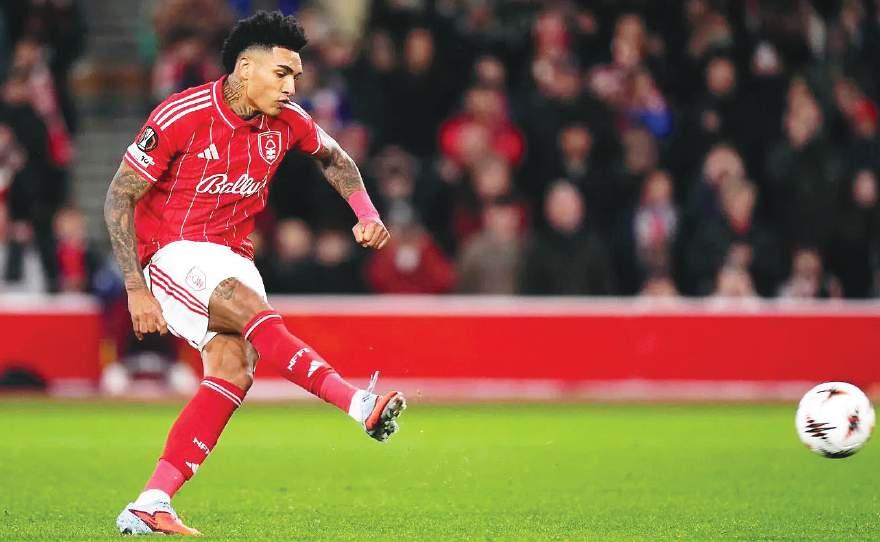
and provided an
Despite still having one more year in his initial two-year contract with Nigeria, Super Eagles Head Coach, Eric Sekou Chelle, has made a 19-point demand from the Nigeria Football Federation (NFF).
The Malian-born gaffer after missing qualifying Nigeria for the 2026 World Cup, went all the way to finishing the
as
2025 Africa Cup of Nations (AFCON) with the third placed bronze.
He was linked with the vacant Olympic Marseille job in the French Ligue 1 before former Senegal international, Habib Beye, was appointed on Wednesday evening.
Chelle ended his long-standing
partnership with his friend and agent, Sidibe Abraham Brehima, who had helped secure his previous roles with Nigeria and Mali following his dismissal from Boulogne, and instead signed with Wilders Sport.
UK-based Nigerian journalist, Shina Oludare, posted Chelle’s demands from
the NFF on social media yesterday. Central to the proposal Chelle sent to the NFF was a request to increase his monthly salary from $50,000 to $130,000, a figure he stated would cover the wages of his entire technical crew and personal assistant, rather than the widely reported $100,000.
The Mobolaji Johnson Sports Complex, Rowe Park, will come alive on Saturday, February 21, 2026, as medalists from the 2025 National Youth Games (NYG) return to the pool to battle for honours in the long course event of Season 7 of the Dolphin Swimming League.
The one-day swimming fiesta is hosted by the Lagos State Sports Commission (LSSC) in partnership
with Dynaspro Sports Promotion and Advanta Interactive, organisers of Nigeria’s foremost private inter-school swimming tournament.
Among the star attractions are NYG gold medalists who will proudly represent their schools and clubs in what promises to be a high-octane contest.
Oluseyi Oyebode, CEO of Dynaspro, highlighted the importance
of LSSC’s support: “We are grateful that Lagos State is now fully on board by hosting this event. With the state’s outstanding performance at the last NYG in Delta, we are confident new talents will emerge. Our vision goes beyond national competitions — we want to see these athletes don Nigeria’s colours at the Olympic Games and World Championships.”
LSSC Director General, Lekan Fatodu, praised the organisers for their consistency and impact: “The Dolphin Swimming League is a remarkable initiative. The improvement we see year after year is outstanding. The Lagos State Government is committed to supporting platforms like this, ensuring young people have opportunities to showcase their talents and launch into greatness.”
for the 2027 general elections. Obasanjo rejected the suggestion and dismissed us as naive and that he knows El-Rufai more than any of us does. Besides, he said he had resolved to pick his successor from among the state governors (whose support was indispensable to the success of the Peoples Democratic Party, PDP at the elections) and that the choice he had made has demonstrated impeccable character and proved himself a dependable and loyal ally.
He was speaking of Umaru Yaradua, who coincidentally was the junior brother of Shehu Yaradua (who served as Obasanjo’s deputy when he was military head of state). Somewhat inevitably, he would subsequently expatiate on the flaws of El-Rufai in his memoirs, ‘My Watch’ where he described him as having a “penchant for reputation savaging,” noting his tendency to lie and lack of consistent loyalty to others, being primarily loyal only to himself. He further characterised him as a “pathological purveyor of untruths and half-truths,” but nonetheless deemed him a “talented young man who can always deliver under close supervision.”.
I generally refrain from public scrutiny of those I have had a close personal relationship but I believe El-Rufai has crossed the red line this time around.
His ‘hell hath no fury than a woman spurned” relationship with Ribadu started with my earlier account of how he lost out to his close friend in the consideration of whom to choose as the ACN presidential candidate in the 2011 general elections.
This trend was at play when the Senate failed to confirm his ministerial nomination in 2023. Naturally, he felt slighted and disappointed like any of us would, but what made rejection particularly unbearable for him was that his nemesis , Nuhu Ribadu, had hitherto landed the all important appointment as the National Security Adviser, NSA.
The Nigerian Senate, particularly, the Senate President, is not my cup of tea but whatever the motive and power play behind his failure to clinch a ministerial confirmation, the truth is that, on the record of his governorship
of Kaduna state, for eight years, he is truly unfit for confirmation as Minister of the federal republic. No governor of that politically volatile state has been more callously divisive as he was.
He could barely disguise his thinly veiled deep seated animosity towards the Christian population of the state. His tenure was strewn with bloody security breakdowns, with, more often than not, the Christians as the predictable victims. He had set the stage for the kind of governor he would be when in 2012, he threatened “We will write this for all to read. Anyone, soldier or not that kills the Fulani takes a loan payable one day no matter how long it takes,”.
His legacy as governor are self-evident.
According to the reports of ICRI:
“In the days leading up to his 2019 reelection, El-Rufai whipped up public anger and physical violence when he falsely claimed that 130 Fulani had been killed in Kajuru, a locality near the capital city of Kaduna. Many, including the National Emergency Management Agency and El Rufai’s own Commissioner of Police denied his claims of an attack on the Fulani. In fact, eleven native Catholics were killed in Kajuru a few days before his comments. Suspected Fulani militants killed 127 people in Kajuru in what were presumably reprisal attacks in the month following El Rufai’s statement”.
When he took office as governor in 2015, he said that “the Fulani have nothing to fear, since a Fulani
its ESN arm, but since Nnamdi Kanu, the arrowhead of the Igbo separatist agitation was incarcerated late last year, all has quietened.
Put away in faraway Sokoto, the public optics remains a conquest of the Igbo nation, and they seems to be living out their ignominious fate with equanimity. This column cannot remember any major IPOB-related incidents or violence since Kanu was put away with that choreographed court conviction.
WHY IS THE SOUTHEAST BEING GARRISONED?
Question now is why would the Nigerian Army move troops to the southeast as if it were another country? Why would the southeast not be allowed to breathe for a while? Southeast is already on lockdown with probably the most military checkpoints; every state has military commands and barracks... Why do we need to further garrison an area that’s landlocked and the smallest zone in Nigeria? Fulani terrorists have made a sport or killing hapless Nigerians in Kwara, Kaduna, Benue, Plateau and Niger States nigh every day. In all occasions, the murderers walk away after every massacre. No arrest, no reprisals. These states surely need more soldiers than the southeast.
SOUTHEAST NEEDS OPERATION SAFE CORRIDOR OR OLIVE BRANCH:
We have seen thousands of Fulani terrorists being
de-radicalised and reintegrated into the society in the SAFE CORRIDOR programme of the military. This soft approach can also be introduced in the SE. It needs be noted that hunting down and mopping up of Igbo youths who are supposedly IPOB members would not end the Biafra agitation. On the contrary, it would gain more sympathy, win more followers and drive the struggle underground. Boots and guns never extinguishes serious agitations for separation. Soft power is more effective. Let’s have OPERATION OLIVE BRANCH in the southeast instead.
Speaking of non-kinetic approach, it is common knowledge that the SE has been meted with humiliating marginalisation, unfair and unjust policies in the last decade of the APC government starting with the late President Muhammadu Buhari.
A change in what seems like a scorch-earth policy again Ndigbo will work like margin if the federal government truly seeks peace in the east.
For instance, the Aba-Owerri road has been abandoned for nearly 15 years. Rail lines, sea ports, international passenger and cargo airports and requisite federal appointments will douse the insipient agitation in the SE; not all the arsenal of the NA.
Of course ‘operations’ are carried out with big budgets and it’s one way to keep the ‘boy’ happy.
Former COAS ... Buratai was a master of the ‘game’. He embarked all sorts of his so-called operation in the SE, including Python Dance and Egwueke. But in
the end, Buhari ended up escalating the conflict and amassing body bags. The Amnesty International has records outrageous extra judicial killings and missing persons at that period.
Let’s recall that IPOB was largely a nonviolent movement before President Buhari tried to end the agitations with arms and anger. That was when the ESN was formed more in self defense than in open defiance of the Nigerian state. This was thereabouts 2017.
Perhaps as a proof that OES is ill-considered, the troop picked up an IED in a church under controversial circumstances. In the second week, the NA 144 Battalion under OES arrested three suspects criminals and recovered a stolen Mack in Abia State.
This is the army usurping the work of the police in the guise of some nebulous military operation.
In summary, what is needed in the SE today is improve policing and intelligence gathering and processing. There’s already too much military presence in the SE. And in case the military hierarchy feigns ignorance, let it be known that most of the men posted in the littering of checkpoints are doing everything but security work. Armed soldiers in uniform are openly taking bribes and extorting commuters. It is a show of shame and a complete professional debasement. This column hopes someday, a reform-minded Army
political survival. When a law governing elections is weakened—when it is designed to expand ambiguity rather than reduce it—what is being attacked is not a clause but the social contract itself. Democracy cannot breathe in a room where outcomes are negotiated before ballots are counted.
At the centre of this crisis is a question that should not be controversial in any serious republic: how do we make rigging harder? Nigerians across regions, religions, and party lines share a rare consensus. They want elections that can be trusted. They want accreditation and collation processes that leave minimal room for manipulation. They want results that move from polling unit to public record without disappearing into shadows. This is not a luxury demand; it is the foundation of civic peace. Yet the amendment process, as executed, appears to do the opposite. Rather than tighten the screws on fraud, it loosens them. Rather than reduce discretion, it multiplies it. Rather than close the familiar doors through which elections are stolen, it refurbishes them and calls it pragmatism.
The sequence of events reads like a three-act play.
Act one was the House of Representatives, once romanticised as the more citizen-sensitive chamber. In what can only be described as a retreat dressed up as a procedure, the House abandoned its earlier posture in favour of a version that preserves a pathway for manual handling of what Nigerians have repeatedly demanded be made tamper-resistant. In a country where “manual” has become a synonym for discretion, and discretion has become a synonym for abuse, this is not a neutral compromise. It is a surrender—an invitation to the old craft of “corrections,” “adjustments,” and mysterious figures that arrive after the votes have been cast. It is the return of the familiar magician, now authorised to wear a badge.
Act two was the rhetorical laundering of that retreat. The new orthodoxy is “realism”: allow electronic transmission, yes—but keep manual processes as a fallback when “the system fails.” On paper, that sounds like common sense. In practice, it is an engineered
trapdoor. Because in Nigeria, systems have a habit of failing at precisely the moments when failure benefits the powerful. A manual option does not protect the voter; it protects the politician. It converts a technical exception into a strategic instrument. It creates a legal alibi in advance, so that what should be investigated as fraud can be explained away as a malfunction. Act three came from the executive. President Bola Tinubu’s swift assent—coming so quickly it seemed to outrun public scrutiny—lands in a wider pattern Nigerians are learning to recognise: when democratic safeguards demand patience, patience disappears. The state becomes allergic to questions. And assent, rather than being the final reflective step of a constitutional process, becomes a stamp applied with the impatience of those who do not expect to be held accountable. The political meaning is unmistakable: the rules of the contest will be adjusted by those who intend to win it, and the public may argue afterwards.
This is the point at which the nation must ask the simplest and most uncomfortable question: whose
[is] now governor of the state.”. Glorifying Fulani affinity with bloody vengefulness, he went further “Of course you know the Fulani have a long memory of avenging any killings; so their relations were coming from other countries to avenge the killings.”
“So a lot of what was happening in Southern Kaduna was actually from outside Nigeria. We took certain steps. We got a group of people that were going round trying to trace some of these people in Cameroon, Niger republic and so on to tell them that there is a new governor who is Fulani like them and has no problem paying compensations for lives lost and he is begging them to stop killing”.
He didn’t spare the international community either. In terrorist verbiage, he warned the International observer mission coming to monitor the 2019 general elections in Nigeria. “We are waiting for the person who will come and intervene.They will go back in body bags because nobody will come to Nigeria and tell us how to run our country. We have got that independence and we are trying to run our country as decently as possible”.
“The escalation of violence in Kaduna began almost immediately after El-Rufai took office. In 2015, there were 356 deaths from 24 violent incidents, marking the start of a troubling trend. By 2021, the situation peaked, with 1,225 fatalities from 480 incidents”.
Continued on page 36
The political era is in full bloom in Nigeria today. And the ruling APC government has helped in no small way to muddy the democratic waters so to speak. And since you cannot eat your cake and have, the APC must tread softly so that it doesn’t bring down the roof over the heads of all of us.
We all watch as the democratic spaces are being closed. We see all serving governors and elected legislators being ‘taken’ over like pliable brides. We haven’t seen a scenario like this before in Nigeria’s political history.
Now enfant terrible, Nasir el Rufai is a bad guy as if he was born yesterday.
Whatever Nasir is to, he was yesterday as APC lynchpin. To pull him in today because he’s no longer in the APC is POLITICAL PERSECUTION! How many more members of the opposition would be pulled in, or shall we say, pulled down!
agency do our legislators truly represent? The citizens’, or the incumbents’? The public interest, or the party’s arithmetic? The republic’s long-term stability, or the politician’s short-term survival?
When lawmakers treat transparency as optional, they are not merely betraying voters; they are weakening the very institution that gives them authority. The social contract is uncomplicated: citizens grant legitimacy through votes and taxes; leaders return value through representation, accountability, and governance. When electoral laws are redesigned to make cheating easier to excuse and harder to prove, that contract is broken. And a broken contract does not simply reduce turnout; it raises the temperature of the republic. It turns elections into rituals without trust. It turns politics into warfare by other means.
The greater danger is not only the content of the amendment but the speed and manner of its passage. Process is not decoration; process is protection. When safeguards can be revised in a hurry, the public learns a terrible lesson: democratic infrastructure can be remodelled at the convenience of the powerful. The normalisation of rushed erosion is how democracies are hollowed out—not by one dramatic coup, but by a sequence of tidy edits, each defended as minor, technical, and necessary. Citizens are expected to accept each reduction in clarity as maturity, each new loophole as flexibility, each new discretion as practical governance. That is how pseudo-patriotism works: it speaks the language of the nation while quietly transferring power from the people to the gatekeepers.
The likely consequences are already visible on the horizon. One is withdrawal: citizens, tired of participating in contests that feel pre-arranged, may boycott 2027, choosing emotional self-defence over civic duty. The other is resignation: people may show up, but only as witnesses to an outcome they expect to be managed. In either case, the result is the same: democracy survives as an appearance while dying as a substance. Polling units may open. Campaign songs may blare. Debates may be televised. But the
essential thing—a public belief that votes are counted as cast—will have been punctured again.
This is why the response cannot be casual or delayed. Civil society must refuse the lazy comfort of “this is the best we can get.” There is nothing inevitable about loopholes. There is nothing patriotic about ambiguity in the rules that decide leadership. Advocacy must focus on what citizens actually asked for: clarity that prioritises electronic transmission and narrows discretion, not wording that expands the room for post-election improvisation.
The diaspora, too often reduced to observers with nostalgia, should become amplifiers with strategy—using platforms, networks, and influence to insist that Nigeria’s elections must not remain a local tragedy with global embarrassment.
And the judiciary must understand what moment it is being invited into. Courts are not merely arbiters of disputes; they are guardians of democratic boundaries. Where citizens challenge the constitutionality and legality of these changes, the judiciary must resist the slow seduction of becoming a procedural accomplice to substantive injustice.
Most importantly, ordinary Nigerians must stop playing the role of an audience to a drama financed by their own hardship. Civic power is not an abstraction. It is petitions, town halls, organised pressure, coordinated litigation, vigilant monitoring, sustained public argument, and peaceful insistence that sovereignty is not a decorative word in a constitution—it is a lived claim. If citizens do not contest this new architecture of ambiguity, the stage built with their money will continue to be used against them. The actors will perform with the confidence that the audience has nowhere else to go. And Nigeria’s democratic project will drift further into the familiar abyss: managed elections, orchestrated outcomes, and pseudo-patriotic theatrics—conducted in the name of a people who are steadily being trained to doubt that their voice matters at all.
•Dakuku Peterside is the author of two bestselling books, Leading in a Storm, and Beneath the Surface,
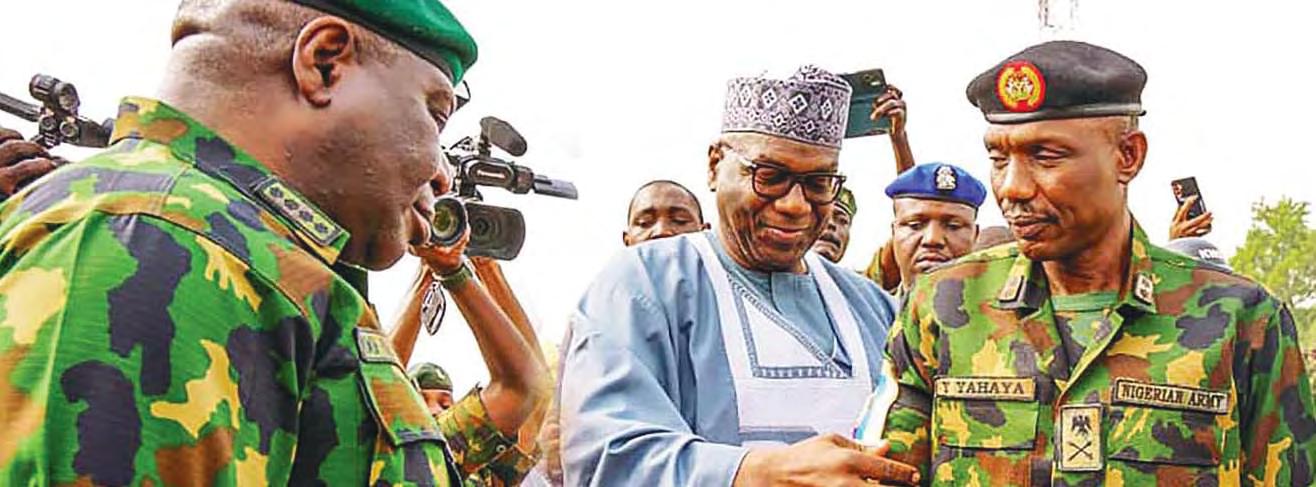
of Operation Savannah Shield at Sobi Barracks, in Ilorin, Kwara State, on Thursday.
akin.osuntokun@thisdaylive.com
“I
am writing as a concerned citizen to seek clarification and reassurance regarding information available to the political opposition leadership about a procurement of approximately 10 kilograms of Thallium Sulphate by the Office of the National Security Adviser (ONSA), reportedly from a supplier in Poland.. Given that thallium salts are highly toxic and tightly controlled substances, I believe it is important for public safety, democratic accountability and for maintaining public trust to confirm the following the intended purpose and end-use of the imported thallium sulphate”-El-Rufai
“Thallium is primarily used in high-tech industries for
manufacturing electronics (semiconductors, photoelectric
cells), specialized fiber optics, and low-melting glass, as well as in medical, cardiovascular, scintigraphic imaging. It is also employed in high-temperature superconductors and, historically, as a toxic rodenticide”-Encyclopedia Britannica
Scouting for a presidential material among the younger generation of public figures from the North in the electoral cycle of the 2011 general elections, Asiwaju Bola Ahmed Tinubu had commissioned a public opinion poll on the popularity rating of a sample comprising Nuhu Ribadu, Nasir El-Rufai, Sanusi Lamido Sanusi and others. Ribadu scored 45%, Rufai scored 7%,
The very name, ‘Eastern Sanity’ is derogatory. The military seems to insist that the Southeast of Nigeria is devoid of enough normalcy for sound human existence. Therefore, only a military operation can imbue sanity tmon the zone. This seems to be the thought process behind OPERATION EASTERN SANITY, OES, currently going on
in Southeastern end of Nigeria.
This column avers that this mindset of the Nigerian army, especially the military commanders, is flawed, provocative, perverse, and liable to yield no positive result.
Yours truly is writing this from the zone. He has been there since mid-December. He has travelled around
the zone a bit. He makes bold to say that the oriental side of Nigeria is probably the safest and most quiet part of Nigeria currently.
The massive return for the Christmas and New year festivities by Ndigbo went almost perfectly. There was nary an incident. Right now, (mid-February), life seems to have
Sanusi scored 3%. It was on the basis of this poll that Tinubu reached out to Ribadu and enthroned him as the Presidential candidate of the Action Congress of Nigeria, ACN, in 2011.
Prior to this, (on account of our camaraderie and quite efficient manner, he had discharged his mandate as Minister of the federal capital territory), Ribadu, myself and other members of a nine member caucus group empanelled by President Olusegun Obasanjo (to plot his exit strategy) had presented El-Rufai to the latter as our preferred choice as Presidential candidate
Continued on page 39
normalised in the SE. Not even the sit-at-home conundrum is effective anymore.
Though the NA didn’t categorically communicate the rationale for it’s ongoing operation, it is Understood that the OES may be a mop-up action against IPOB and
Continued on page 39
On a quiet Tuesday evening, as the sun sank behind Nigeria’s skyline, the National Assembly committed a small, efficient act of cruelty against the nation’s democratic conscience. What should have been a protective update to the electoral framework—law as a shield for the weakest voter—was reshaped into law as an insurance policy for the strongest incumbent. In a rush that felt more like coordination than governance, the harmonised report on the Electoral Act amendment—complete with the contentious Section 60(3)—was passed with startling speed, and presidential assent followed almost
immediately amid controversy. The message was
not subtle: when the political class is threatened by transparency, urgency suddenly becomes possible. Nigeria has seen this theatre before. We have watched lawmakers wrap private advantage in public language. We have watched “reforms” arrive pre-negotiated, rehearsed, and delivered with solemn faces. Yet this episode is unusually clarifying because it collapses the distance between what citizens suspect and what institutions now appear willing to formalise. The stage is built with public funds: the chambers, the microphones, the convoys, the allowances, the comfort. But the script increasingly reads like a compact among
elites—signed with the ink of procedure and paid for by citizens whose only demand is simple: let the vote mean what it says.
A legislature earns legitimacy by translating citizens’ voices into enforceable rules. That is the moral basis of representation. The National Assembly is meant to be the place where the noise of the streets is refined into the discipline of policy. Instead, it is too often the place where the urgency of the people is diluted into loopholes, and the public interest is bargained away for
Continued on page 39