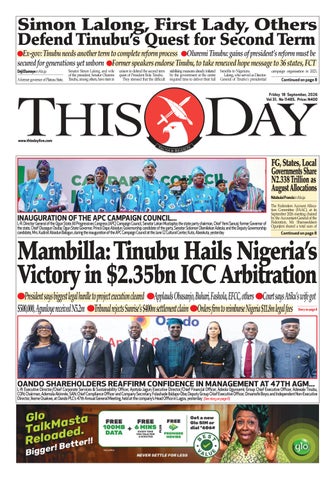
Simon Lalong, First Lady, Others Defend Tinubu’s Quest for Second Term
Ex-gov: Tinubu needs another term to complete reform process Oluremi Tinubu: gains of president’s reform must be secured for generations yet unborn Former speakers endorse Tinubu, to take renewed hope message to 36 states, FCT Deji Elumoye in Abuja A former governor of Plateau State,
Senator Simon Lalong, and wife of the president, Senator Oluremi Tinubu, among others, have risen in
unison to defend the second term quest of President Bola Tinubu. They stressed that the difficult
stabilising measures already initiated by the government at the centre required time to deliver their full
benefits to Nigerians. Lalong, who served as DirectorGeneral of Tinubu’s presidential
campaign organisation in 2023, Continued on page 8
Friday 18 September, 2026 Vol 31. No 11485. Price: N400
www.thisdaylive.com TR
UT H
& RE A S O
N
FG, States, Local Governments Share N2.338 Trillion as August Allocations Ndubuisi Francis in Abuja
INAUGURATION OF THE APC CAMPAIGN COUNCIL...
L-R: Director General of the Ogun State All Progressives Congress (APC) Campaign Council, Senator Lekan Mustapha; the state party chairman, Chief Yemi Sanusi; former Governor of the state, Chief Olusegun Osoba; Ogun State Governor, Prince Dapo Abiodun; Governorship candidate of the party, Senator Solomon Olamilekan Adeola; and the Deputy Governorship candidate, Mrs. Kudirat Abiodun Balogun, during the inauguration of the APC Campaign Council at the June 12 Cultural Center, Kuto, Abeokuta, yesterday
The Federation Account Allocation Committee (FAAC), at its September 2026 meeting chaired by the Accountant-General of the Federation, Mr. Shamseeldeen Ogunjimi shared a total sum of Continued on page 8
Mambilla: Tinubu Hails Nigeria’s Victory in $2.35bn ICC Arbitration President says biggest legal hurdle to project execution cleared Applauds Obasanjo, Buhari, Fashola, EFCC, others Court says Atiku’s wife got $500,000, Agunloye received N5.2m Tribunal rejects Sunrise’s $400m settlement claim Orders firm to reimburse Nigeria $11.8m legal fees
Story on page 8
OANDO SHAREHOLDERS REAFFIRM CONFIDENCE IN MANAGEMENT AT 47TH AGM...
L-R: Executive Director/Chief Corporate Services & Sustainability Officer, Ayotola Jagun; Executive Director/Chief Financial Officer, Adeola Ogunsemi; Group Chief Executive Officer, Adewale Tinubu, CON; Chairman, Ademola Akinrele, SAN; Chief Compliance Officer and Company Secretary, Folashade Ibidapo-Obe; Deputy Group Chief Executive Officer, Omamofe Boyo; and Independent Non-Executive Director, Ikeme Osakwe, at Oando PLC’s 47th Annual General Meeting, held at the company’s Head Office in Lagos, yesterday (See story on page 6)
2
friday, SEPTEMBER 18, 2026 • T H I S D AY
friday, SEPTEMBER 18, 2026 • T H I S D AY
3
4
friday, SEPTEMBER 18, 2026 • T H I S D AY
5
THISDAY • FRIDAY, SEPTEMBER 18, 2026
NEWS
Group News Editor: Goddy Egene Email: Goddy.egene@thisdaylive.com, 0803 350 6821, 0807 401 0580
NATIONAL SUMMIT OF FORMER PRESIDING OFFICERS OF STATE HOUSES OF ASSEMBLY...
L-R: Minister of State for Housing and Urban Development, Rt Hon Yusuf Abdulahi Ata; Leader of the Senate, Sen. Opeyemi Bamidele; National Chairman of Forum of Former Presiding Officers of State Houses of Assembly, APC Sen. Wasiu Sani Eshinlokun; Ebonyi State Governor and Chairman BoT, Forum of Former Presiding Officers of State Houses of Assembly, APC, Rt Hon Francis Ogbonna Nwifuru; First Lady of Nigeria and Grand Patron of the Forum of Former Presiding Officers of State Houses of Assembly, APC, Senator Oluremi Tinubu; Former Senate President, Sen. Anyim Pius Anyim; Former Plateau State Governor, Senator Simon Lalong; and Minister of state for Petroleum(oil) Sen Heineken Lokpobiri, at National Summit of Former Presiding Officers of State Houses of Assembly in Nigeria, APC, where the forum endorsed President Bola Ahmed Tinubu for a second term in office at the Banquet Hall of the State House Abuja, yesterday
Dangote Refinery IPO: Uwaleke, Ndanusa, Teriba Raise Stakes for Investors, Say Offer Can Cut Reliance on Debt, Others Declare refinery listing could deepen equity market, mobilise domestic savings, reshape financing of productive assets Urge investors to test earnings, cash flows, leverage, governance before subscribing Challenge government to unlock value in public assets while preparing for global energy transition Rwanda to open Dangote IPO to local investors James Emejo in Abuja Financial and economic analysts yesterday described the Dangote Petroleum Refinery Initial Public Offering (IPO) as a test of the country’s capital-market discipline, an opportunity to broaden ownership of strategic assets, and a pointer to how the country could finance development beyond mounting reliance on debt. Analysts cautioned, however, that the IPO’s significance would ultimately depend on investment discipline, sound governance, and the ability to demonstrate sustainable returns. That was as Capital Markets Authority (CMA) of Rwanda announced that it had commenced arrangements to facilitate the participation of Rwandan investors in the IPO of Dangote Petroleum Refinery, signalling growing regional interest in the landmark Nigerian capital market offering. The Rwandan capital market regulator, in a public announcement, said it was working with relevant stakeholders to establish the arrangements that would enable investors in the East African country to participate in the refinery’s share offering. In separate presentations, Professor of Capital Market/pioneer President, Capital Market Academics of Nigeria, Professor Uche Uwaleke, and renowned economists – Dr. Suleyman Ndanusa, and Dr. Ayo Teriba — said the proposed listing could broaden ownership of one of the country’s most strategic industrial assets, mobilise domestic savings, and provide a template for financing productive assets beyond the growing dependence on debt. However, the experts approached the proposed transaction from different perspectives.
IPO Could Deepen Market, Mobilise Savings
Uwaleke described the proposed listing as an investment story, a capitalmarket development opportunity, and an important component of Nigeria’s broader economic transformation. He said the IPO could give investors access to one of the country’s most significant industrial assets while creating a wider pool of domestic ownership and strengthening the capacity of the
capital market to mobilise substantial savings for productive investment. According to him, the listing could increase market capitalisation, expand participation by retail and institutional investors, and create a major investible asset for pension funds and asset managers. It could also broaden Nigerian ownership of a strategic segment of the petroleum value chain, he said. Beyond the capital market, Uwaleke said the refinery had the potential to contribute significantly to import substitution, refined-product exports, foreign-exchange earnings, employment generation, supplier development, petrochemicals, and wider industrial linkages. He added that the project could strengthen Nigeria’s position in regional energy trade while creating multiple revenue channels across refining, storage, logistics, power, petrochemicals and exports. However, the former Imo State Commissioner for Finance stressed that the scale and strategic importance of the refinery should not obscure the risks investors would have to consider. He identified valuation, crude supply, refining margins, execution of expansion plans, foreign exchange, regulation, operational performance and post-listing liquidity among the issues that could affect the investment. He pointed out that the prospectus and the underlying fundamentals should form the basis of investment decisions rather than the size or national importance of the refinery alone.
Test Earnings, Cash Flow, Leverage
Ndanusa drew a distinction between acknowledging the refinery’s industrial achievement and determining whether its shares constitute an appropriate investment. According to him, the scale of the project should not substitute for rigorous financial analysis by prospective subscribers. He identified valuation as the first major test, stating that the offer price should be supported by durable earnings, credible cash flows, and transparent assumptions. A period of strong refining margins
or impressive short-term earnings, he cautioned, should not automatically be regarded as evidence of sustainable full-cycle earnings capacity. Ndanusa said prospective investors should expect the final offer document to provide adequate information on the valuation methodology, comparable companies, key assumptions and the sensitivity of the business to changes in market conditions. He also raised questions about the financing of the refinery’s expansion programme and the implications of additional capital expenditure for shareholders. Investors, he said, would need clarity on whether expansion would be funded through IPO proceeds, retained earnings, operating cash flow, or additional borrowing, as well as the implications for leverage, interest obligations, and debt-service capacity. He said dividend expectations should be assessed against actual cash generation. He explained that a company
undertaking substantial expansion could record higher accounting profits while simultaneously requiring significant cash for capital expenditure, debt servicing, and working capital. Ndanusa also placed corporate governance at the centre of the investment debate, particularly in view of the ownership structure that could remain after the listing. He stressed the importance of independent directors, effective board committees, transparent related-party transactions, adequate conflict-of-interest safeguards, timely disclosures, and equal treatment of minority shareholders. He urged consistency in the information contained in the final prospectus, warning that discrepancies in timelines, figures or assumptions could undermine investor confidence. He called for the refinery’s industrial success to be translated into an investment proposition capable of withstanding scrutiny on the basis of evidence, governance and price
discipline.
Use IPO to Reduce Debt Dependence
For his part, Teriba stressed that the IPO could offer Nigeria a practical lesson in financing large-scale productive assets through a combination of instruments rather than excessive dependence on debt. He stated that Dangote had over time deployed borrowing, debt instruments, private placements, and other forms of capital before moving towards public equity. He said the progression underscored the importance of a diversified financing mix. The lesson, according to him, is particularly relevant to government, given Nigeria’s continued reliance on borrowing, despite its ownership of substantial commercial, infrastructural, and other economic assets. Rather than relying predominantly on future public revenues to support
additional borrowing, Teriba said government should examine how viable assets on its balance sheet could be used to mobilise capital. He stressed that such an approach should not amount to indiscriminate privatisation. Teriba said government could retain strategic or majority ownership while bringing in minority investors, using concessions and public-private partnerships, establishing special-purpose vehicles or structuring securities around commercially viable assets and identifiable cash flows. He said potential areas could include energy infrastructure, electricity assets, transport infrastructure, airport terminals, rail projects, commercially viable roads, and government-owned enterprises with identifiable revenue streams. Teriba explained that the underlying principle was for the country to move from relying largely on financing against its income stream to also mobilising the value of its balance sheet.
Harvard Alumni Rally Oil, Gas, Power Stakeholders to Drive National Industrialisation Lokpobiri, Tegbe, Eyesan, Ojulari to speak at maiden HBSAN energy conference
Peter Uzoho The Harvard Business School Association of Nigeria (HBSAN) is gathering stakeholders across oil, gas and power sectors to discuss how to integrate Nigeria’s energy resources and systems as a pathway to industrial growth and national economic transformation. The Association has announced that its maiden Energy Conference would take place in Lagos on October 9, 2026, with the theme “One Energy System: Integrating Oil, Gas, and Power for National Transformation.” Vice President of HBSAN, Mr. Niyi Omojola, who presented the highlights of the forthcoming event at a press conference in Lagos, said the high-level gathering was designed to move Nigeria from fragmented sector operations toward a unified,
interconnected energy economy that delivers maximum value from its vast resources. Nigeria holds about 2.15 trillion cubic feet of proven gas reserves and is among the world’s top 10 gas producers, yet struggles with chronic power shortages, high energy costs for industries, and over N6 trillion in debts owed to power sector operators. While government has rolled out reforms including the Petroleum Industry Act (PIA) 2021, the Gas Regulations 2023 and the Decade of Gas initiative, stakeholders say policies remain in silos. Experts say gas producers prefer crude because of poor returns on gas supplied to power plants, while power generation remains hamstrung by gas supply constraints and liquidity issues.
This fragmentation, the Association said, is the core problem the conference seeks to fix. Omojola said the conference was founded on the proposition that oil, gas and power must operate as a coherent ecosystem. Through deliberate dialogue on governance, policy convergence, bankable infrastructure and operational efficiency, he added that the event will produce an actionable white paper to assist government implementation. According to him, HBSAN President, Mr. Collins Onuegbu, will open the event, followed by a keynote address by the Managing Director of NLNG, Mr. Adeleye Falade, titled, “From Resource to Prosperity: Unlocking National Growth through Integrated Energy Systems – Oil, Gas and Power. The African Perspective.”
Other high-level dignitaries and speakers lined up for the conference include Minister of Power, Joseph Tegbe; Minister of State for Petroleum Resources (Gas), Ekperikpe Ekpo; Minister of State for Petroleum Resources (Oil), Heineken Lokpobiri; Group Chief Executive Officer of NNPC Limited, Mr. Bayo Ojulari; and the Commission Chief of the Nigerian Upstream Petroleum Regulatory Commission (NUPRC), Mrs. Oritsemeyiwa Eyesan among others. Speaking on the rationale, Chairman of the HBSAN Energy Conference, Dr. Mayowa Afe, said Nigeria must fix its energy sector itself, noting that international oil companies (IOCs) operated for over 60 years without building refineries to add value, while Nigeria has gas but no power.
6
FRIDAY, SEPTEMBER 18, 2026 • THISDAY
NEWS
46TH KING ABDULAZIZ INTERNATIONAL QUR’ANIC RECITATION COMPETITION...
L-R: Wife of the NSA, Hajia Zarah Ribadu; Gombe State Governor, Alhaji Muhammadu Inuwa Yahaya; First Lady of Nigeria, Senator Oluremi Tinubu; Winner of the 46th King Abdulaziz International Qur’anic Recitation Competition, Maryam Ibrahim Dan’azumi; Wife of the Gombe State Governor, Dr. Asm’au Inuwa Yahaya; and wife of DG of DSS, Mrs. Charity Ajayi, during the presentation of the winner to the First Lady by the governor and receiving a gift of N20million from the First Lady at the State House, Abuja on Tuesday
MTN Moves to Acquire Mafab’s $273.6m 5G Spectrum as Discussions Intensify Emma Okonji Mafab Communications Limited, backed by Nigerian businessman, Musbahu Muhammad Bashir, is planning to sell its $273.6 million 5G spectrum asset to MTN Nigeria,
THISDAY investigation has revealed. Although the discussion between Mafab and MTN remained under wraps, awaiting regulatory approval, THISDAY gathered that Mafab was willing to sell its 5G spectrum to a willing buyer, having kept the
spectrum redundant for five years without putting it into proper use, since it won the 5G license auction bid in 2021, alongside MTN Nigeria. Industry sources told THISDAY that the discussions to acquire Mafab’s 5G asset by MTN were
almost concluded and waiting for regulatory approval. THISDAY sent media enquiry to MTN and NCC for confirmation, but as at press time, none had responded to the enquiry. The proposed transaction covers
Oando Shareholders Reaffirm Confidence in Management at 47th AGM Company approves digital assets provisions, directors re-elected
Emmanuel Addeh in Abuja Shareholders of Oando Plc yesterday reaffirmed their confidence in the company’s management and strategic direction, approving all resolutions presented at the company’s 47th Annual General Meeting (AGM). The shareholders commended the board and management for their approach to corporate governance, portfolio development and disciplined capital allocation, while backing the company’s growth ambitions. Among the resolutions approved were the re-election of Ademola Akinrele (SAN) Omamofe Boyo, Ikeme Osakwe and Adeola Ogunsemi as directors retiring by rotation, a statement from the company stated. The shareholders also approved the re-appointment of BDO Professional Services as the company’s external auditors, elected members of the Statutory Audit Committee and approved the remuneration of the non-executive directors. The meeting further approved amendments to the company’s Memorandum and Articles of Association to accommodate physical, electronic and hybrid general meetings. The amendments also introduced provisions relating to digital assets, cryptographic technologies, distributed ledger technologies and other emerging technologies, subject to applicable laws and regulatory requirements. Shareholders equally authorised the board to pursue listings on other stock exchanges, including cross-border listings, subject to the necessary regulatory approvals. The meeting was marked by
extensive shareholder engagement, with participants questioning and commending the board and management on the company’s strategic priorities and outlook. A shareholder, Mrs Bisi Bakare, commended the management for what she described as a more disciplined approach to portfolio development, particularly in the mining and infrastructure business. “I just want to use this opportunity to congratulate the board and management for the strategic shift in the mining and infrastructure business from broad-based exploration to a more disciplined asset prioritisation approach,” she said.
“I believe this is a prudent approach, particularly given the need for disciplined capital allocation across the group,” she added. Speaking on Oando’s outlook, the Group Chief Executive, Adewale Tinubu, said operational control and disciplined execution would remain central to the company’s strategy as it continues its integration and expansion. “Operational control gives us execution capacity and creates value. We are focusing on clear accountability and stronger performance management,” Tinubu said. “As we continue our integration,
we will allocate capital responsibly, report on time, meet our guidance and commit to our choices,” he stressed. The chairman of the board, Akinrele, in his closing remarks, thanked shareholders for their participation, questions and continued confidence in the board. “I thank you all for your attendance today, and I’d like to thank you in particular, shareholders, for the range of your questions, the thoughtfulness of it, the insight of the questions, and the passion and love you’ve shown for the company, and also the patience and confidence you have reposed on the board,” he said.
Mafab’s 2x20 MHz Spectrum block in the 2.1 GHz band and its 100MHz holding in the 3.5GHz band, subject to regulatory approval. Mafab’s 3.5GHz license became one of Nigeria’s most closely watched telecom assets after the relatively young company emerged alongside MTN as winners of the country’s landmark 5G spectrum auction in 2021. Both companies paid $273.6 million for their respective 100MHz lots. While the proposed deal could mark a major shift in telecoms venture that once challenged established operators for a place in Nigeria’s 5G market, it is certain that the planned acquisition will strengthen MTN’s network capacity as demand for mobile data continues to grow. Nigerian Communications Commission (NCC) had in 2021 auctioned the 3.5GHz spectrum for 5G rollout, and announced MTN and Mafab as the winners in the 2021 auction. One year later, Airtel acquired its licence for 5G rollout. While MTN launched its 5G network in September 2022, Airtel launched its 5G network June 2023. Mafab, however, claimed that it launched its 5G network in January 2023, but since then, no subscriber could connect to Mafab’s 5G network, making its
5G spectrum licence redundant till date. Some Nigerians had in the past raised concerns about the capacity of Mafab to roll out 5G in Nigeria, without an existing telecom infrastructure. As at the time Mafab won the 5G spectrum bid in 2021, the company was relatively small and was not known as a telecom operator because it had no subscriber base, like other established telecoms operators in the country. It had no offices across the country and no customer care service centres where intending subscribers could go and make enquiries on their services in order to sign up on its network. Nigerians had raised questions as to the possibility of a successful rollout of Mafab’s 5G services in the country. Mafab’s spokesman, Mr. Adebayo Onibanjo, had defended Mafab’s ability to roll out 5G services in Nigeria, insisting that Mafab will ride on an existing telecom company to roll out its services to Nigerians on the 5G infrastructure and will continue to expand as the market grows. The current development has seemed to confirm the doubts about the capacity of Mafab to roll out 5G services in Nigeria, as Nigerians await the final acquisition deal of Mafab.
FG Sets up Technical Committee to Review 2025 Tax Acts Recommendations to form part of 2027 finance bill CSOs, others protest rising debt profile, demand end to excessive borrowing
Ndubuisi Francis in Abuja The federal government has set up a technical sub-committee to review the 2025 Tax Acts, tasking the body to search for possible implementation ambiguity, unintended consequences, where compliance can be simplified, and areas of improved investment and competitiveness. Minister of Finance and Coordinating Minister of the Economy, Mr. Taiwo Oyedele, who inaugurated the Technical Sub-committee on Fiscal Policy and Tax Reforms in Abuja, Thursday, said the exercise sought to review the implementation of existing fiscal and tax reforms and develop proposals that respond to current economic realities. Oyedele said the subcommittee will review key areas of the tax
regime, such as Value Added Tax (VAT) thresholds, Withholding Tax, capital gains treatment, and multiple taxation, with recommendations expected to form part of the Finance Bill 2027. He said, “We must ask where implementation has revealed ambiguity, where unintended consequences have emerged, where compliance can be simplified, and where we can improve investment and competitiveness.” The subcommittee, chaired by Permanent Secretary, Federal Ministry of Finance, and co-chaired by Chairman of Tax Advisory Committee, Mr. Albert Folorunsho, has over 20 sectoral representatives from the public and private sectors, as well as the professions. Some of the representatives
are drawn from the public sector organisations, like Central Bank of Nigeria (CBN), Nigeria Custom Service (NCS), Nigeria Revenue Service (NRS), Debt Management Office (DMO), Joint Revenue Board (JRB), Budget Office of the Federation (BoF), and Legal Drafting Department of the Federal Ministry of Justice, among others. There are also representatives from Nigeria Economic Summit Group (NESG), the professional bodies, such as Institute of Chartered Accountants of Nigeria (ICAN), Association of National Accountants of Nigeria (ANAN), Chartered Institute of Taxation of Nigeria (CITN), and Nigerian Bar Association (NBA). The Organised Private Sector (OPS), such as Manufacturers Association of Nigeria (MAN);
Nigerian Association of Chambers of Commerce, Industry, Mines and Agriculture (NACCIMA); and representatives of four big accounting firms, Deloitte, EY, KPMG, and PwC, are also part of the sub-committee. Inaugurating the body, Oyedele recalled that the new tax laws took effect from January 1, 2026. Nigeria Tax Act 2025, Nigeria Tax Administration Act 2025, Nigeria Revenue Service (Establishment) Act 2025, and Joint Revenue Board (Establishment) Act 2025 came into effect on January 1, 2026. According to Oyedele, the new tax laws has exposed areas requiring clarification, refinement, and further reforms. He stated, “The real test begins when the law meets the economy, as
businesses interpret it, administrators implement it, investors respond to it, and citizens experience it. Implementation inevitably reveals areas requiring clarification, refinement or further reform.” He observed that the government was moving from fundamental reforms to continuous improvement, adding that the latest exercise is not intended to reverse the 2025 reforms but to address problems identified during implementation. The minister said the technical subcommittee was established to draft the Finance Bill 2027, the revised Withholding Tax (WHT) Regulations 2027, and an amended Significant Economic Presence Order 2027, for consideration. The technical subcommittee has six weeks to conclude its assignment.
7
THISDAY • FRIDAY, SEPTEMBER 18, 2026
NEWS
INSPECTION VISIT OF OFFICIALS OF NADDC TO KOJO MOTORS...
L-R: Chairman of Kojo Motors, Chief Ikenna John Oguegbu; Chairman of Board of National Automotive Design and Development Council (NADDC), Chief Emma Eneukwu; Director General of NADDC, Mr. Oluwemimo Joseph Osanipin; and Executive Director of Kojo Motors, Mr. Chinedu Oguegbu, during an inspection visit of officials of NADDC to Kojo Motors, Umunya, Oyi Local Government Area of Anambra State, yesterday
Cardoso Explains Shift from Direct Development-finance Interventions to Stronger Credit System to Agriculture, Others Ononugbo: credit must raise productivity, incomes, jobs GIZ AgFin project unlocks d €53.9 million to smallholder farmers, project records 150,300 transactions, 90% repayment rate 8-year project proves smallholder lending can work, says Ruediger Badmus: banks must see farmers as viable businesses James Emejo in Abuja Governor of the Central Bank of Nigeria (CBN), Mr. Olayemi Cardoso, yesterday said the apex bank had moved away from direct development-finance interventions to building stronger institutions and systems capable of sustainably delivering credit to agriculture and other productive sectors of the economy. Cardoso disclosed this at the National Close-out Conference of the Global Project for the Promotion of Agricultural Finance for Agri-based Enterprises in Rural Areas in Nigeria (GP AgFin), held in Abuja. He said the experience of the past eight years had demonstrated that development-finance systems could be rebuilt and sustained, despite economic fragility and uncertainty. He said the priority was no longer simply to deploy money into specific projects, but to strengthen institutions, improve coordination and create systems that would continue to generate value after individual development programmes had ended. Represented by CBN Director, Development Finance Advisory Department, Dr. Paul Oluikpe, Cardoso said, “We believe that building systems is more important than just giving
money. Building resilient systems is more important than simply providing funding for specific projects.” According to him, CBN has “pivoted away” from maintaining the heavy footprint it previously had in the development-finance space, opting instead to deploy its convening power and advisory capacity to bring relevant institutions and stakeholders together. Cardoso said the approach involved strengthening development finance institutions, including Bank of Industry (BoI) and other relevant agencies, while also working with state governments to deepen the delivery of development finance. It also emerged that the project, commissioned and financed by the German Federal Ministry for Economic Cooperation and Development (BMZ) and implemented by the Deutsche Gesellschaft für Internationale Zusammenarbeit (GIZ), facilitated €53.9 million, (about N61 billion) in financing to smallholder farmers through partner financial institutions. The CBN governor urged stakeholders to ensure that the lessons and practices generated by GP AgFin were incorporated into existing systems rather than lost with the closure of the project. He said, “The end should be much more than simply a closure,” stressing
that sustainable systems should prevent the country from repeatedly starting over with new interventions. The eight-year GP AgFin programme reported substantial expansion in access to agricultural finance, with over 101,449 farmers and agribusinesses accessing tailored financial products and services, generating 150,300 financial transactions. He disclosed that 22 tailored agricultural financial products were
The Managing Director of THISDAY Newspapers, Mr. Eniola Bello, has called on media practitioners and students of journalism to uphold the fundamental principles of accuracy, objectivity, fairness and balanced reporting in the discharge of their professional responsibilities. Mr. Bello made the call yesterday in Ilorin, Kwara State capital while donating copies of his books to the Department of English and Literary Studies University of Ilorin. He said there is need for young people training in media practices to return to the basic principles of journalism.
He decried the growing influence of what he described as “street journalism”, noting that the development has contributed to the spread of fake news, particularly where reports are published without efforts to verify facts or obtain the sides of those involved. According to him, journalists must make deliberate attempts to confirm information before publication, as failure to do so could cause unnecessary crises and damage to individuals and society. Bello who has spent several decades in journalism, said his career had taken him through various media organisations, including Vanguard and Concord, before joining THISDAY, where he rose through different
From Access to Impact Delivering the keynote address, CBN Deputy Director and Special Assistant, Office of the Deputy Governor, Economic Policy Directorate, Dr. Michael Ononugbo, said the next phase of agricultural finance must be measured by its impact on productivity, incomes, employment, food security, and resilience rather than merely by the volume of loans
disbursed. Speaking on the theme, “From Access to Impact: Embedding Agricultural Finance in Nigeria’s Economic Policy Architecture,” Ononugbo said access to finance was only the starting point. He said, “The true test of agricultural finance is not whether credit has been extended, but whether that credit has transformed lives, strengthened value chains, and contributed to sustainable economic progress.”
ECOWAS Biometric Card Will Ease Travel, Enhance Free Trade in Member States, Say IOM, NIS, ECOWAS Sunday Okobi
International Organisation for Migrants (IOM), Nigerian Immigration Service (NIS), as well as other stakeholders in the West African region, including, mainly, ECOWAS, have enumerated the huge benefits of the newly launched ECOWAS National Biometric Identity Card (ENBIC), including free and safe movement and trade for ECOWAS citizens, as well as having the legal rights to live freely in any member state of the sub-region of Africa. The ENBIC, which will cost N35,000
THISDAY MD Donates Books to UNILORIN English Department Hammed Shittu in Ilorin
developed and piloted, with 19 permanently integrated into the portfolios of partner financial institutions without GIZ/AgFin funding. Also, 19 of the products also incorporated digital delivery, while partner microfinance banks recorded repayment rates of more than 90 per cent. The project, which ran from 2018 to 2026 across 10 states, focused on six value chains—maize, rice, cassava, Irish potato, poultry and aquaculture.
editorial positions and contributed columns to the development of public discourse. He said his books, which contain a selection of articles written between 1999 and 2003, were compiled to provide a historical account of Nigeria’s democratic journey and help young people understand the country’s past. The THISDAY helmsman who is one of the 50 Unilorin ambassadors honoured by the University of Ilorin, disclosed that the collection initially ran into more than 1,000 pages before it was eventually divided into two volumes, adding that the decision was informed by the desire to preserve the works while making them useful to students and researchers.
to acquire, will help realise the objectives of the ECOWAS Free Movement Protocol, the Global Compact for Safe, Orderly and Regular Migration, and national efforts to strengthen migration governance and regional cooperation. At a media sensitisation workshop in Lagos yesterday, these stakeholders called for increased awareness of how the ENBIC will build public trust and ensure Nigerians have a clear understanding of how the travel document works. In his speech, the ECOWAS Director of Free Movement of Persons, Migration, and Tourism, Mr. Obinna Ajugwo, stated that ENBIC, which is one of the ECOWAS visions of free movement, is one of the cornerstones of the regional integration agenda.
According to him, “Since the adoption of the Protocol on Free Movement of Persons, we have made significant progress in facilitating mobility across our Member States. However, as mobility increases, so do the challenges associated with identity management, irregular migration, and cross-border crime. “It is within this context that the ECOWAS Biometric Identity Card was conceived and endorsed by our Heads of State and Government. “The ENBIC is not just a card. It is a symbol of belonging. It is a tool for inclusion. And most importantly, it is an enabler of safe, secure, and efficient movement across our region. “By providing a reliable and harmonized system of identification,
the ENBIC will: facilitate the exercise of the right to free movement; strengthen border management systems; enhance security cooperation among Member States; and promote economic and social integration.” However, Ajugwo noted that the success of the initiative does not depend solely on technology or policy frameworks; rather, “it depends on people. It depends on trust and information.” While calling on the media to intensify awareness for ENBIC, the ECOWAS director stressed that: “You are the bridge between institutions and our community citizens. You shape public understanding, influence perception, and help build confidence in initiatives such as ENBIC.
Nigerian Architects Harp on Professionalism, Ethics to Tackle Housing, Infrastructure, Urbanisation Challenges Hammed Shittu in Ilorin President, Nigerian Institute of Architects, Arc. Sani Saulawa yesterday said that Nigeria’s complex challenges in housing, infrastructure, urbanisation, economic transformation, climate resilience and institutional capacity require more than technical competence. Rather, he said requires organised professional knowledge
and ethics that are capable of influencing policy and shaping outcomes of the nation’s development. Saulawa stated this in Ilorin, Kwara state capital on Thursday during the 7th Distinguished Lecture Series, DLS 7.0 organised by the Kwara State Chapter of the NIA. The title of the lecture is entitled, “Professional Bodies and National Growth and
Development”- Perceptives and Reflections of an Architect and delivered by the former president of the NIA, Architect Mohammed Jimoh Faworaja. Arch. Saulawa however stated that, “Professional bodies must therefore ask themselves difficult questions. Are we merely regulating membership and protecting professional boundaries, or are we actively contributing to national progress?
8
FRIDAY, SEPTEMBER 18, 2026 • THISDAY
EIGHT
World Bank Mobilises Record $112bn Private Capital, Funding for Developing Nations Hits $200 Billion Africa attracts $22bn PCM, up nearly 150% in four years Global lender issues record $25bn guarantees, exceeds 2030 target 55% of 2026 financing directed to infrastructure, energy, others
Emmanuel Addeh in Abuja
The World Bank Group has mobilised a record $112 billion in private capital for developing economies in 2026, more than tripling the amount recorded four years earlier and taking total financing and capital mobilisation by the institution to more than $200 billion during the year. The World Bank Group, in a statement yesterday, said Private Capital Mobilised (PCM) rose from $35 billion in 2022 to $112 billion in 2026, reflecting efforts over the past three years to make its operations faster and simpler and deepen collaboration between its public and private sector arms. The increase was recorded across different income groups, the global
lender said, with lower-middle-income countries attracting $37 billion in private capital in 2026, compared with $14 billion in 2022. For upper-middle-income countries, private capital mobilisation rose from $12 billion to $50 billion over the same period, while mobilisation for low-income countries remained at about $3 billion. Similarly, Africa recorded a substantial increase, with private capital mobilisation rising from approximately $9 billion in 2022 to $22 billion in 2026, representing an increase of nearly 150 per cent. The World Bank Group said the results followed changes introduced to improve its engagement with the private sector, including the expansion of guarantees and
local-currency financing, efforts to address foreign-exchange constraints and the development of new equity instruments and investment structures. It added that it had also brought its public and private sector operations closer together at country level, with a single point of contact for its work and integrated strategies tailored to the development priorities of individual countries. In his comments, the World Bank Group President, Ajay Banga, said the institution had responded to calls from shareholders and clients to deploy its financing and knowledge more effectively to attract private investment into developing economies. “Three years ago, our shareholders and clients were clear: Utilise World Bank Group financing and knowledge
to mobilise more private capital and become a better partner to the private sector. We changed how we work to do that—faster, simpler, and as one World Bank Group,” Banga said. “The result is $112 billion mobilised this year, more than three times where we started. But the number only matters if the capital goes where it can create opportunity and jobs. That is the work ahead: keep removing barriers, keep expanding the pool of investors, and keep driving more capital into developing economies,” he added. The institution also disclosed that it issued more than $25 billion in guarantees in 2026, exceeding its target of $20 billion in annual issuance by 2030 four years ahead of schedule. The growth in guarantees was led
by the World Bank Group Guarantee Platform, established in 2024 to provide clients and investors with a single access point for guarantee products across the institution. According to the World Bank Group, the mobilisation of private capital is closely linked to its jobs agenda, given the projected demographic pressures facing developing economies. It said 1.2 billion young people in developing economies would reach working age over the next 10 to 15 years, while only about 420 million jobs were projected to be created. The institution noted that the private sector currently creates nine out of every 10 jobs in developing economies, making increased private investment central to efforts to expand
MAMBILLA: TINUBU HAILS NIGERIA’S VICTORY IN $2.35BN ICC ARBITRATION
Emmanuel Addeh in Abuja
Nigeria has secured another major victory in a string of high-stakes international legal battles, with the International Chamber of Commerce (ICC) tribunal in Paris yesterday throwing out a $2.35 billion claim by Sunrise Power and Transmission Company Limited over the long-delayed Mambilla Hydroelectric Power Project. The ruling also rejected a separate $400 million settlement claim and ordered Sunrise and its promoter, Leno Adesanya, to reimburse Nigeria about $11.82 million in
legal fees and expenses. The panel, according to a 620page document containing the proceedings, which was seen by THISDAY, was chaired by Melaine van Leeuwen, with Simon Nesbitt and Stavros Brekoulakis serving as co-arbitrators. An excited President Bola Tinubu, in a statement personally signed by him, described the development as the “single biggest legal hurdle” that had paralysed the 3,960MW Mambilla project in Taraba for years. However, the outcome adds to a series of significant legal victories or favourable outcomes for Nigeria
FG, STATES, LOCAL GOVERNMENTS SHARE N2.338 TRILLION AS AUGUST ALLOCATIONS
N2.338 trillion to the three tiers of government as Federation Account allocation for the month of August. From the total distributable amount, inclusive of Gross Statutory Revenue and Value Added Tax (VAT), the federal Government received N804.897 billion, the states received N794.313 billion, while the local government councils (LGCs) received N555.142 billion. In addition, N184.388 billion was shared as Derivation Revenue to the oil-producing states, representing the constitutionally prescribed 13 per cent of mineral revenue. A total of N125.142 billion was deducted for the cost of collection, while N1.221 trillion was allocated for Transfers, Intervention and Refunds.
Value Added Tax
Citing a Communiqué issued by FAAC at the end of the meeting, the Head Head, Information and Public Relations, Federal Ministry of Finance, Efe Ovuakporie, said in a statement that the gross revenue available from Value Added Tax (VAT) for August 2026 stood at N834.843 billion, compared with N793.968 billion distributed in the preceding month, representing an increase of N40.875 billion in gross VAT revenue. From the VAT revenue, N100.545 billion was deducted for the cost of collection, while N1.184 trillion was allocated for Transfers, Intervention and Refunds. The balance of N733.233 billion was distributed among the three tiers of government as follows: The federal government received N77.323 billion, states received
N425.278 billion, while the LGCs received N270.632 billion. The Gross Statutory Revenue for August 2026 stood at N2.850 trillion, compared with N4.359 trillion received in the preceding month, a decrease of N1.509 trillion. From the Gross Statutory Revenue, N24.597 billion was deducted for the cost of collection, while N37.014 billion was allocated for Transfers, Intervention and Refunds. The remaining balance of N1.565 trillion was distributed as follows with the federal government receiving N727.573 billion, states-N369.035 billion, while N284.511 billion was allocated to the local government councils. In addition, N184.388 billion was distributed as Derivation Revenue to the mineral-producing states, representing 13 per cent of mineral revenue. The statement further indicated that revenue from Petroleum Profit Tax (PPT), Hydrocarbon Tax (HT), Value Added Tax (VAT), Customs and Excise Duties (CET) levies, and Excise Duty increased significantly during the period under review. However, revenue from Companies Income Tax/Capital Gains Tax (CIT/CGT), Stamp Duty Tax (SDT), Petroleum Royalties, Mineral Royalties, Gas Flared Penalty, Import Duty, Rental, Gas Flared Fee and Miscellaneous Oil Revenue recorded considerable decreases. Total revenue distributable for August 2026 was drawn from Statutory Revenue of N1.565 trillion and Value Added Tax (VAT) of N773.233 billion, bringing the total distributable revenue to N2.338 trillion.
in the last three years. Most notable of them was the successful challenge of the massive claim arising from the Process and Industrial Developments (P&ID) gas project dispute. In 2023, the English High Court set aside arbitral awards that had exposed Nigeria to a liability of more than $11 billion after finding serious irregularities, including fraud, in the procurement of the awards. The UK Supreme Court subsequently dealt with a costs appeal in 2025, confirming Nigeria’s successful position in the underlying challenge. The federal government also recently secured the dismissal of a $6.2 million international arbitration claim by European Dynamics UK Limited over a national electronic procurement project, while a separate tribunal in 2025 dismissed claims by French company Fougerolle relating to the Ajaokuta Steel Complex, including claims of about N3.8 billion and €185.7 million. Against that background, Tinubu, in yesterday’s statement, said the Mambilla award affirmed Nigeria’s determination not to succumb to what he described as “predatory and exploitative claims” by local and international entities and their enablers and funders. The president welcomed the fact that the ICC tribunal rejected Sunrise’s claims arising from disputes over the proposed project in Taraba State, including its contention that Nigeria breached contractual obligations under a settlement agreement and subsequent addendum.
He also described the underlying 2003 agreement for the construction of the hydroelectric plant under a Build Operate Transfer (BOT) arrangement as illegal, reiterating that the Federal Executive Council (FEC) never authorised the contract. Tinubu commended the Attorney General of the Federation and Minister of Justice, Prince Lateef Fagbemi, Federal Ministry of Justice, as well as the Nigerian defence team led by Elizabeth Oger-Gross and Tolu Obamuroh of Paul Hastings LLP, for their roles in the case. He equally praised former President Olusegun Obasanjo and the late President Muhammadu Buhari, who testified during the proceedings, alongside former ministers Babatunde Fashola (SAN) and the National Security Adviser (NSA) as well as the Economic and Financial Crimes Commission (EFCC). According to the President, Sunrise had demanded $680 million as a settlement sum and interest in connection with another arbitration in which the company was claiming more than $2.7 billion in compensation and interest over disputes associated with the development of the almost 4,000MW Mambilla Hydroelectric Power Project. Tinubu recalled that the dispute dated back to a 2003 contract for the construction of the hydroelectric plant in Taraba State under a buildoperate-transfer arrangement which, he said, was never authorised by the Federal Executive Council (FEC). He stressed that Nigeria remained committed to genuine
investors and to honouring its legal obligations, but would continue to defend claims against the country’s commonwealth. “I want to assure you that while our country remains committed to partnering with genuine investors and honouring its legal obligations, it will continue to strongly defend all opportunistic claims instituted against our commonwealth strongly,” he said. In the same vein, he stated that the road has now been cleared for the continuation of the project. “Today’s ICC ruling clears the single biggest legal hurdle that has paralysed the Mambilla hydro power project for years,” the President emphasised. In all, the final award rejected Sunrise’s claim that Nigeria had breached its obligations under the settlement agreement and an addendum. The tribunal also rejected the company’s demand for $400 million, comprising a $200 million settlement sum and a further $200 million default sum. It further held that Adesanya, the promoter of Sunrise, was bound by the arbitration agreement with Nigeria under the settlement agreement and addendum, and that it had jurisdiction over Nigeria’s counterclaim against him and his firm. In a major financial component of the ruling, Sunrise and Adesanya were ordered to reimburse Nigeria 75 per cent of the legal fees and expenses incurred in defending the arbitration, amounting to $11,819,506.51. Of the sum, $2.5 million is to be
Ajay Banga employment opportunities. Besides, it stated that its jobs strategy focuses on three areas: Investment in human and physical infrastructure, the creation of businessready regulatory environments and support for private businesses to scale.
released from funds held in escrow by the ICC, while the remaining $9,319,506.51 is to be paid by Sunrise and Adesanya, with interest at 10 per cent per annum, compounded annually, from notification of the final award until full payment. The tribunal also fixed the arbitration costs at $1,656,500, with Sunrise and Adesanya responsible for 75 per cent, amounting to $1,242,375, while Nigeria bears the remaining 25 per cent. Beyond the financial orders, the award also contained extensive findings concerning alleged payments and dealings involving Adesanya and various Nigerian officials over several administrations. The tribunal found that Adesanya was personally responsible for what it described as persistent efforts to extract money from and exploit the Nigerian government through a “decades-long campaign of bribery and corruption”. “Mr. Adesanya is personally responsible for the persistent efforts to extract money from and exploit the Nigerian government through a decades-long campaign of bribery and corruption that involved - often very large payments to several government officials who were either involved in the Mambilla Project or were hoped to be able to influence the decision-making around the project. “In view of the gravity of Mr. Adesanya’s conduct and the fact that Mr. Adesanya is a repeat player, the Tribunal hopes that the cost award in this arbitration will deter Mr. Adesanya and his Continued on page 33
SIMON LALONG, FIRST LADY, OTHERS DEFEND TINUBU’S QUEST FOR SECOND TERM
stated that Nigerians should return the president in 2027 to enable him complete the reform process. And Mrs. Tinubu was of the view that the gains already recorded under the present administration must be consolidated for the benefit of present and future generations. The duo spoke yesterday at the National Summit of the Forum of All Progressives Congress Former Presiding Officers of State Houses of Assembly of Nigeria (APCFOPSHAN), held at the Banquet Hall of State House, Abuja. The forum, which brought together former and serving presiding officers of state legislatures and other political stakeholders, had as theme, “Bold Leadership, Bold Reforms: From Subsidy to
Renewed Hope.” Lalong, a former Speaker of Plateau State House of Assembly, who was Guest Speaker at the summit, said Tinubu had demonstrated the courage to confront structural economic problems previous administrations had struggled to resolve, particularly the petrol subsidy regime. He stated, “President Bola Tinubu has exemplified those bold steps and come 2027, Nigerians will reward him to complete the great work.” Lalong said the president chose economic reform over political convenience by announcing the removal of petrol subsidy on assumption of office on May 29, 2023, despite the immediate
consequences for households and businesses. He stated, “For decades, Nigeria consumed what we did not produce. We succeeded in making our future children pay for cheap petrol. Everyone knew the truth but no leader had the courage to confront it.” He said subsidy removal represented one of the most difficult economic decisions taken in recent years, but its significance went beyond ending government expenditure on subsidised petrol. Lalong stated, “It was not an easy decision. It was not a political convenient decision. But sometimes, leadership is tested not by the decisions that are easy to make, but by the courage to make decisions
that the moment demands.” To him, the fundamental question confronting the country was how to redirect public resources from consumption towards investments capable of expanding productive capacity. Lalong explained, “The real significance of subsidy removal, therefore, is not simply that one subsidy disappeared. It is that Nigeria has been compelled to confront a fundamental question: how do we move from consuming public resources to investing these resources in productive capacity for our nation?” The ex-governor said political leaders must also accept responContinued on page 34
9
friday, SEPTEMBER 18, 2026 • T H I S D AY
The National Essay Competition is UBA Foundationʼs annual education initiative, designed to promote a culture of reading and to encourage healthy intellectual competition amongst secondary school students in Nigeria and across Africa.
Stand a chance to win N15 Million towards your university education. Winner
THIS YEARʼS ESSAY TOPIC:
N15,000,000
No Nation can develop without food security. How can Nigeria deal with this problem?
2nd Position
N10,000,000 3rd Position
WHO CAN APPLY
N7,500,000
Nigerian senior secondary school students Complete contact details Scanned copy of your handwritten essay of 750 words maximum (not typed) Recent passport photograph Scanned copy of birth certificate or National ID or International Passport
4th Position
N5,000,000 5th Position
N3,500,000
ENTRIES CLOSE: Friday, October 23rd, 2026
Educational Grants to any African University
READY TO ENTER? SCAN TO APPLY
OR VISIT: https://www.ubagroup.com/nec/
Terms and Conditions Apply
10
FRIDAY, SEPTEMBER 18, 2026 • THISDAY
NEWS
6TH EDITION OF THE NIGERIA OIL AND GAS OUTLOOK...
L-R: Managing Director, Savannah Energy, Nigeria, Pade Durotoye; Managing Director/Chief Executive Officer, Gas Aggregator Company Nigeria Limited, Chijioke Uzoho; Deputy Chairman, House of Representatives Committee on Petroleum Resources (Upstream), Hon. Sesi Whingan; Acting Managing Director and Gas Asset Manager, Neconde Energy, Chi Emenike; Partner and Head of Natural Resources, KPMG West Africa, Ayo Salami; and Regional Director, Gas for Africa, Amel Grabsi, during the 6th edition of the Nigeria Oil and Gas Outlook held in Lagos… recently
NICON, Nigeria Re Accuse NAICOM of Criminal Breaches Over Recapitalisation Firms allege unlawful 1% levy, non-remittance to TSA, 100% capital demand, N180m consultant fees
Sunday Aborisade in Abuja
The ongoing recapitalisation of Nigeria’s insurance industry, being implemented under the Nigerian Insurance Industry Reform Act (NIIRA) 2025, has triggered a fresh dispute between the National Insurance Commission (NAICOM) and two major industry operators, Nicon Insurance Limited and Nigeria Reinsurance Corporation. The recapitalisation exercise is aimed at strengthening the financial
capacity of insurance and reinsurance companies, improving their ability to meet obligations to policyholders and enhancing the resilience of the sector. As part of the process, companies have been required to meet prescribed capital requirements and comply with regulatory verification and documentation procedures. It is against this backdrop that NICON and Nigeria Re petitioned the Economic and Financial Crimes Commission (EFCC), alleging that
certain actions and demands made during the exercise violated provisions of the law and raised questions of financial accountability. NAICOM subsequently issued a rejoinder on September 10, 2026, disputing the allegations. In their latest response, however, NICON and Nigeria Re maintained that the issues raised in their petition were matters of law and accountability requiring investigation, rather than a civil disagreement with the regulator.
Nicon Insurance Limited and Nigeria Reinsurance Corporation have accused the National Insurance Commission (NAICOM) of alleged breaches bordering on criminal conduct in the implementation of the ongoing insurance industry recapitalisation exercise. The two insurance companies, in a statement issued on Thursday in response to NAICOM’s September 10, 2026 rejoinder, said their petition before the EFCC was based on allegations of violations of law,
Akande Presents Credentials to Swedish King, Sets Stage for Stronger Nigeria-Sweden Ties Michael Olugbode in Abuja
Nigeria’s Ambassador to Sweden, Lola Akande, has formally assumed her diplomatic responsibilities in the Scandinavian country, presenting her Letters of Credence to King Carl XVI Gustaf at the Royal Palace in Stockholm. The ceremony, held on Wednesday, marked the formal accreditation of Akande as Nigeria’s representative to the Kingdom of Sweden and opened a new phase in bilateral engagement between the two countries. Akande was accorded ceremonial honours, including a corps marshal and formal procession, in keeping
with Sweden’s diplomatic traditions, before presenting her credentials to the Swedish monarch. The presentation of Letters of Credence is a key diplomatic procedure through which a receiving state formally recognises an ambassador as the accredited representative of the sending country. Following the ceremony, a reception was held in Akande’s honour at the Nigerian House in Stockholm, bringing together members of the diplomatic community, government officials, business leaders and Nigerians resident in Sweden. Those in attendance included ambassadors and members of the
African diplomatic corps, officials of the Swedish Ministry for Foreign Affairs, members of the Corps of African Women Ambassadors, Swedish nationals, representatives of the Swedish business community and other invited guests. The reception provided an opportunity to celebrate the ambassador’s accreditation and highlight the longstanding relationship between Nigeria and Sweden, as well as opportunities to deepen cooperation. Areas identified for enhanced engagement include trade and investment, innovation, cultural exchange and people-to-people relations.
Akande’s formal accreditation comes as both countries continue to explore avenues for strengthening bilateral ties, with expectations that her tenure will promote closer engagement between Nigerian and Swedish institutions, businesses and communities. The development also signals renewed diplomatic attention to the Nigerian community in Sweden and the broader prospects for expanding cooperation between Africa’s most populous country and the Nordic nation.
accountability and the handling of shareholders’ funds. They insisted the matter was not a civil disagreement with the insurance regulator but a set of allegations requiring independent investigation by the appropriate authorities. The companies accused NAICOM of failing to respond directly to the issues raised in their EFCC petition, alleging instead that the commission had sought to divert public attention from questions arising from the recapitalisation exercise. According to NICON and Nigeria Re, the petition centred principally on four allegations, including what they described as the “criminal demand” for a one per cent levy on shareholders’ funds during the recapitalisation process. They argued that there was no provision in NIIRA 2025 authorising or imposing such a payment. The companies therefore demanded that NAICOM explain the legal basis for the levy, the amount collected and the destination of the funds. They also alleged that the one per cent payments collected by the commission were not remitted to the Federal Government’s Treasury Single Account (TSA), but were instead paid into an account operated by NAICOM. “This raises fundamental
questions requiring independent investigation,” the companies said. The two firms further challenged what they described as NAICOM’s demand for the transfer of 100 per cent of capital injections to the Central Bank of Nigeria (CBN). They argued that the demand was inconsistent with Section 16(3) of NIIRA 2025, which, according to them, requires existing insurance companies to deposit only 10 per cent of their capital injection. Another allegation raised by the companies concerned funds allegedly demanded and received by NAICOM from insurance companies for the engagement of consultants to conduct verification exercises as part of the recapitalisation process. NICON and Nigeria Re specifically alleged that NAICOM demanded and received N180 million from Nicon Insurance Limited and Nigeria Reinsurance Corporation for the purported engagement of consultants. The companies, however, alleged that no consultants were deployed for the verification exercise, claiming that NAICOM instead used its own staff. “NAICOM obtained several millions of naira from insurance companies under the pretext of engaging consultants,” the companies alleged.
Nigeria Must Convert Climate Crisis into Green Jobs, Investment
RCCG Unveils Life-Saving Enoch & Stakeholders seek private capital, local tech, resilient infrastructure Folu Adeboye Dialysis Centre in Asaba Michael Olugbode inAbuja policies, attract private capital and economy principles to agriculture, Gov Oborevwori to commission multi-million-naira facility
Mary Nnah In a major boost to Nigeria’s healthcare delivery system, The Redeemed Christian Church of God (RCCG), through its Christian Social Responsibility arm, His Love Foundation, has unveiled a life-saving, multi-million-naira Enoch and Folu Adeboye Dialysis Centre at the Federal Medical Centre (FMC), Asaba, Delta State. According to a press release made available to THISDAY yesterday, the
state-of-the-art centre, fully equipped with modern dialysis machines and specialised support facilities, is designed to provide affordable, accessible and specialised kidney care to patients battling chronic kidney disease and other renal complications. The multi-million-naira facility will be officially commissioned on Thursday, September 24, 2026, at 11:00 a.m. by the Executive Governor of Delta State, His Excellency, Rt. Hon. Sheriff F.O. Oborevwori, in what is expected to be
a landmark event for the health sector in the South-South region. Speaking ahead of the commissioning, His Love Foundation noted that the Asaba dialysis centre is a direct response to the rising burden of kidney disease in Nigeria and the urgent need to decentralize critical care. The new centre will significantly strengthen the capacity of FMC Asaba, reduce the pressure of medical referrals outside the state, and bring life-saving treatment closer to the people of Delta and neighbouring states.
Nigeria must move beyond treating climate change as an environmental challenge and begin converting its climate financing needs into green jobs, investment opportunities and sustainable economic growth, stakeholders at the Climate Change and Circular Economy Africa 2026 conference have said. The call was made on Thursday at the National Engineering Centre, Abuja, where participants urged the federal government to strengthen
develop locally driven solutions to the country’s growing climate and waste-management challenges. The conference, themed, “Pioneering Natural Solutions for a Sustainable Future,” brought together policymakers and stakeholders who said Nigeria could not afford to remain on the margins of the global transition to a low-carbon and circular economy. Chief Host of the event, Senator Ireti Kingibe, represented by her Executive Secretary, Becky Ephraim, said applying circular
manufacturing, construction and urban planning could unlock an estimated $15 billion market opportunity and create hundreds of thousands of sustainable jobs. “We cannot afford to sit at the periphery of the global green transition,” Kingibe said. She said the National Assembly was advocating policies to promote extended producer responsibility, tax incentives for green technology enterprises, integrated waste management and gender-responsive climate financing.
friday, SEPTEMBER 18, 2026 • T H I S D AY
11
12
FRIDAY, SEPTEMBER 18, 2026 • THISDAY
NEWS
VISA’S TEAM VISIT TO UBA...
L-R: Vice President & Cluster Head, Visa West Africa, Andrew Uaboi; Group Executive Director, Personal and Business Banking, Chidi Okpala; and Senior VicePresident/Group Country Manager Visa West Africa & Central Africa, Aminata Kane, at Visa’s team visit to UBA Plc on Wednesday
North Central Unveils 20-Year Plan, Targets Regional Economic Transformation NCDC seeks integrated infrastructure, value addition, security and digital expansion across six states, FCT
Michael Olugbode in Abuja The North Central Development Commission (NCDC) has unveiled a 20-year development roadmap aimed at transforming the region into an integrated economic hub through coordinated investment in infrastructure, agriculture, mining, human capital, security and the digital economy. The proposed North Central Development Plan 2027–2046, presented at the commission’s Road Map and Stakeholders’ Development Summit in Abuja, seeks to move the region beyond fragmented projects by concentrating resources on catalytic programmes capable of generating jobs, expanding productivity, improving public services and attracting investment. The two-day summit, held from September 14 to 15, brought together 862 physical participants and 49 online attendees, including representatives of the federal government, governors of the six mandate states and the Federal Capital Territory, lawmakers, traditional and religious leaders, development partners, privatesector operators, academics, civil society groups, youth and women organisations. The plan covers Benue, Kogi,
Kwara, Nasarawa, Niger and Plateau States, as well as the FCT. Presenting the draft plan, the governor of Nasarawa State and Chairman of the North Central Governors’ Forum, Engr. Abdullahi Sule, highlighted the region’s agricultural and mineral resources, stressing the need to process more of its raw materials locally and translate its economic potential into measurable development outcomes. The Managing Director and Chief Executive Officer of the NCDC, Dr Cyril Yiltsen Tsenyil, described the summit as the beginning of an inclusive, evidence-led and implementation-focused development process. In his keynote address, Prof. Iyorwuese Hagher called for the commission to serve as the strategic coordinating institution for an integrated regional economy, with emphasis on peace, value addition, human capital development, technology and disciplined implementation. Speaking on behalf of President Bola Ahmed Tinubu, the Secretary to the Government of the Federation, Sen. George Akume, endorsed the long-term planning approach and urged the commission to prioritise realistic, high-impact and
fundable interventions backed by strong governance, accountability and diversified financing. The summit noted that despite its strategic location, extensive agricultural land, water, mineral and energy resources, markets and human capital, the North Central region had not consistently converted these advantages into commensurate productivity, industrial capacity, incomes and social outcomes. It attributed the gap partly to fragmented planning, weak
Governor Babagana Zulum of Borno State has arrived in Canada to pursue strategic partnerships with Canadian institutions and industries in technology, education, agriculture, skills development and investment, as the state intensifies efforts to rebuild its economy and expand opportunities for its people. The visit, according to a statement by the governor’s media team, is aimed at securing technical support, facilitating knowledge transfer and attracting foreign direct investment to Borno, with engagements scheduled with Canadian universities, technology hubs and agricultural research
institutions. Zulum is expected to use the visit to explore scholarship opportunities for Borno students and develop vocational training programmes designed to equip young people with skills aligned with modern labour market demands. The governor will also seek partnerships with Canadian technology firms to promote digital literacy and establish innovation hubs in Maiduguri, a move expected to strengthen the state’s technology ecosystem and create new pathways for youth employment and entrepreneurship. In the agricultural sector, the discussions will focus on leveraging
economic database to map productive assets, comparative advantages, farms, water resources, minerals, infrastructure gaps and investment opportunities across the region. The plan also proposes statespecific agricultural and livestock value chains covering inputs, mechanisation, irrigation, storage, processing, packaging, branding, logistics and export, alongside measures to formalise artisanal mining and develop mineral-processing and manufacturing clusters. The commission is further
expected to support micro, small and medium enterprises through skills development, affordable finance, market access and investor incentives, while encouraging states to harmonise investment laws, establish land banks and package viable projects for domestic and foreign investment. On infrastructure, the summit called for an integrated regional programme linking the six states and the FCT through strategic roads, rail, inland waterways and logistics systems.
Court Sentences South African to 25 Years Imprisonment for Bringing Heroin to Nigeria Alex Enumah in Abuja
A Federal High Court in Abuja, has sentenced a South African woman, Ann Jessica Will, to 25 years imprisonment, for bringing 5.75 kilogrammes heroin into the country. Justice Obiora Egwuatu handed down the jail term on Thursday, shortly after convicting the defendant on the two- count criminal charge filed against her by the National Drug Law
Zulum in Canada to Seek Tech, Education, Investment Partnerships Michael Olugbode in Abuja
inter-state connectivity, insecurity, infrastructure deficiencies, limited value addition, unreliable data and inconsistent implementation. A central theme of the communiqué was that security must be treated as productive infrastructure, as agriculture, trade, investment, education and community life cannot thrive where people, assets and transport corridors remain unsafe. Under the economic development component, the commission is expected to establish a geographic information system-enabled regional
Canadian expertise to improve food security, modernise livestock production and strengthen agricultural value chains. The engagements are also expected to examine opportunities for technical cooperation in agriculture and livestock, particularly in areas where improved production methods, research and investment could support Borno’s economic recovery. Before concluding the visit, Zulum is scheduled to present Borno’s emerging investment opportunities to Canadian investors, highlighting the state’s development priorities, economic revival efforts and prospects for sustainable investment.
Enforcement Agency (NDLEA). Will was arrested by operatives of the anti-drug agency on July 6, at the Nnamdi Azikiwe International Airport, Abuja. She was arraigned last month and subsequently pleaded guilty to the two-count charge. In the first count, she admitted conspiring with one Jan Coenraad De Jager, a male, South African, who is said to be at large. Delivering sentence on Thursday, the judge held that in a criminal trial where the defendant pleads guilty, the burden of proof is not stressed, as admission of the offence is conclusive proof. “I have listened to the prosecution talk about the street value
of the drug, I have also listened to the defense lawyer and the convict, and that she is a first time offender..... I am persuaded not to give the maximum sentence.... the defendant is hereby sentenced to 15 years in count one and 25 years in count two. “The sentences are to run concurrently “, Egwuatu held. Earlier, the convict’s lawyer had pleaded with the court to be lenient with the convict, who is a mother and has no one in Nigeria to look after her little baby, she came with into the country. Will also pleaded with the court for mercy claiming she was not aware of the content
of the bags handed to her by her fiancé’s acquittance, when she was coming to Nigeria. “I did not know there was drug in the bags...I have learnt my lessons”, she said. She was charged in count one, with conspiracy under Section 14 of the National Drug Law Enforcement Agency (NDLEA) Act 2004 which provides for a prison sentence of not less than 15 years and not exceeding 25 years upon conviction. She was, in count two, charged with unlawful importation of 5.75 kilogrammes of heroin, under Section 11(a) of the same NDLEA Act, which provides for life imprisonment upon conviction.
Only 10% of NASS Candidates are Women as GSAI, CISLAC Blame Parties, Demand Reform Ahead of 2027
Kuni Tyessi in Abuja
Ahead of the 2027 general elections, only 10.1% of National Assembly candidates are women, a development stakeholders have blamed on the failure of political parties and structural barriers. This was disclosed on Thursday, at a media convening themed “Beyond Participation: Amplifying Women Candidates, Advancing Political Leadership and Building
an Inclusive Nigeria for 2027” held at the Bolingo Hotel, Abuja. Presenting INEC’s final list, the Executive Director of Gender Strategy Advancement International (GSAI), Dr. Adaora Sidney-Jack, revealed that out of 4,408 candidates for the National Assembly, only 443 are women. “A breakdown shows 115 women out of 1,109 candidates for the Senate (9.6%) and 328 women out of 3,600 candidates for the House of
Representatives (10.2%)”. Dr. Sidney-Jack noted that although the figure is a slight improvement from 380 women in 2023, progress is very slow. She lamented that states like Jigawa, Nasarawa and Yobe have zero female senatorial candidates, while Akwa Ibom leads with 10. “The problem is not lack of qualified women, but structural barriers in our political system,” she said.
friday, SEPTEMBER 18, 2026 • T H I S D AY
13
14
friday, SEPTEMBER 18, 2026 • T H I S D AY
NATIONAL UNIVERSITIES COMMISSION SPECIFIC PROCUREMENT NOTICE Date: 18th September 2026 Name of Country: Nigeria Name of Project: Blueprint-ICT-Dev Project IFB No: NG-NUC-ICT-Dev-NC-001-2026 1. The National Universities Commission has received funds from the Agence Française de Développement towards the cost of Blueprint’s Information and Communications Technology Development (Blueprint -ICT-Dev) Project. It is intended that part of the proceeds of these funds will be applied to eligible payments under the contract for Learning Management System Software (Moodle). 2. The National Universities Commission now invites sealed bids from eligible bidders for the procurement of Learning Management System Software (Moodle) (“the Non-Consulting Services”). 3. Interested eligible bidders may obtain further information from and inspect the Bidding Documents at the office of the Project Coordinator, National Universities Commission at 26, Aguiyi Ironsi Street, Maitama, Abuja, Tel: +234 802 122 5843, ictdev@nuc. edu.ng & jaatah@nuc.edu.ng. Bidding Documents may be inspected between the hours of 0900 and 1700. 4. A complete set of Bidding Documents may be purchased by interested bidders upon submission of a written application to the addresses indicated above and upon payment of a non-refundable fee of One hundred thousand Naira (N100,000.00) via Remita by generating a Remita Retrieval Reference (RRR) in favour of the National Universities Commission Secretariat, Access will be provided to enable bidders to download the Bidding document upon confirmation of payment. 5. The provisions in the Instructions to Bidders and in the General Conditions of Contract are the provisions of the Agence Française de Développement’s Bidding Documents for Procurement of Non-Consulting Services. 6. Bids must be delivered to the above office on or before 12:00 pm on 13th November 2026 and must be accompanied by a Bid Securing Declaration. 7. Bids will be opened in public and in the presence of bidders’ representatives who choose to attend at 12:01 pm on 13th November 2026 at the National Universities Commission - (Blueprint-ICT-Devs) Project Peter Okebukola Building 26, Aguiyi Ironsi Street, Maitama 900288, Abuja Nigeria Tel: + 2348021225843 E-mail: ictdev@nuc.edu.ng; E-mail: jaatah@nuc.edu.ng
friday, SEPTEMBER 18, 2026 • T H I S D AY
15
16
T H I S D AY • FRIday SEPTEMBER 18, 2026
Politics
Acting Group Politics Editor DEJI ELUMOYE Email: deji.elumoye@thisdaylive.com 08033025611 sms only
Obi: If Elected President, I’ll Correct Bad Policies Initiated By Tinubu’s Govt
Presidential candidate of the Nigeria Democratic Congress, Peter Obi, in this interview with Arise News TV, speaks extensively on his ambition to govern Nigeria, his assessment of President Bola Tinubu’s government, removal of fuel subsidy, government spending, insecurity, challenges confronting the North, and his approach to governance, among other issues. Sunday Aborisade brings excerpts.
H
ow do you assess the removal of fuel subsidy and the economic consequences for Nigerians? The subsidy regime in Nigeria was enmeshed with corruption and criminality. I have said clearly that I will remove subsidies and fight corruption and criminality. It is only when you remove it that you will know exactly whether we have a subsidy or not. I believe that if you remove corruption, there might not be a subsidy. That’s my belief. Nigeria is an oil-producing country. If we have regular crude supply to our local refineries and we refine competitively, the price of fuel can come down. What I believe is that subsidy should be directed towards productive sectors, particularly agriculture and other areas that can create jobs and wealth. But the government has argued that the removal of subsidy has saved the country enormous amounts of money. It’s actually the government who said that the subsidy they removed produced N15.8 trillion. Can you look at that and show the effect of this? We’ve impoverished ourselves because we removed subsidy and no gain is seen. Because the money we say we have borrowed, we borrowed more. The question is: what have we done with the money? If you say you saved N15.8 trillion or about N16 trillion, Nigerians should see the impact. To do a cancer centre will cost you about N4 billion to N5 billion. We have less than 10 cancer centres. And to add just 25, you need to spend about N100 billion. That’s what our President used to buy a plane. A jet. And we saved N16 trillion. So, it is about priorities. We need to direct resources into areas that improve the lives of ordinary Nigerians. What would your economic strategy be? We need to support production. We need to invest in agriculture, manufacturing, SMEs, education, health and skills. Look at Indonesia, for instance. Their interest rate is around 15 per cent, but SMEs can access funds at three to five per cent, with a maximum of about six per cent. That is productive subsidy. I believe subsidy should go into productive areas that will enable people to produce, employ people and create wealth. How would you address the economic challenges in the North? If there’s one President in the North who celebrates, it’s me. I know the problems in the Northern part. I will deal with the issue of poverty the way it has not been dealt with before, and in a non-corrupt way, where they will see it. The North has an asset, and that asset is agriculture. We’ll invest in it. We’ll give the subsidy in it. We will ensure that it will take all those poor people, almajiris, back to education. We will invest in health and skills. We will revive manufacturing in Kano, Bompai and Sharada. There are areas in the North that used to be centres of production and manufacturing. And this fuel you’re talking about, we will moderate the price all over Nigeria. It’s not only affecting them. You have been critical of President Bola Tinubu. How would you assess
I’m talking about, capacity. I will be in charge. Nobody, nobody will talk for Peter. Because I’m the one that’s elected. I’ll be answerable to the people. And for every penny, I’ll be answerable to the people. What would be different about your presidency? A - I will be responsible. I will be present. I will be answerable to the people. We want a president that can come out and move around and see the ordinary people of Nigeria. I’ve visited 180 communities in Anambra State. There’s no community I did not physically visit as governor. I will visit every state at least once a year. It’s not government by proxy. It is by capacity and feeling it physically. And I’ll be there. Would you build new presidential buildings, guest houses and other facilities if elected? No new building. We’re not going to start building new extensions for the President, or for the wife, or for anybody. No. We will fix what is existing. We’ll fix the existing roads before the new roads. The idea is to ensure that government expenditure is focused on things that directly benefit Nigerians. his administration? They’ve not done well. They’ve been a bit reckless in what they’re doing. At
times, I believe he’s not in charge. Because if he’s in charge, he will even be explaining to the people. That’s what
NOTE: Interested readers should continue in the online edition on www.thisdaylive.com
First Lady in Anambra as Basis for Coming Together of Progressives
David-Chyddy Eleke reports that even though the recent visit of the wife of the President, Senator Oluremi Tinubu, to Anambra State was a working visit, it more or less sealed an agreement for the All Progressives Congress and All Progressives Grand Alliance to work together in the 2027 general elections.
I
n Anambra, the popular mantra among political actors is the coinage; progressives are working together. It is a political mantra coined by the governor of Anambra State, Prof Chukwuma Soludo, during the run up to the November 8, 2025 governorship election in the state, where he was himself standing for re-election for a second term. What this means is an agreement between the All Progressives Grand Alliance (APGA) and the All Progressives Congress (APC); who see themselves as progressive parties agreeing to work together for a common good. At first it was thought to be an opportunistic coinage meant to warm his way into the heart of the president, to be able to gain re-election, especially as the president’s party also had a candidate in the election, but this grew deeper than just the re-election of Soludo, but an attempt to foster a marriage between the two political parties. Before the election last year, Soludo made a surprise visit to the president in Aso Villa wearing a fez cap with the bold inscription: Progressives are working together. Also, during a visit of President Bola Tinubu to Anambra to inaugurate projects, Soludo boldly echoed it again, pledging his support for Tinubu’s re-election. In what looked like a reciprocation, during his remarks, the president concurred to this, affirming that the governor has been his long time friend, and that he would continue to work with him.
The Anambra governorship election came and passed, and Soludo was overwhelmingly re-elected, despite protest by members of the All Progressives Congress (APC) in the state, who claimed the governor was deceiving the president with fake support and he pledges his support in Abuja and returns home to proclaim that APC was dead in the state. Now, Soludo has gained re-election, and Tinubu will next year go to poll to seek reelection. Many would have thought the political mantra of progressives working together would
have died after its originator gained a second term, but the coinage seems to be gaining stronger attention and even signalling that the progressives from the APGA flank were not kidding when they proclaimed their readiness to work with APC to deliver Tinubu in Anambra in the next election. Last Thursday, the wife of the president, Senator Oluremi Tinubu, made a grand entry into Anambra. Though she had gone to other zones too to launch the National Community Food Bank Project, her visit to Anambra was a grand event where the state government spared no cost to ensure that she was given a great reception. Both Soludo and wife ensured that the event was grand and also accompanied the First Lady through her routes and also saw her back to the airport as she returned back to Abuja. The event presented itself as a beautiful opportunity for Soludo to reiterate his support and those of Anambra and her people for the president in the coming election. Soludo who spoke at the event did not mince words. He said: “You (Senator Oluremi Tinubu) are a loving wife and a soul that cares for humanity. As a pastor you are living out the full meaning of the scriptures. You have used your platform to truly live out the true essence of life. NOTE: Interested readers should continue in the online edition on www.thisdaylive.com
This
Weekend FRIday, september 18 • T H I S D AY
Group Features Editor: Chiemelie Ezeobi chiemelie.ezeobi@thisdaylive.com
07010510430
TR
N
Weekly Magazine UTH
& R E ASO
Magnus Onyibe: Making a Case for Community-based Intelligence, Policing
18
FRIday, september 18 • T H I S D AY
Cover
Magnus Onyibe: Making a Case for Community-based Intelligence, Policing For many communities, the first line of defence against crime is not always the police station or a security checkpoint, but the people who know the neighbourhood, its residents and its terrain. Based on this knowledge, former Delta State Commissioner and public policy analyst, Magnus Onyibe, believes Nigeria can harness more effectively as it searches for answers to its security challenges. In his new book, The Imperative of State Police in Nigeria, Onyibe makes the case for bringing policing closer to communities, strengthening grassrootsintelligenceandgivinglocalinstitutions agreaterrole inkeeping theirneighbourhoods safe.Sunday Ehigiator bringsexcerpt What inspired you to write The Imperative of State Police in Nigeria, and why now? efore the return to democracy in 1999, the military ruled without regard for human rights, as it was an autocratic government. As such, the regime tolerated no dissent; the masses were silenced by jackboots and gun barrels. Take, for instance, the infamous ‘Maitatsine Riots’ in the 1980s, originating from the Lake Chad area in Borno State. It was brutally crushed by military force without mercy, and the brutality could not be challenged. Under democratic rule, the president could face impeachment for authorising what might have been deemed a crime against humanity. Being conscious of the fact that dissent would increase when the military quit the political leadership stage with the return of democratic rule, I reckoned that brutal force popularly known as kinetic action would no longer be applied, compelling the return of the police that are more adept at managing unrest and protests than the military. So I started advocating for state police in my mass media column titled Leading from the Streets. It is some of the articles I wrote and published since 1999 to date that I have used as source material for the book.
future occurrences are put in place. So the guardrails are being put in place by the presidential working group on state police, of which the chief of staff to the president, Rt. Hon. Femi Gbajabiamila is the chairman.
B
Why is state police an imperative, rather than just another option for tackling insecurity in Nigeria? As already stated earlier, Nigeria is currently in dire state as non-state actors are wreaking havoc on the populace by taking up arms against society. Boko Haram, whose name translates from Hausa to English language indicate are originally against Western education, but there are currently political Boko Haram and the ideological vision. So over the years, non-state actors in Nigeria have become hydra-headed, with ISWAP, Lakurawa and sundry insurgents evolving over the years to exacerbate the level of insecurity in Nigeria. All this happened because after the 1966 military coup, the armed forces usurped the role of the police force, which is adept at and constitutionally empowered to maintain law and order in society. As Barack Obama, a former president of the US, once stated: “ Because you have a hammer does not mean you have to hit on every nail. Because the military was in power, and it preferred the option of using force to achieve its objectives, which, by the way, is actually its training and orientation, it was easy for it to tackle all challenges, including religious and human rights agitation, with sheer military force. Unfortunately, it has been found and even proven to be a counterproductive methodology. Hence, it has become necessary for it to return the role to the police force that should be the leading actor in that space. What did Nigeria lose when regional policing was abolished, and what lessons does that history offer today? We lost local intelligence-gathering capacity, which used to come from the grassroots. The colonialists used the regional police or native policing system the most; hence, there was relative peace in the hinterlands. Back in the day, native police were the first responders; hence, they were able to nip crimes in the bud like the Sheriffs in the US. Today, with a centralised policing system, response time has become too slow; hence, a return to a decentralised policing system has become imperative. Incidentally, I’m a big advocate of getting the community, its leaders and traditional rulers
What would an ideal state police system look like in terms of recruitment, command, funding, training and accountability? The conventional wise crack, ‘He who wears the shoes knows where it pinches’, matters in this instance. The community has to be involved in all the aspects you listed.
The Imperative of State Police in Nigeria
involved in policing. How much of Nigeria’s security crisis is linked to weaknesses in the centralised policing system? All of the above criminal activities exist because the police are distant from society. The presence of police alone is a major deterrent. For instance, in some locations in the USA, you may notice a police patrol van parked in a high-crime area with the lights flashing. If you look closely, you will find that it is just a decoy with no police officer in the vehicle. But the patrol car and lights scare away criminal elements that fear the presence of law enforcement agents. The truth is that any ungoverned swathe of land or space will be occupied by non-state actors basically because nature abhors a vacuum. One of the biggest challenges that the security forces/agencies are currently grappling with is the lack of credible intelligence, which should be coming from the grassroots sources. As the saying goes, distance is a barrier. As you might have noticed, almost all the security forces’ successes in countering the outlaws, especially in the bushes, are through the help of hunters and vigilante groups. The reason is simply that they know the terrain better. As the Minister of Defence, Gen. Chris Musa (rtd), recently noted in a media statement, interagency cooperation via sharing of intelligence and assets has also helped in their recent successful operations in the theatres of war. The speed in successfully recovering the children and teachers in Orire, Oyo State, was attributed to reliance on credible intelligence provided by hunters and Amotekun, who, due to the proximity, were able to share information with their local /community leaders who worked with security forces. The 2,000 stations nationwide are not enough to cover a country of 220 to 240m people. As for the military, they need forward operating bases so that they can respond faster when they are called upon by communities in distress. The USA, for instance, has at least 850 Forward Operating Bases worldwide, with most of them in Europe, the Middle East and Asia; hence, they are able to fight the multiple wars they have been
engaged in, including Afghanistan, Iraq, and currently Iran. A decentralised national security system will definitely take security closer to the masses. Is Nigeria’s security crisis institutional rather than a failure of individual officers, and how can state police address it without weakening the Nigeria Police Force? If you give Nigerian security agencies the right tools and training, they always excel. Your assessment is evidenced by the fact that our men/women in uniform on international assignments often return home with laurels either for valour or leadership. So, we need to train them well and equip them with modern gadgets and other crime equipment, as well as keep them motivated with a good welfare package. One is not unaware of the funding constraints handicapping the government. But a situation where a police station is funded with a measly N500 a day based on a budgetary allocation of N15,000 a month is scandalous. The above situation explains why the police often make people who go to their stations to report crime buy stationery to write their statements and even purchase fuel for the vehicles to convey them to crime scenes. The corrupt ones amongst them also mount illegal checkpoints to extort unfortunate members of the public. Conversely, a well-resourced private security firm such as Tantita Security Services is doing well protecting our country’s oil/gas assets in the Niger Delta because they have the correct tools and a well-motivated workforce. How can your framework prevent governors from abusing state police for political purposes? The threat is real, but you can’t throw away the baby with the bath water. Because someone got choked and probably died while eating does not mean we all should stop eating. Road accidents happen quite often, and so do air mishaps occur, but people still travel by road and air. What gives folks the confidence to keep travelling by air and road is that lessons are learnt and measures to prevent
Very importantly, there has to be accountability and oversight too by the community leaders, who in most cases are monarchs or chiefs. I’ve been informed by the secretary to the Presidential Working Group, Dubem Moghalu, that they are in partnership with stakeholders preparing a workable formula/blueprint based on information extracted from the community leaders and members of Nigerian society nationwide. With a constitutional proviso that any constitutional reform must receive the concurrence of a two-thirds majority of state houses of assembly, inputs from local community levels must shape the new police force, which is being proposed to be two-tier: federal and state police, as obtainable in the USA. It could even be multi-layered to county police, etc. How should state police be funded, especially in poorer states, and what role should the Federal Government play? Funding will always be an issue. Even in the almighty USA, funding has always been an issue to the extent that politicians make it a campaign talking point. Hence, talks about defunding the police or not have become a defining political matter that can make or mar a politician’s chances at the polls in the US, Germany and India, etc. As for police reform in Nigeria, there is a proposal which will likely sail through that the federal government standardise policing. There will be a minimum threshold for states to meet in order to be allowed to operate. Also, the FG will augment or support any state unable to fund its police force. But in my view, all the states are likely to be able to be self-funding owing to the huge funds accruing to them arising from savings from petrol subsidy removal by President Tinubu. Also, there are opportunities to get funding via a Public-Private Partnership (PPP model that has been mastered by both Lagos and Enugu states. The Police Trust Fund is another window for funding the police. I believe the mandatory three per cent charge from the budget has been increased by the federal lawmakers to five per cent or so in the course of the ongoing reform exercise. How can AI, data analytics, surveillance and command centres transform state policing in Nigeria? Although the cost of acquiring and deploying high technology is quite prohibitive, in my view, there is no expense that is too much to spend in securing lives and property. In these days of high tech such as Artificial Intelligence (AI), governments can’t afford to allow non-state actors to get ahead of them in the deployment of technology for nefarious activities, as they currently sometimes outgun our security agents because they possess sophisticated and superior weapons. The story continues online on www.thisdaylive.com
19
FRIday, september 18 • T H I S D AY
Entrepreneur
The Arusha Mandate: Why Nigeria Must Lead Africa’s AI Examination Revolution
Participants at the 42nd annual conference
T
he decisions taken at the 42nd Annual Conference of the Association for Educational Assessment in Africa (AEAA) in Arusha, Tanzania, have placed Nigeria at the centre of Africa’s emerging conversation on Artificial Intelligence and educational assessment. With Professor Dantani Ibrahim Wushishi elected Vice President of the association and Abuja chosen to host the 2027 conference, the Arusha meeting has effectively handed Nigeria an opportunity and a responsibility to help shape how Africa conducts examinations in the age of AI Nigeria’s emergence as a key player in Africa’s educational assessment leadership has coincided with a defining moment for examinations worldwide: the rapid integration of Artificial Intelligence into learning and assessment. With Professor Dantani Ibrahim Wushishi, Registrar and Chief Executive of the National Examinations Council (NECO), elected Vice President of the Association for Educational Assessment in Africa (AEAA), and Abuja selected to host the association’s 2027 conference, Nigeria now has an opportunity to help shape how the continent measures knowledge, competence and skills in the digital age. The decisions were taken at the 42nd Annual Conference of the AEAA in Arusha, Tanzania, where examination administrators, researchers, policymakers, educational leaders and assessment specialists from across Africa gathered to discuss the theme, “Rethinking Educational Assessment in the Age of Artificial Intelligence.” The conference came at a time when education and employment are being reshaped by technologies capable of performing tasks that schools and examination bodies have traditionally rewarded, including information retrieval, language translation, data analysis and content generation. For Nigeria, the developments in Arusha present an opportunity to contribute to a transition that could influence the credibility of qualifications, the identification of talent and the development of skills across the continent. Assessment And National Development Educational assessment is central to how societies identify talent, recognize competence and determine whether learning has taken place. Its influence extends beyond examination halls to universities, workplaces, government planning and economic productivity. When assessment systems are credible, employers can place greater confidence in qualifications, institutions can rely on academic records and students can expect their efforts to be evaluated fairly. Weak assessment systems, however, can undermine confidence in credentials and make it more difficult to distinguish genuine knowledge from superficial familiarity. Media expert and communication development enthusiast, Abdullahi O Haruna Haruspice, said the growing importance of assessment should be understood within the broader transformation of education and work. “Artificial Intelligence is changing the way knowledge is produced, accessed and applied. It is therefore important that our examination systems evolve to measure not only what candidates can remember, but also their ability to think critically, solve problems, exercise judgment and
Abdullahi O Haruna Haruspice
apply knowledge in real-life situations,” he said. His observation reflects a central concern in the debate over AI and education: whether existing examination models adequately measure the competencies required in economies where machines increasingly perform routine cognitive tasks. A country may invest heavily in schools, teachers and educational infrastructure, but without reliable mechanisms for determining what students know and can do, it becomes difficult to evaluate the effectiveness of those investments. Assessment, therefore, is not merely an administrative exercise. It provides information that can support educational planning, institutional accountability and workforce development. The Arusha Conference and Nigeria’s Role The election of Professor Dantani Ibrahim Wushishi as Vice President of the AEAA and the selection of Abuja to host the association’s 43rd Annual Conference in 2027 placed Nigeria within the association’s continuing leadership and knowledgesharing activities. The developments also create a platform for Nigeria to participate more actively in continental discussions on assessment standards, examination administration and the application of emerging technologies. Haruna said Nigeria’s role should extend beyond hosting an international gathering. “Hosting the AEAA conference in Abuja should be seen as an opportunity for Nigeria to demonstrate practical solutions in educational assessment. The country has the scale and institutional experience to contribute to conversations on examination integrity, digital assessment, data use and access to technology,” he said. The significance of the Arusha conference lies in the questions it raised about the future of assessment. As AI becomes more capable of generating answers and performing intellectual tasks, examination bodies must consider whether conventional methods remain sufficient for measuring learning. The challenge is not simply to introduce new technology into existing systems. It is to determine what knowledge and competencies should be assessed, how they should be measured and how results can remain credible. Moving Beyond Traditional Examination Models For much of the last century, examinations relied heavily on standardized questions, memorization and the reproduction of information under controlled conditions. These methods remain useful for measuring certain forms of knowledge, but they do not always provide a complete picture of a candidate’s analytical ability, creativity or problem-solving skills. Artificial intelligence introduces possibilities for more responsive assessment. Adaptive testing systems can adjust the
difficulty of questions based on a candidate’s responses, potentially producing a more detailed picture of knowledge and competence. AI can also support the analysis of examination data. Rather than using results only to determine who passed or failed, examination bodies can examine patterns in performance across subjects, schools and regions. Such information can help identify learning gaps and inform educational interventions. According to Haruna, the value of AI in assessment lies in how effectively it supports human judgment and institutional decision-making. “Technology should not replace the professional responsibility of educators and examination administrators. It should provide better information, improve efficiency and support decisions that are transparent, fair and focused on learning outcomes,” he said. This distinction is important because technological adoption alone does not guarantee better education. The quality of the data, the design of the assessment and the procedures used to interpret results remain significant. The transition to AI-enabled assessment also raises questions about the balance between standardized testing and the need to measure higher-order competencies. Examination bodies may need to explore assessment methods that examine how candidates apply knowledge, evaluate information and respond to unfamiliar problems. NECO And Institutional Capacity Nigeria’s examination system operates on a large scale, with millions of candidates participating in examinations administered by national and other examination bodies. The size and complexity of the system create demands for efficient administration, secure processes and credible results. Under Professor Dantani Ibrahim Wushishi’s leadership since 2021, NECO has pursued reforms relating to modernization, digitalization and institutional strengthening. These efforts form part of the broader need to improve examination administration and maintain confidence in the council’s operations. The council’s international engagement also places it within wider discussions about educational assessment in Africa. Its participation in continental forums provides opportunities to share experience, examine emerging practices and contribute to discussions on examination standards. However, leadership in AI-enabled assessment will require more than institutional recognition. It will demand sustained investment in infrastructure, professional development, research and systems capable of operating reliably at scale. Haruna said examination bodies must approach the transition with clear objectives. “The adoption of AI must be guided by the actual needs of the education system.
It should help examination bodies improve the accuracy of assessment, strengthen examination security and generate useful information for policymakers. It must not become technology for its own sake,” he said. For Nigeria, this means that the opportunity presented by the AEAA leadership position and the Abuja conference must be connected to practical institutional development. Examination Integrity In The Digital Age Examination malpractice remains a challenge for educational systems. Question paper leakages, impersonation, collusion and other forms of cheating can compromise the credibility of results and weaken confidence in qualifications. AI-supported tools may assist examination bodies in addressing some of these challenges. Identity verification, analysis of unusual examination patterns and the identification of similarities across scripts are examples of areas where technology can support existing monitoring procedures. Such tools, however, require appropriate safeguards. False alerts, inaccurate identification and the misuse of candidate data can create new problems if systems are deployed without adequate oversight. The responsibility of examination administrators is therefore to combine technological capabilities with sound procedures, trained personnel and mechanisms for reviewing disputed decisions. A credible examination system must protect both the integrity of its results and the rights of candidates. The emergence of AI also creates new questions about academic honesty. As students gain access to systems capable of generating essays, solving problems and producing answers, examination bodies must determine how to distinguish independent learning from machine-generated responses where that distinction is relevant to the assessment. This will require clear rules, appropriate examination design and continued attention to the purpose of each assessment. Inclusion Must Accompany Innovation Nigeria’s digital development presents opportunities for the modernization of assessment, but access to technology remains uneven. Differences in electricity supply, internet connectivity, digital literacy and educational infrastructure can affect the ability of students and institutions to benefit from AI-enabled systems. If these disparities are not addressed, technological reforms could create additional barriers for candidates in underserved communities. Haruna stressed the importance of ensuring that modernization does not compromise equal opportunity. “Digital transformation must be inclusive. Students should not be disadvantaged because of where they live or the infrastructure available in their schools. Before introducing advanced assessment technologies, we must consider access, affordability, reliability and the support systems required for successful implementation,” he said. The story continues online on
www.thisdaylive.com
20I S D AY
FRIDAY SEPTEMBER 18, 2026 TR
UT H
& RE A S O
Friday September 18, 2026 Vol 27. No 11476
N
opinion@thisdaylive.com
www.thisdaylive.com
THE MINISTER WHO FIXED THE QUEUE Bunmi Tunji-Ojo, Minister of Interior, is making a laudable difference, writes JOSHUA J.OMOJUWA
See page 17
A MAN FOR ALL SEASONS
OJI ONOKO recalls an encounter with the iconic actor, Olu Jacobs, few years ago
See page 17
EDITORIAL
OLUDOTUN BAIYEWU JACOBS (1942 – 2026)
See page 18
1
FCT minister’s Rainbow Coalition is a hybrid political strategy that advances the president’s interests but can undermine some of the All Progressives Congress governors’ fortunes, writes BOLAJI ADEBIYI
THE CLASH OF INTEREST
The fireworks between the Federal Capital Territory Minister, Nyesom Wike, and the All Progressives Congress governors on Monday exploded a ticking time bomb. There has been no love lost between the APC leadership, its governors and the FCT minister. They have always expressed reservations about the cosy relationship between President Bola Tinubu and Wike, which they feel Wike, a member of the opposition Peoples Democratic Party, has taken undue advantage of. An early sign of trouble emerged last year when Siminalayi Fubara, the Rivers State governor and Wike’s protege, crossed the floor from the PDP to the APC and assumed leadership of the latter under the party’s policy that allocates state leadership to the governor. Wike, who controlled both the APC and PDP structures in the state, challenged Fubara’s leadership, arguing that Rivers State should be an exception to the rule. If the party’s governors, under the auspices of the Progressives Governors’ Forum, anticipated the danger of the precedent Wike sought to set, they probably lacked the courage to challenge him openly. It was Basiru Ajibola, the APC national secretary, who mounted a feeble challenge. He told the FCT minister, in no uncertain terms, that he was a meddlesome interloper who could not dictate to a party hierarchy of which he was not a member. However, Wike had his way: the party’s leadership not only conceded to him but also denied Fubara the right of first refusal to hoist the party’s flag in the impending 2027 governorship election. Not a few party leaders and political analysts believe the FCT was muscled through at the President's behest, a move that reflected the confidence the President enjoyed in him despite his not being an APC member. Perhaps this is the clear and present danger the APC governors seek to avert. Wike’s publicly expressed support for President Tinubu’s second-term push has repeatedly helped him get away with murder. Otherwise, why would they object to collaborating with a coalition of forces to secure victory for their party’s candidate in a presidential election that promises to be a titanic fight against the backdrop of the
widespread adverse effects of the prevailing economic reforms? Meanwhile, Wike’s Rainbow Coalition makes strategic political sense, as it can counterbalance the opposition parties’ ongoing efforts to unite behind a single candidate to confront President Tinubu in 2027. Already, he has helped President Tinubu contain the PDP, which, without a doubt, remains the only opposition party with the nationwide structure to mount an effective challenge. With that behemoth under wraps, Wike proposes allying with other parties in key states to mobilise votes for President Tinubu. What is the problem with that? The governors’ fear seems to be that Wike might seek concessions from President Tinubu in exchange for ceding some states to him. This fear is both real and logical, given what happened in his home state, Rivers, where the APC governorship candidacy was ceded to his ally, Emmanuel Chinda. Despite the crisis in the PDP, the minister’s faction has candidates vying for governorship and legislative positions in 26 of the 28 states where elections will be held next year. This shows that, under Wike’s leadership, the PDP still has stronger organisational capacity than the other opposition parties, which are fielding candidates in only a dozen states. The African Democratic Congress, for instance, has gubernatorial candidates in only 18 states, while the National Democratic Congress is fielding candidates in 12 states. If the morning shows the day, the party with the leadership capacity to make a greater electoral impact should be clear. This suggests Wike can mobilise votes in at least 26 states. No one should
take such a person for granted when facing strong contenders. Against this backdrop, Wike’s capacity to extract concessions appears more tangible than many imagined, particularly in APC states weakened by internal strife. So, rather than seeking to cut Wike down to size or alienate him, it would be more strategic for the APC governors to accommodate him. Though this is a difficult proposition, they have little room to manoeuvre, as President Tinubu is unlikely to be intimidated into abandoning an ally with a proven capacity for electoral delivery. This is especially true because the presidential election precedes the governorship poll. Are the governors likely to ask the president to choose between them and the FCT minister? It is unlikely. While the Presidency and the APC have yet to respond officially to the governors’ concerns, initial comments from presidential campaign spokespersons suggest a cautious approach. Speaking on ARISE TV on Tuesday night, Ayobami Oyalowo saw no divergence between the governors and the FCT minister. “Both of them said they are backing the president. So, the devil is in the details,” he added, explaining that President Tinubu and the party leadership will intervene shortly to separate the fight. Ima Niboro, a former presidential spokesperson, echoed the sentiment, noting that both parties are working for the president. It might not be that simple, though. President Tinubu will have to balance the combatants' interests. On the one hand are the 31 APC governors, with enormous influence in their states. While some are seeking re-election, others want to install their proteges. Both believe a likely presidential deal with the FCT minister could jeopardise their interests. On the other hand, Wike is standing on the PDP platform with nationwide capacity to augment the president’s electoral fortune in an election that promises to be tight. Such augmentation is not likely to come at no cost. Untangling this intricate nut may test President Tinubu’s famed political sagacity. Adebiyi, a Fellow of the Nigerian Guild of Editors, writes from Abuja
T H I S D AY
21
FRIDAY SEPTEMBER 18, 2026
Bunmi Tunji-Ojo, Minister of Interior, is making a laudable difference, writes JOSHUA J.OMOJUWA
THE MINISTER WHO FIXED THE QUEUE Nigerians are not a generous people when it comes to public officers, and there is a reason for it. Most of us have hardly had an encounter with the Nigerian state that ended well, so praise feels like something we are being tricked into. When something does work, the instinct is to check twice. The plainest test of any ministry is whether an ordinary citizen's dealings with it became less humiliating. On that test, the Ministry of Interior has done something rare in Nigerian public administration. In late 2023, the Nigeria Immigration Service was sitting on a backlog of 204,332 passport applications. This was not an abstraction. Students were missing school resumption, patients were missing treatment abroad, and traders were missing their own businesses. The backlog was cleared within roughly three weeks. Clearing a backlog is one thing. Deploying a solution that ensures it does not happen again is another. The passport regime ran on 96 decentralised personalisation centres, which is to say 96 separate points at which a Nigerian could be told to ‘come back tomorrow.’ That was consolidated into a single centralised processing centre, application moved online, and delivery to home and office followed. The queue was abolished as an organising principle, which is a different thing entirely and much harder to do. Every one of those 96 centres was somebody's revenue. Reform in Nigeria almost never fails on the idea. It fails on the constituency the idea disturbs. In one swoop, those who were profiting on that anomaly were out of business. I landed in Nigeria the other day, swiped my passport and was out of the airport in minutes. It felt like I had missed several steps and I was not sure I had not bypassed something. It was that fast. What sits behind that experience is recognisably the work of an engineer rather than a politician. Electronic visas. Landing and exit cards. Advance Passenger Information, which allows passenger data to be analysed before an aircraft lands rather than after. The Migration Information Data Analysis System. The Centralised Interior Management and Administration System, which lets the agencies under the ministry actually see each other's data. Bunmi Tunji-Ojo ran an indigenous ICT firm before he entered politics, and it shows. He has treated the Ministry of Interior as a data problem wearing a uniform, which is precisely what it is. The results extend past travel documents. At the Civil Defence Corps, the Mining Marshals were created to police mining sites, with more than three hundred illegal operators arrested and over a hundred prosecuted. The Federal
Fire Service has improved response times and begun remodelling its academy into a regional institution. Through the Civil Defence, Correctional, Fire and Immigration Services Board, some 64,000 officers were promoted between 2023 and October 2024. But the single most creditable thing this minister has done is the one that carried the most personal risk. In November 2024, he inaugurated an independent panel to investigate allegations of corruption, abuse of power and related failures inside the Nigerian Correctional Service, an agency directly under his own supervision. The panel spent 16 months on the work, visited 86 custodial centres across 23 states, and reported this year. Nigerian ministers commission panels the way other people take paracetamol, usually to make an embarrassment stop hurting. This one was allowed to run long, go wide and return with findings the ministry has said it will implement. This is why the next half of this piece is worth writing. I have come to ask for more. The reward for good work is more work. Start with the panel report. The panel's own secretary, Professor Uju Agomoh, has asked publicly that the findings be made available to Nigerians. She is right, and the argument is not about transparency as a virtue. It is about durability. Let the public own it. That way it becomes our collective responsibility to enforce it, now or in the future, irrespective of who becomes the next Minister of Interior. It would become a telling legacy of the Tunji-Ojo tenure. Then the numbers that define the custodial problem. By the minister's own disclosure this June, capacity stands at roughly 68,496 while the inmate population is about 80,732. That gap of more than 12,000 human beings is the issue, and the uncomfortable truth is that most of it is not within his purview. People are in those cells because courts put them there and did not come back for them. Which means the next phase of this work cannot be a ministry project at all. Omojuwa is chief strategist, Alpha Reach/BGX Publishing
OJI ONOKO recalls an encounter with the iconic actor, Olu Jacobs, few years ago
A MAN FOR ALL SEASONS This Monday evening as the car drops you in front of his Ikeja, Lagos home, you are not so hopeful of meeting him. It is a deadline and your heart pounds as you press the door-bell. “Good gracious, he’s in,” you mutter. He smiles as he offers you a seat in his sparsely furnished sitting room, lighting a cigarette... He could have been a reputable medical doctor if he had pursued that line of study. The immaculate white lab coats of medical doctors tickled his childhood fancy. The pious aura of the Catholic priests also attracted him. He did all he could to get into the Seminary. It was close to what he wanted. The priests in their hoods and cassocks stood on moral high ground. Men quaked before them. Women in all humility appeared before them to “spill” their sins and seek forgiveness. He liked the calling but besides the fact that he never heard the “call,” it was not exactly what he wanted. “It was close but not quite,” he said. Then legendary theatre practitioner, Hubert Ogunde came to Kano where he was living with his parents who took him to watch the performance. Enthralled, he knew that was what he wanted – to entertain people. He was still in elementary school but his mind was made up. “He just took my breath away,” he recalled. “I knew immediately that that was how I wanted to reach people. How I wanted to communicate with people….” When the opportunity to travel to England came, he did not hesitate to opt for the Royal Academy of Dramatic Arts (RADA). There, he was taken through the entire gamut of theatre training by experts in different fields including his major interest – acting. He wanted to take to the stage as soon as he completed the course. “But in England you cannot get a job as an actor unless you are a member of the union. On the other hand, nobody will give you a union card unless you have a job. And to get a job, you need an agent and no agent takes you without you being a member of the union,” he explained of the Catch-22 situation he found himself. Caught in this web, it was the BBC that gave him a break. The broadcasting station had an open house since it did not pay as high as the independent television stations and the theatre companies. Subsequently he worked in different Repertory theatres. It was hard and exacting work. “In the Repertory theatres you do nothing but play all the year round, one after the other. You would be playing one and rehearsing for another. In one week, you could have three shows,” he explained. The plays took him to Manchester, Birmingham, Coventry, Leeds and Shepherd Hills. In many of the theatres,
he was the first black face the audiences were seeing on stage. He had to muster his will power to suppress the overwhelming atmosphere of prejudice. What gave him joy was that people appreciated his acting, drawing from the Nigerian heritage to steady himself. “It’s good to be a Nigerian no matter how bad things are,” he said. “Our culture is rich, strong and powerful. And once you understand your culture and proud about it, nothing can depress you, at least not for long,” he enthused. It was not long before he played in London’s West end, the city’s ultimate theatre Mecca. Soon enough, he was admitted as a life-long member of the National Theatre of Great Britain. He did a lot of television series and TV Specials including the famous children’s programme Jacknary. “Anybody who knows about Jacknary would tell you that only a few actors ever got cast in it,” he said. But Olu Jacobs entered the big league when he started appearing on celluloid films. He was in Baby, a Walt Disney Pictures that took him to Ivory Coast, Blue Screaming, which took him to Hollywood in the United States where he rubbed shoulders with the big stars and the film version of Fredrick Forsyth’s Dogs of War, shot in Belize, a former British colony, located in the eastern coast of Central America. There was Ashanti in which he played alongside acting greats like Michael Cain, William Golding and Omar Sheriff and Pirates, an MGM film that was shot in Tunisia, Malta and France. He spent 21 years in England enjoying the limelight with the best actors on the theatre, TV and film. It was a jolly good ride. He was comfortable and jobs came to him easily and regularly. But he always thought about home. Actually he never stopped thinking of his home country, Nigeria. He wanted to touch his own people the same way he had touched lives abroad. FESTAC’77 he thought would be a good platform to work his way home but it did not work out. Excerpts from Onoko’s book, Glimpses of Our Stars (Published 1999)
22
T H I S D AY FRIDAY SEPTEMBER 18, 2026
EDITORIAL
Editor, Editorial Page PETER ISHAKA Email peter.ishaka@thisdaylive.com
A
OLUDOTUN BAIYEWU JACOBS (1942 – 2026) Olu Jacobs, iconic actor and film executive, dies at 84
fter nearly two decades of acting in Britain, the late Olu Jacobs returned to Nigeria in 1990 to an emerging local film industry with something it badly needed: the professionalism of a trained actor. It was a quality that stood him in good stead in the Nollywood industry where he played king and chief, father and patriarch, politician and businessman, villain and other men of authority. He was until his death a great thespian with one of the most impressive resumes on the continent. Yet, to get there, Jacobs trod a rather unusual route: he worked on repertory stages, appeared on British television and taken roles in international films. His return to Nigeria coincided with the rapid growth of the home-video industry, where his training and experience stood him out. Alongside such industry figures as Pete Edochie, Jacobs was regarded as one of its “godfathers”. After receiving his professional training from the Royal Academy of Dramatic Arts in London, Jacobs started his career in the United Kingdom. Among his early-stage appearances was a 1971 performance at the Dublin Theatre Festival in Conor Cruise O’Brien’s ‘Murderous Angels: A Political Tragedy’ and ‘Comedy in Black and White’. Other theatre appearances included ‘Cork Leg’ at the Royal Court, ‘Black Man’s Country’ at the Gate Theatre and ‘Julius Caesar’ at the Royal National Theatre in 1977. A year later, Jacobs played President Mageeba in Michael Codron’s production of Tom Stoppard’s ‘Night and Day’ at the Phoenix Theatre in London. During the 1970s, Jacobs appeared in various British television shows and series, including ‘The Goodies’, ‘The Tomorrow People’, ‘The Professionals’, ‘Till Death Us Do Part’ and many others. He also appeared in several international films, including ‘The Dogs of War’, ‘Pirates’ and ‘Baby: Secret of the Lost Legend,’ etc. In 1990, Jacobs appeared in
the Nigerian Television Authority (NTA) detective series ‘The Third Eye’’. Although the industry was still finding its feet at the time as home-video production gathered momentum, Jacobs had arrived the country with years of stage and screen experience behind him. His voice, for instance, did much of the work, not merely delivering dialogue but establishing character. This was particularly useful in an industry whose productions were often made quickly and under considerable commercial pressure. Recognition came with the Africa Movie Academy Award for Best Actor in a Leading Role in 2007. In 2011, President Goodluck Jonathan conferred on Jacobs the national honour of Member of the Order of the Federal Republic (MFR), for his contribution to the Nigerian film industry. He also received the Industry Merit Award for outstanding achievements in acting at the 2013 Africa Magic Viewers’ Choice Awards and the MAA Lifetime Achievement Award in 2016. Jacobs’ professional life was closely intertwined with that of Joke Silva, whom he married in 1989. They had two children and together founded the Lufodo Group, with interests in film production and distribution, as well as the Lufodo Academy of Performing Arts. His later years were marked by fewer public appearances. In 2021, rumours of his death circulated on social media. They proved false, and in November that year Jacobs appeared at the Africa International Film Festival, where he was honoured with a Lifetime Achievement Award. His wife later revealed that he had been living with Lewy body dementia. The career of Jacobs encompassed several distinct periods in Nigerian and British entertainment: the stage, British television, international cinema, Nigerian television and the rise of Nollywood. He experienced, and in his own way contributed to, the change from one era to another. For Nigerian audiences, however, the roles he played are likely to count for more than the chronology of his career. May God comfort the family he left behind.
His return to Nigeria coincided with the rapid growth of the home-video industry, where his training and experience stood him out T H I S D AY
EDITOR SHAKA MOMODU DEPUTY EDITOR WALE OLALEYE MANAGING DIRECTOR ENIOLA BELLO DEPUTY MANAGING DIRECTOR ISRAEL IWEGBU CHAIRMAN EDITORIAL BOARD OLUSEGUN ADENIYI EDITOR NATION’S CAPITAL IYOBOSA UWUGIAREN THE OMBUDSMAN KAYODE KOMOLAFE
T H I S D AY N E W S PA P E R S L I M I T E D
EDITOR-IN-CHIEF/CHAIRMAN NDUKA OBAIGBENA GROUP EXECUTIVE DIRECTORS ENIOLA BELLO, KAYODE KOMOLAFE, ISRAEL IWEGBU DIVISIONAL DIRECTORS SHAKA MOMODU, PETER IWEGBU, ANTHONY OGEDENGBE DEPUTY DIVISIONAL DIRECTOR OJOGUN VICTOR DANBOYI SNR. ASSOCIATE DIRECTOR ERIC OJEH ASSOCIATE DIRECTOR PATRICK EIMIUHI CONTROLLERS ABIMBOLA TAIWO, UCHENNA DIBIAGWU, NDUKA MOSERI DIRECTOR, PRINTING PRODUCTION CHUKS ONWUDINJO TO SEND EMAIL: first name.surname@thisdaylive.com
Letters to the Editor Letters in response to specific publications in THISDAY should be brief (150-300 words) and straight to the point. Interested readers may send such letters along with their contact details to opinion@thisdaylive.com. We also welcome comments and opinions on topical local, national and international issues provided they are well-written and should also not be longer than (750- 1000 words). They should be sent to opinion@thisdaylive.com along with photograph, email address and phone numbers of the writer.
LETTERS
ANTI-DEMOCRATIC BLUES IN BENUE STATE
Everyone but Peter Obi. Yes, Fulani herdsmen are welcome to Benue, and their cattle too. All but Obi. Nigeria’s eccentric democratic experiment and farcical federalism are finding expression at just the right time. The beginnings are in Benue. Campaigns for 2027 have started, and an early warning sign is flashing. Some politicians will get a frosty reception in Benue State. Others will not even be allowed to make an entrance at all. Paranoia is now a policy. The struggle to check the state borders has suddenly disappeared. On 8th September, Peter Obi, the NDC candidate for the 2027 election, was stopped by thugs from visiting an IDP camp. It was always coming. The government will blame the man who disregarded its stark warning. After all, it was he who gave the drug-addled,
state-sponsored attack dogs a reason to chase and almost bite. Others have been warned. Benue State and the APC won’t be bound by any outdated rulebook. The state is an APC playground that is not a level playing field. Only players of APC allegiance can play freely. All is fair in war. Governor Alia is only acting out what President Tinubu advocates. It is an incredible irony that a party that benefited from the most level playing field ever is heaping stones. Power is at stake. Powerlessness is on the cards. There is a conspiracy to enfeeble. A decision has been taken at the highest level that Nigerians can no longer be allowed to decide their fate and future. A party failed. This once, failure will not be punished but prettified until it putrefies.
Dangerous precedents are wildly unpredictable in that no one knows who will be caught in their webs tomorrow. Nigeria has a constitution. The constitution is a law that dictates the extent of all other laws. Freedom of movement is constitutional. So is political participation and the ancillary rights to associate and identify. Every leash must be legal. By the electoral timetable drawn up by law, campaigns have started. Consequently, even if Peter Obi were on his way to Yelewata to campaign, he was well within his rights to do so. The denial rings hollow. A witch cried in the night, and the child died in the morning. Kene Obiezu is a lawyer and writer
23
T H I S D AY • FRIday, September 18, 2026
BUSINESSWORLD R A T E S
MONEY MARKET
A S
A T
REPO
Group Business Editor Eromosele Abiodun Email oriarehu.eromosele@thisdaylive.com
08056356325, 07034471123
S eptember
S & P INDEX
1 7 , 2 0 2 6
S & P INDEX
EXCHANGE RATE
OPR
25.34%
CALL
23.25%
INDEX LEVEL
595.26
1/4 to daTE
0.24%
N1,358/ 1 US DOLLAR*
OVERNIGHT
25.18%
1-MONTH
21.37%
1-DAY
0.10%
YEAR TO DATE
-10.99%
*AS AT THUR, September 17, 2026
3-MONTH
22.41%
MONTH-TO-DATE
0.24%
GSMA Seeks Favourable Policies to Realise $76bn Investments in Africa’s Mobile Networks Infrastructure
Dike Onwuamaeze The
GSM Association (GSMA) has called on African governments to come up with favourable fiscal and monetary policies that would enable mobile networks to realise the projected $76 billion investment in network infrastructure in Africa between 2025 and 2030. This call was made recently by Senior Director, Public Policy & Communications, GSMA, Ms. Caroline Mbugua, who said that global satellite mobile (GSM) service will
contribute $290 billion to the African economy in 2030. Mbagua said that the sector contributed $240 billion to the continent’s economy, which about 7.8 per cent of Africa GDP, supported 13 million jobs and paid $45 billion in taxes and fees in 2025. Africa, she said, does not have to convince anyone to invest in its mobile networks but its governments should revisit mobile devices’ taxation in order to encourage access to mobile network services. She pointed out that $20
billion out of $45 billion the sector paid in taxes in 2025 came from VAT, sales taxes, excise and customs duties on handsets. “Device (handset) taxation is the first place to look, because it goes directly to demand. The handset decides whether a network earns a return, and it is the most heavily taxed part of the chain. South Africa removed a 9.0 per cent excise duty on entry-level smartphones in April 2025. In the eleven months that followed, entrylevel smartphone sales rose
by 80 per cent and around 1.1 million additional smartphones were sold. “The same logic applies to rights of way. By October 2025, eleven Nigerian states had waived right-of-way fees for fibre and seventeen more had capped them. The Nigerian Communications Commission linked those reforms directly to more than $1 billion in additional broadband rollout commitments. Where a regulatory cost falls, capital follows,” she said. Mbagua also called for reliable access to foreign
exchange because, “operators earn in local currency and buy equipment in dollars; if they cannot convert, a profitable business cannot reinvest, and no investor commits a second round into a market where the first is trapped.” She also urged governments across the continent to designate telecommunications as critical national infrastructure, which would give networks the same forex priority, grid access and legal protection that power and water sectors already have.
Furthermore, she called for “technology-neutral authorisation, so a band can move from 4G to 5G without a fresh application” and “a published spectrum roadmap, so operators can plan capital over a decade rather than a licensing cycle. “Fees set in local currency, so a devaluation does not raise costs at the moment customers have less to spend. None of this reduces spectrum revenue over time. It makes it predictable.” The story continues online on www.thisdaylive.com
Aircraft Underutilisation, Revenue Loss to Sunset Airports Worry Airline Operators Chinedu Eze
Airline operators in Nigeria are worried about forced flight cancellation, underutilisation of their aircraft, including loss of revenue to sunset airports, because of limited hours of flights. Sunset airports in Nigeria are domestic airports that operate only between sunrise and sunset (typically from 6:30 AM to 6:00 PM) because they lack full night-landing and lighting facilities. By contrast, Nigeria’s five major international airports—
Lagos, Abuja, Port Harcourt, Kano, and Enugu, operate 24 hours a day. Almost all other state and domestic airports in the country function as sunset airports. The airports include Akure Airport, Benin Airport, Ibadan Airport, Ilorin Airport, Kaduna Airport, Maiduguri Airport, Calabar Airport and Makurdi Airport. Others are Minna Airport, Osubi Airport, Sokoto Airport, Yola Airport, Bauchi Airport, Gombe Airport, Dutse and Kebbi Airports. The Managing Director/
CEO of Aero Contractors, Captain Ado Sanusi, told THISDAY that airlines lose huge revenue to these airports, which constitute over 70 per cent of the airports in Nigeria because of the limited hours of flights. The limited hours of flight also lead to underutilisation of aircraft because aircraft meant to operate 16 to 17 hours a day are forced to operate for only eight hours, which has technical consequences on the equipment. The sunset airports also force airlines to cancel flights
because after aircraft on rotation have suffered delays in their operations, a 4:00 pm flight to any of these airports may be pushed down to 6:00 pm and finally to cancellation. In daily domestic flight service, airlines schedule flights from Lagos and Abuja to these airports and as daylight airports the schedule must be between 6:30 AM to 6:00 PM. The consequence is that the airlines usually have chocked flight schedule during daytime, which sometimes leads to flight delays and finally cancelations.
If flights can operate to these airports in the night, airlines can schedule flight time to 8:00 PM and 9:00 PM depending on security and proximity of these airports to the cities. During the Christmas season when airlines schedule many flights to these airports, their operations are disrupted by the limited hours of flight. According to Sanusi, “Airlines lose money to sunset airports because they schedule limited number of flights to these airports. South West Airlines in the
US for example, utilise its Boeing B737 for 16 hours in 24 hours. But in Nigeria it is half of that and the more the aircraft flies the more it makes money. In Europe aircraft fly for more hours. So, Nigerian airlines lose revenue to these airports.” “When aircraft continuously operates for only eight hours it is underutilized. In aircraft maintenance it falls into low utilization which attracts higher cost in maintenance,’ Sanusi further said.
The story continues online on www.thisdaylive.com
M a r k e t d ata A s at T h u r s d ay, S e p t e m b e r 1 7 , 2 0 2 6 BONDS Description Price ^13.98 23FEB-2028 ^21.00 20MAR-2028 ^14.55 26APR-2029 ^14.55 26APR-2029 ^18.50 21FEB-2031
96.21 105.35 104.74 94.89 104.43
Change Updated Time (%) September 0.00 17, 16.98 2026 September 16.90 0.00 17, 2026 September 16.95 -0.10 17, 2026 September 17.00 0.20 17, 2026 September 17.03 0.01 17, 2026
Yield
BILLS Maturity NTB 8-Oct26 NTB 5-Nov26 NTB 3-Dec26 NTB 7-Jan27 NTB 4-Feb27
Discount Yield 17.00
17.28
17.30
17.83
17.79
18.62
18.54
19.81
17.10
18.43
CPs
Change (%) Updated Time
Maturity
September -0.02 17, 2026 September -0.02 17, 2026 September -0.01 17, 2026 September -0.02 17, 2026 September -0.02 17, 2026
HAAI CP X 7-SEP-26 PCLL CP V 25-SEP-26 AGRO CP IV 7-DEC-26 DAIL CP II 26-NOV-26 JVIL CP XXIV 29-DEC-26
Discount Yield 22.86
22.92
22.80
23.11
22.82
24.26
21.22
22.31
22.20
23.89
CLEARED NAIRA-SETTLED NDFS Change (%)
Updated Time
September 0.00 17, 2026 September -0.01 17, 2026 September 0.01 17, 2026 September -0.01 17, 2026 September -0.02 17, 2026
Contract Tenor Contract (Month)
Current Rate ($/₦)
Updated Time
–
–
–
–
–
–
–
–
–
–
–
–
–
–
–
–
–
–
–
–
24
FRIday, September 18, 2026 • T H I S D AY
BUSINESSWORLD
Air watch
Electricity Access: Firm Invests $5m on Mini-Grid in Nigeria A i r
Blessing Ibunge in Port Harcourt
As part of its efforts to bridge the electricity Access gap in Nigeria, a renewable energy firm, All On has invested $5 million in the ongoing PowerGen Renewable Energy Nigeria Limited (PowerGen). The investment, the company said, came through a mezzanine investment to support the development of isolated and interconnected mini-grid projects serving households, commercial and industrial customers across Nigeria.
The Chief Executive Officer (CEO) of All On, Caroline Eboumbou, said the investment in renewable energy will effectively closes the Series C capital raise by PowerGen’s parent company, WindGen Power USA Inc., alongside capital provided by ElectriFI, Impact Fund Denmark, the Sustainable Energy Fund for Africa (SEFA) and InfraCo. She said that PowerGen’s experience in Nigeria includes the development of interconnected renewable energy infrastructure, including the Toto Community
Mini Grid Project in Nasarawa State, which has became Nigeria’s first interconnected hybrid solar mini-grid. According to her, the company’s growing portfolio positions it to deploy both standalone and grid-connected renewable energy solutions across different customer and market segments. She said the investment is expected to support up to 6,000 electricity connections and reach an estimated 41,000 beneficiaries, alongside up to 9 MW of generation capacity and 17 MW + MWh of combined energy impact.
Watch
Lagos Airport Car Hire Service Challenges Persist
Finchglow Holdings to Establish Flying School at Gateway Airport
Stories by Chinedu Eze
Finchglow Holdings has announced plans to establish a new pilot training facility at the Gateway International Agro-Cargo Airport in Ogun State in a bid to address the growing demand for skilled aviation personnel and expand human capital development in West Africa. The Group Managing Director of Finchglow
Holdings, Bankole Bernard, disclosed this during a media briefing in Lagos, where he outlined the conglomerate’s strategic plans to boost domestic aviation capacity and build on the success of its existing training institutions. Addressing journalists, Bernard explained that the proposed flight school in Ogun State will focus heavily on core flight training, starting with piloting and aeronautical
engineering programs, adding that the facility will operate as an extension of the group’s established training capabilities. Bernard revealed that the regulatory process with the Nigerian Civil Aviation Authority (NCAA) will proceed seamlessly because the initiative is structured as an expansion of Finchglow’s existing aviation training licensing rather than a fresh start.
Ghana’s Envoy Commends United Nigeria Airlines for Efficient Service
The Ghanaian High Commissioner to Nigeria and Permanent Representative to Economic Community of West African States (ECOWAS), Sadiq Abdulai Abu, has commended United Nigeria Airlines (UNA) for its efficient service on the Accra–Abuja–Accra route. He said this when a delegation from the airline, led by the Director of Administration, Mr. Linus Awute, paid a courtesy visit to him at the Ghana High Commission in Abuja recently. The visit was to formally welcome him to Nigeria and
Group Business Editor Eromosele Abiodun Deputy Business Editor Chinedu Eze Comms/e-Business Editor Emma Okonji Asst. Editor, Energy Emmanuel Addeh Asst. Editor, Money Market Nume Ekeghe Correspondents KayodeTokede(CapitalMarkets) James Emejo (Finance) Ebere Nwoji (Insurance) Reporter Peter Uzoho (Energy)
convey the goodwill of the management and board of the airline. Speaking on behalf of the executive chairman, Prof. Obiora Okonkwo, Mr. Awute conveyed UNA’s goodwill to the High Commissioner. He reiterated the executive chairman’s longstanding relationship with the President of Ghana, John Mahama, and reaffirmed UNA’s commitment to deepening the historic ties between Ghana and Nigeria. Awute also highlighted
the strong Ghanaian presence within United Nigeria Airlines, noting that a significant number of Ghanaian nationals are part of the airline’s workforce and play critical roles in the company’s operational excellence and safety. The High Commissioner informed the delegation of Ghana’s 70th Independence Anniversary on March 6, 2027, and invited UNA to explore partnership opportunities around the commemorative activities.
Bankit Transitions to Boost Digital Banking Bankit Microfinance Bank has announced its transition to WayvePay, marking a significant new chapter in its ambition to build a smarter, faster, more secure and accessible digital banking and payments platform for Nigerians. Speaking on the transition, the Head of Corporate Communications and Marketing, Kingsley Ezenwa, said the new identity would reflect the bank’s ambition to create a more comprehensive digital financial platform. “WayvePay is more than a new name. It represents the next stage of our evolution and what we believe digital
banking should offer customers going forward. We are building on the foundation established by Bankit while introducing smarter technology, improved functionality, enhanced security and a more seamless banking and payments experience. Our commitment to our customers remains the same, but our ambition is bigger. With WayvePay, we are creating a platform that goes beyond traditional banking to help individuals and businesses save smarter, move money faster, make payments more conveniently and manage their financial lives with greater confidence,” Ezenwa said.
Chinedu Eze The challenges are not yet over with car
hire service at the Murtala Muhammed International Airport (MMIA), Lagos, as passengers still battle with high and arbitrary charges to exit Nigeria’s major gateway. The challenges faced by passengers persist because the organised system instituted by the Federal Airports Authority of Nigeria (FAAN) is yet to work effectively. Earlier in the year, the agency introduced Airport Car Hire Rank Management System (ACHRAMS), an official digital platform introduced to organise airport taxi operations, reduce terminal congestion and improve passenger safety. Ideally it tracks and manages ground transportation at major Nigerian airports like Lagos and Abuja to improve safety and order. The system is also supposed to keep a central digital list of all approved drivers and vehicles to help security teams know who operates inside the airport. It also sets specific pick-up zones and parking bays. But the snag now is that the platform is not functional and it has been down for a very long time, according to the operators who use it. The consequence is that there is arbitrariness in the process, as ACHRAMS operators now resort to the old system of canvassing for passengers, a system reminiscent of the old touting system. When THISDAY visited the international terminal of the Lagos airport, there was disorderliness because ACHRAMS platform was not working and the operators were calling out the passengers. Before the establishment of ACHRAMS, the old taxi operators used to have mini office with a table. Passengers approach the table to book taxis, but with ACHRAMS digital platform, there was no need for the mini office. However, with the failure of the platform, the operators now call out on the passengers from arrival. An insider who has been monitoring the development, said: “So, the situation now is that the ACHRAMS app is not working. It is not working at the airport and they have removed the table of taxi operators inside the terminal, that is the arrival hall. Now, what the staff of ACHRAMS are doing is that they are now touting, soliciting for passengers. They are not FAAN staff, they are like a contractor or concessionaire to FAAN to manage taxi operations.” According to him, “The taxi operators
don’t have any stand inside the arrival hall. Because when they have their table inside the arrival hall, passengers that are coming out, they will just quietly go to their table and book a taxi. The whole thing was orderly,’ he said. It is good to go to the background of this. It was learnt that before now what FAAN normally do every year is to conduct vehicle inspection with the old operators, known as Airport Car Hire Association of Nigeria (ACHAN). This was to make sure that the vehicles were of given standard. They did this earlier in 2026. After that inspection, the operators were issued what they call permit stickers. The stickers expire after one year. It was learnt that over 1500 vehicles were approved, especially in Lagos. An insider source volunteered that the operators paid N50, 000 each which amounted to N75 million. ‘This present year, they did the inspection in the month of May. Then, after three weeks, in June, they now sent another circular, to this same people that they inspected and asked them to come back again for another inspection. Now, this second inspection became something doubtful, became suspicious to the taxi operators. “Each paid N50, 000 for the sticker. If you check the total amount, it is more than N75 million they collected from only Lagos airport, from drivers, and gave them that stickers. That was when they did the inspection in May,” the insider said. FAAN also stipulated that the oldest vehicle that will operate as taxi at the airport should not have been manufactured before 2012. This is to make sure that the taxis should be road worthy and good looking for the passengers that will use their service. It was also learnt that after the second meeting with the old taxi operators, the ACHAN members in May, FAAN introduced electric vehicles, which are new, more beautiful and more efficient. The agency has been trying to make sure that the passengers are given the best treatment on their arrival by ensuring that comfortable and roadworthy vehicles take them to their final destinations. But the allegation is that the older taxi operators and others would queue on the ACHRAMS digital platform but because the app is not working, the ACHRAMS officials will physically choose taxis for passengers. The story continues online on www.thisdaylive.com
25
T H I S D AY • FRIday, September 18, 2026
BUSINESSWORLD
AVIATION
Of Air Travel and Tourism Development
Aviation is always seen as a means of tourism development, as the fact resurfaced this week during the Akwaaba African Travel market, where experts highlighted the need for tourism growth and development, reports Chinedu Eze
A
viation and tourism experts, early this week, converged at the 22nd Akwaaba African Travel Market, which ended on September 15, 2026 in Lagos, to deliberate on ways that will further develop the two sectors, which arguably provide the most jobs in many economies after agriculture. The key issues discussed at the meeting, were the promotion of enhanced intra-African travel, regional tourism integration, and domestic tourism development. Industry stakeholders focused on improving air access, reducing airfares, and building better transport networks across African nations to reduce reliance on international tourist arrivals from outside the continent. The experts highlighted the positive impact of eased
visa requirements—such as Kenya removing visa restrictions for Nigerian travelers—and urged more African countries to adopt similar policies under the African Continental Free Trade Area (AfCFTA). Sessions at the meeting tackled challenges in African aviation, focusing on passenger rights during flight delays and cancellations to build consumer trust. Discussions also covered medical tourism, sports tourism, payment solutions, and the monetisation of travel content. In his presentation as key speaker at the conference, the President of the Aircraft Owners and Pilots Association of Nigeria (AOPA), Dr. Alex Nwuba, focused on the critical relationship between aviation and tourism. Nwuba noted that the aviation sector
played a crucial role in boosting the economy through increased visitor arrivals. He urged African governments to systematically align their aviation policies to explicitly sustain and grow the tourism sector, pointing to successful continental models like Ethiopian Airlines, Kenya Airways, and Royal Air Maroc. Nwuba also spoke about the expensive aviation fuel, which inflate ticket prices. According to him, this makes traveling within Africa, especially Nigeria, unnecessarily expensive for tourists. He therefore advocated for African countries to embrace the Single African Air Transport Market (SAATM), recommending that airlines in Africa build trust, eliminate fragmentation,
form strategic alliances, and push for liberalised visa policies to allow the free movement of people across the continent. Stronger Intra-African Tourism In his speech at the 22nd Akwaaba African Travel Market, the Gambian Minister of Tourism, Arts and Culture, Abdoulie Jobe, who led a high-powered delegation to aggressively market ‘Destination Gambia’ to Nigeria and the wider African continent, urged African governments to build effective policies and infrastructure to encourage Africans to travel within the continent.
The story continues online on www.thisdaylive.com
NAMA Did Not Waste N7.58bn on Category 3 ILS Abdullahi Musa
T
he Nigerian Airspace Management Agency (NAMA) notes with grave concern, a report in THISDAY Newspaper dated September 11, 2026, entitled “How NAMA Wasted N7.58bn on ILS for Lagos, Abuja Airports.” While the agency welcomes legitimate scrutiny of public expenditure, the report contains fundamental factual inaccuracies, technical misconceptions and allegations unsupported by procurement and operational records. The approved contract for the supply and installation of CAT III-capable Instrument Landing Systems (ILS) and Distance Measuring
Equipment (DME) for Lagos and Abuja was N1,188,139,913.90—not N7.58 billion. The contract was awarded to Alolis Geo-Science Nigeria Limited, representing Leonardo SPA, formerly Selex, with the requisite approvals of the Bureau of Public Procurement (BPP) and the Federal Executive Council (FEC). The N7.58 billion figure originated from a 2019 newspaper estimate which assumed approximately $3 million per runway and extrapolated that estimate across seven proposed airport locations. It was neither the approved contract sum for Lagos and Abuja nor evidence of expenditure by NAMA on the two installations. Consequently, converting the erroneous figure to N30.02 billion in
present-day value does not make it public expenditure. The report cited no contract, payment certificate, appropriation, audit finding or other official record establishing that either N7.58 billion or N30.02 billion was awarded or paid for the Lagos and Abuja installations. There is also a fundamental technical misconception in the report. The procurement was for CAT III-capable ILS/DME ground equipment, not merely an ILS antenna. An ILS incorporates a localizer for lateral guidance and a glide path for vertical guidance; the localizer is therefore an integral component of the system and cannot properly be presented as an additional facility NAMA omitted.
More importantly, installing CAT III-capable equipment does not automatically make an airport CAT III operational. Such operations require an integrated system comprising a calibrated and serviceable ILS, approved instrument approach procedures, appropriate approach, runway centreline and touchdownzone lighting, runway visual-range reporting, dependable primary and standby power, protection of ILS critical and sensitive areas, activated low-visibility procedures and suitably equipped and certified aircraft, operators and flight crews.
The story continues online on www.thisdaylive.com
26
TRIBUTE
FRIDAY, SEPTEMBER 18, 2026 • THISDAY
For the Makanjuolas, 50 Years and Still Counting The Makanjuolas
By Olusegun Adeniyi
O
n 18th September 1976, a young economist freshly out of the University of Leicester married the woman of his dream. Today in Lagos, the Chairman of Caverton Offshore Support Group Plc, Mr Remi Makanjuola and his wife, Yoyinsola, will mark their golden wedding anniversary. But as if one milestone is not enough, the lady of the house will also turn 75 next week Saturday, the 26th. It is therefore a season of celebrations for the Makanjuolas. Five years ago, I marked ‘Lateephat Yoyinsola Makanjuola at 70.’ I wrote then of her uncommon humility despite an enviable pedigree, and of the many lives she has shaped as a teacher: first abroad, at the Kennedy Montessori School in Chelsea and the Melting Port Foundation School in Salford, then at home, at American International School and Adrao International School. All that before she struck out in 1985 to found ROLAM Preparatory School, built on her conviction that every Nigerian child deserves a proper foundation. Half a decade on, with a golden wedding anniversary now added to the occasion, it seems only right to return, not only to celebrate a remarkable woman but also the equally remarkable man beside her. I met Mr Remi Makanjuola, OON, long before I met his wife but even then,
I had already sensed that whoever stood beside him would have to be a woman of real substance. And she is exactly that. Daughter of the late chartered accountant and banker, Salmon Beckery (S.B) Folami, and granddaughter, on her mother’s side, of the Lagos merchant prince, Sheikh Alli Balogun, Mrs Yoyinsola Makanjuola could easily have coasted through life on pedigree alone. She chose a life of purpose instead, training in the Montessori method, teaching abroad, and eventually building an institution of her own from scratch. Fifty years in marriage is no small work. It has taken a woman exactly as grounded, patient, and purposeful as Lateephat Yoyinsola Makanjuola to make the union work. Together, they have raised four children: Bode, Niyi, Rotimi and Lolade, who, from what I have observed over the years, carry both their father’s enterprise and their mother’s discipline. And no account of this couple would be complete without mentioning that theirs is a home good-naturedly divided along footballing lines: The wife is a committed Manchester United supporter, and the husband, an Arsenal fan like me. I have sat in their living room to watch football several times and I can testify that fifty years of marriage has settled a great many issues between this couple, but clearly not their football club! Meanwhile, it has been quite a remarkable year for the Makanjuolas.
Only in May this year, the University of Leicester brought him back to receive its Lifetime Achievement Award, fifty years after he had left its gates as a young graduate, the same year, as it happens, that he married Yoyinsola. In a citation read before the public presentation, Makanjuola was described as a man whose life’s work has shaped entire sectors - from finance and aviation to education and national development. His academic journey in the UK (both at the University of Leicester where he earned a BA in Economics and the University of Manchester where he completed his MSc in Management Science) was said to have laid the foundation for an extraordinary career defined by leadership, generosity, and nation building. “With more than two decades in banking and finance, Mr. Makanjuola held senior roles including Executive Vice Chairman of Devcom Merchant Bank and Chairman of International Commercial Bank Senegal S.A,” according to the citation. “His entrepreneurial vision led him to found the Caverton Offshore Support Group Plc, which has become one of West Africa’s most important providers of marine and aviation logistics. He also contributed to public security as Chair of the Lagos State Security Trust Fund, helping to strengthen the safety infrastructure of Nigeria’s largest state.” Widely regarded as a ‘silent achiever,’ the University of Leicester further stated,
“Makanjuola’s influence is felt through the institutions he has strengthened, and the countless lives uplifted by his generosity. His legacy is one of leadership, humility, and lasting impact - making him an exceptional and deserving recipient of the Lifetime Achievement Award.” Standing before old classmates whose own friendships had outlasted half a century that fateful night in May, Makanjuola had every reason to reflect on how much can be built, and kept, over fifty years. This September gives him another reason to reflect, but this time from the homefront. Something is fitting, too, in the fact that his wife’s birthday and their wedding anniversary fall within the same week every year, so that each September the Makanjuola household runs a week of gratitude. This year, that week carries extra weight: fifty years of a union, and seventy-five years of a life well spent. But whatever form their celebrations take, I join their children, extended family, and the many friends they have gathered over five decades in wishing the Makanjuolas a joyous Golden Wedding Anniversary and, next week, a very happy 75th birthday to a woman who has, by her husband’s own admission, been the ground beneath his flight. May they be granted many more years together, in good health and good company. •Adeniyi is Chairman, THISDAY Editorial Board
27
friday, SEPTEMBER 18, 2026 • T H I S D AY
L-R: President of Dangote Industries Limited, Alhaji Aliko Dangote; Lagos State Governor, Babajide Sanwo-Olu; Group Managing Director, Nigerian Exchange (NGX) Group, Mr. Temi Popoola; Chairman of Coronation Group Limited, Mr. Aigboje Aig-Imoukhuede; and Group Chief Executive, FCMB Group Plc, Mr. Ladi Balogun (all front row), at the Opening Gong Ceremony and Facts Behind the Offer presentation of the Initial Public Offering (IPO) of the Dangote Petroleum Refinery and Petrochemicals at the NGX in Lagos…recently. FCMB Group is participating in the transaction through three operating companies - FCMB Capital Markets, CSL Stockbrokers, and First City Monument Bank
The Pastor, Triumphant Baptist Church, Akowonjo, Lagos, Dr. Olajide Oke, with his wife, Olukemi Oke (middle sitting), surrounded by members of the Lydia Auxiliary (a group of young unmarried women) in the church, during the 2026 annual programme/celebration of the group, held in Lagos...recently
L-R: Outgoing Pastor in charge of the Redeemed Christian Church of God (RCCG) Region 40, Benue State, Pastor Samuel Babalola; former state Governor, Chief Samuel Ortom; the incoming Pastor, Bode Odesola; and his wife, Pastor Kikelomo Odesola, at the welcome service for Pastor Bode Odesola at the RCCG Signs and Wonders Mega Parish in Makurdi, Benue State...recently
Commissioner for Economic Planning and Budget (MEPB), Mr. Ope George (middle standing), flanked by Permanent Secretary, MEPB, Mrs. Olayinka Ojo (right); and Director, Budget, Mr. Olufemi Orojimi (left), with representatives of Persons Living With Disability (PLWD) and officials of the Ministry of Economic Planning and Budget during day 4 of the 2027 Budget Consultative Forum (Ikorodu division), held at the Ikorodu Town Hall, Lagos...recently
L-R: Managing Director, First Securities Brokers, Fiona Ahmed Ahimie; Group Chief Financial Officer, Dangote Industries Limited, Murat Erden; Chairman, Association of Securities Dealing Houses of Nigeria (ASHON), Sehinde Adenagbe; and Managing Director, FirstCap Limited, Ukandu E. Ukandu, at the Nigerian Exchange (NGX) during the Opening Listing Ceremony and Facts Behind the Offer session for the Dangote Petroleum Refinery and Petrochemicals FZE IPO held in Lagos recently
L-R: Chief Strategist, The Legend & Legacy Group, Mr. Kunle OdusolaStevenson; Authority Chief Executive (ACE), Nigerian Midstream and Downstream Petroleum Regulatory Authority (NMDPRA), Mallam Rabiu Abdullahi Umar; and Managing Director/CEO, Nigeria Liquefied Natural Gas Limited (NLNG), Adeleye Falade, at the GASTECH Conference and Exhibition in Bangkok, Thailand...recently
28
T H I S D AY • FRIday, SEPTEMBER 18, 2026
business/MOnEYGUIDE
ReportUnfolds $1bn Growth Opportunity as Investors Back Africa’s Beverage Business Emma Okonji The inaugural New Pour Report 2026, which is based on 10 trends and over 15 data sources, has identified why capital is shifting toward Southern and sub-Saharan Africa on the back of demographics such as urbanisation and connectivity. The report, which was launched at The New Pour Summit 2026, convened by Drinkabl Africa, brought together, beverage leaders, founders, and investors, to build actionable frameworks to scale African drinks from concept to global markets. Launched in Nairobi, Kenya, the summit seeked to turn Africa’s demographic dividend into commercial dominance and to unfold Africa’s $1
billion growth opportunity. Co-founder, Drinkabl Africa, and convener of The New Pour Summit, Tosin Balogun, said: “The inaugural New Pour Report 2026 is ten trends shaping the flow of capital into the global south, in which Africa is the critical market. This is our intellectual commitment to Africa’s beverage industry. It’s the inaugural report, and we don’t plan on stopping.” Key trends of the report include situational consumption, premiumisation of local drinks, wellness, crossborder scalability, and ‘return on culture’. With one in five youths worldwide set to be African within 15 years, the summit’s call was clear: build with the African consumer at the centre. From AI-driven intelligence to ‘glocal’
brands, the summit convened founders, investors and corporates to unlock capital for Africa’s innovation engine. “We are moving from ideas to execution, building brands that start in Africa and scale globally. Investment follows clarity, and our goal is to bring absolute clarity to the African beverage ecosystem,” Balogun said. Founder, Handas Juice, Brian Kiriba, said: “My strategy has always been to be so good that we can’t be ignored. We couldn’t find distribution, so we built our own.” Facilitator at Building for Africa, David Idagu, said: “Building in Africa requires a certain kind of madness to navigate. The word that resonated across every speaker today was resilience.”
Moniepoint, TeamApt Open Dangote Refinery IPO to Retail Investors Nume Ekeghe Moniepoint Microfinance Bank and TeamApt Limited. have expanded access to the Initial Public Offering (IPO) of Dangote Petroleum Refinery, allowing Nigerians to subscribe through Moniepoint’s mobile banking platforms and its nationwide network of Point-of-Sale (POS) terminals. The partnership provides another channel for retail investors to participate in what is Nigeria’s largest-ever public offering, with shares of Dangote Petroleum Refinery priced at n525 each. The offer allows eligible investors to subscribe for a minimum of 10 shares and a maximum of 500 shares
per transaction. Babatunde Olofin, Managing Director & Chief Executive Officer, Moniepoint Microfinance Bank, said the initiative was consistent with the company’s broader focus on widening access to financial opportunities. He said, “Moments like this are exactly why we built Moniepoint the way we did. We have always believed that financial happiness is about more than the ability to transact. It is also about having access to opportunities to grow and build wealth. The Dangote Petroleum Refinery IPO gives Nigerians a chance to participate in the growth of a significant Nigerian business. By making it accessible through our POS
network particularly, we are helping democratize wealth opportunities, reaching everyday people - market traders, artisans, and firsttime investors wherever they are.” On his part, Managing Director & Chief Executive Officer, TeamApt Limited, Dennis Ajalie added, “For years, we have been building the rails that quietly power finance across Nigeria, and this is a glimpse of what those rails were built for. Our technology is connecting a major capitalmarkets opportunity to a distribution network that reaches millions, making it possible for retail participation to happen through channels that are already part of everyday life.”
Access Bank Launches Campaign to Shield Teens from Scam Jessica Erobomhan
Access Bank has launched the Spot the Scam Initiative, a nationwide fraud awareness campaign designed to equip young teenagers and students aged 12 to 19 with the knowledge to recognise and resist financial scams. Speaking at the event, Chief Conduct and Compliance Officer of Access Bank, Solomon Abiakalam, said the main target for fraud are young people “Frauds they all target young people, all of them they target young people to either make them victims or to make them perpetrator, they have a special interest in
young people, and that’s why they rebuilding their armies over the years,” he said Solomon described financial crimes as non-violent yet often more destructive than physical violence. Citing the bank’s corporate mantra, he declared Access Bank’s resolve to raise a generation that remains unbent, unbowed and unbroken in the face of pressure to engage in or fall prey to fraud. The initiative is said to have two main components. The first is a nationwide education drive open to schools across Nigeria, Students can enrol through their schools or as independent learners on a dedicated digital
platform that features interactive quizzes, scam or legitgames, leaderboards and progress tracking. The goal is to turn participants into scam busters. Speakers emphasised the critical role of parents they said Homes, must remain safe spaces where children can report online experiences without fear of shame or judgement. The bank plans to expand engagement with parents and teachers as the programme develops. According to the executive’s What distinguishes the initiative, is its focus on the age group most aggressively targeted by those recruiting for fraud, trafficking and other crimes that feed money laundering.
MARKET INDICATORS MONEY AND CREDIT STATISTICS (MILLION NAIRA) October 2025
Month
Money Supply (M3)
119,037,577.07
-- CBN Bills Held by Money Holding Sectors
9,291.49
Money Supply (M2)
119,028,285.58
Quasi Money
79,681,419.97
-- Narrow Money (M1)
39,346,865.60
---- Currency Outside Banks
4,646,794.28
---- Demand Deposits
34,700,071.33
Net Foreign Assets (NFA)
34,804,442.84
Net Domestic Assets(NDA)
84,233,134.23
-- Net Domestic Credit (NDC)
99,199,655.08
---- Credit to Government (Net)
24,787,980.96
---- Memo: Credit to Govt. (Net) less FMA
0.00
---- Memo: Fed. and Mirror Accounts (FMA)
0.00
---- Credit to Private Sector (CPS)
74,411,674.12
--Other Assets Net
2,603,854.03
Reserve Money (Base Money)
36,641,142.21
--Currency in Circulation
5,057,881.01
--Banks Reserves
31,583,261.21
--Special Intervention Reserves
284,361.95 • Source - CBN
Money Market Indicators (in Percentage) Month
October 2025
Inter-Bank Call Rate
October 2025
Minimum Rediscount Rate (MRR) Monetary Policy Rate (MPR)
27.00
Treasury Bill Rate
15.07
Savings Deposit Rate
7.43
1 Month Deposit Rate
11.37
3 Months Deposit Rate
11.32
6 Months Deposit Rate
11.12
12 Months Deposit Rate
11.78
Prime Lending rate
18.89
Maximum Lending Rate
29.56
NSE MARKET INDEX CAP
0.75%(52%YoY)
Index
0.9% (29%Y/D) • Monetary Policy Rate - 27%
OPEC DAILY BASKET PRICE As At 24TH NOVEMBER , 2025
The price of OPEC basket of twelve crudes stood at $63.14 a barrel on Monday, according to OPEC Secretariat calculations. The OPEC Reference Basket of Crudes (ORB) is made up of the following: Saharan Blend (Algeria), Djeno (Congo), Zafiro (Equatorial Guinea), Rabi Light (Gabon), Iran Heavy (Islamic Republic of Iran), Basrah Medium (Iraq), Kuwait Export (Kuwait), Es Sider (Libya), Bonny Light (Nigeria), Arab Light (Saudi Arabia), Murban (UAE) and Merey (Venezuela).
29
T H I S D AY • FRIday, SEPTEMBER 18, 2026
mARKET NEWS
Stock Market Gains N2.3trn in Four Days on Renewed Investors’ Interest Kayode Tokede
The stock market segment of the Nigerian Exchange Limited (NGX) has appreciated by N2.3 trillion this week as investors excitement about Dangote Refinery’s N2.15 trillion Initial Public Offer (IPO) impacted on highly capitalized stocks. Since Dangote Refinery
commenced its 4.1 billion ordinary shares offered at N525 each this week, the domestic stock market has witnessed positive for the fourth consecutive trading sessions. The market capitalisation of listed stocks that opened for trading activities this week at N157.587 trillion, gained N2.3 trillion or 1.46 per cent to close yesterday at N159.692 trillion.
P R I C E S MaiN Board
F O R DEALS
The NGX All-Share Index moved from 243,052.74 basis points to 246,315.38 basis points,representing an increase of 3,262.64 basis points or 1.34 per cent in its Week till Date increase. Consequently, the NGX ASI in its Month-to-Date and Year-to-Date returns edged higher to +0.9per cent and +58.3per cent, respectively. The breakdown of the
S E C U R I T I E S Market Price
quantity traded
market performance on daily basis showed that the Nigerian stock market kicked off the week on a positive note, as gains in First Holdco Plc (+3.7per cent), Nestle Nigeria Plc (+3.6per cent), NGX Group Plc (+10per cent) drove the NGX ASI higher by 0.1 per cent to 243,299.23 basis points. The following day (September 15, 2026),
T R A D E D
value traded ( N )
A S
MaiN Board
O F
domestic bourse closed on a positive note, as gains in HBM Nigeria Plc (+1.5per cent), Zenith Bank Plc (+1.7per cent), NB (+4.4per cent) and NGX Group (+10.0per cent) caused the NGX ASI to close higher by 0.4per cent to 244,304.52 basis points. On the third day, the stock market closed appreciated on gains in MTN Nigeria (+0.5per cent), Transcorp
S E P T E M B E R DEALS
Market Price
(+4.1per cent), NB (+5.2per cent), and UBA (+1.7per cent) caused the NGX ASI to close higher by 0.2per cent to 244,791.80 basis points. In addition, the stock market on the trading activities on the fourth day closed positive Over gains in BUA Cement (+10.per cent) and First Holdco (+five per cent) lifted the NGX ASI higher by 0.6per cent, to 246,315.38 basis points.
1 7 / 2 6 quantity traded
value traded ( N)
MARKET NEWS A Mutual fund (Unit Trust) is an investment vehicle managed by a SEC (Securities and Exchange Commission) registered Fund Manager. Investors with similar objectives buy units of the Fund so that the Fund Manager can buy securities that willl generate their desired return. An ETF (Exchange Traded Fund) is a type of fund which owns the assets (shares of stock, bonds, oil futures, gold bars, foreign currency, etc.) and divides ownership of those assets into shares. Investors can buy these ‘shares’ on the
floor of the Nigerian Stock Exchange. A REIT (Real Estate Investment Trust) is an investment vehicle that allows both small and large investors to part-own real estate ventures (eg. Offices, Houses, Hospitals) in proportion to their investments. The assets are divided into shares that are traded on the Nigerian Stock Exchange. GUIDE TO DATA: Date: All fund prices are quoted in Naira as at 16th September 2026, unless otherwise stated.
Offer price: The price at which units of a trust or ETF are bought by investors. Bid Price: The price at which Investors redeem (sell) units of a trust or ETF. Yield/Total Return: Denotes the total return an investor would have earned on his investment. Money Market Funds report Yield while others report Year- to-date Total Return. NAV: Is value per share of the real estate assets held by a REIT on a specific date.
DAILY PRICE LIST FOR MUTUAL FUNDS, REITS and ETFS MUTUAL FUNDS / UNIT TRUSTS
AFRINVEST ASSET MANAGEMENT LTD aaml@afrinvest.com Web: www.afrinvest.com; Tel: +234 818 885 6757 Fund Name Bid Price Offer Price Yield / T-Rtn Afrinvest Equity Fund 884.51 890.14 41.84% Nigeria International Debt Fund 424.18 424.18 6.07% Afrinvest Plutus Fund 100.00 100.00 16.09% Afrinvest Dollar Fund 120.04 120.04 8.54% Afrinvest Halal Fund(AHF) 119.55 119.55 15.00% Web: www.alphamorgan.com, Tel: +2347018898523 Fund Name Bid Price Offer Price Yield / T-Rtn ALPHA MORGAN BALANCED FUND 3,253.56 3,277.80 48.16% AIICO CAPITAL LTD ammf@aiicocapital.com Web: www.aiicocapital.com, Tel: +234-1-2792974 Fund Name Bid Price Offer Price Yield / T-Rtn AIICO Money Market Fund 100.00 100.00 17.47% AIICO Balanced Fund 9.74 9.92 24.15% AIICO Eurobond Fund 109.25 9.25% 109.25 Web:www.anchoriaam.com, Tel: 08166830267; 08036814510; 08028419180 Fund Name Bid Price Offer Price Yield / T-Rtn Anchoria Money Market 100.00 100.00 18.63% Anchoria Equity Fund 1.88 1.88 15.53% Anchoria Fixed Income Fund 587.86 596.39 43.65% ARM INVESTMENT MANAGERS LTD enquiries@arminvestmentcenter.com Web: www.arm.com.ng; Tel: 0700 CALLARM (0700 225 5276) info@anchoriaam.com Fund Name Bid Price Offer Price Yield / T-Rtn ARM Aggressive Growth Fund 1.00 1.00 1754.63% ARM Discovery Balanced Fund 1.25 1.25 4.96% ARM Ethical Fund 1.45 1.45 12.37% ARM Eurobond Fund 1.29 1.29 13.30% ARM Fixed Income Fund 1.23 1.23 13.53% ARM Short Term Bond Fund 1.08 1.08 4.98% ARM Shariah Fixed Income Fund 1.06 1.06 4.47% ARM Short Term Eurobond Fund 72.51 74.69 36.90% ARM Specialized Dollar Fund 1,417.53 1,460.27 34.35% ARM Money Market Fund 146.69 151.11 40.87% AVA GLOBAL ASSET MANAGERS LIMITED info@avacapitalgroup.com Web: www.avacapitalgroup.com; Tel 08069294653 Fund Name Bid Price Offer Price Yield / T-Rtn 122.16 122.16 8.15% AVA GAM Fixed Income Dollar Fund 1,419.41 1,419.41 22.85% AVA GAM Fixed Income (Naira) Fund 1.00 1.00 17.50% AVA GAM Money Market Fund AXA MANSARD INVESTMENTS LIMITED investmentcare@axamansard.com Web: www.axamansard.com; Tel: +2341-4488482 Fund Name Bid Price Offer Price Yield / T-Rtn 356.20 356.20 42.33% AXA Mansard Equity Income Fund 1.00 1.00 16.36% AXA Mansard Money Market Fund CAPITAL EXPRESS ASSET AND TRUST LIMITED info@capitalexpressassetandtrust.com Web: www.capitalexpressassetandtrust.com; Tel: +234 803 307 5048 Fund Name Bid Price Offer Price Yield / T-Rtn 3.00 3.00 13.48% CEAT Fixed Income Fund 9.01 9.23 71.63% Capital Express Balanced Fund(Formerly: Union Trustees Mixed Fund) CARDINALSTONE ASSET MANAGEMENT LIMITED mutualfunds@cardinalstone.com Web: www.cardinalstoneassetmanagement.com; Tel: +234 (1) 710 0433 4 Fund Name Bid Price Offer Price Yield / T-Rtn 1.14 1.14 12.06% CardinalStone Fixed Income Alpha Fund 1.29 1.29 6.37% CardinalStone Dollar Fund 2.90 2.94 62.31% CardinalStone Equity Fund 1.77 1.78 45.94% CardinalStone Balanced Fund 1.00 1.00 19.39% CardinalStone Money Market Fund CHAPELHILL DENHAM MANAGEMENT LTD investmentmanagement@chapelhilldenham.com Web: www.chapelhilldenham.com, Tel: +234 461 0691 Fund Name Bid Price Offer Price Yield / T-Rtn Chapel Hill Denham Money Market Fund 100.00 100.00 18.51% Nigeria Bond Fund 114.39 115.08 5.95% Nigeria Dollar Income Fund 1.08 1.09 0.05% Paramount Equity Fund 74.25 74.57 52.83% CORDROS ASSET MANAGEMENT LIMITED assetmgtteam@cordros.com Web: www.cordros.com, Tel: 019036947 Fund Name Bid Price Offer Price Yield / T-Rtn Cordros Money Market Fund 100.00 100.00 16.98% 117.04 117.04 11.91% Cordros Fixed Income Fund 130.21 130.21 14.20% Cordros Halal Fixed Income Fund Cordros Dollar Fund ($) 118.48 118.48 6.21% Cordros Milestone Fund 305.64 307.90 36.47% CORONATION ASSETS MANAGEMENT investment@coronationam.com Web:www.coronationam.com, Tel: 012366215 Fund Name Bid Price Offer Price Yield / T-Rtn Coronation Money Market Fund 1.00 1.00 20.28% Coronation Balanced Fund 2.75 2.80 39.28% Coronation Fixed Income Fund 1.62 1.62 10.61% Coronation Premium Fixed Income Fund 1.09 1.09 11.55% Coronation Dollar Fund 1.03 1.03 4.39% CFG Asset Management Limited Portfoliomanagers@cfgafrica.com Web:https://cfgafrica.com/cfg-am/ , Tel: 02018870020 Fund Name Bid Price Offer Price Yield / T-Rtn CFG Ethical Fund 1,278.69 1,278.69 20.68% CFG AM Naira Fixed Income Fund 1,105.76 1,105.76 15.05% CFG AM Fixed Income Dollar Fund 0.00 0.00 0.00% EDC FUNDS MANAGEMENT LIMITED mutualfundng@ecobank.com Web: www.ecobank.com Tel: 012265281 Fund Name Bid Price Offer Price Yield / T-Rtn EDC Nigeria Money Market Fund 0.00 0.00 0.00 EDC Nigeria Balanced Fund 0.00 0.00 0.00 EDC Nigeria Halal Fund 0.00 0.00 0.00 assetmanagement@emergingafricafroup. EMERGING AFRICA ASSET MANAGEMENT LIMITED com Web:www.emergingafricagroup.com/emerging-africa-asset-management-limited/, Tel: 08039492594 Fund Name Bid Price Offer Price Yield / T-Rtn Emerging Africa Money Market Fund 0.00 0.00 0.00 Emerging Africa Bond Fund 0.00 0.00 0.00 Emerging Africa Balanced Diversity Fund 0.00 0.00 0.00 Emerging Africa Eurobond Fund 0.00 0.00 0.00 Emerging Africa Halal Fund 0.00 0.00 0.00 FBNQUEST ASSETS MANAGEMENT LIMITED invest@fbnquest.com Web: www.fbnquest.com/asset-management; Tel: +234-81 0082 0082 Fund Name Bid Price Offer Price Yield / T-Rtn First Asset Money Market Fund 100.00 100.00 16.12% First Asset Bond Fund 1,787.45 1,787.45 10.40% First Asset Dollar Fund 134.96 134.98 7.88% First Asset Halal Fund 156.37 156.37 14.22% First Asset Specialised Dollar Fund 131.75 131.78 8.08% First Asset Balanced Fund 604.38 609.32 41.11% First Asset Smart Beta Equity Fund 594.68 602.32 31.18% First Asset Blended Dollar Fund -00 -00 1.15% FCMB ASSET MANAGEMENT LIMITED FCMBAMhelpdesk@fcmb.com Web: www.fcmbassetmanagement.com; Tel: +234 1 462 2596 Fund Name Bid Price Offer Price Yield / T-Rtn FCMBAM Money Market Fund 0.00 0.00 0.00 FCMBAM USD Bond Fund 0.00 0.00 0.00 FCMBAM Debt Fund 0.00 0.00 0.00 FCMBAM Equity Fund 0.00 0.00 0.00 FCMB-TLG Private Debt Fund 0.00 0.00 0.00 FSL ASSET MANAGEMENT LIMITED Adeniran.Daniel@fsl.ng Web: https://www.fsl.ng/asset-management ; Tel: +2348062727759 Fund Name Bid Price Offer Price Yield / T-Rtn FSL Money Market Fund 0.00 0.00 0.00 FSL Euro Bond 0.00 0.00 0.00 FIRST ALLY ASSET MANAGEMENT LIMITED blossom.omojughare@first-ally.com Web: https://first-allyasset.com/ ; Tel: +2348023217850 Fund Name Bid Price Offer Price Yield / T-Rtn FAAM Money Market Fund 1.00 1.00 18.07% FSDH ASSET MANAGEMENT LTD coralfunds@fsdhgroup.com Web: www.fsdhaml.com; Tel: 01-270 4884-5; 01-280 9740-1
Fund Name Bid Price Offer Price Yield / T-Rtn Coral income fund 5,093.43 5,093.43 10.10% Coral money market fund 100.00 100.00 16.68% FSDH HALAL FUND 1,446.55 1,446.55 12.94% FSDH dollar fund 1.41 1.41 7.03% Coral Balanced Fund 14,470.37 14,577.57 41.67% HILLCREST CAPITAL MANAGEMENT dabbey@hillcrestcapmgt.com Web: https://hillcrestcapmgt.com/; Tel: +2348075144540, 0214540094 Fund Name Bid Price Offer Price Yield / T-Rtn Hillcrest Balanced Fund 0.00 0.00 0.00 LOTUS CAPITAL LTD fincon@lotuscapitallimited.com Web: www.lotuscapitallimited.com; Tel: +234 1-291 4626 / +234 1-291 4624 Fund Name Bid Price Offer Price Yield / T-Rtn LOTUS HALAL FIXED INCOME FUND 1,327.84 1,327.84 11.33% 3.85 LOTUS HALAL INVESTMENT FUND 3.92 39.10% 96.02 LOTUS HALAL EQUITY EXCHANGE TRADED FUND 106.13 63.75% LOTUS WAQF ENDOWMENT FUND 1,476.47 1,476.47 22.20% MERISTEM WEALTH MANAGEMENT LTD info@meristemwealth.com Web: www.meristemwealth.com/funds/; Tel: +2348028496012 Fund Name Bid Price Offer Price Yield / T-Rtn Meristem Equity Market Fund 0.00 0.00 0.00 Meristem Value ETF 0.00 0.00 0.00 Meristem Growth ETF 0.00 0.00 0.00 Meristem Fixed Income Fund 0.00 0.00 0.00 Meristem Dollar Income Fund 0.00 0.00 0.00 Meristem Money Market Mutual Fund 0.00 0.00 0.00 MANGO ASSET MANAGEMENT jetadafe@mangoam.com Web:https://mangoam.com/; Tel: +234 7030839517 Fund Name Bid Price Offer Price Yield / T-Rtn Mango Naira Money Market Fund 1.00 1.00 17.01% NORRENBERGER INVESTMENT AND CAPITAL MANAGEMENT LIMITED enquiries@norrenberger.com Web: www.norrenberger.com, Tel: +234 (0) 908 781 2026 Fund Name Bid Price Offer Price Yield / T-Rtn Norrenberger Money Market Fund (NMMF) 100.00 100.00 18% Norrenberger Islamic Fund (NIF) 109.25 109.25 18% NORRENBERGER DOLLAR FUND (NDF)-----($) 106.89 106.89 13% NORRENBERGER TURBO FUND (NTF)-----(N) 108.78 108.78 14% PAC ASSET MANAGEMENT LTD info@pacassetmanagement.com Web: www.pacassetmanagement.com/mutualfunds; Tel: +234 1 271 8632 Fund Name Bid Price Offer Price Yield / T-Rtn PACAM Balanced Fund 10.00 10.00 YTD PACAM Fixed Income Fund 13.19 13.40 1624.00% PACAM Money Market Fund 4.40 4.43 65.65% PACAM Equity Fund 2.95 2.95 1.20% PACAM EuroBond Fund 158.79 165.01 -0.30% SCM CAPITAL ASSET MANAGEMENT LIMITED info@scmcapitalng.com Web: www.scmcapitalng.com; Tel: +234 1-280 2226,+234 1- 280 2227 Fund Name Bid Price Offer Price Yield / T-Rtn The Frontier Fund 0.00 0.00 0.00 SFS CAPITAL NIGERIA LTD investments@sfsnigeria.com Web: www.sfsnigeria.com, Tel: +234 (01) 2801400 Fund Name Bid Price Offer Price Yield / T-Rtn SFS Fixed Income Fund 1.10 1.10 16.02% SFS REIT 336.26 336.26 1.38% UH REIT/SFS 152.29 152.29 5.17% UPDC REIT 13.75 13.75 0.00% STANBIC IBTC ASSET MANAGEMENT LTD assetmanagement@stanbicibtc.com Web: www.stanbicibtcassetmanagement.com; Tel: +234 1 280 1266; 0700 MUTUALFUNDS Fund Name Bid Price Offer Price Yield / T-Rtn Stanbic IBTC Money Market Fund Stanbic IBTC Guaranteed Investment Fund Stanbic IBTC Bond Fund Stanbic IBTC Dollar Fund (USD) Stanbic IBTC Shariah Fixed Income Fund Stanbic IBTC Enhanced Short-Term Fixed Income Fund Stanbic IBTC Balanced Fund Stanbic IBTC ETF 30 Fund Stanbic IBTC Ethical Fund Stanbic IBTC Imaan Fund Stanbic IBTC Nigerian Equity Fund SIAML Pension ETF 40 Stanbic IBTC Aggressive Fund Stanbic IBTC Conservative Fund
STL ASSET MANAGEMENT LIMITED Web: WWW.STLASSETMGT.COM; Tel: 8136115170 Fund Name STL MONEY MARKET FUND STL BALANCED FUND STL DOLLAR FUND
UNITED CAPITAL ASSET MANAGEMENT LTD Web: www.unitedcapitalplcgroup.com; Tel: +234 01-6317876 Fund Name United Capital Money Market Fund United Capital Sukuk Fund United Capital Fixed Income Fund United Capital Nigerian Eurobond Fund United Capital Global Fixed Income Fund United Capital Stable Income Fund United Capital Equity Fund United Capital Balanced Fund United Capital Wealth for Women Fund United Capital Children Investment Fund VETIVA FUND MANAGERS LTD Web: www.vetiva.com; Tel: +234 1 453 0697 Fund Name Vetiva Banking Exchange Traded Fund Vetiva Consumer Goods Exchange Traded Fund Vetiva Griffin 30 Exchange Traded Fund Vetiva Money Market Fund Vetiva Industrial Goods Exchange Traded Fund Vetiva S&P Nigeria Sovereign Bond Exchange Traded Fund Vetiva USD Fixed Income Fund QUANTUM ZENITH ASSET MANAGEMENT & INVESTMENTS LTD Web: www.quantumzenith.com.ng; Tel: +234 1-2784219 Fund Name Zenith Balanced Strategy Fund Zenith Income Fund Zenith Income Fund Zenith Money Market Fund ZEDCREST INVESTMENT MANAGER LIMITED Web: www.zedcrestwealth.com; Tel: +2348075881240 Fund Name Zedcrest Money Market Fund Zedcrest Fixed Inocme Fund Zedcrest Dollar Fund Zedcrest Equity Fund
REITS Fund Name SFS REIT UPDC REIT EXCHANGE TRADED FUNDS Fund Name Chapel Hill Denham Nigeria Infrastructure Debt Fund
1.00 402.82 262.62 1.7179 161.48 181.41 13,535.00 499.92 6.84 1,450.13 61,350.77 730.47 17,444.78 11,206.77
1.00 402.82 262.62 1.7179 161.48 181.41 13,671.74 508.45 6.95 1,470.13 62,183.22 743.08 17,703.72 11,261.25
16.37% 6.57% 1.84% 2.81% 12.89% 12.84% 0.11% 0.18% 0.44% 2054.00% -48.85% 0.11% 0.40% 0.08%
jemenike@stlassetmgt.com Bid Price 0.00 0.00 0.00
Offer Price Yield / T-Rtn 0.00 0.00 0.00 0.00 0.00 0.00 unitedcapitalplcgroup.com
Bid Price 1.00 1.18 1.91 122.46 1.22 131.03 2.43 2.90 2.24 1.50
Offer Price Yield / T-Rtn 1.00 16.04% 1.18 9.65% 1.91 8.23% 122.46 6.03% 1.22 6.78% 131.03 14.62% 2.45 41.82% 2.92 40.72% 2.25 39.01% 1.50 36.93% funds@vetiva.com
Bid Price Offer Price Yield / T-Rtn 0.00 0.00 -100.00% 0.00 0.00 -100.00% 0.00 0.00 -100.00% 0.00 0.00 -100.00% 0.00 0.00 -100.00% 1.00 1.00 17.32% 1.17 1.17 1.43% service@quantumzenithasset.com.ng Bid Price Offer Price Yield / T-Rtn 46.28 46.83 36.39% 53.92 54.44 34.84% 33.09 33.09 9.18% 1.00 1.00 16.26% investmentoperations@zedcrest.com Bid Price 1.00 1.53 1.55
Offer Price 1.00 1.53 1.55
Yield / T-Rtn 18.97% 16.30% 5.95%
2.01
2.04
97.54%
NAV Per Share
Yield / T-Rtn
13.75 0.00
0.00% 0.00%
Bid Price
Offer Price
Yield / T-Rtn
0.00
0.00
0.00
The value of investments and the income from them may fall as well as rise. Past performance is a guide and not an indication of future returns. Fund prices published in this edition are also available on each fund manager’s website and FMAN’s website at www.fman.com.ng. Fund prices are supplied by the operator of the relevant fund and are published for information purposes only.
31
THISDAY • FRIDAY, SEPTEMBER 18, 2026
NEWS
100TH YEARS CELEBRATION OF YORUBA TENNIS CLUB...
L-R: Chairman, Yoruba Tennis Club, Olawunmi Gasper; Lagos State Governor, Babajide Sanwo-Olu; his wife, Dr. Ibijoke; and representative of Akwa Ibom Governor, Michael Effiong, during the 100th Year Celebration of Yoruba Tennis Club in Lagos, yesterday
Odinkalu: Nigerian Courts Have Taken Electoral Mandate from Voters Ex-Appeal Court Judge, Igini back judicial reforms, fault technicalities in election cases
Wale Igbintade Human rights lawyer and public affairs commentator, Prof. Chidi Anselm Odinkalu, yesterday accused the Nigerian judiciary of progressively taking away from voters the power to determine who wins elections, warning that courts are increasingly becoming “political market-makers” and arbiters of political power. Odinkalu made the submission in Lagos while delivering the keynote
address at the third edition of the Tunji Braithwaite Symposium, held at Glitter Hall, Kudirat Abiola Way, Oregun. The symposium, organised by the Tunji Braithwaite Foundation, was themed, “The Judiciary and Electoral Integrity: Safeguarding Free, Fair, and Credible Elections for Democratic Consolidation.” Odinkalu, who spoke on “The Judiciary and Electoral Integrity in Nigeria,” said although courts had a legitimate constitutional role
in resolving electoral disputes, the evolution of election jurisprudence had increasingly allowed judges to determine who should occupy elective offices rather than merely adjudicate disputes over the conduct and outcome of elections. “The courts have progressively taken away from voters the power to determine who wins elections,” he said. He argued that the development had serious implications for popular sovereignty because political author-
ity in a democracy should ultimately derive from the people. According to him, judges had become “political market-makers and ultimate arbiters of winners and losers”, creating what he described as “an open market in the buying and selling of judicial decisions on election disputes.” Odinkalu stressed that his criticism was not an argument against the judiciary or its constitutional responsibility to adjudicate electoral disputes.
N750 Million Dispute: Firm Petitions IGP, Alleges Funds Moved Before Court Ruling Wale Igbintade
Kudiwave Technologies Limited has petitioned the Inspector-General of Police, Olatunji Disu, over the alleged transfer of N750.37 million from its PalmPay account, asking for an independent investigation into the circumstances surrounding the movement and continued withholding of the funds. The company also challenged the position of the Police Special Fraud Unit (SFU), Ikoyi, that the funds were linked to an alleged “round-tripping” scheme involving Master Solution Concept Limited, Kredilink Technologies Limited, Nexall Technologies Limited and other entities.
In the petition dated September 14, 2026, Kudiwave, through its solicitor, Tony Eseigbe & Co., alleged that the SFU had linked the N750 million in its account to funds said to have originated from United Bank for Africa Plc (UBA) and moved through other companies. The company, however, maintained that the transaction records did not support that position, insisting that it received the money from Nexall Technologies Limited in a legitimate commercial transaction in exchange for corresponding digital-asset value. The petition has added a fresh dimension to an already protracted dispute over the funds, which
were transferred from Kudiwave’s PalmPay account on July 15, 2026, while the company’s challenge to an earlier Federal High Court order was pending. Kudiwave’s position is that the transfer occurred before the court delivered its ruling on July 22, which subsequently set aside, vacated and discharged the earlier order and directed the removal of restrictions on its account. PalmPay has however maintained that the June 29 order was valid, binding and enforceable when the transfer took place and that it acted strictly in compliance with the court’s directive. According to the petition, the transaction trail began with dealings
involving Master Solution, Kredilink and Nexall. Kredilink’s founder, Opeyemi Dairo, was quoted as saying that he was introduced to Master Solution around March 5, 2026, after the company represented itself as a merchant dealing with Nomba Bank and requiring fiat-to-digital-asset settlement services. The petition said a Know-YourBusiness process was completed, followed by a test transaction of $3,556.18, before further transactions were conducted.
Rather, he said his concern was the extent to which electoral jurisprudence had transformed courts from institutions for resolving disputes into institutions capable of determining political outcomes. He also criticised the increasing political use of the expression, “Go to court”, saying a phrase that should ordinarily represent an invitation to seek peaceful and lawful resolution of disputes had increasingly become a threat. He said it could now suggest to political contestants and voters that an election could be won or lost not only at the polling booth but also through prolonged litigation. The legal scholar cited several controversial judicial decisions since the return to democratic rule in 1999, including cases arising from the 2003 Anambra South senatorial election, the 2007 Rivers State governorship election, the Anambra North senatorial contest, the Zamfara State elections and the 2023 Plateau State elections. He argued that some judicial interventions had produced consequences that went beyond resolving disputes between contestants, creating uncertainty over where ultimate electoral authority resides. Odinkalu was particularly critical of the doctrine under which votes could become ineffective because
of a failure by a political party or candidate to satisfy legal requirements. He argued that the concept of “wasted votes”, as applied in some electoral cases, could have consequences comparable, in its effect on popular sovereignty, to a military coup because it could displace the choice expressed by voters. He therefore called for a mechanism under which voters could have the final say whenever a court nullifies an election. Referring to recommendations of the Justice Muhammadu Uwais-led Electoral Reform Committee and other reform proposals, he said a fresh election should be conducted where a court invalidated an existing electoral result. Under such an arrangement, he said, the court would determine whether an election was legally valid while the electorate would ultimately determine who should exercise the political mandate. “This is the only way to restore the decision to the voters,” he said. Odinkalu also raised concerns over the volume of electoral litigation and its effect on the wider justice system. He cited figures showing that 3,312 election petitions were filed across six general-election cycles between 2003 and 2023.
SMEDAN, Korea, UNDP Break Ground on $12m Abuja Entrepreneurship Centre
go beyond training Nigerians to Programme (UNDP). Olugbode in Abuja The groundbreaking ceremony creating pathways through which Shettima Conveys Tinubu’s Condolences to Michael The federal government has was held on Thursday at SMEDAN’s skills translate into jobs, jobs into a new US$12 million Idu Industrial Development Centre enterprises and enterprises into Family of Elder Statesman, Bamanga Tukur unveiled entrepreneurship and innovation in Abuja, marking the transition broader economic growth. “The objective cannot simply be centre in Abuja as part of efforts to of the project from planning and Deji Elumoye in Abuja and Daji Sani in Yola
Vice President Kashim Shettima on Thursday led a Federal Government delegation to Yola, Adamawa State, where he conveyed President Bola Tinubu’s condolences to the family of the late elder statesman and former Governor of old Gongola State, Alhaji Bamanga Muhammad Tukur. On arrival in Yola, the Adamawa State capital, Shettima, according
to a release issued by his Media Assistant, Stanley Nkwocha, first visited the palace of the Lamido of Adamawa, Alhaji Muhammadu Barkindo Aliyu Musdafa, where he paid homage and commiserated with the traditional ruler over the passing of the Tafidan Adamawa. He thereafter proceeded to Tukur Lodge, the family residence of the deceased. Conveying President Tinubu’s message to the family, the Vice
President described the late Tukur as a quintessential statesman and accomplished Nigerian whose contributions to entrepreneurship, public service and national development would be remembered for generations. Shettima said while the elder statesman would be deeply missed, his family and the nation should also celebrate a life distinguished by devotion to duty, enterprise and service to humanity.
strengthen the pipeline from skills development and job creation to enterprise growth, innovation and investment for young Nigerians. The Abuja Centre for Entrepreneurship (ACE), funded by the Republic of Korea through the Korea International Cooperation Agency (KOICA), is being developed by the Small and Medium Enterprises Development Agency of Nigeria (SMEDAN) in partnership with the United Nations Development
preparation to physical construction. Speaking at the ceremony on behalf of Vice President Kashim Shettima, the Deputy Chief of Staff to the President, Senator Ibrahim Hassan Hadejia, said the Centre should be viewed not merely as a building but as part of a wider national ecosystem connecting skills, employment, entrepreneurship, innovation and enterprise growth. He said the objective of government interventions should
to train more people. We must create pathways through which skills lead to jobs, jobs lead to enterprise, and enterprise drives economic growth,” Hadejia said. He said ACE was coming at a critical time, noting that Nigeria’s youthful population represented a major economic asset if matched with the skills, infrastructure, finance, opportunities and markets required for productive participation in the economy.
32
FRIDAY, SEPTEMBER 18, 2026 • THISDAY
NEWS
YOUTH DEMOCRATIC AND ACCOUNTABILITY SUMMIT...
L-R: Executive Director, YES Africa, Mr. Ochre Edeh; Program Coordinator, ActionAid Nigeria, Rita Lasoju; Program Advisor, ActionAid, Blessing Ifemenam; Governance Specialist, ActionAid, Vivian Efem-Bassey; Program Manager, Election and Civic, Policy and Legal Advocacy Centre (PLAC), Mrs. Agianpe Onyema; and Head of Program, ActionAid Nigeria, Mr. Celestine Odo, during the Youth Democracy and Accountability Summit, for empowering young people for democratic participation and accountability ahead of the 2027 General Elections, organised by ActionAid Nigeria in Abuja, on Wednesday PHOTO: ENOCK REUBEN
Aisha Buhari Visits Atiku as Ex-Vice President Says Families Can’t Afford Food
Ease financial burden on poor Nigerians, Catholic bishops urge govt
Chuks Okocha in Abuja and Yinka Kolawole in Osogbo Former First Lady, Aisha Buhari, has paid a visit to the presidential candidate of African Democratic Congress (ADC), Atiku Abubakar, in Abuja. Atiku disclosed the meeting in a post on his social media platforms on Wednesday, describing the visit by the widow of former President Muhammadu Buhari as “warm and deeply appreciated”. The former vice president decried Nigeria’s worsening child-malnutrition figures, describing it as one of the most disturbing manifestations of the country’s cost-of-living crisis. He warned that economic hardship was no longer merely emptying the pockets of parents but threatening the physical development and future of millions of Nigerian children. Catholic Bishops Conference of Nigeria (CBCN) also called on government at all levels to tackle insecurity and ease the financial burden on poor Nigerians. Although neither Atiku nor Aisha disclosed the purpose of the visit or details of their discussion, the meeting came as political activities intensified ahead of the 2027 general election. Aisha was accompanied by one of her daughters and some associates
during the visit. Atiku said the meeting reminded him of the responsibility facing those seeking to lead Nigeria, particularly the need to prioritise the welfare and dignity of citizens. “Today, I was delighted to receive former First Lady, Aisha Buhari. Her visit was warm and deeply appreciated,” he said. The former vice president used the occasion to draw attention to the economic difficulties facing Nigerian households, citing the rising cost of food, transportation, education, healthcare, and other essential needs. He said the country needed an economy capable of rewarding hard work and creating opportunities for citizens. “Nigerians deserve an economy that rewards hard work, restores opportunity, and allows every family to live with dignity and hope,” Atiku said. He added that his objective in the presidential campaign was to ease the pressure on households, restore hope, and “Make Nigeria Affordable Again.” According to him, ‘’Latest figures presented by nutrition experts show that 41.1 per cent of Nigerian children under five are stunted, 19.2 per cent are severely stunted, and the prevalence of stunting rises to 58.2 per cent in the North-West. Nearly two million
children are also reported to be suffering severe acute malnutrition, with only about two in every ten receiving treatment.’’ In a statement by his Senior Special Assistant on Public Communication, Phrank Shaibu, Atiku said the figures must be considered alongside the pressure that food, transportation, and energy costs were placing on household budgets. He stated, “This is the most heartbreaking face of the cost-of-living crisis.
Behind every statistic is a Nigerian mother struggling to decide what her children can eat, how much they can eat and how often they can eat. “A child does not understand inflation figures. A child only knows whether there is food on the table. “When nutritious food moves beyond the reach of millions of families, the consequences eventually appear in the bodies of our children. Today, the country is being confronted with figures that should shock the conscience
of every leader.” National Bureau of Statistics currently reports food inflation at 19.57 per cent, even as households continue to contend with high prices accumulated over recent years. Atiku said the relationship between energy costs and household welfare was precisely why his economic programme placed affordability at its centre. World Bank had previously stated that higher petrol prices reduced
household purchasing power directly and could also feed through into the prices of other goods and services, particularly transportation. He stated, “When fuel becomes expensive, transporting tomatoes from the farm becomes expensive. Taking rice to the market becomes expensive. Moving children to school becomes expensive. Running the neighbourhood grinding machine becomes expensive. Powering the small shop becomes expensive.
Navy Expands Logistics to Support Land Operations as Insecurity Evolves, Says CNS Ahmad Sorondinki in Kano Chief of the Naval Staff (CNS), Vice Admiral Idi Abbas, says the Nigerian Navy has expanded its logistics system to support joint and land-based operations due to the changing security environment. Abbas said this while declaring open the Nigerian Navy Logistics Seminar at the Nigerian Navy College, Kano. He described the workshop as “both timely and strategically rel-
evant, given the increasing demands placed on our logistics system by the evolving operational environment.” Abbas stated, “Logistics must provide the right resources, in the right condition, at the right place and at the right time to achieve the desired effect.” The CNS stated that the establishment of the Nigerian Navy Marines and Special Operations Command had expanded the navy beyond its traditional maritime responsibilities. He added that requirements,
such as “land mobility, field sustainment, combat supplies, temporary accommodation, medical support and forward maintenance must now be deliberately factored into our logistics architecture”. He charged participants to go beyond diagnosing familiar problems and generate “practical and measurable recommendations for improving resource planning, procurement, inventory management, accountability and service delivery”. Having recently marked 70 years
of service, the naval chief said fleet renewal must be matched by logistics renewal, stating, “Our objective must now go beyond acquiring modern platforms to sustaining their availability and operational value throughout their service lives.” He said his vision was “to develop a modern, agile and professional naval force dedicated to securing Nigeria’s maritime interests and advancing national security objectives in synergy with other security agencies.”
Police Repatriates Chinese Wanted for Aiyedatiwa Warns Against Anti-Party Smuggling Endangered African Rosewood Activities as City Boy Unveils Ondo Exco Linus Aleke in Abuja
The Nigeria Police Force, through the INTERPOL National Central Bureau (NCB), Abuja, has repatriated a Chinese fugitive, Zhang Shijie, to Guangzhou, People’s Republic of China, following his arrest in connection with the alleged large-scale smuggling of endangered African rosewood. Zhang, who was wanted by the Yangpu Sub-Bureau of the AntiSmuggling Bureau of the Haikou Customs District, was the subject of an arrest warrant issued on 7 January 2021 over his alleged involvement in the smuggling of approximately 1,400 tonnes of Pterocarpus erinaceus, com-
monly known as African rosewood, an endangered tree species indigenous to West Africa. According to a statement by the Force Public Relations Officer, CSP Anietie Iniedu, the consignment was valued at about 15.7 million Chinese yuan. The alleged offences were committed between November 2020 and January 2021, after which Zhang remained outside China. “Intelligence subsequently established his presence in Nigeria, where he was residing in Ogun State with a Chinese passport that expired on 11 November 2023. “Following sustained intelligence gathering, surveillance and coordi-
nated investigative efforts, operatives of INTERPOL NCB Abuja arrested the fugitive on 10 September 2026 in the Ogere area of Ogun State, after which he was repatriated to Guangzhou, China, on 16 September 2026 in furtherance of bilateral police cooperation,” the statement said. The Inspector-General of Police, Olatunji Disu, reiterated the commitment of the Nigeria Police Force to strengthening international police cooperation and maximising INTERPOL tools and capabilities in tracking fugitives, combating transnational organised crime and preventing Nigeria from being used as a safe haven by persons wanted for criminal offences in other jurisdictions.
Begins ward-to-polling unit mobilisation Fidelis David in Akure Ondo State Governor, Lucky Aiyedatiwa, has warned members of the All Progressives Congress (APC) against anti-party activities, declaring that his administration would not tolerate actions capable of undermining the fortunes of the party ahead of the 2027 general election. Aiyedatiwa issued the warning in Akure while declaring open the town hall meeting and inauguration of the Ondo State executive council
of the City Boy Movement, charging the newly inaugurated executives to take their mobilisation to wards, polling units and communities across the state. “Permit me to use this opportunity to reiterate for the umpteenth time our zero tolerance for anti-party activities. These will not be tolerated under any guise,” the governor said. The governor who was represented by the state Chairman of APC, Babatunde Kolawole, directed the new executives and other APC
members to work for the success of the party’s candidates across the presidential, National Assembly and State House of Assembly elections, urging the movement to deepen its engagement with voters at the grassroots. “Let your members go into your various wards and units and canvass massively for Mr. President,” Aiyedatiwa said, as he tasked the City Boy Movement with taking the Renewed Hope Agenda of President Bola Ahmed Tinubu to the people at the grassroots.
33
THISDAY • FRIDAY, SEPTEMBER 18, 2026
NEWS
COMMUNITY ENGAGEMENT VISIT AHEAD OF FLAG-OFF OF FIRST OF 15 AGRO MECHANISATION PROJECTS...
L-R: Media Aide to Governor of Enugu State, Uche Anichukwu; Managing Director (MD), South East Development Commission (SEDC), Mark Okoye; Chief Policy Advisor to the MD, Prof. Osita Solo Chukwulobelu; Executive Director (ED), Natural Resources, Agriculture and Rural Development, SEDC, Dr. Cliff Ogbede; and the Technical Adviser to ED, NRARD, Dr. Chris Uwadoka, during a site and community engagement visit by the MD to Nomeh Unateze, Enugu State, ahead of the flag-off of the first of the 15 Agro Mechanisation Projects earmarked by the Commission
Speakers to Seek Governors’ Input Before Decision on State Police, Declares Guwor Sylvester Idowu in Warri
Chairman of Conference of Speakers of State Legislatures of Nigeria and Speaker of Delta State House of
Assembly, Hon. Emomotimi Guwor, said yesterday that the state Houses of Assembly would consult governors before taking final positions on the proposed
State Police Bill. Guwor said the consultation would help lawmakers and governors harmonise their views on the proposed framework for
state policing. He spoke while reacting to the announcement by Clerk to the National Assembly that the constitution review bills, includ-
ing the State Police Bill, had been transmitted to the state legislatures. According to a statement by his Chief Press Secretary, Nkem Nwaeke, Guwor said the speakers
Ongoing Reforms Will Build Professional, Combat-Ready Armed Force, States COAS Linus Aleke in Abuja
The Chief of Army Staff (COAS), Lieutenant General Waidi Shaibu, has reaffirmed the Nigerian Army’s commitment to the welfare of serving and retired personnel while advancing ongoing reforms aimed at building a more professional, adaptable, technologically enabled and combat-ready force. The COAS stated this when he received members of the Executive Committee of Course 39 of the Nigerian Defence Academy (NDA) United Welfare Association (UWA), led by its President, Air
Vice Marshal Ibikunle Daramola (Rtd), on a courtesy visit to Army Headquarters, Abuja. Lieutenant General Shaibu described sustained engagement with retired officers and veterans as an important pillar of institutional development, noting that their wealth of operational experience, professional knowledge and leadership expertise remains valuable to the Nigerian Army. He added that such engagements strengthen institutional memory, mentorship and continuity, while providing useful perspectives for addressing contemporary security
challenges. According to a statement by the Acting Director of Army Public Relations, Colonel Apollonia Anele, the COAS underscored the Army’s commitment to the welfare of its personnel beyond active service. He pledged N25 million to the association’s Emergency Health Fund to support the medical needs of its members, stressing that caring for those who have served the nation remains an enduring responsibility and an important component of personnel welfare. The Army Chief also highlighted ongoing initiatives to strengthen the
force structure, manpower, training and operational capabilities of the Nigerian Army. He noted the expansion of the Army to 12 divisions and the integration of 28,000 recruits through regional training depots in Zaria, Osogbo and Amasiri Edda as part of efforts to enhance operational reach and responsiveness across the country. He further disclosed that the Army was implementing a revised training curriculum, with greater emphasis on marksmanship, physical fitness and fieldcraft, to produce troops capable of operating
effectively in increasingly complex security environments. According to the COAS, the Nigerian Army is also advancing its transition towards multi-domain operations through the integration of space, cyber and non-kinetic capabilities, alongside the development of Army aviation and unmanned aerial systems. Earlier, the President of the Course 39 NDA United Welfare Association, Air Vice Marshal Ibikunle Daramola (Rtd), congratulated Lieutenant General Shaibu on his appointment as Chief of Army Staff and elevation to the rank of Lieutenant General.
MAMBILLA: TINUBU HAILS NIGERIA’S VICTORY IN $2.35BN ICC ARBITRATION
companies from bringing further frivolous legal proceedings against Nigeria,” the court ruled. It added: “On both the claims and the counterclaim: (It is ordered) that Sunrise and Mr. Adesanya shall bear their own legal fees and expenses; Sunrise and Mr. Adesanya to reimburse to Nigeria 75 per cent of the legal fees and expenses incurred by Nigeria in this arbitration of USD 11,819,506.51. “Of the total amount of USD 11,819,506.51, USD 2,500,000 will be covered directly from the amount held in escrow by the ICC that will be released upon the notification of this Final Award, while Sunrise and Mr. Adesanya shall pay to Nigeria the remaining USD 9,319,506.51, plus interest on this amount accruing at an annual rate of 10 per cent, compounded annually, from the date of the notification of this Final Award until such amount is paid in full.” Besides, the tribunal’s findings referred to alleged payments to or involving officials connected with the Mambilla project, including
a reported $500,000 payment to the wife of former Vice President, Atiku Abubakar in 2003, payments of $5.6 million involving former Minister of Power Olu Agunloye and dealings involving former NSA, Sambo Dasuki. The award also considered allegations involving former Solicitor General, Abdullahi Yola, and claims made by Adesanya concerning former Attorney General Abubakar Malami and former Minister of Power, Saleh Mamman. Mamman is currently serving a 75-year jail term. “To that end, Nigeria argues that Sunrise and Mr. Adesanya bribed, sought to conceal those bribes, and conspired with the following high-ranking Nigerian government officials in order to unlawfully procure the 2003 BOT Contract. “Mr. Atiku Abubakar (VicePresident of Nigeria): Mr. Adesanya paid USD500,000 to Mr. Abubakar’s wife shortly before the alleged award of the BOT contract to Sunrise occurred.
Mr. Adesanya admitted to making the payment and acknowledged that Mr. Abubakar was a powerful official who could influence the contract of awards. The timing, the concealment efforts, and Vice President Abubakar’s support for Sunrise show that the payment was a bribe. “Dr. Olu Agunloye (Minister of Power of Nigeria): Days before leaving office as the Minister of Power, on 22 May 2003, Minister Agunloye sent a letter to Sunrise, purportedly awarding a contract for the Mambilla Project to Sunrise, contrary to the decision not to approve, taken by the FEC two days prior (on 21 May 2003). “Minister Agunloye received about NGN5.2 million in 2019 from Mr. Adesanya through an intermediary (Mr. Sotinrin), likely related to the ongoing GPEA Arbitration. The timing and concealment of these payments are indications of a corrupt relationship,” the court noted. Furthermore, Nigeria argued that Sunrise and Adesanya bribed, tried
to conceal the bribes, and conspired with other high-ranking Nigerian government officials to procure the 2012 General Project Execution Agreement (GPEA). “Mr. Abdullahi Yola (SolicitorGeneral of Nigeria): In 2012, Mr. Yola represented the Ministry of Justice in the negotiations about the GPEA and the related terms of settlement and later signed these documents on behalf of the Ministry of Justice. On 23 November 2015, Mr. Yola received approximately USD50,000 from Mr. Adesanya via Lutin Investment, which amount exceeded his annual salary. According to Nigeria, this is evidence of corruption and conspiracy. “Dr. Dere Awosika (Permanent Secretary of the Ministry of Power of Nigeria): In 2012, Dr. Awosika participated in the GPEA negotiations. Between 2015 and 2016 the company (355 Integrated Services Limited) of her son (Mr. Tola Awosika) received three payments from Lutin Investments, totalling about USD 135,000.
“Prof. Williams testified that it was ‘not a coincidence’ that Mr. Adesanya chose to invest in Dr. Awosika’s son’s start-up and noted that the sums involved were ‘considerable.’ According to Nigeria, these payments form strong evidence of corruption and conspiracy,” the court document seen by THISDAY said. On the question of limitation, the tribunal rejected arguments that Nigeria’s counterclaims were statute-barred, finding that the alleged illicit transactions had been actively concealed. The award stated that the tribunal was satisfied that Adesanya had “systematically sought to prevent the true nature of the payments from coming to light”. Sunrise commenced arbitration before the ICC International Court of Arbitration on October 10, 2017, seeking about $2.354 billion over an alleged breach of the agreement for the proposed project, which was valued at about $6 billion. The dispute subsequently produced a settlement agreement
had taken note of the development but were still awaiting the formal copies of the resolutions. “We are still awaiting formal transmission and as soon as we receive it, we will do what will be good for the people of Nigeria,” he said. Guwor said the conference would subject the bills to thorough legislative scrutiny after receiving them. He said the state police proposal required careful consideration because of its implications for governance at the state level. Guwor stated that the proposed engagement with Nigeria Governors’ Forum was necessary because governors and state lawmakers had constitutional responsibilities in the process of amending the constitution. He assured that all speakers would be carried along throughout the process and the resolutions of the state legislatures would be transmitted to the National Assembly in line with Section 9 of the 1999 Constitution, as amended.
and addendum in 2020, leading to the later proceedings over the terms of the settlement. Ex-President Obasanjo, who appeared as a witness during the proceedings, had denied authorising the original contract, pointing out in 2023 that no minister had the authority to commit his administration to a $6 billion project without presidential approval. He said he had directed Agunloye to withdraw a memorandum on the project when it was presented to the FEC on May 21, 2003. During his appearance, Buhari had also denied authorising the 2020 settlement agreement. In a letter to Fagbemi, he said that although ministers had engaged Sunrise and other stakeholders to resolve issues surrounding the project, he had never instructed them to conclude a settlement with the company. Buhari said he rejected the proposed settlement when it was presented to him on April 20, 2020, because he believed there was no basis for Sunrise’s claim.
34
FRIDAY, SEPTEMBER 18, 2026 • THISDAY
NEWS
2026 WORLD OZONE DAY SENSITISATION AND PUBLIC AWARENESS WORKSHOP...
L-R: Representative of National Disciplinary Committee of Nigerian Association of Refrigeration and Air Conditioning Practitioners (NARAP), Mr. Ogunsanya Olufemi Olawale; Executive Assistant to the Governor on Environmental Protection, Ms. Tolulope Adebowale; Director, Federal Controller of Environment South/West, Mrs. Adebimpe Ogunike; General Manager, Lagos State Environmental Protection Agency (LASEPA), Dr. Babatunde Ajayi; Director, E-Waste and Environmental Sustainability, Mrs. Dayo Adebayo; and Director, Alimosho Zonal Office, LASEPA, Mr. Kayode Bello, during 2026 World Ozone Day Sensitisation and Public Awareness Workshop with Theme: “Global Action for a cooler planet: Celebrating 10 years of Sustainable cooling under the Kigali Amendment to the Montreal protocol” organised by LASEPA held in Alausa, Lagos...recently
APC South-East Leaders Back Governors, Reject Nyesom Wike’s ‘Rainbow Coalition’ Renewed Hope Ambassadors urge FT minister to support APC structures ahead 2027
Adedayo Akinwale and Kasim Sumaina in Abuja
The South-East All Progressives Congress (APC), has endorsed the Progressive Governors’ Forum (PGF) position, calling for all APC candidates to receive the party’s support in the 2027 general election. The PGF recently declared
that it would not participate in, support or endorse any alliance or political arrangement capable of undermining the re-election of President Bola Tinubu or weakening the ruling party or adversely affecting any candidate of the party at all levels in the 2027 general election. The forum made the declaration against the Rainbow Coalition
led by the Minister of Federal Capital Territory (FCT), Nyesom Wike. Wike is supporting the Peoples Democratic Party (PDP) governorship candidates in the 2027 elections in Imo State, while he was also supporting Senator Saliu Mustapha who is contesting Kwara central Senatorial election against AbdulRazaq.
Mustapha, a former member of APC left party after he was denied the Kwara central Senatorial ticket in favour of the governor, which forced him to defect to the PDP to re-contest in 2027. APC National Vice Chairman (South-East), Dr Ijeomah Arodiogbu, and the party chairmen in Abia, Anambra, Ebonyi, Enugu and Imo States stated this in a
statement jointly signed on Thursday. The South-East APC leaders condemned the recent attacks by Wike on members of the PGF, describing the remarks as “most unfortunate, reprehensible and completely unacceptable.” They said: “Wike’s criticisms were directed at governors who had delivered significant develop-
ment in their respective states and secured more than 25 per cent of the presidential votes in their states in the 2023 election. “Progressive Governors are not abstract politicians; they are performing leaders whose records speak for themselves,” adding that the governors were independent elected leaders who should be treated with respect.
SIMON LALONG, FIRST LADY, OTHERS DEFEND TINUBU’S QUEST FOR SECOND TERM sibility for explaining the rationale behind the reforms to Nigerians rather than leaving the government alone to defend difficult policy choices. He said, “Our duty today goes beyond assessment. Our duty is to be ambassadors of this difficult but necessary reform. “President Tinubu has done his part by taking the bold decision. Our part is to help our people understand that the pains of today are the gains of tomorrow. “We must tell Nigerians that bold leadership is not about being popular today, it is about being right for society.” The senator said the next challenge would be to ensure that resources made available through the reforms were invested in sectors capable of expanding production, creating jobs and improving living standards. “We must invest in agriculture, manufacturing, infrastructure, education, energy, and technology,” he said. According to him, Nigeria must create an environment in which citizens could produce more, businesses expand, and young people access meaningful economic opportunities. He also challenged the legislature, saying lawmakers must scrutinise
government expenditure, strengthen oversight, and ensure that citizens’ concerns remained central to the implementation of the reforms. Lalong called for greater fiscal responsibility, stronger democratic institutions, and sustained efforts to strengthen the autonomy and capacity of national institutions. He said history would judge the current period by how political leaders responded to Nigeria’s longstanding structural challenges. According to him, “This is one of those periods President Bola Tinubu has chosen the path of reform. The road has required difficult decisions, but the responsibility of leadership is not to avoid every difficulty. “It is to confront the structural challenges that have held the country back and begin the work of building something more sustainable.” He described the administration’s reform journey as an attempt to move Nigeria away from dependency, consumption and short-term interventions towards productivity, investment and long-term economic transformation. Lalong stated, “The journey from subsidy to Renewed Hope is a journey from dependency to productivity, from consumption to investment, and from shortterm fix to long-term economic
transformation. “It is a journey that requires courage from the executive, responsibility from the legislatures, discipline across government and patience from the people. “President Bola Tinubu has demonstrated the courage to begin this difficult journey. Our responsibility is to ensure that reforms succeed, that their gains are consolidated, and that Nigerians emerge stronger, more productive, more prosperous.” For her part, the first lady, who was Special Guest of Honour, said the Tinubu government had been working to reposition the economy and establish foundations for sustainable national development. She said, “Since the inception of this administration, Mr. President has worked tirelessly to reposition our economy and lay a solid foundation for sustainable national development. “Nation-building is a continuous process, and the gains already recorded must be consolidated for the benefit of present and future generations.” Mrs Tinubu also welcomed the forum’s endorsement of Tinubu for a second term, saying the support carries particular significance because it comes from former legislative leaders familiar with
the demands of governance and the difficulties associated with major policy decisions. She stated, “I especially acknowledge and appreciate your endorsement of President Bola Tinubu, for a second term in office. Coming from men and women who have themselves presided over legislative institutions, your endorsement carries special significance. “You understand the demands of governance, the difficulty of making critical decisions, and the courage required to pursue reforms in the national interest. “On behalf of Mr. President, I thank you for this expression of confidence, support and goodwill.” The first lady also charged the former speakers and deputy speakers not to withdraw from public service simply because they had left elective office, saying the country still requires their institutional experience and networks. “Leaving political office should never mean leaving public service. Nigeria still needs your wisdom, experience, and networks,” she said. She urged them to use the forum to preserve institutional memory, mentor younger legislators, promote democratic stability, and continue contributing to development in communities where they had served.
Mrs Tinubu expressed hope that the summit would strengthen cooperation among members and create a platform for continued contributions to national unity and democratic development. “May this Summit strengthen the bonds among you and open a new chapter of meaningful contribution to our nation, promote national unity and strengthen our democracy,” she said. The former Speakers and Deputy Speakers of Houses of Assembly also unanimously endorsed Tinubu for a second term and resolved to launch a nationwide grassroots mobilisation for his re-election in 2027. To this end, members of Forum of Former Presiding Officers of State Houses of Assembly of Nigeria (FOPSHAN) promised to mobilise across the 36 states and the Federal Capital Territory (FCT), explaining the administration’s policies and programmes and canvassing support for the president. The ex-legislative leaders also endorsed the administration’s economic reforms, particularly the removal of petrol subsidy, stating that the immediate difficulties associated with the measures should be weighed against their anticipated long-term benefits. The resolutions were adopted
at FOPSHAN’s National Summit in Abuja, with former Senate President, Senator Anyim Pius Anyim, chairing the session, while the forum’s national chairman, Senator Wasiu Eshilokun Sani, hosted the gathering. According to its resolutions, the forum declared its support for what it described as the administration’s “bold economic reforms”, particularly petrol subsidy removal, saying the policy should be viewed within the broader objective of securing long-term economic prosperity. It thereafter announced a unanimous endorsement of Tinubu’s second-term bid. It stated, “In recognition of the president’s colourful, visionary leadership and commitment to national development, FOPSHAN unanimously endorses President Bola Tinubu, for a second term in office in the 2027 general elections.” The forum resolved to move beyond the endorsement by deploying its membership across the country to build grassroots support for the administration. On party affairs, the forum reaffirmed its commitment to the unity and progress of All Progressives Congress (APC), urging members to close ranks and support the administration at the federal and sub-national levels.
35
THISDAY • FRIDAY, SEPTEMBER 18, 2026
NEWS
FIGHT AGAINST DRUG ABUSE...
L-R: Director, Lagos State Kick Against Drug and Substance Abuse, LASKADA, Dr. Lukmon Kotun; Commissioner of Youth and Social Development, Lagos State, Hon. Mobolaji Ogunlende; State Coordinator, Lagos State Security Trust Fund Campaign Against Crime, Cultism and Other Vices, LSSTF-CACCOV, Dr. Moses Oladimeji; and Permanent Secretary, Lagos State Ministry of Youth and Social Development, Pharm. Mrs. Toyin Oke-Osanyintolu, during the LSSTF-CACCOV team courtesy visit and partnership with the Lagos Ministry of Youth on Fight against Drugs Abuse and Cultism in Lagos, yesterday
Akpata: King’s College Not Sold, Old Boys Only Interested in Restoration
Says concession will block leakages, ensure sustainable growth KCOB plans N100bn investment in 117-year-old institution Association targets visible transformation within three years Emmanuel Addeh in Abuja A member of the King’s College Old Boys’ Association (KCOB) and former President of the Nigerian Bar Association (NBA), Olumide Akpata, has clarified that the federal government has not sold the 117-year-old King’s College, Lagos, to the old boys’ association. Akpata, who spoke on Arise Television amid opposition from education unions and other stakeholders to the concession of the unity school to KCOB, said the association was seeking to restore the institution through a planned N100 billion investment in its infrastructure and learning environment. He stressed that the old boys were not acquiring ownership of the school, but were seeking a formal arrangement with the federal government to sustain interventions they had made over the years. “King’s College has not been sold. We have not bought the school, the school has not been offered to us, and
we are not interested in buying our school. The expression Alma Mater is a Latin expression which literally translates to ‘nourishing mother.’ “You must understand that this school is our mother, and no son will sit idly by and watch his mother deteriorate in such a dastardly manner,” he maintained. Akpata said KCOB had already invested billions of naira in the school over the years, including the renovation of buildings, improvement of sports facilities, installation of generators, ICT laboratories and a library equipped for visually impaired students. He, however, said the interventions had not been sustained because of what he described as a lack of maintenance culture, making it necessary for the old boys to seek a more formal arrangement with the government. “Yes, we have our old boy community ready to put together these funds, the N100 billion. The commitments are on the table. They have waited for the concession agreement, which has
now been executed, and the monies are rolling in,” he said. Explaining the rationale for the concession, Akpata said the federal government continues to face several competing demands, making the management of secondary schools less likely to receive the attention required. He said KCOB had therefore approached the government with a proposal to formalise its longstanding interventions and mobilise resources to upgrade the school. “So when we went to the government, we said, ‘We know you have a lot on your plate. We are ready to help. We have been helping, and we have demonstrated capacity. Going forward, can we formalise this engagement?’ “We are going to raise money to make sure that we upgrade infrastructure. We are going to raise money to make sure that the learning experience of our boys will be top-notch, world-class. We have the money, but we wanted a more formalised arrangement,” he said.
Foreign Minister Warns Diplomats: Route All Official Business Through MFA Michael Olugbode in Abuja
Minister of Foreign Affairs, Ambassador Bianca Odumegwu-Ojukwu, on Wednesday warned foreign missions to stop bypassing her ministry to deal directly with the presidency and other arms of government, declaring that Ministry of Foreign Affairs (MFA) remains the only official channel to the Nigerian government. Odumegwu-Ojukwu issued the warning on Thursday at her first formal briefing with the Diplomatic Corps since assuming office as substantive foreign minister. “This ministry is your diplomatic home. My doors remain open,” she
told ambassadors, high commissioners, and international organisations. But she added that official requests must be routed through the ministry to ensure coordination and institutional memory. The minister said, “Bypassing established channels risks conflicting information, duplication, and avoidable misunderstandings. We are not an obstacle. We are your bridge to the Nigerian government.” She said Nigeria will pursue strategic autonomy under President Bola Tinubu — choosing its friends and positions strictly on national interest, mutual respect, and reciprocity. Odumegwu-Ojukwu stated,
“Strategic autonomy does not mean isolation. It means preserving Nigeria’s sovereign right to determine relationships that best serve our people.” She said Tinubu’s foreign policy was anchored on four Ds — Demography, Development, Democracy and Diaspora — and described Nigeria’s posture as Nigeria-centred, Africaconscious, and globally engaged. Odumegwu-Ojukwu announced a push to revive dormant joint commissions and bi-national commissions, insisting that diplomatic warmth must produce tangible results in trade, investment, security, education, and technology.
On concerns raised by teachers, parents and other stakeholders, Akpata said he understood the apprehension surrounding the arrangement but maintained that discussions remained open. He said the Federal Ministry of Education had engaged the unions during the process, adding that KCOB was prepared to continue
discussions with teachers, parents and other stakeholders. “With regard to the fears expressed by some of the stakeholders, the teachers, the Parents Teachers Associations, as far as I know, there was engagement with the unions by the federal ministry in the course of this process. “I don’t think the door has been shut on conversations and engage-
ment. We are ready to continue the conversation. We are ready to talk to the stakeholders so that they can hear from us,” he assured. Akpata also addressed allegations of admission racketeering and the imposition of multiple levies at the school, saying although he had not personally witnessed such practices, he had heard the allegations repeatedly.
Xenophobia: Gov Mbah Welcomes 112 Enugu Returnees from S/Africa
Doles out N77m to 77 returnee families “Don’t be afraid to start again,” governor charges Returnees: We feel at home Governor of Enugu State, Dr. Peter Mbah, on Thursday, welcomed home 77 Enugu State families made up of 112 indigenes forced home by the unabating xenophobic attacks in South Africa, assuring them that the state would stand in solidarity with them every step of the way. Mbah also used the occasion, which took place at the International Conference Centre, Enugu, to dole out a support of ₦1m to each of the 77 families, noting that the administration was still profiling about 42 additional returnee families in conjunction with the Nigerians in Diaspora Commission, NIDCOM. The governor, represented by the Secretary to Enugu State Government (SSG), Prof. Chidiebere Onyia, condemned the attacks, but urged them not to be afraid to start again. “The renewed attacks and hostility directed at black African migrants in parts of South Africa is condemnable and have forced many Nigerians to reconsider their safety and return home. “Some may have left behind
businesses, possessions, investments, friendships and years of work. And so, while there is happiness in seeing you alive and safely back on Enugu soil, we also understand that coming home under circumstances you did not choose can carry its own pain. “The question before us is not simply, ‘How do we receive our people back?’ The bigger question is: ‘How do we help them begin again?’ That is why today’s reception must go beyond photographs and handshakes. It must mark the beginning of reintegration. It must mark the beginning of rebuilding. “Importantly, government must do more than make speeches. It must put something tangible in your hands. That is why we have approved a N1 million seed fund for each returning family represented here today. Let me stress the word seed. A seed is not the harvest. It is the beginning of the harvest. “This support is, therefore, not being presented as compensation for everything you may have lost. It is not intended to replace the busi-
nesses, properties or investments that some of you may have left behind. Rather, it is a modest but deliberate expression of solidarity from your state. “The important thing is that we want this intervention to move you from returning home to rebuilding at home. And the Government of Enugu State will continue to explore ways of connecting you with relevant opportunities, programmes and institutions that can support that journey,” Mbah stated. He encouraged them not to lose hope, but to deploy the experiences and skills acquired in South Africa to bear in exploring the new opportunities in their home state. “I want to make one more appeal to you: Do not discard what you learnt abroad. Bring it home. Bring the discipline. Bring the ideas. Bring the networks. Bring the entrepreneurial experiences. Bring the knowledge of markets and technologies. Bring the things that worked. And even bring the lessons from the things that did not work.
FRIday september 18, 2026 • T H i s d ay
36
NEWS
DSS Arrests Two Young Men for Alleged Kidnapping in Niger 30 children rescued from illegal orphanage homes in Kwara
Laleye Dipo in Minna and Hammed Shittu in Ilorin
Operatives of the Directorate of State Services (DSS) in Niger State have arrested two young men for kidnapping and criminal conspiracy. Aliyu Muhammad Bodo, 23, of Dutsen-gogo via Babana, N/Bussa and Tukur Hassan Ali, 22, of
Bode-Saadu, Kwara State, were arrested at Tanangi village forest via Kasanga, Mashegu Local Government Areas of Niger State. The duo were members of a five-man kidnapping gang that operated between Kwara and Niger States. The other members of the gang, Smallie, Tashaka, Dan-Sarki and Turo, are currently at large.
2027: Oborevwori Tasks Stakeholders on MORE Agenda, Mobilisation Delta State Governor, Sheriff Oborevwori, has charged political leaders, stakeholders and supporters of his administration to take the achievements of the MORE Agenda to the grassroots ahead of the 2027 general election. Oborevwori gave the charge while declaring open a one-day seminar for Special Assistants, Senior Special Assistants and Executive Assistants on political matters, organised by the Senior Political Adviser to the Governor, Senator Emmanuel Aguariavwodo. Represented by the Chief of Staff, Government House, Sir Johnson Erijo, the governor said
stakeholders must communicate the administration’s achievements with facts, stressing that the Renewed Hope Agenda of the federal government and the MORE Agenda of his administration were driving reforms aimed at strengthening the economy, expanding opportunities and promoting development. He said his administration had remained focused on delivering results through major roads, bridges and urban renewal projects, as well as investments in education, healthcare, human capital development, youth empowerment, enterprise development and security.
They were said to have kidnapped 10 people on Tegina - Makera road, after which they obtained a ransom of N14million from the victims’ families.
The State Police Public Relations Officer (PPRO), Superintendent of Police Wasiu Abiodun, in a statement issued yesterday in Minna, said the DSS
operatives released the victims to the police for further investigation and prosecution. Abiodun said that during interrogation, the suspects
confessed to possessing one Ak-47 rifle and three pump-action rifles, which they claimed are currently in the possession of their accomplices.
Kudiwave Protests at Police HQ over N750m PalmPay Funds
Wale Igbintade
Kudiwave Technologies Nigeria Limited yesterday protested at the Force Headquarters in Abuja over the alleged movement of N750.34 million from its PalmPay account, demanding an independent investigation by the Inspector-General of Police, Olatunji Disu. The protesters, comprising
staff and supporters of the company, carried placards with inscriptions including: “IG save our business,” “PalmPay and PSFU return our N750m,” “Kudiwave is not a fraudulent organisation,” and “Stop extortion of fintech companies.” They also submitted a petition to the IG, alleging that the Police Special Fraud
Unit (PSFU), Ikoyi, Lagos, and PalmPay were involved in the restriction and subsequent movement of the funds. The protest followed a dispute over N750,339,399.99 allegedly transferred from Kudiwave’s PalmPay account while the company was challenging a court order relating to the funds. Addressing reporters, Kudiwave’s Company
Secretary, Prince Oko Kalu, said the company’s account had been placed on a PostNo-Debit (PND) restriction since April, preventing it from accessing its funds. Kalu said the company later traced the restriction to the PSFU and approached the unit for clarification. He alleged that a police officer demanded N50 million for lifting the restriction.
‘ECOWAS Biometric Card ‘ll Enhance Travel, Free Trade in Member States’
Sunday Okobi
International Organisation for Migrants (IOM), Nigerian Immigration Service (NIS), as well as other stakeholders in the West African region, including, mainly, ECOWAS, have enumerated the huge benefits of the newly launched ECOWAS National Biometric Identity Card (ENBIC). According to them, ENBIC
will enhance free and safe movement and trade for ECOWAS citizens, as well as having the legal rights to live freely in any member state of the sub-region of Africa. The ENBIC, which will cost N35,000 to acquire, will help realise the objectives of the ECOWAS Free Movement Protocol, the Global Compact for Safe, Orderly and Regular Migration, and national efforts
to strengthen migration governance and regional cooperation. At a media sensitisation workshop in Lagos yesterday, the stakeholders called for increased awareness of how the ENBIC will build public trust and ensure Nigerians have a clear understanding of how the travel document works. In his speech, the ECOWAS Director of Free Movement
of Persons, Migration, and Tourism, Mr. Obinna Ajugwo, stated that ENBIC, which is one of the ECOWAS visions of free movement, is one of the cornerstones of the regional integration agenda. He said:“Since the adoption of the Protocol on Free Movement of Persons, we have made significant progress in facilitating mobility across our Member States.”
Ogurama Chieftaincy Crisis Deepens over Rival Claims, Threat Allegations Blessing Ibunge in Port Harcourt
The traditional leadership dispute in Ogurama, a Kalabari community in Degema Local Government Area of Rivers State, has taken a fresh turn following allegations by Prince Ibiba Inko Omoni Williams of threats to his life and intimidation of members of his family. Prince Ibiba is being presented by members of the Iyo Royal Family as the Amadabo-elect of Ogurama, following a December 2025 judgment of the Rivers State High Court concerning succession to the traditional
stool. In Suit No: DHC/24/2009, the court, presided over by Justice Dr O. David Gbasam, declared the Alabiomoni Royal House as the recognised Royal House in Ogurama, and held that the Amadabo Chieftaincy Stool rotates among the Ikiba, Iyo, Teme, and Daba Royal Families according to seniority. The court also determined that, following the death of late HRH Evans Bille, the Iyo Royal Family was next entitled to produce the Amadabo. It subsequently directed the Iyo Royal Family to unanimously nominate a person to be presented to the Alabiomoni Royal House for installation, while restraining
interference with the family’s right to produce the next Amadabo. Following the judgment, members of the Iyo Royal Family said they initially selected Prince Mapuibi Inko Omoni Williams before subsequently choosing Prince Ibiba as their nominee. A letter dated September 9, 2026, signed by family elders, was said to have formally communicated the change. However, the succession process has been complicated by the emergence of Monima Evans Bille, who Prince Ibiba and his supporters alleged was presented or installed as Amadabo by Harmony Douglas.
Tinubu to Host MKO Documentary Premiere October 1 President Bola Tinubu will be chief host at the national premiere of MKO, a documentary chronicling the June 12, 1993 presidential election, its annulment and the struggle that followed. The documentary, produced by former Nigerian journalist and international filmmaker, Ose Oyamendan, will premiere at the National Theatre, Lagos, on October 1, Nigeria’s Independence Day, before opening in cinemas nationwide on October 2. Ahead of the Nigerian premiere, MKO will receive another international spotlight on September 23 at the American University in Washington, D.C., where it will be screened as part of a special conversation on democracy, elections and institutions.
The Washington programme, titled “Democracy Denied: Nigeria’s Annulled 1993 Election and Its Lasting Legacies,” will examine the annulment, its democratic legacy and lessons for electoral institutions today. The documentary, MKO, tells the story of Moshood Kashimawo Olawale Abiola, businessman, publisher and politician widely associated with the June 12, 1993 presidential election, the annulment of the poll by the military government and the political crisis that followed until his death in detention in 1998. A statement announcing the Nigerian premiere said the documentary brings together archival materials and first-hand accounts from key actors and witnesses to one of
the most consequential periods in Nigeria’s political history. Among those featured are former military President Ibrahim Babangida, whose government annulled the election; former Head of State Abdulsalami Abubakar, who presided over Nigeria’s transition to civilian rule in 1999; and former President Olusegun Obasanjo. Others include Nobel laureate and pro-democracy activist Wole Soyinka; Abiola’s running mate in the 1993 election, Babagana Kingibe; former United States Ambassador to Nigeria Walter Carrington; former US Deputy Secretary of State Thomas Pickering; former Canadian High Commissioner Gerald Ohlsen; members of Abiola’s family and foreign journalists.
WANTED
37
FRIday semptember 18, 2026 • T H i s d ay
NEWS xtra
Customs Intercepts Police Uniforms, Explosives, Pistol, 17 vehicles, Others in Oyo
Kemi Olaitan in Ibadan
The Oyo/Osun Area Command of the Nigeria Customs Service has intercepted 573 Nigeria Police Force crests, 92 yards of police camouflage uniform fabric, a pistol, six pistol magazines, a pump-action magazine and 60 detonating cords in its anti-smuggling operations in August 2026. The acting Customs Area Controller of the Command, Deputy Comptroller of Customs Wale Adewole, made the disclosure yesterday in Ibadan while briefing journalists at the Command’s Operational Headquarters on the revenue performance and
anti-smuggling activities of the command. He said the interception of the police-related materials was particularly concerning because of the potential security implications of the unauthorised possession and movement of security agency uniforms and insignia, stating that such materials could be exploited by criminal elements to impersonate law enforcement personnel, obtain unauthorised access to restricted locations or facilitate criminal activities. “Of particular concern was the interception of police crest and camouflage uniforms. The unauthorised possession and movement
of security agency uniforms can create serious security concerns, particularly in view of the prevailing security challenges in the country,” he said. Adewole added that the seizure demonstrated the importance of preventing security-related materials from being diverted into the wrong hands, stressing that the command would continue to pay particular attention to items with implications for national security and public safety. According to him, the command also intercepted a pistol, six pistol magazines, a pump-action magazine and 60 detonating cords during the period under review.
Hajj 2027: Private Operators Demand Probe of Diverted 5,000 Slots
Concerned private travel operators have called on President Bola Ahmed Tinubu to order an independent investigation into the allocation of Hajj 2027 slots to Nigerian tour operators, alleging that 5,000 of the 15,000 seats originally allocated to private operators were diverted to two newly introduced companies linked to Kano and Adamawa States. The operators said the development had created serious questions about transparency, fairness and the integrity of Nigeria’s Hajj administration, particularly after more than 500 licensed
Hajj operators nationwide were left to share the remaining 10,000 slots. Their demand followed revelations from engagements involving representatives of Nigerian tour operators, the National Hajj Commission of Nigeria (NAHCON) and officials of the Saudi Hajj Ministry concerning the distribution of Hajj 2027 slots. According to a detailed account of the engagements, the Saudi Hajj Ministry had initially agreed to an allocation of 25,000 seats for Nigerian tour operators. Following discussions with NAHCON on a gradual implementation
process, the figure was reportedly settled at 15,000 seats for tour operators and 35,000 for the states. However, the Saudi Hajj Team reportedly expressed concern after seeing a document released by NAHCON on August 7, 2026, showing only 10,000 seats distributed among 140 qualified tour operator companies. The Saudi officials were said to have questioned the reduction of the private operators’ allocation and indicated that the matter could be escalated to the Saudi Minister of Hajj and Umrah.
NCCF Seeks More Accessible Colorectal Cancer Screening in Nigeria
Ayodeji Ake
Nigeria’s capacity to screen for colorectal cancer remains limited, with fewer than 200 endoscopy centres available across the country, health experts have said. The experts said the shortage makes it impractical for Nigeria to depend solely on colonoscopy for colorectal cancer screening, stressing the need for affordable and scalable alternatives that can be deployed at the community and primary healthcare levels. They spoke at a scientific conference organised by the Niola Cancer Care Foundation to mark its 10th anniversary, with the
theme, “Colorectal Cancer in Nigeria: Confronting Our Shared Realities Through Early Detection and Collective Action.” Delivering the keynote address, Professor Olusegun Alatishe said Nigeria’s limited endoscopy infrastructure could become overwhelmed if large numbers of people
requiring screening were routinely referred for colonoscopy. He disclosed that a screening exercise involving about 2,300 asymptomatic Nigerians aged 45 years and above in Lagos, Ogun and Osun states found about 20 per cent with positive results requiring further investigation.
Police Beef Security as Schools Resume in Ogun Becky Uba Umenyili
As schools resumed studies across the nation for the 2026/27 academic session, the Ogun State Police Command has beefed up security measures to ensure safety of children and teachers. In a recent development in the state, following a distress call that reported armed gang robbery on students in their hostel in the Eruku/Agbon community of Ogun state, operatives of the Command arrived at the hostel and foiled the robbery schemes and arrested two suspects while other members of the gang flee from the scene. Preliminary investigations revealed that during the robbery, the gang forced one
of the victims to transfer the sum of N200,000 to an account, while some items including 11smart phones and a laptop, were stolen. The police recovered the stolen items which have been restored to their owners and instituted active operations to track down the fleeing gang members as well as locate the owner of the beneficiary account where the money was forcefully transferred to. Meanwhile the state Commissioner of Police (CP) Bode Ojajuni, in allying fears of the students and the general public, has urged them to call the following Toll-Free Lines in case of any suspicion or ugly incident - 0800 000 9111, or 09164859299 and 09154293464.
WORLD OF ISLAM
Edited by: MJO Mustapha Email deji.mustapha@thisdaylive.com
Qualities of a Muslim (II) Islamweb Islam instils honour and dignity in the hearts of Muslims, and it is only Islam that can grant such honour and dignity; therefore, those who resort to the disbelievers for support and assistance are in reality humiliating themselves. These Muslims may feel honour under the protection of these disbelievers, but in reality they are humiliated and have become slaves to them; they follow their commands precisely and cannot do other than what they are commanded to by them. After the death of the Prophet (pbuh) the Muslims conquered the two most powerful forces on earth at the time: the Romans and the Persians. The Muslims ruled and commanded for a very long time after the Prophet (pbuh) but now they live an era of weakness, and others have power and control the world; but for how long have these disbelievers had control? Two to three hundred years. We Muslims had power for more than a thousand! Allah has decreed that we would now be living in an era of weakness, but we must always remember the saying of Allah which means: “…And these days [of varying conditions] We alternate among the people…” [Quran 3: 140] One who reads the narrations that address the last days before the Hour and the signs that precede them can realise that we are very close to the final confrontation against the disbelievers. This confrontation will undoubtedly occur, but the Muslims need some time to prepare, strengthen and educate themselves regarding their religion. It will take much more than a day or two, it could take years, during which the efforts of those who are sincere will appear; whether it is their teaching, calling to Islam or performing Jihaad, each in his own field, until the decree of Allah comes for the moment of strength and power for the Muslims, and they regain control, as the Prophet (pbuh) said: “Allah enabled me to see the east and the west, and the control of my Nation will reach as far as I was enabled to see.” Al-Miqdaad ibn Al-Aswad, may Allah be pleased with him, narrated that the Prophet (pbuh) said: “There will not remain a house on earth, made of clay or wool, but Allah will make Islam enter it, with which He will honour those who accept Islam, and humiliate those who reject it.” [Ibn Hibbaan] We are currently living in an era where the Muslims are oppressed and overpowered, but will we live long enough to see and enjoy the victory of the Muslims? Allah knows best. Allah Says what means: “…And ever is the command of Allah a destiny decreed.” [Quran 33: 38] We believe that everything that takes place has been decreed before our creation, and indeed before the creation of the Heavens and earth, and having this belief is one of the qualities of a Muslim and a believer. Believing in the unseen is one of the first qualities by which Allah describes and praises the true believers. He Says what means: “Alif, Laam, Meen. This is the Book about which there is no doubt, a guidance for those conscious of Allah. Who believe in the unseen, establish the Prayer, and spend out of what We have provided for them.” [Quran 2: 1-3] Due to the fact that Muslims have been receiving information from poisoned sources, they have started doubting many things - including some fundamentals of Islam. For example, no one could dare argue the prohibition of Ribaa in the past, but after people became exposed to untrustworthy sources, they saw no problem in arguing about some of these fundamentals. An example of this is when a man came to me recently and asked me: “What is the proof from the Quran that intoxicants are prohibited?” I replied: “Allah Says what means: “O you who have believed! Indeed, intoxicants, gambling, [sacrificing on] stone alters [to other than Allah], and divining arrows are but defilement from the work of Satan, so avoid it that you may be successful.” [Quran 5: 90] He said: “Yes, Allah Says avoid it, but He does not Say, ‘abstain from it’ as a prohibition.” This is pure ignorance, because he did not know the meaning of ‘avoid’ here, he did not know that the word ‘avoid’ in this context is stronger in conveying the meaning than the word ‘abstain’; this lack of understanding is due to people’s ignorance. One feels that the narration which mentions
the estrangement of Islam certainly applies to our time. The Prophet (pbuh) said: “Islam began as something strange and it will return as strange as it started.” [Ibn Hibbaan] Indeed it is a strange thing nowadays to adhere to Islamic legislations because people have removed them from their daily lives, their legal rulings, and all other aspects of their lives. A Muslim is looked at as being strange when he adheres to Islam and sticks to his faith; he is looked at as extreme when he adheres to his Islamic attire and calls people to adhere to the Sunnah. Estrangement is of different levels, according to the strength with which one sticks to his religion; conversely, those who are loose in their commitment to Islam are not criticised openly, but deep inside, others degrade those who give up their principles under pressure. A Muslim is proud of his faith and would never give it up under any circumstances. A Muslim is serious and straightforward; his behaviour is constant, regardless of which class of person he is in the presence of; he never changes his commitment, regardless of the circumstances. Conversely, some people have two scales of measure when they deal with others: when they meet righteous people, they appear as if they are committed and so they pray and perform a variety of other good deeds in their presence, but as soon as they meet evil company, they begin listening to music with them and indulge in many other prohibitions. Such people think that they are being wise and intelligent, but in reality it is hypocrisy. Some Muslims completely change when they travel abroad; as soon as they arrive in a foreign country and leave the aircraft, their ladies take off their Hijab, and when they return, they put it back on, as if it is a community custom and not a command from Allah that has to be implemented during all times and under all circumstances. Our Lord is One, regardless of our location; He sees us wherever we go; He knows what we conceal and what we do or say openly. When Ramadan arrives, one witnesses some people in that month praying, fasting and reciting the Quran, but as soon as the last day is over, their lives totally flip to the opposite; we are not suggesting that people should not perform these righteous deeds during Ramadan, but rather, what we are saying is that people should always perform such deeds, while increasing in them during the month of Ramadan. What is the mistake? The mistake is that people abstain from prohibitions during this month and adhere to obligations, whereas before and after it, they commit all prohibitions and abstain from fulfilling their Islamic obligations. Such behaviour reflects deficiency and misconceptions in people’s understanding of Islam as well as their faith. The fact that they can so easily fluctuate between good and evil, and vice versa, reflects serious problems – namely that worship has no effect on them, which means that they did not perform it with attentive hearts. The condition of a Muslim can never change this easily between two extremes; he is rather in continuous righteousness, recitation of the Quran, the five daily prayers, spending in charity, mentioning Allah in the mornings and in the evenings, and upon entering the mosque and leaving it; he also mentions Allah whenever he enters his house or leaves it, before eating and after finishing, when he hears thunderstorms, or sees lightening, and so on. All day long and under all circumstances he performs different types of worship. Islam always connects the person with his Lord and warns against being heedless of Allah under any circumstances. This is illustrated by the saying of the Prophet (pbuh): “Any people who sit in a gathering during which they do not mention the name of Allah, it will be as if they ate from a dead donkey, and they will bitterly regret it.” This makes the Muslim attentive and heedful of Allah. Additionally, a Muslim conceals his sin if he were to commit one, unlike those who openly commit sins, or, if they were not seen by others doing it, they afterwards go and boast about it to others. Finally, a Muslim is attentive whenever he hears the verses of the Quran during a prayer or in a lecture - he endeavours to implement as much as he can from what he hears. Concluded
38
FRIDAY, SEPTEMBER 18, 2026 • THISDAY
FRIDAYSPORTS
Group Sports Editor: Duro Ikhazuagbe Email: duro.ikhazuagbe@thisdaylive.com
0811 181 3083 SMS ONLY
Osimhen, Ndidi, Iwobi, 21 Others in Chelle’s Eagles to Kickstart 2027 AFCON Qualifiers Duro Ikhazuagbe Super Eagles Head Coach, Eric Chelle, has unveiled his 24-man squad to kickstart Nigeria’s race to qualify for the 2027 Africa Cup of Nations. Highlighting the squad is striker
Victor Osimhen, Captain Wilfred Ndidi, goalkeeper Stanley Nwabali, defender Semi Ajayi, midfielder Alex Iwobi, forwards Ademola Lookman and Moses Simon. The three-time African champions will begin the qualifiers at home
against Madagascar next week Friday, September 25 inside the Godswill Akpabio Stadium, Uyo before flying to Guinea-Bissau to take on the Wild Dogs in a Match-day 2 encounter on Tuesday, September 29. Chelle has also called goalkeeper
Maduka Okoye, defenders Calvin Bassey and Bright Osayi-Samuel, midfielders Frank Onyeka and Raphael Onyedika, and forwards Samuel Chukwueze, Akor Adams and Tolu Arokodare. England-based defenders Olaoluwa
...Red-hot Iheanacho Stages Return to Super Eagles for Russia Friendly Kelechi Iheanacho has been rewarded by the Super Eagles for his red-hot form in Turkey with a recall for a friendly against Russia next month alongside several youngsters as coach Eric Chelle steps up preparations for the 2028 Olympics qualifiers. Iheanacho is top scorer in the Turkish second division league with nine goals. Coach Chelle also on Thursday released his list of 24 players that will battle Russia’s senior men national team in a friendly game scheduled for the Nizhny Novgorod Stadium on Tuesday, 6th October. The squad will be led by captain Wilfred Ndidi, with ace forward Moses Simon, goalkeeper Stanley Nwabali, defenders Bright Osayi-Samuel and Benjamin Fredricks, midfielder Raphael Onyedika, and forwards Moses Simon and Akor Adams also called. Finland-based goalkeeper Samuel James, Switzerland-based defender
Victory Akpe, and a sextet of midfielders and trio of forwards will enter the Nigeria senior team camp for the first time. 24 SUPER EAGLES FOR THE RUSSIA FRIENDLY Goalkeepers: Michael Atata (Ikorodu City); Samuel James (SJK FC, Finland); Stanley Nwabali (Chippa United, South Africa) Defenders: Kenneth Igboke (Enugu Rangers); Isaac James (Alverca FC, Portugal); Benjamin Fredricks (Brentford FC, England); Emmanuel Fernandez (Glasgow Rangers, Scotland); Victory Akpe (FC Basel, Switzerland); Bright Osayi-Samuel (Birmingham FC, England); Abdullahi Bewene (FC Banik Ostrava, Czechia) Midfielders: Wilfred Ndidi (Besiktas FC, Turkey); Raphael Onyedika (Eintracht Frankfurt, Germany); Chibuzo Nwoko (Fulham FC, England); Stephen Michael (Vendsyssel FF,
Denmark); Igor Wilfred (Kristiansund FC, Norway); Ridwan Abdulrasaq (Al Wasl, UAE); Suleiman Mubarak (Slavia Prague, Czechia); Aderemi Adeoye (Ikorodu City); Forwards: Kelechi Iheanacho
(Bursaspor FC, Turkey); Moses Simon (Paris FC, France); Akor Adams (Venezia FC, Italy); Peter Edokpolor (SL Benfica, Portugal); Abubakar Umar (FC Famalicao, Portugal); Abdullahi Umar (Hradec Kralove, Czechia).
Aina and Benjamin Fredricks return to the fold, while Unity Cup revelations goalkeeper Arthur Okonkwo and defender Chibuike Nwaiwu will battle for shirts with more established names. Portugal-based defender Isaac James teams up with the three-time African champions for the first time, same for forwards George Ilhenikina and Moses Usor. 24 SUPER EAGLES FOR AFCON 2027 QUALIFIERS VERSUS BAREA & WILD DOGS Goalkeepers: Arthur Okonkwo (Charlton Athletic, England); Maduka Okoye (Udinese Calcio, Italy); Stanley Nwabali (Chippa United, South Africa) Defenders: Bruno Onyemaechi (Olympiakos, Greece); Isaac James (Alverca FC, Portugal); Benjamin Fredricks (Brentford FC, England);
Emmanuel Fernandez (Glasgow Rangers, Scotland); Oluwasemilogo Ajayi (Hull City, England); Calvin Bassey (Fulham FC, England); Chibuike Nwaiwu (Trabzonspor FC, Turkey); Bright Osayi-Samuel (Birmingham FC, England); Olaoluwa Aina (Nottingham Forest, England) Midfielders: Wilfred Ndidi (Besiktas FC, Turkey); Alex Iwobi (Fulham FC, England); Raphael Onyedika (Eintracht Frankfurt, Germany); Frank Onyeka (Coventry City, England) Forwards: Moses Simon (Paris FC, France); Victor Osimhen (Galatasaray FC, Turkey); Akor Adams (Venezia FC, Italy); Samuel Chukwueze (AC Milan, Italy); Ademola Lookman (Atletico Madrid, Spain); Tolu Arokodare (Ajax FC, The Netherlands); George Ilenikhena (Al Ittihad, Saudi Arabia); Moses Usor (LASK FC, Austria)
Zenith Bank League’s Final 8 Set to Tip off Sept. 28 in Lagos After the conclusion of the two phases of the Zenith Bank/ NBBF Women’s Basketball League across four centres, the organisers of the league have announced September 28 as the tipoff date for the Final 8 at the Indoor Sports Hall of the National Stadium Surulere Lagos. In a statement released by NBBF, with the postponement of the Intermediate Games initially scheduled to start on October 1, the availability of the hall now paved the way for the league to end as scheduled on Saturday, October 3. The NBBF Congress will prelude the finals on September 25 while the arrival date for the eight teams is scheduled
for September 28. September 29 is set for the opening day of the Final 8 with the final taking place on October 3. MFM Women Basketball team and Nigeria Customs emerged the winners of the Atlantic and Savannah conferences respectively, winning all their games from both the First and the Second Phase and looking as the teams to beat in the final 8. From the Atlantic Conference, First Bank, Victoria Queens and Bayelsa Blue Whales joined MFM while the three others join Customs from the Savannah Conference are AS SKY Queens, Titans and Air Warriors.
Arsenal, Man City, Eye Fifth Win as DStv, GOtv Serve Premier League Action Arsenal and Manchester City will, this weekend, look to maintain their perfect starts to the season, while Chelsea, Liverpool and Man United seek to respond to recent setbacks. Brentford will host Chelsea on Friday at 8:00pm, with the Blues looking to respond after being held to a draw by Hull City. The match, alongside all Premier League matches, will air live on SS Premier League (DStv Ch. 203, GOtv Ch. 65). Saturday’s action begins with Tottenham hosting Aston Villa at 12:30pm. Spurs are still searching for their first league win after another goalless draw with Everton and will look to respond after the midweek 1-3 Carabao Cup loss to Liverpool. Villa, meanwhile, lost 2-1 to Nottingham Forest in their last league
outing before a 3-1 Carabao Cup win over Coventry. At 3:00pm, Brighton welcome Arsenal, who have won all four league matches so far. Brighton arrive in strong form after a 5-0 league win over Coventry and a 3-2 Carabao Cup victory over Man United. Nottingham Forest face Coventry at 5:30pm, with Forest looking to build on their 2-1 win over Villa. Coventry will be seeking a response after defeats to Brighton and Villa in their last two matches. Sunday’s action starts at 2:00pm as Bournemouth host Liverpool. Liverpool were held to a goalless draw by Fulham last weekend but beat Tottenham 3-1 in the Carabao Cup, while Bournemouth drew 2-2 with Brentford before beating Lincoln City 4-0 in the Carabao cup.
Kelechi Iheanacho (centre) has been recalled to the Super Eagles for the international friendly with Russia in Nizhny Novgorod next month
Falconets Hammer England 3-0 to Set up Colombia Q’final Clash Nigeria’s U20 girls, Falconets, fired from all cylinders yesterday afternoon to side-step England’s Young Lionesses into the quarter-finals of the ongoing FIFA U20 Women’s World Cup finals in Poland. Playing in Bielsko-Biala for the first time since the commencement of the championship, the two-time World Cup silver-medallists showed intent from the opening whistle and were rewarded in the 8th minute when Tosin Rafiu broke the deadlock with a composed finish to put Nigeria 1-0 ahead. The goal came after early pressure from the Nigerians, with Ramotalahi Kareem and Precious Oscar also testing the English defence. England tried to respond through Lily Dent, Princess Ademiluyi, and Rachel Maltby, but Nigeria’s backline stood firm. A Video Assistant Referee review for a penalty in the 33rd minute briefly threatened to change the momentum, but Nigeria’s goalkeeper Christiana Uzoma made a big save to deny Maltby from six yards. Uzoma was an important performer of the day, making six big saves in a first period that the Nigeria
U 2 0 W O M E N ’S W O R L D C U P back-line appeared to struggle to contain the big Ademiluyi. The Falconets held their nerve to go into half-time in the ascendancy,
and leading 1-0. The second half started in perfect fashion for Nigeria. Just two minutes after the restart, Janet Akekoromowei
Janet Akekoromowei (left) celebrating Super Falconets famous win against their England’s U20 team at the ongoing FIFA U20 Women’s World Cup in Poland...on Thursday afternoon
doubled the lead in the 47th minute with a clinical strike, putting England under immense pressure. The Lionesses made a tactical switch, bringing on Vivienne Lia for Lily Dent, but struggled to create clear-cut chances against a wellorganized Nigerian midfield. Coach Moses Aduku’s substitutions proved decisive in the latter stages of the game. Mary Mamudu, introduced in the 61st minute for Ramotalahi Kareem, made an immediate impact. In the 73rd minute, she latched onto an assist from Precious Oscar to slot home Nigeria’s third goal, effectively sealing the contest. England introduced fresh legs in Chloe Hylton, Layla Drury, Eleanor Klinger and Jessie Gale, but their efforts were frustrated by a composed and inspired Falconets. Nigeria continued to control the closing stages, with late introductions of Victory Lucky, Winner Onajite David and Folajomi Olabiyi helping to maintain the intensity. England pushed for a consolation through Eleanor Klinger and Layla Drury, but were repeatedly caught offside and denied by Nigeria’s disciplined defending.
T H I S D AY • FRIDAY, SEPTEMBER 18, 2026
39
BACK PAGE CONTINUATION OBASANJO: POLITICAL OPPOSITION AS ENMITY
which citizens play a more direct role in political decisions and policy-making instead of relying exclusively on elected representatives. Such an arrangement substantially addresses Obasanjo’s concern about exclusion. Second, the notion of a “loyal opposition” is not universally rooted in allegiance to monarchy. While that may describe Britain’s historical evolution, it does not apply to countries such as India or the United States. American democracy was founded, explicitly and dramatically, on the repudiation of the British monarchy in the Declaration of Independence of 1776. There is also compelling evidence that neither Africans generally nor Nigerians particularly possess an anti-democratic political DNA. The American political scientist Richard Sklar observed that the Yoruba of Western Nigeria had deeply democratic political traditions before colonialism. According to him, Yoruba monarchy was substantially constitutional in character, while Ibadan had an even more democratic arrangement: no crowned head, but a council of city fathers and military leaders whose tenure rested, to some extent,
on public approval. Obasanjo’s argument, therefore, is more accurately understood as a condemnation of colonialism than of democracy itself. In the parlance of political sociology, the argument essentially ‘highlights both the need for an autochthonous transformation of the state in Africa using endogenous knowledge’. But colonialism cannot be condemned without also interrogating the very idea of Nigeria. Like other victims of the Berlin Conference, Nigeria would not have existed without colonialism. The country began as an arbitrary British construction. Its peculiarity lies not merely in the forced amalgamation of diverse peoples, but in the deliberate cultivation of division and distrust among its constituent ethnic nationalities. The tragic irony of British rule in Nigeria is that it was the creator of the country and the inseminator of the incurable virus afflicting Nigeria. No one invested in the rancour and ill will plaguing Nigeria, including the very act of creating the country, more than its British patriarch. As Ruth First observed:
“In land policy, in a dozen different fields of colonial government, the administration reinforced not the unity of the colony, but the differences between North and South.” Jide Osuntokun made a related point, noting that colonial officials such as Charles Temple and Richmond Palmer indoctrinated Northern emirs about their supposed political and racial separation from their Southern compatriots. Sir Theodore Adams even claimed in 1941 that the emirs viewed the Northern Provinces as a separate country and that enforced cooperation with the South could eventually produce a demand for “Pakistan.” Sir Arthur Richards merely gave constitutional expression to the reality of divide-and-rule politics that British colonial authorities had consciously fostered. Brimming with malice, this was how Lord Lugard described the people of Lagos in a letter to his wife on 9 December, 1916: “These people here are seditious and rotten to the core… the people of Lagos are the lowest, the most seditious and disloyal, the most prompted by pure self-seeking money motives of
STEVE OSUJI’S 2027 PROPHETIC FANTASY
lay claim to a national mandate. Winning pockets of hyper-mobilized angst in isolated urban enclaves does not translate to a pan-Nigerian victory. To suggest that a politician who bounces haphazardly from the Peoples Democratic Party (PDP) to the Labour Party, and now supposedly to a fledgling outfit like the National Democratic Congress (NDC), represents “organic consistency” is an insult to the lexicon of political integrity. Osuji gushes over Obi’s aversion to traditional campaign structures, framing it as a badge of populist honor. In truth, it is a convenient evasion of institutional accountability. A candidate who fears structured party organs, open programmatic debates, and transparent nationwide organization is not a revolutionary; he is a digital-age populist riding the transient waves of economic anxiety and social media echo chambers. When Osuji attempts to dismiss all other contenders— labeling veterans like Donald Duke, Omoyele Sowore, and Adewole Adebayo with derogatory tags of “spoilers” and “clowns”—he betrays a deep intolerance for pluralism. Anyone who refuses to bow at the altar of his preferred candidates is summarily excommunicated. This is not journalism; it is partisan gatekeeping disguised as high-minded critique.
The Reality of the Tinubu Administration: Courage Over Populist Cowardice Osuji paints President Bola Ahmed Tinubu’s administration as an “abysmal failure,” weeping over imaginary dunghills of poverty while conveniently ignoring the monumental, foundational rot the current administration inherited on May 29, 2023. For decades, successive Nigerian leaders lacked the political will to confront the twin cancers that were bleeding the nation to death: the criminal, unsustainable fuel subsidy regime and
WIKE AGAIN?
“What I said, and what I stand by, is that I will mobilise support for the re-election of the President,” he said. “I won’t be the one to help people win elections in their states. Politics is local, and those having problems in their states should resolve them instead of using the re-election of the President to whip up sentiments.” This was, in essence, Wike’s reply to the Progressive Governors Forum, which had, days earlier, resolved that no member of the forum would participate in any political alliance capable of “undermining the re-election of Mr President, weakening the APC, or adversely affecting any candidate of the party at all levels.” The governors, reading the tea leaves correctly, understood the Rainbow Coalition for what it plainly threatens to become: a vehicle for unseating APC governors and legislators under the cover of supporting the man at the top of the ticket. It is worth recalling, too, that this is not a new territory for the Minister. He rose to national prominence in this dispensation as one of the five PDP governors, the so-called G5, who broke ranks with their own party’s presidential candidate, Atiku Abubakar, in 2023 and threw their weight behind Tinubu’s candidature, without, as Wike is fond of pointing out, ever formally decamping to the APC or negotiating terms with the party’s leadership. That history is precisely why his present posture is worth interrogating: it is not a one-off slip of the tongue but a considered, repeated, and increasingly consequential political doctrine. Stripped of its diplomatic phrasing, what the Minister is impliedly saying is that he does not subscribe to the ideology of the APC as a political party. The import of this, quite logically, is that he does not subscribe to the President’s programmes and policies either, since those programmes were not conjured by Bola Tinubu, the private citizen; they were conceived, articulated, and are being executed on the platform, and in the name, of the APC. A President does not govern in a vacuum. He governs through a party structure, its senators, its members of the House of Representatives, its governors, its state legislators, all of whom are, at least nominally, bound to a shared manifesto and a shared programme of government. This is not merely a debating point; it is a settled Nigerian constitutional and electoral law. The apex court has, in a line of authorities, beginning most prominently with Amaechi v INEC, held consistently that it is political parties, and not individual candidates, that contest and win elections in Nigeria. A candidate, in the Supreme Court’s own reasoning, is merely the party’s nominee on the ballot; sovereignty over the mandate resides with the party that sponsors him. The same philosophy animates Sections 68(1)(g) and 109(1)(g) of the 1999 Constitution, which strip a legislator of his seat should he defect from the party
any people I have met.” ‘ It may tickle the imagination of racist anthropologists to believe otherwise, but there is nothing intrinsically European about democracy, just as there is nothing inherently antidemocratic in African societies. What distinguishes societies is autochthony—the extent to which political institutions grow from indigenous history, values and social realities. A state that lacks this organic foundation is more likely to fail. Western civilisation rests substantially on Judeo-Christian traditions. Yoruba political culture draws from the Pan-Oduduwa monarchical heritage and Ifa cosmology. The Sokoto Caliphate and the wider Islamic North may similarly claim theocratic governance as an indigenous political reference point. If institutional opposition has become destructive to Nigeria’s wellbeing, British colonialism bears considerable responsibility. Nigeria’s dysfunctional democracy is not proof that democracy is alien to Africa. It is, rather, an epiphenomenon of colonial legacy and the continuing absence of a political order rooted in genuine autochthony.
the distorted, multiple foreign exchange markets that served as a massive pipeline for rent-seekers and corrupt arbitrageurs. Previous administrations kicked the can down the road, preferring popular, debt-financed ruin to necessary, painful surgery. President Tinubu took the bull by the horns on day one, halting the hemorrhage. To evaluate this administration without acknowledging the structural courage of those reforms is intellectual dishonesty of the highest order. Let’s consider the measurable, verifiable milestones achieved under President Tinubu’s watch across key sectors. First, is the “Economic Stabilization and Fiscal Re-engineering”. The abolition of the opaque fuel subsidy stopped the bleeding of trillions of naira into private pockets. The unification of the foreign exchange market dismantled a corrupt parallelmarket cartel. Consequently, revenue flows to federal, state, and local governments have expanded exponentially, granting sub-nationals unprecedented financial autonomy to execute developmental projects. Second, is the “Macroeconomic Growth and Investor Confidence”. Defying doomsday prophecies, Nigeria’s real GDP expanded by 4.43% year-on-year in the second quarter of 2026, accelerating from previous quarters. International rating agencies such as Fitch, Moody’s, and S&P Global Ratings have recognized these stabilizing fundamentals, with landmark credit upgrades reflecting growing international confidence in Nigeria’s structural reforms. External reserves have surged past $54.08 billion—achieving their highest level in nearly 18 years—while the debt service-to-revenue ratio has experienced a dramatic downward rebalancing away from the unsustainable precipice of the past. Third, is the “Massive Infrastructure Drive”. Unlike past eras where public funds vanished into phantom projects, the administration has prioritized high-impact infrastructure
Osuji’s snide remarks regarding President Tinubu’s working vacation—peddling the stale, gutter narrative that the President is “on the run” or “incommunicado”—reveal a profound misunderstanding of modern governance and basic executive scheduling.
Steve Osuji and his ilk can continue to spin elegies for failed political projections, manufacturing outrage to appease partisan paymasters. They can dress up electoral lightweights as messiahs and minimize the historic, painful, but ultimately essential foundational surgery performed by President Tinubu. However, the Nigerian electorate is increasingly discerning. Governance is not a shouting match won by moral posturing and economic illiteracy; it is about taking difficult, consequential decisions that secure the future of a nation. President Tinubu’s administration has faced the structural demons of Nigeria head-on. As the fruits of these bold reforms continue to ripen manifest across macro-fiscal stability, infrastructure delivery, and institutional renewal, the hollow assumptions of partisan polemicists like Steve Osuji will be swept away by the unyielding verdict of progress. Forget your Expresso. Smell the coffee. •Dr. Sunday Dare Special Adviser to the President on Media and Public communications
that sponsored his election to another party, save in the narrow case of a genuine division or merger within his own party. The entire architecture of our electoral law, in other words, is built around the party as the primary unit of political accountability, not the individual, however popular or well-intentioned. To support a President personally while publicly disclaiming the party that sponsors him is, therefore, to stand this settled logic on its head. It is a distinction the law itself does not recognise, and one the practical business of governance cannot sustain either. Certainly, it is a distinction without a difference. Taken to its natural conclusion, the Minister’s position would mean that his own party, the PDP, remains fully at liberty to sponsor candidates against APC candidates in every state of the federation, for Senate, for the House of Representatives, for State Houses of Assembly, even for governorship, even as he professes unwavering fidelity to the man at the top of the APC’s presidential ticket. This is, without exaggeration, having one’s cake and eating it. The Minister is being clever by half. By the APC constitution, the President is the leader of the party and must at all times be seen to be actively protecting and supporting the interests of his members. Consider the practical implications. If APC Senators and members of the House of Representatives are not returned to the National Assembly in sufficient numbers, will the President, whom Wike claims to support singularly and unconditionally, enjoy a smooth ride in passing his budgets, his appropriation bills, his tax and fiscal reform legislation, or in securing confirmation for his nominees? Ditto for the governors: if the majority of the thirty-six states are not led by governors who share the President’s party affiliation and, by extension, his policy commitments, will Mr President find it easy to drive nationwide implementation of federal programmes that require state-level cooperation, from infrastructure financing to security architecture to the rollout of social intervention schemes? Governance in a federation such as ours is a joint enterprise between the centre and the federating units, and that joint enterprise is, for better or worse, organised along party lines. A President stripped of a working legislative majority and a friendly cohort of governors is a President whose second term will be spent negotiating rather than delivering. All of this exposes the somewhat myopic nature of the Minister’s reasoning, as though the President’s success at the polls in 2027 were the end of the story, rather than merely its opening chapter. The arithmetic simply does not add up. Let us, for the sake of argument, assume without conceding that the Minister genuinely believes in his own party, the PDP, and owes no ideological allegiance whatsoever to the APC. If that were truly so, one is entitled to ask why he fought so hard, and
so publicly, to deny Governor Siminalayi Fubara, his own political protégé, whom he had personally midwifed into office in 2023, a return ticket for a second term, and did so squarely within the APC, the very party he now says means nothing to him. The background bears brief recollection. Fubara, having succeeded Wike as Governor of Rivers State, soon fell out spectacularly with his benefactor, in a crisis that convulsed the State’s House of Assembly, produced rival factions among the State’s lawmakers, and ultimately compelled President Tinubu to declare a six-month state of emergency in Rivers State in March 2025, suspending both the governor and the legislature. Upon his reinstatement, Fubara defected from the PDP to the APC, presenting the move as a gesture of gratitude to the President for his intervention. Yet, when the time came for Fubara to seek the APC’s ticket for a second term, it was Wike, again, who worked assiduously behind the scenes, and at times quite openly, clashing publicly with the APC’s National Secretary, Ajibola Basiru, over the matter, to ensure that his estranged protégé did not secure it. Fubara eventually withdrew from the APC governorship primary in May 2026 for obvious reasons to the political class and the initiated members of the public. If a man who claims no stake in the APC’s internal affairs can nonetheless determine who does, and does not, carry that party’s flag in a matter as consequential as a sitting governor’s re-election bid, then his professed indifference to the party’s ideology rings rather hollow. That is approbation and reprobation in its plainest form, blowing hot and cold as convenience dictates. As the Yoruba elders would put it: ti o ba maa je osokolo, ki o je osokolo, ti o ba ma je osakala, ki o je osakala, osokolo, osakala ko ye omoluabi, loosely rendered, if one insists on playing both sides of a matter, one ought, at the very least, to be consistent about which side one is playing; but, in truth, that kind of double game does not become a person of honour and substance. It is not, to put it mildly, noble. There is, finally, a question of resources and patronage that I will put as mildly as I can, if only to avoid spilling the milk unnecessarily. The goodwill that the Minister and his allies, scattered across various federal offices, currently deploy to service, sustain, and expand political structures in the States, including, one might add, in Rivers State itself, did not fall from the sky, nor was it conjured from the PDP’s own increasingly threadbare coffers. It flows, in no small measure, from the platform, the appointments, and the patronage networks of the very APC-led federal government the Minister insists he owes no allegiance to. One is entitled to ask: where else is the origin and source of that goodwill, if not from the party currently in power at the centre? These are realities that are obvious to anyone paying
even modest attention to the workings of Nigerian political patronage. Nigerian voting behaviour has never been rigidly party-disciplined across all levels of an election held on the same day, and a coalition organised around the appeal of a single candidate, rather than strict party loyalty, is not in itself a novel or illegitimate political strategy, coalitions of convenience are, after all, a recurring feature of Nigerian politics, the Minister’s own political career being a rather vivid illustration of the point. Whether that observed pattern of split-ticket voting can bear the considerably heavier weight the Minister now places on it, sufficient to detach a sitting President from the party structure that sponsors, funds, and legislates for him, is, however, an altogether different question, and this piece has tried, as best it can, to answer that question in the negative. The danger looms if the theory is sustainable. The Minister’s insistence that his loyalty begins and ends with the person of the President, and not with the party that placed him there, may serve his immediate political convenience, allowing him to build a personal coalition unencumbered by party discipline, while retaining a foothold, and considerable leverage, within the very party whose structures he claims not to need. But it is, on close inspection, a position built on sand. Nigerian electoral law recognises parties, not personalities, as the primary vehicles of political contest. Nigerian governance, as a practical matter, requires a working coalition of legislators and governors bound by more than personal affection for the man at the top. And Minister Wike’s own conduct in Rivers State, his readiness to determine who does and does not carry the APC’s flag in a race he claims does not concern him, suggests that even he does not, in practice, believe his own theory. In fact, if his postulation is correct, he should have sponsored his candidate under PDP and still worked for the President in Rivers State. He must appreciate the fact that it is not at all times that the formulae of political segregation work, particularly where the level of literacy is low. The consequence is that the political interest of the president he purports to be serving and protecting becomes endangered. This could end up being a situation of kobo-wise, pound-foolish. As the APC governors and the Presidency navigate the delicate business of managing an ambitious, resourceful, and occasionally unpredictable ally in the run-up to 2027, they would do well to remember that political ycoalitions built on the shifting sands of personal loyalty, rather than the firmer ground of shared party structure and discipline, have a well-documented history of coming apart at precisely the moment they are needed most. •Dr Banire, a lawyer, politician and public commentator, is Senior Advocate of Nigeria.
through aggressive Public-Private Partnerships (PPPs) and the Renewed Hope Infrastructure Development Fund. From the ongoing, ambitious construction of the Lagos-Calabar Coastal Highway and the Sokoto-Badagry Highway to crucial rail modernizations and regional power interventions, the administration is laying the physical tracks for long-term industrialization. Fourth, is the “Social Interventions and Human Capital”. Recognizing the temporary pains associated with macroeconomic adjustments, the administration instituted targeted cushioning mechanisms. The Nigerian Education Loan Fund (NELFUND) has liberated hundreds of thousands of indigent students from financial exclusion, enabling access to higher education. Initiatives like Credicorp, MSME intervention funds, and the implementation of the new national minimum wage are systemic cushions designed to protect the vulnerable. Fifth, is the “Security and Institutional Integrity”. While security challenges inherited over decades cannot vanish overnight, the armed forces have sustained aggressive, coordinated offensives against insurgency, banditry, and kidnapping networks, steadily restoring civil authority to liberated communities. Concurrently, institutions like the EFCC have been empowered to sanitize the financial architecture, striking down illicit financial flows, while Nigeria’s standing in international financial governance continues to reap profound dividends.
Debunking the Hollow Insinuations of Flight and Fear
A national leader is not tethered to a physical chair in Abuja to prove competence. In an interconnected global economy, statecraft requires strategic international engagements, economic diplomacy, and moments of tactical reflection away from the suffocating pressure-cooker of domestic political sycophancy. The desperate attempt to weaponize a temporary vacation into a sign of weakness is a classic hallmark of opposition panic. While opposition figures run from pillar to post launching ad hominem missiles and recycling hollow populist slogans, the Tinubu administration continues to execute its mandate, commission landmark infrastructure, and consolidate macroeconomic gains.
Conclusion — Substance Will Trump Demagoguery in 2027
T H I S D AY • FRIDAY, SEPTEMBER 18, 2026
Price: N400
BACK PAGE LEAD PHOTOGRAPH
WORKING VISIT...
L-R: Dr. Nkiru Balowun, the Advisor to the Governor of the Central Bank of Nigeria (CBN) on Strategic Communication and Stakeholder Engagement; Mr. Funso Sobande, the Group Chairman, FMDQ Group Plc; Mr. Olayemi Cardoso, the Governor, CBN; and Mr. Zeal Akaraiwe, the Group Managing Director and CEO, FMDQ Group Plc, during the group’s working visit to the CBN Head Office on Wednesday
AKINOSUNTOKUN DIALOGUE WITH NIGERIA
akin.osuntokun@thisdaylive.com
Obasanjo: Political Opposition as Enmity
I
t is a measure of his enduring relevance that, next to President Bola Ahmed Tinubu, former President Olusegun Obasanjo arguably possesses the biggest political megaphone in Nigeria today—and perhaps in Africa. Since 1989, Obasanjo has repeatedly knocked on a particular ideological door. In his book, Constitution for National Integration and Development, he proposed a single-party or inclusive governing arrangement in which key elected officials—presidents, governors and local government chairmen—would automatically participate in the executive structure. His aim was to reduce disruptive factionalism. Lately, he has become more forceful in advancing essentially the same proposition. He has elevated it into a sweeping critique of representative democracy, which he considers unsuitable for Nigeria and Africa. He restated this position
Ex-President Olusegun Obasanjo at the Goodluck Jonathan Foundation Democracy Dialogue 2026 in Bauchi last month. Before engaging Obasanjo’s reservations, it is important
SUNDAYDARE
to note that criticism of democracy is as old as democracy itself. Winston Churchill famously observed in the British House of Commons in 1947: “Many forms of Government have been tried, and will be tried in this world of sin and woe. No one pretends that democracy is perfect or all-wise. Indeed, it has been said that democracy is the worst form of Government except for all those other forms that have been tried from time to time.” Churchill was right on both counts. Democracy is imperfect, disorderly and vulnerable to inefficiency, corruption, demagoguery, divisiveness and the elevation of unsuitable leaders. Yet the enduring question remains: what is the better alternative? With some exaggeration, Obasanjo argues that representative democracy is a government of a few over the many. In his view, elected representatives speak only for sections of the population, while the majority are, knowingly or unknowingly,
excluded. Once governance shifts from direct participation by all citizens to representation by a select few, he argues, problems inevitably arise. And if democracy is defined as majority rule, what becomes of the minority? He also contends that there is no such thing as African democracy: “We were given Western liberal democracy by our colonial masters... The West inherited it from monarchy. Hence, you can have a government and a loyal opposition, loyal to the monarchy. But when you talk of loyal opposition in an African setting... opposition means enemy.” There are two problems with this argument. First, democracy is not limited to representative democracy. Participatory democracy offers another model—one in Continued on page 39
GUEST COLUMNIST
Steve Osuji’s 2027 Prophetic Fantasy
T
here is a distinct, exhausting genre of Nigerian commentary that mistakes cynicism for sophistication, bitter partisanship for objective analysis, and venom for editorial depth. Steve Osuji’s intervention on the 2027 presidential landscape fits squarely into this well-worn mould. Dripping with unwarranted condescension, frantic hyperbole, and a palpable disdain for institutional reality, Osuji attempts to paint a picture of an imperiled incumbent and an infallible,
messianic opposition. But when stripped of its purple prose, partisan hero-worship, and unfounded insinuations, his thesis collapses into a hollow, intellectually dishonest exercise in wishful thinking. Osuji’s commentary is not an analysis; it is a symptom of a political subculture that refuses to reconcile itself with the hard, structural choices required to save Nigeria from decades of managed decay. To dismantle his web of selective amnesia and manufactured outrage, one must drag his assertions back
into the harsh, uncompromising light of reality.
The Myth of the “Messianic” Third Force and Electoral Arithmetic Osuji’s primary preoccupation is the elevation of Mr. Peter Obi to a mythological status, describing him as a political phenomenon who supposedly “won” the 2023 election before it was “glitched” away. This is a comforting fairy tale for the opposition, but it collapses upon even elementary statistical
MUIZBANIRE Wike Again?
scrutiny and objective electoral history. The assertion that Obi won the 2023 election “by miles” ignores the brutal, mathematical reality of electoral geography in Nigeria. In 2023, a candidate who failed to cross the constitutional threshold of broad national spread—failing catastrophically to garner meaningful, statutory votes in critical states across the northern and central regions of the federation—cannot Continued on page 39
GUEST COLUMNIST
T
he recent statement credited to the Minister of the Federal Capital Territory, Nyesom Wike, and issued through his spokesman, Lere Olayinka, was read in many quarters with no small amusement. In it, the Minister sought, once again, to clarify a position he has now restated several times in recent weeks that his support ahead of the 2027 general elections is for President Bola Ahmed Tinubu’s re-election, and for President Tinubu alone, not for the All Progressives Congress (APC) as a political
party including the structures at the state levels, and certainly not for its governors, several of whom he has lately been at loggerheads with, most prominently Governor AbdulRahman AbdulRazaq of Kwara State, chairman of the Governors forum and Governor Hope Uzodinma of Imo State, who doubles as chairman of the Progressive Governors Forum. What exactly lies at the root of that acrimony, whether it is a contest over control of political structures, resentment at being reminded that he is, on paper, still a member of the
Nyesom Wike opposition Peoples Democratic Party (PDP), or something more personal, does not detain me in this piece. What does detain
me is the implication of the Minister’s stated position, both for the APC as a governing party and for President Tinubu himself, even after he has been successfully returned to office. For the avoidance of doubt, it is worth restating what the Minister actually said. Through his spokesman, Wike insisted that he never promised anyone that the PDP would not field candidates for governorship, National Assembly, or State Houses of Assembly seats in 2027. He described the so-called “Rainbow Coalition”, the loose platform he has been assembling in states such as Kwara, Gombe, Rivers, and elsewhere, as having “nothing to do with the APC,” but rather as a gathering of individuals across party lines who are satisfied with the President’s performance and are willing to mobilise support for his second term.
Continued on page 39
Printed and Published in Lagos by THISDAY Newspapers Limited. Lagos: 35 Creek Road, Apapa, Lagos. Abuja: Plot 1, Sector Centre B, Jabi Business District, Solomon Lar Way, Jabi North East, Abuja . All Correspondence to POBox 54749, Ikoyi, Lagos. EMAIL: editor@thisdaylive.com, info@thisdaylive.com. TELEPHONE Lagos: 0802 2924721-2, 08022924485. Abuja: Tel: 08155555292, 08155555929 24/7 ADVERTISING HOT LINES: 0811 181 3085, 0811 181 3086, 0811 181 3087, 0811 181 3088, 0811 181 3089, 0811 181 3090. ENQUIRIES & BOOKING: adsbooking@thisdaylive.com (ISSN 1117-871X)