Two Appeal Courts Issue Conflicting Judgments on INEC’s Power, Guidelines
One voids commission’s descretion, the other upholds constitutional provisions
Alex Enumah in Abuja
An evidently disturbing development played up yes-terday in the judiciary after two Appeal Courts handed down conflicting judgments on the powers and guidelines of the Independent
National Electoral Commission (INEC).
The first Court of Appeal, Abuja, upturned the judgment of a Federal
High Court, which nullified part of the election guidelines of INEC for the conduct of the 2027 general election.
A three-member panel of the appellate court in a unanimous judgement held that the trial court was wrong in nullifying the
www.thisdaylive.com
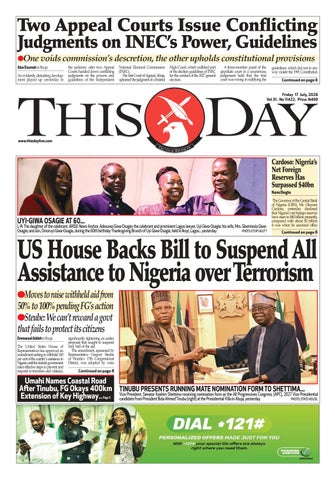
UYI-GIWA OSAGIE AT 60...
L-R: The
of the
Continued on page 8
Cardoso: Nigeria’s Net Foreign Reserves Has Surpassed $40bn
Nume Ekeghe
The Governor of the Central Bank of Nigeria (CBN), Mr. Olayemi Cardoso, yesterday disclosed that Nigeria’s net foreign reserves have risen to $40 billion presently, compared with about $3 billion it was when he assumed office
Continued on page 8 guidelines, which did not in any way violate the 1991 Constitution
US House Backs Bill to Suspend All Assistance to Nigeria over Terrorism
Moves to raise withheld aid from 50% to 100% pending FG’s action Steube: We can’t reward a govt that fails to protect its citizens
The United States House of Representatives has approved an amendment seeking to withhold 100 per cent of the country’s assistance to Nigeria until the federal government takes effective steps to prevent and respond to terrorism and violence,
Continued on page 8 significantly tightening an earlier proposal that sought to suspend only half of the aid. The amendment, sponsored by Representative Gregory Steube of Florida’s 17th Congressional District, was adopted by voice
Umahi Names Coastal Road After Tinubu, FG Okays 400km Extension of Key Highway... Page 5
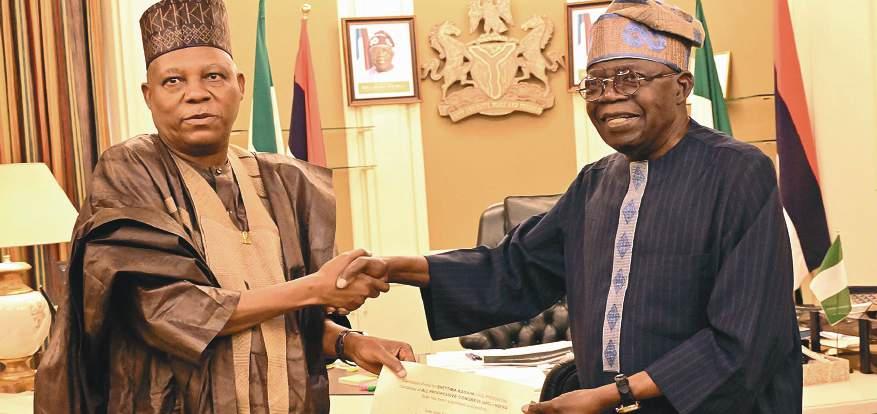
TINUBU PRESENTS RUNNING MATE NOMINATION FORM TO SHETTIMA...
Vice President, Senator Kashim Shettima receiving nomination form as the All Progressives Congress, (APC), 2027 Vice Presidential candidate from President Bola Ahmed Tinubu (right) at the Presidential Villa in Abuja, yesterday
PHOTO: STATE HOUSE.
daughter
celebrant, ARISE News Anchor, Adesuwa Giwa-Osagie; the celebrant and prominent Lagos lawyer, Uyi Giwa-Osagie; his wife, Mrs. Gbemisola GiwaOsagie; and son, Omoruyi Giwa-Osagie, during the 60th birthday Thanksgiving Brunch of Uyi Giwa-Osagie, held in Ikoyi, Lagos... yesterday
Emmanuel Addeh in Abuja
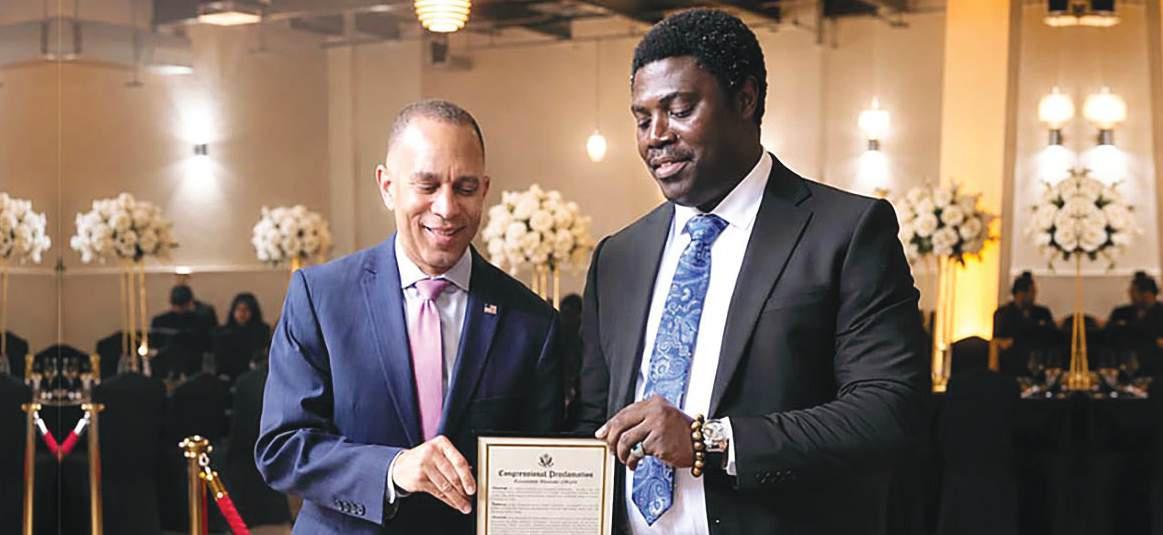
PRESENTATION OF A CONGRESSIONAL PROCLAMATION...
U.S. Congressman, Hakeem Jeffries (left) and President of the African Caribbean Chamber of Trade, Commerce and Industry (ACCTCI), Onoja Atta Onoja, after the presentation of a Congressional Proclamation recognising Onoja’s contributions to strengthening trade and economic cooperation between Africa, the Caribbean and the United States, during Guyana’s 60th Independence anniversary celebration in New York… recently
Umahi Names Coastal Road After Tinubu, FG Okays 400km Extension of Key Highway
President authorises reconstruction of Lagos-Ibadan expressway Reiterates concrete roads will last 100 years without maintenance
Emmanuel Addeh in Abuja
The Minister of Works, Dave Umahi yesterday announced the naming of the much-talked-about Lagos-Calabar Coastal Highway President Bola Tinubu, pointing out that the decision was taken by the Ministry of Works in recognition of Tinubu’s ‘long-standing vision’ for the landmark project.
Besides, the minister disclosed that the President has approved an additional 400-kilometre extension to the country’s Fourth Legacy Highway, the 700km Akwanga–Jos–Bauchi–Maiduguri Superhighway to Taraba, increasing the project to 1,100 kilometres.
The minister spoke during a media briefing in Abuja, during which he described the approvals as major milestones in the federal government’s infrastructure renewal programme.
“That (coastal) highway is named President Bola Ahmed Tinubu
Coastal Highway. By the powers conferred on me as Minister of Works, in consultation with my Permanent Secretary, the Minister of State, directors and staff of the ministry, we decided to name it after him because of his dream for it,” Umahi said.
The minister recalled that Tinubu first conceived the idea while serving as governor of Lagos state more than two decades ago. “He had that dream about 27 years back as governor of Lagos State. It is one thing to dream and another thing to have the grace of God to actualise that dream,” he added.
Describing the project, the minister said the first section of the 750-kilometre coastal highway has already become a reference point for modern infrastructure delivery.
“Section One, from Victoria Island to Lekki, is 47.47 kilometres of six-lane carriageway with a 25-metre median reserved for a future railway line. That project is a beauty to behold,”
Umahi said.
Also, the minister announced the President’s approval for another 400 kilometres of dualised East-West Road, the reconstruction of the Lagos-Ibadan Expressway using reinforced concrete pavement, the completion of the abandoned Ibi Bridge in Taraba State, and the construction of the 5.76-kilometre Lao Bridge.
“The greatest story is that yesterday President Bola Tinubu approved the addition of 400 kilometres to our Fourth Legacy Road. That is an 800-kilometre road now extended to 1,100 kilometres, and that is unprecedented,” he said.
The Fourth Legacy Highway, initially conceived as a 700-kilometre corridor linking Akwanga in Nasarawa State to Maiduguri in Borno State through Jos, Bauchi, Gombe and Biu, will now extend into Taraba State, the minister explained.
Umahi said the expansion would strengthen connectivity across the
North-central and North-east while opening up more economic opportunities.
The minister also revealed that Tinubu has approved the reconstruction of the Lagos-Ibadan expressway after sections of the highway deteriorated barely five years after completion.
“The president approved yesterday the reconstruction of the Lagos-Ibadan Road, and that
is the justification for our fight for the use of reinforced concrete pavement,” he said.
Explaining the decision, Umahi noted that the existing asphalt pavement had repeatedly failed despite repairs.
“It is 135 kilometres by two carriageways. That project is not up to five years old, yet it has already started failing. We took journalists
there, we took members of the National Assembly there. You could see the road failing. They repaired it and it still failed,” he said. According to him, reinforced concrete technology offers a more durable alternative. “The answer is to reconstruct it using reinforced concrete pavement that will last between 50 and 100 years, maintenance-free,” he added.
Nigeria Seeks Regional Collaboration to Boost Africa’s Digital Economy
Nigeria has urged African countries to foster greater collaborations to boost the continent’s digital economy.
Permanent Secretary, Ministry of Communications, Innovations
IACE Seeks Wider Application of Cost Engineering, Gets New National Chair
Emmanuel Addeh in Abuja
The Institute of Appraisers and Cost Engineers (IACE) has renewed its advocacy for the wider application of engineering valuation, cost engineering and engineering economy in project delivery in the private and public sectors.
The organisation also inaugurated Muhammad Kwalli as its new National Chairman at the 2026 National Technical Conference in Abuja, themed: “Engineering Valuation, Cost Engineering and Engineering Economy Solutions in Emerging Economies”.
The event brought together engineering professionals to examine how the disciplines can improve project outcomes, enhance value for money and support sustainable national development.
Outgoing National Chairman of IACE, Ike Iwenofu, said the conference was designed to advance practical solutions for improving engineering project outcomes through engineering valuation, cost engineering and engineering economy. He said the combination of the three disciplines provides a structured framework for promoting efficiency,
reducing waste, maintaining tighter control over project budgets and timelines, ensuring strategic alignment and delivering long-term value from infrastructure investments.
Iwenofu noted that the institute, established in 2003 as a division of the Nigerian Society of Engineers (NSE) and admitted into the International Cost Engineering Council in 2008, had continued to expand its membership while investing in capacity building, mentoring, networking opportunities and strategic partnerships in line with relevant laws, regulations and standards.
He added that the conference would also witness the induction of new Fellows, Accredited Senior Engineering Valuers and Cost Engineers, as well as Accredited Engineering Valuers, Cost Engineers and Engineering Economists.
Accepting the mantle of leadership, Kwalli described his emergence as National Chairman as a collective achievement for members of the institute and pledged to strengthen its visibility, deepen stakeholder engagement and position it as a strategic partner in Nigeria’s economic development.
and Digital Economy, Nadungu Gagare made the call at the 7th Special Session of the African Telecommunication Union (ATU), Wednesday, in Abuja.
Gagare, who was represented by a director in his office, Mr. Ahmed Alsukun, said that regional cooperation was needed to build Africa’s digital economy.
“We believe that regional cooperation is essential if Africa is to build a strong, inclusive and innovative digital economy to empower our growing youth population.
“Working together, we can expand connectivity, improve digital infrastructure, promote skills, strengthen cyber security, protect data and create opportunities for our people,” he said
According to him, “A united Africa would have the greatest influence in international decisionmaking and would be better placed to protect continental interests.”
The Chairperson of the ATU Administrative Council, Nonkqubela Jordan-Dyani, in her speech said, building economic resilience must become a deliberate
regional strategy through ICT.
“The DPI, which includes digital identity and electronic payment systems, acts as a catalyst to enable secure interactions across the region.
“It is our collective commitment to continue to build our organisation and maximise its effectiveness to shape the digital future of Africa and drive our development,” she said. She applauded Nigeria’s digitalisation of public institutions, and urged other African countries to follow.
Speaking earlier, the SecretaryGeneral of the ATU, Mr. John Omo, said that the special session formed a critical part of statutory preparations for the conference. Omo noted that the ATU could only exercise its authority effectively when the proposals placed before it become legal documents and are fully implemented.
“The progress recorded during this period has been made possible through collective effort, and we now have the sole responsibility to bring this work to a conclusion,” he added.
Oghenevwede Ohwovoriole in Abuja
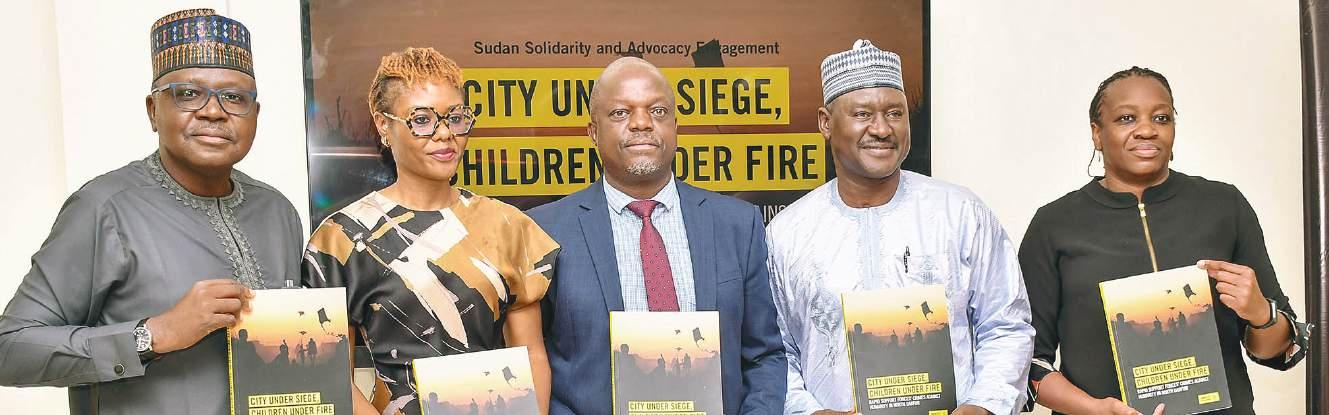
ADVOCACY ENGAGEMENT ON HUMAN RIGHTS SITUATION IN S/SUDAN...
L-R: Direction Amnesty Nigeria, Isa Sanusi; Senior Counselor, International Organisations Department, Ministry of Foreign Affairs, Ms. Nwatam Parka; Regional Director, East and Southern Africa Amnesty International, Dr. Tigere Chagutah; Chairman Board of Trustees Amnesty International Nigeria, Auwal Musa Rafsanjani and Deputy Regional Director, Amnesty International, Flovia Mwangovya, at the High- Level Advocacy Engagement on the Human Rights and Humanitarian Situation in Southern Sudan, held in Abuja on Wednesday
FG Partners Canada, UNDP, EU, Others
to Strengthen Nigeria’s Sovereign Rating
Oyedele:
Achieving investment
grade status
can save Nigeria N5.84tn Says Africa loses over $74.5bn annually in additional borrowing costs due to perception gaps
The federal government has concluded a high-level lNeeds Assessment Mission of Nigeria , in collaboration with the United Nations Development Programme (UNDP) under the Africa Credit Ratings Initiative (ACRI) and strategic partners, including the European Union Delegation to Nigeria and ECOWAS, as well as Canada,.
The initiative is designed to instil investor confidence, shore up Njgeria’s sovereign rating, drive down borrowing costs and attract the much-needed development finance.
Speaking in Abuja during a debriefing meeting after a three-day high-level Credit Ratings Needs Assessment Mission of Nigeria by the partners, as part of broader efforts to strengthen the country’s institu-
tional co-ordination, strategic market engagement, and sovereign credit ratings preparedness, the Minister of Finance and Coordinating Minister of the Economy, Mr. Taiwo Oyedele, expressed the federal government’s quest to secure higher credit ratings, and ensure that Nigeria’s credit profile accurately reflects the progress of ongoing reforms, and the vast opportunities within the economy.
The meeting was designed to reflect on preliminary findings from the Sovereign Credit Ratings Needs Assessment Mission, validate priority reform messages, and agree next steps towards the sovereign credit ratings roadmap for Nigeria. Oyedele, who was represented by the Permanent Secretary (Special Duties), Ministry of Finance, Mohammed Sanusi,
Wema Bank Reinforces Role in Powering Fintech Growth Through Strategic Partner Engagement
Wema Bank has reinforced its position as a key enabler of Nigeria’s fintech ecosystem through a strategic engagement with its fintech partners, bringing together founders, technology providers and industry stakeholders to deepen collaboration and support the continued growth of digital financial services across the industry.
The Bank brought together fintech founders, technology partners, payment providers and key industry stakeholders for an evening of strategic engagement, celebrating longstanding relationships, appreciating the trust of its partners and reinforcing the collaboration that continues to shape the future of
digital banking in Nigeria.
The engagement reflects the Bank’s broader commitment to building infrastructure that enables fintech businesses to scale efficiently, improve service delivery and drive innovation across the financial services landscape.
With the increasing demand for seamless, reliable and scalable financial infrastructure, Wema Bank continues to strengthen its platforms and partnerships to meet the evolving needs of the ecosystem.
In the last 12 months, the Bank has processed over N18 trillion in transactions through its platforms, underscoring the scale at which it supports businesses and fintech operators. Its suite of solutions, including
virtual accounts and payment APIs, continues to power collections, disbursements and real-time transaction visibility for a growing network of partners.
Speaking during the engagement, Wema Bank’s Deputy Managing Director, Oluwole Ajimisinmi, reaf- firmed the Bank’s commitment to its partners and the role the Bank play in shaping the future of financial services.
“Our partners are not just customers; they are collaborators in building the future of financial services. We remain committed to providing the infrastructure, support and continuous innovation required to help them scale and succeed,” he said.
One of the fintech partners at
Soludo Praises Tinubu for Awarding Road Contracts in Anambra
David-Chyddy Eleke in Awka
The governor of Anambra State, Professor Chukwuma Soludo, has praised President Bola Tinubu, for awarding the construction of two important roads in the state.
Soludo conveyed his appreciation to Tinubu for his nod to the Federal Ministry of Works, to commence the construction of the Otuocha-AnamAbaji (Kogi) road, which is about 108km, which was approved by
the President for reconstruction and dualization.
It was gathered that upon completion, travel time from Anambra to Abuja and other parts of Northern Nigeria will be remarkably reduced.
The second road is the ObaNnewi-Uga-Ihube (Okigwe Junction), which is about 150km, and was also approved by the President for reconstruction and dualization.
The road connects Anambra, Imo, Enugu, and even Abia States,
seen as a significant road linking the Southeast zone, with enormous benefits to commuters and the business community in the Southeast.
In a Facebook post by Soludo, he stated that “History will be kind to you. Thank you,” Governor Soludo said.
He further said: “Early this month, precisely on July 1, I met the President and made a case for more infrastructure in Anambra State and the Southeast.
the event commended Wema Bank for fostering meaningful collaboration and creating a platform for industry-wide dialogue.
The partner said, “We should have more collaborative roundtables like this where we assess industry developments and jointly confront them.”
The engagement session provided a platform for open dialogue, enabling partners to share insights, explore emerging opportunities and provide feedback that will inform the Bank’s ongoing product and innovation roadmap.
noted that while securing higher credit ratings, and ensuring that Nigeria’s credit profile accurately reflects the progress of ongoing reforms and the vast opportunities within the economy, achieving investment grade status was a strategic economic imperative
According to him, expert analysis suggests that doing so could reduce borrowing costs by 100 to 150 basis points, generating estimated savings of about N5.84 trillion resources that could be redirected to infrastructure, healthcare, education, social protection, and other critical development priorities.
The minister observed that for too long, African countries had borne what is often described as the “African Premium”, a perception gap, estimated to cost the continent over $74.5 billion annually in additional borrowing costs.
But he noted that Nigeria’s current focus was not on the shortcomings of the global financial architecture, but on strengthening its institutions, improving engagement with international credit rating agencies, and ensuring that its sovereign ratings accurately reflect the resilience and potential of the economy.
The debriefing meeting had in attendance, the Statistician General of the Federation, Prince Adeyemi Adeniran; Chief Economist, Africa Bureau, UNDP, Raymond Gilpin; Head of Cooperation, European Union Delegation to Nigeria and ECOWAS, Massimo De Luca; Counsellor and Head of Development Cooperation, High Commission of Canada, Arash Irantalab, and the Special Adviser to the President on Economy, Dr. Tope Fasua, among others. Oyedele expressed government’s sincere appreciation to the UNDP for its Sovereign Credit Ratings Initiative and for bringing together a distinguished team of global experts to support African countries in strengthening their sovereign creditworthiness and improving access to sustainable finance.
“We are gathered here at a critical moment in Nigeria’s economic journey, and I commend the UNDP for partnering with us to develop a sustainable and forward-looking Sovereign Credit Rating Roadmap for our country. Your presence here today reflects our shared commitment to ensuring that sovereign credit ratings become a catalyst for development rather than a constraint to growth.
Tinubu: Abuja City Walk Will Transform
Into Global Hub for Commerce,
Olawale Ajimotokan
President Bola Tinubu has said the Abuja Abuja City Walk would redefine the Federal Capital Territory as a global hub for commerce, innovation and modern urban living.
He expressed this optimism yesterday when he officially launched the Sales Office and Experience Centre for the multi-billion-dollar Abuja City Walk development.
Tinubu, represented at the ceremony by Vice President Shettima Kashim, described the project as a major milestone that demonstrated his
administration’s resolve to present a tangible manifestation of a Renewed Hope Agenda, sculpted in concrete, innovation and unwavering determination.
The president described the Abuja City Walk development, situated along the international airport corridor, as one of the most ambitious private-sector investment projects in Nigeria’s history that will become the country’s foremost gateway to the world.
He added the project, inspired by globally acclaimed developments such as Dubai City Walk, had been adapted to Nigeria’s unique environment and aspirations.
“This experience centre stands as proof that our administration does not just make promises; we execute them with determination,” he said.
Tinubu explained that sustainable national development could only be achieved through strong collaboration between government and the private sector, describing the Abuja City Walk as a shining example of such partnership. He noted that granting the corridor Free Trade Zone status would eliminate trade bottlenecks and encourage regional commerce, medical tourism, premium retail businesses and high-end hospitality investments.
PHOTO: ENOCK REUBEN
in Abuja
Bennett Oghifo
Ndubuisi Francis in Abuja
BIG BROTHER NAIJA SEASON 11 MEDIA LAUNCH...
L-R: Tope Oshunkeye, Senior VP, Communications, MultiChoice Nigeria; Njoku Odinakachi, Brand Manager, Guinness (Gold sponsor of BBNaija season 11);
Ndanyungu, Head of Local Marketing and CSR, betPawa (Headline sponsor of BBNaija season 11); and Atinuke Babatunde, Executive Head, Content and
West Africa, MultiChoice, at the
Senate Halts Procurement Reform, Insists on Budget Transparency First
Akpabio, senators admit lawmakers lack full knowledge of National Assembly finances As tender board proposal withdrawn
Sunday Aborisade in Abuja
The Senate on Thursday shelved a proposal to establish an Internal Tender Board for the National Assembly after lawmakers, led by Senate President Godswill Akpabio, declared that the legislature must first open up its own budget and financial management to greater scrutiny before embarking on pro- curement reforms.
The dramatic withdrawal of the motion laid bare growing unease within the upper chamber over the opacity surrounding the National Assembly’s finances, with several senators openly admitting that lawmakers themselves were largely unaware of how the institution’s budget was prepared and implemented.
The motion, sponsored by Senator Sunday Steve Karimi (APC, Kogi West), sought the establishment of an Internal Tender Board to oversee procurement activities within approved budgetary provisions as part of efforts to strengthen the legislature’s financial autonomy.
Karimi anchored his proposal on Section 81(3) of the 1999 Constitution (as amended), which guarantees the financial independence of the National Assembly through a first-line charge on the Consolidated Revenue Fund, as well as Section 51, which empowers each chamber to regulate its internal administration.
He argued the proposal would reinforce parliamentary autonomy and improve the efficiency and
transparency of procurement processes.
“The Senate notes that Section 81(3) of the Constitution guarantees the independence of the National Assembly and provides for its funding through the first-line charge on the Consolidated Revenue Fund,” he said.
He added that, “In furtherance of the constitutional principle of separation of powers and parliamentary autonomy, it is necessary to strengthen the institutional capacity of the National Assembly to manage its financial and procurement processes efficiently, transparently and in a manner consistent with its status as an independent arm of government.”
Karimi urged the Senate to affirm parliamentary autonomy, establish the Internal Tender Board and mandate the Clerk to the National Assembly to constitute it.
However, the proposal immediately ran into stiff opposition.
Leading the resistance, Senator Adamu Aliero argued that the Senate was attempting to solve the wrong problem, insisting that lawmakers should first address the absence of transparency in the National Assembly’s budgeting process.
“We are putting the cart before the horse,” Aliero declared.
He maintained that procurement was not the fundamental challenge confronting the legislature’s financial management.
“Two of the problems that we have in the National Assembly re-
garding the management of finances and the budget do not solely lie in the process of procurement.
“The problem has been that the National Assembly has not set up a Budget and Research Office,” he said.
Aliero lamented that senators were often left in the dark about the legislature’s own budget.
“What is happening today is that we don’t even know and we don’t even see the budget of the National Assembly being presented here so that we can interrogate and understand the lines of expenditure,” he said.
He urged the sponsor to suspend
the proposal until broader financial accountability issues had been resolved.
“My opinion is that the Senator should step down this motion. Let us get the house right first before we talk about the issues that the Distinguished Senator Karimi is raising,” he added.
Akpabio, while contributing to the debate, also faulted both the timing and procedure adopted by the sponsor, saying such a sensitive proposal ought to have been discussed with the leadership of the Senate and the management of the National Assembly before reaching the chamber.
“Senator Karimi, you should have discussed this even with me in the presence of the Clerk to the National Assembly and the principal officers of management so that I get clearance on what you are coming up with,” the Senate President said.
He questioned the wisdom of debating the creation of an Internal Tender Board in the open while lawmakers themselves lacked adequate information about the institution’s finances.
“Talking about Internal Tender Board and all that, should this be in the public glare before we clean up our house like Senator Yaro said?”
Akpabio asked.
“We should start with ourselves and we should get the two chambers to know exactly what is going on. “We should also debate and understand the budget. We should know how much is coming, what is going to where and what is going to where. This motion is premature.”
Following the intervention, Akpabio urged Karimi to withdraw the motion.
Before doing so, however, the Kogi West senator sought clarification over whether the Clerk to the National Assembly had discussed the proposal with the Senate President.
NCC Reviews Mobile Virtual Network Operators’ Business Rules
Oghenevwede Ohwovoriole in Abuja
The Nigerian Communications Commission (NCC), has commenced a review process of Mobile Virtual Network Operators (MVNO) rules in the Nigerian telecommunications industry.
The NCC Executive Vice Chairman (EVC), Dr. Aminu Maida who disclosed this, said a review of the business rules would enhance access and competition in the nation’s telecom industry.
Speaking at a one-day MVNO Business Rules Stakeholders Forum, organised by the NCC
in Abuja, Maida who was represented by the Director, Licensing and Authorisation, Usman Mamman said, “The introduction of the MVNO business rule reflects the Commission’s broader commitment to deepening competition, expanding access, and driving innovation in line with its strategic focus on digital inclusion and a robust telecom ecosystem.
“The MVNO business rules are designed to provide clarity on licensing, operational responsibilities, and relationships with host network operators while safeguarding consumer interest
and market integrity.
“At the same time, we expect full compliance and the Commission will continue to exercise its mandate to ensure that all operators adhere strictly to established guidelines.”
In her opening remarks, the Head, Legal and Regulatory Services, NCC, Chizua Whyte, said the Commission had developed the draft MVNO business rules to provide a clear framework for their operation within the Nigerian communications ecosystem.
She stated that “the emergence of MVNOs presents a significant opportunity to deepen competi-
tion, stimulate innovation, promote self-differentiation, and expand consumer choice within the sector.”
The Director, Licensing and Authorisation, Usman Mamma stated that the introduction of the MVNOs into the Nigerian telecommunications system was the result of a carefully planned and consultative process that spans several years, adding that the framework was carefully designed to accommodate diverse business models and varying level of operational and technical capability, thereby creating opportunities for broader participation in the telecommunications sector.
Nigeria to Host 3,000 Global Communication Leaders as World PR Forum Holds in Abuja
Blessing Ibunge in Port Harcourt Nigeria has been positioned at the centre of global communication discourse as it prepares to host over 3,000 delegates from 126 countries for the 2026 World Public Relations Forum (WPRF).
The Nigerian Institute of Public Relations (NIPR) has described the event as a defining moment for the country’s growing influence in global reputation management and strategic communication.
President and Chairman of Council of the NIPR, Dr. Ike Neliaku, disclosed this yesterday, during the commemoration of the 2026 World Public Relations Day, organised in collaboration with the Ignatius Ajuru University of Education in Rivers State.
Speaking on the theme, “The Golden Age of Strategic PR,” Neliaku said the forum, scheduled for November 15 to 21, 2026, in Abuja, would attract presidents, industry regulators, communication
executives, scholars and public relations professionals from member countries of the Global Alliance for Public Relations and Communication Management.
Represented by Dr. Paulinus Nsirim, Neliaku said hosting the prestigious global gathering marks Nigeria’s emergence from being merely a participant in international reputation management to becoming a recognised hub for communication excellence.
“This landmark event affirms
Nigeria’s ascension as a strategic voice in global reputation discourse. Nigeria is no longer merely a participant in the business of global reputation management but has become a hub for communication excellence,” he said.
He added that the Abuja forum would also witness the formal signing of the Africa Declaration on the Professionalisation of Public Relations and Responsible Communication, a continental charter aimed at strengthening ethical standards,
professional accountability and responsible communication practice across Africa.
Neliaku explained that the declaration, endorsed by leading professional communication bodies across the continent, recognises the Nigerian model of balancing professional independence with government support to deepen the practice of public relations in Africa.
He further revealed that the forum would feature the inauguration of the
University of Public Relations and Leadership (UPRL), described as the world’s first specialised university dedicated exclusively to public relations and leadership studies. The institution, he said, is being developed through a Triple Helix partnership involving government, professional institutions and international strategic partners to produce future communication leaders, crisis managers and trusted advisers for both public and private organisations.
Borah Omary
Channels,
Media Launch of Big Brother Naija Season 11 held in Lagos on Wednesday
Tinubu Unveils $3.05bn Social Investment Package to Boost Poverty Reduction, Human Capital Development, Others
Says programmes will ensure economic recovery is felt in every Nigerian household as initiatives target farmers, schools, healthcare,
Abubakar Bagudu says success of interventions hinges on accountability, effective coordination, transparency, prudent financial management
Deji Elumoye, James Emejo
and Deborah Adekoya in Abuja
President Bola Tinubu, yesterday unveiled a $3.05 billion package of development programmes aimed at deepening poverty reduction, strengthening human capital and expanding economic opportunities across the country.
The initiatives supported by the World Bank aimed to ensure the gains of its economic reforms translate into tangible improvements in the lives of ordinary Nigerians.
Speaking at the launch in Abuja, the president said the programmes represented a coordinated national strategy to reduce poverty, strengthen resilience and build the human capital required to achieve the country’s ambition of becoming a $1 trillion economy by 2030.
He was represented the Minister of Finance and and Coordinating Minister of the Economy, Mr. Taiwo Oyedele.
The funding package comprises
$1.25 billion Nigeria Community Action for Resilience and Economic Stimulus Additional Financing (NGCARES AF), $300 million Solutions for Internally Displaced Persons and Host Communities (SOLID) Programme, and $1.5 billion Human Capital Opportunities for Prosperity and Equity (HOPE) Programme. Tinubu described the initiatives as more than government programmes, saying they were “promises kept” under the Renewed Hope Agenda to protect vulnerable Nigerians, empower communities and deliver inclusive development.
According to the president, while macroeconomic reforms are beginning to yield positive results, their success must ultimately be measured by improvements in the welfare of citizens.
He said the administration’s objective was to ensure that economic recovery is reflected not only in national statistics but also in the daily lives of households across the country.
Tinubu said the Renewed Hope Development Plan (20262030) provides the roadmap for economic diversification, stronger subnational governments and human capital development, adding that the three flagship programmes would translate those objectives into practical interventions at the grassroots.
Highlighting the improving macroeconomic outlook, he said Nigeria recorded real GDP growth of 11.2 per cent last year alongside nearly 10 per cent growth in per capita income in dollar terms and is on course to sustain similar performance this year.
He also pointed to foreign reserves of over $50 billion and a sharp moderation in inflation from its 2024 peak, describing the developments as evidence that the country’s economic reforms are gaining traction.
According to him, the administration had already reached 15 million vulnerable households through expanded cash transfer programmes, lifting an estimated 7.5 million
Nigerians out of poverty, while the newly unveiled initiatives are expected to build on that momentum.
The president explained that under the NG-CARES Additional Financing scheme, the federal government plans to scale up support for smallholder farmers, small and medium-sized enterprises and vulnerable communities to improve livelihoods, food security and resilience against economic shocks.
The SOLID programme will shift intervention for internally displaced persons beyond emergency humanitarian assistance by investing in livelihoods, community infrastructure, social services and long-term resilience for displaced populations and their host communities.
Also, the HOPE initiative, comprising HOPE-GOV, HOPE-PHC and HOPE-EDU, will channel investments into governance reforms, primary healthcare delivery and foundational education, while strengthening accountability and service delivery at state and local government levels.
Tinubu stressed that the three initiatives should not be viewed as standalone interventions but as complementary pillars of a single national strategy designed to reinforce one another.
He explained that investments in livelihoods, healthcare, education and social protection would collectively strengthen communities and improve service delivery across the country’s wards.
The president urged state governments, local authorities, development partners and implementing agencies to ensure the programmes deliver measurable outcomes, noting that their success would depend largely on effective implementation and collaboration across all levels of government.
Earlier, Minister of Budget and Economic Planning, Senator Abubakar Bagudu, described the programmes as flagship interventions carefully designed to address both longstanding and emerging development challenges confronting
the country.
He said the initiatives represented another milestone in translating the Renewed Hope Agenda into concrete actions capable of directly improving the lives of poor and vulnerable Nigerians.
Bagudu noted that the programmes would strengthen social protection systems, expand economic opportunities, improve human capital outcomes and support vulnerable communities nationwide.
US HOUSE BACKS BILL TO SUSPEND ALL ASSISTANCE TO NIGERIA OVER TERRORISM
vote during consideration of the appropriations bill.
It raises the aid withholding threshold from 50 per cent to 100 per cent while retaining the requirement that the US Secretary of State certify that Nigeria has taken “effective steps to prevent and respond to violence and hold perpetrators accountable.”
Speaking on the House floor,
Steube said the earlier proposal did not go far enough, alleging that the Nigerian federal government has failed to protect its citizens, especially Christians.
“I rise in strong support for my amendment to increase the withholding threshold for assistance to Nigeria, from 50 per cent to 100 per cent, while keeping in place benchmarks that demand Nigeria
take effective steps to address the violence and persecution that continue to devastate the country,” he said.
Arguing that the Nigerian government had failed in its responsibility to protect its citizens, the lawmaker said: “Nigeria has faced a horrific wave of violence that its corrupt government has failed to address.”
He added: “For years, and
especially in recent months, Christians and other religious minorities in Nigeria have been subjected to violence and terrorism at the hands of extremists operating with impunity.”
According to him, Christian women and girls continue to be abducted, assaulted, tortured, and killed, while their churches are burned, and entire communities
TWO APPEAL COURTS ISSUE CONFLICTING JUDGMENTS ON INEC’S POWER, GUIDELINES
nor the Electoral Act.
Yet, another three-member panel of another appellate court also sitting in Abuja struck down Sections 77(5), (6) and (7), as well as 84(2) of the Electoral Act 2026, for being inconsistent with the 1999 Constitution.
The affected sections regulate membership registers of political parties and the procedure for the nomination of candidates for the 2027 general election.
Justice Mohammed Umar had in a judgement delivered on May 20, voided the Revised Timetable and Schedule of Activities of INEC, for the 2027 general election by a Federal High Court in Abuja, on the grounds among others that the time-frame “imposed” by INEC on political parties to submit their membership register, conduct primaries, and same names of candidates for the 2027 general elections, “is inconsistent with the provisions of the Electoral Act, 2026”.
Umar voided the time-table while delivering judgement in the suit marked: FHC/ABJ/CS/517/2016, and filed by the Youth Party.
The plaintiff in the suit dated and filed on March 11, by its counsel, J. O. Olotu sought for several reliefs, including a declaration that upon a proper consideration and interpretation of the provisions of Sections 29, 82 and 84(1) of the Electoral Act, 2026, the powers of the INEC to receive notice of party primaries and the personal particulars of candidates, and its duty to attend, observe and monitor such primaries, does not extend to fixing or prescribing the timetable within which political parties may
conduct their primary elections for the purpose of nominating candidates for the 2027 general elections.
Dissatisfied, the electoral umpire approached the appellate court to set aside the verdict of the trial court.
However, delivering judgement on Monday, Justice Adebukola Banjoko, who delivered the lead judgement read by Justice Okon Abang, faulted the trial court for invalidating the administrative discretion of INEC.
“The law gives INEC powers to conduct elections in the country. There was no deposition or threat that the respondent was prevented from conducting its primaries,” he said, adding that the respondent could only invoke the powers of the court where there are heavy threats to its participation in the election.
Justice Abang explained that where INEC acted within its power, the courts could not get involved.
“The declarative reliefs granted by the trial court were wrongly granted and they are hereby set aside”, Abang declared.
INEC in its appeal dated May 25, 2026, and filed by its counsel, Alex Izinyon, prayed the court to set aside the judgement, claiming that the trial court erred in law when it failed to pronounce on the jurisdictional issue of the suit being hypothetic and academic, and a denial of fair hearing to the appellant.
The lawyer specifically stated that the lower court erred in law when it held: “It is clear from the wording of Sections 29(1), 82, and 84 of the Electoral Act, 2026, the
following can be understood.
Section 29(1) of the Electoral Act, 2026 mandated political parties to submit the names of candidates first in the prescribed forms of the candidates who emerged from its valid primaries, which such political party intended to sponsor at the elections, not later than 120 days before the date of the General election.
He said the judgement of the trial court was against the weight of evidence placed before it and therefore prayed the court for an order allowing the appeal and setting aside the Judgement
delivered by the trial court.
He also prayed for an order of the court, striking out the suit as the respondent lacked the locus standi to institute and maintain the same, describing the suit as being academic.
Thus, in their unanimous judgement, the three-member panel agreed with the appellant that the Youth Party, which instituted the case against INEC lacked legal power ( locus standi) to do what it did.
According to the appellate court the party did not explain
Continued on page 42
are erased.
Steube maintained that if lawmakers considered the conditions serious enough to justify withholding half of the assistance, they should also support suspending all funding.
“If the aid conditions included in the bill are important enough to withhold half of all the funding to the Nigerian government, then they are important enough to withhold all of the funding,” he said.
He also questioned the continued flow of American assistance to Nigeria, maintaining that the West African country has not justified such assistance.
“The generosity of our taxpayers is a reflection of the American values we hold so firmly. Never should we allow their hard-earned tax dollars to be funnelled to corrupt regimes that fail to uphold religious freedom, fail to adequately confront terrorism, and fail to protect the innocent from persecution.”
He further argued that continued aid to Nigeria was difficult to justify in light of worsening insecurity and America’s fiscal challenges.
“It is absurd to expend foreign
aid to Nigeria in the face of rising insecurity, especially as America’s national debt approaches $40 trillion,” he maintained.
The Florida lawmaker added that the amendment would ensure US assistance “is appropriately leveraged to defend, reflect, and uphold American values.”
The measure strengthens an earlier House proposal introduced in April and comes amid increased scrutiny of Nigeria’s security situation in Washington. Although US President Donald Trump redesignated Nigeria as a Country of Particular Concern (CPC) in 2025 over allegations of religious persecution, both countries have continued to deepen military cooperation against terrorist groups operating in northern Nigeria. The amendment will still have to pass the remaining stages of the US legislative process before it can become law. If enacted, all US assistance to Nigeria would remain suspended until the Secretary of State certifies that the Nigerian government has met the prescribed security and accountability benchmarks.
CARDOSO: NIGERIA’S NET FOREIGN RESERVES HAS SURPASSED $40BN
in 2023.
Equally, he revealed that the country’s gross external reserves have also climbed to about $52 billion, providing approximately 10 months of import cover.
Cardoso, disclosed this in Lagos, same day the CBN issued comprehensive operational guidelines for the implementation of its electronic foreign exchange (FX) purchase platform for Bureau De Change (BDC) operators, introducing a real-time transaction monitoring system, stricter Know-YourCustomer (KYC) requirements and enhanced compliance measures aimed at strengthening transparency, regulatory oversight and efficiency in the retail segment of the Nigerian Foreign Exchange Market (NFEM).
Speaking at the BusinessDay CEO Forum, the CBN Governor also disclosed that diaspora remittances are on course to reach $1 billion monthly by the end of the year, while noting that the FX market
has become sufficiently liquid to operate with minimal intervention from the CBN.
He also said the bank recapitalisation and regulatory oversight would remain a continuous exercise to strengthen the resilience of the banking sector.
The CBN governor said the country’s stronger external position underscores the success of the reforms implemented over the past three years, particularly the unification of the FX market and the restoration of investor confidence.
According to him, the apex bank inherited an FX market characterised by multiple exchange rates, opacity and acute shortages, but has since transformed it into a more transparent and market-driven system.
He said: “Anybody that wants to argue about what the impact of these reforms have been, go and look at the results. As of yesterday, we were hovering, I believe, about
$52 billion. “When we started, the net reserves figure was in the region of about $3 billion plus. And if you remember, that was a figure that was published at the time by J.P. Morgan and created a lot of panic in the system. More recently, the net reserves figure is in the $40bn range. So, it’s a long and difficult journey.”
Cardoso added that the current reserve position has significantly strengthened Nigeria’s external buffers and improved the country’s attractiveness to foreign investors.
According to him, “Today’s level of reserves is, I believe, about 10 months of import cover. Anybody coming to invest in Nigeria, these are the things they look at in determining whether it is worth taking a position in your currency.
“Doing this consistently is what is giving confidence to not just internal stakeholders, but those who also operate internationally.”
He further noted that another
visible outcome of the reforms was the restoration of confidence in Nigeria’s payment system, saying Nigerians can now use their bank cards seamlessly abroad.
“When you travel today, you go with your naira card. It works. It has brought back the way the outside world looks at us. In the past, you go there, the card doesn’t work. Can’t pay for your goods. They look at your naira card. They throw it back at you. Not any longer.”
On the steady build-up of external reserves, Cardoso said the CBN deliberately diversified sources of FX inflows, with diaspora remittances emerging as one of its key priorities.
He added: “When we were building these reserves, there was a lot of cynicism. One of the things we decided to go after was the diaspora remittances. We put together teams. We worked very
Continued on page 43
President Bola Tinubu
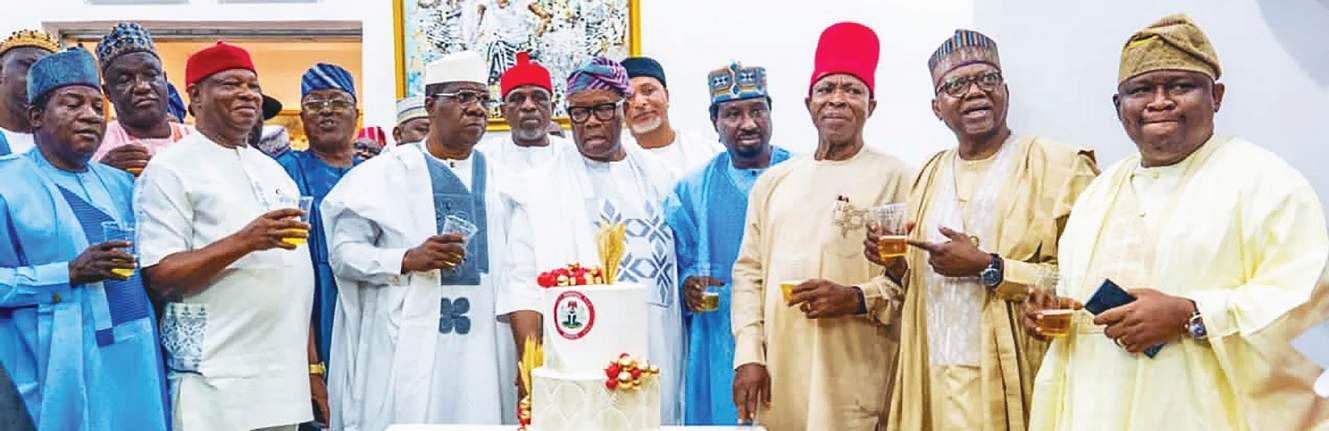
AKPABIO CELEBRATED BIRTHDAYS WITH SENATORS...
L-R: Senators Simon Lalung; Diket Plang and Anthony Ani; Deputy Senate Leader, Lola Ashiru; Senate Leader, Opeyemi Bamidele; President of the Senate, Godswill Akpabio; Senator Saliu Mustapha; Deputy Senate President, Jibrin Barau; Senators Victor Umeh; Sani Musa and Chairman, Senate Committee on Appropriations/ Ogun APC Governorship Candidate, Adeola Olamilekan, during the celebration of June and July born Senators, after Plenary on Wednesday
Shettima: We’re Strengthening Place Of Nigerian Child Through Broad Interventions
Vice President Kashim Shettima has outlined the programmes and initiatives currently being executed by the administration of President Bola Tinubu to restore and strengthen the future of the Nigerian child.
According to him, a generation of children unsure of their place in a changing world is one of
the worst tragedies to befall any nation, particularly Nigeria with a youthful population, where the greatest anxiety is that the nation should never fail or falter in building a society that equips every child with opportunities worthy of their talent.
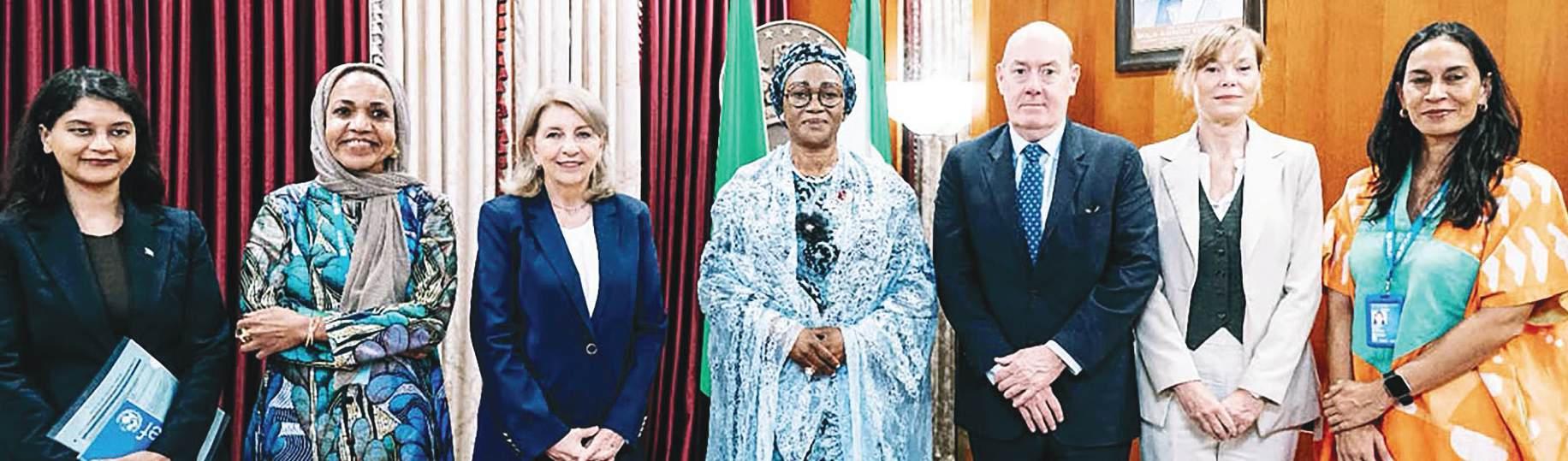
Shettima stated on this Thursday in Abuja, when he received a delegation from the United Nations Children’s Fund (UNICEF)
led by its Executive Director, Ms. Catherine Russell, on a courtesy visit to the State House.
He said though the administration has “inherited profound economic and social pressures that demand partnership with trusted global development institutions such as UNICEF,” the Fund has stood firm “beside Nigeria as a dependable ally, bringing expertise, compassion and practical support
to the sectors that define the future” of Nigerian children.
“I am particularly excited about today’s engagement because we have assembled a broad portfolio of interventions to restore and strengthen the place of the Nigerian child,” the Vice President declared.
Shettima observed that the world has transformed into a global village, where the “hopes and anxieties of children travel
Senate Rescinds Passage of Proceeds of Crime Amendment Bill for Fresh Scrutiny
Sunday Aborisade in Abuja
The Senate on Thursday rescinded its earlier decision passing the Proceeds of Crime Act (Amendment) Bill, 2026, citing the need to address substantive drafting, legal and policy issues identified after the legislation was approved on July 9, 2026.
Moving the motion, Senate Leader, Senator Opeyemi Bamidele, said the chamber had discovered fundamental concerns that required further legislative scrutiny and refinement to ensure the bill achieved its intended objectives.
He noted that leaving the identified issues unresolved could undermine the effective implementation of the proposed law and create unintended legal and operational consequences.
According to him, it was in the overriding public interest for the Senate to revisit the bill to ensure that it conforms with international best practices on asset recovery, proceeds of crime management, and Nigeria’s constitutional and legal framework.
Relying on Orders 1(b) and 52(6) of the Senate Standing Orders (2023–2027), Bamidele urged the Senate to rescind its earlier decision to allow for comprehensive review of the contentious provisions.
The motion sparked a brief procedural clarification after former Senate Leader Senator Yahaya Abdullahi raised con-
cerns over whether the motion had been properly listed on the supplementary Order Paper.
Presiding Senate President Godswill Akpabio clarified the motion was validly brought under Order 1(b), while Bamidele explained that Abdullahi’s intervention was purely procedural and not an objection to the substance of the motion.
Abdullahi subsequently seconded the motion, describing the reasons advanced by the Senate Leader as being in the national interest.
He said the identified issues justified reopening the bill to ensure that the final legislation aligns with international standards and Nigeria’s legal framework.
The former Senate Leader however sought clarification on the next legislative step, asking whether the bill would be returned to the relevant Senate committee or referred to the National Assembly’s legal department for the required amendments and further scrutiny.
Deputy Senate President Barau Jibrin commended the Senate Leader for promptly bringing the matter before the chamber after the deficiencies were discovered.
He noted that errors could occur during the legislative process and stressed that correcting them before a bill becomes law demonstrated legislative responsibility rather than weakness.
Jibrin urged senators to approve the rescission without delay so that
the identified deficiencies could be corrected expeditiously.
Also contributing, Senator Abdul Ningi said the development was not unusual in parliamentary practice, advising that the sponsor of the bill should be fully involved in harmonising the revised provisions to ensure broad ownership of the final legislation.
A few senators observed that if the proposed amendments were substantial, the bill might require another public hearing.
However, the Senate President ruled the observation out of order, explaining that the chamber was
only considering the motion to rescind the earlier passage of the bill and not debating its substantive provisions.
Akpabio clarified the legislation which was a private member’s bill rather than an executive bill would be reconsidered after the identified inconsistencies with international best practices had been addressed.
Following a voice vote, the Senate unanimously adopted the motion, thereby rescinding its July 9 decision approving the Proceeds of Crime Act (Amendment) Bill, 2026.
among portfolio of initiatives
faster than borders”, pointing out that “whatever happens to a child in Abuja can influence a child in London, just as events elsewhere shape the imagination and wellbeing of our own children.”
He listed the Nutrition 774 Initiative, Renewed Hope Child Support Programme, Nigeria 2050 Child Foresight Analysis, Generation Unlimited Nigeria, and the National Human Capital Development (HCD) Programme, among others, as some of the broad portfolio of interventions being carried by the Tinubu administration to secure a safer future for the Nigerian child.
“We have the Nutrition 774 Initiative, through which we are building the foremost governance framework for nutrition across all 774 local government areas in Nigeria.
“More than ₦7.6 billion has already been mobilised in Child Nutrition Fund matching investments, while essential micronutrients continue to reach millions of women and children as we advance the Presidential Nutrition Intervention Fund,” he noted.
On the Nigeria 2050 Child Foresight Analysis, Senator the Vice President said UNICEF is supporting Nigeria’s determination to institutionalise long-term
thinking in public policy through the initiative.
“Horizon scanning, scenario planning and evidence-based recommendations across education, climate resilience and youth livelihoods are now moving towards subnational implementation through a multi-stakeholder technical working group,” he explained.
On Generation Unlimited Nigeria, Shettima highlighted the strides being made to institutionalise the partnership to ensure that the goal to connect 20million Nigerian youth to livelihoods by 2030 is achieved.
On the National Human Capital Development (HCD) Programme, the Vice President said the initiative “seeks to place Nigeria among the world’s top 80 countries on the Human Capital Index by 2030 through integrated policy design, early investments in health, nutrition and foundational learning, and stronger pathways to productive employment.
“These initiatives reflect the convictions of His Excellency, President Bola Ahmed Tinubu, a leader who understands that the quality of tomorrow is determined by the investments we make in children today. That is why this administration has consistently placed human capital at the centre of national renewal,” he added.
The Ogun State Government, in collaboration with the Deutsche Gesellschaft für Internationale Zusammenarbeit (GIZ) GmbH, has reaffirmed its commitment to sustaining key employment, enterprise development and technical education reforms through stronger institutional frameworks and strategic partnerships.
The commitment was made at the third Ogun State Partners Workshop in Abeokuta, where officials, development partners, private sector representatives and
civil society groups reviewed progress recorded under the Sustainable Economic Development Cluster (SEDEC) programme and discussed measures to preserve its gains beyond the current implementation phase.
Speaking at the event, the Head of Component, Business Enabling Environment and Sustainable Infrastructure, GIZ SEDIN, Mr. Akinropo Omoware, who represented the Cluster Coordinator, Sustainable Economic Development Cluster (SEDEC), GIZ Nigeria, Dr. Didier Djoumessi Tchoffo, said the workshop was aimed at developing practical strategies for sustaining
development interventions.
Omoware quoted Tchoffo as saying, “The sustainability of development interventions depends on strong institutions, committed partnerships and local ownership.
“This workshop provides an opportunity for stakeholders to reflect on progress, share lessons and jointly develop practical pathways that will ensure the achievements continue to benefit Ogun State long after programme implementation.”
He said the collaboration between the Ogun State Government and GIZ had led to major achievements, including the operationalisation of the
Ogun State Job Centre in Abeokuta, the establishment of two additional job centres, the creation of the Ogun State Enterprise Development Agency, support for Micro, Small and Medium Enterprises, export readiness initiatives and reforms in Technical and Vocational Education and Training.
In his remarks, the Ogun State Commissioner for Industry, Trade and Investment, Adebola Sofela, described GIZ as a critical development partner that had continued to support the state’s economic development agenda through entrepreneurship and institutional capacity building.
PHOTO: SENATE PRESIDENT’S OFFICE.
James Sowole in Abeokuta
Deji Elumoye in Abuja
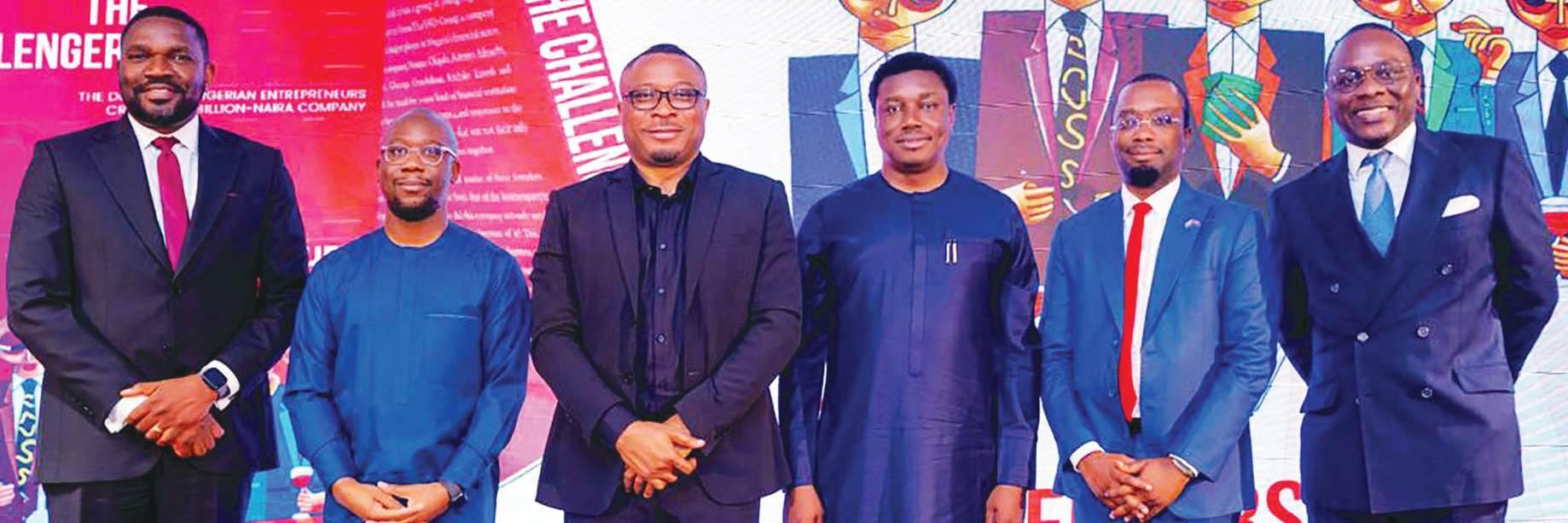
THE CHALLENGERS’ BOOK PRESENTATION...
L-R: Co-founder of VFD Group, Azubike Emodi; Co-founder/Non-Executive Director of VFD Group, Gbenga Omolokun; Author and Publisher of Narrative Landscape Press, Dr. Eghosa Imasuen; Group Managing Director of VFD Group, Nonso Okpala; Co-founder of VFD Group, Mobolaji Adewumi; and Co-founder/Non-Executive Director of VFD Group, Adeniyi Adenubi, at the launch of a book, ‘The Challengers: The Disruptive Nigerian Entrepreneurs Creating a Billion-Naira Company’, the story of the origin of VFD Group founders, written by Dr. Eghosa Imasuen, held in Lagos…recently
Court Orders Final Forfeiture of N8.9bn Assets
Linked to Businesswoman, Aisha Achimugu
A High Court of the Federal Capital Territory (FCT), in Apo, Abuja, yesterday, ordered the final forfeiture of assets worth about N8.97 billion linked to businesswoman, Aisha Achimugu to the federal government.
Justice Jude Onwugbuzie of the FCT High Court made the order in a motion brought by the Economic and Financial Crimes Commission (EFCC).
The assets the court held should be permanently forfeited to the FG included; jewellery valued at N4.645 billion, 11 exotic cars worth N4.293 billion, $50,000 in cash, and N30 million in cash.
The combined value of the jewellery and luxury vehicles alone is estimated at nearly N9 billion, making it one of the most significant asset forfeiture orders involving a single individual in recent years.
This is the second time assets linked to the businesswoman would be forfeited to the federal government.
Earlier in March this year, a Federal High Court in Abuja had granted an order of final forfeiture of the sum of $13 million allegedly linked to Achimugu, and Oceangate Engineering Oil & Gas Ltd.
In granted the request for final forfeiture, Justice Emeka Nwite had held that the EFCC was able to
prove that the funds were proceeds of fraud.
The anti-graft agency had last year declared Achimugu wanted over allegations bordering on money laundering.
Spokesman of the commission, Mr Dele Oyewale, had made the disclosure in a circular posted on the commission’s X handle (formerly tweeter).
The circular reads, “The public is hereby notified that Aisha Sulaiman Achimugu, whose photograph appears above is wanted by the Economic and Financial Crimes Commission (EFCC) in an alleged case of criminal conspiracy and money laundering.
“Achimugu, 51, is an indigene of Ofu Local Government Area of Kogi State and her last known address is 6C, Rudolf Close, Maitama, Abuja.
“Anybody with useful information as to her whereabouts should please contact the commission at its Ibadan, Uyo, Sokoto, Maiduguri, Benin, Makurdi, Kaduna, Ilorin, Enugu, Kano, Lagos, Gombe, Port Harcourt or Abuja offices or through 08093322644, its email address: info@efcc.gov.ng or the nearest police station or other security agencies.”
The agency had, in a letter, summoned Achimugu to appear at its Port Harcourt office on March 5 over alleged money laundering and a high-profile investment scam.
The letter, dated March 4 and signed by the EFCC’s acting zonal director in Port Harcourt, Rivers State, Adebayo Adeniyi, was sent to Achimugu’s residential address in Abuja.
“This commission is currently investigating a case in which the need to obtain certain clarification from you becomes imperative.
“In view of the above, you are kindly requested to attend an
interview with the undersigned through the Head of Investigation on Wednesday, 5th March 2025, by 10:00 hours prompt,” the letter read in part.
However, rather than honouring
the invite, Achimugu was said to have travelled out of Nigeria on March 6, an action which led the agency to obtained an arrest warrant and declare Achimugu as a wanted person.
NSIPA Begins Skills Training for 18,000 Nigerians Across 229 Centres
Kuni Tyessi in Abuja
The federal government has flaggedoff vocational and skills acquisition training for 18,000 artisans across the 36 States of the federation and Federal Capital Territory (FCT), as part of ongoing efforts aimed at addressing youth unemployment.
Speaking during the official flag-off of Vocational and Skills Training Programme organized by National Social Investment Programme Agency (NSIPA), Minister of Humanitarian Affairs and Poverty Reduction, Dr. Bernard Doro reiterated President Bola Tinubu’s resolve towards.
He said: “one of the key reasons why we are doing this flag-off is to ensure that over 18,000 Nigerians are empowered through skill acquisition so that they can get into that pathway from vulnerability to self-sustainability.”
While noting the training will
last for two weeks, the minister added the target beneficiaries are people who have acquired “some sort of soft skills already. And they will be up-skilled and then given tools so that they can begin to trade with it.”
He further assured the agency has put necessary safeguard measures in place for monitoring and evaluation framework, adding that the ministry is to adopt digital tracking system of all the beneficiaries.
While giving an overview of the initiatives, NSIPA National Coordinator/CEO, Associate Professor Badamasi Lawal, disclosed the training will commence tomorrow in 229 centers across the 36 States of the Federation and FCT, adding that the implementation will be decentralize across the six geopolitical zones using accredited Government Technical Colleges, vocational institutions, and approved training centres.
Rotimi Amaechi Loses Mother at 89
Sunday Ehigiator
The Vice Presidential Candidate of the African Democratic Congress (ADC), Rt. Hon. Chibuike Rotimi Amaechi, has lost his mother, Mrs. Mary Amaechi.
According to a statement issued by the Amaechi Media Office yesterday, Mrs. Amaechi died peacefully on Thursday, July 16, 2026, at the age of 89. The family described the deceased as a devoted matriarch whose life was defined by love, faith and service to humanity.
It said she was a community
women’s leader and a committed Christian whose unwavering faith in God and dedication to promoting peace and unity earned her widespread respect.
“Late Mrs. Mary Amaechi was a cherished matriarch who held her family together in love, peace and unity. She was a community women leader and Christian leader, whose belief and faith in God was firm and resolute.
“She was loved and highly respected in her community, and will be remembered for her warmth, kindness, and unwavering support for those around her and
beyond,” the statement said.
The family expressed appreciation for the messages of sympathy and support received following her passing.
“Rt. Hon. Amaechi and the entire family are profoundly grateful for the outpouring of condolences and love already being shown them during this difficult time,” the statement added.
It noted that details of the funeral arrangements would be announced in due course, while appealing for continued prayers and support from friends, associates and well-wishers.
The Programme offers competency-based training in fourteen high-demand vocational trades, namely: Automobile Technology, Agricultural Technology (Agri-Tech), Baking and Confectionery, Carpentry and Furniture Making, Cooks and Catering Services, Electrical Installation, Housekeeping and Hospitality Services, Jewellery and Bead Making, Masonry, Plumbing, Welding and Fabrication, Fashion Design and Sewing, Grinding machine Operations, Vulcanizing and Tyre Services.
In addition to technical skills, beneficiaries will receive entrepreneurship development training covering business management, financial literacy, customer relations, cooperative development, digital literacy, and enterprise sustainability.
Successful participants will receive trade-specific starter packs to facilitate immediate business start-up.
According to him, under the current arrangement, beneficiaries are being selected through a transparent and inclusive process involving the National Assembly, State Governments, Traditional Rulers, Religious Leaders, Community Development Associations, Youth and Women Groups, Persons with Disabilities (PWDs), and other critical stakeholders.
Priority is being given to unemployed youths, women, vulnerable persons, and economically disadvantaged Nigerians who possess the capacity and commitment to establish sustainable livelihoods after training.
The Programme was conceived in response to rising youth unemployment, limited access to vocational education, and the need to utilize
valuable vocational starter packs that had remained in warehouses across the country due to administrative and operational challenges. Their prolonged storage resulted in deterioration of equipment and increasing warehouse rental liabilities.
Rather than allowing these public assets to depreciate, the federal government has approved their refurbishment, deployment, and distribution to qualified beneficiaries after practical skills training.
While noting that all the equipment handed over to the beneficiaries would be tracked, he warned them not to sell “these items to people haven been trained, haven been being assisted. In his remarks, National Programme Manager, Dr. Nsikak Amos Okon explained the Renewed Hope Vocational and Skills Training Programme was conceived as the strategic response to the growing need for market-driven vocational education and enterprise development.
“The program is designed to equip beneficiaries with practical skills in high-demand vocational trades, including automobile technology, agricultural technology, packing and confectionery, carpentry, cooks, catering, electrical installation, housekeeping, jewelry and bead making, masonry, plumbing, welding and fabrication, fashion designers, sewing, grinding services, and organizing.
“In addition to technical skills acquisition, participants will receive entrepreneurship training, business management education, financial literacy, and mentorship to prepare them for successful self-employment and enterprise development.
Alex Enumah in Abuja
Late Mrs. Mary Amaechi
ECONOMY STABILISING...
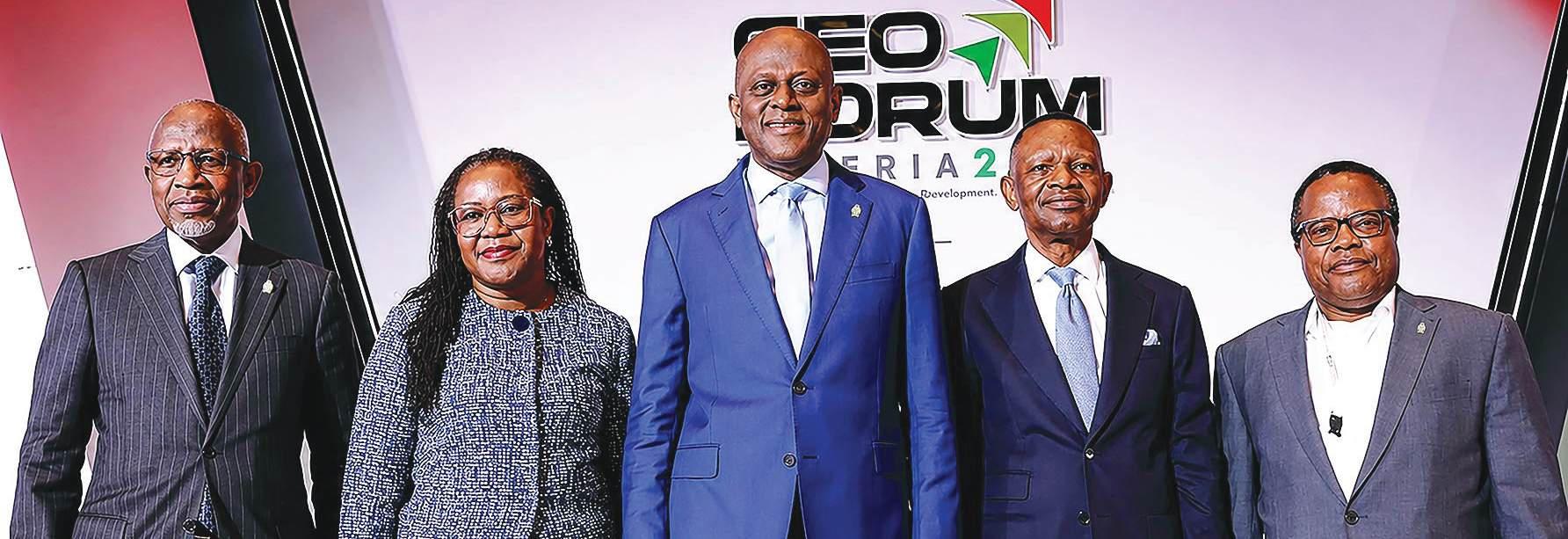
L-R: Mr. Lamido Yuguda, Deputy Governor, Financial System Stability (FSS), Central Bank of Nigeria (CBN); Prof. Olayinka David-West, Dean, Lagos Business School (LBS); Mr. Olayemi Cardoso, Governor, Central Bank of Nigeria; Mr. Frank Aigbogun, Founder/CE, Business Day Media Limited; and Dr. Aloysious Ordu, Member, Monetary Policy Committee (MPC), Central Bank of Nigeria, at the 2026 Business Day CEO Forum held at Eko Hotel, Lagos... yesterday
Tinubu: We’ll Continue to Protect Local, Foreign Investments Across the Country
Insists Nigeria on his watch is ready, open for business Launches sales office for iconic city walk project
President Bola Tinubu, yesterday, reiterated his government’s commitment to guarantee the safety of domestic and international investments, declaring that Nigeria, under his leadership, is ready and open for business.
Tinubu said the commitment was further demonstrated by the ongoing
optimisation of legal, physical, and financial frameworks to protect capital, guarantee returns, and eliminate unnecessary bottlenecks in the system.
Speaking in Abuja at the official launch of the Sales Office and Experience Centre for the landmark Abuja City Walk Development project, the president, who was represented by Vice President Kashim Shettima,
described the project as a tangible manifestation of his administration’s Renewed Hope Agenda.
He stated, “We are not just opening a building. We are unveiling the window to a multi-billion-dollar future. We are presenting a tangible manifestation of our Renewed Hope Agenda, sculpted in concrete, innovation, and unwavering determination.”
He recalled an earlier promise
he made to Nigerians on radical economic transformation and infrastructure renewal, saying, “The City Walk Experience Centre stands as proof that our administration does not just make promises, we execute them with determination.”
Tinubu also spoke on the viability of the project, stressing, “The Abuja City Walk is a shining symbol of what can be achieved when political
UNICEF Lauds Tinubu for Rescuing Oyo Pupils, Teachers, Makes Case for
Delegation visits First Lady
Deji Elumoye in Abuja
United Nations Children’s Fund (UNICEF) has lauded the federal government for rescuing the abducted 39 pupils and five teachers in Oriire Local Government Area of Oyo State.
The UNICEF delegation, led by Executive Director, Mission to Nigeria, Catherine Russell, gave the commendation yesterday during a visit to the wife of the president, Senator Oluremi Tinubu, at State House, Abuja.
Russell stated, “I think investing in women and children is an investment in the future of the nation.
UNICEF is glad to stay part of the time, helping as much as possible.
“We thank the leadership for rescuing children in conflict.
“What I see in my travels around the world is that conflict is one of the most difficult situations for children, whether it is displacement, conflict, violence, abductions, whatever it is, children need to be protected in these situations.”
She appreciated Mrs Tinubu for putting women and children on the front burner of her various interventions, particularly through the Renewed Hope Initiative (RHI).
She also commended the first lady for championing the birth registration drive, which resulted in an upsurge to 14 million children across the country within two years.
The United Nations agency said
the success was achieved through several key factors, including Mrs Tinubu’s advocacy through the Renewed Hope Initiative (RHI).
Russell stated, “I think as Nigeria continues to advance, this will be an important moment to invest in children, and I like to commend the leadership and RHI for birth registration.
”Birth registration is one of the most important because children are part of our priorities to guarantee a great future.”
She also acknowledged the first lady’s pivotal role in the campaign against Female Genital Mutilation (FGM), among others.
Responding, Mrs Tinubu expressed her gladness for the
Ekiti Govt Declines Voting in Alara Stool, Mandates Kingmakers to Embrace Ifa
Gbenga Sodeinde in Ado Ekiti
As the scrambling for the stool of Alara of Aramoko Ekiti gathers momentum, the Ekiti State Government has instructed the kingmakers to embrace Ifa Consultation to produce an acceptable candidate. The government however ruled out voting by kingmakers to produce the candidate among the three aspirants shortlisted out of the eight contestants, describing voting as a fertile ground for bribery and manipulation, which
the Governor Biodun Oyebanji administration is averse to.
Ekiti State Deputy Governor, Chief (Mrs) Monisade Afuye, gave the directive yesterday, in Ado Ekiti, the State Capital, while interacting with kingmakers and other stakeholders from Aramoko Ekiti, Ekiti West Local Government Area over the ongoing process for the selection of a new Alara. The government brokered the interaction, sequel to the outcome of selection process conducted on 23rd April, 2026, where Prince Femi
Akinlabi, Prince Adewumi Adetoyinbo and Prince Tope Ademiluyi from Olokun Ruling House, had emerged through Ifa divination out of eight contestants vying for the coveted royal seat.
Subsequently, the 12 existing kingmakers had voted, where two of the aspirants: Tope Ademiluyi and Femi Akinlabi, got six votes apiece, thereby creating a tie that required intervention to set a pace that would wriggle the town out of the conundrum for speedy emergence of a monarch.
Children
return of the abducted children and UNICEF’s decision to identify with the government during the dark period.
She stated, “We are used to UNICEF coming to partner our office in the way of advocacy be- cause we know we have ministries and the work of the first lady is complementary and support.
“I agree with you that children are very important in any country for the development of that country.
“When you have children and they are not well invested in, no matter how wealthy that country is, they will not be able to make substantial growth.
will meets private sector expertise and capital.
“By granting this corridor a Free Trade Zone status, we have further eliminated trade friction, laying down a fertile environment for regional commerce, medical tourism, premium retail, and high-end hospitality.”
The president commended the commitment of the Federal Capital Territory (FCT) administration, led by the minister, Nyesom Wike, to the realisation of the project.
He declared, “For 20 years, the Abuja Technology Village corridor lay dormant.
“Today, through aggressive land administration reforms and the eradication of bureaucratic inertia, it is being transformed into a bustling construction hub.”
Tinubu stated that under the Renewed Hope Agenda, his administration was gradually putting a permanent end to the era of land speculation and abandoned mega-projects in Abuja.
He said, “We have made it clear that land is an asset for rapid development, not an instrument for developmental retrogression and speculative hoarding.
“Through this development, we are pushing the boundaries of architectural and engineering possibility in Africa. This magnificent
project also underscores our deep conviction that sustainable national development cannot be carried out by the government alone.”
The president charged the FCT administration and partners in the project to maintain the intense momentum, insisting that the launch of the sales office and experience centre must translate immediately into accelerated brick-and-mortar execution on-site.
Earlier, Wike said the formal launch of the Abuja City Walk project was a realisation of one of the cardinal objectives of the Tinubu administration, to attract foreign direct investment and create employment opportunities forHeNigerians. stated that while it was government’s responsibility to provide the enabling environment for investments to thrive and create employment opportunities, citizens must play their part by supporting government policies and programmes to ensure continuity and sustainability.
In an overview of the project, Executive Director, Link Development, Dr Kassim Gidado, said the occasion marked the beginning of a bold vision and dedicated realisation of a huge project milestone, and the cornerstone of the Renewed Hope Agenda.
Saraki Petitions CJN, Opposes SAN Rank for Kwara AG over Offa Robbery Charges
Chuks Okocha in Abuja
FFormer Senate President, Dr. Bukola Saraki, has petitioned Chief Justice of Nigeria (CJN), Justice Kudirat Kekere-Ekun, over the planned conferment of the rank of Senior Advocate of Nigeria (SAN) on Kwara State Attorney-General and Commissioner for Justice, Senior Sulyman Ibrahim.
The CJN chairs the Legal Practitioners’ Privileges Committee (LPPC), the body responsible for conferring the SAN rank.
In a petition dated May 25, 2026, and seen by THISDAY, Saraki said Ibrahim’s official conduct “completely falls short of the
high standard of integrity, honour, and professional ethics required of any practitioner worthy of being elevated to the prestigious rank of Senior Advocate of Nigeria”.
The former senate president alleged that the Kwara State attorney-general brought the legal profession into “disrepute” by preferring or causing to be preferred, charges that “he knows or ought to have known have no basis in law and were merely designed as a political weapon against me”.
Saraki said his petition ws premised on two grounds — malicious prosecution and abuse of constitutional powers, and frivolous penal code charge and violation
of due process.
The former Kwara State governor said despite being cleared by the federal government’s Department of Public Prosecutions (DPP) over the 2018 Offa robbery, Ibrahim filed charges against him and two others.
Saraki said the charges were “deliberately timed and designed to cause grave public embarrassment, inflict reputational damage, and maliciously de-market me politically”.
He added, “Crucially, prior to the filing of this charge, I was neither invited by the police for questioning nor confronted with any allegations whatsoever.
Deji Elumoye in Abuja
Stakeholders: NCAA Must Seek Additional Funding to Stem Financial Crisis
Industry stakeholders have called on the Nigeria Civil Aviation Authority (NCAA) to seek for additional revenue streams that will boost its finances and avert any form of financial crisis.
According to them additional sources of income will continue to stabilise NCAA, even when airlines face disruptions due to operational challenges and are unable to meet up with
their financial obligations to the agency.
The industry observers are of the view that as the industry grows and airline operations expand, NCAA will spend more money on skilled manpower remuneration, technical training and engagement of more personnel to carry out its regulatory functions.
The stakeholders noted that inflation and high exchange rate have undermined profitability of
airlines which now grapple with taut operational funds, prompting them to struggle to keep their obligation with the regulatory authority.
Besides the 5 per cent Ticket Sales and Cargo Sales Charge, which the airlines pay to NCAA, and shared among four other aviation agencies, other fees and taxes airlines pay to the regulatory authority are regulatory and administrative fees. These include fixed fees for
direct regulatory services and certification.
But these revenues that accrue to NCAA are not enough because while the agency’s expenses continue to expand as it recruits more personnel, trains and retrains its workforce, the agency struggles to meet its fiscal obligations.
The stakeholders observed that the funding of NCAA reached a crisis point during the Middle East crisis when airlines were not able to pay
their five per cent Ticket Sales Charge and Cargo Sales Charge due to the sudden increase in the cost of aviation fuel, which peaked at N3, 500 from prewar price of N900 per litre, thus plugging NCAA into financial catastrophe.
To make matters worse, the National Assembly is currently reviewing the sharing of 5 per cent Ticket Sales Charge among five aviation agencies, including NCAA and the Nigeria
Airspace Management Agency (NAMA) and it plans to reduce NCAA’s share from 56 to 40 per cent and increase NAMA’s from 22 to 40 per cent.
Industry experts fear that with the planned reduction in NCAA revenue, the agency may not be able to effectively carry out its regulatory functions in the industry and this may lead to breach of safety standards.
The Codex Alimentarius Commission has agreed to adopt new international guidelines on the use of precautionary allergen labelling (PAL), marking an important step towards making “may contain” statements more meaningful, science-based and consistent
for consumers with food allergies around the world.
The new science-based recommendations promote more consistent use of precautionary allergen labelling, helping consumers make more informed food choices
This is as food allergies affect an estimated 4.3 per cent of the global population, with reactions ranging
from mild symptoms to life-threatening anaphylaxis.
This was disclosed in a statement issued by the Food And Agriculture Organisation (FAO) recently, noting that for millions of consumers, precautionary allergen statements can play an essential role in deciding whether a food is safe to eat.
The guidelines were
adopted as part of the 49th session of the codex alimentarius commission, held in Geneva, Switzerland, from 6th to 10th July 2026. FAO noted that the use of labels such as “may contain” varies widely across products and countries and remains unregulated in many parts of the world.
Is noted that as a result,
consumers often face inconsistent information that can make it difficult to judge the real level of risk.
According to the statement, “Some people unnecessarily avoid foods that are safe for them, while others may lose confidence in the warnings and choose to ignore them.
During food production, small amounts of an allergen can
unintentionally find their way into a food even when that allergen is not an ingredient. For example, a chocolate bar that does not contain nuts may be made on the same production line as products that do, allowing traces of nuts to remain despite cleaning procedures.
Training as an aviator has been made stringent with high grade pass mark in order to meet international standards and to ensure safety in air travel.
This was disclosed by the former Managing Director of the Federal Airports Authority of Nigeria (FAAN) and currently the Managing Partner, Avialog Company Limited, Dr. Richard Aisuebeogun. He made the disclosure
when he delivered a keynote lecture at the African Aviation and Aerospace University (AAAU), Abuja during its 3rd Matriculation ceremony at the weekend.
Aisuebeogun called on students of the university and urged them to align their personal academic aspirations with the university’s vision as they prepare for careers in the aviation and aerospace industry.
In the lecture titled: ‘Transforming Africa through Aviation and Aerospace
Education: The AAAU Vision’, Aisuebeogun said what would make the students succeed would be their commitment, discipline and academic excellence.
Addressing the matriculating students, Aisuebeogun stressed the importance of continually reflecting on the University’s vision and ensuring that their ambitions remain consistent with its mission of transforming Africa through quality aviation and aerospace education.
NANTA Pushes for Tourism Growth in Africa
Concerned about the painful impact of xenophobic conversations and trade barriers across the African continent, the National Association of Nigeria Travel Agencies (NANTA) in collaboration with Ghanabased Safari Valley Resort and supported by Ibom Air, will embark on a four-day retreat to reignite a fresh commitment to intra-African tourism.
Guided by the theme: ‘Africa for Africa: Tourism,
Unity and Shared Growth’, the retreat is designed as a pan-African engagement to rekindle hope and drive conversations around solutions to Afrophobia and the barriers to cultural tourism and travel opportunities within the continent.
President of NANTA, Mr. Yinka Folami, explained that Nigeria and Ghana shared deep historical dreams of African unity, liberation, and pan-African
cooperation. This, he said, was why the association is moving to recalibrate and rekindle hope for a strong and united Africa.
“From the intellectual foundations laid by our leaders during the independence movements to decades of cultural tourism exchange, trade and commerce, Nigeria and Ghana have repeatedly chosen partnership and collaboration over division,” Folami stated.
FATE Foundation, Citi Foundation Launch Youth Entrepreneurship Incubation Programme
Kayode tokede
FATE Foundation, with funding from the Citi Foundation, has launched the Youth Entrepreneurship Incubation Programme to equip young people in Nigeria with financial literacy and entrepreneurship skills.
Delivered through free, safe, and accessible platforms, the programme supports the incubation and scaling of youth-led enterprises, enabling income generation and job creation.
In October 2025, FATE Foundation was selected as a recipient of Citi Foundation’s
2025 Global Innovation Challenge to Accelerate Youth Employability. Joining the cohort of 50 organisations globally, the Foundation will receive $500,000 over two years to advance its youth employability initiative.
“We are excited to be selected for Citi Foundation’s 2025 Global Innovation Challenge,” said Ayomide Akindolie-Igwe, Executive Director of FATE Foundation.
“This support enables us to equip young entrepreneurs in Nigeria with the financial literacy and skills needed to
build and scale sustainable businesses.”
The programme addresses youth employability by tackling Africa’s growing jobs crisis. By 2030, the African continent will be home to 40% of the world’s youth, and with one in threeunder 35 already unemployed, this initiative will support Nigerian youth with a two-phase approach. It begins with financial literacy training before progressing to entrepreneurship development, incubation support, and access to tools needed to build viable, job-creating businesses.
ntel Unveils Strategy across Connectivity, Infrastructure and Real Estate
Air WAtCh
Advancing Air Medical Capabilities for Oil and Gas Services
international standards of safety and reliability.
Asst. Editor, Energy
Emmanuel Addeh
Asst. Editor, Money Market
Nume Ekeghe
Correspondents
Kayodetokede(CapitalMarkets)
James Emejo (Finance)
Ebere Nwoji (Insurance)
reporter Peter Uzoho (Energy)
ntel has unveiled The Next Frontier, a bold strategic vision that marks a significant milestone in the company’s transformation into an integrated digital infrastructure, connectivity, and real estate enterprise. Built on the company’s BET Agenda - anchored on three growth pillars, Beam, Eden, and Titan - the strategy reflects ntel’s commitment to creating new opportunities through technology innovation, infrastructure development, and strategic
asset optimisation.
Speaking at the unveiling, the Managing Director/Chief Executive Officer of NatCom Development & Investment Limited (trading as ntel), Soji Maurice-Diya described the initiative as far more than a business transformation strategy. According to him, it represents the company’s commitment to building an integrated ecosystem that connects people, empowers businesses, drives digital inclusion, and creates sustainable economic value for Nigeria.
In Nigeria, there have been tragic accidents involving helicopter operation providing shuttle service for the oil and gas industry and some of them ended with fatalities.
It is in order to stem such accidents and incidents that a firm, Kasi Aviation established medical and emergency system in Nigeria’s aviation industry.
So, recently Airbus Helicopters and Kasi Healthcare signed an agreement for the procurement of up to two Airbus H135 helicopters for emergency medical services.
The agreement, which was announced at the 3rd Nigeria Airlift 2026 Forum, marked a significant milestone in the development of advanced emergency medical aviation services in Nigeria.
With the agreement, Kasi Healthcare becomes the first customer for the HEMS-configured Airbus H135 helicopter in Nigeria, introducing a purpose-built aircraft solution designed specifically to support critical medical missions, emergency response, patient transfers, and life-saving aeromedical operations.
Medical Director of Kasi Healthcare, Dr. Dayo Osholowu, said: “We are incredibly proud to pioneer the introduction of the HEMS-configured Airbus H135 in Nigeria.
This strategic investment transforms our ability to provide rapid, life-saving patient transfers and critical care in transit. Partnering with Airbus allows us to elevate national healthcare standards and deliver dependable emergency response when and where it is needed most.”
Head of Sales for Africa at Airbus Helicopters, Fabrice Rochereau, said: “We are proud to partner with Kasi Healthcare as they pioneer the development of a sustainable HEMS ecosystem in Nigeria.
The H135 has proven itself globally as the premier choice for emergency medical missions due to its high performance and versatile cabin layout. The agreement underscores our commitment to supporting the expansion of life-saving air medical capabilities across West Africa.”
The strategic investment by Kasi Healthcare aims to strengthen Nigeria’s emergency healthcare infrastructure. Beyond aircraft acquisition, the partnership includes comprehensive support from Airbus Helicopters to build local capacity, focusing on HEMS flight crew training and pilot development as well as aircraft engineer training and technical capability building. Airbus will also assist with maintenance support infrastructure as well as operational support to ensure
The partnership between Kasi Healthcare and Airbus Helicopters represents a major step towards positioning Nigeria as a regional leader in air medical services across the energy and public safety sectors, improving access to emergency medical care, and supporting national healthcare transformation objectives.
The H135 is the undisputed leader in the HEMS market, known for its high safety standards, compact footprint, and low sound levels. Equipped with the Helionix digital avionics suite and a 4-axis autopilot, it offers an ideal platform for primary and secondary medical missions, providing a spacious and flexible cabin layout for medical crews and their equipment.
According to Airbus, The H135 is a light twin-engine helicopter that combines compact design with Airbus’ Helionix avionics for emergency medical services, law enforcement, utility, private business (PBA), military training and offshore energy operations. With the lowest operating and maintenance costs in its class and inspection intervals of 500 flight hours, the H135 delivers mission flexibility where operational efficiency and confined area access are critical.
Equipped with FADEC-controlled engine options (Safran Arrius 2B2 Plus or Pratt & Whitney PW206B3) and featuring a 4-axis autopilot with flight envelope protection and synthetic vision system, the H135 maintains availability rates exceeding 95% for critical missions. Part of a family with over 1,600 aircraft delivered to 325+ operators globally and 8 million flight hours accumulated, the platform has established a proven operational record across decades of civil and governmental service, including more than 700 dedicated EMS helicopters worldwide.
The chopper is fitted with a bearingless main rotor, Airbus’ signature Fenestron shrouded tail rotor, the H135 provides best-in-class performance throughout its flight envelope.
Two full authority digital engine control (FADEC)-equipped engine options are available: Safran Helicopter Engines’ Arrius 2B2 Plus and Pratt & Whitney Canada’s 206B3. Both of these reliable turboshaft power plants provide outstanding performance and vital power reserves – even in one engine inoperative (OEI) scenarios – along with low fuel consumption.
the story continues online on www.thisdaylive.com
Chinedu Eze
Nigeria’s Renewable Energy Industry Shifts Focus to Storage as Solar Costs Fall
Kayode Tokede
Falling equipment costs, battery storage and smarter energy infrastructure dominated discussions at Solar & Storage Live Nigeria 2026, as industry leaders said Nigeria’s renewable energy market is entering a new stage of development.
In an interview with THISDAY on the sidelines of the event, President of the Renewable Energy Association of Nigeria (REAN), Ayo Adedimulua, said the perception that renewable energy remains prohibitively expensive no longer reflects market realities.
“Component costs have fallen by more than 100 per cent over the last 10 to 15 years, and in some cases
we’re seeing declines of 200 to 300 per cent,” he said. According to him, the falling cost of renewable energy technologies has altered the economics of power generation, making solar increasingly competitive with conventional energy sources.
“Every naira spent on diesel or petrol is gone the moment it is burned.
Every naira invested in solar panels or batteries continues delivering value over the lifetime of the asset.”
He added that Nigeria’s renewable energy potential extends beyond solar, citing hydro, wind, biomass and geothermal resources as opportunities that remain largely untapped.
“We have everything we need,” he said. “What we’ve lacked is the conviction to
price risk correctly.”
According to him, the growing participation of manufacturers, developers, financiers and policymakers at this year’s conference reflected increasing confidence in the sector and the scale of opportunities emerging across the renewable energy value chain.
Speaking during a panel session at the conference, the Managing Director and Chief Executive Officer of the Rural Electrification Agency (REA), Abba Aliyu said battery storage would play a central role in the next phase of investment in Nigeria’s power sector.
“The next wave of capital will not go into generation,” he said. “It will go into storage. That is where the unlock happens.”
Banker Global Rankings: GTBank Emerges Nigeria’s Best Performing Bank
Guaranty Trust Bank Limited (GTBank), the flagship banking subsidiary of Guaranty Trust Holding Company Plc (GTCO), has been named the Best Overall Performing Bank in Nigeria in The Banker magazine’s Top 1000 World Banks Rankings 2026.
The recognition reaffirms GTBank’s position as one of Nigeria’s leading financial institutions and reflects the Bank’s consistent delivery of strong financial performance, operational excellence, and sustainable growth. The rankings evaluate banks globally using audited financial results, assessing institutions
across financial strength, operational efficiency, risk management, liquidity, growth, and profitability. GTBank ranked 1st Overall as best performing Bank and also ranked 1st in Efficiency and Soundness. The Bank secured 2nd place in other metrics such as Return on Risk, Liquidity, Growth, Leverage and Profitability, demonstrating exceptional performance across all major Banking metrics
Speaking on the achievement, Mrs Miriam Olusanya, Managing Director of Guaranty Trust Bank Ltd, said: “Being named the Best Overall Performing Bank in Nigeria by The Banker is a recognition that means a great deal to us, not just
because of the prestige of the publication, but because of what it represents; the hard work of our People, the loyalty of our Customers, and the strength we continue to draw from being part of the Group. Ranking 1st in Overall Performance, Efficiency, and Soundness reflects our disciplined approach to banking, the synergies we harness across the GTCO Group, and our relentless focus on delivering real value. We do not take this recognition for granted. It deepens our resolve to keep raising the bar, to serve our customers better every day, and to remain a Bank that consistently delivers value to all its stakeholders, and to the GTCO Group we are proud to belong.”
How Moniepoint is Powering Nigeria’s $11bn Food Service Industry
Emma Okonji
A new case study by Moniepoint, Africa’s all-in-one financial ecosystem platform for individuals, businesses and their customers, has traced four decades of Nigeria’s food service industry and revealed how the sector’s most persistent payment challenges have been resolved by real-time digital infrastructure, turning food commerce into $11.09 billion market in 2025.
The study identified some of the persistent payment challenges to include: settlement delays, unreliable confirmation, unchecked theft and inaccessible credit.
According to study, the sector has undergone a massive structural shift marked by food-
delivery super-apps, with the food service industry poised to experience unprecedented growth as the Nigerian market is projected to reach $19.31 billion by 2030, growing at 11.73 per cent annually.
The study traced the industry’s roots from the UACowned Kingsway Rendezvous of 1973 and the 1986 launch of Mr. Biggs, through the rise of Chicken Republic and other quick-service chains, to the present day, where food and drinks form the second-largest merchant sector on Moniepoint’s platform, trailing only retail.
Analysing the study, the Group CEO of Moniepoint, Tosin Eniolorunda, said: “Moniepoint believes financial inclusion is not just about access. It’s about dignity, about enabling people to transact on their terms. What’s
happening in the food service sector today is significant. The real competitive question today is how deeply that payment infrastructure is woven into the way the business actually runs day to day. Moniepoint is sitting right at the centre of that shift. We are ensuring that payments are connected to inventory, to recipes, to procurement, to credit, and to growth plans. By building out tools like Moniebook and Orda that match the operational reality of these culinary entrepreneurs, who act as mini-factories converting perishable raw materials into time-sensitive output, we are providing the digital operating system that drives sustainable scale for Nigeria’s socio-economic development.”
inDrive Expands Driver Support with Healthcare Coverage
inDrive, a global mobility and urban services platform, has taken a bold step in advancing driver welfare by providing healthcare coverage for 500 drivers and their families through a partnership with Heala.
Commenting on the initiative, Country Manager, inDrive
Nigeria, Timothy Oladimeji, noted that the initiative aligns with inDrive’s broader mission of challenging injustice by addressing one of the everyday challenges faced by drivers.
Oladimeji added that by reducing barriers to healthcare access, the company is helping drivers remain healthy,
productive, and better able to support their families.
“At inDrive, our drivers are at the heart of everything we do. We recognise that long hours on the road can make it difficult to prioritise personal health, yet their wellbeing is essential to their livelihoods and the communities they serve.
Nume Ekeghe
following: Saharan Blend (Algeria), Djeno (Congo), Zafiro (Equatorial Guinea), Rabi Light (Gabon), Iran Heavy (Islamic Republic of Iran), Basrah Medium (Iraq), Kuwait Export (Kuwait), Es Sider (Libya), Bonny Light (Nigeria), Arab Light (Saudi Arabia), Murban (UAE) and Merey (Venezuela).
Stock Market Depreciate by 0.09% on Profit-taking in BUA Cement
Kayode Tokede
The Nigerian stock market closed lower yesterday as mid-session profit taking in BUA Cement Plc wiped 0.09 per cent off investors’ investments.
As BUA Cement dropped by 10 per cent, the Nigerian Exchange Limited All-Share Index (NGX ASI) shed 221.14 basis points or 0.09 per
cent to close at 242,145.61 basis points. Also, market capitalisation dipped by N32 billion to close at N 156.207 trillion.
Investor sentiment remained positive as 26 gainers outpaced 21 losers. First HoldCo emerged the highest price gainer of 9.96 per cent to close at N87.25, per share. McNichols followed with a gain of 8.00 per cent to close at N5.40,
while United Ban for Africa (UBA) rose by 7.93 per cent to close at N44.25, per share.
Veritas Kapital Assurance increased by 6.85 per cent to close at N1.56, while Jaiz Bank appreciated by 4.07 per cent to close at N8.95, per share.
On the other side, Eunisell Interlinked led others on the losers’ chart with 10 per cent to close at N189.00, per share. BUA Cement followed with
a decline of 9.99 per cent to close at N275.60, while CAP declined by 9.61 per cent to close at N142.45, per share.
Royal Exchange lost 9.55 per cent to close at N1.42, while Guinea Insurance depreciated by 5.38 per cent to close at 88 kobo, per share.
Meanwhile, the total volume traded declined by 10.0 per cent to 498.45 million units, valued at N34.87 billion, and exchanged in
39,484.00 deals. Transactions in the shares of Japaul Gold & Ventures led the activity with 77.658 million shares worth N231.525 million.
Access Holdings followed with account of 41.161 million shares valued at N1.018 billion, while First HoldCo traded 38.800 million shares valued at N3.384 billion.
UBA traded 31.526 million shares worth N1.381 billion, while Fidelity Bank traded
23.808 million shares worth N495.008 million.
Analysts noted that “the decline was driven by continued sell-pressure in Industrial stocks. Although buying interest remained evident in select banking stocks, it was insufficient to offset the weakness in large-cap industrial stocks. The session reflects investors’ continued cautious positioning amid mixed market sentiment.”
PRICES FOR SECURITIES TRADED AS OF JULY 16/26
Tejumola Maurice-Diya: Documenting Africa’s Fashion Heritage at IAF
Recently, the Ecobank Pan african Centre in Lagos hosted Inside africa Fashion 54 (IaF 54), a landmark exhibition bringing the fashion stories, textiles, and craftsmanship of all 54 african countries into one physical space. Founded by cultural archivist Tejumola Maurice-diya of The Fashioned Museum, IaF 54 is the result of nearly two years of documenting africa’s fashion heritage country by country. Her goal: preserve these stories from an african perspective before someone else tries to claim them. In this interview with MARY NNAH, Maurice-diya shares discoveries from the field, like learning that aso Oke began as a wound dressing material and later evolved into ceremonial cloth. She talks about why young africans are gravitating toward indigenous fabrics over ankara, the trade and shipping challenges across 54 nations, and how she hopes IaF 54 will inspire young creatives to reflect on their identity and the role of heritage in what they create
What inspired you to create IAF 54 and document the fashion stories of all 54 African countries in one archive?
Ifind that Nigerians, and Africans in general, are very creative people. I believe a platform is ideal to express that creativity, so the entire world can see the beauty that African designers and creatives have to offer. This platform, in particular, focuses on bridging the gap between the older and the younger generation. But it also bridges the gap between the world and Africa, helping people to see what Africans stand for. And expressing our culture from our perspective, as opposed to the other way around.
You say IAF 54 covers fashion from all 54 African countries. Why has no one done this before, and why launch it in Lagos?
IAF stands for Inside Africa Fashion, and 54 is for the 54 African countries. I can’t answer why it’s never been done before, but what I do know is that with my platform, The Fashioned Museum, one thing we pride ourselves on is documenting. As Africans, unfortunately, in the past, we haven’t always done a great job of documenting.
The purpose of this platform is to document, so people are aware of what Africans are actually doing. With regards to this event, Inside Africa Fashion 54, this particular exhibition, The Fashioned Museum has been documenting for the past 18 months. We have a newsletter that goes out to subscribers, and we’ve been talking about African fashion over time.
This is us wrapping up that project. It’s taken almost two years to talk about every single African country, their unique cultures, and the textiles that are indigenous to them. In line with documenting, we figured, why not exhibit this? Because nobody’s documenting it.
We wanted a physical representation people could see, not just online. For those in the diaspora who have always wondered what it looks like to be Cameroonian, or Ethiopian, for example, they now have the opportunity to see everything in one city. To actually experience the beauty, creativity, richness, and depth of the textiles that African nations have. We implemented this for two reasons: one, documentation, and two, a physical representation of that documentation, so the world can see how beautiful Africa really is.
Many people think African fashion is just Ankara and wax prints. How does this exhibition show a bigger, different story?
That’s a very interesting perspective because I think now a lot of Africans know that Ankara is not indigenous to us. While the prints are very beautiful, I love Ankara, the prints are very beautiful. However, I feel like there’s a new gravitation towards our indigenous textiles.
For example, because you brought up Nigeria, Nigeria has many indigenous textiles such as the Akwete or Aso Oke or so many other textiles that we have. As a result of that, I would say people have moved beyond Ankara. They love Ankara, but they are identifying that there are other textiles apart from Ankara that they can actually identify with as well. There’s a growing population that is also very eager to see what other associations there are with textiles and fashion as it pertains to African fashion or Nigerian fashion in particular.
What were some of the surprising discoveries you encountered while researching African fabrics?
One of the most interesting discoveries was when I went to find out about the history of Aso Oke. I literally went to Iluoke in Oyo State and spoke with someone who had been weaving Aso Oke for over 30 years. I found out that Aso Oke, when it first started, came from a tree - from the plant itself. From there, they began to produce cotton and the cottonseed. Initially, it was used to cover wounds. At some point, they decided to start using the fibers for cloth. From then, it developed into something they could actually dye. Dyeing, as in dyeing the textile. It was very interesting to see the
process it has gone through and where it is now. When you look at the variations of Aso Oke today, and then look at the cotton seed, you see how far it has come. The difference is such a beautiful story. If you look at Aso Oke now, there are so many infusions of metallic fibers. You see how they weave in all sorts of beautiful colors. But to think that at some point, there was only so much they could achieve because of the fruit dyes they used for the cotton in Aso Oke.
With the pigments, if you look at the indigenous, original Aso Oke, you can’t even wash them because the colors run. I learned that they have something they call ‘Olu’. It’s like a wooden frame that they use to beat the material to make it shine. They beat the fabric, and that’s how it shines again. When they see that the Aso Oke is becoming dull, they bring it out, beat it, and it begins to shine again. I thought that was brilliant technology for textiles back in the day. It was a very interesting discovery for me.
Why do you think people are gravitating toward Aso Oke?
I think there’s something about African pride right now. I would say the youth, and people in general, are finally waking up to the fact that as Africans, we are exceptional. We are
brilliant, we’re wise, and we’re very creative. There’s a new interest in wanting to know more about who we are. And in knowing who we are - our culture and everything - fashion has a place in that. From a cultural perspective, you can’t look at culture without looking at the fashion of the people. You can’t look at culture without looking at what royalty used to wear, or what the average person used to wear.
There is a deep connection with identity and heritage right now. And in the process of that, fashion is being highlighted. You’ll find that a lot of people are now gravitating towards Aso Oke, Kente, and Akwete. They are even gravitating towards Raffia and Adire. There are so many other textiles people are gravitating towards. Even during the planning of this exhibition, it was very enlightening for me.
For example, there’s a textile called Ndop from the people of Cameroon. It’s so beautiful. How people have found very interesting ways to style it is beautiful to see. I think people are naturally gravitating towards it because they want to understand more about who they are in all of this.
Why do you think it’s important to preserve our culture, our heritage, our fabric at this point?
I think it is critical for us to be able to document our heritage. The truth about it is that if we don’t document it, then what prevents someone from coming from a foreign place one day, maybe 50 years from now, to say that they are the ones who started at Aso Oke? If we document it, what do we do to make sure that it’s not even a conversation? What do we do to allow people to identify that this is something that is a non-starter for us, for example? I think there’s a greater opportunity to be able to share this with the world.
So, undoubtedly, when they see certain textiles, they know their origin.
How do you balance preserving traditional fashion while also educating about contemporary African styles?
This is a very interesting one for me because I love fashion in general. I feel like it’s actually not a difficult thing to do in terms of balancing it because African designers are so creative with their designs. They came out with a design today, and next week they will come out with another design. We are extremely innovative with our designs. Now that we are in this place where we are consistently looking for who we are and finding out more and more about textiles, I find that people are becoming even more innovative.
Tejumola Maurice-Diya
Celebrating What Matters Most: The Amstel Malta Tradition in Eastern Nigerian Families
Francis Obiajulu
The strongest brands are not necessarily the ones that advertise the most. They are the ones who become part of people’s lives. Marketers often speak about market share, consumer insights and brand affinity.
But there is another measure of success that is much harder to quantify: becoming part of culture. That is the journey Amstel Malta has been privileged to experience in South-Eastern Nigeria.
Malt is the flavour of South-Eastern Nigeria. From bride price negotiations to Umuada meetings, family gatherings or even sombre occasions, one thing is guaranteed: malt will be served. In many parts of the region, malt is not just a drink but a symbol of honour, hospitality and celebration. Its rich taste and lack of alcohol make it a suitable choice for people of every generation. However, serving just any malt is often not enough.
Over time, something interesting has happened. The conversation has shifted from simply serving malt to serving the right malt. Across social media, creators have gone viral for capturing countless conversations around the drinks served during traditional ceremonies. Whether it is a bride price negotiation or a meeting, people now associate the choice of refreshment with the value placed on guests. Offering premium malt has become a subtle expression of respect, generosity and hospitality. It says, “You matter enough for us to give you our best.” And for people in the South-East, nothing says premium quite like serving Amstel Malta at one’s event.
Over the years, Amstel Malta has become deeply woven into the cultural fabric of the South-East and South-South. Its rich taste and premium image have made it a familiar presence at the region’s most important occasions. It has become the malt people look out for during important family celebrations and communal traditions to gauge the weight of the event.
This reputation has been built not only on
taste but also strengthened by showing up in moments when culture comes alive. With Amstel Malta, our ambition goes beyond being the preferred premium malt drink. We aspire to be a trusted companion in life’s most meaningful moments, celebrating milestones, strengthening communities and creating the best experiences that people are proud to share. We understand that the most successful brands are not built solely through campaigns. They are built through consistency, authenticity and a
genuine understanding of the people they serve. When a brand becomes woven into a community’s culture, it earns something far more valuable than visibility. It earns trust. This simple philosophy has shaped how we at Amstel Malta engage with communities across the South-East and South-South Nigeria. Every December, as thousands return home for the festive season, Amstel Malta becomes part of the excitement through experiences like the Amstel Malta Festiville and several lighting
activities that heighten holiday cheer and create memorable moments to bring people together. Understanding that Easter is also a time of homecoming and sombre reflection, the brand reinforces its presence at village Easter festivities and activities such as the Easter Village, playing a significant role in this important religious celebration.
And when women gather annually for the iconic August Meeting, a tradition centred on community development, family ties, and cultural identity, Amstel Malta takes part in this shared experience, giving the daughters of the community the support they need to continue to chart the progress of their communities.
These moments are about much more than entertainment. They are opportunities to strengthen bonds, preserve culture and create memories that families carry with them long after the event has ended. The brands that last are rarely those that ask consumers to change who they are. Instead, they find meaningful ways to become part of existing traditions and elevate experiences people already cherish.
For us, this is not just a branding success story. It is a reminder of the responsibility that comes with earning a place in people’s traditions. Brands that want to create lasting affinity must participate authentically in the moments that matter.
Today, in many South-Eastern communities, serving Amstel Malta is about more than satisfying thirst. It is a gesture of generosity and esteem, and it acknowledges the importance of the people gathered.
As traditions continue to evolve, one thing will remain consistent: when the occasion calls for something special, many people in the East will continue to reach for the malt that has always been part of their lives, Amstel Malta. Because premium moments deserve a premium malt drink.
•Obiajulu is Senior Brand Manager, Amstel Malta.
SHADOWS: Protest Essays on Africa’s Most Consequential Country
Eniola Bello, Managing Director of THISDAY Newspaper, will present his two-volume book, SHADOWS: Protest Essays on Africa’s Most Consequential Country (1999–2023), at the Shehu Musa Yar’Adua Centre, Abuja, on July 23, 2026.
The book presentation will feature a keynote address titled “Strengthening Electoral Institutions: Pathways to Free, Fair, and Peaceful Elections in 2027,” to be delivered by Prof. Joash Amupitan, Chairman of the Independent National Electoral Commission (INEC).
Spanning over 900 pages, SHADOWS is a collection of selected essays critiquing Nigeria’s search for purpose during the first 25 years of the Fourth Republic.
In the book, Bello, who is also known by the moniker EniB, offers a rigorous, episodic narration of Nigeria’s democratic journey over the last quarter-century, chronicling the country’s “democracy in action” — including the critical institutional issues, policy triumphs, and systemic challenges
that have shaped its contemporary history. In the book, he reflects deeply on the complex socio-political dynamics, expectations, and milestones of that period.
The essays address governance issues such as corruption, human rights abuses, policy failure, insecurity, leadership incompetence, executive-legislature rift, the high cost of governance, and the vanity of public officials, among others.
The book also examines godfatherism, political parties’ disdain for internal democracy, electoral fraud, the exploitation of religion, the hypocrisy and moral vacuity of the Nigerian elite, the ethnic manipulation of the people, and the pervasive love of money.
In sum, SHADOWS presents a rich historical excursion into the interplay of people, events, and issues that shaped Nigeria’s politics and power relations between 1999 and 2023 — issues that have continued to shadow the country’s development.
Obiajulu
Ajiran Double Murder Must Be Judged By Facts, Not Social Media Narratives: Setting The Record Straight
By Gloria Fraser
In every constitutional democracy, allegations against public officials deserve careful scrutiny. Equally important, however, is the principle that documentary evidence must outweigh speculation, public sentiment or social media campaigns. In the unfolding controversy surrounding the investigation into the Ajiran double murder case, official police records now emerging appear to substantially contradict allegations of corruption levelled against Assistant Inspector-General of Police, Zone 2, AIG Olohundare Moshood Jimoh, while reinforcing the importance of allowing the judicial process to run its full course.
Documents reviewed by the National Patriots indicate that the investigation into the killings of Prince Ademola Akinloye and Sheriff Ishola Salami was neither a personal initiative nor a selective prosecution by AIG Jimoh. Rather, the records show that the investigation commenced following a formal petition submitted to the Inspector-General of Police by Chief Rotimi Williams’ Chambers on behalf of the Ojomu Chieftaincy Family of Ajiran.
Official correspondence further reveals that on January 8, 2026, the Principal Staff Officer to the Inspector-General of Police conveyed the IGP’s directive instructing then Lagos State Commissioner of Police, Olohundare Jimoh, to investigate the allegations. The available records therefore suggest that Jimoh acted strictly pursuant to lawful instructions from Police Headquarters rather than personal discretion.
The development comes amid widespread allegations circulated on social media by activist Martins Vincent Otse, popularly known as VeryDarkMan (VDM), who publicly accused the senior police officer of corruption, bias and abuse of office, while challenging him to institute criminal defamation proceedings if the allegations were false. However, no documentary evidence has been publicly presented to substantiate those allegations.
The leaked official memo presents a significantly different narrative.
According to the investigation records, detectives obtained statements from multiple complainants and witnesses, including the widow of one of the deceased victims, who reportedly narrated how her husband was chased, shot and attacked with machetes during the fatal incident.
The records further indicate that two arrested suspects — Shafi Fatai, also known as “Fabo”, and Yusuf Ismaila, alias “Bariga” — allegedly made separate confessional statements implicating businessman Hammed Tajudeen Akanbi as the individual who allegedly financed and directed both killings. The suspects reportedly mentioned separate payments running into millions of naira allegedly made for the execution of the murders.
While the admissibility, voluntariness and evidential value of those statements remain matters exclusively for judicial determination, their existence directly contradicts claims that investigators had no factual basis for identifying Akanbi as a suspect.
The official investigation file also contains references to additional witness testimony alleging that Akanbi sought intervention for the release of arrested suspects and withdrawal of the murder cases in exchange for resolving a disputed community land matter. Investigators stated that a recorded telephone conversation supporting the allegation was reportedly played before the investigating police officer.
Again, whether such material ultimately satisfies the criminal burden of proof is a matter entirely for the courts. Nevertheless, the documents indicate that investigators relied on multiple strands of evidence rather than mere suspicion or speculation.
Perhaps even more significant are the court records attached to the investigative memo.
Contrary to claims that police acted outside the law, certified court documents reportedly show that Magistrate Court No. 3, Ogba, Ikeja, initially granted police leave on February 16, 2026, to arrest and remand the suspect for fourteen days while investigations continued.
Although that order was subsequently set aside on procedural grounds relating to counsel’s right of audience, the records further reveal that the Federal High Court in Lagos later issued a separate warrant of arrest on April 10, 2026, authorising law enforcement authorities to secure Akanbi’s appearance in connection with investigations into alleged conspiracy and murder.
Legal analysts note that the subsequent Federal High Court order remained valid unless and until set aside by a court of competent jurisdiction.
Equally important is the allegation that AIG Jimoh personally interacted with the suspect after his arrest.
Official records categorically deny that allegation.
According to the memo, Akanbi was arrested by INTERPOL authorities in the Republic of Benin before being handed over to INTERPOL Nigeria and subsequently detained at the State Criminal Investigation Department (SCID), Panti, pending transfer in accordance with
established police procedures.
The documents state that Jimoh’s role was limited to coordinating with INTERPOL offices in Abuja and Lagos to facilitate the suspect’s lawful repatriation and subsequent transfer for investigation.
No evidence contained in the official records suggests any improper personal interaction between the senior police officer and the suspect following his arrest.
Beyond the legal issues, the controversy raises a broader institutional concern.
No criminal justice system can function effectively if investigators become targets of coordinated campaigns each time influential suspects are investigated. At the same time, every law enforcement officer must remain accountable where credible evidence of misconduct exists. The balance lies in allowing verifiable facts—not emotion, speculation or social media narratives—to determine accountability.
This is precisely why documentary records, judicial proceedings and independent scrutiny remain indispensable.
Further strengthening confidence in the investigation is the intervention of the Centre for Human and Socio-Economic Rights (CHSR), which publicly commended AIG Jimoh for what it described as professionalism, diligence and strategic leadership during the investigation of the Ajiran murders.
The organisation specifically praised the arrest of the suspects and the investigative work that culminated in their arraignment before the courts, describing the process as one that helped restore public confidence in law enforcement.
Importantly, the group did not issue a blanket endorsement of every officer involved. Instead, it also expressed concern over the alleged conduct of some operatives attached to the Delta Force Unit at SCID Panti, urging continued professionalism, neutrality and strict adherence to due process throughout the ongoing prosecution.
That balanced position lends additional credibility to its intervention, demonstrating support for the integrity of the investigation while insisting that every officer connected with the case must remain impartial and accountable.
AIG Olohundare Jimoh has earned a reputation within the Nigeria Police Force for professionalism and operational integrity. His record has been cited by supporters as reflecting the reform agenda of Inspector-General of Police Olatunji Rilwan Disu, which emphasises intelligence-led policing, accountability and ethical leadership. Supporters also point to reports that he rejected an alleged N500 million bribe in an unrelated investigation as further evidence of the integrity they believe has consistently defined his career. To them, his commitment to pursuing sensitive investigations in accordance with the law, despite intense public scrutiny, exemplifies the qualities expected of a modern, professional police leader.
Comparatively, democracies across the world continue to emphasise that criminal investigations should be judged on evidence presented before competent courts rather than campaigns conducted on social media. Whether in the United Kingdom, the United States, Canada or Australia, allegations alone rarely determine guilt or innocence. Documentary evidence, witness testimony, forensic findings and judicial review remain the recognised pillars upon which justice is built.
Nigeria should be no different.
The Ajiran murder case remains before the courts, and every defendant retains the constitutional presumption of innocence until proven guilty. Equally, every investigating officer is entitled to the same presumption of integrity unless credible evidence establishes otherwise.
Section 36(5) of the Constitution of the Federal Republic of Nigeria, 1999 (as amended), guarantees every person charged with a criminal offence the presumption of innocence until proved guilty by a court of competent jurisdiction. By the same token, public officials are equally entitled to have allegations against them assessed on the basis of credible evidence rather than speculation, conjecture or public sentiment.
The leaked records now available appear to provide substantial documentary support for the actions taken by AIG Olohundare Moshood Jimoh throughout the investigation. They also suggest that many of the allegations circulating in the public domain deserve to be carefully examined against the official documentary record before conclusions are reached.
As the prosecution proceeds, it is the courts—not social media, public pressure or competing narratives—that will ultimately determine the guilt or innocence of those standing trial.
Until then, the documentary trail presently in the public domain underscores an enduring principle of justice: allegations may attract attention, but only credible evidence establishes the truth. In a constitutional democracy governed by the rule of law, that principle remains the strongest safeguard for both the innocent and the integrity of the nation’s criminal justice system.
•Princess Gloria Fraser. MFR. President, The National Patriots.
A Mutual fund (Unit Trust) is an investment vehicle managed by a SEC (Securities and Exchange Commission) registered Fund Manager. Investors with similar objectives buy units of the Fund so that the Fund Manager can buy securities that willl generate their desired return.
An ETF (Exchange Traded Fund) is a type of fund which owns the assets (shares of stock, bonds, oil futures, gold bars, foreign currency, etc.) and divides ownership of those assets into shares. Investors can buy these ‘shares’ on the
floor of the Nigerian Stock Exchange.
A REIT (Real Estate Investment Trust) is an investment vehicle that allows both small and large investors to part-own real estate ventures (eg. Offices, Houses, Hospitals) in proportion to their investments. The assets are divided into shares that are traded on the Nigerian Stock Exchange.
GUIDE TO DATA:
Date: All fund prices are quoted in Naira as at 15th July 2026, unless otherwise stated.
return an investor would have earned on his investment. Money Market Funds report Yield while others report Year- to-date Total Return.
NAV: Is value per share of the
assets held by a REIT on a specific date.
DAILY PRICE LIST FOR MUTUAL FUNDS, REITS and ETFS
Ulster University Regional Manager, Middle East and Africa, Niall McAleer (standing), addressing participants during the institution’s Agents’ Dinner and Best Practice Workshop held in Abuja… recently
L-R: Desk Officer for Science, Technology, Engineering and Mathematics (STEM), Kwara State Ministry of Education, Haliru Aisha Nnabigi; Special Adviser to the Minister of Education on Science, Technology, Engineering, Mathematics, and Medical Science (STEMM) and Corporate Sector Engagement, Dr. Adetola Salau; Associate Director, Government Relations, IHS Nigeria, Gbolahan Thomas; and Co-Convener of STEM Africa Festival, Titi Adewusi, after the digital training session for students and teachers at the IHS sponsored STEM Africa Festival Ilorin 2.0 held at the Ilorin Innovation Hub, Kwara State… recently
L-R: Marketing Manager, DigiTax, Ms Niceta Nyaga; IT Project Manager, D’Accubin Solutions, Mr. Alexander Ogunsina; Country Director, DigiTax Nigeria, Mr. Olumide Akinsola; and Sales Manager, DigiTax Nigeria, Ms Amara Chirim, at the DigiTax E-Invoicing Compliance Breakfast Session in Lagos…recently
L-R: Director, Natcom Development Investment Limited, Ms. Olaide Aremu; Chairman, Association of Licensed Telecommunications Operators of Nigeria (ALTON), Mr. Gbenga Adebayo; Chairman, Nigerian Communications Commission (NCC), Chief Idris Olorunnimbe; and Managing Director\CEO, Asset Management Company of Nigeria (AMCON), Mr. Gbenga Alade, during the relaunch of Ntel for business held in Lagos…recently
L-R: Minister of State for Petroleum Resources (Gas), Rt. Hon Ekperikpe Ekpo; Minister of Energy and Power, Zimbabwe, Hon July Gabriel Moyo; Minister of Petroleum, Niger, Mr. Hamadou TInni; Group Managing Director, NNPC, Mr. Bashir Bayo Ojulari; and Managing Director, Arco Maintenance and Engineering Limited, Mr. Michael Okoigun, at the Arco Group Plc stand during the tour of the exhibition hall during the 25th year celebration of NOG Energy Week in Abuja… recently
L-R: Senator Aminu Tabuwa; Senator Tunde Ogbeha; Chairman Pace Setters Schools, Kenneth Imansuangbon; former Second Lady, Her Excellency Titi Abubakar; Mrs. Kate Imansuangbon; and Labour Party presidential running mate in the 2023 general election, Datti Ahmed, at the Pace Setters’ Award and Prize-giving Day in Abuja… recently
Caliphate Air: Not a Flight of Fancy
By Louis Achi
The launch of Caliphate Air Limited by the Sokoto State Government in July 2026 marks a defining moment in the state’s economic and transportation history. As the first commercial airline wholly backed by a state government in Northern Nigeria, the initiative has generated widespread interest and, inevitably, a measure of skepticism.
The central question is understandable: Is Caliphate Air another ambitious government project destined to fade into history, or is it a carefully conceived commercial venture capable of transforming Sokoto’s economic fortunes?
The answer lies in understanding both the state’s aviation history and the fundamentally different philosophy underpinning the new airline.
Skepticism surrounding Caliphate Air did not emerge in a vacuum. It is rooted in an earlier aviation initiative undertaken by the administration of former Governor Attahiru Dalhatu Bafarawa.
Around 2006, the Sokoto State Government acquired a German-built Dornier 228 aircraft for approximately N120 million. The aircraft, designed primarily for executive transportation, emergency medical evacuation, security operations and limited cargo services, represented the state’s first attempt to establish an aviation presence.
However, the project never evolved into a sustainable commercial enterprise.
During the 2008 budget defence before the Sokoto State House of Assembly, then Commissioner for Finance, Alhaji Farouk Malami Yabo, disclosed that the aircraft had generated barely N8 million in revenue since its acquisition and had already been grounded.
Whether the failure resulted from inadequate planning, shifting policy priorities, weak commercial strategy or operational limitations, the outcome was unmistakable: the initiative failed to mature into a viable economic institution.
For many observers, it became a classic example of an ambitious vision unsupported by an enduring business model.
It is therefore unsurprising that some stakeholders initially viewed the establishment of Caliphate Air through the same lens.
Yet such comparisons overlook the most significant distinction between both initiatives.
Unlike the earlier aircraft project, Caliphate Air has been deliberately structured as a commercially driven corporate enterprise rather than a government-operated aviation asset.
Although wholly promoted by the Sokoto State Government, the airline has been incorporated as a limited liability company, providing it with the institutional framework to operate on commercial principles while maintaining government support during its formative years.
This corporate structure is designed to promote professional management, operational efficiency, transparency and accountability.
More importantly, it creates opportunities for future strategic partnerships and private investment—features largely absent from the state’s earlier aviation venture.
Consequently, Caliphate Air represents not merely the acquisition of aircraft but the establishment of an aviation business built on recognised corporate governance principles.
The airline forms a key component of Governor Ahmed Aliyu’s broader economic diversification agenda.
Beyond improving air transportation, the administration views aviation as critical infrastructure capable of stimulating commerce, expanding investment opportunities and positioning Sokoto as an emerging commercial gateway for Northwestern Nigeria and neighbouring Niger Republic.
Improved connectivity is expected to reduce travel time, facilitate business transactions, strengthen regional trade and improve access to both domestic and international markets.
For a state with enormous agricultural, livestock and commercial potential, efficient air transportation could significantly enhance competitiveness.
Caliphate Air has already secured its Air Transport Licence (ATL), an important regulatory milestone issued by the Nigerian Civil Aviation Authority (NCAA).
The airline is presently completing the final stages of obtaining its Air Operator’s Certificate (AOC)—a rigorous certification process involving proving flights, aircraft inspections, operational audits, crew certification and emergency response
demonstrations. Upon receiving the AOC, the airline will commence scheduled passenger and cargo operations.
This deliberate adherence to regulatory procedures reflects a commitment to building an airline that meets national aviation standards from inception.
Perhaps the most visible evidence of the airline’s commercial orientation is its fleet.
Caliphate Air has already taken delivery of two Brazilian-manufactured Embraer ERJ145LR regional jets, registered as 5N-SOK and 5N-SOL.
Unlike the Dornier aircraft previously acquired by the state, the ERJ-145 was specifically designed for scheduled commercial airline operations.
Each aircraft accommodates approximately 50 passengers, cruises at about 830 kilometres per hour and has a range of nearly 2,700 kilometres.
These aircraft are well suited for regional passenger services, cargo operations, agricultural exports, livestock transportation, business travel, tourism and Hajj and Umrah support services. The choice of aircraft demonstrates a deliberate alignment between fleet capability and commercial objectives.
The airline plans to commence operations with a triangular route linking Abuja, Sokoto and Kano. These destinations were carefully selected because they connect administrative, commercial and population centres with significant passenger demand.
As operations mature, additional domestic destinations are expected to be introduced based on market demand and commercial viability.
Interestingly, despite being owned by the Sokoto State Government, Caliphate Air will maintain its principal operational base at Nnamdi Azikiwe International Airport, Abuja, enabling more efficient fleet deployment and improved connectivity within Nigeria’s aviation network.
Industry analysts believe the airline could become a powerful catalyst for economic growth. Its operations are expected to stimulate tourism, facilitate agricultural exports, strengthen cargo logistics, encourage investment and generate employment opportunities across the aviation value chain—including pilots, engineers, cabin crew, aircraft technicians, ground handlers
and administrative personnel.
Improved air connectivity could also strengthen Sokoto’s position as a regional logistics hub serving Northwestern Nigeria and neighbouring West African markets. If managed professionally and insulated from political interference, Caliphate Air has the potential to become a sustainable commercial enterprise rather than another government-funded project.
The emergence of Caliphate Air also reflects Governor Ahmed Aliyu’s broader approach to governance. Since assuming office, the governor has consistently demonstrated a preference for infrastructure-led development, institutional reforms and long-term economic planning over short-term political gains. His administration has pursued initiatives aimed at modernising transportation infrastructure, expanding public services and creating conditions for increased private-sector participation in the state’s economy. Caliphate Air embodies this development philosophy. Vision alone, however, does not guarantee success. Sustainable institutions are built through sound governance, disciplined execution and commercial realism. These are the qualities that will ultimately determine whether the airline fulfils its promise.
Caliphate Air should therefore not be viewed merely as another government project or political statement. It represents an attempt to establish an enduring commercial institution capable of supporting regional development, expanding economic opportunities and enhancing Sokoto State’s integration into Nigeria’s aviation ecosystem.
Its long-term success will depend on prudent management, financial discipline, operational efficiency and strict adherence to commercial principles.
If these fundamentals remain intact, Caliphate Air could become a model for sub-national economic enterprise and demonstrate that state-backed investments, when professionally managed, can achieve both commercial viability and developmental impact.
For Sokoto State, this is not simply the launch of an airline. It is the take-off of a broader economic vision.
Indeed, Caliphate Air is proving to be far more than a flight of fancy. It is the beginning of a bold new journey.
CaliphateAir
HUMANITARIAN TRANSITION WORKSHOP...
L-R: The United Nations High Commissioner for Refugees (UNHCR), Country Representative, Mr Arjun Jain, Minister of Humanitarian Affairs and Poverty Reduction, Dr Bernard Doro and Director General, National Emily Management Agency (NEMA), Mrs Zubaida Umar at the Humanitarian Transition Workshop held at the United Nations Office in Abuja on Tuesday
MBF to FG: Replicate Efforts Adopted in Oyo to Rescue Victims in Borno, Kaduna
Atiku decries kidnap of Kogi school principal, others Egbe Omo Yoruba seeks stronger security measures 65 battalion troops raid hideout, arrest 24 foreign nationals in Epe Police arrest two foreigners over attempted kidnapping plot in Kwara
Chiemelie Ezeobi, Bennett Oghifo in Lagos, Chuks Okocha in Abuja and Hammed Shittu in Ilorin
Middle Belt Forum (MBF) has challenged the federal government to intensify efforts and operations to free other abducted children and victims still being held by terrorists in Southern Borno and Southern Kaduna.
MBF also criticised what it described as government’s continued investment in rehabilitation programmes for socalled repentant Boko Haram members and bandits while innocent citizens and victims remained in terrorist captivity.
The forum particularly expressed concerns over the “continued silence” of the federal government and the governments of Borno and Kaduna states, stressing that the development risks creating the impression that some Nigerian lives are more valued than others.
It urged the federal government to replicate the efforts invested in the rescue of abducted school pupils and teachers in Oyo State.
A statement by Luka Binniyat, spokesperson of MBF, however, commended the federal government, security agencies, and all those involved in the successful rescue of the Oyo school pupils and teachers abducted on May 15.
Atiku Decries Kidnap of Kogi School Principal, Others
The presidential candidate of African Democratic Congress (ADC), Atiku Abubakar, condemned the abduction of the principal of Government Secondary School, Odo-Ekina, a National Examinations Council (NECO) ad hoc official, and students, who were writing their NECO examination in Kogi State.
Atiku described the incident as further proof that the Nigerian state had abdicated its most fundamental responsibility, the protection of life, learning, and the future of its children.
In a statement issued by his Senior Special Assistant on Public Communication, Phrank Shaibu,
Atiku said it was both tragic and disgraceful that in today’s Nigeria, children could no longer write public examinations without the terrifying prospect of being marched into the forest by armed criminals.
According to Atiku, “An examination hall should be a sanctuary of hope, not a crime scene. A school principal should be preparing students for the future, not negotiating with kidnappers.
‘’A NECO official should be supervising examinations, not struggling for survival in the hands of bandits. Yet this has become the grim reality under a government that has normalised insecurity.”
Atiku said the latest attack was not an isolated tragedy but part of a dangerous national pattern in which educational institutions had become preferred targets because criminals no longer feared the Nigerian state.
He stated, “It is impossible to separate this attack from the attitude this administration has displayed towards education. A government that has repeatedly made education more expensive through unprecedented increases in WAEC and NECO examination fees, neglected public schools, failed to secure learning environments and reduced education to empty campaign slogans should not be surprised that criminals now see schools as abandoned territories.”
Yoruba Group Seeks Stronger Security Measures
National Association of Yoruba Descendants in North America, popularly known as Egbe Omo Yoruba of North America, called for stronger and sustained security measures across Nigeria following the successful rescue of abducted schoolchildren in Ogbomoso, Oyo State.
While commending the federal government and security agencies for securing the safe return of the students and their teachers, the diaspora organisation stressed that the incident highlighted the urgent need for improved protection of schools
and vulnerable communities.
In a statement by its National President, Dr. Ayodeji Famuyide, and National General Secretary, Hon. Rotimi Kuteyi, the group said the Ogbomoso abduction should serve as a wake-up call for the authorities to strengthen preventive security frameworks rather than relying solely on rescue operations.
The association urged the federal and state governments to institutionalise regular joint security exercises, improve intelligence-sharing mechanisms, and establish interoperable communication systems among security agencies to ensure faster and more coordinated responses to emergencies.
According to the group, greater emphasis should also be placed on community-based intelligence gathering,
protection of informants, and ethical use of data to identify and neutralise threats before they materialise.
Troops of the Nigerian Army’s 65 Battalion arrested 24 foreign nationals during a raid on a suspected hideout in Epe Local Government Area of Lagos State. The raid was part of ongoing operations to rid the 81 Division Area of Responsibility (AOR) of criminal elements, illegal immigrants, and other security threats.
The operation, carried out in conjunction with members of the Vigilante Group, followed credible intelligence on
the presence of undocumented foreign nationals within the Battalion’s AOR.
The troops raided a secluded fenced compound at Imokun in the Odo-Noforija/Poka axis of Epe, where they apprehended 24 foreign nationals comprising 15 males and nine females.
Preliminary profiling identified the suspects as nationals of six West and Central African countries: Cameroon (10); Togo (six); Côte d’Ivoire (three); Republic of Benin (three); Burkina Faso (one); and Guinea-Bissau (one).
According to General Officer Commanding (GOC) 81 Division, Major-General Adebayo Babalola, investigations have commenced to determine the immigration status of the suspects, the purpose of their stay in Nigeria, and whether they were
involved in any unlawful activities. He also said efforts were underway to identify and question the owner of the compound to establish the circumstances surrounding the residence and activities of the foreign nationals.
The suspects were handed over to the Nigeria Immigration Service (NIS), Lagos State Command, on July 16 for further investigation, profiling, and necessary administrative action in line with extant immigration laws and regulations. Commending the troops for their professionalism and vigilance, the GOC urged personnel to sustain ongoing operations and intensify efforts to deny criminal elements, illegal immigrants, and other security threats freedom of operation within the division’s AOR.
The Chief of Staff to the President, Hon. Femi Gbajabiamila, has filed a N15 billion defamation suit against Adeniyi Adeyemi Matthew, the man who claimed to be the Director-General of the controversial Presidential Foreign Intervention Promotion Council (PFIPC).
The suit filed at a High Court of the Federal Capital Territory (FCT), Abuja, bordered around the demand of 48 per cent kickback from a N27.3 billion take-off grant approved for a federal agency.
Justice Mohammed Umar of a Federal High Court in Abuja had Tuesday ordered the arrest of Matthew.
Justice Umar had made the order following the failure of Matthew to appear before his court for arraignment on an eight-count criminal charge of alleged conspiracy, forgery and impersonation.
Meanwhile, in the suit filed at the FCT High Court, Gbajabiamila demanded the sum of N10 billion as general damages, N5 billion as aggravated damages, and N200 million as the cost of the action, and an order compelling Matthew to publish a full retraction and apology in five national newspapers.
Besides, the plaintiff also asked the court to direct the defendant to pin the apology on all social media platforms and online channels where the alleged defamatory statements were published for 30 days.
The Chief of Staff, through his team of lawyers led by Kemi Pinheiro, SAN, described the allegations as false, malicious and defamatory.
In the statement of claim, Gbajabiamila denied ever meeting or communicating with Matthew or authorising anyone to act on his behalf.
According to the court processes, Matthew had alleged at a press conference that a disagreement arose after Gbajabiamila purportedly demanded a 48 per cent kickback from the agency’s N27.3 billion take-off grant.
He further claimed that N400 million had already been paid through a proxy on behalf of the Chief of Staff, while an additional N200 million was required to secure presidential approvals.
“The Claimant has never met the Defendant, never held any meeting with him and has never authorised any intermediary, representative, agent or proxy to demand or receive money on his behalf,” the court filing stated.
The suit also referred to Matthew’s claims regarding the alleged mysterious death of an intermediary, Mr. Babatunde Tanimola, whom he claimed served as the link between himself and the Chief of Staff.
Matthew alleged that Tanimola died in a suspicious hotel fire in Utako, Abuja, on October 22, 2025, a day after Gbajabiamila allegedly petitioned the police. He further claimed that he narrowly escaped an assassination attempt along the Abuja-Kaduna Expressway in September 2025 and alleged that a “directive from above” instructed the Department of State Services (DSS) and the Nigeria Police Force to discontinue efforts to recover his stolen mobile phones, which he claimed contained crucial evidence.
According to the court documents, Gbajabiamila’s solicitors issued a cease-and-desist notice, which was published in several national newspapers, including THISDAY, on July 7, 2026. Rather than retract the allegations, Matthew allegedly granted an interview to social media influencer VeryDarkMan.
UNVEILING AND EXHIBITION OF COSHELLER AND COHUSKER MACHINES...
L-R: Coordinator, Agbalata Marine Coconut Market Badagry, Lagos, Tunde Hunpati; Founder/CEO, Coconoto, Engr. Jacob Abiodun and his parent, Mrs Elizabeth and Mr Abiodun Bankole at Unveiling and Exhibition of Cosheller and Cohusker Machines in Lagos on Wednesday
Habila: Police, Umahi Insist on Autopsy, Minister Says Deceased is Daughter to Him
APM tells Tinubu to suspend ex-Ebonyi gov NSP says Habila not on registered physiotherapists database
Ebonyi State Police Command said it was set to engage the services of a pathologist to conduct a postmortem examination that would help determine the cause of the death of Miss Mary Habila at the residence of Minister of Works, Senator David Umahi.
The decision also tallied with Umahi’s, who insisted that an autopsy should be carried out, even against the decision of the deceased’s family.
According to a statement by the command’s spokesman, SP Joshua Ukandu, the late physiotherapist was on a medical team attached to Umahi.
According to Ukandu, “On 27th June 2026, Ebonyi State Police Command received a distress call from the Divisional Police Officer (DPO),
Ohaozara Division, reporting a medical emergency involving Miss Mary Habila and requesting his presence at David Umahi Federal Teaching Hospital, Uburu.
“On arrival, the DPO was informed by hospital authorities that Miss Mary Habila had been brought in dead. He immediately briefed the Commissioner of Police, who directed that the matter be transferred to the State Criminal Investigation Department (SCID) for thorough investigation.”
The police said, “Preliminary findings indicate that the deceased and a colleague formed part of the medical team attached to the Honourable Minister of Works, Engr. David Umahi, and had accompanied him to his hometown in Uburu, where she died in a room within the compound of his residence.”
It added, “The command has since commenced a comprehensive
investigation. Detectives have visited the scene and obtained statements from relevant persons. The command is set to engage the services of a pathologist to conduct a post-mortem examination that will help determine the cause of death and support the ongoing inquiry.”
The police spokesman stated that though the family of the deceased had claimed that they did not want any autopsy performed on their daughter, the command considered the examination necessary, given the sensitive nature of the case and the imperative of establishing the true cause of death.
Meanwhile, Umahi yesterday personally addressed the circumstances surrounding the death of Habila, describing her as a “daughter” and dismissing allegations linking him or his office to the incident.
Addressing journalists at a press
conference in Abuja, Umahi said Habila, a nurse employed by the David Umahi Federal Teaching Hospital, Uburu, had lived with his family for about three years and had been battling an underlying medical condition for which he personally funded her treatment.
He stated, “The lady in question was like a daughter to me. She stayed with me for three years. She was a staff of the David Umahi Federal Teaching Hospital, Uburu. She was a nurse, not a physiotherapist, and her family and my family are like one.”
Umahi disclosed that Habila had been receiving treatment at Turkish Hospital, with the latest medical bill amounting to about N2.2 million, which he said was paid by him.
According to the minister, available evidence indicated that the deceased had spoken with her boyfriend shortly before her death, complaining of
TWO APPEAL COURTS ISSUE CONFLICTING JUDGMENTS ON INEC’S POWER, GUIDELINES
how the Guidelines affected it and its members in the conduct of its primary election for the nomination of candidates for the 2027 poll.
The Court also held that the YP failed to establish how the Guidelines affected the submission of its nominated candidates to INEC.
But the other three-member panel of the second Appeal Court, while delivering judgement in the appeal marked CA/ABJ/CV/750/2026, stated that the sections of the Electoral Act ran contrary to Sections 221 and 222 of the 1999 Constitution, as amended, which gave political parties the right to decide whom to sponsor in an election.
The panel was led by Justice Balkisu Bello Aliyu.
The Zenith Party (ZP) had approached the appellate court to challenge the judgment of a Federal High Court, which dismissed its suit challenging the constitutionality of parts of the Electoral Act, 2026 relating to membership registers of political parties and the conduct of primary elections.
In the Electoral Act, 2026, Section 77(5) stated that only persons whose names were contained in the register submitted to INEC not later than 21 days before the date fixed for primaries, congresses or conventions,
would be eligible to vote.
Sub-section (6) provided that a political party shall not use any other register for party primaries, congresses and conventions except the register submitted to the Commission.
Likewise, sub-section (7) provided that a political party that failed to submit the membership register within the stipulated time shall not be eligible to field a candidate for the election.
On the other hand, section 84(2) of the Electoral Act 2026 provided that the procedure for the nomination of candidates by political parties for the various elective positions shall be by direct primaries or consensus.
Justice Mohammed Umar of the Federal High Court in Abuja had, on May 5, dismissed ZP’s suit as lacking in merit.
Not satisfied, ZP appealed the decision and urged the appellate court to, among others, determine whether the stated provisions of the Electoral Act are superior to the powers donated to political parties by the 1999 Constitution, as amended.
The appellant in addition prayed the court to determine if the electoral law was not an attempt to usurp the right of political parties to decide
how to conduct their internal affairs.
In its judgment, the appellate court noted that sections 177 and 182 of the 1999 Constitution, as amended, already listed the qualifying and disqualifying factors for
political parties and candidates in an election.
It held that no other condition contained in a subsidiary law could disqualify an individual already qualified by the Constitution.
persistent nose bleeding.
“She called her boyfriend at the hour of her death and complained that she was bleeding from the nose. He advised her to report it, but she said she didn’t want to disturb me. Three minutes after he ended the call and tried calling back, she was no longer responding.”
He explained that Habila was later found dead after colleagues forced open the door to her room, which had been locked from the inside.
Umahi added that the bathroom tap was still running when the door was broken, suggesting she had intended to take a bath before the incident.
Rejecting claims of foul play, the minister said there was no evidence linking anyone to her death and condemned attempts to politicise what he described as a painful personal loss.
He stated, “It is very painful to me that the girl passed on. Everything has become politics in this country. People should be careful when they use the unfortunate death of a young girl to play politics.”
The minister also disclosed that he had requested the Inspector-General of Police to transfer the investigation to Abuja to guarantee transparency
and public confidence in the process.
APM Tells Tinubu to Suspend Minister
Allied People’s Movement (APM) demanded that President Bola Tinubu should save the image of the country and the integrity of the Nigerian government by immediately suspending Umahi and ordering an open, independent, and transparent inquest into the circumstances surrounding the death of Habila.
In a statement by National Publicity Secretary of APM, Abubakar Yusuf, the party said, ‘’Our party holds that the continued stay of Engr. Umahi in the federal cabinet and the silence of the presidency, despite the minister’s alleged connection with the gruesome incident, cast a huge blight on the nation and further confirms the All Progressives Congress (APC) administration as insensitive and one that has no iota of regard for the lives of Nigerians especially women and youths.
‘’It also risks eroding public confidence in the Tinubu administration’s commitment to justice, accountability and the sanctity of human life.’’
Sanwo-Olu Felicitates Ogun First Lady, Bamidele Abiodun, on Her 60th Birthday
Abiodun pays tribute to Osoba at 87
Lagos State Governor, Mr. Babajide Sanwo-Olu, has congratulated the First Lady of Ogun State, Mrs. Bamidele Abiodun, on the occasion of her 60th birthday.
In a statement issued by his Special Adviser on Media and Publicity, Mr. Gboyega Akosile, Sanwo-Olu described Mrs. Abiodun as an Amazon, a devoted wife and mother, and a strong pillar of support in the administration of Ogun State.
The governor commended her positive energy, development initiatives, and compassionate leadership, stating that these qualities have contributed significantly to the growth and wellbeing of the people of Ogun State.
The governor stated, “Today’s
celebrant has been a part of my family, not just as the wife of my brother, Governor Dapo Abiodun, but also as a very close friend and ally of my dear wife, Dr. Ibijoke Sanwo-Olu. The two of them share the same values.
“On behalf of my wife, the government, and the people of Lagos State, I heartily congratulate the Ogun State First Lady, Mrs. Bamidele Abiodun, on her Diamond Jubilee celebration.
“Attaining the age of 60 in grace and elegance is worth celebrating. Her tenure as First Lady has witnessed monumental achievements across Ogun State. She has also been a strong pillar of support to her husband, Governor Dapo Abiodun.”
Abiodun Pays Tribute to Osoba at 87
Ogun State Governor, Dapo Abiodun, paid glowing tributes to one of his predecessors, Aremo Olusegun Osoba, on the occasion of his 87th birthday.
Abiodun described Osoba as an extraordinary patriot, a distinguished journalist, an exceptional democrat, and one of Nigeria’s finest political leaders whose life had been dedicated to the service of humanity.
Abiodun said Osoba’s remarkable journey through journalism, politics, and public service remained a shining testament to courage, integrity,
resilience, and an unwavering commitment to truth and justice.
Osoba, a two-time Governor of Ogun State, is widely regarded as one of Nigeria’s most accomplished journalists and respected democratic icons.
The governor stated that Osoba’s enduring legacy transcended political office, stressing that his influence as a mentor, bridge-builder, and statesman has continued to shape generations of leaders within and beyond Ogun State. He stated, “Today, we celebrate not just the passing of another year in the life of an exceptional leader, but a lifetime of uncommon service, courage, and sacrifice.
Chiemelie Ezeobi in Lagos, Chuks Okocha, Emmanuel Addeh in Abuja and Benjamin Nworie in Abakaliki
DG NTDA’S VISIT TO SENATOR NED NWOKO...
L-R: Senator representing Delta North, Senator Prince Ned Nwoko; Director General, Nigerian Tourism Development Authority, Dr. Olayiwola Awakan; Former President, Nigerian Bar Association, Yakubu Chonoko Maikyau, SAN and CEO, Megastar Media Communications, Dr. Adeniyi Ifetayo, during DG NTDA’s visit to Senator Ned in Maitama, Abuja, yesterday
INEC Begins Comprehensive Review of Its Cyber Security, Data System Ahead of 2027
The Independent National Electoral Commission (INEC) has revealed that it has undertaken comprehensive reviews of its cyber security, cyber architecture, data systems, penetration testing, disaster recovery mechanism, and communication protocols ahead of the 2027 general election.
INEC Chairman, Joash Amupitan, SAN, made this known yesterday in Abuja when he played host to
British High Commissioner to Nigeria, Richard Montgomery and his team.
He told the delegation that instead of changing its technology, because of time, the commission decided to improve on the existing technology. According to him, “So we are hoping to evolve the technology whereby you can have self-service voter registration. That’s online registration. In terms of technology, we continue to deploy our Bi-modal Voter Accreditation System.
Amupitan noted that the commission has resolved to train its staff online before the physical training ahead of the elections.
He stated: “We have also undertaken comprehensive reviews of our cyber security, cyber architecture, the data systems, our residents, penetration testing, disaster recovery mechanism, and communication protocols.
“In addition to communication to technology itself, public confidence is better. Yes, the public trust is
very low. But at the same time, we believe with the outcome of our elections, we will be able to build the confidence.
“As it is, like I shared with you in my office, one of the challenges we have is that of misinformation. And the increase in use of AI to promote disinformation.”
Amupitan noted that in terms of logistics and personnel, the commission has commenced early procurement and logistics planning.
He said: “There are some, you
know, several issues on the cards.
But we have, on our own, tried to navigate most of those issues.
Earlier, the British High Commissioner to Nigeria, Richard Montgomery, said the UK was actively engaged in a security and defence partnership with Nigeria, particularly focusing on the 2027 elections.
He highlighted the strong ties between the two countries, emphasising the strategic partnership signed in 2024 and the state visit
CARDOSO: NIGERIA’S NET FOREIGN RESERVES HAS SURPASSED $40BN
closely with the banks. We went far and wide. We visited different countries.
“At the time, we gave ourselves a goal that we would double the remittance inflows between the time we started and the end of the year, and we did exactly that. That is still work in progress.
“We are not relenting on that. As at the last time, I believe we were $600 million plus. We are expecting that by the end of the year we will hit about $1 billion a month from diaspora remittances.”
He explained that the improvement was driven by policy reforms that removed bottlenecks to inflows by ensuring easier entry and exit of funds.
Cardoso also dismissed suggestions that the growing reserve stockpile should be deployed aggressively to defend the naira, stressing that reserves are primarily meant to serve as buffers against external shocks rather than for routine market intervention.
The CBN Governor said: “Today, the liquidity of our foreign exchange market is such that it is really and truly allowing us to operate a system where buying and selling takes care of itself with minimum interference from the Central Bank.”
He added that the market had moved beyond an era when participants depended almost entirely on the CBN for liquidity, noting that the stronger reserve position gives the apex bank sufficient capacity to intervene only when necessary to cushion the economy against external volatility.
On banking sector reforms, Cardoso said the recapitalisation
exercise, which attracted about N4.65 trillion in fresh capital, has significantly strengthened the resilience of the banking industry, stressing that supervisory oversight would continue beyond the capital raise.
“Our oversight on banks does not stop at the fact that they have raised capital. No. It is going to be continuous because we need a strong, resilient banking sector to be able to take us to where we want to go,” he added.
He added that as inflation moderates and interest rates gradually decline, banks would be better positioned to channel more credit to the productive sectors of the economy, particularly small and medium-scale enterprises, while continuing to build the capacity required to manage associated risks.
Cardoso also urged Nigerian businesses to take advantage of the improving macroeconomic environment rather than remain on the sidelines, warning that foreign investors are already positioning themselves to seize emerging opportunities.
According to him, the country has achieved hard-earned macroeconomic stability, creating a stronger foundation for investment and economic growth.
He said: “A lot has happened over the course of the past three years with respect to exchange rate policy, monetary policy and financial system stability. A lot has happened. Now that we have accomplished these things, and now that the outlook is positive.
“We sit in a particular place where we see an enormous amount of interest from outside.
They watched very keenly. They’ve seen the road we have traveled and they are getting closer. In some cases, investments are being made. You’ll hear of huge investments being made into our economy as a result of the stability that has been accomplished.”
Cardoso cautioned local investors against relying on what he described as “muscle memory” by assuming the economy would revert to previous conditions.
He said: “I hope that our own leadership in many of these companies and many of the CEOs you have here will recognise that and will not be afraid, and will not hold on to muscle memory, thinking that things are still as they were before, or that they can’t last, because that’s the biggest mistake you make. It shouldn’t be that by the time you wake up to the situation; the horse has bolted.”
He further added: “Where we are now, we’ve achieved that hard-earned stability. With stability comes potential for investment, and with investment comes growth. All our local CEOs should be part and parcel of that train that is moving.”
Meanwhile, the CBN yesterday issued comprehensive operational guidelines for the implementation of its electronic FX purchase platform for BDC operators.
In a circular dated July 15, 2026, signed by the Director of the Trade and Exchange Department, Aderinola Shonekan, the apex bank issued detailed regulatory guidance and operational modalities for licensed BDCs purchasing foreign exchange through authorised dealer banks under the NFEM.
The new framework followed the
CBN’s February 10, 2026 circular granting BDCs access to the official FX market through authorised dealer banks and is designed to deepen liquidity while ensuring orderly participation in the retail FX market.
It stated: “All Authorised Dealer Banks and Licensed BDC operators are hereby informed that, further to the Circular dated 10 February 2026 for BDCs to access foreign exchange from the NFEM through Authorised Dealer Banks of their choice, the CBN has issued detailed Regulatory Guidance and Operational Modalities to facilitate seamless implementation of the framework and support sustained liquidity in the retail segment of the foreign exchange market.”
It added that the guidance “announces the implementation of the electronic portal to facilitate the interaction between BDCs and the NFEM” and outlines the eligibility requirements for participating BDCs, purchase request procedures, confirmation and settlement processes, reporting obligations, weekly purchase limits, treatment of unutilised balances, and the compliance responsibilities of both authorised dealer banks and BDC operators.”
The CBN directed all authorised dealer banks and licensed BDCs to familiarise themselves with and strictly comply with the new framework with immediate effect, noting that it is intended to “enhance transparency, efficiency, market liquidity, and orderly participation in the retail segment of the NFEM.”
It warned that any violation of the circular or the accompanying
guidance would attract regulatory sanctions.
A key feature of the new framework was the introduction of a centralised electronic platform, the FX BDC Purchase Tracker (FXBT), through which all licensed BDCs will be registered and required to submit real-time or same-day data on foreign exchange purchases.
The CBN stated further: “The CBN shall maintain a centralised portal, the FX BDC Purchase Tracker (FXBT) to which all BDCs shall be registered and submit real-time or same-day data on BDC purchases, enabling systemic compliance and oversight.”
The regulator also reaffirmed that every licensed BDC is free to purchase foreign exchange through any authorised dealer bank of its choice.
It added:”No Authorised Dealer Bank shall impose exclusivity arrangements, referral fees, or any condition that restricts a BDC’s freedom to select its preferred counterparty bank.”
Under the new process, BDCs seeking FX must submit purchase requests electronically through the designated FX Purchase Tracker Portal.
“A BDC wishing to purchase foreign exchange shall submit a Purchase Request electronically via the Bank’s designated portal (FX Purchase Tracker Portal) to the chosen Authorised Dealer Bank, ensuring all mandatory fields are adequately completed. BDCs are allowed to make multiple requests weekly, subject to any maximum permissible caps that may be prescribed by the CBN,” the circular stated.
by
President Bola Tinubu in March. Montgomery noted that the UK was committed to supporting Nigeria’s democratic process, offering both moral and practical assistance. His words: “So, we have a very strong interest and investment in the Federal Republic of Nigeria. So I hope you will take our interest in your democratic process as a sign of support — both moral and, in a small way, some practical support that we have been discussing with you, sir, in the run-up to 2027.”
The guidelines further provide that only BDCs with valid and subsisting CBN licences will be eligible to access foreign exchange under the framework. Operators whose licences have been suspended, restricted or are under regulatory sanctions will remain ineligible until such sanctions are lifted.
In addition, the apex bank imposed fresh compliance obligations on authorised dealer banks, directing them to conduct comprehensive Know-Your-Customer (KYC) and Customer Due Diligence (CDD) checks before processing any transaction for BDCs.
Banks are required to obtain and maintain key corporate documents, including valid operating licences, Corporate Affairs Commission registration documents, Tax Identification Numbers, beneficial ownership details and the identities of principal officers. They are also expected to carry out enhanced due diligence for higher-risk BDCs and update customer records at least annually or whenever there are material changes.
The circular reiterates that the new measures form part of its broader efforts to digitise foreign exchange transactions, strengthen regulatory oversight, improve market surveillance and reinforce confidence in Nigeria’s foreign exchange market.
It expressed confidence that the framework would enhance operational efficiency, improve liquidity in the retail FX market and support greater transparency across BDC transactions. The regulator, however, warned that any breach of the new guidelines would attract appropriate regulatory sanctions.
Adedayo Akinwale in Abuja
Lagos Flooding and the Coastal Highway: Separating Facts from Fiction
By Dr Eugene Itua
Every rainy season, Lagos floods. And every rainy season, the same debate returns.
The Lagos–Calabar Coastal Highway is blamed for virtually every flood event—from Victoria Island to Lekki, Ajah, and even communities far beyond the project corridor. Social media amplifies dramatic images, commentators draw sweeping conclusions, and before long, opinion begins to replace evidence.
The challenge is not that people ask difficult questions. They should. Major infrastructure projects deserve scrutiny. The real challenge is that public debate increasingly relies on assumptions rather than science.
If Nigeria is to make better infrastructure decisions, we must distinguish between correlation and causation.
Lagos was flooding long before the coastal highway
One of the most persistent myths is that flooding in Lagos is a new phenomenon created by the Coastal Highway. History tells a very different story.
Flooding has affected Lagos for decades. Historical records, engineering studies, government reports and environmental assessments consistently document recurrent flooding across Lagos Island, Victoria Island, Ikoyi, Lekki, Ajegunle, Surulere, Agege, Mushin, Oshodi, Ikorodu and many other communities long before construction of the highway commenced.
The reasons are well understood. Lagos occupies one of the world’s largest coastal wetland systems. Much of the city sits only a few metres above sea level. Large portions are naturally floodplains, lagoons, marshes and reclaimed land.
In simple terms, Lagos was built on land that naturally stores water. No highway created that reality.
Climate change is making an existing problem worse
Climate change has undoubtedly increased flood risk. Rainfall events are becoming more intense. Sea levels continue to rise. Storm surges are becoming more frequent.
High tides increasingly coincide with heavy rainfall, reducing drainage systems’ ability to discharge stormwater into the Atlantic Ocean or the Lagos Lagoon.
This phenomenon, often called tidal locking, is now recognised globally in low-lying coastal cities.
When the receiving water body is already at an elevated level, even well-designed drainage systems can temporarily lose efficiency. This is a climate problem, not simply an infrastructure problem.
The
real drainage challenge
Another misconception is that flooding automatically means drainage has failed. Not necessarily. Drainage systems are designed for specific storm events.
When rainfall exceeds design capacity, temporary flooding is expected even in highly developed countries. More importantly, drainage systems function as networks.
If downstream channels are blocked by waste, illegal developments, sediment accumulation or encroachment, upstream sections cannot perform effectively.
This explains why some Lagos communities experience repeated flooding despite having drainage infrastructure. Engineering alone cannot solve what is fundamentally a governance, maintenance and land-use challenge.
What an ESIA actually does
Environmental and Social Impact Assessments (ESIAs) are often misunderstood. Many assume that an approved ESIA guarantees that no
an inspection visit to flood
environmental impacts will occur. That is not its purpose.
An ESIA identifies potential impacts, evaluates their significance, proposes mitigation measures, establishes monitoring requirements and recommends adaptive management throughout construction and operation. It is a risk management instrument—not a promise of zero impact.
This distinction matters because complex infrastructure projects inevitably create temporary environmental disturbances. The relevant question is not whether impacts exist. It is whether they have been identified, assessed and are being managed appropriately.
Can the highway influence local flooding?
Yes. Construction activities can temporarily alter local drainage patterns if not properly managed.
Temporary diversions, excavation works, stockpiles, construction traffic or blocked drainage channels may create localised flooding during construction. These are recognised engineering risks.
Responsible contractors are expected to monitor, mitigate and rectify such issues promptly. However, these localised construction impacts should not be confused with the broader hydrological dynamics that drive flooding across metropolitan Lagos.
A flooded street several kilometres from the project corridor cannot automatically be attributed to the highway without hydrological evidence. Science demands more than coincidence.
The need for evidence-based debate Infrastructure projects of this scale deserve independent monitoring. Government agencies should continue publishing environmental monitoring results. Contractors should maintain transparency. Communities should report genuine concerns.
Researchers should independently assess environmental performance. Constructive criticism improves projects. But criticism should be based on data rather than speculation. Public confidence grows when evidence—not emotion—guides discussion.
The
bigger picture
The coastal highway is ultimately one project within a much larger urban system. Whether it succeeds environmentally will depend not only on its engineering design but also on broader investments in integrated flood management, drainage rehabilitation, wetland conservation, solid waste management, urban planning and climate adaptation.
No single road can solve Lagos flooding. Equally, no single road can reasonably be blamed for every flood experienced across a rapidly growing coastal megacity of more than twenty million people. That is simply not how hydrology works.
Moving beyond myths
Nigeria needs better conversations about infrastructure. They should ask difficult questions, demand transparency, and insist on rigorous environmental standards while holding developers accountable.
But Nigerians should also recognise that good public policy depends on facts.
Flooding in Lagos is a complex interaction of geography, geology, climate change, urbanisation, land-use decisions, drainage management and coastal processes.
Reducing that complexity to a single explanation may make for compelling headlines, but it does little to solve the problem. Evidence—not assumptions—must remain the foundation of both public debate and public policy.
•Dr Eugene Itua is an environmental and infrastructure governance specialist whose work focuses on climate resilience, environmental assessment, sustainable infrastructure, and evidence-based public policy.
L-R: Commissioner for the Environment and Water Resources, Mr. Tokunbo Wahab; Special Adviser to the Governor on Infrastructure, Engr. Olufemi Daramola; Governor of Lagos State, Mr. Babajide Sanwo-Olu; his Deputy, Dr. Obafemi Hamzat; Permanent Secretary, Office of Drainage Services and Water resources, Engr. Mahmood Adegbite and Special Adviser to the Governor on Media and Publicity, Mr. Gboyega Akosile during
affected communities by rainfall in Lagos, on Wednesday
CaLL TO BaR...
L-R: Hon Justice Fatima Omoro Akinbami, JCA Court of Appeal Benin Division; Omorogiuwa Montel Edo-Osagie,Esq; Chief Judge Edo State Hon. Justice Daniel Okungbowa; Adesuwa LaTanya Edo-Osagie,Esq; immediate past Chief Judge Edo State, Hon. Justice Joe Itsebaga Acha, and immediate past Chairman, Nigerian Bar Association, Benin Branch, Nosa Francis EdoOsagie, who is also the father of Omorogiuwa and Adesuwa, during their Call to Bar ceremony in Abuja… recently
Suspected terrorists have reportedly invaded Eggi Oyo-Ipo community in Irepodun Local Government Area of Kwara State and abducted a businessman and an
CHANGE OF NAME
I formerly known and addressed as CHUKWU IJEOMA HANNAH, now now wish to be known and addressed as MRS. OBIOHA
IJEOMA HANNAH. All former documents remain valid General public take note.
I formerly known and addressed as Miss Esegba Omoghene Sharon, now wish to be known and addressed as Mrs Aruava Omoghene Sharon. All former documents remain valid. NIMC and the general public should please
I formerly known and addressed as IFEANYICHUKWU EVELYN OGECHI now wish to be known and addressed as OGBUDU. EVELYN OGECHI. All former documents remain valid. The general public take note.
I formerly known and addressed RAMONI NIMOTALAI AYINKE, now wish to be known and addressed as RAMON LIMOTA
AYINKE. All former documents remain valid. The general public should please take note.
ADDITION OF NAME
I, AGBUDJE PATIENCE FUNKE
BOLOEBI, my name was written in my NIN and bank details as AGBUDJE PATIENCE BOLOEBI instead of AGBUDJE PATIENCE FUNKE BOLOEBI, that I want to add “FUNKE” which is my middle name. That my correct and complete name is AGBUDJE PATIENCE FUNKE
BOLOEBI. All former documents remain valid, the general public should please take note.
Islamic cleric after a late-night attack. Already, the suspected terrorists have placed a ransom of N65 million for the release of the two victims.
THISDAY investigations revealed that the incident was said to have happened last Wednesday night when the heavily armed assailants stormed the community, creating panic among residents
CHANGE OF NAME
I, formerly known and addressed as MIRACLE CHINEMEREM OFOMAH, now wish to be known and addressed as MIRACLE CHINEMEREM OLUIGBO. All former documents remain valid. The general public should please take note.
I, formerly known and addressed as Ehapa Blessing Benedicta, now wish to be known and addressed as Aigbokhaebho Blessing Benedicta. All former documents remain valid. The general public should please take note.
I, formerly known and addressed as MRS CHISOM MERCY PATRICK now wish to be known and addressed as Ms Chisom Mercy Igbokwe. All former documents remain valid. The general public should take note.
I, NMESOMAGOODNESS OBAJI NICHOLAS, formerly known as JOHN NMESOMA NICHOLAS, hereby give notice to the general public that I have changed my name and shall henceforth be known and addressed as NMESOMA GOODNESS OBAJI NICHOLAS. All former documents bearing the name JOHN NMESOMA NICHOLAS remain valid and refer to the same person. The general public, government agencies, financial institutions, and all concerned are hereby requested to take note of this change.
before whisking away the two victims. It was gathered that
the suspected terrorists were said to have established contact
with members of the community and were demanding a total ransom of N65 million for the release of the abductees.
Osun: INEC, NIGAWD Partner, Harp on Inclusive, Transparent Governance
Two APC members killed, six Injured in Osogbo attack
yinka Kolawole in Osogbo
The Executive Director of the New Generation Girls and Women Development Initiative (NIGAWD) and South-West Coordinator, Youth Electoral Reform Project (YERP-Naija), Abimbola Aladejare-Salako, has asserted that credible elections and active citizen participation remain the bedrock of every democratic society.
Also, the Resident Electoral Commissioner (REC) of the Independent National Electoral Commission (INEC) in Osun State, Mrs. Oluwatoyin Babalola, has said that INEC is guided by the law, and all other activities involving other stakeholders, which includes political parties, the voters, what you do, what the political parties do, how much money they can spend, how they conduct
their campaign, are all in the law, and these are all provisions of the law which must be complied with.
She also posited that “INEC has been complying and carrying out our constitutional mandates in accordance with the law. “
Speaking at the MultiStakeholders’ Roundtable on Legal Compliance and Electoral Integrity ahead of the 2026 Osun State off-cycle governorship
elections, Aladejare-Salako noted that elections equally inspire public confidence when they are inclusive, transparent, accountable and competitive. She said achieving these standards requires more than a sound legal framework; it demands strong institutions, adequate resources, responsible political actors and informed citizens who understand both their rights and their responsibilities.
The Director-General of the National Institute for Legislative and Democratic Studies (NILDS), Prof. Abubakar Olanrewaju Sulaiman, yesterday challenged Nigerian youths to channel their frustrations with the nation’s democratic system into active political participation rather than disengagement, warning
that democracy cannot be reformed by those who refuse to take part in it.
Sulaiman said despite growing disenchantment among young Nigerians over the pace of democratic development, meaningful change would only come when they joined political parties, contested elections, and positioned themselves to influence public policy from within.
He stated these in Abuja
during the commemoration of his seventh anniversary as the director-general of NILDS and the unveiling of a book documenting the evolution and growth of the Institute.
Speaking during a fireside chat, the former Minister of National Planning urged young Nigerians to move beyond protests and social media criticism and embrace leadership and public service.
“Young Nigerians should never abandon the democratic process. If you condemn the system and refuse to participate in it, you cannot change it,” he declared.
According to him, while activism has historically played an important role in driving political reforms, sustainable change requires active involvement in governance.
NASENI: Nigeria Must Build Clean Energy Technologies
s unday Ehigiator
The Executive Vice Chairman and Chief Executive Officer of the National Agency for Science and Engineering Infrastructure (NASENI), Mr. Khalil Suleiman Halilu, has urged Nigeria to shift from merely deploying renewable energy technologies to manufacturing them locally, warning that continued dependence on imports is
slowing down the country’s industrial development.
Halilu made the call while speaking at the Mustapha Abdullahi Energy Leadership Fellowship in Abuja, where he delivered a lecture on the theme: ‘Energy Infrastructure, Systems and Integration’.
He argued that Nigeria’s clean energy future depends on building an integrated ecosystem that combines
innovation, manufacturing, research, policy, financing and human capital, rather than focusing solely on energy deployment.
Commending the organisers of the fellowship, the Director-General of the Energy Commission of Nigeria, Dr. Mustapha Abdullahi, and the APC National Youth Leader, Hon. Dayo Israel, Halilu described investments in
developing future energy leaders as critical to building sustainable national infrastructure.
Highlighting the scale of Africa’s energy challenge, the NASENI chief noted that more than 600 million people in Sub-Saharan Africa still lack access to clean energy, while the continent requires an estimated $15 billion annually to bridge the energy access gap by 2035.
Former Super Eagles Captain, Yobo, Drops Hints of Political Ambition
Olawale Ajimotokan in Abuja
Former Super Eagles Captain, Joseph Yobo, has declared that he was considering potential transition
into public service and politics.
Yobo, who led the Eagles to victory at the 2013 Africa Cup Nations (AFCON) triumph in South Africa, was open minded when the question
Pele’s 1958 World Cup Final Jersey Sells for $4.9m
A shirt worn by Pele during the 1958 World Cup final has sold for $4.9million (£3.6m) at a Sotheby’s auction in New York.
It is the second most valuable football jersey sold behind the Argentina shirt Diego Maradona wore when he scored the ‘Hand of God’ goal against England at the 1986 World Cup - which went for £7.1m in 2022.
Having received a total of 10 bids from more than five bidders, Pele’s shirt from the 1958 final is his most valuable item of memorabilia ever sold at auction.
This very shirt sold in 2004 for $105,600 (£70,505).
Pele scored twice against Sweden as a 17-year-old in the 1958 World Cup final to win the first of his three World Cups.
He still holds the record for the youngest player to score in a World Cup final.
“Today’s result is a powerful testament to the enduring legacy of one of the greatest footballers of all time,” said Brendan Hawkes, Sotheby’s head of sports strategy and development.
“This shirt is not only a lasting reminder of one of the most important moments in football history, but is principally connected to the very moment that catapulted Pele into a global sporting icon.”
Other items sold in ‘The Beautiful Game’ auction on Thursday included the captain’s armband worn by Maradona during the 1986 World Cup - including when he scored the ‘Hand of God’ goal against England - which sold for $512,000 (£380,000).
Blow for NTTF as Nigeria Set to Miss 2026 African Table Tennis Championships
Nigeria’s reputation as a table tennis powerhouse in Africa suffered a major blow as the country will not feature at the African Table Tennis Championships, scheduled to hold later this year in Morocco.
The absence comes as a direct consequence of the country’s failure to participate in the Western Region Championships in Conakry, Guinea — a crucial qualifying event.
Nigeria’s quartet of Matthew Kuti, Abdulbasit Abdulfatai, Favour Ojo,
and Khadijat Okanlawon had been slated to compete in Conakry.
However, their journey was cut short due to financial constraints, as the Nigeria Table Tennis Federation (NTTF) struggled to meet mounting expenses, including the ongoing camp for junior players at Babcock University in Ogun State.
Despite this setback, the federation managed to send four cadet players — Umar Ayoola, Habeeb Adebayo, Emmanuella Shaibu, and Elizabeth Emenike — to Accra, Ghana, for the 2026 Africa Hopes Week & Challenge.
RenMoney Partners GOtv Boxing Night 34 Jam Festival
Leading microfinance bank, RenMoney has been announced as a key partner for GOtv Boxing Night 34 Jam Festival, the sports and entertainment event, scheduled for 26 December at Tafawa Balewa Square Lagos. The partnership strengthens the festival’s profile as one of Nigeria’s most anticipated year-end sporting and entertainment events.
GOtv Boxing Night 34 Jam Festival will feature a packed bill of national and international bouts alongside live musical performances by top artistes and comedy by ace comedians. Conceived as a
family-friendly year-end attraction, GOtv Boxing Night 34 Jam Festival combines elite-level boxing with live entertainment to create a memorable festive experience for fans.
Speaking on the partnership, Jenkins Alumona, CEO of Flykite Productions, said RenMoney’s involvement reflects its belief in the potential of Nigerian boxing and the growing influence of the GOtv Boxing Night brand.
He noted that the collaboration will enhance the festival’s organisation and overall delivery.
of his political ambition was broached yesterday during some of the major projects inaugurations in Abuja by FCT Minister, Nyesom Wike.
“You can never truly tell what will happen; the future is always in God’s hands. As for whether I will join politics, you can never say never,” Yobo declared, adding leadership was not an unfamiliar territory to him.
“I am a sports person, but of
course, I have lived most of my life abroad, served as the captain of the Nigerian national team, and held leadership roles before.”
He explained that his interest in politics stemmed from a natural understanding of how policy affects everyday citizen and how governance shape the people’s daily lives.
“You just never know what the future holds. When the time is right,
God will decide,” he said.
The Ogoni-born ex-international explained that his presence at the inauguration of some of the projects was to afford him a first-hand opportunity to witness the ongoing massive transformations in the FCT.
He urged the FCTA leadership to sustain the tempo that will impact the FCT residents and transform Abuja into an international destination.
Tuchel: Never Part of the Game-plan to Defend England’s One Goal Edge Against Argentina
After England’s Three Lions surrendered their one goal lead against Argentina and were beaten 2-1 by the cup holders on Wednesday night, Head Coach Thomas Tuchel has thrown lights on why his team failed to reach the final of the 2026 FIFA World Cup.
The German tactician has come under heavy criticism by British media who are blaming him for resorting to defend the one goal lead instead of increasing the intensity of the Three Lions attack against the Albiceleste.
In Tuchel’s interview yesterday, he insisted defending was never part of his game-plan against Argentina.
“I haven’t seen the data yet but I think right after the goal, the momentum swings completely in ball possession, chances and it drops dramatically,” he began in
his interview with the BBC Sports.
Tuchel admitted that the Three Lions became too passive in their approach in the last quarter of the game.
“We got too passive within our structure. I tried to help, not to become more passive with a back five but to be more active, to be quicker out to the wingers, not to open up the gaps between the back four.
“We encouraged everyone to step out, to be more active within the structure, but we just struggled.
“We couldn’t find any duels any more which was why we dropped deeper and deeper, which was never the plan but it happened.
On his choice of substitutions, Tuchel stressed that “We needed to
get back on the ball otherwise you cannot break the pressure and you cannot get the momentum back.”
He also hinted that ball possession “plays a crucial role” in deciding the winner of the encounter.
“It’s maybe not in our DNA like it is in the Spanish DNA or Argentinian or Brazilian DNA to take the ball, control the game and the ball, which is also a big problem,” he said.
“I still think we can show how good football players we are. I think that is still in us, as I see it in training and in every camp.”
Tuchel was appointed with the belief that he was the man to finally get England over the line.
Gareth Southgate had reached one World Cup semi-final and two
England from nearly men to winners.
But the notion from some players that Tuchel got it wrong in Atlanta will pose an intriguing player-manager dynamic heading into the European Championship qualifying campaign.
While Tuchel continues to have the full backing of Football Association chief executive Mark Bullingham, the criticism the German has faced since the defeat to Argentina won’t have failed to register.
As always the FA will review England’s performance at the tournament once they return home after Saturday’s bronze medal match against France.
Demehin Recalls with Excitement Winning WAFCON at First Attempt
Defence stalwart, Oluwatosin Demehin, has recalled with excitement how she won the Women Africa Cup of Nations gold in her first tournament with 10-time champions Super Falcons of Nigeria, saying the feat has boosted her confidence and pushes her to do even more when wearing the green-and-white.
“Winning the gold medal and the team lifting the Cup in my first Women AFCON always makes
me feel special. It also gives me enormous confidence when we are playing a match or playing a tournament. It showed me what is possible with hard work and team work.
“That success has continued to motivate me to keep improving, to keep helping the team in every way
I can, and it is my driving force to fight with the team to defend our title in Morocco.”
Demehin, who plays her club football for Galatasaray Sportive women in Turkey, has been a rock for the Super Falcons at the back since the 2023 FIFA Women’s World Cup finals in Australia & New Zealand, and played a key role in the Falcons’ successful Mission X in Morocco last summer.
She has no doubt that the tournament will be more competitive this time, following the expansion to 16 teams, but is confident the Falcons have the steel and the savvy to achieve glory.
“It will be tough, as more teams are getting stronger in Africa. We are motivated to succeed, but we must be consistent, compact at the rear, fluid in midfield and clinical in attack.”
European Championship finals during his reign – but Tuchel’s tactical acumen was viewed as what was needed to turn
England’s Head Coach Thomas Tuchel plotting a game plan with Jude Bellingham during the England versus Argentina game on Wednesday. Argentina won 2-1 to reach consecutive final
Joseph Yobo
Kunle Adewale
Pele’s iconic Brazil Jersey for the 1958 World Cup final
A THEORY OF CHANGE FOR AFRICA: WHY WE BUILD SYSTEMS, NOT MONUMENTS
year. It is the patient and persistent work of changing how a continent governs itself — measured not in headlines, but in milestones, often a generation apart.
A study by KPMG titled “Disruptive Philanthropists”, to which we contributed our perspectives, found that nearly three-quarters of philanthropists now place measurable impact at the very top of their priorities when deciding where to give. We count ourselves firmly among them. Money matters, but money alone is perhaps the least interesting thing a philanthropist can offer. The most powerful combination is capital joined to time, expertise, influence, and conviction.
The discipline we each carried from the corporate world — our insistence on strategy, governance, and knowing whether things are actually working — has had to be adapted, not abandoned, for philanthropy. Chief among the disciplines we retained is a commitment to thinking systemically. We decided long ago that our role was not simply to distribute fish, but to help people learn how to fish. More importantly, we resolved never to treat any intervention in isolation. Lasting change comes from addressing the systems that produce outcomes, not merely the symptoms they create, even when systems are harder to influence, slower to reform, and less attractive to fund.
That approach demands patience. Unlike a business, where results can often be measured quarter by quarter, systemic change unfolds over years, sometimes decades. Not everything that matters can be neatly quantified, and some of the most consequential returns emerge long after the original investment has been made. Yet we believe that disciplined philanthropy requires both humility about what cannot be measured immediately and accountability for the progress that can. Holding those two ideas in balance has become one of the defining disciplines of our giving.
Africa’s Youth Need Our Attention
If our work on institutions is one end of the chain, Africa’s young people are the other.
More than six in ten Africans are under the age of twenty-five. That represents the largest concentration of youthful energy, creativity, and potential anywhere on earth — and the continent’s
Ofovwe and Aigboje Aig-Imoukhuede
most urgent unfinished task.
This is why last year we were honoured to accept the role of Co-Chairs of The King’s Trust International Africa Advisory Board, succeeding Bernard and Genevieve Mensah, whose six years of leadership laid foundations we now have the privilege of building upon.
Since launching its work on the continent in 2016, The King’s Trust International has reached
more than 30,000 young people across nine African countries, with the overwhelming majority securing employment, starting enterprises, or returning to education within months of completing its programmes. Education, employability, and entrepreneurship are the practical bridges between a young person’s potential and their livelihood.
We return, once again, to our theory of change. Capable institutions create the conditions in
STEVE OSUJI: WHAT STINKS IS HATE-DRIVEN JOURNALISM, NOT TINUBU’S ASO ROCK
other people currently accused of being involved in the PFIPC fraud should be presumed innocent until they are proven guilty.
Aware of this constitutional provision, a writer like Osuji should desist from his current brand of journalism practice, which at best can be described as a mere hate enterprise.
He must understand that Nigeria, the great Giant of Africa, is already wounded on many fields through arrows of hatred and petty jealousy recklessly thrown at her by biased minds that do not mean well. Enough of these selfish and unpatriotic services.
Reacting particularly to Osuji’s analysis of what he called “Tinubu’s Reckless Feckless Gang,” vis-a-vis “The Mature Buhari Gang,” I chuckle at the realisation that Osuji has, at last, discovered something good in Buhari’s government!
Except that the reference to the so-called ‘Mature Buhari Gang,’ offered him the cheap basis to hit at President Bola Ahmed Tinubu’s team, it is doubtful if Osuji, or any of his Patrons, who earlier dismissed Buhari and his team as ‘a bunch of senseless old men,” will ever declare publicly the merits of their experiences.
It would therefore appear that columnist Osuji belongs to the group of writers that present same piece of evidence as good or bad, depending on who they want to paint and with which colour in order to satisfy the current patron.
Talking about Tinubu’s team, Osuji wrote: “Quite unlike Buhari, Tinubu’s kitchen cabinet in Aso Rock, led by his Chief of Staff, Femi Gbajabiamila, is a poorly constituted lot.
“While Tinubu has turned out more vulnerable than Buhari, his kitchen team has also proved to be less tutored and less circumspect than the Buhari team.
“Apart from Gbajabiamila, most other members of this class are small time weasels who were mainly personal and domestic staff of Tinubu in his earlier incarnations. None of the current Aso Rock key staff seems to have a grasp of the current call of duty.”
In my opinion, it is this kind of sweeping dismissals, which sometimes border on insolence and unnecessary arrogance that belittles Mr Osuji as
Femi Gbajabiamila
a columnist of repute. Reading how he dismissed the key officials of Tinubu’s Aso Rock or Kitchen Cabinet, one wonders if he actually knows the leaders in question?
He said: “Apart from Gbajabiamila, most other members of this class are small time weasels who were mainly personal and domestic staff of Tinubu in his earlier incarnations.”
Yes, Femi Gbajabiamila, the Chief of Staff to President Tinubu, who manages the President’s calendar and advises him on policy, cannot be dismissed with such words.
Before his appointment as the Chief of Staff to the President, Gbajabiamila was the Speaker of the House of Representatives. His official records show that he has Law degrees from the University of Lagos and John Marshall Law School.
So, which of Tinubu’s key government officials would Osuji correctly describe with such demeaning
which young people can thrive. Employed, skilled, and enterprising young people, in turn, give those institutions purpose and legitimacy. Both sides of our work ultimately come down to the same act: investing in people.
A reformed civil service and an empowered school-leaver may appear to occupy different worlds, but they are, in truth, two halves of a single promise. We refuse to pursue one without the other.
A Marathon, Run Together
Philanthropy, as the saying goes, is a marathon, not a sprint. It is also rarely a solitary endeavour.
The scale of Africa’s ambitions means that no single foundation, no single family, no single corporation, and no single government can achieve them alone. The most meaningful progress we have witnessed has emerged when the public, private, and philanthropic sectors stop competing for credit and start collaborating for impact.
For us, that belief in partnership is not merely professional; it is deeply personal.
Working together as a married couple has taught us that complementary strengths, honestly combined, can achieve far more than either of us could accomplish alone. It is the same instinct we bring to every institution we help build: convening the right people, mobilising the right resources, and shaping solutions that reflect the realities of African societies rather than imported assumptions.
We are often asked about legacy.
The truth is that, for us, legacy has never meant a monument with our name on it.
It means the people we equip and the systems they go on to strengthen. It means institutions that continue to function long after their founders have departed. It means a public service capable of serving its citizens with excellence and integrity. It means young people who continue to rise, create, and lead long after we are gone.
That is the change we believe in.
And we would be glad of your company on the road to building it.
•Ofovwe and Aigboje Aig-Imoukhuede, CFR, Co-Chairs of King’s Trust International’s Africa Advisory Board
I said so because before his appointment as the National Security Adviser, Nuhu Ribadu was a retired Assistant Inspector General of Police and former Chairman of Economic and Financial Crimes Commission (EFCC).
Ribadu’s records also show that he has Bachelor’s and Master’s degrees in Law from Ahmadu Bello University, Zaria. He too cannot be fairly dismissed as a “small time weasel” or domestic staff of Tinubu before they both came to Aso Rock. It is, therefore, not correct to see or to portray today’s Aso Rock as currently led by key staff that do not have the right qualifications or experiences. Instead of deliberately misinforming his readers on this very important issue, if Osuji feels that the current leadership of Aso Rock is not performing well, it would be more profitable and more honourable for him to find out what actually went wrong and honestly inform the public instead of taking a lazy man’s approach or lying to Nigerians that the men placed in positions of authority there are not qualified to hold such offices.
One of the issues Osuji set out to discuss in his column was how to unravel the mystery surrounding the creation and running of a fake federal government agency.
diction? Is it George Akume, the Secretary to the Government of the Federation, whose duty is it to coordinate federal government ministries and policies?
Before his appointment as the Secretary to the Government of the Federation, Akume was Benue State Governor. He was also a Senator and former Minister of the Federal Republic of Nigeria.
To many, it would seem extremely reckless to dismiss such a political leader, who also boasts Bachelor’s and Master’s degrees in Sociology from the University of Ibadan, as a domestic staff of Tinubu “in his earlier incarnations.”
If it was neither Gbajabiamila nor Akume that Mr Steve Osuji so addressed, was it Nuhu Ribadu, the National Security Adviser, who advises Mr President and Nigeria on security and oversees intelligence agencies? I also doubt if he deserves to be so dismissed.
He seems to hold the view that the only way to investigate this serious matter is to first judge Aso Rock key officials, disgrace them and remove them from their seats.
He is of course entitled to hold this view, but it certainly does not mean that if the investigating authorities think otherwise, then they are both corrupt and not qualified.
This is what Osuji should learn about administration of justice. Unlike Osuji, Nigerian law enforcement agencies know what the country’s law allows concerning the fundamental rights of citizens and when to swoop in on a suspect. But opinionated and seemingly reckless writers like him, who feel entitled, will neither avail the public the truth nor allow the law to take its course before publishing their judgements, in which they proclaim their perceived enemies guilty of yet to be investigated criminal charges.
*Okonkwo wrote from Imo State.
FIRST LADY MEETS UNICEF DELEGATION...
L-R: UNICEF Nigeria’s Country Representative, Wafaa Saeed Abdelatef; Senior Adviser, Communication, Malene Kamp Jensen; UNICEF’s Executive Director Mission to Nigeria, Catherine M. Russell; First Lady of Nigeria Senator
OFOVWE & AIGBOJEAIG-IMOUKHUEDE
GUEST COLUMNIST
A Theory of Change for Africa: Why We Build Systems, Not Monuments
Every act of giving begins, whether the giver knows it or not, with a theory of change. A quiet belief about how the world actually moves. Some give to relieve a symptom: the empty plate, the unpaid school fee, the absent roof. That work is both noble and necessary. But over the years, we have come to hold a different conviction: that the biggest and most durable change in Africa will not come from treating symptoms one at a time. It will come from the people we equip to repair the systems that produce them.
That conviction is the thread that runs through everything we do — through the Aig-Imoukhuede Foundation, through our wider philanthropic
ventures, and now through our work as Co-Chairs of The King’s Trust International Africa Advisory Board. We did not arrive at it by accident.
Our Unfashionable Bet
One of us spent a career in finance, helping to build Access Bank into one of Africa’s largest financial institutions, and learned a hard lesson in the process: you can build a great business, but it cannot rise sustainably above the quality of the society and institutions around it. If the state is weak, the ceiling will always be low.
The other spent a career across law, banking, and the social sector and encountered the same truth from a different vantage point: that the gap
between Africa and many of the world’s most successful societies is rarely one of talent or ambition.
More often, it is a question of institutional quality.
Much of the continent’s philanthropic energy is understandably directed towards providing immediate relief for people in need. We chose to plant our flag in the less fashionable territory of public-sector reform.
Our theory of change is deceptively simple, and it begins with people. If we equip public servants to become effective leaders with the technical competence to transform their institutions — and if we support them throughout their careers with an ecosystem of reform allies, rigorous evidence, and resources at the scale required to overcome the barriers to change — then those leaders can drive
DAVIDSON OKONKWO
systemic improvements that reduce dependency and expand opportunity at scale.
Through the Aig-Imoukhuede Foundation and our partnership with the University of Oxford’s Blavatnik School of Government, we have invested in scholarships, fellowships, and a Public Leaders Programme that is helping to build a critical mass of reform-minded leaders within government. Our growing alumni network of public servants is approaching 500 strong, and we are relentlessly pursuing the goal of equipping thousands of public-sector reformers across Africa over the next decade.
This is not the work of a single grant or a single
Steve Osuji: What Stinks is Hate-driven Journalism, Not Tinubu’s Aso Rock
Mr. Steve Osuji’s latest Expresso, entitled: “Tinubu’s Aso Rock Stinks,” is another infamous entry that painfully showcases the ignoble depth journalism practice has fallen in Nigeria.
Coming from a journalist of Osuji’s experience, a reader would have expected an article that at least provides balanced and fair information; an article that objectively guides the readers even while it may sting culprits and condemn proven bad systems.
Osuji would not observe this simple journalism practice ethics but would rather serve his helpless readers and unsuspecting public with half truths clothed in considered fancy phrases in a desperate bid to add flesh to his hate-driven propaganda. Take this referred Expresso for example, if not that Osuji has become fully obsessed with and blinded by hatred to remember the difference between propaganda and decent opinion writing,
he would not have wasted so many lines without at least offering his readers a single new piece
of information.
From the beginning of the opinion piece to the end, Osuji failed to offer any piece of information that is not already in the public knowledge.
All he tried to do is to call highly placed government officials names even when he knows that none of these officials have been tried and convicted of these alleged crimes.
Osuji should know that even the least of readers in Nigeria today already knows that Prince Adeyemi Aderemi Matthew, the man who allegedly floated and ran the fake Presidential Foreign Intervention Promotion Council (PFIPC), reportedly accused Hon. Femi Gbajabiamila, the Chief of Staff to the President, of receiving N400million bribe to aid the fake federal agency set up.
So, what we Nigerians and other general readers expect from seasoned writers and opinion moulders today is for them to provide us with facts or credible and fresh information that may
help all of us to know the truth and not these continuous cheap and repeated efforts to weep up unnecessary sentiments.
This is no less an attempt by writers like Osuji to recruit others to join them in condemning and or hating some Nigerian leaders accused of committing crimes that have not been proven or tried by any competent court of law.
The point I am making to Osuji and his patrons is that even common readers of opinion pieces are aware that the 1999 Constitution of the Federal Republic of Nigeria, as Amended, in Section 36 (5) provides that “Every person, who is charged with a criminal offence shall be presumed to be innocent until he is proven guilty ...”
Even more instructive is the fact that the law further presupposes that he who alleges must prove. This means that Gbajabiamila and all the
Continued on page 47
Oluremi Tinubu and Chief of Staff and Director of the Office of the UNICEF Executive Director, Mr. Ted Maly during the courtesy visit of the UNICEF delegation to the First Lady at the Presidential Villa, Abuja...yesterday