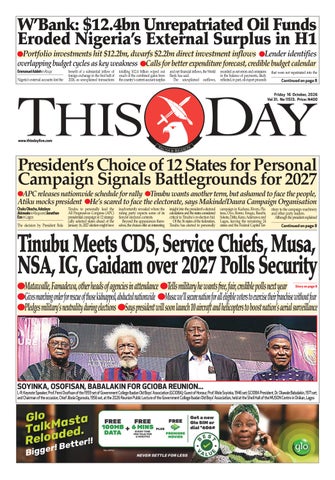
W’Bank: $12.4bn Unrepatriated Oil Funds Eroded Nigeria’s External Surplus in H1
Portfolio investments hit $12.2bn, dwarfs $2.2bn direct investment inflows Lender identifies overlapping budget cycles as key weakness Calls for better expenditure forecast, credible budget calendar Emmanuel Addeh in Abuja Nigeria’s external accounts lost the
benefit of a substantial inflow of foreign exchange in the first half of 2026, as unexplained transactions
totalling $12.4 billion wiped out much of the combined gains from the country’s current account surplus
and net financial inflows, the World Bank has said. The unexplained outflows,
recorded as net errors and omissions in the balance of payments, likely reflected, in part, oil export proceeds
that were not repatriated into the Continued on page 8 Friday 16 October, 2026 Vol 31. No 11513. Price: N400
www.thisdaylive.com TR
UT H
& RE A S O
N
President’s Choice of 12 States for Personal Campaign Signals Battlegrounds for 2027
APC releases nationwide schedule for rally Tinubu wants another term, but ashamed to face the people, Atiku mocks president He’s scared to face the electorate, says Makinde/Daura Campaign Organisation
Chuks Okocha, Adedayo Akinwale in Abuja and Jonathan Eze in Lagos
The decision by President Bola
Tinubu to personally lead the All Progressives Congress (APC) presidential campaign in 12 strategically selected states ahead of the January 16, 2027 election might have
inadvertently revealed where the ruling party expects some of its fiercest electoral contests. Beyond the appearances themselves, the choices offer an interesting
insight into the president’s electoral calculations and the states considered critical to Tinubu’s re-election bid. Of the 36 states of the federation, Tinubu has elected to personally
campaign in Kaduna, Rivers, Plateau, Oyo, Borno, Enugu, Bauchi, Sokoto, Delta, Kano, Adamawa and Lagos, leaving the remaining 24 states and the Federal Capital Ter-
ritory to the campaign machinery and other party leaders. Although the president explained Continued on page 8
Tinubu Meets CDS, Service Chiefs, Musa, NSA, IG, Gaidam over 2027 Polls Security
Matawalle, Famadewa, other heads of agencies in attendance Tells military he wants free, fair, credible polls next year Gives marching order for rescue of those kidnapped, abducted nationwide Musa: we’ll secure nation for all eligible voters to exercise their franchise without fear Pledges military’s neutrality during elections Says president will soon launch 10 aircraft and helicopters to boost nation’s aerial surveillance Story on page 8
SOYINKA, OSOFISAN, BABALAKIN FOR GCIOBA REUNION...
L-R: Keynote Speaker, Prof. Femi Osofisan of the 1959 set of Government College Ibadan Old Boys’ Association (GCIOBA); Guest of Honour, Prof. Wole Soyinka, 1946 set; GCIOBA President, Dr. Olawale Babalakin, 1971 set; and Chairman of the occasion, Chief Jibola Ogunsola, 1956 set, at the 2026 Reunion Public Lecture of the Government College Ibadan Old Boys’ Association, held at the Shell Hall of the MUSON Centre in Onikan, Lagos
2
FRIDAY, OCTOBER 16, 2026 • T H I S D AY
FRIDAY, OCTOBER 16, 2026 • T H I S D AY
3
4
FRIDAY, OCTOBER 16, 2026 • T H I S D AY
5
THISDAY • FRIDAY, OCTOBER 16, 2026
Group News Editor: Goddy Egene Email: Goddy.egene@thisdaylive.com, 0803 350 6821, 0807 401 0580
NEWS
THIRD EDITION OF THE AWAKENING SUMMIT TO COMMEMORATE WORLD MENTAL HEALTH DAY...
L-R: Clinical Psychologist & Family Life Therapist, Miracle Ihuoma; Counselling Psychologist, Ese Ayaebene; Founder & Chairman, Serenity Sisterhood Initiatives, Olori Bernitha Agboge-Aminu; Communications Officer, Serenity Sisterhood Initiatives, Ezinne Evelyn Lawrence; Founder, Mindsplace and Convener of The Awakening Summit, Eniola Bello; Founder of Happy Coffee, Princess Adeyinka Tekenah; and entrepreneur and tech professional, Oluwafeyisayo Oke at the third edition of The Awakening Summit organised by Mindsplace to commemorate World Mental Health Day, in Lagos ... recently
FG Flags Off N1.83tn Dangotefinanced Niger Highway Project
Umahi: Over 5,500km of road projects ongoing across north-central Bago pledges to mobilise support for Tinubu’s re-election Dangote puts roads funded by his group at over N5tn Emmanuel Addeh in Abuja The federal government has commenced the reconstruction and dualisation of the 401-kilometre Lambata-BidaMokwa-Makera-Kontagora Road in Niger State, in a N1.83 trillion project expected to improve connectivity between communities, agricultural centres and commercial hubs. The project, which is being financed by the Dangote Group through the federal government’s tax-credit scheme, is expected to ease the movement of people and goods across the state and adjoining areas, while opening up new economic opportunities along the corridor. Niger State Governor, Umaru Bago, who performed the flag-off on behalf of President Bola Tinubu in Bida, described the project as a significant milestone in the development of the state and the renewal of hope for residents and motorists who depend on the road. The project will involve the reconstruction and expansion of the highway, which runs from Lambata through Bida, Mokwa and Makera before terminating at Kontagora. According to the federal government, the intervention is expected to improve access to
markets, facilitate the transportation of agricultural produce and stimulate commercial activities. Speaking at the ceremony, the Minister of Works, David Umahi, said the Tinubu administration had initiated approximately 5,500 kilometres of road projects across the North-central zone, with Niger State accounting for more than 1,000 kilometres. He attributed the scale of infrastructure development to the fiscal space created by the removal of the petrol subsidy, which he said had enabled the federal government to commit more resources to infrastructure nationwide. Umahi said the Lambata-BidaMokwa-Makera-Kontagora project would be constructed using continuously reinforced concrete pavement (CRCP), a technology intended to provide a durable and climate-resilient road surface. He described the choice of pavement as a measure to improve the road’s longevity, adding that the administration’s infrastructure programme required continuity to enable ongoing projects to be completed. The minister also called for Tinubu’s re-election, arguing that another term would enable the president to complete
the extensive infrastructure projects already underway across the country. In his remarks, Bago who thanked Tinubu for approving the project, described the highway as a critical economic artery for Niger State and the wider region. He pledged to mobilise support for the president’s re-election, promising to work towards securing victory
Nigerian Communications Commission (NCC), yester-day in Lagos, held its inaugural symposium on “Inter-net Governance”, designed to strengthen security around the use of the internet and build resilience for all internet users in Nigeria. This is to keep internet us-ers safe while browsing the internet in today’s digital era. To drive the process of Internet Governance on a na-tional scale, the commission used the symposium to inaugurate the Internet Governance Working Group (IGWG), drawn from industry experts, with the man-date to enforce consumer protection and
online safe-ty, drive digital inclusion and meaningful last-mile connectivity with affordable pricing, and promote global participation in surfing the internet from any convenient location, among others. Speaking at the symposium, Executive Commissioner, Technical Services at NCC, Abraham Oshadami, who represented Executive Vice Chairman of NCC, Dr. Aminu Maida, said the Internet Governance Fo-rums (IGF) at national, regional and global levels had shown the value of bringing different voices to one table to discuss how the internet affected networks, opportunity, trust, security, and the rights of the people who use it. Oshadami stated, “That responsibil-
corridor, addressing a problem that had affected motorists and host communities for about a decade. Goronyo expressed satisfaction that the intervention had eased the difficulties previously experienced by road users. Besides, the Minister of Information and National Orientation, Mohammed Idris, who spoke on behalf of other
Niger State indigenes in the Federal Executive Council (FEC), said the federal government remained committed to accelerating infrastructure development and economic recovery. He said the administration’s economic reforms were designed to strengthen the economy and support a broader transformation of the agricultural sector.
EU, UN Push Nigeria to Mobilise More Local Funds as Joint Projects Top $500m Michael Olugbode in Abuja
The European Union (EU) and the United Nations (UN) have called on the Nigerian government to mobilise more domestic resources to bridge the country’s development and humanitarian funding gaps. Both organisations warned that international assistance must be matched with stronger national ownership and more effective project delivery. The call came as EU disclosed
NCC Moves to Strengthen Security in Internet Usage, Inaugurates Working Group Emma Okonji
for Tinubu and the All Progressives Congress (APC) at all levels in the state. Also, the Minister of State for Works, Bello Goronyo, recalled a recent assessment visit to the failed Dikko Junction-Maje Road, a seven-kilometre stretch linked to the major highway project. He said Tinubu had approved immediate palliative works on the
ity is becoming more urgent. Artificial Intelligence (AI) is changing how people learn, work, communicate and access services. It also creates new questions about harmful content, fraud, privacy, accountability and the protection of children and other vulnerable users. These questions cannot be answered by one institution alone. They require informed dialogue and cooperation across the communications sector and beyond.” Oshadami also spoke about the Internet Code of Practice (ICOP) 2026 implementation guideline, issued by the NCC to network operators, which, according to him, provides a framework for promoting a safer and more responsible online environment.
that its partnership with the UN supported projects worth more than $400 million annually in Nigeria, with a portfolio of about 32 EUfunded projects valued more than $500 million, being implemented in collaboration with 16 UN agencies. EU Ambassador to Nigeria and ECOWAS, Gautier Mignot, speaking after a meeting to review the partnership, said the two institutions were committed to improving the impact of their interventions amid mounting questions about international solidarity, development assistance, and the future of multilateral cooperation. Mignot said the review was
aimed not only at renewing the partnership but also identifying implementation gaps, improving coordination, and ensuring that assistance translated into tangible benefits for ordinary Nigerians. He said, “This meeting was a clear indication that we need to work together and have the government of Nigeria increase its engagement and mobilisation of domestic resources to address the development gap and the humanitarian assistance need in the country.” The appeal placed domestic financing and government ownership at the centre of discussions
about how Nigeria could sustain development programmes, respond to humanitarian emergencies, and make better use of international support. According to Mignot, EU-UN partnership combines European financial contributions and grants with United Nations’ technical expertise and operational presence on the ground. He said the arrangement also involved Nigerian authorities at both federal and state levels to ensure that projects aligned with the country’s development strategies rather than being operated independent of national priorities.
Senate Moves to Modernise Farming, Establishes Agriculture College in Borno Ndume: Shani institution will promote modern techniques, boost productivity
Sunday Aborisade in Abuja
Senate has initiated legislative action to strengthen agricultural productivity and promote modern farming practices, with the passage of a bill seeking to establish a Federal College of Agriculture in Shani Local Government Area of Borno State. The upper chamber passed the bill for Third Reading on Thursday after adopting the recommendations
contained in the report presented by its Committee on Agricultural Colleges and Institutions. Sponsored by Senator Mohammed Ali Ndume (Borno South), the proposed institution is expected to promote agricultural education, improve farming techniques, and facilitate the adoption of modern technologies to enhance food production in Nigeria. Ndume said the college would address one of the major challenges
confronting the country’s agricultural sector: the continued dependence on traditional farming methods that limit productivity and make farming more difficult than necessary. He said, “One of the fundamental challenges facing agriculture in Nigeria is our continued reliance on crude farming methods. “We have not made sufficient progress in improving productivity and making farming easier through modern technology.”
6
FRIDAY, OCTOBER 16, 2026 • THISDAY
NEWS
WHEN THE SSDC PAID A COURTESY VISIT TO THE INDONESIAN MINISTER IN JAKARTA...
L-R: President, National Palm Produce Association of Nigeria( NPPAN), Dr. Inyang Alphonsus; Bayelsa State representative on the South-South Development Commission (SSDC), Hon Charles Zuofa; Executive Director Finance, Amb. Soni Abang; Vice Minister, Foreign Affairs of the Republic of Indonesia, Arif Havas Oegroseno; Managing Director/CEO SSDC, Ms Usoro Akpabio; Executive Director HCD, Engr. Preye Aganaba; and Executive Director, Commercial SSDC, Hon.Joe Ughoeke, when the SSDC paid a courtesy visit to the Indonesian Minister in Jakarta, Indonesia PHOTO: SSDC
Renaissance Backs Local Oil Contractors with $4.1bn, N435bn Fund, Partners 13 Banks Pursues ambitious 500,000bpd growth drive PETAN: facility addresses industry-wide equipment gap constraining production
Peter Uzoho Renaissance Africa Energy Company Limited has partnered 13 banks to provide a subscribed financing portfolio of $4.1 billion and N435 billion to indigenous oil and gas contractors, as the company pursues an ambitious production growth programme of 500,000 barrels per day. The Renaissance Vendors Financing Scheme (RVFS) unveiled at a Memorandum of Understanding (MoU) signing ceremony in Lagos offers credit support in both naira
and US dollars to local contractors executing projects for the company. A statement issued yesterday listed the 13 participating banks as First Bank, Guaranty Trust Bank, Zenith Bank, Access Bank, United Bank for Africa, Stanbic IBTC Bank, Standard Chartered Bank, First City Monument Bank, Sterling Bank, Wema Bank, Union Bank, The Infrastructure Bank, and African Export-Import Bank (Afreximbank). Managing Director and Chief Executive Officer of Renaissance Africa Energy Company, Tony Attah, said the programme’s long
history demonstrated the potential to scale contractor financing in support of the company’s growth agenda. Attah said, “This is a programme that has been running since 2010. We are unveiling the power of Renaissance and the scalability of the company.” He recalled that the initiative began in the Shell era with a fund of about N1 billion, with a later ambition to grow it to $1 billion. Attah stated, “What we’ve been able to achieve as Renaissance is to go into that partnership with
these incredible 13 banks who have come up to support this vendor scheme at over $4 billion and over N435 billion funds available for the vendors to be able to support us in our growth agenda.” He said the scheme had recorded no defaults under previous administrations. He stated, “So very good credit to the vendors themselves. Integrity is a core value to us at Renaissance.” Attah also said interest rates offered to contractors were competitive.
World Bank, FG Mobilise $1.2bn for Catchment Management, Climate Resilience Programme Yemi Kosoko in Jos
The World Bank and the federal government have advanced plans to implement 20 Strategic Catchment Management Plans (SCMPs) across 19 northern states and the Federal Capital Territory as part of efforts to combat environmental degradation, strengthen climate resilience, and secure Nigeria’s water resources for future generations. Speaking at the Stakeholders’ Engagement for the implementation of the scheme, World Bank Task Team Leader and Senior Environmental Specialist, Dr.
Joy Iganya Agene, described ACReSAL as fundamentally a catchment management project designed to promote integrated landscape management beyond state and political boundaries. Agene said the plans represented the first government-led watershed management initiative undertaken at such scale in Nigeria and would provide a blueprint for sustainable management of land, water and environmental resources. According to her, environmental and hydrological systems are interconnected, making collaboration among states and communities
essential for long-term sustainability. She said, “What you do upstream affects what happens downstream. There are no state limits when it comes to water resources and environmental management.” Agene urged stakeholders to embrace a shared vision for protecting the environment. She also announced that World Bank had approved an additional $500 million financing package for ACReSAL over the next four years, bringing total funding for the programme to about $1.2 billion, to ensure sustainability of ongoing
investments and interventions. Presenting the implementation overview of the Aloma-Konshisha Strategic Catchment Management Plan, Managing Director of MECON Geology and Engineering Services Ltd, Chuka Offodile, said the catchment spanned Benue, Kogi, Cross River, Ebonyi and Enugu states, and faced increasing threats from flooding, deforestation, erosion, land degradation, and water pollution. He disclosed that forest cover in the catchment declined significantly between 2017 and 2024, while agricultural expansion and settlement growth continued to place pressure on ecosystems and water resources.
According to him, “The interest rate that the banks are offering to the contractors is very competitive, and it is certainly better than the vendors going out to the respective banks on their own.” On production, Attah said Renaissance increased output by 100,000 barrels per day within 100 days of taking over the assets in March 2025. The company has committed to growing oil production to 500,000 bpd by 2030, with gas production of more than 2.2 billion standard cubic feet per day for energy supply and an additional one billion standard cubic feet per day for industrialisation. This aligns with Nigeria’s aspiration to produce three million barrels of oil per day. Attah stated, “That is a massive scale, and this vendor financing is one of the strategic options we have put in place to be able to support the partners who are going to go with us on this journey. “Funding is a critical aspect of achieving this growth agenda for us.” Executive Vice President, Finance, Strategy and Commercial, Renaissance, Olusegun Banwo, and Attah said the scheme’s success would be measured by its actual impact on contractors and project delivery rather than financing commitments alone. The company said key indicators would include the volume of financing disbursed, how quickly qualified vendors could access funds, and the extent to which the facility improved mobilisation,
project execution, Nigerian content, and production. Banwo described the initiative as a transition from alignment to formalised commitment, using strategic financing to drive enterprise growth and shared prosperity. He called the 13 banks’ commitment a significant vote of confidence in the programme and the quality of its vendor ecosystem. He explained, “The ambition is not simply for Renaissance to grow, but for capable Nigerian businesses to grow with us as we pursue our target of one million barrels per day by 2030, while also contributing to the Federal Government’s broader production ambition.” Chairman of the Petroleum Technology Association of Nigeria (PETAN), Wole Ogunsanya, said the scheme could help address one of the biggest constraints facing indigenous oil and gas service companies: access to affordable credit. He explained that local contractors often faced high interest rates, short repayment periods, and stringent collateral requirements from Nigerian banks, making it difficult to acquire equipment needed for oil and gas projects. Under the scheme, contractors with confirmed projects could access financing through the participating banks without conventional collateral, subject to contract verification by Renaissance, Ogunsanya said.
EFCC, NJI Seek Legal Reforms to Tackle Delay in Trial of Corruption Cases Malabu Oil: Court Frees Businessman Aliyu Abubakar, Alex Enumah in Abuja The Economic and Financial Crimes Commission (EFCC), and the National Judicial Institute, (NJI) have called for legal and procedural reforms that will eradicate delays and abuse of court processes in the trial of corruption and other economic and financial crimes cases. The call is contained in a Communique issued by participants at the end of the 8th Capacity Building Workshop for Justices and Judges, held in Abuja between
13-15 October, 2026. The workshop was organised by the EFCC in collaboration with the NJI under the theme “Investigation and Prosecution of Economic and Financial Crimes in a Digital Age.” The workshop according to the anti-graft agency brought together Justices and Judges from across the country, as well as investigators and prosecutors of the EFCC. The statement signed by EFCC’s Head, Media and Publicity, Mr Dele Oyewale, disclosed that at the end of the three days of lectures, exhaustive discussions and a work-
shop survey, participants arrived at several resolutions that formed the basis of the Communique. According to Oyewale, participants in the communique resolved that delays in the resolution of corruption cases “will be greatly reduced by designating specialized judges and court staff to handle such cases as well as equipping such judges and courts with necessary skills through training to ensure efficient, certain and consistent application of existing laws in the administration of justice.”
Others from Money-Laundering, Corruption Charges
Alex Enumah in Abuja
Justice Inyang Ekwo of a Federal High Court, Abuja, on Thursday discharged and acquitted an Abuja-based businessman, Aliyu Abubakar and seven others from the money-laundering, criminal misappropriation, forgery and other charges in relation to the management of Malabo Oil and Gas Limited’s funds. Justice Ekwo in two separate judgments held the prosecution,
the Economic and Financial Crimes Commission (EFCC) was unable to prove its case in the two different charges against the defendants. In the first judgment marked: FHC/ABJ/CR/268/2016 in which Abubakar was tried with Malabu Oil and six other companies, the court held the prosecution was wrong to have proceeded to prosecute the defendants based on the charge after the Attorney General of the Federation (AGF) issued a letter in 2018 directing
that the defendants should not be prosecuted because there was not sufficient evidence to warrant that. In the second judgment marked: FHC/ABJ/CR/31/2017, the court also held the allegations were not proved against Abubakar who was the sole defendant. Although a former AGF, Mohammed Adoke, was initially included in the charge, Adoke was however freed after the court upheld his no-case submission in a ruling delivered on April 19, 2024.
7
THISDAY • FRIDAY, OCTOBER 16, 2026
NEWS
REMI TINUBU IN BENIN...
L-R: Oba of Benin HRM Omo N’Oba N’Edo Uku Akpolokpolo, Oba Ewuare; First Lady of Nigeria, Senator Oluremi Tinubu; Edo State Governor, Senator Monday Okpebholo; and Kogi State Governor, Alhaji Usman Ododo, when the First Lady paid a courtesy visit to the Oba’s palace on the sideline of her visit to Edo State, yesterday
FACC Disburses N2.428tn September Allocations as Federation Revenue Grosses N3.913tn Inflation drops to 14.63% amid moderation in food index Severe in Imo, Enugu, Niger
Ndubuisi Francis and James Emejo in Abuja
The Federation Account Allocation Committee (FAAC) has disbursed a total of N2.428 trillion to the federal, state, and local governments, as Federation Revenue grossed N3.913 trillion for the month of September 2026. FAAC shared the amount during its October meeting in Abuja, yesterday, Director of Press and Public Relations, Office of the AccountantGeneral of the Federation (OAGF), Bawa Mokwa, said in a statement. The N2.428 trillion September allocations surpassed the sum of N2.338 trillion shared in the preceding month of August by N90 billion. That was the Consumer Price Index (CPI), which measures the rate of change in prices of good and commodities, declined to 14.63 per cent in September, from 15.39 per cent in August, National Bureau of Statistics (NBS) said yesterday. The drop was occasioned by falling food prices, which helped to moderate the cost of living, although
underlying price pressures showed signs of renewed strength. According to the CPI report for the month under review, headline inflation rate fell by 6.35 percentage points, from 20.98 per cent recorded in the corresponding period of 2025. However, the relief remained uneven, with the core inflation rate, which excludes farm produce and energy, rising on a month-on-month basis, while urban inflation also accelerated during the review period. Citing the communique issued at the meeting, Mokwa said from the N2.428 trillion distributable revenue, the federal government received N832.242 billion, state governments received N799.872 billion, while local government councils got N560.660 billion. The sum of N236.049 billion went to oil mineral producing states as 13 per cent derivation revenue. The N2.428 trillion total distributable revenue for September comprised a distributable statutory revenue of N1.672 trillion and distributable Value Added Tax (VAT) revenue of N756.587 billion.
Although gross revenue was N3.913 trillion in the month of September, total deductions for cost of collection stood at N131.758 billion, while total transfers, refunds, and savings accounted for N1.352 trillion. According to the communique, gross statutory revenue of N3.096 trillion was received for the month of September 2026, an amount higher than the sum of N2.850 trillion received in the preceding month by N246.384 billion. Value Added Tax (VAT) also posted a gross revenue of N816.872 billion in September, N17.972 billion, an amount less than the N834.843 billion recorded in the month of August 2026. However, from the N816.872 billion gross VAT revenue, distributable VAT revenue was N756.587 billion from which the federal government received N75.659 billion, state governments got N416.123 billion, and local government councils received N264.805 billion. According to the figures, state and local government councils received larger shares of distributable VAT
revenue, while the federal government got a smaller share. The communiqué also showed that gross statutory revenue rose in September, while VAT revenue declined during the period. It equally emerged that gross statutory revenue stood at N3.096 trillion in September, up from N2.850 trillion in August, the N246.384 billion rise reflecting higher revenue available from statutory sources. Overall, FAAC attributed the changes in revenue performance to increases in some tax and petroleumrelated revenue sources, alongside declines in others. Petroleum Profit Tax (PPT), Hydrocarbon Tax, petroleum royalties, import duty, Common External Tariff (CET) levies and excise duty recorded significant increases in September. But Companies Income Tax (CIT), Capital Gains Tax (CGT), Stamp Duties Tax (SDT), VAT, mineral royalties, gas-flaring penalties, rental gas-flaring fees and miscellaneous oil revenue declined during the period. Meanwhile, the CPI increased marginally to 146.38 points in Sep-
tember from 146.30 points in August, indicating that the overall price level continued to edge upwards, despite the slower annual inflation rate. Month-on-month, headline inflation declined sharply to 0.06 per cent in September, compared with 0.71 per cent in August, NBS stated. Average prices continued to increase, but at a substantially slower pace than in the preceding month. Food prices provided the strongest relief during the period, as food inflation declined to 19.59 per cent year-on-year in September, from 20.16 per cent in September 2025. Food inflation turned negative on a month-on-month basis, falling to -1.55 per cent from 1.02 per cent in August. NBS attributed the development to changes in the average prices of several food items, including guinea corn flour, white maize flour, local short-grain rice, eggs, fresh onions, palm oil, fresh green beans, Irish potatoes, okra, fresh tomatoes, dried green peas and plantain.
The average annual food inflation rate for the 12 months ending September stood at 15.72 per cent, down from 28.37 per cent in the corresponding period of 2025. Despite the moderation, food inflation remained a major concern, with significant differences in price movements across states. Core inflation presented a less encouraging picture, rising to 1.11 per cent month-on-month in September from -0.06 per cent in August. Year-on-year, core inflation stood at 12.95 per cent, down from 22.11 per cent in September 2025. The average annual core inflation rate for the 12 months ending September was 16.54 per cent, compared with 25.68 per cent in the corresponding period of the previous year. The divergence between falling food prices and the acceleration in monthly core inflation suggested that the easing in headline inflation was not broad-based across all components of the consumer basket.
Oyo Gets 17.7MW Mini-grid Projects Benin Monarch Decorates Mrs Oluremi Tinubu with Coral Beads as FG Expands Solar Energy Access As First Lady launches 50 CNG buses, empowers 5,000
Felix Omoh-Asun in Benin City
Omo N’ Oba N’ Edo Uku Akpolokpolo, Ewuare, Oba of Benin has blessed Mrs. Oluremi Tinubu, the wife of Nigeria’s president with a Benin traditional Ring Coral beads known as ‘Ikele’, becoming the first Nigerian First Lady to receive the honour. The Oba also lauded Senator Tinubu for projecting Nigeria positively on the global stage. Mrs. Tinubu is the third prominent Nigerian woman to receive the Ikele beads. Previous recipients are retired Chief Judge of Edo State, Justice Esohe Ikponmwen, and former Zonal Director of the Nigerian Television Authority (NTA), Benin Network Centre, Mrs. Pauline Igbanor. The revered monarch who also called for collaboration between the Office of the First Lady and the Oba Ewuare II Foundation, spoke on Thursday when Mrs. Tinubu paid him a courtesy visit at his palace in Benin City.
The visit was part of activities marking the 10th coronation anniversary of the Oba and the First Lady’s official visit to Edo State to commission 50 CNG buses and empower 5,000 women. In an address delivered by his daughter, Princess Ikuoyemwen Aimiuwu Ewuare, the Oba said he was proud of the First Lady’s international engagements, including the acknowledgement she recently received from US President Donald Trump. He said such recognition was not only an honour to her but also a pride to the entire nation, as it boosts Nigeria’s image internationally. The Oba urged Mrs. Tinubu to partner with his Foundation to drive programmes targeted at women, children, families and vulnerable persons. According to him, the Oba Ewuare II Foundation was set up to uphold Edo cultural values and dignity while intervening in critical areas of human development.
The monarch reiterated the readiness of the Benin Palace to collaborate with government and credible institutions to advance peace, unity and development. Responding, Senator Tinubu said she was in Edo on the invitation of Governor Monday Okpebholo to commission the state’s newly acquired CNG buses. She said her Renewed Hope Initiative would continue to champion the cause of women and the vulnerable. The First Lady said: “I am deeply honoured to be here and to celebrate the 10th anniversary of Your Royal Majesty on the throne. I wish you continued good health, long life, prosperity, joy, peace, and happiness. “Serving in public office comes with significant responsibilities, but when God gives an assignment, He also provides the strength to fulfil it. “Having served in the legislature for 12 years, I understand lawmaking, but the executive has the opportunity to impact lives directly. “Our goal is to lay strong foundations that will create lasting change,
improve living conditions, reduce transportation costs through initiatives such as CNG buses, and promote sustainable development that will benefit generations to come. “I am delighted to return to this special palace, which holds a meaningful place in my heart, and I pray for continued progress, unity, and prosperity for all.” The First Lady was accompanied to the palace by Edo State Governor Monday Okpebholo, Kogi State Governor Usman Ododo, First Ladies from Kogi, Kwara, Zamfara, and Cross River states, alongside leaders of the All Progressives Congress (APC). Meanwhile, the First Lady inaugurated 50 compressed natural gas (CNG) buses and launched a N1 billion economic empowerment programme for 5,000 beneficiaries in Edo. Mrs. Tinubu, who performed the inauguration and launched the empowerment programme, said both initiatives of Gov. Monday Okpebholo demonstrated his love for the people of Edo.
Again, power minister rules out electricity tariff hike Emmanuel Addeh in Abuja The Minister of Power, Joseph Tegbe, yesterday announced the commencement of five interconnected mini-grid projects with a combined capacity of 17.7 megawatts in Oyo State, while dismissing reports of a planned increase in electricity tariffs. Tegbe made the announcement during the groundbreaking ceremony for the projects, which are designed to improve electricity access in communities across Akinyele, Ido, Ibadan North, Egbeda and Lagelu Local Government Areas of the state. The projects comprise the Bola, Jiboye, Molade-Adelubi, Ogo Oluwa and Sooko-elega interconnected minigrids, supported by a 17.74-megawatt battery energy storage system. According to the minister, the initiative is expected to improve electricity supply to homes and businesses, reduce dependence on generators, extend working hours and create a more favourable
environment for investment and job creation. Tegbe described the initiative as part of the federal government’s broader Renewed Hope Agenda to expand electricity access nationwide, noting that similar interventions supported by the Rural Electrification Agency (REA) had been implemented in communities across Kwara, Niger, Nasarawa, Plateau, Adamawa and Kaduna states. The minister acknowledged the contributions of the REA, Paras Energy and Natural Resources Development Limited, the project developer, the World Bank, which provided the financing, and the Ibadan Electricity Distribution Company. He also commended the Oyo state government, traditional rulers, community leaders and host communities for their cooperation, while paying tribute to the Olubadan of Ibadanland for his support towards the project’s realisation.
8
FRIDAY, OCTOBER 16, 2026 • THISDAY
EIGHT
IMF Backs CBN’s Policy Shift, Cardoso Says FX Crisis Forced Nigeria to Diversify Inflows Explains shift in monetary strategy Lists independent MPC decisions, transparency, consistent communication as drivers of market confidence Fitch revises outlook on 9 Nigerian banks to positive on sovereign outlook revision
Nume Ekeghe in Bangkok,Thailand
The International Monetary Fund (IMF) has backed the Central Bank of Nigeria’s (CBN) monetary policy realignment, describing the adjustment as appropriate following significant progress in reducing inflation, while stressing that the overall monetary policy stance remains tight. The endorsement came as CBN Governor, Mr. Olayemi Cardoso, disclosed that Nigeria’s foreign exchange (FX) crisis forced the country to look beyond oil for FX inflows, particularly after net foreign reserves fell to about $3 billion and outstanding
forex backlogs exceeded $7 billion. He also explained the rationale for the 350-basis-point reduction in the Monetary Policy Rate (MPR) at the September 2026 MPC Meeting, citing improvements in key macroeconomic indicators and the need to address weaknesses in monetary policy transmission. The CBN’s MPC had cut the MPR from 26.5 per cent to 23 per cent at its September 2026 meeting, a decision that surprised market analysts. Also, Fitch Ratings has revised the outlooks of nine Nigerian banks and two bank holding companies to Positive from Stable. Their Long-Term
Issuer Default Ratings (IDRs) have been affirmed at ‘B’. The affected banks are Access Bank Plc, Zenith Bank Plc, First HoldCo Plc, First Bank of Nigeria, United Bank for Africa Plc (UBA), Guaranty Trust Holding Company Plc (GTCO), Guaranty Trust Bank Limited (GTB), Fidelity Bank Plc, First City Monument Bank Limited (FCMB), Wema Bank Plc and Bank of Industry Limited (BOI). Speaking at the African Department press briefing at the ongoing IMF/ World Bank Annual Meetings in Bangkok, Thailand, the Director of the IMF’s African Department, Zeine Zeidane, said Nigeria’s progress in
reducing inflation had created room for the central bank to normalise monetary policy and lower the real interest rate without moving to an accommodative stance. “So, they decided to normalise somewhat the monetary policy to go to something to lower that real interest rate, which is a component, in our view. It’s the right thing to do, and it’s not easing yet because the stance itself remains a tight stance,” he said. Zeidane added that the Fund considered the CBN’s adjustment appropriate, emphasising that the move did not amount to a broader
easing of monetary conditions. The IMF said Nigeria was benefiting from improved external conditions, including higher oil prices and increased foreign exchange receipts, which had helped strengthen reserves and improve liquidity in the economy. The Deputy Director of the IMF’s African Department, Montfort Mlachila, said the more favourable external environment had contributed to stronger growth prospects. “So, in terms of growth, Nigeria is benefiting from the improved oil prices, which has raised the amount of foreign exchange receipts and, therefore, reserves have also improved,
Yemi Cardoso and there’s more liquidity in the economy,” he said. Continued on page 36
TINUBU MEETS CDS, SERVICE CHIEFS, MUSA, NSA, IG, GAIDAM OVER 2027 POLLS SECURITY
Deji Elumoye in Abuja
President Bola Tinubu, yesterday, presided over the National Security Council (NSC) meeting at State House, Abuja, essentially to discuss the security of the 2027 general election. The meeting, which lasted for about five hours at the first floor office of the president, was attended by National Security Adviser, Mallam Nuhu Ribadu; Minister of Defence, General Christopher Musa; and Minister of Police Affairs, Senator Ibrahim Gaidam. Present, also, were Minister of State for Defence, Bello Matawalle, and Special Adviser to the President on Homeland Security, MajorGeneral Adeyinka Famadewa (rtd). Others included Chief of Defence Staff (CDS), General Olufemi Oluyede and the three service
chiefs – Chief of Army Staff, Lieutenant General Waidi Shaibu; Chief of Naval Staff, Vice Admiral Idi Abbas; Chief of Air Staff, Air Marshal Sunday Aneke – and Chief of Defence Intelligence, LieutenantGeneral Emmanuel Undiandeye. In attendance, too, were InspectorGeneral of Police, Olatunji Disu; Director-General of National Intelligence Agency (NIA), Ambassador Mohammed Mohammed; and Director-General of Department of State Services (DSS), Adeola Oluwatosin Ajayi. Addressing newsmen after the meeting, Musa said the essence of the meeting was to brief the president on the security situation in the country ahead of the January 2027 polls. He disclosed that they had an intensive deliberation with the president, who told the security
chiefs that he was desirous of a free, fair, and credible poll next year. Musa assured all stakeholders, including the political parties, that the military would be neutral during the elections. He stated, “Today’s meeting was to brief Mr. President on the security situation within the country. You know, the elections are coming in January, and it’s important that we keep him abreast on what is ongoing. You can see all heads of security agencies are here. “We had an intensive discussion, and Mr. President made it very clear he wants a free, fair, and credible election. We must do everything possible to ensure that the country is safe and secure for the citizens to go out and vote. “And so, we want to assure Nigerians that we are committed. We are determined to ensure that
we provide safety and security for all Nigerians. Everyone should come out and vote. Vote for whoever they want.” Musa added, “The president wants the atmosphere to be free, and it’s important for all other political parties to understand that the security forces are going to be neutral. “We are going to ensure that we give everybody opportunity to go and serve, so they have nothing to worry about, nothing to be afraid of, and that nobody is going to intimidate them for whatever reasons.” The defence minister also defended the military institution against allegations of recruitment of underage soldiers, saying such act might have been carried out by terrorist groups but not Nigerian military.
PRESIDENT’S CHOICE OF 12 STATES FOR PERSONAL CAMPAIGN SIGNALS BATTLEGROUNDS FOR 2027
at Wednesday’s inauguration of his Presidential Campaign Council that governance must not suffer on account of electioneering, the states selected for his personal appearances appear anything but accidental. Indeed, a closer examination of the results of the 2023 presidential election offers perhaps the clearest explanation for the choice. Of the 12 states, Tinubu won only three — Rivers, Oyo and Borno — in the last presidential election. He lost the remaining nine to his principal opponents, namely Atiku Abubakar, Peter Obi and Rabiu Musa Kwankwaso. Instructively, Atiku defeated him in Kaduna, Bauchi, Sokoto and Adamawa, while Obi won Plateau, Enugu, Delta and Lagos. Kwankwaso, on his part, carried Kano, delivering nearly one million votes under the platform of the New Nigeria Peoples Party (NNPP). Put differently, 75 per cent of Tinubu’s proposed personal campaign appearances will take place in states where he suffered electoral defeats in 2023. This is hardly a coincidence that can be dismissed in the circumstances. Take Kaduna, for example. The decision to formally flag off the campaign in the state on October 24 is particularly instructive. Atiku polled 554,360 votes there in 2023 against Tinubu’s 399,293, despite the APC controlling the state government. With Atiku again seeking the presidency, this time on the platform of the African Democratic Congress (ADC), Kaduna represents an important electoral contest, particularly given its political significance in the North-west. The inclusion of Kano is perhaps even more revealing. In 2023, Kwankwaso secured 997,279 votes against Tinubu’s 517,341. But the political
circumstances have since changed, with Kwankwaso now running alongside Obi on the platform of the Nigeria Democratic Congress (NDC). Thus, Kano is no longer merely about reversing a previous electoral defeat. It is also about confronting the combined political ambitions of two former presidential candidates, one of whom demonstrated considerable electoral strength in the state. Sokoto presents a different calculation. Atiku defeated Tinubu there by just 3,235 votes in 2023, making it one of the closest contests between both candidates. Such a narrow margin naturally makes the state an interesting electoral territory for both parties. Similarly, Adamawa, Atiku’s home state, where the former vice-president secured 417,611 votes against Tinubu’s 182,881, offers the APC another opportunity to test its political strength in an established opposition stronghold. Bauchi also fits into this northern calculation, especially with the changing political alliances ahead of the 2027 contest. In the South-east, the decision to visit Enugu is equally significant. Tinubu recorded a mere 4,772 votes in the state in 2023, compared with Obi’s 428,640. The difference was staggering and underscored the depth of APC’s electoral difficulties in that part of the country. Enugu, therefore, presents not merely an opportunity to seek votes but also a chance for the president to make a direct appeal to an electorate that overwhelmingly rejected his candidacy four years earlier. Plateau and Delta, which Obi also won in 2023, fall within the same broad electoral consideration, although their political circumstances and voting
patterns differ considerably. Then comes Lagos, arguably the most symbolic of the 12 states. For a politician whose political influence has been closely associated with Lagos for decades, losing the state to Obi in 2023 was one of the election’s notable developments. Obi polled 582,454 votes against Tinubu’s 572,606, a difference of just 9,848 votes. That Tinubu has chosen Lagos for the grand finale of his campaign on January 9, 2027, could therefore carry significance beyond the customary
symbolism of ending a national campaign on familiar political territory. It offers the APC an opportunity to demonstrate the strength of its organisation in a state that remains central to Tinubu’s political history. However, the inclusion of Rivers, Oyo and Borno, which he won in 2023, suggests that the campaign strategy is not entirely about recovering lost ground. Rivers remains politically important Continued on page 37
According to him, “We are all professionals. We are fully committed, and it’s also important for us to mention the issue of recent (alleged recruitment of underage soldiers). We have seen some people trying to make a case as if the emphasis is using underage children in our operations. “There is nobody that is underage that is being brought here. I think the discussion that was made was that the accusation was on the terrorists using the underage. “Well, we know that we don’t have control over what they do, and that’s why it’s important for us to understand that we must not allow them remain wherever they are.” Musa further stated that the president gave the military a marching order to ensure the rescue of all those kidnapped and abducted in different parts of the country. He stated, “The directive from the president is: all of us must go all out to fish out and rescue all those that have been abducted, kidnapped wherever they are. There shouldn’t be any camp of any tourists or bandits anywhere in Nigeria. “As we go forward, we are showing Nigerians that we’re fully committed, and that is what we’re going to work towards. So, we thank Mr. President for his support and to assure Nigeria that we’re all working as a team, as Nigerians for Nigeria. We assure you that.” Musa revealed that the president
would soon inaugurate 10 additional aircraft and helicopters to boost the country’s aerial security surveillance. He also disclosed that the president planned to extend the new salary structure to police and other paramilitary personnel and pensioners. Musa stated, “I want to assure you, very soon Mr. President is coming to commission a set of new aircraft and helicopters that have been bought. I think about 10 of them, and to show Nigerians that despite the economic issue, the issue of security is in the front burner of Mr President’s view. “And so, for us, we are very happy. The recent increment of salaries for members of the armed forces. I’m sure very soon the police and all others are being addressed, including those of the pensioners. “Nobody is going to be left behind. Mr. President wants every Nigerian and every citizen to be happy with what is ongoing, and he is fully committed in the peaceful efforts on what we are doing today. Musa added, “And we want Nigerians to put their hands together to make sure that Nigeria remains free. Security is everybody’s responsibility. It’s not only for members of security forces. “Everyone has a role to play. And we keep on preaching. Whatever you see that is going wrong, even with our members that are not doing what is right, please, don’t hesitate to report. Action will be taken.”
W’BANK: $12.4BN UNREPATRIATED OIL FUNDS ERODED NIGERIA’S EXTERNAL SURPLUS IN H1 country, according to the bank’s latest assessment of the Nigerian economy. The development highlighted a persistent weakness in Nigeria’s foreign exchange market, where limited repatriation of export earnings and low Foreign Direct Investment (FDI) have left the country increasingly dependent on short-term portfolio investments to support foreign exchange supply and build external reserves. However, the global lender did not say the $12.4 billion represented stolen funds or missing oil revenue. The figure only reflected a discrepancy between recorded external transactions and financial flows that could not be fully reconciled. It therefore requires further clarification from the government. According to the World Bank, the gap likely reflected, in part, oil export proceeds that were not repatriated. Such proceeds may be retained in offshore accounts or used to meet existing obligations, including repay-
ments under oil-backed financing arrangements, rather than returned to Nigeria through the domestic foreign exchange market. “In principle, both current account surpluses and net financial inflows should support reserve accumulation, but large net errors and omissions of $12.4 billion in H1 2026 offset much of their combined total, likely reflecting in part oil export proceeds that were not repatriated. “As a result, FPI (Foreign Portfolio Investment) has been a major driver of the continued rise in gross international reserves, which increased from $45.5 billion at end-2025 to $53.8 billion at end-August 2026,” the World Bank document titled: “Beyond the Federal Purse: How Higher Revenues Shaped State Priorities”, stated. The World Bank also identified oil pledges as one of the factors limiting the repatriation of export earnings, although it did not establish how much of the $12.4 billion discrepancy was attributable
to such arrangements. The discrepancy nevertheless raises questions about the transparency and reconciliation of Nigeria’s export earnings, particularly in the oil sector, where foreign exchange receipts are critical to reserve accumulation and exchange rate stability. Other possible explanations for net errors and omissions include incomplete reporting, differences in the timing of transactions and gaps in the recording of cross-border financial flows. Besides, the World Bank report showed that Nigeria’s current account surplus rose to $12 billion, equivalent to 7 per cent of Gross Domestic Product (GDP), in the first half of 2026, compared with $5.5 billion in the second half of 2025 and $8.6 billion in the corresponding period of 2025. However, the country recorded net portfolio investment inflows of $12.2 billion during the period, an 80.8 per cent increase over the second half of 2025, while direct
investment liabilities fell by 15 per cent to $2.2 billion. The bank noted that, in principle, the current account surplus and net financial inflows should have supported a stronger accumulation of foreign reserves, but the $12.4 billion net errors and omissions figure offset much of their combined contribution. Nigeria’s gross international reserves nevertheless increased from $45.5 billion at the end of 2025 to $53.8 billion at the end of August 2026, supported largely by portfolio investment inflows. The World Bank, however, cautioned that the absence of a more recent net reserves estimate beyond the $34.8 billion reported at the end of 2025 limited its ability to assess the country’s usable external reserve buffers. The growing reliance on portfolio investments also exposes the economy to sudden capital outflows Continued on page 35
9
THISDAY • FRIDAY, OCTOBER 16, 2026
NEWS
VFD’S COURTESY VISIT TO HEIR HOLDINGS...
L-R: Group Managing Director/CEO, VFD Group Plc, Nonso Okpala; Deputy Managing Director, VFD Group Plc, Ijeoma Emezie-Ezigbo; Chairman, Heirs Holdings, Tony Elumelu; and Chief Executive Officer, Verod Capital, Danladi Verheijen, during VFD’s courtesy visit to Elumelu Office in Lagos…recently
Fitch Revises Outlooks on 11 Nigerian Banks to Positive from Stable, Cites Lower Sovereign Risk Capital buffers improve amid heavy exposure to government securities
James Emejo in Abuja
International rating agency Fitch Ratings has revised the outlooks on 11 Nigerian banks and bank-related institutions to positive from stable, signalling the possibility of an improved credit standing as economic reforms strengthen the country’s sovereign profile. The rating action, followed Fitch’s revision of Nigeria’s long-term issuer default rating outlook to positive on October 9, reflecting its increased confidence in the continuity of policy reforms ahead of the country’s next election cycle.
However, the latest assessment stops short of an immediate ratings upgrade. Fitch affirmed the affected institutions’ long-term issuer default ratings at ‘B’, indicating that the improved outlook reflects the potential for progress rather than a change in their existing credit ratings. The institutions covered include Access Bank Plc, Zenith Bank Plc, First HoldCo Plc, First Bank of Nigeria Limited, United Bank for Africa Plc, Guaranty Trust Holding Company Plc, and Guaranty Trust Bank Limited. Others are Fidelity Bank Plc, First City Monument Bank Limited, Wema
Bank Plc and Bank of Industry Limited. Fitch’s assessment pointed to an important link between Nigeria’s macroeconomic trajectory and the creditworthiness of its financial institutions: improvements in the naira, inflation and foreign reserves could ease some of the pressures on lenders, but their substantial exposure to the sovereign remains a key constraint. The agency said the sovereign’s credit profile and the operating environment could become less restrictive for the standalone creditworthiness of the commercial banks and their holding companies.
Sovereign exposure remains a key vulnerability Despite the more favourable outlook, Nigerian banks remained heavily exposed to the government and the Central Bank of Nigeria (CBN), leaving their credit profiles vulnerable to any deterioration in the country’s finances, Fitch noted. According to Fitch, the banks’ sovereign exposure through fixedincome securities and cash reserves held with the CBN was equivalent to between 150 per cent and 500 per
Nigeria Losing 50% of Agricultural Produce to Post-harvest Waste, Says UNESCO Onyebuchi Ezigbo in Abuja
The UNESCO International Centre for Biotechnology (ICB) has said that Nigeria loses 40 to 50 percent of its produce to post-harvest waste due to lack of cold chain, drying facilities, power and processing infrastructure. According to the UN agency, more than 60 to 70 percent of agricultural value lies after harvest but are wasted. This came just as the UN agency on Wednesday signed a Memoranda of Understanding with six partner institutions to drive food security through biotechnology research, innovation and collaboration.
Foundation Executive Director of the Centre, Prof. Umezurike Linus Opara, stated this yesterday at the 5th International Conference on Biotechnology for Food Security and Human Health holding in Abuja. He said low productivity is another major challenge affecting many Nigerian crops which ranges between at 30 and 40 per cent of global averages. Opara said biotechnology will help improve quality of seeds, pest and disease resistance, complemented by irrigation and proper fertilizer use which can raise yields by 30 to 40 per cent.
The Centre, he said, is starting research with legumes — important for carbohydrate and protein — to understand their genetic makeup and process them into value-added products such as baby formula. On the MoU signed with various partners, Opara said the idea was to pool resources together - “our human capital, our physical infrastructure, our laboratories, our skills and competence, so we can actually address this serious problem of food insecurity”. He said the Centre, a UNESCO Category Two Institute domiciled at the University of Nigeria, has a mandate to address food security in
Nigeria and Africa using biotechnology. He said the conference brought together partners from industry, policy and academia to deliberate on latest advancements in biotechnology that can address food insecurity. According to him, two major highlights marked the event — the signing of MoUs with six organisations and a special panel to commemorate World Food Day.
cent of their Fitch Core Capital at the end of 2025. Loans accounted for between 18 per cent and 41 per cent of the affected banks’ total assets at the end of 2025, while CBN cash reserves and Nigerian sovereign fixed-income securities represented between 23 per cent and 45 per cent of their assets. Fitch’s outlook revision therefore reflected an improved assessment of the broader economic and policy environment rather than the removal of the structural risks confronting the banking industry. The agency said Nigeria’s operating environment was improving, citing about seven per cent appreciation in the Naira during the first nine months of 2026 and continued growth in gross international reserves. Inflation, which rose following the outbreak of the Iran conflict, eased to 15.4 per cent in August from 15.9 per cent in June. Fitch expects inflation to decline further, providing scope for continued monetary policy easing. The agency also forecast real gross domestic product growth of 4.3 per cent in 2026, compared with four per cent in 2025.
Capital raising cushions regulatory reset The improved outlook also
comes against the backdrop of a significant adjustment in the banking sector following the withdrawal of longstanding regulatory forbearance, particularly in the classification of problem loans. Fitch said the removal of these concessions contributed to higher impaired-loan ratios at the end of 2025. However, substantial capital raising by lenders to meet the new minimum paid-in capital requirements effective from the end of the first quarter of 2026 helped cushion the impact and created room for further lending and business expansion. The agency added that the banking sector had demonstrated resilience despite demanding regulatory requirements, including the 45 per cent cash reserve ratio imposed on commercial banks. Nevertheless, capital adequacy remains a differentiating factor among lenders. First Bank, which breached its minimum bank-solo capital adequacy ratio requirement of 15 per cent at the end of 2025 following a sharp increase in impaired loans, restored compliance during the first half of 2026. Its capital adequacy ratio rose to 16.7 per cent by the end of June, supported by strong profitability and a modest injection of core capital.
NSITF Seeks Stronger Inter-Agency Collaboration to Improve Workers’ Welfare
“At the heart of this mandate with shared responsibilities. Ezigbo in Abuja Remi Tinubu Urges Policy to Uplift Rural Women Onyebuchi “The effectiveness of public is a simple principle: no worker Managing Director/Chief Executive service delivery depends not or family should be left without Olawale Ajimotokan in Abuja
First Lady, Senator Oluremi Tinubu, has made case for a policy inclusion to uplift rural women across the country. She made the appeal yesterday in Abuja at a symposium, organised by the Association of Wives of FCT Traditional Rulers (WOFCTTRA) in collaboration with the FCT Women Affairs Secretariat, to commemorate the 2026 International Rural Women’s Day. The first lady was represented by the former Women Leader of the All Progressives Congress in FCT, Mrs.
Hilmary Aipoh. At the symposium themed, “Harnessing the Influence of Wives of Traditional Rulers to Advance Gender Equity, Peacebuilding, and Sustainable Community Development in Rural Communities of FCT”, Mrs. Tinubu commended rural women for their resilience. She urged WOFCTTRA to leverage their societal influence to drive gender equity, economic empowerment, and community peacebuilding adding that recognising the contributions of rural women must go beyond verbal appreciation.
The first lady highlighted the indispensable role women have played in traditional Nigerian setting as farmers, traders, craftswomen, caregivers, and community organizers. “Rural women remain the backbone of local economies and cultural preservation, yet continue to face significant systemic hurdles. “Many rural women still face barriers to education, healthcare, land ownership, finance, and participation in decision-making. Recognising their contributions must translate into greater opportunities, protection, and inclusion,” Tinubu said.
of the Nigeria Social Insurance Trust Fund (NSITF), Oluwaseun Faleye, has called for stronger inter-agency collaboration to enhance workers’ welfare, productivity and social security. Faleye stated this on Thursday in Abuja at the Technical Retreat on Presidential Priority, Ministerial Deliverables and Performance Management System (PMS). He commended the Federal Ministry of Labour and Employment for convening the retreat, describing it as vital platform for dialogue and coordination among agencies
only on performance of individual institutions, but also on how well we work together,” he said. Represented by his Technical Assistant, Dayo Aloa, Faleye said collective responsibility of Ministry and NSITF is to deliver public value, strengthen institutions and improve welfare of Nigerians. He said NSITF administers Employees’ Compensation Scheme (ECS) under Employees’ Compensation Act 2010, providing compensation for work-related injuries, diseases, disabilities and death.
support when a workplace incident disrupts their livelihood,” he said. He stressed workers’ welfare is inseparable from national productivity and industrial harmony, noting protected workers contribute more meaningfully. Beyond claims processing, he said Fund focuses on engagement with employers and workers, awareness creation, compliance and workplace safety. “We must remain focused on making the Scheme accessible, responsive, transparent and effective,” he said.
10
FRIDAY, OCTOBER 16, 2026 • THISDAY
NEWS
15TH AFRICAN INTERNATIONAL FILM FESTIVAL ON THEIR MINDS...
L-R: The Consul General of Brazil to Nigeria, Mr. Ronaldo Lima Vieria; Consul General of France to Nigeria, Mr. Laurent Favier; Founder African International Film Festival & Afriff Film and Content Market (AFRIFF and AFCM), Chioma Ude; Group Managing Director, Mikano, Joel Haykal; Consul General of the United States to Nigeria, Brandon Hudspeth; and Director General, Nigeria Film and Video Censors Board, Dr. Shuaibu Husseini, at the press conference to announce the 15th African International Film Festival (AFRIFF) held in Lagos, yesterday
West African Business Leaders Target $15bn Investment Portfolio Bio, Elumelu lead push to turn $10bn projects into bankable deals Dangote Group, UBA, AFC, Afreximbank seek investments Sanwo-Olu calls for free movement of goods, services across W’Africa Emmanuel Addeh in Abuja
West Africa’s leading business executives and financial institutions are targeting an investment portfolio of at least $15 billion ahead of the inaugural West Africa Integration and Investment Summit (WAIIS), as regional leaders intensify efforts to turn economic integration into concrete projects, industrial growth and jobs. The initiative, led by Sierra Leone’s President Julius Bio and Chairman of Heirs Holdings, Tony Elumelu, has so far identified 26 projects valued at more than $10 billion from over 10 countries, following the assessment of 170 submissions. The portfolio is expected to grow to at least $15 billion by the summit scheduled for November 17 and 18 in Sierra Leone, with the organisers pledging to track whether the proposed investments translate into actual capital flows, a statement said. The development emerged from the second meeting of the WAIIS Private Sector Advisory Board held in Lagos, attended by leading business executives, development finance institutions and Lagos State Governor Babajide Sanwo-Olu. The meeting focused on mobilising private capital for regional
integration, with particular emphasis on energy trade and industrialisation, strategic minerals, agribusiness and digital transformation. Speaking at the meeting, Bio said West Africa needed to move beyond decades of discussions about regional cooperation and build a functioning common market capable of serving more than 400 million people. “West Africa is very serious about the Economic Community of West African States (ECOWAS) and ECOWAS has been around for 50 years. But in those 50 years we have not done enough to integrate and build a consolidated market,” he said. The Sierra Leonean president urged business leaders to help turn the region’s economic potential into viable investments, stressing the need to connect investors with projects and identify the financing and policy changes required to move them forward. He called on the advisory board to “transform ideas into partnerships, partnerships into investments, and investments into lasting prosperity for our continent”. Elumelu, who co-chairs the board, said Bio had sought to make his leadership of the ECOWAS count by bringing together the region’s leading investors to support economic transformation.
He said the initiative was intended to move beyond discussions and encourage businesses to work collectively across national borders to create jobs and expand economic opportunities. “We are happy that our political leaders are beginning to bring all of us together so that we can be much more impactful. Today is
about the talk that leads to action,” Elumelu said. “No one in this sub-region needs to be poor. We have all it takes to be prosperous, and we hope this marks the beginning of that prosperity for all,” he added. The private sector leaders also stressed that the success of the initiative would depend on the
ability of governments to provide policy certainty, efficient regulation and security to encourage long-term investment. Sanwo-Olu, who attended the meeting, said governments had a responsibility to create an environment in which businesses could invest and operate across the region with fewer restrictions.
“When we create that single platform where we can integrate and work together, then investors can come in. At the end of the day, it is business to business,” he said. He added that political leaders needed to provide the assurances and enabling environment required for businesses to expand across West Africa.
Coastal Highway: Ex-Gov Duke Faults Gov Diri for Politicising Concerns over Terrain Ayodeji Ake
Presidential candidate of the Peoples Redemption Party (PRP), Donald Duke, has faulted Bayelsa State Governor, Douye Diri, for allegedly politicising concerns over the difficult terrain along the Lagos-Calabar Coastal Highway. Duke said the recent admission by the Minister of Works, Dave Umahi, that difficult ground conditions necessitated the redesign of sections of the project had reinforced his earlier concerns about the engineering challenges involved in constructing the highway. In a statement by his personal assistant, Emeka Okpragu, Duke argued that Diri should address the technical and financial implications
of the project rather than dismissing his criticism as politically motivated. “I have been vindicated on the difficult terrain concerns I raised earlier. The minister supervising the project has acknowledged difficult ground conditions and explained why sections had to be redesigned. That is the substance Governor Diri should address,” he said. Duke questioned Diri’s argument that the coastal highway was achievable, citing the construction of roads and bridges across the swampy terrain of Bayelsa State as evidence of its feasibility. In a statement by his Chief Press Secretary, Daniel Alabrah, Diri had dismissed Duke’s position, insisting that the highway could be constructed.
“So, he is wrong. The Lagos-Calabar coastal road is buildable and possible,” the governor said. Diri’s response followed Duke’s appearance on Arise Television, where the former governor expressed concerns about the geographical challenges of constructing the highway through Bayelsa. “You cannot even go through Bayelsa. Bayelsa is swamp. Even Yenagoa, the capital, is swamp. You will probably have to build about 100 or 200 bridges to go through those swamps,” Duke had said. He also questioned the need to construct a new coastal highway when existing roads could be rehabilitated to improve connectivity between Lagos and Calabar.
“There is already a road to Calabar. I’ve driven from Lagos to Calabar several times. If the road is poor, fix it,” he said. However, responding to Diri’s criticism, Duke maintained that the existence of roads and bridges across swampy areas did not eliminate the need to scrutinise the proposed highway’s engineering requirements, cost and funding priorities. “Governor Diri’s examples do not dispose of those questions. A road can be technically possible and still require a serious examination of its cost, financing and priority. Listing roads built across swamps does not tell Nigerians what the entire coastal highway will ultimately demand,” he said.
Senate Orders Probe into NYSC Member’s Death, Moves to Prevent Recurrence Directs Committees, Police, Security Agencies to Investigate Enugu Camp Tragedy
Sunday Aborisade in Abuja The Senate has ordered an investigation into the circumstances surrounding the death of a National Youth Service Corps (NYSC) member, Comrade Etimbuk Daniel, at the Enugu State orientation camp, amid concerns over alleged medical negligence and inadequate emergency healthcare facilities at orientation camps across the country. The Senate directed its relevant committees, in collaboration with the Nigeria Police and other security
agencies, to investigate the incident and recommend measures to prevent similar tragedies during the mandatory national service programme. The decision followed a motion on a matter of urgent public importance moved by Senator Aniekan Bassey, representing Akwa Ibom North-East Senatorial District, who described Daniel’s death as tragic and called for a comprehensive investigation into the circumstances that led to the loss of the promising young graduate. The Senate expressed deep shock
and profound grief over the incident, noting that the deceased was an outstanding student leader, a firstclass graduate and the immediate past President of the Students’ Union Government of Akwa Ibom State University. Lawmakers expressed particular concern over reports suggesting that Daniel died from complications arising from a seemingly minor headache after allegedly experiencing delays in receiving adequate medical attention at the camp clinic. The reported circumstances, they
Passes Employees’ Compensation Trust Fund, Federal Polytechnics Bills
said, had raised serious questions about the availability of emergency medical services, qualified healthcare personnel and functional referral systems at NYSC orientation camps nationwide. Moving the motion under Orders 41 and 51 of the Senate Standing Orders, Bassey said the incident underscored the government’s constitutional responsibility to protect the lives and welfare of Nigerians, as provided under Section 14(2)(b) of the 1999 Constitution, as amended. “The Senate owes an absolute
duty of care to young graduates mobilised from their homes to serve the nation,” the senator said. He lamented that Daniel’s death had abruptly cut short a promising future, leaving his family, friends, former colleagues and the people of Akwa Ibom State in mourning. Bassey urged the Senate to ensure that the investigation established the facts surrounding the incident, determined whether any lapses occurred in the provision of medical care and identified those responsible, where wrongdoing was established.
The lawmaker also expressed concern over what he described as a recurring pattern of alleged negligence, inadequate medical infrastructure and insufficient emergency healthcare personnel at some NYSC orientation camps. He said the investigation should go beyond establishing the immediate circumstances of Daniel’s death to examining the adequacy of medical facilities, the availability of trained personnel and the effectiveness of emergency response and referral procedures at the camps.
FRIDAY, OCTOBER 16, 2026 • T H I S D AY
11
12
FRIDAY, OCTOBER 16, 2026 • T H I S D AY
FRIDAY, OCTOBER 16, 2026 • T H I S D AY
13
14
FRIDAY, OCTOBER 16, 2026 • T H I S D AY
FRIDAY, OCTOBER 16, 2026 • T H I S D AY
15
FOREVER
LOVED With profound grief and deep sense of loss, we mourn the passing of our cherished friend, Oso, who departed this life at 60 on the 2nd of September, 2026. Oso was an exceptional woman, a visionary leader who broke boundaries and set benchmarks for excellence and integrity As we mourn the exit of this trailblazer and guiding light, we find solace in the lasting legacy of care, strength and love she leaves behind. Her sudden departure leaves an irreplaceable void in our hearts. We extend our most heartfelt condolences to her husband Leke, her children Adebayo and Adeoba, her siblings, and her many friends and associates across the world. Dear Oso, May God almighty comfort your family, and we pray He grants your soul eternal rest. Amen.
We love you and will miss you forever.
VICTORIA OSONDU ADEFALA
Friends of Oso and Leke Adefala
(Nee Nkuku)
FUNERAL ARRANGEMENTS As Announced by the Family
Funeral Service:
Wake Keeping:
The Church Hall, Anglican Church of the Nativity, Parkview estate Ikoyi, Lagos
Anglican Church Of The Nativity, Parkview estate Ikoyi, Lagos
Thursday, 15th October, 2026.
Friday, 16th October, 2026.
5pm Prompt
Interment immediately after the service (Family Only)
10am Prompt
16
FRIDAY, OCTOBER 16, 2026 • T H I S D AY
FRIDAY, OCTOBER 16, 2026 • T H I S D AY
17
18
T H I S D AY • FRIday OCTOBER 16, 2026
Politics
Acting Group Politics Editor DEJI ELUMOYE Email: deji.elumoye@thisdaylive.com 08033025611 sms only
How Impactful’ll Oyebanji’s Second Term Be for Ekiti People?
Ekiti is richer than it was five years ago and more promising, with government figures putting growth from ₦2.4 trillion to ₦4.6 trillion and a projection near ₦8.8 trillion. As Governor Biodun Oyebanji begins a second term, the question is no longer whether Ekiti can grow, but whether that growth can be felt in farms, factories, classrooms, and careers, Raheem Akingbolu writes.
E
kiti begins its next political chapter carrying a paradox that deserves a harder look. The state government says its economy has grown from about N2.4 trillion in 2019 to N4.6 trillion in 2023 and is now heading towards a projected N8.8 trillion. Yet the state’s 2023 road statistics tell a more sobering story. Of 425.95 kilometres of state roads, 124.47 kilometres were classified as bad, and another 92.02 kilometres had never been tarred. More than half the network was either failing or unpaved. For a state whose prospects rest on agriculture, trade, education, and tourism, the gap between the headline figures and the road beneath the traveller’s wheels is hard to ignore. From any angle one chooses to look at it, Governor Abiodun Oyebanji has made an indelible mark in his first term, which, of course, paved the way for this second journey. But in an economy like Ekiti’s, roads carry far more than traffic. They determine how quickly food reaches the market and what a farmer pays to get it there. They influence how easily a patient reaches a hospital, how attractive a town appears to an investor, and how long a visitor is willing to stay. Poor connectivity works like a tax on almost every other sector and is paid daily. The state has invested heavily in road construction, and that matters. The larger task now is to ensure those roads form part of a deliberate economic network. Such a network must reach beyond individual projects. Ekiti has an opportunity to position itself as a strategic inland connector between the South-West, the North and Abuja while deepening commercial ties with neighbouring states. The Ado-Ijan-Ilumoba-Omuo corridor deserves particular attention because of its link to the Federal Capital Territory and to assets such as the cargo airport, higher institutions and the Knowledge Zone. Also, the state government should begin the new term with a deliberate action to end the challenge posed by Igede-Aramoko-Itaore road which has almost become a national embarrassment. Indeed, Geography has handed Ekiti an advantage. Infrastructure is what can convert that advantage into economic power. Once people and goods can move efficiently, another underused asset comes into view. Tourism could become one of Ekiti’s fastest sources of new external revenue. Ikogosi Warm Springs, Arinta Waterfalls, Olosunta and Orole Hills, Efon Hills, Agbonna Hills, Esa Cave and a rich cultural heritage provide the raw material for a distinctive visitor economy. Yet attractions are only the beginning. The real opportunity lies in connecting them to good roads, quality accommodation, security, entertainment, destination marketing and a professional visitor experience. That calls for a different understanding of how government and private capital should work together. Government does not need to own every hotel, resort or entertainment venue. Its responsibility is to create conditions in which serious investors can commit resources with confidence. The Ikogosi concession offers one model. The challenge now is whether similar opportunities can be identified, properly structured, and marketed while ensuring host communities benefit from the economic activity that develops around them. Tourism, however, can not carry Ekiti’s economic ambition on its own. The state must also become a proposition that investors can understand at a glance. Investment promotion should move from broad invitations to targeted offers built around land, human capital, agriculture, road connectivity, aviation, educational institutions, and access to regional markets. Ekiti should know the industries it wants, the companies that fit them, and the infrastructure that would make investment commercially viable. This is where industrialisation moves to the centre of the second-term conversation. The gov-
ernor’s own framing of the next four years points in the same direction. In his State of the State address, Oyebanji argued that social amenities and infrastructure must be connected to economic
activity if people are to move sustainably out of poverty. The goal is an industrial ecosystem in which anchor companies generate demand for local suppliers, logistics operators, financial
institutions, technology firms, processors and skilled workers, with the opening of factories as only the first step. Serviced industrial land, predictable approvals, reliable utilities, and clear investment information would offer investors something worth more than publicity: a business case they can confidently quantify. The cargo airport adds another dimension. The number of flights it handles will matter less than whether production, storage, cold-chain facilities, logistics, processing and distribution begin clustering around it. High-value agricultural produce, timesensitive goods and industries reliant on efficient movement all stand to benefit. Yet the airport will become a genuine growth engine only if it is tied physically and economically to the wider road and industrial ecosystem. That brings the discussion back to agriculture, because no industry thrives without a dependable supply base. According to Governor Oyebanji, agriculture and trade account for roughly 60 per cent of the state’s economy, with agriculture contributing about N1.05 trillion. National labour data also recorded more than 311,000 people employed in agriculture in Ekiti in 2023. Those figures illustrate that farming is far more than a rural livelihood. It is one of the foundations upon which the state’s industrial future can be built. The governor has cited that economic profile as one reason his administration intends to continue prioritising agriculture, trade, investment, aviation and tourism as areas of comparative advantage capable of driving further growth. NOTE: Interested readers should continue in the online edition on www.thisdaylive.com
Much Ado About EFCC’s New Zonal Directorate in Anambra
David-Chyddy Eleke writes that the recent inauguration of the Zonal Directorate of the Economic and Financial Crimes Commission in Awka, the Anambra State capital, was misconstrued for witch-hunt, but such fears were allayed as the Commission came prepared with answers.
L
ast Friday, Awka, the capital of Anambra State played host to dignitaries who graced the inauguration of the Zonal Directorate of the Economic and Financial Crimes Commission (EFCC), which is to oversee Anambra and Imo States. The directorate was created by an act of parliament on 22 October 2025, with just 21 personnel deployed to the office through an internal memo on 2 January. The office formally opened, but didn’t begin full operation until February 28, 2026. The inauguration was graced by dignitaries including the host governor, Prof Chukwuma Soludo; his Imo State counterpart, Senator Hope Uzodinma; Speaker of House of Representatives, Hon Tajudeen Abbas, several members of House of Representatives, State Assembly members, Executive Chairman of EFCC, Mr Ola Olukoyede; businessman, Chief Innocent Chukwuma of Innoson Vehicle Manufacturing (IVM); Lady Ada Chidozie of Dozzy Oil and Chairman of Manufacturers Association of Nigeria (MAN) and many others. The creation of the directorate had set tongues wagging in the South East, especially in Anambra where some indigenes wondered what economic benefits the zonal directorate would bring to the state. Previously, the creation of Zone 13 Ukpo command of the Nigeria Police Force
which was attracted by billionaire oil mogul, Prince Arthur Eze had been condemned by many who insisted that he neither had an industry, factory or any business to absorb the teeming youths, but deemed it necessary to influence a police facility that could turn out an instrument for hunting and hounding youths. The argument continued for a while, then the opening of the EFCC Directorate. A commentator, Mr Mathias Uzoagba (not real name because his permission was not sought) in a post on social media heavily criticized both Anambra State Governor, Prof Chukwuma Soludo and the Federal Government about the establishment of the directorate. He said: “When it was time to sign a $7 billion memorandum of understand-
ing (MoU) with global port operator DP World in to develop the Gateway Deep Seaport and the Ogun Blue Marine Special Economic Zone, the federal government did not remember South East, but now it is time to establish EFCC Directorate, they are bringing it to Anambra. Soludo should be ashamed of his mantra of progressives working together. Can’t progressives work together when it is time to attract meaningful development to Anambra State,” he asked rhetorically. As the argument raged, the actual inauguration ceremony presented an opportunity for both the Chairman of EFCC and Prof Soludo to clarify this. Governor of Imo State, Senator Uzodinma also added his voice to enlighten the people about what bringing the establishment close meant. The Executive Chairman of EFCC, Mr Olukoyede stressed in his speech that the establishment of a regional office of the commission in Awka, the Anambra State capital was to serve Anambra and Imo States and not to hound its people, stating that it can help them in several ways to safeguard their funds. He urged the people to look beyond the arrest of people, but to focus on how the commission coming close to them can guarantee the safety of their finances. NOTE: Interested readers should continue in the online edition on www.thisdaylive.com
19
THISDAY • FRIDAY, OCTOBER 16, 2026
POLITY
Fajemirokun: ‘Come On Naija’ Will Take Storytelling to New Level By Bennett Oghifo
“C
ome On Naija,” a media production company, renowned for its creativity and culturally rich projects, has opened its doors to partnership with brands, institutions, and filmmakers to create bespoke content and entertainment properties that enable them to authentically connect with audiences. The company which has produced high quality films, features, has restated its determination to showcase the depth of Nigerian narratives, cultural values and artistic excellence while also contributing to the enrichment of the global entertainment industry. The Chief Executive Officer of the company, Mrs. Olawumi Fajemirokun, said “Come on Naija” operates at the intersection of entertainment, culture, media and the creative economy, transforming compelling Nigerian stories and cultural experiences into professionally developed intellectual property with the potential to reach audiences in Nigeria, across Africa and internationally. According to Mrs. Fajemirokun, “Come On Naija” has a diversified business portfolio as a multimedia production company covering filmmaking, identifying stories, developing intellectual property, assembling creative and commercial partnerships, producing high-quality content, as well as creating multiple opportunities for audiences, brands, investors, distributors and cultural institutions to participate in the value chain. The “Come on Naija” boss says the company is out to fill a void in the entertainment industry, adding, “Nigeria possesses one of the world’s richest reservoirs of human stories, traditions, entrepreneurial experiences, historical events, personalities, communities and cultural expressions. Yet many of these stories remain undocumented, underdeveloped or presented to audiences without the scale and production quality they deserve. Come On Naija exists to close that gap.” The company’s craft and storytelling excellence has already received international validation. “Come on Naija” won three awards at the prestigious Toronto International Nollywood Film Festival (TINFF) in Canada, a recognition that further affirms its commitment to authenticity, high production standards and global relevance. The company has recorded hit productions including “Afamefuna: An Nwa Boi Story” - the first-ever feature film on the Igbo Apprenticeship System - and “Iwe Ala: An Ojude Oba Story”, both of which drew strong reviews and applause from art lovers for their creativity and authenticity. “Come on Naija” builds its storytelling philosophy on five core principles: authenticity, excellence, entertainment, cultural preservation, and global relevance. This philosophy is based on the premise that content should be simultaneously local in its identity and universal in its emotional appeal. Beyond filmmaking, “Come on Naija” is also a cultural preservation agent through cultural research, culture-based films and documentation. Speaking recently on her movie journey, Mrs. Fajemirokun said: “My journey into storytelling began at a very young age, rooted in the shared cultural experiences of my childhood. I fondly remember gathering around the television with my siblings to watch Tales by Moonlight on NTA. Growing up in a household of six children, television viewership was a collective, intentional experience rather than an individual luxury. We had to align on what we watched, which fostered a deep, shared appreciation for narrative structure and community engagement from early on. “This early fascination with narrative was further nurtured through literature. While my peers were immersed in foreign classics like Enid Blyton’s Famous Five, I found myself profoundly drawn to indigenous authors, particularly the children’s books written by Mamman Jiya Vatsa. His work deeply resonated with me because
Chief Mrs. Olawumi Fajemirokun, CEO, ‘Come on Naija’
it reflected our immediate reality. Discovering at an early age that our own stories could be beautifully documented and celebrated left an indelible mark on me. It shaped my creative vision as an Executive Producer, instilling a lifelong commitment to championing authentic Nigerian and African narratives on the global stage.” On her defining moment in the industry, she said: “The defining moment was actually born out of a profound disappointment and a distinct lack of support from one of my existing business lines. It forced a sharp pivot, making me realize I needed to look toward a creative area I had quietly thought about since my early 20s. That period taught me the invaluable lesson of accepting failure and refusing to let it become a permanent setback. “When you look at the beginning of everything, the very first thing God did was creation, and that divine act is intrinsically linked to us as humans. We are built to create. Because of this, I have come to firmly believe that engaging in creativity is one of the greatest works a person can do; fully believing in your creative instincts ultimately leads to the true path of fulfillment. “This deeply personal realization perfectly
aligned with a strategic look at Nigeria’s economic and demographic landscape. Nollywood is a dynamic, highly influential, and rapidly growing sector. When you couple that with the fact that Nigeria has a remarkably young demographic, with an average age of 18, it becomes clear that our youth are actively looking for constructive, creative avenues to express themselves. The film industry is uniquely positioned to absorb and empower this incredible talent. Realizing this, I saw an opportunity to approach storytelling from a fresh, impactful angle. I wanted to create films that bridge the gap between tradition and modernity. Rather than focusing solely on historical epics, my vision is to produce contemporary stories that remain deeply rooted in our shared cultural identity. By bringing these relevant, authentic narratives to global screens, we provide a platform that allows us all to feel immensely proud of our heritage, turning cultural preservation into a viable medium for economic and social impact.” On her Netflix hit, “Afamefuna: An Nwa Boi Story,” Mrs. Fajemirokun remarked: “Afamefuna is a project that remains incredibly close to my heart. When I reflect on why global and local audiences connected so deeply with it, the answer
lies in the way the film mirrors the resilient entrepreneurial spirit inherent in Nigerians. “From a very young age, most Nigerians are exposed to the mechanics of business. Whether it is an informal micro-enterprise or a major brick-and-mortar operation, commercial ingenuity is embedded in our DNA. We are not a culture that waits for handouts; we do not believe in passivity, and nothing is simply given to us for free. Regardless of gender or background, there is an understood necessity to work hard for your success. Even children as young as ten or twelve are often already brainstorming how to sell books or engage in small trades to contribute and grow. “Afamefuna speaks directly to this resilience and our capacity for patience while building from the ground up. Audiences resonated with the authentic depiction of our work ethic, our drive to establish enterprises from a young age without requiring massive capital, and the ultimate triumph of building something out of nothing. The film showcased the kind of grassroots success stories that we see all around us every day, and that universal drive for self-determination is what made it so powerful.” A recurring theme in Mrs. Fajemirokun’s projects is the celebration of culture, identity, and authentic African experiences. For her, it important that Nigerian stories are told from an authentic perspective rather than through borrowed narratives? Mrs. Fajemirokun expatiates: “I firmly believe that our unique culture is exactly what makes us stand out on the global stage. Unfortunately, because of our colonial history, there has been a lingering tendency to borrow foreign narratives and dilute our own stories. This was often done simply to gain acceptance or to meet a perceived bar of globalization, heavily influenced by what is Westernized or traditionally accepted by the West as ‘civil’ and ‘modern.’ “For a long time, there was a misconception that cultural authenticity and global relevance were mutually exclusive— as if leaning into your traditions meant you could not truly be a global citizen unless you conformed to those borrowed standards. “This is a narrative that has been passed down through generations, and it is an area I am deeply passionate about correcting. By bringing these authentic scripts to life, my goal is to inspire people to feel immense pride in what our culture and traditions represent. When we fully embrace who we are, we naturally command attention. “Nigerians do not need to blend in or rewrite their identities to fit a foreign definition of modernity; our heritage is our competitive advantage. While some may love it and others may not, the truth is that the global audience will always respect when you stand firmly in your own identity. If you do not stand for something, you will fall for anything, and I choose to stand for the brilliance of our authentic African stories.” On her biggest lessons in film business, Fajemorokun said: “From an audience perspective, one of the clearest lessons is that viewers naturally crave high-stakes narrative momentum. Audiences appreciate a thrilling trajectory, they want to be captivated, and they love a well-crafted cliffhanger. Even within a deeply dramatic feature, weaving in elements of tension and strategic pacing is essential to keep viewers thoroughly invested. “On the economics side, filmmaking is inherently a high-risk venture. Because the financial stakes are so elevated, the most critical currency in the modern market is visibility. Success relies on maximizing visibility, marketing, and market penetration at every stage of the project. Because of this high-risk framework, long-term commercial sustainability relies heavily on strategic partnerships. “We are constantly identifying and aligning with corporations, brands, and institutional organizations that can support our financial structures. Cultivating these strategic alignments is what mitigates risk and ensures that high-quality African cinema remains both culturally impactful and commercially viable.”
T H I S D AY FRIDAY OCTOBER 16, 2026 20 TR
UT H
& RE A S O
N
A4A: THE NORTHERN VANGUARD NOBODY SAW COMING
See page 21
A CORRIDOR OF FEAR
The general insecurity in Idah and neigbouring communities require an urgent intervention, writes PAUL UKWENYA
See page 21
EDITORIAL
TACKLING GROWING HUNGER AND POVERTY
? See page 22
1
opinion@thisdaylive.com
www.thisdaylive.com
Arewa for Asiwuja is out to ensure the reelection of President Tinubu, reckons JOSHUA J. OMOJUWA
Friday October 16, 2026 Vol 27. No 11505
Time will tell whether the President’s campaign strategy will secure him victory, writes BOLAJI ADEBIYI
TINUBU’S PROXY ELECTIONEERING
At last, the crowds are gathering, signalling that politics is about to heat up. Welcome to the electioneering season. Politicians have been politicking, many of them beginning almost immediately after President Bola Tinubu was inaugurated on 29 May 2023. Something akin to permanent politics has emerged, with all manner of support groups springing up, their battle cry: Tinubu beyond 2027. Well, 2027 is around the corner. A clearer sign is not merely that it is less than three months away; Wednesday’s inauguration of the President Bola Ahmed Tinubu/All Progressives Congress Presidential Campaign Council signals the intense electioneering ahead of the 16 January presidential poll. The council had interesting features: a deft blend of internal and external interests that, a few weeks ago, threatened to erupt into a conflagration. It turned out to be a presidential nod to Minister Nyesom Wike’s Rainbow Coalition, a political contraption some APC governors loathe, with shaky bases at home. It included opposition governors Ademola Adeleke of Osun State (Accord Party) and Chukwuma Soludo of Anambra State (All Progressives Grand Alliance), as well as Wike (Peoples Democratic Party). They are to take charge of their states as coordinators of the president’s campaign. The president used the inauguration to outline his electioneering, saying the campaign would operate at the regional, state, local government, and ward levels, with zonal coordinators and governors leading the charge while he remains at his desk, running the affairs of state. This campaign model was proposed by Imo State Governor Hope Uzodinma, who is the secretary of the Council and the director-general of the Renewed Hope Agenda Ambassadors, a pre-campaign mobilisation group. The president will attend a few campaign rallies, while his coordinators take his messages of hope to the 36 states and the FCT, 744 LGAs, and 8,809 wards across the country. “I hear you. I fully agree with your decision. Nigeria needs more attention now than ever before. The responsibility of this office does not pause,” President Tinubu told the impressive gathering in the expansive Banquet Hall of the State House, Presidential Villa, Abuja. Opposition elements have, as expected, criticised this electioneering model, dismissing it as a veiled excuse for the President’s inability to face the rigours of an expectedly intense campaign, given public apprehension about his reform
policies, which have inflicted pain on the people. They point to the President's reputation as a fierce campaigner who deploys every resource to achieve his political objectives. At first glance, the idea of a candidate sitting idle somewhere while others run around town explaining his manifesto and programmes to the electorate may seem unusual. Indeed, it is. The nation’s electoral history is replete with candidates mounting the rostrum at public rallies, telling the multitude what they intend to do for them if elected to office. President Tinubu is a master of this. He was energetic at the podium when APC’s Muhammadu Buhari defeated PDP’s President Goodluck Jonathan in 2015 to take power. He was also at his best in 2019, helping President Buhari retain his seat. His titanic battle to take power in 2023 succeeded because the war effort centred on him. While this model's critique is understandable, the historic success of conventional electioneering cannot preclude innovation. After all, electioneering aims to communicate effectively with the electorate. The candidate has the prerogative to determine the most effective strategy to reach and persuade voters. In any case, Tinubu’s approach is not entirely novel. It draws on the thinking of his mentor, the late Shehu Yar’Adua, leader of the defunct Patriotic Front. Yar’Adua believed in collective leadership, contending that his followership was the aggregation of his associates’ influence. Hence, when an opposing politician challenged him to a popularity walk on the street, he responded that the challenge was not for him but for his associates, who, as leaders in their own right, wielded the influence accorded to him. Although he could not ultimately lead the country, his younger brother, Umaru, did so in 2007, on the same principle. Elected President in 2007, Umaru
Yar’Adua loathed addressing large crowds at rallies. “It is a waste of my time,” he told his strategy team. According to him, a few people decide who gets the vote. Those people are rarely at those large rallies. “The multitude at those large gatherings go back home to take instructions from those influential people they call their leaders. So, why don’t I just go to the decision-makers who will instruct those people at the rally?” However, his strategists argued that, because politics is about sight and sound, the rallies were good for optics and could have a psychological impact on the electorate. The compromise: Yar’Adua spent at least one night in each state, addressing rallies during the day and meeting stakeholders at night. It worked for him, and he won. President Tinubu appears to have modified this strategy, opting to attend rallies at a few strategic locations while his associates take charge in their areas of influence. Beyond rallies, the President has access to other electioneering channels, including focus groups, town halls, and door-to-door canvassing. Those criticising his unusual electioneering model fail to recognise its similarity to US presidential campaign trends over the years. Frontline presidential candidates do not campaign in all 52 states of the federation. In fact, they do not expend much energy in their strongholds, concentrating on swing states regarded as battlegrounds. In 2016, for instance, the candidates campaigned in only 23 states. The record worsened in 2024, as the challenging Republican President Donald Trump and incumbent Vice President Kamala Harris appeared in only 17 states, concentrating their efforts on the seven battleground states, including Arizona, Georgia, Michigan, North Carolina, Nevada, Pennsylvania, and Wisconsin, as well as Nebraska and Maine Districts. Does this mean the US presidential candidates did not run campaigns in the other states? Certainly not. They had offices and campaign staff on the ground who did the canvassing for them. However, 246 of the 262 presidential campaign events in 2024 took place in the seven battleground states. This signals prioritisation. This appears to be President Tinubu’s preference. Time will tell whether he has adopted the right electioneering strategy. Adebiyi, a Fellow of the Nigerian Guild of Editors, writes from Abuja
T H I S D AY
321
FRIDAY OCTOBER 16, 2026
Arewa for Asiwuja is out to ensure the reelection of President Tinubu, reckons JOSHUA J. OMOJUWA
A4A: THE NORTHERN VANGUARD NOBODY SAW COMING Reports of President Tinubu’s dearth of potential votes in the north are exaggerated. For two years the settled analysis was that the North had gone. The Northern Elders Forum said the region regretted its 2023 vote. Salihu Lukman, a former APC national vice chairman for the North West, publicly dismissed the administration’s northern appointees. Talk of a consensus candidate. Columnists writing with confidence that the arithmetic of 2027 had already turned against the President in the north. Then came Monday 12 October. Arewa for Asiwaju (A4A) is not a youth group with a hashtag, even though young people have led the digital advancement. The Board of Trustees is chaired by Senator Ibrahim Shekarau, former Governor of Kano and former Minister of Education. His deputies are Senator Ibrahim Geidam, former Governor of Yobe and the current Minister of Police Affairs, and Simon Lalong, former Governor of Plateau and now Senator for Plateau South. The Director General is Abubakar Badaru, former Governor of Jigawa. Four former governors across the North West, North East and North Central, one of them a serving minister, in a fourteen-member board. This looks like a sort of northern political avengers. Groups of this kind are usually announced with fanfare and then disappear into a WhatsApp group. It is the nature of our politics and some people’s need for positioning. This one was unveiled by a statement on 15 September, named coordinators in all nineteen northern states and the Federal Capital Territory within a fortnight, and by Monday was at Aso Rock being received by the Vice President. On Wednesday it was at the APC national secretariat presenting a roadmap. Four weeks from announcement to a structure with more than twenty functional directorates and named coordinators at state, local government and ward level. Anyone who has tried to build anything in this country knows what that pace costs. Shekarau was explicit this week about what A4A is for. It exists to complement the official party structure by deploying an experienced reserve of strategists, former governors and former legislators, with two stated objectives. Address voter apathy. Maximise northern vote returns. In essence, they are not just looking to persuade the people, they are pushing to have them turnout on election day. The distinction matters enormously and almost nobody in Nigerian politics talks about it honestly. The President carried the North West and the North Central in 2023, and took his single
highest vote tally in the North West. A4A is looking to get voters out on election day, trusting them to queue behind the president, again. A4A has looked at that and concluded that the ground to be won is not in the newspapers or on the television panels. It is in the wards, among people who are already sympathetic and currently unmotivated. Shekarau has said the group will build on the region’s numerical strength by raising turnout and improving performance specifically in places where the party did badly before. That is a serious diagnosis and the Vice President reinforced it. Receiving the delegation, Senator Kashim Shettima urged the group to intensify sensitisation at ward and local government level, and called on northern leaders to unite into a single front. He told them plainly that the North has nothing to fear from a second term, and that the President loves the North and will work for its development. The idea in essence; that the north sees the ticket as much as a northern one as it sees it in the representation of where the president comes from. Badaru added the piece that will interest APC rivals. The group intends to meet religious leaders, Muslim and Christian clerics alike, and other prominent Nigerians, to make the case directly. Anybody who understands the North knows that the pulpit and the mosque reach further into a ward than a convoy ever will. There are no guaratees. Elite endorsement is not votes. Kano in 2023 is the standing proof. A room full of former governors can agree on a candidate and still watch a region vote in another direction entirely, and anybody who treats a photograph at the Villa as a result has forgotten that recently. The criticism is also substantive and it will not be answered by structure. A Daily Trust piece this week, responding to a separate pro-Tinubu launch, carried the headline that the North demands answers rather than slogans, and asked what exactly northerners are being invited to celebrate and extend. Omojuwa is chief strategist, Alpha Reach/BGX Publishing
The general insecurity in Idah and neigbouring communities require an urgent intervention, writes PAUL UKWENYA
A CORRIDOR OF FEAR For residents of Idah, Okpachala, Ajegwu and neighbouring communities, the Idah–Ajegwu Road is far more than a local highway. It is an important artery connecting homes, farms, markets, businesses and families across this part of Kogi east. Yet, growing reports of kidnapping and other security threats along the route are creating an atmosphere of fear and uncertainty among travellers, farmers, traders, transport operators and residents. A road built to connect communities and drive economic activity must not become a corridor of fear. Why does Idah matter? The importance of this route goes beyond transportation and commerce. Idah is the traditional headquarters and historic seat of the Igala Kingdom, giving the town a distinctive place in the history, culture and identity of the Igala people. Its connection to the surrounding communities, therefore, carries the significance far beyond mere movement and trade. People do not have to live with a persistent fear for their lives and property when travelling to, from or around such an important centre. So, the security of this corridor should receive sustained attention from the relevant authorities. The challenge is not simply the condition of the road. It is the wider impact that insecurity is having on the lives and livelihoods of the people. Farmers have become reluctant to access their farms. Traders are increasingly cautious about moving their goods. Transport operators face greater risks and operating costs, while families restrict their movements because of fear. Businesses also suffer as insecurity discourages legitimate economic activities. The consequences clearly extend beyond individual incidents. Persistent insecurity disrupts livelihoods, weakens commerce and undermines confidence in the communities that depend on the route. The road should be regarded as both an economic lifeline and a public-safety priority. Let’s not normalise kidnapping. We must resist the temptation to become accustomed to reports of kidnapping and simply move on to the next story. Every kidnapping represents a family thrown into anguish, a livelihood disrupted and a community placed under greater psychological and economic pressure. Our people have the right to travel without fear. Farmers do not have to choose between accessing their farms and protecting their lives. Parents do not have to worry whenever any family member sets out on a journey. Transport operators do not have to regard a legitimate business activity as a security gamble. Poor infrastructure can further compound these vulnerabilities, particularly in areas with difficult terrain, bad visibility, thick vegetation or limited access for emergency responders. The route, therefore, requires urgent attention—not only in terms of security, but also infrastructure. At a time when insecurity demands collective responsibility, it is important to recognise those who are
stepping forward. The efforts of the Kogi East Neighbourhood Watch (KENW) and Ukomu Igala deserve commendations for their respective initiatives, interventions and growing synergy in addressing insecurity along the Idah–Okpachala–Ajegwu route and other vulnerable areas across the Igala nation. Their attempts demonstrate the importance of community engagement, local intelligence, advocacy and collaboration. Of particular note is the recent successful arrest of some individuals suspected of involvement in kidnapping activities which threaten this route and other corridors in our homeland. However, community initiatives cannot substitute for the constitutional responsibility of government and professional security agencies. So, KENW and Ukomu Igala should be encouraged to sustain their collaboration, particularly in community mobilisation, early warning, responsible information sharing and constructive engagement with security agencies. Expressions of concern and security meetings are important, but residents ultimately need to see concrete and sustained results. The following measures deserve fast consideration: One, the Nigeria Police Force and other relevant security agencies should assess the safety needs of the corridor and provide adequate and sustainable presence at strategic points. Two, a suitable Mobile Police or other tactical security presence should be considered at an appropriate strategic location to facilitate rapid response to distress calls and serious incidents. Three, security agencies should maintain coordinated patrols along identified vulnerable sections, particularly during periods when travellers are most exposed. Four, residents and travellers should have access to clearly publicised and reliable channels for reporting emergencies and suspicious activities, backed by a responsive emergency structure. Five, security agencies should intensify lawful intelligence gathering and coordinated operations aimed at identifying and disrupting kidnapping networks operating in the area. Hon. Ukwenya, Security Consultant and President, Udama Kpai Unyogba Idah Development Association, writes from Lagos
22 4
T H I S D AY FRIDAY OCTOBER 16, 2026
EDITORIAL
Editor, Editorial Page PETER ISHAKA Email peter.ishaka@thisdaylive.com
TACKLING GROWING HUNGER AND POVERTY
F
The authorities could do more to contain the scourge of poverty
irst celebrated in 1979, the World Food Day is marked annually on October 16 to promote awareness of hunger and map out strategies for achieving food security. The official theme for World Food Day 2026 is "Innovate today. Nourish tomorrow" and the Food and Agriculture Organisation (FAO) has called for global collaboration “in creating a peaceful, sustainable, prosperous, and food-secure future.” But beyond the fact that food is needed for survival and well-being, there is also a need for urgent intervention to avert a human catastrophe in the country. With Nigeria regarded as one of the countries where a high percentage of citizens live in extreme poverty, the 2026 International Day for the Eradication of Poverty which also holds tomorrow serves as another reminder on the need to do more to alleviate the suffering of our people. In its 2026 Global Multidimensional Poverty Index (MPI) report released on Monday, the United Nations Development Programme (UNDP) said an additional 17.9 million Nigerians slipped into poverty between 2021 and 2024. With multidimensional poverty rate increasing to 38.7 per cent in 2024 from 33 per cent in 2021, Nigeria recorded the largest increase among the five countries that experienced a rise over their latest measurement periods. Afghanistan, the Central African Republic, Guinea and Kyrgyzstan were the other countries. The report said the increase reversed the progress Nigeria recorded between 2018 and 2021, when the proportion of people living in multidimensional poverty declined. The global MPI measures deprivation across three dimensions: health, education and standard of living. Its 10 indicators include nutrition, child mortality, years of schooling, school
?
attendance, cooking fuel, sanitation, drinking water, electricity, housing and household assets. A person is classified as multidimensionally poor if their household experiences deprivation in at least one-third of the weighted indicators. Co-produced by the Oxford Poverty and Human Development Initiative (OPHI), the report estimates that 90.1 million Nigerians were living in multidimensional poverty in 2024, compared with 72.2 million in 2021. The federal government recently rolled out measures to lower the cost of living for Nigerians through fuel price modulation. The relief package includes a 30-day discount on petrol pump prices at the state-owned filling stations and a proposed ceiling of N1,350 per litre on petrol landing costs. But opposition parties have rejected the government’s argument that temporary, targeted measures offer a more sustainable response to the crisis. “What happens on Day 31? Nigerians wake up to the same brutal prices, the same punishing transport fares and the same rising cost of food. The government cannot manufacture relief for one month and expect Nigerians to applaud while the hardship remains,” the African Democratic Congress (ADC) Presidential Campaign Council Director of Strategic Communication, Phrank Shuiabu said last week while dismissing the measures as mere tokenism. The federal government and authorities in the 36 states must indeed wake up to the reality of not only the growing gap between the rich and poor of the society but also the seeming hopelessness for a vast majority of the people in a nation blessed with enormous natural and human resources. Citizens must also begin to demand equity, fairness and accountability lest this deepening cycle of poverty continues.
Citizens must begin to demand equity, fairness and accountability lest this deepening cycle of poverty continues T H I S D AY
EDITOR SHAKA MOMODU DEPUTY EDITOR WALE OLALEYE MANAGING DIRECTOR ENIOLA BELLO DEPUTY MANAGING DIRECTOR ISRAEL IWEGBU CHAIRMAN EDITORIAL BOARD OLUSEGUN ADENIYI EDITOR NATION’S CAPITAL IYOBOSA UWUGIAREN THE OMBUDSMAN KAYODE KOMOLAFE
T H I S D AY N E W S PA P E R S L I M I T E D
EDITOR-IN-CHIEF/CHAIRMAN NDUKA OBAIGBENA GROUP EXECUTIVE DIRECTORS ENIOLA BELLO, KAYODE KOMOLAFE, ISRAEL IWEGBU DIVISIONAL DIRECTORS SHAKA MOMODU, PETER IWEGBU, ANTHONY OGEDENGBE DEPUTY DIVISIONAL DIRECTOR OJOGUN VICTOR DANBOYI SNR. ASSOCIATE DIRECTOR ERIC OJEH ASSOCIATE DIRECTOR PATRICK EIMIUHI CONTROLLERS ABIMBOLA TAIWO, UCHENNA DIBIAGWU, NDUKA MOSERI DIRECTOR, PRINTING PRODUCTION CHUKS ONWUDINJO TO SEND EMAIL: first name.surname@thisdaylive.com
Letters to the Editor Letters in response to specific publications in THISDAY should be brief (150-300 words) and straight to the point. Interested readers may send such letters along with their contact details to opinion@thisdaylive.com. We also welcome comments and opinions on topical local, national and international issues provided they are well-written and should also not be longer than (750- 1000 words). They should be sent to opinion@thisdaylive.com along with photograph, email address and phone numbers of the writer.
LETTERS NAFDAC AND UNHYGIENIC BAKERIES
Few months ago, I was eating bread but I could not finish it because I encountered sand while chewing it. Disturbed by this, I called NAFDAC to report the incident. The officer who picked my call insisted that I must come to their office in person with the bread before they could take any action. I explained that I was very busy, and suggested that I could send a picture of the bread, along with the address and other details of the bakery, so that their officials could investigate it. Unfortunately, my suggestion was turned down and the matter was not treated. But I stopped buying bread from that particular bakery. A few days ago, I bought bread from a different
WITH FRIENDS LIKE THIS
bakery and encountered a similar experience. I am making this complaint public to draw the attention of the relevant authorities to take action and ensure that bakeries live up to standards. I am also appealing to bakery owners to ensure that bread production is done under hygienic conditions. Bread is a staple food for many Nigerians and it should contribute to good health, not cause ill-health to citizens who are already battling various health challenges from processed foods and adulterated products.
The world had changed, or at least Donald Trump's world has, given he has switched to Putin's side, more than a little bit. Some things are obvious, people need fuel, the Republicans need votes, and Trump needs to win, something, anything and it's not going to be with Iran or Ukraine. By working with Putin he can start to swing things his way, before the midterm elections wipe out his supporters. Political leaders must do the best they can and not prioritise self-interest. History will remember what is done or not done, not what the leader claims to have done. How will history remember your leaders and what should you do about making sure the leaders were the best they could be?
Pius Awunah, Maitama, Abuja, piusawunahhh@gmail.
Dennis Fitzgerald, 28 Landale St, Box Hill, Vic. Australia
23
T H I S D AY • FRIday, October 16, 2026
BUSINESSWORLD R A T E S
MONEY MARKET
A S
A T
REPO
Group Business Editor Eromosele Abiodun Email oriarehu.eromosele@thisdaylive.com
08056356325, 07034471123
O ctober
S & P INDEX
1 5 , 2 0 2 6
S & P INDEX
EXCHANGE RATE
OPR
25.34%
CALL
23.25%
INDEX LEVEL
595.26
1/4 to daTE
0.24%
N1,358/ 1 US DOLLAR*
OVERNIGHT
25.18%
1-MONTH
21.37%
1-DAY
0.10%
YEAR TO DATE
-10.99%
*AS AT THUR, October 15, 2026
3-MONTH
22.41%
MONTH-TO-DATE
0.24%
Manufacturing Declines as Business Performance Index Grew in September
Dike Onwuamaeze Contraction in business activity in the cement sub-sector pushed the manufacturing sector to a sharp decline in September 2026 to 108.4 points from 120.4 points in the previous month. This is according to the Business Confidence Monitor (BCM), a publication of the Nigerian Economic Summit Group (NESG) that presents qualitative information on current business sentiment in the Nigerian economy and gauges expectations for short-term economic activity. The BCM’s current business
performance showed that Nigeria’s business activity sustained expansionary momentum in September 2026 as its Current Business Performance Index (CBPI) jumped to 117.8 points from 112.7 that was recorded in August 2026. It attributed the CBPI’s rapid improvement to expansion across various sectors, with trade recording the strongest performance. It said: “In September 2026, Nigeria’s business activity improved significantly, with the composite CBPI rising to 117.8 points from 112.7 points in August 2026 and
107.9 points in September 2025. Expansion was broad-based across sectors, with Trade recording the strongest performance. All sectors remained in expansion territory, although manufacturing and services recorded a slowdown in business activity compared with the previous month.” The report, however, noted that, “business activity in manufacturing eased in September 2026, with the CBPI for the sector declining sharply to 108.4 points from120.4 points in the previous month. This moderation reflects subdued performance
across most subsectors as performance varied across the three largest subsectors. “While Food, Beverage & Tobacco, Textile and Apparel & Footwear remained in expansion territory, with the former recording a slow pace in business activity while the latter performed stronger relative to August 2026. The third biggest subsector, Cement, moved into the contraction region in September 2026.” “Business activity also contracted across many several subsectors, including Chemical & Pharmaceutical Products, Plastic & Rubber Products,
Wood & Wood Products, Non-Metallic Products, Basic Metal, Iron & Steel, and Motor Vehicles & Assembly. “On the other hand, Pulp, Paper and Paper Products remained in expansion territory, but the associated index reading was unchanged relative to the previous month, while Electrical & Electronics performed stronger and other manufacturing held steady around the 100-point neutral threshold,” it said. The BCM said that many players in the manufacturing sector grappled with growthinhibiting constraints, including energy shortages,
inadequate supply of raw materials, high rental costs, credit squeeze, and infrastructure challenges, which heightened cost pressures and discouraged new investments during the month. Nevertheless, business activity in agriculture expanded rapidly in September 2026, with the sector’s CBPI rising to 117.7 points from 110.5 points in the previous month. The index reading also represented a substantial increase from 107.3 points in September 2025. The story continues online on www.thisdaylive.com
FG: Violation of Regulatory Rules by Aircraft Charter Operators Worrisome Chinedu Eze
The federal government is worried about the action of some pilots in corporate aviation and helicopter charter services in violating regulatory rules, which constitutes significant safety breach in Nigeria’s airspace, and has outrightly condemned such action.
Expressing the concern of government, the Minister of Aviation and Aerospace Development, Festus Keyamo, confirmed that the Nigeria Civil Aviation Authority (NCAA) is having problem with private jet operators who do not abide by the regulation by rebuffing directives set up to guide pilots to operate safely.
The matter came to the fore in Lagos during the 2026 Alliance for Hydromet Development Annual Meeting organised by the Nigeria Meteorological Agency (NIMET) when it was mentioned that some pilots of private jets and aircraft charter services do not avail themselves of weather report from the agency before
operating their aircraft. Pilots and flight crew in Nigeria are mandated by regulations from NCAA to obtain adequate departure, en-route and destination weather briefings and reports from NIMET aerodrome meteorological offices prior to flight operations. The minister, at the meeting said: “We are having serious
problems with private jet operators. And you can see that I setup a committee to regulate their activities. They cannot do what they like. And we are finding ways to regulate them more. The scheduled operators that carry lots of Nigerians follow the rules. They are more regulated because we are concerned about the lives of people.”
Keyamo noted that private jet pilots were not like commercial airline pilots who strictly follow the regulation, noting that the federal government is seriously looking at ways to enforce business aviation pilots to also follow the rules.
The story continues online on www.thisdaylive.com
M a r k e t d ata A s at T h u r s d ay, O c t o b e r 1 5 , 2 0 2 6 BONDS Description Price ^13.98 23FEB-2028 ^21.00 20MAR-2028 ^14.55 26APR-2029 ^14.55 26APR-2029 ^18.50 21FEB-2031
97.80 106.62 106.08 97.82 105.99
Change Updated Time (%) October 0.00 15, 15.78 2026 October 15.70 0.00 15, 2026 October 16.26 0.00 15, 2026 October 15.60 0.00 15, 2026 October 16.50 0.00 15, 2026
Yield
BILLS Maturity NTB 5-Nov26 NTB 3-Dec26 NTB 7-Jan27 NTB 4-Feb27 NTB 4-Mar27
Discount Yield 17.30
17.54
17.01
17.47
16.55
17.27
16.79
17.77
16.60
17.80
CPs
Change (%) Updated Time
Maturity
October -0.01 15, 2026 October -0.01 15, 2026 October -0.01 15, 2026 October -0.01 15, 2026 October -0.01 15, 2026
AGRO CP IV 7-DEC-26 DAIL CP II 26-NOV-26 JVIL CP XXIV 29-DEC-26 EMZO CP II 14-JAN-27 SKIS CP II 1-APR-27
Discount Yield 22.27
23.13
20.81
21.42
21.51
22.61
20.93
22.19
20.35
22.56
CLEARED NAIRA-SETTLED NDFS Change (%)
Updated Time
October -0.01 15, 2026 October 0.00 15, 2026 October -0.01 15, 2026 October -0.01 15, 2026 October 0.03 15, 2026
Contract Tenor Contract (Month)
Current Rate ($/₦)
Updated Time
–
–
–
–
–
–
–
–
–
–
–
–
–
–
–
–
–
–
–
–
24
FRIday, October 16, 2026 • T H I S D AY
BUSINESSWORLD
Aeronautical Engineers Seek A i r Review of Military Flight Safety
Stories by Chinedu Eze
The Institute of Nigerian Aeronautical Engineers (INAE) has called for a comprehensive review of flight safety, aircraft maintenance, airworthiness and operational procedures in the Nigerian Air Force (NAF), following the crash of an ATR-42 aircraft that claimed 25 lives at Igbokoda, Ondo State, recently. The institute also urged the authorities to ensure that the investigation into the October 5, 2026 crash was thorough, transparent
and timely, stressing the need to identify the circumstances surrounding the tragedy and prevent a recurrence. In a condolence statement issued in Lagos, the President of INAE, Dr. Charles Ebitei, expressed the institute’s sympathy to the Nigerian Air Force, the families of the deceased and the nation over the loss of lives. The institute said it welcomed the presidential directive for an investigation into the accident, describing a comprehensive probe as necessary to establish the facts
The former Managing Director of the Federal Airports Authority of Nigeria (FAAN) and transport expert, Dr. Richard Aisuebeogun; Chief Executive Officer of CITA Energies, Dr. Thomas Ogungbangbe and University of Lagos Senior Lecturer and transport specialist, Dr. Femi Aiyegbajeje, will join other industry figures
to deliberate on strategies for strengthening Nigeria’s transport and logistics sector amid global disruptions. This is just as the Executive Director, Operations and Technical Services, Tantita Security Services Nigeria Limited, Capt. Warredi Enisuoh, has been appointed chairman of the second JustNet Transport Summit
and draw lessons that could strengthen aviation safety. It said the investigation should be complemented by an assessment of existing flight safety arrangements, particularly aircraft maintenance practices, airworthiness standards and operational procedures. According to the institute, the circumstances surrounding the crash makes it imperative for the relevant authorities to examine safety-related processes and identify any gaps that may require corrective action.
Air watch
Watch
Ensuring Safety of Air Passengers
Experts to Brainstorm on Security Challenges in Air Travel, Maritime
scheduled for October 23, 2026, in Lagos. Organised by JustAlive Communications Limited, publishers of JustNet News and PR consultants, the one-day summit would hold at Providence Hotel, GRA, Ikeja, Lagos, with the theme: ‘Navigating Global Disruptions and the Road Ahead: Mobility, Energy and Trade Facilitation for a Resilient Future’.
Abuja Gets New Inland Gateway for Imported Cargo TRÏNU Bonded Warehouse, a subsidiary of Sirlyon Limited, has commissioned a customs-controlled bonded warehouse in Kuje, Abuja, positioning the facility as an inland gateway for imported cargo bound for the Federal Capital Territory and Northern Nigeria. “Our ambition is to build more than a warehouse,” said Bilal Ajijola, CEO of TRÏNU Bonded Warehouse. “We want TRÏNU to become an important inland gateway for trade into Abuja
Group Business Editor Eromosele Abiodun Deputy Business Editor Chinedu Eze Comms/e-Business Editor Emma Okonji Asst. Editor, Energy Emmanuel Addeh Asst. Editor, Money Market Nume Ekeghe Correspondents KayodeTokede(CapitalMarkets) James Emejo (Finance) Ebere Nwoji (Insurance) Reporter Peter Uzoho (Energy)
and Northern Nigeria, connecting businesses to global markets while making the movement of goods more efficient, secure and accessible.” The facility gives importers, exporters, freight forwarders and clearing agents an alternative to handling Abuja-bound cargo entirely through the seaports and logistics
centres of Lagos and other commercial hubs. Cargo can be stored, processed and cleared in Abuja, closer to the businesses and markets it serves. “TRÏNU was built around a simple observation: businesses shouldn’t have to keep moving back and forth to where their cargo isn’t ultimately going,” Ajijola said.
ValueJet, Professional Chefs Partner for WAFFEST 2026
Fast rising Nigerian carrier, ValueJet, is partnering the Association of Professional Chefs Nigeria (ACPN) to support the participation of the group at the 2026 edition of the West African Food Festival (WAFFEST) in The Gambia. The partnership will see ValueJet provide discounted airfares for members of the association travelling to the festival, a gesture the ACPN said would help facilitate Nigerian participation in the international event. The festival, scheduled for October in Banjul,
would bring together chefs, culinary professionals, food enthusiasts and cultural practitioners from more than 22 countries to celebrate West Africa’s culinary heritage and cultural diversity. Speaking on the partnership, the Managing Director of ValueJet, Omololu Majekodunmi, said the collaboration indicated the airline’s appreciation of culinary professionals and its commitment to supporting organisations promoting Nigeria’s image internationally.
Chinedu Eze Meteorology plays critical role in air travel, as experts insist that weather is a significant factor contributing approximately between 11 per cent and 23 per cent of global air mishaps. In Nigeria, bad weather had contributed to some of the tragic air crashes in the country, like the Sosoliso Airlines Flight 1145 which crashed at the Port Harcourt Airport on December 10, 2005, killing 108 people. In addition to pilot error, accident report indicated that the aircraft encountered severe thunderstorms, reduced visibility, and a microburst-induced wind shear during its final descent. Also, bad weather played a role in the ADC Airlines Flight 053, which crashed on October 29, 2006 shortly after takeoff from the Nnamdi Azikiwe International Airport, Abuja with 96 fatalities. The crash was partly attributed to severe weather and wind shear conditions. This brings to focus the importance of having accurate weather report, which is the responsibility of the Nigeria Meteorological Agency (NIMET). However, in the two accidents, it was noted that official reports and investigations indicated that the pilots decided to take off in the (ADC case) and land (in the Sosoliso case) despite known deteriorating weather conditions and warnings from the control tower advising against flight operations during the heavy rainstorm and bad weather. These issues came up at the three-day 2026 Alliance for Hydromet Development Annual Meeting held at the Eko Hotel & Suites in Lagos, which ended yesterday. The Minister of Aviation and Aerospace Development, Festus Keyamo, in his opening remarks said accurate meteorological data remained critical in-flight operations because pilots depend on reliable weather reports to fly safely. The minister said this would bring to the fore the crucial role the Nigeria Meteorological Agency plays in air travel and other sectors of the economy, including agriculture and maritime. Keyamo emphasised that without precise meteorological tracking and timeous warnings, air travel would be fraught with severe hazards, delays, and catastrophic cancellations. The three-day high-level international gathering, running from October 13 to 15, marked the first time an African nation
was hosting the annual meeting of the Alliance for Hydromet Development. “Without NiMet, we wouldn’t even be safe, we can’t walk, and that’s what leads to flight delays and cancellations. For us in aviation, NiMet’s services are a matter of life and death,” the minister said. Keyamo further revealed that the federal government, under President Bola Ahmed Tinubu, viewed weather and climate services as strategic national assets and critical public goods, disclosing that in order to boost staff morale and improve service delivery across the sector, the government recently implemented an upgraded welfare package for NiMet staff, fulfilling pledges made upon his assumption of office. He also highlighted government efforts to bridge climate finance gaps through the newly established Nigerian Climate Investment Platform, targeting $500 million for climate-resilient infrastructure and early warning systems. The Director-General and CEO of NIMET, Professor Charles Anosike, alerted that Africa faced a gap in basic weather and climate data, holding roughly 30 per cent of the entire global observation deficit. Delivering his welcome address, Anosike urged development banks, financial institutions, and private investors to urgently rally behind hydrometeorological infrastructure funding. He emphasised that severe data gaps in developing nations actively undermined global forecasting accuracy at a time when climate risks are intensifying. Pointing out the scale of the continent’s vulnerability, Anosike revealed that Africa possessed only about 12.5 per cent, oneeighth of the minimum weather station density recommended by the World Meteorological Organization (WMO). Across 53 African nations, compliance rates for basic data exchange stood at a mere seven percent for surface land stations and nine percent for upper-air stations. “Modernising weather and climate observation infrastructure requires significant capital investment because public budgets alone cannot cover the high costs of building, upgrading, and maintaining global and regional monitoring networks,” Anosike stated, calling for robust Public-Private Partnerships (PPPs). The story continues online on www.thisdaylive.com
25
T H I S D AY • FRIday, October 16, 2026
BUSINESSWORLD
news
Techeconomy Conference…
L-R: Deputy Managing Director, eTransact International Plc, Hakeem Adeniji-Adele; Chief Technology Officer, First City Monument Bank, Blessing Ehize; Chief Executive Officer, Unicloud Africa, Dr. Krish Ranganath; Founder and CEO, Bridge57 Solutions Limited, Roseline Ilori; Founder and Editor-In-Chief, Techeconomy/GrowthX, Peter Oluka; Co-Founder and COO Cashwise Finance, Elsie Godwin; President, Nigeria Internet Registration Association (NIRA), Adeosola Akinsanya and CEO, Open Access Data Centre (OADC), Dr. Ayotunde Coker at the GrowthX by Techeconomy conference held in Lagos… recently
TikTok Moves to Resolve Access Restriction in Northern Nigeria Worried about the continued restriction and disruption to TikTok access in some parts of northern Nigeria, TikTok has explained that it did not implement any restriction order on its platform in some parts of northern Nigeria, and has
assured its customers of its resolve to address the issue. TikTok spokesperson gave the clarification in a statement, where he said: “We are aware of reports regarding restricted access to our platform in certain parts
of Nigeria. We can confirm that this restriction was not implemented by TikTok. We are actively engaging with relevant stakeholders to resolve the situation and remain committed to ensuring access for our community.”
This is coming just as the Coalition of Civil Society Organisations has called on the federal government to carry out a prompt, transparent and independent investigation on the recent disruption to TikTok access in some parts of northern Nigeria.
Expert Set to Reposition African Media for International Diplomacy
Founder and Chief Executive, Media Diplomacy Studies (MDS), Dr. Abang Mkpe, has emphasised the importance of African nations taking greater
responsibility for communicating their own histories, realities, achievements and aspirations to the international community, rather than allowing external
representations to dominate global perceptions about Africa. This is contained in his book, titled: ‘Weapons of Mass Manipulation: State Media,
Global Influence and the New Diplomacy of Power’, scheduled for launch next month in Abuja, alongside the inaugural Annual Diplomacy Day.
The coalition urged government and regulators to prioritise transparency, accountability, technical verification and respect for freedom of expression and access to information, while ensuring that any
legitimate concerns relating to security, public order or unlawful online activity are addressed through targeted, lawful and proportionate measures rather than unexplained disruption of access to an entire communications platform.
Discussing the idea of the book launch with the High Commissioner of the Republic of Botswana to Nigeria, Philda Nani Kereng, the author had an
engaging diplomatic conversation with the high commissioner about Africa’s place in the evolving international information and diplomatic order.
26
FRIday, October 16, 2026 • T H I S D AY
BUSINESSWORLD
NEWS
OF RETRACTION OF RETRACTIO Foundation Signs MoU on Mentorship NOTICENOTICE of 100 Tech Scholarship RE: CONGRATULATORY ADVERTISEMENT PUBLISHED PUBLIS RE: CONGRATULATORY ADVERTISEMENT The Leo Stan Ekeh Foundation (LSEF) has signed a Memorandum of Understanding (MoU) with the Nigeria Computer Society (NCS) to provide mentorship, technical training and realworld technology experience to the Nigerian whizkids under the Foundation’s technology scholarship initiative. The 1000 scholarship scheme, which was first announced by the Chairman of Zinox Group, Leo Stan Ekeh, is designed to empower indigent but exceptionally gifted Nigerian students to study Computer Science and other technology-related
disciplines in federal and state universities, as well as polytechnics, across the country. According to the Director of LSEF, Dr. George Emetuche, the programme will feature boot camps each semester, creating opportunities for students to learn beyond the classroom and gain practical experience. The objective, he explained, would be to prepare beneficiaries not merely to graduate, but to become capable technology professionals who can solve real-world problems. Speaking at the ceremony, NCS President, Professor Muhammed Siraju Aliyu,
described Leo Stan Ekeh as a nationalist who has consistently supported initiatives that create opportunities for Nigerians who may otherwise lack access. He noted that Ekeh’s relationship with the NCS predates the scholarship initiative and has contributed to the advancement of technology and human capital development. Representing the Zinox Group, Executive Director, Human Resources, Mrs. Chioma Nwoke, assured the foundation and the NCS of the group’s continued support for the initiative, cohort after cohort.
AT PAGE 20 OF TUESDAY ON TUES ATTHISDAY PAGE 20NEWSPAPER OF THISDAY ON NEWSPAPER OCTOBER 13, 2026. OCTOBER 13, 2026.
Expert Explores Fossil Energy, Sustainability Puzzle at PAU
I refer to theI refer congratulatory advertisement to the congratulatory advertisem published at Page 20 the 20 Tuesday, published at of Page of the Tuesd October 13, 2026 13, edition of edition ThisDayof ThisD October 2026 Newspaper placed byplaced Olasunkanmi Newspaper by Olasunkan Owoyemi in celebration of Mustapha Owoyemi in celebration of Mustap Olayinka Ajenifuja, on hisSAN, elevation OlayinkaSAN, Ajenifuja, on his elevat to the prestigious of Senior to the rank prestigious rankAdvocate of Senior Advoca of Nigeria (SAN). of Nigeria (SAN).
NCC, Others to Address Internet Peering, Improve Traffic
I wish to clarify that the advertisement was I wish to clarify that the advertisement w intended as a surprise intended as acongratulatory surprise congratulato message to celebrate this signicant message to celebrate this signica professionalprofessional milestone. However, was milestone. itHowever, it w published without thewithout prior knowledge, published the prior knowled authorization, or expressorconsent authorization, expressofconsent Mustapha Olayinka MustaphaAjenifuja, OlayinkaSAN. Ajenifuja, SAN.
Pan-Atlantic University (PAU) hosted its 26th inaugural lecture, delivered by Professor Ekundayo Peter Mesagan, Professor of Energy and Environmental Economics in the School of Management and Social Sciences (SMSS), at the Honeywell Group Auditorium, Lagos Business School. At the inaugural lecturer, the PAU Vice-Chancellor, Professor Enase Okonedo, described Professor Mesagan as “an economist, researcher and policy advisor whose work spans energy and environmental economics,
Network Operators Group (ngNOG), in collaboration with the Internet Exchange Point of Nigeria (IXPN) and the Nigerian Communications Commission (NCC), is set to hold the 2026 Nigerian Peering and Interconnect Forum (ngPIF), that will focus on strengthening internet peering and interconnection, as well as improving local traffic exchange. The two-day forum,
industrial policy, natural resources and sustainable economic development.” Delivering the lecture titled: ‘Making Lemonade from Lemons: The Fossil Energy & Sustainability Puzzle’, Mesagan examined the tension between the global push for environmental sustainability and the developmental realities of oil-rich and energy-deficient nations. He framed the discussion with a central question: “In the last few decades, the global argument for environmental sustainability has been that we should deemphasise
scheduled to hold in Lagos will also focus on building the infrastructure needed to support Nigeria’s rapidly expanding digital economy. According to the organisers, Nigeria’s internet infrastructure is at a critical stage, a development that has prompted regulators, network operators, Internet Service Providers (ISPs), Data Centre operators and technology companies to converge at the
the use of fossil energy while scaling up other forms of energy that are less carbon-dioxide emitting. Is this true or not? What should happen to oil-rich nations, especially developing countries? Should they fold up, or should they seek alternative sources of income for financing their projects?” He argued that the energy transition is far more complex than simply substituting fossil fuels with renewables, as technological and cost constraints mean fossil fuels will remain part of the global energy mix for the foreseeable future.
2026 Nigerian Peering and Interconnect Forum, to tackle local traffic, interconnection and the future of Nigeria’s digital infrastructure. The convenor of ngNOG, Prof. Adewale Adedokun, said the forum became necessary at a time when Nigeria must take a more strategic approach to how internet traffic is exchanged, content is delivered and digital services are hosted.
Shenbanjo: Access to Capital Determines Business Success
Wole Shenbanjo, is an entrepreneur and financial services executive and the Group CEO of Shenbee Investments. He has interests spanning financial services, investment markets and travel management, and is the founder of Saturn Credit Limited, a financial services company focused on providing credit solutions to individuals and businesses. In this interview with Chinedu Eze, he discusses the evolving credit landscape in Nigeria, the challenges facing businesses and borrowers, and his vision for building Saturn Credit
How would you describe the current state of access to credit in Nigeria, particularly for individuals and SMEs, and what are the biggest barriers preventing more Nigerians from accessing formal financing? think access to credit in Nigeria remains a significant challenge, particularly for individuals and small and medium-sized businesses. There is credit available in the market, but the question is whether the right financing is reaching the right people at the right time and on terms that make sense. For many individuals and
I
Shenbanjo
SMEs, the barriers include documentation requirements, the time it takes to process applications, the cost of borrowing and, in some cases, the difficulty of demonstrating creditworthiness within traditional lending structures. For SMEs in particular,
there can be a significant gap between the opportunity they have and the capital available to execute it. A business may have a genuine contract or a viable opportunity but still struggle to access the working capital required to deliver. I think the opportunity for the industry is to make credit more accessible without becoming less disciplined about risk. The answer isn’t simply to lend more money. It’s to make better credit available to more people. The story continues online on www.thisdaylive.com
I acknowledge that the publication, I acknowledge that the publicatio notwithstanding its celebratory intent, may intent, m notwithstanding its celebratory z z have caused himcaused some inconvenience or have him some inconvenience attracted unintended public attention. attracted unintended public attention.
Accordingly,Accordingly, I hereby retract theretract said the sa I hereby to publication publication and sincerely and apologize sincerely apologize Mustapha Olayinka as SAN, Mustapha Ajenifuja, Olayinka SAN, Ajenifuja, well as his professional colleagues, colleagues, for any well as his professional for a inconvenience or concern or theconcern publication inconvenience the publicat may have occasioned. may have occasioned.
I regret any unintended consequences I regret any unintended consequenc arising fromarising this publication and reafrm from this publication and reaf that my solethat intention was to celebrate my sole intention was toand celebrate a honour this remarkable achievement. honour this remarkable achievement.
Signed Signed Olasunkanmi Owoyem Owoyem Olasunkanmi
This
Weekend FRIday, OCTOBER 16, 2026 • T H I S D AY
Group Features Editor: Chiemelie Ezeobi chiemelie.ezeobi@thisdaylive.com
07010510430
TR
N
Weekly Magazine UTH
& R E ASO
Ice King Ochacho: The 13-YearOld Rapper Building a Future in Music and Architecture
6
FRIday, OCTOBER 16, 2026 • T H I S D AY
28
Cover
Ice King Ochacho: The 13-Year-Old Rapper Building a Future in Music and Architecture At 13, Nigerian music sensation Ice King Ochacho is building a music career while pursuing his dream of becoming an architect. A Year Nine student at the Royal Military School in London, the young rapper draws inspiration from his passion for music and his family’s involvement in real estate, determined to balance education, creativity and his professional ambitions. Royce Okolie reports
A
t an age when most children are still exploring their interests and discovering their abilities, 13-year-old Nigerian music sensation, Ice King Ochacho, is already demonstrating an extraordinary sense of purpose, creativity and ambition. With a growing passion for Afrobeats and rap music, the teenage entertainer is gradually carving a niche for himself in the Nigerian entertainment industry while nurturing an equally compelling dream of becoming a professional architect and making significant contributions to the real estate sector. For the young rapper, whose confidence, intelligence and remarkable understanding of the entertainment industry distinguish him from many of his contemporaries, music is more than a childhood fascination. It is a platform for creative expression, personal development and the pursuit of excellence. Yet, beyond the excitement of recording studios, musical performances and the glamour associated with the entertainment industry, lies a young mind fascinated by architectural designs, beautiful buildings, interior decoration and the possibilities of real estate development. Speaking during an interview, Ice King Ochacho revealed that despite his growing involvement in music, his academic ambition remains firmly rooted in architecture, a profession he hopes to pursue while simultaneously developing his musical career. “My dream is to study architecture. I like architecture a lot. I like interior design and aesthetics. I am a very particular person, and I know what I like,” he said. His fascination with architecture, according to him, was partly influenced by his father’s involvement in real estate development, hospitality and other business ventures. Growing up around an environment where buildings, designs and property development formed part of everyday business conversations gradually awakened his interest in the profession. Explaining the connection between his family background and his career aspirations, the young entertainer noted that architecture represents an essential component of real estate development, making it a natural choice for someone who appreciates creativity and aesthetics. “My dad is involved in real estate, hotels and other businesses. I developed my love for real estate because my dad was doing it, and I also love architecture. No matter what kind of real estate development you are doing, you will always need an architect. So, I started thinking that I would love to become an architect and work with my dad.” Interestingly, his ambition to become an architect has not diminished his enthusiasm for music. Rather, Ice King Ochacho believes both interests can complement each other, provided he maintains discipline, proper time management and a clear understanding of his priorities. Currently a Year Nine student, the teenage musician explained that he has developed a personal routine that allows him to concentrate on his education during school hours while dedicating his leisure periods and holidays to songwriting, recording and other musical activities. according to him, “I am going to study architecture, but music will always be part of what I do. I can do music and still pursue my education. I try my best to multitask and make sure one thing does not overshadow the other. “When I am in school, I focus on my education. When I am at home or on holiday, I concentrate on writing and making music. That is how I create a balance between the two,” he stated. His journey into music began at approximately
Ice KIng performing at Vintage at 40...recently
six years old when his curiosity was awakened by watching established musicians and other young performers showcase their talents. Seeing children of similar ages making remarkable progress in music inspired him to believe that he could equally explore his abilities and develop a career in entertainment. That childhood curiosity eventually produced his first musical recording, “Ochacho Money,” which he performed around the period of the maiden Carnival. Although he subsequently took a break from music for about three years, the passion remained alive, eventually drawing him back into the recording studio last year with renewed determination. “I started music at a very young age. I think I was about six when I saw other artistes making music, and I became interested. During the first Ice King Carnival, I made my first song, ‘Ochacho Money’ We continued working on the music, but I later took about three years away before returning,” he recalled. One remarkable aspect of Ice King Ochacho’s musical development is his passion for songwriting, an ability he considers one of his greatest strengths. Unlike some emerging artistes who depend largely on external songwriters, the teenage rapper takes pride in creating his own lyrics, drawing inspiration from personal experiences, everyday conversations and the musical works of other performers. He disclosed that he has set himself an ambitious target of writing 150 songs, a goal that reflects his determination to develop a substantial collection of original compositions. “I write at any time. I could be sitting somewhere with my phone and suddenly start writing lyrics. My mindset is that I want to have 150 drafted songs. Writing comes naturally to me because I am good at English, and I know what I want,” he explained. For him, songwriting creates a deeper emotional connection between an artiste and a musical composition, making it easier to communicate feelings and deliver convincing performances. He maintained that although professional songwriters play important roles in the music industry, artistes should endeavour to develop their creative abilities rather than depend entirely on others. His musical style combines Afrobeats and rap, two genres that have continued to shape contemporary African music and attract international audiences. Among the international musicians he
Ice King flanked by Davido, Vintage and other dignitaries while performing
admires are British rappers Skepta, Dave and Central Cee, alongside American rapper Gunna, whose creativity and collaborations with African artistes have influenced his musical interests. He also acknowledged the achievements of Nigerian music stars, particularly Davido, whom he described as a close family friend and a source of inspiration. According to him, Davido’s success demonstrates how determination, consistency and confidence can transform youthful ambitions into remarkable accomplishments. Ice King Ochacho, who has also recorded a collaboration with Nigerian music legend, 2Baba, expressed satisfaction with his musical progress, although he insisted that he does not have a particular favourite among his recordings. Beyond his music career, the teenage entertainer enjoys playing pool, video games and rugby, revealing that he recently joined a rugby team. Despite his growing recognition, Ice King Ochacho acknowledged that being a young musician comes with challenges, particularly the tendency of some people to underestimate younger performers because of their age. He, however, maintained that talent, creativity and dedication should be the principal considerations in assessing an artiste’s potential rather than age or years of experience. “Sometimes people look at you and think you do not know what you are doing because you are young. But I believe age should not determine how talented somebody can be. There are young artistes who have achieved remarkable things within a short period,” he said. Central to his musical journey has been the unwavering support of his family, particularly his parents, whose encouragement has enabled him to pursue his passion without abandoning his education. He described himself as fortunate to have parents who recognise his abilities and provide the necessary encouragement, noting that many talented young Nigerians are denied similar opportunities because their families consider entertainment an unsuitable career. The young rapper consequently appealed to parents to pay greater attention to their children’s natural talents and interests rather than imposing predetermined professional ambitions on them. “Parents should not completely plan
their children’s lives without considering what the children want. You should allow them to discover what they like and support them. There are many talented young artistes who are not receiving the support they deserve,” he advised. He equally encouraged aspiring young musicians to remain determined, pursue their dreams and embrace education as an important foundation for future success. “Just go for it because if you do not try, you will never know what you can achieve. But you should also have a backup plan because music can be unpredictable,” he said. For Ice King Ochacho, the future presents limitless possibilities. While his contemporaries may dream exclusively of becoming celebrated musicians, the teenage sensation envisions a future where his name resonates not only across concert stages and recording studios but also within the architectural and real estate industries. His ambition reflects an emerging generation of young Nigerians who understand that creativity and academic excellence are not mutually exclusive, but can be pursued together through determination, discipline and effective time management. As he continues to develop his musical talent, acquire knowledge and explore new opportunities, Ice King Ochacho remains resolute in his desire to build a future that accommodates both his artistic aspirations and professional ambitions. At just 13, his story is gradually becoming an inspiring example of youthful determination, parental encouragement and the importance of allowing children to discover and develop their natural abilities. And while the world may presently recognise him as a promising young rapper, Ice King Ochacho is already looking beyond the microphone, dreaming of a future where he can transform architectural ideas into magnificent structures while continuing to entertain audiences through music. While pursuing his burgeoning music career, the young and exceptionally talented Nigerian music sensation, Ice King Ochacho, remains committed to his academic development as a student of the Royal Military School in London, United Kingdom. Despite his growing popularity in the entertainment industry, the 13-year-old rapper continues to demonstrate an admirable ability to balance the demands of his musical aspirations with his educational responsibilities. His commitment to academic excellence reflects his determination to build a successful future beyond the entertainment industry. For this young Nigerian talent, the dream is not merely to become a successful musician, but to build a lasting legacy through creativity, education, architecture and enterprise.
29
FRIday, OCTOBER 16, 2026 • T H I S D AY
Entrepreneur
Turning Nigeria’s Agricultural Promise into Food Security: The Power of Innovation for Nutrition Oluyemi Oloyede
O
n 16 October, Nigeria marks World Food Day against an uncomfortable backdrop of numbers. The latest Cadre Harmonisé analysis, conducted by the Federal Ministry of Agriculture and Food Security with the Food and Agriculture Organisation and the World Food Programme, projects that 34.7 million Nigerians will face acute food insecurity between June and August 2026, up from 27.2 million today. Nigeria ranks 115th out of 123 countries on this year’s Global Hunger Index, a “serious” hunger rating. These are not the numbers of a country short of land, labour, or ambition. We have never lacked agricultural potential. From fertile farmlands and diverse agro-ecological zones to extensive livestock belts and vibrant fisheries, our natural endowment and human capital are capable of sustaining a thriving nation. Despite this abundance, millions of Nigerians face severe challenges in accessing sufficient, nutritious, and affordable food. As the global community calls on us to innovate today so we can nourish tomorrow, this contradiction must compel us to look past raw harvest projections and confront a more fundamental operational reality: can we build an integrated food system that reliably gets what we produce from the farm gate to the family table? From where I sit on the factory floor as a manufacturer, food security does not begin or end with farming. It depends entirely on the resilience and efficiency of the broader industrial value chain. A farmer needs certified and proven inputs, practical financing, modern technology, and predictable offtake and pricing. A food manufacturer needs a steady supply of high-grade raw materials at the scale, consistency, and pricing required to keep production lines running. Consumers, at the end of the line, require safe, nutrient-dense products that do not break household budgets. Along these points lie critical operational dependencies: post-harvest aggregation, cold storage, industrial processing, primary transportation, stable energy, and cold-chain distribution. Every link matters; when one fails, the entire system fractures. Consider the untapped opportunities and avoidable losses in our fruitproducing corridors. Nigeria cultivates an extraordinary variety of fruits, yet we lose an estimated 35 to 40 million tonnes of food annually, worth more than 3.5 trillion, much of it before it ever reaches consumers. Perishables such as fruits and vegetables carry the highest loss rates, often 40 to 50%, driven by the absence of cold-chain logistics, rural storage, and rapid processing infrastructure. Fruits are inherently perishable. Without efficient rural aggregation centres and temperature-controlled transport, harvest gluts quickly turn into catastrophic post-harvest waste. Nigeria’s own agribusiness sector already shows what is achievable: in Kaduna State, Tomato Jos has built an outgrower and processing model around roughly 500 smallholder tomato farmers, and a fresh $2.5 million
Oluyemi
investment from the EU’s agriculture financing facility this September will help it scale to 1,500 farmers, nearly quadruple fresh-tomato throughput by 2029, and lift farmer incomes by more than 150% over the same period. This is not a hypothetical fix; we are building it today in Northern Nigeria, and we need to replicate this or similar models across local government areas and states in Nigeria for multiple crops, starting with the most impacted. Building an industrialised fruitand vegetable-processing ecosystem changes this equation entirely: it stabilises farmers’ incomes, cushions seasonal market shocks, and converts perishable harvests into shelf-stable, value-added products that nourish consumers all year round. The same operational dynamic governs our livestock and dairy ecosystem. Nigeria possesses one of the largest livestock herds in subSaharan Africa, yet increasing our self-sufficiency in dairy and protein cannot be achieved simply by having more cattle on open grazing routes. It demands a synchronised, commercial infrastructure: certified feed and fodder supplies, systematic veterinary care, sanitary milking stations, rural milk collection centres, and uninterrupted cold-chain logistics running directly from pastoral communities to processing plants. Globally, India’s Amul, a farmerowned cooperative founded in 1946, offers the template: it organised millions of fragmented smallholders into village-level collection and cold storage facilities, centres feeding central processing plants, and that network today represents 3.6 million farmers and turns over more than US$12 billion a year, making it the world’s largest dairy cooperative. Morocco’s COPAG, a cooperative
founded in Taroudant in 1987 and owned and run by its farmer-members, shows how far this model can go: it became a self-sufficient FMCG business that processes and sells what its members grow, led by the Jaouda dairy brand, and reported about 8.1 billion dirhams in revenue in 2025, close to US$900 million. Nigeria does not need to invent this model; it needs the commercial will to build it at this scale domestically. Without these physical and logistical links, the gap between domestic livestock rearing and affordable, locally packaged dairy products remains unnecessarily wide. This is why agriculture and manufacturing can no longer operate in administrative or commercial silos; They are industrial partners. Food manufacturers provide predictable, high-volume off-take for agricultural producers; in turn, disciplined agricultural supply chains provide the raw materials needed to expand local industrial capacity and substitute costly imports. When this relationship matures, economic value is created at every node, farmers gain steady livelihoods, industrial processing creates skilled employment, transport operators run viable routes, Nigerian families gain access to wholesome food, and governments get taxes to provide social goods. However, local sourcing cannot remain a corporate slogan or an aspirational target; it must make cold commercial sense for everyone involved. For a manufacturer, domestic raw materials must meet strict operational standards of volume, safety, hygiene, and cost efficiency. For smallholder farmers and commercial growers, meeting those standards requires multi-year supply contracts, technical extension
support, dedicated agricultural financing, and rural feeder roads. Bridging this operational divide requires coordinated, long-term partnerships connecting manufacturers, commercial banks, development institutions, agricultural research bodies, and farming clusters. Through all of this, accessibility must remain the defining benchmark of success. Food security cannot simply mean that food is physically present in the market; it must mean that nutritious food is realistically affordable to ordinary working households. Food inflation has run near, and at times above, 20% for most of 2026, easing only slightly to 19.57% in August. Production tariffs, volatile energy costs, haulage bottlenecks, finance charges, and packaging inputs all accumulate directly onto the final retail price. Solving the affordability puzzle therefore requires addressing systemic operational friction along the line, rather than relying on short-term food distribution interventions. As a Nigerian food and beverage company, C.H.I. Limited operates at the heart of this interconnected landscape. Our daily operations across foundational categories, from fruit beverages to dairy, consistently show that the future of Nigeria’s food security is not decided solely by what happens within the walls of our factories. It is shaped by what happens upstream long before raw materials reach our factory gates, and downstream after packaged products leave our loading docks. On this World Food Day, it is time to move past the rhetoric of potential. Progress cannot be measured merely by total hectares cleared or nominal tonnes harvested. The true measure of food sovereignty lies in how much of that harvest is processed domestically, how much waste is engineered out of the value chain, how efficiently products move to consumer plates, how much of the remaining is exported, and how many viable livelihoods are built in the process. Nigeria has the land, the farmers, the livestock, and a vast consumer base. We have the industrial capacity to process what we grow. The urgent task is connecting these components into an efficient, resilient supply network. A nation cannot eat potential. We must do the practical work of turning potential into production, production into real value, and that value into food that reliably nourishes our people. •Oluyemi is the Executive Director, Operations of Chivita Hollandia International (C.H.I. Limited). He is a seasoned business and people leader with extensive experience in driving sustainable growth, operational excellence, and high-performing, crossfunctional teams. Prior to joining C.H.I. Limited, he served as Managing Director and Chief Executive Officer of UAC Foods Limited and held senior leadership positions at Kerry Taste & Nutrition, Kellogg and Procter & Gamble, where he delivered strong operational and commercial results. He is recognised for his collaborative leadership style, growth mindset, resilience, diligence and commitment to excellence and integrity
30
T H I S D AY • friDay, OCTOBER 16, 2026
business/MOnEYGUIDE
Cascador, Sterling Bank Announce $200M SME Credit Backstop Fund Esther Oluku Business growth accelerator for SubSaharan Africa, Cascador, in partnership with Sterling Bank has announced a $200 million SME Credit Backstop Fund targeted towards expanding access to growth capital for debt-ready Nigerian Small and Medium scale Enterprises (SMEs). The Fund will provide a defined credit-risk backstop to participating finance partners, with the model supporting up to $1 billion in outstanding credit capacity. Chief Executive Officer, Cascador, Trish
Thomas, said: “Nigeria is rich in entrepreneurial talent and innovation and yet their potential is constrained by lack of access to capital that matches where they are and what they are trying to achieve. “The SME Credit Backstop Fund aims to transform potential into a reality by bringing the experience and capital of the ecosystem to create a practical route to debt for Nigerian businesses with proven traction. By sharing risk with lenders, and translating community trust into a bankable signal to lend, the fund can help more businesses access what they need to scale and create jobs.”
In his remarks, Group Executive, Sterling Bank, Obinna Ukachukwu, explained that alongside the additional protection of the credit backstop, the initiative brings together businesses recommended by participating venture funds and studios who know these enterprises and have supported their development. “This combines a stronger borrower pipeline with structured assessment and ongoing monitoring, giving us greater confidence to provide larger, longer-term loans. As a lending partner, we see the potential for this arrangement to bolster SME lending, helping proven businesses access the capital they need to scale,” Ukachukwu said.
WACOT Renews Strategic Partnership with Edo Govt to Drive AgriculturalTransformation Oluchi Chibuzor WACOT Limited, has extended its agreement with the Edo State Government on fertilizer production through the Edo State Fertilizer and Chemical Company Limited (ESFCCL) in Auchi. The partnership which commenced in 2017, reaffirms both parties’ commitment to boosting local fertilizer production, supporting smallholder farmers, and advancing Nigeria’s food security. Speaking on the significance of the facility from an industry perspective, the President of the Fertilizer Producers and Suppliers Association of Nigeria (FEPSAN) and Director, Corporate Affairs, TGI Group Mr. Sadiq Kassim, said: “The Auchi facility is of strategic importance to Nigeria’s
fertilizer industry and national food security. It is the only plant in the SouthSouth with the capability to produce tailored, cropspecific fertilizer blends suited to the region’s soil requirements. The facility also has the capability to produce specialised chemical blends to meet the specific needs of the North-East, where security challenges have made establishing fertilizer production facilities particularly difficult.” Also commenting on the renewed partnership, the Managing Director of WACOT Limited, Mr. Naveen Chaurasia, said: “The renewal of this agreement is a strong statement of our long-term commitment to Edo State and to Nigeria’s agricultural transformation. Since 2017, we have demonstrated that a well-managed public-private
partnership can revive moribund assets and deliver real value.” Speaking on behalf of the Edo State government, Commissioner, Ministry of Business, Trade and Investments, Omoh Anabor, added: “This agreement involving the Edo State Government, ESFCCL and WACOT Limited represents far more than a formal transaction. It is a strategic step towards positioning Edo State as a leading destination for investment and industrial growth. This partnership demonstrates our readiness to work with credible private sector partners to unlock economic opportunities, support farmers through improved access to agricultural inputs, strengthen food security, create jobs and enterprise opportunities across Auchi and the wider Edo State.”
House of Representatives Urged to Halt Passage of CETA Bill
The leadership of the National Union of Food, Beverage, and Tobacco Employees, NUFBTE, has urged the House of Representatives to withhold concurrence on Customs, Excise Tariffs, Etc. (Consolidation) Amendment Bill, 2025 (CETA Bill), is currently before the chamber. In an open letter addressed to the Speaker of the House of Representatives, Abbas Tajudeen, which was cosigned by the President, NUFBTE, Comrade Garba Dankama, the union warned that passing such legislation at this time would place an additional burden on Nigerian workers and the manufacturing sector, given the impact of ongoing economic reforms on their
shoulders. The 2025 CETA Bill proposes replacing the predictable ₦ 10-per-litre specific tax on soft drinks with a percentage levy per litre on the retail price of the products. Dankama said Nigerian workers cannot survive an additional, poorly designed tax burden, warning that the proposed legislation could turn an already difficult operating environment into a catastrophic one for the sector. He explained that with the manufacturing sector, and the food, beverage, and tobacco sectors in a state of acute distress, passing the CETA Bill would inflict irreversible damage to an already fragile industrial base and threaten the
livelihood of workers who depend on it. “Capacity utilization across manufacturing has declined sharply as producers contend with prohibitively high borrowing costs, rising energy and logistics expenses, persistent constraints in foreign exchange access, and weakened consumer purchasing power. Several production lines have been scaled back or shut down entirely. The NAD sector, which anchors hundreds of thousands of jobs across farming, haulage, distribution, and retail, cannot absorb an additional tax escalation without triggering a wave of further closures, retrenchments, and value chain collapse,” he stated.
MARKET INDICATORS MONEY AND CREDIT STATISTICS (MILLION NAIRA) October 2025
Month
Money Supply (M3)
119,037,577.07
-- CBN Bills Held by Money Holding Sectors
9,291.49
Money Supply (M2)
119,028,285.58
Quasi Money
79,681,419.97
-- Narrow Money (M1)
39,346,865.60
---- Currency Outside Banks
4,646,794.28
---- Demand Deposits
34,700,071.33
Net Foreign Assets (NFA)
34,804,442.84
Net Domestic Assets(NDA)
84,233,134.23
-- Net Domestic Credit (NDC)
99,199,655.08
---- Credit to Government (Net)
24,787,980.96
---- Memo: Credit to Govt. (Net) less FMA
0.00
---- Memo: Fed. and Mirror Accounts (FMA)
0.00
---- Credit to Private Sector (CPS)
74,411,674.12
--Other Assets Net
2,603,854.03
Reserve Money (Base Money)
36,641,142.21
--Currency in Circulation
5,057,881.01
--Banks Reserves
31,583,261.21
--Special Intervention Reserves
284,361.95 • Source - CBN
Money Market Indicators (in Percentage) Month
October 2025
Inter-Bank Call Rate
October 2025
Minimum Rediscount Rate (MRR) Monetary Policy Rate (MPR)
27.00
Treasury Bill Rate
15.07
Savings Deposit Rate
7.43
1 Month Deposit Rate
11.37
3 Months Deposit Rate
11.32
6 Months Deposit Rate
11.12
12 Months Deposit Rate
11.78
Prime Lending rate
18.89
Maximum Lending Rate
29.56
NSE MARKET INDEX CAP
0.75%(52%YoY)
Index
0.9% (29%Y/D) • Monetary Policy Rate - 27%
OPEC DAILY BASKET PRICE As At 24TH NOVEMBER , 2025
The price of OPEC basket of twelve crudes stood at $63.14 a barrel on Monday, according to OPEC Secretariat calculations. The OPEC Reference Basket of Crudes (ORB) is made up of the following: Saharan Blend (Algeria), Djeno (Congo), Zafiro (Equatorial Guinea), Rabi Light (Gabon), Iran Heavy (Islamic Republic of Iran), Basrah Medium (Iraq), Kuwait Export (Kuwait), Es Sider (Libya), Bonny Light (Nigeria), Arab Light (Saudi Arabia), Murban (UAE) and Merey (Venezuela).
31
T H I S D AY • friDay, OCTOBER 16, 2026
mARKET NEWS
Despite Revenue Growth, FTN Cocoa Announces N273.4m Loss in 2025FY
Kaode Tokede
Despite hike in revenue, FTN Cocoa Processors Plc has announced a before tax of N273.4 million in 2025 audited financial statement from N10.62 billion loss before tax in 2024, to sustain its poor performance. In 2021, FTN Cocoa declared N1.48 billion loss before tax and the following
year, 2022, the company announced N430.9 million loss before tax. In addition, the company announced N10.65 billion in the 2023 financial year. The cocoa processing company on the Nigerian Exchange Limited (NGX) worst performance is coming on the backdrop of N6.3billion cost of sales in 2025 from N536.59million reported in 2024. The key drivers of cost
P R I C E S MaiN Board
F O R DEALS
of sales was N5.29 billion expenses on raw materials in 2025 from N130.18 million declared in 2024. The company explained that it has been producing below capacity of five per cent due to lingering working capital inadequacy, stating that the impact on the gross margin as a result of huge fixed cost that has to be borne From the result and accounts, the company’s cost of sales was higher
S E C U R I T I E S Market Price
quantity traded
than revenue generated, a major factor that contributed to loss before tax reported in the year under review. In 2025, the company reported N5.65billion revenue, about 310.5 per cent increase over N1.38billion reported in 2024. The breakdown of revenue revealed that cocoa butter export moved to N3.54billion in 2025, up by 158 per cent from N1.37 billion reported in 2024, while local sales
T R A D E D
value traded ( N )
MaiN Board
A S
O F
of cocoa powder and butter moved to N2.1 billion in 2025, a significant increase of 63736.2 per cent from N3.3million in 2024. The company in the year under review posted N24.14 billion total assets, which is 14.4per cent increase over N21.09 billion in 2024. FTN Cocoa Processors closed 2025 with total liabilities of N23.71 billion, about 34.4 per cent increase over N17.65billion reported
octo b er DEALS
in 2024 as total borrowing stood at N23.2 billion in 2025 from N17.15billion in 2024. The moribund company in 2025 said it obtained a loan of N5,000,000,000 from NEXIM Bank at nine per cent interest rate per annum for 2 years. “The loan was used for the procurement of cocoa beans and processing into cocoa butter, cocoa cakes and powder for export.
1 5 / 2 6
Market Price
quantity traded
value traded ( N)
FRIDAY, OCTOBER 16, 2026 • T H I S D AY
32
MARKET NEWS A Mutual fund (Unit Trust) is an investment vehicle managed by a SEC (Securities and Exchange Commission) registered Fund Manager. Investors with similar objectives buy units of the Fund so that the Fund Manager can buy securities that willl generate their desired return. An ETF (Exchange Traded Fund) is a type of fund which owns the assets (shares of stock, bonds, oil futures, gold bars, foreign currency, etc.) and divides ownership of those assets into shares. Investors can buy these ‘shares’ on the
floor of the Nigerian Stock Exchange. A REIT (Real Estate Investment Trust) is an investment vehicle that allows both small and large investors to part-own real estate ventures (eg. Offices, Houses, Hospitals) in proportion to their investments. The assets are divided into shares that are traded on the Nigerian Stock Exchange. GUIDE TO DATA: Date: All fund prices are quoted in Naira as at 13th October 2026, unless otherwise stated.
Offer price: The price at which units of a trust or ETF are bought by investors. Bid Price: The price at which Investors redeem (sell) units of a trust or ETF. Yield/Total Return: Denotes the total return an investor would have earned on his investment. Money Market Funds report Yield while others report Year- to-date Total Return. NAV: Is value per share of the real estate assets held by a REIT on a specific date.
DAILY PRICE LIST FOR MUTUAL FUNDS, REITS and ETFS MUTUAL FUNDS / UNIT TRUSTS
AFRINVEST ASSET MANAGEMENT LTD aaml@afrinvest.com Web: www.afrinvest.com; Tel: +234 818 885 6757 Fund Name Bid Price Offer Price Yield / T-Rtn Afrinvest Equity Fund 893.29 899.69 44.32% Nigeria International Debt Fund 428.16 428.16 -11.58% Afrinvest Plutus Fund 100.00 100.00 15.72% Afrinvest Dollar Fund 119.58 119.58 6.20% Afrinvest Halal Fund(AHF) 117.54 117.54 13.09% Web: www.alphamorgan.com, Tel: +2347018898523 Fund Name Bid Price Offer Price Yield / T-Rtn ALPHA MORGAN BALANCED FUND 3,304.57 3,327.35 50.42% AIICO CAPITAL LTD ammf@aiicocapital.com Web: www.aiicocapital.com, Tel: +234-1-2792974 Fund Name Bid Price Offer Price Yield / T-Rtn AIICO Money Market Fund 100.00 100.00 16.56% AIICO Balanced Fund 9.79 9.98 24.77% AIICO Eurobond Fund 108.89 108.89 8.89% Web:www.anchoriaam.com, Tel: 08166830267; 08036814510; 08028419180 Fund Name Bid Price Offer Price Yield / T-Rtn Anchoria Money Market 100.00 100.00 17.64% Anchoria Equity Fund 1.90 1.90 13.80% Anchoria Fixed Income Fund 586.92 595.40 43.43% ARM INVESTMENT MANAGERS LTD enquiries@arminvestmentcenter.com info@anchoriaam.com Web: www.arm.com.ng; Tel: 0700 CALLARM (0700 225 5276) Fund Name Bid Price Offer Price Yield / T-Rtn ARM Aggressive Growth Fund 1.00 1.00 16.72% ARM Discovery Balanced Fund 1.25 1.25 4.59% ARM Ethical Fund 1.46 1.46 12.65% ARM Eurobond Fund 1.31 1.31 13.28% ARM Fixed Income Fund 1.24 1.24 13.72% ARM Short Term Bond Fund 1.08 1.08 4.94% ARM Shariah Fixed Income Fund 1.07 1.07 4.18% ARM Short Term Eurobond Fund 73.27 75.48 38.35% ARM Specialized Dollar Fund 1,433.84 1,477.08 35.90% ARM Money Market Fund 146.68 151.10 40.86% AVA GLOBAL ASSET MANAGERS LIMITED info@avacapitalgroup.com Web: www.avacapitalgroup.com; Tel 08069294653 Fund Name Bid Price Offer Price Yield / T-Rtn 121.12 121.12 7.30% AVA GAM Fixed Income Dollar Fund 1,431.95 1431.95 21.85% AVA GAM Fixed Income (Naira) Fund 1.00 1.00 17.00% AVA GAM Money Market Fund AXA MANSARD INVESTMENTS LIMITED investmentcare@axamansard.com Web: www.axamansard.com; Tel: +2341-4488482 Fund Name Bid Price Offer Price Yield / T-Rtn 0.00 0.00 0.00 AXA Mansard Equity Income Fund 0.00 0.00 0.00 AXA Mansard Money Market Fund CAPITAL EXPRESS ASSET AND TRUST LIMITED info@capitalexpressassetandtrust.com Web: www.capitalexpressassetandtrust.com; Tel: +234 803 307 5048 Fund Name Bid Price Offer Price Yield / T-Rtn 3.07 3.07 15.12% CEAT Fixed Income Fund 9.15 9.37 65.39% Capital Express Balanced Fund(Formerly: Union Trustees Mixed Fund) CARDINALSTONE ASSET MANAGEMENT LIMITED mutualfunds@cardinalstone.com Web: www.cardinalstoneassetmanagement.com; Tel: +234 (1) 710 0433 4 Fund Name Bid Price Offer Price Yield / T-Rtn 1.15 1.15 12.97% CardinalStone Fixed Income Alpha Fund 1.23 1.23 4.63% CardinalStone Dollar Fund 2.90 2.94 62.12% CardinalStone Equity Fund 1.79 1.80 47.50% CardinalStone Balanced Fund 1.00 1.00 19.73% CardinalStone Money Market Fund CHAPELHILL DENHAM MANAGEMENT LTD investmentmanagement@chapelhilldenham.com Web: www.chapelhilldenham.com, Tel: +234 461 0691 Fund Name Bid Price Offer Price Yield / T-Rtn Chapel Hill Denham Money Market Fund 100.00 100.00 18.09% Nigeria Bond Fund 115.85 116.75 7.08% Nigeria Dollar Income Fund 1.07 1.08 -1.19% 73.37 73.79 55.08% Paramount Equity Fund CORDROS ASSET MANAGEMENT LIMITED assetmgtteam@cordros.com Web: www.cordros.com, Tel: 019036947 Fund Name Bid Price Offer Price Yield / T-Rtn Cordros Money Market Fund 100.00 100.00 16.43% 118.00 118.00 11.88% Cordros Fixed Income Fund 131.59 131.59 14.30% Cordros Halal Fixed Income Fund Cordros Dollar Fund ($) 118.93 118.93 6.11% Cordros Milestone Fund 308.37 310.54 37.63% CORONATION ASSETS MANAGEMENT investment@coronationam.com Web:www.coronationam.com, Tel: 012366215 Fund Name Bid Price Offer Price Yield / T-Rtn Coronation Money Market Fund 1.00 1.00 19.74% Coronation Balanced Fund 2.78 2.83 40.82% Coronation Fixed Income Fund 1.64 1.64 11.58% Coronation Dollar Fund 1.10 1.10 12.76% Coronation Premium Fixed Income Fund 1.01 1.01 2.80% CFG Asset Management Limited Portfoliomanagers@cfgafrica.com Web:https://cfgafrica.com/cfg-am/ , Tel: 02018870020 Fund Name Bid Price Offer Price Yield / T-Rtn CFG Ethical Fund 1,298.42 1,298.42 20.89% CFG AM Naira Fixed Income Fund 1,117.44 1,117.44 15.07% CFG AM Fixed Income Dollar Fund 107.67 107.65 6.36% mutualfundng@ecobank.com EDC FUNDS MANAGEMENT LIMITED Web: www.ecobank.com Tel: 012265281 Fund Name Bid Price Offer Price Yield / T-Rtn EDC Nigeria Money Market Fund 0.00 0.00 0.00 EDC Nigeria Balanced Fund 0.00 0.00 0.00 EDC Nigeria Halal Fund 0.00 0.00 0.00 EMERGING AFRICA ASSET MANAGEMENT LIMITED assetmanagement@emergingafricafroup.com Web:www.emergingafricagroup.com/emerging-africa-asset-management-limited/, Tel: 08039492594 Fund Name Bid Price Offer Price Yield / T-Rtn Emerging Africa Money Market Fund 0.00 0.00 0.00 Emerging Africa Bond Fund 0.00 0.00 0.00 Emerging Africa Balanced Diversity Fund 0.00 0.00 0.00 Emerging Africa Eurobond Fund 0.00 0.00 0.00 Emerging Africa Halal Fund 0.00 0.00 0.00 FBNQUEST ASSETS MANAGEMENT LIMITED invest@fbnquest.com Web: www.fbnquest.com/asset-management; Tel: +234-81 0082 0082 Fund Name Bid Price Offer Price Yield / T-Rtn First Asset Money Market Fund 100 100 16.02% First Asset Bond Fund 1805.53 1805.53 10.79% First Asset Dollar Fund 135.63 135.61 7.77% First Asset Halal Fund 157.9 157.9 14.21% First Asset Specialised Dollar Fund 132.49 132.51 8.06% First Asset Balanced Fund 610.76 615.9 42.60% First Asset Smart Beta Equity Fund 589.89 597.7 30.13% First Asset Blended Dollar Fund 114.93 114.93 2.81% FCMB ASSET MANAGEMENT LIMITED FCMBAMhelpdesk@fcmb.com Web: www.fcmbassetmanagement.com; Tel: +234 1 462 2596 Fund Name Bid Price Offer Price Yield / T-Rtn FCMBAM Money Market Fund 0.00 0.00 0.00 FCMBAM USD Bond Fund 0.00 0.00 0.00 FCMBAM Debt Fund 0.00 0.00 0.00 FCMBAM Equity Fund 0.00 0.00 0.00 FCMB-TLG Private Debt Fund 0.00 0.00 0.00 FSL ASSET MANAGEMENT LIMITED Adeniran.Daniel@fsl.ng Web: https://www.fsl.ng/asset-management ; Tel: +2348062727759 Fund Name Bid Price Offer Price Yield / T-Rtn FSL Money Market Fund 0.00 0.00 0.00 FSL Euro Bond 0.00 0.00 0.00 FIRST ALLY ASSET MANAGEMENT LIMITED blossom.omojughare@first-ally.com Web: https://first-allyasset.com/ ; Tel: +2348023217850 Fund Name Bid Price Offer Price Yield / T-Rtn FAAM Money Market Fund 1.00 1.00 17.69%
FSDH ASSET MANAGEMENT LTD coralfunds@fsdhgroup.com Web: www.fsdhaml.com; Tel: 01-270 4884-5; 01-280 9740-1 Fund Name Bid Price Offer Price Yield / T-Rtn Coral income fund 5,148.57 5,148.57 10.63% Coral money market fund 100.00 100.00 16.31% FSDH HALAL FUND 1,463.11 1,463.11 13.32% FSDH dollar fund 1.41 1.41 6.83% Coral Balanced Fund 14,513.05 14,618.75 38.22% HILLCREST CAPITAL MANAGEMENT dabbey@hillcrestcapmgt.com Web: https://hillcrestcapmgt.com/; Tel: +2348075144540, 0214540094 Fund Name Bid Price Offer Price Yield / T-Rtn Hillcrest Balanced Fund 0.00 0.00 0.00 LOTUS CAPITAL LTD fincon@lotuscapitallimited.com Web: www.lotuscapitallimited.com; Tel: +234 1-291 4626 / +234 1-291 4624 Fund Name Bid Price Offer Price Yield / T-Rtn LOTUS HALAL FIXED INCOME FUND 1,299.99 1,299.99 12.65% LOTUS HALAL INVESTMENT FUND 3.84 3.91 38.58% LOTUS HALAL EQUITY EXCHANGE TRADED FUND 95.61 105.68 63.06% LOTUS WAQF ENDOWMENT FUND 1,547.07 1,547.07 23.22% MERISTEM WEALTH MANAGEMENT LTD info@meristemwealth.com Web: www.meristemwealth.com/funds/; Tel: +2348028496012 Fund Name Bid Price Offer Price Yield / T-Rtn Meristem Equity Market Fund 0.00 0.00 0.00 Meristem Value ETF 0.00 0.00 0.00 Meristem Growth ETF 0.00 0.00 0.00 Meristem Fixed Income Fund 0.00 0.00 0.00 Meristem Dollar Income Fund 0.00 0.00 0.00 Meristem Money Market Mutual Fund 0.00 0.00 0.00 MANGO ASSET MANAGEMENT jetadafe@mangoam.com Web:https://mangoam.com/; Tel: +234 7030839517 Fund Name Bid Price Offer Price Yield / T-Rtn Mango Naira Money Market Fund 1.00 1.00 16.54% NORRENBERGER INVESTMENT AND CAPITAL MANAGEMENT LIMITED
enquiries@norrenberger.com
Web: www.norrenberger.com, Tel: +234 (0) 908 781 2026 Fund Name Bid Price Offer Price Yield / T-Rtn Norrenberger Money Market Fund (NMMF) 100.00 100.00 18% Norrenberger Islamic Fund (NIF) 107.53 107.53 18% NORRENBERGER DOLLAR FUND (NDF)-----($) 104.37 104.37 11% NORRENBERGER TURBO FUND (NTF)-----(N) 108.85 108.85 14% PAC ASSET MANAGEMENT LTD info@pacassetmanagement.com Web: www.pacassetmanagement.com/mutualfunds; Tel: +234 1 271 8632 Fund Name Bid Price Offer Price Yield / T-Rtn PACAM Balanced Fund 0.00 0.00 0.00 PACAM Fixed Income Fund 0.00 0.00 0.00 PACAM Money Market Fund 0.00 0.00 0.00 PACAM Equity Fund 0.00 0.00 0.00 PACAM EuroBond Fund 0.00 0.00 0.00 SCM CAPITAL ASSET MANAGEMENT LIMITED info@scmcapitalng.com Web: www.scmcapitalng.com; Tel: +234 1-280 2226,+234 1- 280 2227 Fund Name Bid Price Offer Price Yield / T-Rtn The Frontier Fund 338.79 347.26 102.3% SFS CAPITAL NIGERIA LTD investments@sfsnigeria.com Web: www.sfsnigeria.com, Tel: +234 (01) 2801400 Fund Name Bid Price Offer Price Yield / T-Rtn SFS Fixed Income Fund 0.00 0.00 0.00 SFS REIT 0.00 0.00 0.00 UH REIT/SFS 0.00 0.00 0.00 UPDC REIT 0.00 0.00 0.00 STANBIC IBTC ASSET MANAGEMENT LTD assetmanagement@stanbicibtc.com Web: www.stanbicibtcassetmanagement.com; Tel: +234 1 280 1266; 0700 MUTUALFUNDS Fund Name Bid Price Offer Price Yield / T-Rtn Stanbic IBTC Money Market Fund Stanbic IBTC Guaranteed Investment Fund Stanbic IBTC Bond Fund Stanbic IBTC Dollar Fund (USD) Stanbic IBTC Shariah Fixed Income Fund Stanbic IBTC Enhanced Short-Term Fixed Income Fund Stanbic IBTC Balanced Fund Stanbic IBTC ETF 30 Fund Stanbic IBTC Ethical Fund Stanbic IBTC Imaan Fund Stanbic IBTC Nigerian Equity Fund SIAML Pension ETF 40 Stanbic IBTC Aggressive Fund Stanbic IBTC Conservative Fund
STL ASSET MANAGEMENT LIMITED Web: WWW.STLASSETMGT.COM; Tel: 8136115170 Fund Name STL MONEY MARKET FUND STL BALANCED FUND STL DOLLAR FUND
UNITED CAPITAL ASSET MANAGEMENT LTD Web: www.unitedcapitalplcgroup.com; Tel: +234 01-6317876 Fund Name United Capital Money Market Fund United Capital Sukuk Fund United Capital Fixed Income Fund United Capital Nigerian Eurobond Fund United Capital Global Fixed Income Fund United Capital Stable Income Fund United Capital Equity Fund United Capital Balanced Fund United Capital Wealth for Women Fund United Capital Children Investment Fund VETIVA FUND MANAGERS LTD Web: www.vetiva.com; Tel: +234 1 453 0697 Fund Name Vetiva Banking Exchange Traded Fund Vetiva Consumer Goods Exchange Traded Fund Vetiva Griffin 30 Exchange Traded Fund Vetiva Money Market Fund Vetiva Industrial Goods Exchange Traded Fund Vetiva S&P Nigeria Sovereign Bond Exchange Traded Fund Vetiva USD Fixed Income Fund QUANTUM ZENITH ASSET MANAGEMENT & INVESTMENTS LTD Web: www.quantumzenith.com.ng; Tel: +234 1-2784219 Fund Name Zenith Balanced Strategy Fund Zenith Income Fund Zenith Income Fund Zenith Money Market Fund ZEDCREST INVESTMENT MANAGER LIMITED Web: www.zedcrestwealth.com; Tel: +2348075881240 Fund Name Zedcrest Money Market Fund Zedcrest Fixed Inocme Fund Zedcrest Dollar Fund Zedcrest Equity Fund REITS Fund Name SFS REIT UPDC REIT
1.00 405.55 264.98 1.72 163.08 184.01 13,681.30 506.20 6.83 1,468.77 61,455.65 729.06 17,535.15 11,305.24
1.00 405.55 264.98 1.72 163.08 184.01 13,801.65 514.83 6.93 1,488.43 62,262.98 741.63 17,736.67 11,357.17
16.02% 6.86% 2.83% 2.93% 13.05% 13.62% 41.83% 62.87% 52.89% 3232.74% -26.73% 76.82% 38.00% 20.47%
jemenike@stlassetmgt.com Bid Price 0.00 0.00 0.00
Offer Price Yield / T-Rtn 0.00 0.00 0.00 0.00 0.00 0.00 unitedcapitalplcgroup.com
Bid Price 0.00 0.00 0.00 0.00 0.00 0.00 0.00 0.00 0.00 0.00
Offer Price Yield / T-Rtn 0.00 0.00 0.00 0.00 0.00 0.00 0.00 0.00 0.00 0.00 0.00 0.00 0.00 0.00 0.00 0.00 0.00 0.00 0.00 0.00 funds@vetiva.com
Bid Price Offer Price Yield / T-Rtn N90.42 N90.62 47.37% N25.42 N25.52 56.45% N40.36 N40.46 3.23% N104.33 N104.53 63.01% N149.73 N151.73 3.62% 1.00 1.00 17.42% 1.16 1.16 0.31% service@quantumzenithasset.com.ng Bid Price Offer Price Yield / T-Rtn 46.30 46.84 36.44% 54.00 54.53 35.06% 33.40 33.40 10.21% 1.00 1.00 15.76% investmentoperations@zedcrest.com Bid Price N1.00 N1.49 1.57 2.05
Offer Price N1.00 N1.49 1.57 2.07
Yield / T-Rtn 18.61% 11.44% 6.96% 101.03%
NAV Per Share
Yield / T-Rtn
11.00
0.00%
0.00
0.00%
The value of investments and the income from them may fall as well as rise. Past performance is a guide and not an indication of future returns. Fund prices published in this edition are also available on each fund manager’s website and FMAN’s website at www.fman.com.ng. Fund prices are supplied by the operator of the relevant fund and are published for information purposes only.
33
THISDAY • FRIDAY, OCTOBER 16, 2026
NEWS
60TH BIRTHDAY AND RETIREMENT THANKSGIVING...
L-R: Former Minister of Health, Prince Julius Adelusi Adeluyi; the celebrant’s husband, Mr. Kola Sodipo; Director of Public Affairs, Lagos State Ministry of Agriculture / celebrant, Mrs. Nike Sodipo; and the Permanent Secretary, Lagos State Ministry of Agriculture, Mr. Emmanuel Audu, at the 60th Birthday and Retirement Thanksgiving Service for Nike Sodipo, held at Archbishop Vining Memorial Church, Ikeja in Lagos on Wednesday
Kwankwaso: NDC May Restore Fuel Subsidy to Ease Hardship Faults Tinubu’s policies, promises fresh security blueprint Says NDC ticket offers Nigerians alternative
Sunday Aborisade in Abuja
Vice presidential candidate of the Nigeria Democratic Congress (NDC) yesterday said the party may introduce measures, including fuel subsidy interventions, to reduce the burden of rising energy costs on Nigerians if its presidential candidate, Peter Obi, wins the January 16, 2027 presidential election. Kwankwaso, a former governor of Kano State, said the party’s priority would be to make energy more affordable and improve the living conditions
of Nigerians struggling with economic hardship. Speaking on ‘Politics Today’ on Channels Television, he said the party had reviewed the consequences of the removal of the petrol subsidy in May 2023 and was considering measures to address the resulting economic pressures. “Our collective position now is that the price of energy in this country is too high, and our position is that we are going to do whatever is necessary to ensure that the burden is reduced, including the subsidy and so on and
so forth,” he said. Kwankwaso maintained that his political position on subsidy had remained consistent, explaining that his party had opposed its immediate removal in 2023 and had instead advocated measures to tackle corruption and irregularities within the petroleum industry. He said the NDC had since examined the economic implications of the policy and was determined to develop an approach that would ease hardship without igoring the need to address abuses in the sector.
The former governor said the party was working on a policy blueprint that would outline its proposed economic and security interventions ahead of the election. On insecurity, Kwankwaso criticised successive administrations for failing to adequately address the crisis, particularly in northern Nigeria, where communities continue to face threats from insurgency, banditry and kidnapping. He argued that insecurity could not be resolved through military operations alone, insisting that education,
OPay Named Digital Bank and Financial Inclusion Leader at BAFI 2026 Sunday Ehigiator
OPay, a leading digital bank in Nigeria, has won two prestigious awards at the 14th BusinessDay Banks and Other Financial Institutions (BAFI) Awards 2026, taking home the titles of Digital Bank of the Year and Financial Inclusion Leader of the Year. The awards ceremony, held on 9 October 2026 at the Civic Centre, Lagos, recognised OPay’s impact in advancing digital financial services and expanding access to formal financial services for Nigerians. The dual recognition reflects
OPay’s commitment to delivering accessible, reliable, secure and convenient financial services through technology. With tens of millions of users and over a million merchants and businesses supported, OPay continues to play a significant role in Nigeria’s digital financial ecosystem. Beyond its digital reach, OPay provides a range of financial services through mobile, USSD, cards, wallets and agency banking channels. This multi-channel approach helps address barriers to financial access, particularly for underserved communities, while supporting
individuals, small businesses and merchants with everyday financial transactions. Commenting on the awards, the Chief Operating Officer and Chief Technology Officer of OPay, Dotun Adekunle, said: “I commend BusinessDay for its longstanding commitment to recognising excellence in Nigeria’s financial services sector. These awards reaffirm our focus on delivering reliable and secure services that create real value for Nigerians. Our services are Okay, our people are Okay, and OPay is Okay.” The recognition builds on OPay’s
efforts to advance financial inclusion through technology. Its nationwide network of merchants and agents helps connect more people and businesses to digital financial services, supporting greater participation in the formal financial system. As OPay continues to strengthen its services, the company remains focused on putting customers first, building trust and delivering innovative solutions that make every day financial activities simpler and more accessible.
employment, healthcare, agriculture and economic empowerment were essential components of a sustainable solution. Citing his record as Kano State governor between 1999 and 2003 and again from 2011 to 2015, Kwankwaso said his administration had combined social investment with security coordination. “During my time as governor of Kano State, we looked at all areas, areas of education, from primary, secondary to tertiary. In fact, we had free education in Kano,” he said. He added that his administration established two universities and several specialised institutions, expanded educational opportunities and introduced empowerment programmes for young people. Kwankwaso also recalled his administration’s response to Boko Haram’s attempts to establish a foothold in Kano in 2012. He said his government strengthened cooperation among the police, intelligence services and military, while providing equipment to improve their operational capacity. “The equipment and the synergy that we created between the police, the SSS, the military, everybody, were all working together as a family,” he said. According to him, the experience demonstrated the importance of effective coordination between security agencies and political authorities in protecting communities. Kwankwaso said the NDC would publish a comprehensive security
blueprint detailing how it intended to tackle the country’s security challenges if elected. He also rejected suggestions that the movement of several governors towards the ruling All Progressives Congress (APC) demonstrated the party’s political superiority. Rather, he argued that the growing alignment of governors with the presidency reflected their calculations about electoral survival and the difficulty of contesting elections without powerful political alliances. He insisted that the NDC ticket remained competitive, pointing to Obi’s support in southern Nigeria and the strength of his Kwankwasiyya political movement in the North. According to him, the party’s appeal would depend on its ability to convince Nigerians that it offered a credible alternative to the current administration. On his decision to run as Obi’s running mate after pursuing the presidency in previous elections, Kwankwaso said political circumstances had changed and that both men had developed a better understanding of their respective positions. He explained that the decision followed consultations and an assessment of their shared objectives, adding that the arrangement reflected an understanding that the South should complete the presidential term that began under the current administration.
Minimum Wage Review Due Reps Move to Empower NDLEA to Run In June 2027, FG Tells Labour Drug Rehabilitation Centres Nationwide Juliet Akoje in Abuja The House of Representatives has passed for second reading a bill seeking to empower the National Drug Law Enforcement Agency (NDLEA) to establish, manage and operate drug abuse treatment, counselling and rehabilitation centres across the country. The bill, sponsored by Hon. Garba Mohammed, seeks to amend the National Drug Law Enforcement Agency Act, Cap N30, Laws of the Federation of Nigeria, 2004, to establish a legal framework for the
restructuring, regulation and professional management of rehabilitation facilities under the supervision of qualified medical practitioners. Leading the debate on the proposed legislation, Mohammed said the amendment was intended to strengthen treatment and rehabilitation services while promoting the social reintegration of individuals dependent on or affected by the abuse of narcotic drugs and psychotropic substances. He explained that the proposed changes would bring the agency’s responsibilities in line with modern
public health principles and international drug control standards, ensuring that Nigeria’s approach to substance abuse goes beyond law enforcement, arrests and prosecution to include medical care and recovery support. The lawmaker recalled that the NDLEA was established to combat the cultivation, production, trafficking and abuse of narcotic drugs and psychotropic substances. He noted that the agency had recorded significant achievements through enforcement operations, drug seizures, arrests and prosecutions.
Onyebuchi Ezigbo in Abuja
The Federal Government has told the Nigeria Labour Congress (NLC) that the National Minimum Wage will be due for review on June 1, 2027, insisting that any fresh negotiation now would be premature, unlawful and disruptive. Minister of Labour and Employment, Alhaji Muhammad Maigari Dingyadi, stated this in a formal response to the communique issued at the end of the Joint Meeting of the Central Working Committee (CWC) and National Executive Council (NEC) of NLC last week, in which labour gave government a two-week ultimatum to reverse petrol
price to between N600 and N700 per litre — the price level at the time the current N70,000 minimum wage was negotiated — and demanded commencement of a new wage review. In a letter dated October 12, 2026 and addressed to the NLC leadership, Dingyadi said he had noted various issues raised in the communique, particularly the call for wage review and other demands bordering on welfare of workers, implementation of agreements and the state of the economy. “I write to acknowledge receipt of the communique. On behalf of the Federal Government, I appreciate the Congress for its continued engagement and commitment to social dialogue,”
he said. Responding specifically to wage review demand, the minister said government respects right of Congress to advocate for improved conditions, but must act within law. “The National Minimum Wage Act, 2019 as amended by the National Minimum Wage (Amendment) Act, 2024, provides for a review of the National Minimum Wage every three years. The current National Minimum Wage of N70,000 was assented to by President Bola Ahmed Tinubu on 29th July, 2024, after a painstaking tripartite negotiation process between Government, Organised Labour and Organised Private Sector,” he explained.
34
FRIDAY, OCTOBER 16, 2026 • THISDAY
NEWS
2026 SIFAX GROUP CUSTOMER SERVICES WEEK...
L-R: Group Head Information Technology, SIFAX Group, Kayode Ogunwole; Group Head, Marketing and Customer Service, SIFAX Group, Catherine Abuah; Group Head, Corporate Communications, SIFAX Group, Olumuyiwa Akande; and Deputy Director, Strategy and Operation, Oliver Omajuwa, at the company’s 2026 Customer Service Week celebration in Lagos, weekend
Senate Declares ‘No Vacancy’ as Akpabio, Barau Secure Backing for 11th Assembly Sunday Aborisade in Abuja Senate, yesterday, threw its weight behind Senate President Godswill Akpabio’s bid to retain his position in the 11th National Assembly, declaring that there would be “no vacancy” in the offices of Senate President, Deputy Senate President, and other principal officers, who secure re-election in the 2027 general election. The endorsement, which followed a spontaneous motion moved by Senate Chief Whip, Tahir Monguno, and seconded by Senator Cyril Fasuyi, signalled an early attempt by serving lawmakers to consolidate support for the current leadership ahead of the inauguration of the next National Assembly. Those who would also enjoy the sweeping endorsement include Deputy Senate President Barau Jibrin, Senate Leader Opeyemi Bamidele, Monguno, and Deputy Senate Whip Peter Nwaebonyi, alongside Minority Leader Abba Moro, Deputy Minority Leader Olalere Oyewumi, and Minority Whip, Tony Nwoye, provided they
win re-election on January 16, 2027. Monguno, the senator for Borno North, moved the motion during plenary after Akpabio complained that political opponents were allegedly exploiting controversies surrounding recent Senate debates to undermine his reputation and weaken his chances of retaining the senate presidency. “Insha Allah, by the grace of God, the majority of us are going to make it back to the senate, and this seat is hereby declared: there is no vacancy,” Monguno said. He extended the declaration to the office of Deputy Senate President and other principal officers, insisting that those who return to the senate after the elections should retain their positions. He added, “There is no vacancy at all, including the seat of the Deputy Senate President and all other principal officers. I hereby declare, there is no vacancy.” Fasuyi, the senator for Ekiti North, endorsed the motion, declaring that Akpabio’s position should not be open to contest in the next Assembly. s\he said, “I hereby support the
motion ably moved by Senator Monguno that the seat of the senate president in the 11th Assembly is not open to any contest. It is already occupied by Senator Godswill Obot Akpabio.” Akpabio, subsequently, put the declaration to a voice vote, with senators present responding affirmatively when he called for those in support. No audible opposition was recorded during the exchange. “I think that settles it,” the senate president declared. However, the endorsement does not remove the constitutional requirement for newly elected senators to elect their presiding officers when the 11th National Assembly is inaugurated. The declaration, instead, reflects the position expressed by the lawmakers who supported the motion. The development came amid speculation that other political heavyweights, including Imo State Governor Hope Uzodimma and Senator Adams Oshiomhole, might be interested in the senate presidency.
CPPE Reaction on September Inflation Figures Dike Onwuamaeze The Centre for the Promotion of Private Enterprise (CPPE) has welcomed the moderation in Nigeria’s headline inflation from 15.39% in August to 14.63% in September 2026, as a positive development that reinforced the disinflationary trend, strengthens macroeconomic stability and improves the prospects for investment, monetary easing and economic recovery. CPPE, however, noted that the inflation report presented a mixed picture because headline and core inflation moderated,l while food inflation remained elevated at 19.59 per cent, while monthly energy inflation accelerated sharply to
5.38 per cent. Commenting on the the September inflation figures, the Chief Executive Officer of CPPE, Dr. Muda Yusuf, said that it provided credible evidence of progress in macroeconomic stabilisation and indicated an easing of underlying price pressures. Yusuf ascribed the decline to the relative stability of the foreign exchange market that helped to moderate imported inflation and improve business planning. He said that this development has important implications for monetary policy. “With inflation moderating, the case for further monetary easing
has strengthened, particularly given the elevated cost of credit and its adverse consequences for investment, working capital and productive capacity. “A sustained reduction in interest rates would improve credit affordability, ease financing pressures and support private-sector investment. “The objective should be to support productive investment without compromising the gains in macroeconomic stability,” he said. Yusuf said that food inflation remained a major threat to household welfare as food constitutes a disproportionately large share of expenditure among low-income households.
Before the motion, Akpabio had defended himself against what he described as politically motivated attempts to misrepresent his comments during Tuesday’s debate on the Suicide Prevention Bill 2026. The bill, sponsored by Senator Asuquo Ekpenyong, representing Cross River South, scaled Second Reading and triggered debate on whether survivors of suicide attempts should face criminal prosecution or receive medical and psychological assistance. Akpabio cautioned commentators against interpreting individual contributions during legislative debates as the senate’s final position. He said, “When we discuss here, we discuss for and against, and in the course of our discussions,
whatever we say should not anger anybody outside this chamber, because at the end, what matters is our final decision.” He stated that lawmakers must be allowed to disagree during deliberations without their remarks being distorted to damage their reputations. Akpabio said, “We want to make the best laws, so we are bound to oppose each other, and we are also bound to support each other.” He urged television commentators to avoid politically motivated interpretations of parliamentary proceedings. Akpabio stated, “No matter the discussion, please, take the final decision of the senate into consideration. Don’t go and sit down in panels and try to do politically motivated discussions.”
The senate president also rejected attempts to associate terrorism with any particular religion, insisting that acts of violence should not be used to stigmatise religious communities. He said, “Terrorists are not Muslims. Terrorists are not Christians. Terrorists are human beings, who believe in taking their lives and the lives of others.” Akpabio maintained that Islam prohibits suicide and killing, adding that public discussions should distinguish between people experiencing mental health challenges and those who deliberately take their lives or harm others. He also cited his longstanding relationship with Muslims and Christians, including his support for religious pilgrimages, in rejecting allegations of religious bias.
Dele Momodu: We Know How to Stop Tinubu from Getting Second Term in 2027 Chuks Okocha in Abuja
A chieftain of the African Democratic Congress (ADC), Bashorun Dele Momodu, has said the party knew how to prevent President Bola Tinubu from securing a second term in the 2027 general election. Momodu stated this during an interview on Arise Television’s Prime Time on Wednesday, insisting that the opposition was working behind the scenes to challenge Tinubu’s re-election bid. He declined to disclose the party’s plans, saying the ADC would not make its strategy public. “I can’t tell you about strategy in public. What we know is that once upon a time, Tinubu fought for himself to survive the second term as governor of Lagos State. So others are also working very hard behind the scenes. “We are not going to come in public and say this, but we know
what to do to make sure that he does not get that second term,” Momodu added. The publisher of Ovation Magazine also questioned the credibility of the Independent National Electoral Commission (INEC) under Tinubu’s administration, alleging that the president had appointed too many people from the South-West to the electoral body. He claimed that many Nigerians, including some of Tinubu’s supporters, doubted whether the president would ensure a free and fair election in 2027. “If you ask an average Nigerian today about Tinubu, do you trust Tinubu to conduct a free and fair election? I can tell you, 90 per cent of them will say no. Nobody trusts Tinubu to run a free and fair election, including his own supporters,” he added. Momodu also dismissed suggestions that Tinubu would refuse to accept defeat if he lost
the election, arguing that Nigerians’ determination could shape the outcome of the contest. “Look, you do not know the determination of Nigerians, and now I’m not resting my confidence on just my party. I’m talking about the ordinary man on the street who cannot imagine Tinubu coming back again,” he said. The ADC chieftain further alleged that fear had weakened checks on the president among governors, judges and legislators. He claimed that some people publicly supporting Tinubu were privately hoping he would lose the election because they were uncomfortable with what he described as the president’s dominance over political office holders. “Governors are scared, judges are scared, legislators are scared. So, Tinubu has become a god that nobody is ready to face and say, ‘Oga, you’ve done your best. Please go home,’” Momodu said.
35
THISDAY • FRIDAY, OCTOBER 16, 2026
NEWS
NIGERIAN NGO WINS 2026 GLOBAL AWARD FOR GENDER EQUALITY...
Noel Ifeanyi Alumona receiving the 2026 Equity, Diversity and Inclusion Award at the Org Impact Awards in Washington, DC, United States
Atiku’s Camp Reopens 2012 Kabiru Sokoto Arrest Saga, Questions VP Kashim Shettima Ex-VP launches portal to allow Nigerians question him directly Chuks Okocha in Abuja Media aide to former Vice President Atiku Abubakar, Paul Ibe, has raised questions about Vice President Kashim Shettima’s role in the 2012 arrest of convicted Boko Haram member, Kabiru Sokoto, at Borno State Governor’s Lodge in Abuja, when Shettima was governor of the state. Ibe raised the issue yesterday, a day after Shettima criticised Atiku during the inauguration of the All Progressives Congress (APC) Presidential Campaign Council in Abuja. At the event on Wednesday, Shettima took a swipe at Atiku over his repeated attempts to become president and his references to President Bola Tinubu by his first name. The vice president said Atiku, who
had contested the presidency several times, was “no Abraham Lincoln” and compared him to the late Kenyan politician Oginga Odinga. He also stated that anyone aspiring to the presidency should demonstrate respect for public institutions. In response, Ibe drew attention to an incident from Shettima’s time as governor of Borno State, questioning how a man later convicted over the deadly 2011 Christmas Day bombing in Madalla gained access to the governor’s official residence. In his post on X, Ibe wrote, “How did a notorious Boko Haram terrorist gain access to the official residence of a sitting governor? “Vice President Kashim Shettima cannot escape questions about an extraordinary incident that occurred
while he governed Borno State between 2011 and 2019.” Kabiru Sokoto was arrested at the Borno State Governor’s Lodge in Asokoro, Abuja, in January 2012, following investigations into the bombing of St Theresa’s Catholic Church in Madalla, Niger State, on December 25, 2011. The attack killed at least 37 people and injured dozens of others. Sokoto was convicted over the bombing in December 2013 and sentenced to life imprisonment. Highlighting the circumstances of the arrest, Ibe wrote, “Read that again. A man subsequently convicted for his involvement in one of Nigeria’s most horrifying terrorist attacks was arrested at the official lodge of the governor of the state that was the
epicentre of Boko Haram’s bloody insurgency.” The Borno State government had denied knowing Sokoto was at the lodge, describing his presence as a serious security breach. However, Ibe stated that the explanation did not remove the need for further questions about how the incident happened and what followed. He stated, “An official denial does not eliminate the legitimate questions arising from such an extraordinary incident. “Who authorised access to the lodge? Who accommodated the visitors? What did subsequent investigations establish? Were any officials sanctioned? And why has the full account of this troubling episode not been placed before Nigerians?”
W’BANK: $12.4BN UNREPATRIATED OIL FUNDS ERODED NIGERIA’S EXTERNAL SURPLUS IN H1 whenever global financial conditions deteriorate or investors become less willing to hold assets in emerging markets. Between January and August 2026, foreign portfolio investment accounted for 45 per cent of gross inflows through the Nigerian Foreign Exchange Market, almost entirely in fixed-income instruments, including investments attracted by high domestic yields and relative exchange rate stability. The bank observed that although the functioning of the foreign exchange market had improved markedly since 2024, the supply of foreign exchange continued to depend heavily on short-term foreign portfolio investment. It said foreign direct investment remained low, while the repatriation of export proceeds was still limited, partly because of oil pledges. According to the report, the Central Bank of Nigeria (CBN) had introduced reforms aimed at improving the operation of the foreign exchange market, including integrating bureaux de change into the official market through a centralised platform, standardising due diligence requirements and removing restrictions that previously constrained international oil companies from transferring their export proceeds abroad. Other measures included granting unfettered access to domiciliary
account balances, simplifying remittance procedures and raising the advance-payment limit for imports. According to the bank, these reforms could encourage more stable foreign investment by improving the predictability and convertibility of the foreign exchange regime. It also recommended progressively allowing banks to hold net open foreign exchange positions and improving the transparency of the CBN’s intervention framework to deepen the market and reduce exchange rate volatility. The World Bank said sustained macroeconomic stabilisation and structural reforms capable of improving investment returns and reducing risks would be necessary to attract more durable foreign exchange inflows. Beyond the external sector, the report warned that rising expenditure pressures could erode the federal government’s improved fiscal position and widen Nigeria’s consolidated fiscal deficit to about 3.5 per cent of GDP in 2026. The warning comes despite an improvement in federal government revenue in the first half of the year, supported by higher distributable oil revenues, stronger corporate tax collections and increased independent revenues. According to the report, federal revenue rose to N6.2 trillion, equivalent to 2.5 per cent of GDP,
in the first half of 2026, from N3.6 trillion, or 1.6 per cent of GDP, in the corresponding period of 2025. The increase, it stressed, helped narrow the federal fiscal deficit to N9.9 trillion, or 4 per cent of GDP, from N11 trillion, equivalent to 5 per cent of GDP, a year earlier. However, the World Bank cautioned that the improvement should be interpreted carefully because reported federal capital spending remained unusually low. Capital expenditure fell to N700 billion, representing 0.3 per cent of GDP, in the first half of 2026, compared with one per cent of GDP in the corresponding period of 2025. At the same time, interest payments rose to N7.7 trillion, or 3.1 per cent of GDP, from N5.6 trillion, equivalent to 2.5 per cent of GDP, reflecting persistently high domestic borrowing costs. Personnel expenditure also increased to N4.2 trillion from N3.7 trillion following wage adjustments. The bank warned that the combination of recurrent expenditure obligations, high debt-service costs and the possible acceleration of capital spending later in the year could put additional pressure on public finances. It also identified overlapping budget cycles, weak alignment between approved allocations and implementation capacity, and delays in expenditure reporting as
persistent challenges undermining budget credibility. At the federation level, the report showed that gross Federation Account revenues rose in nominal terms to N18.9 trillion in the first half of 2026 from N17.7 trillion a year earlier, although they declined as a share of GDP to 7.6 per cent from eight per cent. Besides, distributions to the three tiers of government increased to N10.5 trillion from N7.6 trillion, supported partly by lower deductions from Federation Account revenues, the report stated. The World Bank attributed the reduction in deductions partly to a February 2026 executive order that eliminated the Nigerian National Petroleum Company Limited (NNPC) management fee and Frontier Exploration Fund (FEF) deductions and redirected gas-flaring penalties to the Federation Account. But despite the improvement in revenue distribution and the narrower federal deficit, the bank maintained that higher spending pressures were likely to widen the consolidated fiscal deficit for the full year. It called for better expenditure planning, a more credible budget calendar and timely, comprehensive and consistently classified fiscal reporting to strengthen budget execution and improve public financial management.
Ibe insisted that his concerns were about accountability rather than religious or ethnic differences, saying, “These are questions of public accountability, not religious or ethnic prejudice.”
Atiku Launches Portal to Allow Nigerians Question Him Directly Meanwhile, the ADC presidential candidate unveiled a new online platform, Ask AA, to allow Nigerians to question him directly about his political agenda, public service record, and plans for the country. The platform was scheduled to go live at 8:30pm yesterday. According to a statement by Director of Strategic Communication for the ADC Presidential Campaign Council, Phrank Shaibu, the portal would give citizens the opportunity to ask questions about the economy, security, technology, job creation, and Atiku’s proposals for making life more affordable. The platform is free to access, with Atiku expected to respond personally to questions, while members of
his media team will also assist in providing answers. The initiative is aimed at bridging the gap between the presidential candidate and voters by providing a direct channel through which Nigerians can seek information about his policies and positions on issues affecting the country. Explaining the idea behind the platform, Shaibu said the initiative was designed to bring Atiku closer to the electorate through a practical, problem-solving approach. He added that the platform reflected the ADC candidate’s commitment to using modern technology to improve governance and make government more efficient, secure, and effective. Atiku also explained the motivation behind the initiative in a post on his social media accounts, describing leadership as a two-way conversation between those in positions of authority and the people they serve. He said governance had remained distant from ordinary Nigerians for too long, adding that citizens should have the opportunity to question their leaders and contribute ideas towards national development.
2027: IGP Assures Nigerians of Credible Police Conduct, Pledges Improved Security Blessing Ibunge in Port Harcourt
The Inspector-General of Police (IGP), Olatunji Disu, has assured Nigerians that the Nigeria Police Force will conduct itself professionally during the 2027 general election, pledging to build on lessons from recent polls to ensure improved security and public confidence in the electoral process. Disu gave the assurances while addressing journalists after meeting with officers of the Rivers State Police Command at the Officers’ Mess in Port Harcourt, where he directed personnel to intensify engagement with stakeholders, remain accountable and respond promptly to complaints from members of the public. He said the police leadership had recently convened a conference of commissioners of police and other senior officers to review experiences from previous
elections, identify operational shortcomings and develop strategies for better performance during the forthcoming general election. “We have had two or three elections recently, and you can see the police came out very well. We brought all this experience together, where we did well and where we did not do well, so that we will be able to perform better in this big election that everybody is looking up to. “I give you my word, the Nigerian police will do so well, and we will make the Nigerian Police proud and the nation proud,” the IGP added. Disu, who expressed satisfaction with the security situation in Rivers State, commended the state Commissioner of Police and his personnel for their efforts, noting that feedback from community members and stakeholders indicated improvements in security across the state.
36
FRIDAY, OCTOBER 16, 2026 • THISDAY
NEWS
PRESENTATION OF EAE 2026 ICON AWARD...
L-R: Founder of the Efficiency Award for Excellence (EAE), Mr. Ojo-isaac; Former Managing Director/CEO and Regional Executive Ecobank Nigeria, Mr. Patrick Akin Akinwuntan; his wife, Mrs. Eva Akinwuntan; and Editor of SB Events Magazine, Mr. Adeyemi Adebowale, during the presentation of EAE 2026 Icon award to Mr. Patrick Akinwuntan, held in Lagos...recently
IMF BACKS CBN’S POLICY SHIFT, CARDOSO SAYS FX CRISIS FORCED NIGERIA TO DIVERSIFY INFLOWS
Mlachila disclosed that the IMF had raised Nigeria’s growth forecast for 2026 to 4.2 per cent, from 4.0 per cent in 2025, and projected growth of 4.3 per cent in 2027. He attributed the outlook partly to favourable external conditions, while noting that the services sector remained the principal driver of economic activity. Mlachila also pointed to the significant decline in inflation since 2025, saying it had improved the overall macroeconomic situation and the availability of foreign exchange. However, the IMF stressed that sustaining stronger growth would require Nigeria to deepen structural reforms, strengthen domestic revenue mobilisation and improve the business environment to attract private investment. Zeidane urged the government to mobilise more non-oil revenue to create fiscal space for critical sectors, including education, healthcare and infrastructure. “Our advice for the government has always been to, on one side, mobilise more domestic revenue outside the oil sector to create fiscal space for education, health infrastructure,” he said. He added that Nigeria’s large market, young entrepreneurs and technology-savvy population presented significant opportunities for private investment, provided structural constraints were addressed. “But it’s important to do the structural reform in terms of governance, business environment, as I said, integration, and so all of these will certainly help accelerate growth and create jobs,” Zeidane said. The multilateral institution also urged the government to ensure that savings from subsidy reforms were directed towards vulnerable households rather than maintaining broad-based support that disproportionately benefits wealthier segments of society. Zeidane said the IMF generally advised governments to prioritise social protection, particularly during periods of economic adjustment. “Our advice on subsidies is that if you look at subsidies in general, and in particular energy subsidies, they benefit the wealthiest component of society. So, if you do a certain amount of subsidies, most of it is going to those who don’t need it,” he said. He urged governments to phase out subsidies gradually and channel the resulting savings towards those most in need. “And our advice in many places
has been to phase these subsidies gradually and make sure that what you save from the subsidy reform is well targeted to those who actually need it,” he added. Forex Crisis Forced Nigeria to Seek Alternative Inflows Cardoso disclosed that Nigeria’s foreign exchange crisis had forced the country to look beyond oil for foreign exchange inflows, particularly after net foreign reserves fell to about $3 billion and outstanding forex backlogs exceeded $7 billion. Speaking at a panel session titled ‘Debate on the Global Economy: Forging Resilient and Dynamic Economies for the Future,’ he said the crisis compelled the CBN to explore diaspora remittances more aggressively and address bottlenecks that discouraged Nigerians abroad from using formal channels. “You know, when you are going through a crisis, it forces you to be creative, and that was the situation Nigeria faced,” he said. The experience, he added, underscored the limitations of depending on oil to meet the country’s foreign exchange needs, particularly when production challenges weakened expected inflows. “We were clear that relying on oil was not a sustainable model,” he said. Cardoso disclosed that monthly diaspora remittances rose from $200 million when the initiative began to $600 million by the end of its first year, surpassing the initial target of doubling inflows. The CBN subsequently set a target of $1 billion in monthly remittances, with inflows reaching $950 million by July. He attributed the increase to efforts to understand the challenges facing Nigerians abroad and remove obstacles preventing more money from flowing through formal channels. “When we understood the problems, we were very quick to ensure that we were removing all the bottlenecks in the way of ensuring that capital flowed,” he said. Cardoso said Nigeria must sustain its reforms to demonstrate that lasting economic stability was achievable and strengthen its position among African economies. He cited the country’s return to the FTSE Index and the JPMorgan Bond Index as evidence of renewed investor confidence, adding that improved macroeconomic conditions had also helped strengthen its standing with rating agencies. “We need to stay that course, and we need to be able to show the world
that it is possible and that things have changed,” he said. He maintained that the success of the reforms would depend on consistent implementation and measurable outcomes rather than policy announcements alone. “It’s not by saying, but by doing, and in my view, the numbers speak for themselves,” he said.
Cardoso Explains Shift in Monetary Strategy
Speaking at another panel on central bank decision-making and communication at the Annual Meetings, Cardoso acknowledged that the decision caught the market off guard, adding that improving economic conditions provided room for the adjustment. He cited rising external reserves, declining inflation and continued economic growth as key factors informing the decision. “Our external reserves were at their highest level in 18 years. Inflation was consistently coming down, despite rising in many parts of the world. Growth was also continuing at a reasonable pace,” he said. “All these factors created a situation in which we felt we were in a relatively good position to do something we could have done earlier.” Cardoso said the adjustment was also intended to address weaknesses in monetary policy transmission, particularly the gap between the benchmark interest rate and the rates at which commercial banks were lending. “There was a gap, and so we felt it was time to close that gap and reset that, and that’s why we did it,” he said. According to him, the market had recognised the disconnect within the monetary policy framework and responded more calmly than might have been expected. “The markets knew that there was a disconnect, and we closed that gap, so they didn’t necessarily panic,” he said. He explained that the CBN introduced reforms to address some of the weaknesses, including improving coordination between fiscal and monetary authorities and introducing an overnight financing rate to provide greater clarity on interest rate conditions. The governor said an agreement between the fiscal and monetary authorities helped improve coordination and ensured that both sides were
aligned in their approach to economic management. Cardoso maintained that the rate adjustment did not represent a departure from the CBN’s commitment to price stability but reflected improvements in economic conditions and efforts to strengthen the effectiveness of monetary policy. Independent MPC, Transparency Drive Market Confidence Cardoso attributed the market’s response to the rate cut partly to the credibility the CBN had built through consistent policy implementation, clearer communication and transparent decision-making. Responding to a question from the IMF’s First Deputy Managing Director, Dan Katz, on how the CBN managed communication around the unexpected decision, Cardoso said investors needed to understand the reasoning behind policy changes. He disclosed that he spent more time than usual engaging journalists after the MPC meeting to explain the economic conditions and considerations that informed the decision. “I spent more time than normal in explaining where we were coming from and where we were, and it made it easier for them to understand why we took the decision,” he said. Cardoso stressed that credibility was essential when implementing decisions that could initially surprise investors. “To do such a thing successfully, you must have an element of credibility with the market,” he said. “The market must have consistently seen you over a period of time doing things in the right way and believe they can put their trust in you,” he added. He also highlighted the importance of independent views and robust debate within the MPC, which comprises 12 members, including seven internal and five external members. According to him, the external members bring different perspectives that challenge assumptions and help prevent groupthink in monetary policy deliberations. “Fundamental to that was ensuring that the outside, independent members of the MPC were strong, well-recognised, independent-minded people, so that the risk of groupthink was significantly reduced,” he said. Cardoso explained that MPC members receive economic data ahead of meetings, allowing them to scrutinise the figures, seek clarification and conduct independent analyses before formal deliberations.
“There’s never a case where I have meetings with internals and come to a conclusion on the MPC meetings before we go there. I don’t do that. I give all the data out in advance. People interrogate them,” he said. He added that publishing individual members’ statements would strengthen transparency and accountability by helping the public understand the reasoning behind monetary policy decisions. Cardoso also said external MPC members had been involved in the CBN’s transition towards an inflation-targeting framework, which he described as an important part of the bank’s monetary policy direction.
Fitch Revises Outlook On 9 Nigerian Banks to Positive on Sovereign Outlook Revision
Fitch Ratings has revised the Outlooks of nine Nigerian banks and two bank holding companies to Positive from Stable. Their Long-Term Issuer Default Ratings (IDRs) were also affirmed at ‘B’. The affected issuers are Access Bank Plc, Zenith Bank Plc, First HoldCo Plc, First Bank of Nigeria Ltd (FBN), United Bank for Africa Plc (UBA), Guaranty Trust Holding Company Plc (GTCO), Guaranty Trust Bank Limited (GTB), Fidelity Bank PLC, First City Monument Bank Limited (FCMB), Wema Bank PLC and Bank of Industry Limited (BOI). According to a statement, the Outlook revisions to Positive followed a similar action on Nigeria’s ‘B’ LongTerm IDRs on 9 October 2026, which it stated reflected ongoing reform of the policy framework and Fitch’s increased confidence that momentum will not be disrupted by upcoming elections. “The revision of the Outlooks on the Long-Term IDRs of Access Bank, Zenith Bank, FHC, FBN, UBA, GTCO, GTB, Fidelity Bank, FCMB and Wema Bank reflects Fitch’s view that the sovereign’s credit profile and Nigeria’s operating environment may become less of a constraint on the issuers’ standalone creditworthiness. “The revision of the Outlook on the Long-Term IDRs of FHC and FBN is supported by the issuers having restored compliance with the total capital adequacy ratio (CAR) requirement. BOI’s Outlook revision reflects our view that the government’s ability to provide support to the policy bank may improve. “The National Ratings of all the issuers and the Government Support
Ratings (GSRs) of the eight commercial banks and two bank holding companies are unaffected,” it explained. Furthermore, the global rating agency noted that the “Long-Term IDRs of Access Bank, Zenith Bank, FHC, FBN, UBA, GTCO, GTB, Fidelity Bank, FCMB and Wema Bank are driven by their standalone creditworthiness, as expressed by their Viability Ratings (VRs). “The VRs are highly influenced by Nigeria’s Long-Term IDRs due to high sovereign exposure in the form of fixed-income securities and cash reserves at the Central Bank of Nigeria (CBN) relative to Fitch Core Capital (FCC; end-2025: ranging between 150% and 500%). “The VRs of Zenith Bank, GTCO and GTB are one notch below their implied VRs due to the operating environment/sovereign rating constraint. Access Bank’s VR is one notch below its implied VRs due to the capitalisation and leverage adjustment. The VRs of the two bank holding companies, FHC and GTCO, are equalised with their respective group VRs due to the absence of common equity double leverage and high fungibility of capital and liquidity.” It added: “Nigeria’s operating environment is improving. The Nigerian naira has appreciated about seven percent in nine-month of 2026 and the CBN continues to build gross international reserves. Inflation increased at the onset of the Iran conflict but reduced slightly to 15.4 percent in August (June: 15.9%) and we expect it to reduce further, supporting a continued easing of monetary policy. We forecast real GDP growth of 4.3% in 2026 (2025: 4%). “The withdrawal of longstanding regulatory forbearance, primarily relating to the classification of problem loans, resulted in increased impaired loans ratios at end-2025. However, significant capital raisings to meet new paid-in capital requirements effective from end-1Q26 had cushioned the withdrawal and provide room for loan and business growth. The banking sector has proved itself resilient to burdensome regulations, particularly the high cash reserve ratio requirement of 45% for commercial banks. “Net loans represent a small percentage of the issuers’ total assets (end-2025: between 18% and 41%). Cash reserves at the CBN and Nigerian sovereign fixed-income income securities are material (end-2025: between 23% and 45% of total assets), linking the issuers’ creditworthiness to that of Nigeria.
37
THISDAY • FRIDAY, OCTOBER 16, 2026
NEWS
PASTOR ENO VISITS TINUBU...
President Bola Ahmed Tinubu (R) with Governor of Akwa Ibom State, Pastor Umo Bassey Eno during the governor’s visit to the Presidential Villa Abuja, yesterday
PHOTO: GODWIN OMOIGUI.
2027: No One Must Be Disenfranchised Due to Late Arrival of Materials, Says Amupitan Inaugurates multi-agency logistics committee Urges NOA officials to take message against voter apathy, vote buying, violence everywhere Adedayo Akinwale in Abuja Chairman of the Independent National Electoral Commission (INEC), Professor Joash Amupitan, has said no Nigerian must be disenfranchised due to late arrival of materials as preparations continue for the 2027 general election. Amupitan made the statement yesterday in Abuja while inaugurating the Electoral Logistics Committee (ELOC) for the 2027 elections. He charged members of the committee to deliver seamless execution of the commission’s logistics operations.
Amupitan said the inauguration marked the beginning of the commission’s journey towards the 2027 general election, with a primary focus on strengthening the pillars that support the democratic process. The chairman stated that logistics was one of the most critical pillars of electoral processes and often the most challenging. “Today’s inauguration of the Electoral Logistics Committee marks a proactive step in ensuring that the 2027 general election is defined by seamless execution and operational excellence,” he said. Amupitan explained that INEC
opted for a multi-agency approach in view of the complexities of moving men and materials across the vast and varied terrain of Nigeria. He stressed that the success of any election depended largely on logistics, saying the credibility of the process is ultimately judged by whether voters find their polling units open, equipped, and ready at the appointed time. He added, “Election logistics involve the intricate movement of both sensitive and non-sensitive materials by land, sea and air. It requires precision, security and timeliness. This is why we are starting
early.” The INEC chair outlined the committee’s terms of reference, which included assessing the total logistics requirement for the 2027 general election and developing a comprehensive plan for the storage, distribution, deployment, and retrieval of all election materials. He mandated the committee to audit the readiness of warehouses, vehicles and transport hubs, including airports and seaports, identify gaps at all levels, and recommend corrective measures. Other terms of reference included monitoring compliance with approved
logistics plans and schedules, identifying and mitigating risks, such as transportation bottlenecks, shortages and security threats, and formalising arrangements for the secure transport of materials through road, air, and maritime channels. The committee would also liaise with government agencies and transport unions, coordinate with INEC departments and state offices, and submit periodic reports and recommendations to the commission, Amupitan stated. He announced Rear Admiral Jamila Malafa (rtd), a National Commissioner, as Chairperson of the committee.
Speaking on behalf of the committee, Malafa said the commission had over the years established inter-agency bodies to handle complex operational tasks and election logistics in each electoral cycle. “Managing election logistics is the operational bedrock of our democratic process, directly impacting electoral integrity and public confidence,” she said. Meanwhile, Amupitan charged the leadership and field officers of National Orientation Agency (NOA) to take the message against voter apathy, vote buying, and electoral violence to every community in the country.
PRESIDENT’S CHOICE OF 12 STATES FOR PERSONAL CAMPAIGN SIGNALS BATTLEGROUNDS FOR 2027 because of the influence of the Minister of the Federal Capital Territory, Nyesom Wike, and the state’s complicated political alignments. Oyo has assumed additional significance with Governor Seyi Makinde’s presidential ambition, while Borno remains the political base of Vice-President Kashim Shettima. These three states may consequently be seen as territories where the president considers reinforcement of existing support just as important as the pursuit of new votes elsewhere. Taken together, the 12-state itinerary suggests a deliberate attempt to balance electoral recovery with political consolidation. Seven of the states are in the North, while five are in the South, ensuring that the president’s personal appearances cut across all six geopolitical zones. Of course, the 2023 results cannot automatically determine the outcome of the 2027 election. Political alliances have changed, candidates have switched platforms, and the electorate will be judging Tinubu not merely as a candidate but as an incumbent with a record to defend. Nevertheless, the campaign timetable has provided an early glimpse into the geographical priorities of the ruling party. While the APC will campaign nationwide, the president’s decision to personally appear in these 12 states suggests that some electoral contests are receiving particular attention. And if the itinerary is anything to go by, the battle for 2027 may already have its first identified battlegrounds
— not necessarily by the opposition’s declaration, but by the president’s own campaign choices. Meanwhile, the APC has released its nationwide campaign rally schedule for the 2027 presidential election covering 36 states and the Federal Capital Territory (FCT). According to the timetable sighted yesterday, Tinubu is expected to lead the campaign for his re-election in 12 different states, including Kaduna, where the ruling party would officially flag-off the campaign on October 24, 2026. This was as the presidential candidate of the African Democratic Congress (ADC), Atiku Abubakar, has said Tinubu was too ashamed to ask Nigerians for four more years, the reason he served a notice he would not go round the country to campaign. At the same time, the Makinde/ Daura Presidential Campaign Organisation (MDPCO), has also said Tinubu was scared of being jeered and disgraced by Nigerians over his abysmal failures in office, hence his cowardly decision not to go around the country to campaign. In another development, Atiku’s Media Office has said the attempt by Vice President Kashim Shettima to portray him as a beneficiary of Bola Tinubu’s political generosity in 2007 was a distortion of history that should not go unchallenged.
APC Releases Nationwide Schedule for Rally, Tinubu Leads Campaign in 12 States
The APC has released its nationwide campaign rally schedule for the 2027 presidential election covering 36 states and the Federal Capital Territory (FCT). According to the timetable sighted yesterday, Tinubu is expected to lead the campaign for his re-election in 12 different states, including Kaduna, where the ruling party would officially flag-off the campaign on October 24, 2026. President Bola Tinubu had Wednesday during the inauguration of the APC Presidential Campaign Council (PCC) held at the Presidential Villa hinted that he won’t be available for all the campaign because he doesn’t want to abandon governance. The campaign is scheduled to run from October 2026 through early January 2027, with Lagos hosting the major closing rally on 9th January 2027. The schedule showed that President Tinubu would also lead the Port Harcourt campaign scheduled to take place on November 7. He would also be on the campaign train to Plateau State on November 14, and would be in action in Ibadan, Oyo State on November 21. Similarly, he would be available to captain the campaign train in Borno State on November 25, and he would also be on ground in Enugu on November 28. The president is also expected to put on his campaign amour in Sokoto State on December 5, and in Asaba, Delta State on December 12. Continuing,Tinubu would lead the campaign train to Kano, the votes hub on December 17, while Bauchi State
would play host to the APC campaign train on December 29. The president would lead the campaign to Yola, Adamawa State, the home state of his main challenger, Alhaji Atiku Abubakar, on Monday, January 4, 2027, while the grand finale of the campaign would be held in Lagos State on Saturday, January 9, 2027. Other campaign schedules include Owerri, Imo - 30th December; Akure, Ondo state - 11th November; Bauchi - 29th November; Katsina - 2nd December; Uyo, Akwa Ibom - 18th November; Makurdi, Benue State -30th November. Others are Abeokuta, Ogun State, 3rd December; Awka, Anambra state -19th November; Gombe state, 3rd November; Kebbi state -17th November; Edo state - 12th November, Kwara state -10th December. Also, Osun State will host the campaign on December 9, Abia State on December 7; Yobe State on November 16, Zamfara State on December 14; Bayelsa state on December 15, Niger State December 16, and Ekiti State November 5. Ebonyi State is billedd for November 9; Taraba State or December 19, Jigawa State for November 10, Cross River for November 2; Kogi State December 8; Nasarawa State for November 8; and Adamawa State for January 4, 2027. Meanwhile, President Tinubu has issued an order to the Director of Women Mobilisation of the All Progressives Congress (APC) Presidential Campaign Council, Dr. Betta Edu, and the party’s women
leadership nationwide to galvanise the female electorate, consolidate grassroots support and spearhead an expansive mobilisation drive ahead of the 2027 general election. The president gave the directive on Wednesday afternoon at the inauguration of the APC Presidential Campaign Council at the Banquet Hall of the Presidential Villa, Abuja, where he extolled the political significance of women and underscored their indispensable role in the party’s electoral calculations. Recognising women as an influential constituency whose organisational dexterity, numerical strength and penetration of grassroots communities could substantially shape the electoral landscape, Tinubu charged them to convert their longstanding commitment to the APC into a formidable and meticulously coordinated political force. The President pledged his support for legislative efforts to expand women’s representation in elected offices, assuring the gathering that his administration would sponsor the Women Reserve Seat Bill. “You women are the greatest mobilisers, and I assure you a sponsorship of the Women Reserve Seat Bill. Go and work for it, it will come to fruition to increase the number of women representation at both National Assembly and subnational level. I assure you that,” Tinubu declared.
Tinubu Wants Another Term, But Ashamed to Face the People, Atiku Mocks President
Presidential candidate of the African Democratic Congress (ADC), Atiku Abubakar, has said President Bola Tinubu was too ashamed to ask Nigerians for four more years, the reason he served a notice he would not go round the country to campaign. Instead, he claimed that the president chose to send governors, ministers and defectors across the country to defend the hardship of the past three and a half. Also, the Makinde/Daura Presidential Campaign Organisation (MDPCO), has corroborated this when it also said Tinubu was scared of being jeered and disgraced by Nigerians over his abysmal failures in office, hence his cowardly decision not to go around the country to campaign, which is an aberration in a democracy. This, nonetheless, the media office of Atiku has said the attempt by Vice-President Kashim Shettima to portray Atiku as a beneficiary of Tinubu’s political generosity in 2007 was a distortion of history that should not go unchallenged. A statement by the Director of Strategic Communication of the ADC Presidential Campaign Council, Phrank Shaibu, stated that, “Tinubu says he may miss campaign rallies because Nigeria needs his attention. Where was that urgency when Nigerians pleaded for relief? He has had three and a half years to govern. In that time, families have been forced to cut meals, postpone medical care and watch their earnings lose value before they get home.
38
FRIday october 16, 2026 • T H i s d ay
NEWS
FAYEMI DELIVERS FUHSI’S CONVOCATION LECTURE …
L-R: Vice Chancellor, Federal University of Health Sciences, Ila-Orangun, Prof. Akeem Olawale Lasisi; Chancellor, the Emir of Dikwa, His Royal Highness, Ahaji Ibrahim Umar; Guest Speaker, Dr. Kayode Fayemi; Special Guest of Honour, Chief Bisi Akande, and the Pro-Chancellor, Prof Wale Sulaiman, during the maiden convocation lecture of the university delivered by Fayemi at Ila-Orangun, Osun State…yesterday
Scores Feared Dead, over 10 Injured in Edo Tanker Explosion
Felix Omoh-Asun in Benin City
Scores of people were feared dead, while 10 others were reported to have sustained varying degrees of injuries at the scene of a fallen petrol tanker laden with fuel. The incident occurred at about 4 a.m. on Thursday at Oluku on the Benin-Lagos Road in Edo State. The petrol tanker was said to have attempted a u-turn near Oluku market but fell spilled its contents onto the road. Witnesses said that shortly after the tanker fell, residents and other passers-by rushed to the scene and began scooping fuel. One of the witnesses said
CHANGE OF NAME
I formerly known as Miss Ojogiwa Hafusat Olajumoke now wish to be known and addressed as Miss Ojogiwa Olajumoke Hafsoh. All former documents remain valid. General public take note. I,formerly known and addressed as MISS CHISOM CONFIDENCE EKEH,now wish to be known and addressed as MRS CHISOM CONFIDENCE ABIYE. All documents remain valid. The general public and other relevant authorities should please take note. I,formerly known and addressed as MISS ONYERO GOODNESS UGOCHI, now wish to be known and addressed as MRS AMWE-SNOW GOODNESS UGOCHI. All documents remain valid. The general public and all relevant authorities should please take note. I formerly known as Miss Ojogiwa Hafusat Olajumoke now wish to be known and addressed as Miss Ojogiwa Olajumoke Hafsoh. All former documents remain valid. General public take note. CORRECTION OF NAME
That I wish to be known and addressed as Eke-Collins Jessica and not Jessica Collins Eke as captured by my BVN. My full Name remains EKE-COLLINS JESSICA. All former documents remain valid. General public, please take note.
people who arrived early at the scene joined in scooping before security operatives arrived and cordoned off the area. He said the truck’s owner later brought another tanker to evacuate the remaining fuel from the fallen vehicle before its explosion, leaving several victims burnt beyond recognition, while many others sustained varying degrees of injuries. He said 10 injured
victims were rushed to the University of Benin Teaching Hospital (UBTH) for medical attention, while the corpses were deposited
at the hospital’s mortuary. When THISDAY visited the UBTH, the management was seen mobilising emergency services to
treat those brought to the hospital. The Chief Medical Director of UBTH, Prof. Idia Ize-Iyamu, was seen leading
the emergency response team across the accident, emergency, and burns units to stabilise severe casualties and minimise fatalities.
Tinubu/Shettima PCC: Nigeria Must Sustain Economic Reform
Aminat Hassan in Abuja
One of the spoke persons of the Tinubu/Shettima Presidential Campaign Council (PCC) 2027, Segun Showunmi, has urged Nigerians to sustain President Bola Ahmed Tinubu-led administration’s economic reform programme and consolidate
what he described as the foundations of national renewal. Showunmi, in an interactive session with journalists in Abuja yesterday argued that the country was at a defining moment in its development and needed continuity of policy direction, stronger institutions and accelerated
implementation of reforms to achieve sustainable economic growth. He said the 2027 presidential election would provide Nigerians with an opportunity to decide whether to continue with the current administration’s development agenda, expressing the conviction that a second term for
Tinubu would offer an opportunity to deepen ongoing reforms and translate their expected benefits into improved living standards. “My position is clear: I support President Bola Ahmed Tinubu for a second term because I believe Nigeria must keep moving forward,” Showunmi stated.
All Progressives Congress (APC) in Dambatta Local Government Area of Kano State, Aminu Dabo, has resigned from the ruling party. Dabo, a former Managing Director of the Nigerian Ports
with immediate effect. According to a press statement signed by his media and publicity aide, Audu Usman, Dabo is yet to announce his next political move. In his resignation letter
Gabas Ward, Dambatta Local Government, Dabo said the decision followed “careful consideration of my personal reasons and future endeavours.” “I remain grateful for the cordial relationship I
he said, thanking the party leadership for the opportunity and confidence reposed in him. “I sincerely appreciate the support and opportunity I have received from the party leadership,” the letter added.
Irene Artistry Showcases Traditional Former NPA Boss Dabo, Resigns as APC Chairman, Dumps Party Authority (NPA), resigned as dated October 7, 2026, enjoyed and appreciative Sorondinki in Kano both caucus chairman and and addressed to the APC of the experience gained Igbo Ichafu Ahmad The Caucus Chairman of the as a member of the party Chairman of Dambatta during my time of service,”
Professional headgear stylist and Founder of Irene Artistry, Irene Eyluche Aduba, recently captivated audiences at the Beauty in the Motherland 2026 event with a live, intricate exhibition of the traditional Igbo Ichafu. Ichafu, a headpiece that has long stood as a staple of Igbo women’s cultural dressing. The live showcase highlighted the beauty and elegance of the Ichafu. Through her live styling session, Aduba demonstrated her core mission: to preserve traditional styling methods while interpreting them through a modern, contemporary lens. Speaking during the exhibition, Aduba said: explained: “It’s really all about celebrating our culture and heritage and keeping it relevant.” The exhibition successfully merged ancestral heritage with modern styling artistry, drawing admiration from attendees and celebrating the richness of Nigerian culture on a grand platform.
IsDB Group, Nigeria, Cameroon, Others Partner on Devt
Sunday Okobi
The Islamic Development Bank (IsDB) has moved to strengthen the longstanding partnership between Nigeriaand the IsDB Group to advance cooperation under the IsDB Group Country Engagement Framework (CEF) 2026–2028. The bank
disclosed that the move was also to support Nigeria’s development priorities, such as infrastructure, private sector development, Islamic finance, and economic diversification. The action, according to a statement issued and made available to THISDAY by the IsDB Communication Director, Ahmed Abu Ghazeleh,
was taken yesterday when Chairman of the IsDB Group, Dr. Muhammad Al Jasser, held a productive bilateral meeting with the Minister of Finance and Coordinating Minister of the Economy of the Federal. Republic of Nigeria and IsDB Governor, Mr. Taiwo Oyedele, on the margins of the World Bank
Group and International Monetary Fund Annual Meetings in Bangkok, Thailand. Dr. Al Jasser expressed appreciation for Nigeria’s continued support for the IsDB Group, and commended the country’s efforts to diversify its economy and enhance competitiveness.
2027: Tompolo Explains Why Oyo Should Stand with Tinubu The Grand Patron of the PBAT Door-to-Door Movement, High Chief Government Ekpemupolo, popularly known as Tompolo, has called on the people of Oyo State to vote massively for President Bola Ahmed Tinubu’s reelection as one of their own.
He made the call as he donated 32 vehicles to the PBAT Door-to-Door Movement in Oyo State for grassroots mobilisation. Speaking through his representative, the Managing Director of Tantita Security Services Nigeria Limited, Chief Kestin Pondi, at
the inauguration of the movement’s Oyo State structure held at the Liberty Stadium in Ibadan yesterday, Tompolo said the vehicles were donated to support the Movement’s campaign, which is aimed at mobilising votes for Tinubu’s re-election and the election of other
candidates under the All Progressives Congress (APC). The PBAT Door-to-Door Grand Patron reminded Oyo people that President Tinubu is their son and they should ensure that he returns to office to complete the twoterm turn of the south.
39
THISDAY • FRIDAY, OCTOBER 16, 2026
FRIDAYSPORTS
Group Sports Editor: Duro Ikhazuagbe Email: duro.ikhazuagbe@thisdaylive.com
0811 181 3083 SMS ONLY
Onuachu, Dessers on Target in Europa Conference League Duro Ikhazuagbe Nigerian international, Paul Onuachu was quick off the mark for Trabzonspor to win 4-2 in Finland in the UEFA Conference League. The giant Super Eagles striker scored after just three minutes against KuPS after he was set up by Mohamed Salah. Onuachu latched onto Salah’s first time pass before holding off his marker and tucking the ball away beyond the reach of Johannes Kreidl in goal for the Finnish side. He was rated a decent 7.8 points
by Sofascore. It was an opening day win for the Turkish team. However, the joy of the Nigeria gangling star turned sadness as barely 10 minutes of the game, he was forced out through injury. Trabzonspor eventually won the encounter to remain on top of the league. Elsewhere in the Europa Conference’s League, Cyriel Dessers converted a penalty kick as Panathinaikos claimed a 2-1 victory over Borac Banja Luka in the opening game of the of the UEFA Conference
League. The win has pushed Panathinaikos to an excellent home record that has seen them go undefeated in 10 out of 11 last games in this competition, losing only to Chelsea. Former Kelechi Iheanacho’s Scottish club, Celtic, slumped to a fourth defeat in five matches as
Benfica swept to a comprehensive Europa League victory in Lisbon. Former Aston Villa striker Jhon Duran’s double and Alexander Bah’s volley put Marco Silva’s side 3-0 up at half-time as a ramshackle Celtic were picked apart time and time again. The Scottish champions were
fortunate not to be further behind, but improved after the break and pulled one back through Camilo Duran’s brave header. Martin O’Neill’s outfit pushed for a second goal that would have given them hope, but Duran struck a post with a left-footed drive and Callum Osmand had a shot well saved by
home goalkeeper Anatoliy Trubin. However, in the closing stages, Benfica added further gloss to the scoreline as substitute Vangelis Pavlidis scuffed a shot past the flat-footed Viljami Sinisalo. Benfica are third in the standings with two wins from two, while Celtic are 34th of 36 teams after two losses.
32nd CJN Sports Competition Begins Today in Kaduna Alex Enumah in Abuja
The 32nd Edition of the Chief Justice of Nigeria (CJN) Sports Competition being hosted by Kaduna State will begin from today, October 16, the National Sports Association for Judiciary (NASAJ) has announced. NASAJ, in a statement noted that the competition which will run through till October 29, will be officially opened on Saturday, October 17, 2026. The association observed that the Chief Justice of Nigeria Sports Competition has evolved into one of the most anticipated annual events within the Nigerian Judiciary. “Beyond its role as a sporting festival, it serves as a unique platform for fostering unity, friendship, physical fitness, mental well-being, and professional camaraderie among judicial officers and judiciary staff across the Federation. The competition also provides participants with an opportunity to showcase their sporting talents and creativity while strengthening the bonds that unite the judicial family”, the statement read in part. NASAJ disclosed that each year, the tournament brings together participants from courts and judicial institutions nationwide in an atmosphere of healthy competition, teamwork, mutual respect, and fellowship, adding that through sport, the competition continues to reinforce the enduring values of discipline, integrity, fairness, excellence, and professionalism that are the hallmarks of the Judiciary. The association which described the successful hosting of the 31st edition in Uyo, Akwa Ibom State, as a significant milestone in the history of the games, expressed gratitude to the Almighty God for the success recorded and expresses its profound appreciation to the Government and people of Akwa Ibom State, the Akwa Ibom State Judiciary, and all stakeholders whose hospitality,
support, and contributions made the event a resounding success. “This year’s edition promises to be one of the most exciting and memorable in the history of the competition. Participants will compete in a wide range of sporting events, including football, volleyball, handball, lawn tennis, table tennis, badminton, swimming, athletics, scrabble, chess, ayo, and other recreational activities. These events are designed to encourage broad participation, strengthen institutional relationships, and promote a healthy work-life balance among members of the judiciary”, the statement added. Meanwhile, NASAJ expressed profound gratitude to the Honourable Chief Justice of Nigeria, Justice Kudirat Kekere-Ekun, for her unwavering support and commitment to the advancement of sports within the Judiciary, stating that her visionary leadership and steadfast encouragement continue to inspire initiatives that enhance the welfare, unity, productivity, and overall well-being of judicial officers and staff through sporting activities. The Association also commended the Executive Governor of Kaduna State, Senator Uba Sani, the Government and people of Kaduna State, the Kaduna State Judiciary, the Local Organising Committee, and all stakeholders involved in the preparations for their dedication and commitment towards delivering a successful and memorable tournament. “As preparations enter their final stages, NASAJ warmly invites members of the media, corporate organisations, development partners, stakeholders, and the general public to support and participate in this unique gathering of the Nigerian Judiciary. Beyond celebrating sporting excellence, the competition will further strengthen the bonds of unity, friendship, cooperation, and understanding that are essential to the effective administration of justice in Nigeria.
Paul Onuachu scored but was replaced after 10 minutes following an injury concern...yesterday
Abdullahi Replaces Kida as New NBBF President Duro Ikhazuagbe Dr. Mustapha Abdullahi has been elected as the new President of Nigeria Basketball Federation (NBBF) Abdullahi replaces Amadu Musa Kida, the former Nigerian international who presided over Nigerian basketball for two terms at the elective congress of the federation yesterday in Abuja. The new NBBF President also doubles as the Director-General of the Energy Commission of Nigeria. His election was seamless as nearly all other contestants were either disqualified or pulled out citing various reasons. Ex international, Ugo Udezue, emerged the new Vice President. Earlier, Udezue had been re-elected as the South-East representative on the board of the NBBF.
Other zonal representatives on the new NBBF include; Fubara Fobika
from South-South, Babatunde Oguntade from South- West, Yusuf Surajo
Dr Mustapha Abdullahi...new NBBF president
CAF’s 15-man Team Storms Nigeria for Inspection of Facilities A 15-man team from the headquarters of the Confederation of African Football will arrive Nigeria today (Friday) for a second and final inspection of facilities that Nigeria is putting up to host the 48th CAF Ordinary General Assembly and the 2026 CAF Awards. The 48th CAF Ordinary General Assembly will take place at the Bola Ahmed Tinubu International Conference Centre, Abuja on Saturday, 21st November while the 2026 CAF
GENERAL ASSEMBLY/CAF AWARDS Awards - the biggest football awards ceremony on the African continent - is slated for the Wole Soyinka Centre for Culture and Creative Arts, Lagos on Monday, 7th December. During the first inspection that took place 31st July – 4th August, the CAF officials interacted with executives of various institutions
and agencies that will be involved in the hosting of the events, in Lagos and Abuja, and agreed on regular communication towards mutual understanding and agreements that would guarantee seamless, innovative and futuristic events. The 15-man team, which will be led by CAF’s Head of Safety and
Security, Dr. Christian Emeruwa, will land in Lagos this afternoon, and is scheduled to further assess and have robust and meaningful engagements with executives of the Wole Soyinka Centre for Culture and Creative Arts, Eko Hotel & Suites and Murtala Muhammed International Airport, and officials of the Lagos State Government. In Abuja, the team will further assess and engage with top executives
of the Bola Ahmed Tinubu International Conference Centre, Transcorp Hilton Hotel and Nnamdi Azikiwe International Airport. They will also pay courtesy visits to the Chairman and Director General of the National Sports Commission. The CAF delegation will be led round the Lagos and Abuja inspections by a six-man team of the Nigeria Football Federation, led by Dr. Ademola Olajire.
from the North- East, Abubakar Abba Kaka from North -West and Abdullahi Mustafa from North-Central. Speaking after his election which held in Abuja, Abdullahi reflected on his journey from a young basketball enthusiast in Northern Nigeria to becoming President of the Nigeria Basketball Federation. He revealed that he once had to borrow money to buy basketball shoes. “As a young boy growing up in Northern Nigeria, my basketball journey began on grassroots courts, driven by a passion so strong that I once had to borrow money to buy a pair of basketball shoes,” he said in an emotional message. Abdullahi insisted that becoming president of the federation represented more than a personal achievement, describing the position as a call to serve the sport and help shape its future. “What began as a childhood dream has become a defining moment in my lifelong journey with the game,” Abdullahi said. He stressed that his new role would require a commitment to the development of Nigerian basketball, particularly by creating more opportunities for young people and strengthening the structures supporting the sport. “This is more than a personal milestone; it is a call to serve and a commitment to the future of Nigerian basketball,” he added.
T H I S D AY • FRIDAY, OCTOBER 16, 2026
Price: N400
BACK PAGE LEAD PHOTOGRAPH
INAUGURAL MEETING OF THE 2027 ELECTION LOGISTICS COMMITTEE...
L-R: Representative of IGP, CP Abayomi Shogunle; INEC Chairman, Prof Joash Amupitan and Chairperson, 2027 Election Logistics Committee, INEC National Commissioner Rear Admiral Jemila Abubaka at the inaugural Meeting of the 2027 Election Logistics Committee held in Abuja … yesterday PHOTO: JULIUS ATOI.
AKINOSUNTOKUN DIALOGUE WITH NIGERIA
akin.osuntokun@thisdaylive.com
Atiku Abubakar Cannot Heckle His Way to The Presidency Teach the older men to be temperate, worthy of respect, self-controlled, and sound in faith, in love and in endurance. Titus 2 2: It is not the old who are wise, nor the aged who understand what is right. Job 32 :9
T
he African Democratic Congress, ADC, presidential candidate and former Vice president of Nigeria, Atiku Abubakar, has doubled down on his resolve to get into a campaign of rough and tumble against the reelection of incumbent President Bola Ahmed Tinubu. He has apparently adopted the heckling of the latter (“Bola!) as his campaign moniker. The irony is that the object of his acidic broadside has developed more than a thick skin against mud slinging, leaving sensitive skins like us to bear the brunt of the unrestrained pollution of the Nigerian political atmosphere. Experience is valuable in politics, but it does not guarantee sound judgment. As Nigeria looks towards the next presidential election, Abubakar faces a question that goes beyond his right to contest. How does one reconcile his apparent desperation to get Tinubu out of office and the role he played in splitting the opposition?. It is not rocket science to surmise that nothing will hand victory to the incumbent president faster than the gift of a split opposition. And more than any other political leader, Abubakar bears responsibility for the fractured opposition. If the Peoples Democratic Party, PDP, is less than a shadow of itself today, he substantially bears responsibility for the sorry state the party has found itself in. He has sought the presidency repeatedly since 2007, whether through party primaries or a general election. Persistence is not, by itself, a fault. Nor should age disqualify anyone from public office. But Abubakar, who turns 80 in November 2026, should be willing to consider whether his experience might now be more valuable in cultivating a new generation of leaders. If this was not apparent in 2023, it is crystal clear today. Abubakar’s strongest obstacle may be the North–South rotation principle. After eight years under President Muhammadu Buhari, many
Atiku Abubakar Nigerians expected the presidency to move south. The PDP nevertheless nominated Atiku in 2023, while retaining a northern national chairman. The resulting dispute was not a minor quarrel over party offices. It went to whether the party was honouring a political understanding that helps hold a diverse country together. That question has not disappeared. Tinubu is a southerner seeking a second term, and another Abubakar candidacy would again ask voters to set aside the expectation that the South should have the chance to complete an eight-year turn. Atiku is legally entitled to run. But legal entitlement is not the same as political wisdom. If he wants the opposition to unite behind him, he must explain why its members—and the voters they hope to persuade—should bear the cost of abandoning that expectation for his sake. If anyone should be expected to strengthen this instrument for national integration, it is him, afterall he once held the national high office of Vice president for eight years. His candidacy has repeatedly raised the question of regional balance. In 2010, the Adamu Ciromaled Northern Political Leaders Forum selected him as its preferred northern aspirant ahead of the Peoples Democratic Party’s presidential primary. Supporters may see that episode as
ordinary political organisation. Critics see it as an example of the regional calculations that have too often undermined the national evolution of Nigerian politics. Predictably, his candidacy has provoked the baser instinct of Nigerian politics and resulted in him becoming little more than the candidate of the far North. He correctly argued that in the Fourth Republic, Nigerians of Southern origin have held the office of the president more than their counterparts from the North. Perhaps a better measure of political balance in Nigeria is the totality of the political history of post independence Nigeria. Some have also said that his presidential ambition dates back to the Social Democratic Party, SDP, primaries in 1993 and even 2003 when he floated the possibility of joining the presidential race in 2003 in a BBC Hausa service interview he gave in the run-up to the PDP presidential primaries of that year. My concerns about Abubakar’s political judgment go back further and that perhaps there could be the element of a jinx to the elusive aspiration of the former Veepee. On a visit with President Obasanjo in 2002, I met him in the company of the late Etsu Nupe, Umaru Ndayako, who reportedly bore the emissary that the ‘North’ did not want him to run with Abubakar for his second term. Turning down the request, Obasanjo reasoned that picking another running mate would pose for him the challenge of learning to cope with a new deputy. Better to stick with the ‘devil he already knows’. He subsequently shared a succession plan in which Abubakar featured as the ultimate beneficiary. While the necessity of rehabilitating Nigeria’s battered image kept him busy on the international circuit, it also provided the default value of giving Abubakar the opportunity of grappling with the governance of Nigeria as acting president. He then planned to reverse the roles in his second term: stay back at home and project Abubakar to the international community to round off his preparation for receiving the presidential baton. That is my recollection of a private conversation, not a complete account of the relationship between the two men. Nonetheless, this recall still begs the question. How did Abubakar squander this potentially effortless
route to the office he so much coveted?. Here is a typical plausible explanation. Two days to the PDP presidential primaries at the Eagle square, the veepee had an interview with the BBC Hausa service. When asked of his intentions for the forthcoming event, he said he had three options. One was to run with Obasanjo, the other was to run with former Vice President Alex Ekwueme and the third was to run for the ticket himself. When asked of the option he would likely take, he said he had not made up his mind. After his 2023 debacle, a wise political scientist counsels ‘Stepping aside would not erase Atiku’s achievements or diminish his influence. He could help shape a coalition, mentor emerging leaders and insist that any candidate seeking his support offer a serious plan for governing Nigeria. Such a role would demand political discipline, not surrender’. Of his incessant penchant of attributing Obasanjo’s biff with him to his refusal to support the ‘third term bid’, here is another perspective. According to Governor Donald Duke and as published in the Cable online newspaper, the relationship between Obasanjo and Atiku had become increasingly strained as the president prepared to seek a second term. The situation, he said, weighed heavily on Obasanjo. He remembered receiving a late-night call from the president, who complained about what he saw as betrayal by his deputy. “I urged him to remain calm and promised to fly to Abuja the next morning,”. ‘What followed was an unusual meeting at the presidential villa the following day. He added that the episode also reinforced one of the lessons he learnt from his time in office which is that, “betrayal is a very crazy thing in politics” He noted that as the men were leaving Obasanjo’s private study, Babangida said he had forgotten his keys inside and asked Obasanjo to walk back with him. As both men walked back alone, Babangida dropped his diplomatic tone and delivered a blunt warning. “I warned you not to trust that your deputy,” And when they returned to the others, Babangida looked at Atiku before turning back to Obasanjo. “This one cannot rule Nigeria,”.
Printed and Published in Lagos by THISDAY Newspapers Limited. Lagos: 35 Creek Road, Apapa, Lagos. Abuja: Plot 1, Sector Centre B, Jabi Business District, Solomon Lar Way, Jabi North East, Abuja . All Correspondence to POBox 54749, Ikoyi, Lagos. EMAIL: editor@thisdaylive.com, info@thisdaylive.com. TELEPHONE Lagos: 0802 2924721-2, 08022924485. Abuja: Tel: 08155555292, 08155555929 24/7 ADVERTISING HOT LINES: 0811 181 3085, 0811 181 3086, 0811 181 3087, 0811 181 3088, 0811 181 3089, 0811 181 3090. ENQUIRIES & BOOKING: adsbooking@thisdaylive.com (ISSN 1117-871X)