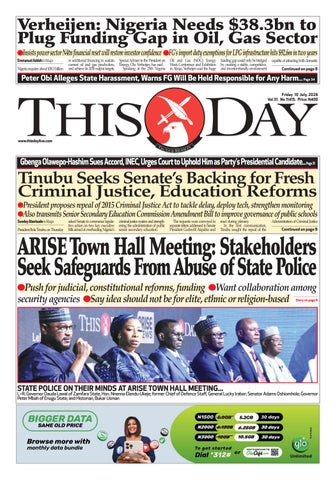
Tinubu Seeks Senate’s Backing for Fresh Criminal Justice, Education Reforms
President
Sunday Aborisade in Abuja
President
ARISE Town Hall Meeting: Stakeholders Seek Safeguards From Abuse
of State Police
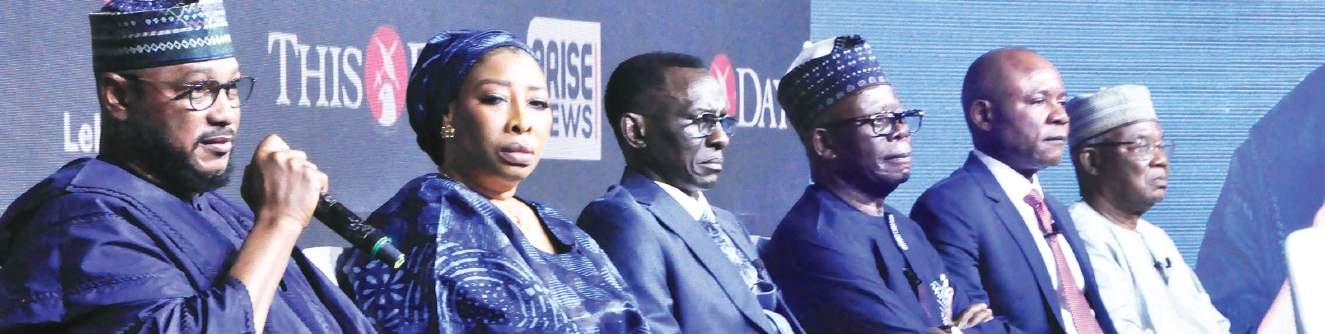

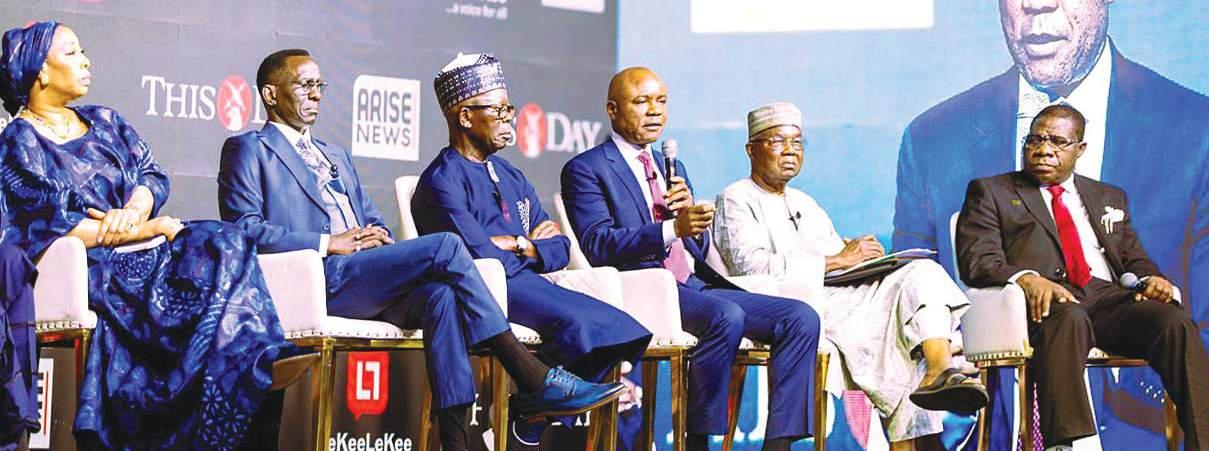
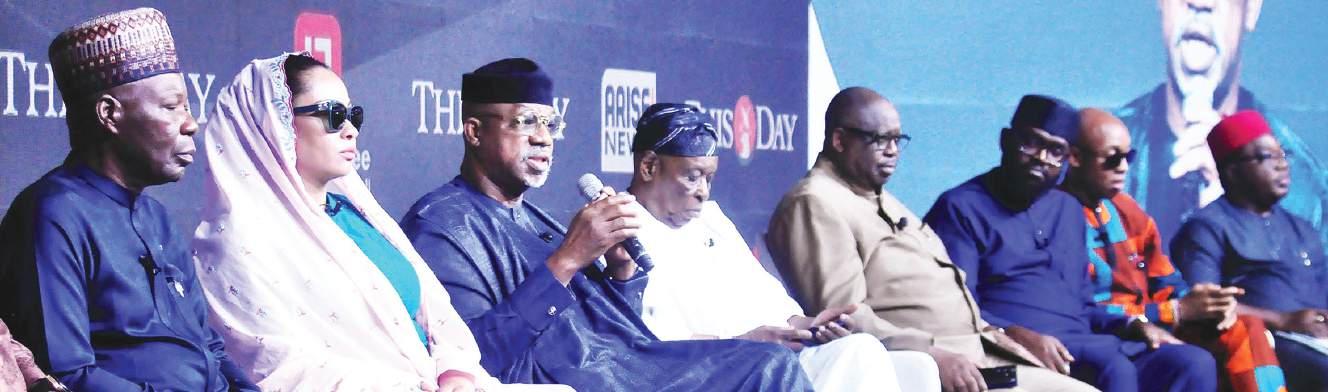
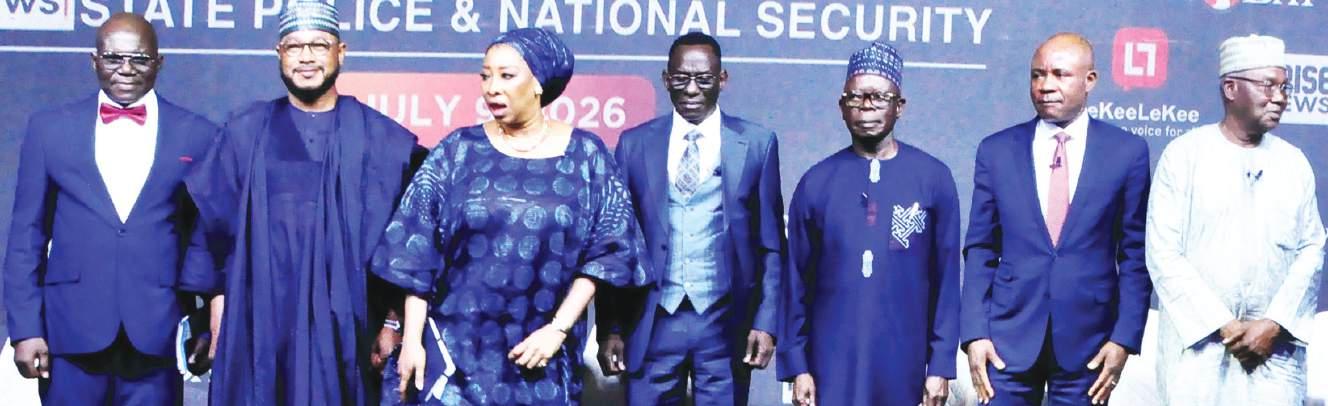
L–R: Governor Dauda Lawal of Zamfara State; Hon. Nnenna Elendu-Ukeje; former Chief of
Staff, General Lucky Irabor; Senator Adams Oshiomhole;
Peter Mbah of Enugu State; and Historian, Bukar Usman


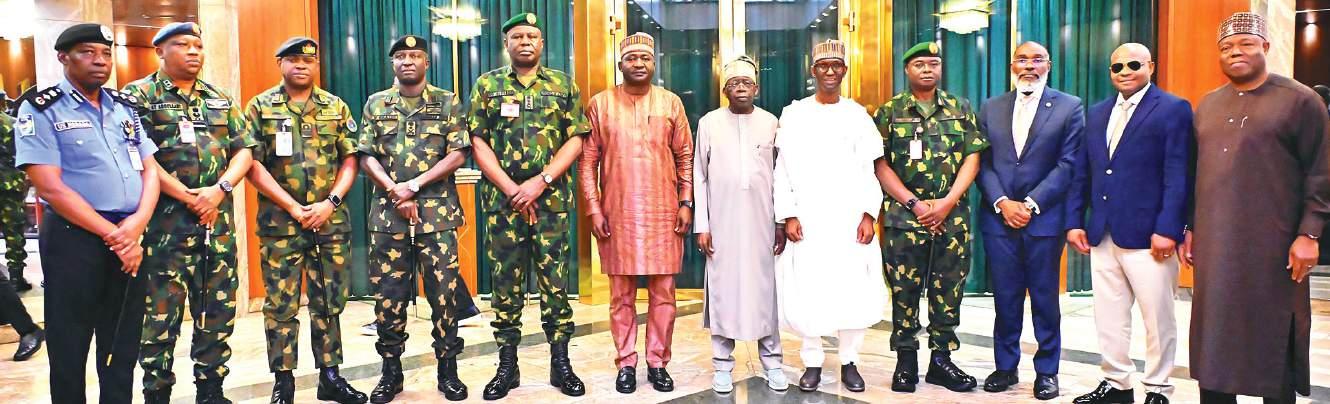
TINUBU’S MEETING WITH SECURITY CHIEFS...
R-L: Director-General of the National Intelligence Agency (NIA), Amb. Mohammed Mohammed; Director-General of the Department of State Services (DSS), Adeola Oluwatosin Ajayi; Special Adviser to the President on Homeland Security, Major General Adeyinka Famadewa; Chief of Defence Intelligence (CDI), Lieutenant General Emmanuel Akomaye Undiandeye; National Security Adviser, Nuhu Ribadu; President Bola Ahmed Tinubu; Minister of Defence, General Christopher Musa (Rtd); Chief of Defence Staff (CDS), General Olufemi Oluyede; Chief of Army Staff (COAS), Lieutenant General Waidi Shaibu; and other officials after the security meeting held at the Presidential Villa, Abuja, yesterday
Executive Secretary: UBEC Mobilised Over N100bn in Unaccessed Grants,
Universal Basic Education Commission (UBEC) says it has mobilised over N100 billion in previously unaccessed matching grants and is delivering measurable results in basic education nationwide under its 2025 to 2031 Strategic Blueprint.
Executive Secretary of UBEC, Aisha Garba, disclosed this yesterday in Abuja at a media luncheon with education correspondents.
Garba said the commission, in partnership with State Universal Basic Education Boards, had constructed over 4,600 classrooms, renovated more than 6,100 classrooms, provided 2,780 toilets and 678 boreholes, and supplied over 334,000 pieces of school furniture across the country.
She added that UBEC had also supported the establishment of more than 2,300 Early Childhood Care Development and Education Centres to strengthen foundational learning for young children.
Garba stated, “Guided by our 2025 to 2031 Strategic Blueprint and aligned with the Renewed Hope Agenda of the federal government, we are moving beyond reforms to delivering measurable results that are improving schools, empowering teachers, and expanding opportunities for millions of Nigerian children.”
The UBEC boss said over N20.4 billion had been invested in teacher
professional development, while the Effective Schools Programme and stronger School-Based Management Committees were being used to improve accountability and school leadership.
On technology, Garba stated that UBEC was expanding Digital Lit-
Constructed 4,600 Classrooms
eracy Centres, strengthening Smart Schools, and promoting Artificial Intelligence, coding, and robotics.
She stated that over 7.8 million instructional materials had been distributed nationwide to improve literacy and numeracy.
She said the commission was
expanding access through Open Schooling, Integrated Qur’anic and Tsangaya Education, girl-child education, and inclusive education programmes.
Garba said institutional reforms had been introduced to strengthen transparency, as well as
project monitoring and data-driven decision-making. She called on the media to continue to partnering with UBEC through regular briefings, project visits, and balanced reporting to strengthen public confidence and stakeholder participation.
According to her, “Education is a shared responsibility. Government can provide leadership and resources, but lasting transformation requires the collective commitment of communities, teachers, parents, development partners, and the media.”
MDGIF Invests in Over 100 Downstream Gas Infrastructure Projects
The Executive Director of the Midstream and Downstream Gas Infrastructure Fund (MDGIF), Oluwole Adama, has disclosed that the fund has invested in more than 100 strategic downstream gas infrastructure projects across Nigeria, with some expected to be commissioned before the end of the year.
Adama made the disclosure during a panel session titled, “Boosting the Domestic Gas Market – Driving Economic Growth and Development,” at the 25th Nigeria Oil and Gas (NOG) Energy Week in Abuja.
He said the investments comprise eight gas processing facilities, 15 Compressed Natural Gas/Liquefied
Compressed Natural Gas (CNG/ LCNG) mother stations, 86 CNG/ LCNG daughter stations and four Liquefied Petroleum Gas (LPG) depots, all at various stages of completion.
“Although MDGIF remains a relatively young institution, our focus has been on demonstrating that catalytic investments can unlock broader private-sector participation,” he said.
According to him, the fund is looking forward to commissioning some of the projects before the end of the year to boost downstream gas penetration.
Adama explained that the MDGIF, established under Section 52 of the Petroleum Industry Act (PIA), was created to catalyse investments in strategic midstream
Now Fully Integrated into Global Media Group’
MultiChoice has formally become a full subsidiary of Canal+, marking a new phase in the evolution of one of Africa’s leading pay television operators, according to Chief Executive Officer of Canal+ Africa and MultiChoice, David Mignot. In a statement issued yesterday by the company, Mignot said the integration would position MultiChoice within a global media organisation with an extensive international footprint.
Mignot said, “MultiChoice is now a full subsidiary of a truly international media group operating in 70 countries.
“The group was founded in France, is listed in London and Johannesburg, and has a strong African presence with operations in more than 45 countries.”
The statement underscored the scale of the combined business, highlighting Canal+’s global reach alongside its significant investments across Africa.
The completion of the transac-
tion is expected to strengthen MultiChoice’s position in the African media and entertainment market by giving it access to the broader resources, expertise, and international capabilities of the Canal+ Group, while reinforcing the group’s commitment to the continent.
MultiChoice operates across sub-Saharan Africa through platforms, including DStv, GOtv, and Showmax, serving millions of subscribers with entertainment, sports, and news content.
and downstream gas infrastructure capable of expanding domestic gas utilisation and supporting industrial growth.
He stressed that the objective of the fund extends beyond financing projects to unlocking new markets for natural gas across the country.
“Our objective is not merely to finance projects—it is to unlock markets,” he said.
Responding to a question on whether economic growth and economic development compete within Nigeria’s domestic gas market, Adama argued that both objectives are mutually reinforcing.
“I do not see economic growth and economic development as opposing objectives; rather, I see them as complementary and mutually reinforcing. The real challenge is ensuring that growth is inclusive, sustainable, and translates into
tangible improvements in the lives of Nigerians,” he stated.
He noted that investments in gas infrastructure drive industrial competitiveness, provide cleaner and more affordable energy for households and transportation, strengthen electricity generation and create employment. “The measure of success is not how much gas Nigeria produces, but how much prosperity that gas creates for Nigerians,” he said.
Addressing the slow pace of financial close for domestic gas projects, Adama said financing itself was rarely the biggest obstacle, stressing that bankability remains one of the biggest hurdles to project financing.
“The perception is that financing is the biggest challenge, but in reality, financing is often the last hurdle. Projects reach financial close only
after they have become bankable, and that requires several risks to be addressed upfront,” he explained. According to him, delays usually stem from inadequate project preparation, uncertainty over gas demand, infrastructure deficiencies and poor risk allocation.
“The delay is rarely at financial close itself. It usually occurs much earlier during project preparation, commercial structuring and risk allocation. Once those fundamentals are in place, capital becomes significantly easier to mobilise,” he added.
On investor expectations, Adama maintained that capital remains available for properly structured gas projects.
“Capital is available for wellstructured projects. Investors are not avoiding gas—they are avoiding uncertainty,” he pointed out.
Catholic Archbishop of Benin City, Most Rev Akubeze, Dies at 69
Onyebuchi Ezigbo in Abuja
The Catholic Secretariat in Abuja which also confirmed the death of the Archbishop said he was called home to eternal rest on Thursday, July 9, 2026, at the age of 69.
Born in 1956, Archbishop Akubeze was ordained a Catholic priest on October 3, 1987. He was appointed the pioneer Bishop of Uromi on December 14, 2005, and
consecrated on February 25, 2006.
According to the statement, Akubeze was later appointed Archbishop of Benin City on March 18, 2011, and installed on April 28, 2011. He also served as a past President of the Catholic Bishops’ Conference of Nigeria.
“Throughout his ministry, Archbishop Akubeze lived out his episcopal motto, “Ut Testimonium perhibeam veritati” (“That I may bear witness to the Truth”).
“He is remembered as a humble, gentle, and complete gentleman who focused on spiritual renewal, structural development, and the welfare of his priests and the good of his flock.
“The Church commends his soul to the infinite mercy of God and prays for eternal rest upon him. Funeral arrangements will be communicated by the Archdiocese at a later date,” the the statement read.
Emmanuel Addeh in Abuja
Kuni Tyessi in Abuja
PHOTO: GODWIN OMOIGUI.
Emma Okonji
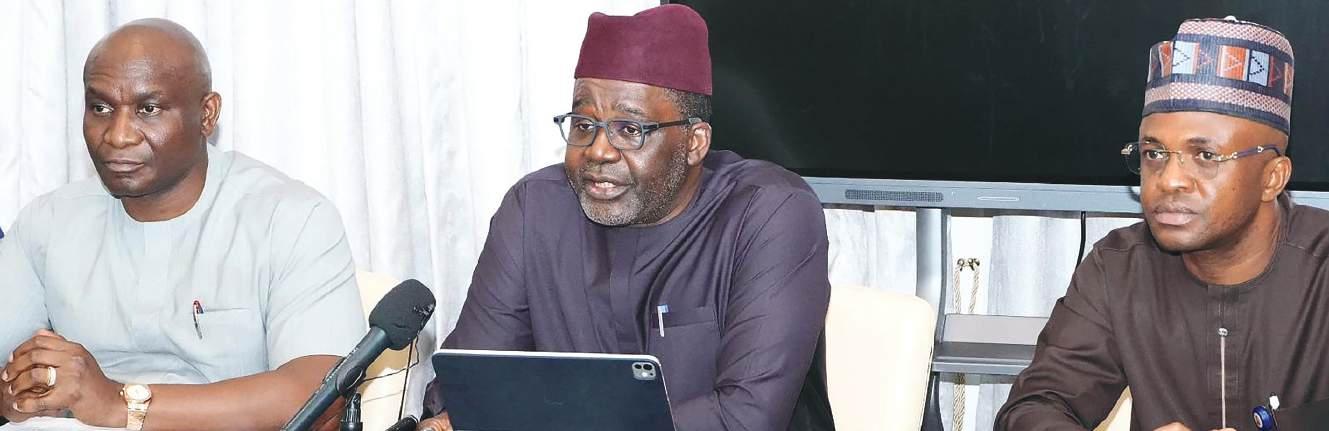
NDDC BRIEFS STATE HOUSE PRESS...
L-R: NDDC Managing Director and Chief Executive Officer, Dr. Samuel Ogbuku; Deputy Chief of Staff to the President (Office of the Vice President), Senator Ibrahim Hadejia; and Senior Special Assistant to the President on Agribusiness and Productivity (Office of the Vice President), Dr. Kingsley Uzoma, during a press conference on the forthcoming NDDC Agric Summit at the Presidential Villa, Abuja, yesterday
Coalition to FG: Make Poverty Reduction Primary Measure of Economic Success
Urges ‘Borrow Better’ framework to curb soaring public debt
Economic and Fiscal Justice Coalition (EFJC) has appealed to the federal government to make poverty reduction the primary measure of its economic success, stating that the overriding objective of economic policy should not merely be macroeconomic stabilisation, but the improvement of human welfare.
EFJC made the call on Thursday during a meeting with Minister of Finance and Coordinating Minister of the Economy, Mr. Taiwo Oyedele, in Abuja.
The coalition’s presentation was delivered by Executive Director, Centre for Economic and Social Justice (CENSOJ), Mr. Eze Onyekpere.
Noting that macroeconomic
stability was indispensable, as no nation could sustain growth under conditions of fiscal indiscipline, runaway inflation, unsustainable debt, or chronic exchange rate instability, EFJC stated, however, that macroeconomic stability was not an end in itself.
The group said, “It is valuable only to the extent that it expands opportunities, creates productive
employment, improves incomes, and enhances the quality of life of citizens.
“Nigeria today faces what development economists describe as the ‘growth without inclusion’ dilemma.”
The group told the minister that growth should create employment and reduce inequality, adding that, ultimately, public finance is not an
US-Iran Ceasefire in Limbo as Warring Nations Exchange More Strikes
war, which was launched by the U.S. and Israel in February.
The fragile ceasefire between the United States and Iran further unravelled yesterday as fresh missile and drone strikes were exchanged between both nations, raising fears of a renewed regional conflict, and its impact on the global oil market.
Besides, Iran yesterday buried its Supreme Leader, Ayatollah Ali Khamenei, in a funeral attended by thousands of mourners. The latest hostilities marked a sharp setback for diplomatic efforts to end the war, with both sides accusing each other of violating the truce shortly after it came into effect.
The U.S. military said that it struck “approximately 90 Iranian military targets including air defense systems, coastal surveillance assets, missile and drone storage sites, naval capabilities, and military logistics infrastructure along Iran’s coastline.”
events for Khamenei, who was killed in U.S.-Israeli strikes at the start of the war. The funeral culminated Thursday with a burial ceremony in Mashhad, his hometown and the site of the most prominent Shia shrine in Iran.
block oil tankers from the Strait of Hormuz and prevent the delivery of crude from the Persian Gulf to customers worldwide. That could worsen inflation, which economists expected would ease with oil prices.
end in itself, but an instrument for improving human welfare.
EFJC stated, “Accordingly, our submission today is guided by one overarching proposition: the success of Nigeria’s economic reforms should ultimately be measured not only by stronger macroeconomic indicators but by whether they reduce poverty, create decent jobs, improve public services, strengthen citizens’ resilience, and expand opportunities for all Nigerians.
“It is in that constructive spirit that we respectfully present the following observations and recommendations for your consideration.”
It advocated a people-centred economic reform agenda.
On Nigeria’s burgeoning public debt, the coalition called on the federal government to adopt a “Borrow Better” framework as part of overall efforts to cut down on the country’s rising public debt and ensure that future borrowing supported sustainable economic development.
tions are: what are we borrowing for? Are borrowed resources financing productive investments? Are those investments generating sufficient economic returns? Can future revenues comfortably service those debts?
“Nigeria’s public debt has risen significantly over the past decade. According to the Debt Management Office, total public debt increased from N87.38 trillion in June 2023 to approximately N159.28 trillion by the end of 2025, representing one of the fastest periods of debt accumulation in the country’s history. “At the same time, debt service continues to consume a substantial proportion of federally retained revenues, reducing fiscal space for education, healthcare, infrastructure and social investments.
The group said countries repaid debts with revenue, not GDP, stating that this is precisely why the Fiscal Responsibility Act requires govern- ment to maintain debt at sustainable levels while ensuring that borrowing finances capital expenditure and human development. Supreme leader, Ayatollah Khamenei, laid to rest Oil price eases over 2% despite escalation of conflict
The American military said it hit around 90 targets in airstrikes across Iran after President Donald Trump said he considered the tenuous ceasefire between the two countries over following Iranian attacks on shipping in the Strait of Hormuz. Tehran retaliated with attacks on U.S. allies across the Middle East, a wave of strikes that sparked alerts in Qatar, Bahrain, Kuwait and hours later in Jordan, as the two sides accused each other of violating the terms of their interim deal.
The two days of renewed fighting cast doubt on whether Washington and Tehran remained committed to reaching a final deal to end the
Also, a U.S. official on Thursday denied targeting the Bushehr nuclear power plant, after a local official said an airstrike hit the perimeter of the plant, according to the state-run IRNA news agency. At least 14 people were killed and another 78 wounded in the two days of U.S. attacks, the Iranian Health Ministry said in its first overall count of casualties.
This time, Iran’s retaliation also targeted Qatar and Jordan, the latter of which said it shot down eight Iranian missiles. The IRGC said it fired 10 ballistic missiles, targeting a U.S. command and control centre, as well as an air base in Jordan.
The exchanges left the peace process in limbo. Trump and Tehran signed a memorandum of understanding in mid-June, which kicked off a 60-day negotiating period toward a final deal to end the conflict.
Those talks have been paused this week as Iran holds massive funeral
Trump, who wrapped up a NATO summit in Turkey on Wednesday, had signaled intense strikes were coming. “This is in retribution for yesterday’s bombing of ships by Iran. If it happens again, it will get much worse!” he warned.
The president dismissed the ongoing peace efforts and labeled Iranian leaders “scum,” but said he would allow negotiations to continue and did not think this new fighting would result in “long-term” military action.
Meanwhile, oil prices eased Thursday as financial markets calmed in the wait to see what will come next after Trump raised doubts about the temporary truce in the war with Iran.
In the oil market, prices gave back much of their jumps from the day before. The price for a barrel of Brent crude, the international standard, fell 2.2 per cent to $76.30. That’s down from $78.02 the day before though still above its $71.80 price from the end of last week.
A return to full-blown war will
But Trump also said that the latest back-and-forth fighting would not result in “long-term” military action, raising uncertainty about just what will happen.
“Although Nigeria’s debt-to-GDP ratio remains moderate compared with many emerging economies, the more relevant indicator is debt service-to-revenue.”
Stating that Nigeria’s debt profile required greater prudence, the coalition acknowledged that public borrowing was not inherently problematic, as every modern economy borrowed.
It said, “The fundamental ques-
Vessel Owners Announce Measures to Fight Sea Piracy, Illegal Oil Bunkering
Olusegun Samuel in Yenagoa
In a bid to assist the federal government and security agencies in tackle the issues of sea piracy and illegal oil bunkering along the waterways, the Tugboat, Fuel Barges, and Seagoing Vessel Association of Nigeria (TUBAVS) has called for the immediate censorship, verification, and stricter control of all marine vessels and craft operating within Nigerian waters and inland waterways.
TUBAVS announced in a statement yesterday that the body serves as a unified voice and advocacy group for maritime operators in the Nigerian marine
industry, focused on marine operations, safety standards, and professional networking.
In the statement signed by its Legal Adviser, Tonye Wilson, it called for immediate censorship by all seagoing vessels and craft as well as to ensure censorship and control of all marine vessels and craft to combat illegal bunkering.
According to the group, these also include tankers, barges, tugboats, fishing vessels, workboats, houseboats, service boats, landing craft, patrol craft, and any vessel engaged in fuel transport, storage, or ship-to-ship (STS).
TUBAVS stated: “In view of rising incidents of illegal bunkering
and its impact on national security, revenue, safety, and the marine environment, the union hereby issues nationwide directive for the immediate censorship, verification, and stricter control of all marine vessels and craft operating within Nigerian waters and inland waterways, pursuant to relevant session of the suppression of Piracy and other maritime offences act of 2019 scope.” It also stated that the mandatory censorship and verification should be carried out within 90 days of the notice, as every vessel and craft must complete their censorship of their marine vehicles at the union website.
PHOTO: GODWIN OMOIGUI.
Emmanuel Addeh in Abuja
Ndubuisi Francis in Abuja
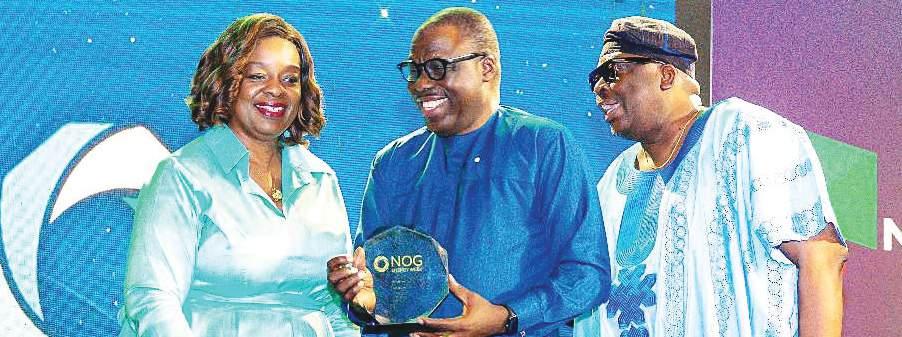
NLNG GETS EXCELLENCE AWARD...
NLNG Managing Director, Adeleye Falade (centre), flanked by Deputy Managing Director, Olakunle A. Osobu (right) and General Manager, External Relations and Sustainable Development, Sophia Horsfall (left), pose with the Operational Excellence Award plaque presented to NLNG at the 2026 NOG Energy Week Energy Awards
Lagos Emerges West Africa’s Most Climate-Resilient City
Gov Sanwo-Olu wins distinguished Grand Laureate award in climate governance
Lagos State has been ranked as the most climate-resilient city in West Africa, said to offer the most advanced and measurable climate governance among sub-national governments in the sub-continent.
The decision emerged from the recently concluded West Africa Climate Governance Index (WACGI) Assessment - a comprehensive study that involved evidence-based research across all 209 sub-national governments in the 15 ECOWAS nations.
WACGI said its regional evaluation, where Lagos and 208 other West African states were assessed, combined climate-risk exposure, governance visibility, finance evidence, transparency, participation, and implementation capacity as parameters.
Based on the listed parameters, Lagos scored 86.3 points — the highest on a scale of 100 points – and ranked Grade “A”, coming ahead of Kano, Abuja, Greater Accra, Praia, Dakar, Porto Novo, Abidjan Autonomous District, São Filipe, Bombali, among others.
The ranking, according to WACGI, aligned with the United Nations Sustainable Development Goals 13 (Climate Action) and SDG 17 (Partnerships for the Goals).
The research body added that its
evaluation also fell within the scope and parameters of African Union’s Agenda 2063 aspiration for a prosperous and climate-resilient Africa.
With Lagos State emerging as the first in the 2026 Best Performing Subnational Government in West Africa, the climate research body conferred its prestigious honour of “Grand Laureate of Climate Governance” on Governor Babajide Sanwo-Olu for administering the most resilient climate governance structure.
In an official notification letter, dated July 8, 2026, to Lagos State Government, Director of Fondation Lucien Paye, Professor Julie Peghini, congratulated Sanwo-Olu for championing actions and policies aimed at mitigating climaterelated hazards and strengthening adoption in Lagos.
Peghini wrote, “In recognition of this achievement, we are pleased to confer upon Your Excellency and the Government of Lagos State the distinguished honour of the ‘Grand
Laureate of Climate Governance’ for 2026 best performing subnational government in West Africa.
“The formal report and the raw results datasets are publicly available on the official French Government data repository.”
WACGI is a France-based climate policy and initiative centre established by the Africa Foundation (Lucien Paye) at Cité Internationale Universitaire de Paris. Its mission is to advance climate
governance across ECOWAS member nations. This is achieved through the use of indicators and parameters that align with the Paris Agreement’s clauses.
Peghini said the publication reflected WACGI’s conviction that transparent, evidence-based assessment could become a powerful catalyst for institutional improvement.
Recognition of strong performance, she said, should inspire ranked countries, while constructive recommendations should support
governments seeking to strengthen their climate governance systems.
The WACGI report said Nigeria, as ECOWAS’s largest economy and emissions system, enforced one of the region’s most elaborate climate governance architectures, with the county’s framework including Climate Change Act 2021, National Council on Climate Change, NDC 3.0, Energy Transition Plan, long-term net-zero strategy, and growing climate finance analysis.
Dangote Cement Strengthens Decarbonisation Drive at Global Cement CEOs’ Strategic Dialogue
Sunday Ehigiator
Dangote Cement Plc has reaffirmed its commitment to sustainable manufacturing and low-carbon cement production following its participation in the Global Cement and Concrete Association (GCCA) CEO Strategic Dialogue in Madrid, Spain, where industry leaders charted pathways towards achieving
net-zero emissions.
The company’s Group Managing Director, Arvind Pathak, joined chief executives from leading global cement and concrete companies at the high-level forum, which focused on accelerating decarbonisation while supporting the growing demand for infrastructure in emerging economies.
Speaking after the summit,
Pathak said Africa’s cement industry must pursue economic growth alongside environmental sustainability to meet the continent’s rising infrastructure needs.
he said, “With Africa’s infrastructure demand continuing to rise, the sector must pursue growth while embracing innovative pathways to reduce carbon emissions.”
The two-day strategic dialogue
Reps Urge FG to Intensify Diplomatic Action Over Xenophobic Attacks on Nigerians in South Africa
Juliet Akoje in Abuja
The House of Representatives on Thursday urged the federal government to step up diplomatic engagement with the South African government to safeguard the lives of Nigerians living in that country following the reported killing of two Nigerian citizens amid a fresh wave of xenophobic attacks. The resolution followed the adoption of a motion of urgent public importance sponsored by Chairman of House Committee on Navy, Hon. Yusuf Gagdi, who raised concerns over the increasing incidents of xenophobic violence, extrajudicial killings, and the alleged persecution of Nigerians and
other African nationals in South Africa.
Moving the motion, Gagdi said the reported deaths of two Nigerians, including one who allegedly died while in the custody of the South African police, highlighted the urgent need for the Nigerian government to take decisive steps to ensure the safety and protection of its citizens abroad.
He called on the federal government to summon the South African High Commissioner to Nigeria, demand a transparent and independent investigation into the killings, strengthen consular assistance for Nigerians residing in South Africa, and engage regional and international organisations, including African Union
(AU), Southern African Development Community (SADC), United Nations (UN), and other relevant bodies to ensure those responsible for the deaths were held accountable.
Contributing to the debate, Hon. Billy Osawaru commended the President Bola Tinubu administration for the ongoing evacuation of Nigerians from South Africa. But he stressed that stronger diplomatic measures were necessary to compel the South African government to take responsibility for the attacks.
Hon. Prince Kayode Akiolu advocated sustained diplomatic engagement, reminding South Africa of the significant role Nigeria played in
the country’s anti-apartheid struggle.
In his contribution, Hon. Jersey Okezie-Okejoto urged the federal government to deploy international legal mechanisms and commercial diplomacy as tools to ensure South Africa fulfilled its obligations under international law.
Other lawmakers, including Hon. Ghali Tijjani, Hon. Mark Obetta, and Hon. Ben Etanabene, also called on the federal government to consider stronger diplomatic and legal measures, including pursuing international justice for victims of the attacks, while sustaining pressure on South Africa to guarantee the safety of Nigerians and other African nationals.
examined key industry priorities, including low-carbon construction, climate policy, financing for decarbonisation, technological innovation, and collaborative approaches to achieving net-zero emissions across the cement and concrete value chain.
Pathak said discussions at the forum underscored the need for Africa’s cement producers to accelerate their transition to cleaner production methods in response to evolving global economic and regulatory realities.
he stated, “A key takeaway, especially for the African cement sector in the context of the evolving global economic and regulatory landscape, is the need to accelerate our decarbonisation pathway through increased utilization of alternative fuels, reduction of clinker content in cement and investment in innovative cement technologies suited to local realities.”
He added that achieving the industry’s climate ambitions would require stronger collaboration among governments, financiers, technology providers, customers, and other stakeholders.
“These are required for achieving decarbonisation ambitions, as the demand for infrastructure continues to rise across the continent,” he stated.
The Dangote Cement GMD said the forum reinforced the opportunity for Africa to combine industrial expansion with environmental responsibility, stressing that the company remains committed to cutting its carbon emissions intensity by 20 per cent by 2030, using 2021 as its baseline year. According to the company, its decarbonisation strategy includes increased adoption of alternative fuels, investments in renewable energy, improvements in thermal and electrical efficiency, and clinker substitution and optimisation to reduce emissions from cement production.
Dangote Cement said its participation at the GCCA CEO Strategic Dialogue reflected its commitment to aligning with global best practices in sustainable manufacturing while strengthening its leadership in low-carbon cement production across Africa.
As a founding member of GCCA, the company continues to play an active role in shaping global sustainability initiatives within the cement industry. Pathak also serves as an elected member of the GCCA Board, representing Dangote Cement in advancing industry-wide decarbonisation efforts.
Senate Clears Lafarge Sale to Chinese Investor, Says Nigerians’ Stakes Safe
Upper chamber finds no national security risk, says 16.19% public shareholding remains intact Insists transaction must comply with Nigerian laws
Sunday Aborisade in Abuja
Senate on Thursday endorsed the proposed acquisition of Lafarge Africa Plc by Chinese firm, Hainan Huaxin Pan-African Investment Company Plc, declaring that the transaction poses no immediate national security threat and will not affect the 16.19 per cent equity held by Nigerian investors.
The approval followed the adoption of the report of an ad hoc committee chaired by Senate Minority Leader, Senator Abba Moro, which investigated the controversial transaction after concerns were raised
over the ownership structure of Lafarge and the implications of the proposed sale.
While backing the acquisition, Senate insisted that all parties involved must strictly comply with due process and existing Nigerian laws before the conclusion of the transaction.
It also urged regulatory agencies, including Securities and Exchange Commission (SEC), Corporate Affairs Commission (CAC), Federal Competition and Consumer Protection Commission (FCCPC), Nigerian Investment Promotion Commission (NIPC) and Bureau of Public
Enterprises (BPE), to sustain rigorous oversight to ensure full compliance with statutory regulations.
Senate said findings from its investigation showed that much of the public controversy surrounding the deal stemmed from a misconception that Lafarge Africa was wholly Nigerian-owned.
According to the committee, the transaction merely represents the transfer of ownership from one foreign investor to another, as Lafarge itself is controlled by foreign interests and is divesting its stake to Huaxin. It stressed that the change in
majority ownership would not diminish or alter the rights and investments of Nigerian shareholders.
The report stated that the 16.19 per cent stake owned by Nigerian public investors would remain completely intact throughout the transaction, assuring shareholders that their ownership interests and associated rights would not be affected.
The committee further disclosed that all relevant regulatory agencies had examined various aspects of the proposed acquisition and found no evidence of any breach of Nigeria’s legal or regulatory framework.
It stated that there was no im-
mediate national security concern arising from the deal and highlighted Huaxin’s commitment to inject fresh capital into Lafarge’s operations in Nigeria and across Africa.
According to the senate, the planned investment is expected to strengthen the company’s operations, stimulate industrial growth, and support Nigeria’s drive to attract more foreign direct investment.
The committee added that concerns over foreign ownership in the cement industry were overstated, stating that Lafarge currently controls about 18 per cent of the domestic cement market and the acquisition
would not significantly alter the industry’s competitive structure. It also cited assurances from FCCPC that the acquiring company would maintain workforce stability during the transition, thereby protecting existing jobs.
ARISE TOWN HALL MEETING: STAKEHOLDERS SEEK SAFEGUARDS FROM ABUSE OF STATE POLICE
sharing, local government autonomy, and constitutional amendments.
A broad national consensus on the need to establish state police came on stream yesterday as governors, federal lawmakers, security chiefs, legal experts, and international security specialists called for sweeping constitutional, judicial, and institutional reforms to make the proposed policing system effective, accountable, and insulated from political abuse.
At the ARISE News Town Hall on Building a National Consensus for State Police and National Security, in Abuja, participants agreed that Nigeria’s worsening insecurity had exposed the limitations of the country’s centralised policing structure.
They, however, cautioned that state police would only succeed if backed by adequate funding, judicial reforms, operational safeguards, intelligence
Former Israeli Prime Minister, Ehiud Barak, Says It’s Step in Right Direction
Giving an international perspective to the debate, former Israeli Prime Minister, Ehud Barak, who delivered the keynote address, described the establishment of state police as “a step in the right direction,” considering Nigeria’s vast geographical size and complex security challenges.
Barak stated that Israel’s highly centralised policing model worked because of its relatively small territory, explaining that the entire country is roughly the size of an average Nigerian state.
He said, “In terms of geography, Israel is probably 40 times smaller than Nigeria. Within two hours’ drive, you cover almost 90 per cent of the
population.
“Nigeria is a totally different country. I strongly believe the idea of having state police is a very good start in the right direction.”
The former prime minister, however, warned that decentralisation must be accompanied by carefully crafted legislation to prevent political abuse.
He proposed that state police formations should operate within a national framework that gives the president and the federal government limited emergency powers during national crises, while ensuring transparency through central oversight.
Barak also stressed that intelligence gathering—not merely military deployment—remained the most effective weapon against terrorism.
He urged Nigeria to strengthen human intelligence networks at the community level while maintaining centralised control over signal intelligence, drawing parallels between
TINUBU SEEKS SENATE’S BACKING FOR FRESH CRIMINAL JUSTICE, EDUCATION REFORMS
Act (ACJA) 2015 and its replacement with a new Administration of Criminal Justice Act, 2026.
He said the existing law had become inadequate to address emerging legal, procedural, and institutional challenges.
The president explained that the proposed legislation was designed to improve the administration of criminal justice in the Federal Capital Territory and other federal courts, while establishing a more effective Administration of Criminal Justice Monitoring Council to enhance implementation of the law.
He stated that the proposed Act would promote efficient management of criminal justice institutions, accelerate the dispensation of justice, strengthen the protection of society from crime, and safeguard the rights of suspects, defendants, and victims.
According to him, the bill also seeks to ensure that courts, law enforcement agencies, and all institutions involved in criminal justice administration comply fully with the provisions of the law.
Tinubu said the decision to repeal and re-enact the legislation followed the identification of persistent shortcomings in the current legal framework.
He listed the challenges to include delay in criminal investigations and prosecutions, inadequate deployment of technology in criminal proceedings, weak coordination among criminal justice institutions, poor case management systems, and ineffective monitoring of compliance
with the Act.
The president stated that the proposed legislation had been reviewed by experienced law officers with expertise in criminal law, criminal procedure, and legislative drafting.
He added that the bill incorporated recent judicial pronouncements, technological innovations, and international best practices in criminal justice administration.
According to the president, the proposed law also strengthens the Administration of Criminal Justice Monitoring Council by providing additional measures to ensure effective implementation of the Act by relevant institutions.
Following the presentation of the communication, Senate referred the bill to its Committee on Rules and Business with a mandate to report back within four weeks.
In a separate communication, Tinubu transmitted the National Senior Secondary Education Commission Amendment Bill, 2026, to Senate for consideration.
He said the objective of the proposed amendment was to strengthen the administration and governance of public senior secondary education across the country.
The president disclosed that the Federal Executive Council approved the amendment bill at its meeting of April 30, 2026, after which it was vetted and finalised by the Federal Ministry of Justice to ensure compliance with constitutional provisions
and legislative drafting standards.
Tinubu told the senate that the proposed legislation reflected his administration’s commitment to strengthening educational institutions in the national interest.
He urged lawmakers to accord the bill expeditious consideration and passage.
“While it is my hope that the senate will consider the bill and grant it expeditious passage, please, accept, Distinguished Senate President, the assurances of my highest consideration and personal regards,” the president wrote.
The senate also referred the education bill to the Committee on Rules and Business with a directive to report back within one week.
Nigeria’s fight against Boko Haram and Israel’s decades-long battles against Hamas and Hezbollah.
According to him, military forces should not routinely perform law enforcement duties because policing requires different skills, community engagement, and operational culture. He encouraged Nigeria to learn from international experiences while adapting reforms to its own peculiar realities.
Kalu: We’re in Final Legislative Process
The debate also shifted to the National Assembly, where Deputy Speaker of the House of Representatives, Hon. Benjamin Kalu, announced that lawmakers had commenced the final legislative process for the establishment of state police.
Kalu disclosed that the National Assembly had constituted a conference committee comprising members of both chambers to harmonise the different versions of the state police bill already passed by Senate and House of Representatives.
He stated, “Yesterday, we constituted the conference committee.
Twelve members from the House will sit with members of the senate to harmonise both versions before transmitting the final document to the state Houses of Assembly.”
Expressing optimism that the constitution amendment would soon receive the endorsement of state legislatures, Kalu said the growing support of governors had significantly improved the prospects of the reform, insisting that state police must go hand-in-hand with full local government autonomy.
According to him, effective grassroots governance would significantly strengthen local intelligence gathering and community policing.
The deputy speaker disclosed that the federal government had also inaugurated a State Police Implementation Committee to draft amendments to the Police Act and develop operational guidelines for the proposed policing structure.
He explained that while the federal police would continue to handle national security and interstate crimes, state police would focus on local law enforcement and community security.
State Police Funding Should Be Placed on First-line Charge, Senate Leader Declares
Leader of the Senate, Opeyemi Bamidele, who focused on institutional safeguards, insisted that state police funding should be placed on first-line charge to guarantee operational independence.
“There must be first-line charge funding similar to the judiciary so that the police will not become subject to the whims and caprices of governors,” Bamidele said.
He maintained that local government autonomy remained indispensable to effective grassroots policing.
Oshiomhole: Present Policing Arrangement Constitutionally Contradictory
Lending his voice to the debate, Senator Adams Oshiomhole described Nigeria’s present policing arrangement as constitutionally contradictory.
Oshiomhole stated that governors could not be held responsible for security while lacking authority over police recruitment, deployment, and discipline.
He explained, “The constitution calls the governor the chief security officer, yet he cannot recruit, deploy, promote, or discipline police officers.
“It is like calling someone a
husband when he has no wife.”
Rejecting concerns that state governments might lack the resources to finance police formations, Oshiomhole stated that government spending always reflected political priorities. He recalled spending heavily on police logistics during his tenure as Edo State Governor, despite lacking operational control over the force.
“If governors misuse state police, the electorate should vote them out,” Oshiomhole added.
Natasha Worried About Accountability
Senator Natasha Akpoti-Uduaghan also advocated an independent police system insulated from political interference, questioning how accountability would be guaranteed where governors or political authorities attempt to influence operational decisions.
The Kogi Central senator called for wider deployment of digital technologies against insecurity, citing instances where terrorists openly use social media platforms without apprehension.
“As long as we are citizens, we cannot give up on Nigeria,” she said.
Musa
Warns Against Using Police for Ethnic Domination, As Instrument of Religious Bias
Minister of Defence, General Christopher Musa, while backing the creation of state police, warned that such institutions must never become instruments of ethnic domination, religious bias, or elite protection.
“State police should not be ethnic or religiously based, nor should they exist to protect the elite,” Musa stated. “They must guarantee justice and fairness,” he added.
He also called for closer collabo-
VERHEIJEN: NIGERIA NEEDS $38.3BN TO PLUG FUNDING GAP IN OIL, GAS SECTOR
and international capital.
According to her, while Nigeria has made significant progress in reforming its energy sector, financing remains one of the biggest challenges to unlocking the country’s full oil and gas potential.
Verheijen stated, “For Africa, that question is urgent. And for Nigeria, the scale of the task is equally clear: to sustain the current base and grow toward our 2030 production target, analysis shows a financing gap of about $38.3 billion.”
She stressed that the financing requirement could neither be met through rhetoric nor by Nigeria acting alone, but by the enactment of credible rules, deployment of
bankable projects, using competitive costs, as well as predictable regulation.
She explained, “That gap cannot be closed by rhetoric, and it cannot be closed by Nigeria alone. And that capital from Lagos, Johannesburg, London, Houston, Abu Dhabi or Beijing is asking for the same thing: credible rules, bankable projects, competitive costs, predictable regulation, and disciplined execution. That is a warning and an opportunity.”
Verheijen stated that global investment capital had become increasingly selective, flowing only to countries with clear policies, regulatory certainty, and credible institutions.
She maintained that the administration of President Bola Tinubu had responded by implementing difficult reforms aimed at improving Nigeria’s investment climate and positioning the country as a competitive destination for energy investments.
According to her, the reforms have included recalibrating fiscal terms, clarifying regulations, streamlining oversight, introducing targeted incentives, and reducing contracting timelines by more than half.
Highlighting the impact of the reforms, Verheijen disclosed that Nigeria now had more than $50 billion worth of upstream projects in
its visible investment pipeline, while over $10 billion in long-delayed Final Investment Decisions (FIDs) had been secured within the past three years.
She also revealed that crude oil and condensate production had increased by about 400,000 barrels per day since 2023, with onshore production reaching its strongest level in two decades.
She stated, “We are targeting three million barrels per day and 10 billion standard cubic feet of gas per day by the end of the decade. “We now have more than $50 billion of upstream projects in the
Continued on page 34 Continued on page 33
Senate President Godswill Akpabio
Iyobosa Uwugiaren, Chuks Okocha, Adedayo Akinwale, Alex Enumah and Linus Aleke in Abuja
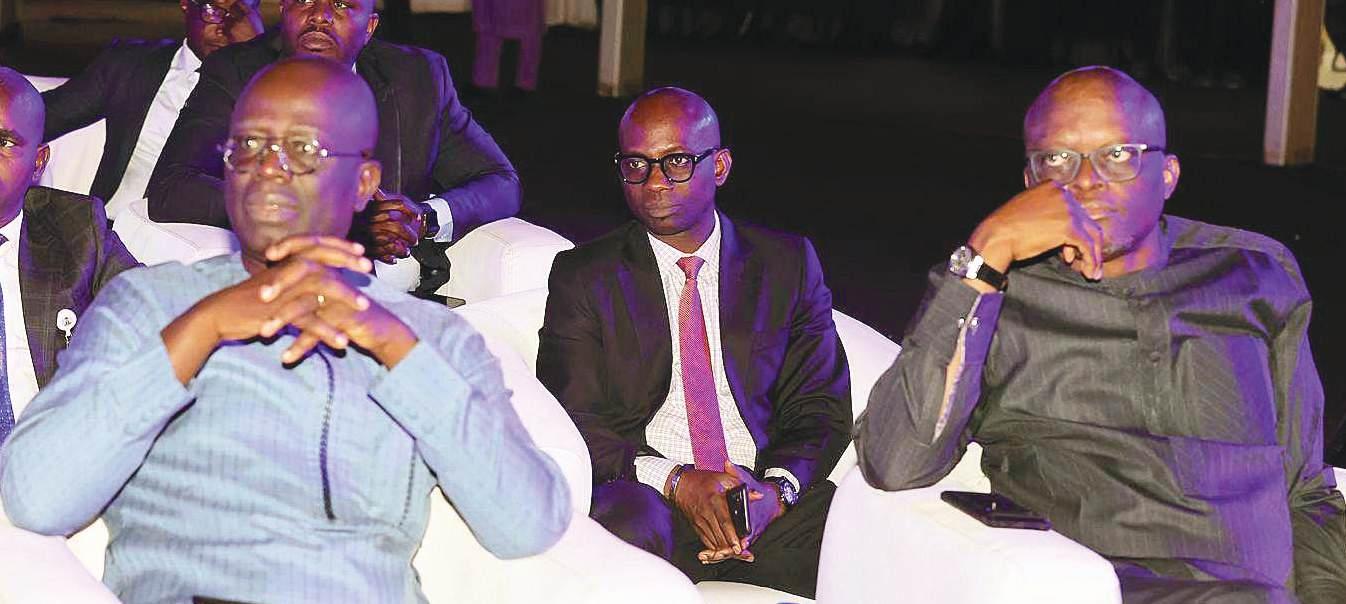
STATE POLICE ON THEIR MINDS...
Chairman, THISDAY Editorial Board, Segun Adeniyi (L), with Managing Director of THISDAY Newspapers, Eniola Bello, during the ARISE News Channel Town Hall Meeting titled Building a National Consensus for State Police and National Security in Abuja, yesterday
Stakeholders Seek Stronger Regional Alliance to Tackle Human Trafficking in Africa
Key stakeholders in Nigeria’s humanitarian sector have called for stronger inter-agency collaboration and enhanced regional partnerships to effectively combat the rising incidence of human trafficking across Africa.
The appeal was made on Wednesday during a roundtable organised in Abuja by House of Representatives Committee on Humanitarian Services.
The forum, themed, “Strengthening Multi-Stakeholder Coordina-
tion for Sustainable Reparation, Rehabilitation and Reintegration of Vulnerable Migrants,” drew government officials, security agencies, development partners, and civil society organisations to deliberate on sustainable approaches to tackling human trafficking and improving support for survivors.
In her opening address, Chairman of House Committee on Humanitarian Services, Hon. Tolulope Akande-Sadipe, described human trafficking as one of the gravest humanitarian and human rights challenges facing Nigeria and
the West African region.
Akande-Sadipe decried the continued exploitation of thousands of Nigerians, particularly women, children and youths, by trafficking syndicates, stating that many are subjected to forced labour, sexual exploitation, and other forms of modern slavery.
According to the lawmaker, many of the victims endure severe hardship, abuse, and deprivation before eventually becoming stranded in foreign countries.
She stated that the disturbing trend demonstrated that human
trafficking went beyond migration, describing it as a serious violation of fundamental human rights and human dignity that requires a coordinated national response.
Akande-Sadipe cited the recent evacuation of vulnerable Nigerians from South Africa as well as the Memorandum of Understanding (MoU) signed between Nigeria and Ethiopia as practical examples of the benefits of collaboration among governments and institutions across national borders.
She maintained that the success of anti-trafficking initiatives should not
be measured solely by the return of victims but should also encompass effective prevention, rehabilitation, and sustainable reintegration into society.
According to her, the absence of comprehensive rehabilitation and meaningful reintegration leaves many survivors exposed to poverty, social exclusion, and the possibility of being trafficked again.
stronger cooperation among member states of the Economic Community of West African States (ECOWAS). Dabiri-Erewa called for closer collaboration involving governments across West Africa, International Organisation for Migration (IOM), National Agency for the Prohibition of Trafficking in Persons (NAPTIP), security agencies, and civil society organisations.
According to her, efforts should move beyond responding to trafficking incidents to preventing them before they occur.
Senate Approves N403bn Police Trust Fund Budgets to Strengthen
Sunday Aborisade in Abuja
The Senate on Thursday approved a combined budget of N403.1 billion for the Nigeria Police Trust Fund (NPTF) for the 2025 and 2026 fiscal years, in a move aimed at strengthening the operational capacity of the Nigeria Police Force and improving security across the country.
The approved appropriation comprises N170.10 billion for the 2025 fiscal year and N233.96 billion for 2026.
The approval followed the adoption of the report of the Senate Committee on Police Affairs, presented by the committee’s Vice Chairman, Senator Yunus Akintunde (APC, Oyo Central), on behalf of its Chairman, Senator Abdulhamid Mallam Madori (APC, Jigawa East).
Presenting the report, Akintunde said the committee was satisfied that the proposed budgets would provide the resources required for the Trust Fund to effectively discharge its statutory mandate of supporting the Nigeria Police Force through critical interventions.
According to him, the funds will finance the procurement of operational vehicles and security equipment, rehabilitation of police barracks and stations, training and retraining of personnel, as well as other programmes designed to enhance policing nationwide.
A breakdown of the 2026 budget shows that N43.78 billion was earmarked for capital expenditure, while N179.11 billion was allocated to the Nigeria Police Force Headquarters and the Nigeria Police Trust Fund Headquarters, bringing total capital spending for the year to N222.89 billion.
The recurrent expenditure for 2026 consists of N1.86 billion for personnel costs and N9.21 billion for overheads, amounting to N11.07 billion.
The Senate said funding for the 2026 budget would come from statutory sources, including 0.5 per cent of revenue accruing to the Federation Account, 0.5 per cent of Value Added Tax (VAT), 0.05 per cent of the net profits of companies operating in Nigeria, as well as grants, donations and
other legitimate sources.
For the 2025 fiscal year, the lawmakers approved N159.74 billion for capital projects, comprising N27.29 billion for the Nigeria Police Trust Fund Headquarters and N132.45 billion for the Nigeria Police Force.
The recurrent allocation for 2025 includes N1.82 billion for personnel costs and N8.54 billion
Security
for overheads, bringing the total recurrent expenditure to N10.36 billion.
The committee explained that funding for the 2025 budget would also be derived from statutory allocations, VAT receipts, contributions from the net profits of companies operating in the country, grants, donations and other approved sources.
She advocated a survivor-centred and rights-based approach to combating trafficking, stressing that international best practices require that repatriation processes be conducted safely, voluntarily, and with dignity.
The committee chairman stated that rehabilitation programmes should provide victims with access to physical and mental healthcare, psychosocial services, legal support, education, and vocational training, while reintegration efforts should prioritise sustainable livelihood opportunities, family reunification, where appropriate, and community acceptance.
Chairman of Nigerians in Diaspora Commission (NiDCOM), Mrs. Abike Dabiri-Erewa, said meaningful rescue, protection, rehabilitation, and reintegration of trafficking victims could only be achieved through
She urged authorities to enforce the ECOWAS Free Movement Protocol through effective border screening capable of detecting trafficking activities before victims were moved across borders.
Dabiri-Erewa also proposed the establishment of joint anti-trafficking task forces involving Nigeria, Niger, Mali and Burkina Faso, alongside the designation of focal persons in every country to strengthen early detection, reporting, early warning systems and rapid response mechanisms.
She advocated sustained public awareness campaigns, speedy prosecution of traffickers and increased funding for agencies responsible for combating human trafficking.
EFCC Arraigns Ex-Port Harcourt Refinery MD over Money-laundering Allegations
Alex Enumah in Abuja
The Economic and Financial Crimes Commission (EFCC) on Wednesday arraigned the former Managing Director of the Port Harcourt Refining Company (PHRC), Mr. Ahmed Dikko, before the Abuja division of the Federal High Court. Dikko was arraigned alongside a company, Masterpiece Projects & Investment Ltd, on a 12-count criminal charge bordering on
money-laundering. According to the charge, Dikko was alleged to have used about N218.4 million to acquire a property in Katampe extension in Abuja, without passing the funds through a financial institution, contrary to the Money Laundering (Prevention and Prohibition) Act, 2022.
He however, pleaded not guilty to the entire counts read against him.
Following his not-guilty plea, prosecution counsel, Mr. Ekele
Iheanacho, SAN, asked the court to fix a date for the commencement of trial.
However, Ikechukwu Ajunwa, SAN, who represented the defendants, informed the court of the bail application for the former MD, adding that Dikko had complied with the conditions of the administrative bail earlier granted by the anti-graft agency and would not interfere with the trial or jump bail. Responding, the prosecution
urged the court to decline the bail application on grounds contained in his counter-affidavit and written address filed before the court.
In a short ruling, the trial judge, Justice Inyang Ekwo, admitted the defendant to bail, stating that bail is a constitutional right, adding that sufficient grounds must be established before it can be denied an applicant. Justice Ekwo held that bail is granted in the sum of N150 million with one surety in like sum.
Juliet Akoje in Abuja
Some prominent personalities that graced ARISE News Channel Town Hall Meeting on Building a National Consensus for State Police and National Security, in Abuja
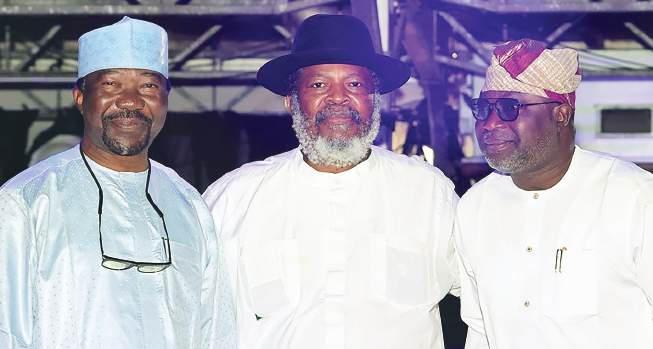
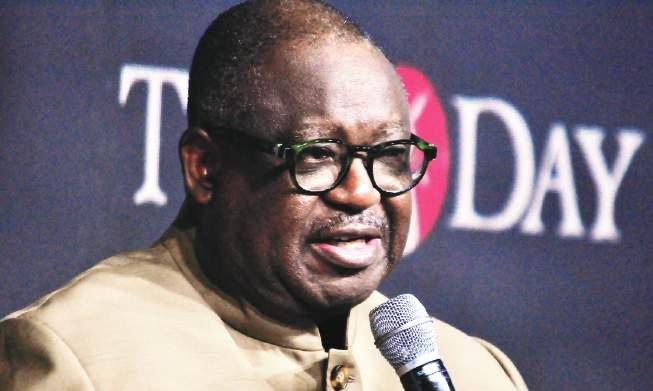
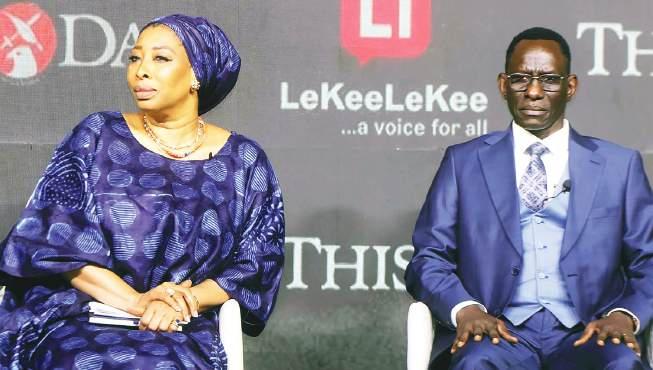
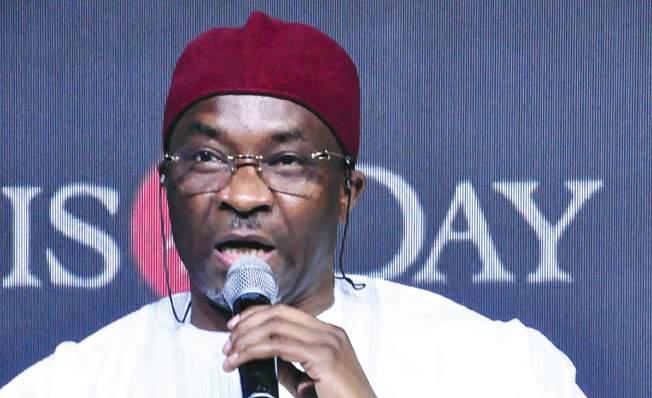
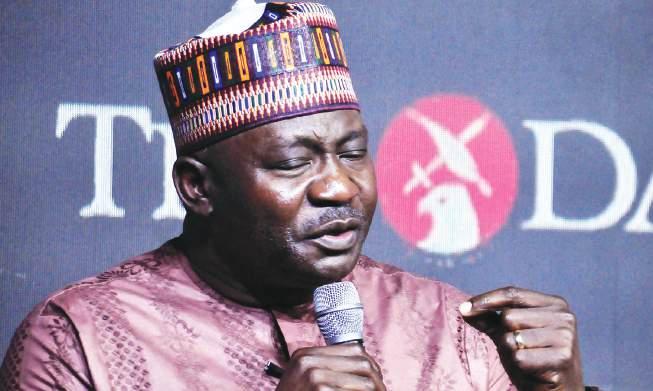
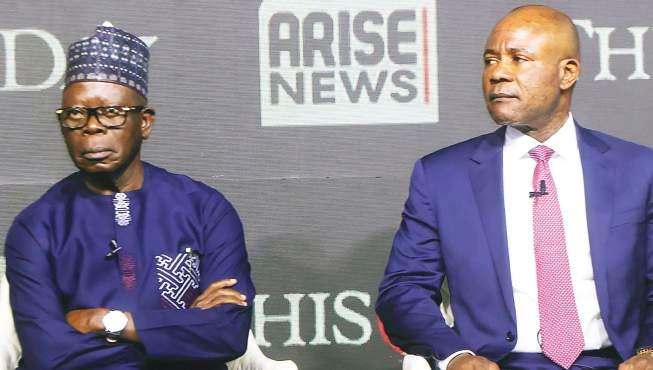
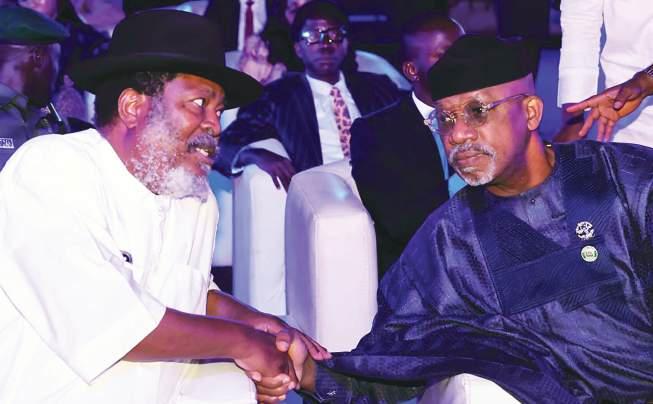
Senator Adams Oshiomhole and Governor Peter Mbah of Enugu State
Hon. Nnenna Elendu-Ukeje and General Lucky Irabor (Rtd)
Deputy Speaker of the House of Representatives, Hon. Benjamin Kalu
Minister of Defence, General Christopher Musa (Rtd)
L-R: Mallam Yakubu of Arewa Consultative Forum; Chairman THISDAY/ARISE News Channel, Prince Nduka Obaigbena; and Senior Special Assistant on Media and Special Duties to the president, Alhaji Tunde Rahman
Governor of Plateau State, Caleb Manasseh Mutfwang
L-R: Former Member of the House of Representatives, Hon. Nnenna Elendu-Ukeje; former Chief of Defence Staff, General Lucky Irabor (Rtd); Senator Adams Oshiomhole; Governor of Enugu State, Dr. Peter Mbah; historian, Bukar Usman; and Senate Leader, Senator Opeyemi Bamidele, during the ARISE News Town Hall on State Police in Abuja, yesterday
ARISE TOWN HALL MEETING ON STATE POLICE
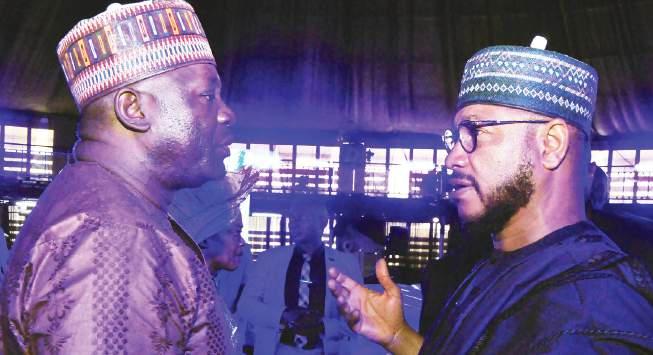
Chairman THISDAY/ARISE News Channel, Prince Nduka Obaigbena( L) and Governor Dapo Abiodun of Ogun State
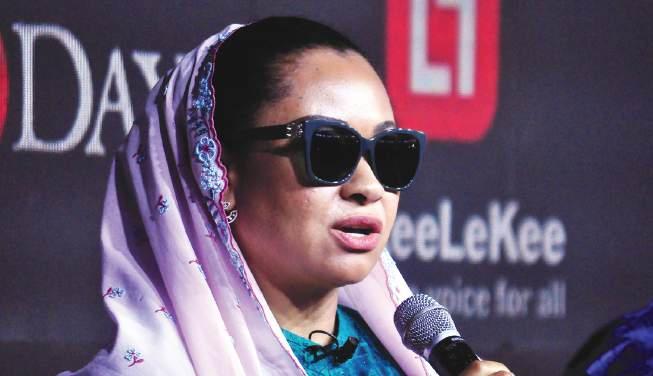
L-R: Minister of Defence, General Christopher Musa (Rtd) and Governor Dauda Lawal of Zamfara State Senator Natasha Akpoti-Uduaghan
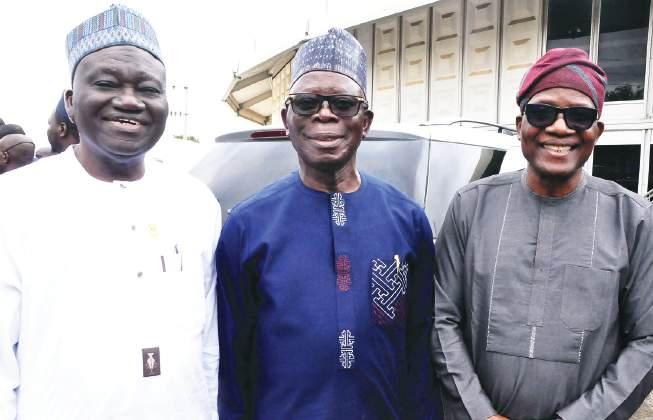
L-R: Issa Aremu, Senator Adams Oshiomhole and Kayode Komolafe
L-R: Representative of the Inspector General of Police (IGP) and Chairman, Steering Committee on State Police, Prof. Olu Ogunsakin; Senator Natasha Akpoti-Uduaghan; Governor of Ogun State, Dapo Abiodun; former Governor of Ogun State, Chief Olusegun Osoba; Governor of Plateau State, Caleb Manasseh Mutfwang; Senior Special Assistant to the President on Research and Public Policy, Dubem Moghalu; former Chairman, National Human Rights Commission (NHRC), Prof. Chidi Anselm Odinkalu; and Executive Secretary, National Human Rights Commission, Dr. Anthony Okechukwu Ojukwu, during the ARISE News Town Hall Dialogue on State Policing, with the theme: “Building a National Consensus for State Police and National Security” Photo: GODWIN OMOIGUI
L-R: Arise News Morning Show Co-anchor, Dr. Reuben Abati; Governor Dauda Lawal of Zamfara state; Hon. Nnenna Elendu- Ukeje; former Chief of Army Staff, General Lucky Irabor (Rtd); Hon. Adams Oshiomhole; Governor Peter Mbah of Enugu State; and Historian, Bukar Usman

Email: deji.elumoye @thisdaylive.com
Alia: LG Autonomy is Working Well in Benue
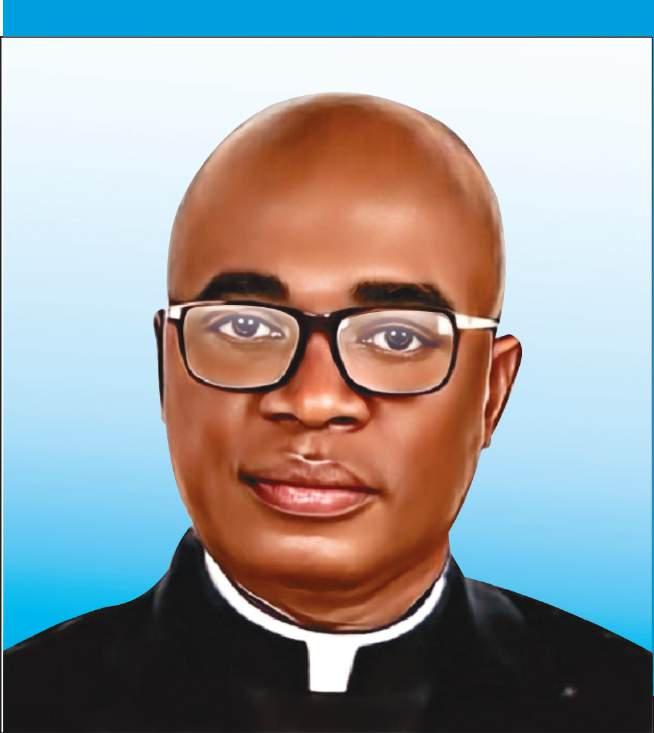
Benue state governor, Rev Father Hyacinth alia, has disclosed that all the 23 local government councils in the state enjoy full autonomy in line with the provisions of the 1999 constitution of Nigeria.
Governor of Benue State, Rev Father Hyacinth Alia has risen in stout defence of local government autonomy saying the third tier of government is working perfectly in his state.
He dismissed insinuations that local government and judicial autonomy were being undermined in the state, insisting that Benue remained fully compliant with provisions of the 1999 constitution of the Federal Republic of Nigeria (As amended).
Briefing newsmen at the State House, Abuja, the governor declared “Our local government autonomy is sacrosanct. The judiciary also enjoys full autonomy. These are verifiable facts.”
According to him, local government councils now independently execute development projects while the state government concentrates on supervision and accountability.
His words: “It has reduced my burden significantly. My responsibility now is to supervise, inspect projects and ensure accountability. Once local governments receive their allocations, they execute their priorities and account for how the resources are utilised.”
Alia hailed the economic reforms being executed by President Bola Tinubu saying the programmes have strengthened the state’s finances, improved security, revived infrastructure and agriculture, and transformed Benue into the nation’s emerging medical tourism hub.
The governor said the increased fiscal space created by the Federal Government’s reforms had enabled his government to invest heavily in roads, healthcare, education, agriculture and security while meeting inherited financial obligations.
He assured residents that every additional resource accruing to the state would continue to be managed prudently and transparently.
“My people should be fully assured that every additional resource accruing to the state will continue to be utilised responsibly and transparently, as we are doing”.
Alia stressed that Benue was on a clear path of growth and development, expressing confidence that the gains recorded under the current administration would continue to deepen.
“The reforms initiated by President Tinubu have altered the development trajectory of Benue. We are among the biggest beneficiaries because they have created opportunities for greater investment in infrastructure, agriculture, healthcare, education, security and human capital development.”
According to him, prudent management of public resources has restored confidence in government, with salaries and pensions now being paid regularly after years of arrears inherited over three years ago.
Alia recalled that when he assumed office, workers and pensioners were owed several months’ salaries and pensions, while some local government workers had outstanding entitlements dating back as much as seven years.
He said the combination of improved federal allocations and stronger internally generated revenue had enabled the state to clear much of the backlog while sustaining prompt payment of workers’ entitlements.
The governor said his government had embarked on an aggressive infrastructure renewal programme, rehabilitating more than 550 kilometres of roads while constructing over 420 kilometres of new roads across the state.
He added that schools and other public facilities were also being rebuilt in the 23 local government areas.
On healthcare, Alia said the rehabilitation and upgrading of primary and secondary health facilities had significantly improved service delivery, attracting patients from neighbouring states and the Federal Capital Territory.
“We have become a medical tourism power. If our state were not safe, people would not be coming. The most vulnerable people are the sick, and if they can travel to Benue for treatment, it tells you that security has improved.”
Alia attributed the development to a de-
liberate strengthening of the state’s security architecture through the Benue Civil Protection Guards, the Joint Task Force code-named Anyam Nyor, community vigilantes and
technology-driven intelligence gathering.
According to him: “I can sit where I am and monitor what is happening in different frontline areas of the state. We have put several
mechanisms in place, but I will not disclose all our strategies because they are part of our security architecture.”
He said the improved security situation had enabled thousands of internally displaced persons (IDPs) to return gradually to their communities and resume farming.
Rather than depend indefinitely on humanitarian assistance, the governor disclosed that the state established cooperative farms for displaced women, supplied tractors, seedlings and other farm inputs, while allowing beneficiaries to own the harvest.
His words: “They only ask us one question at harvest: ‘Does the state want to buy?’ That tells you they are producing enough. We repeated the programme this year because it worked.”
He explained that security personnel initially escorted the farmers to their fields until confidence returned, after which they resumed farming independently. Security agencies were also allocated farmland in vulnerable communities to strengthen confidence and maintain a permanent security presence.
Commenting on agriculture, Alia said the state government had consistently subsidised fertiliser over the past three years, with government paying half the cost while farmers paid the balance.
According to him, the government at the centre recently supplied more than 600 truckloads of fertiliser to the state, in addition to over 6,000 metric tonnes secured through strategic partnerships.
“The state government pays 50 per cent while farmers pay the balance. That is why food production has increased, and we will continue with the programme because it is working.”
NOTE: Interested readers should continue in the online edition on www.thisdaylive.com
Kogi to Become Global Hub for Gemstone and Jewellery Production
Kogi state government has finalised plans to make the Confluence State a hub for Gemstone and Jewellery Production via sustained investment in youth skills development.
Kogi State Government is setting the stage to make the state a global hub for gemstone and jewellery production through sustained investment in youth skills development, enterprise support and effective monitoring of training programmes..
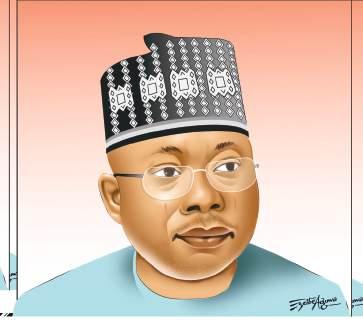
Commissioner for Special Duties and Intergovernmental Affairs, Hon. Sunday Faleke, who disclosed this at the official commencement of the State Youth Mining and Jewellery Craftsmanship Empowerment Programme said the initiative is designed to equip young people with practical skills that will create jobs, encourage entrepreneurship and unlock the vast economic potential of the state’s solid mineral resources.
According to him, government would put in place a robust monitoring and evaluation framework to ensure that beneficiaries translate the knowledge acquired into viable businesses capable of competing in both local and international markets.
determination, Faleke described the gemstone industry as one of the world’s most valuable industries capable of creating wealth and employment.
expertise in mining and jewellery production would help curb illegal exploitation of Kogi’s mineral resources while strengthening security and driving industrial growth across the state.
Also speaking, Commissioner for Solid Minerals, Bashir Gegu, described the empowerment programme as another milestone in the Ododo administration’s commitment to economic diversification through the solid minerals sector, urging participants to remain focused throughout the three-month training and utilise the knowledge acquired to build successful enterprises.
He said the initiative would not only create employment opportunities for young people but also deepen value addition in the mining sector, enabling Kogi State to maximise the economic benefits of its rich mineral deposits.
He described the programme as a fulfilment of Governor Usman Ododo’s vision of empowering youths with practical skills while building a sustainable mining and gemstone value chain that would boost economic growth in Kogi State.
The commissioner appreciated Governor Ododo for his unwavering commitment to youth development and economic transformation, noting that the governor’s support made the programme possible.
He also commended the implementing partners for their dedication throughout the planning and inspection stages leading to the successful take-off of the initiative.
Charging the beneficiaries to approach the training with seriousness, discipline and
He said participants would receive training not only in mining and jewellery craftsmanship but also in entrepreneurship, business management and value addition, preparing them to participate in national and international markets.
Speaking earlier while flagging off the programme, Governor Ododo said the initiative formed part of his administration’s strategy to combat illegal mining, create employment and empower indigenous youths to take advantage of the state’s abundant mineral resources.
He stressed that rather than distributing handouts, the government was committed to equipping young people with skills that would make them financially independent and productive contributors to the economy.
The governor added that developing local
In his remarks, Chief Executive Officer of Malivelihood Luxury, Dr. Olushola Awujuola, described the programme as the first of its kind in Nigeria and West Africa, saying the initiative was designed to move the country beyond exporting raw minerals by developing skilled professionals capable of transforming gemstones into high-value jewellery products for local and international markets.
Awujuola disclosed that the programme attracted over 16,000 applications from across Nigeria and other African countries, reflecting the growing interest in the initiative, adding that beneficiaries would undergo intensive practical training in mining, gemstone identification, jewellery design, craftsmanship and entrepreneurship to prepare them for careers across the gemstone value chain.
FEaturEs
How EV Automobiles, ReTrust Bank Partnership Targets Affordable Electric Vehicle Ownership in Nigeria
Nigeria's transition to cleaner and more affordable transportation received a boost with a strategic partnership between EV automobiles Ltd and ReTrust Microfinance Bank aimed at making electric vehicle ownership accessible to more Nigerians through innovative financing. The collaboration, which also includes Citadel Power, Citadel Estates and Zylus International Group, seeks to address the key barriers to EV adoption by combining vehicle financing, charging infrastructure and energy solutions, while supporting the country's shift towards sustainable mobility. Royce Okolie reports
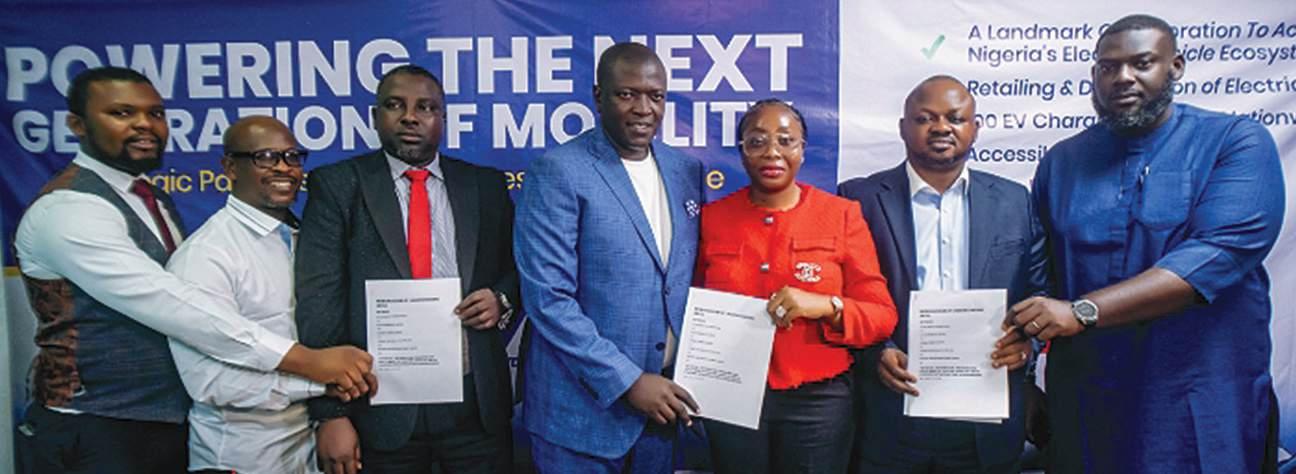
Nigeria’s journey towards cleaner, smarter and more affordable transportation took a major step forward yesterday following the signing of a strategic partnership between EV Automobiles Ltd and ReTrust Microfinance Bank.
The major aim of the partnership is making electric vehicles accessible to ordinary Nigerians through innovative financing solutions. The landmark collaboration, which also involves Citadel Power, Citadel Estates and Zylus International Group, is expected to tackle some of the most significant obstacles slowing the adoption of electric vehicles in Nigeria, particularly high acquisition costs, inadequate financing options and insufficient supporting infrastructure.
At the centre of the initiative is a consumer financing programme that will allow qualified Nigerians to purchase brand-new electric vehicles through affordable credit facilities provided by ReTrust Microfinance Bank.
This model could become a major catalyst for accelerating the country’s transition from petrol-powered mobility to cleaner and more sustainable transportation systems.
For many Nigerians, the dream of owning a brand-new vehicle has become increasingly difficult due to inflationary pressures, exchange rate fluctuations and the rising cost of imported automobiles.
The emergence of electric vehicles has offered hope for lower transportation costs and reduced dependence on petrol and diesel, but the relatively high upfront cost of acquisition has remained a major barrier.
The new partnership seeks to bridge that gap by spreading the cost of ownership over manageable repayment periods, thereby making electric mobility available to a wider segment of the population.
The initiative comes at a period when Nigeria is witnessing one of the most significant transformations in its transportation sector in decades. Since the removal of fuel subsidies and the subsequent increase in petrol prices, businesses and households have struggled with soaring transportation expenses.
Commercial transport operators have faced shrinking profit margins, while private vehicle owners continue to grapple with rising fuel costs and maintenance expenses associated with ageing internal combustion engine vehicles.
Against this backdrop, electric vehicles are increasingly being viewed not merely as an environmental necessity but as an economic alternative capable of reducing operating costs and improving mobility efficiency.
Speaking during the signing ceremony, Dr. Kennedy Okonkwo, Group Managing Director of NEDCOMOAKS , described the partnership as a timely intervention designed to respond to the changing realities of Nigeria’s transportation landscape. According to him, the rising cost of petrol has made the transition to electric mobility more urgent than ever before.
He noted that wider adoption of electric vehicles would significantly reduce dependence on fossil fuels while lowering the cost of transportation for both businesses and individuals.
Okonkwo explained that the partnership combines expertise from the automotive, financial, energy and real estate sectors to create an integrated ecosystem capable of supporting the growth of electric mobility
He stated that providing access to vehicles without simultaneously developing charging infrastructure and financing mechanisms would not deliver the desired transformation.
Instead, he said the partnership focuses on building a complete value chain that addresses vehicle supply, electricity access, charging infrastructure and consumer affordability.
“The rising cost of fuel makes the transition to electric vehicles increasingly important for Nigerians seeking more affordable means of transportation,” he said.
Studies have shown that the lifetime ownership costs of electric vehicles can be substantially lower than those of traditional vehicles, particularly in countries where fuel prices are high and electricity is relatively affordable.
Also speaking at the event, the Managing Director of ReTrust Microfinance Bank, Oladimeji Babatunde, said the bank would play a central role in democratizing access to electric mobility by providing affordable financing to qualified customers.
He explained that the initiative would allow more Nigerians to own new electric vehicles rather than continue relying on imported second-hand automobiles and ageing petrol-powered cars that often require expensive maintenance.
According to Babatunde, eligible customers will have access to flexible credit arrangements tailored to their income levels and repayment capacities.
He noted that reducing the burden of large upfront payments would encourage more Nigerians to embrace environmentally friendly transportation alternatives.
“The financing model is designed to remove one of the biggest barriers to electric vehicle ownership, which is affordability,” he said.
Financial experts have repeatedly identified limited access to consumer credit as one of the major constraints affecting vehicle ownership in Nigeria. Unlike developed economies where automobile financing is common, many Nigerians still purchase vehicles through outright cash payments, making ownership difficult for middleincome earners and small business operators. Microfinance-led interventions such as this are expected to play an important role in changing that narrative.
For commercial operators including taxi
drivers, logistics companies, ride-hailing businesses and delivery services, the implications could be particularly significant.
Electric vehicles offer lower daily operating expenses because charging costs are substantially cheaper than petrol consumption. For businesses operating multiple vehicles, the savings could translate into improved profitability and more competitive pricing.
The partnership also has broader implications for Nigeria’s environmental sustainability agenda.
Transportation remains one of the major contributors to urban air pollution in major cities such as Lagos, Abuja and Port Harcourt. Increased adoption of electric vehicles could help reduce carbon emissions, improve air quality and support Nigeria’s commitments to global climate targets.
Beyond environmental benefits, the development of an electric mobility ecosystem has the potential to stimulate job creation across several sectors including vehicle assembly, charging infrastructure deployment, maintenance services, battery management and renewable energy solutions.
Speaking further at the event, Chief Executive Officer of Zylus International Group, Dr. Tosin Olatujoye, said the high cost of vehicle acquisition remains one of the biggest challenges facing the electric vehicle market in Nigeria.
According to him, many consumers are already interested in cleaner and more efficient transportation alternatives but are discouraged by the initial purchase price of new vehicles.
Olatujoye described the partnership as a practical private-sector response to Nigeria’s evolving mobility needs and growing demand for sustainable transport solutions.
He explained that the collaboration goes beyond vehicle sales and financing by focusing on the broader infrastructure necessary to support long-term growth in the electric vehicle market.
According to him, investments in charging stations and power solutions will be essential to ensuring confidence among consumers considering the transition to electric mobility.
The inclusion of Citadel Power in the arrangement reflects the recognition that reliable electricity supply and charging infrastructure are critical components of
a successful electric vehicle ecosystem. Globally, one of the major drivers of electric vehicle adoption has been the availability of convenient charging options both at homes and public locations.
Nigeria’s electricity challenges have often been cited as potential barriers to EV adoption. However, industry experts argue that innovations involving solar energy, independent power systems and dedicated charging stations could help overcome these obstacles.
By integrating vehicle distribution, financing and charging infrastructure within a coordinated framework, the partners hope to create a model capable of accelerating adoption rates while improving consumer confidence.
This initiative without any iota of doubt could encourage additional private-sector investment in electric mobility and inspire similar collaborations across the country.
The Nigerian automotive industry is already witnessing growing interest in electric vehicles as global manufacturers continue to shift investments away from conventional internal combustion technologies toward cleaner alternatives.
As international markets move rapidly toward electrification, there is increasing recognition that Nigeria must position itself to participate in the global transition rather than remain dependent on obsolete technologies.
The partnership between EV Automobiles, ReTrust Microfinance Bank and its partners therefore represents more than a commercial arrangement; it signals the emergence of a new vision for mobility in Africa’s largest economy.
For consumers burdened by rising fuel costs, businesses searching for operational efficiencies and policymakers seeking sustainable solutions, the initiative offers a glimpse into what the future of transportation in Nigeria could look like.
As electric mobility gains momentum worldwide, collaborations that combine technology, financing and infrastructure may ultimately determine how quickly Nigeria joins the global movement toward cleaner and more sustainable transportation.
For now, the partnership stands as one of the most ambitious private-sector efforts yet to redefine vehicle ownership and accelerate the adoption of electric mobility in Nigeria’s rapidly evolving transportation landscape.
L-R: Head Deposit Mobilisation Retrust Microfinance Bank, Mr. Prosper Emakpor; Company Secretary Retrust Microfinance Bank, Barr. Harris Onyemaechi; Managing Director, Retrust Microfinance Bank, Mr. Oladimeji Babatunde; Group Managing Director, Nedcomoaks Group, Dr. Kennedy Okonkwo; Chief Executive Officer of Victoria Crest Homes, Mrs. Ichechi Okonkwo; Group CEO Zylus Group International, Dr. Tosin Olatujoye and Chief Operating Officer of EV Automobiles, Mr. Obiora Okafor during the strategic partnership signing ceremony of Retrust MFB in Lagos…. recently in Nigeria.
Alfred
…truth behind the headlines, conspiracies, cover-ups, trials and triumphs
Random Interviews or Staged Access? When Billionaires Suddenly Become Accessible with Lanre
AEuropean content creator arrived in Lagos with a camera, a roaming script, and a question that has built a global following: “How did you make your money?”
Within days, some of Nigeria’s most guarded billionaires, figures typically shielded by layers of protocol, were appearing in what looked like casual street encounters, offering crisp, distilled accounts of wealth built over decades.
Predictably, the clips travelled fast; so did the scrutiny. What first appeared as spontaneous access to power is now drawing closer examination, with viewers and industry observers questioning the mechanics behind the encounters, the simplicity of the answers, and the widening gap between the series’ street aesthetic and the reality of elite access.
His name is James Dumoulin and a careful glance at his routine reveals how his camera frame holds movement, light, and the looseness of pavement conversations.
The exchange often begins without ceremony. “What do you do?” “How did you make your money?” The respondent, often a titan of finance or industry, pauses, smiles, answers with a composure established for broadcast. Yet beneath the spontaneity, something harder begins to show. The street looks less like a street and the encounter feels less like an encounter. Not a few viewers have complained that Lagos, restless and unscripted in its natural state, has been turned into a stage by the content creator’s designs.
Dumoulin, co-founder of the financial literacy platform School of Hard Knocks, has built a global following on a deceptively simple formula. He approaches wealth in motion and asks the questions people rehearse silently in their heads. His interviews promise access stripped of ceremony, a democratic breach into rooms long sealed by protocol and power.
The appeal rests in proximity. A viewer watches a stranger ask what they themselves would ask if courage arrived without warning. The questions land clean and direct: the first million, the biggest year, the mistake that nearly ended everything, the discipline that held the line. The answers come distilled, polished, and generous enough to feel like instruction.
Dumoulin’s Nigerian series captures some of the continent’s most influential figures. In one of his videos, private equity leader Adesuwa Okunbo Rhodes, speaks authoritatively about capital, risk, and the vast informal economy pulsing beneath formal markets. Chairman of United Bank for Africa (UBA), Tony Elumelu frames entrepreneurship as endurance, a long discipline shaped by restraint and vision. Kola Karim describes instinct as a tactile force, a way of sensing deals before numbers confirm them. Kennedy Okonkwo translates real estate success into the language of persuasion and persistence.
And Africa’s richest businessman, Aliko Dangote, disclosed that his company generated $10 billion in revenue in one quarter, highlighting a strategy focused on backward integration and essential commodities. He emphasized re-investing capital into Africa and suggested his true net worth exceeds Forbes estimates due to private industrial holdings. Watch the full interview on Instagram.
Dumoulin’s appeal lies largely in access. His format places viewers within close range of people they would ordinarily never encounter, asking the sort of questions many would hesitate to raise in person. He focuses on familiar markers of success: how the first million was made, the most profitable year, major setbacks, and the habits that sustained growth. The responses are typically concise, polished, and framed as
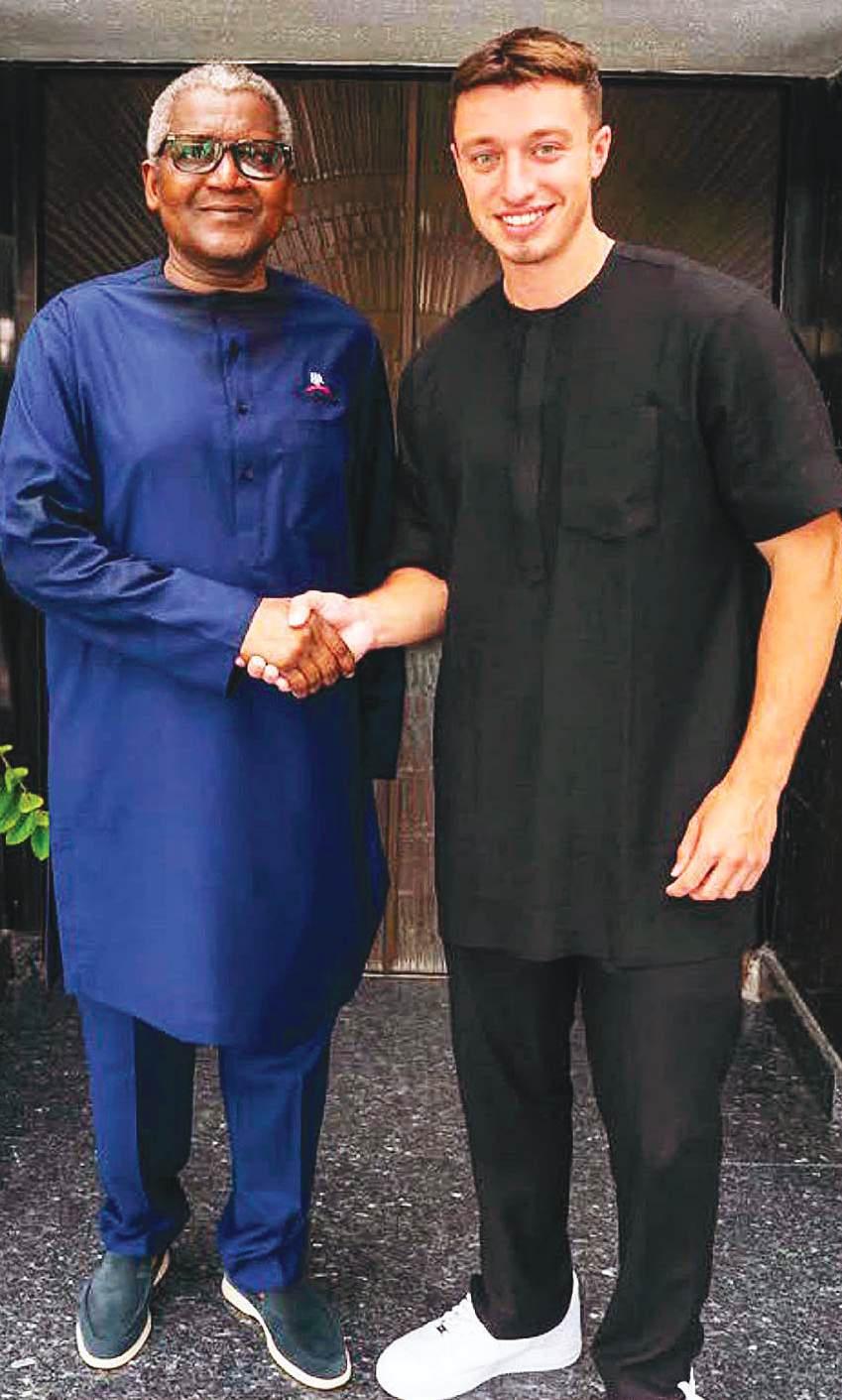
AlhajiAlikoDangoteandJamesDumoulin
practical lessons.
Each interview compresses long business careers into short, easily digestible segments. The exchanges are structured, clear, and consistent with the platform’s established format.
However, as the series has moved toward higher-profile subjects, questions have emerged about its presentation. Industry observers note that access to billionaires and top executives is typically managed through formal channels, including communications teams and scheduled engagements. The casual, street-style framing contrasts with the level of coordination such interviews are likely to require.
Viewers have also pointed to the production quality. Locations appear carefully selected, lighting is controlled, and interviewees often seem prepared for the conversation. This has led to suggestions that the “chance encounter” narrative functions primarily as a stylistic choice.
The signature opening question: “How did you make your money?” remains central to the
format. Its directness has been widely praised for cutting through abstraction and prompting clear origin stories. At the same time, critics argue that responses from high-level executives often sound rehearsed, with little visible hesitation or surprise.
A recurring pattern can be observed across the interviews. Wealth creation is frequently framed around solving problems, maintaining discipline, exercising patience, and learning from failure. While these themes provide useful guidance, they tend to simplify the underlying processes.
Analysts note that large-scale wealth creation typically involves a broader set of factors, including access to capital, regulatory conditions, partnerships, market timing, and institutional support. These elements are rarely explored in depth within the short interview format.
The structure of the series places limits on how much detail can be covered. Conversations are brief and designed for wide online consumption, which encourages clarity and speed over complexity. As a result, deeper issues, such as financing
structures, policy influence, or systemic risks, receive limited attention.
This is particularly relevant in Nigeria, where business success often reflects a mix of formal and informal economic activity. The informal sector alone represents a significant share of economic output, shaped by adaptability and local innovation. Capturing that complexity requires more extended engagement than the format typically allows.
Despite these concerns, audience interest remains strong. The videos attract significant engagement across platforms, with viewers drawn to the rare access and the simplicity of the questions. For many, the value lies in hearing directly from individuals who have built large enterprises. Some media analysts argue that access itself has become a defining feature of the brand. The ability to secure conversations with high-profile figures, presented in an informal setting, distinguishes the series from conventional business interviews.
At the same time, others note that the interviews often stop short of deeper scrutiny. Follow-up questions on issues such as initial funding sources, regulatory challenges, or major business risks are limited. This keeps the tone largely inspirational rather than investigative.
Interview with industrialist Aliko Dangote illustrates both the strengths and constraints of the format. Dangote discusses large-scale earnings, industrial expansion, and strategies such as import substitution and local production. The exchange provides a clear overview of his business philosophy and long-term goals, including a focus on legacy and industrial development.
The interview succeeds in translating complex operations into a concise narrative. However, it also reflects the broader limitation of the format: extensive business histories are reduced to short summaries, with minimal exploration of underlying structures.
The continued popularity of the series suggests that its core appeal remains intact. Viewers gain exposure to high-level perspectives in a format that is accessible and easy to follow. For younger audiences, particularly aspiring entrepreneurs, the interviews offer relatable entry points into discussions about wealth creation.
At the same time, growing awareness of the production process has begun to shape audience perception. Viewers are increasingly conscious of how the interviews are arranged and presented, which affects how authenticity is interpreted. Lagos, with its fast-moving and highly visible business environment, highlights this tension. The city’s complexity and unpredictability contrast with the structured nature of the interviews, making the production elements more noticeable. Even so, the series continues to capture influential voices across sectors. It documents key ideas, personal philosophies, and business strategies from individuals who have shaped major industries.
Observers suggest that the format could evolve by incorporating more detailed follow-up questions and allowing for longer exchanges. This would provide greater insight into the mechanics of wealth creation, particularly in complex markets such as Nigeria.
For now, Dumoulin’s approach remains defined by brevity, access, and consistency. Its success reflects a strong audience appetite for direct, simplified accounts of success, even as questions about depth and presentation continue to surface.
The Nigerian episodes mark a significant expansion of the series into one of Africa’s most dynamic economies. They also highlight the balance the format must strike between accessibility and depth as it engages increasingly high-profile subjects.

KADUNA’S CORRIDOR OF OPPORTUNITIES
Uba Sani is rebuilding the state through infrastructureled development, reckons
ABIODUN OLUWADARE
See page 21
WHAT NATO KNOWS THAT NIGERIA DOES NOT
Nigeria is being fought over without knowing a contest is on, contends JOSHUA J. OMOJUWA
See page 21
EDITORIAL
OF POPULATION,

MAJORITY OJI argues the need to develop a framework that honours merit, productive enterprise, and responsible leadership
FORGING A UNIFYING NATIONAL IDENTITY
Nigeria's greatest challenge today extends beyond just economic or political issues; it is fundamentally moral and cultural. The real concern lies in the gradual decline of core values within our national consciousness. Achieving the lasting transformation Nigeria seeks cannot rely solely on policy reforms, activism, or legislation. Sustainable progress requires a unifying ideology, a shared system of values and beliefs that influence how citizens think, act, and interact with one another. Without this ideological foundation, reforms will merely be fleeting initiatives that fade with each new administration.
History demonstrates that every significant national change has stemmed from more than just legal frameworks. It has been upheld by a culture that consistently promotes integrity, discipline, responsibility, and service. If Nigeria aspires to create a prosperous and stable future, it must first restore these essential values.
There was once a time when Nigeria was seen as a society rooted in strong moral values, community living, and mutual respect. While no society is perfect, many Nigerians recall an era when honesty, integrity, accountability, and public decency were highly regarded. Excessive greed was less praised, drug abuse was less prevalent, and communities shared a stronger sense of collective responsibility. People recognized that their actions reflected not only on themselves but also on their families and neighborhoods.
The Nigerian family system played a crucial role in reinforcing these values. Children were taught to show respect for their elders, while elders embraced their roles as custodians of culture and moral discipline. Trust was the foundation of community life. Neighbours looked out for each other's children, doors were often left unlocked without fear of crime, and communities acted as extended families. Roads were usually safe to travel at any time of day, and protecting one's family name held significant social weight.
Education was once seen as one of the most reliable avenues for personal growth and national progress. Teachers were highly respected, schools upheld strong academic standards, and scholarship was valued. Government institutions, despite their flaws, typically demonstrated a greater sense of accountability to the public. Public infrastructure such as railways, water

boards, electricity authorities, postal services, and agricultural extension programmes received focused attention and operated more efficiently than they do today. Elections, while not perfect, often featured authentic political campaigns, and many citizens still felt their votes had weight.
Nigeria’s decline was not sudden; it resulted from years of weakening institutions, shifting political motivations, and the slow decline of shared ethical values. Many analysts point to the Second Republic under President Shehu Shagari as a key period when a noticeable cultural shift began to emerge. Public displays of wealth started to garner admiration, regardless of how that wealth was obtained. The role of political office began to transform from a means of public service into a pathway for personal gain. The celebration of sudden wealth began to overshadow the respect traditionally given to honesty, scholarship, diligence, and integrity.
The subsequent military regimes did little to counteract this trend. Frequent interruptions to democratic governance hampered institutional growth and accountability. While some military governments launched anti-corruption initiatives and enacted reforms, extended military rule centralized power, diminished institutional checks and balances, and normalized governance through decrees rather than democratic processes.
With the return to civilian rule in 1999, democracy reinstated constitutional governance but did not fully restore public trust. Successive administrations faced challenges from deep-seated corruption, weak institutions, patronage politics, and inconsistent policy execution. Nigerians began to see public
officials leading extravagant lifestyles while essential public services and infrastructure continued to decline.
Rather than investing in agriculture, manufacturing, education, healthcare, research, and industrialization, the pathway to wealth and opportunity became increasingly dominated by political influence and patronage networks. Political competition shifted focus away from serving the public to controlling state resources. Nigeria’s increasing reliance on crude oil further intensified these changes.
While oil wealth brought in significant public revenue, it also fostered powerful incentives for rent-seeking behaviour over productive economic activity. Economists often refer to this trend as the "resource curse," where countries rich in natural resources become more susceptible to corruption, institutional weaknesses, and fierce political competition over public wealth. Nigeria is frequently mentioned as a key example in this regard.
The repercussions extend well beyond the political realm. Society has gradually begun to reward wealth without questioning its origins. The value of hard work has diminished, while shortcuts to riches have gained wider acceptance. Young individuals, who once aimed to succeed through education, entrepreneurship, skilled professions, or innovation, are increasingly influenced by examples that suggest political connections, corruption, fraud, or patronage provide quicker routes to success.
This transformation has undermined the moral values that once promoted discipline, patience, excellence, and honest labour. Communal living has slowly given way to a rise in individualism. Respect for elders and public institutions has weakened, as has trust among neighbours. Attributes such as character, integrity, and community service are increasingly overshadowed by the pursuit of material success.
The more the standards of accountability get eroded, governance increasingly become vulnerable to the sway of political godfathers, patronage networks, and the tactics of intimidation and violence that overshadow legitimate electoral processes.
Oji is a Professor of Mass Communication at Delta State University, Abraka
Nigeria is being fought over without knowing a contest is on, contends JOSHUA J. OMOJUWA
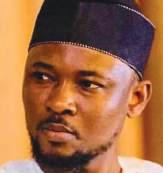
WHAT NATO KNOWS THAT NIGERIA DOES NOT
In Ankara this week, at the NATO Summit, a speaker who works at the intersection of intelligence and strategic communications said something that has refused to leave me since: "We are at war in the information domain." He was speaking to a room whose instincts run east, to Russia, to Ukraine, to the frontiers of an alliance built for a different century. I sat there thinking about Nigeria and the continent it calls home.
That is the thing about the cognitive domain. It does not respect the agenda of the room. The war the speaker described is not a European war that Africa watches from the gallery. It is a global condition, and Nigeria is already inside it, mostly as territory rather than as combatant. We are being fought over without knowing a contest is on.
Cognitive warfare is the contest for how people think, what they believe, whom they trust and, ultimately, how they behave. As one line from the sessions put it, whoever controls the narrative controls the mood. All warfare, a psychologist reminded the room, is psychological. The tanks and the drones are downstream of the story. The story decides whether a population resists, surrenders, fractures or rallies.
Now consider what artificial intelligence has done to this ancient game. One of the most sobering sessions in Ankara traced AI's journey from enabler to platform. It is no longer a tool that assists propagandists. It is the terrain itself. The room discussed LLM grooming, where hostile actors flood the internet with content designed to be swallowed by the large language models the rest of us then consult as oracles. It discussed data poisoning, the deliberate corruption of the information these systems learn from. It discussed synthetic audiences, artificial crowds manufactured to make fringe opinions look like consensus. Nigeria builds none of these systems. Nigeria consumes all of them. Every Nigerian asking a chatbot a question about our politics, our economy or our history is drinking from a well dug, and potentially poisoned, elsewhere.
If you want to see what losing the cognitive war looks like in real time, look next door. The Sahel was discussed in Ankara with a candour Western officials rarely manage in public: a walkover, a retreat, a new order being challenged in practice while the old one drafted communiqués. Ibrahim Traoré is not merely governing Burkina Faso. He has become a narrative, one that travels through the timelines of young Africans from Dakar to Port Harcourt,
packaged with speed, scale and visibility that no ECOWAS press release has ever achieved. You do not have to agree with the message to respect the machinery. The machinery is winning. Nigerian minds are part of the territory it is winning.
And Nigeria is an attacker's dream. The scholars in Ankara kept returning to Social Identity Theory, the finding that group membership shapes individual behaviour more powerfully than argument ever will. Us versus them is the oldest exploit in the human operating system. Nigeria runs on it. Ethnicity, religion, region: our fault lines are pre-dug trenches, and our political class spends every election cycle deepening them for free. A foreign actor seeking to destabilise Nigeria would not need to invent a single division. They would only need to amplify the ones we hand-deliver daily, and with 2027 approaching, the propaganda pipelines are already warming up.
So what does contesting the domain actually look like? The Ankara sessions were unusually practical on this. One scholar made the argument I found most useful: the democratic instinct, the insistence on facts and transparency, is necessary but insufficient, because it is structurally defensive. You are forever correcting, rebutting, and arriving after the lie has finished its first lap around the world. Her prescription was an offensive strategy. Another line from the sessions compressed it further: do first, it gives you a story. The side that acts owns the narrative.
Offensive here does not mean lying. It means initiative. It means humour, which travels further than any rebuttal. It means story, because human beings are not persuaded by fact-checks, they are persuaded by narratives they can inhabit. Ukraine understood this from the first hours of the invasion, and the framing was brutally simple: survive or do not, win or lose, no in-betweens. Clarity itself became a weapon.
Omojuwa is chief strategist, Alpha Reach/BGX Publishing
Uba Sani is rebuilding the state through infrastructure-led development, reckons ABIODUN OLUWADARE
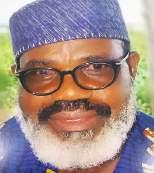
KADUNA’S CORRIDOR OF OPPORTUNITIES
"Infrastructure is not an expenditure; it is the foundation upon which prosperous societies are built.
There is an old saying in development economics that roads do more than connect places; they connect possibilities. The same may be said of bridges, schools, hospitals, water systems and every other piece of public infrastructure that quietly shapes the everyday lives of citizens. They are not merely engineering projects. They are investments in human dignity, economic productivity and the future of society.
Imagine, for a moment, a tomato farmer in Kajuru setting out before dawn at the peak of the rainy season. For years, his greatest challenge was never the fertility of his land, the quality of his seedlings or the abundance of his harvest. His greatest challenge began only after the tomatoes had been picked. Deep gullies, broken culverts, flooded river crossings and impassable roads often turned what should have been a short journey into an exhausting ordeal. By the time his produce reached Kaduna metropolis, a significant portion had already deteriorated. The loss was not merely agricultural; it was economic, social and deeply personal. Income disappeared before it was earned. School fees became difficult to pay. Medical bills were postponed. Another farming season ended with frustration rather than fulfilment.
Today, that story is gradually changing. The journey that once consumed almost two hours can now be completed in roughly forty minutes along the newly constructed Gadan Gayan–Gwaraji–Kujama road. Transporters who previously avoided the route are returning. Buyers are arriving earlier. Farmers are reaching markets while their produce is still fresh. What appears to be an ordinary road project on paper has, in reality, become a corridor of opportunity for thousands of rural households.
That single story captures the true meaning of infrastructure. Its value is rarely measured by the kilometres of asphalt laid, the tonnes of steel erected or the billions of naira appropriated in annual budgets. Its real value is measured in opportunities created, businesses expanded, investments attracted and lives transformed.
History offers compelling evidence of this reality. The countries that fundamentally altered their economic fortunes rarely began with factories or skyscrapers. They began by building roads, railways, ports, schools, hospitals and water systems that enabled people and commerce to move efficiently. Infrastructure became the silent engine that powered industrialisation, expanded markets, reduced poverty and improved the quality of life.
This principle is increasingly shaping governance across Africa. Ethiopia invested heavily in rural roads to connect
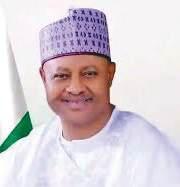
farming communities with markets. Morocco transformed rural accessibility through an ambitious road programme that significantly reduced poverty in previously isolated communities. Ghana's sustained investment in transport infrastructure strengthened regional commerce and enhanced investor confidence. Rwanda similarly recognised that infrastructure was not simply about physical construction but about creating an enabling environment for economic transformation.
The lesson from these experiences is remarkably consistent. Infrastructure is not consumption. It is productive capital. Every kilometre of road constructed has the potential to generate multiple layers of economic activity. Better roads reduce transportation costs. Lower transportation costs encourage trade. Increased trade stimulates investment. Investment creates employment. Employment improves household income, which in turn expands local demand and strengthens economic growth.
It is against this broader development philosophy that the infrastructure agenda of Governor Uba Sani deserves careful examination.
When Senator Uba Sani assumed office as Governor of Kaduna State on 29 May 2023, he inherited a state confronted by significant developmental and security challenges. Rural communities remained physically disconnected from commercial centres. Years of insecurity had disrupted farming activities, weakened access to education and healthcare, discouraged private investment and widened the development gap between urban and rural communities.
Rather than approaching these challenges as isolated policy problems, the administration adopted what increasingly appears to be an integrated development strategy, placing infrastructure at the centre of governance. Roads would reconnect communities. Bridges would eliminate seasonal isolation. Water projects would restore essential public services. Schools would strengthen human capital.
Oluwadare is a Professor of Political Science, Nigerian Defence Academy, Kaduna.
Editor, Editorial Page PETER ISHAKA
Email peter.ishaka@thisdaylive.com
OF POPULATION, HOPES AND ASPIRATIONS
Nigeria needs a serious conversation on population control
With the theme, ‘Realising the hopes and aspirations of young people for their futures,’ the 2026 World Population Day will be marked tomorrow. It focuses on how young people are navigating a rapidly changing world while examining their aspirations regarding education, mental well-being and family life. With a demographic bulge that is putting our country in a very difficult and potentially explosive situation, we hope that authorities in Nigeria and critical stakeholders will use the occasion to begin a conversation on the need for sustainable population. If a sustainable society is the one with moderate population growth that enables its members to achieve a high quality of life, it goes without saying that a growing population that is not matched with commensurate socio-economic development can only breed chaos. That precisely is the essence of the World Population Day established by the United Nations (UN) and first observed on 11th July 1989, to raise global awareness on the issue.

ready stretching the few infrastructure facilities in the country and contributing in large measure to the poor standards of living, there is indeed an urgent need to address the dire consequences of this challenge.
The World Bank has in recent years warned that Nigeria is currently undergoing the worst unemployment crisis in its history. Three years ago, it authored a report, ‘Of Roads Less Travelled: Assessing the Potential for Migration to Provide Overseas Jobs for Nigeria’s Youth’. The report particularly raised the alarm over the nation’s expanding working-age population combined with scarce domestic employment opportunities amid dwindling resources. This, according to the report, was creating high rates of unemployment, especially for the growing youth population.
Available figures paint a dire situation of millions of Nigerian youths roaming the streets looking for work but finding none
Nigeria, the seventh most populous country in the world, has a fertility rate that outstrips its economic growth. And for more than two decades, the economy has been unable to create enough jobs to absorb its growing army of graduates. Available figures paint a dire situation of millions of Nigerian youths roaming the streets looking for work but finding none. The clear and present danger of such a high level of idleness among millions of young persons are already manifest in the high level of crimes in virtually every corner of the country. Joblessness and frustrations are evidently fuelling the frequent cases of unrest across the country.
According to the United Nations population prediction, by the year 2050, three of the 10 most populous countries in the world will be in Africa, with more than a quarter of them in Nigeria. Against the background that this uncontrolled population growth is al-
EDITOR SHAKA MOMODU
DEPUTY EDITOR WALE OLALEYE
MANAGING DIRECTOR ENIOLA BELLO
DEPUTY MANAGING DIRECTOR ISRAEL IWEGBU
CHAIRMAN EDITORIAL BOARD OLUSEGUN ADENIYI
EDITOR NATION’S CAPITAL IYOBOSA UWUGIAREN THE OMBUDSMAN KAYODE KOMOLAFE

EDITOR-IN-CHIEF/CHAIRMAN NDUKA OBAIGBENA
GROUP EXECUTIVE DIRECTORS ENIOLA BELLO, KAYODE KOMOLAFE, ISRAEL IWEGBU
DIVISIONAL DIRECTORS SHAKA MOMODU, PETER IWEGBU, ANTHONY OGEDENGBE
DEPUTY DIVISIONAL DIRECTOR OJOGUN VICTOR DANBOYI
SNR. ASSOCIATE DIRECTOR ERIC OJEH
ASSOCIATE DIRECTOR PATRICK EIMIUHI
CONTROLLERS ABIMBOLA TAIWO, UCHENNA DIBIAGWU, NDUKA MOSERI
DIRECTOR, PRINTING PRODUCTION CHUKS ONWUDINJO
TO SEND EMAIL: first name.surname@thisdaylive.com
Letters to the Editor
The essence of the World Population Day is to engender conversations on how individual well-being and socio-economic development of society are often conditioned on population dynamics. It also serves as a reminder for countries like Nigeria that a growing population presents both challenges and opportunities. Indeed, one of the issues that should task authorities in Nigeria is the growing unemployment, especially among young people. A combination of rising unemployment, booming demography, and unfulfilled aspirations, according to the World Bank, result in increasing pressure on young Nigerians to migrate abroad and the stories are not always pleasant for many of them.
It is a notorious fact that most of the people involved in the various crimes that now define our country are youths who if otherwise meaningfully engaged would have been unavailable for those anti-social endeavours. The high rate of out-of-school children and poor output in the education sector also contribute negatively to deepening the problem as the nation churns out a crop of uncompetitive youth in a new world driven by technology, skills, and knowledge.
To effectively tackle these challenges, we must start with the much-needed conversation on population control in Nigeria.
Letters in response to specific publications in THISDAY should be brief (150-300 words) and straight to the point. Interested readers may send such letters along with their contact details to opinion@thisdaylive.com. We also welcome comments and opinions on topical local, national and international issues provided they are well-written and should also not be longer than (750- 1000 words). They should be sent to opinion@thisdaylive. com along with photograph, email address and phone numbers of the writer.
FCT TEACHERS, PUBLIC SERVICE AND THE RULE OF LAW
The events of 6 July 2026, when teachers under the Nigeria Union of Teachers (NUT), FCT Wing, peacefully picketed the venue of the promotion examination at the National Open University, Abuja, should concern every resident of the Federal Capital Territory.
The issue extends far beyond a promotion exercise. It raises fundamental questions about governance, fairness, consistency, and respect for the rule of law within the FCT Administration.
The dispute centres on the controversial policy that makes promotion subject to the availability of vacancies. According to the Union, this policy has left more than 86 percent of otherwise qualified teachers without promotion despite meeting prescribed requirements and passing promotional assessments. The FCT Administration, on the other hand, maintains that promotions must comply with the Public Service Rules and the Guidelines on Ap-
pointment, Promotion and Discipline, including vacancy provisions.
Both parties claim to be acting in accordance with the law. The more important question, however, is whether the current system promotes justice, equity, and institutional confidence.
Teachers remain the foundation of every society. They educate future leaders, professionals, public servants, and policymakers. Any policy that condemns thousands of qualified teachers to prolonged career stagnation inevitably damages morale, reduces productivity, and ultimately affects the quality of education available to children in the Federal Capital Territory.
At the same time, industrial actions that disrupt official processes should never become the preferred mechanism for resolving administrative disagreements. Dialogue, mutual respect, and adherence to lawful procedures re-
main the hallmarks of responsible governance. However, there is another dimension to this debate that deserves equal attention. The FCT Administration has consistently emphasised strict adherence to the Public Service Rules when dealing with teachers’ promotions. Yet many civil servants continue to question whether the same rules are applied uniformly across the Administration. Several examples have generated widespread discussion among public servants. The Permanent Secretary, Treasury and Budget Secretariat reportedly continued in office beyond the statutory retirement point through an extension approved by the Minister of the FCT.
Similarly, the former Director of Procurement reportedly received an extension of service and, upon its expiration, was appointed as a Senior Special Assistant (SSA). Dan Jummai Abejide, Karu, Abuja
RATES AS AT J U LY 9,2026
NESG: Manufacturing, Agriculture, Trade Record Business Activity Expansion in June
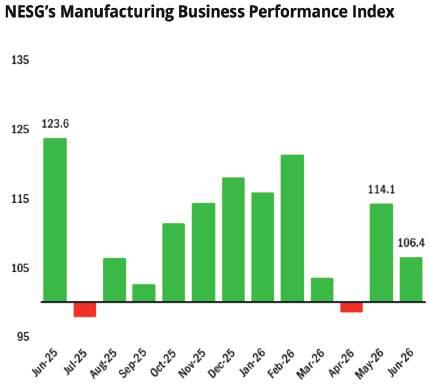
Dike Onwuamaeze
Business activity in the manufacturing sector recorded 106.4 points and remained in the expansion region in June 2026 even though it dropped from 114.1 points it achieved in May 2026 and 123.6 points in June 2025.
This is contained in the NESG Business Confidence Monitor (BCM) Index, which stated that index points below 100 are considered “contraction” while readings above 100 are deemed as “expansion.”
The report also showed that business activity in agriculture rose to 103.9 in June to move into the expansion region from 97.5 it recorded in May 2026 although it represented a decline from 108.9 points that was recorded in June 2025.
The report stated that Nigeria’s business environment expanded for the sixth consecutive month in 2026.
It said: “In June 2026, Nigeria’s business environment remained in the expansion territory. The BCM’s current business performance index
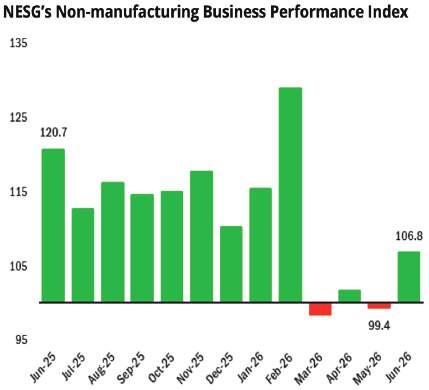
was unchanged at 104.6 points relative to May 2026, but this marked a significant decline from 113.6 points in June 2025.
“Further breakdown indicates uneven performance across sectors in June 2026. Manufacturing and trade remained in expansion, but registered a weaker performance relative to the previous month. Agriculture and non-manufacturing also moved into expansion in June 2026, while services contracted during the month.”
The report stated that key BCM sub-indices,
including general business situation, production, demand conditions, operating profit, financial results, supply order, access to credit, cash flow, and employment, remained in the expansion territory, with more than half recording a stronger performance compared to May 2026.
“By contrast, trade stockpiling moved into contraction, while investment and exports remained depressed. Although the cost of doing business moderated, input prices remained elevated. Firms continued
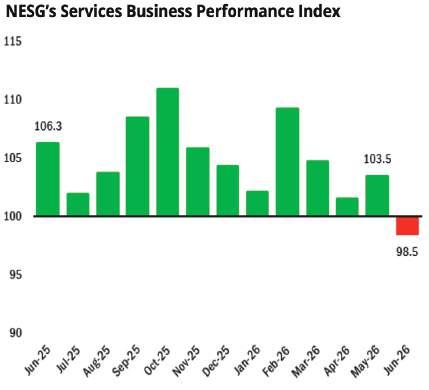
to face major constraints, especially limited access to finance, power outages, high rental costs, and insecurity during the month,” report said.
On business activities in the manufacturing sector, the report said that performance was mixed across the subsectors in June 2026.
“Of the six subsectors that recorded expansion, only textile, apparel & footwear performed better than in May 2026. However, food, beverage & tobacco, and pulp, paper & paper products posted
weaker expansion than in the previous month.
“The other three subsectors (Chemical & Pharmaceutical Products, Wood & Wood Products, and Non-Metallic Products) moved into the expansion territory during the month. Moreover, cement, plastic and rubber products remained in contraction, while basic metal, iron and steel also fell into contraction. The remaining two subsectors stayed at the neutral 100-point level,” it said.
chinedu eze
The Nigeria Civil Aviation Authority (NCAA) and the Nigerian Airspace Management Agency (NAMA) are at daggers drawn over the proposed sharing formula on accruals from the 5 per cent ticket sales charge (TSC) and cargo sales charge (CSC), which run into billions of naira annually.
The National Assembly is currently considering a bill that proposes a major review of
the revenue-sharing formula, which is five per cent of the cost of every ticket sold by domestic airlines.
The proposed bill by the National Assembly seeks to reduce the cumulative of what accrues to NCAA from 56 per cent to 40 per cent and increase NAMA’s allocation from 22 per cent to 40 per cent, a development that has unsettled the two agencies of government, causing a rift between them.
From the current sharing
formula, Nigerian Civil Aviation Authority (NCAA) gets 56 per cent; Nigerian Airspace Management Agency (NAMA) gets 22 per cent; Nigerian Meteorological Agency (NiMet) gets 9 per cent; Nigerian College of Aviation Technology (NCAT), Zaria gets five per cent and Nigerian Safety Investigation Bureau (NSIB) gets eight per cent on the accruals from the five per cent TSC and CSC charges.
The NCAA oversees the
collection and disbursement of the funds, but the National Assembly is considering a new sharing formula, which is the major reason for the clash between the two agencies.
The disagreement has given rise to media brickbats with NCAA saying that if its own share of the funds is reduced from 56 per cent to 40 per cent it will severely affect its operations and may lead to infringement on air safety.
On Tuesday, the Nigeria Civil Aviation Authority
warned that any move to reduce its statutory revenue could undermine aviation safety by weakening its capacity to carry out effective regulatory oversight.
Director of Public Affairs and Consumer Protection at NCAA, Mr. Michael Achimugu, gave the warning during a chat with journalists in Abuja
The Director warned that such a move, if actualised, could weaken the authority’s financial position and would
make it unable to meet its regulatory oversight. He reiterated that safety could be compromised and all travellers, regardless of status, would be at grave risk.
Achimugu said: “The NCAA even requires more money. Let’s not forget that the federal government makes deductions from what even comes to the NCAA, in the first place.”
FCMB Asset Management Upgraded to A(NG)/A1(NG) by GCR Ratings
Kayode tokede
FCMB Asset Management Limited (FCMBAM), the asset management arm of FCMB Group Plc, has received an upgrade to its national scale long-term and short-term issuer ratings of A(NG) and A1(NG), from A-(NG) and A2(NG), by GCR Ratings (GCR), a leading pan-African credit rating agency. The outlook on the ratings remains stable.
The upgrade is anchored on FCMBAM’s competitive resilience and financial discipline, alongside the strengthened credit profile of FCMB Group Plc. GCR
highlighted FCMBAM’s decade-long track record of strong performance, well-established brand franchise, diversified product suite, and robust distribution network as key drivers of its standalone strength. These are further supported by consistent earnings growth and a disciplined, unleveraged balance sheet.
According to GCR, FCMBAM’s competitive position is supported by “its relatively long track record, strong brand franchise, established product and geographical distribution network, and cross-selling opportunities,” with the rating
agency noting that FCMBAM ranks among the top five asset managers in Nigeria, with an estimated 5% share of a fragmented market, as at 31 December, 2025.
The company’s financial performance underpinned the upgrade, with revenue growing by 30% and operating cash flow increasing by 13%, enabling the business to be fully funded without recourse to debt. Liquidity strengthened further, with liquidity sources-vs-uses improving to 5.0x as of December 2025, from 3.6x a year earlier, while the EBITDA margin edged up to over 58%.
Bristow Commissions First Airbus H160s in Africa
Stories by Chinedu Eze
Bristow Group has formally introduced the Airbus H160 helicopter into service in Nigeria, marking the aircraft’s first deployment in support of the energy sector and rescue services within the group and on the African continent.
The unveiling was held recently before regulators, energy stakeholders, and industry aviation leaders in Lagos, positions the medium-twin platform as a next-generation solution for offshore logistics in one of Africa’s most active oil and gas markets.
Addressing the gathering, the Managing Director (MD) of Bristow Helicopters, Captain Dapo Oyeleke, stated that the acquisition reflects a continued commitment to safety and excellence in complex offshore environments, and contextualized the H160 introduction within a sixdecade operational history of Bristow in Nigeria:
“For over six decades, Bristow has been the trusted wing and backbone of Nigeria’s offshore energy logistics. From our strategic hub here in Lagos, to the vital operational bases across the Niger Delta, we have
continued to fly through eras of change, every day, without fail, with purpose and with an unwavering commitment to safety and excellence.
“Through the period of the Nigerian Civil War; through the June 12 political crises in 1993, and lately through the Covid-19 pandemic, Bristow has pioneered the introduction of no less than 15 aircraft types and variants, across all OEMs (Original Equipment Manufacturers), into Nigeria. Many of these aircraft types are reflected on the canvas across the room here today,” Oyeleke said.
Aviation Unions Support Call for Commercialisation of Air Navigation Services
Aviation unions have expressed support for the recommendation of the Joint Action Committee of the Nigeria Civil Aviation Authority (NCAA), which has called for the commercialisation or privatisation of the Nigerian Airspace Management
Agency (NAMA), describing the recommendation as both timely and necessary.
Aviation unions made up of the National Union of Air Transport Employees (NUATE), the Air Transport Service Senior Staff Association, the National Association of Aircraft Pilots and Engineers (NAAPE) and the Association of Nigeria Aviation Professionals (ANAP) said that the time to commercialise or private the agency is now.
Group Business Editor
Eromosele Abiodun
Deputy Business Editor
chinedu Eze
Comms/e-Business Editor
Emma Okonji
Asst. Editor, Energy
Emmanuel Addeh
Asst. Editor, Money Market
Nume Ekeghe
Correspondents
Kayodetokede(CapitalMarkets)
James Emejo (Finance)
Ebere Nwoji (Insurance)
reporter Peter Uzoho (Energy)
They noted that without a doubt, commercialising or privatising NAMA would unlock access to private equity, private financing, international bonds, and capital markets, providing the substantial funding required to rapidly deploy next-generation technologies such as satellite-based Automatic Dependent Surveillance Broadcast (ADS-B) systems and modern backup infrastructure.
In a statement jointly signed by the leadership of
the unions, they insisted that there is need for this shift, describing it as urgent.
“Currently, NAMA depends heavily on government budgets and statutory sources of funding, a model that is often constrained by funding limitations. National budget debates, shifting political priorities, and bureaucratic delays can delay critical safety upgrades and infrastructure modernisation.
“Commercialising or privatising NAMA would position the agency to become a more selfsustaining entity capable of accessing capital markets, issuing bonds, and attracting private investment for long-term projects. Freed from exclusive reliance on annual budget cycles for major capital projects, the agency would be able to make more timely, operationally driven decisions that prioritise efficiency and safety,” the unions stated.

How Air Peace Aircraft Orders Strengthened Nigeria-Brazil Relationship

The first Air Peace order for 10 brand new Embraer E195-E2 at the cost of $2.1 billion in 2019, to become the first launch customer for the aircraft type in Africa, had since deepened the relationship between Nigeria and Brazil.
In 2023 Air Peace made additional order for five Embraer E175 and later converted three of the orders to larger Embraer E195-E2 in 2025, leaving a firm order backlog of two E175s.
At this time, the airline was in need of more aircraft when the Embraer E175 was delivered. The spokesperson for Air Peace, Mr. Efe Osifo-Whiskey, said the arrival of the aircraft dovetailed with the airline’s fleet modernization, route expansion plans.
“Air Peace Limited, has welcomed its brand-new Embraer E175 aircraft to Nigeria, marking another significant milestone in its unwavering commitment to providing world-class air travel across Nigeria, the West Coast of Africa and beyond,” Osifo-Whiskey said.
Air Peace noted that the arrival of the state-of-the-art aircraft—the first brandnew Embraer E175 in the airline’s fleet, further underscores Air Peace’s strategic investment in a young, modern, and fuel-efficient fleet designed to support its expanding domestic, regional, and international operations while delivering greater comfort, reliability, and operational excellence to its growing customer base.
“The 88-seat aircraft, bearing Nigerian registration mark 5N-CGH, touched down at the Murtala Muhammed International Airport, Lagos, at exactly 8:32 p.m. on Tuesdays, July 7, 2026, following a successful ferry flight from Brazil, where it was officially handed over to the Air Peace delegation by Brazilian aircraft manufacturer, Embraer, after the completion of its production.
“Purpose-built for short-to-medium-haul operations, the Embraer E175 combines exceptional performance with outstanding passenger comfort. Configured with 88 seats in an all 2-2 layout, the aircraft eliminates middle seats, ensuring every passenger enjoys either a window or aisle seat. Its ergonomically designed leather seats, generous legroom, spacious overhead baggage bins, larger windows, and carefully engineered ambient cabin create a quieter, brighter, and more relaxing travel experience from take-off to landing,” the airline said.
Beyond passenger comfort, the brand-
new Embraer E175 is renowned for its operational efficiency and environmental sustainability. Equipped with advanced aerodynamics and fuel-efficient engines, the aircraft delivers lower fuel consumption, reduced carbon emissions, and significantly quieter operations, supporting Air Peace’s commitment to sustainable aviation while maintaining the high safety and reliability standards for which the airline is renowned.
“The arrival of our brand-new Embraer E175 represents far more than the addition of another aircraft to our fleet. It reflects Air Peace’s unwavering commitment to continuous investment in modern aviation assets that improve operational efficiency, strengthen route connectivity, and elevate the overall travel experience for our passengers.
“The Embraer E175 is ideally suited for our domestic and regional operations, offering the flexibility to efficiently serve existing routes while opening new markets with optimal capacity. For our passengers, this means greater schedule reliability, increased flight frequencies, enhanced on-board comfort, and the premium travel experience they have come to expect from Air Peace.
“As we continue to expand our network across Nigeria, West Africa, Central Africa, and other international destinations, this aircraft further positions us to respond to growing passenger demand while contributing meaningfully to economic development, regional integration, tourism, and intra-African connectivity,” the airline further stated
The arrival of the brand-new Embraer E175 further underscores Air Peace’s position as one of Africa’s fastest-growing airlines and demonstrates its unwavering confidence in Nigeria’s aviation industry. As the airline continues to invest in cutting-edge aircraft and expand its network, it remains steadfast in its mission of connecting people, businesses, and cultures through safe, reliable, and affordable air travel.
“With the addition of this brand-new Embraer E175, Air Peace once again reaffirms its promise to deliver exceptional service, world-class comfort, and seamless connectivity while setting new standards for aviation excellence across Nigeria, West Africa, Central Africa, and the global destinations it proudly serves,” the airline added.
Chinedu Eze
Joshua Denila: The Tech entrepreneur Inspiring a Youth-led Push for Change in Delta
as delta State looks ahead to the 2027 governorship election, a growing youth movement is calling for a break from traditional politics in favour of innovation-driven leadership. at the centre of that conversation is dr joshua denila, the youth Party’s governorship candidate, whose background in technology and software innovation has made him a rallying point for many young voters seeking a new direction for the state. Bukola Lasisi writes
For decades, Delta State has occupied a strategic position in Nigeria’s economic architecture.
As one of the nation’s leading oil-producing states, blessed with abundant human and natural resources, it earned the enviable reputation of being the “Big Heart of the Nation.”
Yet, many young people across the state argue that the promise of Delta has remained largely unrealised.
Today, a growing youth movement is challenging the established political order, insisting that the time has come for a new generation of leaders to take responsibility for rebuilding the state.
Their message is direct: the future cannot be entrusted indefinitely to the same political class that has dominated governance since the state’s creation.
At the centre of this conversation stands Dr. Joshua Denila, the governorship candidate of the Youth Party for the 2027 Delta State election.
To thousands of young Deltans, Denila represents something different from the conventional political establishment. He is not a career politician. He is a technology entrepreneur, software innovator and business leader whose rise has been built largely outside the corridors of government.
For many supporters, that distinction matters.
Digital compliant governance
Across Delta’s towns and cities, from Warri to Asaba, Ughelli to Sapele, Agbor to Oleh, a common sentiment is increasingly emerging among young voters: governance must evolve to meet the realities of a digital age.
They argue that while the world is embracing artificial intelligence, datadriven governance, digital economies and technology-enabled public services, many states in Nigeria continue to struggle with basic issues of transparency, accountability, infrastructure and youth employment.
For these young advocates, the challenge is no longer merely about replacing one politician with another. It is about replacing outdated governance models with innovative solutions.
In their search for a candidate who embodies that transition, many have found a rallying point in Denila.
Tech Reputation
Long before his emergence as a governorship candidate, Joshua Denila had already established a reputation within Nigeria’s information and communications technology ecosystem.
As the Chief Executive Officer of Petrosoft Nigeria Limited, he has spent years developing digital solutions aimed at transforming operations within Nigeria’s petroleum and energy sectors.
Industry observers note that while political leaders often speak about innovation, Denila’s career has been defined by building technology products and solving practical business challenges.
His work has focused on deploying software systems that improve efficiency, transparency, accountability and automation across petroleum retail operations.
Supporters argue that this background offers a glimpse into the kind of leadership style he could bring to government, one
rooted in systems thinking, measurable outcomes and technology-driven solutions.
A new era of automated fuel dispensing
Perhaps one of the most notable aspects of Denila’s professional journey is his role in pioneering software innovations designed to modernise Nigeria’s downstream petroleum sector.
Through Petrosoft Nigeria Limited, he has championed technologies that support automated fuel retail operations and digital management systems for filling stations.
Among the innovations associated with his work is the drive toward self-dispensing fuel station solutions, a model already common in many developed economies where customers purchase fuel independently using automated payment systems.
Such systems help improve efficiency, reduce waiting times, strengthen transaction transparency and enhance operational monitoring.
For supporters, this achievement demonstrates more than technological competence.
It reflects a mindset focused on identifying inefficiencies and deploying modern solutions to address them.
They argue that if similar thinking is applied to public administration,
areas such as revenue collection, healthcare management, education delivery, public procurement and infrastructure monitoring could witness significant transformation.
*A candidate like no other*
In a political environment often dominated by familiar names and established power blocs, Denila’s candidacy represents a departure from tradition.
His supporters describe him as part of a generation that grew up understanding technology not as an accessory but as an essential tool for development.
They see in him a leader capable of introducing digital governance frameworks that can increase transparency and reduce bureaucratic bottlenecks.
Many of the young professionals backing his campaign envision a Delta State where government services are digitised, public spending is tracked through technology, business registration processes are simplified and young entrepreneurs have greater access to innovation-driven opportunities.
To them, Denila’s private-sector experience offers practical evidence that he understands how to build systems, manage teams and drive innovation.
The Youth Party factor
The emergence of Denila under the banner of the Youth Party has further energised many young voters.
The party has increasingly positioned itself as a platform for citizens seeking alternatives to traditional political structures.
For many young people across the Niger Delta, the Youth Party’s message resonates with their aspirations for inclusion, accountability and generational renewal.
Denila’s candidacy therefore represents more than an individual political ambition. It has become a symbol of a broader movement seeking to redefine political participation among young Nigerians.
Supporters believe that his emergence signals a shift from protest to participation, from demanding change to actively pursuing it through the democratic process.
*Reclaiming The Big Heart*
The phrase “Big Heart of the Nation” carries deep meaning for Deltans. It evokes memories of a state blessed with extraordinary economic potential, cultural diversity and entrepreneurial energy.
Yet many young citizens believe that the state’s development trajectory has fallen short of expectations.
They point to unemployment, inadequate infrastructure, limited industrial diversification and governance challenges as evidence that new approaches are needed.
For these youths, the solution lies not merely in changing personalities but in embracing innovation.
They want leaders who understand digital economies, technological disruption, renewable energy opportunities, smart infrastructure and modern business ecosystems.
In their view, Joshua Denila embodies many of these qualities.
Road to 2027
As Delta State moves closer to the 2027 governorship election, one reality is becoming increasingly clear: the youth demographic will play a decisive role in shaping the political landscape.
Whether that translates into electoral victory remains to be seen..
What is already evident, however, is that a growing number of young people have identified a candidate they believe reflects their aspirations, values and vision for the future.
To them, Joshua Denila is more than a governorship candidate but a statement that innovation belongs in government; and a symbol of a generation determined to replace political complacency with creativity, bureaucracy with efficiency and old assumptions with new possibilities.
Most importantly, he represents the belief that the Big Heart of the Nation can beat strongly again, powered not by the politics of yesterday, but by the ideas of tomorrow.
For the growing army of young Deltans seeking a new direction, the verdict is already taking shape: Joshua Denila is the man they want.
Joshua Denila
July 10 Crisis: From the Newsroom to Government House - My Recollections of the Ngige Years
Fred Chukwuelobe
As another July 10 comes around, public attention naturally returns to the dramatic abduction of Governor Chris Ngige in 2003, an event that remains one of the darkest episodes in Nigeria’s democratic history. But beyond the crisis itself, the date also brings back deeply personal memories of how I unexpectedly left journalism for public service.
During the 2003 governorship campaign in Anambra State, I helped the Peoples Democratic Party (PDP) candidate, Dr. Chris Ngige, secure an interview with the Editorial Board of Champion Newspapers Limited, where I was the News Editor of Daily Champion.
Before the interview, two members of his campaign team approached me for advice. They were convinced that the PDP had little chance of defeating the All Progressives Grand Alliance (APGA), whose candidate was Mr. Peter Obi. At the time, Governor Chinwoke Mbadinuju’s administration had been widely judged to have performed poorly, and many Anambra people had rallied behind APGA under the powerful influence of the late Dim Chukwuemeka Odumegwu Ojukwu, the Ikemba Nnewi. Even within Ngige’s own campaign, confidence in victory was low.
One of the campaign officials confided in me that they had been given funds for campaign activities but feared spending the money on what they believed would be a losing cause.
“You journalists are usually good at predicting elections,” one of them said. “Help us decide what to do.”
My response was candid.
I told them that, in my assessment, it would be extremely difficult for the PDP to defeat APGA unless the Federal Government, under President Olusegun Obasanjo, influenced the outcome of the election. That was where our conversation ended.
I accompanied Dr. Ngige to the Editorial Board interview and subsequently wrote a series of news stories based on it. Although I never joined his campaign organisation, I continued to interview him regularly and report on his activities as part of my professional responsibilities.
When the election was eventually held, the Independent National Electoral Commission (INEC) declared Dr. Ngige the winner. Mr. Peter Obi rejected the result and filed a petition before the Election Petitions Tribunal, headed by the late Justice Garba Nabaruma, seeking to be declared the rightful winner.
Following his swearing-in, Governor Ngige asked whether I would be interested in serving in his administration. I replied that my decision would depend on the position being offered, and we agreed
to remain in touch.
Meanwhile, I continued covering the early days of his administration, reporting on cabinet appointments and other developments. Ironically, what I thought would be a professional advantage soon became a source of tension within my newsroom. Some of my superiors became uncomfortable with my perceived closeness to the new governor.
One evening, our Editor-in-Chief summoned me and instructed me to “balance” my reports by interviewing Mr. Peter Obi. According to him, Obi had complained that I was giving “undue publicity to a man who never won the election.” Whether that complaint actually came from Obi, I cannot say. But as a journalist, I had a duty to hear both sides.
I called Mr. Obi, and we agreed to meet at his office on Aerodrome Road, Apapa, Lagos, the following day.
While I was in his office, my phone rang repeatedly. It was Governor Ngige calling. Out of respect for the man I was interviewing, I chose not to answer the calls. I even informed Mr. Obi that it was Governor Ngige trying to reach me. “Perhaps he wants
me to work for him,” I remarked, half in jest.
In my political innocence at the time, I secretly hoped Obi would advise me against accepting such an offer. Had he done so, I might well have listened. He did not.
Instead, he spoke passionately about why he believed the election had been rigged and assured me that he was prepared to fight all the way to reclaim what he considered his stolen mandate.
After returning to the newsroom, I completed my stories and prepared them for publication.
Then events took an unexpected turn. Governor Ngige called again and asked me to come to Awka immediately.
I handed my stories to one of our Deputy Editors at Daily Champion, Mr. Azeez Olaleye. After reviewing them, he quietly put them aside and told me: “Go to Awka and see the governor. If he gives you an appointment, I’ll kill these stories. If he doesn’t, we’ll publish them. You can’t be publishing stories against a man who may be offering you a lifeline. If anyone asks about the stories, tell them you handed them over to me.”
I travelled to Awka that Saturday night in June 2003. The following
day, Governor Chris Ngige appointed me Special Assistant on Media and Publicity.
That was how my career took an unexpected turn - from the newsroom to Government House.
Barely a month later, on July 10, 2003, Anambra State was thrown into political turmoil when Governor Ngige was abducted in an attempt to force him out of office. The constitutional crisis that followed tested Nigeria’s democracy and eventually became one of the defining political events of the Fourth Republic. Having only recently joined his administration, I witnessed those tense moments from within Government House, making the events of that day particularly unforgettable.
As we commemorate another anniversary of the July 10, 2003 crisis, these memories come flooding back. They remind me not only of one of the most turbulent periods in Anambra’s political history but also of an unexpected chapter in my own professional journey.
History is often remembered through dramatic public events. Sometimes, however, its quieter, personal moments tell equally compelling stories.
•Fred Chukwuelobe, fnipr, was Senior Special Assistant (Media & Publicity) to then Gov. Chris Ngige.
Ngige
UNFPA, Seplat, IHS, Coca-Cola, Sterling Bank Back Africa’s Development Drive
Nume Ekeghe
The United Nations Population Fund (UNFPA), Seplat Energy Plc, IHS Towers, CocaCola, Sterling Bank and other development partners have reaffirmed their commitment to accelerating Africa’s sustainable development agenda through the Africa Social Impact Summit (ASIS) 2026.
Scheduled to hold in Lagos, the summit will bring together policymakers, business leaders, development finance institutions, investors and social innovators from across Africa.
Speaking on UNFPA’s participation, Muriel Mafico, Resident Representative, United Nations Population Fund (UNFPA) Nigeria, said: “Driving meaningful progress toward the Sustainable Development Goals requires strong partnerships and continuous investment in
people specially women and youth. At the Africa Social Impact Summit, we are uniting governments, the private sector, development partners, and communities to foster innovative and inclusive solutions. This aligns with UNFPA’s focus on timely, scalable, and sustainable healthcare initiatives that aim to enhance lives, build resilience, and ensure no one is left behind on Africa’s path to a prosperous future.”
Commenting on Seplat Energy’s partnership, Roger Thompson Brown, Chief Executive Officer of Seplat Energy Plc, said: “At Seplat Energy, we recognise that education and youth empowerment are fundamental to Africa’s sustainable development. Partnering with the Africa Social Impact Summit provides a platform to contribute meaningfully to solutions that equip young people with the skills and opportunities needed to thrive in a rapidly evolving global economy.”
Speaking on Sterling Bank’s commitment to advancing sustainable development, Abubakar Suleiman, Managing Director and Chief Executive Officer of Sterling Bank, said: “The future of Africa depends on our ability to build systems that create opportunity, strengthen resilience, and improve lives at scale. Through our partnership with ASIS, we are supporting meaningful conversations and practical solutions that drive inclusive growth and deliver lasting value to communities across the continent.”
Also speaking on the significance of the Summit, Olapeju Ibekwe, Chief Executive Officer of Sterling One Foundation, said: “The Sustainable Development Goals cannot be achieved by any one institution alone. ASIS was created to bring together the right voices, resources, and partnerships needed to accelerate progress across Africa.”
Grene Capital Expands Jabi Lake Mall Solar Footprint by 150%
Kayode Tokede
In a move to further strengthen its asset’s position as one of Nigeria’s leading retail and lifestyle destinations, Grene Capital has announced the completion of a major solar expansion at Jabi Lake Mall in Abuja by 150 per cent.
The original 600 kWp installation established Jabi Lake Mall as Nigeria’s first solar-powered mall and one of the earliest large-scale renewable energy deployments in the country’s retail sector.
The latest expansion,
delivered in strategic partnership with Elektron Renewables acting as project developer, builds on that foundation and demonstrates continuity in investment philosophy.
“This project reflects how disciplined, longterm capital investment can strengthen an asset’s performance and resilience at the same time,” said Tolu Sokenu, Partner at Grene Capital. “We look for opportunities to enhance the quality and relevance of our assets in ways that create lasting value — and future-proof a
market-leading mall.”
Head of Elektron Renewables, Sianny Ayodele said: “Distributed renewable energy is becoming increasingly central to the resilience and efficiency of commercial and industrial assets across Africa.
“Projects like Jabi Lake Mall show how institutional capital can accelerate the deployment of scalable energy infrastructure that strengthens asset resilience, improves energy stability, and delivers measurable development impact while supporting longterm economic growth.”
PZ Cussons Appoints Oghenekevwe Ogefere as Company Secretary
PZ Cussons, a leading manufacturer of personal healthcare products and consumer goods, has announced the appointment of Oghenekevwe Ogefere as Company Secretary. According to a notice sent to Nigerian Exchange Limited (NGX) to notify its shareholders, the investing public, and signed by the Chief Executive Officer, PZ Cussons, Oghale Elueni, the appointment became effective June 29, 2026, following the approval of the board of Directors at the meeting held on the same day.
Before her appointment to the board, Ogefere had been a seasoned legal, corporate governance, and regulatory affairs professional, serving as Senior Regulatory Affairs and Compliance Manager and Data Protection Officer at Nigerian Breweries Plc. She has over thirteen (13) years’ experience spanning company secretarial practice, corporate and board governance, legal advisory, and regulatory compliance. She holds a Bachelor of Laws (LL.B.) degree from the University of Benin and is a member
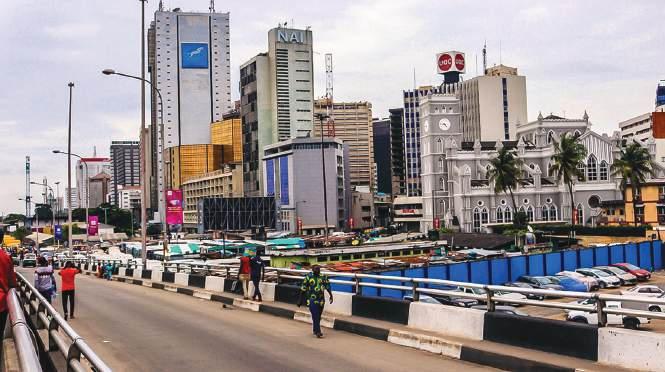
of the Nigerian Bar and the Institute of Chartered Secretaries and Administrators of Nigeria
The Board is pleased to welcome Ogefere to the company and looks forward to the wealth of experience and knowledge she will bring to the team.
The Board equally expresses its sincere appreciation to Alsec Nominees Limited for its dedicated service and valuable contributions to the Company during its tenure as Company Secretary and wishes the firm continued success in its future endeavours.
price of OPEC basket of twelve crudes stood at $63.14 a barrel on Monday, according to OPEC
Saharan Blend
Djeno (Congo), Zafiro (Equatorial Guinea), Rabi Light (Gabon), Iran Heavy (Islamic Republic of Iran), Basrah Medium (Iraq), Kuwait Export (Kuwait), Es Sider (Libya), Bonny Light (Nigeria), Arab Light (Saudi Arabia), Murban (UAE) and Merey (Venezuela).
Demand for MTN, 28 Others Lift Stock Market by N961bn
Kayode Tokede
The Nigerian stock market, yesterday sustained its positive momentum as renewed buying interest in MTN Nigeria Communications, 28 others continued to drive positive investor sentiment across the bourse.
The Nigerian Exchange Limited All Share Index (NGX ASI) gained by 1,498.75 basis
points, or 0.62 per cent to close at 243,958.73 basis points with the Month-to-Date and Year-to-Date returns settled higher at +6.3per cent and +56.8per cent, respectively. Also, market capitalisation gained N961 billion to close at N156.547 trillion.
Sectoral performance was mixed as the Banking (+1.3per cent), Consumer Goods (+1.2per cent) and Insurance (+0.3per cent) Indices closed
higher, while the Oil & Gas (-0.2per cent) index closed lower. The Industrial Goods index closed flat.
As measured by market breadth, market sentiment was positive, as 29 stocks gained relative to 26 losers. International Breweries recorded the highest price gain of 10 per cent to close at N12.10, per share. First Holdco followed with a gain of 9.96 per cent to close at N69.55,
while Abbey Bank rose by 9.88 per cent to close at N8.90, per share.
Trans-Nationwide Express went up by 9.76 per cent to close at N3.26, while Honeywell Flour Mills appreciated by 9.68 per cent to close at N17.00, per share.
On the other hand, Thomas Wyatt Nigeria and Geregu Power led the losers’ chart by 10 per cent each to close at N2.70 and N825.70 respectively
, while McNichols followed with a decline of 9.76 per cent to close at N5.55, per share.
UPDC depreciated by 9.20 per cent to close at N3.95, while Neimeth International Pharmaceuticals declined by 8.16 per cent to close at N9.00, per share. The total volume traded increased by 219.45 per cent to 1.656 billion units, valued at N111.977 billion, and exchanged in 44,780 deals. Transactions in the shares of First Holdco topped the activity chart with 1.258 billion shares valued at N85.612 billion. Zenith Bank followed with 43.829 million shares worth N4.649 billion, while Access Holdings traded 40.992 million shares valued at N1.020 billion. FCMB Group traded 17.716 million shares valued at N188.297 million, while Fidelity Bank sold 16.019 million shares worth N315.164 million.
PRICES FOR SECURITIES TRADED AS OF JULY 9/26
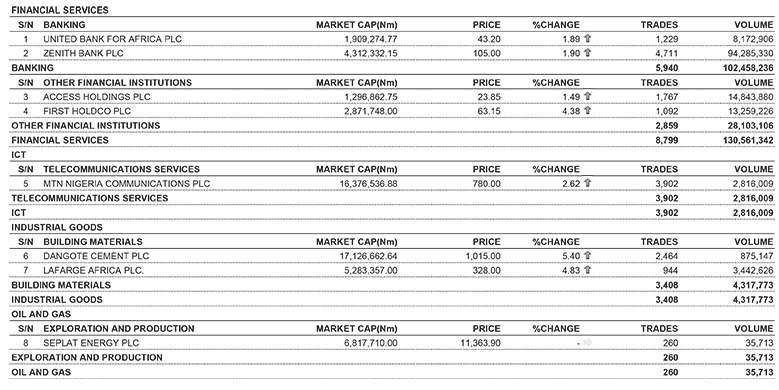
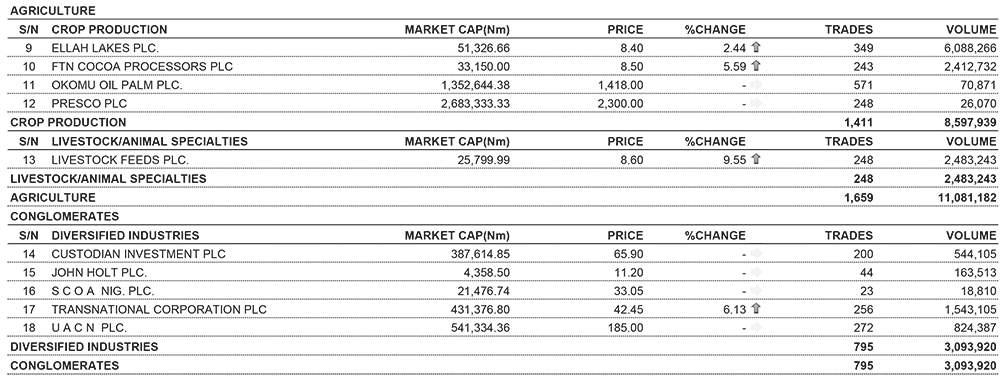
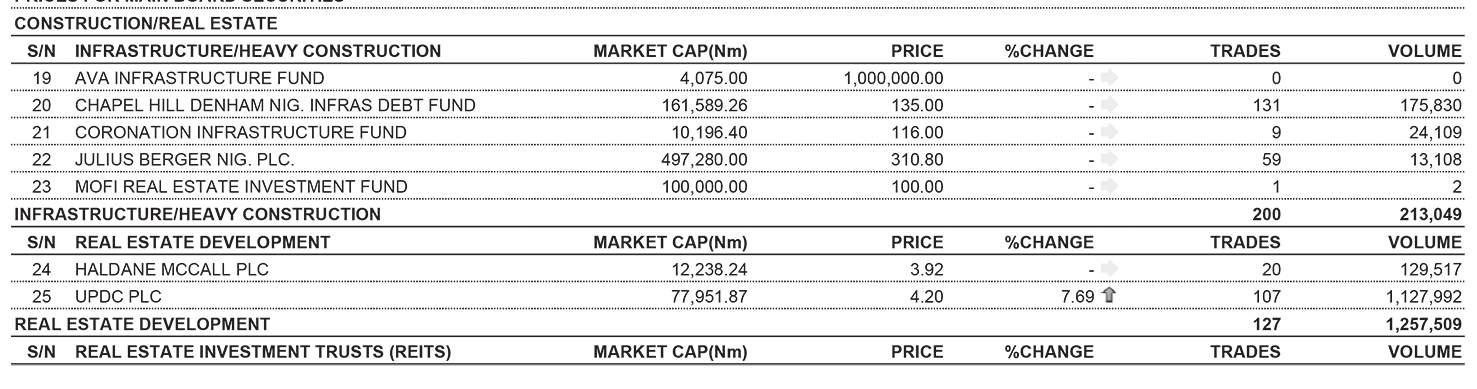
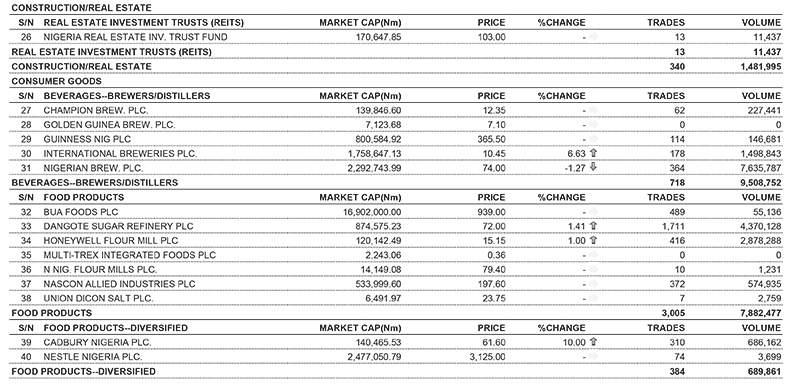
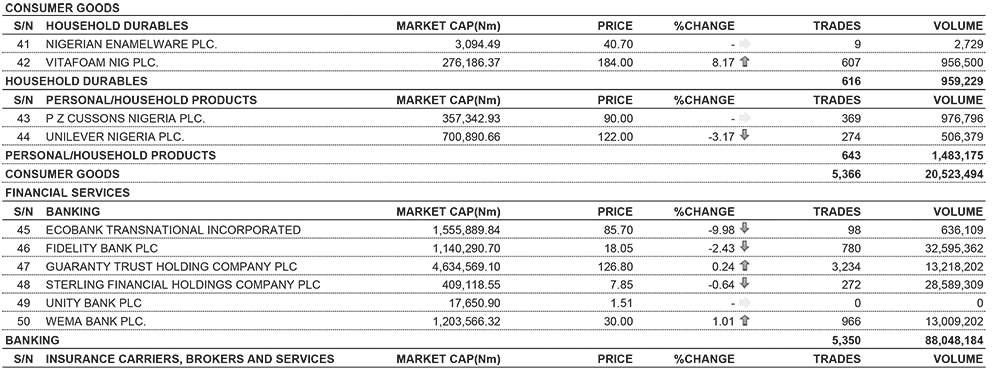
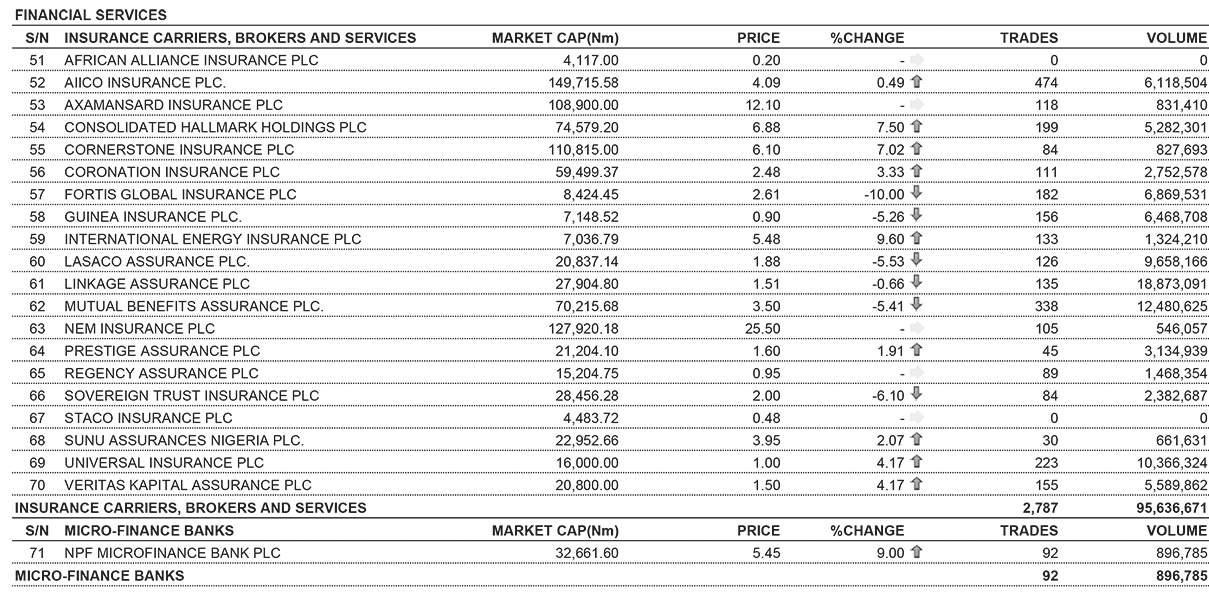

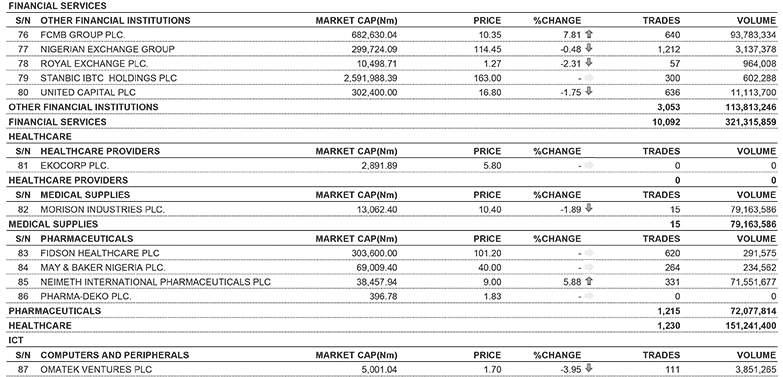
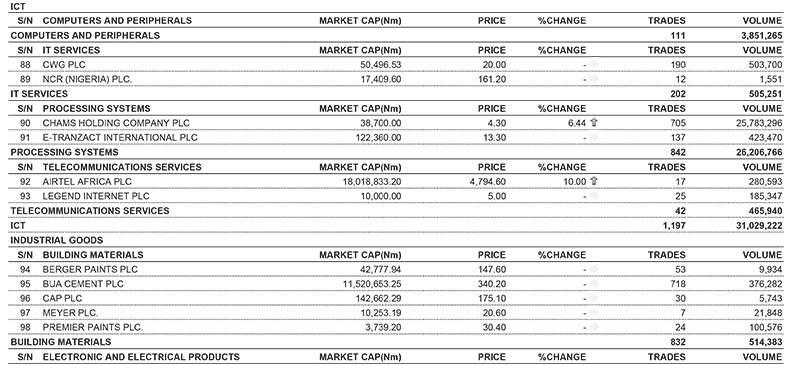
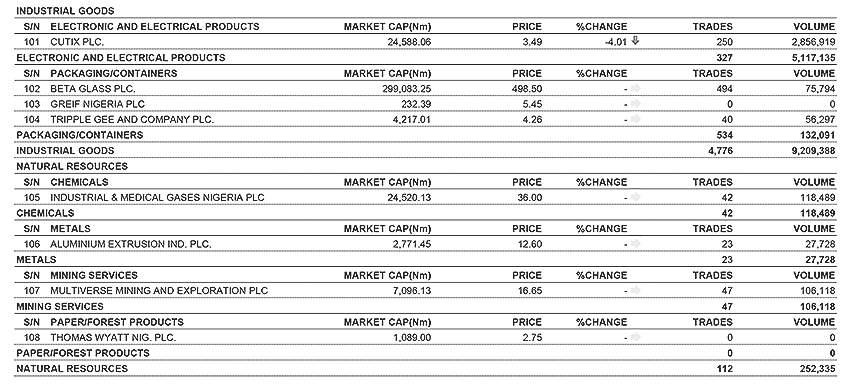
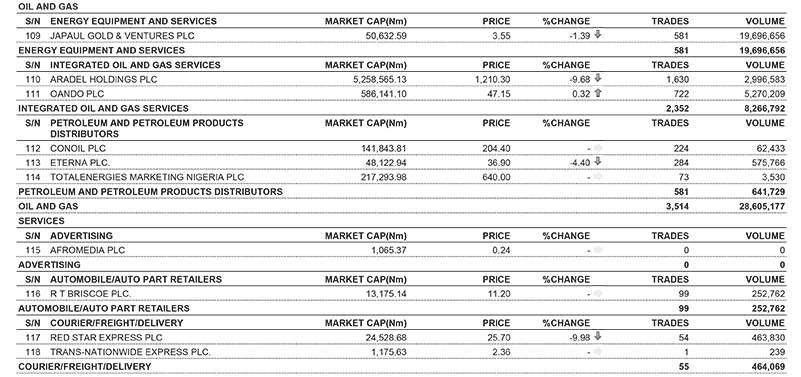
A Mutual fund (Unit Trust) is an investment vehicle managed by a SEC (Securities and Exchange Commission) registered Fund Manager. Investors with similar objectives buy units of the Fund so that the Fund Manager can buy securities that willl generate their desired return.
An ETF (Exchange Traded Fund) is a type of fund which owns the assets (shares of stock, bonds, oil futures, gold bars, foreign currency, etc.) and divides ownership of those assets into shares. Investors can buy these ‘shares’ on the
floor of the Nigerian Stock Exchange. A REIT (Real Estate Investment Trust) is an investment vehicle that allows both small and large investors to part-own real estate ventures (eg. Offices, Houses, Hospitals) in proportion to their investments. The assets are divided into shares that are traded on the Nigerian Stock Exchange.
GUIDE TO DATA:
Date: All fund prices are quoted in Naira as at 8th July 2026, unless otherwise stated.
DAILY PRICE LIST FOR MUTUAL FUNDS, REITS and ETFS
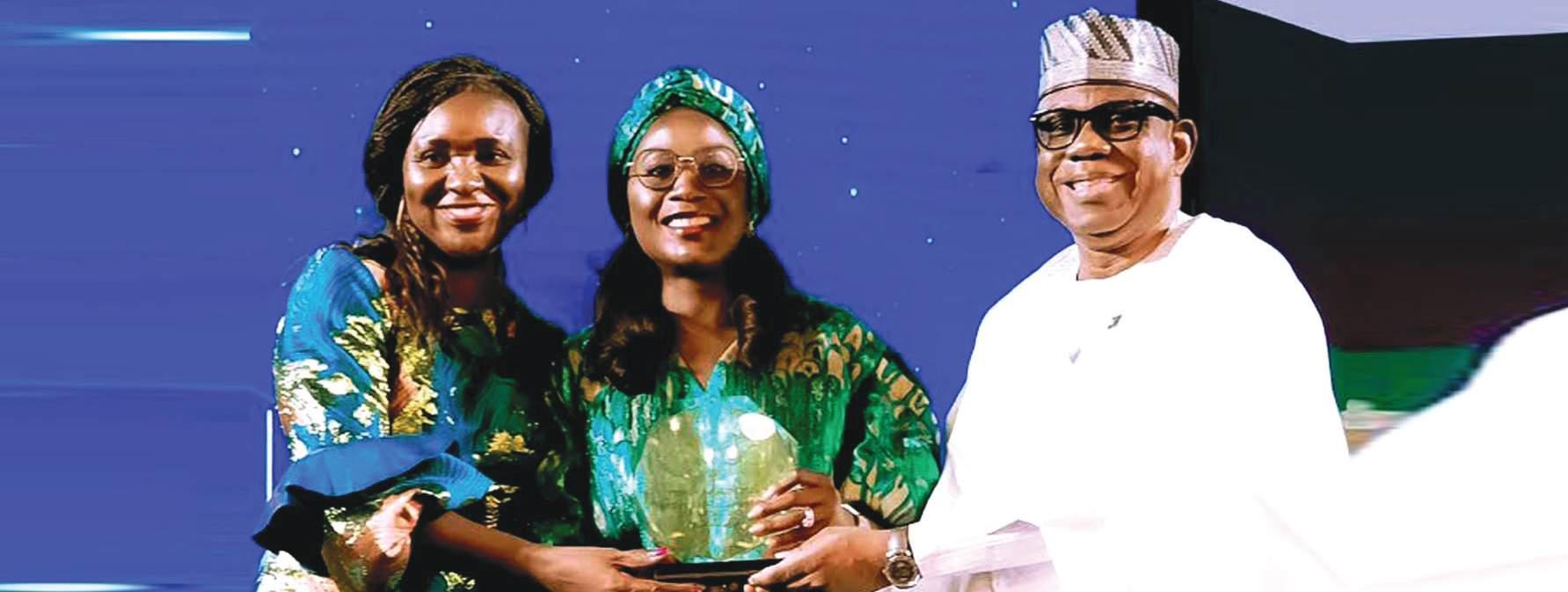
WOMAN IN LEADERSHIP OF THE YEAR AWARD...
L-R: Commission Chief Executive, Nigerian Upstream Petroleum Regulatory Commission (NUPRC), Mrs. Oritsemeyiwa Eyesan; Special Adviser to the President on Oil and Gas, Mrs. Olu Arowolo Verheijen; and Group Chief Executive Officer, NNPC Limited, Mr Bashir Ojulari, during the presentation of the Woman In Leadership of the Year Award to the Special Adviser at NOG Energy Week 2026 in Abuja ....recently
Gbenga Olawepo-Hashim Sues Accord, INEC, Urges Court
to Uphold Him as Party’s Presidential Candidate
The Federal High Court in Abuja witnessed an overwhelming turnout on Thursday as hundreds of sup- porters of Accord Party presidential hopeful, Dr. Gbenga Olawepo- Hashim, gathered in solidarity while he formally commenced legal proceedings to reclaim what he described as his lawfully earned presidential mandate.
The large crowd, made up of party members, youth groups, women, and political associates from different parts of the country, filled the court premises and surrounding areas, making movement around the court complex slow and difficult as supporters waited to demonstrate their backing for the presidential hopeful.Olawepo-Hashim had ap- proached the Federal High Court in Abuja seeking an order compelling the Accord Party to recognise him as its presidential candidate for the 2027 general election and transmit his name to the Independent National Electoral Commission (INEC).
In an Originating Summons filed before the court, Olawepo-Hashim named Accord Party and INEC as the first and second defendants, respectively.
The plaintiff is asking the court to determine whether the party’s failure to upload his name to INEC’s nomination portal, despite his emergence as the sole winner of the Accord Party presidential primary held on May 30, 2026, violates the Electoral Act, 2026, the Constitution, and INEC’s Regulations and Guidelines for Political Parties.
Olawepo-Hashim is also seeking a declaration that the party’s refusal to forward his name to INEC amounts to a breach of Section 86
of the Electoral Act, 2026, as well as Clauses 28(1) and 28(2) of the electoral guidelines governing the nomination of candidates.
He is asking the court to order Accord Party to upload and submit his name to INEC as its presidential candidate for the 2027 generalAlternatively,election.the plaintiff is ask- ing the court to direct the party to conduct a fresh presidential primary in which he would participate should the court decline to order the submission of his name.
In an affidavit supporting the suit, Olawepo-Hashim stated that he was a registered and financial member of Accord Party and sponsored the party’s electronic membership drive with a payment of N7 million.
He further stated that he paid N50 million as the prescribed nomination fee to contest the party’s presidential primary and emerged as the sole aspirant and winner of the exercise conducted on May 30, 2026.
He said the primary election was monitored by officials of INEC in line with the provisions of the
Electoral Act.
Olawepo-Hashim alleged that despite his victory, Accord Party failed to submit his name to the electoral commission as its presidential candidate.
He also claimed that the party did not provide aspirants with guidelines for the conduct of the presidential primary, contrary to INEC’s regulations, but said he proceeded with the process based on assurances allegedly given by the party’s national leadership. In the written address filed in
support of the suit, counsel to the plaintiff, Chief Henry Akunebu (SAN), argued that political parties were legally bound to comply with the Electoral Act, their constitutions, and INEC’s guidelines in the nomination of candidates. Akunebu contended that once a political party conducted a valid primary election and produced a winner, it had a statutory obligation to submit the name of that winner to INEC and could not act arbitrarily to deny the successful aspirant the benefits of the democratic process.
Police Arrest Suspected Killer of Kogi Teacher, Vow Prosecution
Ibrahim Oyewale in Lokoja
Kogi State Police Command arrested the suspected killer of Mariam Usman, a staff member of Brains Minds Nursery and Primary School, Ugbamaka, Olamaboro Local Government Area, who died as a result of an attack on her.
The development was contained in a press statement signed by the police command’s Public Relation Officer, ASP Afusat Saliu, a copy of which was made available to journalists
in Lokoja yesterday.
The Police Public Relations Officer stated, “The Kogi Police Command has recorded a major breakthrough in the investigation of a culpable homicide case reported on 25th June, 2026, following the death of one Mariam Usman, a staff member of Brains Minds Nursery and Primary School, Ugbamaka, Olamaboro Local Government Area.
“Upon receipt of the complaint, detectives of the Homicide Section, State Criminal Investigation Depart-
FG Vows to Tackle Drug Abuse, Improve Access to Essential Medicines
The federal government has restated its determination to strengthen ac- cess to essential controlled medicines for patients with legitimate medical needs.
It also expressed commitment to implementing a balanced, evidencebased and human-centred approach to drug control that integrates public health, security, prevention and treatment.
The Coordinating Minister of Health and Social Welfare, Professor Muhammad Ali Pate, gave the undertaken in an address delivered on his behalf by the Director, Food and Drug Services
Department, Federal Ministry of Health and Social Welfare, Mrs. Olufowobi-Yusuf Adeola, at the Maiden National Drug Use Summit held in Abuja
A statement signed by the Head of Information and Public Relations, Mr. Ado Bako, said the minister described drug use in Nigeria as a complex public health and development issue
Citing findings from the 2018 United Nations Office on Drugs and Crime (UNODC) survey, Pate said that 14.4 per cent of Nigerians aged 15 to 64 had used drugs, with cannabis remaining the most commonly used substance alongside increasing misuse of prescription opioids such
as tramadol and codeine, as well as emerging psychoactive substances. According to him, the rising burden of drug misuse has significant implications for public health, national security and socio-economic development, stressing that the country must adopt comprehensive strategies that go beyond law enforcement.
The minister however noted that while efforts to curb illicit drug use must continue, government also has a responsibility to ensure that patients suffering from severe pain due to cancer, surgery, sickle cell disease and other medical conditions have access to controlled medicines such as morphine and pethidine.
ment (SCID), Lokoja, swung into action, conducting a comprehensive investigation that culminated in the arrest of three suspects in connection with the case.
“Investigation established that on 17th June, 2026, one Abdullahi Isiaka assaulted the deceased at her residence over the disciplinary action she took against his eleven-year-old son during school hours. Later that same day, while the deceased was on her way to the mosque for prayers, she was again assaulted by Ramatu Isiaka Eleojo.”
the statement added, “Further investigation revealed that on 18th June, 2026, Ojonojima Mary, younger
sister to Ramatu Isiaka Eleojo, went to Brains Minds Nursery and Primary School, Ugbamaka, where she assaulted the deceased in her workplace.
“Following the attacks, the victim was initially treated at Grace Clinic, Ugbamaka, before she was referred to Eleojo Clinic, Okpo, for further medical attention. She, however, succumbed to the injuries on 25th June, 2026.
the police spokesperson stated,
“The Commissioner of Police, Kogi State Command, CP Naziru Bello Kankarofi, psc, mni, commends the professionalism, diligence and commitment displayed by the detectives of the Homicide Section, SCID, in ensuring that justice is served.
“He reiterates the Command’s unwavering commitment to bringing perpetrators of violent crimes to justice and assures the good people of Kogi State that the Command will continue to investigate all criminal cases diligently and professionally.
“The investigation established a prima facie case of Criminal Conspiracy and Culpable Homicide against the suspects, Ojonojima Mary, Ramatu Isiaka Eleojo, and Abdullahi Isiaka. Consequently, the investigation has concluded, and the suspects will be arraigned before a court of competent jurisdiction for prosecution.”
ABIS Group Deplores State of Abattoirs, Alleges Poor Maintenance, Outdated
Bennett Oghifo
ABIS Group has said that the state of abattoirs in Nigeria remains a major concern as many are outdated, poorly maintained, and operate under unhygienic conditions, posing a serious challenge to food safety and the livestock industry.
This was disclosed at the official launch of ABIS Digital Market Place in Abuja designed to modernise Nigeria’s protein supply chain –from farm/sea, to the table – using technology to solve the inefficiencies
that plague livestock, meat, seafood, and poultry market in Nigeria.
Speaking at the event which attracted stakeholders from the livestock value chain in Nigeria, ABIS Co-founder, Dr. Iliyasu Gashinbaki, explained the Digital Marketplace is far more than an online marketplace. “It is a digital ecosystem designed to connect producers, processors, distributors, businesses, and consumers through a secure, transparent, and efficient platform.”
According to him, the group’s
aspiration is to transform the way livestock products are bought, sold, and distributed in Nigeria, creating new opportunities for producers, businesses, and consumers while contributing meaningfully to the growth of the national economy.
“We have already established an export-ready processing facility supported by a modern laboratory. We are optimistic that before the end of the year, Nigeria will be wellpositioned to export, particularly to countries within the Gulf Cooperation Council (GCC) region.
Chuks Okocha in Abuja
Onyebuchi Ezigbo in Abuja
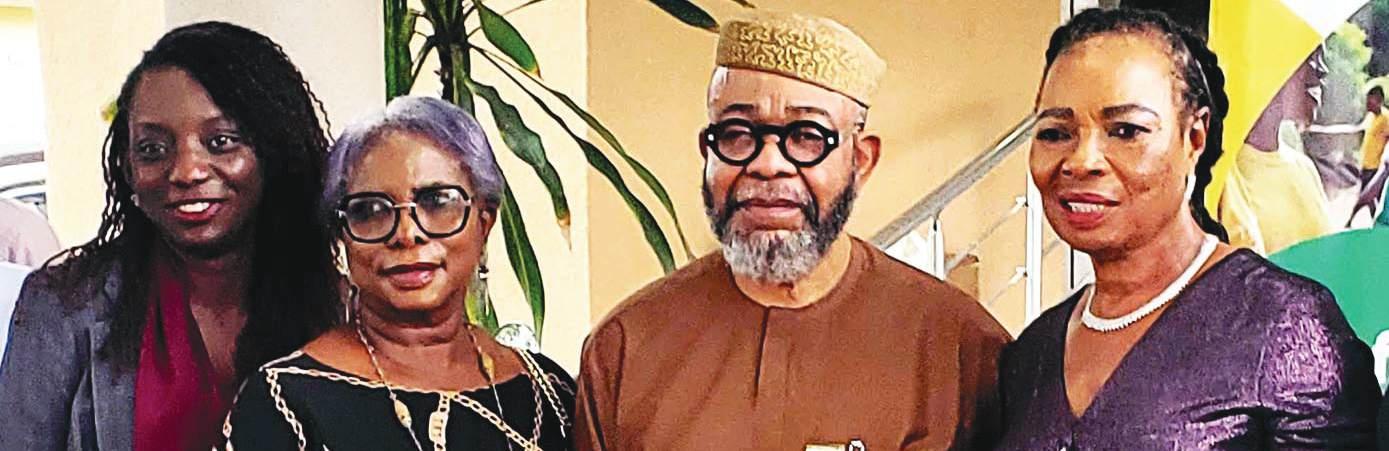
DONATION OF MEDICAL EQUIPMENT BY THE LADIES SECTION OF THE IKEJA GOLF CLUB...
L-R: Secretary, Ladies Section of the Ikeja Golf Club, Funmi Odushola; Chairperson of the Charity Visitation Committee, Mrs. Bukky
and the Vice
during the donation of
Chief Medical Director, Lagos State University Teaching
Presidency, NDDC to Raise $500m
Agribusiness Fund for Niger Delta
Upcoming conference to woo global investors, position zone as nation’s next agricultural hub
The Presidency and Niger Delta Development Commission (NDDC) have finalised arrangements to raise a $500 million agribusiness investment fund to drive large-scale commercial agriculture in the Niger Delta.
They described the oil-rich region as secure and ready to emerge as the country’s next major agricultural investment destination.
The programme, being put together by the Office of the Vice President and NDDC, will be made public at the inaugural Niger Delta Agriculture Development and Investment Summit
slated for July 15, at State House Conference Centre, Abuja.
Addressing newsmen on Thursday at the state house after briefing Vice President Kashim Shettima, Deputy Chief of Staff to the President, Senator Ibrahim Hadejia, said the summit reflected President Bola Tinubu’s determination to diversify Nigeria’s economy by unlocking the vast but largely untapped agricultural potential of the Niger Delta.
According to him, the event, with the theme, “Unlocking Investment for Sustainable Agricultural Transformation in the Niger Delta,” has the full endorsement of Tinubu and is designed
to attract about 500 participants, including international investors, development finance institutions, agribusiness firms, donor agencies, policymakers, development partners, and stakeholders from across the region.
Hadejia said the summit was a strategic intervention aimed at repositioning the Niger Delta from a region known almost exclusively for oil production to one recognised for modern, commercially driven agriculture capable of boosting food security, exports, and job creation.
He stated, “The summit represents a strategic shift from potential to
performance, from conversation to capital, and from fragmentation to coordination. It aligns squarely with the national vision of building a resilient, diversified, and inclusive Nigerian economy, with agriculture as a central driver.”
Hadejia said although the Niger Delta had historically been associated with hydrocarbon resources, the region possessed enormous agricultural assets and comparative advantage in the cultivation of several food and cash crops capable of strengthening Nigeria’s food security and export earnings.
He said the Tinubu government’s agricultural transformation agenda was
Umahi: Tinubu Fair in Distribution of Road Projects Across Nigeria
The Minister of Works, David Umahi, has said President Bola Tinubu’s administration is demonstrating fairness in the distribution of federal road projects across the country, ensuring that no state is left behind in infrastructure development.
Umahi stated this during a meeting with Ekiti State Governor, Biodun Oyebanji, in Abuja, where both leaders discussed strategic road sector development and ongoing federal projects in the state.
According to the minister, communities that previously received little or no federal road intervention are now benefitting from the Tinubu administration’s inclusive approach to infrastructure development.
He recalled that throughout his eight years as governor of Ebonyi State, there were no major federal road projects in the state, adding that Ekiti and several other states had similar experiences before the current administration.
Umahi commended Tinubu for changing the narrative through what he described as a nationalistic and equitable approach to project allocation. He also linked the growing
support for the ruling party to what he described as the visible achievements of the administration, particularly in road infrastructure.
The minister assured the Ekiti State Government that all existing federal road contracts in the state would be executed strictly in accordance with engineering standards and contractual specifications.
He said contractors handling the projects were selected transparently in line with the provisions of the Public Procurement Act and pledged that the state government would be kept fully informed to enable effective monitoring of project implementation.
Umahi reiterated the ministry’s commitment to delivering durable and high-quality road infrastructure capable of improving connectivity, stimulating economic activities and supporting the objectives of the Renewed Hope Agenda.
Earlier, Oyebanji thanked the President and the Minister of Works for what he described as unprecedented federal road interventions in Ekiti State.
He recalled that following his appeal to the President through Umahi, approval was granted for
the reconstruction of the Ado-IyinAramoko Road, a project that had remained uncompleted for several years despite repeated promises by previous administrations.
According to the governor, contractors were mobilised to the site within weeks of the approval, demonstrating the federal government’s commitment to prompt project delivery.
He said the speedy commencement of the project had generated widespread appreciation among residents and strengthened public confidence in the administration’s commitment to infrastructure development.
Oyebanji also expressed gratitude for the approval of the Ado-IjanIkole Road project, describing it as a strategic route that would significantly improve transportation and economic activities within Ekiti State and neighbouring areas.
The governor stated that since the creation of Ekiti State nearly 30 years ago, no federal administration had shown the same level of commitment to the state’s infrastructure development as the current government.
He added that the people of Ekiti now have a renewed sense
of belonging because of the federal government’s interventions in roads and other critical sectors, noting that his visit to the Ministry of Works was to convey the appreciation of the people of the state for the ongoing support.
national in scope and recognised the Niger Delta as a critical component of the country’s long-term economic diversification strategy.
Managing Director of NDDC, Dr. Samuel Ogbuku, disclosed that the commission was looking forward to a $500 million investment fund that will serve as a catalyst for commercial agriculture across the nine Niger Delta states.
According to Ogbuku, unlike earlier agricultural conferences, the July 15 conference will be an investment marketplace where investors, financiers, agribusiness operators, and development institutions would negotiate concrete financing opportunities rather than merely discuss policy proposals.
He stated, “We are moving agriculture in the Niger Delta from subsistence to large-scale commercial production. The target is to mobilise a $500 million investment fund that will catalyse agricultural development across the region.”
Ogbuku said Abuja was deliberately selected as the venue because it offered easier access to diplomatic missions, international financial institutions, donor organisations, and foreign investors expected to participate in the summit.
He stated, “It is a global programme. We are bringing the Niger Delta to where the capital is. Most of the inves-
tors, donor agencies and international organisations are based in Abuja. Holding the summit here makes participation easier and significantly reduces logistics costs.”
The NDDC boss added that collaboration with the Office of the Vice President provided strategic coordination for the initiative, as Shettima currently supervised several key federal programmes on food security and economic development. According to him, the commission is shifting from traditional intervention programmes to sustainable financing models capable of attracting substantial private sector investment, while delivering long-term economic benefits to the region.
He stressed that the proposed investment fund would be professionally managed in accordance with international best practices and would combine equity investments with direct capital mobilisation, instead of relying solely on conventional government lending.
Ogbuku also explained that NDDC had established the Niger Delta Chamber of Commerce to facilitate structured financing for agribusinesses, and had already provided it with N5 billion to support small and medium-scale enterprises through a transparent, repayable funding arrangement.
CCECC: Close Project Monitoring Key to Speedy Infrastructure Delivery
James Emejo in Abuja
Executive Director, China Civil Engineering Construction Corporation (CCECC) Nigeria Limited, Shao ZongHe, has attributed the completion of the Collector Road C01 and bridge in Abuja within six months to what he described as Minister of Federal Capital Territory (FCT), Nyesom Wike’s hands-on supervision and insistence on results.
Speaking during the inauguration of the road linking the Body of Benchers to the Nile University axis in the Institution and Research District, Shao said the project demonstrated how close monitoring and decisive leadership could accelerate infrastructure delivery.
According to him, Wike’s regular visits to the construction site distinguished the project from conventional public works where oversight is often delegated.
He said the minister inspected the project almost every month from commencement, personally reviewed progress, resolved implementation challenges and consistently demanded timelyShaoexecution. noted that the direct engagement created an enabling environment for the contractor and the Federal Capital Development Authority (FCDA) to deliver the project on schedule. He said, “The minister did not simply issue directives from his office.
He came to the site, inspected the work firsthand, resolved challenges and demanded results. It is under this kind of committed leadership that we completed this project in just six months.”
He described the road as more than a transport corridor, saying it would significantly improve mobility for the Body of Benchers, Nile University and adjoining communities while opening up the district for greater economic activities.
The CCECC executive also said the project reflected President Bola Tinubu’s Renewed Hope agenda by translating infrastructure investment into visible improvements in the daily lives of citizens.
Ogunmoyero;
Hospital, Prof. Adetokunbo Fabamwo;
Captain Ladies Section Ikeja Golf Club, Otunba Modupe Oyeduntan,
medical equipment by the Ladies Section of the Ikeja Golf Club in collaboration with Philantify and Sudabelt Medical, to the Paediatric Department of the hospital received by the Chief Medical Director, Prof Adetokunbo Fabamwo in LASUTH, Ikeja, Lagos on Wednesday
Emmanuel Addeh in Abuja
Deji Elumoye in Abuja
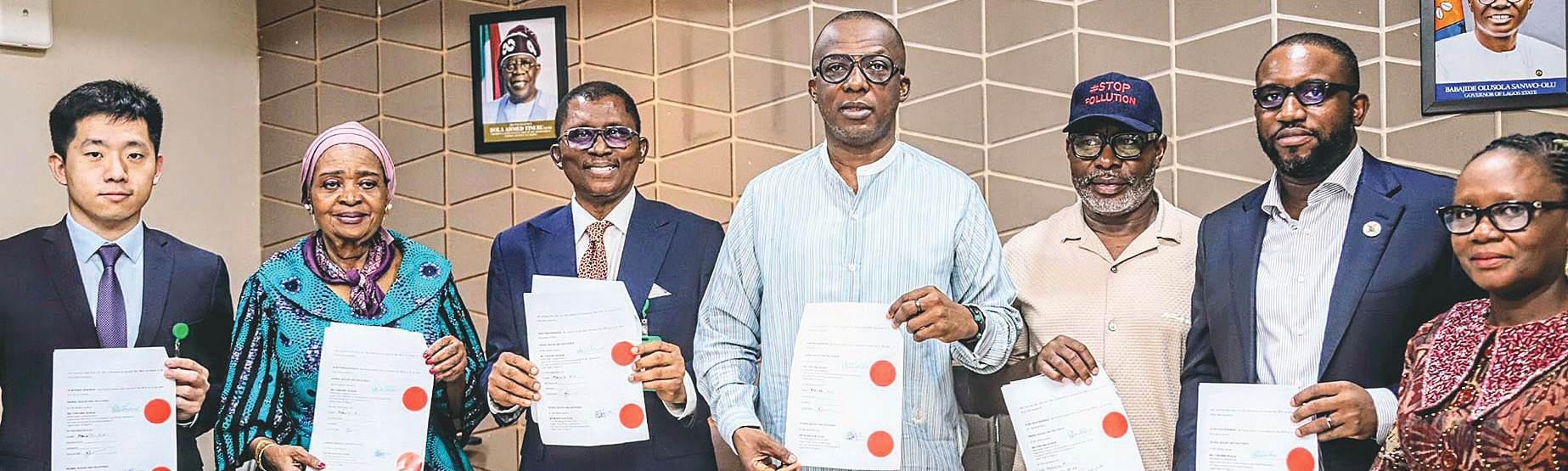
SIGNING OF MOU BETWEEN LAGOS, CHINA HARBOUR AND NASTON ENGINEERING...
L-R: Executive Director, China Harbour Engineering Company, Luke Lin; Executive Director, Naston Engineering Nigeria, Mrs. Remi Agbowu; Managing Director, Naston Engineering Ltd, Mr. Kole Funsho; Lagos State Commissioner for the Environment and Water Resources, Mr. Tokunbo Wahab; Permanent Secretary, Office of Drainage Services, Engr. Mahamood Adegbite; Managing Director, Lagos Water Corporation, Engr. Mukhtaar Tijani; and Executive Director, Operations, Lagos Water Corporation, Engr. Lanke Taiwo, during the signing of an MoU between the Lagos State Government, China Harbour Engineering Company and Naston Engineering at the Alausa Secretariat, Lagos, yesterday
Tinubu: I Won’t Betray Trust of Nigerians, Reforms Will Deliver Better Future for All
Says painful economic measures foundation for lasting prosperity
Sunday Aborisade in Abuja
President Bola Tinubu, yesterday, declared that he would not betray the trust reposed in him by Nigerians, insisting that the economic reforms introduced by his administration, though painful, were necessary to secure a stronger and more prosperous future for the country.
The president also urged his supporters to intensify grassroots mobilisation by taking the message of his administration’s Renewed Hope agenda to every community across the country.
He said sustained engagement with citizens remained the bedrock of democratic governance.
Tinubu made the remarks in a message delivered on his behalf by the President of the Senate, Godswill Akpabio, during the inauguration of the executives of the PBAT Door-to-Door Movement, a nationwide political mobilisation platform established to promote the administration’s policies and programmes.
Addressing political leaders, traditional rulers, civil society groups, youth organisations and thousands of supporters at the event, the president maintained that despite the economic hardships occasioned by ongoing reforms, his administration remained resolute in fulfilling
its promises to Nigerians.
“I am determined never to betray the trust by Nigerians and the vision of ensuring a better Nigeria,” Tinubu declared.
He added that the support demonstrated by Nigerians reflected their commitment to the country’s future.
He described the grassroots mobilisation initiative as an important democratic exercise, stressing that electoral victories begin with direct engagement between leaders and citizens.
“Every great nation is driven by one citizen at a time, and one door at a time. Before victories at the ballot boxes, there are confrontations at every door,” he said.
The president urged members of the movement to use the campaign to explain government policies and achievements to Nigerians while encouraging citizens to remain committed to democratic participation.
“Go to these doors and tell them about the dividends of good governance after they vote. That is how democracy endures,” he said.
Tinubu defended the sweeping economic reforms implemented since he assumed office three years ago, arguing that genuine national progress often required difficult decisions and temporary sacrifices.
According to him, the reforms
were never intended to inflict hardship on citizens but to correct long-standing structural distortions in the economy and create a stronger foundation for future generations.
“The purpose of reforms is not to make life difficult for citizens but to lay the foundation that future generations can build on. Lasting progress is rarely achieved without enduring sacrifice,” he stated.
The president said nations attained greatness by confronting difficult challenges with courage rather than avoiding them, expressing confidence that the reforms would ultimately deliver sustained economic growth and improved living standards.
He maintained that his administration had already laid the groundwork for a brighter future through policies aimed at stabilising the economy and expanding opportunities for Nigerians.
“In three years, we have embarked on various reforms to grow our economy and make life brighter for Nigerians. The future is indeed brighter for Nigerians,” he added.
Tinubu also emphasised the importance of collaboration among the executive, legislature and citizens.
He said meaningful develop-
Tasks supporters to take Renewed Hope message to every doorstep
ment could only be achieved through collective responsibility and shared commitment to national progress.
“Good governance succeeds when the executive, legislature and the citizens agree to work together,” he said.
The president warned against allowing political differences to undermine national unity, insisting that Nigeria’s collective interest must remain above partisan considerations.
“Politics should never divide us as Nigerians. Our nation is greater than any political party, office holder or elections,” he said.
He urged supporters of the PBAT Door-to-Door Movement to conduct themselves peacefully and respectfully while spreading the message of hope across the country.
“Knock on every door with respect while strengthening faith in our democracy and the future of Nigeria. Let every door lead to a renewed hope for greater Nigeria and a more prosperous nation,” he charged.
Tinubu also commended High Chief Government Oweizide Ekpemupolo, popularly known as Tompolo, and members of the movement for initiating the
grassroots campaign, describing it as a demonstration of patriotism and national commitment.
“I commend High Chief Government Ekpemupolo and his team for putting this together. We are united whenever the nation calls,” he said.
Earlier, the Managing Director of Tantita Security Services Nigeria Limited, Kestin Pondi, who represented the Grand Patron of the movement, Tompolo, described the inauguration as the beginning of a nationwide citizens’ mobilisation campaign designed to strengthen public support for the President’s Renewed Hope agenda.
OF BRIDGES AND WALLS: FINDING COMMON GROUND, RISING ABOVE DIVISIONS (1)
Pride will only lead to hardening of positions. Therefore, it is important to understand the concerns of our friends with a different skin colour. It is advisable to learn about the fears of the other group, whether they are real or imagined, efforts must be invested in building bridges and breaking walls for those are the principal demands of honest engagements. Neither the victims’ mindset nor the conquerors outlook is required in this regard because whether we accept it immediately or later, the indisputable truth remains that we need one another. The world is made richer when we combine our best traits in pursuit of ideas and values that enrich
ARISE TOWN HALL MEETING: STAKEHOLDERS SEEK SAFEGUARDS
ration between security agencies, traditional rulers, and community leaders.
According to him, local communities remain the most valuable source of intelligence in the fight against insurgency and terrorism.
Musa urged traditional rulers to maintain accurate records of residents and promptly report suspicious movements.
The minister defended military rules of engagement in counterinsurgency operations, explaining that personnel are adequately trained to distinguish conventional warfare from asymmetric conflicts.
He, nevertheless, insisted that military action alone could not solve insecurity without good governance capable of earning citizens’ trust.
Soludo Seeks Comprehensive Restructuring
Anambra State Governor, Professor Chukwuma Soludo, stated that state policing would fail unless accompanied by a comprehensive restructuring of Nigeria’s judicial system.
Soludo said policing and justice administration were inseparable, stressing that the establishment of state police should be complemented by state Courts of Appeal and state Supreme Courts.
He stated, “We talk about state police but forget the state judiciary. The issue is how to make state police sustainable.
“Police and the judiciary work together to achieve justice.”
He lamented that disputes arising purely within states currently travelled through the federal judicial hierarchy, causing prolonged delay.
Using land disputes in Anambra State as an example, Soludo said cases that ought to be resolved locally often spent decades in the Court of Appeal and Supreme Court.
He said, “Some appeals take over 40 years before final determination.
“State appellate courts would deliver justice much faster.”
Beyond judicial reforms, Soludo also called for a review of Nigeria’s fiscal federalism. He maintained that devolving policing powers without corresponding financial autonomy would create another layer of administrative failure.
Describing the current revenue
allocation formula as inequitable, he proposed increasing states’ share of federation revenue from about 26 per cent to at least 40 per cent.
“If we are devolving powers, we must also devolve resources,” he said.
Judicial Reforms Must Accompany State Policing, Ogun Governor,
Abiodun,
Explains
Ogun State Governor, Dapo Abiodun, supported Soludo’s position, saying judicial reforms must accompany state policing because local disputes would increasingly fall under state jurisdiction.
Abiodun also stressed the need to review revenue allocation to enable states shoulder their expanded responsibilities.
the human experience; here, the desert walker’s story is as valuable as the knowledge of the ocean diver. In the end, it needs to be made clear that the global war against the menace of hunger and extreme poverty, illiteracy, diseases, war and violence cannot be won by promoting racial divisions and hatred for no one race holds the key to tackling the multitude of existential crises facing our world.
The invitation to all of us at a time like this is to look at the human race as one big family and collectively tackle the universal challenges that steal from our joyful inheritance. Again, let me repeat that we do not
suffer any disadvantage for the reason of our skin pigmentation, rather we are limited by the stereotypes we accept or promote. The hard truth, however, is that we are individually and collectively capable of infinitely great accomplishments — if only we put our minds to it. Ultimately, what we need are bridges of understanding and dialogue, not walls of division and hatred.
•This is the first part the keynote address delivered by Dr. Alex Otti, the Governor of Abia State, at the University of Northampton’s Annual Conference on Racial Justice on Thursday, July 2, 2026.
FROM ABUSE OF STATE POLICE
He described President Bola Tinubu’s support for state police as one of the administration’s boldest security reforms and cited the success of the joint Lagos-Ogun “Operation Ko S’aye” security initiative as evidence that sub-national collaboration could improve public safety.
Mutfwang: Benefits Outweigh Its
Risks
Plateau State Governor, Caleb Mutfwang, said the benefits of state police far outweighed the potential risks, urging Nigerians not to allow fear of possible abuse derail reforms capable of strengthening internal security.
Mutfwang stated, “We should not live in fear of the unknown. We
must build institutions that guarantee citizens’ rights while protecting life and property.”
The governor identified land disputes, identity conflicts, and political manipulation as major contributors to insecurity, warning that reducing discussions about state police solely to funding issues would undermine broader institutional reforms.
Mbah: Tech, Sustainable Funding Crucial
Governor Peter Mbah of Enugu State stated that technology and sustainable funding would determine the success of any decentralised policing arrangement.
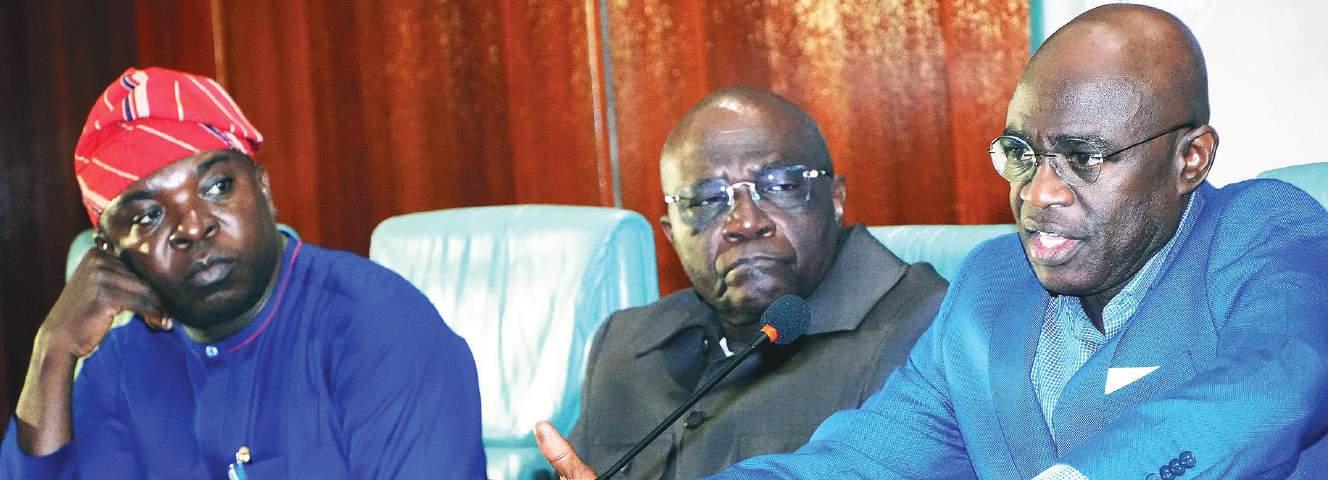
BENUE GOVERNOR MEET THE PRESS AT THE VILLA...
L–R: Senior Special Assistant on Media and Publicity, Temitope Ajayi; Special Adviser to the President on Information and Strategy, Bayo Onanuga and Benue State Governor, Rev. Fr. Hyacinth Alia during meet the press briefing at the Presidential Villa Abuja on Wednesday
Peter Obi Alleges State Harassment, Warns
FG Will Be Held Responsible for Any Harm
Nothing must happen to NDC presidential candidate, Atiku warns Tinubu, FG
Chuks Okocha and Sunday Aborisade in Abuja
Presidential candidate of the Nigerian Democratic Congress (NDC), Mr. Peter Obi, has accused the federal government of orchestrating a sustained campaign of harassment and intimidation against him, warning that the government would be held responsible for any harm that befalls him or his associates.
This was as the Presidential Candidate of the African Democratic Congress (ADC), Alhaji Atiku Abubakar, has warned President Bola Ahmed Tinubu that nothing must happen to Obi. In a statement in Abuja, the Peter Obi Media Office alleged that recent actions by government institutions had gone beyond
normal political disagreements and amounted to a deliberate effort to undermine Obi’s freedom, political activities and business interests.
The statement was issued in response to what it described as the Presidency’s “tenuous and uncultured” reaction to Obi’s recent expression of concern over his personal safety and alleged harassment.
According to the media office, the Presidency failed to address the substance of Obi’s concerns and instead resorted to dismissive remarks that necessitated a fresh public alarm.
“We raise this alarm not from fear, but as a duty to safeguard our democracy from descending into authoritarianism,” the statement said.
It alleged that Obi had been sub-
jected to “engineered bureaucratic obstacles, invasive surveillance and hostility from state forces,” adding that businesses and investments associated with him had also come under pressure.
The media office argued that such developments, whether deliberate or coincidental, had created the perception of a calculated campaign to undermine Obi’s legitimate personal and business interests, warning that such perceptions could damage investor confidence and Nigeria’s democratic credentials.
It further claimed that members of Obi’s media team had witnessed what it described as increasing hostility directed at the former presidential candidate and his supporters during political engagements across the country.
Nothing Must Happen to Peter Obi, Atiku Warns Tinubu, Nigerian Government Presidential Candidate of the ADC, Atiku Abubakar, has warned President Bola Tinubu that nothing must happen to Peter Obi.
Atiku gave the warning in a statement by his spokesperson, Phrank Shaibu, yesterday.
In a terse statement, Atiku noted that the safety of every opposition leader was a constitutional obligation of the Nigerian state and a test of its democratic credentials.
“Nothing must happen to Peter Obi. An injury to one is an injury to all. When one opposition leader is intimidated, every opposition voice is diminished. When one citizen begins to fear because of his political beliefs, democracy itself becomes the casualty.
Troops Rescue Abductees, Repel
ISWAP Attack on Military Location
Linus Aleke
Troops of the Joint Task Force North East, Operation Hadin Kai (OPHK), have rescued abductees from a terrorist hideout and successfully repelled a coordinated attack by Islamic State West Africa Province (ISWAP) terrorists on a military location in Borno State.
This was part of sustained operations to degrade terrorist activities across the North-East Theatre.
The latest successes were recorded through a series of search-and-rescue operations, intelligence-led missions, and coordinated security efforts aimed at denying terrorist groups freedom of action and disrupting their logistics networks.
According to a statement by the Acting Military Information Officer of Joint Task Force North East, Operation Hadin Kai, Captain Mohammed Goni, troops of 115 Task Force Battalion, while conducting ongoing Search and Rescue (SAR) operations in Askira/
Uba Local Government Area of Borno State, successfully rescued two additional abductees from a terrorist hideout.
The troops also recovered N1.2 million suspected to be proceeds of criminal activities, alongside food items and other logistics believed to have supported terrorist operations.
The rescued victims have since been evacuated to a secure location, where they are receiving medical attention and psychosocial support.
In a separate operation, troops of Operation Hadin Kai deployed at Forward Operating Base (FOB) Logomani in Ngala Local Government Area of Borno State under Sector One successfully repelled an attack by ISWAP terrorists.
The military said the terrorists briefly exploited a section of the base’s defensive perimeter during an intense firefight, but troops quickly regrouped, launched a counter-offensive, and pushed back the attackers, inflicting significant casualties on them.
The statement noted that the surviving terrorists escaped with varying degrees of gunshot wounds, while one soldier paid the supreme price during the encounter.
“Regrettably, one gallant soldier paid the supreme price, while two gun trucks and some combat enablers sustained damage during the engagement,” the statement said.
It added that the situation at FOB Logomani remained firmly under the control of Operation Hadin Kai troops, with reinforcements deployed, exploitation operations ongoing, and additional measures being taken to strengthen the defensive posture of the location.
Meanwhile, troops of 232 Battalion, acting on credible intelligence, arrested a notorious criminal in Gombi Local Government Area of Adamawa State.
A follow-up operation led to the recovery of one AK-47 rifle, two magazines, and 28 rounds of 7.62mm special ammunition.
The suspect and recovered items
are currently in military custody, while investigations continue to identify and apprehend other members of the criminal network.
In another intelligence-driven operation, troops of 149 Battalion arrested two suspected terrorist logistics suppliers in Mobbar Local Government Area of Borno State.
Similarly, troops of 24 Task Force Brigade, in collaboration with members of the Civilian Joint Task Force, carried out a clearance operation around known terrorist enclaves in Wulgo.
In another development, six suspected ISWAP terrorists, alongside their families, surrendered to troops of 192 Battalion (Main), Sector One, Operation Hadin Kai.
Also, troops arrested a suspected Boko Haram/ISWAP logistics supplier at Molai checkpoint while allegedly transporting large quantities of medical supplies without the required clearance. The suspect and recovered items are currently in custody for further investigation.
“The presidency must understand that democratic leadership demands composure, not contempt. When a citizen, particularly an opposition figure, voices concerns about the state of the nation or his personal safety, the first duty of government is to reassure through statesmanship, facts and responsible conduct—not through insults.
“Democracies are strengthened by reasoned engagement, not by invective. A government that answers every criticism with abuse
projects insecurity, not confidence.
“The opposition is not the enemy of Nigeria. Poverty is the enemy. Hunger is the enemy. Insecurity is the enemy. Corruption is the enemy. Kidnapping is the enemy. The daily bloodletting across our communities is the enemy.
“A government that devotes more energy to attacking its critics than confronting these existential challenges has confused political survival with the purpose of governance,” he stated.
VERHEIJEN: NIGERIA NEEDS $38.3BN TO PLUG FUNDING GAP IN OIL, GAS SECTOR
visible pipeline. In the last three years, more than $10 billion of long-awaited final investment decisions have come through.”
Verheijen added that Nigeria’s share of Africa’s upstream FIDs had risen sharply, while the country’s external reserves had exceeded $50 billion, describing the developments as evidence that investors are responding positively to policy reforms.
On electricity, Verheijen said the administration’s N4 trillion Presidential Power Sector Financial Reforms Programme was designed to restore confidence across the power value chain by addressing legacy debts owed to Generation Companies (Gencos), gas suppliers, and financiers.
She described the initiative as “a four trillion credibility programme” rather than simply a financing exercise.
“It says to Gencos: produce with confidence. It says to gas suppliers: supply with confidence. It says to lenders and investors: Nigeria is rebuilding the bankability of the power value chain,” she explained.
The presidential adviser also underscored the importance of natural gas to Nigeria’s industrialisation agenda, describing it as the backbone of power generation, fertiliser production, petrochemicals, compressed natural gas mobility, and cleaner household cooking.
She admitted that rising cooking
gas prices had become a concern, warning that a gas-rich country should not allow households to revert to firewood, charcoal, and kerosene because of affordability challenges.
To tackle the situation, she said the government was expanding domestic LPG supply, strengthening market surveillance, rebuilding import buffers, where necessary, and implementing transparent pricing mechanisms.
Besides, Verheijen disclosed that the VAT Modification Order 2024 had zero-rated LPG and exempted cylinders, regulators, conversion kits and installation services from VAT, while the government had supported import duty exemptions for LPG infrastructure worth about $92.6 million, including $30.4 million approved this year.
She maintained that the incentives formed part of broader efforts to ensure that gas powered industries, improved electricity supply, and made clean cooking more affordable for Nigerians.
Verheijen stated, “Since January 2024, our office has supported Import Duty Exemption Certificates for LPG infrastructure worth about $92.6 million, including about $30.4 million this year alone.
“These incentives are not isolated measures; they align with the Decade of Gas, NNPC’s gas strategy, and the Presidential CNG Initiative.”
PHOTO: GODWIN OMOIGUI
in Abuja
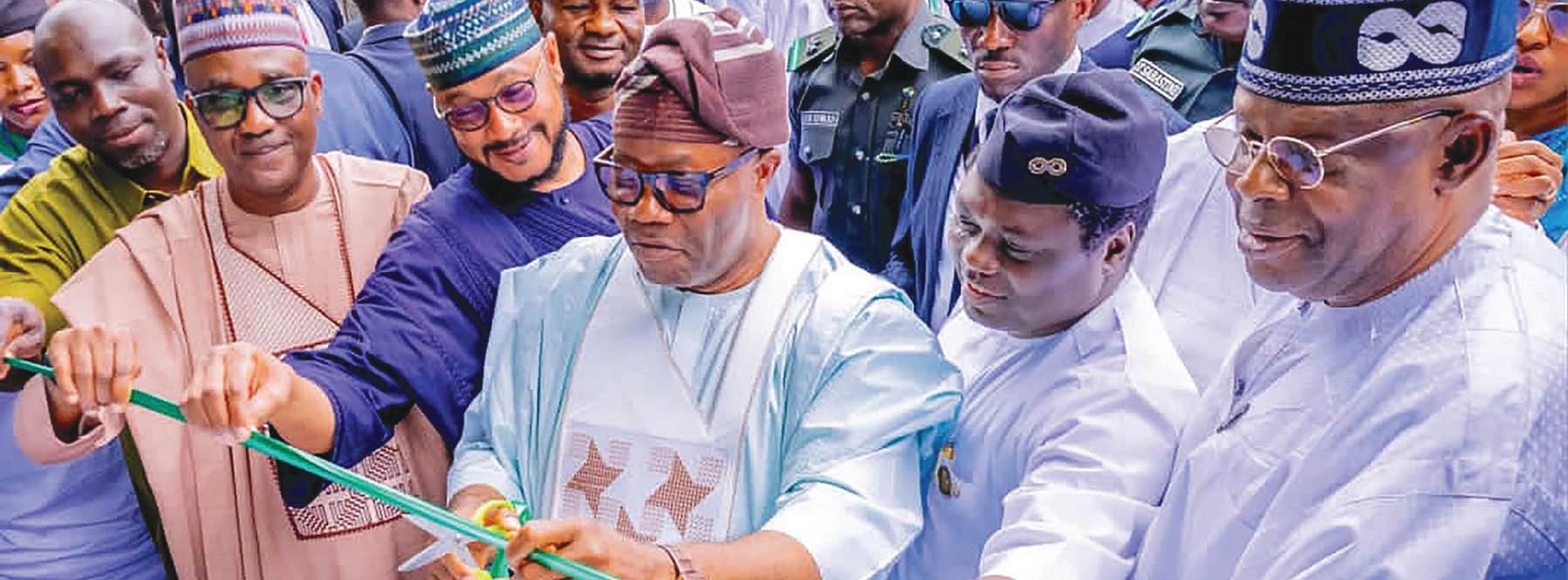
INAUGURATION OF NATIONAL OFFICERS OF THE PBAT DOOR-TO-DOOR CAMPAIGN FOR 2027...
L-R: Managing Director, Tantita Security Company, High Chief (Engr.) Kestin Ebimorbowei; Speaker of the House of Representatives, Tajudeen Abbas; Governor of Zamfara State, Dauda Lawal; President of the Senate, Godswill Akpabio; Governor of Taraba State, Agbu Kefas; and Abiodun Faleke, during the inauguration of National Officers of the PBAT Door-toDoor Campaign for 2027 and the commissioning of vehicles for state chapters of the campaign at the Transcorp Hilton, Abuja, yesterday
INEC Identifies 385 Flash Points, 200 Difficult Terrains Ahead of Osun Guber Poll
Adeleke urges voters to reject monetary inducements for voter card Aide alleges N12bn claim is false Oyebamiji to Traders: You’ll be key part of my govt if elected
Yinka Kolawole in Osogbo
The Resident Electoral Commissioner (REC) of the Independent National Electoral Commission (INEC) in Osun State, Mrs. Oluwatoyin Babalola, has disclosed that the commission has identified 385 flashpoints across the state and shared the information with security agencies as part of preparations for the forthcoming governorship election .
Babalola said the commission also mapped about 200 difficult terrains to assist security agencies and election officials in planning their operations, noting that several communities in the state remained inaccessible due to poor road conditions.
She explained that INEC had intensified its preparedness by conducting risk
management training for its personnel, stressing that the commission was currently operating within what she described as the “amber zone” of the electoral body
According to her, field officers will be deployed across the 13 local government areas participating in the election to conduct on-the-ground risk assessments and monitor the security situation.
The REC added that the commission has been equipping its staff with the knowledge and skills needed to manage risks and remain calm while carrying out their duties during the election.
Babalola revealed that she had personally visited 29 of the state’s 30 local government areas, including Ila and Ifedayo, where incidents of kidnapping
and other violent crimes have raised security concerns. She, however, clarified that while she would not describe the situation in those areas as banditry, there were significant security challenges that required close attention.
Adeleke to Voters: Reject Monetary Inducements for Your Voters Cards
Osun State Governor, Ademola Adeleke, has raised the alarm over an alleged ongoing coordinated, illegal operation by the Osun APC to buy up voters’ cards and extract the pin numbers to disenfranchise voters on August 15.
In a statement, the governor warned
against what he called illegal and antidemocratic activities that were targeted at compromising the voters registers, electronically disenfranchising voters and manipulating the outcome of August 15 polls, calling the attention of the electoral commission to the untoward development.
Citing multiple reports from across the 30 local governments and Area Office, the governor accused the Osun APC and its agents of monetarily inducing the public to part with their voters’ cards with intent to disenfranchise such voters and warned members of the public to protect and never part with their voters cards.
The state governor noted further that APC agents were extracting the pin numbers on the voters cards by
ARISE TOWN HALL MEETING: STAKEHOLDERS SEEK SAFEGUARDS
Mbah disclosed that Enugu had invested heavily in Artificial Intelligence-powered CCTV surveillance systems, smart patrol vehicles, and advanced security infrastructure.
“We treated security as our number one priority from inception because every developmental objective depends on a secure environment,” Mbah said.
He also highlighted investments in training, personnel welfare, and professionalism, insisting that security should be regarded as the gateway to economic development.
According to him, technology significantly enhances the effectiveness of security personnel by complementing conventional deployment of officers on the ground.
He also stressed the importance of continuous training, professional development, and improved welfare packages for security personnel.
Mbah said, “We invested in training because we wanted a dedicated workforce. We also wanted fairness and to be seen as fair.
“Security is not just another budget item; it is the gateway through which every other achievement passes.”
Funding, Poor Training, Weak Welfare Undermine Police, Governor Lawal States
Zamfara State Governor, Dauda Lawal, said inadequate funding, poor training, and weak welfare had continued to undermine the Nigeria Police.
However, Lawal assured participants that state governments would adequately finance their police formations when eventually established.
He disclosed that his administration had procured over 500 operational vehicles and 35 Armoured Personnel Carriers within three years to support security agencies combating banditry in Zamfara.
He reiterated his administration’s policy of refusing to negotiate with or pay ransom to terrorists.
“We must resist the temptation of paying ransom to criminals,” he declared.
Ex-Defence Chief, Irabor, Says State Police Should Not Compete with Federal Police
Contributing to the debate, former Chief of Defence Staff, General Lucky Irabor, emphasised that state police should complement – not compete with – the Nigeria Police and other security agencies.
Irabor stressed that intelligence sharing, joint operations, proper training, logistics, welfare, and professional
administration would determine the effectiveness of both federal and state policing systems.
“If we fail to address these issues, the same weaknesses affecting the federal police today will simply be replicated at the state level,” he warned.
Let’s Build Capacity Before Creating State Police, Exlawmaker, Nnena Ukejie, Advises
Former House of Representatives member, Hon. Nnena Ukejie, called on the federal government to strengthen the capacity of the Nigeria Police to fight crime before embarking on the decentralisation of the force.
Ukejie, who spoke as a panellist, observed that if the national police were weak, there was every possibility that the state police would also be weak.
According to her, the Nigerian Police is today confronted with crimes, such as terrorism, banditry, kidnapping, proliferation of small arms, among others, which require a different method to handle.
As part of solutions to the current insecurity in the country, she suggested the strengthening of institutions as well as the need for good governance.
Ukejie stated that abuse would not happen if the country was able
to build strong systems, laws, and oversight.
Chidi Odinkalu Raises More Reservations
Former Chairman of National Human Rights Commission, Professor Chidi Odinkalu, raised strong reservations about both the timing and transparency of the ongoing constitutional amendment.
Odinkalu said two different versions of the State Police Bill were before the National Assembly without adequate public consultation.
He also questioned governors’ commitment to justice sector reforms, alleging that many states underfund their ministries of justice while seeking greater policing powers.
Odinkalu explained, “The police enforce the law; they do not administer justice. If governors have neglected their justice ministries, why should Nigerians believe they will suddenly prioritise policing?”
Moghalu: AmendmentConstitutional Alone Wouldn’t Operationalise State Police
Secretary of the Presidential Working Group on National Policing Bill, Dubem Moghalu, explained that constitutional amendment
offering monetary rewards and warned that the operation was targeting local governments with huge followership of the Accord Party.
In another development, Spokesperson to the governor, Mallam Olawale Rasheed, has condemned as false, reckless and deliberately misleading, claims made by House of Representatives member, Hon. Emmanuel Omirin, alleging that he facilitated the payment of N12 billion by the federal government to Governor Adeleke.
Rasheed described the allegation as a baseless fabrication that raised more questions than answers. He challenged Omirin to state clearly, with credible evidence, what the alleged N12 billion was meant for, in what official capacity he claimed to have facilitated it, and under what legal or constitutional authority such a transaction occurred. “Making sensational claims without evidence may serve political propaganda, but it does not constitute truth. Public discourse should be guided by facts, responsibility and respect for the intelligence of the people” he stated. You’ll Be Key Part of My Govt If Elected, Oyebamiji Promises Osun Traders
Candidate of the All Progressives Congress (APC) for the August 15 governorship election in Osun State, Bola Oyebamiji, yesterday in Osogbo, the state capital, assured traders at Sabo market of good governance should he be elected governor.
FROM ABUSE OF STATE POLICE
alone would not operationalise state police.
Moghalu disclosed that the Presidential Working Group, chaired by Chief of Staff to the President, and comprising the National Security Adviser, Attorney-General of the Federation, governors, Nigerian Bar Association, and Inspector-General of Police, had begun the drafting of a comprehensive National Policing Bill.
According to him, the legislation would establish the legal, administrative, and operational framework for a dual policing system tailored to Nigeria’s unique security environment.
Ogunsakin Promises Multiple Safeguards
Chairman of Nigeria Police Force
Steering Committee on State Police, Professor Olu Ogunsakin, assured Nigerians that multiple safeguards had already been incorporated into the proposed state police framework to prevent abuse.
Ogunsakin said State Police Service Commissions, ombudsmen, oversight boards, and clearly defined constitutional processes would regulate relationships between governors and state police commissioners.
He added that the InspectorGeneral of Police was fully committed to the ongoing reforms.
“You cannot shave a man’s head in his absence,” he remarked, stressing that the Nigeria Police must remain an integral partner in designing the new policing architecture.
Former governor of Ogun State, Aremo Olusegun Osoba, who gave the vote of thanks, commended the management of THISDAY/Arise TV for the town hall meeting.
Osoba advised that a communique from the engagement should be sent to President Bola Tinubu and the National Assembly to enhance ongoing conversations around state policing.
By the close of the town hall attended by eminent Nigerians from all sectors, a broad consensus had emerged that while state police enjoyed unprecedented national support, its success would depend on comprehensive constitutional amendments, judicial restructuring, guaranteed funding, local government autonomy, strong intelligence-sharing mechanisms, technological innovation, operational independence, effective oversight, and robust safeguards against political manipulation.
Speaker after speaker commended Chairman/Editor-In-Chief of THISDAY/Arise Media Group, Prince Nduka Obaigbena, for putting the event together, describing it as timely and important.
PHOTO: SENATE PRESIDENT’S OFFICE
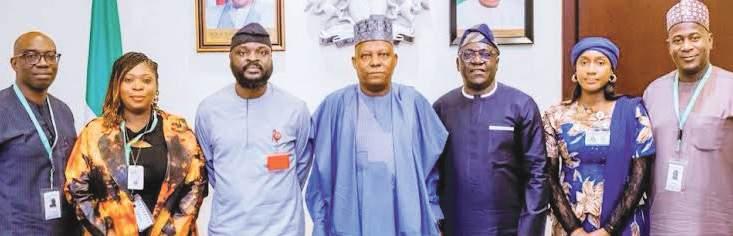
disCUssiNG THE 112 NaTiONaL EMERGENCy NUMBER...
Board Secretary, Nigerian Communication Commissions (NCC), Gwa Tobbie Mohammed; Special Adviser, Legal to the Executive Vice Chairman/CEO, NCC, Niteabai Dominic; Chairman, NCC Board of Directors, Chief Idris Olorunnimbe; Vice President of Nigeria, Senator Kashim Shettima; Executive Commissioner, Technical Services, NCC, Abraham Oshadami; Personal Assistant to the President on eGovernance Support (Office of the Vice President) Lydia Aina, and Head, Projects Department, NCC, Shuaibu Swade, during a visit and discussions on the 112 National Emergency Number at presidential villa, Abuja…recently
Rising Insecurity: Delta Community, Oghara, Bans Open Grazing
Mulls technical team to implement Delta open grazing policy
Omon-Julius Onabu in asaba
In apparent determination to make good its resolve to stem the tide of insecurity, including kidnapping, armed robbery and killings on its soil, the people of Oghara Kingdom have moved to immediately halt open cattle grazing in the area.
Oghara, the administrative headquarters of Ethiope West Local Government Area, also warned that in instances of security breach, identified indigenes who are cattle traders as well as those who lease out farmlands for grazing would, henceforth, be held liable and duly made to face the full wrath of the law.
These formed the core of resolutions at the end
of a strategic meeting at the Palace of HRM Noble Oyibo Eshemitan Orefe III, Ovie of Oghara Kingdom, with traditional chiefs, youth leaders, identified cattle traders and those who lease out farmlands, other stakeholders and the Oghara Study Group in attendance.
The meeting focused on the insecurity challenges currently confronting the Kingdom and explored practical steps towards addressing the situation and restoring peace and safety across the Kingdom.
Speaker after speaker at the meeting, including the Oghara monarch, HRM Eshemitan Orefe III, were agreed that “findings and information from all victims rescued from the kidnappers’ den
OAU, BUK Shine at Maiden SSK Moot Court Competition in Lagos
segun James
Obafemi Awolowo University (OAU), Ile-Ife, and Bayero University, Kano (BUK) competed in the final of the maiden SSK Moot Court Competition, which took place on Saturday in Lagos.
The competition, which started months ago, saw law faculties of 17 universities in Nigeria drawn from the six geopolitical zones submit written memorials that dealt with virtually all issues in law, from which the best five institutions emerged.
SSK Moot Court Competition, organised by Streamsowers and Kӧhn (SSK), a prominent fullservice law firm comprising a team of highly motivated legal professionals, to mark its 20th anniversary, was part of its Corporate Social Responsibility (CSR) for the student-lawyers.
According to the organisers, independent assessors comprising senior law lecturers from
various institutions in Nigeria painstakingly assessed the memorials.
According to one of the SSK Partners, Tamuno Atekebo, the assessors were unaware of which university had any of the submissions they assessed.
“They (independent assessors) don’t know where the submissions were coming from. No indication whatsoever. So, it wasn’t a case of maybe an assessor from a particular university favouring the students of the university he knew,” he told journalists.
At the end, five institutions stood out and in order of ascendancy, the quintet of University of Calabar (UNICAL), University of Lagos (UNILAG), University of Abuja (UNIABUJA), Bayero University (BUK) and Obafemi Awolowo University (OAU) emerged as the top five, where the top two, OAU and BUK, competed for the top prize last Saturday.
revealed the root cause of insecurity in the Kingdom to be cattle rearers/herders.
“Cattle are supposed to be ranched and not to be going about our bushes indiscriminately and
destroying our crops”, they pointed out.
The people further observed: “There is a Delta State Government policy on it; so, here in our kingdom, we are henceforth strictly
enforcing it. No more open cattle grazing in Oghara Kingdom.
“The security situation in Oghara has got out of hand with several reported documented cases of
kidnapping, ransom payment and just recently killing of one of our able bodied son. We can no longer fold our arms but to take our destinies in our hands by these resolutions.
APM Demands Verifiable Impact of Subsidy Removal
Chuks Okocha in abuja
The Allied People’s Movement (APM) has called on the All Progressives Congress (APC) to publish veritable impact of the subsidy removal on the life of Nigerians.
APM, in a statement by National Publicity Secretary, Abubakar Yusuf, said its demand is predicated on the worsening economic hardship and poverty rate in the country in the last three years.
The party noted that despite the huge sums of money that accrued to the federal government since the removal of fuel subsidy, cost of living has gone up while public facilities have collapsed and there is yawning infrastructure deficit across the country.
APM noted that Nigeria’s infrastructure deficit has been estimated at about $2.3 trillion, with experts stating that the gap would require approximately $100 billion annually over the
next 30 years to fix.
It added that under the APCled administration, hunger has become a national emergency, as millions of families go without daily meals.
“Small businesses are collapsing under rising operating costs. The purchasing power of workers has been abysmally degraded, while poverty and unemployment continue to rise at alarming rates.
“Across the country,
frustration is growing as more citizens struggle to survive,” the party noted.
APM regretted that despite the heavy premiums citizens pay daily, the APC administration is not forthcoming with a transparent account of the trillions accrued to it from the removal of subsidy, and accused the APC of corruption, diversion of public funds and bandying of figures and fictitious achievements.
Sulaiman: APC Feud Won’t Stop Kwara Victory in 2027
Hammed shittu in Ilorin
Against the backdrop on the ongoing feud in the ruling All Progressives Congress(APC) over the conduct of the last primaries of the party in Kwara State, a former governorship aspirant, Prof. Wale Sulaiman, has dismissed fears that the grievances could affect its chances in the 2027 general
election.
He, however, said that the APC remains the party to beat in the state.
Sulaiman stated this in Ilorin yesterday while speaking with newsmen on the state of the nation.
He said that despite the agitation by some dissatisfied aspirants under the platform of the G-15, the ruling party would eventually close ranks ahead of the election because
of what he described as its superior performance in government.
Sulaiman argued that it was regrettable that the ongoing dispute within the party was driven more by personal ambition than genuine concern for democratic principles or the welfare of Kwarans.
According to him, many of those now challenging the emergence of the APC
governorship xqcandidate never questioned the process until it failed to favour them.
“I think it is rather unfortunate that we have grown men fighting like school children whose principal has denied them candy.
“The debate should be about the needs of our people, not about a sense of political entitlement,” he said.
2027: Niger PDP Candidates Get Certificates of Return
Laleye dipo in Minna
The Niger State chapter of the Peoples Democratic Party (PDP) has presented certificates of return to its candidates thereby affirming them as the party’s flag bearers for various elective positions in the 2027
general elections. Among those who received the certificates are the Governorship Standard bearer Alhaji Abubakar Sulaiman, three Senatorial candidates, six contestants for the House of representatives and 25 for the State House
of Assembly. At the ceremony held at the state PDP Secretariat in Minna, no explanation was given for the absence of three candidates for the House of Representatives . State Chairman of the party, Alhaji Aliyu Halidu Mohammed,
who presented the certificates to the candidates, congratulated them for their victories during the primary elections and charged them to collaborate with the state and local government secretariats for success at the polls next year.
CPPI Moves against High Nomination Fees By Political Parties
Blessing ibunge in Port Harcourt
The Citizens Platform for Political Inclusion (CPPI) has commenced legal and legislative action against what it described as the exorbitant expression of interest and nomination fees charged by political parties.
The CPPI warns that the practice threatens Nigeria’s constitutional democracy by shutting out ordinary citizens from contesting elective offices.
The platform disclosed that it had issued separate pre-action notices to the national leadership of the All Progressives Congress (APC), African Democratic Congress (ADC), Nigeria
Democratic Congress (NDC) and Peoples Democratic Party (PDP), while also petitioning the National Assembly to amend the Electoral Act to regulate nomination fees.
CPPI, a non-partisan coalition of citizens, public policy advocates and democratic governance stakeholders, is pursuing the initiative in collaboration with the Athena Centre for Policy and Leadership and the Embassara Foundation.
In a statement issued and jointly signed by Rt. Hon. Osita Chidoka, High Chief Amagbe Kentebe, Mr Iniruo Wills, Mr Ken Lewis-Allagoa, Mr. Famous Obebi and Adebiyi Ajayi, the group said the current nomination fee regime had become a major
barrier to inclusive political participation, particularly for women, youths and persons with disabilities.
According to the statement, the increasing cost of securing nomination forms has entrenched the monetisation of Nigeria’s political process, making access to elective offices dependent on financial strength rather than competence, merit or commitment to public service.
“The inevitable consequence is the systemic monetisation of political participation across the Nigerian political landscape, whereby access to elective office is increasingly determined by wealth rather than merit, competence or public service,” the statement read.
Primary: Witness Narrates How APC, INEC Manipulated Delta South Senatorial Results
alex Enumah in abuja
A witness in the suit against the May 18 primary election of the All Progressives Congress (APC), in Delta South Senatorial District, yesterday told a Federal High Court how the result of the election was allegedly manipulated in favour of the party’s candidate.
The witness, Prince Micheal Diden, who is also a senatorial aspirant, gave the narration while testifying in the suit he filed challenging the declaration of Senator Joel –Onowakpo Thomas as winner of the Delta South senatorial primary.
Meanwhile, Justice Mohammed Garba Umar of the Federal High Court in Abuja, has fixed July 20 for Senator Thomas to open his defence again the suit.
The Judge fixed the date for the incumbent Senator to open his defense, shortly after the witness testified on how the primary election process was allegedly manipulated and the results falsified leading to unlawful declaration.
Diden, a former Chairman of the Delta State Oil Producing Areas Development Commission (DESOPADEC), in his testimony, told the Judge how himself and three others participated in the May 18, 2026 APC senatorial election, which according to him was held peacefully.
He told the Court that he had agents in all the wards that constitute the eight local
government areas of the Delta South Senatorial District who supplied him with the results of the election.
Speaking further, the former Chairman of Sapele Local Government Area alleged that Senator Thomas, APC and the
Independent National Electoral Commission (INEC) conspired and changed the results in favour of the 1st defendant.
He urged the Court to do justice to his case by reversing the alleged falsified results and uphold his own results.
Group Vows to mobilise for More Votes for Tinubu in 2027
ibrahim Oyewale in lokoja
A group, the Kogi Progressives Stakeholders Forum (KPSF), Kogi East Chapter, has resolved to quadruple the votes recorded by President Bola Ahmed Tinubu in the 2023 presidential election, ahead of the 2027 polls.
The Coordinator, Sanni Philips, made the declaration yesterday during a one-day Strategic Review Meeting for the Re-election of President Tinubu, in Anyigba.
The meeting attracted nine LGA Coordinators and 97 Ward Coordinators of the Forum across the Eastern Senatorial District.
Addressing the gathering, the State Coordinator of KPSF, Philips, said the strategic meeting was convened to formulate strategies that will ensure President Tinubu wins the 2027 election overwhelmingly.
He described President Tinubu as a performing president, and hinged the forum’s support on the administration’s achievements, including the removal of fuel
subsidy which he said has led to increased infrastructure development, a foreign reserve base that has hit $51 billion, and numerous social intervention programs impacting citizens nationwide.
“Kogi East has never had it this good in terms of empowerment, appointments and infrastructure development,” Philips said.
“We have decided and determined not only to double the votes scored by President Tinubu in 2023, but to quadruple it in Kogi East.”
He also acknowledged the efforts of Governor Ahmed Usman Ododo in repositioning the APC in Kogi State, and praised Senator Jibrin Isah Echocho for attracting democratic dividends to Kogi East.
He, however, appealed to the APC National Working Committee to reconsider its decision and retain Senator Echocho as the Kogi East Senatorial ticket holder, describing him as “a rallying point that will guarantee a massive win for President Tinubu.”
Gonzaga Jesuit College Wins 25 Awards at STEM Olympiad in Rome
sunday Ehigiator
Gonzaga Jesuit College (GJC), Okija, Anambra State, has recorded a major international academic feat after winning 25 awards at the 2026 International Science, Technology, Engineering and Mathematics (STEM) Olympiad Grand Finale held in Rome, Italy.
The Nigerian school secured 10 gold medals, three silver medals, nine bronze medals and three honorable mentions at the
global competition on July 8, outperforming contestants from several countries in Science, Mathematics, and Engineering and Technology.
In a further boost to the school’s performance, two students; Okeke Somtochukwu and Nwafor Emmanuel Chinedu, were named Overall Second Best in the World, placing Gonzaga Jesuit College among the leading schools in global STEM education. According to the college,
the achievement reflects its commitment to excellence in STEM education, with students demonstrating outstanding knowledge, creativity, innovation, teamwork and problem-solving abilities throughout the competition.
“The recognition of Okeke Somtochukwu and Nwafor Emmanuel Chinedu as Overall Second Best in the World further underscores the world-class standard of education, mentorship and talent development at Gonzaga Jesuit College.”
Edited by: MJO Mustapha Email deji.mustapha@thisdaylive.com
From Qabil’s Jealousy and Murder to Islamophobia (1) WORLD OF ISLAM
By: Spahic Omer/IslamiCity
One of the main lessons derived from Qabil’s (Cain’s) murder of his brother Habil (Abel) is that good things are accompanied by jealousy, which in turn could get out of hand and lead to the most painful consequences. Jealousy is a disease that can consume a person and can exercise control over his senses, yet over his entire being. Thus, an extremely jealous person is irrational and impulsive. He is dangerous.
Depending on the nature and extent of good things, jealousy, moreover, can be institutionalized and communalized, in which case reactions get mutual and coordinated. They become formal and may yet turn into independent institutions themselves. The reactions morph into conditions, then into patterns, and, at long last, begin to constitute the core of a national consciousness. And just as overly jealous individuals often turn unreasonable, reckless and dangerous, so do nations and their institutions, including governments.
Accordingly, if good things and blessings can be personal and national, jealousy can also be personal and national. The same applies to consequences. If jealousy can ruin personal relationships, it likewise can lead to large scale disputes and hostilities. The pinnacle of the circumstance and its irrepressible corollaries is what could be dubbed a civilizational jealousy.
The Qabil-versus-Habil episode (al-Ma’idah, 27-31) signified a mould in which individual as well as collective destinies are cast. Their performances denoted as much personal deeds as a collective awareness and standard. In their capacity as the biological children of the father of mankind, Qabil and Habil were not merely protagonists, but as well existential standard-setters. Their responsibilities were multiple, representing and acting on behalf of the whole of humanity. In fact, they epitomized humanity in more ways than one, inasmuch as their actions significantly affected the trajectory and character of life on earth.
Jealousy and whatever might issue therefrom is suicidal. It cannot be an isolated act. Rather, it amounts to a premeditated process each and every aspect of which is carefully attended to. A person guilty of the jealousy aggregate and its course is fully responsible for the madness and its ensuing outcomes.
Hence, whereas the Qur’an describes the transgression of Prophet Adam as a mere slip caused by the endless guiles of Satan, the crime of Qabil, on the other hand, is presented as intentional and self-inflicted, whereby his selfish soul and corrupted mind overpowered his personality and prompted him to kill his brother. As a result, Adam is seen as blameless and genuinely sorry. Conversely, Qabil was brazen. Blameworthy, he was held fully responsible. He was blinded and restrained, and so, had neither guts nor discernment to repent honourably.
Prophet Muhammad (pbuh) said: “No soul is wrongfully killed but that some responsibility for its blood is upon the first son of Adam, for he was the first to set the precedent of murder” (Bukhari and Muslim).
It is said in the book of 1 John in the New Testament that people (the Christians) should not be like Cain, “who was of the evil one and murdered his brother. And why did he murder him? Because his own deeds were evil and his brother’s righteous” (1 John 3:12).
Linguistically, the word “Cain” also became immortalized. It became synonymous with “a murderer”, while the word “raise Cain” means “to cause a commotion” and “to react angrily or protest aggressively, causing a big disturbance”. Some of the sister words are “to raise hell” and “to raise the devil”.
That is why murder is regarded as one of the greatest crimes and sins that can be committed on earth, due to which Almighty Allah decreed upon all humanity in general, and upon the Children of Israel in particular “that whoever kills a soul unless for a soul or for corruption (done) in the land - it is as if he had slain mankind entirely. And whoever saves one - it is as if he had saved mankind entirely” (al-Ma’idah, 32). For obvious reasons, this Qur’anic verse comes immediately after the story of Qabil and Habil.
The Jews, the Christians and Muslims
Some of the motives for which the Children of Israel have been thrust into the limelight revolve around the verities that at many critical junctures of history they occupied centre stage; that they were ruled generally by prophets, whenever a prophet died a new one was raised to succeed him; that they were notorious for regularly rebelling against Allah and His prophets; that they killed a great many prophets who tried
to bring them back to the abandoned path of the truth and virtue; and that the office of prophethood was consequently taken away from them and was given to Muhammad who was unlettered and a “novice” and who represented the rank of “others” from the Arab race.
As far as the Christians are concerned, the confrontation between the elder Qabil and the younger Habil is evocative of the historical confrontations between the Jews and the Christians, with Prophet ‘Isa (Jesus) being the younger brother (Habil). The Jews plotted to kill ‘Isa - according to the New Testament narrative, they succeeded in doing so - and to exterminate the Christians.
To Muslims, however, both the Jews and the Christians treated Prophet Muhammad, the youngest brother of the Semitic family, in the same manner. Qabil was the type of the Old Testament and New Testament peoples, who sometimes separately and sometimes collectively resisted Muhammad and endeavoured to kill him, working tirelessly to try to extinguish his legacy and to put down his people (Abdullah Yusuf Ali, al-Maududi).
No sooner had Prophet Muhammad been sent as the final messenger and the seal of prophets, than the Jews and the Christians started to harbour, display and act upon jealousy. They were jealous that Allah had withdrawn His favours from them and had bestowed them on the brother nation. They nevertheless forgot that it is Allah’s absolute prerogative to appoint whomsoever He wants as the bearer of His message, for He “knows best whom to appoint as His messenger” (al-An’am, 124). They also failed to realize that all prophets, just like all people, constitute one family without distinction between them (al-Baqarah, 285). Most importantly, the Jews and the Christians overlooked the fact that Allah had cancelled His favours upon them because of their violation of covenants with Him and their other persistent wrongdoings. Their responses to the sending of Muhammad was an attestation to this. Indeed, the final prophethood of Muhammad was the greatest blessing for him and Muslims. The greatest jealousy, commensurate with the extent of the blessing, was inevitable. So much so that many Jews and Christians were blinded and incapacitated thereby. They knew that Muhammad was a true messenger of God and that he was telling nothing except the truth, but to swallow their pride and to follow him was too much to ask. The truth and irrepressible jealousy are irreconcilable. To jealousy and its members, the truth and its own members - whoever they may be - are the enemy. Which inevitably rendered Prophet Muhammad and Muslims the nemesis, threatening not only the beliefs, values and narratives of history about those who had preceded them, but also their ways of life and the overall existential orders. Needless to say that such was the case on account of the Jews and the Christians revelling not in the truth, but in their own desires and interests. Muhammad and Islam, it follows, were not looked at, nor dealt with, against the background of the truth, but against the background of those narrow aspirations and interests. The truth was subjected to the implications of the latter. Under such circumstances, normally, the sweetness of the truth becomes bitter, and the bitterness of jealousy and the falsehood that sustains it turns out to be sweet. One subsequently prefers to reside proudly and boastfully at the bottom of the heap than to climb to the top unpretentiously and unassertively. In the world of jealousy different rules apply and different standards play out. The language spoken within that world is not the language outside it. The crime of a person who is the object of jealousy is that “he has”, and the entitlement-to-act of the one who is jealous is the fact that “he does not have”. Qabil and Habil talked to each other, but Qabil could not understand a word of what was said. They talked but did not communicate. Qabil was impaired beyond healing. The Qur’an underlines this principle by saying: “We know indeed the grief which their words cause you (O Muhammad); it is not you that they deny, but it is the verses of Allah that the wrongdoers reject” (al-An’am, 33).
In other words, there was nothing wrong with Muhammad; the problem was the special blessing and boon conferred upon him in the form of the final prophethood mission. The problem furthermore was not Muhammad as a human being, but Muhammad as the ultimate messenger of God. That is to say, by extension, people rejected God rather than Muhammad.
OF BRIDGES AND WALLS: FINDING COMMON GROUND, RISING ABOVE DIVISIONS (1)
then fair to antagonise anyone or group just because they don’t look like us or speak the language we understand? I would like to streamline this discourse to what happens amongst the major races as already identified but it may also interest us to know that the context of interactions like this are often more nuanced than can be dissected within the limit of time available to us. Be that as it may, our objective shall be firmed on building a common understanding of the dangers of different variants of racial antagonism.
Being members of one human community, it is actually strange how anyone would imagine themselves or their racial group to be superior to others, even after it has been accepted, as the text of the US Declaration of Independence did state, that we are all “created equal and had been endowed with certain inalienable rights by the Creator.” The rights to life, liberty and pursuit of happiness are clearly listed as non-negotiable. However, beyond the shores of the United States where this declaration was first made, the substance of its meaning applies universally, irrespective of where one was born or where and how their boat sails. To then deny anyone or a group of people any or all of these rights is to live in vehement, often painful, denial of the truth. Every form of racial discrimination, whether expressed explicitly or subtly hinted, is a direct attack on the human conscience and a sore point in our social relationships. To assume that an entire group of humans are inferior on the basis of their skin colour or geographical background puts a certain question mark on the humanity of those who hold such assumptions.
While there is a wide consensus that racism has no place in interpersonal or community relations, the difficult truth, however, is that we cannot wish it away for there will always be individuals in high and low places whose entire worldview revolves around prejudices drawn from basic human features like skin colour, skeletal structure, hair texture and accent. To them, humans are defined entirely by the reports of the basic senses and no more. At times, however, there are others who deep in their hearts, appreciate the limitless potential of the
human specie but for reasons of mischief or in pursuit of a hideous agenda, elect to swim in the ocean of racial ignorance, convinced that popular narratives are synonymous with facts. Recall, however, that I had alerted us that racial discrimination at its core, is an exercise in self-torture because it is entirely about lying to oneself that a fellow human is inferior for the singular reason that his physical characteristics are unlike yours. Such mental framework is built on the foundation of delusional ignorance but as we have also learnt overtime, ignorance can quickly morph into extreme behaviours and widespread bigotry leading to wanton destruction and diabolic expressions of hatred. It then holds that matters of racial bias should not be taken casually in the light of its potential to instigate violence against innocent individuals and groups.
At any rate, my view is that the most effective response to the error of racism is enlightenment through education and consistent engagement with different stakeholder groups, especially teachers and persons of influence within the society. It may also help to set up robust race-blind institutional processes in public and private establishments for activities like recruitment, business and scholarship grants and all such events that invite interests from persons of diverse racial origins. The truth is that we cannot shy away from discussing these issues for that is the only way to deepen public awareness on the ills of racism and the mindset that enables it. I am pleased that we are alive to our responsibility in this regard as intellectuals, thought leaders and role models to millions of young people across racial divides.
As we may have learnt through the decades, the troubling return of racial disharmony in several parts of the world is fuelled in the main by political actors who have mastered the art of public manipulation and misrepresentation of facts to win votes. I know a few of us can readily point to several notable politicians around the world who have carefully reinvented the art of race-baiting as a tool of political dominance. Unfortunately, that would only be an overly simplistic way of looking at the crisis. The truth is that if public outcry forces one of such tricky characters out
LEADERSHIP VS FEDERALISM
but it generally rings true.
So when many Nigerians argue that the problem of Nigeria is solely the lack of good leadership, we should all be alarmed at the implication of this suggestion - which is that Nigeria is destined to ruin and damnation unless and until we get this elusive silver bullet. Yet we do not have a foolproof formula for its procurement. No society does. Unlike science, representative democracy does not follow the logic of two plus two equals four.
At his eloquent best, Winston Churchilll made the pertinent remark that “democracy is the worst form of government, except for all those other forms that have been tried from time to time”. He was correct on both accounts. Churchill was acknowledging that democracy is inherently imperfect, messy, and prone to flaws like inefficiency, mob rule, or short-sighted policies, corruption, demagoguery and self-destructive divisions and inherently incapable of assuring that the best candidate wins. Afterall Donald Trump is a product of democracy.
Pretty much the same logic is at play in the solemn Daniel Elazar conception of federalism as ‘tragedy’. His identification of Federalism as a tragedy is intended to make the point that it is a response mechanism to political conflict, not an optimal strategy. It is a suboptimal compromise in the effort to defuse real and potential situations of conflict and ensure that such situations do not degenerate into less attractive possibilities’¹. Yet what is the alternative?
Dictatorship, totalitarianism, divine rule, authoritarian
dispensation?.
In all societies the factors that tend to determine the emergence of leaders are not such as will guarantee the emergence of good and noble leaders. It is for this reason that constitutions are designed from the perspective of the worst case scenario. Hence the contrivance of ensuring a limit to the damage that bad leaders can inflict with such guardrails as federalism, separation of powers and checks and balances. After good leaders and bad leaders have exited the state, it is the constitution that remains. What is within our reach and grasp at all times, is the constitution whose utility lies in its impersonal efficiency at constraining the abuse of power and facilitating its judicious application.
The lesson we can learn from the unprecedented dispatch of six prime ministers in the political leadership of the UK in the past ten years is the resilience of the constitutional and institutional firmament of the political system. It has demonstrated an inherent capability to respond to the test of a conspicuous reign of leadership crisis and failure. Never mind the absurdity but the situation is nearly suggestive of the proposition that the recurring leadership crisis is irrelevant to the durability of the political system.
Historically and in real time, some of the notorious habits that determine the outcome of elections in contemporary Nigeria consist of rough and ready tons of Ghana must go carrier bags, the evergreen ethno-religious cleavages, criminal political networks styled political structures, rig-
TINUBU’S ASO ROCK STINKS TO HIGH HEAVENS
The Buhari cabal was a more mature crew made up of men with diverse backgrounds and bureaucratic experiences. Buhari’s first Chief of Staff, Kyari was well read and versed as a lawyer, top banker and public official.
So were many others of that class. Their leader, the president, was weak and ailing so this small Aso Rock group were the de facto authority and they got away with so much. But they were grounded and solid, and they did well not to create earth shaking scandals.
They understood the magnitude of the office of the president. The coming of Professor Sulu Gambari as chief of staff after the demise of Abba Kyari brought further order and stability to Buhari’s Aso Rock.
TINUBU’S RECKLESS, FECKLESS GANG
Quite unlike Buhari, Tinubu’s kitchen cabinet in Aso Rock led by his chief of staff, Femi Gbajabiamila is a poorly constituted lot.
While Tinubu has turned out more vulnerable than Buhari, his kitchen team has also proved to be less tutored and less circumspect than the Buhari team. Apart from Gbajabiamila, most other members of this class are small time weasels who were mainly personal and domestic staff of Tinubu in his earlier incarnations.
None of the current Aso Rock key staff seem to have a grasp of the current call of duty.
Worse is that the First Lady and the First Son also run rampant in the Villa making a bad situation worse.
More troubling is that not one of the crowd in Aso Rock today has quality educational grounding like Kyari and Gambari for instance; not one has solid public service experience and most notably, not one is given to such gravitas that imbues stately integrity like Mamman and Joda.
The impression we get today from outside, looking in,
of office, more vicious individuals of similar orientation would emerge to continue the chaos. In discussions such as this, we have to carefully look at the environment that gives room for race-driven politicking, the voters who take such bait and the failure of institutions to check exploitation of voters through racial appeals. My position is that the challenge is deeper than many of us acknowledge; perhaps this may be a good time to look at things more holistically.
I have also observed that often times, analysts fail to present a comprehensive view of the challenge and elect rather to go with cheap stereotypes. As the great Nelson Mandela taught, the struggle should be targeted at all designs at racial domination, whether by Whites, Blacks, Asians, Australians or Indigenous Americans. Our campaign should never be targeted at individuals or groups but against structures, institutions and systems that directly or subtly promote interracial suspicion and disharmony. Balance and fairness are the two critical elements that must be brought to the centre of these discussions. The overarching agenda should be to find answers to the very important questions that objective commentators have continued to ask. For example, how does it advance our collective humanity to put down an entire race under whatever guise? How do you balance equality and merit? How do you keep the focus on excellence even in the pursuit of diversity? Do we have to bring down standards as we pursue the ideals of inclusion? Clearly, there are several more questions that can be asked but I remain unyielding in the conviction that no individual should be denied what is due him for primordial considerations. It would be more ideal to set clear standards that everyone, irrespective of their racial identity should aspire to. I do not buy the argument that the standards have to be lowered to accommodate everyone. My view is that the opportunity, tools and resources for adequate preparation should be liberalised such that no one suffers the disadvantage of unpreparedness. From education to sports, recruitment into strategic institutions and agencies, and across all other competitive career fields, merit and objectivity
ging - which the report of the American observer mission to the 2023 elections sugarcoated as ground game. Given the backdrop of this bad ensemble and the inherent logical expectation, will it not be a surprise (albeit pleasant) were the relatively moral outlier nevertheless emerge victorious. What all this means for us in Nigeria is the indispensability of federalism for which there has been a surfeit of intellectually informed rationale. Here I must thank my sister Oby Ezekwesili for the wake up call that the general enthusiasm that has attended the state sponsored Bill for the establishment of state police only tantamount to scratching the surface of the problem. The real game changer is going through the whole log of constitutional restoration of fulsome federalism alias restructuring.
N. S Varma made the point that “It is worth remembering that Nigeria’s regionalized nationalism offers the best hope for national unity”. Beyond this evaluation is also the fact that the socioeconomic development that Nigeria experienced from the 1950s to the early 60s were credited to the regional governments not the federal government
“If the major identifying diversities are territorially arranged, then the society or the political community is potentially federal. But if the distribution of diversities follows a marble cake pattern (i.e. scattered), the society is plural and non-federal. Only when a society contains territorial grounds so markedly different from one another that they require some instrumentality to protect and express their peculiar qualities does the need for Federalism generally
should be at the centre of decision-making, nothing else. What hurts society in the long run is not the colour mix of the stars we see on television screens, the long-term danger is giving any group the impression, whether expressly or tacitly, that they cannot compete with the best so the standard has to be lowered to let them in. The short-term optics may look good but when a group of children grow up with the mindset that their maths score or performance in sciences need not equal the output of their peers for a chance to get into certain institutions, what follows is a pervasive culture of mediocrity arising from refusal to push oneself as hard as necessary to earn a place at the top. I am not sure this is something anyone should encourage, for while we insist on the right to appear in the frame, it is of equal importance that we spread the truth that there is no limit to the capacity of the human mind to achieve anything it commits to. This brings me to the ongoing FIFA World Cup in North America and the marvel of diligence across multiple frontlines. The central takeaway for me thus far is that excellence has no skin colour for in the final analysis, it is the level of preparation, brilliance of strategy and the unyielding determination to win that count. To address the challenge of racial bias, it would help to keep insisting that every race-based barrier on the road to success be dismantled so that everyone gets the opportunity to pursue and live out the fullest expressions of their dreams, whether it is in sports or sciences, drama or political leadership.
I am particularly glad to observe that we are broadening the scope of the conversation as this conference has done by welcoming speakers and resource persons from different backgrounds to share their stories and perspectives on the evolution and dynamics of the issues. A key lesson for me is the importance of respectful engagements across races. Not much can be achieved by hectoring and proselytising or perhaps assuming that we know better.
Continued on page 33
arises” (Livingston, 1952:90)-
In its original form, the federal idea was theopolitical, defining the relationship between God and man as one in which both were linked by covenant in a partnership designed to make them jointly responsible for the world’s welfare. (Daniel Elazar)
”Indeed, I do not see how the country can arrest its current drift towards becoming a failed state without restructuring to a true federation of fewer and more viable federating units with greater devolved powers to plan and pursue development and peace in their respective areas” lamented Emeka Anyaoku
“In large states that must contend with geographically based ethnic, religious, or linguistic cleavages, some form of regional autonomy seems inevitable” said Feeley Malcom. M According to Lithwick, N.H. “Federalism becomes useful when people’s political identities conflict but their political lives are intertwined as members of a single polity or as members of different polities that want to join together. Inevitably, it involves a compromise; a central government is established or maintained, but some or all regions of the polity are granted autonomy over specified governmental functions.
Chief Obafemi Awolowo accurately captured contemporary Nigeria in the following words “In any country where there are divergences of language and of nationality, a unitary constitution is always a source of bitterness and hostility on the part of linguistic or national minority groups.”
is that Aso Rock is filled with people who are fighting to out-pilfer each other.
SLEAZE WITHOUT END, AMEN
A few weeks ago, Weekend Trust reported about cashfor-access racket being perpetrated by the Protocol Unit of Aso Rock. Yes, this has been a long-known tradition in the Village but today, the practice has become transcendental.
A particular governor from a southeast state is said to be one of the chief clients of the Aso Rock protocol unit. Mr Governor reportedly pays the boys at the Villa in dollars so they put him on every protocol list including seeing the president off at the airport every time he’s traveling. And as we know, the President travels all the time and Mr Governor who runs his state from Abuja is seen all the time at the Abuja airport waving goodbye to Mr President.
CASH-FOR-APPOINTMENT
SCAM IN ASO ROCK: EFCC COVER-UP
A certain Dr Halimat Adenike Tejuosho who is the South West women’s leader of the City Boys Movement, made a deposition to the EFCC early this year, detailing how hundreds of millions of naira and dollars were paid out someone between 2023 and 2025 for the purpose of securing ministerial and other juicy appointments from the Presidency. Her contact person who apparently operated from Aso Rock, one Mallam Garuba, the conduit for the huge cash and transfers was reportedly apprehended by the EFCC. Till date, this huge scam from the innards of the Presidency has been covered and buried by the EFCC.
Monies amounting to billions of naira paid to agents purportedly in Aso Rock could easily have
been trailed and the culprits exposed or exonerated as the case may be. But nothing has been done.
AND NOW THIS: WHAT’S GBAJABIAMILA STILL DOING IN ASO ROCK?
In decent climes, Mr Femi Gbajabiamila, the chief of staff to the president would have been fired years ago. Fingers have been pointed at him from day one for allegedly compromising his office in all manner of ways.
Most of it points to cash-for-appointment scams.
Though nothing has been proven and none has indicated him, the murmurings have become very loud.
The current scandal dubbed Gbaja-Gate seems to therefore corroborate the long held suspicions about him.
The Presidential Foreign Intervention Promotion Council (PFIPC) brouhaha is an Aso Rock mess taken too far. The president’s number one aide is not only accused of receiving a huge bribe of N400m, he is taken to have aided the set up of a fake federal government agency with the sole purpose of fleecing the government.
The PFIPC is a scandal of an epochal proportion! How was the supposed N24 billion used for setting up this elaborate agency sourced?
Why did the chief culprit, Prince Adeyemi Aderemi Matthews accuse Gbajabiamila specifically and not anyone else in the Tinubu cabinet?
WHO KILLED DOLAPO BABATUNDE TANIMOLA?
Why in good conscience is Gbajabiamila sitting tight in the office when life has already been cut down over this Gbaja-Gate?
Who is DOLAPO BABATUNDE TANIMOLA? Nigerians deserve to know who exactly he is and what happened to him.
Gbajabiamila has a lot of questions to answer in this saga. And he cannot answer these questions sitting tight on his desk. He must step aside for a thorough investigation to be done.
The stench from Aso Rock is choking the country to death. LAST LINE: “IF THEY HAVE THE OPPORTUNITY, I WILL NOT BE ALIVE.” - OBI
“The way the government is going now, I might not be alive. I’m telling you. Every single thing I do, this government is frustrating. Deliberately so. There’s even a possibility that, if they have the opportunity, I will not be alive.”
Early in the week, the Presidential candidate of the National Democratic Congress, NDC, Mr Peter Obi made a plaintive cry to the world.
My life is in danger and my businesses are under threat as well.
He points directly to the Nigerian government as the agent gunning for his life.
This is a serious allegation. Nigerians have witnessed the serial pursuit of Mr Peter Obi from one political party to another. The ruling party seemed to vow that Obi would not be on the ballot.
Now that he’s beaten them to their game, the government now openly seeks his very life, according to him.
This is shocking. This brand new kind of APC democracy is truly strange in Nigeria.
President Bola Tinubu and the ruling party have a duty to protect not only the presidential candidates but all Nigerians. Let’s just say that no harm must come to Mr Peter Obi. President Tinubu must make sure of that.###
End of the Road for Morocco as Mbappe, Dembele Fire Les Bleus into S’final
Duro Ikhazuagbe
Africa’s last team standing, Morocco, finally capitulated last night as France secured their third consecutive World Cup semi final ticket in Boston.
2026 WORLD CUP
39-year-old Messi.
For Mbappe, his strike was his eighth goal of this World Cup. He has now matched Lionel Messi and just one goal more than Norway’s Erling Haaland while Harry Kane to England’s Three Lions has six going into their
Expectedly, irrepressible Kylian Mbappe scored the opener while Ousmane Dembélé sealed the 2-0 victory for the the French side who have confirmed their favorite tag going into the last four of the 2026 edition of the Mundial in North America.
Glasgow 2026 Unveils
World-class Athletics Track at Scotstoun Stadium
With less than a month until the opening ceremony, Glasgow 2026 has unveiled a state-of-the-art athletics track at Scotstoun Stadium, setting the stage for one of the most anticipated competitions of the Commonwealth Games.
The newly installed Dynamik Mondo Sportflex Super X 720™ surface—widely regarded as the most technologically advanced track in the world—will host 59 Athletics and Para Athletics medal events from July 27 to August 1. Some of these events will feature many of the sport’s biggest names, including Scotland’s Josh Kerr and Eilish McColgan, England’s Katarina Johnson-Thompson and Georgia Hunter-Bell, Jamaica’s Shericka Jackson, and Kenyan stars Faith Cherotich, Lilian Odira, and Timothy Cheruiyot.
Designed to maximize energy return and athletic performance, the
surface represents another significant investment in delivering a world-class championship experience.
Beyond the Games, the new track will leave a lasting legacy for Glasgow by providing local athletes and clubs with a premier high-performance facility for years to come.
Organizers insisted yesterday that the investment reflects the Games’ commitment to both elite competition and grassroots development, while further cementing Glasgow’s reputation as one of the world’s leading hosts of major sporting events.
With more than 3,000 athletes from 74 nations and territories competing across 10 sports and six Para sports, Glasgow 2026 promises to showcase world-class competition while inspiring the next generation of athletes through facilities that will continue serving the community long after the medals have been awarded.
quarterfinal fixtures this weekend.
The Frenchman is now top in the race for the Golden Boot as he has registered more assists than his former Paris St-Germain team-mate.
The two are also having a thrilling contest to see who will become the all-time World Cup top scorer, with 27-year-old Mbappe now on 20 goals compared to the record 21 from
Mbappe made up for an earlier missed penalty as France proved too good for Morocco and moved into the semi-finals
He won the first-half penalty when he was fouled by Manchester United defender Noussair Mazraoui, but his poorly hit spot-kick was comfortably saved by Yassine Bounou.
The Real Madrid striker made amends in the 60th minute with a superb curling effort from just inside
the penalty area to give France a deserved lead.
Ballon d’Or holder Ousmane Dembele doubled France’s advantage six minutes later when he was allowed to run at the Morocco defence, with his low strike finding the net despite Bounou getting a hand to the ball.
Two-time winners France, who lost to Argentina on penalties in the 2022 World Cup final in Qatar, will play Spain or Belgium in the semi-final in Dallas on Tuesday at 8pm.
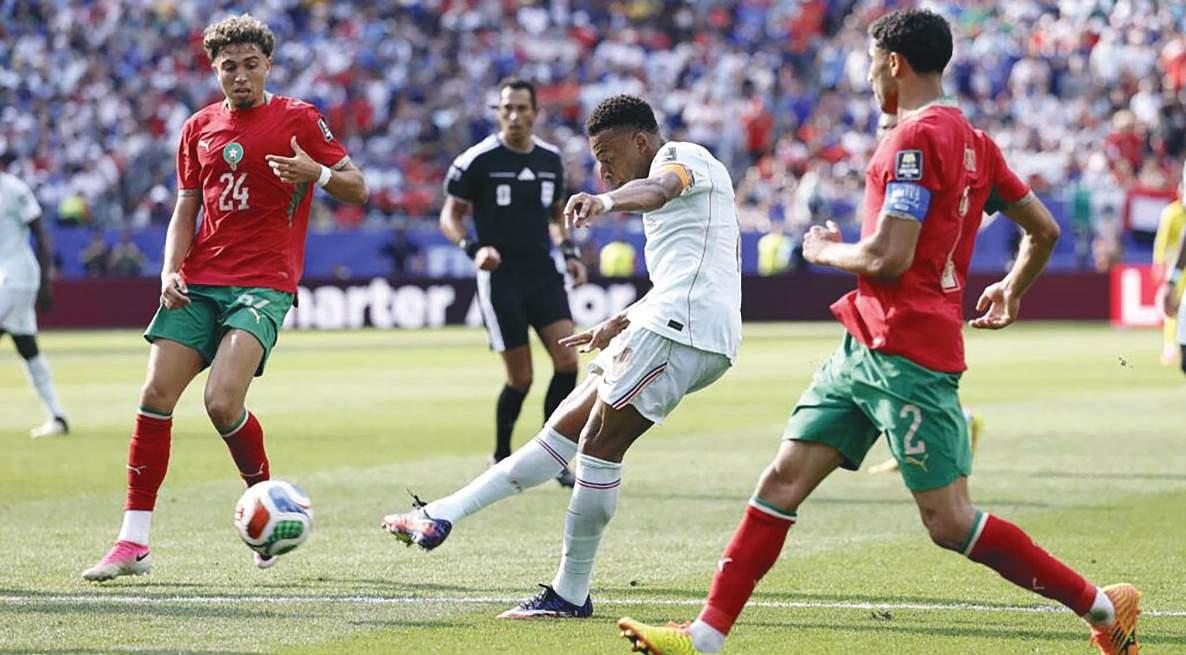
Kida Drums Support as D’Tigers
Begin FIBA World Cup Qualifiers
Karolina Muchova saved a match point before coming through an epic deciding-set tie-break to beat Coco Gauff and secure a first Wimbledon final against fellow Czech Linda Noskova.
Muchova started the semi-final the stronger of the pair but Gauff hit back, and they could barely be separated in a high-quality third set.
Two-time Grand Slam champion Gauff came back from 4-1 down in the resulting tie-break and had match point on her serve, before sending a simple forehand into the net tape.
Muchova, the 10th seed, also missed her first match point but it was she who stood triumphant at the end after an astonishing 6-2 1-6 7-6 (12-10) win in sweltering conditions on Centre Court.
Muchova had reached four major semi-finals before Thursday’s match against Gauff, but only once made the final - at the 2023 French Open, where she was beaten in three sets by Iga Swiatek.
Debutants Heartland Queens and Ikorodu City appear to have aces up their sleeves as they step forward confidently into the grand finale of this year’s President Federation Cup competition against more-established names in the Nigeria football firmament.
So much excitement has built up ahead of Saturday’s spectacle at the
After clinching victory, Muchova buried her face in her towel as she took a moment to absorb the enormity of her achievement.
“It was very nerve-wracking. I don’t even know what I’m saying, I’m shaking and trying to sink it in,” the 29-year-old said.
“Honestly, it was such a big fight. It was a rollercoaster - match point and then match point down. You don’t have time to think.”
The 21-year-old Noskova reached her first major final by withstanding Ukrainian Marta Kostyuk’s second-set fightback to prevail 6-4 6-4.
It is the first time two women representing the same nation have contested a Grand Slam final since the 2017 US Open between Americans Sloane Stephens and Madison Keys.
Stephen Keshi Stadium, Asaba, with the women’s final set to commence at noon while the men’s final begins at 4pm.
The Queens from Owerri have earned immense respect among the game’s followers after they conquered better-known FC Robo Queens of Lagos in the semi finals. The latter had seen
President of the Nigeria Basketball Federation (NBBF), Engr. Amadu Musa Kida, has called on Nigerians to rally behind the country’s senior men’s basketball team, D’Tigers, as they begin their campaign in the FIBA Africa Basketball World Cup Qualifiers.
D’Tigers have been drawn in Group E alongside Cameroon, South Sudan, Cape Verde, Tunisia, and Guinea in what promises to be a highly competitive qualifying series.
Nigeria will begin her campaign against regional rivals Cameroon on 27 August before facing South Sudan on 28 August and concluding the opening qualifying window against Cape Verde on 30 August.
Kida urged basketball fans, corporate organisations, and well-meaning Nigerians to support the team as they embark on their quest to secure qualification for the next FIBA Basketball World Cup.
He said the backing of Nigerians would provide the needed motivoation for the players and technical crew as
they face some of Africa’s best basketball nations.
D’Tigers head into the qualifiers with a positive record against some of their group opponents, having won three of their four previous meetings with Cameroon and both of their earlier encounters
against South Sudan. However, Cabo Verde remains a challenging opponent, with Nigeria recording just one win in six meetings.
The NBBF president expressed confidence in the ability of the team to compete strongly, while calling for
unity and support from Nigerians throughout the qualifying journey. With qualification places at stake, D’Tigers will be aiming to make a strong start in Group E and put Nigeria in a favourable position for a place at the global basketball showpiece.

off multi-titlists Rivers Angels in the quarter finals, before running into the Queens’ brickwall at the Samuel Ogbemudia Stadium, Benin City on Wednesday. Before conquering FC Robo Queens, the girls from Owerri had proven themselves by turning back Dragon Fury Ladies, Ahudiyannem Queens
and Ibom Angels in earlier stages. Two-time champions Nasarawa Amazons of Lafia ejected Sunshine Queens of Akure in a close-fought semi final at the Nnamdi Azikiwe Stadium, Enugu. But they must be wary of the highly-motivated girls from Owerri. In earlier stages, Amazons, who have maintained their place among
the front-runners with consistency in performance and results, swept past Osklean FC in the Round of 32, and then came out tops in penalty shootouts against FC Naija Ratels of Abuja and high-flying Edo Queens.
Three-time champions El-Kanemi Warriors of Maiduguri are up against newcomers Ikorodu City in the men’s Final, with a big war expected as the winner will pick a ticket to represent Nigeria in the CAF Confederation Cup competition. El-Kanemi Warriors won the trophy in consecutively 1991 and 1992, before overpowering Abia Warriors in the 2024 final at the Mobolaji Johnson Arena in Lagos to
Kylian Mbappe (second right) scored the opening goal in France’s 2-0 defeat of Morocco last night to book their place in the semifinal of the ongoing World Cup in North America
Nigeria’s D’Tigers are set for the FIBA World Cup qualifiers in August
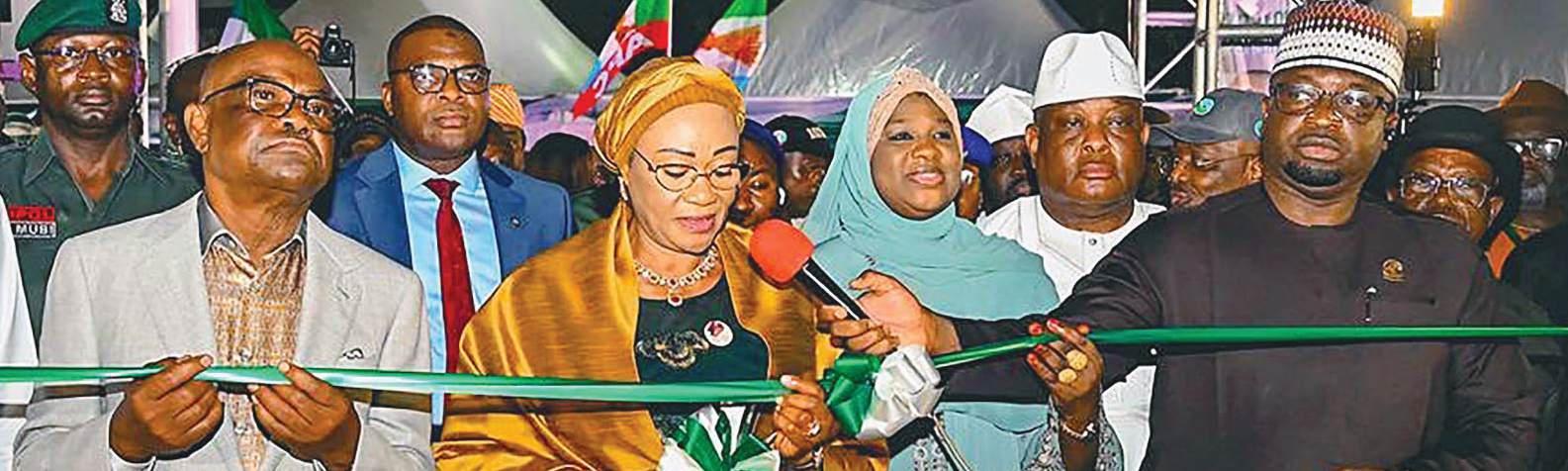
INAUGURATION OF REMODELLED CITY GATE...
L-R: Minister of the FCT Barr .Nyesom Wike, First Lady of Nigeria Senator Oluremi Tinubu, Minister of State for the FCT Dr Mariya Mahmoud and others at the commissioning of the remodeled City Gate Abuja … yesterday
On a special event like this, it is only appropriate that we begin on a note of profound gratitude, first to the Management team of the University of Northampton led by the Vice-Chancellor, Professor Anne-Marie Kilday, for opening its doors to ideas and thoughts that enrich the quality of critical public conversations. I would also like to appreciate the thought leaders and decision-makers at the University’s Centre for the Advancement of Racial Equality (CARE) and the Global Ethnic Majority (GEM) for their untiring commitment to the pursuit of fairness and balance through mindful interactions and engagements across board. I am optimistic that the
lessons we shall all go home with at the end of this event will deepen the awareness of our interconnectedness and the place of equality in our exchanges across multiple frontlines. The world around us continues to evolve as social and economic dynamics change. In this regard, adaptability means coming to terms with the reality of these changes as they affect our classrooms, workstations, communities and other centres of human interactions. The new order of exchange demands openness and a disposition to knowledge-sharing for this is the worst time to function in the exuberance of ignorance. It is for this reason that I am delighted with the theme of this conference: Race in Action: Power, Partnership
and Change. The truth is that there can never be an end to these conversations and the more freely we engage respectfully and stay open to learning, the better for our civilisation. May I quickly state that the debate is not exclusively about skin colour or the difference in the environment where we took our first breath, it is all of these and more. In discussing race and racial differences, it may help to look beyond surface-level observations and probe deeper, this time, not to find differences but to establish some level of understanding about the individuality of each person we encounter in the search for our own uniqueness.
To build the sense of clarity that the modern environment
The ongoing conversation on the establishment of state police in Nigeria is essentially a debate on Nigerian federalism. The argument that has mostly obfuscated the understanding and indispensability of federalism to the long term survival and viability of Nigeria is its subordination to the ‘Leadership’ factor. Those who make the argument will tell you that what ails Nigeria is squarely and roundly the problem of Nigeria. Indeed there is no situation in life that does not require
leadership even if it is a failed leadership. To this extent the argument becomes a platitude.
The idealisation of leadership goes way back to Plato and his notion of ideal type leaders whom he termed “philosopher kings”. In his vision of this aspirational leadership, he argued that ‘only true philosophers, uncorrupted by greed and driven by a love of truth, are fit to govern for the common good’. If such ideal leaders were to exist, they would most certainly constitute the rare exceptions
to the general rule of average and mediocre leadership. Invariably the majority of those who find themselves at the pinnacle of political power range from the suboptimal to the pathological breed.
The nature and process of the acquisition of power itself (otherwise known as realpolitik) makes it difficult for the practitioner of politics to realistically avoid unseemly lapses in the pursuit of his ambition. The more dysfunctional a society the more the brutish prevalence of realpolitik
requires, it is important to appreciate that for all our powers, many events that tend to define us are entirely outside our sphere of control and that includes where we were born, who we are born to and the general outline of our first contact with the world. None of us chose to be born Black, White, Mongoloid, Australoid, Amerindian or any of the other race variants that researchers continue to identify in the unending push to guide how we interact amongst ourselves as members of one human community. If we accept that none of us had a say in choosing their birthplaces, is it
Continued on page 38
Of Bridges and Walls: Finding Common Ground, Rising Above Divisions (1) Leadership vs Federalism
(power politics). This is why many people find it difficult to associate politics with decency, decorum and honesty. I was astounded the other day when a distinguished professor in a WhatsApp group chat wrote in caps for emphasis that ALL politicians are corrupt, All. Would he have politicians like Ahmadu Bello and Obafemi Awolowo, in mind? I am not in complete agreement with the saying that power corrupts and absolute power corrupts absolutely
on page 38
Tinubu’s Aso Rock Stinks To High Heavens
The stench from Aso Rock, (Nigeria’s Presidential abode) wafts with dark plumes. Dissipating across the land and beyond Rising like wild gale Piercing the clouds A veritable Incubus
And the host of heavens squirm with crumpling noses
The noxious stench from Aso Rock Villa wafts across the world...
HOUSE OF SLEAZE: That President Bola Tinubu’s State
House would become a smelly place was not in doubt.
From hoary birth papers to illicit educational credentials. From cartel strategist to political usurpation.
It was all a messy stuff ab initio. It was like malevolent aliens were invading Nigeria’s Number One abode. Then add the suborned electoral mandate, stolen most brazenly in the dead of night... You would think a group with such an odious baggage would turn out an epitome of prudence and probity. Not this gang!
On the contrary, never in the 35 years of this pre-eminent edifice, this very cathedral of our sovereignty, has never been so debased and desecrated.
Many leaders have passed through Aso Rock - from Ibrahim Babangida to Sani Abacha, Olusegun Obasanjo, Goodluck Jonathan and even Muhammadu Buhari of yesterday. But never was our sacred abode so abused as we have it today.
THE ‘MATURE’ BUHARI GANG
Every head in Aso Rock had its cabal and denizens who
exploit the rarefied environment and pristine accesses for their personal gains. In the Buhari days, the gang was made up mainly of Abba Kyari, Mamman Daura, Ismaila Isa Funtua, Sabiu Tunde Yusuf, Babachir Lawal (to a point) and Lawal Musa Daura, former DG, DSS, among less notable others. There was even Papa Ahmed Joda, the super perm. Sec in the Buhari team at the beginning.